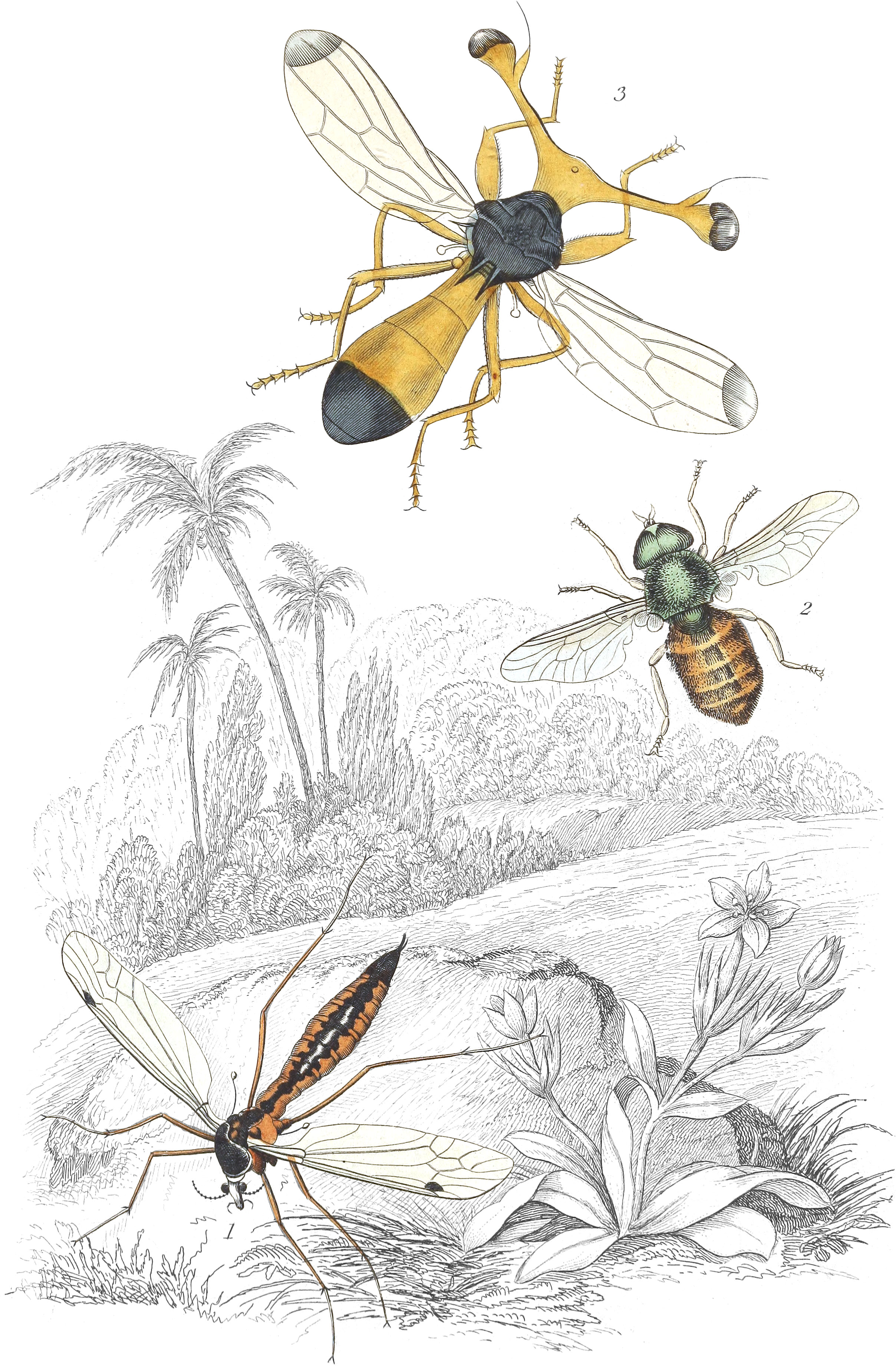
Volume 29, Plate XXXIV / Entomology (Insects)
Ctenophora Petinicornis, Tabanus Tropicus & Dopsis Ichneumonea
- Ctenophora Petinicornis. In this genus the male antennae are beautifully pectinated but simple in the female, the seven or eight British species among the most ornamented of the Tipulidae, with larvae apparently inhabiting decayed trees. The figured species occurs not unfrequently throughout the country, the upper parts of head, thorax, and abdomen black with sides of deep ochre or orange, the wings smoke-brown with a dark stigma and the legs ochreous with dusky tarsi.
- Tabanus Tropicus. This horse-fly exemplifies a tribe troublesome in warm weather for fixing on animals and sucking their blood, this species being uncommon but occurring now and then throughout the country. The antennae are ferruginous dusky at the apex, the green eyes crossed by three purple rays, the thorax shining dark brown with grey lines, the black abdomen broadly fulvous at the sides of the first four segments, and the belly fulvous, the tibiae ferruginous and the tarsi black.
- Dopsis Ichneumonea. This group is remarkable for having the eyes set on long footstalks, whence the species are called telescopic flies, the antennae inserted on these elongations, the abdomen narrowed at the base, and the thorax armed with two spines, all of them exotic and few known. The figured individual, from Bengal and very small at four lines, has yellow head, legs, and abdomen base, the abdomen apex blue-black, the thorax likewise blue-black with white dots and a brownish-black wing-tip spot.
Locations: