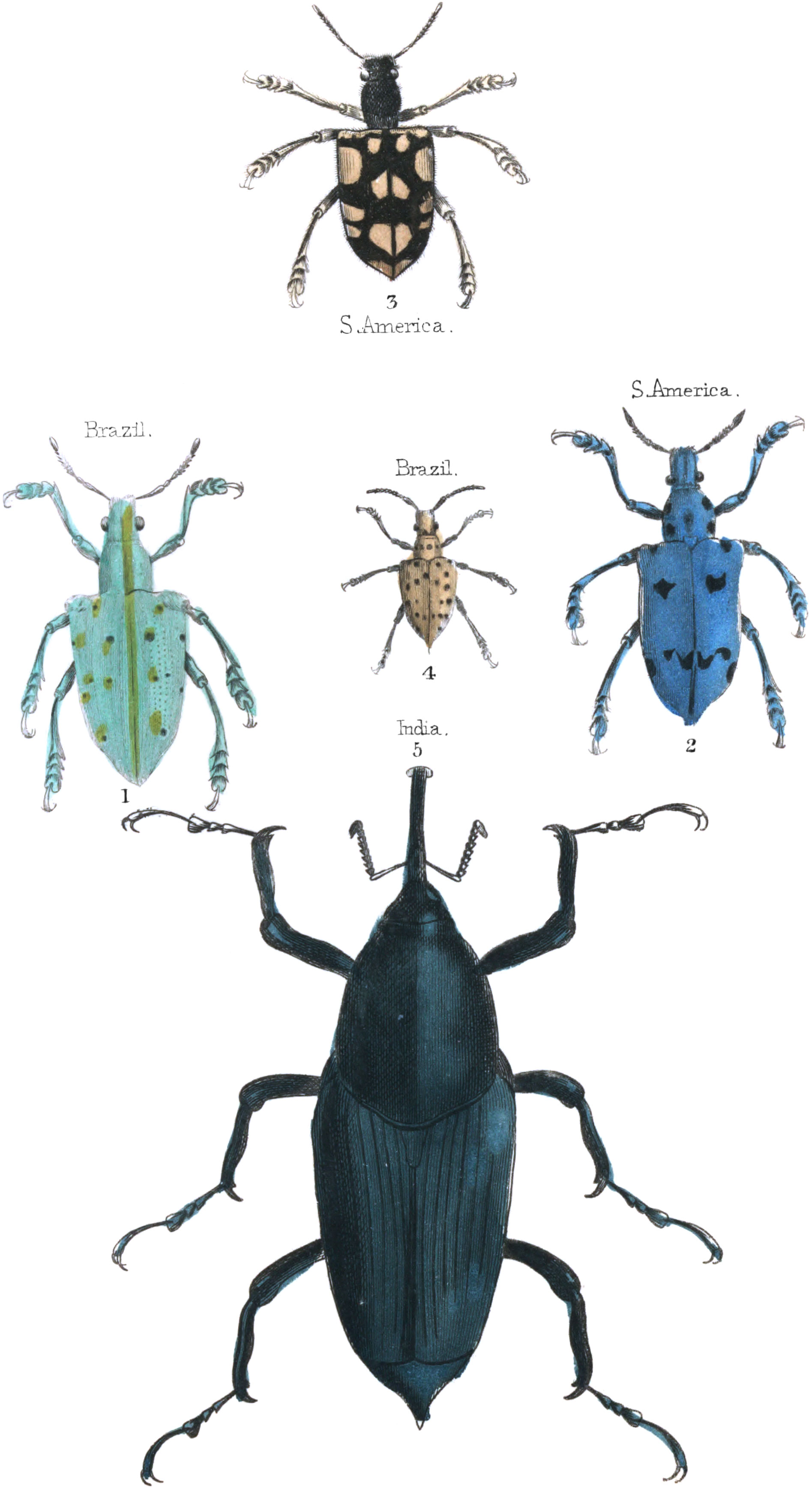
Volume 8, Plate XXII / Entomology (Insects)
Curculio & Calandra
- Curculio Latreillii. A beautiful insect entirely light green glossed with golden yellow and of great brilliancy, the thorax grooved down the middle, the elytra prominent at the shoulders with punctured lines and several brownish or golden-yellow rounded tubercles. A native of Brazil, it is invariably found on trees, principally of the genus Mimosa, and is named in honour of the celebrated French entomologist.
- Curculio sexdecimpunctatus. The whole body a fine blue, a colour very seldom seen in its tribe, the thorax generally marked with four or five black spots and each wing-case with six others, two near the suture behind the middle crescent-shaped and united. The under side is blue spotted with black, the antennae black; a native of South America.
- Curculio myrmosaurius. Black, densely clothed with long black hair, the head and thorax unspotted, the elytra each with a streak across the base and several large reddish-yellow spots, two of which approximate at the suture behind the middle into a heart-shaped spot. The legs are brownish; it is found in South America.
- Curculio brunneus. Entirely reddish brown and marked with numerous small black spots, the elytra acute at the apex and the legs black. Belonging to the modern genus Rhigus, it was received from Brazil and distinguished by this specific name for want of any existing description applicable to it.
- Calandra heros. The rostrum black and cylindrical with a small recurved piece on each side at the apex, the thorax brownish black and clothed with velvety pubescence, the elytra likewise velvety but browner, much shorter than the abdomen and slightly striated. The under parts of the body and the legs are black, the anterior tibiae somewhat curved on the inner edge; it inhabits the East Indies.
Locations:
Contents:


