Volume XIII
Thick-Skinned Quadrupeds

The Pachydermes
It is proposed to devote the present volume to one of the Baron Cuvier’s orders, which succeeds, and is very nearly allied to the last animals we treated of. It comprises creatures of great utility when domesticated, and of very remarkable form and structure.
The Pachydermes of Cuvier is evidently a group bearing only the rank of a tribe or family, and not of an order. It forms the seventh order of the Baron’s system, followed by the Ruminants, with part of the orders Bruta and Belluæ of Linnæus; while, in the natural arrangement proposed by Mr Swainson, it is made to form a portion of his great order Ungulata, or Hoofed animals, of which our present volume, with the two last, will give an idea of the typical forms; his other two divisions being composed chiefly of the extinct Pachydermous animals, and of the Sloths, Ant-eaters, and Ornithorynchus or the Edentates and Monotremes.
The Pachydermes, or thick skinned animals, so named from the strength and folded nature of their almost impenetrable hides, contain the largest land animals in creation. The Elephant, Rhinoceros, and Hippopotamus, belong to this group; the Mastodon, and all those huge wrecks of a former world, which for many years have engaged the speculations of the geologist, range under it;—immense herbivorous quadrupeds, living amidst the stupendous foliage of a vegetation proportionate to their bulk. At the present time, we find the members of this group inhabiting the warmer latitudes of Asia, Africa, and America; one individual extending in a wild state to Europe, and two or three, used economically, now nearly universally distributed by domestication. They frequent the retired forests and thick jungle, preferring such as are watered by some noble stream, where they can bathe and wallow during the hotter parts of the day. They are mostly herbivorous, and either feed on the foliage of peculiar trees, or upon the luxuriant herbage, which serves as an undergrowth in these vast vegetable nurseries. In disposition they are rather timid and inoffensive, but when roused to attack or defend, possess the most revengeful temper, and rush to the onset with blinded fury. They are for the most part gregarious.
In form these animals are very bulky; unwieldy and clumsy in their proportions, yet possessing immense strength, and an activity beyond what would be supposed; and their pace, when they have fairly commenced it, from the length of stride, and the great propelling weight of their bodies, is for a time very rapid, and bears before it all ordinary obstacles, clearing a way through the thickest and most matted underwood. Their physiognomy is rather dull and inexpressive, partly occasioned by the peculiarity of the eye, which is, comparatively, remarkably small, piggish in appearance, and wanting in animation. When enraged, however, there is a degree of inexpressible ferocity and malevolence contained in. their look, which is completely intelligible. Their skin is of great thickness, defending them from the attacks of insects, which would prove intolerable over so large a surface, and resisting the sharp spines of the brush, and staked points which they are liable to encounter in their path through the forests. It is often distributed in folds so strong as to resist the force of a leaden musket bullet, and is in most instances nearly destitute of hair, except a few stiff stragglers about the head, shoulders, or end of the tail. In the Elephant, Rhinoceros, and Hippopotamus, where these characters are most strongly marked, the skin is thick and deeply furrowed; and the epidermis, which is also thick, is bristled upon the surface with little plates, which detach themselves from it like scales. The sole of the foot, according to Cuvier, presents a very singular structure. It is divided outwardly into nearly circular deep pits, in each of which are contained a number of small irregular polygones, which make the surface appear like a chagrined skin.1
The males are in most instances furnished with tusks, which often grow to an immense size and weight. Both jaws are sometimes furnished with these elongated teeth, which express the distinctive mark of the male, and are used as organs of offence or defence, being seldom employed, or indeed being scarcely fitted for assisting in any of the wants of the animal. It is from these organs that the ivory of commerce is derived. But the remarkable part of the structure of these animals seen in that of the nostrils. In the greater portion of them they are elongated, the entrance of the nostrils forming a tube, which is used as an organ of delicate prehension, of touch, and of smell,—a convenient apparatus for some of the more unwieldy, where their short neck would not enable them to stretch far above them, or even very easily to reach the ground. In these instances it serves the place of the flexible upper lip of some of the Ruminants, and the lengthened tongue of the Cameleopard. We find this structure most developed in the Elephant, whose elongated nostrils are familiarly known under the name of trunk or proboscis, and of whose structure we have entered more into detail in describing the Indian species. It will suffice to say here, that it is an organ of the utmost delicacy, in displaying the senses of smelling and touch, and at the same time capable of the most prodigious strength, and is constantly used by the animal in pulling within its reach the branches and foliage on which it feeds. The creatures which have it in the next greatest proportion elongated, are the Tapirs, in which the nostrils also are contained in a moveable snout, scarcely however used for prehension, but possessing great delicacy of smell and touch, and used in seeking out and discriminating their food. In the Rhinoceros the lip is elongated, but without being pierced by the nostrils; and in the Pigs we perhaps see the most industriously nosed quadrupeds, the lengthened form, and stiff pierced cartilage, serving as a powerful instrument to turn up the surface in search of insects, worm and roots, while smelling and touch seems to guide to those which have been uprooted, the eye being seldom, if ever, used in discriminating their food.
The skeleton of the Pachydermes is necessarily of great strength, perhaps better expressed by the word massive. The immense weight of the head in most species renders a muscular apparatus of great power indispensable, and for this purpose there must be a large surface of insertion for the muscles. The head, by its extended surface gives attachment to those of the neck, which are the most powerful, not only for the support of the head, but to assist in the operations of digging, or employing the tusks or horn as a defence.
The processes of the cervical vertebræ are here more strongly developed, than in the long flexible neck of the Ruminantia, and the spinous processes of the dorsal vertebræ are lengthened, and strong, and generally terminated by round tubercles. The scapula is generally broader at its vertebral margin, and the strong pelvic arch is more vertical in its direction; the extremities are generally shorter and more massive, and the separate bones more completely formed, than in the former groups of quadrupeds. The ulna and the fibula being developed throughout, and four toes at least, generally reaching the ground on all extremities.2
They are, as poetically remarked by an eminent anatomist, like the Cyclopean walls of some ancient city, huge and shapeless, and piled over each other as if they were destined more to sustain the weight, than to permit motion. The strength and power of this frame-work will be better seen in the accompanying representation of the skeleton of the Rhinoceros, Plate I. taken from Cuvier’s Ossemens Fossiles.
The internal structure of the Pachydermes is more simple than that of the Ruminants. Though they feed on nearly the same sort of sustenance, a few, as the Pigs, are nearly omnivorous; at least, in a domesticated state, they feed on almost anything that is set before them, flesh, fish, or vegetables. The stomach of the Elephant is of a very lengthened and narrow form; its greatest diameter next the cardiac orifice is only about a fourth of its length. The internal membrane forms there thick wrinkles, and five large folds placed across, of which the first arises very near the cardiac orifice. This membrane is itself smooth, and is united in the middle part of the stomach; it only has some large transverse wrinkles towards the pylorus, which cross and intercept each other, often forming a number of small hollows. The muscular part is throughout very thick. There seems also to be a receptacle in the stomach of this huge beast, though in a much less extent than that of the Camel, to allow it to retain or secrete a supply of water, which may be kept for the purpose of moistening its food, but at other times is made use of to disturb the insects, which, during a march, or in hot weather, annoy and torment it. This is effected by throwing out from its proboscis a quantity of water upon the part on which the flies fix themselves.
The stomach of the Rhinoceros is placed by Cuvier among those of simple construction. It is of a very lengthened form, the place which corresponds to the pylorus being globular, and separated from the rest by a contraction.

Rhinoceros Stomach
That of the Hippopotamus, again, is much more complicated, and is of a form and structure very singular. The cardiac orifice communicates with three pouches, of which only two appear exteriorly, and into a long bag or bowel, of which the cavity is transversely divided by many folds in the form of small valves. On the side of the last valve, the above mentioned bowel continues farther lengthened, and is terminated by a narrow appendage, which is folded under it, and finishes at the pylorus. The internal membrane is all cleft, indurated and granular in the two largest pouches, and in the lengthened bowel, to the last valve, it is smooth and plaited. In the narrow appendage, it is not plaited, but the muscular membrane is very thick, particularly round the pylorus.
In the Pigs, the stomach is globular in form, very ample, and surmounted by an appendage like a hood; and in that singular little animal, which naturalists have agreed to place here, the Daman, or Hyrax Capensis, the stomach is separated into two distinct pouches, by a central partition, pierced with a hole in the centre. Each pouch answers to the right and left division in ordinary stomachs. The webs of the stomach are moderately thick, becoming more so round the pylorus, which is narrow and directed forwards.
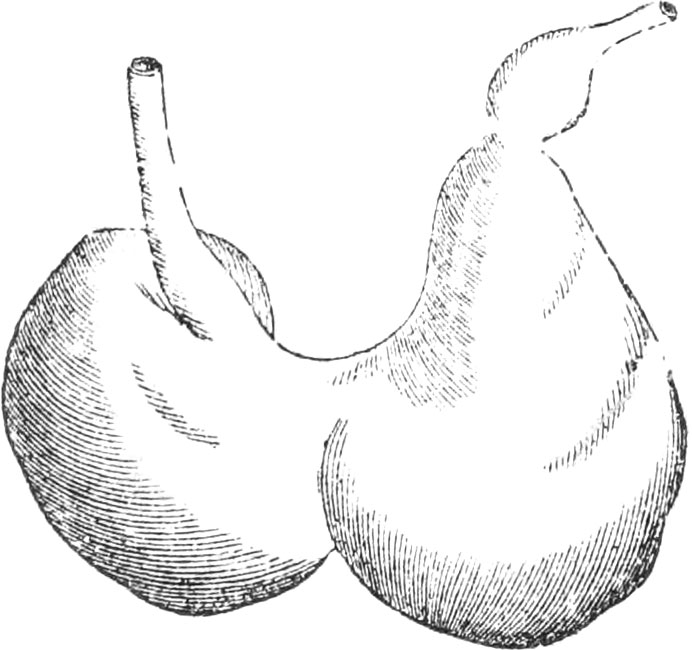
Pig Stomach
The animals composing this group are not so conspicuous for their common utility as the ruminating animals. They, without doubt, hold their place in the balance of creation, lending their aid in the consumption of the vegetation of the Tropics; but the Elephants and Pigs are the only genera which have been subjected by domestication to be of direct use to man. Without the Elephant, we should be in much difficulty over all our eastern possessions; heavy baggage, or the accompaniments to an army, would be ill transported without his giant help, while in the more luxurious modes of travelling, and in the sports of the East, he is indispensable. Pigs are now almost universally bred and fattened, yielding an immense revenue, and serving to maintain in part our navy and large establishments. The Tapirs of America, though not hitherto used, are, from their mild temper and dispositions, thought capable of being trained as beasts of burden, and might prove useful from their great strength. Thongs, leather, and whips are made from the hides of the largest of this family; and the Cape colonist would be badly off indeed, in his rugged roads, and unwieldy weighty wagon, could he not provide a harness of a substance proportionate to the stress to be borne, and he finds it in the skins of the Hippopotamus and Rhinoceros, made limber and preserved from the sun by their own grease.
The value of ivory is well known; it is supplied principally from the tusks of the Elephant; and to obtain this small but valuable portion of these immense creatures, many personal risks are incurred, and great and indiscriminate slaughter is often made. The teeth of the Hippopotamus yield a closer grained and harder material than the tusks of the Elephant, and are preferred by dentists for artificial teeth, and for subjects which require great delicacy of carving. An immense quantity of ivory reaches China, and is again exported, carved into many beautiful and ingenious articles. We may also just mention the very useful, though common articles procured from other animals of the Pachydermes,—hog’s lard and pig’s bristles; nor should we neglect the beautiful and lustrous article, pig’s hair, sometimes difficult to be procured, but always in high request by the angler.
We shall now examine the members of the different genera separately, and commence with
The Elephants
Calm amid scenes of havoc, in his own
Huge strength impregnable, the Elephant
Offendeth none, but leads a quiet life
Among his own contemporary trees.
Till nature lays him gently down to rest,
Beneath the palm which he was wont to make
His prop in slumber; there his relics lie
Longer than life itself had dwelt within them.
Bees in the ample hollow of his skull
Fill their wax citadels, and store their honey;
Thence sally forth to forage through the fields,
And swarm in emigrating legions thence.
There little burrowing animals throw up
Hillocks beneath the over arching ribs
While birds within the spinal labyrinth
Contrive their nests.
These stupendous creatures inhabit the tropical forests of Asia and Africa, living in troops or herds, in a state of inoffensive quiet, unless when attacked by some of their larger and stronger animal assailants, or their powerful and more, relentless enemy, man. They delight in the boundless forest, and in the vicinity of water, where a more gorgeous and efficient shade is afforded, and they can enjoy the luxury of a cold bath, and wallow covered at once from the influence of the sun, and the torment of insects. Here the herd, guided by some monstrous male, long standing in years, spends the forenoon heats, at evening or morning venturing to the outskirts or open glades, to feed on the tender foliage, which they can reach, and are able to pluck from a great height by means of their trunks or probosces. They are particularly fond of those of a saccharine quality, whence they often enter and do prodigious damage in the plantations of the sugar cane. They are easily alarmed, and retreat to cover upon the alarm being given by their leader; but when attacked or wounded, they turn upon their assailant with the utmost fury, and unless he has previously prepared a way of escape, seldom fail in wreaking their vengeance, and satisfying their revenge, by mangling and trampling the body long after life has been extinct.
Two species of Elephants now existing have been described; the one inhabiting the Asiatic continent, the other the African. The principal external distinction is the immense size of the ears in the last, compared with those of the Indian animal, as we have endeavoured to represent on our plates. We shall now describe and illustrate the species separately; and first,
The Elephant of India
Elephas Indicus.—Cuvier.
Elephas maximus, Linn.—Elephas Indicus, l’Elephant des Indes, Cuv. Regne Anim.—Griff. Synopsis.
The Indian Elephant is distinguished by an oblong head, concave forehead, by the crown of the cheek teeth presenting undulating transverse ridges, which are the separations of the laminæ which compose them, worn down by trituration. There are four nails on the hind feet, and the ears are small compared with its African congener. It is found in the forests of the southern parts of India, and in many of the eastern islands. It has been from time immemorial under the dominion of man, having been used in his wars, as his beast of draught and burden, and even to attack and capture its own species. Those in a domestic state are tended with the greatest care and luxury, and a favourite and tractable Elephant is almost invaluable.
A full grown Elephant has a most unwieldy appearance, yet his activity and speed are very great, a swift horse being sometimes unable to get away from him. The skin is thick and hard, dry like, and wrinkled into folds about the setting on of the legs, on the neck and breast. It is of a brownish gray colour, sometimes slightly mottled with flesh colour, and is thinly set with rigid hairs of a somewhat similar tint, which are most abundant on the head. The form of the head varies with age, it increases immensely in the adults, and exhibits the depth of sinus, which almost entirely surrounds the cavity of the head, and is observed in the skeleton. The teeth are often of immense weight, and with the tusks are the most valuable part of the animal, and for which they were formerly much persecuted. There are sometimes twenty transverse ridges in a single tooth. The tusks grow to a very large size, but are of a concentric structure, and afford the finest ivory. The first tusks are shed when they have obtained the length of three or four inches, and are replaced by the permanent ones, which sometimes reach an enormous size. They are composed of conical layers, set in one after the other, the interior being the last produced. The base is hollowed into a conical cavity, prolonged into a narrow canal, which runs along the centre of the tusk, and is filled with a blackish matter. The outward layer is true enamel, but is not harder than the centra part of the tooth or the ivory. The external ear is large, but small compared with that of the next animal. The eyes are very small, with round pupils, and with a piggish expression. The feet have five toes, which are concealed by an envelope of skin, (and are only shewn at the tips by the nails) which fits them and protects them like a slipper. But the most remarkable portion of the structure of the Elephant, is what is usually called the trunk or proboscis, properly an elongation of the nose, and used as an organ of prehension, most valuable when we consider the unwieldy size of the head, and the shortness of the neck.3 It acts also as a delicate organ of touch and of smell; it can lift an article of great minuteness, while it can raise the most immense weights; it serves also to convey drink to the mouth, which otherwise would be unattainable, and it is a weapon of defence of a most powerful description. It is formed by a membranous prolongation of the tubes of the nostrils, furnished with muscles, and covered exteriorly with tendinous expanse. The muscles which move the trunk are of two kinds,—the longitudinal ones, divided into a number of arcs, of which the convex part is exterior, and the two ends adhere to the internal membrane; and of transverse muscles, which stretch from the internal to the external membrane, like the rays of a circle. These last straiten the outward covering, without closing the internal canal, and by this action they lengthen the trunk, by forcing the longitudinal muscles to stretch themselves. The others by contracting shorten the trunk, either entirely when they are all brought into action, or in different parts, either on one or more sides at a time, in one or more portions of its length, and which produces various curves on several parts of its surface, either in a spiral direction, regularly or irregularly; a mechanism at once simple and useful. At the extremity there is an appendage in the form of a finger, by which very small bodies can be raised; and the whole organ displays one of the most beautiful instruments, remarkable for its simplicity, delicacy of sense and action, and for its strength.
The general height of the Indian Elephant is from eight to ten feet; that of the female, about seven or eight. Mr Scott, of Sinton, mentions one male as the largest he had heard of, twelve feet two inches high, from the crown of the head to the ground; and at the shoulder, about ten feet five inches. The length was fifteen feet. But the collection of Petersburgh possesses a skeleton fourteen feet high, and one or two are recorded of thirteen feet and a half. The young animal grows very rapidly at first; by the second year it has reached a height of four feet; after this period, it increases more slowly, till it has reached twenty or twenty-two years. They are suckled for two years; and, in a wild state, the young run for suck indiscriminately to any female without regard to the mother, and thus the cry of distress from any of the young, generally arouses the herd. The tusks are shed about the twelfth or thirteenth year. The cheek teeth appear about six or seven weeks after birth.
Like other animals, the Elephant is subject to variation. Difference of the general colour is frequently seen, and some of a reddish hue are met with; but this has been attributed to adventitious matter received upon the skin by rubbing, though, as a variety, it is still asserted by some to exist naturally. A similar kind is found in Africa. But the white Elephant, occasioned by albynism, is the most valuable, held even in veneration, and always brings a most extravagant price. The different direction of the tusks has also given rise to different names; of those the most esteemed have the tusks nearly horizontal, and by the native princes they are frequently ornamented, and bear trinkets suspended.
India, and the East, are the countries where the Elephant is most subjected to the dominion of man; and where it becomes almost a necessary animal in the business of the inhabitants, of course, affording a profitable employment to the dealers in those animals, or, if one may be allowed the term, to the elephant jockies. Various modes have been devised to capture them; and they do not appear to display the same active intelligence which they do on many occasions in a tame state, or to be so timorous and wary as African travellers describe the animal of that country. One of the most commonly employed means of capture, is driving them into a keddah, or enclosure, with a wide or extensive opening, which is gradually narrowed, and made on the same principle with the Buffalo pounds, which we have noticed in a former volume. The strength, however, of the last enclosure, is very different. There is a broad ditch, too wide for an Elephant to stride over, of a considerable depth, and around, on the outside, is a paling of large timbers, well bound with strong battens, and supported by props at suitable distances, forming an immense bulwark. When a large herd of Elephants is discovered, or when two or more small herds are found so contiguous, as to be easily brought together, the people of the neighbouring country, who in general receive regular wages for their aid, are collected to surround them; and often assemble to the number of six or eight thousand men, with fire-arms, drums, trumpets, fire-works, and, in short, any thing that can intimidate the herd. The whole body move slowly towards the funnel, in which is strewed a small quantity of those fruits and vegetables in which Elephants delight, such as plantains, sugar canes, &c. Many days are frequently required to drive a herd, and sometimes the Elephants are driven thirty or forty miles. The circle is gradually narrowed as the funnel is approached, and when fairly within, the funnel itself forms a part of the circle. They begin to taste some of their favourite foods, which being quickly consumed, some by degrees venture into the keddah itself. The example is soon followed, and but little coercion is required now to urge the whole within the paling, which is then secured with strong bars.
At one period, the manner of subjection, after the animals were thus enclosed, was by starvation, binding their legs with strong ropes, and gradually accustoming them to the individual who was afterwards to have them in charge. It has, however, been found to be much more advantageous to entice them by kindness; by this treatment, they are sooner subjected, and are not liable to be rendered useless from the cutting wounds inflicted by the ropes with which they were bound, and which, in a warm climate, ulcerated to an immense extent, and often proved fatal. When in a proper state to be removed, tame males, or decoy females, are used, which lead him to the place where he is to be picketed. Here the mahout, or keeper, redoubles his care and caresses, and seldom fails to become a favourite, and often an object of great attachment to the animal.
The most singular method, however, which has been adopted for taking Elephants, is by the assistance of decoy females, which enter into the undertaking as if they were as much interested in it as their owners. This is chiefly practised with those males which have been driven off from the herd, and are wandering about by themselves. They are known by the title of sauns, and are valuable to dealers, being the second in size and strength to the leader of the herd. Two decoy Elephants, or koomkies, as they are termed, are generally employed in this business, attended by the mahout, provided with a black covering and strong ropes. When the wild animal is discovered, the decoys approach as near as possible, the mahout mounted, covered with his cloak, and crouching. When afraid of discover, he slides down, and the females proceed alone on their treacherous errand, in which they generally succeed so well by caresses, as to distract the attention of the animal, and thus enable the men to bind his legs. Sometimes, during the caresses, he is led towards a tree, and his bonds made fast to it. The clasps for the hind legs are made with a joint in the middle, and studded in the inside with short nails, which inflict much pain when the animal begins to struggle, and ultimately oblige him to desist. In case of the men being discovered during the operation of binding, the tame Elephants will attack and restrain the wild animal until they escape; and instances are even told of their having suffered death in defence of their keeper. If the binding is successful, the animal is left to himself during the first day, and, on discovering his position, vents his anger and disappointment in struggles and incessant roaring, refusing all sustenance or kindness. Thirst and exhaustion, however, begin to tame him, and he gradually receives water, and the same tame animals which captured him, with their keepers, by degrees win upon him by pampering his appetite, and doing him various acts of kindness. Before being liberated, large ropes are fastened round his body. When still troublesome,—and they sometimes make furious attempts to escape,—the leading Elephant proceeds as quickly as possible, while others goad him behind, and the mahouts spur them on.4
Another method of catching Elephants is mentioned by Colonel Williamson as practised in Nepaul and the frontier countries—a kind of lassoing, or throwing a slip-knot over the head of the animal to be captured. Two Elephants are employed, selected for their size and speed, males being preferred. Each mahout is provided with a slip-knot of very strong rope, about two inches in circumference, and ten or twelve yards in length, exclusive of what is passed round the Elephant’s body. At the end of the rope, which lies coiled on the Elephant’s head, is a sliding noose, that works freely, and has affixed to it a strong cord, for the purpose of relaxing its hold as occasion may require. When the herd is discovered, the director of the hunt singles out the one to be pursued; and in this he is regulated by the size of his Elephants, for he might be run away with, by one larger and stronger than his own. The mahouts, who are accustomed to the business, are extremely expert, and rarely fail to throw the knot over in the most effectual manner, causing it to light fairly round the brows and behind the ears of the Elephant, which instinctively curls up its trunk, whereby the lower part of the knot slips under it, and completely encircles the neck. The Elephant is impeded, and time is thus given for the second hunter to come up on the other side and fasten his rope, which, being better tightened, impairs the power of breathing, or stops respiration so as to cause the animal to fall and become a captive. He is afterwards led to his picket, sometimes with the utmost difficulty and danger, but is almost always at last overcome, temporary strangulation being again resorted to.
They are also taken in pitfalls, made soft at the bottom, in which they are allowed to remain, and starved into subjection. When sufficiently subdued to come out, they are relieved by the pit being gradually filled up, on which the animal, as if aware of the object, raises his feet, preventing himself from being buried, and patiently waits until he can step out. This method, however, is the most disliked, for the prodigious weight of the animal falling, often maims or disfigures him externally, or gives inward bruises which he feels when afterwards put to hard work.5
Among the ancients, Elephants became known, and were used in the wars of the Greeks and Homans; they were also often exhibited at their public shows and triumphs, and at their contests of wild animals. They were most probably procured both from India and Africa, as the distinctive character, in the form of the head and size of the ears, is plainly to be traced on some of the representations of ancient sculpture. The natives at that period had, of course, some method of capturing them by stratagem; Aristotle, when describing the hunting of Elephants, (that is, for capture, not destruction,) mentions that tame ones were used, which attacked the wild animals, and these, when wearied or exhausted, were mounted by the keeper or master, and governed into obedience by a spear,—a method which would require no little share of courage and coolness. In Africa, where great slaughter of these animals has always been effected, the natives are said to ascend a tree, and to spring on the backs of the passing Elephants, slide down by the tail, and, during their short suspension, hamstring the animal.6
Let us now see for what purposes this valuable animal is used, after so much risk and labour are expended on its capture and subjection. In the ancient times of the empires of India, Elephants were the indispensable attendants upon a court and upon nobility, and were esteemed the principal among all the immense number of animals which formed part of the royal retinue. In the ninth century, the Emperor Jehengir is said to have possessed twelve thousand of these animals, while, among the nobles of his empire, forty thousand were thought to be distributed,7 a number which at the present time, far exceeds our ideas of even eastern magnificence, and when combined with the quantity of food, and number of attendants requisite, seems more like an oriental tale than a reality. They were then used for show, for the transport of baggage, and in war. They were fed and treated in the most careful and luxurious manner, with sugar and rice, and long and round pepper, occasionally mixed up with milk; and during the sugar season, each Elephant was furnished daily with three hundred canes for two months. In the travelling expeditions of these ancient kings, either for pleasure or war, from eight hundred to fifteen hundred Elephants were frequently employed in transporting the emperor’s baggage, besides nearly an equal number of camels. Those for the battle were separated, caparisoned and protected according to the way they were to be employed, and the enemy they were to encounter; and from two thousand to three thousand of these animals were not unusual during the eastern wars of the eighth and ninth centuries. At the same courts were held almost daily the fights of wild beasts, in which the Elephants took a prominent part, and numbers of these noble animals fell, in giving a barbarous gratification to their royal masters.

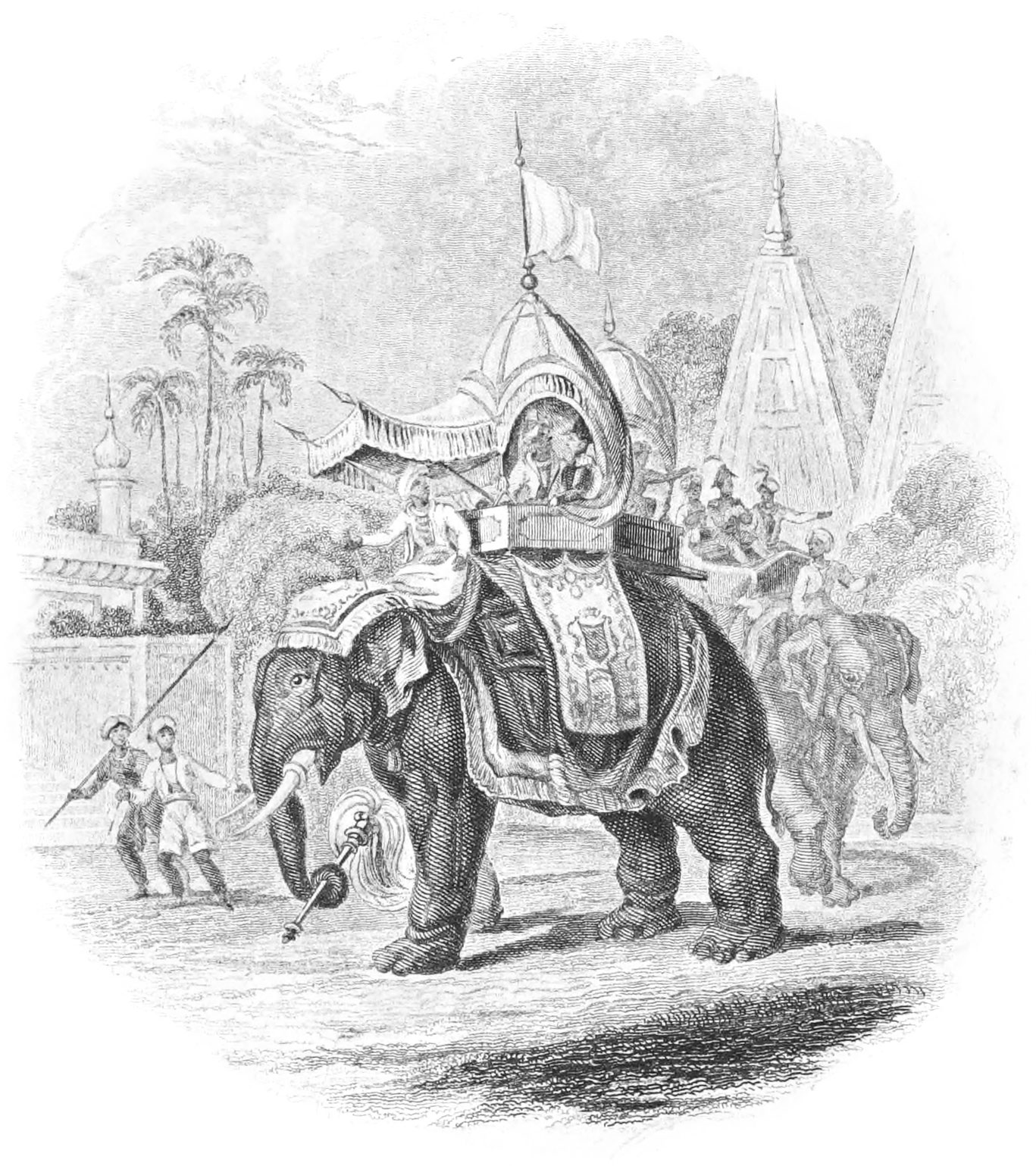
Plate III
Elephant of India Caparisoned for Hunting
Even at a very early period, the Indian kings employed immense troops of Elephants, and several thousands were brought to the field. In the wars of Alexander, however, they scarcely exceeded four or five hundred; and during the height of the Roman Empire, from thirty to two hundred were all that could be mustered.
In the east, at the present time, the Elephant is only employed in carrying baggage, or in assisting to drag artillery; they do not enter into the general engagement, but their use to an army on its march is incalculable. They exhibit much sagacity in the exercise of their strength, and effect, in a degree proportioned to their superior powers, the labour of bullocks and horses. Their exertions are made by either pushing, or dragging, or lifting. The forehead is generally defended with strong leather, and is the principal part employed in pushing; and where more than one is employed, they will act in concert, to render their efforts more effectual. Although still an attendant to a limited extent on the courts of the East, and valuable for the production of ivory, fortunately the Elephant does not now hold the same scale of utility it formerly did; for the hundreds of thousands of these animals which were then taken have tended, in India at least, to diminish their numbers, and to increase the difficulty of procuring them. In Africa, the capture, on account of their tusks, is great; and at Darfur, they are still seen in large troops, Major Denham having counted forty-seven, and the natives reported herds even to two thousand.8
In Europe, the Elephant is only known in confinement, from animals captured when young and imported, or from one or two adult specimens sent as presents. In this country, till very lately, they have always been kept in a situation too confined to afford any good idea of their manners, and in the restraint of a cage could only exhibit a few tricks, taught them by their keepers, to please the popular part of their visiters; but they give us no idea of the healthy animal among his own luxuriant foliage. In the more extended paddock, and supply of water which our various zoological gardens now allow to the large Pachydermes, we may expect an improvement of their keeping, and to see them in as free a condition as we can well expect, without going to look for them in India or Africa.
The most remarkable Asiatic Elephant which has been lately exhibited in England, was that which it was necessary to destroy in Exeter Change, during one of his periodical paroxysms of fury He was, at first, a fine animal, remarkable for docility; and had previously belonged to Mr Harris of Covent Garden theatre, who paid nine hundred guineas for the animal, and introduced him upon the stage in the procession incidental to a grand pantomime, called Harlequin Padinanaba.9 We were fortunate in seeing this animal play his part, apparently with delight, and with great gentleness and docility, moving around the crowded stage, as if conscious of his ponderous bulk, and the feeble resistance that could be made to any opposition which he might offer. His death afterwards was painful, though absolutely necessary; nearly two hundred balls must have pierced him; and when we consider the naked African going out alone to the hunt, and sometimes bringing down this huge animal with a single ball, we cannot help thinking that a little previous coolness and deliberation would have saved both much pain and danger.
So many anecdotes of this animal are continually before the public, that we do not propose introducing any in illustration of its disposition or docility; for, indeed, we scarcely know where to find a new one. They have often also been twisted to serve the immediate purpose of the writer, or exaggerated to maintain some wonderful exertion of intellect. Suffice it to say, that, looking to all our accounts of both the known species as impartially as possible, we cannot attribute a greater portion of intellect to the Elephant than we could to some other animals. In a wild state, his actions are all guided by his passions—blind fury when attacked—the care and comfort of his body—or his attachment for the female; and we have seen his passion, in this latter case, so blind as actually to allow him to be taken. In captivity, he is docile, possesses an excellent memory, and from this qualification performs most of his useful labours, for without memory or experience he will not undertake any new operation, until it is explained. The same faculty makes him revenge bad treatment, and long remember it. At the periodical seasons, he becomes almost as infuriated as when wild, and will at times not even obey his keeper or his favourites; and it is necessary, at this time, even to allow the animal his liberty to range in the jungle, whence he will again return, of his own accord, to the charge and company of his keepers.
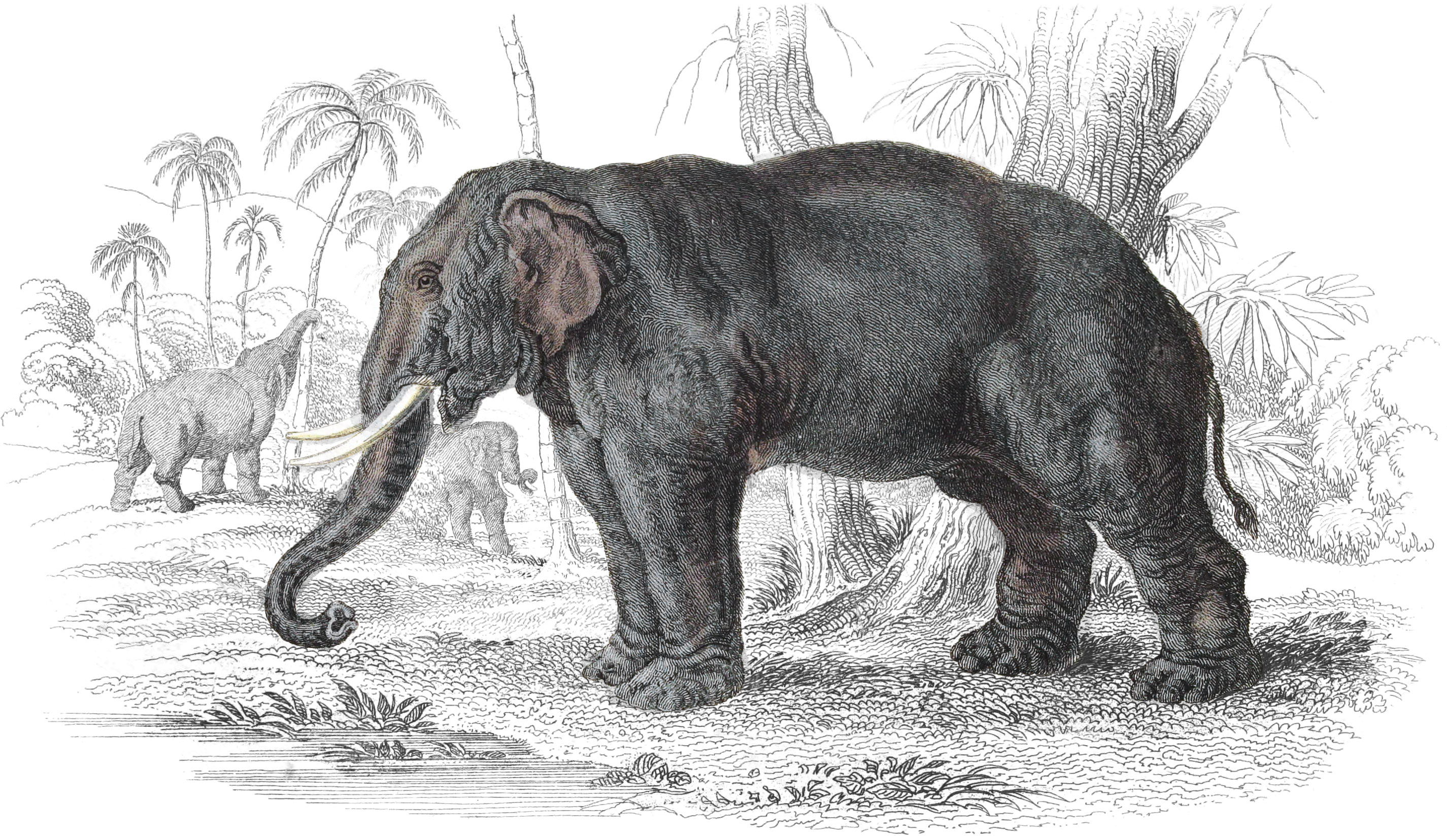
Plate II
The Elephant of Africa
Elephas Africanus.—Cuvier.
Elephas Africanus, Cuvier, Regne Anim.—E. Capensis, Cuvier’s Memoir et Hist.—Elephant d’Afrique, Loxodontes Africanus, Fred. Cuv. Hist. Nat. des Mammiffres.
This animal is distinguished from the last by its more rounded head, by its very large ears, which cover the whole shoulder, descending upon the legs, and are of such magnitude as to be employed at the Cape of Good Hope as sledges to draw tools to the field, and even to convey the sick; and by the form and structure of the cheek teeth, which have the divisions of the crown lozen-shaped, whence Fred. Cuvier has given it his new generic name of Loxodontes. The animal is also generally smaller in its proportions. In the colour of the skin and hair, and scanty distribution of the latter, there is little variation from the last; and the red colour of the skin, taken notice of by Vaillant, is owing to a similar cause as that we mentioned when speaking of the Asiatic Elephant.
The African Elephant inhabits that continent from the Cape of Good Hope to the Niger, living nearly in the same condition, and having much the same manners as its allied species in the Asiatic continent; delighting even more in the vicinity of water, and in the luxury of shade, so tempting in those parched countries. They go in herds, are equally watchful, defend their young to the utmost extremity, and are fierce and revengeful when wounded or attacked, venting their rage and revenge by trampling and mangling their victim till little vestige of him remains. They are, however, nearly, if not entirely, extirpated from the Cape colony, and one has to travel far into the interior before being gratified by a view of those stupendous animals, or indeed of any of the larger game formerly so abundant, enjoying their own forests. And we have reason to believe, from recent accounts, that the late Caffer wars have contributed farther to the extirpation of many noble animals.
Unlike the Indian animal, it scarcely has been domesticated, and is not employed for any useful labour, unless we include its employment by the ancients in war, as there seems no reason for doubting that the animals used by the Carthaginians were of African origin. Since that period, however, we have no trace of them being used in a tame state, the large race of Bullocks being employed in South Africa, and the Horse and Camel in the northern regions; neither do any of the late travellers in Northern Africa mention them as being domesticated. It is attacked only as a sport or amusement, or as a matter of emolument. Our task will, therefore, only be to recount one or two of those dangerous adventures which so well portray the coolness and dexterity of the Hottentot, and others which may throw some light on the habits or dispositions of the animal.
The African Elephant not being of such bulky proportions as that of India, the risk of attacking it, or the difficulty of its destruction, is not thought more of than the hunting of the Lion or the Tiger in India. Colonel Williamson, a person of experience in these matters, however, is of a different opinion, and thinks, that neither
natives nor Europeans would undertake such a piece of rashness as to go out shooting wild Elephants.
In Africa it is different, and all the three huge African animals are not only shot, but also speared by the naked Hottentot, who trusts to his agility only for his escape.10 The encounters are certainly sometimes fatal to the aggressor, and dreadful then is the deed of retaliation and revenge. We shall transcribe one of Pringle’s African sketches, during an exploratory excursion with some engineer officers, which gives a good idea of the natural haunts and habits of this species.
I rode with them next day into the Ceded Territory; and while they ascended the Winterberg, I constructed, with the aid of the Hottentot soldiers, a sort of booth or shielding for our shelter at night, on the skirts of a wood, in a lovely verdant glen at the foot of the mountain, all alive with the amusing garrulity of monkeys and paroquets. The aspect of the Winterberg from this spot was very grand, with its coronet of rocks, its frowning front, and its steep grassy skirts, feathered over with a straggling forest partly scathed by fire. As lions were numerous in the vicinity, we took care to have a blazing watch-fire, and a couple of sentinels were placed for our protection during the night. We received, however, no disturbance, and spent a very pleasant evening in our “greenwood bower;” the spot, in jocular commemoration of one of the party, being thenceforth denominated Fox’s Kraal or Shieling.
Next day, we followed the course of the Koonap over green sloping hills, till the increasing ruggedness of the ravines, and the prevalence of jungle, compelled us to pursue a Caffer path, now kept open only by the passage of wild animals along the river margin. The general character of the scenery I have already described. During the forenoon, we had seen many herds of quaggas, and antelopes of various kinds, which I need not stop to enumerate; but after mid-day, we came upon the recent traces of a troop of Elephants. Their huge foot-prints were every where visible; and in the swampy spots on the banks of the river it was evident that some of them had been luxuriously enjoying themselves, by rolling their unwieldy bulks in the ooze and mud. But it was in the groves and jungles that they had left the most striking proofs of their recent presence and peculiar habits. In many places, paths had been trodden through the midst of dense thorny forests, otherwise impenetrable. They appeared to have opened up these paths with great judgment, always taking the best and shortest cut to the next open savannah, or ford of the river; and in this way their labours were of the greatest use to us by pioneering our route through a most intricate country, never ye traversed by a wheel-carriage, and great part of it, indeed, not easily accessible even on horseback. In such places, the great bull Elephant always marches in the van, bursting through the jungle, as a bullock would through a field of hops, treading down the brushwood, and breaking off with his proboscis the larger branches that obstruct the passage, whilst the females and younger part of the herd follow in his wake.
Among the mimosa trees sprinkled over the meadows, or lower bottoms, the traces of their operations were not less apparent. Immense numbers of these trees had been torn out of the ground, and placed in an inverted position, in order to enable the animals to browse at their ease on their juicy roots, which form a favourite part of their food. I observed that, in numerous instances, when the trees were of considerable size, the Elephant had employed one of his tusks, exactly as we would use a crow-bar—thrusting it under the roots to loosen their hold of the earth, before he attempted to tear them up with his proboscis. Many of the larger mimosas had resisted all their efforts; and, indeed, it is only after heavy rains, when the soil is soft and loose, that they can successfully attempt this operation.
While we were admiring these and other indications of the Elephant’s strength and sagacity, we suddenly found ourselves, on issuing from a woody defile, in the midst of a numerous herd of those animals. None of them, however, were very close to us; but they were seen scattered in groups over the bottom and sides of a valley two or three miles in length; some browsing on the succulent spekboom, which clothed the skirts of the hills on either side; others at work among the young mimosas and evergreens sprinkled over the meadows. As we proceeded cautiously onward, some of these groups came more distinctly into view—consisting apparently, in many instances, of separate families, the male, the female, and the young of different sizes; and the gigantic magnitude of the chief leaders became more and more striking. The calm and stately tranquillity of their deportment, too, was remarkable. Though we were a band of about a dozen horsemen, including our Hottentot attendants, they seemed either not to observe, or altogether to disregard, our march down the valley.
As we rode leisurely along through a meadow thickly studded over with clumps of tall evergreens, I observed something moving over the top of a bush close a-head of us, and had just time to say to the gentleman next me—“Look out there!” when we turned the corner of the bush, and beheld an enormous male Elephant standing right in the path within less than a hundred paces distance. We halted and surveyed him for a few minutes in silent admiration and astonishment. He was, indeed, a mighty and magnificent creature. The two engineer officers, who were familiar with the appearance of the Elephant in his wild state, agreed that the animal before us was at least fourteen feet in height; and our Hottentots, in their broken Dutch, whispered that he was “een groot yruwzaam karl—bania’, bania’ groot!”—or, as one of them translated it, “a hugeous terrible fellow, plenty, plenty big!”
The Elephant at first did not seem to notice us, for the vision of the animal is not very acute, and the wind being pretty brisk, and we to the leeward of him, his scent and hearing, though keen, had not apprised him of our approach. But when we turned off at a gallop, making a circuit through the bushes to avoid collision with him, he was startled by the sound of our horses’ feet, and turned towards us with a very menacing attitude, erecting his enormous ears, and elevating his trunk in the air, as if about to rush upon us. Had he done so, some of us would probably have been destroyed; for the Elephant can run down a well mounted horseman in a short chase; and, besides, there was another ugly defile but a little way before us, where the only passage was a difficult pass through the jungle, with a precipice on one side, and a wooded mountain on the other. However, the “gruwzaam karl,” fortunately, did not think proper to give chase, but remained on the same spot, looking steadfastly after us; well pleased, no doubt, to be rid of our company, and satisfied to see his family all safe around him. The latter consisted of two or three females, and as many young ones, that had hastily crowded up behind him from the river margin, as if to claim his protection, when the rushing sound of our cavalcade startled their quiet valley.
An account of the fossil Pachydermes would lead us beyond our limits, besides encroaching upon the contents of a volume, which we propose to devote to a consideration of ancient Mammalia, and the huge reptilian forms; but we cannot omit here a notice of the animal discovered at the mouth of the Lena, and of the Mastodon, as shewing the form of the proboscis bearing animals of the New World. The account of the first we transcribe entire, being of great interest, from the perfect and almost fresh state in which the animal was discovered, and exhibiting a different hairy covering when compared with the living animals we are now acquainted with. We add a reduced plate of the figure which accompanies it.
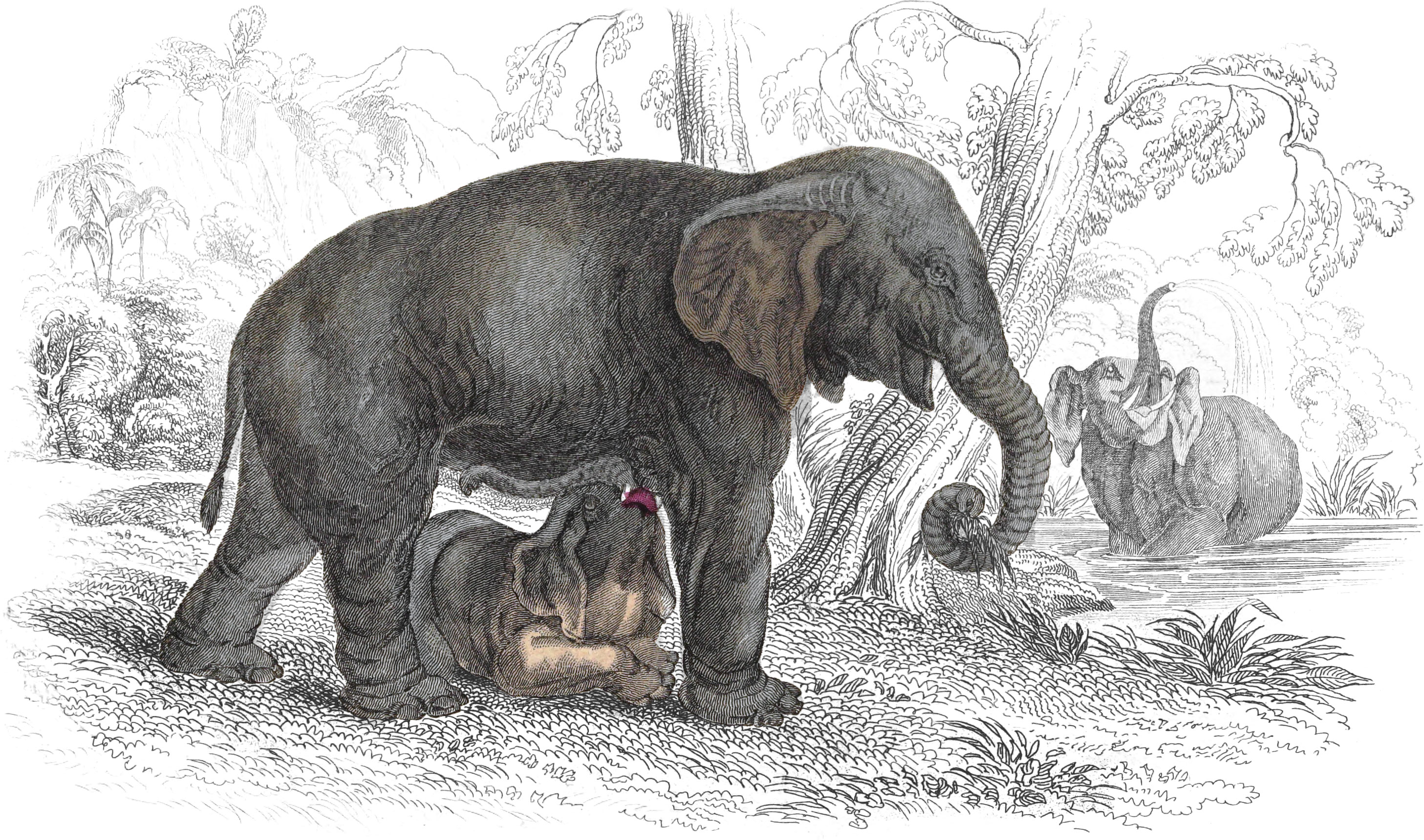
Plate IV
The Elephant of the Lena
According to several writers, the term Mammoth is of Tartar origin, and is derived from mama, which signifies the earth,11 and the natives of Siberia give the name of “bones of the Mammoth” to the remains of Elephants which are found in great abundance in that country, believing that the Mammoth is an animal which lives underground at the present time.
The Mammoth or Elephants bones and tusks, are found throughout Russia, and more particularly in Eastern Siberia and the Arctic marshes. The tusks are found in great quantities, and are collected for the sake of profit, being sold to the turners in the place of the living ivory of Africa, and the warmer parts of Asia, to which it is not at all inferior.
Almost the whole of the ivory-turner’s work made in Russia, is from the Siberian fossil ivory, and sometimes the tusks, having hitherto always been found in abundance, are exported from thence, being less in price than the recent. Although for a long series of years, very many thousands have been annually obtained, yet they are still collected every year in great numbers on the banks of the larger rivers of the Russian empire, and more particularly those of farther Siberia. They abound most of all in the Laichovian Isles, and on the shores of the Frozen Sea. In digging wells, or foundations for buildings, there are every where discovered the entire skeletons of Elephants, which are very well preserved in the frozen soil of that country. The instances of these bones being found in the above mentioned regions, and their great numbers, are so frequently stated by Russian travellers, that it may be fairly contended that the number of Elephants now living on the globe, is greatly inferior to the number of those whose bones are remaining in Siberia.
It is particularly to be noticed, that in every climate, and under every latitude, from the range of mountains dividing Asia, to the frozen shores of the Northern Ocean, Siberia abounds with Mammoth bones. The best fossil ivory is found in the countries near to the Arctic circle, and in the most eastern regions, which are much colder than the parts of Europe under the same latitude, and where the soil in their very short summer, is thawed only at the surface, and in some years not at all.
In the year 1805, when the Russian expedition under Krusenstern, returned for the third time to Kamschatka, Patapof, master of a Russian ship bringing victualling stores from Okhotsk, related that he had lately seen a Mammoth Elephant dug up on the shores of the Frozen Ocean, clothed with a hairy skin; and shewed, in confirmation of the fact, some hair three or four inches long of a reddish black colour, a little thicker than horse hair, which he had taken from the skin of the animal: this he gave to me, and I sent it to Professor Blumenbach. No farther knowledge has been obtained on this subject, and unfortunately Patapof was not employed by any of our societies to return to Siberia. Thus has this curious fact been consigned to oblivion; nor should we now possess any information respecting the carcass of the Mammoth, which forms more particularly the subject of this memoir, if the rumour of its discovery had not reached Mr Adams, a man of great ardour in pursuit of science, who undertook the labour of a journey to these frozen regions, and of preparing these gigantic remains, and transporting them to a great distance.
The preservation of the flesh of the Mammoth through a long series of ages, is not to be wondered at, when we recollect the constant cold and frost of the climate in which it was found. It is a common practice to preserve meat and berries through the winter by freezing them, and to send fish, and all other provisions annually at that period, from the most remote of the northern provinces, to St Petersburgh and other parts of the empire.
I shall now proceed to the account which Mr Adams has published of his journey to the Icy Sea, and to the place where the carcass of the Mammoth, whose skeleton is now to be seen in our museum, was found lying on the sand and ice. It was first published in the Journal du Nord, printed at St Petersburgh, in 1807, under the title of “Relation abrégé d’un Voyage à la mer Glaciale, et decouverte des restes d’ un Mammouth,” and afterwards in some German ephemerides, but as they are now scarce, I shall cite his own words.
I should reproach myself if I longer delayed the publication of a zoological discovery, which is highly interesting in its detail, since it makes us acquainted with a species of animal, whose existence was a subject of dispute among our best informed naturalists.
I was told at Jakutsk by the merchant Popoff, chief of the body of merchants of that town, that there had been discovered on the shores of the Frozen Ocean, near the mouth of the river Lena, an animal of extraordinary magnitude. The flesh, the skin, and the hair, were in a state of preservation, and it was supposed that the fossil production known under the name of Mammoth’s horns, must have belonged to an animal of this species. Mr Popoff had, at the same time, the kindness to present me with a drawing and description of this animal, and I thought it right to send them both to the president of the academy of Petersburgh.12 The news of this interesting discovery determined me to hasten the journey which I had in contemplation, for the purpose of visiting the shores of the Lena, as far as the Frozen Ocean; wishing to preserve these precious remains, which might otherwise be lost. My stay at Jakutsk, consequently, did not last many days; I set off on the 7th of June, 1806, furnished with some necessary letters, of which part were for the agents of government and the merchants, whose assistance I thought would be useful in my researches. On the 16th of June, I arrived at the little town of Schigansk, and towards the end of this same month, I was at Kuma-Surka; from thence, I made a particular excursion, of which the Mammoth was the object, and I will now relate what my journal contains on that subject.13
The contrary winds, which had prevailed during the whole summer, delayed my departure from Kuma: this place was then inhabited by forty or fifty Tungusian families, who were generally employed in fishing, &c.
The wind having at length changed, I determined to pursue my journey, and passed my rein deer across the river. The next day at sun-rise, set off, I accompanied by the Tungusian chief, Dssip Schumachof, the merchant of Kuma-Surka, Belkoff, my hunter, three Kossaks, and ten Tungusians. The Tungusian chief was the person who had first discovered the Mammoth, and who was proprietor of the territory through which our route lay. The merchant of Kuma-Surka had passed almost all his life on the shores of the Frozen Sea; his zeal, and the advice he gave me, have the strongest claim to my gratitude, and I even owe to him the preservation of my life in a moment of danger.
We passed in our way over high steep mountains, valleys which followed the course of small brooks, and dry and wild plains, where not a shrub was to be seen. After two days travelling, we arrived at the shores of the Frozen Ocean. The Tungusians called it Angardara, or Terra Firma. To reach the Mammoth, we were obliged to traverse a peninsula called Byschofskoy-Mys or Tamut. This peninsula, which stretches into a spacious gulf, is on the right of the mouth of the Lena, and extends, as I was informed, from south-east to north-west, for the length of eighty wersts, (about fifty-three miles.) The name is probably derived from two points like horns, which are at the northern end of the promontory. The point on the left, which the Russians more especially call Byschofskoy-Mys, on account of its greater extent, forms three large gulfs, where are some Jakutsk settlements; the opposite point, called Manstai, on account of the great quantity of floating wood found on its shore, is of half the size; the bank is lower, and this canton is completely inhabited. The distance from one point to the other is reckoned at forty-five wersts, (thirty miles.) Hills form the more elevated part of the peninsula of Tamut. The rest is occupied by lakes, and all the low lands are marshy, &c.
The peninsula of which we have just spoken, is so narrow in some places, that the sea is seen on both sides. The rein deer migrate every year regularly, abandoning these places to proceed by the Frozen Sea, towards Borchaya and Nytjansk, and for this purpose, they assemble in large troops towards the autumn.14 To follow the chase of these animals with greater success, the Tungusians have divided all the country of this peninsula into departments separated by paling. They alarm the rein deer by loud cries, and by dogs which pursue them. The rein deer frightened by this noise, run into the enclosures of the palings, where they are easily taken; all those which try escape on the ice, are shot by the hunters.
The third day of our journey, we pitched our tents at some hundred paces distant from the Mammoth, on a hill called Kembisaga-Shaeta.
Schumachof related to me nearly in these terms the history of the discovery of the Mammoth.
The Tungusians, who are a wandering people, remain but a little time in the same place. Those who live in the forests, often take ten years or more to travel over the vast regions between the mountains: during this time, they do not once return to their habitations. Each family lives isolated, and knows no other society. If, during the course of several years, two friends meet by chance, they then communicate to each other their adventures, their different successes in hunting, and the number of skins they have obtained. After having passed some days together, and consumed the few provisions they had, they separate cheerfully, carrying each other’s compliments to their acquaintance, and trusting to Providence for another meeting. The Tungusians inhabiting the coast, differ from the former in having more regular and fixed habitations, and in collecting together at certain seasons for fishing and hunting. During winter, they inhabit cottages built side by side, so that they form villages.
It is to one of these annual trips that we owe the discovery of the Mammoth. Towards the end of the month of August, when the fishing season in the Lena is over, Schumachof generally goes with his brothers to the peninsula of Tamut, where they employ themselves in hunting, and where the fresh fish of the sea offer them a wholesome and agreeable food. In 1799, he had constructed for his wife some cabins on the banks of the lake Oncoul, and had embarked to seek along the coasts for Mammoth horns. One day he perceived among the blocks of ice a shapeless mass, not at all resembling the large pieces of floating wood which are commonly found there. To observe it nearer, he landed, climbed up a rock, and examined this new object on all sides, but without being able to discover what it was.
The following year, (1800,) he found the carcase of a Walrus (Trichecus Rosmarus.) He perceived, at the same time, that the mass he had before seen was more disengaged from the blocks of ice, and had two projecting parts, but was still unable to make out its nature. Towards the end of the following summer, (1801,) the entire side of the animal, and one of his tusks, were quite free from the ice. On his return to the borders of the lake Oncoul, he communicated this extraordinary discovery to his wife and some of his friends; but the way in which they considered the matter tilled him with grief. The old men related on the occasion their having heard their fathers say, that a similar monster had been formerly seen in the same peninsula, and that all the family of the person who discovered it had died soon afterwards. The Mammoth was, in consequence, unanimously considered as an augury of future calamity, and the Tungusian chief was so much alarmed that he fell seriously ill; but becoming convalescent, his first idea was the profit which he might obtain by selling the tusks of the animal, which were of extraordinary size and beauty. He ordered that the place where the Mammoth was found should be carefully concealed, and that strangers should, under different pretexts, be diverted from it, at the same time charging trust-worthy people to watch that the treasure was not carried off.
But the summer of 1802, which was less warm and more windy than common, caused the Mammoth to remain buried in the ice, which had Scarcely melted at all. At length, towards the end of the fifth year, (1803,) the ardent wishes of Schumachof were happily accomplished; for the part of the ice between the earth and the Mammoth having melted more rapidly than the rest, the plane of its support became inclined, and this enormous mass fell by its own weight on a bank of sand. Of this, two Tungusians, who accompanied me, were witnesses.
In the month of March, 1804, Schumachof came to his Mammoth, and having cut off his horns, (the tusks,) he exchanged them with the merchant Bultanoff for goods of the value of fifty rubles. At this time, a drawing was made of the animal, but very incorrect,15 for it gave him pointed ears, very small eyes, horse’s hoofs, and bristles all along the back, so that it represented something between a Pig and an Elephant.
Two years afterwards, or the seventh after the discovery of the Mammoth, I fortunately traversed these distant and desert regions, and I congratulate myself in being able to prove a fact which appears so improbable. I found the Mammoth still in the same place, but altogether mutilated. The prejudices being dissipated, because the Tungusian chief had recovered his health, there was no obstacle to prevent approach to the carcass of the Mammoth; the proprietor was content with his profit from the tusks, and the Jakutski of the neighbourhood had cut off the flesh with which they fed their dogs during the scarcity. Wild beasts, such as white bears, wolves, wolverenes, and foxes, also fed upon it, and the traces of their footsteps were seen around. The skeleton, almost entirely cleared of its flesh, remained whole, with the exception of one foreleg.16 The spine from the head to the os coccygis,17 one scapula, the basin, and the other three extremities, were still held together by the ligaments and by parts of the skin. The head was covered with a dry skin; one of the ears, well preserved,18 was furnished with a tuft of hairs.
All these parts have necessarily been injured in transporting them a distance of eleven thousand wersts, (seven thousand three hundred and thirty miles.) Yet the eyes have been preserved, and the pupil of the left eye can still be distinguished.19 The point of the lower lip had been gnawed, and the upper one having been destroyed, the teeth could be perceived. The brain was still in the cranium, but appeared dried up.
The parts least injured are one fore foot and one hind foot; they are covered with skin, and have still the sole attached. According to the assertion of the Tungusian chief, the animal was so fat and well fed, that its belly hung down below the joints of the knees. This Mammoth was a male, with a long mane on the neck, but without tail or proboscis.20 The skin, of which I possess three-fourths, is of a dark gray colour, covered with a reddish wool and black hairs. The dampness of the spot, where the animal had lain so long, had in some degree destroyed the hair. The entire carcass, of which I collected the bones on the spot, is four archines (nine feet four inches) high, and seven archines (sixteen feet four inches) long, from the point of the nose to the end of the tail, without including the tusks, which are a toise and a half21 in length; the two together weighed three hundred and sixty pound avoirdupois; the head alone, without the tusks, weighs eleven poods and a half, four hundred and fourteen pound avoirdupois.
The principal object of my care was to separate the bones, to arrange them, and put them up safely, which was done with particular attention. I had the satisfaction to find the other scapula, which had remained not far off. I next detached the skin of the side on which the animal had lain, which was well preserved. This skin was of such extraordinary weight, that ten persons found great difficulty in transporting it to the shore. After this I dug the ground in different places to ascertain whether any of its bones were buried, but principally to collect all the hairs22 which the white bears had trod into the ground while devouring the flesh. Although this was difficult from the want of proper instruments, I succeeded in collecting more than a pood (thirty-six pounds) of hair. In a few days the work was completed, and I found myself in possession of a treasure which amply recompensed me for the fatigues and dangers of the journey, and the considerable expenses of the enterprise.
The place where I found the Mammoth is about sixty paces distant from the shore, and nearly one hundred paces from the escarpment of the ice. from which it had fallen. This escarpment occupies exactly the middle between the two points of the Peninsula, and is three wrersts long, (two miles,) and in the place where the Mammoth was found, this rock has a perpendicular elevation of thirty or forty toises. Its substance is a clear pure ice; it inclines towards the sea; its top is covered with a layer of moss and friable earth, half an archine (fourteen inches) in thickness. During the heat of the month of July, a part of this crust is melted, but the rest remains frozen. Curiosity induced me to ascend two other hills at some distance from the sea; they were of the same substance and less covered with moss. In various places were seen enormous pieces of wood of all the kinds produced in Siberia; and also Mammoth’s horns in great numbers appeared between the hollows of the rocks; they all were of astonishing freshness.
How all these things could become collected there, is a question as curious as it is difficult to resolve. The inhabitants of the coast call this kind of wood Adamschina, and distinguish it from the floating pieces of wood which are brought down by the large rivers to the ocean, and collect in masses on the shores of the frozen sea. The latter are called Noachina. I have seen, when the ice melts, large lumps of earth detached upon the hills, mix with the water, and form thick muddy torrents which roll towards the sea. This earth forms Wedges which fill up the spaces between the blocks of ice.
The escarpment of ice was thirty-five to forty toises high; and, according to the report of the Tungusians, the animal was, when they first saw it, seven toises below the surface of the ice, &c.
On arriving with the Mammoth at Borchaya, our first care was to separate the remaining flesh and ligaments from the bones, which were then packed up. When I arrived at Jakutsk, I had the good fortune to re-purchase the tusks, and from thence expedited the whole to St Petersburgh.23
The skeleton is now put up in the Museum of the Academy, and the skin still remains attached to the head and the feet.
The Mammoth is described by M. Cuvier as a different species from either of the two Elephants living at the present day, the African or the Indian. It is distinguished from them by the teeth, and by the size of the tusks, which are from ten to fifteen feet long, much curved, and have a spiral turn outwards. The alveoli of the tusks are also larger and are produced farther. The neck is shorter, the spinal processes larger, all the bones of the skeleton are stronger, and the scabruous surfaces for the insertion of the muscles more prominent than in the other species. The skin being covered with thick hair, induces M. Cuvier to consider that it was the inhabitant of a cold region. The form of the head is also different from that of the living species, as well as the arrangement of the lines of the enamel of the teeth: but for these and other particulars, see the memoirs of M. Cuvier, in the “Annales du Museum d’Histoire Naturelle.”
The Mammoth more nearly resembles the Indian than the African species of Elephant.
A part of the skin, and some of the hair of this animal, were sent by Mr Adams to Sir Joseph Banks, who presented them to the Museum of the Royal College of Surgeons. The hair is entirely separated from the skin, excepting in one very small part, where it still remains firmly attached. It consists of two sorts, common hair and bristles, and of each there are several varieties, differing in length and thickness. That remaining fixed on the skin is of the colour of the camel, an inch and a half long, very thick set, and curled in locks. It is interspersed with a few bristles, about three inches long, of a dark reddish colour.
Among the separate parcels of hair are some rather redder than the short hair just mentioned, about four inches long, and some bristles nearly black, much thicker than horse hair, and from twelve to eighteen inches long.
The skin when first brought to the Museum was offensive. It is now quite dry and hard, and where most compact, is half an inch thick. Its colour is the dull black of the living Elephants.
The huge American animal, considered to belong to the tribe of Proboscideans, will exceed in size and massiveness of skeleton any of the creatures we have yet noticed. Our figure of
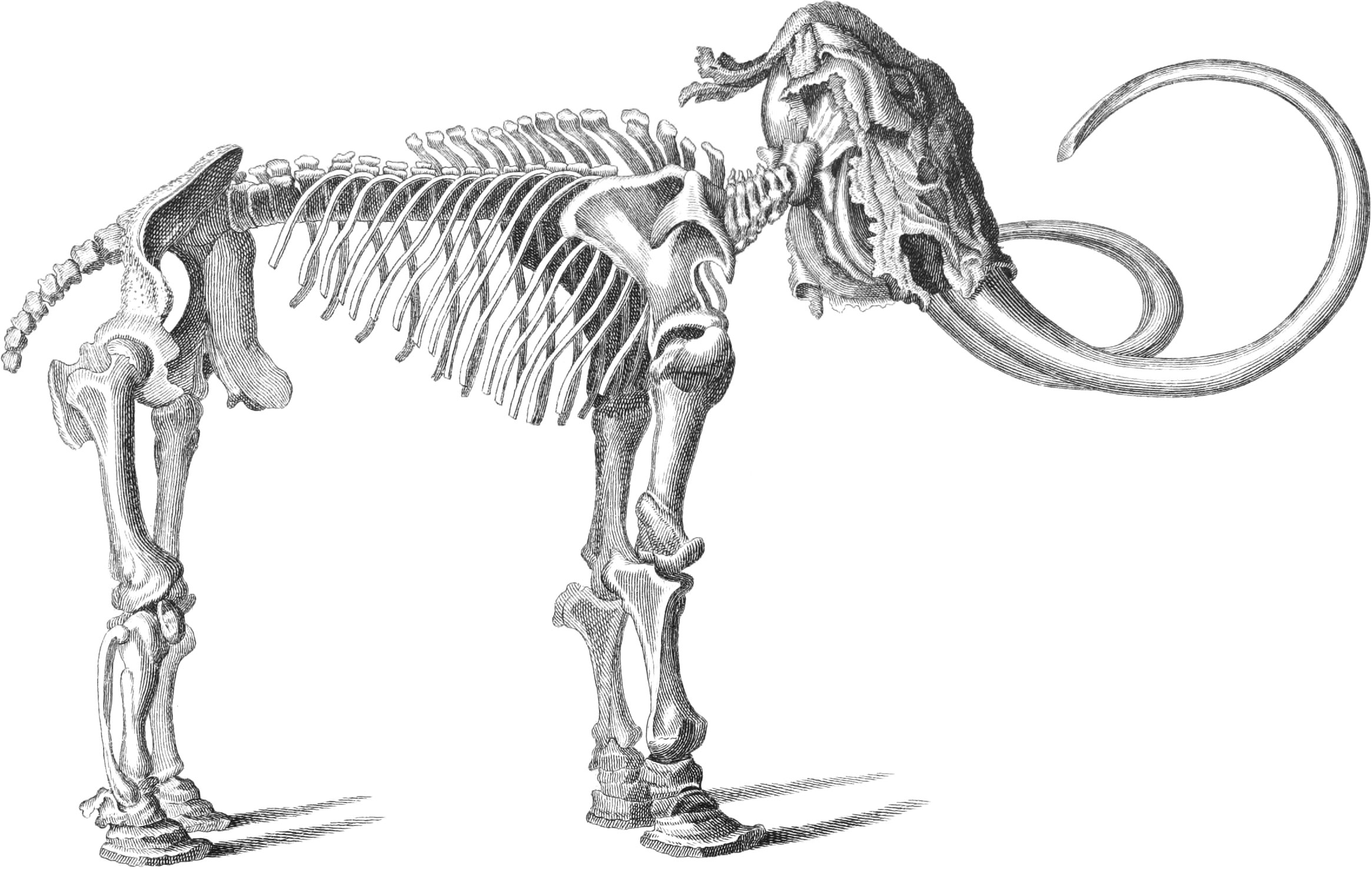
Plate V
The Great Mastodon
Is taken from the Ossemens Fossiles of Cuvier, and will give some idea of the bulk and form of this creature. The remains of the Mastodon have been found over the greater part of North America, and in some places in such abundance, that to one of its localities has been applied the name of “Big bone lick;” while the frequency of their remains on the banks of the Ohio, has gained for the Mastodon the appellation of the “Animal of the Ohio.”
It is considerably beyond a hundred years since these immense deposits of bones were first noticed, and they occupied a considerable portion of the attention of Pallas and Camper, and Dr Hunter, the former unravelling the confusion which had been created by considering these remains identical with the Mammoth of Siberia. But it was not until about the year 1800 that any thing approaching to a perfect skeleton was procured, which, after great labour, Mr W. Peale, founder of the Museum of Natural History in Philadelphia, succeeded in completing, so far as to give a tolerable idea of the form and size of this animal. In one of the deposits of bones found at Withe, in Virginia, a mass of little branches, grass, and leaves, in a half bruised state, among them a species of rose, now common in Virginia, were found enclosed in a kind of sac, which is the authority authors have, independent of their reasoning from its structure, that the animal fed on these substances; while there are records existing of the natives having found, with some heads, “a long nose, under which was the mouth.”
When these remains came under the inspection of Baron Cuvier, he at once considered them as belonging to an animal, which would form a genus different from the Elephant, and proposed for it the title of Mastodon, from the mammillary form of the teeth; and after concluding his examination, he sums up the whole, by giving an opinion of the form and mode of life of this animal.
That the great Mastodon, or animal of the Ohio, resembled the Elephant in its tusks and osteology, except in the form of the grinders; that it had most probably a trunk; that its height did not surpass that of the Elephant, but that it was of a larger form, and had thicker limbs, with a less capacious belly; that notwithstanding these agreements, the peculiar structure of the grinders would be sufficient to characterize it as a genus different from the Elephant; that it fed much in the same manner as the Hippopotamus, or Wild Boar, preferring the roots and other fleshy parts of vegetables; that this kind of nourishment would lead it to seek the soft or marshy grounds; but that, nevertheless, it was not formed to swim and live in the water like the Hippopotamus, but was truly a land animal; that the bones are now very common in North America; that they are there better preserved, and fresher than the other fossil bones, but there is not the least proof or authentic information which could lead to the supposition, that the animal now exists either in America or elsewhere.
The remains of other animals apparently resembling the Mastodon, have been discovered in Europe and South America; so that even this form seems to have had its congeners in an ancient world.
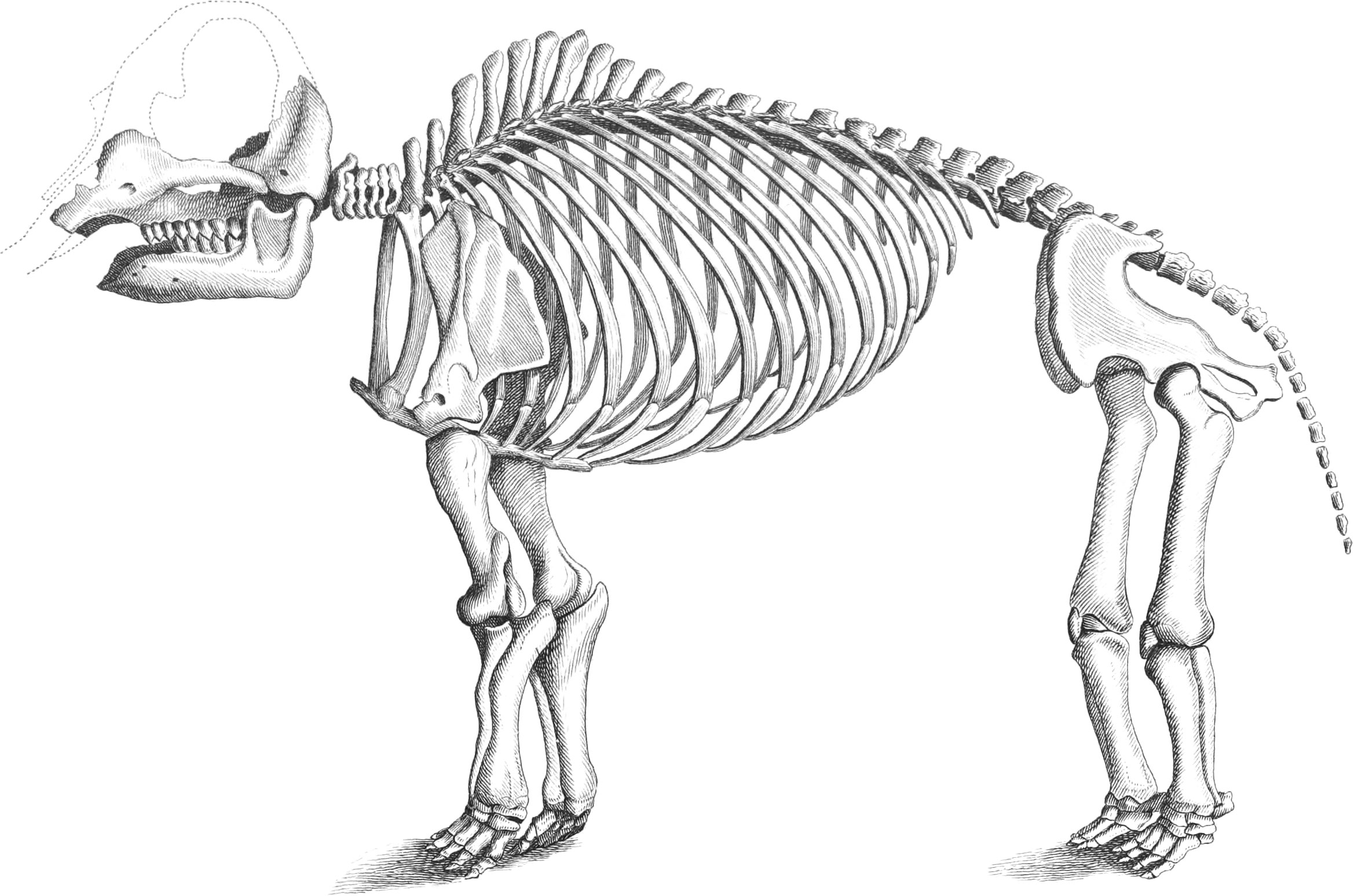
Plate VI
The next animal to which we shall advert, now lives in the Waters of Africa; it is
The Hippopotamus
The Hippopotamus, amidst the flood
Flexile and active as the smallest swimmer,
But on the bank ill balanced and infirm.
Following the Elephants of such stupendous animal bulk, we have placed in our systems an animal nearly as large, but standing much lower upon its limbs, while it is entirely aquatic in its habits. Upon the land it is certainly the most unwieldy and unshapely animal in existence, and like all the aquatic mammalia we are acquainted with, the form is round, shapeless, but smooth, and possessing no sudden angles, which, while they might assist the symmetry, would offer resistance when swimming. The skin is hairless, almost like that of the Cetaceæ when newly seen after immersion; and underneath there is a thick coat of fat, as under the skin of the Swine, and perhaps somewhat analogous to the blubber of the Whale.
One species only of Hippopotamus is yet known with any degree of authenticity; it is
The Common Hippopotamus
Hippopotamus amphibius.—Auct.
The Hippopotamus inhabits principally the rivers of South Africa, but is receding fast before civilization, and it is not now found without a march of considerable distance to the interior. The rivers of the north of Egypt, on the Nile, are also inhabited by them, where they are gregarious in small parties. Like all the large animals of this family, they are herbivorous, and only quit the water by night, or during the greatest seclusion, feeding on roots and succulent stems of large aquatic plants. Their system of dentition is fitted for cutting and bruising; the teeth are of large size, very heavy, and yield the firmest and hardest kind of ivory. The eyes, nostrils, and ears, are all placed nearly on the same plane, which allows the use of three senses, and of respiration, with a very small portion of the animal being exposed, and a shot at the whole great bulk of the animal can scarcely ever be obtained. By the natives they are trapped in pits, while the colonists use the rifle. They are valuable both on account of the uses to which their skins are applied, their much esteemed meat, and particularly for the estimation in which the ivory of their teeth is held.
Burchell describes the colour of the animal as of an uniform hue, correctly imitated by a light tint of China ink, and having the skin destitute of hair, except a few scattered bristles on the muzzle, edges of the ears, and tail. The eyes and ears were disproportionally small; the mouth altogether disproportionally large. The animal alluded to was the first of the kind Mr Burchell had seen newly killed. It was said only to be half grown, yet its bulk was equal to two oxen. Upon arriving at the spot, they were floating the animal to the bank, and were labouring hard to get it out of the water; the monstrous size, and almost shapeless mass of even a small Hippopotamus, when lying on the ground, compared with the people who stood around it, appeared enormous. When rolled upon the grassy bank, all who had knives immediately fell to work in cutting it up. The hide, above an inch in thickness, and hardly flexible, was dragged off, as if they had been tearing the planks from a ship’s side; it was carefully divided into pieces, that would best admit of being cut into shamboks, as these constituted to the Klaar-water people the greatest part of the profits. The ribs are covered with a thick layer of fat, celebrated as the greatest delicacy, and known to the colonists as a rarity by the name of Zeekœ-spek, (sea-cow pork.) This can only be preserved by salting; as on attempting to dry it in the sun, in the same manner as the other parts of the animal, it melts away. The rest of the flesh consists entirely of lean; and was, as usual with all other game, cut into large slices, and dried on the bushes, reserving only enough for the present use. Three bushels, at least, of half chewed grass were taken out of its stomach and intestines.24
It has been generally considered, that there is only one species of Hippopotamus known from recent specimens. M. Desmoulins is the only person who has given us any reason to doubt it, and as we find other animals of North and South, or South and West Africa, though closely allied, to differ, there is reason to suppose, that in this case we may also have distinct species. The question is at present quite undecided. M. Desmoulins takes his characters from the skeleton of a Hippopotamus from the Cape, and one from Senegal. In the first, the sagittal crest is, at least, a fifth of the distance from the occipital crest, to the end of the nose; in the other, which is larger, it is scarcely the sixth. In the animal of the Cape, the lower lateral incisors are more bent. The canine teeth do not seem to be similarly used in the two animals, which would argue, that there was a different mechanism employed in the movements of the jaw; and they are always larger in the Senegal animal. Very many smaller distinctions are pointed out, which occur in comparing the different bones of the animals; but these it is impossible to describe without an actual comparison. They are, upon the whole, not considered less than those which the Baron has pointed out as separating the fossil from the living species He has applied to them the titles of H. Capensis and H. Senegalinsis.
Three fossil species have been indicated—H. major, minor, and medius.

Plate VII

Rhinoceros
The Rhinoceri are another race of enormous animals, which are peculiar to the warm Darts of Africa and India, inhabiting the districts where vegetation is profuse, and where there is an abundance of water. They may be said to be characterized externally, principally by the great thickness and strength of their skin, which is destitute of hair, often arranged in folds, and presents, as it were, a mailed armour, almost impenetrable to an ordinary leaden bullet; and by the nose and snout being furnished by one or two excrescences having the form and appearance of curved formidable horns. These are of a substance as if hair was agglutinated together, and rendered compact, possessing no central sheath, and unconnected with the bone of the skull. Mr Burchell’s remarks on their structure are interesting.
The horn of the Rhinoceros, differing in structure from that of every other animal, and placed in a situation of which it is the only example, had long appeared to me to be an anomaly very deserving examination. Dispersed over the skin of all animals are pores, which I have supposed secrete a peculiar fluid, which may be designated by the name of corneous matter. This secretion or fluid is designed by nature for the forming of various most useful and important additamentæ, all of which continue growing during the whole life, have an insertion not deeper than the skin, and are farther distinguished by the absence of all sensibility and vascular organization, being purely exuvial parts, like the perfected feathers of birds. In all these parts, the growth takes place by the addition of more matter at their base. When these pores are separate, they produce hairs; when they are confluent, and in a line, they produce the nails, the claws, and the hoofs, the fibrous appearance of which naturally leads to the supposition of their being confluent hairs; and the same may be said of the scales of the Manis, the quills of the Porcupine, Hedge-hog, and other animals, which may be regarded as hairs of extraordinary size. When the pores are confluent, and in a ring, they furnish the corneous core of the horns of the animals of the ruminating class; and when confluent on a circular order, they supply matter for the formation of a solid horn, such as we see in the Rhinoceros. At its base, it is, in most instances, evidently rough and fibrous, like a worn-out brush. It grows from the skin only, in the same manner as the hair,—a circumstance which entirely divests of improbability the assertion of its sometimes being seen loose, although by no means so loose as some writers have supposed. Nor is it at all extraordinary that the Rhinoceros should possess the power of moving it to a certain degree, since the Hog, to which, in the natural arrangement, it so closely approaches, has a much greater power of moving its bristles, which, if concreted, would form a horn of the same nature.25
The teeth vary considerably at different periods of their age; their feet have three toes, apparent externally, as if shod with blunt hoofs; and the real structure of their bones, with that of the other parts of the skeleton, will be seen in our first plate.
The Rhinoceri go sometimes in pairs and in small groups, but at other times are gregareous. They feed entirely on vegetables, tender branches of trees, and the grasses; and their interior structure, though simple, is very ample, the stomach and caecum very large, the intestines very long. The upper lip is rather long, elongated into a narrow point, and prehensile, thus continuing the form of the proboscidean animals, and is used in the same way to collect and gather in the vegetable food.26 In temper they are slovenly and inoffensive, but on being irritated, they are furious and revengeful, possessing enormous strength, and exercising a most formidable power with their horn, which renders them no despicable assailant, even to animals the most powerful and active. Their principal horn is sometimes nearly three feet in length, and though a blunt looking instrument, when wielded by an animal of such bulk and strength, is made to force its way through almost any resistance.
The skins of the Rhinoceri are used for various purposes both in Africa and India; but in the latter country they seem more pursued as a matter of emolument by the natives,—few European sportsmen liking to engage them, both from the actual danger, and the great dislike which the Elephants have to face them. Shields are made by the Indians, which will turn a leaden bullet; and their tallow is used medicinally—for which purpose we also find it mentioned in some of the old Pharmacopeias. They are shot by the native sportsmen, Colonel Williamson tells us, with jingals, or heavy guns, containing an iron ball of three ounces weight, and an aim is generally taken at the eye or thorax, or some of the vulnerable parts, where the skin is thinnest, and the part is generally struck with the greatest correctness. According to the last mentioned writer, the Rhinoceros (and he speaks, we believe, of the R. Indicus) is a much more active animal than what he is represented to be by others, possessing great acuteness of smell, great rapidity of motion, and accompanied by a vivacity, such as a cursory view of the animal would by no means suggest. He writes also of this animal making wanton attacks on the Elephant whenever he has an opportunity, and mentions the circumstance of the latter being found with the belly torn open. An instance is, at the same time, related, as well known, of a Rhinoceros, which even rendered the roads impassable by attacking travellers, or those who passed near his haunts; and he relates an attack upon a sporting company, which was made by the same animal in the close of the year 1788, as generally known to the army and residents of the district.
Two officers belonging to the troops cantoned at Dunapore, near Patna, went down the river towards Monghyr, to shoot and hunt. They had encamped in the vicinity of Derriapore, and had heard some reports of a Gheudah, or Rhinoceros, having attacked some travellers many miles off. One morning, just as they were rising about day break, to go in quest of game, they heard a violent uproar; and on looking out, found that a Rhinoceros was goring their horses, both of which being fastened by their head and heel with ropes, were consequently unable either to escape or resist. Their servants took to their heels, and concealed themselves in the neighbouring jow jungles; and the gentlemen had just time to climb up into a small tree not far distant, before the furious beast, having completed the destruction of the horses, turned his attention to their masters. They were barely out of his reach, and by no means exempt from danger, especially as he assumed a threatening appearance, and seemed intent on their downfall. After keeping them in dreadful suspense for some time, and using some efforts to dislodge them, seeing the sun rise, he retreated to his haunt; not, however, without occasionally casting an eye back as with regret at leaving what he wanted the power to destroy.27
Both a single and two horned Rhinoceros was known to the ancients, as we know from their sculpture, coins, and writings. What the individual species were, we cannot now so well make out.
We shall now examine the species which have been recorded; and shall first notice the animals of the Indian continent.
The Indian Rhinoceros
Rhinoceros Indicus.—Cuv.
R. unicornis, Linn.—Indian Rhinoceros, Dr Parsons—Griffith’s Cuvier—Menagerie du Musee.
This is the oldest known species of modern days. It has been figured by Albert Durer, Dr Parsons, and Edwards; more lately by Frederick Cuvier, in his great work, and by Griffiths, in the Animal Kingdom of Cuvier, both from the same animal, which was first exhibited in London, and afterwards reached the Parisian menagerie. Dr Parsons’ account was taken from a specimen exhibited in London in 1739; the animal was young, and the horn had scarcely reached the length of more than an inch. We add a great portion of his interesting and minute description.
He was fed here with rice, sugar, and hay: of the first he ate seven pounds mixed with three of sugar every day, divided into three meals; and about a truss of hay in a week, besides greens of different kinds, which were often brought to him, and of which he seemed fonder than of his dry victuals; and drank large quantities of water at a time, being then, it seems, two years old.
He appeared very peaceable in his temper, suffering himself to be handled in any part of his body; but outrageous when struck or hungry, and pacified in either case only by victuals. In his outrage he jumps about, and springs to an incredible height, driving his head against the walls of the place with great fury and quickness, notwithstanding his lumpish aspect: this Dr Parsons saw several times, especially in a morning, before his rice and sugar were given him.
In height he did not exceed a young heifer, but was very broad and thick. His head, in proportion, is very large, having the hinder part, next his ears, extremely high, in proportion to the rest of his face, which is flat, and sinks down suddenly forward towards the middle, rising again to the horn, but in a less degree. The horn stands on the nose of the animal, as on a hill. The part of the bone on which the horn is fixed, rises into a blunt cone, to answer to a cavity in the basis of the horn, which is very hard and solid, having no manner of hollow nor core, like those of other quadrupeds. That of this animal, being young, does not rise from its rough base above an inch high, is black and smooth at the top, like those of the ox-kind, but rugged downwards; the determination of its growth is backwards, instead of straight up; which is apparent, as well in the different horns of old Rhinoceroses, as in this of our present subject; for the distance from the base to the apex of this, backward, is not within a third part so long as that before, and it has a curved direction; and, considering the proportion of this animal’s size to its horn, we may justly imagine, that the creature which bore any one of those great ones, must have been a stupendous animal in size and strength; and, indeed, it were wo wonder, if such were untractable at any rate.
The sides of his under jaw are wide asunder, slanting outward to the lower edge; and backward to the neck, the edges turn outward; from this structure his head naturally looks large. The part that reaches from the fore part of the horn towards the upper lip, may be called the nose, being very bulky, and having a kind of circular sweep downward towards the nostrils; on all this part he has a great number of rugae running across the front of it, and advancing on each side towards his eyes. The nostrils are situated very low, in the same direction with the rictus oris, and not above an inch from it. If we look at him in a fore view, the whole nose, from the top of the horn to the bottom of his lower lip, seems shaped like a bell, namely, small and narrow at top, with a broad base. His under lip is like that of an ox, but the upper more like that of a horse; using it, as that creature does, to gather the hay from the rack, or grass from the ground; with this difference, that the Rhinoceros has a power of stretching it out above six inches, to a point, and doubling it round a stick or one’s finger, holding it fast; so that, as to that action, it is not unlike the proboscis of an Elephant.
As to the tongue of the Rhinoceros, though it be confidently reported by authors, that it is so rough as to be capable of rubbing a man’s flesh from his bones; yet that of our present animal is soft, and as smooth as that of a calf; which Dr Parsons often felt, having had his hand sucked several times by him. Whether it may grow more rough as the beast grows older, we cannot say. His eyes are dull and sleepy, much like a hog in shape, and situated nearer the nose than that of any quadruped ever seen, which he very seldom opens entirely. His ears are broad and thin towards the tops, much like those of a hog; but have each a narrow round root with some rugæ about it; and rises, as it were, out of a sinus surrounded with a plica. His neck is very short, being that part which lies between the back edge of the jaw and the plica of the shoulder; on this part there are two distinct folds, which go quite round it, only the fore one is broken underneath, and has a hollow flap hanging from it, so deep that it would contain a man’s fist shut, the concave side being forward. From the middle of the hinder one of these folds or plicae, arises another, which, passing backwards along the neck, is lost before it reaches that which surrounds the fore part of the body. His shoulders are very thick and heavy, and have each another fold downward, that crosses the fore leg; and almost meeting that of the fore part of the body just mentioned, they both double under the belly close behind the fore leg.
His body, in general, is very thick, and juts out at the sides like that of a cow with calf. He has a hollow in his back, which is mostly forward, but backwards, the line or ridge rises much higher than that of the withers; and, forming the plica on the loins, falls down suddenly to the tail, making an uneven line. His belly hangs low, being not far from the ground, as it sinks much in the middle. From the highest point in his back, the plica of the loins runs down on each side between the last ribs and the hip, and is lost before it comes to the belly; but, above the place of its being lost, another arises, and runs backward round the hind legs, a little above the joint; this he calls the crural fold, which turns up behind till it meets another transverse one, which runs from the side of the tail forward, and is lost before it reaches within two inches of that of the loins. The legs are thick and strong; those before, when he stands firm, bend back at the knee, a great way from a straight line, being very round, and somewhat taper downwards. The hinder legs are also very strong, bending backwards at the joint to a blunt angle, under which the limbs grow smaller, and then becomes gradually thicker, as it approaches the foot; so also does that part of the fore leg. About the joint of each of his legs, there is a remarkable plica when he bends them in lying down, which disappears when he stands.
Another specimen, as we have mentioned, was exhibited in London in 1815, and a good figure appeared in Griffith. This animal, to judge from the figure, was of a much greater age than Dr Parsons’,—the horn lengthened, and appearing a formidable weapon.
The animal recorded by F. Cuvier as being in the Parisian menagerie, is nearly thus noticed. The height, at the most elevated part of the back, was four feet ten inches, and its entire length about nine feet. The body was covered with a thick tuberculated and almost naked skin, formed into irregular folds. The natural colour of the skin, was a dull grayish violet, but it appeared almost black, from being smeared with grease two or three times weekly, to prevent the hide becoming dry and cracking. Under the folds, it was of a flesh colour, and much softer. Upon certain parts, the outside of the limbs, the knees, and about the head and face, excrescences from the skin had acquired a considerable length, and resembled horny threads, which have been considered by some authors as a disease. The hairs, principally upon the tail and ears, were strong and smooth, while a few, which were found on the other parts of the body, were thick and hard, but had a woolly appearance. The knees were bent; but this was evidently caused by confinement and the inactive life which it led. The feet were furnished with three large nails, almost in the form of slippers, covering the toes above and below. The tail, kept habitually in a hanging position, could be moved backwards and forwards. The eyes were very small, a simple eyelid and round pupil. The nostrils open upon the sides of the upper lip. The external ear was large and moveable. The sense of touch appeared only to exist in the upper lip. The horn, which was short and blunt, was used, in anger, to strike, and even to tear and destroy the object of attack, and there seemed an instinctive motion to make use of that part rather than any other, in any case where the employment of force was necessary.
All the senses of the animal, except that of touch, appeared to be very delicate. It frequently consulted its sense of smell, and gave the preference to sweet fruits, or even sugar itself. It collected the smallest things with its moveable lip to carry them to its mouth; and when eating honey, collected it with this lip, and conducted it to its mouth with the assistance of its tongue.
Our figures of this animal are taken from a young specimen, belonging to the Liverpool Zoological Gardens, during its late visit to Edinburgh. We give below an account of it, for which we are indebted to a friend, who used considerable pains in taking correct measurements, and ascertaining its habits since it had been kept in confinement.
Within the last fifty years there have been, so far as I am aware of, only four individuals brought to Great Britain. The first, in 1790, which died in 1793 of inflammation, brought on by the accidental dislocation of his right fore leg; the second, in 1799, which was sold by Mr Pidcock to an agent of the Emperor of Germany for £1000, but it died before it could be exported; the third was exhibited at Exeter Change, London, in 1810, and after being kept four years, was sold for exhibition on the Continent; a fourth specimen is at present living, exhibiting in Edinburgh, which I have examined and accurately measured, and has been the occasion of my drawing up this paper. The animal in question is a male, and was brought from Bengal, having been for some time kept in the gardens of the Governor-General at Calcutta. He has been sixteen months in Britain, during which time he has visited London, Glasgow, and Edinburgh, and is at present the property of the proprietors of the Zoological Gardens at Liverpool. It is stated to be six years old, and to weigh two tons; is a beautiful specimen, and appears to be in the highest state of health. It is fed on bruised oats, boiled rice, and bran steeped in warm water, with large quantities of hay, and a few carrots; consuming, in the whole, about one hundred weight and a-half per day. Its drink is water, with the chill off. There are two canine teeth, one on each side of the lower jaw, and two corresponding ones just protruding at the upper jaw; the grinders are so far back in the head, that it is impossible to count them. There are long eyelashes on the upper eyelid, but more on the lower; and the only appearance of hair is on the ears, the extremity of the tail, and three or four on the centre of the back, between the shoulders: its skin is dressed with cocoa-nut oil. I may remark that it is retromingent. The following are the measurements, which were taken with as much accuracy as possible, consistent with the motions of the animal. They invariably include the angles of the body.
| Feet | Inches | |
|---|---|---|
| Height from the highest part of the back | 4 | 8 |
| Length from the tip of the snout, to the extremity of the tail | 12 | 9\(\frac{3}{4}\) |
| Length from tip of the snout, to back of the skull bone | 3 | 0 |
| Length from back of skull, to the insertion of the tail | 7 | 9\(\frac{3}{4}\) |
| Length of tail | 2 | 0 |
| Length of fore feet from the fold of the skin, to the toes | 2 | 5 |
| Girth of the fore feet at the knee | 1 | 10\(\frac{5}{8}\) |
| Length of hind feet, from the fold of the skin, to the toes | 1 | 8 |
| Girth of ditto | 2 | 6\(\frac{3}{4}\) |
| Width of the Tygoma over the skull | 1 | 5 |
| Width from the same point under the skull | 3 | 0 |
| Length from the fold of the skin, at the back of the head, to the tip of the lower jaw | 2 | 0\(\frac{7}{8}\) |
| Width of the fold of the skin straight across the shoulder | 1 | 11 |
| Width of the fold of skin straight along the body | 2 | 10 |
| Girth of the middle of the belly | 9 | 4\(\frac{1}{4}\) |
| Girth of the neck within the folds | 4 | 4\(\frac{1}{2}\) |
| Space between the base of the ears | 0 | 4 |
| Length of the ears | 1 | 0\(\frac{3}{8}\) |
| Space from the ear to the eye | 1 | 0 |
| Space from the eye to the nostril | 0 | 9 |
| Length of the eye | 0 | 2 |
I have said nothing of the general appearance of the animal, because the common engravings give a very correct idea of its figure. Its eye is dull, and its disposition is heavy and sluggish, seeming inclined to sleep a good deal. The keeper appears to have it in great subjection; but on one occasion, during his absence, it shewed a sudden ebullition of irritation, when it repeatedly knocked its head with considerable violence against the wall with great quickness; but on the reappearance of the keeper, immediately became tranquil. The only noise I have ever heard it emit, was like the lowing of a calf. Much has been written about the roughness of the tongue; the tongue of this individual appears to me to be very similar to that of a cow, except that it is much thinner at the point.

Rhinoceros Fossil
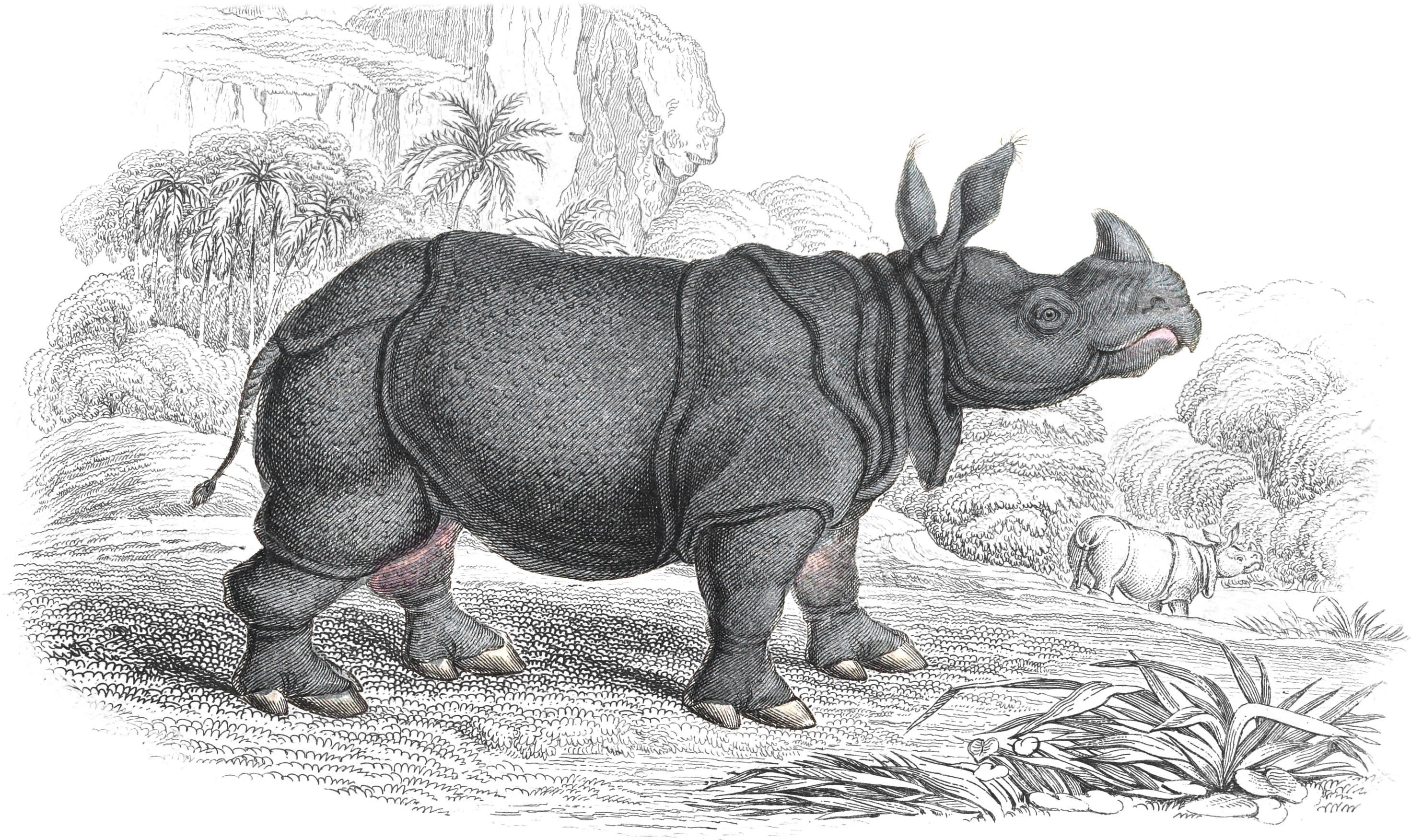
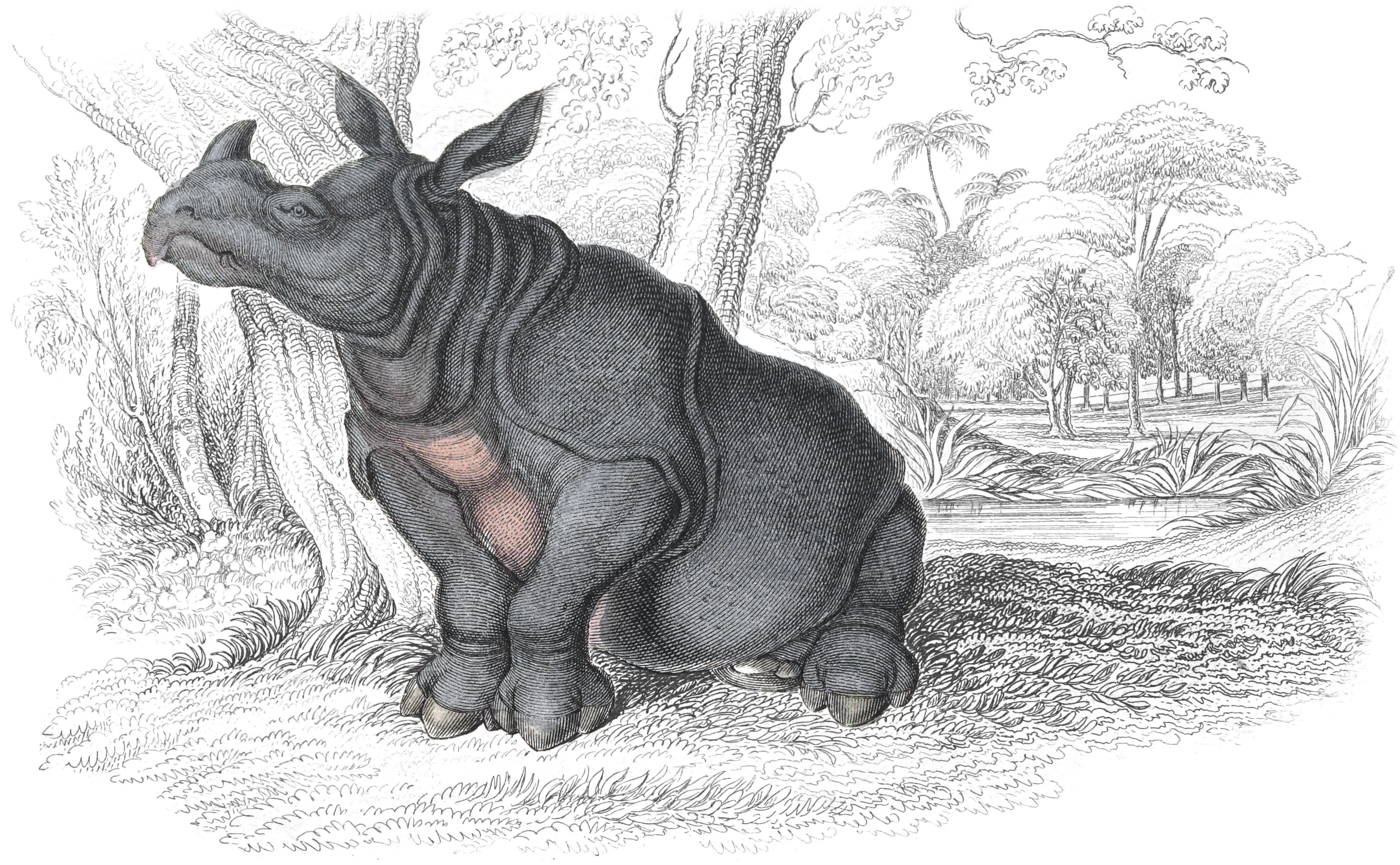
Another animal, the One-Horned Sumatran Rhinoceros, Rhinoceros Sondaicus, Cuvier, is closely allied to this; it is a native of the Indian Islands, and was first discovered in Sumatra by Dr Horsfield and Sir Stamford Raffles, while the distinctions were pointed out and the name applied by Baron Cuvier.
One Horned Sumatran Rhinoceros
Rhinoceros Sondaicus.—Cuvier.
Rhinoceros Sondaicus, Cuv.—Horsfield’s Zool. Researches in Java.
The chief distinctions are seen in the more attenuated head and muzzle. The folds appear less rough and prominent; those of the neck comparatively smaller; and the posterior fold, which has an oblique direction towards the spine, is less extended. The thick covering, or coat, is divided on the surface into small tubercles, or polygonous scutula; and a few short bristly hairs, rising from a slight depression in the centre, constitute a peculiar character. The ears are bordered with a series of long stiff bristles, closely arranged, and a similar series also extends along the tail through its whole length. Dr Horsfield gives the following description of its habits.
The individual represented in our plate, and which has afforded the preceding details, was taken, when very young, in the forests of the province of Keddu, and was conveyed to the residency at Magellan, in the year 1815 or 1816.
By kind treatment, it soon became domesticated to such a degree, that it permitted itself to be carried in a large vehicle, resembling a cart, to the capital of Surracarta. I saw it during its conveyance, and found it perfectly mild and tractable. At Surracarta, it was confined in the large area or square which bounds the entrance to the royal residence.
A deep ditch, about three feet wide, limited its range, and for several years it never attempted to pass it. It was perfectly reconciled to its confinement, and never exhibited any symptoms of uneasiness or rage, although, on its first arrival, harassed in various ways by a large proportion of the inhabitants of a populous capital, whose curiosity induced them to inspect the stranger of the forest. Branches of trees, shrubs, and various other twining plants, were abundantly provided for its food. Of these the spices of cissus and the small twigs of a native fig tree, were preferred: but plantains were the most favourite food, and the abundant manner in which it was supplied with these by the numerous visiters, tended greatly to make the animal mild and sociable. It allowed itself to be handled and examined freely, and the more daring of the visiters sometimes mounted on its back. It required copious supplies of water; and, when not taking food, or intentionally roused by the natives, it generally placed itself in the large excavations, which its movements soon caused in the soft earth that covered the allotted space.
The animal rapidly increased in size. In the year 1817, having been confined at Surracarta about nine or ten months, the dimensions, as already stated, were nine feet in length, and four feet three inches in height at the rump. In 1821 it had acquired the height of five feet seven inches. This information I received from my friend Mr Stavers, who is now in England, on a visit from the interior of Java; and he favoured me farther with the following details, which complete the history of the individual whose figure is annexed. Having considerably increased in size, the ditch of three feet in breadth was insufficient for confining it; but, leaving the enclosure, it frequently passed to the dwellings of the natives, destroying the plantations of fruit trees, and culinary vegetables, which always surround them. It likewise terrified those natives that accidentally met with it, and who were unacquainted with its appearance and habits. But it shewed no ill-natured disposition, and readily allowed itself to be driven back to the enclosure like a Buffalo. The excessive excavations which it made by continually wallowing in the mire, and the accumulation of putrifying vegetable matter, in process of time became offensive at the entrance of the palace, and its removal was ordered by the Emperor to a small village near the confines of the capital, where, in the year 1821, it was accidentally drowned in a rivulet.
The Rhinoceros lives gregarious in many parts of Java. It is not limited to a particular region or climate, but its range extends from the level of the ocean to the summit of mountains of considerable elevation. I noticed it at Tangung, near the confines of the Southern Ocean, in the districts of the native princes, and on the summit of the high peaks of the Priangang regions, but it prefers high situations. It is not generally distributed, but is tolerably numerous in circumscribed spots, distant from the dwellings of man, and covered with a profuse vegetation. On the whole, it is more abundant in the western than in the eastern districts of the island. Its retreats are discovered by deeply excavated passages which it forms along the declivities of mountains and hills. I found them occasionally of great depth and extent.
In its manners the Rhinoceros of Java is comparatively mild. It is not unfrequently met in the wilds by Europeans and by natives. No instance of its shewing a disposition to make an attack has come to my knowledge. Being the largest animal in Java, its passions are not roused, as in many parts of India, by contentions with the Elephant. It is rarely seen in a domestic state, but it is occasionally decoyed into pits, and destroyed. Our animal rambles chiefly at night, and often occasions serious injury to the plantations of coffee and pepper, which are laid out in the fertile districts selected for its retreat.
The horns and skin are employed for medicinal purposes by the natives.28

Plate X
The Two-Horned Sumatran Rhinoceros
Rhinoceros Sumatranus.
Sumatran Rhinoceros, Bell, Phil. Trans.—Rhinoceros de Sumatra, F. Cuv. Mammiff.—R. Bicornis Sumatranus, Griff. Cuv. Synopsis.—Desmarest, Mammalogie, ii. 401.
One of the oldest authenticated descriptions of this animal is always referred to, as given by Mr William Bell, surgeon at Bencoolen, in the Transactions of the Philosophical Society. That gentleman made his observations from an animal, shot about ten miles from Fort Marlborough, within a day from its death,—a male, four feet four inches high at the shoulder, and about eight feet five inches high. He judges, from its appearance, that it had not reached maturity. The shape of the animal was much like that of a hog. The general colour, a brownish ash; under the belly, between the legs, and fold of the skin, a dirty flesh colour. The ears were small and pointed, lined and edged with short black hair. The horns were black, the larger was placed immediately above the nose, pointing upwards, and was bent a little back; it was about nine inches long. The small horn was four inches long, of a pyramidal shape, flattened a little, and placed above the eyes, rather a little more forward, standing in a line with the upper horn immediately above it. The neck was thick and short; the skin, on the under side, thrown into folds, and these again wrinkled. The body was bulky and round; and from the shoulder ran a line or fold, though but faintly marked: there were several other folds and wrinkles on the body and legs, and the whole gave rather the appearance of softness. The whole skin of the animal is rough, and covered very thinly with short black hair. The skin was not more than one-third of an inch in thickness at the strongest part, and under the belly scarcely one-fourth.29
In 1825, F. Cuvier gave another figure of this Rhinoceros in his Mammifferes, which nearly agrees with what we have detailed above, the colour is a dull brown, the skin is nearly quite smooth, and without any of the tuberculated structure, which is so peculiarly seen in R. Sondaicus, and it is furnished with a greater proportion of short and strong hairs. The folds in the skin, with the exception of those on the neck, are shallow, and there is only one large one behind the fore legs, and another before the hind quarter. The height of this animal is only given at about three feet ten inches.
We have used the figure of F. Cuvier, and regret that there seems to be little known of the habits of this animal, farther than inhabiting the island of Sumatra.
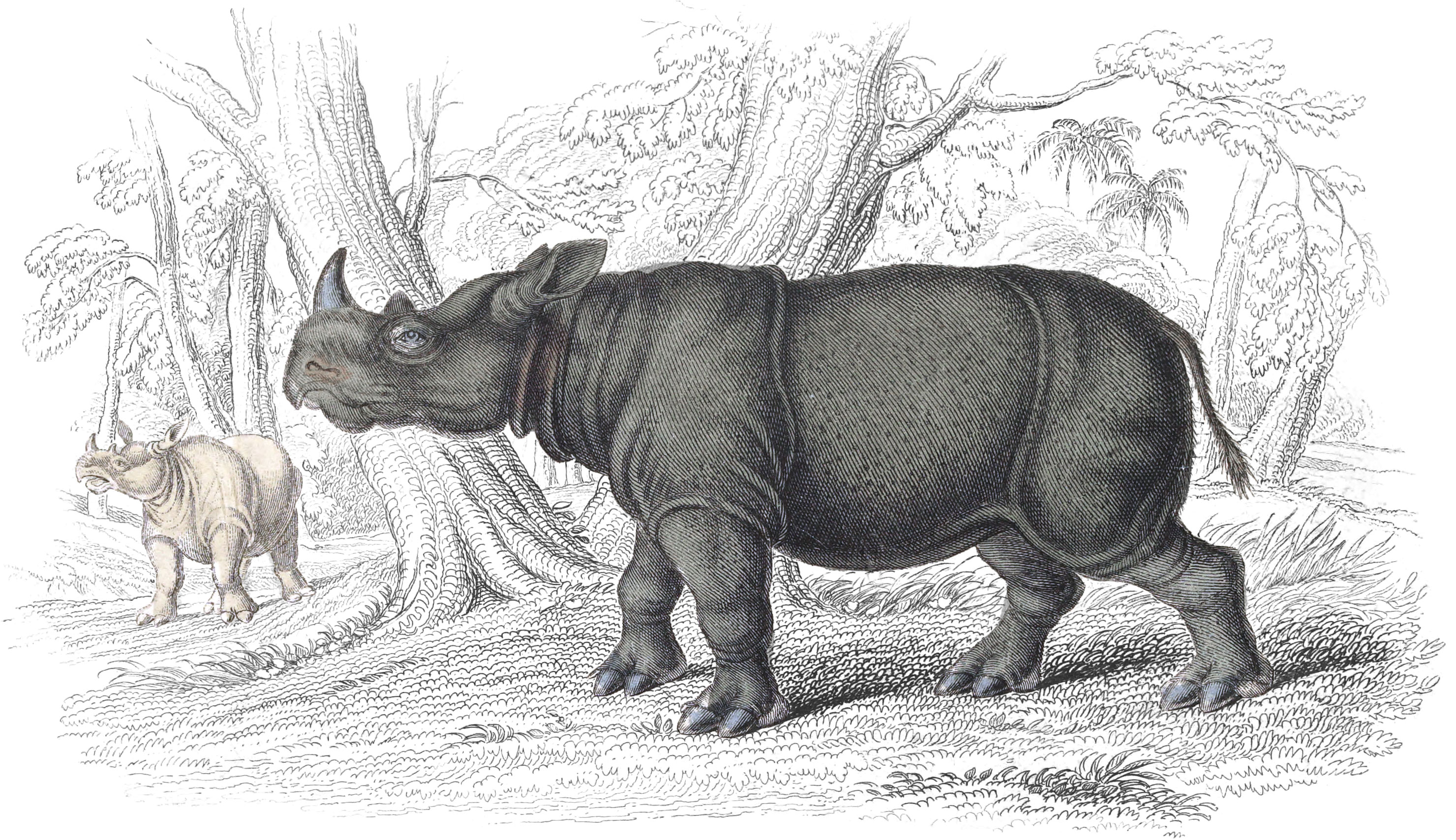
Plate XI
These three species seem to be ascertained as clearly distinct in the Asiatic continent. De Blainville gave to another, which he characterized from the skull, the title of R. Camperii; but the species remains in uncertainty, and can scarcely be now admitted, without farther examination. From the examination of the skull, G. Cuvier thought that it might be a young species of R. Sondaicus.
The species of Africa, which are authenticated with any certainty, are only two, R. Africanus and R. simus, Burchell.
The Two-Horned African Rhinoceros
R. Africanus.—Cuvier.
R. bicornis, Sparman, Linnæus.—R. Africanus, Cuvier, Burchell.
This Rhinoceros, which was formerly frequent within the boundary of the Cape Colony, is the animal seen and described by most of the travellers in Africa, during the last century; and being then the only two horned species which was known, received the distinguishing epithet of bicornis, not, however, now a good appellation, from several species having a similar number of like appendages. It was met with frequently, and is noticed most lately, in the interesting travels of Mr Burchell, who was fortunate in being able to shoot no fewer than nine of these huge animals. Speaking of the second which came under his observation, he says,
The first view of this beast, suggested the idea of an enormous hog, to which, besides, in its general form, it bears some outward resemblance in the shape of its skull, and the smallness of its eyes, and the proportionate size of its ears; but in its shapeless clumsy legs and feet, it more resembles the Hippopotamus and Elephant. Its length, over the forehead, and along the back, from the extremity of the nose to the insertion of the tail, was eleven feet two inches, of English measure; but in a direct line, not more than nine feet three inches. The tail, which, at its extremity, was compressed or flattened vertically, measured twenty inches, and the circumference of the largest part of the body, eight feet four inches.
There was no hair, except on the edges of the ears, and on the extremity of the tail. The skin, though thick and strong, did not flatten the balls which did not strike some bone. They were, however, of a mixture of lead and tin; and Mr Burchell admits, that bullets of pure lead, fired with a small charge, or at too great a distance, would fall from the strong part of the folds, flattened and harmless.
The Rhinoceros of Africa does not seem to be looked upon with the same terror by the natives or Hottentots, as the animal of India. He possesses the same keen and nice smell, and delicate sense of hearing, and can only be approached against wind, and they do sometimes become furious, and attack their pursuers; but the cool disposition of the native hunters, and their great agility, protects them. They allow the animal to rush impetuously on, and, when near, by shifting nimbly aside, avoid the charge, and have time, in their turn, to attack him, and to reload their muskets. They are often killed with a single ball, and one individual thinks it no hazard to act alone against them. In South Africa they are much esteemed as food, which Burchell agrees in considering excellent, much resembling beef. The tongue is considered the most delicate part. When an animal of this description is killed, the neighbours all flock around it, and encamp by its side, until they have consumed it entirely, being scarcely so provident as to dry any part of the flesh for after use. The bushmen are insatiable. They broil, eat, and talk, and no sooner have they finished one slice than they turn to the carcass, and cut another. According to Bruce, the Rhinoceros is also used as food in North Africa, and much esteemed by the Shangalla. The sole of the feet is here reckoned the part most fitting for the epicure. Of the skin, shields are sometimes made as in India, which are said to be capable of turning a musket ball; but the most useful and common application of it is for whips, shamboks;30 and the skin is always immediately cut up into strips for this purpose.

Plate XII
The Flat-Nosed Rhinoceros
Rhinoceros Simus.—Burchell.
Burchell, Journal de Phys.—African Travels, ii. p. 75.
The second African species is so named from its flattened nose and mouth, by which distinctions it is easily known from the last, as well as by the different proportions of its head, and its greater size.
The following is Mr Burchell’s account of this Rhinoceros:—
In my travels in the interior of Southern Africa, I met with this animal for the first time near the 26° of latitude, inhabiting the immense plains, where they are wild during the greatest part of the year. They frequent the fountain every day, not only for drink, but also for the purpose of rolling in the mud, which, by adhering to a skin entirely free from hairs, serves to protect them from the scorching heat of the climate. The size is nearly double that of the specimen named Rhinoceros bicornis. These two animals are recognized by the negroes and Hottentots, as two very distinct species, and are distinguished by them by different names. As we have killed ten examples, I have had sufficient opportunities of observing the characters which distinguish them. They consist principally in the form of the mouth, as may be verified by comparing the Rhinoceros bicornis and the Rhinoceros unicornis with the figure, (Pl. XIII.) which I have carefully drawn after nature. I have named this species Rhinoceros simus. The negroes and Hottentots inform me, that it eats nothing but grass, while the other species feeds on branches of trees and shrubs,—a peculiarity which may be inferred from the structure of the mouth. The head, when separated from the first vertebræ, was of such enormous weight, that four men could only raise it from the ground, and eight were required to put it into the carriage. The flesh of the two species is equally good to eat; and they resemble each other in having a double horn, and wanting conspicuous hairs on the skin, which distinguishes, at first sight, the Rhinoceros unicornis. The following comparative measures, taken from adult individuals, killed by ourselves, in these countries, will afford a proof of the difference of size:—
Rhinoceros bicornis Rhinoceros simus From the lips to the insertion of the tail 111 inches 134 inches Length of the tail 111 inches 134 inches Circumference of the body 100 inches 140 inches From the extremity of the lips to the ear 27\(\frac{1}{2}\) inches 43 inches Several extinct species of Rhinoceros are known, in part, from their remains, distinct from any of those we have been noticing. In almost every country where the bones of the Elephant have been found, they are accompanied, in nearly equal quantities, by those of the Rhinoceros. The vale of Arno, in Italy, is one of the greatest deposits, also different parts of Germany and Siberia. One of the more remarkable species, and unfortunately least known, is scarcely larger than the common hog. Our authority for its introduction rests upon the discovery of some teeth and other bones found in the department of Loire and Garonne, among the debris of other Rhinoceri, Crocodiles, and Tortoises. R. minutus has been applied to it.
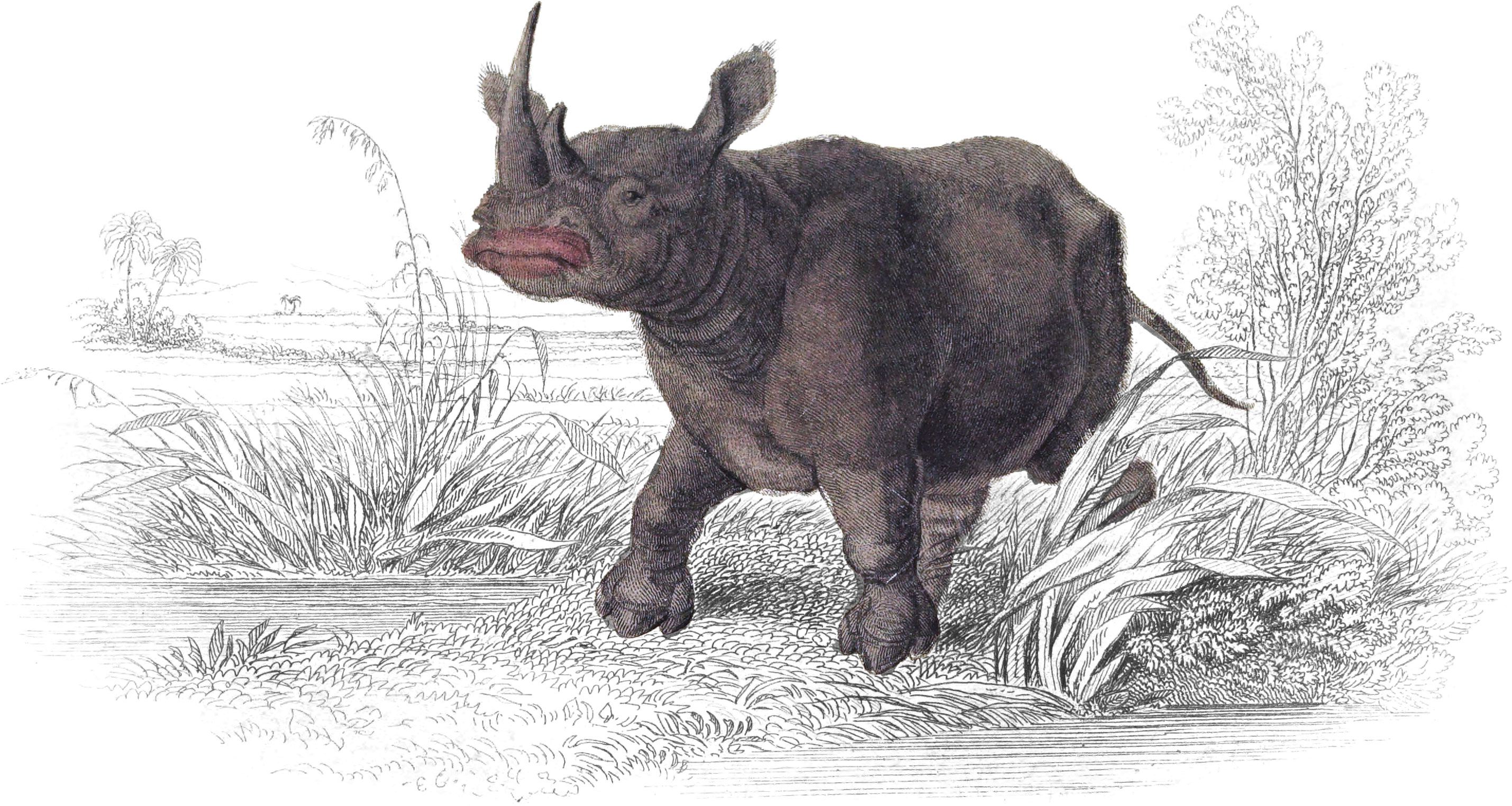
Plate XIII
We have now come to another genus of animals, which most of our later zoologists have agreed to bring into the present situation. It is the genus Hyrax of Herman, which we shall illustrate first by
The Syrian Hyrax
Hyrax Syrianus.—Gmelin.
Hyrax Syrianus, Gmel.—Ashkoko, Bruce?—Le Daman d’Ethiopie, H. Syriacus, Fred. Cuvier, Hist. Nat. des Mammif.
Receding, in its pigmy size, from the great bulk of the proboscidean animals, this little creature approaches nearest to the form of the Glires or Rodentia, looking like a diminutive Hare; and, instead of the strong hide, bare and wrinkled, or with only a few hard bristles, it is clothed with a thick and short fur; and, in place of dwelling in the forest, like the Elephant and Rhinoceros, or in the extensive morasses, as the Mastodon was supposed to do, it finds its retreat among the rocks, and affords a support to the birds of prey which haunt its localities, from the convenience of a ready food; and one species, from these habits, has received the title of “Rock Rabbit,” or “Cape Badger.”
From the close resemblance which these little animals have to many of the Glires, they have been generally placed with them. The Baron Cuvier, however, by attention to their anatomy, clearly demonstrated their alliance, at least, with the animals we have been describing, and has placed them there, while the latest published system, by Mr Swainson,31 has assigned their station as the Glireform type of the Pachydermes.
Pallas, who was the first that anatomically examined the Hyrax, saw specimens alive at Amsterdam, but took his anatomical details only from the body, (as Cuvier observes, without the most important parts, the head and feet,) having been transmitted to him in spirits after skinning. By this excellent naturalist, it is placed among the Cavies, but with the remark, that in several points it essentially differed from them. His remarks were taken from the H. Capensis.
Cuvier points out the following near resemblance of the skeleton of Hyrax to some of the Pachydermes. In the general composition of the trunk, there are several alliances; and one of the more remarkable analogies is, that the Hyrax has twenty-one ribs on each side, a number greater than that of other quadrupeds, the Sloth excepted, which has twenty-three; and those animals, which have the greatest number after the Hyrax, belong precisely to this order of Pachydermes with which we wish to range them. The Elephant and Tapir have each twenty, the Rhinoceros nineteen, and the Solipedes, which approach nearest the Pachydermes, eighteen; while the most of the Rodentia, on the contrary, have but twelve or thirteen, the Beaver alone having fifteen.32
In the structure of the head it resembles the Pachydermes. The maxillary bones are very distinct from those of the Rodentia by the small size of the suborbital hole, which in the latter is enormously large. There are four lower incisive teeth, while the two above are not bent and truncated, but are triangular and pointed, and resemble those of the Hippopotamus. The other teeth also differ from those of the Rodentia; the condyle of the jaw is also different, permitting the motion from right to left. This will be illustrated on the accompanying plate of Skull and dentition of Cape Hyrax. Plate XV.
The number of toes in the Hyrax is four before and three behind, as in the Tapir. They are united by the skin to the very nail, as in the Elephant and Rhinoceros, and represent those of the former animal, both in their figure and in the manner in which they are placed upon the foot, while the wrist joint very closely resembles that of the Tapirs.
Our plate, which accompanies this, will give an idea of the form of this curious and yet limited genus. It is taken from the figure of F. Cuvier, drawn from a living specimen, which appears to have been obtained from the Exeter Change collection. All the upper parts of the body are of a brownish gray, the lower parts white; between the two colours the tint is yellowish, and the head, as well as the feet, are of a grayer tint than that of the body. The separate hairs are ringed with yellowish, black, and white. The exposed parts of the skin are blackish violet.
The specimen alluded to had all the appearance and somewhat of the habits of the Rodentia, resembling the Sphermophili. It was about eleven inches in length, and stood about ten inches high. Its movements were quick and lively. It was very active, searching around, guided by its scent, and trying to get into narrow openings, or holes, where it could lie concealed. It delights in heat, and exposes alternately the different parts of its body to the sun; while, in cold weather, it rolls itself up in its hay or litter. It was quite tame, but does not like to be seized, though it never attempts to bite, and only utters a slight hissing sound when irritated. It is an animal entirely diurnal in its habits, and completely herbivorous—fed, when confined, on bread, roots, fruits, and herbs. It appears to have little intelligence, and little fear. When at liberty, it has the same inquisitive and searching habits, and comes freely to the hand which is held out to it.
The Askoko of Bruce is given as a synonym for this animal. On this account we think it worth while to transcribe his description of its habits, &c. which agree nearly with what is above mentioned.
This curious animal is found in Ethiopia, in the caverns of the rocks, or under the great stones in the Mountain of the Sun, behind the Queen’s palace at Koscam. It is also frequent in the deep caverns in the rocks in many other places in Abyssinia. It does not burrow, or make holes, as the rat and rabbit; nature having interdicted him this practice, by furnishing him with feet, the toes of which are perfectly round, and of a soft, pulpy, tender substance; the fleshy parts of the toes project beyond the nails, which are rather broad than sharp, much similar to a man’s nails ill grown; and these appear to be given him rather for the defence of his soft toes, than for any active use in digging, to which they are by no means adapted.
The whole of the fore-foot is very thick, fleshy, and soft, and of a deep black colour, altogether void of hair; though the back, or upper part of it, is thick covered like the rest of its body, down to where the toes divide, and the hair ends; so that these long round toes very much resemble the fingers of a man.
In place of holes, it seems to delight in less close, or more airy places, in the mouths of caves, or clefts in the rock, or where one projecting, and being open before, affords a long retreat under it, without fear that this can ever be removed by the strength or operations of man. The Askoko is gregarious, and frequently several dozens of them sit upon the great stones at the mouth of caves, and warm themselves in the sun, or even come out, and enjoy the freshness of the summer evening. They do not stand upright upon their feet, but seem to steal along as in fear, their belly being nearly close to the ground, advancing a few steps at a time, and then pausing. They have something very mild, feeble like, and timid in their deportment; are gentle, and easily tamed, though, when roughly handled at first, they bite very severely.
This animal is found plentifully on Mount Libanus. I have seen him also among the rocks at the Pharan Promontorium, or Cape Mahomet, which divides the Elanitic from the Heroopolitic Gulf, or Gulf of Suez. In all places they seem to be the same: if there is any difference, it is in favour of the size and fatness, which those in the Mountain of the Sun seem to enjoy above the others. What is his food I cannot determine with any degree of certainty. When in my possession, he ate bread and milk, and seemed rather to be a moderate than voracious feeder. I suppose he lives upon grain, fruit, and roots. He seemed too timid and backward in his own nature to feed upon living food, or catch it by hunting.
He makes no noise that ever I heard, but certainly chews the cud. To discover this was the principal reason of my keeping him alive. Those with whom he is acquainted he follows with great assiduity. The arrival of any living creature, even of a bird, makes him seek for a hiding place; and I shut him up in a cage with a small chicken, after omitting feeding him a whole day: the next morning the chicken was unhurt, though the Askoko came to me with great signs of having suffered from hunger. I likewise made a second experiment, by enclosing two smaller birds with him for the space of several weeks. Neither were these hurt, though both of them fed, without impediment, of the meat that was thrown into his cage; and the smallest of these, a kind of tit-mouse, seemed to be advancing in a sort of familiarity with him, though I never saw it venture to perch upon him, yet it would eat frequently, and at the same time, of the food upon which the Askoko was feeding; and in this consisted chiefly the familiarity I speak of, for the Askoko himself never shewed any alteration of behaviour upon the presence of the bird, but treated it with a kind of absolute indifference. The cage, indeed, was large, and the birds having a perch to sit upon in the upper part of it, they did not annoy one another.
In Amhara this animal is called Ashkoko, which, I apprehend, is derived from the singularity of those long herinaceous hairs, which, like small thorns, grow about his back, and which in Amhara are called Ashok. In Arabia and Syria he is called Israel’s Sheep, or Gannim Israel; for what reason I know not, unless it be chiefly from his frequenting the rocks of Horeb and Sinai, where the children of Israel made their forty years peregrination: perhaps this name obtains only among the Arabians. I apprehend he is known by that of Saphan in the Hebrew, and is the animal erroneously called by our translators Cuniculus, the rabbit or coney.
To render the illustration of this very curious genus as complete as our limits will permit, we have introduced a figure of the species described by Pallas.
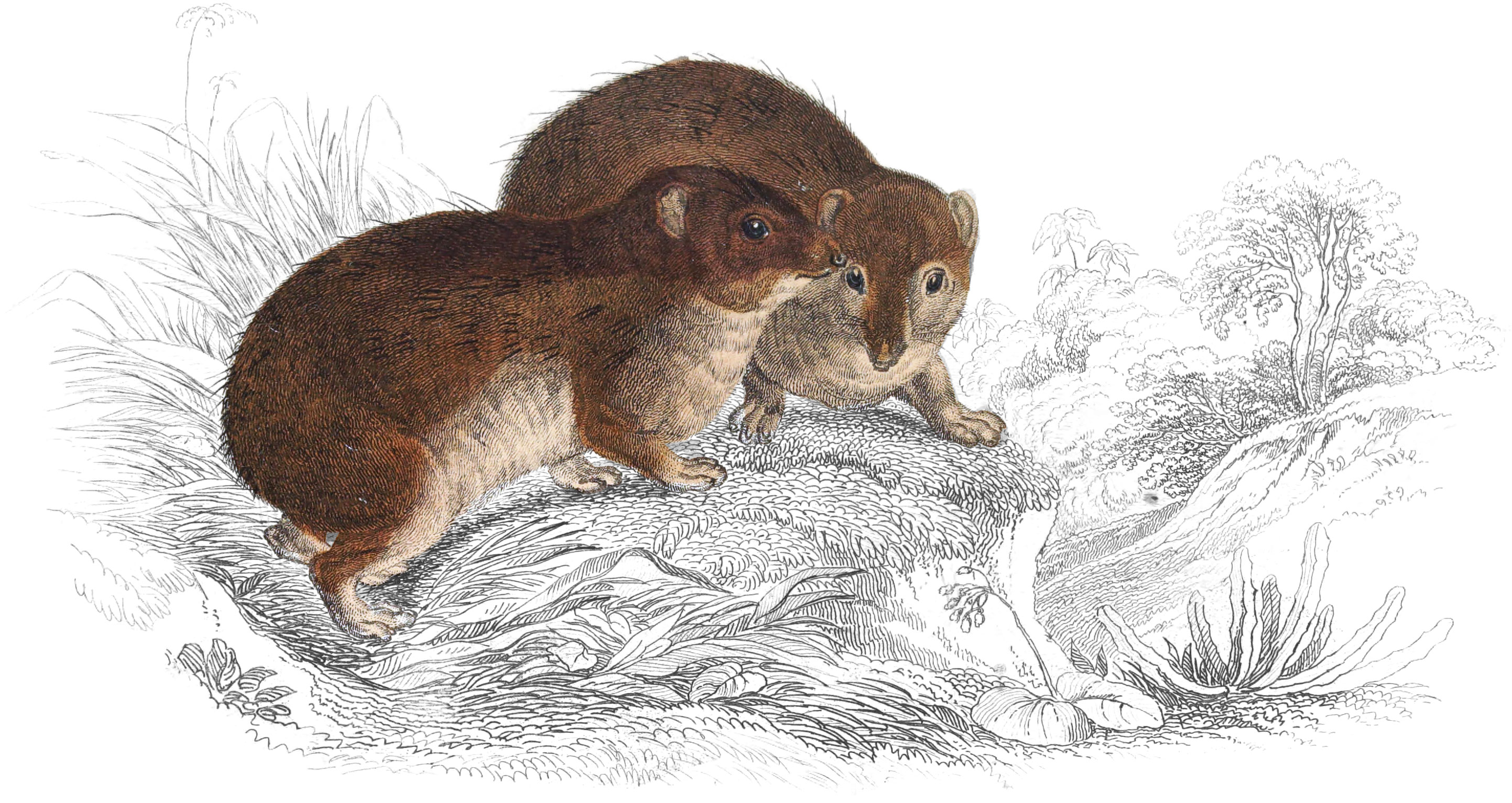
Plate XIV
The Cape Hyrax
Hyrax Capensis.—Gmelin.
Cavia capensis, Pallas, Miscellanea Zool.—Hyrax Capensis, Gmel.
The Cape Hyrax is about the size of a Hare, but with shorter legs and more clumsy form; it is of a uniform grayish brown, and along the back is marked with a darker band. The toes on the fore feet are only three in number, whereas in the last animal they were four, a difference which is now taken as one of the principal distinctions of the animals which inhabit the opposite portion of the great African continent. This animal was of frequent occurrence in the Cape of Good Hope, living in the clefts of rocks; and in its motions, when retiring to its burrows, exhibiting many similarities to those of the common Rabbit.
Major Smith gives the following description of a third species of Hyrax, under the title of H. arboreus, found in many of the forests of South Africa, and inhabiting the hollows of decayed trees.
This species rather exceeds the size of the Hyrux capensis, usually measuring about twenty-one inches from the tip of the nose to the extremity of the back, and about seven inches in height. In its general form, it resembles the species just named; and in the manner of moving and sitting they exactly coincide. The colour above is a sort of tawny red, freely mottled and variegated with black; on the lower parts of the sides, it is reddish white, with a less abundant intermixture of black; and beneath, as well as on the insides of the legs, it is an uniform dull white. The reddish colour arises from the tips of most of the hairs being of that hue; and the black variegations depend partly on a scanty intermixture of long hairs, which are entirely of that colour, but principally upon an exposure of the deeper parts of the general covering, which are throughout inclined to black; and in consequence of this last being the chief source whence the mottled appearances are derived, that necessarily is more or less considerable according to the position of the hair, &c. The crown of the head has a predominance of black; the sides and middle of the face anterior to the eyes, are covered by a sort of short, dull, dusky, or reddish-white hair; and a whitish streak extends backwards from thence over each eye. The sides of the head a mixture of grayish-white and black, the upper and lower lips whitish, as is also the point of the chin, the throat, and the other under parts, as already mentioned. The ears are short and roundish, with their tips projecting but little beyond the hair with which the animal is covered; outside they are beset with long dusty whitish hair, and inside they have a mere scanty coating of the same colour. Directly in the middle of the back, about half way between the shoulders and rump, is a narrow longitudinal whitish blotch, and about the centre of the chin is a transverse darkish band. The tail is wanting; the feet and toes are covered above by a dirty reddish-white hair; the whiskers are long, black, and situated on the anterior parts of the upper lip, and some similar looking hairs occur immediately over each eye.
The teeth in this species differ a little from those in the other Cape Hyrax, more particularly the incisors; but as I have not had an opportunity of examining them minutely, I may only mention at present, that the upper ones are more pointed, and that the lower ones stand in pairs, from the two intermediate ones being separated by a considerable interval. The latter are also a little shorter than the lateral ones, and all of them have their tips tri-dentated.
This animal is found in many of the forests of South Africa, and is occasionally seen coming out of holes in decayed trees, or standing upon the summits of such as have only trunks remaining.
Little is yet known of its manners; and almost the only observation that can be elicited from the farmers and inhabitants of the parts of the country in which it resides, is, that it makes a great noise previous to the fall of rain.
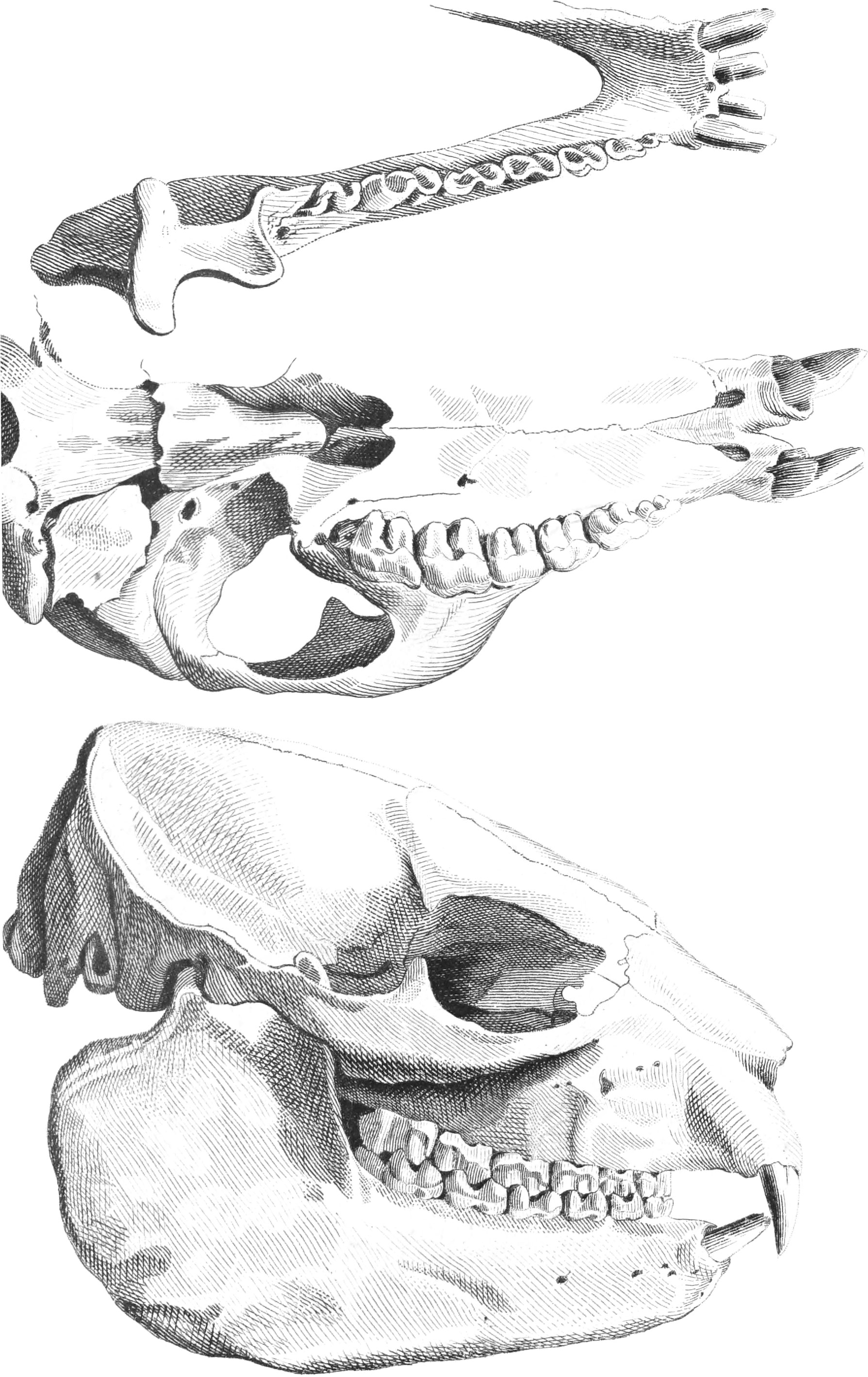
Plate XV
Cape Hyrax Skull
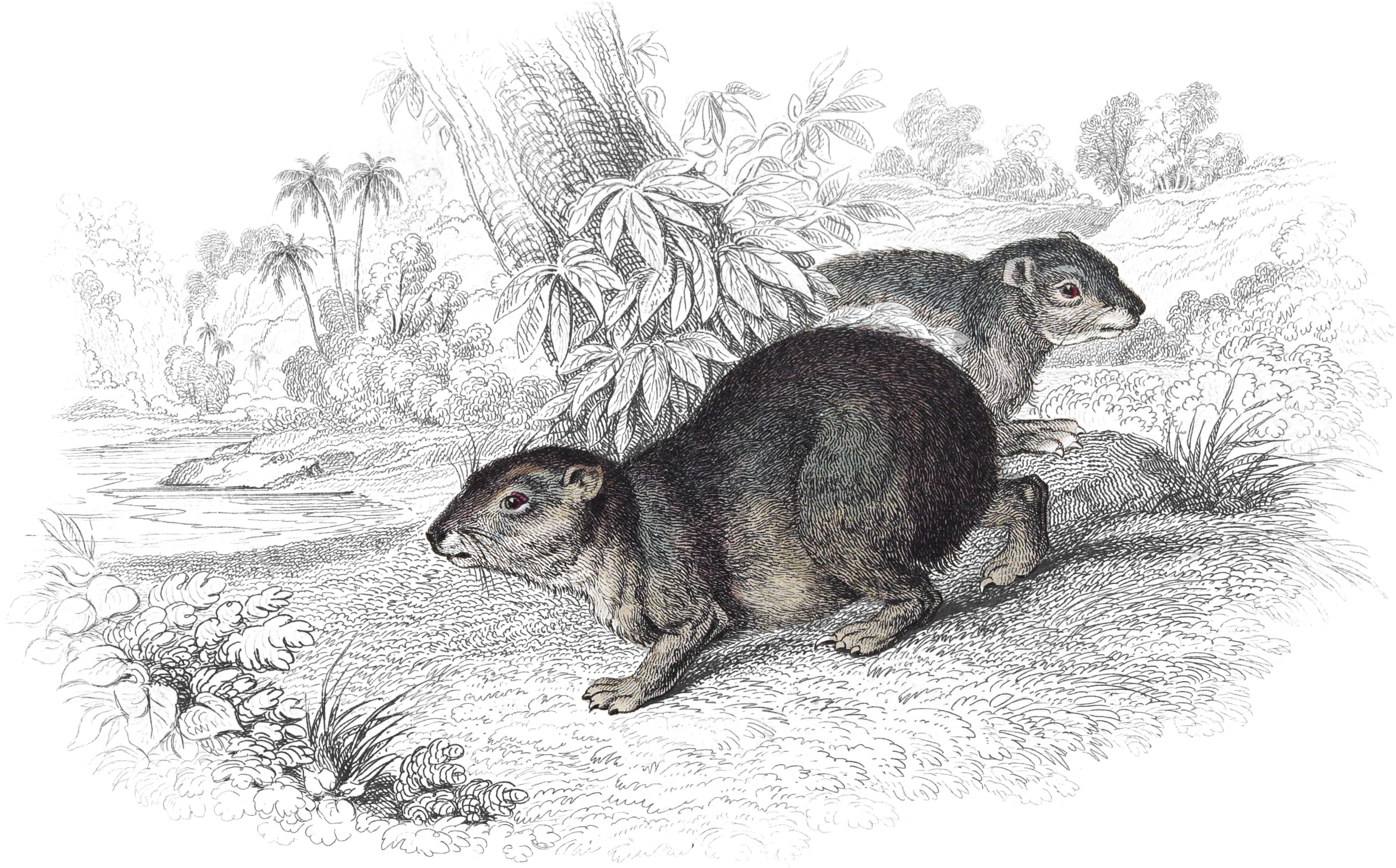
Plate XVI
The Swine
We now come to a series of animals, a part of which, in its various races, fills a very important place in the general economy of mankind,—the Swine, (Sus of the ancients,) including the different forms which this rather extended group exhibits in different countries, and which have received various appellations. The true Sivine are very extended in their distribution, the supposed stock of our domestic breeds reaching over Europe, Asia, and the north of Africa, while it has been introduced and thrives in America, Australia, and the South Sea Islands. In Africa, we have also a variation of form in Phascochæres; in America, of Dicoteles; and the South Sea Islands seem to possess a distinct species of true Sow, represented on plate XIX. Of these, only the true Swine have been domesticated or used for any economical purpose; though there seems no reason to suppose, that either the Babiroussa or Dicoteles might not, with some trouble at first, become useful animals.
In their form, they are low set; the body nearly cylindrical; the head placed upon the same line with the trunk. The skin is thick, covered with strong and stiff hair, called bristles, which are in general thinly planted, and have often an under fur of fine curled hair. In many cases, however, this last is wanting, and the skin is distinctly seen among the bristles. They are furnished with a strong mane. The tail is short, and generally twisted; but in some forms it is entirely wanting. In the males, the canine teeth are greatly developed, prove formidable weapons of offence or defence, and by an enraged animal are made to inflict torn wounds of a most severe kind. Their food is mostly roots and vegetables, and also worms and insects, to procure which they are furnished with an elongated nose, supplied with a strong cartilage at the extremity, and with powerful muscles, which renders this flexible, and enables them to turn up the soft or moist ground in search of roots, or worms and insects, in which they are also assisted by their acute sense of smell. Acorns, beech-mast chestnuts, and the produce of similar fruit-bearing trees, are also a very favourite as well as fattening food; and the herdsmen of old, and even yet, in some of the English forests, avail themselves of this, and drive their pigs in autumn to feed and fatten themselves in the woodlands of oak and chestnut. When hard pressed, however, the Swine are a race that can subsist on almost any thing placed within their reach; and scarcely any sort of food, either animal or vegetable, comes amiss to them. “Voracious” is therefore the title which has been most commonly applied to them.
The sense of smell is extremely acute; it is almost the only sense employed when the animal is rooting up the ground; and a little attention to a herd so occupied, will soon shew with what subtlety it is employed: scarcely a small root or a worm escapes; and on every fresh turning of a few inches of ground, this useful instrument is employed in trying by smell the disturbed fragments. On the Continent, this faculty is said to be sometimes employed by having the animals trained to hunt for truffles, when, we suppose, they will act as both finders and diggers. But the most remarkable instance of the culture of this sense in the Sow, was exhibited in the animal which belonged to Col. Thornton, and which was taught regularly to hunt, quarter the ground, and to back the other pointers. When hunted alone, her scent was very sure; and in one or two instances, she was known to stand steadily at snipes. In this instance, the training was accomplished by good treatment, and a reward of bread carried in the pocket of the keeper. The Wild Boar in the Parisian Menagerie was taught to go through certain attitudes, upon being shewn some favourite food.
The Wild Boar has, in its wild state, been always looked upon as an object of terror, and, in confinement, as an animal of loathsome and dirty habits, and associated with what is beastly and disgusting. When hunted or enraged, the Boar becomes a most ferocious animal, defending himself to the utmost; but in confinement, the Sow seems conscious of good treatment, and will follow the individual who thus well uses it. For their dirty habits, they are perhaps somewhat indebted to the carelessness of their masters, and the limited and dirty space in which they are kept; for a Sow, in an ill kept sty, is, in reality, the perfect image of a “dirty beast;” but when at large, excepting their propensity to wallow, which is common to all the Pachydermes, and a provision in warm climates to protect from insects a hide naturally bare of hair, we have nothing more unseemly to separate them from their allies. The sleeping lair of the Wild Hog, is generally among some dry and warm herbage; and a supply of fresh and clean litter causes expressive comfort to the animal in his sty; and in both cases, when the cover is abundant, it is made to conceal and skreen the body from heat or cold.
We have represented on the accompanying plate,
The Wild Boar
Sus scropha.—Linnæus.
Sus ferus, porcus, aper, and scropha, of authors.—Le Sanglier, Buffon.
Our drawing was from a European specimen in the Edinburgh Museum. In the ancient times of the British kingdom, the Wild Boar inhabited her forests, and was an object of royal protection. We have various records in the history of the country of its existence in particular districts, edicts for its preservation, and proclamations of punishment for its destruction. It has, however, long ceased to exist, and there are now few or no forests in that impenetrable or unexplored state, which could long support their grizzly inhabitants undisturbed. On many parts of the continent of Europe, it may yet be said to abound, and is an object of chase much followed, requiring great courage and coolness, and attended with considerable danger. Here they are most commonly shot with rifles, or baited with strong hounds; and in other places, driven by an assemblage of the country people to a narrow circle, where they are variously despatched. But it is perhaps on the continent of India only where the hunting of the Wild Boar or Hog is followed really as a sport, and is accompanied with all the usual retinue of followers. They frequent the strong grassy jungles, thick and matted, and of sufficient length to conceal the animal even when running; or they delight in the extensive plantations of sugar cane, where they both find cover, and a supply of favourite and very fattening food. They are pursued on horseback, and speared when at full speed. When about to be hunted, a collection of people is formed, who regurlarly beat the cover, and endeavour by noises of all sorts to force the animal to flee to some other retreat. The huntsmen are generally placed at the corners, and start in pursuit when they consider the Hog has gained sufficient distance from the canes or grass, as not again to retreat to them. There is both danger in the attack, and considerable dexterity required to render it efficient: many horses will not go up to the Hog, while others are rash, and subject themselves to be bitten or ripped, and sometimes are completely disabled; while, if the rider is thrown at all in the vicinity of the game, he is almost certain to be severely hurt.33
The speed of the Hog is much greater than what might be supposed from the look and form of the animal. A trot at first, changed into an ambling gallop, will keep some of the swiftest steeds of India for a time at a distance; and it is by pressing hard at first, and blowing the game, that it is generally come up with. Colonel Williamson mentions an instance where he, with some others, were fairly beat in a distance of three miles, the Hog gaining the cover in spite of their exertions. A chase sometimes extends to five, six, or seven miles.
The adult Wild Boar is generally of a brownish black; the hair of considerable length about the head and mane. They stand from twenty to thirty inches high at the shoulder; and Colonel Williamson mentions having seen a huge Boar of forty-two inches in height; while he speaks of three feet as a common size, which, being most active, also exhibit the best sport. The young are of a pale yellowish tint, irregularly brindled with yellowish brown. Colonel Williamson gives the characters of the wild Indian breed:
a broad flat forehead; short pricked ears, rather round at their tips, and lying very close to the neck. The eye very full, with much display of the white when in action. The head short, thickly furnished with hair inclining to curl; a very muscular neck; a high shoulder; the back very nearly straight; the loins broad; the bristles thick on the neck and shoulder. The tail rather short, and near the tips covered with lateral bristles, reserving the wings of an arrow.34
Plate XVIII. exhibits the female and young.
In its wild state, in Europe, the Wild Boar frequents the most retired forests. He lives solitary, choosing some deep recess for his lair, near a convenient watering place, and having access to some glade or path, which conducts to the more open country. Hence he only sallies in the evening in search of food, which is chiefly vegetables, roots, or fruits; but during the season of harvest very considerable damage is effected, not only to the grain crops, but also to the vineyards. It is only during the rutting season, that the native Hog is somewhat gregarious, and selects a female after an exhibition of his prowess against his rivals on the same errand. The females again, are generally gregarious, several litters joining company, and making excursions together. The young grow for several years, and remain with the mother and the herd, until they have attained their maturity.
It is now admitted by all writers, that this animal is the stock whence our domestic races have arisen, and spread themselves nearly over the world, with the exception of the islands in the South Seas, whose stock we shall now advert to.

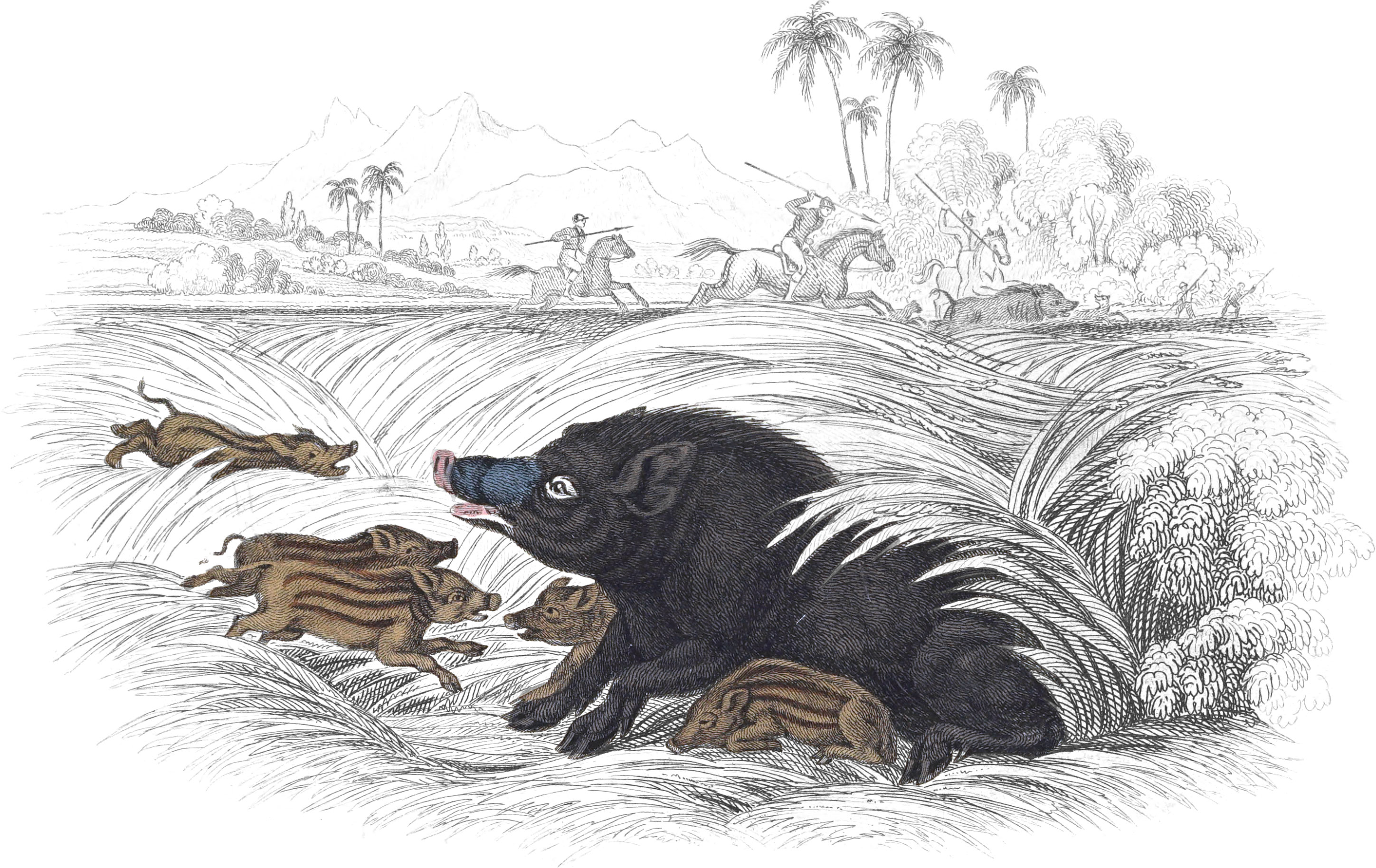
The Papuan Hog
Sus Papuensis.—Lesson & Garnot.
Cochon des papous, Sus Papuensis, Lesson and Garnot Voyage du Coquile, i. 171. pl. viii.
The large and rich isles of Papua, or New Guinea, afford a shelter and abode for this curious animal, feeding on roots and fruits which abound there. According to the above quoted naturalists, it forms a passage to the South American genus, Dicoteles or Peccaries. It wants the tusks, so formidable in the Wild Boar, and the tail is nearly rudimentary; but there is no trace of the gland upon the rump, or strong smell about the Papuan animal. It has, however, only eight paps, by which it approaches the Peccaries, the common Sow having generally twelve. The Papuan Hog usually stands from eighteen to twenty inches high, and the form is light and slender; the ears proportionally short; the body round in its form; the legs short. The hair is of middling thickness, but less so than in the Siam Pig, or in the Babiroussa; the skin is brown and wrinkled, naked and reddish behind the ears, upon the cheeks, and many parts of the abdomen. The extremity of the muzzle is furnished with long black hair, most abundant on the lower jaw, and around the eyes, and two black bands stretch upon the lower jaws. The upper parts of the body and the sides are blackish red, duller and browner upon the limbs. The cheeks, throat, flanks, and belly, are white, jingled with some black hairs. The young are commonly of a dull brown, having upon the back from two to five longitudinal bands of a bright fawn colour. They are extremely common in the forests of New Guinea. The Papuans keep them confined in enclosures around their cottages, having, for the most part, trapped the young ones; but they never attempt to tame the animal, which always retains its wild and fierce manners. Those which were taken on board the Coquile, were remarkable for their strength and courage, though in a short time they became tame. They were much esteemed for the delicacy of their flesh, and formed a welcome delicacy during the voyage.
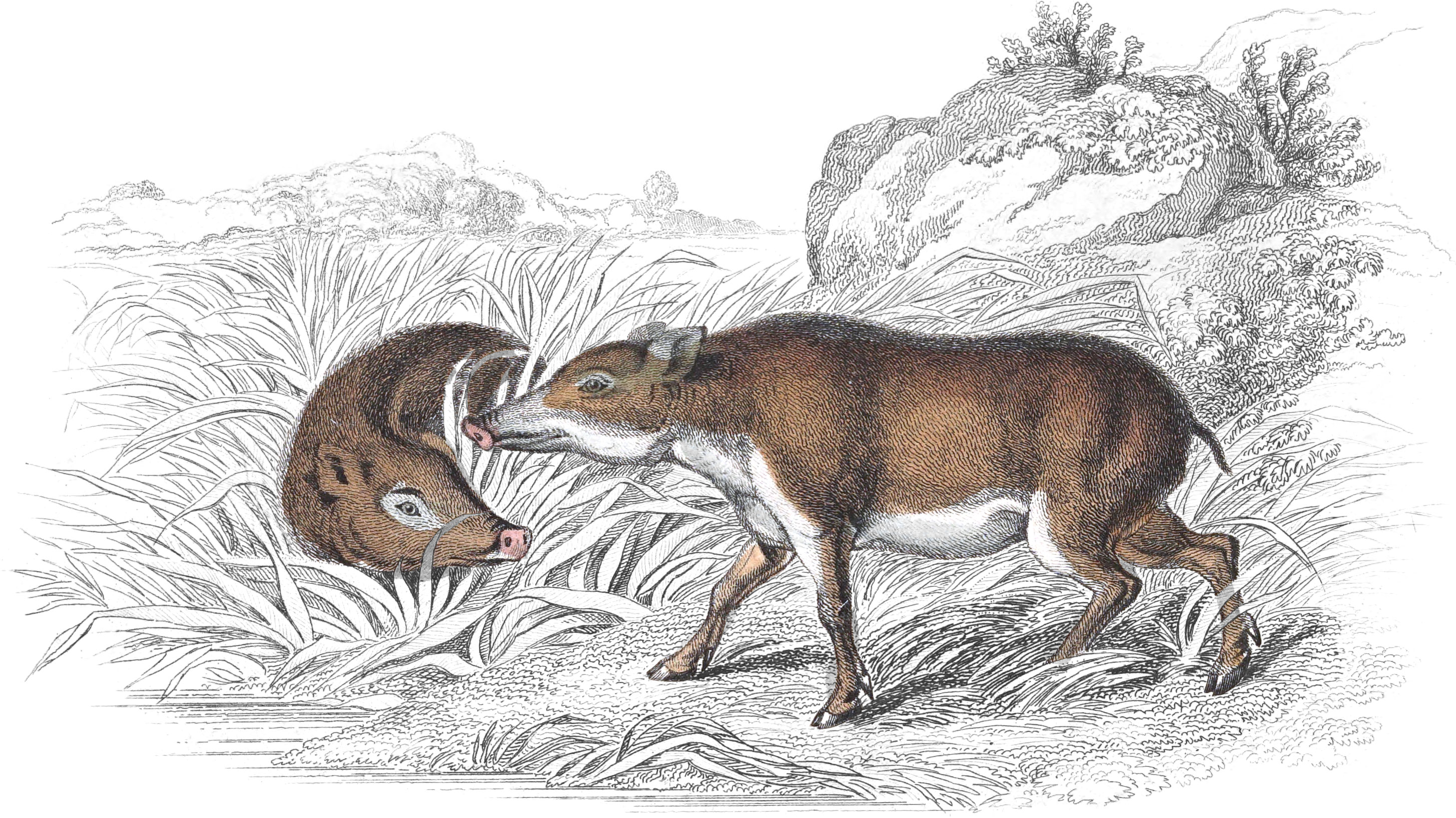
Plate XIX
The Koiropotamus
Sus koiropotamus.
In the South Sea Islands, there is a small, short legged, black variety of Pig, which some authors are inclined to consider as derived from some other stock than the Wild Boar; but there seems no very good reason for this conclusion, and the Dreed would appear to be nearest to the Chinese variety, while the animal we have represented on plate XX. Sus koiropotamus, is known by the figure of M. Demolin only; but in other respects our information is nearly altogether deficient. We have used for our copy the representation above alluded to.
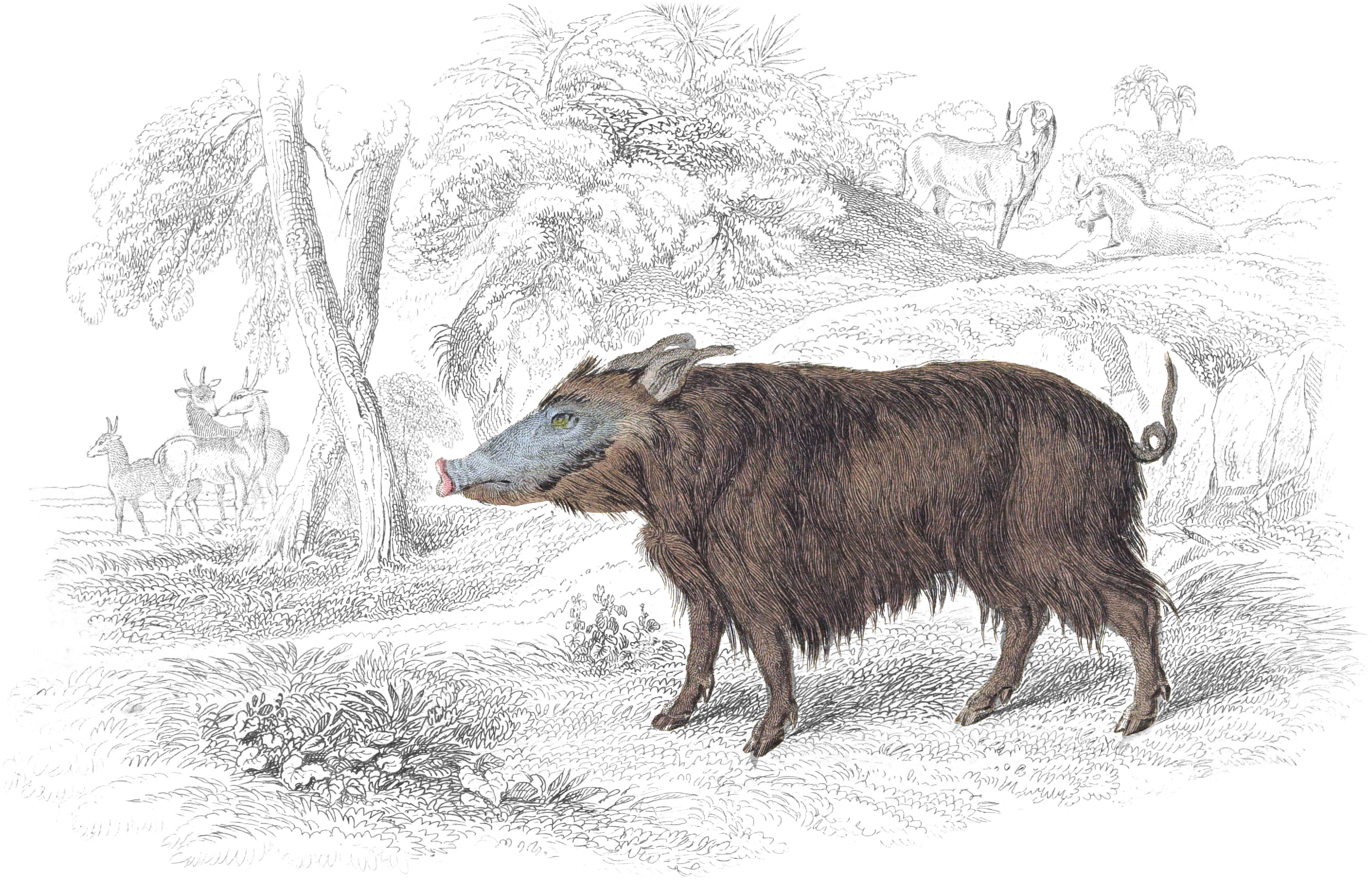
Plate XX
In the races which have sprung up, the form is exceedingly varied, but, as among other domesticated animals reared for profit, a form of beauty founded upon that which yielded the greatest return, was fixed upon as the standard, and this we see in some of the unwieldy masses of flesh and fat, which are found in the stores of the principal breeders.
The Domestic Pig
Which we have selected for our illustration, was the property of a respectable baker in the town of Kinghorn, in the county of Fife; and when we got the drawing made a few days before she was killed for the market, she was about two years old. We have chosen her, not on account of any very great purity or excellence in her breeding, but simply as a fair average specimen of a common domestic Pig. She was originally from Irish stock on the female side, but from the county we have mentioned on that of the male.
There is a curious circumstance which was related to us by the proprietor of this animal, and which we know to be authentic, respecting one of the two Pigs which constituted her first litter. One died, the other survived, and became attached to a Bull Dog, also the property of the person we have mentioned, which it would follow and sport with in a variety of ways. The Pig would also follow its master when accompanied by the Dog, for a distance extending half a dozen miles; and the Dog being very fond of swimming, the Pig imitated the same propensity, and apparently had much pleasure, and shewed a good deal of dexterity in this element,—a propensity which we believe is not very usual or natural in such animals. If any floating substance was thrown into the water for the Dog to fetch out, the Pig would follow, and dispute the prize with its canine companion, evincing much energy and adroitness. The Dog and Pig invariably slept together.
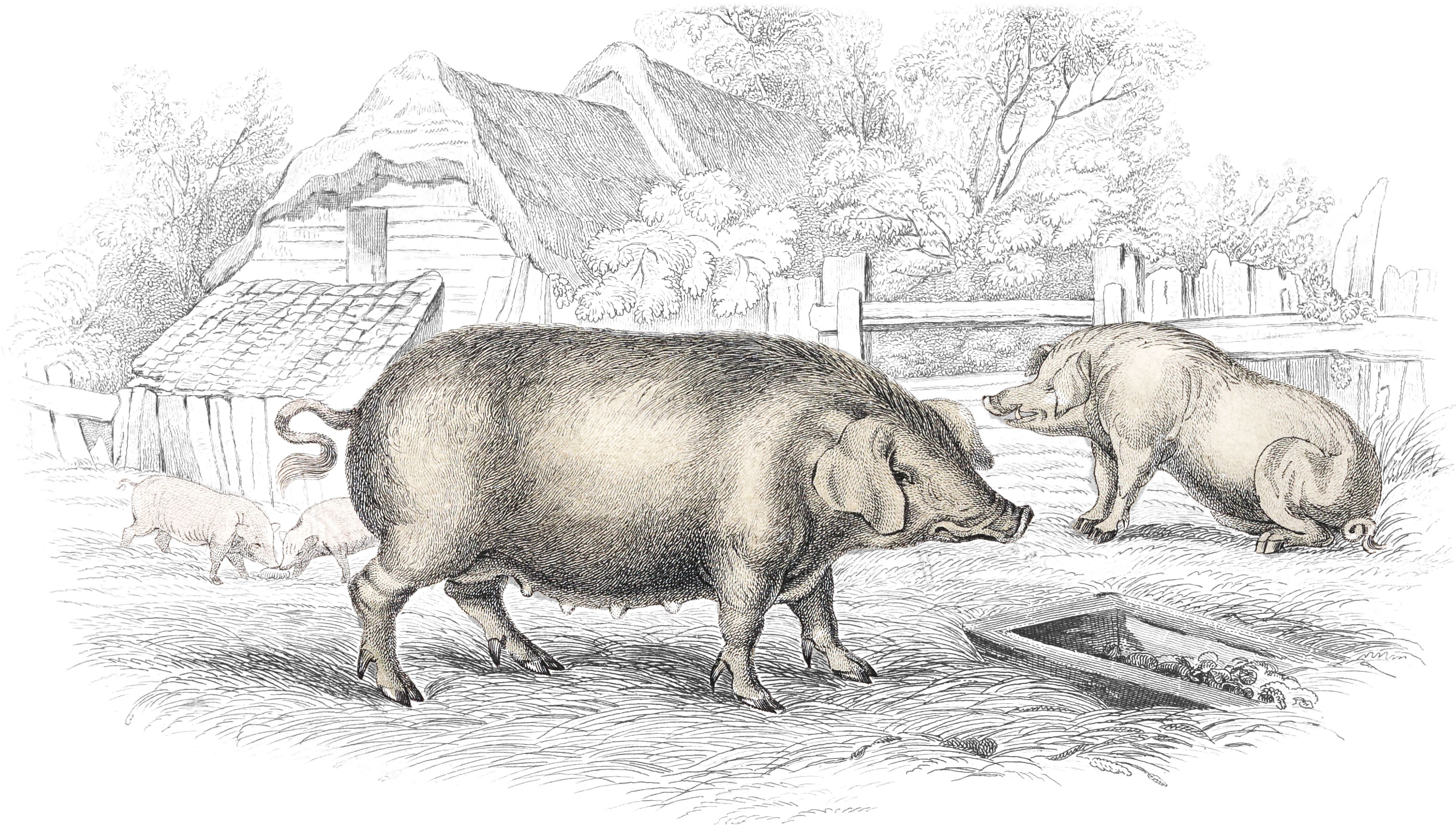
Plate XXI
The most prominent domestic breeds Mr Cully places under three varieties, the Berkshire, the Chinese, and the Highland, or Irish breeds. The first of these, in a variety of modifications, is perhaps the most extensively spread and reared, and individuals of this breed have been known to reach a weight of above eighty stones. The Chinese breed, of a black colour, and easily fattened, has also wrought much improvement among these animals, and it sometimes reaches a state of feeding so as to present to the observer little more than a round mass. Our next figure will represent the
Chinese Breed
The colour is most commonly black, the form characterized by a fine appearance, small head, thin ears, and short and slender legs. They are remarkable for being easily fed, and perhaps become too fat for the general purposes of the table, and a cross is therefore oftentimes more esteemed.

Plate XXII
The other British breeds receive their names most frequently from the county in which they were introduced and reared. Thus the Hampshire, Sussex, Suffolk, Cheshire, and Shropshire Pigs, are well known as excellent. Upon the border districts, there are also some superior breeds, which are reared to a great extent. In the extreme north of Scotland, and some of the islands, the race is very diminutive. At one period, a strong prejudice or superstition existed here against this animal in every way; but this is now fast becoming extinguished, and is replaced by a rapid improvement in the breeds.
The next animal we have to notice, is
The Babiroussa
Sus babiroussa.—Linnæus.
The Babiroussa of authors.—Sus babiroussa, Linn. &.c Le Babiroussa, Fred. Cuv. Hist. des Mammiff.
This rather handsome animal is very remarkable for the great development of the tusks, which project from both jaws, and form a circular turn upon each side of the nose. It is from these tusks, very conspicuous in the wild animal, that, it is conjectured, the name of Babiroussa, literally Hog-deer, has been applied to it, and not from any similarity in the make of the animal to the form of a Deer, for, with the exception of the limbs being more slender, there is no other similitude whatever. Fred. Cuvier says, that the upper tusks pierce the skin of the muzzle before coming upwards; they form nearly a circle, and often touch the skin of the animal a second time. Living, or entire specimens, have seldom, till lately, reached Europe, and we have used the figures of F. Cuvier, which were made from specimens brought by the Astrolabe to the Paris collection. They were a male and female; the latter bred once after arriving in Europe, but the cold gradually producing diseased lungs, cut them off in about three years after. The male was aged, and remarkably fat, which rendered him inactive, and his short life was passed in sleeping, eating, and drinking. The female was younger, and more active; when the male retired to his litter, she would cover him completely over, and afterwards herself slip under the straw, so that both were entirely concealed from sight. The skin of these animals was very thinly furnished with hair; and that which grew upon them was long and hard. The colour of the side was of a uniform greyish tint, changing to fawn colour on the belly. The number of the incisor teeth in the Babiroussa differ from those of the true Swine, but the structure is the same. The tusks in the old male are not so dangerous as those of the Wild Boar during attack, owing to their curvature, but nevertheless they are formidable weapons.
These animals abound in the Molucca Islands, and a few of the others of the Indian Archipelago, chiefly towards the interior. They seem difficult to obtain, notwithstanding their acknowledged plenty; and when hunted, are said to take the sea freely, and swim to some other neighbouring island.
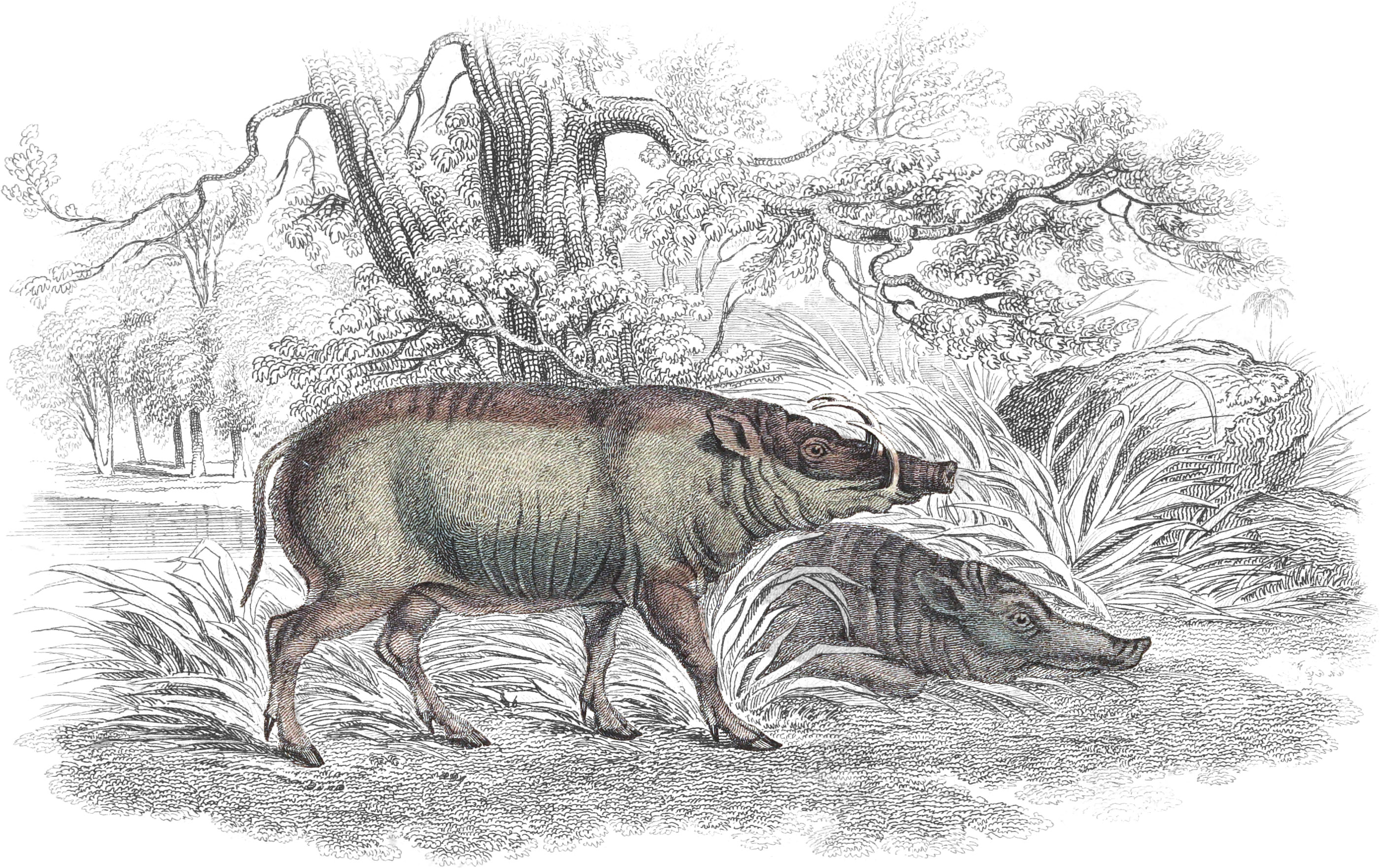
Plate XXIII
Our next animals exhibit a very remarkable African form. There seems, without doubt, to be two species,—one from the south-west, the other from the north of the continent. The correct synonymy of the first, or oldest known, seems yet somewhat confused; and the unravelling of the Sus Larvatus, the Sus Ethiopicus, and Ethiopian Hog of Daniel, is left even by our latest zoologists in uncertainty. The eighth volume of the Memoirs du Musee will contain the best account of the variation of the skulls, and of the dental system. Phascochaeres has been applied as a generic term to this form, remarkable for the large and strong tusks, and for the swollen and warty appearance of the face; we have taken Ruppel’s figure for our first illustration, and give his description entire, so little being yet known regarding these formidable looking creatures.
Ælians’ Wart-Hog
Phascochaeres Æliani.—Ruppel.
Phascochaeres, Æliani, Mus. Franc.—Ælians’ warzenschween, Ruppel, Atlas, vol. xxv. p. 61.
After having carefully compared those species of animals which were sent to us by our traveller from the north of Africa, we were led to consider that they are always of smaller size than those found in the Cape, although in other respects, and characteristic features, quite the same, and to be considered as identical. Keeping well in mind this consideration, it was only after a very careful examination that we were induced to regard the Wart-Hog, which is to form the object of the following description, as different from the species which is found on the Cape; and we shall just give our reasons for it.
We mention, first of all, the acute judgment of Fred. Cuvier, on the dental formation of the Wart Hog, in the Memoir du Mus. d’Hist. Natur. vol. viii. p. 450. He notices in the skull of a Wart Hog in the Parisian collection, the existence of two incisors in the intermaxillary bone, which he considers, therefore, as denoting a peculiar species; because the upper incisors of the species at the Cape are not only entirely wanting, (even in the young individuals,) but, in consequence of the thin leafy substance of the intermaxillary bone, cannot even take root in it. His reasons for considering both of the same genus, notwithstanding the absence of the upper incisors in the one, are sufficiently supported by the circumstance, that the same occurs in others of the Pachydermes, as in the case of the Rhinoceros. Cuvier accompanied the above distinction between the two Wart Hogs, by a representation of the two skulls which guided his judgment, and we instantly recognized our new species.
The discovery of two new species of the genus Phascochaeres, is thus due to the merit of Fred. Cuvier. What we add on that subject, we merely wish to give as an additional inquiry supporting the labours of that learned naturalist, and with an intention of corroborating his views. A considerable number of that same species which were sent to us by Ruppel, enables us to state the following facts as well established. First. All the individuals of our new species, whether of old or young animals, and such as had not yet attained their full growth, of both sexes, have, in the intermaxillary bone, two incisors, which have their crowns turned inward, and their roots sharply pointed in an outward direction, wedged into the lower plate of the intermaxillary bone. These upper incisors are of greater size in males than in females, are generally larger in animals that have obtained their full growth than in younger ones, and do freely rise a few lines above the axis of the palate. In the lower jaw, we observe six incisors, which are not wanting even in the very old animals. The lower incisiors, to the number of six, have invariably been found of larger size in old animals than in young ones, and none of the oldest individuals we possess want either of these teeth.
Second, The upper corner teeth have on their outer and inner surface a groove, which is continued with the curve at the teeth. This groove is wanting in the lower corner teeth, which in old animals are by a third smaller than the upper ones.
Third, In all which we used for our general description, both in young animals and such as had obtained their full growth, of both sexes, we found in the upper jaw four back teeth, and three in the lower jaw. The first and second are small, narrow, roundish, with simple crown-globules, and with two roots wedged into two separate alveolæ. The third, (in the upper jaw, and the second in the lower,) is strong, and as broad as the fourth; its enamel surface contains five crown-globules, four of which occupy the corner, and one the middle. It is wedged into four separate alveolæ, by means of four roots.
With regard to these three first back teeth we would remark, that as age advances they gradually disappear, and none remain except the anterior ones. In one animal, greatly advanced in age, we find all three of them almost entirely destroyed. The third is diminished by two-thirds, and nothing remains of it but the crown surface, which keeps its position only by being wedged in between the fourth large one, and the second back tooth; whilst the alveolæ, which held its roots, have entirely vanished. But even this animal had all its upper and lower incisors still, although in a somewhat worn-out state. Fred. Cuvier, in explaining this circumstance, shews, that the fourth or posterior back tooth, which, in growing, is pushed forward towards the front, in the same manner as we find this in the Elephant, causes thereby the falling out of the anterior teeth. We admit the soundness of this view, and readily believe that the continual growing of the posterior back tooth should injure and remove the anterior ones, or even cause them to fall out. But besides, our attention has been directed by this subject towards the really two-fold type in the construction and the diversity in growth of the back teeth of the Wart Hog. We find, namely, the three anterior back teeth shaped and nourished in quite the same manner as all other teeth provided with enamel bodies and real roots. We farther must suppose a decay and dying away of the nourishing organ (bulbus) of these anterior back teeth, whenever they have obtained their full growth, (whether these animals experience a change of teeth we cannot say, as none of the animals in our possession would justify us in asserting such a change,) and thus they are deprived of nourishment, which circumstance we would state as the cause why the alveolæ are then filling with a bony substance, and loosen, and finally push out the tooth they contained; which tooth, in old age, is diminished to less than half its size, in consequence of the drain sustained by its solid organ of nourishment. The three anterior back teeth are thus, by the nature of their construction and functions, as much subject to decay and falling out as the teeth of all other animals advanced in age. It is altogether different with respect to the fourth, the largest and hindmost of the back teeth. The latter is, as Fred. Cuvier observed, a compound tooth,35 (dent composee,) and to be placed into the same class as the back teeth of the Elephant. It consists of three rows, placed alongside of each other, at well connected tubes, each about two inches long. At the outer side, we count nine such tubes, eight at the inner, and seven at the middle row, (this was the case in an old individual, in some animals we found several middle tubes double,) which tubes can be distinguished from each other at the enamel surface by their oblong globules. Each of these tubes, even the foremost or most recently formed, is hollow in the lower two-third portions, or closed up towards the enamel surface, and contains the bulb, (bulbe, Fred. Cuvier,) destined for the continual nourishment of the individual tubes, which bulb was distinctly noticed by us, after soaking the skulls. All the tubes of this tooth are free towards the root-end, and contained in one common large alveola, which is hollow at the bottom, only the anterior tube excepted, which at the lower end, and in an anterior direction, is separate from the rest of the tooth; whereby a gap is formed between it and the second tube, which gap is filled with a bony substance, a circumstance peculiarly obvious in that of the lower jaw. This fact would suggest a doubt, whether the posterior back tooth would push forward towards the anterior side; although we did observe in younger individuals the after growth of the posterior tubes as typical of the animal. The lower jaw contains only three back teeth. The two anterior ones are formed like the upper ones, with two and four roots; and what we mentioned with regard to the posterior or fourth back tooth at the upper jaw, is perfectly applicable to the third or posterior one of the lower jaw.
From the above remarks on the teeth of the Wart Hog, we are led to the following conclusions:
- That the species examined by us, is at all ages provided with incisors in the upper and lower jaw; and therefore, in the most marked manner, distinguished from the species found at the Cape. An additional mark of distinction is mentioned by Fred. Cuvier, who says, that the Wart Hog at the Cape has in its upper and lower jaw only three back teeth; whereas the species examined by us constantly presents four in the upper jaw. But we hesitate in admitting this latter mark of distinction to be of much weight; because, as was stated above, the anterior back teeth are disposed to decay, and the alveolæ which contained the teeth are filling up, which might have well occurred in the case of those very animals which were examined by Frederick Cuvier.
- That the formation of the back teeth of the genus Phascochaeres occurs in a two-fold type; we must adopt one regarding the formation and manner of nourishment for the anterior ones, which are simple teeth, with enamel crowns, bodies, and real roots; and we must take another for the posterior large ones, which are compound teeth, (dents composees,) without roots. This remarkable fact, the co-existence of two different types of formation for the back teeth of one and the same animal, will assume even a greater importance from an exact examination of the vessels and nerves which conduct to the different teeth; and we wish to direct the attention of naturalists to this subject, because we think that it will be an easier matter to procure subjects fit for such an inquiry from the Cape, than from Abyssinia.
But besides the existence of the incisors in the intermaxillary bone of our Wart Hog, and the absence of these incisors in the species of the Cape, we would now give some farther marks of distinction in the skulls of both, which, from their constant character, are available for the specific determination of the animal.
If a line be drawn from the hind part of the head, as far as the most prominent part of the nasal bone, we shall find between the two points (in the case of the Wart Hog we are describing) a sinus, the depression of which falls in the middle of the line, where it declines nine inches from the plain. Now, this very spot, in the case of the Wart Hog of the Cape, rises up in an arched prominence.36 Again, the Abyssinian Wart Hogs are more in diameter than those of the Cape; their forehead is pressed inward, and, what is very conspicuous, the space between the upper and posterior eye socket border, to the end of the occiput, is longer by one half than in the Cape Wart Hog, which gives to the whole skull a sort of lengthening shape, and pushes the occipital bone more backwards. We consider these two marks of distinction as constant, because we invariably found them to exist.
F. Cuvier gives, in his memoirs, to the Wart Hog of the Cape, the name of Phacochoere d’Ethiopie, and he calls ours Phacochoere d’Afrique. If we have not acceded to his wish, that these two names should be retained, we state our reasons for not complying, as follows:—We strictly follow the injunctions of Illiger, who objects to designate animals by countries, rivers, &c. as proving, in his opinion, injurious to science. In the next place, we were inclined to call our Phascochaeres by the name of Ælian, to have an opportunity of proving, at the same time, that this ancient author had a not-to-be-mistaken knowledge of our species. Ælian de Animalium Natura, liber xvii. cap 10, says:—
Λέγει δὲ Λὶνων ἐν Αἐθιοπα γἐνεσ θαν τονς ῾οζνιθας τονς μσνὸκεζως και πζὸβατα ὲζὶων μήν ψιλὰ τζὶχας δέ καμὴ λων ἔχοντα.
Dinon tells us, that in Æthiopia, Unicorn birds, and four-horned Hogs, and Sheep, are found, which have no wool, indeed, but the shaggy tufts of hair of Camels.
The animals mentioned in these few words would appear as fabulous, if we were to take the words in their literal sense, according to our present notions. But if we compare this statement with those animals which still now-a-days are found in the Æthiopia of the ancients, we may not be wrong in suggesting that Dinon, in his imperfect description, meant by the Unicorn bird, the Buceros corniculatus, (Le Vaillant;) by the four-horned Hog, our Wart Hog; and by the Sheep, which was covered by the shaggy tuft of Camel hair, the Ovis tragelaphus, (Geoffrey.) The reporter of these strange animals has, comparatively speaking, called the prominence on the bill of the Buceros corniculatus a horn. In like manner, the very large corner teeth of the Wart Hog have been represented by him as horns; and lastly, in using the word τζιχας he gave such an excellent description of the shaggy tuft of hair of the Ovis tragelaphus, that we scarcely entertain any doubt concerning the truth of our interpretation, but do really believe that he meant to convey, by his few designations, a description of these three animals. Considerations such as these, and still more the respect due to the wisdom of the ancients, have induced us to call our Wart Hog by the name of Ælian.
The external appearance of the Wart Hog is as follows:—The whole skin is of an earthy colour, scantily covered with bristles. Between the ears arises a mane, which extends along the neck and the back, and the single hairs of which are frequently ten inches long. The bristles of this mane, as well as on the rest of the body, are of light brown colour, and have not each of them their individual root, but three or six bristles together form one tuft, and have one common root. As the whole body, except on the back, is but scantily provided with hair, it presents rather a bare appearance. The head along the brow is broad, the latter somewhat depressed; the eyes are small, and situated very high up; from the brow downwards to the naked ridge, occurs a depression below the eyes, and in the vicinity of the cheek, is a wart which, in comparing it with another smaller one, alongside the cheek, we call the larger wart. These warts are formed out of a thickened skinny tissue; and we find them considerably smaller than in the species of the Cape. Along the lower edge of the lower jaw, we perceive a whisker of white hair curled upwards. The eyes are small, with light black eye-lashes, and long black eye-brow bristles, and a tuft of bristles is under the eyes. The ears at the lower part of the external margin are cut obliquely, and the whole margin is bordered with white bristly hair. The tail is almost bare, thin, and its joint provided with a tuft of hair. On the fore-feet is a piece of protuberant thick hard skin. Our Wart Hog has been found by Ruppell, first at Kordofan, and more frequently afterwards at the eastern slope of Abyssinia. It frequents low bushes and forests. If in quest of food, which, as far as could be ascertained, merely consists of roots, it creeps on its bent fore-feet, and in this posture digs up the roots of plants by means of its huge corner teeth. It likewise moves on in this posture, by allowing its hind legs to push the body forward. The natives of Massawats call it Flaruja, those at Kordofan, Flalluf. They do not eat its flesh, but travellers declare that its taste is not unpleasant.37

Plate XXIV
We have now reached the American form of the Swine, seen in the genus Dycoteles or Peccaries. They vary in the number and modified form of the teeth—in sometimes wanting the small accessory hoofs—in the metatarsal and metacarpal bones of the two great toes being soldered together, as in the ruminants—in the tail being nearly rudimentary,—and in having a gland upon the rump, distilling a strong smelling liquor. The form will be illustrated by
Æthiopian Wart-Hog
Phascochaeres larvatus.
As far as we can judge, the Ethiopian Boar, and the Sus larvatus, or Masked Boar of authors, are identical. The figure commonly referred to for the last, is that in Daniel’s African Scenery, which we have now used, and we add the description which accompanies it. Little is known of its habits, but they are most probably similar to those of the preceding animal.
There is not, perhaps, a more disgusting, or a more savage animal, than the Wild Hog of Africa. This beast, as well as the Elephant, the Buffalo, and the Rhinoceros, abounds in the woods of Sitsikamma, and is generally hunted by Dogs, which, with its long sharp fangs growing out of the lower jaw, it sometimes lacerates in a dreadful manner, and frequently tears them to death. Its eyes are small, and placed high in the forehead; two remarkable excrescences grow like two ears out of its cheeks, and the lower part of its head appears as if enclosed in a sack. The neck, the shoulders, and the breast, are covered with long hair. It differs very considerably from the Babiroussa or Ethiopian Hog, which is also a native of the Cape.
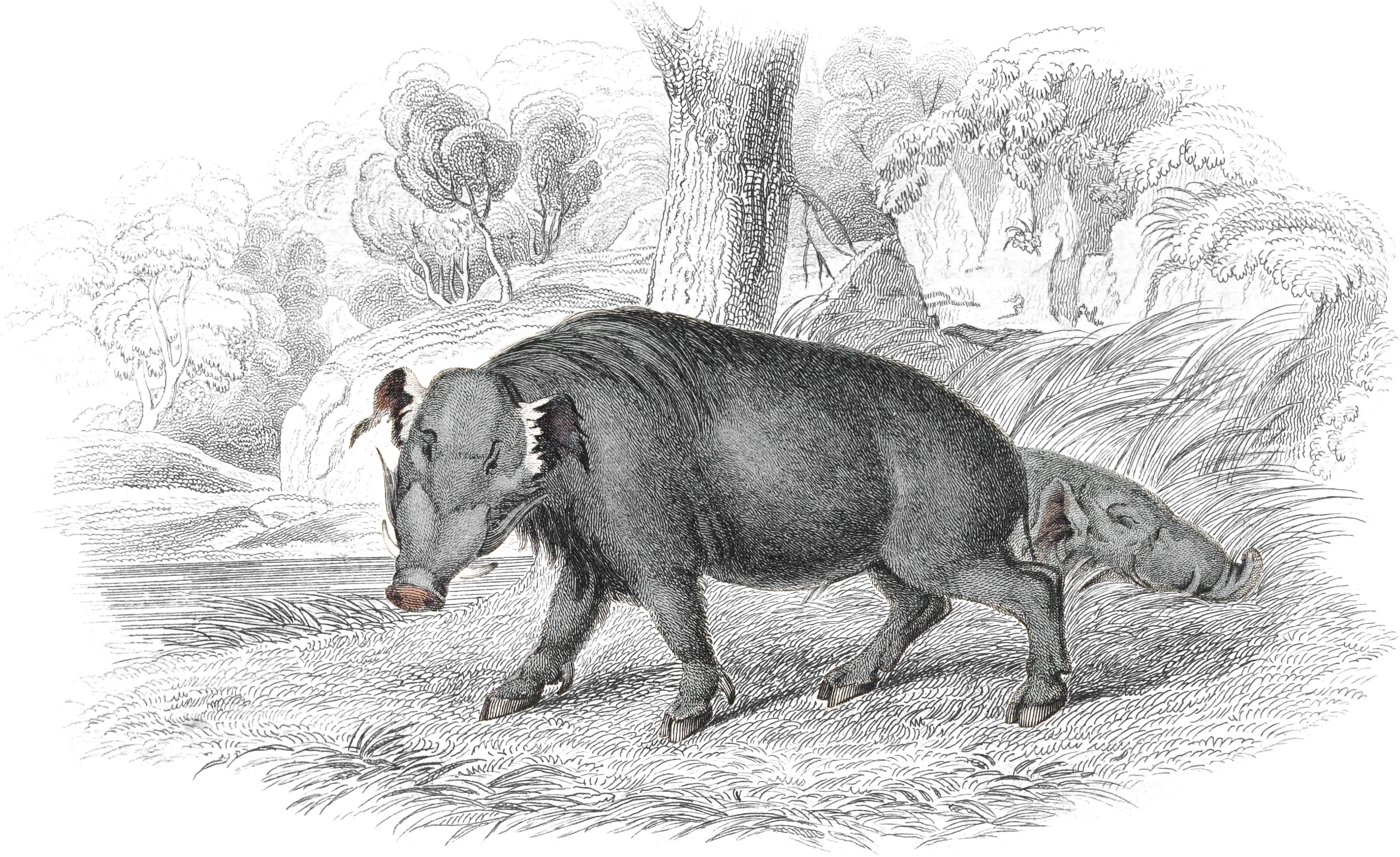
Plate XXV
The Collared Peccary
Dycoteles torquatus.
Stis Tajussu, Linnæus.—Peccari, Buffon.—Dycoteles Torquatus; Taytetou Azara, Cuvier.
The Collared Peccary inhabits the eastern side of South America, frequents the forests, living on vegetables and roots, and occurs chiefly in small families. To outward appearance, at a little distance, it is of a grayish tint; but a narrower inspection shews the hairs alternately ringed with black and yellowish white. They arc stiff and strong in the dried skin, having the rigidity of bristles; along the neck and back, they are very long, and form a kind of bristly mane, which, with nearly the whole hair upon the body, is erected and bristled up upon irritation. From behind the shoulders to the fore part of the neck, the bristles are whitish, forming a narrow oblique line of that colour, whence the specific name is derived. Upon the rump, the gland, though concealed, is conspicuous from the turn or swirl of the hair around it; and when in confinement, or in a tame state at large, the animal appears to have pleasure in frequently rubbing it; and when approached by those with whom it is familiar, endeavours to rub this part against their legs. We had an opportunity of often seeing a tame specimen of this Peccary. It was quite familiar, was generally allowed to run at large, and would come to any person upon food such as it delighted in being offered to it. It was, however, at other times easily irritated at strangers, and would turn the head, and appear as if about to rip with its short tusks. It detested dogs, shewed its bristles, and few ventured a second attack, being always touched with the tusks in the first. It would also occasionally stray to a considerable distance. Mr Bennet describes those in the Zoological Society’s Garden as perfectly tame and quiet, but is not sure how far it might be safe to trust them. They seem hardy, having lived and thriven through two winters without more than ordinary protection.
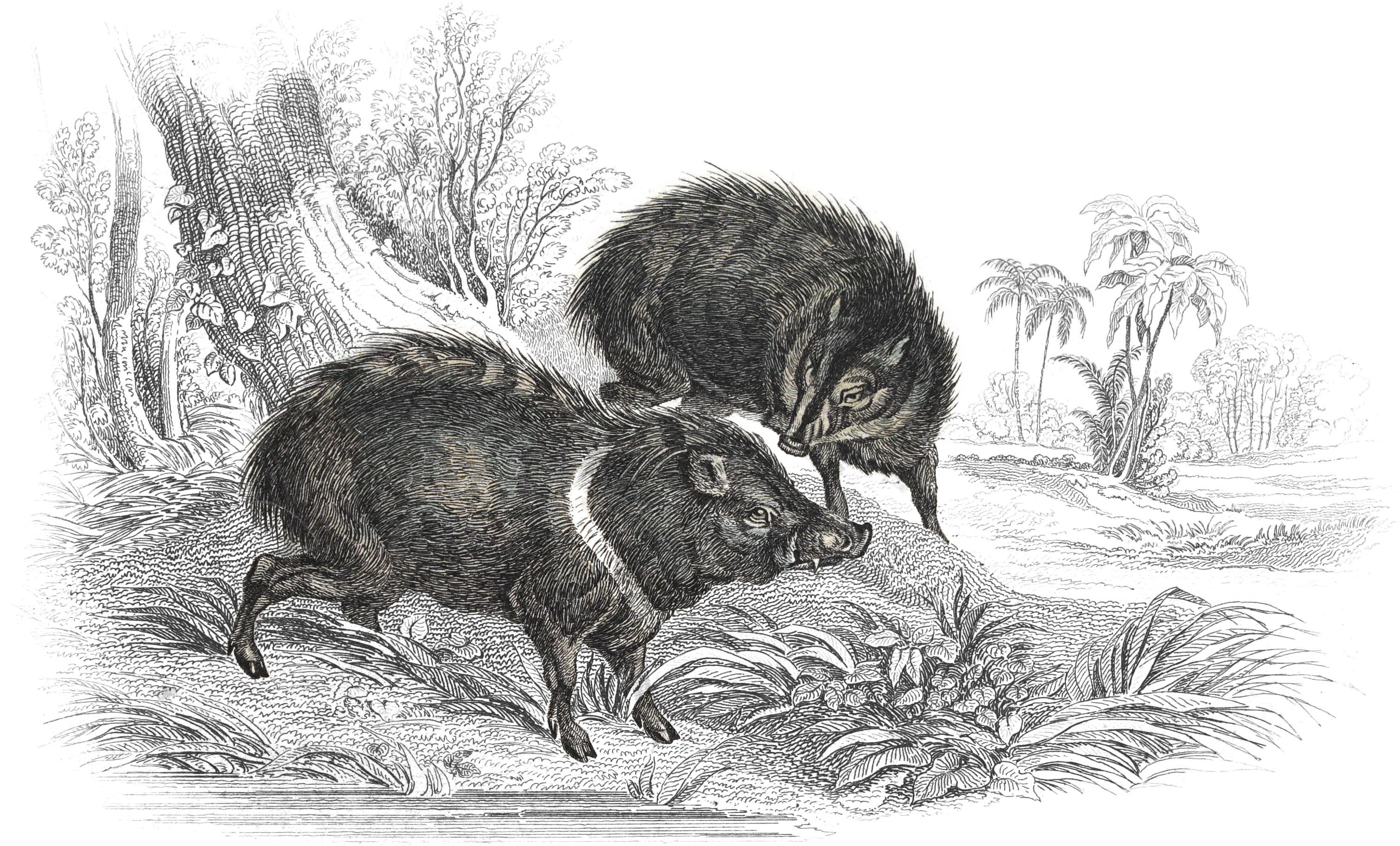
Plate XXVI
The next species is,
The White Lipped Peccary
Dycoteles labiatus.—Cuvier.
Taquicati Azara.—Dicoteles labiatus, Cuv.—La Tojacu, Fred. Cuvier.—The White Lipped Peccary, Bennet, Gardens of Zool. Soc. i. p. 60 61.
This species is considerably larger than the last, but is at once distinguished from it by its darker colour, and the conspicuous white margins of the lips. The hairs on the body are black, with a few brownish rings, which are most conspicuous about the head, and thence modify the tint. The whole of the under lip, the sides of the mouth and nose, are white, whence the name; and the mane and hair about the head are so long as nearly to conceal the ears. In the young animal Mr Bennet mentions, the skin is more varied, being in some degree striped like that of the young Wild Boar of Europe. But these stripes are lost by degrees as the animal advances in age, and few traces of them remain after the first year. Mr Bennet mentions that the gland in this species is inodorous.38
They inhabit Paraguay, and are gregarious, assemble in vast troops, generally led, it is said, by some old male; sometimes a thousand assemble together, and stretch for a mile in length. Like many of the ruminants, they obey the conduct of the foremost. If any obstacle has to be crossed, a deliberation ensues; but as soon as one has passed, the difficulty is overcome, and the same place is chosen by the whole troop. They appear to be excellent swimmers, and in this way a river is crossed after the first has ventured on the plunge. These bands, would attack a huntsman if in the way, or molesting them.
The Peccaries are said, by all those who have partaken of them, to be excellent eating; and Sonnini frequently mentions the delicious repasts in the forest. Being, in addition, animals so easily tamed, and becoming so tractable, and feeding upon a very small allowance, it is to be regretted that some attempts have not been made for their more general introduction. We are not aware that they are even domesticated in America.
For a time our climate would be unfavourable, but by breeding they would harden in constitution, as those in the Society’s Gardens have proved.

Plate XXVII
The Tapirs
The Tapirs are the last of the existing animals which we have to notice, belonging, as we before stated, to the Anoplotheres of Swainson, who has used this extinct and comparatively unknown form as the type of one of his families. They are very remarkable, exhibiting a rounded compact form, standing a considerable height from the ground, and having the nose and nostrils more prolonged than in any of the Pachydermes, except the Elephant, employing this part of their structure as an organ of touch and smell, and partially of prehension. Three species are known,—two inhabiting America, and one part of the Asiatic Islands; while it is said that D’Orbigny has discovered a new animal belonging to this group, in South America, but it has not yet been noticed in the numbers of his important voyages at this time published. They are harmless and inoffensive creatures, never attacking unless attacked; sluggish in the extreme, according to most of their describers; inhabiting the thickest forests, and issuing only on the approach of twilight to feed, after a day spent in sleep or sluggish repose. They feed chiefly on vegetables; but in confinement are by no means nice in their food, and will even swallow substances altogether extraneous, such as pieces of stick or metal. They are very easily tamed, become familiar, and know their master, and will follow him, even when they are permitted their liberty; and it has been thought that a little care would train them to become useful beasts of burden, for which their immense strength would well fit them.
The dentition of the Tapirs is different from the other Pachydermes. There are six incisors and two canine in either jaw, seven molar teeth in the upper, and six in the lower jaw. In osteology they approach near to the Rhinoceros and the Hogs. The intestinal canal is simple, but differs remarkably in the American and Indian animals.39
In the first the stomach is small; the intestines of moderate length, the cœcum large. In the latter it is the reverse, the stomach is large, the intestinal canal very long, the cœcum small. The dentition of the two animals is similar.40
The bodies of the Tapirs are covered with thinly set but closely growing stout hair, rising to a somewhat bristly mane in one of the American species. The skin itself of all is remarkably strong, enabling them to crush through the deepest and most short pointed thickets, and presenting a strong defence from other assailants. We shall proceed with the description of
The American Tapir
Tapirus Americanus.—Linn.
Mborebi, Azara.—Tapirus Americanus, Linn. also Hippopotamus terrestris—Tapir Americain, Lacepede—Tapir d’Amerique, Fred. Cuvier, Hist. Naturelle des Mammif.
This animal is the largest quadruped in South America, and is extensively distributed over that continent, extending over almost every part of it east of the Andes, but probably most abundant within the tropics. It reaches from five to six feet in length, is powerfully formed, and is covered with a scanty close lying hair, forming a bristly mane upon the neck. The colour is a deep brown.
The sides of the lower lip, a band occupying the middle of the chin beneath, the upper edges of the ears, and a naked line at the junction of the hoofs, are all purely white.41
The young are of a lighter colour, and spotted or striped for the first year at least. That described by Mr Yarrel from the Zoological Society’s Menagerie, was
of a rusty reddish brown, with indications of lighter spots and horizontal lines on the ribs, flanks, and thighs.
This animal is frequently hunted by the South Americans with dogs, sometimes it is trapped, sometimes killed with poisoned arrows by the natives, and occasionally it is shot. In all the contests, it is with difficulty mastered, for though inoffensive, its thick skin withstands the attacks of the dogs, and its great strength allows it to handle very severely those who are foremost or boldest in the attack. It is either surprised from its lair, or intercepted at early dawn, on its return from its feeding ground; and when pursued, makes always for water, where he can stand on his defence, while the dogs are obliged to swim around, and are incapable of exerting all their powers. The skin is remarkably thick, and is said to resist a musket ball. M. Roulin mentions having fired at one crossing a stream, and seeing his ball make an impression on the back without farther harm. This might glance off, but we question if the skin of any of these large animals would resist a ball directly fired from a properly loaded and efficient gun. They are hunted for the skin, which is strong, as we have mentioned, and also for the flesh which the Indians delight in; but which is said to be coarse and unpalatable to the unaccustomed stomach of the European.
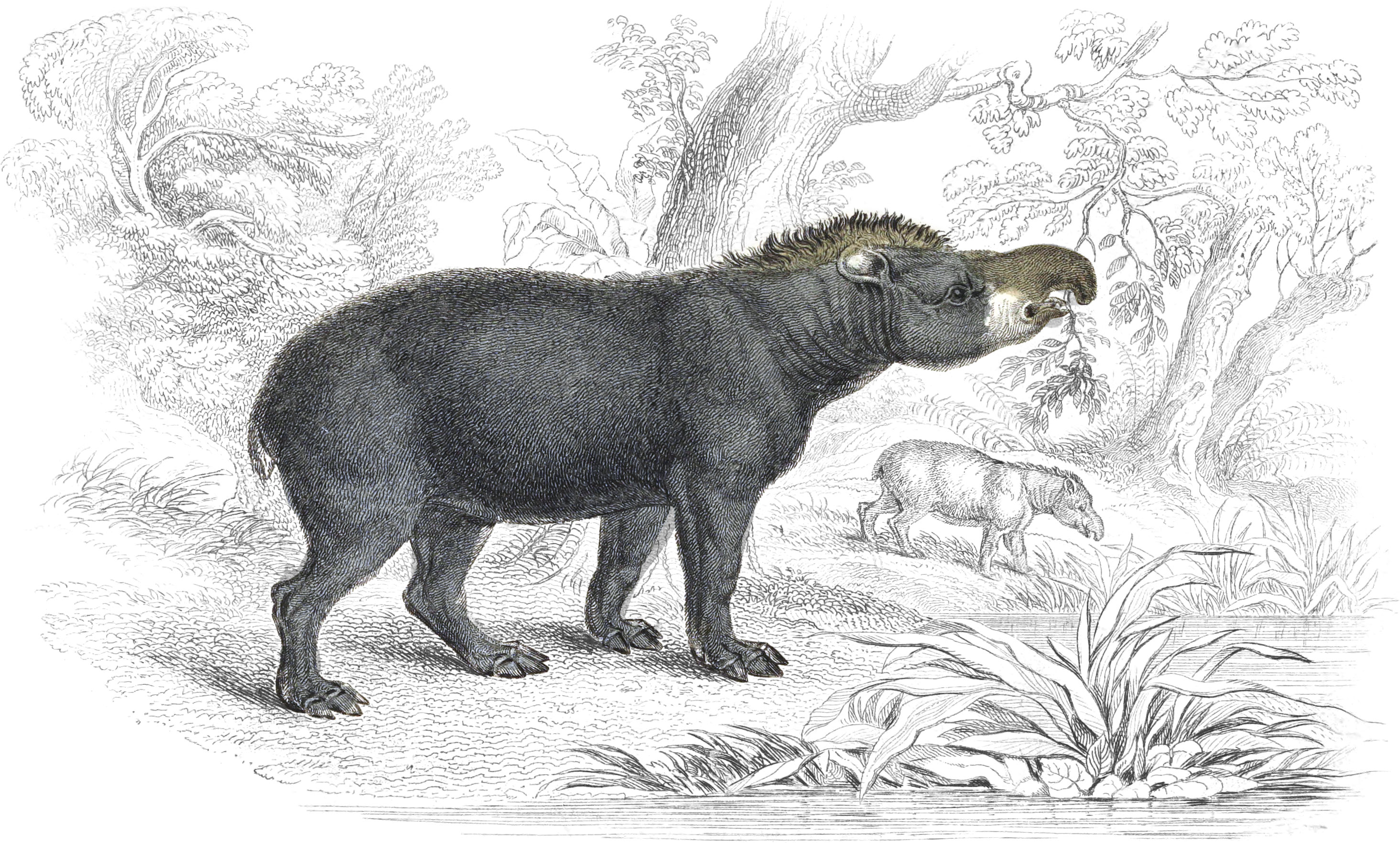
Plate XXVIII
The other American species is
The Tapir of the Andes
Tapirus pinchaque.—Roulin.
Annales des Sciences Nat. 1829, p. 26 110, vol. i.
It had long been suspected by M. Roulin, from the accounts of Oviedo and P. de Aqueda, that a second species of Tapir existed in South America; and from being described to possess a long and thick hair, that gentleman commenced his inquiries and researches regarding it, among the higher regions of the Andes. He was at last successful in procuring the animal, and has communicated a sketch and description in the Annales des Sciences Naturelles, which we have now used.
The size of the adult is nearly similar to that of the other animal, but there is a general difference in the form and appearance of the two. The trunk, or elongated snout, does not exhibit upon the sides those wrinkles which shew that the animal keeps it always contracted. On the chin there is a white spot which is prolonged to the angle of the mouth, and returns upon the upper lip for nearly half its length. The ear is without the white border, and there is not the remarkable crest which commences behind the eyes, and runs upon the shoulder of the common animal. The neck of the Alpine animal is perfectly round, and the hairs upon the centre are neither longer, nor do they lie in another direction; there is, in fact, no trace of a mane. The hair upon the whole body is very thick, long, and of a blackish brown, deepest upon the tips, which gives the peculiar tint denominated, when referring to horses, “bay.” On the haunches, on each side, there is a spot, about the size of the hand, devoid of hairs, but exhibiting no callosity.
The form of the skull exhibits a still more marked difference, which will be seen in the accompanying representations.

Tapir Skull
This animal was about five feet six inches in length, and about two feet nine inches in height at the shoulder. The entrails having been removed to facilitate its transportation, the food could not be ascertained. The hunters, when they discovered the animal, noticed that it was feeding on a sort of bamboo, and pointed out another plant on which they particularly delighted, a species of Espeletia.

Tapir Skull
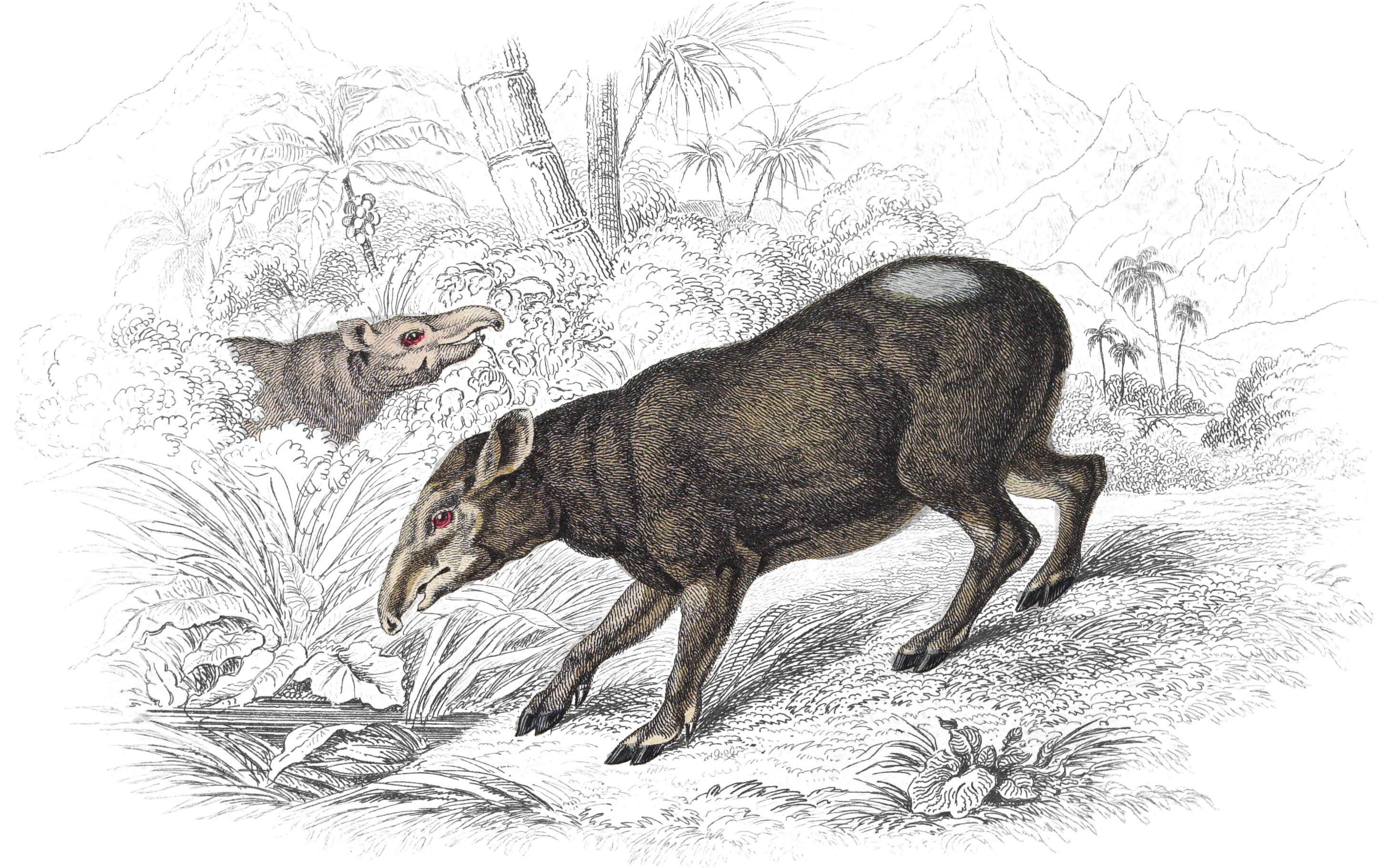
Plate XXIX
The Malay Tapir
Tapirus Malayanus.—Raffles.
Tapirus Malayanus, Raffles, Trans. Linn. Soc. vol. xiii. p. 2 270.—Horsfield’s Zool. Researches in Java.—Le Maiba, Fred. Cuvier, Hist. Nat. des Mammif.
The first specimens of this animal were procured and forwarded by Major Farquhar, while we are indebted to Sir Stamford Raffles for the first descriptions, and through his assistance to Sir E. Home, for some notes upon its anatomy It is very remarkable for the decided contrast of the colours of the body, but in other respects resembles the form of the American animals, being destitute, however, of any mane. The colours are very deep purplish brown, and white, as distributed on the figure of our plate; the skin thick, but thinly covered with hair; the ears bordered with white. The young, according to Major Farquhar,
until the age of four months, is black, and beautifully marked with spots and stripes, of a fawn colour above, and white below; after that period it began to change the colour, the spots disappeared, and at the age of six months it had become of the usual colour of the adult.
It was of a very mild and gentle disposition, tame and familiar as a dog, fed indiscriminately on all sorts of vegetables, and was very fond to attend at table, to secure bread, cakes, and the like. Sir Stamford Raffles’ living specimen was occasionally allowed to roam in the park at Barrackpore, and it frequently entered the ponds, and appeared to walk on the bottom under water, and not to make any attempt to swim.
The Malay Tapir is from six to eight feet in length, and from three to three feet and a half in height at the shoulders. The manners, so far as known, are similar to those of the American Tapir. It inhabits the forests of the Malay Peninsula, and some of the Indian islands, leading an equally inoffensive life, and receiving ample sustenance from the vegetable productions of these luxurious regions. The flesh, though eaten by the Indian with relish, does not seem to cause it to be so much hunted as the American beast, and we are rather surprised that an animal of such bulk and singular markings remained so long unknown, and now remains so much unnoticed with regard to its habits.
We have now noticed all the existing animals which range in this division, and as we before stated, will refrain from mentioning those which are extinct. They have been placed under the names of Palceotherium, Lophiodon, Anoplotherium, Xiphiodon, and Dicobunes. They are in size from that of the Rhinoceros to a small Pig.

Plate XXX
- Leçons d’Anatomie Comparée.
- Grant’s Outlines, p. 105.
- Among herbivorous animals we have noticed a relative proportion between the neck and the legs, but here there is none, and a substitute was required, which we find beautifully compensated by the trunk.
- Oriental Field Sports.
- Williamson’s Oriental Field Sports, i. p. 147.
- See a very curious old work. Elephantographia Curiosa, 1715.
- Hawkins, quoted from Ranking.
-
The imports of Elephants’ teeth, in 1831 and 1832, were, at an average, 4130 cwt., of which 2950 cwt. were retained for consumption. The medium weight of a tusk may be taken at about 60 lbs.; so that the yearly imports of 1831 and 1832, may be taken at seven thousand seven hundred and nine tusks; a fact which supposes the destruction of at least three thousand eight hundred and fifty-four male Elephants! But, supposing the tusks could only be obtained by killing the animal, the destruction would really be a good deal greater, and would most probably, indeed, amount to four thousand five hundred, or five thousand Elephants. Occasionally, however, tusks are accidentally broken, one lost in this way being replaced by a new one; and a good many are also obtained from Elephants that have died in the natural way. Still it is sufficiently obvious, that the supply from the sources now alluded to cannot be very large; and if to the quantity of ivory required for Great Britain, we add that required for the other countries of Europe, America, and Asia, the slaughter of Elephants must, after every reasonable deduction is made, appear immense; and it may well excite surprise, that the breed of this noble animal has not been more diminished. The western and eastern coasts of Africa, the Cape of Good Hope, Ceylon, India, and the countries to the eastward of the straits of Malacca, are the great marts whence supplies of ivory are derived. The imports from Western Africa into Great Britain, in 1831, amounted to 2575 cwt.; the Cape only furnished 198 cwt. The imports during the same year from India, Ceylon, and other eastern countries, were 2173 cwt. The Chinese market is principally supplied with ivory from Malacca, Siam, and Sumatra.
The chief consumption of ivory in England, is in the manufacture of handles for knives; but it is also extensively used in the manufacture of musical and mathematical instruments, chess-men, billiard-balls, plates for miniatures, toys, &c. Ivory articles are said to be manufactured to a greater extent, and with better success, at Dieppe, than in any other place in Europe. But the preparation of this beautiful material is much better understood by the Chinese, than by any other people. No European artist has hitherto succeeded in cutting concentric balls after the manner of the Chinese: and their boxes, chess-men, and other ivory articles, are all far superior to any that are to be met with any where else.—M‘Culloch’s Dictionary of Commerce, p. 737.
- See a lengthened account of the death of this animal in Griffith’s Cuvier, p. 348, vol. iii.
- Pringle speaks of one of the settlers at Enon lying concealed among the forest wood, and shooting the Elephants as they passed down the glen at mid-day.
- According to others it is derived from behemoth, mentioned in the hook of Job, or mehemoth, an epithet which the Arabs commonly add to the word Elephant, to designate one which is very large. See Cuvier, Ann. du Mus. vol. viii. p. 45.
- Telesius says, these are both preserved in the Academy, but describes the drawing as very bad, representing a Pig rather than an Elephant, with red hair on the back. He says that the description was quite worthy of the drawing.
- Some parts of this account not immediately relating to the object in view, are here omitted.
- Sauer Beschreibung tier Billingschen Reise, p. 130.
- This is the drawing before mentioned.
- This has been restored in plaster of Paris from the other side.
- This is an error, as of twenty-eight or thirty caudal vertebræ, only eight are remaining.
- The ears are not well preserved, but may perhaps nave suffered in so long a carriage.
- A dried substance is visible, but it is not certain whether it is the pupil of the eye.
- The places of the insertion of the muscles of the proboscis are visible on the skull. It was probably devoured as well as the end of the tail.
- Nine feet six inches measuring along the curve. The distance from the base or root of the tusk to the point, is three feet seven inches.
- On the arrival of the skin at Petersburgh, it was totally devoid of hair.
- Mem. of Imp. Academy of Petersburgh, vol. v.
- Burchell’s Travels in South Africa.
- Burch. Trav. ii. p. 76.
- See our account of that animal, extracted from the description of Dr Parsons.
- Oriental Field Sports.
- Horsfield’s Zool. Researches in Java.
- W. Bell’s Philosophical Transactions, for 1793.
- The shambok is a strip three feet or more in length, of the hide either of a Hippopotamus or Rhinoceros, rounded to the thickness of a man’s finger, and tapering to the top. This is universally used in the Colony for a horsewhip, and is much more durable than the whips of European manufacture. This manufacture is also known in North Africa, and forms an article of trade, under the name of corbage.
- Classification of Quadrupeds, p. 198.
- Ossemens Fossilles.
- See a long account in Colonel Williamson’s Oriental Sports.
- Oriental Field Sports, i. p. 80.
- S. des Dents des Mammiferes, Disc. praelim. p. xlvi.
- That this arched prominence is constant, may be seen from a representation of the animal by Fred. Cuvier, and an examination of the skulls in the Leyden museum, undertaken by Temminck; according to which, we find that all the skulls of the Cape Phascochaeres, and another from the land at the Ashantees, have the same external form.
- Crech. in Rupp. Atlas.
- Bennet, Gardens of Zool. Soc.
- Bennet.
- Yarrel, Zool. Journal.
- Bennet.