Volume XIV
British Moths, Sphinxes, &c.

Lepidoptera Introduction
In a previous volume of our entomological series, we have given a view of such, of the day-flying lepidoptera, or butterfly tribes, as have been ascertained to inhabit Britain. Their extreme beauty renders them by far the most attractive of our native insects, and we trust that few can have their attention directed, however briefly, to their history, without having their curiosity gratified by the instances of singular instinct and economy with which it abounds. These constitute, however, only one section of the lepidopterous order, and that by no means one of the most extensive. The hawk-moths, and moths properly so called, form the other divisions; and to these we propose to devote the present volume, with the same limitation as formerly in regard to locality. A view will thus be afforded of the entire order of our
——painted populace
That live in fields and lead ambrosial lives,
comprehending an account of the most interesting and remarkable native species which it contains. Several of the hawk-moths are among the most conspicuous insects we possess, one of them the largest found in Europe; and their caterpillars are likewise remarkable for their size and beautiful colour. Although moths in general yield to the diurnal kinds in richness of decoration and colours which seem as if they caught their glowing tints from the pure skies and cloudless sunshine under which these gay creatures delight to roam, they yet present much to please the eye even in their mode of embellishment. Their subdued and occasionally almost sombre hues are finely adapted to the seasons in which they are destined for active life, and are often blended and intermixed in so harmonious a manner as to produce a most pleasing effect. Neither is this sober livery” by any means universal among the tribe; many are decorated with the richest colours, displayed in strongly contrasted bands and spots, and sometimes glossed with a metallic lustre. In the form of caterpillars, too, they become objects of the highest interest and curiosity. In that condition they exhibit examples of the most laborious industry and of the greatest ingenuity, together with a variety in their modes of living, and peculiarity of form and appearance, scarcely surpassed by any other race of little creatures. Then also they afford those
——millions of spinning worms
That in their green shops weave the smooth-hair’d silk;
thus adding to the other considerations recommending them to notice, that which arises from contributing directly to our interests.
Hawk-moths and moths possess, of course, many properties in common with butterflies, besides the peculiar consistency of the wings. In the conformation of the mouth, mode of propagation, character of the metamorphosis, and many other particulars, there is a general agreement, as may be inferred from their being associated together in the same ordinal division of their class. Instead, therefore, of repeating what has been already said respecting the various organs, their functions, and several other general properties, it will suffice to mention what peculiarities are observable in the tribes in question. Their habits and economy, however, are in many cases so remarkable and interesting, that in order to do that part of the subject any thing like adequate justice, it will require to be treated in considerable detail.
They are distinguished from butterflies, among other characters, by having at the base of the under wings, near the anterior edge, a stiff bristle or hair which passes through a hook on the under side of the anterior wings and maintains them when at rest in a horizontal or somewhat inclined position. The most characteristic and distinctive mark of the hawk-moths, the tribe to which we shall first direct our attention, is to be found in the form of the antennæ, which encrease in diameter from a slender base nearly to the apex, forming a prismatic, fusiform club, and usually terminating in a subulated point which is occasionally somewhat curved. This thickening of the antennæ upwards indicates affinity to the diurnal lepidoptera, but in most of their other properties they are more closely allied to the moths or nocturnal kinds. The wings are narrow and elongated, of a firm consistence, and never home perpendicularly in repose, but either parallel to the plain of position or slightly deflexed. The suctorial trunk (maxillæ) is usually of great length, often equal to that of the whole body; and appears, at least in some instances, to be of a more simple structure than among butterflies, consisting only of a simple semi-cylindric canal. When, for example, that of the death’s-head-moth, which is short and rigid, and so sharply pointed as to be able to pierce the skin of the hand, is cut across, only a single perforation of an oval shape is visible. The palpi embrace the base of the trunk, consist of three articulations, and are so densely invested with hairs and scales, that their jointed structure is not discernible till these are rubbed off. The eyes are large, globose, and prominent, Composed of a great number of facettes. The tarsi are all divided into five joints; the intermediate tibiæ are furnished with two spines, and the hinder ones with four and in the anterior pair, which are destitute of spines, there is a slender lobe lying along a part of the under side of the tibia, and attached to it by the upper extremity.
These insects constituted the genus Sphinx of Linnæus, and they compose the family named Crepuscularia by Latreille. The latter term has been applied to them, because many of the most conspicuous species are observed on the wing chiefly during the morning and evening twilight; others, however, do not shun the “garish eye of day,” but maybe seen darting about in the sunshine in company with butterflies and other exclusively diurnal kinds. Their flight is exceedingly rapid, and continued nearly in a direct line, somewhat like that of a bird, differing greatly in this respect from the devious zig-zag motion of most other lepidoptera, many of which seem to float rather than to be impelled by muscular exertion. The wings, notwithstanding, are rather of small size compared with the body; but the thickness and massiveness of the latter admits of great development in the muscles by which these organs are moved, and a momentum is thus communicated to them more than sufficient to compensate for their somewhat limited extent of surface. By their rapid vibration, the taper body of the insect is poised in the air like that of a hawk, while it hovers over the petals of a flower, and extracts the mellifluous juices by means of its long tubular proboscis. The resemblance just alluded to has caused them to be named hawk-moths; and as many of them, when thus hovering in the air, produce a humming sound, and in this respect, as well as in feeding on the wing and in the darting rapidity of their movements, bear some likeness to humming-birds, a few are named after these “winged gems,” and are well known under the somewhat composite title of humming-bird hawk-moths.
The number of these insects found in Britain is not inconsiderable, and includes all the kinds indigenous to Europe, except a few species. Several conspicuous kinds have been admitted into our native lists, in consequence of the occurrence of one or two examples; but from what we know of their history and geographical distribution, it seems more proper to ascribe their appearance in this country to fortuitous causes,—such as accidental importation along with foreign productions, than to their being aboriginal natives of the soil. Such seems to be the case with Sphinx Carolina, 5-maculatus, Daucus, and Druræi, some of which, when caterpillars, feed on exotic plants for which the vegetation of this country can scarcely be supposed to afford any adequate substitute. But on this subject it is difficult to speak decisively, as many species which were once thought to be exclusively confined to one kind of plant have been found to subsist readily on others, when their ordinary pabulum was not to be procured. Deilephila nerii, for example, has occurred in the larva state in Britain, and is frequent in certain years in the north of Germany and other parts of the continent, where the tender shrub from which it derives its name (the nerium oleander and which was thought to be its only food, does not grow spontaneously, and could therefore seldom if at all be obtained.
The caterpillars of the typical sphinxes are of large size, ornamented with fine colours, and possessed of as distinctive characters as the perfect insects. They have six pectoral legs, eight abdominal or membranous legs, and two anal ones, a number corresponding to that of the majority of butterfly larvæ, to which also they are perfectly like in structure. The body is usually rather narrow anteriorly, and encreases slightly in diameter to the eleventh or penultimate segment, which bears a long dorsal horn, somewhat curved and having its point directed backwards. In some cases two or three of the anterior segments become rather suddenly attenuated towards the head, which thereby acquires some resemblance to a pig’s snout, and has given occasion to the French name chenilles cochonnes.1 The surface is without hair, sometimes smooth, but more commonly shagreened, or covered with hard grains like a piece of seal skin; the prevailing colour fine green, the sides often adorned with oblique stripes of yellow, purple, or blue. The caudal horn, which appears under a glass to be covered with small points, arranged after the manner of scales, has been conjectured to be a weapon of offence or defence, but the animal has never been observed to employ it for such purposes. When at rest, they usually elevate the anterior part of the body, and retract the head under the second or third segment, thus assuming a peculiar attitude in which they have been thought to bear some resemblance to the fabled sphinx of antiquity, which led Linnæus to distinguished them by that name. They in general live singly, and feed on the leaves of plants, principally of the herbaceous kind. When about to be transformed, they undergo a sudden and total change of colour, their usual bright hues being converted into dull grey or brown. Preparatory to the same important operation, they merely scoop out an oval chamber in the earth, without enclosing themselves in a silken cocoon, being satisfied with the protection afforded by the slightly agglutinated particles of the circumjacent soil. The chrysalis is generally without angular projections, and in some instances the sheath containing the proboscis is prominent and detached, and curved downwards over the breast.
The larvæ of the Zygenidæ and Ægeridæ, however, which likewise pertain to the crepuscular section, recede considerably from the more characteristic forms and habits just described. They are destitute of a caudal horn, and those of the latter family gnaw the woody portions of trees and shrubs, forming a rude cocoon of the triturated fragments and undergoing their transformations in the interior; while those of the former live exposed on the foliage of plants, and spin a long oval or spindle-shaped cocoon, of a coreaceous texture, which they attach to the stem or branches.
The last, and by far the most extensive section of the lepidopterous order, is that containing the insects known by the familiar name of Moths. This numerous assemblage, which the minute investigations of modem observers have caused to be arranged in a multitude of generic groups, was originally comprehended with in the ample boundaries of the single genus Phalæna, as defined by Linnæus and the older naturalists. They present many remarkable variations, both in their general appearance and in the details of their structure. Their manners and economy are likewise so diversified and curious, that a minute account of these would afford ample materials for a work of considerable extent, exclusive of any description of the insects themselves. In the space here designed to be allotted to the subject, in conformity with the endeavour we have hitherto made to combine two objects, which have been frequently disjoined, to the material hinderance of accurate knowledge in natural history, viz. a general account of the habits of animals, with a correct view of their specific forms and appearance, we shall first mention what is peculiar to these insects in their winged state, and then describe their external structure and habits as caterpillars. An opportunity will thus be afforded of presenting what is most striking in their ways and instincts, which, taken in connexion with what has been said in a previous volume regarding the phenomena of transformation, &c. and what is subsequently supplied in notices of the respective genera and species, will form at least what is most material to be known, and all that is likely to interest a general reader,—it may be something more—in the history of the lepidopterous tribes.
These insects are best distinguished by the shape of the antennæ, which are setaceous or diminishing in thickness from the base to the apex. They are generally long and flexible, and composed of oblong, subquadrate, or transverse joints. In many cases they are toothed or serrated, and often emit a series of parallel branchlets on one or both sides, somewhat resembling the teeth of a comb, whence they are said to be pectinated or bipectinated. These branchlets are sometimes themselves furnished with a secondary row, and have two or three divergent spines at the tip, all of them placed with much regularity, and presenting a very beautiful appearance under a magnifying lens. They are generally more or less clothed with scales, which sometimes (as in Hypena prohoscidalis) are very long and not unlike feathers. Whenever they deviate from a simply articulated structure, the antennæ are more developed in the male than in the female; if serrated in the former, for example, they are often simple in the latter; and if those of the male are pectinated, his partner usually has them merely serrated, or at most imperfectly pectinated. In a group of small silver-spotted moths (Argyromiges) which suspend their slender cocoon to the under side of a leaf by means of four threads at each end, exactly after the manner of a hammock, the antennæ when in repose are bent backwards and lodged beneath the wings.
The superficial scales are greatly more varied in shape than among butterflies; indeed, it has been asserted that they assume a different form in each species. This, however, is by no means the case, but they are frequently dissimilar on different parts of the same individual Many of them are so long and slender that they have the appearance of hairs, but the application even of a faint magnifying power shows that they are more or less dilated at the tip, and frequently bifid, trifid, or palmate. Of this nature are the kinds composing the hair-like tufts and crests on many of the noctuidæ, as maybe seen by examining the gamma-moth (Plusia gamma) a common species in most parts of the country.
The proboscis is apparently of the same structure as in the day-flying tribes, and presents nothing peculiar in its appearance. It is seldom of great length, and in many instances it is merely rudimentary, while in others it is altogether wanting. The Swifts or Ghost-moths (Hepiali), the Goat-moth, and many others, are so circumstanced, and they are probably in consequence incapable of taking any nutriment. Moths are occasionally observed to feed on solid substances, such as sugar; this they are enabled to do in the same manner as flies (Diptera), by discharging a liquid from their trunk, which softens and dissolyes the particles till they become sufficiently fluid to be absorbed.
The palpi generally consists of three joints, but in some cases, as in the genus Lithosia, they are only two jointed. These organs are sometimes very diminutiye, but in general they are well developed, and at times so much, elongated as to form a lengthened muzzle in front of the head. From this circumstance some of these insects are named Snout-moths. In a group of small species, distinguished by the name Peronea, they are directed obliquely downwards and much thickened towards the tip, forming a scaly somewhat hatched-shaped mass. One species (Anacampsis longicornis) receives its name from the length and unusual appearance of the appendages in question, which are curved upwards on each side of the head, appearing like two long divergent horns; and in another, they are advanced in front of the head and curved towards each other after the manner of a lobster s claws, whence the insect is named the Lobsterclawed-moth (Chelaria rhomhoidella). These are what are called, from the place of their insertion, the labial palpi, and are the only organs of the kind with which the generality of moths are provided. In certain groups, however, there is likewise a maxillary pair, sometimes conspicuous and uncovered, but usually minute and concealed among the frontal hairs. Such is the case with the family Teneites of Latreille, and a few others allied to them. On the other hand the palpi, like the trunk, are sometimes wholly wanting, as maybe seen in the Ghost and Emperor moths.
The thorax is shorter, and generally more robust than among butterflies. Besides the patagia or tippets which they possess in common with the latter, many of them have an irregularly shaped appendage on each shoulder, having the appearance of a lappet; these are named tegulæ or base-covers, and are well exemplified in the genus Lithosia and its affinities. This part of the body often bears one or more conspicuous dorsal tufts of feathery hair-like scales, of which the anterior and posterior are sometimes concave; in which case the former has the concavity directed forwards, and the latter has it turned in an opposite direction.
As appendages of the thorax, the legs next require a brief notice, but they present nothing very peculiar in their formation. An exception to this character, however, is perhaps to be found in the occasional great length of the coxæ, which in the anterior legs of certain species (Hypena prohoscidalis, for example) are as long as the tibiæ, and not much shorter than the thighs. The two last named divisions of the leg are often densely clothed with long hairs, and the tibiæ, in the fore pair, are usually furnished with a strong spine on the inner side, which sometimes assumes the appearance of a rigid compressed lobe. In most cases this is the only projection on the anterior legs; the intermediate tibiæ generally have two spurs at the apex, and besides a similar pair in the hinder ones, there are often two others in the middle. The latter arrangement is frequently observed also in the intermediate tibiæ. This portion of the leg often bears a pendant tuft of loose hair, which probably assists in balancing the body during flight; and in some instances (as in the genus Alcis) the tibiæ have a groove internally which receives the tuft within it when at rest. The tarsi are always pentamerous, the joints usually elongated, the basal one being sometimes longer than the tibiæ. Hepialtis Hectus is anomalous in this respect, the tarsi being entirely wanting in the hinder legs.
It has been already stated that the wings of the night-flying lepidoptera are never held in a vertical position when at rest; but this negative character is almost the only general one that can, in this particular, be ascribed to them. In other respects, their position and bearing are so varied, that the distinctions arising therefrom have been sometimes employed to divide the whole tribe into separate groups. In many they are parallel to the plain of position, or slightly inclined, and the upper pair folded along the back in such a manner that the one overlaps the other, thus rendering the two anterior margins parallel with each other and with the body, while the under pair are folded up beneath somewhat after the manner of a fan. It frequently happens, in an arrangement similar to this, that the internal edges do not overlap but are simply applied to each other; or the internal edges are parallel and more or less remote from each other, leaving a portion of the back of the abdomen exposed, while the line of the anterior edge of the upper wings gradually recedes from the body to the hinder extremity, and thus forms the side of anisosceles triangle. In many instances the upper wings meet at their internal edges, and are elevated above the body in such a way as to form a kind of roof over it, the ridge of which is some times sharp, at Other times rounded. The Cinnabar-moth (Pl. 21. fig. 2.) affords an example of the former, the Goat-moth (Pl. 14. fig. 2.) of the latter. Many of the smaller moths (Tiniæ) have their wings convoluted, or rolled round the body so as completely to embrace it. Others, contrasting with these, keep them always fully expanded, so that the posture maintained in flight is scarcely changed when they alight; of this description are several of the brindled-moths, common in gardens, produced from geometer caterpillars which feed on fruit trees. In some genera the under wings project considerably beyond the upper, as may be seen in the Lappet-moth. It may likewise be noticed that several of the small Tortricidæ are remarkable for having a sudden and deep emargination on the anterior edge of the upper wings, as if a semicircular portion were cut out; whence they are known to collectors by the epithet of Notch-wing moths.
A difference in the port of the wings is sometimes a sexual distinction, hut that is often marked in a more decided manner. On this subject it may be regarded as the most general rule, that the female, contrary to what is observed in many of the higher animals, is larger than the male, sometimes even double the size.2 The greater or less development of the antennæ has been already mentioned as occasionally affording an obvious indication of the respective sexes. In several cases the colours and the mode of their distribution are so dissimilar, that when taken in connexion with other strongly marked differences, they would lead an observer, ignorant of the relations that subsist between them as proved by other circumstances, to refer the two sexes to entirely different genera. An example of this is seen in the Gipsey-moth (Hypogymna dispar) and several others. A few female moths are entirely apterous, or have wings of such a rudimentary kind as to be wholly unfit for flight, a peculiarity which may be witnessed in the well-known species named the Vapourer (Orygia antiqua).
In such instances as that just mentioned, it is evident that the sexes would often experience the utmost difficulty in discovering each other, unless they were possessed of some peculiar means for that purpose. The case, indeed, is precisely analogous to that of the glow-worm, whose “nuptial lamp” has been long regarded, and to all appearance with perfect propriety, as a special provision to meet this exigency. Even when both sexes are winged, as is usually the case, a speedy introduction to each others society is too necessary a step to be left to the chances of a casual encounter, as many of them are extremely short-lived, and not very locomotive in their habits; and an opportunity might thus be wanting to execute a function for which alone, in many cases, they seem to enter upon their winged state. The males, accordingly, particularly of certain kinds, possess an extraordinary acuteness in the sense of smell (or, it may be, are gifted with some peculiar faculty the nature of which is unknown to us), by the intimations of which they can discover the opposite sex at a great distance, and in the most secret situations. Advantage is often taken by collectors of this circumstance to secure specimens of the rarer kinds, and the following plan, as described by Mr. Haworth, may frequently be followed with success when most others are unavailing. He says,
It is a frequent practice with London Aurelians, when they breed a female of this and some other day-flying species (he speaks of Lasiocampa Quercus), to take her, while yet a virgin, into the vicinity of woods, when, if the weather be favourable, she never fails to attract a numerous train of males, whose only business seems to be an incessant, rapid, and undulating flight in search of their unimpregnated females. One of which is no sooner perceived, than they become so much enamoured of their fair and chaste relation, as absolutely to lose all kind of fear for their own personal safety, which, at other times, is effectually secured by the reiterated evolutions of their strong and rapid wings. So fearless indeed have I beheld them on these occasions, as to climb up and down the sides of the cage which contained the object of their eager pursuit, in exactly the same hurrying manner as honey-bees, which have lost themselves, climb up and down the glasses of a window.
The Chinese likewise turn this ardour in pursuit of the female to good account, by fixing individuals of that sex, pertaining to a species whose caterpillar produces valuable silk, by a thread to a tree in an exposed situation, where they are soon visited by numerous males to the great increase of the proprietor’s stock.
The eggs produced by these insects present endless variations in their form, substance, and colour. The surface is often very beautifully carved, as was formerly described to be the base with those of butterflies, a circumstance, it has been justly remarked, which distinguishes these tribes from all other oviparous animals. In general they are of one colour, the prevailing tints being white, yellow, grey, and brown. Sometimes, however, they are speckled like the eggs of birds, and at other times encircled with zones of different shades, a mode of distribution of which those of the feathered race afford no example. Thus, for example, the egg of the Brimstone-moth (Rumia Cratægata), otherwise remarkable for being covered with hexagonal reticulations, is yellow spotted with bright red; and that of the Lappet (Gastropacha Quercifolia) is blue with three circular bands of brown. In some instances the colours undergo a succession of changes as the egg advances to maturity, an effect which may be produced either by the changing condition of the embryo becoming manifest through the transparent integument, or the chemical action of air, moisture, and other influences on the substance of which the latter is composed. An example of this description is afforded by the eggs of a rare British moth, named by the fancy the Glory of Kent (Endromis versicolor) which are bright yellow on their first exclusion, and then become successively green, rose-colour, and black.
The profuse fertility of most insects is well known, and the subjects of the present notice partake largely of this general attribute of their race. The Silkworm-moth, for example, lays about 500 eggs, the Goat-moth 1000, and the Tiger-moth 1600. They are deposited either singly or in groups, and in the latter case are often arranged in a uniform symmetrical order by the parent moth, a process in which she manifests great ingenuity and prospective care, both for the preservation of the eggs and the welfare of the future young. The insoluble gum with which they are usually covered, protects them from the influence of the weather when they are left exposed. But in many cases they are placed under some kind of shelter, and several species cover them with down, which they pluck from their own bodies by means of a pair of anal pincers with which they are provided apparently for this express purpose.
The caterpillars of moths are much more varied in their general forms and in the structure of their parts than those of butterflies, and indeed they may be said to be formed on a greater variety of models than most other animals. Their clothing and appendages are likewise extremely various; every kind of the former found in butterfly-larvæ being observed among them, besides several others peculiar to themselves. One of their most important variations is in the number of feet, a circumstance which necessarily: gives rise to different modes of progression, and occasions striking differences in habit and appearance. Before alluding, however, to the number and arrangement of the feet, it will be proper; to mention what peculiarities are observable in the structure of these members. In many instances there is no fleshy plate at the extremity of the pro-legs capable of being expanded and contracted to serve the purposes of a foot, the leg being simply a conical fleshy prominence, having the extremity surrounded by a complete coronet of hooks. Examples frequently occur in which the prolegs have a very much the appearance of a wooden leg, the upper part being thick, succeeded by a slender cylindrical piece which terminates in a circular expansion surrounded with crotchets, and having a small nipple in the centre which holds the place of a foot. Although these small hooks are generally present, this does not seem to be universally the case, for the subcutaneous larvæ of a small moth of the Linnean genus Tinea, and a few others, are said to be without them. The true, or pectoral legs, are always six in number, and nearly uniform in figure; the most remarkable among the few exceptions to this, is to be found in the caterpillar of the Lobster-moth, which has the two posterior pairs greatly elongated and terminating in a kind of claw. The amount of abdominal legs, however, is very variable in different groups, and in the anomalous caterpillars of two small brownish-yellow moths (Heterogenea Asellus and Limacodes Testudo), they are entirely wanting, their ‘place being supplied by a number of small simple tubercles. The larvæ of a great proportion of the largest and most conspicuous of native moths are provided with ten prolegs, like those of butterflies, and placed in the same order. In many others there are only eight, either one of the abdominal pairs, or the anal one, being absent. When the latter is the case, the hinder extremity of the body sometimes bears two caudal appendages (as may be seen in the caterpillars of the Puss and Lobster moths), with the free motions of which a pair of anal legs would probably interfere. Many larvæ possess only six prolegs, others four, and a few of the smaller kinds merely a single pair, attached to the anal segment. Such as have a considerable number of intermediate legs generally keep their body, when walking, parallel with the plain of position, and advance by the rapid and successive motion of each segment, as if, as has been happily remarked, a wave were flowing over or pervading their bodies. But such a mode of locomotion evidently cannot take place when most or all of the abdominal segments are without legs, as is the case with some of those just mentioned. These accordingly adopt a different method, by means of which they are enabled move about with ease and celerity. They first fix their prolegs to the plain of position and stretch the body forward to its full extent; then laying hold with the anterior legs, the tail is let free and drawn towards the head, the intervening portion of the body being bent upwards into a loop or arch. Every progressive movement is effected by a repetition of the same manœuvre, and the ground is thus traversed by regular and measured steps, each of which is nearly equal to the length of the insect’s body. These peculiar attitudes have caused the caterpillars to be termed loopers and geometers; and as they possess the power, from the great strength of their muscles, of fixing themselves by the hinder legs o a branch, and stretching out the body stiffly into the air, a position which they often maintain immovably for a length of time, they are likewise known by the name of surveyors. The kind of locomotion just described is best exhibited by such larvæ as have only two or four prolegs, but it is likewise seen in those that have six, and occasionally even in species furnished with the full compliment of ventral legs.
In the colour of their bodies these caterpillars are as greatly diversified as in their other properties. Such as live in the interior of trees, and in places where they are little exposed to the influence of light, are frequently of a dingy white or yellowish brown colour; but the kinds which frequent the foliage of plants, constituting by far the largest proportion, are often ornamented with the most vivid and varied tints. Reaumur asserts that they exhibit examples of every known colour, besides an infinite variety of shades, of which it would be difficult to find the like elsewhere. Some are of one uniform hue, but the majority are adorned with several, often very vivid and strongly contrasted. Sometimes they are distributed in rays of longitudinal stripes, at other times in bands which follow the contour of the rings; often in waves or spots of regular or irregular figure; and not unfrequently in insulated points, and numerous other forms too complex and varied to admit of being here particularised.3 It frequently happens that the colours of larvæ, before their first moult, are entirely different from those afterwards assumed; and in some instances they undergo a considerable alteration at every successive change of skin. Difference of colour, in individuals of the same species, sometimes indicates the respective sexes of the future moth; thus, according to De Geer, the brown caterpillars of a common species, the Yellow Underwing (Triphæna pronuba) produce males and the green ones females.
Many of these caterpillars are distinguished by horns and protuberances of various sorts, which add greatly to the singularity of their aspect. The curious caudal appendages of those of the Puss and Lobster moths have been already alluded to, and will be more particularly described hereafter. Several have a kind of horn on the hinder extremity, something resembling that of Hawk-moth larvæ, but it is never so long and acute as in the latter, at least among British species, but rather assumes the form of an elongated tubercle. An example of this may be seen in the conspicuous caterpillar of the Lappet-moth, which is further deserving of notice under this head, from being provided with a lateral series of fleshy lobes, hanging one from each segment and giving the creature the appearance of having twenty feet. It is from these appendages bearing some resemblance to lappets that the moth has obtained its English name. The larva of the Twin-spotted underwing (Miselia bimaculosa), of the Coxcomb (Lophopteryx Camelina), and some others, have the penultimate segment armed with a pair of short horns; and that of a geometer-moth, named the Lilac-beauty (Pericallia syringaria), has two long recurved ones on the back of the eighth segment. Others of these surveyors have a variety of dorsal prominences, which contribute greatly to increase the remarkable resemblance many of them bear to a withered twig, by representing the knots and other projections of the wood. The curiously formed caterpillar which produces one of the most lovely of our native moths, named, from the rosy spots on its upper wings, the Peach-blossom (Thyatra Batis), bears a large tubercle near the head, divided at the top into two short horns. A still more remarkable projection is found in a prettily marked caterpillar occasionally met with in gardens throughout the country. It is an obtuse fleshy pyramid rising from the back of the fourth segment, of a black colour, fringed with hairs, and incapable of motion; the moth named the Dagger (Acronycta Psi) originates from this larva. Several have the power of emitting a short retractile vesicle from some one of the abdominal segments; and the caterpillar of the Emperor-moth has a perforated tubercle in front of the pectoral legs, through which, when disturbed, it squirts a transparent fluid. This is evidently given for defence, but with regard to most of the appendages previously mentioned, and others of a similar kind, we are wholly unacquainted with their use.
Many of them are almost wholly free from hairs and pubescence, but in numerous instances these form one of the most striking characters belonging to them. Although much more varied in the clothing of their bodies than butterfly larvæ, they are devoid of the strong spines formerly described as characterising many of the latter.4 These hairs are of different kinds, and arranged in a variety of methods. Sometimes they are soft and decumbent: at other times, long, slender, and tortuous, investing the body as with a fleece of wool; while in other instances they are long and stiff resembling bristles. Frequently they are all directed backwards, at other times they are turned towards the head, and in some cases they are nearly all pointed upwards or downwards so as to cover the back or belly and leave the opposite half of the body almost bare. In some they are scattered promiscuously over the surface, and in others issue in tufts from rounded tubercles arranged in a certain order. These tufts sometimes assume a very peculiar form, especially in the larvæ of Tussock-moths (Orygia, Laria, &c.) and a few others. Two long fascicles stand out from behind the head and project forwards, the hairs of which are dilated at the point in such a manner as to make them resemble a painter’s brush. A similar fascicle springs from the hinder extremity and is directed backwards, and along the back there is a series of short wedged-shaped tufts of equal length formed by thick-set parallel hairs. These elongated tufts are often rendered still more conspicuous by being of a different colour from the other hairs; the latter also vary greatly in their tints, which are often mingled and diversified so as to produce a very ornamental effect. When the hairs are long and thickly set, as is often the case, they form a very efficient clothing, and tend to save the larva from injury when it happens to fall; they likewise seem, at least in many cases, to be organs of touch, for the slightest impression upon them produces movements in the animal which indicate that it is felt. Lyonet has shown that those of the Goat-moth caterpillar are partly hollow, and set in a scaly ring somewhat elevated above the skin, through which the root communicates with a soft integument upon which the nerves form a reticular tissue, a structure which renders it highly probable that they perform the function just alluded to.
With so much difference in the form, members, and clothing of the body, the caterpillars of moths are adapted to live in a great variety of situations and circumstances. By far the greater proportion are to be found on the foliage of plants; many occur only in the interior of the stem or branches; not a few burrow in the earth to consume roots; and a small number are inhabitants of the waters. Neither are they less varied in the nature of their food. Few kinds of vegetable produce are exempted from their ravages, and unhappily their taste both for these and various sorts of fruits, often coincides with our own. Corn is not only exposed to their depredations while in the blade, but even after it has been laid up in supposed security, the grain is sometimes converted into a tenement for a small worm, the offspring of a moth, which speedily consumes all but the outer covering. They eat with avidity the most bitter plants which our fields produce, as well as those replete with a caustic and corrosive juice, which on that account are left untouched by other animals. The stings of the nettle, and the prickles of various other plants, are so far from warding off their attack, that these plants seem to be the resort of a greater number of caterpillars than those that are without any such defence. Wool, feathers, hair, and many other substances which set at defiance the digestive powers of other animals, are well known to form a favourite repast to these anomalous creatures, and as if no limits were prescribed to their voracity, some of them do not hesitate to devour each other whenever: they have an opportunity.
Most of these caterpillars feed during the day, but many are as exclusively nocturnal in their habits as the moths that spring from them. The geometers especially may often be observed during the whole day perfectly motionless, either stretched flatly along a branch, or projecting from it like a broken twig; but the gnawed leaves in their vicinity show that they are not always thus inactive. An example of this kind may be seen in a species of pretty large size, common in autumn on cherry-trees throughout the south of Scotland and many parts of England, which so closely resembles the bark, that it is detected with the utmost difficulty. The same circumstance accounts for a fact sometimes mentioned with surprise, that the extent of the injury done to our culinary vegetables is often quite disproportionate to the number of depredators seen upon them—the season of their greatest activity being that in which they are not exposed to observation. Others take their food only in the morning and evening, the middle of the night and of the day being their seasons of repose.
Although the enemies of caterpillars are numerous and destructive, consisting of birds, parasitical ichneumons, &c. and although they are occasionally subject to a kind of epidemic disorder which destroys them in great numbers, yet they often increase to an undue extent, and occasion considerable injury. Instances of their depredations are indeed of such ordinary occurrence as to have fallen under the observation of almost every one, and absolve us from any necessity of giving many details on the subject. Perhaps the species which haye proved most injurious to the produce of our fields in this country, are those of the Brown-tail-moth (Porthesia auriflua, Steph., Bom. phæorrœa, Curtis. Don.), the Gamma-moth (Plusia gamma), the Antler-moth (Charæas graminis), the Lackey (Clisiocampa neustria), the Buff-tip (Pygera bucephala), the Cabbage-moth (Mamestra Brassicæ), the small Ermines (Yponomeuta), and a few others. The first mentioned of these increased to an extraordinary degree in several parts of England in the summer of 1762, and by completely defoliating the trees, occasioned such alarm that prayers were ordered to be read in the churches to avert the calamity. It was apprehended, by those ignorant of their history, that these caterpillars would likewise destroy the growing corn and grass; but it was soon shown that the leaves of trees and shrubs form their only food, and that these valuable productions would consequently escape their attack. So numerous were these creatures, that subscriptions were opened in many parishes, and poor people employed to cut off the webs at the rate of a shilling a bushel, which were burned under the inspection of the overseers of the parish; and it is stated that no less than fourscore bushels were for a while collected daily in some of the parishes,5 The caterpillar of the Gamma-moth is common in all parts of the country, and as it feeds indiscriminately on a great variety of vegetables, it probably produces more damage than most of the indigenous species. The larva of Chareas Graminis has sometimes done much mischief to the pastures in the south of Scotland and northern parts of England, but it is happily of rather rare occurrence in the south. In the continental countries of Europe, the ravages of some of the caterpillars just mentioned are sometimes carried to an extent of which our own country, probably from its insular situation, affords no example. On one occasion those of the Gamma-moth overran great part of France, devouring almost every thing green, with the fortunate exception of the different kinds of corn. The peasantry of Alsace suffered so severely that they went to their priests and entreated them to try the effect of religious processions in ridding them of the plague; and the people of Paris, under the idea that the creatures were poisonous, ceased for a time to use any kind of vegetable for food. Unhappily no effectual means of easy application has yet been found to guard vegetables from their attacks or speedily to diminish their numbers. Reaumur suggests that in times of scarcity they might be used as an article of food!
Of these caterpillars some are solitary during their whole life, appearing to hold no intercourse whatever with the rest of their kind; many live in societies for some time after they are hatched, but separate as they grow up; while others continue together all the time they are caterpillars, even undergoing their metamorphoses in company, and not scattering till they acquire wings. The habitations which they construct, and many particulars in their economy, depend to a certain extent on their habits in this respect, and in noticing this branch of their history, perhaps the most interesting that belongs to it, we shall first describe some of the most remarkable structures of solitary caterpillars, and next advert to those formed by the combined exertions of several.
The habitations of the former sort are either formed by the union of separate pieces, sometimes of different materials, or more simply by folding or rolling together the leaves of plants; and they are designed either for the protection of the caterpillar during its lifetime, or the reception of the chrysalis into which it is subsequently converted. Several form a covering for their bodies similar to that of the Phryganidæ, or Case-flies, with which they move about like a snail or any other of the shell-bearing molluscæ. Of these one of the most curious is the larvæ of a small Tinea, which has not unaptly been named the stone-mason caterpillar. It forms a sheath for its body, or a kind of moveable tent, by &, agglutinating into a compact structure, small particles of stone detached from the wall on which it lives. This miniature tent is of a conical shape, somewhat curved, open at both ends, and borne rather obliquely. The head and anterior part of ‘the little inmate project, when it moves, from the opening at the | widest end, and when the moth is perfected it issues from the other, which has been previously widened to allow an easy passage. Previous to its change into a chrysalis, the caterpillar fixes its dwelling securely to a stone, by means of a strong mooring of silk. The gentleman who first described the proceedings of this creature, supposed that it used the particles of stone for food, but more accurate observation soon proved that they are employed only for the purpose above described. Its real food seems to be lichens and minute mosses, which usually abound on old wailis.
The weight of such a covering may be supposed to impede materially the insect’s movements, for never, says Reaumur, was a Roman soldier charged with such a burden. Others accordingly select a lighter material to cover the layer of silk which they invariably place next their bodies. Some kinds (such as Psyche radiella, Curtis B. E. fol. 332) may be said to thatch it, for they invest it with small pieces of withered grass of different lengths, which lie over each other and form a kind of imbricated coating. Others fabricate this outer vestment from fragments of leaves; and a small species described by Reaumur, which feeds on a kind of Astragalus, ornaments its covering with what he calls furbelows or flounces, resembling those used by ladies in former times.6 Similar to these are the coverings of the caterpillars of the Clothes-moths, in the fabrication of which they show a degree of diligence and ingenuity, which it would be more pleasing to contemplate if less frequently exercised to our disadvantage. Their mantle consists of a small somewhat cylindrical tube, open at both ends, and rather widest in the middle. The exterior of this tube is a tissue of wool and silk, but the interior is lined with pure silk, for the greater comfort of the little tenant, whose body is soft and tender. So indispensable to its welfare is a fabric of this kind, that the worm begins to weave it soon after it issues from the egg. The growth of its body, however, renders it necessary that the domicile should be frequently enlarged both in length and width. The former it readily accomplishes by putting out its head from one end, cutting the filaments of the wool with its scissor-like mandibles, and then, by turning its head backwards, incorporating them with the rest of the tissue; it then turns itself in the opposite direction, which the wideness of its tube in the centre enables it do with facility, and repeats the same operation at the other extremity. The widening of the tube is a more difficult task, and the plan which it adopts to accomplish it is as ingenious as if it were the result of a process of reasoning. The most obvious method, and that which we would probably adopt in such a case, would be to make a rent the whole length of the garment, and again fill it up by inserting a new piece sufficient to afford the extension required. But such a proceeding on the part of the worm would expose its body for a time without adequate protection, an accident of which it seems to have the utmost dread and guards against . it with every precaution. It accordingly makes the rent extend only half way along, and when that fissure is filled up, forms another at the opposite end, There are generally two fissures made in each half, the one being opposite the other, so that the widening of the tube is effected by the insertion of four separate pieces. The colour of the garment is necessarily the same as that of the cloth which affords the raw material, and if the latter be party-coloured it exhibits a corresponding variety of hues. The creature feeds on the same material with which it clothes itself.
These may be called domestic moths, as they are found only in houses, where they live at the expense of the proprietor. Others, of more innoxious habits, frequent the foliage of trees, and fabricate, with still greater ingenuity, their little moveable tents from the thin membranes which form the outer coats of the leaves. Their proceedings were first accurately described by Reaumur, whose account we shall therefore follow, using as nearly as possible his own words. One of the kinds which he mentions is found on the leaves of the elm, and its method of working may be taken as an example of the plan followed by the whole tribe. It commences by mining its way into the substance of the leaf between the two enclosing membranes, consuming, as it proceeds, the parenchyma or pulp which constitutes its only food. In this way it excavates a portion of the leaf, leaving nothing but the thin superficial membranes, which it takes particular care not to injure, as they form the material from which the mantle is to be manufactured. The latter is composed of two equal and similar pieces, each forming one-half, shaped and united with as much regularity and precision as if executed by the most skilful artist. The difficulty of the task is increased by the pieces not being of regular figure, each of them being one-half wider at the one end than the other, and each side presenting a different curvature, the one slightly concave and the other convex. When the two pieces are cut into the requisite shape, they still continue to adhere to the leaf by means of the small creatures left by the operator’s teeth, and it now remains only to sew the two portions together. For this purpose it employs the silken thread, which every caterpillar can spin, and attaches the two edges so firmly and neatly, that it is difficult, when the habit is completed, to discern the point of junction even by the aid of a lens. A rounded form is given to it by its being at first moulded, as it were, on the body of the insect itself, and its dimensions are easily increased by the walls being pushed outwards. The interior is freed from inequalities by the pressure of the insect’s head, and then lined and strengthened with a coating of silk; those parts being made strongest, which, from their prominence, are most exposed to friction. The little dwelling is now complete, but continues attached to the spot where it was formed. In order to disengage it, the insect puts out the anterior part of its body, and fixing its fore-legs to the leaf, drags the case forwards, retaining its hold of it chiefly by the small hooks on the abdominal legs. It is now in a condition to transport itself from one leaf to another, and select the portions best suited to its taste, without incurring the risk, which it seems so much to dread, of exposing itself to the air.
Apparently with the view of saying themselves the labour of sewing up one of the sides of their domicile, some of these creatures have the sagacity to mine the leaf close to one of the edges, and thus preserve the membrane unbroken on three of its sides. One of the authors of the Introduction to Entomology says,
Their proceedings, I had the pleasure of witnessing a short time since upon the alders in the Hull Botanic Garden. More ingenious than their brethren, and willing to save the labour of sewing up two sides in their dwellings, they insinuate themselves near the edge of a leaf instead of in its middle. Tere they form their excavation, mining into the very crenatures between the two surfaces of the leaf, which, being joined together at the edge, there form one seam of the case; and from their dentated figure, give it a very singular appearance, not unlike that of some fishes which have fins on their backs. The opposite side they are necessarily forced to cut and sew up; but, even in this operation, they show an ingenuity and contrivance worthy of admiration.
A numerous tribe of small caterpillars feed, like those just described, on the pulp of leaves, but form no tent, contenting themselves with the protection afforded by the walls of their galleries. These have been named leaf-miners, and are very common on a variety of plants. Their tracks appear on the surface of the leaf like white tortuous lines, sometimes expanding into areas, and often intersecting each other. They are mostly very diminutive, as may be inferred from the nature of their haunts, many of them finding ample scope and accommodation within the dimensions of a leaf not equal in thickness to this paper.
The most cursory observer cannot fail to have noticed that the leaves of trees and shrubs are often rolled together into hollow cylinders, folded in a variety of forms or collected into packets, and that they are held in these positions by a series of silken ligaments. Each of these will be found to contain a small caterpillar, generally belonging to the tribe of insects now under consideration, which has adopted this method of sheltering itself from the weather, and feeding at its ease in concealment from its numerous enemies. Leaves of great strength; and elasticity are frequently seen twisted and convoluted for this purpose, and it is not a little surprising that creatures of such small dimensions, frequently not exceeding two or three lines in length, should be able to overcome the resistance of the fibres and nervures over so comparatively large a surface. This, however, they accomplish with apparent ease, instructed by the same beneficent Power that teacheth man knowledge, and who has conferred even on the lowest of his sentient creatures an instinct which operates with the most salutary regularity, and is perfectly adequate to the supply of all their wants.
Before a caterpillar of this sort commences its operations, it seems to take a survey of the leaf, in order to discover the part best adapted to its purpose. By availing itself of some natural inflection or curvature, such as may generally be found even in the flattest leaves, its labour is sometimes considerably lessened. It then takes up its position nearly midway between the edge of the leaf and the place to which it desires to draw it,—the latter being generally the mid-rib, or some one of the principal nervures,—and spins a multitude of threads between these two points. These threads are the mechanical means by which the operation is to be accomplished. The curvature once formed, they easily prevent the recoil of the leaf, but it is not so obvious in what manner they cause it to roll up. On of the most philosophical observers that ever laboured in this field of natural history, confesses that he was unable to satisfy himself how this effect was produced, although the operation was going on under his eyes. He says,
Le paquet n’est que l’assemblage des fils filés successivement. Dans l’instant que chaque fil vient de sortir de la filiére, pendant qu il est encore mol, pour ainsi dire, linsecte l’applique contre la feuille, il est assés gluant pour s’y coller: il peut bien avoir été tiré droit d’une partie de la feuille a l’autre, mais il ne sgauroit avoir été assés tendu pour faire un effort capable de ramener une des deux parties de la feuille vers l’autre. Je sçais que ce fil, quoique extrêmement délié, a quelque force; je lai vû en bien de circonstances, suspendre la chenille en l’air, mais il n’a pas été possible, que quand il a éte attaché avec le degré de tension necessaire pour forcer une des parties d’une feuille a’ sapprocher de l’autre. Si après avoir été filé, il se raccourcissoit en séchant, ce raccourcissement le mettroit en état dagir; mais ou peut aller le raccourcissement d’un fil si court? Combien seroit petite la courbûre qu’il pourrait donner à la feuille!7
It is very likely, however, that the thread suffers some contraction as the moisture evaporates by the action of the air, and however slight that contraction may be, that it cooperates with other causes to produce the curvature. The only other means which the insect has been observed to employ, are drawing the threads towards itself by its fore legs, and hanging upon them with the whole weight of its body. These threads are not placed at random, but arranged in small bundles or fascicles, each of which consists of two parallel rows, crossing each other in the centre. When the insect has formed the lower series, it passes to the other side and spins the second, making use of the former, while so doing, as a kind of platform for the support of its body. Its whole weight consequently tends to draw the leaf forwards, while every successive thread of the superior set that is fixed, immediately secures the additional curve gained by the continued pressure. The effect of this mode of proceeding soon becomes visible in the appearance of the threads; the lower ones become loose and floating, and those last spun alone continue tight. One convolution of the leaf being in this manner secured, the laborious little workman proceeds to form a second, by fixing his cords further back on the bent part of the leaf, and managing them as before. When the last roll is completed, the whole is secured by a series of silken bands, one or two of which are placed at each extremity of the cylinder; or it is fastened with irregular threads, which form a kind of thin web along the whole extent of the leaf. The caterpillar now takes up its abode in the interior, and finds ample means of subsistence in the internal layers of its dwelling, without injuring the outermost roll; or if the latter be likewise consumed, it is under the necessity of constructing another tenement.
Reaumur, and several authors who have followed him, assert, that when these leaf-rollers are unable to overcome the resistance of the leaf by the mechanism just described, they render it more flexible by purposely gnawing the nervures and the thickest portions; but others are inclined to regard this statement as erroneous. As they are often occupied a considerable time in forming their habitations, it is scarcely to be supposed that they always abstain from food till their task is completed, and if they do not, they may frequently increase the suppleness of the leaf, although we do not allow them credit for being sufficiently sagacious to gnaw its fibres for that express purpose.
The proceedings of different caterpillars, in forming dwellings of this kind, vary considerably; but the mechanical means which they employ are in most cases similar to the above. Some roll the leaves from the point down the mid-rib, others from the side towards the centre. Many compose their habitations by rolling two leaves together, while others draw the two sides towards each other and convert the whole leaf into a capacious tube. A few, less laborious than their fellows, select the long and nearly parallel leaves which terminate the young shoots of the willow, and very expeditiously adapt them to their own purposes, simply by winding round them a number of silken cords. Such kinds show a wonderful degree of instinctive foresight, in carefully gnawing the bud at the extremity of the shoot, which is enclosed in the centre of the packet, and thereby preventing it from sprouting, as its doing so would have the effect of disarranging the whole tenement, and probably rupturing the bands by which it was held together. A small number take up their abode in the centre of umbelliferous herbs. It is well known, that in many of these plants the little umbels gradually become longer as they recede from the centre, and that consequently when they approximate to each other, as they sometimes do naturally for the protection of the seed, they form a little hollow or cup in the middle, a circumstance so well exemplified in the wild carrot (Daucus Carota), that it has procured for it the name of the bird’s nest. Ingeniously availing itself of this tendency, the caterpillar draws the pedicles closely together with ligaments of silk, and thus provides for itself a pretty secure lodgement in the interior.
The larvæ which follow the modes of architecture hitherto described, spend their lives in solitude, each confining himself to his own leafy tenement, as closely as a hermit to his cell. Others, however, are of a more social and convivial disposition, and not only feed in company, but form tents which are common to the whole community. These little commonwealths are the offsprings of one mother, originating from eggs which she has deposited in clusters on the plant best adapted to the nourishment of the young. In some cases, as has been already mentioned, the latter continue together only for a certain time after they are hatched and then separate, probably in order to obtain a more abundant supply of food. But in other instances, it seems essential to their economy that they continue to associate until they reach their perfect condition. Of the former description are the caterpillars, so abundant in some years on fruit trees, which produce a moth of a beautiful snow-white, with the apex of the abdomen bright yellow (Porthesia Chrysorrhæa), whose nests may be taken as an example of the kinds generally formed by these family associations. When they first issue from the egg, they arrange themselves side by side in regular lines, two or three deep, and eat their way along the surface of the leaf, advancing simultaneously and with as much regularity as if they were executing a military manœuvre. In this systematic way they speedily consume the leaf for rather more than half its thickness; leaving, however, untouched the inferior epidermis and the nervures, as these are to form the canvass and cordage, if it may be so expressed, of a portion of their future tent. At an early period some of them may be seen carrying their lines of silk from one side of the leaf to the other, and as these increase in number, the latter, now become thin and Pliable, gradually acquires a concave shape. By the aid of additional spinners, the threads are multiplied till they form a continuous web or veil, the silk of which is remarkable for its whiteness. Under this, as a kind of roof, they find shelter from the weather, and make little excursions when in want of additional food.
Now busily convened, upon the bud
That crowns their genial branch, they feast sublime
And spread their muslin canopy around,
Pavilioned richer than the proudest kings.
Several leaves, prepared in this manner, are generally necessary to afford accommodation to an entire colony. These slight erections, however, are designed merely for temporary protection, and are all abandoned for one of a more durable construction, in which they pass the winter and continue to dwell all the time they remain in society. This they generally form near the extremity of some of the twigs that afforded them food. It presents, when completed, the appearance of a large packet of silk and leaves rudely interwoven, and of no uniform shape, the latter being regulated entirely by the disposition of the shoots which support it. The whole colony work busily at this new edifice, and stretch their strong nets in all directions till they have enclosed a sufficient space. The different webs divide the interior of the nest into several compartments of very irregular form, but each of sufficient capacity to contain a number of caterpillars. When the interior is laid open, a number of cells are visible, forming such a complete labyrinth, that it is difficult to comprehend how the larvæ that lodge in the centre find means to reach their quarters. This, however, they are enabled to do by means of doors or passages, which they take care to leave open at convenient places as the structure advances. The texture of these nests is so strong that they withstand all the storms of winter and spring, and protect their little inmates till the beginning of summer, when they disperse in order to undergo their metamorphosis.
The nests of other kinds of social caterpillars are frequently formed with less, art than the above. Those found in such profusion in certain seasons on apple trees, made by caterpillars which produce a small pearl-white moth, sprinkled with black dots, are of this description, although these larvæ are among the species which continue in company till they become pup, a circumstance which might be supposed to render a secure protection more necessary. Their nests appear like an assemblage of regular webs, very transparent, and almost resembling those spun by certain spiders. These form a kind of hammock on which the caterpillars repose, not even leaving it when they feed, but merely stretching their heads over the sides. They seem to be very sensitive, and on the slightest touch draw back or advance on their silken couch. This they are observed to do nearly in a straight line, without turning to the right or left; and on careful examination, it is found that this is occasioned by each being enclosed in a kind of long sheath of filigree work, of so delicate a texture as to be invisible to the naked eye. In the course of their lives each society makes seven or eight of these nests, a new one being requisite every time they shift their quarters in search of food.
These larvæ, as well as a large proportion of the species formerly alluded to, are converted into chrysalides in the same abodes they occupied during their reptile state; but many provide for their safety, while in that comparatively defenceless condition, by constructing cells of great strength and solidity. Most of these will be described hereafter, in connexion with the particular history of the species which form them. They are usually composed of particles of earth or sand, agglutinated or held together by an intermixture of silk threads.
Such are a few of the structures of these miniature architects, and it is impossible to peruse even the most brief and imperfect account of them without being struck with the admirable skill and foresight which they manifest. The almost undeviating uniformity of the cells of the hive-bee has been sometimes adduced as an argument against the intelligence of these industrious insects, their operations. being thought to be thereby assimilated to those of a piece of unconscious mechanism. But this objection, if it be one, does not apply to the creatures we have just been considering. There is always sufficient variety in the circumstances under which they work to require the exercise of considerable intelligence. They must discriminate and select, and adapt their plans to new contingencies which are continually occurring in the course of their proceedings. The facility with which they do this has been often exemplified. We have already mentioned a small larva which forms a moveable tent of the epidermis of a leaf, and which, to save the trouble of sewing up one of the sides, makes its excavation close to the edge, where it leaves the membrane entire to form one of the walls. While the operation was going forward, Reaumur cut off with a pair of scissors the whole of the outer edge, and left it in a great measure open. Thus unexpectedly exposed and defeated in its object, the worm was not long in determining what steps it would be necessary to take in order to repair the disaster. It almost immediately began to connect the two dissevered membranes by means of silk threads, a task which it completed in a few minutes, and then continued its operations, as if it had experienced no material interruption.
The chrysalides of butterflies were formerly described as being, with very few exceptions, of an angular shape, and suspended either by the tail or a band round the middle; those of moths, however, are generally of an oval or elliptical form, somewhat inclining to conical, and scarcely ever suspended.8 In a few instances they assume the figure of an elongated cone, and in others they approach to cylindrical. They have no projections or protuberances on the body, but the head is occasionally armed with one or two sharp points, and the abdominal segments with a series of spines directed backwards. The hinder extremity is sometimes furnished with a number of small hooks, similar to those in butterfly pupæ, although they are not employed for the same purpose. The colour of these pupæ is very uniform, being in general a deep chestnut-brown, sometimes approaching to black. Occasionally, however, they are of brighter hues; that of Geometra alniaria is bluish; that of the dark crimson underwing (Catocala sponsa), lilac; and that of the common Magpie-moth (Alraxas grossulariata), a species remarkable for the similarity of its colours through all its different stages, is ornamented with alternate rings of black and yellow.
The security which arises to the pupæ of butterflies from being hung out of the way of danger, is provided for among moths, by enveloping them in a dense tissue of silk or extraneous substances, and frequently by burying them in the earth or in the interior of plants. This covering of the chrysalis, of whatsoever materials it is composed, is named the cocoon. Silk is almost always used in its composition, and in very many cases it is the only substance employed. In structure, texture, and many other properties, cocoons vary extremely. Sometimes the caterpillars content themselves with filling a certain space with threads, crossing each other in various directions, and leaving many voids between them: in the centre of this loose web the chrysalis is placed. In other instances the fabric is more closely woven, but still sufficiently open to allow the chrysalis to be seen, and apparently inadequate to protect it from the weather. In such cases, however, additional shelter is often obtained by drawing round it a few of the leaves among which it is usually placed. Many hairy larvæ increase the compactness of their cocoons by stripping their own bodies and pushing the hairs into the interstices of the silk. Others employ, for the same purpose, particles of earth, or the raspings and gnawed portions of the wood on which they subsist. Most of the species which retire under ground to pass this inactive period of their existence, form structures of considerable strength, in which very little silk is employed; but in nearly all cases the interior is lined with a fine tapestry of that material, by which it is rendered smooth and warm. In addition to this, some use an internal layer of varnish, and others a soft substance resembling paste, which they apply with their head to the whole of the inside, which is thus coated over something after the manner of a blackbird’s nest. But the cocoons most frequently met with are composed of pure silk, united into a pretty compact fabric, which renders them Impervious to air and moisture. Of these. one of the handsomest and most familiarly known is that of the silk-worm. Such cocoons are formed by a single continuous thread, not wound in a circular direction, but in a succession of zigzags, the viscosity of the thread when it first issues from the spinneret enabling it to adhere wherever it is applied. The greater number of the more closely woven kinds are enclosed in a loose web, which is first spun as a kind of scaffolding for the caterpillar, while employed in rearing its interior and more substantial structure. In a few cases, however, this exterior envelope is a compact tissue, closely embracing the other, so that the chrysalis appears to be enclosed in two separate cocoons. An example of this may be seen in the Yellow Tussock-moth (Dasychira pudibunda).
The perfect insect extricates itself from the pupa case nearly in the same way as butterflies; but the majority have the additional task awaiting them of making their way through the walls of the cocoon. The firm consistence of the latter, in many instances, may reasonably be supposed to render this a matter of no easy accomplishment to creatures destitute of jaws or other instruments for eroding hard substances; and unless the difficulty were provided against by prospective wisdom, the structures which they fabricate with so much skill and labour to protect them during their state of repose, would often prove their tombs. It is sometimes the moth that is furnished with the means of effecting her own liberation, and in other cases it is provided for by the caterpillar, through some peculiarity in the construction of the cocoon. Of the former description are the puss-moth, and several other kinds, which are provided with an acid secretion, which they discharge on the end of the cocoon from which they desire egress, and by its solvent power the compact wall soon loses its cohesion and gives way to the slightest pressure. Others possess the means of breaking the threads at one end, employing for that purpose, according to Reaumur’s opinion, the minute facets of the eyes, which are the only hard organs in the head, after the manner of a file. Generally, however, the texture is loosened by some solvent menstruum acting on the gum which holds the fibres of the silk together, and the animal is able to force itself through without having recourse to any other means. It is found that the cocoons, from which the silk-worm moth has emerged, can occasionally be unwound in an unbroken thread, but in far the greater number of instances this is impossible. When the caterpillar provides for the egress of the moth, it generally does so by making a circular incision near the one end, leaving only a small portion entire to act as a hinge, and this the moth easily pushes outwards when it desires to escape. But sometimes a much more elaborate contrivance is resorted to, of which a curious example is afforded by the flask-shaped cocoon of the Emperor-moth. This has frequently been so well described, that we cannot expect to make it better understood than by using the words of a previous writer.
If you examine one of these cocoons, which are common enough in some places on the pear tree or the willow,9 you will perceive that it is generally of a solid tissue of layers of silk almost of the texture of parchment; but at the narrow end, or that which may be compared to the neck of the flask, that it is composed of a series of loosely-attached longitudinal threads, converging, like so many bristles, to a blunt point, in the middle of which is a circular opening. It is through this opening that the moth escapes. The silk of its cocoon is of so strong a texture and so closely gummed, that had both ends been similarly closed, its egress would have been impracticable; it finds, however, no difficulty in forcing its way through the aperture of a sort of reversed funnel, formed of converging threads that readily yield to pressure from within. But an objection will here probably strike you. You will ask, is not this facility of egress purchased at too dear a rate? Must not a chrysalis, in an open cocoon, be exposed to the attacks of those ichneumons of which you have said so much, and of numerous other enemies, which will find admittance through this vaunted door? Our caterpillar would seem to have foreseen your dilemma; at. least, under heavenly guidance, she has guarded against the danger as effectually as if she had. If you cut open the cocoon longitudinally, you will see that within the exterior funnel-shaped end, at some distance, she has framed a second funnel, composed of a similar circular series of stiff threads, which, proceeding from the sides of the cocoon, converge also to a point, and form a sort of cone exactly like the closed peristome of a moss; or, to use a more humble though not less apt illustration, like the wires of certain mouse-traps. In this dome not the slightest opening is left, and from its arched structure, it is impenetrable to the most violent efforts of any marauders from without; whilst it yields to the slightest pressure from within, and allows the egress of the moth with the utmost a facility. When she has passed through it, the elastic threads resume their former position, and the empty cocoon presents just the same appearance as one still inhabited. Rösel relates. with amusing naïvété, how this circumstance puzzled him the first time he witnessed it; he could scarcely help thinking that there was something supernatural in the appearance of one of these fine moths in a box in which he had put a cocoon of this kind, but in which he could not discover the slightest appearance of any insect having escaped from it, until he slit it longitudinally. But from an observation of Meinecken, it appears that these converging threads serve a double purpose; being necessary to compress the abdomen of the moth as it emerges from the cocoon, which forces the fluid to enter the nervures of the wings, and give them their proper expansion. For he found, that when the pupa is taken out of the cocoon, the moth is disclosed at the proper time, but remains always crippled in its wings, never expand properly, unless the abdomen be compressed with the finger and thumb. so as to imitate the natural operation.10
Although moths may be characteristically said to be nocturnal insects, it must not be understood that their appearance is exclusively confined to the night, or even the twilight. The Gamma-moth, the majority of the male Bombycidx, and others too numerous to mention, may often be seen “floating amid the liquid noon,” associated with the multitude of other tribes which the sunshine awakes to active life and enjoyment. But with far the larger proportion, night is the chosen and appropriate season of activity. During the day they conceal themselves in clefts of trees, among tangled vegetation and under leaves, and seldom issue from their retreats till the light is beginning to fail. Some are on the sane wing only in the earlier part of the night, others are later in appearing, and continue their flight till the morning is far advanced. During these excursions, many fall a prey to bats and night-birds of various kinds, which delight to capture their insect food when on the wing, seldom searching for it when at rest, according to the general practice of their day-feeding companions.
The great beauty of many of these insects, the almost infinite variety of their colours and markings, as well as their curious habits and economy, have long rendered this a favourite branch of study with the generality of Entomologists. A large proportion of the works relating to insects, especially works of the illustrated class, are devoted to the elucidation of this tribe; and in almost every collection of indigenous specimens, they occupy a prominent place. The zeal with which the rarer and more beautiful kinds have been sought after, and the estimation in which they have been held when obtained, is sufficiently evinced by the high-sounding names, by means of which collectors have; attempted to express their admiration. Such designations as the Emperor, Nonpareil, Kentish Glory, Richmond Beauty, &c. have been applied to them almost as liberally as similar names are used by the fanciers of gigantic gooseberries and peer-less tulips, in reference to the objects of their predilection. In proportion to the eagerness shown in the pursuit, has been the variety of plans adopted to obtain specimens with the greatest ease and in the best possible condition. One of the most satisfactory methods is to rear the larvæ, when these can be obtained, till they change to pups, and the moths are thus secured as soon as they emerge, with the beauty of their plumage unimpared. Mr. Kirby mentions, that the seasons in which the London amateurs repair to the woods in search of larvæ, are the beginning of April, June, the beginning of July, and September; and they dig for the pupæ late in July, and in January and February. The perfect insects are to be found all the summer and autumn, and certain kinds even in winter. The attractions of a youthful female of their own species have been already mentioned as affording a likely means of procuring several of the larger Bombycidæ, even in places where they might not previously be supposed to exist. Advantage is a often taken of the propensity which these insects By show, in common with many other nocturnal animals, to repair to a light, when they may be readily seized as they continue to flutter around it in a kind of bewildered state. As the most effectual be means of employing a light, it is recommended that it should be placed in a lanthorn, and the latter fixed on the breast by means of a belt round the waist, both hands being thus left at liberty. If indisposed, however, to make much personal exertion, the Aurelian may often reap a rich harvest merely by opening the windows of a lighted. apartment, especially if his dwelling be in the vicinity of woods, and securing such visitors as make their appearance within. The following extract shows with what success this plan has been attended. The Rev. C. S. Bird says,
My success in obtaining lepidoptera, to which I am particularly attached, I owe to the use of a lamp to attract moths. During the moonless nights of summer, I sit with a Sinumbra-lamp, and perhaps one or two smaller lamps, placed on a table close to the window. The moths speedily enter the room, if the weather be warm. I have had a levee of more than a hundred between the hours of ten and twelve. In the spring, too, and autumn, I have been frequently fortunate, though generally having my patience sufficiently tried. In March, for instance, I have taken many specimens of Biston prodromarius in one evening; Glæa rubricosa and Lytæa leucographa have accompanied them. In April and May, Cucullia fissina and Peridæa serrata have visited me. When November has arrived, Petasia cassinea and Pecilocampa populi have crowded into my room. Of course, at such cool times of the year the window must be kept shut till the moths knock for admittance. If at any time of the year a warm mist pervade the air, there is almost a certainty of success. But should any one be induced by this account to try the lamp, he must make up his mind to experience more of unfavourable evenings than favourable. There is, however, this advantage in my sedentary plan of mothing, that it can be combined with reading or writing; and the intervals between the arrivals need not be lost.
Moths are extremely sensible of any keenness in the air; a north or east wind is very likely to keep them from venturing abroad. Different species have different hours of flight. Thus, on a mild and dark November evening, Pæcilocampa populi will: occupy from seven to ten o’clock, after which it will make way for Petasia cassinea, which will fly till one or two in the morning. I have, for experiment’s sake, sat up in the summer till three o’clock, when the whole heaven was ate with the rising sun, and moths of various kinds have never ceased arriving in succession till that ee Some of them must come from a considerable distance. Scotophila porphyrea, being a heath moth, must come nearly a mile.
Moths, like butterflies, have their peculiar modes of flight, by which I can generally distinguish them on their entrance, before I can see their colours. Some announce themselves by a loud knock on the floor; this is the case with Leiocampa dictæa. Some ascend instantly to the ceiling, as Agrotis corticea. Many, I might say the majority, pass the lamp rapidly; and this shows the comparative inutility of using the lamp out of doors, where only those that loiter about it can be taken. Some have a soft and gentle flight; as, for instance, Cosmia pyralina, one of my most welcome visitors, whose entrance I am usually made aware of by seeing something drop down on the table, as quick as hail, but as light as a fleece of snow; whilst, on the contrary, the conceited vagaries and absurd violence of Chisiocampa neustria are absolutely amusing; and cratægi and populi are nearly as bad. It is not the Nocturna alone that come to me in the night—many of what Mr. Stephens calls the Semidiurna, the Geometridæ, accompany them at all hours. It may likewise be worth while to say a word on my method of securing my prey. Suppose that, either with or without a bag-net, I have imprisoned a moth under an inverted wine-glass, I then light a small piece of German tinder, half the size of a sixpence, or less, and introduce it under the edge, and by means of the smoke the insect is stupified almost immediately. It is then wholly in my power, though it would quickly revive:—I pierce it; and, by means of a pin dipped in oxalic acid, and thrust into the body beneath the thorax, I prevent its revival, and fix it on the settling board. The German tinder does not injure the colour, as brimstone would, whilst it puts the moth so completely in my power for a few moments, that the specimens I thus take and kill are often as perfect and beautiful as if I had bred them. Of course; I use it for insects; taken in the day, or bred, as well as for those captured by the lamp.11
The locality to which the above account refers is the vicinity of Reading, in Berkshire. The list given by Mr. Bird of the species taken in the manner described, includes many of the rarer and most beautiful kinds found in this country.
Another method of capturing moths has recently been practised in the north of England by P. J. Selby, Esq. of Twizel, and has been attended with so much success, that we have much pleasure in being enabled to subjoin the following account of it as communicated by that distinguished naturalist.
In the course of my entomological pursuits—for that fascinating department of Zoology has for the last year engrossed a great part of my leisure,—my attention was first directed to the mode I have since adopted for the capture of nocturnal lepidoptera, by the extraordinary success that I understood had attended the exposure of a sugar-cask, recently emptied, in a favourable situation; and by means of which attraction a great variety of moths, some of them of very rare occurrence, had been secured. As sugar casks are not easily procured in this country, I bethought myself of some succedaneum, and it presently struck me that a beehive, or as it is generally called here, a skep, recently emptied of its honey, or well anointed with the same, might answer the purpose, as it was evident the insects were attracted by the saccharine matter and smell. I accordingly had one prepared, and the very first evening was convinced that it would prove a very efficient trap, as several moths of different species were seen and taken upon it. Unfortunately, the best part of the season was nearly over before I commenced operations, as it was not exposed till after the middle of August; but from the success I have had up to the present time, I am convinced it is one of the most effectual modes of obtaining the noctuidæ, and that many which would otherwise escape observation are thus to be obtained. Indeed, some of those I have already procured, I had never before met with in this district; and I dare say, but for this attractive trap, they would have remained long undiscovered, as some of them are in their force or full flight at a much later period than we are generally accustomed to look after moths. I anticipate a rich harvest during the ensuing spring and summer, not only of the noctuidæ, but also of the other large moths; the Geometridæ and smaller species I know come to it, as some of them have already been taken upon it. By this mode also, many interesting particulars relating to their natural history are likely to become known to us, such as the period of duration of different species, the proportion of males and females, &c. I find that in the early part of the season their duration is much shorter than at a later; in many of those occurring in August and September, it seldom exceeded two or three weeks; whereas such as did not appear till towards the end of October have continued till the present period, that is, nearly three months; as I have taken every mild evening Specimens of Glea Satellitia up to the 26th of January, and Calocampa exoleta as late as the 7th of the same month.
The skep should be well anointed on the exterior with honey (the refuse will answer perfectly well), and should be supported on a forked stake about four feet from the ground, or so that the insects can be easily got at and enclosed in the flappers as they alight and settle upon it. In this way they may be taken in as fine and perfect condition as if they had been bred from the larvæ within doors. I generally select a sheltered situation and near to wood; of late I have had it near a service tree, whose berries I had previously observed attracted the moths
The following are a few of the species taken:—Agrotis suffusa, Pyrophila Tragopogonis, Pyrophila tetra, Glea Vaccinii, Glæa spadicea, Apamea nictitans, Polia occulta, Polia Chi, Xanthia fulvago, Xanthia gilvago, Phlogophora meticulosa, several species of Hadena, Caradrina glareosa, &c. &c.
Hesperidæ
Although the Hesperidæ are usually classed with the diurnal lepidoptera, they recede in many important characters from that group, and become considerably assimilated, both in structure and habits, to the crepuscular and nocturnal kinds, and are therefore not improperly regarded as forming the connecting link between these two tribes. Like butterflies, they have the antennæ strongly clubbed at the summit (where they are generally furnished with a hook), and the anterior wings are directed upwards an repose but diverge from each other, while the under pair are horizontal, and the hinder tibiæ furnished with two pair of spurs; attributes which are common to them with moths and hawk-moths. The season of their flight is most commonly towards the evening, which led Fabricius to distinguish them by a generic name bearing reference to that circumstance. But they are likewise observed on the wing during the whole day, and their mode of flight, which is only for a short distance at a time, and performed with frequent and sudden jerks, has caused them to be well known in this country by the name of Skippers. They are insects below the middle size, and no way distinguished for beauty of colouring or variety of markings. In these respects, indeed, such a general similarity prevails, that in several instances the greatest difficulty is experienced in determining the species, and much complexity and confusion is consequently to be found in their synonymy. They formed a part of the fifth great section into which Linné divided the diurnal lepidoptera, and were distinguished in his system by the appellation of Plebeii Urbicolæ. The head and thorax are very large and robust, and the wings are thick and strong. The caterpillars of many of the species are imperfectly known. Some of them protect themselves by rolling together the leaves on which they feed, in a manner similar to that practised by the leaf-rolling caterpillars of certain moths. The chrysalides are without any eminence except at the head, which is notched or acuminated, and they are enclosed in a web of loose texture.
Grizzled Skipper
Thymele Aveolus.—Fig. 1
Pap. Alveolus, Hubner.—Pap. Malvæ, Lewin, Pl. 46, figs. 8, 9.—Hesperia Malvæ, Jermyn, 2d Edition, 154 125.—The Grizzled Butterfly, Wilkes.—The Grizzle Butterfly, Harris’ Aurel. Pl. 32.—Thymele Alveolus, Fabr. Steph.
Thymele is known by having antennæ slightly elongate, the joints upwards of thirty in number, with the club curved, but not terminating in a hook. The palpi are rather longer than the head, and thickly clothed with hair; the anterior wings rather short, and rounded on the hinder edge.
The Grizzled Skipper is a small species, seldom much exceeding an inch in the expansion of the wings. The ground colour of the surface is brownish-black, the anterior wings from before the middle to the apex marked with straw-coloured spots, most of them of a quadrangular shape; the fringe the same colour as the spots, and barred with brownish-black. The under wings have some straw-coloured spots towards the middle anteriorly, and an irregular macular band not far from the hinder margin; the latter having the whitish fringe interrupted with narrow dusky spots. The under side is grey tinged with green, with spots nearly corresponding to those on the surface, but many of them somewhat enlarged.
The Pap. Fritillum of Lewin and some other writers, according to the opinion of Mr. Stephens, is merely a variety of the above. It has an oblong whitish mark towards the middle of the upper wings not far from the anterior margin, and the other light-coloured spots are larger and of a more oblong shape than in the form already described. It has been occasionally regarded as a distinct species, and is thought to be synonymous with Hesperia Lavateræ of Fabricius.
This insect is found in some plenty in many parts of England, and occasionally in the south of Scotland. It appears about the end of May. Woods and meadows in the neighbourhood of London. “Hartley Wood, Essex,” Miss Jermyn. “Frequent near Newcastle,” G. Wailes, Esq. “Occasionally noticed near Durham,” Mr. Andrews.
The Dingy Skipper
Thymele Aveolus.—Fig. 2
Pap. Tages, Linn.; Lewin, Pl. 54 45, figs. 3 and 4.—Hesperia Tages, Leach, Jermyn.—The Dingy Skipper, Harris’ Aurel. Pl. 34.—Thymele Tages, Steph.
This species is generally a good deal larger than the preceding; the colour of the surface rather dark brown faintly clouded with ash-grey, with a few scattered white points, and a continuous series along the margin of all the wings. The fringe is greyish-brown, indistinctly denticulated; the under side tawny-grey, with ill-defined white spots, especially towards the hinder side of the inferior wings. The antennæ are black, ringed with grey.
The caterpillar is bright green, with a yellow stripe dotted with black along the back, and others of a similar description on the sides; the head brown. It is said to feed on the Eryngium campestre and birds’-foot trefoil (Lotus corniculatus), the latter being probably its most ordinary food, as the insect is frequently found in districts where the former plant does not grow. The butterfly first appears in May, and occurs not unfrequently on dry heaths, commons, &c. Near London, at Dartmoor in Devonshire, in Suffolk, and Norfolk, it has been observed in plenty; as well as in more northern localities, particularly heaths in the vicinity of Newcastle and York. We have likewise seen examples which were taken in the south of Scotland; and it occurred near Tain and Cromarty, in June 1834, in considerable abundance; so that its range in Britain, from north to south, is widely extended.
Chequered Skipper
Pamphila Paniscus.—Fig. 3
Hesperia Paniscus, Fabr.—Pap. Paniscus, Don. viii. Pl. 254, fig. 1—Pap. Brontes, Hubner.—Chequered Skipper, Haworth, Jermyn.—Pamphila Paniscus, Steph.
In Pamphina the palpi are short and compressed, covered with scales and hairs; the antennæ rather short, the joints not amounting to thirty; the club straight, abrupt, and spindle-shaped, without a hook at the extremity in P. Paniscus and Linea, but having an acute hook in P. Sylvanus and Comma. The anterior wings are somewhat longer than in the preceding genus, and the hinder pair have a slight projection at the anal angle, like a rudimentary tail. The head and thorax are equally robust as in Thymele, or rather more so; and the males of some of the species are distinguished by having an oblique abbreviated black line on the disk of the anterior wings.
The Chequered Skipper expands about an inch and two or three lines. The surface is brownish-black, marked with numerous bright fulvous spots, those on the anterior wings consisting of a large patch before the middle, then an irregular curved band intersected by the black nervures, and lastly, a faint row of tawny dots parallel with the hinder margin. On each of the secondary wings are three discoidal spots, one of them larger than the others, and a posterior band of small dots. The fringe of all the wings is tawny at the tip. The under side is yellow, inclining to grey, the upper wings with several marks, and the extremity of the nervures black; the under pair with seven rounded yellowish-white spots, and a posterior macular band of the same colour. Antennæ pale beneath, the tip of the club reddish yellow.
The caterpillar, which feeds on the Greater Plantain, is described as being dark-brown on the back, with the sides lighter, and ornamented with two longitudinal yellow stripes; the head black, and the segment behind it with an orange-coloured band.
This prettily marked insect is regarded as very local, but its localities are pretty widely scattered, and many of them afford it in tolerable plenty. It frequents meadows and damp woods, usually appearing in the end of May and June. It is found in Devonshire, near Bedford, in Northamptonshire, Oxford, &c.
Small Skipper
Pamphila Linnea.—Fig. 4
Hesperia Linea, Fabr.—Pap. Linea, Don. vii. 236, fig. 2, .—Pap. Thaumas, Lewin, Pl. 45, figs. 5, 7.—The Small Skipper, Harris’ Aurel. Pl. 42.—Pamphila Linea, Steph.
Rather of smaller size than the following, to which in general appearance it bears a good deal of resemblance. The surface of the wings is fulvous, rather glossy, without spots; the hinder margin and the nervures black. The under side of the primary wings is paler than the surface, shading into grey at the tip and brown at the base; of the secondary wings, tawny ash-grey, the anal angle with a fulvous patch. The fringe is pale, and the antennæ blackish, ringed with pale yellow. The male is distinguished by having a conspicuous black oblique line on the disk of each of the anterior wings.
The caterpillar, according to Hubner, is deep green with a dark line along the back, and two whitish lines on the sides margined with black. It feeds on the mountain hair-grass (Aira montana) and other gramineæ. The chrysalis is of a yellowish-green colour. The fly appears in July, and is frequent in many parts of the country, both in England and Scotland.

Plate I
Large Skipper
Pamphila Sylvanus.—Fig. 1
Hesperia Sylvanus, Fabr.—Pap. Sylvanus, Lewin, Pl. 46, figs. 1–3; Don. viii. Pl. 254, fig. 2 .—The Large Skipper, Harris’ Aurel. Pl. 42, f. h.—Pamphila Sylvanus, Steph.
Expansion of the wings from fourteen to sixteen lines; the colour fulvous, with the nervures and the hinder extremity of the wings brown, the latter colour deepening into a blackish line round the outer edge. The anterior wings have a few small quadrate fulvous spots in the dusky ground towards the tip, and the hinder pair very indistinct fulvous spots or clouds posteriorly, the colour sometimes diffused over a considerable portion of the disk. On the under side the upper wings are yellow, inclining to green at the tip, and dusky black at the base; the superficial spots towards the apex sometimes appearing, but very faintly marked. The binder wings are greenish-yellow, with a curved series of pale quadrate spots, emarginate posteriorly, varying in size and colour, and even at times in their relative situation. The fringe is fulvous, the antennæ with the club thick and terminating in an acute curved point. As in P. linea, the male has an oblique black streak on each of the upper wings, but it is larger than in that species.
The most common of the Skippers, occurring in tolerable plenty apparently throughout Britain on the borders of woods, moorlands, &c., from May to August.
Pearl Skipper
Pamphila Comma.—Fig. 2
Pap. Comma, Linn.; Lewin, Pl. 45, fig. 1, 2; Don. ix. Pl. 295 ,—Hesperia Comma, Fabr.—The Pearl Skipper, Harris.—Silver-spotted Skipper, Jermyn.—Pamphila Comma, Steph.
About the size of the preceding, sometimes rather less: the male fulvous above, more or less suffused with brown towards the hinder margin of the wings, the disk of the primary pair with a linear black mark, haying silvery scales in the centre, and beyond this, towards the apex, a series of quadrate whitish spots forming an irregular semicircle: the hinder wings with irregular fulvous spots posteriorly, and the disk more or less suffused with fulvous. Beneath, the anterior wings are greenish-grey, the centre pale yellow, the apex with a series of white spots, corresponding in their position to those on the surface; the hinder wings greenish-grey, with nine white quadrangular spots, three of them grouped towards the base, the others forming a curved transverse band. The fringe of all the wings is pale, spotted with brown at the base on the under side. The female is usually larger than the male, and destitute of the discoidal black line which is invariably a sexual distinction. In this sex also the spots are whiter, and in the anterior wings they form an irregular band extending across the surface; while in the hinder pair they are edged with black and somewhat notched behind.
The caterpillar is obscure green mixed with rust red, and having a series of black dots on the back . and sides. The head and neck are black, the latter with a white ring. On the continent it is said to feed on the Coronilla varia, but in this country probably has recourse to diadelphous plants or grasses.
By no means so generally distributed as the preceding, but found in some plenty in certain places. Miss Jermyn mentions chalky soils near Lewes in Sussex, as having afforded it plentifully; it likewise occurs near Dover, in the neighbourhood of London, in Wiltshire, in Roxburgh and Dumfriesshire, &c.
Besides the above species of Hesperidæ, it is now ascertained that the Pamphila Actæon has occasionally been found in the south of England. Not haying seen examples of this insect, we subjoin Godart’s account of it; from the localities he cites for it in France, it seems no way improbable that it should inhabit some parts of Britain.
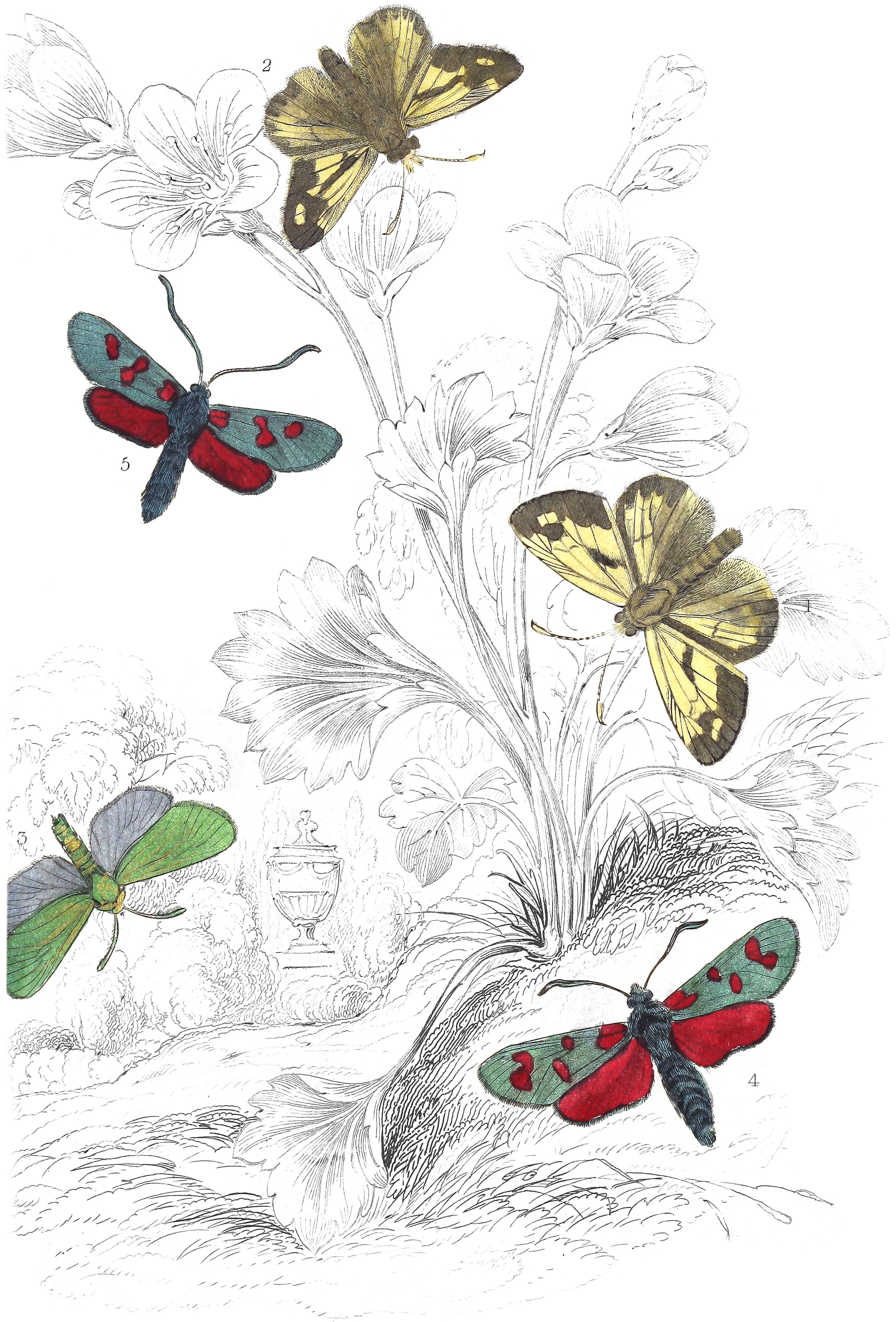
Plate II
Pamphila Actæon
Curtis’ B. E. x v. Pl. 442.
Is nearly intermediate between P. Linea and P. Sylvanus; the surface fulvous-brown, with a longitudinal ray, and a transverse arch of seven small spots of a lighter yellow towards the anterior edge of the upper wings. In the middle each of these wings is marked with a black oblique line in the male; and on each of the inferior wings of the female there is a mark similar to that just mentioned. The primary wings are fulvous beneath in both sexes, with the apex greyish-green, and preceded by an arch of small pale spots, which are merely the repetition of those on the panties The body is reddish on the back, and whitish beneath; the antennæ blackish and ringed with yellow, having the club ferruginous at the tip.
Found in plenty at Lulworth; and I have heard t hat it has been found also at the Burning Cliff, near Weymouth.
J.C. Dale, Esq. in Loudon’s Mag.
Lepidoptera Crepuscularia
We now come to the second great primary division of the Lepidopterous order, the Cruepuscularia of Latreille, characterised by ee prismatic form of the antennæ, and other distinctive marks already described in our introductory observations. It contains species of very dissimilar aspect and economy, all of which, however, were included by Linnæus and his followers in the genus Sphinx. Fabricius distributed them in three genera, Sphinx, Sesia, and Zygena; names which have since been employed to designate family groups. The indigenous species have recently been divided into four families, which may easily be determined by the following brief external characters:—
- Sphigidæ, with the palpi short, and the abdomen without a terminal tuft;
- Sesiidæ, with the palpi short, and the abdomen furnished with a tuft at the extremity;
- Ægeriidæ, with the palpi elongate, and the wings most frequently hyaline;
- Zygænidæ, having the palpi likewise elongated, and the wings clothed with scales.12
The latter family contains only two British genera, Ino and Anthrocera. The former of these corresponds to the Fabrician genus Procris: it has antennæ very slightly curved, and thickening gradually from the base nearly to the apex; those of the male with two rows of pectinations on the inner side, but they are merely serrated in the female; the apex without a tuft of hairs. The palpi do not extend beyond the head, and are rather thickly clothed with hairs. The species are not numerous, and only one of them inhabits this country; it is named
The Green Forester
Ino Statices.—Fig. 3
Sphinx Statices, Linn.; Don. vi. Pl. 204, fig. 2.—Procris Statices, Fabr.—Atychia Statices, Ochsen.—La Turquoise, Geoffroy.—Green eget Harris’ Aurel. Pl. 34.—Ino Statices, Leach; Steph.; Curtis’ B. E. ix v. Pl. 396.
The extent of the wings is from twelve to sixteen lines; the upper pair, as well as the head, thorax, and stalk of the antennæ, of a beautiful golden-green with a silky gloss, inclining in certain places to blue. Both sides of the under wings, and the under side of the superior pair are brown, which is likewise the colour of the fringe. The body beneath is glossy green, rather deeply tinged with blue; the trunk and pectinations of the antennæ black.
The caterpillar tapers at both ends, and the body is somewhat depressed: the colour green, with the head and anterior legs black, the other legs whitish; two rows of black spots run along the Fags and on each side there is a series of red dial It feeds on the Cardamine pratensis, common dock, &c. The insect appears in June, and is of frequent occurrence in England, although it seems to be somewhat local. Neighbourhood of London, Coombe and Darenth woods: “Neighbourhood of Durham, plentiful in some places,” Mr. Andrews. Near Newcastle, York, &c. It probably does not extend much further northwards than the places last mentioned.
Six-Spotted Burnet-Moth
Anthrocera Filipendulæ.—Fig. 4
Sphinx Filipendulæ, Linn.; Don. i. Pl. 6.—Zygena Filipendulæ, Fabr.; Haworth.—Burnet Moth, Wilkes; Harris’ Aurel. Pl. 1.—Anthrocera Filipendule, Scopoli; Steph.
In the present genus the antennæ are simple in the two sexes, of great length, slender at the base, and thickening at the top into a spindle-shaped club which is considerably curved. The palpi are longer than in Ino, projecting a little from the head, and terminating in a point, the joints thickly clothed with hair. The species are pretty numerous, even although it be admitted as probable that several kinds regarded as distinct are mere varieties. All of them are remarkable for the brilliancy of their colours, chiefly consisting of bluish black and bright red, the latter generally occupying nearly the whole of the inferior wings and forming spots on the upper pair. They are gregarious in their habits and sluggish and inactive in their movements, and may sometimes be found in dull weather clinging to plants in considerable numbers, and remaining quite motionless for a length of time. The most common species to be met with in this country is that mentioned above. It measures from fifteen to eighteen lines across the wings; the upper pair are of a fine greenish-black with a high degree of lustre, each of them with six red spots, arranged in pairs, two at the base (sometimes united or separated merely by the intersecting nervure), two in the middle placed obliquely, and two towards the apex nearly parallel with the last. The under wings are carmine-red on both sides, the hinder margin with a narrow blue-black border. The body is velvet-black with a blue or greenish gloss; the antennæ of a similar hue.
The caterpillar is yellow, with three rows of black spots along the back, and others on the sides; the head very small and black. It feeds on grasses and a variety of common plants, such as Speedwell, (Veronica), Mouse-ear hawkweed, Dandelion, Spiræa filipendula, &c.; from the latter it has obtained its specific name.
The perfect insect appears about the end of June and continues till the end of August. It is plentiful in most parts of England, and likewise occurs abundantly in certain parts of Scotland, but in that country it is somewhat local. In the vicinity of Edinburgh, it is found on the shores at Cramond, and in profusion on the northern shorts of the Frith of Forth, between Pettycur and Burntisland.
In profusion on Guillon Links—equally plentiful on Southerness Point on the coast of Galway, where the caterpillar feeds on the Ononis arvensis or Rest-harrow.
—Sir W. Jardine, Bart.
Five-Spotted Burnet-Moth
Anthrocera Loti.—Fig. 5
Zygæna Loti, Fabr.—Sphinx Loniceræ, Esper and Hubner.—Zygène du Chevrefeuille, Godart.
Less than the preceding; the anterior wings blue-black, with less of the green reflection, each of them with five red spots, which are as distinctly marked on the under side as on the upper: the two basal spots oblong, the others rounded. The hinder wings bright red, with a rather wide black-blue border somewhat sinuated on its inner edge; in other respects not differing from Anth. Filipendulæ.
The caterpillar is green, with two longitudinal macular bands on each side, the lower one narrowest; and a yellow dot on each segment between these bands. It feeds on the honeysuckle, bird’s-foot trefoil, and many other plants. The perfect insect is found occasionally in many parts of Britain.
Plate II
Eyed Hawk-Moth
Smerinthus Ocellatus.—Fig. 1
Smer. Ocellatus, Latreille; Stephens.—Sphinx Ocellata, Linn.; Don, viii. Pl. 269.—Sphinx Semipayo, De Geer.—Sphinx Salicis, Hubner.—Eyed Hawk-moth, Harris’ Aurel. Pl. 5. Curtis’ B. E. xi v. Pl. 482.
The Smerinthi have frequently been confounded with the Sphinges, but they present a sufficient number of distinctive marks to entitle them to be regarded as a separate generic group. Of these the most important are the shortness of the proboscis, which is scarcely perceptible, the angulated or dentated margin of the anterior wings, and the serrated antennæ. The species are not numerous; most of them are of sombre colours; and they are dull inactive insects, seldom appearing on the wing, and when they do go, displaying none of the vivacity and rapid movements of the kinds to which, in other respects, they bear a close affinity. The shortness of their trunk renders them incapable of feeding while on the wing like the Humming-bird Hawk-moth; the little food which they require during their brief existence, is therefore obtained by settling on flowers. The body of the larva is granulated or covered with small prominent points, and the anal segment bears a pointed horn which is almost straight. The contour of the head forms a curvilinear triangle, and is not rounded as in the true Sphinx. Perhaps the most beautiful of the three species inhabiting Britain is that named the Eyed Hawk-moth. The male expands about two inches and a-half, and the female often exceeds these dimensions by an inch. The anterior wings, which are very acute at the apex, are grey, tinged with rose-colour, and variegated with brown and dusky clouds and waved streaks; the centre with a pale curved transverse streak. The posterior wings are carmine-red, with the anterior margin entirely grey, and the hinder one tinged with that colour; the anal angle bearing a large ocellus with a blue iris, and large bluish-brown pupil, placed in a patch of deep black, which emits a stripe in the direction of the anal angle. The head and thorax are nearly of the same shade of colour as the surface of the upper wings, the latter with a deep brown mark on the back; the abdomen brownish-grey.
The caterpillar is of a fine green on the back, the sides and belly tinged with blue. Most of the Segments are ornamented with a white oblique stripe on the sides; the stigmata are white, circumscribed by a brown line; the membraneous legs rose-colour, and the head bordered with yellow. It feeds on various trees, such as the willow, poplar and apple.
The perfect insect is not rare in England, but it becomes scarce further to the north. Some places have afforded it in great abundance—such as Epping Forest, several places in Devonshire, and the vicinity of York—and it seems to be found occasionally in all the English counties. It is very rare in Scotland.
Poplar Hawkmoth
Smerinthus Populi.—Fig. 2
Sphinx Populi, Linn.; Donovan, viii. Pl. 241.—Poplar Hawk-moth, Wilkes, Pl. 25; Harris’ Aurel. Pl. 33.
Larger than the preceding, and differing considerably from the other species in having the external border of all the wings pretty regularly dentated. The colour is generally greyish-brown, occasionally inclining to obscure rusty-red, and sometimes greyish-white, with bands and transverse rays of a deeper hue than the ground colour; each of the upper wings haying a white crescent near the middle. At the base of the hinder wings there is a ferruginous patch, and near the middle a pale whitish lunule, always indistinct and sometimes not observable. The body is nearly of the same colour as the wings; the antennæ reddish internally, and yellowish-white on the outer side.
The caterpillar bears much resemblance to that already described, being usually green, with oblique yellow or white stripes. The stigmata are yellow or rose-colour, with a white centre; the membranous legs often ornamented with a curved orange Spot externally. The head is bordered with yellow, and the anal horn is of that colour, with the base blue. It eats the leaves of poplars and willows. (Pl. iii. fig. 3).
This plainly coloured insect is by far the most common of the Sphingidæ, being frequent in all parts of England, and generally distributed over the southern division of Scotland. It is found about midsummer and in autumn.

Plate III
Lime Hawk-Moth
Smerinthus Tiliæ.—Fig. 1
Sphinx Tiliæ, Linn.; Donovan, x. Pl. 325.—Olive Shades, or Lime Hawk-moth, Wilkes, Pl. 23.—Lime Hawk-moth, Harris’ Aurel. Pl. 20.
A very variable insect both in colour and the form of the markings: the anterior wings are usually greyish, with an interrupted band of olive-green or olive-brown in the middle, formed by two spots, of which the anterior one is the largest; the outer margin has a broad band of the same colour, edged externally with ferruginous, and having a white mark at the tip of the wing. The hinder wings are grey, with an ill-defined brown band running obliquely from the anterior edge to the anal angle, where the colour deepens and sometimes becomes greenish. The thorax is marked with three longitudinal bands of olive green which unite in front, and the abdomen generally has a green tinge.—The colour of the surface is occasionally obscure red, with the outer extremity of the anterior wings and the central spots deep rust-red: at other times the two central spots are united, and sometimes one of them is wanting.
The caterpillar feeds on the lime, elm, birch, &c. It is pale-green, with seven oblique whitish stripes on each side bordered anteriorly with red or yellow. The head is smaller than in others of the genus, the body more attenuated in front, and there is a granular protuberance over the anus.13
The rarest of the three, being found only occasionally; but it seems to be pretty generally distributed throughout England. It occurs near London more frequently than in most other places; also near Exeter, York, &c. It does not seem to be a Scotch insect.
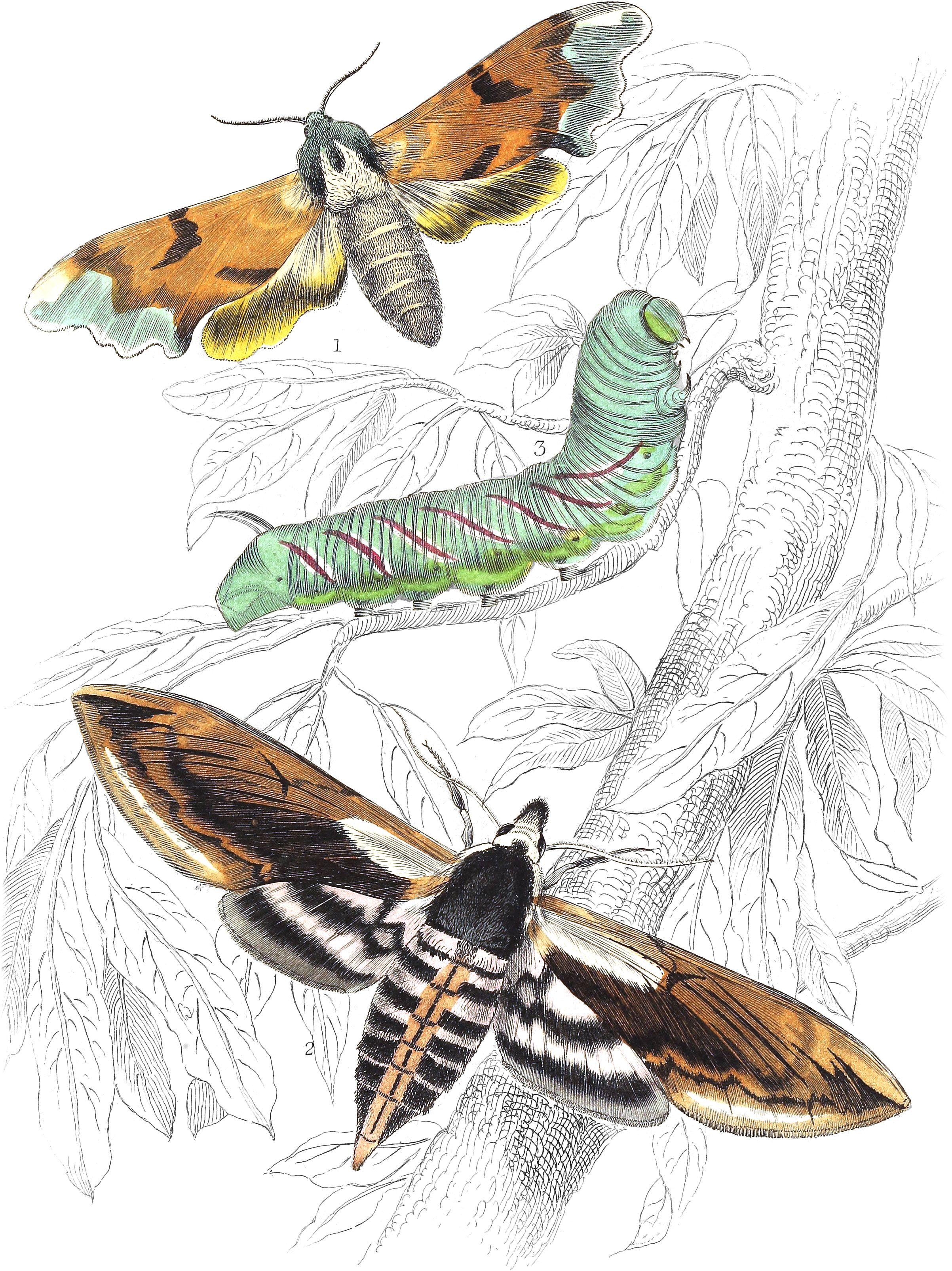
Plate IV
Death’s Head Hawk-Moth
Acherontia Atropos.
Sphinx Atropos, Linn.; Donovan, ix. Pl. 289, 290.—Jasmine Hawk-moth, Wilkes, Pl. 19.—Death’s Head, Harris.—Acherontia Atropos, Ochsen.—Bee-Tiger Moth, Curtis, iv v. Pl. 147; Stephens.
The shortness of the proboscis and antennæ, the latter terminating in a kind of hook supporting a long hairy seta, and the entire margin of the wings without indentation or sinuosity, suffice to distinguish Acherontia from the genera with which it has long been associated. Other subordinate distinctions are to be found in several peculiarities of structure, and the caterpillar, besides presenting some other differences in character and aspect, has the caudal horn thickly tuberculated. The only British species is the striking and well known insect above referred to. The expansion of the wings varies from four to five inches, and females have occasionally been found not much short of six inches in extent: it must therefore be considered no not only as the largest of our indigenous lepidoptera, but with one exception, the Peacock-moth (Saturnia Pavonia major), the largest insect inhabiting Europe. The surface of the primary wings is dark-brown, or blackish, powdered with white, and marked with several waved transverse stripes of deep black, and others of rust-red, the latter colour forming a series of dashes on the nervures at the hinder margin of the wings. Near the centre of each wing there is a small round whitish spot. The secondary wings are deep yellow or ochreous, with two dark bands nearly parallel with the hinder margin and at some distance from it. The head and thorax are nearly of the same colour as the dark portion of the upper wings; the thorax bearing on its surface a large grey or yellowish spot, not unaptly representing a front view of a human skull or “Death’s Head.” The abdomen is blackish, bluish-ash down the back, with yellow transverse spots on the sides of the segments. The antennæ are whitish at the tip, and the tarsi ringed with white.
The caterpillar, which is sometimes five inches in length, is of a fine yellow, with seven oblique green bands on each side and a longitudinal series of blue spots on the back, which besides is spotted with black and granulated. It is generally found on the potato and common jasmine, but likewise feeds on a variety of other plants of very dissimilar qualities. The insect was formerly very scarce in this country, but since the cultivation of the potato became general, it has increased considerably. The caterpillar, however, occurs much more frequently than the moth, and as it very often dies before completing its transformations, indigenous specimens of the perfect insect are still regarded by collectors as a desirable acquisition. The caterpillars are usually full grown about the middle of August, when they bury themselves in the earth and form an oval cell in which they undergo their destined changes. The moth seldom appears before the end of September; it conceals itself in some obscure place during the day, and appears on the wing only in the morning and evening twilight. In the southern parts of England, a considerable number of specimens are found annually; and although it becomes rarer in the north, it has been observed not unfrequently both in the north of England and in Scotland. In the latter country we have seen examples from Ayrshire, Perthshire, the vicinity of Jedburgh, and Midlothian, and have heard of their occurrence in many other places.
Over foreign lands the Death’s-head Hawk-moth has a wide range of distribution. It occurs in considerable abundance in all the southern countries of Europe, in the two extremities of Africa, and in the Isle of France. In the latter country, according to St. Pierre, a belief prevails that the dust cast from its wings, in flying through an apartment, produces blindness if it happen to fall upon the eyes.
The great size of this creature, its remarkable appearance, the “grim feature” stamped upon its thorax, together with the power it possesses of emitting a plaintive and mournful cry, have conspired to render it an object of alarm to the ignorant and superstitious. We are told by Reaumur that they once appeared in great abundance in some districts of Bretagne, and produced great trepidation among the inhabitants, who considered them to be the forerunners and even the cause of epidemic diseases and other calamities. Mr Knapp says,
A letter is now before me from a correspondent in German Poland, where this insect is a common creature, and so abounded in 1824, that my informant collected fifty of them in the potato-fields of his village, where they call them the “Death’s-head Phantom,” the “Wandering Death-bird,” &c. The markings on its back represent to these fertile imaginations the head of a perfect skeleton, with the limb-bones crossed beneath; its cry becomes the voice of anguish, the moaning of a child, the signal of grief; it is regarded not as the creation of a benevolent being, but the device of evil spirits—spirits enemies to man, conceived and fabricated in the dark; the very shining of its eyes is thought to represent the fiery element, whence it is supposed to have proceeded. Flying into their apartments in the evening, it at times extinguishes the light, foretelling war, pestilence, hunger, death, to man and beast.14
The sound alluded to, which seems to be peculiar to this species among lepidopterous insects, has often attracted the notice of observers, but they have hitherto been unable to determine satisfactorily in what manner it is produced. Ag it is impossible, from the nature of their organization, that any insect can be possessed of a genuine voice, it has been conjectured that the noise is occasioned by the friction of one organ against another, as is well known to be the case with many beetles, grasshoppers, &c. Reaumur and others accordingly ascribe it to the reciprocal action of the trunk and palpi; but the sound having been found to continue after these organs were cut off, it must evidently have some other origin. Under the idea that it was connected with the motion of the wings, another observer was led to conceive that its source was two concave scales placed at the base of these appendages, against which the air is forcibly propelled by their rapid motion. M. Lorey, a French physician, maintains that the stridulation in question Is produced by the escape of air from a trachea placed on each side of the base of the abdomen, which, when the animal is in a state of repose, are closed by a fascicle of fine hairs. A more recent writer, M. Duponchel, controverts all these statements, and gives it as his opinion that the noise is emitted from the interior of the head, in which there is a cavity communicating with the trunk, and neat which are placed the muscles by which the latter is put in motion. As M. Lorey, however, affirms that he has heard the sound after the head was amputated, and M. Duponchel makes the same assertion in relation to the abdomen, these various opinions must be considered as irreconcilable, and the matter left to be decided by future investigation.
The celebrated M. Hüber, and some other naturalists, affirm that this insect is in the habit of entering the hives of the common domestic bee, where it takes up its abode for a time, and regales itself on the honey. That it should be attracted by the smell of the honey, and even enter the hive in search of it, might have been expected from the predilection which most lepidopterous insects show for that kind of food; but it is not easy to understand how a creature without offensive weapons, and unprotected by any hard covering, can either resist or survive the attacks of so many armed assailants. This difficulty is increased when we consider the result of one of M. Hüber’s experiments: on introducing a Death’s-head moth into a box where a colony of humble bees (Bombus Muscorum) had established themselves, it was immediately attacked, and so severely stung that it died shortly after; yet the sting of this insect is by no means so formidable as that of the honey bee. There is very little probability in M. Hüber’s conjecture, that the hostility of this irritable race may be disarmed by the stridulous sound emitted by the moth, which he supposes may possibly have an effect similar to that produced by the queen. In this country the moth is never likely to become so plentiful as to occasion much damage; at any rate, an effectual remedy may be easily applied, by covering the opening into the hive with a wire grating, having the apertures of such a size as to admit no larger object than the proper inmates.

Plate V
Genus Sphinx
The above term, as has been already noticed, was long employed as the generic designation of all the Hawk-moths properly so called, but is now restricted to such as present the following characters:—Antennæ rather long, slightly increasing in thickness from before the middle nearly to the apex, but scarcely or not at all clavate; the apex slender, hooked, and terminating in a long scaly seta; proboscis very long, slender, and convoluted; abdomen elongate-conic, without any tuft at the apex. The palpi are three-jointed, very obtuse, the second joint being large and oval, and the third minute and depressed. The caterpillars are generally green or brownish, with oblique or longitudinal lateral stripes of yellow, and having the caudal horn long, acute, and curved. The pupa is subterranean; the abdomen of the perfect insect ornamented with transverse bands.—The first species we have to describe is that named
Privet Hawk-Moth
Sphinx Ligustri.—Figs. 2 & 3
Sphinx Ligustri, Linn.; Donovan, viii. Pl. 284.—Privet Hawk-moth, Wilkes, Harris.
The Privet Hawk-moth generally measures from three and a half to four and a half inches across the wings; the upper pair ash-grey, slightly tinged with rose-colour, and marked with irregular black veins; the hinder portion of the wings obscure brown, and the hinder margin bearing two whitish, flexuous lines, on a greyish ground, which unite near the apex. The surface of the hinder wings is of a fine rose-colour, traversed by three black bands, that next the base being short and placed nearly at right angle with the others, which are parallel with the hinder margin; the latter tinged with brown. The fringe surrounding the wings is greyish, inclining to red. The thorax is dark brown, greyish posteriorly, and white with a rosy tinge on the sides; the abdomen purple or deep rose-colour, with black bands, interrupted in the middle by a broad longitudinal brown stripe, having a narrow black line down the middle.
The caterpillar is one of the most beautiful belonging to this tribe. It is of large size, and of a fine apple-green colour, ornamented with seven oblique stripes on each side of the body, purple anteriorly, and white behind. The stigmata are orange-yellow, and the caudal horn yellow on the under side and black above. Its ordinary food is the leaves of the common privet, but it likewise consumes the different kinds of lilac (Syringæ), the ash, the elder, and laurel (Daphne laureola). It generally changes into a chrysalis in the month of August, but occasionally at a much earlier period, as the moth has been sometimes observed on the wing in July. It constructs no cocoon properly so called, but merely forms an oval chamber in the earth, the sides of which it consolidates by the pressure of its body, and by uniting the particles by means of a glutinous secretion discharged from the mouth.
It is of not unfrequent occurrence in many parts of the south of England, especially in Cambridgeshire and the counties adjoining, but becomes rarer in the north, and is seldom noticed in Scotland although it occurs occasionally. It abounds in many parts of the continent.
Plate IV
Unicorn Hawk-Moth
Sphinx Convolvuli.
Sphinx Convolvuli, Linn.; Donovan, vii. Pl. 228 and 229.—Unicorn or Bindweed Hawk-moth, Wilkes.—Unicorn or Convolvulus Hawk-moth, Harris.—Sphinx 4 cornes de Bœuf, Geoff., Godart.
The surface of the primary wings in this fine species is greyish-ash colour, clouded with brown and black, and marked with a few narrow lines or streaks of deep black. The secondary wings are also greyish, and traversed by three dark-coloured bands, the anterior one bent towards the body, the second oblique and somewhat double, the third widened externally and nearly parallel with the hinder margins. The fringe surrounding the wings is white interrupted with brown. The thorax is nearly of the same colour as the upper wings, marked with two dark indistinct lines, somewhat in the shape of a horse-shoe, and having a bluish spot behind, with a red one adjoining. The abdomen is ringed alternately with black and red, inclining to rose-colour, the red bands margined with white anteriorly, and there is a broad greyish stripe down the back divided in the middle by a black line. The antennæ are whitish, as well as the under side of the body, the latter having two black spots in the middle of the belly. The expansion of the wings is about four inches and a half.
The caterpillar is very variable in colour and markings. It is most commonly of a bright green, (as represented on Pl. vi. fig. 2.), with black or brown spots on the back, and oblique yellow stripes on the sides; the latter, however, are sometimes black, and examples are occasionally found in which the whole body is brown. The stigmata are usually of some colour contrasting with the rest of the body; most commonly they are black or pink. It feeds on the indigenous species of convolvulus, particularly C. Sepium. It generally assumes the pupa state about the end of July, the moth appearing in September; but if the larva be not full grown till a later period, the perfect insect is not disclosed till the ensuing May or June.
The Unicorn or Bindweed Hawk-moth, termed by a French naturalist the Ox-horned Sphinx, on account of the thickness and rigidity of its antennæ, is by no means an insect of common occurrence in Britain, but it seems to be distributed over the whole island. It has been found in the northern extremity of Scotland, as well as in several of the southern counties, and numerous localities have been cited for it in most parts of England. Godart states that it diffuses an odour like that of amber, and that its eyes, on account of their uncommon size, shine in the dark much more brilliantly than those of any other crepuscular or nocturnal insect.

Plate VI
Pine Hawk-Moth
Sphinx Pinastri.—Fig. 1
Sphinx Pinastri, Linn.; Donovan, ix. 296; Steph. Illus. Haus. i. 122.
In this species the wings expand about three inches. The upper side of the primary wings is ash-grey, clouded with brown in the middle of the interior border and near the apex: on the disk of each there are three diverging black streaks, and another somewhat bent at the extremity of the wing. The secondary wings are brownish, inclining to ash-colour, especially at the base. All the wings have the fringe on the posterior border white, potted at regular intervals with brown. The thorax is grey on the back, with two dark bands down each side, beyond which the colour is white. The abdomen is ringed alternately with white and black, and has a dorsal stripe of grey, with a black line down the middle. The upper side of the antennæ and most of the under parts are white.
The caterpillar is at first yellowish-brown, but afterwards becomes green, with two longitudinal stripes of lemon-yellow on each side, a brown dorsal band and numerous fine black lines across the back. The anterior legs are yellow, the membranous ones of a whitish colour, and the stigmata yellow surrounded by a black ring. The caudal horn is likewise black. On the continent, in several parts of which it is a common insect, it feeds chiefly on the pineaster (Pinus pinaster). In this country it is said to frequent the spruce and Scotch fir. The moth is very rare in Britain, Colney Hatch Wood and the neighbourhood of Esher being probably the only localities in which it has been observed. It certainly was never taken in Ravelston Wood, near Edinburgh, by Mr. Wilson of the College, as intimated by Dr. Leach, and it is probably through some inadvertence that he states it to have been taken there by himself.
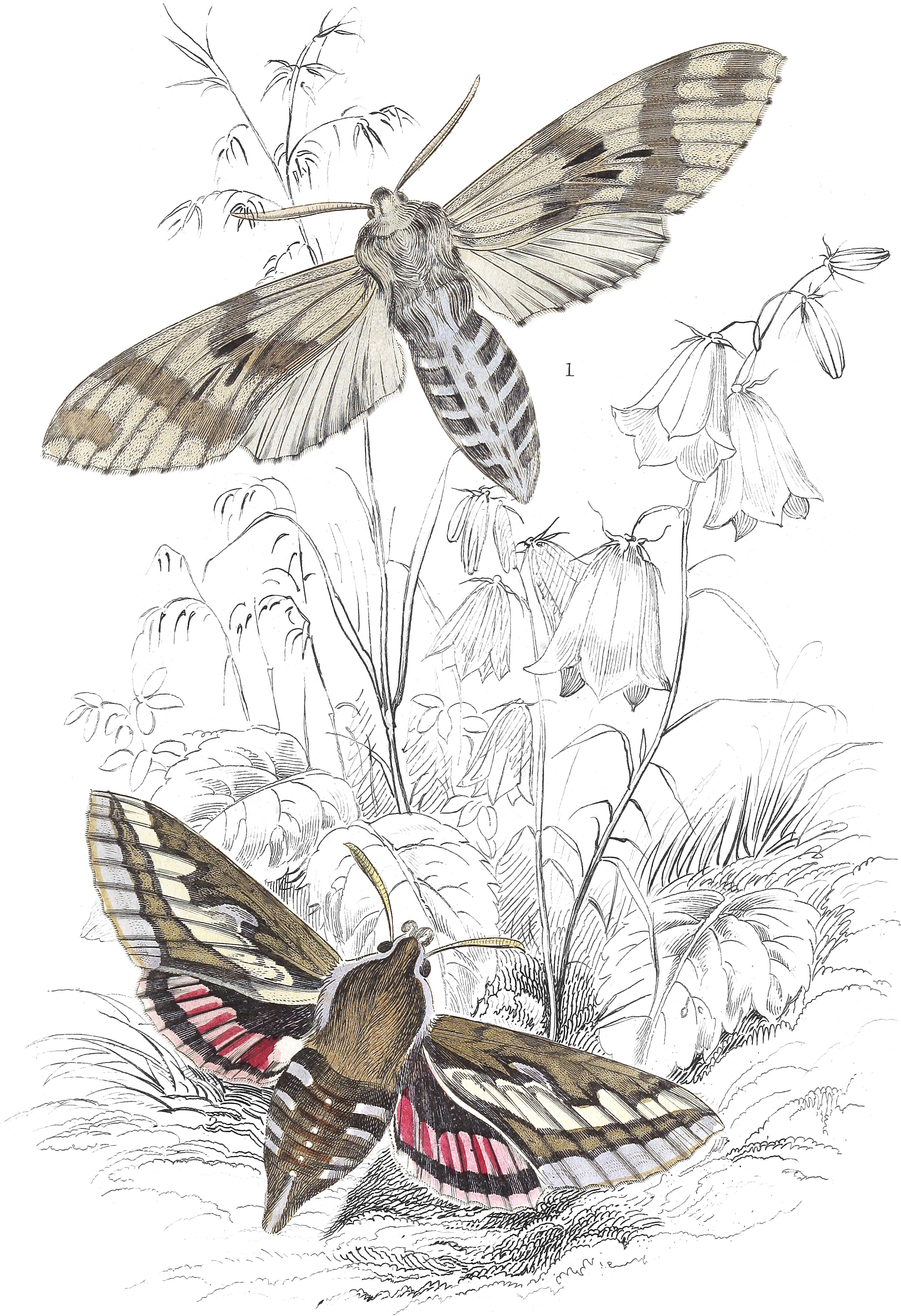
Plate VII
Genus Deilephila
The species included under this appellation, which is derived from the Greek, and means Lovers of Evening, were first dissevered from their associates by Hubner, chiefly on account of the form of the antennæ, which are rather short, thickening at the apex so as to form a distinct club, and having the terminal hook ending in a naked subulated seta. The proboscis is long and spiral, but in general it is shorter than in the preceding genus. The abdomen is comparatively short and of a conical shape. The anterior wings are not very acute at the apex, the hinder margin slightly and regularly rounded, without any sinuosity. The caterpillars are similar in shape to those of the genus Sphinx, but their colours are distributed in spots; the anterior segments are not retractile. The pupa is always more or less covered with soil. The abdomen of the perfect insects is banded transversely at the base, the other bands interrupted on the back and forming only lateral spots.
The Madder Hawk-Moth
Deilephila Galii.—Fig. 2
Stephens’ Illus. i. 125, Pl. 12, fig. 2.—Sphinx Galii, Huber, Godart.—Spotted Elephant Caterpillar, Harris’ Aurel.
Nearly the same size as D. Euphorbiæ, to which it bears so much resemblance in other respects, that Linnæus supposed it to be a mere variety of that species. The upper wings are olive-brown or greenish, with the posterior border cinereous, and a yellowish band, irregular anteriorly and somewhat sinuated behind, extending from near the base to the apex. The hinder wings are dull red, with the base and a posterior band black, and there is a white spot on the anal angle. The colour of the thorax and the markings on the abdomen resemble those of D. Euphorbiæ, with this difference that the breast and belly are tinged with green, and the abdomen and belly are tinged with green, and the abdomen has a series of small white spots down the back.
The caterpillar is described as a bronzed green colour, with a yellow line along the back, and a row of oval yellow spots, bordered with black on each side. The anterior legs are black, and the membranous legs of a delicate rose-colour. Its food consists of different kinds of Galium, particularly Galium verum (yellow lady’s-bedstraw), and G. mollugo (wild madder).
This insect is found in most parts of Europe, but it seems to prefer a southern climate, as it is scarce in most northern countries, and becomes rare even in the latitude of Paris. In Britain it has been occasionally observed in the vicinity of London; also in Kent, Devonshire, and Cornwall. “Isle of Wight, and the neighbourhood of Warwick,” Entom. Mag. Two specimens were taken in the garden at Twizel by Mr. Selby in the autumn of 1834: and it has likewise occurred at Cramond near Edinburgh.
Plate VII
Spotted Elephant Hawk-Moth
Deilephila Euphorbiæ.
Sphinx Euphorbiæ, Linn.; Donovan, iii. Pl. 91, 92.—Deilephila Euphorbiæ, Curtis’ B. E. i. Pl. 3.—Spotted Elephant Hawk-moth, Harris’ Aurelian, Pl. 44.
The primary wings, which expand from two and a half to nearly three inches, are of a dusky-green colour, with a broad irregular rosy fascia running obliquely from the hinder margin near the base to the apex; the posterior margin of a similar colour, but somewhat dusky; the inner margin narrowly edged with white. The under wings are red, inclining to rose-colour, with a white mark on the anal angle, the base and a transverse band being black. The head and antennæ are white, the thorax dusky or olive-green on the surface; the abdomen likewise of the latter colour, with the sides of the three first segments white, the two next the base with deep black spots, the remaining segments narrowly edged with white anteriorly at the sides. The whole of the under side is rose-colour, somewhat clouded and obscured with dusky, and having a large dark-coloured spot near the middle of the upper wings.
The caterpillar varies considerably in appearance, according to its age. In its mature state, when nearly ready to be transformed into a chrysalis, it is black, with numerous slightly elevated white or yellowish points disposed in transverse lines placed close to each other, and three longitudinal rows of rounded spots on each side, the spots in the central row, which are much smaller than the others, and those of the upper row, being cream-coloured, and the lower one bright red: the head, a line along the back, and the legs, are of the latter colour. The cypress-leaved spurge (Euphorbia cyparissias) is the favourite plant of this beautiful caterpillar; it likewise feeds on Euphorbia esula and E. Peralias (sea spurge), but seems to reject several other kinds, although the qualities of all may be presumed to be nearly the same.
This must be regarded as a rare and local insect in Britain. The locality that has afforded the largest supply of specimens is in the vicinity of Barnstaple, in Devonshire, where it was procured in some plenty by Mr. Raddon. Mr. Curtis says,
That gentleman visited occasionally the extensive sand-hills at Appledore and Braunton Burrows near Barnstaple, where Euphorbia Paralias grows in great abundance; and from the size and beauty of the caterpillar it would be imagined that it might readily be found; but in the young state they are not easily discoverable; and when more advanced, they become so conspicuous that their numbers are reduced by marine birds that feed upon them. Sometimes they may be traced by their soil, at other times they may be seen far from the spot where they fed, at the extremity of a tall rush. They are full grown about the middle of September, when they descend into the sand and change into chrysalides, forming a loose case of earth around them, from which they emerge the beginning of the following June. Sometimes, however, they remain in the pupa state two seasons, as many other Lepidoptera do;—a wise provision of Nature to prevent any accident from destroying the whole brood. The sand-hills where the larva is found are of great extent and magnitude, and must have been collected by the winds and storms to which they are constantly exposed: during the winter the whole soil is frequently removed, so as completely to alter the surface of the country; a great number of the pupa must consequently be destroyed or buried at a great depth below the surface, where probably they lie hid until they are brought to light and life by the influence of the be elements.15

Plate VIII
Rayed Hawk-Moth
Deilephila Lineata.
Steph. Illus. Haus. i. 126, Pl. 12, fig. 1.—Sphinx lineata, Fabricus.—Sphinx Livornica, Hubner and Esper.
Larger than either of the preceding, but not strikingly dissimilar, the colours being distributed somewhat after the same manner. The upper wings are olive-brown, traversed by seven white nervures, and having an angular patch of the same colour in the centre of each: the hinder border is cinereous and somewhat shining, and a yellowish band commences at the origin of the internal border and runs obliquely along the wing to the apex. The hinder wings and the thorax are nearly as in D. Galii; but the thorax bears two white rays in the centre, which are abbreviated and convergent in front. The abdomen is olive-brown, each of the segments with a white border anteriorly, which is spotted with black. The antennæ are brown, with the tip white.
The caterpillar, which seems not to have been hitherto noticed in this country, is described by the continental naturalists as yellow inclining to olive, with the head, a dorsal line, and two rows of large points along the side, rose-colour. The caudal horns of that colour on the upper side, and black beneath. The belly is white. It feeds on the yellow lady’s-bedstraw and a common kind of thistle, the Sonchus arvensis. It undergoes its first transformation towards the end of July, and the moth is usually disclosed in about thirty days.
Mr. Stephens says,
D. lineata is unquestionably rare in England and few collectors can boast the possession of specimens; it has, however, been captured in distant parts: the Rey. T. Skrimshire possesses a specimen which I believe was caught in Norfolk, and Mr. Dale has one which he obtained from Dr. Abbott’s cabinet, also found eastward; in June, 1824, a beautiful and perfect specimen was taken off the mast of the Ramsgate steam-vessel at Billingsgate, and last year a wasted one was found near Bethnal-green; in addition to the above, three specimens were formerly taken near Kingsbridge in Devonshire, one of which I possess through the kindness of Dr. Leach. The above are the only indigenous examples I have seen, all the remainder which are placed in collections for this species being D. Daucus, a native of North America.16
Genus Metopsilus17
The characters presented by several species hitherto associated with the preceding group, are sufficiently distinct to entitle them to be ranked at least as a Separate sub-genus. The antennæ are but slightly clavate, the anterior wings very acute at the apex, with a slight sinuosity or emargination on the hinder margin just below the tip, which gives them a somewhat falcate shape; the inner margin likewise deeply emarginate behind the middle. The larvæ offer several very distinctive marks, particularly that of having the anterior segments very much attenuated, and capable of being drawn within each other; a peculiarity which has caused them, as was formerly noticed, to be named Chenilles Cochonnes by French naturalists, because the head and neck bear some resemblance to a pig’s snout. These caterpillars are not distinguished by great brilliancy or variety of colours, being chiefly brown and green, with a white lateral line extending from the anal horn to the third or fourth segment, and they have invariably two or three large eye-like spots on each side either of the second, third, fourth, or fifth segments. The caudal horn is short, very slightly bent. sometimes almost obsolete. The chrysalis is enclosed in a loose cocoon formed of leaves, and is never buried beneath the soil. The perfect insects are very beautifully coloured, and it is observable that the abdomen is always longitudinally or obliquely striped, an arrangement different from what obtains in the two preceding genera, which have that part of the body ornamented with transverse bands sometimes of different colours. Viewed in relation to the form of the larvæ, as well as to the appearance of the perfect insects, the species which we have placed together, under the above name, form a very natural group.
Oleander Hawk-Moth
Metopsilus Nerii.
Sphinx Nerii, Linn.—Rosel’s Insecten-belustigung, vol. iii. tab. xv. larva xvi. imago.—Sphinx du Laurier-rose, Godart; Pap. de France, vol. iii., Crepusculaires, p. 12.
The primary wings of this conspicuous and elegant species expand upwards of four inches. The surface is of a fine deep olive-green, variously shaded with white and rose-colour, distributed in undulating lines and transverse streaks. At the origin of each of the upper wings there is a whitish spot with a dot in the centre and a small transverse streak of olive-green; beyond this are three whitish waved lines running somewhat obliquely across the surface, dilated at the inner margin into a rose-coloured patch, succeeded by a broad oblique rosy band extending from one side of the wing to the other: beyond this there is a broad patch of a violet-colour bounded anteriorly by a white zigzag line, and surmounted by two whitish curved lines drawn to the anterior edge; the apex bears a white figure having some resemblance to the letter Y reversed. The under wings are dusky from the base nearly to the middle, and green on the hinder border, the two colours separated by a white waved band, extending from the anal angle to the anterior edge. The thorax is deep green, with a pale cross line in front; the abdomen likewise green, whitish on the first and second segments, and haying oblique olive-coloured streaks on the sides of the others.
When the caterpillar is full grown, it is green or greyish-green, with the four anterior segments pale yellow; a white line along each side, extending from the fourth segment to the anal horn and numerous white dots scattered over the surface. On each side of the third segment there is a large blue eye-shaped spot with a double white pupil and a black iris. The anal horn, which is short and decumbent, is ochreous; the anterior legs blue; and the membranous ones green with the extremity yellow. The head is green, the stigmata black bordered with yellow. When immature the colour of this caterpillar is sometimes a pretty uniform ochreous yellow, and in all cases, a few days before it becomes a pupa, the four anterior segments and the anal one assume the colour just mentioned, while the remaining parts of the body become dusky black, the white lateral line, dots, and ocellated spots always, however, remaining unchanged. Its appropriate food is the leaves of the shrub named Nerium oleander, nor has it recourse to any other when that can be obtained. As that plant, however, is not a native of this country, nor of the north of Germany and some other parts of the continent where the insect is found, it no doubt feeds on others of more common occurrence, perhaps, as has been conjectured, the Vinca major, V. minor, or some species of Cynanchum, all of which belong to the same natural family of Apocynea.18
This magnificent moth, which we have now the pleasure to figure for the first time as a British species, has been taken at least on two different occasions in this country; once in the vicinity of Dover, as intimated by Mr. Stephens in the Entomological Magazine for October 1832; and a second time, in the larva state, in a garden at Teignmouth, Devon, in the autumn of the same year.19 As the insect is occasionally found in the neighbouring continental countries, extending as far northwards as the northern regions of Germany, the propriety of admitting it into our native Fauna cannot be attended with the same doubts that apply to such kinds as have their principal seat in the new world. It is strictly a European species, and from what we know of its occurrence elsewhere, it might reasonably be inferred that the southern parts of England should fall within the range of its distribution. It is observed from time to time in the vicinity of Paris, but its principal resort seems to be the neighbourhood of Genoa, Turin, and Nice, where it is said to be common.

Plate IX
Sharp-Winged Hawk-Moth
Metopsilus Celerio.
Sphinx Celerio, Linn.; Donovan, vi. Pl. 190 and 191.—Deilephila Celerio Stephens.
Expansion of the wings two inches eight lines in the male, about three inches in the female: the upper wings greyish inclining to brown, marked with black lines and a few whitish streaks, and having a white band commencing at the inner margin near the base and terminating in a point at the apex; the outer margin is pale grey, and there is a small black spot on the disk near the centre. The surface of the hinder wings is deep rose-colour at the base, the rest greyish slightly tinged with red, with two oblique black bands, between which the nervures are black; the hinder margin pale-grey. The body is brownish on the back, with two white streaks from the anterior part of the head along each side of the thorax; the latter with two additional longitudinal stripes of yellow towards the middle; the abdomen haying a silvery white line down the centre, and a row of small spots on each side of it from the third segment to the apex.
The caterpillar varies in colour, but is most commonly brown, with two yellow lines on each side, the lower one composed of crescent-shaped spots and passing over the stigmata, the other commencing on the sixth segment and extending to the hinder extremity. The fourth and fifth segments are ornamented with two large ocelli, having a white pupil and a yellow iris. The ordinary food of this larva is the common vine (Vitis Vinifera), a circumstance which, taken in connexion with its rare occurrence in Britain, has occasioned considerable doubts as to its being an aboriginal native of this country. On the continent, however, it is known likewise to feed on the yellow lady’s-bedstraw (Galium verum), and it is not improbable that it can subsist, like the majority of its tribe, on several other plants. At the same time it appears properly to belong to a southern latitude, as it is not found in any considerable numbers except in the south of Europe, and its chief residence is the island of Teneriffe and the Cape of Good Hope. It has occurred near Oxford, Wisbeach, in the Isle of Ely, and a few other places.

Plate X
Elephant Hawk-Moth
Metopsilus Elpenor.
Sphinx Elpenor, Linn.; Donovan, iv. Pl. 122.—Deileph Elpenor, Curtis, Stephens.—Elephant, Harris’ Aurel. Pl. vii.—The Lady’s-bedstraw or Elephant-moth, Wilkes, 26.
In this species the wings expand from two inches to two and three-quarters; the upper pair olive-brown inclining to olive-green, with the anterior edge, two oblique bands (the first abbreviated), and the hinder margin rose-red tinged with purple and somewhat shining; the posterior edge is white, and there is a minute dot of that colour on the disk of each. The hinder wings are dusky at the base and reddish-purple posteriorly, the fringe pure white, that of the anterior wings being red. The body is olivaceous above, with numerous stripes of deep rose-colour; one over each eye, four curved ones on the thorax, and another down the back of the abdomen; the sides of the latter and the belly are likewise rose-red with a series of whitish spots on each side of the segments. On each side of the abdomen, towards the origin of the secondary wings there is a rounded dusky spot, and a mark of the Same colour is observable on the base of the primary wings. The legs are white, brownish internally.
After the second change of skin the caterpillar is brown, with six oblique rays and the sides of the breast greyish. The fourth and fifth segments have around black spot on each side, with a lunule in the centre, the edges of which are white inclining to violet, and the middle olive-brown. When young, the whole body is green, a colour which it occasionally retains throughout, and in such cases the oblique rays are black instead of grey. It frequents different kinds of willow herb (Epilobium), lady’s-bedstraw, the common vine, &c. (Pl xi. fig. 2.)
This is by far the most common species of Hawk-moth inhabiting Britain, as it occurs in some plenty in most parts of England, especially in the south, and we once found numerous specimens at the base of Salisbury Craigs near Edinburgh, and have seen others from different quarters of Scotland. It is likewise a well known insect throughout the continental parts of Europe.

Plate XI
Humming-Bird Hawk-Moth
Macroglossa Stellatarum.—Figs. 1 & 2
Sphinx Stellatarum, Linn.; Donovan, vii v. Pl. 155.—Humming-bird Sphinx, Harris’ Aurel. Pl. 24.—Macro. Stellatarum, Ochsen., Stephens.
The present genus and that immediately following, are at once distinguished from the other Hawk-moths by having a tuft of scaly hairs at the extremity of the abdomen. Macroglossa is further characterized by having the short abdomen strongly tufted on the sides, the wings opaque, and the suctorial trunk of great length, at least equal to that of the body,—a circumstance which has suggested the generic name.20 The only species found in Europe is that represented on the adjoining plate. It measures from twenty to twenty-four lines between the tips of the anterior wings, which are of a dusky brown, with several transverse waved bands, most of them obsolete, except two near the middle, which are of a deep black, with a dot of the same colour in the space between. The hinder wings are rust-yellow, slightly suffused with dusky before and behind. The body is nearly concolorous with the upper wings, and the abdomen is variegated with tufts of black and white at the sides of the segments, the anal tuft being black.
The ground colour of the caterpillar is green, sprinkled with numerous white points, and having two white rays along the sides. The anal horn is rather long and acute, perfectly straight, yellowish at the tip and blue at the base; the membranous 8 legs each marked with a shining black lunule, the coronet of spines of a rosy tint. (Pl. xii. fig. 2.) It feeds on verticillate or stellate plants (whence the specific name), and is most commonly found on lady’s-bedstraw and goosegrass (Galium verum and G. aparine). It sometimes enters the earth when about to be transformed, and at other times constructs a cocoon on the surface, composed of particles of earth, pieces of leaves, or portions of the stems of plants.
This curious insect is of frequent occurrence in most parts of England, and is found occasionally in the southern and even the more northern counties of Scotland. It frequents gardens and cultivated grounds, appearing on the wing in the morning and afternoon, and concealing itself among the foliage during the heat of the day. It darts about from flower to flower with amazing rapidity, and poises itself, like a Humming-bird, over the blossoms, till it extracts their nectareous juices by means of its long spiral proboscis. While thus suspended, the vibration of the wings is so rapid as to occasion a considerable humming noise, whence it has been termed the Humming-bird Hawk-moth. The following is an agreeable and accurate account of its manners:—
The Humming-bird Hawk-moth visits us annually, and occasionally in some numbers, frisking about all the summer long, and in very fine seasons continues with us as late as the second week in October. The vigilance and animation of this creature are surprising, and seem to equal those of its namesake, the splendid meteoric bird of the tropics, “that winged thought,” as some one has called it; though our plain and dusky insect can boast none of its glorious hues. Our little sphinx appears chiefly in the mornings and evenings of the day, rather avoiding the heat of the mid-day sun, possibly aroused from its rest by the scent, that “aromatic soul of flowers”, which is principally exhaled at these periods; delighting in the jasmine, marvel of Peru, phlox, and such tubular flowers; and it will even insert its long, flexible tube into every petal of the carnation, to extract the honey-like liquor it contains. It will visit our geraniums and greenhouse plants, and, whisking over part of them with contemptuous celerity, select some composite flower that takes its fancy, and examine every tube with rapidity, hovering over its disk with quivering wings, while its fine hawk-like eyes survey all surrounding dangers. The least movement alarms it, and it darts away with the speed of an arrow; yet returns, and with suspicious vigilance continues its employ, feeding always on the wing. Nature seems to have given this creature some essential requisites for its safety; its activity, when on the wing, renders its capture difficult; and when it rests, it is on a wall, the bark of a tree, or some dusky body, that assimilates so nearly to its own colour, as to render it almost invisible, though watched to its settlement: the larva is seldom found. We sometimes see it enter our rooms, attracted by flowers in the open windows; but it seems to be immediately aware of its danger, disappears in an instant, and is safe from capture. Wild and fearful as this creature is by nature, yet continued gentle treatment will remove much of its timidity and render it familiar to our presence. Perfectly free from any annoyance as they are when ranging from sweet to sweet on my borders, and accustomed to a close inspection of all their operations, I have frequently touched their wings with my fingers, while hovering over a flower, and dipping their long tubes into the corolla of a geranium: they would retire a little, confused with such freedoms and interruptions, but, experiencing no harm, they would return and finish their meal, unmindful of such petty annoyances. I have known this creature, like some other insects, counterfeit death when apprehensive of danger, fall on its back, and appear in all respects devoid of life when in a box; and, as soon as a fit opportunity arrived, dart away with its usual celerity.21
Broad-Bordered Bee Hawk-Moth
Sesia Fuciformis.—Fig. 3
Sphinx Fuciformis, Linn.; Donovan, iii. Pl. 87.—Sesia Bombyliformis, Stephens’ Illus.—Clear-winged Humming-bird Sphinx, Harris.
To the short and robust body of the preceding genus, Sesia adds the distinctive character of clear transparent wings; and is easily distinguished from the two following genera, with which it has this property in common, by the ovate hairy abdomen and sphinx-like form, as well as by the caudal horn of the caterpillar. The antennæ thicken from the base nearly to the apex, which terminates in an oblique two-jointed seta; and the proboscis is very long and spiral. The species named fuciformis, from the resemblance of the body to that of a drone-bee, expands from eighteen to upwards of twenty lines. The colour of the body is yellowish or olive-green, the third and fourth segments of the abdomen deep-red, and the two following yellow; the tuft at the extremity black at the sides, and yellow in the middle. The wings are vitreous and iridescent, with the nervures, a band round the outer margin, and a discoidal streak on the upper pair, purplish-brown; the base more or less tinged with green. The antennæ are blue-black.
The caterpillar feeds on the honeysuckle and yellow bedstraw. It is pale green, with the legs, under side of the body, and anal horn, reddish brown; the stigmata black, with a white centre. The perfect insect is found occasionally in Kent, Surrey, Essex, and other southern counties, and was once taken, as mentioned by Mr Stephens, in considerable plenty near York, by W. C. Hewitson, Esq. This seems to be nearly its northern limit, as neither it nor the following species, as far as we know, have hitherto been detected in Scotland.
Narrow-Bordered Bee Hawk-Moth
Sesia Bombyliformis.—Fig. 4
Sesia Bombyliformis, Fabr.; Haworth’s Lep. Brit. p. 68.—Curtis’ B. E. i 5. 40.—Sesia Fuciformis, Stephens’ Illus.—Sphinx Fuciformis, Ochsen.
In this species, which is about the same size as the foregoing, the body is tawny-olive inclining to green, the second and third segments of the abdomen nearly black, and the two following bright orange, the anal tuft black at the sides and orange in the middle. The wings are narrowly edged with dark-brown, the rest of the surface vitreous and transparent, the anterior pair without any discoidal streak. The antennæ are glossed with blue.
When young, the caterpillars have a few branched spines on each segment, but as they increase in size these disappear. The colour varies much, but is most commonly green, with a pale line on each side surmounted by a purple one; and most of the segments have an oblique purple stripe over the stigmata. It feeds on the devil’s-bit scabious (Scabiosa succisa) and some other plants. It is a rare insect in this country, but has been found in some plenty in one or two places, and occasionally in others. Mr. Curtis mentions Enborne, near Newbury, Berkshire, as one of its localities, and it is said by Mr. Stephens to have been taken in the New Forest.

Plate XII
Bee Clear-Wing
Trochilium Apiforme.—Fig. 1
Sphinx Apiformis, Linn.; Donovan, i. Pl. 25; Linn. Trans. iii. Pl. 3. figs. 1–5.—Ægeria Apiformis, Leach.—Hornet-moth, Harris’ Expos. Pl. 3, fig. 7.—Trochilium Apiforme, Curtis’ B. E. viii v. 372.
The two genera which next present themselves to our notice constitute the family of the Æeridæ. Their affinity to the Sesia will at once be traced in the transparency and similar neuration of the wings, while the absence of the anal horn in the caterpillar evinces a considerable aberration from that group, as well as from the typical structure of the Sphingidæ. They possess a pair of simple eyes, or stemmata, placed on the hinder part of the head, similar to what are observed in many Hymenoptera and Diptera. Other points of analogy to the insects just named may be discovered, and this general resemblance is attempted to be indicated by naming the Ægeride after the kinds to which they are thought to make the nearest approach. They fly during the heat of the day, many of them with great rapidity, and alight upon the flowers from which they extract their nourishment. All of them are rather scarce insects in this country, with the exception of the little Æ. Tipuliformis, which is plentiful in gardens in many parts of England, but does not seem to come far north. The larvæ, which are soft, fleshy, and of a pale colour, subsist on the pith and wood of trees and shrubs, in the interior of which they also undergo their metamorphosis. The cell is constructed so near the surface as to leave only a thin exterior covering, and when the chrysalis is matured, it pushes itself through this frail barrier, chiefly by the aid of a series of fine spines on the abdomen inclining backwards, which serve, when the body is agitated, as a point of support for advancing the head, which terminates in a point to make the perforation more easy. Trochilium is chiefly distinguished by the shortness of the proboscis and antennæ, the latter being slightly serrated and terminating in a tuft of hair; by the transparency of the tip of the anterior wings, and the comparatively thick and robust body. The species named Apiforme (from its resemblance to a bee) is yellow on the head; the thorax brown, with four yellow spots, the two anterior ones large and triangular, the posterior two smaller and rounded. The abdomen is yellow, with the first and fourth segments black and clothed with brown pubescence, the others edged with black, the fifth and the posterior two brown on the back and having a line of the same colour on the sides. All the wings are transparent with the edges, the nervures, and a transverse stripe on the primary pair rust-brown; the fringe tawny-brown. The thighs are yellow on the outer side and dusk y internally, the rest of the leg yellow.
The caterpillar is pubescent and whitish, having a dusky line along the back and a dark-brown head. It lives i in the stem and roots of willow and poplar trees. Its perfect insect likewise frequents these trees, and is not scarce in certain situations; such as Epping Forest, Coombe Wood, &c. It is usually found in June and July.—Only one other species besides the above seems to inhabit Britain, viz. T. crabroniforme, Hornet Clear-wing, which has the head and thorax brown, the latter with a rust-brown spot on each side behind, and the abdomen cinctured with two black bands.
Breeze Clear-Underwing
Ægeria Asiliformis.—Fig. 2
Sphinx Asiliformis, Donovan, xi. Pl. 384.—Sesia Œstriformis, Kirby and Spence’s Intro. i. Pl. iii. fig. 2.—Ægeria Asiliformis, Fabr., Stephens, Curtis.
Ægeria has rather long antennæ, very slender at the base, and thickening gradually almost to the tip, which terminates in a minute joint bearing a tuft of hair. The suctorial trunk is likewise of considerable length; and the palpi, which are triarticulate and densely clothed with hairs and scales, stand out from the head and diverge from each other. The abdomen is slender and cylindric, and terminates in a slightly trilobed anal tuft. Nearly a dozen different kinds are included in our indigenous lists, of which one of the most conspicuous is that of which the synonymy has been given above. It differs from all the rest, in having the superior wings opaque or almost entirely clothed with scales: the body is blue-black, somewhat shining, the head with two white spots before the eyes and a yellow belt behind; the thorax with a yellow mark on each side, and a point of the same colour at the origin of the primary wings; the abdomen with three yellow belts at equal distances from each other. The anal tuft is deep black with two yellow longitudinal lines; the thighs dark blue, the rest of the leg yellow, the tibiæ having a black spot on the outer side. The above description applies in part only to the female; the male is distinguished by having pectinate antennæ, and four yellow belts on the abdomen.
It is a scarce insect in northern countries. It has been occasionally taken in the vicinity of London, and several other places in the south of England. It frequents poplars, both in its winged and reptile State.
Black and White Horned Clear-Wing
Ægeria Spheciformis.—Fig. 3
Sphinx Spheciformis, Esper; Hubner.—Sesia Sphegiformis, Fabr.—Ægeria Spheciformis, Curtis, Stephens, &c.
Expansion of the wings about thirteen or fourteen lines; the general colour of the body glossy-black, the thorax with a yellow longitudinal line on each side, and a spot of the same colour on the sides of the breast; the abdomen with a yellow belt on the third ring above and another on the fifth beneath; there is likewise a yellow spot on the surface of the basal segment. The wings are transparent; the upper pair with the nervures, the margin, the apex, and a broad transverse stripe not far from it, blue-black; the posterior pair having the hinder edge, the nervures, and a cross mark near the middle of the anterior edge, likewise blue-black. The fringe of the wings is brownish-ash. The thighs and tibiæ are blue-black, the former yellow externally in the fore-pair; the tarsi yellow, sprinkled with black; antennæ yellowish-white at the apex.
Still rarer than the preceding, both in this country and on the continent. The few British examples preserved in cabinets have been found chiefly in the neighbourhood of London and in the Isle of Wight. It frequents birch-trees, on the wood of which the larvæ probably feed.
Ruby-Fly Clear-Wing
Ægeria Chrysidiformis.—Fig. 4
Sphinx Chrysidiformis, Fiery Clear-wing, Haworth, 69; Hubner.
Considerably less than either of the preceding, the extent of the wings seldom exceeding ten lines. The colour of the body 3 is bluish-black, the forehead and collar yellowish-white, the thorax haying single white point at the insertion of the wings, and the abdomen two white belts, one on the fifth, the other on the terminal segment. The anal tuft is black at the sides and reddish-yellow in the middle; the thighs blue-black, whitish externally, except in the hinder pair, the rest of the leg yellow. The anterior edge, apex, and nervures of the upper—as well as a cross mark in the centre, are black; a triangular area extending from the base to the central mark, and a rounded space beyond it, are clear hyaline, the remainder of the surface being bright yellowish-red; the hinder wings are also hyaline, with a minute black spot bordered with red in the middle of the anterior edge.
Although an abundant species in the northern parts of France and in Germany, only one instance is recorded of this insect having been taken in Britain; it was found by a very indefatigable collector, and is now in the possession of Mr. Haworth.

Plate XIII
Lepidoptera Nocturna, or Moths
We now come to the extensive tribe named Lepidoptera Nocturna, or Moths, which form the third great division of the class. For an account of their distinctive properties and general history, which embraces many curious and interesting subjects of inquiry, reference may be made to the introductory portion of the volume, i which we have attempted to present what seems most deserving of notice in relation to them.
Orange Swift
Hypialus Sylvinus.—Fig. 1
Curtis, iv v. Pl. 185.—Ph. Noc. Sylvina, Linn.—Hep. Crux. Fabr.—Hep. Lupulinus, Haw.—Orange or Evening Swift, Harris’ Aurel.
The group to which the above named species belongs, distinguished by a term which Aristotle applied to some nocturnal insect,22 may not impro regarded as a connecting link between the Sphingidæ and moths properly so called. In the structure of the mouth, and of several other parts, they bear considerable resemblance to some of the preceding genera, and the manners and economy of the caterpillar are analogous to those of the Ægeriæ and Zygænæ; while, on the other hand, the perfect insects do not differ materially in their habits from the tribes with which they are associated. About half a dozen distinct kinds inhabit Britain, of which the best known is that termed the Ghost-moth (H. Humuli). The male of this Species is of a pure satiny white, having all the wings margined with yellow; but the female is entirely of the latter colour, with various spots and streaks of deep brown on the anterior wings. The female is much less frequently observed on the wing than the opposite sex, and when the latter has discovered the place of her retreat, he hovers over it with a peculiar motion, not observable in any other moth; it is a very irregular kind of flight, consisting of alternate risings and fallings, accompanied with rapid zigzag movements from side to side, confined to a space not exceeding a few feet in circumference. This singular vacillating motion, restricted for a while to a limited spot, which it seems to haunt, together with its snow-white vestments and time of appearance, have no doubt been the cause of some fanciful ob-server denominating this creature the “Ghost-moth.” It is found in all parts of the country, the caterpillar subsisting on the common Burdock, when its more favourite food the Hop is not to be obtained. All the species, when caterpillars, feed on the roots of plants. Previous to their change, they bury themselves in the ground, and construct an oval cell, the walls of which are composed of particles of earth and grains of sand, held together by an interlacement of silken threads. The female moth lays a great number of eggs, which are not for security agglutinated to some stable object, as among the greater number of Lepidoptera, but are ejected in rapid succession from the oviduct with a kind of elastic force which throws them to some distance. They are dry and unadhesive, and though white when first discharged, they soon acquire a black colour which makes them exactly resemble grains of gunpowder. In some of the species a peculiarity is observable in the structure of the hinder legs. In the male of H. Humuli these members are furnished with a dense tuft of very long hairs which has been conjectured with some appearance of probability to be partly the cause of its peculiar undulating flight. In the same sex of H. Hectus, the entire tarsus is wanting in the hinder legs, and the tibia is tufted in a similar manner. These insects may be distinguished generically by the shortness of the antennæ, which are usually granulated (in some cases, however, they are slightly serrated), and not so long as the thorax, and by the want of palpi and maxillæ. The females are usually largest, and dissimilar to the male in colour and markings. The latter sex, in the species figured, is of a fulvous colour, the upper wings variegated with chestnut and marked with white lines, one of them near the base placed obliquely, and forming a right angle with another at the interior margin which extends nearly to the apex; there is a small triangular dusky spot on the disk. The female is brown, with a whitish patch at the base of the upper wings.
It is found occasionally in many parts of England, in the months of August and September.
Goat-Moth
Cossus Ligniperda.—Fig. 2
Phal; Bom. Cossus, Linn.; Donovan, iv. Pl. 114.—Cossus Ligniperda, Fabr.; Curtis’ B. E. ii v. Pl. 60.—Goat-moth, Wilkes, Pl. 31.; Harris’ Aurel. Pl. 23.
Antennæ the length of the thorax, pectinated internally; two distinct, three jointed palpi; and the size of the upper wings, which are much larger than the under pair, afford marks sufficient to distinguish this conspicuous genus. The figure referred to represents the only species known to inhabit Europe. The expansion of the wings is from three inches to three inches and a half; the colour of the superior pair ashy-white, clouded with brown, and marked with numerous narrow black streaks, which are wayed and frequently cross each other, forming irregular meshes; hinder wings brown, with faint reticular streaks posteriorly. The head and back of the thorax are brown, the latter ochre-yellow in front and whitish behind, with a transverse band of black; the abdomen brown, each segment bordered behind with greyish-white.
The caterpillar, which is said sometimes to attain size exceeding that of the Death’s-head-moth, is of lurid red, slightly tinged with dull yellow, and having a patch of chestnut-red on the back of each segment. The head is entirely black, and there are wo triangular spots of the same colour just behind it. (Pl. xiv. fig. 3.) It does not consume the foliage of trees, like so many other caterpillars, but derives its nutriment from the solid wood, which it readily comminutes by the action of its jaws. By means of these powerful organs, it mines its way through the stem of the most healthy tree, to the material injury of its vital functions, and, by forming a numerous galleries in all directions which admit air and moisture, often occasions a rapid decay. As this creature lives for a longer time than is assigned to most other larvæ, these destructive operations are continued for a lengthened period, three years being the space that usually elapse before it becomes a crystalis. Preparatory to undergoing this change, it scoops out a hollow in the tree, which it lines with a warm fabric composed of the raspings of the wood and layers of strong silk. Int his well protected dormitory the chrysalis reposes for a longer or shorter time according to circumstances, and when the inclosed fly is fully matured, the difficult task awaits the former of transporting itself to the surface, as it is impossible for the moth to emerge and develope its wings either in the narrow cell or the perforations that lead to it. This is accomplished chiefly by means of a series of small spinous projections arming the hinder edge of the abdominal segments, which, when one side of the rings is moved forward by the wriggling of the abdomen, prevent their sliding back, and the opposite side is brought forward by a repetition of the same manœuvre. The caterpillar diffuses a subtile and very peculiar odour, which is felt at a considerable distance, and from its supposed resemblance to that of a goat, has caused the insect to be so named. Mr. Knapp says
The object and seat of this odour seem not well understood. Some have conjectured it to proceed from a fluid evacuated from the mouth, and discharged to soften the wood in which they burrow. But it seems inconsistent with any probability, that this creature, which is furnished with such very powerful mandibles, should be gifted with an auxiliary aid to accomplish its object; while, of the many insects that perforate timber, most of them with inferior means, no other possesses an equivalent agent to facilitate its labours; for not one of them, as far as we know, is so supplied. Besides, if such were the purpose, the discharge would be made only when required, and thus this unpleasant odour not always be perceptible. The microscope, too, does not manifest the exudation of any fluid.23
This caterpillar attaches itself chiefly to oaks, ashes, willows, and poplars. It abounds in many parts of England, but the moth does not occur in any thing like proportionate numbers. Although the appearance of the caterpillar is disgusting to many from its large size, livid hue, and disagreeable smell, several authors are of opinion that it is the Cossus of Pliny, and consequently the worm regarded by the Romans as a delicious article of Gad It may also be mentioned, that it is remarkable as having been the subject of a most elaborate and accurate anatomical examination by the celebrated Lyonet, the results of which were published under the title of Traité Anatomique de la Chenille du Saule, a work that has advanced our acquaintance with the internal structure of insects more than any other that could be named.
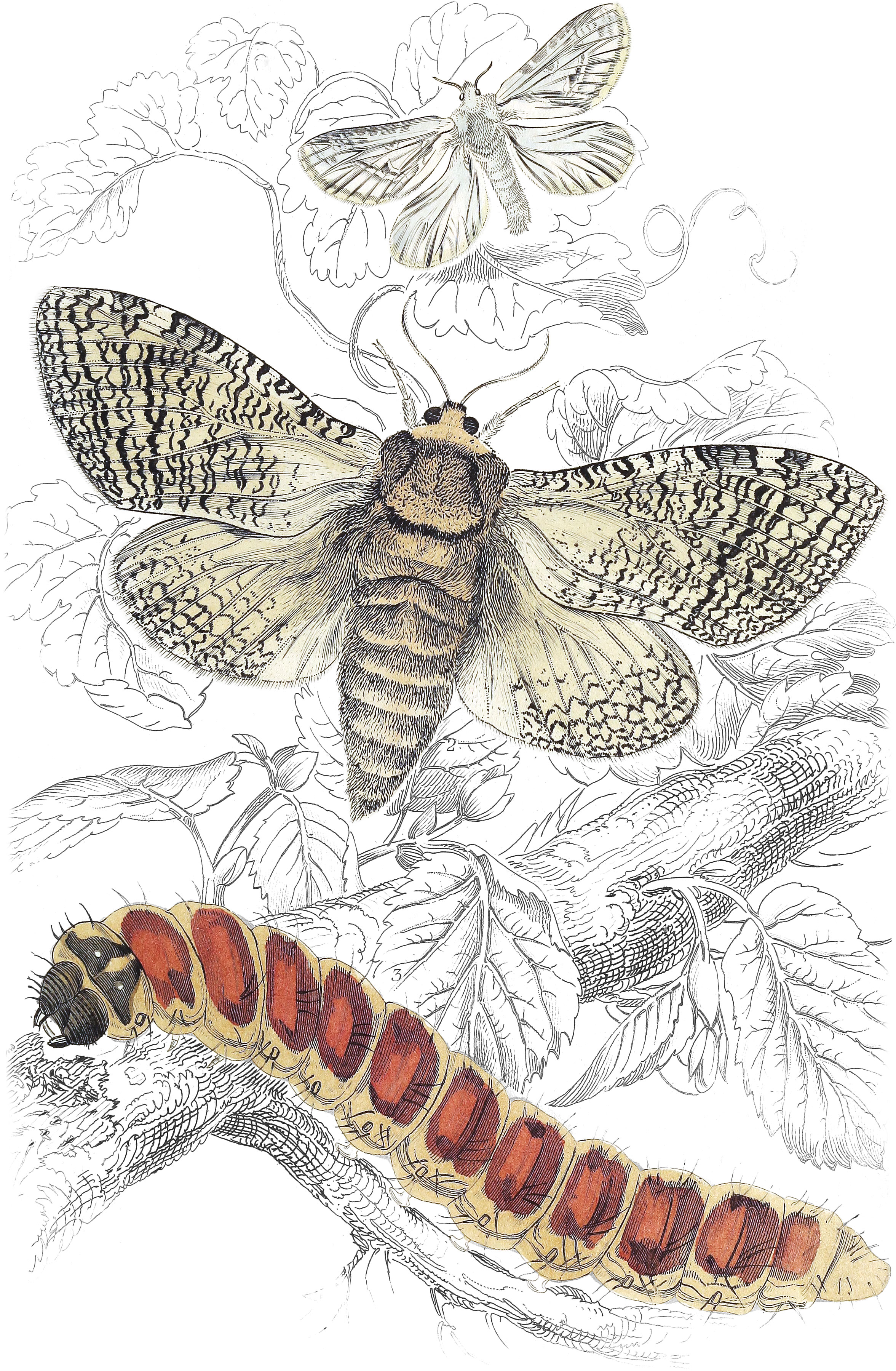
Plate XIV
Wood Leopard-Moth
Zeuzera Æsculi.—Figs. 1 & 2
Latreille, Stephens’ Illus.—Phal. Noct. Æsculi, Linn.; Donovan, v. Pl. 152,—Cossus Æsculi, Fabr.—Wood Leopard-moth, Harris.
This genus was first established by Latreille, who gives as its distinguishing characters the setaceous form of the antennæ, which are not so long as the thorax, and pectinated at the base in the males, while in the female they are simple, with the base tomentose. The palpi are obsolete, the abdomen long and attenuated, and the tibiæ without spurs or spines. The beautiful species represented on the adjoining plate is of a snowy-white: the wings very sparingly clothed with scales, and the nervures yellowish; the whole surface rather thickly sprinkled with dark-blue spots, which are largest in the female. The posterior wings are white at the inner angle and very faintly spotted at the base, but there is a distinct row of spots round the hinder margin. The abdomen is nearly covered with down, of a dark-blue colour. The wings of the male usually expand about two inches, but those of the female frequently exceed two inches and three-quarters.
The caterpillar lives in the interior of trees, and seems to frequent indiscriminately most of the kinds that grow in this country. It is of a light yellow colour, with a double series of black spots across each segment. The head is strong and wedge-shaped, well fitted to work its way through decomposing wood, and the segment immediately succeeding it is protected by a scaly plate of a black colour. (Pl. xv. fig. 2.) Preparatory to its becoming a pupa, it encloses itself in a cell composed of triturated particles of wood, cemented by a kind of glutinous substance. The moth emerges in July. It is by no means of frequent occurrence in this country, although it has been found in many different places. In some seasons it has been noticed rather plentifully in the vicinity of London, also in Cambridge, Norfolk, Surrey, Essex, &c.
Buff-Tip Moth
Pygæra Bucephala.—Fig. 3
Phal. Bom. Bucephala, Linn.; Donovan, i. Pl. 3 .—Phalæna Lunula, De Geer.—Buff-tip Moth, Wilkes, Pl. 43; Harris’ Aurel. Pl. 39.
In Pygæra the antennæ are rather long, appearing bipectinated in the male, as each joint emits a double tuft of ciliæ on each side; the apex, however, is simple, as is the case with the whole antenna in the female. The palpi are short, consisting of only two joints; and the thorax has a crest or strong ridge of hairs on the back. The hinder margin of the anterior wings is dentate. The only British example is named the Buff-tip Moth, on account of a large patch of that colour on the apex of the anterior wings. The latter expand about two inches and a half, and when the insect is at rest they are almost folded round the body. They are of a light brown colour, thickly powdered, especially towards the base, with silvery scales, and each of them having a large rounded yellow spot on the tip, slightly clouded with ochre-yellow externally, and bounded on the inner side by two parallel rust-coloured lines, which are continued to the inner edge of the wing: before the middle there is likewise a double transverse rusty line, and a single blackish one near the base. The fringe is yellowish, variegated with rust-red, and preceded by a continuous series of small crescent-shaped marks of the latter colour. The under wings are entirely yellowish-white above, with a faint dusky suffusion on the disk. The thorax, which is very wide and strong, is ochrey-yellow, surrounded with two parallel lines of dark rust-red. The abdomen is nearly of the same colour as the under wings, and has a row of dusky marks, one on each segment, on both sides.
The caterpillars are blackish when young, but when full grown they are yellow, with numerous longitudinal black stripes on each segment interrupted at the incisures; the head is likewise black, as well as the outer side of the legs. (Pl. xv. fig. 4.) [not shown] It is a gregarious larva, and consumes the leaves of the elm (particularly the wych elm), the beech, the oak, the lime, and the willow. By thus feeding in company, they often strip a tree of a large portion of its foliage in a very short time. When newly excluded from the egg, they arrange themselves side by side, in considerable detachments, and commencing at one end of a leaf, eat their way to the other, consuming the parenchyma or pulpy substance only half-way through. Having attained their full growth, which is usually the case by September, they permit themselves to drop to the ground, into which they burrow, and change into a dark-brown pupa. The insect is an abundant one in the vicinity of London, and in many other parts of England, but it appears to be somewhat scarce in Scotland and other more northern places. “Larva very common on the chestnut in Dumfries-shire.” Sir W. Jardine, Bart.
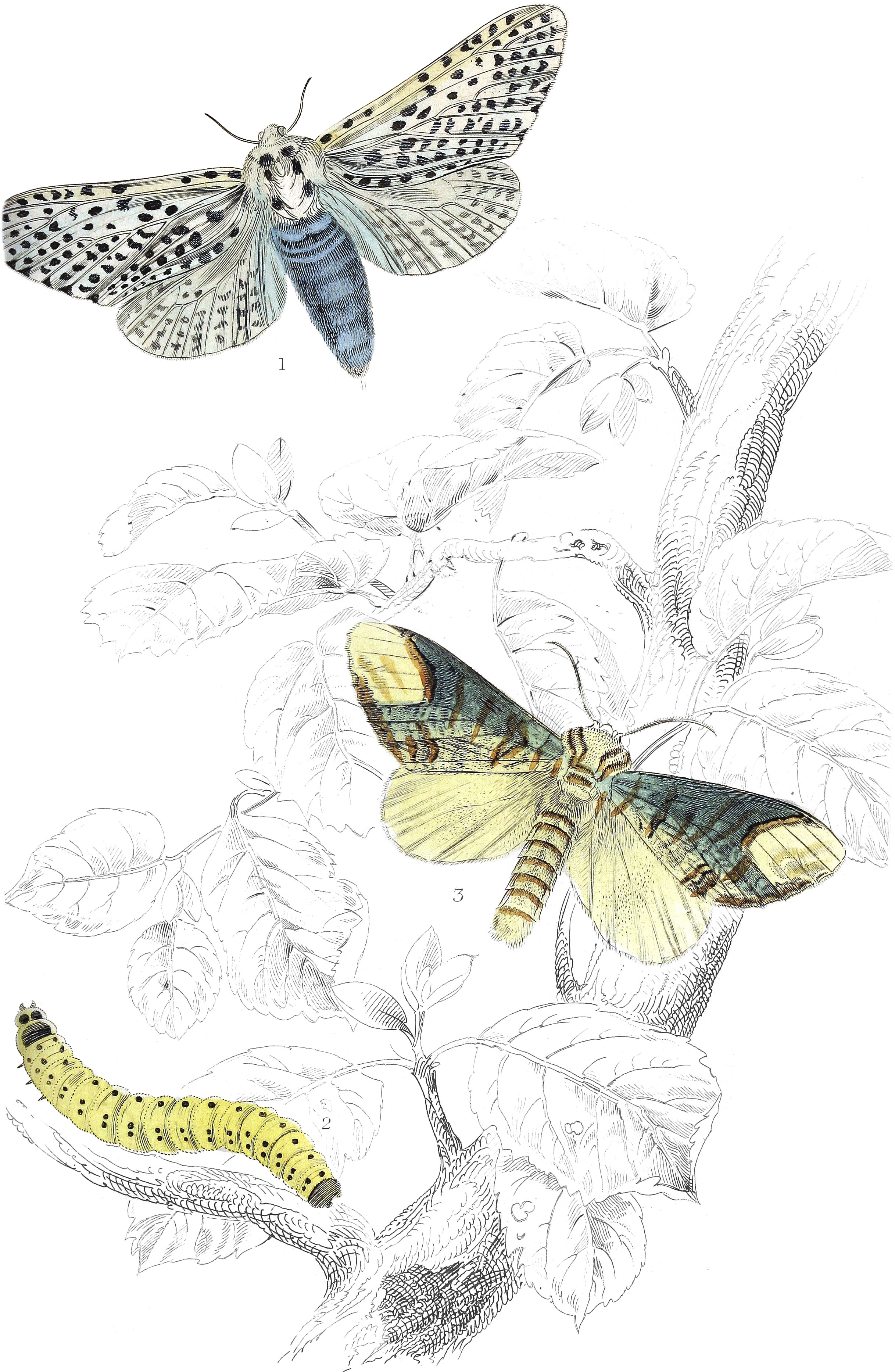
Plate XV
Puss-Moth
Cerura Vinula.—Figs. 1 & 2
Phal. Bomb. Vinula, Linn.; Donovan, iii. Pl. 85.—Cerura Vinula, Shrank; Stephens, &c.—Puss-moth, Wilkes, Pl. 29; Harris’ Aurel. Pl, 38.
This well-defined genus may be readily recognized by its somewhat diaphanous wings, its bipectinated antennæ, and the presence of four minute palpi. The trunk is short and nearly straight. The anterior tibiæ are furnished with an unusual appendage, in the form of a long compressed lobe, attached to the inner side near the base. Nine British species have been described, of which that which we have figured is by far the most conspicuous. The expansion of the wings is about three inches, the male usually somewhat less. The anterior wings are greyish white (the latter colour predominating in the male), somewhat naked and diaphanous, especially towards the tip, the nervures strongly marked and of a yellowish-brown. The costa is spotted with black; near the base are two transverse approximating rows of similar spots, beyond this a waved dusky band, followed by two other rows of spots, rather indistinctly marked: near the centre there is a series of arcuate streaks extending in an oblique line across the wing, the anterior one being largest and darkest, and the space beyond is occupied with two dusky zigzag lines, the hinder margin having a longitudinal dusky streak between each nervure. The hinder Wings are ashy-brown, whitish round the edge, especially in the male, having an obscure crescent on the disk and a few dark spots on the posterior margin. The thorax and abdomen are ashy-white, the former with a few scattered black spots, the latter with black marks at the base of the segments. The region of the eyes is deep black, and the tarsi are likewise of that colour and prettily ringed with white.
The caterpillar of this insect is one of the most remarkable found in this country, and its form and attitudes are so grotesque that it seldom fails to attract the notice even of the most indifferent observers. When at rest, it holds its large and singular looking head somewhat elevated and drawn back upon the anterior segments of the body, after the manner of a Sphinx caterpillar, and the double tail is kept erect at the other extremity. Its threatening aspect has sometimes inspired most ludicrous notions of its power of doing mischief, as in the instance quoted by Dr. Shaw from a country newspaper, where it is described as a monster with a head like a lion, jaws like a shark, a horn like a unicorn, and two tremendous stings in its tail. It is ornamented with very beautiful colours, which however, vary considerably according to the age of the individual. The description of Isaac Walton is pretty nearly accurate. He says:—
The very colours of carpillars as one has observed, are elegant and beautiful. I shall, for a taste of the rest, describe one of them; which I will, some time the next month, shew you feeding on a willow tree; and you shall find him punctually to answer his very description: his lips and mouth somewhat yellow; his eyes black as jet; his forehead purple; his feet and hinder parts green; his tail two-forked black; the whole body stained with a kind of red spots, which run along the neck and shoulder-blade, not unlike the form of St. Andrew’s cross, or the letter X made thus crosswise, and a white line drawn down his back to his tail; all which add much beauty to his whole body. And it is to me observable, that at a fixed; age this caterpillar gives over to eat, and towards winter comes to be covered over with a strange shell or crust, called an aurelia; and so lives a kind of dead life without eating all the winter. And as others of several kinds turn to be several kinds of flies and vermin the spring following, so this caterpillar then tums to be a painted butterfly.24 (Pl. xvi. fig. 2.)
The two-forked tail alluded to, which is peculiar to the Puss caterpillar and two or three others, is thus described by Kirby and Spence:—
This horn-like appendage is composed of two distinct cylindrical diverging branches, each about four lines long, not united at the base. Each of these is hollow, and includes a smaller cylindrical piece, which can be protruded at pleasure, and withdrawn again, as a pencil within its case; or, rather, as the horns of a snail. The two outer horns are tolerably firm, moveable at their base, and beset with black spines; the interior tentacula are fleshy, moveable in every direction, and in full-grown larvæ of a rose-colour. The animal seldom protrudes them, unless in some way disturbed; and frequently it approximates the outer cases so closely that they resemble a single horn. It appears to use these inner horns, when protruded, as a kind of whip to drive away the flies, especially the Ichneumons, that alight upon its body. When touched in any place, it will unsheath one of them, and sometimes both, and with them strike the place where it is incommoded.25
The cocoon constructed by this caterpillar is remarkable for its strength and solidity, being composed of particles of wood united by a very adhesive kind of gum. To enable the moth to pierce the walls of this indurated case, it is said to be furnished with a bag of acid, the contents of which it pours on the case of the cocoon, and its solvent power soon loosens the cohesion of the particles and renders egress easy. The insect is not unfrequent, at least in the larva state, both throughout England and the south of Scotland. The food of the caterpillar consists of the leaves of the Willow and Poplar.
The Kentish Glory
Endromis versicolor.—Fig. 3
Phal. Bom. Versicolor, Linn.; Don. v. Pl. 158; Entomological Transactions, i. 323, Pl. 9.—Glory of Kent, Wilkes, Pl. 89.—Kentish Glory, Harris.
The above name was conferred on this genus by Ochsenheimer, by whom it was first established, in consequence of the head of the only species it contains being garnished with long hairs somewhat after the manner of an ancient casque. One of its most remarkable characters is having the antennæ bipectinated in both sexes as far as the tip, a peculiarity which distinguishes it from all the preceding genera. The wings are large, entire at the edges, and somewhat diaphanous; the fringe so short as to be scarcely perceptible. The head is densely clothed with long hairs which project forwards; the thorax and abdomen are likewise very pilose. The male of E. versicolor measures about two inches four lines across the wings, but the female sometimes exceeds three inches. In the former the colour of the upper wings is rusty-red inclining to grey, each of them with two transverse black bands, the anterior one bordered internally with white, and the other, which is angulated towards the inner margin, bordered with the same colour on the outer side. The space between these bands is irregularly marked with white, and at the extremity of the discoidal cell there is a black crescent with the convexity turned towards the body. Towards the hinder margin there is a series of unequal white spots, the three upper ones largest and transparent, and each nervure is marked with a white streak which is a little dilated at the margin. The hinder wings are tawny yellow, traversed by a waved dusky line in the middle, and marked with a small crescent and a few white spots posteriorly. The body and base of the wings are very thickly covered with long yellowish-brown hair; the anterior part of the thorax white. The antennæ and tarsi are black. The markings in the female are similar, but the colour is much lighter, the under wings and abdomen being almost entirely of a dull white.
The caterpillar bears some resemblance to those of certain Sphingidæ, both in its form and attitudes. It is somewhat attenuated in front, and has a pyramidal elevation on that part of the anal segment which is occupied by a horn in the kinds just referred to. Before its first change of skin it is entirely green, but when mature the back is of a pale green, and the under side minutely sprinkled with black, the sides ornamented with oblique streaks of a whitish or yellow colour. It feeds on a variety of our common forest trees, and generally appears on the wing in June and July. It must be ranked among the rarer of our British moths having been found chiefly in the south of England, and seldom in considerable numbers. Darenth Wood, Coombe Wood, and Ashdown Forest, in Sussex, are the localities which have afforded the greatest number of specimens. The male flies during the day, and with such rapidity that he is captured with difficulty.
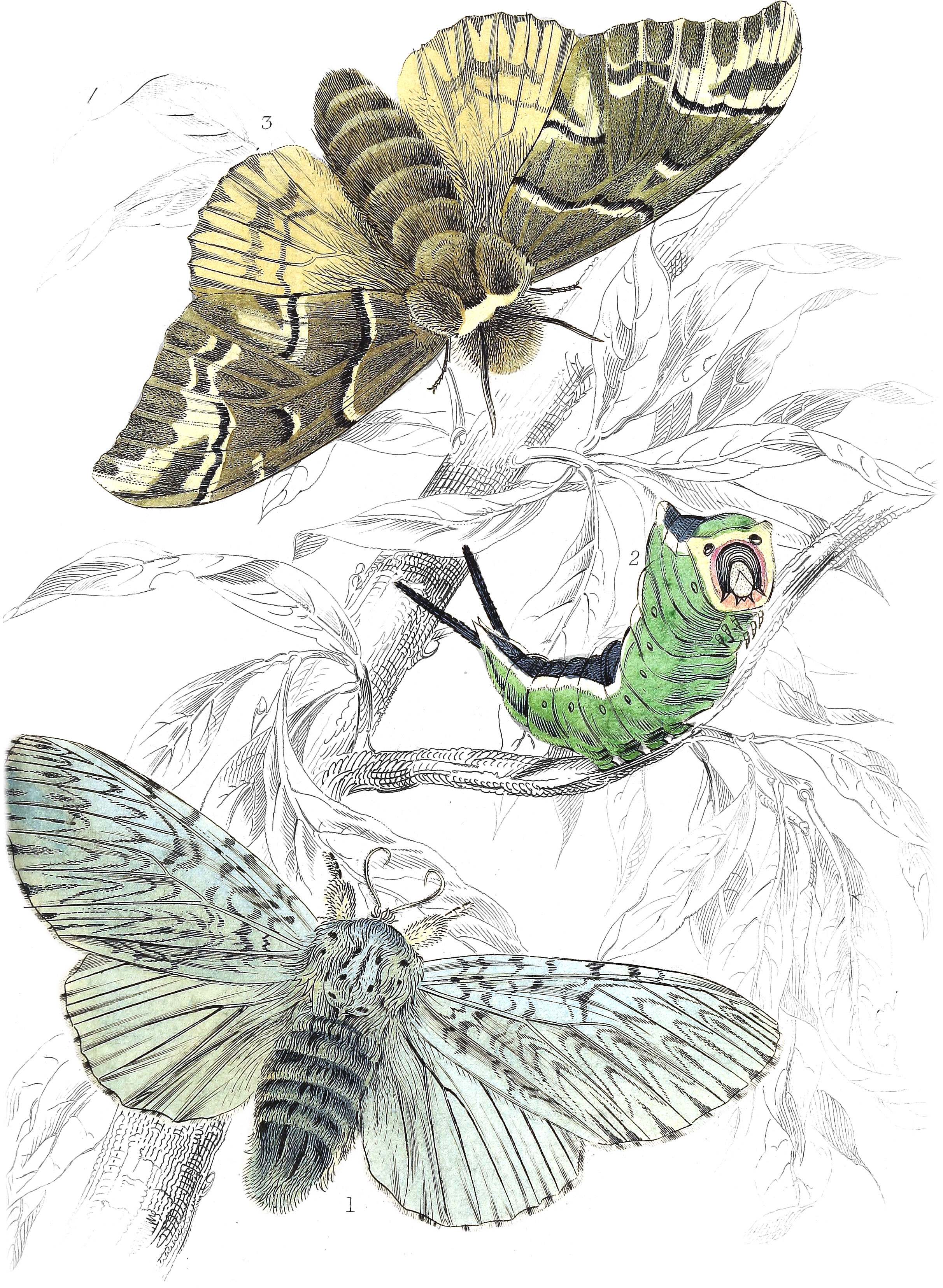
Plate XVI
Emperor-Moth
Saturnia Pavonia-minor.—Figs. 1 & 2
Phalæna Pavonia-minor, Linn.—Phal. Bom. Pavonia, Donovan, viii, Pl. 1 253. Pl. 254 .—Emperor-moth, Wilkes, xvi. Pl. 32 Larva, 33 Imago; Harris’ Aurel.—Saturnia Pavonia-minor, Shrank, Steph.
The genus Saturnia may be briefly characterized by the absence of palpi and a suctorial trunk, and by the structure of the antennæ, which, in the male, bear two long ramifications on each side of the joints, while in the female there is only a simple projecting barb on each side. The head is very small, and nearly concealed by the dense hairs that clothe the anterior part of the thorax; and the wings are very broad, extended horizontally when in a state of repose, and furnished with a fringe so short and imperfect as to be scarcely perceptible. The genus is not of very great extent, but it comprehends some of the most magnificent species yet known to naturalists. Such are S. atlas of China, which frequently measures eight or ten inches across, and which the French name Porte-miroir, on account of a large transparent vitreous mark in the centre of each wing; and S. luna, a native of America, remarkable for its delicate green colour, and the tail-like elongation of its hinder wings. Another species is the Peacock (S. Pavonia-major), the wings of which sometimes expand upwards of six inches, and is therefore the largest insect indigenous to Europe. The only species found in this country is the beautiful one represented on the accompanying plate. The female sometimes attains to upwards of three inches in the expansion of the wings, but the male seldom exceeds two and a half. The colour in both sexes is greyish, with numerous white scales intermixed, and faintly tinged in several places with purple; the hinder margin of all the wings with a broad brownish-white band. Besides this there are two transverse bands on each wing, one towards the base, somewhat abbreviated, and consisting of a white, purplish, and dark-brown stripe, the other placed behind the middle and very much waved. The centre of each wing is ornamented with a large ocellus, placed on a whitish ground, and consisting of a large black pupil with a whitish streak and a yellow or grey iris, surrounded with black, and surmounted by a reddish and light blue crescent. On the apex of the anterior wings there is a patch of purple, accompanied with a black and whitish mark. The body is covered with fulvous or brown hairs, the hinder margin of the abdominal segments whitish.
The caterpillar feeds on a variety of plants, particularly the common ling or heath (Calluna vulgaris), blackthorn bramble, willow, &c. It is at first black, but ultimately becomes of a lovely green colour, having each of the segments cinctured by a black band which is adorned with a series of pink tubercles, each bearing a whorl of six hairs, diverging like a star, the central one being longer than the others and capitate. (Pl. xvii. fig. 2.)
The insect is of frequent occurrence throughout the greater part of England: the moth is not abundant in Scotland, but the caterpillar and the empty cocoon are often observed on heaths. The female lays between 200 and 300 eggs, which she attaches by a glutinous liquid to the stem of the plant which is to afford nourishment to the larvæ. They are deposited in several separate packets, which are placed at some distance from each other, probably with a view to increase the chance of some of them escaping the effects of accidents, as well as to afford a greater supply of food when the young are hatched.
Oak Egger-Moth
Lasiocampa Quercus.—Fig. 3, Male
Phal. Bom. Quercus, Linn.; Donovan, iii. Pl. 104.—Great Egger, Wilkes, Pl. 46; Harris’ Aurel. Pl. 29.—Lasiocampa Roboris. Shrank, Steph.?
In this genus (named from λασιος hairy, and καμπη a worm or caterpillar) the antennæ are bipectinated in the males, and merely serrated in the other sex. There are neither mandibles nor suctorial trunk, but two short hairy palpi are observable, composed of three joints, the terminal one being very minute. The wings are entire, densely covered with scales, and deflexed when at rest; the margin with a distinct fringe. The abdomen of the male tufted at the apex and somewhat cleft, that of the female very large and scarcely tufted; the legs slender and sparingly clothed with hairs. Four species are recorded as British, all of which are of a reddish-brownish colour, with transverse whitish bands. The species figured to illustrate the genus is the most common of the whole. The male is of a deep ferruginous or chestnut-brown, with an ochreous yellow band running across all the wings near the middle; this band is distinctly defined on the inner side, but externally it is gradually shaded off towards the margin, where the brown colour again deepens. On each of the anterior wings there is a small central white spot placed in a dusky ring, and in many instances a yellowish patch at the base. The fringe of the anterior wings is narrow and brown; that of the hinder pair broad, and nearly of the same colour as the transverse band. but occasionally somewhat clouded with brown. The upper parts of the body are of the same colour as the dark portion of the wings, the under side and legs ochreous-yellow. Antennæ chestnut-brown. The female is much larger than the male, with similar markings, but the whole body and wings are pale yellow.
The caterpillar is yellowish, covered with greyish-brown hairs, having the incisures black, and a white macular band on each side. There is likewise an interrupted row of white spots on the back, and a pale yellow mark on the anterior part of the head. It feeds on the oak, willow, hawthorn, broom, and a variety of other trees and shrubs. Both the caterpillar and the moth are subject to numerous variations, which has occasioned difference of opinion among authors regarding the proper application of the specific name. Examples are occasionally found in which the transverse band is greenish: these Hubner regarded as distinct, and named Bombyx Spartii. Such as have a yellow mark at the base of the anterior wings, are alone considered by Mr. Stephens as referable to the true form. Quercus of Linnæus, in whose description that character is particularly mentioned. The others, of which the individual figured is an example, he has described separately under the name of L. Roboris, adopted from Shrank. The differences between the two are not, however, very important, and they obviously do not exceed the limits assigned. to the range of deviation in the majority of variable species. Neither ought the occasional dissimilarities observable in the larvæ to be assumed as certainly indicating specific distinction, for these variations often depend on age, sometimes even on the nature of the food; and in such a case as the present, where the sexes of the perfect insect are so unlike, it is not unreasonable to suppose that they may be respectively produced from caterpillars partaking more or less of the same character. The observations of De Geer have proved that in some instances the male moth originates from a caterpillar of an entirely different colour from that which produces the female.
In the extended sense which we have assigned to the name, Lasiocampa Quercus is an abundant moth in most parts of England, particularly in the south. The woods in the neighbourhood of London, the New Forest, woods in Cambridge-shire, &c. produces it in plenty. It appears to become more scarce as we advance northward, and it is by no means common in Scotland, although occurring at times at least throughout the southern division of that country.

Plate XVII
Drinker-Moth
Odonestis Potatoria.—Figs. 1 & 2, Male & Female.
Phal. Bomb. Potatoria. Linn.; Don. v. Pl. 148.—Odonestis Potatoria, Germar. Steph.—Drinker Caterpillar, Lister’s Gœdart. Albin, Pl. xvii.—Drinker-moth, Wilkes, Pl. 58; Harris’ Aurel. Pl. 45 42.
Odonestis may be briefly distinguished from the allied genera by the length of the palpi, which have the second joint double the length of the basal one, and project in front of the head like a small beak and by the hinder mar gin of the anterior wing’s being entire. The antennæ are strongly bipectinated, least in the male, as far as the apex, and they are a little curved near the base. The; abdomen is elongated and furnished with an anal tuft in the male, which is wanting, however, in the other sex. The hinder margin of the anterior wings is rounded and entire. but the angle formed by the tip is pretty acute; in the hinder pair there is a tendency to become denticulate. The sexes are distinguished by differences of size and colour similar to those exemplified by the preceding species. The male is reddish-brown on the surface, somewhat glossy, the anterior wings with an ochreous yellow patch at the base, and the disk more or less suffused with the same colour; a dark rust-coloured line extends obliquely across each of them from the tip to the middle of the inner edge, a faint transverse line is likewise observable near the base, and another, sometimes faint and interrupted, towards the hinder margin, to which it is nearly parallel. On the disk, towards the anterior margin, are two white spots, the lower one largest and stained with yellow in the centre. The hinder wings are unspotted, but there is an indistinct transverse streak on each darker than the rest of the surface. The body and antennæ are nearly of the same hue as the wings. The female is about a third larger than the male, and of a pale a ochre-yellow, sometimes approaching to yellowish-white. She lays a considerable number of eggs, which are whitish, surrounded with two green circles, and marked with a dark spot. The caterpillar has rather a singular appearance from being furnished with two long conical tufts, one of them placed on the back of the second segment and directed forwards, the other on the eleventh segment and turned in the opposite direction. On each side of the back there is a linear series of velvet-black spots, followed by a line of yellow spots, and beneath these a number of tufts of white hair. Like so many others of its tribe, it rolls itself in a ring when apprehensive of danger. It feeds on a variety of common grasses, such as Alopecurus pratensis, Bromus sterilis, the meadow grasses, &c. It survives the winter in a kind of torpid condition, and changes into the pupal state in June or July, the moth appearing in about three weeks. It is plentiful in most parts of England, particularly in marshy situations, to which it seems to be partial much less frequently in Scotland.
Lappet-Moth
Gastropacha Quercifolia.—Figs. 3 & 4
Phal. Bomb. Quercifolia, Linn.; Don. vii. Pl. 332 232.—Lappit-moth, Wilkes, Pl. 57; Harris’ Aurel. Pl. 43.—Gastropacha Quercifolia, Ochsen.; Steph.; Curtis’ B. E. i, Pl. 24.
The generic name26 refers to the appearance of the abdomen, which is very large in the females. As a genus, Gastropacha possesses strongly marked characters by which it is readily discriminated from a all the other groups included in the family of the Bombycidæ. All the wings are strongly dentated, and when the insect is in a state of repose, the anterior edge of the upper pair projects considerably beyond the upper, giving an oval form to the outline, bearing a good deal of resemblance to a withered leaf with a serrated border. Hence one of the species was named by Geoffroy la feuille morte. The antennæ are very short, recurved, and deeply bipectinated nearly in a similar manner in both sexes: the palpi very hairy and prolonged into a kind of snout, the second joint longer than the others. Maxillæ are observable, but they are very minute. The genus includes several European insects, but that figured on the adjoining plate is the only one satisfactorily ascertained to inhabit Britain. The surface of the wings is of a rusty-brown colour, varying considerably in shade, the extremity slightly glossed with violet; the upper pair with three oblique waved blackish lines, and a black spot in Be the centre. The hinder wings are generally unspotted; at times, however, they are marked with faint transverse streaks similar to those on the upper pair. The body is of the same colour as the wings; the stalk of the antennæ, the palpi, and the tarsi, of a deep bluish-black.
The caterpillar is of large size when full grown, sometimes measuring nearly four inches in length, and very variable in colour. The prevailing hue is dusky-grey, inclining to ash-grey, with two blue spots on the neck surrounded with black, and having a black angular mark in the middle. The membranous legs and the under side of the body are ferruginous, the latter spotted with black. Each segment is furnished with a fleshy appendage which hangs from the side, and there is a dorsal tubercle on the penultimate joint. (Pl. xviii. fig. 4.)
It feeds on a variety of trees and shrubs, such as the willow, blackthorn, bramble, hawthorn, &c., and it is asserted that the colour varies according to the nature of its food. The cocoon which it spins for its pupal change is long, and generally tapers somewhat at one end. The tissue is not very thick or compact, but all the interstices are closely filled up with a whitish powder, employed for lining the interior. The moth is fens occasionally in many parts of England but seldom in great abundance. It is not rare on the continent.

Plate XVIII
Black Arches
Psilura Monacha.—Figs. 1 & 2, Male & Female.
Phal. Bomb. Monacha, Linn.; Don. vii. Pl. 228 227.—Liparis Monacha, Ochsenheimer.—Laria Monacha, Shrank, Leach.—Black Arches, Wilkes, Pl. 39; Harris’ Vade Mecum, 9.—Psilura Monacha, Steph.
This genus was established by Mr. Stephens, and may be recognised by the following characters:—maxillæ obsolete; palpi with the second joint clavate, and bale longer than the radical one, which is likewise somewhat lengthened and club-shaped; antennæ short, deeply bipectinated in the male, but less so in the female; wings opaque and densely covered with scales, the edges entire; body more slender than in the preceding genera, the male having the apex of the abdomen slightly tufted, while that of the female is naked and attenuated.27 Psilura is very closely related to Hypogymna, a genus including the Gipsey Moth, whose curious economy renders it an object of much interest. The principal differences consist in the relative length of the articulations of the palpi and the appearance of the abdomen in the respective females, that of the Gipsey Moth terminating in a dense tuft of hairs.
The male of the Black Arches Moth generally expands from fifteen to eighteen lines, the female about two inches. Both sexes vary considerably, but the following description will apply to the majority of specimens. The surface of the primary wings is greyish-white, with numerous black spots, and four confused zigzag transverse lines of the same colour. Several of the spots are placed at the base of the wing, one before the middle between the two anterior lines, and a regular series along the terminal border. The secondary wings are brownish-grey, sometimes white at the hinder extremity; the fringe always white, spotted at regular intervals with black. The thorax is white, tinged with yellow in front, and marked with several black spots; the abdomen rose-red behind, with the incisures and series of spots black, that of the female terminating in a yellow corneous oviduct.
The caterpillar is brown, beset with numerous tubercles supporting tufts of greyish hairs. On the second segment there is a heart-shaped black spot followed by two white ones; the head is large, marked in a reticulated manner with flesh-coloured lines, and haying a triangular oval spot in the middle of the forehead; the membranous legs and belly light green. It feeds on the oak, birch, bramble, &c.; and is said occasionally to appear in such numbers in certain districts of Germany, as entirely to strip the pine forests of their foliage. The chrysalis, which is enveloped in a slight cocoon, is of a shining brown, and has tufts of hair on the Segments, a circumstance which is likewise observable in several of the allied genera.
This pretty moth is not generally distributed, but has been found in some plenty in certain localities, such as the New Forest, some parts of Kent, Surrey, &c. It does not seem to extend far to the north, and we have never heard of its being seen on this side of the Tweed.
Scarlet Tiger-Moth
Hypercampa Dominula.—Figs. 3 & 4, var.
Phal. Noct. Dominula, Linn.; Don. iv. Pl. 141,—Callimorpha Dominula, Latr.; Leach—Eyprepia Dominula, Ochsen.—Scarlet Tiger-moth, Wilkes, Pl. 38; Harris’ Aurel. Pl. 40.—Hypercampa Dominula, Hubner, Steph.
The length of the proboscis, which considerably exceeds that of the head, taken in connection with the opaque scaly wings, is sufficient to distinguish the present genus from all others belonging to the extensive family of the Arctiidæ. Another peculiar character is to be found in the structure of the antennæ, which are simple; that is, without teeth or pectinations in both sexes, contrary to what is observed in genera which in other respects have the greatest affinity to the present. The palpi have the two lower joints of equal length, the terminal one much shorter and of an ovate form: wings entire on the edges. The species named the Scarlet Tiger-moth is one of the most elegant and ornamental that we possess. The primary wings are black and shining, with a fine silken-green gloss, each of them ornamented with about a dozen cream-coloured or yellowish spots of various dimensions, the two largest placed rather beyond the middle. The secondary wings are of a fine carmine-red, with three large and irregular black spots; the fringe of all the wings black. The thorax is black glossed with green, and marked with two yellow longitudinal spots: abdomen the colour of the under wings on the surface, the under side, basal segment, and a dorsal line, black; the under side highly glossed with green. Several varieties occur, of which the most remarkable are those in which the red colour is replaced by pale yellow, and such as have the abdomen entirely black, and the under wings dull brown, without any vestige of the gay colouring of ordinary specimens. This latter variety is represented on Plate xix. fig. 4.
On issuing from the egg, the caterpillar is of a dirty yellow, with the head and numerous small spots over the body black. After its first moult it becomes black, with three yellow longitudinal lines, one on the back and another on each side; the black portion with many small blue tubercles, from which issue diverging greyish hairs. The moth appears in June; but is not of frequent occurrence in this country. It has been found in some plenty in the vicinity of Cambridge and in Darenth Wood; also, but much more sparingly, at Blackheath, Oxford, near Reading, &c.

Plate XIX
The Clouded Buff
Euthemonia Russula.—Fig. 1
Phal. Bomb, Russula, Linn.; Don. vi. Pl. 214.—Eyprepia Russula, Ochsen; Curtis’ B. E. i. Pl. 21.—Clouded Buff, Phal. quadra, Harris.—Phal. Bomb. Sannio , Linn.—Arctia Russula, Latr.—Euthemonia Russula, Steph.
The above insect has generally been associated with the typical Tiger moths (Arctic), but the discrepancies are too great for this union to be continued with propriety. The genus Kuthemonia (from ευθημων handsome) has therefore been constituted, and may be recognized by having the middle joint of the palpi a good deal longer than the two others, the terminal one rather slender; proboscis not longer than the head; antennæ short and slender, bipectinated in the males and serrated in the females; abdomen annulated, and having a small tuft at the apex; wings deflexed, and trigonate.
This species named the Clouded Buff, differs from the generality of moths in the female being considerably less than the male; the latter being about eighteen or twenty lines between the tips of the wings, and the former seldom exceeding sixteen or eighteen lines. The sexes are likewise very dissimilar in colour: the male has the surface of the upper wings pale yellow, with the anterior and inner edge as well as the fringe, rose-red; the disk of each with a large somewhat crescent-shaped brown spot edged with red. The under wings are pale yellowish-white, with a dusky crescent in the middle anteriorly, and a broad dusky band near the hinder margin, the fringe rose-red. The thorax and abdomen are of the same colour as the adjoining wings; the legs and stalk of the antennæ: reddish. In the female the portion of the upper wings just described as light yellow, is of a reddish-yellow inclining to brown; the hinder wings dusky at the base, and having a marginal band, varying in shape and size in different individuals.
The caterpillar is thickly covered with fascicles of short hair, sometimes reddish, at other times inclining to orange-yellow. The body is dusky-brown, with a pale yellow dorsal line, and a series of yellow spots on each side. It feeds on a variety of plants, among which are the hound’s tongue (Cynoglossum officinale), field scabious, and narrow-leaved plantain. The moth is not generally distributed, but is found in some plenty in Coombe Wood, the New Forest. near York, &c.: likewise in the vicinity of Edinburgh, but not plentifully, and in Dumfriesshire near Raehills.
Cream-Spot Tiger-Moth
Arctia Villica.—Fig. 2
Phal. Bomb. Villica, Linn.; Donovan, ii. Pl. 71.—Bombyx Villicus, Haworth.—Eyprepia Villica, Ochsen; Curtis.—Cream Spot Tyger-moth, Wilkes, Pl. 37; Harris’ Aurel. Pl. 4.—Arctia Villica, Steph.
This genus comprehends some of the most striking and richly coloured moths with which we are acquainted. Deep black, crimson, and yellow are the prevailing colours; and these are combined in strongly contrasted spots and bars in such a manner as to produce a most agreeable effect. The most common species is the beautiful Great Tiger-moth (Arctia caja), found occasionally in all parts of Britain, produced from a larva of much more frequent occurrence, well known throughout the country as the hairy worm, and in the south of Scotland by the name of hairy orbit. The generic name likewise bears allusion to the hairy caterpillar, being derived from ἄρκτος a bear. The distinctive characters are to be found in the palpi, which have the basal joint longer than the second; in the antennæ being rather long, bipectinated in the males, and serrated in the females, each of the radii and serratures terminating in a bristle; in the proboscis being short, scarcely longer than the head; and the wings being densely clothed with scales. The thorax is without a crest, and, as well as the abdomen, is thick and strong. The species figured as an example of the genus is by no means so generally distributed as the Great Tiger-moth, but it is not very rare in some parts of England. It measures from two inches to two inches and a half across the anterior wings, which have the ground colour deep black; each of them with about eight yellowish or cream-coloured spots of various sizes, the basal one triangular or heart-shaped, the others in pairs placed transversely, and an insulated one on the hinder margin. The under wings are rather deep yellow, with a few scattered small black spots, and a large black patch on the outer angle, enclosing a few irregular spots of the ground colour. The thorax is deep black, with a cream-coloured mark on each shoulder; the abdomen yellow at the base, bright red posteriorly, with three longitudinal rows of black spots. On the under side the anterior edge of all the wings is tinged with bright red, and the breast and sides are thickly garnished with hairs of the same colour.
The caterpillar is black after its last moult, and covered with aigrettes of greyish-brown hairs: the head and legs reddish-brown, the former having a black heart-shaped spot in the middle. It feeds on most of our common field plants. The chrysalis has short tufts of reddish hairs on the segments.
Ruby Tiger-Moth
Phragmatobia fuliginosa.—Fig. 3
Phal. Noc. fuliginosa, Linn.; Don. iii. Pl. 80.—Ruby Tiger, Harris’ Aurel. Pl. 27.—Chelonia fuliginosa, Godart.—Arctia fulig. Latr.—Phragmatobia fulig. Steph.
This genus, like several others in the same family, has the scales so thinly placed on the wings that these members appear more or less diaphanous. This circumstance, taken in connexion with the structure of the antennæ, which are short and almost simple in both sexes, and the very robust body, suffices to distinguish it from any other with which it has any chance of being confounded. The palpi are short and hairy, having the two lower joints of equal length; the head very small. The only British species referable to it is the pretty little moth named the Ruby Tiger. It varies much in colour, but the upper wings are most commonly reddish brown, with two black points near the middle of each, and the fringe bright red; the hinder pair bright red, becoming black posteriorly, with a streak of that colour at the extremity of the discoidal cell; or the surface nearly all black, haying the inner edge only tinged with red; fringe as in the anterior wings. The thorax is reddish-brown, the abdomen bright carmine-red, with a row of black spots on the back and another on each side.
The caterpillar is very thickly covered with hairs, which vary in colour in different individuals, but are commonly brown or reddish; the head and legs of a corresponding hue. Scarcely any of our ordinary plants are rejected by it as food. Fabricius has remarked of this caterpillar, that when it is seen to run over the snow in the winter, it may be taken as a sign that the ensuing summer will be cold and ungenial;
Hieme in nive obambulans, æstates frigidiores et annonæ caritatem prænunciat;
a prognostication which the French naturalist Godart proves not to be infallible, by gravely stating the result of his observations to the contrary; and he has actually known a beautiful summer and plentiful harvest follow the phenomenon alluded to.
Of occasional occurrence during the months of July and August, in many parts of the country. We once found it at Duddingston, near Edinburgh, and have seen several specimens which were taken in Roxburghshire. The neighbourhood of Newcastle, York, Darenth Wood, &c. are mentioned among its English localities. It has likewise been found in Caithness and Sutherland.
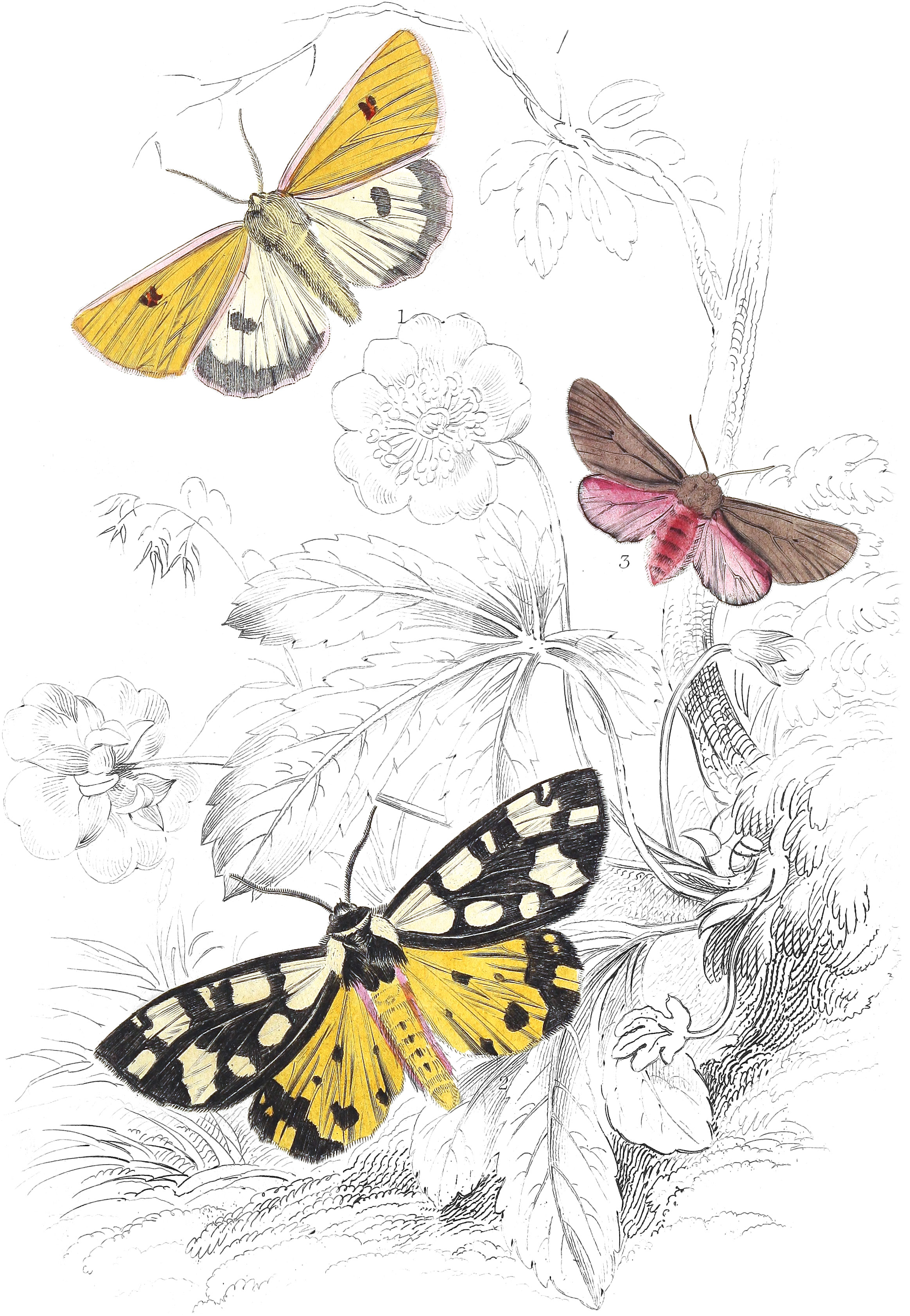
Plate XX
Wood Tiger-Moth
Nemeophila Plantaginis.—Fig. 1
Phal. Bomb, Plantaginis, Linn.; Don. iv. Pl. 134.—Wood Tyger-moth, Wilkes, Pl. 50.—Nemeoph. Plantaginis, Steph.
This pretty insect was formerly associated with the Arctiæ, but has lately been referred to a separate genus, under the name of Nemeophila.28 The antennæ are bipectinated in the male and serrated in the female; the palpi short, all the joints of nearly equal length, and almost globose, the terminal one rather smallest. The proboscis is short, scarcely the length of the head; the thorax not crested, and the wings completely opaque with scales. The thorax and abdomen are somewhat slender, the extremity slightly tufted in the male. The latter sex usually measures about an inch and a half across the wings, the female being somewhat larger. The anterior wings are deep black above, with a yellowish or cream-coloured stripe running from the base towards the apex, where it becomes very irregular and forms a kind of cross; there are likewise two spots of the same colour on the anterior Margin, varying much in size, and sometimes confluent. The hinder wings are ochreous-yellow (sometimes reddish) with two black stripes at the base, and a nearly continuous series of black spots along the hinder margin, in the male; the whole base black in the other sex. The head, thorax, and back of the abdomen are black; the former with a yellow tuft on each side, and the thorax with lateral streaks of light-coloured hair, which, however, are wanting in the female. In the latter sex the abdomen is reddish, with a black dorsal line.
The caterpillar, which feeds on the broad and narrow leaved plantain, chickweed, &c. is black and hairy, the six middle segments reddish on the back and sides. It is well figured by Rosel, vol. iv. t. 24.
The moth is found in June and July, and is not unfrequent in certain localities, although it does not seem to be generally distributed. We have seen several examples from Roxburghshire and some other of the border counties of Scotland, and it has been taken in Darenth Wood, as well as in several places in the north of England. It has also been found plentifully in Shetland and the Orkney Islands.
The Cinnabar Moth
Callimorpha Jacobææ.—Figs. 2 & 3
Phal. Noc. Jacobææ, Linn.; Don. Pl. 45.—Pink Underwing, Harris’ Aurel. Pl. 4.—Callimorpha Jacobææ, Latr., Steph.
This genus, originally constituted by Latreille under the above name (derived καλος from beautiful, and μορφα form or appearance ), properly contains in its present restricted acceptation only one species, for the Red Arches of Harris (Phai. rosea, Don.) which has been sometimes referred to it, obviously pertains to a different group. The trunk is rather long, at least longer than the head, and the palpi, which are covered only with small scales, have the basal joint as long as the two following, which are of equal length and rather obtuse. The antennæ are slender and setaceous, somewhat ciliated in the males; the extremity of the abdomen slightly tufted in that sex; the anterior wings long and narrow, with the hinder margin a little rounded. The thorax is not crested; and the posterior tibiæ are furnished with two pair of spurs. The colouring of the Cinnabar, or Pink Underwing Moth, as it is sometimes called, is very peculiar, and it presents this additional singularity that the upper and under surfaces are precisely alike. The anterior Wings are greyish black, with a stripe of carmine extending from the base nearly to the apex, parallel with the anterior margin and at a little distance from it; on the hinder border there are two remote rounded spots, and a dash on the inner edge, of the same brilliant red. The under wings are entirely bright red, except the fringe and a stripe on the anterior edge, which are greyish-black. The body, antennæ, and legs are deep black.
The caterpillar is likewise prettily marked, being yellow ringed with black. (Pl. xxi. fig. 3.) It feeds on the flowers of the ragwort (Senecio Jacobæa), and probably also on the other species of the genus, several of which are well known to be common weeds. The moth is of occasional occurrence apparently throughout Britain, and in some places it is abundant. It seems to be nowhere plentiful in Scotland, but specimens have been obtained from numerous and widely scattered localities. “Abundant on the Northumbrian coast.” Sir Wm. Jardine, Bart.
Crimson Speckled Footman
Deiopeia pulchella.—Figs. 4 & 5
Phal. Tinea pulchella, Linn.—Lithosia pulchella, Haworth.—Bombyx pulchra, Hubner.—Deiopeia pulchra, Curtis, iv v. Pl. 169.
Deiopeia has been separated from the allied genera in consequence of having the labial palpi three-jointed, with the second joint longest, the third shortest and ovate; antennæ alike in both sexes, simple; and the proboscis as long as the antennæ. The anterior wings are narrow and elongate, the hinder pair ample, somewhat diaphanous, and much folded. Besides the labial palpi, a maxillary pair likewise exist, but they are exceedingly minute and consist of only two joints. The species are numerous on the continent, but that which we have figured is the only one that inhabits this country. The head, thorax, and upper wings are pale straw-colour, the thorax marked with yellow and rounded black spots; the wings with five curved and irregular transverse rows of quadrate black spots, the spaces between these rows occupied with several bright scarlet spots varying in shape and size. The abdomen and under wings are white, slightly tinged with blue, the latter with a broad dusky marginal band, sinuated on the inner side, and becoming narrow towards the body, the transverse nervure closing the basal areolet dilated and blackish; the fringe of all the wings pale yellow.
The caterpillar is hairy, of a bluish-grey colour, spotted with black and red, and having a white dorsal line. (Pl. xxi. fig. 5.) It feeds on Heliotropium Europeum, Solanum tomentosum, and field mouse-ear (Myosotis arvensis), only the latter of which is indigenous to this country.
This very beautiful moth is frequent in the southern European countries, and is said likewise to be found in Asia and America. It is one of our rarest native species, the following, we believe, being the only places where it has occurred, and only a single example except in one instance having been found in each: near Christchurch, Hants; Hoye, near Brighton; Yorkshire.
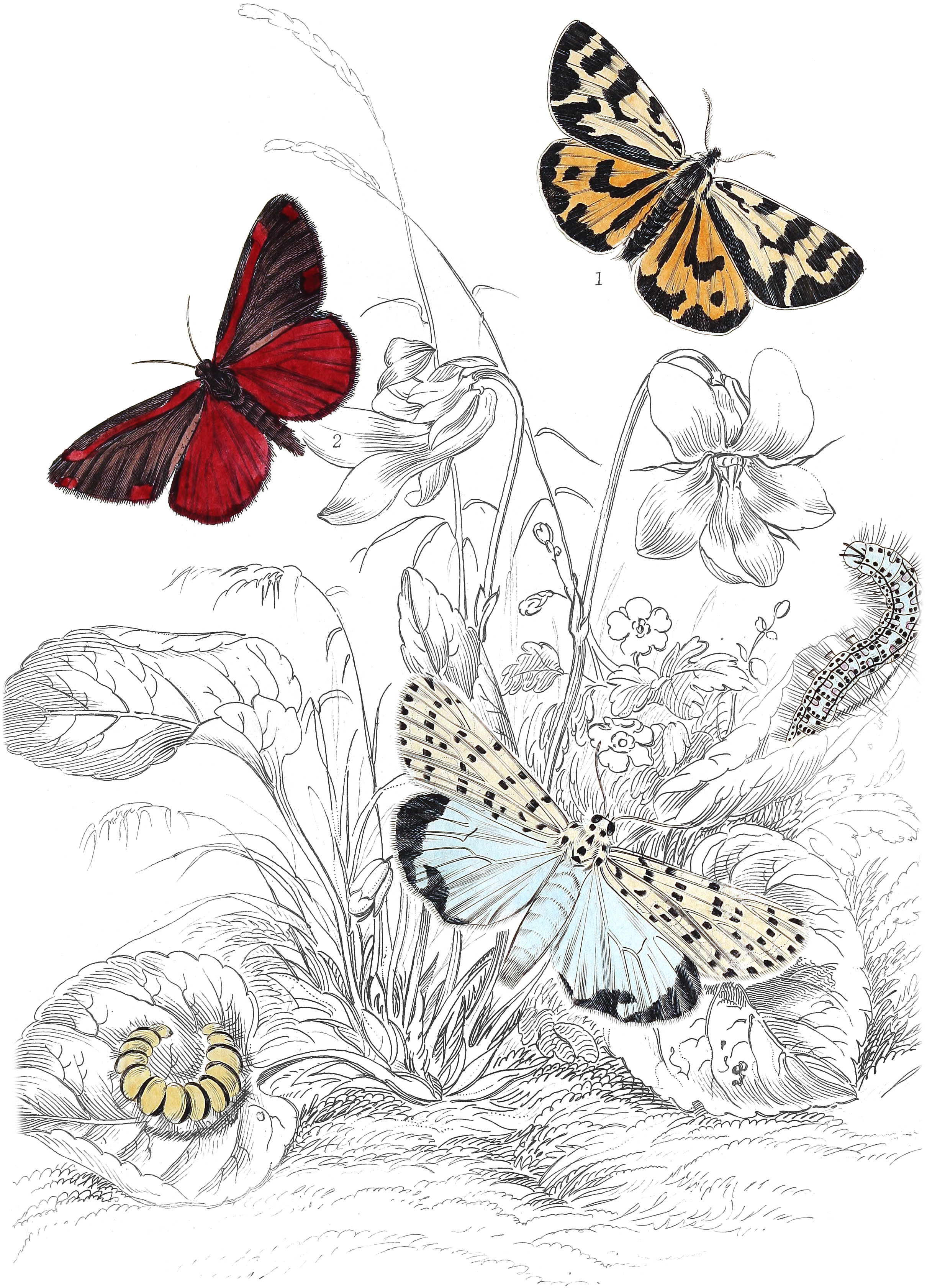
Plate XXI
Broad-Bordered Yellow Underwing
Triphæna Fimbria.—Fig. 1
Phol. Noctua Fimbria, Linn.; Don. vi. Pl. 208.—Noctua Solani, Fabr.—Broad-bordered Yellow Underwing, Harris’ Aurel. Pl. v. fig. 2.—Triphena Fimbria, Ochsen, Steph.
The genus Triphena (an ancient classical name applied to a female) is included in the great family of the Noctuidæ, and is readily distinguished from all the groups to which our attention has been hitherto directed, by having the proboscis long and spiral, like that of the diurnal lepidoptera. The palpi rise upwards in front of the head and are somewhat compressed, the radical joint shorter than the two others, the second long, the third short and attenuated, with the tip obtuse. The antennæ are simple in both sexes, those of the male ciliated on the under side; the thorax without a crest, but furnished with a large flap or tippet in front. All the species are of middle size, and rather gaily coloured, especially on the underwings, which are bright yellow with a black posterior margin. When they fly it is only for a short distance at a time, and chiefly in the afternoon and evening. In the earlier part of the day they may be found lurking at the sides of stones and among grass, and when an attempt is made to seize them, they do not take wing, but attempt to escape by gliding rapidly among the herbage. The most abundant species is that named the Great Yellow Underwing (T. pronuba), which occurs plentifully in all parts of Britain. That which we have figured is much less frequently met with, but it inhabits numerous and widely scattered localities, having been found in Northumberland, Yorkshire, Devonshire, Suffolk, &c. It is nearly of the same size as the common species; the head, thorax, and anterior wings greyish, dark liver-coloured, or some shade intermediate between these two, each with four transverse pale lines, and two pale rings on the disk; the line next the base abbreviated, the second and third angulated, and enclosing a space darker than the rest of the wing in which the two annular marks are placed; the hinder one undulated, haying one or two black dots at its anterior extremity, surmounted by a few white ones. The underwings are light orange yellow, with a very broad posterior band of deep black, which, however, does not cover the hinder edge: the abdomen likewise yellow; the antennæ brown, whitish at the base.
The caterpillar is large, rough, and ochrey-yellow, with a pale line along the back, and white stigmata surrounded with a black ring. It feeds on the potato, violet, hound’s tongue, primrose, &c. The moth is found in June and July.
Large Sword-Grass Moth
Calocampa Exoleta.—Figs. 2 & 3
Phal. Noct. Exoleta, Linn.; Don. vi. Pl. 187, larva.—Noctua Exoleta, Hubner.—Sword-grass Moth, Wilkes, Pl. 18, Harris. Xylina Exoleta, Curtis’ B. E. vi. Pl. 256.—Calocampa Exoleta, Steph.
Antennæ setaceous, rather stout in the males, each joint ciliated beneath with hairs; the proboscis as long as the antennæ; palpi entirely covered with long trigonate scales, the joints robust, the second double the length of the first, the terminal one short and ovate, with the apex truncate; head with a frontal crest; anterior wings long and narrow, scarcely wider at the hinder margin (which is dentate) than towards the base; thorax quadrate, slightly crested, and three-lobed behind; the abdomen depressed, in the male with the apex triangular; such are the principal attributes of the present genus, and which serve to distinguish it from Xylina, with which it has generally been associated. Only two species are found in this country, and one of them, C. Vetusta, is very rare. They bear considerable affinity to the group named Cucullia; and besides other properties common to both, have this peculiarity, that when they are made to fall down they roll their wings closely round them and draw in their legs and antennæ; a position in which they not a little resemble a piece of dead wood. The species figured is rather the largest of the two, the expansion of the wings being frequently upwards of two inches. The prevailing colour is pale ochreous, inclining to reddish-brown in many places. The upper wings are striated with dusky lines towards the base, and the inner side is more or less clouded with the same colour; each of them with two approximating ear-shaped spots near the middle, the hinder one largest, and relieved with black, which emits one or two salient points directed backwards; the fringe brown spotted with black. The hinder wings are dusky-grey, with a darker lunulated spot towards the base; the fringe ochre-yellow. The thorax is dark-brown on the back, and the abdomen light reddish-ochre, obscurely banded with dark brown.
The caterpillar is remarkably beautiful,29 the ground colour being a rich green, the back adorned with two rows of white spots, connected in pairs, below this a yellow line, succeeded by a series of small round spots, and then a red line just over the legs. (Pl. xxii. fig. 3.) It feeds on almost every kind of plant but prefers spinach, lettuce, and asparagus. The moth is found in summer and autumn, and although far from being common, occurs now and then in marshy places in many parts of the country. We have found it near Jedburgh, at Duddingston in the vicinity of Edinburgh, and have seen examples from Perthshire. In England it has been taken at Darenth Wood, near Oxford, and in several other stations.
Several specimens were taken at Jardine Hall on the skep during the month of January of the present year.
Sir W. Jardine, Bart.

Plate XXII
The April Miselia
Meselia Aprilina.—Fig. 1
Phal. Noct. Aprilina, Linn.—Noctua Runica, Fabr.—Phal. Runica, Don. x. Pl. 354 347.—Marvel du Jour, Harris.—Miselia Aprilina, Ochsen, Steph.
The beautiful little group distinguished by the name of Miselia (from μισειν to hate and ηλιος the sun), is recognised by the antennæ being long, robust in the males and sometimes slightly serrated: the maxillæ about the length of the antennæ; the palpi with the radical joint rather robust, the second long and not so thick, the third shortest and ovate, all of them thickly clothed with scales except the terminal one which is nearly naked; the head tufted on the crown; the thorax robust and quadrate, and the abdomen tufted on the back towards the base. All the wings are rather narrow, the anterior pair roundish on the hinder margin. The larvæ have the head and pectoral segments a little depressed, and the head is considerably retracted in repose. They have two protuberances on the back of the penultimate segment; their abode is usually between the bark and on the trunk of trees. The species named Aprilina, from the usual period of its first appearance, has the upper wings of a fine green, thickly marked with transverse black streaks and spots, the apex with two rows of spots shaped like the head of an arrow, one of the rows placed upon the hinder margin. The under wings are dusky brown, with a faint light-coloured streak on the inner side rather behind the middle, and another along the hinder edge; the fringe of the wings whitish spotted with brown. The head and thorax are the colour of the upper wings, the latter with some black marks on the back and a line of the same colour on each side; abdomen grey; legs ringed with black, the posterior wings having a black spot in the middle on the under side.
The caterpillar varies in appearance according to its age, and even full grown individuals are often very dissimilar. It is commonly ash-grey, with dark spots and lines on the back and sides; sometimes the back is spotted with white, and the sides more or less striped with that colour. It feeds on different kinds of forest trees, such as the ash, elm, beech, &c. The moth first appears in the middle of April, and there is another hatch in October. Mr. Haworth says,
This is at once a plentiful, well known, and beautiful insect; but it is remarkably able that none of our collectors ever take it in the winged state, and very rarely in that of a larva. The usual mode of procuring it being by digging about the roots of oaks an inch deep for the pupæ, which are annually found in that manner in considerable numbers.
The insect is not plentiful in Scotland, but is found occasionally throughout the southern counties.
Peach-Blossom Moth
Thyatira Batis.—Fig. 2
Phal. Noctua Batis. Linn.; Don. i. Pl. 33.—Noctua Batis, Haworth.—Peach-blossom, Harris.—Thyatira Batis, Ochsen, Curtis, Steph.
Thyatira has the antennæ simple in both sexes; maxillæ as long as the antennæ; palpi placed considerably apart, the radical and terminal joints of equal length, both of them short, the intermediate one very long and thick, the apical one with such small scales that it appears nearly naked; the head transverse; the superior wings moderately wide, with the tip acute; the body rather robust, and the thorax furnished with a transverse crest, which is forked posteriorly. When obtained in perfection, the species above referred to, named the Peach-blossom from the colour of the spots on its upper wings, is one of the most lovely found in this country. The upper wings are brown with dark transverse waved lines rathe r darkest towards the base, each of them with five rose-coloured spots, a large one at the base, clouded with brown, two towards the tip (sometimes united), a third on the posterior angle having a brown spot in the middle, and smaller one on the inner margin; there is likewise a minute rosy spot on the hinder margin adjoining that on the posterior angle. The hinder wings are dusky inclining to ochre-yellow, and having a pale waved line near the middle; the abdomen of a similar colour.
The caterpillar is of a very peculiar form, having a large gibbosity on the back a little behind the head cleft at the summit into two branches, and triangular elevations along the back marked with a pale zigzag line; the colour rust-brown or blackish. It feeds on the common bramble. The moth appears in June and July, and is usually found in the evening in the vicinity of woods; it is not however of very frequent occurrence, although it seems to inhabit all the southern counties of England, and has occasionally occurred pretty far north. “Five or six——have been taken at Jardine Hall.” Sir Jardine, Bart.
Buff Arches
Thyatrira Derasa.—Fig. 3
Phal Noctua Derasa, Linn.; Don. vii. Pl. 223, fig. 1.—Noctua derasina, Haworth.—Buff Arches, Wilkes, Harris.—Thyatira Derasa, Ochsen, Steph.
About the size of the preceding, or a little larger; the prevailing colour light yellowish-brown; the upper wings with two white oblique bands, one of them extending from the tip to the inner margin, the other continued from the inner margin to the anterior one, and terminating not far from the base, the space between it and the base generally more or less denuded of scales. The triangular space between the two bands is clouded with brown and white, and there is a transverse series of several parallel fine brown zigzag lines, forming very acute angles on a whitish ground:; the hinder margin of the wing brown, with two rows of small white arches, surmounted by a white ill defined line; the fringe likewise whitish. The hinder wings are somewhat dusky with a slight ochreous tinge, the fringe white.
The caterpillar, which seems to be a general feeder, is yellowish-green, with dark-brown spots and lines on various parts of the body. The moth, which is prized for its beauty as well as its congenel T. batis, is much more common than that species. being frequently found in most parts of England, near woods and in shady lanes. It becomes scarce in the north, but has been taken near York and in Northumberland. July and August are the periods of its flight.

Plate XXIII
The Herald-Moth
Scoliopteryx Libatrix.—Fig. 1
Phal. Bomb. Libatrix, Linn.; Don. vi. Pl. 216.—Bomb. Libatrus, Furbelow-moth, Haworth.—Herald-moth, Harris.—Calyptra Libatrix, Ochsen, Steph.
This beautiful moth occurs in great profusion in the more southern parts of England, but becomes rarer as we advance northwards, and cannot be said to be common in any quarter of Scotland. It frequents places where willows and poplars grow, it being upon these trees that the larvæ feed. It first appears in July, and is likewise found plentifully in October, whence Aurelians have called it the Herald, from an idea that its appearance gave indication of the approach of winter. The expansion of the wings is from an inch and a half to an inch and a quarter; the thorax and anterior wings reddish-grey, with an irregular red patch at the base, a round white spot on the disk of each, and two oblique transverse white bands, one a little below the middle, the other a little behind it: from the outer band to the apex the colour is grey with minute dusky points, the space traversed by a very faint waved whitish streak. The rufous patch is sprinkled with minute yellow dots, and there is a distinct row of small white marks along the central nervure. The underwings are brownish, becoming darker towards the hinder margin; the abdomen inclining to red with a few faint dorsal marks; the thorax with a dusky line on the back and a transverse streak of the same colour. Legs greyish; the tarsi white, spotted with rust-red. The caterpillar, which is slender and naked, is green with a white line on each side, and red stigmata.—The principal generic distinctions of Scoliopteryx are the lengthened palpi clothed with long capitate scales, the radical joint shortest, the other two rather long and stout and nearly of equal length; antennæ short and strong, bipectinated to the apex in the males, slightly serrated in the females; proboscis rather short, head and thorax each with a crest anteriorly; anterior wings deeply emarginate on the hinder edge and somewhat dentate; the hinder pair very slightly dentate.
Mottled Orange-Moth
Gortyma flavago.—Fig. 2
Phal. Noct. Lappæ, Don. x. Pl. 340.—Noctua Flavago, Hubner.—Noct. Ochraceago, Haworth, 234,—Noct. rutilago, Fabr.—Mottled Orange, Harris’ Aurel. Pl. 35.—Gortyna flavago, Ochsen, Curtis, Steph.
Gortyna has antennæ of moderate length, setaceous, clothed with scales above, and pubescent beneath; the proboscis slender and not so long as the antennæ; palpi with the basal joint short and curved upwards, the second long and attenuated. the terminal one distinct, somewhat oval and compressed at the apex; thorax broad, with a conical tuft anteriorly, and trilobed behind; all the wings entire, the upper pair sublanceolate, with the tip acute. The larva is fleshy, furnished only with a few short and scattered hairs. It feeds on the pith and internal parts of vegetables, and bears a good deal of resemblance to those of Zeuzera, Cucullia, and others of similar economy. Only two British species have been hitherto detected, of which that named G. flavago is by far the most handsome. It expands from an inch and a quarter to nearly an inch and a half; the upper wings are rich yellow, variegated with reddish-brown, the latter colour enclosing several spots of a lighter yellow than the rest, each wing with two broad transverse bands of reddish-brown, one near the base the other near the hinder margin, from which it is separated by a yellow band undulated on the inner side; fringe long and thick, the colour reddish-brown. The hinder wings are dirty white, glossy, with a dusky crescent-shaped mark on the disk, and an obscure band posteriorly; the fringe ash-brown. The thorax and abdomen are reddish-brown, the former slightly tinged in certain places with yellow. The caterpillar feeds on the pith of the common burdock (Arctium Lappa), and likewise attacks other thick stemmed plants, such as Verbascum Thapsus, Scrophularia aquatica, the spear thistle, &c. It undergoes its metamorphosis in the interior, where the pupa likewise remains till the moth is ready to emerge, which usually takes place towards the end of autumn. The insect is not rare in many parts of England, but seems to become very scarce as we advance northwards. The only Scotch specimen we have seen was taken near Rosslyn.
The Angle Shades
Phlogophora Meticulosa.—Fig. 3
Phal. Noct. meticulosa. Linn.; Don. iv. Pl. 139.—Angle-Shades-Moth, Wilkes, Pl. 3, Harris’ Aurel. Pl. 41.—Phlogophora meticulosa, Treitschke, Ochsen, Steph.
In Phlogophora (from φλοξ flame, and φερειν to carry, in allusion to the shape of the markings on the anterior wings) the antennæ are long, slender, and ciliated; the abdomen tufted at the base; the anterior wings rather narrow, with a sinuosity on the hinder margin and several ragged teeth; the hinder wings very slightly dentate on the edge. The only British species is that figured. The upper wings, which usually measure nearly two inches across, are pale rosy-white, more or less clouded with olive-brown, each of them with a large triangular purplish mark in the centre, beyond which there is a white band, the margin more or less marbled with olive-brown. The hinder wings are whitish, sometimes with a faint rosy tinge posteriorly, having a dusky central crescent, and two or three faint transverse waved dusky lines.
The caterpillar is usually green, with a row of oblong white spots on the back, and a continuous white line on each side just over the legs. It feeds on culinary vegetables and many of our common field plants. The moth may be said to be common in most parts of the country, but is much scarcer in Scotland than further south. April, June, and September are the months in which it appears most plentifully, there being apparently three broods in the season.
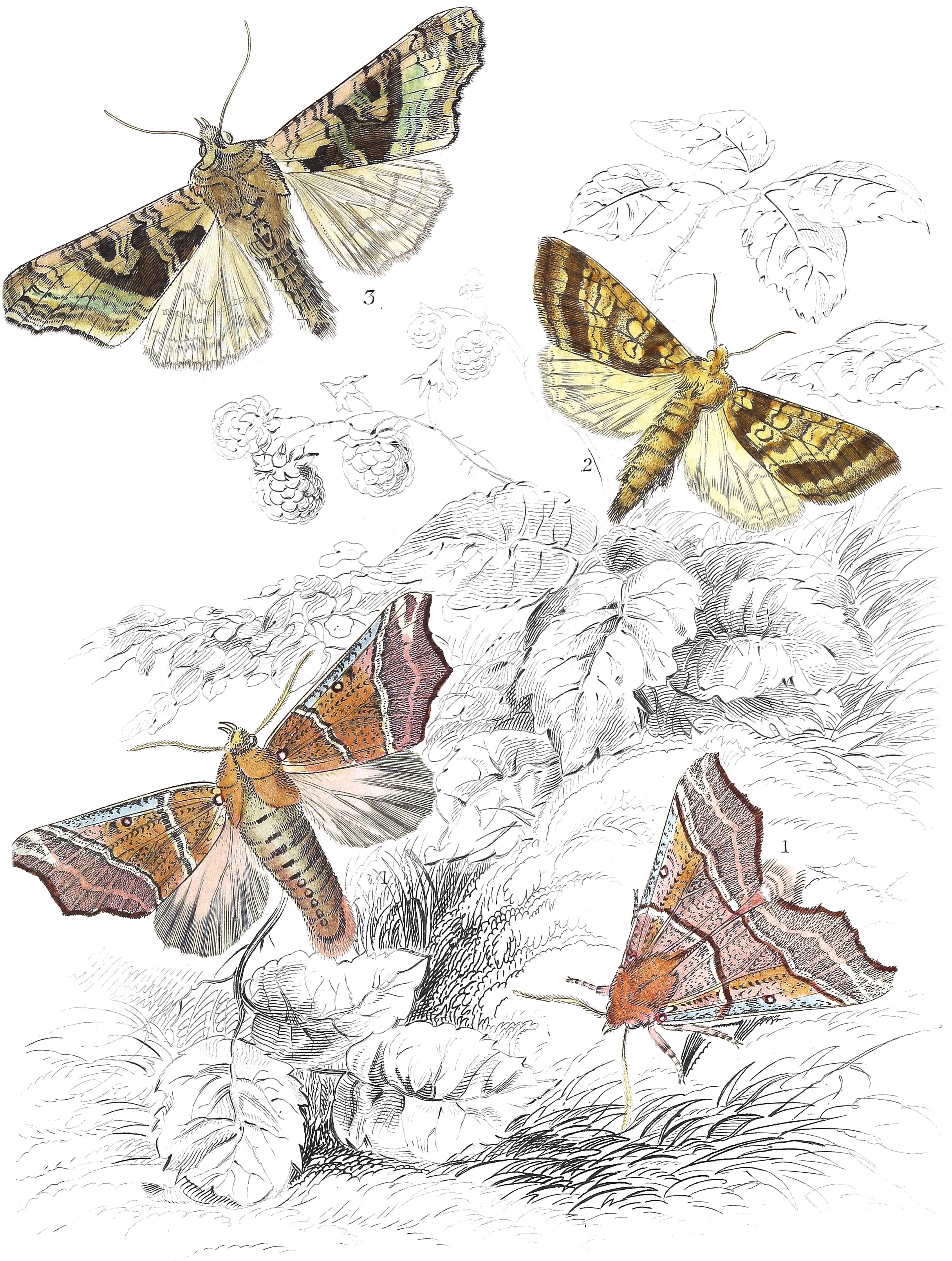
Plate XXIV
Pease-Blossom Moth
Chariclea Delphinii.—Fig. 1
Phal. Noct. Delphinii, Linn.; Don. x. Pl. 331.—Pease-Blossom Moth, Wilkes, (Pl. 3 4.) Harris.—Chariclea Delphinii, Steph.; Curtis, vol. ii. 76.
The beautiful insect for the reception of which the genus Chariclea has been established, bears considerable affinity to Cucullia both in the state of moth and caterpillar. The antennæ are covered with scales above, and are hairy beneath; the proboscis nearly as long as the body; the palpi entirely covered with long thick-set hair, upon the removal of which the radical joint appears longest, the terminal one small and ovate. The upper wings are narrow, very slightly notched on the hinder margin, and furnished, as well as the under wings, with a very long fringe: the anterior tibiæ very short, and bearing two naked horny spines at the extremity. The Larkspur or Pease-blossom Moth expands about an inch and a quarter; the upper wings with a broad three-lobed band at the base, and a narrow one behind the middle, of a purple colour; the space between these bands, which is bounded on each side by a pale sinuated line, variegated with pale rose-colour and purple; the hinder margin likewise pale rosy, with a black line next the fringe; the latter yellowish-white. The under wings are whitish, tinged with rose-colour behind, and having a transverse dusky spot near the middle yellowish-white.
The caterpillar is yellow, tinged with lilac on the back and belly, where it is likewise marked with numerous rows of black spots; each side with a line of rather bright yellow. It feeds on the wild Larkspur (Delphinium Consolida), a plant which grows pretty abundantly in some of the southern counties of England, but which is not found in a wild state in Scotland.
Mr. Curtis says,
This charming moth is no less esteemed for its rarity than for its lovely colours; the specimens in Mr Stephen’s cabinet, as well as those in the British Museum, are from Windsor; and it has once been taken by the late Mr. Jones in his garden at Chelsea. Its favourite food is the larkspur; it therefore ought to be met with in Cambridgeshire, and districts where that plant abounds in a natural state. It is, however, probable that this is one of those insects, which, if not periodical, appears in very small numbers; which opinion is strengthened by the fact, that it is very rare upon the Continent, where it fetches very high prices; and we are informed by Mr. Haworth, that the great patroness of Natural History, the late Dutchess of Portland, possessed only a wing of the moth, found in a spider’s web at Bulstrode. In Wilkes’ days (1773), it was bred, he says, by the Honourable Mrs. Walters, and by Nathaniel Oldham, Esq.30
The Gamma-Moth
Plusia Gamma.—Figs. 2 & 3
Phal. Noct. Gamma, Linn.; Don. viii. Pl. 265. fig. 2.—Noctua Gamma, Hubner.—Silver Y Moth, Wilkes.—Plusia Gamma, Ochsen, Steph.
Antennæ simple in both sexes, of moderate length; palpi longer than the head, the radical joint nearly of the same length as the terminal one, the latter linear and obtuse at the apex, the intermediate joint double the length of the others and tapering towards the tip; proboscis long; head and thorax both crested; the abdomen, which is rather long and thick, likewise bearing tufts at the base and along the back; fringe of the anterior wings slightly emarginate, that of the posterior entire: caterpillars half looper, possessing only four ventral legs and the usual posterior pair. Such are the distinguishing characters of this handsome genus, which contains about a dozen indigenous species. All of them are remarkable for the rich metallic marks on the anterior wings, which sometimes assume the appearance of written characters. They fly during the day, skipping about from one plant to another in a restless manner, and with much rapidity, keeping their wings, while feeling, in constant vibration, somewhat like the Humming-bird Hawk-moth. The most common and best known of these insects is represented on the adjoining plate. It measures from an inch and one-third, two upwards of an inch and a half; the upper wings grey, variegated with dusky brown, having a pale blotch anteriorly towards the apex, and a few transverse slightly waved dark lines; the disk of each inscribed with the silvery character, resembling the letter Y, or rather the Greek γ; fringe somewhat dentate, greyish, spotted with dusky brown. Hinder wings ash-brown, the nervures and hinder margin deep brown; the fringe light-coloured with dark spots. The head and thorax are ash-grey; the abdomen rather of a lighter hue.
The colour varies considerably in intensity, and the character on the anterior wings is sometimes of a golden hue.
The caterpillar is green, with a faint yellow streak along the sides, and white ones along the back; it feeds on almost any of our common field plants, and is well known for the extensive depredations it sometimes commits. (Pl. xxv. fig. 3.) The moth is found from April to September, and, even so late as the beginning of November it may sometimes be seen in fine weather hovering about the few flowers that retain their blossoms till that season. It seems to inhabit all parts of Britain: we have seen specimens from the most northern quarters of Scotland.
Burnished-Brass Moth
Plusia Chrysitis.—Fig. 4
Phal. Noct. Chrysitis, Linn.; Don. iv. Pl. 187.—Phytometra Chrysitis, Haworth.—Burnished-Moth, Wilkes.—Burnished-Brass Moth, Harris’ Aurel. Pl. 22.—Plusia Chrysitis, Ochsen, Steph.
This elegant species is about the size of the preceding, but differs from many others belonging to the same genus in the shape of the wings. The anterior pair are pale fuscous, ornamented with a broad band near the base, generally of a golden-green colour, but variable in the tint; the green sometimes predominating, at other times the yellow; and a second of a similar colour behind the middle, placed obliquely, and frequently united to the other by an oblong patch on the inner margin. Near the apex there is a transverse line of deep brown, and the nervures are likewise of that colour. Posterior wings dusky-brown, the fringe of both pairs reddish-brown. Head and thorax yellowish, the latter brownish-grey on the sides; abdomen brown, tinged with yellow, the hairs on the sides and hinder extremity inclining to rust-red.
The caterpillar, which feeds on a variety of common plants, is green, with a longitudinal white line on the sides, and oblique streaks of the same colour on the back. The moth frequents lanes, the rank vegetation found among rubbish, &c. and is very common in the vicinity of London and other places in the south of England. It becomes scarce in the north, and is not frequently observed in Scotland, although occurring at times in the southern counties, as we have seen examples from Roxburghshire, Dumfries-shire, Peebles, &c.

Plate XXV
The Clifden Nonpareil
Catocala Fraxini.—Fig. 1
Phal. Noct. Fraxini, Linn.; Don. v. Pl. 171 and 172.—Clifden Nonpareil, Wilkes (Pl. 90), Harris’ Aurel. Pl. 31.—Catocala Fraxini, Shrank, Steph. Curtis’ B. E. fol. 217.
The genus Catocala of Shrank contains several of the largest and handsomest moths indigenous to this country. The wings are large, and extended by means of very strong nervures, the upper pair some shade of grey on the surface, finely mottled and waved with dark brown spots and streaks, forming a striking contrast with the under wings, which (except in the species named above) are bright red, with transverse black bars. The caterpillars are what are called half-loopers, because in walking they partially assume the attitude of the kinds which are without abdominal legs; and conformably with this circumstance, the first pair of legs are found to be smaller than the others, showing a tendency to become obsolete, and thus indicating a certain degree of affinity with the geometers properly so called. They are densely ciliated on the sides, attenuated before and behind, and furnished with a caudal prominence. These insects may be distinguished as a genus by the length of the trunk, which is equal to that of the antennæ; by the palpi, which have the middle joint nearly one half longer than the two others, and go densely clothed with scales as to appear double the thickness of the terminal one, the latter being short and slender; by the abdomen being attenuated posteriorly, and the fringe of the wings, especially in the hinder pair, being long and rather deeply indented: the thorax slightly crested, large, and strong; the head small, and the antennæ long and setaceous, covered with scales externally, and short hairs on the inner side.
The species named C. Fraxini is the largest moth found in this country, the expansion of the wings sometimes reaching four inches. The thorax and upper wings are light grey on the surface, the latter variegated with transverse undulating lines of brown. The under wings are brownish-black, with a broad curved band of light blue across the middle. The fringe of all the wings is pure white, deeply indented, and preceded by a row of dusky triangular marks, having the point turned outwards, which is most distinct in the hinder wings. The under side of the body and legs are white, the tarsi of the anterior pair spotted with brown above.
The caterpillar lives on the ash, poplar, oak, elm, birch, &c. It is ash-coloured, more or less yellowish, and sprinkled with minute black dots, The head is greenish, with two frontal black crescents; the eighth segment having a dorsal protuberance of a bluish-black colour, and marked with a few yellow spots. On the ninth segment there is an oblique black line extending to the hinder stigmata; the latter are all surrounded with a black ring. It spins a very loose cocoon among a few leaves, and changes into a reddish-brown chrysalis, powdered with pale blue, and having two small blue tubercles on each side of the fourth and fifth segments.
It is a rare insect in this country, and indigenous specimens in good condition may still be regarded as a valuable addition to a cabinet. It was first figured by Wilkes as a British insect, and is said by him to have been found at Cleifden, in Buckinghamshire; whence the English name he has assigned to it. It has since been observed in Suffolk, Kent, Surrey, and a few other places; the vicinity of York is the most northern locality that has been cited. In France, Germany, and other continental countries, it occurs much more plentifully.
Red Underwing
Catocala Nupta.—Fig. 2
Phal. Noct. Nupta, Linn.; Don. vii. Pl. 224.—Red Underwing, Harris’ Aurel. Pl. 18.—Hemigeometra Nupta, Haworth, 268.
Extent of the wings about three inches or upwards; the surface of the upper pair dark grey, with transverse waved streaks and spots of brown and obscure yellow, the hinder border with a series of transverse lunulated spots, and two waved dusky lines on the fringe. The underwings are of a deep and beautiful blood-red inclining to carmine, with a curved sinuated band of deep black near the middle, which tapers and disappears before reaching the inner edge of the wing, and a broad marginal band sinuated internally; the fringe pure white, with vestiges of ferruginous spots at the base. The thorax and abdomen are brownish-grey above, but white beneath; the legs brown, ringed with white on the tarsi. The under side of the upper wings is black, with a faint bluish play of colour, and three white transverse bands, the central one abbreviated, and the outer one attenuated and forming an acute V-shaped angle towards the inner margin; the apex and the fringe greyish-white, each tooth of the latter bearing a transverse dusky arc.
The caterpillar is attenuated at both extremities; the colour grey, inclining to white, and variegated with brown; having two rows of small tubercles along the back, and a callous protuberance on the eighth segment. The belly is greenish, with a longitudinal series of black spots in the middle; the head bordered with black. The chrysalis is reddish-brown, and covered with a kind of bloom of a blue colour. The caterpillar feeds on the poplar and willow; and the moth continues to frequent these trees, and may often be seen reposing on their stems, particularly of the willow. It occurs very frequently in the southern parts of England, and is not rare even in the more northern counties, although we are not aware that it extends to Scotland.
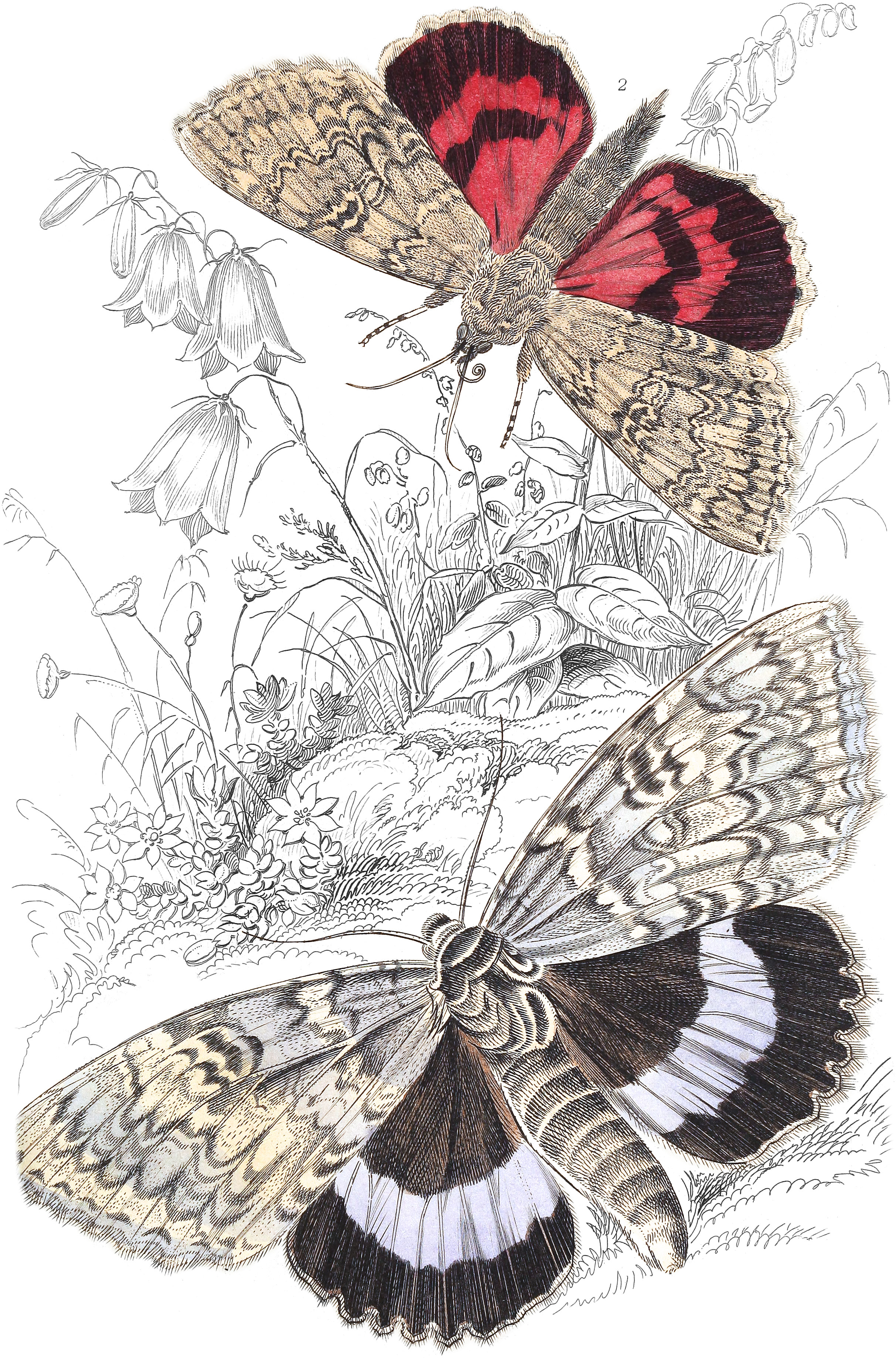
Plate XXVI
We now come to that section of the nocturnal lepidoptera which includes the extensive family of Geometrine moths, the peculiar characters of which have already been alluded to. They constitute the Phalænæ geometræ of Linné, and the Lepidoptera semidiurna, Phalænites, or Arpenteuses, of more recent writers. The caterpillars are remarkable for their mode of progression and long narrow bodies, which are generally free from hair, but not unfrequently furnished with knobs and protuberances. The majority have ten feet, six of which, placed upon the pectoral segments, are scaly and conical; the other four are membranous, a pair of them situate near the hinder part of the abdomen, the other at the extremity. The abdominal legs are sometimes wholly wanting, but the anal pair is indispensably requisite to enable the animal to execute its peculiar movements. Many of these caterpillars feed only in the night, and may be observed during the day, if the eye happen to distinguish them from the surrounding twigs which they often strikingly resemble, with their bodies suspended in the air perfectly motionless, forming an angle with the branch to which they cling by their hinder prolegs. The moths, however, are by no means exclusively nocturnal, and several of them may occasionally be noticed on the wing even in the heat of the day. Their bodies are generally slender, the abdomen of the male terminating in a small tuft: the antennæ in that sex frequently pectinated, at other times simple; the palpi short and somewhat cylindrical; the proboscis occasionally obsolete,—when developed, not very long and nearly membranous; the wings ample, and extended almost horizontally during repose. The first species selected to illustrate this division is named
The Brimstone-Moth
Rumia Cratægata.—Fig. 1
Phal. Geom. Cratægata, Linn.—Geom. Cratægaria, Haworth. Brimstone-moth, Wilkes, Pl. 80.—Yellow or Brimstone, Harris.—Rumia Crategata, Duponchel, Steph.
It expands from an inch to an inch and two-thirds; the colour deep sulphur yellow, the anterior edge of the upper wings with two narrow reddish-brown spots towards the base, a third near the middle produced internally and having a white mark in the centre, and a pretty large one on the apex; behind the middle there is a transverse row of faint dusky marks, and two or three others near the base. The hinder wings have a small dusky spot on the disk, sometimes with a white centre, and several evanescent dusky marks, some of them forming a kind of band posteriorly. The fringe is nearly the same colour as the wings, and marked in certain places with reddish-brown spots.
The caterpillar, which is elongate and cylindrical, is pale brown, with a bluish spot on each side of the neck, and the spiracles on the sixth segment tinged with red; the back with two horn-like protuberances. Its favourite food is the hawthorn, but it likewise frequents the sloe, apple-tree, bramble, &c. The moth is one of our more common species, and is distributed over the whole island. It is found from April to October or November, there being several broods in the year.
Swallow-Tail Moth
Ourapteryx Sambucaria.—Fig. 2
Phal. Geom. Sambucaria, Linn.; Don. v. Pl. 170.—Swallow-tail Moth, Wilkes, Pl. 78; Harris.—Ourapteryx Sambucaria, Leach, Zool. Mag. i. Pl. 35, fig. 2.
The most characteristic feature in the present genus is that to which both the generic and English names refer, namely, the prolongation of the hinder wings into a pretty lengthened acute tail. The anterior wings are likewise very acute at the tip, and somewhat falcate, the margin entire. The antennæ are of moderate length and simple in both sexes; the palpi short, the proboscis nearly as long as the antennæ. The caterpillar has six pectoral legs, and four prolegs at the hinder extremity. The Swallow-tail is one of the largest of our native geometrine moths the extent of the wings frequently measuring two inches and a half. The colour is delicate sulphur-yellow, shaded at the base of the wings into satiny-white, and deepening towards the hinder extremity; the surface marked with numerous dark evanescent streaks, placed transversely; two lines of deep yellow run across the anterior wings, and a single one across the under pair, the latter forming a continuation, when the wings are expanded, of the innermost of the two anterior lines. At the base of the tail there are two small blackish spots, the larger one with a reddish centre, and the fringe is ochrey-yellow, inclining in some places to reddish-brown.
The colour of the caterpillar is reddish-brown, with darker longitudinal lines; the head flat and oval. It feeds on the leaves of various shrubs and trees, but prefers the elder, willow, and lime. It changes to a long narrow pupa of a brown colour, with darker spots and streaks, which is inclosed in a thin spinning among leaves. The moth appears on the wing in June and July, and is not scarce in many parts of England, especially in the south; but it appears to be somewhat rare in Scotland.
Large Emerald-Moth
Hipparchus Papilionarius.—Fig. 3
Phal. Geom. Papilionaria, Linn.; Don. viii. Pl. 287.—Geometra Papilionaria, Hubner, Haworth.—The Large Emerald, Harris.—Hipparchus Papilionarius, Leach, Steph.
This genus was first characterized by Dr. Leach, and has been adopted with some modifications by most succeeding writers. The species which it formerly embraced are noted for their beautiful tints of green, which caused them to be known by the appellation of Emerald-moths. These, however, are now distributed in other genera, and the only one left under the old designation is the fine insect represented on the adjoining plate. The wings generally exceed two inches in extent, and sometimes are two inches and a half in the female; the surface deep grass-green, with two rows of whitish spots extending across both wings, rather behind the middle; on the disk of each there is an obscure crescent-shaped spot of a deeper green than the rest; the fringe is greenish-yellow, and the antennæ reddish-brown, particularly in the male.
The caterpillar has six pectoral, two abdominal, and two anal feet. It is green, with a yellow line on each side and reddish warts on the back; and feeds on the elm, lime, alder, birch, &c. The moth appears in the end of July, frequenting woods and meadows, but is not very frequently met with in any part of Brita. It has, however, been found in Askam Bogs Yorkshire, in Kent, Surrey, near Reading, in Warwickshire, and many other parts of England, and on two or three occasions near Raehills in Dumfries-shire, as well as at Cramond near Edinburgh. Asa genus, Hipparchus is distinguished by the following characters: antennæ pectinated in the males almost to the apex, the pectinations ciliated; antennæ of the female simple; proboscis spiral, much shorter than the antennæ; palpi projecting nearly in a horizontal direction, and approximating at the tip; the radical joint very short, the second very long, the terminal one lanceolate, free from hairs, and somewhat pointed; upper wings covering the under pair when at rest, the latter with the hinder margin dentate.
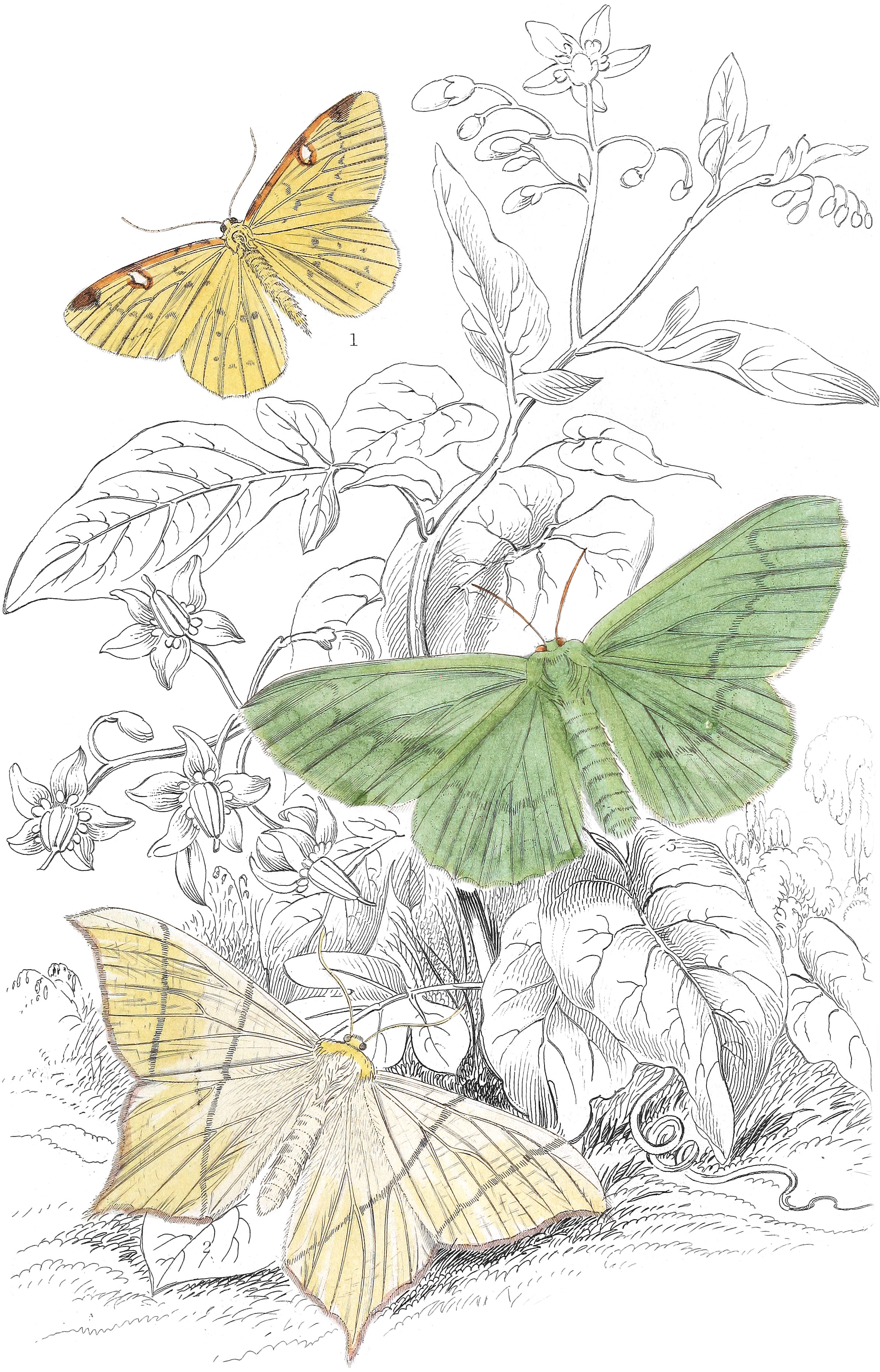
Plate XXVII
Magpie or Gooseberry Moth
Abraxas Grossulariata.—Figs. 1 & 2
Phal. Geom. Grossulariata, Linn.; Don. i. Pl. 4.—The Magpie, Haworth.—Large Magpie or Moth, Wilkes, Pl. 85.—Currant Moth, Harris’ Aurel. Pl. 12.—Abraxas Grossulariata, Leach, Steph.
The establishment of this genus is due to Dr. Leach, who assigns as its distinctive characters the shape of the wings, which are broad and rounded at the tip, the outer edge entire; expanded during repose. The antennæ are of moderate length, and simple in both sexes. The palpi are very short, the radical joint short and robust, second longer, third globose and concealed by scales. The maxillæ are long, the thorax and abdomen slender, especially in the male. It contains three British species, all of which are somewhat scarce, except that which we have figured, which may be regarded as one of the most abundant of our native moths. The upper wings, which measure from an inch and one-third to nearly two inches, are white with two bright yellow bands, one at the base, the other a little beyond the middle, and six transverse rows of rounded black spots; the first consisting of a single spot or two at the base, the third irregular and interrupted, the fourth and fifth enclosing the outermost of the yellow bands formerly mentioned, and the sixth on the hinder margin: these spots vary much in size and position, and some of them are generally more or less confluent. The under wings have a few scattered spots on the disk, and a continuous series of larger size round the posterior border. The body is yellow, with rows of black spots; the head and antennæ of the latter colour. Varies greatly in the marks, being sometimes nearly all black.
The caterpillar is very similar in its markings to the perfect insect, the prevailing colour being white, slightly tinged with blue, the back with numerous black spots of various dimensions, and the lower parts of the sides, and the belly, yellow, sprinkled with black dots. (Pl xxviii. fig. 2.) The chrysalis is pitchy-black, with yellow bands on the segments. The moth appears pretty early in the summer, and abounds wherever the appropriate food of the caterpillar (the common currant and gooseberry-bushes) is to be obtained.
The Mottled Beauty
Melanippe Hastata.—Fig. 3
Phal. Geom. Hastata, Linn.; Don. iv. Pl. 129.—Phal. Hastata, Haworth.—The Mottled Beauty, a Moth, Wilkes.—Argent and Sable, Harris’ Aurel. Pl. 15.—Xerene Hastata, Treitschke, Steph.
Bears considerable affinity to the preceding genus; but the anterior wings, instead of being much rounded off at the tip, are but slightly so and almost come to an obtuse point. The proboscis is rather long, the antennæ slender, simple in both sexes, and the palpi short, slender, and acute, the terminal joint small and pointed. The species above named differs slightly from the species with which it has usually been associated, and forms the type of Duponchel’s genus Melanippe. It measures from an inch to nearly an inch and a half across the wings; the ground colour white, with a broad irregular black band round the hinder margin of all the wings, continuous externally, but spotted and interrupted on the inner side: across the middle of the upper wings is another black band very irregular, being nearly divided in the middle, and interrupted behind the middle by the ground colour; the base occupied by another band, similarly interrupted, and nearly divided by a white crescent. The under wings have a cross band of black angular spots, rather before the middle, in continuation, when the wings are expanded, of the central one on the upper pair. The fringe is rather long and thick, and consists of regularly alternating tufts of black and white plumelets; body and antennæ black, spotted with white.
The caterpillar, which feeds on the birch, is dusky-brown, with undulating yellow lines on the sides. The moth is found in June and July, but is by no means of frequent occurrence. It is met with occasionally, however, in most of the southern counties of England.
Clifden Beauty
Zerene Albicillata.—Fig. 4
Phal. Geom, Albicillata, Linn.; Don. iv vi. Pl. 202.—The Beautiful Carpet, Haworth.—Clifden Beauty, Harris.—Xerene Albicillata, Ochsen, Steph.
About the same size as the preceding; the ground colour milk-white; all the wings with a small dusky-black spot in the centre: the anterior pair with the base brown, variegated with transverse waved streaks of pearl white or leaden colour; a large dark-brown three-cornered patch on the anterior edge near the tip; and the whole of the hinder margin tinged with dusky-brown and variegated with faint waved lines of white or lead colour; this dusky border bounded internally by a pretty distinct geminated undulating brown line. Hinder wings likewise dusky on the hinder margin, that colour more or less interrupted with white, and bounded internally by a faint waved brown streak. Head, thorax, and base of the abdomen pitch-brown, the rest of the abdomen whitish.
The caterpillar is green, with a series of brown crescent-shaped spots on the back, and a streak of that colour on the sides of the first and last segments. It feeds on the raspberry and probably other species of Rubi. The moth, which is prized by collectors on account of the delicacy of its markings, is very scarce; but has been found near London, at Reading, in Kent, at Tunbridge Wells, and a few other places. The present genus differs from Melanippe chiefly in the proportions of the joints of the palpi, the two first joints both robust, the radical one especially, the terminal joint minute and ovate; the whole organ very short, and not visible from above. The proboscis is long, the forehead prominent. The wings entire and rounded, but not so broad as in Melanippe. As at present constituted, the genus contains five British species.

Plate XXVIII
The Beautiful China Mark
Hydrocampa Nymphæata.—Fig. 1
Phal. Geom. Nympheata, Linn.—Phal. Stagnata, Don. xi. Pl. 363, fig. 2.—Pyrausta Nymphealis, The Beautiful China Mark, Haworth.—Hydrocampa Nymphæata, Latr., Steph.
The genus Hydrocampa (Water-caterpillar) we have given as an example of the pretty numerous family of the Pyratipm. It belongs to a section of that group, the species of which are somewhat remarkable for possessing four distinct palpi, the maxillary pair being likewise developed, contrary to what is observed in the generality of moths. The labial palpi are, as usual, tri-articulate; the two lowest joints densely clothed with scales, the terminal one acute. The proboscis is rather long, the antennæ moderate, and simple in both sexes. All the wings have the hinder margin entire, the anterior pair elongate, the posterior ovate-triangular; the surface reticulated with, dark lines upon a white ground. The legs are long and slender, the hinder tibiæ with two pair of long spurs. The larva, which has six scaly and ten membranous legs, feeds upon aquatic plants, from which it cuts out a portion in order to form its cocoon. The species figured on the adjoining plate measures from ten lines to an inch across the wings; the latter white and shining, the anterior pair wail two brown stripes extending from the base to beyond the middle, the remainder of the surface reticulated with bands, formed by two brown approximating lines; the hinder margin with a continuous band, the fringe pure white, cay at the base. The posterior wings are likewise white. with two brown transverse bands. The arrangement of the bands varies much in different individuals, and, in some instances, they are almost wholly obliterated.
The caterpillar, of which we have seen no description, feeds on the common duckweed, and the moth frequents the borders of ponds and marshy places. It occurs not unfrequently both in England and Scotland.
Green Silver-Lines
Hylophila Prasinana.—Figs. 2 & 3
Phal. Tortrix Prasinana, Linn.—Phal. Fagana, Don. viii. Pl. 281.—Green Silver-lines, Harris’ Aurel. Pl. 10, f. i. m.—Chloephora Fagana, Steph. Cat.—Hylophila Prasinana, Hubner, Steph. Illus.
The present genus is usually placed at the head of the great family of the Tortricidæ, so called from the larva being in the habit of twisting or rolling leaves in order to form an abode for itself. The aspect of these insects, when at rest, is somewhat peculiar, the anterior wings being very broad near the base, the humeral angle forming a wide curve; towards the middle they are somewhat contracted, and again dilated at the hinder extremity; the whole figure of the outline, as Mr Stephens remarks, thus bearing some resemblance to that of a bell. This peculiarity of form has caused them to be frequently termed Broad-shouldered Moths. With a few exceptions, they are small insects considerably below the middle size, very agreeably coloured, and frequently marked with metallic spots. The caterpillars are usually naked, and much attenuated behind, which gives them some resemblance to a fish; whence some of them are described by Reaumur as Chenilles en forme de Poisson. They have sixteen legs, and run with great activity, seemingly with equal ease either backwards or forwards. The species above referred to expands from somewhat more than an inch to an inch and a half, the colour light-green; each of the anterior wings with three oblique stripes of silvery-white, the costa likewise of that colour. The abdomen and hinder wings are yellowish-white; antennæ reddish-brown; anterior margin of the upper wings, the hinder margin and the fringe, as well as the legs, tinged more or less with bright red in the male.
The caterpillar is light-green, with a yellow line on each side, and two red streaks behind. (Pl. xxix. fig. 3.) It feeds on a variety of common trees and changes into a reddish-brown pupa, which it encloses in a closely woven cocoon, nearly boat-shaped. The moth is not rare in England, and is likewise found not unfrequently in the south of Scotland.
Scarce Silver-Lines
Hylophila Quercana.—Fig. 4
Phal. Tort. Prasinana, Linn.; Don. ii. Pl. 40.—Scarce Silver-Lines, Harris’ Aurel. Pl. 30.—Hylophila Quercana, Hubner. Steph. Illus.
The largest insect belonging to this group, the wings sometimes extending to two inches: the colour of the thorax and anterior wings deep grass-green, the latter traversed by two oblique white lines; posterior wings and abdomen glossy-white; palpi, antennæ, and legs tinged with red.
The caterpillar is very like that last described, but is larger and has a dorsal tubercle on the second segment. It frequents various trees, but seems most partial to the oak. ‘The moth appears about the middle of June. It is a rare insect in this country; most of the specimens in collections have been obtained from the vicinity of London.
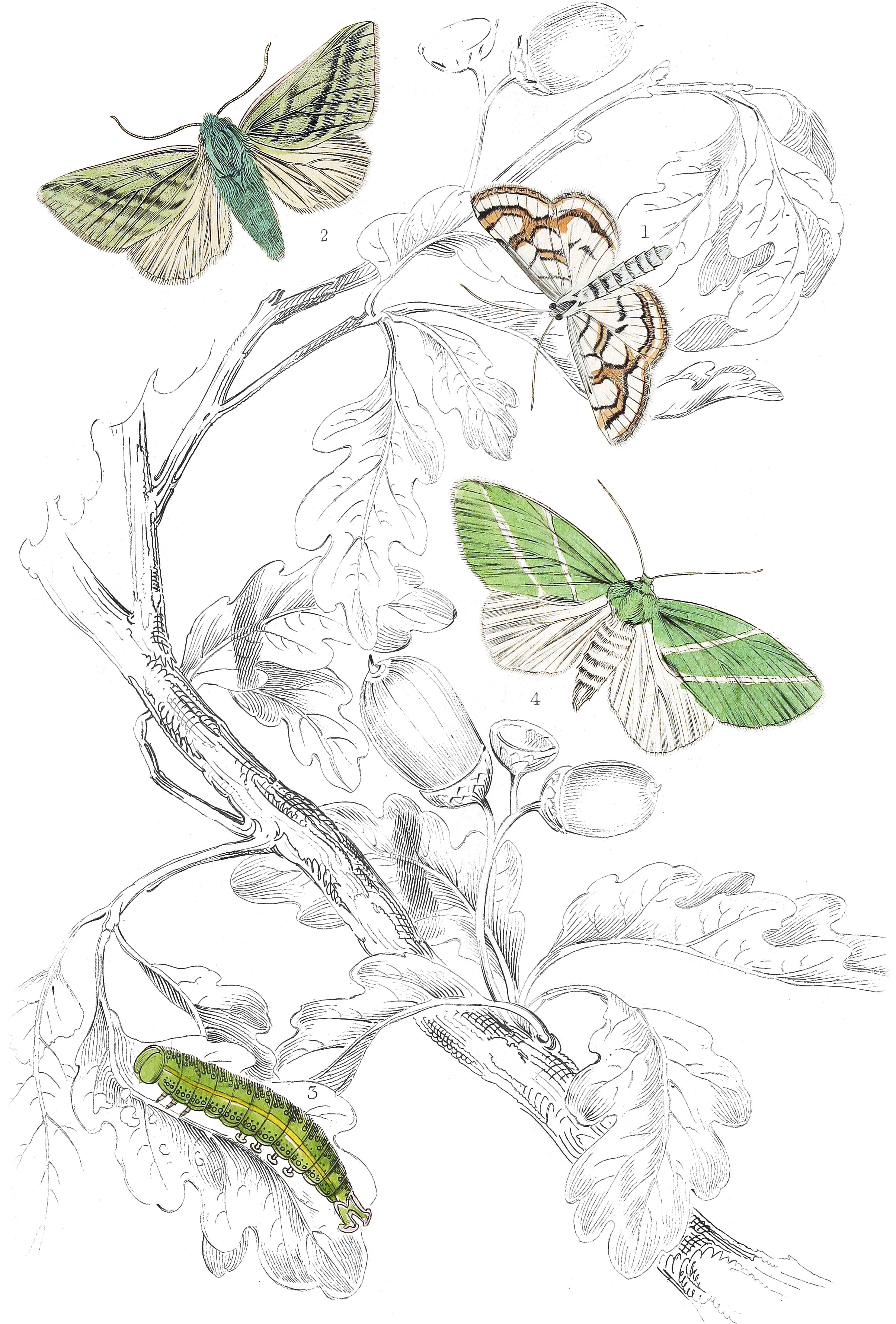
Plate XXIX
The Dark Porcelain
Argyromiges Sylvella.—Fig. 1
Tinea Sylvella, Haworth.—Phal. Blaneardella, Don. xi, Pl. 392, fig. 2.—Argyromiges Sylvella, Curtis, Steph.
The family Yponomeutidæ, to which the present genus be longs, is constituted by a numerous assemblage of small moths, the largest not exceeding an inch in the expansion of the wings, while several do not equal the tenth part of these dimensions. The palpi are in general long and slender, and usually only two in number, a character which distinguishes them from the allied group, Tineidæ, which possess two pair of these organs.
The name of the present genus bears reference to the metallic markings which are conspicuous in many of the species. It is known by having the palpi very short and drooping, nearly filiform, with the terminal joint compressed and obtuse, and longer than the two others taken together. The antennæ are about the length of the wings, the basal joint robust. Wings rolled round the body when at rest, the anterior pair nearly linear, the hinder pair of a similar shape and very slender, all of them with a very long fringe. Twenty-five British species have been described, one of which is represented on the adjoining plate. It expands about three lines and a half; the anterior wings white, having a short ash-coloured band at the base, a rectangular one near the middle, both of them edged with dusky and glossed with golden-yellow; and towards the apex there is a cruciform mark of a similar colour, and a minute eye-like spot, with a black oblique pupil at the tip. The hinder wings are white, inclining to cinereous.
Apparently not generally distributed: it has occurred near London and elsewhere.
Linnæus’ Glyphipteryx
Glyphipteryx Linneella.—Fig. 2
Phal. Linea Linneella, Linn.—Æcophera Linneella, Latr.—Glyphipteryx Linneella, Hubner, Curtis, iv vi. Pl. 152.
Palpi longer than the head, somewhat curved, the radical joint short, second long, the third nearly or equal length to the second, but more slender; proboscis short; antennæ as long as the wings; thorax without a crest; the wings nearly lanceolate, with very long fringes, the anterior pair adorned with elevated tufts of metallic scales; are the principal distinctive marks of Glyphipteryx. It includes about ten British species, of which the beautiful example figured may be regarded as the type. It sometimes expands nearly half an inch, the anterior wings tawny-orange, with three round silvery spots on the disk of each, rising considerably above the surface. and placed in the form of a triangle; the base and apex of the wing are black with a metallic gloss, and there is likewise a metallic line anteriorly and a small spot at the base. The fringes and hinder wings are dusky, the latter glossed with steel-blue; antennæ black, whitish at the apex.
Occasionally found in some plenty, but by no means general. It has been most frequently found near London, probably because that neighbourhood has been more carefully examined than most other places.
White-Plumed Moth
Pterophorus Pentadactylus.—Fig. 3
Phal. Alucita. Pentadactyla, Linn.; Don. iv. Pl. 110.—The Large White Plume, Haworth.—Plumed Moth, Harris’ Aurel. Pl. 1, fig. o—q.—Pterophorus Pentadactylus, Latr., Steph.
The last section of the Nocturnal Lepidoptera is chiefly composed of such moths as present the very remarkable peculiarity of having their wings divided from near the base to the apex into separate plumelets or feathers; thus bearing much resemblance to the wings of birds. Their bodies are long and slender, the legs likewise of great length and delicacy, whence they are not unlike some kinds of crane-flies, and were in fact from that circumstance designated by De Geer, phalænæ-tipulæ. In Pterophorus the anterior wings are variously divided in different species into from two to six branches, but the posterior pair are always trifid. The larvæ, which are described by Reaumur, have sixteen legs, and are furnished with hairs sometimes of considerable length placed on rows of tubercles. The pupæ, which are likewise hairy, at least in some species, are occasionally suspended by a band round the middle. The White-plume Moth is the largest of the British kinds, the wings sometimes measures rather more than an inch across; the anterior pair rather ample, deeply cleft, with the apex somewhat acute, the whole snow-white with a silky gloss; the eyes alone being black. The caterpillar, which feeds principally on nettles, is white tinged with green, marked with dusky spots, and having a yellow line on the sides.
The moth is common throughout England on hedge banks, weedy lanes, &c., and appears to be by no means rare in Scotland.
Many-Plumed Moth
Alucita Hexadactyla.—Fig. 4
Phal. Alucita Hexadactyla, Linn.; Don. iv. Pl. 136—Twenty-Plumed Moth, Harris.—Pteroph. Hexadactylus; The Six-cleft Plume, Haworth.
At once distinguished from all its associates by the beautiful structure of the wings, which are regularly divided into equal plumes, composed after the manner of a feather, of a central shaft, and fine diverging cilia on two of its sides. Each of the anterior wings contains eight of these fringed rays, and each of the hinder ones four only. The palpi are long, slender, and recurved; the terminal joint very long and acute, and turned upwards. The antennæ are rather short, the thorax not crested, and the body scarcely extends beyond the hinder edge of the wings. The species figured usually expands about half an inch or upwards, and is of an ashy grey colour, with an irregular brown band near the middle of the anterior wings and another on the hinder margin, both of them with a whitish line adjoining. The posterior wings are variegated with brown and white, and a small black spot is visible on the tip of all the plumes.
The moth is found not unfrequently in houses, towards the close of autumn, most commonly on the inside of windows creeping on the glass.

Plate XXX
- This form is exemplified in the caterpillars of Deilephila Elpenor, D. Porcellus, and others belonging to the group which we have distinguished as a subgenus under the name of Metopsilus.
- In the clouded Buff-moth (Euthemonia Russida), and a few other species, the female, however, is considerably smaller than the other sex.
- Reaumur, Memoirs pour servir a l’histoire des Insectes, tom. i. page 76.
- See vol. x. The above remark, however, must be understood as applying only to the caterpillars of British moths; those of certain exotic species are armed with spines of such a size that Mr. Kirby describes them as “tremendous.”
- Hist. of Brown-tail-moth, by W. Curtis, London 1782.
- Reaumur, vol. iii. Pl. 11. fig. 1.
- Reaumur, Mem. ii. p. 21.
- Among the few instances of suspension afforded by our native species, we may mention, as examples, some of the small plumed moths (Alucitidæ), and a few Geometers belonging to the genus Ephyra, which have their chrysalides attached to the under side of leaves, &c. by the tail and middle, nearly in the same manner as practised by the caterpillars of the white-cabbage butterfly.
- In Scotland they are most frequently found on heaths and moor-land, the larva subsisting on the heather.
- Int. to Etom. iii. p. 279.
- Entomological Magazine for January 1834, page 39.
- Stephens’ Illus. Haustellata, i. p. 104.
- Godart’s Papillons de France, iii. 67.
- Journal of a Naturalist, page 327.
- Curtis’ British Ent. i. p.
34. - Illustr. of British Ent. (Haust.), i. 127.
- From μετωπον the front, and ψιλος attenuated, slender, referring to the form of the caterpillar.
- Loudon’s Mag. of Nat. Hist. v. 155.
- Ent. Mag. ii. p. 116.
- From μακρος, lon, and υλωσσα, the tongue.
- Journal of a Naturalist. p.
284288. - ἡπἰολος περι τον λύχνον πετόμενος, Hist. Anim. lib. 8. cap. 27.
- Journal of a Naturalist, 295.
- Walton’s Angler, chap. v.
- Introd. to Entom. iii. page 150.
- From λαστερ the belly, and παχυς thick.
- The generic name refers to this circumstance, being derived from ψιλος, masked, and ουρα the tail.
- Derived from νεμος a grove, and φιλος a lover.
- The beaty of the larvæ has suggested a name for the genus, Calocampa being derived from καλος beautiful, and καμπη a worm.
- Brit. Entom. vol. ii. fol. 76.