Volume XV
Parrots


Natural History of the Parrots, or Family Psittacidæ
In presenting to our readers a volume containing the natural history of the Parrots, or family Psittacidæ we have to direct their attention to an assemblage of birds, not less remarkable for the peculiarity of their form, the gay, varied, and in many instances, splendid plumage in which they are attired, than for the intelligence and docility so many evince in a state of captivity or domestication, and the peculiar facility possessed by several species of imitating the intonations of the human voice, and learning by rote words, and even sentences, which they remember and repeat with clearness and precision; a faculty, it may be remarked, confined to these birds, and to some few of the Sturnidæ and Corvidæ members of the Conirostral Tribe,—another primary division of the Typical Order Incessores.
According to the natural system, or that founded upon the affinities which connect the various members of the feathered race, and which has been so ably illustrated and confirmed by the writings of Vigors, Swainson, and other eminent ornithologists of our own country, the Psittacidæ, or family of the Parrots, belong to the order Insessores, and to that primary division which has been named Scansores, in accordance with the climbing and prehensile powers of its typical members. In this Tribe or Division, it forms one of the five circular groups or families into which it primarily resolves itself, the other four being represented by the Picidæ or Woodpeckers; the Ramphastidæ, or Toucans; the Cuculidæ, or Cuckoos; and the Certhiadæ, or Creepers. In its own tribe, it constitutes one of the typical, or, according to Mr Swainson’s views, the sub-typical group, as it possesses powers of grasping and climbing superior to those of three of the above or Aberrant Groups, and inferior in some respects only to those of the eminently typical Picidæ. To any objection that the station thus assigned to this remarkable family is at present rather assumed than borne out by facts, or proved by direct affinity, it may be observed, that although its connexion with the other groups of the tribe is not of so close or direct a nature as might be wished for, in consequence of some of the links necessary to complete the chain of affinity being deficient or unknown; still its general agreements in form and habits are sufficiently prominent to shew that its relationship to the other scansorial groups is of a degree much nearer than what it hears to any other tribe; and farther, that its apparent isolation, or want of a still closer connexion with the birds among which it is placed, in all probability arises, merely from the circumstance that the species necessary to fill up this chasm of deficiency of connecting forms, though existing, remain yet to be discovered either in it or the conterminous families of the tribe. Previous to the enlightened and philosophic views of recent naturalists respecting systematic arrangement, and the discovery that all natural groups, of whatever value or extent they may be, arrange themselves in a circular form, or shew a disposition to return into themselves, the parrots, under the Linnæan and other artificial systems, were considered as forming a single isolated genus, under the title of Psittacus, the various modifications of form they exhibited being only considered in the light of specific characters, or at most used for arbitrary sectional division. A comparison, however, of the parrots with other extensive groups, and a due consideration of the great diversity of form, as well as of habits and manners, observed to prevail among them, plainly shews that they are entitled to a rank much higher or more comprehensive than that of Genus, which, according to the now generally received acceptation of the term, is used to designate one of the lowest assemblages of individuals or species. In consequence, the Linnæan genus, Psittacus, has taken a higher rank in the natural system, and has been placed upon an equality with groups of a similar value, under the denomination of Family, subordinate to which are other less comprehensive circles or assemblages of species, the next in extent being that of Sub-family. Of groups of the latter denomination, the five following have been indicated by Mr Swainson, whose views in this primary division of the family we are inclined to prefer to that formerly proposed by Mr Vigors, in the second volume of the Zoological Journal, as being more in accordance with the natural affinities, structure, and economy of the species; and though a stricter examination and analysis is still required to ascertain the precise situation of species whose history is but little known, we have sufficient to mark the properties and peculiarities which distinguish these primary groups.
The first is that of Macrocercina, and is composed of the splendidly attired Maccaws, all of which are confined to America, as well as the nearly allied forms now distinguished by the generic titles of Arara, Aratinga, and Psittacara. In this division also we place a group of Birds belonging to the ancient Continent, viz. the genus Palæornis, Vigors. Instead of considering it, as he does, the type of a subfamily, this division constitutes one of the normal, or, according to Mr Swainson, the subtypical group of the family, and is analogous to the dentirostral tribe of the Insessores, and consequently, in its own circle, is the representative of the Raptorial Order.
The second sub family is that of Psitticina, represented by the short and even-tailed species usually called par excellence Parrots; they are found distributed throughout all the divisions of the globe within the tropics. This is the typical group of the Psittacidæ, and is analogous to the conirostral tribe of the Insessores.
The third is called Plyctolophina, or Cockatoo Division, containing the birds familiarly known by that name, as well as the Black, and other nearly allied species. They are natives of India, its islands, and Australia. These represent the Scansores, and consequently the Rasorial Order, in their own family.
The fourth is named Loriana, from a group of parrots generally known by the name of Lories, natives of India and its islands. It also contains the numerous members of the genus Trichoglossus, Vigors, and several other generic forms belonging to Australia, all of which are distinguished from the rest of the Psittacidæ by their comparatively slender bill and papillose tongue. This division beautifully represents the Tenuirostres, and is the Grallatorial group of the Psittacidæ.
The fifth is that of the Broad-tails, or sub-family Platycercina, composed of the beautiful genus Platycercus, Vigors, and of the other ground or slender-legged parrots of Australia. In it we are also inclined to place the black parrots of Madagascar, known by the name of Vasa. This division is considered as analogous to the fissirostral tribe of the Insessores.
By Buffon, and other naturalists of an early date, the geographical distribution of the parrots was supposed to be confined to the sultry climates within the Tropics. The discoveries made during the various scientific voyages which have since explored the globe, and the keen research that of late years has been instituted in pursuit of objects of natural history, have, however, shewn that it is much wider in extent, particularly in the southern hemisphere, where species have been found in latitudes as high as 50°, examples having been discovered and brought from the Straits of Magellan. In the northern hemisphere, the limit appears to be more restricted, as the Carolina parrakeet of North America, and some few African species, are seldom seen beyond the 32d or 33d degrees. The Equatorial Regions must, however, be considered the metropolis of the family, as it is in them that the greatest variety of genera are met with, the species which inhabit the higher or colder latitudes, though numerous, belonging to a very limited number of generic forms. In the majority of this family, we find a plumage which, for richness and variety of colour, yields to few of the feathered race; and though, like the tulip among flowers, it may by some be thought gaudy, and composed of colours too violently and abruptly contrasted to give that satisfaction to the eye which a more chastened, or rather a less abrupt, intermixture of tints is wont to produce, still we think no one can examine or look at some of the gorgeously decked Maccaws, the splendid and effulgent Lories, or the diversified tints of the Australian Parrakeets, without acknowledging them to be among the most beautiful and striking of the feathered race.
In the first, second, and fifth subfamilies, the ground or prevailing colour is green, generally of a lively tint, and varying from grass to sap and emerald-green, as expressed in Syme’s Nomenclature of Colours. Upon this groundwork, patches of almost every known or possible hue are to be found in one or other of the species. In the subfamily Plyctolophnia alone we meet with a more uniform and plain attire, the true cockatoos being white, or white tinged more or less with rosy red or pale yellow. The other forms in this group are black or greenish-black, sometimes relieved with large masses of red or yellow upon the tail. In texture the plumage maybe called firm, close, and adpressed, in some species even assuming a scaled or titled appearance. The general form of the Psittacidæ maybe stated as short, strong, and compact, but as deficient in elegance, in the short and even-tailed species, in which the great bulk of the head and bill seems disproportioned to the rest of the body. In the parrakeets, this disproportion is done away with, or at least in a great degree counteracted by the elongation of the tail, and many of them exhibit an elegance of form and grace fulness of carriage surpassed by few other birds The formation of the feet, which are zygodactile, or with the toes placed two forwards and two backwards, and, in all but the few aberrant species previously adverted to, expressly adapted and formed for firm prehension and climbing, evidently points to woods and forests as the appropriate and natural habitats of the race. It is accordingly in those regions where the trees are clothed in perpetual verdure, and where a constant and never failing succession of fruits and seeds (the common food and support of the tribe) can always be procured, that the parrots are found in the greatest numbers and profusion. Thus the recesses of the interminable forests of South America are enlivened by the presence of the superb Maccaws, and the nearly allied species of the genus Psittacara; those of India and its islands by the elegantly-shaped members of the genus Palæornis, and the scarlet-clothed Lories; while those of Australia resound with the harsh voice of the Cockatoos, and the shriller screams of the nectivorous Trichoglossi, and broad-tailed Parrakeets or Platycerci. In these their natural situations, their movements are marked by an ease and gracefulness we can never see exhibited in a state of confinement. They are represented as climbing about the branches in every direction, and as suspending themselves from them in every possible attitude; in all which movements they are greatly assisted by their hooked and powerful bill, which is used, like the foot, as an organ of prehension and support. The pointed and ample wing, which we perceive to prevail among the parrots, indicates a corresponding power of flight; and accordingly we learn from those who have enjoyed the enviable opportunity of seeing and studying them in their native wilds, that it is rapid, elegant, and vigorous, capable of being long sustained, and that many of the species are in the habit of describing circles and other aerial evolutions, previous to their alighting upon the trees which contain their food. Thus Audubon, in his account of the Carolina Parrakeet, says,
Their flight is rapid, straight, and continued through the forests, or over fields and rivers, and is accompanied by inclinations of the body, which enable the observer to see alternately their upper and under parts. They deviate from a direct course only when impediments occur, such as trunks of trees or houses, in which case they glance aside in a very graceful manner, as much as may be necessary. A general cry is kept up by the party, and it is seldom that one of these birds is on wing for ever so short a space, without uttering its cry. On reaching a spot which affords a supply of food, instead of alighting at once, as many birds do, the parakeets take a good survey of the neighbourhood, passing over it in circles of great extent, first above the trees, and then gradually lowering, until they almost touch the ground, when, suddenly reascending, they all settle on the tree that bears the fruit of which they are in quest, or on one close to the field in which they expect to regale themselves.
Many of the species are gregarious, and except during the breeding season, are always seen in large and numerous bodies; others, as the black cockatoos, are met with in pairs or families. The places selected for hatching their eggs, and rearing their young, are the hollows of decayed trees, they make little or no nest, but deposit their eggs, which, according to the species, vary from two to five or six in number, upon the bare rotten wood. In these hollows, it is said, they also frequently roost during the night, and such we learn is the practice of the bird previously mentioned, for the same author observes,
Their roosting place is in hollow trees, and the holes excavated by the larger species of Woodpeckers, as far as these can be filled by them. At dusk, a flock of parrakeets may be seen alighting against the think of a sycamore or any other tree, where a considerable excavation exists within it Immediately below the entrance, the birds all cling to the bark, and crawl into the hole to pass the night. When such a hole does not prove sufficient to hold the whole flock, those around the entrance hook themselves on by their claws and the tip of the upper mandible, and look as if hanging by the bill. I have,
he adds,
frequently seen them in such positions by means of a glass, and am satisfied that the bill is not the only support used in such cases.
The natural voice or notes of the tribe consist entirely of hoarse or shrill and piercing screams, with little or no modulation, and frequently reiterated during flight, as well as when otherwise engaged in feeding, bathing, or preserving their plumage. The power of imitating the human voice, and learning to articulate a variety of words and sentences, is not possessed by all the species, but is principally confined to the short and even-tailed parrots, in which the tongue is large, broad, and fleshy at the tip. In disposition, with the exception of one or two forms, they are quiet and docile, and easily reconciled to confinement, even when taken at an adult age. Their flesh is said to be tender and well flavoured, particularly that of the younger birds, and is frequently used as food in the districts they inhabit. The general characters of the family are—bill convex, large, deflected, thick, and strong. The upper mandible, overhanging the under, booked at the tip, and furnished with a small cere at the base, the under mandible thick, ascending, and forming when closed, an angle with the upper. Tongue thick, fleshy, and soft. Nostrils round, placed in the cere at the base of the bill. Feet scansorial, the external toes longer than the inner. In regard to their internal anatomy, we may here observe that the bill is furnished with additional and powerful muscles, and that the intestinal canal is of great length and destitute of cœca.
We shall now proceed to describe the examples selected to illustrate the different groups, making such farther observations as may be required upon the subfamilies and genera as they occur.
We shall commence with the subfamily of the Macrocercinæ or Maccaws, which, in its own family, is analogous to the dentirostial tribe of the Insessores, and represents the subtypical group of the Psittacidæ. By Mr Vigors, in the view he has taken of the distribution of the Parrots, this subfamily is restricted to the Maccaws properly so called, a group arranging itself under one, or at most, two generic types, the other American long-tailed Parrots, as well as those belonging to the ancient world, being all included in another division to which he gave the name of Palæornina. To this distribution there are strong and manifold objections, uniting as it does in one great group, birds differing essentially in structure as well as habit, such as the Lories and other nectivorous Parrots, and those various genera which compose the Platycercine subfamily, which depart so far from the true scansorial species in their character and general habits. It is on this account, and as being more in accordance with the natural affinities of the race, that we have adopted the suggestions of Mr Swainson, in regard to the primary divisions of this family, though we must add, that much additional information is required to work out the details, and that there are many species whose exact station remains doubtful, and which further analysis and observation can alone satisfactorily resolve. In addition to the true Maccaws, the typical form of this subfamily, it appears naturally to embrace many of the other American long-tailed species, now divided into separate generic groups (except by Wagler, who retains the whole under the single genius Sittace), one of which has been characterized under the title of Psittacara, Vigors, answering nearly to the Peruche-Aras of the French ornithologists, the members of which are distinguished by having the orbits and face to a greater or less extent naked, as exhibited in the species selected for illustration. Another is composed of the species in which those parts are feathered, and for which the title of Aratinga has been proposed, though it is probable that a still further generic sub-division of this latter group will be required. In this division, also, we would place the long-tailed Parrots of the ancient world, forming the genus Palæornis, Vigors, a group whose history and distribution he has traced with such acumen and classic lore in the pages of the Zoological Journal. With this group we shall commence our illustrations, as it is through one of its members, the Palæornis Barrabandi, Vigors, that a connexion appears to be supported with the or broad-tailed division, which stands at the further extremity of the circle of the Psittacidæ. This bird, with the tail and general character of Palæornis, exhibiting a near approach in the proportions of its legs and feet to the genus Platycercus, Vigors, of whose region or metropolis it is also a native. The passage from the Ring-Parrakeets to the smaller American species, appears to be effected through those species in which the two central tail feathers begin to lose the peculiar character of the typical form, and the culmen of the bill assumes the ridged or triangulate shape that prevails in that American group of which Psitt. cruentatus, Temm., may be taken as an example; these are followed by the larger species, as Psitt. Carolinensis and Patachonica, which lead to the Maccaws by such members as have the cheeks partly feathered. Following the naked cheeked maccaws, we would place the true Psittacara, in which the orbits and part of the face is also naked, and the bill large and powerful, such as Psitt. acuticauda, nobilis, &c. The passage to the next subfamily, or Psitticina, seems to be through Psitt. macrorynchus (Tanygnathus macrorynchus, Wag.), and other species, in which the tail loses its elongate and graduated shape.
Genus Palæornis
The genus Palæornis, as characterized by Mr Vigors, is distinguished by having the bill thickish, with the upper mandible dilated, the culmen rounded, the tomia deeply toothed or emarginate, the inferior mandible wide, short, and emarginate. Tongue thick and smooth. Wings of mean length, the three first quills the longest, and nearly equal; exterior webs of the second, third, and fourth quills dilated near the middle, tapering towards the apex. Tail graduated with the two middle feathers slender, greatly exceeding the rest in length, with their tips rounded. Feet, the tarsi rather short, claws strong and falcate.
Mr Vigors observes,
The birds that compose this genus, are at first sight distinguished by their superior elegance and gracefulness of form. This character is considerably increased by the construction of the tail, the two middle feathers of which far exceed the rest in length.
The different species of Palæornis known to us, are inhabitants of continental India, its islands, and Africa, with the exception of the Palæ. Barrabandi, which is a native of Australia. They are held in high esteem for their beauty, as well as for their docility and imitative powers which seem equal, or but little inferior, to those of the short and even-tailed kinds.
Our first figure represents the
Barraband Ring-Parrakeet
Palæornis Barrabandi.—Vigors.
Palæornis Barrabandi, Vigors, in Zool. Journ. vol. ii. p. 56, Sp. 10.—Psittacus Barrabandi, Swains. Zool. Illust. vol. i. p. 59.—Polytelis Barrabandi, Wagler, in Abhand. &c., p. 519—Scarlet-breasted Parrot, Lath. Gen. Syn. Hist. vol. ii. p. 121, P. 24, Ed. 2.
In this handsome bird, we have one of those interesting forms which so beautifully connect groups, otherwise distant and far removed; for though the character and shape of the tail, the well-defined ring or neck-collar, the proportions of the wings. &c., evidently place it in this genus, its elevated tarsi and feet shew an approach to the Broad-tailed Division (Platytercinæ), which stands at the further extremity of the Psittacean Family. It is also a native of New Holland, in which interesting country so many species of Platycercus have been discovered, the rest of the ring-parrakeets, being the greater part of them natives of Continental India, and its neighbouring islands, and one or two are also met with in Africa. It was first figured by Mr Swainson, in his elegant and valuable “Illustrations,” under the name of Psittacus Barrabandi, from a skin in the possession of Mr Leadbeater; but as no observations or notes appear to have accompanied the remains of the bird, we are without information as to its peculiar economy. Judging, however, from the proportions of its legs and feet, we are led to suppose that it is more terrestrial in its habits than its congeners, or that, in addition to its scansorial or grasping powers, it possesses superior activity, and moves with greater facility upon the ground. In size it is about equal to the Rose-ring Parrakeet, its length being full 15 inches, of which the tail alone measures 8\(\frac{3}{4}\) inches. The bill is red; the sinciput, throat, and fore-neck of a rich yellow, the latter terminated by a collar of brick red; the space between the bill and eyes, and the ear-coverts, are clear grass green; the upper and under parts of the body are green, tinged with blue upon the hind head and outer margins of the quill-feathers. The upper surface of the tail is green, the two intermediate feathers about two inches longer than any of the others, with their extremities widened and rounded; under surface of the wings and tail blackish-brown; legs black. By Wagler this bird was removed from the genus Palæornis, and constitutes his genus Polytelis; but as the only character upon which it is established consists in the slight elongation and slenderness of the tarsi and toes, we have retained it among the Ring-Parrakeets, where it was first placed by M. Vigors, and of which group it may be considered a slightly aberrant form.

Plate I
The next figure represents the typical species of this genus; it is the
Alexandrine Ring-Parrakeet
Palæornis Alexandri.—Vigors.
Palæornis Alexandri, Vigors, Zool. Jour. vol. ii. p. 49.—Wagler, in Abhand, &c., p. 506.—Psittacus torquatus Macrourus antiquorum, Aldrov. Aves. vol. i. p. 678; Icon. p. 679.—Psittacus Alexandri, Linn. Lath. &c. Perruche à Collier des Isles Maldives. Buff. Pl. Enl. p. 642.—Le Grand Perruche á collier, Le Vaill. Hist. des Per. pl. 30.—Alexandrine Parrot, Lath. Syn. vol. i. p. 234, No. 37.—Ring-Parrakeet, Edwards, pl. 292.—Alexandrine Parrakeet, Shaw’s Zool. vol. viii. p. 423.
In the figure of this elegant bird, our readers are introduced to a well known and favourite species of modern times, and which is generally supposed to have been the first, and by many the only one known to the ancient Greeks, having been discovered during the expeditions of the Macedonian conqueror, by whose followers it was brought to Europe from the ancient Tabropane, now the Island of Ceylon. At all events, it is evident from the concurrent testimony of various ancient authors, that whatever parrots were known, either to the Greeks or Romans, previous to the time of Nero, were exclusively brought from India or its islands, and that the species, if more than one had been introduced, also belonged to the genus now in the course of illustration, the description they have given of the plumage of these birds pointing distinctly to this, and possibly one or two other nearly allied species, as not only the prevailing colour of the body, but that of the bill, and the distinguishing characteristic, the neck-collar, are particularly mentioned. By Aristotle it is called Το Ινδικον ορνεον—the Indian Bird; and Pliny not only mentions the country from whence it came, but adds,
Sittacen vocat, viridem toto corpore torque tantum miniato in cervice distinctam.
Its imitative qualities and powers of articulation, and the high estimation in which it was held among the great, are also frequently adverted to by the poets; and it was in commemoration of a favourite bird of this species, that Ovid composed that beautiful elegy, commencing—
Psittacus, Eoia imitatrix ales ab oris, Occidit.
Of this elegy a free translation is given in Shaw’s Zoology, to which, from its length, we must refer our readers. The Alexandrine, as well as its congener the Rose-ring Parrakeet, are still highly prized, and frequently brought from the East Indies, as, in age, they possess great docility, and a facility of pronunciation inferior to none of the race. Of their habits in a state of nature we remain comparatively ignorant.
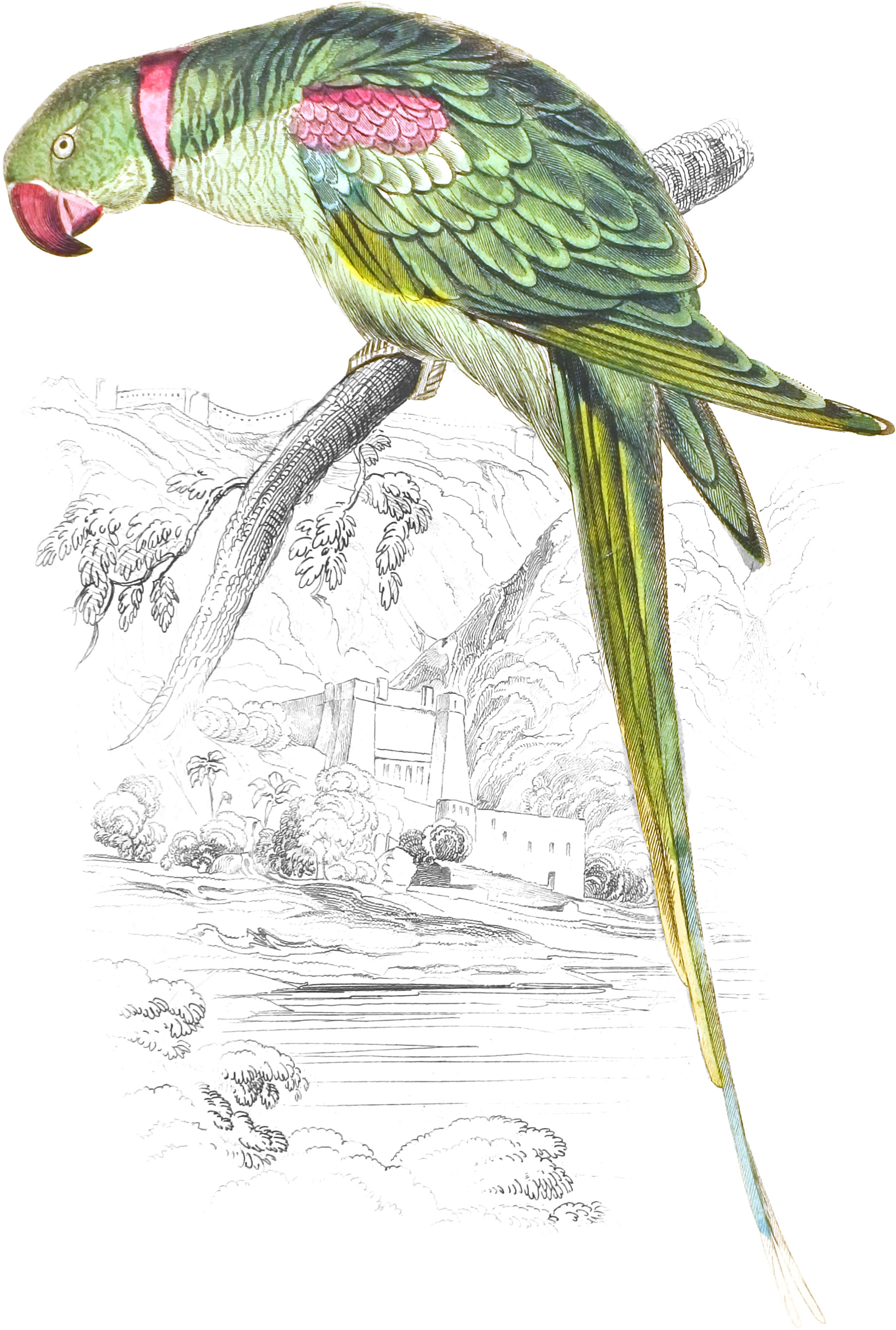
Plate II
Malacca Ring-Parrakeet
Palæornis Malaccensis.—Vigors.
Palæornis Malaccensis, Vig. Zool. Journ. ii. p. 52; Wagler, Mon. Psit. in Abhand. &c. p. 514.—Psittacus Malaccensis, Gmel. vol. i. p. 325, No. 74.—Psittacus erubescens, Shaw’s Zool. vol. viii. p. 437.—Psittacus barbatulatus, Bechst. Kuhl. Nov. Acta. &c., No. 38.—La Peruche á nuque et joues rouges, Le Vaill. pl. 72—Blossom-cheeked Parrakeet, Shaw.
A drawing of this beautiful species having been made by mistake, instead of a bird belonging to a different division, but bearing the same specific title, is the cause of a third illustration of this genus being given. In its form and aspect it appears eminently typical, the two intermediate tail-feathers being very long, and extending far beyond the others, narrow, but equal in breadth towards their tips, which are blunt or slightly rounded. As its name imports, it was first observed and introduced from Malacca. Its distribution, however, is not confined to that part of India alone, as Mr Vigors mentions in his observations on this group of the Psittacidæ, that several specimens were brought to this country from Sumatra by the late lamented Sir Stamford Raffles. In it about equals the Palæornis Bengalensis (Rose-headed Ring-parrakeet, a bird of very similar form and habit), its extreme length being generally full fourteen inches, of which the tail alone measures eight. The upper mandible is of a fine lively red, the tip paler, the under mandible black tinged with red. The crown of the head is sap-green; the cheeks, nape, and back part of the neck, are of a beautiful deep rose-red, tinged with lilac-purple upon the latter part. The oblique mustachio-like collar is deep black. The lower part of the neck and mantle are fine greenish-blue; the rest of the upper and under plumage is yellowish sap-green, palest upon the thighs and vent. The quills are margined with blue, their under surface being black. The two long intermediate tail-feathers are azure-blue, tinged with purple towards their tips; the lateral tail feathers are yellowish-green. The legs and feet are grey, tinged with flesh-red.
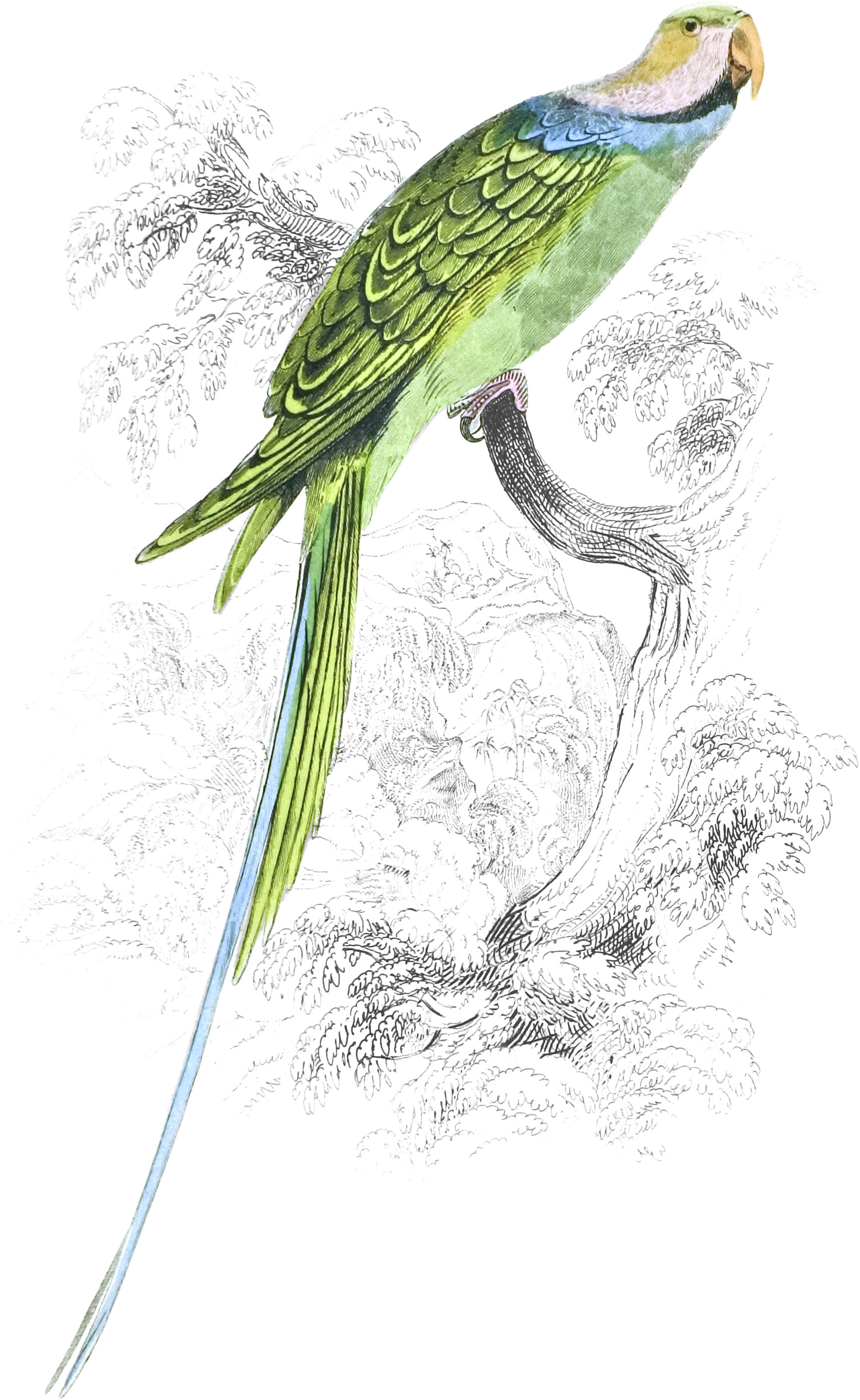
Plate III
Besides the three species here figured, ten or eleven more are described by Mr Vigors and Wagler; the latter, in his Monograph of the family, has bestowed much attention in collating the various synonyms of the species. According to his list, they consist of,—
- Pal. Alexandri;
- Pal. cubicularis, identical with the P. torquatus and bitorquatus of Vigors, and the young of which is supposed to be the Pal. inornatus of the same author;
- Pal. Borneus, apparently referable to the P. erythrocephaius, Vig-ors;
- Pal. melanorynchus, a species apparently hitherto confounded with the Pal. Pondicerianus, of authors, and not distinguished by Vigors;
- Pal. Pondicerianus;
- Pal. barbatus, by other writers a supposed variety of P. Pondicer., not distinguished as a species in Mr Vigors’s list;
- Pal. Malaccensis;
- Pal. Bengalensis;
- Pal. cyanocephalus, the same as the P. flavitorquis of Vigors;
- Pal. columboides, first described by Mr Vigors in the Zoological Journal;
- Pal. inornatus, the Psittacus incarntus of authors, a bird whose station in this group, according to Wagler’s own account, appears very doubtful.
The engraving expresses so correctly the character and plumage of the bird, as to render it unnecessary to give a detailed description. We may mention, however, that the young bird is without the black and rosy coloured collar which distinguishes the adult, in which state it is known as the Psittacus eupatria of authors.
From the Ring-Parrakeets of Asia and Africa we now pass to the Long-tailed groups of South America, the great metropolis of the Macrocercine Division; for here ai e found not only the typical forms of the subfamily as exhibited in the large and splendid Maccaws, but other species more nearly connected in habit and appearance with the birds belonging to the ancient world. Among these may be particularized an extensive group, mostly consisting of birds of moderate size, in which the immediate orbits of the eyes alone are naked; these form a part of M. Spix’s genua Aratinga, and, as representatives of it, the Psittacus cruentaius, Temminck, and Psitt. leucotis, Lich., may be quoted. From this group we would separate several larger species, as Psitt. Carolinensis, Auctor, &c., under the name of Arara, Spix, reserving the title of Psittacara for another group, in which the bill is much larger, with the tip drawn to a fine point, and having the orbits and pa t of the face naked, characters which bring it in near connexion with the large bare-cheeked Maccaws. Of this group, the Psittacus nobilis, Linn., Psittacara frontata, Vig., an example. As the limits of the volume only permit of a certain number of illustrations, we have selected a species of the second or Arara genus, which, from its size and appearance, seems to lead directly to the genus Maciocercus; it is the
Patagonian Arara
Arara Patagonica.—Lesson.
Psittdcus Patagonicus, Azara.—Arara Patagonica, Lesson, in Dupp. Voy. autour du Monde, Part Zool. tab. 35.—Sittace Patagonica, Wagler, in Abhand. &c., p. 659.—Patagonian Parrakeet Maccaw, Lears’ Parrots.
This large and fine looking species, whose total length is seventeen inches, the tail measuring nearly nine, was first described by Azara, and is a native of Paraguay, the districts of Buenos Ayres, Patagonia, and Chili. In the latter country, it is described as a most abundant species, and is resident the whole year, frequenting the hilly and subalpine regions during the summer, where it breeds in the holes of trees and rocks, but descending as autumn approaches to the lower levels, where it congregates in immense flocks, and frequently does great injury to the produce of the gardens and cultivated fields of the inhabitants. It is said to be of a bold and fearless disposition, admitting of a near approach, which subjects it to be killed in immense numbers by those who suffer from its depredations. Like its congener the Carolina Arara, it is continually uttering its piercing screams, as well when perched as upon wing. It is easily tamed, and can be taught to imitate the human voice, but more imperfectly than some of its congeners, on which account it is held in slight estimation, and but seldom domesticated by the inhabitants. In Patagonia, it extends nearly as far as the straits of Magellan, a southern latitude much higher than any frequented by this tribe in the northern hemisphere, where the limit of their distribution rarely extends beyond the 32d degree. The drawing from which our plate is engraved, was taken by Mr Lear, from a living specimen in the Zoological Gardens, and though inferior in scale, possesses perhaps as much of life and character as that contained in his large and beautiful work, “Illustrations of the Psittacidæ.” The bill is of a blackish colour, short and thick at the base. The orbits are naked and white, the space between the bill and eyes feathered, the head and upper part of the neck are blackish-green, tinged with yellow around the eyes, the lower neck is greenish-grey, succeeded by a pectoral collar or gorget of greenish-white, the lower part of the breast is deep greenish-grey. The sides and flanks are yellow, upon the thighs tinged with green. The middle of the abdomen is vermilion red. The back and lesser wing coverts are dusky yellowish-green, the greater coverts and secondary quills are bluish-green, narrowly margined with yellow. The tail is long and lanceolate, of a dingy yellowish-green, the tips of the feathers passing into bluish-green. The under surface is greenish-black. The legs and toes are flesh red, tinged with grey.
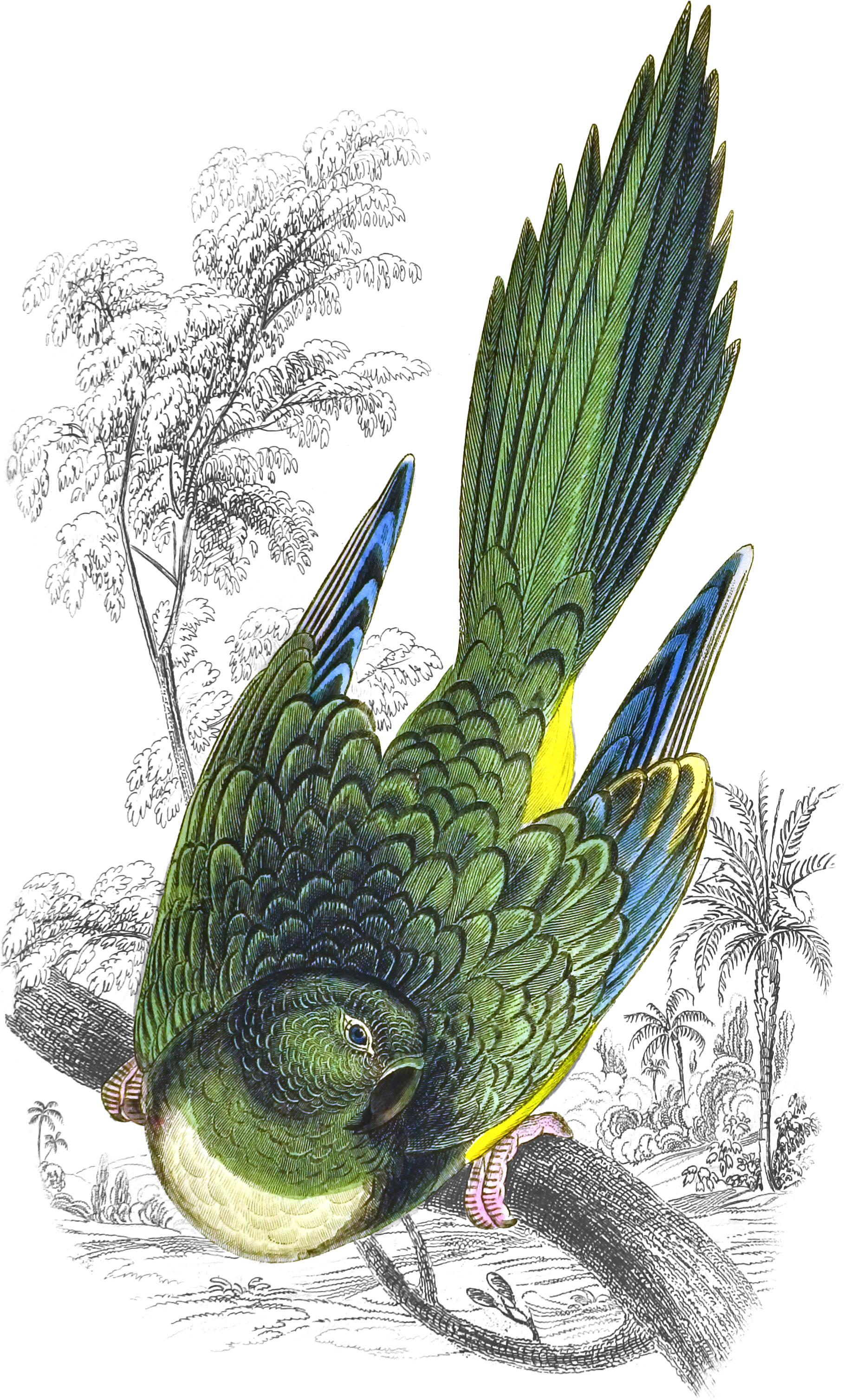
Plate IV
Carolina Arara
Arara Carolinensis.
Psittacus Carolinensis, Linn. Syst. 1. p. 141. 13.—Lath. Ind. Orn. 1. p. 93. sp. 33.—Chas. Buon. Syn. p. 41.—Sittace Ludoviciana, Wagler, in Abhand. &c. p. 656.—Carolina Parrot, Lath. Syn. 1. p. 227.—Wils. Amer. Orn. 3. p. 89. pl. 26, fig. 1.—Id. ed. Sir W. Jardine, 1. p. 376.—Audubon’s Birds of Amer. v. 1. p. 135. pl. 26.
The great body of the Psittacidæ, as already observed, are natives of the intertropical climates; but the species now under consideration is one of the few that occurs in the temperate regions of the northern hemisphere. It is a native of the North American continent, inhabiting the United Stares to a latitude as high as 42°. Such, at least, was the case some fifteen or twenty years ago, when Alexander Wilson was engaged in tracing out the history of the birds inhabiting the States; for we find, on turning to his delightful pages, that then it not only prevailed throughout Louisiana and the shores of the Mississippi and Ohio, but also those of their tributary waters as high as Lake Michigan, in lat. 42° N. We learn, however, from a living author,1 scarcely less graphic or original in his descriptive powers, that of late years these birds have rapidly diminished in number, and that they are now almost banished from districts where formerly they used to abound. Speaking of twenty-five years ago,
At that period, they could be procured as far up the tributary waters of the Ohio as the great Kenhawa, the Scioto, the heads of the Miami, the mouth of the Manimee at its junction with Lake Erie, on the Illinois river, and sometimes as far north-east as Lake Ontario, and along the eastern districts as far as the boundary line between Virginia and Maryland. At the present day, few are to be found higher than Cincinnati, nor is it until you reach the mouth of the Ohio that parakeets are met with in considerable numbers. I should think that along the Mississippi there is not now half the number that existed fifteen years ago.
A rapidly increasing population, attended by an extended cultivation, and the consequent destruction of many of those ancient and decayed trees which constituted the dormitories and breeding sites of the species, as well as the war constantly waged against them by the husbandman, as the depredators of the orchard and corn-stacks, are probably the chief causes of their rapid diminution in those parts which they formerly enlivened with their gay and varied plumage. We learn from both authors, that, when engaged in feeding, they are easily approached, and numbers killed by one discharge, as the whole flock alight and feed close to each other. The work of destruction, moreover, is not confined to a single shot; for we are told, that
the survivors rise, shriek, fly round for a few minutes, and again alight on the very place of most imminent danger. The gun is kept at work; eight, ten, or even twenty are killed at every discharge, the living birds, as if conscious of the death of their companions, sweep over their bodies, screaming as loud as ever, but still return to the stack to be shot at, until so few remain alive, that the farmer does not consider it worth his while to spend more of his ammunition.
Injurious, however, as they no doubt frequently are to the cultivator, their principal food is said to be the Cockle-burr, the seed of the Zanthium strumarium, a plant that abounds throughout the rich alluvial lands of the States west of the Alleghany Mountains: it is a weed noxious to the husbandman on many accounts, and the consumption of its seed by the Parrots must therefore he of some advantage, though that is unfortunately for them greatly diminished, from the circumstance of its possessing a perennial root.
Like the rest of the group to which it belongs, the Carolina Arara appears incapable of learning to articulate words, though, when captured, it soon becomes tame, and will eat almost immediately afterwards. Wilson gives a long and interesting account of an individual that he had wounded slightly in the wing, during one of his excursions, and which he carried for a great distance in his pocket. It soon became familiarized to confinement, learnt to know its name, to come when called on, to sit on his shoulder, climb up his clothes, eat from his mouth, &c. On account of its inability to articulate, and its loud disagreeable screams, it is seldom kept caged in America; and, as Audubon observes,
the Woods are best fitted for them, and there the richness of their plumage, their beautiful mode of flight, and even their screams, afford welcome intimation that our darkest forests and most sequestered swamps are not destitute of charms.
According to this author, their nest, or rather the place, where they deposit their eggs, is the bottom of the cavities of decayed trees. He observes,
Many females deposit their eggs together,
and the number laid by each individual, he believes is two—a number which seems to prevail throughout the great body of the family. The eggs are round, and of a light greenish white; and the young, when excluded, and before they acquire their feathers, are covered with a soft down. The plumage of the first few months is green, but towards autumn they acquire a frontlet of carmine. Upon the ground they are slow and awkward, walking as if incommoded by their tail. When wounded, and attempted to be laid hold of, they turn to bite with open bill, and, if successful, inflict a very severe wound. They are said to delight in sand or gravelly banks, where they may frequently be seen rolling and fluttering about in the dust, at times picking up and swallowing a limited quantity. The lochs and saline springs are also constantly frequented by them, salt appearing equally agreeable to them as to pigeons, and various other birds and animals. The bill of the Carolina Arara is very hard and strong, the tip much thicker and rounder than in the Psittacara group; the tooth, or angular process of the upper mandible, is well and strongly defined; the colour white. The irides are hazel, the orbital skin whitish. The legs and feet are of a pale flesh red; the claws dusky. The forehead, cheeks, and periphthetonic region, are of a vivid orange red, the rest of the head and neck gamboge yellow; the shoulder and ridge of the wings yellow, varied with spots of orange red. The upper plumage is of a fine emerald green, with purple and blue reflections. The greater wing-coverts are deeply margined with greenish-yellow. The under plumage is a fine pale siskin or yellowish-green. The greater quills have their outer webs bluish-green, passing into bright yellow at the base. The inner webs are hair brown, slightly tinged with green near their tips. The tail is green, the inner webs of the lateral feathers tinged with brownish-red. The feathers of the tibiæ are yellow, passing into orange at the joint. In length it averages about 14 inches; in extent of wings 22 inches.
The next group we have to notice is that of the Maccaws, or genus Macrocercus, Viell., here restricted to the larger species, with long lanceolate tails and naked orbits and cheeks. In this group the bill is short but very strong, and higher than long; the upper mandible greatly arched, with the tip long, and projecting far beyond the under, which is massive, and meets the upper at right angles. The palatine ridge is very distinct, and the inner surface of the projecting tips roughened and file like The tongue is thick and soft. The wings pretty long and acuminate. The feet strong, and formed for grasping; the claws falcate, the tarsi upon which they partly rest are short and thick. In disposition they are much less docile than the true Parrots, and can rarely be taught to articulate more than a few words in a harsh discordant tone; their natural notes are confined to hoarse and piercing screams. They breed in the hollows of trees, laying two eggs, which are said to be incubated alternately by both sexes,
The first species figured is the
The Great Green Maccaw
Macrocercus militaris.
Sittace militaris, Wagler in Abhand. &c., p. 668.—Psittacus militaris, Auct.—L’Ara Militaire, et le Grand Ara Militaire, Le Vaillant, 1. c. p. 11, t. 4, et l. c. p. 15, t. 6.—Great Green Maccaw, Edw. pl. 13 313.
In this beautiful species, the ground or prevailing colour of the plumage becomes more assimilated to that of the great body of the long-tailed division, than some of its congeners, for, with the exception of the forehead, the region of the eyes, the lower hack, wings, and tail, the remainder is of a fine and lively green. Edwards, in his valuable work, “The Gleanings of Natural History,” seems to have first figured and described this Maccaw, which, though ignorant of at the time, he rightly conjectured to be an American bird. It is now ascertained to be a native of Mexico and Peru, inhabiting the warmer districts of the Andean Chain, and attaining to an elevation of about 3000 feet. According to Wagler, its habits differ considerably from those of its congeners, as it does not confine itself to the recesses of the forests, or its food to the fruits there produced, but attacks in congregated flocks the fields of maize, and other cultivated grain and fruits. Upon these it frequently commits serious depredations, to such an extent, indeed, as to require the constant attention and watching of the inhabitants during the period of maturation. When engaged in their predatory excursions, a guard is constantly left by the flock in some elevated station, generally the summit of a tree, from whence, should danger be apprehended, an alarm is given by a loud and peculiar cry, which is responded to by the immediate flight of the wary depredators. They are also said to feed upon the flowers of the Erythinæ, and some species of Thibaudiæ, before the ripening of the grains, but whether this is merely to obtain the nectarious juice, as practised by the Asiatic Lories and Australian Trichoglossi, or for the thick and fleshy substance of the flower and embryo pod or seed-vessel, does not appear from Wagler’s account. During the period of the rains, which commence in October, the great body of these birds migrate to other districts, and do not return till the maize begins to ripen, which takes place in January and February. It is easily tamed, and of a docile disposition, but can rarely be taught to articulate more than a few words. It appears to have been a favourite among the ancient Peruvians, as we are told it was frequently presented to the Incas, by their subjects, as an acceptable gift. In size, it is inferior to several of the Maccaws, its extreme length being about twenty-nine inches. The bill is strong, typical in form, its colour blackish-brown. The orbits and cheeks are naked, and of a flesh colour, with striæ of small blackish-brown feathers; the irides are composed of two rings, the outer of a rich yellow, the inner greyish-green. The forehead is of a rich crimson, the chin feathers reddish-brown, and passing rapidly into the green of the neck. The rest of the head, the neck, lesser wing-coverts, the mantle, and all the under parts of the body, are of a fine and lively green, in some lights shewing tints of azure blue on the back of the neck and head. The lower back and upper tail coverts, as well as the greater wing-coverts and quills, are of a fine blue. The tail feathers on the upper surface are scarlet, with blue tips, the under surface and that of the wings orange-yellow. The legs and toes are red, tinged with grey. The claws are strong, hooked, and black.

Plate V
The second illustration of this magnificent group, is the
Blue and Yellow Maccaw
Macrocercus ararauna.—Auctorum.
Psittacus maximus cyano-virens, Aldrov. Will.—Ara bleu et jaune, Buff. Pl. Enl. 36.—L’Ara-rauna, Le Vaillant, i. t. 3.—Psittacus ararauna, Shaw’s Zool. v. viii. p. 391. pl. 54.
This beautiful species is rather inferior in size to the great Scarlet Maccaw, but being less common than that bird, and possessing all the typical characters of the group, we have thought that an accurate figure of the rarer bird would be more acceptable to our readers, than one of a kind better known, although the plumage of the latter may boast of greater richness and brilliancy of colour. In length, it measures about 39 inches, the tail alone being about 24. The bill is entirely black, very large and strong. The upper mandible, measuring from the forehead to the tip, three inches and a quarter: it is greatly deflected, and bends immediately from the base; the under mandible is short and massive, rapidly ascending, and describing when closed, a right angle with the upper. The cheeks are white, and nearly naked, with three fine narrow striae of small black plumes beneath the eyes. The irides are yellowish-white. Immediately beneath the under mandible is a broad black fascia, extending upwards to the ears, and encompassing the greater part of the naked white space. The whole of the upper plumage is of a beautiful rich blue, passing into green upon the forehead, crown, rump, and some of the smaller wing-coverts. The greater quills and tail are of a deeper tint, approaching to violet. The under surfaces of the wings and tail are yellow. The sides of the neck, breast, and inferior parts of the body, are rich saffron-yellow. The legs and feet blackish-grey, the scales defined by whitish lines. Like all the other members of the genus, it is a native of tropical America, and is met with in the Brazils, particularly upon the banks of the river Amazons, in Guiana, and Surinam, &c. It affects the woods, particularly such as occupy swampy grounds, and which abound in a species of palm, upon whose fruit it principally subsists. It is said generally to keep in pairs, though occasionally to assemble in large flocks, and when this is the case, their united screams are heard to a great distance. The dimensions and form of their wings, and long cuneiform tail, indicate a powerful and vigorous flight, and accordingly we are informed that in this respect they are inferior to none of the tribe, their flight being often at a high elevation, and accompanied with a variety of aerial evolutions, particularly before alighting, which is always upon the summits of the highest trees. They deposit their eggs, which never exceed two in number, in the hollow trunks of decayed trees, and generally have two broods in the year. Both sexes are reported to sit alternately upon the eggs, and are equally assiduous in cherishing and conveying food to the young. When taken at an early age, they are easily tamed, but their imitative powers are not equal to those of the Grey Parrot, and it is seldom that they can be taught to articulate clearly, or more than a few words. Their natural notes are very unpleasant to the ear, consisting of loud and piercing screams, interrupted with hoarse croaking murmurs. Living specimens of this species are sometimes seen caged in England. A very fine one is completely domesticated at Dr Neill’s, Canonmills (near Edinburgh), and allowed the freedom of several apartments: when desirous of being noticed, it calls out “Robert,” the name of its earliest master, very distinctly; but it has not acquired more than one other conventional sound. Beautiful examples may be studied in the aviaries of the Zoological Gardens.
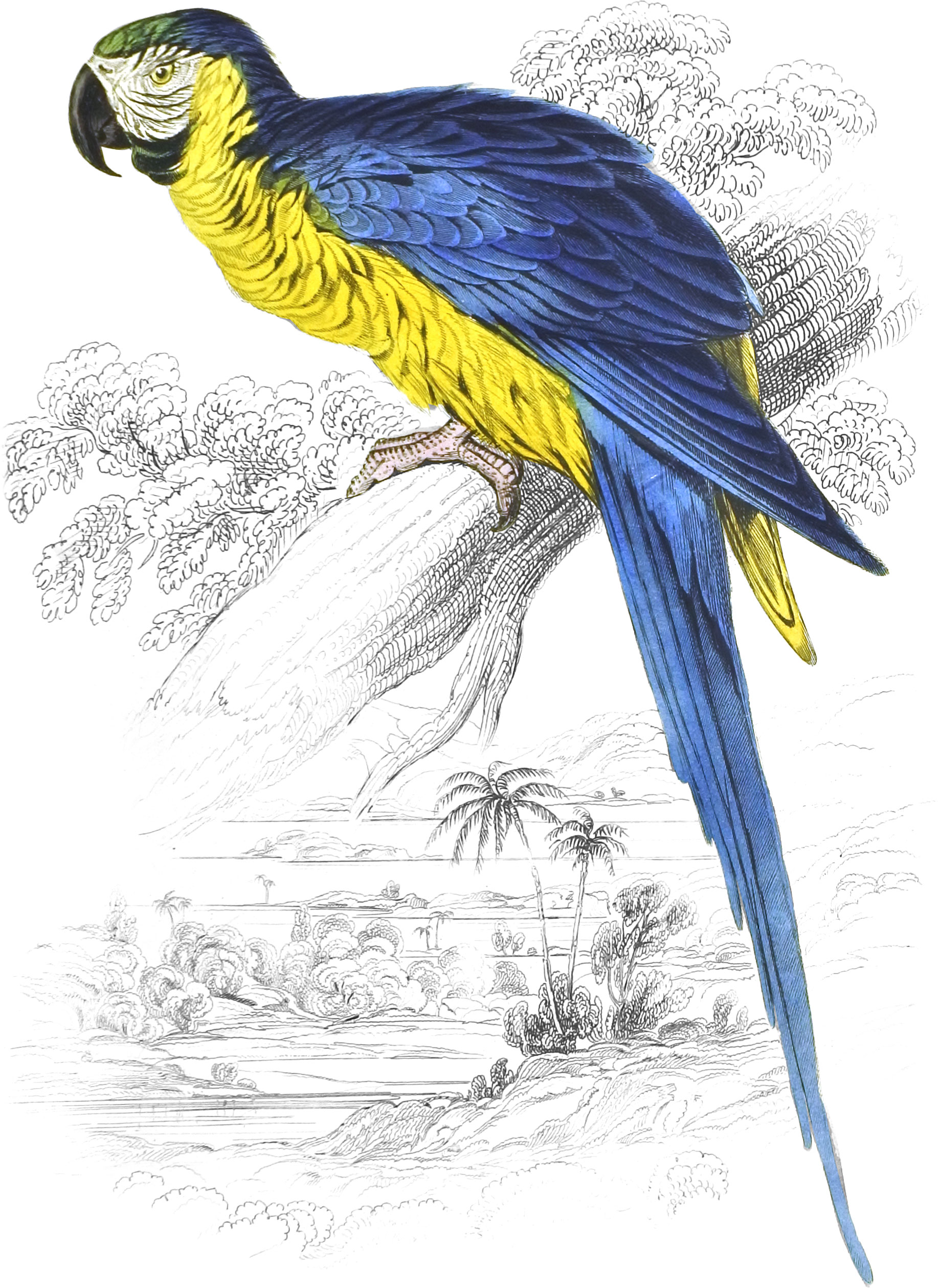
Plate VI
Our next figure represents another species very nearly related to the Scarlet Maccaw; it is the
Red and Blue Maccaw
Macrocercus aracanga.
Sittace aracanga, Wagler, in Abhand. &c. p. 672.—Psittacus aracanga, Auct.—L’Ara canga, Ve Vaill. Hist. des Per. t. 2.—The Red and Blue Maccaw, Edwards, 4. t. 158.
This large and splendid species has frequently been confounded with its nearly related congener, the Psittacus macao of authors, from which it may always be distinguished, by the want of the narrow rows of red plumes upon the naked part of the face, and in haring the middle wing-coverts of a bright yellow, instead of green. In dimensions it is fully equal to the other species, frequently attaining 39 inches in extreme length, of which the tail measures nearly 24. The bill is large, and very powerful the upper mandible yellowish-white, except near the angles of the mouth, where it is varied by a dark streak or spot; the under mandible is black. The cheeks and orbits are covered with a rough pinkish-white skin, without any rows of small feathers; the rest of the head, the neck, back, scapulars, breast, and abdomen, are vermilion-red. The middle wing-coverts are bright yellow, tipped with bluish-green. The spurious wing, the secondaries, and greater quills, are of a deep azure-blue; the lower back, rump, upper and under tail-coverts, are pale azure and ultramarine blue. The four intermediate or longest tail-feathers are deep vermilion-red, the next feather on each side is red and blue, the remainder are wholly blue. The under surface of all the tail-feathers is deep red. The irides are primrose-yellow; the legs and feet are blackish-grey, the scales are divided or marked by mealy white lines. It is a species apparently widely distributed throughout the intertropical parts of America, being found in Guiana, Surinam, and parts of Mexico. Its habits resemble those of the Blue and Yellow Maccaw, being found in similar situations, and feeding upon the Palmettoes or Borassi which abound in the overflowed savannahs of South America. They build in the holes of decayed trees, enlarging them when too narrow, and line the interior with feathers. They hatch, as do most of the tropical species, twice in the year, laying each time two spotted eggs, which are incubated alternately by both sexes. The great size, and gorgeous plumage of this bird, places it among the most imposing of its race; and in aviaries, or living collections of the Psittacidæ, it forms a prominent and striking feature. It is, however, only in such situations as the Zoological Gardens, that we can admire and contemplate its beauty with satisfaction and pleasure, its screams, and hoarse discordant tones, rendering it any thing but an agreeable companion when confined within the precincts of a private house. Our figure is from a living bird in the gardens of the Zoological Society.
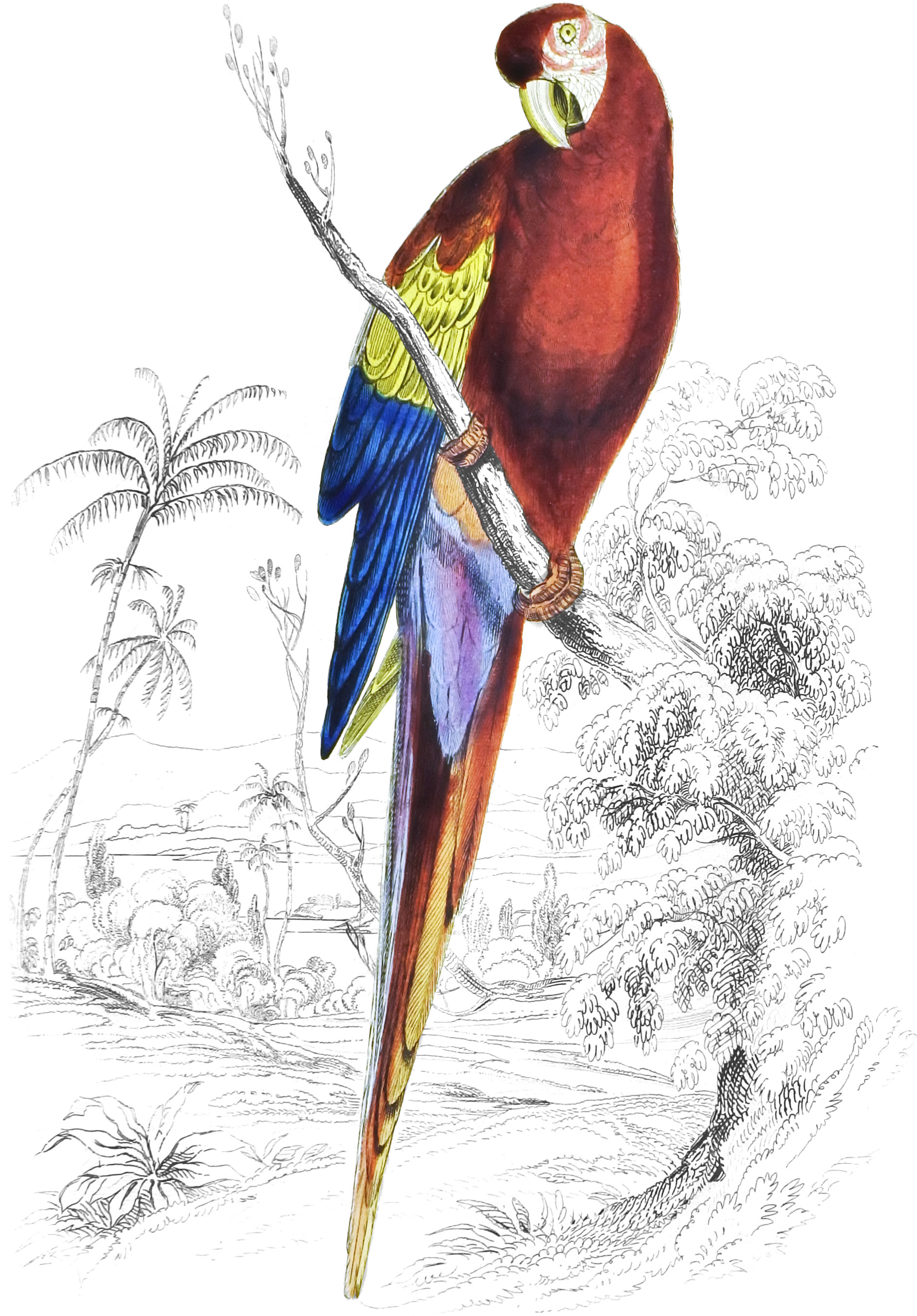
Plate VII
Immediately following the Maccaws, and nearly related to them by the strength and thickness of the bill, and the naked skin which still occupies the orbits, and more or less of the face, is a group to which we would restrict the title of Psittacara, Vigors, typified by his Psittacara frontata, but not embracing all the birds which he included in it, several of them having their station among the Araras, or that group to which the Patagonian species belongs. The genus Psittacara is distinguished by a large, deep, and massive bill, the upper mandible with the culmen imperfectly biangulated, the tip drawn suddenly to a fine sharp point, the tomia sinuated, or imperfectly toothed, the under mandible very large and thick, the tip quadrate, the orbits, and space between the bill and eyes, to a greater or less extent naked. Nostrils round, patent, in the cere at the base of the bill. Wings rather long, acuminate, the three first feathers of nearly equal length, wide at the base, narrowing suddenly toward their tips. Tail rather long, and moderately graduated. The passage from the Maccaw to the Parrot division, appears in one point to be effected by the apparent connection that subsists between the birds of this genus and those of genera Tanygnathus and Triclaria of Wagler, the latter of which, by the nearly even or slightly cuneated tail, leads to the true or typical Parrots.
The subject of the next illustration is the
Noble Parrot-Maccaw
Psittacara nobilis.
Psittacara frontata, Vig. in Zool. Journ. v. ii. p. 389.—Sittace nobilis, Wagler, in Abhand. &c., p. 661.—Psittacus nobilis, Lath. Ind. Orn. i. p. 85. sp. 9.—Psitt. Guianensis, Kuhl, Consp. Psitt. p. 19. sp. 11.—Arara macrognathus, Spix, Av. Bras. i. t. 25. fig. 102.
Instead of the large bare space which occupies the whole of the face and cheeks of the large Maccaws, the nakedness in this bird is confined to the orbits, and a space between the eyes and the bill, continuous with the cere which covers the base of the latter. The bill itself, though equally massive and powerful in comparison to the bulk of the bird, is differently shaped, the tip being suddenly drawn to a very sharp and delicate point. It is a native of Brazil, Paraguay, and other parts of South America, and occurs in great numbers upon the banks of the Amazons. Its food consists of the kernels of the harder fruits, for obtaining which, its powerful bill is admirably adapted. In disposition it is wild, and not easily tamed; and, though noisy and vociferous in its native woods, appears to possess little or no capability of imitating the sounds of the human voice. Its length is above 12 inches, of which the tail measures about six. The upper mandible is yellowish-white, the under deep greenish-grey. The cere, orbits, and denuded space, yellow the forehead and eyebrows are azure-blue, the feathers rather rigid, and of open texture; the crown of the head, the neck, and the whole of the upper and under parts of the body are of a fine lively grass-green. The elbow and ridge of the wings, as well as part of the inferior wing-coverts, are vermilion-red. The wings and tail are green above, the under surface of a dusky wax-yellow. The feet are blackish-grey, the claws black, strong, and falcate.
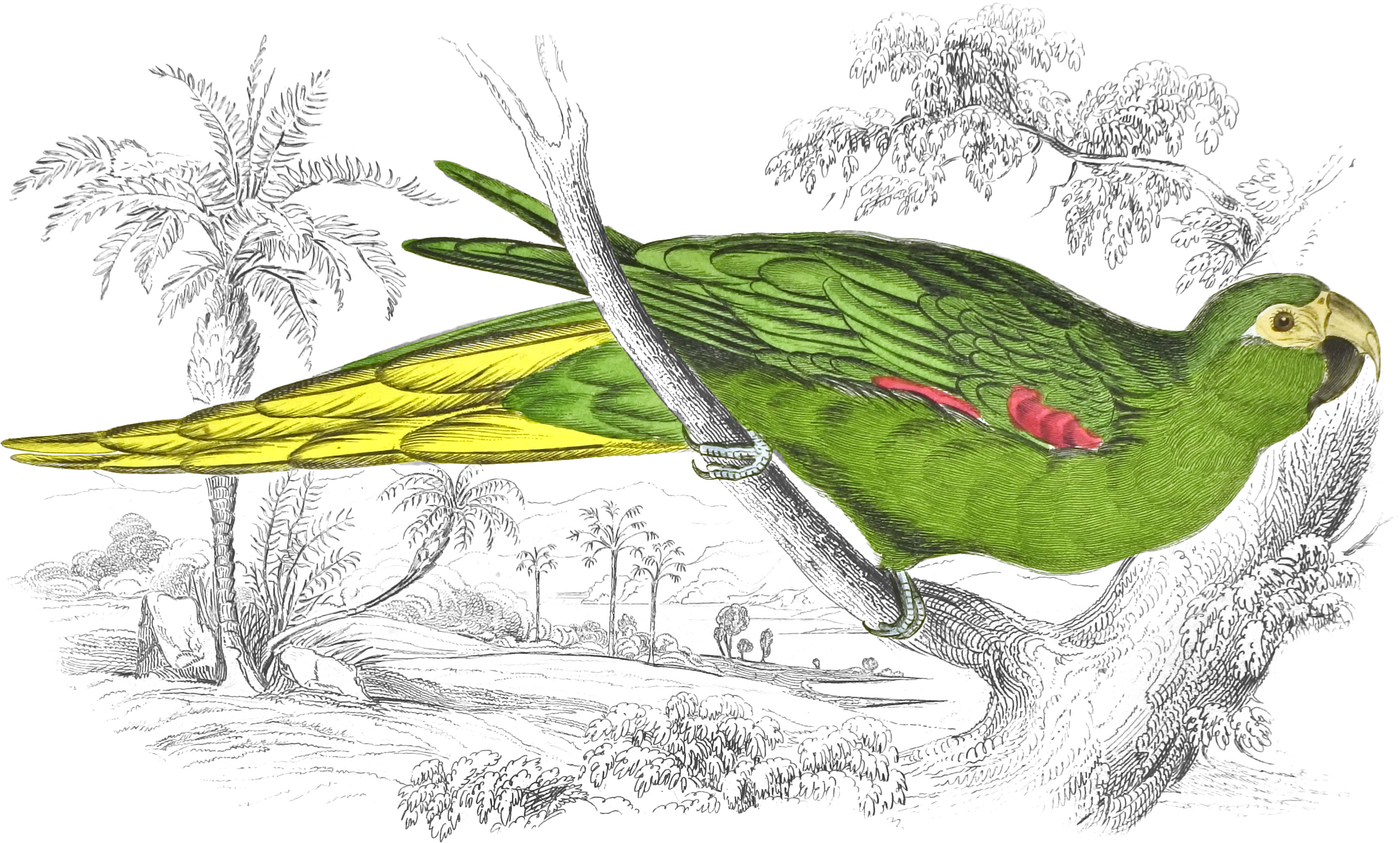
Plate VIII
From the Maccaw division we now proceed to the subfamily Psittacina, containing a numerous assemblage of species, distinguished by their comparatively stout and generally even tail. The larger species of this division answer to M. Kuhl’s fourth section Psittacus, and are usually known among us by the special title of Parrots. These by Wagler, in his Monographia Psittacorum, have since been divided into several groups, and constitute his genera Eclectus, Psittacodis, Psittacus, and Pionus. In this subfamily, the bill, though very powerful and strong, is more elongated than in the Maccaws and Cockatoos, the head is large, and the face, with some few exceptions, covered with feathers. The tail is short, with the end even, or else slightly rounded; and the wings are generally ample and long. It forms the typical group of the family, and is nearly allied to the Cockatoos, or subfamily Plyctolophina, by some interesting forms, among which may be mentioned Nestor hypopolius, Wagler, and by some of its smaller members, to the short-tailed diminutive species of the Lory division; while their connection with the Macrocercinæ is supported by the forms previously adverted to. The species are found distributed in Asia, Africa, and America, and are all inhabitants of the torrid zone. Many are gregarious, except during the period of incubation. They breed in the hollows of decayed trees, and most of the species are supposed to lay only two white eggs, which are incubated alternately by both sexes. In disposition, they are the most docile of the family, and possess the power of imitating the human voice in as great, or perhaps greater perfection, than any of the other divisions.
The first illustration belongs to the genus Psittacus, as restricted by Wagler, the characters of which are,—Bill strong, proportionate, the upper mandible with the culmen slightly narrowed, the tip, with its under surface, rough with elevated ridges, strongly toothed or emarginate, under mandible slightly compressed, with the cutting edges sinuated. Tongue thick, fleshy, smooth. Cere broad. Nostrils large, orbicular, placed in the cere near the base of the bill. Tail rather short, even at the end. Feet, the tarsi short, strong, and depressed, the two exterior toes long, and nearly equal. Plumage compact, the feathers of the neck broad, truncate, and imbricated. With the exception of the Grey Parrot, Psitt. erythacus, Linn., which, although provisionally retained in Wagler’s genus, it is likely will eventually be separated from it, on account of its geographical distribution, the nudity of its face, and some other minor characters, the rest of the species belong to the tropical regions of America. The ground or prevailing colour is green, varied in different birds, with red, blue, and yellow. They are of a docile disposition, and of great imitative powers, on which account they are held in high estimation, and frequently kept caged. They are nearly related to Wagler’s genera Psittacodis and Eclectus, the latter of which appears to lead to the larger Indian Lories but of these genera, and that of Pionus, another group, of which Psittacus manstruus, Auct., is the type, our limits do not permit us to give illustrative figures. The subject of the next Plate is the
Festive Parrot
Psittacus festivus.—Auctorum.
Psittacus festivus, Linn.—Lath, &c.—Wagler, Mon. Psitt. in Abhand. &c. p. 580.—Le Perroquet Tahua de Cay. Buff. Pl. Enl. 480 840.—Perroquet Tavoua, Le Vaill. pl. 129. Festive Parrot, Lath. Syn. i. p. 298. 102.
We have illustrated the American group of Parrots by a figure of the Festive Parrot, which possesses all the typical characteristics of the genus. It is a native of South America, inhabiting Guiana, Cayenne, and the Brazils, particularly the banks of the river Amazons, and affects the forests, where it procures a constant supply of food in the various seeds and kernels of fruits. It is docile, and easily tamed, and, being of an imitative disposition, readily learns to pronounce words and sentences with great clearness and precision. In size, it exceeds the common Amazons Parrot, measuring between 15 and 16 inches in extreme length. The bill is of a pale flesh colour, strong, and with the upper mandible distinctly toothed. The nostrils are large and open, placed in the cere at the base of the bill. The narrow frontal band and eye-streak are deep red, with a purplish tinge. Above and behind the eyes, the feathers are pale azure-blue. The lower back and rump are deep vermilion-red, the greater quills and secondaries have their outer webs of a deep blue, the interior webs being greenish-black. The remainder of the plumage of the upper and under parts of the body is green. The tail is short, being about four inches in length, nearly even at the end, the outmost feather on each side, with its exterior web, margined with blue; the rest are green, with a small spot of pale red near their bases, except the two intermediate feathers, which are wholly green. The legs are stout, and of a bluish-grey or leaden colour.
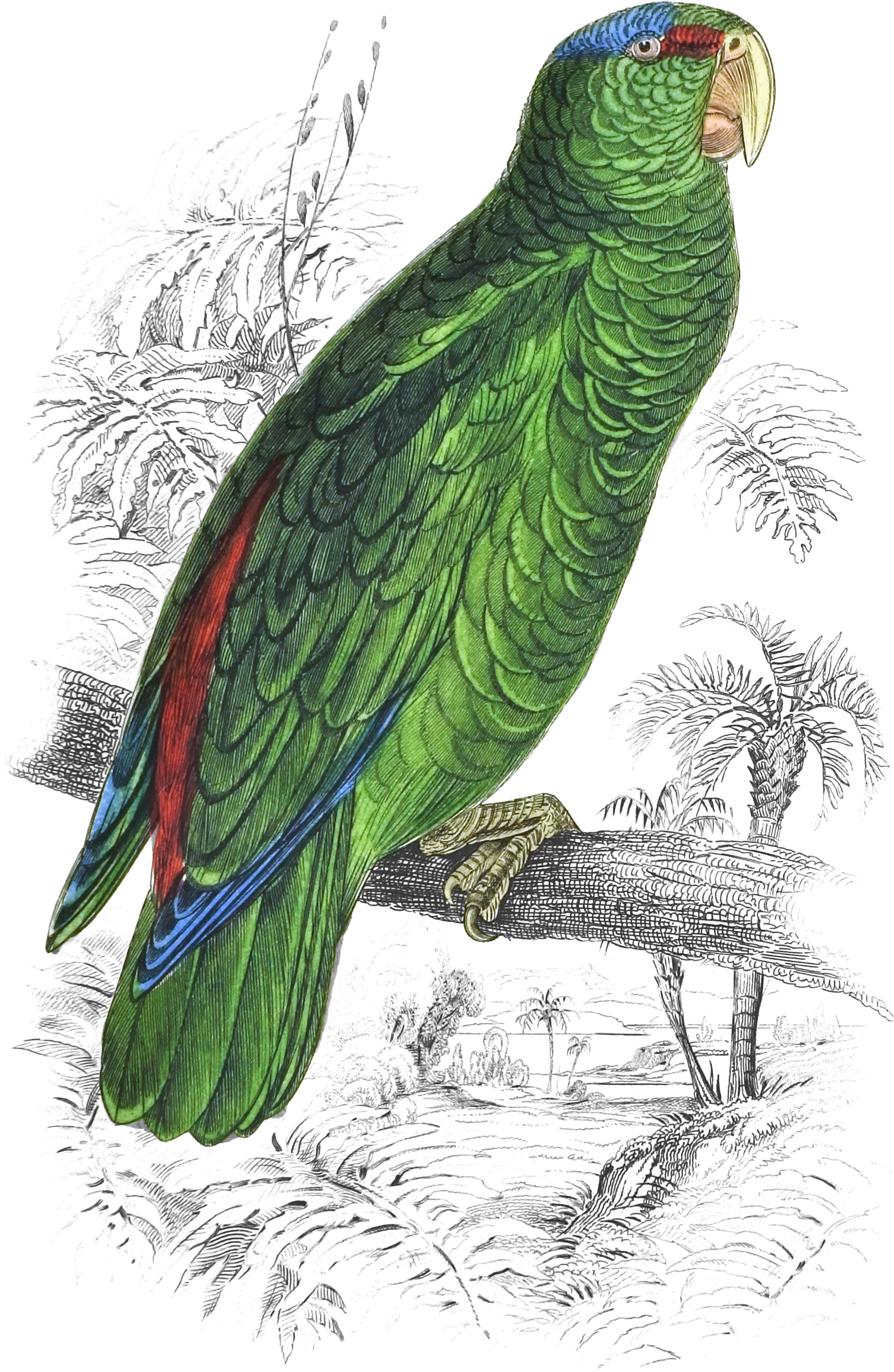
Plate IX
Amazon’s Parrot
Psittacus Amazonius.—Auctorum.
Psittacus Amazonius, Briss. Av. 4. p. 256.—Wagler, Mon. Psitt. in Abhand. &c. p. 496 596. and 588.—Spix. Av. Bras. p. 45.—Le Peroquet Amazone, Buff. Pl. Enl. 547.—Aourou Parrot, Shaw’s Zool. 8. p. 508. pl. 76.
The true Amazons’ Parrot has so frequently been confounded and mixed up with other nearly allied species, that a description of it may not be unacceptable to our readers, especially as it is a kind frequently brought to Europe, on account of its colloquial powers, and known, like others of its congeners, by the common appellation of Green Parrot. In dimensions it is inferior to the Festive Parrot, its length seldom exceeding twelve inches: the bill is less powerful, but similar in form, its colour orange-yellow, with a whitish tip. The cheeks, chin, and angles at the base of the bill are yellow; the forehead and eye-streak violet-purple, the bases of the feathers being yellow; the occiput and hind-neck are green, each feather edged with black. The rest of the upper and under plumage is of a fine green. The four lateral tail-feathers nearest the two middle ones have their outer webs green, verging to yellow at the base and apex; the inner webs yellow, with a large central red spot, intersected by a transverse green one: the fifth and sixth have the basal half of the outer webs green, the remainder yellow the inner webs with their bases and tips yellow, the middle part being green: the next is distinguished by a pale red spot; and the remainder have their bases green, which passes into yellow near the tips. The margin of the carpus or lower ridge of the wing is frequently of an orange-red. The first primary quill is black above: beneath, the inner web exhibits at the base a rich tinge of verdigris-green, the second, third, and fourth, have their exterior webs green, with azure reflections; the fifth, sixth, seventh, and eighth, are green from the base to the middle, the other part being deep azure blue, the inner webs black; the ninth to the twelfth greenish near the base, passing forwards into brownish-red, which, near the ends of the feathers, becomes of a deep blue: the under surface of all the quills is of a copper or verdigris-green colour. This bird inhabits South America, being common in Guiana and Brazil, particularly near the banks of the river Amazons. It feeds upon fruits, particularly that of the Rhizophora Mangle, in the decayed trunks of which trees it also deposits its eggs. It is also very destructive to the orange plantations. It is easily tamed, and learns to repeat with facility a number of words and short sentences. When alarmed or excited, it erects the nuchal feathers.
Ash-Coloured or Grey Parrot
Psittacus erythacus.—Linnæus.
Psittacus erythacus, Linn. Syst. Nat. et Auct.—Psittacus Guianensis cinereus, Bris. t. 4 pl p. 310. No. 49.—Peroquet cendre de Guinée, Buff. Pl. Enl. 311.—Ash-coloured Parrot, Shaw’s Zool. 8. pl. 486.
Many of our readers will recognise an old and amusing acquaintance in the characteristic figure of this well-known species, not, indeed, conspicuous for that brilliancy and variety of plumage which distinguishes the great majority of the tribe, but remarkable for its docility and mimicry, the faculty it possesses of imitating the human voice, as well as any other sound, its never-ceasing garrulity, and its clear and distinct articulation. In most of these particulars, it surpasses the rest of its congeners, on which account it has always been held in high estimation by the bird-fancier and lover of living curiosities. This we learn from the large sums that have at all times been offered and given for highly-gifted or well taught individuals. Even as early as A. D. 1500, we read of a Parrot at Rome, supposed to be of this species, for which 100 gold pieces were given by a Cardinal. Its merits, however, appear to have been of a kind well calculated at that period to create an unusual degree of astonishment, and a feeling of the marvellous, as it Had learned to repeat with cleanness, and without hesitation, the whole of the Apostles’ creed. Willughby, also, in his old and excellent work on Ornithology; mentions the high prices brought by Parrots of various species in Holland, and other parts of the Continent. To enumerate the various anecdotes related of this bird, would not only occupy more space than the nature of our work will allow, but would, in a great measure, be only repeating what has already so frequently been told in the works and compilations of other writers. We shall only observe, that, in many of the marvellous stories recorded of Parrots, particularly all such as relate to answers seemingly appropriate and consequent to questions put to them, and which some authors would almost seem to imply were dictated by intelligence, or that the birds really understood the import of what was asked, are merely the result, under accidental and fortunate circumstances, of what had previously been taught them by frequent repetition, to articulate by rote.
The imitative propensity of the Parrot, amusing as it in general may be, is, however, sometimes to be guarded against, and productive of untoward accidents, as the following instance related to us will shew. A Parrot which was kept upon a quay in a sea-port town, had learned the term, with its appropriate enunciation, used by carters in backing, that is, making the horse, by a retrograde motion, place the cart or waggon in the most convenient station for loading or unloading. This term the bird one day made use of, when a cart and horse had imprudently been left unattended for a short time, and the horse, obeying the mandate of the bird, continued to keep moving backwards, till both were precipitated over the quay, and the unfortunate animal was drowned.
The Grey Parrot is a native of western Africa, from whence it appears to have been imported to a very early period; but common and well known as it is in a state of captivity, its peculiar habits and economy in a state of nature are still but little and imperfectly known. Like most of its kind, it is said to breed in the hollows of decayed trees; and the instinctive propensity for such situations does not appear to desert it even in a state of captivity for Buffon mentions a pair in France, that, for five or six years successively, produced and brought up their young, and that the place they selected for this purpose was a cask partly filled with saw-dust. Its eggs are stated to be generally four in number, their colour white, and in size equal to those of a pigeon. In its native state, the food of the Parrot consists of the kernels of various fruits, and the seeds of other vegetables; but when domesticated, or kept caged, its principal diet is generally bread and milk, varied with nuts, almonds, &c., and even pieces of dressed meat. When feeding, it often holds its food clasped in the foot, and, before swallowing, masticates or reduces it to small pieces by its powerful bill and palatial cutters. This member, so unlike that of other frogivorous birds, is admirably calculated for the principal offices it has to perform, viz. breaking the shells of the hardest fruits and seeds, and as a strong and powerful organ of prehension and support; for few of our readers but must have observed that the bill is always first used, and chiefly depended upon when a Parrot is caged, in climbing or moving from the position to another. The longevity of the feathered race, we believe, in general far exceeds what is commonly supposed, at least if we may judge from the age attained by various birds, even when subjected to captivity and confinement. Thus, we have instances of eagles living for half a century: the same of ravens, geese, and other large birds, as well as among the smaller kinds usually kept caged. The Parrot appears to yield to none of these, and several instances are upon record of their having reached the remarkable age of sixty or seventy years. Among these, none is more interesting than that of an individual mentioned by M. Le Vaillant, which had lived in a state of domesticity for no less than ninety-three years. At the time that eminent naturalist saw it, it was in a state of entire decrepitude, and in a kind of lethargic condition, its sight and memory being both gone, and was fed at intervals with biscuit soaked in Madeira wine. In the time of its youth and vigour it had been distinguished for its colloquial powers, and distinct enunciation, and was of so docile and obedient a disposition, as to fetch its master’s slippers when required, as well as to call the servants, &c. At the age of sixty, its memory began to fail, and, instead of acquiring any new phrase, it began to lose those it had before attained, and to intermix, in a discordant manner, the words of its former language. It moulted regularly every year till the age of sixty-five, when this process grew irregular, and the tail became yellow, after which, no farther change of plumage took place. It is subject to variety, as shewn in the figure of Edwards, where the ground colour is mixed with red. In size it measures about 12 inches in length. The bill is black, strong, and much booked, and the orbits, and space between them and the eyes, covered with a naked and white skin. The whole of the plumage, with the exception of the tail, which is of a bright deep scarlet, is of an ash-grey colour, deepest upon the back, and the feathers finely relieved and margined with paler grey. The hides are of a pale yellowish-white, the feet and toes grey, tinged with flesh-red.
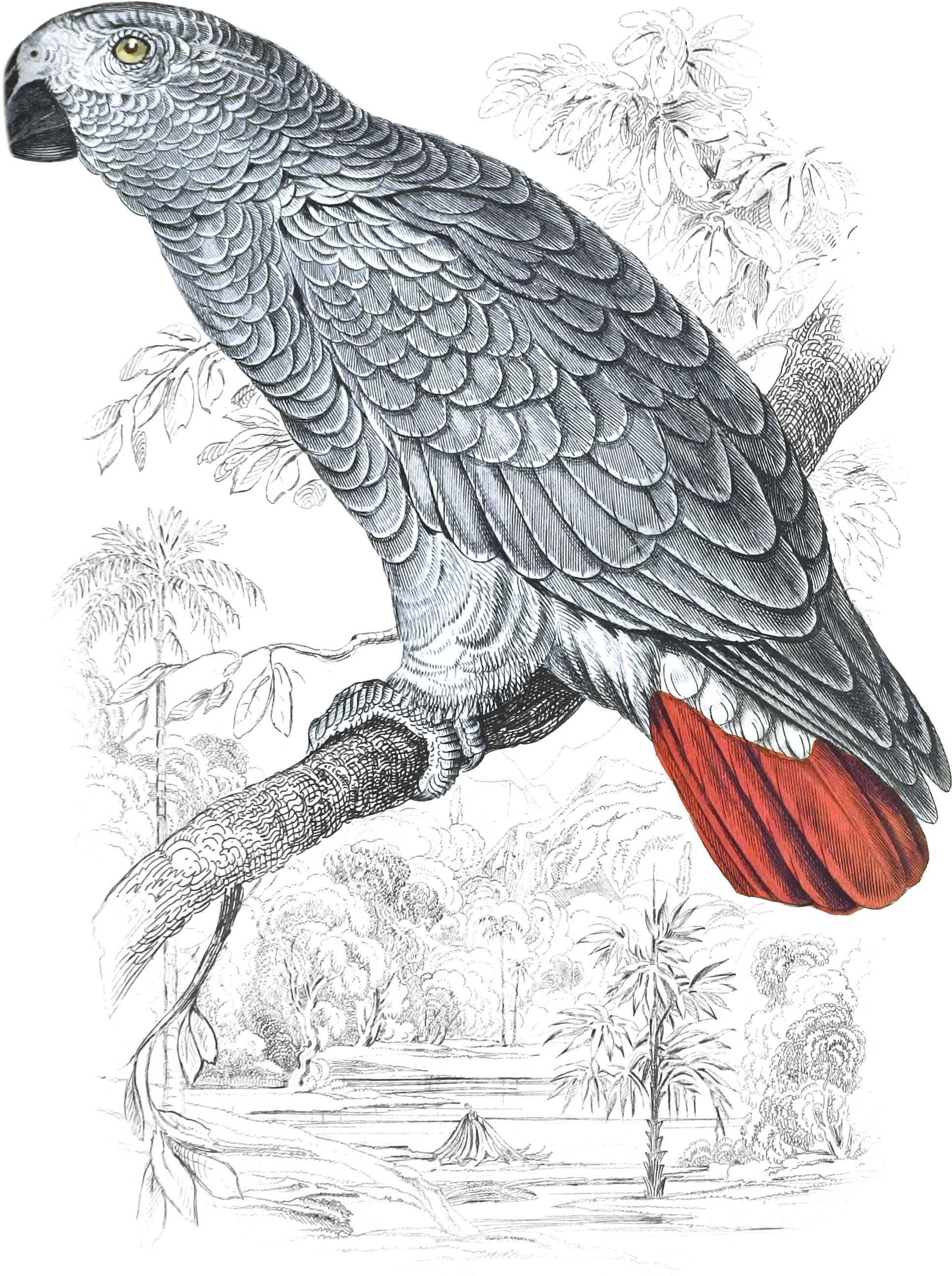
Plate X

The limited number of engravings not admitting of a figure illustrative of every group, we can only remedy the deficiency by a description of such species as are remarkable, or typical of their respective genera. The Short and Even-tailed Parrots, as previously observed, have been divided by Wagler into several generic heads; but whether all of these will stand the test of such a separation, or are only to be regarded as slightly aberrant forms of the genus Psittacus, must depend upon a strict analysis of all the species. We shall, however, here consider them as forming distinct groups, detailing the principal characters of each as given by that eminent naturalist. The first is that of Eclectus, represented by the Eclectus Linnæi, Wagler, and Ec. grandis, Wagler (the Psittacus grandis of Latham, &c.), which differ from his restricted genus Psittacus in the form of the bill, the under mandible being narrower, the cere at the base scarcely visible, and the nostril placed farther back, and hidden by the feathers or the brow. The texture of the plumage upon the head and neck is also different, being long and silky. He considers them to represent the parrots of America, Africa, and Asia, and also to bring them nearer in connexion with the larger lories. The following is a description of the
Grand Electus
Electus grandis.—Wagler.
Electus grandis, Wagler, Mon. Psitt. in Abhand. &c. pp. 495, 472.—Psittacus grandis, Kuhl’s Consp. p. 38, No. 50. Lath. Ind. Orn. i. p. 116, sp. 112 102, var. B.—Psittacus janthinus. Lath. Ind. Orn. i. p. 90, sp. 24.—Peroquet grand Lori, (male), Le Vaillant, Tab. 126.—Lori dela nouvelle Guinee, Buff. Pl. Enl. 683.—Grand Lory, Lath. Syn. i. p. 275, sp. 81; Shaw’s Zool. viii. p. 533, pl. 80.
This elegant species, which exceeds the Amazons Parrot in size, is a native of the Moluccas and New Guinea. In appearance, and the colour of its plumage, it approaches the larger lories, a resemblance also indicated by the name given to it by Latham and others. The bill is black, with the culmen of the upper mandible rounded; the nostrils placed at the base of the bill, and concealed from view; the eyes yellow, and the ophthalmic region entirely clothed with feathers. The head and upper neck are of a rich crimson red; the lower neck, breast, belly, and upper part of the thighs, are lilac purple; the mantle, back, scapulars, wing-coverts, and upper tail-coverts, rich scarlet, with a purplish tinge. The flexure of the wings, and outer webs of the quills, are azure blue; the vent and apical fascia of the tail yellow.
The next group indicated by Wagler is that of Psittacodis, the principal character of distinction consisting in the want of the tooth or angular process on the upper mandible. The members belonging to it are also natives of Asia and Australasia, and the Psitt. magnus, Psitt. Paragua, Psitt. Sumatranus, and Psitt. tarabe, Auct., belong to it. A third group is that of Pionus, which embraces a variety of species belonging to Asia, Africa, and America, and which, judging from the difference of geographical distribution, it is likely may require still further division. In the form of the tongue and feet, it agrees with the genus Psittacus proper, but the tail is comparatively shorter, the wings longer, and, when closed, in many species extending beyond the tip of the tail. The head is large, and the body short and thick. An example of this group is
Le Vaillant’s Pionus
Pionus Le Vaillantii.—Wagler.
Pionas Le Vaillantii, Wagler, Mon. Psitt. in Abhand. &c. pp. 499, 614.—Psittacus robustus. Lath. Ind. Orn. i. p. 94 95.—Psittacus Le Vaillantii, Lath. Sup.; Kuhl, Consp. Psitt. p. 83.—Psittacus infuscatus, Shaw’s Zool. viii. p. 523.—Peroquet à franges souci, Le Vaill. Tab. 130 et 131.—Robust Parrot, Lath. Syn. i. pp. 296, 100.—Damask Parrot, Shaw’s Zool. viii. 523.
This is an African species, inhabiting, at a certain period, the eastern parts of that continent, as high as latitude 32° It was first discovered and figured by Le Vaillant, who informs us, that it only resides in the woods, in the latitude above mentioned, during the season of reproduction, quitting them for warmer districts on the approach of the rainy season, after it has reared its young; and that, during these migratory movements, the flocks fly so high as to be beyond the reach of sight, though their screams or call-notes can still be heard. As usual in this family, the hollow of a tree is the receptacle for the eggs, which are four in number, in size equal to those of a pigeon, and which are incubated alternately by both sexes. The young, when first hatched, are naked, but soon become covered with greyish down. Their plumage is not perfected till after an interval of six weeks, and they remain a considerable time longer in the nest, during which they are fed by the parents, who disgorge in the manner of pigeons. In an interesting detail of their habits, he observes that they are remarkably fond of bathing, and are observed to fly every day, and at the same hour, to the water for this purpose. The hours of feeding are also very regular, and the whole day is distributed by rule—a fact we have observed to prevail among other birds. At dawn of day, the whole flight of each district assembles, and alights with much noise on one or more dead trees, according to the size of the flock, and there, displaying their wings to the first rays of the sun, recal to mind the idea of some ancient race, of simple manners, assembled on some hill to chaunt a hymn in honour of the God of Day. The reason, however, of this assembly of the parrots, is to warm and dry their plumage, moistened and chilled by the dews of night, which in these regions is often cold, and always damp. When once warmed, and their plumage dry, they arise in small flocks, and fly around in quest of their favourite fruit, a kind of cherry, the stone of which they break, in order to obtain the kernel. This their morning’s meal continues till about 10 or 11 o’clock, at which time all the separate flocks fly to the water to bathe. When the heat of day commences, they again seek the deep recesses of the woods, in order to enjoy the refreshment of the shade; and at this time they keep a silence so profound, that not a sound shall be heard by a person sitting beneath a tree, though the branches above be crowded with legions of parrots; but on the report of a gun, the whole flock fly off with the rapidity of lightning, with a confused mixture of the most discordant screams.
When this their time of rest is elapsed, they again disperse, in order to obtain their second or evening meal; after which, all the flocks of the whole district reassemble with much noise and animation, and this is the signal for their second visit to the water, which is often far distant, as only the purest wall please them. They are then seen confusedly and playfully rolling over each other on the margins of the pool, at times dipping their heads and wings into the water, in such a manner as to scatter it all over their plumage, and exhibiting a most entertaining spectacle to the observer. This ceremonial being finished, they revisit the trees on which they assembled at sunrise, where they sit for some time engaged in adjusting and pruning their feathers. This finished, they fly off in pairs, each pair retiring to its peculiar roost, where they rest till morning.
The bill is large, the culmen biangulate, the tomiæ sinuated, but not distinctly toothed; its colour whitish. The head, neck, and breast are of an olive green colour, deepest upon the forehead and crown; the lores or space between the bill and eyes black. The mantle, scapulars, and wing-coverts are brownish-black, the feathers margined with green. The lower back, upper tail-coverts, abdomen, and under tail-coverts, emerald green. The ridge of the wings and thighs are bright reddish-orange. The quills and tail brownish-black, slightly tinged with green. Legs and toes grey.
In addition to Wagler’s genera Psittacodis, Eclectus, and Pionus, which contain the other larger species of the short even-tailed Parrots, we are inclined to place in this subfamily several small species, which, in Kuhl’s Conspectus, form a portion of his section Psittacula, and are also included in Wagler’s more restricted genus of the same name. Both of these groups are, however, so constituted, as to embrace birds of dissimilar form and habits, and widely separated in regard to their geographical distribution. In some, as those inhabiting the islands of the Pacific, the bill is slender and weak, as in the Lories the tongue is also supposed to be furnished with delicate papillæ. These we have little hesitation in placing in that subfamily. Others have the bill powerful and thick, with the upper mandible strongly toothed; the wings long, and the tail short, and nearly even. To this group, the Psittacus Swinderianus of Kuhl, and the Psittacus Malaccensis, Lath., appear to belong. For the present, the title of Agapornis is given to them, though it is not unlikely that a farther division may be required, when their habits and economy are better known. The only illustration we can give of these diminutive Parrots is that of
Swindern’s Love-Bird
Agapornis Swinderianus.
Psittacus Swinderianus, Kuhl, Consp. Psitt. in Nov. Act., &c., p. 104, pl. 2.—Psittacula Swinderiana, Wagler, Mon. Psitt. in Abhand. &c., p. 621.
This beautiful little species is a native of Southern Africa, and was first described and figured by Kuhl, in his “Conspectus Psittacorum,” under the title of Psittacus Swinderianus; it was included in that section named by him Psittacula, in which he placed the whole of the smaller species with short and even or slightly rounded tails—an artificial division, and established without due regard to the structure, habits, or distribution of the species. Little is known respecting its natural history, being a bird of rare occurrence, and even now only seen in a few collections. In the form and strength of its bill, it shews an affinity to the larger parrots, which is still more strongly indicated in another species, the Psittacus Malaccensis of Latham. In size it is among the smallest of its race, its extreme length being about six inches. The bill is black, strong, with the upper mandible emarginate. The bead and nape are of a beautiful lively green, bounded by a black nuchal-collar; the neck and breast are yellowish-green; the mantle and wings are green; the lower back and upper tail-coverts are deep azure blue. The tail, which is short and nearly even, has the two intermediate feathers wholly green; the rest on each side have their basal half vermilion-red, bounded by a bar of black, the tips being green. The legs and toes are greyish-black. The wings are long, and, when closed, reach to the end of the tail.
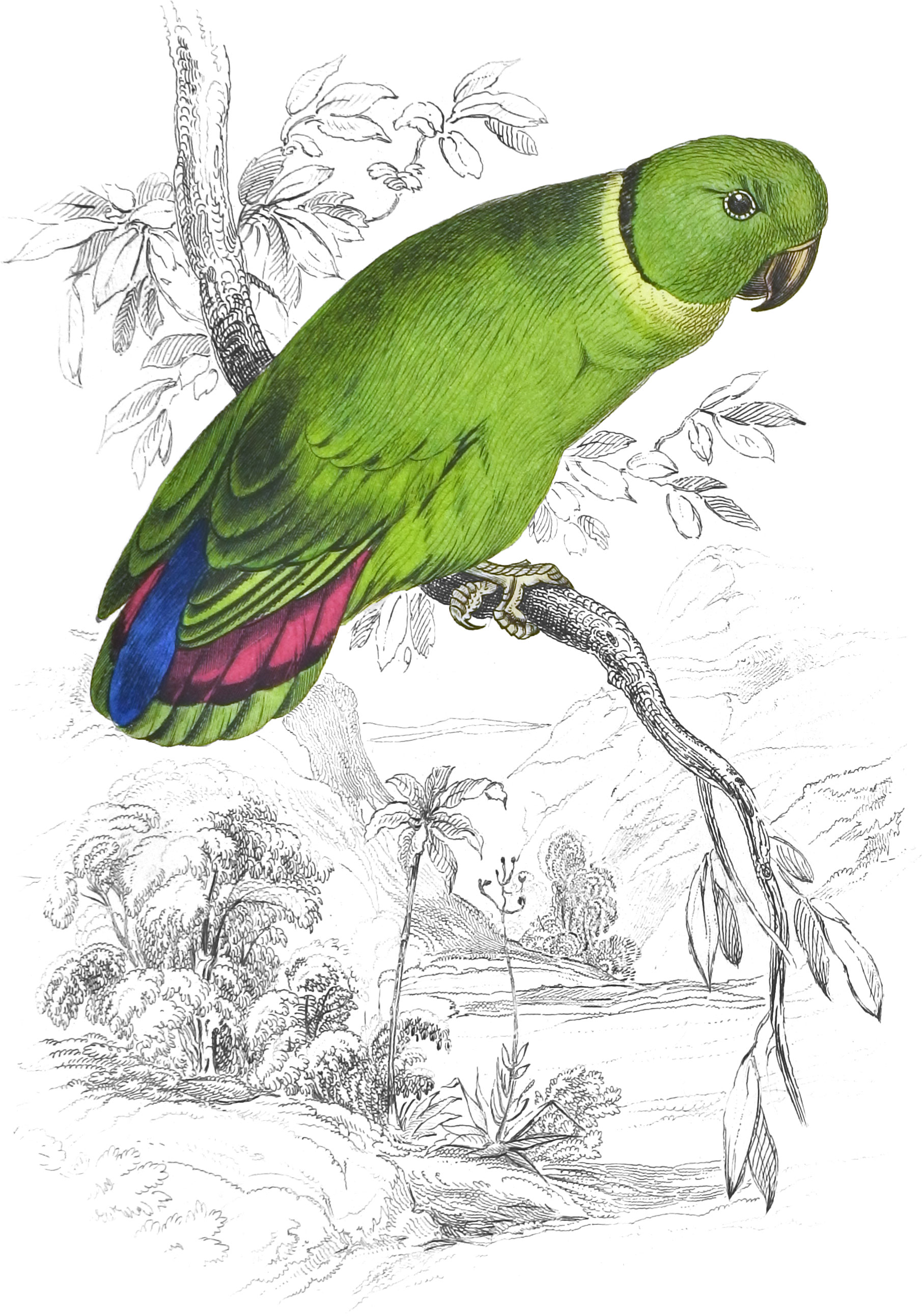
Plate XI
In this subfamily we have also placed another very interesting form, from Australia; it is represented by the Psittacus Nestor of Latham, and now forms the type of Wagler’s genus Nestor. This bird is supposed to form a connecting link between the Parrots and Cockatoos, though it must be confessed that more correct information respecting its history and habits is necessary, before its true situation and direct affinities can be satisfactorily ascertained. The characters of the genus Nestor of Wagler are:—Bill elongate, the upper mandible compressed, hooked; the tomia sinuated, but not distinctly toothed; the tip projecting, with its under surface sulcated and deeply excavated for the reception of the tip of the under mandible; under mandible narrow, compressed, slightly convex, or forming, when closed, an obtuse angle with the upper; wings rather long, ample; tail of moderate length, and even at the end, the tips of the shafts bare, and slightly projecting beyond the feathered part. The following plate represents the
Southern Nestor
Nestor hypopolius.—Wagler.
Nestor hypopolius, Wag. Mon. Psitt. in Abhand. &c., p. 505 and 696.—Psittacus nestor. Lath. Ind. Orn. 1, p. 110 sp. 85; Kuhl, Consp. Psitt.in Nov. Act. &c., p. 86.—Psitt. Australis, Shaw, Mus. Lever. p. 87.—Southern Brown Parrot, Lath. Syn. 1, p. 264, 70.
This curious and remarkable-looking bird, which, in some respects, appears to approach the Cockatoos, particularly the black species, or Geringores, is a native of New Zealand. Of its natural history we have no particulars in the descriptions given by Latham, Wagler, &c., these being merely confined to the form of the parts and the colour of the plumage. Its differently-shaped bill, which, in addition to a greater elongation than that of the other Parrots, possesses other peculiarities of structure, and the denuded tips of the shafts of the tail-feathers seem, however, to indicate an economy in some respects dissimilar to that of the other groups with which it is for the present associated. The bill, which is large, is of a grey colour, with the tip darker. The forehead and crown are greyish-white, slightly tinged with green; the face and ear-coverts are yellow, tinged near the base of the bill with red. The sides of the neck, breast, and abdomen are all dull red; the feathers margined with oil-green. The back and wings are of a brownish oil-green. The rump and vent are deep red. The tail is brownish-green. The legs and feet are grey, tinged with brown.
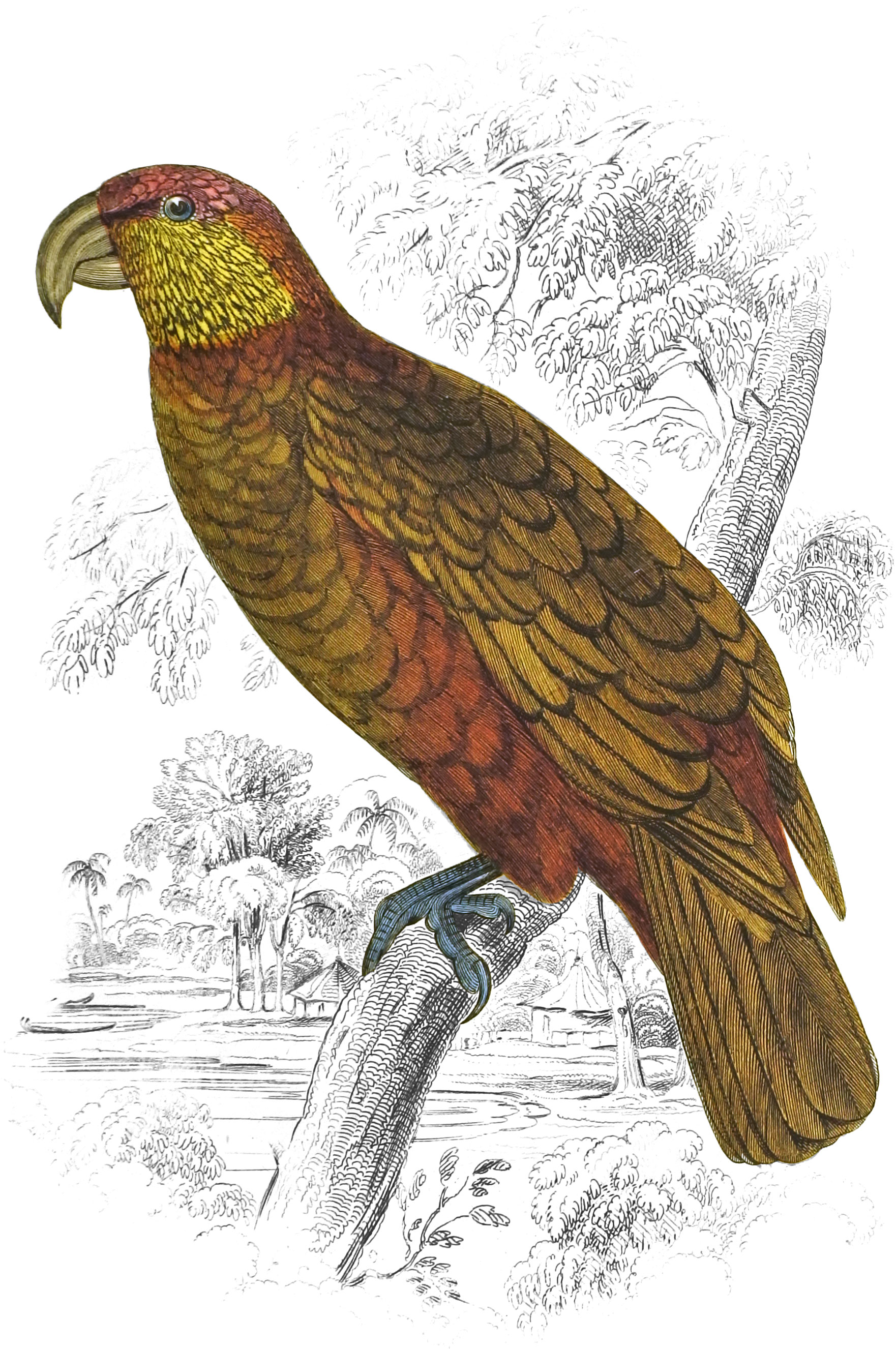
Plate XII
Genus Plyctolophus
The next primary division is that of the Cockatoos, or subfamily Plyctolophina, Vigors, representing the Rasorial Order, in the circle of the Psittacidæ. It contains, besides the true Cockatoos, distinguished by their white or light coloured plumage, the various black or dark coloured birds belonging to the genus Calyptorynchus, Vigors, which we here designate Geringores, a name given to some of the species by the natives of Mew Holland, in which interesting country they are chiefly met with. The birds of this division are among the largest of the Parrot tribe, and most of them, in a greater or less degree, are crested. The bill in the Geringore group, though short, and nearly concealed by the projecting feathers of the face, is remarkable for its strength and depth at the base. In addition to seeds, they are said to feed upon the roots of bulbous plants. In disposition, the birds of this subfamily are generally wilder and less tractable than many of the other groups of the Psittacidæ. They breed in the holes of decayed trees, and their eggs are seldom more than two in number. The first group we have to notice is that of the genus Plyctolophus, Vieillot, of which the characters are:—Bill deep at the base, greatly arched and strong, the upper mandible forming nearly the fourth part of a circle, the tip narrowed and acute, overhanging the lower mandible; the tomia or cutting edges sinuated or toothed; under mandible narrower than the upper; the tongue thick, fleshy, and smooth; nostrils lateral, in the cere at the base of the bill; head crested, the crest composed of two rows of acuminate feathers, the tip directed forwards, and which can be erected or depressed at will; cheeks plumed; tail rather short, even; plumage compact, the tips of the feathers rounded, truncate; feet robust; tarsi short and reticulated.
The Cockatoos, so called from the usual call-note of the species, form a well marked genus, readily distinguished from the other groups of the Psittacidæ by their light and uniform colour, which is white, or white tinged more or less, according to the species, with sulphur-yellow or rose-red, by their peculiar shaped crest, and by their short and even tail. The massive and powerful bill, as well as the robust scansorial feet of this section, evidently point to the situation they hold in the family; and, with the nearly allied genus Calyptorynchus and some other forms which sustain the connexion with more distant groups, they are considered as representing the Rasorial group of the family. They are natives of Australia and the Indian Isles, where they inhabit the woods and forests of these luxuriant climes. They feed upon the seeds of vanous trees and plants, being able, with their powerful bill, to break the stones of the hardest fruits. Their nidification is similar to that of the great body of the Psittacidæ, the holes of decayed trees being the receptacle for the eggs and young. They are easily tamed when taken at an early age, but do not possess the imitative powers of the true Parrots, seldom being able to acquire more than two or three words besides their own peculiar note or cry of cockatoo. The first we have to notice is the
Tricolour-Crested Cockatoo
Plyctolophus Leadbeateri.—Vigors.
Plyctolophus Leadbeateri, Vigors, Philos. Mag. 1831 p. 55. Lear’s Parrots.—Cacatua Leadbeateri, Wag. Mon. Psitt. in Abhand. 692, sp. 3.
Distinguished by its tricoloured crest of scarlet, yellow, and white, composed, like that of the other Cockatoos, of long acuminate feathers, with the tips directed forwards, and which can be erected and expanded like a fan, or depressed at the pleasure of the bird. It is a native of Australia, and was first made known and described from a specimen which came into the possession of Mr Leadbeater, well known to ornithologists, and whose name Mr Vigors has selected for its specific title. In size it fully equals, or perhaps a little exceeds, the lesser Sulphur-crested Cockatoo. The bill is of a pale greyish-white; toothed bits whitish; the upper mandible strongly sinuated and the irides of a deep brown; the naked orbits whitish. The feathers at the immediate base of the bill are crimson, forming a narrow band or fillet those of the forehead are white, tinged with red. The feathers forming the proper crest are long and acuminate, the tips bending forwards, their basal half crimson, divided by a bar of rich yellow, the remainder pure white. The whole of the body is white, tinged deeply with crimson upon the neck, breast, flanks, and under tail-coverts. The under surface of the wings is rich crimson-red. Its legs and toes are deep grey, the scales distinctly marked by lighter lines. Of its peculiar habits and economy we are unable to give any detailed account, which we greatly regret, as it is the knowledge of these interesting particulars, which point to the natural station of each individual, and mark the minute differences between nearly allied species, that give a zest to the study, and reward the naturalist for the drier and more technical parts of zoological science. Another Australian species is the Helmeted Cockatoo, Plyctolophus galeritus, enumerated by Mr Vigors and Dr Horsfield in their description of the Australian birds in the collection of the Linnæan Society; and as its habits are presumed to resemble in many respects those of the other species, we quote their observations, as extracted from M. Caley’s Notes.
This bird is called by the natives Car-away and Cur-iang. I have often met with it in large flocks at the influx of the Grose and the Hawkesbury Rivers, below Mulgo’ey on the former river, and in the long meadow near the Nepean River. They are shy, and not easily approached. The flesh of the young ones is accounted good eating. I have heard from the natives that it makes its nest in the rotten limbs of trees, of nothing more than the vegetable mould formed by the decayed parts of the bough; that it has no more than two young ones at a time; and that the eggs are white, without spots. The natives first find where the nests are, by the bird making co’tora in an adjoining tree, which lies in conspicuous heaps on the ground. Co’tora is the bark stripped off the smaller branches, and cut into small pieces. When the young ones are nearly Sedged, the old birds cut a quantity of small branches from the adjoining trees, but never from that in which the nest is situated. They are sometimes found to enter the hollow limb as far as two yards. The nests are generally found in a black-butted gum-tree, and also in Coroy’bo, Cajim-bora, and Yarrovoar’ry trees (species of Eucalyptus).
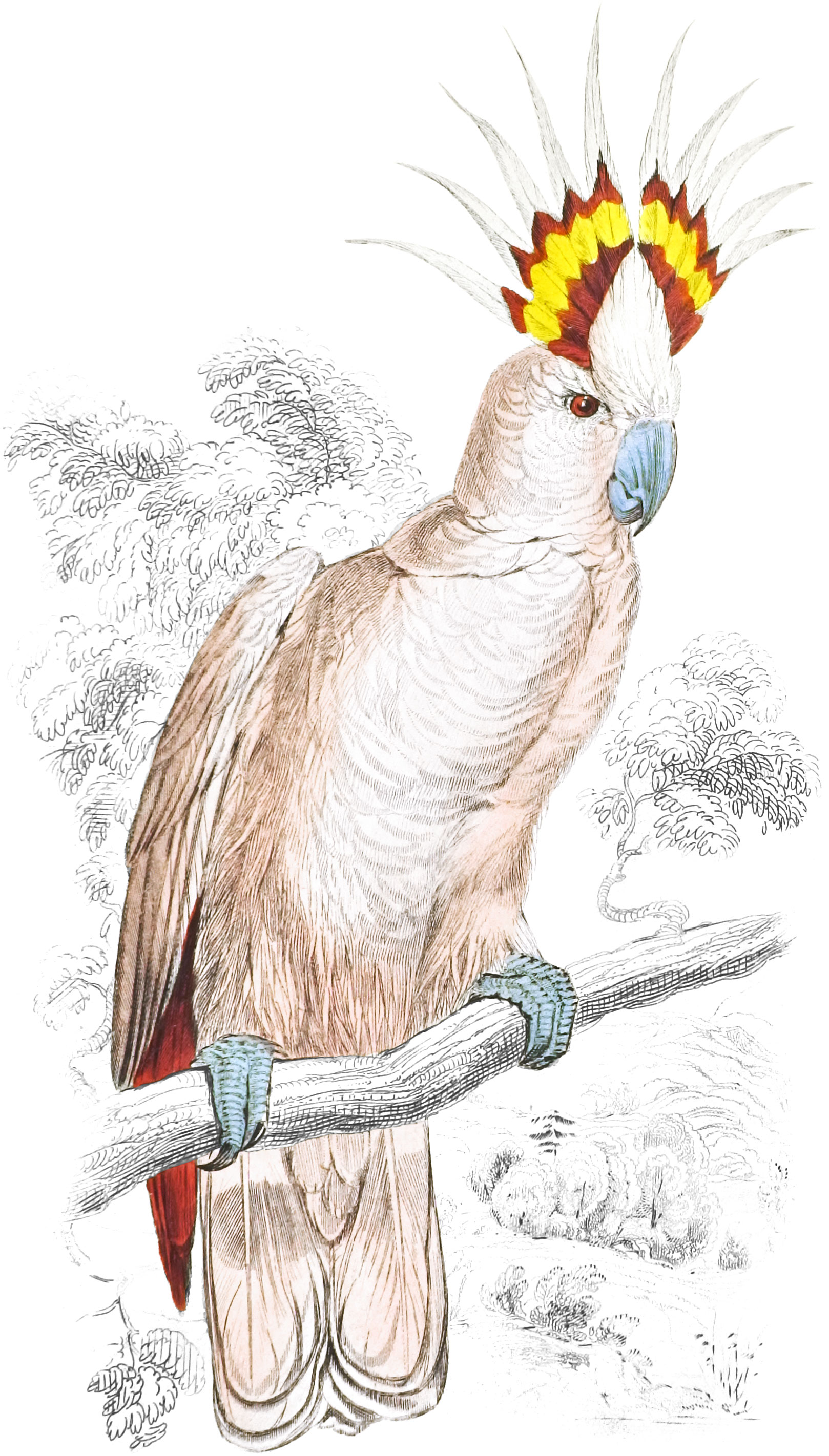
Plate XIII
Our next figure represents the
Lesser Sulphur-Crested Cockatoo
Plyctolophus sulphureus.—Vieillot.
Plyctolophus sulphureus, Lear’s Parrots.—Psittacus sulphureus, Lath. Ind. Orn. i. p. 109, sp. 81; Shaw’s Zool. vol. viii. p. 480, pl. 73.—Cacatua sulphurea, Wagler, Mon. Psitt. in Abhand. &c. p. 695, sp. 7.—Lesser White Cockatoo, with yellow crest, Edwards, 7, t. 317.
This species we frequently see in confinement; for though rarely able to articulate more than a few words, its handsome appearance, docile disposition, and amusing habits, render it a great favourite with those who delight in feathered pets. It is kind and affectionate to those it is accustomed to see, and who feed and take care of it; but suspicious of strangers, whose caresses it rarely admits of with impunity. When alarmed or irritated, it erects the crest to the fullest extent, making a peculiar noise; at other times it is kept depressed, and hanging over the nape of the neck.
The general plumage of the body is white, slightly tinted upon the breast, sides, and inner wing-coverts with pale sulphur yellow. The crest, in form like that of the other species, and auricular spot, are fine sulphur yellow. The legs and toes are grey; the irides red. It is a native of the Moluccas, and other Indian islands; but of its natural habits we have again to regret deficiency of information. In captivity, the female sometimes produces eggs, and we now have specimens by us which were laid by one at rather peculiar periods, viz. the 21st June, 21st of September, and 21st of December; but whether this resulted from the peculiar economy of the bird, as acted upon by the seasons, or was the effect of the confinement, we are unable to determine.
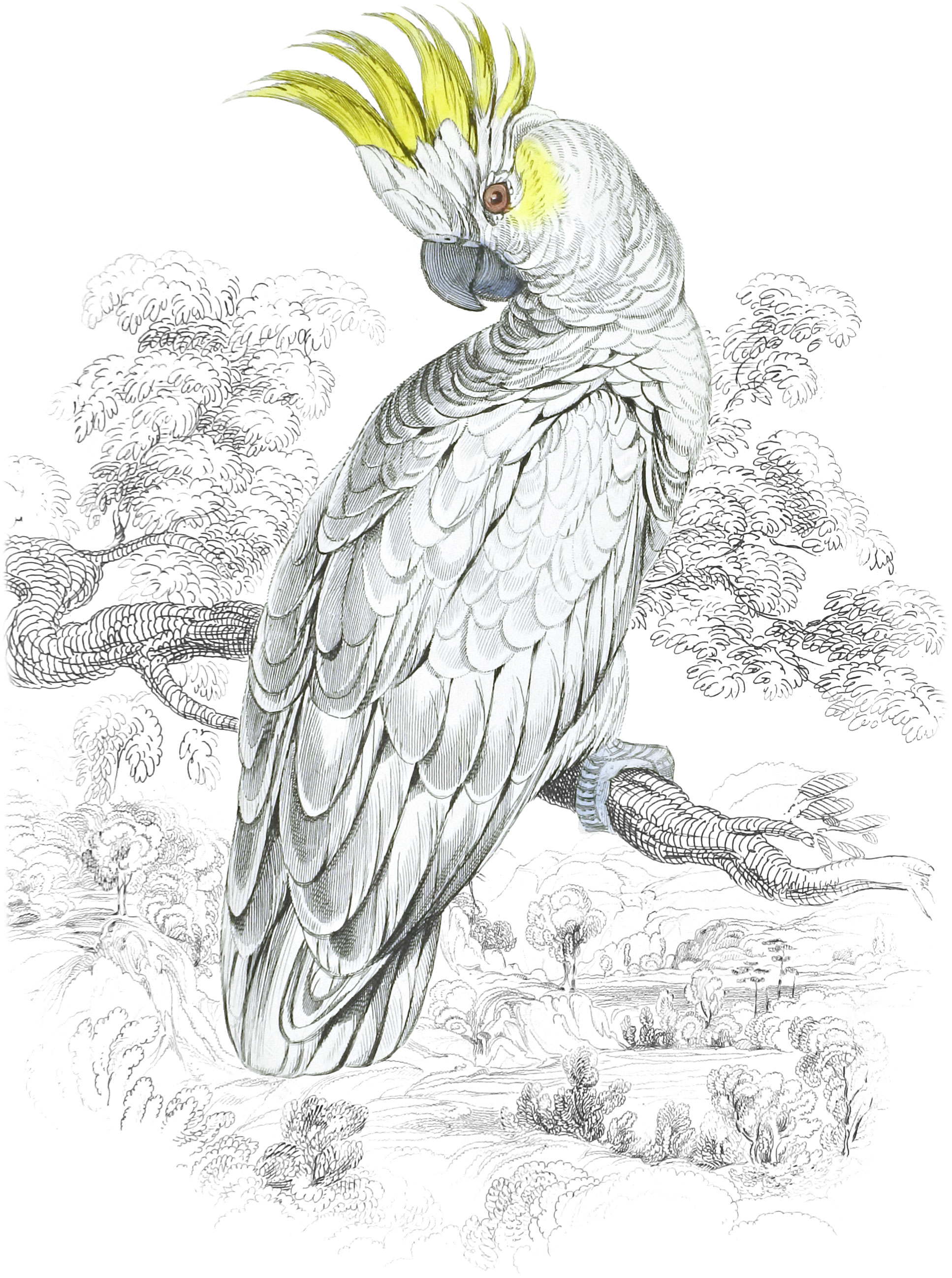
Plate XIV

In addition to the species described, the following belong to this present genus, viz. Plyctolophus Philippinarum. Red-crested Cockatoo, a native of the Philippine Islands; Plyct. Moluccensis, Wag., the Great red-crested Cockatoo, which is found in the Moluccas, Sumatra, &c.; Plyct. cristata, Wag., also a native of the Moluccas, and the Plyct. rosei-capillus, Vieill. (Psittacus Eos. of Kuhl), which, however, departs from the type in the form and structure of the crest, approaching in this respect nearer to Wagler’s genus Licmetis, which is represented by the Psittacus nasicus of Temminck, described in the 13th volume of the Transactions of the Linnæan Society, and in the “Planches Coloriées,” plate 351.
Nearly allied to the Cockatoos, and included in that genus by many authors, is the Red-crowned Parrot (Psittacus galeatus of Latham, Kuhl, &c.) It forms the type of Wagler’s genus Corydon, and, according to the views of that author, forms the connecting medium between the Cockatoos and the genus Calyptorynchus of Vigors and Horsfield, upon which we are about to enter, and for which group we propose to give the title of Geringore, taken from the name applied to one of the finest and largest species by the natives of Australia. The characters of the genus Calyptorynchus are:—Bill thick, very strong, much higher than long, wide at the base, compressed towards the culmen, greatly arched, and describing in its profile nearly a semicircle, the lip not much elongated, and bending inwards; under mandible massive, dilated, wider than the upper, toothed, and deeply emarginate in front, nearly concealed by the feathers of the cheeks; orbits and lores naked; tongue simple, smooth; nostrils large, round, lateral, placed behind the corneous base of the bill; wings ample, rounded, the second, third, fourth, and fifth quills the longest, and nearly equal, their exterior webs emarginate towards the middle; tail of mean length, broad, slightly rounded; feet and toes rather weak, the tarsi short. The width and peculiar form of the lower mandible, and the shortness of the whole bill, as compared with its depth at the base, as well as its semilunar profile, are characters alone of sufficient importance to separate the members of this group horn the true Cockatoos, In addition, the crest which exists is of a different form; the tail is more elongated and rounded, and the ground or prevailing colour of the species, instead of being light, is always dark, varying from black to blackish-grey and blackish-green. So far as our limited acquaintance with their habits extends, they appear to be birds of a wilder and fiercer disposition than the generality of the Psittacidæ, and less gregarious than the conterminous genera. They are said to feed greatly upon bulbous roots, as well as on fruits and seeds; and the denuded tip of the rachis of the tail-feathers indicates something peculiar, and with which we are yet unacquainted, in their economy. The holes of decayed trees are the receptacles for their eggs, which are said rarely to exceed two or three in number. They are natives of Australia, to which the group appears to be confined. The subject selected to illustrate the genus is the
Stellated Geringore
Calyptorynchus stellatus.—Wagler.
Calyptorynchus stellatus, Wagler, Mono. Psitt. in Abhand. &c., p. 685, sp. 3.—Banksian Cockatoo, Lath. Syn. Sup. ii. var. ii. p. 92.
This species, which appears to bear a near affinity to the Calyptorynchus Solandri of Vigors and Horsf. (Psitiacus Solandri, Temm.), and with which it seems to have been confounded, is described as a distinct species by Wagler, in his monograph of the family. The specific characters, as contrasted with those of the Solander’s Gerinpore. consist in the whiter colour of the bill, the greater proportion of yellow upon the head and cheeks, and the spots of that colour upon the lesser wing-coverts, with some deviation in the colour and markings of the lateral tail-feathers. It is also somewhat inferior in size; in other respects the resemblance is remarkably close, but as specific distinction is well known to exist in other instances where the characters are not more prominently marked, we are justified in considering it as a separate species, and it ought to be retained as such, unless extended observation and well authenticated facts prove it a mere variety, or some particular state of plumage, of another species, arising from age or sex. In it the typical form of the bill is prominently marked, the outline or perspective contour forming nearly a semicircle, the depth at the base, as may be seen in the figure, is very great, and considerably exceeding the length, measured from the rictus or gape to the tip. The under mandible is wider than the upper, and toothed, with the front deeply emarginate. The upper is thick at the base, compressed or cestiforra towards the culmen, the tip bending inwards, and not projecting far beyond the under mandible. Its colour is greyish-white. The forehead is scarcely crested, but the feathers upon the vertex are a little elongated. The mass of the plumage is of a greenish-black, deepest upon the back and wings, where it assumes a purplish tinge. The cheeks are yellow, with some markings of the same colour on the sides of the head, and the lesser wing-coverts are speckled with paler yellow. The tail is of mean length, the two middle feathers entirely black, the lateral with their bases and tips black, the intermediate space being vermilion, with from five to seven narrow bars of black, the interior webs are margined with yellow. The shafts of the tail feathers project in the form of a bristle beyond the barbules, which appear worn down by attrition. It is a native of Australia, but unfortunately little attention has hitherto been paid to the natural habits of these curious birds. They are said to feed upon bulbous roots, as well as other fruits, or rather the seeds of fruits. They are seldom seen in flocks of any magnitude, but keep more in family parties. In disposition they are wild and fierce, and do not exhibit that docility and aptness for imitation so conspicuous in other members of the family.

Plate XV
Genus Microglossus
The subject of our next illustration, though bearing in many respects a strong resemblance to the preceding genus, is distinguished from it by the peculiar form of its tongue, which is tubular and extensile, and by the form and contour of its bill. The upper mandible is of great size, and considerably impressed, the tomia or cutting edges being bidentate or doubly sinuated. The under mandible is small in proportion, with a single emargination. The orbits and cheeks are naked, and the head is adorned with a long crest, generally pendent, hut which can be erected, and is composed of long narrow acuminate feathers. The legs are naked a little way above the tarsal joint, the tarsi themselves are short. The tail is of mean length and even. It constitutes the type of Geoffroy’s genus Microglossus, which is retained by Wagler in his Monographia Psittacorum. In Kuhl’s Conspectus, it is the representative of his section Probosciger, and he considers it as a form intermediate between the Maccaws and Cockatoo, but our present ignorance of the natural habits of this singular bird, renders it difficult to trace its true affinities, and we even feel doubtful whether the station now assigned it, is that to which it will be entitled upon a further investigation and more correct knowledge of its natural history. We propose for it the name of the
Goliah Aratoo
Microglossus aterrimus.—Wagler.
Microglossus aterrimus, Wagler, Mon. Psitt. in Abhand., &c., p. 682, sp. 1, Vieill. Gal. des Ois, tab. 50.—Psittacus gigas. Lath. Ind. Orn. i. p. 107, sp. 75.—Psitt. aterrimus, Gmel. i. p. 330; Kuhl, Consp. p. 93, sp. 166.—Psitt. Goliah, Kuhl’s Consp. Psitt. in Nov. Act., &c., p. 92, sp. 166.—Great Black Cockatoo, Edwards, pl. 316.—Black Cockatoo, Shaw, viii. 274, p. 71.
In size it is one of the largest of the known Psitticidæ, being equal, if not superior to the Red and Yellow Maccaw. The first description we have of it is that of Edwards, though he mentions that a previous figure, apparently of the same species, had appeared in a small book of prints of birds, drawn from the life, and published by S. Vander Meulen at Amsterdam in 1707. Long, however, as it appears to have been noticed, we are still ignorant of the essential parts of its history, viz. its habits and peculiar economy, which the unusual form of the tongue and other modifications of character would intimate to be widely different from those of the genus last described. It is a native of Papua, Waigeoa, New Guinea, and other eastern Australian islands.
The bill, as represented in the figure, is very large, with the tip long and very acute, projecting far beyond the under, which is small and weak in comparison. The orbits and cheeks are covered with a naked red wrinkled skin, the crest is of a greyish colour, long, composed of narrow feathers, and which the bird can erect at pleasure. The whole of the plumage is black, but glossed with a greenish-grey tinge in the living bird, from the quantity of awhile powdering substance interspersed among the feathers. In museums, the specimens are observed to vary considerably in size; and Kuhl goes so far as to consider the larger individuals as constituting a species distinct from the lesser, characterising the former by the title of Psittacus Goliah, the smaller by that of P. aterrimus. Further observation, however is required to verify the views of this ornithologist, and for the present we adhere to Wagler’s opinion, who considered them as identical.
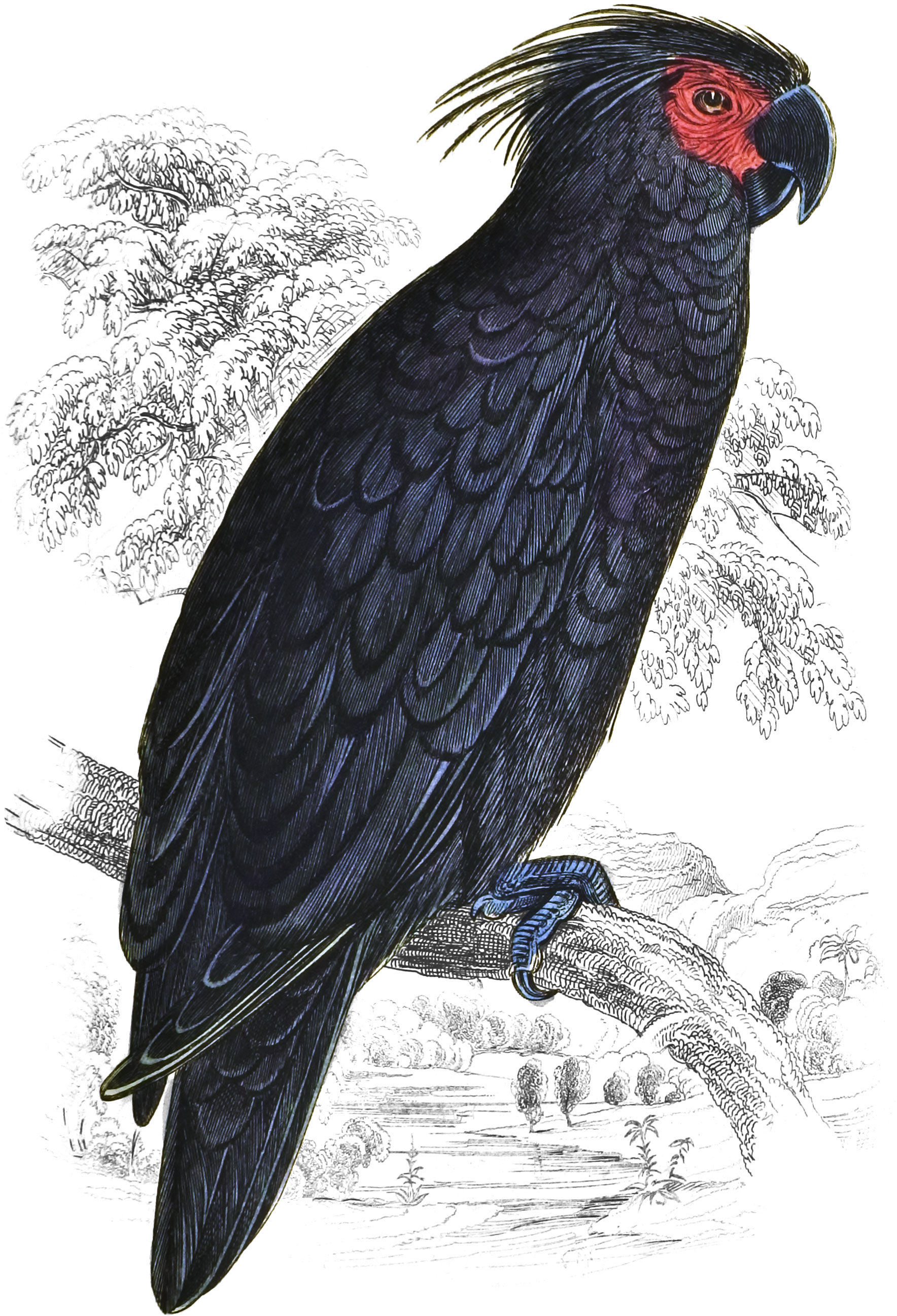
Plate XVI
In this subfamily, or in close connection with it, according to Wagler, is another remarkable form, to which he gives the generic title of Dasyptilus, and now illustrated by
Pesquet’s Dayptilus
Dasyptilus Pequetii.—Wagler.
Dasyptilus Pequetii, Wagler Mon. Psitt. in Abhand. &c. p, 502, 601.—Psittacus Pequetii, Less. Illus. Zool. pl. 1.
Named from the hairy or setaceous nature of the feathers upon the head and neck, and the general rigid nature of the whole plumage. The dominant colour is black, in which respect it resembles the Geringores, and the bird last described, but the form of the bill (without adducing other characters) is so different from that of the species alluded to, as to make it very doubtful whether the station assigned to it is that to which it properly belongs. For ourselves, we have bad no opportunity of examining or comparing it with other species, as it is a bird of great rarity, and but lately discovered, and we are indebted to the liberality of the Noble President of the Linnæan Society, for permission given to Mr Lear to make the necessary drawing, from a specimen in the collection at Knowsly Park. It is a bird of considerable size, measuring upwards of twenty inches in length. The bill is not so deep at the base as in the great majority of the tribe, and its length is greater than its height. The upper mandible is but moderately curved at the base, but bends suddenly down towards the tip, like that of the Raptorial Birds, and overhangs the under, which is shorter, moderately convex and carinated, with the tip narrowed and strongly emarginated on each side. The nostrils are round, placed in the cere at the base of the bill, the orbits and cheeks naked, thinly beset with hairs, the head and upper neck is also nearly bare, being thinly covered with setaceous feathers. The tarsi and feet are strong, the former short and reticulated. The tail consists of ten rigid feathers, of mean length and rounded. The wings are ample, the first quill short, the third and fifth of equal length, the fourth the longest in the wing. The upper plumage is of a shining or velvet black, with the exception of the greater wing-coverts and upper tail-coverts, which are crimson, and the secondary quills, which have their outer webs of the same colour. The lower neck and upper part of the breast is black, the belly, vent, and thighs crimson-red.

Plate XVII

Loriana
The next subfamily or primary division of the Psitticidæ upon which we enter, is that of Loriana, so named from the beautiful Scarlet-coloured Lories, natives of continental India and its islands, and which appear to constitute one of its typical forms. It is the second aberrant group of the family, representing the tenuirostral tribe of the Insessores, and consequently is analogous to the order Grallatores in the class Aves; and to the Glires among the Mammalia. In conformity with these analogies, the existence of which have been traced and followed out in various departments of zoology, with such perspicuity and convincing force, by one of the first naturalists of the age,2 we find the habits as well as the structure of the birds composing it, deviating in a striking manner from those of the conterminous groups, of course most conspicuously so, in such as constitute the typical or representative forms. The difference of structure to which we allude is in the shape of the bill and tongue, the former member being weaker and slenderer in its proportions than in the other Parrots, especially as regards the under mandible, which is lengthened and less convex in its contour, with the tip contracted and narrow, and the tomia or cutting edges straight and without emargination; the inner surface of the overhanging point of the upper mandible, which in the other groups is rough and like a file, with lines crossing each other at right angles, to give them a firm hold of nuts or seeds, is smooth or nearly so, and the ridge opposing the tip of the under mandible, which in the typical Parrots is prominent and strongly marked, is but slightly indicated or altogether wanting in the Lorianæ, as are also the prominences of the palatial bones, which assist so essentially in comminuting the food of the other groups. Their tongue is not so thick or fleshy, and the tip, instead of being smooth and soft, is rough, and in some furnished with a pencil of setaceous papillæ or bristles, similar and, analogous to the filamentous tongues of the structure, in the tenuirostral Melliphagidæ. fact, is bestowed upon them for the same purpose, and performs a similar office, viz. that of extracting the nectar of flowers, and sucking the juices of tender fruits, which it appears constitute the principal support of the members of this beautiful division. Of the various genera belonging to the subfamily, besides the true Lories, we may enumerate all the acknowledged members of the genus Trichoglossus of Vigors and Horsf., which also seem to enter among its typical forms, and included among these, or at least in very close connexion, are the birds belonging to that group, named by Mr Vigors Brotogeris, and typified by the Orange-winged Parrakeet of authors. Another interesting form belonging to it, and which appears to keep up a connexion with the genus Palæornis of the Maccaw subfamily, is the Charmospna Papuensis of Wagler (Psittaccus Papuensis, Auct.), whose tail, in shape, is nearly similar to that of Palæornis Alexandri, but the ground or prevailing colour of its plumage is assimilated to that of the true Lories, and is of a rich and vivid scarlet. Besides the forms above enumerated, there are others of a diminutive size, chiefly inhabiting the islands of the Pacific, which appear closely allied to the Lorianæ, and which, in all probability, will be found to enter that subfamily; most of these were included by Kuhl, in his section or genus Psittacula, a group apparently established to receive all the smaller Parrots, without regard to geographic distribution, or the peculiar characters exhibited by the various individuals composing it, and consequently forming an assemblage purely artificial. Want of materials to institute the necessary analysis, as well as a deficiency of information respecting the natural habits of many of these birds, precludes us at present from entering more fully into their true affinities, or speaking with more confidence of the situations they respectively hold; but we have no hesitation in at once admitting into the present division, that group which embraces the Psittncus poriphyrio of Shaw; the Psittacula Kuhlii of Vigors, and several others, of which Wagler has constituted his genus Coriphilus.
We commence our illustrations of this subfamily with examples of the genus Lorius, which may be characterized as follows:—Bill moderate, compressed, the inner side of the tip of the upper mandible smooth; the under mandible lengthened, conic, with the tip narrow and entire. Tongue tubular, silky. Tail of moderate length, rounded or graduated, the feathers broad, with obtuse tips. Legs stout. For the present, we arrange under this genus all the Scarlet-coloured Lories, natives of continental India and its islands, but whose distribution does not extend so far south as Australia. It is, however, probable that this group will require further division, and that most of the genera indicated by Wagler in his Monograph will hereafter be adopted. The structure and comparative weakness of the bill of these birds, plainly indicate that the nature of their food must be different in quality from that of the powerful billed Parrots, and accordingly we find, that soft fruits, as well as the juices of flowers, constitute their principal support. They are closely connected in affinity with that group of which Psittacula Kuhlii, Vigors, is a type, and with the Lorikeets or genus Trichoglossus, Vigors, which occupy their place in Australia and the islands of the Pacific. In the breadth, and the rounded tips of their tail feathers, may also be traced an approach to the broad-tails or subfamily Platycercinæ, with which a connexion is thus sustained. In disposition they are lively, but mild and tractable, and when domesticated, fond of being caressed. The call-note of many of the species is similar in sound to the name they usually go by, and some of them learn to speak with great distinctness. Our first figure represents the
Purple-Capped Lory
Porius domicellus.
Psittacus domicella, Auct.—Domicella atricapilla, Wagler, Mon. Psitt. in Abhand. x i. p. 567.—Peroquet lori à collier jaune, Le Vaill. p. 95.—Second black-capped Lory, Edw. pl. 171.
This beautiful bird is a native of the Moluccas, and other Eastern Islands, from whence we occasionally receive it, being held in high estimation, not only on account of its elegant plumage, but for the docility it evinces, and its distinct utterance of words and sentences. It is also lively and active in its disposition, and fond of being caressed. In size it is amongst the largest of the group, measuring upwards of 11 inches in length. The general or ground colour of the plumage is rich scarlet, this tint occupying all the lower parts of the body, with the exception of a collar of yellow upon the upper part of the breast. The neck, hack, upper tail-coverts, and basal part of the tail, are also of the same colour. The crown of the head is blackish-purple in front, passing into violet-purple on the hinder part. The wings on the upper surface are green, the flexure and margins violet-blue, as are also the under wing-coverts. The feathers of the thighs are azure-coloured exteriorly, their basal parts being greenish. The bill is orange yellow; the under mandible conic, and narrow towards the tip. In this species, the tongue exhibits in an inferior degree the filamentous character so characteristic of the division, and it is probable that, with three or four others, such as Lorius puniceus, gurrulus, &c.. it will he found necessary to separate them from such as exhibit the tubular and papillary structure of that member in greater extent and perfection.

Plate XVIII
The next form we have to notice is one of great interest, partaking of the essential characters of the Lones. in the form and structure of its bill and tongue, as well as in the prevailing tints of its plumage. At the same time, it shews a strong analogy to the Ring Parrakeets, or members of the genus Palæornis, in the peculiar form of its tail, which nearly resembles that of Palæornis Alexandri. By Wagler it is considered as genetically distinct from the other Lories, as well as from the Trichoglossi, or Lorikeets, and of it he institutes his genus Charmosyna; but as no other species has yet been discovered, and the prolongation of the two middle tail-feathers appears to be the only character of distinction, we have for the present retained it as an aberrant form of the genus Lorius. It is the
Papuan Lory
Charmosyna Papuensis.—Wagler.
Charmosyna Papuensis, Wagler, Mon. Psitt. in Abhand. &c., p. 555.—Psittacus Papuensis, Lath. Ind. Orn. vol. i. p. 88. sp. 20.—Psitt. omnicolor, Lich. Catal. Rer. Nat. Rar., p. 5, No. 48.—La Peruche Lory Papou, Le Vaill. p. 9, t. 77.
To great elegance of form, this species unites a plumage of the richest description, the ground-colour of the body being of a deep but brilliant scarlet, relieved in parts with deep azure-blue, yellow, and green. The tail, or at least the two narrow central feathers, greatly exceed the rest of the body in length, as they measure upwards of 1 1 inches, while the former does not exceed 6; the lateral feathers are regularly graduated, as in the other Lories, the longest measuring about 4 inches, or one-third the length of the two intermediate plumes. The bill is of an orange-red colour; the upper mandible is long, with the tip or hooked part projecting far beyond the under one, which is conic and narrow. The tongue is similar in structure and appearance to that of the other members of the group, the tip being furnished with delicate papillæ. Upon the vertex and nape are two irregular bars of azure, margined with purplish-black. The lower parts of the tibiæ, lower back, and rump, are also of a deep azure. Upon the sides of the breast and thighs are patches of rich yellow. The wings are green; the interior webs of the quills blackish. The elongated tail-feathers are pale grass-green, passing towards the tips into yellow; the lateral have their basal half dark green, the remainder deep saffron yellow. This lovely species is an inhabitant of Papua, and other parts of New Guinea, and, as might be expected in countries rarely visited by the naturalist, little is known of its history or peculiar habits. Its remains, like those of the birds of Paradise, frequently reach us in a mutilated state, being deprived of the legs, and often wanting the long feathers of the tail; and from such specimens have been derived the imperfect descriptions of various authors.
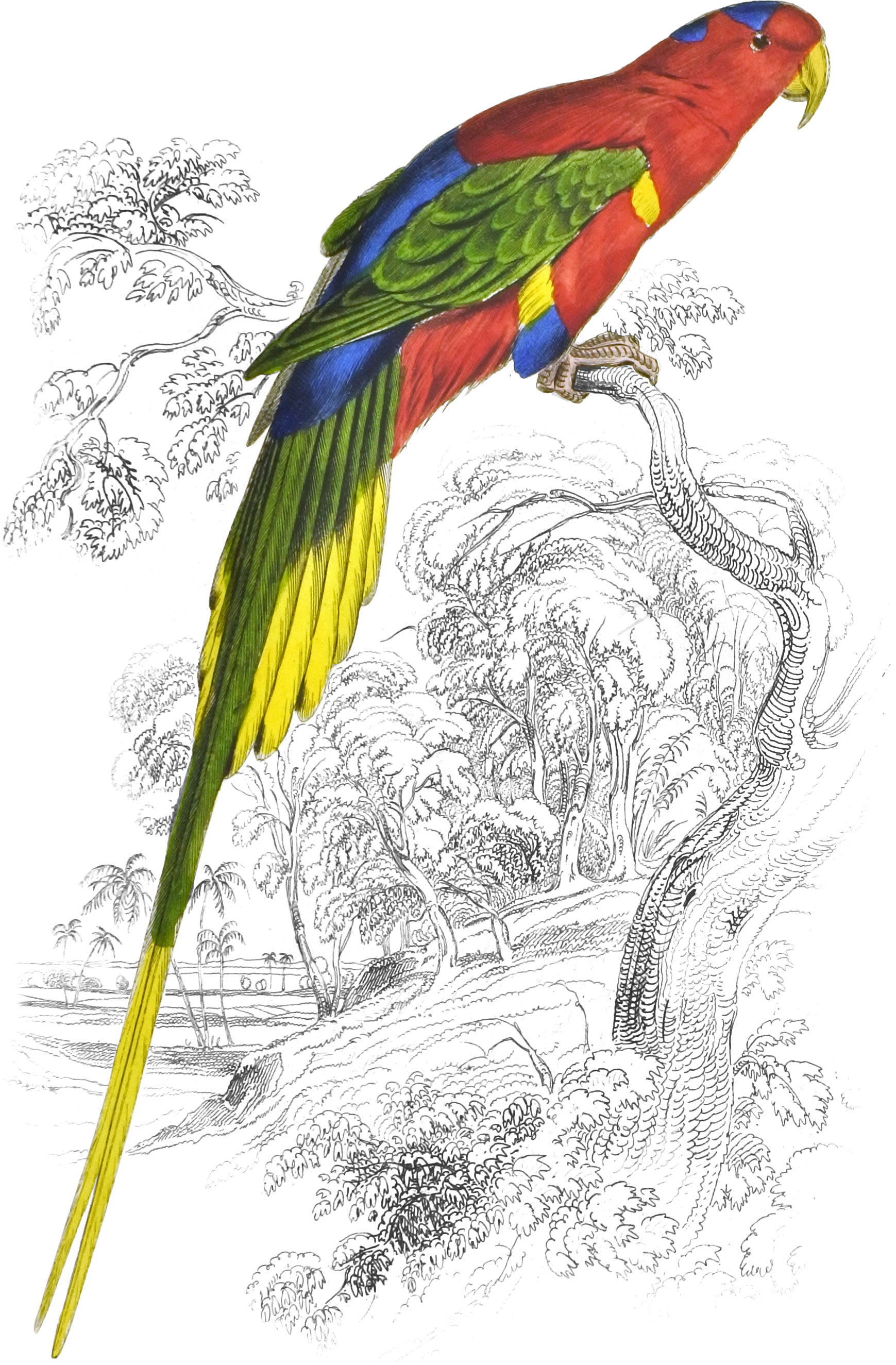
Plate XIX
We now enter upon an Australian group, which, in that division of the globe, takes the place of the Indian Lories. The members belonging to it, instead of having the ground or prevailing colour of the plumage of a red or vermilion tint, have it green, of brighter or deeper shades, according to the species, variegated, however, in many of them, with masses of the first-named colour. In this genus, the tail is more elongated than in the true Lories, and regularly graduated, with the tips of the feathers narrow; the wings are also narrow and pointed. It constitutes Vigors’s genus Trichoglossus, and is thus characterized:—Bill subelongate, compressed, weak, the inferior mandible slightly convex, longer than high, narrowed towards the tip, with the margins thin and entire; inner surface of the projecting tip of the upper mandible smooth, or but slightly striated; tongue fumislied near the tip with a pencil of bristly papillæ, wings of moderate length, narrow, the first quill longest, the second and third a trifle shorter, the webs entire; feet, the tarsi short, feathered below the joint; toes strong, with the soles broad and extended; the claws greatly falcated, strong and sharp tail graduated, with the feathers narrowing towards the point. The members of this genus are birds of elegant form, and some exhibit a great variety and richness of plumage; they are strictly arboreal and scansorial, as indicated by the form and strength of their feet and claws. In the quality of their food, and the structure of their tongue, they shew their typical station in this representative section of the Tenuirostral Tribe, their principal nutriment being derived from the nectar of flowers; they also eat or suck the juices of the soft or exterior portion of various fruits, but do not attempt the kernels or actual seeds, which constitute the general and favourite pabulum of the rest of the Psittacidæ. In their contour, and the indications of a nuchal collar which several of the species possess, we also trace a resemblance to the Parrakeets, or genus Palæornis, Vigors and this analogy we might expect to find, if, as we suppose, the Parrakeets in their own circle constitute the Tenuirostral type. In the present genus, we are also induced to retain the Orange-winged Parrot of authors (Psittacus pyrrhopterus), for which bird Mr Vigors instituted the genus Brotogeris, as we cannot observe any character of sufficient importance to warrant a generic separation, the only difference seeming to be a slight elongation of the tip of the upper mandible; but this is rendered less abrupt by the intervention of another species, the Trichoglossus palmarum, in which it is of a size intermediate between that of Trich, chlorolepidotus, T. Swainsonii, &c., and that of Trich. pyrrhopterus. The first example we give of this genus is the
Blue-Bellied Lorikeet
Trichoglossus Swainsonii.—Jardine and Selby.
Trichoglossus hæmatodus, Vig. and Horsf. in Linn. Trans. vol. xv. p. 289.—Trichoglossus multicolor, Wagler, Mon. Psitt. in Abhand. &c., p. 553.—La Peruche à téte bleu, Male, L’Vaill. His. des Per. i. pl. 24.—Peruche des Moluques, Buff. Pl. Enl. No. 743.—Blue-bellied Parakeet, Brown, Ill. of Zool. pl. 7; Illus. Orn. pl. 3.—Blue-bellied Parrot, White, Voy. N. S. W., plate at p. 140.
This beautiful species is a native of New Holland, where it is found in large flocks, wherever the various species of Eucalypti abound, the flowers of those trees affording an abundant supply of food to this as well as to other species of the Nectivorous Parrots. According to the observations of Mr Caley, as quoted by Messrs Vigors and Horsfield in their description of the Australian birds in the collection of the Linnæan Society,
Flocks of these birds may be seen in the eucalypti-trees, when in flower, in different parts of the country, but in the greatest number near their breeding places.
They do not, he adds, eat any kind of grain, even in a domesticated state; a fact curiously illustrative of their peculiar habits, and the situation they hold in the family of the Psittacidae. It appears that they seldom live long in confinement, and that when caged they are very subject to fits. This in all probability arises from a deficiency of their natural food; and the instinctive feeling or appetite for its favourite diet is strongly exemplified in the fact, that one kept by Mr Caley being shewn a figure of a coloured plant, used to put its tongue to the flowers, as if with the intent of sucking them, and this it even did when shewn a figured piece of cotton furniture. By the natives it is called War-rin; the settlers call it by the name of the Blue Mountain Parrot, though the term seems to be misapplied, as it is a frequenter of the plains, and not of the hilly districts. Its flesh is excellent, and highly esteemed. This bird was confounded with two other species, viz. the Psitt. hæmatodus of Linnæus, and the Psitt. amboinensis varia of Brisson. The subject, however, has been thoroughly investigated by Mr Swainson, and the result of that investigation is given in the “Illustrations of Ornithology”3 where it is clearly shewn to be a species distinct from the other two, and as such it received the name we now attach to it, which we think it proper to notice, as it has since been designated by Wagler, in his Monograph of the Parrots, as the Trichoglossus multicolor.
Mr Lear’s beautiful and accurate figure renders it almost unnecessary to give a description of the plumage; but as the bird has so frequently been confounded with two other species, it may perhaps be satisfactory to some of our readers to give it in detail. Length about 13 inches, of the tail alone 6 inches; bill, in the dead bird, pale saffron yellow, in the living, inclining to orange; head and throat of a fine bluish-purple, the feathers rigid and subulate, upon the lower part of the throat they are more inclined to lavender purple, and lose the rigid and subulate character; nuchal collar yellowish or vivid silken green; lower neck and breast bright vermilion-red, passing on the sides of the breast into rich king’s yellow; middle of abdomen of a deep imperial purple, the feathers towards the sides vermilion, tipped with vivid green; hypochondria green, the basal part of the feathers varied with vermilion and yellow; tibial feathers vermilion-red; under tail-coverts, with the base of the feathers, red, the middle part yellow, the tips green; under wing-coverts rich vermilion-red margin of the wings and all the upper plumage bright grass-green; the feathers upon the lower part of the back of the neck with their bases vermilion, margined with yellow; tail with the four middle feathers entirely green, the remainder of the lateral feathers with part of the inner web rich yellow, increasing in extent to the outermost, where the whole of the web, with the exception of a small spot at the tip, is of that colour; quills with the inner webs dusky, and each with a large oval central spot of king’s yellow, forming a broad fascia on the under side of the wings; legs and toes grey, the lateral membranes broad; the claws strong and greatly hooked.

Plate XX
The next figure represents another beautiful species of this group: it is the
Varied Lorikeet
Trichoglossus versicolor.
Nearly allied to the Trich. Swainsonii, in form and general aspect, another lovely species has lately been discovered in New Holland, which has received the appropriate specific name of versicolor, the colours of which the plumage is composed being greatly varied, and presenting to the eye an assemblage and contrast of brilliant tints, as exhibited in the accompanying engraving, and in still greater perfection in the full-sized figure contained in Mr Lear’s splendid work on the Psittacidæ. It appears to possess all the typical characters of the group; but we have no information respecting its peculiar habits in its wild or natural state.
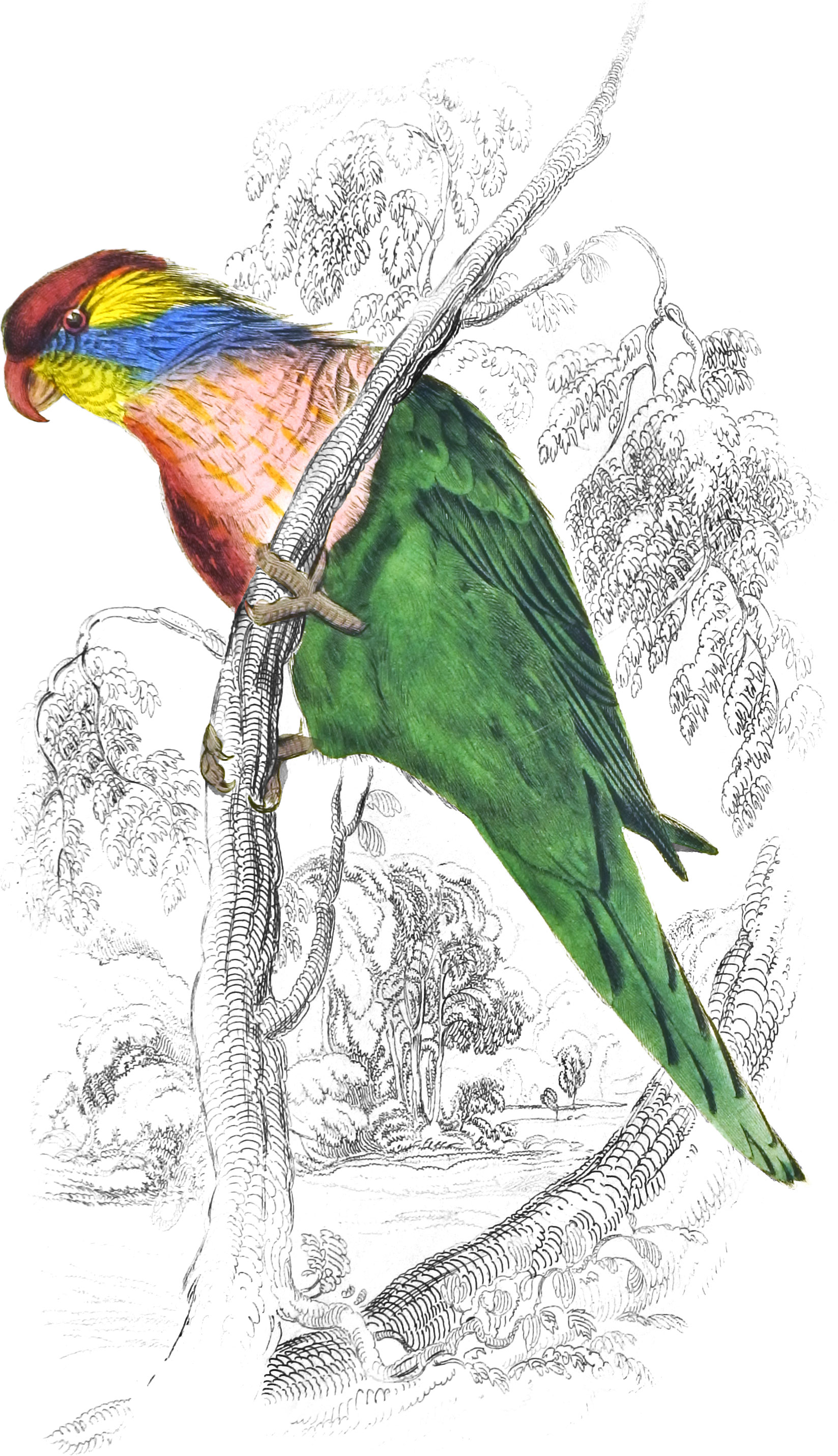
Plate XXI
From species possessing a richly-varied plumage, we now pass to others, where it is plainer, and of a more uniform tint, but which otherwise exhibit all the essential characters of the genus. In dimensions also they are generally inferior, and one of them, the Trich. pusillus, ranks among the pigmies of the Psittacean family. The species selected for representation is the
Orange-Winged Lorikeet
Trichoglossus pyrrhopterus.—Wagler.
Brotogeris pyrrhopterus, Vig. Zool. Journ. ii. p. 400.—Psittacus pyrrhopterus, Lath. Ind. Orn. Sup. p. 22, No. 7; Vig. in Zool. Journ. i. 535.—Orange-winged Parrakeet, Lath. Syn. Sup. ii. p. 90, No. 16.
From this bird, which Mr Vigors described in the first volume of the Zoological Journal, under Latham’s title of the Orange-winged Parrakeet, he afterwards formed his genus Brotogeris; but, as we have previously observed, the characters upon which it is instituted seem to vary so little from those of Trichoglossus, that we have followed the example of Wagler, and retained it in the latter genus, in close association, however, with Trichoglossus palmarum, another Pacific species, which, as a slightly aberrant form, seems gradually to lead to other and stronger billed groups of the Psittacidæ. It is a native of the Sandwich Islands, and not of the Brazils, as at first supposed by Dr Latham; and the two individuals which we well recollect seeing, when in Mr Vigors’s possession, were brought to England in the same vessel which conveyed hither the late unfortunate King and Queen of these Islands. As any information tending to elucidate the habits and manners of species cannot fail to be equally interesting to the naturalist and the general reader, we make no apology for quoting largely from the account given by Mr Vigors of these two lovely birds. He observes,
In their manners, they are peculiarly interesting. Strongly attached to each other, like the individuals of the small species, so well known in our collections, and which we familiarly style Love Birds, they assert an equal claim to that title, if it is to be considered the reward, or the distinctive sign of affection. They will not admit of being separated even for a moment; and, whether in their cage or at liberty, every act and every movement of one has a reference to the acts and movements of the other. They are lively, active, and familiar, distinguishing and following those who attend to them, with perfect confidence, but always in concert.
He adds,
Their movements are less constrained than those of Parrots in general, approaching, both on the ground and the wing, to the quick pace and short and rapid flight of the more typical perchers. They have apparently less powers of voice than the greater part of the family, uttering only a sort of chirrup like that of the sparrow; this is shrill, it must be confessed, at times when rivalship or any particular incitement induces them to exert it to the utmost; but at other times it is far from unpleasing, more especially when they employ it, as is their custom, either in welcoming the approach of the morning, or acknowledging the attentions of a favourite.
In size it is inferior to the species already described, measuring not more than 7\(\frac{1}{2}\) inches in length. The bill is pale, slightly tinged with pink; the upper mandible with the tip attenuated and long; the tomia slightly sinuated. The crown of the head and parotic region is of a delicate greenish-blue; the sides of the neck and throat, and indistinct nuchal collar, are greyish-white; the rest of the body, with the exception of the under wing-coverts, which are of a rich orpiment-orange colour, is green, palest upon the flanks, thighs, and the margins of the tail-feathers. The feet are of a pale flesh-colour

Plate XXII
Nearly allied to the genera Trichoglossus and Lorius, in the form of the bill, the tongue, and feet, is another beautiful group inhabiting the islands of Australia, and characterized by Wagler, in his monograph of the family, under the title of Coriphilus. They feed upon the softer fruits, particularly that of the Musa Paradisiaca, and live amid the foliage of the highest palm-trees. The structure of the tongue in these birds is curious, according to the naturalists who accompanied Duperney in his “Voyage autour du Monde:” it is tipped by a kind of crown, formed by a number of long stiff filaments, regularly placed, and which M. de Blainville considers as the nervous elongations or papillæ of the lingual or gustatory branch, enormously developed.

Tongue Tip
Their voice is weak and sibilous; and, when alarmed or irritated, they erect the feathers of the hind-head, which are narrow and elongated. The sexes are remarkable for their affection to each other, and direct all their movements in concert. The characters of the genus are:—Bill small, the upper mandible without a distinct tooth, the cere large and prominent, the under mandible weak, slightly convex. Nostrils open, round, in the basal cere. Tongue papillose near the tip. Head crested. Wings long and pointed. Tail of moderate length, broad, rounded at the tip. Feet strong. Claws falcate. This group is illustrated by
Kuhl’s Coriphilus
Coriphilus Kuhlii.—Wagler.
Coriphilus Kuhlii, Mon. Psitt. in Abhand. &c. p. 494, and 566.—Psittacula Kuhlii, Vig. in Zool. Journ. v. 1. p. 412. pl. 16.—Lear’s Parrots.
This beautiful little bird was first described and figured by Mr Vigors in the Zoological Journal, from one of several specimens received by Mr Cross, formerly of Exeter Change, and now proprietor of the Surrey Zoological Gardens, from an island in the vicinity of Otaheite. In beauty of plumage, and elegance of aspect, it yields to few of the race; but it appears to be of a wild and timorous disposition, at least in regard to strangers, as Mr Vigors states that he was unable to enter into its characters to the extent he wished, from its impatience of observation and a near approach. Its voice is weak and sibilous, similar to the other species of this group, which contains, in addition to the present, the Cor. sapphirinus, Wag. (Psittacus Taïtanus, Auct.), Cor. euclorus, Wag. (Psitt. fringillaceus. Lath., Kuhl, &c.), and the Cor. solitarius, Wag. (Psitt. Phigy, Bechst., Kuhl, &c.) The bill is small and short, of a red colour. The irides are composed of three circles, the exterior being red, the second grey, and the third or inner yellow. The forehead and crown are of a lively green, the double occipital crest is of a rich violet-purple, and composed of long narrow feathers, which it can erect at pleasure, but most frequently when irritated or alarmed. The face, fore-neck, breast, and abdomen, are blood-red, the thighs of a deep purplish-red, the vent and upper tail-coverts are sulphur-yellow. The hind-neck, the back and wings are of a lively yellowish-green. The tail, which is pretty long and broad, is red, tinged with purple, the tips of the feathers green. The legs and toes are red, the latter short and strong; the claws are black and hooked.

Plate XXIII
Another very beautiful and interesting bird, which appears to belong to this little group, is the Psitt. Taitensis, Gmel.:—Blue, but having the throat, fore part of the neck, and cheeks, white. It frequents the very summits of the cocoa-trees, examining their flowers at the moment of bursting, for the sweet liquid which is there abundant.
Apparently in near connection with Wagler’s genus Coriphilus, in the weak structure of the bill, and in the length and shape of the wings, is another group of diminutive Parrots, inhabiting the Indian and Australian islands, for which we adopt the title of Psittaculus, and which, we believe, will enter into the present subfamily, though we cannot speak positively as to the structure of their tongue, or whether it is furnished with papillae similar to the members of the other nectivorous groups. Our figure represents what we suppose to be the young Male of the
Sapphire-Crowned Psittacule
Psittaculus galgulus.—Wagler.
Psittaculus vernalis, Swains. 2d Series Illust. (young male).—Psittacus galgulus, Lath. Ind. Orn. v. i. p. 130, sp. 148. (exclu. var. β.)—Psitt. vernalis, Id. i. 130, sp. 147.—Petite Perruche de Pérou, Pl. Enl. 190. f. 2.—Sapphire-crowned Paraket, Edwards, pl. 293. f. 2.—Lath. Syn. i. 312, sp. 117 119.—Vernal Parrakeet, Lath. Syn.—Swains. 2d Series Illust.
Mr Swainson, in the Second Series of his beautiful Illustrations, has figured and described this bird nearly in the same state it is represented upon our plate, under the title of Psittaculus vernalis, supposing it a distinct species, or at least not aware that it was the young or immature male of the Psittacus galgulus of authors. This, at least, is the opinion of Wagler, who, in his “Monographia Psittacorum," has described it as such, and brought the synonymes of these two supposed species together. As to the correctness of his views in so doing, we are bound, in the first instance, to consider them as being s-o, presuming that the evidence upon which he established their identity was satisfactory and conclusive; for ourselves, we have not had an opportunity of tracing these birds through their different stages, but we know, that, in size, and in a great measure in colour, they nearly agree, and Mr Swainson himself has noticed in his description the resemblance of the vernalis to the galgulus, in the peculiar colour of the under surface of the wings, without, however, any remarks or conjecture as to the probability of their belonging to the same species, under different states of plumage or age. In retaining the generic title of Psittaculus for this and some other diminutive forms belonging to the Indian islands and those of Australia, we do not include all the species embraced by Kuhl’s section of that name, or even the genus of Wagler, which, though more restricted, admits of birds marked by strong differential characters, and widely separated, so far as regards their geographical distribution. In the state we have figured it, the upper parts are of a fine lively green, with the exception of the rump and upper tail-coverts, which are crimson-red, and it shews but a slight indication of the fine blue, which marks the crown of the adult. In the mature state, also, the throat, instead of being orange-coloured, is of a fine red, and a crescent of orange-yellow encircles the lower part of the hind neck. The bill in the adult is reddish-black; in the young and female it is red.

Plate XXIV

Platycercinæ
We now arrive at the fifth or fissirostral division of the Psittaciæ, which, by which, by Mr Swainson, has been designated by the name of Platycercina (Broad-tail), the members of the genus Platycercus of Vigors and Horsfield being considered as its typical representatives. Of the other groups which belong to this section, we only venture to speak with diffidence, not having had an opportunity, as well from want of time as of materials, to make that strict analysis of the species which is required to trace out with certainty the true affinities, and exact station of each. We have sufficient data, however, to believe, that the ground Parrakeets (gen. Pezoyorus, Illig.), the beautiful miniature Maccaw-looking species belonging to the genus Nanodes, Vigors, the two species composing Wagler’s genus Nymphicus, represented by the Psitt. sisetis and Psitt. Novæ Hollandiæ of authors, and some other forms, among which, perhaps, the Psittacus Platurus of Temminck’s “Planches Coloriés” may be included, enter into it. Those interesting species which inhabit Madagascar, and known by the name of Vasas, viz. Psitt. niger and Psitt. mascarinus, Linn., forming Wagler’s genus Comcopsis, also shew a decided affinity in form and habit to the true Platycerci, and there is little doubt belong to the division. To the genus Palæornis, Vigors, which we have placed among the Macrocercincæ, or Maccaw section, an approach is shewn in several species. Thus, it is strongly indicated by the resemblance the Palæor, Barrabandi, an Australian species, which stands upon the confines of the group, bears to some of the less typical Broad-tails, in which that member in part loses its broad and depressed form. It is also visible in the wings and tail of that lovely species, the Nanodes discolor, in which the second, third, and fourth quills lose the distinct emargination of the outer web, and the two middle tail-feathers assume, in a great measure, the shape of those peculiar to the Ring-Parrakeets. The connection of the present with the preceding subfamily is supported by some of the Lories, in which the bill is comparatively strong, and the tongue loses in part its peculiar structure, and its approach to the short and even-tailed Parrots is shewn in the wide and slightly graduated tail of Platycercus scapulatus, as well as in the Madagascar species Psitt. niger and mascarinus. The members of this family are distinguished from the rest of the Psittacidæ, by their slender and elevated tarsi, and the less falcated form of their claws. Their wings also are shorter, and rounded, the first quill-feather being inferior to some of the succeeding ones. In consequence of this formation, their habits are less strictly scansorial than those of the typical Parrots; but the deficiency is amply compensated by the ease and agility with which they move upon the ground, where their actions partake in a great measure of that freedom which distinguishes so many of the scansorial order, but which is almost denied to the typical Parrots, whose movements upon a plain surface are to a great degree awkward, and constrained. This formation is carried to the greatest extent in the genus Pezoporus, Illiger (Ground Parrot), in which the tarsi and toes are long and slender, and the claws nearly straight, indicating those terrestrial habits from which it has derived its name. The Platycercinæ are birds of elegant and graceful form, and their carriage and actions are in accordance with it, as they display an activity and liveliness of motion far superior to that of the true scansorial species, and more in character with that of other birds. In richness and diversity of plumage, also, they yield to none of the tribe, whether we admire it in the varied hues of the genus Platycercus, or in those smaller species belonging to the genus Nanodes, Vigors, which have aptly been termed miniature Maccaws. Most of the members of this division also shew a decrease in the power of flight, their wings being short and rounded, as indicated by the relative length of the quill-feathers. Not having a figure illustrative of the Madagascar species, which must be considered an interesting form in this division, we commence with the genus Platycercus, Vigors and Horsfield. The characters are:—Bill rather short, deeper than long, the upper mandible with the culmen indistinct, broad and rounded, bulging on the sides, the tomia with a strong emargination or tooth, the under mandible short, very convex, deeply emarginate, with the tip broad, short, and quadrate. Palatial cutters large, and fully developed. Tongue simple, smooth. Wings of mean length, rounded, the first quill considerably shorter than the second and third, which are the longest, and nearly equal, the second, third, fourth, and fifth with their external webs abruptly emarginated a little behind the middle. Tail broad and depressed, rounded or subgraduate, the feathers with their tips rounded. Feet with the tarsi elevated and slender. Toes slender, claws rather long and slightly falcated.
The species belonging to this beautiful genus are already very numerous, and additions are constantly being made to it, as our knowledge of New Holland is extended, of which interesting country the majority of those already discovered are natives. They are of active habits, and are usually seen in large flocks, except during the period of reproduction. They feed upon seeds, particularly upon the grasses and Cerealea, and frequently do much damage in recent settlements to the ripening as well as to the new sown maize and wheat. The first species we have to notice is considered by Mr Vigors as the type of the genus: it is the
Pennantian Broad-Tail
Platycercus Pennantii.—Vig. & Horsf.
Platycercus Pennantii, Vig. & Horsf. Linn. Trans. v. 15. p. 250 280.—Wagler, Mon. Psitt. in Abhand. &c. p. 535, pl. 17.—Psitt. Pennantii, Lath. Ind. Orn. p. 90, No. 26.—Psitt. gloriosus, Shaw’s Nat. Mus. pl. 53.—Psitt. elegans, Kuhl, Nov. Acta, &c., v. 10. p. 55, pl. 89.—Perniche à large queue, Le Vaill. Hist. des Psitt. pl. 79.—Pennantian Parrot, Phill. Bot. Bay, pl. p. 154.—White’s Journ. pl. in p. 174.—Lath. Gen. Hist. II. p. 131, No. 34.
The rich crimson-red which forms the ground colour of this beautiful species, recals to mind the Scarlet Lories, and it is no doubt from this general resemblance the name of Lory has been given to it by the settlers in New Holland, of which country it is a native. It appears to be numerous and widely dispersed, congregating in large flocks, and frequently doing considerable damage to the wheat and Indian corn—the Cerealea constituting a favourite food with several species of this genus. On this account it is persecuted by the farmer, who endeavours to reduce their numbers by the gun, as well as by traps, in which they are readily taken. The expense and trouble incurred in their capture is, however, in part repaid, not only by a saving of their crops, but by the acquisition of a wholesome addition to the table, as this as well as other species are reported to be of excellent and delicate flavour. According to Mr Caley, whose account of this bird we quote from the Linnæan Transactions,
it is called by the natives Dulang and Julang. Like the King’s Parrot (Plat. scapulatus), it is found in large flocks among the ripe Indian corn, both species intermixed. It varies much in colour, but as the greater part of the flock is of the colour of the female, it may also be taken for granted that they are young birds. The natives tell me it makes its nest chiefly in the Peppermint-tree (Eucalyptus piperita), always in the body, but never in the boughs. Sometimes it enlarges the hole through which it enters. Year after year the same place is frequented for the purposes of incubation. It makes no nest, but from the decayed parts of the tree. It has four young ones. The eggs are white. I have met with this bird in November in the most mountainous parts of the country; but I apprehend it leaves these parts in the winter.
In its motions it exhibits great activity and liveliness, and it walks upon the ground with facility, and without any of that awkward gait, so conspicuous in the typical Parrots. It is frequently kept in a tame or caged state, chiefly for the beauty of its plumage and handsome carriage, as few or none of this division possess the imitative powers exhibited by members of other genera. The beautiful and characteristic figure from Mr Lear’s drawing, and the accurate manner in which the engraving is coloured, renders it unnecessary to give a detailed description of the plumage of the adult. The young bird differs in having the under parts of an obscure green, sometimes varied with spots of red; the azure patch upon the cheeks is also of a pale colour. The mantle dusky, each feather margined with pale red, and the two middle tail feathers green. The dimensions are as follows:—Total length about 15\(\frac{1}{2}\) inches, length of the tail 8 inches, of the tarsi \(\frac{3}{4}\)ths of an inch, of the upper mandible, from the gape to the tip, \(\frac{3}{4}\)ths of an inch, height at base nearly 1 inch.
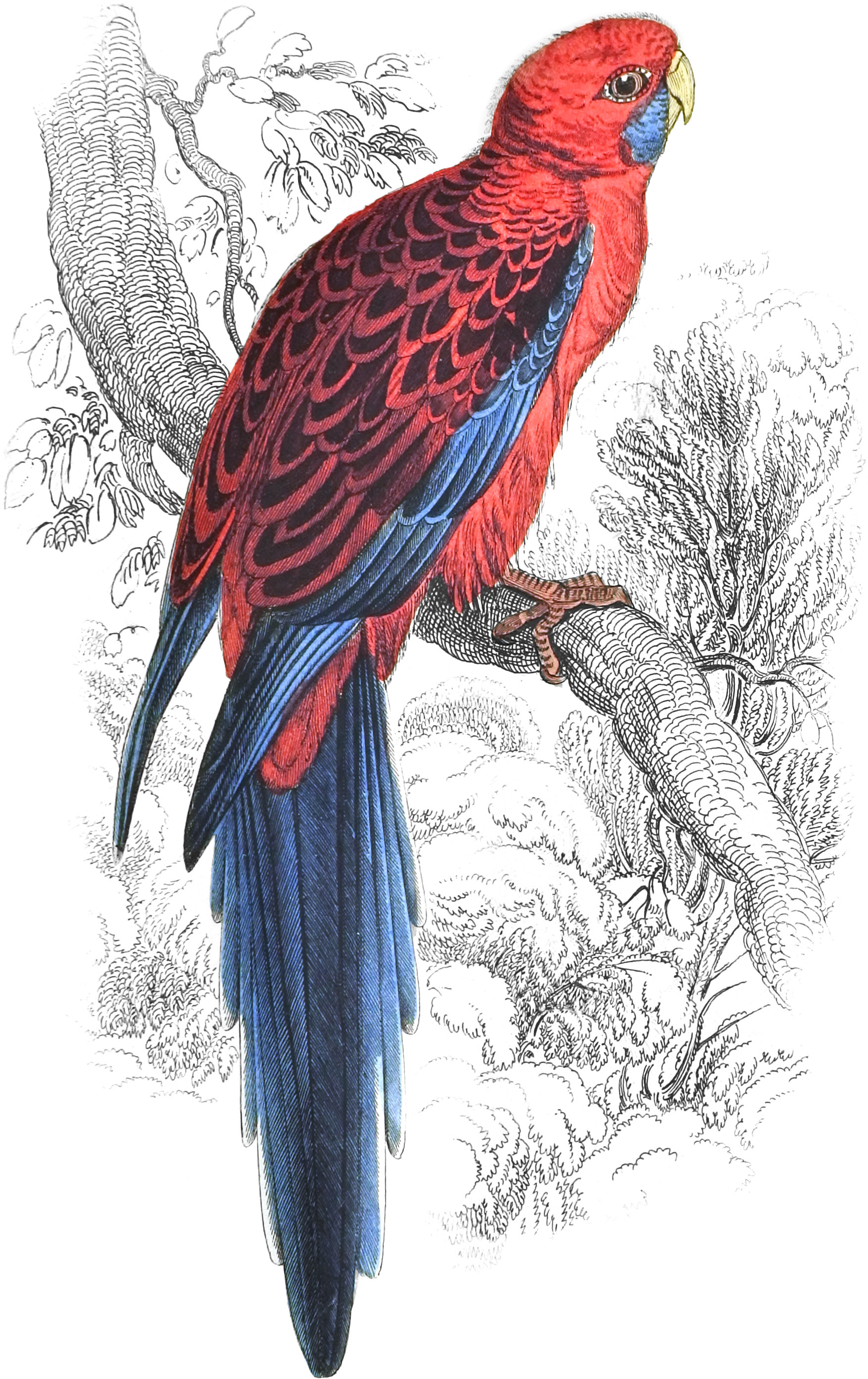
Plate XXV
Our next plate represents another beautiful species of the same genus: it is the
Pale-Headed Broadtail
Platycercus palliceps.
Platycercus palliceps, Lear’s Parrots.
This species, in form and habit, as well as the general disposition of its colours, is nearly allied to the Plat. eximius, Vig. (Nonpareil Parrot of Latham’s Gen. Hist.), for, with the exception of the head, breast, and belly, the rest of the plumage is almost precisely the same. Like the majority of the members of this now extensive genus, it is a native of New Holland.

Plate XXVI
We regret that our limits will not admit of our giving more examples of these lovely birds, particularly of such as, by a slight deviation from the typical form, lead to other genera, or serve to connect the present subfamily with the conterminous divisions, such are some of the species inhabiting the Pacific Islands, in which the tail feathers are more attenuated towards the tip; such also the Plat, scayulatus, Vig. (King’s or Tabuan Broad-Tail), in which the bill is less bulging, the tail very broad, and not so cuneiform as in the other species, and such would appear to be the New Guinea Broad-Tail (Plat. Novæ Guineæ, Wagler), in which the ophthalmic region is naked, a character that may perhaps imply the propriety of further generic division.
Nanodes
From the typical genus Platycercus, we now pass on to a group composed of birds of smaller dimensions, but eminent for their delicate form and pleasing plumage, and which have not inaptly been termed miniature analogues of the splendid Maccaws. In this lovely genus, the tail, in some species, as Nanodes venustus, and Nan. pulchellus, Vigors and Horsfield, retains to a considerable extent the breadth and depression of the Broadtails. In the Nanodes discolor, Vigors and Horsfield, as previously remarked, it in a great measure loses that character, and assumes the form, exhibited by the Ring-Parakeets or genus Palæornis, Vigors, the legs and feet as in Platycercus, are also slender and lengthened, and the claws but slightly hooked. This group forms the genus Nanodes of Vigors and Horsfield, or that of Euphemia, Wagler, distinguished by the following characters:—Bill short, higher than long, the upper mandible with the culmen rounded, and the tomia in the typical species without a distinct tooth or emargination, under mandible very short, inclining inwards, emarginate, with the apex broad, quadrate, and slightly sinuated. Palatial cutting membranes large. Nostrils round, lateral, placed in the slightly raised cere at the base of the bill. Wings of mean length, subacuminate, the first quill a little shorter than the second and third, which are the longest and nearly equal, second, third, and fourth quills with their exterior webs slightly emarginate near the middle. Tail graduated, cuneiform, slightly depressed, the feathers gradually narrowing towards the tip. Feet slender, the tarsi and toes elongated; claws slightly hooked.
The first specimen of this genus is the
Blue-Banded Nanodes
Nanodes venustus.—Vig. et Horsf.
Nanodes venustus, Vig. et Horsf. Linn. Trans. b. 15, p. 278.—Euphemia chrysostoma, Wag. Mon. Psitt. in Abhand. &c., p. 492 and 544, No. 2.—Psitt. chrysostomos, Kuhl, Conspec. Psitt. in Nova Acta, &c., p. 50, No. 78.—Psitt. venustus, Temminck in Trans. Linn. Soc. b. 13, p. 121.—Blue-banded Parrakeet, Latham’s Gen. Hist. ii. p. 188, No. 109.
This pretty species, whose extreme length is about nine inches and a-half, of which the tail alone measures four, is a native of New Holland and Van Diemen’s Land, in which Island it is called the Hobart Ground Parrot, an adjective epithet, which evidently points to its terrestrial habits, and these are further indicated by its lengthened tarsi and toes, which in this and Nanodes pidchellus, a nearly allied and still more beautiful species, closely resemble those members, as exhibited in the genus Pezoporus, Illig., or Proper Ground Parrot. It feeds upon the seeds of various grasses, and is generally seen upon the ground. As a site for its nest, it selects a hole or excavation in the stump of an Eucalyptus or gum-tree, and lays its eggs, to the number of seven or eight, upon the decayed particles of wood at the bottom of the hole, without the addition of any other materials. The eggs are white and immaculate. The bill is grey, the under mandible paler than the upper. The frontal band, which crosses from eye to eye, is narrow and of a deep azure-blue, the space between the bill and eyes gamboge-yellow. The crown of the head is green, deeply tinged with sulphur-yellow, the cheeks, throat, and the upper part of the breast are of a delicate siskin-green, passing gradually into a rich yellow, the head, neck, back, upper tail-coverts and scapulars are of a pale olive-green, with a greyish tinge, the lesser and greater wing-coverts are deep glossy azure-blue. The quills black, with their outer webs margined with azure-blue. The two middle tail feathers are pale azure, tinged with grey, the lateral with their bases azure-blue, their tips gamboge-yellow, passing gradually into primrose-yellow, the feet and claws are grey.
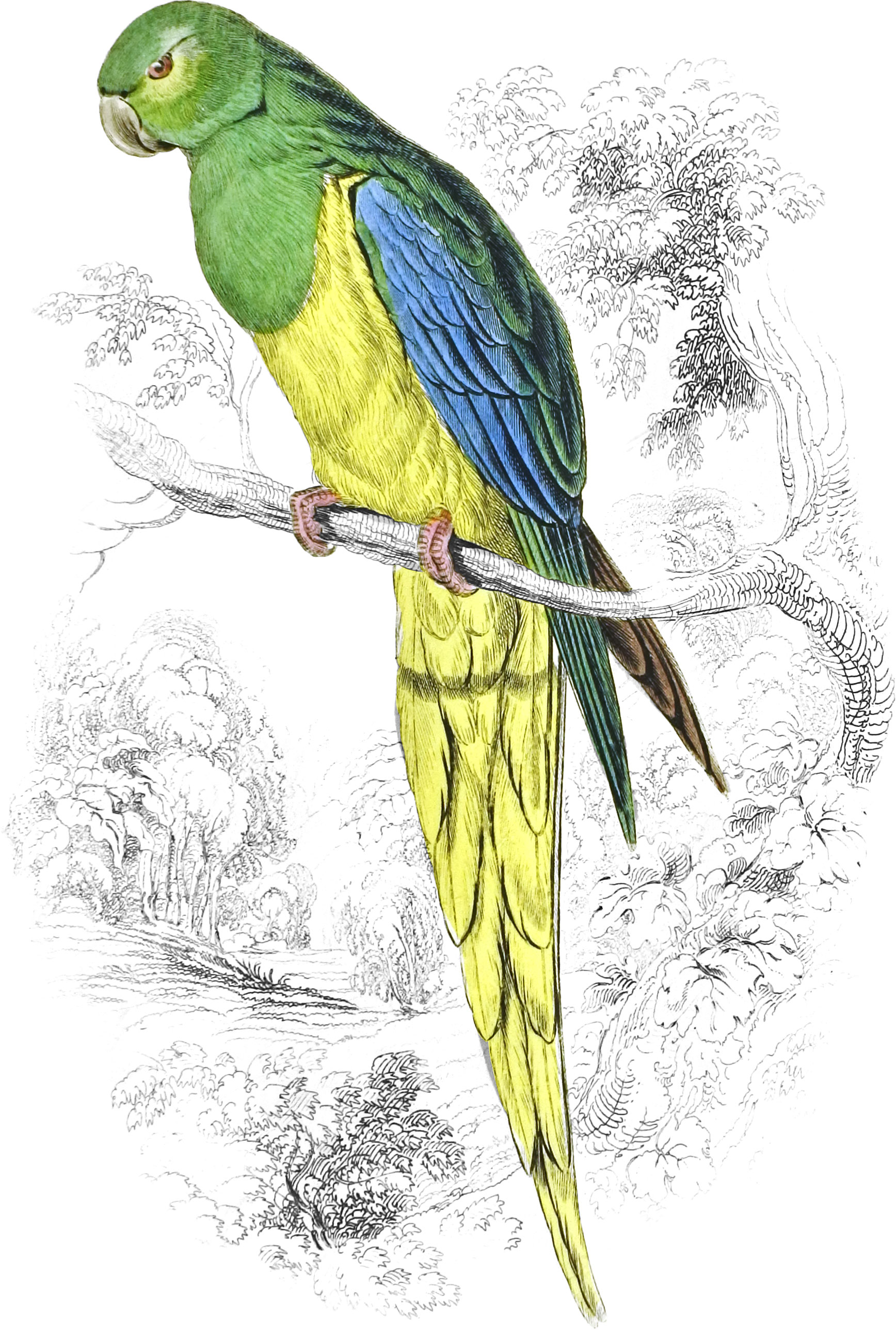
Plate XXVII
Our next figure represents another species of this group: it is the
Undulated Nanodes
Nanodes undulatus.—Vig. et Horsf.
Nanodes undulatus, Vig. et Horsf. Trans. Linn. Soc. b. xv. p. 277.—Psittacus undulatus, Shaw’s Nat. Mis. pl. 673.—Kuhl, Nov. Acta, &c., p. 49 545, No. 76.—Euphemia undulata, Wagler, Mon. Psitt. in Abhand. &c., 492 and 545.
This little species, which scarcely exceeds seven inches in length, approaches still closer than its congeners in colour and appearance to the Ground Parrot, and brings the genus Pezoporus, Illig. into immediate connexion, with that to which it belongs. Its habits and mode of life are supposed to resemble those of its congeners, but we unfortunately possess too little information upon these interesting points, the skins we receive from abroad being mostly collected by persons who take no other interest in the pursuit except the mere acquisition of the bird, are rarely accompanied by any notes or observations illustrative of the natural history of the species they belong to. The head and nape are of a yellowish-green, with very fine dark undulating lines; upon each cheek is a small patch of azure-blue, the upper parts of the body are of an oil-green, with darker undulations, the lower parts are plain yellowish-green. The two intermediate tail feathers are green at the base, passing towards the tips into azure-blue, the lateral feathers are green, with a broad yellow fascia in the middle. The bill and legs are grey.
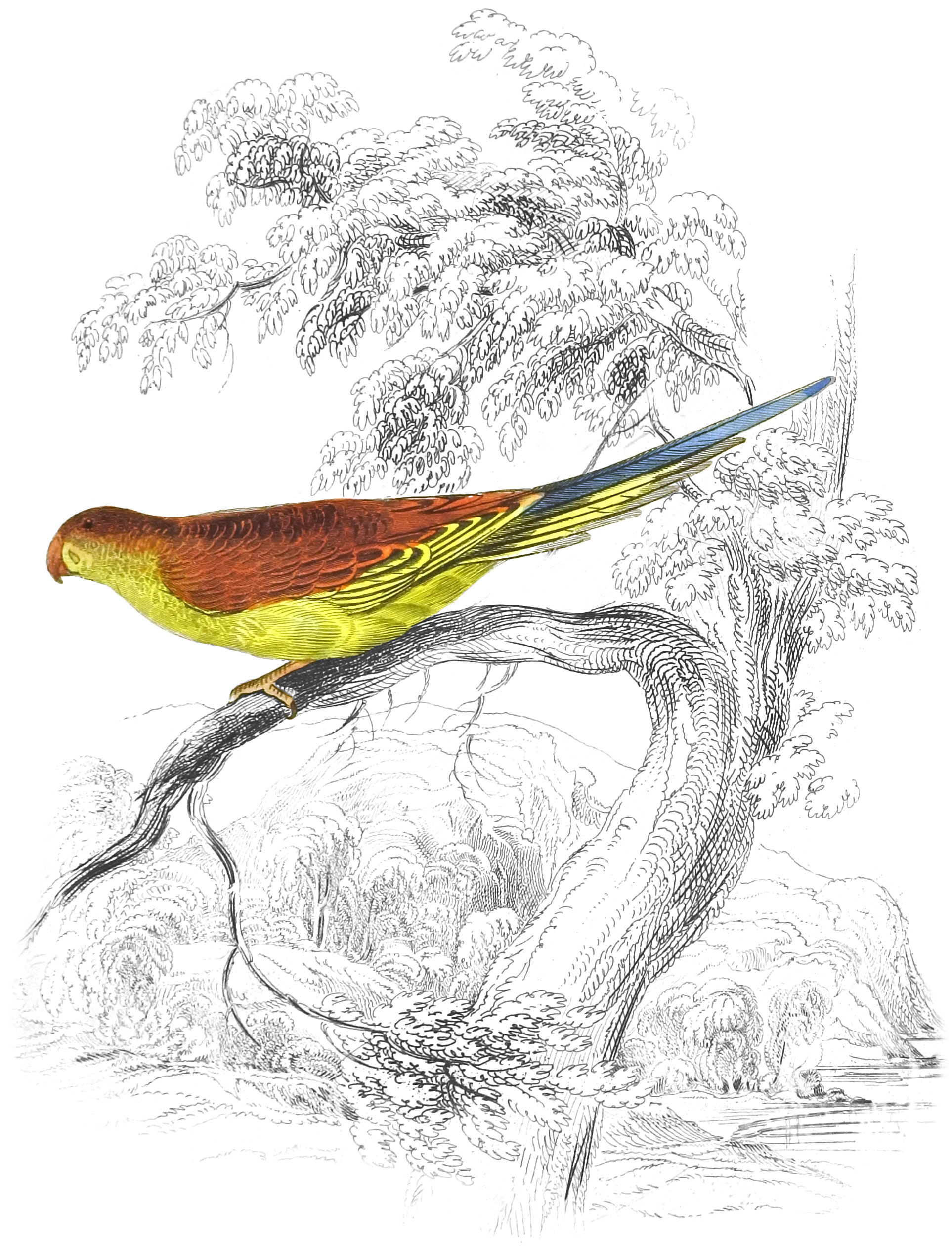
Plate XXVIII
In near connection with the birds we have just been describing, stands the genus Pezoporus, Illiger, represented by the Pezoporus formosus, Illiger, the Ground Parrot of Latham’s General History. The characters of distinction are drawn from the still greater elongation of the tarsi and toes, and the usually straight claws, indicating habits strictly terrestrial, with trifling or greatly diminished powers of prehension. The tail also is less depressed, and the feathers are narrower and more pointed than in Nanodes venustus and pulchellus, with those slight modifications of character it might perhaps with equal propriety be considered a constituent or aberrant member of the genus to which they belong, probably its rasorial type. We retain it, however, in its present station, until a stricter analysis of the family has been instituted. It is represented by the next figure under the title of the
Ground Parrot
Pezoporus formosus.—Illiger.
Pezoporus formosus, Vig. et Horsf. Trans. Linn. Soc. v. 15, p. 285.—Wagler. Mon. Psitt. in Abhand. p. 250 521.—Psitt. formosus. Lath. Ind. Ornith. i. p. 103, No. 60.—Kuhl. Consp. Psitt. Nov. Acta., &c., p. 43, No. 64.—Psittacus terrestris, Shaw’s Zool. of New Holland, pl. 3,—Nat. Misc. 228.—Perruche Ingambe, Le Vaill. Nat. des Per. pl. 32.—Ground Parrot, Lath. Gen. Hist. ii. p. 137, No. 40.
Though destitute of that diversity of brilliant colours which distinguishes so many of the tribe, the plumage of the Ground Parrot is handsome and pleasing to the eye, the lively green which forms the ground or prevailing tint being beautifully varied with spots, and bars of black and yellow In size it exceeds the last described species, measuring rather more than twelve inches in length, one half of which is occupied by the tail, this is composed of feathers, which taper rapidly towards their tips, which are sharp and pointed, and have their exterior webs very narrow, the two middle tail feathers are green, barred with yellow, the lateral yellow, barred with blackish brown. The wings are rather short and rounded, the first and fourth quills being equal, the second and third the longest and equal. The inner webs of the quills are blackish-brown, and have each a mesial angular spot of yellow, forming an oblique fascia or bar on the under side of the wings; the exterior webs are green, with an angular spot of yellow towards the middle, upon all the quills, with the exception of the two first. At the base of the upper mandible is a narrow band of reddish-orange. The bill is grey, the tomia of the upper mandible paler, and without emargination. The feet are yellowish-white, the tarsi nearly an inch long, covered in front with hexagonal scales. The toes slender and long, the claws nearly straight, with pale tips.
The Ground Parrot is a native of Holland and Van Diemen’s Land, where it inhabits the scrubs or ground partially covered with low underwood. It is very rarely seen perched, and when flushed, Mr Caley observes, takes a short flight, and then alights among the bushes, but never upon them. Of its mode of nidification, and other matters connected with its history, we are unable to give any further account.

Plate XXIX
The last group our limits permit us to mention, from its characters, which in many respects approach near to those of Pezoporus, seems naturally to be included in this division. Its members are distinguished by a crest, in one species consisting of two slender feathers, in the other of six, and similar in form to that of the Common Lapwing. The bill, in shape and proportion, seems almost intermediate between that of Platycercus and Pezoporus, the tarsi are elevated, the toes slender, with claws slightly falcate. Like most of the Platycercinæ, they are much upon the ground, where they move with freedom, and feed upon grass-seeds, maize, and other corn. In Wagler’s Monographia Psittacorum, they form his fourth genus Nymphicus, which title we adopt, as having been imposed prior to that of Leptolophus, by which it is characterized in Mr Swainson’s Illustrations. Our figure represents the
Red-Cheeked Nymphicus
Nymphicus Novæ Hollandiæ.—Wagler.
Nymphicus Novæ Hollandiæ, Wag. Mon. Psitt. in Abhand., &c., p. 490 and 522.—Psitticus Novæ Hollandiæ, Latham, Ind. Orn. i. 102, sp. 89 59.—Leptolophus auricomis, Swainson’s 2d Ser. Illus.—Crested Parakeet, Lath. Syn. i. p. 250, 51.—Calopsitta guy, Less. Ill. Zool. vol. iii. 2 sp. pl. 112 pl. 50. Female.
Though clothed in plain and unassuming plumage, as compared with many of its brilliant-coloured associates, the subject of our plate is not without its attractions, its elegant crest contributing to increase the beauty of its contour, which in other respects is equal to that of any species we have previously described. Its habits are said to resemble those of the other Platvcercinæ, with which its structure also accords, the elongation of the tarsi and toes giving it the same freedom of action upon the ground, where it usually seeks and obtains its food. It does not appear to be a numerous species, as few specimens have yet found their way into our museums, and no detailed account of its natural history have hitherto been recorded. It is a native of New Holland, but of what particular district we are ignorant. It is likely that this bird and its congeners will constitute the rasorial type of this subfamily. In the lengthened tail feathers of this genus an analogy or distant affinity to the Ring Parrakeets, with which the illustrations commenced, may be traced.

Plate XXX
- J. J. Audubon.
- Mr Swainson.
- Illustrations of Ornithology by Sir William Jardine, Bart. and P. J. Selby, v.
23. part 8. pl. 112.