
Volume XVII
Birds of Western Africa
Part I

Content warning: Portions of descriptions and imagery on this page contain inaccurate views, derogatory language, and offensive imagery. They are included here as they were originally created in order to compile a complete reproduction. They do not reflect the attitudes of this site’s creator.

Introduction
With those who take any interest in Natural History, it is as natural to inquire the country and the name of an unknown animal, as to put the same questions regarding a foreigner, whose features and garb differ from our own. In either case, the name to ordinary persons, even when heard, conveys no ideas associating with those he already has; it remains a fact, indeed, but “bare and barren.” The locality, however, or place of residence of the stranger, brings with it some degree of interest, either with things we know of or have pictured to ourselves. We feel as if we could recognize the bird if we saw it again, and we connect it in some way with the general ideas we have formed of that country of which it is a native.
It is known to every intelligent reader, that the five great divisions of our globe are peopled respectively by the five leading varieties of the human species; and that each of these, again, present us with numerous variations of a secondary character, regulated in the same way by the position of the different kingdoms and provinces. There is, in short, a national physiognomy superadded to those features of our race, which are common to all, by which even ordinary observers are generally able to detect a Frenchman from an Italian, or a Scotchman from an Englishman. This nice discrimination, however, is the result of observation. To us, the negroes of Africa appear destitute of these national or provincial marks, and to be all alike; but this is a great mistake. These sable nations exhibit, to the practised eye, as much diversity, not merely in the colour of their skin, but in their cast of features, as any of the European nations. And a Gold-coast negro is as different from a Bushman Hottentot, as the modern Greek from the dwarfish Laplander.
We should scarcely have adverted to facts so generally known as these, but for the purpose of showing, that the laws by which the great Creator of all things has regulated the earth and its inhabitants, extends to all who live and move and have their being upon it; and that the endless variety which we meet with in the animal world, is nearly as much subjected to this law of geographic distribution, as are the different races and families of mankind. It is by this term that the study of geographic natural history is now designated. It is a branch of science altogether new; for although its elements seemed to have attracted the attention of Linnæus, and some insulated theories have been promulgated by several of his successors, they were framed without any definite reference either to the dispersion of the human race, or to the harmonious union of their parts. It was with a view, therefore, of attempting to generalize all that was then known on the dispersion of animals, that we discovered they could all be classed under the very same geographic limits assigned by Cuvier and Blumenbach to the five leading races of man; and into which the best geographers of the present day have divided the globe. These may consequently be considered zoological provinces, corresponding to the several divisions of Europe, Asia, Africa, America, and Australia.
In stating, however, the general fact, that each of the large divisions of our globe has its own peculiar animals, the reader must not be led into the belief that this law is altogether absolute, or that there are not several examples of one and the same species inhabiting countries, not only adjoining each other, but sometimes laying widely asunder. Examples of the latter, however, are much more rare than of the former. The animals of one range will always be commingled with those of another, on the confines of their respective countries: and there must consequently be those lands debatable which serve to connect two different districts or zoological provinces: these may be likened to those softer and graduating tints which serve to blend the opposite colours of the rainbow, and produce that harmony which pervades every part of creation. Some animals also hare a much wider range assigned to them than others; and a very few, inhabiting different continents, are restricted only by temperature. Thus, between the magpie of England, North America, and China, specimens of which are now laying before us of each locality, not the slightest difference can be detected; and yet these birds are never found, in either of these continents, beyond the limits of wintery cold. Birds, of all other animals, might be thought at first to be exempt from this law of nature, seeing that they are such volatile beings, and capable of traversing immense distances in surprisingly short periods. But this opinion is not borne out by facts. The common house-swallow of Europe might reach America with as much ease as the coasts of Africa, and there enjoy the same warm temperature, and find as great an abundance of insect food. But its course has been ordained otherwise. Its Almighty Creator has implanted in it the destined route it is to pursue, and from that route it never deviates, whether on the right hand or on the left. To speculate upon the causes of such things would be idle; we can only wonder at the fact and be silent. Sea birds have a much wider range than those inhabiting the land; probably because their supplies of food, drawn from the ever-waving sea, and the ever-changing depositions of its tides, are much more precarious. And yet, even among these tribes, great regularity maybe observed in general within geographic range, although these ranges in themselves are much more extensive than in other birds. It is singular, that although nearly all our different species of ducks are found likewise in temperate America, not one has yet been discovered further south than the lakes of Mexico, while those of Brazil are totally unknown to the northward of the isthmus of Darien. The waders, forming the grallatorial order, are the most widely dispersed of all birds, for several of those found in Europe occur on the shores of India, North America, and Western Africa; and if our naturalists have not been deceived, our well known wimbrill (S. phæopus) is actually the same on the shores of New Holland. Such examples, however, of cosmopolite birds are exceedingly rare; it must be remembered also that in a circle extremes meet; and as this disposition is equally apparent in the geographic distribution of animals, as in their natural classification, so we may reasonably expect that the two polar regions of our globe would contain some species common to both. The accounts, however, of travellers, who are not themselves naturalists, and even those which are found in many of our systematic works, must be received in many instances with great suspicion; because the black crow inhabits New Holland and seems to fly and caw like our own, it has been set down as the same species. The little gold-crest, Sylvia regulus, in like manner is asserted to inhabit America and a number of places out of Europe; whereas it is strictly confined to the latter continent, although represented by other species in widely separated regions. For a long time, our house-swallow, Hirundo rustica, was believed to fly both to Africa and America; but that of the latter country has been found to be quite a distinct species.
The American race of mankind is certainly the most distinct, for it is only towards its northern extremity that we find in the Esquimaux tribes an approximation to the Finlanders of Europe or the Kamtschatka families of Asia. Now this is precisely the case in respect to the distribution of birds. In the Arctic Regions, more than four-fifths of the species discovered during the northern expeditions are actually the same as those of northern Europe, but of these only nine are land birds. Beyond these limits the ornithology of America begins to assume the same isolated character so conspicuous in the phisiognomy of its human races.
Such are a few only of the results that have attended our investigations on the geographic distribution of animals, but more especially of birds. And we merely introduce these general remarks on the present occasion, that our juvenile or unscientific readers may form ideas on the subject at large, and on the “local habitation,” which the secret and mysterious laws of a beneficent Creator have imposed on the countless beings which cover this goodly earth. The arrowy course of the swallow—the wanderings of the albatross—or the soaring of the eagle—are all directed to certain points, and are confined within limits, invisible indeed to the material eye, yet as impassable and as exclusive as a wall of brass. “Hither shalt thou come, but no further,” with safety or comfort to thyself. This command, although not pronounced, is a part of the natural instinct of every animal in a state of nature. Domestication can do much, but its effect is almost entirely limited to those animals which have been marked out by our Creator as destined to the service of man. Let him be thankful for these exceptions, and not, with a modern philosopher, idly boast of “man’s conquest of nature” when his highest faculties cannot domesticate—a worm!
Of all the zoological provinces into which our globe is divided, Africa is the most unexplored. The land thirsty and desolate—the people savage and idolatrous—the climate burning and pestilential; we trace all that can impede and resist civilization, and the prosecution of research. The interior of Africa is like the fabled upas-tree of Java; and of nearly all those adventurous spirits who have set out to gather its fruits, nothing remains but their whitened bones. The zoology of Africa is even less known than its geography. Its coasts, at least throughout its circumference, have been traced out by navigators; but the natural history of only two or three insignificant parts, when compared to the whole, has been investigated; while of the vast regions intervening between these distant spots, we know little or nothing. The ornithology of Egypt was well explored in the direction of the march of the French army, by the inimitable Savigny, and those learned men who accompanied it; Rüppell has brought some striking novelties from Nubia, and recently from Abyssinia; while some of the birds of the latter country, collected and sent to England by the late Mr. Salt, have been imperfectly mentioned.1 These, in short, are the only gleanings that have been made in the vast extent of three-fourths of this wide-spreading continent; for even the shores bordering upon the Mediterranean, and the fertile and well-wooded provinces of Asia Minor have been quite neglected, notwithstanding the interest they possess in determining the limits of the three regions which there meet, namely, Europe, Africa, and Asia. It is only in the southern extremity, long inhabited by Europeans, that any thing effective has been yet accomplished. The name of Le Vaillant takes the lead in this quarter, and the six splendid volumes that he has given to the world, record how great was the success that attended his exertions in our favourite science. Yet notwithstanding his numerous discoveries, many others remained to be made; and the three zoologists who subsequently chose this field for their exertions, Lichtenstein, Burchell, and Smith, added materially to our list of S. African birds. The latter naturalist, more especially, has already transmitted to this country many new and interesting species.
Such, in a few words, is the state of our knowledge on the ornithology of Africa, up to the present moment; so that the portion we have now selected for geographic illustration is entirely new. The bird-skins of Senegal, indeed, have long been made an article of traffic with this and other countries, and hence the descriptions of many species will be found scattered in our systems. But these, comparatively, are few, and there is as yet no connected account of this geographic division of the African continent, although it is unquestionably the richest in point of splendid colouring, and inferior to none other in scientific interest.
A more general and accurate idea of the peculiarities of this portion of African ornithology will be gained, by taking a rapid glance at those of the northern and southern extremities. The long line of coast bordering on the shores of the Mediterranean, as we have just remarked, has never been sufficiently investigated; but we know that those countries are the extreme limits of several groups, of which no species are to be found on the opposite shores; while, on the other hand, very many are common to both. Of these latter, the most remarkable are migratory; passing from the African continent to the south of Europe in the spring, and returning there in the autumn. It is from among these migratory tribes that Europe derives the greater part of her most gaily coloured birds; such as the common bee-eater (Merops Europæus), the golden oriole (Oriolus galbula), the European roller (Coracias garrulus), the common hoopoe, and several others less striking. These large flocks are followed by several species of the falcon and owl families, which prey upon the stragglers. Nor is this similarity between the birds of the two continents confined only to such as inhabit the land. It is a curious and unrecorded fact, that a migration almost equally extensive takes place among the waders and swimmers. During many years residence, for instance, in the island of Sicily, a spot peculiarly favourable for carrying on observations of this nature, we never met with the purple or the night herons, or the glossy ibis, except during the spring or autumnal migrations; at such times the whole island may be considered like a vast preserve of quails, and numerous other migratory birds. In respect to the small soft-billed or fly-catching species, forming part of the fly-catcher and warbler families, little can be said beyond the fact that their route is southward, after leaving our hedges and woods in the autumn. They do not appear to take Italy or Sicily in their way, which, if they ventured on the shores of Northern Africa, it is more than probable they would do, seeing that the configuration of those countries renders them resting places, as it were, for such feeble winged birds before they ventured to cross the Mediterranean. Northern Africa is certainly the boundary of the African bush-shrikes (Malaconotus); one species, the beautiful M. barlarus, seems the most northern visitor, while its southern range extends to Senegal. There must be many birds peculiar to sandy deserts in the arid tracks of Barbary, Algiers, &c. which would find no congenial locality on the fertile shores of the opposite coast. The discoveries of Rüppell sanction this belief; although his researches were prosecuted further inland, and consequently more towards the central regions.
On taking a general survey of the numerous tribes composing the ornithology of Southern Africa, we find scarcely any species of the perching order common to the two extremities of the continent. Le Vaillant, indeed, is of opinion that the great horned, the long horned, and the little horned owls of the Cape colony, are all identically the same as those of Europe; but as we shall subsequently shew that, in one of these circumstances, there is every reason to believe he is mistaken, so a reasonable doubt may arise upon the others. This much is certain, that of the species of the falcon tribe, figured in his work on the birds of Southern Africa, none are to be found in Europe; and only one out of those now described as natives of Western Africa, is mentioned by our author as likewise inhabiting the southern extremity.
The numerical results which will be given in a subsequent table, will bear us out in the assertion, that the western ornithology is fully as different from the northern, as this latter is from the southern. There are, nevertheless, many points of resemblance between the birds of Senegal and those of the southern districts, which serve to connect them without diminishing those peculiar features which each possess. This union is effected by the migratory species of Western Africa, several of which annually take their flight southward and return to Senegal after a temporary residence on the plains of Southern Africa. This fact was conjectured by Le Vaillant, and it is fully confirmed by our own investigations, drawn from the specimens that have been recently imported from Senegal and Senegambia. Hitherto this fact only regards the splendid genus Lamprotornis, which may be called the African starlings; but future information will, no doubt, shew us that a southern migration takes place in other instances. It may be questioned, however, whether any of the Senegal birds go northward, excepting those more peculiar to the banks of the Gambia, which are likewise found in Britain, and the two or three species of perchers, formerly noticed as extending to Northern Africa and Central Europe.2 Adanson asserts that our house-swallow is the same as that of Senegal; but we have no means of judging the accuracy of the statement.
The first peculiarity that strikes us in contemplating the ornithology of Senegal, is the great preponderance of richly coloured birds. Now this circumstance may be accounted for in two ways. Either it is the result of commercial speculation among the dealers, who imagine that such birds will find a better market in Europe than those of a more homely plumage; or it is a real peculiarity, and therefore arising from natural laws. We believe this latter to be the true reason. In the following pages we shall have to describe a very considerable number of plain coloured species, which would certainly not have been transmitted with the more attractive sorts, had not variety been consulted by the dealers, in what they call their “assortment,” as much as beauty. In the second place, this splendour of plumage is in unison with that law which renders the productions of nature more rich and luxuriant, whether in growth or colours, in proportion as the countries they inhabit approximate the equinoctial line. This we find in the splendid variety of birds on the opposite coast of America, and in those far more magnificent races which inhabit the torrid islands of the Indian Ocean. The forests of Parra contain the most splendid of all the Brazilian birds, while it will be remembered that the whole of the paradise birds are restricted to New Guinea and the little isles of Aro and Banda in the Malayan seas.
It may be reasonably inferred, also, both from this richness of colour, and from the particular families to which many of these birds belong, that they have been met with in a woody country where the vegetation is also luxuriant, and where insects and fruits,—the two chief sources of nourishment to birds,—are in plenty and perfection. We have indeed no positive information on the geographic features of the districts, or of the precise localities where these birds were collected; but by far the largest proportion of them feed upon insects which inhabit the vicinity of woods, or upon fruits which grow therein. The collection contains very few of those genera which live only in open plains or in desert tracts; such as the genera Saxicola, Alauda, Otis, Perdix, Pterocles, &c. most of which occupy a much larger proportion in the ornithology of Southern, than they appear to do in that of Western Africa. The rollers and bee-eaters live entirely upon insects, and are only to be found in the skirts of thick woods; not one of these is found in the arid districts of the Cape colony, while from Senegal it will be seen that we now describe no less than five species of the latter and three of the former.
The family of the cuckoos, again, chiefly live among high forest trees; for even the European species is very seldom met with in districts covered only with low shrubs or hedges. Hence it is, that the birds of this group, inhabiting Southern Africa, are only found in the thick forests towards Algoa Bay, and in a few other well-wooded situations; six species, however, have been received from Senegal, two of which belong to the splendid shining group of Calcytes, met with by Le Vaillant in the forests just mentioned. The scansorial tribe, as every one knows, is strictly arboreal; and of these we possess eight species. The splendid sun-birds (Cinnyres) derive their sustenance from the nectar of flowers, and probably from the minute insects found therein; now of this single group we shall describe no less than eight species, some of which (from the number of specimens sent) must be very common. These facts are sufficient to show, that however arid and treeless may be the interior districts of Western Africa, yet that in Senegal there must be many tracts of humid and luxuriant vegetation diversified with thick forests and flowering shrubs, capable of producing animal and vegetable food for birds which could only exist in such situations.
On the chief peculiarities of Senegal ornithology, in regard to the species and the natural groups to which they belong, a few general observations only can be hazarded. Some few of the very largest sized birds, sent with the others to this country, passed into other hands before we had inspected them; and it is probable many other species, at present unknown to us as natives of this part of Africa, may be sent through the exertions of Lieutenant Governor Kendall of our colony on the Gambia. We must, therefore, confine our remarks to the most prominent groups, without venturing upon numerical details.
In the rapacious order, independent of several of the large eagles, &c. described by authors, and which must chiefly live upon quadrupeds, we find such a sufficient proportion of falcons which prey upon small birds, as to justify the supposition that the latter are more plentiful than would appear from the species we yet know of; this confirms our suspicion that we are yet ignorant of many of the fly-catchers and warbles of this district, in which it will be seen that our catalogue is very deficient. Further confirmation of this belief will be found in the number of shrikes, most of which live on the nestlings or young of small birds, and upon their eggs. The bush-shrikes are as numerous here as in South Africa: there are five species, two of which are found at the Cape. The wood-chat is precisely the same as ours; but the singular genus prionops is peculiar to the western countries.3
Senegal appears the chief metropolis of the widau finches, the males of which, during the breeding season, are decorated with very long feathers in their tail; out of this species, four are natives of this country,—while the splendid Lamprotorni or starling grakes, although dispersed as far as the Cape, appear to make Senegal their true place of residence. The sun-birds are certainly more abundant here than in the south, while their range appears not to extend so far as the Barbary coast: they represent the humming-birds of the New World, and seem, like them, to congregate most in those countries which are the hottest. The distribution of these charming birds in a longitudinal direction, extends only to the Cape, but is spread laterally to India and its islands; they disappear very suddenly towards the limits of Northern Africa, since only one species appears to have been met with by Rüppell.
Western Africa, again, is almost the peculiar region of one of the most lovely and interesting families, small in the number of the species, but splendid in colouring and peculiarly interesting from their structure. We allude to the Musophagidæ or plantain-eaters, in which group we comprehend also the turraccos; the violet species (Musophaga violacea) has ever been a favourite bird with ornithologists, and it is more frequently met with in the forests of Senegal than on the Guinea Coast, where M. Isert, its first describer, mentions it as particularly rare; besides the two species of this group which we actually know to be natives of this coast, there are two others which authors describe as likewise natives of Senegal.
The existence of at least three species of halcyon, where not one is found, as we believe, in Southern Africa, proves that the distribution of these forest king-fishers, or rather crab-eaters, are distributed in a lateral direction within a certain distance on each side of the equator. The only exceptions being two or three species found in Australia.
Of the gallinaceous or rasorial birds little can be said. Western Africa appears the metropolis of the Guinea fowls, and our list contains a species apparently new. There are, no doubt, on the sandy districts, several other species of land-grouse (Pterocles) and of partridges, than those few which have yet come to our hands.
The mouth of the river Gambia is frequented by several aquatic birds, which will be more particularly noticed in another volume.
Having now, by this rapid sketch, sufficiently prepared the reader for entering into the details of this volume, we shall at once proceed to describe the subjects themselves.
It will hardly be necessary to inform the ornithologist that the classification here employed will be in conformity with that theory, on the principles of the natural system, which we have already given to the world in other works.4 The species will be arranged under their natural families; and when they possess any remarkable relations, not hitherto observed, occasional notices on these points will be introduced. Commencing with the Raptorial order, or the
Birds of Prey,
we find several species mentioned by different authors as inhabiting Senegal, which we are compelled to omit; partly because we cannot vouch for their locality, not having seen imported specimens; but more especially because we studiously avoid, on nearly all occasions, copying from others the descriptions of animals we have never seen, a custom which has led, in a great number of instances, to erroneous accounts, drawn up at a time when the science was emerging from its infancy.5 Our work may thus be thought to loose something in the variety of its materials, but this we trust will be compensated by its greater originality and accuracy. Besides, we desire to make our volume not only popular, but of some permanent value and of some scientific authority. We deem it incumbent to state the reasons that have guided us in refraining, for the present, from including in our list all the birds supposed to inhabit Senegal; and as none of the vulture family have yet reached us from that country, we at once proceed to the
Falconidæ or Falcon Family
confining our attention to those species only of which specimens are now before us. They all belong to the two most typical or perfect divisions of the family, namely, the noble falcons (Falconinæ), and the hawks (Accipitrinæ). The first we shall notice is one of the most rare and interesting birds in the whole collection, and which appears to be the type of a distinct sub-genus of true falcons; and we therefore characterise it as the
Cuckoo Falcon
Aviceda cuculoides.—Swains.
Above cinereous, with the back and scapulars brown; the throat and breast pale cinereous; body whitish, crossed by broad brown bars; vent and under tail-covers fulvous, immaculate; tail even, cinereous, with a broad terminal bar.
The true Falcons are well known to have but a single tooth in the upper mandible of their bill, which, with their long and pointed wings, readily distinguishes them from all others. There is, however, in tropical America, another race, forming the genus Harpagus, which is characterised by the upper mandible having two distinct teeth, like projections on each side, and possessing shorter and more rounded wings: these two groups follow each other in the natural series, for they are connected by the Harpagus cœrulescens, one of those aberrant species which is essential to every natural group or sub-genus, in order to unite it with that which follows. These being the two most typical genera, we next have the crested form, after which, as we conjecture, comes the beautiful Falcon here described and figured, we believe, for the first time. It is such a perfect prototype of the hook-billed kites of tropical America, that but for its bill, it would be impossible to distinguish the two genera, while both are disguised in the plumage of the cuckoos; or that family they both represent in their respective circles. By the discovery of this beautiful bird, we can thus trace four of the sub-genera or primary divisions of the true falcons; the fifth, which will represent the buzzards, alone remaining to be determined.
The general form of this remarkable type maybe thus briefly described. It has the long wings of a buzzard, the tips reaching to within two inches and a half of the extremity of the tail: the three first quills are graduated, and slightly sinuated in the middle of the inner web; the tail is broad and quite even; the bill is very like that of the genus Cymindis, being broad and compressed, but the tip is less elongated and the two teeth on each side are situated near the tip, as in all the typical falcons; the nostrils, as in Cymindis, are closed, and merely open by a transverse slit; the feet also are in like manner similar to those of the group this type obviously represents; the tarsus is so short, that it is inferior in length to the middle toe, and is feathered half way down, the remaining portion being covered with irregularly shaped somewhat hexagonal scales; the soles of the feet are remarkably broad, and all the three toes are cleft to their base; the outer toe is shorter than the inner one, and is only as long as the hinder, leaving out the measurement of the claws. The whole form, in short, is precisely that of a Cymindis, except in the bill, which is of the true falconine structure, and at once shews us under which of the primary divisions of the family this remarkable bird should be placed.
We may now describe the colours. The general tint of the upper plumage, including the wings and tail, is of a very dark cinereous, almost approaching on the wings to blackish; the middle of the back, however, and the scapulars, are dark-brown; the ash colour being more clear on the head and tail. The under plumage from the throat to the breast is of a light ash, which there changes to a cream-coloured white, banded with broad bars of blackish-brown, of which there are two on each feather. These bands disappear on the thighs, belly, and under tail-covers, which are deep buff or ferruginous, and without any markings. The inner shafts of the quills are cinereous-white, those of the primaries only having from five to six remote black bars, most conspicuous on their upper surface; the inner wing-covers are ferruginous, without any markings. The tail has a very broad band of black at its tip, and a few irregular half bars at the base of the outermost feather; cere and feet yellow. Total length about 16 inches; bill, from the gape, 1\(\frac{1}{10}\); wings, 13; tail beyond, 2\(\frac{1}{2}\); from the base, 8; tarsus, 1\(\frac{1}{10}\).

Plate I
Rufous-Necked Falcon
Falco ruficollis.
Body above, dark-cinereous; beneath, white, and both banded with narrow black lines; head and neck above, rufous; ears with a semi-circle of black; beneath the eye a black stripe; throat and breast cream-coloured white, without bands.
Le Chicquera? Le Vallant, Ois. d’Af. i. Pl. 30.
This is one of the smallest and most elegant Falcons yet known; we suspect it is also rare, since only one specimen has been received in the Senegal collections, and we have not met with it in any of our public museums. It has a general resemblance to the Chicquera of Le Vaillant, but that has no semicircle of black half round the ear. or the black stripe beneath the eye; there are also a few other differences. Le Vaillant expressly tells us, also, that his bird was sent from Bengal; and another author asserts that the Chicquera, is found both in Java and Pondichery. These localities are so vastly remote from Senegal, that we cannot, so long as there is any difference in plumage, suppose that the same species inhabits regions so wide asunder.
The size of our bird exactly corresponds to that of the little American Falco sparverius which it rivals in beauty of colouring. Commencing just above the eye (for the front is nearly white), the upper part of the head and neck is of a rich rufous; the feathers of the crown having a narrow black stripe down the middle of each; this rufous colour is separated from the ears by a narrow stripe of black, which takes a curve almost round the ear feathers, and nearly meets another black stripe, tinged with rufous, which commences at the anterior corner of the eye, and then passes under it, like a moustache: round these stripes, and on the sides of the neck and breast, there is a delicate shade of rufous, which blends into the creamy white of the throat and breast. The whole of the remaining upper plumage is of a full dark cinereous, banded throughout with distinct blackish bands nearly as broad as the spaces are between them. The tail has the same ground colour, with about nine narrow blackish bars and a very broad one, which is the last; the extreme margins of the feathers having a narrow edging of white. The whole of the under plumage, from the breast to the tail-covers, is banded like the back, but upon a whitish ground. The cere and feet are bright yellow; the bill, as usual, blueish, and the claws black. Tail rounded, one inch longer than the wings. Total length, 10 inches; wings, 7\(\frac{3}{4}\); tarsus, to the sole of the foot, 1\(\frac{1}{2}\); middle toe below, 1\(\frac{6}{10}\); tail, 5\(\frac{1}{2}\).

Plate II
Rufous Kestrel Falcon
Falcon rufescens, Swains.
Ferruginous, banded above, and striped beneath with black; external parts of the quills entirely brown, immaculate.
The true Falcons, like nearly all pre-eminent types of families, are dispersed, with little or no variations, over the five zoological provinces of the world. The species, indeed, are different, but the structure is the same.
The species now before us is intimately related to the Kestrel of Java, both in its size and general cast of colouring, while both, in point of structure, offer not the slightest difference from the well known Falco sparverius, or American sparrow-hawk. We cannot, therefore, with all our predilection for geographic groups, consider them as belonging even to different sections of the same sub-genus.
Both sexes of this species are now before us. The male, which is the smallest, differs from the female in having the upper tail-covers and the ground colour of the tail-feathers themselves of a light grey or slate colour. In all other respects, the following description is applicable to both.
General colour of the plumage cinereous or light rufous, much paler beneath; cere, bright yellow; bill, blue. Head, neck, and their sides, marked with narrow stripes, one being down the shaft of each feather, but none on the chin, and scarcely any on the ears. The whole of the back, rump, tail, wing-covers, and tertials are marked with transverse bands of brownish-black, at nearly equal distances from each other; of these, there are generally three on each feather, one in the middle, and one at each end. The terminal band is broadish, and that at the base is obsolete on the smaller feathers. The long tertials and the larger covers have four bands, those on the latter being of equal breadth, and equal distance from each other. The middle tail-feathers have from nine to ten of these bands, which run directly across the two webs towards the end of the feathers, but become alternate at the base; besides these, there is a terminal band nearly an inch broad, and which leaves the extreme tip, or margin, dull whitish. The spurious quills are dark brown, with four external spots of ferruginous; the lesser quills the same, but with five spots, opposite to each of which, on the inner web only, is a transverse spot of the same colour. The greater quills have the whole of their outer webs entirely brown. It is by this peculiar character that the species is distinguished, for in the Javanese bird the greater quills have five distinct spots on their outer webs. The inner webs of our bird are marked with the indented bands, usual in the Falcons. The inner or under surface of the wings is cream-coloured white; the bands just spoken of being hardly discerned, but there is the faint appearance of ten on the first quill; the lesser covers are each marked with two spear-shaped spots, and the greater with two transverse bands of black. All the under plumage, from the belly, is striped with black down the middle of each feather, these stripes generally becoming tear-shaped; they are very small, and almost disappear on the thighs, and there are none on the belly and under tail-covers. Feet, bright yellow; claws, black. The wings are nearly as long as the tail, and the notch on the second quill is nearly obsolete. The tail is rounded. Dimensions of the female, 13 inches; bill from the gape, \(\frac{8}{10}\); wings nearly 10 inches; tail, from the base, 7\(\frac{1}{4}\); tarsus, 1\(\frac{4}{10}\).
As a further distinction between this and the species from Java, we may remark, that in the latter the plumage beneath is transversely banded whereas in this it is longitudinally striped.
Grey Falcon
Falco concolor.
Entirely cinereous, with the shaft of each feather marked by a black stripe; quills, black; tail with numerous white bars, which are obsolete on the outer webs.
Falco concolor, Temminck, Pl. Col.
It is seldom we find, among the Falcons, that the plumage is so strikingly coloured as to distinguish a species at first sight. Their general cast of colouring is in spots, stripes, or bands; mixed up with different shades of brown, so that it becomes extremely difficult to express, by words, all those minor shades of difference which the practised eye of the naturalist detects at a glance, when the objects themselves are brought under comparison.
The bird before us, however, is one of those whose colours are altogether peculiar. Its whole plumage is of a deep slate colour, somewhat paler beneath, and with a brownish tinge in some parts of the upper plumage; this uniformity is only relieved by a slender stripe of black down the centre of each feather; these stripes are darkest and most conspicuous upon the head, ears, neck, breast, and under parts; they become faint on the lower part of the back, wing-covers, belly, and vent,—while they are altogether wanting on the under tail-covers. The quills, externally, are entirely black; but, upon looking to their under surface, it will be seen that this inner web has numerous white bars for about two-thirds their length from the base: of these there are about fourteen on the first quill, those nearest the tip being very distinctly marked, but the rest becoming gradually less defined towards the base. The tail exceeds the length of the wings by about two inches and a half; its form is much rounded, the outer feather being more than an inch shorter than the middle ones; its upper surface, when not expanded, is of the same uniform grey as the back, with some obscure whitish bands on the outer webs of the lateral feathers: but when the tail is spread, the four lateral feathers on each side are seen to be thickly banded with white, precisely like the quills of the wings, the middle feathers being almost free from these markings; the shafts of all are of a deep and glossy black, thus preserving a uniformity with the rest of the plumage: the bands on the tail-feathers are so crowded, that sixteen may be counted on the outermost feather. Orbits, cere, and feet, bright-yellow; claws, black; bill, blueish. The general form of this bird is somewhat thicker than that of the last; the bill is larger and the wings shorter, since they reach only to about half the length of the tail. The black whiskers, so universal in this division, are short, although very distinct. The whole structure of the bird, however, is that of a typical Falcon.

Plate III
Black-Chinned Goshaw
Aster monogrammicus.
Cinereous; chin white, with a central black stripe; body, beneath, marked with numerous transverse bands; tail rounded, black, with the base and band before the tip, white.
Falco monogrammicus, Temm. Pl. Col. 314.
We place this bird among the Goshawks as an abarrant species of the genus Aster, not wishing to multiply, without strong necessity, the already numerous genera which have recently been proposed in this family, many of which seem to repose upon a very slender foundation. We shall first submit it to a rigorous comparison with the genuine sparrow hawks, and then describe its plumage.
This species, which appears by no means uncommon in some parts of Western Africa, is nearly as large as a pigeon, and consequently much superior to our European sparrow-hawk. Its form also is more heavy, an appearance occasioned by its thicker body, stouter and shorter feet, and larger sized head. Its general aspect, however, no less than its short wings and similarly formed bill, gives the impression that it is closely allied to those more slender species which are represented by our own sparrow-hawk, and those which we have here described. From all these, however, the bird before us differs, in having the second quill so very long that it is only half an inch shorter than the third, this latter and the fourth being the longest of all. This prolongation of the wing clearly indicates a much more rapid and powerful flight than is enjoyed by our species, whose third quill-feather has the proportions of the second in this species, and where the fourth is even shorter than the fifth. In the feet, the two birds essentially differ. Although so different in size, the tarsus of our British hawk is just as long as that we are now describing, and yet the tarsus of this is nearly three times as thick as that of the sparrow-hawk; this great accession of strength and of muscular power in the foot plainly shews that the Senegal bird feeds upon much larger and more noble game than our English one: while the middle claw, instead of being very long, is of the same length as in the true Falcons. The surface of the feet, or rather the scales by which they are covered, are very different. In this the series placed in front of the tarsus are by no means smooth, since their sutures are distinct and prominent; they are transverse, and composed of about nine pieces, while those on the sides and back are small, numerous, and hexagonal: not, like the sparrow-hawk, in smooth and nearly entire pieces.
We will now compare our bird with the white Goshawk of Australia (Aster albus), with which, in its general form and proportions, it much more accords than with the typical sparrow-hawks. The wings of our present bird are a trifle longer and more pointed. The general structure of the feet are the same in both; the inner toe being a trifle longer than the hinder, although their claws are of the same size: the chief, and we may add the only important difference between the two birds is in the scales of their tarsi; those of Aster albus are large, smooth, broad, and transverse, both before and behind, while the posterior and lateral scales of Aster monogrammicus are small, reticulate, and hexagonal. Although it is highly important to notice this difference, we do not look upon it in any other light than as indicating an aberrant species, opening the passage to eagle-hawks of the restricted genus Haliæetus.
The general colouring of the plumage is very elegant. A light and uniform grey spreads over all the upper parts, and forms a broad band across the breast and lower part of the neck. The chin is of a pure white, relieved down the middle by a stripe of deep black, composed of five or six feathers entirely of that colour; the orbits, which are feathered, are lighter than the cheeks and sides of the head, the rump has a deep black bar, which contrasts agreeably with the pure white of the upper tail-covers. The lesser quills have white terminal margins, and are crossed by about eight dusky-blackish bars, hardly, if at all, perceptible when the wing is closed; the greater quills, externally, are uniform black, but on their inner surface they appear white, crossed with black pointed bars, of which five or six are on the first quill; inner wing-covers, pure white. Tail slightly rounded and deep black, with a white bar about an inch and a half from the tip, and another close to the base. The under plumage from the breast to the belly, including the thighs, is most elegantly banded with slender grey-brown lines upon a dusky-white ground; the space between each band is nearly double the width of the band itself, and there are about ten of these bands on each feather. The base and cere of the bill is rich orange-red, the rest bluish-black; the legs bright yellow, and the claws black; the vent and under tail-covers dirty-white, and unspotted.
We have seen several specimens perfectly alike in plumage, but differing materially in size; the smaller ones being no doubt of the male sex. The ordinary dimensions of the female are as follows: Total length about 13\(\frac{1}{2}\) inches; bill, from the gape, 1; wings, 9; tail (beyond), 3; from the base, 6\(\frac{1}{4}\); tarsus, 2\(\frac{1}{10}\); middle toe (without the claw), 1\(\frac{1}{10}\).
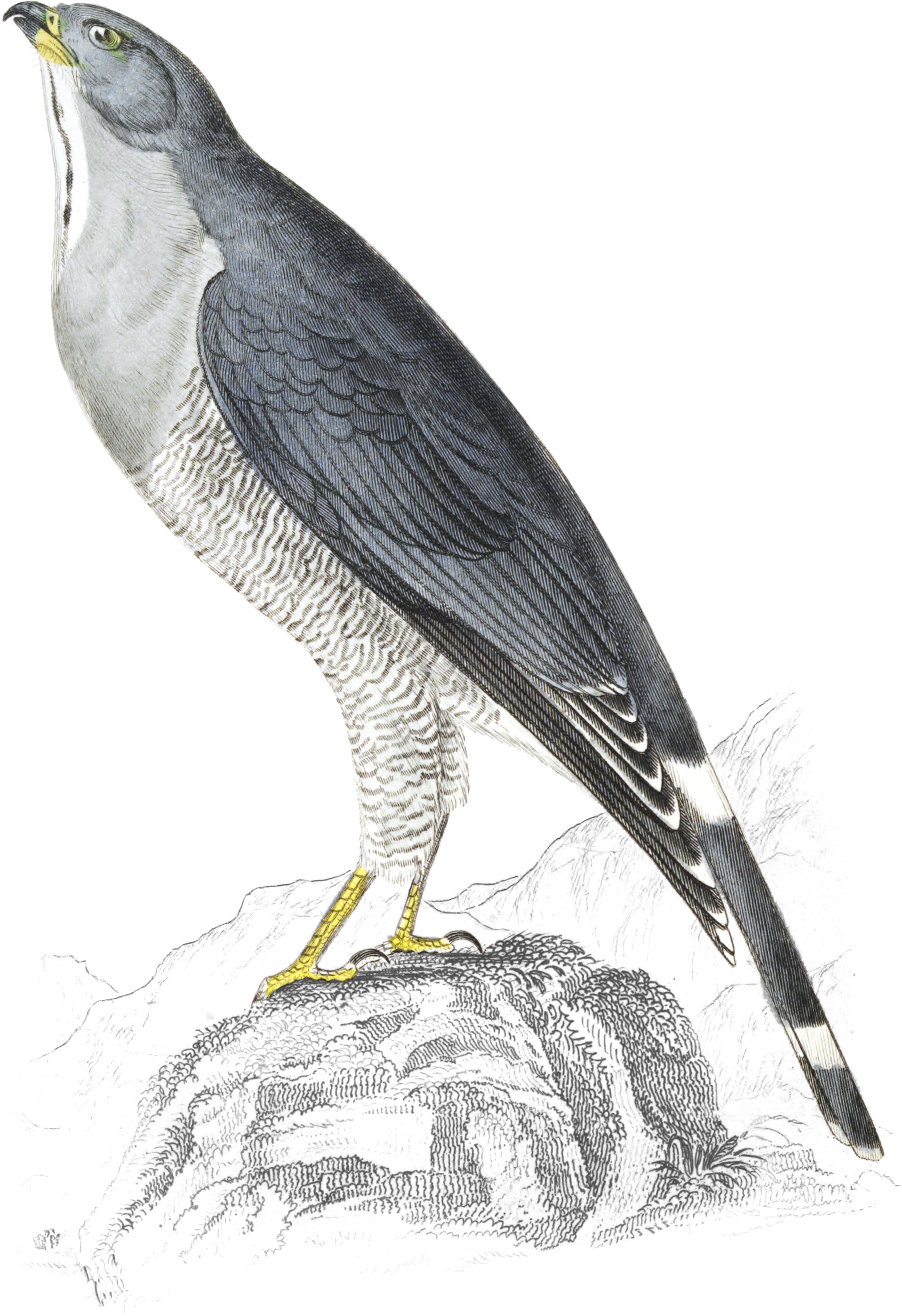
Plate IV
Senegal Sparrow-Hawk
Accipiter brachydactylus, Swains.6
Male, above, slate colour; beneath, whitish, transversely banded on the breast and body with ferruginous bands; throat, thighs, and belly whitish, immaculate; chin with a central dusky stripe; wings, beneath, pale fawn colour, and unspotted.
Female, above, cinereous-brown; bands, beneath, more numerous and broader; quills, beneath, marked with transverse black bands.
We fortunately possess both sexes of this pretty little Hawk, which has all the delicacy of shape and proportions belonging to our British species; yet it is still smaller, the male measuring only eleven inches and a half. There is nothing materially different in the structure of these two species, excepting that this has not the remarkable elongation of the first joint of the middle toe, so conspicuous in ours; so that the inner toe of this species (without the claw) is considerably longer than the first joint of the next,—whereas in ours both are equal.7 The inner and hind toes are also nearly equal in length, while in ours the hinder toe is much the shortest. The wings, again, are not so much rounded, as the third quill is nearly the same length as the fourth and fifth, and consequently much longer than in A. fringillarius; in other respects, as regards the bill, tarsi, and scales, the two birds quite agree.
The delicate slate colour on the upper plumage of the male is only a shade lighter than that of the common sparrow-hawk; it becomes much paler on the ears and sides of the neck, and leaves the chin and half of the throat entirely white; this white is divided down the middle by a pale but very distinct dusky stripe, which extends for about an inch from the chin. From the lower part of the neck, the ground colour of the plumage becomes of a delicate fawn colour, which changes on the belly, vent, and thighs, to white; on these latter parts there are no markings, but the breast and body are thickly barred with transverse ferruginous or fawn lines, in the same manner as those on our sparrow-hawk, but closer together and not quite so broad. The quills are blackish, without any external spots, but having the inner web for about half its length fawn white, and banded with black; these bands, however, can scarcely be seen on the under surface, and then only when the wing is opened. The inner wing-covers are marked with a few bars, wider apart than those of the body. The ground colour of the tail is grey above and dull white beneath; the middle feathers are not marked, but the lateral have seven black bars, that at the tip being hardly broader than the others; the outer feather has eleven, which are paler and narrower. The cere and feet are fine yellow. The tail is rounded, and the wings reach to half its length; the second quill is a little longer than the sixth, the third, fourth, and fifth quills are nearly of the same length; the fourth barely exceeding the two others.
Total length, 11\(\frac{1}{2}\) inches; bill, from the gape, \(\frac{7}{10}\); wings, 7; tails (beyond the wings), 3; from the base, 6; tarsus, 1\(\frac{7}{10}\).
The female differs materially in size and somewhat in colour from the male. The upper parts are greyish-brown; the ears and sides of the head are striped, but the space between the bill and eye is entirely white; the chin is also white, and has the central stripe darker and more lengthened; the transverse bands on the breast ascend higher up on the neck, and they are broader and more close together; there are five of these bands upon each of the breast-feathers. The two middle tail-feathers are without any bars; the three next (on each side) have six, broad and black; while the two outermost have nine, paler and narrower, and which do not extend across to the outer web; the band nearest the tips is broadest, and the terminal margin in both sexes is white. The black bands upon the inner shaft of the quills, which in the male are scarcely visible on their under surface, are here very strong; there are four on the first quill and seven on the next, exclusive of the black space at the end of each. The inner wing-covers, on the other hand, have about three oval transverse black spots in the middle of each feather, without any of the narrow fawn bands seen in the male.
The dimensions of the female are as follows:—Total length about 12\(\frac{1}{2}\) inches; bill, from the gape, \(\frac{8}{10}\); wings, 7\(\frac{3}{4}\); tail, beyond, 3\(\frac{2}{10}\); from the base, 6\(\frac{1}{2}\); tarsus, 2.
Little Red-Billed Hawk
Accipiter erythrorhyncus, Swains.
Cinereous, paler on the chin, throat, and breast; body, thighs, and inner wing-covers, white, with numerous grey bars; tail with four blackish bands; the base and covers pure white; feet and base of the bill, red.
Le Gabar, Le Vaill., Ois. d’Afrique, i. Pl. 33. p. 136.
The celebrated Le Vaillant first discovered this beautiful Hawk during his travels in Southern Africa, and it was subsequently introduced into his great work on the birds of that region. Ornithological painting was then, however, but in its infancy; and we must therefore not be surprised that the figure which accompanies his description is very poor. Le Vaillant mentions several districts in the interior where this bird was not uncommon; but remarks, that he never observed it within the limits of the Cape colony. He once found its nest, which was built in the fork of a high tree; it contained three young birds ready for flight; there was also an addled egg much soiled, which, upon being washed, was found to be entirely white. The range of this species is therefore established between Southern and Western Africa; and it is the only one of those Falcons, found by Le Vaillant in the former districts, which we have yet received from the western coast.
In its general structure it perfectly resembles the goshawk last described, but the bill is considerably larger; and although the tarsi of both are of the same length, the middle toe of this, particularly the first joint, is much longer, and therefore more like that of the common sparrow-hawk. The wings are very short, reaching only, as Le Vaillant well observes, as far as the under tail-covers; the second and sixth quills are of equal length; and the third, fourth, and fifth, as in the last species, are the longest and are nearly equal. In size, our specimen is certainly smaller than the common sparrow-hawk, although Le Vaillant observes that they are of the same size.
The general colour of the upper plumage is a uniform greyish-brown, except a broad white bar at the base of the tail, and which crosses the last range of the covers; this is bordered towards the rump by a black bar, which then mingles with the brown of the rump. The under parts, from the chin to a little beyond the breast, are of a light and uniform grey; from whence the ground colour of the body and thighs becomes white, elegantly crossed by narrow and well defined bands of pure grey, broadest on the flanks and body, and narrow on the thighs and belly; the vent and under tail-covers only are dingy white. The tips of all the quills have a conspicuous white margin. The inner webs of the quills, on their upper surface, are nearly of the same dark brown as the outer webs, a very unusual circumstance in this family, and they are crossed by distinct blackish bands, which do not run into each other; of these there are seven on the first quill and nine on the next; the colour of the quills beneath is light brown, becoming nearly white at their base, and the inner wing-covers are banded precisely like the body. The ground colour of the tail is light brown, which changes almost to pure white on the outermost feathers, all of which are crossed by four very broad bars (including that near the tip), which are more distinctly seen on the under than on the upper surface, where the ground colour of all appears to be dingy white. The cere, with the basal half of the bill, together with the legs, are of a bright red; the other half of the bill and the claws are bluish-black. The outer tail-feather only, on each side, is shorter than the others.
The measurement of the only specimen sent is as follows: Total length about 12 inches; bill, from the gape, \(\frac{7}{10}\); wings, 6\(\frac{7}{10}\); tail (beyond), 3\(\frac{1}{4}\); from the base, 5\(\frac{1}{2}\); tarsus, 1\(\frac{8}{10}\); middle toe, without the claw, 1\(\frac{2}{10}\).
The Strigidæ, or the Owls
The usual haunts of this family are in wooded and sheltered districts, where they can seek a retreat from the glare of the sun and the observation of the smaller diurnal birds, who are well known to torment them at a time when they can but ill defend themselves; whether it is that this part of Africa possesses few of these nocturnal birds, or from any other cause, we have as yet received only three species of the family from the districts which have supplied us with so many others inhabiting the land. Two of these belong to the horned group or Otus, the other is a representative of the little passerine owls of America.
White-Faced Scops Owl
Scops leucotis, Swains.
Face, white; ears, margined behind with a black band; egrets, light brown, with delicate transverse lines, and tipt externally with deep black: under plumage with a black line down the shaft of each feather.
Strix leucotis, Temm. Pl. Col. pl. 16.
Without any gay or diversified tints, the owl before us is nevertheless an unusually elegant bird, so far at least as regards its plumage; for in this family the form of the body in all its parts is thick and heavy; these disadvantages of shape are further increased by the habits which they all possess of puffing out their feathers when perched, so that nothing is seen of the legs but part of the toes and claws.
Like the rest of the horned Owls, which are now all comprised in the sub-family Asioninæ, the one before us has no operculum to its otherwise well developed ears. The facial disk, however, is so far perfect, that it is only interrupted on the chin. The aperture of the ears is equal to the size of the eyes, while the tail is short and almost even. These being likewise the essential characters of the Scops Europæus, we place it in the same genus, rather as an aberrant than as a typical species, on account of the more denned shape of the disk round the eye and the longer and stiffer feathers which compose it. In the length, proportion, and disposition of the wings, quills, and feet, the two birds perfectly agree.
The size of the body is about that of a domestic pigeon. The ground colour of the upper plumage is entirely light grey-brown, without any of those rufous or ferruginous spots so usual among the species of this family, and which renders their description so very difficult. Upon this grey are darker variegations, each feather having a blackish stripe down the middle, the sides of the stripe being undulated, so as to give the appearance of short transverse knots; and these are most observable on the wing-covers. There is a broad and conspicuous white outer margin on the scapulars, the outer web of each feather being white, tipt with black. The primary quills are crossed by ten dark and very regular transverse bars, reckoning those only which are not hid by the spurious and lesser quills; and by the greater covers, on the lesser quills, in the same way may be counted seven. There are also ten similar bars on the middle tail-feathers beyond the covers. The outer half of the feathers which form the egrets, and of those between them, are deep black, with about five rows of little round white spots in pairs, one on each side of the shaft; the facial disk is entirely white, but there is a broad black spot on each side, just behind the ears. The chin and all the under parts are of a delicate light grey, each feather having a deep black central stripe, which is crossed by many others, close and undulated, of a darker grey than the ground colour. The inner wing-covers are white, with a simple black stripe down the middle. The feathers on the legs are the same, but the shape is hardly perceptible. The bill and toes seem to be light or greenish yellow. There is a black spot on the inner wing-covers, close to the base of the first quill.
African Scops Owl
Scops Sencgalensis, Swains.
Variegated with grey, ferruginous, and black; ears, grey, without any marginal band; marginal base of the shoulders, whitish. Second quill-feather shorter than the fifth.
So many authors of good repute8 have recorded that the little Horned Owl of Europe is also a native of Africa, that in the absence of positive proof to the contrary, we were bound to believe the fact. Every fresh examination, however, of these species, which on equally good testimony are asserted to inhabit widely different regions, diminishes the number of these supposed cosmopolites, and throws increased doubt upon the remainder. It is impossible, of course, to know whether the bird we shall now describe is that which has been mistaken for the European scops; but if so, we hesitate not to pronounce it a decidedly different species. The specimen from the south of France is now before us, together with that we here designated, for the first time, under the name of S. Senegalensis. It may at once be known from the former, by being smaller, by the absence of the black marginal or semicircular line behind the ear, and by the whitish colour of the shoulders. The two first might be attributable to climate, the second to a difference of sex, but the third distinction, more especially when coupled with the others, is altogether decisive.
It is almost impossible to give a correct idea, by words, of those intricate mixtures of colours seen in the plumage of the owls and nightjars. On such occasions it appears preferable to single out two or three parts for minute description, and not attempt a laboured account of the remainder. Without, therefore, occupying more space than is necessary, we shall merely observe, that the general cast of the plumage of these two species are so much alike, that we can feel no surprise at their having been mistaken for the same. Yet, even in some of these markings, when closely examined, there is a tangible difference. The inner webs of the greater quills, for instance, on the S. Senegalensis, are light-brown, passing into buff, and marked across with about six; well denned blackish bars, placed in an oblique direction, and extending entirely across the web; whereas, in S. Europæus, these bars are not entirely more obscure, but they are upon a dull blackish ground, so as to become partly undefined; the spots on the outer web of the quills are larger, whiter, and fewer. On the first quill there are nine in S. Europæus, and but six in S. Senegalensis. In S. Europæus, the outer half of the greater wing-covers beneath is entirely black; but in Senegalensis, they are entirely whitish, with two slender black transverse bands. The axillae of the shoulders in this are cream colour, tinged with ferruginous, precisely similar, in fact, to the whitish, scapular line so common among the owls; but in the European species, the axillæ, like the lesser wing-covers, are deep and uniform rufous-brown.
Finally, there is a difference in point of structure which must not he passed over. The wings are shorter than in the European, which has the second quill equal to the fourth; but in this, the second quill is not even so long as the fifth. Hence ensues a great difference in all the remainder, for in this the third and fourth are equal and longest, whereas in the S. Europæus the third exceeds all the others. The annexed cut will explain these differences at a glance, and will show how much more vigorous must he the flight of the European scops than that of the Senegal species.
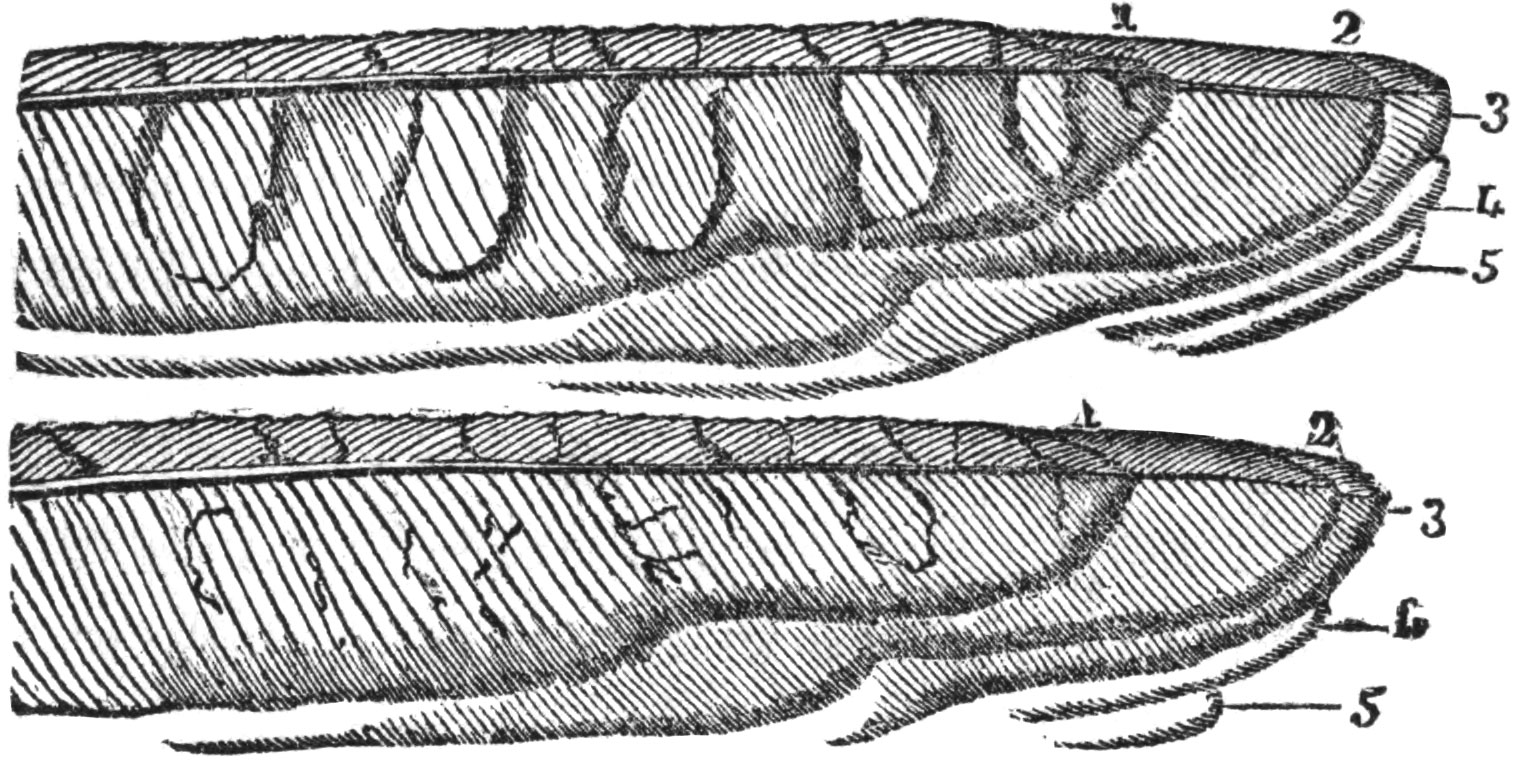
Feathers of the Senegalensis (top) and Europæus (bottom)
The colouring and markings of the species of this group are remarkably alike; there are two from Java and one from Brazil, which in this respect are as similar to S. Europæus as is the present bird.
African Passerine Owl
Scotophilus perlatus, Swain.
Above, rufous brown; head above, thickly covered with round white dots; tail, brownish, with seven pair of white spots, margined with black.
La Clievechette perlée, Le Vaill., Ois. d’Afrique, vi. Pl. 284.—Strix pexlata, Vieil. Ency. Meth. 1290.
This is certainly the most elegant of all the Passerine Owls, and it is no less interesting, as being the only one yet found in Africa representing those of the opposite continent of tropical America.
In the structure of all these small owls there is no essential difference, although inhabiting different continents. They differ materially from all those of the lesser European owls, as Tengmalmi, &c., with which they have been hitherto arranged, in having little or no facial disk; in the smallness of their ears, which are not much larger than in ordinary birds; in the shortness of their wings, and in the length of their nearly even tail. They are excluded from the European province, and all the species we have seen, save this, are peculiar to tropical America. In all these, the wings hardly exceed the length of the tail; the third, fourth, and fifth quills are longest, and nearly of equal length, although the last is sometimes rather shorter, as in this species, than the two preceding; and these three are the only ones with a sinuated outer web, excepting the second, the sudden broadness of which is only at its very base.
The total length of the specimen before us may be taken at eight inches, supposing the head is straightened. The upper plumage is rufous brown, or ferruginous, brightest on the head, and especially between the shoulders. The whole upper part of the head is thickly covered with round white dots, edged with black; and a few of these spots, but larger, are scattered on the back, rump, and shoulder wing-covers; the lesser covers have a short row of much larger white spots, and there is another row on the tips of the greater covers, these latter having also a ferruginous spot in the middle; the spurious wings are without spots. The quills are crossed by six distinct well-defined blackish bars, which above are nearly of the same breadth as the rufous intervals which separate them, but they are much narrower on their under surface, and leave the base of the inner webs entirely ferruginous; this last colour also, but much darker, spreads over the inner wing-covers, the tips of the greater ones only being marked with a terminal tear-shaped spot. The white scapular band is margined above by a row of large white spots, ringed with black. Tail rather lengthened, nearly even, and blackish, each feather having seven pair of transverse white spots, the outer ones small and nearly round; the middle feathers, in some, are inclined to rufous, the white spots margined with a black ring. Ground colour beneath, white, each feather with a rufous stripe, broader and more crowded on the breast. Legs, buff colour, white in front. Ears, face, and chin, white, immaculate, with no band behind the ears. Bill and toes, dirty yellow; the latter with scattered white hairs.
Length of the wings, 4\(\frac{2}{10}\), reaching only to the upper tail-covers; tail, 3\(\frac{1}{2}\); tarsus, \(\frac{9}{10}\).
The Order of Perchers, or Insessores
The remaining portion of this Volume will contain the major part of the different families of the Perchers belonging to Western Africa, commencing with the conic-billed tribe (Conirostres), and proceeding to the tooth-billed groups forming the tribe of Dentirostres.
White-Backed Crow
Corvus leuconotus, Swains.
Glossy purplish black; interscapular collar, and middle of the body, white.
The old ornithologists considered that nearly all those Crows which were about the size of that of Britain were mere varieties of that bird; and so little were they regarded, that they were not deemed to be worth separate descriptions. This error, however, has long been dissipated, and it is now found that a considerable number of distinct races, in different parts of the world, have thus been passed over. Whenever a wide difference of geographic range is accompanied by others of colour, we may generally assume that species having some similarity are nevertheless distinct.
These observations are applicable to the present bird. It has much resemblance to that figured by Le Vaillant under the name of Le Corneille a scapulaire blanc (Ois. d’Af. ii. Pl. 53.), from the southern extremity of this continent; but if it were the same, we can hardly suppose he would have represented the bird as having the black extending no further than the chin, when in this it occupies the whole of the neck and breast. Until, therefore, we have further evidence upon this point, we venture to consider the Senegal bird as distinct. The black part of the plumage is very glossy; and the feathers of the head and throat are pointed. The wings are very long, and reach to the end of the tail; this latter is rounded, having the feathers very broad and mucronate.
The form is strictly typical. Total length, about 18 inches; bill, from the gape, 2\(\frac{2}{10}\); wings, 13\(\frac{1}{2}\); tail, 7; tarsus, 2.

Plate V

Senegal Piapec
Ptilostomus Senegalensis, Swains.
Glossy black, with transverse linear shades on the tertials; quills and tail light brown, the latter with the feathers lanceolate.
Corvus Senegalensis, Auct.—Le Pie du Senegal, Pl. Enl. 538.—Le Piapiac, Ois. d’Af. 54.
It appears that this singular bird supplies the place of our magpie in the more southern latitudes of Africa; and yet, although its size and general shape has some resemblance to that bird, there is no real affinity between them. Our magpie, in fact, is only a sub-genus of Corvus, as is shown by the formation of its bill and nostrils, while this has all the characters belonging to the Glaucopina or wattle-birds. According to the analysis we have made of this sub-family, Ptilostomus is the rasorial genus of the circle, being immediately followed by Crypsirina, which, with the more typical species,9 conducts us at once to the genus Glaucopis. It is really extraordinary that all the modern ornithologists, who have written upon these birds, should have overlooked one of the most important parts of their structure: for in none of their generic characters is the proportionate length of the lateral toes once alluded to; it is the inequality of these toes which indicates that such birds are arboreal, while those, on the contrary, which have these toes equal, and the middle one lengthened, are of ambulating habits; or at least that they frequent the ground more than trees. Crypsirnia, in this respect, is entirely arboreal, the lateral toes being unequal, and the middle ones short; while in Ptilostomus the tarsi are long and robust, the lateral toes equal, and the middle one fully lengthened. In these characters it agrees with all the sub-genera of Corvus, wherein we include the true magpies; but then the whole structure of the bill and nostrils, in our views of the family, decidedly places the present genus, as well as Crypsirina, in a totally different division of it. The only genus of this sub-family (Glaucopinæ) which we have not yet seen, is that which should follow Ptilostomus on the other side of the circle, and constitute the tenuirostral type.
From the circumstance of Le Vaillant having found this species to be migratory in Southern Africa (where it is seen either singly or in small flocks), there can be no doubt that it quits Senegal at certain seasons, along with the grakles herein described, and returns to Western Africa to breed. We infer this latter circumstance from having seen a young specimen from Senegal, before it had quite gained its full wing-feathers; it was much smaller, and the bill was red or flesh-coloured, tipt only with black. We were strongly tempted, at first, to believe this was a distinct species; but after a most careful investigation, we have concluded it to be the young, or immature state of the species now described.
The size is smaller, and the general form more gracile, than in the European magpie: the whole plumage of the body, both above and below, is of a deep sooty black, the feathers very smooth and silky, and with a soft gloss upon them. On the tertials, and some of the secondaries, are close, transverse bands of darkly shaded lines, similar to what are seen on the tail-feathers of Lamprotornis longicanda and some other birds. The primary quills and tail are of a light sepia brown, the former being almost white on their under surface, when held in some directions of light. The tail-feathers, as indicating the type which the genus represents, are much narrowed towards their tips, and the shafts are particularly strong; the sharpness and curvature of its claws shows that the bird, although possessed of an ambulating foot, is yet more accustomed to perch among trees than to walk upon the ground.
Total length, 17\(\frac{1}{2}\); bill, gape, 1\(\frac{7}{10}\); wings, 6\(\frac{1}{2}\); tail beyond, 8; ditto, base, 11; tarsus, 1\(\frac{8}{10}\); middle toe and claw, 1\(\frac{4}{10}\); lateral ditto, 1; hinder ditto, the same.
Red-Billed Hornbill
Buceros erythrorynchus, Temminck.
Above varied with black and white; beneath white; bill red, simple, or without any protuberance.
Buceros erythrorynchus, Temm. Monog. in Pl. Col.—Calao à bec rouge, du Senegal, Pl. Enl. 260.—Le Toc, Le Vaill. Ois. d’Af. v. pl. 238.
The Hornbills, in general, are very large sized birds, having the front of their enormous bills furnished with what appears to be excrescences or protuberances of different sizes and shapes, according to the species. They mostly inhabit tropical India, yet several species occur in Africa, and two or three are mentioned as natives of Senegal; the present, however, is the only one which has yet come before us from that country. This is one of the smallest of the species, and with three or four others, forms a little group, having the bill destitute of those singular appendages which are found on the more typical species. M. Temminck has bestowed so much care and attention in determining the species of this intricate genus, that we adopt his name for the present species; it was long classed by systematists as a variety of their B. nasutus, notwithstanding the authority of Le Vaillant, who long ago pointed out the difference between them.
Total length 17\(\frac{1}{2}\) inches, yet the body of the bird is not larger than that of a magpie; the bill, which is entirely red, is much curved from the base; the culmen is sharply carinated, and the margins of both mandibles destitute of serratures. The upper plumage is variegated with brownish-black and white, something in the following manner: The sides of the head and neck are white, a broad black stripe being upon the top of the crown, which disappears a little below the nape; the back and scapulars are blackish brown, darkest on the rump, and without any other white mark than a central stripe, which extends half way down the back; the wing-covers are white, striped with black; the primaries black, with a band of white spots on the outer edge of five of the longest: some of the secondaries are entirely black; three of these have a white line at their edge, and the three next are wholly white; the tertials are blackish brown, and unspotted; the tail is long and rounded; the four middle feathers entirely black; the rest broadly tipt with white, but the outermost is white with only a small black spot on the outer web; the ears are grey, and the entire under plumage pure white; the feet, according to Le Vaillant, are orange brown. Our specimen may possibly be a young bird, as Le Vaillant says that such are without dentations to the bill; lateral toes unequal, hinder very short.
Total length, 17\(\frac{1}{2}\) inches; bill, in a straight line from the gape, 2\(\frac{8}{10}\); wings, 6\(\frac{3}{4}\); tail beyond, 5\(\frac{3}{4}\); base, 8; tarsus, 1\(\frac{1}{10}\).
Purple-Headed or Scaly Grakle
Lamprotornis ptilonorhynchus, Swains.
Above, glossy metallic green; head, tail, and plumage beneath, simple blue; frontal feathers advancing and compressed forwards on the bill; shoulder and tail-covers scale-like, and greenish blue.
Le couigniop, Le Vaill., Ois. d’Afrique, ii. Pl. 90, p, 163.—Turdus nitens? Auctorum.
There exists in the hot parts of Africa a small family of birds, having the size and shape of thrushes and the habits of starlings, but whose plumage, totally unlike any others, is of the richest metallic green and purple which it is possible to conceive. M. Le Vaillant has given us an account of those species inhabiting the interior of Southern Africa, and we can now add two others, apparently new, from the Western region. From the general similarity in the changeable plumage of these birds, and from our best systematic writers having overlooked their true distinctions, great confusion exists among the species in their catalogues. Some of these errors we hope to clear up, the determining those which will be now described.
The species now under consideration is one of the most splendid of these Grakles. Immense flocks of them arrive at certain periods on the lower lands of the great Namaqua country; but they stay only a short time, and finally return to the warmer and more fruitful plains of Senegal, where, as Le Vaillant with much reason conjectures, they probably breed.
It is clear that this, in fact, is the Couigniop of the Ois. d’Afrique; but it is very questionable whether it is the Merula viridis Angolensis of Brisson, from which Linnæus made his Turdus nitens. Brisson, who was always remarkably exact, and whose descriptions moreover are original, says nothing of the peculiar frontal feathers, or of the black spots on the wings. In the short notice given by Dr. Leach of his Turdus splendens, he is equally silent on the first of these characters, but lays stress upon the second, that is, the black wing-spots; not aware that no less than four species of these shining Grakles are thus marked. As it is quite impossible to determine any thing from such descriptions, we must leave them as they stand, contenting ourselves with pointing out those characters by which the species before us is truly distinguished, and which are condensed in the foregoing specific character.
The size is that of the missel thrush, and the length almost ten inches. The whole plumage is rich and glossy; varying somewhat in its shades, but still retaining the following decisive colours. The whole of the head, neck, breast, and under parts, from the chin to the tail-covers, are of a decided deep blue, tinged with purple or lake, particularly on the head, thighs, and under tail-covers, but without any green gloss. The blue of the head softens off on the nape, and more on the neck, to a rich yellowish metallic green, which spreads over the whole of the back of the wings; on the rump, this green becomes strongly tinged with blue, which finally has a purple tinge. The shoulder-covers are green-blue, precisely similar to the back of the neck and the rump; this colour is defined at its outer margin, and does not blend into the green of the rest of the wings; the feathers also, like those of the tail-covers, are scale-like, with well-defined margins. The tail is short, quite even, and coloured like the head, the lilac reflections being strongest on the middle pair of feathers; there is a row of black velvety dots at the tips of the lesser covers, one on each feather, and the same on the greater covers; these spots, in certain lights, seem encircled with a narrow blue ring; under wing-covers, purple.
In regard to structure, the frontal feathers of this most splendid bird differ from all others of its genus we have hitherto seen; they are very thickset and short, and fold over, as it were, the base of the bill, like those of the genus Ptilonorychus. The wings reach to within three-quarters of an inch of the tail, and this latter is quite even.
Total length, about 10 inches; bill, from the gape, 1\(\frac{5}{10}\); ditto, from the front, \(\frac{7}{10}\); wings, 6; tail, beyond, \(\frac{8}{10}\); ditto, from the base 2\(\frac{1}{2}\); tarsus, 1\(\frac{4}{10}\); hind toe and claw, nearly 1.
Golden-Eared Grakle
Lamprotornis chrysonotis.—Swains.
Above, glossy green; beneath, purple; middle of the belly and spot on the ear, golden; lesser quills and tail with a broad velvet-like black band.
No description or delineation can give an adequate idea of the splendid metallic richness of the varied plumage of this magnificent and very rare species, which moreover appears to be entirely new to science. Two specimens came over from Western Africa, the first of which was secured for the use of this work. Our figure will in some degree assist us in the following description.
The size is as nearly as possible equal to that of Lamprotornis ptilonorynchus, but as the tail, which extends three inches beyond the wings, is much longer, the bird appears larger: the bill is rather smaller, and the frontal feathers are not more advanced than in the generality of the other species. The ground colour of the upper parts, from the front to the tail-covers, including the wings, is rich metallic yellowish-green, similar to L. ptilonorynchus; but on the lower part of the back, and on the shoulder-covers, there is a strong tinge of blue, glossed with purple. The shoulder-covers, however, are not scale-like, and their colour Mends into the green of the wings. At the top of each of the lesser and greater covers is a large spot of deep velvet-black, which thus forms two bands. Across the middle of the lesser and tertial quills is a broad uninterrupted bar of the same deep black, dividing these quills, as it were, into two parts, that nearest the base being entirely green, while the other is tinged with rich purple: the greater quills are without any band. The base of the tail, in like manner, is crossed for about two-thirds its breadth with a similar band, which is glossed with purple on the lateral feathers, leaving the terminal portion green. The tail-covers are unusually long, extending on the tail more than one inch and a quarter beyond the tip of the wings, another character which distinguishes it from its congeners. Between the bill and the eye is a stripe of velvet black. The feathers on the ears and sides of the head are very small and scale-like, and of a rich purple, but they terminate in a shining spot of a golden copper colour. The under plumage is very different from the upper, for it has no green reflections: the prevalent hue is of the darkest and most beautiful purple-lilac from the chin to the vent, except in the middle of the body, which is strongly glossed, in all lights, with yellowish copper; not so bright, however, as the spot on the ears: the under tail-covers alone are green: the tail is rounded. Independent of the above distinctions, there is a remarkable peculiarity in the four longest quills of this bird, each of which, near the tip, has a projecting toothshaped emargination on the inner web, as seen in the annexed cut.

Feathers of Golden-Eared Grakle
Length of bill, from the gape, 1\(\frac{2}{10}\); wings, 5\(\frac{1}{2}\) tail beyond, 4; ditto from the base, 4\(\frac{3}{4}\); tarsus, 1.
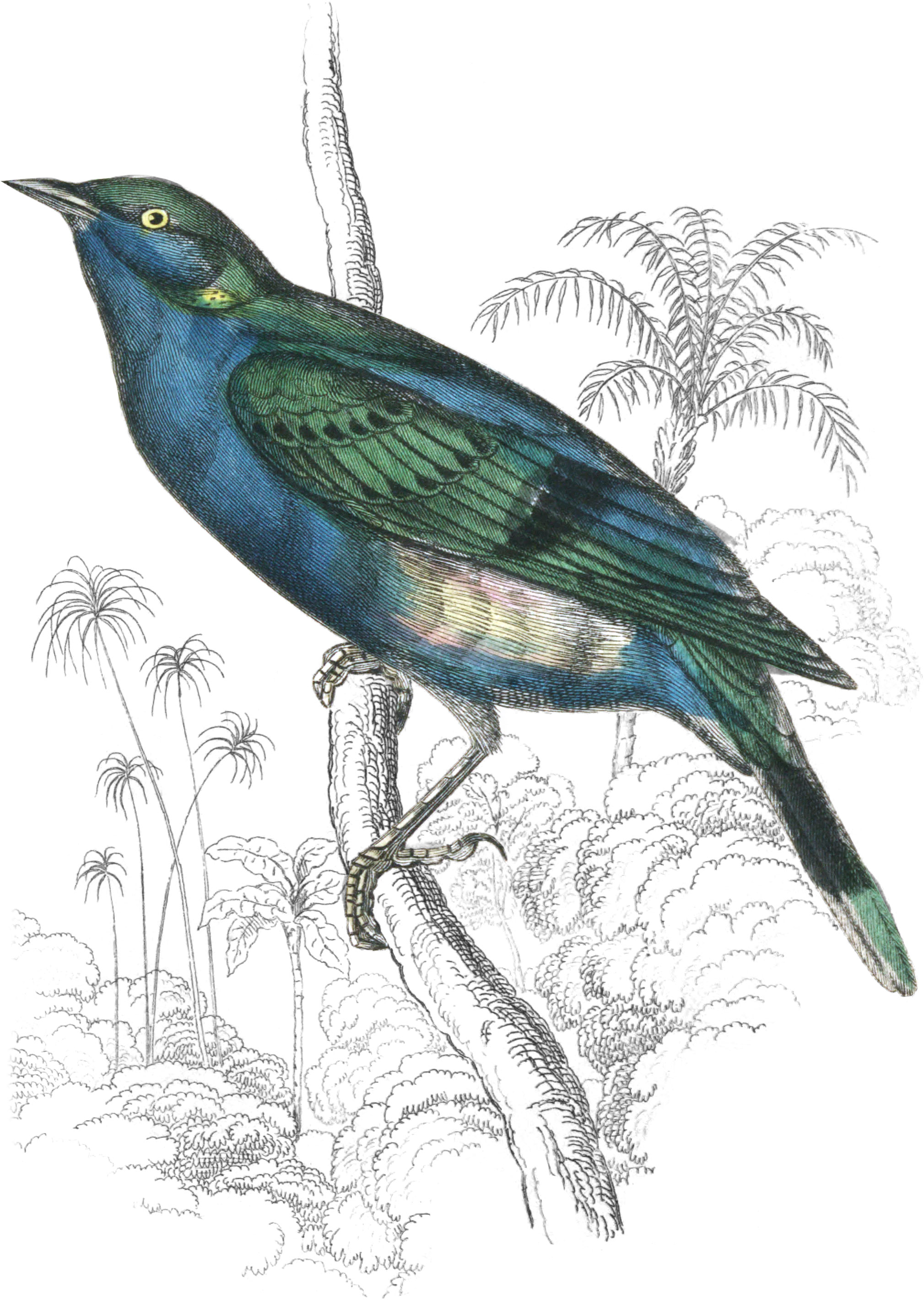
Plate VI
Blue-Eared Grakle
Lamprotornis cyanotis, Swains.
Metallic sea-green; ears and sides of the neck, blue; belly and base of the tail-feathers, violet-purple; lesser and greater wing-covers with a black spot on each; tail short, even.
Although less brilliant in its plumage than either of the two preceding, this is nevertheless a very splendid species, readily distinguished from those just described by having the under plumage nearly of the same colour as the upper, and in being much smaller in size. If we may hazard a conjecture where any thing like proof cannot be adduced, we should say that this is more akin to the Merula viridis Angolmus of Brisson than any other we have yet seen; because it is almost entirely green, and the sizes are nearly the same; yet there are still many discrepancies, among the most material of which is the spots on the wings, to which Brisson makes no allusion.
When held from the light, the spectator being between, the upper plumage is entirely shining green, which only assumes a blue tinge on the rump, upper tail-covers, and shoulder-covers. The same green hue extends from the chin to the middle of the body, where it gradually changes to a brilliant purple blue, glossed with lake or flame colour. The ear-feathers are the same, and their blue colour tinges the sides of the neck. The underwing-covers and the tail, particularly the base, is of the same rich purple as the belly; the lesser and greater wing-covers have each a black spot, which in some lights seems to have a bright blue one in the middle; bill and feet black. The spots on the wing-covers are not seen in immature specimens. The wings reach to half the length of the tail, which is short and quite even. We have been told this species has been named chalyleus in some continental work, but we have no means of ascertaining the point; and the name, being alike applicable to the whole genus, is peculiarly objectionable.
Long-Tailed Grakle
Lamprotornis longicanda.—Swains.
Metallic green head, glossed with violet-brown; tail very long, graduated, glossed with purple, and banded with numerous dark lines.
Le Vert-doré, Le Vaill., Ois. d’Afrique, ii. Pl. 87, p. 146. Pl. Enl. 220.—Merula longicanda, Brisson Orn. ii. p. 313.—Turdus æneus, Gmelin, Auctorum.
In a group of birds so difficult to determine as the present, it becomes more particularly desirable that the name of each should not only be appropriate, but characteristic of that particular quality or circumstance which distinguishes each species. All are splendid, shining, and coppery; and, therefore, such names as splendens, nitens, æneus, chalybeus, &c. being applicable to all, become, in fact, of no use as specific distinctions. With all our desire to preserve standard names, we really think it will be advantageous to science that future ornithologists, who may have the power of determining what the two first of these species really are, should impose upon them more appropriate names than those they now bear in our systems. In regard to the third, the Turdus æneus of Linnæus, the prior denomination given to it so justly by Brisson, who was its first describer, supercedes any apology for abandoning a name which has neither priority nor peculiar fitness to recommend it.
This is a most striking and splendid bird, not so much in the variety of colours on the body plumage, as for its long fan-shaped tail, a character which prevents it from being confounded with any of those here described, or mentioned by other writers. Like some others of its congeners, it seems to make annual migrations from Western Africa to those regions lying towards the Cape of Good Hope.
The form is decidedly rasorial, not only in the tail, but in the wings and legs. The former is rounded, having the first quill half as long as the second, and the third shorter than the fourth, while the tarsus is longer in proportion than in any of the birds already described. The tail is considerably graduated; there is the difference of an inch, more or less, between the length of the three outer feathers, while the middle pair exceeds the others by more than three inches and a half.
The colour, with the exception of the head, which is brown, glossed with yellowish copper colour, is shining blueish-green, which becomes purple on the lower part of the back and rump, and also on the body, belly, and vent beneath. There is a large black velvet spot on the greater and lesser wing-covers; these, however, are not seen in the young bird, which has also the head more violet than coppery. The most splendid hues are upon the tail; the ground colour being rich purple, blue glossed with lilac and purple, and reflecting numerous close transverse dark bars, which, are only seen when the tail is held to the light. The size of the body is not much bigger than that of L. ptilonorynchus, but the length of the tail makes the bird seem much larger.
Total length, about 20 inches; bill, from the gape, 1\(\frac{1}{4}\); wings, 8; tail beyond, 9\(\frac{1}{2}\); from the base, 4; tarsus, 1\(\frac{6}{10}\); hind toe and claw, 1.
From the peculiar flatness of the feathers of the tail, we suspect that in the lire bird it assumes a boat-shaped appearance. We do not, however, for the present, venture to give this type a distinct sub-generic name.

Plate VII
Chestnut-Bodied Grakle
Lamprotomis rufiventris, Rüppell.
Head, neck, breast, and plumage (above), metallic-green; body (beneath), thighs, and under tail-covers, rufous; greater quills, fulvous-white on their inner web.
A specimen of this Grakle has long been in our museum, but we were not aware of its being a native of Western Africa, no less than of Abyssinia, until assured that such was the fact by Dr. Rüppell. On this authority we shall insert it in our present Work, particularly since it seems to have been hitherto overlooked by systematic writers. Upon its natural habits we can say nothing.
In its general size, the Chestnut-bodied Grakle is rather smaller than L. cyanotis, but the wings are very much shorter in proportion. The upper plumage, although glossed with coppery-green, is yet so destitute of richness that it seems, in some lights, to be more brown than otherwise, particularly on the head and ears, where there is only a slight purplish gloss; there are no black spots on the wing-covers, but upon these, the tertials and the tail, are dark transverse reflections resembling stripes. The wings are short, and do not reach further than the upper tail-covers. The under parts, from the chin to the breast, are coloured like the upper; but beyond the breast, all the plumage is of a deep uniform rufous; the under wing-covers and the thighs are also rufous. That portion of the primary quill-feathers which is concealed when the wing is closed, is of a delicate fawn or isabella colour; bill and feet, black; tail, short, slightly rounded. Total length, about 8 inches; bill, from the gape, 1; from the nostrils, \(\frac{6}{10}\); wings, 4\(\frac{3}{10}\); tail, beyond, 1\(\frac{1}{2}\); from the base, 3; tarsus, 1\(\frac{2}{10}\).
White-Bodied Grakle
Lamprotornis leucogaster.—Swains.
Male—violet, with purple reflections; the feathers of the body scale-like; body, beneath, pure white.
Female—above, dark-brown, the feathers with rufous edges; breast and body, beneath, white, with an oblong spot or stripe on each feather.
Merle de Juida, Buffon. Pl. Enl. 648. f. 1.—Turdus leucogaster, Gmelin, i. 819.—Whidah thrush, various authors.
This is the least, and may be almost pronounced the most lovely species of this group; for although it has not such a gorgeous display of many colours as some of its companions, the inimitable richness and variability of the scale-like feathers of the body, renders it quite a gem among birds. The colour of these feathers are metallic, and all the same; but with this difference, that in some lights they appear of the richest purple, and in others of the deepest lilac, so as to appear almost red. Our modern systematists have left this bird under the old genus Turdus, probably from not having seen it; and no author that we are aware of has described the female, which from its great dissimilarity of plumage might well be taken for a different species. We can vouch however for the fact, that the difference is only sexual, having received both as male and female; and having seen a young male in its first plumage (which is always like the mother’s), but having already assumed some of the more brilliant plumes of its manhood.
The form is altogether typical of the genus, and exactly the same as that of the preceding species, but the inner web of the quills has no indented sinuosity; the tail is very short and quite even.
The male has the whole of the head, neck, breast, back, middle tail-feathers, and the greatest part of the wings, of a rich soft satiny appearance,—of the deepest and richest blue, glossed with purple when held from the light, but which changes to a fire-coloured red, resembling lake, when the bird is held between the light and the spectator. This colour, upon the lesser quills and the lateral tail-feathers, only covers those parts which are exposed; the rest, and the whole of the primary quills, are black. From the breast to the under tail-covers, the plumage is of a snowy whiteness.
The female is totally different. The upper plumage is varied, with light ferruginous on a brownish-black ground; each of the body-feathers, above, being brown with only the side margins ferruginous. The wing-covers, scapulars, and tertials have each a narrow margin all round; but there is none on the other quills or on the tail. The under plumage to the breast is rufous-white, with a narrow stripe down each feather; the breast and the remaining parts pure white, with similar stripes but larger and longer; base of the quills, beneath, pure ferruginous; under tail-covers, white; bill and legs, brown.
Total length, 6 inches; bill, from the gape, \(\frac{6}{10}\); wings, 3\(\frac{3}{4}\); tail, beyond, \(\frac{1}{4}\); from the base, 2\(\frac{1}{2}\); tarsus, \(\frac{7}{10}\).

Plate VIII
From the starling family we pass on to that of the
Fringillidæ, or Finches
The most extensive of the conic billed order, and one that every observer may understand, when he looks to the sparrow, chaffinch, greenfinch, or any of those small thick-billed birds which feed on seeds and kernels. It is one of the beauties of the natural arrangement, that it keeps together large families of similar habits, size, and often of country; so that by seeing two or three, we can form a tolerably correct idea of the whole.
The first bird upon our list is no less remarkable for its rarity than for the interest which attaches to its station in this family. We shall first describe it, and then employ it to explain in a familiar manner our views on the natural arrangement of the group to which it more especially belongs; a group which, from not having been well understood, is at this moment involved in the greatest confusion. This digression will also give a practical illustration of those principles upon which, as we conceive, all the groups of nature are diversified. The bird before us is the most pre-eminent type we have yet seen of this family, and we shall therefore distinguish it as a new sub-genus, under the name of
Crimson Nut-Cracker
Perenestes sanguineus.—Swains.
Head, neck, breast, and upper tail-feathers, glossy crimson; body, wings, and tail, dark brown.
Loxia ostrina, Vieillot, Ois. Chant. Pl. 48.
It may safely be affirmed that this extraordinary bird has the thickest [and most massive bill in the feathered creation. Both mandibles, indeed, are of an enormous size; but contrary to what we find in the generality of birds, the under one is even still more powerful than the upper. What are the nuts or seeds, the breaking of which requires such an amazing strength of bill, is perfectly unknown; but they must be of a stone-like hardness. This is proved by another circumstance, which further shews that, however uncommon, this amazing developement is not in the least degree superfluous. In the two specimens we have examined, one in the Paris museum, the other in our own, the edges of the upper mandible are chipped and broken, obviously from the difficulty which the bird has experienced in breaking some nuts of unusual hardness, and which it has not been able to accomplish without injuring the bill. The sharp tooth at the base of the upper mandible is, no doubt, highly useful in this operation, probably performing the office of a canine tooth by making a first indentation in the nut, whereby to procure a hold upon it; the injuries to the bill are also more conspicuous close to this tooth than further towards the tip.
The form of this bird constitutes its sub-generic character. The bill resembles a perfect cone, the sides of which are quite straight, and in nowise curved outwards. The upper mandible does not project at its tip beyond the under; it is quite entire, excepting a short and rather acute tooth-like process close to its base, while the commissure or line formed by the joining of the two mandibles is nearly straight; the nostrils are vertical, pierced behind the substance of the bill, but completely covered with the frontal feathers, thus very much resembling those of the toucans. The wings are rather short and much rounded; the first quill is short, narrow, and spurious, about six-tenths of an inch in length; the second is half an inch shorter than the third, and this latter is equally long with the fourth and fifth. The feet, without being robust, are large and slender; the middle toe very long, and exceeds, with its claw, the length of the tarsus; the hind-claw is as long as its toe, as in many of the scansorial birds, and only falls short of the tarsus by about the tenth of an inch. The tail is broad and much rounded.
The colouring of the plumage is rich and yet simple. The feathers of the whole head, neck, breast, upper tail-covers, and half way down the flanks, are of a bright crimson, and appear glossy, as if polished, but without any coloured reflections. The tail is of a dull red, but the inner half of the lateral feathers are black; the quills are nearly so. All the rest of the plumage is a deep uniform sepia brown. Bill, deep black; legs, brown; claws, long, slender, and but little curved.
Total length, 5\(\frac{3}{4}\) inches; bill from the gap, \(\frac{6}{10}\); wings, 2\(\frac{8}{10}\); tail beyond, 1\(\frac{1}{2}\); from the base, 2\(\frac{1}{2}\); tarsus, \(\frac{3}{4}\).

Plate IX

Beak Shapes
If, as naturalists conceive, the typical character of the finches is in the strength and conic form of the bill, then the bird before us, possessing both in the most eminent degree of perfection (fig. 1), must stand at the head of the entire family. And this is the view we have taken of its station, resulting from the analysis of that division of the finches to which it unquestionably belongs. Of all the forms in other countries we yet know of, it comes nearest to the South American hard-bills, forming the sub-genus Coccoborus; while, on the other hand, there can be no question, we think, of its close relationship to the sub-genus Dertroides: from this we pass to Spermophago, from which nature seems to return again to her first or most pre-eminent type, by means of the haw-finches of temperate climates (Coccothraustes) and the hard-bills of South America, Coccoborus. It is among these latter birds, indeed, that we have the nearest approach to that now before us. The gradual developement and diminution of the strength and form of the bill in this circular group will he made intelligible by the following outlines of the bills of the sub-genera which compose the circle.
It is obvious that those bills are the strongest whose mandibles are of equal thickness and of unusual shortness; we consequently find that it is the pre-eminent distinction of the two typical genera, Pyrenestes, fig. 1, and Coccolorus, fig. 2; all the others having the bill either more lengthened, or the under mandible much weaker than the upper. But this change is nevertheless gradual. Pyrenestes, fig. 1, for instance, has the most conic bill of all, for it has no notch at the tip. Then comes Dertroides, fig. 5, putting on the appearance of a hornbill or a buceros, not only on the knobbed front, but in the situation of the nostrils; its bill is something like the last, but it is less conic and more lengthened. From this form we pass to Spermophaga, fig. 4, where the bill has less of the conic form than any of those now represented; its shape, in fact, is intermediate between that of Dertroides and Coccothraustes to which it leads. Coccothraustes, again, fig. 3, has a remarkably strong upper, but comparatively a weak under mandible, and the commissure is regularly and gradually arched from the base. Some of the species, however, of Coccoborus have the under mandible rather the smallest, so that by these birds, a passage is formed from one to the other. Coccoborus is nevertheless very different; for in the greater part of the species the two mandibles are perfectly equal, fig. 2, and the margins, instead of being curved, are sinuated; the upper one, moreover, has a very small but obvious tooth, which none of the other genera possess. Now, to unite this genus (which is strictly confined to the warm parts of America) with that of Pyrenestes, there should be a species with an unusually large bill, yet furnished with a notch; such a bird would obviously unite in itself the characters of both genera, and such a bird we accordingly have in the Loxia Angolensis of Linnæus, erroneously supposed to inhabit Africa, but which we ourselves shot in the forests of America. We have chosen to illustrate this progression by the form of the bill only, because this organ is the most obvious to the generality of students, and will admit of more accurate delineation; but this chain of connexion is equally apparent in the variation of the wings and feet. We have thus presumptive evidence of a circular group. Let us now see whether this group is natural; that is, whether it will bear the test of comparison with the orders of birds and the tribes of the Insessores. The usual mode we have always adopted for this purpose is to place the genera in a column which corresponds to those which contain the groups represented, thus:—
Sub-Family Coccothraustinæ
- Typical
- Pyrenestes…The most perfectly conic bills…Conirostres.
- Sub-typical
- Coccoborus…Bill notched at the tip…Dentirostres.
- Aberrant
- Coccothraustes…Wings long, tail forked, feet very short…Fissirostres.
- Spermophaga…Bill most lengthened…Tenuirostres.
- Dertroides…Wings short, feet large, very strong, upper mandible curved above…Scansores.
Each of these columns are circles; because Pyrenestes passes into Dertroides, just as the tribe of Conirostres passes into that of Scansores. Thus we find that the chief distinctions of each of the tribes of the perchers turn out to be the same as those of the group of Finches before us; that is, they possess the same characters in addition to others which constitute them Finches. It is only upon these principles, in fact, that we can account for the glossy plumage, for instance, of the haw-finches; their very short feet,—their broad, although conic bills,—their pointed wings,—their forked tail,—and their migratory habits; all which, as every one knows, are also the characteristics of the swallow family, and of all Fissirostral birds. Those, on the other hand, which represent the Tenuirostres have the longest bills; and those, again, which typify the gallinaceous tribe, have the strongest feet and the shortest wings. All the species of Coccoborus, however diversified in other respects, have a distinct notch (although small, and the tip not hooked, as in the tanagers) in the upper mandible; and this, we all know, is the great distinction which separates the Dentirostres from the Conirostres. Numerous other analogies might be here pointed out, strengthening the accuracy of the above arrangement; but it is quite needless to proceed further. The clue being now given, the experienced ornithologist will be at no loss in following it up; while the student will thus have an example he can comprehend, of that systematic order of variation in all animals which, the discoveries of every year more and more demonstrate as the fundamental principle of the great plan of creation. We now proceed to the genus Dertroides, the rasorial type of the hard-bills; it contains at present but one known species, which is likewise of extreme rarity.
White-Billed Nut-Cracker
Dertroides albirostris, Swains.
Entirely black; bill, whitish; flank-feathers with a few white stripes.
Tector alecto, Temm., Pl. Col. Pl. 446.
This is the largest finch hitherto discovered, being frilly as long as a starling, although not so hulky in the body. The whole plumage is entirely deep lamp-black; the feathers of the body, under the wings, being partly white. The bill is whitish, particularly hard, and advancing much on the front of the head, where it is swollen and elevated. The wings are short and round, reaching only to the base of the tail; the latter being rather lengthened and much rounded. The first quill is somewhat Spurious, being only half as long as the second; this, again, is nearly equal to the third, fourth, fifth, and sixth, which are the longest; in all this we find a passage between this and the next sub-family of Ploceanæ, or the weavers. The feet are large and strong, with the lateral and the hind-toes equal; thus preserving the analogy of the genus both to the Scansores and Rasores.
Total length, 10 inches; bill, from the gape, \(\frac{8}{10}\); wings, 5; tail beyond, 3; from the base, 4\(\frac{1}{2}\); arsus, 1; hind-toe and claw, in a straight line, \(\frac{8}{10}\).
Following this type, we place another exceedingly rare bird from Senegal, both sexes of which we shall now describe; we consider it, for the present, as the most aberrant of the hard-bills, and therefore as belonging to the Tenuirostral form; although other species doubtless exist, which will be found more characteristic of this particular type; it seems however, intermediate between the last form and Coccothraustes.
Blue-Billed Nut-Cracker
Spermophaga cyanorynchus, Swains.
Blackish or cinereous; throat, breast, and flanks, crimson; bill, blue tipt with orange; female, with white spots on the belly.
Loxia hæmatina, Vieillot, Ois. Chant. Pl. 67.—Loxia guttata, ib. 68.
Although the two birds we shall now describe under the above name have been considered different species, we strongly suspect they will turn out to be sexes of only one. Their size and proportions are precisely the same, while the very remarkable colour of the bill, exactly alike in both, still further strengthens this belief. It is also one of the most natural characters of Tenuirostral types that the sexes vary; witness the whole family of humming-birds, and that of the fruit-eaters (Ampelidæ), and we may therefore expect to find the same in the Tenuirostral genus of the hard-bills.
The form of the wings and bill differ from all in this group. The former are very short, and more rounded than in Dertroides. The first quill is not spurious, but formed like the second, which is only half as long again; the third quill resembles the second of Dertroides, that is to say, it is slightly shorter than the fourth, which is nearly as long as any of the others; the tertials are not lengthened; the end of the wings reach only to the base of the tail, which is rounded, having the feathers broad and soft. The feet are much like those of Dertroides, but the inner toe is shorter than the outer; while the nostrils are behind the basal edge of the bill, and hid by the frontal feathers. The bill is lengthened-conic; the culmen slightly curved, although the gonys is straight; the upper mandible is thickest, and the commissure sinuated, as in Dertroides and the ordinary weavers (Ploceus).
The colouring is simple,—that of the bill is very peculiar in some lights; at a distance it appears almost black; when viewed more closely, however, it becomes of the darkest indigo-blue, but with reflections of a much lighter colour, nearly resembling ultramarine, the tips being rich orange. If that which we conjecture be the male sex, the upper parts are deep and uniform black, and so also is the body and belly beneath; the chin, throat, breast and flanks, are rich glossy scarlet. In the other bird, the parts which we have just described as black are of a dark cinereous; the crimson is not quite so bright or so full, and it tinges the front, ears, side of the neck, and the upper tail-covers. The middle of the body is thickly spotted with small round white spots, chiefly upon a black ground; these spots are thickest on the sides, and obscure on the belly; feet in both, blackish.
Size of the chaffinch; total length about 5\(\frac{1}{2}\) bill, from the gape, \(\frac{11}{20}\); wings, 2\(\frac{3}{4}\); tail beyond 1\(\frac{3}{4}\); from the base, 2\(\frac{1}{4}\); tarsus, \(\frac{9}{10}\).
Rufous-Necked Weaver
Ploceus textor, Cuvier.
Orange-yellow, varied above with black; head, chin, and front of the throat black; nape with a chestnut band.
Le Cap-noir, Buffon, Sen. 19. p. 165.; Pl. Enl. 373 580. fig. mal.—Oriolus textor, Aud.—Ploceus textor, Cuv. Reg. An.—Ploceus textor, Zool. Illust. 2d series, pl. 37.
In this species the undulation of the commissure of the bill in this and all the insectivorous Weavers (for most of these birds feed upon beetles as well as seeds), seems analogous to the festoon in the bills of the hawks, and facilitates both the breaking of seeds and the crushing of hard beetles. The aberrant type of Symplectes has nothing of this structure, which, with the greater weakness and compression of the bill, indicates a different sort of food. In Ploceus the spurious quill is always developed, although the two next are the longest. The present species, in short, shows the typical form in every respect; the claws are broad and much curved, and the lateral toes equal. It appears common in Senegal, but we have not seen the female.
Total length about 6\(\frac{1}{4}\) inches; bill from the gape, \(\frac{7}{10}\); wings, 3\(\frac{4}{10}\); tail beyond the wings, \(\frac{6}{10}\); from the base, 2\(\frac{3}{10}\); tarsus, \(\frac{9}{10}\).
Round-Winged Weaver
Ploceus brachypterus.—Swains.
Above olive; beneath yellow; head and neck fulvous orange; eye-stripe, chin, and throat black; wings rounded, the fourth quill longest.
We can find no figure by which this Weaver can be identified with any species yet described. It comes very near to the Malimbus nigricollis of Vieillot (Ois. Chant. pl. 45), but is entirely destitute of the black collar on the hinder part of the neck, possessed by that bird. And such is the confusion that pervades the whole of the finches, even in the best systems of the present day, that without a species is positively figured, it is utterly impossible to identify it, or even to know its modern genus.
This species, we must therefore consider not only as new, but as highly interesting, inasmuch as it is an aberrant example of the genus, uniting the characters of Ploceus and Symplectes. If we considered duly the structure of the wings, which are rounded, and the inequality of the lateral toes, we should place it with Symplectes; but then the strong cylindrical and thick bill, in nowise compressed, and the inflection of its margins which are also very slightly sinuated, accord with Ploceus, and shows that the nature of its food is more in unison with the latter than with the former of these divisions. The first or spurious quill, also, is not nearly so much developed as in Symplectes, for it is little more than one-third the length of the second; this latter, and the third, are graduated, so that the fourth becomes the longest; the tail is slightly rounded, and the inner toe rather shorter than the outer.
We fortunately possess both the sexes. In the male the whole of the head, ears, and sides of the neck, are of a deep yellowish huff, or dull orange; the chin and front of the neck being covered by a black patch; the breast is deep yellow verging to buff; the remaining under parts paler, but of a clear yellow. In both sexes there is a black stripe through the eye, beginning at the nostrils and ending above the ears; the upper plumage, from the nape to the tail, is yellow-olive; the wings and tail being internally light brown. The female differs in having the head of the same colour as the back, the under parts entirely yellow, and the ears only tinged with buff; bill black; legs pale.
It may here be remarked that the genus Malimbus of Vieillot belongs to that of Ploceus, as it now stands; we even suspect it is the true typical form.
Total length 6\(\frac{1}{2}\); bill, \(\frac{7}{10}\); wings, 3\(\frac{1}{10}\); tail beyond, 1\(\frac{3}{10}\); tarsus, \(\frac{7}{10}\).
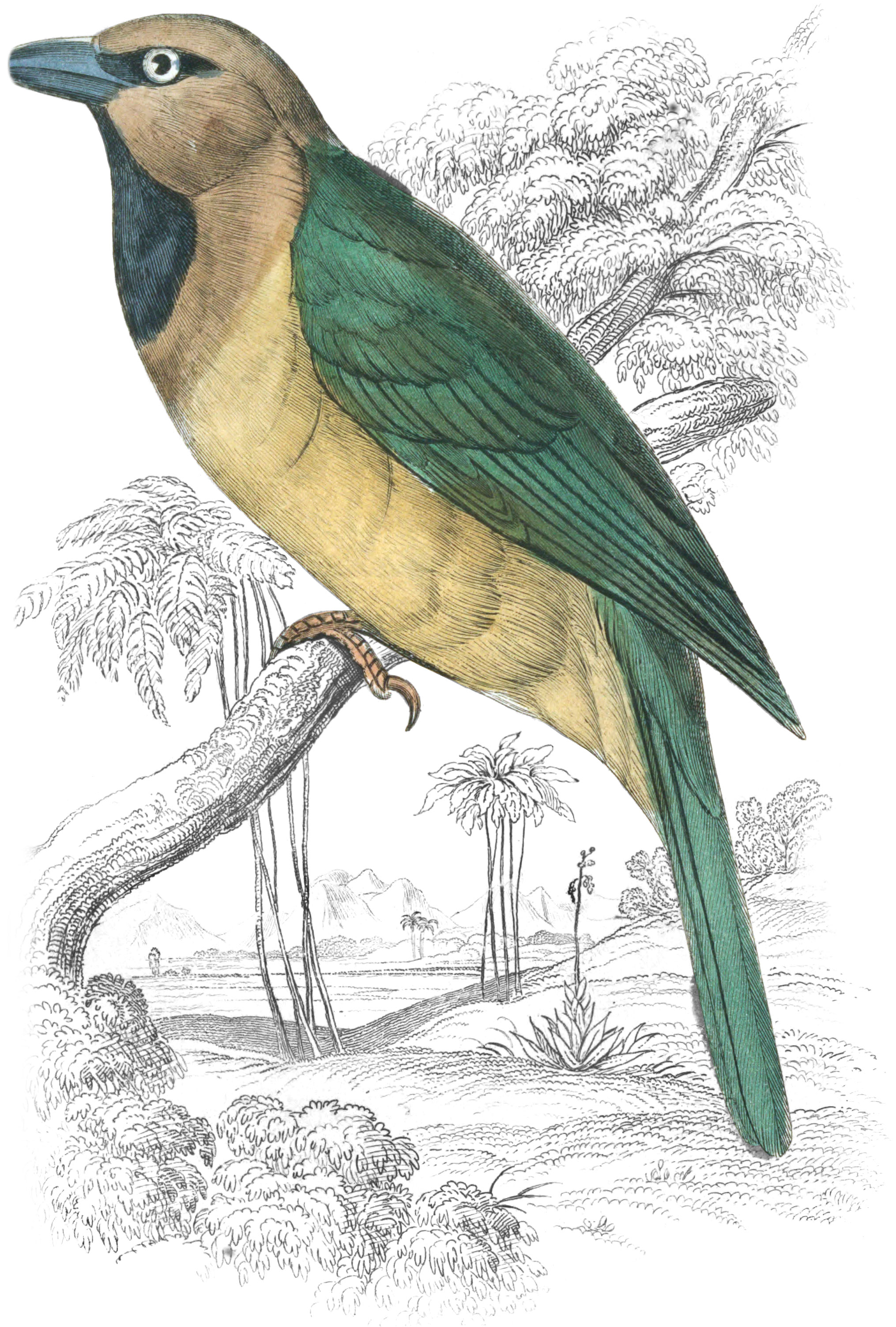
Plate X
Yellow-Bodied Weaver
Symplectes chrysomus,10 Swains.
Above dark brown; beneath bright yellow; chin whitish; bill and legs pale.
There are certain characters in this Weaver, which separates it so much from any of its congeners, that we cannot, for the present, associate it with any of the genera contained in the circle. These characters, which we shall shortly state, certainly show a great departure from those which belong more or less to the others; yet as its whole appearance is that of a Ploceus we place it as the aberrant type, believing that its natural station is between Ploceus and Estrelda.
In its whole appearance, as regards the size, colour, and the stoutness of the feet, the breadth and great curvature of the claws, and the shortness and evenness of the tail, our bird shews an unquestionable affinity to the large race of Weavers, forming the restricted genus Ploceus. This point being admitted, we get the doable affinities of Ploceus; for that genus is so intimately connected with Euplectes, that every link in the chain of connexion is filled up, and more than one Ploceus evinces a tendency to the structure of our present subject; distinguished, nevertheless, from all others by having the spurious quill half as long as the second, which, with the third, is graduated; so that the fourth and fifth quills are longest; the bill, moreover, is considerably compressed and its commissure in no wise sinuated; lastly, the inner toe is shorter than the outer one. These characters are all of a positive nature, and with the above considerations, leads to the belief that this is the aberrant type of the circle of the Weavers.
The yellow-bodied Weaver is as long, though not so thick as our Hawfinch. A full dark brown spreads over all the upper plumage, including the wings, tail, sides of the head, ears, and neck; the chin is dirty white, tinged with pale yellow, and mottled with brown; from this to the under tail-covers, the colour is a rich and full yellow, like that of the Orioles, rather deeper on the breast, and somewhat paler at the vent: the extreme edges of the quills are whitish.
The true relations of this rare bird perplexed us for near twelve years. We then had a specimen sent from Southern Africa, and now another has come from Senegal. Future discoveries will no doubt establish its union with the sub-genus Estrelda, between which at present we know of no positive link. The bill and feet are pale.
Total length, 6\(\frac{1}{4}\); bill from the gape, \(\frac{8}{10}\); wings, 3\(\frac{2}{10}\); tarsus \(\frac{8}{10}\); hind-toe and claw, \(\frac{7}{10}\); tail, beyond the wings, 1\(\frac{7}{10}\); from the base, 2\(\frac{1}{2}\).
Broad-Shafted Widah-Finch
Vidua paradisea.—Cuvier.
Black; body beneath, fulvous; nape, sides of the throat and breast, rufous-orange; two middle tail-feathers (in the male), short, broad, and spatulate, terminating in long filaments.
Emberiza paradisea, Linn. Auctorum.—Grande Veuve d’Angola, Planch. Enl. 194; Edwards, 86.—Whidah Buntling of authors, Gen. Zool. 418.
Of all the genera composing the family of Weavers, this is the most striking. It is composed of very small birds, mostly not larger than canaries. The males, during the breeding season, are decorated with exceedingly long tail-feathers, often four times the length of the bird itself, and which, however ornamental, must, from their disproportionate size, rather impede the action of flight. Little or nothing is known of the habits and manners of the Whidah Finches in a state of nature, but they have always been among the most favourite cage-birds; and although not very frequent in the houses and aviaries of this country, they are common in those of France and other parts of the continent. Numbers of these, and of the other pretty little Finches of the same country, are imported into France by the Senegal traders, and sold to the marchants des oiseaux of Paris. We were, indeed, not a little surprised, during a residence in that city, to find between a hundred and fifty and two hundred of these inhabitants of the torrid zone flying and sporting about in a small dark dirty room, transformed into a sort of aviary, in one of the meanest houses on the Quay Voltaire, two rooms only of which were tenanted by a marchand des oiseau—his birds living in one, and himself and family in the other. We have even been assured that these ingenious people, who are really practical ornithologists, contrive to breed several of these African natives in their dingy quarters.
The upper plumage of the species before us is deep brownish-black, much paler on the wings, and even upon the lateral tail-feathers. The head, ears, chin, and throat, are enveloped in a hood of this colour, which extends down, but narrows upon the middle of the breast. There is a broad collar on the upper part of the neck, of a rich orange-rufous, which unites with a deep tinge of the same colour on the sides of the neck and breast; and this, again, fades into a pale buff on the body, belly, and thighs, leaving the under tail-covers, like the upper, black. The four lateral tail-feathers on each side are graduated, each being about a quarter of an inch longer than the others; the two next, however, are enormously long, often measuring twelve inches from the base, and about three-quarters of an inch wide; they are placed vertically, with their outer surface very convex: the two middle feathers, on the contrary, have only three inches of their shaft very broadly webbed; it then ends in a slender hair of about three inches more. All the feathers are more or less vertical, so that the tail is altogether boat-shaped. The bill is black, and the feet brown.
Total length, exclusive of the two pair of long feathers, 5\(\frac{3}{4}\) inches; bill, \(\frac{4}{10}\); wings, 3; lateral tail-feathers, 2\(\frac{1}{2}\); tarsus, \(\frac{6}{10}\); hinder toe and claw equal with the lateral ones; hinder claw as long as its toe.

Plate XI
Crimson-Collared Widah
Vidua rubritorques, Swains.
Glossy black; a crimson collar round the front of the neck; six of the tail-feathers very elongated.
More than fifteen years ago we saw a specimen of this very lovely species in a collection of birds sent from the interior of Southern Africa, nor did we again meet with it until the Senegal specimen now before us came into our possession. It seems to have been passed over as the Vidua Panayensis of the East Indies, from which however it differs in having a red gorget oh the upper part of the breast, instead of a spot of red in the middle of the body; there is likewise a material difference in the tail-feathers.
The size is rather larger, but its general structure precisely the same as the last: the bill, however, is more lengthened, and the feet, in proportion, much larger, the toes and claws being particularly long and slender; the hinder toe is considerably longer than the lateral toes; while the middle toe and claw exceeds the length of the tarsus, whereas in the last species they are of equal length. The bill is large, more lengthened in proportion than that of the last, and the upper mandible more bent towards its tip, so that the outer half of the commissure is distinctly arched beyond the sinus in its middle part. The tail is conspicuously forked, the outer feather being five inches longer than the middle; the intermediate ones graduated at nearly equal distance. From the circumstance of the longer feathers being concave, we conjecture that the tail in the living bird is boat-shaped, or laterally compressed, something in the same manner as that of Vidua paradisea; yet as they are very flexible, we cannot decide on this point with any certainty.
The entire plumage, both above and below, is deep and glossy black; paler and inclining to brown on the wings, where the tertials have a pale fulvous external margin. The bright orange scarlet band is situated across the upper part of the breast, or rather at the lower part of the throat.
Total length, from the bill to the tip of the wings, 4\(\frac{1}{10}\) inches; tail beyond, 6; bill, from the gape, \(\frac{1}{2}\); wings, 3; tarsus, \(\frac{8}{10}\); middle toe and claw, 1; hinder ditto, \(\frac{8}{10}\).
Since the above was written, I find a specimen of this species among those collected in Southern Africa by Mr. Burchell. It is a younger bird, having the tail-feathers shorter; the greater covers and lesser quills are also margined with fulvous-white.
Red-Billed Widah
Vidua erythrorhynchus.—Swains.
Bill red; plumage above black; spot on the scapulars, ears, nuchal-collar, rump and under parts, white; breast with a black spot on each side.
Emberiza vidua, Linn. Auctorum.
There seems to be considerable confusion between three of the Whidah birds described by Linnæus as distinct species, under the names of E. vidua, principalis and serena. The two latter have a strong resemblance to the bird before us, which seems the E. vidua of Linnæus; but there is no published evidence whatever to authorize our uniting all three under one specific name. Authors have omitted to notice the white nuchal-collar seen in our specimen, and also the black spot on the chin; this latter character, however, does not exist in another specimen we possess, of uncertain locality, but which, in every other respect, minutely agrees with that from Senegal. Are they varieties, or different sexes, or from different localities?
The Red-billed Whidah, in size, is less than the V. paradisea, and is altogether an aberrant species of this small group. The bill is shorter, thicker, and broader at the top, so as to resemble that of the succeeding genus, Amadina. The four middle tail-feathers are greatly elongated; two are convex, and two (one within the other) are concave, so that when all four are closed, they form a sort of cylinder; and but for their extremities, appear at first sight to be all one. The ordinary tail-feathers, four on each side, are slightly rounded. The tertials, or at least one of them, is as long as the primaries.
In the adult, the general colour is deep glossy blue-black; this colour covers the crown and the back, between which is a pure white collar; the wings and scapulars are the same; the lower part of the back and margin of the tail-covers are white. A large spot of pure white nearly spreads over all the wing-covers. The ears, sides of the head, and all the under parts are pure white, but the black colour of the back advances on the sides of the breast, so as to form a half collar, open in front. The tail-feathers externally are black, but internally, white; this latter colour predominating on the outer-most feathers. In the Senegal specimen, as before remarked, there is a deep black spot on the chin, not the least of which is seen in the other.
Total length, with the middle tail-feathers, about 10 inches; without the long feathers, 4\(\frac{3}{4}\); wings 2\(\frac{8}{10}\); tail, without the middle-feathers, 2\(\frac{2}{10}\); tarsus, \(\frac{1}{2}\).
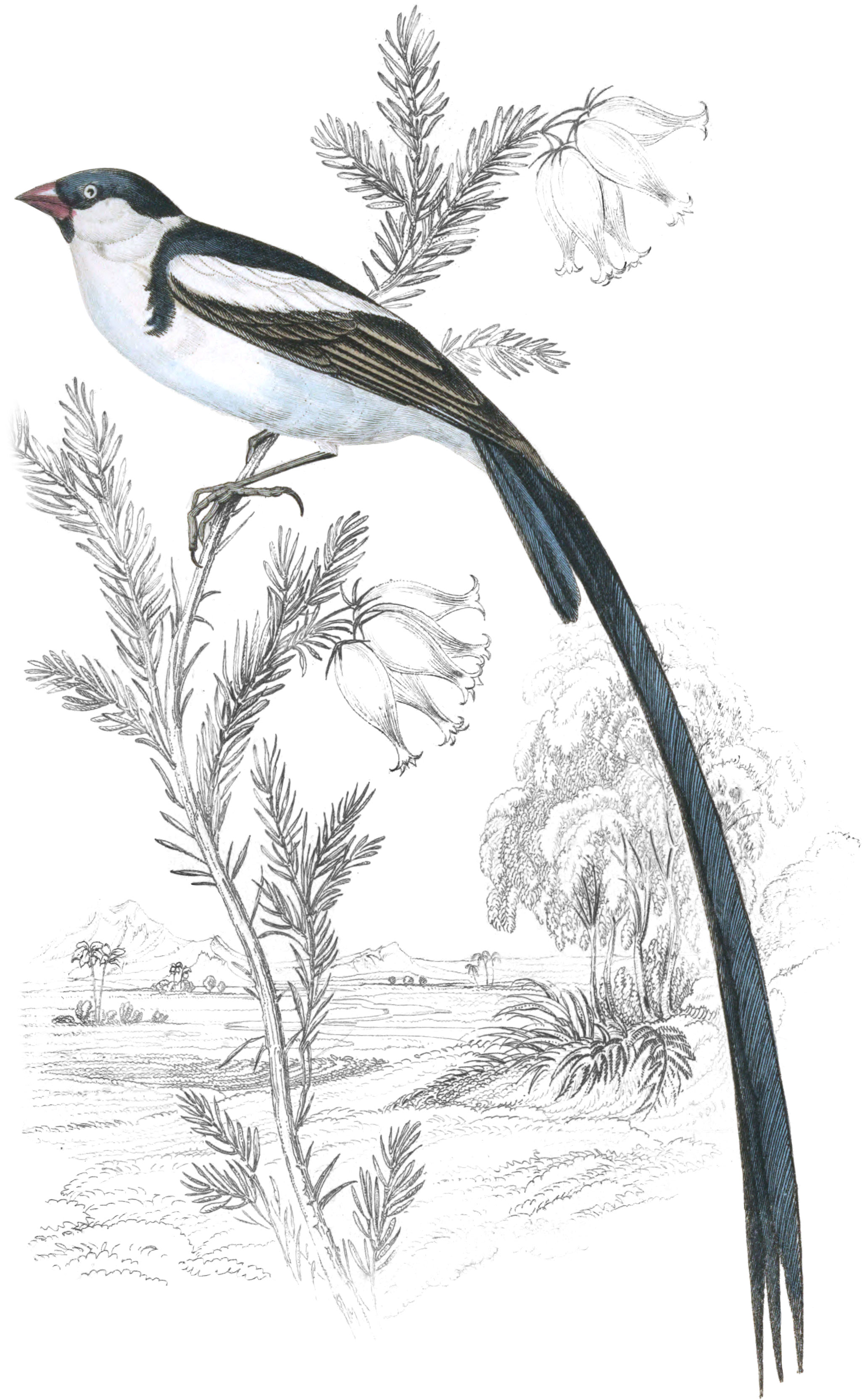
Plate XII

Yellow-Backed Widah
Vidua chrysonotus, Swains.
Velvet black; shoulder-covers and inter-scapulars, bright yellow; secondary and tertial quills, with their covers margined with whitish.
Fringilla chrysoptera, Vieill. Ois. Chant. Pl. 41.—Moineau du Royaume de Juda, Pl. Enl. 183, 1. fig. pessima.
There seems to be no less than three distinct species mixed up in the Synopsis of Birds, under the name of Emberiza longicauda. This confusion was transferred into succeeding compilations, until Dr. Latham in his last work appears to have omitted the whole. We should have supposed that our present species, and that figured by Brown in his Illustrations, pl. 11., had been the same, but he makes no allusion to the yellow on the back; and Dr. Rüppell has assured us that a species quite agreeing with this of Brown is actually found in Abyssinia. Both have yellow wing-covers; but the distinction of the species now before us rests on the back being yellow also; we have thus felt obliged to substitute the name of chrysonotus for that of chrysoptera, the latter being alike applicable to both; the Emberiza longicauda of Linnæus still remains a distinct species.
The structure of this bird shews that it is equally aberrant with the last; the V. erythrorynchus leading to Amadina, while this connects the group with Euplectes. The tail is remarkably broad, fan-shaped, and flat, so that we suspect it assumes a boat-shaped form when the bird is alive. At all events, it is clearly the rasorial type of the genus Vidua; while in its lengthened bill, long slender toes, and in their proportions, it perfectly resembles Euplectes. The tertials are very broad, and as long as the primaries; the under tail-covers also are remarkably long, rendering it probable that the tail is often elevated, or at least spread out.
The general colour of the plumage is a full and intense black, glossy, but without any reflections; the feathers of the head and neck being very closely set, although not short, and, as Brown well remarks, inclining upwards. The upper part of the back is covered by a mantle of beautiful clear and full yellow, which extends to the shoulder-covers. The wings are black; all the feathers, excepting the primary and spurious quills being edged with brownish-white; in old birds, however, these edges become so much obliterated, that scarcely a remnant of them remains. The under wing-covers are nearly white, and the fore edge of the shoulders yellow; the bill is deep black, except the edge and tip of the under mandible, which is nearly white; feet, deep brown.
Total length, 7\(\frac{3}{4}\); bill, \(\frac{11}{20}\); from the gape; wings, 3\(\frac{1}{10}\);; tail beyond, 3\(\frac{2}{10}\); from the base, 4\(\frac{1}{2}\); tarsus, \(\frac{8}{10}\); middle toe and claw the same; hind toe and claw, \(\frac{15}{20}\); lateral toes much shorter than the hinder, and equal; spurious quill, \(\frac{1}{2}\).
Cape, or Yellow-Rumped Weaver
Euplectes Capensis, Swains.
Deep black; rump and wing-covers, brilliant yellow.
Loxia Capensis, Linn. Auctorum.—Le Pinson noire et jaune, Buffon, Pl. Enl. 101, 1. adult.—Grosbec tacheté du Cap de B. E. Buffon, Pl. Enl. 659, 1. young.—Cape Grosbeak, Latham, &c.
The genus which immediately follows the Whidah Finches is that of Euplectes or the Weavers, so called from the extraordinary skill with which they fabricate their singular nests, which in some are pendant, and in other species united together under one common roof, so as to bear no small analogy to a bee-hive. Unfortunately, although we have accounts, and even specimens of many of the dwellings, great uncertainty hangs over the precise species of bird by which each is fabricated.
The bird before us is particularly striking in its plumage, and is one of the most typical of these ingenious architects, at least in its form; for in its billit is almost an exact counterpart of the genus Coccoborus of the American continent. The Weavers, however, are entirely restricted to the old world; they are known by their very small spurious quill, and by their large and long toes and claws; the former, indeed, is generally so minute, that it can seldom be detected without very close examination, while the great length of the toes and claws (besides typifying the great footed rasorial types), probably enables them to be employed by the bird in building.
In the adult bird the feathers of the head and neck are so closely set, and so intensely black, as to resemble the richest velvet; the same rich black uniformly spreads over all those parts which are not yellow, but in young birds the upper plumage is light brown, with a black stripe down each feather; we suspect that the full plumage is not acquired even after the first moult; for although the bird is common to Senegal and other parts of Africa, the specimens usually seen are in immature plumage. The wings reach only to half the length of the tail, which is slightly rounded, and has the feathers broad and truncate; the tertials are lengthened as long as the primaries, the four or five first of which are nearly of equal length; these and the scapulars are edged with brown. The hinder toe, with its claw, is considerably longer than the lateral ones; and the middle is equal to the tarsus, although the latter appear so much lengthened. Authors mention that this species is found also on the Coromandel coast, but this locality wants confirmation.
The yellow upon the hack does not spread over the upper tail-covers, while that on the wings occupies the shoulder and the lesser covers above and beneath; this tint is remarkably pure and brilliant.
Total length, 5\(\frac{3}{4}\); bill, from the gape, \(\frac{7}{10}\); from the front, the same; wings, 3\(\frac{3}{10}\); tarsus nearly 1; tail, from the base, 2\(\frac{7}{10}\);
Black-Bellied Weaver
Euplectes melanogaster, Swains.
Pure yellow; back, wings, and tail, brown; ears, chin, throat, and middle of the body beneath, velvet black.
Black-bellied Grossbeak, Brown’s Illus. Pl. 24, 2.—Loxia melanogaster, Latham, Ind. Orn. i. 395 Black-bellied Gross-beak of authors.
The only figure which exists of this rare and highly elegant species is that given in the “Illustration” of Brown, where it was first described, and whose imperfect account has been copied by subsequent writers. We take the following description from a specimen sent from Senegal, thus fixing the locality of the species, and arranging it for the first time in its natural genus.
Notwithstanding the difference of its colour, this species has a close affinity to E. ignicolor, having not only the same structure, but even the covers so long as to reach half the length of the tail-feathers.
The general ground colour of the plumage is pale yellow, similar to that of the canary. A deep black velvety patch envelopes the ear, sides of the head, chin, and front of the throat; the breast and its sides are pale yellow, having a slight tinge of rufous in the middle. The middle of the body and flanks beneath are covered by another patch of black, which is pointed towards the breast, almost dividing it into two portions, yet without touching the black on the throat; the thighs and undercovers are yellow. Wings and tail, brown, with pale edges; the latter short and even. The interscapulars are pale yellow, varied with some brown stripes; bill, black; legs, pale.
Brown, who seems to have observed this bird alive in confinement, observes, that “in winter its plumage changes to a light brown.”
Total length, 4\(\frac{1}{2}\) inches; bill, \(\frac{1}{2}\); wings, 2\(\frac{3}{10}\); tail beyond, 1; ditto from the base, 1\(\frac{1}{2}\); tarsus, \(\frac{13}{20}\).
Short-Tailed Crimson Weaver
Euplectes ignicolor, Swains.
Vermilion; fore part of the head, ears and body beneath velvet black; wings light brown; tail very short, almost concealed by the lengthened covers.
Fringilla Loxie ignicolor, Vieill. Ois. Chant., Pl. 59.
A more splendid little bird than this, having but two rich colours on its plumage, cannot be conceived. The red is of the clearest and brightest vermilion, while the texture of the feathers, and their intense black, makes them to imitate the richest velvet. M. Vieillot, in whose costly work above cited there is an accurate although not elegant figure, describes it as a new species inhabiting Senegal; and as a fine specimen is in our museum, we here introduce it in our volume, although it was not received through the same channel as the majority of the species here described. We of course adopt the original specific name, a plan we always pursue, except when there exists a decided objection. M. Vieillot mentions that, although a native of the tropics, it bears the temperature of the French climate very well. We can feel no surprise at this, after the fact mentioned; our only astonishment is, that so few of these beautiful African finches are to be found alive in the possession of the lovers of birds in this country. We might surely preserve, and even rear them much better than the poor marchands des oiseaux of the dirty garrets in Paris.
This is one out of three, if not four distinct species, confounded in our systems under the common name of grenadier-grosbeak, or the Loxia oryx of the Linnæan ornithologists.
The structure of the present species differs in some respects from the last; its bill is shaped more like that of a Vidua, being somewhat lengthened; the culmen more curved than the gonyx, and the commissure sinuated. This at once points out the intimate connexion of these two genera; while, by the feet, wings, and tail, it is brought close to E. Capensis. The black of the under parts commences at the breast and terminates at the belly, leaving the thighs and under tail-covers, which are equally long with the upper, of the same rich scarlet. The wings are brown, all the feathers being edged with a lighter colour. The first quill is rather shorter than the second and third; the inner wing-covers delicate light buff; and the legs very pale. Tail brown, very short and almost even; the covers reaching nearly to the tips.
Total length, 4\(\frac{1}{2}\); bill nearly \(\frac{1}{2}\); wings, 2\(\frac{1}{2}\); tarsus, \(\frac{8}{10}\).
Crimson-Crowned Weaver
Euplectes flammiceps.—Swains.
Crimson; ears, sides of the head, chin and body beneath, velvet-black; crown, red; wings and tail, blackish.
We can find no account of this rare and apparently new species. It is almost as beautiful as the last, and long has been in our museum as a reputed native of Senegal. We have no doubt of such being the fact, because the skin is prepared in precisely the same manner (which is altogether peculiar) as those we have recently received from that country.
A glance at the specific description will at once show in what manner this species differs from E. ignicolor, although both are coloured with the same tints. The black on the sides of the head and ears does not, as on the last, extend to the front, but envelopes the chin; this latter part in E. ignicolor being scarlet. The wings also, and their covers, both above and beneath, are entirely black; while the tail, which is nearly even, is also black and is fully one inch longer than the covers. In both species the black on the under parts of the body are the same, but the thighs and the basal half of the under tail-covers in the bird before us are buff; the terminal or longest tail-covers being nearly white.
M. Vieillot having very well figured and described another of these splendid scarlet and black Weavers, under the specific name of oryx, we propose retaining the old name to that species. We may therefore consider it as the Euplectes oryx, while the following specific character will distinguish it from the two preceding.
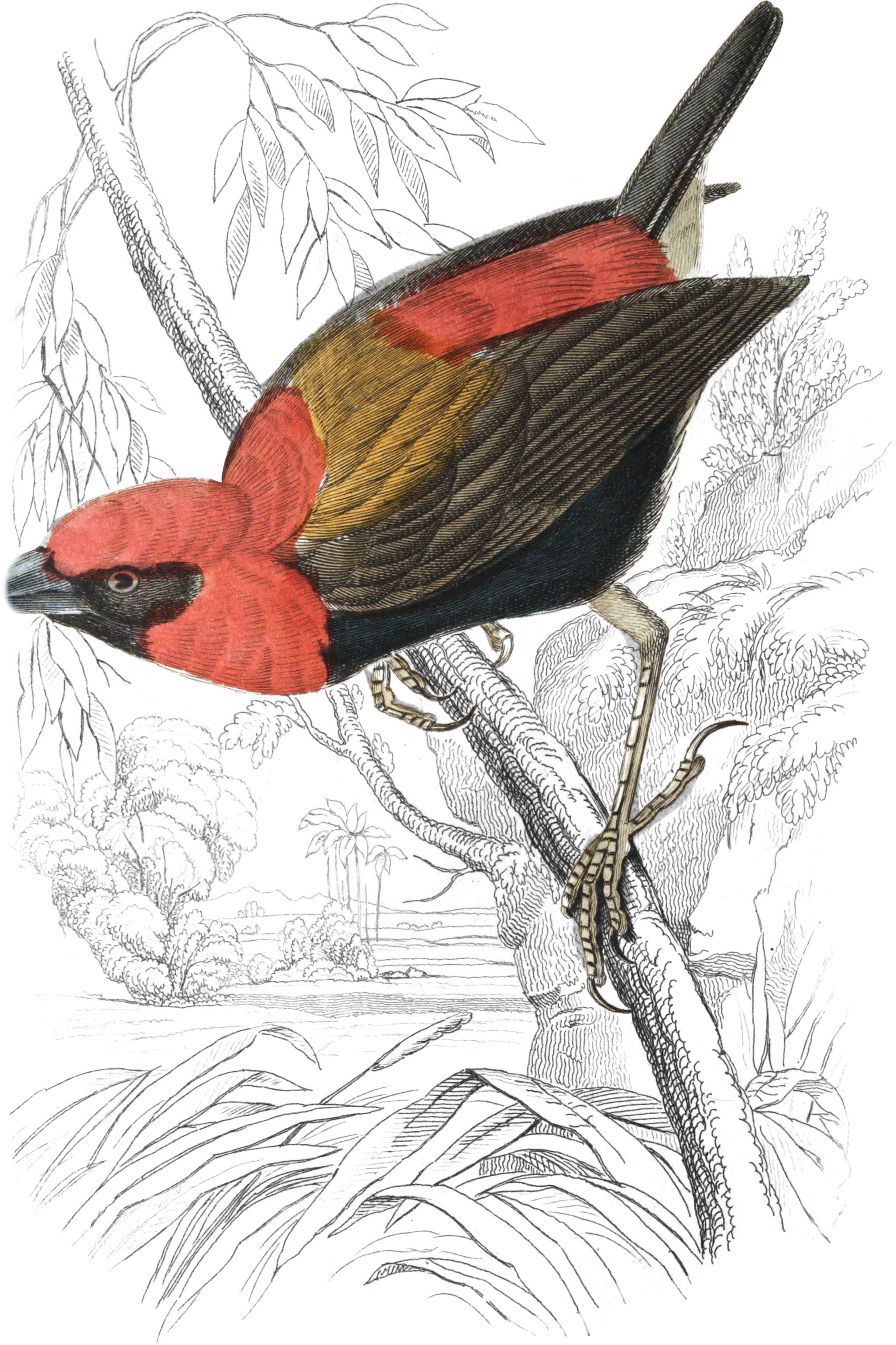
Plate XIII

Grenadier Weaver
Euplectes oryx, Swains.
Crimson; crown, chin, ears and body beneath, black; wings and tail brown; the latter not concealed by the covers.
Loxia oryx, Vieill. Ois. Chant. Pl. 66.
The dimensions of our E. flammiceps are as follows:—Total length, 4\(\frac{3}{4}\) inches; bill \(\frac{6}{10}\) from the gape; wings, 2\(\frac{3}{4}\); tarsus, \(\frac{8}{10}\); tail from the base, 2; beyond the wings, 1.
Crimson-Billed Weaver
Euplectes sanguinirostris, Swains.
Above light brown striped with black; crown and body beneath ferruginous; frontal band, ears and chin black; bill crimson.
Loxia sanguinirostris, Linn.—Moineau à bec rouge du Senegal, Pl. Enl. 183, fig. pessima.—Moineau du Senegal, Pl. Enl. 223, f. 1, adult.—Black-faced Buntling and Red-billed Grosbeak of authors.—Le Dioch, Vieill. Ois. Chant. pl. 22, male; 23, female.
The bright blood-red colour of the bill in this pretty bird will distinguish it at first sight from all the species of Weavers with which we are at present acquainted; while its very large feet, and high elongate-conic bill, shews it to be a true species of the genus Euplectes.
So little dependance can be placed upon the accuracy of the old ornithologists, more especially in this extensive family, that they have actually described this bird under two different genera; a convincing proof that the bill alone is quite insufficient to characterize the natural groups of Fringillidæ.
The Crimson-billed Weaver is one of those species which are reared by the Parisian dealers with perfect ease. M. Vieillot mentions his having possessed many individuals, and he gives some interesting accounts of its manners, which we regret our space will not permit us to transcribe.
In advanced age, or perhaps when in the highest plumage, the males sometimes assume a richness of colouring far more beautiful than what the generality possess. M. Vieillot has figured one of these under the name of Le Dioch, from the rose colour which supplants the ordinary tint on the crown, throat and under plumage. In every thing else, he observes, the two are precisely alike.
Authors assert that this species varies considerably, but they do not appear to be aware that this variation, with the above exception, is merely caused by the moulting of the young males, which, like nearly all other birds, are first like the females. The figures of M. Vieillot are certainly the best, but neither are very accurate, for the tails of all are represented as forked, instead of being even; the feathers, however, are nevertheless divaricated, that is, the two middle are very slightly shorter than the others. A truly forked tail is entirely unknown in this sub-family.
Total length about 4\(\frac{}{}\) inches; bill, from the gape, \(\frac{4}{10}\); wings, 2\(\frac{1}{2}\); tail beyond, \(\frac{8}{10}\); tarsus, \(\frac{7}{10}\); hind toe and claw the same.
Red-Breasted Bengaly
Estrelda sanguinolenta, Swains.
Above light brown; beneath varied with yellow and orange; flanks with transverse brown lines; eye-brows and upper tail-covers crimson.
Fringilla sanguinolenta, Pl. Col. Pl. 221, fig. 2.
The remaining species of weavers belong to a group which we have separated from the former, on account of their much smaller feet and shorter bill, the upper mandible of which is much broader at the top than it is high on the sides. This structure we consider a modification of the depressed, or fissirostral form; although the bill, when the mandibles are closed, becomes conic. Now this character of the breadth of the upper mandible is precisely what we find m the genus Coccothraustes, which is the fissirostral genus in the adjoining circle of hard-bills, but which has not the spurious quill of the true wearers seen in the present group.
The great number of species composing this division, naturally leads us to expect many slight variations in structure; and such there are. Of these divisions, or sub-genera, Estrelda appears to be one and the birds composing it are typically known by their more lengthened and graduated tails, and more elongate conic bills. These birds, as shewing an affinity to the whidahs, and particularly to V. erythroryncus, will first claim our attention. The French call them Senegals, because so many come from that country in the way of commerce; they are, however, dispersed over South Africa, India, and even New Holland.
The beautiful little species before us seems not uncommon in that part of Senegal which lies near the great river Gambia. It does not appear, how ever, in the work of Vieillot, and is only indifferently figured in the Planches Colores. It is among the most diminutive species, measuring only about three inches and a quarter. It is not a very typical species, inasmuch as the tail is short, and only the two lateral feathers on each side are abbreviated or rounded; the three anterior claws are small, but the hinder is nearly double their length, and all are very slender and but little curved.
The colour of the upper parts, wings, and sides of the neck and body, is light brown; over the eye, and before it, a crimson stripe; the rump and upper tail-covers are also crimson. The under parts, from the chin to the tail-covers, straw-yellow, which colour forms short transverse lateral bands on the brown of the sides of the breast, body and flanks. This yellow deepens into rich orange-red in the middle of the breast, body, and all beyond. Tail, blackish; the two lateral feathers on each side are edged with white and rounded, the rest even; bill, pale, the top and base blackish; feet, pale.
Total length, 3\(\frac{1}{4}\); wings, 1\(\frac{7}{10}\); bill \(\frac{3}{10}\); tarsus \(\frac{4}{10}\); tail, 1\(\frac{4}{10}\) (base).
Crimson-Eared Bengaly
Estrelda phænicotis.—Swains.
Grey-brown beneath; tail blue; ears, in the male, crimson.
Fringilla Benghalus, Linn. i. 323, male.—Fringilla Bengalus, Vieill. Ency. Meth. 987, 122.—Le Bengali, Buffon, Pl. Enl. 115, 1, fig. pessima.—Blue-bellied Finch, Edwards, 131, female; Latham, &c.—Le mareposa, Vieill. Ois. Chant. Pl. 5.
The most remarkable peculiarity in this elegant little bird, and that which immediately strikes the observer, is the deep red spot upon the ears of the male. We propose, therefore, to name it from this circumstance, seeing that the former appellation of Benghalus is in violation of that rule of systematic nomenclature which interdicts all specific names taken from barbarous words. Whether Linnæus intended to imply that this bird inhabited Bengal, or Benghaly, a name no longer found in the modern geography, is altogether uncertain; but as the French have long applied it to the entire group, it cannot be retained as distinctive of any particular species.
The form is altogether typical of this section of type of the genus: the bill is lengthened, conic, and the tail is long, slender, and graduated; the wings only reaching to the ends of the tinder tail-covers. There is a peculiarity, however, in the wing-feathers; the first quill is minute and spurious, but the second is fully two-tenths of an inch shorter than the third, and is considerably narrowed at its end, like many of the representatives of the rasorial type. The feet are stronger than in the last; the claws broader and more curved, and the hinder one shorter, so that it is not equal to its toe.
The colouring is very delicate; a light greyish-brown spreads over all the upper parts, excepting the tail and its covers; these parts, together with all the under plumage (the middle of the body being alone white), are of a sky or verditer-blue; the ears of the male have a deep purplish red spot, which is wanting in the female; the bill in the live bird, as Edwards says, is of a “dirty flesh colour;” but in our dried specimens, it is discoloured with blackish; legs, whitish. All the tail-feathers are graduated, with about a tenth of an inch between each. Edwards’ figure of the female is very good. The Portuguese import it, with many others, from their settlements on the African coast, and call it Azulina, or the Blue-bird.
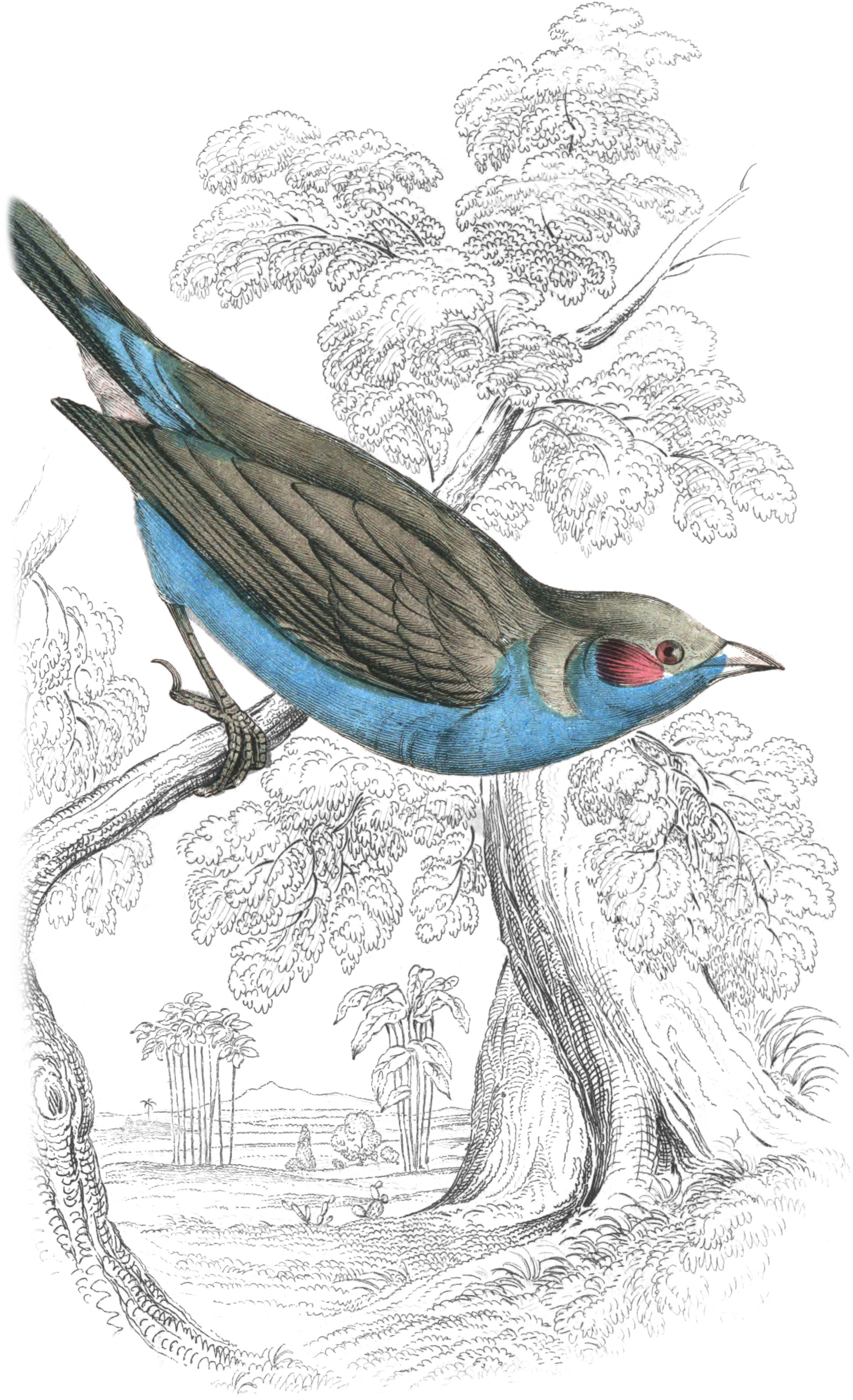
Plate XIV
Black-Bellied Bengaly
Estrelda melanogaster, Swains.
Delicate cinereous; belly and tail, black; lower part of the back, rump and upper tail-covers, dark crimson; lower tail-covers black.
This delicate and very rare species seems to be entirely undescribed; the only specimen, indeed, we have even seen, is one in our museum supposed to have come from this part of Africa; a supposition highly probable, from its near resemblance to the species next described.
The Black-bellied Bengaly is one of the very least of its species, measuring only two inches and a quarter from the base of the tail to the tip of the bill. The tail, however, which is long, makes the bird appear larger, so that its total length is rather more than four inches. The general colour of the whole plumage is nearly of a uniform cinereous, without any mixture of brown, and scarcely paler on the throat and breast; on the under part of the body, however, this colour gradually changes into deep black, which spreads over the belly, vent, under tail-covers, and to the tail itself; when this black begins on the under plumage, deep red commences on the upper, which extends to the superior tail-covers. The wings are like the back, but the tail-feathers, all of which are graduated, are deep black. The quills are similar to those of the last species, but the second is not narrowed; claws, broad and well curved; legs and bill pale; the latter dark at its tip.
Total length, 4\(\frac{1}{4}\); bill, from the gape, \(\frac{3}{10}\); wings, \(\frac{9}{10}\); tail beyond, 1\(\frac{1}{10}\); ditto, from the base, 2; tarsus, \(\frac{1}{2}\).
Cinereous Bengaly
Estrelda cærulescens, Swains.
Delicate cinereous; throat paler; belly and flanks darkest, with a few snowy spots; rump, tail-covers above and beneath, and margins of the tail-feathers crimson.
Le Bengali gris-bleu, Vieill. Ois. Chant., Pl. 8.—Fringilla cærulescens, Vieill. Ency. Meth. 986, 119.
M. Vieillot, whose work upon the inter-tropical finches is in many respects highly valuable, was the first to describe and figure this lovely little bird; he has, however, overlooked the delicate snow-like spots on the flanks, and by an error in his specific character, the bill, instead of the tail, is described as red;11 the former, in several specimens that have come under our examination, and as represented in M. Vieillot’s former work, being decidedly black In general size, this is not much larger than the black-bellied Bengaly, and like that has the typical structure of the bill and wings; the tail however is much shorter, and has only the two or three lateral feathers on each side rounded; the feet are rather larger and the claws well curved; the bill is also more lengthened. A delicate slate coloured cinereous tint, inclining to bluish, spreads overall the upper parts excepting the rump, tail-covers and tail,—all of which are of a rich crimson; the quills are light brown, and the inner web of the tail-feathers blackish. Through the eye is a deep and narrow stripe of velvet black. The slate colour of the upper part of the head and neck is gradually diluted nearly to white upon the chin, throat, and breast, when it again begins to be darker, so that the lower part of the body, the belly, and the flanks, are as dark as the back; on the flanks are about six or seven round silvery white spots on each side; while the under tail-covers are of the same rich crimson as the upper. The feet are dark brown and the bill almost black. The wings are shorter than the tail-covers.
Total length, 3\(\frac{3}{4}\) inches; bill \(\frac{4}{10}\) from the gape; wings, 2; tail beyond, hardly 1; from the base, 1\(\frac{1}{2}\); tarsus, \(\frac{1}{2}\); hind-toe and claw, \(\frac{4}{10}\).
Red-Collared Bengaly
Amadina fasciata.—Swains.
Pale testaceous, with transverse angulated stripes; middle of the body cinereous; belly white; a crimson bar across the chin and ears.
Loxia fasciata, Gmelin, Latham, &c. Fasciated Gros-beak, Brown’s Illus., Pl. 27.—Le Loxia Fasciée, Vieill. Ois. Chant., Pl. 58, p, 90, fig. opt.
We now come to another division of the genus Amadina, where the hill assumes the typical character of the whole group; that is, it is short, yet remarkably broad in proportion to the height of the upper mandible; the tail also is short. The feet, however, still retain the structure of the last group, for the hinder-toe and its claw are shorter than the tarsus. The most perfect example we have yet seen of this modification is the beautiful Amadina Lathami of New Holland. Yet the one now before us is also a typical species. Nearly all these small footed species are found in Africa and New Holland, while the great footed Bengaly (representing, or perhaps uniting to, Euplectes), are chiefly inhabitants of tropical Asia. This elegant bird is about the size of a canary. The ground colour of the plumage, both above and beneath, is of a delicate fawn or Isabella colour, prettily variegated with short angulated transverse lines, of which one or sometimes two are at the tip of each feather; these lines are close and broad upon the head, and partly obliterated in the middle of the back, and are few and wide asunder on the flanks; the wing-covers and the tertials are marked in the same manner, but the primaries and secondaries are brown, simply edged with fawn; the chin and beginning of the neck is nearly white, crossed by a bright red bar, which also covers the ears; the rest of the throat is plain fawn, which colour is continued on the flanks and under wing-covers. The middle of the breast is marked by several large white spots, almost round and partly encircled with black,—then comes a patch of deep cinnamon, analogous to that in the partridge, and below this spot the middle of the belly becomes white. The tail is rounded; all the lateral feathers are blackish brown, with clear white tips; the middle pair alone being of the same colour as the wings. Bill and feet whitish.
In regard to the form, we may observe, that the first perfect quill is the longest; the hind-toe and claw is shorter than the lateral ones, and not so long as the tarsus; the claws are curved and rather broad.
Total length, 5 inches; bill from the gape, \(\frac{4}{10}\); wings, 2\(\frac{3}{10}\); tail, 1\(\frac{8}{10}\); tarsus, \(\frac{1}{2}\); hind-toe and claw, \(\frac{4}{10}\).

Plate XV
Glossy Black Bengaly
Amadina miens, Swains.
Entirely glossy blue-black; inner wing-covers white; the bill and legs, pale flesh colour; flanks with a concealed white spot.
Fringilla nitens, Linn., Vieill. Ency. Meth. p. 955.—Moineau du Brazil, Buffon, Pl. Enl. 291, 1 and 2.—Le Moineau Camba-jou, Vieill. Ois. Chant., pl. 21, Ency. Meth., p. 955.
The numerous vessels which trade with the natives of Western Africa annually import, not only to Europe, but to her American colonies, a great number of the small singing birds of this tribe, which are often to be met with in the houses of the maritime ports of South America; from whence, again, it frequently happens they are transported to Europe. It was probably owing to this well known fact, that Buffon first described the bird before us as a native of America, and the error was perpetuated in all succeeding systems, until pointed out by Vieillot, who does not appear, however, to be aware of the manner in which it originated. We know, from personal observation, that the Portuguese colonists are very fond of these little African birds; for they may be very frequently seen exposed for sale at the different ports of South America. Another circumstance has also conspired to involve this particular species in error. There actually exists in Brazil a small finch of the same size and of the same glossy blackness, but without the pale hill and feet of Amadina nitens. The little attention that even our modern ornithologists have yet bestowed upon this family, has led them to think these two black finches were mere varieties. The American bird, however, is a Tiaris,12 and has no spurious quill-feathers. The African species, on the contrary, possesses this character so peculiar to the family of weavers.
Having now cleared the scientific history of this little Bengaly from the errors of compilers, it is only necessary to add a few words on its peculiarities. It is the longest winged species we yet know of; this, with its glossy plumage, sufficiently shows its analogy to the swallows, or the tribe which Amadina represents in the circle of the Plocianæ. The hind-toe and its claw are manifestly shorter than the tarsus; which character, with its even tail, renders it a perfect example of the sub-genus Amadina. The spurious quill is very minute, and the white spot on the flanks is only seen on raising the feathers. The quills and tail are dull black.
Total length, 4\(\frac{2}{10}\); bill small; \(\frac{5}{10}\); wings, 2\(\frac{1}{2}\); tail beyond, \(\frac{1}{2}\); from the base, 1\(\frac{8}{10}\); tarsus, \(\frac{6}{10}\).
Bronze-Hooded Bengaly
Spermestes cucullata, Swains.
Above testaceous brown; beneath white; head, throat, shoulder-covers, and sides of the body glossy dark brown, bronzed with purplish; flanks, rump, and upper tail-covers whitish banded with brown.
This diminutive songster is perhaps the smallest of its race, for it only measures three inches and a quarter in extreme length. It seems to be altogether new, and as we have seen but two specimens, is probably a rare bird. It is also interesting, as showing the characters of a connecting type between the shorter footed division last exemplified and that more peculiar to India, where the feet are very large. Our present species certainly belongs to this latter group, for the hind-toe and claw, as in Euplectes, is as long as the tarsus, and the upper mandible is higher, and therefore thicker than the under. This great-footed division, in short, has the feet of Euplectes, with the short, thick, and remarkably broad bill of Amadina; and having separated these groups as distinct types, we have no other alternative than to name this; although we are more inclined to consider Estrelda as a sub-genus composed of five divisions or types of form,13 than to call these latter sub-genera.
On comparing the structure of this bird with the last, we find that the base of the under mandible is thicker than that of the upper, and that the hind-toe is as long as the tarsus. We have been told that most of these little Bengalies feed upon the hard seeds of the African millet, and some other of the tall grasses, or rather reeds, so common in the swamps of that country; this fact is in unison with the hardness of their bill, while the structure of their large slender feet and claws is precisely that most adapted to secure a hold or footing on smooth and upright stems.
Upper plumage, light sepia or greyish-brown. The whole of the head and neck, as far as the breast, is of a deep brown, almost black, over which is a gloss of lilac-bronze. There are also two other dark bronzed patches, one on the sides of the breast and the other upon the shoulder-covers, but these have green reflections. The wings are the same as the back, the edges of the quills being whitish, assuming the appearance of half broken lines; lower part of the back, upper tail-covers, flanks, and thighs, are crossed by numerous brown lines, upon a whitish ground. All the under parts are pure white; the under tail-covers have a few luiralate lines. Tail black, very short and rounded; bill and feet, black.
Total length, 3\(\frac{1}{4}\); bill, \(\frac{3}{10}\); wings, 1\(\frac{8}{10}\); tail beyond, \(\frac{7}{10}\); tarsus, \(\frac{9}{20}\); hind-toe and claw the same.
Red Winged Bengaly
Pytilia phænicoptera.—Swains.
Cinereous; body beneath, transversely and laterally banded with whitish; rump and margins of the wing and tail-covers crimson.
The region whose ornithology we are now illustrating, has furnished us with what we at present consider as four of the types of Amadina. The first is represented by the little Estreldæ, with long or at least cuneated tails; the second is exemplified by the great billed Amadina fasciata, where the tail is always short, and the tarsus longer than the hind-toe. The third or great footed division is shewn in our Spermestes cucullata, and for the fourth we adduce, as an example, the bird before us. What we consider as the fifth type, belongs to India; it has a long pointed tail, and is represented by the Fringilla sphecura of Temminck, a name which neither its generic or specific sense can be retained; the latter should be obviously written sphenura.14
Nearly all the types which represent the order of waders have the bill much more lengthened than any of their immediate congeners. We see this throughout all the larger groups of nature, whether in quadrupeds or birds, fishes or insects. We may even trace it in the present sub-family, in the genus Cardudis, and we find this same character in the type before us, distinguished as it is by having a more lengthened bill than is to be found in any of the divisions just named. It is separated from Estrelda by its short tail, and from Amadina by its lengthened bill. A second example is that lovely bird the Fringilla elegans of authors. Both these, in addition to the above characters, have the second quill shortened, and conspicuously narrowed towards the end; the feet are small, and the tail almost even; the bill, as before observed, is shaped like that of Euplectes.
Of this beautiful and entirely new species we have never seen more than one specimen. The upper parts are light grey or cinereous, inclining to brown; but all the feathers of the wing, except the scapulars, are deeply margined with rich scarlet. The throat and breast are like the back, but minutely freckled with whitish; the remaining under parts are nearly white, with transverse cinereous bands on the sides of the body and belly, which bands become spots on the under tail-covers. Tail, blackish; the feathers margined with crimson; rump and upper covers entirely crimson.
Total length, 4 in ches; bill, \(\frac{8}{20}\); wings, 2\(\frac{2}{10}\); tail beyond, \(\frac{7}{10}\); from the base, 1\(\frac{7}{10}\); tarsus, \(\frac{5}{10}\); hind-toe and claw, \(\frac{4}{10}\); middle ditto, \(\frac{11}{20}\);

Plate XVI
With this bird we terminate the series of the Plocianæ or weavers; the few other finches we shall now describe, belong to the bull-finches, Pyrulinæ, and the sparrows or true finches (Fringillinæ).
Yellow-Rumped Bull-Finch
Crithagra chrysopyga.
Olive-grey; rump, front, eye-stripe, and under plumage, yellow; tail short, tipt with white.
The little bird we now distinguish, for the first time by the above name, is the only species we have yet received from Senegal belonging to the family of Bull-finches; this division of the finch family, as a whole, is distinguished from all others by a short and strong bill, curved above, and more or less swollen or inflated on the sides; the under mandible is generally stronger or thicker than the upper, which, with the arched commissure, forcibly reminds us of the bill of the parrots. Our own beautiful native species exhibits these peculiarities very strongly, and will give the student a very good idea of the whole group.
But as the Bull-finches pass insensibly into the haw-finches, so there must be one part of the series where the characters of both are so blended, that it will be difficult to say, looking merely to a single species, which are the most predominant; whether, in other words, our bird belongs to one or to the other. Geographic distribution and a knowledge of other species then comes to our aid, and in most cases enables us to decide, with tolerable accuracy, the affinities of such intermediate forms. Of this character is the present bird: it certainly belongs to the genus Crithagra, which seems the first of the Bull-finches, after leaving the linnets. This genus is abundant in Africa, where on the other hand the linnets, so far as we know, are not to be found. Upon the juxta-position of these two genera do we account for their very great resemblance.
Size of the red-pole linnet, upper plumage, including the crown, ears, wings, and tail olive-grey, with a dark stripe down each feather; a broad stripe of bright yellow is above each eye, which meet on the front; and there is another below the ear-feathers, which leaves a maxillary dark stripe bordering on the chin; the upper tail-covers, and the whole of the under plumage, from the chin to the vent, is of the same clear and full yellow. The wings and the tail are darker than the back; the lesser and greater covers have each an obsolete band of yellow at their tips; while the tail, which is divaricated, is distinctly tipt with white. Bill and legs pale.
In structure, the first quill is hardly shorter than the second and third, which are the longest; the tarsus is not longer than the hind-toe; the claws slender, and the bill very little swelled.
Total length, 4\(\frac{1}{10}\); bill, \(\frac{4}{10}\); wings, 2\(\frac{6}{10}\); tail beyond, \(\frac{1}{4}\); from the base, 2; tarsus, \(\frac{1}{2}\);
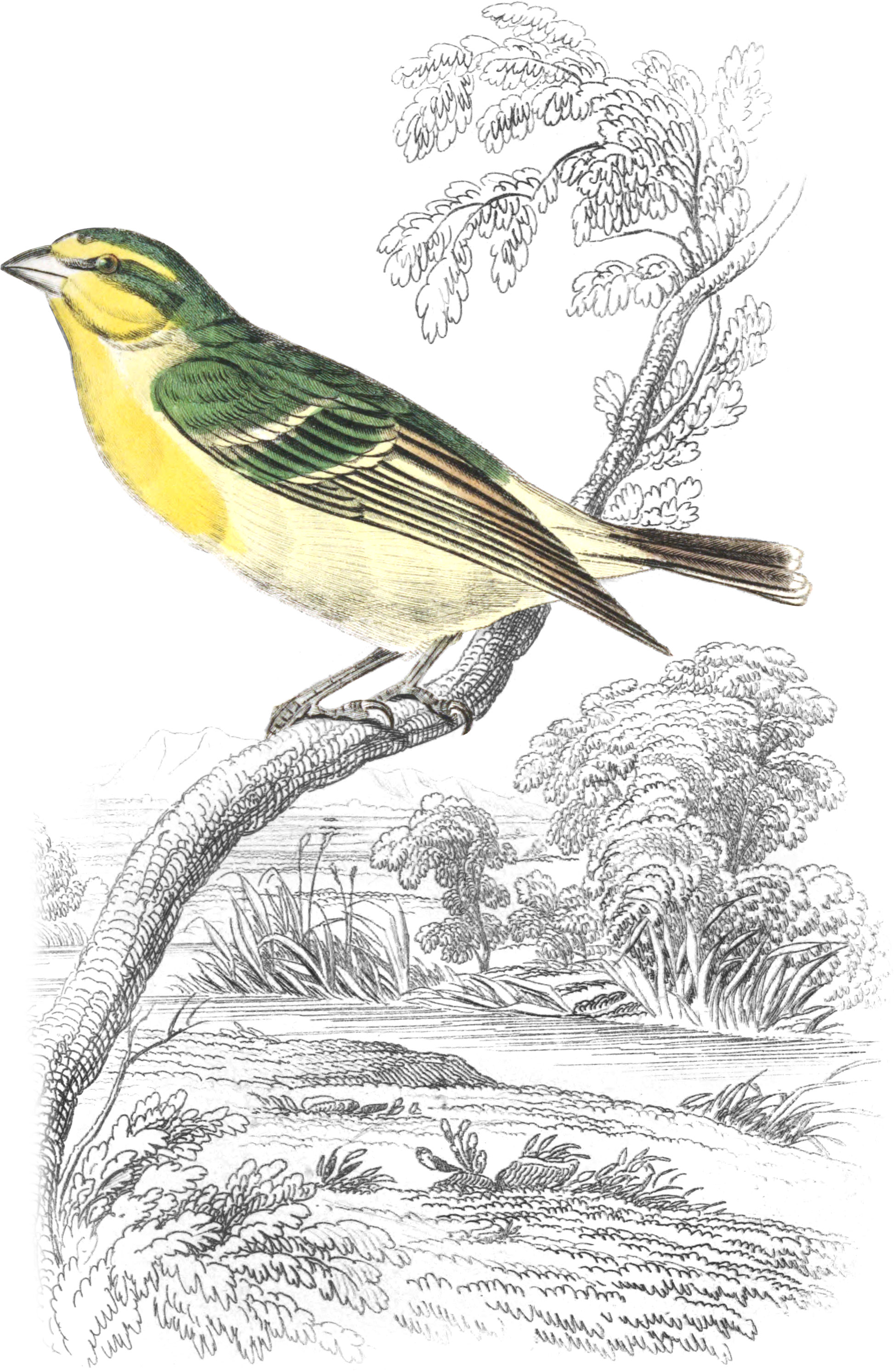
Plate XVII
Grey-Headed Sparrow
Pyrgita simplex, Swains.
Head and neck grey; plumage above rufous; beneath whitish; wings and tail brown.
The only true Sparrow we have yet received from Senegal has been found by Dr. Rüppell in Abyssinia, and is that which he informs us has been described by Professor Lichtenstein under the name of Fringilla simplex; he also informs us that the two sexes are always alike, but for this assurance we were certainly disposed to consider our bird as the female of the crescent sparrow, Pyrgita arcuata, figured on the Pl. Enl. 230.
There is not the slightest difference, in point of structure, between this species and our own domestic sparrow; even their size are as nearly equal as possible. In both species the tail, as in all the true finches (Fringillinæ), is moderately long and divaricated; the four first quills equal and longest; the lateral toes of the same length, and the tarsi elevated.
The colours are very simple; the head and neck are uniform light grey, becoming cream-coloured white on the throat and breast, but there is a stripe under the chin as pure as the white of the body. The inter-scapulars or upper part of the back is brown, tinged with rufous,—this latter colour becomes deeper and brighter on the rump and upper tail-covers; the wings and tail are brown, but the covers of the quills are rufous; the under plumage; legs pale.
Total length, 6 inches; bill \(\frac{6}{10}\); wings, 3; tail beyond, 1\(\frac{3}{10}\); ditto, from the base, 2\(\frac{1}{2}\); tarsus, \(\frac{7}{10}\); hind-toe and claw, \(\frac{5}{10}\).
Chestnut-Crowned Sand-Finch
Agrophttus superdliosus, Swains.
Above brown; beneath white; crown and nape rufous; on each side of the throat a macular black stripe; band over the eye, and tips of the wing-covers, whitish; tail entirely brown.
Ploceus superciliosus, Ruppell, Atlas, pl. 15.
It is not surprising, considering the confused state this family was in some years ago, that the remarkable bird we shall now describe, was placed in a genus to which it has no affinity. It must be observed, however, that in the bill it certainly has a resemblance to many of the Weavers, although in all its other characters, as well as in its general aspect, it evidently belongs to the true Finches of the sub-family Fringillinæ.
The structure of the wing in this bird is so entirely different from all its congeners, that with every wish to avoid a multiplicity of sub-genera, we deem it essential to add this to the number. According to our present views, it represents the American sub-genus, Chondestes, on the African continent; a relation which we deem to be one of analogy only, notwithstanding the close resemblance between the two types in all but their wings and tail. The wings, in fact, of Agrophilus, distinguish it at first sight from every other Finch (Fringillinæ) with which we are acquainted; for the first quill is so short as not to equal half the length of that of the second. The tail is narrow and quite even, while in Chondestes it is broad and rounded. We should not have thought this was the species figured in Dr. Ruppell’s Atlas, had he not verbally assured us it was, the tarsi being represented in his plate much longer than in our specimen.
Size of a sparrow. Ground colour of the upper plumage light or drab brown; crown, nape, and part of the neck, above, chestnut rufous; ears nearly the same, but not so bright, having the space around and a stripe over the eye cream coloured white; on each side of the neck is a black stripe composed of triangular spots, which commence under the chin and extend as far as the breast; wings blackish-brown, with pale edges; the lesser covers, more especially, are broadly tipt with whitish; tail entirely of the same brown as the back, the tips however are darker; all the remaining under plumage is dirty white; bill and legs pale; lateral claws even.
Total length nearly 6 inches; bill from the gape, \(\frac{6}{10}\); wings, 3\(\frac{1}{10}\); tail beyond, 1\(\frac{6}{10}\); ditto, from the base, 2\(\frac{1}{2}\); tarsus, \(\frac{8}{10}\); middle toe and claw, \(\frac{7}{10}\); hind ditto, \(\frac{1}{20}\).
Yellow-Bellied or Cape Bunting
Fringillaria Capensis, Swains.
Head black, with seven white stripes; plumage above varied with rufous and grey; beneath bright yellow chin, under tail-covers, and tips of the lateral tail-feathers pure white.
Ortolan a ventre jaune du Cap. de Bonne Esperance, Buffon.—Emberyza Capensis, Pl. Enl. 664. fig. 2. Latham.—Omitting synonyms.—Emberyza flavigaster, Ruppell, Atlas, pl. 25. immature male.
This is perhaps the most richly coloured species of the whole genus of Buntings; a group which, with few exceptions, is more remarkable for its plain and sombre cast of plumage, than almost any other among the finches.
There seems to be some confusion in our systematic works respecting the original E. Capensis, apparently originating in Dr. Latham placing under the same name, what appears to be very different birds. The original figure and description of Buffon, from which apparently the Doctor has drawn up his account, is sufficiently accurate to mark that bird as the adult male; a specimen of which we have examined, from the Cape. Another., here described, was sent from Senegal, and this we consider the female; we consequently reject all the other synonyms that have been applied to the E. Capensis, both by Latham and by subsequent writers.
The adult male differs from that described beneath, by having the breast deep orange; the last range of the lesser wing-covers and a half collar on the nape, pure white; the greater covers black, tipt also with white; there is more white also on the tail.
The colouring of our present bird is singularly varied; the top and sides of the head are covered by alternate black and white stripes; the former being broadest. The white stripes are thus disposed; one is on the centre of the crown, another springs from the nostrils and passes over the eye, a third takes its rise before the eye, and then passes under it, so as to cross the ears; this again is followed by a slender black stripe, below which there is a fourth stripe of white which adjoins the white spot on the chin, and the yellow on the throat. All these stripes terminate equally at the back of the head, and are margined by a line of black. The ground colour of the remaining upper plumage is light grey, tinged with reddish rufous; this latter colour, however, is very strong on the middle of the scapular and interscapular feathers, which have also a dark spot on the centre. The wing-covers, primaries, and secondaries are dark brown, edged with very light grey; but the outer webs and tips of the tertials are rufous brown, but not so red as the back. The three lateral tail-feathers on each side are more or less white at the tips of their inner webs, but the outermost one has the external web white, except at its two ends. The under plumage is more simple. The tip of the chin and the under tail-covers are pure white; and the sides of the body buff-brown, but from the chin to the vent, the whole plumage is of a full, bright, and uniform yellow. Bill and legs brown; thighs nearly white.
Total length, 5\(\frac{1}{2}\); bill from the front, \(\frac{4}{10}\); wings, 2\(\frac{7}{10}\); tail from the base, 2\(\frac{1}{2}\); tarsus, \(\frac{7}{10}\);

Plate XVIII
White-Spotted Lark
Certhilauda nivosa, Swains.
Above fawn or testaceous, spotted with white; beneath white; the breast spotted with black; middle and external tail-feathers entirely testaceous; bill slender.
The uniformity of colouring which runs through nearly the whole of the Lark family, is one out of the numberless instances of that harmonious design which marks the visible creation. Continually exposed by the nature of their haunts to the observation of birds of prey and other enemies, the colouring of these birds has been assimilated so nearly to that of the ground, that they can scarcely be distinguished, even when close, by an ordinary observer; and however keen maybe the sight of a hawk, the plumage of the Lark is so exactly like the earth upon which it moves, that although its presence might be detected by watching, it would never attract a passing enemy.
The present species appears to be altogether new, and is readily distinguished by its spotted plumage, when that of nearly all the other species is striped. Although the bill is shorter and less curved than in the typical Certhilaudæ, it has not the essential characters of the genus Alauda as now restricted; that is, the first quill is spurious, but in Alauda it is the longest; while the slenderness and length of the bill seems to point out this species as connectant between Alauda and Certhilauda.
The general tint of the upper plumage is of a very light fawn or clay colour, with a darker shade down the middle of each feather, more especially those on the crown,—each of which, together with those on the back and wing-covers is tipt with a roundish pale spot, almost white; the colour of the quills is precisely like that of the back,—the margins of the primaries and secondaries having a rufous tinge, while the tertials and scapulars are margined with whitish; the four middle tail-feathers and outer-most, on each side, are almost entirely pale fawn tinged with rufous; the others being black, with a rufous edge on that only which is next to the outer-most; round the ears there is a dark shade which unites to a macular stripe, proceeding from the lower jaw, leaving the middle part of the ears nearly white; the under plumage, from the chin to the vent, is white, broken only by a number of black spots, nearly round, across the breast; these spots are placed only on the tip of the feathers; bill and legs pale.
Total length, 6\(\frac{1}{4}\); bill from the gape, \(\frac{8}{10}\); wings, 4; tail beyond, \(\frac{8}{10}\); from the base, 2\(\frac{1}{2}\); tarsus, \(\frac{9}{10}\); hind-claw, \(\frac{1}{2}\), in a straight line.
Yellow-Bellied, or Senegal Long-Claw
Macronyx flavigaster, Swains.
Above varied with black and brown; beneath fine yellow, with a broad black gorget on the breast; bill slightly curved, emarginate.
The enormously large feet of this genus readily distinguish it from all others in this family, and immediately reminds us of its prototypes in other tribes, as Megapodius, Menura, Rallus, and nearly all the great footed representatives of the rasorial order of birds. Such it truly is in the circle of the Alaudinæ. Hitherto the genus has been only known by one example, the sentinel lark of Le Vaillant, or the Macronyx Capensis, Swains.; the present is consequently a new species, readily distinguished at the first glance from the former, by its yellow throat and broad black gorget.
The developement of the foot, in the Senegal species, is in strict accordance with that which is found at the Cape; and we may therefore conclude that the habits of both are very similar. The sentinel lark has been so named by Le Vaillant, from its note, loudly and often repeated, perfectly resembling the challenge, qui vive—qui vive! whenever either man or animal passes near it. The Cape species, like the present also, has the posterior claws somewhat more curved than is usual in this family, by which, as Le Vaillant observes, it can perch with facility, although it is generally seen upon the ground, frequenting the open plains and the borders of rivers.
On comparing this with the M. Capensis, a very remarkable difference in the structure of the bill may be detected; it is of the same length in both species, but in this the upper mandible is much more curved towards its extremity, so as to appear almost arched from its base, the tip likewise is strongly and distinctly notched, instead of being entire; and the bristles at the base, which in Capensis are altogether obsolete, extend in this to half the length of the bill, so as to give it, with its general form, very much the appearance of that of a bush-shrike. The claws are larger, particularly the hinder, which is a quarter of an inch longer; the tail is more lengthened. The dimensions of the two birds are in other respects the same.
Upper plumage light brown; the middle of each feather being more or less occupied by black; wings the same; tail blackish; the four lateral feathers more or less tipt with white. Under plumage bright and clear yellow, interrupted by a gorget of deep black, commencing beneath the eye, and widening to more than half an inch on the breast, the sides of which have dusky stripes; bill and legs pale.
Total length, 7\(\frac{1}{2}\) inches; bill from the front, \(\frac{6}{10}\); wings, 3\(\frac{3}{10}\); tail from the base, 3\(\frac{2}{10}\); tarsus 1\(\frac{4}{10}\); hind-toe and claw, 1\(\frac{6}{10}\); the claw alone, \(\frac{9}{10}\); middle toe and claw, 1\(\frac{4}{10}\).
Here terminates the series of the Finch family, which is connected to the plantain-eaters by several intermediate genera not jet found in Western Africa.
Violet Plantain-Eater
Musophaga violacea, Isert.
Black, glossed with violet; crown and quill-feathers, crimson; bill yellow, tipt with red; beneath the eye a white stripe.
Masophaga violacea, Isert, Berlin Tr.—Cuculus regius, Shaw, Mus. Lev. 167. pl. 40.—Musophaga violacea, Cuvier, Temminck, Latham, Shaw, Vieillot, &c. &c. &c.
Our admiration of this noble bird may perhaps be thought too great, when we esteem it as one of the princes of the feathered creation. Other birds are pretty, handsome, splendid, gorgeous, beautiful; but the colouring of this is regal. The shining black purple of the general plumage contrasts in exquisite harmony with the deep lilac crimson of its wings, the peculiar tint of which is certainly unequalled in any other known bird. The beak, although remarkably large, does not seem at all disproportionate, for it is neither fantastically formed like the horn-bills, or monstrously large as those of the toucans, while the rich yellow, passing into crimson, with which it is decorated, gives a relief to the dark colour of the plumage, and must add considerably to the beauty of the Hying bird.
It was in the forests of Acra on the Gold Coast, that M. Isert, a Prussian naturalist, first discovered the Musophaga;15 but he observes that it is so rare in that part of Africa, that notwithstanding all his efforts, he could only obtain a single specimen, More recently, however, the hunters towards Senegal seem to have discovered some particular district where these birds are less scarce; and as whatsoever is rare or costly finds its way to England, our museums have been enriched with several specimens. No less than three in the highest preservation are now before us, and we shall at once proceed to describe the plumage and notice some particulars of the structure.
The assertion which has so generally been made, that this bird has the power of placing one of its toes either backward or forward, is completely erroneous. This error has no doubt originated from a partial inspection of the foot in the mounted specimens of museums, where of course the toes remain as disposed by the bird-stuffer, and cannot be displaced, much less relaxed by the inquirer. Dr. Shaw, who first made known the bird in England, confesses that he made his description from a drawing wherein the toes were placed in pairs, that is, two before and two behind. But Isert, whose original account and figure the Doctor subsequently became acquainted with, speaks of and represents the feet as insessorial, that is, formed after the manner of ordinary perching birds. Both these accounts, however, in different degrees, are incorrect. There are, indeed, three anterior toes, all of which appear to be placed so directly forward as to be incapable of any turning; and this conclusion would be arrived at, even by a professed ornithologist, who contented himself with examining the foot in a dried state; but when it is relaxed, so that all the joints become as flexible as in the living bird, the true nature of its structure becomes apparent. The anterior outer toe is then seen to possess the power of being very slightly turned outwards, so as to describe the eighth part of a circle, but not more; for it is kept within this range by a conspicuous membrane, which actually unites it to the base of the middle toe, and demonstrates the utter impossibility of this toe being, as it is always described, versatile, any more than that of the falcon tribe, nearly all of which are constructed on the very same principle.
This remarkable formation is evidently intended to confer superior powers of grasping; just as the lateral inclination of the human thumb enables a person to grasp an object much more firmly than if it was on the same level with the other four fingers. The ordinary position of the toes is that of all perching birds; but when the bird is grasping a bough, the annexed cut will give a correct idea of the position of the exterior fore-toe, when turned out as much as its nature will admit.

Violet Plantain-Eater Toes
This form of foot is not peculiar to the present genus, but seems to be characteristic of all the true Musophagidæ excepting Colias, where all the four toes are more or less directed forwards.
The bill of this interesting bird is equally remarkable, not merely as to its singular form—for it enlarges and spreads like a casque upon the head—but likewise as to its substance, which is both light and semi-transparent. This fact has never been noticed, probably because it would not be very apparent in an ill-reserved specimen. Two magnificent skins, however, now before us, have been taken great pains with: the rich colouring of the bill has been preserved, probably by the blood being extracted, so that when held in a strong light, there are evident indications of that cellular texture of nerves, hitherto thought to be peculiar to the toucans. We know that this circumstance, if correct, may militate against our opinion that this is a conirostral type, but we nevertheless think it should be candidly stated. According to our present views of the Cuculidæ, the plantain-eaters cannot enter into that circle.
The colouring, however rich, can be described in a few words. The outer half of the upper and the whole of the under mandible is of a bright crimson, blending into a fine and deep yellow on the frontal or thickest part; the orbits are entirely naked, and with the compact and velvet-like feathers of the crown, are of a glossy crimson; the ears are bordered above by a pure white stripe; the whole of the secondary and part of the primary quills are of the richest carmine glossed with lilac, more or less margined and tipt with the blackish violet which spreads over all the rest of the plumage; this violet gloss, however, becomes very dark green on the under parts, and is particularly rich on the tail. The legs are strong and black; the great length of the middle toe, together with the thick, hooked, and very broad claws, evince how completely this and the plaintain-eaters are constructed for living among trees, a fact which must have been overlooked by those who have fancied the Musophagidæ connected the perchers (Insessores) with the gallinaceous or rasorial tribes. The gape is very wide, and opens beneath the eyes.
Total length about 20 inches; bill from the gape, 1\(\frac{2}{10}\); from the front, 1\(\frac{8}{10}\); wings, 8\(\frac{1}{2}\); tail beyond, 4\(\frac{1}{4}\); from the base, 8\(\frac{1}{2}\); tarsus, 1\(\frac{1}{2}\); middle toe and claw, 2; lateral ditto, 1\(\frac{2}{10}\); hinder ditto, \(\frac{9}{10}\).
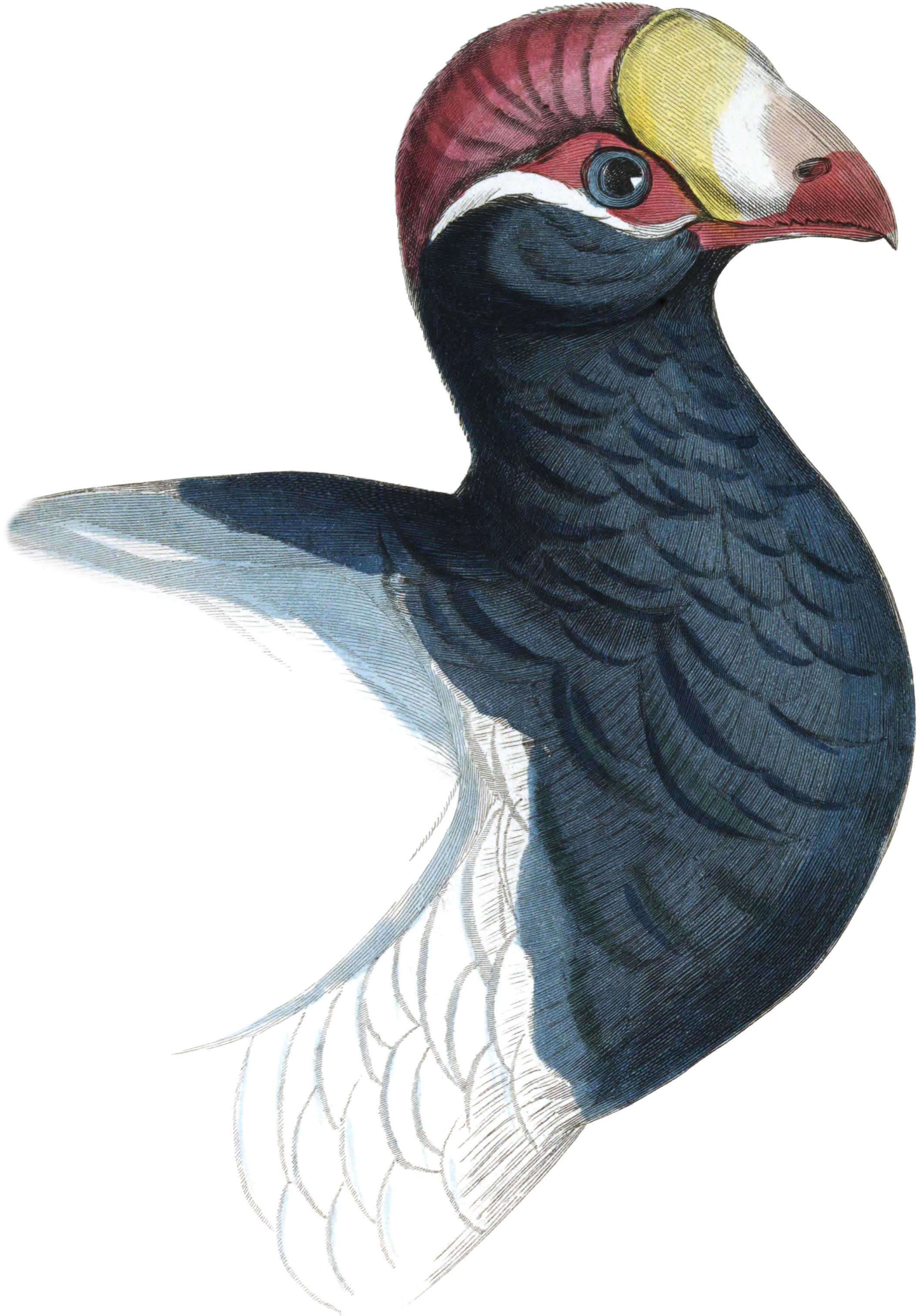
Plate XIX
Variegated, or Crested Plantain-Eater
Chizærhis variegata, Wagler.
Crested; body above cinereous, with brown spots; beneath white with brown stripes; head, throat, and breast brown; quill and tail-feathers blackish; the former with their inner half white; tail immaculate.
Le Touraco musophage, Le Vaill. Prom, et Grimp, pl. 20.—Phasianus Africanus, Latham, &c.—Musophaga variegata, Vieillot, &c.—Chizærhis variegata, Wagler, species Avium.
Western Africa, or rather the intertropical regions of that little known continent, appear almost to Le the peculiar and limited range of the different forms of the typical Musophagidæ or Plantain-eaters; one species alone being found in the territories of the Cape. The opinion we at present hold as to their place in creation, has been elsewhere enlarged upon. They seem to intervene between the hornbills and the finches; the passage to the latter being marked by the touracos, the colies, and the plant-cutters (Phytotoma) these latter being unquestionably related to the finches.
The present bird certainly belongs to a different type to the last, and we accordingly adopt the new generic name that has been proposed for it. It differs most materially in the form and substance of its bill and in the shape and situation of its nostrils, although, in all other points of outward structure, they are perfectly alike. The bill, although not so thick at the base as that of Musophaga, is less compressed beyond, and the substance appears altogether solid; so that, although we are ignorant of their respective manners, there can be no doubt that this feeds upon much harder fruits than the last.
The crest of this species is very peculiar; for it is placed, not, as in the generality of birds, on the top or crown of the head, but directly on the nape, so that when erected, it must have a very singular appearance. We suspect that, at such times, it assumes the appearance of a ruff, not much unlike those, narrow and pointed, worn as court dresses by our ancestors. The feathers in question are linear lanceolate, that is, remarkably narrow and sharp pointed, gradually diminishing in size to the bottom of the neck.
General plumage above very light grey, with a narrow blackish stripe down each feather; the front and top of the head, and the whole of the chin and throat, as far as the breast, is chestnut brown; the under plumage beyond the breast is white, each feather having a dark stripe down the middle; the primary and secondary quills are blackish, with a spot of pure white more or less large in the middle of their inner webs. The tertials and middle tail-feathers are grey, tipt with black; the lateral tail-feathers being entirely of the latter colour; bill pure yellow; legs grey.
Total length about 20 inches; bill from the gape, 1\(\frac{4}{10}\); wings, 9; tail beyond, 6; from the base, 10 tarsus, 1\(\frac{1}{2}\); middle toe and claw, 1\(\frac{3}{4}\); lateral ditto, 1\(\frac{2}{10}\).

Plate XX
Senegal Touraco
Corythaix Senegalensis, Swains.
Glossy purple; head, neck, breast, and crest, green; orbits naked, red; a snowy white stripe before and partly above the eye, with a black one beneath; crest entirely green.
Corythaix Buffonii, Jardine and Selby’s Illust. of Orn. pl. 122.
The Touraco or Crowned Plantain-eaters are perhaps the most elegant of the Musophagidæ; for they have the splendid crimson wings of the violet species, with a liveliness of colour in the full green of their plumage which that does not possess. Their crests also are conspicuous ornaments. Le Vaillant, with national enthusiasm, extols these birds, in a state of nature, as replete with charms (pleines de charmes) in all their movements and attitudes, uniting the greatest agility with perfect elegance. He found them extremely difficult to shoot, as they always frequent the topmost branches of the highest forest trees; subsequently, however, he captured many of them in snares. Like the Musophaga, they live entirely upon fruits.
Considerable confusion has always hung over these birds; for although Buffon indicated at least three species,16 Linnæus confounded them under one. More recently the Cape Touraco has been separated as distinct, on account of the white margin of its crest; and that which Buffon describes as having this part purple, has also received a specific name. There yet remains, however, at least two other species, both having green crests, but one is with and the other without a reddish margin. These two have not only been confounded by Wagler, but the whole genus again thrown into confusion by his unwarrantable attempt to substitute his own new names, not only for the species but for the genus.
In this state of things, it seems best to retain the name of Buffonii, first given by Vieillot to the species, so well recorded by Edwards. That most accurate writer, in describing his Touraco, says, that “the very tips of the feathers on the crest are red,” and that “under the eye is a white line which extends a little further back than the black one, but does not come forward so near the bill.”17 Neither of these characters appear in the Senegal species. In three specimens, now before us, there is no red whatever on the margins of the crest, neither is there any white stripe beneath the eye. The authors of the Illustrations of Ornithology, who seem to consider the Senegal species the same as that described by Edwards, have doubtless been led to do so by the confusion of the synonyms given by Wagler and Vieillot, for nothing can be more clear and explicit than the above quotations. Although not in general friendly to geographic names, there are some instances like the present where they may be applied with peculiar advantage, particularly if the principle had been extended to the other species. The true (Corythaix) Persa, of Vieillot is peculiar to Southern Africa; the blue crested species, mentioned by Buffon, has only been found in Abyssinia, while this seems to be equally restricted to Senegal, or at least to the Western Coast of tropical Africa.
The general size of the Senegal Touraco is about equal to that of the Cape species; like that, also, the fore part of the crest, immediately before the eye, in the dead bird, is compressed vertically; the remaining portion, however, seems to be depressed horizontally as in the generality of crested birds. The bill in the dead bird is blackish purple in the middle, but bright crimson along the edge of the culmen and within the margin of the sides, the tips and serratures of both mandibles being blackish; it is possible, however, that in the living bird the whole may be red, although we think this is very doubtful. The orbits are crimson, naked, and tuberculated; the white stripe before the eye extends to about one-third the length of the upper eye-lid, while the black stripe beneath it reaches as far towards the ears as the end of the naked red orbits, out there is no vistige whatever of a second white stripe. A uniform grass green, but without any gloss, spreads over the whole of the head, neck, wing-covers and interscapulars; and is likewise extended to the under plumage as far as the breast, beyond which it becomes obscured and darkened with blackish.
It is possible that the white stripe beneath the eye, the absence of which induces us to consider the Senegal Touraco for the present as a distinct species, may be developed in very adult age; but this is mere conjecture; and in the mean time, the absence of this mark and of the red tips to the crest is uniformly the same in five or six individuals we have examined, and will distinguish this from the species figured by Edwards.
Total length about 16 inches; bill from the gape, 1\(\frac{1}{10}\); wings, 7; tail beyond, 5\(\frac{1}{2}\); ditto from the base, 8\(\frac{1}{2}\); tarsus, 1\(\frac{4}{10}\); middle toe and claw 1\(\frac{8}{10}\); lateral ditto, 1\(\frac{2}{10}\); hind ditto, \(\frac{8}{10}\).

Plate XXI

Crimson-Crested Touraco
Corythaix erythrolophus, Swains.
Crest of the head erect, compressed, red; face, ears, and chin, white; body green; quill-feathers lilac.
Opœthus erythrolophus, Vieill. Dict. d’Hist. Nat. xxxiv, 306; Galerie des Ois. Pl. 49, p. 46.—Musophaga Paulina, Temm. Pl. Col., pl. 23.
Of this rare and most lovely bird we have never yet seen a specimen, but as no doubt exists of its being an inhabitant of that part of Africa we are now illustrating, we have little hesitation in introducing it in this Work, particularly as it is one of those few remarkable birds whose identity, as a species, does not require a personal examination. M. Vieillot, indeed, seems to be the only one who has made his description from the bird itself. M. Temminck has copied this, but without any alledged reason, attempted to set aside the original specific name. Its genus, in fact, is not Musophaga, but Corythaix, instituted by Illiger in 1811, long before M. Vieillot proposed that of Opœthus.
The specimen which was seen by M. Vieillot was alive in Paris, and belonged to Madame Pauline de Ranchoup. It was gentle and familiar, but it did not long survive the change of climate and of nourishment. The substance of M. Vieillot’s account may be thus stated:—
The size is not exactly specified, but from the scale expressed upon the place, it appears to be of the general form and dimensions of the last species. The crest is red, composed of a great number of delicate hair-like feathers which are elevated on each side and compressed so as to form a ridge, not unlike that of an antique helmet; this crest is continued to the back of the nape, where the feathers begin to assume the same direction as those of the neck; a large patch of white spreads round the eye, the sides of the head, ears, and chin; the bill is pure yellow, inclining to orange. The eyes are large, red, and very brilliant, and the eyelids have a few purple spots. The general colour of the plumage is green, inclining to blueish on the body and belly the greater and lesser quills are of that peculiar rich lilac or purple-red so prevalent in this genus; the feet are greyish-black, and the tail is rounded.
It appears that the figures given by Vieillot and Temminck were both taken from the same individual, yet in the first the crest is conspicuously edged with white, a character entirely omitted by the second; which of these is correct, we have no means of ascertaining.
Having now enumerated all those birds belonging to the typical or Conirostral tribe of the Perchers, which we can personally vouch to be natives of Western Africa, we shall at once proceed to the sub-typical or Dentirostral tribe, which, as most of our readers already know, represents the rapacious order; many of the species living upon small birds, and all upon some part of the animal creation.
Dentirostres
Woodchat Shrike
Lanius rufus, Brisson.
Front, ears, sides of the neck, and interscapulars, black; head and neck above rufous; spot behind the eye, scapulars, wing-spot, rump, and under plumage white.
Lanius rufus, Brisson, Ornith. ii, p. 199 147; Pl. Enl. 9, fig. 2.—Lanius rutilus, Latham, &c. Vieill. Ency. Meth. 727.—La Pie-grische Rousse, Le Vaill. Ois. d’Af. ii. pl. 63.—Woodchat Shrike of authors.
It is only after the most minute comparison of two Senegal specimens with others from the continent of Europe, that we are persuaded of their specific identity with the well known Woodchat of our own islands. It is therefore clear that this is one of those migrators which annually quit the scorching regions of Africa for the more cool temperature of Europe. This fact, indeed, we know from personal research, having frequently shot the Woodchat in Sicily during the month of May, when that island becomes, for a short time, the temporary residence of those numerous species which come from the opposite coast. Of all these, however, five only appear to extend their range very far southward. Two of these, the present and the Lanius collurio,18 occur through the whole length of Africa; the others are the common bee-eater, the hoopoe, and the golden oriole.
To describe a bird so well known would be superfluous. Yet the young males, in their different stages of developement are so unlike the adult, that many ornithologists might mistake them for a separate species.
In the first stage there is no black whatever upon the front or ears, both the first being tinged with light brown mixed with dirty white, while the ears and the back are grey-brown. The pure white scapulars of the adult are here cream colour, as are also the edges of the covers and the rump-feathers. The under parts are also yellowish white, with distinct squamulate lines on the breast and its sides. All the tail-feathers are strongly tipt with white; there are no black spots on the two outer feathers. Perhaps this is the female plumage.19
In the next change of plumage there are black spots on the front, mingled with dirty white, but placed behind the white band which now appears close to the nostrils; the ear-feathers and the back assume a dark brown hue, mixed with black feathers; the rufous is deeper on the neck, and the scapulars, &c. are whiter. The tail resembles the adult excepting the outermost feather which has only a cluster of little transverse black spots, instead of a single large one; the bill and legs are still pale, but the lines on the breast are nearly obsolete. This last state seems to precede the adult plumage, and both are taken from Senegal specimens.
The attempt to separate this species and L. collurio from the sub-genus of Lanius proper, has been made in ignorance of the typical structure of the latter; and, in our opinion, is sanctioned by no one valid reason, either in natural or artificial classification.
Corvine, or Long-Tailed Shrike
Lanius cissoides, Vieillot.
Light brown, striped with blackish; beneath, dusky white with obscure spots; tail long, curvated; bill bright yellow; flanks with a concealed chestnut spot.
Le Grande Pie-grieche, Le Vaill. Ois. d’Afrique, ii. pi. 78.—L. cissoides, Vieill. Encyc. Meth., 734, No. 24.—L. Corvinus, Shaw, Gent. Zool. 7, 2, p. 337.—Corvine Shrike of authors.
It is difficult to imagine why this bird, which has all the essential characters of a true Shrike, should have been likened by Linnæan writers to a crow; unless, indeed, from its being somewhat larger in size than its immediate congeners. The name, however, not having the right of priority, may be cancelled.
The Long-tailed Shrike was first recorded by Le Vaillant in his Birds of Africa, but he has introduced it without knowing from whence it came, an innovation upon the title of his work, which is very frequent in its early volumes. We can now, however, record it as an inhabitant of Senegal, where it seems to be not uncommon.20
The ground of the upper plumage is very light fawn or drab, inclining to brownish grey; each feather of the crown, neck, and back having a dark stripe down the middle; on the sides of the head, above the eyes and ears, are whitish tinged with rufous; while the space between the eye and bill, as also the ears, are blackish brown. The scapulars have two marginal concentric black lines round each feather, but the wing-covers have only one, placed just within the extreme margin, which is light-grey; the lesser quills and tertials are the same as the greater wing-covers; but the greater quills are clear ferruginous or diluted rufous, with more or less of their terminal half blackish. The long narrow tail-feathers are like the scapulars, but with the black markings more broken into spots. The under plumage is dirty white mottled with indistinct transverse spots disposed sometimes in pairs, or rather imperfectly divided.
We shall now notice the most remarkable character of this curious bird, and which has been entirely overlooked by all who have hitherto described it. The feathers on the flanks, upon being raised, will be found remarkably long; concealing, as it were, from the eye of the observer, a large patch of very deep and pure chestnut with which the lower half of each feather more or less is saturated, but of which not the slightest vestige can be seen when the feathers are laid smooth. We have little doubt but that this is a distinction of the male sex, and that in the season of courtship these elongated feathers are puffed out on both sides, so as to exhibit this ornamental spot to the female. The bill, unlike any other shrike, is of a bright and pure yellow; the legs are brown.
Total length, 11 inches; bill, from the gape, 1; wings, 4\(\frac{1}{2}\); tarsus, 1; tail, from the base, 6.
Rufous-Winged Shrike
Telophonus erythropterus, Swains.
Above testaceous brown, beneath whitish; wing-covers and quills (externally) rufous; crown, and stripe through the eye, black; sides of the head with a broad whitish stripe.
Le Tchagra, Le Vaill. Ois. d’Afrique, ii. pl. 70.—Pie-grieche rousse a tete noir du Senegal, Pl. Enl. 479, fig. 1.—Lanius erythropterus, Shaw, Gent. Zool. viii vii. 2, 301.
This is another of the South African Shrikes whose geographic range extends to Senegal, and it seems to be equally common in both regions. Le Vaillant observes, that but for its cry it is very difficult to find, since it frequents only the thickest brushwood and the most dense foliage; such haunts, in fact, are the most productive of its favourite food, which is the larva and pupa of different insects. Its flight is slow, feeble, and near the ground; an imperfection naturally to be expected from the extreme shortness of its wings, which do not extend beyond the upper covers of the tail, and are much shorter than those below. The tail itself, on the other hand, is long and cuneated, as in all the species of Telophonus. So that the size of the bird, although not larger than that of our Lanius Collurio is yet much longer.
The plumage of the adult male is as follows:—The upper part of the head down to just beyond the nape is deep black, which is margined on each side by a broad stripe of white tinged with buff, which commences at the nostrils, passes over the eye, and terminates above the ears; this is followed by a black stripe, much narrower, which is before the eye and behind it, but does not tinge the ear feathers; these latter, with the whole of the plumage above, is light testaceous tinged with grey on the lower back, rump, and middle tail-feathers. The scapulars and tertials are black with a very broad external margin of deep buff or cinereous, while the whole of the wing-covers and outer web of the primaries and secondaries are clear and bright rufous. The four pair of lateral tail-feathers are deep black, more or less tipt with white; the middle pair and the outer portion of the next are grey with transverse dark shades, resembling bars. The under plumage is entirely white, but tinged with grey on the sides, and with cream colour on the belly, thighs, and under tail-covers.
The female, according to Le Vaillant, is less brightly coloured, and has no black on the crown of the head. The tail is considerably rounded, so as to be almost fan-shaped; the inner toe is scarcely shorter than the outer, and is almost free at its base.
Total length, 9; bill, from the gape, 1; wings, 3\(\frac{1}{2}\); tail from the base, 4\(\frac{1}{2}\); tarsus, 1\(\frac{1}{10}\).
Large Grey-Headed Bush-Shrike
Malaconotus olivaceus.—Swains.
Larger than a thrush; head, ears, and neck above cinereous; back, wings, and tail olive, with whitish spots; under parts yellow.
Le Pie-greche Blanchot, Le Vaill. Ois. d’Afrique, pl. 185 285.—Lanius olivaceus, Vieill. Ency. Meth. p. 730, No. 10.
This is the largest of all the African Bush-shrikes yet discovered, and it exhibits in great perfection that superior length of bill by which these birds are distinguished from the true or typical Shrikes; unlike these latter, they prowl about among the thickets and low trees, capturing by surprise such young or sickly birds as are so unfortunate as to come in their way; they have neither the strength of wing or sharpness of claws to enable them, like their more courageous brethren, to dart openly upon their prey and seize it in their talons. These habits, observed by Le Vaillant in other birds of this genus—which is exclusively African—may be inferred with certainty from a simple inspection of the structure of the bird before us. The wings are short and rounded, indicating a most feeble flight, while the thickness and breadth of the claws, show that they are not at all formed for seizing or grasping any thing but the branches of trees; their great curvature, indeed, giving them an unusually firm grasp of such substances, which is further increased by the connexion of the inner toe to half the length of the outer, producing a great breadth to the sole of the foot.
The size is equal to that of a blackbird; the bill is black, and between that and the eye is a broad white stripe. A mantle of clear slate colour spreads over the head, ears, sides, and upper part of the neck, all the remaining parts above being greenish or yellow-olive; each of the lesser and greater covers, and also the tertials and tail-feathers, is marked at the tip by a cream-coloured spot; half of the greater quills are also edged with the same colour. The wings are not longer than the tail-covers. The under plumage, from the chin to the vent, is bright and pure yellow, deepest on the breast and paler on the belly. The tail is but slightly rounded; the legs pale, and the inner toe conspicuously shorter than the outer.
Total length, 10\(\frac{1}{2}\); bill, from the gape, 1\(\frac{1}{2}\); wings, 4\(\frac{3}{4}\); tail, from the base, 5; tarsus, 1\(\frac{4}{10}\);

Plate XXII
Little Grey-Headed Bush-Shrike
Malaconotus superciliosus, Swains.
Size of a sparrow. Head, ears, and neck above cinereous; a white stripe above and behind the eye; back, wings, and tail olive with whitish spots; under parts yellow.
Innumerable instances occur wherein the variation of the colour of birds, generally the best indication of species, is nevertheless insufficient to characterize them. The Drongo-Shrikes, of which nearly fifteen species are known, are all clothed in a uniform black plumage; while the gulls and the terns are uniformly white, with light grey on their back and wings. In the present group, however, the only instance of two species being clothed almost precisely in the same colours is in the bird before us and the Malaconotus olivaceus just described. Excepting that this has white eye-brows, which the other has not, the colours in both are precisely the same; vet one is no larger than a sparrow, while the other exceeds the size of a thrush. The anatomist, however, will readily detect a difference much more important; for while the first joint of the outer toe is united to the middle one in M. olivaceus, this joint is perfectly free in M. superciliosus.
To enter upon a detailed account of the plumage of this bird is quite unnecessary, inasmuch as it cannot be varied from that already given of the greater species; the only difference, as before remarked, in their colours, is the extension of the white before the eye, which in this is continued in a stripe over the eye, so as to reach as far as the ears; it is then lost in obscure whitish dots or freckles on the sides of the neck: there is also a tinge of yellow on those feathers nearest to the nostrils, which is not seen in the other; the yellow of the tail, particularly on its under surface, as well as on. the belly and thighs, is deeper.
Total length, 7\(\frac{1}{2}\) inches; bill from the gape, \(\frac{7}{10}\); wings, 3\(\frac{1}{2}\); tail beyond, 2\(\frac{3}{4}\); from the base, 4; tarsus almost 1.
Puff-Backed Bush-Shrike
Malaconotus mollissimus.—Swains.
Above glossy black; beneath white; feathers on the back long, white, and downy; female grey above and fulvous white beneath.
La Cubla, Le Vaill. Ois. d’Afrique, ii. pl. 72.—Lanius Cubla, Auctorum.
To an ordinary observer there is nothing in the usual appearance of this species entitling it to any particular notice; and yet, upon a closer inspection, it proves one of the most remarkable birds in the whole of its family. All the Bush-shrikes, as their; generic name implies, have the feathers on the back unusually long and very soft; but in the one now under consideration, these characters are developed in a most singular way. When the feathers on the back are raised, as they occasionally are, by the bird itself, they seem to form a semicircular tuft of the most delicate and beautifully white down, exactly resembling that of the swan, and as if that part of the body was protected by an artificial tippet. When in a state of repose, this singular appearance completely vanishes, and the feathers repose on each other as in an ordinary bird.
The abolition of topical or barbaric names by so many of our best modern ornithologists induces us to suggest that of Mollissimus, as at all events preferable to Cubla, derived, we suppose, from the Hottentot language, but which conveys no meaning whatever to European ears.
The male and female are differently coloured. The first has the upper plumage black, glossy on the head, ears, neck, and interscapulars; but brown on the wings and tail; on the lower part of the back the feathers are white, those on the surface having a grey tinge; the scapulars, with the margins of the wing-covers and quills, are dingy-white; upper tail-covers and middle feathers deep black, the rest brown; the whole of the under plumage is white.
In the female there is no black whatever. All the upper plumage is light grey, palest on the rump, and with dusky stripes on the head; the wing-covers and quills have pale testaceous or whitish margins; the under plumage from the chin to the breast is fulvous or huff, which gradually becomes almost white on the body, belly, and vent; tail and wings deep brown; the back feathers are not near so long as those of the male.
Le Vaillant discovered this species in Southern Africa, where it appears common, but it is not recorded as inhabiting Senegal. It seems a social species, living in small companies, much in the manner of our long-tailed tit, and if one discovers food, it summons the rest to partake of it also. On the approach of a man or an animal, this bird elevates its feathers, repeating incessantly its cry of châ châ. Its food is the larva and pupae of insects, and it builds in thorny thickets.
Total length, 7\(\frac{1}{2}\); bill, from the gape, 1; wings, 3\(\frac{7}{10}\); tails, from the base, 3\(\frac{1}{2}\); tarsus, \(\frac{9}{10}\).

Plate XXIII
Barbary or Yellow Crowned Bush-Shrike
Malaconotus Barbarus.—Swains.
Above glossy black; beneath crimson; crown fulvous yellow; vent and flanks buff, Zool. Illust., ii. pl. 71.
Lanius Barbaras, Linn. Auct.—Laniarius Barbaras, Vieill., Ency. Meth. Orn. p. 755.—Pie-grieche du Senegal, Buffon, Pl. Enl. 56.—Le Gonoleck, Le Vaill. Ois. d’Afrique, ii. pl. 69.—Malaconotus Barbarus, Zool. Illust., 2d series, pl. 71.
This is one of the most splendid of a small group or section of the Bush-shrikes whose plumage is a union of black with the richest crimson. It has received its name from having been first found on the coast of Barbary; it is, however, one of the commonest and most showy birds of Senegal, and it even extends almost through the whole length of Africa; for Le Vaillant discovered it on the confines of the Namaquois nation, bordering upon the Cape territory. This would appear to be nearly its southern confines, since Le Vaillant mentions his being unable to procure more than three specimens, nor could he ascertain any thing of its manners.
There is a slight difference in structure between this and the type of its genus, inasmuch as the outer toe is only attached to the middle one at the base of the first joint, leaving the joint itself entirely free. It is consequently nearer in the series of species to the typical Shrikes, and is followed by such birds as M. erythropterus, &c.
Size of a small thrush. The upper parts of the head and neck are olive-yellow, leaving the sides of the head, ears, and neck of the same glossy blackness as the rest of the upper plumage; the feathers of the back are very long, remarkably soft, and marked internally with a white spot, only to be seen when they are lifted up. The under plumage, as far as the belly, is of the richest crimson; the chin having an orange tinge; and the thighs, belly, and under tail-covers clear buff; the wings are shorter than the undertail-covers, and, with the bill and feet, deep black; the latter, however, have a blueish tinge.
Total length, 9 inches; bill from the gape, 1; wings, 4\(\frac{2}{10}\); tail beyond, 3\(\frac{1}{4}\); from the base, 4\(\frac{1}{2}\); tarsus, 1\(\frac{1}{4}\).

Plate XXIV
Orange-Breasted Bush-Shrike
Malaconotus chrysagaster.—Swains.
Above yellowish olive; head, neck, and interscapulars cinereous; front, eye-brows, and plumage beneath, rich yellow; breast orange.
This beautiful little Shrike is not only one of the rarest birds of Senegal, but is one of the most beautiful yet discovered. We have been told that a species of Vanga, has been recently described very much resembling this, but ours is as unlike a Vanga as it is a Corvus, and therefore we esteem it new. The beautiful golden yellow of the under plumage, especially the orange of the breast, renders it very conspicuous.
Of its habits unfortunately we know nothing, but its structure gives some intimation of what they are. Like the other species of Malaconotus, the wings are short and rounded; thus proving that the birds of this genus do not fly at or pursue their prey in the manner of the true Shrikes; and yet the shape of the bill, when compared to that of the more typical Bush-shrikes, would lead us to suspect that this organ was used to tear their food. The general structure, however, particularly the great inequality of the lateral toes, shows its intimate connexion to Malaconotus.
Size of the common red-backed Shrike (L. collurio). Front of the head yellow, extending in a stripe over each eye-brow, but not so far as the ears; from the front to the middle of the back the plumage is clear cinereous or light slate colour, which extends to the ears, sides of the neck, and the space between the eye and bill; all the rest of the upper plumage is bright yellowish olive; the concealed parts of the quills being brown, and the tips of the greater covers, secondaries, tertials, and lateral tail-feathers yellowish white. The whole of the under parts are of a full and bright yellow, of uniform depth, except on the breast, where it deepens into rich orange; the bill and claws are black.
In point of structure, it maybe said that this bird is a Malaconotus, but with something of the short and gradually curved bill of a Lanius. The lateral toes are very unequal, and the claws are neither slender nor acute; the wings reach only to the base of the tail.
Total length, 7\(\frac{1}{2}\) to \(\frac{3}{4}\); bill from the gape, \(\frac{7}{10}\); from the front, \(\frac{1}{2}\); wings, 3\(\frac{3}{10}\); tail from the base, 3\(\frac{1}{2}\); tarsus almost 1.
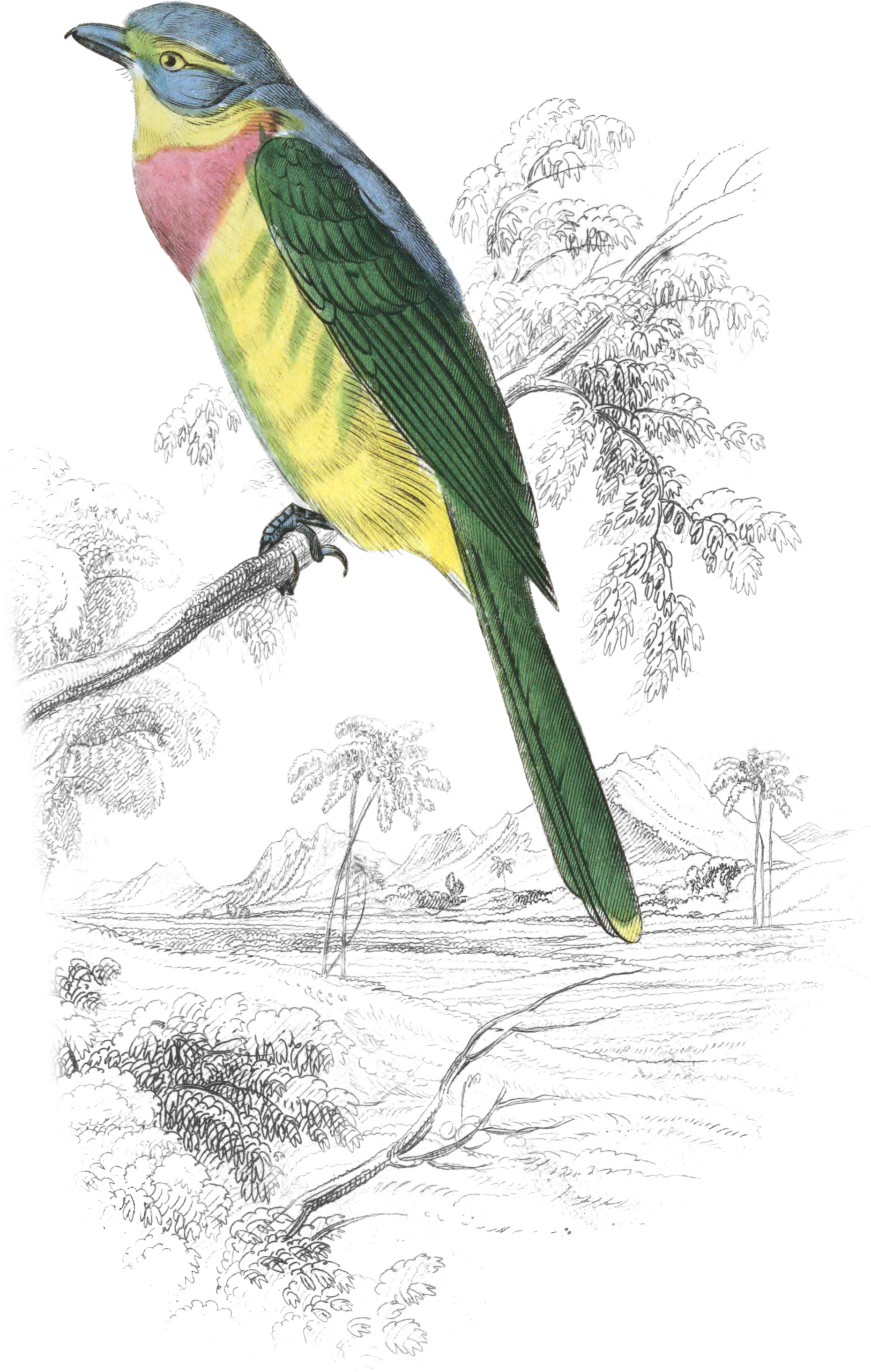
Plate XXV
White-Plumed Shrike
Prionops plumatus.—Swains.
Above glossy black; beneath white; wings with a longitudinal white stripe; head, crest, and neck white with a grey nuchal collar; eyes encircled with a naked yellow skin.
Le Geoffroy, Le Vaill. Ois. d’Afrique, ii. pi. 80, 81.—Lanius plumatus, Shaw, Gen. Zool. viii. 2. p. 292.—Prionops Geoffroii, Vieill. Ency. Meth. 754.
Every family of birds—we may even say every genus—contains one division, which puts on some characteristic of the swallow tribe; or in scientific language, is a representation of the fissirostral and natatorial type of nature. The genus now before us appears to hold this station in the circle of the Bush-shrikes, from all of which, independent of many other distinctions, it differs in the great length and expansion of its wings. This is one of the most certain indications of the type in question; and we find that the longest winged birds are the swallows, the terns, and the frigate-pelicans. Another singular feature in the bird before us is the bristles at the corner of the mouth, and the stiff feathers which advance forward and defend both the front of the head and the base of the bill. There must be something very peculiar in the economy of the bird to require such a defence, for nature has repeated it in the Dasycephalæ and several other fissirostral types of the perchers. How much is it to be regretted, that while we are perpetually receiving numerous specimens21 of such birds as these from their native regions, they should be unaccompanied by the slightest intimation of their habits or manners.
Le Vaillant, who described this singular bird from a stuffed specimen in one of the French museums, conjectures that it lives upon the ground and picks up worms in the same manner as our starlings. The structure of the feet, however, (never attended to in those days) is entirely against this theory; they are obviously adapted for the sole purpose of grasping, but with unusual tenacity, the branches of trees. The soles, as in all such birds, are small, the claws very broad, but unusually hooked, and the hinder toe, as in the Swallow Shrikes or Dicrurinæ, very long. Indeed, as no fissirostral types are crested, it may be even questioned whether this genus does not actually enter into the circle of the Swallow Shrikes; in which case, by viewing it as the rasorial type of that division, we can not only account for its length of wing, but also for its remarkably plumed crest. Waving, however, such a critical distinction, it is plain that Prionops connects the Thamnophilinæ and the Dicrurmæ.
Deep black glossed with blue, and pure white, are nearly the only colours of the plumage. The head and neck, as far as the shoulders, are pure white, excepting a nuchal band of grey, which forms a half collar at the back of the neck and extends round the margin of the ears. There are two broad white bands on the wing; one across the ends of the greater covers, and another running longitudinally on the exterior of three of the lesser quills. The greater quills have another white bar, placed in an oblique direction on their inner webs only, so as not to be seen when the wing is closed, and all the quills, more or less, are tipt with white. The tail is long, slightly rounded, and of the same kind of black glossed with green as the wings, but the outer-feather on each side is pure white, the next is half black half white, and the others tipt only with white. The back feathers are not much lengthened, and the white of the under plumage is quite pure.
The naked skin surrounding the eyes is formed precisely like that of the genus Perspicilla; its outside is scalloped, and it encircles the eyes like a pair of spectacles; both this and the feet are bright yellow. The inner toe is not much shorter than the outer one, but this latter is connected to the middle toe at its base, while the other is free.
Total length, 9 inches; bill, from the gape 1\(\frac{1}{10}\); wings, 5 (extending to near the middle of the tail); tail, from the base, 4\(\frac{1}{4}\); tarsus, 1; hind toe and claw, \(\frac{7}{10}\); inner ditto, \(\frac{6}{10}\); middle ditto, \(\frac{8}{10}\).
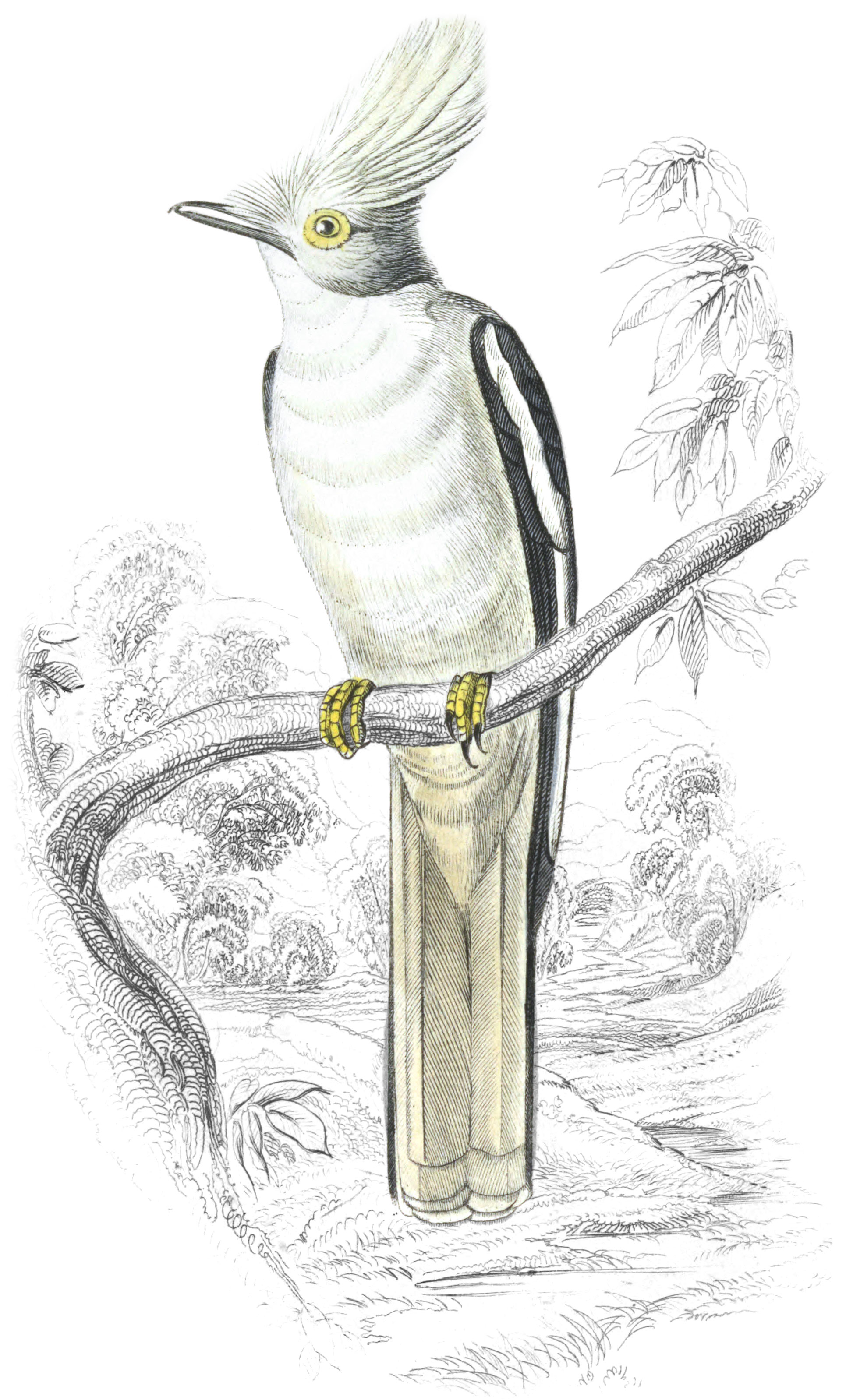
Plate XXVI
White-Bodied Caterpillar-Catcher
Ceblepyris perforates, Swains.
Above cinereous; beneath, from the breast, pure white; female with the chin white and the breast paler.
Graucalus pectoralis, Jardine & Selby, Ill. of Orn. pl. 57.
The Ceblepyrinas, or Caterpillar Catchers, constitute the most aberrant22 division of the family of Shrikes; they are entirely confined to the warm latitudes of the old world and of the Australian range. The birds to which they are analogous, in Europe, are the Orioles; both seek their food in the thick foliage of lofty trees, and both have the same general conformation; but the bill of these is considerably depressed. As representing the Glires, the greatest number of the species are of a mouse colour, while their analogy to the hedgehogs is shown by a peculiarity in the structure of the feathers almost unique in the class of birds. Upon pressing the fingers against the feathers of the rump and back, it seems as if they were intermixed with little spines or prickles, from which circumstance the French have termed them Echenilieurs. The curious reader will find this singular formation explained at some length elsewhere.23
The most typical examples of this singular race inhabit New Holland; to them we retain M. Cuvier’s original name of Ceblepyris; they are known by their superior size—some being nearly as large as magpies—and by the great length of their wings, which are pointed and reach to the middle of the tail. The other group—that M. Vieillot’s name should not be lost—we denominate Campephagæ, it contains birds smaller in size and differently coloured; the wings are short and rounded, and the rictus, or mouth, is furnished with a few stiff bristles, indicating that they have some of the habits of true flycatchers. Between these two groups, but more closely allied to the first than to the last, comes the species now before us. As it is the only one yet known having a decided white under plumage, it is easily recognised.
Size of a starling; but the tail makes it much longer. All the upper part of the plumage is of a delicate light grey, which slightly margins the true and spurious quills, which are black: the fore part of the neck and its sides, the ears, and as far as the breast, is entirely grey; much darker, in the male, than the upper plumage, and ending abruptly on the breast where it forms a curve and becomes almost black; all the rest of the under parts are pure white. The female differs in having the breast like the back, softening off on the chin and on the body to white. The tail is black, the middle and lateral feather on each side grey.
Total length, 10; bill, from the gape, 1; wings, 5\(\frac{1}{2}\); tail beyond, 2\(\frac{1}{4}\); from the base, 5; tarsus, \(\frac{9}{10}\).
Crimson-Shouldered Caterpillar-Catcher
Campephaga phœnicia.—Swains.
Glossy blue-black, shoulders crimson; Male. Above brown, with black bars tipt with white and yellow margined quill-feathers; beneath white with black spots; Female.
Ampelis phœnicia, Latham Synop. 146, 10, male.—Red-winged Chatterer of authors, the male Turdus phœnicopterus, Pl. Col. 71, the male.
The difference between the sexes of this little known species is so remarkable, that but for the proof we can adduce of the fact, their identity could scarcely have been credited. No two birds, in short, can be more differently coloured; and it is therefore not surprising that their scientific history is involved in confusion. Into this, however, we shall not enter; it will be sufficient to observe, in this place, that in the male we may identify the old Ampelis phœnicia of Linnæan writers, and the new Turdus phœnicopterus of M. Temminck, to neither of which genera it has any connexion. While the female has been mistaken by all writers for the Echenilleur jaune of Le Vaillant, a bird which again is not a distinct species, but the other sex of the Echenilleur noir of the same writer. We make this statement from having had an opportunity of verifying the fact by the same proof as we now advance for this species, namely, a young bird, in the season of moulting, and which is now before us, wherein about half the plumage of the male is intermixed with that of the female; thus setting the question completely at rest.
The male, in its perfect adult plumage, is really a beautiful bird; it is entirely of a rich glossy blue-black, except the shoulder and lesser wing-covers, which are of the most vivid crimson; at the angle of the mouth there is a narrow marginal projecting skin, which in the living bird was probably red, and would thus bear an analogy to the lips of quadrupeds. The feathers on the lower part of the back and rump are remarkably thick set, and feel prickly.
The ground colour of the female, on the contrary, is brown, each feather above being crossed at the end with a black bar and a white one, the latter being external and wanting on the rump. The quills are nearly black, broadly edged, externally and internally, with clear and fine yellow; the edges of their covers, but not the tips, being narrower. The tail is brownish-black, lighter on the middle feather, and the two external pairs are edged and tipt with yellow. The under plumage is white, with a crescent of black at the end of each feather; inner wing-covers fine yellow; bill and feet brown, or blackish.
Total length, 8; bill, from the gape, \(\frac{8}{10}\); wings, 4; tail beyond, 2\(\frac{1}{2}\); from the base, 4; tarsus, \(\frac{7}{10}\).
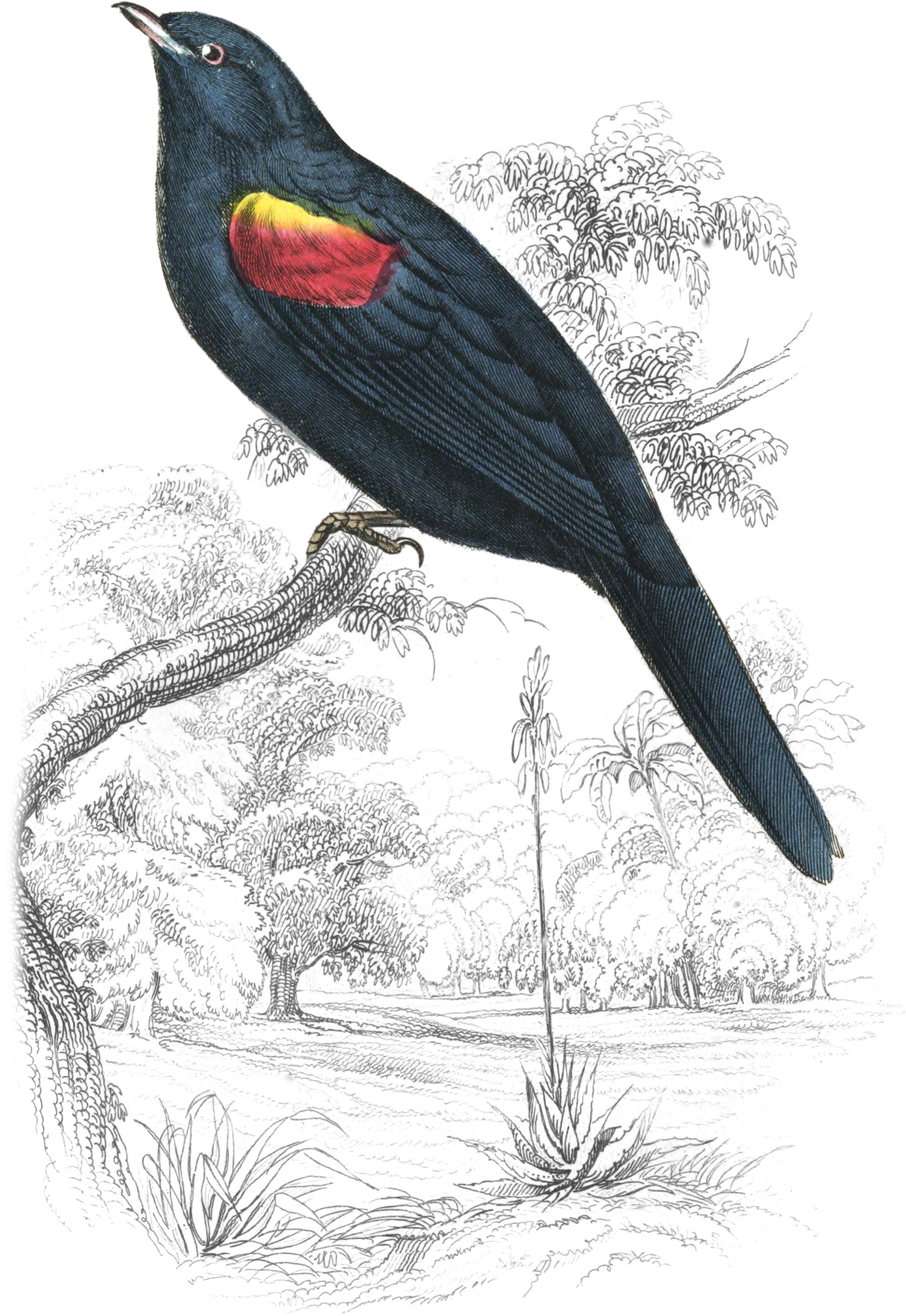

Pale-Winged Drongo
Dicrurus canipennis, Swains.
Glossy blue-black; tail forked; quill-feathers with their inner-shafts light-grey-brown, their internal surface greyish white; the third quill the longest.
The Drongo-Shrikes were formerly classed with the flycatchers, because, like them they seize their food, which consists entirely of insects, upon the wing, much in the same manner as do the swallows. All the species are restricted, in their geographic range, to the warm latitudes of the old world, and what is very singular they are all of a black colour. Hence the older ornithologists, who were not accustomed to pay much attention to variations of structure, considered the greater number to be mere varieties of one species. Le Vaillant, however, with his usual discrimination, was the first writer who rectified this error; and he not only described all that were then known to him, but collected them into a separate genus by the name of Drongo. We may retain this appellation in part, and yet adopt the more classic one of Dicrurus given to the same birds by M. Vieillot, a name which, although not prior to that of Edolius, is so peculiarly appropriate, from expressing the double or forked-tail seen in the majority of the species, that we shall now adopt it. An interesting account of the manners of these birds, too long to be here repeated, will he found in Northern Zoology, ii. page 134.
We cannot determine this species from any of the descriptions in Le Vaillant, with which we have carefully compared it. We shall therefore consider it as new, although it is by no means uncommon. Its chief distinction, as expressed in the specific character, is in the very unusual paleness of the inner webs of the primary quills, which, upon their upper surface, are of the very lightest brown; they are palest at the base, and gradually become darker towards their tips, while their inner surface, or that next to the body, is so light, that but for a greyish tinge, they would be quite white. The plumage is glossy blue-black, but without any metallic reflections; the depth of the fork of the tail is three quarters of an inch, and the two divisions divaricate considerably; the third and fourth quills are largest, and the second and seventh are equal.
Total length, 9\(\frac{1}{2}\); bill, from the gape, 1; wings, 5\(\frac{3}{10}\); tail beyond, 2\(\frac{1}{4}\); ditto from the base, 4\(\frac{1}{2}\); tarsus, \(\frac{6}{10}\).
Even-Tailed Drongo
Dicrurus atripennis, Swains.
Entirely glossy blueish-black; tail almost even; inner web of the quill-feathers very deep black.
Three specimens of this species, winch, we consider as altogether new, were sent from Sierra Leone with the Bristle-necked thrushes here described, so that we have no doubts whatsoever as to its being a species peculiar to Western Africa.
It is almost impossible, in a group of birds possesing so few marks of distinction among the species as the present, to find specific names for each which will express something definite and peculiar. We have therefore been obliged to name this from a circumstance not very expressive, yet calculated in some measure to identify it.
The only species with which this may be confounded is the D. remifer in a young state, where the tail is also even. In this, however, there is a very slight indication of the forked structure in two out of the three specimens. So slight, however that there is only two-tenths of an inch difference between the length of the middle and the outer-most tail-feathers. All the tail-feathers are truncated at their tips, but having the shaft prolonged into a little point, terminating like a hair; all these feathers are narrow at their base, and broad as they approach the tips; so that the tail appears divaricated, although the actual depth of the fork is so slight.
The whole of the external parts of the plumage are deep black, glossed with steel-blue; the inner web of the quills, however, are of a very deep velvety black; thus offering a singular contrast to the species last described. The frontal bristles advance beyond half the length of the bill, but they are not very compact. The inner wing-covers are glossed, and the under surface of the tail and quill-feathers are deep black.
Total length, 9; bill, from the gape \(\frac{9}{10}\); wings, 4\(\frac{3}{10}\); tail, from the base, 4; tarsus, \(\frac{6}{10}\).
Walking Drongo
Melasoma edolioides.—Swains.
Entirely brownish black.
Of this unattractive but very remarkable bird, we have already spoken in the Fauna Boreali-Americana or Northern Zoology, p. 151. At that time we were ignorant of its native country, but no less than three specimens have since fallen under our observation, imported direct from Senegal, so as to leave no doubt as to the propriety of its entering into our present volume.
The ornithologist will derive much instruction and interest from possessing this bird, and from comparing it with any one of the true Drongo Shrikes. The bills of both are formed upon the same model; but this is considerably smaller; the rictal bristles are proportionably equal, but in this type those which are in front are not directed over the nostrils. The wings of both are of the same general structure, but in this they are considerably shorter, and reach but a little way beyond the base of the tail, while this latter member, although equally long, is considerably rounded. This partial resemblance between the two genera extends to the feet; the hind-toe of both are alike, and fully developed; but in Dicrurus it is as long, while in Melasoma it is much shorter, than the tarsus. In both, again, the outer toe is connected to the middle, as far as the first joint, but in this the two external toes are equal, and the middle one considerably longer than the hinder; whereas, in Dicrurus the inner toe is shortest, and the middle one nearly equal to the hinder. From this comparison we gather the fact,—highly important to our view of the natural arrangement of this unique form,—that by the length of the foot and the structure of the toes, Melasoma is enabled to walk upon the ground; a faculty which we know, both from analogy and collateral evidence, is not possessed by the Drongo Shrikes.
As to the plumage, nothing can be added to the specific character. The entire bird is of a deep and uniform brownish black, without any variation of tint; the bill and legs are also the same.
Total length, 8\(\frac{3}{4}\); bill from the gape, \(\frac{8}{10}\); wing, 4; tail beyond, 4; from the base, 4\(\frac{1}{2}\); tarsus, \(\frac{9}{10}\); hind-toe and claw, \(\frac{13}{20}\); middle ditto, \(\frac{9}{10}\).
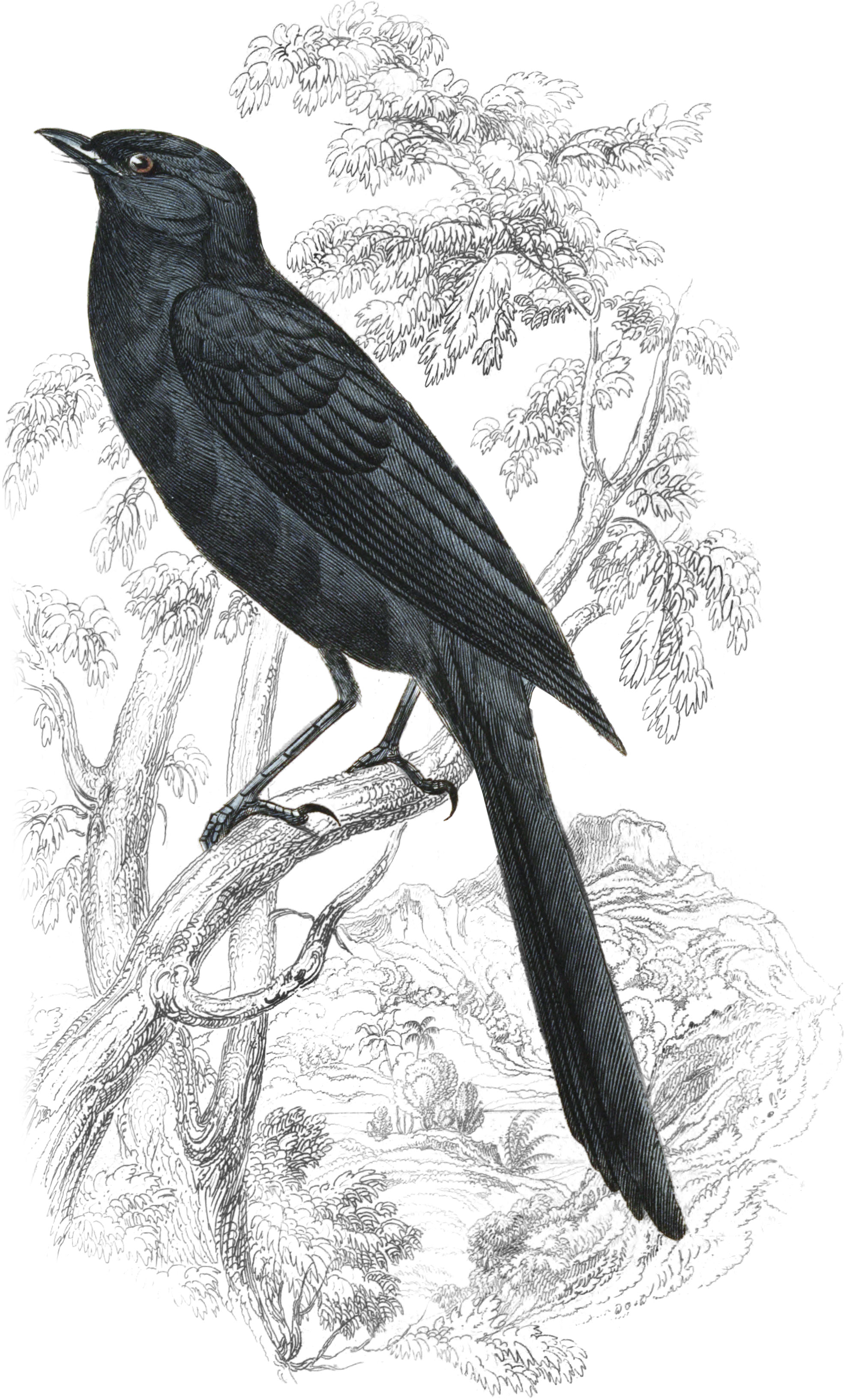
Plate XXIX

Yellow-Throated Short-Foot
Hæmatornis flavicollis, Swains.
Olive-brown; paler beneath; chin and part of the throat pale yellow.
Western Africa, and the same parallels of latitude in equinoctial India, abound in the Brachipodinæ, or short-legged thrushes; so strictly do they appear confined to these limits, that not one has yet been discovered to our knowledge in the New World, or even in the warm latitudes of Australia. We have already given many details on this group, and characterized what appeared to be the five leading variations or sub-genera.24 One of these we named Hæmatornis. Nearly about the same time the same name was proposed for what was considered a genus of Falco; but this supposed genus was not characterized until long after the appearance of our prior definition. As it is an admitted law of nomenclature, that undefined names have no authority, we of course retain Hæmatornis to the group before us, on the double ground of priority of definition and of demonstration.
The chief distinction between Brachypus and Hæmatornis, is in the length of the tarsus; in the first, this part is just equal to the hind-toe and claw; whereas, in the latter, it is decidedly longer; thus evincing an evident tendency to unite with Crateropus, on the opposite side of the circle of the Merulidæ. It is not surprising, therefore, that M. Temminck, and other absolute dividers, who believe that all natural genera are cut off from mutual connexion, should have been sorely perplexed with these aberrant thrushes; and they have, consequently, given such extension to their artificial genera, Turöides and Ixos, as to make them contain almost any thing and every thing. It would have been far better, even on their own views, to have left the whole under the Linnæan genus Turdus. Besides, the barbarous construction of those two names, renders them quite intolerable, even in an artificial system.
Our present species of Hæmatornis is coloured something like the bristle-necked thrushes of Africa (Trichophorus). It is nearly as large as the song-thrush; but the wings are shorter and the tail longer. The upper plumage is dark and uniform olive brown; the feathers of the crown, ears, and sides of the neck having grey borders, and the outer margins of the quills, as well as the inner wing-covers, inclining to buff. The chin, and half-way down the throat, is pale straw coloured yellow, which graduates on the breast into a fulvous brown, but little lighter than the back.
Total length, 10 inches; bill from the gape, 1\(\frac{1}{10}\); wings, 4\(\frac{3}{4}\); tail beyond, 2\(\frac{1}{2}\); ditto from the base, 4\(\frac{3}{4}\); tail beyond, 2\(\frac{1}{2}\); ditto from the base, 4\(\frac{3}{4}\); tarsus, 1; hind-toe and claw, \(\frac{7}{10}\); middle ditto, 1.
African Bristle-Bill
Dasycephala syndactyla, Swains.
Olive-brown; beneath pale yellow; tail rufous; wings with the four first quills graduated; toes syndactyle.
The very remarkable bird we are about to describe is, to the ornithologist, one of the most interesting contained in this volume. Although slightly mentioned on a former occasion,25 it has never yet been described; and indeed the only specimen at present known is in our museum. It was received from Sierra Leone, together with the other species introduced in this volume, many years ago, by Mr. Bullock, at whose sale we purchased the whole.
There cannot, in our opinion, be a doubt that this bird is one of those connecting links by which the genera Dasycephala and Trichophorus are united. It exhibits, in short, some of the typical characters of each, and yet it is so equally connected to both, that, for the present, we cannot determine to which group it strictly belongs. To Dasycephala it is related by its lengthened, straight, and abruptly hooked bill; by a few incurved setaceous feathers and hairs over the nostrils; by the length of the tarsus and of the middle toe; and, by the great inequality between the lateral toes. On the other hand, its affinity to Trichophorus is shewn in its compressed bill, the structure of its wings, and its geographic station. It is usual to term a species possessing such a union of characters as those just described,—a sub-genus, seeing that it does not precisely agree with the definitions of any group hitherto named. But this mode of proceeding maybe carried too far; a little consideration will convince those who adopt it, that in every natural group there must be osculent or aberrant species, without which every genus would be isolated. If there is no approach in structure from the species of one group to the species of another, there would not be that almost imperceptible gradation in nature which every one sees and acknowledges. Some limits, therefore, must be put to the creation of sub-genera, and every effort should be made, in the first instance, to ascertain the station of such forms among their congeners, and this can only be done by extensive analysis. In the present instance Dasycephala, according to the views we have elsewhere published, is itself a sub-genus, and such also is Trichophorus; it consequently follows that any intervening forms, between these two, must be looked upon only as aberrant species either of one or the other.
Having already noticed the chief peculiarities of the bird before us, a few other particulars will suffice. The form of the bill is precisely that of Dasycephala,26 except that the sides, and even the base, are compressed, instead of being depressed; the bristles of the mouth are two-thirds the length of the bill and are very strong; while none can be distinguished (as in Trichophorus) on the back of the neck; the wings are moderate but much rounded, the four first quills being graduated. The middle claw is much longer than in Dasycephala, and the two first joints of the outer toe are connected to it; the claws are broad, much curved, and are obviously adapted alone for perching; the tail is rounded; the tarsi smooth and pale, with the lateral and posterior scales entire.
The colouring of the plumage is simple and quite resembles that of Brachypus (Hæmatornis) flavicollis. The ground colour of the upper plumage is olive-brown; the wings have a tinge of ferruginous, the tail and its upper covers are bright rufous, and the ears are as dark as the crown. All the under parts, from the chin to the vent, are straw colour, tinged with olive on the sides of the breast and flanks; the bill is horn colour; pale on the under mandible and on the sides of the upper.
Total length about 9\(\frac{1}{2}\); bill from the front, \(\frac{8}{10}\); wings, 4\(\frac{1}{2}\); tail from the base, 4; tarsus, 1; hind-toe and claw, \(\frac{13}{20}\); middle ditto, \(\frac{8}{10}\).
Olive Bristle-Neck
Tricophorus olivaceous, Swains.
Olive-green; chin and part of the throat pale yellow.
The three birds we are about to describe, although not attractive in their plumage, are yet remarkable for the very singular peculiarity which gives rise to their name of Bristle-Necks, or Bristle-necked Thrushes. The nuchal bristles, in nearly all those birds which possess them, are so short and slender as to escape detection, unless the adjoining feathers are carefully raised and examined; but, in the sub-genus before us, these bristles are so much developed, and are so long, that they often extend more than an inch beyond the feathers of the neck. It is not known for what especial purpose these bristles are intended. We doubt, however, the accuracy of the assertion, that they are found in both sexes; since we believe they are connected with the process of copulation, and that they are only possessed, at least in their greatest developement, by the females.
The genus Trichophorus was proposed by M. Temminck for these birds, the first knowledge of which he derived from some duplicates he received from us during his visit to England in 1817 or 1818. We have reason to think, also, that the “five” species27 he mentions, as “already known,” are what he took to be the five species in our possession, for he has only published that one which he received from us. The other two genuine species of Tricophorus are described here, as we believe, for the first time.
The species at present before us, although resembling T. strigilatus, in having yellow on the throat, is yet readily identified, having the crown of the head and the ears of the same olive-green colour as that on the back; the ears are the same, with a pale line down the shafts; the body beneath, with the sides of the neck and breast, are also olive, but witha yellower tinge, somewhat paler in the middle; the chin and greater part of the neck is straw-coloured yellow, clear but pale, without any white intermixed, and there is no grey whatever upon the plumage. The tail has a shade almost imperceptible of rufous, similar to what is seen in the two following species. The nuchal bristles are much developed, the longest measuring more than an inch.
Total length, 7; bill from the front \(\frac{7}{10}\); wings, 3\(\frac{1}{2}\); tail beyond, 2; ditto from the base, 3\(\frac{1}{4}\); tarsus, \(\frac{8}{10}\); hind-toe and claw, \(\frac{6}{10}\).
White-Throated Bristle-Neck
Tricophorus gularis, Swains.
Above olive; beneath, in the middle of the body, yellow; crown, blackish brown; ears, grey; chin and throat, pure white.
The pure white on the chin and throat of this hitherto unrecorded species distinguishes it, at first sight, from the two preceding. Its size is intermediate, between that of strigilatus and olivaceus, being less than the former and larger than the latter, and in all three the feathers on the throat are equally developed.28
The colouring has a general resemblance to that of the two species already described, and yet there are slight although distinctive variations. The upper part of the head is dark sepia brown, which assumes a greyish tinge on the ear-feathers, the shafts of which are paler; the chin, and halfway down the throat, is pure white; the breast and middle of the body clear but pale yellow, and the sides and flanks are of the same olive-green as the back; the wings and tail are the same, but darker, while the tips and inner margins of the lateral tail-feathers are pale yellowish, similar to those of the other species; the space between the eye and bill is light grey, and the inner wing-covers yellow.
Total length near 8; bill, from the front, \(\frac{6}{10}\); wings, 3\(\frac{6}{10}\); tail beyond, 1\(\frac{1}{2}\); ditto from the base, 3\(\frac{1}{2}\); tarsus, \(\frac{8}{10}\); hind toe and claw, \(\frac{6}{10}\).29
Stripe-Breasted Bristle-Neck
Tricopfiorus strigilatus, Swains.
Olive, striped on the breast and body with grey; chin and part of the throat yellow, obscurely striped with white; crown dark, varied with olive and grey.
Tr. barbatus, Pl. Col. pl. 88.
Considering that in a group of birds like this, where the species so closely resemble each other, their specific names should more particularly be appropriate, or at least not calculated to lead into error, we have been induced to describe this under the name of strigilatus rather than that of barbatus; for although M. Temminck, who had his specimen from us, states that it is distinguished from its congeners by unusually large feathers on the throat, and therefore calls it barbatus, this statement, nevertheless, is by no means correct, for these enlarged feathers are equally conspicuous both in T. olivaceus and gularis. The name, therefore, being founded in palpable error, appears to us not fit to be retained.
The chief distinction of this bird is the striped plumage of the throat and breast; for although the chin and part of the throat seems to be pure yellow, yet it will be found that each feather is almost white in the middle. M. Temminck has not noticed this, and his description is so imperfect in other respects, that we shall now endeavour to amend it.
Size of a small thrush. General colour of the back, wings, and tail dark olive-green, with a very slight tinge of ferruginous on the latter part. Head and neck dark brown, each feather having a shade of light grey around it; this brown gradually becomes olive on the interscapulars and the remaining parts of the plumage, where there is no grey whatever. The chin, and a little way down the throat, is pale or canary-coloured yellow; the feathers being somewhat larger than usual, but not particularly so, and each are so pale in the middle as to be almost pure white; the ears are grey-brown, each feather being striped with dusky yellow; the lower part of the neck, the breast, and nearly the whole of the body is olive, nearly as dark as the back, but each feather is grey in the middle, and the shafts are of a still lighter grey; the flanks and belly are like the back, but the under wing and tail-covers, as also the under side of the tail are all paler and more fulvous; the tips of the tail-feathers are pale fulvous, but without any defined spot or mark.
The nuchal bristles do not spring, as they have been represented by M. Temminck,30 from the crown of the head, but from the nape of the neck, and appear to be arranged in two fascicles, one on each side, each containing three or four of unequal length; the longest measuring about one inch and a quarter. It may here be remarked that not only this, but the other two species now described, have the feathers on the crown of the head equally if not more lengthened than those on the chin and throat, so that they form, in the living bird, a decided crest, capable of being raised or depressed at pleasure.
Total length, 8\(\frac{1}{2}\); bill from the front nearly \(\frac{7}{10}\); wings, 4\(\frac{2}{10}\); tail beyond, 2\(\frac{1}{2}\); ditto from the base, 4; tarsus, \(\frac{8}{10}\); hind-toe and claw, \(\frac{6}{10}\).
Climbing Leaflove
Phyllastrephus scandens.—Swains.
Olive above; fulvous white beneath; crown, ears and front, light cinerous; quills, rump and tail, ferruginous; frontal feathers short, rather stiff, and advancing on the bill; claws broad and much crooked.
Le Vaillant, whose remarks on the habits of the birds he procured in Southern Africa are always interesting and often valuable, describes, under the name of Le Jaboteur,31 a very singular thrush, plain in colour, but curious in its economy. It lives in little parties of five or six, which he always found busily employed in exploring the ground under close and entangled thickets, turning over the dead leaves, both with the bill and feet, in search of worms and ground-insects; each individual of the party keeping up a querulous note of its own, different from that of each of its companions. These birds were rarely seen to perch; while, from being almost hid in such situations, and the colour of their plumage so exactly agreeing with that of the withered leaves around them, they were very difficult to procure.
The bird we are now to describe is certainly related to the Jaboteur of Southern Africa, but it differs sufficiently in the structure of its feet to make us believe it is rather a scansorial than a terrestrial bird. In the long bristles of the gape we have one of the characters of the Trichophori, or bristle-necked thrushes, and of Dasycephalus; while the affinity of this most interesting species to the latter is shown by the frontal feathers being directed forwards, as if to protect the base of the bill. Without this union of the characters belonging both to Dasycephalus and Phyllastrephus, the two genera would be dislocated; with it, their union, in our opinion, may be pronounced perfect. To the scientific ornithologist, in short, this is the most interesting bird contained in our volume.
The chief peculiarity is in the feet; as the bill, wings, and tail are completely those of the Jaboteur. The tarsus, although it exceeds the hind toe, is comparatively rather shorter than in P. terrestris, but more robust; the middle toe is also shorter, so that it becomes of the same length as the hind toe, a conformation which at once proclaims its scansorial use. This is further confirmed by the superior strength, curvature, and breadth of all the claws, so that at first sight the bird might be taken for an American Anabates. The rictal bristles are more than half the length of the bill, but the nostrils are nearly naked. The frontal feathers, as before observed, are short, compact, rigid, directed forwards, and repose upon the base of the bill; the lateral scales are entire, the anterior nearly so, since, although there are four divisions, the sutures are quite smooth; the tail is semi-transparent and rounded, and of that peculiar texture and form which belongs to Anabates.
The immediate passage from a terrestrial to a climbing species of the very same sub-genus can be proved natural, both from analogical reasoning and from undeniable fact. The manners of Ph. terrestris, as described by Le Vaillant, are those of a rasorial bird; a hen, for example, which scratches and throws about leaves, straw, &c. “both with its bill and feet,” while searching for its food. This is the peculiar habit of rasorial types, such as we see in Phyllastrephus terrestris, and every one knows that the scansorial and the rasorial forms are but representations of each other.
Nor are we unprepared with proofs of this theory drawn from recorded facts. The Accentor modularis, or hedge-sparrow, is a counterpart of Ph. terrestris; both, live in the same way, and seek their food on the ground under thickets and among fallen leaves; and both also are followed by species which are absolutely scansorial. The A. alpina, as Dr. Thackary observed,32 can creep round the buttresses and projections of a building “very much in the manner of a tree-creeper.” This scansorial power, we have not the slightest doubt, belongs also to our Ph. scandens. It is impossible that two cases can be more analogous.
But that this union of the rasorial and the scansorial habits may be rendered perfectly unquestionable, we shall now cite an instance where they are actually united in the same bird! Wilson, in describing the Pine-creeping-warbler, (Mniotilta pinus, Swains.33) says,
it runs along the bark of the pines; sometimes alighting and feeding on the ground, and almost always, when disturbed, flying up and clinging to the trunks of the trees;
and again,
these birds are easily known by their manner of rising from the ground and alighting
—not on the branches, but—
on the body of the tree.
Here, then, is a bird, belonging to the scansorial sub-genus of Sylvicola, which nevertheless feeds also upon the ground like a rasorial type.
It now remains only to describe the plumage of this remarkable species. The upper part of the head as far as the nape is clear cinereous, which becomes paler on the sides and ears and changes to dull white on the chin and halfway down the throat; beyond the nape the colour of the upper part of the neck and back is light olive, as are the wing-covers, but this assumes a buff tinge on the rump and finally becomes clear ferruginous or light cinnamon colour on the tail; the quills are darker and more of an olive-brown, the inner webs being black with a narrow edging of buff on the basal half inside. The under plumage is buff-white, deepest on the flanks and under tail-covers, which almost assimilate to the pale ferruginous of the under parts of the tail-feather; the inner wing-covers are like the flanks; the bill and claws are very light, the culmen only being brown; the feet in the dried specimens are discoloured, but they are probably light brown.
Total length, 9\(\frac{1}{2}\); bill, 1; wings, 4\(\frac{1}{4}\); tail, from the base, 4\(\frac{1}{4}\); tarsus, \(\frac{9}{10}\); hind toe and claw, \(\frac{3}{4}\); middle ditto, \(\frac{9}{10}\).

Plate XXX

Broad-Tailed Babbler
Crateropus platycircus, Swains.
Brown; body beneath paler; head, neck and throat blackish-brown, each feather having a light edge; tail fan-shaped, broad, and brownish-black.
Ixos. plebejus? Ruppell, Atlas, pl. 23.
The Great-footed Thrushes, or Babblers, form one of the chief divisions of the Merulidæ or Thrush family; equivalent to that of the short-footed race which we have just left. They are at once known by their very large and robust feet, the equality of the two lateral toes, and the slight curvature of the claws. Their haunts and manners are likewise very different; instead of living entirely among the thick foliage of trees, these birds frequent the ground, chiefly in marshy situations, and seldom perch but among reeds and aquatic shrubs All the species and subordinate types that have yet been discovered are from the warm latitudes of the old world; excepting one,34 the Donacobius vociferans, which is peculiar to America.
Independent of the foregoing characters which separate Brachipus from Crateropus, the two groups are almost perfectly alike in the shape of their bills and the formation of their wings and tail. The latter, however, in Crateropus, is always much larger and broader, while the bill is either entire or very slightly, instead of very deeply notched.
The bird now before us is the size of an ordinary thrush, with the bill considerably compressed and perfectly entire; the nostrils are naked, and the rictal bristles reach only to the aperture. The tail, although not very long, is fan-shaped and remarkably broad, the feathers measuring nearly one inch across. The feet are very large, and the wings are shorter than the upper covers of the tail.
The whole plumage is of a sepia brown changing to light-grey on the rump, and from the breast downwards, where it is even lighter; the tail, on the contrary, is almost blackish, particularly towards the end, where it is darker than the wings. The ears, space before the eyes, and tip of the chin, are hoary, or grey-white and unspotted, but all the rest of the head, neck, and throat-feathers are dark brown, with a pale edging, which gives to them a scale-like appearance; the belly or vent is inclined to white, and the flanks and under tail-covers to buff. The chief specific distinction, however, is the dusky white margin of the feathers on the head, neck, and throat, which from their semicircular form have a very peculiar and distinct appearance.
Total length, 9\(\frac{1}{2}\); bill from the gape, 1\(\frac{1}{10}\); wings, 4\(\frac{2}{10}\); tarsus, 1\(\frac{2}{10}\); hind toe and claw, \(\frac{8}{10}\); middle ditto, 1\(\frac{1}{10}\); tail from the base, 4\(\frac{1}{4}\).
Black-Crowned Babbler
Crateropus reinwardii, Swains.
Above grey; beneath paler; wings and tail brown, with shades of transverse darker lines; head and ears black; chin pure white; throat with dusky spots.
Crateropus Reinwardii, Zool. Illust. ii. pl. 80.
When we first described and figured this bird in the second series of the Zoological Illustrations, we gave it as a native of India upon the information of the Parisian collectors. Whether this habitat may be correct or not we cannot determine, but it is certain that the two specimens we have recently received from Senegal are perfectly the same as that we formerly described.
This species, readily distinguished by the deep black covering of its head and ears, is altogether a larger bird than the Crateropus platycircus; the tail is longer, but the feathers are narrower; and the bill, instead of being perfectly entire, has a small nearly obsolete indenture at the tip of the upper mandible; the legs are longer in proportion, and the claws not so much curved, thus pointing it out as a more typical example.
The ground colour of the general plumage is a light brownish grey, becoming much paler on the under parts, with the wings and tail dark sepia brown. The chin, and about half-way down the throat, is pure white, but all the rest of the head, ears, and nape are of a deep black; the lower part of the throat and breast is light grey, but each feather has a darker stripe in the middle, which gives it the appearance of being spotted. The tail is rather long, broad, and much rounded; and, together with the tertial quills, has an appearance of being crossed by transverse dusky lines, when held in particular lights. The feathers in the middle of the back are lengthened, and are all pure white at their base; the bill is black and the legs pale.
It might be suspected that this was the male of the last species described, but the difference of their respective sizes, and in other points of their structure already noticed, renders this supposition highly improbable.
Total length, 10\(\frac{1}{2}\); bill, 1\(\frac{1}{10}\); wings, 4\(\frac{3}{4}\); tail beyond, 3; from the base, 5; tarsus 1\(\frac{1}{2}\); hind-toe and claw, \(\frac{9}{10}\); middle ditto, 1\(\frac{2}{10}\).
It is clearly impossible to identify the two last birds, from the confused mass of descriptions of Turdi found in the systems.
Black-Winged Babbler
Crateropus atripennis, Swains.
Rufous; wings and tail black; head and neck hooded with greyish white, bordered by black; tail short.
Only one specimen of this new and remarkable bird has yet come under our inspection, and we therefore conclude it is particularly rare. Its form also, no less than its colours, has some peculiarities. In its general structure it closely resembles the two preceding species; that is, in the shape of the bill, wings, feet, and tail, but the latter member, comparatively, is very short, for it does not extend beyond the wings more than one inch and a half. Hence, at first sight, it seems so closely allied to Timalia thoracica,35 Swains., as even to enter into that genus. The great distinction, however, of Timalia, is its remarkably short and rounded wings; so short, indeed, that they barely reach to the base of the tail. In the bird before us, this character does not exist; the wings, although much rounded, and very broad, are quite those of Crateropus, and reach to half the length of the tail; the inner toe is also rather shorter than the outer, and the claws (especially the hind one) very broad and fully hooked. In Timalia thoracica, on the contrary, the lateral toes are of equal length and the claws slender and much less curved. The first of these forms indicates arboreal habits, the second terrestrial. In this the bill is less arched above, and the tip notched; but in that the latter character does not appear. On these considerations we place our bird in the present group; leaving for future inquiry the question of direct affinity between this and Timalia ahoracica.
In size this species is rather less than a starling; it is at once known from all its congeners by a greyish-white hood, which completely covers the head, nape, ears, fore part of the neck, and terminates abruptly just above the breast; the space between the bill and the eye, is black, and this colour forms a deep shade all round the sides of the hood as just mentioned. The wings, tail, and interscapulars are blackish brown; the rest of the plumage, both above and below, being of the darkest rufous or chestnut, of the same colour, although less bright, as that which tinges the corresponding parts of Timalia thoracica; the bill is yellow; the feet brown; and the claws pale. The feathers of the back are remarkably long and soft, much more so than in the bird just mentioned; tail rounded, broad, and soft.
Total length, 8\(\frac{1}{2}\); bill, 1; wings, 4\(\frac{1}{2}\); tail beyond, 1\(\frac{1}{2}\); ditto from the base, 3\(\frac{1}{2}\); tarsus, 1\(\frac{4}{10}\); hind-toe and claw, 1; middle ditto, 1\(\frac{2}{10}\).
Oriole Babbler
Crateropus oriolides.—Swains.
Olive; beneath yellow; white and neck with a black hood; the feathers edged with silvery white, and scale-like.
The singular bird we are now to describe is very common on the Western Coast of Africa, but seems never to have been found in any other region.36 Its structure is so peculiar, that we cannot at present venture to offer any definite opinion on its actual position in the family. It certainly has a closer affinity to the Babblers than to any other group of thrushes, but whether it forms part of that circle, or enters among the Orioles, is very doubtful. It is, indeed, with much hesitation that we retain it under the generic name of Crateropus, for its slender and lengthened bill is altogether peculiar. It seems intimately related to Donacobius, the only representation of the Babblers in the New World. But for its feet, it might be taken for a Meliphaga, while its colours and nest37 are those of the Orioles. The minute analysis which is requisite to assign to all these resemblances their due weight, and to explain them, has not yet been entered upon, and we therefore merely allude to them as explanatory of our reasons for not proposing a sub-generic group which cannot be demonstrated. We may here observe, that we can find no description among the hundreds of birds crowded into the Linnæan genus Turdus, which will enable us to identify either this or the following species as having been previously described.
The total length of this bird exceeds that of the golden oriole on account of its longer tail, but the body is much smaller and its whole proportions more gracile. The bill is slender, a little curved, and very much resembles that of a Meliphaga; the nostrils also are somewhat lengthened, although their structure is that of Crateropus; the upper mandible of the bill is entire, the commissure arched, and the margins beyond the base inflected. The wings are very short, and the tail is much graduated. The lateral toes are equal, and the hind one with the claw very large.
The upper plumage is olive-yellow; which extends also to the flanks, sides of the body, vent, and thighs, where it has a more fulvous tinge. The whole of the head and the neck, as far down as the breast, is deep black; all the feathers, except those on the breast, being edged more or less with silvery white, particularly on the ears and upper neck; and this edging produces a scale-like appearance. The middle of the body beneath, the edges of the wings, and the under wing-covers are bright yellow. Bill black; legs pale.
Total length, 8\(\frac{1}{2}\) inches; bill rather more than 1; wings, 3\(\frac{1}{2}\); tail, 4; tarsus, 1; hind-toe and claw, \(\frac{8}{10}\).
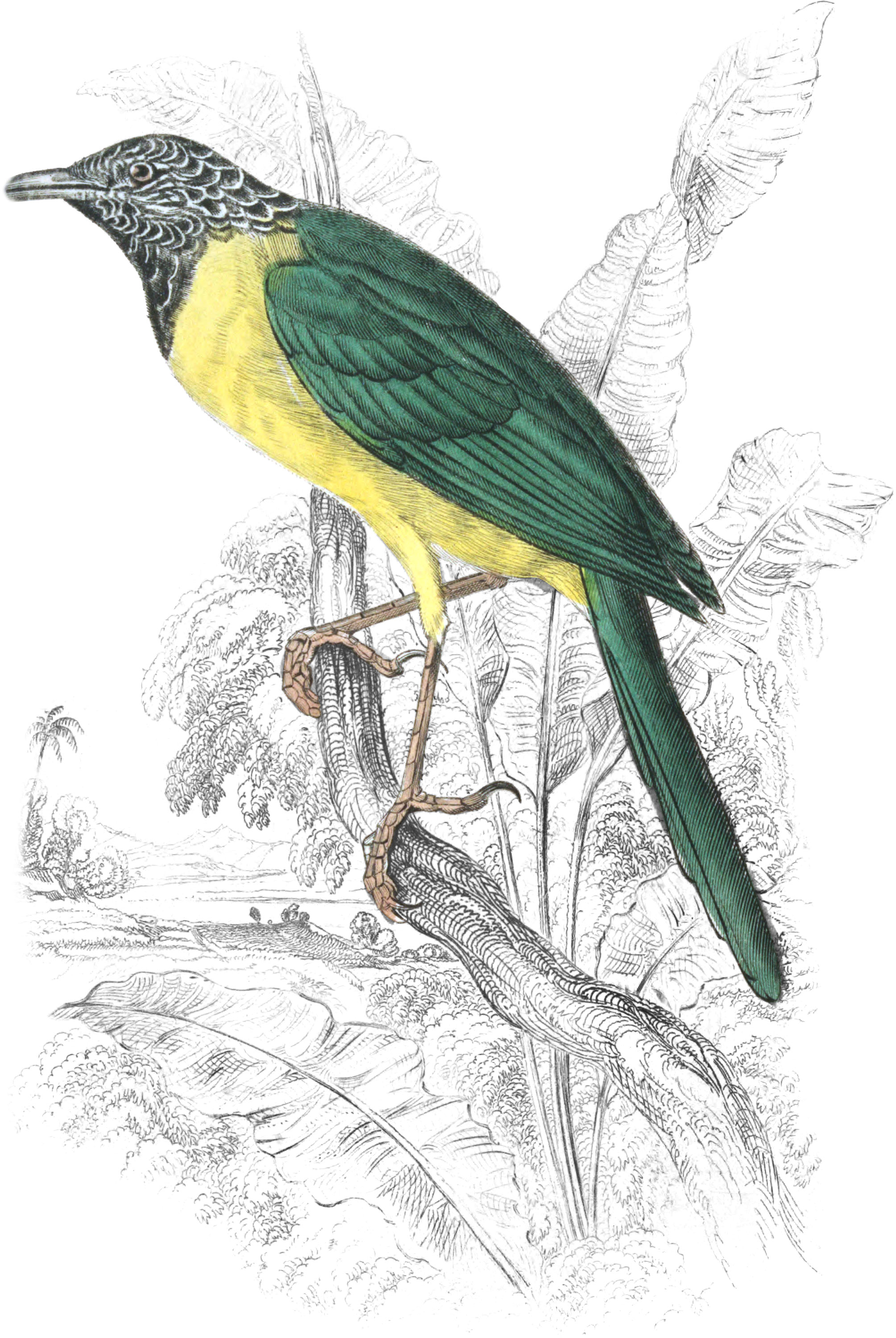
Plate XXXI
Greater White-Crowned Rock-Thrush
Petrocincla leucoceps, Swains.
Above brown; beneath and lateral tail-feathers rufous; front, crown, and nape, white; the feathers with a narrow blackish margin.
White-crowned Thrush, Lath. Gen. Hist. v. 101.
The Rock Thrushes, forming the genus Petrocincla, are the representatives of the stone-chat warblers in their own family circle; and the analogy is so strong, that some recent authors have confounded the one with the other. Like the red-starts (Phœnicura), which they likewise represent, most of the species have rufous on their bodies and tail, with some portions of the head white; the wings are always rounded, and not, like those of the true thrushes, pointed; the tail also is more or less graduated, while in the genuine thrushes it is even. None of this genus have yet been found in America, although it is abundant in Africa and Asia.
The present species is remarkable for its size, no less than for its conspicuous white crown. It might be at first mistaken for one of the mock-birds (Orpheus), but its bill is that of a genuine thrush, i. e. short and notched.
Although this is by no means an uncommon bird at Senegal, its description only appeared in the last work of Dr. Latham, under the name of the White-crowned Thrush. It is clear, however, that more than one species is there spoken of; the smaller one being probably our next, which very much resembles this in its general colours.
The size of our present species is equal to that of a small thrush, but the tail makes it appear longer. The whole top of the head, from the nostrils to even beyond the nape, is white; each feather having a narrow blackish line on its margin, and another in the middle much stronger, but this latter can only be perceived when the feathers are raised. This white patch reaches, on each side, to the edge of the upper eye-lid, and is not, as in the next species, confined to a stripe in the middle of the crown. The ears, sides of the head, and neck,—the upper part of the back, the wings, and the two middle tail-feathers, are all of a deep uniform brown; and there is a small spot of the same colour, as Dr. Latham well observes, at the tip of the chin. The whole of the under parts, as well as the rump, upper covers, and lateral tail-feathers, are of a deep but or rufous orange. The outer tail-feather on each side has a narrow external margin of brown at its terminal half. Bill black; legs pale. The fifth quill is the longest, and reaches the length of the under tail-covers.
Total length nearly 10 inches; bill from the gape, 1; wings, 4\(\frac{6}{10}\); tarsus, 1\(\frac{4}{10}\); hind-toe and claw, \(\frac{8}{10}\); tail from the base, 5.
Lesser White-Crowned Thrush
Petrocincla albicapilla.—Swains.
Above cinereous-brown; beneath, and lateral tail feathers, rufous; ears, front, and sides of the head, black; stripe in the middle of the crown white; nuchal collar rufous.
This elegant little thrush is very considerably smaller than the last, which it so much resembles, being not much longer than seven inches. It is also a much rarer species; while, by its close affinity with our Petrocincla vociferans38 and superciliosa,39 it establishes the natural generic union of these three birds, which, in many respects, so closely resemble their prototypes, the red-starts and the stone-chats (Saxicola).
Independent of the great difference in the sizes of this and the last, the present species may be known by the back and wing-covers being dark cinereous instead of brown, by the white of the crown being confined to a stripe down its centre, and by the rufous of the throat being extended round the back of the neck, so as to form a nuchal collar, which borders the termination of the black and white on the head; there is also no brown on the chin, and the sides of the head and ears are deep black, instead of brown. The wings only reach as far as the upper tail-covers; the bill is black, and the feet dark brown.
This species measures from seven inches and a quarter to seven and three-quarters, according to the greater or less contraction of the neck. On each side of the head is abroad stripe of black, which commences in front of the head at the nostrils, and extends to the nape,—it includes not only the ears but the eye, which is placed nearly in the middle of it; following this, and in the centre of the crown, is a white stripe which terminates at the nape, but which leaves a black space between it and the eye; these stripes are cut off, as it were, from the grey colour of the back, by a collar formed by a continuation of the rufous on the neck. The back, wing-covers, and edges of the quills are deep cinereous, which colour graduates into buff-orange on the upper tail-covers. The whole of the under plumage, from the chin downwards, is bright and uniform buff-orange or orange-rufous, and the lateral tail-feathers are the same; the middle pair and margin of the outermost being dark brown as in the preceding species.
Bill from the gape, \(\frac{8}{10}\); wings, 3\(\frac{6}{10}\); tarsus, 1; hind-toe and claw, \(\frac{6}{10}\); tail, 3\(\frac{1}{2}\).

Plate XXXII
- Unfortunately nearly all these species have been mixed up in the old genera, so that they become as useless to modern science as if they had not been discovered.
- Merops Europæus.
- Rüppell describes a prionops from Northern Africa.—Editor.
- Fauna Boreali Americana, or Northern Zoology; Classification of Animals, &c.
- Even some of the best ornithologists pay so little attention to the variations of structure, and pass over so many points necessary to be understood, that their descriptions are of little service beyond informing us on the mere colours of the plumage. Those for instance, in the Planches Coloriees of MM. Temminck and Langier, are particularly defective in this respect
- There is a species from India, figured in the Pl. Col., which is much like this, but nothing is said of the stripe on the chin, so conspicuous on the specimens we have seen of our present bird.
- This very singular formation does not appear to have been noticed by any writer.
- Le Vaillant, Temminck, &c.
- Rufa leucoptera, temnura, leucogastra, sinensis vagabunda, and other species placed in the supposed genus Dendrocitta.—Zool. Tr. i. 87.
- A figure of this bird has been engraved for the new series of “Illustrations of Ornithology,” Plate X., under the title of Eupodes xanthosomus. We have received specimens from the Cape of Good Hope, and also from Sierra Leone.—W.J.
- Uropygio rostroque rubris, instead of uropygio caudaque rubris.—See Ency. Meth., p. 986.
- Tiaris nitens, Swains. (Fringilla splenens, Veill. Ency. Meth. 981.)
- In this case Amadina, being one of these five divisions, must be cancelled, and the species placed under Estrelda, the characters of which must be so altered as to embrace those of its five types, namely, Estrelda (as here restricted), Amadina, Spermestes, Pytilia, and Erythura; all which will be characterized in the forthcoming volumes of the Cabinet Cyclopedia.
- This is the Erythura viridis of our “Treatise on Ornithology.”
- The effrontery with which some of the German nomenclators have endeavoured to set aside this name for one of their own, is unexampled in science; such synonyms should never be even quoted,—the best punishment their authors can receive.
- Hist. Nat. des Oiseaux, Ed. Sonnini, vol.
xviixii. p. 343. - Edwards’ Nat. Hist. of Birds, vol. i. Plate 7.
- Le Vaill. Ois. d’Afrique, ii. pl. 64.
- See also Encyc. Method., p. 728.
- We have received numerous specimens from Southern Africa, also from the Gambia.—Ed.
- The Editors of Griffith’s Animal Kingdom speak of this as an excessively rare species, and lament the departure of M. Bullock’s specimen! whereas it is one of the most common and well known birds of Western Africa.
- That is, the most distant from the type, which is here the genus Lanius.
- North. Zool. ii. 129.
- North. Zool. ii. p. 485.
- North. Zool. ii. p. 486.
- The species used for this comparison is D. rufescens, the type of the group.
- These other two are probably our Dasycephala syndactyla, Hæmatornis flavicollis, and the three Tricophori here described.
- It is quite clear that Professor Temminck had not examined the other species he alludes to, for he states that this character is peculiar alone to his T. barbatus, whereas it is general in all the three species.
- The bird here described by Mr. Swainson seems to be the same with the T. tephrogenys, Plate 127 of “Ornithological Illustrations.” “T. supra castaneus, genis griseis, gula alba, pectore abdomineque mediis flavescentibus, capite supra rufescens, ridu valide vibrissato.” The specimen there described was purchased, and was supposed to come from India; we have since received it from Sierra Leone.—W. J.
- Pl. Col. pl. 88.
- Ois d’Afrique, ii. pl. 112, fig. 1, (Ph. terrestris, Swains).
- Communicated through my friend Professor Henslow of Cambridge.
- See also Northern Zool. ii. p. 205.
- Zool. Illus. ii. pl. 72. See also D. albolineatus, d’Orbigny, pl. 12, a second species.—Ed.
- Temminck describes this bird as a Pitta, with which, genus, however, I consider it has not sort of relationship.
- We possess six or seven specimens of this bird (or at least, so far as we can judge from Mr. Swainson’s drawing and description, one very closely allied) from Southern Africa. They were received from different collectors, and either one or two specimens from Dr. Smith—W. J.
- See Northern Zoology, ii.
- Turdus vociferans, Zool. Ill., i. p. 180.—The Reclammeur of le Vaill., Ois. d’Af. iii. pl. 104.
- Le Janfredric, Le Vaille., Ois. d’Af. iii. pl. 111.