Volume II
The Natural History of Monkeys


Content warning: Portions of descriptions and imagery on this page contain inaccurate views, derogatory language, and offensive imagery. They are included here as they were originally created in order to compile a complete reproduction. They do not reflect the attitudes of this site’s creator.

Among the varied races of living beings which inhabit this world, none perhaps have excited so much speculation and general interest, as those to which we have devoted our present little volume. From the shy and retired manners of the animals in a wild state, their habits are of difficult investigation, and would require much patience, and a greater allowance of time, than it is often possible for those individuals who possess the enviable opportunities to devote to them. The greater portion of the information we possess, is therefore derived from the accounts of travellers, too often collected from hearsay evidence, exaggerated as the fears and superstitions of the natives have been influenced, and which have appeared as “dreamy forms.”
That the soul sees—and, we suppose, the eyes. We are mostly aware how easily the minds of many native tribes are wrought upon; and it can scarcely be a matter of surprise, that traditions1 should exist, with accounts of the prowess, sagacity, or cruelty of these creatures. Occasional glimpses of an animal clothed in shaggy hair, of gigantic size, with tusks rivalling those of the largest and most ferocious beasts of prey;—possessing a hideous resemblance of countenance and general proportions to man, and assuming positions somewhat human, would present to an untutored mind, a chaos of sensations, whose impressions scarcely could be afterwards detailed; while one of higher cultivation might combine doubts of their animal or human nature, and add to either the brutal or malignant qualities of both. And it is under such influences, fear predominating, that the accounts of their concerted attacks, their carrying off negroes for slaves, distribution of the different sexes, and of their cruelty and carnivorous propensities, have been handed down with embellishments by the older historians.
In other countries, superstition exercises her influence. India, so horribly celebrated by the sacrifices of its infatuated devotees, is in some districts no less so for its weak and extravagant idolatry. In Ahmenadab, hospitals have been erected for the benefit of apes, where thousands are kept in fancied ease and indulgence; and another city, which was taken by General Goddart in 1780, upon its surrender contained forty thousand inhabitants, and as many monkeys. They are even worshipped by the Brahmins, and are raised to the rank of gods. Gorgeous temples are erected,
With pious care a monkey to enshrine!
Mofleus, in his History of India, describes one of great magnificence—it was fronted by a portico for receiving victims sacrificed to it, which was supported by no less than 700 columns; and Linschotten relates, that when the Portuguese plundered one of these monkey palaces, in the island of Ceylon, they found, in a little gold casket, the tooth of an ape; a relic held by the natives in such veneration, that they offered seven hundred thousand ducats to redeem it.—It was, however, burnt by the Viceroy, to stop the progress of idolatry. Among the ancient Egyptians, they also seem to have been held in more than ordinary reverence, or at least to have borne a rank equal to that of the sacred ibis. They were like them represented in the sculptures, and their bodies were preserved as mummies.
We cannot, however, class under such infatuation, the idea which, even in comparatively modern times, prevailed among men who possessed great learning, and minds at once comprehensive and penetrating;
that men and monkeys belonged to the same species, and were no otherwise distinguished from each other, than by circumstances which can be accounted for, by the different physical or moral agencies to which they have been exposed.2
And we can only consider them in the words of an eminent anatomist, as
equally unacquainted with the structure and functions of men and monkeys, not conversant with zoology and physiology, and therefore entirely destitute of the principles on which alone a sound judgment can be formed, concerning the natural capabilities and destiny of animals, as well as the laws according to which certain changes of character, certain departures from the original stock, may take place.3
Seeing, then, that the information handed down to us regarding this singular family, has been in many instances exaggerated and misrepresented, we shall endeavour, in the following pages, to detail what can be depended upon, making use of the discoveries and researches of the modern naturalists who have travelled aware of the doubtful points, and were competent, by their previous studies, for the task of unravelling them; while the anatomy of these animals, which approach nearest in their structure to that of man, will be taken from the able examinations which have been made by Geoffroy Saint Hilaire, Fred. Cuvier, Dr Trail, and Messrs Owen and Yarrel.
Modern zoologists have applied to this family, consisting of two great divisions, the title of Quadmmanous, or four-handed, from their generally possessing thumbs, or members opposable to the fingers of both the fore and hind limbs, which enables them to grasp any object firmly with either, and renders them expert climbers. The most casual stroller through a menagerie, must be immediately struck with the surprising agility, the powerful leaps and swings, and the complete gliding ease, with which all these motions are performed; and an observer in their natural abodes will soon arrive at the conclusion, that their habits are strictly arboreal, and that their economy is intimately connected with the boundless forests of the tropics. They are in fact seldom seen at any distance from woods, and the species which inhabit craggy precipices, such as those in the neighbourhood of the Cape of Good Hope, in Barbary, and about Gibraltar, deviate from the type, become more quadruped in their form and actions, and have therefore always been placed last in our systems.
Their true and natural abodes are the trackless forests, which so richly clothe the countries under the tropics, and which alike supply them with food, and protect them from the heat of those scorching climes. During the middle period of the day, these forests are filled with the animal world, courting their grateful shades, silent and resting; and it is only in some deep glade, “afraid to glitter in the noontide beams,” that the screams of an awakened parrot, or gambols of a monkey, disturb the universal solitude. So soon, however, as a declining sun and the evening breezes reduce the overpowering feelings, do the inhabitants of those vast nurseries resume the exercise of their daily routine, and none among them occupy a more conspicuous place than this family. The more timorous attract the observer’s attention by their endeavours of concealment; and the protrusion of numerous little heads, with bright and searching eyes, from behind the thick boughs and foliage, plainly tells that curiosity almost overbalances the fear of self-preservation. The more forward again, force attention by the shower of rotten branches, fruit, flowers, and nuts, and. sometimes materials of a less agreeable kind, that are either directed against, or unintentionally fall near, the object which thus attracts the attention of this prying assembly; while the annoyed feelings of the spectator soon give way to admiration, at the light and airy gambols of those which think themselves beyond the reach of danger, or are amused at the grimaces, and grotesque attitudes, and half threats of those in the immediate vicinity. This interval of activity in the tropical forest, lasts for a comparatively short period; a few morning and evening hours of milder heat, are sufficient to satisfy all their wants; the blaze of a vertical sun, or a short twilight, again obliges them to seek a covering from its beams, or a place of rest and security from depredators, whose turn it now is to satisfy the cravings of nature.
But there are some tribes inhabiting South America, which reverse this order, and are nocturnal in their habits. Some of the larger species remaining in complete inactivity during daylight, come forth at night, and make the forest resound with their yells and howling. Speaking of the Red Howler, an eccentric writer observes,—
Nothing can sound more dreadful than its nocturnal howlings. While lying in your hammock in those gloomy and immeasurable wilds, you hear him howling at intervals from eleven o’clock at night till daybreak. You would suppose that half the wild beasts of the forest were collecting for the work of carnage. Now it is the tremendous roar of the jaguar, as he springs on his prey; now it changes to his terrible deep-toned growlings, as he is pressed on all sides by superior force; and now you hear his last dying moan beneath a mortal wound.4
A deep and dark evergreen, or the hollow of some decaying tree, like the “shrouded owls,” are the abodes during the day of other small species; and, when removed from their dormitory, a dreamy motion and piteous wailing, are the only exertions which announce that their rest has been disturbed, or their feelings incommoded. During the night, on the contrary, they are all energy.
The food of this family may be called almost entirely vegetable. The accounts of their love for animal food, and relish for that of human beings, as related by Neiuhoff,5 can only be traced to the same sources with the other unsubstantiated reports concerning them, and become naturally associated, in the minds of the inhabitants, with the hideous forms and immense tusks of the larger species. The forest will supply them with nourishment, in the endless variety of fruits and nuts, roots and juicy shrubs. Insects are also greedily devoured by all, and as expertly caught.6 The stores of the wild bees furnish another repast, and the eggs, and occasionally the young of birds, is the only approach which can be traced to a carnivorous propensity.
There are some accounts of the orangs feeding on crabs and shellfish; but we are not sure of the authority whence they have been obtained. Gemelli Carreri tells us, that the orangs descend from the mountains when the fruits are exhausted, where they feed on various shellfish, but particularly on a large species of oyster.
Fearful of putting in their paws, lest the oyster should close and crush them, they insert a stone within the shell, which prevents it from closing, and then drag out their prey and devour it at leisure!
In those districts where cultivation has advanced, they become exceedingly troublesome, and from their numbers do no inconsiderable injury to the foreign husbandman; an amiable poet thus mentions their depredations among the sugar groves:—
Destructive, on the upland sugar groves
The monkey nation preys; from rocky heights.
In silent parties, they descend by night,
And posting watchful sentinels, to warn
When hostile steps approach; with gambols, they
Pour o’er the cane grove. Luckless he to whom
That land pertains!
In like manner, when a remission of watchfulness occurs, do they plunder the maize fields, and rob the orchards of their choicest fruits; “they are so impudent, that they will come into the gardens and eat such sorts of fruit as grow there,” says Knox;7 and Thunberg relates, that such is the superstitious respect in which the Entellus monkey is held by the natives, that whatever ravages they may commit, they dare not venture to destroy them. Emboldened by this impunity, they come down from the woods in large herds, and take possession of the husbandman’s toil, with as little ceremony, as though it had been collected for their use.
In a state of confinement, vegetable diet continues their favourite and most nourishing support; but they will eat almost anything that the luxury of man has introduced, and some even become remarkable for their peculiarities. Among the greater part of them, the love of wine or diluted spirits becomes almost a passion; they are often offered as a bribe to the performance of various tricks, and they will always be greedily drunk when left within reach. Vosmaer’s orang, one day when loose, commenced its exploits by finishing a bottle of Malaga wine. Happy Jerry, the ribbed nose baboon in Exeter Change, performed all his tricks upon the anticipation of a glass of gin and water; and the relish and expression with which it was taken, would have done honour to the most accomplished taster.
Nearly the whole family are gregarious,8 and troops of many hundreds together may be seen in the forest glades and openings, or upon the banks of the noble rivers, which,
Shaded and rolling on through sunless solitudes,
form almost the only passages in those vast countries. Wherever we peruse the journeys of travellers, who have explored the interior of the tropics, we find accounts of almost innumerable bands which crowd the wooded banks, doubtless astonished at such visiters, and exhibiting every attitude and grimace, that the impulses of fear and caution can supply. In general, they live together in harmony, unless when slightly disturbed by rivalry after some favourite supply of food, in which cases, the love and knowledge of power is fully shown and exercised by the strong over their weaker companions. Intruders of any other species are either expelled, or, if too powerful, are chattered at with all their natural petulance, and stolen opportunities are watched, to pilfer the attracting store, or annoy the unwelcome aggressor.
Their breeding-places are various—cloven trees, perhaps a forsaken nest which has already reared a feathered progeny—rocks, thickets of brush, and rank grassy herbage, all afford sheltered nursing-places. The young, seldom more than two, are attended with the greatest care and anxiety by the female; and long after they are able to follow their troop, on the approach of danger, will attach themselves to the parent, who will encounter almost anything in their defence, and who, from the utmost timidity, becomes fierce and reckless of every opponent. It is singular, however, that in confinement the very reverse most frequently takes place; and when these animals have, with great care and attention, been productive, the offspring was immediately left, and the greatest apathy exhibited. Under every advantage Frederic Cuvier was unsuccessful twice, and found it impossible to preserve the young beyond a few hours.9
In geographical distribution, the quadrumanous order presents some curious examples. That part of them to which this volume is devoted, is found in three divisions of the world, and is entirely confined to the warmer parts. Europe, with one exception, which merely skirts its southern border, and North America, are without them, from the unsuitable nature of the climate; and among the various anomalous forms peculiar to New Holland, and the vast archipelago of the Southern Ocean, scarcely one approaches to any resemblance. The smaller formed long-tailed monkeys (which constitute the numerous family of Guenons in the systems,) of mild disposition and playful manners and generally clothed with a fur of considerable beauty, are in a general way distributed over Africa and India; among these, however, the genus Semnopithecus of F. Cuvier, seems exclusively Indian, while, with a few exceptions, the Cercopitheci of the same naturalist, and Cercocebi of Geoffroy, inhabit Africa. The most typical forms in the zoology of these countries, are, in the last; the baboons, or Cynocephali, more bestial in all their forms and habits, and deviating from the quadrumanous type. In one or two aberrant instances they reach India, and the Barbary ape passes the European boundary, and may be looked on as the extreme limit of the family in that direction. The form again most typical to India, is seen in the long-armed apes or Gibbons, (Hylobates, Illiger,) approaching the orangs somewhat in structure, found exclusively in the islands and continent, stretching northward in the Chinese dominions, but not existing in any land that can be allied to the continent of Africa.
The Indian islands possess another very singular animal in the proboscis monkey, (Nasalis, Geoffroy,) which, to the form of the orangs, joins a considerable length of tail; but the greatest peculiarity is the shape of the nose, which is prolonged to an extraordinary degree, and can be compared to nothing so justly, as some of the pasteboard masks, which may be daily seen at the windows of our fancy toyshops. Extending our researches farther in the Asiatic continent, we find, in the western district of China, another curious form, furnished with long arms and tail, but of rather graceful proportions, with a fur of rich colouring, destitute of the bare callosities, and possessing somewhat the flattened face of the American monkeys. It is the Chinese monkey, and constitutes Illiger’s genus Lasiopaga. Some zoologists ascribe the Island of Madagascar as another abode of this animal, but we strongly suspect, that, however allied in resemblance, it will prove distinct. But the most interesting form to these continents, is the orangs, common to both, but in indifferent individuals; and these, as far as our knowledge extends, confined to a very limited space: that of India inhabits almost exclusively the Island of Borneo, while the African representative is found only on the eastern coast, and particularly in Angola and Congo.
These are the principal forms inhabiting the old world; South America possesses others of great peculiarity, and it is remarkable, that none of them can be placed in any of the African or Asiatic groups. The nostrils are always divided by a broader separation, the size and strength is much less; in some, the proportions are very diminutive, and in a few, the habits become completely nocturnal. The inhabitants of this, region, also exhibit the most perfect adaptation of structure for climbing and a silvan life, and the formation of the tail in the greater part, is a most efficient assistant in grasping and supporting themselves among the branches, and some can even introduce the extremity in the narrow parts of the bark, and withdraw from thence any small substance.10 Among the Howlers, we see somewhat of the form and appearance of the baboons, which they also resemble in their larger size, their strength, and fiercer dispositions, and in the structure of the laryngeal sacks, which are connected with the os hyoides. We find, in the genus Hapales, an approach to the insectivorous mammaliæ, in the hooked claws of the fore extremities, instead of nails; and in several of the other forms, a departure from the quadrumanous types, and a joining with the Lemuridæ.
As the quadrumanous races approach nearest to man in structure, and consequently in actions, it will be proper to point out some of the principal distinctions which corporeally separate them; and for this purpose, we shall confine ourselves to the two orangs, which have been universally allowed to bear the strongest resemblance. We do not intend to institute a strict comparison between the monkey and human organization, and to adduce proof from the comparison, that they are distinct as well in structure as in nature; we consider this quite unnecessary, and think that in all our systems, man should be kept entirely distinct. As he is infinitely pre-eminent by the high and peculiar character and power of his mind, and the future destination of his immaterial part, so has he been stamped with a bearing lofty and dignified, with
Far nobler shape, erect and tall,
Godlike erect, with native honour clad.
We wish chiefly to illustrate, by their difference, that the parts allotted for locomotion in the most man-like monkey, are unfitted for sustaining an upright attitude, while they are beautifully adapted to perform all the requisites of a silvan life.
The first distinction that would undoubtedly strike an observer of an orang and human being placed in the same enclosure, would be the positions and attitude; and a closer attention would soon convince, that the corresponding members in each, while beautifully formed for their proper uses, could not be employed to perform similar actions, with an equal degree of strength, firmness, or ease.
Few persons, in the present era, will assert,
———Men have four legs by nature,
And that ’tis custom makes them go
Erroneously upon but two.
While the fact, that no nation in the world assumes any except the erect attitude, will be sufficiently conclusive, without making use of the many arguments which might be drawn from the adaptation of structure. Let us now see how this agrees with the natural gait of the orangs. In man, the limbs, the principal organs of progression, and of maintaining the upright position, are equal in length to the head and trunk together, while the upper extremities are comparatively short. The glutei muscles are the largest in the human body, and the gastronemi, or calf, are of immense power, and terminate in a powerful cord, inserted in the extremity of the bone, forming the heel or os calcis. These, however, would be insufficient, without a surface or base on which the trunk itself could rest; and we find this supplied by a broad and capacious pelvis, with which the thigh-bones form a right angle, by means of the length of the cervix femoris, or neck of the thigh-bone. In the orangs, on the contrary, and indeed in all the monkeys, the lower extremities are comparatively short, while the upper, or arms, are very long, so as to allow the knuckles to be applied to the ground when the animal is nearly erect, and which is, in fact, the mode of progression always adopted when necessity requires this position. The black orang noticed by Dr Tyson advanced in this manner, and that dissected by Dr Trail was observed never to place “the palms of the hands on the ground.” Dr Abel’s red orang performed “the progressive motion by placing his bent fists upon the ground, and drawing his body between his arms.” The narrowness of the pelvis, and the short neck of the femur, forming an acute angle with the spine, also renders the erect position impossible for any time, and always irksome, which is farther confirmed by the weakness of the muscles. The glutei are scarcely visible, and the calves are very weak.11
The extensors of the knee are much stronger in the human subject than in other mammalia, as their operation of extending the thigh forwards on the leg, forms a very essential part in the human mode of progression. The flexors of the knee are, on the contrary, stronger in animals, and are inserted so much lower down, even in the monkeys, that the cord which they form keeps the knee habitually bent, and almost prevents the perfect extension of the leg on the thigh.12
The motion of the knee-joint in the black orang was free backwards, but the animal does not seem capable of perfect extension of this joint, from the contraction of the posterior muscles of the limb.13
Continuing the organization of the lower extremity, we shall now examine the foot. In man, the whole surface of the tarsus, metatarsus, and toes, rests upon the ground, and the os calcis forms a right angle with the leg. In the orangs, this bone begins to form an acute angle with the limb, and consequently does not rest upon the ground. The sole of the foot becomes narrower; and in all the attempts at erect progression, exhibited by the orangs which have been shown in this country, the foot was observed to rest on its outer edge. The plantaris muscle also, which is very fleshy among quadrumanous animals, instead of terminating, as it does in man, by insertion in the os calcis, passes over that bone into the sole, and is there connected with the plantar aponeurosis, an arrangement incompatible with the erect attitude, as the tendon would be compressed, and its action impeded, if the heel rested on the ground.14 But the most marked peculiarity in the foot, and one which is instantly perceived, is the great length of the phalanges or toes, and the position of the great toe, which is placed nearly in a line with the ankle, and does not reach, at the nail, within an inch of the first metatarsal joint, having the appearance of a thumb and hand, whose office it in reality performs, nor is the internal conformation less remarkable; the whole arrangement of muscles is much nearer to that of a hand; but the thumbs of both the fore and hind extremities have no separate flexor longus, (long flexor,) but receive tendons from the flexors of the fingers.
Hence, the thumbs in these animals will generally be bent together with the other fingers; and they are less capable of those actions in which the motion of the thumb is combined with that of the fore and middle finger—a combination so important in numerous delicate operations.15
The upper extremity approaches much nearer to the human form, and in its similarity points out the unfitness of these animals for a constant quadruped motion. The inferior structure of the hands, and particularly the thumbs, show them fitted for grasping alone, and incapable of performing any nice mechanical operation, while the great comparative length indicates their utility in climbing, and therefore their fitness for an arboreal life.
All the orangs which have been dissected, had scarcely reached their second year. The relative proportions, therefore, of the skull and brain to the body, cannot be fixed or compared with those of the adult human being. The relations of the brain, however, as far as have been observed, are nearly similar, and the principal differences in the skull of the nearest form, the black orang, are thus mentioned by Dr Trail:
The top of the head is more flat, and its union with the spine farther back. The orbital processes of the os frontis project about half an inch beyond the general convexity of that bone; and the orbits of the eyes are proportionally larger and rounder than in man. The depression which receives the cribriform plate of the ethmoid bone, is much deeper and smoother on the sides; while the apertures in that bone, for the passage of the olfactory nerves, are considerably larger. Instead of the well-defined boundaries traced in the human skull by the crucial ridge, they were marked by a flat undulation of the occipital bone. There is no mastoid, and scarcely a vestige of a hyloid process, (consequently the muscles which arise from these processes in man, have a different origin.) The bones of the nose were placed perfectly flat on the face, so as not to be visible in the profile of the skull, and the triangular opening was circular. The supramaxillary bones projected considerably beyond the remarkable orbiter process of the frontal bone, being the form of the lower part of the bone nearer to that of quadrupeds. The lower jaw was stronger and narrower.
The superior maxillary bones in man are united to each other, and contain the whole of the upper teeth; but in most of the mammaliæ, they are separated by a third bone of a wedge shape, which contains the incisor teeth. Blumenbach named this the os intermaxillare. According to that anatomist, and Camper, it is found in the red orang; whereas, according to Tyson and Daubenton, it was not seen in the chimpanzee, or black orang; nor does Dr Trail mention having observed it in the specimen which he dissected. Lawrence says,
The brute face is merely an instrument, adapted to procure and prepare food, and often a weapon of offence and defence. The human countenance is an organ of expression, an outward index of what passes in the busy world within. In the animal, the elongated and narrow jaws with their muscles, with their sharp cutting teeth, or strong-pointed and formidable fangs, compose the face; the chin, lips, cheeks, eyebrows and forehead, are either removed, or reduced to a size and form simply necessary for animal purposes; the nose is confounded with the upper jaw and lip, or, if more developed, is still applied to offices connected with procuring food.
In the whole we have the muzzle, or snout of an animal, not the countenance of a human being.
The articulation of the head with the spine, which determines its support, is, in the human subject, very nearly in the centre; and the vertical line of the neck and trunk is nearly perpendicular, and would pass through the top of the head; consequently the whole weight is sustained by the vertebral column. In most animals, the great occipital hole, and the articular condyles, are placed almost at the end of the skull, throwing the whole weight of the head forwards, and it is incapable of being supported by the vertebral column, without some very powerful assisting machinery. Hence, we find the spinous processes of the cervical vertebrae long, and assisted by a very strong ligament, called the ligamentum nuchæ, or suspensorium colli. In the orang, the occipital hole is placed twice as far from the jaws as from the back of the head, which throws a great additional weight forwards, and consequently requires more exertion to maintain the erect position. But although we find, according to Camper, that the spinous processes of the cervical vertebrae are long, and see a greater developement of them in the Batavian pongo, there is no mention in any author of the presence of the suspensory ligament, which is also used as an argument that the natural gait of these animals is not quadruped; for the immense weight of the jaws of the adults, placed so far off the centre, could not possibly be supported in that position, without some provision of this kind. Additional confirmation of this argument is the absence of the suspensorium oculi, a muscle found in quadrupeds, and evidently intended to relieve the others, and be a greater support to the eyes when continued in the prone position.
These are the principal peculiarities of structure connected with progression and attitude; and it must be at once perceived, that neither the erect or quadruped posture, is the common and natural one of the monkeys, and that they will employ either as occasion requires, in their silvan or rocky abodes. Every other part of the form will present some difference; but with the exception of the construction of the larynx, and principal organs employed in the faculty of speech, we shall merely mention a few of the remaining most prominent peculiarities exhibited by the African and Asiatic orangs.
There were only four lumbar vertebræ in Dr Trail’s orang, in this respect similar to the Asiatic species dissected by Messrs Owen and Yarrel. In the first animal, however, there were thirteen dorsal vertebræ, and a similar number of ribs; in the latter, only twelve of each. The lower opening of the pelvis in the black orang is very large; the sacrum is very narrow. No occipito-frontalis muscle was found in the black orang, while it was distinctly seen in the red species by Messrs Owen and Yarrel. In the same animal, three muscles were found to supply the place of the pectoralis major; and the peculiar muscle called the levator claviculæ is found in both. In the black orang the size of the olfactory nerve is great, and the surface of the turbinated bones extensive, which would lead us to infer that the sense of smelling was powerful, and of course of necessary use in its economy.
The larynx of these animals present some curious peculiarities. The best account, perhaps, is that given by Camper of the red orang. After examining the tongue, that anatomist continues,
pursuing my dissection, I discovered a large sack on the right side, running over the clavicular bones, and another on the left side, but visibly smaller. The large sack tore a little on account of its being tender, by having lain so long in spirits. I inflated it through the opening, which I continued quickly, as I perceived that the air went off betwixt the tongue bone and the thyroideus cartilage. I then followed up the rent with a pair of scissors, and cut open the sack, by which means I discovered a transverse split. There was now no doubt but that the left sack had a similar orifice.
In pursuance of it, I took away the whole soft palate and œsophagus as far as below the speaking organs. The soft palate is the same as in most quadrupeds, with this difference, nevertheless, that the uvula on the hind side runs very evidently downwards, but not beneath the margin of the soft palate. This palate appears, however, more capable than in other animals of being contracted.
In other two orangs
there was merely one single sack, having two air tubes, which united themselves with the two splits.
This, he thinks, had been formerly two,
but that the two sacks were gone over into one.
In one of the animals,
the bottom (of the sack) rose nearly to the end of the breast bone, and was partly covered by the breast muscles; the sack rose upwards above the clavicular bones, and with the appendages still more backward, so that this sack penetrated on each side deep under the monk’s-hood muscles, as far as behind upon the shoulder blades.
Camper is of opinion, that this sack increases in size with the age of the animal; and that the frequent expansion by the air, is the cause of the increase.
The orang can, in the mean time, voluntarily swell up these sacks, or this united sack, whenever it tries or attempts to press the strongly inhaled air outwards, and presses then the epiglottis towards the openings of the larynx, or bends it only a little. It can also empty them at pleasure by means of the broad muscles of the neck, by those of the breast, and by the cuculares, or monk’s-hood muscles.
In the black orang, according to Dr Trail, the os hyoides differed from that of man, in being anteriorly more prominent and dilated, and by containing in its body a cavity capable of holding a large pea. On laying open the posterior part of the larynx, the two apertures at the base of the epiglottis, and leading to the laryngeal pouches discovered by Camper, were visible.
The great difference in these organs from the human are the large sacks, which evidently produce the powerful and deep sounds uttered by so many of this tribe. In the black orang, being canned into the body of the os hyoides, it shows the first indication of structure so peculiarly belonging to the American howlers. In the Siamang, remarkable for the power of voice, the simple sacks are so extensive as to protrude prominently to outward view. They prevent the utterance of systematic sounds which the other organs might produce, by preventing a power of control over the air.
Every time that the animal would utter his cry, these sacks swell, then empty themselves, so that he is not able, at will, to supply to the different parts of his mouth the sounds they might articulate.16
In intellect we consider the quadmmanous animals, notwithstanding what has been written and recorded of many of them, not superior, and in many cases inferior, to others of the animal creation; it has the same constitutional distinctions, and presents the same great differences, from a true reasoning power. But among the many anecdotes related of the understanding of the orang-outang, and other monkeys, some may be classed as under the influence of a higher power of discrimination than mere instinct, and where a process, as it were, of discussion passed in the sensorium of the animal. As an example of what we mean, we may mention an anecdote of the young red orang, lately exhibited in Edinburgh by Mr Cops, and figured on our second plate.
Mr Cops one day gave him the half of an orange, a fruit of which he was passionately fond, and laid the other half aside upon the upper shelf of a press out of his reach and sight. Some time after, Mr Cops being reclining upon a sofa with his eyes closed, the orang began to prowl about the room, and showed that, notwithstanding his apparent inattention, the position of his favourite orange had been narrowly watched. Anxious to see the result, he continued quiet, and feigned sleep. Jocko cautiously approached the sofa, examined as far as he could that his guardian was sound, and mounting quietly and expeditiously, finished the remaining half of the orange, carefully concealed the peel in the grate among some paper shavings, and having again examined Mr Cops, and seeing nothing doubtful in the reality of his sleep, retired confidently to his own couch. Here there must have been a detailed series of impressions during the progress of the action; but in common with the construction of the brute mind, he was incapable of extending the power farther, or of reasoning upon that action, during the performance of which his intellect had gone through several distinct processes. All their actions in a state of confinement may be traced to the same source, while those in a state of nature will be more akin to instinct, and will be performed under the impulses of the various passions.
Cunning joined with caution, an inquisitive and prying turn, and imitativeness, are the strong characters in the disposition of the whole family. All these faculties and propensities become more developed in a state of confinement, and consequently of tuition, than in their natural wildness; and while the first, in both states, is indispensable for their preservation, it is by the influence of the others that they are principally indebted to confinement, and the parts they are made to perform in the beggarly dramas performed in the streets of our great towns. Their power of imitation is very great, and often ludicrous in the extreme, from the expressive face, and hum an-like form of the upper parts. This talent has even been said to have been used to their own destruction;—we have heard of monkeys cutting their throats, in imitation of the feigned action of the person whom they annoyed, and of one who killed himself by infusing a paper of tobacco with milk and sugar, instead of tea, and drinking it as he had observed some sick sailor do. How far these are true we shall not attempt to decide; certain it is, that these animals most ludicrously possess this propensity, and that those we have seen as pets, would almost perform any thing once pointed out to them, and would always make the attempt.
For the arrangement of these animals in the descriptive part of our volume, we have followed the old practice of dividing them into two great geographical groups, while we have introduced most of the new genera. This plan we found to be the most convenient during the progress, and perhaps liable to less objection in a work of this kind, than any other or newer system, all of which yet fall short of our own ideas of them correct classification.
The truest arrangement that has yet been proposed, is that by Cuvier and Geoffroy Saint Hilaire,17 and they place the Sapajous immediately after the Orangs and Gibbons. Another system of arrangement, which would find both its friends and enemies in the advocates and disparagers of the circular or progressive series, would be to descend from the Orangs, on the one side of the circle, by the Gibbons, Nasalis, and Colobus, the latter being the only form in the old world with four fingers to the upper extremities, and so far in this respect representing the genus Ateles of the new. We have then the genus Lasiopyga, which combines a great flatness of face to the form of the Guenons which naturally follow, and thence the passage to the Baboons and Cynocephali is easy. On the opposite side, we would descend by the Sapajous and Sagoins to Ateles, thence to the Howlers or Baboons of the new world; and onwards by the Pithecia or Desmarest, to the small species with nookeu and sharp claws. We would still, in this way, have a space between these diminutive insectivorous species, deviating so much from the quadrumanous type and the cynocephalous baboons; but this appears to fill itself naturally up by the Lemuridæ, the small species of which seem intimately connected with the little monkeys above mentioned, while there will be a natural gradation from the baboons to the genus Lichanotus of Illiger, or the Indri of Sonnerat and Audibert. This view of their arrangement would doubtless require alterations to perfect it; but something of the kind seems the most natural method, and the orders of the Carnivora and Rodentia, whichever shall be found to follow most naturally, would touch at the various points of the circle representing their respective families.
For the illustrations of the present volume, we have been at considerable pains. In a few instances Mr Lizars has been able to draw from the living animals, and our best thanks are due to Mr Cops, for allowing copies to be made from his interesting specimen of the red orang, and also to Mr Wombwell for the sketch of the white eyelid monkey. Professor Jameson pointed out the specimen of the hoolock lately received in the Edinburgh Museum; and for the remainder we are indebted to the beautiful but expensive works of the continental naturalists. We have made free use of Humboldt’s Zoological Observations, and his History of the Monkeys of the Orinooko; of Frederic Cuvier’s great work on the Mammaliæ; Audibert, Histoire Naturelle des Singes, and of Spix and Martius’s History of the New Brazilian species.
Having thus so far endeavoured to detail the habits and economy of this curious family, and the general plan of our volume, we shall at once proceed to the description of the animals themselves.
Monkeys of Asia and Africa, or those of the Old World
The Orangs
The animals which have generally been placed in this division are those, which of ell creation, approach nearest to man in their structure. They have generally been placed first in our systems, and we have now to point out those characters important in arrangement, and the distinctions which will separate the species. They have been divided into three genera, the first of which is named Troglodytes by Geoffrey Saint Hilaire, and is characterised by a facial angle of 50°; distinct superciliary ridges; the canine teeth slightly elongated, and placed dose to the cutting teeth, as in man; the head rounded; the muzzle short; no tail, cheek pouches, or callosities; the ears resembling those of man, but large and projecting. It contains only one species.
The Black Orang
Troglodytes niger.—Geoffroy.
Great Ape, Pennant.—Troglodytes chimpanzee, Geoffroy Saint Hilaire, Annales du Museum, xix. p. 87.—Troglodytes niger, Desmarest Mammalogie, page 49.—Black Orang of Africa, Illustrations of Zoology by James Wilson, plate v. fig. 2—Dr Trail, Transactions of Wernerian Society, vol. iii. p. 1.
This singular animal has been mentioned by various travellers under the names of Baris, Smitten, Quimpere, and Quojas-moras; but the adult state remains in even greater obscurity than that of its Asiatic representative, which we shall next endeavour to describe. The relations of all travellers agree in the large and powerful stature which this animal attains, and we have every reason to believe that this is the fact, though they are always so mixed up with the marvellous, and with accounts of their habits and sagacity, so different from the attributes of an animal, that we must certainly consider them undecided without some more direct testimony; and, from their apparent incorrectness, the other pans of the relations have always been received with a doubt.
The black orang is a native of Africa, and particularly the Guinea Coast and Angola; they are said to live in vast troops, and to be dangerous in their attacks upon persons travelling alone in the forests where they are found. They are covered with shining black hair, longest on the back and shoulders; our description of the adult state is, however, imperfect, and we refer to the minute detail given by Dr Trail of a young specimen. Previous to mentioning it, we may relate an account from Bingley’s Animal Biography of a large specimen of this creature, which seems to have been given upon some better authority than most of the others:—
Allemand, the Dutch professor of natural history, had received many vague and unsatisfactory accounts respecting an animal of this kind, and was induced to write to Mr May, a captain in the Dutch naval service stationed at Surinam. This gentleman found him exactly similar to one which he had brought from Guinea, except in size. He was nearly five feet and a half high, and very strong and powerful. Mr May had seen him take up his master, a stout man, by the middle, and fling him from him for a pace or two; and one day he seized a soldier, who happened to pass carelessly near the tree to which he was chained, and, if his master had not been present, he would actually have carried the man into the tree.
The age of this animal, when Mr May first saw it, was about twenty-one years. It died in the following year, but had evidently increased in height during the interval. If we may depend on this account, we may thence conclude that the height will reach six feet at least, while the age attained by them will naturally be considerable.
Young animals have only been exhibited in this country, and we shall now give the account of Dr Trail of one shown in Liverpool. We have extracted it from the Transactions of the Wernerian Society:—
It was a female, and was procured in the Isle of Princes in the Gulf of Guinea, from a native trader, who had carried it thither from the banks of the Gaboon. It was represented as a young animal, far inferior in size to the specimens often seen in the recesses of its native forests; and Captain Payne observed, that it was at least eight or ten inches lower in stature than another which he had seen in the Isle of Princes.
The natives of Gaboon informed him, that this species attains the height of five or six feet, that it is a formidable antagonist to the elephant, and that several of them will not scruple to attack the lion, and other beasts of prey, with clubs and stones. It is dangerous for solitary individuals to travel through the woods haunted by the orang outang; and instances were related to Captain Payne of negro girls being carried of by this animal, who have sometimes escaped to human society, after having been for years detain by their ravishers in a frightful captivity. These reports confirm the narratives of the early voyagers, who have often been suspected of exaggeration, and similar facts have been recently stated, very circumstantially, by gentlemen who have lived in Western Africa.
Captain Payne Says,
When first our animal came on board it shook hands with some of the sailors, but refused its hand, with marks of anger, to others, without any apparent cause. It speedily, however, became familiar with the crew, except one boy, to whom it never was reconciled. When the seamen’s mess was brought on deck, it was a constant attendant; would go round and embrace each person, while it uttered loud yells, and then seat itself among them to share the repast.
When angry, it sometimes made a barking noise like a dog; at other times it would cry like a pettish child, and scratch itself with great vehemence. It expressed satisfaction, especially on receiving sweetmeats,
by a sound like hem, in a grave tone;
but it seems to have little variety in its voice. In warm latitudes, it was active and cheerful, but became languid as it receded from the torrid zone; and on approaching our shores, it showed a desire-to have a warm covering, and would roll itself carefully up in a blanket when it retired to rest. It generally walked on all fours; and Captain Payne particularly remarked, that it never placed the palm of the hands of its fore extremities to the ground, but, closing its fists, rested on the knuckles; a circumstance also noticed by Tyson, which was confirmed to me by a young navy officer, who had been for a considerable time employed in the rivers of Western Africa, and had opportunities of observing the habits of this species. This animal did not seem fond of the erect posture, which it rarely affected, though it could run nimbly on two feet for a short distance. In this case, it appeared to aid the motion of its legs by grasping the thighs with its hands. It had great strength in the four fingers of its superior extremity; for it would often swing by them on a rope upwards of an hour, without intermission. When first procured, it was so thickly covered with half that the skin of the trunk and limbs was scarcely visible, until the long black hair was blown aside. It ate readily every sort of vegetable food; but at first did not appear to relish flesh, though it seemed to have pleasure in sucking the leg-bone of a fowl. At that time it did not relish wine, but afterwards seemed to like it, though it never could endure ardent spirits. It once stole a bottle of wine, which it uncorked with its teeth, and began to drink. It showed a predilection for coffee; and was immoderately fond of sweet articles of food. It learned to feed itself with a spoon, to drink out of a glass, and showed a general disposition to imitate the actions of men. It was attracted by bright metals, seemed to take pride in clothing, and often put a cocked hat on its head. It was dirty in its habits, and never was known to wash itself. It was afraid of fire-arms; and, on the whole, appeared a timid animal.
It lived with Captain Payne seventeen weeks, two of which were spent in Cork and Liverpool. At the former place it was exhibited for the benefit of the soup Kitchen for a few days, but seems to have been there neglected. On coming to Liverpool, it languished a few days, moaned heavily, was oppressed in its breathing, and died with convulsive motions of the limbs.
When erect this animal is about thirty inches high. The skin appears of a yellowish-white colour, and is thinly covered with long black hair on the front; but it is considerably more hairy behind. The hair on the head is rather thin, and is thickest on the forehead, where it divides about an inch above the orbiter process of the frontal bone, and, running a little backwards, falls down before the ears, forming whiskers on the cheeks. Here the hair measures nearly two inches long; but that on the occiput is not above an inch in length. There are a few stiff black hairs on the eyebrows, and a scanty eyelash. A few whitish hairs are scattered on the lips, especially on the under one. The rest of the face is naked, and has whitish and wrinkled skin. There is scarcely any hair on the neck; but, commencing at the nape, it becomes somewhat bushy on the back. The abdomen is nearly nuked. The hair on the back of the head, and the whole trunk, front of the lower extremities, back of the legs, and upper part of the superior extremities, is directed downwards, while that on the back of the thigh and fore arms is pointed upwards; appearances well represented in Tyson’s figure. The longest hair is just at the elbows. There is none on the fingers or palms of either extremity. The ears are remarkably prominent, thin, and naked, bearing a considerable resemblance in shape to the human, though broader at the top. The projection of the process above the eyes is very conspicuous, but has not been sufficiently marked in any engraving or drawing which has fallen under my observation. The nose is quite flat, or rather appears only as a wrinkle of the skin, with a slight depression dong its centre. The nostrils are patulous, and open upwards, which would be inconvenient did the animal usually assume the erect posture. The projection of the jaws is excessive, and though much less so than in the baboon, yet the profile of the face is concave. It may be remarked, however, that the projection of the lower jaw is caricatured in the first and second figures of Camper’s second plate. The mouth is wide, the lips rather thin, and destitute of that recurvation of the edges which add so much to the expression of the human countenance. The whole contour of the head bears no inconsiderable resemblance to some Egyptian figures of the god Anubis.
The spread of the shoulders is distinctly marked, but the width of the lower part of the chest is proportionally greater, when compared to the upper, than in man.
From the lower ribs, the diameter of the abdomen decreases rapidly to the loins, where the animal is peculiarly slender; a circumstance in which it approaches the other Simiæ. The pelvis appears long and narrow, another approximation to the rest of the genus.
With regard to the limbs, the chief difference between our specimen and Dr Tyson’s figure, consists in the excessive length of the arms, which in this animal descend below the knees, by the whole length of the phalanges of the fingers, which are above three inches in length. The same observation applies to almost every figure of this animal which I have seen. The proportions in the work of Camper approach nearest, in the present instance, in this particular. The hand differs from the human, in having the thumb by far the smallest of the fingers. The foot is more properly a hand appended to a tarsus. The thumb of this extremity is very long, powerful, and capable of great extension. The legs are certainly furnished with calves; but they scarcely resemble the human in form, because they are continued of equal thickness nearly to the heel. When this animal is erect, the knees appear considerably bent, as is the case with the other Simiæ, and it stands with the limbs more apart than man.
Such is the minute description by Dr Trail. Another specimen of this animal, and one of the Asiatic species, were exhibited together in the Egyptian Hall, Piccadilly, in 1831, and afforded a treat to the lovers of zoology. They were both very young; the black orang had been procured by a trading vessel on the river Gambia, and was much the most pleasing of the two. He was compared to a black child, but with a head of overgrown proportions. He was very docile, and generally playful and gentle; like all his tribe, he was fond of wine and water, or diluted spirits; and they were used as an incentive for him to perform his part before strangers. Neither of these animals survived long, but fell victims to cold, which seems invariably to affect the orangs, generally before the expiry of the first winter.
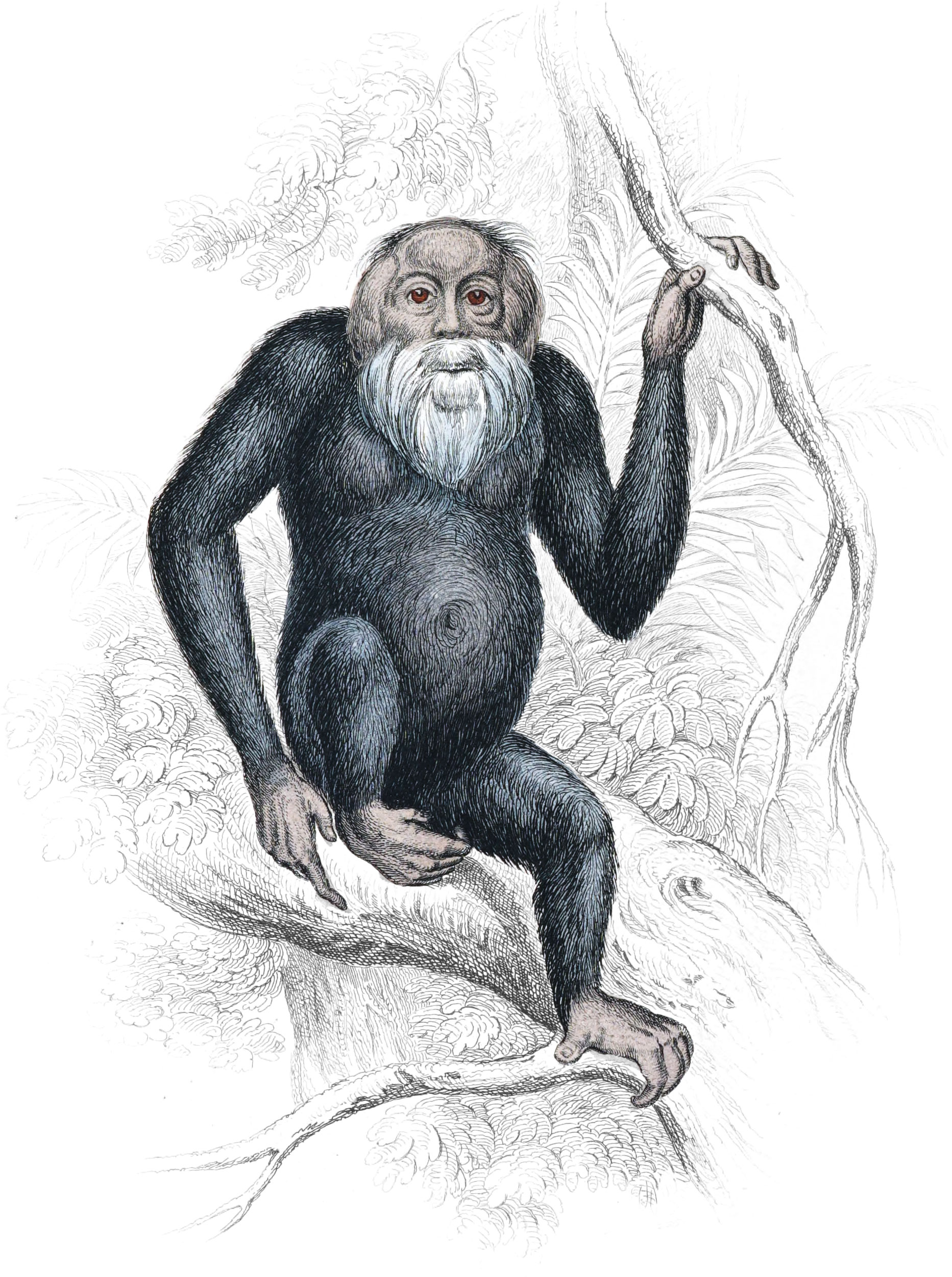
Our plate is taken from a stuffed specimen in the Edinburgh Museum, which, though not in a very good or entire state of preservation, agrees generally with the above descriptions.

The second form among the orangs is described by Geoffroy under the title of Pithecus. The young state of this animal may be said to be well known, and at an age of from three to five years, may be characterized by a facial angle of 65°; by the canine teeth exceeding the others in length,18 and the molar teeth being nearly square on the upper surface; the head rounded, no cheek pouches or callosities; the ears resembling those of man, but small, and applied close to the head; the arms of considerable length. In the adult state, from what we imperfectly know, these characters will vary widely, and still more so if the Pongo shall ultimately prove identical with it, which the high authority of Cuvier would now warrant us to consider decided, did there not exist so very wide a difference between the characters given by him and Lacepede, and those which so many in the young state have exhibited. We have added the dentition of the Pongo from Frederic Cuvier, reduced two-thirds, and the resemblance between it and the teeth of the large Sumatran orang, will be immediately seen.

Orang Teeth
The Red or Asiatic Orang-Outang
Pirthecus satyrus.—Geoffroy.
Simia satyrus, Linnæus.—Jocko, Audibert, Histoire Naturelle des Singes.—Pithecus satyrus, Desmarest Mammologie, p. 50; Geoffroy Saint Hilaire, Annales du Museum, xix. p. 88.—The Red or Asiatic Orang-Outang, James Wilson’s Illustrations of Zoology, pl. v. figs. 1 and 3.—Orang-Outang, Abel, Embassy to China, pages 319 and 365.
We are fortunately possessed of more ample materials to illustrate the history of this singular animal, than of the black orang of Africa; but it is to be regretted that what we have, also relate to individuals in a comparatively young state. One instance only of the capture of what may be considered an adult specimen is authentically recorded; and the fragments of that specimen, with the skull of a supposed adult in the collection at Paris, are all from which we can draw the true characters of this creature. Of the existence of a most gigantic animal there can be no doubt; but it must either be an inhabitant of the interior only, or must flee most rapidly from the encroachments of civilization. The first is the most probable; for it is scarcely possible, if ever an inhabitant of the coasts, that a solitary individual only should have been observed, during the very long period that this country has been possessed by Europeans, among whom were men most zealous in the pursuit of natural history, and to whom this had been long held up as one of the greatest acquisitions that could be procured. This will appear the less singular when we consider the immense extent of unknown territory, occupied by forests almost boundless, and of the most impenetrable description, and we may easily conceive that they will possess many tenants, hitherto unseen even to the piercing eyes of their native hunters. The most unaccountable circumstance is, that the young are so frequently met with, while the gigantic parents have scarcely been perceived; and, except in the instance we have mentioned, exist only in the accounts handed down from family to family.
We have seen the black orang of Africa to be very local in the extent of its distribution, inhabiting but a small portion of a vast continent. The red orang possesses the same peculiarity in its range, and seems confined to the Islands of Borneo and Sumatra, and to the peninsula of Malacca, inhabiting the immense forests, and rarely appearing on their outskirts.
Since the arrival, in 1818, of the red orang, figured and so admirably described by Dr Abel, several young specimens have been exhibited in England, and notes of their manners while alive, with accounts of their dissections, have generally been made and published. None of these are equal, however, in minuteness or interest to that of the assiduous naturalist we have now mentioned; and though it has been frequently copied into works treating of this subject, and is very generally known, we should not consider the present description complete without it. Dr Abel had a long opportunity of observing the animal, and under less constraint than any of those which have since reached Britain. He was interested in, and well qualified for the task, and his whole account bears the stamp of truth, and close unbiased observation. We give the description in his words, and unabridged.19
This interesting animal was procured by Captain Methuen, who brought him from Banjarmassing, on the south coast of Borneo. He was informed by the natives that he had been brought from the highlands of the interior: that he was very rare and difficult to take; and they evidently considered him a great curiosity, as they flocked in crowds to see him.
The height of the animal, judging from his length when laid on a flat surface, and measured from his heel to the crown of his head, is two feet seven inches. The hair is of a brownish-red colour, and covers his back, arms, legs, and outside of his hands and feet. On the back it is in some places six inches long, and on his arms five. It is thinly scattered over the back of his hands and feet, and is very short. It is directed downwards on the back, upper arm, and legs, and upwards on the fore arm. It is directed from behind forwards on the head, and inwards on the inside of the thighs. The face has no hair, except on its sides, somewhat in the manner of whiskers, and a very thin beard. The middle of the breast and belly was naked on his arrival in England, but has since become hairy. The shoulders, elbows, and knees, have fewer hairs than other parts of the arms and legs. The palms of the hands and feet are quite naked.
The prevailing colour of the animal’s skin, when naked, or seen through the hair, is a bluish-grey. The eyelids and margin of the mouth are of a light copper colour. The inside of his hands and feet are of a deep copper colour. Two copper-coloured stripes pass from the armpits down each side of the body, as low as the navel.
The head viewed in front, is pear-shaped, expanding from the chin upwards, the cranium being much the larger end. The eyes are close together, of an oval form, and dark brown colour. The eyelids are fringed with lashes, and the lower ones are saccular and wrinkled. The nose is confluent with the face, except at the nostrils, which are but little elevated; their openings are narrow and oblique. The mouth is very projecting, and of a roundish mammillary form. Its opening is large, but when closed is marked by little more than a narrow seam. The lips are very narrow, and scarcely perceptible when the mouth is shut. The chin projects less than the mouth; below it, a pendulous membrane gives the appearance of a double chin, and swells out when the animal is angry or much pleased. Each of the jaws contains twelve teeth, namely, four incisive teeth, the two middle ones of the upper jaw being twice the width of the lateral; two canine, and six double teeth. The ears are small, closely resemble the human ear, and have their lower margins in the same line with the external angles of the eyes.
The chest is wide compared with the pelvis; the belly is very protuberant. The arms are long in proportion to the height of the animal, their span measuring full four feet seven inches and a half. The legs are short compared with the arms.
The hands are long, compared with their width, and with the human hand. The fingers are small and tapering; the thumb is very short, scarcely reaching the first joint of the forefinger. All the fingers have very perfect nails, of a blackish colour and oval form, and exactly terminating with the extremities of the fingers. The feet are long, resemble hands in the palms, and in having fingers rather than toes, but have heels resembling the human. The great toes are very short, are set on at right angles to the feet close to the heel, and are entirely without nails.
The orang-outang of Borneo is utterly incapable of walking in a perfectly erect posture. He betrays this in his whole exterior conformation, and never wilfully attempts to counteract its tendency. His head leaning forward, and forming a considerable angle with the back, throws the centre of gravity so far beyond the perpendicular, that his arms, like the forelegs of other animals, are required to support the body. So difficult indeed is it for him to keep the upright position for a few seconds, under the direction of his keeper, that he is obliged, in the performance of his task, to raise his arms above his head, and throw them behind him to keep his balance. His progressive motion on a flat surface is accomplished by placing his bent fists upon the ground, and drawing his body between his arms; moving in this manner, he strongly resembles a person decrepid in the legs, supported on stilts. In a state of nature, he probably seldom moves along the ground; his whole external configuration showing his fitness for climbing trees and clinging to their branches. The length and pliability of his fingers and toes enable him to grasp with facility and steadiness; and the force of his muscles empowers him to support his body for a great length of time by one hand or foot. He can thus pass from one fixed object to another, at the distance of his span from each other, and can obviously pass from one branch of a tree to another, through a much greater interval. In sitting on a flat surface, this animal turns his legs under him. In sitting on the branch of a tree, or on a rope, he rests on his heels, his body leaning forward against his thighs. This animal uses his hands like others of the monkey tribe.
The orang-outang, on his arrival in Java from Batavia, was allowed to be entirely at liberty till within a day or two of being put on board the Cæsar, to be conveyed to England; and whilst at large, made no attempt to escape, but became violent when put into a large railed bamboo cage for the purpose of being conveyed from the island. As soon as he felt himself in confinement, he took the rails of the cage into his hands, and shaking them violently, endeavoured to break them in pieces; but finding that they did not yield generally, he tried them separately, and having discovered one weaker than the rest, worked at it constantly till he had broken it, and made his escape. On board ship, an attempt being made to secure him by a chain tied to a strong staple, he instantly unfastened it, and ran off with the chain dragging behind; but finding himself embarrassed by its length, he coiled it once or twice, and threw it over his shoulder. This feat he often repeated, and when he found that it would not remain on his shoulder, he took it into his mouth.
After several abortive attempts to secure him more effectually, he was allowed to wander freely about the ship, and soon became familiar with the sailors, and surpassed them in agility.
They often chased him about the rigging, and gave him frequent opportunities of displaying his adroitness in managing an escape. On first starting, he would endeavour to outstrip his pursuers by mere speed, but when much pressed, elude them by seizing a loose rope, and swinging out of their reach. At other times he would patiently wait on the shrouds, or at the masthead, till his pursuers almost touched him, and then suddenly lower himself to the deck by any rope that was near him, or bound along the mainstay from one mast to the other, swinging by his hands, and moving them one over the other. The men would often shake the ropes by which he clung with so much violence, as to make me fear his falling, but I soon found that the power of his muscles could not be easily overcome. When in a playful humour, he would often swing within arms-length of his pursuer, and having struck him with his hand, throw himself from him. Whilst in Java, he lodged in a large tamarind tree near my dwelling, and formed a bed by intertwining the small branches and covering them with leaves. During the day, he would lie with his head projecting beyond his nest, watching whoever might pass under, and when he saw any one with fruit, would descend to obtain a share of it. He always retired for the night at sunset, or sooner if he had been well fed; and rose with the sun, and visited those from whom he habitually received food.
On board ship, he commonly slept at the masthead, after wrapping himself in a sail. In making his bed, he used the greatest pains to remove every thing out of his way that might render the surface on which he intended to lie uneven; and having satisfied himself with this part of his arrangement, spread out the sail, and lying down upon it on his back, drew it over his body. Sometimes I preoccupied his bed, and teased him by refusing to give it up. On these occasions he would endeavour to pull the sail from under me, or to force me from it, and would not rest till I had resigned it; if it was large enough for both, he would quietly lie by my side. If all the sails happened to be set, he would hunt about for some other covering, and either steal one of the sailors’ jackets or shirts that happened to be drying, or empty a hammock of its blankets. Off the Cape of Good Hope, he suffered much from a low temperature, especially early in the morning, when he would descend from the mast, shuddering with cold, and running up to any one of his friends, climb into their arms, and clasping them closely, derive warmth from their persons, screaming violently at any attempt to remove him.
His food in Java was chiefly fruit, especially mangostans, of which he was excessively fond. He also sucked eggs with voracity, and often employed himself in seeking them. On board ship, his diet was of no definite kind. He ate readily of all kinds of meat, and especially raw meat; was very fond of bread, but always preferred fruits when he could obtain them.
His beverage in Java was water; on board ship it was as diversified as his food. He preferred coffee and tea, but would readily take wine, and exemplified his attachment to spirits, by stealing the captain’s brandy bottle. Since his arrival in London, he has preferred beer and milk to anything else, but drinks wine and other liquors.
In his attempts to obtain food, he afforded us many opportunities of judging of his sagacity and disposition. He was always very impatient to seize it when held out to him, and became passionate when it was not soon given up, and would chase a person all over the ship to obtain it. I seldom came on deck without sweetmeats or fruit in my pocket, and could never escape his vigilant eye. Sometimes I endeavoured to evade him by ascending to the mast-head, but was always overtaken or intercepted in my progress. When he came up with me on the shrouds, he would secure himself by one foot to the rattling, and confine my legs with the other and one of his hands, whilst he rifled my pockets. If he found it impossible to overtake me, he would climb to a considerable height on the loose rigging, and then drop suddenly upon me. Or if, perceiving his intention, I attempted to descend, he would slide down a rope and meet me at the bottom of the shrouds. Sometimes I fastened an orange to the end of a rope, and lowered it to the deck from the mast-head; and as soon as he attempted to seize it, drew it rapidly up. After being several times foiled in endeavouring to obtain it by direct means, he altered his plan. Appearing to care little about it, he would remove to some distance, and ascend the rigging very leisurely for some time, and then, by a sudden spring, catch the rope which held it. If defeated again, by my suddenly jerking the rope, he would at first seem quite in despair, relinquish his effort, and rush about the rigging screaming violently. But he would always return, and again seizing the rope, disregard the jerk, and allow it to run through his hand till within reach of the orange; but if again foiled, would come to my side, and taking me by the arm, confine it whilst he hauled the orange up.
This animal neither practises the grimace and antics of other monkeys, nor possesses their perpetual proneness to mischief. Gravity approaching to melancholy and mildness, were sometimes strongly expressed in his countenance, and seem to be the characteristics of his disposition. When he first came amongst strangers, he would sit for hours with his hand upon his head, looking pensively at all around him; or, when much incommoded by their examination, would hide himself beneath any covering that was at hand. His mildness was evinced by his forbearance under injuries, which were grievous before he was excited to revenge; but he always avoided those who often teased him. He soon became strongly attached to those who kindly used him. By their side he was fond of sitting; and, getting as close as possible to their persons, would take their hands between his lips, and fly to them for protection. From the boatswain of the Alceste, who shared his meals with him, and was his chief favourite, although he sometimes purloined the grog and the biscuit of his benefactor, he learned to eat with a spoon; and might be often seen sitting at his cabin-door enjoying his coffee, quite unembarrassed by those who observed him, and with a grotesque and sober air that seemed a burlesque on human nature.
Next to the boatswain, I was perhaps his most intimate acquaintance. He would always follow me to the mast-head, whither I often went for the sake of reading apart from the noise of the ship; and having satisfied himself that my pockets contained no eatables, would lie down by my side, and pulling a topsail entirely over him, peep from it occasionally to watch my movements.
His favourite amusement in Java was in swinging from the branches of trees, in passing from one tree to another, and in climbing over the roofs of houses; on board, in hanging by his arms from the ropes, and in romping with the boys of the ship. He would entice them into play by striking them with his hand as they passed, and bounding from them, but allowing them to overtake him and engage in a mock scuffle, in which he used his hands, feet, and mouth. If any conjecture could be formed from these frolics of his mode of attacking an adversary, it would appear to be his first object to throw him down, then to secure him with his hands and feet, and then wound him with his teeth.
Of some small monkeys on board from Java he took little notice, whilst under the observation of the persons in the ship. Once, indeed, he openly attempted to throw a small cage containing three of them overboard; because, probably, he had seen them receive food of which he could obtain no part. But although he held so little intercourse with them under our inspection, I had reason to suspect that he was less indifferent to their society when free from our observation, and was one day summoned to the top-gallant yard of the mizen-mast to overlook him playing with a young male monkey. Lying on his back, partially covered with the sail, he for some time contemplated, with great gravity, the gambols of the monkey which bounded over him, but at length caught him by the tail, and tried to envelope him in his covering. The monkey seemed to dislike the confinement, and broke from him, but again renewed its gambols, and although frequently caught, always escaped. The intercourse, however, did not seem to be that of equals, for the orang-outang never condescended to romp with the monkey as he did with the boys of the ship. Yet the monkeys had evidently a great predilection for his company; for whenever they broke loose, they took their way to his resting-place, and were often seen lurking about it, or creeping clandestinely towards him. There appeared to be no gradation in their intimacy; as they appeared as confidently familiar with him when first observed as at the close of their acquaintance.
But although so gentle when not exceedingly irritated, the orang-outang could be excited to violent rage, which he expressed by opening his mouth, showing his teeth, seizing and biting those who were near him. Sometimes, indeed, he seemed to be almost driven to desperation; and on two or three occasions committed an act which, in a rational being, would have been called the threatening of suicide. If repeatedly refused an orange when he attempted to take it, he would shriek violently and swing furiously about the ropes; then return and endeavour to obtain it; if again refused, he would roll for some time like an angry child upon the deck, uttering the most piercing screams; and then suddenly starting up, rush furiously over the side of the ship, and disappear. On first witnessing this act, we thought that he had thrown himself into the sea; but, on a search being made, found him concealed under the chains.
I have seen him exhibit violent alarm on two occasions only, when he appeared to seek for safety in gaining as high an elevation as possible. On seeing eight large turtle brought on board, whilst the Cæsar was off the Island of Ascension, he climbed with all possible speed to a higher part of the ship than he had ever before reached; and looking down upon them, projected his long lips into the form of a hog’s snout, uttering at the same time a sound which might be described as between the croaking of a frog and the grunting of a pig. After some time he ventured to descend, but with great caution, peeping continually at the turtle, but could not be induced to approach within many yards of them. He ran to the same height, and uttered the same sounds, on seeing some men bathing and splashing in the sea; and since his arrival in England, has shown nearly the same degree of fear at the sight of a live tortoise.
Such were the actions of this animal as far as they fell under Captain Methuen’s notice during his voyage from Java. I cannot find, since his arrival in England, that he has learnt to perform more than two feats which he did not practise on board ship, although his education has been by no means neglected. One of these is to walk upright, or rather on his feet, unsupported by his hands; the other to kiss his keeper. I have before remarked with how much difficulty he accomplishes the first, and may add. that a well-trained dancing-dog would far surpass him in the imitation of the human posture.
The next specimen of which we have an accurate account, was one brought as a present to the Empress Josephine from the Isle of Fiance. It is described by Fred. Cuvier, and, like all the others, died a short time after it reached Europe. When first brought on board, it showed the same caution with Dr Abel’s orang; would not mount aloft until it had seen M. Decaen, by whom it was brought up, do so—and during its life the same attachment to its owner, and annoyance in his absence, appeared. In eating or drinking, it would occasionally use its hands to convey the food or vessel to its lips, but would as often apply the lips to the food, and when drinking would lengthen them out—a power which it possessed in an extraordinary degree.
A spoon was sometimes given to it, with which in imitation it would attempt to lift the food; but when that could not be accomplished, the spoon would be significantly handed to the nearest person with whom it was acquainted. In the whole of its actions, the resemblance to Dr Abel’s animal was so near, that a detail would be nearly a recapitulation. We refer, therefore, to the paper itself in the 15th volume of the Annales du Museum d’Histoire Naturelle. One circumstance may be mentioned, of a singular attachment the animal took for two kittens. These it would carry under each arm to their great annoyance; it seemed to have pleasure also in placing them upon its head, but in this position the claws became troublesome from their restlessness, and were sometimes attempted to be pulled out. This could not be accomplished, but so much pleasure seemed to be experienced by the position, that the inconvenience of their scratches was afterwards unheeded.
The capture of an adult specimen of this animal, which we noticed at the commencement of our description, took place under the following circumstances, and places the fact of its immense size and strength beyond doubt; we are indebted also for it to the exertions of Dr Abel, who wrote an account of the remains of the animal for the Asiatic Researches.20 It is so interesting that we insert it entire, and have added some illustrations of the skull and teeth from the plates accompanying that gentleman’s narrative, and casts of them, which are in the Museum of the Royal Society of Edinburgh.
A boat party under the command of Messrs Craygyman and Fish, officers of the brig Mary-Anne-Sophia, having landed to procure water at a place called Ramboom, near Touraman, on the north-west coast of Sumatra, on a spot where there was much cultivated ground and but few trees, discovered on one of them a gigantic animal of the monkey tribe. On the approach of the party he came to the ground, and when pursued sought refuge in another tree at some distance, exhibiting, as he moved, the appearance of a tall man-like figure covered with shining brown hair, walking erect with a waddling gait, but sometimes accelerating his motion with his hands, and occasionally impelling himself forward with the bough of a tree. His motion on the ground was plainly not his natural mode of progression, for even when assisted by his hands or a stick, it was slow and vacillating; it was necessary to see him among trees, in order to estimate his agility and strength. On being driven to a small clump, he gained by one spring a very lofty branch, and bounded from one branch to another with the ease and alacrity of another monkey. Had the country been covered with wood, it would have been almost impossible to prevent his escape, as his mode of travelling from one tree to another is described to be as rapid as the progress of a swift horse. Even amidst the few trees that were on the spot, his movements were so quick that it was very difficult to obtain a settled aim, and it was only by cutting down one tree after another, that his pursuers, by confining him within a very limited range, were enabled to destroy him by several successive shots, some of which penetrated his body and wounded his viscera. Having received five balls, his exertions relaxed, and, reclining exhausted on one of the branches of a tree, he vomited a considerable quantity of blood. The ammunition of the hunters being by this time expended, they were obliged to fell the tree in order to obtain him, and did this in full confidence that his power was so far gone that they could secure him without trouble; but were astonished, as the tree was falling, to see him effect his retreat to another with apparently undiminished vigour. In fact, they were obliged to cut down all the trees before they could drive him to combat his enemies on the ground, against whom he still exhibited surprising strength and agility, although he was at length overpowered by numbers, and destroyed by the thrusts of spears, and the blows of stones and other missiles. When nearly in a dying state, he seized a spear made of a supple wood, which would have withstood the strength of the stoutest man. and shivered it in pieces; in the words of the narrator, he broke it as if it had been a carrot. It is stated by those who aided in his death, that the human-like expression of his countenance, and piteous manner of placing his hands over his wounds, distressed their feelings, and almost made them question the nature of the act they were committing. When dead, both natives and Europeans contemplated his figure with amazement. His stature, at the least computation, was upwards of six feet.
By Captain Cornfoot, who furnished the details of this animal to Dr Abel, he was said to be a full head taller than any man on board, measuring seven feet in what might be called his ordinary standing posture, and eight feet when suspended for the purpose of being skinned.
It seems probable that the animal had travelled from some distance to the place where he was found, as his legs were covered with mud up to the knees, and he was considered as great a prodigy by the natives as by the Europeans. They had never before met with an animal like him, although they lived within two days’ journey of one of the vast and almost impenetrable forests of Sumatra. They seemed to think that his appearance accounted for many strange noises, resembling screams and shouts, and various sounds, which they could neither attribute to the roar of the tiger, nor to the voice of any other beast with which they were familiar.
The following measurement was made by Dr Abel, from the remains of the animal, which were deposited in the Asiatic Society’s Museum.
The skin of the body of the animal, dried and shrivelled up as it is, measures, in a straight line from the top of the shoulder to the part where the ancle has been removed, rive feet ten inches; the perpendicular length of the neck, as it is in the preparation, three inches and a half; the length of the head, from the top of the forehead to the end of the chin, nine inches; and the length of the skin still attached to the foot, from the line of its separation from the leg, eight inches: we thus obtain seven feet six inches and a half as the approximate height of the animal.
A description of the remains of this gigantic animal is also given by Dr Abel.
The face, with the exception of the beard, is nearly bare, a few straggling short downy hairs being alone scattered over it, and is of a dark lead colour. The eyes are small in relation to those of man, and are about an inch apart; the eyelids well fringed with lashes. The ears are one inch and a half in length, and barely an inch in breadth, are closely applied to the head, and resemble those of man, with the exception of wanting the lower lobe. The nose is scarcely raised above the level of the face, and is chiefly distinguished by two nostrils, three-fourths of an inch in breadth, placed obliquely side by side. The mouth projects considerably in a mammillary form, and its opening is very large; when closed, the lips appear narrow, but are in reality half an inch in thickness. The hair of the head is of a reddish-brown, grows from behind forwards, and is five inches in length. The beard is handsome, and appears to have been curly in the animal’s lifetime, and approaches to a chestnut colour; it is about three inches long, springing very gracefully from the upper lip near the angles of the mouth, in the form of mustaches; when descending, it mixes with that of the chin, the whole having a very wiry aspect; the face of the animal is much wrinkled.
The length of the face, from the commencement of the hair on the forehead, to the setting on of the neck, was thirteen inches and a half, and the other parts in a like remarkable proportion. The lower jaw with the teeth, is given by Dr Abel of the natural size, and the figure which we have copied will give a better. idea of its magnitude than a detail of its measurement.

Red Orang-Outang Canine
The annexed cut of the canine tooth extracted, is taken from a cast in the Royal Society’s Museum in Edinburgh.
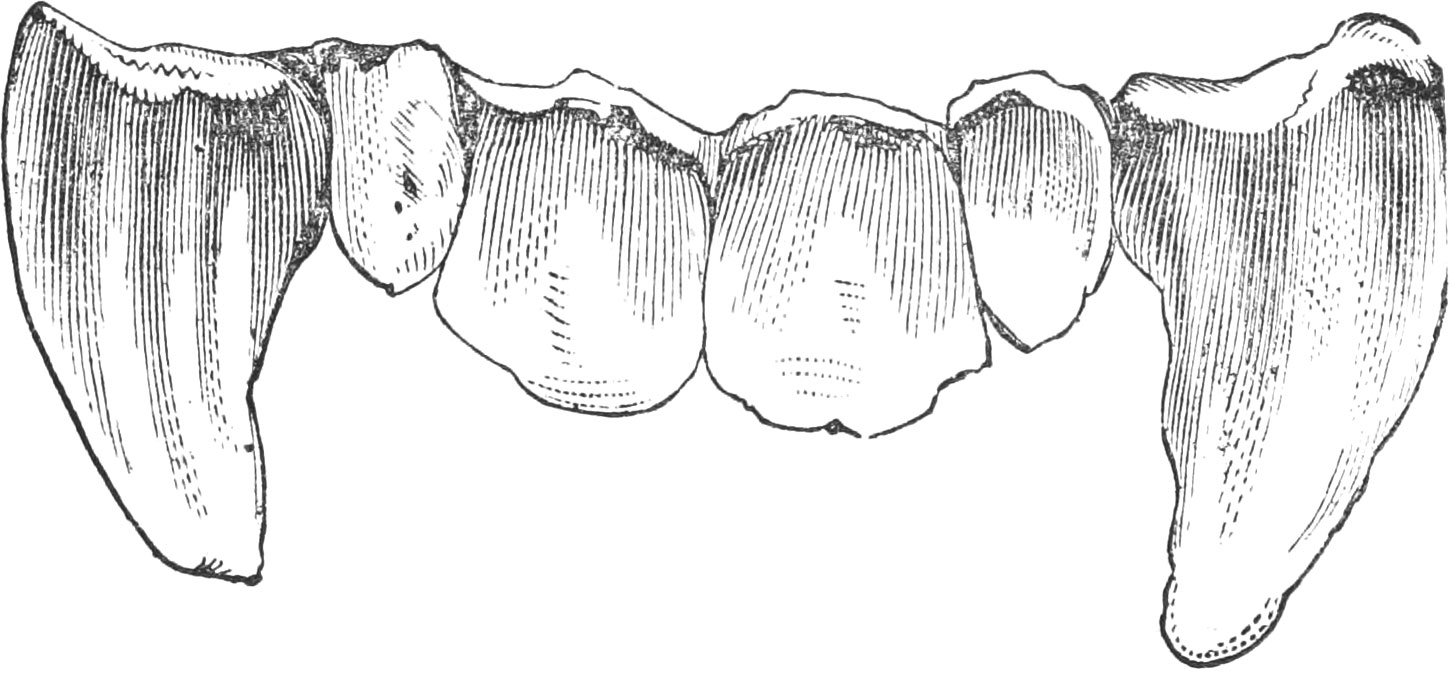
Red Orang-Outang Upper Teeth
We add also a delineation of the upper teeth, from a plate by Dr Abel, which are remarkable for the breadth of the centre cutting teeth, and the narrowness of the lateral ones; and in both jaws, the great length and strength of the canine teeth, will point out the variation from the characters which are generally given to the genus from a young animal, while they also show the resemblance to our sketch, from F. Cuvier, of the dentition of the Pongo.21
The palms of the hands are very long, and quite naked from the wrists. Their backs, to the last joint of the fingers, are covered with hair, which inclines a little backwards; all the fingers have nails, which are strong, convex, and of a black colour; the thumb reaches to the first joint of the forefinger. The length from the end of the middle finger to the wrist, in a right line, was one foot; the circumference over the knuckles, eleven inches; the length of the thumb upon the palm, two inches and a half. The feet are covered with long brown hair on the back, to the last joint of the toes, and the great toe is set on nearly at right angles. The length of the foot, from the heel to the end of the middle toes, one foot two inches; the circumference round the knuckles, nine inches and three quarters; length of the great toe, upon lower surface, two inches and three quarters.22
The skin itself was of a dark leaden colour. The hair of a brownish red; but when observed at some distance, has a dull, and, in some places, an almost black appearance. It is on all parts very long; on the fore-arm directed upwards, and on the upper arm downwards, but from its length, it hangs shaggy below; from the shoulders it hangs in large and massy tufts, which, in continuation with the long hair on the back, seems to form one long mass to the very centre of the body. About the flanks the hair is equally long, and in the living animal must have descended below the thighs.
From the preceding details of the young red orang, and this gigantic Sumatran animal, the description of this singular creature may be considered as having attained a considerable degree of perfection. It would be, however, of much importance, that a specimen having attained its maturity, could be procured and brought alive to this country, that an opportunity might be afforded of studying the disposition and temper. The general impression at present is, that the docility and gentleness of the young becomes changed into ungovernable ferocity, and that the propensities of an animal become more and more developed by age. How far this corresponds with the recession of the foreheads of the adult skulls, it would be interesting to trace; and we can only hope that the perseverance of some enterprising traveller will erelong enable us to judge of these singular structures.
We have only now to notice the illustrations we have added to this already long article. They were fortunately procured by the assistance of a clever draughtsman, and are acknowledged to be correct representations. The animal from which they were taken was exhibited in Edinburgh by Mr Cops, in August last, and our acknowledgements are due to that gentleman for permitting the drawings to be made, and for his polite attention in pointing out its peculiarities.
The general actions of this specimen also corresponded with those above described; his manner of progression was always assisted by the arms, resting his knuckles on the floor of the apartment, and thus having a resemblance to a person upon crutches. After being brought into the room, he would seat, or rather squat, himself on a sofa, and having judiciously folded a blanket of flannel round him, would deliberately survey the visiters. A checked shirt was frequently thrown over him, which he wore with great complacency. One day a gentleman wearing linen of a similar pattern appeared in the room, and was immediately singled out, nor was the animal satisfied until he was allowed to examine the shirt, pulling it out from the breast, and holding it in comparison with that which covered himself, expressively looking up in the gentleman’s face, as if doubtful of his right to a garb which agreed so nearly with his own.
His motions were calm and sedate, with a semblance of timidity, and he did not exhibit that quickness and activity we are used to attribute to the quadrumanous animals. Two young boas were exhibited in the room, which excited the greatest horror when taken from their covering, and a watch was incessantly kept up until they were again placed under restraint. This was also remarked of the specimen brought to the Empress Josephine. In their native wilds they are their most insidious enemy.
This animal was perfectly good-natured, and scarcely ever showed any inclination to anger. When not exhibited, he was allowed to go about the house, and was generally to be found playing with the children of the person with whom Mr Cops lodged, and they seemed mutually pleased with each other. In colour and proportions, he did not differ from those we have previously noticed.

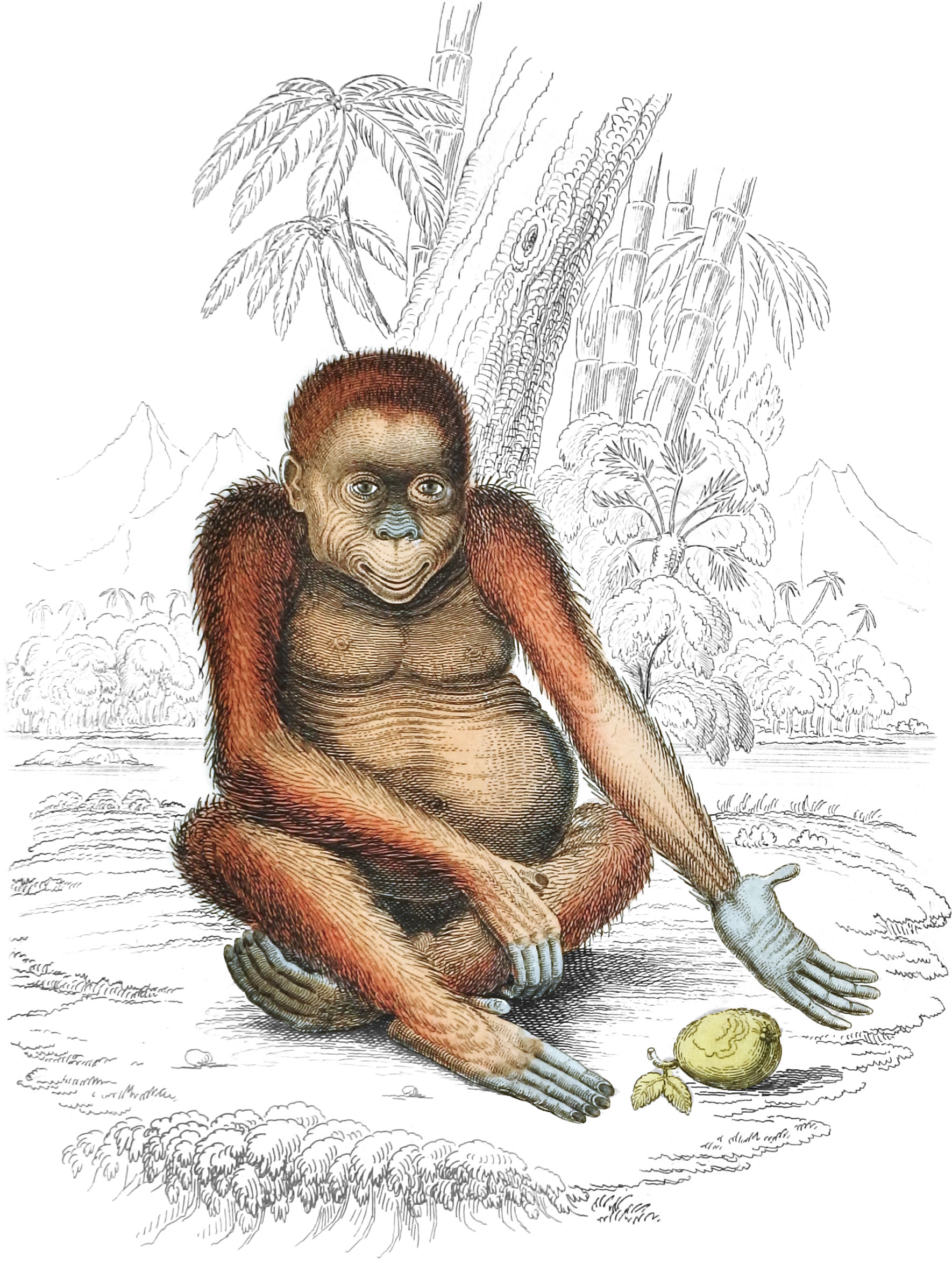
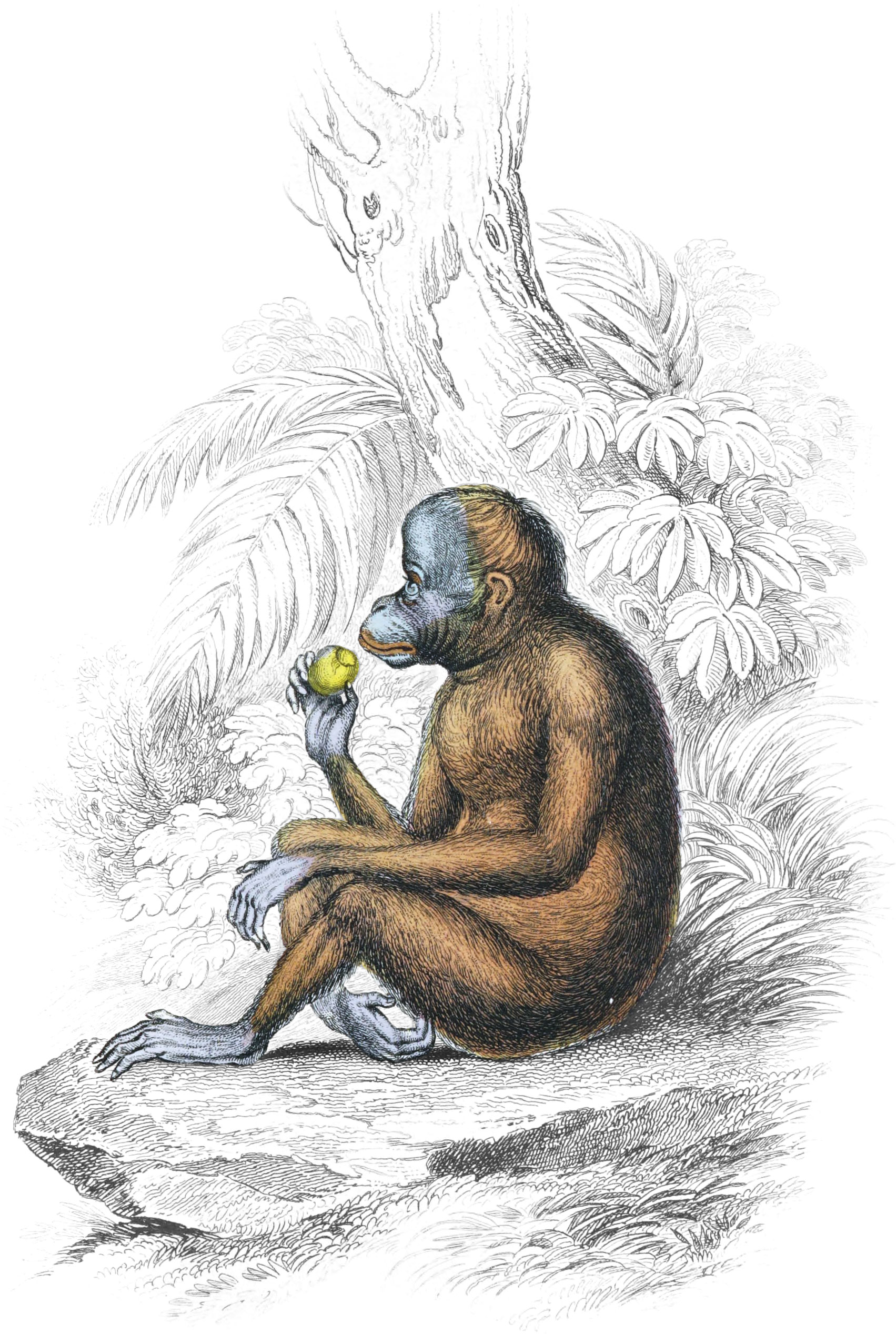
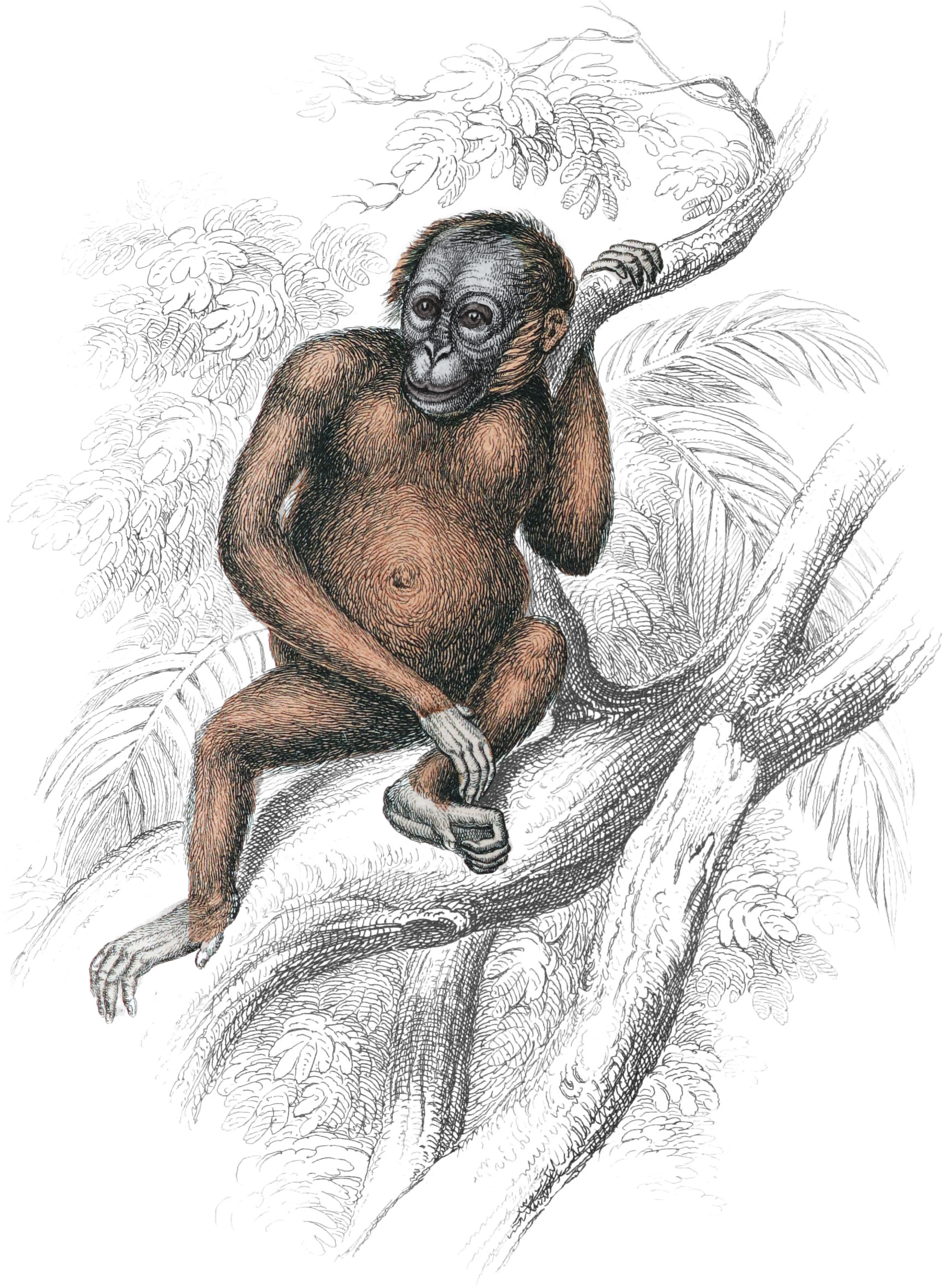
The Gibbons
The next form to which our attention is most naturally directed, as entering the group of orangs, is the Gibbons or long-armed apes, forming the genus Hylobates23 of Illiger.

Gibbons Teeth
They may be generally characterised by having the same dentition, the same dentition, though somewhat modified in form, with the African and Asiatic orangs, and represented in the annexed cut of the dentition of the H. leuciscus; in being destitute of a tail; and peculiarly remarkable from the great length of the anterior extremities, which reach the ground when the animal is placed in an erect position. Their height scarcely exceeds four feet, and they never possess that gigantic and powerful form, which is attained in a native state by the animals we have just described. Their dispositions in a wild stale, appear shy and timid. They are in most instances gregarious, and in this respect resemble the howling monkeys of America, which is farther confirmed by the presence, in some, of the large guttural sacks, and the continued howling which betrays their haunts. Some species are possessed of very great activity, and use their long arms with almost as much effect as the long and prepensile tail of the Sapajous. Some appear again to be more sluggish in their habits, but are possessed of an acute sense of sight and hearing, and will seldom allow an intruder to approach so near as to render their escape difficult or uncertain. When in confinement they soon become reconciled and peaceful, become attached to those who take charge of them, but seem possessed of only a small portion of intuitive intellect. They are all natives of India and her islands, abounding in the forests, at a distance from which they are very seldom found; and, when occasionally discovered straying, fall an easy prey, from their great timidity and awkwardness of progression on a comparatively flat surface. The first we shall mention, is a new species from the continent of India.
The Hoolock
Hylobates hoolock.—Harlan.
Sim’s hoolock, Harlan, Transactions of the American Philosophical Society, Volume iv. N. S. Page 52.
This curious species was first noticed by a well-known American naturalist, and is figured in the work above quoted; it wants the callosities on the hips, and from its nearer approach in proportions to the orangs, would take precedence in our system of the other Gibbons.
It is a native of the Garrow Hills, in the vicinity of Goalpara, in British India. The first description of it is by Dr Harlan, taken from living specimens and interesting letters which accompanied them, and detailed what had been observed regarding them in a wild state. A specimen has lately been added to the Museum of Edinburgh, which has served for our illustration, to which we have added the letters of Dr Burrough to its American describer.
It is strongly characterised as distinct from the other long-armed orangs or Gibbons. In form, size, and proportion, it is most closely allied to the female of the active Gibbon, H. agilis of F. Cuvier; but is very different in colours and markings, especially the young individuals of the two species, which differ totally in these respects. The male and female resemble each other in the present species; but the sexes of the active Gibbon are different in size and colour.
The specimen in the Edinburgh Collection agrees nearly with that described by Dr Harlan.
The colour of the young, according to Dr Harlan, is blackish brown, sprinkled with gray on the hands and feet; the buttocks are grayish; a tuft of the same colour extends along the middle of the front of the body; the band of gray over the eyes of the adult, is generally interrupted in the middle of the forehead by a line of black hairs, which is absent in the young one; the band is broader in the latter, in proportion of seven-tenths to four-tenths. In this individual, about half the size of the adult, a remarkable difference was observed in the relative proportions of the arm and fore-arm. In the young animal, the fore-arm is shorter than the arm—a fact at variance with the proportions of those parts, not only in the orangs, but in all the race of adult Simiæ. In the adult, the arm and forearm are within one inch two-tenths of being equal in length.
The dentition of this species nearly agrees with that of its congeners; but is remarkable in the length of the canine teeth.
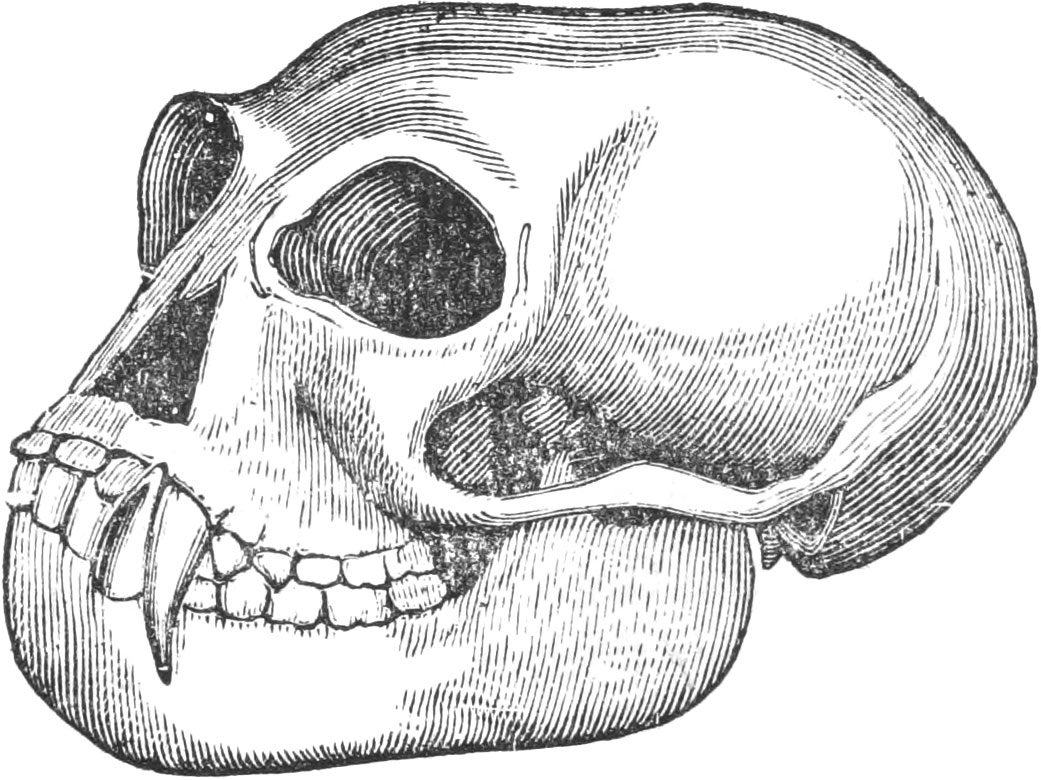
Hoolock Skull
We now add the interesting letter of Dr Burrough accompanying the specimens described by Dr Harlan.
The specimens of the orang-outang or Gibbons, furnished you, were obtained by me during my late excursion into the interior of Bengal. They were presented to me by Captain Alexander Davidson, of the Honourable East India Company, stationed at Goalpara, situate on the Burrampooter river, in Assam. This district of country was formerly attached to the Burmese empire, but at present is in possession of the East India Company, and constitutes the north-eastern limits of their territory in this quarter.
The orang, of which I am now to speak, called by the Assamese “Hoolock,” is to be met with on the Garrow Hills, in the vicinity of Goalpara, between latitudes 25° and 28° north; and the specimens brought to this country by me, were taken within a few miles of the town of Goalpara. The full grown one, which at this time you have prepared, was in my possession, alive, from the month of January to May, when it died from a blow it received across the lumbar region, inadvertently inflicted with a small stick by one of my servants at Calcutta. They inhabit more particularly the lower hills, not being able to endure the cold of those ranges of the Garrows of more than 4 or 500 feet elevation. Their food, in the wild state, consists, for the most part, of fruits common only to the jungle in this district of country; and they are particularly fond of the seeds and fruits of that sacred tree of India, called the Peopul-tree, and which, on the Garrow Hills, attains a very large size. They likewise take of some species of grass, and also the tender twigs and leaves of the Peopul and other trees, which they chew, swallow the juice thereof, and reject the indigestible part. They are easily tamed; and when first taken show no disposition to bite unless provoked to anger, and even then manifest a reluctance to defend themselves, preferring to retreat into some corner rather than attack their enemy. Their walk erect; and when placed upon a floor or in an open field, balance themselves very prettily, by raising their hands over their head, and slightly bending their arm at the wrist and elbow, and then run tolerably fast, rocking from side to side; and if urged to greater speed, they let fall their hands to the ground, and assist themselves forward, rather jumping than running, still keeping the body, however, nearly erect; if they succeed in making their way to a grove of trees, they then swing with such astonishing rapidity from branch to branch, and from tree to tree, that they are soon lost in the jungle or forest.
The individual in question became so tame and manageable in less than a month, that he would take hold of my hand and walk with me, helping himself along at the same time with the other hand applied to the ground, as described above. He would come at my call, and seat himself in a chair by my side at the breakfast-table, and help himself to an egg, or the wing of a chicken from my plate, without endangering any of my table furniture. He would partake of coffee, chocolate, milk, tea, &c.; and although his usual mode of taking liquids was by dipping his knuckles into the cup and licking his fingers, still, when apparently more thirsty, he would take up the vessel from which I fed him with both hands, and drink like a man from a spring. His principal food consisted of boiled rice, boiled bread and milk, with sugar, plantains, bananas, oranges, &c., all of which he ate, but seemed best pleased with bananas. He was fond of insects; would search in the crevices of my house for spiders, and if a fly chanced to come in his reach, he would dexterously catch him in one hand, generally using his right hand. Like many of the different religious castes of this country, he seemed to entertain an antipathy to an indiscriminate use of animal food, and would not eat of either the flesh of the cow or hog; would sometimes taste a little piece of beef, but never eat of it. I have seen him take fried fish, which he seemed to relish better than almost any other description of animal food, with the exception of chicken, and even this he would eat but very sparingly of, preferring his common diet, bread and milk, with sugar, fruit, &c. In temper he was remarkably pacific, and seemed, as I thought, often glad to have an opportunity of testifying his affection and attachment for me. When I visited him in the morning, he would commence a loud and shrill whoo—whoo—whoo—whoo, which he would keep up often from five to ten minutes, with an occasional intermission for the purpose of taking a full respiration; until finally, apparently quite exhausted, he would lie down and allow me to comb his head, and brush the long hair on his arms, and seem delighted with the tickling sensation produced by the brush on his belly and legs. He would turn from side to side, first hold out one arm and then the other, and when I attempted to go away, he would catch hold of my arm or coattail, and pull me back again to renew my little attentions to him, daily bestowed. If I called to him from a distance, and he could recognise my voice, he would at once set up his usual cry which he sometimes gradually brought down to a kind of moan, but generally resumed his louder tone when I approached him. This animal was a male, but showed no particular marks of the sex; and by a casual glance, might readily, if not examined more closely, have passed for a female. I have no idea of his age; but, judging from the size and length of his canine teeth, suppose him to have been advanced in life.
The other large “Hoolock,” of which you have the cranium, was also a male, and full grown. He was likewise obtained from the Garrow Hills, in Assam, presented to me by my friend Captain A. Davidson of Goalpara. He came into my possession in the month of April, and died at sea in July, just before getting up with the Cape of Good Hope, of a catarrhal affection. His death probably might have been hastened from want of proper food; such as is not procurable on long voyages. This animal was similar in habit and general characters to the one already described; and may have been eight or ten years of age, or perhaps older; as I am informed by the natives of Assam they live to the age of twenty-five or thirty years.
The young specimen was also alive in my possession. This is a female, and was brought to me by a Garrow Indian at the same time the first was received; but died on the way from Goalpara to Calcutta, of a pulmonary disease following catarrh. This poor little creature, when first taken sick, suffered great pain and oppression at the chest, for which I prescribed a cathartic of castor oil and calomel, and a warm bath, which seemed to afford it some temporary relief, but she died after ten days’ illness. The animal appeared delighted with the bath; and when I removed her from the vessel, she would run back again to the water, and lie down again until again removed. She was like the others I had in my possession, gentle and pacific in disposition, very timid and shy of strangers; but in less than a week from the time she was taken, would, if put down in an open place, quickly run to me, jump in my arms, and hug me round the neck. I supposed her to have been from nine months to a year old. I fed her on boiled milk, goat’s milk diluted with water and sweetened with sugar-candy. She also would sometimes partake of a little bread and milk, with the older one. She soon learned to suck the milk from a small bottle, through a quill covered with a piece of rag.
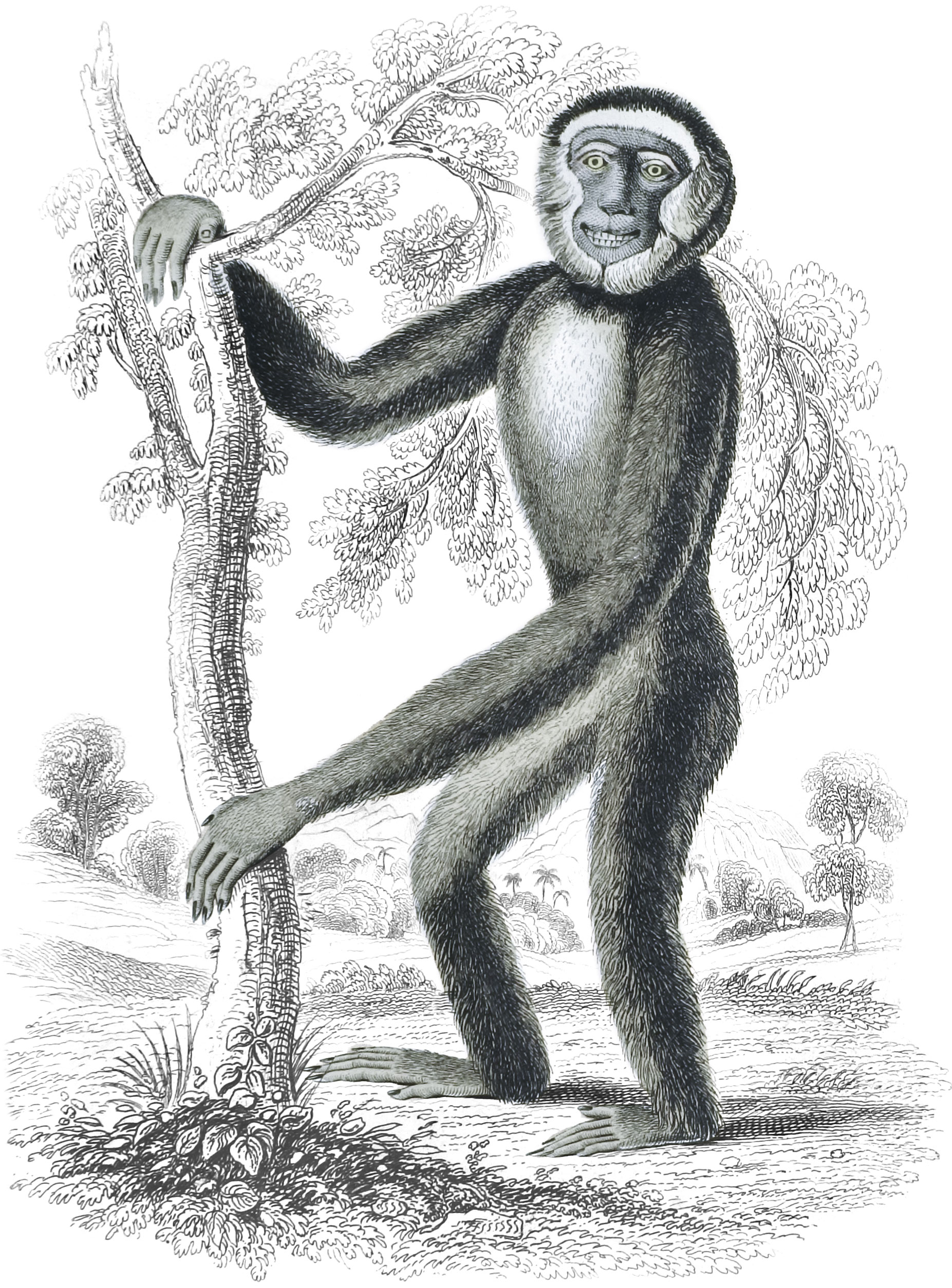
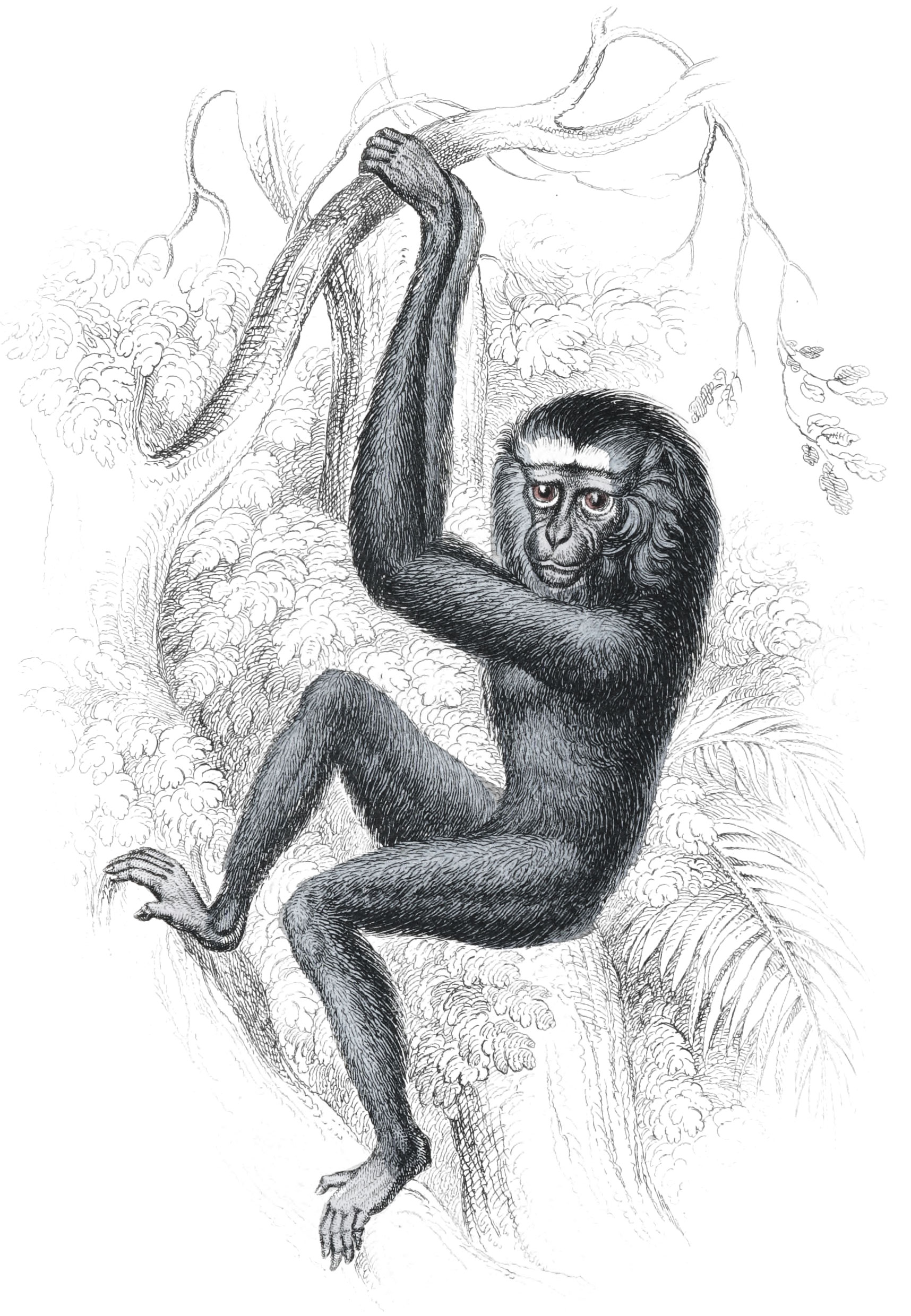
We shall next describe a very singular species from the East Indian Islands.
The Siamang
Hylobates syndactyla.—Raffles.
Simia syndactyla, the Siamang, Sir Stamford Raffles, Transactions of Linnæan Society, vol. xiii. page 241; Horsfield, Zoological Researches in Java.—Le Siamang, Frederic Cuvier, Histoire Naturelle des Mammifères.—Le Siamang, Cuvier, Regne Animal, vol. i. page 90.
The Siamang, by some naturalists, has been separated from the other long-armed apes on account of the curious formation of the feet. They have the first, and second toes closely united, as far as the middle of the second phalanx.

Siamang Hand
It was discovered by Sir Stamford Raffles in Sumatra, and is particularly abundant in the vicinity of Bencoolen. It is about three feet in height, and is entirely of a jet black colour, with a few scattered grayish hairs on the cheeks and chin. The hair upon the body is shining, long, soft, and thick. The face is black, the muzzle short, and the facial angle from 60° to 65°. The nose is flat and depressed above, but rises below abruptly, with a cartilaginous eminence, in which the large, nearly circular nostrils, are pierced from the sides in an oblique direction; at its extremity this eminence is obtuse, and united to the upper lip by a narrow gradually attenuated apex, which, forming a cartilaginous arch, gives a peculiar character to the Siamang. The orbital margin is very prominent; and the frontal bone rises above the eyes obliquely, with a very gradual inclination backward. This part is covered with hairs, which have a different character from those on other parts of the body; they are regular and straight, and, being closely applied to the surface of the head, form a gradually rising plain, on which the hair appears as if dressed or rendered smooth by art. The ears are closely applied to the head, are margined, and have externally the same structure as in man. They are in a great measure concealed by the hairy covering of the lateral parts of the head, which, with that of the extremities, affords a very peculiar character, and its thickness considerably increases the bulk of these parts. It consists of hairs close and woolly near the skin, united in small tufts, which diverge irregularly, and form a shaggy fleece. The separate hairs are above two inches long, and on every part except the head are slightly curved, so as to cause a somewhat frizzled appearance. The mouth is large, extending almost from cheek to cheek. The throat appears very broad, and has the outward appearance of a swollen goitre destitute of hair; this is the large guttural sack, which has been thought to assist the production of the wild continued howling of some monkeys, and which appears inflated when the animal cries. In the females the breast is destitute of hair; but the species appears to be subject to little of the variation incident to so many of this tribe from age or sex. The fingers of the hands are very slender, and of uncommon length; and the formation of the feet, as we have previously mentioned, is the most remarkable variation from the other Gibbons.24
The active time of the Siamang is at daybreak and twilight, when they are found assembled in large bands, and make the forests resound with their howl, in a manner concerted, which is often heard at an immense distance. During the day they remain quiet and inactive, and utter no cries unless disturbed. By the Malays they are supposed to be conducted by a head or chief, which is always the strongest, and which is also supposed to be invulnerable. He is thought to direct their motions and to preside at their morning and evening howlings. In their general habits they are said to be more sluggish and inactive than some which we shall presently describe; and they neither swing from the branches, or leap with that surprising agility, which characterise some of the others. They seem, however, sensible of their imperfections; and being endowed with an acute sense of hearing, fly to their retreats upon the least noise which is not familiar to them. If any members of .a band are wounded, they are immediately left behind; a mother only will remain with the young one if hurt, and will allow herself to be taken rather than fly alone. MM. Diard and Duvancel relate, that this maternal affection is at all times remarkably strong, and not exercised only in a time of danger. The young are tended with the greatest care; and these gentlemen mention having seen the females carry their young to the banks of a stream, wash them notwithstanding their cries, and wipe and dry them in the most careful manner.
These gentlemen also describe their habits when confined, as characterised by stupidity, dulness, and inactivity, in a few days becoming mild, and deprived of all ferocity, but always timid, and without that familiarity and impudence which so many of this tribe very soon acquire; nor does either good or bad treatment seem to have much effect on their dispositions. The most common position is sitting squatted, surrounded by their long arms, and having the head concealed between their limbs. Dr Horsfield mentions, on the contrary, that a Siamang in the possession of Sir Stamford Raffles, was remarkably tame and tractable, and was never happy but when allowed to be in company with some one; and another described by Mr George Bennet, from observations made during a voyage from India to this country, showed a lively affection towards himself and those who behaved kindly to it.25 Sir Stamford Raffles mentions having seen a specimen entirely white.


The other animals contained in this group have naked callosities on the buttocks, like the baboons, and in their dispositions are more active. One of the first known, though till lately involved in obscurity, is the Simla lar of Linnæus; the long-armed ape of Pennant. This was thought to be subject to a variation in the colour of the wrists and hands to white; but the distinction has turned out to be that of different species, and for that with white hands M. Geoffroy Saint Hilaire has retained the old name of lar, while the totally black species has been dedicated by the same gentleman to Sir Stamford Raffles, under the name of Hylobates Rafflesii. Another animal allied to these, and generally described as a variety under the title of Lesser Gibbon, seems yet to be held as a subject for doubt by our most modem zoologists; it is much less in size, and has generally been procured from Malacca. There is a sixth species, some what allied except in colour, which, by older writers, was also confounded with the long-armed gibbon; it is the Moloch or Wow-wow, the Hylobates leuciscus of modems. It inhabits the Moluccas, is entirely of a grayish white, except the face, which is black, but does not differ in general habit from its congeners.
The only remaining animal we have to mention, as embraced in this group, is also known under the name of Wow-wow, but which is indiscriminately applied by the natives of the Indian islands to several species though they are distinguished from one another by additional names. It is remarkably contrasted from the others by its more pleasing shades of colouring and surprising agility. We give a plate of the female and young of
The Active Gibbon
Hylobates agilis.—F. Cuvier.
Le Wow-wow, Frederic Cuvier, Histoire Naturelle des Mammifères.—Hylobates agilis, the Active Gibbon, Griffith, Animal Kingdom, vol. v.—Le Gibbon Brun, Cuvier, Regne Animal, vol. i. p. 90.
This very active animal inhabits the forests of Sumatra, where it is known under the name of Ungaputi. It appears to have been first noticed by Sir Stamford Raffles, to whom specimens were brought by MM. Diard and Duvancel, who were for many years in the pay and employment of this most assiduous naturalist. These gentlemen also sent specimens to the Paris Collections, which served as copies for Frederic Cuvier, in his great and elegant work upon the Mammaliæ, and which we have freely used in the progress of our present little volume. M. Duvancel also sent to Paris descriptions, which were used for the above-mentioned work, and which are now united with what information we have been able to procure elsewhere.
The face is naked, and of a bluish-black. In the male, the cheeks and a superciliary band are of a yellowish-white, beautifully contrasting with the clear chocolate-brown of the upper half of the body; these marks are wanting in the female represented on our plate. The lower extremities are of the same dark colour, and the lower part of the back, and fore part of the thighs, are of a yellowish-brown. The shade of the colour, of both the dark and light parts, however, vary considerably according to age, and the light parts above, sometimes occupy a greater or lesser space. The hair in healthy animals is clear and fine, except upon the neck, where it becomes lengthened, and some what woolly or curled. The young are always much paler in colour than the adults, or those at an advanced age, and the very young animals are of a uniform yellowish-white. The general height scarcely exceeds two feet seven or eight inches, and the arms reach the ground when the animal stands erect.
They are endowed with surprising agility, and their light form and slender-looking extremities hardly give an idea of the great muscularity which they must possess. If the extreme tree on the borders of a forest can be reached by them, it will be in vain to pursue farther; they swing, leap, and, as it were, throw themselves from one tree to another, clearing at times a space of forty feet, with a rapidity which defies any pedestrian pursuer. When a slender branch can be grasped, the body is swung several times, until sufficient impetus is gained, and they then dart off with the utmost apparent ease and grace.
In a state of domestication, they are not so lively as many other monkeys, though susceptible of some cultivation; they are easily frightened, and as easily again reassured, fond of being caressed, inquisitive and familiar, and sometimes playful. In the internal anatomy, they differ from the preceding species in the absence of the guttural sack; nevertheless, the cry is nearly similar, which must show that this formation is not necessary to produce the howl of this and some other monkeys, or that some other structure mast fill up the deficiency.
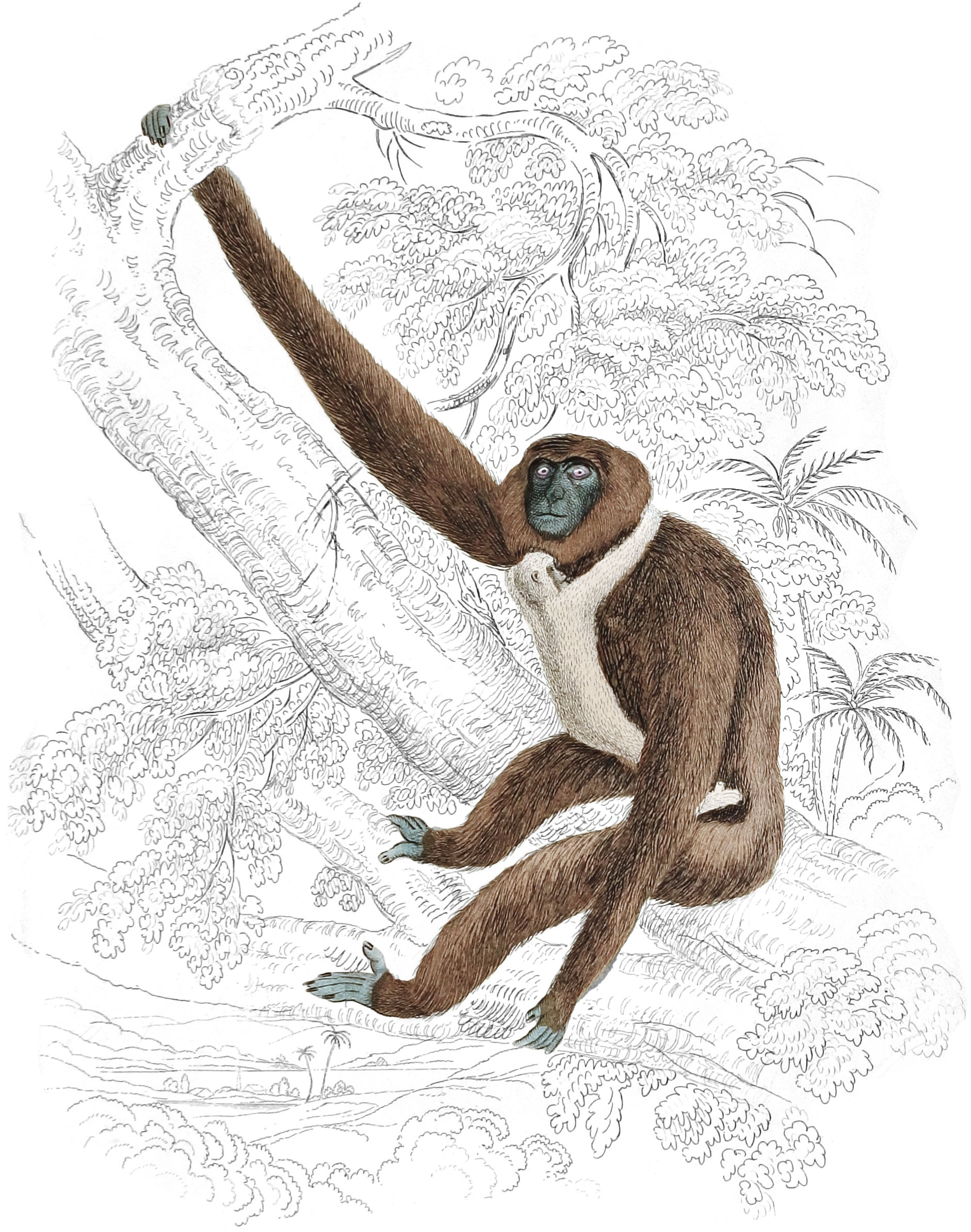


We have now mentioned all the known species of long-armed apes or Gibbons, and there are two forms which by most zoologists have been placed immediately following them, of which we have been unable to see specimens. We shall therefore shortly notice them from the works of highest reputation, before proceeding to the Guenons or long-tailed monkeys of the Old World.
The Capped Monkey
The first has been characterised by Eschsholtz, under the name of Prebytis;26 possesses no cheek-pouches; has naked callosities; the arms reach to the knees, and the tail is of considerable length. The facial angle 60°. Only one species has been discovered in Sumatra, P. mitrula, or capped monkey; of small size, above of a bluish-green, beneath grayish-white.
The second is named Colobus by Illiger,27 remarkable for having only four fingers upon the upper extremities, and in this respect representing Ateles28 of the New World, to which it also comes near in the shortness of the muzzle, and comparative shortness of the face. In other respects it resembles the Guenons.
Three species are described. They are natives of Africa, but little is known of their habits or locality.
The type of this genus may be seen in the Simia polycomos, Schreber, the full-bottomed monkey of Pennant, black, with longer hair covering the neck, in the form of a mane. It inhabits the forests of Guinea and Sierra Leone. The next is the bay monkey, Colobus ferruginosas, which has been thought by some to be merely a variety of the preceding; and the third is an unfigured species, dedicated by M. Kuhl to M. Temminck (Colobus Termminckii, Kuhl.) It formed part of the collection of Mr Bullock, and, at the dispersion of that valuable museum, passed to that of Temminck. The upper parts of the head, neck, back, and shoulders, black, the limbs clear reddish, and the under parts having a tinge of tawny yellow. The native country unknown.
It may be remarked that this genus is placed by Illiger after the Cynocephali, and next that of Ateles, with which the monkeys of the New World are commenced.
The Guenons
Following for our guidance the arrangement of the quadrumanous animals proposed by Cuvier, whose extensive experience and varied research, entitle him to every confidence, we shall proceed next with his brother’s sub-family of the Guenons, or long-tailed monkeys of the Old World. Most zoologists place them after the orangs and gibbons, and reach the baboons by those species where the muzzle becomes more lengthened, (Cercocebus sabeus, &c.,) by the Rhesus monkey29 and Barbary ape, and thus reach the Cynocephali, which have the largest facial angle, the nostrils placed at the extremity of the muzzle, possess a less degree of intelligence, and have dispositions akin to the fiercest and most brutal. With these they conclude the forms of the Old World.
The large assortment of animals which have been placed in this group, may be termed the most agreeable of the “monkey race.” They embrace considerable variety of shape and size, but often exhibit furs of the greatest brightness and beauty, with forms at once light and graceful; while their dispositions are in general mild, peaceful, and affectionate, or, if occasionally riotous, are confined to displays of playfulness and mischief, and are entirely free from the fierce and malignant tempers displayed in a greater or less degree among all the baboons. When taken at an early age they are readily tamed, and become playful and familiar; they are extremely agile, though generally calm and circumspect in their motions, and learn a variety of tricks, which they perform with much cunning and address. In a wild state they are gregarious, and, bird-like, inhabit the rich forests of Africa and Asia.
The divisions which Frederic Cuvier has proposed, are entitled by him Semnopitheques and Guenons. The former he places next to the Gibbons, which some of the species so much resemble in different parts of the skeleton, as to be with difficulty recognised, and designates them Semnopithecus, from the grave and serious character of the animals contained in it. But before proceeding with these, we shall describe two monkeys, which, though generally admitted into the Guenon group, are so imperfectly known as to render any classification, however near we may come in our analogical reasonings, to be uncertain. The first of these is
The Kahau or Proboscis Monkey
Nasalis larvatus.—Geoffroy.
Proboscis Monkey, Pennant’s Quadrupeds, append, p. 322.—Le Kahau, Audibert, Histoire Naturelle des Singes.—Nasalis larvatus, Geoffroy Saint Hilaire, Annales du Museum, vol. xix. p. 91.—Guenon nasique, Desmarest’s Mammalogie, p. 55.
This singular monkey is at once distinguished by the extraordinary elongation of the nose, which is nearly four inches in length, and gives a grotesque appearance to the animal, at the same time far from pleasing. In other respects it presents a form of considerable interest to the zoologist; the body is unshapely, protruding in front like the Orangs, and wants the lightness possessed by so many of the Guenons. The arms are of very considerable proportional length, like the Gibbons; and, like the howling monkeys, it possesses a large guttural sack—while the presence of a lengthened tail, and of naked callosities, present altogether a very curious combination.
The kahau is about three feet in height when placed in an erect position, and, with the exception of the tail and lower part of the back, is of a reddish-brown colour. The female is said, by Audibert, to want the light-coloured markings on the back, and to be rather less in size; the nose and face are of a blackish-brown colour, the nostrils are placed at the extremity, and they can be blown up or swelled Nose seen from beneath, from Audibert to a considerable size.

Nose seen from beneath, from Audibert
Messrs Vigors and Horsfield have given the profile of another monkey, brought from the Island of Borneo, in which the nose is scarcely one-third of the length, and is somewhat turned up.30 They suspect that this is the young of the proboscis monkey, which, if correct, will show that the elongation is much dependent upon the age of the individuals; while, should farther examination prove that it is really distinct, they propose to designate it as a second species, under the title of N. recurvus, or turned-up proboscis monkey.
The kahau is a native of the Island of Borneo, and is still rare in collections. It is a gregarious animal, and is said to assemble in large troops, at sunrise and sunset, upon the trees bordering rivers. They are possessed of great activity, and dart from tree to tree, springing to a distance of fifteen or twenty feet. They utter continued cries, somewhat similar to the expression of the common name which has been applied to them.
Our plate is taken from that of Audibert.

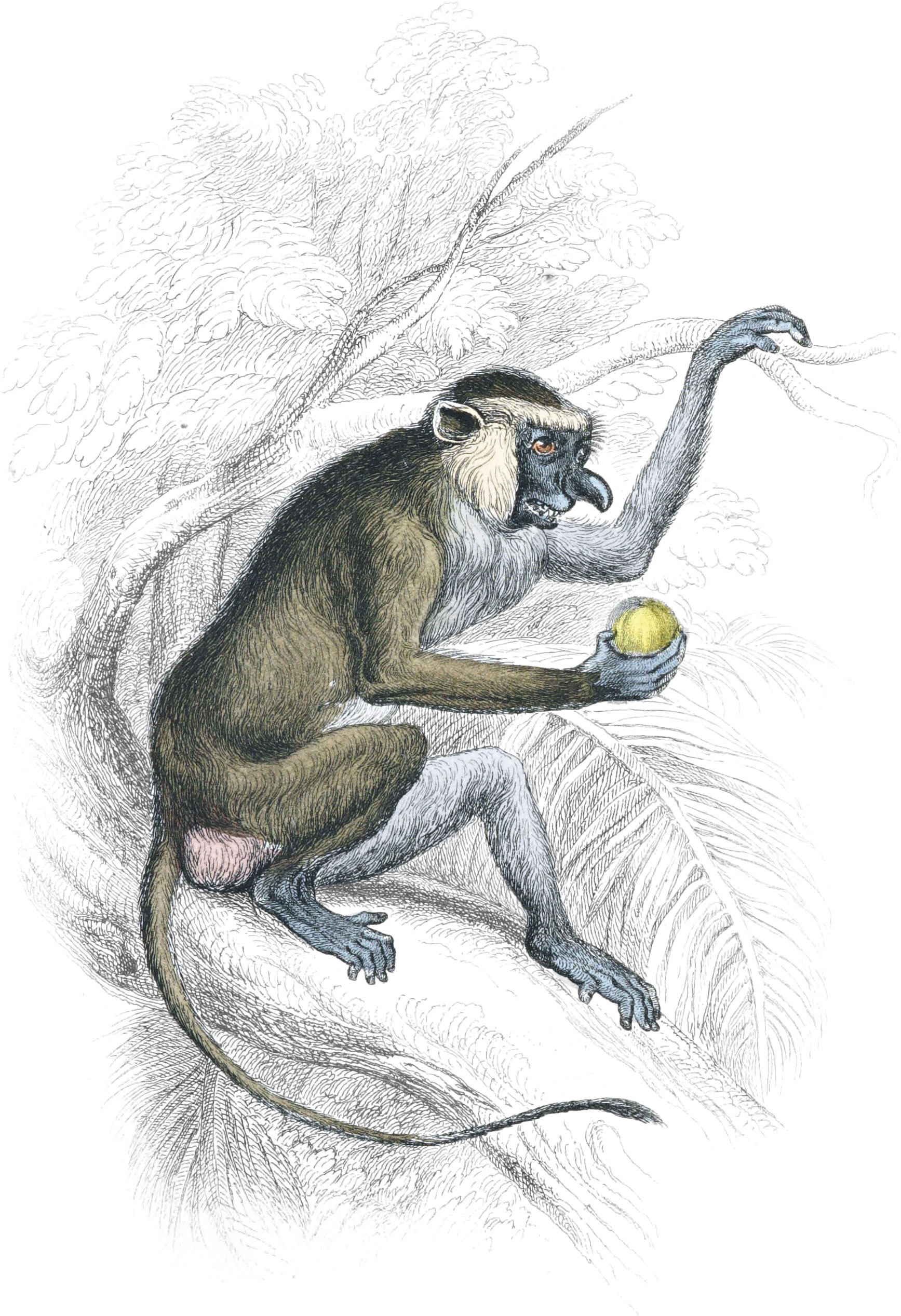
The other animal we alluded to, which appears to possess all the characteristics of the first division of the Guenons, is,
The Douc or Cochin-China Monkey
Lasiopygia31 nemea.—Geoffroy.
Simia nemæus, Linnæus.—Pygathrix nemæus, Geoffrey Saint Hilaire, Annales du Museum, vol. xix. p. 90.—Le Douc, Audibert, Histoire Naturelle des Singes.—Guenon Douc, Desmarest’s Mammalogie, p. 54.
This singularly but beautifully marked species has been the subject of discussion among many naturalists, and its great rarity prevents, even to the present period, a satisfactory examination of its form and structure; by some it is placed at the commencement of this division, while by others it is stationed at the conclusion, to be followed by the lesser baboons. Illiger gives the characters of his genus, so as, in fact, to include some of the latter, but by Geoffroy it is placed as the solitary representative of his genus above mentioned. It is a native of Cochin-China, and as very few specimens have yet reached Europe, little or nothing is Known regarding it. The height is about two feet and a reference to the annexed plate will best explain the varied colours of the fur. It is engraved from that of Audibert, taken from a specimen in the Paris Museum. Its principal characteristics are the great proportional length of the upper extremities, and the absence of callosities on the hips.
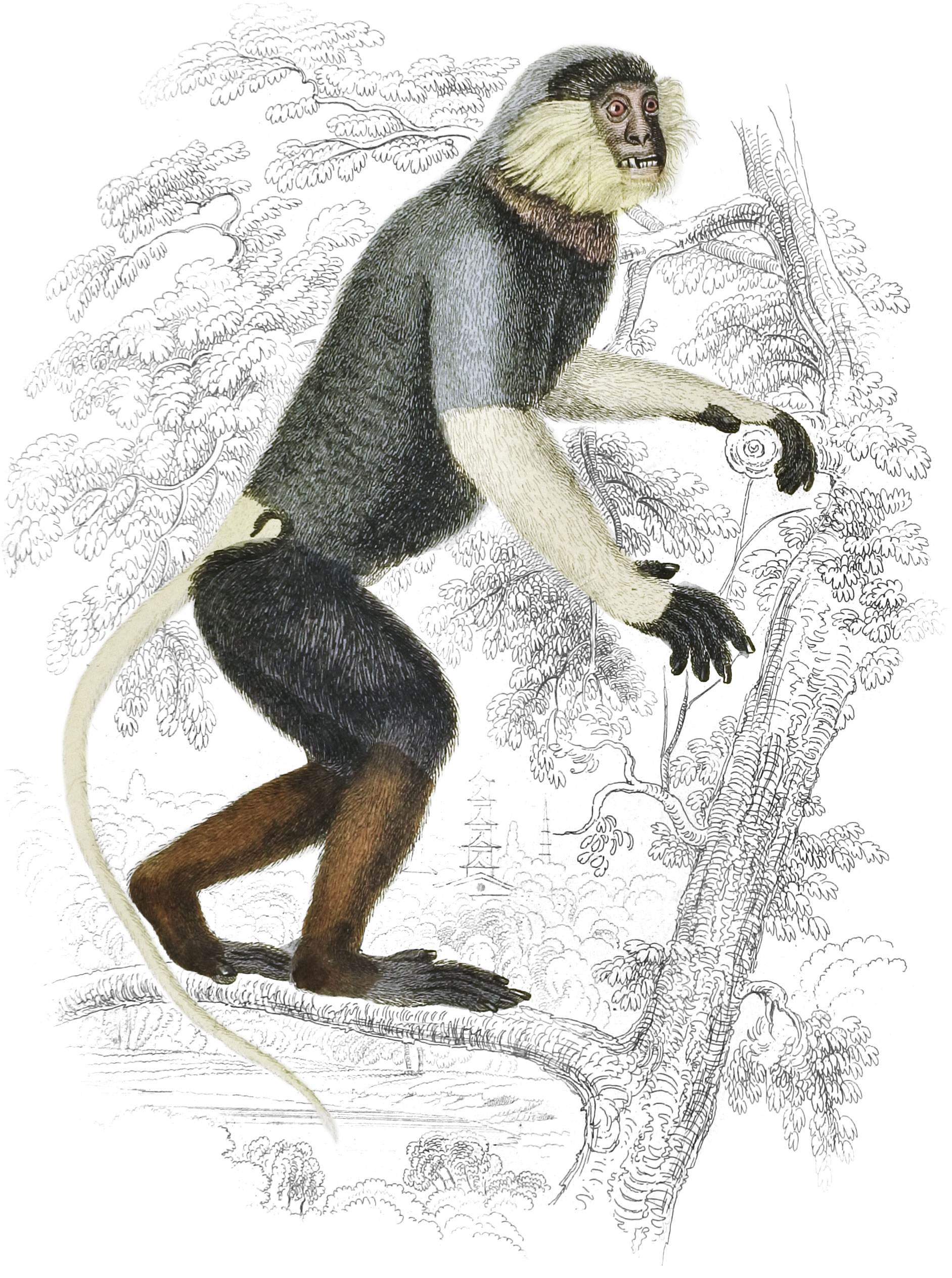
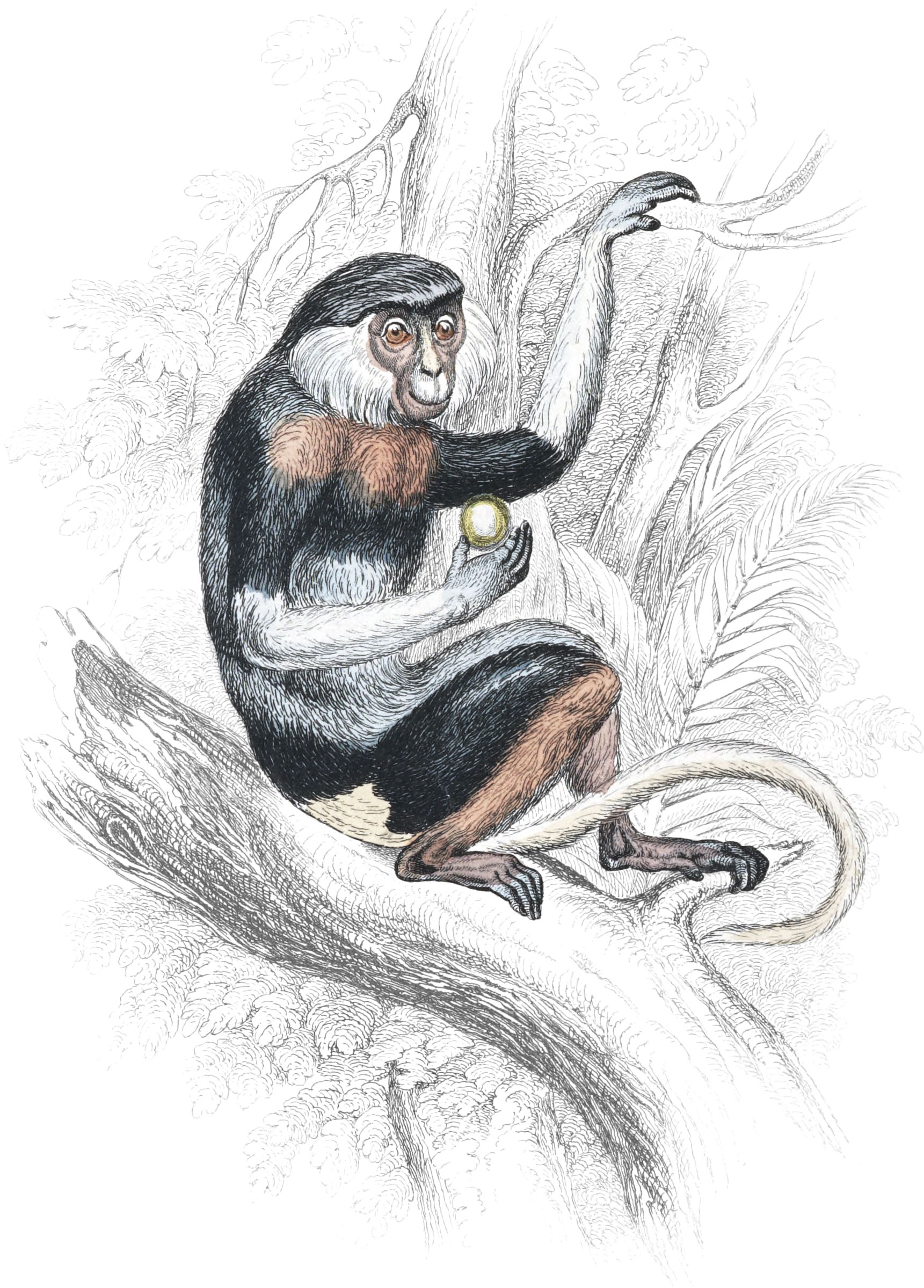
The Semnopithici
Having mentioned these two singular animals, we shall proceed with the first division of the Guenon group, the Semnopitheci. The most striking external characters are the flatness of the face; small cheek pouches; the length of the body, and slenderness of the extremities; the great length of the tail, and the little bare space upon the hips; while the system of dentition presents a marked difference from the next form included in the group.
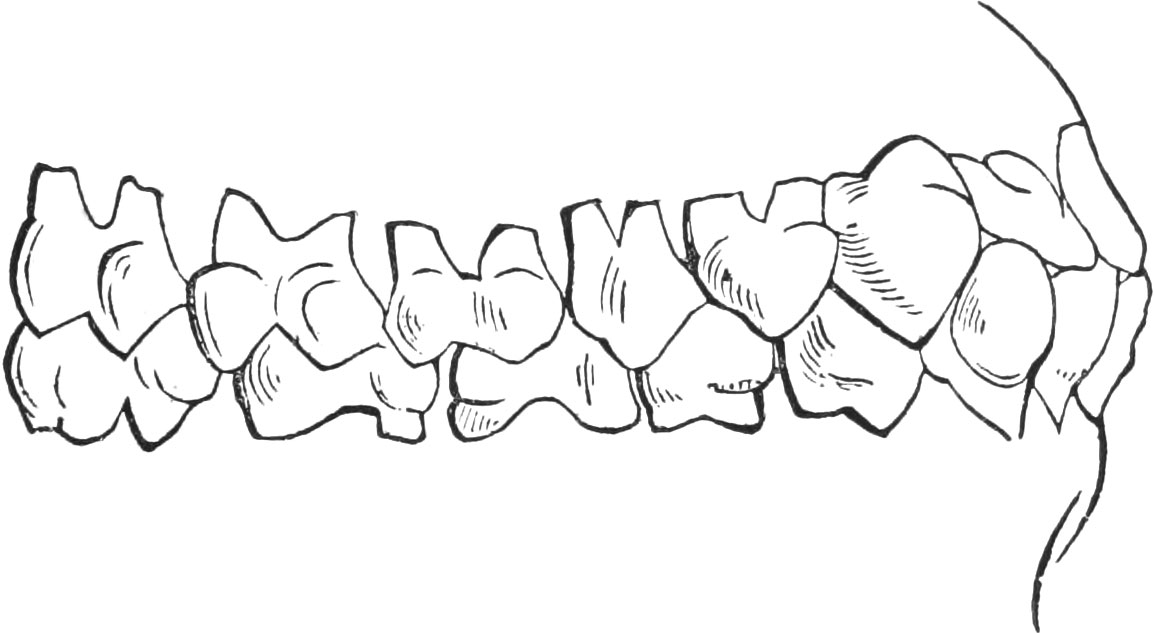
Semnopitheci marus Teeth
Annexed is a view of the dentition of S. maurus, from Frederic Cuvier’s work, but which exhibits the canine teeth of less size than the specimen figured by Dr Horsfield.

Semnopitheci marus Canine
The canine tooth is there exhibited, standing nearly one-half longer than the others, and grooved on the inner surface.
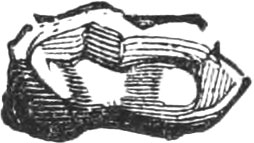
Semnopitheci marus Molar
The chief difference in the molar teeth is in the posterior grinder of the lower jaw having distinctly five points, which distinguishes it from Cercopithecus, and which will be better understood by comparing the cuts now introduced with those accompanying the true Guenons.
Dr Horsfield had taken the Negro monkey as the type of this form, whereas F. Cuvier selects another animal as more characteristic; and we are the more inclined to follow this arrangement, as the Doctor himself observes that S. maurus is more robust in make than its congeners, and the slender proportions are one of the first characters which strike the attention. The animal we allude to is,
The Simpai
Semnopithecus melalophos.—F. Cuvier.
Simpai of Javanese Simia melalophos, Sir Stamford Raffles, Transactions Linnæan Society, vol. xiii.;—Frederic Cuvier, Histoire Naturelle des Mammiferes.
This monkey, a native of Java and Sumatra, was first noticed by Sir Stamford Raffles, and afterwards figured and described by F. Cuvier, from specimens procured from the same sources.
According to the latter naturalist, the flatness of the face is very remarkable; and if the facial angle and size of the brow can be depended on as characteristics of intelligence, that of this animal ought to be capable of greater developement than the orang-outang. There are, however, few records of its habits or dispositions; and we refer to the accompanying plate for an idea of the form and colours. The length of the adult animal to the insertion of the tail, is about one foot six inches; the tail alone is between two and three feet.
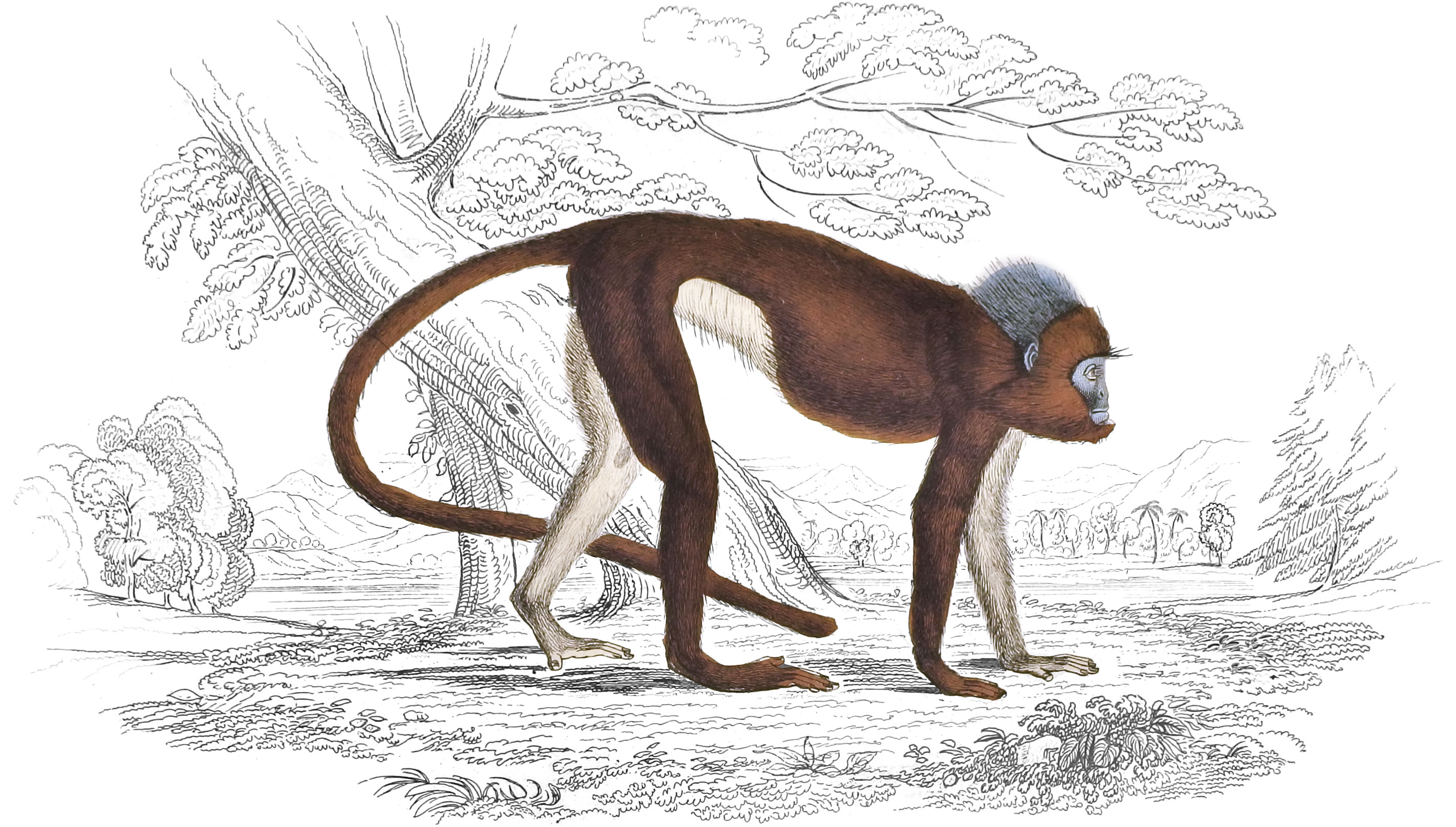

The Entellus Monkey
Semnopithecus entellus.—F. Cuvier.
Another monkey very characteristic of this group is, the Entellus monkey, still of very rare occurrence in the European collections, presents a very remarkable form in its slender proportions, and the light colour of its fur, contrasted with the black skin of the face and extremities. It is a native generally of the Indian archipelago and some parts of the continent; and, upon comparison of the relations of travellers, must abound in many parts of these countries, where they are venerated, or at least looked upon with a kind of superstitious awe, which prevents the natives from destroying them, and makes them often suffer from their depredations. They seem particularly susceptible of cold, which may account for their being seldom seen in our British menageries. Specimens which have been sent to Paris, and that in the Zoological Gardens, only survived a short period after then annal in Europe; and one mentioned by Thunberg soon died of cold in the comparatively warm climate of the Cape of Good Hope.
The height of the Entellus described by F. Cuvier, is about one foot five inches; the length of the tail about two feet. The description of the specimen which died in the Zoological Gardens, by Mr Bennet, is as follows; and it may be remarked, that the only variation which seems incident to them is a yellow or redder tinge of the whitish fur.
When taken at an early age they are readily tamed, become playful and familiar, are extremely agile, although generally calm and circumspect in their motions, and learn to perform a variety of tricks, which they execute with no little cunning and address. After a time, however, their playfulness wears off; their confidence is succeeded by mistrust; their agility settles down into a listless apathy; and, instead of resorting as before to the resources of their ingenuity for carrying any particular point, they have recourse to the brute force which they have acquired in its stead. At length they become as mischievous, and sometimes even as dangerous, as any of those monkeys which in their young state offer no such indications of good temper and intelligence.
It is of a uniform ashy-gray on the upper parts, becoming darker on the tail, which is grayish-brown, of equal thickness throughout, and terminated by a few long hairs running out into a kind of point, but not forming a tuft. The under surface of the body is of a dingy yellowish-white; and the fore-arms, hands, and feet, are of a dusky black. The fingers of both extremities are very long, and the thumbs comparatively short. The face, which is black, with somewhat of a violet tinge, is surmounted, above the eyebrows, by a line of long stiff black hairs, which project forwards, and slightly upwards. On the sides of the cheeks and beneath the chin, it is margined by a beard of grayish-white passing along the line of the jaws, and extending upwards in front of the ears, which are large and prominent, and of the same colour as the face. The hairs of the fore part of the breast appear to diverge from a common centre. The height of our specimen, which was not yet adult, when in a sitting posture exceeded two feet; and his tail, which he rarely displayed at its full length, but more usually kept curled up in a single coil, measured nearly three.
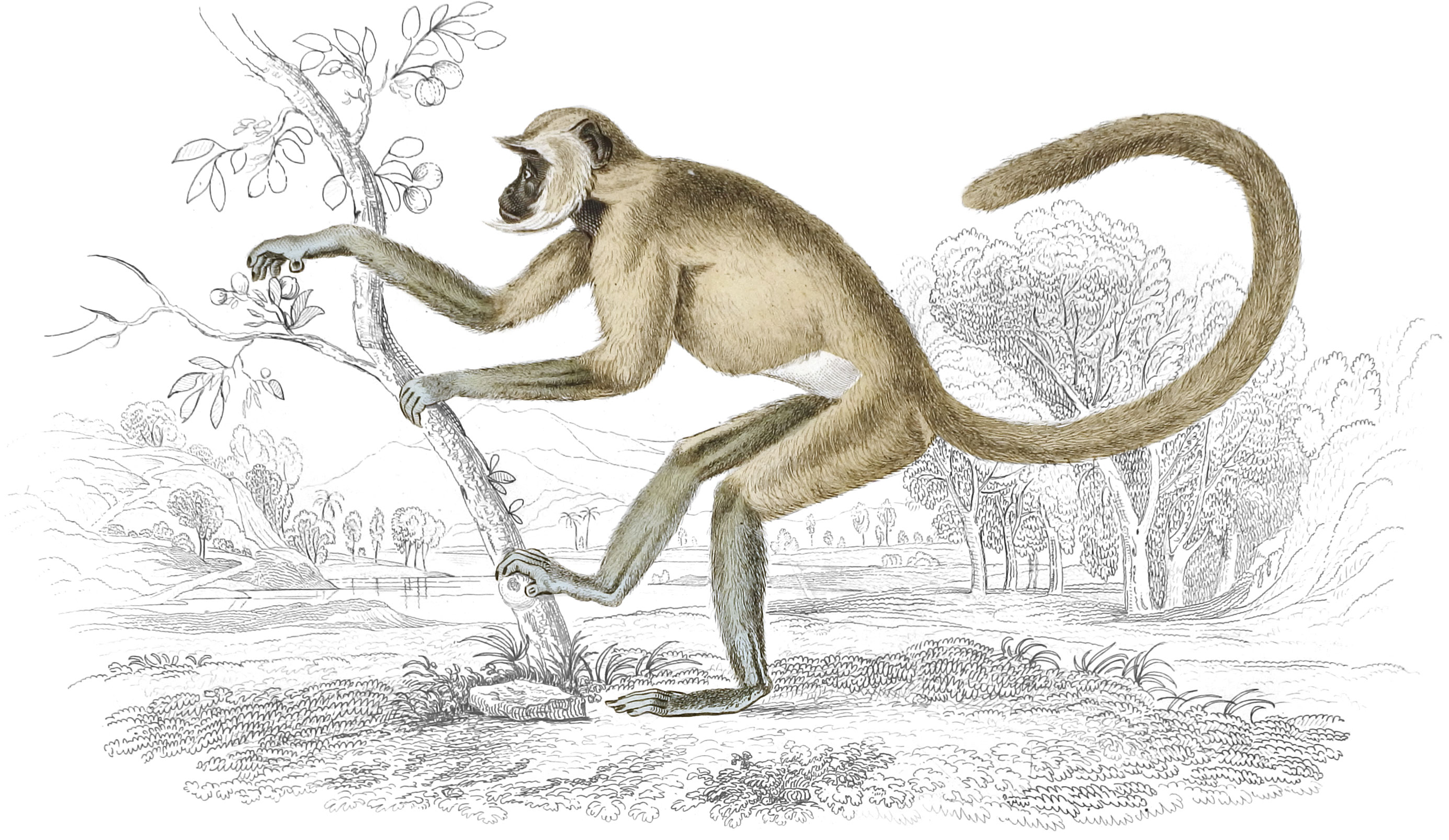
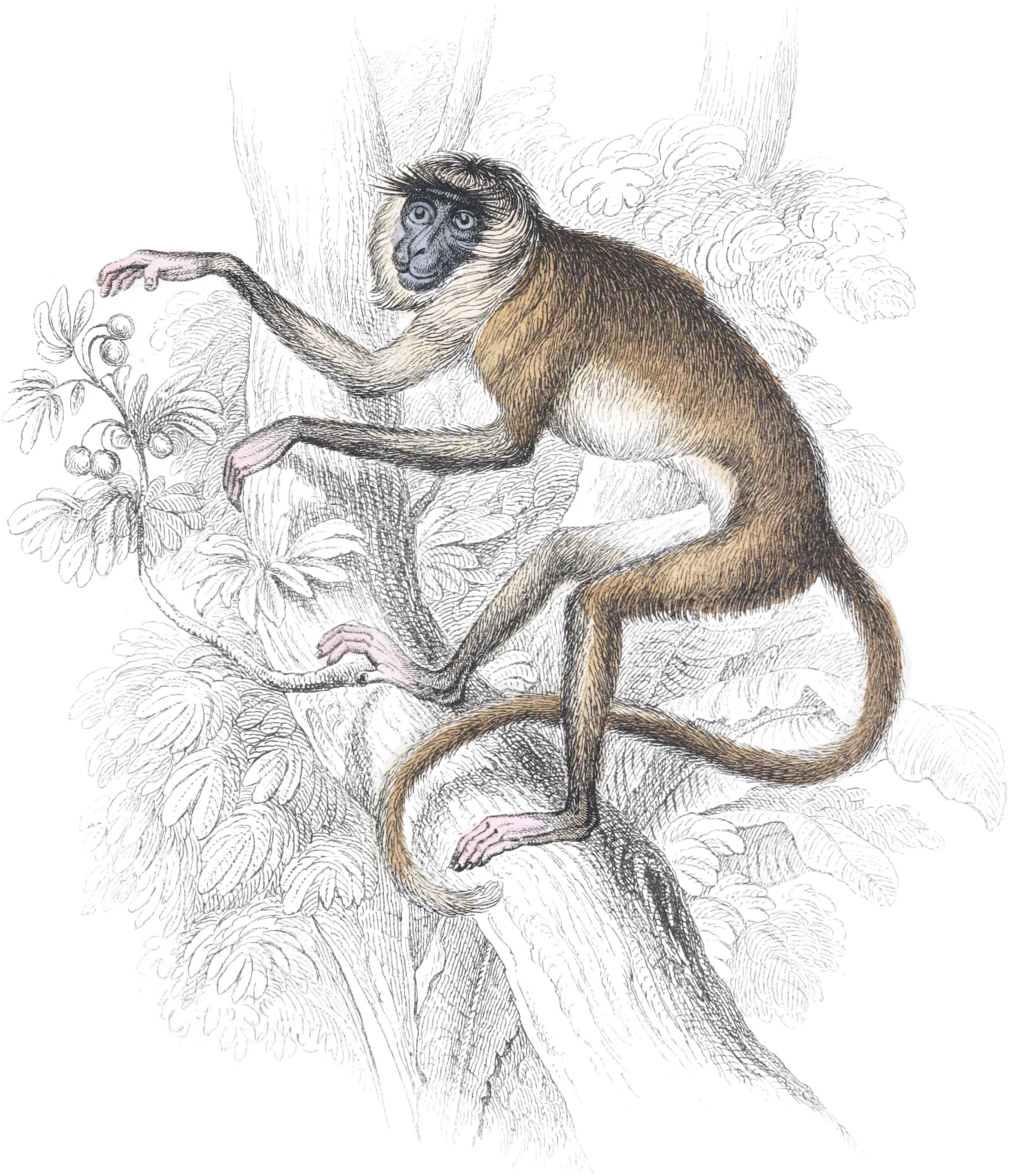

The Negro Monkey
The Negro monkey, like its congeners, is a native of Java and Sumatra. The length of the body is about two feet three inches, that of the tail nearly the same., and the form and proportions are more robust than in those we have mentioned for our type. From the want of a figure of this curious animal, Dr Horsfield’s minute description may not be unacceptable.
The covering of the Negro monkey, in adult subjects, is intensely black on every part, except the breast, the abdomen, the inner side of the extremities, and the root of the tail; these parts are gray. On the crown of the head, the black hairs are slightly tipped with gray; and as age advances, the gray portion becomes more extensive, and also shows itself on the upper parts of the body, but the extremities exteriorly, and the tail, even in the oldest subjects, retain their blackness. The hairs are remarkably long, delicate, soft and silky. On the sides of the head, they are disposed backwards with a slight inclination outward, and they completely conceal the ears. They rise with a gradual slope on the forehead, but on the crown of the head they are suddenly deflected, so as to form a dependent crest. On the back, and on the extremities, they lie smooth and close. They are greatly elongated on the sides of the body, between the shoulders, so as to hang down to a considerable length when the animal walks on all fours. On the breast anteriorly, and on the abdomen, they are short, lax, and straggling.
In its young state it exhibits a great contrast to that in the adult. Immediately after birth, our animal has a fulvous or reddish-yellow colour; as it advances in age, the colour gradually changes. A gray discoloration first shows itself on the hands, the forehead, and the tip of the tail; from these parts it gradually extends to the neck, the shoulders, and the flanks, and assumes from time to time a darker hue, until the coat of the animal is jet black above, and gray underneath.
The face is regularly circumscribed by hairs, which are long, and closely applied to the head; the forehead, which is gradually sloping, is entirely concealed by them. The orbits of the eye are rather prominent; and the bones of the nose short. The nose consists of an angular ridge, which is considerably elevated between the eyes, and terminates without any fleshy protuberance, by a membrane which is gradually attenuated below, and on each side of which the nostrils are placed. These are large, oblong, slightly curved, and pass backward into the cranium in a horizontal direction. From the termination of the nose to the mouth a considerable space intervenes; but the lips are small and thin, so as to exhibit, when slightly retracted, the interior of the mouth. The chin is short and small; a circle of gray hairs encloses the mouth in the adult animal; and on the chin the hairs have a disposition downward, so as to exhibit the appearance of a beard. The upper part of the face is nearly naked; a few straggling stiff hairs are scattered on the cheeks and the upper lip, and on the more prominent part of the nose an interrupted series is observed. The irides of the eyes are of a dark brown colour. The ears are concealed from view by the long hairs which cover the lateral parts of the head; they are margined, and both in form and disposition of external parts closely resemble these organs in man. The neck is short, and considerably contracted. The trunk is of great length, broad and robust about the shoulders and the breast, and gradually of smaller dimensions towards the loins. The buttocks are marked with very large rough callosities. The mammse, in the adult female, are lengthened and cylindrical. The tail is as long as the body and head taken together; in some individuals, and particularly in young subjects, it exceeds these parts in length; it is cylindrical during the greater part of its length; the base is gradually tapering, and the tip is thickened, and terminated by a close tuft of long hairs of an ovate form.
The Semnopithecus maurus is distinguished among the Javanese by the name of Budeng, from another species which has the same form and habit, but a different external covering. The name of the latter is Lutung; but the Malays and Europeans apply this name to both species, and distinguish them by the epithet of black and red; the Budeng being denominated Lutung itam, and the Lutung of the Javanese, Lutung mera. In Sumatra the name of the “Maure” is Lotong.
The Budeng, or the black species, is much more abundant than the Lutung, or the red species; and the latter, both on account of its variety and comparative beauty, is a favourite among the natives. Whenever an individual is obtained, care is taken to domesticate it, and it is treated with kindness and attention. The Budeng, on the contrary, is neglected and despised; it requires much patience in any degree to improve the natural sullenness of its temper. In confinement it remains during many months grave and morose; and as it contributes nothing to the amusement of the natives, it is rarely found in villages, or about the dwellings. This does not arise from any aversion on the part of the Javanese to the monkey race; the most common species of the island, the Cercocebus aygula of Geoffroy, the Egret of Pennant, is very generally domesticated; and a favourite custom of the natives is to associate it with the horse. In every stable, from that of a prince to that of a mantry, or chief of a village, one of these monkeys is found; but I never observed the Budeng thus distinguished.
The Semnopithecus maurus is found in abundance in the extensive forests of Java; it forms its dwelling on trees, and associates in numerous societies. Troops, consisting of more than fifty individuals, are often found together. In meeting them in the forests, it is prudent to observe them at a distance. They emit loud screams on the approach of man; and by the violent hustle and commotion excites by their movements, branches of decaying trees are not unfrequently detached, and precipitated on the spectators. They are often chased by the natives for the purpose of obtaining their fur. In these pursuits, which are generally ordered and attended by the chiefs, the animals are attacked with cudgels and stones, and cruelly destroyed in great numbers. The skins are prepared by a simple process, which the natives have acquired from the Europeans, and they conduct it at present with great skill. It affords a fur of a jet black colour, covered with long silky hairs, which is usefully employed both by the natives and the Europeans in preparing riding equipages and military decorations.
The Budeng, during its young state, feeds on tender leaves of plants and trees; and when adult on wild fruits of every description, which are found in great abundance in the forests which it inhabits.
The last animal to be introduced here is one also figured in Dr Horsfield’s Java, under the name of Semnopithecus pyrrhus. It is closely allied to the preceding in form and size, but differs in being of a clear reddish-brown, and is given by this distinguished zoologist with some doubt as distinct; but the different name by which it is known among the natives, and the permanency of its shades, he thinks, will entitle it to separation.
Cercopithecus and Cercocebus
We now come to Frederic Cuvier’s second great division of the true Guenons, comprising the genera Cercopithecus and Cercocebus of Geoffroy. The manners are very nearly similar; but the graduation of the facial angle, the large cheek-pouches, and shorter tail of the latter, seem to lead gradually to the baboons. The system of dentition also allies them by the length of the canine teeth; and the annexed cut may be compared with those illustrating the preceding genus Semnopithecus.

Guenon Teeth
We shall first notice Cercopithecus.—In form it is very closely allied to the last; but differs from both it and the following by the large facial angle of from 50° to 55°, rounded heads, flat noses, and long posterior extremities. The manners are also similar; but the animals comprised under it are more remarkable for grace of form, and beauty of colouring, and its type has been eulogized as elegant in the highest degree, mild of disposition, affectionate, and penetrating; and possessing every quality that could adorn the disposition of an animal. The species we allude to is,
The Varied Monkey
Cercopithecus mona.—Geoffroy.
The Varied Monkey, Pennant’s Quadrupeds, page 210.—La Mone, Audibert, Histoire Naturelle des Singes.—Frederic Cuvier, Histoire Naturelle des Mammiferes.—Guenon Mone, Desmarest’s Mammologie, p. 58.
The Mona, says Frederic Cuvier, is superior to all the Guenons in the elegance of its form, and grace of its movements, the mildness of its disposition, the delicacy of understanding, and sagacity of countenance; and its outward adornments vie with its internal acquirements in the beauty and variety of their tints. It has generally been thought to be a native of Barbary, although no proof can be adduced. They certainly are brought from Africa; and from the facility with which they bear a European climate, we may suppose the northern or mountainous districts are their native abodes.
The individual represented by F. Cuvier, and which has served for our copy, was procured to the Parisian Menagerie while very young, and on account of its mild and retiring manners was allowed to go at large. Age did not alter these traits of its character, and its gambols are performed with a sedate activity, which is not intrusive or disagreeable. Notwithstanding, its cunning and activity are very great, and particularly its adroitness in performing any little theft without the slightest noise. It will open a chest or drawer by turning the key in the lock, will untie knots, undo the rings of a chain, and will search one’s pockets with a delicacy of touch which will not be felt until the theft has been discovered; the latter was its most favourite amusement, and a stranger seldom escaped without being rifled. It is playful when caressed, and will return them with gentleness, uttering at the time a low cry, as if an expression of pleasure, and in every way is free from the disgusting manners possessed by most other monkeys. Of their habits in a wild state, nothing whatever is known, and the account of those who have mentioned them can be reduced to no proof, and seem to be more the result of conjecture than of reality.
The colouring of a specimen in the Zoological Gardens is thus described by Mr Bennet, and appears the most correct we are acquainted with:—
The top of the head is of a greenish-yellow, mingled with a slight tinge of black, and the neck, back, and sides, are of a deep chestnut brown, passing downwards as far as the shoulders and haunches, where it changes into a dusky slate colour, which is continued on the limbs and tail. The latter organ is considerably longer than the body, and has, on each side of its base, a very remarkable white spot. The under surface of the body, and the inside of the limbs, are of a pure and delicate white, separated from the neighbouring colours by an abrupt line of demarcation.
The naked upper part of the face, comprehending the orbits and the cheeks, is of a bluish purple; the lips, and so much of the chin as is without hair, flesh-coloured; on the sides of the face, large bushy whiskers, of a light straw colour, mixed with a few blackish rings, advance forwards, and cover a considerable portion of the cheeks. Above the eyebrows is a transverse black band, extending on each side as far as the ears, and surmounted by a narrow crescent-shaped stripe of gray, which is sometimes scarcely visible. The ears and the hands are of a livid flesh colour.


The Diana Monkey
Another very beautiful allied species is the Diana or Palatine monkey, (Cercopithecus Diana, Geoff.,) so named by Linnæus from the white crescent-shaped band, the emblem of the Virgin Huntress, which adorns its brow.
It is a native of the eastern coast of Africa, principally in Guinea, is about eighteen inches in length, with a tail exceeding two feet. Its colouring. Mr Bennet observes, is peculiarly varied and graceful. The head, neck, sides, and middle of the body beneath, are of a deep ash colour, gradually becoming darker on the outside of the limbs, and .finally changing into a deep black upon the hands. The tail also exhibits a dark shade, and terminates with a point entirely black. The general colour may be described as consisting of a mixture of black and white, the former predominating, and the whole having a grisly appearance. But the most conspicuous feature, is a straight line of long white hairs, surmounting a less obvious one of black, which runs in a crescent form across the forehead, above the eyes, and extends nearly to the ears. The specimen in the Zoological Society was playful and familiar. By Linnæus the Diana monkey is said to be fond of all kinds of vegetables, but particularly to delight in fruits, raisins, nuts, and almonds; and would willingly also eat eggs and bread, but animal food was not enjoyed; it drank often, and before taking anything would always smell it. It was remarkably fond of heat; and, when the cold season commenced, gave vent to its uneasiness in shrill complaints. Every thing that is set before the animal is turned over, even the vessel which is put down with its food. When a stranger is introduced it shows its teeth, and bows repeatedly with the head and, if enraged, endeavours to bite its enemy.
This genus will contain seven or eight species in addition; for a brief notice of which we refer out readers to the note of species given at the conclusion. We shall here only mention another animal, remarkable among its congeners for the uniformity of its colouring, it is,
The Red Monkey
Cercopithecus ruber.—Geoffroy.
Simia rubra, Linnæus.—Cercopithecus ruber, Geoffroy, Annales du Museum, vol. xix. p. 96.—Guenon patas, Desmarest’s Mammalogie, p. 59.—Le Patas, Frederic Cuvier, Histoire Naturelle des Mammifères.
It is a species long known, recorded so far back as Prosper Alpinus, who has given both a figure and description. The length of the body is about one foot four or five inches, and that of the tail is nearly equal. All the upper parts are of a brilliant reddish fawn colour, which is shaded into a pale grayish tinge on the arms and legs, and the face, cheeks, breast, and belly, are pure white; a band of black hair crosses above the eyebrows, and there are two lines of the same colour upon the upper lip, in the shape of mustaches, which give the countenance a peculiar physiognomy. It is a native of Senegal. Mr. Bennet mentions that a young individual in the Zoological Museum, Bruton Street,
is lively and active, but somewhat irascible when handled. When pleased, it dances on all-fours in a peculiar and measured step, which is far from being ungraceful, although after a time it becomes ludicrous from its regular monotony.
Two young specimens kept by F. Cuvier were mischievous at a very early age; and though not deficient in the penetration of their race, showed all the impatience and caprice which characterise the true Guenons.
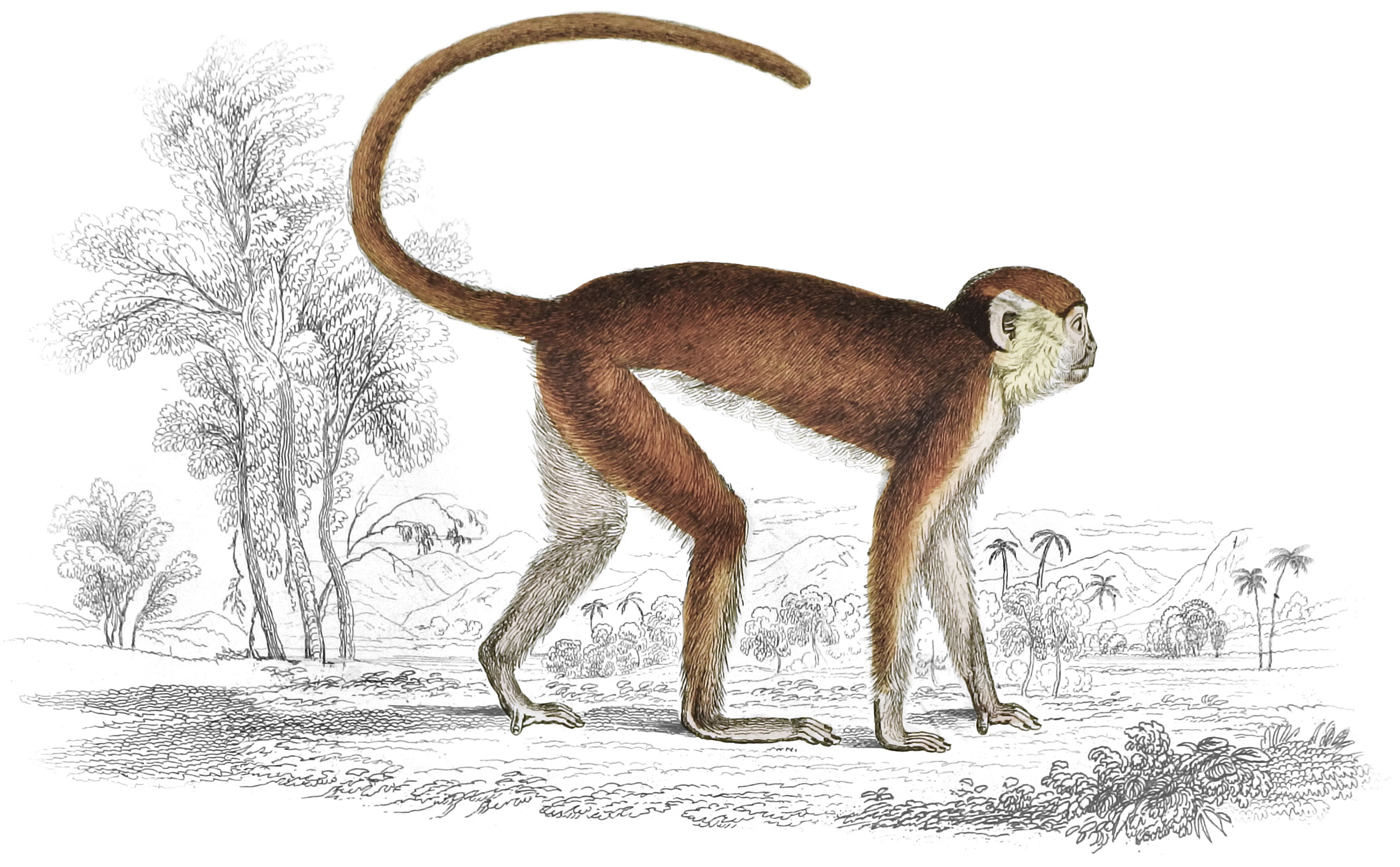

The Mangabey or White Eyelid Monkey
Cercocebus fuliginosus.—Geoffroy.
Simia ethiops, Linnæus.—White Eyelid Monkey, Pennant’s Quadrupeds, 204.—Mangabey, Buffon.—Guenon enfumée, Desmarest’s Mammalogie, p. 62; Frederic Cuvier, Histoire Naturelle des Mammifères.—Cercocebus fuliginosus, Geoffroy, Annales du Museum, vol. xix. p. 97.
We have placed this curiously-marked monkey first in this subdivision, as possessing considerable alliance in form to the preceding; so much so, as to be by some zoologists placed with it. We prefer Geoffroy’s arrangement, and look upon it as one of those connecting forms which can be so constantly traced.
Excepting the plate in Frederic Cuvier’s Mammiferes, there is no good coloured representation of this animal, and we were so fortunate as to procure a drawing from a living female lately exhibited by Mr Wombwell in Edinburgh.32 This animal is generally described to be mild and good-tempered, but very restless and active; and the female we have alluded to fully confirmed these accounts. She was certainly a most lively animal, never for a moment at rest, and particularly active when observed, as if conscious of the notice she excited, and anxious to display her talents. She performed many of the attitudes of the most experienced Harlequins. When the sketch was taken, she was particularly troublesome in her display, and is represented in the attitude in which she most frequently placed herself; sometimes extending the one hand and sometimes the other. She was extremely gentle, and never resented any of the troublesome usage to which animals in a menagerie are so frequently subjected by their various visiters; on the contrary, she was delighted to see strangers, and seemed flattered by their attentions. She was remarkably cleanly and careful not to soil her person. When feeding she seldom put her head to the food or dish, but lifted and conveyed it to her mouth. Her food was chiefly bread and milk, and occasionally vegetables, of which a carrot was a very favourite luxury.
This monkey is most appropriately named from the white colour of the eyelids, a most conspicuous feature in its physiognomy, and assisting the expression often thrown into the ridiculous grimaces, which, Mr Bennet remarks,
it continues in a state of confinement with laudable perseverance and unwearied zeal.
In both this species and another, “the collared white eyelid monkey,” (Cercocebus ethiops, Geoffroy,) the eyelids are of a very peculiar colour, a sort of clear grayish-white, but with a dead or chalky hue. In the female above alluded to, this colour was remarkably apparent, contrasting with the naked parts of the face, which resembled Indian rubber, and its transparent shade of dark brownish purple. The hair is fine and soft to the touch, and on the upper parts is of a dull sooty black (expressively named enfumée by the French naturalists,) darker upon the hands, gradually shading into a yellowish tint on the breasts, belly, and inside of the thighs. On these parts the thin coating of hair plainly showed the skin, which is very pure flesh-colour. The extremities are of the same colour and texture with the face; and it has been remarked that they resembled a lady’s hand covered with a very fine black kid glove.
The native country of the white eyelid mousey seems to be yet somewhat uncertain. The west toast of Africa is generally assigned to it; and the specimen which formed the subject of our plate, was said to be procured from that country.
The collared white eyelid monkey which we have mentioned, appears to inhabit the opposite or eastern side of the same continent, and is an animal of greater beauty. The upper part of the head is deep chestnut-brown, and the back of the neck is crossed by a collar of the purest white, which reaches forward upon the cheeks, and forcibly contrasts with the deep shade of the body.


Another animal placed in this division, and with what F. Cuvier terms the Malbrouks, may be almost said to join in a small group among the Guenons; they have a peculiarity of carrying the tail arched over the back, in the manner of a cur dog; and in parts of their form and physiognomy come much nearer to the baboons. The first we shall mention is
The Green Monkey
Cercocebus sabœus.—Geoffroy.
St Jago monkey, Edwards’ Gleanings, Plate 215.—The Green monkey, Pennant’s Quadrupeds, 203.—Guenon callitriche, Desmarest’s Mammalogie, page 61.—Cercocebus sabœus, Geoffroy, Annales du Museum, vol. xix. p. 99 98.—Le Callitriche, Frederic Cuvier, Histoire Naturelle des Mammifères.
The green monkey is one of the most abundant of this group, and is perhaps oftener seen in a captive state than any of the others. It is a native of the Cape Yerd Islands and the continent of Africa, and in its disposition seems to possess part of the bad traits of the baboons, though it is at the same time lively and playful. That described by M. Cuvier, in the Menagerie du Museum, became very fierce and irascible, and even bit the keepers who happened to get within his reach.
The description given by Mr Bennet of the specimens in the Zoological Gardens, may be considered accurate; in some specimens, the shade of colouring varies, but there is no other variation of consequence.
The colour is greenish-yellow above, arising from the ringing of the hairs with various shades of yellow and black, but assumes more of a dark grizzled appearance on the sides of the body, and outer sides of the limbs, which become gradually darker towards the hands. The face, ears, and naked part of the hands, are of a jet black; the former is of a triangular shape, bounded above the eyes by a straight line of stiff black hairs, and on the sides by spreading tufts of light hairs, with a yellowish tinge, meeting in a point beneath the chin. The neck and chest are white; the under parts of the body have a yellowish tinge; and the inside of the limbs is gray. The length of the head and body is sixteen or eighteen inches, and that of the tail somewhat more.
This animal, or at least one under the title of the “Green Monkey,” has been mentioned by many travellers, who give accounts of the vast troops which assemble together. In Adanson’s Voyage to Senegal, it is thus introduced:—
But what struck me most, was the shooting of monkeys, which I enjoyed within six leagues this side of Podor, on the lands to the south of Donai, otherwise called Coq; and I do not think there ever was better sport. The vessel being obliged to stay there one morning, I went on shore, to divert myself with my gun. The place was very woody, and full of green monkeys, which I did not perceive but by their breaking the boughs on the tops of the trees, from whence they tumbled down upon me; for in other respects they were so silent and nimble in their tricks, that it would have been difficult to hear them. Here I stopped, and killed two or three of them, before the others seemed to be much frighted; however, when they found themselves wounded, they began to look for shelter, some by hiding themselves among the large boughs, others by coming down upon the ground; others, in fine, and these were the greatest number, by jumping from one tree to another. Nothing could be more entertaining, when several of them jumped together on the same bough, than to see it bend under them, and the hithermost to drop down to the ground, while the rest got further on, and others were still suspended in the air. As this game was going on, I continued still to shoot at them; and though I killed no less than three-and-twenty in less than an hour, and within the space of twenty fathoms, yet not one of them screeched the whole time, notwithstanding that they united in companies, knit their brows gnashed their teeth, and seemed as if they intended to attack me.
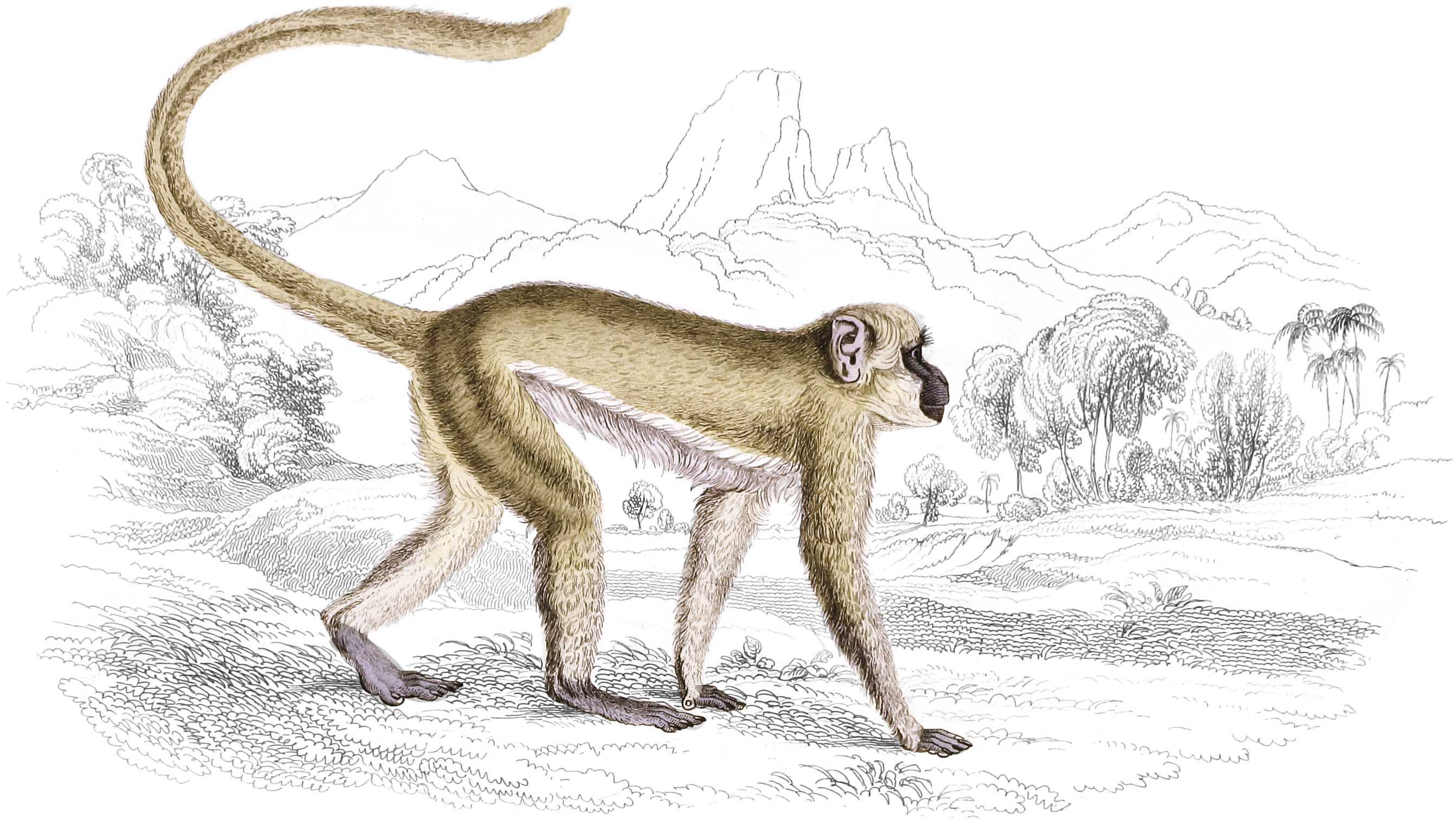


The Malbrouk
Another species belonging to this group is Frederic Cuvier’s Malbrouk, Cercocebus cynosurus, described and figured by that naturalist as an animal of truly arboreal habits; walking with difficulty on the ground, and exhibiting the greatest activity when sporting on the bars of its cage; it could sustain itself by successive darts from one side of its cage to the other, performed by the force of its feet alone, and would keep up this severe motion for a considerable period. When young it was docile and mild-tempered, but age brought with it propensities more brutal. The chief characteristic of its disposition, as it is in all the congeners, is extreme caution, or, as it were, an arrangement or previous plan of the actions to be performed; thus, in their attacks, the opportunity is watched when the person or animal is off their guard and otherwise employed, and it is always made from behind; wounds are inflicted with the teeth and nails, and a sudden dart places them at a distance, where they will remain, showing their anger with expressive changes of countenance, and watching the time when the attack can be with safety renewed.
The countenance of this animal becomes more like that of the baboons, and, with the feet and skin of the ears, is black. The cheeks, chin, and a band above the eyes, are white, as also the under parts and the insides of the legs; all the other parts are of a yellowish-green, and the general contour is so similar to the green monkey, that it has been mistaken for it in a young state.
Another allied animal, equally remarkable for the beauty of its yellowish-green fur, is the red-vented monkey, Cercocebus pygerythræus—a native of the forests to the interior of the Cape, truly arboreal, and never met beyond the boundaries of the larger woody tracts. The form is somewhat different; but the similarity of the upper covering, the white cheeks, and frontal hand, place it close to those we have just now described.
We again refer to our Synopsis for an enumeration of the other Cercocebi, and will now proceed to the next forms, which will commence
The Baboons
We have now reached these forms which conduct from monkeys of pleasing appearance and gentle manners, to the most disgusting of the whole tribe. They may be generally designated under the title of baboons, but naturally form themselves into two groups—those with the muzzle still more lengthened than the Guenons, but having the nostrils placed as it were on the face; a body of considerable size and strength, and the tail shorter; the dispositions becoming more sulky and untractable, furious and revengeful, when annoyed.33 The second, comprised in the true Cynocephali of Cuvier, and which are at once characterised by the position of the nostrils at the very extremity of the muzzle. Their size is very large; their strength enormous; their dispositions possessing scarcely a good quality, and combining great fierceness and malignity, which, joined with their strength, renders them always dangerous in confinement or when attacked, in a wild state. The form and arrangement of the teeth is nearly similar, except in size, among both groups; the principal peculiarity will be observed in the form of the canine teeth, which are of remarkable strength, and in the grinders, the last of which has an additional point, somewhat resembling that of Semnopithecus.
The first genus to be mentioned is Macacus of Lacepédè, into which we have also brought the Rhesus monkey, retaining the two tail-less species by themselves. The Ouanderou has generally been taken for the type of this form; but, before describing it, we shall mention the Macaque of Frederick Cuvier, (Simia cynocephalus, Linnæus), which evidently forms the passage between the Guenons and Baboons. It is distinguished by a blunt and elongated muzzle, forming a facial angle of 40° to 45°; by the prominency of the superciliary crests which cover the eyes, and give a peculiar expression to the physiognomy, and by the comparative shortness of the tail, which is rarely equal to the length of the body.
In this species we still see the colouring of the Guenons, and the length of tail is nearly equal to that of the individuals we last described; but we want the light and agile form, and see the proportions heavily and strongly made. The head is large, the muzzle short, the nose flat, and the superciliary ridges ample and lowering; the fingers are united with a membrane for the length of the first phalanx. The general position of the animal is on all-fours, or seated on its buttocks, and it generally feeds in one of these positions, either by the assistance of its hands, or by placing the muzzle at once among the food, always, however, filling the cheek-pouches, which are ample, before any portion has been swallowed. When asleep, it either lies on one side like a dog, or sits in a bent position, with the head reclining on the breast.
Monkeys have very seldom produced young in a state of confinement in this country, and they have been still more rarely brought to maturity. Frederic Cuvier gives an account of a pair of these animals which produced, though the young survived only a few days. The male and female were confined in separate cages, in sight of each other, and their demonstrations of the softer passions, induced their keepers to allow one habitation; nearly a year after the female proved with young, and in seven months gave birth to a female. It was well formed; the eyes were open at birth, and its nails were complete. It was however too weak to support itself, and the mother treated it with no attention, did not attempt to suckle it, and entirely left it; the next day it died. Some time after, a second female was produced, under similar circumstances, and all attempts to rear it were equally unsuccessful.
Dog-Face Baboons
Another monkey, which ought to stand in this place, is the Toque of Frederic Cuvier, Macacus sinicus. It is remarkable for the slender form of the muzzle, but approaches nearer to Cercocebus in colouring, and has a longer tail than the generality of our present group.
We have now endeavoured to represent.
The Wanderoo Monkey
Macacus silenus.—Lacepede.
Lion-tailed baboon, Pennant’s Quadrupeds, 198.—Macaque à criniere, Cuvier, Regne Animal, i. 95; Audibert, Histoire Naturelle des Singes.—Papio silenus, Geoffrey, Annales du Museum, vol. xix. p. 102.—The Wanderoo monkey, Gardens and Menagerie of the Zoological Society, p. 21.
The Wanderoo, or lion-tailed monkey of Pennant, is so well marked, that a description, in addition to the figure, is almost unnecessary.
Knox describes it shortly and quaintly in his Ceylon: He says,
there are abundance in the woods, as large as English spaniel dogs, of a darkish-gray colour, and black faces, with great white beards round from ear to ear, which make them show just like old men. They do little mischief, keeping in the woods, eating only leaves and buds of trees; but when they are catched they will eat anything. This sort they call, in their language, Wanderows.
A specimen in the collection of the Zoological Society is extremely active, and occasionally troublesome, but is good-tempered; he is, however, yet young, and may afterwards prove dangerous from his strength.
His favourite exercise appears to consist in throwing himself together, with his chain over the transverse bar, which passes from pole to pole, and swinging himself backwards and forwards, while thus suspended by his loins. When a party enters the room, he usually descends his pole with rapidity, and watches a favourable opportunity for jumping upon some of them unawares, and carrying off a hat, or whatever else he may happen to seize, with which he instantly reascends his pole, and seats himself at the top, enjoying the success of his scheme.34
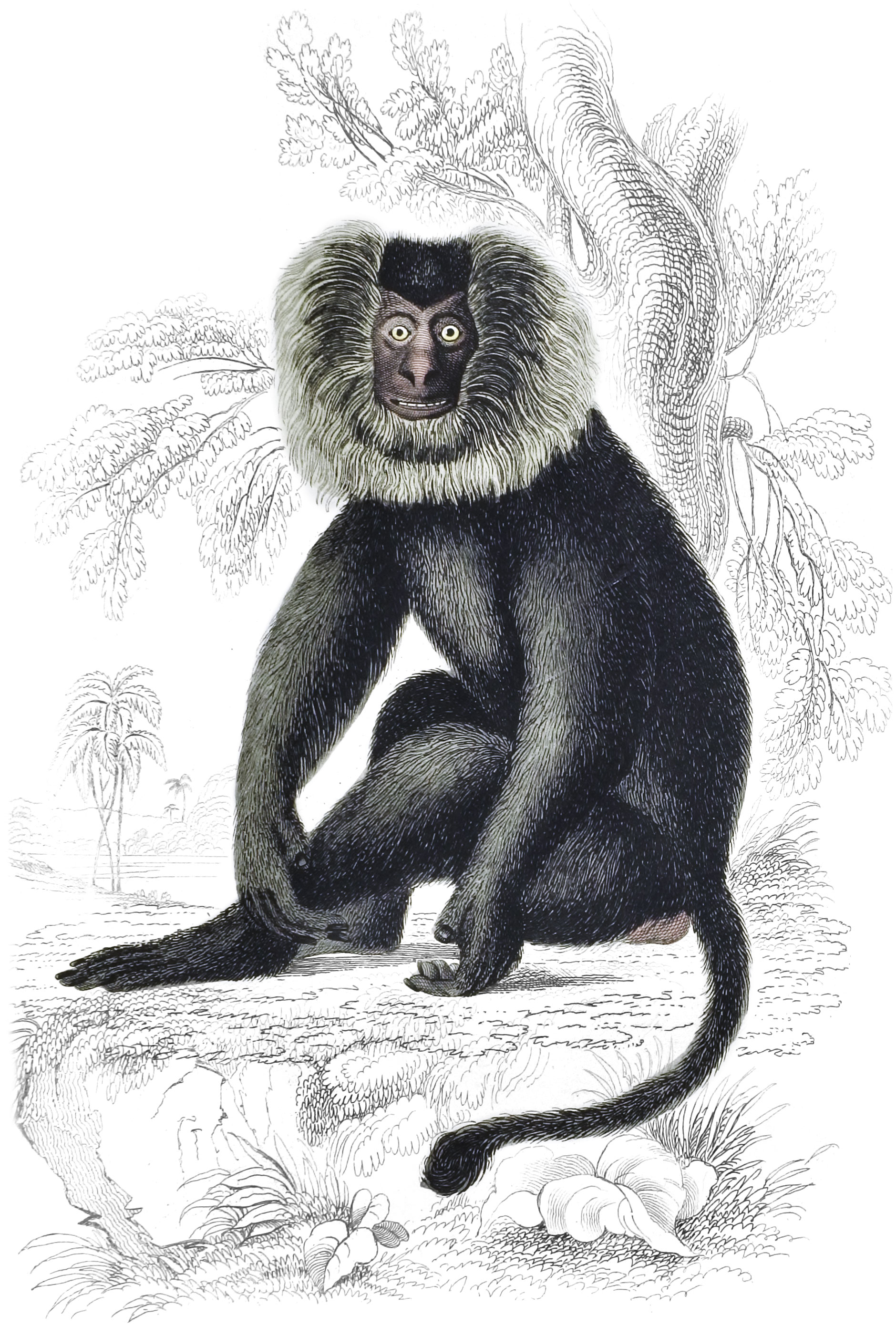

The Pig-Tailed Baboon
Macacus rhœsus.
In some of the other species the tail becomes much shorter, such as the M. rhœsus and nemestrina; but a better idea will be formed from the vignette on the titlepage.
We shall proceed to the next genus, Inuus of Cuvier, and have given, as an illustration,
The Barbary Ape
Inuus sylvanus.—Cuvier.
Simia inuus, Linnæus.—Magot, Buffon; Frederic Cuvier, Histoire Naturelle des Mammifères.—Macaque magot, Desmarest’s Mammalogie, p. 67.—Barbary ape, Pennant’s Quadrupeds; Gardens of Zoological Society.—Magot Africain, Inuus ecudatus, Geoffroy, Annales du Museum, xix. p. 100.
This monkey is remarkable, both on account of its peculiar form, and as being the only quadrumanous animal found on the European continent. By Frederic Cuvier it is thought to be limited in its geographical distribution to Barbary and Egypt, and the southern districts of Spain, and not to extend over Africa to China and India, as some naturalists allege. But the most celebrated abode of this species is the precipitous sides of the rock of Gibraltar, which is said by a historian of its celebrated siege to be remarkable for the number of apes about its summit, breeding in inaccessible places, and appearing in large droves with their young on their backs, on the western face of the hill.
Frederic Cuvier says, that they walk most commonly on all-fours, while at the same time they are very active climbers. He confirms the opinion of them being gregarious, filling the forests with their vast troops, and openly attacking those enemies which they think they can overcome, while they drive to a distance, by their numbers and screaming an intruder of whose powers they are doubtful. In a state of captivity it is capable of more than ordinary powers of comprehension; but, to improve those abilities as far as possible, it should be procured young, as with advanced age they generally become more sullen and morose, and even sometimes dangerous. It is very frequently seen at home, and, next to the green monkey, has the misfortune to be most frequently selected to accompany strolling bands, and owes most of its torments to the superior intelligence it is endowed with.
In captivity, it agrees with fruits, bread, and boiled vegetables, particularly carrots and potatoes; and its natural gregarious dispositions appear also to be preserved in its delighting in the society of some little animal, which is often placed in its company. Our plate from Frederic Cuvier will give an idea of its form and appearance. The females are nearly similar, though generally less in size.


The Black Ape
There is another tail-less animal which we would introduce in this place, as forming the real passage to the true Cynocephali. It is the Cynocepkalus niger of Cuvier; while the modem British zoologists place it in company with the Barbary ape and the Rhœsus monkey. The general resemblance and physiognomy ally it to the dog-faced baboons, which is strengthened by the swelled cheeks and flat nose; but the position of the nostrils, with habits characteristic of the Macaci, and the total want of any tail, join it with the preceding. Four specimens only seem yet to be known; one in the Royal Museum in Paris; another in the Tower of London, described by Mr Grey in his Spicelogia Zoologica; another more lately exhibited in Exeter Change, and the fourth in the London Zoological Gardens, which is thus described by Mr Bennet:—
Our animal is of a deep jet black in all its parts, with the exception of its large callosities, which are flesh-coloured. The body is covered with long woolly hair, becoming shorter on the limbs; its ears are small; its tail a mere tubercle, less than an inch in length; and its cheek-pouches seem to be capable of much distension. Its face is broad, rather prominent, slightly narrowing at the muzzle, and abruptly truncate, with the nostrils placed very obliquely on the upper surface. On the top of the head it has a broad tuft of long hairs, falling backwards, and forming a very remarkable crest. The expression of its physiognomy is peculiarly cunning. It seems to be rather violent in its temper, and tyrannizes not a little over the quiet gray Gibbon, which is at present confined in the same cage.
The native country of this monkey is yet somewhat, uncertain; but the best authorities record it as the islands of the Indian Archipelago.
The Cynocephali
With this species we close what was mentioned as the first division of the Baboons, and enter upon the second—the Cynocephali of Cuvier. These, according to the researches of the brother of this great naturalist, consist of only six species, which are again subdivided into two very natural sections. The one, with a considerable length of tail; the other, with the muzzle swollen upon the sides, and in the adults raised into coloured ridges, while the tail is a tubercle finished by a tuft of hairs, and stands erect, appearing, from the position of the coccyx, as if placed upon the lower part of the back itself.
The Cynocephali are all of large size, and indeed exceed that of any of the quadrumanæ, if we except the adult orang-outang; their proportions combine strength and activity, and their physiognomy fierceness with intelligence; while their dispositions are so fickle, or so easily affected—the transition from one passion to another is so rapid, that they are never to be trusted—and the paroxysms of their rage are described by F. Cuvier to be so great, that some have fallen victims to the consequences. That zoologist thinks that in this group the active animal passions are developed to their utmost extent. In a wild state, they possess an intuitive knowledge of what will harm them, and combining with it great cunning, they most frequently disappoint their enemies. They attack at a distance, and threaten with their cries, but only use their powerful strength, and formidable tusks, when compelled by danger. The naturalist we have mentioned above, would even attribute to them a power of higher intelligence—that they will destroy a plantation from revenge, watching their opportunity; and he relates an anecdote of the Chacma,35 which severely bit his keeper upon being threatened to be struck, though the animal had never seen a stick, and had never been beaten. In like manner, he continues, are these animals so susceptible of the instruction of circumstances in a wild state, capable of receiving it artificially from man, and they are often met with performing various feats at the command of their keepers; but he adds, it is only when young that they thus submit. They retain a kind of docility longer than the period of their youth, but it is effected in a different way; their passions or their likings must be administered to. Such was the case with the specimen of the Mandril so long exhibited in Exeter Change, under the name of “Happy Jerry.” He would have done anything for gin and water, and the love of drink became so strong, that he would have made any sacrifice: perhaps some theorists will adduce this common vice as an argument for the common nature of men and monkeys. We have heard of another animal of this kind, possessed of a curious propensity, which might serve as an additional proof towards the same end; he was kept at large by a gentleman, who kept also a pack of harriers, and to enjoy either the noise or the sport, would travel to an eminence whenever the hounds threw off. This love for field-sports had, however, nearly proved fatal. The hounds one day got upon Jerry’s trail on his return home, and he was only saved by a tree occurring opportunely. Superior intelligence was, on this occasion, so far displayed, that Jerry never afterwards enjoyed hare hunting.
These baboons having the general organization of the quadrumanous animals, are necessarily arboreal in their habits, though not to such an extent as the other monkeys of the Old World; and they are at greater ease when on the ground, on account of the more accurate proportion of the hind quarters, though their motions there are still awkward and constrained. Their pace is generally a kind of slow gallop, performed by alternate undulations of the whole fore and hinder parts. Their agility on a tree is, however, surprising when we look at their heavy bodies; they possess all the power of grasping and swinging; take immense leaps, and will in a manner tumble from one part of a tree to another, before the spectator can think it possible. In this way they equally possess qualifications for pursuing or eluding an enemy. They feed chiefly on fruits and roots, or the young and tender shoots of various plants. Their natural country is the warmer parts of Africa and India. They are very susceptible of cold, and great care has to be taken with those kept in confinement in Europe, and, even with every precaution, a few years is generally the limit of their existence. The hair is longer than usual, and forms a sort of mane on the upper parts. For an illustration of the first form among the Cynocephali, we have selected,
The Chacma
Papio comatus.—Geoffroy.
Babuin chevelu, Papio comatus, Geoffroy, Annales du Museum, xix. p. 103.—Cynocephalus chacma, Desmarest’s Mammalogie, p. 69.—Le Chacma, Frederic Cuvier’s Histoire Naturelle des Mammifères.
The animal which formed the subject of the annexed plate, copied from that in the Histoire Naturelle des Mammiferes, was procured very young. During his youth his frolics made him amusing, but his mischievous disposition soon became dangerous, and it became necessary to chain him at the door of a court. There he performed the office of a watch-dog, and very soon became the terror even of his keepers. From his ferocity, his master was obliged to get rid of him.
F. Cuvier relates another instance of ferocity in a specimen kept in the Jardin du Roi. This animal made his escape from his cage to the enclosure in which he was confined. His keeper imprudently threatened him with a stick, which so enraged the animal that he darted upon him, and before the man’s release could be affected, wounded him so severely on the thigh as to put his life in danger. Nor could every endeavour prevail on the animal to return to his confinement, until his rage was again roused by the following expedient. The keeper’s daughter often supplied him with food, and seemed a great favourite. She placed herself at a door opposite that of the cage through which the animal had to pass, and a stranger appearing to caress her, the chacma darted upon him, but was secured before he could pass through his cage.
The Chacma is a native of Africa, in the neighbourhood of the Cape of Good Hope. The colour is of a greenish or grayish-black, paler upon the fore part of the shoulders and flanks. The neck is clothed with long hair, in the form of a mane, which has furnished Geoffroy with a character for the name he has attached. The skin of the face and extremities are of a purplish-black, relieved around the eyes by a paler tint, and by the upper eyelids, which are nearly white, as in the mangabey or white eyelid monkey. It is also remarkable in having the naked callosities very small.
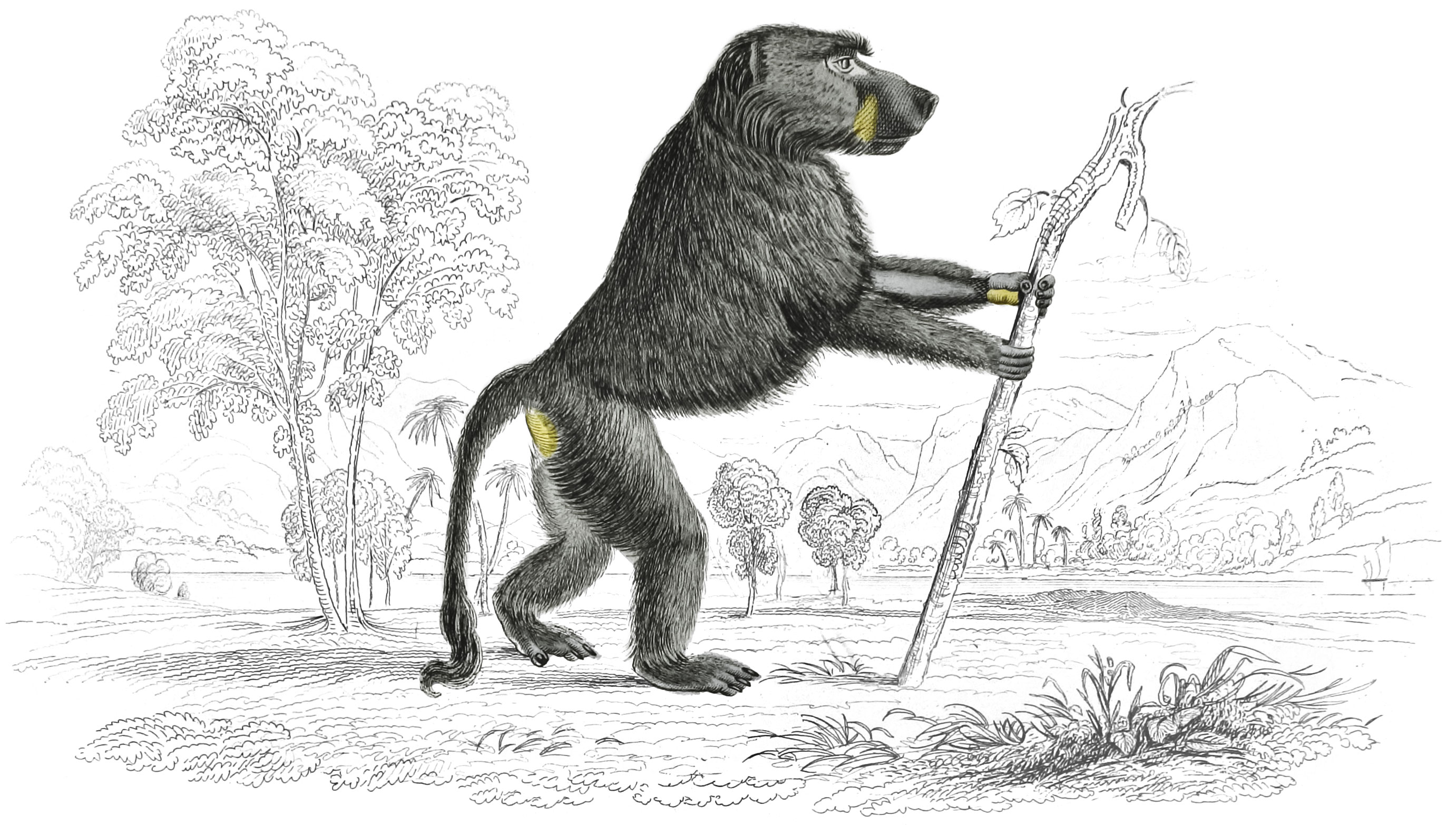

Another animal allied in colour is the dog-faced baboon of Pennant, the Tartarin of F. Cuvier, thought originally to be a native of Arabia, but at present rare in the European collections. It is equally fierce and dangerous with the preceding; of a greenish-gray colour; the anterior part of the body clothed with very long and shaggy hair.
The next animals we shall mention are Le Babouin and Le Papion of Frederic Cuvier. The first, apparently, is the Simla cynocephalus of Linnæus, and is thought by the above-mentioned author to be one of those adored in the temple of Hermopolis, and so frequently seen among the Egyptian hieroglyphics.
The colour is of a uniform yellowish-green, paler on the under parts; and the more remarkable deviations of form, are in the nostrils being prolonged to the length of the jaws, separated above by a very marked hollow, and by the lateral cartilages advancing as far forward as that in the centre. The tail is raised at its origin, and appears as if placed in the same position with that of the Mandril, but is of considerable length, reaching below the hams. It may be remarked, that this baboon has been confounded with the next, which Frederic Cuvier considers perfectly distinct and has named Le Papion. This animal is considerably larger in size; the colour is of a ruddier hue; the cartilages of the nose are longer than the jaws; and the colour of the skin on the face, extremities, and ears, are black, while the upper eyelids are white. It is a native of Africa, but hitherto undescribed by any traveller in a state of nature.
To illustrate the second form of the true Cynocephahi we have figured,
The Mandril or Rib-Nose Baboon
Papio mormon.—Geoffroy.
Ribbed-nose baboon, Pennant’s Quadrupeds, p. 190.—Papie mormon, Geoffroy, Annales du Museum, xix. p. 184 104.—Cynocephalus mandril, Desmarest’s Mammalogie, p. 70.—Le Mandril, Frederic Cuvier, Histoire Naturelle des Mammifères; Audibert, Histoire Naturelle des Singes.
This formidable animal, the fiercest and most powerful of its race, is a native of the Guinea Coast, and has been well known for a long period in our menageries. In an adult state, the colours of its fur may vie with any of the quadrumanæ, and the general effect is heightened at a little distance by the rich blue and purple shades of the muzzle, lips, and other naked parts of the skin. Upon a nearer view, however, these beauties do not compensate for its otherwise disgusting appearance. A representation has been given of this animal;36 and it may be remarked, that it is only in the adults where the brilliancy of the colouring is observed. In the young, the hair is of a uniform tawny-green, paler underneath and inside the legs, and assuming a yellowish tinge on the cheeks; the ridges upon the muzzle commence to appear of a livid blue, and the bright red of the nose and lips is of a dull flesh colour. The females are less in size, and the colouring of the naked parts is never so vivid.
“Happy Jerry,” the property of Mr. Cross, and so long the prominent attraction to Exeter Change, was a ribbed-nose baboon. He is described to have been docile to his keepers, but easily exasperated by strangers; and among other accomplishments, had been taught to drink sling and smoke tobacco. In the first he delighted; but I rather think the latter was not such a favourite, and a bribe of gin and water was generally promised before his performance. His cage was furnished with a small but strong arm-chair, into which, when ordered, he would seat himself with great gravity and await further orders. All his manœuvres were performed with great slowness and composure. His keeper having lighted the pipe, presented it to him; he inspected it minutely, sometimes feeling it with his finger, as if to know if lighted, before inserting it in his mouth. It was then introduced almost up to the bowl, but with that part generally downwards, and it was retained without any appearance of smoke for some minutes, during which time the animal completely filled his cheek-pouches and capacious mouth, and would then exhale a volume, filling his cage from mouth, nose, and sometimes even the ears. He generally finished with gin and water, which was handed to him in a goblet; this he grasped in one hand, and was not long in discussing.
He was possessed of enormous strength. Two men could with difficulty withdraw the end of a rope he one day seized, though they were assisted by the resistance of their feet upon the base of his cage.
He was fed chiefly on vegetables, and preferred them cooked; but when he visited Windsor, where he was exhibited to his late Majesty, he is said to have dined upon hashed venison with no ordinary degree of avidity.

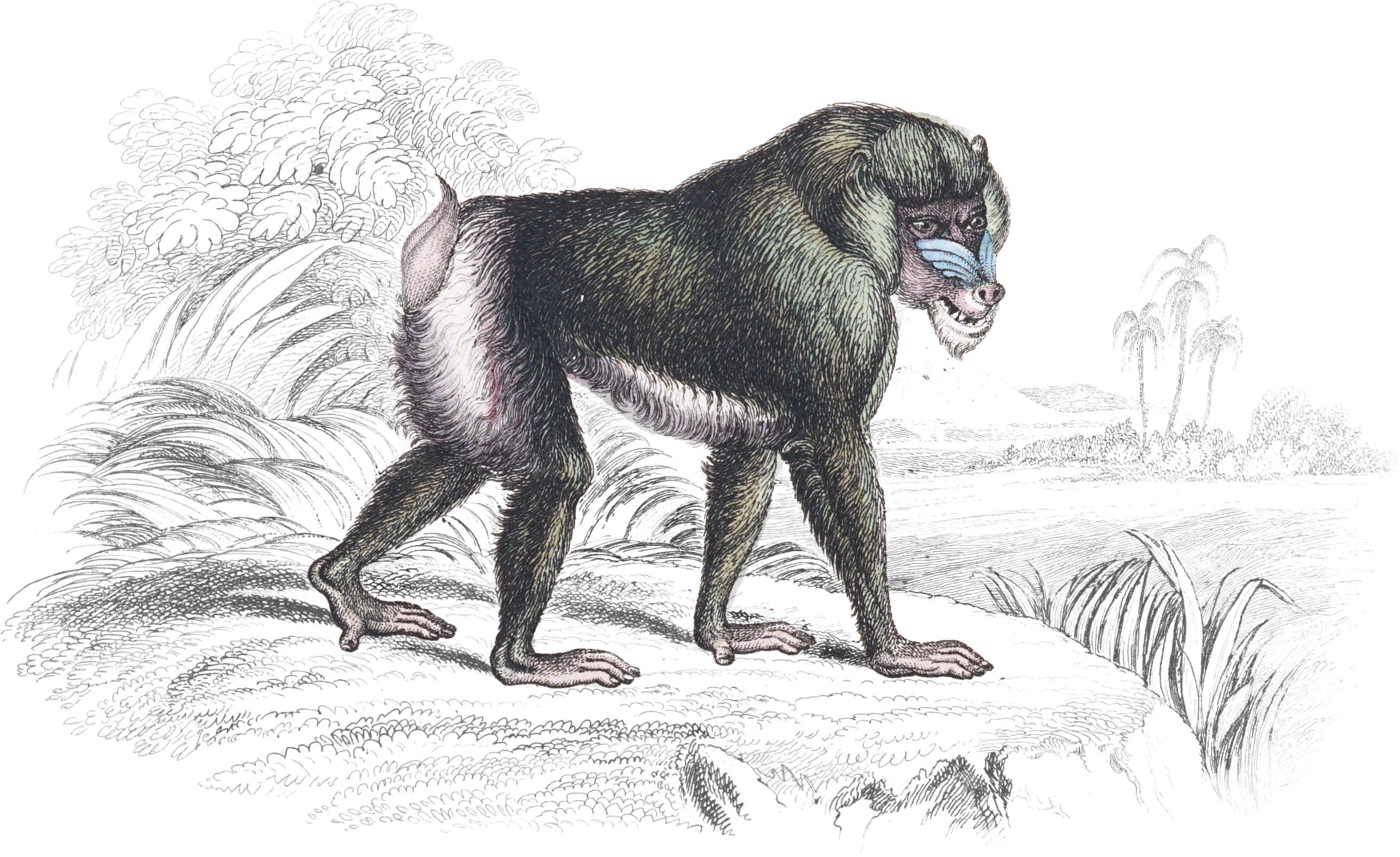
The only other animal belonging to this group which we shall mention, is one which was long involved in obscurity, and whose young state was frequently confounded with that we have now described; it is.
The Drill
Papio leucophæus.—F. Cuvier.
Le Drill, Frederic Cuvier, Histoire Naturelle des Mammifères.—Cynocèphale drill, Cynocephalus leucophæus, Desmarest’s Mammalogie, p. 71.
The Drill is nearly as strong and powerful as the Mandril, and has a similar form. The colours of the adult are also nearly alike, generally of a duller hue; but the principal distinguishing character is the absence of the ridges upon the muzzle, and of bright colouring except the border of the upper lip, which, by Fred. Cuvier, is represented of a bright red. The under parts are also white. The female differs in a less size and duller colouring, and by the head being of a shorter proportion. The native country seems somewhat uncertain, but it most probably is also Africa.


With these animals, the forms of the Old World terminate; and we now commence the second great geographical division of the quadrumanæ.
The Monkeys of South America; Those of the New World
The forms contained in this division are almost entirely confined to the tropical regions of the Southern Continent.37 They differ in a remarkable degree from all those we have described in the previous part of this volume, and in no instance can the South American species be classed with the inhabitants of the Indian or African Continents. The most striking outward differences, are the smaller size and less ferocious manners of the greater number, the prehensile tail of many, and the want in all of the cheek-pouches and naked callosities. Internally, the larynx is remarkable for its great developement, and the teeth are thirty-six instead of thirty-two, and, besides, differ considerably in their structure, as will be perceived in the woodcuts we have introduced.
In the arrangement of this geographical group, we have followed that of Geoffrey Saint Hilaire, with the exception of placing the howlers (Mycetes) first, as the Baron Cuvier has done, instead of Ateles, and of following them by that genus, and Cebus of Xerleben.
The Howlers
contain a single genus, named by Illiger Mycetes,38 from the remarkable howling voice of the animals. It is characterised by a facial angle of about 30°; the tail very long, naked at the extremity, and prehensile.
The dentition, according to Frederic Cuvier, is nearly similar in this and the two next genera; and we add the delineation which he considers typical of these forms.
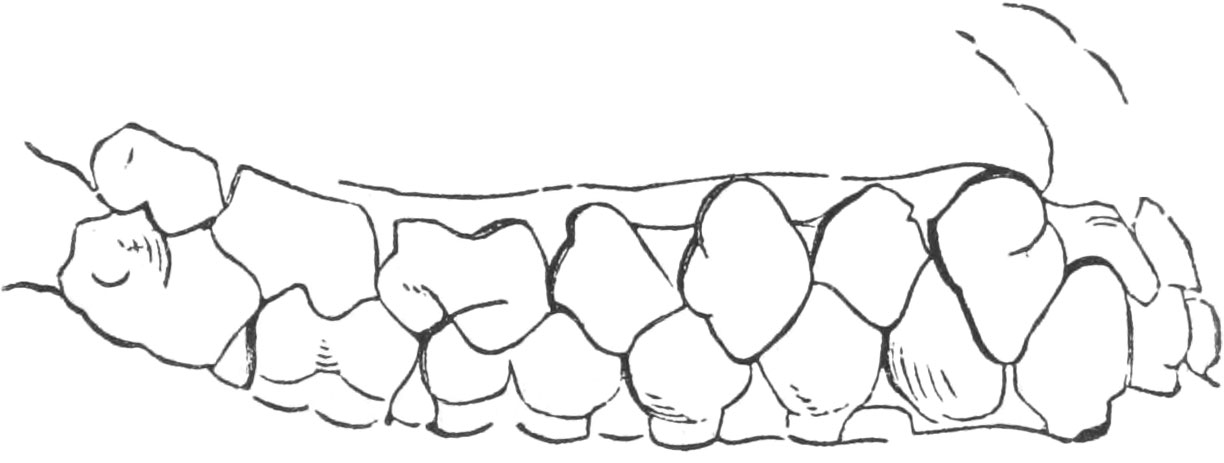
Howler Teeth
But the prominent character in this group is the extraordinary developement of the larynx, which is ventricose, and appears on the outside in the form of a swelling. The internal structure of this member, in the Mono colorado of Humboldt, is thus described in his Zoological Observations, and will serve as a model for the others.
The bony case of the os hyoides, measured by water, gave a size equal to four cubic inches; the larynx was slightly attached by muscular fibres, and communicated by a membranous canal. The larynx consisted of six pouches of ten lines in length, to from three to five in depth. These pouches resemble those of the small whistling monkeys, squirrels, and some birds. They have an opening above on the same side with that of the glottis, by which the air cannot enter without shutting the epiglottis. Above the pouches there are two others, of which the lips or borders are yellowish. These are the pyramidal sacks which enter into the bony case, and are formed by membranous partitions. The air is driven into these sacks, which are from three to four inches long, and terminate in a point, but come in contact with no part of the large hyoid bone opening below. The fifth pouch is found in the opening of the arythenoid cartilage, and is situated between the pyramidal sacks of the same form, but shorter; and the sixth pouch is formed by the bony drum itself, within which the voice acquires the mournful and plaintive tone which characterises these animals.39
The annexed cut, from Humboldt, will show the form of the drum of the os hyoides.
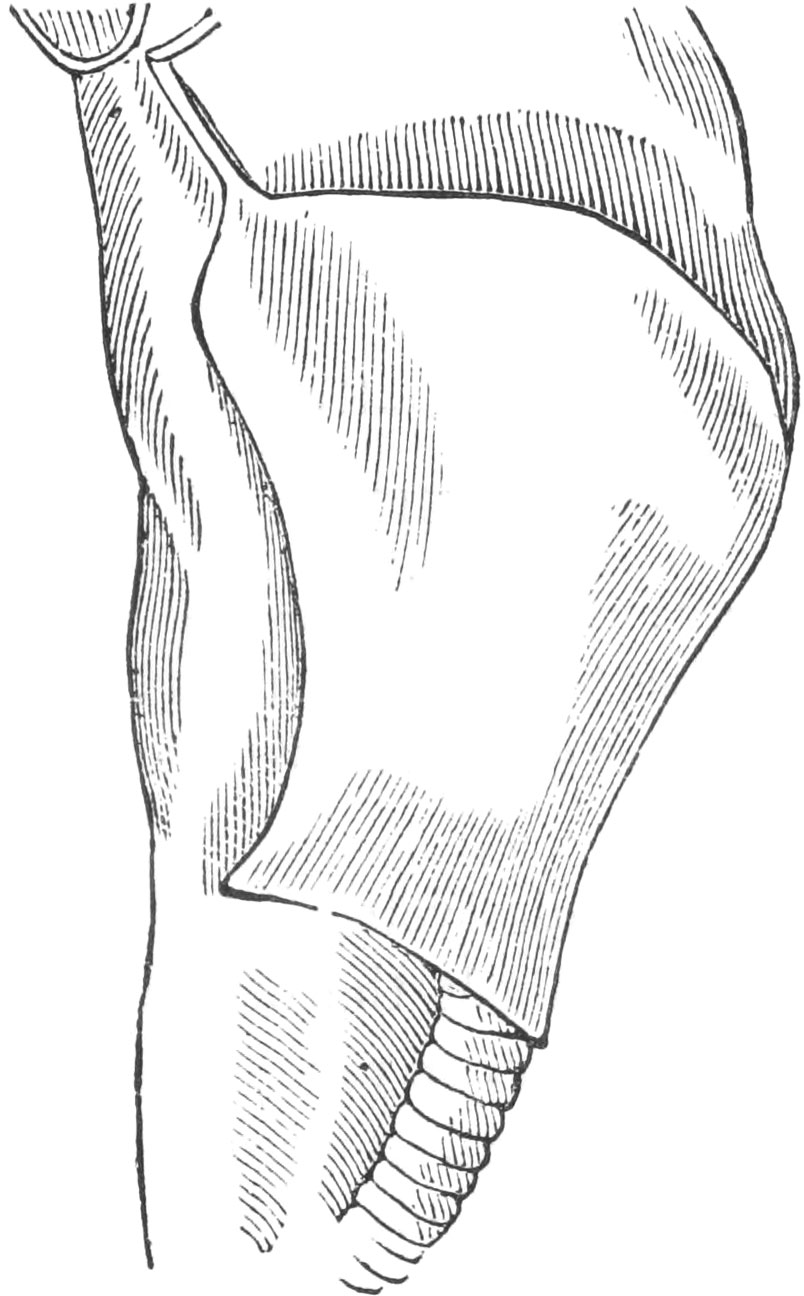
Howler Os Hyoides Drum
The howlers are also the largest of the American monkeys; in their disposition, and fierce manners, and declination of the facial angle, they may be said to represent the Baboons of the Old World, while, in the nightly howlings and gregarious habits, they bear some analogy to the Gibbons. The form of this genus will be seen in
The Araguato
Mycetes ursinus.—Humboldt.
Simia ursina, L’araguata de Caracas, Humboldt, Observations de Zoologie, i. p. 329 and 355.—Stentor ursinus, Geoffroy Saint Hilaire, Annales du Museum, xix. p. 108.
This species was discovered by Humboldt and Bonpland, who pointed out the distinctions between it and the Mono colorado, or red howler. It is thus described in the zoological researches and personal narrative of these travellers:—
Having landed at Cumana, we saw the first troops of Araguatos in our journey to the mountains of Cocallor and cavern of Guacharo; and although the convent of Carisse is situated at a high elevation, and the degree of cold during the night considerable,40 the surrounding forests abound with the Araguatos, whose mournful howling is heard at the distance of half a league, especially when the weather is open, or the electric slate of the air loretels rain of a storm. We have met with them also in the valleys of Aragua, upon the Llanos of the Apure and Lower Oronooko. and in the missions of the Caribes in the province of New Barcelona, but in greatest abundance near the pools of stagnant water, shaded by the Mauritia flexuosa.
They feed on fruit as well as the leaves of vegetables. The females are often seen carrying the young upon the shoulder; but no difference in the colour between the ages or sexes was ever perceived. Humboldt thinks, of all gregarious monkeys, none appear so numerous as this species: upon the banks of the Apure he has counted above forty upon one tree; and he has no doubt, that upon a square league of these wild countries, above two thousand may be found.
The eye, voice, and gait, denote melancholy. I have seen young Araguatoes brought up in the Indian huts, which never play like the Sagoins; and their gravity was described with much simplicity by Lopez de Gomara in the beginning of the sixteenth century. “The Araguata de los cumanenses,” this author, “has the face of a man, the beard of a goat, and a grave behaviour.”41
The Araguato has something the appearance of a young bear; it is nearly three feet in length independent of the tail, and is entirely covered with a thick reddish fur. It is distinguished from the Mono colorado by the longer hair upon the body, the less bushy beard, and by the under parts being clothed with hair of the same colour with the other parts, and not of the brownish black which the naked skin of the Red Howler exhibits. They differ also in their gait, and in the sound of their voice.
The fruit, which it is represented eating, is that of the Inga vera, Wildenow.

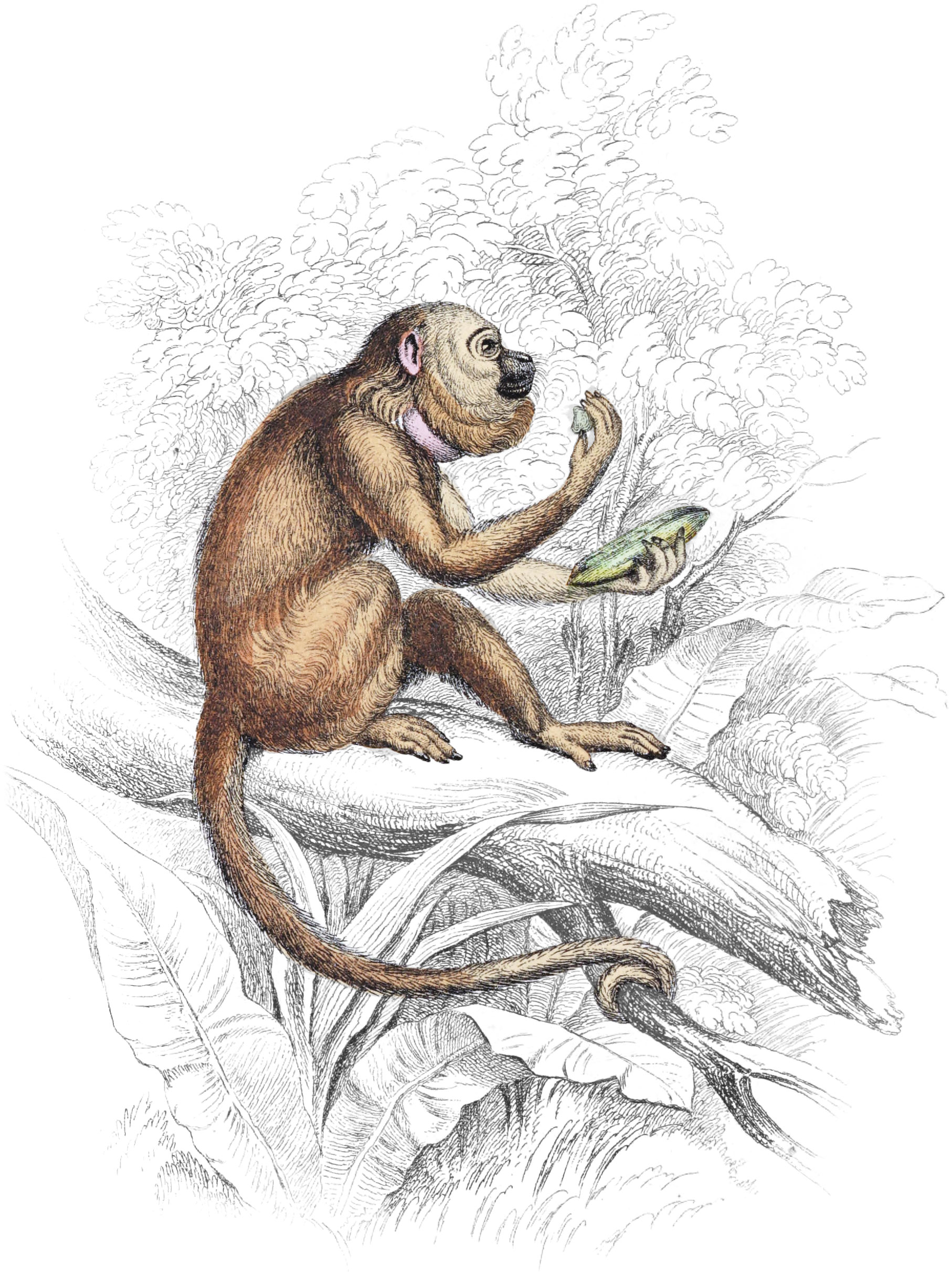
Another singular species was discovered by Humboldt—the Mycetes flavicauda, and is described by him under the name of “Le clioro de lo provence a Jaen.” It inhabits the banks of the river Amazon, in the provinces of Jaen and Maynas. The colour is a brown, shading to black, and dullest on the lower parts; the face yellowish-brown; the tail, shorter than the body, is the most characteristic mark, and is greenish-black, adorned upon the sides with two yellowish stripes, an anomalous distribution of colour among this family. The hair is very long, soft and shining, and the skin forms an object of commerce among the natives; it is also used by them to cover seats, and for the saddlecloths of the mules on which the periodical journey to the Cordilleras is made.
The other animals which constitute this group are only seven in number, and inhabit the western provinces, where abundance of wood is essentially necessary for them. They are gregarious, and generally very abundant, and in all the sonorous voice is conspicuous.
The next group which occurs is
The Sapajous
Containing animals of a more slender form; milder dispositions; the face rather flat; the tail very long, and the whole form in the general contour allied to the Guenons of the Old World. The first genus to be mentioned is Ateles of Geoffroy, so named from the imperfect structure of the fore extremities, which want the thumbs, and thus bear analogy to those of Colobus in the first geographical division. It may be characterised by a facial angle of about 60°; by the extremities being very long and slender; the fore hands destitute of a thumb, or having that member supplied by a rudiment; the tail very long, covered at the tip with a delicate skin, strongly prehensile; the os hyoides large, but not apparent on the outside.
By Geoffroy, two species, which have a rudimentary thumb, are generally placed at the commencement of this genus—the A. hypoxanthus and Subpentadactylus; but the form is well represented by
The Coaita
Ateles paniscus.—Geoffroy.
Simia paniscus, Linnæus.—Coaita, Buffon.—Four-fingered monkey. Pennant.—Ateles paniscus, Geoffroy Saint Hilaire, Annales du Museum, xix. p. 105; Desmarest, Mammalogie, p. 73; Humboldt, Observations de Zoologie, i. p. 352 353.—Le Coaita, Frederic Cuvier, Histoire Naturelle des Mammifères.
This curious monkey, apparently possessing all the exterior necessaries for great activity, is nevertheless, Frederic Cuvier remarks, one of the most sluggish. It moves with slowness, and, as it were, with a dragging motion. The limbs are placed in the necessary positions with deliberation, and as if every movement required a fresh exercise of thought to determine their position. The tail is constantly made use of, and is never relieved from one object until the feet are firmly fixed, when it is again wound round some other object of support, as if the former were not sufficiently capable to maintain it.
The animal described by Cuvier, and from which our illustration is taken, was a female, at that period young, and joined to a considerable degree of intelligence a mild and affectionate disposition. The body is covered with long soft and silky, but strong black hair, thinner on the under parts, and without any mixture of a woolly texture. The fore extremities want the thumb; the hinder are formed like the other quadrumanæ, but with longer fingers; and the long prehensile tail is terminated on the under side with a tender and fine skin, which seems to be endowed, like the hands, with the sense of touch. It makes use of it to grasp any object of support, suspends itself, and uses it to draw towards it any objects which are beyond the reach of its hands. F. Cuvier says they are met with in large troops in the forests of Guiana and Brasil; but Humboldt says, that in all his extensive travels he has never met with the true Ateles paniscus, and that the most common species on the Cassiquiare and High Oronooko is the next animal we shall mention, the Ateles Belzebub of Geoffroy, and the Marimonda of Humboldt and Bonpland. These naturalists describe it as also very slow in its movements, mild but timid in disposition; in the excess of terror even biting those who caress it, and venting its temporary rage in a guttural cry of ou-ó. Among all the monkeys with prehensile tails, Humboldt thinks that this species possesses the most perfect use and sensibility of it; it can even, without turning its head, introduce it into arrow chinks or rents, and hook out any substance.42 He has never observed the species use it, however, to convey food or any article to the mouth. They inhabit the banks of the Oronooko in immense numbers, and are often seen suspended from the trees, hanging to each other by tail and hands, in the most grotesque groups. At another time, these travellers would see them, under the most scorching sun, throw back their head, fold their arms upon their backs, and, raising their eyes to the sky, remain in this position for several hours.
The hair of the Marimonda is very long and shining upon the upper parts; on the under parts of a yellowish-red, shining in the sun with a golden lustre. The direction of the hair upon the head is remarkable; that on the hinder part and crown grows forward, while that of the forehead is directed backwards, and the meeting or opposition of the hairs forms a tuft, which does not improve the physiognomy of the animal; the face is naked and black, the mouth surrounded with pale-coloured hairs; the lips are capable of considerable extension forward, and the end of the nose is of a reddish-white—altogether, a combination irreconcilable to pleasing expression.
It is a remarkable circumstance that, among the South American Indians, monkeys are much more frequently used as food than among the inhabitants of the Old World, and on the Oronooko the broiled limbs of the Marimonda were frequently seen by Humboldt in the huts of the natives; and at Emeralda he examined roasted and dried bodies in an Indian hut, which were prepared for an annual harvest fete.43
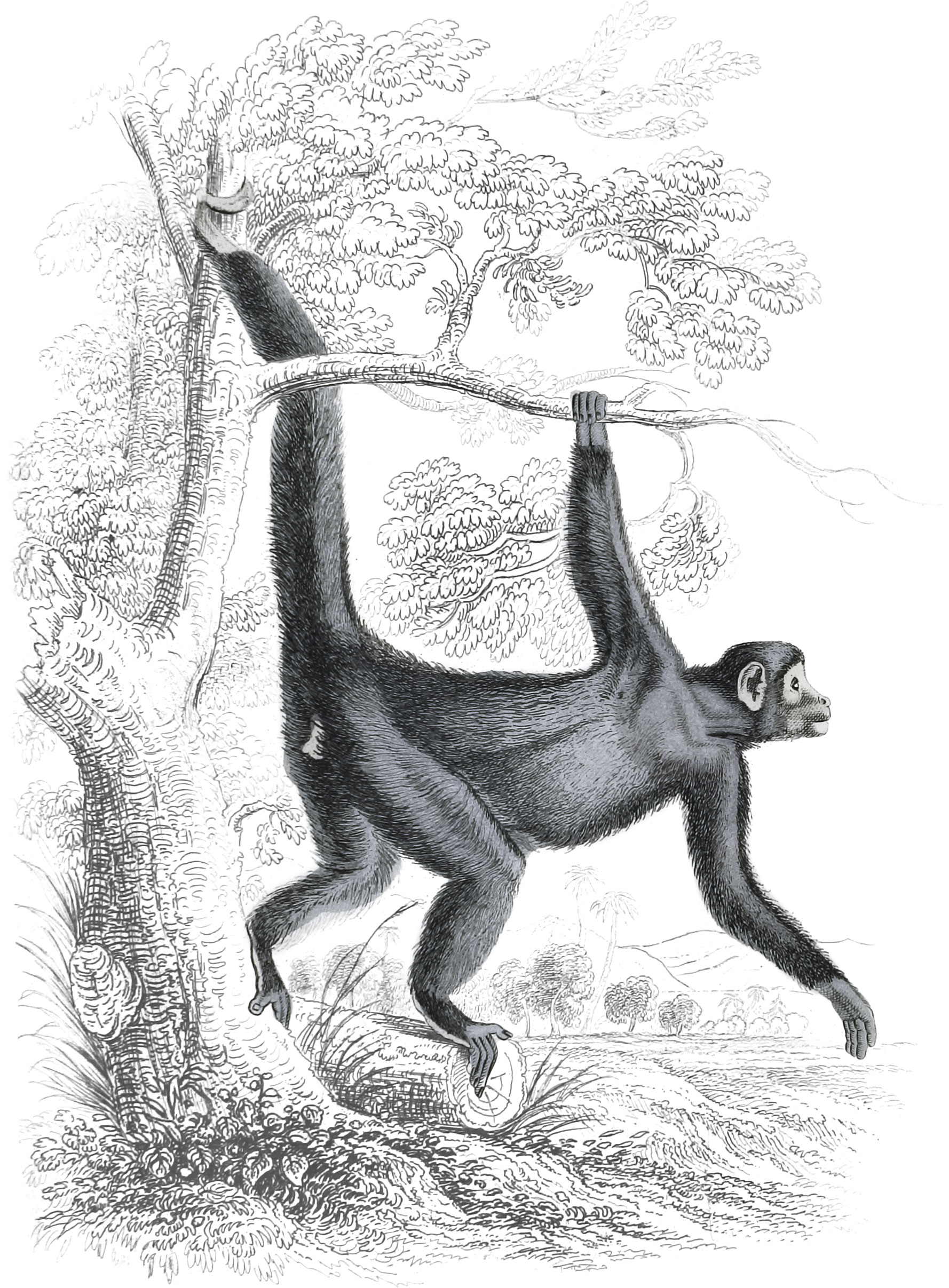

The Marimonda
Another curious animal belonging to this group is the Chuva of Humboldt, (Ateles marginatus, Geoffroy.) inhabiting the province of Jaen de Bracamoros on the river of the Amazons, where they live also in troops, but always separate from the Marimonda. It resembles that animal in its manners, but is distinguished by the larger size and deep black colour of the upper parts, and in the breast and inner sides of the legs and arms only being white.
Humboldt’s Lagothrix
The next form occurring, is named by Geoffroy Lagothrix; and we regret that we have been unable to procure any illustration of it. The genus may be characterised by a facial angle of 50°. The head rounder than in the last; hands provided with thumbs; the tail long and prehensile, naked at the tip underneath; the os hyoides outwardly apparent; the hair rough and curled. Two species only are yet discovered; the one mentioned by Geoffroy and Desmarest, but yet imperfectly known; said to inhabit Brasil; of a grayish ash colour, with reddish head, hands, and tail. The other, discovered by Humboldt and described by him under the name of Caparro, has been dedicated by Geoffroy to that naturalist, and will stand in our systems as Lagothrix Humboldtii. It inhabits the banks of the Guaviaré, one of the tributaries of the Oronooko, where it was discovered by Humboldt and Bonpland, in the hut of an Indian, who had taken it in an excursion to the west. It is an animal of considerable size, being about two feet two inches in length, exclusive of the tail. The head is round, and singularly large. The hair is long, strong, and uniformly of a martin gray; having the tips black. The face is naked and black, but the mouth is surrounded by long and stiff bristles. The tail, slightly longer than the body, is prehensile, and naked at the extremity. They live in numerous bands, and are frequently seen, says Humboldt, raised upon the hinder extremities. We are not aware of a specimen of this animal in any of the collections in this country.
We must now describe another form, included in the genus Cebus of Xerleben. The animals contained in this genus, exhibit great activity; are excellent climbers, and in all their members show great adaptation for a silvan life. The fore hands are very perfectly formed, more so than those of the monkeys of the Old Continent, and the thumb bears a better proportion, from its greater length; the palms of both fore and hinder extremities are very sensible of touch. The general size is small, the dispositions mild and playful; the food chiefly fruit and insects; they are gregarious, and, generally speaking, they may be said to supply the place of the Guenons of the Old World. They embrace all the remaining monkeys of the New World, which are possessed of prehensile tails.
The characters of this genus are. a facial angle of about 60°; head round, and the muzzle short; the tail prehensile, and entirely covered with hair. The first species we shall mention is
The Horned Sapajou
Cebus fatuellus.—Geoffroy.
Simia fatuellus, Linnæus.—Sajou cornu, Cebus fatuellus, Geoffroy Saint Hilaire, Annales du Museum, xix. p. 109; Desmarest’s Mammalogie, p. 84.—Le Sajou cornu male, et variete, Frederic Cuvier, Histoire Naturelle des Mammifères.
This Sapajou, of grotesque figure, from the unusual direction of the hair upon the forehead, in general form, will show the proportions of this genus. It has been long known, and was established in the Systema Naturæ of Linnæus, from specimens described by Brisson.
The general colour of those figured by Frederic Cuvier, is a very deep brownish-black, while the specimens which Buffon and Audibert represent, are rather of a reddish-brown. We have copied the figures from Cuvier, being taken from living specimens, and they may be considered as the most correct plates of the adult state of this animal. The Horned Sapajou is one of the largest in the family; all the upper parts are very deep purplish or brownish-black, nearly black on the head and upon the shoulders, and the dark purple of the skin, which appears on the naked parts, gives a uniformity of shade to the whole. The grotesque figure of the head is covered by the hair of the front, which stands erect, in a curved or crescent form, and, when viewed in front, has the appearance of two horns; the tips of these hairs, and those on the cheeks, are of a paler shade. A variety which Cuvier figures has a greater portion of white about the tufts and jaw.
Geoffroy and Desmarest give French Guiana as the native country of this species.


The most common species of Sapajou, and that which is most frequently seen in this country, is the Weeper monkey, Cebus appella of zoologists. It recommends itself for confinement by its good temper, playful disposition, and hardy constitution. It is also of a small size; and, though not clothed in a fur of rich colour, it is of a chaste and pleasing tinge, and, when the animal is healthy, of a shining, soft and silky texture. The shades are generally a sort of olive, tinged with a golden yellow on the light parts; the face is surrounded with a circle of paler colours, which varies considerably in its shade and breadth, being in some nearly wanting. This has given rise to several species being formed from it, and to some confusion in its alliance to one or two other Sapajous; and, indeed, Humboldt seems almost of opinion, that the animal we have just now figured is only a variety of this. Some have been known to produce young ones in confinement.
Another allied species, described by the last-mentioned naturalist, is the Ouavapavi des cataractes—Cebus albifrons. It is about the same size, the colour of the face grayish-blue, except the orbits and front, which are pure white; and the contrast thus exhibited, at once distinguishes it from those above noticed. The general colour of the body is grayish-olive, lighter on the back and belly. Humboldt met with this animal in troops in the forests near the cataracts of the Oronooko, and the mission of Santa Barbara. They are extremely mild in disposition, and very active; often kept by the Indians, and one was seen by Humboldt, at Maypures, which every morning caught a pig, and continued seated on his back during the day, while feeding in the savanna round the Indian huts. Another is mentioned, in the house of a missionary, which would often ride upon a cat, which had been reared in its company, and which patiently suffered the exploits of the Ouavapavi.
Like the Guenons of the Old Continent, the Sapajous are the most numerous group in America; fifteen or sixteen species seem to be well established, and are enumerated in our Synopsis. We shall only describe another in this place, which is remarkable chiefly for the great proportional size of the head. It is,
The Large-Headed Sapajou
Cebus monachus.—F. Cuvier.
Le sai à grosse tête, mâle; Cebus monachus, Frederic Cuvier, Histoire Naturelle des Mammiferes.
The most striking feature in this animal is the size of the head; and the effect is heightened by the short or shorn-like white hairs which cover it; the breast and belly, sides of the cheeks, and whole front before the arms, are yellowish-white; the fore-arms, posterior extremities, and tail, are black; and a mixture of black and brown, disposed in irregular patches, covers the back and rest of the body. F. Cuvier was ignorant from what part of America his specimen was received.
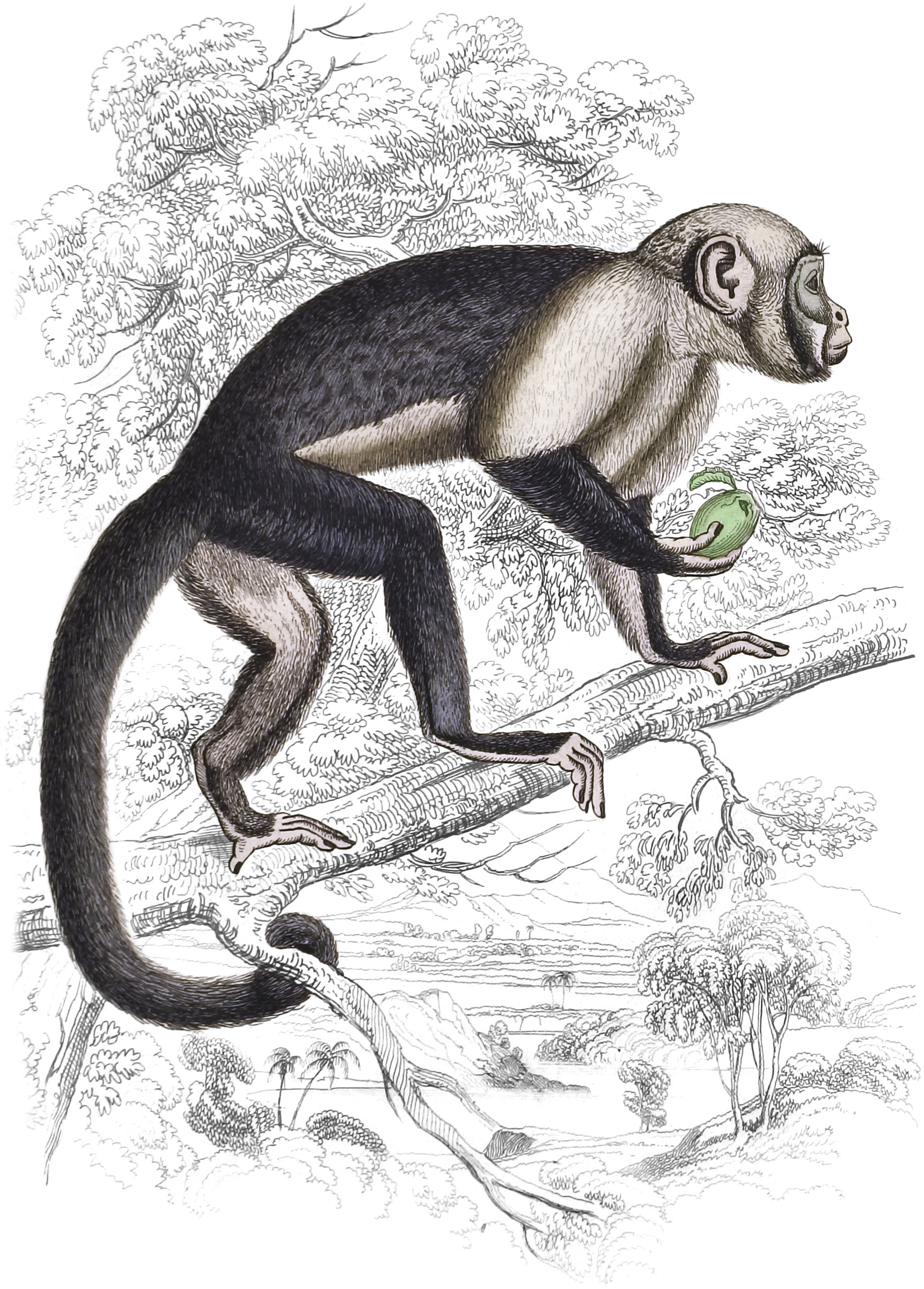
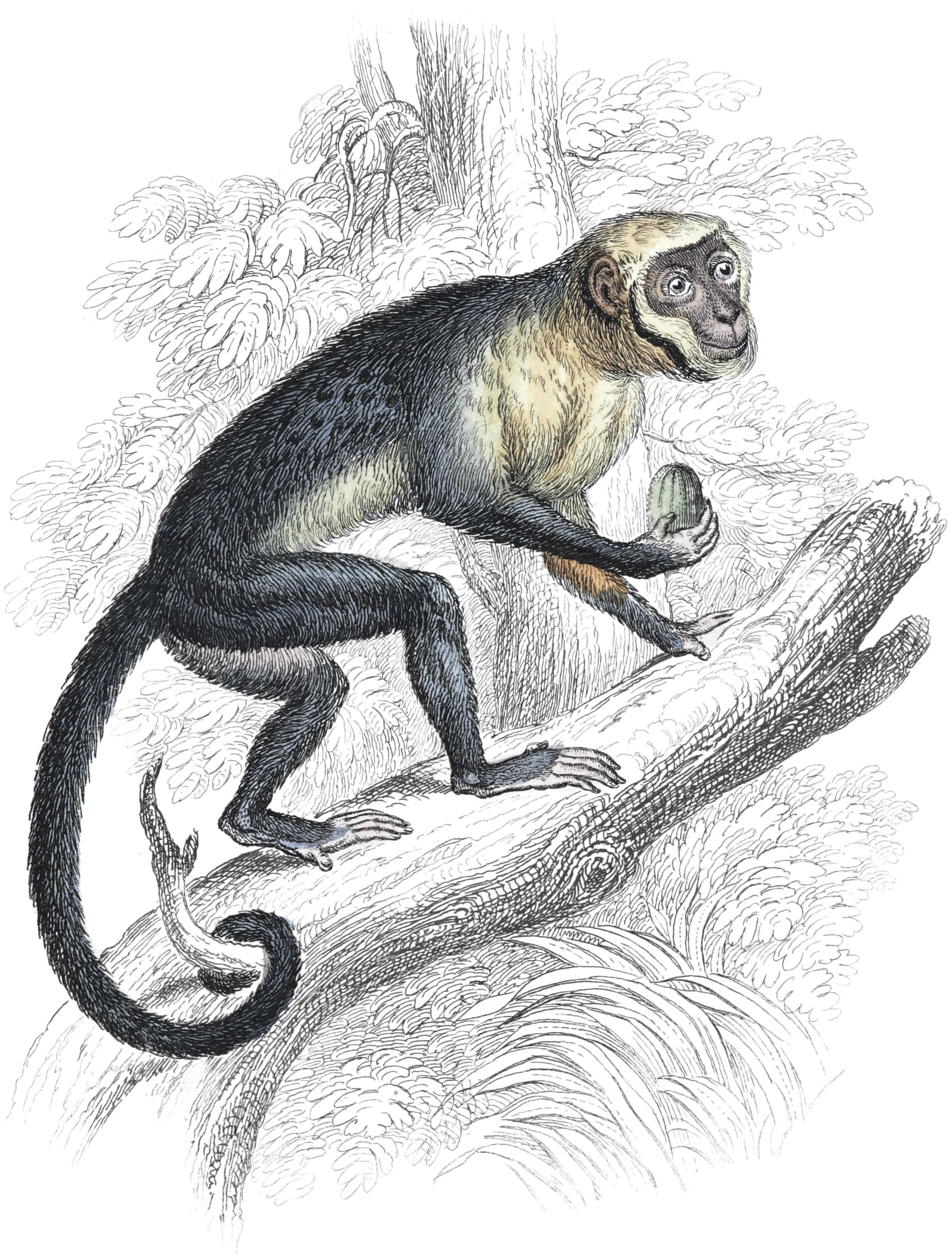
We now come to another form, which, though joined by many zoologists with the preceding, presents very considerable differences in form and habits. We begin to enter with it those small species where the nails take the form of claws, and where the habits become more akin to the little carnivora; raw meat, insects, and birds are relished by them, and the latter are taken with great activity. The nearest in alliance to the Sapajous is the genus Callithrix of Geoffroy characterised by a facial angle of 60°; ears proportionally very large; the body slender; the tail longer than the body, entirely hairy, but not prehensile; the nails straight and raised; colours of the fur bright. The type of the genus has been taken by Geoffroy in the Simia sciurea of Linnæus, which should now stand as
The Siamiri
Callithrix sciureus.—Geoffroy.
Simia sciurea, Linnæus.—Siamiri, callithrix sciureus, Geoffroy Saint Hilaire, Annales du Museum, xix. p. 113.—Sagoin siamiri, Desmarest’s Mammalogie, p. 87 86.—Le Saïmiri, Frederic Cuvier, Histoire Naturelle des Mammiferes.
This beautiful and active little animal is scarcely more than ten inches in length, exclusive of the tail which is between thirteen and fourteen, and when seated, the height of the back was only about six. The upper parts of the body are of a greenish-yellow, which assumes a grayish tint on the thighs and arms; the feet, legs, and fore-arms are reddish chestnut, and the lower parts are nearly white. The muzzle is of a darker colour than the rest of the face, which, with the ears, is flesh-coloured. The tail is black at the tip. The nails, except those on the thumbs, have a somewhat claw-form.
A living specimen, which Frederic Cuvier describes, from the Royal Gardens, was very playful and good tempered. It never used its tail for a support, and when at rest it was either wound round its body or limbs; when sleepy, it kept the tail in this position, and the head between the forelegs, somewhat in the manner in which the subject of the following plate is represented. The Siamiri is a native of Brasil and Cayenne, and is very often kept by the natives in confinement. It is a common species, though we seldom meet with it in collections.44


Another remarkable animal belonging to this group is mentioned by Humboldt under the name of Macavacahow—Simla lugens. It is extremely rare; one specimen having only been seen by that naturalist, who met with it in the forests bordering the Cassiquaire and Guaviaré. As far as he could learn, it was one of those few species which live in pairs, and that opinion is confirmed by the fear and dislike which it exhibited when placed near even some of the most diminutive species of the same genus.
It was extremely shy, and only when alone exhibited its activity; when persons were near, though occupied with general business, it would remain for hours in immovable attention to all that passed, refusing even food, though it had long fasted. But when alone, the sight of a bird at once rouses it. It darts upon it like a cat, swallows it in a second, and in its whole manner at this time, resembles a small carnivorous animal.
The colour of the body is a shining black, In some parts with a purplish lustre, and the texture of the hair is remarkably soft and shining. The face appears as a square mask of bluish-white, which is surrounded by a narrow margin of a purer tinge, and two stripes of the same colour run from the eyes to the temples; the throat is marked with a white band, and the hands are of the same colour on the outsides, somewhat resembling, and compared by the natives to a pair of white gloves; the tail is not much longer than the body, and not at all used as a prehensile instrument.
Eight species of this curious little group are described, which generally have the same habits, and show a beautiful gradation of both form and manners to some of the small carnivora. We are not sure that this is their proper situation, but prefer following the arrangement of Geoffroy and Desmarest. Any alterations which we could now make are only upon insufficient grounds.
The next form which succeeds in the system we have presently adopted, is one of as great singularity, and is yet represented by a single individual, discovered by Humboldt; it is,
The Douroucouli
Aotes trivirgatus.—Humboldt.
Le Douroucouli, Aotes trivirgatus, Humboldt and Bonpland, Observations de Zoologie, i. p. 306; Geoffroy, Annales du Museum d’Histoire Naturelle, xix. p. 115; Desmarest’s Mammalogie, p. 88.
This curious animal, the only type yet discovered of the above-mentioned genus, was found during Humboldt and Bonpland’s arduous journey upon the Oronooko; and, as their descriptions alone exist, we have made use of the greater part of them in the following article, and also of their beautiful plate for the accompanying illustration. It may be characterised by the head, large and round; muzzle short; no apparent external ear; the eyes very large; the tail long, hairy, not prehensile; habits nocturnal.
The Douroucouli of the Maravitain Indians is covered with a soft grayish-white fur, having a line of brown along the centre of the back, from the head to the tail; the breast, belly, and inner part of the legs, are yellowish-brown.

Dourroucouli Head
The head is marked with three dark stripes, very apparent in front, whence Humboldt takes his name, and the missionaries of the Oronooko that of “Cara rayada.” The general resemblance of the face is more like that of a cat than of a quadrumanous animal; the eyes are very large, and of a rich yellow; the mouth is surrounded with strong white bristly hairs. The ears are not apparent externally; the inside of the hands are white, and the nails are flattened; the tail is much longer than the body, of the same colour, except a black tip, bushy and soft. The whole length of the body is nine inches; that of the tail about fourteen. The skin is so soft and pleasant to the touch, that it is often preserved for different purposes, and particularly for tobacco pouches.
The Douroucouli is the only monkey of the Oronooko which sleeps during the day, whence it is often called “Mono dormillon.” Humboldt kept one alive for five months, and observed that it slept regularly from nine in the morning to seven at night; sometimes its sleep commenced even at daybreak, and light was always much disliked. When going to sleep, it selected the most shady place, behind some wood, or in the cleft of a tree, and, like the squirrels and weasels, had great facility in passing through very small holes or openings.
When disturbed during the day, it appears almost in a state of lethargy; it can scarcely raise its large white eyelids, and the eyes, which at night resemble those of an owl, are without lustre. In the ordinary sleeping position, it seats itself like a dog; the back is bent; the four hands brought together, and the head is almost concealed between them. It is at this time very stupid; may be touched without being bit, and its mouth may even be opened, and the teeth examined.
But if sluggish during the day, it is restless and all exertion at night. It now seeks its food; hunts small birds and insects, but in addition will eat almost every kind of vegetable. It was particularly fond of flies, which it took with great address, and was even tempted to hunt for them in a dull day. It drunk little, and would sometimes pass twenty or thirty days without tasting a liquid. Humboldt kept his specimen in the bedroom, notwithstanding the native opinion that they will tear out the eyes of persons asleep; it made extraordinary noises, and jumped against the walls, most probably in endeavours to escape. The Douroucouli is taken by the natives during the day when asleep, and half concealed in a hollow tree; and the male and female are sometimes taken in the same hole, as they resemble the last animal described, and live in pairs only.
This animal is very difficult to tame; the one above alluded to was carried sometimes in a canoe, sometimes on the back of a sumpter mule; and although caressed by every body, it constantly bit, was seldom playful, and seemed continually occupied with itself. Its nocturnal cry of “Muh-muh” resembled the jaguar of America, and it has received from this the name of Titi-tigre. The voice is extremely powerful compared with its size, and consists in a sort of mewing “e-i-aou” or a very disagreeable guttural cry of “Quer-quer.” When irritated, the head is swelled, and in its hissing, and the position of its body, it resembles a cat attacked by a dog; it also strikes in the same manner with its paw, using it with great quickness.
This animal was seen by Humboldt in the thick forests bordering the Cassiquaire, those at the foot of Mount Duida, and near the Cataracts of the Maypures.
Such is the substance of Humboldt’s description of this very curious animal, and which recedes even farther from the typical forms of the quadrumanous animals than the preceding, and presents a very strong alliance with many of the Lemuridæ, and some of the sloth-like animals. The anatomy and skeleton have not been sufficiently examined, and specimens will be desiderata with every naturalist who is interested in the History of the Mammaliæ.
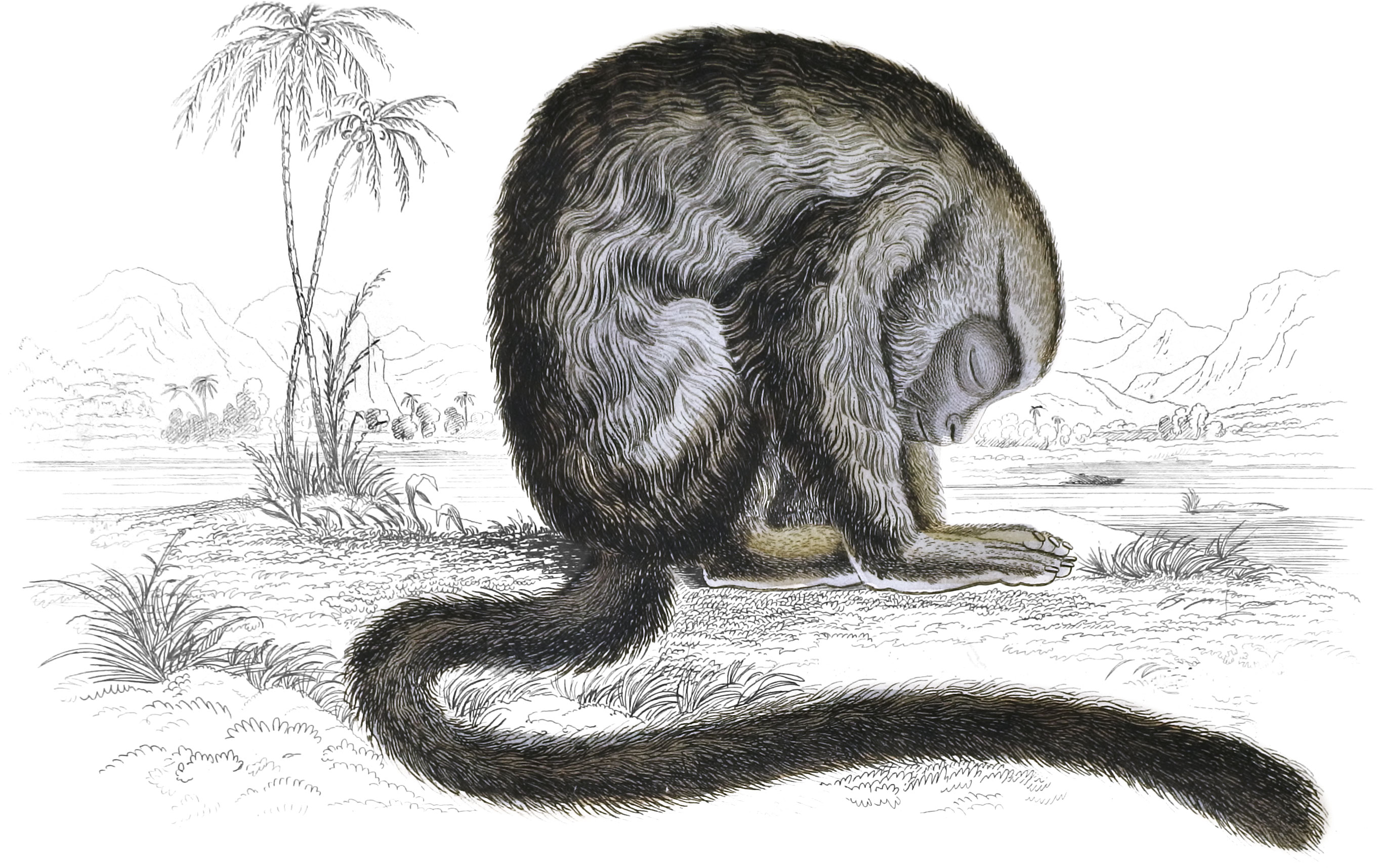

The next form among the American monkeys is the Pithecia of Geoffrey, which are also nocturnal in their habits, and have received the appellation of “night apes,” and also of “fox-tailed apes,” from the bushy tail. They may be characterised by a facial angle of 60°. Head round; muzzle short; canine teeth longer than the others; the tail not prehensile, shorter than the body and bushy; the nails short and bent; gregarious; nocturnal. The first we shall describe is
The Couxio
Pithecia satanas.—Humboldt.
Le Couxio, Pithecia satanas, Humboldt and Bonpland, Observations de Zoologie, p. 314; Geoffroy Saint Hilaire, Annales du Museum, xix. p. 115.—Saki Couxio, Desmarest’s Mammalogie, p. 89.
The Couxio or Couchio was discovered by M. Sieber in an expedition to Brasil, made at the expense of Count Hofmannsegg, and described by that nobleman, with some other animals, in a German periodical. Humboldt has figured it in his Zoological Observations, from one of the specimens now alluded to, and that plate has served also for our illustration; it is represented eating the fruit of a species of palm.
The total length of the animal, including the tail, is about two feet nine inches, and the colour is entirely of a dusky-black, paler beneath, where the hair is very thin, and shews a purplish tinge, similar to that of the face and hands. The tail is very bushy; the hair of it long and soft. Little is known, except that it is a native of the forests of Brasil.
Of another species we have more knowledge; and Humboldt has recorded the history of the “Capuchin de l’Oronoque” the P. chiropotes. It is very similar to that just now described, except in colour, and the plate of the one might serve as an illustration of the other, if the tints were differently disposed. The colour is brownish-red, and the hair is long; the beard is blackish-brown, arising below the ears, and covering a part of the breast. The eyes are large and sunk; the tail is bushy, as in the last; the claws are bent except on the thumbs.
Humboldt has given the following curious account of its manners:
Of all the monkeys of America, the Capuchin of the Oronooko has the greatest resemblance in its features to man. The eyes have a mingled expression of melancholy and fierceness; and as the chin is concealed by a long and thick beard, the facial angle appears much less than it really is. It is a strong, active, and fierce animal, and very difficult to tame; when irritated, it raises itself upon the posterior extremities, grinds the teeth, and leaps around the aggressor.
It very seldom drinks, and, when it does so, the action is performed, not like the other American monkeys, which apply their lips to the liquid presented to them, but, taking the water up in the hollow of its hand, and inclining the head upon the shoulder, it carries it to the mouth. The operation is performed with great deliberation, and the spectator must remain concealed to witness it. The animal becomes furious when the beard is wetted; and Humboldt is of opinion, that the method of drinking has been adopted, from the impossibility of the lips being applied to the water in the ordinary way, without wetting the beard.
The Capuchin de l’Oronoque is not gregarious, and the males are rarely found in company with the female. Their cry is hoarse and hollow, but is very seldom heard. They are found in the vast and desert forests of the High Oronooko, to the south-east of the Cataracts, but are rather uncommon; and although said to be found in other parts of South America, were never elsewhere met with by the enterprising naturalists to whom we have now been indebted for so much information.


The next animal we shall mention, has been placed last in this genus by Desmarest, and seems to differ from the others considerably; it is,
The Cacajao
Pithecia melanocephala.—Desmarest.
Le Cacajao, Simia melanocephala, Humboldt and Bonpland, Observations de Zoologie, i. pp. 317, 359; Geoffroy Saint Hilaire, Annales du Museum, xix. p. 117.—Saki cacajao, Desmarest’s Mammalogie, p. 91.
This very curious and diminutive species was also discovered by Humboldt and Bonpland, and it is to their description and plate that we are indebted for all that is known regarding it. By the different native tribes it is called as above, and also Caruiri, Mono feo, Chacuto, or Mono robon. It is very rare, and a single individual was only met with by those travellers in an Indian hut at San Francisco Solano. It is scarcely more than a foot in length, and the tail is not much more than a sixth; and its describer says
it is among the Siamiris, the Sais, and Ouistitis, what the Magot of Barbary is among the long-tailed Macaques.
The head of the Cacajao is very round, naked, and of a dull black, in its physiognomy much resembling that of an old negro; the hair on the head is directed forwards; the eyes are large and sunk, and the eyebrows are composed of strong bristles; the nose is flat, and the separation of the nostrils wide; there is no beard; the ears are bare, and very large; the body, with the exception of the head and hands, is clothed with yellowish-brown, straight, long and shining hair; the breast, belly, and insides of the arms, are of a clearer or lighter tint; the hands are black, the fingers very long, the nails flattened; the tail is thick, of the same colour with the body, and black at the end.
The Cacajao is a voracious animal, and eats all kinds of fruit; it is, however, weak; very inactive; of a mild temper, and easily frightened. It was very timid in the company of some small Sapajous; and the sight of a crocodile or serpent made it tremble violently. When about to seize any object, it stretches out its arms in the manner represented on the plate, and holds it with difficulty from the great length and slenderness of the fingers. It inhabits the forests of the Cassiquaire and Rio Negro, and lives in troops.


We have now reached the group of small animals, which will conclude the first great division of the quadrumanous animals, or what generally go under the title of monkeys; by Geoffroy they are made to form a family, which he denominates Arctopitheci, and divides into two subgenera; the great distinction is their squirrel-like action, and carnivorous propensities, and in the nails being in the form of sharp claws i the first genus has been denominated Hapales;45 from the soft nature of the fur it may be thus characterised, and differs, as we shall see in the sequel, very slightly from that which follows. The facial angle about 50°; the head round, most prominent at the occiput; claws, except on the thumbs of the posterior extremities; lower cutting teeth unequal and cylindrical. The first species we shall notice is.

Hapales jacchus dentition
The Striated Monkey
Hapales jacchus.—Illiger.
Simia jacchus, Linnæus.—Sanglain, Edwards’ Gleanings, i. p. 15.—Jacchus vulgaris, Geoffroy Saint Hilaire, Annales du Museum, xix. p. 119.—Ouistiti, Audibert, Histoire Naturelle des Singes; Frederic Cuvier, Histoire Naturelle Mammifères; Hapales jacchus, Illiger Prodromas, p. 71 and 72.
This beautiful and clean-looking animal is a favourite whenever it happens to be procured, and after a few hours restraint becomes playful and familiar. It has been long known to naturalists, and the illustration taken from Audibert, which accompanies this description, will give a tolerable idea of its general appearance.
The length of the body is only about eight inches, that of the tail above eleven; the general shade of the fur is a grayish-olive, darker, and almost approaching to black on the head and shoulders; and the lower part of the back and tail are barred or ringed with circles, of a rich pale gray, which alternately shade into each other; the lower parts of the body and foreparts of the extremities are brownish-gray. The face is flesh-colour, and there is a white spot on the forehead; but the most conspicuous marking in the physiognomy of the animal, are two tufts of pale or grayish white hair, of considerable length, which spring round each ear. All the claws, except those on the hinder parts, are hooked, and very thick. It generally walks in a quadruped position, and uses the fingers in one direction. In a wild state, the food may be said to be almost every thing; fruits, roots, and seeds, insects, and small or young birds. In confinement, it is even more varied. Edwards, who has given us a very good figure of it in his Gleanings, informs us that the specimen from which he made his drawing,
fed upon biscuits, fruits, greens, insects, snails, &c.; and that once when loosed, it suddenly snatched a Chinese gold fish from a basin of water killed, and devoured it; after this, Mrs Kennon, to whom it belonged, gave it live eels, which frightened him at first, by twisting round his neck, but he soon mastered them and ate them.
They breed occasionally in confinement; Edwards mentions a pair which had produced young in Portugal, and Frederic Cuvier had two which bore young in 1819. The female produced three, but very soon ate off the head of one of them; in the mean time the others began to suck, and from the period of their commencement, she was as affectionate as she was before careless. The male seemed more affectionate and careful of them than the mother, and assisted in the charge. The young generally keep upon the back or under the belly of the female, and Cuvier observed, that when the female was tired with carrying them, she would approach the male with a shrill cry, who immediately relieved her with his hands, placing the young upon his back, or under his belly, where they held themselves, and were carried about, till they became restless for milk, when they were given over to the mother, who, in her turn, would again endeavour to get rid of them. Cuvier is of opinion, however, that the general intelligence and penetration exhibited by this animal, is inferior to many of the smaller monkeys.
In general, the species of this genus have a part of the body and tail barred with a lighter shade. Some are again uniform in the colours. One is entirely of a silvery white, with a black tail, and all the exposed parts of the skin being a bright red flesh-colour, give a curious appearance to the animal. It has the common name of Mico, and will stand as H. argentatus.
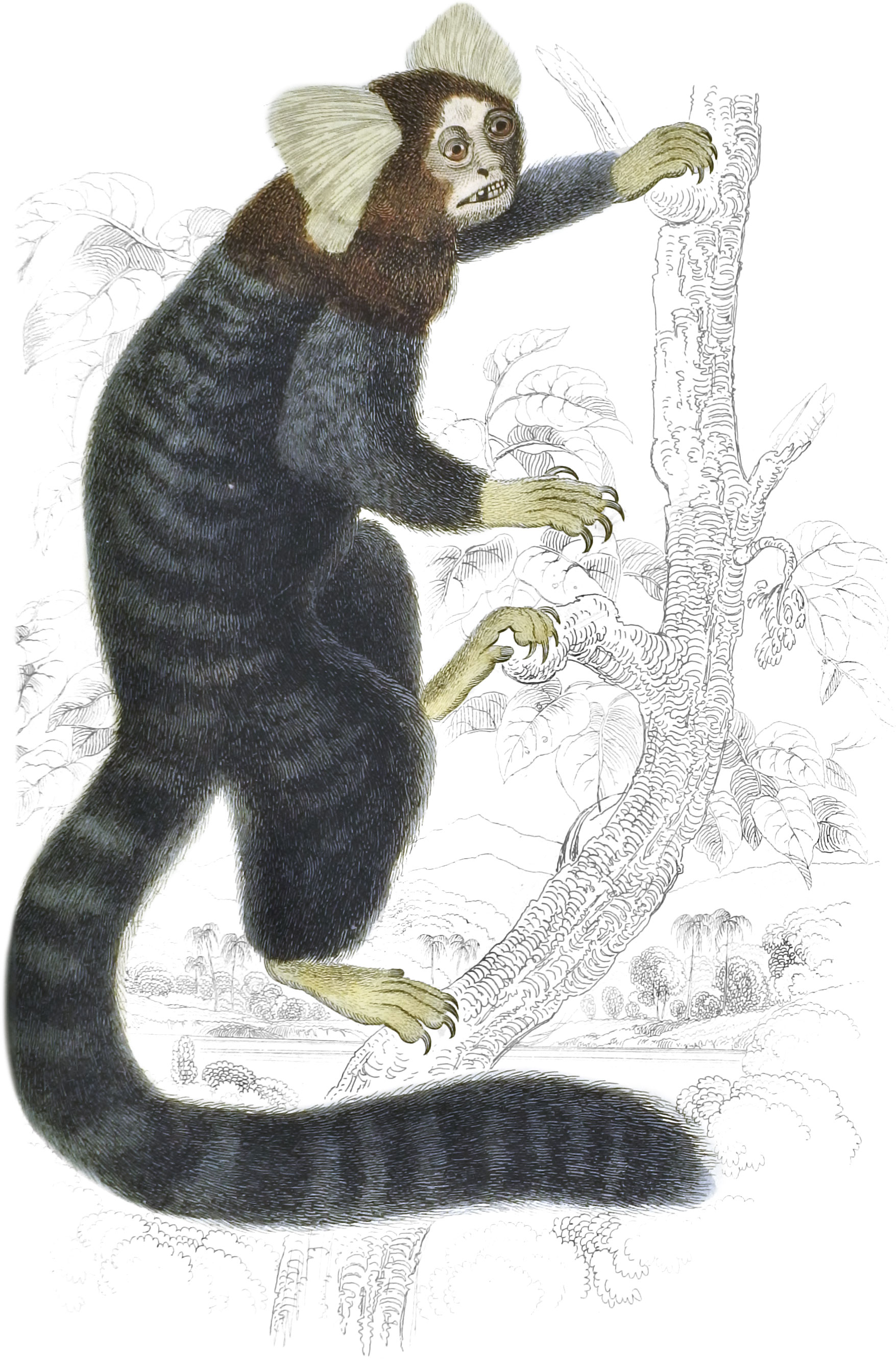

Another species without the barring is the H. melanurus, or black-tailed Ouistiti, and which is considered by Khul to make the passage to the next genus Midas, or the Tamarins. This is our last genus in this division, and is characterised nearly as the preceding, but differs in the dentition; the lower incisors are equal, and cut in a sloping direction; the forehead appears more prominent by the projection of the orbits.
One of the allying species is the Midas ursulus of Geoffroy, which is about the same size with the common Ouistiti, and has the back undulated with a black and brown colour, in a somewhat similar manner to that species; unlike it, however, this animal was very ill-natured, and showed his teeth upon the least motion near him, bit severely, or attempted it, when touched. One of the most pleasing in appearance is.
The Silky Tamarin
Midas rosalia.—Geoffroy.
Simla rosalia, Linnæus.—The silky monkey, Shaw’s Zoology.—Midas rosalia, Geoffroy Saint Hilaire, Annales du Museum, xix. p. 121.—Le marikina, Frederic Cuvier, Histoire Naturelle des Mammifères.—Ouistiti marikina, Desmarest’s Mammalogie, p. 95.
This neat little animal is entirely of a clear golden yellow, palest on the back and thighs. The hair is very fine and silky, and so long upon the head and neck as to form a sort of ruffed mane, somewhat similar to the same part in the lion, and which has gained for it the name of the lion monkey. This species is often brought to Europe, and its beauty, and mild temper, and gentleness, render it a general favourite. They are, however, very tender, and the least damp causes them to droop, and if continued, kills them. Little is known of their native habits; but F. Cuvier thinks that they live a good deal in the manner of the squirrels, and that they remain almost constantly on the trees. He has never seen them attempt to stand upon the hinder extremities. The accompanying illustration is taken from the plate of Fred. Cuvier.

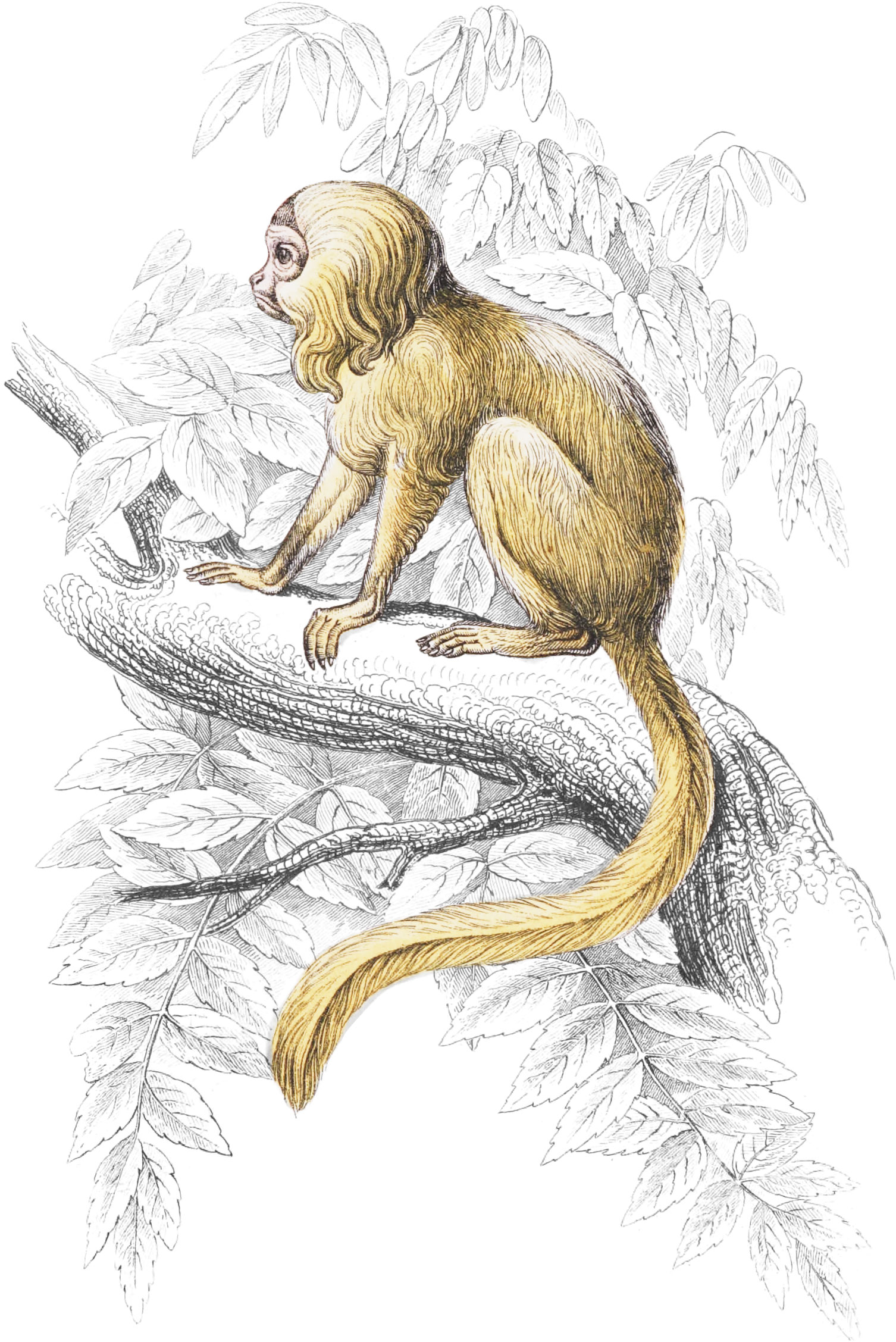
The next animal we shall describe is perhaps the smallest monkey known, it is
The Leonine Tamarin
Midas leonina.—Geoffroy.
Simia leonina, Léoncito, Humboldt, Observations de Zoologie, p. 14 15, plate 5.—Tamarin leoncita, Midas leonina, Geoffroy Saint Hilaire, Annales du Museum, xix. p. 121.—Ouistiti leoncita, Desmarest’s Mammalogie, p. 95.
This curious little species was discovered by Humboldt and Bonpland during their travels in. South America, and is described in the zoological researches of these naturalists.
The Leoncito is very rare; it inhabits the plains which border the eastern slope of the Cordilleras, the fertile rivers of Putumay and Caqueta. It never ascends to the more temperate districts, while the wandering bands of the Marimonda sometimes reach heights equal to those of the Caingow and Mount Perdu; it is about seven or eight inches in length. The Leoncito inhabits only the plains of Mocoa, and the tail nearly equals the body; it is extremely elegant; it is playful, but easily made angry. When enraged, or tormented, it bristles up the hair of the neck, and increases its resemblance to a little lion. Its activity was great, and when confined in a cage, it was with difficulty the sketch was made. The cry resembled the chirrup of some small bird. It was found to breed occasionally when kept in the Indian huts.
This is the account, and the only one, of this curious monkey; few specimens exist in Europe, and I believe it has never been seen alive. With it we shall conclude our review of this interesting section of the quadrumanous animals, and refer to the Synopsis which accompanies this volume, for the number and characters of the species which have been authentically described. It has been compiled from the works of Geoffroy, Humboldt, Spix and Martius, and Desmarest; and whatever its imperfections may be, it will, at least, contain the substance of the researches of these illustrious zoologists. The remaining family of the Lemuridæ, we shall endeavour to illustrate in a future volume.


Synopsis
Order I. Quadrumana46
Character of Order. Teeth of three kinds, incisor, canine, and molar.47 Four extremities furnished with long and flexible hands, having opposable thumbs, chiefly formed for grasping. Clavicles complete. Bones of the limbs separate, and capable of pronation and supination. Pectoral mammas, two or four. The orbital and temporal fossæ [indecipherable]. The stomach, simple. Food, fruits, roots, and insects. Habits, chiefly arboreal, living in forests or craggy precipices. Native countries, the warm parts of Africa, India, and America.48 Contains two great families, Simiadæ and Lemuridæ.
Synopsis of the Simiadæ
-
Fam. Simiadæ. Four incisive teeth in each jaw opposed. Nose, more or less prominent. Pectoral mammæ, generally two. (Two sub-families.)
- Sub. Fam. Simiæ catarrhini, Monkeys of the Old World. Number of teeth 32. Molar teeth, five on each side, crowned with blunt tubercles. Nostrils separated by a very narrow division. The tail never prehensile. With or without cheek-pouches and callosities. Inhabit the old world only.
- Sub. Fam. Simiæ platyrrhini, Monkeys of the New World. Number of teeth 36. Molar teeth on each side six. Nostrils separated by a broad division. The tail long; often prehensile. No cheek pouches or callosities. Inhabit the warm parts of Southern America.
I. Sub-Family Catarrhini
Orangs
-
Genus I.—Troglodites, Geoffroy. Muzzle short; facial angle 50°; ears large, and lying close to the head; arms comparatively short, reaching to the lower part of the thighs; tail, cheek-pouches, and callosities wanting.
- Plate I.49—T. Niger, Black or African Orang.—Geoff. Ann. du Mus. xix. 87; Desm. Mamm. 49. Hair black, long and shaggy upon the back and shoulders; height of the adults, 5 to 6 feet; of the young seen in confinement in Europe, 2 to 3 feet. Inhabits the coasts of Angola and Congo.
-
Genus II.—Pithecus, Geoffroy. Muzzle more lengthened than in the last; facial angle 65°; centre upper cutting teeth double in breadth to those at each side; canine teeth in the young not exceeding the others in length; in the adults twice as long, straight, and very strong; ears small; arms long; tail, cheek-pouches., and callosities wanting.
- Plates II. and II*.—P. satyrus, Red or Asiatic Orang.—Geoff. Ann. du Mus. xix. p.
3388; Desm. Mamm. p. 50; Abel’s Embass. p. 319 and 365. Hair long and shaggy, shining reddish brown; adults very strong and powerful; height from 5 to 7 feet; young seen in confinement in Europe from 3 to 4 feet. Inhabits the interior forests of Borneo and Eastern Asia. Most probably the Pongo.
- Plates II. and II*.—P. satyrus, Red or Asiatic Orang.—Geoff. Ann. du Mus. xix. p.
-
Genus III.—Hylobates, Illiger. Muzzle short; head round •, facial angle 60°; canine teeth longer than the others; arms very long., reaching to the ground; tail and cheek-pouches wanting; with or without naked callosities.
- Plate III.—H. hoolock, the Hoolock—Simia hoolock, Harl. Trans, of Am. Phil Soc. Hair deep chocolate brown; face surrounded with a pale circle, most distinct on the forehead; no callosities. Inhabits Goalpara.
- H. lar, Common Gibbon.—Simia lar, Linn. Pithecus lar, Geoff. Ann. du Mus. xix. p. 88; Desm. Mamm. p. 50. Hair black; the face surrounded with gray; small callosities on the buttocks. Inhabits Eastern India, particularly Coromandel, Malacca, and the Moluccas.
- H. albimana,50 White-handed Gibbon.—Simia albimana, Vig. and Horsf. Zool. Jour. No. xiii. p. 107. Hair black; the face surrounded with gray; the four hands whitish. Inhabits Sumatra.
-
H. variegatus, Little Gibbon.—Pithecus variegatus, Geoff. Ann. du Mus. xix. p. 88; Desm. Mamm. p. 51. Hair gray, varied with brown. Inhabits Malacca.
Differs from the two preceding in the colour of the hair, and its less size; by many considered as a variety only, and not well established as a species.
- H. leuciscus. The Wow-wow.—Pithecus leuciscus, Geoff. Ann. du Mus. xix. p.
5989; Desm. Mamm. p. 51. Hair ash gray; the face black, surrounded by a circle of light gray; hands, feet, and ears, nearly black; callosities large. Inhabits Malacca and the Sunda-Isles. - Plate IV.—H. syndactyla. The Siamang.—Simla syndactyla. Raff. Trans. Lin. Soc. xiii. p. 241; Horsf. Java. Hair black; neck and upper part of the breast naked, and prominent from the size of the laryngeal sacks; first and second finger of lower extremities united to the end of the second phalanx; callosities none. Inhabits Island of Sumatra.
- Plate V.—H. agilis.—The Active Gibbon.—Fred. Cuv. Mammif. Hair clear brown, changing to a shining yellow on the back; white band above the eyes; face bare, in the male blue, in the female yellow; callosities small. Lives in troops, and displays very great agility. Inhabits Sumatra.
Guenons
-
Genus IV.—Presbytis, Eschscholtz. Facial angle 60°; cheek-pouches none; callosities distinct; tail long; arms reaching to the knees.
- P. mitrula, the Capped Monkey.—Eschsch. in Kotzeb. Voy. of Discov. Hair curled, above bluish gray, beneath grayish white; a black line from the upper part of the ears across the head; length of the body about 1\(\frac{1}{2}\) foot, tail long. Inhabits Sumatra.51
-
Genus V.—Colobus, Illiger. Muzzle short; nostrils approximated; tail longer than the body; limbs slender; upper extremities without thumbs.
- C. polycomus, Full-bottomed Monkey.—Geoff. Ann. du Mus. xix. p. 92; Desm. Mamm. p. 53. Neck with a mane in the form of a hood, covering the upper part of the back and shoulders, variegated with black and fawn colour; body deep shining black; tail pure white. Inhabits the forests of Guinea and Sierra Leone.
- C. Ferruginosus, Bay Monkey.—Desm. Mamm.; p. 53. Geoff. Ann. du Mus. xix. p. 92. Bay Monkey, Penn Quad. Hair ferruginous; crown of the head, hands, and tail black. Inhabits Guinea.
- C. Temminckii, Temminck’s Colobus.—Khul. MSS.; Desm. Mamm. p. 53. Upper parts, shoulders, and outer part of the thighs black; belly yellowish red; limbs clear red; face and tail reddish purple; length about 2 feet 8 or nine inches, including the tail. Native country unknown. The only specimen known was purchased by M. Temminck, at the sale of Bullock’s collection.
-
Genus VI.—Nasalis, Geoffroy. Muzzle short; facial angle about 50°; the nose unproportionally lengthened; the nostrils at the extremity, on the under side; the body very thick; cheek-pouches and callosities; thumbs of anterior extremities slender; tail longer than the body.
- Plate VI.—N. larvatus, The Proboscis Monkey.—Hair reddish-brown; patched on the lower part of the back with lighter spots; face black. Inhabits Borneo.
- N. recorvus, Turned-up Proboscis Monkey. Nasalis recurvus, Vig. and Horsf. Zool. Journ. xiii. p. 110. Hair reddish-brown, under parts paler; middle of the back and inside of the limbs gray; nose turned up. Inhabits Borneo. Perhaps the young of N. Larvatus.
-
Genus VII.—Lasiopyga, Illiger. Facial angle from 503 to 60°; the muzzle only slightly elongated; face bare; hands longer than the fore-arm; thumbs on the anterior extremities short and slender; cheek-pouches; tail long; no callosities; the buttocks fringed with hair.
- Plate VII.—L. nemea, Cochin-China Monkey.—Pygathrix, Geoff. Ann. du Mus. xix. p. 90. Guenon Douc, Desm. Mamm. 54. Hair of brilliant colours; upper part of the head brown, with a frontal hand of deep chestnut; hair of the cheeks very long, dirty white; fore-arms white, extending to the thumbs and fingers, which are black; tail white. Inhabits Cochin-China. (Madagascar, according to Harcourt.)
-
Genus VIII.—Semnopithecus, Cuvier. Head round; nose flat; facial angle 45°; limbs long; thumbs of anterior extremities very short; cheek-pouches and naked callosities; tail very long and thin; posterior grinder of the lower jaw with five points; form slender. India and Indian Archipelago.
- Plate VIII.—S. melalophos, the Simpai.—Fred. Cuv. Mammif. Simia melalophos, Raff. Trans. Lin. Soc. xiii. The face blue; forehead with a black band of long hairs, in the form of a tuft or crest; the hair of the upper parts clear red-brown; beneath, and in the inside of the limbs, tawny and whitish. Inhabits Island of Sumatra.
- S. maurus, Negro Monkey.—Middle-size Black Monkey, Edw. Glean. S. maurus, Horsf. Hair soft and silky, intensely black; the breast, belly, inner surface of extremities and root of the tail, gray; in very old individuals, crown and upper parts tinged with gray. Inhabits Island of Java.
- Plate IX.—S. entellus, the Entellus Monkey.—Entelle, Audeb. Cercopithecus entellus, Geoff. Ann. du Mus., xix. 95. Hair yellowish-white, paler beneath; face and hands black. Inhabits Bengal.
- S. pyrrhus, the Lutung.—Horsf. Java. Hair soft and silky; above, shining red; beneath, and inside the limbs, fawn coloured, inhabits Java. (Allied to Cercopithecus auratus.)
- S. pruinosus.—Desm. Mamm. Sup. p. 533. Hair black, mixed with white, without a white spot at the origin of the tail, as in S. maurus: tail brown. Inhabits Sumatra, (Allied to S. maurus.)
- S. comatus.—Desm. Mamm. Supp. p. 533. Hair above gray, beneath whitish; tail tipped with white; hair of the crown black, long, forming an aigrette behind, and concealing the cars. Inhabits Sumatra.
-
Genus IX.—Cercopithecus, Geoffroy. The head round; forehead receding; facial angle 50°; no superciliary ridges; nose flat; cheek-pouches and callosities; tail longer than the body. Africa and India.
- C. auratus. Golden Guenon.—Geoff. Ann. du Mus. xix. p. 93. Desm. Mamm. p. 56. Above, golden yellow; beneath, paler; black spot upon the knee; hair of the breast and cheeks long. Inhabits India and Molucca.
- C. talapoin, the Talapoin Monkey.—Penn. Quad. 206. Geoff. Ann. du Mus. xix. p. 93. Hair above, olive; beneath, yellowish-white; feet black. Inhabits India, according to Buffon. (Described from Buffon. Supposed by F .Cuvier to be the young of Cercocebus cynosurus.)
- C. latibarbus, Purple-faced Bearded Monkey.—Desm. Mamm. p. 57. Guenon à face pourpre, Buff. Simia dentata, Shaw. Adult, hair woolly, black; a large beard extending laterally; tail tufted at the end. Young, hair entirely red. Native country unknown.
- C. cephus, Mustache Monkey.—Simia cephus, Linn. Guenon moustac, Desm. Mamm. p. 57. Hair greenish-brown, (according to Geoff, reddish-brown,) latter half of the tail white; nose and lips blue. Inhabits Guinea, Geoff.
- C. pileatus, Bonneted Monkey.—Simia pileata, Shaw. Guenon couronnée, Desm. Mamm. p. 57. Hair above brownish-yellow; beneath whitish; forehead adorned with long hairs erect in a tuft. Native country unknown. (Allied to Cercocebus sinicus.)
- Plate X.—C. mona, Varied Monkey.—Simia mona, Linn. Guenon mone, Desm. Mamm. p. 58. Upper part of the head, bright yellowish-green; hair of the cheeks yellow: body deep chestnut, a white spot on each buttock. Native country uncertain, most probably Africa.
- C. nictitans, White-nosed Monkey.—Guenon hocheur, Desm. Mamm. p. 58. Le hocheur, Audeb. Body black, sprinkled with greenish-gray; extremities black above: lower part of the chin white; nose more than usually long, white. Inhabits the coast of Guinea.
- C. petaurista, Vaulting Monkey.—Simia petaurista Linn. Le blanc nez, and ascagne, Audeb. Hair above reddish, white below; outer part of the extremities greenish, inside gray; lower part of the nose white. Inhabits coast of Guinea.
- Plate XI.—C. ruber, the Red Monkey.—Red monkey, Penn. Guenon patas, Desm. Mamm., p. 59. Above reddish, gray beneath; hair of the cheeks long; a narrow band above the eyes black. Inhabits Senegal.
- C. Diana, Diana or Palatine Monkey.—Simia Diana, Linn. Exquina, Margrave. Guenon Diane, Desm. Mamm. p. 60. Hair of a deep chestnut on the back, dark gray on the flanks, with an oblique light line on the thighs; forehead adorned with a white crescent-shaped band; chin and throat white. Inhabits Congo and the Guinea coast.
- C. albocinereus, Grey guenon.—Guenon grisblanc, Desm. Mamm. Supp. p. 534. Hair gray above, lower parts whitish; a band of black crosses the forehead; extremities black; tail brown. Inhabits Island of Sumatra.
- C. pygerythræus, Red-breasted Monkey.—F. Cuv. Mammif. Guenon Vervet., Desm. Mamm. Supp. p. 534. Above greenish-gray; beneath white; hair round the anus dull reddish; tail tipped with black. Inhabits the Cape of Good Hope.
-
Genus XII.—Cercocebus, Geoffroy. The muzzle lengthened; the forehead receding: facial angle about 45°; large cheek-pouches; callosities large; tail longer than the body. Africa and India.
- Plate XIII.—C. sabæus, the Callitrix or Green Monkey.—Simia sabea, Linn. Guenon callitriche, F. Cuv. Mammif.; Desm. Mamm. p. 61. Singe vert, Geoff. Ann. du Mus. xix. p.
9798. Above olive-green; shaded beneath from yellowish-green to white; face black, surrounded with long hair. Inhabits Cape de Verd islands, Senegal, the Mauritius. - C. cynosurus, the Malbrouk.—Guenon Malbrouck, F. Cuv. Mammif.; Desm. Mamm. p. 60. Cercopithecus cynosurus Malbrouc, Geoff. Ann. du Mus. xix. 96. Above olive-brown, shading to whitish on the under parts; a white band above the eyes. Inhabits Bengal.
- C. griseo viridis, the Grivet.—Le Grivet, F. Cuv. Mammif. Guenon grivet, Desm. Mamm. p. 61. Grayish green, paler beneath; tail gray for the whole length. Inhabits Africa. (Allied to the two preceding species.)
- Plate XII.—4. C. fuliginosus, Mangabey or White Eyelid Monkey.—Le Mangabey, F. Cuv. Mammif. Guenon enfumée, Geoff. Ann. du Mus. xix. 97; Desm. Mamm. p. 62. Entirely of a gray sooty black, paler beneath; the upper eyelids white and conspicuous. Inhabits Ethiopia.
- C. æthiops, White Collared Mangabey.—Cercocebe mangabey, Geoff. Ann. du Mus. xix. p. 97. Guenon mangabey, Desm. Mamm. p. 62. The crown chestnut-brown, the upper parts purplish brown; a white band surrounding the back of the neck. Inhabits Ethiopia.
- C. atys, the Atys.—Simia atys, Audeb. Atys, Geoff. Ann. du Mus. xix. p. 99. Guenon atys, Desm. Mamm. p. 62. Entirely of a yellowish-white; the naked parts of the skin flesh-coloured. (By Geoffroy it is said to be an albino variety of some unknown species, and to inhabit India.)
- Plate XIII.—C. sabæus, the Callitrix or Green Monkey.—Simia sabea, Linn. Guenon callitriche, F. Cuv. Mammif.; Desm. Mamm. p. 61. Singe vert, Geoff. Ann. du Mus. xix. p.
-
Genus XIII.—Macacus, Lacepede. Facial angle about 40° or 45°; muzzle elongated; superciliary ridges distinct; canine teeth strong and large (longer than in the preceding genus;) the tail shorter than the third of the length of the body, or more; the form strong and compact.
- Plate XIV.—M. silenus, the Ouanderow.—Simia canina, Penn. Macaque a crinière, Cuv. Reg. An. Papio silenus, Geoff. Ann. du Mus. xix. p.
100102. Macaque ouanderow, Desm. Mamm. p. 63. Above black; the hair of the back of the neck long, and, with the beard, Arming a thick ruff, gray; under parts gray; tail ending with a tuft of hairs. Inhabits the Island of Ceylon. - M. sinicus, Chinese Monkey.—Simia sinica, Linn. Bonnet-chinois, Audeb. Cereocebe bonnet-chinois, Geoff. Ann. du Mus. xix. p.
6498. Macaque bonne-chinois, Desm. Mamm. p. 64. Chestnut-brown, paler beneath; hair of the crown long, and spreading out from the centre to the sides. Inhabits Bengal and Ceylon. -
M. radiatus, the Toque.—Cereocebe toque, Geoff. Ann. du Mus. xix. p. 98. Macaque toque, Desm. Mamm. p. 64. Above greenish-brown; beneath gray; hair of the crown long, and spreading out from the centre to the sides. Inhabits India.
Nos. 2 and 3 are closely allied to Cercocebus, and their station in the System does not seem clearly established. They are interesting forms, and ought to be kept in new by the zoologist.
- M. cynomologus, Hare-lipped Monkey.—Cercocebe aigrette and macaque, Geoff. Ann. du Mus. xix. p. 99, Macaque, Cuv. Hist. Nat. des Mammif. Macaque ordinaire, Desm. Mamm. p.
6265. The male, above olive, beneath grayish-white; feet black; canine teeth strong, length, including tail, 3 feet 3 inches. The female less; canine teeth weaker; hair of the crown directed towards the centre, and forms a ridge or tuft to the occiput. Inhabits Guinea and interior of Africa, Desm. Java, Geoff. - Vignette.—M. rhesus, Rhesus Monkey or Pig-tailed Baboon.—Magot rhesus, Inuus rhesus, Geoff. Ann. du Mus. xix. p. 101; F. Cuv. Hist. Nat. des Mammif. Macaque maimon, Desm. Mamm. 66. “Upper part of the body grayish-green; tail short, and wrinkled at the base; buttocks golden-yellow; extremities gray.”—Desm. Inhabits Eastern India, and forests on the banks of the Ganges.
-
M. nemestrina, Brown Baboon.—Maimon, Inuus nemestrinus, Geoff. Ann. du Mus. xix. p. 101. Macaque brun, Desm. Mamm. p. 66. “Above deep brown; middle of the head and a dorsal band black; tail small and slender, reaching to the middle of the thigh; extremities and head yellowish.”—Desm. Inhabits Java and Sumatia.
The Synonymy of Nos. 5 and 6 have often been confounded. Their situation is undetermined. Geoffroy places them with the Barbary Ape, so does Mr Gray, rejecting entirely Cuvier’s genus Inuus. We have followed Desmarest, as most in accordance with our own opinion.
There are, it is probable, other [indecipherable] species which have not been properly characterised. Desmarest mentions one above two feet in length; the back above brownish-black; the shoulders olive; the outer surface of the feet yellowish-gray; under part of the throat grayish-white belly yellowish; ears small, white hairs behind each.
-
M. niger. Black Baboon.—Cynocephale negre, Desm. Mamm. Supp. p. 534. Black ape, Macacus niger, Zool. Gardens, i. p.
169189. Entirely black; fur woolly; the hair on the head long, falling back, and forming a crest; tail a tubercle. Inhabits islands of Indian Archipelago. Desm.Differs from the type in the elongation of the muzzle, and want of tail; by the former allied to the baboons, by the latter to the next genus Inuus.
- Plate XIV.—M. silenus, the Ouanderow.—Simia canina, Penn. Macaque a crinière, Cuv. Reg. An. Papio silenus, Geoff. Ann. du Mus. xix. p.
-
Genus XIV.—Inuus, Cuvier. Facia, angle about 40°; muzzle elongated; the hands lengthened; tail none, or a tubercle.
- Plate XV.—I. sylvanus, Barbary Ape.—Simia inuus, Linn., Magot African, Geoff. Ann. du Mus. xix. p. 100. Magot, F. Cuv. Hist. Nat. des Mammif. Macaque magot, Macacus inuus, Desm. Mamm. p. 67. Above greenish-gray; paler underneath and in the inner sides of the limbs. Tail a short cutaneous tubercle.
Baboons
-
Genus XV.—Cynocephalus, Brisson. Facial angle from 30° to 35°; superciliary ridges prominent; muzzle long, truncated at the end where the nostrils are placed; tail as long as the body.
- C. babuin, Little Baboon.—Petit papion, Buff. Papion cynocephale, Geoff. Ann. du Mus. xix. p. 102. Babuin, F. Cuv. Hist. Nat. des Mammif. Cynocephale babuin, Desm. Mamm. p. 68. Male, above yellowish-green, beneath paler; the face livid; cartilage of the nostrils not longer than the upper jaw. Female unknown. Inhabits Northern Africa.
- C. papio, Guinea Baboon.—Papion, Audeb. Papio sphinx, Geoff. Ann. du Mus. xix. p. 103. Cynocephale papion, Desm. Mamm. p. 69. Above brown, paler beneath; cheeks yellowish; face, ears, and hands, black; cartilage of the nostrils longer than the jaws. In the young the muzzle is shorter. Inhabits the coast of Guinea.
- Plate XVI.—C. porcarius, the Chacma.—Simia porcaria, Linn. Papio porcarius and comatus, Bahuin pore and chevelu, Geoff. Ann. du Mus. xix. p. 102 and 103. Chacma, F. Cuv. Hist. Nat. des Mammif. Cynocephale chacma, Desm. Mamm. p. 69. Simia ursina, Penn. Greenish-black, palest on the fore part of the shoulders; hair long upon the neck, in the form of a mane; face violet black; upper eyelids white. Female without the mane. Inhabits Southern Africa, Cape of Good Hope.
- C. hamadryas, Dog-faced Baboon.—Simia hamadryas, Linn. Dog-faced ape, Penn. Tartarin, Geoff. Ann. du Mus. xix. p. 103; F. Cuv. Hist. Nat. des Mammif. Cynocephale tartarin, Desm. Mamm. p. 69. Blackish-gray tinged with brown; hair of the fore parts long, forming a shaggy mane; face flesh colour. Female and young with short muzzles, coloured blue. Inhabits Moco, borders of the Persian Gulf, Arabia.
-
Genus XVI.—Papio, Brisson. Proportions much stronger than Cynocephali, and distinguished from them by the tail being very short, almost a tubercle, and perpendicular to the dorsal line. Dentition very powerful.
- Plate XVII.—P. mormon, the Mandril.—Simia mormon, Linn. Variegated Baboon, Penn. Mandril, Geoff. Ann. du Mus. xix. p. 104; F. Cuv. Hist. Nat. des Mammif. Cynocephale mandril, Desm. Mamm. p. 70. Yellowish-olive, tinged with gray above, beneath white; beard yellow; muzzle furrowed; livid, but bright red and blue. In the young the furrows do not appear. Inhabits Africa, on the Gold and Guinea coast.
-
Plate XVIII.—P. leucophæus, the Drill.—Simia leucophæa, F. Cuv. Ann. du Mus. ix.; Hist. Nat. des Mammif. Cynocephale drill, Desm. Mamm. p. 71. Above greenish-brown tinged with gray, beneath white. Face of males, females, and young, uniform dull black. Under lip red. No furrows on the muzzle. Inhabits Africa.
We have deviated from the text of the volume in dividing the Cynocephali. Though very closely allied, and by most writers united either under Cynocephalus or Papio, they are always divided into sections, and we generally prefer an entire separation to divisions of that kind.
One or two baboons are mentioned by Pennant upon dubious authority, which it is not necessary to introduce here, as proper characters could not be given.
II. Sub-Family Platyrrhini
Howlers
-
Genus XVII.—Mycetes, Illiger. Facial angle about 30°; canine teeth strong; tail long, prehensile, naked at the extremity on the under side; os hyoides ventricose, apparent on the outside; gregarious; howling during night; largest and fiercest of the South American group.
- M. seniculus, the Mono Colorado, or Red Howler.—Simia seniculus, Linn. Stentor seniculus, Geoff. Ann. du Mus. xix. p. 107. Mono Colorado, Humb. Obs. Zool. p. 354. Alouate roux, Desm. Mamm. p. 77. Fur reddish-brown, brightest on the tail and extremities; under parts nearly hairless; face naked and black. Inhabits French Guiana, banks of the rivers Madeleine and Darien.
-
Plate XIX.—M. ursinus, the Araguato Stentor ursinus, Geoff. Ann. du Mus. xix. p. 108. Araguato de Caraccas, Humb. Obs. Zool. pp. 329 and 355. Alouate ourson, Desm. Mamm. p. 78. Entirely reddish-brown, and clothed with long hair on every part; bearded; face bluish-black. Inhabits Venezuela, New Barcelona, banks of the Oronooko.
Differs from the preceding in the hair being very long, and in being clothed on the under parts.
- M. stramineus, the Arabata.—Stentor stramincus, Geoff. Ann. du Mus. xix. p. 108; Humb. Obs. Zool. p. 355. Alouate arabate, Desm. Mamm. p. 78. Hair entirely straw-yellow, darker, or of a brownish colour at the roots. Inhabits Peru.
- M. Belzebuth, the Guariba.—Simia Belzebuth, Linn. Stentor fuscus, Geoff. Ann. du Mus. xix. p. 108. Stentor guariba, Humb. Obs. Zool. p. 355. Alouate guariba, Desm. Mamm. p. 78. Brownish-chestnut, passing into chestnut on the head and back; the tips of the hair golden colour. Inhabits Brasil.
- M. flavicaudatus, the Chora.—Stentor flavicaudatus, Geoff. Ann. du Mus. xix. 108. Simia flavicauda, Chora, Humb. Obs. Zool. p. 343 and 355. Alouate chora, Desm. Mamm. p. 79. Brownish-black, darker on the back; tail blackish-olive, adorned on the sides with two yellow stripes. Inhabits the province of Jaen, banks of the river Amazon.
- M. niger, the Caraya.—Stentor niger, Geoff. Ann. du Mus. xix. 108. Simia caraya, Humb. Obs. Zool. p. 355. Alouate caraya, Desm. Mamm. p. 79. Rich shining black; tail rather short; female and young with the sides and under parts yellowish-brown. Inhabits Paraguay, Bahia.
-
M. rufimanus, Red-Handed Howler.—Mycetes rufimanus, Khul MSS.; Desm. Mamm. p. 79. Black; wrists and hands, and extreme half of the tail, reddish-brown; lower parts nearly without hair. Native country unknown.
The description of this species is only known from the MSS. of Khul, taken from a specimen purchased by M. Termminck at the dispersion of Bullock’s Museum.
Sapajous
-
Genus XVIII.—Ateies, Geoffroy. Head round; facial angle about 60°; extremities proportionally very long and slender; the anterior hands with four fingers, or the thumb supplied by a rudiment only; tail very long; powerfully prehensile, having a part without hair, covered with a very delicate and sensible skin on the under side; os hyoides large, but not apparent from the outside; habits and movements slow and indolent.
- A. hypoxanthus, the Miriki.—Atèle hypoxanthe, Desm. Mamm. p. 72. Of a yellowish-gray; vent and base of the tail often reddish-yellow; face flesh-colour; thumb a short rudiment, furnished with a nail. Inhabits Brasil between the 13° and 23° of S. latitude.
- A. subpentadactylus, the Chameck.—Atèle chameck, Geoff. Ann. du Mus. xix. 105; vii. 267; Desm. Mamm. p. 73. Chameck, Humb. Obs. Zool. p. 353. Entirely black; thumb a rudiment, without a nail. Inhabits French Guiana and Peru.
-
Plate XX.—A. paniscus, the Coaita.—Simia paniscus, Linn. Atèle paniscus, Geoff. Ann. du Mus. xix. p. 105; vii. 269. Atèle coaita, Desm. Mamm. p. 73. Coaita, Humb. Obs. Zool. i. p.
352353; Fred. Cuv. Hist. Nat. des Mammif. Entirely black; thumb wanting on the anterior extremities. Inhabits Guiana, Brasil.Distinguished from the last by the less size, and want of the thumb on the anterior hands.
- A. belzebuth, the Marimonda.—Geoff. Ann. du Mus. xix. p. 106; vii. p. 271. Atele belzebuth, Desm. Mamm. p. 74. Marimonda de l’Oronoque, Humb. Obs. Zool. i. pp. 327, 353. Dusky black, under parts yellowish-white in the males; white in the female and young. Inhabits banks of Oronooko.
- A. marginatus, the Chava.—Geoff. Ann du Mus. xiii. p.
9089; xix. p. 106. Atele chuva, Desm. Mamm. p. 75. Chuva, Humb. Obs. Zool. p. 354. Black: face surrounded with white or yellowish; breast and insides of the limbs grayish-white. Inhabits province of Jaen, banks of the rivers Santiago and Amazons. - A. arachnoides, Spider Monkey.—Geoff. Ann. du Mus. xiii. p. 90; xix. p.
109106. Simia arachnoides, Humb. Obs. Zool. p. 354. Atèle arachnoide, Desm. Mamm. p. 75. Grayish-yellow; fur very soft; eyebrows black. Inhabits Brasil. -
A. melanochir, Black-Handed Coaita.—Atèle melonochiere, Desm. Mamm. p. 76. Gray; upper part of the head, hands, and an oblique spot upon the knees, brownish-black. Native country unknown.
Described by Desmarest, from a specimen in the Collection at Paris.
-
Genus XIX.—Lagothrix, Humboldt. Head round; facial angle about 50°; hands with five fingers; tail strongly prehensile, naked and callous on the underside of the extremity; os hyoides slightly apparent on the outside.
- L. humboldtii, the Capparo.—Simia lagotricha, le capparo du Rio Guaviare, Humb. Obs. Zool. i. pp. 322, 354. Lagothrix Humboldtii, Geoff. Ann. du Mus. xix. p. 107. Lagotriche capparo, Desm. Mamm. p. 76. Grayish-black; hair long and soft. Inhabits banks of the Guaviare.
- L. canus, Gray Lagothrix.—Geoff. Ann. du Mus. xix. p. 107. Lagotriche grison, Desm. Mamm. p. 77. Grayish-olive; head, hands, and tail, reddish-gray; the hair very short. Inhabits Brasil.
-
Genus XX.—Cebus, Xerleben. The head round; muzzle short; facial angle about 60°; os hyoides 6mall; hands, with a lengthened well-formed thumb; tail long, prehensile, entirely covered with hair; gregarious; habits lively, active.
-
C. apella, the Weeper Sapajou.—Simia apella, Linn. Sajou, Audeb. Sajou brun, Geoff. Ann. du Mus. xix. p. 109. Sapajou sajou, Desm. Mamm. p. 81. Deep brown above, of a clearer and lighter shade beneath; crown, feet, and tail, blackish-brown; face generally surrounded with a lighter shade. Inhabits Guiana. (Not found in Brasil,—(P. Maximilien.)
This species is subject to considerable variety in the shade of the colours.
-
C. robustus. Prince Maximilien’s Sapajou—Sapajou robuste, Desm. Mamm. p. 80. Brown; upper part of the head, neck, and a circle round the face, black; arms clear yellowish; fore part of the neck and belly in the male chestnut-red; in the young and females, yellowish or fawn colour. Inhabits Brasil. (Does not pass the river Doce to the South.—P. Maximilien.)
-
C. griseus. Gray Sapajou.—Sapajou gris, Desm. Mamm. p. 81. Sajou, F. Cuvier, Hist. Nat. des Mammif. Above yellowish-brown, mingled with gray; below of a clear fawn colour; crown black; face surrounded with black; sometimes white upon the neck and breast. Inhabits Guiana.
A variety is described by Desmarest with the upper parts yellowish-brown, paler beneath; crown black; sides of the head, anterior part of forearms, neck, and breast, white; face flesh-colour. This is described from a single specimen, not adult, and most probably distinct, the markings being so different.
-
C. barbatus, Bearded Sapajou.—Cebus albus, Geoff. Ann. du Mus. xix. p. 112. Sapajou barbu, Desm. Mamm. p. 82. Grayish-red; under parts reddish; beard lengthened upon the cheeks, dark chestnut; hair long and crisp. Inhabits Guiana.
Varies according to age to gray and white. We have followed Desmarest in considering Geoffroy’s Cebus albus as one of the above varieties.
- C. trepidus, Tufted-tailed Sapajou.—Sinaia trepida, Linn. Cebus frontatus, Kuhl. Cebus trepidus, Sajou tremblens, Geoff. Ann du Mus. xix. p. 110. Sapajou coeffé, Desm. Mamm. p. 82. Nearly of a uniform black shade; dusky on the head and extremities; scattered white hairs around the mouth and upon the anterior hands; hair of the forehead raised. Inhabits Dutch Guiana.—Geoff.
- Cebus Niger, Negro sapagou.—Cebus niger, Sajou nègre, Geoff. Ann du Mus. xix. p. 111. Sapajou nègre, Desm. Mamm. p. 83. Deep brown; face, hands, and tail black; forehead and cheeks mixed with yellowish hairs. Native country unknown.
-
Cebus variegatus, the Varied Sapajou.—Cebus variegatus, Geoff. Ann. du Mus. xix. p. 111. Simia variegatua, Humb. Obs. Zool. i. p. 356. Sapajou varié, Desm. Mamm. p. 83. Body blackish, sprinkled with golden-yellow; hair very soft, long, and of three colours—brown at the root, red, and black. Inhabits Brasil—Geoff.
The hair of this monkey resembles that of the true Guenons in the variation of colour.
- Cebus flavus, Yellow Sapajou.—Simia flava, Schrœber. Sajou flave, Cebus flavus, Geoff. Ann. du Mus. xix. p. 112. Sapajou fauve, Cebus fulvus, Desm. Mamm. p. 83. General colour dull yellowish-brown, tinged with gray and brown on the head; the hair silky and straight; young with the head, tail, and limbs, chestnut-red. Inhabits Brasil.
- Cebus albifrons, the Ouavapavi—Ouavapavi, Simia albifrons, Humb. Obs. Zool. i. p.
323324, 356. Cebus albifrons, Geoff. Ann. du Mus. xix. p. 111. Sapajou ouavapavi, Desm. Mamm. p. 83. Gray; lighter on the under parts; crown black; forehead and orbits white brownish-yellow. Inhabits banks of Oronooko, near Cataracts. -
Cebus lunatus, Lunulated Sapajou.—Cebus lunatus, Kuhl. Sapajou lunule, Desm. Mamm. p. 84. Black; a spot in the form of a crescent on each cheek, from the eyebrow to the mouth. Native country unknown.
Described by Kuhl from a specimen in the Academy of Heidelberg.
- Cebus xanthosternos, Yellow-breasted Sapajou.—Sapajou a poitrine jaune, Desm. Mamm. p. 84. Chestnut; face and forehead yellowish-white; breast and lower part of the neck clear yellowish-red. Inhabits Brasil, between the 15° S. and the river Belmont.—Desm.
-
Plate XXI.—C. fatuellus, Horned Sapajou-Simia fatuellus, Linn. Sajou cornu, Audeb. Hist. Nat. des Singes; Geoff. Ann. du Mus. xix. p. 109; F. Cuv. Hist. Nat. des Mammif. Sapajou cornu, Desm. Mamm. p. 84. Deep blackish-brown, face surrounded with whitish; hair of the front rising in two lengthened tufts above the eyebrows. Inhabits Guiana.
Is closely allied to C. robustus, and united with it by Humboldt. Subject to considerable variety.
- C. cirrifer, Crowned Sapajou.—Sajou a toupet, Geoff. Ann. du Mus. xix. p. 110. Simia cirrifera, Humb. Obs. Zool. i. p. 356. Sapajou a toupet, Desm. Mamm. p. 84. Brownish-chestnut; crown, extremities, and tail, of a deeper tint, approaching black; a tuft of hairs on the highest part of the forehead. Inhabits Brasil.
-
C. capuchinus, Capuchin sapajou.—Simia capuchina, Linn.; Humb. Obs. Zool. i. p.
354337. Sajou saï, Geoff. Ann. du Mus. xix. p. 111. Sapajou saï, Desm. Mamm. p. 85. Varying from grayish-brown to olive; crown and extremities black; front, cheeks, and shoulders whitish Inhabits Guiana.Varies considerably. Hands sometimes of the same colour with the body.
- C. hypoleucus, White-throated Sapajou.—Sai à gorge blanche, Audeb. Simla hypoleuca, Cariblanco, Humb. Obs. Zool. p. 356. Sapajou gorge blanche, Desm. Mamm. p. 85. Black; front, sides of the head, throat, and shoulders, white. Inhabits Guiana.
-
Plate XXII.—C. monachus, Large-headed Sapajou.—Le saï a grosse tête, Cebus monachus, F. Cuv. Hist. Nat. des Mammif. A mixture of black and brown, irregularly disposed, covers the back and sides; breast, belly, sides of the cheeks, and anterior part of arm, whitish-orange; fore arms, thighs, and tail, black; a short black beard; head large. Native country unknown.
Sometimes varied on the upper parts with white. Described by F. Cuvier from a living specimen.
-
-
Genus XXI.—Callithrix, Cuvier. The head round; muzzle short; facial angle about 60°. Separation of the nostrils narrower than the range of the upper cutting teeth; tail long, entirely hairy, not prehensile; nails straight, raised, and somewhat claw-like. Animals of small size.
-
Plate XXIII.—C. sciureus, Squirrel callithrix, or Siamiri. Simla scinrea, Linn.; Siamiri, Audeb.; F. Cuv. Hist. Nat.; Desm. Mamm. Titi de l’Oronoque, Humb. Obs. Zool. i.
322323 and257357. Sagoin siamiri, Desm. Mamm. p. 86. Grayish-brown, with a black muzzle; extremities bright reddish; length of the body seven inches; tail between thirteen and fourteen. Inhabits Brasil, Cayenne.Varies in being entirely of one shade of brown, and with the back bright reddish and black.
- C. personatus, Masked callithrix.—Callithrix à masque, Geoff. Ann. du Mus. xix. p. 113. Simia personata, Humb. Obs. Zool. i. p. 357. Sagoin a masque, Desm. Mamm. p. 86. Grayish-yellow; head and the four hands black; tail reddish. Inhabits Brasil between the 18° and 21° of south latitude.
- C. lugens, Mourning callithrix.—Veuve, Geoff. Ann. du Mus. xix. p. 113. La viduita de l’Oronoque, Humb. Obs. Zool. i. p. 319–357. Sagoin veuve, Desm. Mamm. p. 87. Black; throat and anterior hands white; tail scarcely longer than the body. Inhabits banks of the rivers Guaviare and Cassiquaire. Not gregarious.
- C. amictus, Ruffed callithrix.—Callithrix a fraise, Geoff. Ann. du Mus. xix. 114. Simia amicta, Humb. Obs. Zool. p. 357. Sajou a fraise, Desm. Mamm. p. 87. Brownish-black; throat white; anterior hands dusky yellow; tail a fourth longer than the body. Inhabits Brasil.
-
C. torquatus, Collared callithrix.—Callithrix à collu, Hoffmann, Geoff. Ann. du Mus. xix. p. 114. Simia torquata, Humb. Obs. Zool. i. p. 357. Sagoin a collier, Desm. Mamm. p. 87. Chestnut-brown; yellowish beneath; throat white, in the form of a collar. Inhabits Brasil.
Known only by the description of Count Hoffmannsegg.
- C. moloch, the Moloch.—Cebus moloch, Hoffmann. Moloch, Geoff. Ann. du Mus. xix. p. 114. Simia moloch, Humb. Obs. Zool. i. p.
158358. Sajou moloch, Desm. Mamm. p.3787. Gray; temples, cheek, and belly, bright reddish; hands, and end of the tail, nearly white. Inhabits Peru. -
C. melanochir, Black-Handed Callithrix.—Prince Maximilien, Sagoin aux mains noires, Kuhl; Desm. Mamm. Gray lower part of the back; end of the tail reddish; anterior hands dull black; inhabits Brasil.
Known only by the description of Kuhl.
-
C. infulatus, Mitred Callithrix.—Saguin Mitré, Kuhl; Desm. Mamm. p.
8988. Gray above; reddish-yellow beneath; a large white spot, surrounded with black, beneath the eyes; end of the tail black; inhabits Brasil.Known by the description of Kuhl and Lichtenstein.
-
-
Genus XXII.—Aotes, Humboldt. Head round, proportionally large; muzzle short; tacial angle about 60°; separation of the nostrils narrow; cars small; tail longer than the body; not prehensile; nails flat; eyes and habits nocturnal; live in pairs.
- Plate XXIV.—Aotes trivirgatus, The Douroucouli.—Simia trivirgata, Douroucouli, Humb. Obs. Zool. i. p.
307306 and 358. Aote Douroucouli, Desm. Mamm. p. 88; Illig. Prod. p. 71. Gray; the belly reddish-yellow; forehead marked with three dark longitudinal stripes. Inhabits thick forests on tho banks of the Cassiquaire.
- Plate XXIV.—Aotes trivirgatus, The Douroucouli.—Simia trivirgata, Douroucouli, Humb. Obs. Zool. i. p.
-
Genus XXIII.—Pithecia, Desmarest. Head round; muzzle short; facial angle 60°; canine teeth very strong; cars of middle size; tail shorter than the body, and covered with very long hairs; nails claws-like, short, and bent; habits nocturnal.
- Plate XXV.—P. satanus, The Cuxio.—Couxio, Geoff. Ann. du Mus. xix. p. 115; Humb. Obs. Zool. i. p. 314. pl. 27. Saki Couxio, Desm. Mamm. p. 89. Hair brownish-black; furnished with a thick beard; breast and belly nearly hairless; female brownish-red. Inhabits the banks of the Oronooko.
- P. chiropotes, Hard-drinking Saki.—Capuchin, Geoff. Ann. du Mus. xix. p. 116; Humb. Obs. Zool. i. p. 358. Saki capuchin, Desm. Mamm. p. 89. Reddish-brown: hair of the head thick, divided in the middle in two tufts; beard long and thick; tail blackish-brown. Inhabits the forests of the High Oronooko, to the south and east of the Cataracts.
- P. rufiventer, Red-bellied Saki.—Saki à ventre noux. Geoff. Ann. du Mus. xix. p. 116; Desm. Mamm. p. 90. Simia rufiventer, Humb. Obs. Zool. i. p. 358. Brown, tinted with reddish; belly reddish-brown; hair on the crown separating and falling down in front; beardless Inhabits French Guiana.
- P. monachus, the Monk—Moine, Geoff. Ann. du Mus. xix. p. 116. Simia monachus, Humb. Obs. Zool. i. p. 359. Saki moine, Desm. Mamm. p. 91. Varied with spots of brown and dusky-yellow; hair of the head elongated; tail as long as the body. Inhabits Brasil.
- P. miriquouina, the Miriquouina.—Miriquouina Azara, Hist. of Parag.; Geoff. Ann. du Mus. xix. p. 117. Simia Azaræ, Humb. Obs. Zool. i. 359. Saki miriquouina, Desm. Mamm. p. 90. Gray; underneath reddish; hairs on the back ringed with black and white; a white spat above each eye. Inhabits the province of Chaco, and the south bank of the river Paraguay.
- P. leucocephala, the Yarke.—Yarke, Buff. Simia leucocephala, Humb. Obs. Zool. i. p. 359. Pithecia leucocephala, Geoff. Ann. du Mus. xix. p. 117. Saki yarquè, Desm. Mamm. p. 91. Black, with the head whitish; tail nearly the length of the body. Inhabits Guiana.
- Plate XXVI.—P. melanocephala, the Cacajao.—Simia melanocephala, Humb. Obs. Zool. i. p. 359. Cacajao, Humb.; Geoff. Ann. du Mus. xix. 117. Saki cacajao, Desm. Mamm. p. 91. Hair yellowish-brown; head and tip of the tail black; tail, a sixth of the length of the body. Inhabits the forests bordering the Cassiquaire and Negro.
-
P. rufibarba, Red-bearded saki.—Saki a moustach-rouses, Desm. Mamm. p. 90. Upper part of the body brownish-black, under part pale-red; eyebrows reddish; tail slender toward the tip. Inhabits Surinam.
Described by Kuhl, from Temmink’s Collection.
-
P. ochrocephala, Yellow-headed saki.—Saki à tête jaune, Desm. Mamm. p. 90. Hair above of a clean-chestnut, beneath yellowish-gray; four hands brownish-black; face surrounded with a circle of oclireous-yellow. Inhabits Cayenne.
Described by Kuhl, from Temmink’s Collection.
-
Genus XXIV.—Hapales, Illiger. Muzzle short; facial angle 60°. The upper lateral incisors insulated; the under lateral incisors longest; inferior canine teeth very small; nails, except those of the hinder thumbs, in the form of claws; tail longer than the body, and squirrel-like.
-
Plate XXVII.—H. vulgaris, Ouistiti, or the Striated Monkey.—Ouistiti vulgare, Jacchus vulgaris, Geoff. Ann. du Mus. xix. 119; Desm. Mamm. 92. Simia jacchus, Humb. Obs. Zool. i. p.
365359. Deep gray; lower part of the back and tail banded with brown; head of a chestnut-red; forehead with a white spot; the hairs from the cheeks and behind the ears nearly white, and very long. Inhabits Guiana and Brasil.Desmarest mentions a variety with the fur red, tinged with gray.
- H. penicillatus, The Tufted Ouistiti.—Pinceau, Geoff. Ann. du Mus. xix. 119. Ouistiti pinceau, Jacchus penicillatus, Desm. Mamm. p.
9492. Simia penicillata, Humb. Obs. Zool. i. p.365360. Gray; tail and lower part of the backhanded with brown; forehead with a white spot; hairs of the cheeks and behind the ears long and black. Inhabits Brasil. - H. leucocephalus, White-headed Ouistiti.—Ouistiti à tête blanche, Jacchus leucocephalus, Geoff. Ann. du Mus. xix. 119; Desm. Mamm.
9493. Simia Geoffroyi, Humb. Obs. Zool. i.365360. Hair red; head and breast white; neck black; tail tinged with brown and gray; hair behind the ears black and long. Inhabits Brasil. -
H. auritus, Eared Ouistiti.—Ouistiti oreillard, Jacchus auritus, Geoff. Ann. du Mus. xix. 119; Desm. Mamm. p.
9593. Simia aurita, Humb. Obs. Zool. i.365360. Hair black, mixed with brown; tail tinged with black and gray; a white spot on the forehead; long white hair hides the interior of the ears; young brown; the adult markings obscure. Inhabits Brasil.Nos. 2 and 4 are much allied to H. vulgaris.
- H. humeralifer, White-shouldered Ouistiti.—Ouistiti camail, Jacchus humeralifer, Geoff. Ann. du Mus. xix. p. 120; Desm. Mamm. p.
9593. Simia humcralifera, Humb. Obs. Zool. i.365360. Hair brownish-chestnut; tail slightly tinged with gray; shoulders, breast and arms, white. Inhabits Brasil. -
H. argentatus, The Mico.—Simia argentata, Linn.; Humb.—Mico. Audeb. Ouistiti mico, Jacchus argentatus, Geoff. Ann. du Mus. xix. p. 120; Desm. Mamm. p. 94. Hair shining, entirely white; the tail black; face and hands deep flesh-colour. Inhabits Para.
According to Kuhl the tail is sometimes white.
- H. albifrons. White-fronted Ouistiti.—Ouistiti à front blanc, Jacchus albifrons, Desm. Mamm. Supp. p. 534. Hair black; white at the roots; face black; forehead, sides of the neck and throat, clothed with short white hair; hair of the occiput and behind the ears long and black; tail brown, slightly varied with white. Native district unknown.
-
H. melanurus, Black-tailed Ouistiti.—Ouistiti melanure, Jacchus melanurus, Geoff. Ann. du Mus. xix. p. 120.; Desm. Mamm. p.
9493. Simia melanura, Humb. Obs. Zool. i. p.365360. Hair brown above; beneath yellowish; tail of a uniform black. Inhabits Brasil, Humboldt.Probably forms the passage to the next genus, Midas.
-
-
Genus XXV.—Midas, Geoffroy. Muzzle short; facial angle 60°: forehead appearing prominent, by the great angie of the upper edge of the orbits; upper Incisois contiguous, under incisors equal in size; two inferior canine teeth nearly equal in size to the upper; nails, except on the hinder thumbs, formed like claws; tail as in Hapales.
- M. rufimanus, Red-Handed Tamarin.—Simia midas, Linn. Humb. Tamarin, Audeb. Tamarin a mains rousses, Geoff. Ann. du Mus. xix, p. 121. Ouistiti tamarin, Desm. Mamm. p. 94. Hair black; lower part of the back varied with gray; four hands reddish. Guiana. (Not found in Brasil, Desm.)
-
M. ursulus, The Negro Tamarin.—Tamarin negre, Audeb; Geoff. Ann. du Mus. xix. p. 121. Ouisiiti negre, Desm. Mamm. p. 94. Hair black; back waved with bright reddish; hands black. Inhabits Para.
Allied to the preceding.
- M. labiatus, White-lipped Tamarin.—Tamarin labié, Geoff. Ann. du Mus. xix. p. 121. Ouistiti labié, Desm. Mamm. p. 95. Hair blackish, reddish beneath; head black; nose and lips white. Inhabits Brasil.
- M. chrysomelas, Yellow-fronted Tamarin. Ouistiti à front jaune, Desm. Mamm. p. 95. Hair black; forehead and upper side of the tail golden-yellow; forehead, knees, breast, and sides of the head, of a chestnut-red. Inhabits Brasil and Para.
-
Plate XXVIII.—M. rosalia, The Marikina, or Silky Tamarin. Simia rosalia, Linn. Humb. Marikina, Buff. Audeb. Geoff. Ouistiti marikina, Desm. Mamm. p. 95. Hair of a golden yellow, varying from a yellower to a redder tinge; a main upon the neck. Inhabits Guiana, and the southern regions of Brasil, from Rio Janeiro to Cape Frio.
Desmarest mentions a variety from Guiana, varied with red and black—from Brasil, bright shining red.
- Plate XXIX.—M. leoninus. Leonine Tamarin. Simia leonina, Humb. Obs. Zool. i. 361. Leoncito, Geoff. Ann. du Mus. xix. i. 121. Ouistiti leoncito, Desm. Mamm. p. 95. Hair brownish; neck with a mane of the same colour; face black; mouth white; tail black above, white beneath. Inhabits the plains which border the eastern part of the Cordilleras.
- M. œdipus, The Pinche.—Simia œdipus, Linn. Pinche, Audeb. Titi de Carthagene, Humb. Obs. Zool. i. 337. Pinche, Geoff. Ann. du Mus. xix. p. 122. Ouistiti pinche, Desm. Mamm. p. 96. Hair brownish yellow above, white beneath; a long beard, silky and white; tail red, extreme half black. Inhabits Carthagena, rare in Guiana.

Appendix
A few observations on the new illustrations, by Mr. James Stewart, the artist who made the drawings.
The Entellus Monkey
Plate IX.—From a Specimen in the Edinburgh Royal Zoological Gardens.
This rare Monkey, of which there have been several specimens in these Gardens, thrives very ill in this climate, never showing any activity, being always dull and heavy, although never fretful; showing very little agility or disposition to playfulness, even though surrounded by others, sporting all manner of antics. It sits amidst the bustle with dull glaring eyes, totally indifferent to every effort made to induce it to join the fun along with the rest. The specimens at the Gardens have varied in colour, from a dull fawn all over the body, lighter beneath, to a pale ashy white; face in all the specimens purplish-black; hands of a dead flesh colour.
Cercopithecus Mona, The Varied Monkey
Plate X.—From a Specimen in the Edinburgh Royal Zoological Gardens.
This portrait was taken from one of a pair at present in the Gardens. It is one of the most active, pleasing, and beautiful of all the Monkey tribes; keeping its naturally fine coloured and textured fur scrupulously clean. It is extremely good natured, active, and graceful, in all its movements; very inquisitive; fond of handling and examining every object within its reach; yet, with all its apparent familiarity, never permitting itself to be handled. It will at once put out its hands, and examine the back of your hand, lift the cuff of your coat, examine your wrist-band, scrutinizing every part with magpie and marrow-bone like expression; but, upon the slightest symptom of turning up the palm of your hand, it withdraws its hands with the speed of thought. When given any thing to eat, even its most common food, it applies it with both hands to its nose, then deliberately examines it, applies it to the nose again, and, convinced of its quality, it begins carefully to remove any skin, husk, or blemish; after which it eats quickly, but not greedily. When, after such examination, it is not satisfied with any thing offered, it lets it drop from its hands, looking after it in its descent, uttering a low guttural sound, the only sound it utters except a squalling scream when excited.
Cercocebus fuliginosus, The Mangabey or White Eyelid Monkey
Plate XII.—From a Specimen in the Royal Zoological Gardens, Edinburgh.
This Monkey is good-natured and playful, yet, in its most humorous fits, displaying a ludicrous gravity of expression, at the same time uttering a low, pleased, serious grunt. It was exceedingly inquisitive, fond of handling and examining every thing within reach, yet carefully keeping itself clear of being touched; never showed any fits of passion or ill-nature; was not greedy or grasping; took what it got from visitors in the way of dainties, never appearing jealous of much smaller or weaker companions in the same cage, who came in for a share of the good things going. It walked mostly on all fours; sometimes carried its tail erect, but for the most part elevated about and horizontal with the back. The back remarkably straight and stiff, appearing not to have the same flexibility of spine, possessed by Monkeys in general.
Cercocebus sabæus, The Green Monkey
Plate XIII.—From a fine Specimen (out of three or four) in the Edinburgh Zoological Gardens.
This is an exceedingly active, cleanly, and graceful Monkey, familiar and confident, yet not obtrusive or quarrelsome; but, if roused, attacking boldly, and intimidating much larger and stronger Monkeys than itself. When offered a nut, it did not, like many of its companions, snatch it from the hand; but took it slowly and confidently. It would then roll it between the palms of its hands; then wet it in its mouth, rubbing it repeatedly on its hip, till apparently satisfied that it was clean enough; it would then crack it and eat the kernel.
This Monkey appears not to thrive well in confinement, as several fine specimens, which have been in the Gardens, lived but a very short time.
Macacus silenus, The Wanderoo Monkey
Plate XIV.—From a Specimen in the Edinburgh Zoological Gardens.
This is a very beautiful, gentle, and familiar little Monkey, exceedingly active, and in all its motions, displaying a quiet intelligence; at the same time, looking you in the face with a pleased and peering human-like expression; fond of handling and examining every thing; at the same time allowing itself, without the least shyness, to be fondled, expressing its satisfaction by a laughing look; showing its teeth, and applying them gently to the hand, licking it, &c. It shows no selfishness; but holding out its little hand with a grateful look, will take any of the good things offered, of which the younger visitors are seldom forgetful. It does not show the least anger, although its smaller companions should snatch from its hand the bite going into its mouth.
The only sound it emits, is a low pleased nicher; and, when excited, a clear sharp whine.
Ateles paniscus, The Coaita
Plate XX.—From a Specimens in the Edinburgh Royal Zoological Gardens.
There have been several specimens of this Monkey in the Gardens, from time to time, all possessed of the same characteristics—extreme gentleness and timidity. Suffering much from cold when in the shade, in our warmest summer weather; its most common posture, when at rest, was sitting, its head resting between its knees, its long arms being folded round them, and clasped on its back, its long tail twined round, and twice encircling its lower extremities. In this position it would sit for hours, marking, with the keenest attention, every thing occurring within range of its sight. When offered any thing tempting to eat by any of the visitors, it would slowly unfold itself, as if fearful to expose itself to cold; and, with pursed mouth and protruding lips, uttering a plaintive and fretful gutteral whine; would slowly and deliberately take hold of any thing given to it, by a sidelong movement of its long narrow hand, divested of even the rudiments of a thumb; and placing the hollow of its closed hand to its mouth, would pick out any thing it contained. Its gait and movements about its cage were agile, but cautious, never making a leap from one part to another, but climbing quickly about, holding on and letting go with hands, feet, and tail alternately. It was very fond of thrusting its long cold hands between the palms of yours, being pleased with the warmth that yours imparted; always uttering its usual whine when you shook yourself clear of it. The smallest Monkey in the same cage tyrannized over it with the utmost impunity. When irritated, which seldom happened, it uttered a short barking grunt.
Cebus monachus, The Large Headed Sapajou
Plate XXII.—From a Specimen lately in the Royal Edinburgh Zoological Gardens.
There was a fine specimen of this Monkey in the Gardens about two years ago; it was exceedingly timid and morose, yet not ill-natured or mischievous, always keeping as far away from the visitors as it could, by clinging to the higher bars of the cage; avoiding, with equal care, its fellow inmates; by whom, although much smaller and weaker, it underwent a constant system of persecution. By the way of bettering its condition, it was removed into a cage, containing four or five Racoons; but they turned out to be of “the wicked whose tender mercies are cruel;” as they one night, by way of a ploy, took the liberty of killing and eating him.
Callithris sciureus, The Siamiri
Plate XXIII.—From a fine Specimen in the Zoological Gardens.
This animal lived but a short time in the Gardens. Unfortunately, it arrived in this country near the fall of the year, and the coldness of the climate soon put an end to its existence.
In its habits it was quiet and gentle, never showing the least symptom of petulance or ill-nature in its movements. On all-fours it was quick but deliberate, never springing nor jumping; but, with a quick running movement, which it generally made in pursuit of flies, of which it seemed very fond, always catching them by a movement of the hand, so quick as to be imperceptible. Before eating its prey, it carefully removed the wings, and if a small fly, it eat it entire; if a carrion or blue-bottle fly, of which there are great numbers about the Gardens, it would divide the fly, eating only one-half at a time.
If offered any thing eatable, it held out its hand with extreme caution, fixing its large eyes on yours. If the least motion of the other hand were made, it excited suspicion, and it would immediately withdraw to the middle of the cage, the place farthest removed from danger, uttering a low chittering sound, and hardly any inducement would tempt it from its security again. In walking, its back was much arched, shoulders very low, head higher than the shoulder, tail always drooping.
Oustiti, The Striated Monkey
Plate XXVII.—From a Specimen in the Edinburgh Royal Zoological Gardens.
There have been numerous specimens of this beautiful yet extremely delicate little Monkey in the Gardens, whose short stay there was a mere process of suffering and decay, as they appear to pine from their first arrival. There whole care, when not eating, appeared to be huddling together to protect themselves from cold, almost constantly uttering their low plaintive chitter; a shivering motion being always perceptible throughout their attenuated and crouched-up frames. The only object that seemed for a moment to rouse their dormant and feeble energies, was the occasional intrusion of an unlucky fly into their cage, which was instantly seized, divested of its wings, divided in two, and greedily devoured. Indeed, from the avidity with which they hunted these insects, and the relish with which they ate them, they appear to be, in a great part, their natural food.
- Such as those of the Fesse and Goolock.
- Monboddo, Rousseau, Lamark.
- Lawrence.
- Waterton’s Wanderings, 8vo edit. 305.
-
The province of Fohier hath an animal perfectly resembling man, but longer armed, and hairy all over, called Fesse, most swift and greedy after human flesh, which, that he may better take his prey, he feigneth laughter, and suddenly, while the person stands listening, seizeth upon him.
-
A curious manner of feeding, is thus related by Ludolf in his History of Ethiopia:—
Of apes there are infinite flocks up and down in the mountains, a thousand and more together. There they leave no stone unturned. If they meet with one that two or three cannot lift, they call for more aid, and all for the sake of the worms that lie under—a sort of diet which they relish exceedingly. They are very greedy after emmets. So that having found an emmet hill, they presently surround it, and laying their fore paws, with the hollow downwards, upon the ant heap, as fast as the emmets creep into their treacherous palms, they lick them off with great comfort to their stomachs; and there they will lie till there is not an emmet left.
- Knox’s Ceylon.
- Pithecia chiropotes, Humb., and a few other species, live in pairs.
- The Ouistiti produced three in confinement, and nursed them with great attention.—See our description of that species.
- Humboldt, Zool. Observations, page 329.—Description of Marimonda in present volume.
- “Les fesses étoient presque nulles, ainsi que les mollets.”—F. Cuvier.
- Dr Trail.
-
The most remarkable muscle about the top of the thigh, has not been noticed by Tyson, Camper, Cuvier, or the older anatomists. It is a flat triangular muscle, arising from the whole anterior edge of the ileum to within half an inch of the acetabulum, and is inserted just below the fore part of the great trochanter, between the head of the cruralis and vastus extemus, a little below the origin of the former. It is thin and fleshy through its whole extent, except where it is inserted by a very short flattened tendon. At its upper part it is united by cellular substance to the iliacus intemus. The action of this muscle appears to be intended to assist in climbing. On this account, we propose to name it the scandens, or musculus scansorius; and we are disposed to regard it as one of the principal peculiarities in Simia satyrus.—Dr Trail. Account of Black Orang. Wera. Soc. Trans. Vol. iii. p.
2928. - Lawrence, Nat. Hist. of Man.
- Lawrence, Nat. Hist. of Man. page
162139. - Richerand, Physiology, p. 424.
- Journal de Physique.
- In the adult, the canine teeth will far exceed the others in length, as much nearly as among the strong carnivora.
- It was from this animal that the accurate figures in Mr James Wilson’s “Illustrations of Zoology” were taken. The drawings were made by the celebrated Howit, and were furnished to the author by Dr Trail, Professor of Medical Jurisprudence in the Edinburgh University.
- Asiatic Researches, vol. xv. p.
941489. - See [woodcut].
- Reduced plates are given of the hands and feet by Dr Abel, in the Asiatic Researches, and two plates of the full size have been introduced into James Wilson’s Illustrations of Zoology, taken from casts in the Museum of the Royal Society.
- Hylobates ὑαοβατης. Walking through woods.—Illig. Prod.
10967. - We are indebted to Dr Horsfield’s Researches in java for much of this information.
- See that gentleman’s interesting description in Loudon’s Magazine of Natural History, vol. v. p. 131.
- Πρεσζις, an old woman. So called from the resemblance of an old woman with a cap.
- Κολβος, maimed, imperfect.
- Αγελὴς, imperfect.
- See vignette.
- Zoological Journal, No. XIII. p. 110.
- Lasiopyga—λασιος, hairy; τυγα, buttocks, posteriors.
- Mr Wombwell allowed Mr Lizars to make drawings from several of the interesting animals in his collection, and the proprietor of the Naturalist’s Library takes this opportunity to offer his acknowledgements for Mr W.’s attentions.
- The vignette will give an idea of this form.
- Gardens of Menagerie.
- See description.
- From the plate in Cuvier’s Menagerie du Museum.
- Named Platyrrhini by Geoffroy.
- Μυκητὴε howling.
- Humbolt, Zool. Observ. I. p. 9.
- Centigrade Thermometer fell to 70°.
- Personal Narrative, iii. p. 172.
- The natives assert that it fishes also with the end of this prehensile organ!
-
A French writer, speaking of monkeys as a dish, says,
The are excellent eating, and that a “soupe aux singes” will be found as good as any other, as soon as you have conquered the aversion to the bouilli of their heads, which look very like those of little children.
- There are good specimens in the Edinburgh Museum.
- Απαλς—soft, delicate.
- This is the second order of most zoologists.
- The Aye-aye, (Cheiromys, Cuvier,) alone wants the canine teeth.
- Barbary ape, (Inuus, Cuvier,) alone reaches the southern borer of Europe.
- Refer to plates in this volume.
- In the text of this volume we have followed Geoffroy Saint Hilaire in dedicating the entirely black species to Sir Stamford Raffles. It being, however, the old Linnean, S. lar must stand under that title, and the species with white hands has been named by Messrs Vigors and Horsefield as above.
- From Griffith’s Animal Kingdom.