
Volume XXVII
Fishes
Particularly their Structure and Economical Uses
Introduction
The noblest aspiration of man is his thirst after knowledge, and his chief characteristic, the power which he possesses of communicating this knowledge to others by records, which not only enlighten his contemporaries, but surviving the time in which they were written, render the attainments of each age subservient to those of succeeding generations, so that not only individuals, but the race, is susceptible of progressive improvement. And at no previous period has this aspiration after knowledge been so general and intense, or the records calculated to diffuse it so numerous—so almost overwhelming—as at the present. Divested of the long prevalent prejudices of the schools, the highest talents of the age have been devoted to direct the studies of the present and future generations from the exciting subjects of classical lore, into a field richly abounding with what is more properly the business of life. They are labouring—and it is our anxious endeavour to assist in the great task—to make people in general acquainted with the laws of their own being, physical and moral, as well as with the characters of all the objects of nature by which they are surrounded;—subjects which “come home to every man’s business and bosom,” but which, in an ordinary course of education as previously conducted, had met with comparatively little attention.
But still, while the press teems with elementary works upon Botany, Geology, and Mineralogy, in all their branches, very few comparatively have been devoted to the Zoological departments of Natural History as far as regards its grand divisions. Many, it is true, afford more or less accurate accounts of the habits of individual animals; many magnificent works have been written, detailing, with praiseworthy perseverance their external characters, and illustrating with minute fidelity, their forms, spots and colours; certain organs have been carefully noticed; and the peculiarities observed by which species are to be distinguished. Nevertheless, the English language possesses few works devoted to the consideration, as a Race of Beings, either of Quadrupeds, Birds, Reptiles, or Fishes; Entomology is the only division of Zoology which has been treated of as a whole. The other branches still require full and accurate generalizations with regard both to the anatomy and physiology—the structure and functions—of their several tribes; at present, the student is frequently compelled, in order to acquire the knowledge of a single fact relating to each, to wade through masses of extraneous matter, the extent of which can be known only to those who have experienced the labour of so doing. To supply this desideratum, we have commenced our Elementary Treatises upon the structure and functions of the beings composing the several divisions of the Zoological kingdom; and in which, avoiding as much as possible the dry abstractions of science, we shall endeavour to lay before our readers a portion of what is known of these most interesting subjects. We have chosen “Ichthyology” for the first of our series, as being vast in extent, and engrossing in the interest which its study excites; involving in its pursuit considerations of the greatest importance and utility, not only as regards the place which Fishes hold in the mighty scale of Creation, but also in respect to their economical and commercial relations. And we have other reasons—as will presently be seen—for our choice. In the mean time, we offer our Work, with the anxious desire to lay before our readers, in a collected and condensed form, the immense mass of information concerning the structure and functions of Fishes, which is scattered through innumerable works, many of which are almost altogether inaccessible to most persons; and also in the hope of attracting the attention of the student to this most interesting department of Nature, in which he cannot fail to find unanswerable illustrations of the wisdom, and goodness, and power of the Creator.
In pursuance of this plan, we shall first notice
Fishes, in Relation to Other Animals
By people altogether uneducated, every animal is regarded as a fish which is an inhabitant of the water; and although persons somewhat better informed do not use the term in quite so comprehensive a sense as this, but exclude the animals commonly called shell-fish, belonging to those classes which are destitute of an internal skeleton, they still commonly embrace under this title all the inhabitants of the waters which possess such a skeleton, and which move by fins. Even this, however, is a more extensive sense than that in which the word Fish is employed by Naturalists, who confine this appellation to an animal which besides being possessed of the above-mentioned characters, breathes by means of gills, and not by true lungs, has a single instead of a double heart circulating cold instead of warm blood. Now, this is not the case with whales, dolphins, porpoises, and many other tribes of aquatic animals; all of which breathe by lungs, have a double heart, ate warm-blooded, and are, consequently, with propriety, excluded from the class of fishes. The whale, and other aquatic animals, resemble the mammalia in their structure; and it is, accordingly, in the same class that they are, with propriety, arranged under the general name of Cetaceous Animals.1
It is not without some violence to our ordinary associations that we can divest the mind of the idea, that the huge Leviathan, and numerous other animals which take their pastime in the deep, are really fishes, as we have been accustomed to regard them; but the circumstance of their being surrounded by the waters, is no better calculated to identify them with fishes, properly so called, than the similar analogy of birds and quadrupeds, being both surrounded by the air, is calculated to identify them with each other. Nor can it be urged, as establishing a difference in the latter case which is wanting in the former, that birds are capable of rising in the air, while quadrupeds rest upon the earth; since a similar difference may be remarked between fishes, properly so called, and the cetaceous tribes, that while the former have their abode indiscriminately in any part of the water, the latter are compelled—for respiration—to remain, except for very limited periods, near the top, and even with a part of their bodies above the surface.
By the term Fish, then, is to be understood a vertebrated animal inhabiting the water, with a naked body, or one covered with plates or scales; moving commonly by means of fins, breathing, if we may use the term, by gills, possessed of a single heart, circulating cold blood, and, in general, oviparous. The skeleton of fishes is composed of either cartilage or proper bone; and this circumstance, combined with many peculiarities in their general structure and economy, has furnished occasion for arranging the whole tribe of Fishes into two great families, Cartilaginous and Osseous.
Fishes, as inhabitants of a medium so widely different from that in which man and terrestrial creatures exist, and, in general, rapidly perishing when withdrawn from their native element, are much less frequently the objects of our observation than those animals which, as sharing with us the vital influence of the atmosphere, and being inhabitants of the soil on which we ourselves rest, we meet with at every turn, and with the forms and habits of which we become, almost unconsciously, more or less familiar. They are rarely domesticated in our houses; we do not meet with them in our walks; they are never presented to us in our menageries;—nay, we seldom find preparations of them even in our museums: we see them, for the most part, only in our markets, or on our tables, and know them chiefly but as administering to our palates. If even we follow them to their native haunts, it is too frequently in the same spirit that we pursue the fluttering bird with our gun, or the panting hare with our hounds,—in pursuit of a barbarous sport, and with no other end in view than the gratification of vanity, in the contemplation of our dexterity in hooking and torturing them. But are Fishes, constituting, as they do, the principal inhabitants of by far the largest portion of our globe, worthy of no greater attention than this? Is their structure less wonderful, or are their habits less interesting, than those of the animals with which we are for the most part better acquainted? On the contrary, is it not reasonable to suppose that the investigation of the structure, and functions, and habits of animals, so peculiarly circumstanced, will open to us sources of admiration and delight, as extensive as they are novel; and, by furnishing us with so many new associations, render us still better informed with respect to animals, concerning which, we may flatter ourselves, we have little or nothing to know?
If it be, in general, true, that it is impossible to be thoroughly acquainted with any one department of science without having a considerable insight into many others, it is no where more so than in Zoology; each department of which is connected by so many, and such intricate links with every other, that, in order to be accurately acquainted with the organs and functions of any one tribe of animals, it is essential that we be at least moderately well informed respecting those of all the rest. Could we suppose a person acquainted with merely human anatomy and physiology, however perfectly, how circumscribed would be his real knowledge of the structure and offices even of the human frame! Thus isolated, it would be, not knowledge, properly so called, but memory. But let such a person once condescend to study the corresponding parts and actions of quadrupeds, and how vast would be the increase, by the numberless associations thus opened to him, of his knowledge, with respect to things which he had previously perhaps imagined he had perfectly understood! Again, let him descend to birds and reptiles, and at each step of his progress, his acquaintance, not only with the subjects immediately in hand, but with every thing appertaining to the subjects of his previous studies, will be increased almost infinitely;—new and unthought of relations spring up at every tum;—analogies, numerous and striking in proportion to the greater extent of his grasp, every where meet him;—and facts which he at first acquiesced in as ultimate, and knew only as disjointed links of a chain, of the extent and complication of which he was profoundly ignorant, he now contemplates as parts of a stupendous whole, and is at once delighted and exalted by the contemplation. But the goal is only in view; it is not yet attained. Let him proceed to Fishes, or to those animals destitute of a skeleton, and further light still breaks in upon him; he finds, in the study of their economy, many of his former blanks filled up—many of his former errors corrected—many difficulties removed—many just conclusions established or corroborated—many happy associations illustrated or extended. It may be received as an axiom, that the less a man knows, not only the less susceptible is he of further knowledge, but the less he acquires by any given addition to his stock; a fact which, to a well informed man, becomes, like seed sown upon good ground, a tree bearing fruit, and this always abundant, in precise proportion to the accuracy and extent of his previous information; while it is in the hands of an ignorant man, a barren and a useless thing. It is this incapacity for forming such associations which renders the first steps to knowledge so difficult and wearisome; and it is this gradually increasing capacity for forming such associations, which renders our progress in a short time easy and light, and at length almost intuitive, and in the highest degree delightful and seducing.
But are the different tribes of animals really connected together by such intimate relations, as that a knowledge of any one can always be made subservient to the illustration of the rest? At first view, nothing can be more dissimilar in structure than a quadruped and a fish. The former has its head more or less erected on a neck fixed at an angle with its body—it has a capacious chest behind the neck—and it stands supported by legs: in the latter, the head and body are in a line with each other—it has no neck nor chest, properly so called—and it is without proper legs, using other organs, termed fins, in their place. Again, the quadruped breathes by lungs,—while, in fishes, the influence of the air is imparted to the blood and system by means of gills; and in the former the heart is double,—while in the latter it is single. These, however, can be proved to be differences in degree, and not in kind. The main support of the trunk, of both the quadruped and fish, is what is termed the vertebral column, composed of a series of small irregularly shaped bones, or vertebræ, in the continuous canal of which is situated a principal part of the nervous system; and whether this column. be placed throughout on the same horizontal plane, as in fishes and most reptiles, or tend about the anterior portion of it, more or less to the perpendicular, as in birds and quadrupeds;—and whether the ribs be under the head, so as to be almost in the mouth, as in fishes,—or behind the head, so as to constitute a proper chest, as in the higher tribes of animals, the difference is merely formal. At the anterior extremity of the spinal column is placed the head, composed, in both quadruped and the fish, of the same essential bones; and although the cavity is relatively much larger in the former than in the latter, this cannot be regarded as a fundamental distinction. Nor can those tins of the fish, by which principally it supports itself and moves in the water, be regarded as any thing else than the rudiments, as it were, of the limbs of the quadruped. Similar bones enter into their composition, and they are attached in a similar manner to the trunk; and it is in the highest degree interesting to notice, in how very slow and progressive a manner these small and simple fins of the fish rise through the insignificant legs of some reptiles, to the more perfect and available wings or legs of birds, and thence, ultimately, to the sturdy members of the rhinoceros and elephant. But surely, it may be said, the gills of fishes, and their single heart, as contrasted with the lungs and double heart of quadrupeds, constitute an essential difference between the two tribes. Such, however, is not the case. Many fishes have a kind of lungs, as well as gills, the air-bladder in some of these animals being supposed to perform functions analogous to true lungs—and, from the form of this organ in serpents, the transition is easy through the lungs of other reptiles and of birds, to those of quadrupeds. With respect to the double heart of the quadruped, there was a time, during its developement, when its heart equalled in simplicity that of the fish, the division of it into two cavities not taking place until its progress to maturity is considerably advanced. The fish, then, in these respects, may be said to constitute the primary model on which the quadruped is formed; and, in fact, in the reptile, a kind of intermediate structure, with respect of the last mentioned organs, prevails. The Batrachian reptiles—the young frog, for example, or tadpole—breathing at first by gills alone, afterwards by both lungs and gills, and, lastly, using its lungs alone as respiratory organs; and the turtle and crocodile having a heart which is neither entirely single nor entirely double, but something mid-way between the two. How very gradual, then, are the steps by which, in these respects, we ascend from the fish to the quadruped; and the same analogies existing, in a still more marked degree, between the various other organs of each, how well calculated must be the study of the one, to illustrate the nature of the other! Nature acknowledges no sudden transitions—she has made no animated being isolated—none which is not connected by one link below, and by another above itself, with all the rest—man alone, in this particular, excepted. And while she has constructed no links but what constitute a part of the great chain, extending from the lowest animated being up to man, she has left no gap in this chain into which one additional link could have been advantageously inserted. And who shall say that the Divine hand, which has permitted man to be elevated so much higher than other animals upon the same foundation, has not permitted other beings to proceed infinitely further still; so that to them man is far, far more insignificant and contemptible, than to him is the veriest worm that crawls. Can we, then, for a moment imagine, that a knowledge of the structure of so extensive a tribe as that of fishes, the connecting series of links, as it were, between the two fundamental divisions of the whole animal kingdom, the vertebrated and avertebrated, is isolated, and calculated to throw no light upon that of other animals; or that we can perfectly understand the economy of any one tribe, so long as we remain ignorant of the numberless points of analogy which this interesting tribe presents in relation to every other? And, with respect to the functions and habits of other animals, and of fishes, the analogies are not less perfect than with respect to their structure. The latter move in their native element as we do in ours: they use, like all other animals, certain means of self-defence and of attack; they smell, see, hear, and feel; they furnish numerous evidences of instinct, and not a few, perhaps, in its very highest range; they respire; they circulate their fluids; they digest their aliment; they perpetuate their species: and can a knowledge of the peculiarity of the processes by which they do all this, be supposed to be superfluous to one engaged in investigating the corresponding processes in other forms of animated nature? Certainly not. Let us cease, then, to regard fishes as standing, as it were, alone in the creation, and constituting a tribe of uninteresting beings, the study of the economy of which is meagre in itself, and has only a very remote and obscure bearing on that of any other department of Natural History. Nature—
Acts not by partial, but by general laws.
And these laws can never be fully understood, so long as they are contemplated only partially—so long as any tribe of created beings, and especially so extensive and important a tribe as that under consideration, is excluded from the account.
The Natural Habitat of Fishes
will next claim our attention—As the earth is the natural inheritance of mammiferous animals, of birds, and of reptiles,—so that of fishes alone, of all the vertebrated tribes, is in the water; and as in the extent of their dominions they far surpass terrestrial animals, so, in the antiquity of their possession, and in the uninterrupted tenure by which they have held it from the beginning of time, they are still our superiors. While yet “the fowl that flies above the earth,” and “the cattle, and creeping thing, and beast of the earth,” were uncreated, the waters had brought forth abundantly, and every living denizen of the seas and rivers existed; and when, subsequently, “the waters prevailed upon the earth,” and “all flesh died that moved upon the earth, both of fowl, and of cattle, and of beast, and of creeping thing that creepeth upon the earth, and every man,” the aquatic tribes were still unscathed in this their native element, and continued to take their pastime therein.
Among the vertebrated animals, fishes alone, with the exception of the immature young of certain reptiles, can be said, with strict propriety, to dwell in the water, as their natural and only habitation; for although the cetaceous tribes, or whales and porpoises, which, as we have already observed, are not so much fishes as great beasts of the ocean, are constantly in the water, it is only the bulk of their bodies which is so; a part of the top of their heads being often kept above the surface, or brought there at short intervals for the purpose of respiration. The cetaceous animals breathe air like ourselves; which air finds access to their lungs by means of holes, called spiracles, situated on the top of their heads—although, in other respects, quite corresponding to the nostrils of other animals. In like manner, many other mammiferous animals, as the various species of seals,—the morse, or seahorse,—the hippopotamus,—the otters,—and the New Holland Ornithorynchi, with many others, are more frequently in the water than out of it. The same is also the case with many of the wading and diving birds; while, among the reptiles,—the turtle, and the crocodiles, &c., make it nearly their sole habitation. Still no one of these animals is competent—for the same reason as prevents the cetacea from so doing—to remain under water beyond a period more or less limited; and thus the crocodile, which seldom leaves the immense rivers of tropical countries,—subjected by nature to its rule,—remains, in general, floating on the surface of the water like a large piece of timber, maintaining its respiration without impediment, and ready, at the same time, to seize on such hapless victims as thirst, or any other occasion, may bring to the banks.
On the other hand, fishes live, and move, and have their being permanently in the water; and, so far from requiring an occasional change of the medium by which they are surrounded, are, in general, soon destroyed by being removed into the air. It is requisite, indeed, that the water in which fishes reside be charged with a certain proportion of air, otherwise it could not minister to their respiration; but it is still through the water that air is in them subservient to this function; and they can no more breathe the air, unless water be its vehicle, than terrestrial animals can breathe it in that state of admixture.
It is true, indeed, that some fishes, particularly those popularly called “Flat Fish,” such as the turbot, the halibut, the sole, the plaice, and the flounder, may be said to inhabit rather the mud and sand at the bottom of the water, than the water itself; and the same is the case with the great loche (Cobitis fossilis), a native of Germany, which seldom quits the mud, except on the approach of stormy weather—hence it has sometimes been used as a kind of living barometer; as also with the fossile silure (Silurus fossilis), a native of the Indian lakes, from the muddy bottom of which it is sometimes dug up in the same manner as the great loche; and hence the specific name fossilis, by which both are distinguished. Other fishes, again, as the laimer, or sand-eel (Ammodytes tobianus), and the dragon-weever (Trachinus draco), lie, in general, wholly or partially covered with sand; the former often at the depth of a foot or more, with its slender body rolled up into a spiral form. Under these circumstances, however, the fishes in question are not wholly removed from the influence of the water which is above them; and they can therefore be regarded as inhabitants of the water only, though completely immersed in the mud and sand at its bottom.
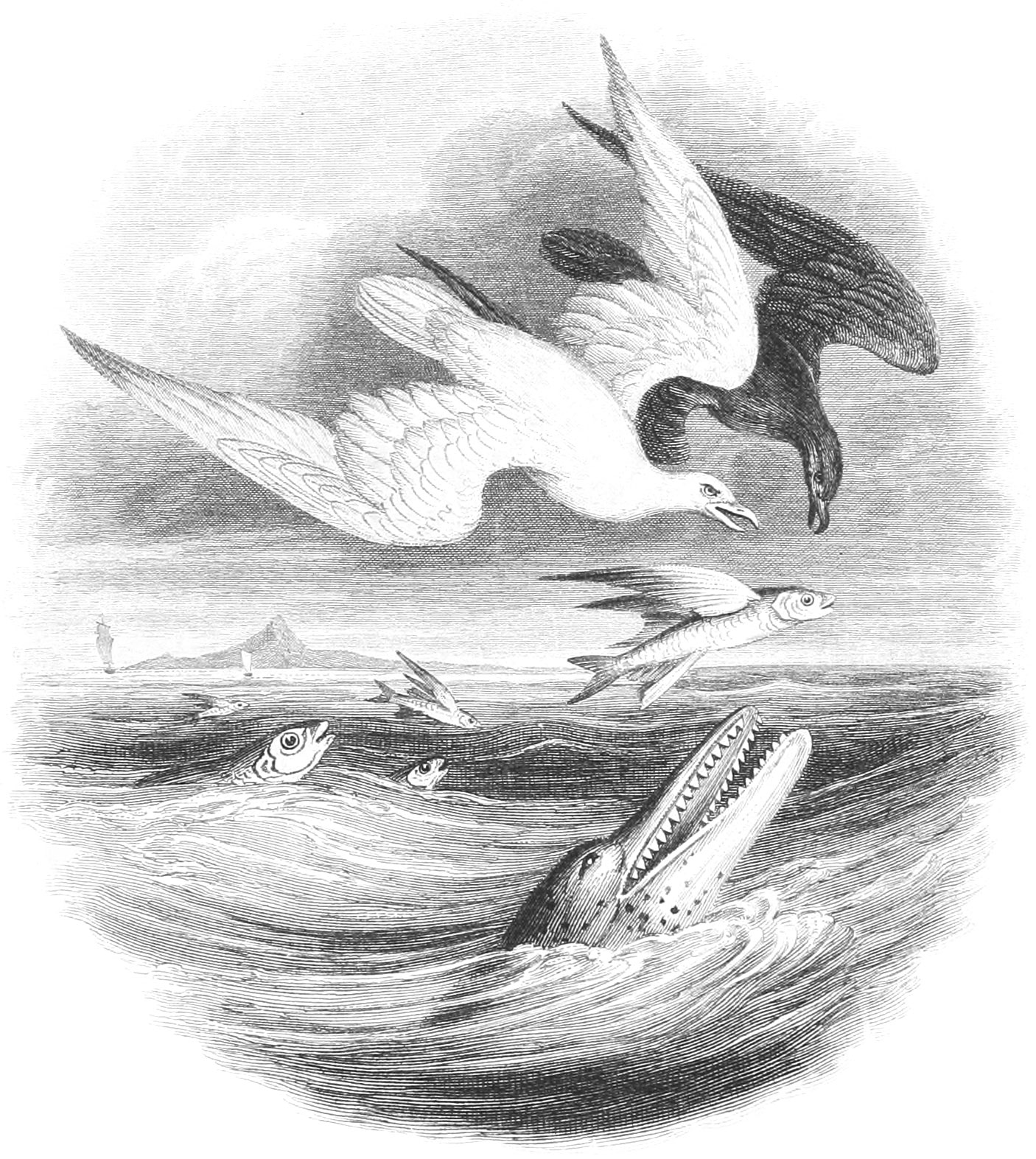
But there are also fishes which are capable of altogether deserting, for a time, their natural element, and becoming temporary denizens of the earth and air. Thus, eels are well known frequently to crawl along the grass, during the night, from one piece of water to another; and, if we can credit every thing that is printed, we have still more extraordinary tales reported, such as rooting up seeds and pease in their tract, and nestling under hay-ricks to avoid the cold!2 And the soldier loricaria (Loricaria calliththys), a native of Surinam, is described by Marcgrave, as not only making its way over land to a deeper stream, when that which it inhabits becomes too shallow, but even sometimes burrowing under ground for the same purpose! We thus find fishes, at one time, crawling over. the ground like snails,—and, at another, burrowing under it like moles; but what shall we say to fishes climbing trees like the sloth, or even flying through the air? There are few fishes, indeed, which display the former propensity; but such is the case with the red sparus (Sparus sigillatus), a native of India, about the size and figure of a perch, and it was accordingly formerly known by the name of the climbing perch, or Perca scandens. Attention to this previously unknown fact was drawn, in 1791, by Lieutenant Dalsdorff of Tranquebar, in a Latin letter addressed to Sir Joseph Banks, and published in the third volume of the Linnæan Transactions. He caught the fish in a broad fissure of the bark of the Borassus flabelliformis—a species of palm—at the height of about five feet from the ground; and it was still busy in making progress upwards, when its course was arrested by the ruthless hand of the Naturalist. The fact, that many fishes are capable of rising from the water, and of maintaining, for some time, a kind of flight through the air, is more generally known. This is most remarkably the case with the fish commonly called, par excellence, the flying-fish, the Exoccti of systematists, and of which several species have now been discovered. Nevertheless, as the only surrounding medium which ministers to the well being of all other vertebrated animals, at least in a state of maturity, is the atmosphere, so that which supports, for an indefinite time, the life of fishes, is the water.3
The solid parts of the bodies of most fishes are, like those of the bodies of animals in general, somewhat heavier than water, their bones, for example, generally sinking in this fluid; consequently, had Nature not provided them with a sufficient supply of some substance lighter than water, by which their tendency to sink in this fluid, at least at all ordinary depths might be counteracted, it would have required a constant effort on their parts to keep themselves at any given level. This tendency is accordingly provided against, in a great measure, by the quantity of fat with which fishes are in general furnished, and which, being very nearly in such proportion to the solid parts as to bring their body, collectively taken, to about the same specific gravity as that of the water which they inhabit, supersedes in them the necessity of making any efforts, except for the purpose of changing their situation. It is well known of how oleaginous a nature is the flesh of many fishes commonly used at table—the salmon and eel, for example; and in the internal parts of fishes, in general, the quantity of fat is still more remarkable. The gall of many is little else than a kind of oil; and the enormous quantity of this fluid which may be obtained from the liver of the basking shark, the cod, the ling, with several other fishes, is sufficiently well known; it is said, that the liver of a single basking shark frequently affords seven or eight barrels of oil. Fishes have no true lungs, which, to all the terrestrial and aerial tribes of animals, as always containing a considerable quantity of air, are one great. source of buoyancy; but in place of lungs in this capacity, many fishes are provided with an organ commonly known as the air or swim-bladder, to which they owe more, in this respect, than most other animals do to their lungs. The principal use of this bladder, however, appears to be, not so much that of rendering the body of fishes uniformly buoyant, but to modify this buoyancy as occasion may require.
It is for the same purpose of diminishing their specific gravity, that the cetaceous tribes—the bones of which, unlike those of most fishes, are in general lighter than water—are furnished with a prodigious quantity of fat; for it must be remembered that they require, not merely to be kept at any given level below the water, but to be raised again to the surface, as often as in the pursuit of their prey, or from any other cause, they had dived below it. This is a principal use of the enormous quantity of oil which is found in these animals, contained, in most part, in what is called the blubber, immediately under the skin, and constituting the train-oil of commerce. The cetaceous animals, also, have no proper air-bladder; but their lungs, which are generally continued in an elongated form along the spine, instead of being confined, as in the other mammiferous animals, to the plane of the proper chest, serve, in some measure, as a substitute for that organ.
Fishes are of nearly the same specific gravity as water, and consequently they have little or no tendency, at any given level, either to rise to the surface, or sink to the bottom, but can move either upwards or downwards with equal facility; whereas the natural tendency of the cetaceous tribes and of birds being always to the top, and that of the rest of the mammiferous animals and of reptiles to the bottom, the two former experience comparative difficulty in sinking, and the two latter, equal difficulty in rising in the fluid. Independently, then, of any other causes, they cannot, on this account, be said to be so much in their natural element, when surrounded by this medium, as fishes are, nor to be at all upon a par with them, in their claim to be considered inheritors of the waters.
Simple Swim Bladders
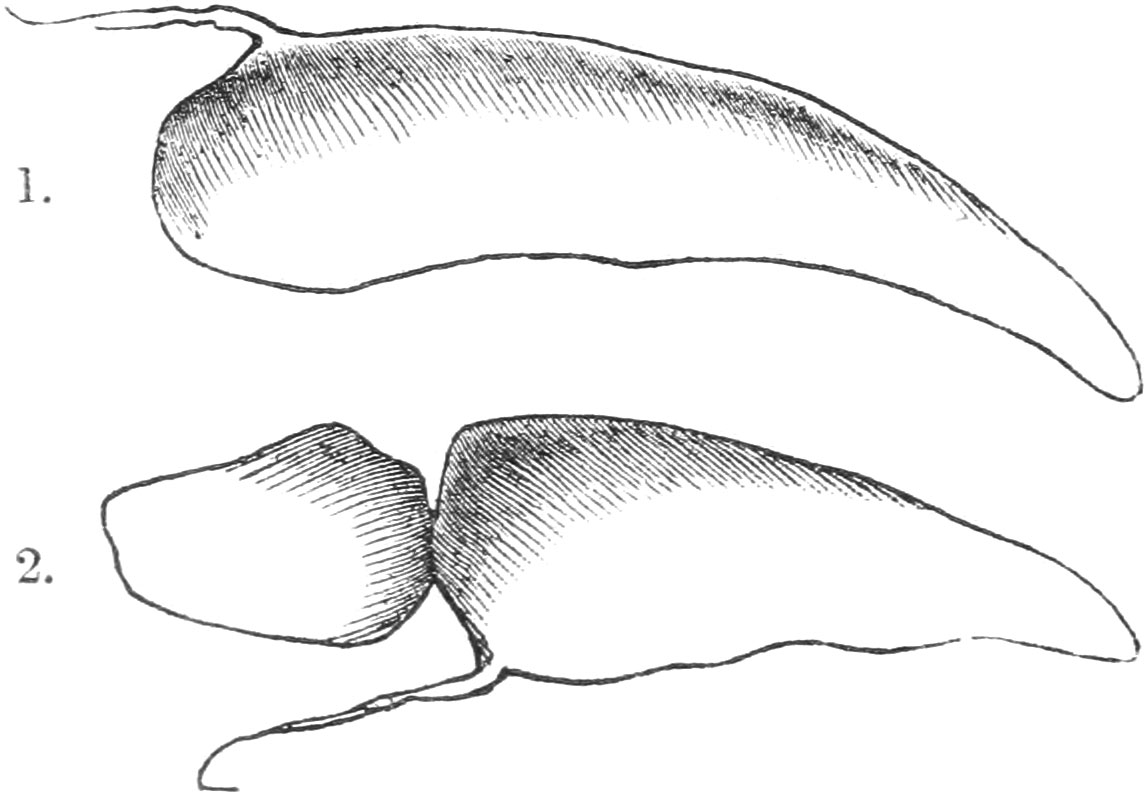
We alluded just now to the possession, by most fishes, of an organ called the air or swim-bladder, sometimes familiarly known by the name of the sound. Every body must have noticed, near the back-bone of the herring, and other fishes, a shining, pearly-looking membrane, almost enveloped by the roe or milt of the animal. This is the organ in question; and it is of this organ, as found in the sturgeon, the carp, the ling, the burbot, and many more fishes, when dried and prepared by certain processes, that the substance called isinglass is manufactured; and the same part of the cod, when salted or cured, forms a well-known favourite dish for the table. The air-bladder consists of a membraneous pouch, more or less tubular, situated along the lower part of the spinal column. It is simple in the majority of fishes which possess it, fig. 1. of the salmon, but in some, as among the Cyprinidæ, it is double, fig. 2. of the chub; that is to say, it consists of an anterior and posterior portion, communicating by a narrow neck: in others, as the in the manner of a tree; and it also assumes other forms, as those represented in our third wood-cut.

Tree-Like Swim Bladder

Additional Swim Bladder Shapes
In general, its cavity is without any partitions, as already stated; but in some members of the genera Diodon and Tetrodon, tribes remarkable for their uncouth globular form and prickly surface—as well as in the genus Silurius, and in the sword-fishes (Xiphias), it is sub-divided in the manner of the lungs of reptiles, so that its interior has a cancellated, or honey-comb appearance. This correspondence of the air-bladder of fishes and the membraneous lungs of reptiles, is a powerful argument in favour of the doctrine of those who represent all animals as formed essentially upon the same model, and regard the air-bladder of fishes, and not their gills, as analogous to the lungs of the superior tribes of animals; the gills of the former, in the mean time, being considered as having no corresponding organ in the latter, in their mature state, although they are always met with in one stage of their progress towards maturity. The air-bladder of fishes is either a perfectly blind pouch, without any communication with the contiguous organs, or it has an opening into it, called the trachea, either from the gullet or from the stomach. It appears quite blind in many species of the genus Sciæna, just alluded to, as well as in the perches. On the contrary, it communicates with either the gullet or the stomach, in the sturgeons, salmon, pike, perch, chub, &c.; and, in the cod, this communication is sometimes effected by two distinct passages. In most fresh water fishes, it is found to be filled with the gas called nitrogen, or azote, which is comparatively light, and is one of the ingredients of common atmospheric air; while in those inhabiting the salt waters, it contains carbonic acid gas, which is considerably heavier than the former, and is one of the gasses commonly evolved during the progress of combustion and fermentation, as well as by the respiration of terrestrial animals.
The air-bladder is not met with in all fishes. It appears to be wanting among the cartilaginous tribes, in the lampreys and myxines which are found commonly in the mud at the bottom of the water, and in the rays; and among the osseous fishes, it is wanting generally in the flat fishes, as the turbot, and the rest already mentioned as inhabitants rather of the mud at the bottom of the water, than of the water itself—in the launce or sand-eel, already likewise alluded to, as inhabiting the sand rather than the water—as well as in the European angler (Lophius piscatorius); which, again, is one of the fishes described as in the habit of burying itself in the soil, while lying in wait for its prey. It appears to be wanting also in the anchovy, the leaping blenny, the gudgeon, the flying scorpena, the sucking-fishes, the mackerel, and many others. It will hence be observed, that there is no precise correspondence between the habits of fishes, as accustomed to remain at rest at the bottom of the water, or to glide through its bosom, and the absence or presence in them of an air-bladder; since, while, on the one hand, not a few of them elsewhere spoken of, as found commonly in the mud or in the sand, are furnished with this organ, many of those, on the other hand, above specified as destitute of it, are still accustomed to move freely through the water.
The principal use of the air-bladder of fishes, appears to be that of increasing or diminishing their bulk, without changing their absolute weight, and thus of modifying their specific gravity as circumstances may require; and it is probably owing to the circumstance of fresh water being lighter than salt water, that a lighter gas, such as nitrogen, is requisite to such fishes as inhabit the former, while, to those which live in the latter, a heavier gas, such as carbonic acid, is adequate for the purpose. They are thus enabled to rise or to sink in the water without much muscular exertion; all that is required being, in the former case, to distend the organ in question,—and, in the latter, to contract it: but in what manner they effect this change in its volume is not very well understood. The common impression is, that the air-bladder, in its ordinary state, is subjected to a certain uniform pressure by the contraction of the contiguous muscles; and that it is by relieving it from a part of this pressure, by relaxing these muscles, and thus allowing of a rarefication of the air which it contains, that fishes rise in the water; whereas, when they desire to sink, they contract these muscles to a still greater degree than usual, by which means this air is, in a corresponding degree, condensed. Upon these principles, the actual quantity of air contained in the air-bladder may be presumed to be at all times the same, and this may possibly be the case in those fishes in which the air-bladder does not communicate with the neighbouring passages; but in those in which such a communication exists, it is obvious that any compression of the bladder will not merely condense the air, but expel a portion of it through the mouth or over the sills; and there must consequently be some means by which such air is renewed, independently of any supply of it from the atmosphere, since, otherwise, a fish which had once sunk below the water by expelling a portion of air from its air-bladder, could never have risen again by the help of this organ. Further, the character of the contained gas, at least in the salt-water fishes, is such, as to be incompatible with the idea that it is derived from the atmosphere, which, abounding as it does in nitrogen, contains a very insufficient quantity of carbonic acid gas; nor can it be derived from the water, in either the fresh-water or the salt-water fishes, since water is destitute alike of nitrogen and of carbonic acid, at least in any thing like what may be supposed to be a sufficient proportion for this purpose. It is manifest, therefore, that at least such fishes as expel at intervals a portion of the air from their air-bladders, must have the power of renewing it by a process going on within themselves—in other words, that they form this air from their blood, by a process called secretion, in the same manner as they form their gall, or any other of their natural fluids; nor will the suddenness with which such air must be presumed to be frequently formed, occur as an objection to this doctrine, to any one who reflects on the almost instantaneous effect of certain emotions of the mind exciting in man a copious flow of tears, or bathing the whole body in perspiration,—effects which are confessedly the results of secretion. This was the opinion of Dr. Monro and Mr. Hunter, respecting the source of the air within the air-bladder of fishes; and the former has even presumed, that a certain red, fleshy-looking substance, which is often found within it, acts in the manner of a gland, and secretes from the blood the air which it contains. It seems fair to conclude, then, that at least a great number of fishes rise in the water by means of their air-bladder, not by removing from this organ a part of its accustomed pressure, and thus rarefying the air which it contains, but by depositing more air within it; and that they sink in the water, not by condensing this air, as the result of the increased pressure to which they subject the air-bladder, but by getting rid of a portion of it: and if this be certainly the case in so many fishes, analogy would render it probable that it is so in all; and that the only difference between those which have, and those which have not a passage from their air-bladder, is, that in the former the pressure exercised directly expels the air, while, in the latter, it promotes its absorption. It has been contended, that the floating of fishes after death is a proof that they rise in the water, during life, merely by relieving the air-bladder from its ordinary pressure, and not by any active process; but this argument is very fallacious, since fishes in general, unlike the cetaceous animals, which are naturally lighter than water, do not float till some time after death; and, when they do so, it is as the result of a quantity of new gasses formed in their body by putrefaction, precisely as occurs with man and terrestrial animals in general. Besides, if it was owing to the distention of their air-bladder that fishes floated after death, they should not, as they usually do, turn belly upwards under these circumstances—the air-bladder being above their centre of gravity—but should present themselves in their ordinary posture. This circumstance seems to be a sufficient proof, that the gasses which occasion the floating of fishes after death are formed principally in the organs contained in the belly, which are, in all animals, among the first to putrefy; and some fishes, such as the Diodons and Tetrodons, or porcupine fishes, employ sometimes the device of swallowing air when they wish to inflate their body, and thus to raise their bristles in self-defence; which air, passing into their stomach, renders the belly, in spite of their air-bladder, which runs along the spine, the lightest part of their body, and they always assume, accordingly, the posture of a dead fish as it floats upon the water.
But by whatever immediate means the air-bladder of fishes is either expanded or contracted, there cannot be any reasonable doubt that it is by means of changes in the volume of this organ, and, consequently, of the whole body of the animal, that such fishes as are possessed of it are enabled to rise and sink in the water with little or no muscular effort. In proof of this it is sufficient to observe, that in these fishes the power of rising in the water is quite lost if the air-bladder be perforated, or otherwise incapacitated for retaining air; and that they are equally incapable of sinking in this fluid if the volume of contained air is considerably expanded. It was established by experiment, many years ago, by the celebrated naturalist Ray, that, after pricking the air-bladder, fishes were no longer able to rise in the water, but remained constantly at the bottom, like so many of the other tribes which are naturally destitute of this organ; and fishermen are at present in the habit of availing themselves of this knowledge, by adroitly pricking the air-bladders of the cod, and other fishes, as soon as they are caught, for the purpose of keeping them at the bottom of their well-boats, and thus of preserving them fresh for the market. On the other hand, it is equally well known, that if fishes have remained long near the surface of the water, exposed to a scorching sun, which produces a great rarefication of the air contained in their air-bladder, they are no longer capable of sinking in the water, but are obliged to remain at the top, till the cool of the evening has again condensed this air, and reduced the bladder to its usual volume, rendering buoyant some other part, at the expense of those by which their vital functions are maintained.
With respect to those fishes which are destitute of an air-bladder, and which, nevertheless, rise freely in the water, they can effect this only by an effort, although a very slight effort may be conceived to be sufficient for the purpose. This is performed, in the ray tribe, by means of their enormous pectoral fins, the motions of which act upwards and downwards, upon precisely the same principles as a bird rises in the air; and in most other fishes, under these circumstances, by means of either these fins or the tail. It is true, the tail of fishes, in general, being placed upright, and not flat, as it is in the cetaceous tribes, and moving from side to side, and not upwards and downwards, is calculated, not so much to raise them in the water—as that of the cetaceous tribes does—as to propel them forwards in a horizontal line; but it must be remembered, that some of the fishes which are destitute of an air-bladder, for example, most of the fiat fishes, swim, not on their bellies, but on their sides, so that their tail, in fact, lies flat upon the water, its motions are perpendicular, and it is, consequently, as well adapted for raising them in this fluid, as that of the cetacea. The circumstance of these tribes swimming on their sides, is a corroboration of the opinion, that one use of the air-bladder is to keep the back of those fishes, which possess it, uppermost. It does by no means follow, however, that fishes, destitute of an air-bladder, may not have other equally effectual means of keeping the back uppermost in their motions through the water. In the eel-shaped lampreys and myxines, the imperfect cartilaginous spinal column is probably as light, or lighter, than the aggregate of the other parts; in the rays, the same motions which raise them in the water, necessarily keep the back upwards; and in the other fishes, above enumerated, as wanting an air-bladder, it is easy to conceive that the motions of their spine, or of their several fins, may be abundantly instrumental to the same end. It is a very vicious line of reasoning which leads us to the question, that any alleged object is effected, in certain animals, by any given organ, because the same object is, in other animals, effected without it.
The same organ, which to man is the instrument of touch, is, to the quadruped that of support—to the bird that of flight—to the fish that of swimming; whereas touch, which is in man seated in the hand, is, in other mammiferous animals, seated sometimes in the root of the whiskers, sometimes in the snout, sometimes in the tip of the wings, sometimes in the tail; while, in the duck, its seat is the bill.
It is probable that all fishes, with very few exceptions, rise occasionally to the surface of the water; but to what depth they are capable of descending with impunity, remains undecided. It is universally known, that the atmosphere exercises a pressure on every thing exposed to it, which goes on, progressively increasing from above, downwards, so that it is the greatest at the surface of the earth; and that the water exercises a similar pressure, which, in like manner, becomes progressively greater from the top to the bottom of the mass, so that it is the greatest in immediate contact with the base of the reservoir in which it is contained.
But although near its surface, water exercises very little more pressure on things immersed in it than air does, we must keep in mind, that as it becomes deeper this pressure becomes, in a corresponding degree, increased, till, at the depth of thirty-four feet—the height of a column of water is equal in weight to that of a corresponding column of the whole atmosphere—it presses upon bodies immersed in it with the weight of two atmospheres, and so on progressively for still greater depths; and it has accordingly been found by experiment, that at very great depths, the pressure is such as to drive in the most firmly fixed corks of bottles, and to flatten the most solid pewter vessels, which have been exposed to it.
Now, it is reasonable to believe, that fishes would be materially injured by being subjected to anything like such pressure as is competent to produce these effects. Among the cetaceous tribes, the great northern whale, on being harpooned by the fishermen, sometimes descends, by strong muscular efforts, to such immense depths, that its body must have been exposed to a pressure equal to that of many atmospheres; but it is not with impunity that it does this. On the contrary, on rising again to the surface, as it is sooner or later obliged to do to take breath, it is found frequently to spout blood from almost every outlet of the body, as the result of the inordinate pressure to which it has been subjected, or rather, perhaps, as the result of a return to the ordinary pressure, after having been exposed to a pressure so enormous. Those who descend in diving-bells, also, to great depths—since, of course, the pressure made upon their bodies, in these circumstances, by the air which surrounds them, is always equal to that made upon this air by the water which is in contact with it—are often found to spit blood, and to manifest many other marks of disturbance of their functions, upon rising again to the surface of the water.
It seems, then, fair to conclude, that it is only to a certain depth below the surface of the water that fishes can descend with impunity; and that, universally diffused as they may be in pools and most rivers, it is only within a certain determinate range of the ocean that they are capable of existing. This circumstance is not sufficiently often reflected upon, when we unhesitatingly represent fishes as living upon the water-plants which grow at the bottom of the deep, and describe every thing that is thrown into the water as becoming indiscriminately their prey. In all likelihood, the supposed water-plants, growing in many parts of the ocean, never come within the reach of fishes, at any rate, till they have become separated from their parent stalks; and the substances thrown overboard, in many cases, soon pass beyond it, unless they are adroit enough to seize it by the way. There may be, undoubtedly,—
a thousand fearful wrecks—
A thousand men that fishes gnaw upon,
All scattered in the bottom of the sea,
but it is, perhaps, requisite for this purpose, that the sea be not too deep for them; and the suggestion, accordingly, of Mr. Pennant and others, that some fishes, which are destined at certain seasons to migrate, are, at other times, buried in the vast profundity of the seas, is not a very probable one; at least, we know, that the greater number of fishes congregate principally in shallow waters, and about coasts; and that, when farther from the shore, it is chiefly over sand-banks, such as those of Newfoundland and the Dogger-bank, that they are met with. Is it conceivable that the herring, for example, should exist unscathed, as has been supposed, under a pressure of 683 fathoms of water, which has been proved to be the depth of some parts of the sea between Iceland and the north of Norway; or under that of more than 780 fathoms, to which depth the water, a little further north, has been sounded, without finding a bottom? Whether the animal could ever reach these depths, by the most energetic efforts, may be very reasonably questioned; but that it could long hold its station there, and that in full possession of all its functions, appears to be most improbable. We shall now proceed to the manner and the organs by which fishes move through their native element, or
The Locomotion of Fishes
In the preceding chapter we detailed the principal means by which fishes, on the one hand, preserve their level in the water which they inhabit, and, on the other rise, and, within certain limits sink in this fluid, according to circumstances. These processes are, or may be all, in a great measure passive; but those by which these animals effect their various locomotions, otherwise than perpendicularly upwards or downwards, by which they creep along, or into the mud or sand at the bottom of the water, or, even deserting their natural habitat, crawl along the grass, or climb trees, as well as those by which they perform their various evolutions in the water, leap occasionally from its surface, and even skim for some space through the air, are strictly active, and fall now to be considered. It is not, indeed, improbable, that some fishes, like the duck-weed and star-grass among plants, and the sea-blubber, and many other invertebrate tribes, among animals, may be moved in the water principally by the currents and tides, or by the winds; but the number of those in which locomotion is otherwise than active, is certainly very small.
The chief organs of locomotion in fishes are the spine and the fins, including, under the latter term, the tail; but, to understand clearly the functions and motions of these parts, it will be necessary, first, shortly to notice the mechanism and structure of the skeleton and muscles. The spine, or vertebral column, to the extremity of which the tail, or caudal fin, is attached, is by far the most important organ in the locomotion of fishes. The other fins, analogous to the extremities of the higher animals, being used, and only much developed under particular circumstances, never possess the firm and sturdy, or active structure, which are requisite, and enables birds and mammalia firmly to support themselves in another medium. Those limbs, or fins, then, in fishes, are used more for the purpose of direction than of progression; and even in the prodigious manner in which we shall see that some of them are developed, we do not find that there is a corresponding power imparted. The spinal column, then, is expanded upwards and downwards; and the muscles of the trunk, which almost all assist In its movements, are placed in numerous transverse strata along the sides, with strong tendinous fascia between, and the whole are disposed in longitudinal layers, directed alternately in different directions.
The spine, in general, consists of numerous small irregularly shaped bones or vertebra, of a rounded form, from which proceed several projections or processes; and they are familiarly known to present the appearance of a shallow cup, with one or more handles. Those placed nearest the head, are called abdominal—for fishes have no neck or chest, properly so called. They have the sharp process pointing obliquely upwards from the body of the vertebra, and, in general, two projecting outwards from its sides.
Connected with the upper spinous process, of more or fewer of the abdominal vertebræ, and on the same line with it, is a short bone, called the interspinous bone; and connected, again, with this last, is another longer bone, still in the same line, and it is this which supports the dorsal fin. On the other hand, the two transverse processes have each connected with them a long curved bone, encircling a great part of the bulk of the body like a half hoop, and commonly mistaken for the ribs of the animal; but, if they are to be so called, they should at least be distinguished by the name of abdominal ribs; for the true, or thoracic ribs, or those corresponding to the ribs of man and the higher classes of animals, are placed very far forwards, and almost under the lower jaw of fishes, and have no direct connexion with the spine. These reputed ribs are wanting in most of the rays, and in the cartilaginous fishes in general, as well as in the Diodons, Tetrodons, and several of the osseous fishes; but they are a well-known source of annoyance to those eating the herring, and numerous other fishes commonly brought to table. The rest of the vertebræ of the spine, or those situated nearest the tail, are called, from this circumstance, caudal; and have each the same kind of upper spinous process, often with its appendages, the interspinous bone, and the ray, of the fin still called dorsal, as the abdominal vertebræ. Instead, however, of the two transverse processes, and their appendages the abdominal ribs, which characterize the abdominal vertebra, the caudal vertebra have a second spinous process, with two roots, pointing obliquely downwards from the body of the vertebra; and, connected with this lower spinous process, exactly in the same manner as the corresponding parts are with the upper one, a second interspinous bone, and a ray of the anal fin, lying near the tail of the animal, and on the opposite surface of the body from the dorsal. The caudal fin, lastly, or what is commonly called the tail of fishes, is an appendage, like a portion of the dorsal, and the whole of the anal fin, to the caudal vertebræ; to the upper and lower spinous processes of which it is attached, almost directly in the axis of the spine, forming, in appearance, a kind of fan, moved by powerful flat muscles. It will hence be obvious, that the dorsal fin, the anal fin, and the caudal fin, are, in fact, only appendages to the spinal column of fishes; the two former being, in reality, developements of the spinous processes. These are used chiefly directing; and, from their position, except in giving greater power to the rapid motion of the body from. side to side, are not directly employed in progression or turning.
Where the bodies of the individual vertebræ of fishes are applied to each other, there is a deep conical cavity, commonly with a small hole in the centre; and this hole is, in many of the cartilaginous fishes, so large, that the bodies of their vertebræ represent almost one continuous tube. These cavities are filled, in the living animal, with a soft jelly-like matter, which extends, also, for some little space, beyond their rims, being kept in its place by a tough elastic membrane. The fluid amounts, in some of the larger fishes, to some pints, between every two vertebræ; and such is the pressure exercised upon it by the membrane by which it is immediately invested, that, if this be suddenly punctured in the skin, as noticed by Sir Everard Home, the liquid is projected with a force sufficient to carry it four or five feet high. Nothing could possibly have been better adapted than this part of the structure of the spine of fishes, to ensure free motion, and to protect the surfaces of the bone from injury when so continually plied. The bodies of each vertebræ, in fact, move, as it were, laterally on each other, by means of so many interposed elastic balls. This motion is almost entirely from side to side; from the form of each bone, and the presence of the upper and under spinous processes, it must be obvious, that motion in any other direction would be superfluous, while, if it had been permitted, more important uses must have been sacrificed.
In the motions of all fishes, the spinal column is an essential assistant, and may be said to be the acting power which regulates the motions of the fins, which are only accessaries. In all the long snake-formed species it acts an important part; and although, in the eels and lampreys, the power of the posterior extremity in the water is increased by being bordered by a narrow fin, yet the motions of these fish, when they have to travel over portions of land, or any dense weeds, which is very frequently the case, are conducted entirely by the spine, the finny border being there quite unnecessary. Our first Plate, illustrating a curiously marked species, will illustrate this;—it is
The Banded Ophisurus
Ophisurus alternans.—Quoy and Gaimard.
Two specimens, only, of this curiously marked fish, seem to have been procured during the voyage of Freycinet, of no great size, but remarkably conspicuous, from the regular and decided banding and spotting with which the body is marked. The ground-colour is of a delicate bluish-grey; the bands, amounting from thirty to thirty-two, of a deep rich brown, and having from one to two round spots occasionally placed in the intervals; and the Naturalists who describe it, are of opinion that these spots and bands become more numerous with the age of the fish. The motion of this fish is described to be very slow, and, looking at its form, we can easily understand that will be very smooth and gliding. The banded Ophisurus was discovered on the coast of the island of Guam.
There are a few other fishes also, whose appearance has gained for them such titles as Ophisurus and Ichthyophis, where a bounding fin is totally wanting to the body, and where the motions are entirely conducted by the spine. The form of these fish is very similar to that of a snake, as their names imply; and even the pectoral fins are extremely small in proportion, compared with those of fishes having the same lengthened form. These and the true eels can move very rapidly through the water, but when undisturbed upon the bottom, their motions have more the aspect of crawling than of swimming.
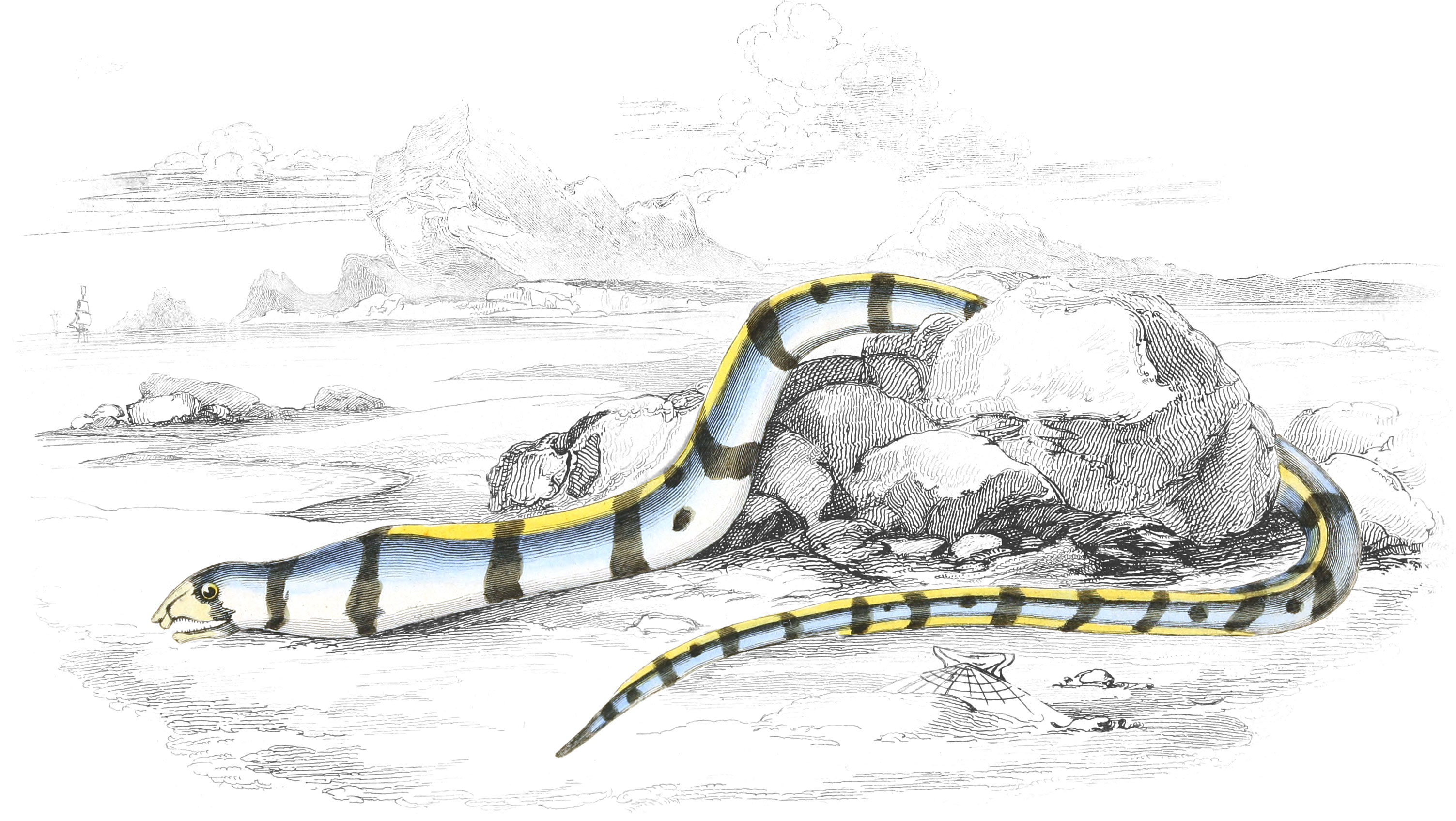
Plate I
We shall now notice, with more detail, the cases of the various fins, as they are connected with the spinal column, and as instrumental to the locomotion of fishes. And we shall first describe the tail, or caudal fin, as by far the most important organ in active progression; for, in rapid movements through the water, it must be at once perceived that the fish could not possibly move any of its fins so as to act as propelling powers, for if, at any period, they projected at angles from the sides of the animal, they would materially obstruct its motion. The tail, in the greater number of osseous fishes, consists of a series of jointed rays fixed to flat bones, which are, again, articulated to the last joint of the vertebral column. These rays are connected by a web, and ordinarily exhibit a flat fan or paddle; and it is the elongation or shortening of these rays, with the form of the intervening web, which occasions the almost endless variation which we see in the shape of this organ. The structure which is most conducive to a swift motion, as well as to the power of keeping up a rapid progression for a length of time, is a lunated, or crescent form, having the breadth and depth of the curvature in certain relative proportions: that which we see in the common trout and the salmon; that of the pilot-fishes is also near this proportion. These fishes have the power of very rapid and long sustained motion in the water, and immense power, as we Shall afterwards see, of surmounting obstacles in their courses. The migrations of the salmon, and its ascending rivers filled with rapids and waterfalls is familiarly known; while the power of swift and long-sustained motion will be exemplified in the genus Naucrates, or pilot-fishes. In both of which, we see this powerful form of tail combined with the tapering, yet solid, construction of the body, and which altogether combines those properties in their highest developement. To illustrate this, we have added a figure of the
Indian Pilot-Fish
Naucrates Indicus.—Lesson.
Pilote Indien, Naucratus Indicus, Less.—Voyage par Duperrey, i. page 157, pl. xiv.
This species of Naucrates was discovered, during the voyage above quoted, on the coasts of New Ireland. It is of an elegant and graduated form, having the tail, however, rather more forked and swallow-like than this member in the Salmonidæ, where we consider the form nearly at perfection for swift and long-continued motion. The colours are not bright, but are chastely shaded; and the markings on the tail are bold and conspicuous.

Naucrates Tail Fins
When the tail begins to diverge, from that now illustrated, either by the rays in the centre being elongated, as in the Eleotris lanceolatus, fig. 1, launce-tailed goby, or in Lonchurus ancylodon of Schneider, fig. 2, or by an excess or prolongation of the lateral rays, as in the forms, are immediately diminished. We pass through every gradation of form between these two extremes; and when we examine those fishes where a great power of locomotion does not become so important to their economy, we find most extraordinary forms occurring. As an organ of defence, and furnished with strong armour, it is often a most formidable weapon, as we shall notice in its proper place; and in fishes whose defence is not so requisite, we see it trifurcated, as in some of the Cyprinidæ, the well-known gold-fish, for example. In the singularly formed sun-fishes, shown in

Plate II
The Short Sun-Fish
Orthagoriscus mola.—Schneider.
The rays of the fin stretch round the whole posterior part of the fish, where it acts the part of a tail. This fish, and another species, has been occasionally taken on our coasts; and, Mr. Yarrell remarks, have gained their name both from the shape and the brightness of the skin. Notwithstanding their occurrence, however, we know little of their manners, or how the tail influences their motions. It is known and recorded to lie, and perhaps to sleep, with the head out of the water, and is supposed to keep near the bottom, and to feed on sea-weeds; and when taken, Mr. Crouch says, it makes powerful but awkward attempts to escape.4
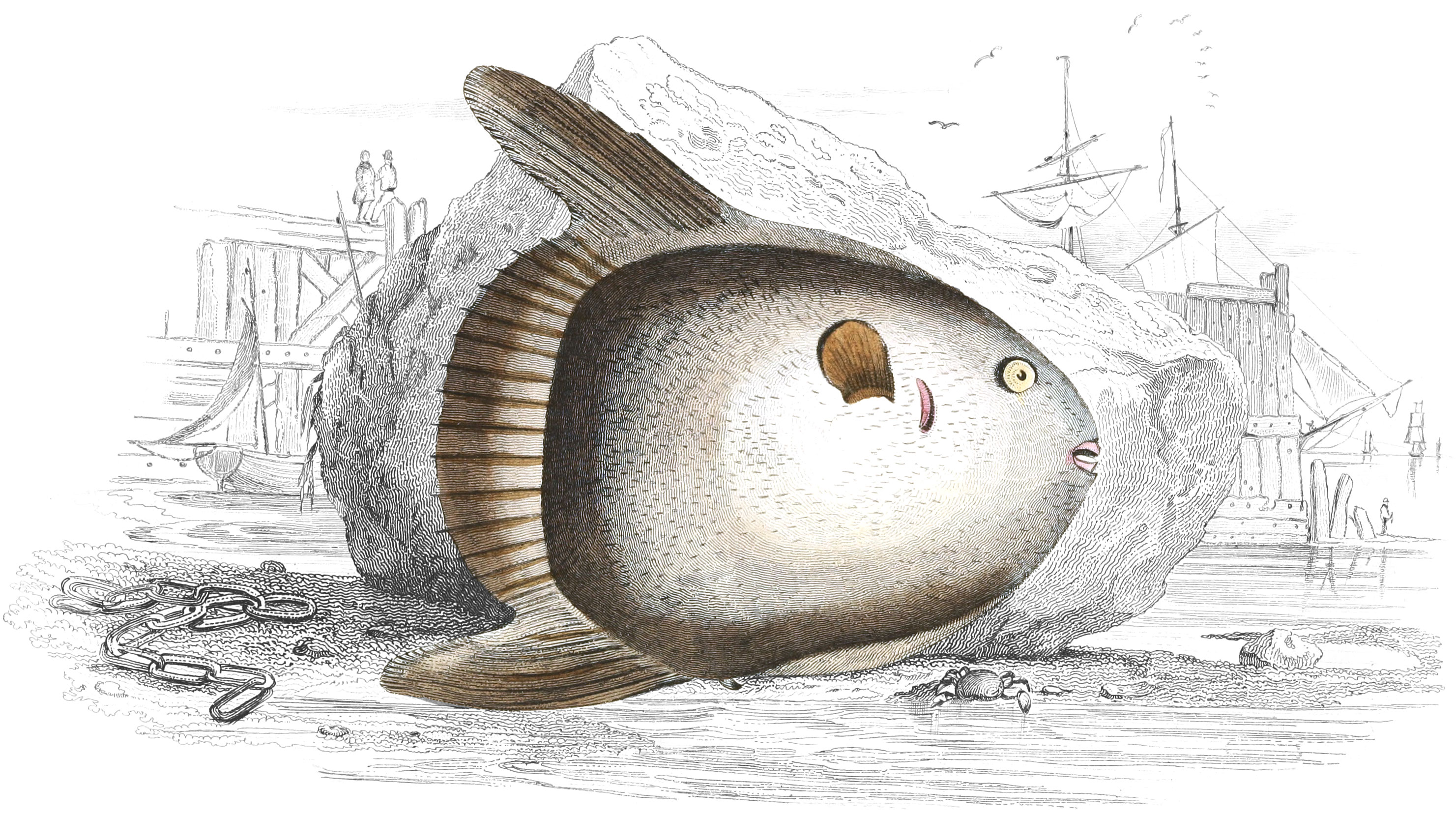
Plate III
In the genus Trachypterus (Cuv. and Valenciennes), the member is most remarkable, as indeed are the whole fins, both in their form and structure; but the form will be best understood by our figure of
Spinola’s Trachipterus
Trachypterus Spinolæ.—Cuv. and Val.
A small species of extreme rarity, found in the European seas; M. Risso procured it near Nice. The remarkable position and form of the fins, on the upper part of the head, seems rather to belong to the dorsal than to the caudal fin.
In some other fishes, again, one of the lobes of the tail is prolonged into a slender filament equaling the whole length of the fish, and of which it is difficult to conceive the use. This may be observed in the Loricoria cirrhosa, Schneid.

Lobe of Tail and Filament
In another fish, Styleporus chordatus, Schneid., remarkable for its whole form; the extremity extends nearly twice the length of the fish. Among the cartilaginous fishes, it is often more an organ of defence than of locomotion. The sharks use it as a powerful rudder; but in the various genera of rays, where it is always nearly the length of the fish, it is often strongly armed, in addition to being furnished with small adipose fins, and in some it is prolonged to an enormous length, as in the Raga flagellum of: Schneid. The form is generally not very elegant, neither are the colours brilliant; but our annexed Plate, while it exhibits the general form of the tail in this race, will also exhibit an exception to the generally dull colouring which prevails among them.
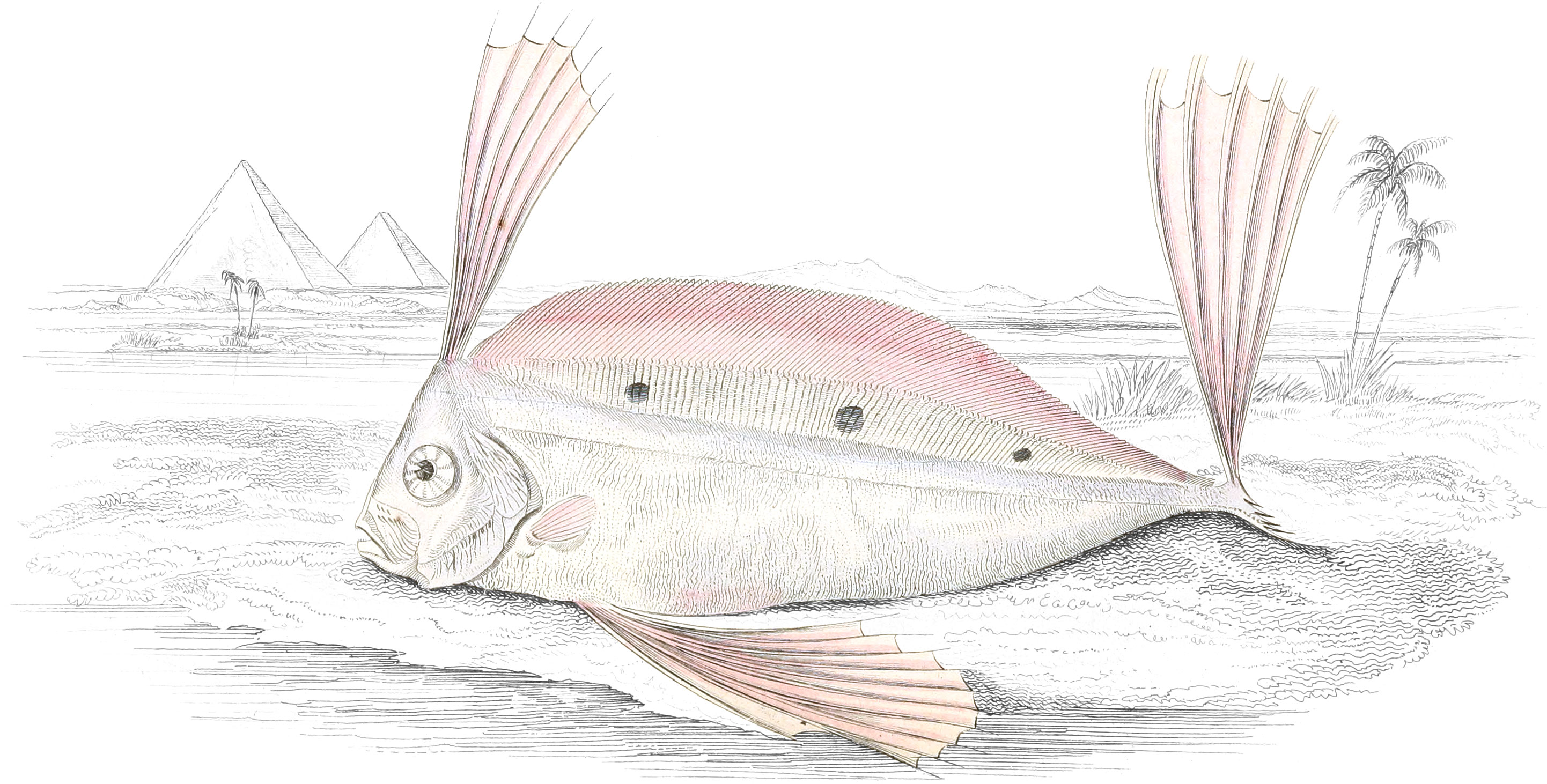
Plate IV
Halgan’s Spine-Tailed Ray
Trygon Halgani,—Lesson.
Trygon lymna.—Rüppell, pl. xiii. fig. 1.
This species of ray, so very distinct from most of its congeners by the bright spotting which adorn its upper surface, seems to have been known and described by several travellers, or there may be one or two species which are closely allied by their form and markings; for the figure of Rüppell represents two spines on the tail, whereas Lesson’s fish has only one of these organs of defence. It is a small species; the general size of the species being only about six inches in length, to which may be added about eight inches for that of the tail; the spine is placed about the middle of the tail, is flattened at the base, and at the point is finely barbed, which would cause it to inflict a dangerous wound. The upper part of the fish, or back, is thickly marked with azure spots, as we have endeavoured to represent, and which beautifully relieves the pale uniform tint which otherwise covers it. Lesson and the expedition met with Halgan’s ray very abundant in the Bay of Offack, in the isle of Waigou, and also in New Ireland. They furnished food for a great portion of the expedition during their stay at these islands.
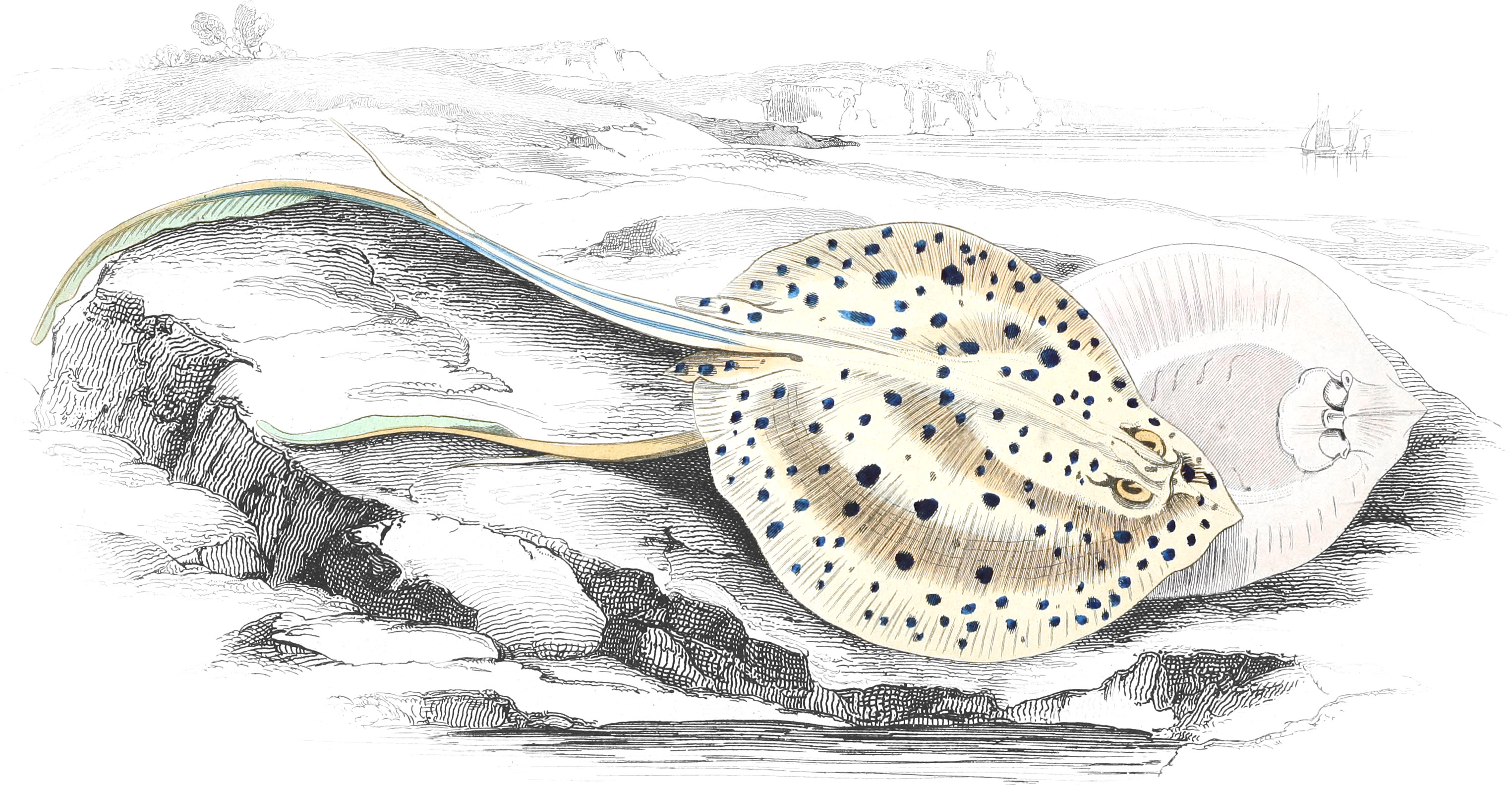
Plate V

Almost every one is aware that a boat may be, with certainty, urged forwards by what is called sculling; that is to say, by means of one oar passed over its stern, and continually move in the water from side to side. Now it is precisely upon this principle that the tail of fishes, moving from side to side, operates in propelling them forward. It is evident that the oar, on the one hand, and the tail, on the other, in this alternate lateral motion, is continually displacing a quantity of water great in proportion to the length of the instrument employed, and consequently to the sweep which it makes in its oscillations; and it is by the resistance which the water makes to this displacement by the oar or tail, in coming from its extreme sweep to the axis or mesial plane of the boat or fish, that either is urged onwards.
It will easily be understood why Nature has been so solicitous to remove from the portion of the spinal column, by which the tail of fishes is moved, every possible cause of obstruction to its free lateral motion—why it is not burthened by the same kind of ribs which are connected with the anterior portion of the spine—why all the viscera are placed so far forward—and why, lastly, there is either no pelvis at all, or, at any rate, only a rudimentary one, and, in general, unconnected with this part of the body. The movements of the tail are only, or chiefly lateral in fishes; and, of course, in those which swim, as the majority of them do, on their belly, it moves in the water from side to side; whereas in those which, like the osseous flat fishes, swim on their sides, it moves upwards and downwards; but its effects are, of course, precisely the same in urging the animal forwards, except that, in the latter case, the animal advances in the diagonal, intermediate, not between a force urging it to the right and another urging it to the left, but between a force urging it downwards and another urging it upwards. On the other hand, in the cetaceous tribes the movements of the tail are only or chiefly perpendicular; so that, in them, swimming as they do on their bellies, the tail moves upwards and downwards, and they are urged forwards, therefore, on precisely the same principles as the flat osseous fishes while swimming on their sides.
Nor is the tail of fishes employed merely as an oar to effect their progress in the water, but also as a rudder to direct it; the slightest continued inclination of this organ to the right side, for example, while the body is still in motion, necessarily determining the direction of the course of the animal in the same degree to this side, the resistance now offered by the water to the course of the animal directly forwards being greater on this side than on the other; and the same thing results if the fish move the tail through a greater sweep, or with more force, from right to left, than in the opposite direction. And if either this inclination of the tail to the right side be sufficiently long-continued, or the sweep and force with which it moves from right to left sufficiently exceed that with which it moves from left to right, the animal will wheel completely round, or may be even made to revolve upon the same horizontal plane, as upon a pivot driven vertically through its centre of gravity. Now, it is exactly on the same principle that the flat osseous fishes, which have no air-bladder, use their tail, not only in swimming in a straight line through the water, but also in rising and sinking in this fluid; for the same loss of balance in the motions of a tail moving from side to side as would turn an animal to the right or left, in those of a tail moving vertically, will, of course, depress or raise it. And it is thus also that, in the cetaceous tribes, the necessity of an air-bladder is superseded; since, when they desire to rise in the water, all that they have to do is to strike a few smart blows with their tail downwards, when their heads are necessarily carried in an opposite direction; and when they wish to sink, a few similar blows with the tail in the upward direction, at once serves to bury their heads beneath the waters.
But the tail of fishes is useful to them still in another capacity, besides that of either a paddle or a rudder, since it is chiefly by means of this organ that they are enabled to leap out of the water; and the height to which some of them are capable of thus bounding into the air is astonishing. From the enormous basking-shark to the minute sticklebacks, this power seems to belong to the greater number of fishes; and to be exercised sometimes in sport, at others to avoid their enemies, to reach their prey, to escape from confinement, or to overcome obstacles during their migrations. Thus the haddock, when pursued by the dog-fish, or other voracious fishes, is observed frequently to leap for an instant out of the water; and it is, as pressed by the pursuit of their numerous enemies, that the various kinds of flying-fishes—of which we shall speak more fully presently, as not rising into the air, but of maintaining for some time a continuous course therein—spring out of their natural element. Many fishes, also, which feed on insects fluttering over their heads, are enabled to reach them only by these means; and the rising of the trout out of its stream, for this purpose, is well known to anglers. The silvery trichiurus, a taper-shaped fish, inhabiting the lakes of South America, India, and China, not unfrequently takes such surprising somersets after its prey, as to fall into vessels which are accidentally passing at the time. Other fishes, again, as the mullets and the carp, are observed frequently to escape in this way from the nets by which they have been environed, a whole shoal of them sometimes vaulting over, one after another, like a flock of sheep over a fence. This circumstance, with respect at least to the former, was known to Oppian—
The mullet, when encircling seine’s enclose,
The fatal threads and treacherous bosom knows;
Instant he rallies all his vigorous powers,
And faithful aid of every nerve implores;
O’er battlements of cork up-darted flies,
And finds from air th’ escape the sea denies.
But the feats of fishes, in this way, are most remarkable during their migrations, if any obstacles are opposed to their determined progress. Under these circumstances the little stickleback, the inhabitant of almost every pond, river, and marsh, is capable of bounding from the water, perpendicularly, to a height of eighteen or twenty inches; equal in force to what would be required to project a man into the air to a height of fifty or sixty feet. There is no fish, however, the vaulting of which, in the course of its migrations, is so celebrated as that of the common salmon. It is very generally known that, as the spawning-time approaches, these animals pass in shoals from the sea and ascend the rivers; and, in their course, have frequently to make their way over cataracts, the obstacles offered by which would appear to be insurmountable. Such are those of Pont Aberglastyn, among the hills of Snowdoun, of Leixlip on the Tivy, in South Wales, and of Kenneth, near Dublin; all which the salmon every year surmount, and, having attained the even water beyond them, quietly pursue their march towards the sources of the river. There are several of these falls which are celebrated as salmon leaps, the fish having to make great exertions to overcome their height, and making several attempts before they can surmount them. The height of the actual leap which they can take has, however, been much exaggerated; for unless there be parts in the fall where the fish can attain a temporary resting-place, and gain another spring, they cannot surmount a cataract of any great height: in some places, these temporary resting-places are taken advantage of to take the fish by various contrivances. And it is on record, as an appendage to one of the princely monasteries of old, that a pot was placed in such a position near the fall, and supplied with fuel, as sometimes to receive the fish which missed their leap, and which, falling into the vessel, caused a bell to be rung, and themselves intimated, that they might soon be placed on the dinner-table.
Another fish, almost equally celebrated as a voltigeur, is the sturgeon (Acipenser sturio), which, in its migrations up the American rivers, is often observed to leap to the height of several yards perpendicularly from the surface of the water, falling back again with so much violence, as sometimes to sink the small canoes of the Indians; who, accordingly, stationing themselves in larger boats, frequently employ this means of capturing it.
Next to the tail or caudal fin, the pectoral fins in fishes are of most importance in their locomotion. These comprise, in a rudimentary form, the same parts as are met with in the arm, fore-arm, wrist, and hand of man,—and the ventral fins, in a still more rudimentary form, many of those which are found in the inferior extremity; and as the former are all supported in man by the blade-bone and collar-bone, and the latter by the bones of the pelvis, so there are corresponding bones, in most fishes, for the support respectively of the pectoral and ventral fins. It is true, the correspondence of these parts in fishes and in man—the lowest and the highest tribes of vertebrated animals—is so obscure, that, if the comparison be made abruptly, no sort of resemblance will perhaps be traced; but if we are content to follow, in our investigations, the same order which Nature has followed in her works, and to advance, by progressive steps, from the lowest to the highest links of the chain, we shall at once recognize the analogy, and shall be compelled to acknowledge that all the parts above-mentioned, as corresponding in fishes and in man, are really constructed upon the same model. The analogy, however, between the pectoral fins of fishes, and the anterior or upper extremities of the higher classes of animals, is far more striking than that between the ventral fins and the posterior or lower extremities; and, indeed, the ventral fins are in general of a size so disproportionate to that of the pectoral, and sometimes placed in so unusual a situation, as on the same plane with, or even nearer to the snout than the latter, that it is difficult at first to reconcile ourselves to the idea that they correspond to legs. It is a principle, however, in tracing the correspondence between the several parts of different animals, to disregard altogether size and situation, as constituting no essential distinctions, provided any analogy exist in elementary structure; and that such an analogy is maintained, in the case under consideration, is unquestionable.
The blade-bone or scapula of fishes in general, is a somewhat broad and flat bone, attached sometimes to their spinal column—although without forming a proper appendage to it, and sometimes to the bones of the head; at other times it is, as in man, buried in the substance of the flesh, about the shoulders, without any proper attachment to either. With this are connected long spines, crossing over the front of the neck, so as in general to meet their fellows of the opposite side, and to constitute arches below and behind the arches formed by the lower jaw and lingual bones: and of these, one corresponds to the collar-bone, or clavicle, of the higher classes of animals; and the other, which in fishes is called the coracoid bone, to the merry-thought, or furcula, which is proper to some reptiles and to birds. In this respect, then, fishes are in advance of the mammiferous animals, for the latter has no coracoid bone, or furcula, but only the rudiments of it, in what is called the coracoid process; and many of them, for example all those with hoofs, are destitute also of a clavicle. But if fishes are before us in the developement of these bones, they are, in the same degree, behind not only mammiferous animals, but reptiles and birds also, in the next bone, or that corresponding to the arm-bone, or humerus of man, which, in most fishes, is quite rudimentary; so much so, that the two bones of the fore-arm seem to be in general almost directly connected with the scapula, no proper bone being interposed between them. The shoulder-joint, therefore, and the elbow-joint of fishes, are, in general, almost one and the same. The two bones of the fore-arm are the ulna and the radius; which two bones are, in some few fishes, so constructed, as to roll with tolerable freedom on each other, exactly in the same way as they roll on each other in man, in the action of rotating the hand: and it is by this means that they have the power of changing the direction of the flat part of their pectoral fin, during its play in the water; a power which, as we shall presently find, is so conducive to the full use of this organ. These two bones, however, are firmly united together in most reptiles, in all birds, and in many quadrupeds; so that here, again, certain fishes have the advantage of many of the superior tribes of animals. To the ulna and radius are attached the several bones of the wrist, quite corresponding to those of the wrist of man; and from these, again, proceed the long radiating bones, equally corresponding to those of the hands and fingers of man, and constituting, with the membrane extending between them, all that is seen, on a superficial view, of a pectoral fin, and all in which such a fin is vulgarly supposed to consist. It is not peculiar to fishes, however, to have a great part of these anterior extremities concealed under the common covering of the body; such serpents as have the rudiments of these extremities, have not only the greater part of them, but often the whole, so concealed; and in no animal, in fact, is the whole so completely exposed as in man. Generally speaking, then, we observe the most perfect structural analogy between the apparently rude and insignificant pectoral fin of the fish, and the upper extremity of man; there is, indeed, a point in the transition, through the various tribes of animals, from the one to the other, as in the case of the dolphin and other cetaceous tribes, where we cannot tell whether the member may be called, with more propriety, a fin, or a hand and arm; and that organ of man, so noble in form, and so exquisite in structure, which is at once the source of his most delicate perceptions, and the instrument of his sublimest works;—that organ, which is so often folded in love, or stretched in adoration, is fundamentally the same as the coarse flabby web which hangs from the neck of an obscure fish, and serves merely to assist its course, or maintain its station in the water. In this member of fishes we perceive almost as much variation of form as of the tail. The usual form is that represented on the accompanying cut, and prevails in all those possessed of swift or long-sustained motion; it is often proportionally elongated, and is also sometimes much spread out, or broadened at its tip. In a few fishes it is altogether wanting, and in about an equal number it is nearly only rudimentary, or very small.
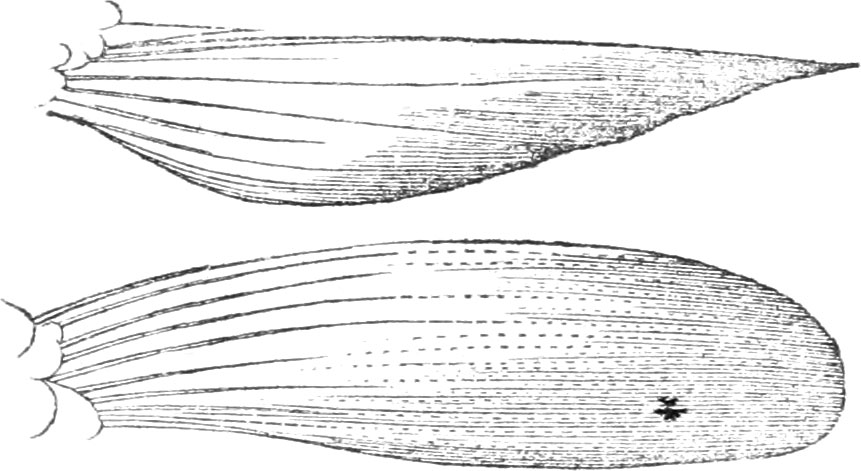
Fin Shapes
In the Cotti, or bull-heads, it becomes very much developed at the tip, and becomes broadened by a wide and thin membrane intervening between the rays. In Trigla, or the gurnards, it continues the broadened form and wide membrane, but adds length to its breadth; in Trigla fasciata, Schneider, it is more than half the length of the fish. In some of our native species it is of great expanse, and, in addition, is adorned with the brightest and most brilliant colours. In another curious tribe of fishes it is singular and scarcely less developed; in the Pegasus draconis it appears like two little fans extended from the side, as if the fish were about to fly. In a foreign species, gurnard, which we shall represent, the pectoral fins are very beautiful.
The New Zealand Gurnard
Trigla kumu,—Lesson.
Trigla kumu, Lesson.—Voy. de la Coquille, plate xix. vol. ii. page 214.
This beautiful species was found abundantly in the bays of New Zealand by the expedition of Duperey, where it was used as food by the natives, and brought on board by them in abundance. It is not a large fish, reaching only a length of from fifteen to eighteen inches, and is in form rather slender. The dorsal fins are relieved by the strong rays being of a dark yellowish-red, the intervening webs pale rose colour. The upper part of the fish is of a brownish-red, rather abruptly broken in the middle, below which it is of a shining silvery hue. The pectoral fins are very large and rounded; they are of a brilliant emerald-green, broadly bordered with azure blue round the extremity, and having an oval patch of velvety-black upon the interior edge, which is beautifully relieved with snow-white spots. In another fish, forming a distinct, but nearly allied genus, the pectorals are also of extreme size. This is

Plate VI
The Oriental Dactylopterus
Dactylopterus orientalis,—Cuv. & Val.
And which, along with the Sciena volitans and a few others, were said to fly above the surface of the waves. There seems, however, no authority for any thing farther than a leap, which the large fins enable them to sustain for some time. It has been taken on the coast of the Isle of France. Among the Scorpænæ and Exoceti, or flying-fishes, where the developement reaches its utmost extent, the power is occasionally used as affording a means of escape from impending danger, through the medium of another element. In the Scorpænæ, the whole apparatus of fins presents extraordinary developement, and that of the pectoral often reaches beyond the insertion of the tail. This is the structure of the S. volitans of the Indian seas; and the web which connects the rays is cut into, or divided for half its length, so as, with little power of imagination, to resemble the quills in the wing of a bird. None of these species, however, appear to leave their native element, although the appellation of “volitans,” and some others of nearly similar signification, has been applied. It is in those fishes only to which the name of “flying-fish,” par excellence, has been given, that use their pectoral fin for the purpose of a temporary absence from the waters, exemplified by the
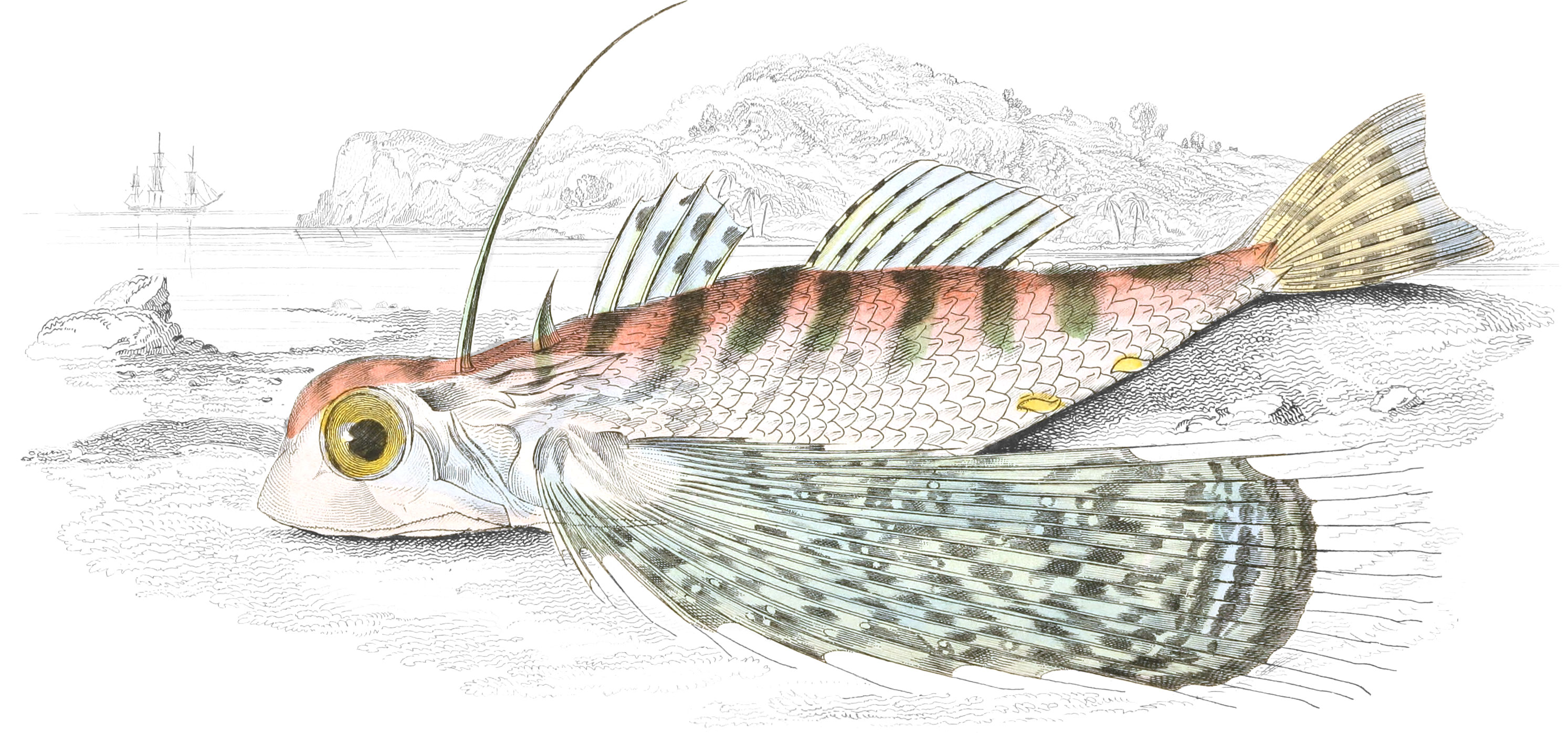
Plate VII
Common Flying-Fish
Exocetus volitans,—Pennant.
Of which specimens appear occasionally to have been met with on the British coasts, though certainly only of occasional occurrence. There are several species, possessing nearly an equal developement of those fins which seem to occur in different ranges of latitude, and not to stir beyond their bounds, with as much regularity as we find in the distribution of the other vertebrated classes. By many authors, this power of the Exoceti has been pourtrayed as actual flying, that is, propelling themselves forward by the motion of their fins or wings, after they had risen from the waters. The later and most to be credited testimonies go mostly to confute this; and it seems pretty evident, that it is the first impulse or spring from the water which is the propelling power, and that the breadth and volume of the fins supports them so long as the moisture continues: a very interesting account of the manners of one of these fishes will be found in Mr. Bennett’s Wanderings, and the above, we believe, is the conclusion to which he arrives. From fifty to one hundred yards is sometimes passed over by this leap or skim, rising considerably above the water, and performing in the leap an arc of a circle.
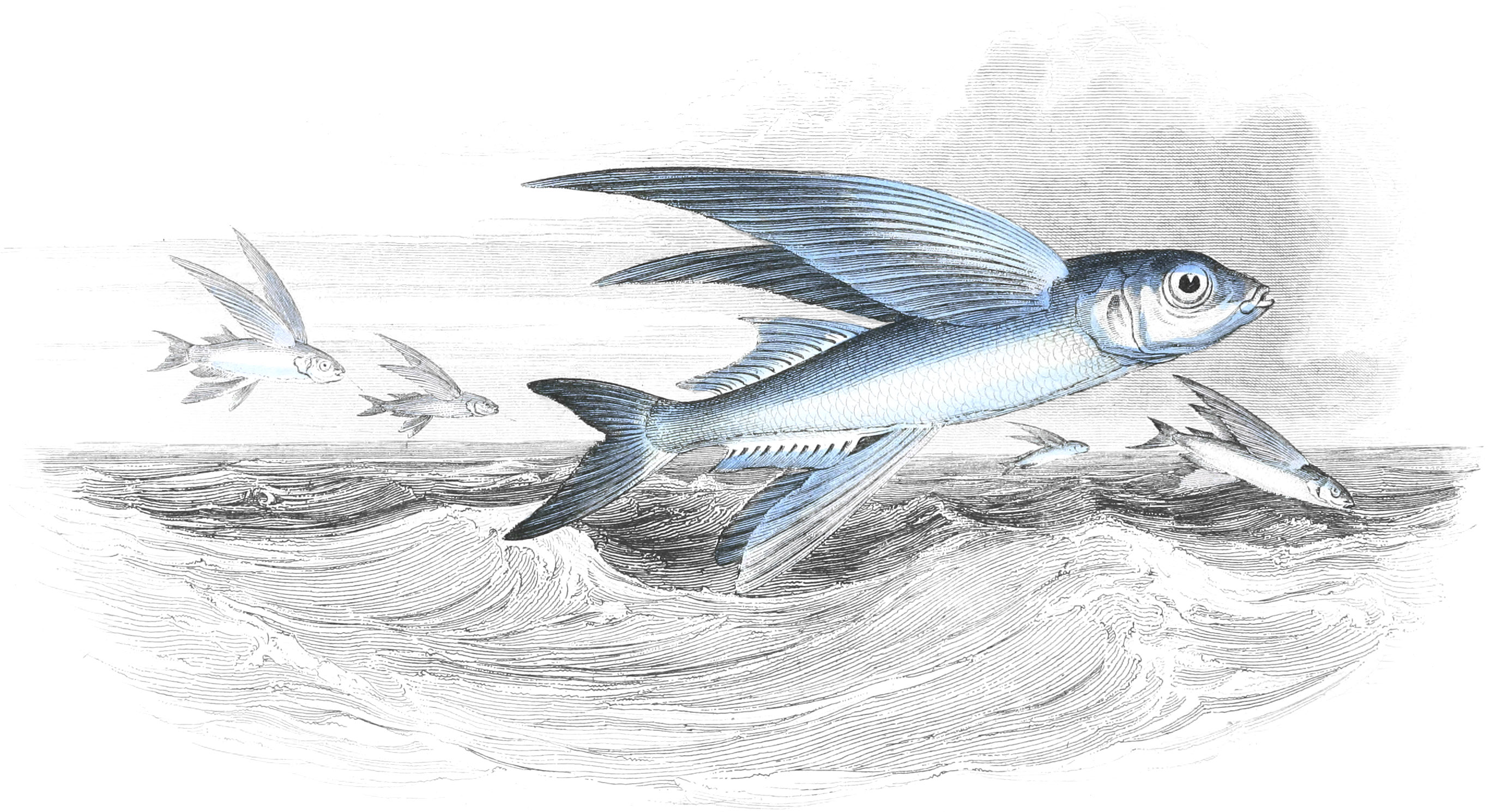
Plate VIII
In the rays or skates, and some allied genera of cartilaginous fishes, the parts analogous to the pectoral fins are also much developed, but they are used more as a vast flapper to raise the fish from the bottom, or to bury it in the sand or mud, than as a powerful locomotive organ; this will be better understood by referring to Plate V. They are not, except that their outline is more angular, very unlike the flat osseous fishes—for example, the flounder (Pleuronectes maximus); but nothing can be more dissimilar in their structure and general economy. When we look upon the flat part of the latter we see the animal in profile, and the extreme boundaries of the body, between the snout and tail, are formed by the back and belly, the dorsal and anal fins. On the other hand, when we look upon the flat part of the former, it is either the back or belly that we contemplate; and the outline of the body, between the snout and tail, is formed partly by the two ventral, but chiefly by the two pectoral fins. These are attached by an enormous scapular arch running down each side of the simple fin of the animal, and supporting the proper bones of the arm, from which proceed innumerable jointed rays, or fingers, composed, like all other parts of the skeleton of cartilaginous fishes, of cartilage, and not of bone. It is principally these rays of the pectoral fins, and the flesh upon them, that are eaten at table; in other words, it is the enormous hand of the animal chiefly on which we regale ourselves. The pectoral fins are very rarely wanting in fishes; but such is the case with the lampreys and a few others.
The ventral fins assist the pectorals, and are of use in turning and balancing the fish, but in their office are entirely subordinate. They are supported by the pelvis in the same manner as the scapula and clavicle support the pectoral fins. The bones of this part are extremely imperfect, and quite unattached, in the osseous fishes, to the spine, apparently for the purpose, as already remarked, of leaving that portion of the spinal column, by which the tail is moved, as free from incumbrance as possible. The two rude bones of which it consists are situated sometimes before the pectoral fins, sometimes opposite to them, and sometimes behind them; and they may be either attached to the bones of the head or to the scapular arch, or quite unattached to any part of the skeleton. With these pelvic bones are, in general, directly connected the long radiating bones corresponding to the instep and toes of the higher tribes of animals, no trace being commonly visible of the intermediate thigh, leg, and ancle bones, which are met with in the latter, although the previously named portions are quite sufficient to establish the structural analogy of the ventral fins of the fish with the posterior or inferior extremities of the reptile, the bird, the quadruped, and man; upon the same principle as even the claws of some kinds of serpents, already alluded to, are received as analogous to the arms, and the extremities of some kinds of lizards are admitted as analogous to both arms and legs. Fishes even rank before the cetaceous tribes in this respect, since few of the latter present any rudiments of posterior extremities at all.
In many fishes the ventrals are very much developed in length, but scarcely ever to the extent, or to the same comparative breadth with the pectoral fins. They are long in the dories (Zeus.), also in the genus Plataw. In some other genera, again, as Trichopus, Osphromenus, and Calisa, they are longer than the fish, but consist of only a single ray or filament.

Fish with Ventral Filament
In some of the Lophii anglers they have almost the appearance of the paws of a quadruped, and in the harlequin-angler, they are more like a kind of feet than fins; so much so, that in the original delineation of this animal by Margrave, in his description of Brazilian Fishes, it is represented as squatting on these fins, almost in the manner of a frog or toad upon its haunches. M. Renaud indeed, in his History of Fishes, tells us, that he knew an instance of this fish living for three days out of the water; and, in the mean time, trotting about the house, on these fins, like a dog upon its legs! The ventral fins are, like the pectoral, of a comparatively large size in rays, which, unlike those fishes which rely most upon the motions of their tail for progression, have their pelvis attached to their caudal vertebræ; and these fins, accordingly, co-operate with their pectoral fins in perfecting the rhomboidal form which their flat body so generally presents. The ventral fins are very often entirely wanting in fishes. This is the case with the eel tribe, which, from this circumstance, are called by Linnæus Apodal fishes, or fishes destitute of feet.
The ventral fins of fishes in general lie commonly flat in the water, in whatever position the animal may be, and perhaps conduce rather to depress the belly than to effect any other specific purpose: they may likewise cooperate with the pectoral fins in preserving the balance, as well as between one side of the body and the other, as between its anterior and posterior portion. In some fishes, as the lump (Cyclopterus lumpus), there is formed of the united ventral fins a kind of sucker, by means of which the animal adheres strongly to any thing in contact with it; but to this subject we shall have to recur presently. The deficiency of ventral fins, as well in so many fishes, as in the cetaceous tribes in general, would go to prove that their use is not, at any rate, a very important one.
The remaining two fins which we have still to notice, stand in a different direction from those we have already illustrated, being perpendicular to the centre of the body, and are employed as balances only, not as organs of progression, or of sinking and rising; they are, nevertheless, in some species, developed to an extraordinary extent. The dorsal fin is of very varied form, either composed of a few spines only, or it is continued for the whole length of the fish; it is either single, double, or triple; and it possesses a degree of consistence so very different in different species, as to have given occasion, first to Ray and Artedi, and more recently to the late illustrious Naturalist, the Baron Cuvier, to constitute this a leading distinction between two of the largest families of fishes—the Malacopterygii, or those in which this organ is comparatively soft, and the Acanthopterygii, or those in which it is hard and spinous. Generally speaking, it is most fully developed in those fishes which inhabit the most stormy seas, while those which are found in comparatively still waters, have this organ much smaller and weaker; but there are many exceptions to this remark. In some fishes, also, it forms a powerful organ of protection from the strength of the spines; and, in a few, it is capable of being raised and depressed as an offensive weapon, and inflicts a wound creating great pain. Examples of expanded developement may be seen in the members of the old genus Chætodon, among the dories, and in a very beautifully marked tribe, the Acanthuri; in these, the longest rays are often continued for an enormous length in the form of filaments. This will be seen in our representation of
The Horned Zanclus or Chætodon
Zanclus cornutus,—Cuv. & Val.
Chætodon cornutus, Linn. Bloch.—Le Tranchoir cornu, Cuv. and Val.
This curious and prettily marked fish is not of rare occurrence, and has been frequently met with by navigators and naturalists who have visited the seas around the Molucca islands, Sandwich isles, Celebs, &c. &c., and is found not only in the Pacific, but also in the Indian oceans. The general form is that of the Chætodons, a numerous and gaudily marked family, and from which it was separated by Commerson. From the great length to which the rays of the dorsal rays sometimes extend, it is named by the inhabitants of the coast of the Isle of France, “fil en dos.” The little protruding-like horns which project from the front, have gained for it the appellation of “cornutus,” and its singular form has rendered it an object of superstition to the natives, who return it again to the waters with marks of reverence. It is, however, an excellent and esteemed fish, having the flavour of turbot, and often reaching a weight of from twelve to fifteen pounds. Our Plate will give an idea of the banding and colouring which mark its skin.
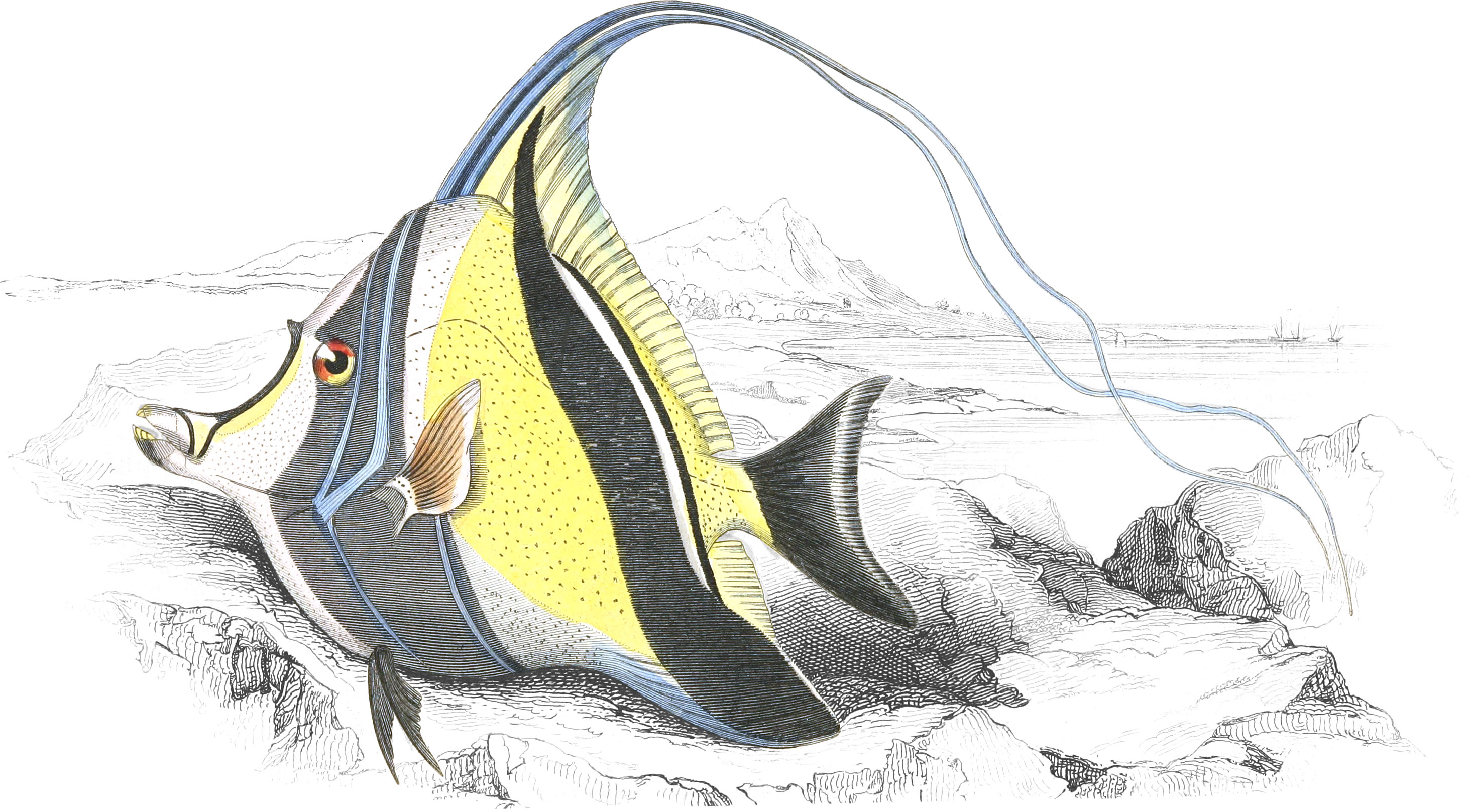
Plate IX
An extraordinary developement of both the anal and dorsal fins will also be seen in the
Argus Pteraclis
Pteraclis ocellatus,—Cuv. & Val.
These fishes have more than double the expanse of their surface in the dorsal and ventral fins, and one is at a loss to perceive for what purpose this immense developement is necessary; at the same time, we must confess our entire ignorance of their habits and economy. It had been supposed that they were enabled to support themselves for a short period in the air, but this is not confirmed by any observations; and we do not see how such could take place in the perpendicular position of the fish. Two or three species only are known, and our present one is of extreme rarity. Mons. Cuvier and Valenciennes took their specimen from the stomach of another fish. It was procured on the Mozambique coast.
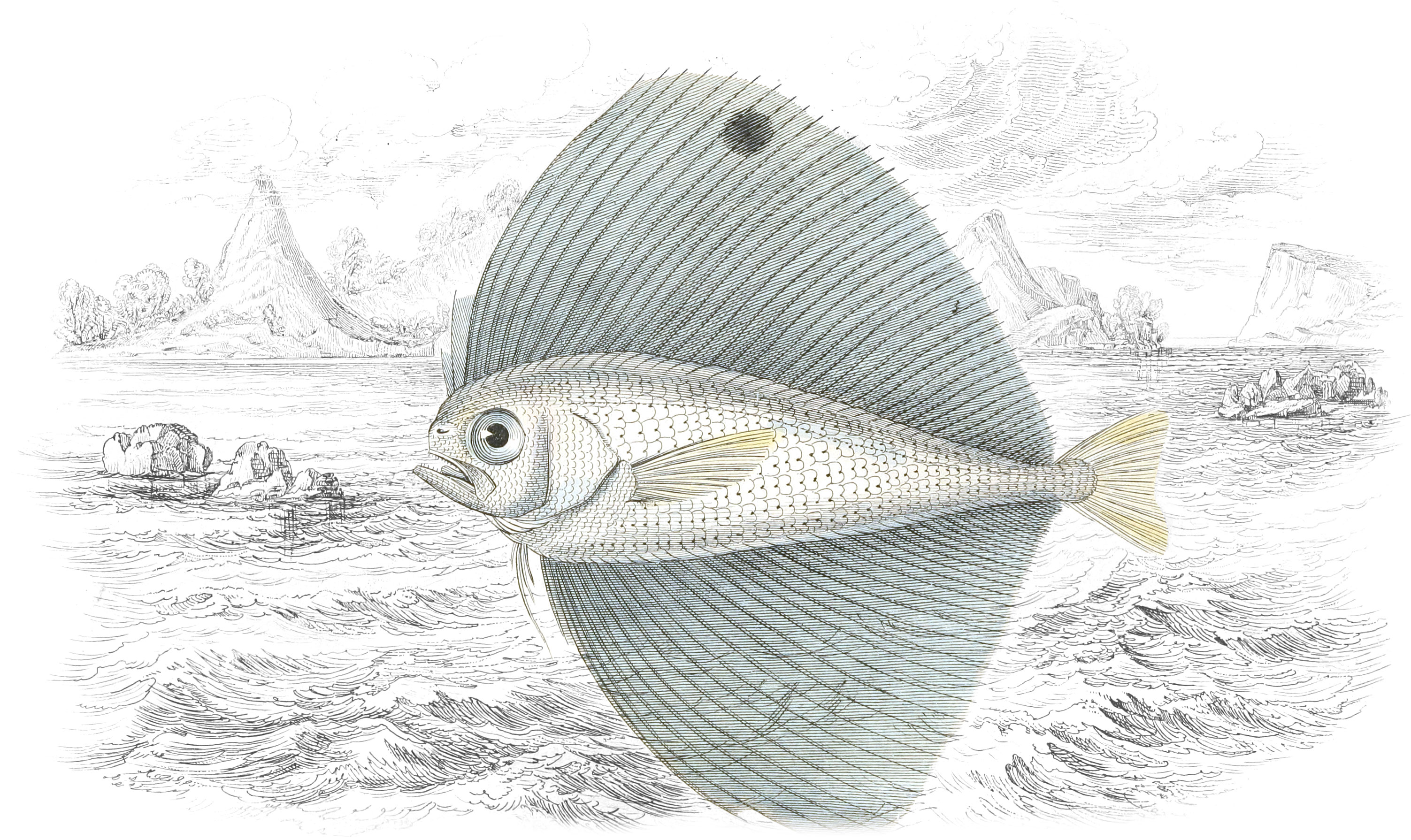
Plate X
In the Histiophori or sword-fishes, where the passage through the water is extremely rapid, and which possess great strength, the dorsal fin is very large. So is it also in another curious fish, a native of the Madeira seas—Alepisaurus ferox. In the beautiful genus of the Salmonidæ, composed of the graylings of British Ichthyologists, we have this member more than ordinarily developed. Our next Plate will show this, and, at the same time, exhibit it in a fish which is otherwise near the proportions of the more active species, and those which perform long journeys or migrations.
Back’s Grayling
Thymallus signifer
Coregonus signifer, Back’s grayling; Richardson in Franklin’s Journal, and in Northern Zool. vol. iii. pl. 88.
The beautiful dorsal fin of this handsome species is so conspicuous, that it has been noticed by the natives dwelling on the banks of its streams, and, in their language, signifies “wiry-like fin.” It inhabits the rocky streams that flow through the primitive country lying between Mackenzie’s River and the Welcome.5 It was found only in the clear waters, and, Richardson says, delights in the strongest streams, taking eagerly at the artificial fly, and, when hooked, tugging strongly, and requiring as much dexterity to land safely as a trout six times the size. We do not see clearly the organs from which this great power arises, except in the large size of the dorsal fin; for, in our idea of the use which we have assigned to this fin, we look upon it as incapable of using much exertion. There is, however, no other organ to which to refer it; and if it is referable to it, in those other fishes which have it so much, and often so curiously developed, the power, when known, may probably be in the ratio of its size. The colours of this grayling are beautiful, but chaste; above of a lavender-purple, beneath greyish, with white spots; but the chief adornment is the large fin, of a graceful curving form; it is of a blackish grey, but is relieved by transverse rows of Berlin-blue spots.

Plate XI

Chætodon vespertilio will also exhibit great developement of this series of fins. It is not a very uncommon fish, and has been many times figured. There is scarcely any fishes which approach the Pteraclis and this in the immense developement of the organs in question; and, in the last, they give to the fish collectively almost the appearance of a half-moon, of which the extremities of the dorsal and anal fins, pointing backwards, constitute the horns. The principal use of the dorsal and anal fins of fishes, regarded merely as ministering to locomotion, appears to be that of poising those animals, and preventing them from continually reeling over to one side during either their station or progression in the water. The air-bladder, it is true, in most fishes, running as it does along the spine, tends to keep this part uppermost under ordinary circumstances; but this provision would have been insufficient to counteract the influence of the waves and conflicting currents, without the additional security afforded by the dorsal and anal fins, which, by the salient angle which they form with the body throughout a great part of its length, and the broad area which they present laterally to the water, must obviously oppose a much greater resistance to any rotatory motion of the animal on its own axis, than any which it experiences in its motions either upwards or downwards, forwards or backwards. They thus operate in the same manner as the keel of a ship, and serve to keep the animal steady in its course; and, for the same reason that a flat-bottomed boat rolls with every wave, and can keep its course at all only in very quiet waters, so a fish, from which these fins have been removed, reels continually to the right and left, and is able to preserve any thing like an equilibrium only by keeping its other fins in constant motion, as a man does his arms when balancing himself upon a tightrope. But the dorsal and anal fins of fishes have an advantage which the best constructed keel can never possess; and that is, that their area and tension can be increased, within certain limits, in exact proportion to the necessity for greater security, the spines on which they are built being raised by proper muscles, which are under the controul of the animal, so that it has but to call these muscles into a greater or less degree of action to expand or relax the fins to the precise point that is required. It is thus that we may imitate Nature in our contrivances, but we can never approach her except at one or two removes; and the meanest and most insignificant of her works gives, every hour, lessons of mechanism to the most expert of human artificers, of which he may make a bungling copy, but after the exquisite perfection of which, he pants and toils in vain.
As connected with the station and locomotion of fishes, it is incumbent upon us to say a few words of the means by which many fishes are enabled to keep themselves stationary in the water, in defiance of the tendency of tides and tempests to dislodge them from their place. This of course might, in all cases, have been done by a muscular effort on the part of the animal, calculated to counteract this tendency, and such is indeed the means by which fishes in general contrive to keep their station in the most turbulent and rapid seas; but the necessity for such a waste of muscular power has been, in some cases, superseded by other contrivances. Thus the lamprey maintains its post among the stones at the bottom of the water chiefly by means of its tubular lips; the sucking power of which—that is to say, the degree of pressure with which, by forming a vacuum within, they are capable of making the surrounding medium bear upon them—is so great, that the animal might be raised out of the water with a stone of ten or twelve pounds weight attached to them. The pressure of the atmosphere, it is sufficiently well known, is equal to fifteen pounds for every square inch of surface; and that of the water will be of course greater than this, in proportion to its depth. In this respect, then, the lips of the lamprey serve the animal not only as an organ for taking food, like the tubular lips of so many of the invertebrate tribes, particularly insects, but also as a kind of arms for clinging to contiguous objects; and the same is perhaps the case also with the sturgeon, the lips of which, situated, not at the extremity of the snout, but altogether under it, are somewhat similar in structure to those of the lamprey. Other fishes, such as the lump-sucker (Cyclopterus lumpus), a native of the northern seas, have the power of adhering to rocks by means of a small oval and concave membraneous disc, which is surrounded by a fleshy margin fringed with thread-like appendages, situated at the lower part of the body, and composed apparently of their united ventral fins. In the interior of this they form a vacuum, and adhere, therefore, like the lamprey, upon the principle of suction; and the power with which they do so is sometimes surprising, considering that the animal is rarely more than a foot and a half long. Mr. Pennant says,
We have known that on flinging a fish of this species, just caught, into a pail of water, it fix itself so firmly to the bottom, that, on taking the fish by the tail, the whole pail was lifted, though it held some gallons, and that without removing the fish from its hold.
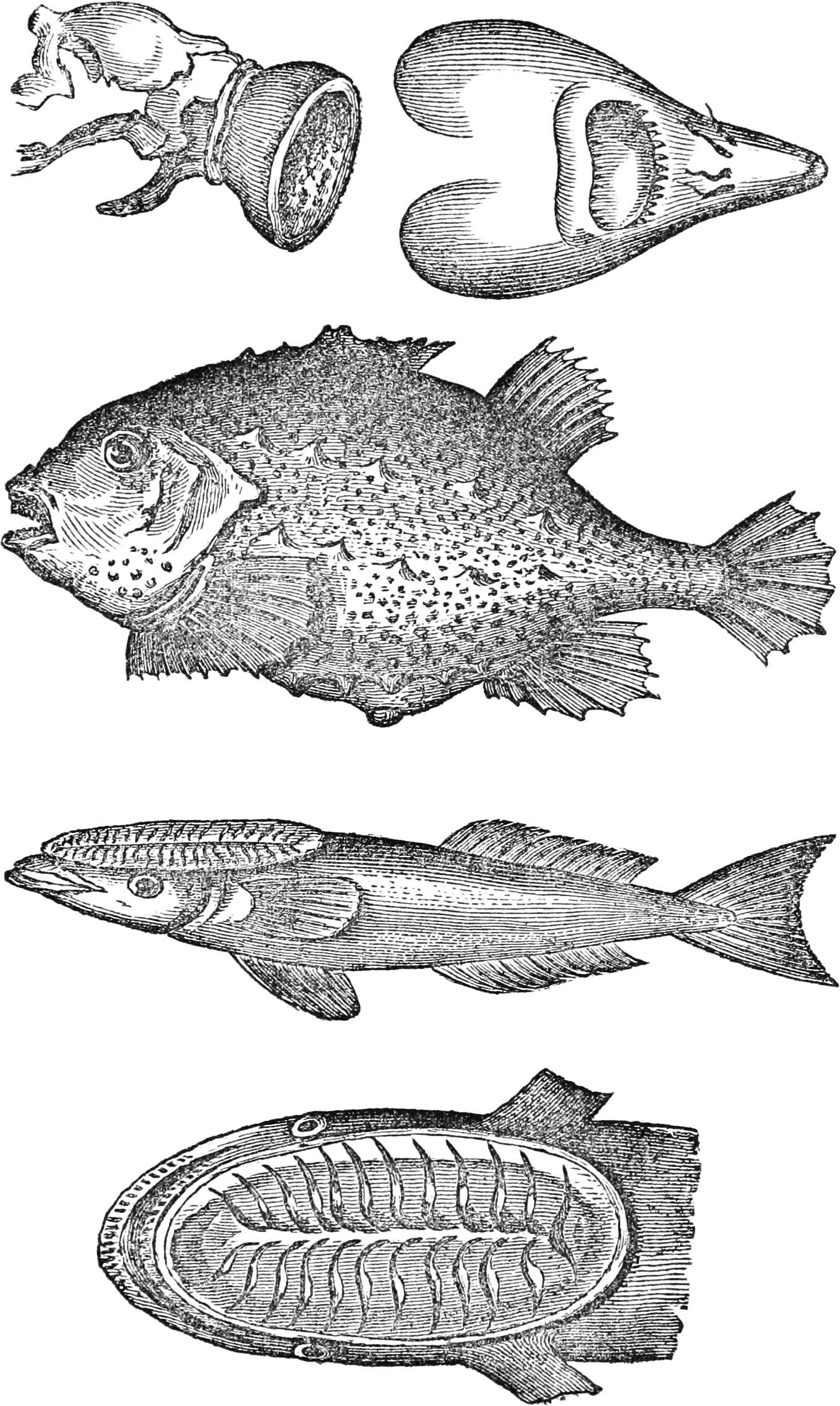
Sucking Fish
But the fish which possesses, in the most remarkable degree, this power of suction, is that which is called, par excellence, the sucking-fish, forming the genus Echineis, natives of the Mediterranean, Atlantic, and Indian oceans. It is a small fish, seldom exceeding a foot in length, and either of a uniformly brown colour, or black above and white below. Its characteristic mark is a large oval and flattened membranous disc, which has several transverse serrated bands forming cavities, in which are cartilaginous plates situated at the top of the head. It is by means of the retraction of these cartilages, by proper muscles adapted for the purpose, that the animal forms a series of vacua, and thus exerts the singular adhesive power by which it is distinguished—so singular, that it was classed by the ancients among the occult qualities of Nature, since they idly imagined that this little creature had force enough, by adhering to the keel of a ship, to stop her progress when under full sail. A marvellous account is given of its operations in this way by the credulous Pliny, from whom the following is an extract, as translated by Holland:—
The current of the sea is great, the tide much, the winds vehement and forcible, and, more than that, ores and sailers withall to help forward the rest, are mightie and powerfull: and yet there is one little sillie fish, named Echeneis, that checketh, scorneth, and arresteth them all: let the winds blow as much as they will, rage the storms and tempests what they can, yet this little fish commandeth their furie, restraineth their puissance, and maugre all their force as great as it is, compelleth ships to stand still; a thing which no cables be they never so big and able as they will, can performe. She bridleth the violence and tamest the greatest rage of this universall world, and that without any paine that she putteth herselfe unto, without any holding and putting backe, or any other meanes save only by cleaving and sticking fast to a vessell: in such sort as this one small and poore fish is sufficient to resist and withstarid so great a power of both sea and nayie, yea and to stop the passage of a ship, do all what they can possible to the contrarie.
He goes on to say, that it was this little fish which stayed the progress of Mare Anthony’s ship, in the naval engagement between him and Augustus Cesar, and caused the defeat of the former; and that Caligula once suffered a similar accident, which was the harbinger of his downfall. In the latter case, according to our author,
So soon as even the vessell (and a galliaie it was, furnished with five banks of ores to a side) was perceived alone in the fleete to stand still, presently a number of tall fellows leapt out of their ships into the sea, to search what the reason might be that it stirreth not? and found one of these fishes sticking fast to the very helme: which being reported unto Caius Caligula, he fumed and fared as an Emperour, taking great indignation that so small a thing as it, should hold him back perforce, and check the strength of all his mariners, notwithstanding there were no fewer than foure hundred lustie men in his gallie that laboured at the ore all that ever they could to the contrarie.
And, if Naturalists could be thus easily imposed upon with respect to the marvellous powers of the Echineus, it is not surprising that these powers should have formed a theme for the wonder-loving poet.
The sucking-fish beneath, with secret chains,
Clung to the keel, the swiftest ship detains.
The seamen run confused, no labour spared,
Let fly the sheets, and hoist the top-mast yard.
The master bids them give her all the sails
To court the winds and catch the coming gales.
But though the canvass bellies with the blast,
And boisterous winds bear down the cracking mast,
The bark stands firmly rooted on the sea,
And will, unmoved, nor winds nor waves obey;
Still, as when calms have flatted all the plain,
And infant waves scarce wrinkle on the main.
But although the sucking-fish possesses no such powers as are here attributed to it, the force with which it attaches itself to any substance with which it comes into contact is very remarkable. Commerson produced a kind of temporary palsy of his thumb, by exposing it for a short time to the sucking operation of the shield of this animal; and they are separated with the greatest difficulty from the sharks and fishes to which they are frequently found, many together adhering, having attached themselves probably for the purpose of profiting by the more rapid power of motion possessed by other fishes. It is vulgarly supposed that the sucking-fish accompanies the shark for the purpose of directing him to his prey, or of warning him of approaching danger; and hence it has been sometimes called the shark’s pilot. It appears that this propensity of adhering to other fishes was formerly turned to account by the Indians of Jamaica and Cuba, who used this animal, or rather one of the same genus (Echinets naucrates), in catching fish, as hawks are employed in taking other birds. Mr. Bingley says,
They kept them for the purpose, and had them regularly fed. The owner, on a calm morning, would carry one of them out to sea, secured to his canoe by a slender but strong line, many fathoms in length; and the moment the creature saw a fish in the water, though at a great distance, it would dart away with the swiftness of an arrow, and soon fasten upon it. The Indian, in the mean time, loosened and let go the line, which was furnished with a buoy which floated on the surface of the ocean, and marked the course the sucking-fish had taken; and he pursued it in his canoe, until he perceived his game to be nearly exhausted. He then, taking up the buoy, gradually drew the line towards the shore, the sucking-fish still adhering with so inflexible a tenacity to his prey as not easily to be removed.
A similar employment of the latter species of sucking-fish is said, by Commerson, as quoted by Lacépède, to be still very common about the coasts of Mozambique, where they use it principally in taking turtles. For this purpose a ring is fastened round the tail of the animal, to which a long cord is attached; and thus secured, it is allowed to approach the turtles, as they lie sleeping on the water, to the breast of one of which it soon attaches itself, and it is thus easily drawn ashore.
The method of employing suckers, in attaching—themselves to solid substances, is not peculiar to fishes, some other maritime animals, as the cuttlefish, using such suckers very extensively; and the force with which it is capable of adhering to rocks by this means has been already alluded to, when we were speaking of the muscular power which it occasionally, at the same time, exerts. These suckers (wood-cut, fig. 1.) have the appearance of little cups; and, with them, the numerous long arms of the animal are so plentifully studded, that their united power must be enormous.
But, besides the principle of suction, some fishes, such as the eel, seem to secure their footing, at least when on land, by another contrivance, being supported, under unfavourable circumstances, by the viscidity of the fluid with which their body is smeared; in the same way as the garden-snail employs, for this purpose, in addition to the vacuum formed by its foot, the mucilaginous matter on the surface of this organ. It is thus that eels contrive to ascend the smoothest posts of flood-gates, and other perpendicular surfaces arising from water; projecting first the heads and a part of their bodies, and keeping these closely in contact with the wood, till the mucilaginous matter has become sufficiently inspissated to give them a firm hold, when they advance higher and higher by the motions of their spine, till they reach the dam above, frequently at the height of five or six feet. The process is, in some respects, like that of climbing trees by the Sparus; but it differs from the latter, in requiring the additional security afforded by the viscid surface of the body of the animal, which, in the other case, is superfluous.
The next portion of the Natural History of Fishes which will claim our attention, is the means which have been provided to them for attacking and securing their prey, and for defending themselves against the many foes which, in their turns, mutually prey on each other. These may be termed the organs of offence and defence.
Fishes have not been provided with the same variety of organs of offence as we observe in the higher classes of the animal kingdom; in their means of defence however, diversified provisions appear. As the parts concerned in both these purposes are most naturally associated with the integument, which is itself, even when least complicated, an organ of defence, it is found convenient to treat of all these at the same time. As illustrative of the organs of defence, it will be proper, therefore, to take a survey of the skin or general envelope of the body. The skin varies considerably in character even in fishes ranking in the same group; in ali, however, it adheres very firmly to the subjacent parts, and is in none so loose as to be susceptible of the motion which is observed in mammalia, by means of the muscular expansion, termed panniculus carnosus. No trace of such a muscular expansion exists in fishes. This fact is worthy of attention, as in generalising on the subject of the hypodermal muscular system, in the animal kingdom, an opposite view is often suggested. For example, the hypodermal or subcutaneous muscular system, as contrasted with the skeleton muscles, is often represented as commencing almost in a rudimentary state in man, under the form of the slender sub-cutaneous muscular expansion on the fore part and sides of his neck, termed platysma myoides, as growing in importance in the mammalia under the term of panniculus carnosus, it enables the animal to make the whole skin quiver, so as to shake off insects, and reaches a greater importance in many of them, for example, in the hedge-hog, and a great proportion of the Edentates. In the first, it forms a species of cap, resting on the back of the animal in its ordinary state, yet so constructed, that it is capable of enveloping the extremities and whole body, when, on being attacked, it assumes the well-known form of a ball. Finally, that this hypodermal muscular expansion attains its extreme developement, as we descend in the scale of animals, until at last in the avertebral tribes, the mollusca, the crustacea, and insects, it constitutes the whole of the muscular system; all the active organs of locomotion in these being inserted into the integuments. This statement, then, is true only when it receives an important limitation. The chain of developement is not unbroken through the orders of animals, from man down to the mollusca, crustacea, and insects; the developement takes place at two extremes, the middle point between which is occupied by the order of fishes, in which this expansion is entirely deficient. In birds, the same muscular expansion attains but a trivial importance; and, of the reptiles, the Ophidia, or serpents, alone show faint traces of it.
Some popular writers on comparative anatomy have made a statement liable to mislead, connected with the same organ, in representing the globular form assumed by the Diodons and Triodons, and the erection of the numerous spines with which the surface of their bodies is beset, which happens when they are in danger, as analogous to the erection of the spines of the hedge-hog when it gathers itself into a ball. The analogy so far holds, that in the case of both the spines become erected as organs of defence when any danger appears; but in the fishes, the distension of the skin is produced by a general enlargement of the whole body, consequent on the reception of air into the crop or first stomach; while, in the hedgehog, the erection of the spines is produced by the action of the muscular organ before referred to, an appendage of the panniculus carnosus.
To return to the skin itself, in this order of animals, it has little of a fibrous character, approaching more to the mucous texture; its tissue is by no means close, the pigment is often pearly, and the epidermis, if it be not entirely deficient, often very slender.
In all its modification of form and accessaries, however, whether by the appearance of strong armour to resist attack, or by mucous and viscid lubrucations to facilitate escape, the skin is the first and most important organ of defence. And the most remarkable appendage of this integument in fishes is the scales; they differ from hairs and feathers in having no generating bulbs—nor have they the same character as the scales in the Edentates, Dasypus, Manis, Chlamyporus, &c., or in reptiles. More or less firmly adhering to the skin, they are shut up free in a species of pouch much flattened, and formed by a pinching up of the rete mucosum and its vascular tissue. To permit their separation and escape, this pouch must be torn. They appear to be produced by the internal surface of this vascular pouch, and to become excessively flattened, each composed of horny lines meeting in an apex, and derived from a more or less extended base, according to the form of the scale, and that is very variable.6
It is commonly asserted that all fishes have scales—but in some they are not discoverable by the eye, and in others they do not appear in the fresh condition of the skin, but only when it has become dry. Under the former description fall the hag (Mixine glutinosa), and the lamprey (Petromyzon marinus), which form a connecting link between fishes and molluscous animals; also the lump-fish or sea-owl (Cyclopterus lumpus), which, like the two former, has the power of adhering to bodies by the suction of its mouth. Under the latter come the common eel (Anguilla vulgaris), the conger (Muræna conger), the blenny (Blennius viviparus), one of the osseous fishes which produce living young, and most of the Siluri.
Another description of fishes is that in which the scales are not distinct, yet in which the skin is not slimy and viscous, as in those above referred to. In these the epidermis is smooth, and placed over nacreous pigment. This is exemplified in the mackarel (Scomber scomber), the blade-fish (Trichiurus lepturus), the Stylephorus argenteus, and the stickleback (Gasterosteus aculeatus).
But the form which should be regarded as the normal character of the skin in fishes, may be illustrated by our figure of
The Edible Lethrynus
Lethrynus esculentus,—Cuv. & Val.
A gaudily marked fish of the Indian seas, in which the body is uniformly covered with scales; and we shall find other examples of the same structure in the great majorty of the abdominal and thoracic tribes, as the salmon, herring, carp, perch, gilt-head wrasse, and the like.
In some fishes, again, the covering of the body, or of the integuments, favour more the character of large regular plates than of scales, to which we usually associate the distribution of imbrication, or lopping of one over the other, and in their composition are more or less of an osseous nature. Under this head come the Lepisosteus osseus, many species of Trigla or the gurnards, of the Cottus or hard-heads, of the genus Silurus, and even of the Gasterosteus or stickle-backs; but in a very marked manner in some of the extinct genera, whose remains have been preserved, and the scales yet, from their hardness, retain their entire form, and even the minuter parts which served to hook or join them together. But there is yet a more complete ossification of the skin, if it may be so termed, observable in some fishes; this consists of osseous pieces, or at least of pieces very hard, of a mucoso-horny texture. They are without any imbricature, and their union is by the margins, and is very variable. Some of them, put together with the utmost geometrical precision, form a cuirass of great strength, which acts as an admirable defence against their associates, except such as possess the strongest and most powerful jaws and teeth. Many of the Sygnathi and their allies exhibit this; among our native fishes the Cotti will show it, and the C. cataphractes, or mailed bull-head, is an excellent example; while among the sturgeons, and their allied genera, we see it in various stages of developement, from a line of plates defending a part of the body, to a complete and close suit of strong armour.

Plate XII
Mailed Peristedion
Peristedion cataphractum, Lacépède.
Shows a powerfully defended fish, somewhat resembling the sturgeons, yet belonging to the family of the gurnards. It inhabits the Mediterranean, and is described as frequenting rocky coasts, and swimming with great velocity; and its strong armour may perhaps be intended as a defence against the rough shores it may have to encounter during storms, or its rapid progression. It is, moreover, strongly armed with the spines on its head and cheeks, and with the two prolongations of the snout, which project forward, and sometimes are broken by the force with which they seem to be used against some objects of the deep.
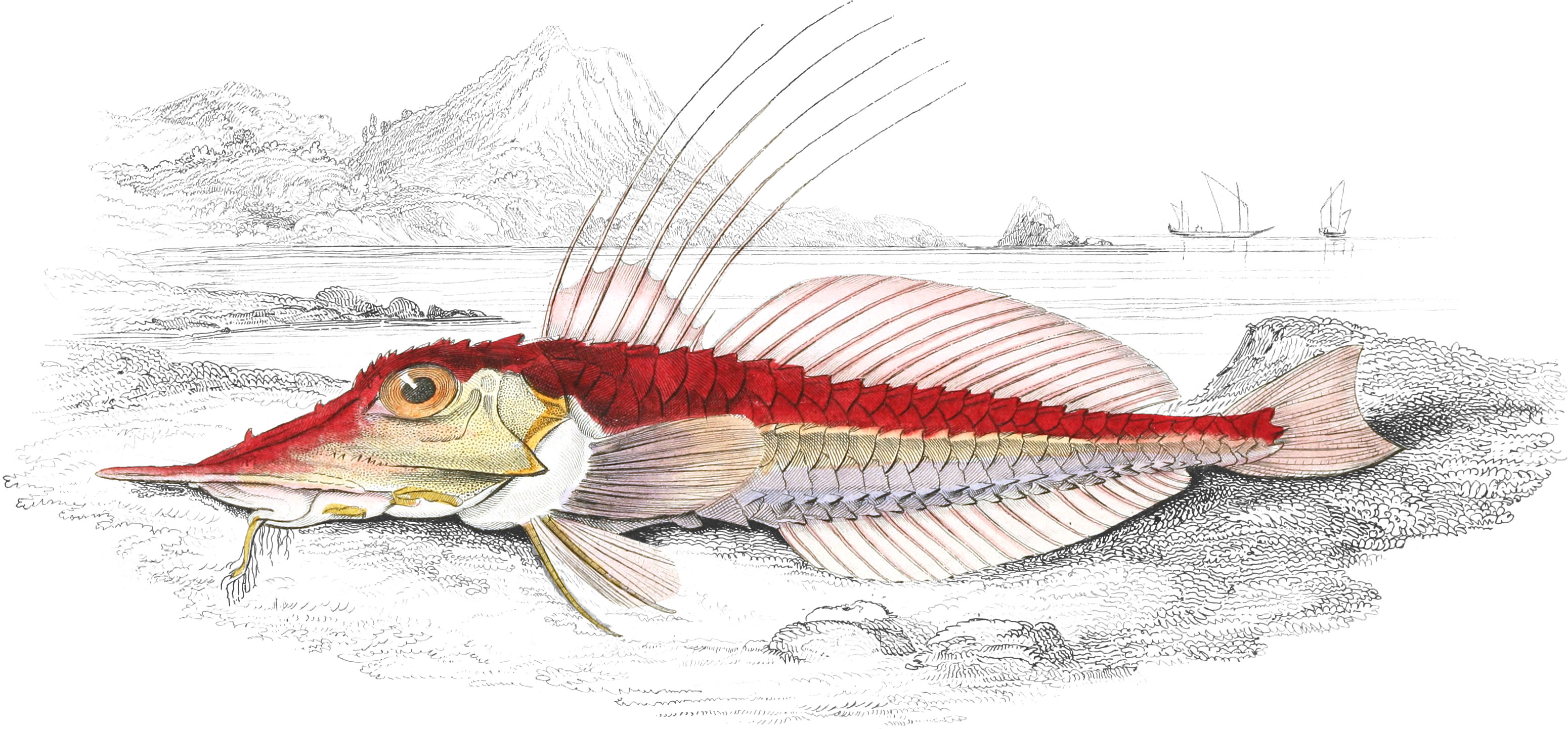
Plate XIII
The subject of the next Plate will also show an extraordinary view of the distribution of the integuments; it is the
Armed Monocentris
Monocentris cornutus, Schneider.
In this singularly formed fish, of, so far as we know, very harmless habits, we have a form of no elegance, and an exterior covered with very strong and rough plates, besides an array of blunt spines from the upper and under surface, which would render it an unsatisfactory mouthful even to the most voracious. It is a native of the Japanese seas, but appears far from being common; and we know little of its economy, by which to judge what its strange covering is particularly intended for. The spines, which M. Cuvier and Valenciennes describe, are only about ten inches in length, which agree nearly in size with those previously described by Thunberg.

Plate XIV
In another tribe of fishes, the plates, as we have already observed, were placed with the utmost regularity. The
Spotted Ostracion
Ostracion cubicus, Bloch.
Will illustrate this form. In the small group of fishes which have received the title of Ostracion, the covering is remarkably hard, and is composed of numerous pieces or compartments joined with the greatest regularity, and often with a mathematical-like precision in hexagonal plates. This covering is discontinued at the tail, which is free for a short space, and shows the necessity for this organ to be placed so as to be capable of voluntary action. The Spotted Ostracion is not an uncommon fish in the Indian seas, and is said sometimes to reach a foot in length. In the Isle of France it is esteemed for its flesh, and is kept in artificial ponds, where it becomes tame and familiar.
Besides these forms of the skin, there is exemplified in many cartilaginous fishes a peculiarity in the existence of the tubercules, usually pointed, and having some resemblance to scales, but more or less perfectly osseous, and are implanted deep to adhere firmly. To this form belongs the tubercules on many of the rays, the small, but rough and very hard points on the skin of the sharks, which both afford a substitute for the file of the cabinet-maker, and, when polished, exhibit a beautiful material often made use of in various neat articles of everyday utility. To these, also, may perhaps be added, the calcareo-corneous spines of the Diodons and Tetraodons, which are placed with comparative regularity, and, from their strength and hardness, and the sharpness of their points, must be a species of defensive organ most efficient.
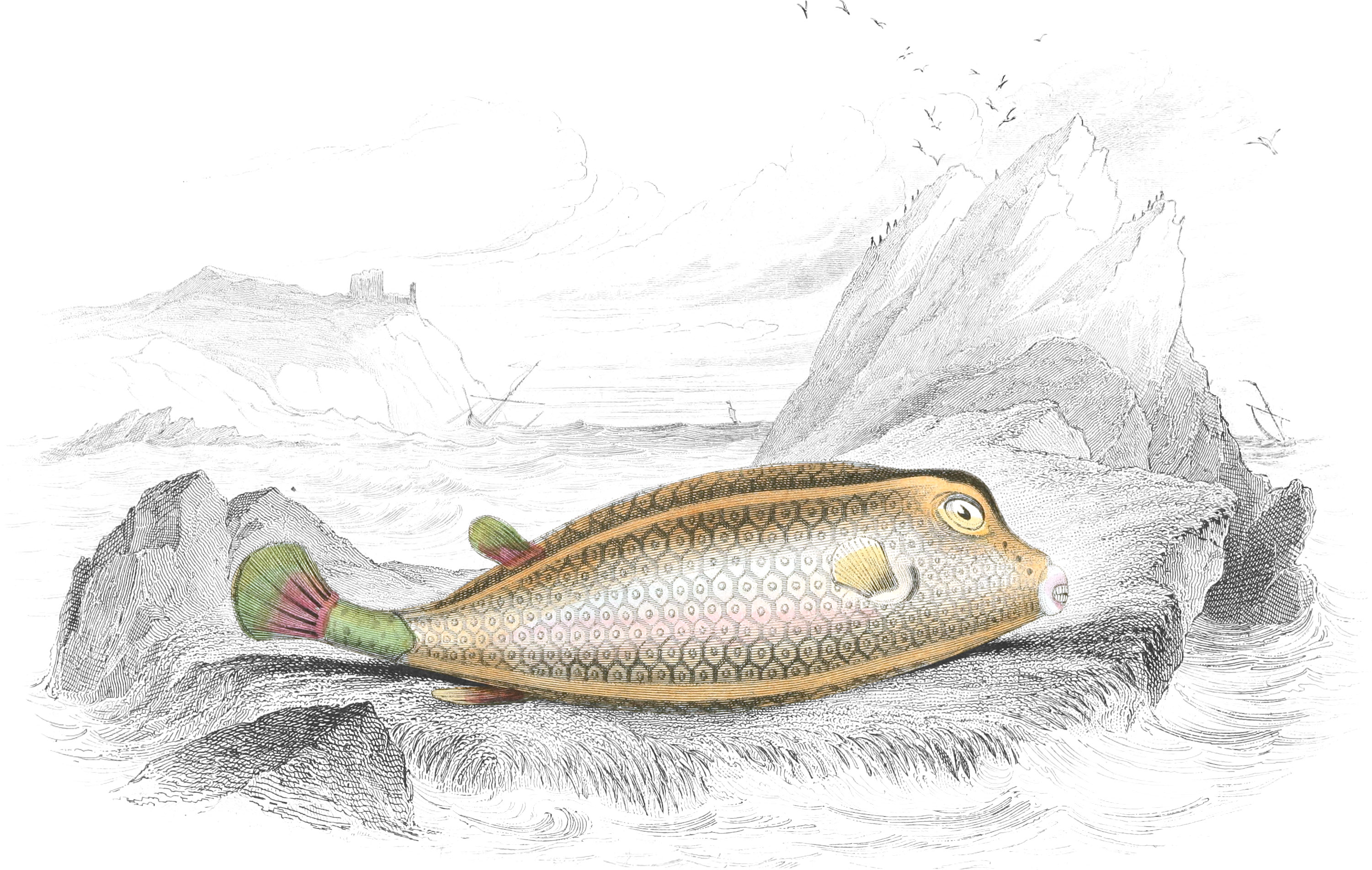
Plate XV
Porcupine Diodon
Diodon hystrix, Bloch.
Represents this structure. These fish are harmless inhabitants of the ocean, and possess a power which is an indispensable accessory to render efficient the weapons which have been thus allotted to them. When undisturbed, or making their way through the waters, their form is longitudinal, and the spines lie flat on the common integument; but on the approach of danger, or upon sudden alarm, they can inflate the body nearly to the form of a globe, which places the spines erect and stiffly set, and renders them, in truth, a most formidable resistance against every aggressor. The species which we represent frequents the seas of the tropics, and is said to feed on the crustacea and echinodermata. The wounds of the spines are by some considered poisonous, or to leave a painful and inflammatory wound, and which may act in the same manner with the pricks from the spines of the Trachini on various constitutions.
In addition, however, to these provisions for defence which are liberally furnished to those species which roam openly, and do not naturally conceal themselves among rocks or the forests of sea-weeds, or among the mud and slime of the bottoms, there are many species which have different and accessory parts of the form strongly knotted and spined, and which we can scarcely view in any other light than as accessory parts of defence. Thus many of the Percidæ have their. gill-covers strongly spined and serrated. The first and second rays in the dorsal fin of the same family are often also very strong and rough; and every one accustomed to fish for the common perch of the British lakes and rivers, must have observed the powerful manner in which these are erected, when the fish is first raised from the water; it is evidently used instinctively as a defence, and by this means it is one of the few species which we can keep in company with the pike. The heads of the Cotti are all strongly armed with spines, with which they are able to wound severely, by turning or wriggling. Such is also the case with the Scorpænæ, and the Trigla or guards. In the weavers, forming the genus Trachinus, they are exhibited in the

Plate XVI
Radiated Weaver
Trachinus radiatus, Cuv. & Val.
A native of the Mediterranean, and found on the coast of Naples, and also on the southern shores of France; it has never, however, been found on the British coasts, though it is possible it may have yet been overlooked. The first dorsal fin is a formidable weapon, apparently possessing some deleterious quality communicated by the wound, independent of the mere prick, and acting differently on different constitutions. This fin is almost always carried flat, or level with the back; but on alarm, or on being trampled on, for they burrow in the sand, it is suddenly raised, and, from the great muscular power which accompanies the action, often inflicts a severe puncture, which, in some individuals, in a few minutes after, causes a severe burning pain, with inflammation of the part around. In several of the continental markets, a penalty is exigible if this fish be brought for sale without these fins being removed. The spines on almost all the species of sticklebacks (Gasterosteus), perform the same office of defence, and can be erected at pleasure. Several of the spines are only from a line and a half to two lines in length; but such is the muscular power possessed, that it is with difficulty one of the spines can be pressed down, so long as the fish survives.
Spines, in some form or other, appear the most ordinary manner in which a weapon is provided. In those fishes we have alluded to, they have generally been furnished by some peculiar modification of other parts of the structure used for necessary purposes; but in a great many species we shall find the same kind of weapons placed on different parts of the body. What an admirable defence the jagged back and tail of the thorn-back skate affords; while in some of the same family we find the tail armed with a long spine, sometimes plain and sometimes serrated; an example of the latter structure will be found in our Plate V., and it occurs in very many other genera; in many of these, we are inclined to believe that the tail can be wielded, and a wound inflicted.
Some of the dog-fish, forming the genus Spinax, of the family of the sharks, have also very strong and beautifully rounded spines; these are placed sometimes at the posterior base of the dorsal, and sometimes near both first and second dorsal fins; and it is possible that with these a wound may be given designedly. A good example of this form of defence may be seen in our native Spinxa acanthias, also in many foreign species, and which we may further illustrate by a closely allied fish, the

Plate XVII
Blainville’s Piked Dog-Fish
Spinax Blainvillii, Bonaparte.
Acanthias Blainvillii, Risso.—Spinax Blainvillii, Spinorol comune, Bonap.—Icongrophia della Fauna Italica.
A native of the Italian shores, confounded with the Linnæan S. acanthias, and distinguished from it chiefly by the relative proportion of its different parts. It seldom exceeds two feet in length.
In a few genera of osseous fishes we have spines inserted into various parts, very frequently just before the junction of the tail with the body; in some they are several in number, in others they are single only. The genus Acanthurus is so named from the presence of three such spines; and in the beautiful

Plate XVIII
Yellow-Bellied Acanthurus
Acanthurus hepatus, Bloch.
It is well marked. This fish is a native of the seas of India, is adorned with a distribution of rich colours, and is armed at the base of the tail with a spine of considerable length.
In the genus Balistes also, we see a somewhat similar defence, numerous rows of hooked spines being placed near the tail. The

Plate XIX
Port Praslin Balistes
Balistes praslinoides, Lesson.
Baliste praslinoide, Lesson, pl. ix. fig. 3. page 117, vol. ii.
Will exhibit this. It is a fish met with by the expedition of the Coquille at Port Praslin, in New Ireland, of an oblong form, and reaching in length about eight inches; it is armed near the tail with three rows of crooked spines. Our figure will show the beautiful tints which adorn this species, remarkable both for its sharp armature and brilliant colours. Little or nothing is otherwise known regarding it.
In the genus Ostracion, again, these spines are placed in various positions, and are both very strong and sharp. In the

Plate XX
Horned Ostracion
Ostracion cornutus, Bloch.
Two are placed as horns, and in the same situation, and two are placed posterior to the ventral fins. It is one of the oldest known species, is found on the shores of the Isle of France and Java, and is widely distributed in the Mediterranean. In another very singular fish, the O. turritus, the “Chemeau marin” of the French naturalists, the back rises triangularly up, and a strong spine surmounts the summit; two others are placed perpendicularly above the eyes; while, on the lower surface of the fish, four others, strong and bent, defend it. Although these spines are not moveable, and cannot be used as an active defence, they must present awkward impediments to other fishes seizing, or attempting to swallow them.
These curious furnitures may all be placed as organs of defence, few of them being ever used either to secure their prey or as offensive weapons: but before leaving the conformation of the skin, we must shortly advert to its colours. In many instances the accommodation or keeping, as it were, of the colours of the skin to the materials of rock or sand by which the animal is surrounded, harmonises, and is unconspicuous to the fishes which look for prey among their own tribes; at other times the colours are so vivid and brilliant, or the exterior is marked with spots of silver and gold, which may act as an attraction to lure some of the weaker species within reach of predatory fishes; at least, the vivid colours in the plumage of several birds have been hinted at as being attractions for the various insects, which afford food for many; and if such be the case, it is more than probable that the inhabitants of the deep may be coloured, as many of them are, for a similar purpose. We may perhaps add to these the defence which the most singular and grotesque figures of some species would afford, by inspiring terror or disgust; and we give the figure of a curious little fish, which will both show an extraordinary form, and a considerable array of spined or knobbed projections. It is the
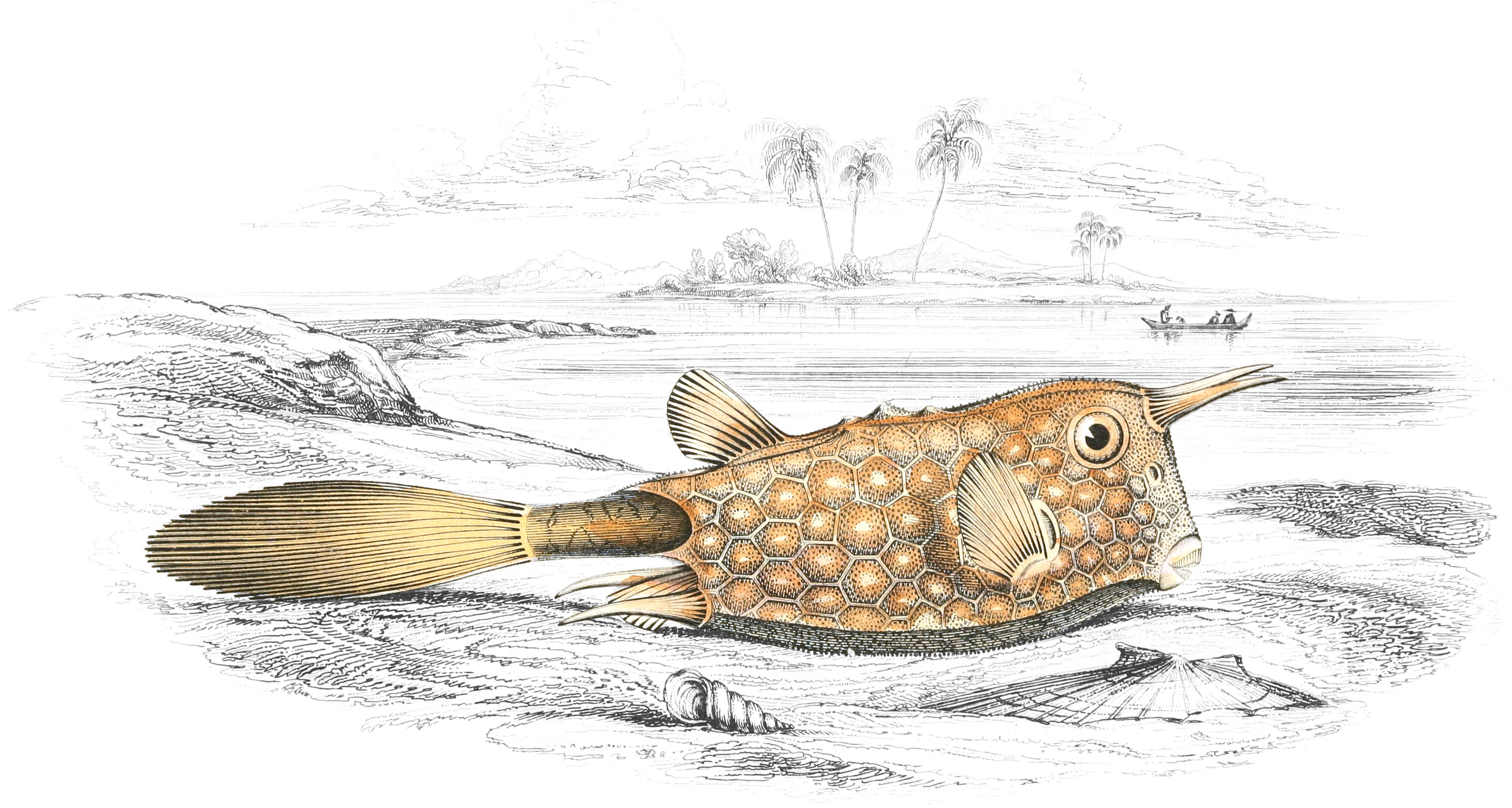
Plate XXI
Four-Horned Aspidophorus
Aspidophorus quadricornis, Cuv. & Val.
The specimen is in the British Museum; and little more seems to be known regarding it, than that it was taken on the coast of Kamtschatka.

Plate XXII
The pigment of the skin in fishes, corresponding to what is termed the rete mucosum in human anatomy, as offering the most lively play of colours, from the most delicate silveriness to the brightest golden hues, deserves some mention.
Every colour, and almost every shade and mixture of colours, are exemplified in the surface of fishes; yet these colours are often as fleeting as they are glowing. Often they become changed, or disappear with the life of the animal; and sometimes the mere removal of it from its natural element destroys all its splendour. It is universally observed in fishes, that the superior part, which is exposed to light, is more vividly coloured than the inferior, which indeed is most commonly pure white; and even in those fishes, as in the pleuronectes, which swim on the side, the colour is confined to that which is presented to the light. These facts naturally lead to the expectation, which experience verifies, that the fishes of intertropical seas, on which a more intense light falls, should exhibit more vivid colours. Not a few of our fishes, even in northern regions, exhibit very bright tints, as the gilt-head (Sparus auratus), the common salmon (Salmo salar), the mackerel (Scomber scomber); but for the most vivid colours we must look to more genial climates. The golden-carp (Cyprinus auratus), so much prized, is thought to be a native of China, where it is kept in porcelain vessels in the houses of the rich for ornament.
The genus Coryphena, which contains numerous species, is distinguished by the beauty and varying play of its colours. The
Atlantic Coryphæne, or Dolphin
Coryphæna equistis, Linnæus.
Will exhibit the general form of these fishes, and the colouring so remarkable for the variation of its tints; a play of vivid green and gold and silver being spread over it in various lights, and “changing as it dies,” keep up in this one also the well known ancient traditions. It is a native of the Atlantic Ocean, and has been taken off the coast of South America, and in the vicinity of St. Helena. These fishes often follow in the wake of vessels, and being agile and swift in their movements, when swimming near the surface in the lustre of a clear and brilliant sun, display their colours in the most varied manner. They are, according to our accounts, extremely voracious, feeding on the flying-fish, which, in troops, either are passed through, or follow the vessel, and at the same time they eagerly seize whatever falls or is thrown from it.
Two other species have been termed, from the variety and vividness of their tints, the sea-peacock and the blue-fish. But the species best known is the dolphin of sailors.

Plate XXIII
Dolphin of the Ancients
Coryphæna hippuris
Although we have applied the name of Dolphin of the Ancients to this species, it is probable that that described by the poets may have been different. Some very closely allied species, and possessed of even more brilliancy of tints, being met with in the seas whence they were most likely to procure or see the celebrated fish. This may be of trifling consequence in a scientific point; and we introduce the figure as the supposed fish to which the “dolphin” was applied.
The name Coryphæna, from κορβυφη, top, was applied to this species, as indicating the crest it bears on the cranium. It is an active voracious animal, and greedily pursues the flying-fish, which constitutes its favourite food. It is about five feet long, as elegant in form as brilliant in the colours. It is the most brilliant inhabitant of the sea, more particularly when it is eager in the pursuit of its prey at the surface, and the undulations of its large dorsal fin throw off the reflexions of its vivid hues. Above it is silvery-blue, with markings of deeper azure, and reflexions of pure gold; the lower parts are citron-yellow, marked with pale blue; the pectoral fins are partly lead colour, partly yellow; the ventral fins are yellow on the under surface, and black above; the anal fin is yellow; the insides are of bright golden. Its colours vary and fade after it is taken out of the water, so that but a faint notion of its original brilliancy can be formed from the inspection of the dried specimens preserved in our Museums.
But though possessing this splendid brightness of colouring, and far-famed for it in ancient story, there are perhaps other fishes which, from the decided marking out of their brilliant hues, and the contrast in which they are sometimes placed in regard to each other, are more striking, and have attracted much attention.
The Spari, Labri, Scari, Chætodons, Acanthurn, &c., all present numerous examples; and as one, we have selected the

Plate XXIV
Painted Labrus
Labrus formosus, Bennet.
A rare native of the Ceylonese seas, where it is taken on account of the nutritious quality of its flesh; it is said to frequent rocky situations, and is remarkable for the very regular crimson markings near the tail.
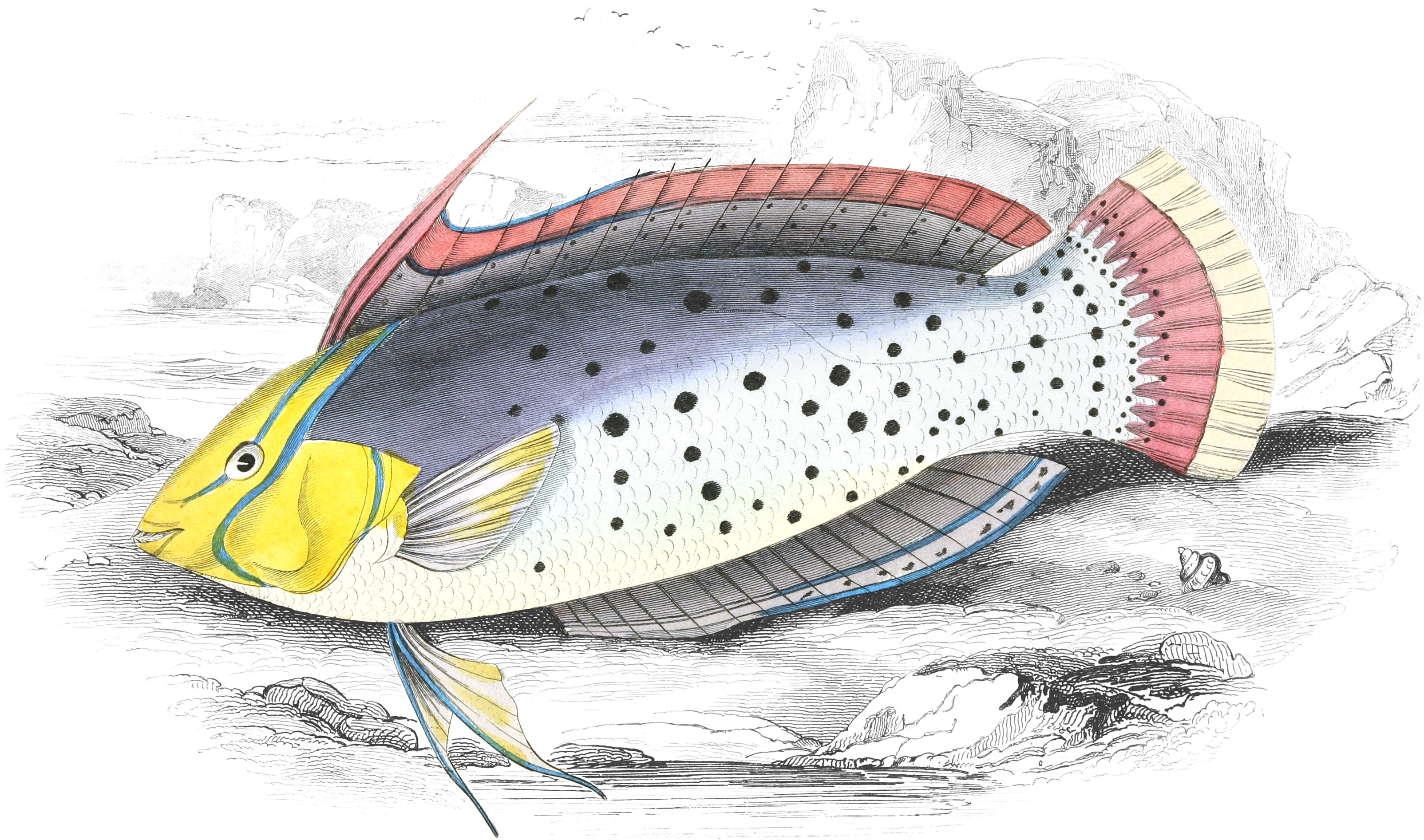
Plate XXV
The epidermis exists most unequivocally in those fishes in which the surface is smooth, without being viscid, as in the mackerel and sword-fish; in other fishes, the mucosity of the surface in a great measure supplies its place. And as the abundance of this mucosity varies very much in different fishes, it is to be inferred, that the apparatus by which it is generated exhibits a corresponding variation. Accordingly the hag, the lamprey, the blenny, the eel, both the common and the electrical, and viscous fishes in general, present on the head, the jaws, and along the lateral line, a greater or smaller number of holes, or rounded pores, systematically arranged, which have been looked on as the source of this viscosity. It is, however, by no means certain that such is the only use of these pores; or supposing that they are concerned in producing it, there are, nevertheless, evidences, that the whole external surface of the skin is employed in the secretion, which is, in fact, a fluid epidermis.
There is still another property possessed by a few fishes, which, though not connected with the structure or appendages of the skin, will naturally rank among the organs of defence, and should be mentioned before we begin to notice those more properly employed in attack or offence. We allude to the electric power possessed by the torpedo, gymnotus, and a few others. It is perhaps the case, that this curious power is sometimes used as a mode of benumbing the prey which come within the range of the strike, particularly by the torpedo, which is a sluggish and inactive fish, and possesses the manners, in a great measure, of the rays; as an organ of defence, however, it is known to be most powerful, both against enemies of its own kind, or the contrivances wrought by the hand of man. Any animal, or even substance, coming within its reach, and producing alarm, is immediately subjected to it, and the stroke being communicable, though ether conducting substances intervene, not being in actual contact is no safeguard, and has afforded a subject for the poet to dilate on, while of old a certain superstitious awe was conveyed with it. Its immense power, in some species, is very remarkable; and the spirited account of Humboldt, which we introduced into our First Volume on Ichthyology, where it is used to capture the wild horses of South America, will be read with interest.
The species which possess this property are mostly of clumsy or disgusting form, particularly the torpedos.
Galvani’s Torpedo
Torpedo Galvani, Risso.
Will show their form. According to our latest British Ichthyology, the torpedo occurring on the British coasts has scarcely been properly identified with those of the continental seas; but that which we have given to represent the form is one of the most powerfully supplied with galvanic influence.
The fishes in which these electrical organs have been unequivocally discovered, are, as before mentioned, the electric ray (Raja torpedo), now the torpedo proper, the electric eel (Gymnotus electricus), the Silurus electricus, the Tetrodon electricus, and the Trichiurus electricus, or Indicus, as it is termed by some naturalists.
Carus declares the electric organ in these fishes to be distinctly of a muscular nature, consisting of numerous strata, cells or prisms formed by tendinous partitions, and filled with a thickish gelatinous fluid. The same anatomist adds,—
As a great number of nerves (but few vessels) are distributed to these cells and strata, and as the activity of the organ depends upon those nerves, it is at least not improbable that the nervous power accumulates in the cells, whence it can be voluntarily discharged, in the same manner as it is capable of being collected in muscles, in order to produce their contraction.7
It was before noticed, that there is a peculiar developement of the spinal chord in those fishes which possess the electrical power; and it should be added, that in Spallanzani’s experiments on the electric ray, it was found that the activity of the shock was always proportioned to the energy of the vital powers at the time, and that the section of the nerves of the organ effectually destroyed this property in the animal.

Plate XXVI
The organs of offence or attack in fishes may be said to be very limited; a few possess weapons of peculiar structure and formidable appearance, and are said occasionally to use them in wanton attack; but as they are few in number, so is their actual usage but comparatively little known. We are not aware of battles among species taking place as among animals dwelling upon land, nor of struggles for supremacy during the season of amours; but if these more frequently take place in the hidden recesses of the ocean, they may, with a few exceptions, be carried on by the assistance of the tail and of the teeth. The latter are the great predatory organs among all the rapacious fishes, and the great proportion of these continues living one on another—a strong upon a weaker race. We have their structure in almost every variation. In the greater proportion they are used only for seizing and securely holding their prey, without assisting in any manducatory process. Ina few they crush the harder crustacea and molusca before they are swallowed; and by still fewer they are placed low in the gullet, and act by muscular contractions on the food as it passes down, or perhaps may for a short period be retained within their power.
The shark tribe has for ages been a fruitful source of terror even to man. Of these the white shark (Squalus carcharias) is the most noted. His means of offence lie in the size of his mouth, the strength of his jaw, the numerous teeth with which his mouth is armed, and in the extreme vigour and rapidity of his motions. An erroneous account is usually given of the teeth of the shark: it is said that the interior rows of teeth lie flat while the animal is in a state of repose, and that they become erected when it prepares to seize its prey. The truth is, that the outer row of teeth is alone of any use to the animal; the other rows are a provision or resource against the breaking of those of the outer row, and till this happens. they remain flat in the mouth, incapable of being erected; as soon, however, as a tooth in the outer row is broken, as frequently must happen, owing to the force with which the animal closes his jaws, often on hard bodies, the tooth immediately within becomes erected, and advances forward with the line of the outer row, to supply the place of that which was destroyed.
The annexed wood-cut will show the general distribution of the teeth in the jaws of these voracious fishes, and the figure on the accompanying plate that of the general form adapted for rapid passage through the water by a swift and gliding motion, and an activity and grace in making turns in pursuit of its prey.
White Shark
Charcharias vulgaris
The white shark is supposed to have a particular predilection for human flesh—this it would be difficult to establish; and perhaps all the points in its history, which serve to countenance such a supposition, are sufficiently explicable, on the assumption of an extreme voracity, such as belongs to many fishes not so well provided with the means of gratifying it at the expense of man. When a man unfortunately comes within reach of a shark, he is fortunate if he escape with the loss of a limb, to sever which is, for this voracious creature, but the work of a moment. Yet many stories are current, some of which deserve credit, of man having successfully encountered sharks in their own element. The plan of attack depends on the knowledge of the mode in which the shark seizes his prey; to do this the animal is obliged to turn on its side, and while it in assuming this attitude, some daring spirits have succeeded in plunging a knife into its body, so as to escape threatened destruction, or avenge the death of a friend. The teeth in the various forms of this family are all most formidable weapons, remarkably sharp, hard and cutting; and in some of the larger species, of such size as entirely to preclude the possibility of escape with life, to any creature which is so unlucky as to come within their grasp.
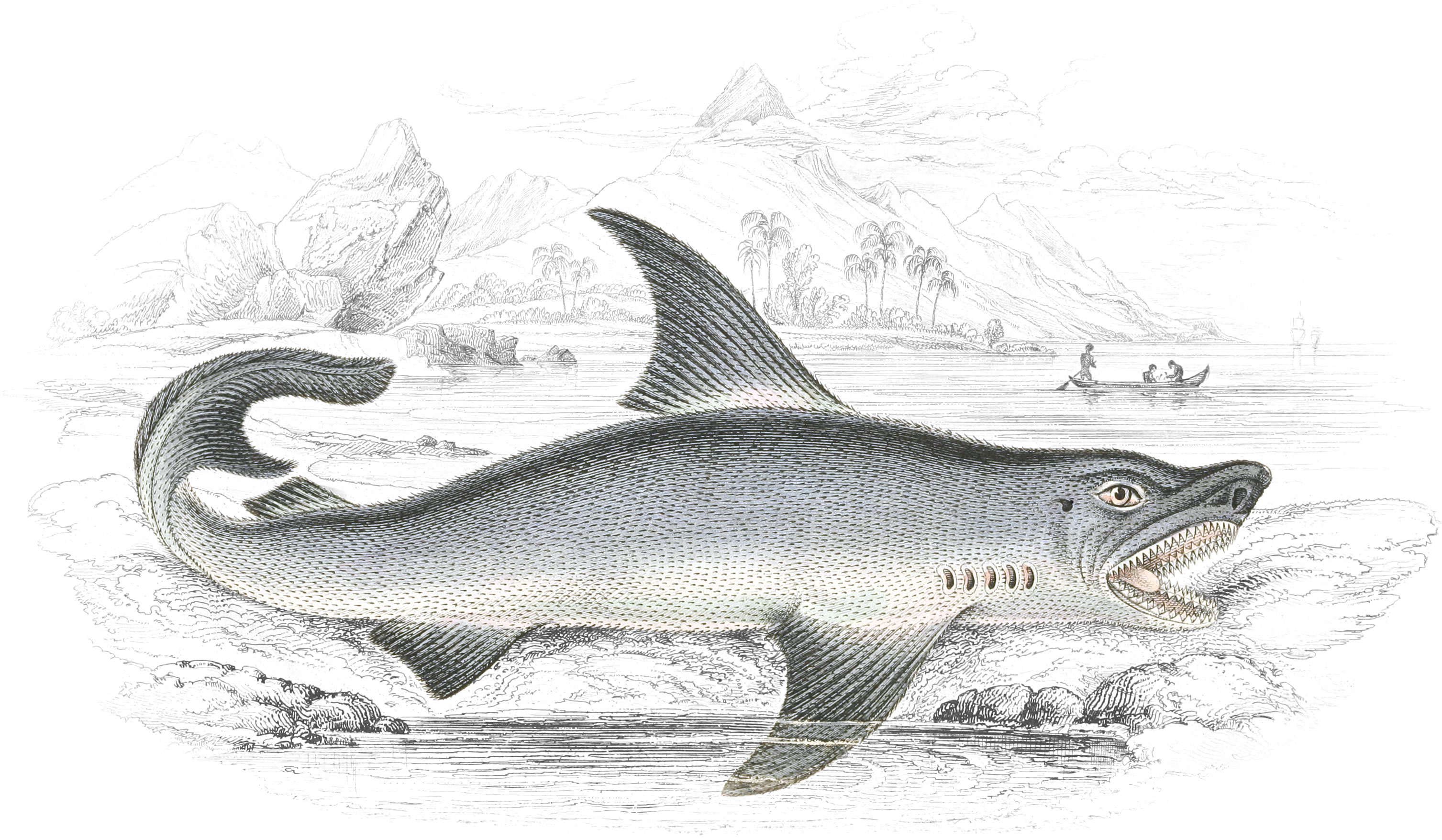
Plate XXVII
Blue Shark
Plate only given.

Plate XXVII*
Many other fishes possess a very powerful formation of long and sharp teeth, as in the accompanying cut of the head of Lonchurus ancylodon, Schn.
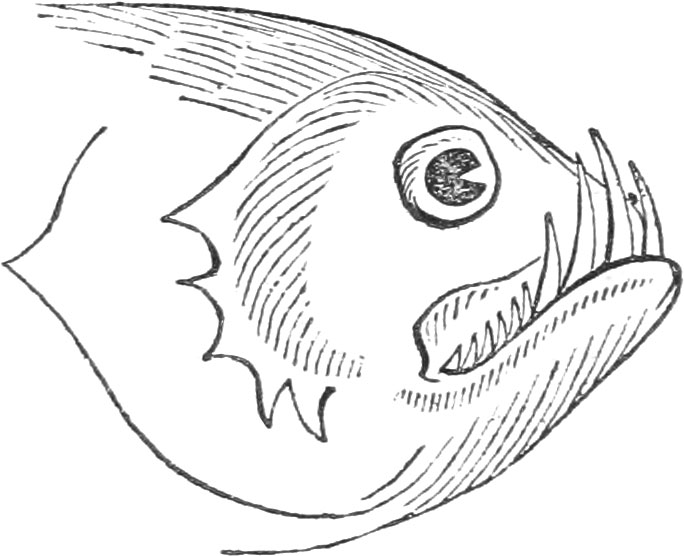
Lonchurus ancylodon Teeth
In none are the teeth comparatively more formidable than in the common pike, the shark of the British waters; in specimens of this fish, of from twenty to thirty pounds weight, they are as large as those of a cat, and the whole of the roof of the mouth, the tongue, and arches of the gills are so thickly set, that, when every circumstance is considered, this provision is more ample than in any other fish. Many of the spari have very strong and sharp teeth; in some other forms, again, the teeth construct, as it were, the edges of the mouth, and consist of large bent plates, having the appearance of a parrot’s bill (see cut).

Anarichas lupus Teeth
In the Anarichas lupus, or sea-cat, they are thickly set, and, though rounded on the tops, are so hard, as to leave a mark on the hardest substances which have been seized by the fish in the struggles of death. In the rays, again, they cover the lips like a pavement, are blunt, and very regularly set, but from the muscular power which acts on them, they are beautifully adapted for crushing the hard shell-fish on which these tribes subsist. In all their modifications, however formidable, we do not know them in any other light but as organs for seizing their prey. When the fishes are taken by any artificial means, they will be roused, often successfully, to cut the line or cord which hold them, and any object placed within the jaws is firmly seized and held; but this cannot be viewed in the light of voluntary attack.
The saw-fishes indicate unusual provisions for offensive warfare. These are closely allied to the sharks, and several species have been discovered. The upper jaw is prolonged into a projecting flattened snout, the greatest length of which seems to be about six feet. On the lateral margins of this snout are set, horizontally, numerous sharp pikes similar to teeth, which exhibit a formidable edge, and if wielded with force must be a most powerful and dangerous weapon. The true teeth of the animal are placed on the jaws, somewhat similar to those of the rays and some sharks.
The Pristis antiquorum is one of the largest species, growing to the length of from fifteen to sixteen feet; at least such is the size of the specimens hitherto met with. The general colour is a dull grey, growing paler as it approaches the under parts, where it is nearly white. The wood-cut will show the form of the snout, or saw, which the small size of our other figure scarcely details, sufficiently.
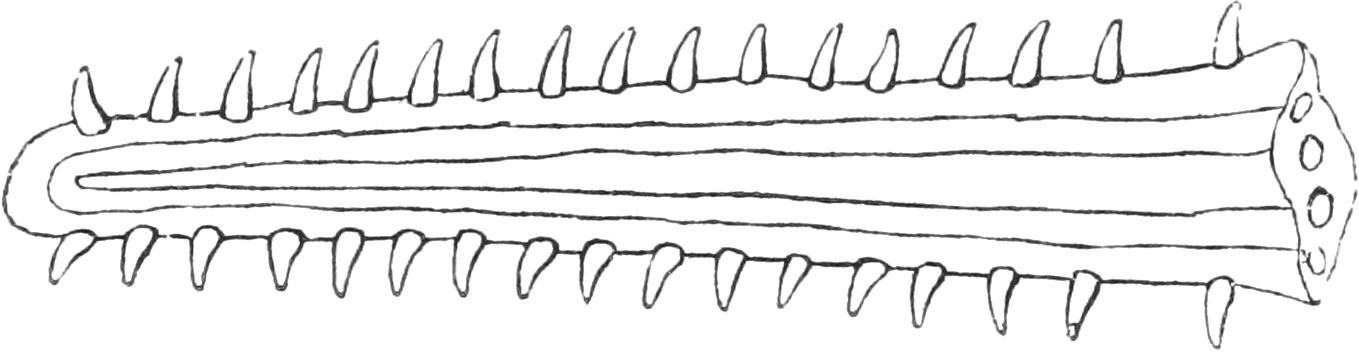
Snout of P. antiquorum
The saw-fish is said to be one of the most formidable enemies of the whale tribe. Though so much smaller, it attacks and even overcomes the Greenland whale. It seems probable, however, that one saw-fish is unequal to such a victory, and that several usually attack the whale in concert. Mr. Yarrel, in his recent work on British Fishes, refers to an account of a combat, on the west coast of Scotland, between a whale and a company of saw-fish, aided by an auxiliary force of thrashers; the sea was dyed with blood from the stabs inflicted in the water by the serrated snouts of the saw-fish, while the thrashers, watching their opportunity, struck at the unwieldy animal as often as he rose to the surface for breath. We shall illustrate this form farther by the
Cirrated Saw-Fish
Pristis cirratus, Latham.
P. cirratus, Lath.—Trans. Lin. Soc. ii. p. 281. fig. 28 27.
A native of the New Holland seas, and apparently yet not very common; its principal characteristic is the presence of two cirri on each side of the snout or saw. The spines of the saw are irregular, three smaller or shorter ones being placed between each larger. The mouth, where the true teeth are placed, is furnished with five rows of minute, but very sharp teeth. The colour is a pale brown, shading below to white.

Plate XXVIII
Common Sword-Fish
The sword-fishes present another formidable armature, which is capable of being employed with immense force. They have been separated into two subdivisions, both armed with the elongated snout or sword, as it is popularly called, but differing in the want of ventral, and in the forward position of the dorsal fins, and to them has been applied the name of Xiphias, or sword-fish; while the others, by which we shall illustrate the form, has the dorsal fin large, while the ventral fins are represented by long and slender filaments. Another name has been given to them, the

Plate XXIX
Indian Histiophorus
Histophorus Indicus
Brought, according to Cuvier and Valenciennes, from India by Banks, and from the Red Sea by Kherenberg, will serve as an illustration. The form is rather graceful, and this is heightened by the ample dorsal fin. Species have been taken seven or eight feet in length, and, according to those naturalists who have seen the fish newly taken, the colour is of a brownish-red on the upper parts; the body is covered with large an lengthened scales.
The sword-fishes are of mild and gentle manners, living chiefly on marine vegetables, and seldom attacking other animals, except in self-defence. On such occasions they. become bold and active, maintaining fierce combat with powerful whales, and, as has been alleged, even with the crocodile; when thus engaged, they inflict wounds not less deadly than those given by the saw-fish, as the weapon, though not serrated, is of much harder consistence. The Xiphias gladius inhabits the Atlantic, from the northern ocean to the south temperate zone, and also the Mediterranean. It attains the length of fifteen, or even twenty feet, the sword being then four or five feet long; this sword is merely a prolongation of the snout covered with skin, and flattened into a sword shape. Though this projection is far from being sharp, either on the margins or at the point, yet, when urged forward by the rapid motion of the animal, it has been known to pierce a thick plank of wood. This fact, referred to by Pliny in ancient times, has often been called in question; but it appears to be sufficiently authenticated by recent instances, a piece of plank, containing part of the snout of a sword-fish, is exhibited in the British Museum. Several instances of this fact are mentioned by Cuvier and Valenciennes; and specimens are preserved, in the Museum at Paris, of the sword imbedded in parts of vessels, which, it is considered, the fish had mistaken for some large whale, or other marine animal, which they had been in the habit of attacking.
Nature has furnished a great proportion of fishes with a more than ordinarily powerful array of teeth which are used to secure their prey, but not, we think, almost ever as either defensive or offensive weapons; and we have seen very formidable weapons in the sword and saw-fishes. There are, however, other modes of securing their prey for which suitable provision has been made; a very curious one is observed in the family of Chætodon, a tribe of fishes remarkable also for their often singular forms and for the beauty of their colouring. Those possessing the curious property we are about to describe, and where the jaws are elongated, have been placed in a sub-genus by Cuvier and Valenciennes, under the title of Chelmon.
The singular mode in which one of this genus, the Chætodon rostratus or jaculator, strikes down its prey, will excuse a few words of digression here. It approaches with gentle caution to within a few feet of the animal it seeks to make prey of; it then projects a drop of water from its mouth at the insect with an aim so unerring as seldom fails to bring it down, and secures it from escape. This species has been kept in a vessel of water for the purpose of examining more narrowly this unusual mode of overcoming its prey. If an insect be fixed on the edge of the vessel, or held on the end of a stick within reach of the missile drop, the fish goes on repeating the discharge, as the insect does not fall, while it hardly ever misses its aim. On these occasions it seems to be provided with a large supply of water, as it perseveres for a considerable time in projecting drops to the distance of four or five feet, without any appearance of taking in a fresh supply.
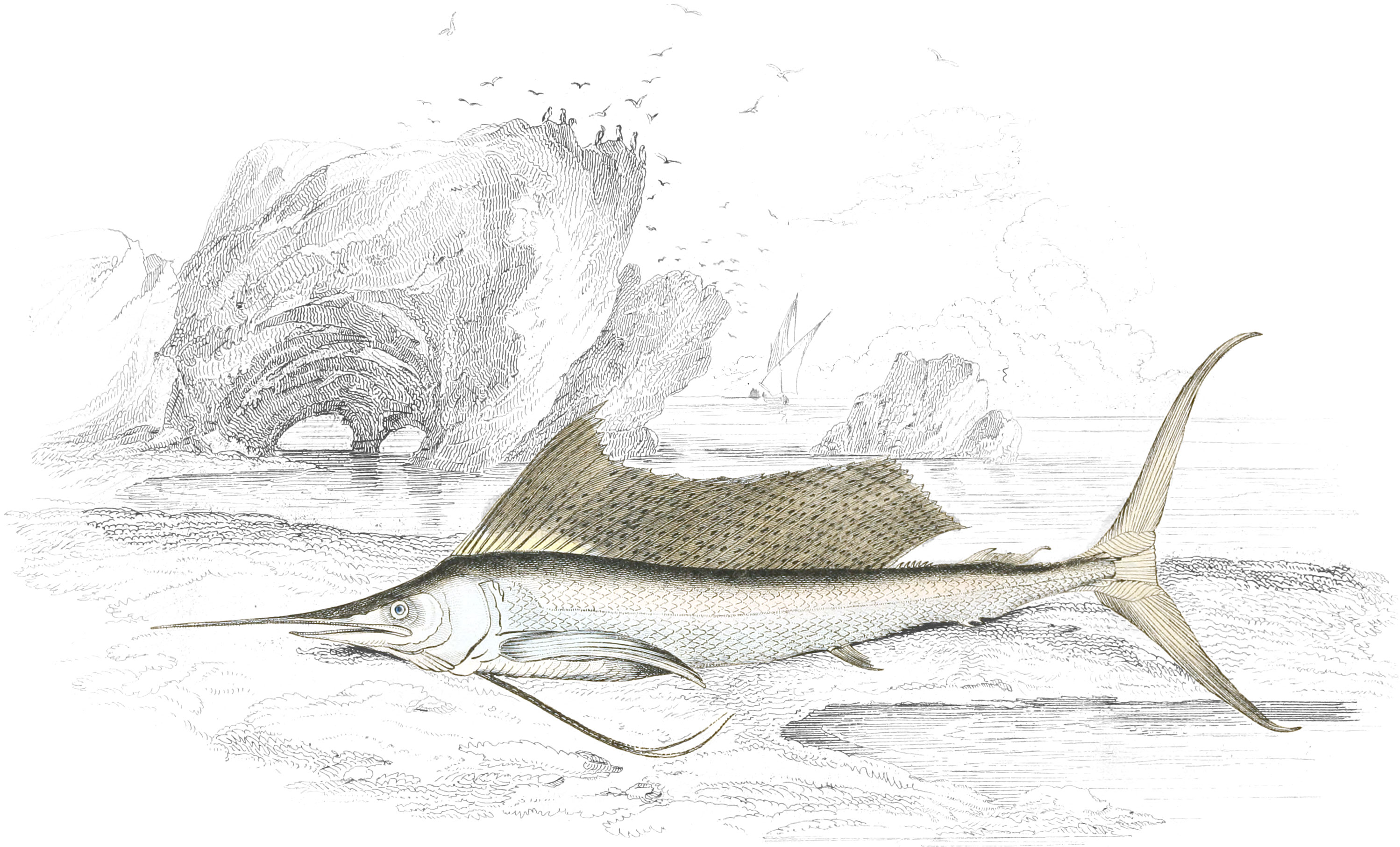
Plate XXX
Another example of this singular structure used in securing their prey is seen in the
Long-Beaked Chelmon
Chelmon longirostris, Cuv. & Val.
It is found in the Indian ocean, around the coasts of the Society Islands, and the Isle of France. The form is not particularly elegant, but the colouring is remarkable from the decided marks of black on the sides of the head. It appears to be a rare species; and we have copied Valenciennes’ figure, with the view of directing attention to the better ascertaining of the manners generally, and the mode in which it uses the provision of its beak.

Plate XXXI

On the Economical Uses of Fishes
Even from remote antiquity the seas have furnished an abundant supply of food for man, and the fisheries there carried on give employment to no inconsiderable part of the population of the entire globe. When we consider the extraordinary fecundity of many kinds of fish, and indeed, of most of those which are used as food, one is at no loss to account for the immense shoals in which they swim, and the myriads which people every sea, lake, and river, as Mr. Barrow observes,
affording an inexhausible harvest, ripe for gathering at all seasons of the year, without the labour of tillage, without expense of seed or manure, and without the payment of rent or taxes.
Accordingly, the fisheries in this country have all along received the attention due to them by Government, and statutes have been enacted for their extension and promotion. One of the measures from which the most important results were anticipated, was the giving of bounties to those engaged in the fisheries, and although this certainly had the effect of increasing the quantity of fish produced, yet it is very questionable whether that result was attended with ultimate success. Although the bounty system is now discontinued, and the number of those engaged in the fisheries much reduced, yet, according to Mr. Barrow, the value of the entire annual produce of the foreign and domestic fisheries of Great Britain is as much as £8,300,000; and, although the accuracy of this estimate is disputed, and even by a most competent judge8 reduced to less than one-half, yet the fisheries must ever be regarded as an important source of national wealth. Besides giving employment to some, and contributing to the necessities of others, the British fisheries may be considered as a nursery in which are reared a large portion of our finest seamen, furnishing a ready supply from which to recruit the navy and the merchant service.
The Dutch owe much of their prosperity to the fisheries, and so do the Americans, always noted for their enterprise and the zeal with which they carry on their undertakings. The French, too, and many other nations, carry on this branch of industry to a greater or less extent.
Perhaps the esteem in which fish is held as food (in this country at least) cannot be better illustrated than by attending to the fact, that 120,000 tons of fish are annually imported into the metropolis alone, and in order to procure this supply, whole fleets of vessels are employed, manned by their thousands of not merely British, but even Dutch and French fishermen, bringing fresh fish, such as cod for instance, from a distance of many hundred miles, as from the coasts of Scotland, and even from Norway.
From the class of fishes are procured not only articles of food within the reach even of the poorest, but luxuries and delicacies to be seen only at the tables of the rich, although few would now-a-days be inclined to go the length of some Roman epicures, who are known to have given upwards of £80 for a single fish, one too of no great size, and held in light esteem at the present day. Besides these, isinglass or fish glue, as well as the caviare of commerce, are both obtained from the sturgeon, and a kind of shagreen is prepared from several fishes of the shark family. The scales of some species are used in the manufacture of artificial pearls, and excellent oil is got from the liver of many others. Fishes are sometimes used by the farmer as manure, but only when very abundant, and besides, those which are generally employed for this purpose, are from their small size unfit for food, and would otherwise be useless. Lastly, among the economical uses of fishes it will be proper to include the pleasure afforded by angling, although both Dr. Johnson and Lord Byron have denounced this pursuit as at once absurd and cruel, and would fain condemn all its votaries from the days of Isaac Walton downwards, as at best but cold-blooded mortals, devoid of the better feelings of our nature. Yet it is regarded by many, and we think with justice, as a delightful pastime, the source of much enjoyment.
To enumerate merely, all, or even the greater part of those fishes which are used as food by man, would be a task not easily to be accomplished; we shall, therefore, and in strict accordance with the title at the beginning of this chapter, confine our observations to a few of the most important in an economical point of view. Accordingly, we may begin with the cod, as it is, perhaps, upon the whole, the most important.
Before the discovery of the immense supply of cod to be found on the northern coasts of America, the principal fishery was carried on off the coasts of Iceland and Norway, as well as the Orkney, Shetand, and Western Islands. A great part of the cod taken on our own shores is eaten in a fresh state, and vessels have been constructed in which the fish are brought alive from a considerable distance, to supply the markets of our large cities, especially the metropolis. But it is on the great banks of Newfoundland and Labrador that the cod fishery is carried on to its greatest extent, by the Americans, British, and French, but especially the former. Here the cod is found in immense shoals, and indeed this is hardly to be wondered at, when we consider that nine millions of eggs have been found in the roe of a single individual of this species. A few years ago, it was calculated, that about ten thousand British seamen were employed in the Newfoundland fisheries, independently of perhaps an equal number on shore, engaged in preparing the fish. Cod is there preserved in two ways, and is called respectively green, or pickled, and dried cod. Most of the dried fish exported from Newfoundland by British subjects, is sent to Spain, Italy, and other Catholic European countries; the rest goes to the West Indies and Great Britain.
The British Government have now discontinued the plan of giving bounties to those engaged in the cod fishery, but the French, as late as 1829, in which year 400 ships were sent out by them to prosecute this fishery, gave bounties to the amount of £60,000. In order to describe the manner in which this fishery is conducted, we cannot do better than give an abstract of an account by Mr. Audubon of “Cod Fishing at Labrador.” The American vessels used for this purpose, are commonly either schooners or “pickaxes,” of about one hundred tons or so, manned by twelve men; and each vessel is provided with a small boat for every two of the crew. The wages of the fishermen vary from sixteen to thirty dollars a month, and spirituous liquors are seldom allowed on board. The baits used, are at first mussels salted for the purpose, then capelins, and often the flesh of gannets, and other sea-fowl. The vessel being in a convenient harbour, at three o’clock in the morning the boats proceed to the fishing banks several miles off, and anchor in a depth of from ten to twenty feet. Each man has two lines, and the fish are unhooked when drawn up, by throwing them across a bar of iron. The boats, after being filled, return to the vessel, and the fish are thrown on deck by means of a pole armed at the top with an iron hook. The boats again return for more fish, of which Mr. Audubon calculates, each boat may procure 2000 per diem, and, in the mean time, the men on board proceed to clean the fish, which they do in the following manner. One breaks off the head, throws it overboard, and rips up the belly. His neighbour tears out the entrails, separates the liver, which he throws into a cask, and casts the rest overboard. A third person separates the backbone, and throws the fish into the hold, where others are busy in salting and packing the whole. Such of the fish as are intended to be dried, are, after being salted, laid side by side in the sun, and allowed to remain thus exposed for some time, after which they are piled in heaps, the process being now completed. When the capelins approach the shore to spawn, the cods follow them in prodigious shoals, and immense numbers of the latter are caught in seines and other nets, although this mode of procedure is prohibited by law, a large proportion of the fish thus taken being altogether useless from their small size. Finally, Mr. Audubon considers, that whatever be the means of the fishermen, if the season is favourable they are generally well repaid for their labour, and he has known of individuals engaged in this fishery who procured an independence in the course of perhaps ten years.
The cod is caught on our own coast by means of long lines, which are always shot across the tide, and allowed to remain for about six hours. The hooks are placed at regular distances along the line, baited with mussels, limpets, or other shell fish, and sand eels are sometimes used with great success for the same purpose. At other times, the fishermen use hand lines, of which one man is able to manage two, each with a couple of hooks, and in this way, Mr. Yarrell mentions, eight men have been known to take eighty score of cod off the Dogger Bank, in the course of a single day.
The value of the cod, as an article of food, both in the fresh state and when dried, is too well known to require any comment. In Iceland and many parts of Norway, it forms, perhaps, the principal food of the inhabitants; also in Sweden, where it has been fished for ever since the middle of the 14th century. The liver, which is large, furnishes oil of excellent quality, and to give an idea of the extent to which it is used, we may mention, that in 1829, the Labrador and Newfoundland fisheries yielded oil of the value of about £18,000. By the Icelanders and Norwegians, the heads, as well as the bones, are given to their cattle as food, and good isinglass is made in Iceland from the swimming bladder. The tongue is considered a delicacy, and the gills are used as bait. In fine, almost all parts of this fish are useful to man.
Many other species of the cod family, besides that just mentioned, furnish food more or less excellent for man. Of these we shall enumerate the most important. Though of smaller size, and perhaps inferior to the cod, the haddock, Morrhua æglefinus, is much prized as an excellent article of food, both when fresh and in the dried state. It is taken abundantly on all our shores, especially on the eastern coasts, and is fished for in the same way as the cod. The haddock is said to be in best condition in the months of November and December, as well as in June and July. The whiting, Merlangus vulgaris, is a much esteemed and delicate fish, found on all our coasts, but the greatest numbers are taken in the winter months, when large shoals approach the coast to spawn. Itis sometimes eaten in a dried state, but is preferred when fresh. When of small size, being then known by the name of sillock or podley, the coal-fish, M. carbonarius, is considered as a delicacy, and even equally so with the preceding, and at certain seasons forms a principal part of the food of the poorer classes in the Hebrides and Orkney islands. When of large size, it is generally salted or dried, and is at best but a course fish. It is, however, sometimes very abundant, and Mr. Couch says, that on the Cornish coast, he has known four men to take with the rod and line twenty-four hundred weight of this fish in the course of a very few hours. The pollock, M. Pollachius, is another coarse insipid fish when of ordinary size, found in Britain, North America, Asia, and the indies, and, according to Dr. Richardson, “very good bread” may be made from the roe. The hake, Merluccius vulgaris, though found in all the northern seas, is in this country most abundant on our southern coasts, where it is very destructive to the pilchard, a fish to be afterwards mentioned. Off the coast of Waterford the hake is so abundant, that one thousand have been taken with the line by six men in the course of a single night. It is also fished for in the Mediterranean, and is usually salted and dried, but little being eaten in the fresh state. The ling, Lota molva, and the tusk, Brosmius vulgaris, are two other large and coarse fish, taken on our own coast, principally among the northern islands, and a great portion of what is there procured is exported to Spain and other Catholic countries, where they are eaten in large quantities during lent. The oil obtained from the liver of the former fish, besides being used by the poorer classes in many places for ordinary purposes, has been rather extensively employed internally, in cases of severe rheumatism, and often with great success but it is said, that a person who has taken it, for some time continues to exhale a disagreeable odour. The air-bladder, or sound of this fish, is used for the same purposes as that of the cod. The different species above-mentioned, constitute, collectively, what is called the white fisheries, which give more permanent employment than almost any other.
We shall now consider the salmon fishery, which in Britain is principally carried on in the Scotch and Irish rivers. Unfortunately, however, its value has diminished fully one-half of late years, owing to the scarcity of fish, which is accounted for in various ways, some attributing it to the great increase in the number and kinds of water-machinery, others again to the prevailing use of lime as a manure, of which part is carried down by the floods, and destroys the fish; but it is now generally considered as owing to the enormous extent to which poaching is carried on during close time, when the breeding fish can easily be destroyed. In order to protect this noble fish, which has justly been considered as private property, as much so as the different kinds of game, various statutes have been enacted by Government, and these now in force fix the duration of close time between August and January, according to the circumstances of different rivers.
The salmon is caught in our rivers and estuaries in nets of different kinds. What are called stake nets, are used in friths, estuaries, and the mouths of rivers, and are constructed by fixing a line of stout poles in the mud or sand, at a place of easy access at low water; between these poles is stretched a strong net, conducting to a labyrinth in which are enclosed such fish as come in contact with the meshes. This kind of net is often carried far out to sea, sometimes employing several miles of netting. Salmon are taken at the mouth of the Forth, above Alloa, in bag-nets, which are dropped into the stream or current of tide from a kind of stage or platform run out from the bank. Whenever a fish enters, a man in readiness pulls up the net and secures it. Many fish are caught in yairs, somewhat similar in construction to stake nets, although on a much smaller scale, and sometimes constructed of wicker work instead of netting. But perhaps more salmon are taken by what is called the coble and net fishery, than by any other method. This is carried on in large streams, such as the Tay and Tweed, in the following manner:—A small boat of a peculiar construction, called a coble, managed by a single man, and carrying at the stern a long net, one end of which is fastened to the shore, is rowed out into the stream; the net, which is heavily weighted, sinks to the bottom, and is kept nearly perpendicular by means of large floats in its upper margin; and, as the boat proceeds, the net continues dropping into the water, describing, by the time the coble reaches the shore, a complete semicircle. The whole net is then dragged to the bank, sometimes by the assistance of a windlass. Higher up the rivers, weirs are formed, by building a dyke across the stream, generally one of small size; in this dyke are several apertures, leading to enclosures of different kinds, called cruices, into which the fish enter, and are taken out at convenience, being unable to find an opening through which to escape. The salmon is also taken on the flats of the Solway Frith, by means of funnel shaped nets fastened to a pole, which are used during the ebbing and flowing of the tide. In the Welsh rivers, salmon are fished for with a kind of trammel net, from small boats called coracles, carrying each a single man.9 There are, besides, some other contrivances for netting this fish in common use in various parts, which it would be needless to mention. Many fish are killed during the period when they ascend to the stream heads for the purpose of spawning, by means of what is called a leister or waster, an instrument somewhat similar to a harpoon, or perhaps still more so to a trident. Salmon are speared with this instrument by torch-light, and the fish, which are sometimes of very large size, though often unhealthy at this season, bewildered by the unusual glare of light, and the splashing in the water, are easily discovered, and followed from pool to pool, till an opportunity of striking them is afforded. Besides these methods for destroying salmon, no small number is annually taken by the rod, and this kind of fishing has probably now arrived at the highest pitch of perfection. Angling for salmon (in the Tweed at least) is allowed for a month after the net fishing has closed for the season.
The greater part of the salmon taken in the Scotch rivers is sent to the London market, principally packed in ice; comparatively little is sold in the neighbourhood of the fishing stations, and much is dried, pickled, or otherwise preserved. In many parts of North America it is very plentiful, being annually exported from Newfoundland alone, of the value of, in 1815, £14,000. This valuable fish is now very rare in the United States, where it was formerly abundant, in consequence of the number of steamers plying on all the navigable rivers. It is now confined, we are informed, to the north-eastern states alone. In the arctic regions, the salmon occurs in such profusion, that 3378 were taken at one haul in the month of July, and Sir John Ross obtained a ton weight of salmon from an Esquimaux in exchange for one or two knives.10
The whole of the numerous species composing the family Salmonidæ, may be regarded as furnishing food, excellent in its kind, for man, but none of them, in this country at least, are of equal importance, in an economical point of view, with the salmon which we have just treated of at considerable length. One species, however, well known as the salmon trout, is so abundant in the Scotch rivers, and attains such a large size, as to be frequently sold for the young salmon, although much inferior according to some.
Two hundred are frequently taken at a single draught of a sweep net, and three hundred have occasionally been counted.
In fact, the different kinds of trout, and other salmonidæ in this country, are better known as affording amusement to the angler, than as food for man. There is, however, one exception. It is a small fish, the smelt or spirling, Osmerus esperlanus, found abundantly on the British coasts, and much esteemed as a delicacy. It is generally taken in greatest plenty at the mouths of large rivers, or in estuaries, as well as on sandy shores, in small nets, and always commands a ready sale.
We shall now proceed to give an account of the fishery for the mackarel, Scomber, scomber.
This beautiful fish annually visits our coasts in immense shoals, and its fishery gives ample employment to thousands in the spring and summer months. It is said to be in best condition in May and June, and should be eaten when very fresh, as it can be kept in a fit state for food only a few hours.
Mackarel are caught either with the hook and line, or by the drift-net, the latter being generally preferred, as by it larger numbers may be taken. The net in question is 20 feet deep by 120 feet in length, and the size of the mesh is usually about two and a half inches. As many of these nets as are at hand are joined together by a strong rope, and thrown out when the fishing vessel is in full sail. The whole extent of netting, which not unfrequently exceeds a mile in length, properly suspended by corks, but without any lead to sink it, being shot out, the boat is fastened to one end of the drift-rope, and rides as it were at anchor, the strain of the vessel keeping the net in a state of extension. In the morning the whole of the nets are hauled in, and the fish, which during the night had got entangled in the meshes, are taken out and conveyed to shore, generally by other boats, leaving the fishermen to resume their former occupation.
By means of these nets astonishing numbers of fish have been taken in a single night; thus, Mr. Yarrell states, that on the 30th of June, 1821, the value of the catch of sixteen boats from Lowestoffe amounted to £5,252.
Mackarel are also caught by a species of angling, by a line heavily weighed and fastened to a stout rod, while the vessel is under rapid sale. The bait used is either a portion of a small fish, even the mackarel itself, or else a piece of scarlet cloth, which, strange to say, is for them at all times a deadly bait. Two men, in this way, it is said, may capture from five hundred to a thousand fish in the course of the day. That the mackarel fishery is of considerable importance may be concluded from the circumstance, that off the Suffolk coast alone this fish is taken of the annual value of £10,000, and that too in the space of only six weeks. The mackarel, though considered a somewhat dry fish, is nevertheless held in high repute, and, when the take is considerable, on account of the short time it will keep fresh, is sometimes sold at a very low rate. Thus, although in Scotland, where it is rarely so plentiful as a little farther to the south, it is seldom within the reach of the poorer classes, yet in Norfolk, during last summer, we saw abundance hawked about at the rate of two a penny, though this is far from being the usual price.
In North America, especially off the coasts of Labrador and Newfoundland, mackarel of different species, however, occur periodically in prodigious shoals, and their arrival is eagerly looked for.
A fish nearly allied to the preceding, the tunny, Thynnius vulgaris, was well known and highly prized by the ancients, having constituted from the earliest ages, according to Dr. Neale, a great source of riches and commerce to the nations inhabiting the shores of the Mediterranean, and, in fact, being the principal food of the people of Bithynia. We shall have occasion to speak of it at greater length hereafter.
We may now pass on to the consideration of the herring fishery, and there is perhaps no one fishery in any country which has come so much under the attention of the legislature, or given rise to so much speculation. Fishing villages were built, and companies were formed, which were all eventually unsuccessful in their objects. Then, soon after the commencement of the present century, a fishery board was established by Government, and a bounty was given, not merely on the tonnage of the vessels employed in the fishery, but also on the number of barrels produced, which bounty on the latter, for eleven years, was equal to half the value of the herrings as sold by the fishermen. This bounty of four shillings a barrel, naturally held out great inducements to begin the business of herring curing, and gave rise to much speculation. The fishery was of course extended, and the number of herrings produced much increased. By and bye the bounty was gradually diminished, and, in 1820, entirely done away. The policy of this measure is unquestionable, as henceforth the supply will be more proportioned to the real demand.
The Dutch have been long engaged in this fishery, which, at one time, was said to have given employment to one-fifth of the whole population of Holland. Though this estimate is now generally considered to have been overrated, yet no doubt much of the prosperity of that country then depended on the fishery in question, and it is even now a proverbial saying, that “Amsterdam is founded upon herring bones.” The Dutch have always been acknowledged as superior in the art of curing herring to any other nation, and their herrings, not many years ago, brought double or even treble the price of the British article in every European market.11 The British fishermen, though long encouraged by a bounty from Government, as before mentioned, yet failed in producing an article which can compete with the Dutch herrings, and for obvious reasons. The Dutch carry on the fishery at sea, and from the small quantity which their vessels are capable of containing, in order to cover the expense of fitting out, and ensure some profit to themselves, can only do so by preparing their few barrels in a very superior way, more as a delicacy than a staple article of food. The British, again, fish in the neighbourhood of their own coasts, and the immense numbers of fish which they take can only be either disposed of when fresh, or cured by them in the most expeditious way, and their profits are insured by selling a large quantity at a very low rate.
The value of the herring fishery in this country has been long progressively increasing. The fisheries in the north of Scotland, for instance, have been of immense benefit to the neighbouring counties, and have opened up a mine of wealth not easily to be exhausted. Thus, according to the Parliamentary reports of that date, in the year ended on the 5th April, 1819, the astonishing quantity of 340,660 barrels was landed from the fishery and cured, and of this, 227,162 barrels were exported from Great Britain, chiefly to Ireland, the continent of Europe, the West Indies, and even to Calcutta. Of this quantity only one twenty-second part of the whole was taken by English fishermen, the rest was the produce of the Scottish coast, the little town of Wick furnishing nearly one-fifth of the whole.
The herring is taken in drift nets somewhat similar to those employed for mackarel and pilchards, and much judgment is required in laying them to the greatest advantage. A dark night is generally most successful, and the drawing the nets in the morning is said to present a very animated scene.
Herrings are eaten both when fresh, pickled, or dried. In the fresh state, in towns in the neighbourhood of the sea, the consumption is at times enormous, for the herring furnishes a very cheap article of food to all classes. We recollect seeing this fish, a few years ago, sold in the streets of Edinburgh, for several weeks, at the rate of twelve for a penny. In this country the best pickled herring are considered to be those from Lochfine, on our west coast, and this is owing, not so much to the greater attention there paid in curing them, as to their original superior excellence and larger size.
Another fish belonging to the valuable family of herrings, the pilchard, Clupea pilchardus, though not quite so large as the herring, is yet of great importance in an economical point of view, when we consider that the average value of the pilchards taken annually, in Cornwall alone, is between £50,000 and £60,000. In 1827, the total amount of capital invested in this fishery was £441,215, giving employment to upwards of ten thousand persons, fishermen and others.
This fish is met with in various parts of the European seas, as on the coasts of France, but especially those of Cornwall and Devon, where there is an extensive pilchard fishery during the months of August and September. As far back as the days of Elizabeth, statutes were enacted for the protection of this fishery, and there was, until lately, a bounty of 8s. 6d. on every hogshead exported.
Pilchards are caught with seans or drift nets, but principally with the former. By means of one or more seans, each of which is 360 feet in length and 36 in depth, a shoal is enclosed; then the bottom of the net is drawn together by a peculiar contrivance, and the fish, thus prevented from escaping, are taken out at low water in small bag nets. Sometimes, according to Mr. Yarrell, the quantity enclosed is so great, that a week may elapse before the whole can be conveniently disposed of, a part being taken up every night. Seven thousand hogsheads, or about twenty-four millions and a half of pilchards, are said to have been taken at once from a single shoal, which, however, may cover an extent of several square miles.
Drift-nets, as we said before, are also used for the same purpose, and several are joined together when required, sometimes extending three quarters of a mile. The most successful time for using them is during a hazy night, with a slight swell or breeze. The nets are drawn soon after sunset, and again before morning, and it is considered a moderate capture if from five to ten thousand fish are taken in a single night.
Such as are intended for exportation are pickled, and afterwards packed in barrels by means of great pressure, which reduces the bulk of the fish to one-third of what it formerly was, and during this process, there is obtained a coarse but pure oil in the proportion of three or four gallons from a hogshead of fish. The mixture of oil, blood, and pickle, which exudes from the immense heaps into which the fish are piled before undergoing the process of pickling, is used in large quantity in the neighbourhood as manure. The fish itself, when very abundant, is sometimes used for the same purpose, though not to the same extent as the next species to be mentioned. It is said that a single pilchard is sufficient to manure a square foot of land.
Besides furnishing fresh food for the poorer classes in the neighbourhood, pilchards are exported, it is said, to the annual amount of £50,000, principally to the West Indies, along with herrings, for the use of the slave, or rather negro population there.
The sprat fishery in this country is carried on during the winter months, after the termination of the herring season. This fish, the Clupea sprattus of authors, is principally taken in estuaries, and elsewhere, in large bag-nets of a peculiar construction, from what are called stow boats, on the Kent, Essex, and Suffolk coasts. The quantity taken is sometimes enormous, and the greater part is used to manure the land, forty bushels being required to the acre. Sprats, moreover, are not unfrequently, despite of their small size, eaten in great numbers, being sometimes excessively cheap, and in Edinburgh, for instance, this fish, there known by the name of garvie-herring, is occasionally hawked about in carts at a very low rate.
A large species of herring, the shad, Clupea alosa, is found to enter certain of our rivers at stated periods, for the purpose of spawning, at which time great numbers are caught, principally, it is said, in the Severn. It is then much finer than when taken in the sea, and the flesh more delicate. It is taken in almost all our northern seas, even the Caspian; but is more abundant in North America, and there of more importance to man than elsewhere.
The white-bait fishery, as carried on in the Thames, is one of peculiar interest, not to say productive of considerable benefit to those concerned, on account of the esteem in which it is held by the Londoners, who resort in vast numbers to Blackwall, Greenwich, and other places where it is most abundant, to enjoy a fish dinner in certain taverns of white-bait notoriety. According to Mr. Yarrell, white-bait, Clupea alba, are taken in long bag-nets from vessels moored in the tide-way, and the fish are taken out by untying the end of the hose, and shaking it into the boat.
As this fish has lately been discovered, among other places, about Queensferry, and in the Solway Frith, where it has not been disturbed, its fishery in these places might be turned to some account, as remarked by Dr. Parnell, who was among the first to discover it in the localities just mentioned.
We shall now pass on to consider another series of fish, the Pleuronectidæ of naturalists, or flat-fish, the taking of which is called the flat-fishery.
The plaice, Platessa vulgaris, is held in high estimation for the table. “It inhabits sandy banks and muddy places in the sea.” It is often taken with lines, but, in the south of England, where it sometimes occurs in such extraordinary abundance that Mr. Yarrell has known great quantities of plaice, averaging three pounds weight each, to be sold at one penny per dozen, it is caught in trawl-nets, whenever such can be used. On the Norwegian coasts, where the sea is remarkably transparent, this fish is often taken of very large size by a short spear with a line attached, which is dropped down upon them, and not only the plaice, but many other kinds of flat-fish are thus secured.
The mud-flounder, P. flesus, is another very common fish, although much inferior in quality to the preceding. Sandy or muddy bays, or inlets, but especially brackish water at the mouth of rivers. which it sometimes ascends a considerable way during floods, produce this fish in the greatest abundance, and its capture is attended with little or no difficulty, as hardly any kind of bait will come amiss to it. In the Thames, vast numbers are caught in nets of a peculiar kind, so constructed as to enclose and secure all the fish within a limited space.
We now pass on to one which sometimes attains an enormous size, it is even said that three or four hundred pounds is no very unusual weight for the fish in question. It is the halibut, Hippoglossus vulgaris, but unfortunately this large fish is not much esteemed, “its flesh,” according to good authority, “though white and firm, is dry, the muscular fibre coarse, with but little flavour,” and, strange to say, “the head and fins are said to be the best parts.” This fish is more common farther to the north than in Britain, and is very plentiful, for instance, on the great banks of Newfoundland, where Mr. Audubon informs us, only the side-fin and the part adherent to that organ, are used. It is said, on good authority, that 160,000 halibut are annually imported into New York alone, yielding about 16,000 dollars, at only 2 cents per pound. The halibut is generally taken with the line, but we have known it harpooned off the Norfolk coast, although for mere amusement, for this practice is by no means general.
The turbot, Rhombus maximus, is the most prized of all the fishes belonging to this family. This fine fish is not so abundant in Scotland as it is still farther south, and the best are generally supposed to be taken on the Flemish banks. Pennant describes the extensive turbot fishery which was in his time, and probably still is, carried on off the Yorkshire coast near Scarborough. The lines used are about three miles in length, with nearly three thousand hooks. They are laid across the tide, and allowed to remain for six hours before being hauled. But the turbot is found in greatest plenty on the various sand-banks between the eastern shores of England and the coast of Holland. It is here that the Dutch fishermen carry on their great turbot fishery; and this has been so well described by Mr. Barrow, that we shall abridge his account of it.
This fishery begins about the end of March, a few leagues to the south of Scheveling, but, as the warm weather comes on, the fish gradually advance to the northward, followed by the fishermen, who continue to take them until the middle of August, when they are found on some banks off the mouth of the Elbe. At the beginning of the season the drag-net is used, which brings up not only turbot but many other fiat-fish in great abundance, but, as the season advances, and the fish retire to deeper water, where the net cannot be used with advantage, recourse is had to the hook and line. The lines used for this purpose are sometimes three miles in length, and the number of hooks on each varies from six to eight hundred, each baited with a small fish, which requires to be very fresh, and such as are of a bright colour are generally found to answer best. To prevent lines of such immense length from being shifted, or even carried away by the tide, large masses of lead, or sometimes small anchors, are attached to them. The Dutch are said to have drawn not less than £80,000 a-year from the turbot sent by them to the London market, where it seems to be preferred.
The Dutch are said to furnish about one-fourth of the whole supply of this fish sent to London, besides what is purchased from them at sea by our own fishermen, and thus brought to market free of duty, which otherwise is £6 per boat. In the Channel the French carry on a rather extensive turbot fishery, the greater part of the produce of which also enters our markets. According to Mr. Yarrell, the number of turbot brought to Billingsgate in the course of twelve months, was 87,958.
The only other flat-fish used as food which we shall mention, is the sole, Solea vulcaris, which is in season almost the whole year round, and whose flesh is considered of excellent quality, being “firm and white.” Soles are taken principally by the trawl-net, and in such plenty, that 60,000 baskets of this fish were sold in Dillingsgate market alone in one year.
Two kinds of fresh water eels are to be seen in the shops, but their consumption is limited. They are caught in the Thames and other rivers, where they abound, in traps of wickerwork, which stop many of the fish in the autumnal months, in their periodical migration to the salt water. Many are killed by means of a long three-pronged spear, which is thrust down into the mud from a boat, and only those of pretty large size are thus taken, as the smaller ones escape between the prongs. We have seen another method of catching eels practised on some of the English rivers, by a man in a small boat, with a stick and line in each hand, at the end of the line there is a large bunch of worms, strung upon thread or worsted, al tied in a bunch. It requires some dexterity to lift the eels into the boat before they slip off, as no hook is used to detain them. This is a very successful way of fishing. The principal supply of eels to the London market is derived from Holland, whence they are brought over in well-boats.
The conger eel, Conger vulgaris, frequents our rocky coasts in various places, and is so abundant in Cornwall, that, according to Mr. Couch, it is not uncommon for a boat, with five men, to bring on shore from five hundred-weight to two tons of this fish, all taken in the course of a single night. It is taken by lines, and the bait most successful is a small fish. The flesh is not held in much esteem, except by the lower classes, who make a virtue of necessity, but this is probably in a great measure owing to the unprepossessing appearance of the fish itself. It is sometimes dried, and large quantities are said to have been exported to Spain and other catholic countries. When dried in a particular manner, the flesh used formerly to be ground or grated to powder, and in this state was employed to thicken soup.
The sand-eel, Ammodytes tobianus, and the sand-launce, A. lancea, which are both very abundant on our sandy shores, are objects of great importance to the fishermen, as furnishing a bait much in request for taking many of the larger fishes. rom their habit of burrowing in the sand, they can easily be procured at low-water by means of a rake of a peculiar construction. We have seen the strong sickles with teeth, that are used for cutting sea-weed, employed with great success in scratching up sand-eels, which are also caught, according to Montagu, in nets with remarkably small meshes, when a shoal is discovered at sea, and seven bushels have been taken at a single haul. Though of such small size, yet they are very delicate eating, and vast numbers are consumed in summer by the natives of the Hebrides.
From the livers of several kinds of dog-fish of the genus Spinax, a good oil is extracted, although this is not done on the large scale, and in some parts of the country, as the Hebrides and Orkney islands, the fish themselves are eaten when nothing better is in the way. The larger species of shark, which are occasionally taken on our coast, are generally valuable captures, from the quantity of oil procured from the liver by boiling, and in this way, from a basking shark, twenty-six feet in length, mentioned by Pennant as having occurred off Anglesey, 156 gallons of oil were obtained. This leads us to mention various species of ray, better known in this country by the names of skate, thornback, &c., the large wings or fins of which are much esteemed.
We had occasion to mention, about the beginning of this chapter, that the scales of several species are used in the manufacture of artificial pearls, and for this purpose, in Britain at least, the white-bait, formerly mentioned, and the bleak, Cyprinus alburnus, are best adapted. Properly speaking, it is not the scales of these fish, but the silvery pigment which gives them their lustre, that 1s used in this manufacture, which, however, is by no means carried to the same extent now that it was a few years ago, when, as Dr. Lister states, a manufacturer in Paris used, in a single winter, thirty hampers of bleak. The mode of procedure is as follows: The scales are well washed, and then allowed to soak in water, when, after a time, the colouring matter is found at the bottom of the vessel. This pigment is then dissolved in caustic ammonia or hartshorn, and injected into hollow glass balls, with a minute aperture, and of the requisite size and form, and after the hartshorn has evaporated, the glass is left coated in the inside with the pigment, which gives it a pearly lustre. Sometimes wax is poured in to render them heavier, and complete the operation.
In this country, of late years, the scales of the perch, Perca vulgaris, of the reach, Cyprinus rutilus, and a few others, have come into use with the fair sex, being used by them in different kinds of fancy work.
Having now enumerated the principal species of fish which furnish food to man, or serve as objects of commercial interest in this country, we may perhaps be expected to make some general observations on so important a subject. But this task has already been accomplished by abler hands than ours, and for information on this head it will only be necessary to refer to Mr. Barrow’s article on the “Fisheries,” in the ninth volume of the Encyclopedia Britannica. In the mean while, we may state the conclusions he arrives at, after viewing his subject in all its bearings.
Mr. Barrow considers the real cause of the backward state of the British fisheries as simply arising from the want of a steady demand for their produce, and not, as has generally been alleged, from a deficiency in the supply. He states, that the use of fish is scarcely known in the interior, so that in the inland and midland counties, “the labouring classes scarcely know the taste of fish,” although all are agreed in regarding that article of food as of the highest importance, not only from its quality, but also from the low rate at which it might be supplied. The metropolis, moreover, absorbs a great part of what might otherwise be sold elsewhere, as may be seen from the following table, which shows the quantity sent to the London market in six days, from the 19th to the 24th of June inclusive.
| Salmon | 253\(\frac{1}{2}\) boxes |
| Turbot | 3,153 individuals |
| Mackarel | 131,700 individuals |
| Whitings | 31,175 individuals |
| Soles | 164 bushels |
| Maids and Plaice | 1,045 bushels |
Besides fresh codfish, skate, haddock, and other fish in smaller quantities.
There are many species of fish, of common occurrence in this country, which, although not of sufficient importance to be regarded as objects of commercial interest, yet deserve some mention here as furnishing amusement to anglers, many of them requiring considerable skill in order to effect their capture.
At the head of these has always stood the salmon, whose economical history, however, we have already considered at length, and shall merely observe, that to such a degree of perfection has the capture of this fish been brought, that it is now no very uncommon feat for some heroes of the rod and line to pull out a salmon of thirty pounds weight by means of a hook-attached to their fishing tackle by single gut. Fishing for salmon with the rod, is permitted in the Tweed for a month after net fishing 1s given up for the season in that river. All the species of trout are also fished for in this country, and so abundant are they, in the north especially, that almost every stream and lake which they inhabit, has a variety peculiar to itself, and differing from others, as much in the excellence of its flesh as in colour and shape. The most remarkable of these, and one of the largest, is the great loch trout, Salmo ferox, found in some of the larger lakes of Britain, and angling for this fish has been described as the ne plus ultra of piscatorial sport, but with what justice, we leave others to determine. Perhaps the most delicate of all our trouts is the Lochleven species, S. cæcifer parnel, of which a large quantity finds its way into the Edinburgh market, and we understand it has already come into considerable repute in London, where, however, the supply is very limited indeed.
The large size which the pike sometimes attains, conjoined with his well-known voracity, renders this fish a great favourite with sportsmen and anglers. Pike may be easily shot when in shallow water, in the heat of summer, as then, if not disturbed, they will remain for hours together in the same position, and so near the surface as to afford an easy mark even to indifferent shots—like ourselves! They are generally, however, caught with lines, and one kind of apparatus called a trimmer, and in some places a ligger is very successful in taking, not only this fish, but large perch also. By using this, which is a common line, with a large pike-hook attached, rolled round a piece of wood or bunch of rushes allowed to float about, Mr. Yarrell relates that a friend of his own took, in the course of four days fishing in Norfolk, 256 pike, weighing altogether 1135 pounds. Pike of enormous size have been taken in some of our Scotch lakes by the rod and line; one caught by trolling, by Colonel Thornton of sporting celebrity, in Loch Awe, after a struggle of an hour and a quarter, weighed fifty pounds, but a pike of still greater dimensions was taken in a loch in Galloway, of the enormous weight of seventy-two pounds, and this, in all probability, may be considered as the largest fish ever killed with the rod. It rose, we believe, at an artificial fly. The pike, especially when of moderate size, is considered by some as superior even to salmon. This is, however, a mere matter of opinion. Though we are very sceptical on this subject, to do the pike justice, we seldom tasted a more delicious fish. Considerable quantities are sold in London and in other large cities in the south of England, and they bring a high price.
Almost all the British Cyprinidæ are (more or less) objects of interest to the angler, but, as food, they may be regarded as rather insipid than otherwise. There are some exceptions, however; among others, the tench, C. tinca, and the carp, C. carpio, which are reared in many places in fish-ponds for the purpose of supplying the London market. The former has been introduced of late years into Scotland for economical purposes, but we believe the experiment has not succeeded so well as was anticipated; the latter, on the contrary, is so easily managed in a state of captivity, that it has been kept for months and years together out of the water, enveloped in moss or other similar substance, moistened now and then, and placed in a damp cellar. It is fed by the hand, and not only keeps in good health, but is said to “thrive uncommonly well.” The roach and dace, as well as the bream and others, are all familiar to anglers, affording, strange to say, more amusement in their capture than satisfaction in eating them afterwards; for, as we said before, their flesh is insipid, and, moreover, often savours strongly of mud, when taken in a place where that article abounds.12
Having now considered such of the fishes which in this country are used by man for economical purposes, as appear most worthy of notice, and treated of them as far as is consistent with the plan of this work, little now remains to be done before briefly mentioning, and, in many cases, merely indicating such species as are valued by the inhabitants of other parts of the globe. Such a sketch, however, must, from its very nature be exceedingly imperfect, as in order to do any thing like justice to that subject, whole volumes would be required, and could be written without at all exhausting the various sources of information on this head.
The two hard bones found just within the sides of the head in fish, and called, from analogy, ear bones or ear stones, though, correctly speaking, not so, were formerly, as procured from the Sciæna aquila, the umbrina of the Romans, in high repute as charms. Even in the days of Belon, according to that author, they were considered as infallible in preventing and even curing several maladies, especially colic, hence they were best known by the name of colic stones. In order to secure the benefits of this panacea, it was believed, that unless they were received as a gift, they had no effect. If purchased, they immediately lost all medicinal properties,—this we can easily understand. The fish producing them is excellent eating; it is abundant in the Mediterranean, and sometimes wanders to our own shores.
Many fishes, formerly highly esteemed by the ancient Romans, and celebrated by their poets, are now-a-days little thought of, though still as abundant as ever. Among these are the surmullet, or red mullet, Mudlus barbatus, taken also on our southern coasts, and the murana, a fish nearly allied to the conger, formerly treated of, but which is, even to this day, an article of considerable importance in various parts of the Mediterranean.
Shagreen, of inferior quality, however, is obtained from the skin of several species of rays and dog-fish, but the best is obtained by subjecting the hides of the horse and ass to a peculiar process, best understood in Turkey, from which country it is exported to most parts of the civilized globe, and used for covering cases of different kinds, especially those for mathematical instruments. From the skin of the Raja sephen, a native of the Red Sea, is procured a beautiful kind of shagreen, the galluchat of the French, which is often tinged with blue, green, or red, and afterwards polished, when it is used for covering telescope cases and other similar articles. In China, another species of ray furnishes a material which is employed for making scabbards. The skin of many fishes, which have that texture sufficiently rough for the purpose, is used in Britain and abroad for polishing wood, and Pliny mentions, that the Romans were in the habit of using a substance of this sort for the purpose of polishing both wood and ivory. The angel-shark, perhaps, affords the best, and this appears to have been the kind used by the ancients.
The tunny fisheries in the Mediterranean are still objects of great importance, though their value has much diminished since the days of the ancients. They are now principally carried on by the Sicilian fishermen, who export a considerable quantity of the fish in question in the dried state, chiefly from Palermo. The tunny, although sometimes of enormous size, is taken in nets of a peculiar construction, of great strength, and of such size, that, according to Scillius, twenty vessels might be filled by a single cast. The numbers of this and other fish which pass through the Bosphorus, in performing their periodical migrations, is said to be absolutely incredible, immense numbers, principally young tunnies, being then taken with very little trouble.
The sword-fish, Xiphias gladius, mentioned in a former part of this volume, is another fish highly esteemed by the Sicilians, who take it in rather a singular manner. A man, stationed either at the mast-head, or perched on a neighbouring rock, gives notice to his comrades when a fish is seen. They immediately make for the spot, and strike the sword-fish with a harpoon, to which is attached a long line, by which their prey, after being exhausted by a struggle, sometimes of several hours duration, is at length drawn on board. The ancient manner of taking this fish, as described by Strabo, appears to be quite the same as that which we have just described. The fish, when taken, is generally cut in pieces, and salted for future use, as comparatively little is eaten fresh, being little relished in that state.
Another fishery of considerable importance, carried on in the Mediterranean, is that for the anchovy, Engraulis encrasicolus. It belongs to the valuable family of the herrings, and is used extensively as food by the inhabitants of many of the countries of southern Europe. In Britain it is well known as contributing to form one of our most admired fish-sauces, Which bears its name. Asa proof of the extent to which it is used, we may mention that the duty alone on the quantity imported into Britain, was, two or three years ago, £1500 per annum. A large proportion, however, of the so-called anchovy sauce used in this country, is prepared from the white-bait, the fishing of which in the Thames we briefly described a few pages farther back.
In the Mediterranean, the anchovy is caught during the summer months, and is said to be chiefly taken at night, the fish being attracted by the glare of a large fire from a raft or fishing-boat. Such of the fish as are not eaten when fresh, are pickled much in the same manner as herrings, and packed in barrels, being then ready for the market. Red-coloured salt is sometimes employed to pickle them, and anchovies thus preserved, are considered as of finer flavour than those cured in the usual way with common salt.
The African fishes of economical use to man, are exceedingly numerous; but a mere catalogue of empty names is almost all that could be given were one so inclined, and that could hardly afford a correct idea of anything but the number of species so employed. The many noble streams which traverse the country are in general stocked with fish, and none more so than the far-famed Nile. Probably the two best flavoured fish found in that river are the Lates Niloticus, one of the perch family, described and figured in a former volume of this work, and the Polypterus lichin—the latter of which is rare At the Cape, the neighbouring rivers are said to be singularly devoid of fish, but the seas around amply make up for this deficiency. M. Adamson says,
I was present at a very extraordinary capture of fish, made in March, 1750, on the coast of Ben, within a league of the island of Goree, by the company belonging to one of the East India ships, which had anchored in the road. They had only a net of about sixty fathoms, which they threw at a venture into the sea; for they were not so lucky as to espy any of those shoals of fishes: yet they had such enterprising success, that the shore was covered, the whole length of the net with the fish they caught, though the net was in a bad condition, I reckoned part of them, and judged that they might in all be upwards of 6000, the least of them as large as a fine carp. There you might see pilchards, rock-fish, mullets, or gull-fish, of different sorts; molebats, with other fishes very little known. The negroes of the neighbouring village took each their load, and the ship’s crew filled their boat till it was ready to sink, leaving the rest on the sea-shore. In any other country such a capture of fish would, without all doubt, pass for a miracle.
Along the East Indian coasts many species are much used as food by the natives and Europeans. Among these are the mango-fish, Polynemus paradiseus, well known in Calcutta, where it is eaten fresh, and also when salted and dried; the Scomber leopardus, or leopard-mackarel; a fish analogous to the sole of Europe, the zebra-sole, Pleuronectes zebra; and a small fish called by the natives bumbalo, but the scientific name of which we are unable to ascertain, which, in a dried state, furnishes an important article of commerce, and is said to form a principal article of food among the lascars or Indian sailors. The Ganges and other large rivers of India are well stocked with abundance of edible fish.
But perhaps the most important fish which we might mention as occurring in Asia is the sturgeon, several species of which, but chiefly, it is believed, the Accipenser huso, yield the isinglass of commerce. Sturgeons ascend the rivers in the northern seas at certain seasons, in vast numbers, for the purpose of spawning, and their fishery is then of great importance. The principal sturgeon fishery is carried on in the rivers which are connected with the Caspian sea, and the fish are generally taken in weirs or chambers, analogous to those for catching salmon, used in many parts of Scotland. The process for making isinglass was long kept a secret by the Russians, who still enjoy a monopoly in the trade, although a fish glue, sufficient for ordinary purposes, may be procured from many fishes of common occurrence on our own coasts, especially the cod. For the purpose of making isinglass, the sounds are cut open when fresh, well washed, and divested of their thin outer membrane, and then exposed for a short time to the air, being afterwards formed into rolls about the thickness of a finger.
It is said by an English traveller, who saw the Russian sturgeon fisheries on the Caspian, that all the fish taken are thrown away, and allowed to rot on the ground, after the only parts considered of use, the sounds and the roe, have been preserved. Their flesh, however, is in this country considered excellent, and whenever sturgeons occur on our coast, which not unfrequently happens, they always command a ready sale. One species, indeed, when properly cooked, is said to resemble delicate veal in no ordinary degree.
Isinglass is extensively employed by brewers and others, for the purpose of clarifying malt-liquors and wines. It is also formed into a mild nutritious jelly by being boiled in milk, and is sometimes used medicinally. This jelly is the blanc-mange of our tables. A solution of isinglass, with the addition of some balsam, and spread on black silk, constitutes the court-plaster of the shops. Besides this, the substance in question may be used instead of glue or gum-arabic, and is preferable to either in many respects.
Another substance called caviare is procured from the sturgeon. It is the salted roe of that fish, formed into a soft mass, or into cakes, and is much esteemed as food by the Russians, who, besides, export it in considerable quantities to this and other countries. For our part, we only wonder that any but a Russian stomach can bear it.13
Fresh water fishes are probably found no where more plentiful than in the great rivers and lakes of the Celestial Empire, and it is said, that no nation on the earth puts in practice a greater variety of modes for catching fish than the Chinese. Some of these are very ingenious, and quite in accordance with the general character of the whole nation. One plan of fishing is pursued with great success, and with little trouble, on moonlight nights, in long and narrow boats, attached to which, on each side, is fastened a plank, covered with shining japan, and nearly touching the water. The fish are attracted to the spot by the light of the moon’s rays as reflected from the burnished surface, and great numbers are taken which’ have either actually leapt into the boat, or got upon the board.
A species of cormorant, a kind of sea-bird, well known as an expert diver, and which feeds on fish, is domesticated by the Chinese fishermen, and used by them in their avocation. Small boats and rafts of a peculiar kind are used in this kind of fishing, and each man, so employed, is the owner of about a dozen of the birds in question. On a given signal, the birds, which have often a ring fastened loosely round the neck to prevent their swallowing their prey, plunge into the water and seize any fish they are able to master, bringing it to the top, where the fisherman is in waiting to receive the produce of their industry. If the fish be very large, and too much for a single bird to manage, one of his fellows is sure to come to his assistance.
The Chinese sometimes secure large fish by shooting them with arrows, having a string attached. But, perhaps, the most curious trait of the Chinese fishermen, is their singular practice of hatching the eggs of fish under fowls! This, however incredible it may seem, is nevertheless well authenticated.
As it would be unnecessary to indicate the different species used in China as food, on account of their number, we shall merely refer our readers who wish for information on this subject, to a volume on China in the Edinburgh Cabinet Library, and conclude by stating, that a great proportion of the population of that densely peopled country, live principally upon fish.
The natives of the innumerable islands with which the Indian and Pacific oceans are studded, have been noted, ever since their discovery by Europeans, for the skill and dexterity displayed by them in fishing, and many of their instruments, however rudely formed, are, to say the least, often as efficient as those of more civilized countries. The wooden and mother-of-pearl hooks, used by the natives of the Sandwich and other isles, are still preferred to those of iron in many instances.
A voyager describes the fishing-tackle of two Indians engaged in fishing for the halibut, somewhat as follows:
Their hook is a large simple piece of wood, the shank at least half-an-inch in diameter, that part which turns up, and which forms an acute angle, is considerably smaller, and brought gradually to a point. A flat piece of wood, about six inches in length, is neatly lashed to the shank, on the back of which is neatly carved the representation of a human face.
Their lines were no less coarse when compared with those of Europeans, being constructed of sinews or intestines of animals. He adds, that his boat’s crew, of seven men, was completely beaten in fishing by these poor savages, and found it more profitable to buy from them than fish for themselves.
The fisheries carried on in North America are both numerous and extensive, as may be conjectured from their produce, which of three, the cod, mackarel, and herring, in the United States annually amount to the sum of more than a million of dollars, nearly one-half of which is derived from the cod-fishery. As we have already despatched these above-mentioned fisheries, at least as conducted in Britain, a notice of the fresh-water fish used as food by the inhabitants of the dreary regions to the north of the states may not be out of place.
Among the numerous members of the perch family, inhabiting the northern regions, and many of which will be found described and figured in a former volume of this work, devoted to the Percidæ, the huron or black-bass, Perca nigricans, is the most notable. It is considered the best fish that is found in the great Canadian lakes, and is easily captured with almost any bait, even a white rag trailed after the boat, in this latter respect resembling the mackarel.
The pike, Esox lucius, exactly similar to that found in Britain, according to Dr. Richardson, readily takes a bait in winter under the ice, and is then an important resource to the Indian hunter when the chace fails him. Salmon ascend the St. Lawrence as far as Lake Ontario, and before the war, there was an extensive salmon-fishery at the head of the lake. The Salmo Scouleri is a large species of trout, or rather a true salmon, found on the north-west coast of America in such abundance, that sixty were killed with boarding-pikes, by a few men in a small brook, in a very short time. Dr. Richardson says,
During the summer, the northwest Indians reside near the coast, or the banks of rivers where the salmon is abundant, and occupy themselves in curing the fish for winter use. They cut two long and broad slices from each side of the fish, and eat them like bread.
In New Caledonia, the natives are said to eat the roe of this fish, mixed with rancid oil, which, in their estimation, gives the savoury morsel additional flavour. The smell alone, is said, by a traveller, to be so nauseous, as to prevent any but a native from partaking of it, unless severely pressed with hunger.
Of another kind of salmon, named afterwards S. Rossii, 3378 fish, whose aggregate weight was six tons, were taken at one haul of a small seine on the coast of Boothia Felix. Hearne describes the number of Coppermine salmon in the river of that name as almost incredible. Another exquisite fish, known among the natives by the strange name of attihawmeg, the Corregonus albus of more civilized systematists, is much esteemed by those residing in the fur countries. It is taken in great abundance during the winter in gill-nets, which are stretched under the ice, between two holes, which are kept constantly open for the purpose of inspection. This fish, when frozen, will keep in that state without any other precaution for a whole winter, though the fresh ones are always preferable.
Sturgeons of immense size are at times found in myriads in some of the North American rivers, which they enter for the purpose of spawning.
The fish found in the seas of the northern regions of America, are neither so numerous or important to man as the fresh-water species just-mentioned, with the exception of the cod and one or two others. The capelin, Mallotus Grenlandicus, in Labrador, is principally used as bait for cod, although farther north, when dried, it
forms so important an article of food in Greenland, that it has been termed the daily bread of the natives.
The voyager Hakluyt, so far back as 1578, writes
of these (capelins) being as good as a smelt, you may take up with a shove-net as plentifully as you do wheate in a shovell, sufficient in three or four hours for a whole citie.
It is imported in the dried state into this country, though the quantity is inconsiderable. Another fish, the Greenland bull-head, Cottus Grenlandicus, is of no less consequence to the natives, who, besides, are exceedingly fond of it, eating even the roe, and that in a raw state. Dr. Richardson relates of the methy, Lotha maculosa, that
when well bruised and mixed with a little flour, the roe can be baked into very good biscuits, which are used in the fur-countries as tea-bread.
Two species of mackarel, the Scomber grex, and vernalis, are at times very abundant, and their vast shoals carry plenty to the shores they chance to visit. The halibut, as mentioned before, is often taken on the American coast, but the fins alone are eaten; at least, in general, such is the case. There are extensive shad fisheries in the United States, especially in the neighbourhood of New York, where the greater part of those caught are taken in permanent erections for the purpose, which stop them in their passage up into fresh water. The sheep’s head, or, in more scientific language, the Sargus ovis, is a favourite fish in America, where it visits the coasts in large shoals during the summer and autumn. Its principal fishery is off the coasts of New York, and thousands are sometimes taken at a single cast of the large nets used at some places. The fish, immediately upon their capture, are packed in ice, and sent to the New York market, where they have been known to sell as high as at £7 sterling for one of large size, although the usual price of the sheep’s head is about a dollar. This fish is pretty generally considered throughout the states, both by epicures and others, as an almost sans pareil, and Dr. Mitchell, who has written much on American ichthyology, is of the same opinion.
The swimming-bladder of the weak-fish, Otholithus regalis, is convertible into good glue, and, according to Mitchell, as good blanc-mange is made from it as from the isinglass of the sturgeon. But it would be useless to enumerate more of the American fish useful as food or commercial articles, as we have already devoted to their consideration more space than was intended; suffice it to say, as affording an idea of the number of edible species in the United States, that one hundred and seventy are described as being brought to the market of New York alone.
Several kinds of fish are said to be poisonous, but their poisonous properties have not been properly investigated, and, until this is done, and the causes on which they depend well ascertained, our knowledge of this subject must be considered as very vague indeed. The symptoms of fish poisoning are stated to resemble cholera in a striking degree, although it is not so fatal in its consequences. The poisonous qualities of certain fishes appear to be induced periodically, and are probably connected with their kind of food at the time, although the causes on which these anomalous properties depend are at present wholly unknown, notwithstanding the many hypotheses which have at different times been proposed for their explanation. The most probable of these, and the one best sustained by facts, ascribed the developement of the poison in question to an impregnation with copper, but this is now considered as untenable. Not less so is that theory which traced the poisonous effects to the process of putrefaction, for, however fresh the fish may be, fatal consequences have resulted from eating of them. In the West Indies, the most poisonous fish, and the one of which the deleterious properties have been investigated with most success, is a kind of herring, the yellow-billed sprat, Clupea thyrsa, which, though at times considered as excellent food, and much esteemed by the negroes, yet is at certain periods, and when taken in certain situations, so poisonous, that a single mouthful, though immediately ejected, has been known to cause death.14 Several West Indian fishes become poisonous in the same way, and among others the baracouda, Perca major, which, however, is supposed to owe its poisonous properties to the yellow-billed sprat, upon which it sometimes feeds. When fishes of doubtful excellence as food are taken within the tropics, it is customary to boil them along with a silver coin, and if the silver be not tarnished, the fish, it is supposed, may be eaten at once with perfect safety. But this diagnosis is by no means infallible.
In this country, it is very seldom indeed that poisoning is occasioned by unwholesome fish, although the mussel, and perhaps other shell-fish, when found in certain localities, have frequently caused fatal accidents to such as have eaten of them. Thus, not many years ago, in the town of Leith, upwards of thirty people were seriously affected by eating of some mussels attached to a piece of timber in the docks, and of that number, two died.
The treatment in cases of fish-poisoning, which appears most successful, is the immediate exhibition of emetics and purgatives, to get rid of as much of the poison as possible, followed up by stimulants, such as ammonia, spirits, or ether, to prevent the excessive debility, or even paralysis of the lower extremities, which shortly comes on.
With this we may conclude our account of the economical uses of fishes, and, we hope, not without having shown that the finny tribes are not less useful to man as food, than interesting to the naturalist from their diversified structure.
- See a former volume of the Naturalist’s Library, devoted to the history of whales, &c.
- Albertus magnus.
- See a more particular account of these organs, when we come to treat of the “locomotion” of fishes.
- Yarrell, ii. p. 352.
- N. Zool. vol.
viiii. - Op. cit. i. 144.
- Carus’ Comparative Anatomy, by Gore, vol. i. p. 345. See also, for information on this subject, the experiments of Matteucci, detailed in various scientific periodicals for 1837 and 1838.
- Maculloch.
- Salmon are sometimes taken by means of loose nets, in the meshes of which the fish are gilled and easily taken. About five years ago nearly 800 were taken at one Lawl in a bay on the east coast, probably by a net of this kind. Dr. Young relates an extraordinary capture of 1452 salmon by some Irish fishermen in the year 1776, at one drag of a single net.
- The Norwegian rivers have long been known to produce salmon of superior quality, and from the nature of the streams in which they are found, the mode of taking them varies considerably from those in common use in this country. But, from want of space, we shall not stop to enumerate them, however interesting they may be.
- One grand object of the fishery board was to attempt bringing the British herrings to a level with those of the Dutch, but they signally failed in accomplishing that object.
- Among the modes of destroying fish not usually mentioned in books, are two, which may be worthy of notice, though certainly not of imitation. By dissolving in water a substance called cocculus indicus, the berry of a plant used in medicine, the fish in the vicinity become stupified, in a very short time rising to the surface, and in this state may easily be taken with a landing net. This practice, which is illegal, we have, however, seen on two occasions, and on one of these, a large shoal of roach and dace was completely intoxicated by this drug, and all the larger ones picked out at leisure by two persons in a boat. Lime water is used in some places to destroy fish, especially in deep pools on rapid streams, and it is related, that in the county of Kerry, a kind of spurge is used by the peasantry for the same purpose as cocculus indicus, which latter is much used in some countries of the east, where the plant grows.
- We had almost forgot to mention, that there is yet another economical substance procured from the sturgeon, for “the ligamento-cartilaginous cord which pervades the spine, constitutes a Russian delicacy, named vesiga.”
- Dr. Ferguson,
Edin. Med. and Surg. JournalTransactions of the Royal Society of Edinburgh.