Volume XXX
Marsupialia or Pouched Animals


Introduction
This volume is devoted to the consideration of a group of quadrupeds or Mammalia, most of the species of which are commonly known either by the name of Opossum or Kangaroo. The first discovered species of this group were found in America, and are described by the earlier English authors, under the former of these names; subsequently other animals were found in certain islands of the Indian Archipelago, and in Australia, which having some characters in common with the Oppossums of America, were placed in the same group, and described under the original title of Didelphis,1 given by Linnæus to the American Opossum. This name was suggested by one of the most remarkable characters which these animals exhibit, viz.: the possession, in the female, of a pouch or fold of skin on the abdomen, in which the young are carried.
The term marsupiata, or marsupialia, (from marsupium, a purse or bag,) now usually applied to this group of animals, has reference to the same character. They were likewise termed animalia crumentaria, or purse-bearing-animals, by Scaliger. The voyages of Cook made us acquainted with that most interesting animal, the Kangaroo, and some other species of Marsupial animals; and we are indebted to Governor Phillip2 and White,3 for several interesting additions. Tolerably good figures illustrate the descriptions in the works of both these authors. The specimens collected in White’s voyage were described by John Hunter, to whom we are indebted for the first account of the dentition of many of these animals.
It is remarkable that Dr. Shaw, with these materials before him, did not avail himself of them in his systematic work,4 either to modify his definition of the genus Didelphys, or to separate from it such species as would not agree with the characters given by himself at the commencement of the group. He appeared to be, in most instances, satisfied with copying out the accounts of others. The credit is due to him, however, for the separation of the Kangaroos from the other Marsupial forms, and applying to them the generic title Macropus. Two other genera were founded by him; one upon a species of flying Opossum, and the other on the Ornithorhynchus, to which he applied the name Platypus anatinus.5 Another extraordinary animal, closely allied to the last, the Echidna, was also first described by him. The Marsupiata, however, were left in a great state of confusion by Shaw, species of different groups being confounded, and the same animal in some cases placed in different orders. It is to Geoffroy Saint-Hilaire that we are indebted for a revision of the group, and for the first clear definitions of many of the genera. His papers on this subject will be found in the earlier volumes of the “Annales du Museum;”—here he characterizes the genera Dasyurus, Perameles, and Phascolomys; and subsequently, Illiger, Cuvier, De Blainville, Temminck, and others, have extended the number of the genera. To the last of these authors we are indebted for some excellent monographs on the genera Didelphys, Dasyurus, and Phalangista.6
Nearly all the principal forms as yet discovered in the Marsupiata were known as early as the beginning of the present century; or, I may say at the end of the past century, types of but three genera Lipurus (or Phascolacrtos), Myrmecobius and Chæropus—having been added since that time. The number of species, however, has been greatly augmented, and much additional information relating to those already described by the earlier authors, has been published—Anatomists have aided the Zoologist in determining the relations of the Marsupial animals to other orders of Mammalia, and their affinities with each other; among others may be mentioned John Hunter, Sir E. Home, Geoffrey Saint-Hilaire, G. Cuvier, Meckel, De Blainville, Morgan, Owen, Martin and Laurent.
It has been stated that the first discovered species of Marsupiata were those of America, and that subsequently species have been found in Australia, and in some of the islands of the Indian Archipelago: it must be observed, however, that Australia is the great metropolis of these animals; in America there exists many species, but they all belong to one genus Didelphys;7 of these species one is common in the United States of North America, four or five inhabit Mexico, and the remainder are found in South America,8 where they are known to extend as far south, on the eastern side of the continent, as Maldonado, and one species was discovered by Mr. Darwin on the opposite side of the Cordilleras, at Valparaiso.
In the Indian Archipelago, the Marsupial animals abound most in New Guinea, where it appears9 that no less than seven species10 (affording examples of the genera Phascogale, Perameles, Hypsiprymuus Dendrolagus, Phalangista and Petaurus,) have already been founds, although as yet we do not know even the precise boundary of the island. In the islands Celebes, Amboina, Banda, and Timor, there are also Marsupial animals; they all, however, belong to one genus—Phalangista, and, what is interesting, they appertain to a section of this genus, examples of which have not yet been found on the continent of Australia. As yet but one species has occurred in Celebes, the Phalangista ursina, and that appears to be confined to the island: in Amboina three species have been found Phal. chrysorrhos, P. maculata, and P. cavifrons; the two last have also been found in Banda, a small island adjoining Amboina, and one of them, the P. cavifrons, is stated to be an inhabitant likewise of the island Timor. The large islands, Java, Sumatra and Borneo, afford no examples of the Marsupiata, at least we possess no well authenticated instance of the occurrence, in a state of freedom, of any species in those islands.
Little as we yet know of Australia, upwards of 70 species of Marsupiata have been already discovered in that country; and when to these we add about eighteen species of Quadrupeds belonging to other groups, it would appear that this continent has a rich Mammalian fauna. Besides the native Dog, (which it is supposed may have been introduced into Australia with man,) and certain species of Seals and Bats, the whole of the remaining placental Quadrupeds found in Australia belong to the order Rodentia, and to one particular group of this order—the Muridæ11 or Rat-tribe.
The above remarks refer only to recent species. At former periods we have evidence that animals belonging to the Marsupiata had a much wider range—in fact they inhabited Europe as well as Australia and South America.
Cuvier has referred the remains of a small quadruped, found in the Montmartre Gypsum, to the genus Didelphys;12 and he moreover gave it as his opinion, that the ramus of a lower jaw, found in the Stonesfield oolite, belonged to an animal allied to the Opossum. M. De Blainville has recently expressed his doubts as regards the accuracy of this determination,13 in consequence of which, Mr. Owen read two papers before the Geological Society,14 answering the objections of that naturalist, and describing in detail the characters, not only of the fossil examined by Cuvier, but likewise of some others since discovered also at Stonesfield. These remains consist of two portions of the lower jaw of an animal to which Mr. Owen applied the name Thylacotherium Prevostii, and a ramus of a lower jaw differing from these, on which he founds his genus Phaleolotherium, using for the species the name Bucklandi, originally given by Mr. Broderip in his paper on the fragment published in the third volume of the Zoological Journal. The Stonesfield fossils under consideration, in the opinion of Mr. Owen, furnish the types of two new genera of Marsupial animals intermediate between the existing Sarcophagous and Entomoenophagous groups. The Phascolotherium
presents the same numerical dental formula, apparently, as in the Thylacinus and Phascogale; but, if another incisor existed in each ramus of the lower jaw, as seems to be indicated by the fossil, then the dentition will agree with that of the genus Didelphys. Incisors, \(\frac{?\ \cdot\ ?}{3\ \cdot\ 3}\) or 4 • 4; canines, \(\frac{?\ \cdot\ ?}{1\ \cdot\ 1}\); praemolares, \(\frac{?\ \cdot\ ?}{3\ \cdot\ 3}\); molares, \(\frac{?\ \cdot\ ?}{4\ \cdot\ 4}\).
The incisors and canines are separated by vacant interspaces, and occupy a large proportion of the dental series: the true molares resemble those of Thylacinus. The Thylacotherium
presents eleven molars on each side of the lower jaw, which resemble, in structure and close arrangement, those of Phascogale and Didelphys, while they are intermediate in their proportional size to these and Myrmecobius. The exact condition of the incisors and canines of the Thylacotherium has not yet been displayed in the fossil jaws which have been discovered.15
Besides the Stonesfield fossils alluded to, and those of the Paris Plaster, Mr. Charlesworth16 refers a certain fragment found in the London clay, near Woodbridge, in Suffolk, to the Marsupiata. This fragment consists of a portion of the right ramus of a lower jaw containing one false molar tooth. Mr. Charlesworth observes,
that the tooth in its symmetrical form, united with the indication of an anterior and posterior heel or talon, does not agree with any species of Didelph with which I have as yet been able to compare it; but I think no doubt can be entertained of the generic or family affinities indicated by the character which it exhibits.
Mr. Owen, in a paper17 on the same fragment, regards the reference of this fragment to the genus Didelphys as premature, though it bears so close a resemblance to the corresponding part of the Opossum, as, in his opinion, to warrant the expectation, that subsequent discoveries may prove the differences which exist to be merely specific.
The fossil Marsupial remains of South America, it would appear, as well as those of Australia, exhibit the same types of form as those which at present inhabit those regions. Dr. Lund, in his “Survey or Sketch of the extinct species of Mammalia, which inhabited the highlands of tropical Brazil previously to the last Geological revolution”18 observes, relating to the Marsupiata,
of this family there is only a single existing genus in this district; it is, however, tolerably abundant in species. These admit of two subdivisions according to their size one comprising the larger species, which, both in habits and magnitude, may be compared to our martens and polecats; the other, the smaller, that scarcely exceed in size our mice and rats. I am acquainted with two species in the first division, Didelphys aurita,19 Pr. Max., and D. albiventer, Waterh.; and three in the latter, D. murina, Linn., D. brachyura. Pall., and D. pusilla, Desm. I find fossil remains of species belonging to both these divisions, which, for the present, I shall refer to two species.
These remains were discovered by Dr. Lund, in certain caves
which occur in the calcareous rocks that traverse in various directions the interior highlands of Brazil.
The following fossil remains were discovered by Major Mitchell in the caves of Wellington valley and Buree, (Southern Australia,) and are described in his work20 by Mr. Owen:—
- Dasyurus laniarius, Owen.—An extinct species about one-third larger than D. ursitius, which it closely resembles. The canines are proportionately larger.
- Phalangista.—Species undetermined, but apparently allied to P. vulpina.
- Hypsiprymnus.—Species also undetermined.
- Macropus Atlas, Owen.—A species of Kangaroo at least one-third larger than Macropus major.
- Macropus Titan, Owen.—As large as the preceding, but differing chiefly in the smaller size of the permanent spurious molar, which, in this respect, more nearly corresponds with the existing Macropus major.
- Macropus.—Undetermined species.
- Halmaturus.—Undetermined species.
- Phalcolomys Mitchellii, Owen.—This species is apparently a little larger than the recent species.
- Diprotodon, Owen.—A new genus founded on the anterior extremity of the right ramus of the lower jaw, with a single large procumbent incisor, which resembles the corresponding tooth in the Wombat, both in its position and enamelled structure and portion; it differs, however, in the quadrilateral figure of its transverse section, in which it corresponds to the inferior incisors of the hippopotamus.
It appears from the examination of these fossils from Australia, that they are not referable to any known extra-Australian genera, nor are they referable, from the present evidence, to any existing species of Australian Mammalia,—the greater number certainly belonging to species either extinct or as yet not discovered.
Classification of the Marsitpiata.—The Marsupiata, known to Linnæus, are placed by him between the Carnivora and Insectivora,—that is to say, the genus Didelphys in the 12th edition of the Systema Naturæ, is placed between the Linnæan genera Ursus and Talpa. Cuvier, in his Règne Animal, published in 1817, observes, as regards this class,
that the Marsupials, which we arrange at the end of the Carnassières as a fourth family of that great order, might almost be separated as a distinct order, so many peculiarities do they exhibit in their economy. * * * * One might, in fact, say that the Marsupiata formed a distinct class, parallel to that of ordinary quadrupeds, and, like them, might be divided into orders.
In the last edition of the Règne Animal, which made its appearance in 1829, we find this group separated as a distinct order, and placed between the Carnivora and Rodentia.21
De Blainville, in his work entitled “De l’Organisation des Animaux” divides the class Mammalia into two sub-classes,—the first, “Monodelphes,” contains all the ordinary placental quadrupeds, and the second, “Didelphes” is composed of the Marsupiata. The “Didelphes” are thus sub-divided:—
-
Didelphes{
-
Normal{
- Didelphidæ
-
Phalangistidæ{
- Carnivorous
- Rodent
-
Abnormal{
- Echidna
-
Ornithorhynchus{
- Burrowing
- Swimming
-
This classification was published in 1822; but some years afterwards, (in the Cours de la Faculte des Sciences, 1834,) he separated the Echidna and Ornithorhynchus from the Marsupiata, or “Didelphes,” and formed with them a third sub-class, to which he gave the name Ornithodelphes.
Geoffroy Saint-Hilaire regarded the Marsupial animals as constituting a distinct group, which, like Cuvier, he placed between the Carnivora and Rodentia; indeed, this situation for the animals in question was originally suggested by Geoffroy.22
The most recent classification of the present group is that of Professor Owen, communicated to the Zoological Society in January 1839, and published, in abstract, in that Society’s proceedings, (Part vii., p. 5.)
The following is a tabular view of this Anatomist’s distribution of the various groups of which the Marsupiata is composed.
| Tribes | Families | Genera | Subgenera |
|---|---|---|---|
|
Sarcophaga Three kinds of teeth; canines long in both jaws; a simple stomach; no intestinum cæcum. |
Dasyuridæ |
Thalycinus Dasyurus Phascogale |
|
|
Sarcophaga Extinct transitional forms |
Phascolotherium Thylacotherium |
Fossil | |
|
Entomophaga Three kinds of teeth in both jaws; a simple stomach; a moderately long intestinum cæcum. |
Ambulatoria | Myrmecobius | |
| Saltoria |
Chæropus Perameles |
||
| Scansoria | Didelphis | Cheironectes | |
|
Carpophaga Anterior incisors large land long in both jaws; canines inconsistent; a simple stomach; a very long intestinum cæcum. |
Phalangistidæ | Phalangista |
Cuscus Pseudocheirus Tapoa |
| Petaurus | Acrobata | ||
| Phasocolarctidæ | Phasocolarctus | ||
|
Rhizophaga Two scalpriform incisors in both jaws; no canines. Stomach with a special gland; cæcum short, wide, with a vermiform appendage. |
Phascolomydæ |
Phascolomys Diprotodon |
Fossil |
Thus four, celebrated Anatomists and Zoologists, Cuvier, Geoffroy Saint-Hilaire, De Blainville, and Owen, agree in regarding the Marsupiata as a distinct group of Mammalia; there are, however, several Zoologists who regard the section Marsupiata as an unnatural one, and arrange the species of that group in the various other orders of quadrupeds. Among others, may be mentioned Storr, Illiger, F. Cuvier, Bennett,23 Swainson, and Ogillby.
The reasons which Mr. Swainson adduces in favour of his views, I will give in his own words. Mr. Swainson says,24
It may be expedient to advert to those considerations, which have induced us to separate the Carnivorous Marsupials, from those which are herbivorous, and thereby to break up the order Marsupiata of the Règne animal. Nearly all our leading naturalists have acknowledged the artificial nature of this assemblage, uniting as it does animals of the most opposite natures, and of the most dissimilar organization, merely from the circumstance of their possessing a marsupial pouch. Upon what reasons M. Cuvier, by instituting this order, was induced to violate the very first principles of his own arrangement—which every one sees is mainly founded upon the structure of the teeth—we know not: but this single circumstance is sufficient to excite the strongest suspicion that his arrangement is not natural. This, at least, was the conclusion at which we arrived after the most careful investigation we could give the subject, and after endeavouring in vain to discover a circular series among the Marsupial Animals.
Mr. Bennett’s25 opinion is next quoted, that author having strongly expressed his belief that the Marsupalia do not form a natural group. Mr. Bennett observes,
When we see that the single peculiarity that unites them, is bestowed upon types of form so widely different from each other, we cannot consider this simple metastasis of junction in a certain set of organs alone, however great the importance of that function in the animal economy, as furnishing sufficient ground for the overthrow of every principle of classification, and for setting at nought some of the most strongly marked affinities that the animal kingdom affords.
In the classification of Illiger, the greater portion of the Marsupiata are thrown together, and constitute the sixth family of his order Pollicata; but the Kangaroos and Hypsprymni are separated from the rest, and form a family by themselves, to which he applies the name Salientia.
By Storr, those Marsupial animals, which have a distinct opposable thumb—the true Opossums and Phalangers—are placed near the Quadrumana, and form the third division of a great group, the first of the divisions consisting of the genus Homo, and the second being composed of the Monkeys and Lemurs.
Mr. Ogilby,26 also considering the presence of an opposable thumb of primary importance, places the Opossums and Phalangers in the same group with the Quadrumana and Bimana, giving to the group the name of Cheiropoda, and dividing it as follows:—
-
Cheiropoda. Mammals with opposable thumbs{
-
Bimana. on the anterior extremities only{
- Homo
-
Quadrumana. on both anterior and posterior extremities{
- Simiæ. and with anthropoid teeth.
- Lemuridæ. and with abnormal teeth.
-
Pedimana. on the posterior extremities only.{
- Simiadæ. and with anthropoid teeth.
- Gliridæ. and with rodent teeth.
- Didelphidæ. and with abnormal teeth.
-
The arrangement adopted in this work, and that which I originally published, in 1838, in the Catalogue of the Mammalia preserved in the Museum of the Zoological Society, is as follows:—
-
- Families
- Genera
- Sub-genera
-
Order{
Marsupiata-
Didelphidæ{
-
Didelphys{
- Cheronectes
-
-
Dasyuridæ{
- Thylacinus
- Dasyurus
- Phascogale
-
Myrmecobiidæ{
- Myrmecobius
-
Peramelidæ{
- Perameles
- Chæropus
-
Macropodidæ{
- Macropus
- Hypsiprymnus
-
Phalangistidæ{
-
Phalangista{
- Cuscus
- Pseudocheirus
-
Petaurus{
- Belidea
- Acrobata
- Phasocolarctus
-
-
Phascolomyidæ{
- Phascolomys
-
Monotremata{
- Echidna
- Ornithorhynchus
-
In analyzing the Marsupiata, with a view to determine with which group to commence the order, I was anxious to select a genus, the species of which would exhibit the most perfect dentition, and at the same time present other characters which are common in the species of that order. These characters I found combined, in the most perfect manner, in the true Opossums (Didelphys)—they possess the greatest number of teeth, (if we except the extraordinary abnormal dentition of Myrmecobius,) a well developed thumb to the posterior extremities, their limbs are fitted either for climbing or walking, and their tail is muscular, and capable of being used as an organ of prehension.27 In addition to these normal characters, I learn, from Professor Owen’s paper, that nearly the whole of the Marsupiata are provided with an intestinum cæcum, and in this respect the true Opossums may still be regarded as affording a good typical representation of the order. I may, moreover, observe that, as a general rule, animals of omnivorous or fugivorous diet are higher, in their own order, in the grade of organization, than either the carnivorous, insectivorous, or herbivorous species. Again, it is well known that the Opossums28 are sometimes destitute of the abdominal pouch,29 and I cannot help regarding the absence of this organ (in conjunction with the other points alluded to) as indicative of an approach, in these animals, to the higher orders.
I have mentioned these, my principal reasons, for placing the genus Didelphys at the head of the Marsupiata, because I regard the situation of this South American group, as one of the most important disagreements between my classification and that of Professor Owen.
Having determined to place the genus Didelphys at the head of the order, my next object was to arrange the remaining groups near to, or remote from this typical genus, as they might approach or recede from that group.
In the Dasyuri, I found the dentition30 and the form of the skull almost identical with that of the Opossums, and in the smaller species the similarity in the external characters of these groups renders it difficult to distinguish them. It might be said that the Opossums have a prehensile tail, whereas in the Dasyuri the tail is not prehensile; but I may remark that in some of the small Opossums (Didelphys brachyura, &c.) the prehensile character of the tail is almost lost: for these reasons I have placed the Dasyuri next the Opossums. The genus Myrmecobius in most of its characters is intermediate between Perameles and Phascogale; whilst Perameles appears to unite the characters of carnivorous and herbivorous species. Its dentition in many respects presents an intermediate structure, but perhaps approaches a little more nearly to the carnivorous type; its limbs, however, most nearly resemble those of the Kangaroos, and these latter animals are still more perfectly united to the Perameles, by means of the Kangaroo-rats, or Hypsiprymni, which are provided with small canines. These considerations induce me to place the Macropodidæ after the Peramelidæ, but in so doing, I cannot blind myself to the fact, that some of the Phalangistidæ, especially the Phalangista nana, also evince a very close approach to the small Dasyuri in the general structure of their teeth. I am not surprised, therefore, that many naturalists place them before the Macropodidæ. In short, the Phalangers and Kangaroos are, in my opinion, so closely allied, that I think they might with propriety be regarded as the arboreal and terrestrial divisions of the same larger section, and, moreover, both these groups appear to be, as above stated, closely allied to the Dasyuoridæ; hence I arrive at the conclusion, that the mutual affinities of the species of the present group of animals cannot be expressed by arranging them in linear series, and a similar conclusion has been the result of my endeavours to classify other groups.
In the foregoing account of the various classifications of the Marsupial animals proposed by different authors, it is evident that Mr. Swainson is in error, in stating that
nearly all our leading naturalists have acknowledged the artificial nature of the assemblage;
but I think we mighty on the other hand, say, with safety, that all the most eminent anatomists (these being at the same time zoologists) agree in uniting them—at least all who have written on the subject, and who have had the necessary materials for forming a just opinion. I could wish, however, that this important question should not rest upon authority; but to go through the train of reasoning, by which the anatomists have arrived at their conclusions, would require more space than can be spared in a volume like the present one, and, moreover, would not be suited to a popular work.
It has often been stated that the Marsupiata consist of animals of most dissimilar organization, and are united together only by a single peculiarity whatever little weight some zoologists may attach to this single peculiarity, its value was almost immediately appreciated by the anatomists and physiologists. But I will now proceed to show that the animals under consideration are united by many peculiarities—these serving to distinguish them from all other quadrupeds, whilst the rich collections now in the British Museum, and in that of the Zoological Society, show that the most dissimilar forms of Marsupial animals are closely linked together by species exhibiting the intermediate grades of structure.
The most striking peculiarity in the Marsupial animals consists in the premature birth of their young, and consequently the imperfect state of development which they present at this period—compared with other Mammalia. The young of the great Kangaroo, (Macropus major,) which Professor Owen examined twelve hours after birth,
resembled an earthworm in the colour and semi-transparency of its integument, adhered firmly to the point of the nipple, breathed strongly but slowly, and moved its fore legs when disturbed. Its body was bent upon the abdomen, its short tail tucked in between the hind legs, which were one third shorter than the fore legs, but with the three divisions of the toes now distinct. The whole length, from the nose to the end of the tail, when stretched out, did not exceed 1 inch 2 lines.31
Four days after the birth of the young Kangaroo, Professor Owen, being anxious to decide the nature of the connection between it and the nipple, and to ascertain whether so small a fœtus would manifest the powers of a voluntary agent in regaining the nipples, detached it, and, after two days, upon again examining the pouch, he found it empty—every portion of the litter was carefully searched, in the hopes of finding the fœtus, but without success—the mother, therefore, owing to the disturbance of the young one, had probably destroyed it. A similar experiment was tried by Mr. Morgan,32 on a fœtus about the size of a Norway Rat, which after two hours’ separation from the nipple, regained its hold, and sustained no injury from the interruption of the supply of nourishment.
In a letter addressed to the Secretary of the Zoological Society, and read before the Scientific Meeting on the 14th July 1840, Sir Robert Heron states that a young Kangaroo had by some accident got out of the pouch of its mother before the proper time, and some hours having elapsed before he could find his keeper, the little animal, which was quite naked, was scarcely alive when he arrived—the keeper however took it home, gave it milk, and by careful treatment, it quite recovered; it was then restored to the pouch, where it had remained five days, at the time that a second letter from Sir R. Heron announced the fact to the Society, and appeared perfectly well.
Mr. Collie33 describes the young of a species of Kangaroo (probably that described in this work under the name of Derbianus,) which he saw at Buache, or Garden Island, Western Australia, as being
nearly the size of the last and half the middle joint of one’s little finger; its integuments of a flesh colour, and so transparent as to permit the higher coloured vessels and viscera to shine through them.
This little fœtus Mr. Collie detached from the nipple, and shortly afterwards he placed the extremity of the teat close to its mouth, and having held it there for a short time without perceiving any decided effort on the part of the young animal to regain its hold, he allowed the pouch to close.
An hour afterwards the young was observed still unattached, but in two hours it had hold of the teat, and was actively employed sucking.34
An animal so little advanced as the young Marsupial at the time of its birth, requiring a constant supply of food, and so ill fitted to bear the exposure which the more advanced young of other animals are subject to, must, it would appear, perish, unless some peculiar provision for their safety were substituted, and in the Marsupium or pouch, we find such a provision. This pouch, when the animal is very young, has its orifice closed, and as it were glued to the body of the parent, by a peculiar secretion. When the young animal is more advanced, this secretion disappears, and the young frequently leave the pouch to return at will; they do not entirely quit the pouch until they have attained a large size—that is, compared with the parent.
Closely connected with the pouch, and with the generation of the animals of the present group, are the Marsupial bones, which so peculiarly characterize it. These bones are even more constant than the pouch, being found in the Echidna and Ornithorhynchus, in which no traces of a pouch have been discovered. They are elongated and flattened, widely separated at their distal extremity, and converge as they approach the pubis, to which they are joined.
The Marsupial bones, which are found in both sexes of the Marsupial animals, are relatively longest, straightest, and most slender in the Perameles flattest, broadest, and most curved in the Koala,—sometimes, as in the Wombat, they are articulated to the pubis, by two points. They are always so long, that the cremaster muscle winds round them.35
In the various memoirs on the anatomy of the Marsupialia, published by Professor Owen, who has particularly devoted his attention to the study of these animals, he has constantly found it necessary, in his comparisons, to refer to the oviparous classes of vertebrata. This author says,—
Both sexes in the Marsupial genera manifest their affinity to the oviparous classes, in possessing two superior venæ cavæ, and in the want of the inferior mesenteric artery: and the Marsupial bones, so common in the skeletons of reptiles, are limited in the mammiferous class to this division, in which alone, from the peculiarly brief period of uterine gestation, and the consequent non-enlargement of the abdomen, their presence might be expected. But these bones serve important purposes, in relation to the generative economy of the Marsupiata. In the female they assist in producing a compression of the mammary gland, necessary for the alimentation of a peculiarly feeble offspring, and they defend the abdominal viscera from the pressure of the young, as these increase in size, during their mammary or marsupial existence, and still more when they afterwards return to the pouch for temporary shelter.36
The author next proceeds to point out the uses of these bones in the males, which, I may observe, have peculiarities corresponding to the pouch in the female.37
It is in the Mammalia that the brain is perfected;
we can trace through the different orders the increasing complication of this organ, until we find it in man to have attained that condition which so eminently distinguishes him from the rest of the class. And if the introduction of new powers into an organism, necessarily requires a modification in its mode of development, with what other than the perfection of the nervous system can we connect true viviparous or placental generation? for we do not perceive that in their digestion, circulation, respiration, locomotion, or temperature, the mammiferous vertebrata are in any degree advanced beyond the bird, in consequence of their more complex, or, as it may be termed, more careful generation.38
Agreeably to this view, connected with the ovoviviparous generation of the Marsupiata, and with an inferiority of intelligence, which Professor Owen observed in these animals when in confinement, he was induced to undertake a careful examination of the brain, in the various Marsupial animals, and the result of this investigation was a most interesting discovery. Besides the decreased size of the hemispheres of the brain, and consequent exposure of the cerebellum, indicative of a low grade of organization, the corpus callosum and septum lucidum were found to be entirely wanting in these animals, or at least, existing only in a rudimentary state. Now the corpus callosum, which is the principal bond of union between the opposite hemispheres of the brain, had been regarded as the great characteristic of the brain in the Mammalia, and in fact this commissural apparatus presents the essential difference which exists between that, and the oviparous vertebrate classes.
Professor Owen says,
The agreement of the Marsupial animals in so important a modification of the cerebral organ as the absence of a corpus callosum and septum lucidum, affords additional and strong grounds for regarding them as a distinct and peculiar group of Mammalia; and when to this modification of cerebral structure are added the traces of the oviparous type of structure, presented in the circulating and absorbent systems, together with the peculiarities of the osseous and generative apparatus, we may with reason suspect that distribution of the Marsupiata to be artificial, and founded on an imperfect knowledge of their mutual affinities, which, from a modification of the teeth and extremities alone, would separate and disperse the species amongst corresponding groups of the Placental Mammalia.39
It must not, however, be inferred, from the observations just made, that the species of Marsupiata resemble, in their dentition, those of the other orders of Mammalia with which they have been associated.
The Opossums have been arranged with the Insectivora, and they have moreover been classed, as before stated, in conjunction with the Phalangers, with the Quadrumana; the Thylacinus and Dasyures, have been arranged with the Carnivora, and the Wombat with the Rodentia. But in all these cases where Marsupial animals have been associated with species of other orders, there exist essential differences in the dentition.
The normal number of incisors in the Placental series is six above and six below—throughout this great section there are none in which I can find more than this number—any decrease in the number is comparatively unimportant, inasmuch as very nearly allied species often differ in the number, and even in the adult animal, there are not unfrequently less incisors than in the young of the same species. Now, in the Marsupiata, the highest number of incisors is eighteen—ten above and eight below,40—hence when compared with the Quadrumana, the Opossums present an increase of ten in the total number of incisors; the true Quadrumana never having more than four in each jaw. The Thylacinus and Dasyures differ from the corresponding Carnivorous Mammals, in the Placental series also, in having an increase in the number of incisors.
All the Marsupial animals appear to have four true molars (if we except the two edentate species, Echidna and Ornithorhynchus,) whereas, in the Placental series the normal number appears to be three. If we compare the Thylacinus with the Dogs, we not only find a remarkable difference in the form of the true molars, these most nearly resembling the carnassiers of the ordinary carnivora, but we find an increase of 8 in the number.41
In addition to the points of distinction between the species of the order Marsupiata, and those of other orders of Mammalia, already pointed out, the skull furnishes some very important characters.
One of the most remarkable features in the skull of the Marsupial animal, consists in the permanent separation of the greater portion of the bones—they do not anchylose in the adult and old individuals, as do most of the bones of the skull in the Placental series:42 the temporal bone generally presents a permanent separation of the squamous, petrous, and tympanic elements. Professor Owen says,
I have observed this reptile like condition of the bone in the mature skulls of an Ursine Dasyure, a Virginian Opossum, a Perameles, in different species of Potoroo, (or Kangaroo-rats,) and Kangaroo, in the Wombat, and in the Koala.43
The palatine portion of the skull is nearly always very imperfect, presenting large openings, and here again we find much difference between the Carnivorous Marsupials and the true Carnivora, these latter wanting the large posterior openings to the palate which characterize the former. Lastly, I would call attention to a remarkable peculiarity in the lower jaw of the Marsupiata: in all the species of this group of animals, (with the exception of the Echidna and Ornithorhynchus)
the angle of the lower jaw, is as if it were bent inwards, in the form of a process encroaching in various shapes and various degrees of development, in the different Marsupial genera, upon the interspace of the rami of the lower jaw. In looking down upon the lower margin of the jaw, we see therefore, in place of the margin of a vertical plate of bone, a more or less flattened surface, extending between the external ridge and the internal process, or inflected angle.44
The reader who is anxious to enter deeply into the study of this interesting group of Quadrupeds is referred to the works of the authors quoted, and especially to those of Professor Owen, of whose writings it is seen I have freely availed myself, he having especially devoted his attention to study of the Marsupiata.
In conclusion, I may remark that the descriptions contained in this work are nearly all of them carefully drawn up by myself, from the original specimens contained either in the Museum at Paris, the British Museum, or that of the Zoological Society.
In pursuance of the plan of the Naturalist’s Library, English names are given to the various species, but I have not generally adopted the names contained in Pennant, Shaw, and others, nor yet those by which certain species are known in the Colonies, though those names are noticed in the observations on the species, to enable the reader, especially in the Colonies, to identify them. Such names as Native Hyæna and Tyger, Spotted Marten, Native Cat, Native Devil, Bandicoot, &c. only tend to keep up erroneous notions. The Native Hyæna has no affinities with the real Hyæna, nor are there any real Native Martens and Cats in Australia, the term Bandicoot (used for some of the species of Perameles,) is applied in India to several different animals, but none of them are allied to the animals called Bandicoots in Australia.
The Opossums
Didelphidæ
The term Opossum has been applied indiscriminately to the species of Marsupial animals; but, by the same rule that we use the words dog, cat, weasel, &c., to distinguish the different genera of carnivorous Mammalia, so ought we to express differences of the same kind, by using restricted English names for the different genera of the Marsupiata, which are quite as easily distinguished as those just mentioned. The term Opossum, therefore, is here restricted to that group which was first known by the name, constituting the genus Didelphys, the species of which (unless in a fossil state) are only found in the New World; that is, in the more southern portions of North America, and in the whole of South America. The figures given in the body of this work, will convey a more accurate idea of the general form and appearance of these animals, than words can do,—some of the smaller species might, by the common observer, be mistaken for rats and mice, were it not for the elongated and pointed muzzle; others again, greatly resemble shrews—the largest known species are scarcely equal to the common cat in size.
The Opossums may be at once distinguished from other Mammalia, by the great number of their incisors, of which there are ten in the upper jaw, and eight in the lower, making together eighteen, which is two more than is found in any other Marsupial animal, and six more than are found in any placental quadruped: they are arranged, in each jaw, so as to form nearly a semicircle; in the upper jaw, the two foremost incisors are larger than the rest, and generally separated from them by a small interspace—their form is nearly cylindrical, but at the apex they are slightly dilated. The canine teeth are well developed, two above and two below; those in the upper jaw are the larger; behind the canines are seven molars on each side of either jaw; the three foremost of these, in the upper jaw, are of a pointed and compressed form, and possess each two roots, and thus present the normal form of what are termed false molars; the next three molars on either side have each three roots, two of which are external, and the third is internal: the crown of each tooth presents a triangular figure, and is tuberculous, the last molar has also three roots, but its antero-posterior extent is less. In the lower jaw there are also three false molars on each side, and four true molars; these latter are strongly bristled with tubercles, have two roots, and are of an oblong form. The roots of all the teeth are remarkably long. The number of the teeth may be thus expressed:—
Incisors, \(\frac{10}{8}\); canines, \(\frac{1\ \cdot\ 1}{1\ \cdot\ 1}\); false molars, \(\frac{3\ \cdot\ 3}{3\ \cdot\ 3}\); true molars, \(\frac{4\ \cdot\ 4}{4\ \cdot\ 4}\) = 50.
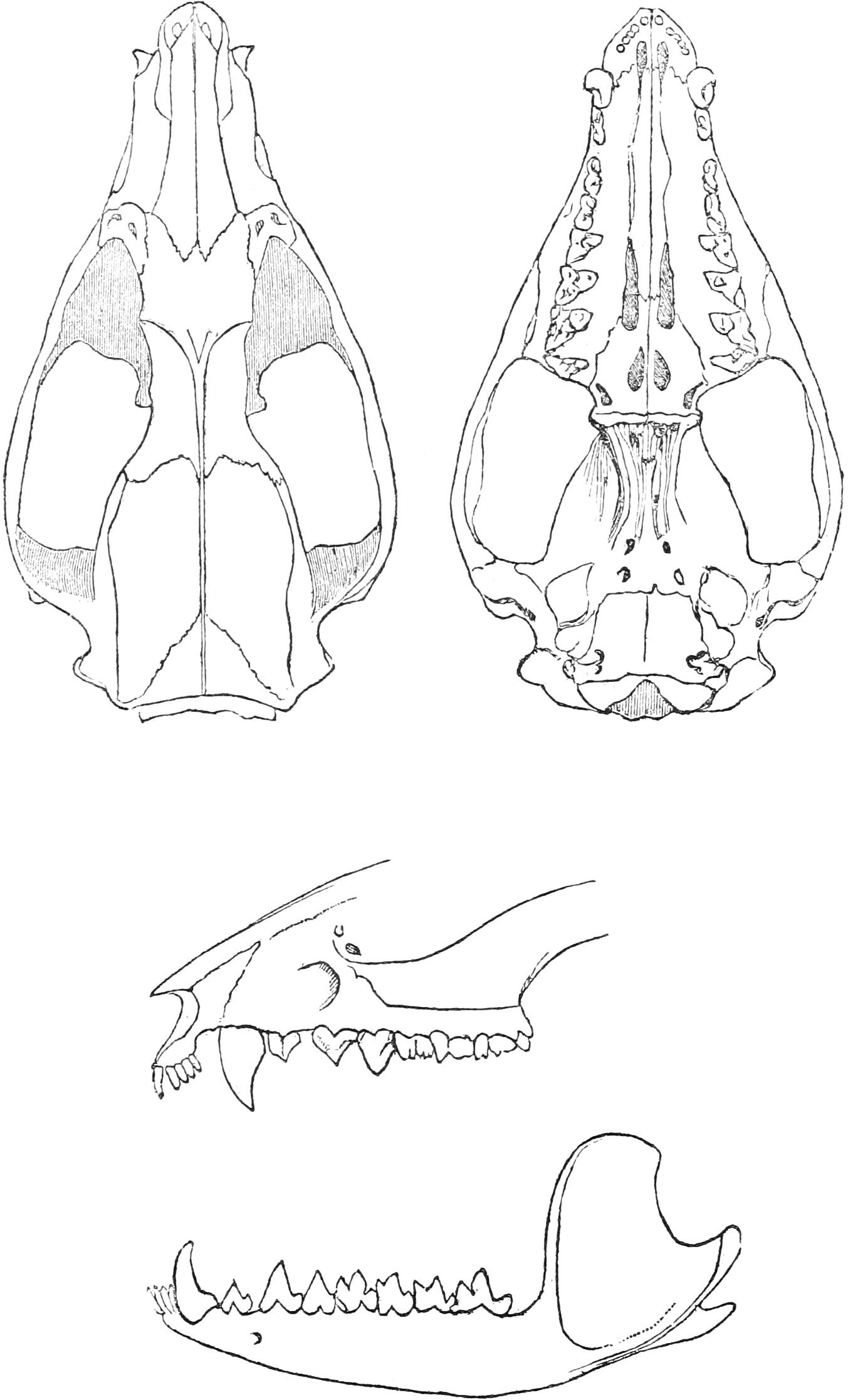
Skull and Dentation of an Opossum
The fore-feet in the Opossums are furnished with five well developed toes, which are armed with tolerably strong, compressed, and curved claws; the outer and inner toes are shorter than the others. The hind feet are furnished with four toes, having the same kind of claws as those of the fore feet, and a large inner clawless toe, (formed like a thumb,) which is opposed to the other toes. The tail is usually long, always more or less prehensile, sparingly covered with hair, and exhibiting scales, like the tail of a rat. The ears are usually of moderate size, and generally naked; the tip of the muzzle and under surface of the feet are likewise naked. The fur of these animals is generally more or less woolly or frizzled. The stomach is simple and small; and the cæcum is of moderate size. The clavicles are well developed.
The young of the Opossums, in the earlier stage of their existence, are carried in the pouch of the mother, which they sometimes quit, but return to in times of danger; but in some species the pouch is wanting, or exists merely in a rudimentary state, being represented by small folds of skin. The young of these, when very small, remain attached to the nipple of the parent, but when of larger size they quit this, and are carried on her back, where they hold themselves, by entwining their prehensile tails around that of the parent.
These animals are nocturnal, and remain hidden during the day time in the hollows of trees, on their branches, or in thickets. In the night they wander forth in search of food, attacking birds, and sucking their blood like the weasels, or their eggs; they moreover feed upon reptiles and insects, and do not even refuse fruits,—their diet in fact is omnivorous:45 specimens which have lived in the menagerie of the Zoological Society, have been fed upon bread and milk.
One of the Opossums lives in the water, and would appear to be otter-like in its habits. Its feet are large and palmated, from which circumstance it has been separated by Illiger from Didelphys, and constitutes his genus Chironectes,—this animal can scarcely, however, be regarded as constituting a genus, but ought rather to be viewed in the light of a sub-division or sub-genus of Didelphys. It is described in this work under the name of the Yapock.
Virginian Opossum
Didelphys Virginiana.
Didelphis Virginiana, Temminck.
Description.—Length of head and body taken together, 22 inches;46 of tail, 15 inches; fur long and woolly, with very long hairs interspersed with the ordinary fur on the upper parts of the body; general colour dirty white, with a slight yellow hue; legs dusky brown; eyes surrounded with the same tint; hairs on upper parts of body deep brown, or blackish at the tip; longer interspersed hairs, white, or tipped with brown; tail covered at the base with fur like that of the body, the remaining portion with scales of a whitish colour; ears large, naked, black, margined with white at the tip. The hairs of the moustaches are thick and very long, some of them are white and others black: five or six hairs of the same character spring from the cheek, and there are two or three which have their origin just above the eye. The length of the ears is 1 inch 5 lines; that of the head, measuring from the tip of the muzzle to the base of the ears, is 4 inches 5 lines, the length of the fore foot is 1 inch 9 lines—the claws not included—and the tarsus is 2 inches and 2 lines.
Observations.—The Virginian Opossum is one of the largest species of the genus, its form is robust, the head is very large, its ordinary fur is long and woolly, and on the back and sides of the body very long and coarse hairs are thickly interspersed with those which constitute the chief clothing of the animal. These characters serve to distinguish the present species from the greater portion of the South American Opossums, which are of a slender, weasel-like form, and have the fur comparatively short. There are, however, several species which have the same stout form, and fur of a similar character, with that of the Virginian Opossum, and which, therefore, may be placed in the same section; I allude to the D. cancrivora, and D. Azaræ, both of which inhabit South America,—these species have been long known, but although there are specimens in most museums, their distinctive characters were never clearly pointed out, until M. Temminck’s monograph47 made its appearance. The D. Californicus, and D. breviceps, described by Mr. Bennett in the Proceedings of the Zoological Society, also belong to this section.
The D. Virginiana inhabits North America, and, according to M. Temminck, is found from Mexico to the southern provinces of the United States. Pennant says it
inhabits Virginia, Louisiana, Mexico, Brazil, and Peru; I strongly suspect, however, its range is much more restricted.
Pennant has undoubtedly confounded the D. cancrivora, and, perhaps, also the D. Azaræ, with our present animal, when he states that it is found in Brazil. In the collections received from California, by the Zoological Society, there were no specimens of the Virginian Opossum, but there were the two new species described by Mr. Bennett,—may not one, or perhaps both, of these also occur in Mexico, and have been confounded with the D. Virginiana?
Following is Pennant’s account of the habits of the Virginian Opossum, with some slight additions and alterations. This animal is very destructive to poultry, and sucks the blood without eating the flesh: feeds also on roots and wild fruits; is very active in climbing trees; will hang suspended from the branches by its tail, and by swinging its body, fling itself among the boughs of the neighbouring trees; continues frequently hanging with its head downwards; hunts eagerly after birds and their nests; walks very slowly; when pursued and overtaken, will feign itself dead; not easily killed, being as tenacious of life as a cat: when the female is about to bring forth, she makes a thick nest of dry grass, in some close bush at the foot of a tree; the number of young varies from twelve to sixteen. At their birth the young are scarcely more than a grain in weight, blind, naked, and shapeless, nevertheless they find the teats in the pouch, to which they fasten themselves so closely, that they cannot be separated without difficulty: when they have attained the size of a mouse, and all their parts are developed, which takes place in about five days, they then leave the pouch, but return to suckle, or to seek shelter in time of danger. During this time the female shows an excessive attachment to her young, and will suffer any torture rather than permit the pouch to be opened; for she has the power of opening or closing it, by the means of certain muscles. The flesh of the old animals is very good, its flavour resembling that of a sucking pig; the hair is dyed by the Indian women, and woven into garters and girdles: the skin is very fœtid.
Azara’s Opossum
Didelphys Azaræ
Didelphys Azaræ, Temminck Mongr. Microuré premier, Azara, Essais sur l’histoire Naturelle des Quadrupeds de la Province de Paraguay. French Transl., vol i., p. 244.
Description.—Length of head and body taken together, 1 9 inches; of tail, 19 inches; of head, from tip of muzzle to base of ear, 4 inches 3 lines; of fore foot, 1 inch 11 lines; of tarsus, 2 inches 6 lines. Head and neck white; a black stripe on the forehead commences between the eyes, and runs backwards on to the occiput, where it is dilated and forms a large patch; on either side of the head is another black stripe, which commences considerably in front of the eye, and, encircling the eye, extends backwards nearly to the ear; throat and chest yellowish, sometimes rusty brown: the hairs of the ordinary fur of the body are of a yellowish-white colour at the base, and black externally; on the back the black colour prevails, and the sides of the body have a mottled appearance, the black and pale colour being about equal in proportion; the limbs and feet are black; the long interspersed hairs, which are abundant on the back and sides of the body, are white; about one third of the tail is covered with fur like that of the body, beyond this the tail is furnished with scales, which are partially hidden by shortish hairs, springing from their interstices; both the scales and the hairs are black, excepting on the apical portion, where they are white, the space occupied by white scales is about 5 or 6 inches in length; the ears are 1 inch and 9 lines in length, black at the base, and white beyond; the hairs of the moustaches are very long, those nearest the mouth are whitish, the others are black; on the cheeks, and above the eyes, there are long bristly hairs, as in the Virginian Opossum.
Observations.—This species may at once be distinguished from the D. Virginiana, by the broad black stripe on the forehead,48 the comparatively great extent of the black mark which runs through the eye, and the colouring of the ears, which, instead of being black, and narrowly edged with white at the apex as in the Virginian Opossum, are white, and clouded with black at the base. The general colouring of the present animal is moreover much darker, and the under parts of the body are, for the most part, of a brown colour. M. Temminck also mentions the superior length of the tail as a distinguishing character, but this appears to vary considerably in different individuals; and I suspect there is a difference in this respect in the sexes.
A specimen of D. Azaræ, brought from Maldonado, by Mr. Darwin, furnishes the following proportions:—
Length of head and body, 17 inches; length of tail, 13\(\frac{1}{2}\) inches, of which about 4 inches (at the base) is covered with fur, like that of the body; this is followed by a portion, 3 inches in length, which is covered by black scales, and furnished with black hairs, the remaining, or apical portion, has white scales and white hairs.
The Didelphys Azaræ is common in Brazil, and is found as far south as Maldonado, La Plata. Azara states that it lives in thickets, and also in open parts of the country; during the day it remains in holes; at night it comes forth, and is very destructive to poultry, eating the eggs and sucking the blood of the birds which it catches: it climbs trees, eats fruit, and Azara believes that it also feeds upon insects and reptiles.

Plate I
Crab-Eating Opossum
Didelphys cancrivora.
Didelphys cancrivora, Temminck.
Description.—Length of head and body, 16 inches; of tail, 15 inches; of head, from the tip of the muzzle to the ear, 3 inches 8 lines; of the fore-foot, 1 inch 8 lines; of the tarsus, 2 inches 2 lines of the ear, 1 inch 6 lines. Ordinary fur harsh and somewhat woolly, of a dirty white colour next the skin, and dark brown, or black, externally; the longer interspersed hairs are whitish at the base, and sooty black beyond; limbs and feet black general colour of the head brown, the hairs are whitish at the base and brown at the apex, in the region of the eye the hairs assume a somewhat deeper hue, and there is an indistinct dusky longitudinal line on the forehead; the tail is protected by scales, between which there are short hairs, the basal half is black, and the apical portion white; a space at the base, of about three inches in length, is covered with fur, like that of the body, the hairs, however, are almost entirely of a black colour; the ears are black;49 the head is long.
This species is nearly equal in size to the D. Virginiana, and may be distinguished from that species and the D. Azaræ, by its deeper colouring, the long interspersed hairs on the upper parts of the body being black, or dark brown, instead of white; its head is apparently longer and more atenuated, and the ears are of an uniform colour.
The Crab-eating Opossum is common in Guiana and Brazil,—it climbs trees with facility, but runs badly—prefers marshy situations, where it feeds upon crabs—whence its name; it also attacks small birds and reptiles, and will eat insects. Its flesh is eaten by the natives, and is said somewhat to resemble that of the hare.
Californian Opossum
Didelphys Californica.
Didelphys Californica, Bennett. Proceedings of the Zoological Society of London for March 1833, p. 40.
Description.—Length of head and body 17 inches; from tip of muzzle to base of ear, 3 inches 11 lines tail, 14 inches; fore foot, 1 inch 8 lines; tarsus, 2 inches 1 line; ear, 1 inch 5 lines. Prevailing colour of the fur brown, the ordinary fur, which is somewhat woolly, being of a dirty white colour next the skin and blackish-brown externally; long white hairs are thickly interspersed, with the ordinary fur on the upper parts and sides of the body, and on the back part of the head: the limbs and feet are of a brownish black colour: the head is brown; a deep brown mark commences considerably in front of the eye, and extends backwards to the ear, the space below this mark extending backwards from near the tip of the muzzle on to the cheeks, is white: the chin, lower portion of the cheeks, and the whole of the under parts of the body are brown; the hairs on those parts, however, are for the most part whitish at the base; the ears are black: a very small portion of the tail is covered with fur like that of the body, beyond this the tail is, as usual, covered with scales and short interspersed hairs, towards the base they are of a black colour, but nearly the whole of the scaly portion of the tail appears to have been white; the head is very long; the hairs of the moustaches are most of them of a black colour, but some are white; the long bristly hairs which spring from the cheeks are white.
This species was obtained by the Zoological Society from that part of California which adjoins Mexico. Like the D. cancrivora it has a brown head, the long hairs which are interspersed with the ordinary fur, however, are totally white. I do not perceive any dark mark on the forehead.
Short-Headed Opossum
Didelphys breviceps.
Didelphys breviceps, Bennett. Proceedings of the Zoological Society of London for March 1833, p. 40.
Description.—Length of head and body 14 inches; tail, 12 inches; from tip of nose to ear, 3 inches 2 lines; ear, 1 inch 1 line; fore-foot, 1 inch 6 lines tarsus, 2 inches. Ordinary fur soft and woolly, white at the base, but black externally, the general tint of the animal, would therefore be black, but the interspersed coarser white hairs which are immensely long (some of those on the hinder part of the back measuring 3\(\frac{1}{2}\) inches) are so abundant on the upper part of the head and body, and also on the flanks, that they produce a hoary tint; the upper surface of the head is brown, of a deeper hue on the mesial line and on the crown; a broad white mark extends, on either side, from the tip of the muzzle on to the cheeks, and above this is a brownish black mark which runs through the eye: the lower part of the cheeks, chin and throat are of a dark brown tint; the chest and under parts of the body are of a pale brown colour, the hairs on these parts are white at the base: the legs and feet are black: the ears are blacky somewhat mottled with whitish at the apex: a very small portion of the tail is covered with fur like that of the body, the remaining portion is furnished with scales it appears to have been blackish at the base and whitish beyond.
This species is from the same locality as the last, that is, California; it is easily distinguished from either of the foregoing by the shortness of its head, and the great length and abundance of the interspersed coarse hairs on the back, &c.; the ears are also smaller in proportion.
As the above completes the descriptions of the five species of Opossum, belonging to the first section, or that group of which the Common Virginian Opossum may be regarded as the type, and in which the form of the body is robust, and the fur long and woolly, and having interspersed longer and somewhat bristly hairs,—I will briefly recapitulate their chief distinguishing characters.
Didelphys Virginiana may be distinguished by its paler colouring, white head, which exhibits no mark on the forehead, and by the comparatively small space occupied by the dark coloured hairs which surround the eyes, the ears are black margined with white at the apex,—sometimes there is a faint dusky mark on the forehead.
Didelphys Azaræ is remarkable for its white head, with three distinct black longitudinal stripes, one on each side running through the eye, and one in the middle, which commences between the eyes and becomes suddenly broader towards the crown of the head, the ears are white clouded with black at the base.
Didelphys cancrivora may be distinguished by the black, or dark brown colour of the long bristly hairs which are interspersed with the ordinary fur, the ears appear to be of an uniform black colour, the brown head will also serve to distinguish it from the two preceding species.
Didelphys Californica, like D. cancrivora, has a brown head but the long interspersed hairs on the upper parts of the body are totally white, its head is long, and the muzzle is very narrow.
Didelphys breviceps, may be distinguished by the shortness of the head,50 and the smaller size of the ears,—there is a very conspicuous dark brown patch on the lower part of the cheek.
Quica Opossum
Didelphys Quica.
Didelphys Quica, Temminck.
Description.—Fur rather short and harsh to the touch; general colour deep ashy grey, somewhat blackish on the back; the edge of upper lip, lower part of cheeks, the chin, throat, and the whole of the under parts of the body, as well as the inner side of the limbs, white, faintly tinted with yellow; the muzzle and vertex of head blackish; on the forehead are two large whitish spots, situated above, and rather behind the line of the eyes; the eyes are encircled with black; beneath the eye is a distinct whitish, or yellowish spot; the feet are dusky; the ears are whitish, with the apical portion clouded with black; a considerable portion of the tail at the base, is furnished with fur of the same colour and character as that of the body, beyond this the tail is covered with scales and short interspersed hairs, which on the basal half are black, and on the apical white; the hairs on the mesial line of the throat, chest, and belly, are of an uniform colour throughout, on the other parts of the body they are of an ash colour at the base; those on the back and sides of the bodyare greyish white near the apex, and greyish black at the apex, on the middle of the back they are black at the apex, and there is a greater proportion of the darker tint on each hair. The hairs of the moustaches are very long and of a black colour.
Length from nose to root of tail 14 inches; of tail 13\(\frac{1}{2}\) inches, of which the portion covered by fur is about 2\(\frac{3}{4}\) inches; length from nose to ear, 2 inches 8 lines; ear, 1 inch; tarsus, (claws included) 1 inch 6\(\frac{1}{2}\) lines.
Observations.—The above description is taken from a male specimen; M. Temminck says the females are of a blackish fawn colour, with a slight silvery hue; on the flanks and limbs a bright ash colour prevails; a rusty hue predominates on the belly, and in the region of the pouch the hairs are of a deep rust colour;51 the summit of the head and the muzzle is black or blackish, and there are three large white, or whitish, spots on each side of the head, one above, one beneath, and one behind each eye.
The fur of the young is more washed with fawn colour, or with brown, than in the adults.
The Quica Opossum is often confounded both with the Didelphys opossum and the D. myosurus or nudicaudata, these three species being closely allied, of nearly equal size, and having the conspicuous white spots above the eyes; the principal distinguishing characters of each are pointed out at the end of the description of D. nudicaudata.
The present species is common in Brazil, and is also found in Guiana and Surinam. It lives on trees, says M. Temminck, and preys upon small birds, and also feeds upon insects and fruits. In captivity it has been fed with flesh. During the day time the Quica, like the other species, hides itself and sleeps, having its body rolled into a ball.
Surinam Opossum
Didelphys opossum.
Didelphys opossum, Gmelin, Temminck.
Description.—Length from nose to root of tail, 10 inches 3 lines, (sometimes rather more;) of tail, 9 inches 2 lines. From nose to eye, 1 inch 1 line of hairy portion of tail 2 inches 2 lines. Size, larger than the European squirrel; tail rather shorter than the head and body taken together, or about equal in length; the hairy portion considerably extended, the naked portion covered with scales; fur fine and silky, and not abundant; muzzle much pointed; upper surface of the head straight. The fur on all the upper parts of the body, and of the hairy portion of the tail, of a rusty red, or cinnamon colour, brighter in the males than in the females: this colour predominates also on the head and beneath the eyes, but it blends into whitish near the angle of the mouth; the rusty tint is less pure on the under part of the limbs above the eye there is a great white spot,52 and behind the ear there is a similar spot; the lower part of the cheeks, the inner side of the limbs, and all the under parts of the body, are of a yellowish white colour; the eye is encircled by rust coloured hairs; the vertex of the head is always of a deeper hue than the prevailing colour; the naked portion of the tail is brown, excepting at the apex, where it is white.
The females are always larger than the males they are provided with a pouch.
This species is found throughout Guiana, and appears to be common in Surinam; and Temminck says he has reason to suspect it is comparatively rare in Brazil. He has found the remains of birds in the intestines of specimens dissected.
Naked-Tailed Opossum
Didelphys nudicaudata
Didelphys nudicaudata, Geoff. Collect, du Mus. D. myosuros, Temminck.
Description.—Tail as long as the head and body taken together, covered with scales, and furnished with very minute interspersed hairs, from the base to the apex; woolly fur, like that of the body, is not extended on to the base, as in most other Opossums, or at most there is scarcely half an inch so covered. General tint of the upper parts of the body yellowish brown, slightly grizzled with whitish in parts; sides of the neck and body, and outer side of the limbs, cinnamon coloured; the chin, throat, and the whole of the under parts of the body, are of a yellowish white—nearly cream colour; the upper surface of the head and muzzle are of a brownish black tint, above, and rather behind each eye, is a conspicuous yellowish white or yellow spot, and behind each ear is a pale rusty yellow spot; the cheeks are yellowish white, the line of separation between this pale colour, runs from the tip of the muzzle, on either side, backwards a little below the eye; beneath the ear a rusty yellow tint is observable; the hairs of the moustaches are not very long, and are of a black colour; the ears are large, yellowish at the base, and brownish, inclining to black, above; the hairs covering the feet are brownish; the fur covering the back part of hinder legs is also brownish; the scales and hairs of the tail are brown, excepting on the apical portion, where they are white; the portion covered with white scales is about 5 inches in length, in the specimen from which this description is taken, but it is sometimes less. The female is provided with a pouch.
Length from nose to root of tail, 13 inches; tail, 12\(\frac{1}{2}\) inches; ear, 1 inch; tarsus, 1 inch 10\(\frac{1}{2}\) lines; from tip of nose to base of ear, 2 inches 4 lines.
Observations.—The specimen from Bahia, from which the above description is taken, agrees perfectly in its characters with an animal named Didelphys nudicaudata, in the Paris museum, and is no doubt the species so named by Geoffroy Saint-Hilaire; but an error having crept into that author’s description, as regards the possession of a pouch, M. Temminck, in his Monograph, has given a new name to the species. He, however, states that he himself had fallen into the same error, that is, in supposing the pouch absent in a certain species. Under these circumstances, I have retained the old name, which is well applied, the tail having scarcely any fur on the base, and thus differing from that of some allied species.
M. Temminck states that this species is very common in Brazil, and is also found in Guiana, but is rarely received from Surinam.
The three preceding species all possess a conspicuous spot above the eyes, are of a slender form, and have very long tails; they are of larger size than most of those which are about to be described, their chief distinguishing characters may be summed up as follows:—
D. Quica may be distinguished from the two following species by its larger size, and comparatively sombre colouring; its tail is longer than in D. opossum. In the specimen before me there is no pale spot behind the ears; and as M. Temminck has not described a spot in this situation, I presume it is always wanting; if so, this character will also serve to distinguish the present animal, either from D. opossum or D. nudicaudata.
D. opossum.—Distinguished from D. Quica by its smaller size and shorter tail: its prevailing tint is a bright rust colour, whereas that of D. Quica is deep ashy grey.
D. nudicaudata may at once be distinguished from either of the foregoing, by there being a very small portion of the tail covered with fur, like that of the body. In D. opossum, a portion of the tail, of about 2 inches in length, is covered with fur; in D. Quica the fur is extended still further on to the tail, whilst in the present species there is not more than half an inch, at most, which is covered with fur. The fur of the body is of a less woolly nature than in D. Quica, the tail is more slender, and the tarsi are longer. The basal half of the tail, moreover, is brown, whereas in D. Quica it is black.

Plate II
Derby’s Opossum
Didelphys Derbianus
Didelphys Derbianus, Waterh.
Description.—Body stout, tail considerably longer than the head and body taken together; the hairy portion of great extent; fur woolly and glossy; general colour bright rusty-brown; under parts dirty white; upper surface of head brownish grey, with a longitudinal narrow dusky stripe extending backwards in the mesial line from the top of the muzzle, and terminating between the ears; on either side, and near this central line, the fur is of a grey colour the region of the eye brown; on the back is a silvery grey stripe, which commences between the shoulders and terminates about the middle of the back; the fore part of the hinder legs is also silvery grey, and a stripe of the same tint runs backwards from the knee: the fore legs are white: the feet are pale, and appear to have been flesh coloured, the fore-feet are furnished with white hairs, the hinder-feet are sooty black: The woolly fur on the base of the tail is brownish, pale on the under side; the naked portion of the tail is pale, clouded with dark brown towards the hairy portion, and with large dark spots beyond: the ears (in the stuffed animal) are of a dirty white colour.
Length from nose to root of tail, 13 inches 6 lines; tail (about) 17 inches53 of which 7\(\frac{1}{2}\) inches is covered with fur; ears, 1 inch 2 lines; from nose to ear, 2 inches 6 lines; tarsus, 1 inch 9 lines.
Habitat—?
This beautiful species is in the Museum of the Earl of Derby, after whom I have taken the liberty of naming it. It is more stout in its proportions than D. opossum and its allies, and is remarkable for its bright and rich rust-like colouring, the grey stripe on the back, and the great extent of the hairy portion of the tail. It is equal in size to the D. quica and consequently larger than D. opossum.

Plate II*

Woolly Opossum
Didelphys lanigera.
Didelphys lanigera, Desm. Mamm. p. 258. spe, 395. Microuré second, ou Microuré laineux, Azara, Essais sur l’hist. Nat. des Quadr. de la Province du Paraguay, tom. 1, p. 275.
Description.—Tail longer than the head and body taken together, very thick and triangular at the base; ear large; fur soft and woolly; occiput, anterior portion of forelegs, outer side of hinder-legs and tarsi of the colour of Spanish tobacco; back of the same colour, but of a deeper hue, remaining portion of body bright brown; white predominates on the under parts of the body;54 on the head is a narrow black line, around the eye a deep cinnamon colour prevails; the space between the eye and the longitudinal mark is of a bright brown colour; ears naked, (excepting at the base externally) and of a livid violet colour; naked portion of tail white.
Length from nose to root of tail, 8 inches 8 lines; tail, 13 inches 6 lines, of which 4\(\frac{1}{2}\) inches, measuring from the tip, is destitute of hair, the naked portion on the under side is more extended, measuring 9 inches; the circumference of the tail at its root is 1 inch 7 lines; length of head, 2 inches 3 lines; the height of the ear is 1 inch, and the width 6 lines. A second specimen of this species was procured by a friend of Azara’s; the description which that friend furnished is as follows. The base of the fur is pale grey (azure55) externally, it is whitish on the under parts, especially between the legs; the rest of the fur is of a chestnut colour, brighter on the head, around the eyes and on the sides of the neck and outer sides of the limbs; on the forehead a longitudinal blackish mark is observable. Habitat Caazapa, which is situate about fifty leagues from Assomption in Paraguay.
Observations.—This species appears to resemble in some respects the D. Derbianus, but wants (according to the description) the grey stripe on the back and thigh, the naked portion of the tail is much shorter in proportion. In D. Derbianus the tarsi are sooty black, and the fore-feet are furnished with white hairs, the naked portion of the tall is clouded with dark brown, &c. These differences are too great to admit of my considering the two species as identical.
I have never had an opportunity of examining the present species.
Thick-Tailed Opossum
Didelphys crassicaudata.
Didelphys crassicaudata, Desmarest, Mamm. p. 527 257, Microuré troisième, Azara, Quad, de Paraguay, vol. i., p. 284.
Description.—Length of head and body, 11 Inches 3 lines; tail, 10 inches 3 lines; from nose to ear, 2 inches 1\(\frac{1}{2}\) lines; ear, G lines; tarsus, 1 inch 5\(\frac{1}{2}\) lines. Head short, ears small, the posterior edge emarginated near the base, distinctly furnished with hairs tail slightly exceeding the body in length, very thick at the base; tarsi small; fur moderately long, rather harsh and adpressed (much less woolly than in most opossums,) general tint brownish-yellow, under parts paler; anterior angle of the eve and muzzle brown; the tip of the chin and also the tip of the muzzle on either side, whitish; on the cheeks, a little below the eyes, is a yellowish patch which extends round the angle of the mouth; about one-third of the tail is covered with fur of the same character and colour as that on the body; beyond this the tail is black, excepting a small portion, about one inch in length at the apex, which is white; the hairs are short, closely adpressed and scarcely hide the scales which are beneath; the fore portion of each foot is brown; the hairs covering the ears on the outer side are brownish, and those on the inner side are yellow, but towards the outer margin they are brown. The hairs of the back have the basal half grey, and the apical half ochreous, terminating in yellowish brown on the belly and underside of the neck the hairs are ochreous, faintly tinted with grey at the base. The female has no pouch.
Observations.—The head of the D. crassicaudata is shorter and less pointed than in most other opossums; the ears are unusually small, and the tail is very thick. In the character of the fur also, this species differs from most others, the hairs being rather short and somewhat adpressed, and the soft under fur being very scanty: the specimens observed by Azara varied considerably in their colouring. It inhabits Buenos Ayres and Paraguay. A specimen, procured by Mr. Darwin at Maldonado, and from which the above description is taken, weighed 14\(\frac{1}{2}\) oz.
Philander Opossum
Didelphys Philander.
Didelphys Philander, Temminck.
Description.—Size of D. opossum, muzzle short and obtuse; tail longer than the head and body taken together; ribs very broad; fur very soft, cotton-like and glossy, of a bright rusty fawn colour on the upper parts of the body, and tinted with yellowish on the sides; under parts of the body yellowish white; a brown patch encircles the eyes and extends forward on the sides of the muzzle; a narrow brownish line runs from the tip of the muzzle and terminates on the crown of the head; the forehead on either side of this line is greyish white; the ears are large, of an oval form and brownish colour, and the feet are of the same tint; the tail is covered at the base with fur like that of the body, beyond this it is covered with scales, at the base brown, and at the apex white, an intermediate space is mottled with brown and white. The female is provided with a pouch.
Length from nose to root of tail, 9 inches; tail, 13 inches; from nose to ear, 1 inch 9 lines; ear, 10 lines; tarsus, 1 inch 5 lines; length of portion of tail covered with fur, 2 inches 8 lines.
In an animal now before me, which agrees in all essential particulars with the foregoing description, there is scarcely any brown colouring on the tail, it is confined to a few scattered spots on the basal portion; on the other hand I observed a specimen at Paris, in which the tail was almost totally brown, having only a few white spots; this specimen did not differ otherwise from another in which the tail is coloured as mentioned in the foregoing description. In the females the fur is of an ashy-fawn colour, and the region of the pouch is furnished with rusty-red hairs. They are always much larger than the males.
Inhabits Surinam and Guyana.
Cinereous Opossum
Didelphys cinerea.
Didelphys cinerea, Temminck.
Description.—Size of the Black-Rat (Mus rattus;) head small; muzzle very short; tail very slender, much longer than the head and body taken together; the fur is thick but short and of a cotton-like texture. The males are of an ashy-grey colour, the extreme points of the hairs on the upper parts of the body are blackish; the under parts of the body and inner side of the limbs are whitish, the throat and chest are slightly tinted with rust colour; the fur on the upper surface of the head is of the same tint as that of the back, there is no central black stripe; the eye is encircled with black; the tail is covered at the base with fur like that of the body, the remaining portion is perfectly destitute of hairs; the basal half is of a brown colour, and the remaining portion is white.
In the females the fur is somewhat tinted with rust colour, and in the region of the ears and on the cheeks there is a yellowish tint; they have no pouch.
Length from nose to root of tail, 6 inches 9 lines; of tail, 1 inches 6 lines; of hairy portion of tail, 2 inches 2 lines; from nose to eye, 7\(\frac{1}{2}\) lines.
This species was discovered in Brazil by Mr. Natterer.
Merian’s Opossum56
Didelphys dorsigera.
Didelphys dorsigera, Temminck.
Description.—Tail slender, longer than the head and body taken together, clothed at the base with hair like that of the body, the remaining portion naked and of a brown colour; fur short and somewhat adpressed, the hairs on the upper parts of the body are grey at the base, and greyish-brown, or brown, at the apex; the under parts of the body are yellowish white; a deep brown spot encircles the eyes, this spot is most extended in front of the eye, above and beneath the eye it occupies but a narrow space; the forehead and vertex of the head are yellowish-white, the cheeks are of the same tint, as are also the outer side of the limbs and the feet.
Length from nose to root of tail, 5 inches 11 lines; of tail, 7 inches 7 lines; the hairy portion of the tail is about 1 inch; from nose to eye, 7\(\frac{1}{2}\) lines.
Observations.—This species inhabits Surinam. The females have no pouch, in its place there is a fold of the skin of the belly, which may be regarded as a rudimentary pouch. The young, when sufficiently old to leave the teats to which they are at first attached, are carried by the parent on her back, where they retain their position by means of their prehensile tails, which are entwined round that of the mother. It is this habit of carrying the young on the back, which has given rise to the name dorsigera; this name, however, might be applied with as much propriety to several other species, (such as D. cinerea, murina, tricolor, and brachyura, in which there is only a rudimentary pouch.
Murine Opossum
Didelphis murina.
Didelphys murina, Temminck.
Description.—Tail rather longer than the head and body taken together; the hairy portion of but small extent, the naked portion of an uniform yellow colour. Fur somewhat adpressed and short; the general tint of the upper parts of the body is rusty or yellowish, but the hairs are deep grey at the base; the head is yellowish—without any longitudinal dark stripe on the forehead; a deep brown tint surrounds the eyes, which is most extended in front of the eye the whole of the under parts are yellowish white, and the cheeks are of the same tint; the fur which covers the base of the tail is coloured like that of the back; the ears are yellowish.
Length from nose to root of tail, 5 inches; tail, 5 inches 9 lines; hairy portion of tail about half an inch; from nose to eye, 6\(\frac{1}{2}\) lines; tarsus, (claws included) 9\(\frac{1}{4}\) lines.
Observations.—The Murine Opossum inhabits the northern parts of South America, and is very common in Guyana. It burrows in the ground and climbs trees, to the boughs of which it suspends itself by the tail; feeds upon small birds and insects, and is said also to eat fruits. The female has no pouch.
Elegant Opossum
Didelphys elegans.
Didelphys elegans, Waterh. Zoology of the Voyage of H.M.S. Baggle Beagle, No. IV. p. 12, Mammalia p. 95, Pl. 31.
Description.—Length from nose to root of tail, 4 inches 6 lines; of tail, 4 inches 4 lines; of tarsus, (claws included) 7\(\frac{1}{2}\) lines; from nose to ear, 1 inch 1\(\frac{1}{2}\) lines; of ear, 7\(\frac{1}{4}\) lines. Muzzle slender and pointed; tail rather shorter than the head and body taken together; fur long and very soft; general tint of the upper parts of head and body ashy grey washed with brown; on the sides of the body, especially near the shoulders, a yellowish tint is observable; the lower part of the cheeks, throat, under parts of the body and feet, are white, with an indistinct yellowish tint; the eyes are encircled with brownish black, which tint is extended forwards on the sides of the muzzle; the upper surface of the muzzle and the inter-orbital space is pale. The tail is furnished throughout with minute decumbent hairs, excepting a small naked space at the tip beneath, of about one line in length; on the upper surface they are brown, and on the under they are whitish. The fur of the upper and under parts of the body is deep grey at the base; on the lower part of the cheeks, chin, and on the mesial line of the throat and chest, the hairs are uniform—not grey at the base. The ears are naked and of a brown colour.
Observations.—The specimens, from which the above description is taken, were brought by Mr. Darwin from Valparaiso. Mr. Darwin states, that they
frequent thickets growing on the rocky hills near Valparaiso. They are exceedingly numerous, and are easily caught in traps, baited either with cheese or meat. The tail appeared to be scarcely at all used as a prehensile organ; they are able to run up trees with some degree of facility. I could distinguish in their stomachs the larvæ of beetles.
Three-Striped Opossum
Didelphys tristriata
Didelphys tristriata, Fischer, Synopsis Mammalium, p. 269.
Description.—Size a little larger than the common mouse (Mus musculus.) Head much pointed, ears rather small, tail short: colour deep rich brown beneath, yellowish-brown; three longitudinal black stripes on the back; the central stripe is the broadest, commences between the eyes and extends to the root of the tail; the lateral lines commence a little behind the ear, and also terminate at the root of the tail: the top of the muzzle is almost black; a deep rich yellow tint prevails on the cheeks, and over the haunches and hinder legs, there is a deep rusty brown hue: the feet are dark brown, and so are the ears, which are almost naked: the tail is furnished with minute hairs and exhibits scales, it is black above and brown beneath; a small space beneath, at the apex, of about one line in length, is naked. The fur is very short and adpressed; the hairs, both on the upper and under side of the body, are greyish at the base: the claws of the fore-feet are rather strong, and adapted for burrowing.
Length from nose to root of tail, 4 inches 3 lines; tail, 2 inches 1 line; from tip of muzzle to base of ear, 1 inch and a half line; ear, 3 lines; tarsus, (claws included) 8\(\frac{3}{4}\) lines.
Observations.—This pretty little opossum appears to be rare in collections, for M. Temminck, never having seen one, did not admit it in his Monograph. It was mistaken for a shrew by many of the older authors, being the Sorex Braziliensis of Erxleben and some others—and the Brazilian shrew of Pennant. The specimen before me, the mouth being wide open, enables me to examine the dentition, which does not differ from other opossums—the canines are rather small. It certainly bears a great resemblance to a shrew, and no doubt, like many other small opossums, feeds upon insects, and judging from its claws, I should imagine it was a good burrower.
These small insectivorous opossums being common in S. America, accounts for there being no species of the order Insectivora. No shrews or hedgehogs have yet been found in that part of the world,—they are in fact replaced by these small opossums.
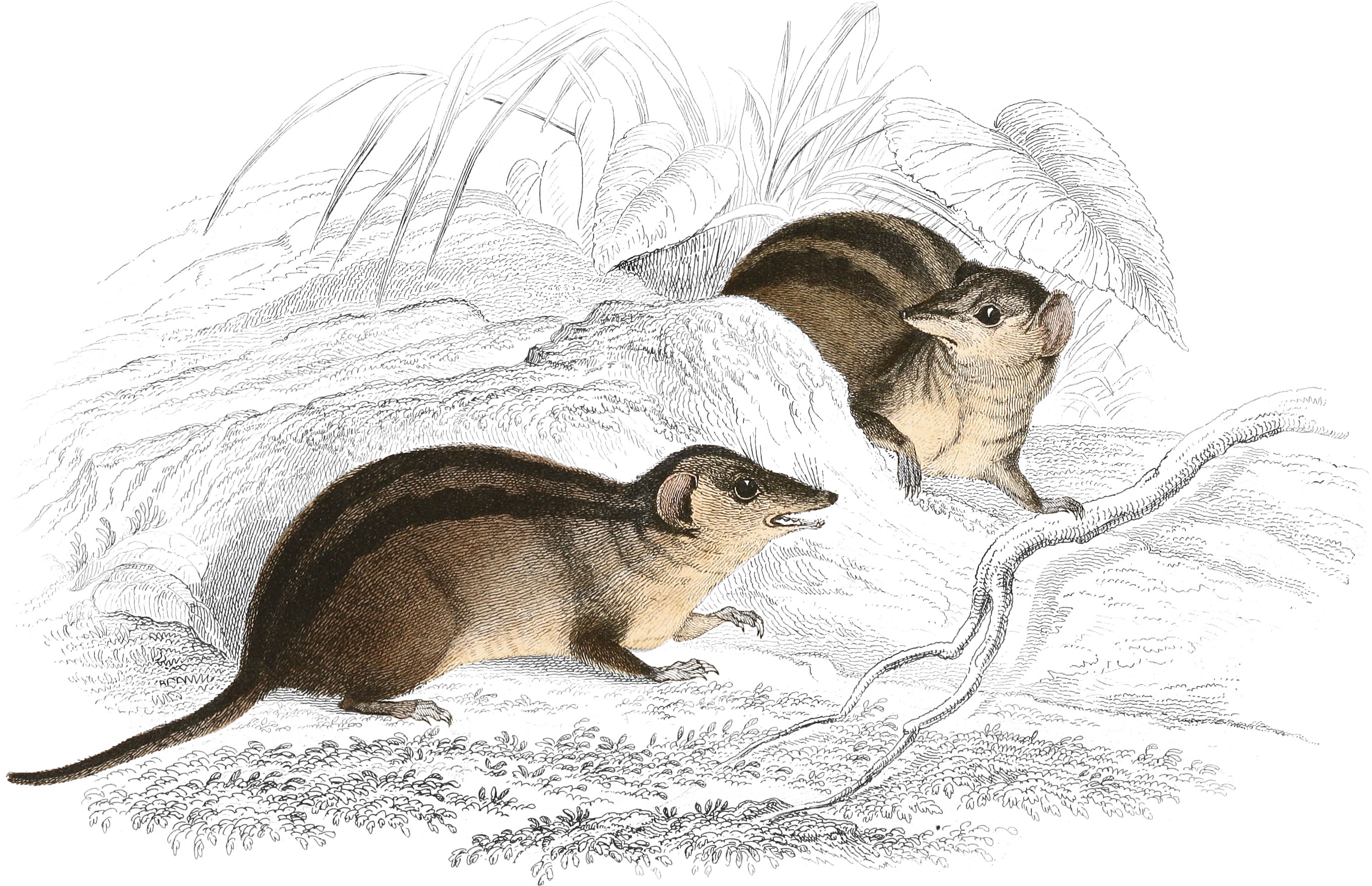
Plate III
Tricolored Opossum
Didelphys tricolor.
Didelphys tricolor, Geoff. Catal. des Mamm. p. 144, sp. 7.
Description.—Top of the head and whole upper surface of the body nearly uniform black, the hairs, however, are obscurely annulated with greyish-white, which produces a somewhat grizzled appearance; chin, throat, sides of the head, (extending a little above the eye) the sides of the body, tail, and outer side of the limbs deep rich rusty-red; chest and under parts of the body white, with a faint yellowish tint. Fur short and adpressed. Fur, like that of the body, extends about 1\(\frac{1}{2}\) inches on the tail. Feet black; the tarsi obscurely grizzled with rust colour; ears naked. The tail is short and very thick at the base. The head is large.
Length from nose to root of tail, 5 inches 6 lines; from nose to ear, 1 inch 2\(\frac{1}{2}\) lines; of tail, 2 inches 8 lines; tarsus, 10 lines; ear 5 lines. The female has no pouch.
Observations.—The above description is taken from a specimen contained in the Museum at Paris. A second specimen in the same Museum differed in being a little paler, there being a greater admixture of grey in the colouring of the upper parts of the body.
This species is found in Guyana and Cayenne; it lives in the woods and feeds upon insects. The Microuré cinquième of Azara is referred by some authors to the present animal, but his description certainly agrees with the D. brachyura, a specimen of which was brought by Mr. Darwin from Maldonado, which is near the territory of Azara’s researches.
In the Museum of the College of Surgeons there is a small opossum closely resembling the present species in size and proportions, but which is of an uniform brown-black colour above, and pale brown beneath—darker on the under side of the head and throat—I can trace no rusty red on the sides of the body, nor can the under parts ever have been white. It is preserved in spirits, but the colours are distinct. This animal can scarcely be a variety, either of the Didelphys tricolor or D. brachyura. Should other specimens like it be discovered, the specific name Hunteri might be appropriate.
Didelphys tricolor and D. brachyura differ from other species of the genus in having a short tail, which I should imagine is but little used as an organ of prehension.
Short-Tailed Opossum
Didelphys brachyura.
Didelphys brachyura, Auct.
Description.—Length from nose to root of tail, 6 inches; from nose to ear, 1 inch 6 lines; of tail, 2 inches 8 lines; of tarsus, (claws included) 8\(\frac{3}{4}\) lines; of ear, 3\(\frac{3}{4}\) lines. Head large; canine teeth very large; ears rather small; tail short, rather more than half the length of the body; fur short and crisp; the upper surface of the head and back ashy-grey, grizzled with yellowish-white; the sides of the head and body, and under parts rusty-yellow, rather paler on the belly than other parts, and of a deeper hue on the rump and cheeks; the eye is encircled with rusty-yellow; feet yellowish; tail clothed with short stiff hairs, and exhibiting scales, brownish above and dirty yellowish-white beneath; a small naked space beneath of about two lines in length. Fur of the back greyish at the base, that on the belly uniform; ears clothed with minute yellowish-white hairs. The female has no pouch.
Observations.—Temminck gives as the locality of this species, Guyana, he also says it is very common in Surinam. It must have a wide range for Mr. Darwin procured a specimen at Maldonado La Plata, he states that he found in its intestines the remains of insects, chiefly ants,—there were also some belonging to the order Hemiptera.
Didelphys Pusilla
Didelphys pusilla. Desmarest, Mammif. 261, Microuré sixieme, ou Microuré nain Azara Quad, du Paraguay. Vol. i., p. 304. French Trans.
Description.—Fur short and soft, above mouse grey, beneath whitish; eye surrounded with black, the black most extended in front, above eye whitish, a spot of yellowish-white beneath the eye; tail naked. Length from nose to root of tail, 3 inches 4 lines tail, 3 inches 8 lines; ear, 6 lines, width, 4 lines.
Habitat Paraguay.
I have never examined a specimen of this species.
The Yapock Opossum
Chironectes Yapock
Chironectes Yapock Desm. Mamm. p. 261. Spe. 400. Lutra memina Zimmerm. Geogr. Zool. Didelphys Palmata. Geoff.
Description.—Form moderately stout; tail thick, longer than the head and body taken together; ears moderately large; fur soft and woolly; ground colour of the upperparts of the body grey, a broad transverse sooty-black mark runs across the shoulders, a second large dark patch crosses the middle of the back, a third crosses the haunches, and lastly there is another behind this which extends partly on to the tail, is continued down the back of the hind-legs, and also on the outer side near the heel; these patches are connected by a broadish dorsal line, which commences at the occiput, (where it joins a large round patch, situated between the ears,) and terminates on the tail; the face is black, and a band of the same colour runs backwards from the eye beneath the ear on to the side of the neck; the upper lip, lower portion of the cheeks, and the whole of the under parts of the head and body, and the inner side of the limbs are white; fur like that of the body extends about 21 inches on to the base of the tail; beyond this the tail is covered with rather large scales, between which there are minute hairs, both the scales and hairs are black, excepting on the apical portion of the tail where they are white, the white portion is about 4 inches in length; the hairs of the moustaches are most of them black, but some are white; feet brown the toes of the fore-feet are long, united at the base to the end of the first phalanger; on the outer side of the foot there is an elongated tubercle,
an unusual development of the pisiform bone,57
having the appearance of a rudimental sixth toe; the underside of the foot is furnished with a remarkably large fleshy pad, the surface of which is rough; the pads on the underside of the toes, at their extremity, are also very large, and appear in a measure to envelope the claws which are small and weak, and of a white colour; the hind-feet are very large, the toes are long and tied together by an ample membrane which terminates near the base of the claws; the thumb, like the inner toe, is large, and has no nail—it is connected with the toes by a membrane; the claws are moderate, curved and compressed, the claws of the two inner toes are more compressed than the others.
Length from nose to root of tail, 10\(\frac{1}{2}\) inches; tail, 13\(\frac{1}{2}\) inches.
Observations.—The above description is taken from a specimen deposited in the Museum of the Zoological Society by W. B. Scott, Esq.
At the scientific meeting of the Zoological Society for May 1836, a specimen of Chironectes Yapock was exhibited, on which Mr. Ogilby made the following remarks:
I am indebted to Mr. Natterer for the opportunity of examining this rare and curious animal, of which he brought various specimens from Brazil. That now exhibited is a male, and possesses the same anomaly in the generative organs which characterizes the rest of the Marsupials. I have not seen the female, but Mr. Natterer informs me that the abdominal pouch is complete. The species is found in all the smaller streams of Brazil, and appears to extend from the southern confines of that empire, to the shores of the Gulf of Honduras; Buffon’s specimen came from Cayenne, and a skin was recently obtained by Mr. W. Brown Scott, labelled “Demerara Otter.” Both this and Mr. Natterer’s specimen agree with the figure and description of Buffon, except that they are of a larger size, and instead of a grey mark over each eye, have a complete band of that colour extending entirely across the forehead. In Mr. Natterer’s specimen the terminal half-inch of the tail only is white; in Mr. Scott’s, on the contrary, the last 4 inches are of this colour: the tail is exactly of the same length as the body; it measured 10 inches in the former specimen and 12 in the latter, but Mr. Natterer informs me, that he has other specimens which measure 14 or 15 inches in length.
The teeth of this animal are altogether different from those of the Opossums (Didelphys;) and I am at a loss to reconcile my own observations with those of M. F. Cuvier upon the subject, as given in “Les Dents des Mammifères,” p. 73, unless by supposing that there must have been some mistake about the skull referred by M. Cuvier to the Yapock. For my own part, I could not be deceived in this matter, as the skull which I examined had never been extracted from the specimen. The incisors and canines are of the same form and number as in the true Opossums, the two middle incisors above being rather longer than the lateral, those below broader and a little separate. The molars are five on each side, two false and three real, both in the upper and under jaws. The first false molar is rather small, and is in contact with the canine, both above and below; the second is half as large again, and both are of a triangular form, with apparently two roots. The three real molars are of the normal form of these teeth among the Opossums. The first of the upper jaw is longer than it is broad, and has four sharp elevated tubercles, with a low heel projecting backwards; the second resembles it in general form, but is larger and broader; the third is small, and resembles the tuberculous molars of the true Carnivora. In the lower jaw the three real molars do not materially differ in point of size. They are narrower than those of the upper, have their tubercles arranged in a single longitudinal series, a single large one in the centre, and a smaller on each side.
The Yapock has very large cheek-pouches, which extend far back into the mouth, and of which the opening is very apparent.
It does not appear, from the above description, that the dentition of the Yapock is “altogether different” from that of the Opossums. This animal agrees with Didelphys (and with no other mammiferous animal) in the number of its incisors, and as regards the other teeth, the only important difference consists in the number of molars. The absence of a false molar on each side of the upper and under jaws would appear of little importance, inasmuch as such a deficiency is frequently observed in nearly allied animals. The permanent absence of a true molar is much more worthy of consideration. These differences have not yet been discovered in an adult animal, for Dr. Natterer, who brought three specimens with him from South America, informs me that the animal examined by Mr. Ogilby was young, and that an adult specimen which he possesses, is much larger. Two of M. Natterer’s specimens, he informs me, were caught near water not far distant from Rio Janeiro the third was captured alive, near Para, in a basket similar to those used in this country for catching eels—it had made its way through the funnel-shaped opening, and could not return—thus proving that these animals are good divers. This naturalist states that they feed upon Crustacea.

Plate IV

The Dasyures
Dasyuridæ
The animals of this group are the analogues of the Carnivora among ordinary mammalia, they possess the same general form of skull, and the structure of their teeth is very nearly the same as in the Opossums; they differ, however, in having only eight incisors in the upper jaw, and six in the lower.

Teeth of Upper and Lower Jaw of Dasyurus ursinus
They form an exception to the other Marsupialia, in having no cæcum. In external characters, the most striking difference consists in the tail being well clothed with hair, and in not being prehensile. These differences induced Geoffroy to separate the Dasyures from the Opossums, and they were first pointed out by him in the “Annales du Muséum”58 for 1804. Some differences in the number of the teeth, and some modifications in their form, as well as in the external characters of these animals, were subsequently seized upon by M. Temminck,59 to divide the group into three genera. We shall begin with that which contains the largest carnivorous marsupial quadruped—the Native Hyæna or Dog-headed Opossum, which constitutes Temminck’s genus Thylacinus. Its teeth are:—
Incisors, \(\frac{8}{6}\); canines, \(\frac{1\ \cdot\ 1}{1\ \cdot\ 1}\); false molars, \(\frac{3\ \cdot\ 3}{3\ \cdot\ 3}\); true molars, \(\frac{4\ \cdot\ 4}{4\ \cdot\ 4}\) = 46. The incisors, both of upper and lower jaws, are arranged so as to form a segment of a circle; the outermost incisors are the largest, and the innermost the smallest: they are all slightly compressed, and in fact closely resemble those of the Dog. The canines are large, and but slightly compressed. The false molars have each two roots, and are compressed and pointed,—viewed laterally, they present nearly a triangular figure, but the point is slightly recurved, and there is a small posterior cusp more or less distinct. The true molars of the upper jaw greatly resemble the “Carnassière” in the true Carnivora; their horizontal section presents an isosceles triangle, the base of which is foremost, and forms almost a right angle with the outer surface of the jaw; they present a cutting edge, the central portion of which is most elevated, and a large inner cusp; the cutting edge opposite this cusp is notched; the posterior molar is smaller than the others, and differs slightly in shape. These molars have three fangs, whilst the true molars, in the lower jaw, have only two. They are compressed, and, viewed laterally, present nearly a triangular figure, but are deeply notched before and behind, so that there are three elevated cusps, of which the central one is the largest. The feet nearly resemble those of the Dog; there are five short toes to the fore-feet, which are devoid of hair beneath, and exceedingly rough; on the hind-feet there are four short toes, which, as well as those of the fore-feet, are armed with short, thick, and but slightly compressed claws; the pad at the base of the toes is naked, and there is a naked line extending backwards to the heel. The remaining external characters are given in the description of the species, Thylacinus cynocephalus. Its internal anatomy is not known.
In the section of Dasyures—to which the term Dasyurus60 is now restricted—the teeth are:—
Incisors, \(\frac{8}{6}\); canines, \(\frac{1\ \cdot\ 1}{1\ \cdot\ 1}\); false molars, \(\frac{2\ \cdot\ 2}{2\ \cdot\ 2}\); true molars, \(\frac{4\ \cdot\ 4}{4\ \cdot\ 4}\) = 42. There are so many points of resemblance between the dentition of Dasyurus proper, and Thylacinus, that I shall merely notice the principal differences. In the first place, the outer incisor on each side of each jaw is not larger than the rest; the true molars, of the upper jaw, as viewed from above, are nearly in the form of a right angled triangle, and instead of being elevated so as to present a cutting edge, they are furnished with numerous pointed tubercles: on the outer edge of the teeth are three cusps,61 a little within these are two other pointed tubercles, and on the inner side of the tooth we observe the inner lobe produced into a point: the last molar is narrow and placed transversely in the jaw. The true molars of the lower jaw present about five sharply pointed cusps; three of these are visible as we view the outer side of the tooth, and of these, the central one is the largest; the other two are within and have no representative in the Thylacinus. Such is the dentition of Dasyurus viverrinus, which may be regarded as a typical example of the genus, but in Das. ursinus we find the dentition in almost all respects intermediate, and owing to the shortness of the muzzle in this animal the false molars are thrown close together, and are much shorter than in other species; the first false molar, instead of being most extended in the longitudinal direction is broader than long; the crown of the second is nearly round; the middle pair of incisors of the upper jaw are larger than those next them: the canines are very large.
The fore-feet are furnished with five well developed toes, armed with sharp, compressed, slightly curved claws, which are of moderate size; the central toe is the longest and the inner toe is the shortest. The hind-feet are furnished with four well developed toes, which differ but little in length; the claws scarcely differ from those of the fore-feet. In Dasyurus macrourus and D. Geoffroyi, there is a small nailless thumb: in D. Maugei the thumb is not visible externally, but its bones exist in the skeleton.62 Though small, the thumb in D. macrourus is opposeable, as in the Opossums, and in the genus Phascogale. The hind-feet are naked beneath, but the sides of the heel are clothed with hair. The ears are of moderate size, and in general tolerably well clothed with hair. The tail is not prehensile, always well clothed, and usually bushy: the tip of the muzzle is naked. These animals do not live upon trees like most of the true Opossums,—they hide themselves in holes or in crevices of rocks, during the day, and at night prowl about like weasels in search of their prey. They are extremely voracious, and very destructive to the poultry and live stock of the colonists of Van Diemen’s Land and the continent of Australia.
The third division of the Dasyures, to which M. Temminck gives the name Phascogale, comprises species of much smaller size than either of the two preceding, the four known species of Dasyurus being but little inferior to the common cat in size or equal to it, whilst the largest Phascogale is scarcely equal to a full grown rat. In this genus the toes of the fore-feet are more slender and elongated than in Dasyurus, and so are those of the hind-feet, the claws are also longer and more curved: circumstances which would lead us to believe they climb trees—at least occasionally. The thumb on the hind-foot is small and nailess: there are five toes to the fore-feet, and four, besides the thumb, to the hind-feet the fleshy pads on the under side of the toes of the hind-feet are very large. The tip of the muzzle is naked and divided in the middle by a longitudinal groove. The ears are of moderate size, their posterior edge is emarginated, and they are naked, or but sparingly clothed with hairs. In dentition they approach still more near to the Opossums than the typical Dasyures—the teeth are:—
Incisors, \(\frac{8}{6}\); canines, \(\frac{1\ \cdot\ 1}{1\ \cdot\ 1}\); false molars, \(\frac{3\ \cdot\ 3}{3\ \cdot\ 3}\); true molars, \(\frac{4\ \cdot\ 4}{4\ \cdot\ 4}\) = 46. The two foremost incisors of the upper jaw are decidedly larger than the rest, and Separated from them by a small interspace; the other incisors are arranged three on each side, and placed closely together; in these respects resembling the Opossums more nearly than Dasyurus, in which the incisors are arranged in nearly a semicircle, and are of equal size, or very nearly so. The incisors of the lower jaw are inclined forwards and but slightly upwards; the central pair are the largest. The canines are of moderate size—less than in Dasyurus: the false molars are compressed and pointed: in the upper jaw the foremost false molar is the smallest and the posterior one the largest, but in the lower jaw the posterior one is the smallest. The true molars agree in form with those of Dasyurus. The principal differences therefore, as regards the dentition, between Dasyurus and Phascogale consists in there being an extra false molar on each side of the upper and under jaws, in the lateral arrangement of the incisors and the large size of the anterior pair. The Phascogales in all probability feed chiefly upon insects.
The Thylacinus
Thylacinus cynocephalus
Didelphys cynocephalus, Harris. Linnæan Transactions, ix. p. 174, Pl. 19.
Dasyurus cynocephalus, Geoff. Ann. du Mus. xv., p. 304.
Thylacinus Harrisii Temminck. Monogr.
Nearly equal to a wolf in size; head like that of a dog; tail rather slender, about half the length of the body; fur short; general colour pale brown; numerous transverse black marks on the back and haunches.
The ears are rather short, somewhat pointed, and very broad at the base, well clothed with hairs both internally and externally; on the outer side the hairs are coloured like those of the upper part of the head, excepting towards the tip where they are paler; on the inner side the hairs are brown-white, slightly inclining to yellowish, those on the fore part are extremely long—upwards of one inch in length; the fur is short, the average length about 8 Hues, rather harsh but somewhat woolly; all the hairs are waved: the general colour is pale brown with an obscure yellow wash; on the back and haunches are numerous transverse black, or brown-black bands; these bands commence a little behind the shoulders, and at first are narrow and indistinct; towards the middle of the back they become broader, and the spaces between the bands are scarcely broader than the bands themselves; over the haunches and rump, where the dark bands are broadest, they exceed the interspaces in width. The anterior bands do not extend on to the sides of the body, but those over the haunches are rather more extended in a lateral direction: the last band but two runs down on to the outer side of the thigh; the penultimate band forms three parts of a circle; the last one crosses the root of the tail the number of bands is about 17. The tail63 is thick at the base, where it is covered with somewhat woolly fur like that of the body,64 the space occupied by this fur, is about three inches in length,—beyond this, the tail is covered with very short, stiff, and closely adpressed hairs, which on the upper surface of the tail are brown, and on the under surface pale brown; on the apical portion of the tail, beneath, the hairs are comparatively long—that is, they are about half an inch in length, or rather more,—and at the tip they form a small tuft; these longer hairs are of the same colour as those on other parts of tail, but at the tip they are blackish: one distinct broad transverse mark is observable, crossing the base of the tail above, and beyond this there are faint tracings of one or two narrow dark marks. The general tint of the head is rather paler than that of the body; on the cheeks and above the eyes, the hairs are whitish brown; immediately in front of the eye is a smallish black patch; connected with this is a narrow black line which runs over the eye and becomes rather broader at the posterior angle; the muzzle is dusky; the hairs on the edge of the upper lip are white. The chin, throat, chest, belly and inner side of the limbs are brown-white; the limbs externally, and the feet, scarcely differ in tint from the upper parts of the body. The fur on the back and sides of the body, is of a deep brown-colour next the skin; the hairs are very pale yellowish-brown, inclining to brown-white, (excepting those which form the dark bands,) towards the apex, and brown or blackish at the apex, blackish on the back, and brownish on the sides of the body: on the belly the hairs are also brown at the base, but rather paler than those of the back, externally they are brown-white. The sole of the fore-feet, and underside of the toes, is devoid of hair and exceedingly rough; a narrow naked space extends from the great pad at the base of the toes, (which is divided into three portions by somewhat shallow indentations) to the wrist; on the underside of the hind-foot, there is a narrow naked portion extending from the heel to the great pad at the base of the toes, which is also naked as well as the underside of the toes. The claws of the fore and hind-feet are about equal in size; they are short, thick, but slightly compressed, nearly solid and of a brown-black colour. Hairs of the moustaches numerous, rather long and of a black colour.
The hairs in the region of the pouch of the female are of a deep rust colour.
Length from nose to root of tail, (measuring over the curve of the back) 2 feet 9 inches,—measuring in a straight line, about 2 feet 3 inches; length of tail, 14 inches; tarsus, 5 inches 3 lines; from tip of muzzle to base of ear, 6 inches; from tip of muzzle to eye, 3 inches four lines; length of ear, 2 inches width of do. at base, 2 inches 6 lines; length of skull, 6 inches 8 lines; width 3 inches 10 lines; length of palate, 3 inches 9 lines.
The above description is taken from a specimen in the Museum of the Zoological Society. A skin recently presented to that Society by Mr. Everett, has evidently belonged to a much larger specimen, approaching in size that described by Harris in the Linnæan Transactions, which measured from the tip of the muzzle to the end of the tail, 5 feet 10 inches, of which the tail is about 2 feet; height of the fore part of the shoulders, 1 foot 10 inches; of hind part, 1 foot 1 1 inches. A specimen noticed by M. Temminck was nearly six feet in length, including the tail. Mr. Harris, who saw the animal alive, says the eyes are large, full, and of a black colour, that the tail is much compressed and tapering to a point and that the sides and under parts are bare as if worn by friction, not prehensile. As regards the compressed form of the tail, my observations confirm those of Mr. Harris; I have, however, only seen one, in which the flesh was dried. Mr. Gunn, in the Magazine of Natural History, says the tail is not compressed. The apical portion appears muck compressed, but this arises from the long hairs with which it is furnished on the under side.
The Thylacinus inhabits Van Diemen’s Land where it is called the Tiger, Hyæna, and used formerly to be known among the colonists by the names, Zebra-Opossum, and Zebra-Wolf.
Of the habits of this animal Mr. Harris states,
It inhabits amongst caverns and rocks in the deep and almost impenetrable glens in the neighbourhood of the highest mountainous parts of Van Diemen’s Land, where it probably preys on the Brush Kangaroo, and various small animals that abound in those places. That from which this description, (Mr. Harris’s,) and the drawing accompanying it, were taken, was caught in a trap baited with Kangaroo flesh. It remained alive but a few hours, having received some internal hurt in securing it. It from time to time uttered a short guttural cry, and appeared exceedingly inactive and stupid; having, like the owl, an almost continual motion of the nictilant membrane of the eye.
On dissecting this quadruped, nothing particular was observed in the formation of its viscera, &c. differing from others of its genus. (Mr. Harris considers it a Didelphys. The stomach contained the partly digested remains of a porcupine ant-eater,
Echidna hystrix.
Mr. Gunn65 observes that the Thylacinus is common in the more remote parts of the colony, and is often caught at Woolnorth and Hampshire hills. It usually attacks sheep in the night, but is also seen during the day time; upon which occasions, perhaps from its imperfect vision by day, its pace is very slow.
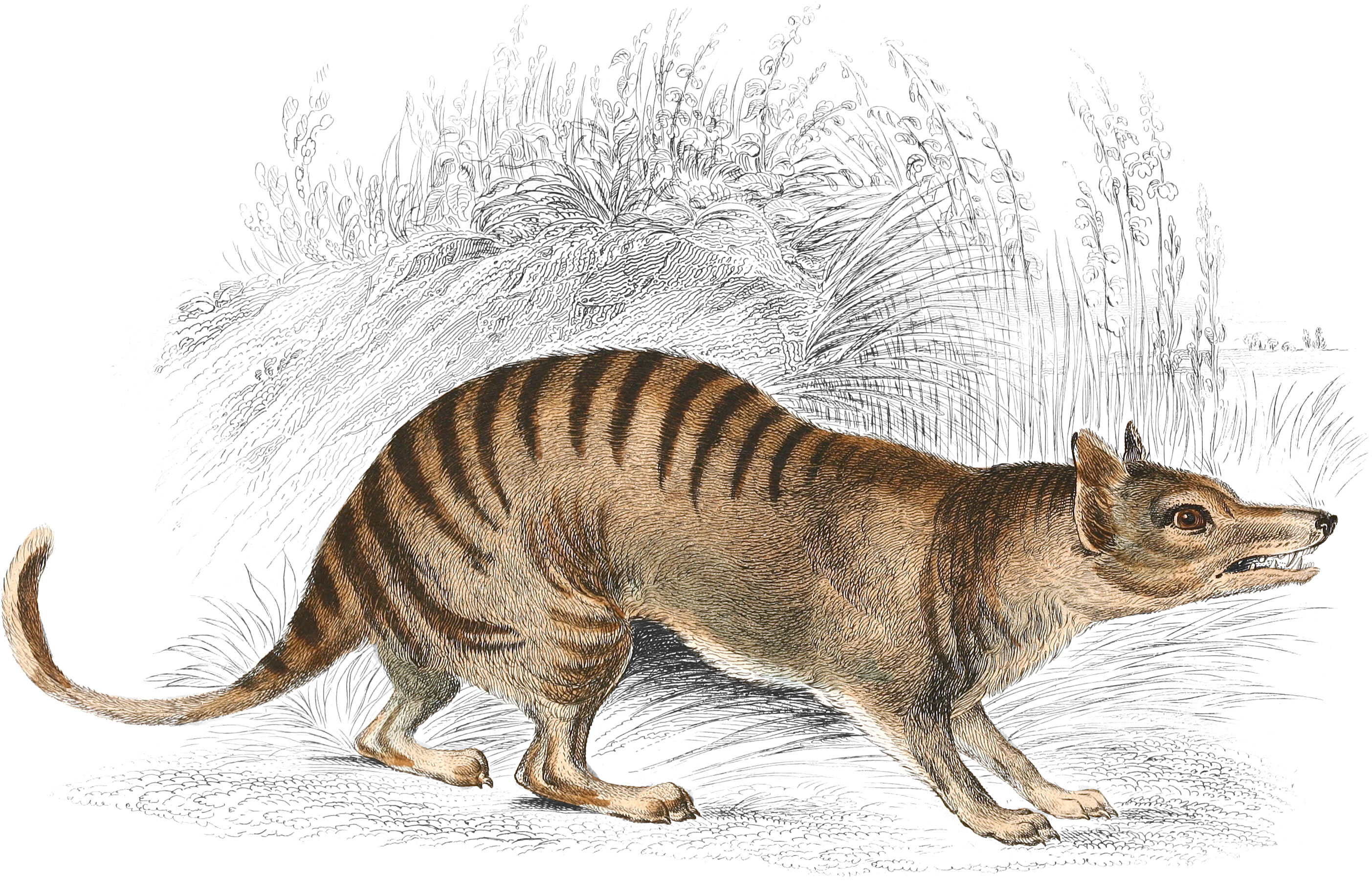
Plate V
Ursine Dasyurus
Dasyurus ursinus.
Dasyurus ursinus, Geoff. Ann. du Mus. tom. xv. p. 305.
Didelphys ursina, Harris, Linnæan Trans. vol. ix., p. 176, Pl. 19.
Description.—Form very stout; head very large, short; ears broad and moderately long; fur moderately long, harsh, and of a black colour; a broad white band crosses the chest and runs backwards over the base of the fore-legs; a second broad white band crosses the haunches; chest brownish; the fur both on the upper and under parts of the body brown next the skin: tail very thick, furnished with longish brown-black hairs; naked tip to muzzle, brown; the fur on the sides of the muzzle is not sufficiently close to hide the flesh; the ears are flesh coloured, partially covered with longish black hairs on the outer side there are but few hairs; the naked soles of the feet are flesh coloured.
Length from nose to root of tail, 21 inches; tail, 7 inches; nose to base of ear, 4 inches 2 lines; tarsus, 3 inches; length of skull, 5 inches 2 lines width, 4 inches; length of palate, 2 inches 8\(\frac{1}{2}\) lines.
Observations.—The white mark across the chest, and that across the rump, are not always present,—at least they are not so much extended as above described. In a skin before me, the chest mark does not pass over the base of the fore-legs; on one side there is a white spot just below and behind the shoulder; there is no white mark across the rump, but a single white patch on one side.
The Ursine Dasyurus inhabits Van Diemen’s Land, and is called by the colonists the native Devil, by which name it was known upwards of thirty years back.
Mr. Harris states that
these animals were very common on our first settling at Hobart Town, and were particularly destructive to poultry, &c. They, however, furnished the convicts with a fresh meal, and the taste was said to be not unlike veal. As the settlement increased, and the ground became cleared, they were driven from their haunts near the town, to the deeper recesses of the forests yet unexplored. They are, however, easily procured by setting a trap in the most unfrequented parts of the woods, baited with raw flesh, all kinds of which they eat indiscriminately and voraciously; they, also, it is probable, prey on dead fish, blubber, &c., as their tracks are frequently found on the sands of the sea shore.
In my note book I have the following memorandum of observations made upon this animal,—two specimens of which have lived for a long time in the Zoological Society’s menagerie.
Upon first beholding the ursine opossum, the large size of the head is very striking, and when it opens its mouth, that is still more so. It is very savage—makes a sort of growling noise when disturbed—sleeps all day, and the keeper says it is not very active at night—feeds upon bread and milk, and meat—does not distinguish the keepers, not even those who feed it—neither do the other Dasyuri.
Mr. Gunn says
the Devil is destructive to sheep all over the colony, and is indeed the most destructive of our indigenous quadrupeds, the Thylacinus being much scarcer. The D. ursinus is nocturnal, very fierce, and a match for an ordinary dog; they bite very severely.
Spotted-Tailed Dasyurus
Dasyurus macrourus
Dasyurus macrourus, Geoff. Ann. du Mus. iii., p. 358.
Description.—Size nearly equal to that of a cat; tail as long as the head and body taken together ears rather short and rounded; head large; fur rather short and harsh; general colour deep rich chestnut brown, somewhat rusty over the haunches, and darker over the shoulders; under parts of head and body white, tinted with yellow in parts, especially on the throat and neck; upper parts and sides of body with irregular shaped white spots, those on the sides of the body and over the haunches the largest; tail deep brown, with irregularly scattered largish white spots, the hairs moderately long but not bushy; head of a paler tint than the body, the hairs partly brown, and partly of a pale yellow colour; fore-legs whitish, mottled with yellow, toes brownish; hind-legs coloured and spotted as body externally; on the fore part they are of a dirty yellow-white colour; tarsi brown, mottled with yellow. The fur on the upper and under side of the body is of a pale ash colour at the base, excepting the hairs composing the pale spots, which are uniform. The ears are sparingly clothed with hairs, excepting towards the margin, where the hairs are rather long hairs of moustaches long, and chiefly of a brownish black colour.
Length from nose to root of tail, 17 inches; tail, 15 inches; nose to base of ear, 3 inches; ear, 1 inch; tarsus, 2 inches 7 lines.
Observations.—This species has proportionately a shorter and more obtuse muzzle than either D. Maugei or D. Geoffroyi, the ears are also shorter and more rounded, and the tail is longer.
The Long-tailed, or Spotted-tailed Dasyurus inhabits Van Diemen’s Land; it attains a larger size, and appears to be a more powerfully made animal than either of the other species of the genus, unless it be the D. ursinus.

Plate VI
Geoffroy’s Dasyurus
Dasyurus Geoffroyi
Dasyurus Geoffroyi, Gould, Proc. Zool. Soc. for Nov. 10, 1840.
General hue of the upper parts of head and body, yellowish brown slightly inclined to greenish; a tint produced by the admixture of rich fulvous yellow and black, the hairs being of the former colour near the apex, and black at the tip: on the sides of the body, and especially on the hinder parts, the fulvous hue prevails: white spots, (some of which are very small and others about half an inch in diameter,) are scattered in an irregular manner over the whole of the upper parts and sides of the body: upper lip, chin, throat, and the whole of the under parts of the body and inner side of the limbs, white, with a slight yellowish tint, and in parts tinted with grey: tail about equal to the body in length, cylindrical and rather slender, at the base covered with fur of the same general hue as the body, about the middle there is a considerable admixture of black hairs and at the tip the hairs are entirely of this colour; feet pale, mottled in parts with brownish; ears with white hairs on the inner side, and clothed with short brown hairs externally.
Length from the tip of the nose to the root of the tail, about 16 inches; tail, 12 inches, the long hairs at the tip extending about 1\(\frac{1}{2}\) inches beyond; nose to ear, 2 inches 7 lines; ear, about 1 inch; tarsus, 2 inches 2 lines, without the claws.
The above description is taken from a male specimen lent me for the purpose by Mr. Gould, who procured it at Liverpool Plains, New South Wales. A female, also lent me by Mr. Gould, was rather smaller, and its colouring less rich. It appeared to be adult, and to have had young; the teats being very large—there are six of them.
This species, in its colouring and size, is intermediate between the Dasyurus macrourus and the D. Mangei, From the latter it is readily distinguished by its possessing a small thumb to the hind-foot, and from D. macrourus by its less robust form and the want of white spots on its tail; its colouring moreover is less deep, (not so rich a brown), and the spots on the body are more numerous.
Mauge’s Dasyurus
Dasyurus Maugei
Dasyurus Maugei, Geoff. Ann. du Mus. iii., 359.
Description.—Size about equal to that of the rabbit. Fur long and loose, soft, and slightly woolly; general tint yellow-grey, on the back slightly pencilled with black, under parts of head and body, and the feet, yellowish white; on the upper parts of the body are numerous largish white spots; tail rather short, bushy and without spots, general tint paler than that of the body, whitish at the extremity ears, and fleshy tip to the muzzle, flesh-coloured, naked—a few pale hairs are observable near the margins of the ears; behind the ears is a large white spot, the sides of the face are almost of an uniform pale yellow; sides of the muzzle, at the tip, whitish; hairs of the moustaches rather long, and chiefly of a brown-black colour; claws white. The hairs of the back are of a pale grey colour, pale yellow near the tip, and black at the tip; interspersed with the ordinary fur are numerous longer hairs, the visible portion of which is black; the hairs of the tail are chiefly of a yellow colour, there are however numerous black hairs intermixed on the under side and at the apical portion; the hairs are of an uniform dirty yellowish-white colour. On the under parts of the head and body the hairs are of an uniform colour to the root.
Length from nose to root of tail, 12 inches; tail, (not including the long hair) 9 inches; from tip of nose to base of ear, 2 inches 8 lines; ear, 1 inch 3 lines; tarsus, (claws not included) 2 inches 1\(\frac{1}{2}\) lines; length of skull, 3 inches; width, 1 inch 8 lines; length of palate, 1 inch 7 lines.
Observations.—In the skeleton of this species there are the bones of a small thumb to the hind-foot, but when the flesh is on the bones it is perfectly hidden, and does not project in the form of a tubercle, as in D. macrourus.
This species inhabits Van Diemen’s Land and New South Wales.
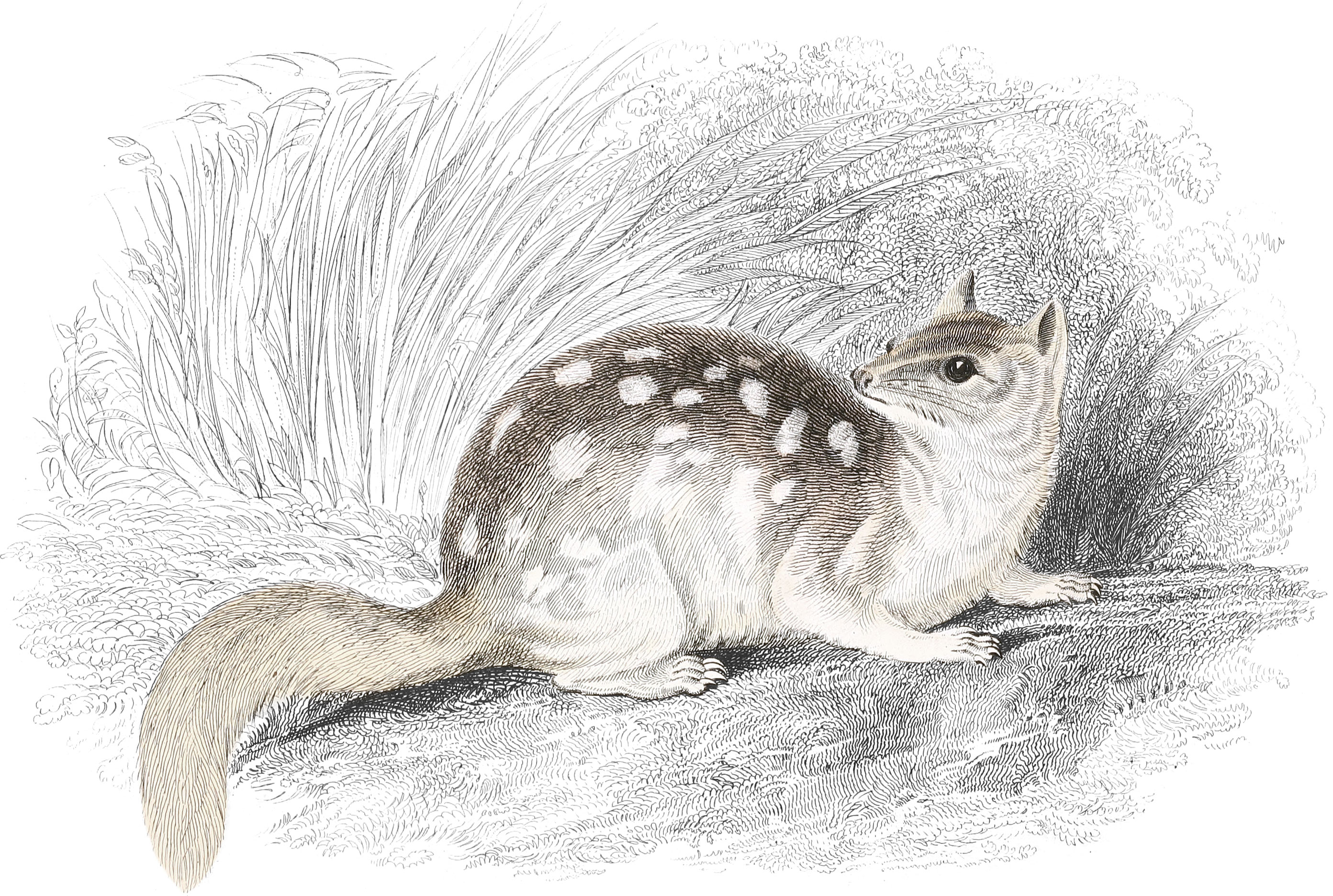
Plate VII
Dasyurus Maugei, Black Variety
Dasyurus viverrinus. Geoff. Ann. du Mus. iii., p. 360.
Description.—Black, with a purple-brown tint, beneath, brown or greyish brown, back and sides of body with largish scattered white spots; tail slightly bushy, of an uniform black or black-brown colour; legs and feet dark brown: the hairs on the ears of the same colour as those of the head. The fur on the back is grey at the base, that on the belly is pale-grey at the base: the hairs of the moustaches are long and of a black colour. Ears large, somewhat pointed.
Length from nose to root of tail, 14\(\frac{1}{2}\) inches; of tail, 9 inches—without including the long hair at the tip.
Observations.—The tint of this animal varies slightly; it is sometimes nearly a pure black on the back, but a purple-brown tint is usually observable—the white spots vary somewhat as to size and number, there are usually a few small white spots on the head—the fur is not very soft but rather long.
This animal, which has by all naturalists been regarded as a distinct species, Mr. Gould discovered,66 during his stay in Van Diemen’s Land, to be a variety of the preceding, (D. Maugei.) In a litter of four young ones he found two grey specimens (the D. Maugei,) and two black—he states however, that the black variety is much more rare than the grey.
Instances are common in which we find black varieties of animals usually otherwise coloured, but I do not recollect an instance in which coloured varieties have been found, in a state of nature, of animals typically black; this circumstance, together with the fact, that the black specimens are comparatively rare, has induced me to retain the name of Maugei for the species in preference to that of viverrinus.
Brush-Tailed Phascogale
Phascogale penicillata
Phascogale penicillata, Temm.
Dasyurus penicillatus, Geoff. Ann. du Mus. iii., p. 361.
Didelphys penicillata, Shaw.
Tapoa Tafa, White, Journal of a Voyage to New South Wales.
Description.—About the size of a rat, (Mus decumanus,) ears large; tail rather long and very bushy, excepting at the base; colour of the upper parts of the body grey, of the under parts white. The fur is long, rather soft and loose: the hairs, which constitute the chief clothing of the animal, on the upper parts of the body are grey; greyish-white near the apex and tipped with black; numerous longer hairs, which are of a black colour, are interspersed; on the under parts of the body, the hairs are pale grey next the skin and white externally the hairs on the upper surface of the head are coloured like those of the back, near the angles of the eye they are blackish; the edge of the upper lip and the lower portion of the cheeks are whitish; the moustaches are black, the hairs are numerous and very long; the ears are covered with extremely minute grey and white hairs, but appear almost naked; the flesh was probably brownish when the animal was alive; they are very broad at the base, the apex is rounded, and the outer margin is nearly straight; the fore-feet are dirty white; the hairs covering the tarsi above are partly grey and partly white, over the toes they are white; the claws of both fore and hind feet are rather long, much compressed and arched, and of a whitish colour. About one inch of the tail at the base is covered with loose fur like that of the body, there is then a space about 1\(\frac{1}{2}\) inch with harsher hairs, which are of moderate length, and chiefly of a dirty white colour; on the under side of this portion of the tail the hairs are shorter, very stiff, and of a dark brown colour—it appears as if the animal occasionally rested on this portion of the tail; the remainder of the tail, which is about two-thirds of the whole length, is very bushy, being covered with black hairs averaging about 2 inches in length.
Length from nose to root of tail, 7 inches 9 lines; length of tail, (not including the long hair) 7 inches—with the hair 9 inches; from nose to ear, 1 inch 6\(\frac{1}{2}\) lines; ear, 10 lines, width at the base about 11 lines; length of tarsus, (without the claws) 1 inch 5 lines.
Through the kindness of Prof. Owen, who allowed me to examine the original specimen of the “Tapoa Tafa” of White, now in the Museum of the College of Surgeons, I am enabled to state with certainty that it is the same as the Phascogale penicillata,—the Dasyurus Tafa of Geoffrey must therefore be erased from the list of species of Dasyuri.
The Brush-tailed Phascogale, Mr. Gould informs me, is found throughout the Colony of New South Wales, and is common on Liverpool Plains—he has also met with it at Adelaide in South Australia. In the colony just mentioned, it frequently enters the houses.

Plate VIII
Yellow-Footed Phascogale
Phascogale flavipes
Phascogale flavipes, Waterh. Proc. Zool. Soc. for July 1837, p. 75.
Description.—Fur moderately long, not very soft, consisting of hairs of two lengths. On the back the shorter hairs are of a paleish ochre colour at the apex, and the longer hairs are black, on the sides of the body and limbs the ochreous hue prevails, the black hairs being less numerous; the under parts of the body are of a yellow colour, inclining to white on the throat and mesial line of the belly; all the hairs are of a deep grey colour at the base both on the upper and under parts of the body. The general tint of the head is grey, a tint produced by the admixture of black and white hairs; the eyelids are black; the hairs immediately above and below the eye are of a yellow-white colour, as are also those of the upper lip and lower part of the cheeks. The moustaches are moderately long; the hairs are black at the base and grey at the apex; the ears are of moderate size, and have the hinder portion emarginated; they are furnished externally with minute hairs, those on the inner side being chiefly of a yellow colour. The feet are of an uniform deep ochre colour. The tail is about equal in length to the body and half the head, and is furnished with small and closely adpressed hairs, between which rings of scales are visible; on the apical portion of the tail, the hairs are longer; the hairs on the under side of the tail are of a deep buff colour, and those of the upper side are black and yellow, excepting at the apex, where all the hairs are black.
Length from nose to root of tail, 4 inches 8 lines; of tail, 3 inches 5 lines; from nose to base of ear, 1 inch; tarsus (claws included) 9\(\frac{3}{4}\) lines; ear, 6 lines.
Habitat North of Hunter’s River, New South Wales.
Observations.—The teeth in this species agree in number with those of Phascogale penicillata, and in fact scarcely differ in any respect, making allowance for the difference in the size of the animals. The anterior pair of incisors of the upper jaw are separated by a small interval from the rest which they exceed in size; there is not however quite so great a difference in size between these anterior and the lateral incisors as in P. penicillata. The molar teeth are rather shorter and broader in proportion than in the animal just mentioned. In the palate there are two tolerable large incisive foramina, between which there is a minute opening as in P. penicillata; in the back part of the palate there are two very large openings, they commence opposite the fourth molar, and terminate apparently opposite the last.67 The skull is narrower and rather more elongated than in P. penicillata, the nasal bones are not so broad behind.
I am informed by Mr. Gould, that this species is frequently seen both on the ground and on trees, it clings very closely to the trunks of the trees, keeping its legs widely separated, and moving in little starts.
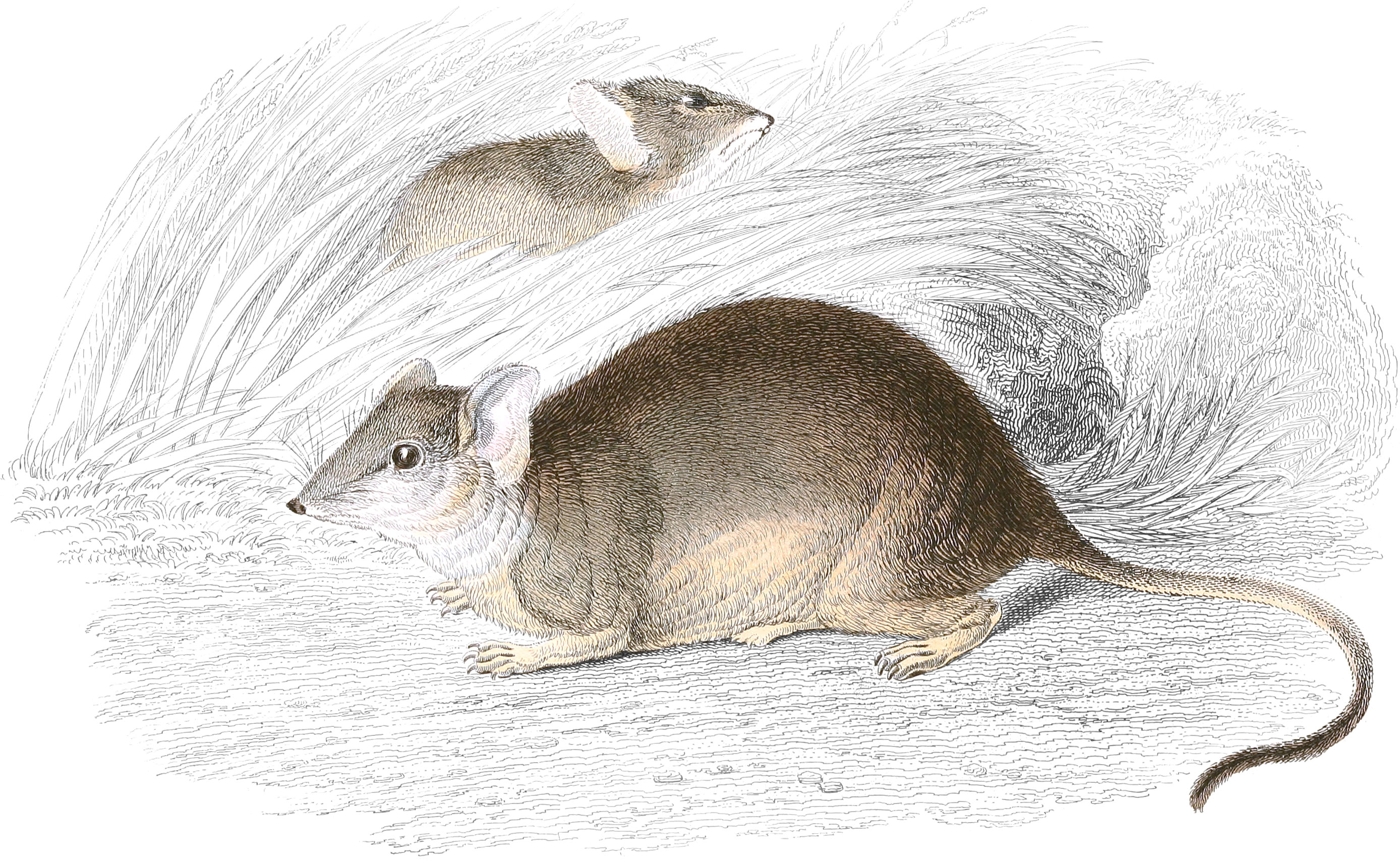
Plate IX
Geoffroy’s Phascogale
Phascogale minima.
Dasyurus minimus, Geoff. Ann. du Mus. Tom. 3, p. 362.
Phascogale Swainsonii, Waterh. Mag. of Nat. Hist. for June 1840, Vol. iv., p. 299.
This species is larger than the Phas. flavipes; its fur, instead of being, as in that species, of a yellow-grey tint, is of a dark and rich brown hue; the under parts of the body are deep grey, slightly grizzled with white, whereas in Phas. flavipes, the under parts are yellow and white; the most important differences, however, consist in the more attenuated and elongated form of the head, especially of the anterior portion; the teeth, nevertheless, form an uninterrupted series, hence each tooth, (especially the false molars,) has a proportionately greater antero-posterior extent. The distance from the fore part of the front incisors of the upper jaw to the hinder part of the third true molar in Phas. minima, is 7\(\frac{1}{2}\) lines, whilst in Phas. flavipes, the same measurement gives 6\(\frac{3}{4}\) lines; the teeth are less powerful than in the animal last mentioned, and the incisors of the upper jaw form an uninterrupted series, whilst in Phas. flavipes, there is an interspace on either side between the anterior pair of incisors and the lateral ones. In the elongated and slender form of the muzzle, and more delicate teeth, the present animal evinces an approach to the Myrmecobius; its fur is moderately soft, rather long and glossy, of a deep slate-colour next the skin; the hairs are most of them narrowly annulated towards the apex with rich brown, or yellow-brown; the longer hairs are black; on the under parts of the body, the hairs (which, like those of the upper parts, are of a deep slate-grey at the base,) are slightly tipped with brownish-white, or ash-colour; the feet are covered with dark brown hairs above (not yellow as in Phas. flavipes;) the tail is also dark brown, and on the upper side inclining to black; the hairs on this part are all short and adpressed.
There are other differences between the present species and that with which we are comparing it, which may help to distinguish them, I allude to the colouring of the head. In Phas. flavipes, the upper lip, lower part of the cheeks, chin, and throat, are white, and there is, moreover, a white spot beneath the eye, whereas, in Phas. minima, no white is visible, indeed the head is almost of an uniform colour with the body, the hairs on the sides and upper parts are black, slightly grizzled with yellowish, and on the chin and throat they are grey, tinted with brownish, especially on the chin.
The specimen from which this description is drawn up, is apparently a female, and furnishes the following dimensions:—length from nose to root of tail, 5 inches 2 lines; tail, about 3 inches 5 lines; head about 1 inch 2 lines; tarsus, to end of claws, 10 lines; it is from Van Diemen’s Land.
The original of the above description is in the Museum of Mr. Swainson, who kindly allowed me to examine and describe it.
This species sometimes attains rather a larger size than is indicated by the dimensions given. I have altered the name I had applied to it, of Swainsonii into minima, Mr. Gould, who has recently examined the original of Geoffroy’s Dasyurus minimus, having informed me that that animal was specifically identical with the Swainsonii, Geoffroy’s specimen must be young, being only four French inches in length.
Murine Phascogale
Phascogale murina
Phascogale murina, Waterh. Proc. Zool. Soc. for July 1837, p. 76.
This species may be readily distinguished from the former by its much smaller size, being in fact rather less than the common mouse (Mus musculus,) or less than half the bulk of P. flavipes. The fur is rather short and soft; its general hue is grey with a faint yellowish tint, the longer hairs on the upper parts of the body being grey at the apex, and the shorter hairs tipped with pale yellow or cream colour; the feet and under parts are white, as are likewise the sides of the face beneath the eye. All the hairs of the body are of a deep slate-colour at the base. The tail is covered with very minute closely adpressed silvery white hairs. The dentition is evidently that of an adult animal: the canines and anterior incisors of both upper and lower jaws appear to be smaller in proportion than in P. flavipes.
Length from nose to root of tail, 3 inches; tail, 2 inches 7 lines; from nose to base of ear, 8\(\frac{1}{2}\) lines; tarsus, (claws included) 7\(\frac{3}{4}\) lines; ear, 4\(\frac{1}{2}\) lines.
Habitat North of Hunter’s River, New South Wales.

Plate X
Myrmecobius
Allied to the Dasyuri, appears to be the little animal from Swan River, on which I founded the genus Myrmecobius. Its curious dentition is;—
Incisors, \(\frac{4\ \cdot\ 4}{3\ \cdot\ 3}\); canines, \(\frac{1\ \cdot\ 1}{1\ \cdot\ 1}\); false molars, \(\frac{4\ \cdot\ 4}{5\ \cdot\ 5}\); true molars, \(\frac{4\ \cdot\ 4}{4\ \cdot\ 4}\) = 52,—a number surpassing that of any known quadruped, unless it be certain armadillos and cetaceans. The incisors are of a compressed and pointed form, and have the apical portion slightly recurved; those of the upper jaw are separated from each other by a small vacant space; the space between the posterior pair on either side is rather less than the width of the teeth; between the others the intervals are smaller; the anterior pair of incisors are rather less than the rest, and the posterior pair are the largest. In the lower jaw, the anterior pair of incisors are decidedly larger than the rest. The canines are rather small, much compressed, and somewhat recurved. The false molars have each two roots; they are much compressed, pointed and have the apical portion slightly recurved; near the base in front, and behind each of these teeth there is a notch; in the foremost of the false molars, this notch is indistinct; the last of the false molars, both of upper and under jaw, is considerably smaller than the others, and of a compressed form, that of the upper jaw presents four minute tubercles of nearly equal size and arranged in a line; that of the lower jaw has three of these small tubercles, one of which is indistinct. The true molars are very small and longer than broad; those of the upper jaw present numerous small black tubercles; in the lower jaw the outer edge of the molars is produced and divided by notches, so as to leave three or four bristly points in each; on the outer side of each molar, excepting the foremost, are several small blunt tubercles, which must be nearly on a level with the gum in the living animal; between all the teeth both of the upper and lower jaws, excepting the four posterior molars of the lower jaw, there is a space which is sometimes equal to the width of the teeth, but generally less. The ramus of the lower jaw is twisted in such a manner that the outer surfaces of the true molars come in contact with the masticating surface of those of the upper jaw.68 The fore-feet are furnished with five toes, which are armed with strong, curved, and slightly compressed claws; on the hind-feet there are but four toes,—their claws scarcely differ from those of the fore-feet. The tail is bushy and not prehensile,
Banded Myrmecobius
Myrmecobius fasciatus
Myrmecobius fasciatus, Waterh. Proc. Zool. Soc. for July 1836, p. 69—see also p. 131.
Myrmecobius fasciatus, Transactions of the Geol. Soc. Vol. II VI., part 2, p. 149 49, Pl. 27 5.
Size of a squirrel; head very long and pointed; ears moderate, much pointed; fore-legs and claws rather strong; tarsi moderate; tail about equal to the body in length, equally bushy from base to apex; fur very harsh and loose, the hairs flattish. General colour of the fore part of the body bright rusty red, this tint is gradually shaded into rusty brown on the head, and into black, or brown black, on the hinder half of the back—there are about six transverse cream coloured bands, leaving interspaces of about double their own width; these bands become gradually less distinct as they approach the fore half of the back, and are quite obliterated in front; the sides of the face are rusty white, the chin, throat, and the whole of the under parts of the body are yellowish white, not very pure; the fore-legs are rusty yellow, and both fore and hind-feet are of a buff colour; the same tint is observable on the fore part of the hind-legs; the hairs of the tail are black and white, or yellowish white, they are harsh, and for the most part white with a broad black space in the middle, but at the apical portion of the tail the white is replaced by rust colour at the base and yellowish at the apex; along the central portion of the under side of the tail the hairs are of a brilliant rusty red colour. The ears are tolerably well clothed with small adpressed hairs, those on the inner side are yellowish, and those on the back are of a brownish rust colour a narrow dusky line runs through the eye, and the hairs are directed in opposite directions from this line. The hairs of the moustaches are very small and black; some black bristly hairs are observable below the eye, and a few spring from above it—the whole of the upper parts of the body are sparingly pencilled with white. The fur on the belly is nearly uniform to the root, and on the back a very small space on each hair at the root is grey.
Length from nose to root of tail, 10 inches; of tail, measured to the end of the hair, 7 inches; tarsus and claws, 2 inches 2 lines; fore-foot and claws, 1 inch 4 lines; ear, 9\(\frac{1}{2}\) lines; width of ear at base, 7 lines; from nose to ear, 1 inch 10 lines; length of skull, about 2 inches 3 lines; width, i inch 3\(\frac{1}{2}\) lines; length from front of foremost incisor to posterior part of last molar, 1 inch 3\(\frac{1}{2}\) lines; space between orbits 9 lines; width of nasal bones at the base, 6\(\frac{1}{2}\) lines length about 10\(\frac{3}{4}\) lines.
This beautiful and interesting little animal was first discovered by Lieut. Dale, whilst on an exploring party in the interior of the country, at the Swan River settlement, and was discovered about 90 miles to the south-east of that river. Lieut. Dale says,
Two of these animals were seen within a few miles of each other; they were first observed on the ground, and on being pursued, both directed their flight to some hollow trees which were near. We succeeded in capturing one of them; the other was unfortunately burnt to death in our endeavour to dislodge it, by fumigating the hollow tree in which it had taken refuge—the country in which they were found, abounded in decayed trees and ant hills.
A second specimen has since been brought to England, and was placed in my hands for examination. I was informed this was brought from Van Diemen’s Land, but Mr. Alexander Gordon, who had sent the specimen to England to be stuffed, has since assured me that I was misinformed, he having himself procured the animal at Swan River. This specimen Mr. Gordon very liberally presented to the Zoological Society. M. Gervais communicated a paper to the “Académie des Sciences” of Paris, (for 1838, p. 671,) in which he endeavoured to show that I was mistaken in my views as regards the affinities of Myrmecobius. This naturalist states that the form of the ascending ramus of the lower jaw, and the presence of two only, instead of four palatal foramina, indicate that this animal should be placed with the Placental series or “Monodelphis.”
M. Gervais should not have overlooked the dentition; the fact of there being more than six incisors in the upper jaw, together with the great number of the molar teeth (which have two roots,) was sufficient to justify me, in the present state of our knowledge, to regard this little Australian animal as a Marsupial. Besides this, the angle of the lower jaw is represented in the drawing as being twisted inwards, a character peculiar to the Marsupialia; beyond this character I am acquainted with none furnished by the ascending ramus which would serve to distinguish the Placental from the Marsupial animal. As regards the palatal foramina, I may remark, that although the Marsupialia have generally two large openings near the palato-maxillary suture, these openings are sometimes almost obliterated, as in the section of the Petaurists, to which I have given the name Belideus, and in the great Kangaroo, (Macropus major) whilst, on the other hand, similar openings are common in the Placental series; in fact, I can see no distinctive character between the Placental and Marsupial animals as regards the number of palatine openings—they vary in both groups.
Through the kindness of Mr. Gould, who allowed me to examine two skins and a perfect skeleton of Myrmecobius recently obtained by him from Swan River, I am enabled to clear up all doubts as to the marsupial nature of Myrmecobius. In a female specimen I could distinctly trace the remains of a pouch; the mammæ were in the ordinary position found in the Marsupialia; a male possessed the peculiar characters of that group, and, moreover, the skeleton presents well-developed Marsupial bones. In the skull of an adult animal I find all the peculiarities so ably pointed out by Professor Owen as serving to distinguish the Marsupials. From a careful examination of this skull I am more than ever convinced that Myrmecobius leads off to the Edentate orders—the Echidnas;—in fact, that my original views are correct.
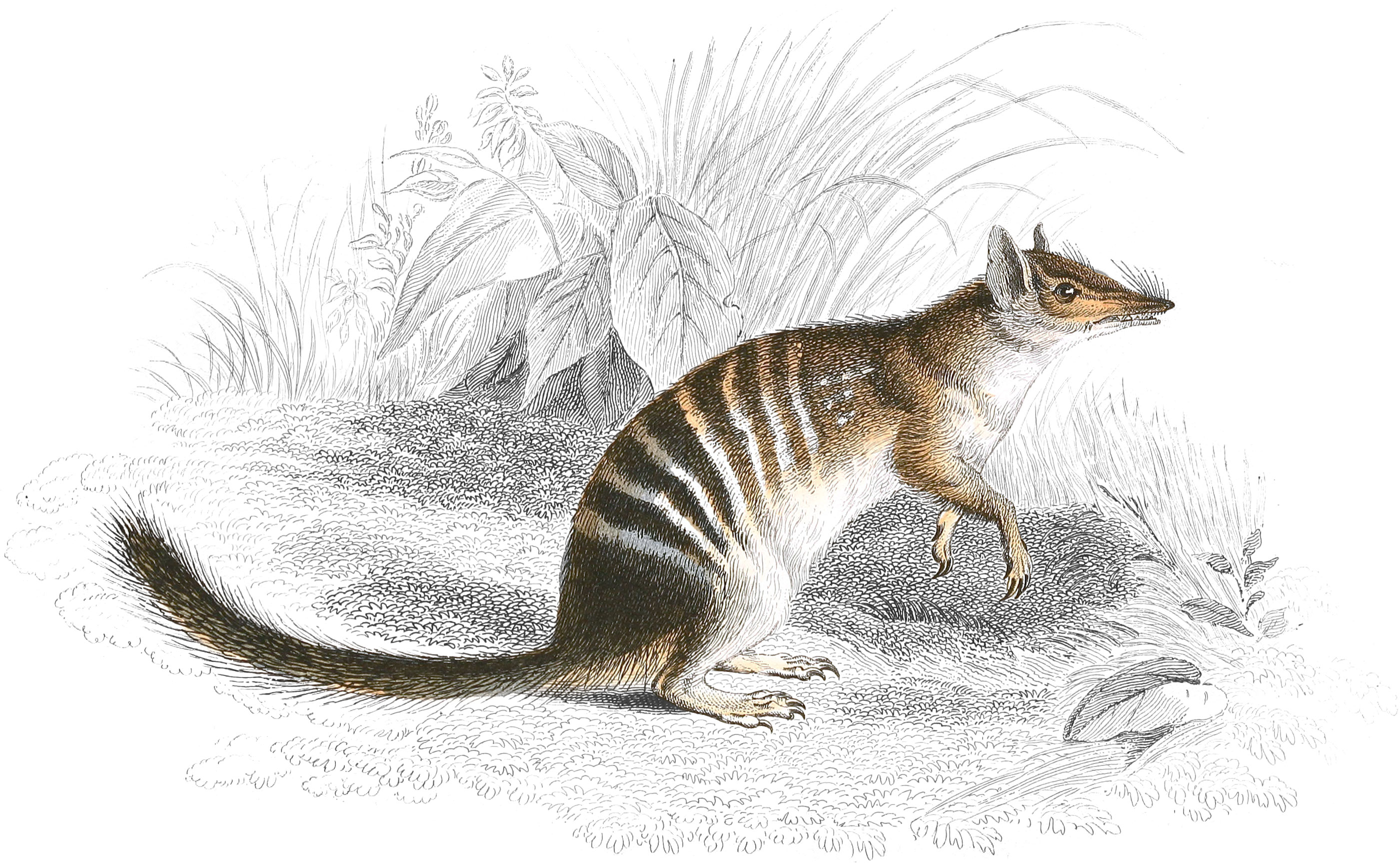
Plate XI

Red Myrmecobius
Myrmecobius rufus.
Major Mitchell gives this name to an animal discovered during one of his surveying expeditions in Australia, and which was called the “Red shrew-mouse” by the men composing his party. Not having taken notes, the author applies the above name to the animal with hesitation.
Family Peramelidæ
Perameles
The dentition of the species of Perameles is as follows:
Incisors, \(\frac{5\ \cdot\ 5}{3\ \cdot\ 3}\); canines, \(\frac{1\ \cdot\ 1}{1\ \cdot\ 1}\); false molars, \(\frac{3\ \cdot\ 3}{3\ \cdot\ 3}\); true molars, \(\frac{4\ \cdot\ 4}{4\ \cdot\ 4}\) = 48. The incisors are of a compressed and truncated form, and arranged laterally; the posterior incisor in the upper jaw is usually separated from the rest,—in Perameles nasuta, the intervening space is equal to at least three times the width of one of these teeth, but in P. lagotis, it is scarcely equal to the width of one of the incisors. The canines are of moderate size,—sometimes small,—of a compressed form and recurved at the apex. The false molars are compressed and pointed, and have a small notch in front and behind. The true molars are nearly of a quadrate form, as viewed from above, but have the exterior portion slightly broader than the inner one; they present five or six small but rather sharp tubercles; the posterior molar of the upper jaw, which is smaller than the rest, is nearly of a triangular form in P. nasuta, and almost round in P. lagotis. In the lower jaw the molars are longer than broad, they are divided in the middle by a transverse notch, and present each four principal pointed tubercles, which are of larger size than those of the upper jaw. The fore-feet have three well-developed toes, of which the outer one is the smallest; the claws are very large and strong, solid and but slightly arched, and in fact well suited to the burrowing habits of these animals. Besides these toes there are two tubercles, one on the outer, and the other on the inner side of the foot, which are the rudiments of the remaining two toes they are each furnished with a minute rounded nail. In the hind feet, which are long, there is a central very long toe, armed with a large broad nail, which is flat beneath, and slightly arched above; on the outer side of the central toe is another of moderate size, and armed with a nail of the same description as the last, and on the inner side of the foot there are two slender toes, joined in a common integument as in the Kangaroos, and furnished with a double hollow claw; on the under and inner side of the foot (at least in P. nasuta,) are to be perceived the remains of the inner toe, or that which assumes the thumb-like character, in many marsupials its extreme point is free, but there is no nail.69 The somewhat short fore-legs and comparatively long hind-legs of the Perameles or Bandicoots, cause them to arch the back much when walking; when they move quickly their gait is half way between running and jumping. In P. nasuta, obesula, and Gunnii, the tail is very short and but sparingly clothed with hair, and the ears are of moderate size. In P. lagotis the ears are very large, like those of a Rabbit, and the tail is long and furnished with long hairs especially on the upper surface of the apical portion. This animal has unusually long hind-legs and feet, and when standing they are spread out and the fore-feet placed between them, or very slightly in advance.
The pouch in the Bandicoots opens backwards, and in this respect is the reverse of what is found in other Marsupalia, where the pouch opens upwards or forwards. In one species of Perameles, (P. lagotis,) however, the pouch certainly appears, from the stuffed specimen in the Zoological Society’s Museum, to open forwards.
Dr. Grant found only the remains of insects in the intestines of a Perameles nasuta which he dissected, and Professor Owen obtained the same result in the dissection of P. obesula. A specimen of P. lagotis, now living at the Zoological Society’s Menagerie, is fed entirely on vegetable substances,70 and the keeper informed me that it refused meat, and would not eat meal-worms when given to it at the suggestion of Professor Owen. The extremely worn state of the molars in a skull now before me, would appear to indicate, that in the wild state, this animal had been feeding upon vegetable substances.
The Perameles, as well as the Opossums (Didelphys,) have the stomach simple, and a moderately long intestinum cæcum, they agree also with the true Opossums, in having ten incisors in the upper jaw. In general structure they furnish a beautiful link between the last mentioned animals and the Kangaroo family.
Rabbit-Eared Perameles
Perameles lagotis
Perameles lagotis, Reid. Proceedings of the Zoological Society of London, for December 1836, p. 129.
Size of a rabbit; head very long; muzzle much attenuated; ears large, nearly as long as the head; tail long, furnished on the upper side with long bushy hairs; tarsi long; fur very long and soft. General tint of the upper parts of head and body, ashy-grey; sides of head, shoulders, and sides of body very pale vinous rust colour; under parts of head and body, and inner side of limbs, white; fore-legs and feet white, a deep greyish patch on the outer side of the former; tarsi white above, the hairs covering the under surface, (which are rather long) are of a smoky brown colour; the fore part of the hinder-legs is white, the outer and hinder part is blackish grey, a whitish line is extended backwards on the sides of the rump: soft long hair, coloured like that of the body extends about 1\(\frac{1}{2}\) inches on the base of the tail; beyond this, about 3\(\frac{1}{2}\) inches of the tail is covered with black and somewhat harsh hairs; on the under side of the tail they are scarcely half an inch in length, but on the upper side, they are most of them upwards of 1 inch in length; the remaining portion of the tail is covered with white hairs; these increase in length, on the upper side, to the tip, where they are about 2 inches in length; on the under side they are short, and decrease in length towards the apex of the tail, the extreme point of which is naked. The moustaches are moderately long and of a black colour. The ears are shaped much like those of a Rabbit, (Lepus cuniculus,) but are rather more pointed,—they are almost naked, of a pale colour; the margins are fringed with whitish hairs; externally, on the fore part they are covered with minute brown hairs; these hairs do not extend, however, on to the apical portion of the ear. The claws of the fore-feet are very large.
Length from nose to root of tail, 18 inches; length of tail, (not including the hair,) 9\(\frac{1}{2}\) inches; from tip of nose to ear, 4\(\frac{1}{2}\) inches; length of ear, 3\(\frac{1}{2}\) inches; width of ear at the base, 2 inches 1 line; length of tarsus, (claws not included,) 1 inch 10\(\frac{1}{2}\) lines; length of skull, 4 inches; width, 1 inch 3 lines; length of palate, 2 inches 5 lines.71
The fifth incisor, on either side, of upper jaw is removed from the fourth by almost half its own diameter. The canines are large.
Habitat, Swan River.

Plate XII
Long-Nosed Perameles
Perameles nasuta
Perameles nasuta, Geoff. Ann. du Museum, iv., p. 62, Pl. 44.
Muzzle attenuated; head long; ears moderate, pointed; tail short; general hue of upper parts of head and body, brown, pencilled with black; of sides of body, pale brown, with a slight vinous tint; edge of upper lip, chin, throat, and the whole under parts of body, white; the fore-legs and feet, and the tarsi are also white. The fur is very harsh to the touch; the under fur on the upper parts of the body is of a palish ash-colour; all the longer harsh hairs are of the same colour at the base; the longer of these are black externally, and the remainder are of a palish vinous brown at the apex; on the sides of the body the last mentioned tint prevails, owing to there being scarcely any of the black hairs; the hairs on the belly are white to the root. The minute hairs covering the ears internally are whitish, and on the outer side of the ears they are dusky. The tail is covered with minute adpressed hairs; those on the upper side are brown, and on the under side they are brown-white. Hairs of moustaches not numerous, rather short and slender.
Length from nose to root of tail, 16 inches; tail (about) 4\(\frac{1}{2}\) inches; from tip of nose to ear, 4 inches ear, 1 inch 2 lines; tarsus, (claws not included,) 2 inches 4 lines; from front of anterior incisor to canine, 6\(\frac{3}{4}\) lines; length of bony palate, 1 inch 10\(\frac{2}{3}\) lines.
Four incisors, on either side of upper jaw, are contiguous; behind, there is another incisor situated half way between the last of the series and the canine.
Habitat, New South Wales.
An animal labelled, “Perameles auritus de Port Jackson,” in the Paris Museum, I feel no doubt is the same as the present species; its dimensions are nose to root of tail, 14 inches; tail, 3 inches; tarsus, 1 inch 11 lines, (without the claws;) ear, 7\(\frac{1}{2}\) lines.
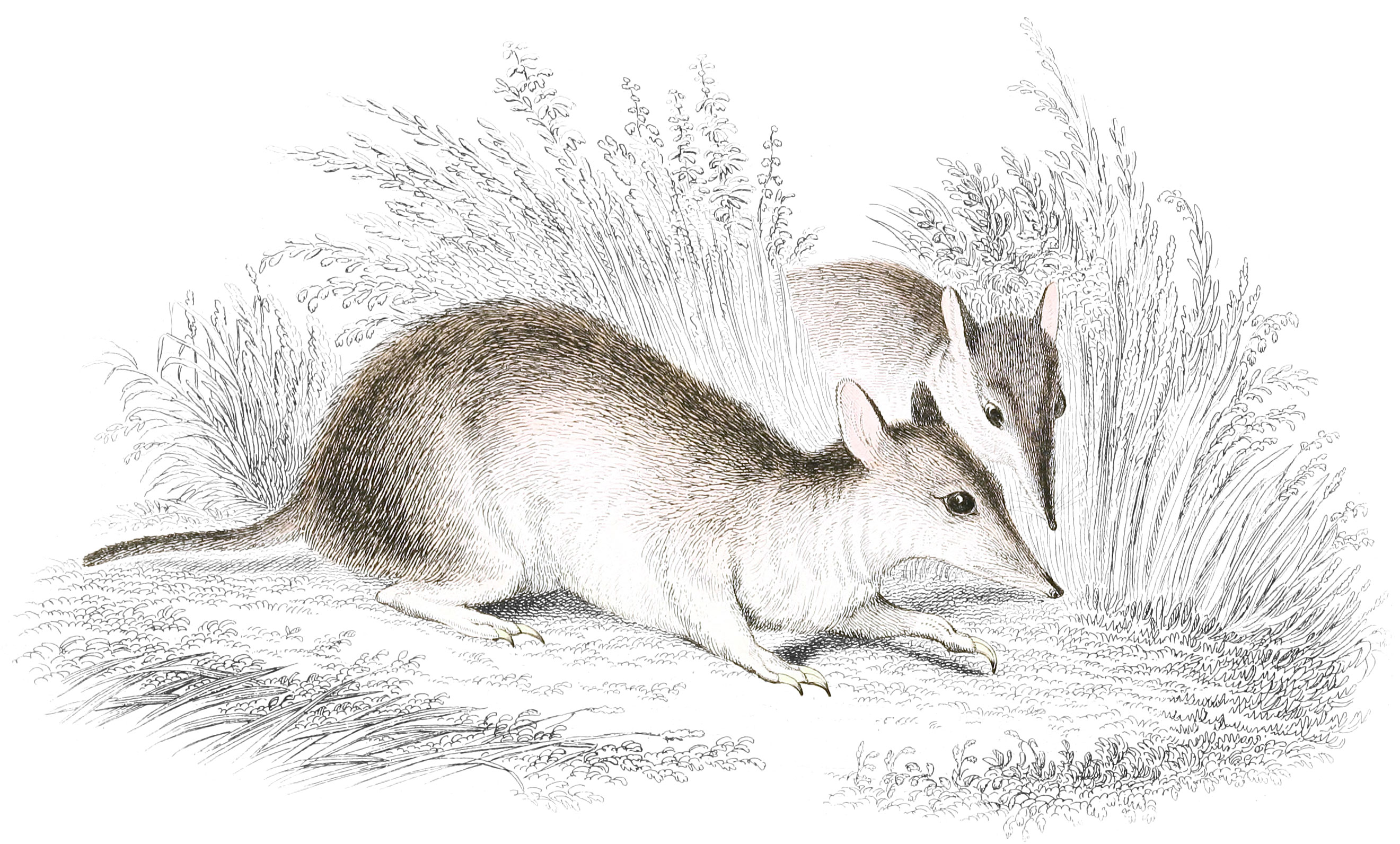
Plate XIII
Short-Nosed Perameles
Perameles obesula
Perameles obesula, Geoff. Ann. du Mus. iv., p. 64, Pl. 45.
Didelphys obesula, Shaw, Naturalist’s Miscellany, No. 96.
As regards the general form of the body, and the colouring, this animal greatly resembles the common rat (Mus decumanus)—in size it exceeds the largest specimens of that animal. The ears are moderate, pointed; the muzzle is slender and elongated, but shorter than in the other species here described; the tail is short, and covered throughout with short hairs. The covering of the animal consists of a somewhat scanty, soft, ash-coloured under fur, which is hidden by longer (though still shortish) sub-spinose hairs; of these spiny hairs the longest are black, and the shorter, which are the most abundant, are black, broadly tipped with pale ochre colour, often with the extreme point black; the black and pale colours are about equal in proportion. The edge of the upper lip, chin, throat, and the whole of the under parts of body and inner side of limbs, are white—not pure—and the hairs are uniform throughout—not grey at the base. Towards the base, (on the upper side,) the hairs of the tail are grizzled with black and yellowish, and at the apex they are black; on the under side of the tail they are dirty white. The ears are moderately well clothed with short hairs, those on the inner side are yellow, and those on the outer side black, excepting on the margin, where they are pale. The limbs are coloured externally, as the sides of the body; the feet are pale; the hairs on the toes are dirty white, on the upper side of the tarsus they are yellowish, but grey at the base; hairs of the moustaches weak and not numerous.
Length from nose to root of tail, 13 inches 6 lines; tail, about 4\(\frac{1}{2}\) inches; nose to ear, 3 inches; ear, 8 lines; tarsus (claws not included,) 2 inches; from front of anterior incisor to canine, 4\(\frac{1}{3}\) lines.
Four incisors on each side of upper jaw are contiguous, behind these is another incisor, which is small and pointed, and is situated about half a line distant from the last of the series.
Habitat New South Wales and Van Diemen’s Land.
The little animal which is the original both of Shaw’s and Geoffrey Saint-Hillaire’s descriptions, is now preserved in the Museum of the College of Surgeons. Professor Owen very kindly called my attention to it, and has thus enabled me to clear up the difficulty which I experienced in my endeavours to identify the species. It is a very young animal, and I feel no doubt is specifically the same as the one above described.
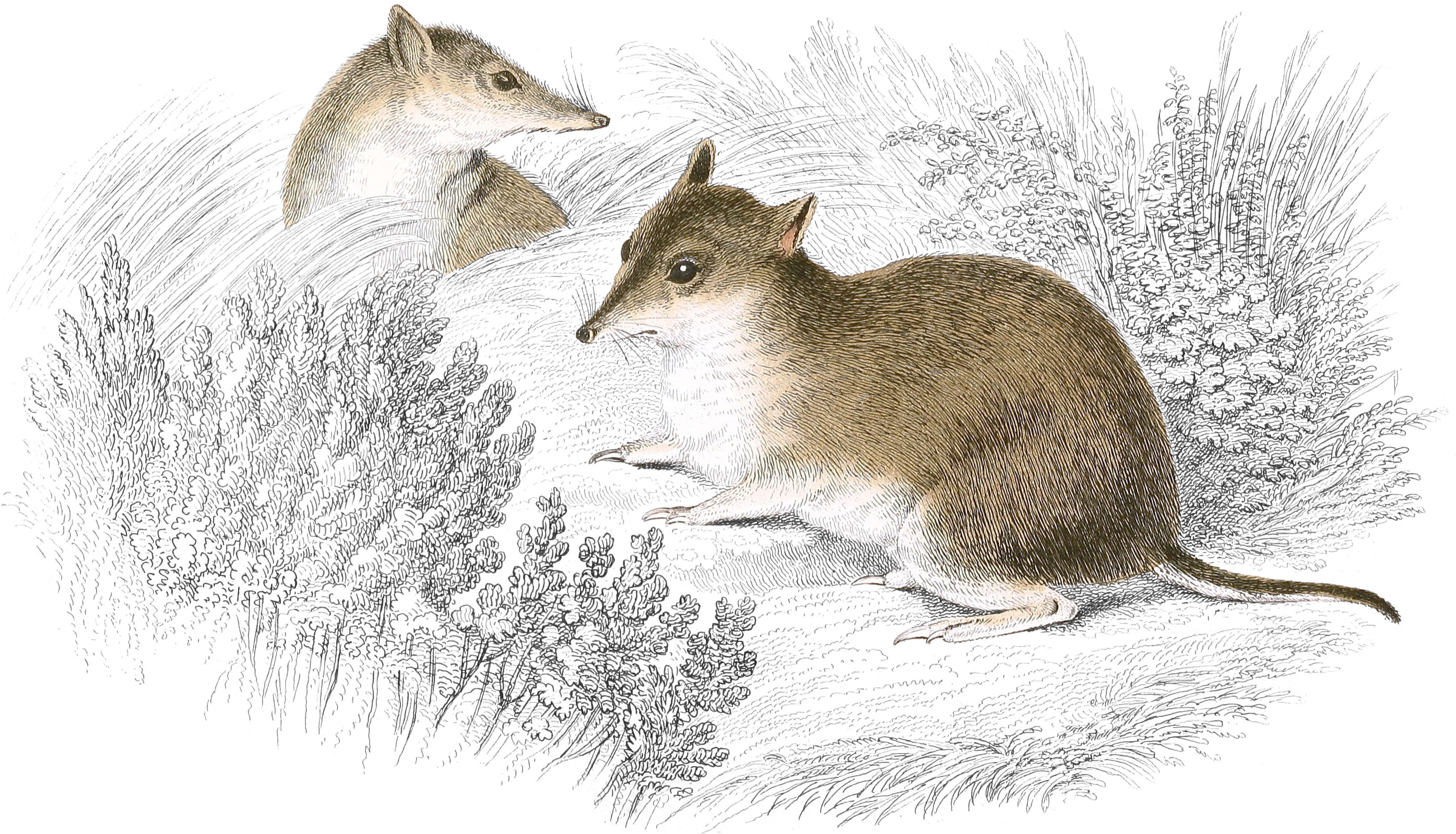
Plate XIV
Gunn’s Perameles
Perameles Gunnii
Perameles Gannii, Gray. Proceedings of the Zoological Society for January 1838, p. 1.—See also Annals of Natural History for April 1838, No. 2, vol. i., p. 108.
Muzzle elongated; ears rather long, and much pointed, the posterior edge slightly emarginated tail very short. The colouring of the upper parts of the body consists of a mixture of black and yellow; the general tint of the sides of the body is very pale brownish-yellow, but there are scattered black hairs; the under parts of the body, the lips, and the tail, are white: a whitish band crosses the hinder portion of the back, but is divided in the middle of the back by a dark line which runs down to the root of the tail; behind the first band, and on either side of the central line, are three oblique whitish bands; the two hindermost, which are situated close to the root of the tail, are almost longitudinal in their direction, and rather indistinct the spaces between the bands are about equal in width to the bands themselves, and are of a deeper hue than other parts,—they are in fact, black, slightly grizzled with yellowish; the fore part and outer side of the fore-legs are grey; the outer side of the hinder-legs is also grey in the middle; the feet are white; the hinder half of the tarsus is covered beneath with blackish hairs; the ears are covered with minute hairs, those on the inner side are yellow-white; on the outer side they are yellow, excepting on the fore part, where there is a black patch—at the base there is another blackish patch; the hairs on the tail are short, stiff, and adpressed; on the back all the hairs are grey at the base, some are ochreous at the tip, and others are black; on the back the black and yellow colours are in about equal proportions; on the hinder half of the back the black prevails, excepting on the fasciæ; on the sides of the body the yellowish tint prevails.
Length from nose to root of tail, 16 inches; tail, 3 inches; from nose to ear, 4 inches 2 lines; ear, 1 inch 2 lines; length of tarsus, (claws not included,) 2 inches 8 lines.
This species inhabits Van Diemen’s Land, is closely allied to P. nasutus, but differs in having white fasciae over the rump; the tail is shorter, and of a pure white colour, and the fur softer. The first specimen was brought by Mr. Gunn, who (in a paper in the Annals of Natural History, No. 2, vol. ii.) has furnished an interesting account of the habits of various animals inhabiting Van Diemen’s Land. After this gentleman the species is named.
The Perameles Gunnii is known in Van Diemen’s Land by the name of Bandicoot. Mr. Gunn states, that they
are numerous everywhere; they burrow in the ground universally as far as I have seen, and live principally on roots. I knew one gentleman’s entire collection of Cape bulbs, principally Bambianeæ, eaten by them, and I suffered considerably myself, having lost some entire species of bulbs through these animals.
I may observe that in the intestines of two species of Perameles which have been dissected in this country, (one by Dr. Grant, and the other by Professor Owen,—at which dissection I was present,) nothing but insects were found. May not these animals destroy the bulbs to get at insects with which they are infested? I must confess, however, that, judging by the dentition, I am inclined to believe the Bandicoots will readily eat vegetable substances as well as insects.
The specimen, from which the plate in this work is taken, is young, and exhibits the markings more distinctly than the adult. It was presented to the Zoological Society by G. Everett, Esq.
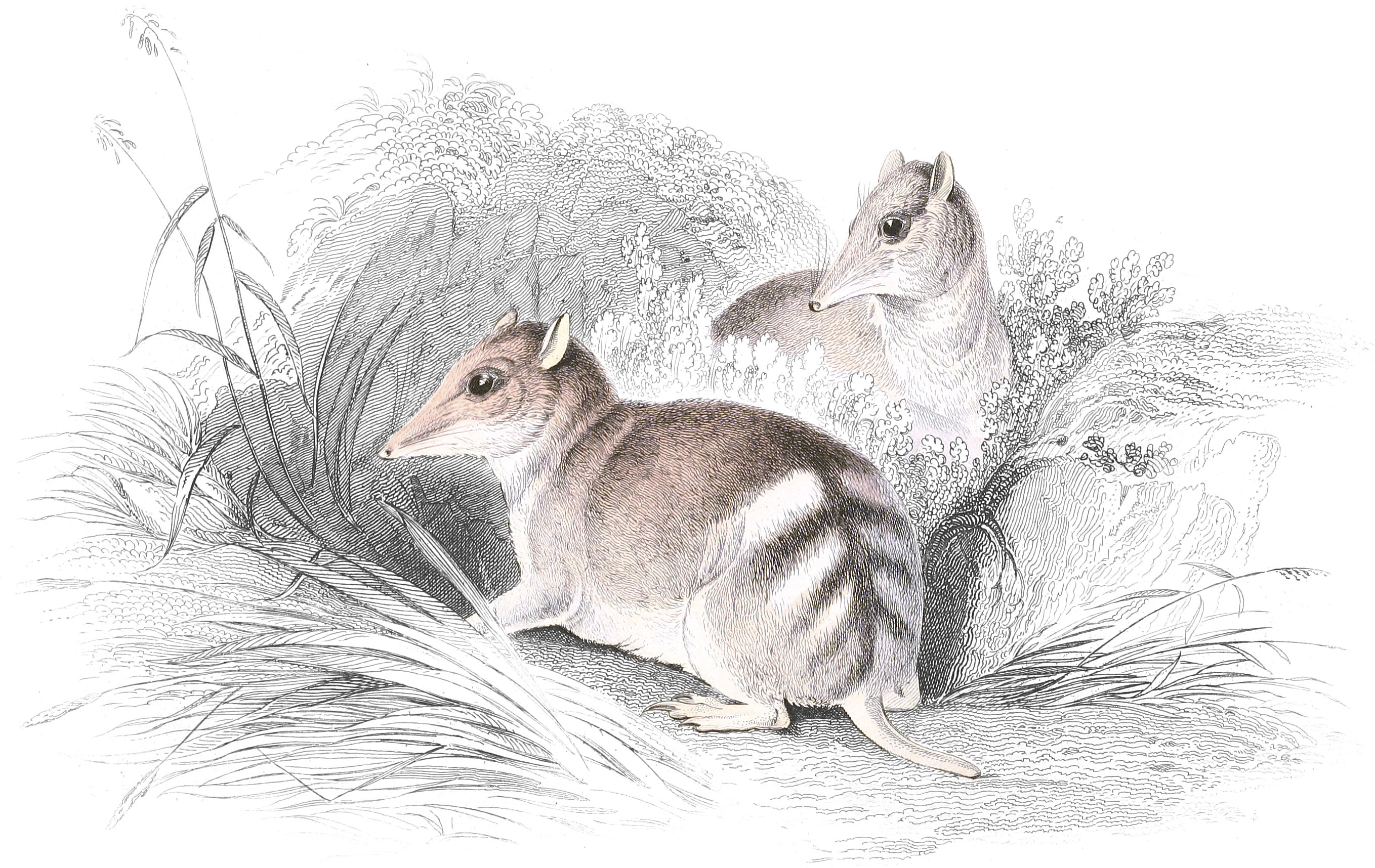
Plate XV

New Guinea Parameles
Perameles Doreyanus.
Perameles Doreyanus, Quoy et Gaimard. Voyage de Découvertes de l’Astrolabe. Zoologie, Tom. i., p. 100, Pl. 16.
In this species the head is conical, the muzzle is long and tolerably thick; the eye is small and the pupil is linear and in the direction of the muzzle; the ears are large and somewhat rounded; the limbs are short and stout; the outer and inner toes of the fore-feet are clawless. All the claws are strong, short, slightly arched, and rounded above and beneath. The fur is harsh, of a rusty-brown colour on the upper parts of the body—a tint produced by the admixture of blackish-brown harsh hairs, with others of a finer quality and golden rust colour; the sides of the body are of a paler hue, and the under parts and inner side of the limbs are of a pale yellowish tint. The ears are yellowish, and destitute of hair excepting on the anterior margin. The toes of the hinder-feet are covered with pale yellowish-brown hairs. The tail is short, and but sparingly furnished with short harsh hairs.
Total length, 19 inches 7 lines; tail, 3 inches 5 lines; head, 4 inches 4 lines; ears, 1 inch 1 line anterior limbs about 3 inches 3 lines; posterior member, about 5\(\frac{3}{4}\) inches.
This animal was procured by M. M. Quoy and Gaimard at Dory harbour. New Guinea. Its dentition is said to be. Incisors, \(\frac{8}{6}\); canines, \(\frac{1\ \cdot\ 1}{1\ \cdot\ 1}\); molars \(\frac{7\ \cdot\ 7}{7\ \cdot\ 7}\) = 46, in which case it has two incisors less in the upper jaw than the other species of Perameles.
The authors just mentioned, moreover state, that it most nearly resembles the Perameles nasuta, but the forehead is less broad, and the nasal bones are less prolonged on to the frontals; the incisors are shorter, and directed backwards.
I did not see this species in the Paris Museum.
Bougainville’s Perameles
Perameles Bougainvillii.
Perameles Bougainvillii, Quoy et Gaimard. Zoologie, du voy. de l’Uranie, p. 56, Pl. 5.
Muzzle attenuated; eyes tolerably large; ears ovate, one inch long; fur moderately harsh, that on the upper parts of the body of a rusty tint, and on the under parts and inner side of the limbs, rusty grey. The tail is rusty brown above, and greyish beneath: the claws are yellowish.
From nose to root of tail, 6\(\frac{1}{2}\) inches; head, 1 inch 10\(\frac{1}{2}\) lines; tail, 2 inches 8 lines; fore-legs, 1 inch 5 lines; posterior limbs, 2 inches 8 lines.
The small size of this animal, and its having the teeth but little developed, caused M. M. Quoy and Gaimard to suspect that it might be young, they say however, they saw many specimens, and they were all of the same size. It was obtained in the peninsula in Shark’s Bay.
A specimen in the Paris Museum, with the name “Perameles Bougainvillii” attached, I found in such bad condition that I could not well ascertain its characters; but, after comparing the three specimens together, contained in this Museum, it appeared to me they were all of one species, though bearing the three names, P. nasuta, P. aurita, and P. Bougainvillii.

Skull and Dentation of an Opossum
Closely allied, no doubt, to Perameles is the
Chœropus Ecaudatus
described by Mr. Ogilby from a drawing made by Major Mitchell.
The drawing of the foot very closely resembles that of the genus Sus in form and characters; two toes only are represented, short, and of equal length; but there is a swelling at the base of the first phalanges, which renders it probable that there may be two smaller ones behind. The Perameles, on the contrary, have three middle toes on the fore-feet, all of equal lengthy and armed with very long powerful claws, besides a small rudimentary toe very distinctly marked on each side. The form and character of the hind-feet were perfectly similar to those of the Perameles, as were also the teeth, as far as could be judged from the drawing, except that the canines did not appear to surpass the anterior molars in point of size. The ears were long, elliptical, and nearly naked; the head broad between the ears, and very much attenuated towards the muzzle; the body about the size of a small rabbit, and the fur very much of the same quality and colour as in that animal.
Mr. Ogilby, after expressing his confidence in the fidelity of Major Mitchell’s drawings, and the care with which that gentleman assured him he had made the observation in question, expressed his belief that this animal would be found to constitute a new genus of Marsupials, and proposed for it the provisional name of Chœropus, in allusion to the decided characters of the fore-feet.
The following is the notice of this animal inserted by Major Mitchell in his journal, on the occasion of first discovering it.
June 16, 1836. The most remarkable incident of this day’s journey was the discovery of an animal of which I had seen only a head in a fossil state in the limestone caves of Wellington Valley, where, from its very singular form, I supposed it to belong to some extinct species. The chief peculiarity then observed was the broad head and very long, slender snout, which resembled the narrow neck of a wide bottle; but in the living animal the absence of a tail was still more remarkable. The feet, and especially the fore-legs, were also singularly formed, the latter resembling those of a pig; and the marsupial opening was downwards, and not upwards, as in the Kangaroo and others of that class of animals. This quadruped was discovered by the natives on the ground; but on being chased it took refuge in a hollow tree, from which they took it alive, all of them declaring that they had never before seen an animal of the kind. This was where the party had commenced the journey up the left bank of the Murray, immediately after crossing that river.72
The specimen was presented to the Museum at Sydney.
The Kangaroos
Macropodidæ
These animals are remarkable for the flexibility and lightness of the anterior parts of the body, the smallness of the anterior members, and the great size of the posterior extremities, and of the tail. In their ordinary position the fore parts are elevated and slightly inclined forwards, and they rest upon the hinder extremities and tail, hence the whole weight and strength is thrown into these parts: the great length and size of the tail also serves to balance the body, not only when in its ordinary semi-erect position, but in the enormous leaps by which these animals progress. The fore part of the body being elevated, gives to the eye a wide range, which is essential to animals, inhabiting for the most part open plains,73 and whose escape from danger must be by flight. The prehensile and unguiculate structure of the anterior extremities
appear to have been indispensable to animals requiring to perform various manipulations in relation to the economy of the Marsupial pouch, and when such an animal is destined, like the Ruminant, to range the wilderness in quest of pasturage, the requisite powers of the anterior members are retained and secured to it by an enormous development of the hinder extremities, to which the junction of locomotion is almost restricted.74
On the fore-feet there are five well-developed toes, each of which is armed with a large and strong nail, and this is curved, concave on the under surface and convex above; the two outer toes are the shortest and the central one is the longest. The hind-feet are furnished with one very large central toe, and an outer one, which is shorter and smaller, but, like the first, armed with a large solid nail which is but slightly curved;, convex, and sometimes keeled on the upper surface, and flat beneath: on the inner side of the foot are two small slender toes, united in one common integument, and having the appearance of a single toe—the nails however are separate, of small size, and hollow beneath; these nails I have repeatedly seen used by the animal to cleanse its fur. The tarsus is devoid of hair beneath, but covered with minute hardened tubercles—these are most distinct in those species which inhabit rocky situations. The ears are usually of moderate size, oval form, and tolerably well clothed with hair.
The dental formula in the genus Macropus is as follows:—
Incisors, \(\frac{6}{2}\); canines, \(\frac{0\ \cdot\ 0}{0\ \cdot\ 0}\); false molars, \(\frac{1\ \cdot\ 1}{1\ \cdot\ 1}\); true molars, \(\frac{4\ \cdot\ 4}{4\ \cdot\ 4}\) = 28. Such is the number of teeth generally found in the species of this genus, but in some species (M. giganteus, M. rufo-griseus, M. ruficollis, and M. fuliginosus,) the anterior or false molar, we are informed by M. F. Cuvier,75 is wanting. In a skull of M. giganteus now before me, and which belonged to an animal not quite adult, the number of molars visible is \(\frac{6\ \cdot\ 5}{3\ \cdot\ 4}\); a second skull, belonging to an adult animal has \(\frac{4\ \cdot\ 4}{4\ \cdot\ 4}\) molars, as described by M. F. Cuvier. In the first mentioned of these two skulls, the last molar on each side of each jaw, though visible, had not penetrated the gum, and had the animal lived a little longer the following changes would have taken place: on the side of the upper jaw in which there exists six molars, the two foremost would have been thrust out by a false molar, which is in an advanced state of development beneath them; on the opposite side of the upper jaw, but one tooth would have been displaced, the other having already fallen. Now, as the permanent, or true molars, are successively developed one behind the other, the new teeth thrust forward those which precede them, and the foremost of the series, owing to the pressure from behind, begins to decay, or to be absorbed at the root and soon falls away from the socket. Professor Owen examined a skull of a very old M. major in which there were only two molars on each side of each jaw, showing that this vis a tergo does not stop even when the animal has attained maturity. In the skulls of five or six other species of Kangaroo which have come under my notice, I invariably found the number of teeth as stated at the commencement of this account of the dental formula.76
I have thought it desirable to enter into these particulars as regards the number of the teeth in the Kangaroos, since M. F. Cuvier has founded two genera upon the difference in the number of the molars in certain species,—to those which have only four molars, and in which the tip of the muzzle is covered with hair, (having only a narrow naked space around the nostrils) he restricts the generic title Macropus, and places in this genus the M. giganteus, M. fuliginosus, M. ruficollis, and M. rufo-griseus. Those species which have the tip of the muzzle naked, the tail sparingly clothed with hair,77 and four true molars and one false molar on either side of each jaw, are thrown together by the same author under the generic title Halmaturus, a name which had originally been applied by Illiger, to all the Kangaroos, and was therefore synonymous with the older title, Macropus of Shaw.
The foremost pair of incisors of the upper jaw, in the true Kangaroos, are arched in front, concave behind and broadest and truncated at the apex, and the remaining incisors of the upper jaw are broad and compressed. In M. major (and perhaps some other nearly allied species) the middle incisors on each side of the upper jaw is narrower than the others, and has a vertical groove in the outer side; the posterior incisor is very broad, being equal in width to the two anterior incisors taken together, and has two vertical external grooves,—but in most of the species of Kangaroos the second incisor on each side has no external groove, and the hindermost one has but one of these grooves. The second incisor is always the narrowest, and the hinder one varies in width according to the species. The incisors of the lower jaw are very large, horizontal in their direction, long, compressed and pointed like a lancet, they are slightly broader near the middle than elsewhere, and present each two sharp cutting edges.78 The canines although almost always wanting in the true Kangaroos, are sometimes present, though in a rudimentary state. Professor Owen observes, that he has found canines in the M. rufiventer, but of a very small size and concealed in the gum, and he has traced the germs of these teeth in a mammary fœtus of the M. major.
Between the incisors and molars there is a vacant space of considerable extent. The false molars are compressed and furnished with a sharp cutting edge, those of the upper jaw have a small posterior inner lobe. The crowns of the true molars are nearly of a square form, but rather longer than broad, and before worn down by usage, they present two transverse acute ridges, which are connected by a longitudinal ridge in the middle of the tooth,—this ridge is less elevated than the transverse ridges.
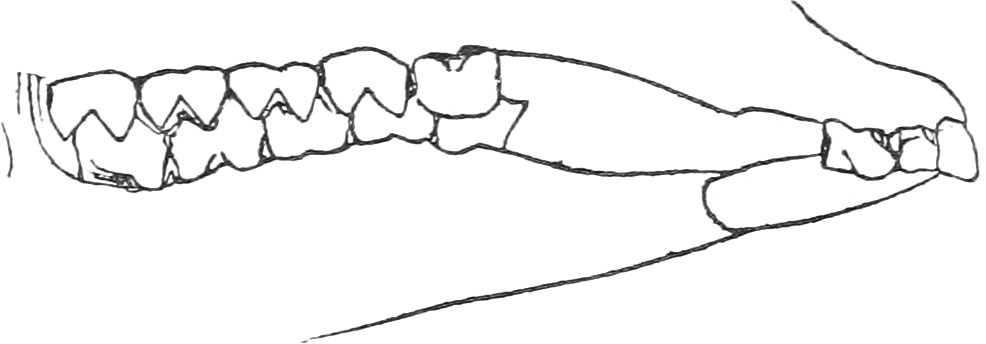
Side view of the teeth of upper and lower jaw of a species of Macropus
The Hypsiprymnii, or Potoroos, and Kangaroo-rats as they are termed, differ chiefly from the true Kangaroos, in possessing distinct canines; the foremost pair of incisors, in the upper jaw, are larger and considerably longer than the others, which are proportionately smaller than in the Kangaroos, and have no external grooves; the incisors of the lower jaw are narrower and not dilated in the middle, but gradually increase in width from the point towards the base. The canines are rather small, compressed, and but slightly pointed. The false molars are proportionately larger than in the Kangaroos, and generally have numerous distinct vertical grooves both on the outer and inner side. The true molars before worn, present each four blunt tubercles: the foremost of these molars is the largest, and the hindermost the smallest. This decrease in the size of the posterior molars I have never observed in any of the true Kangaroos. The skull is less suddenly contracted in front of the orbits, and broader between the orbits. The toes of the fore-feet are less evenly developed, and the claws are longer and fitted for burrowing. The anterior extremities are in general proportionately longer, the hinder limbs, as well as the tail, are less powerful, and the toes and claws are less robust.

Hind (top) and fore-foot (bottom) of a species of Macropus (left) and Hypsiprymnus (right)
As presenting the most perfect dentition I will begin with the genus
Hypsiprymnus
Section 1.—Hypsiprymni. the head considerably elongated and narrow, the ears small and rounded, the muffle79 naked not only in front, but with the hairless portion considerably extended on the upper surface of the muzzle; tail covered with scales like that of a rat, and with short stiff hairs springing from between them,—these being not sufficiently numerous to hide the scales. Canine tooth moderately developed, and separated from the incisors by a considerable interval. In the two species described in this work, the space between the canine and the incisors is about equal to the width of the two posterior incisors taken together; tarsi short; fore-limbs rather strong; the true molars are proportionately narrower in the species of this, than in those of the next section, and the foremost compressed molar, (which is the analogue of the carnassier) is less distinctly fluted, or grooved, externally.
To this section belongs the Hypsiprymnus murinus, the animal which Illiger gives as the type of his genus Hypsiprymnus. Mr. Gray restricts the name to this section.
Rat-Tailed Hypsiprymnus
Hypsiprymnus murinus
Hypsiprymnus murinus, Pander and D’Alton. Skelete der Bentelthiere, Pl. 3.
Macropus minor, Shaw. Gen. Zool. Vol. I., Pl. 2, p. 513, Pl. 116.
Poto-Roo or Kangaroo-Rat, White. Journal of a Voy. to Bot. Bay, Append, p. 277 286.
Hypsiprymnus setosus, Ogilby. Proc. Zool. Soc. 1831, p. 149.
Hypsiprymnus myosurus? Ogilby. Proc. Zool. Soc. 1838, p. 62.
Hypsiprymnus Peronii, H. Peron. Quoy et Gaim. Zool. de la Cog. Voyague Autour du Monde p. 64.
Bettong of the Natives of New South Wales—Mus. Linn. Soc.
Head elongated; ears rather short and rounded; fore-legs strong; tarsi short; tail about equal to the body in length, exhibiting scales, being but sparingly clothed with short decumbent hairs, which (excepting at the base, and also at the extreme point) are of a black colour on the upper part and sides; on the under side they are brownish, and at the tip there are a few dirty white hairs. General colour of the fur brown, on the back blackish, pencilled with brownish white; lips, chin, throat, and the whole of the under parts of the body dirty white; the inner side of the limbs and the fore part of the hind-legs are also dirty white; the fore-feet are brown, and the tarsi are dusky brown above; ears short and rounded, moderately well clothed with hairs; those on the inner side very pale brown, inclining to white; those on the outer side (which are long) are grey grizzled with whitish; on the fore part most of them are blackish at the apex.
The fur is long and moderately soft; that on the back is grey next the skin; the shorter hairs are of a very pale brownish yellow externally, and at the extreme point dusky; the longer hairs, which are somewhat harsh, are for the most part broadly annulated with yellowish-white towards the apex, and black at the apex,—some are totally black excepting at the base,—the fur on the belly is grey next the skin.
Length from nose to root of tail, 1 5 inches; tail, 10\(\frac{1}{2}\) inches; nose to ear, 3 inches 8 lines; ear, 1 inch 2 lines; tarsus, (claws not included) 3 inches 2 lines.
This species inhabits New South Wales, where it appears to be common, and where specimens have been sent to the Linnæan Society under the native name of “Bettong.”
The Kangaroo-rats, or Hypsiprymni, like the Kangaroos, progress on the hind legs, and are vegetable feeders—of their habits but little is known, but from their small size, and more restricted powers of locomotion, compared with the large Kangaroos, I should imagine, they more generally frequent the less open districts, where, from the presence of scrubs or underwood, and long grass, they may readily find an asylum in cases of danger. As indicated by their possessing long and powerful fore claws, Mr. Gould informs me, they are always scratching the ground, and feed ranch upon roots—that they are very destructive to the potato crops, and are most readily caught by bating traps with this vegetable.
The first known species of Hypsiprymnus, was described by Hunter, in the Appendix to White’s Journal, where a somewhat rude figure of the animal is given—this figure and description are reproduced in Shaw’s Zoology, where the animal receives the technical name Macropus minor.—A second species of Hypsiprymnus was subsequently discovered by the French Voyagers, and as the description of the first was not given in sufficient detail, this second species was imagined to be identical with the first, and was I believe always referred to as the Poto-Roo, or Kangaroo-rat of White’s Journal—it however received several new names.
Recently the list of species of Hypsiprymnus has been greatly extended, and as several of these new species were brought from the same locality as the one first described, the difficulty of determining which of them was the Poto-Roo was increased. Upon inquiring however, of Professor Owen, I learnt that the skull of White’s animal was still in existence, and that gentleman (from whom I always receive the most cordial assistance in my labours,) not only allowed me an inspection of the skull, but further helped me with the loan of a drawing, by means of. which, aided by Mr. Gould, who removed the skulls from several of the species in his collection for the purpose, we discovered the true Poto-Roo to be the animal here described, and, by further investigations, we also came to the conclusion that it has received at different times, all the several names which precede the present description.
A drawing of the skull of H. Peronii, which Mr. Owen had made from the original specimen, contained in the Paris Museum, is now before me, and I find to agree perfectly both with the skull of the Poto-Roo, and with that figured by Pander and Dalton, as the Hypsiprymnus murinus of Illiger. Now Illiger gives as the type of his genus Hypsiprymnus, the H. murinus and in his definition mentions as a character “cauda mediocris, squamata,” a character which is only found in one other species of Hypsiprymnus—a species brought by Mr. Gould from a part of Australia which is but little frequented, viz. King George’s Sound.
The description given by Mr. Ogilby of his H. setosus, agrees with the present animal, and that author says that the H. setosus,
is known in the colony of New South Wales by the native name of Bettong Kangaroo.
This name, I have before observed, is attached to specimens of the present animal in the Museum of the Linnæan Society.
The H. myosurus of Mr. Ogilby also agrees with the present species in every particular, excepting that the skull is rather larger, a difference which Mr. Gould suggests is probably sexual, the males of all the Kangaroos being larger than the females. The original of Mr. Ogilby’s description of H. myosurus, is a male; the Poto-Roo of White was a female, and a skull, now before me, agreeing in size with the dimensions given below, is also from a female animal.
The dimensions of the skull of the Poto-Roo are as follows:—
Total length, 3 inches 1\(\frac{1}{2}\) lines; width, 1 inch 7 lines; from front of anterior incisor to first molar, 10 lines; from do. to hinder part of last molar, 1 inch 8\(\frac{1}{2}\) lines; width between orbits, 8 lines.
In Van Diemen’s Land is a species of Kangaroo-Rat, which appears to me to be identical with the animal above described, and if it be, the following dimensions, furnished by the skull of one of these animals, would indicate the specimen to have been a male—that is, presuming the conjecture of the sexual difference of size to be correct.
Length, 3 inches 3 lines; width, 1 inch 9\(\frac{3}{4}\) lines; from front of anterior incisor to first molar, 11 lines; longitudinal extent of molars on each side of the upper jaw, 10\(\frac{1}{2}\) lines.
Shaw was acquainted with only two species of Macropodidæ, the great Kangaroo, (Macropus giganteus) and the present species of Kangaroo-Rat, the name Macropus minor given to this small animal, since the discovery of numerous Kangaroo-Rats, (some of which are smaller than the Poto-Roo,) has become peculiarly inappropriate, I have thought it desirable, therefore, to choose the next oldest name I can find applied to it.
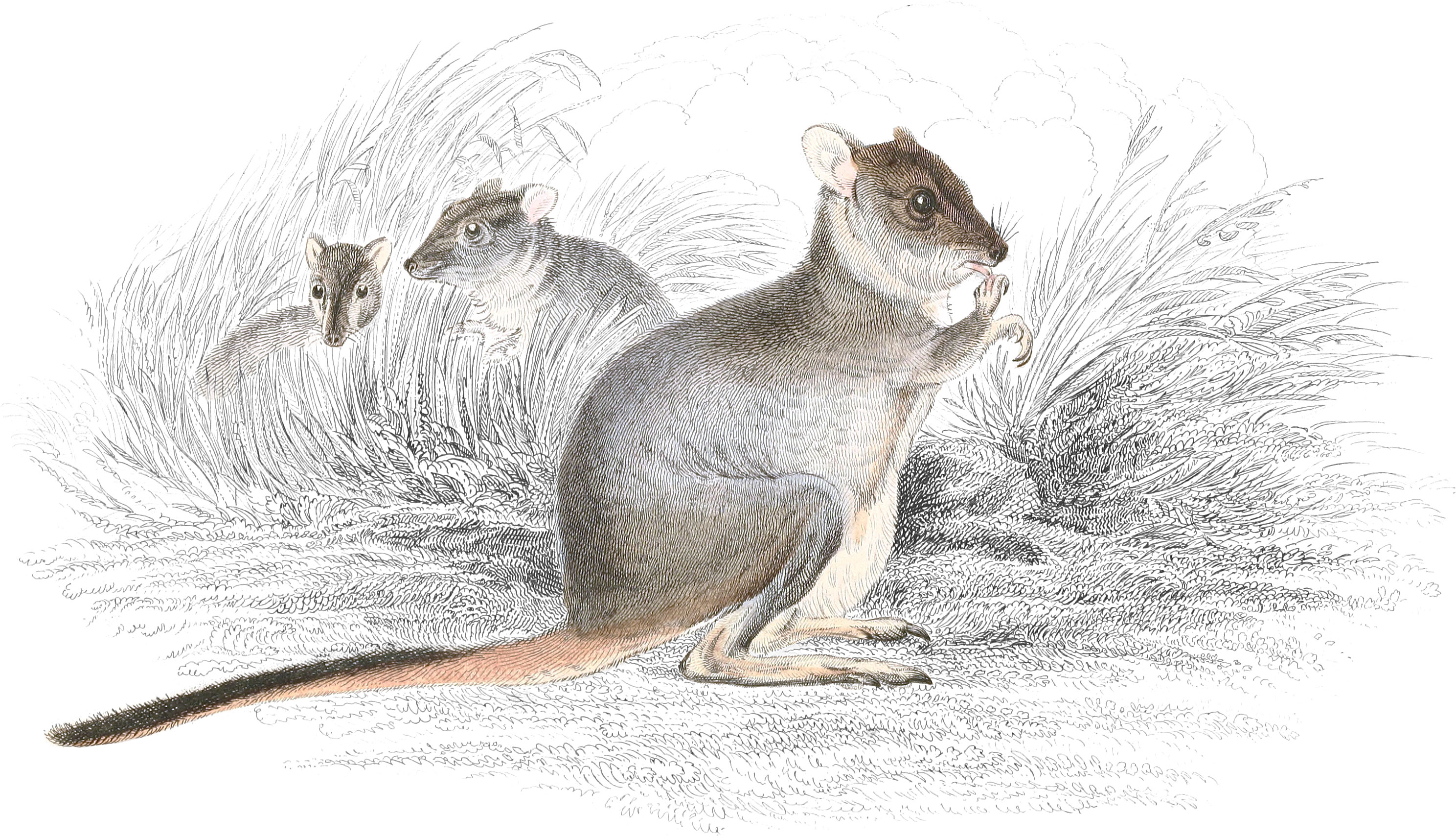
Plate XVI
Small-Footed Hypsiprymnus
Hypsiprymnus micropus.
Hypsiprymnus micropus, Gould’s MSS.
This species closely resembles the H. murinus, but the head is proportionately smaller, and so are the fore and hind-feet, and the tail is shorter. The fur is rather more harsh and more distinctly pencilled with whitish; all the hairs of the under fur on the back are slate grey at the base, and rusty brown externally; the harsher hairs, which are abundant, have the basal half slate grey, and the remaining portion white, slightly tinted with rust colour, and, at the point, they are black; besides these, there are some interspersed longer hairs which are entirely black, excepting at the root: the fur on the belly is pale grey next the skin, and dirty white externally; fore and hind-feet brown; greyish above, excepting on the toes; ears densely clothed with brown hairs; blackish at the margin. Length from nose to root of tail, 15\(\frac{1}{2}\) inches; tail, about 7 inches; tarsus, 2 inches 7 lines; nose to ear, 3 inches 2 lines; ear, 1 inch 1 line.
Inhabits King George’s Sound.—From the collection of Mr. Gould.
The skull of this species has the same elongated narrow form as that of the H. murinus, with which it very nearly agrees in size, but is remarkable for convexity of the outer surface of the superior maxillary bones, which gives to the muzzle an inflated appearance. In H. murinus the width of the muzzle at half an inch from the tip of the nasal bone is 5\(\frac{1}{3}\) lines, whilst the same part measures in H. micropus, 6\(\frac{1}{4}\) lines. The molar teeth of H. murinus are longer than broad, whilst in H. micropus their length and width are equal, the length of the five molars on each side of the upper jaw in H. micropus is 9 lines; those in H. murinus measure rather more than 11 lines. Length of skull of H. micropus, 3\(\frac{1}{4}\) inches; width 1 inch 6\(\frac{1}{2}\) lines.
Section 2.—Hypsiprymni with comparatively short and broad skulls; canines placed near the incisors; the space between them usually about equal in width to one of these teeth; foremost compressed molar with numerous distinct vertical grooves; true molars square, or very nearly so; tarsi tolerably long, tail also tolerably long and well clothed with hairs. To this Section Mr. Gray applies the name Bettongia.
White’s Hypsiprymnus
Hypsiprymnus Whitei.
Hypsiprymnus White, Quoy and Gaimard.
Kangurus Gaimardii, Desmarest. Mammal. Suppl.
Hypsiprymnus Phillippi, Ogilby. Proceedings of the Zoological Society for May 1838, p. 62.
This species is about the size of a rabbit; the tail is long, and the tarsi are long and slender; ears of moderate size and rounded form; fur long and moderately soft; general tint grey-brown, slightly washed with yellow; under parts grey-white, very faintly tinted with yellow; feet very pale brown; ears well clothed with fur externally, of the same colour as that of the head, and internally with yellow hairs tail furnished above with moderately long, and somewhat adpressed, rich brown hairs; beneath, with hairs of a pale brown colour; a crest of long dark brown (sometimes blackish) hairs, runs along the upper surface of the apical portion of the tail, occupying about one-third of its entire length; at the point is a tuft of long white hairs. The fur on the upper parts of the body is deep grey at the base and dusky at the point; the longer interspersed hairs have the exposed portion of a black colour; the hairs composing the fur are wavey.
Length from nose to root of tail, 16 inches; tail, 13 inches; tarsus, (the nails not included,) 4 inches 3 lines; ear, 1 inch 2 lines.
The above description is from specimens in the Museum of the Linnæan Society, which are also the originals of Mr. Ogilby’s description of H. Phillippi.
The dimensions of a skull of a similar animal in the collection of Mr. Gould, are as follows;—Length, 3 inches; width, 1 inch 8 Hues; foremost molar, upper jaw, 4 lines—the anterior pair of incisors are much compressed and curved. Of this species I have examined several specimens—they all possessed the tuft of white hairs at the tip of the tail.
This species agrees with the Hypsiprymnus contained in the Paris Museum, which is the original of the Kangurus Gaimardii of Desmarest, and the Hypsiprymnus White of Quoy and Gaimard. A drawing of the skull of this animal, lent me by Professor Owen, together with a careful description, taken from the specimen by myself, leave no doubt on my mind of the accuracy of the above conclusion; the dimensions of the Paris specimen are as follows:—from nose to root of tail, 13\(\frac{1}{2}\) inches; tail, 13 inches; tarsus, to base of claws, 4 inches 1 line; ear, 1 inch; from nose to ear, 2 inches 9\(\frac{1}{2}\) lines. From a careful examination of the H. formosus of Mr. Ogilby (Proc. Zool. Soc. for May 1838, p. 62,) I feel convinced that it is the young of the present species. In the College of Surgeons is a similar specimen, the skull of which exhibits all the usual characters of a young animal. The H. formosus is 11 inches in length, without including the tail, which measures 1 inches—its colouring is somewhat richer, there being a greater admixture of yellow in the tint of the fur.
H. Whitei appears to be tolerably common in New South Wales.
Brushed-Tailed Hypsiprymnus
Hypsiprymnus penicillatus
Bettongia penicillata, Gray. Magazine of Natural History, Vol I. No. 2, New Series, p. 584.
Hypsiprymnus murinus, Ogilby. Proceeding of the Zoological Society for May 1838, p. 63.
Head short; ears short and rounded; fore-legs small; tarsi rather long; tail nearly as long as the head and body, (the latter being measured in a straight line;) fur long and tolerably soft—General colour of the upper parts of the head and body palish brown, but pencilled with white: on the cheeks and sides of the body a faint yellowish tint (or cream colour) is observable; under parts of the body dirty white; fore legs pale: the hairs covering the tarsi above are whitish externally, and dusky at the root; over the toes they are pale brown. The ears are well clothed with hairs, those on the inner side yellowish, towards the margin bright rust colour; those on the outer side grey at the base and pale at the apex. Tail well clothed; the hairs on the under side brown-white, towards and at the apex they are darker; on the upper side the hairs are dusky at the root and pale externally; about three inches from the apex of the tail, and from thence to the tip they are long and of a black colour, and form a tuft.
Length from nose to root of tail, 14 inches; tail, 10\(\frac{1}{2}\) inches, without including the hair; tarsus, 4 inches 1 line; from nose to base of ear 3 inches; ear, 9\(\frac{1}{2}\) lines.
This species nearly resembles the H. cunicidus, but may be distinguished by its smaller size, shorter head; the lower incisors are longer than in that species, and the ears are shorter: the tail is more distinctly tufted, and the tuft is brownish-black, and not brown.
The above account is drawn up from the original both of Mr. Gray’s and Mr. Ogilby’s descriptions. The specimen is in the Museum of the Zoological Society.
The Hypsiprymnus pencillatus, Mr. Gould informs me, is common throughout the Colony of New South Wales, and is also found at Adelaide.
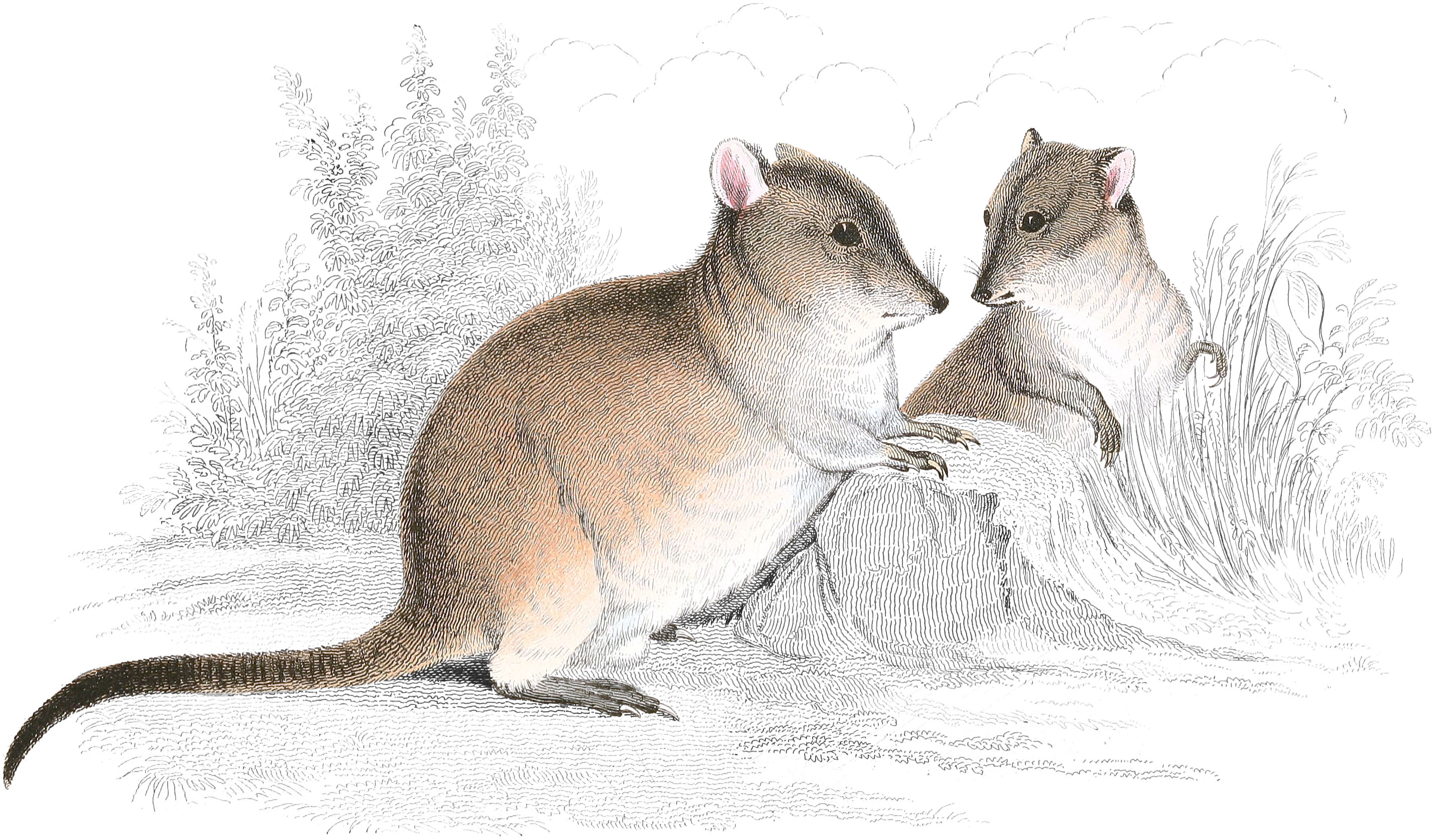
Plate XVII

Ogilby’s Hypsiprymnus
Hypsiprymnus Ogilbyi.
Bettongia Ogilbyi, Gould MS.
Less than a rabbit; tail moderately long; fur dense, the under fur very abundant, soft, long and woolly; general colour brown, (not dark,) ohscurely washed with yellow on the sides of the face and body; the whole of the under parts of the body dirty yellowish white; ears rather short and rounded, clothed with yellow hairs; hind-feet brown, darkest on the sides, especially of the toes; fore-feet palish brown. Tail well clothed; a very small space at the base covered with fur like that of the body; beyond this, and extending to about the middle of the tail, the hairs are of a rusty hue on the upper side, and very pale brown on the under; the apical half of the tail is clothed with black hairs, which vary from rather more than half, to three quarters of an inch in length—those nearest the tip are the longest; on the sides of the tail the hairs are comparatively short, and excepting at the tip they are chiefly of a deep brown colour; on the under side of the apical half of the tail the hairs are longer than on the sides, and are of a black colour. The ordinary hairs of the back are rather broadly annulated with pale rusty yellow—sometimes rusty white, and at the point they are blackish-brown; the longer interspersed hairs are black. The fur both on upper and under parts of the body is grey at the base.
Length from nose to tail, 13 inches; tail, 10\(\frac{1}{2}\) inches; tarsus, 3 inches 11\(\frac{1}{2}\) lines; ear, 11 lines; nose to ear, 2 inches 8 lines.
Inhabits Western Australia in the neighbourhood of Swan River.
This species is very closely allied to H. penicillatus, but its tarsi are proportionately rather longer and more slender, and differ in being of a deeper hue; the ears are longer, and the apical half of the tail is black both above and below. In H. penicillata the black hair is confined to the upper surface of the tail, on the under part longish brown adpressed hairs extend to the tip, this under part is, moreover, much more densely clothed than in the present species, in which the hairs are not sufficiently numerous to hide the scales—this does not arise from the wearing away of the hair, as is often the case, for the under side of the tail is better covered than the sides.
Rabbit-Like Hypsiprymnus
Hypsiprymnus cuniculus.
Hypsiprymnus cuniculus, Ogilby. Proceedings of the Zoological Society for May 1838, p. 63.
Head somewhat elongated; ears moderate, rounded; fore-legs weak; tarsi long; tail rather longer than the body; fur rather long and not very soft to the touch; general colour brown-grey, pencilled with white; under parts of body dirty white; feet brown-white; tail well clothed with hairs, pale-brownish; towards and at the tip dark brown, the hairs longer on this part; ears covered with hairs externally like those of head, those on the margin slightly tinted with yellowish; on the inner side of the ears the hairs are nearly white, but faintly tinted with yellowish. Fur both on upper and under parts of body grey at the base; the longer hairs on the back are white towards the apex, the white occupying a considerable space, and brown-black at the apex.
Length from nose to root of tail, 17\(\frac{1}{2}\) inches; tail, 13 inches; nose to ear, 3 inches 2 lines; ear, 1 inch 2 lines; tarsus, (claws not included) 4 inches 7 lines.
Inhabits New South Wales.
This species is intermediate in size, between H. rufescens and H. penicillatus; from the former it is easily distinguished by the ears being pale externally, and not black, the hairs covering the tarsus being very pale, instead of brown, and by the tail being dark brown near and at the apex. In the H. rufescens the tail is of a very pale colour throughout, and has a considerable portion at the apex, which is almost white. Compared with H. penicillatus the present species differs in being considerably larger, in not having the hairs at the tip of the tail so decidedly longer than those on the other parts there is not, therefore, so distinct a tuft; these hairs are brown, and not black, and the dark hairs are nearly confined to the tip of the tail, whereas in H. penicillatus they extend a considerable distance along the upper surface; the ears are rather larger and the head is longer; the lower front incisors are much shorter and stouter, the upper front incisors are much stouter; the distance between the fore part of the anterior incisors, (upper jaw) and the hinder part of the canines is 6\(\frac{1}{4}\) lines; the space between the canine and posterior incised is about 1 line. In H. penicillatus there is not more than half a line between the canine and incisors, and the distance between the anterior of front incisor and hinder part of canine, is a trifle more than 5 lines; from fore part of front incisor, upper jaw, to the first molar, 10 lines. The specimen apparently is a male, and is contained in the Museum of the Zoological Society.
Rusty Hypsiprymnus
Hypsiprymnus rufescens.
Bettongia rufescens, Gray. Magazine of Natural History for November 1837, p. 584.
Hypsiprymnus melanotis, Ogilby. Proceedings of the Zoological Society for May 1838, p. 62.
Head moderate; ears moderate, (larger than in the other species here described,) and somewhat pointed; fore-legs very small; tarsi long; tail long; fur rather long and soft, colour on the back rusty-red, pencilled with white; on the head and sides of the body, greyish, pencilled with white, the white prevailing; chin, throat and the whole of the under parts of the body dirty white; the fore-legs and feet, and the inner side of the hind-legs dirty white; tarsi brown, somewhat grizzled with dirty white; tail tolerably well clothed with hairs; those on the under side and about 3 or 4 inches of the apical portion are uniform dirty white; on the remaining portion they are brownish-white, dusky at the tip and also at the base, the dark colour most evident towards the base of the tail. The cars are densely clothed with longish hairs; on the inner side they are fringed with bright gold coloured hairs, and the very long hairs which cover the back of the cars are of a greyish-black colour. The hairs of the under fur on the back, are palish grey at the base, then white, then bright rust colour, and shaded into dusky at the apex. The longer hairs are also grey at the base and gradually shaded into black; considerably beyond the middle they are broadly annulated with white, towards the apex rust coloured, and at the apex blackish. The hairs on the under parts of the body are almost uniform in colour throughout, being very obscurely tinted with pale grey at the base; on the anterior part of the muzzle the hairs are brown. Length from nose to root of tail, 19 inches; tail, 14\(\frac{3}{4}\) inches; tarsus, (without including the claws) 5 inches 3 lines; from nose to base of ear, 3 inches ear, 1 inch 8 lines.
Habitat New South Wales—from the neighbourhood of Hunter’s River.
The above description is taken from a specimen in the Museum of the Zoological Society, which is the original both of Mr. Gray’s and Mr. Ogilby’s descriptions.
This species is easily distinguished from others here described, by the rufous tint which prevails on the upper parts of the body, the larger size of the ears, and their black colour externally, and also by the whitish colour of its tail; the hairs on the tail are not sensibly longer at the apex than on other parts.
Gray’s Hypsiprymnus
Hypsiprymnus Graii.
Hypsiprymnus Graii, Gould. Proceedings of the Zoological Society for December 8, 1840.
This species is closely allied to the H. rufescens, but differs in being rather smaller, of a yellowish grey colour, in having the ears, tarsi, and tail proportionately shorter, and in being destitute of the distinct black patch on the back of the ears.
The fur is moderately long and rather soft; that on the back is grey next the skin, and externally pencilled with white, and yellowish-grey, and they are rusty black at the point; the under parts are dirty yellowish-white; the feet pale brown; a deep brown hue is observable on the outer side of the tarsus, especially near the heel. The tail is rusty brown above, slightly inclining to yellowish; brown-white beneath, and about three inches of the apical portion is covered with white hairs,—it is tolerably well clothed, but the hairs at the tip do not form a distinct tuft as in H. penicillatus; the hairs on this part average at about half an inch in length, or a little more. The ears are furnished with whitish hairs within, excepting near the margin, where they assume a yellow tint; externally the fur on the ears resembles that of the upper surface of the head.
Length of adult male, from nose to root of tail, 18 inches; tail, 12 inches; tarsus, (without claws) 3 inches; ear, 1 inch; nose to ear, 2 inches 10 lines. Found near Northam, interior of Western Australia.
The Hypsiprymnus Lesueuri of Quoy and Gaimard is founded upon a skull in Direk Hastog’s Island. In size and general form this skull greatly resembles that of the H. Whitei, but the tympanic cavity is said to be larger, the zygomatic arches broader, and the palate shorter.
Genus Macropus
Section, or Subgenus, 1
Macropus proper.
The species of this section are distinguished by the tip of the muzzle being hairy, the naked portion being confined to a narrow space around the openings of the nostrils, and a small space between them: it contains some of the largest and also some of the smallest species of Kangaroos.80
Great Kangaroo
Macropus giganteus.
Macropus giganteus, Shaw, Naturalist’s Miscellany Pl. 33.
Macropus major, Shaw, General Zoology, Vol. 1., part 2, p. 505, Pl. 115.
Didelphys gigantea, Linn. Syst. ed Geml. p. 109.
Kangurus labiatus, Geoff. and Desm., Mamm. p. 273, sp. 423.
Ears moderate; tail moderately long and very thick; fore limbs rather long compared with most other species; fur moderately long, neither soft nor harsh; the hairs waved and giving to the fur a slight woolly character. General colour greyish-brown, darker on the hack and order on the sides of the body; under parts and inner side of limbs brownish white, on the chest faintly tinted with greyish; the Lairs on tins part obscurely tipped with dusky; prevailing tint of fore-legs greyish; the fore-feet grizzled with black and brown-white; toes black. The hind-legs externally, and the base of the tarsi, are very pale brown—or what might almost be called brown-white; on the basal portion, a very obscure pale rusty tint is observable, and on the hinder part is a faint greyish hue; the toes are brown-black; the tail is covered at the base with fur of the same character and colour as that of the body, but as we recede from the base, the hairs become gradually more adpressed and harsher, and those on the apical half, which are almost entirely black, are extremely harsh. The head is almost of an uniform colour, nearly like that of the body, but there are some slight shades of difference, for instance, there is a very faint rusty hue on the sides; the lower part of the cheeks is somewhat greyish; the sides of the muzzle are rather dusky, and the top is of a paler hue; an indistinct whitish mark runs backwards beneath the eye from above the angle of the mouth the tip of the muzzle is whitish; the chin is dusky, and the throat is greyish white; the moustaches are black. The ears are well clothed within with brownish white hairs, but those nearest, and at the apical margin, are blackish; externally they are almost entirely brown-black; at the base rather paler. Fur, both of upper and under parts of body, brown-grey at the base; the hairs on the upper parts white-brown near the apex, and brown or brown-black at the apex.
Length from nose to root of tail, 47 inches; tail, 34 inches; circumference of tail at the base, about 12\(\frac{1}{2}\) lines; tarsus, 4\(\frac{1}{4}\) inches, not including the nails; nose to ear, 7\(\frac{1}{2}\) inches; ear, 4\(\frac{1}{4}\) inches; width 3 inches; height of animal in its ordinary sub-erect position 51 inches.
The above description is taken from a fine male specimen preserved in the Museum of the Zoological Society. The female is rather smaller than the male. Inhabits New South Wales and Van Dicmen’s Land.
Shaw’s second name (Macropus major,) is very commonly used for this species, but that author following Gmelin, and some other older authors, used the specific name Giganteus, when he originally described it in his Naturalist’s Miscellany. As both names are equally applicable, I have adopted the oldest.
The great Kangaroo was first discovered in Cook’s first voyage, in 1770, whilst that celebrated navigator was stationed for a short time on the coast of New South Wales.
Captain Cook says,
On Friday, June 22d, a party who were engaged in shooting pigeons for the use of the sick of the ship, saw an animal which they described to be as large as a grey-hound, of a slender make, of a mouse colour, and extremely swift.
The same kind of animal was soon after seen by several of Cook’s party and by Cook himself as well as Sir Joseph (then Mr.) Banks, and ultimately the wishes of the party to examine this extraordinary animal were gratified, Mr. Gore, one of the associates of the expedition, having been so fortunate as to shoot one, Dr Shaw observes,
and it seems to have been from this specimen that the figure given in the voyage was drawn.
Pennant’s account of the habits of the Kangaroo contains much in a small compass, I will, therefore, give it in his own words.
Inhabits the western side of New Holland, and has as vet been discovered in no other part of the world,81 The natives call it Kanguru. It lurks among; the grass; feeds upon vegetables: drinks by lapping; goes chiefly on its hind-legs, making use of the fore-feet only for digging, or bringing its food to its mouth. The dung is like that of a deer. It is very timid. At the sight of men flies from them by amazing leaps, springing over banks seven or eight feet high, and going progressively from rock to rock. It carries its tail quite at right angles with its body when it is in motion; and when it alights often looks back; it is much too swift for greyhounds; is very good eating, according to our first navigators; but the old ones, according to the report of more recent voyagers, were lean, course and tough.
The weapon of defence was its tail, with which it would beat away the strongest dog.
In the spring of the present year, (1703) I had an opportunity of observing the manners of one brought into the capital alive. It was in full health, very active, and very mild and good natured; on first coming out of its place of confinement, it for a little time went on all fours, but soon assumed an upright attitude. It would sport with its keeper in a very singular manner; it first placed its tail in a perpendicular manner,82 erected its body on it as a prop, and then raising its whole body, darted its hind-legs on the breast of the man. It was capable of striking with great force if provoked; and it could scratch violently with its fore claws.
To this account I have but little to add. In Van Diemen’s Land it is called the “Forrester,” and also “Boomer.” Mr. Gunn,83 who observed the habits of this animal whilst in Van Diemen’s Land, states that it frequently exceeds 70 lbs. weight,84
that it exists in the top of the western mountains, and in the more remote parts. On the Western mountains I saw them in great numbers, and the country being perfectly open, I had some beautiful hunting; but in some cases they completely outstripped the Kangaroo dogs, which are a cross between the greyhound for speed, and bull-dog for strength. I had a tame one which allowed my children to play with it, and was extremely docile. The tail is not used in progression, although universally asserted; in leaping they usually hold it out pretty horizontal, but never as a third limb. Indeed, in defence, the hind-legs alone are used, with which they can give most powerful strokes, and a very large Kangaroo will keep off, in a favourable situation, one or more dogs.
Kangaroos, although, from the circumstance of their food being abundant in spots, as on recently burnt land, they may be seen in flocks, are not gregarious; their food brings them to one spot, but you never see two together, properly speaking; and on no occasion have I ever seen or known them in flocks, owning a leader, and proceeding en masse, &c. &c.
They lodge during the heat of the day amongst high ferns, such as Pteris esculenta, high grass, and in underwood, commonly here called scrubs, that is, dense patches of Melaleuca, Septospermum, &c.
Mr. Gould informs me, the Kangaroo will take readily to the water and can swim well; and it frequently happens that, when hunted, it will catch one of the dogs up in its arms and will make off with it to the nearest water, in which it will plunge the dog until it be drowned.
The Great Kangaroo, as early as the year 1800, had bred in this country, several specimens having at that time been kept for some years in Richmond Park, since then, some at least, of our Menageries have never been without this species.
The Menagerie of the Zoological Society has at different times contained no less than five species of Kangaroo, viz: Macropus giganteus, M. Parryi, M. Bennettii, M. Berbianus, (a specimen of which, also lived in the Menagerie of the Earl of Derby,) and M. penicillatus.
Woolly, or Red Kangaroo
Macropus laniger.
Kangurus laniger, Quoy and Gaimard. Voy. del’Uranie, Pl. 9.
Kangurus rufus, Desm. Mamm. Suppl. p. 841 541.
This species, which is the Red Kangaroo, of the colonists of New South Wales, is rather larger than the M. giganteus, and remarkable for its short woolly, or rather cotton-like fur; the fore limbs are proportionately large, especially in the male, and the tail is enormously thick and sparingly clothed with fur—its prevailing colour is fulvous-red, or it may be called yellowish-rust colour (not dark,) the head, neck, shoulders, and back, are tinted with grey; which, excepting on the head, is rather pale; the under parts of the body are of a pale ash colour, slightly tinted with fulvous in the male, but in the female these parts, as well as the limbs, are pure white. The limbs in the male are dirty white, obscurely tinted in parts with fulvous, and the tail is of the same colour; the toes of both fore and hind-feet are covered, in both sexes, with black, or nearly black hairs. The sides of the muzzle, as far back as the angle of the mouth, are pure white, but intermixed with the white are some stiff, bristly, black hairs, which have a tendency on each side of the muzzle to form two black lines, and are most abundant above the angle of the mouth, where they form a somewhat conspicuous patch. In the female (in which the head is of a paler grey than in the male,) there is a conspicuous broad white mark on each side of the muzzle, extending backwards, from the angle of the mouth, beneath the eye—in the male the corresponding mark is indistinct. The ears are covered internally with white hairs, and externally the hairs are very nearly of the same grey tint as the head, excepting near the tip, where they are dusky.
Length from nose to root of tail, 5 feet; tail, 3 feet; nose to ear, 8 inches; ear, 5\(\frac{3}{4}\) inches; tarsus, (claws not included) 13\(\frac{1}{4}\) inches. The female measures from the tip of the nose to the root of the tail, 49 inches; tail, 35\(\frac{1}{2}\) inches—the tail is therefore longer in proportion than in the male, and it is moreover more slender. The posterior incisor is not quite half as broad again as either of the preceding incisors, and is destitute of the external folds or grooves, so general in the group. I have not had an opportunity of examining the incisors of a male specimen.
The muzzle is hairy as in the M. major, but the hairs do not extend quite so far forwards.
The specimen described by Messrs, Quoy and Gaimard is said to be from Port Maquarie; it is in a very bad condition. I have therefore, with Mr. Gould’s permission, taken my description from two specimens brought by him from the interior of New South Wales.
Sooty Kangaroo
Macropus fuliginosus.
Kangunis fuliginosus, Desmarest. Mammal. p. 273.
General colour of fur sooty-brown, deeper on the back than on the sides of the body—this colour is shaded into grey on the neck, and the chest and belly are of the same tint; the ears are but sparingly clothed, and are externally of a blackish colour, as well as the feet and upper surface of the tail at the apex; the ears are margined with white hairs, and the tip of the tail is yellowish beneath. The hairs on the feet are brown-black, but terminated with white; those on the under side of the neck are ashy-brown at the base and whitish at the point, and those on the tail are of an uniform brown-black colour.
Length of head and body, 59 inches; tail, 29 inches; head, 9\(\frac{3}{4}\) inches—the female is one-fifth less.
Said to inhabit Kangaroo Island.
The above description is from Desmarest. My own description, from a specimen in the Paris Museum, is from a smaller specimen than that above noticed—it is probably the female, and is as follows: General colour yellowish-brown; toes and apical portion of the tail blackish: fur long; and inclining to a woolly texture; the long fur extends about one foot on to base of tail, and on the remaining portion the hairs are shorter and adpressed; on the tarsi and fore-legs the hairs are grizzled with whitish; under parts of body whitish—the hairs are yellowish-brown at the base, on these, as well as the upper parts; ear with white hairs internally; brown-black externally. Head uniform in colour with the body. Nose to tail, 43 niches; tail, 25 inches; tarsus, (without the nails) 10\(\frac{1}{2}\) inches; ear, 4 inches.
This species is of a brighter tint85 than M. giganteus, and more uniform in its colouring than either that species or M. laniger.
The dimensions which I took from another specimen which I imagined to be of the same species, agrees very nearly with those given by Desmarest—I presume it is the original of his description. Length, 57 inches; tail, 30 inches; tarsus, (without the claws) 12 inches: ear, 4 inches 4 lines.
Nail-Bearing Kangaroo
Macropus unguifer.
Macropus unguifer, Gould. Proceedings of the Zoological Society, for August 1840.
Form slender, size moderate, tail very long. Fur very short and moderately soft; general colour buff yellow; on the fore part of the body and neck there is a considerable admixture of white hairs, and the head is almost entirely white; the limbs and under parts of the body are also white—or very nearly so. A brownish mark, commencing about the middle of the back, extends backwards over the rump and about four inches along the upper surface of the tail, the remaining portion of the tail is whitish, excepting at the apical portion, where a space, of about six inches in length, is covered with brownish hairs, and the point is provided with a tuft of long black hairs which conceal a nail, with which the tip of the tail is furnished. This nail is of a black colour, thin and hollow beneath, and in fact nearly resembles a finger nail both in texture and form.
Length from nose to root of tail, 25 inches; tail, 26 inches; tarsus, 7 inches; tip of muzzle to ear, 4 inches; ear, 2\(\frac{1}{2}\) inches.
Inhabits the north-west coast of Australia.
Bridled Kangaroo
Macropus frænatus.
Macropus frænatus, Gould. Proceedings of the Zoological Society, for August 1840.
The general form of this small Kangaroo is slender, and remarkably elegant; its fur is soft and rather short; general colour of the upper parts brown-grey; under parts white; a narrow white line extends backwards from the back of the head, on each side, over the shoulders, and there joins with the white colouring of the under parts; these lines, therefore, diverge as they recede from the back of the head; the space between them is of a deeper colour than elsewhere, being blackish near the occiput, but becoming gradually paler towards the shoulders; the tail is grizzled with black and white and slightly suffused with blackish at the tip, which is furnished with a small horny tubercle; on the chin is a dusky spot; the throat, fore part of the neck, and chest are pure white, and the belly is greyish; on each side of the muzzle is a white mark, and above this is a somewhat indistinct dusky line; an undefined dusky line is observable on the upper side of the head. The cars are of moderate size, and the hairs on the inner side are white; on the sides of the neck and base of the fore-legs there is a wash of cream colour. The tarsi and fore-legs are slender and almost of white; on the toes some blackish hairs are interspersed with the white, and produce a grizzled appearance.
Length from nose to root of tail, 23 inches; tail, 20 inches; tarsus, 5\(\frac{1}{2}\) inches; tip of muzzle to ear, 4 inches 2 lines; ear, 2\(\frac{1}{4}\) inches; middle toe, 1\(\frac{1}{4}\) inches.
Inhabits the interior of New South Wales.
Crescent Marked Kangaroo
Macropus lunatus.
Macropus lunatus, Gould. Proceedings of the Zoological Society of London, for August 1840.
This is a small species, about equal in size to the common hare; its head is short, the ears large, the fore-legs small, the tarsi moderately long and slender. The name, given by Mr. Gould, has reference to a curved white mark observable on the sides of the body a little behind the base of the fore-legs.
The fur is moderately long and very soft; general colour grey; on the neck and shoulders a pale rust-like tint prevails; the under parts are grey-white—the hairs being grey at the base and white at the apex; the fore-legs and tarsi are brown-white, and on the toes there are a few dusky hairs intermixed with the paler hairs; on the chin is a brownish patch and there is a dusky line on the upper surface of the muzzle which is pale grey, inclining to white; an indistinct white line extends backwards from near the angle of the mouth; the ears are furnished with white hairs on the inner side, and are brown externally. Between the curved white mark, before mentioned, and the base of the fore-leg is a dusky patch.
Length from the nose to the root of tail, 18 inches; tarsus, 4\(\frac{1}{2}\) inches; from tip of muzzle to ear, 3 inches; ear, 2 inches.
Inhabits the west coast of Australia.
Hare-Like Kangaroo
Macropus leporides.
Macropus leporides, Gould. Proceedings of the Zoological Society, for August 1840.
Size about equal to that of a hare. In the character and colouring of the fur this animal remarkably resembles the common hare: the head is rather short and arched, the fore-legs and feet are very small.
The upper parts of the body are variegated with black and cream colour; on the sides of the body a buff-yellow tint prevails; the belly is grey-white, and the chest is of the same tint as the sides of the body; the chin is white; the fore-legs are black at the base, and the fore-feet are mottled with buff and white; the hind-feet are very pale brown or brown-white; a broad buff coloured ring encircles the eye; the tail is of pale greyish, with a slight brownish tint throughout, and the hairs are short and adpressed. The ears are short, white within and greyish externally; on the back of the neck a yellowish or buff tint prevails.
Sometimes a bright rusty hue is observable in most of the parts above described as being of a buff colour.
The foremost incisor of the upper jaw is the largest, and the hinder one the smallest—the last mentioned tooth has one vertical groove, and behind the incisors is a small canine.
Length from nose to root of tail, 19\(\frac{1}{2}\) inches; tail, 13 inches; tarsus, 4\(\frac{3}{4}\) inches; tip of muzzle to ear, 4 inches; ear, 2 inches; middle toe, 1\(\frac{1}{2}\) inch.
Inhabits the interior of Australia.
Subgenus 2, Halmaturus
The species of this section differ from the first in having the tip of the muzzle naked.
Parry’s Kangaroo
Macropus Parryi
Macropus Parrvi, Bennett. Transactions of the Zoological Society, Vol. I. p. 295, Pl. 37,—and also in the Proceedings of that Society for December 1834, p. 151.
Form slender,—much more delicate in its proportions than M. major and its allies,—ears moderately long; fore-legs slender; tarsi rather long and slender; tail very long, slender and compressed. Fur moderately long, can scarcely be described as soft, and is far from harsh to the touch; general tint silvery-grey, the lower part of the back somewhat tinted with brown-grey, and having a very obscure purplish hue; chin, throat, inner side of the limbs, under side of the basal portion of the tail, and the whole of the under parts of the body white; on the chest the tips of the hairs are very faintly tinted with greyish. The muzzle is of a deep brown colour inclining to black, but as we recede from the nose the tint becomes paler and gradually blended into grey; on the top of the head and on the occiput the hairs are white or greyish white; a broad pure white mark extends from near the tip of the muzzle backwards on to the cheeks, and terminates nearly in a line with the posterior margin of the eye; a grey mark separates the white line from the white of the under side of the head; the ears, which are somewhat pointed, are nearly naked within, but on the apical portion small white hairs are observable; externally or on the back, the ears are covered with adpressed white hairs in the middle; with black hairs on the apical portion, and at the base with fur like that on the head, but of a sooty-black colour. The fore-legs are for the most part covered with long hairs of a white colour; at the base externally they are hoary-grey, and the hands or fore-feet are black; the tarsi are white, (somewhat greyish in parts) and so are the hairs which cover the two little inner joined toes; the other toes are black at the extremity, and have a mixture of black and white hairs at the base. The tail is almost entirely white, but is grey at the base, on the upper side, where a small portion is covered with loose fur like that of the body; on the remaining portions of the tail the hair is short and very harsh; excepting on the under side of the apical portion, where the hairs are longer and increase in length, so as to form a kind of fringe; the tip of the tail is black, and the long hairs on the under side of this portion are also black; the space occupied by black hairs beneath is variable, but in one specimen measures about 3 inches in length deep rust coloured hairs surround the pouch of the female, and are also observed from some little distance in the interior.
| Inches | Lines | |
|---|---|---|
| Length from nose to root of tail | 34 | 0 |
| Length of tail | 31 | 0 |
| Length from nose to ear | 5 | 4 |
| Length from elbow to wrist, about | 6 | 0 |
| Length of hand, to base of claws | 1 | 10 |
| Length of tarsus, to base of claws | 9 | 6 |
| Length of ear | 3 | 6 |
The above description is taken from the original specimen described by Mr. Bennett. A second specimen, which lived some time in the Zoological Society’s Menagerie, agrees very nearly with the first in all its dimensions.
The specimen from which Mr. Bennett drew up his account, was brought from NewSouth Wales by Captain Sir Edward W. Parry, R.N., and presented to the Zoological Society. Sir Edward Parry states, that the animal
was obtained at Stroud, near Port Stephens, in the latitude of about 30° South. It was caught by the natives, by whom it is called Wōllăroo; having been thrown out of its mother’s pouch when the latter was hunted. At that time it was somewhat less than a rabbit; but having continued in the possession of Sir Edward Parry for more than two years in New South Wales, besides six months on the passage to England, it may be considered as full grown. It was never kept in confinement until it was embarked for England, but lived in the kitchen, and ran about the house and grounds like a dog, going out every night after dark into “the bush,” (or forest) to feed, and usually returned to its friend the man cook, in whose bed it slept, about two o’clock in the morning. Besides what it might obtain in these excursions, it ate meat, bread, vegetables, in short, every thing given to it by the cook, with whom it was extremely tame, but would allow nobody else to take liberties with it. It expressed its anger when very closely approached by others, by a sort of half grunting, half hissing, very discordant sound, which appeared to come from the throat, without altering the expression of the countenance. In the day time it would occasionally, but not often, venture out to a considerable distance from home, in which case it would sometimes be chased back by strange dogs, especially those belonging to the natives. From these, however, it had no difficulty in escaping, through its extreme swiftness, and it was curious to see it bounding up a hill and over the garden fence, until it had placed itself under the protection of the dogs belonging to the house, especially two of the Newfoundland breed to which it was attached, and which never failed to afford it their assistance by sallying forth in pursuit of its adversaries.
Captain Parry further observes,
that, like all other Kangaroos, this animal, when in active motion, never touches the ground with its tail, merely using it to form a tripod when standing erect. It seems to inhabit no part of the colony in the latitude of Sydney.
A short time back a specimen of this beautiful species of Kangaroo was living in the menagerie of the Zoological Society, having been presented by James Macarthy, Esq.

Plate XVIII
Elegant Kangaroo
Macropus elegans.
Macropus elegans, Lambert. Transactions of the Linnæan Society, Vol. VIII., p. 318, Pl. 16.
Colour silvery grey, ears sub-obtuse, fore-feet with live toes.
Length from the tip of the nose to the end of the tail, 62 inches and \(\frac{7}{10}\)ths; from the tip of the nose to the eye, 2\(\frac{8}{10}\) inches; from the tip of the nose to the hack part of the skull, 5\(\frac{5}{10}\) inches; length of tail, 26\(\frac{2}{10}\) inches; length of ears, 3\(\frac{8}{10}\) inches; length of the hind-leg from the claw to the “knee” (? heel,) 10 inches.
The above description was taken, with a drawing, from a living; Kangaroo brought from New South Wales, and which was formerly in the possession of Mr. Pidcock of Exeter Change.
Mr. Lambert says,
It is distinguished by the settlers in that country by the name of the Silver or Brush Kangaroo, and by the natives is called Ba-ga-ree. It appears to be a very distinct species from the first discovered one, which Dr. Shaw in his General Zoology has named Macropus major, differing from that, not only in colour, but also in being much smaller, and of a more handsome shape. The colour is a beautiful silver-grey. * * * *
Dr. White, who so long resided in New South Wales, informs me that this species is very scarce, and that its habits are very different from those of the common Kangaroo, it being always found solitary, whereas the other is always found in herds of forty or fifty together.
It is to be regretted that Mr. Lambert does not give a more detailed description of the colouring of this animal, for it is evident from the plate, that the upper parts of the body were of a darker colour than the under parts, and that the fore-feet, and anterior half of the hind, are of a blackish colour. I strongly suspect it is the M. Parryi.
Bennett’s Kangaroo
Macropus Bennettii
Macropus Bennettii, Waterh. Proceedings of the Zoological Society, for October 1837, p. 103–4.
Macropus (Halmaturus) fruticus, Ogilby. Annals of Natural History for May 1838, p. 219.
“Brush Kangaroo” of the Colonists of Van Diemen’s Land.
Fur rather long and moderately soft; the longest hairs on the middle of the back measure about two inches, and the shorter about one and a half inches in length: general tint very deep grey, inclining to black on the back, somewhat paler on the sides of the body, and a slight rusty tint is observable on the back of the neck and base of the ears externally, near the haunches and shoulders and in the region of the eye. The under parts of the body, and the inner side and fore part of the hinder legs, are of a greyish white colour. The muzzle is black, and the crown of the head is brown black; an obscure whitish line extends backwards from the angle of the mouth, and becomes obliterated on the cheeks; the hairs on the lips are dirty white; the chin is blackish. The ears are furnished with dirty white hairs internally, except at the apical margin where they are brownish, and longish black hairs externally, excepting at the base. The limbs externally are of the same hue as the sides of the body; the fore-feet, and the toes of the hind-feet are black, the outer side of the heel is also black. The hairs of the tail (excepting at the base, where they are of the same colours and character as those of the body) are rather harsh, black, and broadly annulated with silvery white near the apex; the general tint is hoary grey, the white portion of each hair being most conspicuous; the apex of the tail is black, and on this part the hairs are long and form a kind of tuft; the under side of the tail is dirty white; on the apical portion beneath, where the hairs are comparatively long, it is brown-white. The hairs on the upper part of the body are of a deep slate colour at the base, the remaining portion of each hair is black, annulated with white, or more generally with pale rust colour; on the under parts of the body, the hairs are of a deep slate colour with the apical portion white.
Length from nose to root of tail, 34 inches; tail, 32 inches; from nose to base of ear, 5 inches 10 lines; tarsi, (without the claws) 8\(\frac{1}{2}\) inches; ear, 3 inches 1 line.
Inhabits Van Diemen’s Land.
The above description and dimensions are taken from an adult male in the Zoological Society’s Museum; the two females in the same Museum are of a smaller size and rather paler colour; around the entrance to the pouch the hairs are of a deep rusty brown colour. The young, when about the size of a kitten, are of a brown colour; when it attains a larger size—about equal to a rabbit—and leaves the pouch of its parent, it has the same colouring as the adult.
For some years past this species has lived and bred in the menagerie of the Zoological Society, and was supposed to be the Macropus ualabatus of Lesson. Upon my visit to the Museum at Paris, where the original specimen of the last named animal is deposited, I at once perceived that it was quite a distinct species, and on my return I pointed out the distinctions between the two; shortly after, I discovered that the M. Bennettii was a native of Van Diemen’s Land, and not of New South Wales as I had previously supposed. Nearly at the same time (about a month after,) Mr. Gray also perceived the differences between the animal called M. ualabatus in England and that described by M. Lesson, and proposed to call the latter M. Lessonii, and the present species M. ualabatus. Subsequently Mr. Ogilby described the present animal under the name of M. fruticus. Its hoary-grey tail, with a black tip, and the shortness of the fur on this part, together with the greyish white colouring of the under parts of the body, and larger ears, renders it easily distinguished from M. ualabatus.
Upon visiting the splendid Menagerie of the Earl of Derby, I could almost have fancied myself in Australia: the heads of several of these Kangaroos suddenly made their appearance from amongst a quantity of heath, and upon my approach the animals sprang forth, and with a few vigorous bounds were soon out of reach—I understand they are now turned loose in his Lordship’s Park. When at rest, this species curves its tail under the body between its hind-legs, these are thrust straight forward, and the fore-feet are placed on the ground.
Mr. Gunn says this species
is by far the most common everywhere, (in Van Diemen’s Land,) easily overtaken by swift Kangaroo dogs, and used most generally for food. When roasted, or the tail made into soup, it bears a pretty resemblance to hare, and is universally esteemed.
The skins are tanned, and is the only kind of leather used in the colony for the uppers of ladies’ and gentlemens’ boots and shoes. Many thousands of skins are annually exported from Van Diemen’s Land to New South Wales for the same purpose.
The Kangaroos usually feed at night, and in the evenings and mornings, but they are exceedingly sharp-sighted at day time.
Ann. Nat. Hist., Vol. I., p. 105–6.

Plate XIX
White Kangaroo
Macropus albus.
Macropus albus, Gray. Spicilegia Zoologica, Part II., p. 10.
The fur soft, thick, and rather woolly, dirty yellow-white; the soles of the hind-feet bald, black; the ears rather long, reaching rather beyond the front of the eye, ovate, acute; the outer side, the edge, and upper half of the inner side covered with rather long scattered white hairs; the tail thick and short, not reaching to the shoulders, the end perhaps destroyed.
This animal is only provisionally described as a species, as there is only a single specimen of it in the British Museum, without any skull. It may probably prove only an albino variety of some other species, though I am not acquainted with any species as yet described that has such long ears, and so short and so thick a tail; but both these characters may depend upon the manner in which it is stuffed; for the skin before it was stuffed, appears to have been used as a cloak or mat.
The length of the head is 7 inches; of the ears from the outer base to the tip, 3 inches; of the neck and body, 25 inches; of the tail, 15 inches; of the fore-feet, with bones in them, 3 inches; of the hind-feet, with bones in them, to the end of the middle toes, 8\(\frac{1}{2}\) inches; and to the end of the outer little toe, 7 inches.
The above is the whole of Mr. J. Gray’s account of M. albus; if its dimensions be compared with those of M. Bennettii, and with a white Kangaroo in the Museum of the Zoological Society, it will be seen there is a close correspondence, excepting in the measurement of the tail, and as the skin upon which M. albus was founded, was perhaps a “cloak or mat,” I think it highly probable that a portion of the tail may have been removed.
| White variety of | ||||||
|---|---|---|---|---|---|---|
| M. Albus | M. Bennettii | M. Bennettii | ||||
| Ins. | Lin. | Ins. | Lin. | Ins. | Lin. | |
| Length from nose to root of tail | 32 | 0 | 33 | 0 | 34 | 0 |
| Length of tail | 15 | 0 | 32 | 0 | 32 | 0 |
| Length of tarsi | 8 | 6 | 8 | 6 | 8 | 6 |
| Length of ear | 3 | 0 | 3 | 0 | 3 | 1 |
The specimen in the Zoological Society’s Museum is not perfectly white, but is of a brown-white colour, somewhat tinted with yellowish; the fur is ashy-grey or brown-grey, next the skin, then tinted with pale brownish yellow, and externally dirty white. Its exact locality is not known; but if it be a variety of M. Bennettii, and of this I have very little doubt, it must be from Van Diemen’s Land, where Mr. Gunn states
milk white or cream coloured Kangaroos exist.
Similar varieties of other species of Marsupials are not very uncommon; I have seen several white, or whitish specimens of Petaurus Taguaniides, and Mr. Gunn speaks of white Opposums which he had seen. I do not think they are true albinos.
Red-Necked Kangaroo
Macropus ruficollis.
Kangurus ruficollis Desmarest. Mamm. p. 274, sp. 426.
Macropus ruficollis, Lesson. Manual de Mamm. p. 226.
Less than M. major. General tint of upper parts and sides of body greyish-brown, grizzled with grey, brown, and white; a pale rusty yellow tint covers the back of the ears at the base, and the back of the neck, the hairs on these parts, however, are grizzled with white; the chin, throat, under parts of the body, and inner side of limbs white; the fur of the belly is grey next the skin with a slight purplish tint; the hairs covering the ears externally, (excepting at the base) are greyish-brown, grizzled with white; a pale rusty tint encircles the eyes, and is most extended in front of them; the lips are white, and a whitish mark runs from the lips backwards beneath the eye; the upper parts of the muzzle are brownish; the tarsi are dirty white, the toes are blackish-grey grizzled with whitish; the fore-feet are brownish, grizzled with white; the hairs on the tail are closely adpressed; on the upper part they are of the same general tint as the body; beneath, dirty yellowish-white.
Length from nose to root of tail, 3 feet 7 inches; tail, 1 foot 10\(\frac{1}{2}\) inches; tarsus, (without the claws) 8 inches; fore-legs, about 9 inches; ear, 2\(\frac{3}{4}\) inches; nose to ear, 5 inches, 8 lines.
Inhabits King’s Island, Bass’ Straits.
The above description is taken from the specimen in the Museum at Paris. There must be some mistake in the dimensions given by Desmarest, when he says the length of the head and body is 1 foot 10 inches. Fisher says it is from 32 to 34 inches in length; making allowance for the French measure, and the different mode of measuring these dimensions nearly agree with those given by me.
Rusty-Grey Kangaroo
Macropus rufo-griseus.
Kangurus rufo-griseus, Desmarest. Mamm. p. 273 sp. 425.
Upper parts of the body of a rusty-grey colour, the grey however predominates; the under parts differ only in being paler; the extremities of the feet and tail are brown, and the under side of the latter is of the same colour as the upper; hairs of the back rusty at the base, then annulated with whitish, and at the point brown; those of the belly and chest having the white portion less extended. Length from nose to root of tail, 47\(\frac{1}{4}\) inches; head, 8\(\frac{3}{4}\) inches; ears, about 4 inches 5 lines; tail, 26\(\frac{1}{4}\) inches.
Habitat, New Holland. The above description is from Desmarest.
Mr. Gould brought from New South Wales a species of Kangaroo which agrees very well with the foregoing description in most respects:—its general colour is rusty-brown pencilled with white; (prevailing hue rust colour) fur on back grey at base; beyond of a rust colour, broadly annulated with white near the point; the point itself of each hair black; neck and shoulders almost entirely of a bright rust colour; muzzle deep brown, almost black for about an inch and a half of upper surface; a tolerably distinct white mark on upper lip, runs backward and terminates beneath the eye; a patch of black on the chin; the throat pure white; the under parts of the body are grey-white, the hairs being white externally and grey at the base; fore-legs principally of a bright rust colour; over the paws grizzled with black and rusty-white; fingers black; tarsus with the visible portion of the hairs chiefly white, but they are all brown-black at the base; toes covered with black hairs; tail hoary-grey, (well clothed) a small pencil of black hairs at the tip; at base covered with far of the same character and colour as that on the body; under side of tail dirty yellow-white; ears clothed with blackish hairs externally, excepting at the base, where they assume the grizzled rusty hue of those on the head; internally the ears are well clothed with white hairs, but the tip is narrowly margined with black.
| Inches | |
|---|---|
| Length from nose to root of tail | 35 |
| Length of tail | 28\(\frac{1}{2}\) |
| Length of tarsus | 9 |
| Length from nose to ear | 5\(\frac{1}{4}\) |
| Length of ear | 3\(\frac{1}{4}\) |
This animal very closely resembles the M. Bennettii in its size and proportions; it is remarkable for the prevailing rusty red hue of the fur,—the hairs on the upper parts being of this colour in the middle.
Aröe Kangaroo
Macropus ualabatus
Macropus ualabatus, Lesson. Manual de Mammalogie, p, 227.
Kangarus Brunii, Desmarest. Mammalogia, p. 275, sp. 429.
Fur long, rather harsh to the touch; general colour dark brownish, with a slightly rusty hue in parts and pencilled with whitish; under parts yellowish, the hairs on these parts brown grey at the base; fore-feet and wrists black; tarsi black, grizzled at the base; tail covered at the base with fur like that of the body, the apical two-thirds covered with longish black hairs, on the sides the grizzled hairs like those on the base extend full half the length of the tail; on the under side of the apical portion of the tail, are some long brown-white hairs; lips and chin whitish; on the fore part of the hind-leg a yellowish white hue prevails; the ears are clothed with dirty white hairs internally, and externally with fur like that of the head, a rusty patch surrounds their base, and this colour is extended on to the neck; the cheeks are pale brownish with a considerable admixture of dirty white; the crown of the head is brownish, grizzled with dirty white; upper part of muzzle and around the eye blackish.
Length from nose to root of tail, 29\(\frac{1}{2}\) inches; tail, 24 inches; tarsus to base of claws, 6 inches 8 lines nose to ear, 4 inches 2 lines; fore arm and hand, to base of claws, about 5 inches 8 lines; ear, 2 inches 6 lines.
Habitat, New South Wales.
The above description was taken by myself from a specimen in the Paris museum,—on the bottom of its stand was written
le nom du Pays est oualabat, de Port Jackson, exposn de la coquille,
—there is no doubt therefore that this is the original of M. Lesson’s description. I carefully compared this animal with another in the same Museum, on the stand of which was written:
Kangaroo Filandre
———d’ Aröe
Didelphus brun.
The comparison left no doubt on my mind as to the identity of the two animals. Desmarest’s description perfectly agrees with the present species, and was probably taken from the last mentioned specimen; there must be some mistake in his dimension, which gives for the length of the tail one foot; it ought to be two feet. The animal referred to in Desmarest’s synonyms—that first noticed by Le Brunn, is a very different species. In a specimen of M. ualabatus in the Museum of the Zoological Society, a rusty hue is very conspicuous on the haunches and lower portion of the back; a broadish black mark runs upwards to the shoulders on each side, from beneath the base of the fore-leg; the under parts of the body are rusty yellow; a very deep rusty red hue prevails around the base of the ears; the tail is for the most part brown beneath, but at the apex the hairs are whitish—it does not appear to be so thick at the base as in M. Bennettii.
This, which is the Walabee of New South Wales, somewhat resembles the Brush Kangaroo of Van Diemen’s Land, (M. Bennettii) it is however rather smaller and its colouring is darker and richer; it is less grey; the under parts of the body are rusty yellow instead of grey-white; the hairs of the tail are longer and not adpressed; the ears are rather shorter and apparently black, whereas in M. Bennettii they are of a yellowish flesh colour. It is easily distinguished from the Walabee of Van Diemen’s Land, (M. Billiardieri) that being of a smaller size, and having very short ears furnished with, yellow hairs on the inner side; the Van Diemen’s Land animal, moreover, has a shorter tail and the hairs on this part are short and adpressed; its colouring is less bright, being almost totally devoid of rusty tint, excepting on the under parts of the body.

Plate XX
Macropus Irma
Halmaturus Irma, Jourdan. Comptes Rendu des Séances de l’Académie des Sciences, October 9, 1837, p. 523. Annales des Sciences Naturelles, seconde série, p. 371.
The general form of this new Halmaturus is remarkably elegant: its slender body, and fine and delicate limbs, its tail surmounted by a crest of hairs, and terminated with white, its black and white ears, the form of the head, all combine to give it a most beautiful appearance. Its characters are:—head grey above; cheeks and lips yellowish white; a black spot on the chin; outer surface of the ears brown in front and whitish behind; the inner side of the ears, yellow, but black on the apical portion, the black extends over about one-third of the ear; a brown spot is observed between the ears, and this spot is somewhat prolonged on to the neck: chest, neck, flanks, and outer side of the limbs bright buff yellow; fore and hind-feet yellow; toes brown-black; the greater portion of the tail is grey, blackish towards the apex, and is terminated with white hairs; it has a double crest of hairs, the longer of which is that on the upper surface.
Length from the tip of the muzzle to the base of the tail, 28 inches 5 lines; tail, 24 inches 10 lines; anterior limbs, 4 inches 4 lines; posterior limbs, 17 inches 9 lines; ears, 3 inches 2 lines.
Habitat, Swan River.
The above is a translation of M. Jourdan’s account of this beautiful new species of Kangaroo.
Black-Footed Kangaroo
Macropus manicatus.
Macropus manicatus, Gould. Proceedings of the Zoological Society, for October 1840.
This is a beautiful new species from Swan River, remarkable for its jet black fore-feet and anterior half of the tarsus, but more particularly for the abruptness with which the black terminates, causing the feet to appear as if they had been dipped in ink or some other black liquid. It is about the size of the Walabee, or rather larger, for the specimen examined is a female.
General colour of the upper parts deep grey, i. e. grizzled with black and white; chest pale grey; throat, inner side of ears, abdomen, and inner side and fore part of hind-legs, fore-legs, and tarsi, palish fawn-yellow; a mark on the side of the face, extending almost to the ear, is of the same colour: ears externally, and internally, at the tip, as well as the occipital portion of the head, black; fore-feet, anterior half of hind-feet and the apical portion of the tail pure black; upper surface of the head, and back of the neck adjoining the occiput, sooty black, and on the chin is a small black stripe.
The fur is moderately long, and although not decidedly soft, is by no means harsh to the touch: on the back the hairs are slate-grey at the base, brownish in the middle, and black annulated with white beyond; on the sides of the body the general hue is paler, the black being less conspicuous, and there is moreover a slight fulvous tint on these parts, especially in the region of the shoulders. Fur like that of the body extends about eight inches on to the tail; beyond this the hairs assume a more harsh character they are still, however, moderately long, and at the tip their length increases, so that they form a terminal tuft; above, the black hairs covering the apical portion of the tail, extend about eight inches from the tip, but beneath, the black extends more than half the entire length of the tail. The fore-feet are rather small,86 and the tarsi are of moderate length.
Length from nose to root of tail, 30 inches; tail, 26 inches; nose to ear, 5 inches; ear, 2\(\frac{1}{2}\) inches; tarsus, 8 inches 10 lines.
From M. Jourdan’s description, the M. Irma would appear to approach very near to the present species;—in size it very nearly agrees—in fact it seems to differ chiefly in having the tail terminated with white, (and this may be accidental,) and the parts described as black in M. manicatus, are in the M. Irma for the most part of a less deep hue. Perhaps these two will prove to be the same species.
Filander Kangaroo
Macrofus Brunii.
Didelphys Brunii, Linn. Gmel. i., p. 109.
Filander, Le Brun. Voyage par la Moscovie en Perse, et aux Indes Orientales, Vol. II., p. 347 348, Fig. 213.
Following is Le Brun’s account of the Filander, upon which the Didelphys Brunii is founded.
Being at the country house of our General, (at Batavia,) I saw a certain animal called Filander, which was somewhat remarkable. There were many individuals with full freedom, running with some rabbits, which had their holes under a little hillock encircled by a ballustrade. This animal, which I have represented at No. 213, has the hinder-legs much longer than the front, and is nearly of the same size, and has nearly the same fur, as a large rabbit. The head approaches in form to that of a fox, and the tail is pointed: but the most extraordinary circumstance is, that it had a bag-like opening in the belly, into which the young enter, even when they have attained a considerable size. They are often seen with the head and neck thrust out from this bag; when, however, the mother is running, they are not visible, but keep to the bottom of the pouch, since she leaps much.
In the “Voyage de l’Astrolabe”87 will be found the following account of an animal found at Port Dory, New Guinea, which M. M. Quoy and Gaimard suppose to be identical with the Filander of Le Brun.
The authors state,
The Papu brought us this young male Kanguroo, which is remarkable for the size and strength of its limbs, and the length of the head, which is much more obtuse than in other Kanguroos. Its anterior extremities as well as the posterior, are robust; the ears are proportionately smaller than in other species. The fur is of a grey-brown colour on the upper parts of the body, and yellowish-grey on the under; the yellow hue is most distinct between the legs. The under surface of the feet is of a pale reddish colour, and the tip of the muzzle is pinkish the eyes are ruddy, and the tail is rather shorter than the body. The total length, including the tail, is about 24\(\frac{1}{2}\) inches; the head, 3 inches; from nose to root of tail, 10 inches 11 lines; tail, 13\(\frac{1}{2}\) inches; ears, 1 inch 4 lines; circumference of the body in the middle, 8 inches; length of fore-limbs, 4 inches 4 lines; hind-limbs, 8 inches 8 lines.
The tarsus is represented in the Plate of the full size; its length, with the claws, is 4 inches.
Red-Bellied Kangaroo
Macropus Billardierii.
Kangurus Billardierii, Desmarest. Mammalogie, p. 542, sp. 843.
Macropus rufiventer, Ogilby. Proceedings of the Zoological Society for February 1838, p. 23—and in Annals of Natural History for May 1838, p. 220.
Halmaturus (Thylogale) Tasmanei, Gray. Annals of Natural History for April 1838, p. 108.
“Wallaby” or “Wallabee” of Van Diemen’s Land.
Tail shorter than body; ears short; fur long and rather soft; general tint very dark; on head, upper parts of body, legs and upper part of tail, brown; under parts dirty yellow; lips and tip of chin yellowish white; fore and hind-feet brown, toes deep brown; tail dirty brownish yellow beneath. Hairs of the fur brownish-grey at the base, annulated with brownish-white near the apex, and brown-black at the apex; fur like that of the body covers the basal portion of the tail, on the apical portion the hairs are harsher and somewhat adpressed; ears internally with yellowish white hairs, externally coloured as upper surface of head.
Length from nose to root of tail, 21 inches; tail, 10\(\frac{3}{4}\) inches; tarsus, (claws not included) 4 inches 8 lines; ear, 1\(\frac{3}{4}\) inches; nose to ear, 3 inches 8 lines. Length of skull, 4 inches 1\(\frac{1}{2}\) lines; width, 2 inches 1\(\frac{1}{2}\) lines; from front of anterior incisor to posterior palate opening, 1 inch 7 lines; width between anterior molars, 6\(\frac{1}{2}\) lines; width between last molar, 9\(\frac{1}{4}\) lines. Longitudinal extent of molars on either side of upper jaw, 1 inch 2 lines.
Habitat, Van Diemen’s Land.
The foregoing description is from my notes made in the Paris Museum, and was drawn up from the original of Desmarest’s account. There can be no doubt it is the same species as that described by Mr. Ogilby and Mr. Gray under the names given at the head of this description. The specimen from which Mr. Ogilby drew up his description of Macropus rufiventer is now before me; it is a fine male and of a larger size than the specimen at Paris—its general colouring is very dark brown, but rather distinctly pencilled with brownish white; on the back the longest hairs of the fur are almost entirely black, and the hairs of ordinary length being black at the tip (brown-white near the tip,) gives to this part a deeper and somewhat blackish hue; on the sides of the body there is a greater admixture of brown; the upper lip is of a dirty yellowish hue, and this tint extends backwards to the angle of the mouth; the chin and throat are of a dirty buff yellow tint; the chest and under parts of the body are rusty yellow; there is scarcely a perceptible difference in the general tint of the fore-legs and feet, and the sides of the body the tarsi are of a very dark-brown colour, inclining to black; the tail is tolerably well clothed with fur, of the same general hue as the back, and at the base of the tail it is also of the same soft texture, but as we recede from the base the fur becomes harsher, and on the apical portion it is very harsh, and of a paler hue; on the under side of the tail it is of a pale-brown colour, and the apical half is destitute of hairs, but covered by scales, as in the rat’s tail—in a younger animal, (agreeing in size with the Paris specimen,) I find the same part tolerably well furnished with stiff hairs, but in parts they are short from having been worn. The ears are short, furnished within with longish rusty-yellow hairs; some hairs of the same colour are observable also on the outer side, next the lower margin; the back of the ear is well clothed with hairs and is of a blackish or dusky hue, rather paler at the base. The head and cheeks are of an uniform dark brownish-grey tint, the hairs on these parts are obscurely grizzled with greyish-white the crown of the head and occiput are of a deeper hue.
Length from nose to root of tail, 25 inches; tail, 14\(\frac{1}{2}\) inches; tarsus, to base of nails, 5 inches 2 lines; nose to ear, 4 inches 2 lines; ear, 1 inch 8 lines. Height of animal, when in its ordinary half erect position, about 20 inches.
I have examined several specimens of this species, all from Van Diemen’s Land; the colour of the under parts varies from dirty yellow to a rusty or rusty-yellow tint; in some specimens there is a greater admixture of black in the colouring of the upper parts; the short ears with yellowish hair internally, the yellowish belly, and the deep brownish colouring of the upper parts, render it easy to be distinguished; it is totally devoid of the bright rust colour about the sides of the body and limbs, which several Kangaroos of nearly similar size possess. This, the “Wallaby” of Van Diemen’s Land, must not be confounded with the “Wallaby” of New South Wales, (M. ualabatus) which is a distinct though nearly allied species. Mr. Gunn, in his paper before quoted, states that this species is most common near the sea, and on the Islands in Bass’ Straits; he moreover says they are excellent eating, but the smallness of the skins renders them of less value for tanning than the other larger species.
Macropus dorsalis
Halmaturus dorsalis, Gray. In Magazine of Natural History for November 1837, p. 583.
Ears moderately long; tail longer than the body, the latter being measured in a straight line; general tint brownish grey, having a slight pale rusty hue, the occiput, back of neck, and fore-legs, of a bright rust colour; a black longitudinal mark commences on the back of the neck and terminates about half way down the back; on the back of the neck it is not very distinct; chin, throat, and the whole of the under parts of the body and inner side of the limbs white; the fur on these parts is uniform to the root, and not grey at the base as usual, and that on the upper parts of the body is very pale next the skin; a whitish mark runs backward from the upper lip and terminates under the eye; the general tint of the head is rusty grey; ears tolerably well clothed within with long whitish hairs; externally clothed with fur of the same character and colour as that on the top of the head; tarsi whitish at the base, grizzled with white and dark brown in the middle, and the hairs over the toes are of a very dark brown colour almost black; a transverse whitish mark is observable on the haunches; about three inches of the tail, at the base, is covered with fur of the same texture and colour as the body; the rest of the tail is but sparingly clothed, the hairs are very small and rather harsh and do not hide the scales; the general tint is grey; on the under side of the tail the hairs are much longer and more dense, and they are of a dirty pale yellow colour; the fore-foot is rather long and slender.
Length from nose to root of tail, 27 inches; tail, 21 inches; tarsus, (without the claws) 6\(\frac{1}{2}\) inches fore arm, 3 inches 4 lines; from nose to ear, 4 inches 8 lines; ear, 2 inches 5 lines.
Habitat, New South Wales.
The specimen from which this description is taken is also the original of Mr. Gray’s description. Its general colouring is pale, but upon separating the fur of the back, I perceive that it was killed when shedding the fur, (the new hair making its appearance;) no doubt it would have a somewhat deeper hue at other times. This species is closely allied to M. ruficollis and M. rufo-griseus, but is of a smaller size, and is distinguishable by the black line on its back; its colouring and proportions will not admit of its being confounded with the M. Derbianus, another species having a black mark on the back; in that animal, however, it is most distinct on the back of the neck, and extends to the occiput; here, it is most distinct on the back, and does not extend to the occiput.
Eugene Island Kangaroo
Macropus Eugenii.
Kangurus Eugenii, Desmarest. Mammalogie, p. 274, sp. 427.
Macropus Eugenii, Lesson. Manuel de Mammalogie, p. 227.
Halmaturus Thetidis, Geoff. & F. Cuv. Mamm. lvi.
Fur very soft; general colour grey-brown, tinted with rust in the region of the shoulders, the back of the neck and the upper part of the head, as well as the fore-feet; the whitish colour of the under parts of the body rather distinctly separated from the deep colouring of the upper parts; under side of the tail white, slightly tinted with rusty; upper side grey-brown; each of the hairs of the back is grey for the greater portion of its length, and then annulated with brown and whitish, and at the point brown; those on the shoulders and back of the neck, are at first grey, then rusty, followed by white, and at the point rusty again.
Length from nose to root of tail, 23 inches; head, 4 inches 4 lines; tail 13\(\frac{1}{4}\) inches.
Habitat the Island of Eugene on the South Coast of New Holland.
An animal in the Museum of the Zoological Society agrees generally, so well with the foregoing description, which is from Desmarest, that there can be no doubt, I think, as to its being the M. Eugenii. It is from New South Wales, north of Hunter’s River. The general colour of the upper parts is deep grey-brown with a slight rufous tint; over the shoulders, back of neck, and base of fore-legs externally, a bright rust colour prevails, but this tint does not extend on to the head, as stated in Desmarest’s description, nor on to the fore-feet; the upper surface of the head being dusky, the fore part of the arms greyish and the fore-feet brownish; the chin and throat are white, the whole under parts of the body are also white, but less pure; the hind-feet are of an uniform dark brown colour—or very nearly so. The tail is brownish grey above and dirty white beneath, and in parts tinted with brownish; a very small portion of the tail at the base is covered with fur like that of the body; on the remaining portion the hairs are shortish, harsh, and somewhat adpressed; on the sides of the tail the hairs are scanty, and the scales covering the tail are very apparent—the same character is observable in a very young animal of the same species. The ears are tolerably well furnished within with moderately long dirty white hairs; externally they are clothed with fur like that on the top of the head, on the fore part of the ear it is blackish, and on the hinder part greyish; the muzzle is somewhat greyish; and the upper lip is dirty white. Length from nose to root of tail, 22 inches; tail, 13\(\frac{1}{2}\) inches; nose to ear, 4 inches; tarsus, (without the claws) 5\(\frac{1}{4}\) inches; ear, 1 inch 10 lines; fore-arm, about 3 inches.
In the young animal before alluded to, and which is scarcely half grown, there is a brown mark along the middle of the tail beneath. It is from the same locality as the adult specimen last described.
Desmarest, in a foot-note accompanying the account of M. Eugenii, says
nous croyons pouvoir rapporter ce nom à un Kanguroo de la collection du Muséum, qui a été étiqueté Kanguroo des îles Saint Pierre, et qui, par sa taille, ressemble à l’espèce trouvée dans ces îles par Lesueur et Péron. Ce Kanguroo est maintenant indiqué comme un jeune de l’espèce à cou roux
(M. rujicollis.)
This same specimen is again referred to by Messrs. Geoffroy and F. Cuvier, in their account of the Halmature Thétis. They say the species to which they give this name has long existed in the Paris Museum, but the resemblance of its colouring to the M. ruficollis caused it to be mistaken for the young of that species.
Lord Derby’s Kangaroo
Macropus Derbianus
Halmaturus Derbianus, Gray. Magazine of Natural History, (new series), Vol. I., p. 583.
Ears moderate, pointed; feet moderate; tail rather exceeding the body in length, the latter being measured in a straight line. Fur very long and rather coarse; general colour deep grey-brown tinted with rust; each hair is pencilled with white near the apex; a rusty tint is observable over the shoulders, but it is there not conspicuous; over the haunches and towards the root of the tail, however, a deep rusty hue prevails; the legs are almost entirely rust coloured; the base of the tarsus is somewhat paler than other parts, and the anterior half is brownish, the fore-feet are dark brown above; the under parts of the body are rusty white; the lower part of the abdomen and under side of the tail at the base is of a pale rust colour; the lips and chin are whitish; and a palish, and not well defined mark, runs from the angle of the mouth backwards, and terminates beneath the eye; above the eye is an indistinct whitish spot; the muzzle is slightly dusky; the occiput is blackish, and a broad blackish mark runs backwards from the occiput on to the back, where it becomes blended with the ordinary colouring. Scarcely any hair can be perceived on the inner side of the ear, and externally where it is dark, it is but scantily clothed excepting at the base. Fur of the same character as that on the rump covers about three inches of the tail at the base; beyond this, the hairs are short, harsh, and adpressed, and the general tint is grey—the hairs being partly blackish and partly grey-white; on the under side of the tail the hairs are dirty white; on the apical portion of the tail the hairs are not sufficiently abundant to hide the rings of scales with which it is covered. Fur on the under parts of the body grey at the base; on the chest deep grey at the base; on the back the fur is grey at the base, then shaded into pale rust colour, annulated with white near the apex, and black at the apex; the longest hairs are almost entirely black on the middle of the back.
Length from nose to root of tail, 22 inches; tail, 17 inches; from nose to ear, 3 inches 10\(\frac{1}{2}\) lines; ear, 2 inches; tarsus, (without the claws) 5 inches 4 lines; from elbow to wrist, about 3 inches 3 lines.
Habitat, Swan River.
This animal in size and proportion greatly resembles the M. Eugenii, but its tail is considerably longer and thicker at the base; the white of the under parts is less pure and tinted with rusty; there is a broad dark longitudinal mark on the back of the neck, which M. Eugenii has not, nor are the limbs and haunches rusty in M. Eugenii as in the present species, which, moreover, has a somewhat harsh fur. The pale colouring of the under parts are blended into the darker colour of the upper.
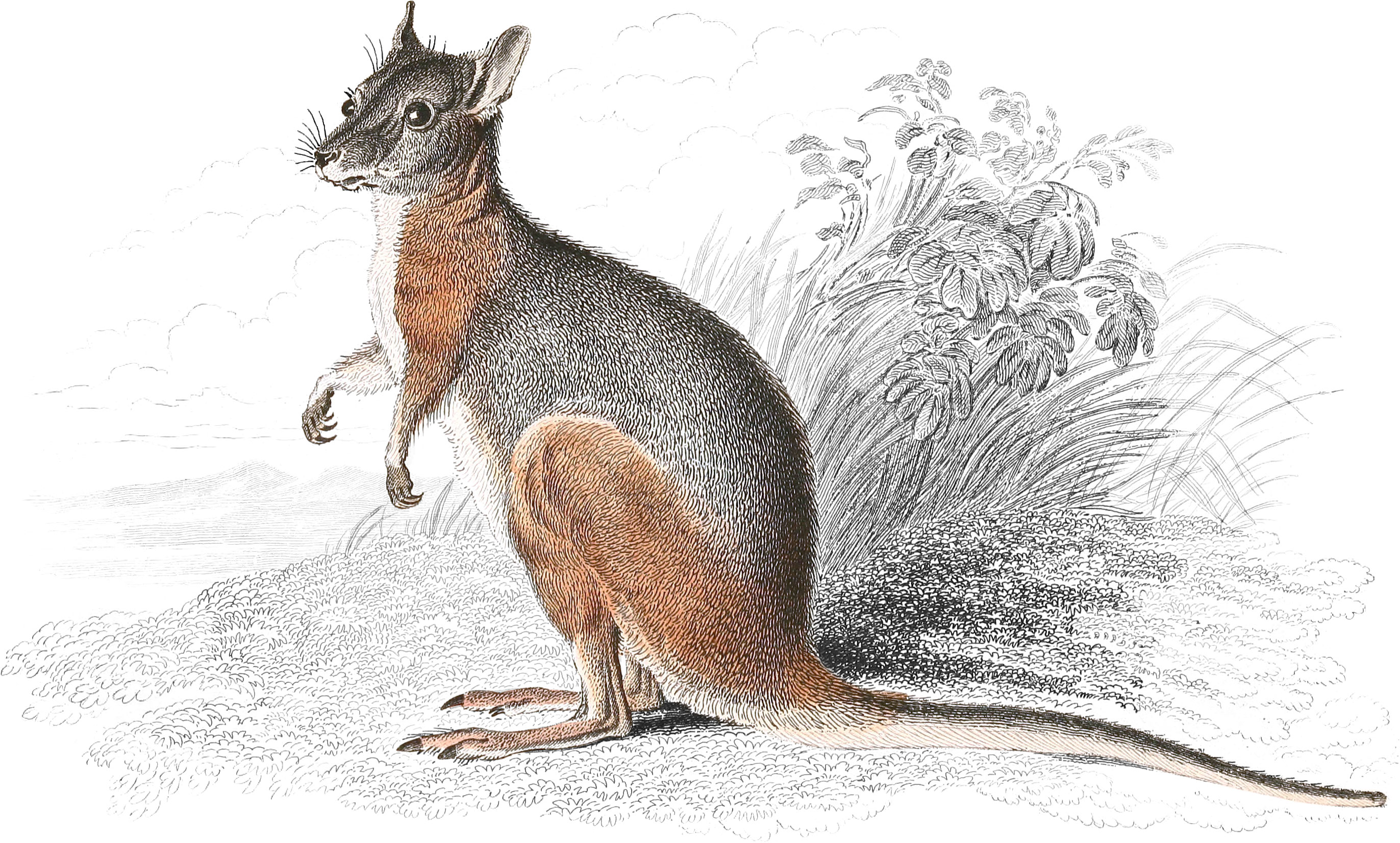
Plate XXI
Short-Tailed Kangaroo
Macropus brachiurus.
Kangurus brachiurus, Quoy and Gaimard. Voyage de découvertes de l’Astrolabe, Zoologie, Tom. I., p. 114, Pl. 19.
Ears small, rounded, hidden at the base by the long hair of the head; tail very short; fur long and glossy, and moderately soft—general hue deep brown, blackish on the middle of the back, on the head and shoulders a rusty-yellow tint prevails; the whole of the under parts of the body are dirty yellow; the fore and hind-feet are brown; the tail exhibits scales like that of a rat, and is furnished with short stiff hairs, (not sufficiently numerous to hide the scales) which are of a brown colour on the upper parts, and dirty white on the under; the ear is covered externally with hair like that of the head, internally there are long yellowish hairs.
On the upper parts of the body the fur is grey at the base, broadly annulated with bright yellow near the apex, and black at the apex; the longer silky hairs are almost totally black; on the sides of the body the hairs are broadly annulated with pale yellow near the tip, and at the tip they are brownish; the hairs of the belly are grey at the base and yellow externally.
Length from nose to root of tail, 18 inches; tail, 7 inches 9 lines; nose to ear, 3 inches; ear, 1 inch 2 lines; tarsus, (claws not included) 3 inches 4\(\frac{3}{4}\) lines.
Habitat, King George’s Sound.
The above description is taken from the original specimen in the Paris Museum; it greatly resembles the Hypsiprymnus murinus. The length of its skull, according to the figure given in M. M. Quoy and Gaimard’s work, is 3 inches 4 lines.
Banded Kangaroo
Macropus fasciatus.
Kangurus fasciatus, Peron et Lesueur. Voyage aux Terres Australes, Tom. I., p. 114, and atlas. Pl. 27.
Kangurus fasciatus, Desmarest Mammalogie, sp. 428, p. 274.
“Kanguroo elegant,” Cavier. Coll. du Mus.
Halmaturas elegans, Règne Animal i., p. 187.
This beautiful little animal is about the size of the common rabbity and in the general colour and texture of the fur nearly resembles the common hare. The tail is moderately long, the ears are rather short; fur long and soft; numerous long silky white hairs, interspersed with the ordinary fur, on the upper parts of the body; the fur on the back is deep brown-grey at the base, white towards the apex, and rusty-yellow shaded into dark brown at the apex; on the hinder half of the back, are about twelve or thirteen, not very defined, transverse black bands; each band is bordered above with white, and between the white and the next band a rusty-yellow tint is observable; the throat, and under parts of the body are white; the chin, muzzle, and a space round the eye, are yellowish-brown; tarsus and outer side of legs tinted with yellow; the hairs on the fore-feet, and those covering the base of the toes of the hinder-feet, are whitish; the tail is covered with short adpressed grizzled grey and dirty white, or in parts black and white hairs; the under side is dirty white; about 1\(\frac{1}{4}\) inches of the apical portion is covered with longer black hairs; ears with white hairs externally coloured like the head.
Length from nose to root of tail, 17\(\frac{1}{4}\) inches; tail, 10 inches 8 lines; tarsus, (claws not included) 4 inches; ear, 1\(\frac{1}{2}\) inches; nose to ear, 3 inches; fore-legs about 3 inches 2 lines.
This description is taken from the original specimen in the Museum at Paris.
The Banded Kangaroo is found at Dirck Hartog’s Island, and on one or two neighbouring islands in Shark’s Bay, on the west coast of Australia. It is said to inhabit the impenetrable low thickets, formed of a species of Mimosa, which are found in those islands; from these bushes they cut away the lower branches and spines so as to form galleries communicating one wth another, and where they take refuge in time of danger. The females bring forth but one young at a time.
Although abundant in the islands of Shark’s Bay, Peron states that none were to be found on the mainland. These little Kangaroos, like all those feeble animals which have neither the power of attack nor of defence, are, like the hares, extremely timid. The slightest noise caused them to take flight to the thick brushwood in which their galleries are constructed, and where it is impossible to pursue them—hence, although very common, they are difficult to procure.
The flesh of these animals is said to resemble that of the rabbit, but has a slight aromatic flavour, arising probably from the nature of the plants on which they feed, nearly all of which are fragrant.
At the time that Peron visited the islands all the females carried young in their pouch, and the courage with which they sought to save their offspring was truly admirable. Although wounded, they flew with the young in the pouch, and never left them, until, overcome with fatigue and loss of blood, they could no longer carry them; they then stopped, and squatting themselves on the hind-legs helped the young to get out of the pouch by means of the fore-feet, and sought to place them in a situation favourable for retreat.
Subgenus 3, Petrogale, Heteropus
Petrogale, Gray. Heteropus, Jourdan.
Mr. Gray88 defines this group thus:—
Muzzle bald, distinct. Canine teeth, none; the upper cutting teeth are equal; front rather longest, and incurved; the hinder one hatchet shaped, dilated at the top, and notched in the centre, (scarcely folded.) The tail cylindrical, covered with long, rather rigid hairs, forming a tuft at the tip.
Type, Macropus penicillatus, Gray.
Nearly at the same time that the above characters appeared in the work quoted, M. Jourdan characterized a genus under the name of Heteropus, in a paper which was brought before the “Académie des Sciences.”89 This genus I feel no doubt is identical with Petrogale; M. Jourdan’s characters are:—Legs moderately long; tarsi short and thick, covered with bushy hairs, the under surface broad and destitute of hairs, but covered with flattened corneous tubercles; third and fourth toes furnished with nails like those of a dog.
Mr. Bennett, however, has the credit of having first pointed out the characters of this section. (See Proc. Zool. Soc. for January 1835.)
The Kangaroos of this section, I have reason to believe, are confined to rocky and mountainous districts, and display great activity in leaping from point to point on the ledges of the rocks. Their broad feet, covered with minute tubercles beneath, giving a roughness to the surface, combined with the more compact form of the body, and the bushy tail, are well adapted to such habits. The tarsi are certainly shorter than usual in the Kangaroos and more densely clothed with hairs—beyond these characters I can perceive none in which the species of the present section can be distinguished from the preceding. In the structure of the incisor and molar teeth, and in the form of the skull, they do not differ more than do the various species of Halmaturus from each other, nor so much as do the species of the first section.
The Macropus robustus of Mr. Gould, which I shall proceed to describe, possesses the short, broad feet, having the sole rough, as in M. penicillatus, but its tail is not bushy: the hair is short and adpressed, as in other Kangaroos, hence this species is intermediate in its characters between the Halmaturi and the Petrogales.
Strong-Limbed Kangaroo
Macropus robustus.
Macropus (Petrogale) robustus, Gould. Proceedings of the Zoological Society for August 1840.
Size rather less than Macropus major; tarsi proportionately shorter; the claws, or nails, short; fore-legs large and very strong; fur rather short and harsh, and having a somewhat shaggy appearance, especially about the head; general colour slate grey, obscurely washed with brownish; the tarsi brown behind, and gradually shaded into black on the fore part; toes black; fore-feet and wrists black; upper side of arm brownish; hind-legs somewhat sooty, but pale on the inner side especially near the heel; head nearly uniform in colour with the body, slightly suffused with blackish at the tip of the muzzle on each side; a narrow white line is observable around the angle of the mouth; lower lip white, and there is a black patch on the chin; the throat and fore part of the neck are whitish; the under parts of the body are a trifle paler than the upper parts; the tail is brown above and pale brown beneath. The fur of this animal is of a palish slate grey next the skin; on the upper parts of the body it is tinted with brownish externally, and on the outer side of the thighs a slight purplish-rust tint is visible. The female is much smaller than the male and of a paler colour; its general hue is silvery grey; on the back is a faint purplish brown hue; the belly is nearly white, the cheeks are hoary, (i. e. a mixture of pale grey and white); on the chin is a blackish patch; the tail is dirty white, slightly tinted with brownish on the upper side; the legs are paler than the body; the fore-feet are brown; toes nearly black; the hind-feet are pale but the toes are brown-black.
Length from tip of nose to root of tail, 47 inches; tail, 25\(\frac{1}{2}\) inches; heel to end of toes, 11 inches; ear to tip of muzzle, 8 inches; length of ear, 3 inches 7 lines. The female measures from the tip of the nose to the root of the tail, 33 inches; tail, 26 inches; tarsus, 10 inches 2 lines. These dimensions are taken from unmounted shins, some of them therefore can only be regarded as approximations. The total length of the animals in all probability should be rather more than here mentioned.
Mr. Gould discovered this fine new species in the interior of New South Wales.
Brush-Tailed Kangaroo
Macropus penicillatus
Macropus penicillatus, Gray. Griff. Ann. Kingdom. V. p. 527.
The Rock Kangaroo of the colonists of New South Wales.
Form robust; tail long and very bushy, especially the apical half; feet densely clothed with fur; the claws of the hinder feet hidden by the long hairs; ears moderate; fur very long and rather soft; general colour very deep vinous or purplish-grey; a deep rusty hue is observable on the rump and root of tail the chest is purplish-grey, pencilled with grey-white; the chin is of a pure white colour, and a tolerably broad white line runs from thence on to the chest; the fore part of the belly is purple-grey; on the hinder part, below the pouch of the female, and under side of the tail at the base, a palish rusty-yellow hue prevails; the muzzle and the region of the eye is blackish, the upper lip white, and a broad purplish-white mark extends backwards from the angle of the mouth, and terminates beneath the eye; the cheeks and back of the neck are hoary-grey; a narrow blackish mark (sometimes indistinct) runs backwards from the crown of the head on to the back; the tail is brown-black, and is clothed throughout with very long harsh hairs, those on the apical portion are about 3 inches in length; the base of the tail is covered with fur like that of the body; the tarsi are brown-black, deep rich brown at the base, and black over the toes; on the outer side of the hind-legs, and on the fore-legs and part of the body nearest to them, a purplish-black hue prevails; the fore-feet are black; the hairs on the inner side of the ears are yellowish; on the outer side, the ears are well clothed with somewhat adpressed black hairs, at the apical margin, however, the hairs are palish brown, and at the base of the ear the hairs are greyish; the head between the ears is blackish; a hoary grey mark is observable on the sides of the body, towards the base of the fore-legs; the hairs on the back are purplish-black at the base, annulated with white, or rusty-white, near the apex, and black at the apex; on the belly the hairs are of a very pale purplish-grey at the base.
Length from nose to root of tail, 25 inches; tail, 22 inches; tarsus, (without the claws) 5 inches 7 lines; nose to ear, 4\(\frac{1}{4}\) inches; ear, 2 inches 2 lines.
This species is known by the names Rock Kangaroo, Brush-tailed Kangaroo, and Mountain Kangaroo.
We learn from Sir Edward Parry, that the M. penicillatus is found among the Rocks of Liverpool Plains, New South Wales. Sir E. Parry says:—90
as several of the same kind were seen together on more than one occasion, they appeared to be gregarious. They seemed to prefer the neighbourhood of rocky ground, in which they had holes, and to which, when hunted, they retreated. The first intimation received of these animals was, that monkeys were to be seen in a particular situation: and the manner in which they jumped about, when he first approached a number of them, left the same impression on his mind. They were so wild that he found it impossible, on his first attempt, to obtain a specimen; and one which he had wounded escaped into its hole; some months afterwards, however, after remaining on the spot a whole night for the purpose, he succeeded in killing one towards day light, which is the specimen he presented to the Society.
In the year 1836, a living specimen of this animal was presented to the Zoological Society’s Menagerie by Captain Deloitte, Corr. Memb. Z. S., where it lived for about a year, during which time I had frequent opportunities of observing its habits. Its form was more robust than in the generality of Kangaroos, and it appeared to be remarkably fond of leaping upon a narrow ledge or shelf, placed about three feet from the ground, on which it would sit and balance itself for some little time, and then return soon to leap back again,—and I suppose he, or rather she, tried to believe this shelf was a projecting piece of rock, and that she was still in her native wilds,—it must have been severe duty for the imagination. The tail appeared to be used more as a balance to the body, than as an extra limb to rest upon, as in other Kangaroos. Its movements were remarkably quick.
Closely allied to, if not identical with, the present species, appears to be the animal described by M. Jourdan under the name

Plate XXII

Heteropus albogularis91
In this species the tail is said to be of equal thickness throughout, strong, and covered with harsh hairs; the fur is woolly, excepting on the extremity of the haunches; on the head is a longitudinal brown line; the cheeks are whitish; the ears are black externally, and yellow within; the throat is white, and the chest and belly are of a rusty colour; the neck and upper parts of the back are grey; and the extremity of the limbs and tail are deep brown; the last is terminated with white.
The dimensions, reduced to English measure, are as follows:—Total length, 51 inches 4 lines; forelegs, 4\(\frac{3}{4}\) inches; hind-legs, 11 inches 10 lines; body, 23 inches 9 lines; tail, 22 inches 1 line; tarsi, 3 inches 2 lines; skull, 4 inches 4 lines.
Inhabits the mountains south-east of Sydney.
In many respects M. Jourdan’s description agrees with M. penicillatus, but that is remarkable for its bushy tail, a character not pointed out by M. Jourdan; it moreover has a white stripe on the chest, and has no white at the tip of the tail,—the last character is probably an accidental one.
In Mr. Gould’s collection, are specimens of a Kangaroo from Western Australia, which very nearly resemble the M. penicillatus, differing only in being rather smaller, in having the tail rather less bushy, the dark band on the sides of the body (which is margined above with white) is more distinct, and there is no white patch on the chest—I doubt their being specifically distinct.
Short-Eared Rock Kangaroo
Macropus brachiotis.
Macropus (Petrogale) brachiotis, Gould. Proc, Zool. Soc. for October 1840.
This is a species from Swan River, which is closely allied to the M. penicillatus, but differs in being of a smaller size, in having the colouring of the fur paler, the tail rather less bushy, and in wanting the black flank mark; the ears, moreover, are smaller in proportion and less pointed.
Fur rather short, and harsh to the touch; general tint grey, slightly washed with rusty brown—the latter tint is more distinct towards the sides of the body; under parts and inner side of limbs dirty yellowish white; feet brown; tarsi grey-brown; upper surface of head palish brown; occiput dusky; upper lip dirty white, and a mark of the same colour runs backwards, from near the angle of the mouth, under the eye: near the base of the fore-leg is a brown patch. Tail well clothed with harsh hairs; those on the upper surface of the tail are nearly of the same general tint as the fur of the body; on the under side they are pale-brown; the apical half of the tail is furnished with long bushy sooty-black hairs. The ears are small and pointed.
Length from nose to root of tail, 21 inches; tail, 28\(\frac{1}{2}\) inches; tarsus, 5 inches; ear, 1 inch 11 lines; nose to ear, 3 inches 8 lines.
Besides the foregoing Kangaroos, there are certain species which inhabit New Guinea, the characters of which not being published, I am unable to introduce in this work. These Kangaroos, however, possess the power of climbing trees, and have been associated under the generic title Dendrolagus92—I presume their extremities are considerably modified to suit them to such habits, and they no doubt form an interesting link between the true Kangaroos and the Phalangers.
Phalangistidæ
At first sight no two animals appear more opposite than a Kangaroo and a Phalanger, and yet when we compare them carefully together, part with part, we cannot help being convinced that a close affinity exists between them. Like the Kangaroos they have four true molars on either side of each jaw, with a more or less compressed molar in front of them, and there are two large horizontal incisors in the lower jaw the structure of the molars—in some at least—is very similar, and they have the same two toes on the hinder foot united. They resemble the Kangaroo-Rats in possessing a small canine in the upper jaw. The nasal portion of the skull is shorter, and the cranial portion longer than in the true Kangaroos, but as regards the form of the skull, as well as in possessing a canine, the Kangaroo-Rats afford a connecting link.
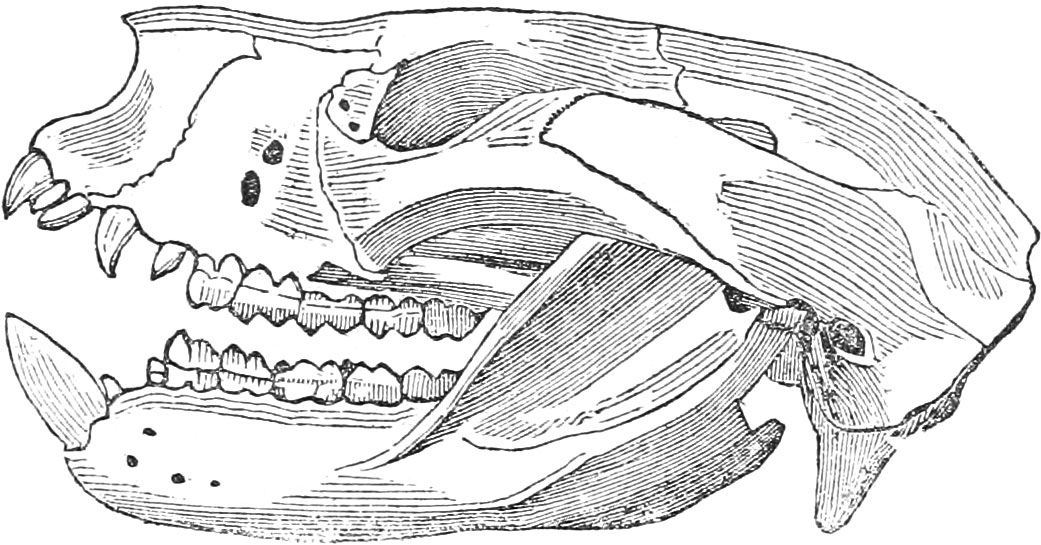
Skull of a species of Phalangista
All the Phalangers are nocturnal in their habits; they live in trees and are expert climbers, though not active in their movements. During the day they remain concealed in the hollows of trees, but about twilight they quit these hiding and sleeping places, and climb amongst the branches of the trees to seek their food, which consists of the young buds, leaves and fruits; these it would appear are more easy of digestion or more nutritious, than the food of the Kangaroos, for the stomach of the present animals is more simple. M. M. Quoy and Gaimard state, that the Phalangers of the Islands north of New Holland feed upon aromatic fruits, but when some specimens they had in confinement could not procure this food, they did not refuse cooked meat. Their flesh is eaten by the natives, and is said to have a good flavour. In Van Diemen’s Land, they are said to feed chiefly on the leaves of the Eucalypti, and Mr. Gunn remarks, that orchards in country places suffer sometimes from the Opossums eating the leaves and young branches of the trees.
The hinder-feet of these animals are always furnished with a large opposable thumb which is nailless, besides which there are four well-developed toes, all armed with large compressed, curved claws; the two innermost of these toes are joined together almost to the extremity; they are rather shorter than the other two toes. On the fore-feet are five well-developed toes, which, like those of the hind-feet, are armed with strong, compressed, curved claws; the innermost toe is the shortest, and the three centralones are the longest.
In the various species comprised in the Phalangistidæ we find certain modifications both in their dentition and external characters, upon which genera, and subgenera have been founded. They are divided into three genera: those which have a large membrane extended from the sides of the body, and joined to the fore and hind-legs, as in the flying Squirrels, and which enables them to sail in the air like a parachute (but not to fly) constitute the genus Petaurus. To those which have no such membrane, and have a prehensile tail, the generic term Phalangista93 (Geoffroy Saint-Hilaire,) is now restricted; and thirdly, we have the genus Phascolarctos, containing only one species, (the Koala) which is at once distinguished by its want of tail.
The constant teeth in the genus Phalangista are:—Incisors, \(\frac{3\ \cdot\ 3}{1\ \cdot\ 1}\); canines, \(\frac{1\ \cdot\ 1}{0\ \cdot\ 0}\); false molars, \(\frac{1\ \cdot\ 1}{1\ \cdot\ 1}\); true molars, \(\frac{4\ \cdot\ 4}{4\ \cdot\ 4}\).

Side view of teeth and upper and lower jaw of a species of Phalangista
The anterior pair of incisors of the upper jaw are lower than the rest, separated at the base, and meet at the apex; the canines are sometimes of moderate size, but generally small, conical and slightly compressed; the false molar, which is in contact with the series of true molars, is in some species somewhat compressed, and presents a nearly even cutting edge, in others it is as broad as long, and obtusely pointed; the true molars are nearly of a quadrate form, and present each four blunt tubercles; the posterior molar is always rather less than the rest; the incisors of the lower jaw, which are in the same nearly horizontal direction as the symphysis menti, are long, pointed, and have the inner and outer edges sharp. Besides these teeth, which are found in all the species, there are some false molars in both jaws which vary both in number and size. In P. ursina, there is one canine-like false molar, in front of the contiguous series of molars on each side of the upper jaw; of two very small false molars in front of the series in the lower jaw, one is placed close to the incisors, and the second close to the larger molars. In a skull before me, (of the same animal) I find three of these small teeth on one side of the lower jaw and two on the other; the number of these teeth on either side of each jaw, situated in the upper jaw between the canines and the continuous series of molars, and in the lower jaw between the incisors and the foremost well-developed molar, in other species of Phalangista may be thus expressed,—in P. chrysorrhos and P. maculata \(\frac{1}{2}\), in P. cavifrons \(\frac{2}{3}\), P. vulpina \(\frac{1}{1}\) or \(\frac{1}{2}\), and in P. Cookii \(\frac{3}{2}\).
The genus Phalangista may be divided into two subgenera, Phalangista proper, and Cuscus. The species of the former subgenus inhabit the continent of Australia and Van Diemen’s Land, and those of the subgenus Cuscus, appear to be confined to some of the Islands North of New Holland.
The species of Phalangista, (using the term in its restricted sense) have the tail well clothed with hair, often bushy, excepting on the under surface of the apical portion; the muzzle is longer and more attenuated than in Cuscus, and the molar teeth are proportionately smaller; their fur, moreover, is less woolly and also less dense, and the ears are larger. In the species of Cuscus, the tail is destitute of hair, excepting at the base, and covered with tubercles, and the ears are small. In Phalangista the lower incisors are nearly vertical, whereas in Cuscus, the symphysis menti forms an obtuse angle with the lower edge of the rami of the jaw, and the incisors are directed upwards and forwards, as in the Koala.
In the genus Petaurus, (the flying Phalangers,) there are three very evident modifications of dentition observable, and the species have been divided into three subgenera accordingly.—Petaurus proper, Belideus (Waterh.) and Acrobata (Desm.) P. Taguanoides may be regarded as the type of the first of these sections. Its dentition is:—
Incisors, \(\frac{3\ \cdot\ 3}{1\ \cdot\ 1}\); canines, \(\frac{1\ \cdot\ 1}{0\ \cdot\ 0}\); false molars, \(\frac{3\ \cdot\ 3}{1\ \cdot\ 1}\); true molars, \(\frac{4\ \cdot\ 4}{4\ \cdot\ 4}\) = 34.
The incisors of the upper jaw are arranged laterally, the three on either side being placed close together; the two foremost are separated from one another by a space about equal to their diameter; they are narrow at the base, and expanded and somewhat compressed above the base. The next incisor on each side is larger than the last or posterior one, and about half the height of the firsts narrow at the base, and wide and truncated at the apex. The third incisor is small and but slightly wider at the tip than at the base. The canine is very small and conical. The first false molar is minute and conical, separated by a considerable space from the canine and also from the molars, and has but one fang. The next two false molars have two fangs; they are broad at the base and compressed at the tip; the foremost presents an anterior larger, and a posterior small compressed tubercle; the third is divided at the tip into three compressed points. The true molars are nearly square, but rather longer than broad; the crown of each, with the exception of the last, presents four angular tubercles. In the last molar there are but three of these tubercles, two in front and one behind. The incisors of the lower jaw are large, nearly cylindrical at the base; beyond this, they are somewhat dilated, flattened, pointed, and have two sharp edges. There are no minute detached false molars in the lower jaw. The single false molar on each side is placed close to the true molars, compressed in front and expanded behind; a small anterior tubercle is separated from the body of the tooth by a slight transverse incision. The true molars resemble those of the upper jaw, excepting that they are narrower, and the last molar has four tubercles instead of three.
The skull of P. Taguanoides differs from the skulls of the species belonging to Belideus, in being smaller in proportion to the bulk of the animal, in having the zygomatic arches stronger and flattened at the sides, in being deeply concave between the orbits, instead of flat, and in having the palate deeply emarginated behind—it terminates, in, fact opposite the second false molar, whereas in Belideus it terminates behind the line of the posterior molars. The nasal bones are much shorter, and the strength of the skull and lower jaw indicate a greater power in the muscles connected with mastication.
Section 2. Belideus.—Dentition: Incisors, \(\frac{6}{2}\); canines, \(\frac{1\ \cdot\ 1}{0\ \cdot\ 0}\); false molars, \(\frac{3\ \cdot\ 3}{4\ \cdot\ 4}\); true molars, \(\frac{4\ \cdot\ 4}{4\ \cdot\ 4}\) = 40. The anterior incisors of the upper jaw are large, somewhat suddenly dilated immediately above their insertion in the intermaxillaries, and assuming a triangular form. In P. flaviventer they are broader than in either P. sciureus or P. breviceps. The next incisor on each side is smaller than the posterior one, narrow at the base, and broad at the apex. The, third incisor is broad, and has a sharp incurved cutting edge. The canine is tolerably large; separated by a small space on either side from the false molars and the incisors, compressed and pointed, and its anterior and posterior edges are sharp; the apex projects beyond the level of either of the molars. The first molar on each side is rather large, broad, compressed and pointed, has a very faint indication of an anterior and posterior lobe, and two distinct fangs, (which is not the case in the small and cylindrical corresponding tooth in Petaurus Taguavioides.) The second false molar is small, short, and compressed, and has a minute anterior lobe. This tooth is separated by a considerable space from the first false molar, and by a narrow space from the third. The latter touches the first true molar, is narrow in front, and consists chiefly of one triangular and pointed tubercle. The first true molar on each side is considerably larger than the following molars, each of which is smaller than the preceding, so that the last is not equal in bulk to one half of the first. With the exception of the last, all the true molars possess four somewhat blunt and rounded tubercles, and in general appearance very much resemble the corresponding teeth of a Squirrel. The last molar has but three tubercles, two in front and one behind.
The incisors of the lower jaw are long, compressed, and pointed, and have the upper and lower edges sharp; they are almost horizontal in their direction, being but slightly curved upwards. Next follows on each side a series of four small false molars, the last of which has two fangs, whereas the others appear to have but one. The true molars nearly resemble those of the upper jaw, though they are narrower and longer. The first has a large irregular anterior lobe, which is higher than the posterior portion of the tooth, which is divided into two tubercles; the three posterior molars have each four tubercles.
Besides the points of distinction, already alluded to, between the species of the present section and the preceding, there are other characters which cannot be considered unimportant. The space occupied by the grinding teeth of the upper jaw, compared with the space between the last incisor and the first true molar in the species of Belideus, is much less than in Petaurus. In Belideus the molars occupy a space equal to rather more than two-thirds of that between the incisors and first true molar; whereas, in Petaurus, the four last molars occupy more space than that which extends from them to the incisors. There is a corresponding difference in the lower jaw. In Petaurus the molars are very nearly equal in size, whereas in Belideus, they decrease considerably from the first molar to the last. In Petaurus, again, there are five molars on each side of the lower jaw opposed to six in the upper jaw, all of which are fitted for the mastication of the food; whilst in Belideus the molar corresponding to the first on either side of each jaw in Petaurus is so small, and its crown is so low that it cannot be used in mastication. The comparatively large size of the canines, and the series of small teeth in front of the molars, (which I always find present,) will also serve to distinguish the species of the present section from the preceding, where the upper margin of the ramus of the lower jaw somewhat suddenly descends in front of the molars, and the coronoid process is comparatively broad.
Petaurus sciureus may be regarded as the type of this section, which also contains P. flaviventer and P. breviceps.
In the third section, which is the subgenus Acrobata of Desmarest, the incisors are \(\frac{6}{2}\); canines, \(\frac{1\ \cdot\ 1}{0\ \cdot\ 0}\); false molars, \(\frac{3\ \cdot\ 3}{4\ \cdot\ 4}\); true molars, \(\frac{3\ \cdot\ 3}{3\ \cdot\ 3}\) = 36. The incisors resemble those of Belideus; the canines are well developed, long, pointed, and recurved, placed close to the intermaxillary suture, and even encroaching slightly on the intermaxillary bone. The three false molars of the upper jaw have each two fangs, they are compressed, sharply pointed, and, viewed laterally, present a triangular form.94 The first and second are about equal in size, and larger than the third, the apex of which projects beyond the level of the crowns of the true molars. Between the first and second false molars on each side there is a narrow space; the third molar is placed close to the true molars; these, as well as those of the under jaw, resemble the true molars of Belideus; there is, however, one less on each side of both jaws. The incisors of the lower jaw also resemble those in Belideus. Behind these incisors there are two minute teeth on each side, which are followed by two sharply pointed false molars, the foremost of which is the larger, and the apex of the second is raised above the plane of the true molars.
The difference in the form of the false molar teeth pointed out, together with the reduced number of true molars,95 the slenderness of the zygomatic arch, combined with the imperfect state of the palate, will serve to distinguish the species of the present section from the preceding. Externally the P. pygmæus (which is the type of M. Desmarest’s subgenus) may be distinguished by its distichous tail.
Section, or Subgenus 1. Cuscus
Phalangers with the tail destitute of hair, excepting at the base.
Ursine Phalanger
Phalangista ursina
Phalangista ursina, Temminck.
Rather larger than the common cat: form strong; limbs strong; ears hidden by the fur; fur rather long, soft, and very woolly; all the hairs crooked and nearly erect. General colour of the fur brown-black, but almost all the hairs are brownish-white at, or near, the tip; on the upper and fore part of the back the black colour prevails; on the hinder half of the back, the white colour is most conspicuous, and on the head, tail, and under part of the body, scarcely any but the brown-white tint is seen, the hairs on these parts, however, are brown at the base; the ears are furnished chiefly with long dirty yellowish hairs; the basal half of the tail is covered with fur like that of the body, the apical half is devoid of hair (the naked part is extended about two inches more on the under side than the upper,) and presents small scattered tubercles; the feet are naked beneath; the toes are but sparingly clothed; the claws are very large and of a brownish colour.
Length from nose to root of tail, 20 inches; tail, 19 inches; nose to ear, 3 inches 5 lines; ear, 8 lines; tarsus, (without including the claws) 3 inches 3 lines.
The above description is taken from a specimen in the Museum of the Zoological Society. M. Temminck states, that the young of this species differ from the old in having the fur of a paler colour, and that the old specimens are perfectly black; those of moderate size are brownish-black, and those which he supposes to be the young of the year, have the fur of the upper parts of the body of a rusty-brown tint; that on the cheeks, the flanks, and the limbs yellowish-brown; and on the under parts yellowish. It is easily distinguished from the other species of the section by the fur being destitute of spots or markings. Adult animals 3 feet 4 or 6 inches in total length, of which the tail is from 19 to 20 inches; the average height of the body is from 9\(\frac{1}{2}\) inches, to 9 inches and 10 lines.
This animal is found, in great numbers, in the northern parts of the Celebes; the inhabitants know no varieties in this species; they eat the flesh. The Phalangers are seen but little during the day, at which time they squat on the branches of the trees and remain hidden beneath the foliage.
Vignette
Yellow-Rumped Phalanger
Phalangista chrysorrhos.
Equal to the wild cat (Felis catus) in size; muzzle short, upper part on the same line with the forehead; ears very short, hidden by the fur and covered throughout with hair; tail equal to the body and neck in length, covered with fur above and on the sides for about two thirds of its length; the remaining portion naked, wrinkled, and of a yellowish colour; fur short, close and woolly; the longer silky hairs of the same colour as the ordinary fur; the fur on the head is of a pale ashy-grey colour, but that on the ears is whitish; all the upper parts of the body, the flanks, and the outer side of the limbs are ashy-grey, more or less inclining to blackish; the rump and the upper part of the tail are of a golden yellow tint, brighter in the adults than in young individuals; inner sides of the limbs and the under parts of the neck are white, the chest is also white, and this colour extends along the belly; the white is separated from the ashy colour which covers the flanks by a black band in adult specimens, but in the young this band is less distinct; the region of the pouch is of a rusty tint; the feet are of a bright rust colour; the tip of the nose brown; the claws yellowish brown, and the hairless portion of the tail is yellow.
In full grown specimens of this species the head and body measure about 23 inches, and the tail is 13 inches.
This species inhabits Amboina.
Spotted Phalanger
Phalangista maculata.
In size equal to the domestic cat; tail nearly equal to the head and body in length; the fur is extended on the upper surface for about half its length, the remaining portion is naked, covered with wrinkles, and of a yellow colour; the ears are hidden, short, round, and covered with hairs throughout; the muzzle is very short, and the forehead is arched; the fur harsh, short and woolly; the longer interspersed hairs are very thinly scattered. In both sexes, and at all ages, the fur is irregularly spotted with brown and dirty white; in the young the spots are always less defined, owing to the interspersed hairs being longer; the hairs covering the face are harsh, and of a yellowish or whitish colour; on the head and the sides of the neck the hairs are grizzled with grey and whitish; and the tuft which covers the ears is generally whitish; the chin, all the under parts of the body, and the inner side of the limbs, are pure white, generally immaculate; the feet are of a very bright rusty tint in the adults, and white in the young; the hairy portion of the tail is usually without spots, of a pure white colour; the claws are yellow.
The hairs which project beyond the ordinary fur are often very long in the young animal, and are generally blackish over the white spots, and whitish over the brown. Very young individuals are sometimes entirely grey.
Length from nose to root of tail, 18 inches; tail, 15 inches. The dimensions of some specimens exceed those here given.
This species lives upon trees, and inhabits the Islands of Amboina and New Guinea; its flesh is of good flavour, and is eaten by the natives. It is subject to great variation in its colouring.
Hollow-Fronted Phalanger
Phalangista cavifrons.
In size equal to the common rabbit; ears not hidden by the fur of the head, hairy within but naked without; forehead concave; tail equal in length to the body only; fur compact and woolly, white in the male sex, in aged individuals tinted with yellow; naked portions of the feet and tail, as well as the tip of the muzzle, whitish; the iris of the eye is whitish and the pupil is linear and black. The female has a dusky longitudinal mark on the back, which commences on the forehead, and terminates before it reaches the rump; the colour of this mark is always darker than that of other parts, and is generally chestnut-brown; the general tint of the fur is variable; in the adults it is yellowish-brown, hazel, or greyish; in the young it is rusty-grey, sometimes silvery or whitish; the chin, and all the under parts of the body, as well as the inner side of the limbs, are always white slightly tinted with grey; the region of the pouch Is rust coloured.
Full grown individuals are about 21 inches in length, without including the tail, which measures 15 inches.
Even when young the female is distinguishable by the dusky line on the back.
This species inhabits the Islands of Timor and Amboina.
Section 2. Phalangista Proper
Tail well clothed with fur, and more or less dense, excepting the extreme point, and part of the apical portion beneath, the extent of which varies somewhat, according to the species.
Vulpine Phalanger
Phalangista vulpina
Phalangista vulpina, Desm., Cuv., Temm., &c.
Didelphis vulpina, Shaw, Gen. Zool. 1. pt. 2, p. 503; Lemurine Opossum, (D. lemurina,) ib. p. 487.
Vulpine Opossum, Pennant, Shaw, &c.
Wha Tapoa Roo, White, Voy. p. 278.
Ears long and somewhat pointed; tail rather longer than the body, and very bushy, most so at the base; fur very loose, long and woolly, and not very soft to the touch; general colour grey, on the back and haunches darker, owing to there being very long black hairs rather plentifully interspersed with the ordinary fur; rather less than half of the tail at the base, is covered with fur of the same character, and the same greyish hue as that of the body, but beyond this the hairs are totally black, or smoky black; the apical half of the tail beneath, and the extreme point, are naked, the sides and upper part, however, are densely clothed with long bushy fur, the hairs on this part being less compact than at the base; the colour of the fur on the head is paler than that of the body and has a yellow tint, this hue being very conspicuous on the cheeks; the muzzle is somewhat dusky, excepting at the tip, adjoining the naked portion, where the hairs are white; a narrow space around the eye is of the same brownish, or dusky hue as the muzzle; the chin is brownish, the throat, the whole under parts of the body, and the inner side of the limbs are dirty yellowish-white, or yellow; a large longitudinal patch of rust coloured hairs is observable on the chest; the feet are dusky, and the claws horn coloured; the ears are nearly naked within (apparently of a brownish flesh colour;) externally at the base they are densely clothed with woolly fur like that of the head, this is of a blackish colour on the upper or fore part of the ear, and white, or nearly so, on the lower part; the apical portion of the ear is but sparingly clothed with short brownish hairs, a considerable space extending inwards from the outer margin of the ear, as well as a narrow line along the inner margin, are also but sparingly clothed.
Length from nose to root of tail, 18 inches; tail, 13 inches; nose to ear, 3 inches 2 lines; ear, 1 inch 11 lines; tarsus, (the claws not included) 2 inches 7 lines; fore-foot, (without the claws) 1 inch 11 lines.
Nine specimens of this species are now before me, the greater portion of which are from New South Wales; one or two, however, are from Van Diemen’s Land, where the species is common. They vary considerably in colouring; two young specimens measuring about one foot in length, (tail not included) are rather paler in their colouring than the adults, they are grey above and nearly white beneath. The specimen from which the description is taken is a female; two male specimens differ in having the under parts of the body, and the cheeks, of a buff-yellow colour, in having the deep rusty patch on the chest greatly extended, and in having the fur of the back and sides of the body, more or less tinted with rust colour at the base, (instead of being pale grey, almost white, as in the female specimen,) on the sides of the body the rusty hue is conspicuous, the hairs being of a pale rust colour, and merely tipped with greyish-white; a deep rusty patch is observable on the abdomen beneath, near the base of the tail, and in the midst of this there is a tuft of long stiff black hairs; the feet, chin, and tip of the muzzle are blackish. In some specimens the feet are yellowish. The region of the pouch of the female is covered with deep rusty-red hairs, and towards the root of the tail a tuft of long black hairs, is observable as in the males; the feet and hands are naked beneath.
Since the above was written the author has had an opportunity of examining a large number of specimens of this species from Van Diemen’s Land, and among these specimens he perceived intermediate shades of colouring between the ordinary grey specimens, and the sooty black Phalanger which is regarded as a distinct species, and has received the name of

Plate XXIII
Phalangista fuliginosa.
P. fuliginosa, Ogilby. Proceedings of the Zoological Society for September 1831, p. 135.
The general colour of this animal is almost uniform brown-black; the chest is bright brown inclining to rust colour; the under parts of the body and of the tail at the base are blackish brown. The fur on the back is pale brown next the skin. The size and proportions are those of P. vulpina.
Cuvier’s Phalanger
Phalangista Cuvieri, Gray MSS.
Cookii, F. Cuv. et Geoff. Mamm. Plate xlv.
This Phalanger is of an ashy-grey colour on all the upper parts of the body and at the base of the tail; the remainder of the tail is entirely black; all the under parts of the body are yellowish white, rather deeper on the abdomen and sides of the cheeks; on the chest is a longitudinal brown mark, and the hairs on this part are less woolly than elsewhere. All the naked parts are flesh coloured. Length about 1 foot; head, 4 inches; tail, 9 inches.
Rather less than Phalangista vulpina, the general colour much paler; ears larger, tail less bushy; the upper surface of the head and the back are grey pencilled with white, the sides of the body are brown-white, slightly tinted with yellow; the under parts of the body are dirty white; on the chest is a rusty patch; the limbs are externally of a pale ash colour, the feet are blackish; about three inches of the tail at the base is coloured as the body, and the remaining portion is blackish; about four inches of the apical portion, beneath, is naked, and the extreme point is entirely destitute of hair. The muzzle, as far back as the eye, is blackish; the cheeks faintly tinted with yellow. The ears are very long and narrow, of a pale flesh colour, nearly naked on the inner side; externally they are furnished with woolly fur like that of the body, but of a smoky black colour, excepting near the outer margin, where they are of a dirty white colour; the apical portion (a space of about 4 lines) is naked, and a narrow naked space extends down the outer margin. All the fur of the body is whitish at the base. Length from nose to root of tail, 16 inches 6 lines; tail, 13 inches 6 lines; nose to ear, 3 inches 2 lines; ear, 2 inches 3 lines.
The above description is taken from a specimen in the British Museum, which certainly appears to be the same species as that figured in M. M. Geoffrey and F. Cuvier’s work, under the name of P. Cookii, but this name has been long used for a very different animal. The present species very nearly agrees with the P. vulpina, but I am inclined to agree with Mr. J. Gray that it is distinct, and have therefore adopted his MS. name.
Yellow-Footed Phalanger
Phalanglsta xanthopus.
Phalangista xanthopus, Ogilby. Proceedings of the Zoological Society of London for September 1831, p. 135.
Ears long and somewhat pointed, nearly naked within; externally, densely clothed with fur like that of the head, but for the most part of a white colour, on the fore part of the base, however, the fur is black; the apex and space near the outer margin are but sparingly clothed; the tail is scarcely as long as the body, covered with fur of nearly the same character as that of the body, but rather less dense, very thick and bushy at the base, and tapering somewhat suddenly to the apex; the fur of the body is very long, somewhat woolly and rather soft; its general tint is deep ashy grey, obscurely mottled with white; the longest hairs on the back are black, and as they are tolerably abundant they give to that part a deeper hue; a narrow space around the eye, and the muzzle are dusky; the head is of a paler hue than the body; the cheeks are whitish, obscurely tinted with yellow; the chin is blackish on each side; the throat, under parts of the body, and inner side of the limbs, are dirty white; a small rusty patch is observable on the chest; the feet are pale, slightly tinted with yellow, but the toes of the fore-feet are somewhat suffused with brown; the tail is of the same tint at the base as the body; in the middle it is black, and a space, of about two inches in length, at the apex is white nearly three inches of the apical portion beneath, and the extreme point are naked; the hairs of the moustaches are black; the claws are of a very pale horn colour.
Length from nose to root of tail, 16 inches; tail, 10 inches 6 lines; nose to ear, 2 inches 9 lines; ear, 1 inch 8 lines; tarsus, 2 inches; fore-foot, 1 inch 1 line.
This species inhabits “the interior of Australia, from Tron-Bark Range, near the Glenelg River.” The authority for this Habitat is the Catalogue of the Australian Museum, published at Sydney in 1837.
The specimen from which the foregoing description is taken, is also the original of Mr. Ogilby’s description. Like Phalangista vulpina, and P. fuliginosa, this species has long ears, and a very bushy tail, it is however, of a smaller size than either of these species, being scarcely equal to a rabbit in size, the tail is rather shorter in proportion, and decreases in diameter more suddenly from the base to the apex; its colouring is, moreover, different, being black in the middle and white at the apex.
Canine Phalanger
Phalangista canina.
Phalangista canina, Ogilby. Proceedings of the Zoological Society of London for December 1836, p. 191–2.
Ears short and rounded, nearly naked within; externally furnished at the base with fur of the same character as that of the head, and of a blackish hue, but towards the posterior margin whitish; tail very bushy, nearly equal to the body in length; fur moderately long, dense, and somewhat woolly, general tint rather deep brownish-grey, grizzled with whitish; the hairs on the upper parts of the body being annulated with that colour near the apex; chin brownish on either side; the throat, chest, (with the exception of a narrow brownish longitudinal mark in the middle,) under parts of the body and inner side of the limbs dirty white; a narrow space round the eye, and the muzzle are dusky; the feet are blackish; a small portion of the tail at the base is coloured as the body, the thick bushy fur on all the remaining portion is black; about one-third of the apical portion of the tail, and the extreme point are naked; moustaches black; claws of the feet pale horn colour.
Length from nose to root of tail, 22 inches; tail, about 13\(\frac{1}{2}\) inches; from tip of nose to ear, 3\(\frac{1}{2}\) inches; ear, about 1 inch 2 lines; tarsus, 3\(\frac{1}{4}\) inches; fore-foot, 2 inches 2 lines.
The specimen from which the above description is drawn, and which is the only one I have seen, is the original of Mr. Ogilby’s description, and was procured in New South Wales, in the country beyond Hunter’s River, about eighty miles north of Sydney. It is about the same size as Phalangista vulpina, and has the same thick bushy tail, but may at once be distinguished from that species by its short rounded ears; the cheeks, moreover, want the yellow tint which is always found in P. vulpina.
Section 3. Pseudocheirus
Pseudocheirus, Ogilby.
Phalangers with the tail less densely clothed with hair than in the Phalangers proper; the apical portion naked beneath; fore-feet with the two inner toes on a different plane to the three outer, and slightly opposed to them.
To this section belongs the P. Cookii, P. viverrinus, and perhaps also the P. nana. Mr. Gray applies the name Hepoona to this section; it had however previously received from Mr. Ogilby the name Pseudocheirus.

Fore and Hind-Foot of Phalangista Cookii
Viverrine Phalanger
Phalangista viverrina
Phalangista viverrina, Ogilby. Proceedings of the Zoological Society of London for November 1837.
Phalangista Cookii, Gray. In the Annals of Natural History, or Magazine of Zoology and Botany for April 1838.
Ears short and rounded, nearly naked within, but clothed with woolly fur on the posterior part; this fur is white, excepting on the fore part of the ear, and also at the root, where it is brown; a patch of white hairs, adjoining those of the ear, is observable immediately under the ear; tail not bushy, rather longer than the body; at the base, covered with fur of the same character as that of the body, but about three inches from the root, the fur of the tail is less woolly, and considerably shorter; its length gradually decreases to the tip of the tail, where the hairs are very short; the fur of the body is long, loose, and somewhat woolly and soft; its general tint is brownish-grey, and on the under parts of the body, and inner sides of the limbs at the base, white; the muzzle is blackish, and the cheeks are paler than other parts of the head; a small white spot is situated on the cheek, a little behind the eye; the fur of the tail is coloured like the body at the base, blackish in the middle and white at the apex, the space occupied by white hairs is about 4 inches in length,—but this is variable; the feet are blackish.
Length from nose to root of tail, 15 inches; tail, 13 inches; nose to base of ear, 2 inches 5 lines; ear, 11 lines.
No doubt this is the Phalangista figured in Cooke’s last voyage, Pl. 8, yet it certainly is not the species generally called P. Cookii by authors, though authors have generally believed that that name was applied to a species agreeing with Cook’s figure. The fact is, this and the following species had been confounded until Mr. Ogilby pointed out the differences in the Proceedings referred to at the head of this description; he at the same time noticed the difference of habitat of the two species. The present animal inhabits Van Diemen’s Land, whilst the previously described species appears to be confined to the Continent of Australia. Subsequently, Mr. Gray, in the Annals of Natural History, proposed that this species, being the one figured by Cook, should be called Cookii, and that confounded with it, Banksii. The two names proposed by Mr. Gray, would certainly be well applied, since it appears that the latter species was discovered by Sir J. Banks, in Captain Cook’s first voyage;96 it would, however, now create much confusion were Mr. Gray’s proposal to be adopted.
In my notes I have a description, precisely agreeing with the present animal, taken from a specimen in the Museum at Paris,— it was without a name, but on the bottom of the stand I found the following note, “Nouvelle Hollande, expedition de l’Astrolabe.” It is probably the specimen referred to by Cuvier, in the second edition of the Règne Animal, as the “Phalanger de Bougainville.” I mention this because there has been some little discussion (in the Annals of Natural History) relating to this, and the next described species.
Mr. Gunn, in the Annals of Natural History for April 1838, states that this species, (which is called P. Cookii, with a note of doubt)
is common near Launcestown, and is there usually called Ring-tailed Opossum, as a specific name.
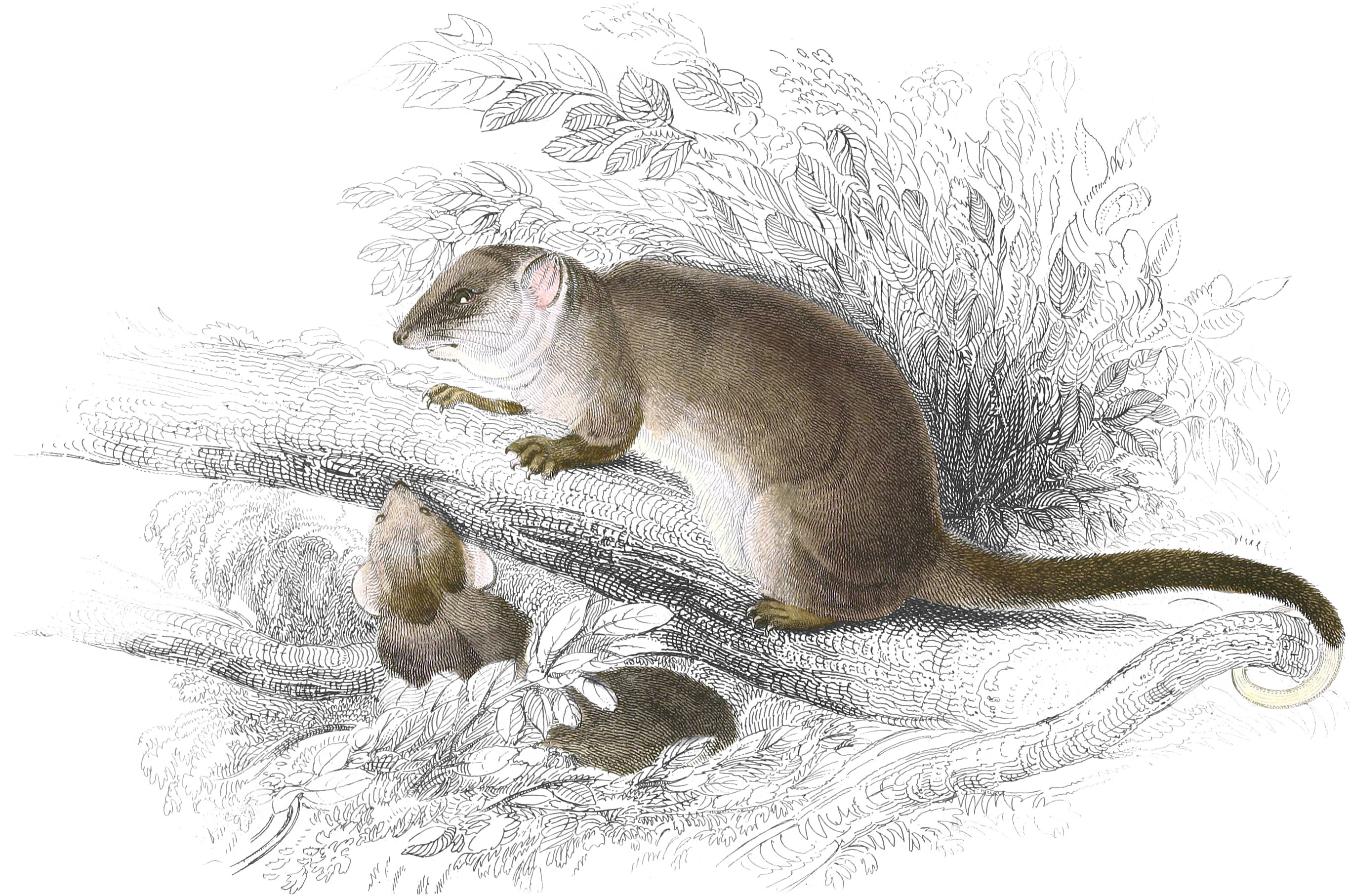
Plate XXIV
Cook’s Phalanger
Phalangista Cookii
Phalangista Cookii, Cuvier, Règne Animal 1, p. 183.
Phalangista Cookii, Temminck, Desmarest, Lesson, Fischer.
Phalangista Banksii, Gray. Annals of Natural History for April 1838, p. 107.
White-tailed Opossum, Shaw. General Zoology, Vol. I., part 2, p. 504.
New Holland Opossum, Pennant. History of Quadrupeds.
Ear small and rounded, nearly naked within; externally, well clothed with fur of a bright rust colour, assuming a deeper tint at the root of the ear, and a yellowish white hue at the posterior or lower margin, where it forms a kind of fringe. Tail as long as the head and body taken together, but scantily clothed with hair, excepting at the base, where a space of about 2\(\frac{1}{2}\) inches in extent is covered with fur like that of the body, but which gradually diminishes in quantity as it recedes from the root. Fur moderately long, of tolerable length and slightly woolly; general tint of upper parts of body rusty-grey; on the head, limbs, sides of the body, and sides and under part of the tail at the base, a brilliant rusty-yellow hue prevails; a small white spot is observable on the cheeks, situated a little behind the eye; around the eye and on the sides of the muzzle, the fur assumes a somewhat deeper hue than on other parts of the head j the chin, throat, under parts of the body and inner side of the limbs at the base, are yellowish white; the hairs covering the fore-feet are of a slightly deeper and less bright colour than those on the legs, and those on the hind-feet are of a dirty yellowish tint; the tail, excepting at the base, is of a dusky brown colour, but the tip is covered with white hairs. The moustaches are black, and the claws are nearly white.
Length from nose to root of tail, 13\(\frac{1}{2}\) inches; tail, 12 inches; nose to ear, 2 inches 4 lines; ear, 9\(\frac{1}{2}\) lines; tarsus, 1 inch 8 lines; fore-foot, 1 inch 1 line.
Habitat, New South Wales.
This is the “Phalanger de Cook” of the Règne Animal, as may be plainly seen even by the short description there given. I may add, moreover, that a careful description, taken by myself from the original of Cuvier’s description, agrees perfectly with the present animal—Cuvier, however, is in error in referring to Cook’s plate for an illustration of this species.
The description of the Phalangista Cookii of Temminck’s “Monographies de Mammalogie” also agrees with the present species—since Temminck says “les flancs et les quatre exrémetées sont roussâtres,” a character which distinguishes it from the following; he is wrong, however, in giving the habitat of Van Diemen’s Land.97
We may add, also, that it is the Phalangista Cookii of Desmarest, “Mammalogie” p. 268, and of Lesson, “Manuel de Mammalogie,” p. 218, since both these authors describe the animal as “gris roussatre,” &c.
Phalangista Cookii is closely allied to P. viverrina, but differs in being rather smaller, in having the tail less densely clothed with hairs, and the feet pale instead of black, or nearly black. It may, moreover, be at once distinguished by the bright rusty red colouring of the head, limbs, and sides of the body. In young individuals there is an abundance of long black hairs interspersed with those of the ordinary fur on the upper parts of the body; a young specimen before me has more than half the tail covered with rusty white hairs; in two other specimens there is but a small portion of the tail which is white.
I have been careful in consulting works for the synonyms of this species, and feel certain that the descriptions given by the authors quoted, refer to the present animal. The first scientific specific name that I can find for it is that given at the head of this description, and to me it appears of but little importance whether authors be wrong in referring it to the figure in Cook’s Voyage or not. The descriptions were not taken from the plate.

Plate XXV
Pigmy Phalanger
Phalangista nana
Phalangista nana, Geof. Desm. Mamm.
Phalangista gliriformis, Bell. Transactions of the Linnæan Society, Vol. xvi., p. 121, Pl. 13.
The general form of this animal resembles that of the common dormouse; but it is larger, broader, and more depressed. The head is broad across the ears, from whence it tapers to the nose, which is somewhat pointed; the nostrils are narrow and of a semicircular form; the upper jaw, which is elongated, overhangs the under, and almost entirely conceals it; the eyes are very large, remarkably prominent, and of a jet black colour; the ears are of considerable size, erect, totally destitute of hair, and of an uniform mouse colour; the fur is very soft and thick, and its general hue is rufous-grey; the under parts are more sparingly covered with fur of a pale yellowish-grey colour, the yellow predominating at the sides, and especially on the throat; the general colour of the face is also yellowish; the sides of the neck as well as the throat are buff; there is a blackish ring around the eye, and a darkish ring partially surrounds the ears at the anterior part, interrupted by a distinct white spot behind each; the feet are almost entirely concealed by the fur when the animal is at rest, and even when in an active state, the breadth of the body, combined with the length of the fur, and the extent to which the skin of the sides is attached to the legs, namely as far as the carpi and tarsi, gives it very much the appearance of a Petaurus, to which this species evinces a remarkable approximation; the tail is nearly as long as the head and body together, and is remarkably broad and thick at the base, to more than half an inch from the origin, at which part it becomes contracted, and then gradually tapers to the extremity; it is hairy, being more thickly covered on the upper part, and especially at the base, where it partakes of the general colour of the upper parts of the body, becoming more scantily furnished towards the point, and there is on the under part, at the extremity, a space about half an inch in length, which is entirely naked; the tail is more or less prehensile throughout its whole length, but especially towards the extremity.
Length of head and body, 3 inches 10 lines; tail, 3 inches 6 lines; breadth of tail at the root, 6 lines; ear, 5 lines; breadth of ear, 5 lines.
From New Holland, but the precise locality not known.
The above description is taken from Mr. Bell’s account with some trifling omissions. This account has the great advantage of having been drawn up from living specimens. I have therefore devoted more than usual space to the descriptive portion. Mr. Bell’s account of the habits of these animals when in confinement is very interesting.
In their habits they are extremely like the dormouse, feeding on nuts and other similar food, which they hold in their fore paws, using them as hands. They are nocturnal, remaining asleep during the whole day, or, if disturbed, not easily roused to a state of activity; and coming forth late in the evening, and then assuming their natural rapid and vivacious habits; they run about a small tree which is placed in their cage, using their paws to hold by the branches, and assisting themselves by their prehensile tail, which is always held in readiness to support them, especially when in a descending attitude. Sometimes the tail is thrown in a reverse direction, turned over the back, and at other times, when the weather is cold, it is rolled closely up towards the under part, and coiled almost between the thighs. When eating they sit upon their hind quarters, holding the food in their fore-paws, which, with the face, are the only parts apparently standing out from the ball of fur, of which the body seems at that time to be composed. They are perfectly harmless and tame, permitting any one to hold and caress them, without ever attempting to bite, bat do not evince the least attachment either to persons about them or even to each other.
The small size of Phalangista nana, according to the descriptions, some slight differences in the colouring, and principally the phrase “les oreilles sont arrondies et couvertes de poils,” in Temminck’s description, induced Mr. Bell to believe the species from which his description is taken is distinct. I have, however, examined the original of P. nana contained in the Paris Museum, and also the originals of Mr. Bell’s description, and I cannot perceive any specific difference. Temminck should have said that the ears are covered with very minute hairs, for so small are they that to the naked eye they appear naked.

Plate XXVI
Genus Petaurus
Phalangers with a membrane extending from limb to limb, and with the tail densely clothed with fur throughout.
Subgenus 1. Petaurus proper
Taguan Petaurus, or Flying Opossum
Petaurus Taguanoides
Petaurus, or Petaurista, Taguanoides, Desm. Mamm. p. 269.
Head very short; ears tolerably large, entirely covered externally, (with the exception of a very narrow space at the apical portion,) with long dense fur like that of the head; tail longer than the head and body taken together, cylindrical, average diameter (including the fur) about 2 inches; flank membrane terminating apparently at the elbow, and on the hinder legs extending to the base of the thumb; fur immensely long, loose, and soft, average length on the back about 2 inches; general colour brownish-black on the head and back of ears brownish; the feet and muzzle are almost black; the hairs covering the flank membrane above are annulated with brownish white near the point, giving to this part a grizzled appearance; throat, chest, the whole under parts of the body and flank membrane, and the inner side of the limbs impure white; the long hairs on the back of the ear, near, and at the lower margin, are white, or whitish, and form a conspicuous fringe; the hairs covering the hind-feet, and along the back of the leg to the root of the tail are very long; the tail is of a brownish-black colour, but is almost always paler at the root, and for a considerable space along the under surface—here the hairs are sometimes whitish and at others brown-white or yellowish.
Length from nose to root of tail, 20 inches; tail, 22 inches; nose to ear, 2 inches 2 lines; ear, 1 inch 4 lines; tarsus, 2 inches; fore-foot, 1 inch 7 lines.
Habitat, New South Wales—“Port Macquarie.” Catalogue of the Australian Museum—called the Grey Flying Squirrel.
This animal varies considerably in its colouring, and is often of a greyish-black colour above, the dark hairs of the upper parts of the body being more or less pencilled with grey; the flank membranes are always of a paler hue than the back, and the limbs are black externally. Specimens which are totally white, and others which are white and irregularly variegated with grey, are not rare.
This species is at once distinguished from all others of the genus,98 by the ears being entirely covered externally with long and dense fur; they are broader, and not nearly so long in proportion as in P. flaviventer, which approaches it most nearly in size.
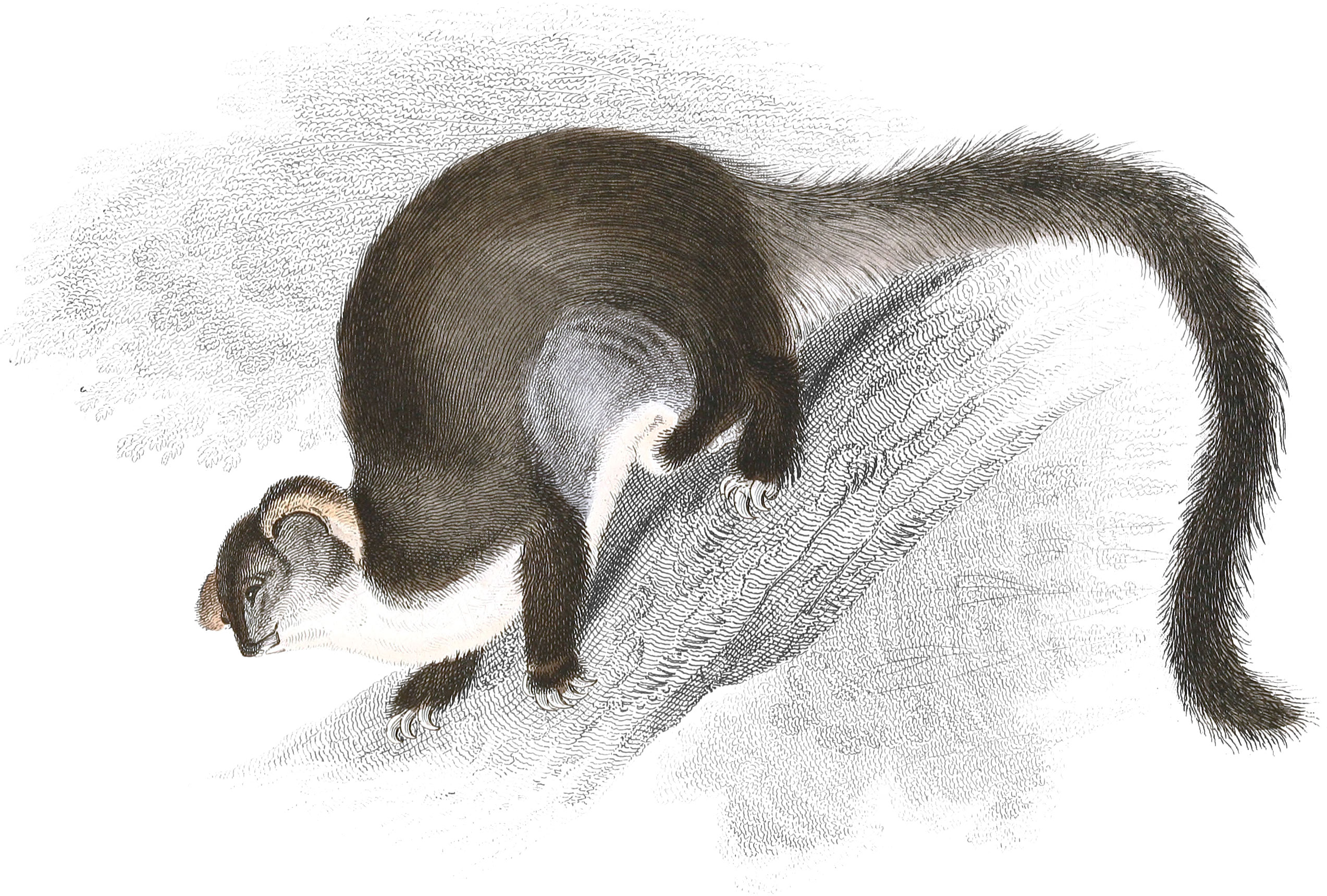
Plate XXVII
Peron’s Petaurus
Petaurus Peronii.
Petaurista Peronii, Desmarest. Nouveau Dict, d’Hist. Nat. 2d Edit., Tom. xxv., p. 404.
Petaurista Peronii, Desmarest. Mammalogie, sp. 420, p. 270.
General tint of the body above, brown; beneath, white; head brown, particularly around the eyes muzzle tinted with yellowish; ears much pointed, brown above, white on the lower part, and this colour is extended somewhat on to the cheeks; chin brown; flank membranes above, brown variegated with grey; beneath, and the outer edge of the fore-feet, extending to the end of the fingers, of a brown colour; rump brown and somewhat tinted with yellowish; the thighs externally, and hinder-feet, of a deep brown colour; tail cylindrical, rather longer than the body, of a brown colour, excepting at the tip, which is yellowish-white; the throat, inner side of the limbs, belly, and under side of the flanks yellowish-white.
Length of head and body, 8 inches 2 lines; tail, 9 inches 6 lines—French measure.
Habitat, New Holland.
The above is a Translation of the description given by Desmarest, who adds, that the flank membrane, instead of being extended as far as the wrist, as in P. Taguanoides, or on to the outer finger, as in P. sciurea, terminates at the elbow.
In the Museum at Paris I found a specimen which agreed so precisely with the description just given, both as to colour and size, as to lead me to suppose it is the original of M. Desmarest’s account. It appeared to me to be a young individual of P. Taguanoides, its length in English measurement is 9 inches; tail, 11 inches; ear, 10\(\frac{1}{2}\) lines. The ear is densely clothed with fur on the outer side, as in P. Taguanoides. The character noticed by Desmarest in the flank membrane I cannot put much faith in, for in all the specimens of P. Taguanoides examined by me the flank membrane terminates at the elbow, and not at the wrist; and as regards the white tip to the tail, I may remark, that in P. breviceps I have seen specimens in which the tail is so coloured, though it is not a general character in that species. On the underside of the stand of this specimen was written “Phalangista macroura.”
Subgenus 2. Belideus
Yellow-Bellied Petaurus
Petaurus flaviventer.
Petaurista flaviventer, Desmarest. Mammalogie, p. 269.
Didelphis Petaurus, Shaw. Gen. Zool. Vol. i., p. 496.
Ears long and pointed, nearly naked, excepting externally at the base, where they are tolerably well clothed with fur; tail considerably longer than the head and body taken together, bushy and thickest at the base; fur very long, loose, and soft; general colour greyish-brown, sometimes with a yellowish tint; head dusky, very dark around the eye, and on the muzzle and chin; there is also a dark patch at the base of the ear; a broad blackish mark extends from the occiput along the middle of the back; the limbs externally, feet, and flank membrane above, are black or nearly so; the edge of the membrane just mentioned is fringed with dirty yellowish hairs; the under parts of the body are of a dirty yellow colour, generally very pale, and sometimes dirty yellow-white; near the outer margin the flank membrane beneath is always dusky or greyish; a fringe of longish hairs, which descends from the posterior and lower margin of the ear, is for the most part brownish-white, but the remaining far on the back of the ear at the base, is blackish. The tail is generally coloured like the upper surface of the body, but the apical portion is black. The fur on the hinder-feet, and that on the back of the leg, is long. The outer toe of the fore-foot is as long as that which is next to it; in P. Taguanoides it is decidedly shorter.
Length from nose to root of tail, 14 inches; tail, 19 inches; nose to ear, 2 inches 3 lines; ear, 1 inch 9 lines; tarsus, 1 inch 7\(\frac{1}{2}\) lines; fore-foot, 1 inch 6 lines.
Habitat, New South Wales—“Scrubs near Liverpool Plains” according to the Catalogue of the Australian Museum.
Easily distinguished from other species of the genus, described in this work, by the great length of its ears.
The Hepoona Roo of White’s Journal, the original also of Shaw’s Didelphis Petaurus, is still in existence in the Museum of the College of Surgeons; it proves to be the present species, and not the P. Taguanoides, as has always been supposed. This ought therefore to be regarded as the type of Shaw’s genus Petaurus—if authors are right in attributing that genus to Shaw,—but I do not perceive that he ever regarded the animal in question as constituting a genus, or that he applied the name in a generic sense.
Long-Tailed Petaurus
Petaurus macrourus.
Didelphys macroura, Long-tailed Opossum, Shaw. Zoology of New Holland, Tab. xii., p. 33, and General Zoology, Vol. I., part 2, p. 500, Plate 113.
This species is about the size of the black rat, (Mus rattus,) and is of a dark or brownish-grey colour above, and whitish beneath; the head and neck are also whitish, but a dusky stripe runs along the top of the head almost to the nose; the ears are whitish, moderately large, and slightly rounded; the upper parts of the fore-feet are whitish; and the lower half of the tail is of a deeper black than the beginning.
The above is Shaw’s description of the Long-tailed Opossum, and as I find nothing added to it (imperfect as it is,) in the various works on Mammalia, I presume the animal has not made its appearance in modern times,—though, from the Catalogue of the Australian Museum, it appears that two specimens, (a male and young female,) which are supposed to be of the present species, are there deposited, and regarded as distinct from the other species—all of which that Museum appears to possess—the habitat given is Bathurst.
Shaw says,
the dried skin of this species was sent over by Mr. White, and the specimen figured in the Zoology of New Holland was described from it.
It would appear to belong to the same section as P. sciureus (Belideus.) In the figure given by Shaw in his New Holland Zoology, which is said to be of the natural size, the ears are represented as large, and the tail is slender, and nearly twice the length of the head and body taken together. I strongly suspect it is the young of Petaurus flaviventer: if it be full grown, the great length of the tail, and especially the comparative slenderness of this organ, and the small size of the animal, would indicate that it is very distinct from either of the other species here described.
Squirrel-Like Petaurus
Petaurus sciureus
Didelphis sciurea, Shaw. Zoology of New Holland, Tab. 11, p. 29.
Petaurus sciureus, Desm. Diction. D’Hist. Nat. 2d Edit, Tom. 25, p. 403.
Ears moderate, nearly naked excepting at the base externally, where they are furnished with fur of the same character as that of the head, and of a blackish colour, with the exception of those hairs which spring from the posterior margin, which are white; tail about equal to the head and body in length; and, owing to the great length of the fur with which it is furnished, nearly equal to it in breadth; fur extremely soft and of moderate length; general tint of the upper parts ashy-grey; a blackish line extends from near the tip of the muzzle, along the middle of the back (where it is broader and less defined,) nearly to the root of the tail; the upper surface of the flank membrane, and the anterior and posterior portion of the fore and hind-legs, are black or brown-black; a brownish black patch is observable just below the ear; the muzzle is dusky, and the eye is surrounded by black; the cheeks are greyish, and sometimes the top of the head is very pale; the feet are dusky-grey, sometimes pale; the chin, throat, inner side of limbs and under parts of the body are white, or nearly so; the under side of the flank membrane near the outer margin is dusky; the margin is fringed with white hairs; the tail is smoky grey, blackish at the tip. Length from nose to root of tail, 8\(\frac{1}{2}\) inches; tail; 8\(\frac{1}{2}\) inches; nose to ear, 1\(\frac{1}{2}\) inches; ear, 9\(\frac{1}{2}\) lines; tarsus, (without the claws) 1 inch 3\(\frac{1}{2}\) lines; fore-foot, 1 inch \(\frac{3}{4}\) lines.
Habitat, New South Wales,—“Cow pastures” according to the Catalogue of the Australian Museum. It is called, by the Colonists, the Sugar Squirrel, and is also known by the name “Norfolk Island flying Squirrel,” &c.
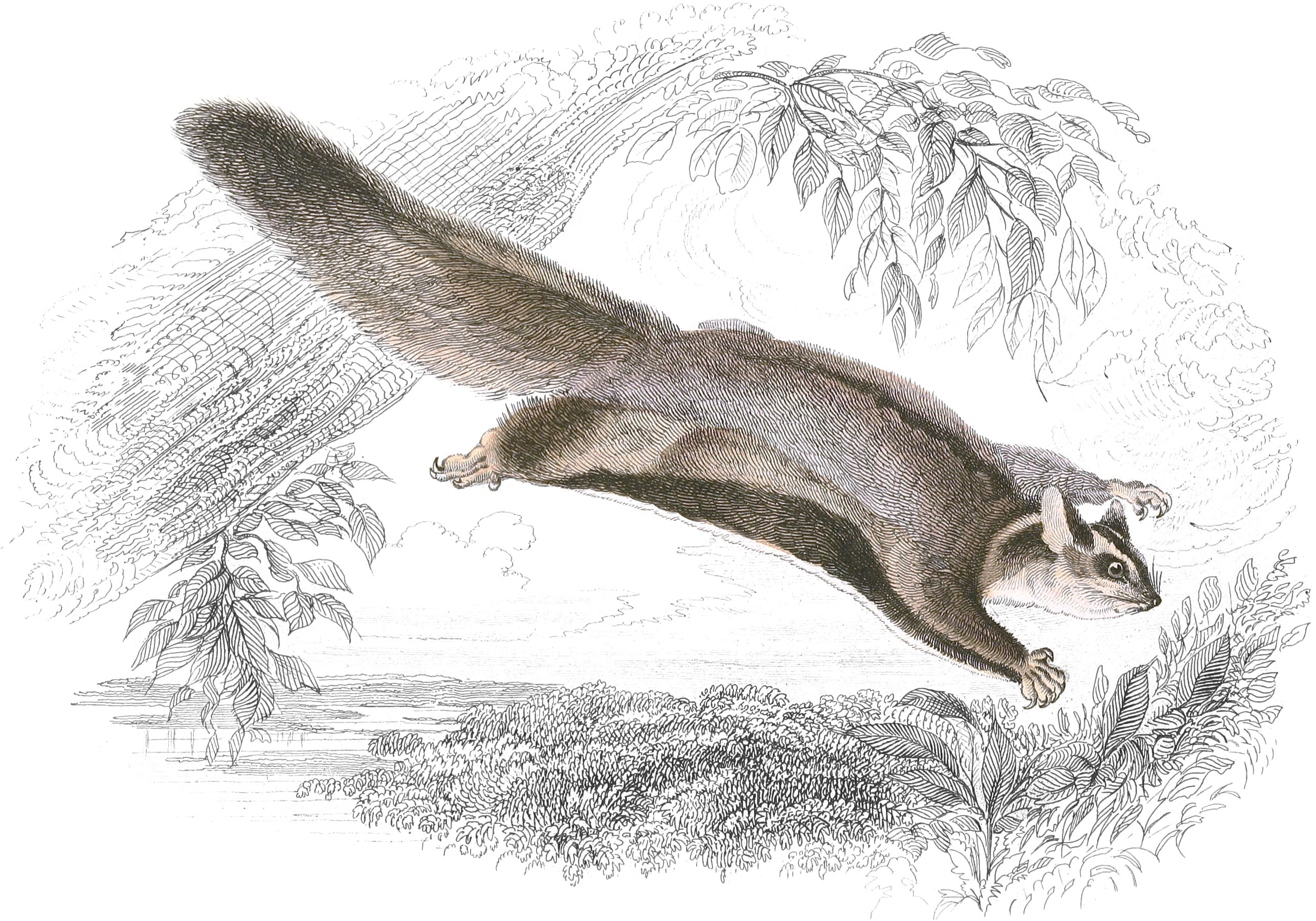
Plate XXVIII
Short-Headed Petaurus
Petaurus breviceps
Petaurus (belideus) breviceps, Waterh. Proceedings of the Zoological Society of London for November 1838, p. 152.
Head short; ears moderate, almost naked, being very sparingly furnished with dusky hairs, excepting at the base externally, where they are covered with fur like that of the head, and of a dusky colour; at the hinder margin, however, the fur is white, or nearly so; tail rather exceeding the head and body in length, cylindrical and but moderately bushy; fur very soft and moderately long, its general tint is ashy grey obscurely mottled with whitish; a dusky longitudinal line extends from between the eyes along the back; on the back, however, it is indistinct, and towards the hinder part is obliterated; the hairs covering the tail are nearly of an uniform ashy-grey colour, somewhat inclining to dusky, rather more than two inches of the apical portion of the tail is covered with black hairs; the flank membrane is blackish above, but white at the margin; the white fringe which margins this membrane, extends along the hinder part of the arm, and terminates at the tip of the little finger; the upper surface of the hand, or fore-foot, is smoky-black; the hind-foot is of a deep grey colour, inclining to blackish; a dusky mark is observable on the posterior part of the hind-legs, and the hairs which cover this part are very long; the external margin of the foot is provided with a fringe of hairs; both feet and hands are naked beneath, the heel is partially clothed with hairs beneath; the under parts of the body and head are whitish-grey.
Length from nose to root of tail, 6 inches 6 lines; tail, 7 inches; tarsi, (claws included) 1 inch 1 line; ear, 9 lines.
This species inhabits New South Wales, and in some parts must be exceedingly abundant. Upon examining two large packages of skins, which I have reason to believe came from New South Wales, I found them to consist chiefly of this species, the remainder were P. sciureus. In some specimens the tip of the tail is white,—they all agree in having a cylindrical tail. In colouring the P. breviceps very much resembles P. sciureus, it is however of a much smaller size, the tail is more slender, and the skull is proportionately broader and shorter than in that species, as will be seen by the following dimensions:—
| P. breviceps | P. sciureus | |||
|---|---|---|---|---|
| Ins. | Lin. | Ins. | Lin. | |
| Total length of skull | 1 | 3\(\frac{1}{2}\) | 1 | 10 |
| Length of nasal bones | 0 | 5\(\frac{1}{3}\) | 0 | 7\(\frac{1}{2}\) |
| Length of frontal | 0 | 6\(\frac{1}{4}\) | 0 | 8\(\frac{1}{2}\) |
| Length of palate | 0 | 8 | 0 | 11\(\frac{1}{3}\) |
| Width of skull | 1 | 0 | 1 | 2\(\frac{1}{4}\) |
In a Catalogue of the Specimens of Natural History &c., contained in the Australian Museum of Sidney, published in that town in 1837, a species of Petaurus under the name of Peronii has the following note attached to it:
This species has been supposed to be a young specimen of P. sciureus, and indeed it bears a very close resemblance to that species in its markings, but having bred in confinement, it is now sufficiently established to be a distinct species.
From this appears that the animal referred to is smaller than P. sciureus, having been supposed to be young, but nevertheless greatly resembles that animal. As these observations so perfectly apply to our present animal, there can scarcely be a doubt that it is it which is referred to_, and if so, we have additional reasons for believing P. breviceps distinct from P. sciureus. In the Catalogue referred to, the habitat of the animal mentioned is “Scrubs near Hunter’s River." The specimen from which the above description is taken, and which is now in the Museum of the Zoological Society, is also from the neighbourhood of Hunter’s River, and was sent to this country by Charles Coxen, Esq., who is given as the donor of the specimen in the Australian Museum.
There are reasons to doubt that the P. breviceps is identical with the P. Peronii of Desmarest; see the observations accompanying the description of that species.

Plate XXIX
Subgenus 3. Acrobata
Pigmy Petaurus
Petaurus pygmæus
Didelphis pygmæa, Shaw. Zoology of New Holland Tab. 2, p. 5.
Ears rather small, somewhat sparingly furnished with long pale hairs on the inner side; the outer side is also furnished with longish pale yellowish hairs, at the base they are covered by fur like that of the head, and of a blackish colour, excepting near the lower margin where they are white; fur soft, and of moderate length; general colour grey, more or less washed with yellow; the upper and under sides of the flank membranes, and the outer side of the limbs is deep grey; a dark patch surrounds the eye, and is extended forward on to the muzzle; the under parts of the head and body are white; the tail is brown, nearly equal in length to the head and body, flat, of even width throughout, or very nearly so, the hairs covering the upper and under surface are small and adpressed, those on the sides are comparatively long and arranged like the barb of a feather; the average width of the tail is about 4 lines.
Length from nose to root of tail 3\(\frac{1}{2}\) inches; tail, 2 inches 10 lines; ear, 3\(\frac{1}{2}\) lines.
Habitat, New South Wales. It is called by the Colonists the flying mouse, and, according to the Appendix to Captain King’s “narrative of a Survey of the Intertropical and Western coasts of Australia,” it is “exceedingly numerous in the vicinity of Port Jackson,” where it is called the Opossum Mouse.

Plate XXX
Genus Phascolarctos
The dentition in Phascolarctos differs but little from Phalangista:—the incisors and canines are smaller in proportion, and the molars are much larger. As in the Phalangers, the crown of each true molar presents four tubercles, but these are more angular and of a pyramidal form. Corresponding with the increased size of the molars, we find in the skull evidences of greater strength in the muscles, and especially in the great depth and thickness of the rami of the lower jaw, the angle of which is less twisted inwards than in other Marsupials. The number of teeth may be thus expressed:—Incisors, \(\frac{6}{2}\); canines, \(\frac{1\ \cdot\ 1}{0\ \cdot\ 0}\); false molars, \(\frac{1\ \cdot\ 1}{1\ \cdot\ 1}\); true molars \(\frac{4\ \cdot\ 4}{4\ \cdot\ 4}\) = 30. The absence of tail in the Koala renders it easily distinguishable from other Phalangistidæ.
Koala
Phascolarctos fuscus
Phascolarctos fuscus, Desmarest. Dictionnaire des Sciences Naturelles xxxix xxv., p. 448 498. Mammalogie, p. 276, sp. 450 430.
Lipurus cinereus, Goldfuss. In Tois Isis, 1819, p. 272.
Koala, or Kola, of the Aborigines. Native Bear, or Monkey of the Colonists.
Ears broad, densely clothed with long fur both externally and internally; head rather short and large; muzzle naked not only at the tip, but a space on the sides measuring nearly half an inch backwards from the tip, and on the upper surface, measuring more than an inch, is also destitute of hair, or at least appears so, but to the touch the apparently naked part has the texture of velvet, though less soft. The fur of this animal is of an extremely compact woolly character; its general colour is ashy-grey, but on the under parts of the body it is white, with a faint dirty yellowish cast; the inner side of the fore-legs is of the same colour, and so is the rump, the base of the hind-legs and lower part of back; the white colour also makes its appearance in irregular patches; the hinder-feet and the back of the hinder-legs are chiefly of a dirty white colour; the inner side of these legs is rusty-grey, and so is the region of the pouch in the female; the back of the ear is covered with fur like that on the upper surface of the head, but longer and less compact; on the inner side the very long hairs are whitish; dusky, tipped with white on the anterior margin, and those which grow from the apical portion of the ear are brownish, or yellowish-white; these hairs are very abundant, and are upwards of an inch in length; on the back the fur is palish rusty-grey at the base; on the belly the fur is almost uniform to the skin, a very faint greyish tint being observable at the base.
Length of head and body, 25 inches; from nose to ear, 4\(\frac{1}{2}\) inches; ear, about 1\(\frac{3}{4}\) inches; hind-foot to base of claws, 3 inches 1 line; fore-foot to base of claws 3 inches; circumference of body (with the fur) about 18 inches; height when standing on all four of its legs, about 10 inches.
On the plate I have introduced a figure of a very young specimen of the Koala, measuring 11 inches in length; the fur in this specimen, instead of having the dense woolly character of the adult, is moderately soft, short, and closely applied to the body; on the middle of the back a little behind the shoulders the hairs radiate, those in front and over the whole of the shoulders and upper surface of the neck are directed towards the head; on the head the hair is directed backwards and meets that of the neck coming from an opposite direction; on the rump there is another of these centres from which the hairs radiate, those in front of this spot are directed forwards, and meet those which are directed backwards from the first mentioned centre. The ears are short, much pointed, and the posterior edge is slightly emarginated, they are not hidden by the fur as in the old animal, the hairs which cover them, however, are about a quarter of an inch long. In colouring it resembles the adult, excepting that the claws are yellow.
This little specimen has evidently been stuffed with considerable care, and as it was sent from Australia in the position in which it is represented in the figure—a common position in fœtal animals—I presume that it is this way that they lie curled up when in the pouch of the parent.
The Koala is a native of New South Wales, and, like the Phalangers, climbs trees, feeding no doubt upon the leaves, buds, and fruits. It is said to resemble a small bear in its mode of climbing. The female carries her young one on her back, when it is capable of leaving the pouch, until it has attained a considerable size.

Plate XXXI
Genus Phascolomys
In this genus the incisors are two in number in each jaw, and the molars are five on each side of each jaw. The incisors are large and deeply emplanted in their respective sockets, like those of the Rodentia, (if the teeth so called in the latter animals be really incisors, for this I think doubtful;) those of the upper jaw are somewhat compressed, and when removed from the socket are found to be curved, and hollow at the base. The worn surface of the incisors of the lower jaw approaches slightly to a triangular figure. These teeth, as well as the molars, continue to grow at the base as they are worn down by attrition at the opposite extremity. The molars, like the incisors, are deeply implanted, and hollow at the base; the foremost on either side of each jaw are separated by a narrow space, (especially those of the upper jaw,) but the series diverge posteriorly. These teeth, when removed from the socket, are found to be considerably curved, so as to form a segment of a circle;99 those of the upper jaw have their convex side placed inwards, and those of the lower jaw are reversed in position: each of the true molars is longer than broad, and nearly divided into two parts by a broad and deep channel situated on the convex side, and a very shallow channel on the concave side; the crown presents nearly the figure of two triangles joined together, but with the angles somewhat rounded. The foremost of the molars, which from analogy we presume is a false molar, represents one-half of one of the true molars. The skull is very massive and heavy, and its structure throughout evinces enormous power in the masticatory muscles—it presents all the essential characters observable in the crania of the Marsupial animals, and is totally unlike the skull of any of the Rodentia, though the Wombat has been classed by some authors with that group.

Side view of the teeth of the Wombat
The fore-feet have five toes provided with strong nails or claws fitted for burrowing, and the hind-feet have also five toes, but the inner one is nailless, and, though very short, projects nearly at right angles from the foot, as in other Marsupials in which this toe exists.
Wombat
Phascolomys Wombat
Phascolomys Wombat, Peron et Lesueur, Voyage Atl. t. 28.
Body stout and heavy; limbs short; head large, the upper surface flattened; muzzle obtuse; eyes very small; ears small and pointed; tail, a mere tubercle. Fur moderately long and very coarse almost bristly; general tint grey, mottled with black and white; the hairs covering the feet chiefly black; ears well clothed with hairs, those on the inner side tolerably long and of a silvery white colour, those on the outer side very long towards the base of the ear, but less numerous and shorter on the tip where they are black; the hairs on the base are white grizzled with greyish and broadly tipped with black; the hairs of the back are brown-black at the base, then white, and at the apex black—many hairs are altogether black. On the belly the hairs are of a dirty white colour, brownish at the base and dusky or black at the apex,—there are also interspersed black hairs. The feet are broad and naked beneath; the claws are large and solid; those of the fore-feet are but slightly curved and slightly depressed; the claws of the hind-feet are curved and slightly compressed.
The tip of the muzzle is naked, and the nostrils are widely separated.100
The hairs of the moustaches are numerous, strong, and of a black colour, as are also the long bristly hairs which spring from the cheeks.
The Wombat possesses 15 pairs of ribs, whereas in other Marsupials they never exceed 12 or 13 pairs.
Length of head and body measured in a straight line, 3 feet; length of head from tip of nose to ear, 7 inches; length of ear. 1\(\frac{3}{4}\) inches; fore-foot, (without the claws) 2\(\frac{3}{4}\); of hind-foot, (without including the claws) 3\(\frac{1}{2}\) inches.
The Wombat is found in New South Wales, South Australia, and Van Diemen’s Land, as well as in some of the Islands in Bass’s Straits. It is a burrowing animal, not very active in its movements, and feeds chiefly upon roots and grass. Its flesh is said to resemble pork in its fatness and flavour, though not in colour, being red and coarse. When provoked it will emit a hissing sound which can be heard at a considerable distance.
The earliest account of the Wombat I can And is in Collins’ work entitled “An Account of the English Colony of New South Wales,” (see pp. 99, 153, and 158,) published in 1802. In this work is an excellent description of the animal (excepting as regards its dentition, where there appears to be some error, probably typographical,) together with a figure, which is not quite so excellent. This account, furnished by Mr. Bass, is drawn up from a specimen obtained at Preservation Island, and which it appears was sent afterwards by Governor Hunter to the Museum at Newcastle-upon-Tyne. Although not described before, a figure of the same specimen appeared in the 6th edition of Bewick’s Quadrupeds, published in 1800,101 the description only appearing in a later edition of that work.
About a year after the date of Collins’ work, M. Geoffroy published in the “Bulletin des Sciences par la Société Philomatique,” Tom. iii., p. 185, a memoir entitled “note sur un Nouveaux Mammifère découvert a la Nouvelle Hollande,” which is nothing more than Collins’ account with the mistakes. The same author, in the same work. No. 80, p. 149, in the following year (about 1804—12th of the Republic,) publishes a second account, founded upon a specimen brought by the Corvette commanded by Capt. Daudin. In his first account the animal receives the generic name Vombatus, and in the second it is called Phascolomis. The animal is next described under the name Thascolomys Wombat, in 1807, by Peron and Lesueur, in the “Voyage de découvertes aux terres Australes,” and has subsequently received the names Phascolomys fusca, (Desm.) and Phascohmys Bassii (Lesson.) Misled by the error in the account of the dentition copied by Geoffrey from Collins’ work, Illiger imagined the animal originally described under the name Vombatus, could not be the same as that to which the generic title Phascolomys was afterwards given, and accordingly he founded upon it a genus which he calls Amblotis.102

Plate XXXII
The Echidna
Echidna Hystrix
Echidna Hystrix of Authors.
Myrmecophaga aculeata, Shaw. Naturalist’s Miscellany, Vol. iii., p. 109. General Zoology, Vol. i. part 1, p. 175; the Porcupine Anteater of the first of these works, and Aculeated Anteater of the second.
Ornithorhynchus Hystrix, Home. Anat. of the O. Histrix; in Phil. Trans. 1802, p. 348.
Tachyglossus aculeatus, Illiger.
This curious animal is about the size of the Hedgehog, which it also resembles in being covered with spines; the spines, however, are much stouter than in that animal, and the long snout of the Echidna would prevent it being mistaken even by a superficial observer for the animal with which I have compared it.
The head of the Echidna is elongated, and its eyes are small; immediately in front of the eye, the muzzle, which is rather depressed, is somewhat suddenly contracted, thence it gradually diminishes in width to the tip. In an adult specimen before me the width of the muzzle, a quarter of an inch distant from the eyes is three-fourths of an inch; its length, measuring to the tip from the same part, is 1 inch and 7 lines and the width near the point is 4\(\frac{1}{2}\) lines. The skin of this beak-like muzzle is thick and destitute of hair. The opening of the mouth is remarkably small, and when closed is in the form of a narrow slit extending backwards from the tip of the nose, not more than 4 lines. The nostrils are situated very near the tip of the muzzle. The tongue is slender and very long, and the animal has the power of protruding it to a considerable distance. Of teeth it has none. The legs are very large and strong, and both hind and fore-feet are provided with five short and stout toes; the toes of the fore-feet are furnished with very large and strong nails, that of the central toe, in the specimen before alluded to, is 1 inch in length, and 3\(\frac{1}{2}\) lines in width in the middle; the toe on either side of this has the nail rather smaller, and the nail of the outer and inner toe is, compared with the others, small, being about 4 or 5 lines only in length: these nails are almost straight, solid, and rounded at the tip. The inner toe of the hind-foot is very short and thick, and furnished with a short, broad, and rounded nail, and appears to be slightly opposable; the toe next the inner one is the largest, though still short and strong, and is furnished with an enormously long nail, 1 inch 4 lines in length; this nail is slightly curved, and appears, when viewed in front, to be nearly cylindrical, but its under surface is concave. The nail of the central toe resembles the last, but is rather smaller, and that of the outer toe Is the shortest, being not more than a quarter of an inch in length. The Echidna being a burrowing animal, it would appear that the broad strong claws of the fore-feet are for digging out the earth, and the large hollow claws of the hind-feet are to enable the animal to cast away the loose soil, and to accomplish this, the foot is twisted in such a manner that the sides of these claws lie on the ground, and the concave part Is behind. On the heel of the hind-foot of the male, (as in the Ornithorhynchus,) is a strong curved horny spur, the point of which is directed backwards and upwards—It is usually about 4 or 5 lines In length.
The skin of the Echidna is remarkably thick, to give firm attachment to the strong spines with which the upper surface of the body is covered; the average length of these spines is about one inch and three quarters, and they are very stout and strong; they commence at the back of the head, cover the whole back of the animal as well as the shoulders, and extend a little way down on the sides of the body; are for the most part directed backwards and upwards, and those on each side of the back are also directed inwards, so that they cross each other at the mesial line; on the rump is a large tuft of these spines which appear to radiate from two centres, and hide the small tuberculous tail; the head, legs, and the whole of the under parts, as well as the sides of the body, are well clothed with very stiff and bristly blackish brown hairs; the spines are of a dirty yellowish-white colour, but blackish at the point; the ears are hidden by the spines, and are situated very far back. Total length one foot.
The Echidna is found in NewSouth Wales, in the Islands of Bass’ Straits, and in Van Diemen’s Land it burrows with great facility, and lives upon insects, which, like the ant-eaters, it procures by means of its long slender tongue, which is always covered with a viscous matter.
Messrs. Bass and Flinders, when at Twofold Bay, state that their dogs found a Porcupine Ant-eater, (or Echidna) but that the dogs made no impression on the animal, which escaped by burrowing in the loose sand, not head foremost, but by sinking himself directly downwards, and thus presenting nothing but his prickly back to his adversaries.
A living specimen of the Echidna, was procured by Messrs. Quoy and Gaimard, at Hobart Town, and these Naturalists furnish us with an interesting account of the habits of the animal as observed in confinement. They describe it as an apathetic and stupid animal; for the first month after its capture, it took no sustenance whatever, and became very thin, though without appearing to suffer.103 It was fond of obscurity, shunning the light during the day, and crouching to the ground with its head between its legs; in this position it presented at all parts a mass of spines like a Hedgehog, but was not able to roll itself up in a ball like that animal. Notwithstanding the inactivity of the Echidna, it appeared to like its liberty, for it made constant efforts to get out of the cage in which it was placed. It burrowed with a rapidity truly astonishing. A large chest of earth containing plants being given to it, the animal arrived at the bottom in less than two minutes. The muzzle, although extremely sensative, assisted in the work.
After a month of abstinence it took to eating; the food given to it, was a mixture of flour, water, and sugar, of which it consumed nearly half a glass per day.
Messrs. Quoy and Gaimard are of opinion that these animals might be easily conveyed to Europe in a vessel taking a direct route; especially as they become torpid when exposed to the cold. This specimen died, they say, in consequence of its washing itself too much.
Desmarest and some other authors describe two species of Echidna under the names Echidna hystrix and E. setosa. The animal here described is the E. hystrix of these authors, the E. setosa differs in having fewer and shorter spines on the body, and these embedded almost to the point in a dense, woolly, brown fur; on the sides and under parts of the body, some long, pale, bristly hairs are intermixed with the fur, which is much less harsh than that of E. hystrix, and of a much paler brown. Desmarest says, the nails of the feet are longer, narrower, and more arched in E. setosa, than in the other species, but these differences in the form of the nails, do not exist in the specimens before me.
The author mentioned, gives Van Diemen’s Land and the Islands in Bass’ Straits, as the localities in which the setosa is found. I have notes of several specimens from Van Diemen’s Land, whence I do not recollect to have seen specimens of the O. hystrix. The two species, (if they be distinct,—and the differences are certainly not those of age or sex,) however, are found in New South Wales; they have had the further two names, E. longiaculeata and E. breviaculeata, applied by Tiedemann, Zoologie i. p. 592.
The Echidna and Ornithorhychus form an order of themselves according to the views of many naturalists. By Cuvier they are classed under the term Monotremata, with the Edentata of which they form the third section. These animals, however, differ essentially from the Edentata, in their anatomical structure, whilst they agree, as it appears, chiefly in one negative character,—the absence of teeth,—in fact we may say, they agree with the Edentata,104 only inasmuch as that name is equally applicable to certain species of the two groups, Edentata proper and Monotremata. We must not overlook the fact, that the Monotremata possess the marsupial bones, so characteristic of the Marsupialia, and at the same time agree in several important anatomical characters. They are also inhabitants of a part of the globe in which the Mammalia are almost exclusively Marsupiata. They certainly do not possess the pouchy but this has been observed to exist only in a rudimentary state in some of the Opossums.

Plate XXXIII
The Ornithorhynchus
Ornithorhynchus paradoxus, Blumenbach
Platypus anatinus, Shaw
This animal is about 18 or 20 inches in length; the body tapers at both extremities, and is moreover of a somewhat depressed form; the head is small, but the facial portion is greatly developed, and from its peculiar form has often been compared to the beak of a duck; this beak is about one third longer than broad, flat and broader in front than behind; it is covered by a thick skin, which in dried specimens resembles leather; this leather-like membrane is supported by the bones of the face, which, together, form a framework of the figure just described, but the membrane, both at the sides and in front, extends beyond the bone, and such parts are therefore free and flexible; in front the free membrane (in an adult animal) measures about half an inch or more, and at the sides rather less; besides the free membrane at the sides and in front there is a fold of skin surrounding the base of the beak, which in fresh specimens probably averages about half an inch in width; it is narrow at the angle of the mouth, but immediately below the angle, its width is about three quarters of an inch. This membrane folds back over the fore part of the head and throat, and probably serves to keep the mud,—in which these animals are (like ducks) constantly grubbing in search of food,—from working into the fur; it may also serve somewhat to protect the eyes. The nostrils are round and rather large, placed near to each other and situated on the upper surface near the extremity of the beak,—that is, they are just within the boundary of the bony portion. The lower mandible has the same general form as the upper, but is of a much smaller size; it is nearly flat, being but slightly convex externally, and concave internally; like the upper mandible, it is surrounded by free membrane, but this is comparatively narrow; that at the sides presents numerous transverse ridges, which serve, no doubt, a similar purpose as those which we observe in the same situation in the under mandible of the ducks. The only teeth which this animal possesses are four molars, two on each side of each jaw; these teeth, unlike those of other quadrupeds, consist of a horn-like substance, are situated far back in the head and present a broad and uneven masticating, or rather crushing surface, and are of an irregular subquadrate form. The eyes are very small, of a light brown colour, and situated about half an inch behind the base of the beak.
The external orifice of the ears is situate near the upper part of the external angle of the eye. When a living specimen is examined the orifice is easily discoverable, as the animal has the facility of closing or opening it at will; in dead specimens being closed, it would not readily be perceived by a person unacquainted with its exact situation.
The legs are remarkably short, and it would appear, are not long enough to keep the body from touching the ground. Both fore and hind-feet are furnished with five well-developed toes, those of the fore-feet are provided with long, solid, slightly depressed claws, which are nearly straight; not only is the space between these toes webbed, but the web is extended so as to reach considerably beyond the end of the claws, hence when the foot is expanded a large surface is presented to the water, and enables the animal to swim with considerable rapidity. On land, and when the animal wishes to burrow, the free portion of the web is folded back, and leaves unencumbered the powerful claws.
The hind-feet are also webbed, but here the web does not extend beyond the tip of the toes; the claws on these feet are long, curved, compressed, and pointed; the three middle toes terminate nearly on the same line, but the inner toe is shorter. On the heel is a large stout and sharply pointed spur, which is slightly curved and said to be moveable. The tail is short, broad, and depressed. The fur is short, very dense, and rather soft to the touch, and combines the properties usually found in that of an aquatic animal and that of one whose habit is to burrow; it will readily expel both the water and the dust; it is composed of hairs of two kinds, the one forming a remarkably fine and dense fur resembling that of the mole, the other hairs are longer, have the basal half fine like the under fur, but the apical, exposed, half of each hair is dilated and flat, bent at an angle with the basal portion, and is very glossy, resembling the hairs of the seals. In these longer hairs, being thin at the base, bent near the middle, and expanded and stiff at the tip, we see a beautiful provision suited to the habits of the animal. When in the water the flat points become closely applied together and afford a waterproof covering to the fine under fur; and when in its under ground galleries, their peculiar texture and bent form permits the animal to move either backwards or forwards without inconvenience, and without exposing the skin to the dirt. The hairs covering the tail are very stiff and bristly; on the upper surface they point in various directions, and on the under surface they are very short and closely adpressed; in old specimens the tail is frequently naked beneath, the hairs being worn off. The toes of the fore-feet are naked. The general colour of the Ornithorhynchus is deep brown; the under parts of the head and body are pale brown; the under fur is grey; a small whitish spot is observable in front of each eye.
The dimensions of the specimen from which the foregoing description is drawn up are as follows total length 23 inches—measuring over the curve of the back; length of beak, 2\(\frac{1}{2}\) inches; width near the tip, 1 inch 10 lines; width at base, 1 inch 7 lines; length of lower mandible, 1 inch 11 lines; width at the tip, 1 inch 2 lines; length of tail, 5 inches width, 2\(\frac{1}{2}\) inches; length of fore-foot to end of claws, 1 inch 10 lines; of hind-foot to end of claws, 2 inches 8 lines; length of spur rather more than half an inch.
Several species of Ornithorhynchus are enumerated in Zoological works. In the “Voyage de Découverts &c." by Peron, we find two Ornithorhynchi characterized and figured under the names O. fuscus and O. rufus. These species M. Temminck and some other authors regard as distinct; there are others, however, who do not consider them well established. The animal I have described agrees in its colouring with the O. fuscus; the O. rufus, it would appear, differs chiefly in being of a brighter and richer brown. Desmarest says the O. fuscus is perhaps only a variety of the O. rufus,
cependant son poil diffère en ce qu’il est aplati et crépu, au lieu d’être comme celui de ce dernier animal, mince et lisse.
Now in specimens before me I find such a difference—two bright reddish-brown individuals differ from several others of a darker and less bright colour, in having the fur longer and less crisp; the points of the hairs are all directed backwards whilst in the dull brown specimens the fur has a grizzled appearance, the hairs being pointed in various directions. The rufous specimens are smaller than the others, and have a much stouter spur and narrower beak; the under parts of the head and body are almost white. A specimen in the British Museum, said to be the original of Shaw’s description, is evidently the O. rufus—supposing the two species to be distinct.
Leach, in his Zoological Miscellany, (Vol. II., p. 136,) also describes the Ornithorhynchus fucus and O. rufus as distinct; the latter he says differs from the former, not only in colour, but in having the beak narrower, the nostrils more terminal, the anterior claws acuminate, (those of the O. fuscus he describes as linear and obtuse,) and the form of the hair of the anterior part of the body, which has a much longer club at its extremity. The differences in the position of the nostrils and in the form of the claws, I do not perceive in the specimens before me, and as regards the beak, I have seen a rufous specimen in which it was as broad as in those of the deeper brown colour.
Mr. Macgillivray describes two species of Ornithorhynchus in the Memoirs of the Wernerian Society for 1832, (Vol. VI., p. 127,) under the specific names crispus and lævis, but these he afterwards (see p. 132) regards as mere varieties of O. paradoxus. The description of 0. crispus given by this author agrees with the animal described at the head of this article, and the O. lævis is apparently the O. rufus.
Mr. Ogilby also describes an Ornithorhynchus under the name brevirostris. See Proceedings of the Zoological Society for 1831, p. 150. The specimen upon which Mr. Ogilby founds his species is now before me, and is one of the two reddish varieties before alluded to. I think it possible the O. fuscus and O. rufus will prove distinct, and if so, the synonyms will be as follows:—
- Platypus anatinus, Shaw.
- Ornithorhynchus paradoxus, Blumenbach?
- Ornithorhynchus rufus, Peron, Leach, and Desm.
- Ornithorhynchus lævis, Macgillivray.
- Ornithorhynchus brevirostris, Ogilby.
- Ornithorhynchus fuscus, Peron, Leach, and Desm.
- Ornithorhynchus crispus, Macgillivray.
Both these species, or varieties, are found in New South Wales, and one of them at least in Van Diemen’s Land. In the Catalogue of the Sidney Museum we are informed, that this animal is called by the aborigines of Gas, Murrumbidgee, &c., Mallangong, and Tambreet: it is the Water-mole of the colonists.
The most perfect account of the habits of the Ornithorhynchus hitherto published, is from the pen of Mr. George Bennett, in the Transactions of the Zoological Society, Vol. I., p. 229. Some portions of this paper I shall proceed to extract.
Mr. G. Bennett’s observations were commenced on the 4th of October 1832, at Mundoona in the Murray County, on a part of the Yas River running through the estate of Mr. James Rose. The Water-Moles (as these animals are called by the Colonists,) chiefly frequent the open and tranquil parts of the stream, covered with aquatic plants, where the steep and shaded banks afford excellent situations for the excavation of their burrows. Such expanses of water are by the Colonists called “ponds.” The animals may be readily recognized by their dark bodies just seen level with the surface, above which the head is slightly raised, and by the circles made in the water around them by their paddling action. On the slightest alarm they instantly disappear; and indeed they seldom remain longer on the surface than one or two minutes, but dive head foremost with an audible splash, reappearing, if not alarmed, a short distance from the spot at which they dived. Their action is so rapid, and their sense of danger so lively, that the mere act of levelling the sun is sufficient to cause their instant disappearance; and it is consequently only by watching them when diving, and levelling the piece in a direction towards the spot at which they seem likely to reappear, that a fair shot at them can be obtained. An ear shot is absolutely requisite; and when wounded they usually sink immediately, but quickly reappear on the surface.
A male specimen was shot, and brought out by the dog, on the following morning. In a few minutes it revived, and ran along the ground, instinctively endeavouring to regain the water, but did not survive more than twenty-five minutes. On this individual Mr. G. Bennett made various experiments, with the view of ascertaining the truth of the reports so extensively circulated of the injurious effects resulting from wounds inflicted by the spur. In no way, however, could he induce the animal to make use of its spurs as weapons of offence; although in its struggles to escape, his hands were slightly scratched by the hind claws, and even, in consequence of the position in which he held it, by the spur also. The result of several subsequent repetitions of the experiment with animals not in a wounded state was the same. The natives, too, never seem fearful of handling the male Ornithorhynchus alive.
On the morning of the 7th of October, Mr. G. Bennett proceeded, in company with a native, to the banks of the river to see the burrow of an Ornithorhynchus, from which the natives had taken the young during the previous summer. The burrow was situated on a steep part of the bank; and its entrance, concealed among the long grass and other plants, was distant rather more than a foot from the water’s edge. Its whole extent was not laid open, the natives contenting themselves with digging down upon it at stated distances, their operations being guided by the introduction into the burrow of a stick which indicated its direction. It took a serpentine course, and measured about twenty feet in length the termination was broader than any other part, nearly oval in form, and strewed with dry river-weeds, &c. From this nest the native stated that he had taken in the. previous season (December) three young ones, about six or eight inches in length, and covered with hair. In addition to the entrance above spoken of, the burrows have usually a second below the surface of the water, communicating with the interior just within the upper aperture. After exhibiting this burrow, the native proceeded to explain the means employed in tracking the Mallangongs. He pointed out on the moist clay of the banks foot-marks leading to a burrow, from the bottom of which, on inserting his arm, he drew forth some lumps of clay, which bore evident marks of the animal’s recent passage. He declared, however, that the inhabitant was absent, and Mr. G. Bennett was induced, by this information, to abstain from further investigation. A female specimen, shot in the evening of the same day, was found to have two ova, about the size of or rather smaller than buckshot, in the left uterus; and in this, as in all the other female specimens, much difficulty was experienced in finding the mammary glands. The contents of the cheek-pouches and stomachs always consisted of river insects, very small shell-fish, &c., comminuted and mingled with mud or gravel, which latter, Mr. G. Bennett suggests, may be required to aid digestion. River-weeds were never observed to form part of the food; but Mr. George MacLeay informed the author that in a situation in which water-insects were very scarce he had shot Ornithorhynchi with river-weeds in their pouches.
Similar excursions were made on the 8th and 9th of October; and on the latter day one of the burrows was explored. The entrance of this burow was situated on a moderately steep bank, abounding with long wiry grass and shrubs, at the distance of about five feet from the water’s edge: its course lay in a serpentine direction up the bank, approaching nearer to the surface of the earth towards its termination. At this part it was expanded to form a chamber sufficiently capacious for the reception of the animal and her young, and measured one foot in length by six inches in breadth. Its whole length, from the entrance to the termination, was twenty feet;105 narrowing as it receded from the entrance, where it measured one foot three inches in depth, and one foot one inch in breadth, and in the intermediate part becoming scarcely larger than the usual breadth of the animal when uncontracted.
From this burrow a living female was taken, and placed in a cask, with grass, mud, water, &c.; and in this situation it soon became tranquil, and apparently reconciled to its confinement. Hoping that he had now obtained the means, should his captive prove to have been impregnated, of determining the character of the excluded product, Mr. G. Bennett set out on his return for Sidney, on the 13th of October, carrying the living Ornithorhynchus with him in a small box, covered with battens, between which only very narrow intervals were left.
The next morning, tying a long cord to its leg, he roused it and placed it on the bank of the river, in order to indulge it with a bathe; and a similar indulgence was granted to it on the second day of its journey. On these occasions it soon found its way into the water, and travelled up the stream, apparently delighted in those places which abounded most with aquatic weeds. When diving in deep and clear water, its motions were distinctly seen; it sunk speedily to the bottom, swam there for a short distance, and then rose again to the surface. It appeared, however, to prefer keeping close to the bank, occasionally thrusting its beak into the mud, from whence it evidently procured food, as on raising the head, after withdrawing the beak, the mandibles were seen in lateral motion, as is usual when the animal masticates. The motions of the mandibles were similar to those of a duck under the same circumstances. After feeding, it would lie sometimes on the grassy bank; and at others partly in and partly out of the water, combing and cleaning its coat with the claws of the hind-feet. This process occupied a considerable time, and greatly improved its sleek and glossy appearance. After its second excursion it was replaced in the box, which was not opened again until the following morning, when it was found to have made its escape.
Mr. G. Bennett proceeds to describe in detail their habits in a state of captivity. Their various attitudes, when in a state of repose, are curious, and are illustrated by the exhibition of sketches made from the life. The most favourite posture of the young animals appears to be lying rolled up like a ball; this is effected by the fore paws being placed under the beak, with the head and mandibles bent down towards the tail, the hind paws crossed over the mandibles and the tail turned up; thus completing the rotundity of the figure. The young were allowed to run about the room; but the old one was so restless, and damaged the walls of the room so much by her attempts at burrowing, that it was found necessary to confine her to the box. During the day she would remain quiet, huddled up with her young ones; but at night she became very restless, and eager to escape. The little ones were as frolicsome as puppies, and apparently as fond of play: and many of their actions were not a little ludicrous. During the day they seemed to prefer a dark corner for repose, and generally resorted to the spot to which they had been accustomed, although they would change it on a sudden apparently from mere caprice. They did not appear to like deep water, but enjoyed exceedingly a bathe in shallow water, with a turf of grass placed in one corner of the pan; they seldom remained longer than ten or fifteen minutes in the water at one time. Though apparently nocturnal, or at least preferring the cool and dusky evening to the glare and heat of noon, their movements in this respect were so irregular as to furnish no grounds for a definite conclusion. They slept much, and it frequently happened that one slept while the other was running about, and this occurred at almost all periods of the day. They climbed with great readiness to the summit of a bookcase, placing their backs against the wall and their feet against the bookcase; and thus, by means of their strong cutaneous muscles and of their claws, mounting with much expedition to the top. Their food consisted of bread soaked in water, chopped egg, and meat minced very small; and they did not seem to prefer milk to water. One of the young ones died on the 29th of January 1833, and the other on the 2nd of February, having been kept alive in captivity for nearly five weeks.
The Ornithorhynchus was described by Shaw and Blumenbach nearly at the same time; Blumenbach’s account I have reason to believe appeared in 1800; if so, Shaw has the priority, his first description having appeared in the Naturalist’s Miscellany, No. 118 385, published in June 1799. Blumenbach’s name, Ornithorhynchus paradoxus, is, however, universally adopted, and in all the interesting anatomical papers on this animal this name is used; under these circumstances it is not desirable to go back to what I believe to be the older name Platypus anatinus—especially as Platypus is used as a generic name among insects.
Those who wish to obtain more perfect information relating to this most extraordinary animal, which in many of its anatomical characters evinces a considerable approach towards the class Reptilia, and is certainly the lowest of the Mammalia yet discovered, will do well to consult the following Memoirs.
- Home, On the anatomy of the Ornithorhynchus, in the Phil, Trans. 1802, p. 67–84.
- Meckel, Ornithorthynchi paradoxi descriptio anatom.
- De Blainville, Observations sur l’ergot de l’Ornithorhynque, in the Journal de Physique, &c. lxxxiv, p. 318, See also a paper by the same author, Sur les Mamelles de l’Ornithorhynque, &c., in the Nouveau Bulletin de la Société Philomatique, for 1826, p. 138.
- Knox has published several papers on different parts of the Anatomy of the Ornithorhynchus in the Memoirs of the Wernerian Society, Vol.
VIV. - Geoffroy Saint-Hilaire, Sur un apparat glanduleux recénment découvert dans l’Ornithorhynque, Annales des Sciences Naturelles, for 1826, p. 457. The same author publishes another paper, Sur les appareils sexuells et urinaires de l’Ornithorhynque, in the Memoirs du Museum, &c. XV.
- Owen, On the young of the Ornithorhynchus paradoxus, in the Transactions of the Zoological Society, Vol. I., p. 221, and On the Ova of the Ornithorhynchus, in the Philosophical Transactions, part 2, for 1834, p. 555.
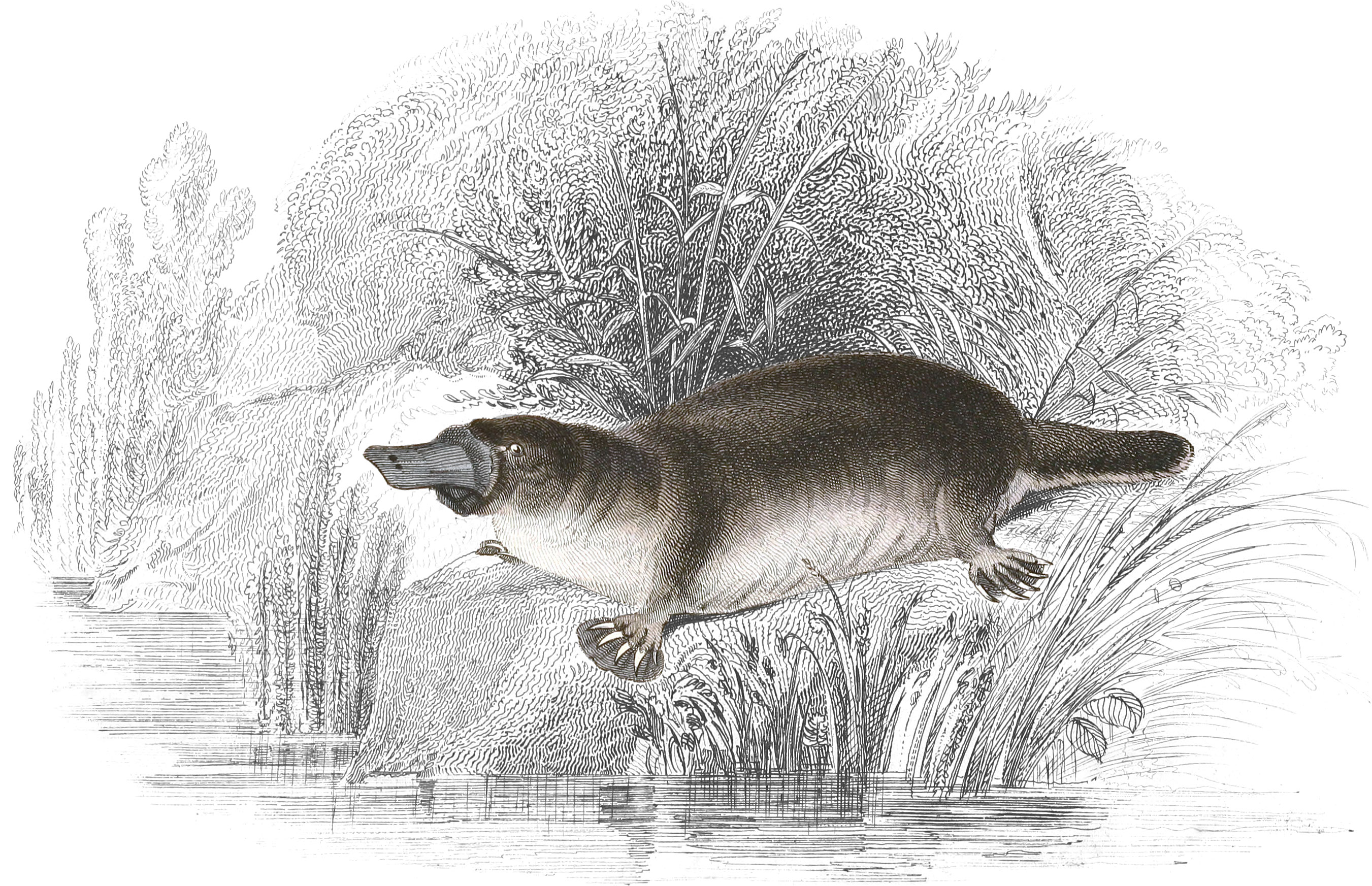
Plate XXXIV
- From Δι and Δελφὺς, a double uterus, should therefore be Didelphys.
- The Voyage of Governor Phillip to Botany Bay, 4to, London, 1789.
- Appendix to the Journal of a Voyage to New South Wales, by John White, 4to., 1790.
- General Zoology, 8vo, 1800.
- Blumbenbach nearly at the same time (the exact date of his first account I am unable to procure) gave to this animal the name Ornithorhynchus paradoxus.
- “Monographies de mammalogie,” by C. J. Temminck.
- Cheironectes, which is proposed as a generic name for an Opossum which inhabits certain rivers in S. America, can only be regarded in the light of a sub-genus or slightly aberrant form of Didelphys.
- Mr. Bennet describes two species, in the Proceedings of the Zoological Society, from California, both of which are closely allied to the common Opossum of the United States.
- “Over De Zoogdieren van den Indischen Archipel,” by Salomon Müller.
- Most of the species of New Guinea are unknown to me, excepting by the names mentioned in the table displaying the Geographical distribution of the Animals inhabiting the islands of the Indian Archipelago, given in the Work above quoted.
- Three new genera have been founded on the Australian species of Rodents,—Hapalotis (commonly known in New South Wales by the name “Native Rabbit,”) Pseudomys and Hydromys.
- “Annales du Museum,” tom, v., p. 277, and “Ossemeus Fossiles,” tom, iii., p. 284, Pl. 71.
- “Comptes Rendus,” 1838.
- See “Proceedings of the Geological Society of London,” vol. iii., 1838–9.
- See Professor Owen’s “Outlines of a Classification of the Marsupialia,” Proceedings of the
GeologicalZoological Society for January 1839, pp.8 and 95 and 6. - Magazine of Natural History for September 1839, p. 450.
- Annals of Natural History for November 1839, p. 192.
- This communication was addressed to, and is now published by, the Society of Sciences at Copenhagen. I quote from the Rev. W. Bilton’s translation of this paper, published in “the Magazine of Natural History,” see vol. iv., p. 313.
- Did. Azaræ of most authors.
- “Three Expeditions into the interior of Eastern Australia,” &c., by Major T. L. Mitchell, Surveyor General.
- M. M. Desmarest, Lesson, and Fischer, follow the classification of Cuvier’s first edition. M. Temminck also adopts the classification of Cuvier,—by it he has the credit of having separated, as distinct orders, the Cheiroptera and Marsupiata. The last mentioned order was therefore separated in 1827, two years before the publication of Cuvier’s last edition.
- See his observations on the Wombat, in the Annales des Museum, vol. ii., p. 364, published in 1803.
- Many very important discoveries have been made in the internal organization of the Marsupiata, since the views of the three first mentioned authors were published. I think it probable, therefore, that had they been acquainted with these additional facts, they would have arrived at different conclusions.
- Classification of Quadrupeds, in the Cabinet Cyclopædia, p. 166. London, 1835.
- The Gardens and Menagerie of the Zoological Society Delineated, vol. i., p. 265. London, 1831.
- Observations on the Opposable Power of the Thumb in certain Mammalia, considered as a Zoological Character, &c. &c. Magazine of Natural History, vol. i., p. 449, and p. 517.
- The enormously strong, muscular tail of the Kangaroos, can only be regarded as presenting a slight modification of the prehensible character of tail so common in the Marsupiata.
- I always use this term in its restricted sense—that is, for the genus Didelphys.
- Are the young of those Opossums, in which the pouch is rudimentary, more perfectly developed at their birth, than the young of other Marsupials?
- The only important difference between the dentition of the Dasyuridæ and the Didelphidæ, consists in the number of the incisors.
- Philosophical Transactions, Part ii. for 1834.
- Transactions of the Linnæan Society, vol. xvi.
- “On some particulars connected with the Natural History of the Kangaroos.” Zoological Journal, vol. v. p. 239.
- The mode by which the young Kangaroo reaches the pouch immediately after birth is not yet known.
- See Professor Owen’s paper “On the Osteology of the Marsupialia.”—Proceedings of the Zoological Society for 1838.
- Philosophical Transactions for 1834, p. 333.
- Ad characteres supra dictos addantur in maribus situs testium ante penem, et in feminis vagina in duas canales septo divisa.
- Owen in Phil. Trans. 1834, p. 359.
- Professor Owen “On the Structure of the Brain in Marsupial Animals,” Philosophical Transactions, Part I. for 1837.
- In nearly all the Marsupial animals there are more incisors in the upper jaw than the lower, whereas in other orders of Quadrupeds, when a difference exist, the increase is generally in the lower jaw.
- The advocates for placing the Thylachius near the Dogs, the Opossums in the Insectivora or Quadrumana, &c. should not have omitted to notice the important difference, observable in the teeth and other points of dissimilarity between the animals in question.
- In this, and many other characters, the Rodentia appear to approach most nearly to the Marsupiata.
- On the Osteology of the Marsupialia. Proceedings of the Zoological Society, for October 1838.
- Professor Owen. Osteology of the Marsupialia, before quoted.
- The smaller species in all probability feed chiefly upon insects.
- Measuring over the curve of the back.
- “Monographies de Mammalogie,” vol. i. [D. cancrivora, D. Azaræ]
- The Virginian Opossum has occasionally a small dusky stripe on the forehead.
- In the specimen now before me, the ears are black. Mr. Bennett (see the Gardens and Menagerie of the Zoological Society Delineated, vol. i., p. 271) says they are generally of a yellowish white throughout,—Temminck states that the ears are of an uniform colour, but does not mention what that colour is.
- The skull is in the specimen from which the description is taken, and appears to be perfect. The specimen of D. Californica now before me also possesses the skull.
- A very common circumstance in these pouched animals.
- These two white spots above the eyes, have given rise to the name “Quatre-æil,” which has been applied, by the French naturalists, to this species. The D. Quica and D. nudicaudata possess the same character.
- It is twisted round a branch in the stuffed specimen, and cannot be measured with great accuracy.
-
This part of the original description is not very clear—after describing the upper parts of the body, the sides, and the limbs, Azara states,
et le reste du corps et bran-clair, et le blanc domine beaucoup dans les parties inferieures et entre les quatre jambes.
- Azure is a pure colour, and as no pure or unmixed colours are ever found in the fur of quadrupeds, I presume the author must mean grey or pale grey.
- I have taken this name (which is that of a “German Paintress”) from Pennant who says that lady was the first discoverer of the species. I must observe, however, that Pennant’s description does not very well agree with that above, though he refers it to the Didelphys dorsigera of Linnæus.
- See Professor Owen on the Classification of the Marsupialia. Proc. Z. S. January 1839, p. 11.
- Tom. iii., p. 333.
- See his Troisième Monographie, sur les Mammifères du Genre Dasyure, &c.
- Hairy tail.
- I can perceive no trace of the central cusp of these three, in the molars of Thylacinus.
- In a skeleton foot of the Thylacinus, I do not find these bones,—we have, therefore, in the Dasyures, a complete transition from the Opossums, with their large opposeable thumbs, to the thumbless Thylacinus; first, in the reduced size observable in Phascogale and Dasyurus macrourus; next, in the existence of the bones only, without any external appearance of the member, as in D. Maugei, and, lastly, in the absence of the bones themselves.
- In two skins I find the tail somewhat compressed.
- In this respect reminding us of the species of Didelphys.
- See Annals of Natural History for 1838, vol. i. p. 101.
- Proceedings of the Zoological Society for Nov., 10 1840,
- The hinder part of the palate is mutilated.
- In the skull of Myrmecobius there is a large notch in the upper boundary of the orbit, which, by some accident, is not shewn in the figure published in the Zoological Society’s Transactions.
- It is remarkable, that in almost every case in which the inner toe of the hind-foot is developed in the Marsupialia, it is opposable and assumes a thumb-like form. Even in the Ornithorhynchus and Echidna, it is not on the same plane as the other toes.
- This animal is very fond of almonds—these however require to be cracked.
- A specimen which had lived in the Menagerie of the Zoological Society, furnished the following dimensions immediately after death. Length from nose to root of tail, 16 inches 4 lines; tail, 9 inches 7 lines; from tip of the nose to the eye, 2 inches 6 lines; from the tip of the nose to the base of the ear, 5 inches 2 lines; ear, 4 inches; breadth of do., 2 inches; length of hind-feet, without the claws, 4 inches 1 line.
- Proceedings of the Zoological Society of London, for March 1838.
- The small species are most frequently found in thickets, and it would appear, nearly resemble the hares in their habits.
- Professor Owen on the Osteology of the Maisupialia—Proceedings of the Zoological Society for October 1838, p. 140.
- “Des Dents des Mammifères,” p. 135 and p. 137.
- Having ascertained the number of true molars in the Kangaroos, there is no difficulty in tracing the analogous teeth throughout the remaining groups of Marsupials, and the result is, that they have the same number, viz., four true molars, whilst in the other orders of Mammals the highest number is three—at least I have only found a few apparent exceptions, and these exist in groups, the dentition of which I have not yet had an opportunity of studying in two or three of the genera of Insectivora, there appears to be more than three true molars: it must be borne in mind, however, that the false molars often assume the common form of true molars, and vice versa; hence from a mere inspection of a skull it is often impossible to distinguish their teeth.
- This character is certainly not connected with the other peculiarities mentioned; on the contrary, it is in the group with the naked muzzle and five molars, that we find the tail often much more densely clothed than in M. F. Cuvier’s genus, Macropus.
- That the inner edges of these teeth should be sharp is remarkable, and the use of this peculiar structure is not evident. I recollect to have read in the work of one of our voyagers, that the great Kangaroo has the power of separating these teeth, and certainly the structure of the lower jaw would seem to permit such a movement; the symphysis menti in these animals is peculiar, the two rami of the lower jaw meet far back and do not appear to have been strongly attached at the symphysis, but, what is most remarkable, they diverge again at the apex. In the skull of a Kangaroo before me, I find that by slightly contracting the space between the posterior portion of the rami of the lower jaw, the external cutting edges of the incisors are thus brought in contact with the cutting edges of the incisors on both sides of the upper jaw at the same time, and that such a contact could not be produced unless the lower incisors were thus separated.
- The extreme point of the muzzle, which in Quadrupeds is generally naked, as in the Dog.
- Mr. Gray, in his definition of this group, mentions as one of the characters, a peculiarity in the incisors of M. giganteus, which I do not find combined in other species with the hairy muzzle. Mr. Gould has added several new species to this section, and, whilst in Australia, paid particular attention to this interesting family. This naturalist, I am happy to state, intends shortly to publish a Monograph on the Macropodidæ, on the same scale as his splendid works on birds, in which all the species, (including the novelties, which, by his kind permission I have been enabled briefly to notice in this work) will be carefully figured and described, and further enriched with copious notes on their habits and ranges.
- It is now known to be a native of Van Diemen’s Land.
-
The author, no doubt, means that it rested, when darting out its hind-Iegs, on the apical half of the tail only. Sir Robert Heron observes,
the Great Kangaroo does not make use of its tail in leaping, he uses it in walking, and still more in standing; when excited, he stands (the male only) on tip-toe and on his tail, and is then of prodigious height. In fighting he does not stand on the tail and one leg, but balances himself for a moment on the tail only, and strikes forward with both hind-legs. When sitting in a state of repose the Great Kangaroo throws the tail behind him; the lesser one (Macropus Bennettii) before him.
—Proc. Zool. Soc. 1835, p. 187–8.
- Annals of Nat. Hist. 1. p. 104.
- Governor Philip, in his works, speak of a Kangaroo which weighed 140 lbs.
- The colouring is no doubt become paler from exposure, for the term fuliginosus is not well applied to the specimens according to their present condition.
- In the male no doubt they would be larger, since this is always the case in the Kangaroos.
- Under the name Kanguroo d’Aroé, see p. 116. The animal is figured in Pl. 20.
- Magazine of Natural History for November 1837, Vol. I., (new series) p. 583.
- See “Comptes Rendus” for October 9, 1837, p. 522, and also the “Annales des Sciences Naturelles,” Tom. VII., p. 368.
- Proceedings of the Zoological Society of London for 1835, p. 1.
- See Compte Rendu des Séances de l’Académie des Sciences for Oct. 9,
18391837, p. 522, - See the work entitled “Over de Zoogdieren van den Indischen Archipel, door Salomon Müller,” In the published parts of this work, only the names of the animals alluded to are as yet mentioned. In the table of the New Guinea Marsupials given in Müller’s work, the following species are noticed: Phascogale melas, Perameles Doreyanus, Hypsiprymnus Brunii, Dendrolagus ursmus, and Dend. inustus, Phalangista maculata, and Petazirus sciureus.
- The same group is called Bulantia by Illiger, and Cuscus by Lacepéde.
- The small false molars observable in the lower jaw of the Phalangista, are variable in number in the different species of that genus, and even in the same animals they sometimes differ on opposite sides of the jaw, hence we cannot regard these teeth as important. In Belideus and Acrobata, however, the case is different—they are always present in all the species, and some of them possess double fangs: connected with these teeth we find, moreover, a very evident modification of the true molars; additional interest is added to these modifications when we find in them a beautiful transition from the vegetable feeding to the insectivorous type—indeed, the prickly teeth of Acrobata pygmæa would certainly appear to be better adapted to an insectivorous diet than to the mastication of vegetable substances.
- Strictly speaking the number of true molars is no doubt the same as in other Marsupials, but here the foremost of the series assumes the form of the false molars, and is not fitted for crushing food.
- See Annals of Natural History for June 1838, p. 294.
- Most authors give Van Diemen’s Land as the habitat of this species, but I think this error arises from the former one, of supposing it to be identical with the animal figured in Cook’s Voyage. The exact locality of the Paris specimen may not have been known.
- P. Peronii has the same character, but I regard that as the young of the present species.
- A molar tooth before me, from the lower jaw of an adult Wombat, forms one-third of a circle of an inch and a half in diameter.
- A longitudinal groove divides the naked tip of the muzzle into two parts, in the specimen before me, but it is not in the middle, and does not appear to be natural.
- See “Synopsis of the Newcastle Museum,” p. 248, where the whole history of the specimen above mentioned is given. The fourth edition of Bewick I have not been able to consult, I take the date of the edition, therefore, from the Synopsis.
- Mr. J. Gray, during the time that the British Association held its meeting at Newcastle, referred to this animal, and pointed out this error to the Members of the Natural History Section—See Report, Vol. vii., p. 111, of the “Transactions of the Sections.”
- The Echidna and Ornithorhynchus in many of their anatomical characters evince a considerable approach to the Reptiles, and it would appear, from the above account, that the present animal is reptile-like in its power of fasting.
- The name Edentata is a most ill chosen one, for the greater portion of the animals so called, do possess teeth, and sometimes plenty of them, to use a homely phrase,—it had reference to their want of incisors.
- Mr. Bennett afterwards examined a burrow which was 35 feet in length, and states that burrows have been observed of even 50 feet in length.