
Volume XXXI
Horses
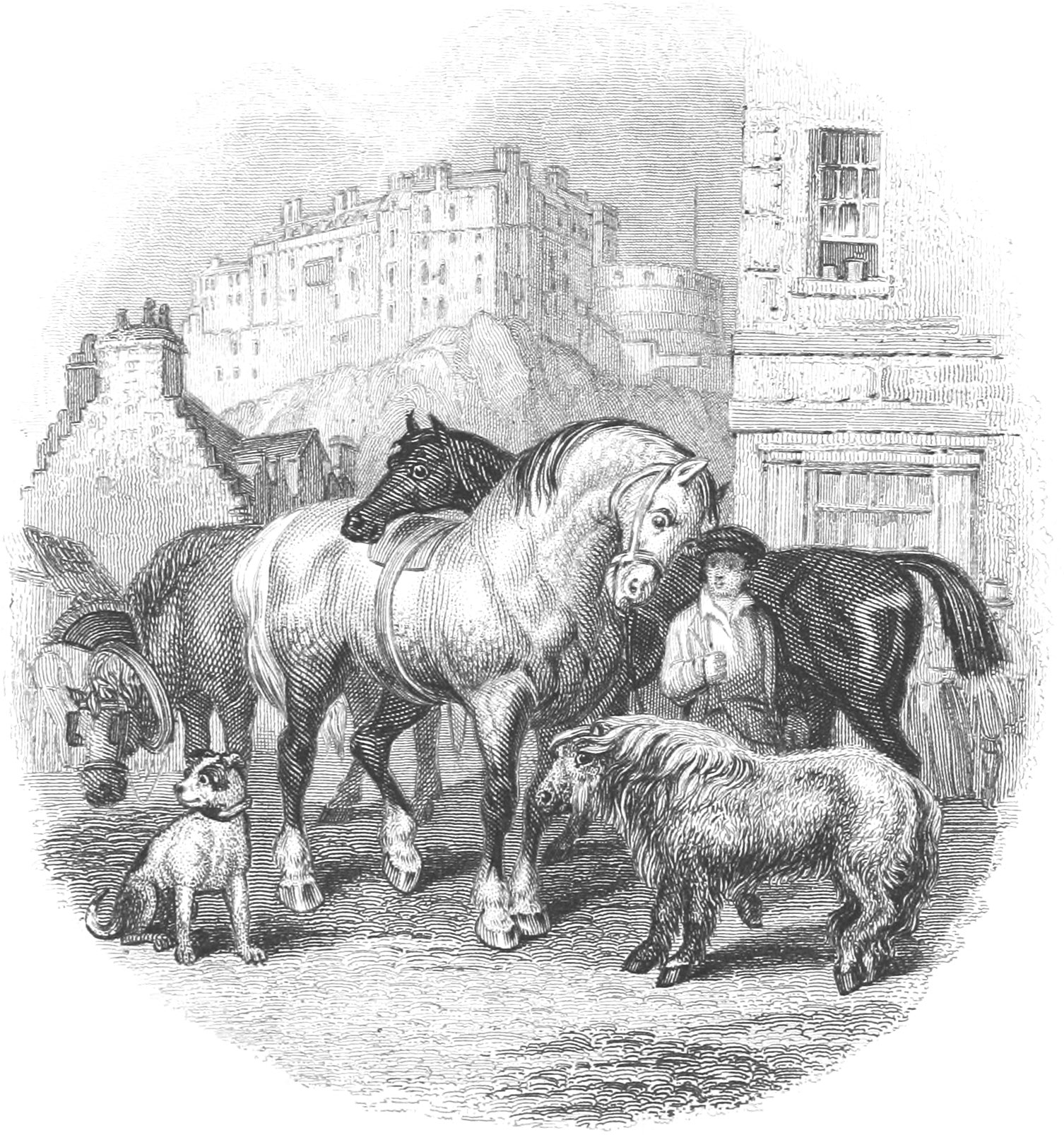
Content warning: Portions of descriptions and imagery on this page contain inaccurate views, derogatory language, and offensive imagery. They are included here as they were originally created in order to compile a complete reproduction. They do not reflect the attitudes of this site’s creator.

Introduction
The Natural History of the Equidæ, or the Genus Equus of Authors; Comprehending the Horse, the Ass, the Zebra, and their Congeners
A history of the Solipede animals, of the species contained in the Linnæan genus Equus, and more recently designated by the appellation of Equidæ, would be liable to disappoint a scientific reader if with Zoological views alone, he expected to find in its pages much that was new or unobserved by anterior writers; for, when we consider, that in the genus, two species, the Horse and the Ass, have been the object of the most unremitting attention to man from the beginning of human civilization, that poets, philosophers, statesmen, historians, rural-economists, warriors, hunters, speculators, physiologists and veterinarians have all objects where the horse at least forms a conspicuous element, that from the inspired poetry of the book of Job, from the times of Homer, Aristotle, Xenophon, Herodotus, Virgil, Varro, Columella, Gesner, Aldrovandus, Johnston, Buffon, Linnæus, Pennant, Pallas, Gmelin to Cuvier, Bell, and a host of others, ancient and modern, facts and observations have been accumulating, researches pursued and descriptions produced, where we trace patient investigation and often eloquent description. It must be confessed that the inquiry is all but exhausted, and that we must confine our views to a collection of the more prominent facts, for the attention of those who have neither time nor inclination to search the whole field, and while due place is given them, draw forth from their general or particular tenor some observations and comparisons that perhaps have not as yet been offered to the public or have only met with transient attention. Thus we may still hope to submit in the result of our labours something worthy of notice to the learned, and not uninviting to the casual reader, whose object is merely to obtain correct information combined with amusement.
Where historical reflections embracing the earliest periods of antiquity are concerned, we hope to point out some philological considerations that may obtain the assent of linguists and assist inquiries on the progress of the more ancient human colonies; particularly the irruptions of the first Equestrian conquering hordes, and the indications where the Mongolian variety of man commences to press westward upon the Caucasian. In the discussion on the fossil remains of Equidæ there also maybe found arguments deserving attention, as regarding their original distribution, and the sources whence mankind first drew the animals it subdued and subsequently mounted. Finally, a review of the breeds noticed by the ancients will expose some facts in history which we think both new and curious.
In the 12th edition of the Linnæan system, the horse, or genus Equus, is placed among the Belluæ, constituting the sixth order of his Mammalia; it is a group very distinctly characterized, and perfectly natural; but, at the same time, remarkably isolated from all other genera, by the form of particular organs, which remain so constantly similar in the several species as to make in their turn but slight approximations to surrounding families, and leave but trivial distinctions to separate the genus into subordinate parts, or mark the difference of species. These circumstances appear to have induced systematic writers to admit them all into one. Gmelin, indeed, in the 13th edition of the system of Linnæus, formed two, making his first out of Molinas Equus Bisulcus, or cloven-footed horse, now universally regarded as fabulous, or as a mere variety of Lama, and the second of the solidungular species, which constitutes the true Equidæ. Storr formed for it a distinct order under the name of Solipedes, and ranged it after the Ruminants; while Illiger, adopting this order, followed Erxleben, who had located the horse between the elephant and camel, which was nearly the same as the arrangement of the Swedish naturalist: one corresponding to Belluæ, the other to Ruminantia: but Baron Cuvier, following at first the same distribution, finally made the genus horse one of the pachydermous order, and leaving it undivided, fixed the location last in that series, and immediately before Camelus, which constitutes the first of the next.
Mr. Gray, in the Zoological Journal, Vol. I., defines the family of Equidæ as distinguished from all other animals by the form of the hoof being undivided, the stomach simple, and the female having two teats on the pubes: the teeth are, incisors \(\frac{6}{6}\), canines in the males \(\frac{1\ \ 1}{1\ \ 1}\) molars \(\frac{6\ \ 6}{6\ \ 6}\) = 40. He further divides Equidæ into two genera: namely, 1st, the horse; (Equus Caballus;) and 2d, the ass; (Asinus;) embracing Hemionus, the common ass, and the zebras; the former type being destitute of stripes, having warts or callosities on both arms and legs, and the tail furnished with long hair up to the root, while the latter are generally white, more or less banded with blackish brown, and always have a distinct dorsal line; the tail furnished with a brush only at the extremity, and warts existing on the arms alone. These distinctions have been considered by M. Lesson, insufficient to constitute two genera; and although Mr. Bell supports the views of Mr. Gray, and justly contends that several of them are structural, we do not admit all the facts of either naturalists as unexceptionable to the extent required to constitute separate genera; there being in reality not two, but three types or distinct groups, as will be shewn in the sequel; and exceptions to uniformity, which even then point to a further subdivision.
The Equidæ seem appropriately placed between Pachydermata and Ruminants, from their conformation being intermediate,1 and also, because they are found in a fossil state, accompanying the debris of both, and thereby proving that they co-existed in a former Zoology, or at least in a Zoological distribution, more ancient than the present; for, among the organic remains in limestone caverns, in osseous breccias, in tertiary or alluvial strata, (the pliocene of Lyell) in the fresh water deposits, and in the Eppesheim sand, among several species of Elephant, of Rhinoceros, of Bovine and Cervine genera, their bones are found along with the, remains of a former hyæna, or of a species perhaps still extant. Their debris, often in great abundance, are spread over an immense surface of the Old World, from eastern Tahtary to the west of Ireland, and from the Polar regions to the south of the Himalaya mountains, and to an unknown distance in northern Africa.2 Although different authors have bestowed specific names upon the remains of these animals found in different places, such as Hippotherium of Caup, Equus fossilis, Equus Adamiticus, of Schlotheim, Equus (Caballus) primigenius, Equus (Mulus) primi-genius, and Equus (Asinus) primigenius, we find, from the confession of Baron Cuvier, that he never discovered a character sufficiently fixed in the existing species, and therefore still less in the fossil, to enable him to pronounce on one from a single bone. All the remains of Equidæ hitherto discovered, appear so perfectly similar in their conformations to the domestic horse, (Equus Caballus,) that they can scarcely, or at most only in part, be ascribed to other species of the genus. From the commixture of their debris, there cannot be a doubt that they have existed together with several great pachydermata, and with hyænas, whose teeth have left evident marks, promiscuously, upon a great number of them: but what in this question is deserving of attention is, that while all the other genera and species, found under the foregoing conditions have ceased to exist, or have removed to higher temperatures, the horse alone has remained to the present time in the same regions, without, it would appear, any protracted interruption; since, from the circumstances which manifest deposits to be of the earliest era in question, fragments of its skeleton continue to be traced upwards in successive formations, to the present superficial and vegetable mould.
Moreover, the bones of Equidæ, in all their localities, agree sufficiently, at least so far as our researches extend, to fix the stature of the animals at or near the standard of the wild horses of Asia, and the middle-sized unimproved breeds of the present day; while nearly all the others, and particularly those of Ruminants, found in the same deposits, often announce structures considerably larger than their present congeners. Now, as the debris of Mastodons, Elephants, Bovidæ and Cervidas, have likewise been discovered in the western continent, but it would seem without those of the horse, or the hyæna, it appears that neither were at any time indigenous, while in the old continent, both are found; one having only retreated to a southern latitude, and the other continuing to reside without, or with no sensible difference of characters, in its primeval location: as if, while several very remarkable species of animals have disappeared, and others are now only extant in climates of higher temperature, the horse alone had escaped the operation of some great agency in nature, which acted with decisive power to the destruction of all the other Mammals in question.3
These considerations, and more particularly the presence of horse-hones upwards to the surface, seem to indicate the original residence of the present domestic horse to have extended over the same surface of the Old World as the anterior fossil animal; we say the domestic horse, without therefore excluding the Hemionus, which once resided as far west as Prussia, or denying that the Koomrah existed in northern Africa, which is of the true form of Eq. Caballus, though the specifical identity may be doubted. We are also inclined to question the positive unity of species in the Tangums and Kiangs of the central high ridges of Asia, and even that of the wild horses originally indigenous in the British Islands: possibly the Sarans of the great Indian chain may be distinct, although the homogeneous character of their structure cannot be doubted: they, and other varieties hereafter to be mentioned, appear to be different forms of one type, very closely allied, yet distinct.
We do not as yet know the limits of what constitutes a genus, nor have we a satisfactory definition of species, since it is admitted that hybrids derived even from assumed distinct genera, are not without the power of procreating a fertile offspring, with either of the parent species, if not among themselves; thus implanting new forms and new characteristics in a progeny, which may again and again receive additional blood of the foreign stock, with the more facility, since the hybrid conformation is already prepared for further adulteration; and, notwithstanding the known tendency to sterility, obliterate specific distinctions, and form a homogeneous race.
The circumstances of the existence of dissimilar forms of a common type, are parallel to those of the Argali, (Ovis Ammon,) equally found identical or different in Asia, Africa, and the islands of the Mediterranean, which existed anciently in Spain, and at this moment is spread over a great part of western North America. In no case are these animals suspected to have been transported by human intervention, and yet they are located in some places where, without the aid of man, they cannot have migrated, unless we admit of changes on the surface of the earth since the present Zoology Mas in being, of such magnitude, as to include the formation of the Mediterranean—the separation of the British Islands from the continent of Europe—of the Indian Islands from that of Asia—and the formation of a channel to cut America from connexion with the Old World. How this genus Ovis could have resisted the effects of extreme alterations of climate such as then must have occurred under the two conditions of existence before and after the great catastrophe, forms a further case of difficulty; while to make the whole still more inexplicable, it may be added, that no fossil remains of any of the genus exist, excepting, perhaps, of one to all appearance belonging to the domestic sheep found under questionable conditions in the Devonshire deposits.4
If the Argali, therefore, are all of the same species, they must have been separated during the great diluvian catastrophe, at the time the species of rhinoceros, of buffalo, tiger, and others, found in the Indian Islands, were likewise separated from the continent, and placed in locations where species unknown to Asia, such as the Tapir and Marsupiata, still exist, who have congeners only in South America. The more we pursue these reflections, the greater is the dilemma. Without attempting to explain in what manner, we must ultimately revert to the opinion of a Zoological distribution being effected at so remote a period, that our conclusions respecting identity of species, are only inferential and for the convenience of classification: that, notwithstanding the superabundant inclination in man to assume dominion over matter, there appears to be distinct evidence to prove, by their fitness, the intention of the Creator regarding the destination of several animals was meant for human use. For if we do not admit these views, there remains only the supposition of a creation of pairs, or of only one family of each species, which, gradually increasing, extended and migrated to a multitude of localities in many cases so inaccessible, as to demand more violent causes, more unphilosophical necessities than the former; disregarding withal a totally unbalanced state in the system of co-ordained organic beings.
This conclusion we have already endeavoured to draw in the history of the Canidæ: it will be farther illustrated in that of the domestic horse; is more or less perceptible in all the thoroughly domesticated animals, and when we examine their capacity to bear in man’s company, the variations of climate and changes of food to which he has subjected them, we may take the law of sterility in the commixture of different species to have its limits where the forms cease to be sufficiently homogeneous; a law unquestionably ordained for the wisest purposes, but marked with exceptional modifications for purposes not less beneficent:—There are so many proofs of the beautiful flexibility of their action upon organized beings, that to reject the above conclusion, evidently reduces us to the necessity of regarding the wolf and the dog, the camel and the dromedary, the goat and the sheep as constituting but single species; for all these produce fertile offspring.
It seems therefore more consonant with the distribution of several genera of animals on the earth’s surface to believe, that osculating forms existed ab initio distinct, circumstanced to accomplish certain ends, such as the service of man, and therefore framed so as to render them fusible into one species. The Argalis or wild sheep before-mentioned, bear all the evidence of this fusibility, and that the domesticated varieties spread over the Old World, have the blood of more than one original species in their organization, may fairly be inferred from several of Persia and High Asia bearing a near resemblance to the wild in their vicinity. We may even assume, that civilized man, if it had been his lot to deal with the zebras of South Africa instead of the horses of Asia, in due time would have succeeded in amalgamating the three or four species now existing into one domestic animal little inferior to our present horse: that the powers of draught would have been found in the Quagga, the qualities of charger in the Zebra and the properties of mountain pony in the Dauw.
With these impressions, we may for the present suspend our opinion; whether several wild races of horses were, or were not originally of the same species, and with the greater cause, since there are Equidæ undeniably different who produce nevertheless mules not totally sterile. There are besides phenomena as yet not satisfactorily explained, in the few and partial experiments that have been made relating to this very question of intermixture, and the traces it leaves on succeeding generations: phenomena which the remarks of Mr. Bell and Mr. Macdonald have not set at rest, and where superfetation is out of the question. We allude to the characters of the sire of the mothers first offspring remaining impressed upon the succeeding in form, colours and markings, although the first was of a different species and the second of the same as the female; thereby showing a tendency to propagate strange forms in preference to the homogeneous. The most striking example of these facts was made known by the late Earl of Morton and recorded in the Philosophical transactions for the year 1821, where it is stated that he had bred an hybrid foal, between a chestnut mare of \(\frac{7}{8}\)Arabian blood and a Quagga, which in form and colour bore decided evidence of a mixed origin; this was her first foal; but where interest was most excited occurred five years after, when the same mare, then the property of Sir Gore Ousely, bred by a black Arabian horse a filly and the next year a colt, by the same parent, which, although both were then unquestionably \(\frac{19}{20}\)ths of pure Arabian blood, of homogeneous species, still retained strong marks of the anterior spurious commixture, in the character of the mane, the colour of the hair, and in the striped markings on the neck, shoulders and joints! These facts were fully corroborated by the late Dr. Wollaston and in part came under our own observation. Portraits of the animals, painted by the accurate Agasse are preserved in the Museum of Surgeons College, London.
We represent the 1st 2nd and even 3rd produce of this mare and black Arabian, where these marks are all conspicuous. In the last foal the mane retains its Quagga character as much as in the first, and in all the streaks on neck and back are more decided than even in the mule; which we shall figure when the Nat. history of Mules is considered.
It has been remarked on this tendency of the duration of characters belonging to the first male parent, however different he may have been in form or colour, that it recurs in the dog and hog, but Mr. Bell does not attempt furthur to account for it, although the question is of still stronger import, since, in the case of the mare, the first male was of a different species, and not of the same; as according to his authority, dogs and hogs are, when subject to these effects. We, on the contrary, having already noticed this question in the history of the dogs, and adduced the example of hogs, to prove a plurality of homogeneous forms in both, regard the facts above recorded as indicating a plural origin exceeding the limits of even our own inferences.
Mr. Macdonald’s remarks, which we know only from an abstract in the Athenæum No. 612, 1839, refer the phenomena described in Lord Morton’s communication to a possible cross in the progenitors of the mare with an Eelback dun, which is always marked with a streak on the back, and not unfrequently with cross bars on the joints: but this conjecture would not account for the stripes on the neck and shoulders, and though far fetched, explains only the dorsal streak and bars on the limbs, which the Eelback dun seems to have derived from an ancient cross with Hemionus, for this race of horses is nearest in colour and markings to the Isabella breed of antiquity, so renowned for mounting the Median cavalry, and not always destitute of a cross on the shoulder.
Whether one or more species of wild horses constituted the primaeval forms of the distinct races of the northern half of Asia, and merged gradually into the Equus caballus of systematic writers, is a question not likely to be fully determined, but beside them there are at least two other Equidæ, one ranging over the Steppes of Tahtary, and from thence southward to the plains of Persia, is known by the names of Hemionus and Dziggetai, and the other a more southern animal, though ascending in summer as far north as Lake Aral, is questionably regarded as the original wild ass, and bears the names of Hymar, Ghoor-Khar and Kulan; while a third, the Kiang of Ladauk, is not as yet sufficiently described, and a fourth more nearly allied to Hemionus, probably the Yo-to-tze of China, will be noticed by us under the appellation of Asinus Hippagrus. All these species or varieties have been confounded by travellers and naturalists until their names and distinctive marks cannot be completely rectified. There exists besides in the northern half of Africa an Equine animal designated by the natives as the Koomrah,5 which the Mograbins report to be the offspring of a bull and mare, the Hippotaurus of older naturalists. It is nearly allied to the true horse, but small, a tenant of the mountains and distinct from the wild ass which Pliny took to be the Onager noticed by Leo Africanus, Marmol and lately by M. Linant.
Regarding Equus Caballus Equus Varius and Equus Lalisio as belonging to the same type, the last mentioned shewing an approximation to Asinus, we take Hemionus and Onager or Hymar as belonging to Asinus, although we may doubt the Kiang and Kulan being identical with either, and A. Hippagrus must be considered as absolutely intermediate. Besides these two general types, there is a third entirely confined to the South side of the Equator and belonging to Africa, but distinctly separated by the uniformity of the striped liveries which invariably adorns the three or perhaps four species it contains.
The domestic ass supposed to be derived from the wild Hymar of the desert and the horse of Asia, enter at a remote period into the circle of human economic establishments. The first mentioned, as might be expected, resided in the same regions where the dawn of civilization commenced, and gifted with inferior powers of resistance, is presumed to have been subjugated several ages before the second, because we find it repeatedly indicated in the Pentateuch before the horse is noticed, such as, in the sacrifice of Abraham; in his visit to Egypt, where he received presents of Abimelech; and in the spoils of Shechem, where asses are numbered with other cattle, but the horse is not mentioned. Yet that noble animal, by nature provided with greater physical capabilities, with more intelligence, and more instinctive tendencies for adapting his existence to the circumstances of domestication in every region, is in his servitude grown larger, more adorned, more acute, and more educational than in a state of nature; while the ass, in similar circumstances, has degenerated from his pristine character, becoming, even in the greater part of Persia, smaller in stature, less fleet, less intelligent, and by his own impulses less the associate of man. When the horse, from thorough domesticity, is again cast upon his own resources, he resumes his original independence, provides for his own safety and that of the herd under his care, without altogether losing his acquired advantages; the ass, on the contrary, although never a spontaneous associate in his domestication, is no where known to have again become wild, or to have sought his freedom with a spirit of persevering vigilance; and in cases where by accident he has found himself in freedom, he has made no energetic efforts to retain it, nor recovered qualities that restore him to the filiation of the Hymar or the Kulan. When emancipated, he becomes, without effort, the prey of the lion, the tiger, the hyæna, or the wolf, and in America he has been known to succumb under the beak of a condor. It is evident that the difference in the relative conditions of the two species, is, with regard to the ass, not entirely referrible to human neglect and want of kindness, but in part, at least, must be ascribed to inferior sensibility and weaker intellectual power; both being alike evinced by the hardness of his hide, by his satisfaction with coarser food, and his passive stubbornness.6
We know, besides, so little of the social condition of the primitive seat of civilization, of the original centi-e, whence knowledge radiated to China, India, and Egypt, perhaps in Bactria, in the higher valleys of the Oxus or in Cachmere, that it may be surmised the first domestication of the horse was achieved in Central Asia, or commenced nearly simultaneously in several regions where the wild animals of the horse form existed, and in point of date, perhaps, even earlier than that of the ass, whose natural habitat is more superficially extended to the south of the great mountain range of Middle Asia.
In the natural history of the horse, lately published, there is an opinion expressed, contrary to the conclusion of others, that the species is of African origin. With a view, therefore, of instituting some inquiry into the primitive habitat and period of domestication of the horse, by a philological research concerning the names bestowed upon animals of that family in the most ancient known languages, we find in the Hebrew, the oldest critically studied tongue of the Semitic branch, a variety of terms applied to Equidæ, some of which in our biblical version seem to be occasionally translated with questionable accuracy, or are more generical than specific, and there are others whose radical Hebrew origin maybe doubted. Aware how vague and inconclusive studies of this kind are deemed to be by many persons of erudition, and how open they are to abuse in themselves, still, to one whose attention has been long and repeatedly called to linguistics, and who in his inquiries into the origin of the older nations of history and of the West has met with numerous relations between the remotest times and the present, between the most ancient languages and those of the older dialects spoken in Europe, the affinities are often so obtrusive, that the result may be worth noticing in an abstract form and confined to the object we have immediately before us. We find, for example, the name of the ass, ערוד, orud, if it be onomatopoeically an imitation of braying, that בּרא, pra, another assumed name for the same animal, is not likely again derived from an imitation of the asinine voice, and be equally from an Hebrew root, in a language not remarkable for extent or richness in its vocabulary. אתון, atun, is a third designation repeatedly translated by female ass, and also asserted to mean a particular species or race of saddle-asses, and חמרד, chamor, in Arabic chamara, hamar, and hymar, in Æthiopic æhmiri, one decidedly Semitic, refers to the wild ass, and appears again to allude to the voice of the animal. As for דבש, reches, translated mules, and not found until about the time of the first kings of Israel, we think the true meaning to be a carrier, equally applicable to a mule and to the swift dromedary, hedgeen, as seems proved by רכב, recheh, a chariot; and again traceable in the Western Arabic shrubat-er-reech, the celebrated fleet horses of the desert, or swallowers of the wind. The names of animals, in original and in most ancient languages, unquestionably are often to be traced to imitations of their voice, or to some predominant obvious quality in their form, colours, or uses, and we find this fact particularly applicable to Equidæ. Now, taking pra, para, pered, perdah, to mean an ass, a mule, or more properly a riding beast, and comparing them with פּדש, paras, horses, and פּרשים, Parasim, Persians, later Parthians, that is, horsemen, we see that the root has a more eastern origin, and belongs to a people coming from the regions of Hindukoh, whose name was derived from the quality of riding or charioteering; in a secondary sense, an exalted people, and was connected with a dialect, if not Sanscrit, at least Zend or Pelhevi, not remote from Maesogothic and Teutonic, where pherd, perd, paert are dialectical variations of the same origin, and even the Latin ferro7 is not an alien. We may therefore suspect that pra, para, &c., in common with many other Indo-Sacian, Germanic, or Scythic8 words abounding in the Arabic and other Semitic languages, were imported by the first equestrian colonies that invaded Syria and Egypt. We find it in a remoter sense in the name of phre, a title of the sun, the charioteer and the image of beauty, as it is again in the West, where the Scandinavian freya and fray denote beauty and pre-eminence: these inferences are further supported by the Babylonian name ninus, ninnus, hinnus, through the Greek νιννον, from an Asiatic root, always denoting a young Equine animal, and the old Persian name pful,9 a beam of the sun, a horse, a foal consecrated to the sun,10 and the later asp, اسپ, both epithets and names of a whole series of kings and princes.11 Surely these inferences are more admissible than to take phar or phra from the forced root fugit. With regard to the oldest Sanscrit names of the horse, it is true we find none directly sounding like pra or perd; they are aswa and turanga, with several other epithets: the first of these, no doubt, parent of the Persian asp, and the latter of Turan, the land of the swift, an ancient appellation of Bokhara or the valley of the Jaxartes, that river which in Hindu mythology is always represented issuing out of a horse’s mouth, and therefore another indication of the quarter whence horses became known to Southern Asia. Now, referring to atun, we may believe it to be another mutation like asp from aswa, or along with aswa from a root still older, and be likewise in connexion with ιππος and equus, which are claimed to be Pelasgian modifications, and that the Finnic epo and upping, an ancient Anglo-Saxon and Frisic term, is similarly related to ιππος. All these names are expressive of qualities, and their roots may be fairly traced. A similar slight mutation places the Hebrew דלּד, ramack, and the Celto-Scythic march, a horse, a mare, in the same affinity; and if we take one more name, לוּל, sus or sush, in Turkish still sukh, the most ancient term for that animal known in the south-west of Asia, and the origin of Susiana and Susa, whither the earliest Caucasian invaders appear to have come to settle with their horses in the pastures along the river Choaspes, we have also an indication of colour, for sush, a mutation of sur, the inversion of rhus, applies to bay, the general livery of horses; a name which in the West slightly varied to rhos, or hros, and horse, belongs to both the animal and the colour; while the word bay, in Latin badius, and in old Teutonic bayert, may be imported from Arabia, where beyal denotes the same animal, or is again a coincidence between the Arabic, the old Pelasgian, and the Teutonic.
Thus we may infer that the original horse of South-western Asia came already domesticated from the north-east, and therefore we find no mention of it made till the patriarch Joseph, holding the highest ministerial power in Egypt, sends a chariot drawn by horses to bring his aged father to the banks of the Nile: for if he resided at Zoan on the borders of Goshen, or at On (the Greek Heliopolis), where the sun was honoured under the title of phre and phar, he was in the region where the grazier Hyksos, invaders and charioteers from High Asia, had until lately resided.12

Plate A
1. Medo-Persian Horse (Ancient maned Dun Stock, from bas-reliefs of Che-el-minar), 2. Egyptian Horse (Ancient Bay Stock, from Thebes)
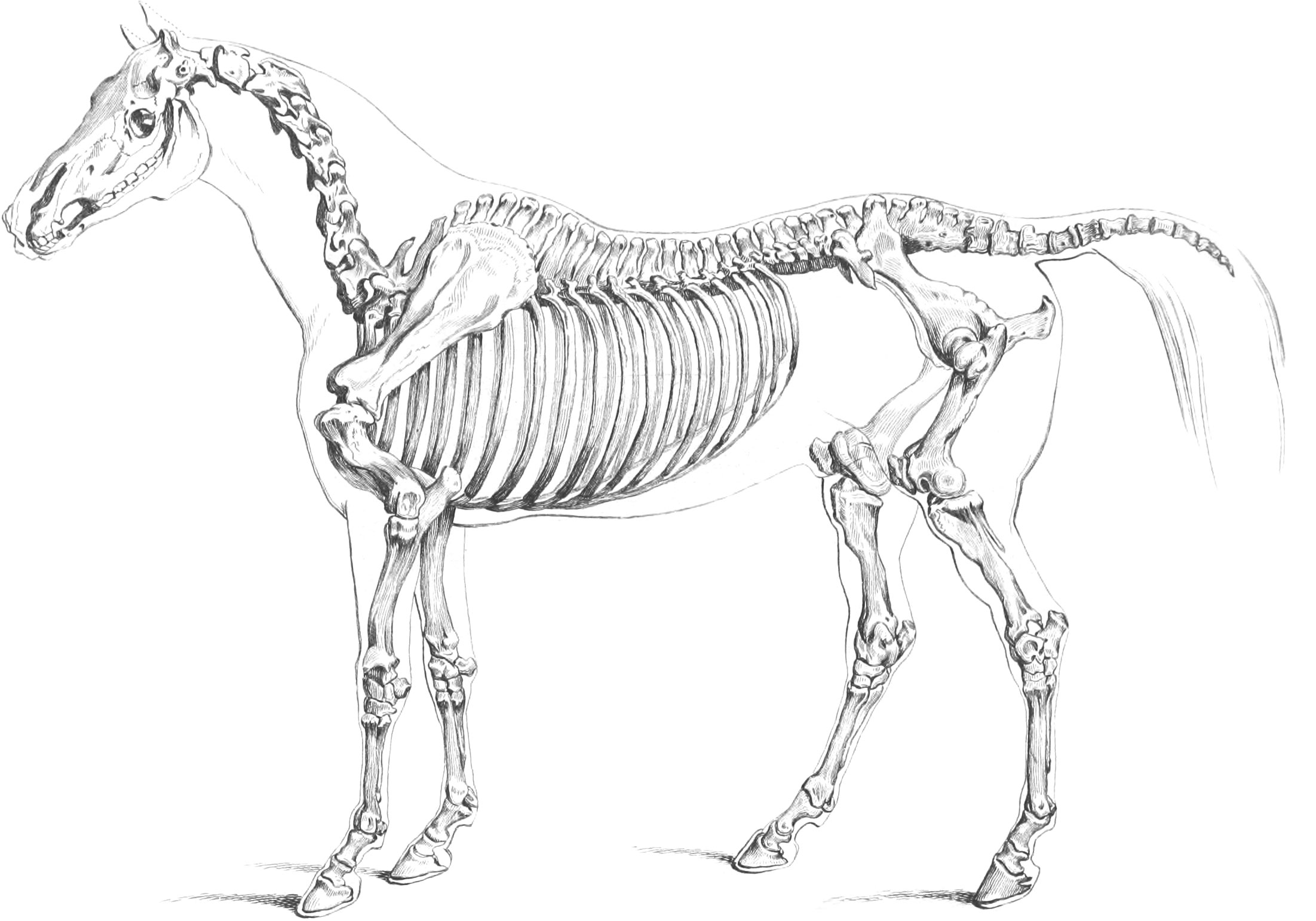
Plate I
Skeleton of the Horse
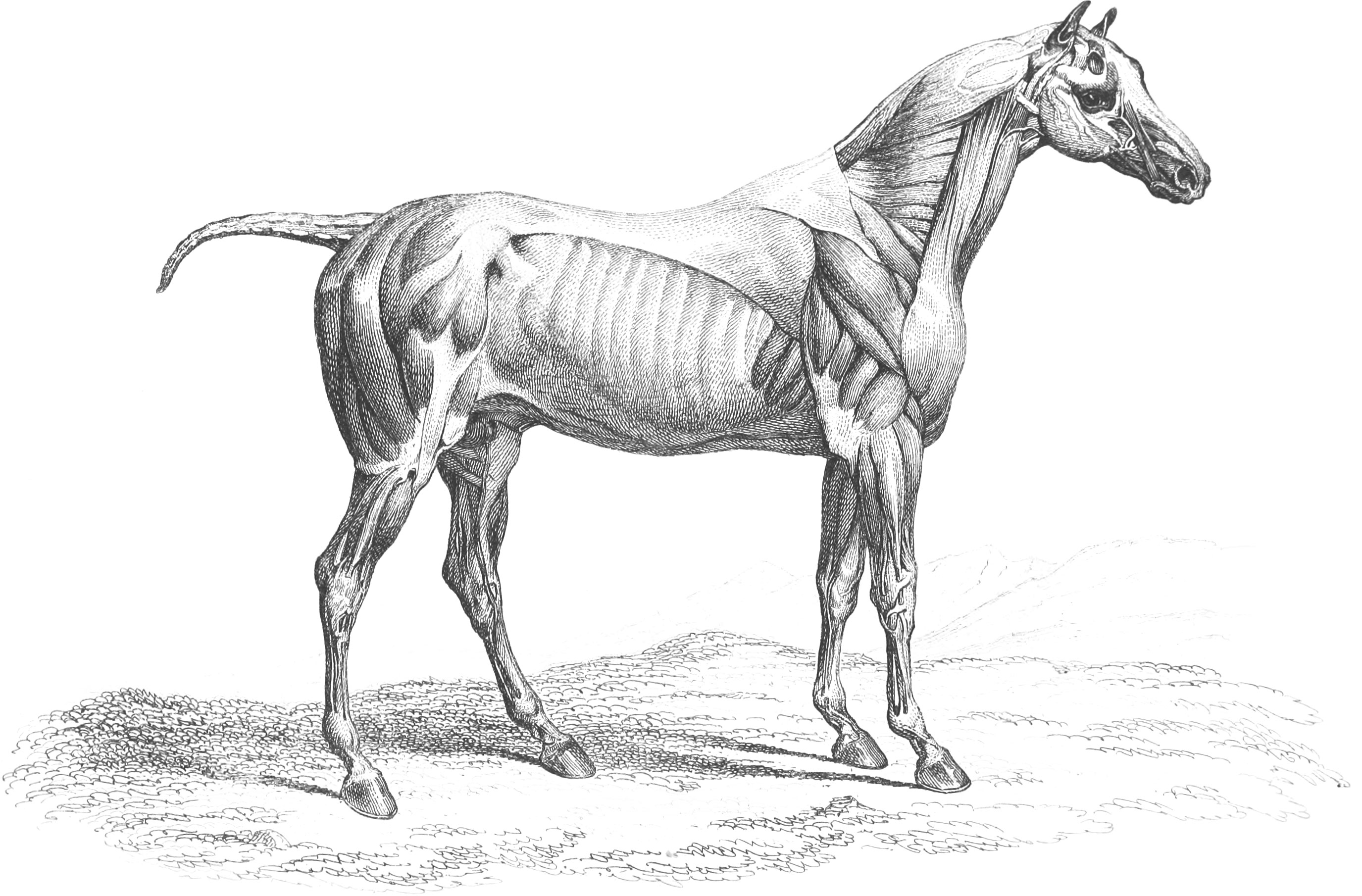
Plate II
External Muscles of the Horse
If, without the aid of horses, the progress of colonization could at first be affected only by a gradual and slow advance, and that of military conquest could not be extended beyond a mere vicinity, we see how readily Sesostris availed himself of the spoils obtained from the expelled shepherds; that with the aid of horses, which they first brought to Egypt, he retaliated and passed eastward to the very sources whence they had issued; and although he may have missed their line of retreat across the Jordan, by taking the road along the Syrian coast, it appears, if faith can be placed in relations more legendary than historical, that he penetrated into Bactria; and from his era horses are evidently used in Egypt. But although these animals are seen in numerous battle-pictures representing his wars and conquests, and are drawn with a skill which marks the perception of high bred races, we must not take them to be all coeval, but as tokens of refinement in art during successive ages. The abundance of war-horses they pourtray is an exaggeration, for, as already shown, they are unnoticed until the era of Joseph, and therefore of recent introduction, when the shepherd kings were already expelled; nor numerous at the time of Exodus, since the whoIe that could be called out, indeed on a short notice, but still from that part of Egypt where provender was most abundant, amounted, in the pursuit of Israel, only to six hundred chariots of war, “all the chariots of Egypt;” which implies either an enormous destruction in the murrain of cattle, or a very scanty establishment of horses in the district of Memphis, two being the amount for each chariot in Egypt. This shows how little reliance can be placed in the profane historians, who allowed twenty-seven thousand chariots to Sesostris, and one hundred thousand chariots, with a million of horsemen, to Semiramis.13
From motives that maybe assigned to the intentions of Moses, or from causes operating at this moment in part of Arabia Petrea, horses were not permitted to be bred by the people of Israel, who being intended to live isolated from other nations, might not become conquerors,—and destined to occupy a mountainous range enclosed between deserts and the sea, could not come down into the plains without danger, and only became predominant under the kings who first disregarded the injunction.14 The case was similar on their nearest border in Arabia; for even in the time of Saul, the consequence of a victory over Arab tribes furnished the Hebrews with plunder in camels, asses, and sheep, but not in horses. In the Psalms, horses are generally noticed as used by their Canaanitish enemies: David himself, in a battle where a number of prisoners were taken, ordered most of their horses to be slain. But although these facts apply to Judea and part of Arabia, all round these regions horses had multiplied at an early period, as we shall see in the sequel.
In the most ancient legislation of India, dating back to a period nearly coeval with Moses, horses are mentioned, and in particular, where the aswa-meda jug, or sacrifice of these animals is enjoined, which, during the predominance of the worship of Kali, was an awful solemnity, only next to the immolation of a human victim. The importance thus bestowed upon a horse shows, however, the scarcity of the species at that period; but in later ages, horses for sacrifice or ascribed to mystical purposes occur, already bearing denomination of breeds and of native countries: thus the hy, explained to refer to Arabia, on account of their swiftness are designed to carry angels; the tahzees of Persia belong to Kundhorps, or good genii; the wasba, a deformed kind of tahzees, are ridden by Gins and demons; and the ashoor, of Toorkee race, perform the journeys of mankind. Although this legend is evidently of a comparative late date, it is remarkable that no Indian indigenous horse is mentioned, and as for the Hy, interpreted Arabian, the explanation is probably still more recent.15
Nor should the arrival of the Centaurs be overlooked in these researches, for though poetical records are not history, the fact of their presence, their superior attainments, and the character of their horses, proves that a basis of truth was wrought up into fictions, which, though they conferred upon that horde impossible characters, nevertheless, in their circumstances, permit reason to detect the first appearance of a riding nation, mounted upon a breed of horses which we shall trace out in the sequel. This irruption belongs to the earliest movement of the cavalry hordes from Central Asia, coming upon Thrace and Thessaly by the north of the Black Sea and across the lower Danube; while another, not long after, evidently composed of a more southern tribe, broke into Asia Minor, and was known in tradition by the appellation of Amazons. The first, most likely, were northern Scythæ of High Asia, real horsemen; the second, high land Sacæ, Stri-rajas, perhaps Pandu followers of Crishna and Ballirama, led by martial queens, wearing long clothes, and detached westward from a cause unknown,16 but both more civilized than the Pelasgians of either side of the Ægean: the first exclusively riders, the second both riders and charioteers, with institutions akin to those of Indian nations.17
Both events synchronise with the heroic age of Greece, and are sufficiently near the periods of the expulsion of the shepherds, the invasion of Asia by Sesostris or Remses II. and III., and the Indian epic legends, to establish the epoch of great movements through all the regions in question, and fix the period when horse, chariot, and rider first make their appearance: the northern nations exclusively as riders; at Nineveh,18 in Asia Minor, and in India, as charioteers and riders; and in Greece, Palestine, and Egypt, as charioteers only.
Although no people could be conversant with horses, or accustomed to mount asses, without learning the practicability of sitting on horseback, these differences are distinguishable in written authorities, and visible on fictile vases, bas-reliefs, and Egyptian painted outlines: they are a general result of the apposite manners of nations, according to the climates they inhabit; intensely cold, or relaxingly warm. As they reside among marshy rugged steppes, or dry hard plains, they adopt short dresses of peltry or long encumbering clothes; they ride or they drive, but necessity, fashion, and habit change their inclinations; they fight from chariots, because more convenient to carry heavy darts and shield, till they experience the superiority of mounted opponents, and then modify their own customs.
Now, if we compare these considerations with the claims in favour of Africa set up by late writers, who consider the domestic horse was first brought from thence to be subdued in Egypt, we find no true indigenous wild horse in that quarter of the globe, unless the puny koomrah deserves that name and we appeal to the current of human civilization, which most certainly did not set in from Central Africa towards the north-cast. Although Numidian horsemen occur, they are not charioteers, nor noticed until Carthage and Greek Cyrenaica flourished, or had already lost their independence, and then they were naked riders, little acquainted with the bridle or the saddle, and with less adaptation of the arts of Asia than the modern Patagonians have copied from those of Europe. Egypt was not a country for wild horses; we have already seen when the domestic first appear there: and surely it was not from Nubia that the elements of progressive civilization were taken, but from Asia, whence the people came, and to which alone they acknowledged affinity.
Even in that quarter of the globe there was a difference respecting horses: in the northern half, the whole male and occasionally the female population have used the saddle ever since human records began; in the southern, within the commencement of profane history only, the better classes alone are mounted, and riding tribes, such as the Kyale Arabs, formerly sate on swift camels (hedjeens), and until now, on many occasions, continue to prefer thera to horses.
With regard to primitive Arabia, it should be remarked that its geographical limits are very indefinite; Hira and Gassan, or a great part of Western Persia, and all Eastern Syria and Palestine, being occasionally claimed as part of the national domain in ancient times, and since the Hejira, they have been extended eastward far beyond the Euphrates, and west to Morocco. Ancient Egypt similarly comprised, at times, part of Arabia, of Syria, and all Palestine, which, with the Ethnic nations, was always viewed as a province more or less under Persia or Egypt. When, therefore, a question is raised concerning horses in either, during antiquity, we are liable to be misled for want of more accurate geographical knowledge; but this difficulty appears not to apply in refuting the argument of Count de Buffon, where he asserts the primitive horse to be still found wild in Arabia; for all the peninsula, and the provinces that can by any extension be claimed as within the limits, having been tenanted from the earliest periods by wandering tribes, grazing camels, goats, and sheep on every space that produced verdure, there are nowhere districts sufficiently inaccessible, or cover properly qualified to shelter horses in a wild state, although wild cattle are mentioned, which in reality are not animals of the bovine family, but oryges belonging to the Antilopidæ.19 It is more probable, as before observed, that there were no horses in this open and barren region, until Scythic conquerors of the giant race, Imilicon, Cuthites, or Hyksos, brought them down from High Asia; and that these hordes and their animals were incorporated like the Idumeans, or left their horses, and many words of their language, when they perished or were expelled.20 If the capture of wild horses be recorded and be fact, we may rest assured that the term means either feral animals, or, by misnomer, the wild ass of the desert.
In Europe, where there is reason to believe wild horses existed, and in particular among the Celtæ, acquaintance with a domesticated breed seems to date, on the continent, from the period when the Celto-Scythic and Centomannic Gauls ascended the Danube and crossed the Rhine, and in Britain when commerce with Phoenician merchants first introduced some practices of Asiatic origin; for the former were riders, having the well known system of trinal arrangement, called trimarchesia,21 in their cavalry, and the latter were charioteers to the time when the Romans first crossed the Channel; the first, therefore, had habits analogous to the manners of the north, the second to those of the south of Asia.
It is to the beginning of the period when conquering horsemen had spread to the south and west of the old world, that is, between the seventeenth and fourteenth centuries before the Christian era, that the veneration attached to the horse may have commenced; though, no doubt, a date still earlier must be fixed when the zodiacal belt was determined;22 for, in the houses of the sun, no horse is indicated; because it may be that animal was then already regarded as the moving emblem of the planet of day, and had become one of its personifications. We find evidence to this effect among those nations, neighbours of the Hebrews, who, as before remarked, appear to have descended from north-eastern Scythæ or giant tribes; one of which worshipped Ana-Melek, according to commentators, in the form of a horse, probably the same idolatrous divinity known to subsequent Arabs by the name of Yauk. Other tribes, of more indigenous origin, had similar idols under the form of their own native Equidæ; such was Tarhak or Tartak of the Avim, who typified their national god by the figure of an ass, and Adra-melek is mentioned to have been formed in the likeness of a mule; which, if the assertion were correct, would establish the antiquity of that hybrid produce at an early period indeed; but most likely we should understand by the name the hemionus of naturalists, which once existed as far to the south at least as Great Armenia and Asia Minor.
In Europe, the black horse was long considered as a form of an evil demon; among the modern Pagan Asiatics, Schaman sorcery is usually performed with images of small horses suspended from a rope; and a sort of idolatrous worship is admitted even by Mohammedans, when effigies of the horse of Hosein, or of that of Khizr, the St. George of Islam, are produced.
The earliest cavalry nations set the example of expressing beauty, power, exaltation, by terms which they also gave to the horse, and particularly in the north, made it a type of the sun; thus, from the commencement of the first Persian dynasties, as already noticed, Var, Phar, Pful, and Asp, all names of that animal, are not only titles of the sun, but also names of frequent occurrence among the sovereigns and grandees.23 The same practice prevailed among the Celtic and Gothic nations, where March, Hengist, Horsa, Uppa, Hako, and Bayard are similarly observable.
Pegasus and other winged horses figure in the constellations of all ancient systems, and with or without wings are types of victory, national emblems, and standards of battle, either by exhibition of their skulls, their tails, or by whole or parts of the animal in a sculptured forma.24 Most of the solar and year gods had sacred horses, which drew the idol’s chariot, or were led before his shrine or the perpetual fire. Those of the Persian Ozmusd, as well as the royal stud, were invariably white, and were derived from Cilicia. Even the kings of Judah were repeatedly polluted by this idolatry.25 In India and in Western Europe, where the same colour was venerated, one or more were annually sacrificed to the sun, and even to other divinities, such as Ertha in the island of Rŭgen. From the Ganges to the Baltic, stalls for these animals existed about the temples and in the sacred groves.
As the camel had been emphatically styled the ship of the desert, so was the ship denominated the horse of the sea. Under the names of horse and mare, the helio and lunar arkite enclosure, or kid, was typified by the Celtic Druids of the fifth and sixth centuries, when their ancient lore became amalgamated with Gnosticism; and the eastern fables of Bellerophon and Perseus had their mysterious counterparts in western initiation.
To ancient Egypt we appear to be indebted for the first systematic attention to rearing and improving breeds of horses. Numerous carved or outlined pictures, in temples and halls, represent steeds whose symmetry, beauty of outline, and even colour, attest that they are designed from high bred types, and evince the care bestowed upon them by the addition of grooms, who are rubbing their joints, and attend sedulously to their comfort on all fitting occasions, in the same manner as is still the practice in the East. In all these pictures, the horses are represented harnessed to chariots; no instance occurring of a mounted rider, except on one occasion, where the execution of the design is recognised to belong to the Roman era.26
The Homeric heroes of the Iliad, the Persian and Babylonian warriors, likewise had these warlike vehicles; but the last mentioned had no mounted cavalry until after the invasion of Madyes, or at least till the conquests of Cyrus, for chariots alone are sculptured on the bas-reliefs of Persepolis; though, from the figures already noticed, found at Nineveh, the Medes were in all probability a mounted people at an earlier date.27 Saddle-horses were not common in the south of Western Asia, and perhaps not even in Media, since Cyras opposed his camels to the Lydian cavalry of Crœsus;28 and hence we may infer that riding steeds, of recent introduction, by the passes of Caucasus, along the west coast of the Caspian, gave the advantage to that power which was most accessible to the adventurous warriors who came from the north and offered their services to the nearest sovereign. From that time, however, a mounted cavalry became conspicuous in all the Aramean regions, and they are often represented in sculpture of a later period, in various parts of Persia.
The people of Israel, we have seen, though shepherds of kindred origin with the Edomite Arabs, had no horses in Goshen, and continued without studs till the Mosaic prohibition was disregarded by Solomon, who established a force of chariots of war, and, it is supposed, of mounted cavalry. It was then the kingdom extended in glory and in surface far beyond its ancient boundary. With the mercantile spirit of eastern princes, he monopolized a trade in horses, importing them in strings from Egypt, and out of all lands;29 he sold teams and chariots to the Phœnicians, who, as they did not possess land armies or extensive territories, evidently bought horses for luxury, and still more fur exportation,30 The Tyrians, at another time, obtained theirs from Armenia, and, no doubt, both carried them to their African colonies, to Crete, Sicily, Spain, and Greece. Thus it may have been that, in their allegorical poems, Helenic fabulists represented Neptune striking the earth with his trident, and, producing the horse, distributed the species to gods and heroes. Similar opinions are held in modern times by the Circassians, who deem the Shalokh steeds, the noblest of Kabarda horses, to be sprung from the sea; probably because the parent stock was imported by water.
Recent authors have endeavoured to maintain, with still less appearance of reason even than Buffon’s opinion concerning the original location of the domestic horse, that Arabia had no horses in the early ages, nor during the Roman empire, and scarcely any at the date of the hejira. In support of this opinion we are told, that, in the second century, horses were sent a present to the reigning princes of that country; that in the fourth, two hundred Cappadocian steeds were again forwarded by the Roman emperor to the same region; and in the seventh, when Mohammed in person attacked the Koreish, that he had but two of these animals in his army; finally, that not a single horse was captured by him in his sanguinary and victorious campaign.31 Without disputing the facts, we may nevertheless refer to what has already been said in the foregoing pages, to show the condition of the question as it regards the immediate neighbours of Arabia, and next offer a few facts which we think completely refute the argument. Although Mecca and Medina, and the Edomite camel-riding clans of the west coast and Wady Moosa, may not have possessed many horses, the admission in no way disproves that abundance of them were in the hands of the Bedoueen tribes, and in Yemen. They are then already described riding naked like the Nuraidians, without saddle or bridle, and guiding their horses with a rod or with a single thong. The first conflicts of the prophet, with his own tribe and others, were mere mob quarrels of townsmen and camel herds. Even at this day, the Edomite Arabs, residing along the upper part of the Red Sea, exclusively use camels or walk: their country is too barren to support more than sheep and goats; and the people talk of the riding Arabs, and their splendid horses, with wonder, envy, and delight.32 But the Bedoueens, the true wandering Arab ibn Arab, for many centuries the neighbours of Canaanites, Babylonians, Syrians, Persians, and Farthians, robbers by profession, could not possibly be without them. Already, before the fall of Jerusalem, Hebrews of the tribes of Manasseh and Gad, stray remnants of the captivity, had taken refuge in the desert, and exercised a nomad system of warfare under a succession of their own princes. They fought great battles, they captured Mithridates and two brethren, Asinous and Anileus, and defeated a Parthian army, commanded by Artaban in person, entirely composed of cavalry.
When, in revenge, the Jews were massacred in Iran, they were not exterminated: whole families sought refuge among the Eastern Bedoueens and Southern Arabs of Yemen, where they were received as Matnoub; and several centuries later, their wrongs not forgotten, they joined heartily in the Islam cause, and avenged the memory of their ancestors in the memorable battle of Kadesiah, where the Parthian dominion was laid prostrate.33 In proof that they bad horses at the commencement of the Roman empire, we appeal to Hirtius (de Bell. Alex.), where Cæsar is recorded to have sent to an Arabian, Regulus, there styled Malchus, that is, Melek, for a reinforcement of cavalry;34 later, but still before the hejira, we hear of a war of forty years’ duration, between the tribes of Abs and Dobian, which arose out of a dispute on account of a race between two horses named Dahes and Ghabra: next, when we look to the tenor of the poems once suspended in the Kaaba, all reported to have dated before the era of Mohammed, we find in Amriolkais, Amru, and Antar, animated and technical descriptions of the horse, splendid pictures of cavalry battles, and notices, which attest that the nation had their noble breeds from their ancestors. They are written with all the feeling of connoisseurs habituated for ages to excellent horses, and show a thorough knowledge of what constitutes their best qualities. Finally, if the Arabs had been without horses, had not possessed them in abundance, and of the best quality, at the time of their uniting under the sway of the Koran, no enthusiasm could have suddenly transformed mere herdsmen into the best and most daring cavalry of their era, or enabled them in a few campaigns to crush the enormous mounted armies of the Sassanian Parthians and the disciplined science of Eastern Rome none but a people long in possession of numerous and well trained chargers could have given wings to the sword of Islam, and in sixty years planted its victorious banners on the Pyrenees and on the banks of the Ganges.
Nevertheless, in these researches, no proofs of an indigenous wild race of horses can be traced, nor, as already mentioned, does the nature of the region and of the vicinity offer the requisite conditions for maintaining them. It is to care in breeding and crossing imported races of animals, to attention in selecting the finest forms, that Arabia owes the celebrity of its studs. Evidently Egypt, Persia, and Armenia first supplied the nomad tribes with the means of producing their magnificent races, and the comforts of the domestic tent, the constant presence of human kindness, the experience of interest, the proportions of a scanty but nutritive food, the abstemiousness in drink, and the dry sunny climate, were necessary to the full development of the excellent qualities they possess: hence, Arab chiefs may have desired and willingly received horses as presents from renowned breeds of Egypt, or from the warlike races of Upper Asia. Presents of horses in the East have always been interchanged or given, but that fact is no argument that the receivers were in want of them; it only shows Arabia and Lower Asia to have been, as it still is, without horses in such droves as are seen in the north, and that the great variety of colours in the Arab breeds arises from the introduction of foreign animals. With the nations of Central and still more of Northern Asia, the case formerly was very different, and in some measure is still so. Attention and selection in breeding is only casual, where immense herds of horses occupy pastures of interminable surface; where, from the absence of human interposition, they retain the instincts of independence: under such circumstances, the resident proprietors, little valuing individual animals, care only for the aggregate numbers; the whole people are mounted, and do nearly all their domestic work in the saddle; they cross rivers by holding their horses’ tails, or fastening them to rafts or boats, convey themselves and families to the opposite shores, sometimes several miles distant. Of all the races of man, they alone eat their flesh, drink the milk of mares, and know how to convert it into curmi, an intoxicating beverage; they marry on horseback, their councils meet on horseback, and declarations of war, treaties of peace or alliance, are dated from the stirrup of the sovereign.35
The nations of High Asia were inventors of the bridle, of the true saddle, of the stirrup,36 and probably of the horse-shoe. With many of them, a horse, a mare, and a colt were fixed nominal standards of value, such as the cow was once among the Celtæ. In a general view, equestrian habits become more and more decided as we advance towards the East. In Europe, the Poles continued to elect their kings on horseback to our own times. At present, no nation of the west can oppose an equal force of cavalry to the Russian; in the earlier campaigns of Suwarrow, the Russian could not cope with the Turkish; a century ago, the Turks were inferior to the Persian horse; and these were repeatedly overwhelmed by Usbeks, Afghauns, and Toorkees, who, descending from North-eastern Tahtary, came from the Jaxartes down the valley of the Oxus, each in turn propelled by riding armies from the same quarter. Tahtar tribes repeatedly swarmed westwards from the age of Attila to the thirteenth century, when they still penetrated to the Nile and as far as Silesia; and twice within the middle ages, Tahtar hordes invaded and subdued China. To such a people, the present of a few horses may appear an expression of consideration or of value, on account of the rarity of their breed, but a mere troop of horses, as such, cannot be deemed of consequence to the smallest khan, in a region where, according to Marco Paolo, the Chagan possessed more than ten thousand head of white horses alone.
When, therefore, we endeavour to fix the original habitation of the domestic horse, considered as a single species, and we recal to mind the statements already made respecting the remains of these animals found in the soil, the regions where they are still observed in a wild state, as will be shown in the sequel more at large, and compare the facts with the foregoing reflections, it seems to be clearly demonstrated that the aboriginal region, where the wild horse was first most generally subdued, should be sought in High Asia, about the fortieth degree of latitude, the table lands whence riding and charioteer nomads have incessantly issued, penetrating to the east, the south, and the west, from periods evidently anterior to historical record, almost to our own times; that from Central Asia, northward and westward, and including, to the south, Bactria, the valley of the Oxus, Northern Aria, Chorasmia, and probably the whole of Europe, constitute the great primitive habitation of the horse. Far to the north the species has no congener, but soon the hemionus is known to be its companion; and further south, the wild ass extends eastward across the Indus to the Bramaputra and west into Africa, far up the banks of the Bahar-el-Abiad and Atbara.37 Other congeners there are on this side the equator, but they are not sufficiently known, nor is their precise location determined.
These reflections are in harmony with the earliest appearance of horses in the south-west of Asia they admit a succession of immigrations, and in some degree point out the routes followed by colonies and conquerors possessed of horses; and in conjunction with other remarks, for which we refer to our description of wild horses, the conclusion appears to be further substantiated by an evidence, which is generally regarded as the most ancient written record in existence, namely, the book of Job,—where the author, in a description of the horse, unsurpassed in sublimity by any profane writer, notices the flowing mane, or as our versions express it, “a mane clothed in thunder.” An allusion to the mane of a horse, in bold and figurative language, indicates the character of this fine ornament to be conspicuous; but on reference to the pictured forms of ancient Egyptian war-horses, or to the high bred chargers of Arabia and Southern Asia, it is but little applicable; nor do we find it long or flowing in wild horses; those, however, of Northern Asia and Eastern Europe, that belong to a particular race, possess it in all the glory of poetical exuberance. In the inspired vision of the writer, we fancy he descried one of those Scythian tribes, belted haik wearers from the regions of Caspian Caucasus,—riders, not charioteers,—who had penetrated to the region of the hippopotamus and crocodile38 as conquerors or as hirelings, for such the north has ever produced for the service of the south of Asia.
These remarks, we trust, will not be considered entirely irrelevant, for, without them, the natural history of the Equine family would contain little more than technical distinctions and enumerations of species, races, and breeds, without touching upon topics of high interest to the biblical reader, the philologist, and the historian. All of them deserve to be treated more at large, but we hope to have done sufficient to excite attention and lead others better qualified than ourselves to researches in the directions here pointed out. We shall now proceed to give a succinct review of the races of renown mentioned by the poets and historians of antiquity, and mark in their descriptions the uniformity of colours and characters recorded of the primitive breeds, to create a belief that the nations who first subdued their horses derived each their own race from the wild stock in their vicinity, and therefore that varieties at least in colour occupied different regions; such as the pied in the central mountains of Middle Asia, the dark bay southwards of the banks of the Jyhoun or Jaxartes, the dun more westward—as far as the Caspian, the white on the north shore of the Euxine, and the sooty and black in Europe. We shall find among these, races always clouded of two colours, others constantly marked with a black streak along the spine, often cross-barred on the joints, with dark or black extremities; and again, another, where circular spots, commonly clearer than the ground colour, occur, whether they be bay, blackish ashy, or grey: the durability of these distinctions, not obliterated even in our time, during more than three thousand years of perpetual crossings of breeds, affords another and a strong argument in favour of an aboriginal difference of species in the single form of the domestic horse.
Breeds of Horses Noticed by the Ancients
From what has been said of the apparent distribution of the primeval forms of Equus Cahallus, we may consider the variety first known to the nations of historical antiquity, was that which from geographical position would be the first to spread among them; this was the bay stock, which, coming from the eastern borders of the Caspian, probably the property of the shepherd kings, reached the Nile and became an object of enlightened attention with the government, from the moment the invaders were expelled. The proof of a systematic care in breeding may be presumed, from a similarly coloured race being predominant in Asia Minor, Assyria, and Armenia, but inferior in stature and beauty, and with thick unsightly manes, as will appear when we come to the Grecian horses. In Egypt, on the government farms, they were evidently improved in elegance, as may be gathered from the outline pictures in the temples and tombs, where they are figured equal in size to the present Arabian, but shorter in the back, with rather slender arched necks, straight chaffrons, large eyes, small pointed ears, a small body, clean limbs, and the tail well set on, not abundantly furnished with hair, and in the oldest representations the mane hogged; an indication of recent subjugation: where these outlines are filled with colour, the animals are painted red, either bay or chesnut, and sometimes left white.39 A race of this stock was in possession of the Canaanites perhaps before, but most certainly after, the defeated shepherds, flying from the Cyrbonian lake, retired to the Hauran, east of the Upper Jordan,—for then commenced that breed which is still of the first value, though now considered Arabian. From this locality it is likely the robber remains of Dan and Manasseh, in subsequent ages, first drew their horses, and they may have been the means to spread them in Yemen.
The bay stock is likewise seen in Egyptian pictures, brought as tribute; and on some occasions, in representations of battles, it is mounted by riders of Upper Asia, equally advanced in the arts of civilization. The Lydian breed, so valued for stature and the strength to carry heavy-armed riders, in the time of Croesus, is to this day principally brown; but the Arian horses, probably allied to the Masacian, the breed of Susiana, now, and possibly at an early period, in the hands of an Arabian people, are not described. Those of the breeding station at Aspan Farjan, near Darab, in Persia Proper, are equally unknown.
We may refer with some confidence to the bay Scenite race of Arabia, the Apamean studs of Syria, where, according to Strabo, three hundred stallions and thirty thousand mares were maintained for the service of the government; but the Babylonian of Herodotus, who assigns eight hundred stallions and sixteen thousand mares to that stud, may have been of different origin. In Egypt, the system of attention to the breeding of horses relaxed, and gradually fell into disuse, when reduced to a province. The Persians and Romans, from reasons of state, would prefer building temples to rearing horses.
The breed of Syene, on the Upper Nile, is likewise praised, but not so much as the Calambrian bays of Lybia, where there is still a valuable race of horses. The Numiclian, Mauritanian, and fulvous Gastulian, with long lips, bold lion hunters, but smaller than the last mentioned, and less valued, were of the same origin. The Cyrenian, handsome and fleet horses; the Calpe breed, and Lusitanian of Spain, and the Agrigentine of Sicily, bays and chesnuts, with some white, appear to belong to this stock, conveyed westward by Phœnician and Carthagenian ships, and partially mixed with other blood. Bat the dark bay, Peleian of Epirus, were no doubt of the true original stock.
The next in historical importance was the Median race, best known by the name of Nisean; because, in the plain about Mount Corone, there was in the time of Darius an enormous hippobaton belonging to the government, whence the ill-fated monarch drew one hundred thousand horses to oppose the Macedonian invasion, and still left fifty thousand in the pastures, which Alexander saw in his march through that country; they were all, it appears, of a dun or cream colour, which caused some Greek writers to assert that the Median cavalry was mounted upon asses;40 but shows that it was derived from the wild race, farther north, which is still of a similar colour, with an asinine streak down the back, cross-bars on the joints, and even on the shoulder; the muzzle, mane, tail, and pasterns, black. Isaiah mentions a chariot drawn by asses, xxi. 7; and Herodotus, that the Medes used wild asses to draw their war-chariots; both apparently referring to the dun variety, which can be traced even now in the Ukraine, and is known in Scotland by the name of eel-back dun: or they confounded it with the hemionus, which we may take also to be the Caramanian asses used in war-chariots, or took it for the same breed; as also a cream-coloured one that penetrated very early into Greece, and was known in the time of Homer by the name of Epeian. The Eleian Epirotic, of dun colours, and subsequent Dacian and Sarmatian, were coarser varieties. The Asiatic and Greek are stated to have been of good stature, but those of the Danube low, with small heads, huge manes and tails, exceedingly hardy and vicious, which is still in some measure true of the Wallachian, and more particularly the Ukraine race.41 It was most likely this race which gave Media a momentary ascendancy: they had the mane shorn on the near side, while the off hair was suffered to hang down at full length. But there must have been a breed emphatically the Nisean, of great rarity, since Masistius is stated to have rode one at the battle of Platæa, and Xerxes was drawn by four in his expedition to Greece: Alexander gave another to carry Calamus to the funeral pile, and the king of Parthia sacrificed another to the sun while App. Tyaneus was at his court. There is here, perhaps, some confusion in ancient authorities; for we find, that from the time of Cyrus to Darius, the Persian kings were drawn by white horses, and that Darius had his stud of that colour, consisting of three hundred and sixty war-horses, drawn annually from a Cilician breed.42 This was most likely the breed which supplied the horses of the sun, always of a pure white livery, and particularly mentioned for its stately action and arched neck bedecked with a long flowing mane; or there was a white breed among the real Nisean, of such value as to be reserved for the great, and to be the object of particular mention in presents and on other important occasions. The mare which carried Darius, in his flight from the battle-field at Issus, was probably more fleet than showy, but her breed is not mentioned. If the beautiful mosaic battle-picture, lately discovered at Pompeii, may be trusted, the Nisean horses of the royal chariot were certainly elegantly shaped animals; and it is from them, most likely, that Phidias took the types of the beautiful sculptured horse, of which we still possess the head in the British Museum.
The Persians, at a later period, derived from the Erythraean Sea a white breed, speckled with black, and so highly valued, that it is still eagerly bought up by grandees for purposes of parade.
Another breed of antiquity, one of older date as a saddle-horse in the legends of Europe, and second in speed only to the Persian, was that which, after the overthrow of the Macedonian dynasties, became conspicuous as the principal stock of the Parthian cavalry, and was distinguished by a muscular form, excellent feet, great courage and elasticity combined with gentleness, but still more by being invariably white, clouded with large deep bay spots, piebald, or more technically called skewbald. This race was known in Europe as early as the arrival of the Centaurs, and historically constituted the Thessalian and Thracian breeds. It seems that Homer indicates both its speed and colours by the epithets of αιλοπωλον ποκιλοδερμνες.43
Such also was Bucephalus, the celebrated charger of Alexander, which he bought for sixteen talents from Philonicus, out of his breeding pastures of Pharsalia. The Parthians valued this race above every other, and bred it almost exclusively, fancying even different coloured eyes in the same animal, probably because they believed a wall or moon-eye enabled it to see better by night. The Romans, however, disliked piebald horses, because they were more easily detected in the dark.
The clouded horses of the Huns are remarked, we believe, as mounted by the Hiatili, who, coming from the north side of the wall of China, or more truly from Central Asia, seem to have been the last tribe of Gothic blood that reached the west about the time of Theodosius.44 We next find Paul Warnefried, in the time of Charlemagne, extol them as the best for war, and when we come to describe the wild horses, we shall revert to this race, evidently sprung from the Tangum or Tannian highland form, pursue the later accounts of it to our own times, and by this genealogy point out a strong argument in proof that the movements of conquest in Europe, in China, in India, and in Persia, effected by so many nations all upon the same race of steeds, though at different periods, come from Central Asia, where alone the original stock is found wild in Thibet.
It appears, from what we have already said, that the horses of Asia Minor and Armenia were early in part of the bay variety, others of the pale dun wild stock of the north of the Caspian, and the rest the white: it is fair to presume, from the abundance of horses of that colour belonging to the races of Asia Minor and Armenia, all represented to have been of high stature, that they were originally derived from the dapple stock of the Scythian desert, described by Herodotus as roaming wild near the Euxine, about the river Borysthenes; this applies chiefly to the Cappadocian, and by what is said of the white Nisean, a Cilician breed, their origin is somewhat corroborated, there still being noble white studs of horses among the Circassians. We do not find whence Great Armenia derived its hardy race with huge manes, but probably it was of the wild dun-coloured, and from that very circumstance occasioned the fashion of hogging it into a ridgy crest, a practice followed in Greece until the nation was subdued by the Romans. From Armenia the Tyrians derived horses, and it is believed that trade existed already in the era of Nebuchadnezzar. The Romans, in like manner, preferred these robust warlike chargers to the Egyptian, from the time they obtained footing in Asia, and regularly drew remounts from thence for their cavalry. There was, in the time of Homer, in Asia Minor, a Phrygian breed of cærulean or light ash colour, clearly a variety of the white, but on account of the livery ascribed to a marine origin, and therefore styled Neptunian and Borean, because it came from the north and was extremely fleet. At a later period, the Colophonian, Chalcedonian, and other Greek Ionian breeds, were of a mixed race, carried across the Euxine by the colonies from Europe, who had, by their geographical position in the mother-country, tribes of different descent that had each brought their own horses with them.
Greece, we have seen, possessed horses of various origin, though the greater proportion were of the dun and cream-coloured wild stock, which included the Arcadian, much used for breeding mules, and the Chaonian: the Argolic, having a good head and fine limbs, hollow-backed but cat-hammed, were of the same blood, and appear to exist still in the Morea: the Cretan were neglected, though apparently derived from the best breeds of Asia and Egypt: those of Attica, vaunted by Sophocles, and probably mixed like the Cretan, if we may trust to Greek and sculptured representations, were ewe-necked, with large heads, shallow-chested, and hollow-flanked, but with excellent limbs and feet, and possessed of high mettle. We know that the Ætolian and Accarnanian, nursed in solitary plains, were large and warlike, scarcely inferior to the Thessalian; they were nearly allied to the Abidean of Macedonia and the Pellan, which were chesnut: the Tasnarian, sprung from Castor’s horse, were no doubt white, and the glaucous or slaty ash-coloured breed of Ericthonius, belonging to Mycenæ, also descended from a gift of Neptune, attest a foreign marine importation: of the Mægarian and Eginetan mention is made only in a proverb. All these Grecian horses show no sign of an indigenous stock, unless it was the same as the Istrian dun; all the breeds appear introduced by man, and, exclusive of those of the north, were little superior to the Italian and Gallic.
In Italy, the Tarentine were of Greek origin, the same as the Apulian and Roseau of Rieti, praised by Varro, and now known by the name of Calabrese: among them was the Hirpinic breed, and the Lucanian were the largest horses within the Alps: of the Tyrrhenian or Etruscan, we only know that they had a small nose, a very thick mane, and hard hoofs, being probably of the Rasenic stock, and allied to the horses along the Danube or Ister, for they were compared to the Venedic and Adriatic race. In the islands the races were very distinct of the Etna and Agrigentine horse we have already noticed their probable intermixture with the bay race introduced by the Phoenicians, and the Greek of different breeds; they were often victorious in the chariot races of Greece, and inferior in speed only to the Armenian and Iberian: but Sardinia and Corsica possessed an indigenous horse, one apparently not imported by man, perhaps of the Koomrah species of Africa, and resembling the smallest shelties of the Scottish islands: the former, though small, were full of fire, and the latter, little larger than great dogs, were so vicious, that it was necessary to hoodwink them to be mounted; their feet were like asses’, the manes short, and the tails long: these horses are still wild in both islands.
Spain contained two very distinct forms of the animal, one indigenous, the other imported from Africa and improved by Phoenician attention; this was the Hispanic Iberian of Calpe, or Lusitanian, so well known for fleetness and the fable of the mares being impregnated by the Favonian wind.
Ore oranes verscc in Zephyrum stant rupibus altis.
Virg. Georg. iii. v. 273.
A legend45 which in after times the horse-dealers modified so far as to pretend that the foals begotten in this manner never survived their third year.

Ancient Spanish Mare
The race was handsome, but timid, and had hollow backs and soft hoofs; it was chiefly bred in the south-west of Spain, from Gibraltar to the Douro, usually coloured dark bay, which shows the Asiatic blood, and grey, derived from a Mauritanian race, or from a mixture with the second: the Gallaican, which was small, hardy, daring, with excellent feet, and indigenous in the northern mountains of Asturia, hence also called Asturcan and Celtiberian, and spread through the Western Pyrenees, where those of Bilbilis, now Callahorra on the Ebro, were celebrated, according to Martial, “Bilbilim equis et armis nobilem.” It was usually grey, and in the Roman era was trained to ambling. Under the name of Thieldones, we find these ponies praised by Pliny and Martial, and extolled by Silius and Lemma Astureo, both native Spaniards. Lud. Carrio, in his notes upon Leutprand’s Chronicle, quotes the often repeated verses:
His parvus sonipes, nee marti notus; at idem
Aut in concusso glomerat vestigia dorso
Aut moUi pacata celer trahit esseda collo.
The other horses of Europe become known to us only from the period when Rome had extended her empire to the Danube, the Rhine, and to Britain they may therefore be considered together, in their own characters, and in connexion with the relation they bore to the imperial administration.
Helvetian Algoici were in request for durability: in common with the general breed of Gaul, they were black or sooty, and, as will be shown hereafter, were considered indigenous, long-backed, high-hipped, and heavy-maned, with small eyes, thick lips, covered with bristles: the best were Canterii, or geldings. The Menapian, of Guelderland and Lower Rhine, of the same colour, were, however, tall and cleaner about the limbs, but still hairy-heeled; it was, no doubt, upon this kind of steeds the Batavian cohorts obtained their great reputation, for they were thought to be the best south of the river, though the breed extended into Germany. From Pannonia, the Quadic and Sarmatian nations residing on the Danube, the government bought horses, usually geldings, of the wild dun-coloured and dappled race before mentioned.46 From Mysia, the present Servia, the later emperors drew a valuable horse, and evidently not satisfied with those reared within the pale of the empire, imported the best they could obtain from the north and east of Europe; such was Hadrian’s celebrated hunter, Borysthenes, most likely of the white or grey stock. From the same region came the Gelonian, which furnished its owners with milk, and served their predatory expeditions by its fleetness. The Alan, from the northern cantons of Germany, were inelegant and low, but equally hardy and rapid; but the Rugian was more esteemed for war. In the fifth century, the Huns, according to Vegetius, had large horses, with a hawk’s-billed head, prominent eyes, broad jaws, a strong neck, and an immense mane they had round ribs, a straight back, sound legs, and a bushy tail; their figure was low and long, but they were gentle and sober.
In the British islands there was a race of indigenous poneys which Cassar found in part subdued by the natives, and was known also for ages after to roam in a wild state in every part of the island it is still imperfectly represented by the Scottish, Welsh, New Forest, and Dartmoor breeds, they having all the same characters of hardiness and a long low form with bushy manes and tails; the original colour may have been sooty, or else dun, with the black streak on the spine which marks the wild races of Northern Europe,—for these two colours are, we believe, the most frequent. The remains of war-cars discovered by Sir Richard Colt Hoare, and still more the remarks of St. Austin, attest their stature; for he says,
The Mannii, or poneys brought from Britain, were chiefly in use among strolling performers, to exhibit in feats of their craft.
Although the legions, and in particular the Alæ of auxiliary cavalry, must have created a new British race of horses, composed from the different breeds brought to the island, and subsequently amalgamated with a part of the indigenous race, the Anglo-Saxon conquest necessarily brought in a third, consisting of their own, a Jute, Frisonic, Frankish, Scandinavian, and Danish intermixture,—in which the Frisonic and Danish, most likely, furnished most of stature and of beauty.
It was with these instruments of war and police that the Romans, in this respect far inferior to the Greeks, acted for ages in a spirit of legislation which evinced their ignorance of this branch of national economy. In a host of some thirty writers, poets, philosophers, and amateurs, among whom some few seem to have understood what points a good horse should possess, none felt the importance of improving the breeds they had upon fixed and sound principles; none saw in them more than objects of parade, luxury, war, or draught, that might be bought, like. a murrhine vase, for money; more anxious for the reputation of rhetoricians than for the acquirement of facts, they were busied in the manner more than the matter of what Greek authority had stated, never once correcting an error, supplying a new observation, or discovering a mis-statement; they believed in all the absurdities foreign horse-dealers thought proper to invent, or their own idlers gossiped into omens: such was the case with Cæsar’s horse, which they gravely relate had human fore feet, and was an infallible sign of his coming fortunes; and what was at best a mal-formation, it appears, was rendered important by a statue of the animal set up in public. They believed that bay horses were the best to hunt lions, slaty ash colour to attack a bear, and black to pursue a fox and other wild animals. Vegetius asserts that they were constantly the dupes of dealers, who passed off indifferent horses for steeds of high foreign breeds. There exist, indeed, a few fragments of the writings of veterinarians, which the policy of the government attached to the army, and these contain some of the most valuable information relating to horses the ancients have left; but the Roman Italian cavalry was always despicable, though individually brave; for, seated on pads or inefficient saddles, loaded with heavy armour and weapons, in all real actions they were obliged to dismount, and could only oppose equally inefficient enemies, pursue or escape, without vigour or celerity; they never were able to cope with the Parthians, or face the Sarmatæ, excepting by means of their foreign auxiliaries, Numidians, Germans, or Asiatics; in general they acted only under cover of the legions, and Cæsar himself was so indifferent a cavalry general, that the celebrated Prussian hussar officer, Warnery, has ridiculed his dispositions, where cavalry are concerned, with justice.
If other proof were wanting of the absence of a true appreciation of the importance good breeds of horses are to a state, we shall find it in the absence of all government institutions of the kind, until taught by the misfortunes this neglect had brought upon the empire, some were tardily adopted in the Asiatic conquests.47 Private studs there were, but they belonged to the wealthiest families of Rome, and were managed by servants in Spain, Africa, and the East, without the superintendence of the owners, as mere objects of revenue; and in a few cases by young men of fashion in Italy, who sought notoriety by being possessors of Pegasidæ, a kind of fleet horses, αμφυπποι, or double horses, for the purpose of imitating the Desultorii or mountebanks, who vaulted from one to the other; or Thieldones, which were amblers; or Guttonarii and Collatorii, trained to step in cadence with their feet high, or perhaps merely trotting; all arts of education, and not qualities of races.48 There were, besides, poneys known by the name of Manni, obtained from the Asturian and British provinces, which served for boys to ride, and it was the fashion in summer to shave all the upper parts of their bodies, as is still done with mules in the south of France. But where, in the government statistics, the laws, and colloquial language, horses were distinguished in the following classification, no notions of races or breeds could be generally entertained:
- Equus Avertarius, or Sagmarius. The bat or sumpter horse.
- Eq. Publicus. Horses maintained by government for the Equites.
- Eq. Sellarius, or Celes; κελης. Saddle-horse.
- Eq. Agminales. Horses maintained for public purposes, on cross-roads, where there were no posts.
- Eq. Cursales, or Veredi. Post-horses.
- Eq. Desultorii, or Pares. Horses of mountebanks.
- Eq. Funales; 1 and 4 of a quadriga, 2 and 3 being jugales, ξυχοι.
- Eq. Lignei! Wooden horses, for youth to learn riding.
- Eq. Singulares. Horses of volunteers.
- Eq. Triumphales. The four or six horses that drew triumphal cars.
Nations, whose ideas are thus undefined on the subject of horses, we may rest assured are never really equestrian. In the above series we find, however, that where the machinery of dominion was concerned, the Romans, as in war, could also borrow from their enemies systems of administration; such as regular post stations to convey public officers and orders; imitated by Augustus from the Persian Astrandi, or Astandi; where there are still expresses called Chuppers, as in Turkey, Tartars, always distinguished by their yellow caps. The Romans had, for the same purpose, horses selected for their swiftness, and thence called Pegasidæ, stationed at the mutationes of their cursus publicus or post roads; and it was in imitation of the government, that Pegasidæ or fast going horses became fashionable among the great.49
Copying, no doubt, from nations possessed of great droves of horses, we may believe the legionary cavalry marked theirs on the thigh; for it was the practice to fix similar brandmarks upon the horses of the circus, not as the property of individuals, but as attached to one of the four factions of the chariot races. Several of these are distinctly marked in bas-reliefs and other ancient monuments, and are here represented:

Horse Brandmarks
But the Imperial government, without foreseeing it, was nevertheless the first cause in Europe of the improvements in domestic horses, by permitting as much as possible the remounts of the foreign cohorts, stationed often at opposite extremities of the empire, to be drawn from the native region of each; and we may judge, as stallions were mostly used in the cavalry service, how much, for example, in Britain, Alæ and cohorts of Dacians, Mauritanians, Dalmatians, Thracians, Asturians, Sarmatians, &c. must have influenced the form, colours, and qualities of horses in the island; and similarly, if the order was equally adhered to, how the British stationed in Armenia and Egypt may have introduced their own to Asia and Africa. It is to this practice that the great intermixture of colours and characters of the horses of Europe may be ascribed, although the effect was greatly modified when the invasions of barbarian conquerors subsequently broke into both empires, each nation conveying along with the whole moveable property its own native breed of horses into the newly acquired territory, and leaving a second amalgamation to future generations. With the exception of the Huns, who withdrew again, the Magyar or Hungarian, and some other nations in the east of Europe, most were already known, and their horses had been introduced by purchase before they came as conquerors; we may, however, imagine the black race in Spain and in Morocco to have originated in the Alan and Vandal conquests, and the rufous or chesnut breeds of the north-cast of France to derive from the Burgundian invasion.
We intend to resume this subject when the history of the present breeds of horses shall be considered, and therefore remark only, that in antiquity, with the exception of the black race reared in Gaul and Western Germany, the Asiatic and African bays, βαλιος, and the white of Asia Minor, all the breeds of horses were undersized; and indeed it was not desirable to have them fifteen hands high, as long as the stirrup to mount them remained unknown. In vain Xenophon instructs riders how to reach the saddle without lying across the horse in an unseemly attitude; men loaded with armour always found it difficult to gain their seats, they wanted a lift of the left leg to rise; stepped upon the right calf of an attendant; had an inconvenient cross-bar near the bottom of their spear to place the foot on, or strained the horse in making it rise after lying down to receive the rider; or finally, Oriental servitude induced the principal officers of state to grovel on all-fours, while the sovereign mounted upon their backs and thence across his saddle, as is still, we believe, the practice with the grand vizir when the sultan goes and returns in state to and from the mosque.
The stapes, or stirrup, is asserted to be known only since the eleventh century, Avicenna, who died in 1030, being the first who mentions it;50 but we have evidence, even in Saxon England, that the instrument in question was known at a much earlier period, for there is an outline drawing of a horseman riding in stirrups in a MS. Aurelius Prudentius, with Saxon annotations, in the Cotton library of the British Museum, marked Cleopatra, C. S., and engraved in Strutt’s Horda Angelcynnan; this MS., and a duplicate at Cambridge with similar designs, are Loth ascribed to the latter end of the ninth century. We believe to have seen other instances in French and German illuminated books, and think that the Spanish Saracens introduced the custom. It is true that there are Anglo-Saxon MSS. of so late as the eleventh century, where designs represent horsemen without stirrups; but this proves only that, like in all other great innovations, time alone confers universal consent; for, in the figures of horses published by Strada, and representing those of different nations, there are still some in Europe and in Africa without them, and, until lately, several tribes of Mahrattas in India used none.
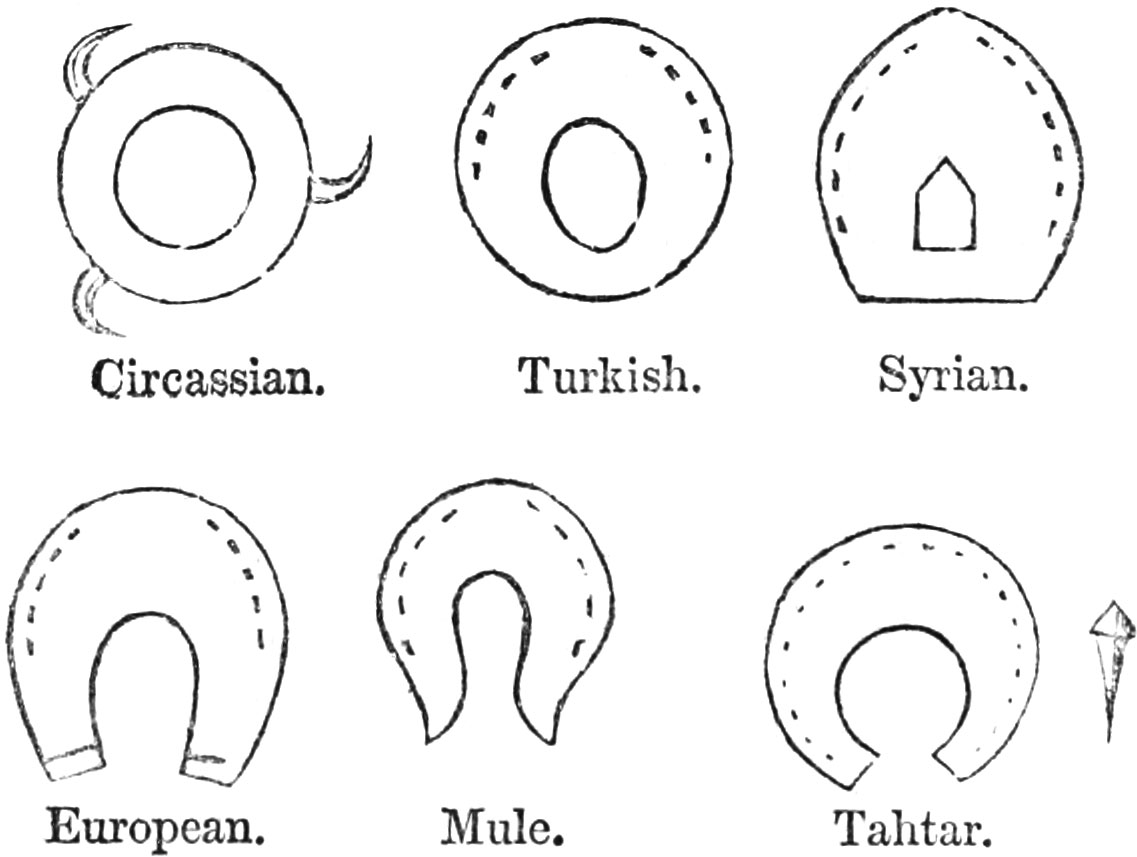
Ancient Horse-Shoes
In the time of the Roman conquest of Syria, there were Bedoueen Arabs who, like the Numidians, still rode without bridles. With regard to horse-shoes, recent authors have concluded that they are of comparative modern invention, but we refer to the horse-shoe found at Tournay in the tomb of the Frankish king, Childeric (who died about 480), which Mr. Bracy Clark would ascribe to a mule because it is small, when he should have considered the horses were of low stature;51 and if it were of a mule, still would prove the practice of shoeing. We know, moreover, that the Asiatics of the north made a variety of horse-shoes for many ages; and in the high region of the Kirguise country, even now, they shoe their horses with pieces of deers’ antlers, and in Iceland occasionally sheep’s horn, in both cases effected by the peasants, and not by regular farriers. In Southern Asia, where the far greater proportion of the earth’s surface consists of sandy plaint and dry deserts, the horses’ hoofs are hard, and therefore do not even now suffer the operation of shoeing, at best a questionable advantage hence none of the Arab or Persian nations wanted or invented them. The marches of Alexander may have been impeded, and the operations of Mithridates thwarted, by their horses being overworked in rocky districts; and it is sufficiently clear that in Rome horse-shoeing was unknown to the end of the republic, and began in the time of Cæsar. Virgil seems to have been guided by his feelings for the heroical in speaking of horses, for Catullus evidently alludes to horse-shoes in the line where the object is indeed a mule:
Ferream ut soleam tenaei in Voragine raula Derelinquit.
Nero had horses shod with silver, and his wife, Poppæa, had her mules similarly protected with gold; and although Beckman, after Cardamus, would insinuate that these were plates, it still is evident that they were fastened with nails, since, in the life of Caligula, Suetonius expressly notices the iron shoe, with eight or more nails, as remarked by Aldrovandus.52 It is probable that the ancient shoe was similar to the present thin plates used in Persia, which may be perforated with nails anywhere, and are very like the Turkish, only the last mentioned have a small opening in the middle, but the heel and frog are quite covered. There are indeed ancient Tahtar horse-shoes of a circular form, apparently with only three nails or fasteners to the outside of the hoof, as may be seen in the brandmarks of the first race of Circassian horses:53 this was perhaps the shoe the Tahtars used, and which every horseman could fasten on without the aid of a farrier. There is further evidence in favour of the antiquity and form of the usual shoe, in the circumstance, that from Ireland to the extremity of Siberia, from Lapland to Abyssinia, from the Frozen Ocean to Canton and to the Malay islands, the horse-shoe is found nailed against buildings, under the same system of mysterious superstition, and evidently from a remote age,—for how, otherwise, could the practice have spread over the whole world. We have seen it sculptured in bas-relief with a Runic incription certainly as old as the ninth century, accompanying a figure of Ostar, upon a stone found on the Hoheustein, near the Druden Altar in Westphalia, a place of Pagan worship that was destroyed by the Franks in the wars of Charlemagne: had the horse-shoe been invented in that age, it could not already have become an object of mysterious adaptation in the religion of barbarians which was on the wane at least a century earlier.
It has been remarked that the Romans paid only a tardy and imperfect attention to breeding horses, and we have observed also that the stature of these animals, with exception of the races before named, was below, the present ordinary size. The Norman pirates carried in their ships the small hardy breed of Scandinavia, still in perfection in Iceland: all the riding nations from the east and north,—Huns, Bulgarians, Goths, and Magyars, had small horses: those of the Ardennes, of many parts of France, of the Camargue, of Switzerland, the Pyrenees, and Britain, were still smaller: the Netherland Menaphian alone appear to have reached a full stature. It was therefore in the first centuries after the Moslem invasion of Spain, France, and Calabria, when art and science began to revive, and the great empire of the Franks could and did provide wide-spreading precautions against invaders, among which the most pressing were those that were calculated to resist the conquests of Islam. With the newly introduced stirrup, they could more properly adopt heavy defensive armour, and in order to give the Christian chivalry a fair chance of success, that which would increase the stature of their war-horses became an object of importance. Accordingly, about this period, we begin to observe, in the West, places for breeding and institutions of horse-fairs.54 The Moorish and Spanish Vandal (Andalusian) breeds gradually passed the Pyrenees, captured in forays, received as presents, or introduced by Jews, who were then great horse-dealers. The race of the Frankish Netherlands, carried to the south, and the largest mares that could be procured in Lombardy, were crossed by the southern varieties in breeding-places called Haras, modified after a name which was derived from some nation on the Danube, where Garas and Guida denoted both sexes of that animal. The Anglo-Saxons denominated them horse-steeds; the Celtic nations, Arich;55 and the Belgians, Broisel,—for such is the interpretation of Brussels,—the site where the city stands being anteriorly a breeding pasture, on the river Senne, formed by the counts of Louvain before Brabant was raised into a duchy. The fair of Beaucaire became the great mart for horses as early as 832, when the count of Barcelona built the castle: others existed from the Celtic or Roman times, at those places called Ventæ,—as Vienne on the Rhone, Vienna on the Danube, Vannes in Brittany, Venta Belgarum, or Winchester, Yenemaere near Ghent, and new horse-fairs sprang up in many places.
It was then that the nobility and chivalry of Europe, leading almost a nomad life, in quest of war and adventures, began to pay large prices for tall, fleet, and strong horses: the Christian kings of Oviedo and Leon were often pressed to sell or procure war-horses. We find a pope, John, applying to the king of Gallicia for
Aliquantos utiles et optimos Mauriscos, quos Hispani caballos Alfaraces vocant.
These Alfaras, or Andalus, were a cross breed of Arab blood upon the black Vandal and other Gothic races, themselves crossed with Roman and the ancient Spanish Calpe studs; which last retained the name of Ginetas because they were smaller and fit only for light armed cavalry. African and Barbary blood, by crossing with the Gothic, likewise rose in stature, and spread in Navarre to the Garonne. These two formed the first well bred horses in Christian Europe, and the grey being most accessible, probably in consequence of a farther cross with the Gallician mountain race, was soon noticed in France by the names of Ferrant, Auferrant, and Blancferrant, as they were of different shades of their colour. We find in the older poets and troubadours, repeated reference to them; such as,—
Chacuns d’eux broche son auferrant Gascon.
La peust on voir maint auferrant d’Espagne.
D’Estriers, auferrant et Gascon,
occur, showing that auferrant is occassionally intended to express the native country of the destrier or charger; for dextrier, destrier, or dextrarius, were terms given to a war-horse because it was led by a groom or squire until wanted for battle: the word, besides, was synonymous with great-horse and war-horse, and denoted his quality, without reference to colour or race.56
In Britain, we have already pointed out the gradual importations in the time of the Romans and during the Saxon invasions, although the last mentioned cannot have been considerable, if, according to the venerable Bede, the insular Saxons did not begin to ride much before the year 630. Athelstan is the first on record who, in 930, received German running-horses as a present from abroad, and therefore had more particular opportunity of improving the English stock by the infusion of select foreign blood: these presents came from Hugh the Great,57 when he solicited the Saxon king’s sister in marriage; and he seems to have bestowed some attention on the subject, since he issued a decree prohibiting the exportation of horses without his licence; and the order proves that his steeds were already sufficiently valuable to incur the risk and expense of shipping them for the continental fairs. In a document of the year 1000, we find the relative value of horses in this kingdom, directing,—if a horse was destroyed or negligently lost, the compensation to be demanded was thirty shillings; a mare or colt, twenty shillings; a mule or young ass, twelve shillings; an ox, thirty pence; a cow, twenty-four pence; a pig, eight pence; and a man, one pound!
In the laws of Hyweldda, sovereign of Wales, dated a few years before this period, a foal not fourteen days old is valued four pence; at one year and a day, forty-eight pence; and at three years, sixty pence: this refers evidently to the native horses, for there it is ordered to tame them with the bridle and rear them as palfreys or serving-horses, but the war-horse is not mentioned. When completely broken in, the value rose to one hundred and twenty pence, but if left wild or an unbroken mare, was worth only sixty pence.
The trinal system of the ancient Celtic nations, it is perceived, still continued in use at that time, and may be traced in the laws regarding horses for to obviate the frauds of dealers, the following singular regulations were in force: the purchaser was entitled to time, in order to ascertain whether the horse was free from three diseases. Three nights’ possession to determine whether he was not subject to the staggers; three months to prove the soundness of his lungs, and one year to remove all apprehension of glanders. For every blemish discovered after purchase, the dealer was liable to a deduction of one-third of the money, excepting in obvious cases, such as, where the ears or tail were defective. Compensations were likewise granted in cases of injuries done to hired horses; all showing a humanity of principle, emanating from the Celtic source, notwithstanding that prince had repeatedly visited Rome for the purpose of rendering his code more perfect. We find, even among the enactments, that
whoever shall borrow a horse and rub off the hair, so as to gall his back, shall pay four pence; if the skin be forced into the flesh, eight pence; If the flesh be forced to the bone, sixteen pence.58
Until the latter part of the tenth century, neither the Anglo-Saxons nor the "Welsh employed horses in the plough; but about that period, some innovation of the kind must have occurred, since a Welsh law prohibits the farmer to plough with horses, mares, or cows, oxen alone being lawful. On a part of the border of the so called Bayeux tapestry, representing the landing of William the Conqueror and the battle of Hastings, A. D. 1066, a piece of needlework ascribed to the dexterity of Saxon embroiderers, there is a representation of a man driving a horse attached to a harrow; which is the earliest instance we have of horses used in field labour.
With the Norman conquest, effected by adventurers from every country in the west of Europe, a marked improvement took place in the breed of horses: the martial barons and their followers had brought with them a great force of cavalry, and they were sensible that it was owing to superiority in horse the victory had been obtained. It was then the effect of the Spanish breeds extended to England; William himself rode, in battle, a favourite charger of that race; and among the installed nobles, Roger de Boulogne,59 Earl of Shrewsbury, established the race of Spain on his newly acquired estates at Povisland. In the year 1121, during the reign of Henry I., the first Arabian horse on record was introduced; about the time Alexander I., King of Scotland, presented another to the church of St. Andrews: both of these were most likely real Barbs from Morocco, and were acquired by means of the Jew dealers. Our Norman princes were, however, not only attentive to improve their studs in England, but perhaps still more so on the continent; for, it is at this period that both the bay and the grey races of Norman horses were formed, which continue still to be the best in France. At the battle of Hastings, the horses were not yet barbed, nor the knights completely covered in armour, and their lances were still sufficiently light to be cast like darts; but during the reign of Henry II., we think, from the increased number of “great horses,” both horse and man were protected by mail or other defensive armour; the helmets closed with visors, and the lance became ponderous, and could only be used couched. In this reign circa 1170, Fitz Stephen the monk, in his description of London, mentions trotting horses, brest? horses, and running horses, and relates with animation the races that took place in Smithfield, whither merchants and strangers resorted, and which was then, it is evident, a great mart for foreign as well as native horses. Then was the era of the crusades: thousands of the best horses went with their riders to perish in Palestine, and those champions of the Cross that survived to return, were always in such distress, that they could not, if they would, bring oriental steeds back to their homes. Richard I., in the various metrical poems concerning his expedition, is mentioned riding a Gascon bay, a Cypriot roan, and several Arabians. Two other Cyprus horses sung in romance, most likely never came to England, though
Yn this worlde they hadde no pere,
Dromedary and Destrere,
Stede, Rabyte,60 no Cammele,
Goeth none so swifte, without fayle.
We perceive, in the sum of two pounds twelve and sixpence, given by the king, in 1185, for fifteen breeding mares, and distributed by him to his tenants at four shillings each, the low value of the common race, as compared with ten capital war-horses, which, some years later, cost twenty pounds a piece,—the demand and necessary consequence of the havoc made among them during the frenzy of distant marine expeditions; and in the case of a pair of chargers, twelve years after (1217), brought over from Lombardy at the extravagant sum of thirty-eight pounds thirteen and four-pence, we find the eagerness evinced for possessing the largest and heaviest war-horses then in Europe. For in the rich pastures of the river Po, a race of ponderous Destrieros had been formed, which, if they at all resembled those figured by the early sculptors on the monuments and statues of Condotieri, were equal to our largest breed of dray-horses, the boast of London brewers.
King John had a passion for horses; he imported one hundred chosen stallions from Flanders, and thereby contributed materially to the improvement of that class of horses which subsequently became more exclusively employed for draught. In the same reign, a gentleman named Amphitil Till, one of the numerous persons who fell under the enmity of the king, was imprisoned, and agreed to pay for his ransom ten horses, each worth thirty marks, which is nearly equal to £300 of our present money:61 but the circumstance only proves the value of his stud, not that they were of English race.
Whether the old grey breed of England was of the same extraction as the Norman is uncertain but while the crown was in possession both of that country and Guienne, where the Ferrant breed abounded, it is likely that from the time of Henry II. it had been introduced; for the names of grey Lyard, and Sulyard,62 occur in ancient heraldry and early English poetry. In a satire on Edward, Earl of Cornwall, hinting at his escape from prison, there is the following allusion to it:
Be the leuf, be the lout, Sire Edward,
Thou shalt ride sporeless o’ thy Lyard,
All the righte way to Doverward.
Edward II. purchased thirty Lombardy war-horses and twelve heavy draught-horses, between which there could not be much difference, excepting in the training. His son, Edward III., expended one thousand marks for fifty Spanish horses, and obtained for their transmission a safe conduct from the kings of Spain and France, who showed more liberality in granting the boon than he did to a German dealer, who, having imported some Flanders stallions on speculation, was only permitted to re-embark them, but not to take them to Scotland, where no doubt they would have amply repaid him, since, so late as the reign of Queen Mary, Perlin, a French traveller, remarks, that the Scots chivalry were wretchedly mounted.63
Edward had many running horses, by which we think are meant fleet hunters, of a lighter make than the “great horses,” which it was believed required bone; their price was about twenty marks, or three pounds six and eight-pence. That prince was fond of field sports, and felt that war-horses would give him no superiority in continental battles, where during several reigns all our kings won their great victories fighting on foot.
Italian great horses, there is reason to believe, were imported, if not for breeding, at least for mounting the nobility and richest knights; for although we do not know whether they were sent to England or only presented, Paul Jovius relates that Galeazzo II., duke of Milan, gave seventy war-horses to Lionel, duke of Clarence, all furnished with saddles of velvet, embroidered with silver.
From this time English horses improved steadily, and the amount demanded and given, and the malpractices of dealers, caused Richard II. to issue an edict in 1386 to regulate their prices. In this document, ordered to be promulgated in the counties of Lincoln and Cambridge, and the east and north ridings of Yorkshire, we perceive the principal breeding localities were then the same as now; but the civil wars began at this time to arm one part of the nation against another, and the breed of horses diminished and deteriorated greatly during the sanguinary struggles of three-fourths of a century. Philippe de Comines, who saw an English army which Edward IV. disembarked in France, speaks with little admiration of its equipment or armour and it is probable these deficiencies were not repaired while Henry VII. sat on the throne, for he prohibited the exportation of stallions, and even of mares, unless they were above two years old and under the value of six shillings and eight-pence by which, it may be, was meant the unimproved pony breed. We think this the only intelligible way of explaining an order, which could otherwise be easily evaded.
Henry VIII., with ostentatious propensities, was anxious to possess a valuable breed of horses, and his connexions with Charles V. evidently facilitated the acquisition. In the tournaments and processions of which drawings and engravings remain, the grey, golden bay, and deep bay Andalusian and Asturian breeds may be represented: he was not, however, satisfied with his own stud; his arbitrary temper devised a law, by which it was intended none but good horses should be kept, fixing a standard of value for that purpose, and regulating that the lowest stallion should be fifteen hands high and the mares thirteen hands; and before they had arrived at their full growth, no stallion at two years old, under fourteen hands and a half, was permitted to run on any forest, moor, or common where there were mares. At Michaelmas tide, the neighbouring magistrates were ordered to “drive” all forests and commons, and not only destroy such stallions, but “unlikely tits,” whether mares, geldings, or foals, which they might deem not calculated to produce a valuable breed; he moreover ordained, that in every deer-park a certain number of mares, in proportion to its size, and each at least thirteen hands high, should be kept; and that all his prelates and nobles, and “all those whose wives wore velvet bonnets,” should keep stallions for the saddle, at least fifteen hands high. These regulations, though they died with the obstinate and wrong-headed king, effected little towards improvement, but greatly diminished the number of horses; for when Elizabeth, forty-one years after, called out the whole strength of her chivalry to oppose the expected invasion of the Spaniards, she could muster only three thousand men-at-arms mounted; and Blundeville, who wrote on the art of riding, speaks with contempt of the qualities of the horses. Yet there existed then a valuable showy breed in England, eagerly bought by foreign grandees for state occasions, particularly when they were white or light grey, as is proved by the notice of Aldrovandus, who died blind and aged eighty, in the year 1605. The majority, nevertheless, were strong sturdy animals, fit for slow draught, and the few of lighter structure were weak and without powers of endurance. But now commenced the practice of racing, chiefly at Chester and Stamford; and although these were as yet without system, admitting hunters and hackneys and every description of horse, the foundation was laid of that rising improvement in English horses, to which we shall revert when the particular breeds of the present time are reviewed.64
Both the foregoing remarks, and the account of the ancient breeds of horses, appeared to be necessary in a preliminary statement, before the question of wild horses could be considered; because, while they throw, we hope, some light on their primitive distribution, considered merely as different races, as varieties, or as distinct forms, more or less approaching to actually separate species, they prepare the reader more fully to enter upon the question of the true wild horse, and the distinctions which, even now, animals collectively so called present to the observer. We have shown that varieties of colour, at least, were in the earliest ages located in a line of nearly the same latitude, but separated in longitude from east to west upon geographical surfaces, where there still remains evidence of their presence, notwithstanding the lapse of ages, and the position they occupied in the colonial route of nations; and that their gradual intermixture was effected by these causes, and still more by the north-eastern progress of Islamism. There are allusions to the different stocks, beside those already noticed, in the sacred and profane writers; the former in the mysterious visions of the prophets, and even in the Revelations;65 the latter in poets and historians to the thirteenth century of the Christian era; and we shall point out, in the next chapter, that feral horses return to particular colours or liveries, as a further proof of the probability in favour of the views offered in the present.
The Wild Horse
As among the Equidæ the domestic horse is beyond comparison the most important species to man, so is it also the type of the others in systematic arrangement, and the constant object of reference by which their station and qualities are judged; hence the horse, properly so called, occupies singly the far greater part of the history of the whole group. Having already furnished some description of the ancient history of the animal, we can now, before we proceed to detail that of the races at present diffused over the surface of the world, enter upon the question of the wild horse,—one which naturalists are not wholly agreed on: we shall make some remarks on varieties now extant which appear to have a claim to be distinct, being regarded as such by the natives of the localities where they reside; and examine whether they, like the differently coloured forms of horse already noticed are species osculating with others in their original state of liberty, or mark one or more races that have returned to their primitive condition and resumed manners and habits conformable with their organization, after they had been under the dominion of man, at an anterior period more or less remote. On the one hand, differences cannot be consistently drawn from facts not immediately in the reach of physiology, without a careful consideration of the data that must justify them; nor, on the other, can any advance be obtained in this direction of the natural sciences, without the license and use of some daring in the solution of propositions depending in a certain degree upon induction from testimonial authority.
Respecting the wild or rather feral horses, of South and North America, Cuba, and St. Domingo, whose origin is well known, no difference of opinion can properly arise, notwithstanding that a late acute observer detected, in alluvial deposits, the bones of horses in company with those of Megatherium, and apparently belonging to the same zoological period; and that several recent travellers, in the northern portion of that continent, question the race of horses, now so abundant, being imported subsequent to the discovery by Columbus.66 But doubts may be entertained respecting the real source of the wild horses roaming from the Ukraine, in Europe, eastwards to the northern extremity of Chinese Tahtary: those about the Don, it is asserted, are sprung from domesticated animals sent to grass during the siege of Azof in 1696,67 which could not again be entirely recaptured. Forster was disposed to consider all the wild horses in Asia descendants from strayed animals belonging to the inhabitants; and Pallas, who had likewise travelled in Asiatic Russia, inclined to the same conclusions. He thought the horses from the Volga to the Oural the progeny of domestic animals; and again, that all from the Jaik and Don, and in Bokhara, were of the Kalmuck and Kirguise breed, remarking, that they are mostly fulvous, rufous, and Isabella; while, on the Volga, he noticed them as usually brown, dark brown, and silver-grey, some having white legs and other signs of intermixture. Undoubtedly men of science, so well trained to observation as both these learned naturalists, carry with their opinions a weight of authority which is evinced by subsequent writers, who, not satisfied with acquiescence in these conjectures, have actually pronounced them to be settled conclusions. Yet, knowing from personal experience, how little a traveller can see and determine by his immediate single observation, even in favourable regions, and taking into consideration the jealous character of the authorities, his confined condition in a sleigh or Russian travelling carriage, where he must pass over great distances in haste in order to reach a secure asylum, be constantly in the hands of the post officers, among a scanty population, strangers to the language of government, and still more to his own (the German); where, with rare exceptions, all are exceedingly ignorant and indifferent, and the climate three-fourths of the year prohibiting going abroad, we question whether under such circumstances, opinions expressed with doubt should be adopted as conclusive. Now, if we examine the extent of the travellers’ own immediate means of judgment, we find that they have occasionally seen troops of wild Equidæ at a distance, and been enabled to give one drawing of a living colt recently captured, besides two or three more species from living specimens or stuffed skins: surely a sweeping conclusion upon such scanty data may be convenient, but is scarcely deserving of acquiescence; particularly when we take into account, that, including the collected opinions of those upon the spot, in themselves of only conditional value, the field of observation explored is scarcely a hundredth part of the surface whereon this zoological problem must be decided. The Russian dominions extend over the most level part only: four chains, at least, of enormous mountains, whose direction is even in a measure unknown, occur within the great basin of the Thianchan, the Little Altai, the Himalaya mountains, and Hindukoh; and upon them there are table lands of more than 16,000 feet in elevation, not as yet traversed by a European foot, though known to be stocked with wild horses and other animals. Beginning from the chain, east of Budukshaun more than forty degrees of longitude, by from five to twenty of latitude, stretch north-eastward along the nomad haunts of the Kalmuks, Eleuths, Mongols, and Kalkas, consisting mostly of the sandy wastes of Gobi or Shamor, and to the west of these are the deserts of the Sea of Aral, the Karakoum, and wildernesses of the Kirguise.68 Over the whole extent of this almost boundless surface, several species of Equidæ are noticed, and shall we assume that these also are feral descendants of stray animals at the siege of Azof, though neither Forster nor Pallas advanced such an opinion? Surely no: nor can we deny that in the south-eastern mountain frontier of Russia, upon the inclined plains resting against the central chain, the original wild Equus caballus is still found; and that in the other regions of the empire stretching westward, they are likewise of the wild stock, but more and more adulterated with domestic races as they approach towards Europe, or have been long peopled by fixed residents.
Even in the south-western steppes to the Ukraine, there have been wild horses, as is attested by the earliest historians, poets, and geographers: across these plains, ancient Teutonic or Indo-Germanic nations; subsequently Ouralian tribes, Sarmatians, Huns, Bulgarians, Magyars, and Tahtars, all mounted hordes, have passed, and some repassed; and if the horses on the banks of the Don are of feral or of mixed blood, their origin and contamination is surely much older than the siege of Azof. Even at that period, there were still wild horses kept in the parks of Eastern Europe, like other game, for the service of the tables of the great. To admit, therefore, the conclusion, that all the wild horses of the old continent are descended from animals at some period under the dominion of man, appears a gratuitous assumption resting upon no proof, and in opposition to historical records from the time of Herodotus to our own age: it would imply the absorption into domesticity of the whole species, or of several species, in regions where such unbounded wildernesses exist, in several parts still maintaining the parent stock of other domestic animals; or involve the total destruction of the original wild horses upon this immeasurable surface, where man subsequently could not prevent their again multiplying to uncountable numbers; while in Europe, the most peopled part of the old world, there were still in existence wild individuals of a race never reclaimed.69
As long as the sources of information were scanty, and public curiosity had defined the objects of natural history with less attention, writers were more liable than at present to be misled by erroneous and indistinct accounts, or by the absence of all information, and were induced to report the extinction of species of mammalia in several places, long before they were warranted by the fact. The wolf existed in Britain for ages after historians had asserted his destruction: Buffon, before the year 1760, declared the stag extinct in England, while it is still found in Somerset and the north of Devon; although since his time agricultural extension and population have increased enormously. It was long believed in France that no beavers could be found in the kingdom, whereas they have recently been taken in the Rhone: the ibex was admitted to be extirpated in every part of Europe, excepting in the Alps, where his presence was doubted; we have ourselves seen several specimens in the country, and pointed out, in the Berlin Museum, the spoils of a female, shot in the Spanish Pyrenees by Count Hoffmansegg, without being recognised by him, because he had surrendered his opinion to the commonly received assertion that there were none in Spain.70 We might extend the list to the regions of the elk, the bison, the lion, and others, but the foregoing are sufficient to prove that the extinction even of large wild animals is not so rapid as is often believed,—nor founded in fact, although it is asserted.
Now, with regard to wild horses, in the relations of the ancients and in the travels of modern writers, though we have reason occasionally to suspect they mistake the onager and the hemionus for real horses, their still remains sufficient authority for their presence in a state of nature, under one or other of their primæval forms, as far as the south and west of Europe, and in their characteristics assuming the same preference for opposite habitations in plains or in woody mountains, which we now perceive to be a leading distinction of the zebra and the Dauw traits of character the more important, as they indicate a different mode of living, a choice of plants, not alike in both,—a dissimilar temperament; and when coupled with different proportions and position of the ears, an arched or plane forehead, a straight or curved nose, a difference of colour in the eyes, of the skin, of the hoofs, the constancy of their liveries, of their marks, in a streak along the back and bars on the limbs, of dappled croups and shoulders, or of dark uniform colours, dense or thin manes and tails, although traits now mixed, feeble, and evanescent, they appear to be indications of original difference of forms sufficient to be distinct though osculating species, or at least of races separated at so remote a period that they may claim to have been divided from the earliest times of our present zoology.
Wild horses, by Oppian denominated hippagri and by Pliny equiferi, are first mentioned by Herodotus as being of a white colour and inhabiting Scythia, about the river Hypanis or Bog; he notices others in Thrace, beyond the Danube, distinguished by a long fur. Aristotle (de Mirab) indicates them in Syria, but with manners that seem to refer them to hemionus or onager. Oppian places his hippagrus in Ethiopia, and denies the presence of wild horses in Syria; an opinion entitled to credit from his local knowledge and his description of the onager, which shows that he was acquainted with both. Leo Africanus, in support of Oppian, mentions the wild horse of Africa as rarely seen or captured by hunters with their dogs, but to be entrapped in snares laid for them about the fresh-water springs. The Gordians produced in the shows of Rome eighty wild horses, according to Julius Capitolinus, and it is supposed they were obtained from Africa, where the family had its principal landed property: unfortunately no description is given of these animals. Leo and Marmol say the colour of the African wild species is whitish ashy-grey, with mane and tail short and crisped: Oppian makes the hippagri rufous. Struys saw wild horses near the isle of May and Cape Verde, where they have not since been noticed; and Mungo Park fell in with a troop of them about Ludamar, that fled, snorting, stopping, and looking back; but, again, gives no other particulars. None were ever pretended to be seen to the south of the equator in Africa; and it maybe asked whether these alleged horses are specifically the same as the Equus caballus of the north? In reply, we think that some of the foregoing accounts refer to the wild ass, whose silvery mouse colour may be more or less taken for white; that others have seen the koomrah, which we shall describe as a distinct species, and, finally, that there may be feral horses in Northern Africa, although it is strange that none are noticed in Morocco, in Arabia, Persia, or India, where there should be great numbers, if the doctrine of African or Arabian original parentage is consistently maintained.
In Varro, we find that there were wild horses in Spain; the ancients generally admit their existence in Sardinia and Corsica; Dapper places others in Cyprus; Strabo, in the Alps; and we know that they existed in the British islands: all seem to refer to a sturdy form of mountain-forest ponies, still found in the province of Cordova, in the Pyrenees, the Vogesian range, the Camargue, the Ardennes, Great Britain, and in the Scandinavian highlands:71 all remarkable for an intelligent but malicious character, broad foreheads, strong lower jaws, heavy manes, great forelocks, long bushy tails, robust bodies, and strong limbs; with a livery in general pale dun, yellowish brown, a streak along the spine and cross bars on the limbs, or the limbs entirely black, as well as all the long hair, and mostly having a tendency to ashy and grey, often dappled on the quarter and shoulders. They prefer the cover, delight in rocky situations, are dainty in picking their food, do mischief in plantations, and their cunning, artifice, and endurance is far greater than that of large horses. From many circumstances, this form of Equus may be deemed indigenous in North-western Europe, and aborigine distinct from the large black race of Northern Gaul, which once ranged wild in the marshy forests of the Netherlands, and was so fierce that it was held to be untameable. It was a gaunt, ugly animal, with a large head and bristly mouth, small, pale, often blue eyes, a haggard and abundant mane and tail, which, according to Cardanus, when rubbed in the night, emitted sparks of fire; the hips were high, the legs nodose, and the feet broad, flat, and hidden in an immense quantity of long bristly hairs about the fetlocks: this form of horse may have extended northward as far as the Hartz, for there, as in the Netherlands, we hear of traditions and legendary tales where the electrical phenomenon first mentioned, and the pale eyes, are evident ingredients of superstition to connect it with apparitions, demons, wizards, and Pagan divinities. It may, indeed, have been a feral branch, only in part wild, and introduced with the first Gallo-Belgic colony that ascended the Danube; for the black-coloured horse occurs in Egyptian pictures, was evidently known to the Romans and Greeks at an early period, and was figured as Pluto’s team:72 if this supposition could be substantiated, it would in some measure show the original location and route of the Centomannic Celts and true Gauls; it would also indicate the black race of Transouralian origin, with the more probability, because melanism in horses is unknown among the bay breeds, and where it is intermixed, shows a tendency to obliteration.
But the ancients all agree in their statements concerning wild horses of the north-east of Europe, residing, according to their narratives, from Pontus northward into regions unknown to their geography; some we have seen are described as white, and having the hair five or six inches long, characters we find verified at present in Asiatic Russia and in the wild horses of the Pamere table land. In the woods and plains of Poland and Prussia there were wild horses to a late period. Beauplan asserts their existence in the Ukraine, and Erasmus Stella, in his work “De Origine Borussorum,” speaks of the wild horse of Prussia as unnoticed by Greek and Latin authors. He writes,
They are in form nearly like the domestic species, but with soft backs, unfit to be ridden, shy and difficult to capture, but very good venison.
These horses are evidently again referred to by Andr. Schneebergius, who states, that
there were wild horses in the preserves of the prince of Prussia, resembling the domestic, but mouse-coloured, with a dark streak on the spine, and the mane and tail dark; they were not greatly alarmed at the sight of human beings, but inexpressibly violent if any person attempted to mount them. They were reserved for the table like other game.
It may be that in both the above extracts the heraionus or the onager is presumed to be depicted, but the difference of mane and tail is so obvious, that such an objection cannot be entertained; and should it be said that these were merely feral horses, it might be asked in return, what a true wild species must be like to satisfy the dissentient. In our view, this form of horse is the original eelback dun of the west, and allied to the common Median horse of antiquity; the parent, by gradual subjugation and intermixture, of the mouse-coloured and sorrels still common in Lithuania; and particularly of those breeds that, with the black streak along the back, have cross bars on the joints, and black mane, tail, and fetlocks.73 These were the wild and feral horses of Europe, as far as Bessarabia, from the earliest era to the close of the seventeenth century; and from the facts recorded, we may with some confidence conclude, that farther east, where Europe displays an Asiatic character, becoming more and more, as we advance in that direction, wild and uncultivable, that the appearances of the wild animals, particularly the horses, have retained their original nature more and more purely as we recede from the haunts of civilization, showing marks of degeneracy only where the old human migrations have passed, but leaving the typical characters everywhere perceptible. This is the cause which induced authors to derive all the wild horses of Asia from the stray troop-horses at the siege of Azof, then, be it observed, already geldings, yet made to replenish the steppes with a species of animals constantly noticed before and since as abundant in a wild state in the same regions! Within these few years, Moorcroft and the brothers Gerrard, when they penetrated into Independent Tahtary and within the borders of China, met with numerous herds of wild horses, scouring along the table lands, sixteen thousand feet above the sea, and express not the least hint of their having been domesticated at any period.
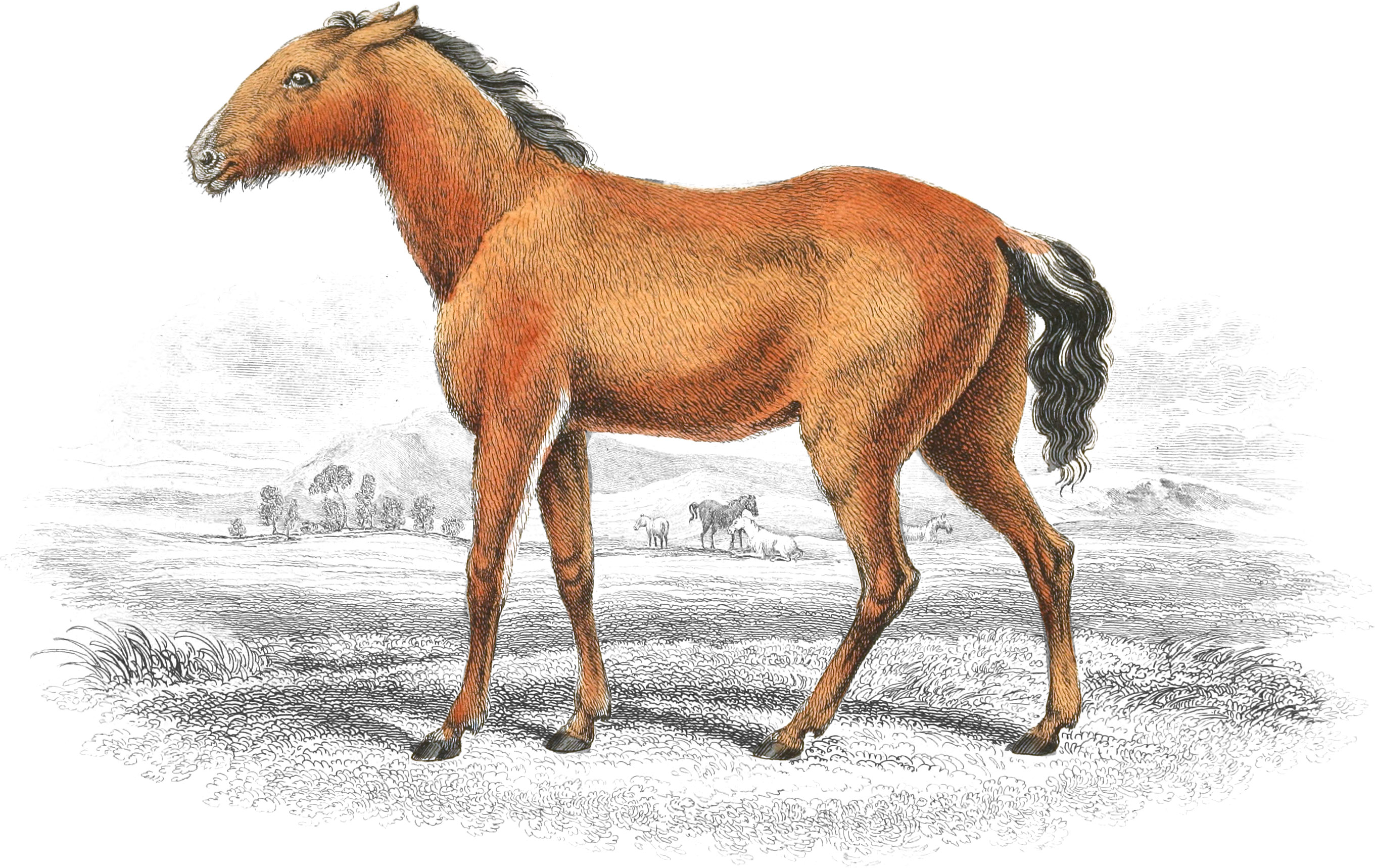
Whatever may be the lucubrations of naturalists in their cabinets, it does not appear that the Tahtar or even the Cossack nations have any doubt upon the subject, for they assert that they can distinguish a feral breed from the wild by many tokens; and naming the former Takja74 and Muzin, denominate the real wild horse Tarpan and Tarpani. We have had some opportunity of making personal inquiries on wild horses among a considerable number of Cossacks of different parts of Russia, and among Bashkirs, Kirguise, and Kalmucks, and with a sufficient recollection of the statements of Pallas, and Buffon’s information obtained from M. Sanchez, to direct the questions to most of the points at issue. From the answers of Russian officers of this irregular cavalry, who spoke French or German, we drew the general conclusion of their decided belief in a true wild and untameable species of horse, and in herds that were of mixed origin. Those most acquainted with a nomad life, and in particular an orderly Cossack attached to a Tahtar chief as Russian interpreter, furnished us with the substance of the following notice.
The Tarpany form herds of several hundred, subdivided into smaller troops, each headed by a stallion; they are not found unmixed, excepting towards the borders of China; they prefer wide, open, elevated steppes, and always proceed in lines or files, usually with the head to windward, moving slowly forward while grazing,—the stallions leading and occasionally going round their own troop; young stallions are often at some distance, and single, because they are expelled by the older until they can form a troop of young mares of their own their heads are seldom observed to be down for any length of time; they utter now and then a kind of snort, with a low neigh, somewhat like a horse expecting its oats, but yet distinguishable by the voice from any domestic species, excepting the woolly Kalmuck breed: they have a remarkably piercing sight; the point of a Cossack spear, at a great distance on the horizon, seen behind a bush, being sufficient to make a whole troop halt; but this is not a token of alarm, it soon resumes its march, till some young stallion on the skirts begins to blow with his nostrils, moves his ears in all directions with rapidity, and trots or scampers forward to reconnoitre, bearing the head very high and the tail out: if his curiosity is satisfied, he stops and begins to graze; but if he takes alarm, he flings up his croup, turns round, and with a peculiarly shrill neighing, warns the herd, which immediately turns round and gallops off at an amazing rate, with the stallions in the rear, stopping and looking back repeatedly, while the mares and foals disappear as if by enchantment, because with unerring tact they select the first swell of ground or ravine to conceal them until they reappear at a great distance, generally in a direction to preserve the lee side of the apprehended danger. Although bears and wolves occasionally prowl after a herd, they will not venture to attack it, for the sultan-stallion will instantly meet the enemy, and, rising on his haunches, strike him down with the fore feet; and should he be worsted, which is seldom the case, another stallion becomes the champion: and in the case of a troop of wolves, the herd forms a close mass, with the foals within, and the stallions charge in a body, which no troop of wolves will venture to encounter. Carnivora, therefore, must be contented with aged or injured stragglers.
The sultan-stallion75 is not, however, suffered to retain the chief authority for more than one season, without opposition from others, rising in the confidence of youthful strength, to try by battle whether the leadership should not be confided to them, and the defeated party is driven from the herd in exile.
These animals are found in the greatest purity on the Karakoum, south of the lake of Aral, and the Syrdaria, near Kusneh, and on the banks of the river Tom, in the territory of the Kalkas, the Mongolian deserts, and the solitudes of the Gobi: within the Russian frontier, there are, however, some adulterated herds in the vicinity of the fixed settlements, distinguishable by the variety of their colours and a selection of residence less remote from human habitations.
Real Tarpans are not larger than ordinary mules, their colour invariably tan, Isabella, or mouse, being all shades of the same livery, and only varying in depth by the growth or decrease of a whitish surcoat, longer than the hair, increasing from mid-summer and shedding in May: during the cold season it is long, heavy, and soft, lying so close as to feel like a bear’s fur, and then is entirely grizzled; in summer much falls away, leaving only a certain quantity on the back and loins: the head is small, the forehead greatly arched, the ears far back, either long or short, the eyes small and malignant, the chin and muzzle beset with bristles, the neck rather thin, crested with a thick rugged mane, which, like the tail, is black, as also the pasterns, which are long: the hoofs are narrow, high, and rather pointed; the tail, descending only to the hocks, is furnished with coarse and rather curly or wavy hairs close up to the crupper; the croup as high as the withers: the voice of the Tarpan is loud, and shriller than that of a domestic horse; and their action, standing, and general appearance, resembles somewhat that of vicious mules.76
The feral horses, we were told, form likewise in herds, but have no regular order of proceeding they take to flight more indiscriminately, and were simply called Muzin. They may be known by their disorderly mode of feeding, their desire to entice domestic mares to join them, by their colours being browner, sometimes having white legs, and being often silvery grey: their heads are larger and the neck shorter; but their winter coat is nearly as heavy as that of the wild, and there is always a certain number of expelled Tarpan stallions among them; but they are more in search of cover and of watery places, the wild herds being less in want of drink and more unwilling to encounter water, being even said not to be able to swim; while the Muzin will cross considerable rivers. During winter, both resort to elevated ground where the winds have swept away the snow, or dig with their fore feet and break the ice to get at their food.
Their olfactory sense, though not delicate in distinguishing enemies at great distances, is remarkable for judging the nature of swamps, which they often traverse, particularly to the south of Lake Aral: when thus entangled at fault, their scent indicates the passable places, and the snorting of the first that finds one is immediately observed and followed by the others.77
The genuine wild species is migratory, proceeding northward in summer to a considerable distance, and returning early in autumn. The mixed races wander rather in the direction of the pastures than to a point of the compass; nearer Europe, they haunt the vicinity of cultivation, and attack the hay-stacks which the farmers make at a distance in the open country. Though in many respects they have similar manners, they want the instinct of the wild: upon being taken young, after severe resistance, they submit to slavery. The Tarpans always die of ennui in a short time, if they do not break their own necks in resisting the will of man:78 they are, moreover, said to attack and destroy domestic horses; they rise on their haunches in fighting, and bite furiously; while the mixed races, though ready to bite, are more willing to strike out with their hind feet, and neither have ever been remarked lying down. In these particulars, the younger Gmelin, who likewise travelled in Eastern Russia, corroborates our account, and he does not appear to have come to the same conclusions as Forster or Pallas; we may therefore infer, from what is here stated, that the foal observed by the last mentioned author, when he was on the Samara, opposite Sorotschinska, caught at Toskair Krepost, was of the mixed race, or not sufficiently grown to furnish a satisfactory representation.
We made further inquiries respecting the residence of the piebald race of ancient history, in High Asia, and found that a variety of this kind was deemed distinct from the Russian horses, and occasionally seen among the Tahtar and Ural domestic breeds, but differing from the Chinese and wild race “beyond the southern mountains,”79 in having their feet very generally dark, while the others have invariably white limbs. Those within the frontier were said to be a breed belonging to the black Kalmucks, and we saw a few in the Russian irregular troops that may have been of this Kalmuck stock; but the real piebald animal is known by the names of Tangum and Tannian, from the Tangustan mountains of Bootan, although it is spread further along the north side of the Himalaya range beyond Thibet. Father Georgi alludes to Tangums, when speaking of the wild horses, variously coloured, which he saw on the banks of the Montza in his route to Lasha. D’Hobsonville was informed they were found on the borders of Thibet, and described not to be above ten or eleven hands high, tolerably well proportioned, active, fiery, with the hair between four and five inches long, coloured in regular corresponding spots. The domesticated are also in general piebald, thirteen hands high, deep chested, short bodied, with strong full quarters, robust limbs, and altogether remarkable for symmetry, strength, and compactness; it is a true mountain animal, very sure footed, very active, and bold.
We have already noticed the earlier history of this form of horse down to the eighth century: in the seventh, the Arabian hero Zohara, a prisoner in the Persian camp, escaped upon a piebald horse, and was greatly instrumental in the Islam victory of Kadesia. The clouded horses of Turan are mentioned by Firdausi: other poets incidentally name them, and Mickhoud the Persian historian relates of the eighth Abasside Caliph, Motassem,
that he raised a mound at the time he was building Samarali by means of 130,000 pied horses of his army, each conveying a sack of earth to the spot. It was on this mound, called Tel-al-Mekhali, or the hill of sacks, that his son and successor Wathek built the famous tower.
They are again mentioned in the Tahtar army under Peta Khan, when in 1241 he broke through Russia and Poland and defeated and slew Duke Henry II. of Silesia at Wahlstadt. They continue at present to exist in small breeds in Moldavia, Wallachia, Poland, and Pomerania, but are now only used to mount trumpeters and the bands of Hussar regiments, excepting in Italy, where the Borghese breed of pied horses is still in repute. It is reared near Rome, in the sandy pine district about ancient Ardea, the classical site of the exploits of Turnus and Æneas, and proves the durability of the markings of this form of horse, since Virgil clearly alludes to it in the same locality:—
Turnus,—
Improvisus adest: maculis quern Tliracius albis
Portat equus,—
Æn. ix. 48.
and the same breed was in the poet’s mind when he describes the Trojan game as it was performed by the Roman youth:—
—quern Thracius albis
Portat equus bicolor maculis; vestigia primi
Alba pedis, frontemque ostentans arduus albam.
Æn. v. 565.
The great Roman poet shows, in other writings, as well as in the local legendary part of the Æneid, a profound knowledge of the Latin traditions; and if their race of horses had been of late introduction, his judgment would have rejected making it the distinguishing character of the Ardean and Volscian horse. Since it has continued unimpaired from the beginning of the Roman empire to the present time, there is no reason to reject the belief that it was of sufficient antiquity to belong to the stock of centaur origin, and a companion of the Thraco-Pelasgian colonists, among whom Mares was the first equestrian in Italy.
Raphael, we have seen, displays his extensive information when one of these horses is introduced in his Vatican fresco of Attila, and both Titian and Guido have immortalized them in their pictures of Aurora.80
It is the most southern of all the original wild forms, and probably also the most ancient that invaded China; for on the square and perforated coins of a very ancient dynasty, the figure of a horse bearing the Tangum form is the distinguishing token, either of the family or of the value. It is less spirited and smaller in the southern provinces of the empire, and there used for an ambling pony, as may be seen in Chinese paper-hangings, where the cultivation of rice-grounds and the superintendence of tea-plantations is represented. On our Indian frontier it is the parent stock of the Ghoonts reared in the vicinity of Kalunga; and further westward, where it is probably more mixed, the mountain ponies of the Himalayas are more grey and the spots often small; but in courage, activity, and sure-footedness they are admirable. The common neglected class of Afghaunistan and the Indian peninsula, usually called Yaboos, attest by their not uncommon piebald livery that they are in a great proportion descended from the Parthian breed; and in the original battle-pictures of the wars of Aurungzebe, engraved about a century ago from Indian originals, we can trace the piebald horse among the chargers of the principal figures. We have been informed that, in the late wars, whole russoolahs, or corps of Pindarees, have been seen mounted upon this race.
There are still other wild horses of Asia, such as the white woolly animal of the Kara Koom and the high table land of Pamere,81 whence the Kirguise and Kalmucks appear to have drawn one of their principal races. It is about fourteen hands high, with a large head, small eyes and cars, a thick muzzle, a short thin neck, joining the head at a considerable angle; the mane is short and ragged, the tail not very abundant, the shoulder low and rather vertical, the limbs long, and the hoofs wide all the proportions hidden and deformed by a heavy bear-like fur, particularly under the jaws, where there is a considerable beard, not long, but extending to the gullet: the colour is grisly white, somewhat darker in summer, and the hair on the outside shining and hard, within soft and downy. The Kiang, which Mr. Moorcroft saw in great numbers in the elevated deserts of Khoten, and described as different from the Ghoor Khur of Sinde, is in form more like an antelope, having a brilliant eye and great vivacity of movement, which the name Kiang (rushing) sufficiently explains. This animal stands about fourteen hands high, with a round muscular form, is probably again the wild stock of the Tangum; but the Yo-to-tze, which we regard to be our Asinus equuleus, intermediate between the horse and hemionus, like the former in shape and the latter in colour, is allied but not identical with the onager.
These short notices show how defective our habits of superficial examination are, since no less than three species may be concealed under the name of Ghoor Khur, and as many in the more general term of wild horses.
Turning to Africa and excluding from the present consideration the zebra group, we find the ancients were still more liable to confound the real Equine animals, and depending upon reports of the natives to Include in their description of horses, species that can be only referred to ruminants. Confusion, thus created, was increased by Albertus Magnus, who finding in Oppian a true account of the onager and another of the hippagrus or equiferus of the Latin writers, coupled the two last names with the description of the first, and was followed by succeeding naturalists, excepting by Johnston, who finding the poet’s hippagrus a brown bisulcate hornless animal of Ethiopia, caused a figure to be engraved from the description, according to which it is represented also with tusks and a mane extending the whole length of the spine. It is not easy to account for the refusal of Linnæan compilers to place this supposed species by the side of Molina’s Equus bisulcus, the Huemel of Patagonia, for both appear to be real species placed in a wrong order.
The hippagrus, when reported to be solidungulated, maybe our E. hippagrus; and when stated to be bisulcate, is not a horse but a ruminant, probably the same which Mr. Rüppel noticed by the name of Boura of Koldagi, and perhaps the Boryes of Herodotus,82 as well as the Pegasus of Pliny, 83 We shall see in the description of the koomrah how much the love of the marvellous may mislead the ignorant natives, and through them naturalists better informed than Oppian. The wild horses seen by Leo, Marmol, Struys, Bruce, and produced by the Emperor Gordian, may indeed be partly of feral origin, and the rest the species above noticed, or the wild ass, which is found along the White Nile as far as it has been discovered; but no other wild Equus is described in Africa on this side of the equator.
Feral Horses of America
Having endeavoured to show the real existence of wild horses on the soil where the unsubdued species must have roamed in freedom, and where at no time the enterprise of man can have entirely extirpated them; since it could not, even if the present races were feral, prevent their again multiplying and resuming the characters of aboriginal independence, is in itself, we think, sufficient proof to establish the argument: we may therefore, after admitting a partial intermixture of the domestic species with the wild in Asia, take a view of those of America, where they were found in such prodigious numbers, shortly after the first settlements of the Spaniards, that it required the united testimony of the aboriginals, and the evidence of the terror they at first excited, to establish the absolute credibility of their having been imported. In their appearance, moreover, they bore, and still bear, evident tokens of Spanish origin; and in their manners, proofs that they were not wild, but only restored to freedom, or what we have called feral. In genial climates, with abundant herbage and few dangerous enemies to encounter, it was natural that animals of such power and intelligence should increase most rapidly; and hence no surprise was expressed at finding them in abundance in St. Domingo and Cuba, within a century after they had been first imported. Cortez carried them to Mexico,84 and Pizzaro to Peru; the Portuguese to Brazil, and soon after the plains of the Pampas began to swarm with their numbers.85 If it be true that at first only six were turned loose, there can be no doubt that many others from both sides of the southern part of the continent became free, and collectively that they acquired habits of self-preservation only in part like the real wild races of Asia; the time is not perhaps far distant, when they will be gradually again absorbed by domestication, excepting those which will retreat towards the two poles; and as the species is not restricted by the rigour of climate, but solely by the extent of available food, the wilds of Patagonia and the latitudes of the northern deserts will continue to maintain them in freedom, and render them migratory like the deer and the bison of the same climate.
Of the South American feral horses, none that we ourselves have possessed or seen, living, depicted, or described, had assumed the aspect or original colours of the wild species of Asia; they all bore the stamp of the domesticated races of Old Spain, with more or less modification; and though the herds roaming in freedom are mostly of a similar livery, there are amongst them individuals of every shade and mixture of colours that exist in Europe; black, as far as our personal observations went, being rarest; modifications of grey perhaps the most abundant in the mountainous regions towards the Gulf of Mexico, and shades of bay in the Pampas.86 Azara, the best qualified naturalist to express an opinion on this particular subject, estimates the proportion of bays (bay-brown) to be about ninety to ten zains, that is, entirely dark-coloured, without any white; black, there is not one in two thousand; pied and greys occur sometimes, but they, are invariably individuals escaped or left from domestic conditions.87 Jet black, though very rare, is a true colour among the feral races; and he regards the bay, the dark, and the jet black as three typical liveries of the original wild animal, and infers that the first pair of horses was of one of these colours; he then remarks that the black decreases or is liable to be effaced, next, the dark zain, and therefore that bay-brown is the primitive colour. The statement of this able observer is nearly the same as our own, but we explain the effects in a different manner, in the conclusions already drawn namely, that the Spanish horse in general is of the bay stock imported by Phœnicians, Carthaginians, and other African tribes, including the Arab Mussulmen; the black, a residue of the Vandalic importation, and thence most anciently the Andalus, that is. Vandal breed of the Moors; the zain probably an original race, or a residue of Roman introduction, which with the greys belonged to the mountains, and is now in the New World chiefly confined to mountainous regions; hence the black being the fewest, must necessarily be absorbed unless other causes intervene.
We have seen the Tarpans of Asia forming herds composed of minor families, but headed by a sultan-stallion, who guides the march and fights the battles of his subjects; we know these instincts to be weaker in the mixed and feral troops of Asia, and find it still less evolved in America. Having in the West a greater abundance of food, they congregate in thousands, where the influence of a leader cannot act in a similar manner, or the stallions effect more than keeping some of their immediate family together, while of the larger felinæ, the jaguar and the puma only are dangerous to horses both being tree-climbing carnivora, they seldom roam far from the woods or venture on the plains, where the thunder of horses’ hoofs is sufficiently terrific to frighten bolder animals; and with regard to the red wolf, our Chrysocyon jubatus, he is solitary, and usually satisfied with much smaller prey; hence, being more disturbed by man, and less obliged to watch predaceous animals, their instincts are less matured, their eyesight less piercing, and though by the qualities of their olfactory powers they can make the nicest distinctions, their nostrils do not detect the jaguar at a small distance. The impulses of fear they receive are always caused by the first stallion that happens to be impressed with danger: if a carnivorous animal is detected, they crowd together, and then the stallions rush forward to trample him to death; but the mares strike out with the heels, and although they are more timid, do not evince the same fear at the sight of man; the males alone being chosen by him for service, and subject to the hardest usage; they yet approach travellers, call to their captive brethren toiling under the weight of riders, then toss their heads, and, looking askance, canter away with their heads and tails raised; while the mares, unconscious of danger, look on with surprise at the jaded look of the passing strangers, and their foals run innocently up and start back with sudden apprehension.88 The males having but little cause for exercising their intellectual faculties, and being often captured, severely ridden, and then again restored to liberty, their wild instinct is more confused than fully developed, and a tendency to obedience and domestication remains impressed on their tempers. There is, nevertheless, one trait in the character of the South American horses not now observed in Asia, though, probably, were the conditions similar, a similar effect might be expected:89 we allude to a disposition of becoming frantic from thirst in the heated plains where water is rare, and then with the impetuosity of madness, when chance or instinct has at length conducted them to a pool or a river, rushing forward to the brink, trampling each other under foot, others sticking in the clay, and many forced into the water; causing a destruction of their numbers exceeding belief. Thousands of skeletons are said to blanch the borders of some localities where they resort. Where, by the absence of a sufficient, antagonist power in a due proportion of great carnivora, it is perhaps justly remarked by the author of the treatise on the Horse, that
this is one of the means by which the too rapid increase of this quadruped is by the ordinance of Nature there prevented.
North America likewise contains herds of feral horses; they are in form stout cobs, mostly bay, though there are herds where black predominates they have considerable speed, and are very sure-footed. The herds belong exclusively to the prairie, avoiding mountains and woods. They were formerly abundant in the Floridas, and still range through the open districts to California and the plains of the Columbia, but are not described with equal detail. In numbers they herd together perhaps still more considerable.
In the description furnished by a recent traveller, the Hon. C. A. Murray,90 we are furnished with a picture of what he denominates a Stampedo, or passage of these animals, surpassing in graphic spirit every account of wild horses upon record. He writes,
About an hour after the usual time to secure the horses for the night, an indistinct sound arose, like the muttering of distant thunder; as it approached, it became mixed with the howling of all the dogs in the encampment, and with the shouts and yells of the Indians; in coming nearer, it rose high above all these accompaniments, and resembled the lashing of a heavy surf upon a beach; on and on it rolled towards us, and partly from my own hearing, partly from the hurried words and actions of the tenants of our lodge, I gathered it must be the fierce and uncontrolable gallop of thousands of panic-stricken horses: as this living torrent drew nigh, I sprang to the front of the tent, seized my favourite riding-mare, and in addition to the hobbles which confined her, twisted the long larielt round her fore legs, then led her immediately in front of the fire, hoping that the excited and maddened flood of horses would divide and pass on each side of it. As the galloping mass drew nigh, our horses began to snort, prick up their ears, then to tremble; and when it burst upon us, they became completely ungovernable from terror; all broke loose and joined their affrighted companions, except my mare, which struggled with the fury of a wild beast, and I only retained her by using all my strength, and at last throwing her on her side. On went the maddened troop, trampling, in their headlong speed, over skins, dried meat, &c., and throwing down some of the smaller tents. They were soon lost in the darkness of the night and in the wilds of the prairie, and nothing more was heard of them, save the distant yelping of the curs, who continued their ineffectual pursuit.
These wild animals have produced the same effect upon the native savages which their similars have done in the south. In the latter portion of America, the Gosquis, Araucas, and Patagonian Indians have become riding tribes, as well as the Pawnees, Camanchees, and Ricarras in the former; all are nomad hordes of riders, only restrained by the presence of European colonists from becoming the conquerors of their fellow red men. They have already acquired equestrian habits, as dexterous lancers and throwers of the lazzo and bolas. Numerous superstitions exist among them which show a long familiarity with horses, and an opinion of the Ricarras, that the souls of horses will rise in judgment against unmerciful riders, does them honour. This ready departure from their antique habits, from the circumstance of horses being casually introduced to their observation, shows what must have occurred in the Old World among the primitive barbarous nations who had wild horses within their reach. As soon as one tribe could show the example of a successful experiment in the subjugation of the animal, others necessarily must have undertaken the same task; and those tribes that first accomplished it, immediately made the new instrument of power applicable to invade the others and commence the era of conquests. An indigenous possession of horses exhibits the further similarity in manners which result from it, for in both continents the Tahtar and the Patagonian feed upon the flesh, both do most of their common daily business on horseback, and, after death, both are laid in a tomb with the stuffed skins of their favourite animals set up around it.
There remains one more form of feral or wild horse to notice, namely, that which is of questionable origin, and found independent on the island of Celebes. East of the Bramapootra, and south of the tropic, through all Indo-China, Malaya, and the great islands, horses are dwindled to very small ponies; collectively they may be called Sarans, and although by some travellers they are considered indigenous, the antique navigation of the seas surrounding the Australian islands, in ships of sufficient burthen to convey horses, and the variety of colours we observe in the different breeds, seem to attest, that if Solipedes, along with the tiger and rhinoceros, were located upon them by the hand of Nature, domesticated races have mixed with them from very early times. We prefer to conjecture .that they were imported from opposite directions by the favour of each monsoon, and that the Chinese stock spread by Formosa or Haynan, Luçon, the Philippine group, to the north-east coast of Borneo and Celebes, where the people, less civilized, permitted them to run feral, while the others of higher race came through Sumatra and Java, spreading eastward as far as Timor.
Such is the result of a general review of the question relating to wild horses, and we believe the conclusions maybe legitimately drawn: that of the existing herds in a state of nature in High Asia, some are not feral, but really wild; that there was a period when Equidæ of distinct forms, or closely approximating species, or races widely different, wandered in a wild state in separate regions, the residue of an anterior animal distribution, perhaps upon the great mountain line of Central Asia, where plateaux or table lands exceeding Armenian Ararat in elevation are still occupied by wild horses; that of these some races still extant never have been entirely subdued, such, for example, as the Tarpans before noticed, the Kirguise and Pamere woolly white race, and the wild horses of Poland and Prussia before described; that from their similarity or antecedent unity, they were constituted so as to be fusible into a common, single, specific, but very variable stock for the purposes of man, under whose fostering care a more perfect animal was bred from their mixture, than any of the preceding singly taken. These inferences appear to be supported by the ductility of all the secondary characters of wild and domestic horses, which, if they are not admitted to constitute in some cases specific differences, where are we to find those that are sufficient to distinguish a wild from a domestic species? Since most wild animals, and certainly all Equidæ, are placable in nonage; else, why is the hemionus domesticated at Lucknow not considered feral? Why is the onager or wild ass not claimed as a domestic animal merely escaped from bondage? And with regard to different though osculating species, why should the conclusions be unsatisfactory in horses, when in goats, sheep, wolves, dogs, and other species, we are forced to accede to them? How object to fusion, when species more remote, as in the case of the quagga and mare, leave such lasting impressions; and on the other hand, when we find the white and the black hide of horses bearing indelible coloured fur, which crossing unceasingly only masks but does not obliterate? When we see the dun coloured form even now always middle-sized and along with an asinine streak on the back, in the purer breeds also marked with cross bars on the joints, sometimes on the shoulder: the light limbed races provided naturally with ewe necks, and the heavy with the cervical vertebræ more straight or arched: the raw-boned, large, broad-footed variety located in its own damp and wooded plains, and the small hardy cylindrical-footed ponies invariably belonging to rocky mountains: all these characters may be trivial, they may be called accidental, or the results of the usual explanations, food and climate, yet several evidently lie deeper in the nature of animal organization. Their aggregate importance is supported by the history of the ancient races, and appears adequate to confirm the presumption we contend for and have already drawn, when we compared the aboriginal races of the northern hemisphere with the striped group of the southern, both having probably an aberrant species on each side.
We mean not, however, to infer that all large horses belong to low regions, or all the small to rocky sites; numerous circumstances no doubt have disturbed the conditions of existence, and climate, food, and the fostering care of man, have had their legitimate influence. Albinism, though it affects horses like other animals, must not be confounded with natural greys, where round dappled marks show a particular tendency unconnected with a deficiency of colouring matter in the hair, and melanism is not perceptibly accidental. The main facts are not the less unimpaired, the bay, the dun, the dappled, the pied, and the black, still continue to form great races under the care of man; and even the asinine marks, in token of some ancient direct adulteration, return when in the least excited, and show their spinal ray, their bars on the joints, and in some cases a cross on the shoulder; all confirming the probability that high-bred and frequently crossed races of the horse are the most artificial, and in the form we now have them, were never really wild.
The Equidæ in General
In the structure of the whole family, we find, among fossil remains, only slight differences in size and relative proportions; and the teeth, from those of a large horse (which are exceedingly rare) vary, to some, with the crown obviously narrower than in the domestic races. Turning to the existing species, all have similar viscera, the same form of stomach, not adapted for rumination; they have, with perhaps one exception, the same number and structure of teeth; that is, six incisors both above and below, one cuspidate on each side in both jaws, six molars above and the same number below on each side, making forty teeth in all. In the females the cuspidates are not commonly observed. One species (the hemionus) is reported to have only thirty-four teeth, and another (the female dauw) may be furnished with a kind of udder and four mammæ.91 The whole family is distinguished from all other mammalia by the bones at the extremity of the feet being lodged in a single round hoof; they have all more or less mane on the neck; the whole of their structure is remarkably strong and well balanced, being in height at the shoulder and croup about equal to the length from the breast to the buttock, and the head and neck comparatively lighter in proportion than in animals that bear horns; hence, above all other quadrupeds, the horse is the most symmetrical for his stature; the fleetest, the strongest, and the most enduring; for, considering that his speed is always reckoned with the additional weight of a rider, that velocity which gives near a mile in a minute, and four miles in about six minutes and a half,92 has been calculated to be at the rate of eighty-two feet and a half per second; exceeding what a vigorous stag or the fleetest greyhound can achieve unencumbered by any extraneous weight. Such speed, with the powers of endurance, is surely superior to every other quadruped; for while we know what effect the difference of one or two pounds weight produces on the velocity of the pace of racers, horses will carry heavy riders and keep up with a running ostrich, overtake a stag, and toil at a gallop in the withering sun of the desert, over sixty or eighty miles without drawing bit. It is to the elasticity and form of structure, to the inclination of the shoulder, the width of the trunk giving play to the lungs, the breadth of the quarters, the vigour of the fore-arm, the consolidation of the feet into one hoof, and the lightness of the head and neck, that we must chiefly refer these powers. In the wild ass, where we also find very great speed, a vertical shoulder and low withers prevent additional weight being carried in a similar manner and with equal convenience.
Equidæ are essentially grazing animals, all are tempted by thistles, thorny shrubs, and brooms, but none of them digest their food so completely as not to leave the power of vegetation to many seeds, especially of gramineous plants and tritica that have passed through the stomach and are lodged in their dung; while their fondness for brambles, and their active energy, tends to spread them over barren plains, where they are thus made agents for introducing new plants, and gradually increasing the vegetation, prepare whole regions to support both vegetable and animal life in a multiplicity of forms previously impossible.93 They are gregarious: in common with ruminants they see well in the dark, have the pupil rather elongated, the eyes being placed far apart so as to enable them when the head is down to view objects with facility before and behind them, as well as sideways: the length of head and neck is nearly equal to their height, giving the power of cropping the herbage by means of their flexible lips and well-set nipping teeth, to accomplish which they are nevertheless obliged to throw one of the fore-legs forward and the other to the rear, while at the same time they straighten the line of the back: the ears are very moveable, independent of each other, conveying sound with facility from all directions: their sense of smell is very delicate: they sleep little; in a wild state seldom or never lie down, and consequently have an individual security as well as the collective protection of their gregarious habits; most, however, prefer mountainous and rocky regions, and with trifling exception all keep out of cover. True horses resist the severest temperature, and can live in the coldest climates that will allow them to find food; and races or forms of them bear heat with nearly equal facility; but in the two extremes somewhat of opposite effects take place; for while in the north wild horses are not diminished in stature, the domestic become very small; and in the south, the domestic rise above the common standard, while the so called wild are not more than ten hands at the shoulders. Notwithstanding the density of hide, the asinine section finds heat and barren regions genial, and cold insupportable beyond a certain latitude. The striped group likewise bears heat best, but is confined to a comparative small area. There is a great disparity of intelligence between all the wild species and the domestic horse, whose acts often display faculties nearly as elevated as those of a dog; memory almost as tenacious, and a power of abstraction and comparison, a degree of benevolence, and a generosity of disposition, which, notwithstanding our common ruthless mode of educating them, often pierces through when least expected. Qualities of so elevated an order appear to be necessarily connected with greater irritability of nerve, and this sensitiveness is manifested in horses more than in other Equidæ, their skins suffering so much from the stings of flies, that Nature, in order to enable them to have leisure to feed and repose, has furnished their neck with a long mane, and the tail forms a sweeping brush which reaches every part of the body where the head cannot attain: they have moreover a quivering muscular action of the skin which impedes the tormenting power of insects, and both these means of defence are in proportion to the irritability of the species and to their degree of docility; for in the ass these are scarcely any, and in the dauw we may expect from the presence of them that placability is every way attainable.
The period of copulation, the time of gestation, the number of offspring, the years of growth, the conditions of dentition, and the duration of life, are in all nearly alike, or differ only from local causes none appear to suffer convulsions from dentition all are in disposition gay, sociable, and emulous; even the ass has the instinct of trying his speed against competitors: the voice of all is sonorous, loud, but, excepting in the horse, exceedingly disagreeable.
In animals whose typical species is so well known, extended generalities are not necessary; and among the more particular questions, considering the most important to belong to the veterinary science, to economical or to sporting pursuits, more than to natural history, we shall, with a few exceptions, noticed particularly in our remarks on the domestic horse, refrain from details which already abound in other publications avowedly written for the purpose, and treating the questions at full length; we cannot, however, refrain from offering to the reader two plates of the horse, one representing the skeleton of the animal, and the other the appearance of the external muscles; the former an example of the solid elegance of the frame, upon which the tendons and muscles act like levers; the other a great surface of the muscles themselves, in their beautiful disposition for effecting the manifold purposes they are destined to perform. To have numbered and named the many parts, would have led us into the veterinary science, foreign to our more immediate purpose, and to the extent we would here give details, readily found in every Encyclopædia and Hippiatric treatises, explanations must have proved unsatisfactory to the reader.
For reasons already offered in the introductory pages of this volume, we divide the Linnæan genus Equus into three sections, whereof the first contains the Horses properly so called, the second the Asinine group as it was separated by Mr. Gray, with the exception of the South African striped species, which have characters sufficiently distinct to form a third.
The Horse
Equus caballus, Linn.
In this section we place the true horses, wild and domesticated, whether or not they be sprung from several varieties, forms, or species, or constituted only one, ab initio. They are distinguished by the mane being pendant and the tail furnished with long hair up to the root; the head is long; the ears short and pointed; the withers somewhat elevated the shoulder oblique; they have callosities on the fore-arms and hind-canons; the hoof round; colours of the hair uniform, or clouded, or with a tendency to dappling; the voice consists in neighing; intellectual instinct naturally more developed than in the other species, though no doubt much perfected by long domestication. The wild have been already described.
We now proceed to
The Domestic Horse
Equus caballus domesticus
In the domestic horse we behold an animal equally strong and beautiful, endowed with great docility and no less fire; with size and endurance joined to sobriety, speed, and patience; clean, companionable, emulous, even generous; forbearing, yet impetuous; with faculties susceptible of very considerable education, and perceptions which catch the spirit of man’s intentions, lending his powers with the utmost readiness, and restraining them with as ready a compliance: saddled or in harness, labouring willingly; enjoying the sports of the field and exulting in the tumult of battle; used by mankind in the most laudable and necessary operations, and often the unconscious instrument of the most sanguinary passions: applauded, cherished, then neglected, and ultimately abandoned to the authority of bipeds, who often show little superiority of reason and much less of temper. One, who, like ourselves, has repeatedly owed life to the exertions of his horse, in meeting a hostile shock, in swimming across streams, and in passing on the edge of elevated precipices, will feel with us, when contemplating the qualities of this most valuable animal, emotions of gratitude and affection, which others may not so readily appreciate.
Mohammed, in his pretended inspiration, speaking of horses, makes the Almighty create them from a condensation of the south-west wind, which is a repetition of the Lusitanian fable; but when he represents the Deity saying,
Thou shalt be for man a source of happiness and wealth; thy back shall be a seat of honour, and thy belly of riches: every grain of barley given to thee shall purchase indulgence for the sinner!
he knew what people he addressed.94
All domestic horses, as now constituted, we consider as cross breeds from ancient forms, of which we know at present only a few characteristics: all to a certain extent are improved breeds, though some have lost stature and others spirit; in most countries, nevertheless, they are adapted to the general wishes and wants of the communities. Varying from race to race, from individual to individual, there is no absolute standard of beauty in a practical view, although there may be a maximum of ideal beauty for the painter and sculptor, physically unattainable, and probably undesirable; therefore, general qualities of health, age, soundness, structure, and temper, being admitted, the horse should be considered in relation to the particular purposes it is bred for, and the social condition and predominant desires of each nation. In Spain, the animal differs in outward appearance from an English race-horse; it is more curvilinear in outline, because this form is most graceful and adapted to cadenced steps and elegant curvettings, in England, its frame is more rectangular, best adapted for impelling the mass with velocity forward: the beauty of the first is not that of the second and while courtly notions of display were predominant on the continent, the Spanish horse was, and still is, considered the handsomer animal; though the endurance and speed of the English horse, after generations of disparagement, is at length, though unwillingly, admitted; and to obtain horses similarly constituted is an evident desire of many, who with amusing circumlocutions endeavour to stave off the unpalatable truth of their undeniable superiority. Comparing the blood-horse with the magnificent cart-horses of England, we find even greater difference in their respective beauties, and yet neither the racer nor the last mentioned possess the characters best suited for a war-horse, nor for the road and other mixed purposes; hence beauty in horses is a relative term, and .must depend upon modifications adapted for particular purposes.
A horse of the usual standard is now considered to attain the height of fifteen or fifteen hands and a half. In the east of Europe they range usually from below fourteen to fifteen hands. The gestation of mares lasts about eleven months, though sometimes the time is less by thirty-five days, and at others extended to forty-one or forty-two days beyond it; and foals are born usually in April and May. They see and have the use of their limbs shortly after birth, they are then short-bodied and short-necked animals, and very high on the legs; they are frolicsome and sport about the mother, scratching their own ears with the hind-legs, and astonishing the stallion, if perchance he can approach, for the gambols of the colt set him on his mettle, his crest rises, his tail is flung up, he snorts and gallops about in exceeding wonderment, and with marked signs of pleasure.
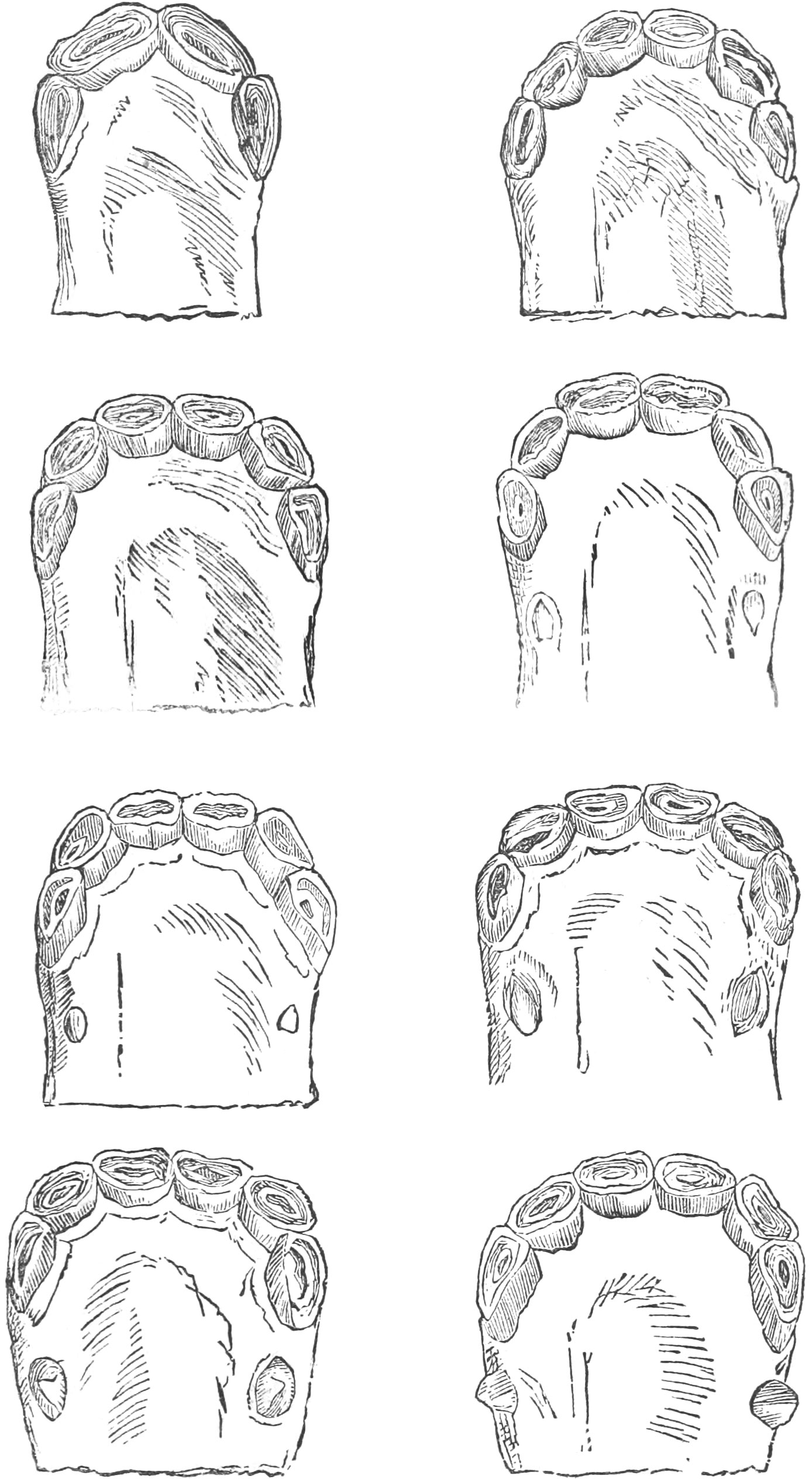
Progression of teeth as a horse ages (left to right, top to bottom)
The foal at birth is usually already furnished with the first and second molars cut through the gum, and in little more than a week shows the two middle nippers or incisor teeth in both jaws, and after five weeks more the two next and also a third grinder: about the eighth month the third pair of incisors above and below are cut, and then the front of the mouth is full. The enamel on these teeth is hard and thick, forming forward a swelling above the edge which remains sharp, and within or behind the edge the surface is depressed and becomes dark, which constitutes the mark or evidence whereby the age of a colt or horse is determined. At the end of a year the fourth grinder appears above and below, and the fifth at the end of the second year, and then the first dentition is complete. When three years old, the central nippers in both jaws make room for a larger pair in each, and are the first of the permanent set; six months after, a second pair extrude the former on each side of the first permanent; and at four and a half the last set will be supplied, all distinctly bearing the mark: at five this mark begins to be effaced by the wearing of the two first pair, and the tushes or cuspidate teeth are exposed, leaving a space between the nippers, and approaching nearer to the grinders; at six years old the central nippers are without a mark, or nearly so: at seven, in the next pair, it likewise disappears; and at eight, all the cutting teeth have lost their black stain and hollow.95
A full grown horse, notwithstanding the different purposes he may be intended for, is required to possess some general qualifications in order to be valuable: the head should be middle sized, well set on, with the branches of the lower jaw sufficiently separated to give the head liberty of action; the eyes large and rather prominent; the ear small, erect, lively; the nostrils open, not fleshy; the neck long, with little curve along the gullet, but arched on the crest; full below, slender near the head; the withers somewhat high, and the shoulder slanting backwards, but more vertical in proportion as the animal is destined for draught; the chest should be capacious, deeper in horses for speed, rounder for others; the arm muscular, the canon bones forward, flat and short; the loins broad and the quarters long; the thigh muscular, the calcis high, and the whole hock well bent under the horse. It is in the structure of the bones of the hind quarters that the principal characteristics of high bred horses are detected, and the straight horizontal line of the croup gives those attached to the pelvis greater length, and consequently greater angles; whence the power of throwing the weight forward is chiefly derived. This explains the cause of the velocity of English thorough bred horses being so superior to those whose croups are round and the tail set on low.
From the different colours of the original stocks, horses are clothed in a greater diversity of liveries than any other animals, cattle and dogs not excepted; they are a natural consequence of interminable crossings of the five great stirpes already mentioned, producing combinations which have caused French and Spanish writers to enumerate above sixty: the piebald and dappled find only their counterparts in the forms and shades of colour in some species of seals, and it is there also we find the light blue greys with brown spots, of which we have examples in the New Forest and in Spain yet excepting the five primitive, all the rest have a tendency to return to them, and sometimes it would seem capriciously to resume the bay, dun, grey, or black.
We have seen the Romans believing in the superior advantages of certain coloured horses in hunting each particular kind of game, over others differing in that particular. The Arabs probably had superstitious notions of the same kind, for Mohammed has shown himself a dupe to these prejudices, and confirmed them among his believers, by asserting “that prosperity is with sorrel horses,” that certain white marks on the head are advantageous, and others, on the legs, signs of ill luck. Although in Europe we are by no means in want of mysteries in the stable, the proverb, that “Every good horse is of a good colour,” is luckily well established; but there was a time, and that even not long since, when similar absurdities were believed and gravely set down by learned writers.
The life of horses extends naturally from twenty-five to thirty }ears; cases have occurred of individuals attaining the age of more than forty; and in countries where they are not tasked by constant over exertion, the period of existence is usually between nineteen and twenty-one. But in England the destruction of these noble animals is excessive: the value of time with a commercial people, incessantly urged into activity both mental and corporeal, has demanded rapidity of communication, and spread an universal taste for going fast; the fine roads have permitted horses to be subjected to more than they can draw; betting, racing, and hunting are pursued by persons whose animals are not constructed for such exertions, and violent usage in grooms, stable-boys, and farm-servants is so common, that few reach the age of fifteen years, and all are truly old at ten. Were statistics directed to the relative length of life of horses between Germany, Belgium, and England, the comparison would show an enormous difference against us, and the mischief can be only partially remedied by an effective society for preventing cruelty to animals; such as we find embodied in the skill of our civil engineers, who have given a regulated velocity to iron surpassing the powers of the whip, and railroads and steam-ships, will effect more for the relief of horses than all the remonstrances of humanity.
In the structure of the horse, mares are always comparatively lower at the withers than geldings or stallions; these last have the neck much fuller than either of the above, their spirit is also much more noisy, and their disposition, when they meet at liberty, exceedingly pugnacious: they are even dangerous when ridden; so that where they are commonly used for the saddle, as, for instance, in India, two horsemen cannot venture to ride side by side without constant attention, and always at some distance asunder. A striking example of the fierceness of stallions occurred, we are informed, during the last war, when the Marquess de la Romana made his celebrated march towards the Baltic, where, by the celerity of the movement, he distanced the pursuing enemies and embarked his corps in transports; the cavalry, mounted on stallions, as is usual in Spain, was obliged to abandon their horses on the beach, where they had just arrived after excessive forced marches, yet no sooner were the horses sensible that they were out of human controul, than rushing together in wild troops, they galloped headlong up and down, and then attacked each other with such fury, that it was believed a great number were killed, and nearly all were rendered useless. The case was very different with the English troop-horses (all geldings) when Sir John Moore’s corps embarked after the battle of Corunna: orders having been issued to shoot them, they witnessing their companions fall one after another, stood trembling with fear, and by their piteous looks seemed to implore mercy from men who had been their riders; till the duty imposed upon the dragoons entrusted with the execution of the order became unbearable, and the men turned away from the task with scalding tears: hence the French obtained a considerable number unhurt, and among them several belonging to officers, who, rather than destroy, had left their faithful chargers with billets attached, recommending them to the kindness of the enemy.96
It is asserted that horses with a broad after-head and the ears far asunder are naturally bolder than those whose head is narrow above the fore-lock; some are certainly more daring by nature than others, and judicious training in most cases makes them sufficiently stanch. Some, habituated to war, will drop their head, pick at grass in the midst of fire, smoke, and the roar of cannon; others never entirely cast off their natural timidity. We have witnessed them groaning, or endeavouring to lie down when they found escape impossible, at the fearful sound of shot, shrapnel-shells, and rockets and it is most painful to witness their look of terror in battle, and groans upon being wounded. Yet many of the terrified animals, when let loose at a charge, dash forward in a kind of desperation that makes it difficult to hold them in hand; and we recollect at a charge, in 1794, when the light dragoon troop-horse was larger than at present, and the French were wretchedly mounted, a party of British bursting through a hostile squadron as they would have passed through a fence of rushes.
Horses have a very good memory; in the darkest nights they will find their way homeward, if they have but once passed over the same road. They remember kind treatment, as was manifest in a charger that had been two years our own; this animal had been left with the army, and was brought back and sold in London: about three years after, we chanced to travel up to town, and at a relay, getting out of the mail, the off-wheel horse attracted our attention, and upon going near to examine it with more care, we found the animal recognizing its former master, and testifying satisfaction by rubbing its head against our clothes, and making every moment a little stamp with the fore-feet, till the coachman asked if the horse was not an acquaintance. We remember a beautiful and most powerful charger belonging to a friend, then a captain in the 14th dragoons, bought by him in Ireland at a comparative low price, on account of an impetuous viciousness, which had cost the life of one or two grooms: the captain97 was a kind of Centaur rider, not to be flung by the most violent efforts, and of a temper for gentleness that would effect a cure, if vice were curable: after some very dangerous combats with his horse, the animal was subdued, and it became so attached, that his master could walk any where with him following like a dog, and even ladies mount him with perfect safety. He rode him during several campaigns in Spain, and on one occasion where, in action, horse and rider came headlong to the ground, the animal making an effort to spring up, placed his fore-foot on the captain’s breast, but immediately withdrawing it, rose without hurting him, or moving, until he was remounted. When we saw him he was already old, but his gentleness remained perfectly unaltered; yet his powers were such, that we witnessed his leaping across a hollow road from bank to bank, a cartway being beneath, and leaping back without apparent effort.
We all know to what extent horses may be educated to perform a variety of tricks, appear dead, simulate fear or rage. There is an instance on record of a rider breaking his leg in a fall, with the limb entangled in the stirrup, and his horse assisting him in getting it out. We see them constantly walk of themselves to their places in the relays of coaches. Their love of a well known home is equally established, there being cases where they have swam broad and rapid rivers to return to it. The Arabs all insist upon the truth, that their horses or mares, when sleeping abroad in the open desert, will wake them on the approach of an enemy or of a beast of prey: their gentleness may be witnessed in the Bedoueen tent, where mare, foal, and children all sleep and play together, without the least fear of accident. The mutual attachment known to subsist between the Northern Germans and their horses, may be ascribed in a great measure to the structure of the farm-houses, where the heads of cattle and horses are turned towards the threshing-floor, at the top of which the family usually resides, and has the kitchen hearth; the animals being able to see all that passes, are more familiarized, and comprehend the doings of human beings better; and these, by being constantly in the presence of the domestic animals, have their eyes upon them, and learn to treat them more with a feeling of companions, than that of brutes, fit only to cudgel and to command with curses.
In submission to a master, the horse is affected by kind treatment almost as much as the dog and elephant; for although habitually his actions show timidity, they are more an effect of good temper than fear, for where severity is unreasonably exercised, obedience readily granted to kind treatment becomes doubtful, and sooner or later breaks out in vicious resentment and opposition: a horse knows his own strength, and oppression has its limits. In emulation to surpass a rival, no more convincing instance can be cited than in the case of a racehorse finding his competitor begin to head him in the course, seizing him by the fore-leg with such firm teeth, that both jockeys were obliged to dismount to part them.98
But the confidence of a horse in a firm rider and his own courage is great, as was conspicuously evinced in the case of an Arab possessed by the late Gen. Sir Robert R. Gillespie, who being present on the race-course of Calcutta, during one of the great Hindu festivals, when several hundred thousand people may be assembled to witness all kinds of shows, was suddenly alarmed by the shrieks of the crowd, and informed that a tiger had escaped from his keepers; the colonel immediately called for his horse, and grasping a boar-spear, which was in the hands of one among the crowd, rode to attack this formidable enemy: the tiger probably was amazed at finding himself in the middle of such a number of shrinking beings, flying from him in all directions, but the moment he perceived Sir Robert, he crouched with the attitude of preparing to spring at him, and that instant the gallant soldier passed his horse in a leap over the tiger’s back, and struck the spear through his spine. The horse was a small grey, afterwards sent home by him a present to the Prince Regent. When Sir Robert fell at the storming of Kalunga, his favourite black charger bred at the Cape of Good Hope, and carried by him to India, was at the sale of his effects competed for by several officers of his division, and finally knocked down to the privates of the 8th dragoons, who contributed their prize-money to the amount of £500 sterling, to retain this commemoration of their late commander. Thus the charger was always led at the head of the regiment on a march, and at the station of Cawnpore was usually indulged with taking his ancient post at the colour-stand, where the salute of passing squadrons was given at drill and on reviews. When the regiment was ordered home, the funds of the privates running low, he was bought for the same sum by a relative of ours, who provided funds and a paddock for him, where he might end his days in comfort; but when the corps had marched, and the sound of trumpet had departed, he refused to eat, and on the first opportunity, being led out to exercise, he broke from his groom, and galloping to his ancient station on the parade, after neighing aloud, dropped down and died.
All these intellectual and moral qualities vary in horses as much as the physical; for spirit and daring is not more universal than timidity and cowardice; memory, prudence, aptitude in some, heedlessness, stupidity, and obstinacy in others. These distinctions are not always individual, but commonly generical, and propagated with the other character of races and breeds, enter in the composition of the original forms of each stock; and it will be found in treating of them, that the most beautiful and noble is also the most gentle and most educated.
Anecdotes replete with interest might be compiled on the subject of the horse, sufficient to fill volumes, but they are more the theme of sporting works than fit for Natural History, where they are only proper as examples to illustrate facts.
We shall now proceed to give a summary of the principal breeds of horses, such as they are known at present to be established in different parts of the world, entering occasionally into details, where the race under consideration demands more particular notice.
Races and Breeds of Domestic Horses
From the tenor of the foregoing pages, it is a natural consequence to treat of the races of horses in accordance with the views therein expressed; consequently, while we keep their original stock as a guiding mark, we shall endeavour to class them according as they are known, or appear to belong to one or the other of their more primitive forms the bay, the grey, the dun, the sooty or black, and the piebald. Although, through constant intermixture and the lapse of ages, it might be expected there would be no sufficient traces to mark them out, we shall find, with due allowance for the effect of such powerful agents, that they are still in general sufficiently distinct, even in countries where great races of different origin exist, as is quite obvious in Great Britain, where we have at least three that still retain their pristine characteristics. Some there will be found of unascertainable origin, but when they are likewise considered in the geographical spaces they occupy, and with relation to the nations that have traversed them, or still reside within their limits, we shall at least have approximating data for our purpose. Beginning with the most ancient domesticated race of Western Asia and Egypt, we find
The Bay Stock
which, celebrated in early antiquity, and then unnoticed for some ages, recovered its pristine celebrity from the date of the hegira, and with the Islam conquests spread again towards the east till it reached the Bramaputra; came westward through Barbary to Spain; is now established in England in South and North America; and is fast rising into importance in Australia. Like the Caucassian race of man, it is the variety of horse which gradually either obliterates all the others or assumes an indisputable pre-eminence, for from that source the most beautiful and the best horses in existence are derived. Although the stock is reared into its superior characteristics by education and human intervention, it seems more naturally confined in pre-eminence within the twentieth and thirty-sixth degrees of northern latitude, and from the fifth to the sixtieth of east longitude, where the thermometer is seldom below 50 in the night, or 80 in the day, though often as high as 120 of Fahrenheit. This stock has a black or slate-coloured hide, darkest in the white or grey varieties; the ears are small, the forehead broad and flat, the limbs always light, and the mane and tail not superabundant. Its ancient history we have already sufficiently noticed to the period of the Arabian conquests, and now have to enter more particularly on a few details on the present condition of
The Arabian Race
It is the most artificial, the first of high-bred horses, and the parent of the noblest breeds in every part of the world: a race of great intermixture, but for ages in the care of attentive and skilful breeders, and under the influence of circumstances favourable to the attainment of the greatest perfection. Although the bay colour, of all others, seems the most inclined to pass into albinism, yet there are traces that the white or rather grey race was early and largely mixed with it; for it is in those two that the dappled or pommeled marks peculiar to horses are alone perceptible; and admitting the high irritability of their intellectual instincts, which clearly affect the markings upon horses, it does not appear that real changes of colour can be ascribed to a different cause than what results from inter-union with different and other forms or races.99 In this view the Arabian blood is much mixed, for we find reckoned in the colours of the race: ahmar, or clear bay; adhem, brown bay; ashekwar, sorrel; abiad, white; azrek, pure grey; raktha, mottle grey; akdar, blue grey; udhem, black brown; ulmar muruk, dark chestnut; and Mohammed himself mentions aswad, or black, which, however, is not recognised, nor ashebad, light chestnut, as real Arabian colours. Green, indeed, occurs in the national writers, which seems to denote what we call sallow, but it does not appear that there is any breed of the kind, or it is an occasional kadeschi. It is evident the whole of the true Arabian horses are referrible to the bay and the grey, with perhaps a slight addition of a Toorkee black race. The perfection of the bay blood is no doubt due to the Arabs, and particularly to the period when their princes, in the career of conquest, became more enlightened, sagacious, and wealthy than they could have been while they were the mere tenants of their tents. Even now, when for some centuries they have continued to breed, nearly without exception, from their own perfected studs, they produce horses unequalled in form, with fine bone, firm horny legs, limbs small yet hard, muscle sinewy and elastic, and all the parts free from vascular superabundance and unnecessary weight; though the breast may be deemed narrow, the barrel expands, the head, small and square, is admirably placed, the eyes large and brilliant, the ears small and pointed, and the tail well set on; even the prominence of the blood-vessels beneath the skin attest high breeding; and although the Arab is rather small and English horses are decidedly fleeter, none are more graceful, more enduring, or fitter for war and privation. It may be doubted whether these noble races are not now in a state of gradual decline in their native country, but all have been and still are subjected to the same vigilant system of care and to the conditions of life inseparable from the climate and barren soil of the regions where they flourish; they have been educated in the society of man, used to artificial food not intended for them by nature, such as camels’ milk and bruised dates; inured to sobriety, even in the quantity of water; but watched, protected, and caressed by a people imperatively called upon to consider them as the only source of riches, the chief agent of national glory, the principal companion in daily enjoyments, and the sole instrument of independence. Hence the most hardy breeds are precisely those of the wandering tribes, and also the most docile, because, while the mares have young foals, they partake of the comforts of the tent, and horses are always treated with affection; excepting when the first great trial of their capabilities is made; then, indeed, the treatment the young animal suffers is more severe than any horse is liable to in Europe: for, being led out, as yet totally unconscious of a rider, the owner springs on its back and starts off at a gallop, pushed to the highest speed, across plains and rocks, for fifty or sixty miles without drawing bit; then, before dismounting, he plunges into deep water with his horse, and, on returning to land, offers it food; judgment of its qualities depending upon the animal immediately beginning to eat. This treatment is more particularly inflicted upon fillies, because the Bedouin rides for his own use only mares, who are in truth more patient and durable than stallions, and never betray the marauder by neighing; whereas, if stallions are present, this certainly occurs, and therefore these are kept for breeding, sold at high prices, or used by grandees and chiefs who reside in fixed habitations and towns.
Habitually in company with mankind, all the Arabian breeds become exceedingly gentle and intelligent; a look or a gesture is sufficient to make them stop, take up with their teeth the rider’s jereed or any other object he may have dropped, stand by him if he has fallen off their backs, come to his call, and fight resolutely in his defence; even if he be sleeping, they will rouse him in cases of danger. Kindness and forbearance towards animals is inculcated by the Koran and practised by all Mussulmen, to the shame of Christians, who often do not think this a part of human duty; and as a Moor well known in London sneeringly remarked to ourselves, “It is not in your Book!”
As the Arabian blood is now extended, we must take in some measure the whole of South-western Asia and the northern half of Africa, as within its limits, and refer to the local reports of the comparative qualities of the principal breeds, as they are estimated to depend upon native countries. In this view, the Nejed claims the noblest; Hedjas, the handsomest; Yemen, the most durable; Syria, the richest in colour; Mesopotamia, the gentlest; Egypt, the swiftest; Barbary, the most prolific; and Persia and Koordistan, the most warlike. We have here at least the general claim of this extended geographical range for Arabian horses maintained as it was more anciently, when they were called Persian or Egyptian.
There is apparently some confusion in the accounts of travellers in the collective denomination of Kohayl and Kochlani given to horses by the Arabs, the last mentioned being only a slight mutation of one of the many names of the Kulan, w41d ass, or rather the Ghurkhar, shows probably the origin of the mistake about wild horses being found in Arabia, and also the probability that the two animals just mentioned are not considered to be identical by the Arabs.
The term Kohayl, or Kohelga, embraces collectively the races denominated Attechi, not much valued, and said to be occasionally feral; next the Kadeschi, or horses of improved blood; and last, the Kochlani, whose genealogy, is kept with rigorous care; their descent from high-bred studs being capable of proof for many generations, and claiming, in oriental grandiloquence, a lineal ancestry to the time of King Solomon, and even older. There are, however, different opinions expressed by native writers on this head: one asserts the highest breed proceeds from the stallion Zad-el-rakeb and the mare Sherdat Shekban, both the property of Muthaym ibn Oshaim, chief of the primitive Arabian tribe of Yemen: others that Mashour, stallion of Okrar, chief of the Beni Obeide, was sire of the noblest breeds; while the more pious Arabs claim the five most renowned races for lineal descendants of Rhabda, Noorna, Waya, Sabha, and Hesma, the five favourite mares of their prophet. There can be no doubt that Mohammed, although no connoisseur, was well mounted; and it would not have been a token of great fanaticism in his followers to value descendants from his stud.100 It is likely, therefore, that some truth may be attached to the claim; but at present the five recognised great races are denominated Tauwejce, Monakye, Kohayl, Saklawye, and Gulfe or Julfa: the names of studs derived from the two first mentioned we have not found detailed, but the third or Kohayl reckon among others of renown the Aguz, Kerda, Sheikha, Dubbah ibn Kurysha, Kumeyseh, and Abu Moaraff: the Saklawye have the Jedran, Abriyeh, and Nemh el Subh; and the Julfa has the Estemblath. There are, besides, breeds of inferior consideration, such as the Henaydi, Abu Arkab, Abayan, Sheraki, Shueyraan, Hadaba, Wedna, Medhemeh, Khabithn, Omeriah, and Sadathukan. Indeed, an old Arabic MS. enumerates one hundred and thirty-six breeds of Arabia, three Persian, nine Turkoman, and seven Koordish; and mentions the Safened race to have been presented by the Queen of Sheba to Solomon, which is at least a proof that it is of very ancient estimation.101 But it is evident, from the somewhat conflicting claims of superiority concerning the several breeds, that European statements depend upon authorities varying according to the tribe or the part of the country where they have been obtained, or purchased horses; we have, as such, the first Arabian of the Monaki breed sent to England by Mr. Usgate, British consul at Acre, who in 1722 produced with the animal an affidavit of pedigree regularly attested before the Kadi. M. Rosetti claims the very first rank for the Saklawye race, distinguished for very long necks and brilliant eyes. Count Rzewusky vaunts the Kohlan as the first breed, which seems merely to assert that thorough bred horses are the best; for by Kochlani others understand the first class of horses collectively, including many breeds: the Count, however, purchased three animals of this class, and vouches for the wonderful properties ascribed to them: temper, faithfulness, sagacity, courage, fierceness, &c.; he affects even to believe that they know when they are sold, not granting implicit obedience until they have been duly transferred with the presentation of bread and salt to a new master. There are among those studs many whose pedigrees ascend through numerous generations of the noblest blood, perfectly well attested; and some even, it is asserted, to a period of four hundred years. In the market there are, however, only stallions; mares they justly regard as of greater importance in breeding than is thought in Europe, and therefore it is held so unlawful to part with any, that very rarely they can be obtained by purchase. It is even considered a crime to sell one under any circumstances; and in proof of the resolute opposition to the practice, we were assured of a case that lately occurred in Calcutta, where some Arabian dealers had sold their horses, and in consequence of a heavy bribe one was induced to part with his mare. Some weeks after, when the dealers had already gone homeward, the senior of the party was observed to have returned to the city, a distance of several hundred miles; he lurked about for some days; subsequently it was discovered that he had inquired for the stables where the mare was kept:—she was found poisoned, and he had disappeared!
Towards the end of the last century, full-grown unblemished stallions of the several breeds stood somewhat in the following ratio of value:—The Oel-Nagdi, reared in the vicinity of Bussora, beautiful, docile, and swift, either dark bay or dapple grey, and remarkable for attachment to their owners, stood foremost in estimation, and were valued at eight thousand piastres: a mare sold at Acre for the enormous sum of fifteen thousand piastres.
The Guelfe, originally from Yemen, patient, indefatigable, and gentle, were held to be most valuable, selling at four thousand piastres.
The Saklawye, bred in the Eastern desert, with more speed and hardier constitutions, were of the same price.102
The Oel-Mefki of the Damascus district, stately and superb in aspect, but less durable, were estimated at three thousand piastres, and chiefly used by the Turkish grandees.
The Oel-Sabi resemble the last mentioned, but are not so highly valued, their price ranging between twelve hundred and two thousand piastres.
The Oel-Tredi are very handsome, but with less courage, more inclined to restiveness, and hence might be obtained for nine hundred or a thousand piastres.
The Monaki and Shaduhi of Yemen, belonging to the Mohammedad tribe, are still in very high estimation. The Roswallas likewise possess most numerous herds of beautiful horses, and the powerful tribe of Benilam are now in possession of the Ghilan pastures, as well as of those in Shuster, where the ancient studs of Nisa and Susa were reared for the Persian kings. Mr. Bruce adds the Moualis, south of Palmyra and Damascus, where the studs are of similar ancient renown.
The Kochlani, or superior breed, appear to be reared more generally in the deserts than in the more fixed abodes of the Arabian nation; it being evident elsewhere also, that horses acquire the most valued qualities by living in dry wildernesses and on scanty vegetation: every where the present Asiatic races are traceable to these nurseries, and the Arabs have extended their selection of this kind of residence far beyond their own frontiers. At this moment, their Negeddy breed of Sannaa, which we take to be a part of the Najd of Arabia Felix, is in part stationed to the east of the Indus, in the well known desert of that region.
Prince P. Muskau differs in many particulars with the foregoing statement, and it may be observed every writer on the subject of Arabian horses seems to generalize the information he has obtained in a particular quarter as applicable to the whole; the Prince believes that to the first rank belongs two races:
The real Nedschdis; that is to say, those bred in the province of that name, from whence all the noblest blood has been derived; it forms five—
- Sada-Tokan;
- Touesse-al-Hamie;
- Shouahi-em-Anlioub;
- Hamdanye-Symra;
- Souat-hije-aedem-Sachra;
the first of these names records that of the mare, the second gives the proprietors.
The second is the race of Kaehel (we take to be the same as the Koheyl and Kaylan already mentioned); of this the Prince knows only four studs—
- Kaehel-el-Adschroass;
- Kaehel-Moussoumé;
- Kaehel-Moussalsal;
- Kaehel-Wednan;
all chiefly found on the desert between Bassora and Bagdad. He states that a Nedschi presented to Abbas Pacha was above eighteen years old, and yet valued at £400 sterling; and moreover, that he could find no traces of the genealogies of blood-horses pretended to be preserved by the Arabs, but that they are fabricated in towns, if the purchaser demands them.
The Arab of the desert is content to know the dam and sire of the colt, and to rely on the care that every one takes of the purity of race.
Of the Emir Bechir’s stud he speaks with contempt, though we can hardly believe the old man of the mountain could have given cause for it to one so profoundly read in men and horses.
Although the Arabian steed may not be acknowledged by amateurs of exceeding fast going, as perfect in form, no race is possessed of a more beautiful head, for above the eyes it is squarer and below the nose is plane and more tapering than any other; the muzzle being fine, short, and adorned with wide and delicate nostrils; the eyes are very prominent, large, and brilliant; the ears small, pointed, moveable; the jaws and cheeks adorned with minute swelling veins; the head is well set on the neck, which arches gracefully and is bedecked with a fine but rather deficient mane; the withers are high; the shoulders inclining and beautifully adjusted; the chest and body perhaps not sufficiently ample, but yet spreading out behind the arms to give room for action to the lungs and heart, which are in proportion larger than in any other kind of horse; the limbs are remarkably fine, sinewy, and firmly jointed; the legs flat and clean, with pasterns rather long and flexible, so that with an oblique position they appear to the heavier European not quite so strong as is desirable; but considering that in stature these horses do not often exceed fourteen hands and three-quarters, it is evident from the length of time they will carry a rider at great speed, and under great restriction of food, and the number of years they endure, that for their climate at least they are fully competent to accomplish all that is desirable, and even execute tasks which are not always believed of them. The quarters of an Arab are deep, the muscles of the fore-arm and thigh prominent; the tail set on high, with a middling proportion of sweeping hair; the skin on all parts of the body thin, presenting veins above the surface and the hoofs, rather high, are hard and tough.
From the broad forehead and space between the ears, judges assert their greater courage and intelligence, which, aided by education and kind treatment, they certainly possess beyond all other horses and in temper and docility, none can be compared to them.
For sobriety, these horses are equally notorious the Arab of the desert allowing his mare only two meals in twenty-four hours: she is kept fastened near the entrance of the tent, ready saddled for mounting in a moment, or turned out to ramble around it, confident in her training, that on the first call she will gallop up to be bridled. She receives only a scanty supply of water at night, and five or six pounds of barley or beans with a little chopped straw, and then she lies down contented in the midst of her master’s family; often with children sleeping on her neck, or lying between her feet; no danger to any being apprehended or experienced: in the morning, if not immediately wanted, another feed, and on some occasions a few dates and camels’ milk are given, particularly where water is very scarce and there is no green herbage whatever, or during an expedition which admits of little or no respite. Camels’ milk is almost the only nutriment of foals, who for that purpose are seen trotting free by the side of the camels, and every now and then thrusting their noses to get hold of the nurse’s udder; being treated by them with the same fondness as if they were their own young. Hence there is friendship instead of enmity between the two species of animals, and the facts alluded to by Herodotus and Xenophon, Aristotle and Pliny, respecting the repugnance of one for the other, show that in the age of Cyrus and the Persian invasions of Greece, the Arabs had not yet established their own breeds according to the system which the nature of the soil rendered unavoidable. The Bedoueen mares, under this mode of training, will travel fifty miles without stopping; and they have been known to go one hundred and twenty miles on emergencies, with hardly a respite, and no food. In the newspapers, there was lately an account of a bet against time, won by an Arab horse, at Bangalore, in the presidency of Madras, running four hundred miles in the space of four consecutive days. This exploit occurred on the 27th July, 1840.
This power is further evinced in the relation of Mr. Frazer,103 who states that Aga Bahram’s Arab horse went from Shirauz to Teheraun, 522 miles, in six days, remained three to rest, went back in five days, remained nine at Shirauz, and returned again to Teheraun in seven days. The same officer related that he once rode another horse of his from Teheraun to Koom, twenty-four fursuks, or about eighty-four miles, starting at dawn in the morning, near the vernal equinox, and arriving two hours before sunset; that is, in about ten hours. The author observes:
but Aga Bahram had always the best horses in Persia.
When, therefore, we take together all the qualities of the Arabian horse, and compare them with other races, we may find some of greater single powers, but none endowed with so many to endear, to admire, or to use; and this opinion we are warranted in passing, since neither Asia nor Europe can boast of a breed in all or in some respects superior or equal, that is not mainly indebted to the Arabian blood for the estimation it has obtained. But it is doubtful whether the great qualities of these animals are not now rapidly on the decline, the wants and expectations of the people evidently taking a new direction. Numerous anecdotes might be here inserted relating to these horses, but as they occur mostly in books deservedly popular, we would repeat only what is familiar to most readers.

Plate VIII
Of the bay stock, but already distinguished before the Arab was extolled, is
The Barb of Morocco
Ancient and renowned, but nevertheless greatly improved since the conquests of the Moslem, and therefore in every respect the nearest ally in blood, and superior in some qualities. The climate and soil of that empire might indeed sustain an enormous number of horses such as the best among them are; but that under a government, where property is insecure, there is not sufficient inducement for breeders to bestow the same unremitting attention upon them for a succession of generations, as among the free Arabs, and hence the Moors do not produce pedigrees of horses equally valued with those from the East. In the Barbary states, the bay stock race, with its accompanying greys, once the only colours of horses, is now found to contain a proportion of black, with full manes and tails; attesting a northern infusion of more recent date than the Roman empire, and, it may be surmised, introduced by the Vandal conquerors of Africa. There are golden or light chestnuts, which likewise constitute a proportion of the ancient northern breeds, and were much used by the Alans.
Barbary horses, particularly from Morocco, Fez, and the interior of Tripoli, are reported to be remarkably fine and graceful in their action, but somewhat lower than Arab, seldom being more than fourteen hands and one inch high, with flat shoulders, round chest, joints inclined to be long, and the head particularly beautiful. They are claimed by some as superior to the Arab in form, but inferior in spirit, speed, and countenance. A French traveller describes them to be in wretched condition, neglected, and not to be compared with them. Recent authors state the Godolphin Arabian to have been a Barb; but in a manuscript note, we find this celebrated horse claimed as one of the Guelfe blood of Yemen, which his form of head, neck, and mane seemed to confirm: thus, although in England several thorough-bred mares and stallions have been imported from the Barbary coast, there was no account containing much personal observation respecting them in their own country, until Mr. Washington, a lieutenant in the royal navy, communicated a paper to the Geographical Society, relative to a tour through Morocco, and the unfortunate Mr. Davidsons papers gave more satisfactory intelligence on the subject. The first mentioned gentleman often observed in Barbary, horses that were of great beauty, with more power than the Andalusian, having a long striding walk, not slipping in the quarters, and galloping with great surety of foot over rough ground, while hunting wild boar and gazelle. According to him, they stand from fourteen to fifteen hands in height, are of every colour, but the black and chestnut are considered the best bred: their full flowing manes are never docked, though in youth it is a practice to shave the tail, probably to obtain a more abundant growth of hair; hence two feet and a half of mane, and a tail sweeping the ground, is not rare. The Moors do not ride mares, nor mount horses under four years old.
On a journey, the Barb starts unfed and without water; at the end of his day’s work, he is picqueted, unbridled, never unsaddled; he then receives as much water as he will drink, then barley and broken straw is thrown before him as far as he can stretch his neck; hence he rarely or never lies down, nor gets sleep, and yet he is high spirited. Broken wind is rare, but tender feet and shaken in the shoulder from the abuse of the bit and sudden stopping in a gallop, are not unfrequent. In the interior of Morocco, a good horse may be obtained for a hundred Spanish dollars, or about £20 sterling, but not readily, and to export one requires an order from government. In the province of Ducaila, the breed is of high reputation.
Some years ago we were informed by a Moorish gentleman that the Emperor had made a cross breed with his finest mares and a giant black stallion sent from Eno-land, we think the horse above eighteen hands high which was exhibited in London, and that he had succeeded in rearing several splendid black horses from it, which were the wonder of his countrymen. Here we have an actual instance of introducing a cross of the black race with the Arab stock, already partially mixed at a former period with the same blood, and the black so called Arabian horses in England are very likely real Barbs.
On the sandy plains, south of Atlas, are
The Shrubat-Ur-Reech
or drinkers of the wind, reared by the Mograbins of the West; they are brown or grey, rather low, shaped like greyhounds, destitute of flesh, or, as Mr. Davidson terms it, like a bag of bones; but their spirit is high and endurance of fatigue prodigious. On an occasion where the chief of a tribe, where he sojourned, was robbed of a favourite and fleet animal of this race, the camp went out in pursuit eight hours after the theft; at night, though the animal was not yet recovered, it was already ascertained that the Daman pursuers had headed his track and would secure him before morning. The messenger who returned with the intelligence had ridden sixty miles in the withering heat of the desert, without drawing bit. These horses, according to Marmol, are not mounted till they are seven years old, and until then are allowed to follow the she-camels, whose udders they suck for a long time. From the information which Mr. Davidson received when he viewed one at the imperial stables of Morocco, and afterwards while he had daily opportunity of seeing them in their own region, it appears they are fed only once in three days, when they receive a large jar of camels’ milk as their only food; but it is known that they have sometimes a handful of crushed dates: yet with such scanty sustenance, by nature not intended for horses, they retain a vigour which their real food would not bestow upon them, and hunt the ostrich with unceasing speed.

Plate XI
The Bornou Race
found more towards the centre of Northern Africa, is extolled by Mr. Tully as possessed of the qualities of the Arabian and the beauty of the Barb. An individual of this, or perhaps of the Dongola race, which we have seen and sketched, was full fifteen hands high, and in proportion short of body; the head was not set on gracefully, nor the eyes sufficiently large; his back was carped, with flat quarters and flanks; the tail set on rather low, but the shoulder fine, the upper arm the most robust possible, and the limbs and feet beautiful. He came to England from the Gambia, was greyish white in colour, with black limbs, and so vicious that the owner at length broke his neck, at the risk of losing his own life.
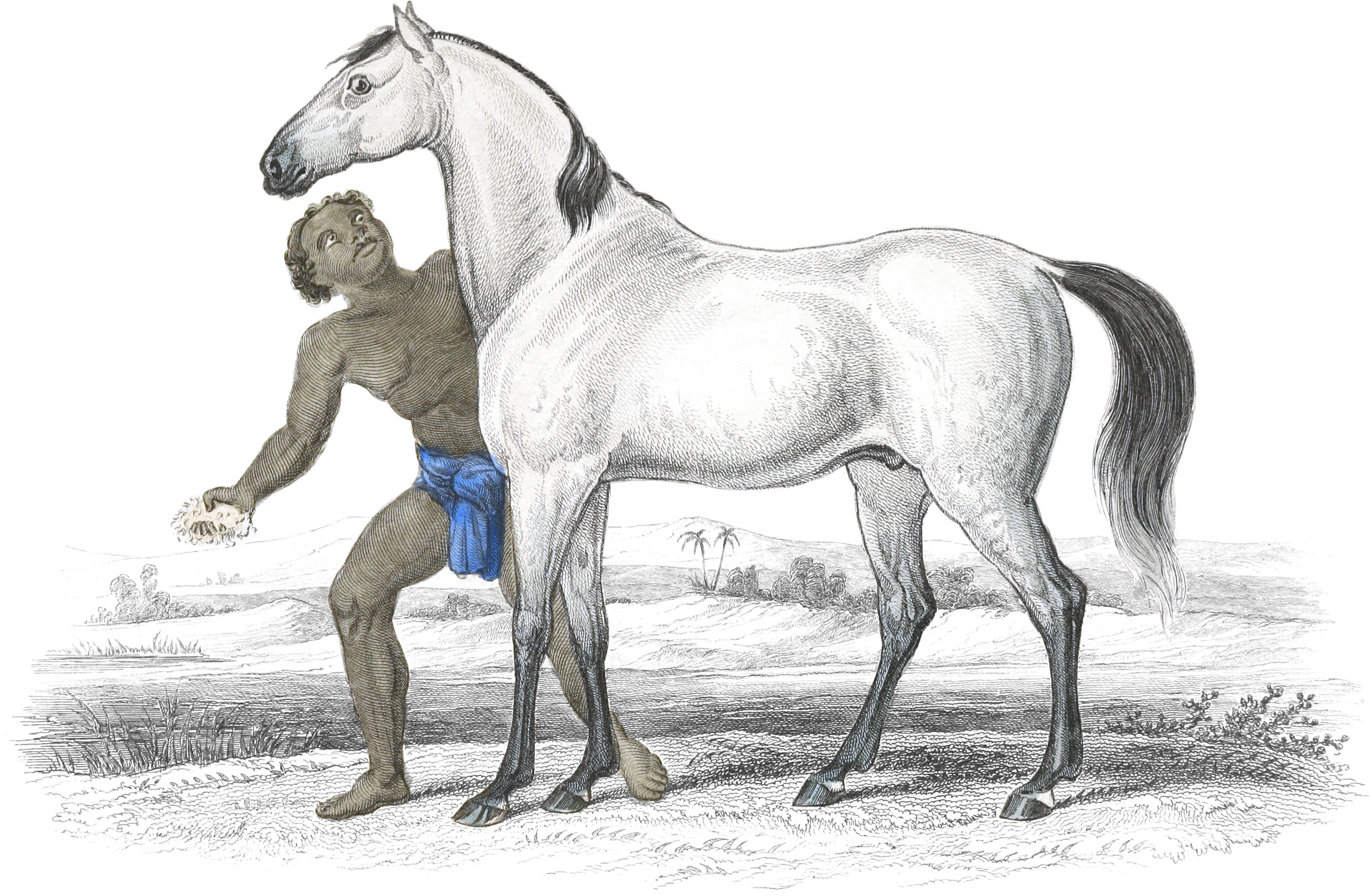
Plate X
The Dongola Race
Nubia possesses horses, considered by Mr. Bruce as far superior to the Arab, though not of African origin, but introduced at the time of the Mohammedan conquest, and pretended to be descended from the five horses ridden by the prophet, his companions Abubekr, Omar, Atman, and Ali, on the night of the hegira, when they fled together from Mecca! But among them, perhaps Atman must have been some believer of Turkoman or of Genseric’s blood, since the cast of horses in Dongola is often black, of a stature rising above sixteen hands, with ample manes and tails. They are found at Alfaia, Gerri, and Dongola, where the sandy desert produces scarcely any pasturage, and that only consisting in roots more than leaf. With forms already noticed in the Bornou breed, and differing in proportion from the Arab, they are nevertheless remarkably handsome, tall, powerful, and active very supple, capable of great fatigue, docile, and attached to their masters. Mr. Bruce estimated the weight carried by the charger of the Prince, when he and his horse were accoutred in full armour, at no less than three hundred pounds. Those of Alfaia and Gerri are not so large as the Dongolese; their usual colours are bay, black, and white, not grey, and never dappled. Stallions only are ridden, and they are fed with dourra (Holcus durra, Lin.), which is very nutritious, and with roots well washed and dried before they are offered as fodder. They feed and drink saddled and bridled, with a kind of snaffle, and they are secured by means of a cotton rope attached to the fore-foot.
Mr. Hoskins the most recent traveller who describes this race, says that the black are the finest they have all white legs, sometimes the white extends over the thighs, and occasionally over the belly; they are not light, slender horses, but more remarkable for their strength; but they have all rather upright pasterns. They are now rare even in Ethiopia, where they fetch from £50 to £150 sterling. From these details it might be surmised that they descend from the Tahtar Katschentzi race we shall notice in the sequel. From their speed, size, and durability, they constitute excellent war horses one of them was sold at Cairo, in 1816, for a sum equivalent to £1000 sterling; several have since been imported into Europe, where they do not appear to have obtained great consideration, because they are not so fleet as Arabs, and consequently unable to compete with English racers, but they might be used to great advantage in forming a superior breed of cavalry horses by crossing with three-part bred mares.104
In Abyssinia the horses are of the Arabian stock, but seldom of any real value, a fact the more remarkable, as pasturage is abundant and very fine, and the pure air of mountain regions breeds, in all parts of the northern hemisphere, small horses at least of great vigour; but the bay stock is no where a mountain race.
The Bedoueens, as far as the deserts of Ludamar, on the borders of Kaarta, are remarkably well mounted; and good horses of the bay race are found among the Soolimas and Begharmis. Even further on towards the equator, those of the Moors frequenting the gum-forests towards the Gambia, and of the Foulahs, and in Cashna on the north of the Niger, they are obtained from Fez and Bomou; but from the Guinea coast they become more and more weak, unsafe, and untractable; nor does it appear that the Portuguese colony of Angola, to the south of the line, is possessed of any worth recording.
At the Cape of Good Hope, the horses are of a mixed breed of the black Dutch and Arabian Kadeschi; they are not larger than the Arab, but show also that the northern black offer an improving mixture, for the best Cape horses are generally of that colour. Sir Robert R. Gillespie’s favourite charger, already mentioned, was of this race.

Plate X*
Turning to the north and east of Arabia, we first meet with
The Turkish Race
of horses, proceeding from the old Armenian and Western Asiatic brown, but now principally composed of Arab blood, belongs chiefly to Natolia, and only in part to Roumelia in Europe. The Turks cannot be said strictly to possess permanent breeds of horses, with distinct names of established celebrity; they are purchased, or more generally the result of individual amateurship and caprice in wealthy persons. They derive their blood almost wholly from some imported Arabian, and are much in the care of Arab grooms; hence they possess all the gentleness and acquirements of the parent race, all and even more beauty, but want their vigour and durability. They have, from the ancient Turkoman blood, a tendency to Roman-nosed chaffrons and ewe necks, but the head is finely set on; they are delicate, have very tender and irritable skins, making it necessary to use the brush and sponge alone in cleaning them; but also they are docile and graceful like gazelles. We made a sketch of one that had been sent a present by the Sultan, which walked and moved with inimitable elegance, had a head and swan-like neck, slender limbs, springing pasterns, and high hoofs, fit only to carry a lady, but, notwithstanding, possessed of fire and speed whenever the rider pleased.
Turkish horses have contributed materially in the improvement of the older English breed. Queen Elizabeth had one purchased for her by Sir Thomas Gresham, and the Byerly and Lister Turks are well known to all who interest themselves in the pedigrees of our best blood-horses.
The rest of Turkish horses are neglected remains of the more ancient breeds,—Tahtar, Hungarian, Wallachian, and lowest class of Arabians. They are fed at sunrise and sunset, and watered at the same time, contrary to the Persian mode, who do not let them drink till an hour after.
The Persian
If we were to judge from ancient sculptures, the Persian horses of antiquity were as heavy as the present Flemish cart-horses; for mail-clad riders and horse armour rendered bone necessary. In the great wars of the fifteenth and sixteenth centuries, the superiority of the Persian horse over the Turkish was still chiefly owing to their greater bone enabling them to bear armour on man and beast, while the Turks had no other defence than a shield; but at present the form of the animal is much altered. Like the Turkish, it consists, in their mutually bordering provinces, of pure Arabians, already mentioned; but, further east, is more intermixed with the residue of the ancient breeds and later Turkoman importations. Persian horses seldom exceed fourteen hands and a half, have the neck slender, often a little ewe-like, the ears handsome, the chest narrow, the legs fine, the hoofs hard, and the croup well turned. The nobler studs have the head somewhat larger, but nearly as beautiful as the Arabian the frame is more developed, and their spirit is warlike. From the speed of chuppers, or express messengers, we know their endurance of fatigue. Major Keppel mentions one of these riding expresses, who passed him between Kermanshaw and Haroadan, one hundred and twenty miles distant from each other, in a stony mountainous country, who performed that route on one horse (and of course a common horse) in little more than twenty-four hours, and next morning went on upon the same for Teheran, two hundred miles further, expecting to reach it on the second day. Indeed chuppers, unlike Turkish Tahtars, seldom change horses; they go on at a steady ambling pace of four or five miles an hour, and some have gone from Teheran to Bushire, seven hundred miles, in ten days.
These instances are sufficient to prove the enduring power of the Persian horses, even of inferior studs, and the adventurous riding of the native sportsmen, as acknowledged by British gentlemen well acquainted with fox-hunting, evidently proves their sure-footedness, in the daring way the riders gallop down the steepest and most rugged hills. They are usually fed and watered an hour after sunrise, and again at sunset, when they are rubbed down and brushed; their barley or rice, and chopped straw or chaff, is put in a nose-bag hung from their heads, if they are at the picquet but in the stable it is placed into a lozenge-shaped hole made in the mud-wall for that purpose, but higher than European mangers, and thence the animal draws it at his leisure. Hay is unknown in the East: horse-litter, in Persia, consists of the dung reduced to powder and daily dried in the sun. They wear nummuds, or clothes, for winter and summer, which reach from head to tail, and are secured by surcingles.
In the day-time they are kept under the shade of trees or awnings, and at night placed in court-yards, with their heads secured to double ropes from the halters, and the heels of the hind feet strapped to cords of twisted hair, which are fastened to rings and pegs driven in the ground behind them; a custom likewise in vogue in India, and known in the time of Xenophon. These precautions are necessary to prevent their fighting; for this purpose stable-boys and grooms constantly sleep near them, and notwithstanding all the care they can take, some occasionally get loose, and then an uproar and battle ensues before they can be separated, such as is not to be remedied without damage to the horses and danger to the men. The pugnacity of stallions, indeed, extends to all occasions where opportunity is given them, and in feuds of different tribes, no skirmish takes place between the riders without their horses taking part and endeavouring to paw and bite each other with consummate fury.
The Persian nobility have horse races, constituting more properly trials of bottom than speed for the distance they are made to run is not less than about twenty-four miles, and to effect this with tolerable speed the animals are put in training, particularly by sweating them down to mere skeletons, and making them go over the ground repeatedly before the day of trial. In breaking horses for the saddle, their walk is first taught to be made into long strides, and the next qualification consists in darting off at full gallop, and the best in the practice who possess likewise speed are emphatically called baad-pee, or wind-heeled.
Among the more noted are
The Kauserooni breed, obtained by crossing the Arab and Turkoman races, and maybe the same as the Koordy. It is from this the best roadsters are derived, combining the speed of the one with the strength of the other, but not in an equal degree.
The Erscheck breed, from the vicinity of Ardebil, is in repute for beauty; and those of Shirvan, Karabag, and Mokan, where there are good pastures, are extolled. The sovereigns of the Sefi dynasty likewise maintained brood mares on the Tzikziki hills, between Sultanieh and Casvin.
The Ishepatan breed is now principally within the Russian frontier, and numbered in the table of brandmarks furnished by Pallas, where he notices no less than fifty-six Circassian and Abassian breeds of great Kaharda, among which that of Shalokh, in possession of the Tau Sultan family, is of the highest reputation. All of these are of breeding studs belonging to the nobles, each having a peculiar mark branded on the buttock or shoulder, with scrupulous attention to authenticity; a misapplication thereof being considered the same as a forgery.
We have seen, among the Cossack officers, very handsome chestnuts of Circassian race, in size equal to English horses, but they appeared to be less firmly jointed; and this deficiency seems to be general, since, in a noted trial of speed and endurance between Sharper and Mina, two first-rate English blood-horses, and the best bred animals picked for the purpose among the Don, the Black Sea, and the Ural Cossacks, which occurred in 1825; they were to run to the cruel distance of forty-seven miles, and although both the English had gone out of the course uphill for above two miles, yet Sharper was winner by eight minutes, running the whole distance in two hours and forty-eight minutes, carrying three stone more than his best opponent, leaving him to be warped in without a saddle, and having only a child on the back, with two horsemen holding him up on both sides, and other men dragging at his head with a rope!
The horses of the vicinity of Caucasus, both to the north and south, are, however, more particularly of the ancient dappled and grey stock, now gradually merging into the bay, but still numerous; in some pastures predominant, and both in Persia and India, on gala days, often beautified by having their manes, tails, and sometimes parts of the body, stained with a crimson or an orange dye. There is also, on the coast of the Persian Gulf, the Musjeed breed of white horses, naturally speckled with deep brown or black, known early in the middle ages, and then considered as the most eligible of all parade horses.105 White horses are likewise artificially stained with small spots of black, orange, or even crimson; their name may have some connexion with the use they are principally put to, namely, to be ridden in parade to the mosque, &c.
The Tookree Races
also named Turkoman and Toorkoraan, so far as they are mainly indebted for beauty and speed to the Arabian stock, should be separated from the original unimproved breeds of the nation which extends to the north of the Syr-deriah or Jaxartes and the Sea of Aral; these waters forming a line of separation from west to east to the Kiptchak mountains. On the south of this line we find horses strong and bony, larger than the Persian, standing fifteen or sixteen hands high, capable of immense fatigue and privation. Some are said to have travelled nine hundred miles in eleven consecutive days. They cannot, however, be compared in beauty with the southern breeds; their heads are always much larger, they have ewe-necks, a small barrel, and long legs, yet even on the spot a thorough bred specimen will sell for £300 sterling, which is an enormous price, considering the country.106 The natives of course pretend that they are descended from Rustum’s wonderful charger Ruksh, though there is better evidence of the introduction in the country of the first class of Arabian stallions by Timur and Nadir Shah; and the constant intercourse with Arabia is still kept up by pilgrimage and caravans. These horses bear the marks of descent from the ancient grey stock, crossed with the bay, in their grey and chestnut coats and general make, and the presence of a third in the Karalulo race of black horses, of ancient reputation for speed, and not uncommonly found in oriental illuminated books.107
The Ashoo breed is mentioned in the legends of India, but the most renowned we believe to be, at present.
The Tekeh, being the tallest, most hardy, and warlike, and therefore preferred to the Arab, the best being worth four hundred tomauns each.
The Gorgum breed is reared in the desert east of Asterabad, having the defective appearance of the blood, but standing sixteen hands high, and remarkably sinewy; but both Arab mares and stallions are now introduced among them, particularly on the fixed studs and permanent residences, where their figure improves; still those of the desert retain pre-eminence for use. Their long journeys are always performed in a lengthened stride or a jog-trot.
The Toorkmunee of the Lower Oxus are large and spirited, much valued in Bokhara, where they are put into condition about Nirk Merdaun, west of Caubul, and then sold; fetching from £20 to £100 sterling.
The Chuprastee (swift) and Karooghle (war) horses are two Turkoman breeds of the vicinity of Shurukhs, to the northward between Mushed and Herat.
The Aghubolak, on the Oxus, seems to be a fancy breed, being most remarkable for a dimple or a whorl on some part of the neck or body, which among Asiatics is always an object of wonder, and still more of good or evil omen. This fancy was known to the ancients, and is still in some repute among Spaniards, who call a line of feathering in the hair of the neck, below the root of the mane, Espada Romana; that in the flank is called Daga and when double, it is Espada Condago. But what is here principally in view is a depression or suture, without scar, in the neck or shoulder, not uncommon among Turkish and Barbary horses; the former in particular, considering this mark as of good omen, pretending that it is a spear-wound received in battle by a war-horse and perpetuated in his breed.
The Karabeer Usbec breed, from the neighbourhood of Samarkand and Shur-Subhs, is in the highest estimation, and
The Kataghan breed of Bunduz is hardy though under-sized, but considered far superior to the Kirguise, by which we apprehend the white and black woolly-haired races are to be understood.
The Meros, small sized horses, we take to be the same as the Toorkee or Usbekee, bred about Balkh in Bokhara; they are strong, hardy, and subdivided into three breeds, and are sold for prices varying from £5 to £20 sterling. But these pony forms, commonly called Yahoos, do not strictly belong to the bay stock, but to the small mountain races we shall revert to in the sequel. We now pass on to the east side of the Indus, where, until the Mahommedan conquest, the Persian, Arabian, or bay type was rarely or never seen, where it has never thriven, even under Moslem masters, and is now only risen to a proper standard of height, and improved to an equality with the better class of horses of Western Asia, since the Hon. East India Company has established breeding studs for mounting its numerous and formidable native cavalry.
East Indian Races
Beyond the Indus we still find the bay stock of Western Asia, but not the horse of the people, and only perceptible because it was introduced by conquerors, is still perpetually imported, and for several ages attempts have been made to nationalize breeds of it. One of these is
The Dunnes breed of the Punjaub, reared between the Indus and Hydaspes or Jelum, not sufficiently superintended in the choice of stallions, yet much superior to the common horses of the country.
The Toorkee, bred from Turkoman and Persian races, is beautiful in form, graceful, and even good-tempered. The animal has great spirit, and exerts himself so vigorously, that to a beholder it appears he is much excited, while the rider feels by his bridle his perfect coolness and obedience.108 Toorkee and Kaqthi horses, when they have been taught an easy lengthened amble, are called Tamekdar or Kadombas, and from their durability are much valued.
The Iranee, of Persian origin, is a strong, well-jointed, and quartered animal, but with loose ears and deficient in spirit.
The present Tazzee of Bengal are not of the ancient race; they grow to sixteen hands high, but are in general a hand or more below that standard, having Roman noses, narrow foreheads, much white of the eyes visible, ill-shaped ears, thin necks, lank bodies, cat hams, and mostly very vicious.
The Jungle Tazzee is a mixed breed, of a fine stature, bold and commanding appearance, and excellent racers. Their spirit requires good riders to mount them. The form of the head is longer than the Arab, but not so delicate; the neck is rather stiff, and their eyes betray the viciousness of disposition, which not uncommonly requires the rider, while mounting, to have his horse blindfolded. They are of all colours, but mostly bays, some roans and white, and a few betray their Tangum intermixture by being piebald: the tail and mane are long, not abundant; the ears generally laid back; but they bear vast fatigue, as was proved in our wars with the Mahrattas and Pindarrees chiefly mounted upon them.
The Serissahs of North Bahar, though of the Tazzee breed, are valued, and so abundant, that upwards of twenty thousand are sold at the annual fairs.
The Maginnee, bred by Tazzee horse and Persian mares, have beauty, speed, spirit, and endurance.
The Takan of India, remarkable for strong backs and well made, are natural amblers.
The Kolaree breed, of a good height, with a long curved chaffron, is devoid of vigour; but the Mahrattas possess a middle-sized horse, of Arab or Persian origin, in considerable abundance, and very fit for service.
The Cutch breed, remarkable for the structure of the withers, which drop three or four inches so suddenly, that there appears to be a part of the vertical ridge of the spine taken away. Saddles must be made on purpose for them; and although this defect is unsightly and must weaken the animals, they are nevertheless much valued by the natives and in the Mekran.
The Cattywarr breed is of superior blood and at least equal beauty with the Cutch, having gentle dispositions; and the rare dun-coloured breed, with black stripes like a tiger, is particularly valued, and competes with true Arabians.
But the mode of feeding horses, among the natives, shows a system of quacking which does not trust to what nature has prescribed; they are, it seems, often fed at night on boiled peas, no doubt gram, which is a kind of vetch, with sugar and butter; others employ lentiles, or small beans, boiled with a sheep’s head, or wheaten flour with molasses, adding from time to time messals, or balls composed of pepper, curcumi, garlick, coriander; even arrack, opium, bang, or hemp-seed, mixed with molasses!—Such a system, with the exception of gram, we understand, is totally rejected in the Hon. Company’s studs in Bahar, where at first the horses reared were rather under-sized and afterwards wanted bone; but by attention and perseverance in the selection of brood-mares and stallions, a splendid race of Indian horses is at last obtained, and fast increasing. Formerly, our cavalry in India was chiefly mounted on the Jungle Tazzee race, and on purchases obtained from the fairs in Thibet, at Hurdsvar, and other places, but the practice is fast decreasing, and the stud at Hissar is now, we are told, unrivalled.109
Of the bay stock there is also now forming the New Holland breed, entirely of Arab blood; one gentleman being in possession of a stud of three hundred thorough bred horses, each on an average valued at £100 sterling.
On the west of Turkey we have the noble breeds of Transylvania, in stature rising to fifteen hands and more; with slender bodies, fine heads, high withers, the tail set on level with the back, and the limbs fine,—evidently a race of Turkish origin, and very like the Spanish. Colours bay or grey; mane and tail long and silky.
The Moldavian, nearly of the same stature, but less elegantly made, the head being larger, the tail set on lower, but still a noble race, with more of the ancient blood, and in colour bay or chestnut. These characters prove an affinity with
The Greek horse, of similar stature, but still coarser head and jowl, scraggy neck, and rather knotty joints, but possessed of enduring qualities and temper. This breed belongs more particularly to Eastern Greece, and is in general chestnut; there are bays and greys, but very few black.
More westward in Europe, the bay stock, as we have already mentioned, was early carried to several places on the coast of the Mediterranean, to Sicily, and in particular to Spain, where, if it was deteriorated by the Goths during their dominion, more than pristine nobility was restored to it by the Saracen invasion, which brought directly both Arabian and Barbary blood in great abundance to the peninsula. We Lave noticed the earlier history of the Alferes, Andalus, and Ginetas, and may add, that the period of their decay commenced with the expulsion of the Moors, increased during the Bourbon dynasty, and what was left of good horses after the barbarous order of Bonaparte’s marshal to disable and blind the right eye of every serviceable horse in Andalusia, has perished, it seems, in the present civil war. Yet Spain may still restore, or, as soon as public tranquillity will permit, no doubt, will revive her pristine race of noble horses; some, we trust, have escaped the general ruin, enough to justify an account of them in this place, and serve for comparison with the South American, entirely derived from the Andalusian blood.
The Spanish race is subject to have the lower jaw heavy, the head rather large, and the nose Roman; the ears, often fixed low, are somewhat long; the neck fleshy, with superabundant mane; the shoulders and breast broad and full; the croup mule-like; the body round, and the joints long; but notwithstanding small defects, the Andalusian horses are flexible, graceful, and active, forming excellent manege or riding-school steeds, and very good chargers. They vary in colour, but bays predominate, and next, black and greys. Of colours, the Morcillo, or black without a white mark, or with only a star on the forehead, are esteemed of the highest breed and strongest bone, even to a proverb.110 The Isabella variety is, we believe, always albino, or with a roseate skin.
The Andalusian owe their latest reputation chiefly to the Xeres breed of the Chartreuse, somewhat smaller, more delicate, with rather long pasterns, but exceedingly graceful, and not fully prepared for the saddle till six or seven years old. The other Andalusian, Grenada, and Estremadura races, are larger, more robust, sooner reared, and therefore more profitable and more abundant. There is also a breed of Murcia, which, like those of the Pyrenees, is small, and belongs to a different stock.
Sardinia possesses three races of horses, of which one is noble and now almost entirely composed of descendants of Spanish blood, introduced by Don Alvarez de Madrigal about 1565: the principal breed belongs to the crown at Paulo-latino; there is a second the property of the house of Benevente, and a third to that of Mauca. They are handsome, fourteen hands and a half high, naturally disposed to amble, sure-footed, and capable of going a hundred and twenty Italian miles in thirty hours. There are horse-races at Sassari; the aim, however, seems to be not speed, but secure flexibility, in going fast through winding course, and passing into a narrow gate at an acute angle.
The South American horses are marked with most if not all the characters of their Andalusian progenitors; they have their grace and good temper, and surpass them in speed, surety of foot, and bottom. Individuals taken on the Pampas have been known to carry a heavy man one hundred miles without drawing bit; but some account having already been given of them, and recent travellers having repeatedly described the mode of subduing and management of horses by the Gauchos, we shall point out only two or three breeds. Well known in Peru is

The Parameros (see Plate XII.), so called from the word paramos (mountains), because they gallop down steep precipices and leap across ravines with equal rapidity and safety. A second, named
Aiguillas, are not less vigorous and active, and prized for a most rapid mode of moving, resembling an amble, but so fast that, according to Don Juan de Ulloa, the best gallop cannot keep up with it.
In the hills and mountain regions of the northern states of South America, we have found the grey of the Asturian stock very prevalent-, and among them rufous greys with soft somewhat curled hair; those we have seen were powerful, square-built, and sure-footed cobs, remarkably serviceable in precipitous mountain regions.
In Paraguay, however, the Spanish horse blood is sadly degenerated, and there are no feral herds, in consequence of an hippobosca or an æstrus attacking the umbilical region of young foals, producing ulcers which invariably destroy the animal, unless human care interposes. To this care the natives solely confine the protection they give horses, and neglected in this manner, they are become heavy inelegant animals, with a deformity among them we do not find noticed in any other country, namely, the frequent occurrence of full-grown carcases with very short distorted legs.
The Mexican are known to be derived chiefly from Andalusian progenitors, and so are the race of Seminole horses, in the Creek or Muscogulge tongue named Echoclucco, or big deer, according to Bartram. They are a beautiful and sprightly race, of small stature, and delicately formed, like roebucks, with handsome heads, the nose being slightly aquiline this peculiarity is likewise observed in the race of the Chactaws, which is larger and less lively, the former having been introduced by the first Spanish settlers in East Florida, the latter coming from New Spain.
In the Floridas there are breeding quarters called stamps, where the animals, reared almost wholly in a state of independence, acquire nevertheless an affection for mankind by being occasionally enticed into his presence by means of handfuls of salt being offered, a dainty so much relished, that the older mares gallop up to the giver at the first sight of him, and the fillies and colts, after a little coyness, are easily reconciled to his presence.
In Jamaica we find a breed of blood-horses of the Arab stock, derived from the English. There are several studs reared in what are there called breeding pens, in the western parishes of the island. They appeared to us in general lighter and smaller than thorough-bred English horses, but certainly the produce of a noble race, elegant in form, fleet on the race-course, and equally serviceable for the saddle and light carriages.
From the same sources are derived the blood-horses of the United States, reared more particularly in Virginia, Maryland, Pennsylvania, and Kentucky. Some of the best horses ever bred in England, such as Shark and Tallyho, have contributed to give a high character to the breeds of Virginia and the Jerseys. The Conestoga breed of Pennsylvania, and those of the middle states, long in the leg and light in carcase, often rise to seventeen hands at the shoulder, and make splendid gig-horses, while those of less stature are most sought for riding. Towards the north the English race is mixed with the Canadian, originally from Normandy, and judicious breeding between them has produced remarkable fast trotters.
We avail ourselves of inserting the following very interesting Letter from Major Gwatkin, the information contained in which would have been introduced in our pages, had they not been printed off before its receipt; and we now beg leave to offer, in this place, our best acknowledgments to our friend the talented Author, Colonel C. Hamilton Smith, for the great pains he has bestowed in his researches, and the promptitude with which he has carried the Volume through the press.
3, St. James’ Square, Edinburgh,
May 4, 1841.Extract of a Letter to Col. Hamilton Smith, written since the Work went to Press, and received from Major Gwatkin, Superintendent of the Hon. East India Company’s Stud in Northern India. Dated Camp, 15th February, 1841.
…I am glad to find you in a measure confirm an impression I have taken up, that the Arab is a pure and almost a distinct breed. I have at times brought the Arab blood to the notice of the British public by occasional letters in Mr. Pitman’s Sporting Magazine. The Arabs are particular in continuing the purity of their blood, and to it all the best horses bred, in what we term India, more or less, owe their origin, on the side of the sire. We have in India as many variations in figure, general form, temper, &c. as in the different counties of England.
The original mare of India is very inferior in shape, and generally a jade, with narrow chest, drooping mean quarters, and if beyond fourteen hands three inches, runs to leg; even to this day, after the importation of many English horses, this defect continues, and you never meet that great length, with depth of brisket, which is so distinguishing a mark of the English horse, without the fault of a long back.
In the stud of Haupper, the native breeders select whichever stallion pleases their fancy; for judgment they have none: size is their best recommendation. At the central stud, the stallions are located within a space of fifty square miles, and are more under the immediate control of the officers, because the mares are the property of the government; but even there the same fault exists, after so many years of attention, and above fifteen hands the breed is leggy.
The Tattoo, or pony of the country, is strong but cross made; generally employed in carrying burthens: those bred about Patna and in Bengal have certainly a cross of the “Duckney” or of the Arab, and are superior to those of our more northern possessions. The real native horses of the Dooab (between the Ganges and the Jumna) were formerly a weedy coarse breed, but for a century have been undergoing improvement; and within the last twenty years it has been great; for anteriorly the Persian and Duckney stallions had but partially advanced it, but since that time, when the Haupper stud was established by the India Company, the merit is become so decided, that out of five hundred and seven yearlings bought by the superintendent for the service, five hundred and six passed muster when they were four years old.
There are, or I should say there was, a class of horse called the Jungle Tauzie; they sprung from the common mare and the real Eraun Tauzie stallion; they were in some consideration, but are now very scarce. Some twenty-five years ago, many horses were imported into Upper India from Bokhara, and were called northern horses; their chief character was a very fine head, but with a very long back.
From the Bokhara hills, we obtain a species of galloway called “Ghoonts,” and another caste called “Toorkees;” the latter again are distinguished by the term “Rahwals,” which means amblers, and “Chargoseahs,” meaning ears cut, not cropped, but slit from the top.
There is also a breed of horse called “Majinis,” which means mixture. The breed is a cross from the real Eraun Tauzie and Turkoman with the Bokhara mare: they have also a mixture of the Arabian sire. The “Majinis” is the battle-horse of the Rajpoot, and in the days of turmoil amongst the native chieftains, was considered the best and noblest in the field; having a fine generous temper, large bone, great strength, hardy, and long lived. Three and four thousand rupees was a common sum given for one. The chieftains of Rajpootanah often gave much more to the Persian merchants who brought them down to this the Seik country.
From the Majinis sprung another class called the “Raje Darra,” bred in the vicinity of Pokhur. Again, we have a breed called “Kutch,” or “Kahteawar;” Kutch being the country where the mares are bred. The sire is the Arab: they are active, but not thought lasting, and generally sulk on the spur. They are generally greys or light duns, and almost invariably have the zebra marks on the arms and thighs, with list down the back.
This, I suspect, is the horse referred to by Bishop Heber.
Another breed is the “Duckanee,” from the Deckan; they are from an Arab sire and native mare, and highly prized. Those called the “Bhemra” are the best. Other classes are distinguished in this breed by the country of their dams,—“Mecundase,” “Chunddase,” “Najpore,” &c.
The colours of horses by the Hindoo Shasters are three:—
- Sheah Jannoo, or bay,—the term means black points;
- Soorung, chestnut or red;
- Nookra, white, with black eyes and skin.
I have met horses in India, brought from beyond Caubul, so curiously spotted, you would declare they were painted. I know of one which I shall probably see again in the course of the month. Mr. Reynolds Gwatkin, who is with me, says he will take a sketch for you and send it by next mail…
The English Breeds of Horses
We are now come to the unrivalled breeds of Great Britain,—the first in form, in strength, in speed, and in stature, and the highest in value, of any period in the history of the world. As our immediate object is, however, to complete the view of the bay stock, we shall confine ourselves, for the moment, more immediately to what is termed the blood-horse, and resume what remains to be said of its history from the time of James I., who patronized horse-racing and first reduced the pursuit to a regular system. In his time, Turkish and Barbary horses had been repeatedly introduced to form a breed with English mares, without as yet any acknowledged advantage he carried his views farther, and ventured to buy, at the enormous price of five hundred pounds, an Arab horse, from a merchant of the name of Markham. But the minds of the nobility and gentry were still so strongly imbued with the old predilection for what were then termed great horses, that is, large and bony chargers for heavy-armed knights, that his intentions were thwarted, chiefly by the celebrated duke of Newcastle, who was thoroughly enamoured of the Pignatelli111 school of horsemanship, and wrote two works, which have remained text-books on the continent, even down to the late French revolution. He judged the Arab horse to be a little bony animal of ordinary shape, and it having been trained and found not to be fleet, he set it down as good for nothing, and by his rank and deserved reputation for knowledge, checked the progress of improvement for a great number of years,112 King James, however, was not discouraged; he bought a second horse that came from some part of the north coast of Africa, of Mr. Place, who was afterwards stud-master of Oliver Cromwell. This horse was the celebrated, so called, White Turk, whose name is still constantly found at the head of many of the best pedigrees. Soon after, Villiers first duke of Buckingham introduced the Helmsley Turk, and Lord Fairfax added the Morocco Barb. From this time great horses, notwithstanding they were still cried up, began visibly to diminish.
Races were now established by Charles I. at Newmarket and Hyde Park; and during the civil war, Cromwell, who had trained himself the best regiment of horse then perhaps in existence, had no doubt discovered that mere bone and stature was no match against speed and bottom. From the time of the Protectorate, the question was decided; for, at the Restoration, Charles II. sent his master of the horse to the Levant to purchase mares and stallions: Barbs and Turkish horses were more repeatedly imported, and, in time, stallions of every breed of the East were implanted on the British stock. This was the case more particularly from the period when Mr. Darley, in the reign of Queen Anne, produced his celebrated Arabian, and after much opposition, succeeded in engrafting that race upon the English; and then finished the organization of a system, which, under judicious management, has given speed, strength, and beauty, not only to the nobler class of horses, but gradually extended these advantages through every breed of importance in the kingdom. At present, thorough-bred horses are more numerous than ever, and Arabians may be found in every county.
The English Race-Horse
To what blood the British race-horse is chiefly indebted for his supremacy, is a question that has been repeatedly agitated. Turk, Barb, Arab, and Persian, the Spanish jennet, and the best formed animals of the domestic, originally Flemish black breed, German and Norman horses, are all directly or remotely connected with it; but the meaner and less generous families are allied only at a more ancient date, and even the Spanish for many generations has been discarded, although some horses of great speed are mentioned to have been of this blood so late as the latter half of the last century,113 and others with a pedigree stained with vulgar blood have occasionally acquired considerable reputation;114 yet both the race-horse and the hunter, when stud-books are consulted, where the pedigrees are recorded, clearly descend from Turkish and Barb parentage more exclusively in the beginning, and from the Arab at a subsequent period. Thus, to the Byerly Turk we owe the Herod blood, whence Highflyer descended; to the Godolphin Barb the Matchem, considered as the stoutest, or what is termed as the most honest filiation; to the Darley Arabian, the sire of Flying Childers, is due the Eclipse progeny; and to the Wellesley, pronounced to be of Persian origin, the only real advantage obtained by a foreign cross of late years.115 The names of these progenitors, mixed with those of many others, sufficiently prove this general truth for among them we may reckon, besides the above, the Helmsley Turk, Lister Turk, Darcy white Turk, Hutton’s bay Turk; Morocco Barb, Thoulouse Barb, Curwen Barb, Torrans Barb, Hutton’s grey Barb, Cole’s Barb; the Markham Arabian, Leeds Arabian, Darley Arabian, and a great number of others less renowned. Of the powers of English racers we have already seen the effect, when tried against the best Russian horses; the same result was shown in India, where, a few years ago. Recruit, an English racer of moderate reputation, easily beat Pyramus, the best Arabian in Bengal. The Devonshire, or Flying Childers, we have also named; he ran over the course at Newmarket (three miles, six furlongs, and ninety-three yards) in six minutes and forty seconds, and the Beacon course (four miles, one furlong, and one hundred and thirty-eight yards) in seven minutes and thirty seconds. In 1772, a mile was ran by Firetail in one minute and four seconds. In October 1741, at the Curragh meeting, in Ireland, Mr. Wilde engaged to ride one hundred and twenty-seven miles in nine hours; he performed it in six hours and twenty-one minutes, riding ten horses, and allowing for mounting and dismounting and a moment for refreshment: he rode for six hours at the rate of twenty miles an hour. Mr. Thornton, in 1745, rode from Stilton to London, back, and again to London, making two hundred and fifteen miles, in eleven hours, on the turnpike and uneven ground. Mr. Shafto, in 1762, with ten horses, and five of them ridden twice, accomplished fifty miles and a quarter in one hour and forty-nine minutes. In 1763, he won a second match, which was to provide a person to ride one hundred miles a day, on any one horse each day, for twenty-nine days together, and to have any number of horses, not exceeding twenty-nine: he accomplished the task on fourteen horses; and on one day he rode one hundred and sixty miles, on account of the tiring of his first horse. Mr. Hull’s Quibbler, however, afforded the most extraordinary instance on record of the stoutness as well as speed of the race-horse, when, in December 1786, he ran twenty-three miles round the flat at Newmarket in fifty-seven minutes and ten seconds.
Prince Pückler Muskau admits the undeniable superiority of the English horse over the Arab. He had practical opportunity of judging both, as racers and as jumpers over lofty fences; but he would place high-born persons on Arabs alone,116 and leave the English blood-horse to jockeys, wisely abstaining from the question of chargers in war, and overlooking the fact, that in England, where valuable Arabs abound, they are not as such preferred by riders over the thorough-bred blood-horses of the land. Now, by the term blood is understood the qualities produced in a horse by a superiority of muscular substance, lightness, and compactness of form, united with a justly proportioned shape or a physical structure of tendon, bone, and lungs, proper to afford the full effects of the mechanical means of speed, when set in motion by high inervation. When these conditions of the problem are fully carried out by a judicious and persevering course of breeding and education, there will be beauty of form, and the blood will be adapted to such purposes, within the compass of the laws of nature, as were aimed at, provided recourse has been had from the beginning to select the finest models for the purpose. Such has been the practice in England for more than a century, and it is to strict adherence to these laws the British turf can show troops of blood-horses unrivalled in the world, equal in beauty to the noblest Arab, and superior to them in stature and power: they alone have power to excite the modern muse in a strain that Pindar would not have disowned, as we here show, in a fragment describing the Doncaster St. Leger race:
Again—the thrilling signal sound—
And off at once, with one long bound.
Into the speed of thought they leap.
Like a proud ship rushing to the deep.A start! a start! they’re off, by heaven,
Like a single horse, though twenty-seven
And ’mid the flush of silks we scan
A Yorkshire jacket in the van:
Hurrah, the bold bay mare!
A hundred yards have glided by
And they settle to the race,
More keen becomes each straining eye.
More terrible the pace.
Unbroken yet, o’er the gravel road,
Like madd’ning waves, the troop has flow’d,
But the speed begins to tell;
And Yorkshire sees, with eye of fear,
The Southron stealing from the rear,
Aye! mark his action well!
Behind he is, but what repose!
How steadily and clean he goes!
What latent speed his limbs disclose!
What power in every stride he shows!
They see, they feel, from man to man,
The shivering thrill of terror ran,
And every soul instinctive knew
It lay between the mighty two.
These now are nothing, time and space
Lie in the rushing of the race;
As with keen shouts of hope and fear
They watch it in its wild career.
“Who leads? Who fails? How goes it now?”
One shooting spark of life intense,
One throb of refluent suspense.
And a far rainbow-colour’d light
Trembles again upon the sight.
Look to yon turn! Already there!
Gleams the pink and black of the fiery mare.
Now—now—the second horse is pass’d.
And the keen rider of the mare,
With haggard looks and feverish care.
Hangs forward on the speechless air,
By steady stillness nursing in
The remnant of her speed to win.
One other bound—one more—’tis done;
Right up to her the horse has run,
And head to head, and stride for stride,
Newmarket’s hope and Yorkshire’s pride,
Like horses harness’d side by side,
Are struggling to the goal.
Ride! gallant son of Ebor, ride!
For the dear honour of the North,
Stretch every bursting sinew forth,
Put out thy inmost soul,—
And with knee, and thigh, and tighten’d rein,
Lift in the mare by might and main.Doncaster St. Leger, by Sir Francis Doyle.
In shape, the race-horse, if we except his superior stature, is very like the noblest Arab; with similar eyes, ears, and head gracefully set on the neck, long oblique shoulders, high withers, powerful quarters, hocks well placed under their weight, vigorous arms and flat legs, short from the knee to the pasterns, these long and elastic; the tail placed high, not superabundantly furnished with long hair, and the mane likewise rather thin and drooping the colours of the blood-horse are bay, chestnut, brown, black, and grey, but never dun, Isabella, or roan: the black itself being a residue of ancient foreign alloy, derived either from the old English, the Spanish, or Barbary breeds. Such is the blood-horse racer; and since cultivation is spread over nearly every part of Britain, hunting is pursued with increasing speed, and thorough-bred horses are become necessary for the sports of the field;117 but
The Hunter being required to carry heavy weight, with varied pace, through deep ground, or across a broken and stony country, demands stoutness and stature as high as sixteen hands, with lofty shoulders; he must be habituated to going higher, leap fearlessly fences and ditches, be light in hand, and have sound, hard, comparatively broad feet; he must possess many qualities which are not of first necessity in a racer, but belong equally to the war-horse,—for both are the companions of their masters, and on their good qualities life, safety, and success are often dependent. The hunter and the charger are not, however, in general thorough-bred, and the same may be said of the coach-horse, but all owe their beauty, power, and bottom, nearly without exception, to the quantity of high-bred blood they have in their pedigree.
The Irish Blood-horse, chiefly reared in the counties of Meath and Roscommon, is large, but considered as inferior in beauty; and the rest are in general smaller than the English. The race, though rather ragged and angular, possesses immense power, fire, and courage; and there have been some, such as Harkaway and others, that evinced first-rate speed. Irish horses exceed the English in leaping, not by stepping over lower obstacles or springing with a flight clear above a fence or lofty hedge, but by jumping gracefully, like deer, upon and then down a stone-wall or a bank, often considerably higher than their heads.
The Queen’s Bays, and the British light cavalry in general, are mounted on half-bred horses of the bay stock; and excepting in consequence of the mode of treatment at home, which renders them delicate in the vicissitudes of a campaign, they form the best chargers in the world. From half to three-quarters bred are also selected roadsters or the road-horse, the most difficult to meet with of any, and the hackney, which is a hunter on a reduced scale, or like our present Hussar horses.
On the continent of Europe the introduction of high-bred horses from an Arabian stock is now also the practice. France and Belgium imitate the English system, with some exceptions, as a fashion: in Wurtemburg and Prussia it is a government affair, steadily pursued; but none have yet produced first-rate horses for the turf, or visibly ameliorated the native races. In Russia, however, where Toorkoman, Persian, Arab, Abassian, and Circassian horses were easily procured, the progress of improvement is more manifest, and even the Kirguise nomad tribes now possess horses of great powers and speed, no doubt the produce of a similar parentage as with us, introduced from the south. If reliance can be placed on newspaper report, we shall find the achievement of the horses at the races of Ouralisk, such as the fleetest and stoutest of English thoroughbred steeds will scarcely equal; for it is therein stated, that on the 29th September, 1838, a contest of speed took place between the Oural Cossacks and the Kirguise Kaisaks, over a course of eighteen versts, said to be equal to thirteen and a half English miles; the winners, for they were twins, on the course, ran neck and neck the whole distance, arrived at the winning-post in twenty-four minutes, thirty-five seconds,—and a Kirguise Kaisak black horse, ridden by the Sultan’s son in person, went over the same distance in nineteen minutes!118—These achievements, we may remark, took place in the very centre of the principal region where, in our view, horses were first subdued, and where all the original stocks appear to have sojourned at one time or other, in the first ages of our present zoological distribution.
Of the old bay stock, we have seen at Munich the Life Guard Cuirassiers, mounted upon horses of Normandy selected by the Bavarian government, and taken in part of the indemnity paid by France in 1815–16 to the allied armies, and we never observed the royal guards of France so well mounted, nor with their horses in such good order, as these were in German hands.
In the more northern regions of Asia and Europe, the bay primeval stirps, including the domestic races of both regions, and extending to the Rhine, are all more or less intermixed with the black, the grey, and the dun; they bear more particularly the form and characteristics of the last mentioned, and therefore we shall revert to these more anomalous races when we review the smaller unassignable breeds.

Plate IX
The English Race-Horse
is one, as before observed, which resided and still resides in part on the territory where we have noted it in the most ancient existing historical records. We have shown it on the plateau of Pamere,119 on the steppes north of the Euxine, in ancient Armenia and Cilicia, and may add the country of the Argyppei, a nation, as the name imports, of riders on white horses, and as they were feeders on mulberries, may denote Kaubul or modern Abassia, where there are still numerous herds and several high-bred studs of white and dappled grey horses, forming the majority of those mentioned among the Persian bays of Circassia. The dapplings, of a purer white than the general colour, seem to be a typical character of the grey stirps, marking the quarters and the shoulder more particularly, and in general obliterated by blackish on the limbs. With age the colour becomes more white, and the animal’s skin is of a light slaty blue; but there is a tendency to become roseate in some cases, and oftener to ladre, or with smut-coloured stains, and in both cases producing albinism, or very pale cream, with the round dapples scarcely whiter, and then the eyes are often blue, and the region round them and on the nose flesh-coloured. The greys, however, are often without the light spots, and vary in shades to an intermediate neutral, tending to blue; but usually the mane and tail are more or less mixed with black.
The grey stock is naturally of a higher stature than the bay, and possesses, with greater breadth and more solid limbs, the contour of form which painters and sculptors more particularly delight in. It mixed at all times best with the noble bay of Western Asia, and it may have added to its stature and bone, when the breeds of Cilicia and Armenia came down to Egypt. It may be questioned whether the white and grey races of Northern Africa and the Date region are descended from a primeval invasion from Central Asia, or are merely whitish in consequence of a law which in those burning climates operates in a similar manner upon ruminants, such as several species of Bovidæ and Antelopidæ, whose black hides are protected by white coats of hair; yet if this effect were to be solely ascribed to the climate, it would not account for the dappled greys which are not uncommon in Morocco; all, however, are so intimately blended with the true Arab blood, that we have described them among the bay stock in our former pages.
Whether from the nature of the food or the presence of particular kinds of Hippohosca, or Tahanus, or horse-flies, the grey races in the east of Europe are subject to boils which produce great irritation. By a natural instinct, all these animals tear them open with their teeth; and it is common, when they feel their blood heated, to do the same thing, and produce an effusion; hence it is usual to find their shoulders raw and bloody. Even the horses of different colours, if they belong in part to the grey stock, have the same propensity. It is most observed in the Hungarian and in the grey Circassian breeds, upon which the Russians have several regiments superbly mounted.
The grey stock having at all times excited attention from its colour, and been regarded as a fit distinction for divinities and princes,120 it is no wonder that many breeds should have been carried into distant regions. Thus a dappled grey race occupied the Pyrenean mountains, being perhaps the primeval companions of that Ouralian portion of the Basque tribes, which in their migration westward brought along that worship which it is well known contained a solar mystery, whereof some traces may still be found in the romances of the Graal Cyclus.121 But whether the breed of the Lower Alps, and of the Caraargue, near Aries, form connecting links, is beyond the reach of satisfactory investigation, although we find, again ascending northward, the Ardenne greys, where St. Hubert’s shrine long supplanted the worship of Arduenna, a type of Ertha, and resembling the Indian Durga, whose white consecrated animals were in the Pagan era devoted, and in the Christian long held as peculiarly patronized by the saint. Further on, at the Saxon altars on the Weser, those white or cream-coloured steeds, still esteemed, were once sacrificed to Woden, and at another sent in tribute to the Danes; and in the isle of Rŭgen, Pommeranian greys or white horses were again sacred to another divinity, probably another Ertha. The distribution, therefore, of the grey breeds and races seems to have a connexion with the local worship of ancient tribes and with their movements westward at the most early period, and might be further indicated by other facts of the same nature as those already cited. It is true that in several cases the stature of the local greys, such as the Pyrenean and the Ardenne, is low, or reduced to the pony form; but still there is in their proportions an indication of a larger sized animal, which immediately developes when crossed with another race, or when removed to a new locality. Thus the splendid breeds of this stock, which our Norman and Plantagenet princes formed by means of crossing the Pyrenean and Gascon Lyards, both in their continental possessions and in England, attest that with slight care the race immediately resumes its full development. Experience has likewise shown, in all ages, how advantageously it was amalgamated with the bay in the East and with the black in the West, acquiring ail the elegance of the former and all the colossal bulk of the latter, with half-bred intermediates; of one of these our enormous grey breed of brewers’ horses is a sufficient proof; of the other the ancient mousquetaires gris in France and the Scots greys in England are likewise examples, without recurring to the Russian regiments mounted on Circassians.
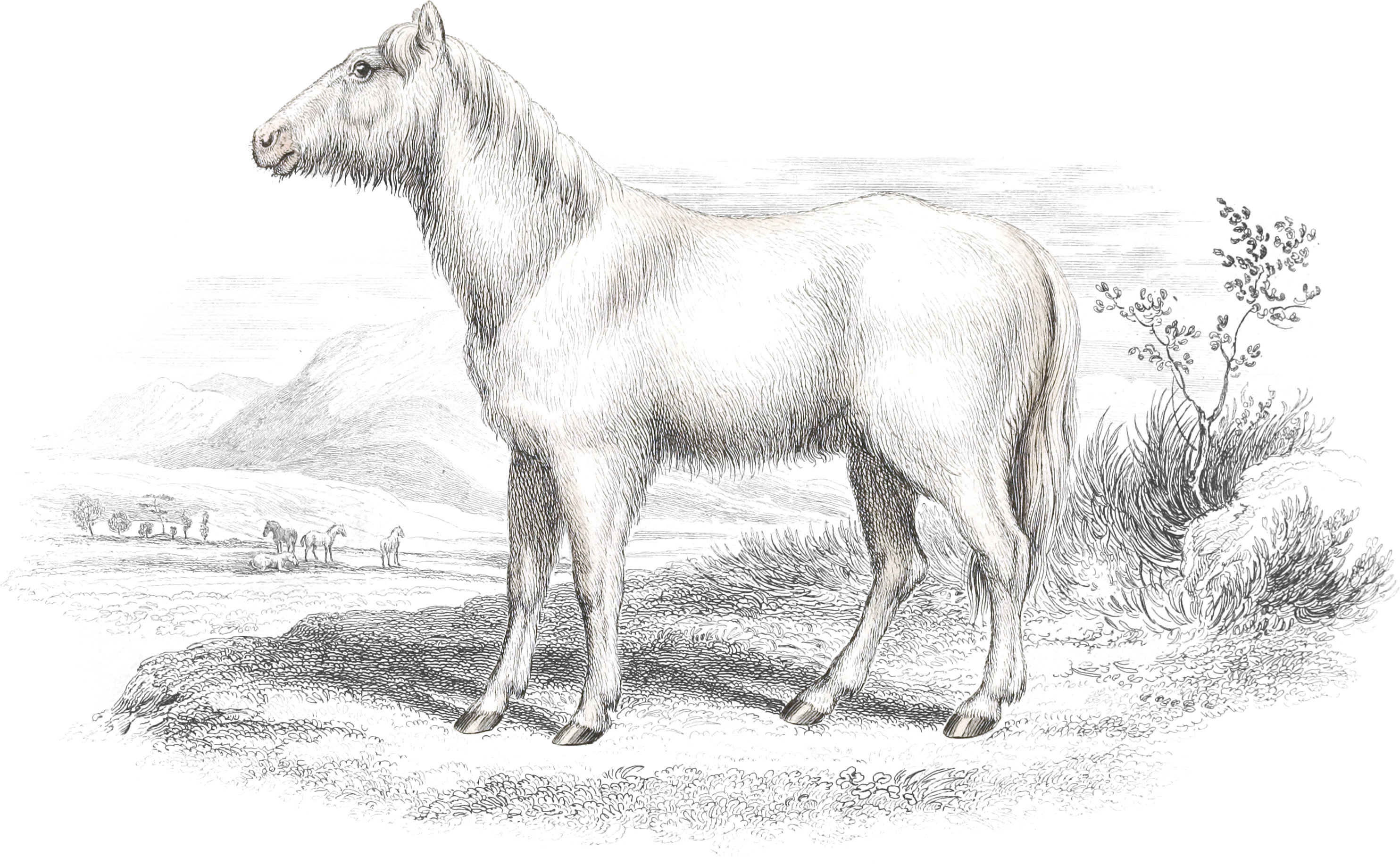
The Black Stock
is most generally spread over Europe, and was at one time, it appears, wild, both in the Alps and the forests of northern Gaul, living in marshy woods from the Jura to the Seine, and spreading to the Ardennes, the Vogesian range, the Black Forest at the sources of the Danube, the Thuringian and the Hartz, but chiefly in the valleys of the Rhine, Meuse, and Scheldt.122 Many indications, partially noticed in a former page, tend to conclusions that this form of the horse, with the mysterious properties assigned to it, was indigenous in the West; but it must be admitted, that sooty races, more lightly made, extend over the Scandinavian peninsula, and are scattered through Eastern Europe, till they reach Tahtary, where there are black breeds of great reputation. These may be considered to have been mounted by some of the invaders of ancient Egypt, or to have been conveyed to the Nile as tribute, after the first conquest of Remses in Asia; for we find there are black horses in the hieroglyphic paintings, which may indeed have been of the Dongola breed, but that this was itself unquestionably of Asiatic origin, whether it came across the Red Sea or by the Nile to where we now find it, resembling the Karabulo and Katchenski races of Central Asia in form, and even in their white feet, as we have before noticed.
Among the present races of Asia, we find the Bashkirs possess one of a slaty black colour, with tanned muzzle and inside of the limbs; the hair does not grow to the length of the white villous race, but undulates with an indication of curling. The individuals we saw had large thick heads, full necks, and heavy shoulders; the withers were rather low, the back hollow, the barrel small, the mane heavy, but the quarters and limbs remarkably firm and clean. They were clearly of the same race as the specimen described by Frederick Cuvier under the denomination of “cheval à poll frizé,” which came from the stables of the Emperor of Austria, having been plundered by the French at the capture of Vienna. We saw the individual in Baron Cuvier’s possession at the Jardin du Roi, where the groom said it was a cross between a Bashkir horse and a French black. None of those that fell under our notice exceeded in stature a large mule, but they had much greater breadth at the hips, and with their short ears and sunken eyes, really looked like a low caste of French horses, excepting the legs, pasterns, joints, and hoofs. We attach no great importance to the character of the hair, having ourselves possessed a powerful roan with a similar coat, which had been purchased from a drove of horses, said to have come from the mountains above the Magdalena in Columbia: but regarding the colour and structure, if the original type of the stirps should be sought in High Asia, it is to this race that we would refer it.123
In the West, that type is unquestionably the large-boned heavy Flemish or Belgian breed, almost invariably black, without any mark of white; with a large head, clumsy limbs, short pasterns, broad hoofs, an excessive thick mane, and the fetlock not only profusely clothed with long hair, but a fringe of the same passing up the back of the legs to the knee-joints. There are studs of a lighter form, still retaining the characters of the type, but sufficiently elegant to have served formerly, and we believe again latterly, for occasional remounts in our heavy cavalry regiments; the head, however, is not so well qualified for the saddle as for draught, and it is from crossing the old English and Norman blood with Flemish mares that we have obtained our present splendid
English Draught Horse. This class of horses, if it was not already imported in the Saxon era, was certainly introduced by the Flemish associates of William the Norman, who, in company with their Earl, obtained a large portion of the landed spoil at the conquest. Agricultural improvement, introduced from the same province at a subsequent period, no doubt increased the number of the large breed in England, so superior to the indigenous ponies: there are occasional indications of the fact in the Flemish archives during the Plantagenet dynasty. At present, in the west of England, the black breed of horses is far from improved; but in the midland counties, the Lincoln and Staffordshire studs produce those broad-chested bulky animals so conspicuous in London, but slower even than the Flemish.
The Clydesdale are of a similar origin, but in many cases preferable, because they have greater activity and more supple limbs; they are consequently not seldom used in private carriages.—Northampton, Suffolk, Norfolk, and Cleveland have all breeds more or less resulting from the black stock, though their blood is mixed with Norman and the indigenous older races. Among all these heavy horses, there are specimens according to their kind of very great beauty, and stallions may be found that have been valued at four hundred guineas, or nearly the same price as a first-rate Arabian, in the English market.124
Exclusive of the bays and greys already mentioned, all our heavy cavalry was and still continues to be mounted on black horses; but without changing the colour, they are now of higher blood, and the Life Guards in particular are from half to three-fourths of the Arab stock. To the unwieldy old form, a lighter and more compact kind of charger has been substituted; and it is rather a curious circumstance, that while we have been reducing the standard of our cavalry horses, abroad, and in particular in Russia, the government is making efforts to increase the size of its own. While the late Grand Duke Constantino ruled in Poland, as we were informed by one of the chiefs, he raised the stature of all the Lancer horses.
On the continent, the noblest black breed in Europe is the Friesland or Dutch, commonly called Hart-draver, or fast-trotter: they are from fourteen to sixteen hands high, with good necks and shoulders, full bodies, round prominent haunches, the tail attached rather low, and limbs sufficiently fine, fringed a considerable way up the tendon above the pasterns with longish hair: they have fire and temper, but generally want bottom, although we have formerly seen the Friesland Carabineers, and even the black Hussars of Eckeren, handsomely mounted upon them. Indeed, both the larger and smaller sized horses of this breed extended considerably into the Westphalian territories towards Holstein, and the Dutch, Hannoverian, and Hessian cavalry draw their remounts entirely from thence for the heavy, and from Holstein and Denmark for the light cavalry. Other studs are chiefly appropriated for coach-horses, and are exported to France and Belgium.
With slight variations in stature and form, the black stock extends into Germany, through Swabia, and by Alsatia, into Switzerland; we find it again large and bony in Italy, about Bologna, Tuscany, and in the March of Ancona; here, however, the breed becomes more modified by alliance with the ancient Sicilian and the more recent Spanish horses introduced at Naples. In Lombardy, the Hungarian and Turkish races have likewise influenced the better class of horses, and the princes of the country have exerted themselves of late with the same laudable views, excepting at Naples, where the noble breeds of ancient times, Saracen, Norman, Hungarian, and Spanish, have gradually sunken almost to a level with the rest, and furnishing now only a few handsome carriage-horses.
In France, where for ages horses do not seem to have been an object of steady national attention, they are never sufficiently abundant to mount the regular force respectably; and although there are real good horses in the kingdom, the provinces in general are overrun with bidets or ponies, and double bidets, galloways comparatively worthless: the efforts of government, the formation of Haras, and the liberal exertions of enlightened individuals, seem to have kindled little more than a temporary fashion for the display of equestrian paraphernalia and the excitement of imitation races; while the once vaunted breed of Limousin is all but extinct,125 and the more ancient Navarrese and Guienne steeds are now without a representative worthy of the name. Yet, for draught, there are, in Picardy, horses very like the breed of Flanders, and there are others of the stock in Brittany and Normandy but that of Auvergne is perhaps the most ill-shaped of the whole, though in many points resembling the Francomptois, which is extensively employed in the land-carriage trade. From these general censures Normandy and the environs of Paris may claim exemption, for, within a small circle at least, a real determination to obtain a race of high-bred horses seems to exist; and that to some extent they will be worthy to compete with the efforts made elsewhere in Europe, is sufficiently evident from the prominent part taken in the question by the heir to the throne.
The black stock, reproducing everywhere in Europe horses of a large stature, extends, with little intermixture, down the Danube and through Central Germany, Silesia, Moravia, and Bohemia, to the north side of the Balkan in Turkey. The three great military monarchies mount their heavy cavalry almost entirely upon breeds of that origin. They occur again in Asia, for we have already mentioned the Karabulo race, so highly valued for speed and bottom among the Toorkomans and the Katschenstzis of Eastern Tahtary, remarkable for a white or grey mane, tail, and feet, while the rest of the body is shining black. One or other of these, no doubt, produced the black horse which ran the course at the Ouralisk races in nineteen minutes.126 In the mixture of the varieties, the black form may be found in a grey livery, but retains its own when fused into the bay, or at most becomes dark brown; but while the typical indications remain, clear bay, dun, or mouse colours never occur. In the chestnut progeny, apparently brought to the south of Europe by the ancient Burgundians, the black characters are strongly marked, but this colour is anomalous wherever found; it is one that has baffled our researches. It is seen to assume the shape of all the stirpes, and yet to be so fixed, that foals of a chestnut dam by a black sire are most frequently without the least assimilation to the paternal colour, but wholly like the mother.
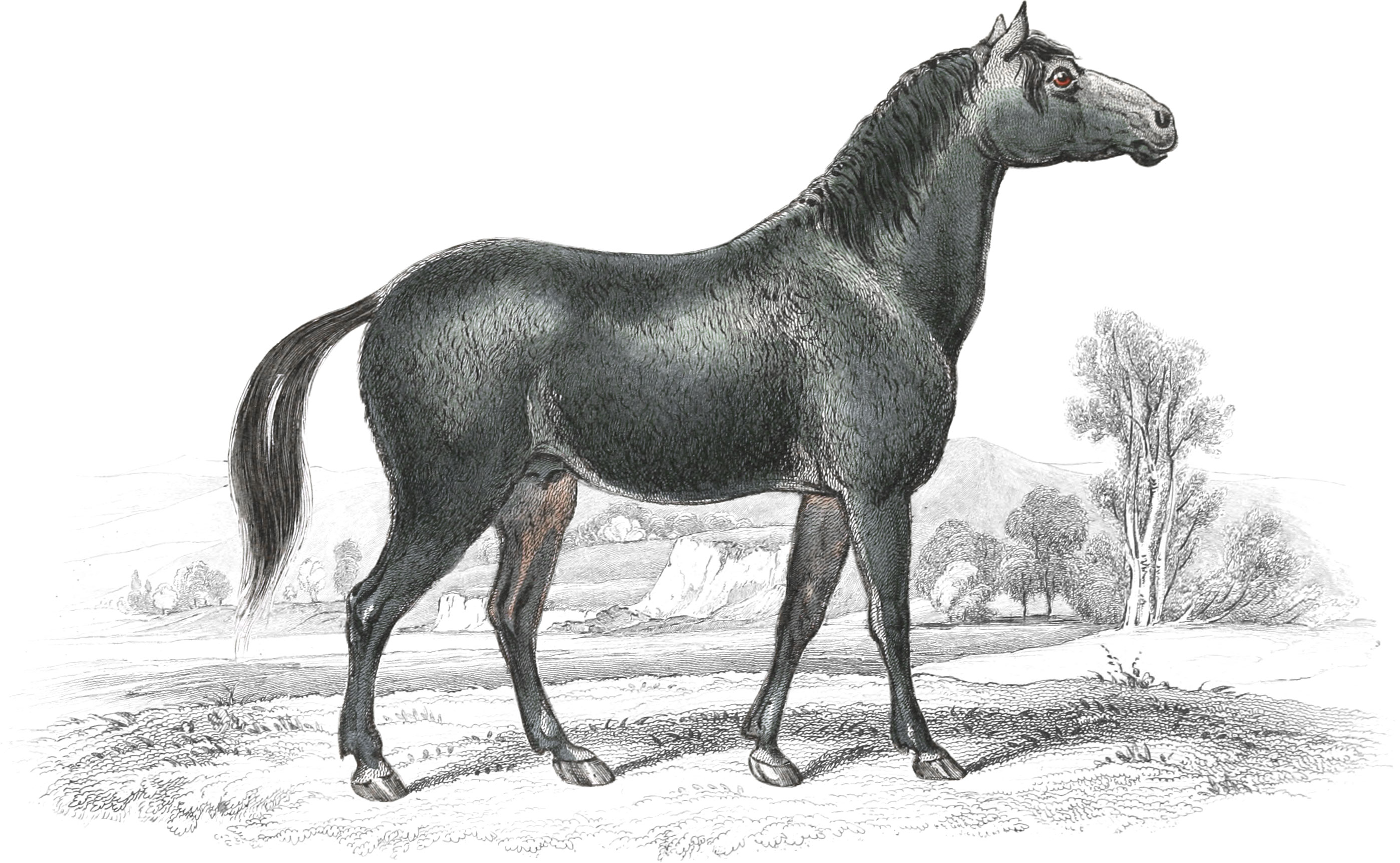

The Dun or Tan Stock
is in our view the fourth stirp, and perhaps even more distinct from the three already mentioned than the fifth or pied stem; for, in the form and markings there occur evident approximations to the Asinine group, never acquiring the lofty stature of the black or grey, but always lower and proportionably longer, with more slender limbs, clean joints, and smaller hoofs. The dun is typical of the generality of the real wild horses, still extant in Asia, and the semi-domesticated, both there and in Eastern Europe. Beside the general form, the smaller square head, great length of mane, tendency to black limbs, it is known by the black streak along the spine, sometimes, though very rarely, crossed by a second of a fainter colour on the shoulders, and often marked by black streaks on the hocks and upper arms.127
The common chestnut, through all Temperate Asia and Eastern Europe, when bearing withal the dappled spots of the grey, in token of a twofold intermixture, still often shows, in the dorsal line, the colour of the legs, the general structure, and form of the mane and tail, his tendency to absorption into the more indelible type of the dun, whose stock, subdivided into many races, everywhere recurring, shows the livery under the names of eelback-dun, tanned, mouse-coloured, light bay, cervino, pelo de lobo, &c., but always distinctly bearing the spinal streak down to the tail, even when deeply mixed with the noblest blood or divergent into the chestnut or Alezan livery, where alone stature is developed, and where, in the solitary instance of the Burgundian ancient race, that colour clothes forms belonging to the heavy black and draught horse.
From the mountains of Scotland to the plains of Eastern Tahtary, from Iceland and Norway to the sierras of Central Spain, notwithstanding the ceaseless intermixture with breeds of other origin, or the further decrease of stature from climate or want of food, these various shades of dun and the dorsal streak often reappear upon individuals among droves apparently all bay, or all sooty, without an ostensible cause, to the exclusion of grey and dappled, which are always the result of direct intermixture.
In manners and characteristic intelligence, this type displays peculiarities not found in the larger forms of horse, and in part at least they may be fairly ascribed to a different cerebral organization. Unlike the other types, the dun alone invariably husbands its strength and resources, never wasting them by untimely impetuosity or uncalculating resistance; ever provident in securing the moment to bite at food, or drink; cautious, cunning, capable of concealing itself, of abstaining from noise, of stooping and passing under bars or other obstacles with a crouching gait, which large horses cannot or will not perform; these, and many other peculiarities of their wild educational instinct, are reflected again upon all the races of the type, however diversified by mixture, so long as the prevailing feature of their stature remains, as all antiquity attest, and modern times daily witness in domesticated ponies, and above all, in the high intelligence of those which have been trained for public exhibitions.
Although varying from circumstances, the dun-coloured stirps is pre-eminently attached to rocky and woody locations, always in a state of nature seeking shelter in cover, or security among rocks, where either are accessible; it feeds upon a greater variety of plants than the others, and, contrary to them, residence in the open plains is rather an accessary condition than one of preference in their mode of existence.
The dun, as before stated, was exclusively used by the ancient Median cavalry, and in chariots of war. It is still the principal stock of the wild races of Asia, and even of the Ukraine and Poland; but in a domesticated state, colour is so intermixed, that all the semi-wild breeds of Russia, Hungary, and Poland have a great proportion of their numbers bay, particularly since the Arabian conquests rendered this superior stirps more valued and accessible in the north.
In their anomalous state, we shall now proceed to give a few details on the most remarkable of the smaller stock, wherever they may be found, and beginning with those of Northern Asia, we find,
In China, exclusive of the pied horse, there is a race of mountain ponies, known by the name of Myautze, which gallop down declivities at an angle of forty-five degrees, dash through woods and broken rocky ground without losing their footing, and are therefore highly prized by the Chinese officers for service. There is no notice of the colour of their coats. We find also an ill-shaped sooty pony, with little spirit, and unfit for severe work; but the Tahtars possess, beside those already mentioned, brown, bay, and dun breeds of horses, full fourteen hands and a half high, with small square heads, long ewe necks, good manes and tails, and mule backs; the barrel is of little girth, but they have clean and firm limbs, with small feet; and their sobriety, hardihood, and speed render them very valuable. Uniform chestnut and white breeds are scarcer; these are reported to have the form of more western horses, with high hips, and in common with others above mentioned, as well as with the following, they have habits of lightness and sobriety.
In Khoten the horses are likewise small but hardy, mostly geldings, reared by the Kalmuks; they are from thirteen and a half to fourteen hand high, and great droves are exported towards the south, as far as the plains of India.
The Bhooteahs are very beautiful rather shaggy ponies, not unlike the Siberian, commonly grey, white, or spotted; their strength, courage, prudence, and surety of footing, in the precipitous paths of the highest mountains, are highly extolled.
Of the Pickarrow ponies, apparently held in esteem among the British residents in India, we have found no description.
The Yaboos, or ponies of Afghaunistan, are the common travelling animals of the country, and though mixed with every race of the East, are of the original wild bay stock.
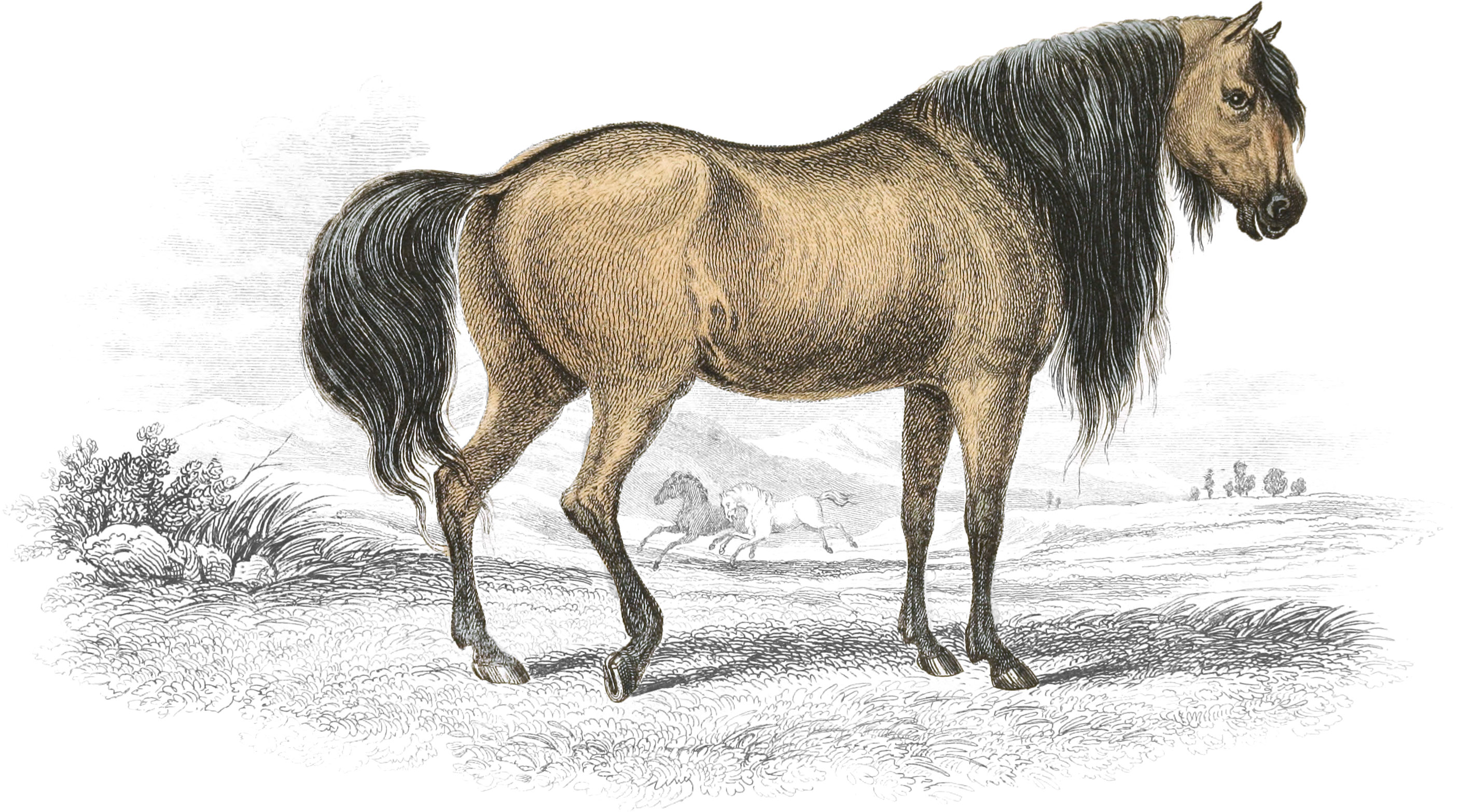
Plate VI
Decussated Horse, Eelback Dun of the Ukraine
Head of Hungarian Horse
Among them, as well as with the Hungarian horses, it was formerly the custom to slit the nostrils, or rather, divide the septum, because that practice was said to facilitate breathing in violent galloping, and also to prevent the animals neighing: the custom is not credited in the writings of several English authors, but although we have never seen an instance, we have at this moment before us a finished sketch of an Hungarian horse’s head by the celebrated Zoffani, where the operation is fully displayed. We here subjoin a reduced copy; see Plate XXXI.

Plate XXXI
With slit septum naris
The common Bashkir horse is short, compact, with a heavy head, broad-hipped, small-eyed, and nearly allied to the curly-haired black horse before mentioned: they do not exceed thirteen and a half hands and are bred wild, requiring all the skill and daring to subdue the colts, when captured, that is evinced by the South American Gauchos.
There is no great difference in the horses of the Cossacks of the Don, the Oural, and of Siberia, except perhaps in size; but in general they are rather low, raw-boned, meagre-looking animals, ragged in the extreme, and apparently unable to perform the work, bear the privations, and sustain the weight which they carry; yet, taken all together, in good qualities, the Cossack races have resisted fatigue and all the incidents of war better than any other cavalry of the Russian empire, as was fully proved in the campaigns of 1812, 1813, and 1814; and recently, still more signally, in the terrible march towards Khiva. We have never known them entering a stable from necessity, but in the severest weather they are occasionally sheltered from the blast by the Cossacks raising a bank of snow in a circle, with a fire in the middle to warm themselves and their ever-saddled horses behind them. The Donski appeared to us in general of dark brown and sooty bay colours; so also, as might be expected, the common breeds of Russia, descended from intermixtures of the original stirps, have in many cases undetermined, or what has been termed foul liveries.
The fast trotters are a breed in common use for hackney carriages and winter sleighs: their movement consists in trotting with the fore-legs and cantering with the hinder, proceeding at this rate fifteen or sixteen miles an hour. There are some of them higher bred that will go the pace of twenty miles, but how long they can keep it up is not quite satisfactorily ascertained. These animals are rather long for their height, very well shaped, with a square head, and mane so exuberantly long, that their masters knot them up to keep them from trailing on the ground.128
This long-maned race is extensively spread towards the south into Poland, the Ukraine, and Podolia, there being, in the Dresden Museum, a stuffed specimen, of which we made a drawing; it had belonged to the last Saxon king of Poland, and had a mane which measured twenty-four English feet in length, and the tail thirty feet. A case of this kind must be taken, we think, as a result of what may be termed disease, united with extraordinary care in the grooming to foster the excessive production.
It is to this stirps that the wild horses of Lithuania and Prussia, already described, unquestionably belonged; and those of the great forest of Bialowitz have still in general the same characteristics of livery and form. In Plate VI. we have figured one ridden by a Russian Lancer officer, who stated the animal to be of Ukraine race of the wild stock; we found it chiefly remarkable for the cross bar on the shoulders, distinctly marked, its vicious aspect, and for the close resemblance it bore to the description of the wild in colour, though in form there was a greater similarity with the Samogitian horses, being rather long than high, though extremely vigorous.129 This stirps, therefore, approximates the Hemionus, Djiggetai, and Yo-to-tze in livery and markings.
The Samogitian horses are small, compact, hardy, rather short-legged; the Polish, somewhat loftier, have more blood, and are occasionally dappled grey. But there are dappled bays and dun-coloured, as well as dark chestnuts among them.
In the Tzeckler mountains of Transylvania, there is a smaller sized dun horse, nearly in a state of nature, probably the remains of a wild indigenous race; but in the plains a considerable intermixture of Turkish and Arab blood is found, which spreads likewise into Hungary.
The Hungarian and Moldavian common race is small, dry, angular, with large eyes, small mouth, plane chaffron, open nostrils, no great carcase, slender neck; but broad-chested, with firm legs, hard hoofs, and the tail rather low. This race extends into Styria, Illyria, and Dalmatia, and is evidently a mixed descendant of the horses brought by the mounted tribes which invaded the Roman empire, partially improved by Turkish blood: we see this in the great variety of colours the horses possess, but where dun, chestnut, and bay are predominant. They are in general bred almost wild, being caught only for marking or for sale, when the art and energy required to subdue them is very much of the same character as that of the Tahtars and Cossacks in Russia and the Gauchos in South America.
In the Morea there is a race of unshorn small horses, driven down to Attica in herds for sale; they have small heads and ears, thin jaws and narrow foreheads, slender arched necks, but with broad deep chests, slender firm limbs, oblique pasterns, and longish hoofs, grey and firm. They are exceedingly wild and vicious, running at dogs, and fighting with their teeth and fore-feet; but it is probable that with good management they might be made excellent light-cavalry horses. The bay and chestnut colours predominate, and it is likely that their origin remounts to the early ages of Greece.
Sweden and Norway likewise have small breeds of the ancient stock in Œland about twelve hands high, handsome, docile, and intelligent, though bred in the woods. Those of Western Nordland have the head rather large, the eyes prominent, the ears small, the neck short and breast broad, the body rather long, full and well ribbed up, tail and mane abundant: the arm of this breed is remarkably powerful, and the fetlocks without long hair. Their colours are bay and brown to blackish. We saw the Hussars of Mörner, another Swedish Hussar, and a light-dragoon regiment, all respectably mounted on this kind of horse.
Finland has a similar race, but still smaller, and the Norwegian, notwithstanding the opinion of Horrebow, may be safely regarded as the parent stock of the Iceland ponies, so renowned for enduring the excessive cold of an Arctic winter without the least protection of man. These resemble in almost all respects
Shetland Pony
The Scottish or rather Shetland ponies, Plate XV., some of which scarcely exceed in size the stature of a large dog, and have been actually carried in a gig. Yet there are among them many handsome shaggy little animals, with huge manes and abundance of tail; they are of all colours, but it is not difficult to perceive the original dun stock as forming the parent race.

Plate XV
The Galloway, now no longer found in purity, was of the same character as the Swedish, though somewhat higher at the shoulder. In colour the breed was bay, with black extremities, mane, and tail; but it has been suffered to disappear, though the name itself continues to be used for horses above the standard of ponies. In the north of England it is used for Welsh and New Forest horses, when they are about fourteen hands high. Many of these animals are of mixed breed, as is very perceptible by the head and body being often out of proportion, bulky for the length of the limbs; but others, though shaggy, want not a certain degree of elegance, and are remarkable for speed as well as bottom. Thus, in 1754, one of these, belonging to a Mr. Corker, performed, without distress, one hundred miles a day, for three successive days, over the Newmarket course. Another Galloway, belonging to a Mr. Swelan, executed, at Carlisle, the extraordinary feat of going one thousand miles in a thousand hours. Among the New Foresters, there is a breed of blue-greys, with large dark spots.
The Dartmoor and Exmoor are now also much adulterated, since the moors have been parcelled out and partly divided by stone-walls. Formerly this breed of horses bore all the characters of true descendants of the ancient British; it was, and even now is, wild, daring, cunning, and intelligent; always ascending towards the Tors or rocky precipices for safety, and often escaping by leaping down high blocks, or jumping over the pursuers when they were thought to be at bay. It was one of this race that started from London for Exeter with the mail, and notwithstanding the repeated changes and hard driving, accomplished the whole distance, being one hundred and seventy-two miles, a quarter of an hour before the coach. Another, with a heavy rider, similarly outstripped the coach between Bristol and South Molten, a run of eighty-six miles.
Of the Ardennes horses, and the Bidets and double Bidets of Brittany, some notice has been already taken, and the Asturian and other smaller horses of Spain were likewise mentioned; but we may add to the foregoing two races, which may be claimed by the Asiatic bay horse, or the wild Koomrah of Africa, for they have been assimilated to both. The first is
The Sardinian Wild Horse, found most abundantly in the territory of Bultei and of the Nurra. The best are found in the woods of Canai, in the island of St. Antiochio. According to Cetti, they resemble the wild horses of Africa described by Leo Africanus; they are very small, rugged, and generally bay, with asses’ feet, long tails, and short manes.
Whoever is inclined, after making an oblation at the church of the patron saint of the island, may proceed to hunt them according to his desire; but the hides alone are worth having, for by nature the horses are so vicious, that no domestication is possible; they perish in their desperate resistance, or tire out the patience of the captor.
They were well known to the ancients.130
In Corsica, the mountain pony is nearly the same; but the domestic horse, like that of Sardinia, is about twelve hands high, with rounded form, flat head, and short neck, considerable girth of body, and small hoofs.
Returning towards Southern Asia, we find in the East Indies the Tattoo, or native pony, shabby, ill-made, and neglected for ages; but gradually acquiring more of public attention since the bullock carriages or rutts have begun to be superseded by the kerrachee, a four-wheeled vehicle on springs, now commonly serving at Calcutta for hackney-coaches. Tattoos are in general deep-bodied, with heavy heads, staring eyes, scraggy necks, fine limbs, cat-hammed, under thirteen hands high, bay or chestnut; sometimes grey, or even piebald, and remarkably enduring: they are obstinate, vicious, prone to fighting, but easily maintained.
Seringapatam and vicinity produces a similar small breed and but little improved, although during the reigns of Hyder Ali and Tippoo considerable pains were taken to introduce a better standard.
Indo-China, a land of great rivers, high mountain ranges, and endless forests, is not known to have an indigenous horse. From the Burrampooter east, and from the tropic south, horses are reduced to ponies. Already, in Cassay, Ava, and Pegu, they are seldom above thirteen hands high, but they are spirited, active, and well-shaped. Further east, in Lao, Siam, and Southern China, they are still smaller and of inferior beauty. In Siam and Cochin-China, although the diminutive ponies of the country are ridden, there is no military cavalry. In the Malayan peninsula, the horse is not even yet naturalized. But the breeds of the great islands we are about to mention appear in a great measure to be allied to those of Indo-China and Yunan in China Proper, and are commonly designated by the name of
The Saran Race
Of this class we find, first, in Sumatra, the Achin and Batta breeds, spirited, but small, and better suited for draught than the saddle. It appears the natives call them Kuda, and bring them down in numbers for sale, according to Mr. Marsden, who adds, that in the Batta country they are eaten for food.
In Java the animal is somewhat larger, more a horse in form, but less gay, more shapeless, and more abstemious. Those of the plains are very distinct from the mountain breeds: the first is rather coarse, sluggish, and rises to the height of thirteen hands one inch; the second is small and hardy: the Kuningam breed of Cheribon is one of them, and is often very handsome; both are more used for drawing than riding, and although four ponies on the roads of the country will travel at the rate of twelve or fifteen miles, a pair of English post-horses will do the work which requires three relays of the above mentioned four, and costs in maintenance only one-third. There is an inferior breed on the islands of Bali and Lombok.
The Tamboro and Bima breeds of Sambawa enumerate among their studs the Gunong-api, belonging to the Bima; it is reckoned the handsomest of the Archipelago, and extensively exported. Beyond Sambawa there are horses found on Flores Sandalwood Island and Timor, but no further to the east, being unknown in the Moluccas and New Guinea. Next to Java, it is most abundant in Celebes, where the best of all the Saran race are said to exist, and where alone it is found in a wild state. We find horses, again, in Borneo and at the Philippine Islands.
The different breeds vary in colour according to their localities; at Achin the ponies are piebald, but this distinction gradually disappears: the Battas are mostly mouse-colour: in Java they are bays and greys; roan and mouse-coloured are esteemed, and the worst are black or chestnut: duns, bays, and greys form the majority of the Bima breed, and greys and bays almost exclusively constitute those of Celebes and the Philippines. In Mr. More’s notices of the Indian Archipelago, from which the above account of the Saran race is almost entirely extracted, some considerations are affixed in proof that the original breeds must have come from the main land of Asia: our own views, repeatedly referred to in the foregoing pages, certainly coincide with his, and show by the marks of the races, from what quarter it is likely they were first imported.
The Tangum, Piebald, or Skewbald Horse
Equus varius, Nobis
This form of the domesticated horse, which we have repeatedly pointed out to notice, appears to claim a distinct specific existence, in as much as the typical animal is found with its characteristic marks in a state perfectly wild, and it appears unmixed with wild horses of other shape or colours. We have before remarked that it was first observed by Father Georgi on the northern declivities of the Himalaya range; it was again noticed from report by D’Hobsonville, who describes the wild animal as below ten hands in height, in the winter dress, covered with long hair, and marked symmetrically with spots. In Bell’s Travels, the wild asses’ skins, curiously marked with waved white and brown, of which he saw many in his route near the sources of the Obi, skins which have puzzled succeeding naturalists, may indicate this animal. Another account refers to the wild spotted horses about Nipchou in Eastern Tahtary, being the size of asses, but more compact and handsome. Moorcroft, again, saw the species on the highest summits of Thibet, in their shining summer coats, and with their antelope horns, scouring along in numbers; and a Monsieur de Tavernier seems to allude to them in a recent notice of his travels to the wall of China. The Kiang of Moorcroft, which he insists is not the. Ghoor Khur, is evidently the same, as well as Dr. Gerrard’s wild horse, mentioned in his observations on the Skite valley.131 He says,
Horses alone undergo the transition from the elevated pastures; but they lose the woolly covering that invests the roots of their long hair.
Comparing this animal with the domestic horse, he further remarks,
both would appear to have the same origin, yet the circumstance of their eluding every attempt to tame them when caught, and their uniform speckled colour of fawn and white, demonstrate them to be a distinct species.
Our own correspondence with British officers, stationed in the higher parts of India, bears testimony to similar conclusion, domestication excepted, for the Kiang no doubt is amenable to the same laws as the rest of the genus, and indeed almost every other highly organized animal. Applicable to the present species, we believe there is sufficient proof to view the great proportion of pied horses all over China, and even so far south as the Indian Archipelago; and we contend, moreover, that to this form should be referred the steeds of the Centaurs, which we noticed as first penetrating westward, and were progenitors of the Thessalian. They are pointedly noticed in the Scriptures,132 and again celebrated under the name of Parthian, then, as ridden by the Tahtar conquerors of Saracen Persia; they were extolled by the writers of the classic and the middle ages, sung by troubadours, figured in stained glass in the Indian illuminated battles of Aurungzebe, and immortalized by the pencils of Raffaelle, Titian, and Guide, who took their types of them from the Ardean, or, since called, Borghese breed; which, however, has been latterly neglected, and we understand is now nearly obliterated by newer forms of bay and black colours.133
Although we possess a series of drawings of the pied form of horses derived from Indian, Tahtar, and European specimens, it is to be regretted that of the Kiang, in either his winter or summer garb, no trustworthy figure has reached us; we have therefore been compelled to offer a specimen of one of the domesticated breeds, known, it appears, in India, by the name of Tangum race, which came from Sikim in Lower Thibet. It appears to be taller than the “Tanghans” of the hills near Katmandoo. See Plate VII.
There is some variety in the stature and livery of these horses, the wild in general being the smallest, and having the greatest number of squarish clouded spots; while the domesticated, similarly white about the limbs and part of the back, are marked by such large clouds of bay, that two or three spread over the whole body, head, and neck. In general the head is included in the bay colour, and where it comes down over the shoulder and the thigh, that colour deepens into black; there is also a proportion of black and white in the mane and tail, not unfrequently a black edging on the ears, and the eyes are liable to be pale bluish or different: the horn of the hoofs is pale yellowish, with two or three slender, vertical, black streaks, and the frogs wider on the inner arm the callosities are large, but scarcely perceptible on the hind legs; the hide itself is dull white or greyish, often spotted with a darker colour or ladre, particularly on the inside of the thighs and nose. In form the Tangum stock is compact, rounded, somewhat fleshy, with rather large bone; the head thick, though small; the neck long, rigid, but little arched, somewhat full; the mane rather erect, and tail not superabundant; short hair running down the ridge of the dock, and long hair at the sides, it is set on low; the shoulders are well placed but thick, the withers rather full, the barrel round, with flank well ribbed up, the quarter full. Few rise to fifteen hands in height, and most are little above twelve or thirteen; but they stand on rigid pasterns, have hard hoofs, vigorous sinews, and move with unflinching security through the most dangerous mountain precipices: they bear privation and fatigue with unconquerable spirit, have good speed and wind, and are very tractcible and docile.
Although the Tangum blood mixes freely with the other stocks, its characteristic distinctions are sufficiently indelible; as is proved by the foregoing description taken in India, being almost entirely correct when compared with the breeds of Europe although the last mentioned have been separated from the parent stock for many ages, and have been liable to unceasing crossings: personally we are only acquainted with the Prussian, Austrian, and Borghese, and in these, particularly the Borghese, we have a remarkable proof of the permanency of its characters, since, as we have before mentioned, it was evidently of ancient standing in the time of Virgil, and nevertheless is not yet extinct.
We have mentioned a cross breed among the black Kalmucks, one clouded with brown or sooty black, and with one or more limbs usually dark.
There is another frequent among the Pindarrees, when it is a cross with the native Tattoos. We believe these to be the real Ghoonts found in the vicinity of Kalunga.
There are in Spain horses of this kind,—Pio Alezan, Pio Castanno, and Pio Negro,—and from them may have sprung the skewbalds of Patagonia; but these possibly descend from accidental causes, which we know operate sometimes in a similar manner on the livery of horses in England and elsewhere, but always with characters to be distinguished from the real Tangum stock.
Finally, the skewbald breed of Achin in Sumatra, no doubt anciently brought across from the Malay peninsula, has likewise been mentioned.
In Europe the race is now almost exclusively employed to mount trumpeters and military bands in Hussar regiments, and from their known aptitude and docility, as well as striking aspect, they are cherished for the exhibitions of equestrian performances in the modem circus.134

Plate VII
Primæval of Tibet, domesticated race of Sikim, Lower Tibet
The Koomrah
Equus hippagrus, Nobis
This animal we regard as a distinct species of Equus, exclusively confined to the northern half of Africa, and, as far as it is yet known, nowhere abundant; from its somewhat equivocal structure, shyness, and mountain residence, though known to the ancients, a certain mystery has continued to hang around its history. In the writings of Herodotus, an undescribed animal, by him denominated Boryes, we may suspect to be no other than the Bourra of Koldagi mentioned by Rüppel,135 and that they are the same as Oppian’s Hippagrus. The two last mentioned animals being brown, hornless, and maned, characters completely applicable to the Koorarah, and only partially observable in cloven-footed ruminants, which are confounded with this Equine species, both in the notices of the ancients and the tales of the moderns.
The Koomrah, in Northern Africa, is held to be a rare animal, a species of monster-mule between a mare and a bull, similar to the produce of the same kind known in Europe by the name of Hippotaurus, which was believed to be a possible creature down to the middle of the last century, when the real Hinny, which we shall mention when we treat of mules, was pretended to be that monster. In truth, the Koomrah and Hinny are sufficiently similar to serve the purpose of an imposture, or of a wonder among the vulgar; but the first is a wild animal, the second a scarce result of domestication. The name Koomrah may be a Mograbin adaptation of the Arab Ahmar, Koh-ahmar in Bereber, mountain horse, to the Negro term Koomri, one denoting a wild Equine, the other a colour, white, as applicable to the snowy ridge south of the Niger named the Koomri mountains, where the animal is likewise found.
Among the wonder-loving Arabs and Shelluhs, the Hippotaurine Koomrah is of course believed to be not unfrequently met with, not as a wild, but as a domestic animal; occasionally a dwarf kind of Hinny is shown as such, and hence there are greys, which then answer the descriptions of some travellers and correspond with the meaning of the Negro word Koomri; and as we are informed by a friend, there are others of a black colour, one of which he saw, when it was on the way to Constantinople, a present from the sovereign of Morocco to the Grand Seignor.
Of the wild and real Koomrah we have seen a living specimen in England, and the skin of another; the first came from Barbary, the second died on board a slave-ship on the passage from the coast of Guinea to the West Indies in 1798, the skin, legs, and head having been carefully preserved by the master, who permitted a sketch and notes to be taken of it at Dominica.
The Koomrah of the mountains is about ten or ten and a half hands high; the head broad across the forehead and deep measured to the jowl, is small, short, and pointed at the muzzle, making the profile almost triangular; instead of a forelock between the ears, down to the eyes the hair is long and woolly; the eyes are small, of a light hazel colour, and the ears large and wide; the neck thin, forming an angle with the head, and clad with a scanty but long black mane; the shoulder rather vertical and meagre, with withers low, but the croup high and broad; the barrel large, thighs cat-hammed, and the limbs clean, but asinine, with the hoofs elongated; short pasterns, small callosities on the hind-legs, and the tail clothed with short fur for several inches before the long black hair begins. The animal is entirely of a reddish bay colour, without streak or mark on the spine, or any white about the limbs. We made our sketch at Portsmouth, and believe it refers to the same animal, which lived for many years, if we are rightly informed, in a paddock of the late Lord Grenville’s. There was in the British Museum a stuffed specimen exactly corresponding in colour and size, but with a head (possibly in consequence of the. taxidermist wanting the real skull) much longer and less in depth. The other specimen, which came from the mountains north of Accra in Guinea, was again entirely similar. We were told that in voice it differed from both horse and ass, and in temper, that which died on board ship, though very wild and shy at first, was by no means vicious, and fed on sea-biscuit with willingness.
It would appear that this species is not gregarious in Africa, but an inhabitant of mountain cover, and always desirous of the shelter of the woods; it comes down to the wells and drinking-springs alone or in small families, and is there liable to be waylaid by men, the great felinæ, and hyaenas; but there is no want of courage in its defence, biting fiercely; and having a very delicate sense of smell, danger is avoided by the wariness of its actions and the readiness of its rapid retreat up the mountains.

Plate XVI
The Asinine Group
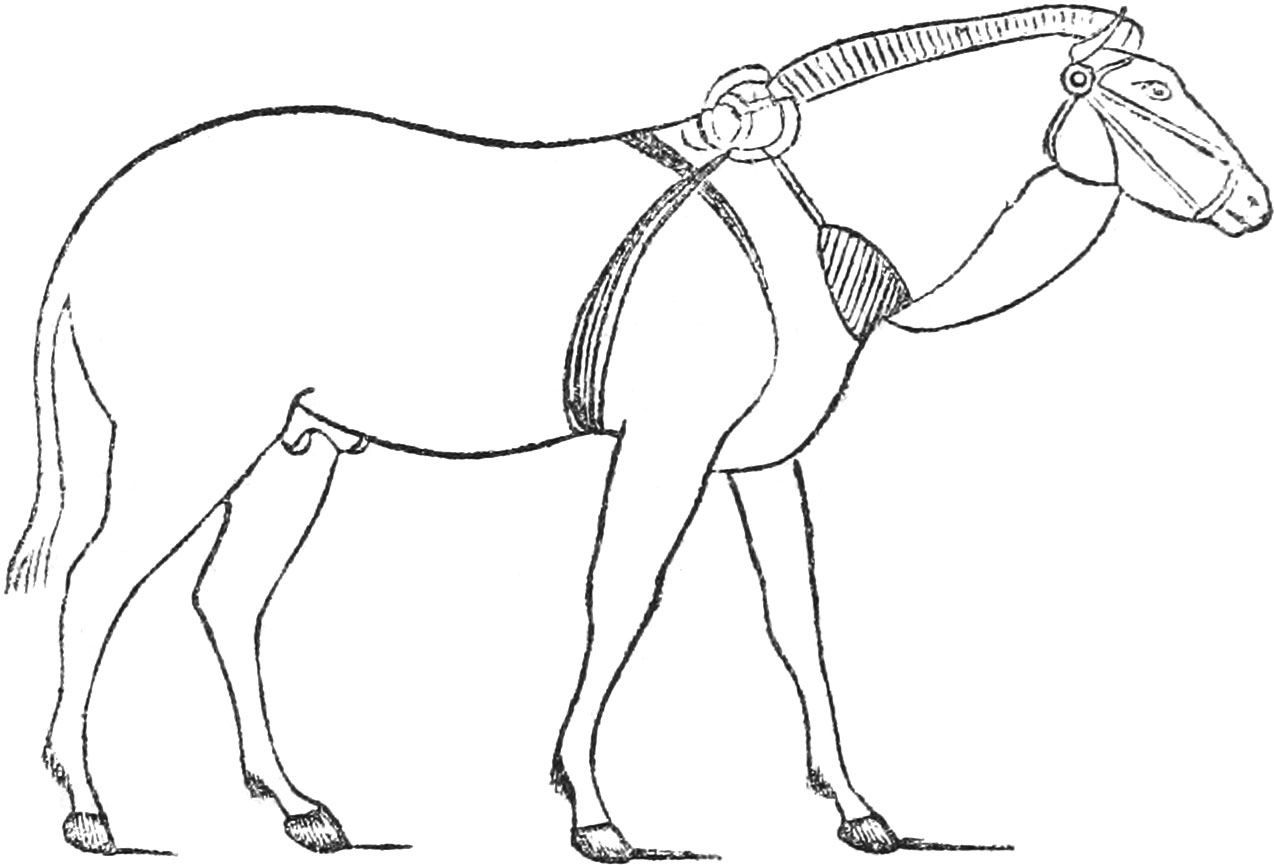
Short-Eared Horse
Although there are no very prominent external differences, the eye of the most superficial observer is almost always sufficient to distinguish this secondary and less elegant form of Equidæ from the Caballine species already described. We have already remarked on the conflicting opinions of naturalists, whether the two forms should be separated by generic names; and though we adopt the arrangement of Mr. Gray, it is because it is viewed by us as more advantageous in a natural system of classification to refer the species of minor groups to their common centres, than to insist on the necessity of creating genera for every trifling structural variation that may be detected.
There is an evident tendency in both, not only to approximations, but even to actual interchange of some prominent external distinctions. In the wild horses of Asia, a highly arched forehead and lengthened ears are often very observable. We have described and figured a specimen of the eelback dun stock, not only marked with the spinal dark streak and bars on the limbs, but actually with a cross on the shoulders: again, the first species of the present group will be shown to have the head of a high-bred blood-horse and the cross on the shoulders like the onager, but totally different in relative proportions from the Persian wild ass, which is very commonly destitute of that mark. In a wild state, both groups are nearly of the same size. If there be more than one species domesticated in the first, so there are also in the second; all, no doubt, can and have been subdued by man, and it might be suspected that there has been even an intermixture sufficient between both, for the sympathetic action of transferring the marks and the livery of one to the other, and in some cases perhaps to perpetuate them. Excepting some slight structural characteristics, the chief distinctions between the horse and asinine groups evidently lie in their instinctive aptitudes one being highly irritable and educational, with a social temperament, the other dull, intractable, solitary, seems to bear the unceasing impression of his servitude alone. Like a slave, the sensual appetites remain nevertheless in great vigour, and the males of the asinine group differ particularly from horses in their mode of fighting with the teeth instead of the feet; for, in a wild state, it was observed by the ancients and confirmed by more recent information, that they destroy or disable each other, so that males are comparatively rare. For the same reason, in domestication, it is held dangerous to allow a male ass to pasture in the same field where there is a stallion.136
The ass tribe has long ears, a short standing mane, and the tail furnished with only a tuft of hair at the end; the hoofs form oval impressions, and sustain short rather rigid pasterns; the limbs are clean and firm; the croup narrow, and often more elevated than the withers; there are callosities on the anterior legs only, and the hide is more dense and callous than that of the horse; yet none of the group can sustain the same degree of cold, although they appear more insensible to intense heat, and are found wild in Africa as far south as the line. The typical colours of their livery are silvery grey and tawny, in a wild state never passing into black or complete white; they have mostly a dark dorsal streak, less distinctly seen in the females, and sometimes entirely wanting in both sexes, while bars on the joints are not uncommon, and a cross line on the shoulders is occasionally double. It is said of some in Africa that they never drink; they are known to be in their food still more sober than horses, and more easily satisfied with thistles and other thorny plants: in their habits they are cleanly, and fond of basking in the clean heated sand of the desert, where, though they want not courage, vigilance, and speed, they afford the common subsistence of the larger carnivora; for, in the absence of man, the lion, hyæna, and lycaon, or marafeen, appear chiefly destined to maintain the balance; and where wild Equidæ are found in the South, one or more of these are sure to be in their vicinity.
In the ancient history of these animals, more than one species appear to be confounded, and even at present the differences between them are not satisfactorily cleared up, if not altogether overlooked by travellers. In the earlier languages, zoological names of animals which have been recently acquired are commonly borrowed from others already familiarly known, or from some fancied similarity which after times seldom confirm; thus the Romans applied the name of Lucanian bull to the first elephant they saw, and the South Sea islanders called the first horse landed on their shores a pig or a great dog in Celebes, the horses now feral still bear, among other native names, that of buffalo. Adjectives, as names, are slow in acquiring a strictly defined meaning; a carrier may still designate a pigeon or an errand-man; and thus the same epithet in Hebrew was long applicable alike to a horse, an ass, the Hemionus, and perhaps a dromedary; hence, what has been translated an ass in Isaiah and Herodotus, or actually so named in Pliny, Strabo, and Arnobius, may in some cases, with good reason, be regarded as applicable only to the Hemionus. Thus, where asses are made to draw chariots for war and peace by the Caramanians, and even the Scythians; and again, in the painted sculptures of Egypt, where chariots occur drawn by short-eared animals, which nevertheless have the cross on the shoulders, asinine tails, and in stature equal the figures of horses, we must refer them, not to the small thick-headed Hamar of the desert or Ghoor of Persia, but to the Onager, or to the Hemionus, which we shall see is still domesticated in some parts of India.137
It is no doubt to these larger and nobler animals that respect was paid in the earlier ages as types of abstract ideas. The Arabs had an asinine divinity named Yauk, and Tartak, one of the gods of the Avim, was most likely figured like an Onager; though it may be suspected that several of these animal forms were not personifications but attributes or companions of deities, similar to those we still find figured behind Indian idols. To the voice of the wild ass repeated allusion is made in the Scriptures, and that of the prophet crying in the wilderness, has reference to the impression which the solitary cry of the tenant of the desert creates on the mind of human wanderers when traversing his haunts. It is even doubtful whether the belief of the heathens, that the Jews worshipped an ass’s head, or the blasphemous absurdity of the Onoel form holding a book, with the motto, “Deus Christianorum Menechytes,” was not more the delirious act of hieroglyphical emblematisers of that Gnostic sect which strove to unite Christianity with Paganism, rather than the result of absolute malice; certain it is, that in the circles of Behemoth, figured by the Ophites, the last genius, or Eon? is denominated Onoel and pictured with asinine forms. Evidently, when Mirvan II., the last Caliph of the Ommiad line, was distinguished by the title of Hymar-el-Gezirah, or the wild ass of Mesopotamia, no disrespect was meant to his person; nor in the memorable declaration of Jacob, where Issachar is compared to a strong ass between two burthens, for it became an emblem and probably an ensign of his tribe. Similar ideas of respect were attached to the figures of asses on the shields of several Roman legions of the third century, represented in Pancirolus; to the Borak banner of the first Babylonian Caliphs, and to those borne on the ensigns of ancient Naples and Vicenza.
It is to be regretted that travellers of talent and education have paid so little attention to minutiæ in their accounts of the wild species of the asinine form, and thereby confounded one with the other such, among others, is the description of a wild ass from the Cape of Good Hope, seen by Bishop Heber at Barrackpore, in the menagerie of the Governor-general of India, led about almost choked with its bridle.
It is extremely strong and bony, of beautiful form, has a fine eye and good countenance, and though not striped like a zebra, is beautifully clouded with different tints of ash and mouse-colour.138
Is this a mistake as regards the native country? For the description appears to apply to a real Kiang of Central Asia, and there is no indigenous unstriped Equine animal in South Africa; or if it refers to the Onager or Ahmar of the northern part, how did it escape so enlightened an observer that it was of the same species with the wild ass of Cutch, the Ghoor-Khurs of Persia, and Djiggetai of the Mongolese?
The Yo-To-Tze?
Asinus equuleus, Nobis
We have hesitated long whether the present animal should not be placed with horses, for the external appearance is so intermediate, and even the voice, as we were informed, so much a compound of neighing and braying, that it maybe most proper to consider its location with this group as only provisional. The specimen here figured was drawn by ourselves at the request of the late Sir Joseph Banks, who obtained from Earl Rivers information that there was an undescribed species of diminutive horse brought from the Chinese frontiers north-east of Calcutta, and was then to be seen in a livery stable near Park Lane. We give, with the sketch, the notes made at the time.
The animal was a male, by examining the teeth, not quite four years old, and was somewhat under three feet in height at the withers; the head eleven inches and a half from the fore-top to the under part of the nostrils, with a straight profile, very small mouth, delicate nostrils, and deer-like aspect resembled that of a noble Arab; excepting that the eyes displayed less fire and more cunning, and the nostrils opened a little lower; the ears were only four inches long, with the tips suddenly contracted and then again slightly dilated; their insides white, the upper third black; the neck was ewe-like, with a coarse abundant mane, longer than in the ass, but still standing upright. Compared with its general size, the barrel was full, very closely ribbed up in the flank, but the withers, shoulder, croup, hams, and legs were asinine, with short rather vertical pasterns and round, more than oval soles of the hoofs; the tail, not reaching the hocks by six inches, was scantily supplied with long hair nearly to its root, resembling that of a rat-tailed horse; there were warts on the inner arms, but none on the hind-legs; all the limbs clean, yet very strong. It was entirely of a yellowish red clay colour, excepting black tips of the ears, the mane, and long hair on the tail, a well defined line along the back extending down the middle of the tail, crossed by a broad bar of the same colour over the shoulders, three or four cross streaks very distinctly marked over the knees and hocks, the cannon joints brown and the fetlock and pasterns down to the hoofs black, the hoofs and hide dark, the eyes brown.
The groom informed us that its voice was a kind of horse neigh; terminating with a roar like the lower tones of an ass’s braying. There were on the back two white marks evidently the effects of a saddle, attempts having no doubt been made to ride it in India; where the sons of grandees are very commonly placed on the backs of ponies, young stags, hinds, little oxen, and even sheep. There was an appearance of considerable docility in its manners, which induced the groom to throw his leg across its back and canter up the stable yard; the man was certainly much heavier than the beast he rode, but it took him along to the end, and then with a wild fling pitched him on a dunghill, and came back at a trot, stopping by us with perfect gentleness. We were here again told that it came from some part of Chinese Tahtary.
Notwithstanding the striking difference of the head, tail, livery, stature, and voice, we doubted this individual being merely a variety of the Onager or Djiggetai, until we saw living specimens of these animals, when there appeared sufficient reason to regard the Equuleus as distinct and identical with the Yo-to-tze of China, provided that in that country not more than one species is included under the name. Should the wild ass of the Deccan in Central India, described by Colonel Sykes as not larger than a mastiff, be of the same species, the fact would prove another instance of the uncertainty we are thrown into by naturalists assuming that approximate resemblances are sufficient to warrant the conclusion of a community of species: travellers and sportsmen, amid the many other causes of indifference, are thereby induced to regard the question as settled, neglect detailed descriptions, and continue the duration of ignorance.
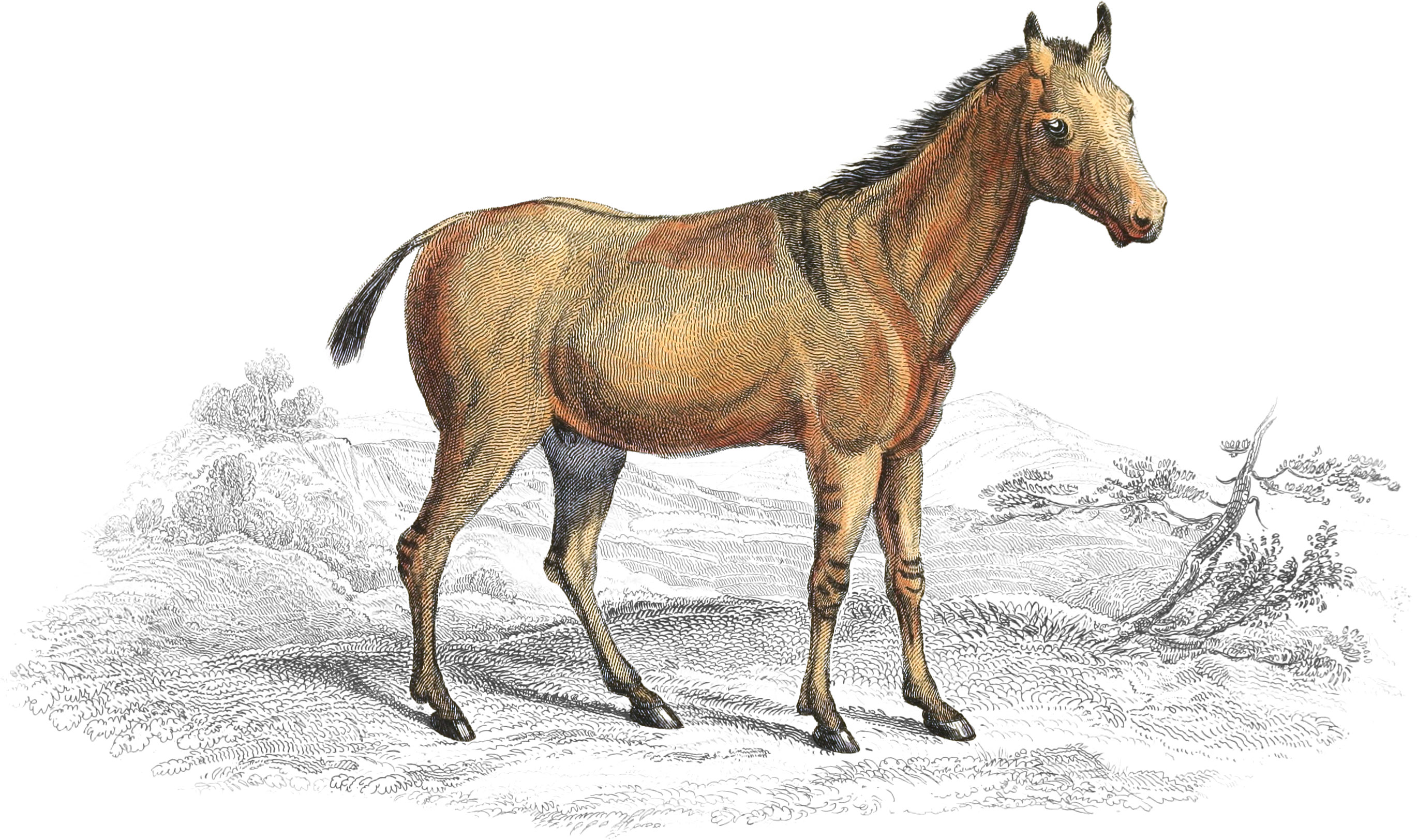
Plate XVII
The Onager, Koulan, or Wild Ass
Asinus onager, Nobis
The concluding remark in the former paragraph is again verified in the accounts of the Onager and Hemionus, both of which are confounded by modern writers, and none of the late travellers who noticed wild Equidæ, have given more than such slight references, that whether they indicate species of the horse or of the asinine group, whether the Koulan is the Ghoor Khur, the Asinus silvestris, the Hamar, or the Djiggetai, remains absolutely uncertain. Mr. Pennant describes from Pallas an animal under the name of Dshikketai, wild mule, and Equus hemionus, and gives the figure of the Petersburgh Transactions, xix. 394, tab. 7, with a cross bar on the shoulder, which we consider was drawn from the Koulan. Shaw takes no notice of the Koulan; yet the Dictionnaire des Sciences Naturelles makes that animal identical with the wild ass, but then there is a species or race of wild asses of Persia without the cross on the shoulder of the males, and therefore wanting in the females: thus there would appear to be no distinction between the two, but that one is deficient in two of the usual number of teeth in Equidæ, and has a neighing voice, while the other invariably brays and has the same dentition as the ass: that the former seeks the plains and the latter the mountains. Thus the Djiggetai, Hemionus, Mulus Dauricus, Cappadocius, Kitscharah, and D’Jhengli-Kitscharah appears to be that species which is without a cross on the shoulder, or at least is but imperfectly marked with one and is provided with an evanescent spinal streak usually bordered by a white line; while the other is the wild ass or Koulan of the Kirguise, Bucharians, Kalmucks, and Northern Persians, the Ghoor-Khur of Afghaunistan and the banks of the Indus, and partially the Kuhr or Ghur of Western Persia, where it is confounded with the Hamar or Ahmar, Djaar of the Arabs and Mograbins, and Daja-Ischake of the Turks: it is the Baja Mural of the Tahtars, was certainly known to the ancients by the name of Οναγρος, Onagrus, and was sometimes confounded with the Hippagrus or Equiferus. We have therefore restored to the species the name of Asinus onager.
The Koulan is about twelve and a half hands high at the shoulder and thirteen and a half at the croup; the length from nose to tail exceeds seven feet; the head is large, the forehead arched, the nose sloping down to the lips and thick; the ears pointed, nearly ten inches long, very erect, and moveable; the eyes small; the neck slender, furnished with an upright mane, and the tail, like that of the domestic animal, is two feet and a half long the body is comparatively small in girth, with the ridge of the back sharp, the thighs cat-hammed, and the limbs fine, with narrow hoofs, hard on the edges, and hollow in the sole; the mane, line along the spine, cross on the shoulder, and tuft at the end of the tail dusky and dark brown: the general colour of the fur is a silvery grey, passing to white on the belly and limbs; but the head, neck, shoulder, flank, and haunches are pale Isabella or flax-colour: there are callosities on the inside of the arms; the cross bar is sometimes double on the shoulder, and commonly is wanting in the females, who are always smaller and more slightly made.
The species inhabits the dry mountainous parts of Great Tahtary up to the forty-eighth degree of north latitude, but only in summer returning southward with the change of season, whole herds being seen in motion as far as the deserts of the Lower Indus, but spreading chiefly in the eastern provinces of Persia,139 where their venison is highly prized, and the chase of them, from the time of Rustum to the present, has always been held the pastime of heroes and princes. It was in hunting the Gour or Guhr that Baharam V. perished, and Olearius still speaks of a number of them being slain in his presence by the Shah and his court.
The manners of this species are very similar to those of the wild horse and Djiggetai, like them forming herds under the guidance of a leader, and with similar distrust watching and escaping from the presence of danger; but the curiosity of the males is greater, for in their flight they stop and look round, resuming their speed to stop and look again; perhaps, indeed, from want of wind to continue a protracted pace without interruption. They are mountain animals, invariably seeking refuge among precipices, which they ascend with ease, looking down upon the pursuers when they have reached the summit and believe in their security.
The Ghoor-Khur of Ladakh, according to Moorcroft, is white about the nose and under the neck, the belly, and legs; the back is light bay, and the mane dun: they herd in droves, fly at a trot, stop, look back, and then fly off with wonderful speed and wildness, being never taken alive. The same animal is common in Khoten and in the country of the Kalmucks; everywhere observed to have the females numerous in proportion to the males, who are accused of that species of hostility, already mentioned, which destroys or greatly reduces their numbers. This species is noticed in the book of Job, and described with the same manners it still retains in Cutch, where Bishop Heber found it the size of a galloway, beautiful and admirably formed for fleetness and power, apparently very fond of horses, and by no means disliked by them, in which respect the asses of India differ from all others of which he had heard: the same fact had been told him of the wild ass of Rajpootana.
No attempt has been made to break the wild ass in for riding, nor did it appear that the natives ever thought of such.
In another place this learned and excellent man remarks that the Cutch species has the cross stripe on the shoulder and differs in colours and heavier proportions from the wild ass of Kerr Porter, and suspects that it may not be the ass but the Onager (Hemionus) or wild mule,
a name which I have also seen written Angra.
These doubts of the Bishop’s are certainly legitimate, as we also entertain them respecting some of the above mentioned Ghoor-Khurs.
The Ahmar or wild ass stock of Northern Africa, and probably the Djaar of Arabia, the theme of glowing imagery in the inspired language of the Hebrew prophets, the object of curiosity in the Roman shows of wild beasts, whose colts under the name of Lalisiones were extolled as delicious food for the tables of epicures, appears to be the same species, slightly differing in colour.140 The species is said to have once been found in the Canary Islands; it is mentioned by Leo and Marmol, occurs on the Nile, above the cataracts, and is abundant in the upland plains, between the table hills below Gous Regein and the Bahar-el-Abiad in Atbara.141 It is most likely that which we find figured among the paintings of ancient Egypt in the yoke of a chariot, and we have already represented; agreeing in all respects excepting the ears, which may have been cropped at the time that its sexual character was likewise annihilated. We have seen a pair of these animals brought from Cairo; they were equal in size to an ordinary mule, neatly if not elegantly formed, white in colour, but silvery grey on the ridge of the back and nose, with the forehead, neck, and sides of a beautiful pale ash with a tinge of purple, the mane, tail, and cruciform streak black.
Both the stocks of Eastern Asia and of Africa were confounded by the Romans, and generally by them named Onager: of one or both Varro remarked that they were easily tamed, and the domestic ass never became wild again: Pliny states that the domestic breeds were always improved by crossing with wild animals. It is unquestionably from these also that the fine race of Egypt and Arabia is derived, for there is here again a suspicion that the low smaller domestic breeds of Asia are not of the same origin, but derived from

Plate XVIII
The Wild Ass of Persia
Asinus hamar, Nobis
The Hymar, or Hamar (Plate XIX.), probably the real Chamor of the Hebrews, and was first figured by Sir R. Kerr Porter. It is justly remarked by Bishop Heber, that this animal differs from the great wild ass, Ghoor-Khur, or Djiggetai, being smaller, with proportionably a large ugly head, no streak or cross on the shoulders, and having a dirty bay livery; it appears to be more solitary than the former. The habits of stopping may be chiefly applicable to this animal, when pursued on the open plains of Mesopotamia and the provinces bordering the two rivers. It is no doubt the animal Xenophon particularly mentions to have been seen by him, like the Zebras of the south, in company with ostriches, when he traversed the same region. Though confounded at present, it is probably one of the several designated in the Scriptures.142 From this stock the small little valued domestic asses of Ispahan, perhaps even as far as Beloochistan in India, may be chiefly derived; though not unmixed, for towards the east, the cross on the shoulders is most frequently wanting. Whether the foregoing be of one original species or of several, certain it is, that both the African and Persian may be traced in the domesticated species, and that a small insignificant animal, as compared with the present Arabian ass, is already found figured among the earlier pictures of ancient Egypt.143

Plate XIX
The Domestic Ass144
Asinus domesticus
It may be questioned whether both the wild ass and the Hemionus have not contributed towards the formation of the domestic breeds. Aristotle and Pliny assert the advantage of crossing the tame animal with the wild, and neither seem to have been aware that there were two species in their time still wandering free in Syria; indeed, Sir R. Kerr Porter’s wild ass may be a deteriorated race of Hemionus, and have partly furnished the rufous small breeds, and the African the large bluish. The domestic ass, if not of this parentage, is then a mixed breed between the African and Persian, chiefly derived from the first mentioned, the marks on the shoulders and the common bluish ashy fur being taken as indications of the inference. All the races of the species are most distinguished by their profound degradation, heavy dull aspect, thick, slouching, long ears, and stiff walk. They are patient and laborious, slow and obstinate; mankind thinking every where that no care or kindness is due to them in return for services; no wonder they are both slow and vicious. It is a mistake to believe in their unlimited resignation to indignity; when offended, they give warning by drawing back the lips and showing the teeth; an insult is repelled by a kick, but a more grievous injury by biting and when roused by danger, asses will fight with skill and obstinacy. In distress they bray with an accent of despair; and we have personally witnessed, on an occasion of grievous torment inflicted upon one by inhuman schoolboys, the animal, after proclaiming his sufferings, attack and route his enemies with the energy of a lion. Though the species is libidinous, it is also sober, and of such strength, that no domestic animal, in proportion to its bulk, can carry a greater weight, or continue to labour longer without sustenance. The ass is emphatically the poor man’s horse in every country and if care were taken of the breed, and well selected animals imported from Arabia, perhaps from the province of Oman, or of those of the white breed of Zobeir near Bussorah, there is no doubt that in the sandy districts of Northern Australia, a very useful and handsome race might be reared, valuable to the poorer settler, and instrumental in working out the civilization of the natives.145
It is singular that the wild ass of Tahtary should be able to resist a temperature of climate in winter more severe than that of Norway, where the domestic is with difficulty maintained; and if they be the same species, that the African should be different in manners, still more handsome in form, be the parent of the best domestic breeds, and deteriorate gradually towards the east, till it ceases to be found even domesticated beyond the Bramaputra. Egypt, Barbary, then Spain;, the south of France, and part of Italy, produce, with the exception of Arabia, the finest asses; but in the last mentioned region there is the Zobeir Albino breed, apparently as ancient as the times of the kings of Judah, and still in equal request: it was the vehicle of princes in antiquity, and even now is reserved for the grave personages of Islam law and priesthood.
If the Romans were not the importers of the first asses in Britain, it was most likely effected by the monks before they adopted the luxuries of feudal proprietors; hence they are noticed in the time of King Ethelred, as quoted by Pennant;146 but they cannot have been naturalized, since, in the reign of Queen Elizabeth, if Holinshed may be credited, there were none in England; now, however, they are common in every part of the kingdom. Linnæus and Gmelin erroneously believed that the males alone were decussated, and Aldrovandus is mistaken when he asserts that the females do not bray. A more detailed description of this animal we think superfluous, and therefore proceed to mention the last species of the present group.
The Djiggetai
Asinus hemionus147
The Mongolese name of this animal, very variously spelt by European writers, signifies the eared, because, like the wild ass, it is provided with longer ears than the horse. In size the animal is little inferior to the wild horse, in general shape resembling a mule, in gracefulness of action a horse, and in the mixed colours of its livery and difference of fur in the cold and warm seasons so like the wild Kiang or spotted horse, that both are confounded in some descriptions, and in others a similar confusion exists between it and the wild ass, as already observed in our notice of the Koulan. If the account we believe derived from Pallas can be relied on, the Djiggetai wants two teeth, but we do not find in what place of either jaw. The head is long, flat in front, narrow, the nostrils placed low down the muzzle, the neck slender, shoulder rather vertical, the withers higher than in the ass, the body and haunches like a mule’s, the tail asinine, and the ears very erect: the fore-top, like in the Equus hippagrus, forms a tuft of downy hair; the mane is erect, short, and dark; from thence a line of similar colour extends along the spine to the terminal tuft of the tail, and it is asserted to have occasionally an evanescent cross streak on the shoulder; the fur of the coat, in winter rather long and hoary, is in summer smooth, with a variety of featherings or whorls in the direction of the hair; silvery on the nose, and light Isabella, varying to bright bay, on the head, neck, flanks, and thighs, covering more surface in southern specimens than in those of the north, where silvery grey and white run along the ridge of the back and occupy the belly, passing up the flank, behind the arm, and under the throat, while the same colour edges the quarters: the legs are white, with the usual callosities on the inner arms, and the hoofs asinine.
The species extends to the north into Southern Siberia, spreads over the deserts of Gobi, frequents the salt marshes of Tahtary, is abundant in Thibet, in the Himalayas, and is not unknown in India, unless there is again a confusion between this and the Asinus equuleus. From the testimonies of Herodotus, it appears that his Hemionus, which we think is justly taken to be identical with the Djiggetai, was found at that time in Syria; and Theophrastus, in Pliny, likewise assigns Cappadocia as its dwelling: we hear it is still abundant in Turkistan beyond the Oxus, and all describe it as prodigiously fleet and cautious, yet possessed of the same curiosity which decoys the wild ass. They live in small herds, or large families of females and young animals, headed by a male. They neigh with a deeper and a louder voice than a horse, and are much hunted by the Mongoles and Tunguse for their flesh.
The assertion of Pallas, and the common opinion concerning their indomitable nature, is founded in error; such a conclusion is in fact an assumption that all animals have been created on invariable conditions of existence, and that all their actions are simple results of a mechanical instinct, according with their organic structure, and therefore without the exercise of any degree of intelligence; for, as Frederick Cuvier justly observes, to what purpose would intelligence exist in beings who did not possess faculties for distinguishing circumstances favourable or hurtful to their existence? To a certain extent such beings do not exist among mammiforæ; to find them, we must descend much lower in the scale of animal life: it is certainly not the case with the rhinoceros, the tiger, or the hyæna; nor is it applicable to the Hemionus, for the accounts of this animal serving in a domesticated state, as already mentioned in Isaiah and Herodotus, is confirmed by the late M. Duvaucel, whose figure, here reproduced, is of a male individual, which it appears was one of a breed he saw domesticated and labouring along with asses at Lucknow.148 It differs from the fine specimen in the Zoological Gardens, in having the nose black and the proportions fuller, or such as domestication would render them.
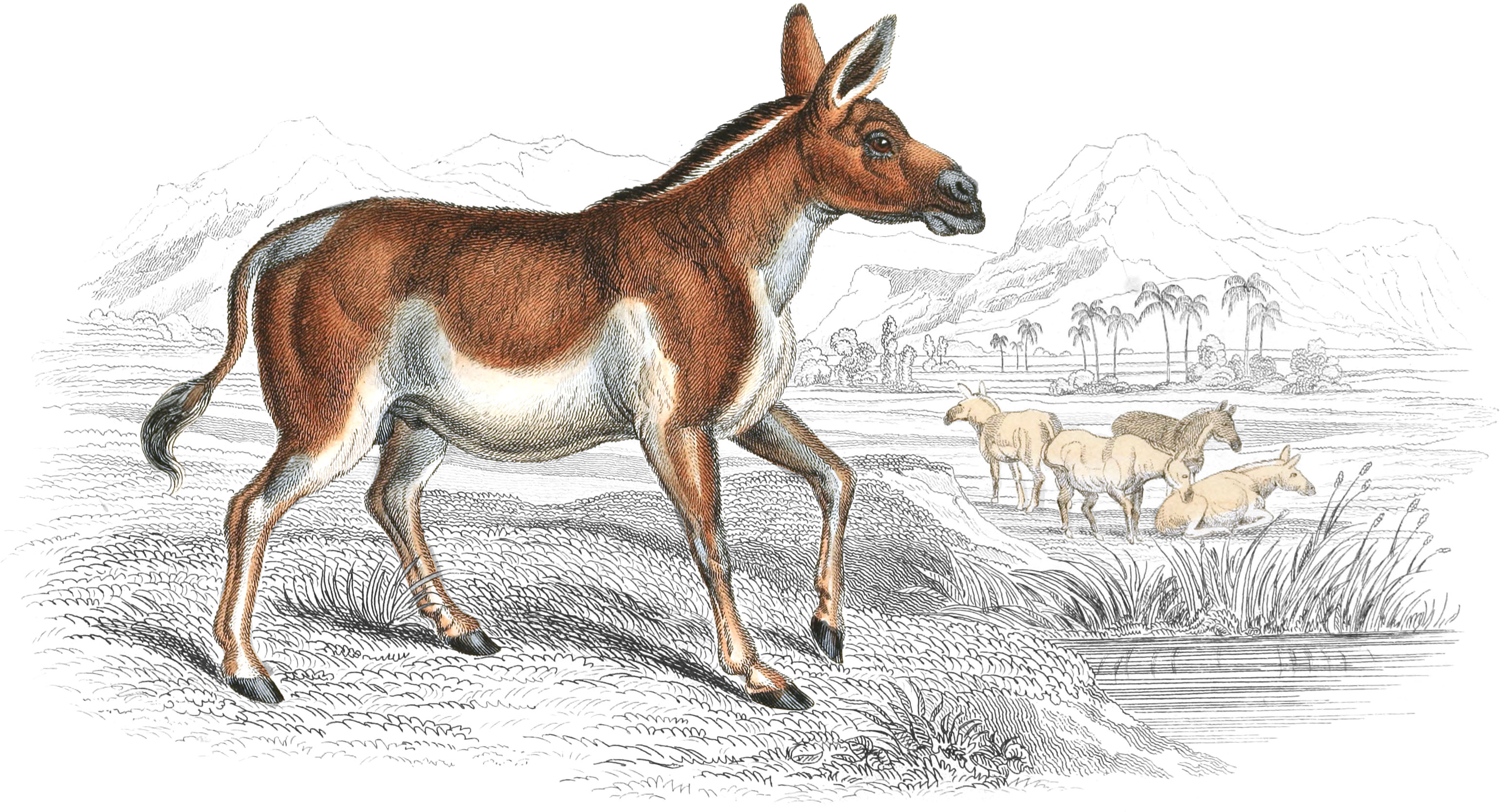
Plate XX

Hoof Shapes
The Hippotigrine Group, or Zebras
We are now arrived at the third form of Equidæ, one completely separated from all the others by being geographically confined to South Africa, extending little beyond the equator. Owing to this circumstance none of the species were known to the ancients, excepting, it appears, in one instance, where Xiphilinus, in his abridgment of Dion Cassius, lib. Ixvii., relates that Caracalla caused to be exhibited in the circus, an elephant, a rhinoceros, a tiger, and a hippotigris. This circumstance appears to us another indication of what we have shown in the history of Canidæ; we mean a certain and gradual diffusion of species over parts of the world where previously they did not exist, for the Romans, though possessed of less influence in Equatorial Africa than the Egyptians during the ages when Meroe flourished, nevertheless obtained a specimen of the Zebra, while no such animal appears painted in any known monument of earlier date in the valley of the Nile that has yet been discovered. The indication of Hippotigris is so apposite, that almost all travellers have made a similar comparison on observing any one of this group of animals, and on this account we have thought it the most befitting appellation for the group collectively taken. If the ancients were silent concerning the striped species, no wonder that the moderns were not better informed until the Portuguese established themselves on the coast of Congo and Angola; here they encountered the Zebra, which seems to be the Negro mutation of the Abyssinian Zeuru of Lobo and the Galla Zeora, or Zecora, according to Ludolphus; neither, however, of these indicated species is the Zebra of the moderns, for the earliest descriptions, such as that of Pigafetta, applies to a Dauw, or a species with alternate stripes of black and brown upon a lighter general surface, which we shall describe more particularly.
There exist several engravings of striped Equidæ in the older writers, Jonston, De Bry, Kolben, &c. of these the uppermost in plate v. of Jonston alone is not drawn from fancy; it represents, like the others, a Dauw, but clearly from a skin: Kolben’s, though absolutely worthless, is meant for that of the Cape Zebra. All might have been better known and figured at that time, since several authors had noticed the Galla and Congo Dauw; one had actually been sent from Cairo to the king of Naples, and Tillesius, Thievenot, and others assert that they had seen domesticated individuals.
This group, in general, has the head of intermediate length between the Equine and Asinine; the neck naturally fuller, more arched; the mane vertical, forming a standing crest: there is more girth, muscle, and compactness than in the foregoing; the lower jaw more curved; the ears wider, though lanceolated; the shoulder more oblique, and the withers more elevated than in asses; the hoofs higher, and as in the horse they are round and flat, in the ass oval and hollow, so in the species of Hippotigris they are oval at the toe and square at the heel, by the spreading of the frog; which causes the limb to stand more vertically upon the pastern: the tail is always, but especially in youth, more setaceous than in asses, and less than in horses. They are all partially or entirely marked with symmetrical stripes of black and white, or with fulvous intermediate passing downwards across the body and neck: all have the limbs white, with callosities on the inner surface of the upper arm: they have sonorous but varied voices; their dentition is Equine, but in one species it is said that there is some anomaly in the mammae of the female. They see remarkably well both by day and by night, surpass the Equidæ of the northern hemisphere in natural courage, are their equals in speed, and the species that are least adorned with stripes appear above the rest, and, next to true horses, formed for the use of man. They can be all tamed and ridden; their vicious disposition, though an impediment, being placable under judicious treatment; and there is little doubt that, in a few generations of domestication, most, if not all, might be rendered serviceable, particularly in South Africa, where they find their coarse but natural food, and are exempt from the distempers which are there often so fatal to our present breeds.
They are gregarious, but do not keep together in such numbers as the horses and asses of the northern hemisphere; nor does it appear that they are under the guidance of a stallion leader, who exercises authority, and exposes himself in defence of the herd. Some prefer mountain localities, others the upland plains, and each species seems to affect the more exclusive society of some particular ruminants. The species amount at least to three, with others not as yet sufficiently examined to be permanently admitted, but whether distinct or mere varieties the location of all in juxta-position, with at best the separation of a river or of a different mountain or plain, not rigidly maintained, offers a similar picture of osculating forms as were pointed out in the earliest distribution of true horses; and if it be a question yet to be solved, whether most of these would not under the care of man similarly commix, and in time produce races more perfect than any of the wild, still the probabilities seem to be entirely on the affirmative side.
The Zebra
Hippotigris zebra
The name of this animal is properly a result of the mistake made by the earlier travellers, who, finding at the Cape a striped Equine, concluded that it was of the same species with that already known by the equatorial term of Zebra, Mr. Burchell first pointed out the difference between the two, and proposed the restoration of the original name to the Congo animal, and to describe that of the Cape under the appellation of Equus montanus, because the species is properly an inhabitant of mountain districts. Naturalists, however, seem to have preferred bestowing Mr. Burchell’s own name on the species he had so clearly pointed out, and left the Zebra’s attached to the animal, such as it had been fixed by Linnæus. This decision may be so far fortunate, as we think it doubtful whether the Burchellian Dauw is really the same as the Congo species.
Of all the banded Equidæ, the Cape Zebra has the greatest external resemblance of form to the Hemionus, though the head is shorter and the neck fuller. In order to avoid confusion, it may be necessary to point out the differences between the South African banded species somewhat more in detail than was necessary in the description of the horse and asinine groups.
The Zebra, wilde paard and wilden esel of the Cape colonists, is about twelve hands high at the shoulder, and above double in extreme length. In shape the animal is light, symmetrical, the limbs slender, and hoof narrow, though rounded forward; the head is light, the ears rather long, and much more open than in the ass; the neck full, with the skin under the throat lax; the tail asinine, about sixteen inches long, with a tuft of hair at the tip; the ground colour of the coat is white, sometimes slightly tinged with yellow; and what distinguishes the species from all others is, that, leaving only the belly and inside of the thighs and upper arms partially unpainted, it is cross-barred with black over the head, neck, body, and limbs to the hoofs, having regular distinct nearly undivided bands in the male, and in the female similar bands of a less intense, or rather brownish colour; the region around the nostrils is bay, darkening to black towards the mouth over the head there are numerous equidistant narrow streaks running down the chaffron to the orbits, around them, and again others forming curves on the cheeks; from the ridge of the neck downwards there are almost always eight or nine hands, exclusive of two passing down the shoulder, opening below, where several others in the form of chevrons are interposed till they gradually become rings down to the hoofs; on the sides there are six or seven descending to the edge of the belly, and crossing a streak from the mane along the spine, dichotomising above, and those on the flank running four or five into one as they descend; on the croup, down to the tuft of the tail, are short cross bars; on the thigh there are four very broad cross bands, followed by others down the hocks and hind-legs; from the breast along the belly there is a single black streak; the tips of the ears are black, with four or five smaller streaks beneath them; and the mane, erect and bushy, is alternately banded black and white: to these characters Captain Harris adds
a bare spot a little above the knee in all four of the legs.
The female has two inguinal mammæ.
The species is gregarious in mountainous regions, from the territory of the Cape eastward to beyond Mozambique, perhaps as far as the southern mountains of Abyssinia.
Although vicious and fierce, the animal may be tamed, as was fully proved by the female that was long kept in the menagerie of Paris, which was exceedingly gentle, and could be ridden with safety.

Plate XXI
The Congo Duaw, or Zebra of Pigafetta
Hippotigris antiquorum, Nobis
Although the animal we place under this name may be only a variety of the Cape Dauw, there are so many instances of pretended varieties becoming admitted species, that we think it preferable to separate the two; the present species, even allowing for certain individual variations, differs from the other in being, like the Zebra, white with only a tinge of yellow: the ears are more open, with two black bars and white tips; the mouth and nostrils black; and the stripes, extending downwards to the knees and hocks, and even to the pastern joints, are fewer than in the Zebra of the Cape, more irregular, scattered, dichotomous, than in the Cape Dauw, and disposed in spots, with the slender brown intermediate streaks often interrupted; the tail is equine and white, frequently tinged with rufous or black at the end. In stature and form it is the most elegant of the whole group, and if the female had four mammae, as is affirmed to be the case in the Cape Dauw, we think the fact would not have escaped the notice of Dr. Smith when he secured the unborn foal, which we think belongs to the present species. If this be the case, the Congo Dauw extends from the Gareep along the west side of Africa to the Zezeere in Nigritia, for the description of Pigafetta is only applicable in every part to the animal we have here figured, and comparing it with the first Zebra, plate v. in Jonston, the identity will likewise immediately appear.
It is likely to spread also from Congo eastward to the Galla country, because we learn that there a species striped black and brown upon a white ground is likewise denominated Zeora, Zecora, and Zecuru, all mere mutations of the Negro Zebra.
The Abyssinian and Galla chiefs adorn the necks of their horses with a wreath made of the mane of these animals, secured near the throat-band of the bridle; one of these we have examined, and recognised the three colours, white, brown and black, which formed the bars. It maybe this species, and not the Cape Zebra, which Mr. Hoskins, from the description of the Arabs, conjectures to exist in the desert of Ethiopia above the fifth cataract of the Nile, that is, in about the 18th degree north.
The Congo species abounds particularly in the province of Bamba, and when first encountered by Europeans, was so little alarmed at the report of fire-arms, that Battel relates his shooting several, while others stood by without endeavouring to escape.149
Near the Gareep river they seem to be mixed with what we consider the Cape Dauw or
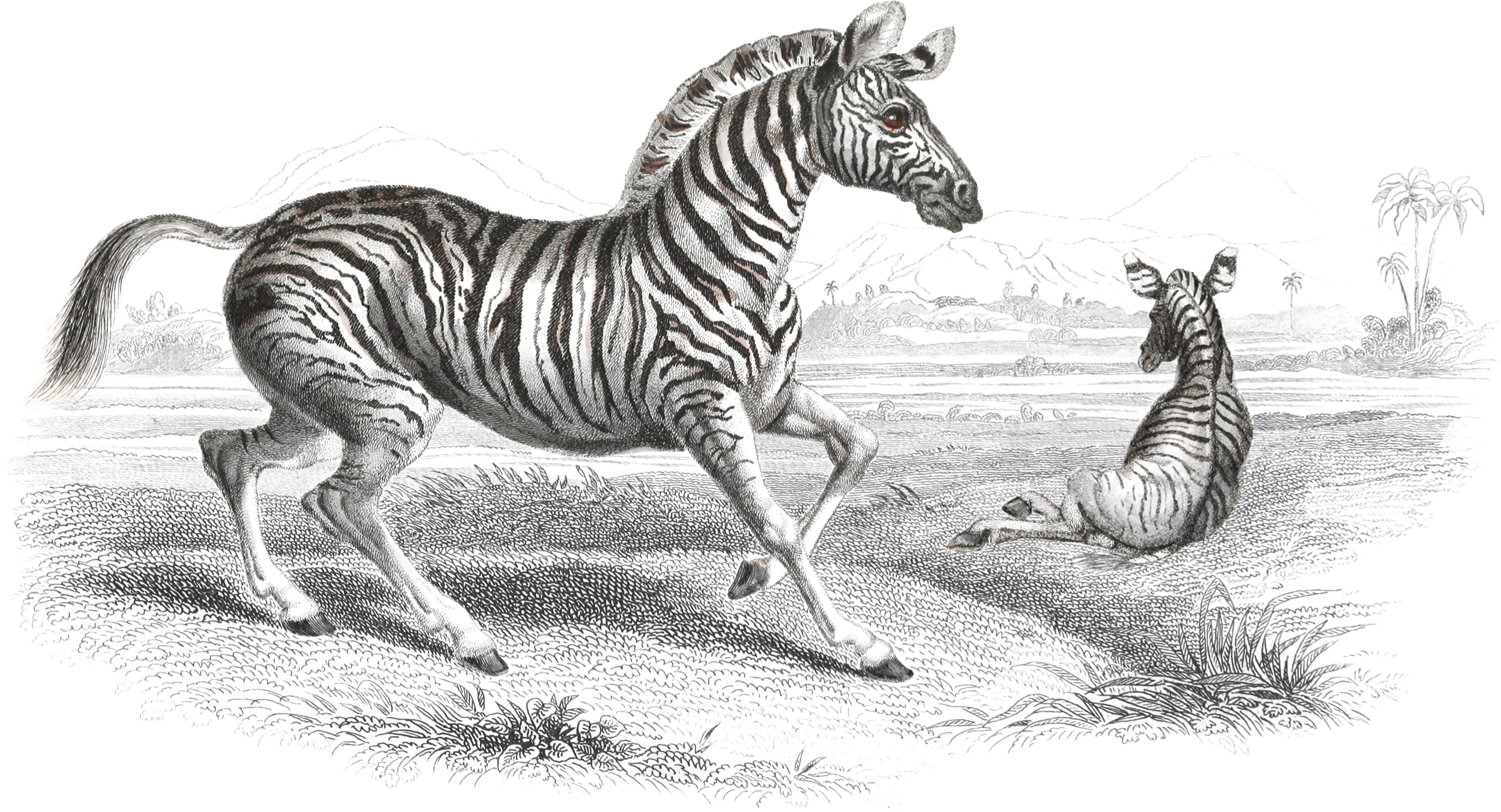
Plate XXII
The Dauw
Hippotigris Burchelli
Bontequagga of the Cape colonists.—Peechy of the Bechuana and Matalibi.
Notwithstanding that the merit of first noticing this species is due to the enterprising and scientific traveller whose name it bears, we doubt his approving the practice of bestowing proper names on species in honour of persons, so long as more appropriate may be selected, and believe he would himself have preferred another, such as H. campestris, by which it is designated in our own series.
The Dauw, like the former animal, is about thirteen hands and a half at the shoulder; the body is round, the legs robust, crest arched, black, and surmounted by a standing mane, five inches high, banded black and white; the ears smaller than in the former, less open, with only one black bar and white tip; tail tufted to near the root, or semi-equine, white, and about thirty-six inches long; region round the nostrils and mouth blackish; head, neck, body, and croup light bay; below and limbs white; numerous black streaks forming ovals on the face, broader in chevrons of the same on the side of jaws, and vertical still wider down the neck, shoulders, body, and obliquely over the croup, they dichotomise and divide, but not so irregularly, nor descend so low as in the Congo species; on the spine there is a black streak edged with white where the cross bars end, though in the former they pass on until they touch the ridge line; between the black there are regular brown lines relieving the pale bay.
According to Captain Harris, the female has an udder of four mammas; the hoofs of both species are black. The foal is marked like the parents, and differs from the adults only by its juvenile form. The Dauw inhabits the plains of South Africa north of the river Gareep in numerous herds, where they mix and accompany those of the ko-koon or Catoblepas gorgon. Notwithstanding what is reported of the fleetness of these animals, it appears that they can be overtaken, and are actually speared by hunters when they are well mounted.

Plate XXIII
Mare and Colt
The Quagga of the Cape Colonists
Hippotigris quacha
This species, equal or superior in size to the former, is still more robust in structure, with more girth, wider across the hips, more like a true horse, the hoofs considerably broader than in the zebra, and the neck full, the ears rather small, twice barred with black, the head somewhat heavy, and the muzzle black; the head, neck, and body are reddish brown; the mane, edges of the dorsal streak, and the tail, as well as the colour of the under parts and limbs white, like the dauw; head and neck banded likewise in the same manner, but on the shoulder the bars become pale and on the side gradually indistinct, till they are totally lost on the croup, and there are no intermediate brown bands. The name of this species is derived from its voice, which is a kind of cry somewhat resembling the sounds qua-cha! It is unquestionably best calculated for domestication, both as regards strength and docility. The late Mr. Sheriff Parkins used to drive a pair of them in his phaeton about London, and we have ourselves been drawn by one in a gig, the animal showing as much temper and delicacy of mouth as any domestic horse.
Quaggas are still found within the boundaries of the Cape of Good Hope, but on the open plains, south of the Vaal river, they occur in immense herds, associating with the gnu, Catoblepas gnu. It is this species that is reputed to be the boldest of all Equine animals, attacking hyaena and wild dog without hesitation, and therefore not unfrequently domesticated by the Dutch boors for the purpose of protecting their horses at night while both are turned out to grass.
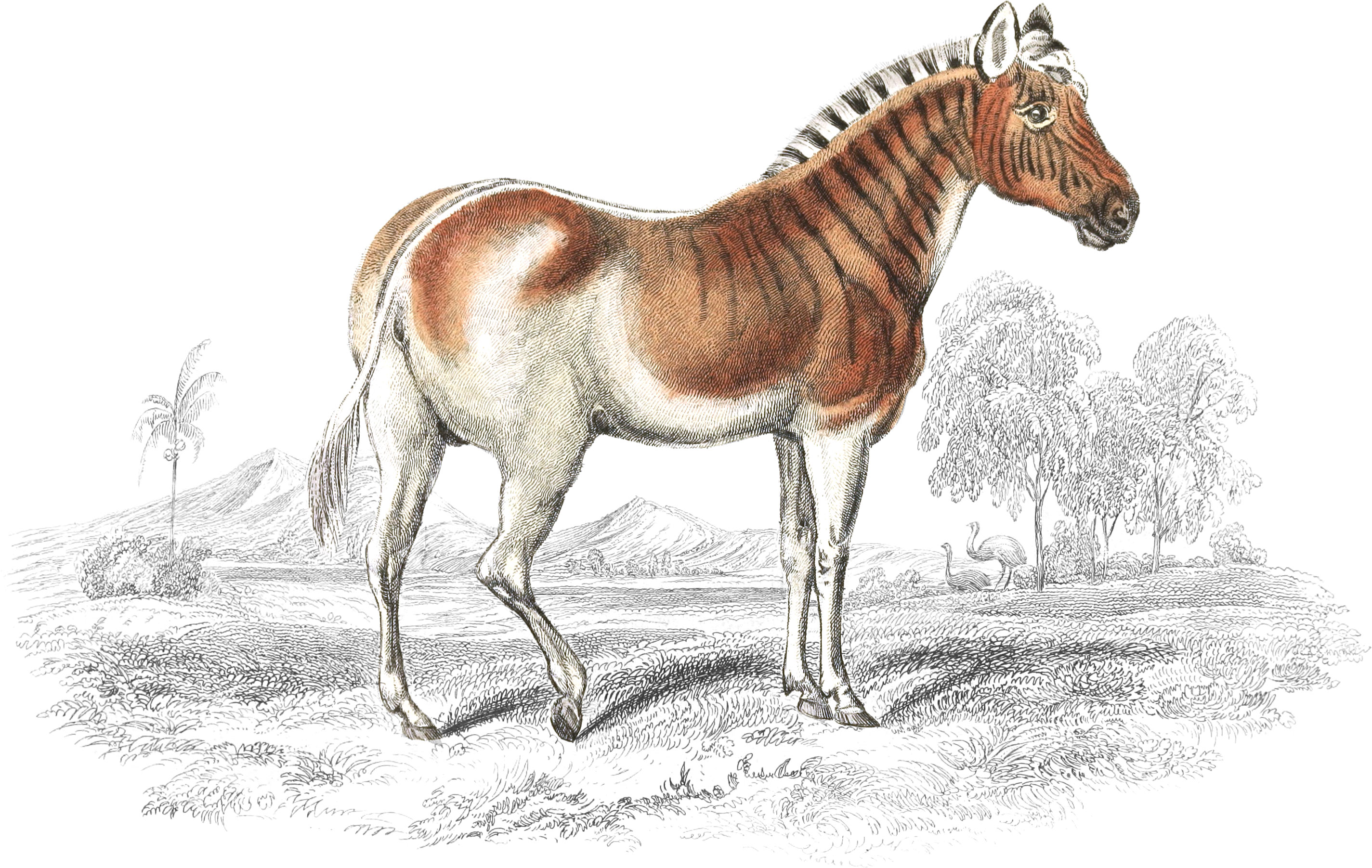
Plate XXIV
The Isabella Quagga
Hippotigris isabellinus
We separated this animal from the foregoing, because with characters most nearly allied to the last, such as the equine head, ears, body, croup, tail, and even shoulders, it still differs in size from all, being scarcely ten hands high, and still more in the colours and forms of the cross bands upon its livery.
The specimen is in the British Museum, and our drawling of it was taken when it had been recently set up; it struck us then as representing the zebre, or Ane isabelle of Le Vaillant, and found afterwards that Mr. Temminck, on seeing it, made the same observation.150 At that time there was, however, an opinion that it was the skin of a colt whose dark streaks were not as yet apparent; but as we now know that even in the fœtus the black marks are very distinctly visible, the objection is not valid, and there are besides other indications which prove the skin to have belonged to an adult.151 We therefore shall describe the specimen under the above name, in order to attract the attention of naturalists, and leave to future information the final determination of its locality as a species or accidental variety.
The Isabella Quagga is, as before remarked, much below the stature of the others, and in a stuffed form proportionably longer; the specimen is a male, and, compared with the quagga, has a different coloured nose, ears, and mane,—all being white; the general tone of the head, neck, body, and croup is yellowish buff, with brownish streaks on the face and cheeks, but more undefined, and not extending the usual length; on the neck, shoulder, body, and croup there is a series of bands more numerous than in the dauw, some few are branched, but instead of a dark colour, while the specimen was recent, they were all pure white, and those on the croup particularly numerous and interwoven; the belly and limbs are white, but, as if to prove that these marks were not the result of albinism, the anterior pasterns and rings above the hoofs of the posterior feet were sooty black and the hoofs dark. These marks do not occur in any known species.
The late Dr. Leach believed the skin to have come from the Cape, and it appeared that in his opinion the white markings were owing to nonage. We think it exceedingly probable that Le Vaillant had a sight of a similar animal and gave the above notice of it from its diminutive size, and, at a small distance, the seeming uniformity of its livery.

Plate XXV
The Mules
As the space we have remaining is insufficient to enter at full length into the physiological views which offer themselves in the consideration of hybrid propagation, we must be content with a more abstracted notice, and endeavour to present to the reader some general notions of the progress made in this department of research since Buffon wrote his article on the mule, and Frederick Cuvier published remarks on the same subject in the “Menagerie du Musee d’Histoire Naturelle.”
Although naturalists establish, upon the mysterious action of the reproduction of species and its accompanying phenomena, some most important maxims of the zoological science, and in particular point out the law which asserts the identity of species where consimilar individuals follow each other in succession through a series of generations yet, when they draw conclusions from known observations in order to generalise them over others, where all the conditions of the problem are not proved to be similar, they exceed the proper limits of inference, as we have already shown in the natural History of Dogs, and endeavoured again to point out in the foregoing pages. The laws affecting organic matter are modified by the Power that ordained them, and subjected to a multitude of exceptions, warning us at every moment to be cautious in the assignment of their bounds. Formerly, because science would not recognize the evidence of these modifications, it was endeavoured to escape from acknowledging the value of truth, by asserting that bats were birds and cetacea fishes, because they were not quadrupeds; and when the objection was destroyed by adopting as a general term the word mammalia, many, habituated to received doctrines, maintained them to be at best on the utmost verge of possible adaptations of that class of beings; but with a more intimate knowledge of American animals, and still more after the discovery of the Marsupialia of New Holland, new phenomena in gestation and reproduction came to light. In the case of Opossums, they had often been denied or overlooked, and were held impossibilities, until systematic research overthrew all doubt and transferred incredulity to the as yet unsettled questions relating to the Monotremes, whose wonderful history is conspicuous in the Ornithorynchus or water-mole.
Now, all these questions were and are accessible to direct proof by anatomical investigation; and if they were so long contested more than examined, we must not expect assent to be readily granted to others not amenable to similar demonstration. Where we have as yet only a very small stock of experiments to guide us, where a multiplicity of distant and minor considerations must be weighed against each other, conclusions that appeared legitimate become questionable; and though the human mind often continues to uphold them with more tenacity than judgment, they are defended with less and less ardour, and finally are surrendered, like all other unprofitable prejudices. We might go on to show how little we are acquainted with the resources of Nature in the history of insects, in the laws affecting the life of those low orders of existence which pass into vegetable and stony forms we might ask what is known of the microscopic and ephemeral beings which spring into vitality and perish within the few hours of a solar day, and are not again reproduced until a space of time is elapsed indefinite or exceeding three hundred fold the duration of the appointed limits of animation; we might point to surmised animals and their germs reposing in the depths of earth, slumbering perhaps in a night of ages, to be called at some future moment into their day of active being! Finally, when we everywhere observe organic remains in evidence of an infinity of lost animal forms, of destroyed families and genera and species that once were quickened by the irritabilities of life, once fulfilled a design and accomplished the tasks assigned them, we surely, while the plastic power is undeniable in all its modifications, may with propriety refrain from denying the probability of those other flexibilities in the laws of propagation which we have here advocated, although the evidence as yet remains in some cases presumptive, and we only descry the workings of Almighty Beneficence darkly.
With the limited knowledge we as yet possess, we are not justified assuming as law, without striking exceptions, that sterility is a necessary result of the commixture of different species, and fertile offspring an unerring proof of their identity. Frederick Cuvier, notwithstanding an evident disinclination to depart in opinion from the conclusions of the great and eloquent Buffon, is obliged to qualify his assent, and points out himself the disregard of his own conclusions and the unsatisfactory state of opinion that noble writer and his followers are driven to when they attempt rigorously to uphold them.
F. Cuvier says,152
In this science (zoology), as in all those depending upon observation, the generalisation of facts, is the surest guide to truth; but the inductions to be drawn, in order to escape false conclusions, must rest upon facts strictly amenable to comparison. Nothing appears more natural, from an observation of the phenomena of the succession of individuals in an ascending or a descending line being similar to each other, than that they are of the same species; and this consideration, coupled with a certain repugnance which many animals manifest towards others very similar to themselves, induced Buffon to draw the above mentioned conclusion. But he soon after could not help perceiving, that we can only pursue our inquiries with certainty among a few domesticated species, some of them expatriated, or under various conditions of restraint, and that with all the others we depend entirely upon inference.
He discovered that there were species, admitted to be distinct, which nevertheless produced fertile offspring: this was the case in his later experiments with wolves and dogs, with goats and sheep, and he was not then aware that all these names include more than one species, which there is every reason to believe can mix and produce fertile descendants, since several are already known to possess the faculty. It was in endeavours to account for these exceptions that Buffon was driven to arbitrary restrictions and extensions of his rule; and had he given due consideration to the fact, first published by himself, of the different number of mammae in different dogs, and known that the vertebræ of the back, the sacrum, and tail vary exceedingly in hogs, said by those who maintain the rigorous maxim before quoted to be of the same species, he would most unquestionably have framed his view of the law with more circumspection.
As a general proposition, we do not mean to dispute that it is still the best and most trustworthy method for distinguishing species; only the inferences demand not to be made more absolute than is necessary, and should be limited in the application to the true phenomena of each case, for these vary exceedingly upon the slightest discrepancies between osculating or nearly osculating animals, some hybrids being sterile, others reproductive, though with an apparent decreasing power of fertility, and some where there is no observable check in progenitiveness, or where it is soon obliterated. Such we conceive to be the true horses here described, the two species of camel, the goat and sheep, and most if not all the species of both; we might add the domestic cats, including the blue or chartreux, originally belonging to a distinct feline group; the Bengal cat described by Pennant, of a second, and the tortoiseshell cat, to all appearance sprung from a third group originally indigenous in South America, and still sufficiently aberrant to produce in the domestic commixture males with the greatest rarity, though the distinctive character is so strong that the females alone are competent to preserve it. Frederick Cuvier rejects the existence of mules where neither of the parents are domesticated, but we know wild mammalia under restraint are likewise in the predicament as well as several species of birds in a state of liberty, such as Gallinacea and several Merulidæ and Fringillidæ. We question the reserve of all polygamous ruminants and of some pachydermata; all those that expel a proportion of the males from the herd and that can find approximating species. From personal inquiry among those who, like the ancients, reside in the presence of uncontrouled animal nature, we have found that, like them, though they believe in heterogeneous intermixtures known to be untrue, they nevertheless infer them from others which have every appearance of reality; thus, we may instance the well authenticated fact of the American bison, in the frenzy of defeat and expulsion, forcing his way to seek companions among domestic cows, whose domesticity in this case is an accident, not a cause we may point out likewise, in the rut of Indian repudiated Axine bucks producing among the unspeckled Porcine the intermediate well known breed of spotted hog-deer, an instance where both species are wild.
Cuvier remarks,
In Natural History we judge from the forces acting at present on the laws of nature, and not from those of a different character which have ceased to operate, or are no longer within reach of observation.
To render this maxim wholly admissible, it would be necessary to substantiate the facts: undoubtedly the period when animals extended their habitation after primitive distribution is in a great measure past, excepting where the intervention of man continues to act; yet it is not wholly so, nor is it proved that the earlier migrations of mammals were entirely without human intervention. If the feral horse, stretching without his instrumentality towards Tierra del Fuego and to California, is not wholly free from objection, the progress of the Bengal tiger to the reedy shores of Lake Aral is at least believed to be recent and unaided: nor is the influence of man the only remaining agent in the operation of modifications. We believe it at present perceptible in a species of goat known as the wild ægagrus, which is occasionally found in the Alps, the Pyrenees, the Caucasus, and the mountains of Bootan, in all appearing to be a prolific hybrid between the domestic goat, of whatever origin or country it may be derived, and the local wild capra of the region, whether it be ibex, caucasica, or any other. Besides, if there be not already in South Africa, similarly to what we contend occurred in Asia, one or more modifications intermediate between the zebra and quagga, totally independent of the intervention of man, we may at least point out the probabilities of what might be effected by a well ordered system of cross breeding with the same species and their actual osculants, and what might be the results after repeatedly infusing the blood of one desirable form to modify and perfect another.
There are as yet so few carefully conducted experiments of this class, and there is so evident an unwillingness in practical men to encounter new combinations where certain profit is not immediately demonstrable, that the immense latent power of sympathy between the fœtus and the mother of the more highly organised domestic animals is, among other subjects, well worthy investigation; since the influence exercised upon what is called natural education is not only acknowledged, but in the reproduction of forms, marks, and colours, the evidence of anterior excitements are demonstrated in the case of the mare whose first foal having been a mule by a stallion quagga, continued after a lapse of five years to reproduce the markings of that animal in three successive births, although the parent of this and the subsequent progeny was a black Arabian, and of course one of homogeneous species with herself: these facts, detailed in letters of the late Earl of Morton, and published in the first part of the Philosophical Transactions of the year 1821, have not yet received all the consideration they deserve, and they prove that at least some important forces at present acting on the laws of nature are not beyond the sphere of observation.

Plate XXVI
Filly, bearing marks of Quagga
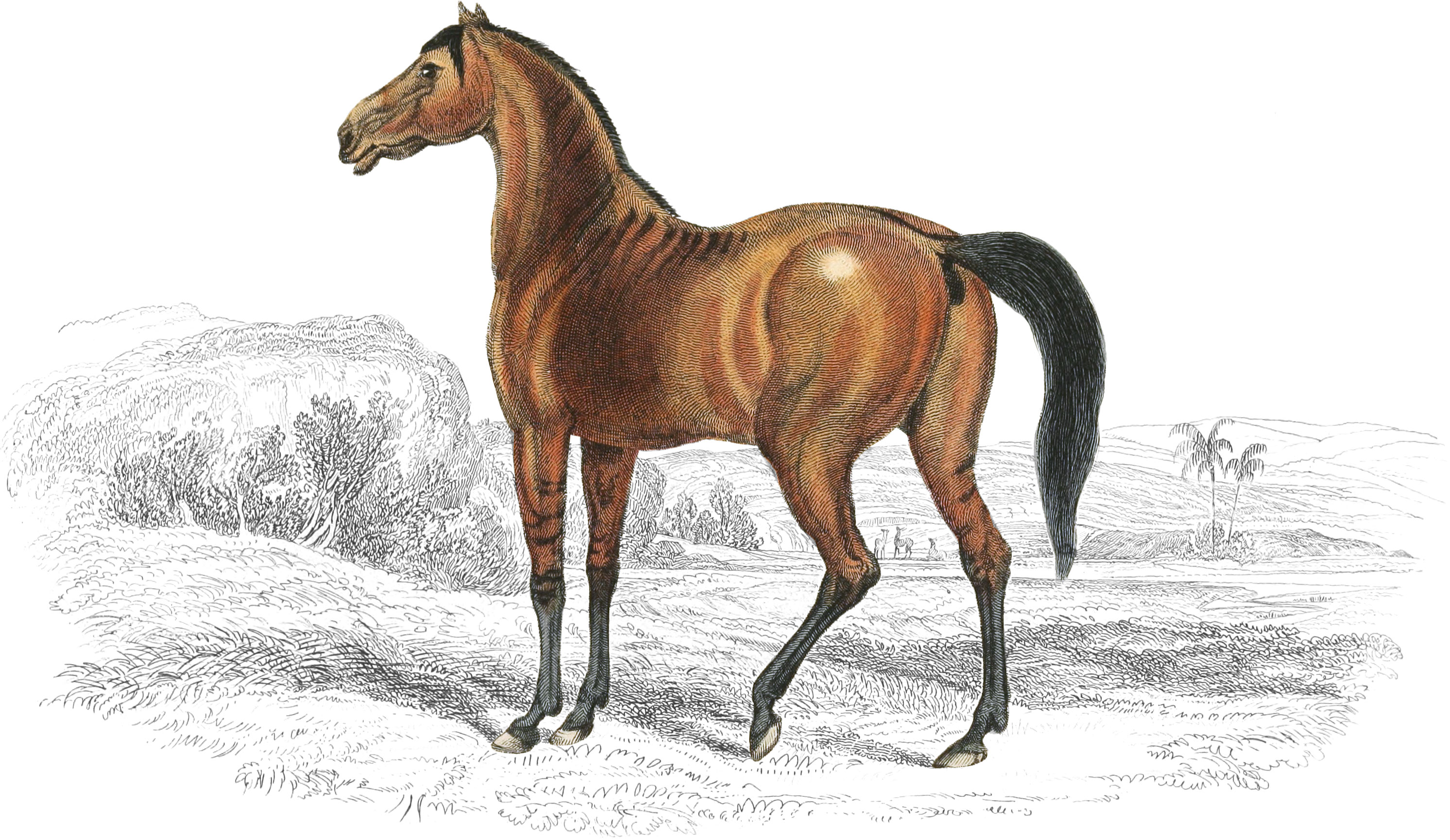
Plate XXVII
Colt, bearing marks of Quagga
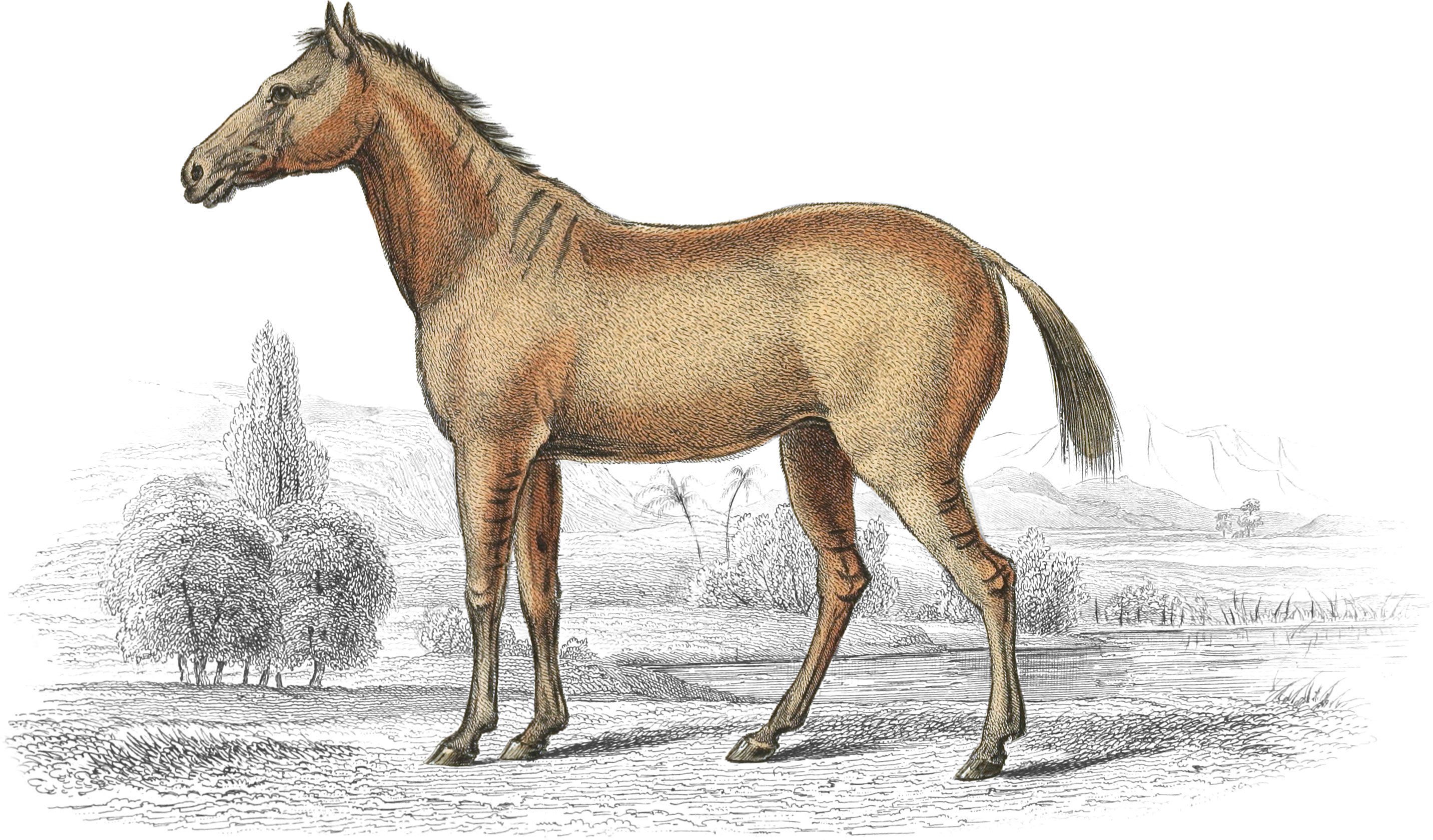
Plate XXIX
Hybrid first Foal of Brood Mare and Quagga
We here subjoin representations of the mare and her successive offspring, in Plates XXVI., XXVII., and XXIX.,153 which represents the quagga mule, and Plate XIV. the brood mare and her last foal, still marked with the black stripes on the body; the mare was seven-eighths of Arabian blood, and consequently her progeny by the Arab was nineteen-twentieths thorough-bred; yet not only these hippotigrine marks remained, but the manes also were coarse and standing, though in other respects the young horses were elegant and spirited animals. One more remark on this subject must not however be omitted, inasmuch as it seems to point out the fact of the quaggas themselves being of remote hybrid descent; because any disturbing action in the regular filiation of their progeny reproduced indications of a more decided system of variegated painting on the true horses and superadded cross bars on the joints, neither of which occur or are conspicuous in the quagga.
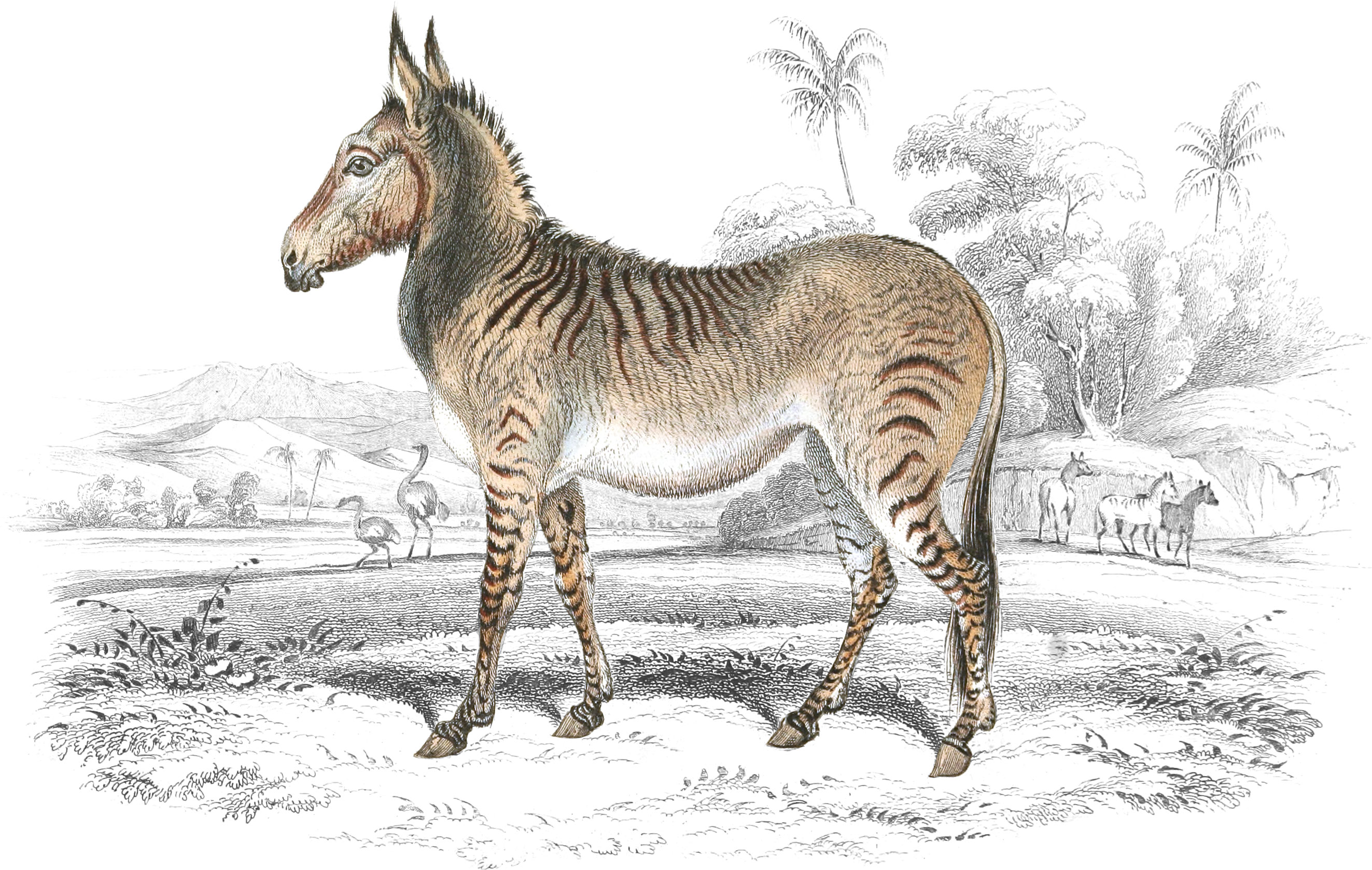
Already, in the time of Buffon, the idea of producing mules from the striped species of Equidæ had occurred. Lord Clive, in experiments to effect this purpose, had. found it necessary to deceive a female zebra by painting a male ass with hippotigrine stripes. No such precautions, it appears from Frederick Cuviers remarks, were subsequently demanded at the Menagerie du Roi at Paris; here the hybrid result was a powerful slate-coloured animal with but scanty marks of the zebra dam in his livery; as often occurs in the first descent, when in the second they are much more conspicuous. In a second instance, we do not know, but the sire appears to have been zebra and the dam an ass for .the structure indicates her form, and the more conspicuous strias the parental livery. See Plate XXVIII.
With regard to the quagga mule, Plate XXIX., we detect in the figure a more powerful animal, but its subsequent history is not known to us. Equine mules, though there are both ancient and modern attestations to the contrary, may be justly regarded as unable to continue their race: the Paris zebra mule likewise evinced an indifference, which, in the course of a long life and ample food, proved a similar state of organic inability; but it is in forming cross breeds between positively osculating species, such as the South African, particularly the quagga and the two or three dauws, all homogeneous in most respects, that an improved Austral horse may be attainable, one that would be more durable, more serviceable, more easily kept, cheaper, and less liable to disease in the southern hemisphere than any of the races introduced from the north.
In hybrids, it is true, deterioration may be at first in some measure expected, but after the second and third generation, with well selected animals of unadulterated blood. Nature recovers from the disturbing effects, and assuming characteristics of stability without loss of a great part of the required qualities brought in by the mule hybrid, is again prepared for a further infusion of them by a fresh cross, until the desired point is obtained, and stature, form, colour, or marks are produced equal to the proposed intention in a number of individuals sufficiently large to prevent decrease or decay in the progenitive powers. These inferences rest upon the case of the hybrid wolves of Buffon continuing to breed among themselves, though they were under circumstances of restraint, neglected, and insufficiently numerous or aided by recrossings from either side of their parentage; causes in themselves sufficient to produce a gradual sterility.
The common mule is the offspring of a male ass and a mare; familiar to every reader. This kind of animal was already abundant in Palestine at the time of the first kings of Israel, and is frequently mentioned in the Scriptures and in Persian history. In the district of Zobeir, or Old Bussorah, the ancient habitation of Orchrenian magi, and not far from the west bank of the Lower Euphrates, there is still a race of white asses anciently renowned, as well as the breed of similarly coloured mules, reared with attention, and the most beautiful in form that are known. In antiquity, the sons of kings rode them, and old princes put them in the traces of their chariots. In the time of the caliphs of Bagdad, they sold for eighty or more pieces of gold, according to Abdulatif. They continued to be bought at high prices for the use of Moslem chiefs, of heads of the law, civil and religious.
The common grey mule of Egypt and Barbary is a handsome, docile, and in general a large animal, much used by merchants, Jews, and Christians, who, until very recently, were denied the privilege of riding horses. In Auvergne and the south of France and Spain, partially supplied from beyond the Pyrenees, the race is in general black, large, and robust. It is the fashion to shave their skins in summer, and their tails are often clipped in a succession of tassels like a bell-rope. So late as the reign of Louis XIV. the medical men of Paris still rode mules. In Spain they continue to serve, because they are sure-footed and cautious, in traversing mountain precipices and stony roads with a rider or with merchandise upon their backs, and have an easy pace. In Italy the dun-coloured breed of Volterra is in highest estimation for bulk and good qualities, and therefore it is eagerly bought up to draw the carriages of cardinals and Roman church dignitaries. It is in Italy alone, as before remarked, that we find a mule in complete panoply is mounted by a knight in armour. It is observed of hybrids in general, that males are much more abundant than females, and the fact is equally true in the mules between ass and mare, where the males are in the proportion of two or three to one female another observation proves that the offspring always partake more of the character of the male parent than of the female; thus, in the common mule, we perceive the ears to be long, the head, croup, and tail asinine; while in the hinny, or progeny of a stallion and female ass, the head, ears, body, and tail resemble the same organs in a horse; but the mule in bulk and stature takes after the mare, and the hinny in like manner is low like the she-ass.
The Hinny
This animal, though rather more docile than the common mule, is of inferior utility, because less hardy and somewhat disproportioned in the bulk of the carcase in comparison with the legs, and therefore more easily fatigued. Hinnies are now extremely rare in Europe, and even so uncommon in Barbary, that few have seen them, and when they occur are a cause of marvel, which the Oriental mode of thinking is sure to embellish. It was no doubt in Africa that the story arose, which was long credited in Europe, and seemed to have influence even upon Buffon, respecting a monstrous breed of hybrids between a bull and female ass, or a male ass and cow: one author asserting that he had himself rode one in Piedmont, and others that they occurred in the valleys of the Pyrenees: the first mentioned variety, it was said, bore the name of Baf or Bof, and the second that of Bif. In France both were supposed to be known by the appellation of Jumar, a word clearly borrowed from one or other of the Arabic dialects, Ahmar or Hymar, already noticed. In Barbary, where this story is still believed, and persons assert they have seen individuals of the monster form, we find, if they are all of the kind such as a black specimen already mentioned, that it is simply a hinny; but the Western Arabs assert that these animals are wild, and produce in proof of it the species of horse we have described before under the name bestowed upon it by them, namely, the Koomrah; which having low withers, a bulky body, and the forehead covered with a woolly fur, has an equivocal appearance, perhaps sufficient to have raised suspicion of a bovine intermixture so early as to be the same animal which Herodotus without a description has denominated Boryes.
In concluding this essay on the Natural History of Equidæ, we beg to assure the reader, without claiming his implicit assent to the mode of viewing we have fearlessly ventured to submit as the result of our convictions, that we arrived at them after researches originally made more amid the wild scenery of Nature than among books, and that we found them ever recurring where the maxims of our present physiology are incompetent to explain the phenomena which offer themselves; they do not claim to be demonstrations, but tentamina to excite attention, and to account for facts which otherwise are inexplicable. In the progress of science, in the accumulation of observation, we daily feel the necessity of abandoning dicta and maxims, which, after having been long trusted on authority, are gradually undermined, and finish by being surrendered.
Thus, neither the depth of view, nor the eloquence of Buffon, have been able to maintain many of his conclusions; they have failed to uphold his “Tableaux de la Nature,” and his “Degenerations des Animaux” has not fared better. If, in the leading points we have discussed, we should not carry with us the consent of scientific men, the cause may be justly ascribed to our inability more than to the doctrines here advocated; and in abstruse questions, such as those where systematic nomenclature and physiology are insufficient, we believe, in order to come at sound probabilities, that we must study also the earth’s surface, the phenomena of its revolutions, its geographical history, and, finally, apply an enlightened philological system to the whole. Though every way humble and inadequate to grapple with these desiderata with real strength, such means as we possess have been made available, not to repeat a thrice told tale, but to offer views which close investigation into species appears to sanction, so far at least as those mammalia are concerned which were destined by Almighty Wisdom to be the solace and servant of man.

Plate XXX
Synopsis of the Equidæ
Incisors \(\frac{6}{6}\) cuspidate \(\frac{1-1}{1-1}\), or in the females of some species \(\frac{0-0}{0-0}\); molars \(\frac{6-6}{6-6}\) = 38 or 40; molars furrowed on each side with flat crowns and vermiform ridges of enamel; void space between the cuspidate and molars; upper lip very moveable eyes large, pupil elongated laterally; ears rather large, erect, very moveable; feet solidungular; tail setose, or with a tuft at the end; mammæ two, inguinal; stomach simple, membranaceous; intestines and cæcum very large; colour plain, dappled, or striped.
The Equine Form
Equus caballus.
Tail setose up to the root; flowing mane; raised withers; round solid hoofs; neighing voice; mammæ two.
- Eq. cahallus domesticus:
- The Bay Wild Horse or Tarpan.
- The White villous Wild Horse.
- The Black——?
- The Eelback Dun decussated.
- Eq. varius: The Tangum or Kiang.
- Eq. hippagrus: The Koomrah of Africa.
The Asinine Form
Tail with a tuft at tip; forehead arched; nostrils more forward; withers low; mane rugged, short, erect; ears long; back carped; hoof, soles oval voice braying or dissonant; mammæ two; colour silvery greys; back decussated.
- Asinus equuleus: The Yo-to-tzé.
- A. onager: The Wild Ass.
- A. hamar: The Wild Ass of Persia.
- A. hemionus: The Djiggetai.
The Hippotigrine Form
Tail asinine or equine; withers slightly elevated; ears long and wide; mane erect, forming a standing-crest; hoof, soles anteriorly oval, posteriorly square; colours white or clouded with rufous, but all more or less regularly and symmetrically striped; voice various; mammae two or four.
- Hippotigris zebra: The Zebra.
- H. antiquorum: The Congo Dauw.
- H. Burchelli or campestris: The Dauw.
- H. quacha: The Quagga.
- H. isabellinus: The Isabella Quagga.
Hybrids
- The Mule.
- The Hinny.
- The Quagga Mule.
- The Zebra Mule.
Memorandum
In reviewing the manuscript, the author requests the reader to correct a slight mistake in stating that Joseph sent a chariot and horses for his father, when he should have said that chariots and horses went up with him when the body of Jacob was carried for burial in the cave of the field of Machpelah; and since the text was written, among many services rendered by Mr. Edward Blyth, whose merits as a naturalist are well known, the author has to thank him for an interesting notice of horse-teeth found at the Big Bone Lick, the well known place where the remains of Mastodon abound, which proves the existence of Equidæ in North America during a former Zoology; and in that particular invalidates the remarks in the text concerning their pristine absence.
- Such as the rudiments of two other toes attached to each of the canon bones, the structure of the stomach, the teeth, are pachydermous; the consolidation of the phalanges, separately immoveable, homogenous; but the conformation of other parts approximates the ruminantial character.
- We have seen teeth of Equidæ found in Polar ice, along with the bones of the Siberian Mammoth, others from the Himalaya range, down to its southern spurs, mixed with fragments of lost and unascertained genera; many more from the Oreston and Torquay caverns, with bones and teeth of hyæna and sheep; some from Ireland, and one from Barbary, completely fossilized. Horse bones, accompanied by those of elephant, rhinoceros, tiger and hyæna, rest by thousands in the caves of Canstadt, in Wurtemberg; they have been found with elephant bones at Sovran, in digging the canal of Ourcq; at Fouvent-le-prieuré; at Argentcuil; in Val d’Arno with Mastodon; and on the borders of the Rhine with colossal Urus. Crawfurd docs not notice any among the organic remains observed by him in Ava; but Captain Cantley found Equine bones in the sandstone, and among fallen cliffs of the Sewallick mountains, at the southern base of the Himalayas between the Sutleje and the Ganges.
- From this view burrowing Canidæ and Rodentia are purposely excluded, because, from their habits, they may be found in the same localities, without belonging to the same era.
- The existence of debris of horses in South America, in company with the Megatherium in aqueous deposits, is not yet sufficiently proved to be coeval; and with regard to the teeth of a horse, at least equal in size to our great domestic breeds described by Mr. J. C. Bellamy, and found in the ossiferous caves of South Devon, the difference of size is not so great as to change the nature of the general conclusions and several of these sites, where the remains of sheep, of a canine, possibly a wolf, flint knives, potsherds, and even human bones have been detected, although with or near those of rhinoceros and hyæna, lead to doubts respecting the real cause and time of their juxtaposition. If the discovery of true Equine debris in South America be now admitted in deference to the late report of the accurate Owen, it remains to be ascertained whether they do not belong to the Austral group, that is, to the zebra form.
- Koomrah, Cumri seems to be a Mauritanian mutation of Hymar, mixed up with the Negro Kumrie, (white) the animal being found in the snowy mountain range of Nigritia, and hence also the idea that it is white.
- What Don Ulloa says respecting wild asses in Peru, and Molina of the same animals in Chili, are mere local accounts of a few strayed animals that may have bred in independence on the borders of the plantations, but they do not resume characteristics of vigilance, of liberty, and of voice, such as are so beautifully depicted in the glowing images of the Hebrew prophets and Arabian poets; they are not noticed by later travellers, and in no case appear in droves on the Pampas or troops in the mountains, in a fixed feral state, like the horse. There were feral asses, according to the Buccaneers, in St. Domingo and other places; yet though they ought to be the most vigilant, the least sought, and the most inaccessible, they have disappeared, while the feral horse still remains.
- Probably through the imperative fer, which is radically the same as Phra, Phar, the “Car-born.” Pharoah and, Persian, Varanes seem both to be epithets derived from farem, varen. Even the Sanscrit mystical boar Vahrahan, Teutonic Vehr, and Latin Verus preserves the character, if not of being borne, but of bearing up; for he upholds the world on his tusks.
- We use the term Scythic for want of one more explicit, and understand by it the Caucasian nations of the northern half of ancient Asia, who, being provided with horses, came across the Jaxartes, down the Oxus and the Indus, across the Tigris, the Euphrates, to the Bosphorus and the Nile, in the character of conquerors more than colonists. Servius, in his remarks on the language of Virgil, who in common with most ancient writers gives the creation of the horse to Neptune, states that some name this horse Scythius.
- An object to cross; a bridge.
- The Centaurs, children of Centaurlis, son of Apollo, among whom Pholus appears to be again pful, or ful, fullen, foal.
- The original idea seems always to refer to conveyance,—being carried, riding, drawn, sailing, ever associated with elevation, grandeur, velocity: hence, in Hebrew, equally applicable to a horse and an ass. Northern words, in the Arabic alone, amount to several hundred, derived most likely from an unknown parent stock through Zend or Pelhevi, and closely allied to Gothic and Sanscrit. The known Indo-Sacæ and Germanii had first proceeded south before they moved westward at a later period, and cannot have had such strong influence upon the Semitic tongues: we must look for an earlier and more permanent cause to account for the fact; perhaps to the giant invasion of Canaan, or of the shepherds in Egypt. That there were inroads of cavalry nations from the north-east at a later period, is sufficiently implied by the predictions in Deuteronomy, where the expressions “from afar off, even from the ends of the earth, as swift as an eagle flieth,” are perfectly to the purpose; and at an earlier period these terrible invaders would no doubt have been denominated giants. With regard to the word Asp, it affords another indication of the original habitat of the horse in the names of most ancient nations of Central Asia noticed by Greek authors, such as the Aspii, Arimaspii, horsemen and mountain-horsemen, probably Mongoles of Tibet.
- The Hyksos or Haikos, that is, Haik wearers, is a name of ancient Upper Armenia, and denotes a garment, from which we retain the old word Huck, and the ancient Belgians Fuik. Snorro gives to Seythia the name of Sarkland, the land of Tunic, i. e. huck wearers, which coincides with the received opinion of the region whence these Seythic invaders had issued, and the direction they took in their retreat, although it is probable that they went no farther north than the Hauran, beyond Jordan.
- These hieroglyphic pictures show by the cross,—the Swasteka cross of Budhu, figured on the robes of several foreign nations,—that they are not themselves of the era of Sesostris, Remses II. or III.; they also indicate the region whence Egypt derived horses, since, in the tribute paid by a conquered people, horses, and even chariots, are represented: now, this people is painted with long dresses, light complexions, brown hah, and blue eyes, and named Rot-n-no. Among other objects of interest there are bears, and elephants with short ears and high foreheads, peculiar to the Asiatic species, all offering proofs of the Rot-n-no being residents in High Asia and not Africa, though it involves the difficulty of elephants being then found to the west of the Indus and of Hindukoh, but it is probable that they were already imported from India at a remote period. See Wilkinson’s “Ancient Egyptians,” vol. i.
- Deuteronomy, xvii. 16.
- See also the Mahaharata, where, under the mystical denominations of gods and superhuman agents, Kauravas and Pandavas, it appears that the first great military religious invasion of India is recorded; and in the enumeration of the Akshaushinis, or corps of armies, both chariots and cavalry are mentioned.
- The Stri-rajahs, or women princes of Marawa, opposite Ceylon, have in Indian records all the characteristics of Amazons, and are represented with similar attributes in sculpture. At present the robber tribe of Kalures, occupying the same territory, have women in chief authority, and polygandry is the law.
- If the half-civilized Centaurs divided at the foot of the Carpathians and pushed onwards to the Baltic, traces of which might be pointed out in their peculiar horses, we would have a clue to the arrival of the first Asa race in Northern Europe, and account for their riding gods, their Indian divinities, their horse sacrifices, and their language approximating to the Sanscrit, and the mythical legends of Sagara and Asa-manga.
-
Mr. Rich mentions a bas-relief of a man on horseback, carved in stone, being found at Nineveh, but destroyed for building purposes before his visit to that city; and he represents a cylinder having the figure of a riding sportsman catching a deer with a casting-net, found at the same place.
Sesonchosis first mounted a horse according to Apoll. in natalis comes.
Bellerophon on the winged Pegasus in Pliny, the Amazons in Lysias Rhetor, and, lastly, Mareo, a person half-man half-horse, first taught riding to the Italian people; his name is the same as Maron, a horse, in the Thracian tongue, and shows, as Centaur or Lapitha, that he was of the race of mounted invaders from Asia. There is even an older evidence that riding was not unknown in the days of Jacob, in Genesis xlix. 17,
An adder in the path, that biteth the horse’s heels, so that his rider falleth backward.
- The leucoryx, and other antelopes, are usually classed with oxen in Oriental relations.
- Events of this kind had occurred, and are again foretold by the prophet Ezekiel, vi. 26,—“A king of kings from the north, with horses and with chariots, and with horsemen,” &c. A king of kings, literally Chahgan. The Tahtars have a proverb, that for seven years after a horde has passed, no com will grow. In the eleventh century, when the terrible Comans overthrew Persian, Turk, and Christian, and took possession of Jerusalem, their shaggy maned dun ponies were described and figured in Europe like lions, and the riders like Chinese. See MS. Marino Zanuti, Burgundy Library, Brussels, 1326.
- Noticed in Pausanias, seemingly from the Celtic tri-march-kesec, that is, three horses combined,—a knight and his two squires.
- Bailly and others have satisfactorily shown the earliest astronomical observations to have been made, and the zodiacal constellations named, in a region more northerly than either Egypt or the plains of India; therefore, anteriorly to the civilization of either, prior to the arrival of the horse; and consequently we are carried back to an unknown social state in Bactria or Cachemire.
- Ninus, Pful, Varanes, Pharnabasus, Phraortes, perhaps Pharaoh; again Lorasp, Gustasp, Sheerasp, Asphendiar, &c.
- The two-headed a winged horse of Egypt, Pegasus, Sleipner, the solar horse of Odin; in the harvest month, Gulfaxi, horse-skulls of the Sueiones, the figures and heads as signa of Nisa, Susa, Corinth, Thessaly, Etruria, Carthage, Beturiges, Silures, Sequani, Mauri feroces, Saxons, Tahtars, Turks, and many others.
- 2 Kings, xxiii. 11.
- There are two or three, indeed, where riders occur in Egyptian battle-pictures, but they always represent enemies, such as those opposed to Remses in his Asiatic expedition.
- See note.
- Herodotus, Aristotle, and Pliny are sufficient authority for the original dislike of the horse to the camel, and the fact proves their subjugation and domestic habits were not then completely established, for now, and for several centuries past, they are not only thoroughly reconciled to each other, but in actual friendship, since she camels suckle foals, and many of the best Arabians chiefly subsist on camels’ milk. If Cyrus be Kaikaus and reigned in Bactria, it might be inferred that in Western Asia the first charioteers came through the Arian desert to the lower Euphrates; but it is most likely their route lay between the Caspian and the Caucasus into Armenia though it is more probable that the bay stock of horses spread by the Sulimani range and Helmond to Southern Asia, Yemen, and Egypt.
- 2 Chronicles, ix. 28, and 2 Kings, x. 28.
- The sacred historian gives the prices both of horse and chariot: a horse from Egypt cost 150 shekels of silver, or about £17 sterling; a chariot, most likely in part of east metal, was worth 600 shekels, or £68 8s. sterling. This trade was evidently carried on by the gross or string, as the price was not for different values of single horses; and it proves that even then in Egypt they required particular care and were expensive in rearing, and that in Syria they were either scarce or of inferior value. See 1 Kings, x, 29.
- See the Horse, “Library of Useful Knowledge,” 8vo. 1831; a book we have consulted with great interest, and invaluable in many particulars: its humane tendency is above all praise.
- See Laborde, “Journey through Arabia Petrea.”
- Matnoub are strangers to whom is conceded the privilege of pitching their tents on the same Une with the hospitable tribe. It is conjectured that these adopted families gradually merged in the Arab tribes, and were the chief cause of the numerous Hebrew names we find given to individuals,—such as Issa, Haroun, Musa, Daoud, Suleiman, Jussuf, Ibrahim, &c. It is natural that their fine intellects should give them influence, Islam a new impulse, and with the tenacity of tribal reminiscence, revenge was an additional stimulus.
- Laborde shows the Nabatheans to have had cavalry, deriving their horses from the Scenite Arabs. The Nubian Arab tribes are still headed by their Meleks.
- Not a few of these habits are, however, already in vogue among the Abipones and Pawnees, the new Tahtars of America, both in the north and south.
- Stirrup, or Rikiob, first mentioned by Avicenna, Of horseshoes we shall speak hereafter.
- Voyage on the Balir Abiad, or White Nile, by M. Adolphe Linaut. Geogr. Journ.
- Hippopotamus, elephant, or rhinoceros. The geographical position of the writer of the book of Job, as well as his era, remains inexplicable; although there exists a tomb ascribed to Ayoub, perhaps of the Mevelevi Dervish of that name, near Birs Nimrod.
- I have been told of one instance where a pair of chariot horses are spotted; but not knowing the locality, they may belong to a later date.
- “Nisa omnes equos flavos habet.” Plin. The Nisean plain is mentioned by Arrian and Diodorus. Ammian, Marcel, places their pastures in the plains of Assyria, west of Mount Corone, which forms a part of the Zagros chain. Alexander, in passing through Kelone, on his march to Ecbatana, saw the remaining herd. The spot is now a resort of the Beni Lam Arabs. This locality does not agree with other authorities, who place the Nisean plain east of Casbeen.
- This race wasthe first emasculated, on account of its fierceness; and hencegeldings, in Germany, are still called Wallachs.
- It seems, however, to be noticed by Homer under the name of Dardanian. Æneas had a set, and those of Rhesus, all attest the locality of the white stock.
-
Statius, when speaking of the mare of Admetus, points to their Centaur origin:
Quern et Thessalicis felix Admetus aboris
Vix stcrilcs compescit equas, Centaurica dicunt
Semina (credo), adco sexum indignantur et omnis
In vires adducta venus, noctemque diemque
Assimilant maculis intemigrantibus albæ.In the sequel we shall find Virgil equally attentive to these Characters, in describing the Ardean breed.
- In the Vatican fresco, where Attila is diverted from marching to Rome, Raphael represents one of these horses, which bespeaks his information as an historic painter.
-
Circa Olysipponem et Tagum equas favonio stante obversus animalem concipere spiritum, idque partum fieri et gigui. Plin. viii. c. 42.
Well represented in the Mosaics of Italica; see Alex, la Borde, “Descripcion de un pavimento en mosayco,” &c. folio. They were the Honesti spadices of Virgil, and valued for the course in the circus; hence Isidorus says:—
Color hie præcipue spectandus, badius, aureus. De Origin, lib. xii. art. 41.
- There was among the Sarmatian a light bay breed, handsome, with big heads and arched necks; and those that were dappled in a particular manner on the shoulder and croup were sometimes bought, and at others refused, from an unexplained belief that these marks were of evil omen.
- This was rather in the lower empire, under the Byzantine sovereigns, who had retained the studs of Asia Minor chiefly in Cappadocia; they favoured others in Syria, and in the fourth century obtained their curule horses from a stud kept at Pampati, near the Mansio Andavilici, not far from Tyana, in Caramania.
-
The horses destined for the circus could not legally be applied to any other purpose, and it became the fashion to talk of their pedigrees in the horse-breeding provinces, such as Spain; hence Statins, in the second century, says,—
Titulis generosus Avitis
Expectatur equus, cujus de Stemmate longo
Felix emeritos habet admissura parentis.
Lib. v. s, 4. Protrep. ad Crisp, v. 22. - See the Notitia Imperii. Pancirolus. We may also mention here the classification of horses in the old monastic institutions: they were divided into,
- Manni, large geldings for the superiors
- Runcini, runts, small nags for servants
- Sumernarrii, or sumpter-horses to carry baggage; and
- Aveni, plough-horses on the church lands.
- The Persian bas-reliefs represent riders without stirrups; although all the barrows on the plains of Tahtary, where horse-bones and saddlery are detected, produce them of metal and we have not observed a single illuminated Oriental MS., Japanese, Chinese, Tahtar, Persian, Turkish, and Arabic, when horsemen are figured, where they do not ride in stirrups.
- A mule in the tomb of a northern king, a Frank, would have been an insult to his memory. As Pagans and horse-sacrificers, the object is sufficiently clear, and the size of the animal corresponds to the era and the race of horses then used in Germany.
- “U. Aldrovandus de Quadrupedibus,” fol. p. 50.
- “Pallas’s Travels.” It is the brandmark of the Abassian race of Shalokh.
- In this view the Welsh march is connected with the Teutonic marcht, a market,—and Latin mercator and merces may be of Gallic origin. The German jahr marckt, annual fair, always denoted one where horses were sold, in its original acceptation.
- Argyle, in Scotland, is presumed to be derived from Are-Gael, the breeding or horse-stud of the Gael. Sted, or steed, from the Teutonic stute, a marc. Broisel is said to be derived from broeden, to breed; broisel, a brood.
- These terms stood in contradistinction to the smaller sized horses, called achineæ, in French hacquenés, with us hackneys, and in Italian ubinas; there were, besides, arlanni, scoppæ, and palfreys, all under-sized horses, usually bred to ambling, and the last mentioned almost exclusively reserved for the use of ladies, was if possible white or marked with some peculiar colours. I know of only one instance where a knight in full armour is pourtrayed riding a mule dressed in annorial trappings, and that is of Piero Farnese, 1363, a statue in the proportions of life, and perhaps in real armour, over a door in the cathedral of Florence; for a drawing of which I am indebted to ray friend Seymoxir Kirkup, Esq.
- We derive the facts of this and the following paragraphs from a treatise on “The Horse,” published under the superintendence of the Society for the Diffusion of Useful Knowledge, 1 vol. 8vo. 1831. The text says Hugh Capet by mistake; it was Hugh the Great, father of Capet, who married, in second nuptials, Ethilda, daughter of Edwaxd the elder, and sister of Athelstan.
- According to the Anglo-Saxon computation, forty-eight shillings made a pound, equal in silver to about three pounds of our present money; in value to fifteen or sixteen pounds five pence made one shilling. “The Horse,” page 23.—There were also the qualities required to constitute a good horse, in triplets,—3 of a woman, 3 of a lion, 3 of a bullock, 3 of a sheep, 3 of a mule, 3 of a deer, 3 of a wolf, 3 of a fox, 3 of a serpent, and 3 of a hare or cat! All whimsically applied.
- I do not find whether it was Roger de Montgomerie or his son Robert dc Belesme, or Boulogne; the names appear to be confounded.
- An Arabian.
- See Rymer’s Fædera, quoted by Henry.
- Lyard, dappled grey; Sulyard, mouldy grey. The ancient family of Sulyard bore for arms a stumbling white horse, and for motto, “Hoist Bayard.” Byard, or Bayard, denoted a bay, probably from the Arabic bayel, a horse. Aldrovandus thinks that Valus, the name of Belisarius’s charger, indicates a bay; we think it derived from vale, a pale or Isabella horse. Bayert, nevertheless, is an old Teutonic word, to which, in the Netherlands at least, the idea of black was affixed.
- Desoription d’Angleterre et d’Ecosse, par Etiemie Perlin, 1558.
- See “The Horse,” page 27. Grooming, on the English plan, was already an object of attention abroad; for Maurice, the learned landgrave of Hesse, in his secret visit to Henry IV. of France, observed, in 1602, “English grooms with the king’s horses at the Louvre.”
- Zachariah, chap. i. ver. 8, although in a mysterious allusion, yet marks the bay Syrian, the white Armeno-Persian, and piebald Macedonian race; and in the Revelations, chap, vi., the same white and bay, the pale Median, and the black Roman or Scythic; they are not golden, nor silvery, nor green, nor blue, but actually taken from existing types, depicting the nations who owned them.
- Notwithstanding that the period of the destruction of Megatherium, or Megalonix of Jefferson, admits of little doubt, there exists among the North American Indians a curious legend of a large animal they name Tagesho, or Yagesho, much superior to the largest bear, remarkably long-bodied, broad at the shoulders, more slender and weak behind, with a large head, short thick paws, and very long claws, spreading wide; the skin almost bare, excepting on the hind legs, where the hair was very long, and therefore called a kind of bear: it was slow, but killed women and children, unless they escaped on rocks, trees, or in the water, and then swam last and far: the last was killed in an attempt to climb a rock where the hunters were posted. See “Legends of the North American Indians.” Many of these characters will apply to a giant armadillo.
- Or, as in other authorities, 1657.
-
From longitude 73° to 1 13° east, and in latitude from 30° to 50° north.
See Danville’s map of China in Du Halde, drawn up from the Jesuit memoirs; still the best and almost the only documents for the greater part of the region in question. By late British travellers, who with almost super-human perseverance have penetrated into parts of the western extremity of Central Asia, our doubts are supported, as will be shown passim.
- Ukraine wild horses, fit to be eaten, but net fit for the saddle, says Beauplan. Equiferi are the Kondziki of the Poles, according to Rzonozynski.
- We were shown the specimen with the foregoing account by Professor Lichtenstein, and when we asserted that it was a female ibex, he wondered at his own inattention, and remarked that his judgment had been perverted by his credulity: admitting at once the truth of our declaration.
- These we take to have been the peall, gwilwst, and heffil of the British Celtæ, tit and upping of the subsequent Saxons,—for we find, in some notes taken from MS. documents collected for the Acta Sanctorum of the Bollandists in Vita St. Huberti and Ste. Genovevas, “Runcini vulgo upping;” and in a fragment apparently of the patrimonial property of the Carlovingian dynasty at Heristhal, some account of stabled horses and uppings. It is the same as the Finnic hepo, Greek ιππος, and Latin equus, but the first of these only indicates the root to be connected with getting up, mounting; hence our epping-stones or horse blocks, and Epping Forest, where they may have run wild, &c.
- The black demon-horse of the West appears to have been called a Baiert: Theodoric, carried off by one, shows its antiquity. The wizard Scott’s, and the horse Pardolo of Spanish legends, is of Gothic origin. I think there are similar allusions to black horses in Tahtar tales.
- Rzonozynski compares the Polish wild horses (Kondziki), in size, to the Samogitian (Zmudzineks), mostly with tan or mouse-coloured liveries; but there being other furs, attests they were mixed in his time. He describes the manners of the stallions, and admits that they can be trained, which, indeed, is equally true of the zebra and quagga. Herelates their extension over the Ukraine, and gradual decrease. See Hist. Nat. Ciuriosa Regni Poloniæ. Sendomir, 1721, p. 217.—For several of these authorities we must express our thanks to the Polish Literary Society (of Paris), and in particular to Colonel Lach Szyrma.
- If I mis-read not my note, Takja, and this name, I find also, in Nemnich, written Taga; but I am not sure if it is there meant to bear the same definition as above. I took the word, on one or two occasions, to be applied to all unowned horses of the steppes.
- The sultan-stallion of a great herd was anciently an object of research for the chiefs of armies, who endeavoured to catch them with the command (the antique lazzo), and then made them their chargers. The breed of Raksh, say the poets, was long traced in the herds of Masenderan.
- Such is the general evidence, chiefly obtained from the orderly before mentioned; a man who was a perfect model of an independent trooper of the desert; who had spent ten or twelve years on the frontier of China, and, I understand, was often seen at Paris attending his Tahtar chief at the theatres, in 1814. My interpreter was an officer in the Don Cossack regiment of Colonel Bigaloff, whose French was not super-abundant. From the Mongolic troopers I obtained little information; they were stupid or unwilling.
- I have seen South American horses extricate themselves in the same manner.
- This assertion, as in other cases, is not consistent with facts observed, if care be taken in the process of domestication; it must be understood to mean that the wild horse resists, till death, the unceremonious forcible system of subjugation practised by the natives.
- I understood by that appellation, that the Cossack spoke relatively to his own position being north of the central chains of Asia.
- They are noticed by the troubadour poets, and Guillaume de la Ferté, 1221, is figured with a pied horse, in stained glass, at Noire Dame de Chartres.
- Pamere, with the Surikol lake in the centre, twelve days’ journey across, gives birth to the Jaxartes, the Oxus, and to a branch of the Indus: from the table land all the mountains in sight appear as under the feet; there are no trees, but rich pasturage, never long covered by snow, because of the violent drift winds. The wild and domestic horses, and nearly all the mammiferæ, are clothed in long shaggy white furs. Kara Koom, comparatively low, is still higher than Hindo Koosh and the plateau of Ladakh, 17,000 feet above the sea, where Dr. Gerrard met great droves of wild horses.
-
Boura of Koldagi, Ruppel.
A ruminant the size of an ass; both sexes hornless, covered with dark brown, bristly hair and having a long black mane on the neck, the legs brown-black; the animal is fleet, and resides on the hills.
Mr. Ruppel saw the skin of one at Cairo, and conjectures that it is an undescribed species of Ovis. It may be also the Feshtall, but that fesh, slightly modified, will admit of other explanations. See Herodotus, lib. iv.
- See Griffith’s Cuvier, Ruminantia.
- Bernal diaz del Castillo.
- Dr. Rengger notes the first horses in Paraguay to have been imported from Spain and the Canaries in 1537, and shows the error of Fmies (En Saya dc la Historia civil del Paraguay), who pretends that in the exploratory voyage of Irala, in 1550, six hundred were conveyed to the country, since Azara found in the archives of Asuntion a document proving that Irala, in the year 1551, actually bought a Spanish horse for 15,000 florins. “Naturgeschichte der Saeugethiere von Paraguay” 1 vol. 8vo.
- On the colours of Spanish horses, see “Escuella de a Caballo,” a translation from La Gueriniere, but with additions by Don Baltazar de Trursun. 2 vols. 8vo. Madrid, 1786.
- There is a race of starred skewbalds in Patagonia, an evident approximation to white, just as real pied horses are chance occurrences in England.
- Sec Captain Head’s graphical description in his Journey across the Pampas.
- In Mr. Buckingham’s Travels there is a case of a caravan of men, horses, mules, and asses, under the influence of severe thirst, suddenly coming upon a river in the dark, and overthrowing each other, as each pushed his predecessor before him into the stream.
- Travels in North America, 2 vols.
- Capt. Harris’s Sporting Expedition in South Africa.
- Achieved by “Flying Childers.”
- In this manner the Pampas, towards the Straits of Magellan, are altering for the better, according to the observation of Mr. Bartlett.
- This is clearly the language of a keen judge of the feelings of his nation, and a further proof, if proof were wanting, that he had to deal with men in full possession of horses highly valued;—and true enough, horses have been the source of honours, and are a source of wealth to the Arabs.
- These are the marks for estimating the age of the hors till the animal is deemed old; and it may be proper to add, that there are further tokens taken from the tushes, &c. The age of a horse is always calculated from the first of May, and there is considerable difference in the marks between stabled horses, crib-biters, and animals usually at grass. For an admirable account of these questions, we refer to the history of “The Horse,” before quoted.
- The King’s German Hussars alone brought off their horses, in consequence of being ordered to march by Vigo, where they Lad time to embark the whole unmolested.
- Major Anderson. We know not if this gallant and amiable man is still alive.
- This was a horse of Mr. Quin’s, in 1753. Forester, another racer, caught his antagonist by the jaw to hold him back. Surely such animals should not be gored or cut with the whip to do their utmost.
- Albinism would produce white, or flea-bitten, or sorrel horses, but does not afford the round dapples and black legs.
- Had he been one of a riding tribe, the world would have heard of a mystical mare; but being a camel-driver, he only dreamed of the Borak, that mysterious camel which carried him up to the third heaven, and the object of profound discussions among the Ulema, as to whether it was red or white.
- D’Herbelot notices Kamel el Sanateym, a treatise on farriery, wherein are found mentioned several of the above remarks. For most of the details concerning Eastern horses, it will be observed that we are indebted to Malcolm, Elphinstone, Frazer Bums, Connolly, Moorcroft, and the two Gerrards; for other particulars, to relatives and friends who have long resided in India.
- I believe the renowned Darley Arab was a Saklawye: he was purchased at Aleppo by Mr. Darley’s brother, from an Arab tribe near Palmyra.
- Frazer’s Tartar Journeys.
- The specimen figured, Pate X.*, represents one that carried Osman, a Mameluke, from the Nile across the desert to Tunis; a feat perhaps never before accomplished.
- We think the name of Tazi is given to them by ancient Indian writers, but do not know where it is so defined. The ancients spoke of these horses as inhabitants of the isles in the Red Sea,—probably Bahrein, &c. on the east coast of Arabia, and near the Persian Gulf, sometimes called the Erythræan Sea.
-
Captain Frazer (Journey to Khorasan) says
they are deficient in compactness; their bodies are long in proportion to their bulk; they are not well ribbed up, are long on the legs, deficient in muscle, falling off below the knee, narrow-chested, long-necked; head large, uncouth, and seldom well put on. Such was the impression, &c.
But if these defects were real, the horses could have neither durability nor speed.
- See the Gottiugen MSS. of the Shah-Nameh, and a book of fables in Turkish, Brit. Mus. They always carry heroes and chiefs. It was on one of these Selim, flying from his father Bajazet, escaped to Varna. They have usually white feet and a white star on the forehead.
- Captain Williamson describes them as broad, short, heavy, and phlegmatic.
- The Cozakee is regularly imported, and therefore not an Indian breed; and the Kaqthi comes from Thibet. The Ghoonts, Piekarrows, and Bhooteah mountain ponies do not belong to the bay stock.
- “A mulberry black horse is what every one should wish for, though few can possess.”
- Pignatelli was the person who, in the reign of Henry VIII., first introduced at Naples the modern system of riding, or manege.
- Buffon and Sonnini, with equal self-satisfaction and pertinacity, have inflicted a similar consequence upon their own country.
- Shotten-herring, Conqueror, Butter, and Peacock, according to Sonnini, were of Spanish blood.
- Such as Sampson and Bay Malton.
- We have little doubt that the Wellesley was a Persian of the ancient white stock, mixed with the highest blood of Turkoman race, and probably with a cross of the Arabian, as the make of the head evinced.
- Turkish bashaws and Persian chiefs being notoriously high-born.
- Steeple hunting, that sport alike reckless of the life of man and horse, is now perhaps the main cause of breeding steeds of first-rate powers, as well as first-rate speed.
- If we continue the present practice of wearing our noblest horses before they are fully arrived at maturity, it will be difficult to prevent the reality of a degeneracy, which many surmise is already commenced.
- Touching the western border of the Kalkas, where the villous race is abundant. It is remarkable that the white horse of Vishnou should bear the name of Kaiki.
- The solar gods, Apollo, Odin, Crishna, the Persian monarchs, &c. all had possession of or access to the original location of the white stock of horses, and are represented to have used them. They dwelt on the Tanais, or came from Farther Thrace, from Armenia, or their legends came from quarters where the white horse was found.
- See “Einleitung uber den Dichtungskreis des Heiligen Graals,” in the Lohengrun of J. Gorres.
- The whole vegetable mould of the above geographical surface is more than any other supplied with horse-bones and heavy teeth, most applicable to the black stirps.
- Johnstomus de Quadrupedibus seems to have intended a figure of this stock in his tab. v., under the name of Equus hirsutus, but it is not described.
- M. Hazard, and after him Desmarets, assert that the great brewers’ horses of London are of the Boulogne race of France; but beyond the mere occasional experiments made by breeders, no French horses, excepting of Norman blood, has met with consideration in England for more than a century.
- We saw, some years ago, specimens of the restored race they were black, tolerably well-shaped, but not improved by foreign noble crosses; their number was still confined within the royal Haras.
- There is, nevertheless, in Eastern Asia, a prevalent opinion that black horses come from the West; from Fu-lang, which Father Jaubil translates, Europe.
- Beside the animal figured, Plate VI., we have seen but two others similarly marked with a cross bar; but my friend and acute observer, N. Gabriel, Esq., informs me that he has found several in England.
- Bay Bitshock was lately noticed at Moscow for speed, pretending to thirty miles an hour! We suspect, thirty versts.
- Researches, subsequently made among the Russian cavalry, procured only two other horses marked with the cross bar; in both it was less distinct, though the animals appeared to be of the same race as the above.
- These horses are most certainly wild, never having been reclaimed at any period, not being worth the trouble; their unbroken freedom is as unquestionable as that of their companion the Mouflon.
- Asiatic Researches, xviii.
pl. 11, 247. We regret not to have had access to this work: it is probably also the Tangut Ksching. - Zachariah, i. 8., and other authorities before noticed.
- See the anterior part of this work, where the breeds of antiquity and the wild horses are described. Pierre Vidal, who attended Richard Coeur-de-lion, speaks of them in his Novelle, 1208. Guill. de la Ferté, 1221, stained glass in Notre Dame de Chartres, has a pied charger. Raffaelle, in his picture of Attila, frescos of the Vatican; and the two other painters in their Auroras.
- There were, in 1815, some squadrons of Bavarian Hussars mounted on skewbalds.
- We beg to refer the reader to what is said of this species in the article on wild horses.
-
Aristotle had observed that the more powerful males attack the weaker.—
Tandiu ilium persequuntur donee assecuti ore inter posteriora crura inserto testiculos ejus evellant.
- See wood-cut at the head of this article.
- Vol. i. p. 39.
- Migration from Tahtary to India and Persia is scarcely possible: there are no passes from Thibet across the Himalayas; that which the Indus offers, if frequented by these animals, would long since have led the nations around to waylay them in their passage: over Hindukoh they could not come; further west the Jaxartes and Oxus intervene, and the asinine group are not swimmers: the migration is probably only a few hundred miles either way, about Tomsk, and similarly on the south of the great chains down the Indus. The species or races of Africa and Western Asia do not migrate, excepting in following the herbage.
-
Pliny says those of Africa were esteemed the best for the table:—
Cum teller est Onager, solaque Lalisio matre Pascitur: hoc infans, sed breve nomen habet.
Mart. xiii. 97.
- See Voyage on the Bahar-el-Abiad by Adolphe Linant, and Hoskins’s Travels in Ethiopia.
- The Emperor Philip, after his campaigns in Mesopotamia and Armenia, exhibited only twenty Onagri in the shows of Rome, which, had the gregarious kind been within his reach, he would scarcely have deemed sufficient; for being by birth an Arabian, he had every inducement to procure them. See Pomp. Lætus, 1. i.
- At Beni-Hassan.
- Borello, Arabic; Bourique, French; Tasandunt of the Schelluhs; Pico in ancient Egypt.
- A choice breed of asses, and of Arabian camels, appears to be an object well worthy the attention of the local governments of Australia and New Zealand.
- British Zoology, article Ass.
- Astabis or Hemippus of the ancients.
- Phamaces, Satrap of Phrygia, brought nine of them to his government, whereof three were living in the time of Pharnabasus his son.—Aristotle.—Which shows that they were no longer wild in Western Asia in the era of Alexander, though the ostrich still roamed in Mesopotamia. Aristotle seems to overlook his former assertion, or to confound two species.
Purchase’s Pilgrims, book 6, chap. i. sect. 2, p. 706, folio. London, 1617.- Monsieur Le Vaillant was a travelling naturalist in the employ of Mr. Temminck’s father, who held a high official situation in the Dutch East India Company’s government at home. From the context of what Le Vaillant says about this animal, it is clear that he saw, but did not possess it. Buffon’s figure of the young Quacha is copied from Allemand, of which we have seen an original drawing with black streaks, and therefore is not like the Isabella. For these reasons we cannot assent to the opinion of Mr. Gray, nor agree with the writer of the article Horse in the Penny Cyclopædia, vol. xii. p. 313.
- In the whole group there is a greater tendency to lose the marks with age than to increase them, when we last saw the specimen, the original colour was much changed.
- Frederick Cuvier’s great work, Lithographed Mammals of the Menagerie of Paris. Folio, coloured. Articles Zebra and Mule.
- All the figures produced in these plates are reduced copies from the paintings, by Agasse, in Surgeon’s College, London.