
Volume XXXII
Fishes of British Guiana
Part I

Introduction
The Botany and Zoology of Guiana have found able historians; but it appears that Ichthyology, that interesting branch of the Natural History of a district so much intersected by mighty streams and numerous rivulets, has been much neglected. It is true that Bloch in his splendid work, and also his successor Schneider, gave us a description of some of the inhabitants of the fresh-water rivers of Guiana and, at a more recent period, Lacepede, Humboldt, Spix, Agassiz, Cuvier, and his able coadjutor Valenciennes, have added a few to the number previously known; but with these single exceptions, the knowledge and history of the fishes of Guiana have remained almost a sealed book to the scientific world. If we, however, divest the history of its finny tribe of all our technical phraseology, and do not restrict it to a description of their external characters, anatomy and physiology,—the Indian, the son of one of Nature’s most magnificent provinces, has from his childhood been a close observer of all the objects of nature by which he is surrounded; and his knowledge of the inhabitants of the numerous rivers of his country is perhaps the more perfect, since, in a great measure, his precarious subsistence depends upon his success in fishing.
In 1835, an expedition to Guiana for extending our geographical knowledge, and that of the productions which were indigenous to a fertile soil and congenial climate, was resolved upon by the Geographical Society of London, and when having received the sanction and assistance of Her Majesty’s government, the command of the exploring expedition was confided to me, it was natural that a branch of science which is invested with the highest interest, whether we view it in an economical or in a scientific point, should receive a great share of my attention. But with the exception of my Indian friends and Dr. Fleming’s Philosophy of Natural History, I had nothing to guide me in my researches, the scientific Ichthyologist may therefore be disappointed in my remarks; and I was so well aware of this defect, that on my return to Europe, I yielded only to the persuasion of my kind friend Sir William Jardine to give my information in its present form to the public.
In the course of these expeditions in the interior of Guiana, and which occupied me from 1835 to 1839, every means were taken, not only to ascertain the habits and manners of such fishes as came under our inspection, but likewise to secure, by faithful delineations, the appearance of their outward forms and colours.
How evanescent is that splendid hue, that change of colour, which delights us so much if we see the nimble fish near the surface of the water, and watch its motions,—now darting forward, now wheeling or assuming every posture between the horizontal and perpendicular! To represent the variety of beautiful tints when in its natural element, is a task as yet unaccomplished by the painters brush. It has been my particular aim, that the colours of those which were drawn, during our expedition, should come as near to nature as this difficult task would permit. The first specimen of any fish, a drawing of which we did not previously possess, served generally to sketch its outward forms and general colours on the paper; and when we were fortunate enough to secure a second specimen, those delicate hues were painted in, which are only visible immediately after the fish comes out of the water, and which so quickly vanish when life is extinct. I found a most able coadjutor in Mr. Vieth, who accompanied our expedition, and who entered with the greatest enthusiasm in our ichthyological researches. He has since fallen a martyr to his researches, as a bite of one of the poisonous snakes of Guiana, although inflicted many years since, caused ultimately his death, in December 1839.
The number of fishes which thus were drawn and described, during our expedition, amounted to upwards of eighty, all of which were found in the fresh waters. The late Mr. Hillhouse, in his “Indian Notices,” enumerates twenty-six species as peculiar to the coast, estuaries, and rivers of Guiana. How incomplete this enumeration was, is shown by the number which have been secured during our expedition, in the rivers of the interior alone; and I consider my own list so incomplete, that in my pending expedition I hope to collect materials sufficient for a second volume, in which will be included the fishes of the estuaries and coast also.
The scientific world has much to regret that the interesting researches of Dr. Hancock in Guiana are intended to remain a hidden treasure. His long sojourn in those regions, and his scientific acquirements, would have rendered him particularly qualified to become an illustrator of the natural history of Guiana. But it appears that his researches are only intended for his personal gratification, and with the exception of a few detached papers printed in some of the scientific periodicals, we cannot pride ourselves of having profited much by his long experience and researches in South America.
From these preliminary remarks, let us turn now to those regions which have been lately visited by me, and which become of interest as the locality of the fishes, a description of which is to occupy the present volume.
Guiana, or Guayana,1 famed through Sir Walter Raleigh’s attempt of discovering in its territory the fabled El Dorado, is that part of South America which lies between 8 deg. 40 min. north latitude and 3 deg. 30 min. south latitude, and the 50th and 68th degree of longitude west of Greenwich. It is bounded on the north by the Atlantic and the eastern course of the river Orinoco; on the east likewise by the Atlantic; on the south by the rivers Negro and Amazon; on the west by the northern course of the Orinoco, the natural canal of Cassiquiare, and the southern course of the Rio Negro and its greatest extent, between Cape North and the confluence of the Rio Xie with the Rio Negro, is 1090 geographical miles; its greatest breadth, between Punta Barima, at the mouth of the Orinoco, to the confluence of the Rio Negro with the Amazon, is 710 geographical miles. Its line of sea-coast extends between the Amazon and the Orinoco, and is divided into Brazilian, French, Dutch, British, and Venezuelan Guiana.
The coast lands consist in general of alluvial flats, which extend from ten to twenty, and in some instances even to forty miles inland, and are terminated, so far as this territory has been under my personal investigation, by a range of sand-hills of moderate height. Almost parallel with the ridge of sand-hills nm several detached groups of hillocks, which in French Cayenne almost approach the sea-coast. A chain of mountains, which I am inclined to consider the old boundary of the Atlantic Ocean, crosses Guiana in a south-eastern direction, through which the large rivers of that district have forced themselves a passage, their course being impeded by numerous rapids and cataracts. The culminating point of this chain, which is connected with the Pacaraima mountains by detached groups, is a range of sand-stone mountains, of which the highest is called Roraima by the Indians; its eastern point is in latitude 5 deg. 9 min. 36 sec. north, longitude 60 deg. 47 min. west. This remarkable mountain group extends twenty-five miles in a north-west and south-east direction, and rises to about 7500 feet above the sea, the upper 1500 feet presenting a mural precipice. Down the face of these mountains rush numerous cascades, which eventually form tributaries to the three great rivers of Guiana, namely, the Amazon, the Orinoco, and he Essequibo; and they form, therefore, the separation of waters of the basin of the Orinoco and Essequibo on the north, and the Amazon on the south.
The Sierra Acarai gives rise to some of the largest rivers of Guiana. This mountain chain crosses the axis of that imaginary line of geographers, the equator, and its average height is about 3000 feet. Here the rivers Essequibo, Corentyn, Maroni or Marooini, and several tributaries of the Amazon, have their sources. This chain forms, therefore, in Guiana, the separation of waters between the basins of the rivers which flow northward into the Atlantic and those which enter the largest river of the known world,—the Amazon.
This extensive territory is intersected by numerous rivers and streams; I mention only the Amazon, the Orinoco, the Essequibo, with their numerous tributaries. A short portage of about seven to eight hundred yards separates the basin of the Amazon from that of the Essequibo; and by traversing this portage during the rainy season, the river Amazon and the upper Orinoco may be entirely reached from Demerara by inland navigation. So great is the facility for water communication in that part of South America, that by traversing the portage above alluded to, and by constructing a canal of about three miles’ length, between the Guapore, a branch of the Marmore and Madeira, and the Rio Aquapehi, a branch of the Jaura and Paraguay, an inland navigation would be opened between Demerara and Buenos Ayres over an extent of forty-two degrees of latitude. The river Napo offers communication with Quito, the Ucayali with Cuzco, the Huallaga with Lima. Ascending the Rio Negro, and entering the Orinoco by the natural canal the Cassiquiare, its tributary the Meta offers an uninterrupted navigation to New Grenada, and within eight miles of Santa Fé de Bogota.
Few countries on the surface of the globe can be compared with Guiana for vigour and luxuriance of vegetation. The fertility of the soil, the humid climate and congenial temperature, insure a succession of flowers and fruits. To a person accustomed to the sleep of Nature during winter in the northern regions, that continued luxuriance of vegetation cannot but raise astonishment and admiration; here with bountiful liberality she has clothed it in the richest garments of tropical verdure, and with a mighty hand has stamped it with a portion of her sublimest features. The majestic scenes which I viewed during my exploring tours, impressed themselves with indelible characters upon my mind; which are the more powerfully awakened since my return to Europe, when comparing our vegetation with the magnificent scenes which plain, mountain, dale, or forest present under the tropics.
On ascending the great rivers, which have been so happily called “the veins of the country,” we find them covered with verdant isles; and as we approach the primitive forests, the landscape assumes the features peculiar to the tropics. Gigantic trees raise their lofty crowns to a height unknown in the European forest, and display the greatest contrast in the form and appearance of their foliage. Lianas cling to their trunks, interlace their wide-spreading branches, and having reached their summits, their aerial roots descend again towards the ground, and appear like the cordage of a ship. Clusters of palm-trees, of all the vegetable forms the most grand and beautiful, rise majestically above the surrounding vegetation, waving their pinion-like leaves in the soft breeze.
This is the picture, which I have attempted to trace, of that part of Guiana which forms the British territory,2 and which refers equally to the regions between the Amazon and the Orinoco.
Many of the animals and birds which inhabit Guiana afford a wholesome and delicate food, but I must pass them over without entering into a detailed description, as it is the finny tribe which proves for the present the object of my greatest interest. The rivers of the interior teem with delicious fish in great variety, which vie in delicacy with any of our European fresh-water species, and contribute equally to the nutriment of man.
HowI delight in recalling the scenes and adventures of our exploring tours in Guiana! I still recollect, when starting on our first expedition, we approached the embouchure of the majestic Essequibo, forming at its mouth an estuary nearly twenty miles wide, and divided into four channels by three islands. Numerous other islands follow on ascending, until the last traces of cultivation are passed, and we see its banks lined by primitive forests, only here and there interrupted by a solitary cottage. From the margin of the water, as far as the low land permits the survey of the shores, on either side, extends an immense forest. We ascended in a schooner, as far as the confluence of the Mazaruni with the Essequibo, where we made the necessary preparation for our further journey. The canoes which were selected for that purpose are manufactured by the Indians, and consist of the trunk of a huge tree, which has been hollowed out, partly by the axe, partly by the fire. They are sometimes from thirty to forty feet long, and are peculiarly qualified for these rivers, as they draw but little water and are less subjected to leaking when drawn over cataracts or coming in contact with rocks, than if they were constructed of timbers. A covering of palm leaves is substituted for an awning. As the largest of these canoes is seldom more than four feet wide, its load must be restricted, and the baggage is generally placed in such a manner that, arrived where a cataract opposes obstacles to further progress, it may be unloaded and carried over land. The Indian propels his canoe by paddles; these are generally about five feet long, of which the blade occupies about two feet. The Caribs and Macusis prepare their paddles generally of the yaruri or massara, a very curious tree, which has the appearance of being fluted, or as if it consisted of numerous slender trees all grown together at the centre; the flat or tabular projections of the lower part of the trunk qualify them peculiarly for their construction, besides which, the wood is light, elastic, and very strong. I have frequently seen the Indians split one of the flutes off, and finish a paddle in the course of a few hours, having no other tool but a cutlass and a common spear-knife; it was then handed to the women, who painted it with rucu3 and lana, the former of which colours red, the latter black.
The Indian sits or squats on the thwart of the canoe, fronting or looking towards the bow, and grasping the handle with his right hand; if he sits on the larboard side, he puts the left just a little above the blade of the paddle, strikes outward into the water, and having pulled forward, gives the blade a slight turn, so as to present the edge, and prevent unnecessary splashing when he withdraws it in order to repeat the former movement. There is no rudder to steer by, but the Indian who acts as coxswain has a paddle of larger dimensions, and, taking his seat at the stern, he directs the course of the boat with as much agility as if the canoe possessed one of the common rudders.
Their mode of paddling is various; if it be on a long intended journey, a long and strong stroke is required; but if perhaps only a short distance is to be made, or on approaching a settlement, the stroke is varied; and keeping a certain time, the handle is knocked against the side of the canoe at each stroke, sometimes twice slow and thrice in double quick time. A European, unacquainted with their mode of paddling, is awkward, and is sure to draw their ridicule upon himself, by knocking the fingers of the hand which is near the blade against the canoe; but an Indian paddles with grace, and his arm forms a fine arch, showing what sinews he possesses.
The canoe is flat on the bow and stern, and in order to prevent the water from getting into it, two pieces of wood cut according to its shape are fitted in, which the Indian never fails to ornament according to his fashion.
The corial narrows to a point towards the stem and bow. Like the canoes, they are scooped out from the trunk of a tree, and have no keel, which indeed would be quite a superfluous appendage, as it would be soon knocked off by coming in contact with sunken rocks, or when drawn over cataracts.
The pakasse, or woodskin, is a boat merely constructed of the bark of a tree. It is generally made of a single piece of the tough bark of the murianara tree, which grows to a very large size. An incision of the length the boat is to possess is made in the bark, which is removed from the trunk by driving in wedges; when loosened from the wood, it is kept open by cross sticks, and is supported at the extremities upon two beams, in order to raise those parts of the intended boat. Vertical incisions, at about two feet apart, and a few inches in depth, are then made, and the parts secured afterwards by overlapping. It remains for several days exposed to the weather before it is fit for use. Though the pakasse is so crank that the slightest motion, when once in, renders it liable to upset, I have seen pakasses among the Tarumas, in the Cuyuwini, with five or six Indians in them. Their great advantage is, that being flat, they can float, where a common corial of the smallest description cannot pass; and are so light, that in crossing cataracts, one man can easily carry his boat on his head. When propelled by one man, he squats in the middle and paddles on cither side. Great care is requisite in stepping in or out of them, as, if upset, they sink almost instantly, owing to the great specific gravity of the peculiar bark of which they are built.
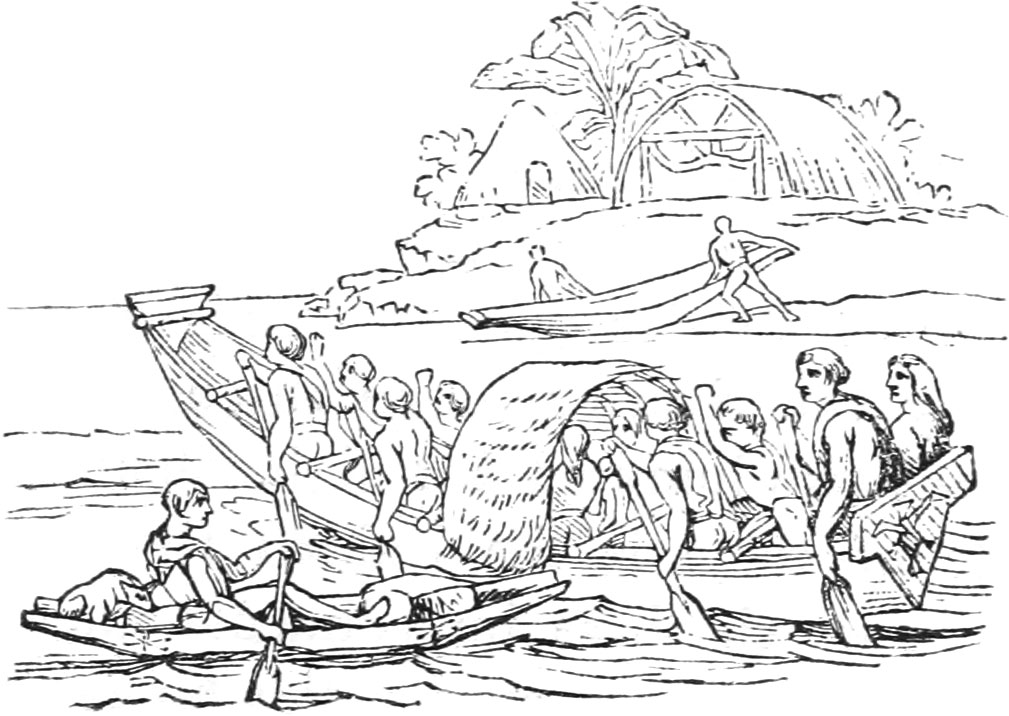
Canoeing
When we ascended the river Berbice, two Waccawai boys belonged to our party, who navigated one of those pakasses. They were perhaps not more than eight years old, but we were highly delighted to see how ably they managed it. The boat seemed to fly through the water; and the juvenile steersman directed its course with such judgment and precision, that it never grounded, though it went over places where there was not more than eight or nine inches water. They were equally expert in the use of the bow and arrow; and wherever they observed one of the finny tribe, the pakasse was halted, the bow strung, off flew the pointed arrow, and when taken out of the sand, which the water barely covered, we generally observed a fish struggling for liberty. In spite of these occasional detentions, they were always in the van when the hour approached for our stopping for breakfast or to encamp for the night.
The first impediments which are thrown in the navigation, on ascending the Essequibo, are the Aritaka Rapids, distant about sixty miles in a direct line from the mouth of the river. They are the beginning of a series which extends for six miles, caused by the rivers passage through a chain of hills about two hundred feet high. The most considerable of them is the Itaballi Rapid, and the manner in which these impediments are overcome is as follows. If we except the larger cataracts, where the mass of water falls over a level ledge, and to overcome which the canoes must be drawn overland, large blocks generally divide the river, through which it forces itself a passage by numerous fissures, sometimes merely a few feet in breadth, in other instances from fifty to sixty and upwards. At the base of the blocks which form these rapids there is generally an eddy, where the canoe is almost stationary, having no current either way. The head of the canoe, after a long hawser has been fixed round her bow, is brought to the stream, and the most intrepid and best swimmers of the crew now attempt to reach the next rock, either by wading, a courageous leap, or by swimming; when successful, the canoe or corial is pulled into one of the shoots of the fall where there is water enough to float her, and by main strength she is hauled up the ascent, the steersman (sometimes lashed for security’s sake to his seat) attempting to direct her course as far as in his power by his large paddle. Safely arrived at the head of the rapid, she is taken out of the current, and her stern laid against the top of the rock with her head up the stream; the crew instantaneously spring into her, and paddling with all their strength, they endeavour to cross the current of the succeeding rapid, until they get into another eddy. It is evident, should the rope break in hauling her over the ascent, or if the crew are not active in jumping into the canoe when lying against the rock, and should not be strong enough to pull against the current, the head of the canoe is turned, and she drifts broadside down the fall, where she must infallibly upset, should she even escape the danger of the rocks, where otherwise she would be dashed to pieces.
The hauling of canoes over rapids affords a most enlivening scene; the activity of the Indians is only in such instances brought in perfect play. Here we see a party attempting to swim towards one of the rocks which are partly raised above the surface of the river, while others are wading alongside the canoe up to their waists in water. Their cheerful cry when, yielding to force, she stems the current and is drawn by means of the rope towards the rock where the Indians are standing, is a peculiar feature of the scene attending the passing of a rapid, and the roar of the water, and the wild grandeur of the surrounding scenery, assist to make the picture impressive.
Where the nature of the cataract permits it, the canoe in descending the river is let down by ropes, to avoid its being dashed to pieces. But this is frequently impracticable, and then her safety depends entirely upon the steersman and the bowman acting in concert and with decision. In descending, the canoe is generally kept in the centre and force of the stream, and, carried forward, she shoots along with the swiftness of lightning; she arrives at the edge of the cataract, and, balancing for a moment, she plunges headlong into the surge below, dashing the spray on either side against the rocks that bound the passage, so as almost completely to ponceal the body of the canoe, leaving the men only visible above the spray; then she rises again above the foaming waters, obeys the steady hand of the helmsman, and skipping over the waves formed by the fall and impetuosity of contending currents, the danger is over, and a simultaneous burst of joy generally escapes from the canoemen, to proclaim their success.
Alas! success does not always attend the descent of these falls, and large is the number of those who have lost their lives in descending the cataracts by the canoe having been upset or split on coming in contact with a hidden rock. I had thus the grief to witness, during our descent of the river Berbice, the upsetting of one of our canoes, while passing one of the Christmas Cataracts, and other inmates, thirteen in number, Mr. Reiss, a talented young man who accompanied me as volunteer, lost his life by this disastrous accident.
South of the first series of rapids, the Essequibo assumes a new prospect, displaying numerous sandbanks rising above its surface, which obliged us constantly to cross and re-cross to avoid running aground. The guana (Lacerta guana) had selected them as a deposit for its eggs, which when fresh are a great delicacy. Our Indian canoemen showed great dexterity in securing them, and in a very short time they took some hundred eggs and captured several of the guanas.
We frequently selected these sand banks for our night-camp, and our attempts in fishing were here generally more successful than when we camped on the wooded banks of the river. Every one of our canoemen knew his duty: scarcely had the boat touched the selected spot, when all was life and bustle; some were seen running to cut the necessary poles for pitching the tent; others unloaded the utensils wanted for our night-quarters and for that important personage the cook, whose indispensable qualities and skill are only fully acknowledged, when, after a long day’s journey, the minutes appear hours to the murmuring stomach which can scarcely, brook delay. The gun on the shoulder, the hunters dive into the thick woods, attracted by the noise of the cooing pauis (Crax alector), or a herd of monkeys. The smaller crafts are unloaded, and some of the more skilful archers paddle away from the noisy camp to see whether they are fortunate enough to shoot, with bow and arrow, some luganani or other fish.
Fires are seen in all directions, with the simmering earthen pot or aina on them, and the squaw watching with anxiety the bubbles which commence to rise on the surface of the water. This contained a guana; the other, part of a monkey; a third, some fish; but all seasoned with capsicum, the indispensable condiment of the Indians cookery. The tents are now finished: if the weather promises fair, the Indian satisfies himself with putting a few poles in the ground, from which he suspends his hammocks; but if it threaten to rain, and palms or the gigantic leaves of the wild plantain (urania) are in the vicinity, then he constructs, in an incredibly short time, a hut which proves impervious to the rain. Some of these huts are square or oblong, others arched, and below it he slings his hammock. Our hut did not differ much in construction, only in place of the roof of palm-leaves we used a curtain of sail-cloth. In the course of an hour our camp was in order, and offered the appearance of a little village. Meanwhile the fishermen and hunters returned, and brought frequently an accession to our approaching dinner, which, after all, was best seasoned by a good appetite.
During night commenced the fishing for laulau and others of the family of silurideæ. After the hooks have been baited with fish or animal flesh, they are carried out into the stream, the line to which they are attached being about thirty to forty fathoms long. If the Indian feels inclined, he keeps the end on the land in his hand; but frequently he takes a forked stick, which he drives into the ground, and after having tied some dry bushes to the fork, he leads the stray line over it. If a fish should bite, the line being drawn with rapidity over the dry leaves, makes a rustling noise, and the Indian hurries to seize it and to haul the fish in. If it be a laulau (silurus) or a large pacaruima (Phractocephalus bicolor), some considerable skill is necessary to land the fish without breaking the line or the hook. Many of the silurideæ issue a sound when taken out of the water, but few so loud and so continued as the pacaruima. I have somewhere else observed, that the Indians have always a bludgeon at hand with which they beat in the thickly armed skull, and each blow is sure to produce the loud grinding sound; so that we who were lying in our hammocks knew whether a laulau, pacaruima, or any other fish had been secured.
The Indian considers that a large fire kindled at the water’s edge is sure to attract such fishes as take the bait only during night, and they never fail therefore to have a fire or a large brand when they are fishing for laulaus or pacaruimas.
If large blocks of granite impeded the river near our camp, all hand-lines which could be spared or procured were set in requisition to fish for pirais (serrasalmo). The avidity with which they take the bait insured success to the least practised in the art of fishing, and if the place proved a haunt of the pirai, the Indian was sure to secure his dinner. The natives possess great art in throwing the hand-line from the shore into the stream; and it is a pretty sight to see the line circling in the air and descending on the water at a great distance from the banks or the rock which the angler has selected for his stand. The Indians use likewise, for the purpose of catching the pirai and numerous other species of that family, the rod, line, and hook. The rod is generally made of yari-yari or lance-wood (a species of anonaceæ), which, in consequence of its toughness and elasticity, is peculiarly fit for that purpose. It demands, however, considerable skill to draw the fish out of the water, as of all others the pirai possesses tenacity of life and considerable strength for its size, and inflicts, besides this, very formidable wounds with its triangular teeth. A bludgeon is always at hand to kill the fish before it is unhooked. If the Indian has been successful enough to secure as many as he thinks he requires for his dinner, some tough slender twig is taken, and one end being put through the gill aperture and then out at the mouth, they are thus strung and carried to the camp.
The Indians are a nation of ichthyophagists, they possess therefore various methods of securing fish, but the most wonderful is the skill which they possess of shooting them with bow and arrow. If we recollect that proper allowance must be made for the false reflection of objects under the surface of the water, and the resistance which the arrow meets, it is really wonderful to see the success which attends this mode of fishing. The sharpness of the sight of the Indian is equally surprising; when the fish is comparatively at ease or rest, I have not been able to see it under the surface of the water, although the Indians pointed it out, and no doubt ridiculed my stupidity in not being able to observe it; but the Indian not only sees the fish when in quick motion, but shoots it likewise with his arrow; making, therefore, just allowance for the false reflection, its progress while discharging the arrow, and the resistance which the latter meets when entering the water. The arrow remaining a moment in a perpendicular position, and then vanishing, is a proof that his aim has been correct, and that the fish is of considerable size, to sink with the arrow in its body. However, it lasts not long before it is obliged to make its appearance again on the surface. If the fish is very powerful, this is the opportunity to discharge a second arrow into its body, and even a third or fourth if its size demands it. I have seen an arapaima or pira-rucu (Sudis gigas) with upwards of twenty in its body before it could be secured.
The bow of the Indian is generally from five to six feet in length, and is made of hard and elastic wood, which is rounded below and slightly concave above; in this we have to admire his ingenuity; if it were perfectly round above, the woody fibres of the bow, when bent, would split. The string is made of silk grass (the fibres of Bromelia karata), and is equal in durability to our best bowstrings. There is sometimes a difference in the form of these bows, which indicates the tribe by whom they are made. The most serviceable of the Indians of Guiana are made of wamara, a tree which belongs to the natural family of lecythideæ; and for ornament, they likewise choose the latter, or snake-wood, no doubt one of the costliest ornamental woods which Guiana possesses.
The most common arrow which the Indian uses for shooting fish, is the takusi or poya. The shaft of the arrow is from five to five and a half feet long, and is made of the upper part of the stem of a reed (gynericum) which is very common throughout Guiana. A piece of lance-wood or yari-yari, of about twelve inches in length, is firmly fixed to it, which is armed with an iron point consisting of two pieces, namely, the pointed one to inflict the wound with, and a second being bent backward, as a barb or counter-hook. They are fixed with curauya or curawatu, the fibres of the bromelia above alluded to, and are well coated with caran or mani, a mixture of resin and bees-wax. Through the frequent intercourse which the Indians have with the coast, iron is in no great scarcity nevertheless, where it is not at their command, they use monkey-bones instead, and among the savage tribes, where iron is a precious article, the greater part of the arrow-points are made of monkey-bones.
A peculiar arrow is used for shooting the delicious fish called pacu. They are stronger than the generality of arrows, and are nearly six feet in length. They are called puya by the Caribs and Macusis, and their lower part is not feathered. A long string is attached to the arrow’s point, which detaches itself from the shaft. The end of the long string is kept round the little finger of the left hand when the arrow is shot off; and if the fish be struck, the shaft detaches itself, and the fish is hauled in. The line is sometimes plaited the length of the arrow, and the string attached to a kind of noose. Of a similar construction is the sarra-racca or uttewacca. The iron point is slightly fixed and attached to a long string, which is neatly wound up round the upper shaft of the arrow; when the fish is struck, it darts into the deep, and the point having detached itself, the line runs off rapidly, while the arrow which swims on the surface points out the situation where the fish is, and the Indian goes in chase with his canoe. This kind of arrow is likewise used for shooting fresh-water turtle, which are sometimes of an enormous size; nevertheless, the force with which the arrow is discharged causes the point to penetrate through the shell. It is only to be wondered at how so large an animal can be secured with so thin a string as that which is attached to the iron point; but I believe, in their skill in landing a large fish or hauling in a turtle, they would not yield to the best angler in England.
The samoro is an arrow of peculiar construction, and three wounds are at once inflicted by it. It is used for striking the larger fishes which frequent the rivers of Guiana.
These are the arrows which are generally in use for shooting fish, but various are the ways used to entrap the finny tribe. An ingenious method to secure fish, without much trouble, is by means of spring-hooks. The Indians take an elastic and tough stick, of the thickness of a finger, to the thinner end of which a hook is attached, while the thicker end is driven in the bank of the river, or perhaps tied to the branch or root of a tree under water; just somewhat below the surface of the water, a notch is made in the stick, and a similar notch at the thinner end where the hook is attached. The stick is now bent, and by means of the two notches it is kept in that situation, the hook and bait being a little under the water; but scarcely is it touched by the fish, in his eagerness to seize the seducing morsel, when it is not only hooked, but, in consequence of the jerk, the notches part from each other, and the fish is drawn by the elasticity of the rod out of its element, and there it hangs until it is secured by the fisherman.
After we had passed the Christmas Cataracts of the river Berbice, our ill success in securing game would have left us in want, if we had not been indemnified by a large number of fish; and I recollect that our canoemen caught, in one night, fourteen large haimuras (erythrinus) by means of spring-hooks. If the fish is very weighty, and the elasticity of the rod or stick not in comparison, the fish is only partly drawn out, and in its attempts to disentangle itself, it struggles and lashes the water, and this is a sign for the fisherman to secure the captive; or the noise attracts the wily cayman, always on the alert to seize some prey, which is soon in attendance, and snaps at the entrapped fish, carrying away hook and line. In this piratical system he is assisted by the pirai or huma, who slashes piece after piece from the poor captive, and when the tardy fisherman takes his round, he finds nothing but the head attached to the rod. Those who set the hooks must therefore be constantly on the alert.
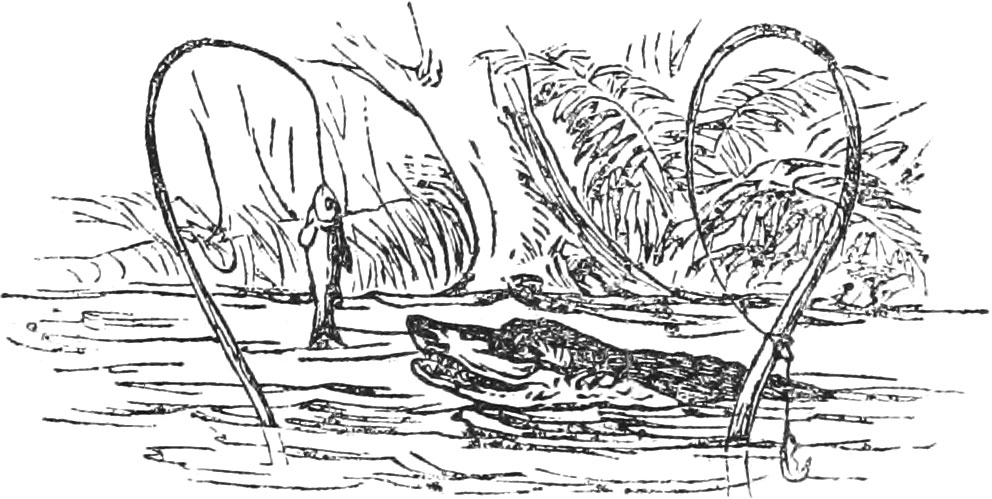
Spring Hooks
In the vicinity of their villages, the Indians frequently plant numerous poles along the bank of the river, where it is shallow; these are about ten feet apart, and a line is drawn from one to the other and secured. To this line, which frequently consists merely of a liana, numerous smaller ones are tied, each of which has a baited hook at its end, and thus the Indian, provided he attends to his hooks, has a better chance of securing fish. If a large fish takes the bait, the consequence is that it tears the line, and he not only loses the fish, but likewise a number of hooks.
The Indian employs likewise different shaped baskets, which are made of thin twigs, or of a reed rather flat and held asunder by hoops; some are cylindrical, others conical, with an opening at both ends; and small sharpened sticks are placed, funnel-shaped, in such a manner that they point inwards, to allow the fish to get in but not out again.

Fishing Basket
We observed, in the Rio Negro, numerous contrivances at the mouth of small rivers, to secure fish on a similar plan, but on a larger scale. The mouth of the stream is barricaded with high poles, in the following form:
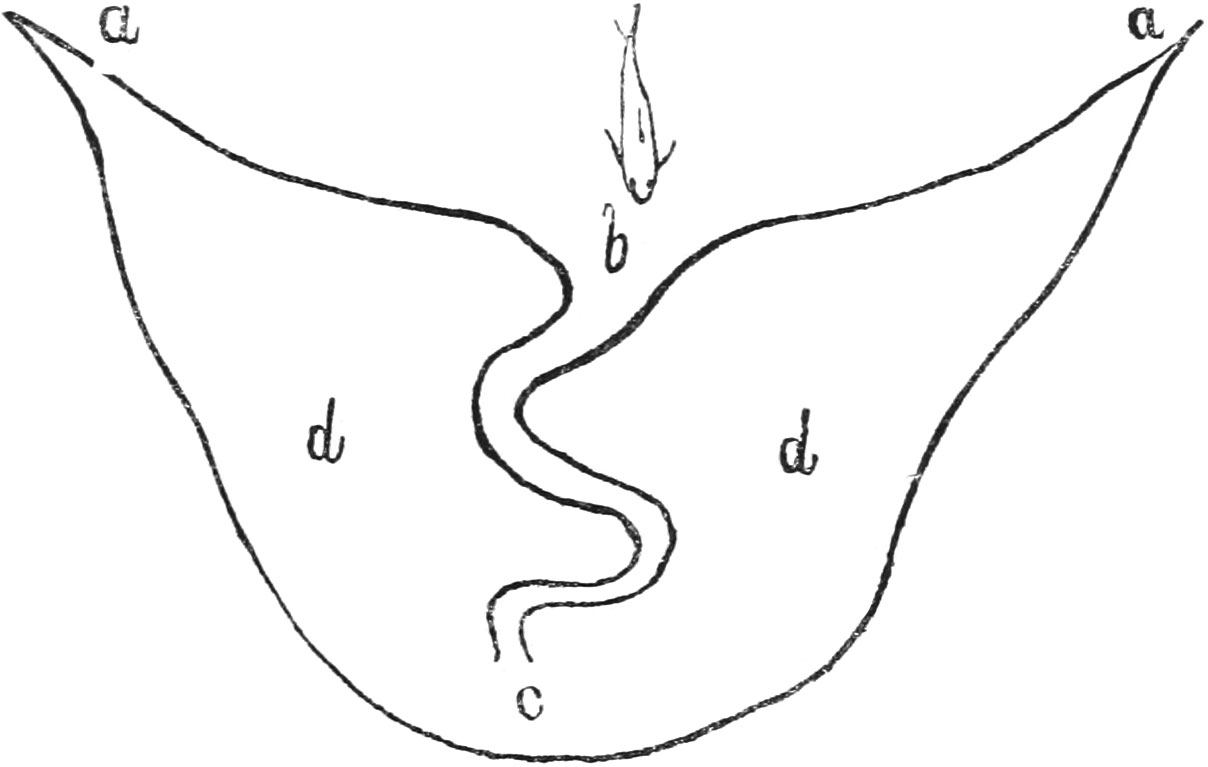
River Mouth
The part aa fronts the current, and at b there is a narrow entrance, which in a winding manner opens at c, in the reservoir dd, entirely shut in with poles. The fish coming down the river easily enters the camboa, but, as in the former instance, it cannot find its way out again. The poles of which it consists being of considerable height, it serves equally well when the river is swollen; it is entered from behind; and there is frequently a kind of grating at half of the whole height of the camboa, to prevent the fish from sinking in the deep, if the river stands very high. We observed here likewise numerous weirs, called cacuri, which resembled those which are employed for taking the sturgeon in the Havel and other rivers of Germany.
A peculiar feature of the rivers of Guiana are large inlets, which no doubt have been formed by the river changing its course. These inlets (kira-hagh or itabú) are narrow at their mouth, but expand considerably when once entered, and are entirely currentless. They are the favourite abode of many fishes, and consequently the haunts of alligators, caymans, and numerous aquatic birds which prey on the finny tribe. The magoari or American stork (Ciconia Americana), the jabiru (Mycteria Americana), the hanura (Ardea cocoi), the roseate spoonbills (Platalea rosea), the boatbill (Cancroma cochlearia), the pereka (Carlo Brasiliensis), the American darter (Plotus Americanus), and numerous others, frequent these inlets in search of food.
The Indians, with their families, undertake large fishing expeditions to those which they know to be well stocked with fish; and after their outlets have been partly barricaded, they erect their temporary huts and commence fishing with the line or with bow and arrows. If they are successful, a small triangular or square stage is erected. Should a laulau have been caught, then a square and large barbacot is sure to be erected, and the Indian, always willing to spare himself trouble where he can, seeks until he finds two trees which are just apart enough to serve in lieu of poles.
The women have been meanwhile occupied in collecting dry wood; and after the fish has been washed and cleaned, and cut in pieces if it be a large one, it is put upon the grating and the wood lighted below it. The smoke acts as pyroligneous acid upon the fish; and this method is more effectual than if the fish had been simply moistened with the acid, as it combines the complete exsiccation of the animal substance with the effect of the pyroligneous acid. The fish thus prepared keeps for several days; nay, if it be well smoked, for weeks. Meat of feathered or other game is smoked in the same manner, and keeps for a longer period. The smoking ought to be, however, repeated after a certain lapse of time.
But the most effective mode of fishing is to poison the water with hai-arí, the root of a leguminous plant (lonchocarpus), a climber, with a bluish papilionaceous flower. The root is about three inches in diameter, and contains a white gummy milk of an acrid taste. After a sufficient quantity of hai-arí root has been collected, and the spot in the river has been fixed upon, a large space is inclosed. If it be among the falls where the pacu has its haunts, the ledges of the rocks frequently afford opportunity of lightening the labour of inclosing a spot above where the lacis is in abundance, and which plant constitutes the favourite food of that fish. By means of a wall of loose stones, and hurdles made of light wood, the remainder of the barrier is accomplished; two or three spaces are generally left open, for which likewise hurdles are prepared, but which are not closed until they intend to commence to poison the water. These openings are, lastly, closed with daybreak, but previously the hai-arí has been prepared. They beat it upon the rocks with heavy sticks until it is in shreds; and a corial or canoe having been filled with water, they immerse the hai-arí and turn it about, until the water has a milky whiteness. If the canoe is not too large, it is now carried to the spot which has been inclosed, and the infusion is thrown at different spots into it. The first symptoms that the poison has taken effect are observable in about ten or fifteen minutes; the fish rise to the surface, commence to swim unsteady, jump out of the water, and attempt to pass the stone-walls and hurdles; ultimately, they gasp violently for air, the gill-covers remain open, and turning the belly upwards, they die. As soon as the poison has taken proper effect, the fish may be secured with the hand, or they are shot with the arrow. The fish thus killed are by no means deteriorated in quality, and the number which are caught is enormous. In the Brazil, as at the Rio Negro, this mode of fishing is interdicted under a penalty of two hundred mil reis, but it is not strictly kept, nor is the fine enforced.
I estimated the quantity of fish which I saw taken in the Upper Demerara river, during one of those fishing expeditions, at fifty hundred weight. Mr. Hillhouse relates, that in less than an hour he has taken two hundred and seventy pacu, averaging seven pounds weight, with one hundred weight of other fish.
I have seen frequently a peculiar mode of fishing practised among the Indians, when at the period that the water in the rivers fell after the inundation, large pools of water had collected on the savannahs or on the islands. As soon as it was discovered that the pool contained fish, then young and old set to with calibashes, pots, and whatever would serve the purpose, to empty the pool of its water.
The Rio Negro was, at the end of March 1839, on so low a level, that many of its tributaries ceased to flow, and consequently the deeper parts of the bed of the river formed pools. These pools, in the river Anapara, were so stocked with fish, that we rushed with cutlasses into the water and waged war against the finny tribe on a novel method. The number we secured by cutting them in pieces was astonishing.
Among the Arécuna Indians I observed a kind of net which they called penté, with which they secured a number of smaller fish, perhaps three to four inches in length, which bury themselves in holes in the banks of rivers. The Indian knocks with the net at the hole, and the alarmed fish rushes out into the net. This is the only instance in which I saw the Indians of the interior make use of a net.
We are too little acquainted with the habits of fishes in general, and even with the modes and periods of propagation of those which inhabit Europe; it is therefore not to be expected that I, during the comparative short period which I spent in the interior of Guiana, should have become acquainted with what has remained in many instances a riddle to the investigating eye of European philosophers for centuries. The general belief among the Indians is, that at the period when the annual rains cause the rivers to overflow and inundate the low countries, the fish ascend to those inlets which the rivers form In their upper parts, and where the water is currentless; here they are said to deposit their spawn. An old Macusi chieftain at Pirara informed me that even the pacu deposited its eggs in those still waters. It is a singular fact, that the fry of the pacu is entirely unknown at the lower regions of the rivers, where the adults feed in numbers on the lacis or waia and other similar water-plants. Mr. Hillhouse, who so frequently visited the interior, observes, in his “Voyage up the Mascaroony,”—
I have caught, by poisoning the waters, upwards of one thousand pacou, and the fry of other kinds of fish to a finger’s length; but in all this wholesale destruction, I have never seen a pacou less than a foot long.4
There is no doubt that the fish does not descend the rivers till of a sufficient age and strength to venture among the turbulent waters at the cataracts, where its favourite food, the waia, is growing.
A species of fish, which belongs to the same division as the callichthys, namely the Doras Hancockii of Cuvier and Valenciennes, possesses the singular property, as we are told already by Margrave of his Tamoata, of travelling over land. I have been informed by eye-witnesses, that they have met sometimes whole droves during the dry season, when those pools of water which had remained from the last inundation were about to dry up. They then march over land in search of water, and the shields with which their body is armed, as well as the strong spring ray of their pectoral fins, serve to help them forward. It is thought that
they have the power of retaining a portion of water in a membranaceous bag surrounding the gills, which keeps the filamentous structure moist, and enables the animal to continue the respiratory action.5
So numerous are those droves, that the negroes have filled sometimes whole baskets during the terrestrial excursions of the doras in search of their natural element.
Fish are generally accused of having no attachments for their offspring; they neither construct a nest, nor do they feed or defend their young. There are, however, exceptions, and among these belongs the fish which is known at the coast of Guiana under the name of hassar or hardback (Callichthys sululatus6), which constructs a regular nest of blades of grass and leaves, in holes just above the surface of the water, where it deposits its roe and watches it with maternal care until the fry is brought forth. Somewhere else I have related the maternal care which the lau-lau and other species of siluridæ show for their young offspring, which swim in shoals about them, and in case of danger enter the large throat of the mother,7 These are only single instances; the far greater number, when once brought into external life, are left to themselves, and perish, devoured by larger fish, reptiles, or aquatic birds; and if the survivors should live to increase in size, their safety is endangered for the rest of their life. It is not only man, who for economical purposes pursues the fishes which inhabit the mighty rivers of Guiana, various are their other enemies, which for the purpose of satisfying their appetites wage war on the finny tribe. They themselves, the most voracious and insatiable of the animal creation, assist in their mutual destruction.
The large alligators and caymans are the foremost among the inhabitants of the water which prey upon the fishes. There they lie, like dry logs of wood, at the foot of some cataract, their mouth half open, ready to snatch and swallow what the increased rapidity of the current should carry down the fall. How frequently have we seen them in that situation, while ascending the upper river Berbice, which beyond all others seemed to swarm with these horrid monsters. I have already observed how often they tore the fish from our spring-hooks, and carried fish, hook, and line away; and we naturally did not owe them good-will for their stealing propensities, which served as an additional proof to what extent their depredations must be carried on. And although abundance of fish, during certain seasons, prevails in the rivers of the interior, the cayman is nevertheless the most covetous of all animals, and envies every other successful fisher. This he gives to understand, particularly by angry growls, if the line with the captive is drawn in, and his attempts to intercept the captured fish, before it be drawn on the land, should have proved unsuccessful. While we were encamped at the mouth of the river Rewa, or Roiwa, during our last expedition, the afternoon of 21st October had passed under thunder and rain; but at the approach of night, Nature lulled herself to rest, and only the droppings from the leaves told of the former storm. I was lying sleepless in my hammock, and I watched two Indians who had their lines out to entrap some hungry fish. A kilbagre, lured away by the tempting bait, had snapped at it, and the fisherman, acquainted by the stress on his line of his success, drew the unwilling fish towards the canoe, when the roar of a cayman awoke the echo of the woods, and rushing towards the canoe with all its might, he recaptured the fish, as the astonished Indians were just on the point of drawing it in, and with it went the hook and a great part of the line. At our second night’s camp, after we had entered the river Rupununi, the Indians were likewise fishing, and whenever a fish was caught and drawn towards the canoe, the caymans commenced such a roar that it baffled description. We distinctly heard that there were three first one commenced when the fish that was drawn in began to struggle, and another answered him, until the noise was so great that the Indians, as if in self-defence, and to intimidate the approaching monsters, set up a shout themselves. Indeed, the roaring of the cayman is so strong, that in the still hour of night it may be heard a mile off,—and there is something awful and indescribable in it; it is not the tiger’s growl, the bull’s bellowing, the lion’s roar; it is different from all, and really terrific, when that sound bursts suddenly upon the ear. I might compare it to the snorting of a frightened horse, if the strength of that snort could be increased ten,—no, twenty-fold, in effect.
The otters of Guiana, of which there are two species, are more destructive to the fishes than the European and Canadian otters to the finny tribes of their rivers. As constant summer prevails in Guiana, their depredations continue the whole year; while, during the period when the rivers of the colder zones are frozen over, the otters there are obliged to feed on terrestrial animals. Old Izaak Walton would have found, therefore, additional reasons to bestow hard names upon those “villanous vermin.” Every rock in the vicinity of their residence bears the mark of their excrements; and their feeding-places are so devoid of vegetation, if we except the larger bushes and trees, that they cannot be mistaken, even if the number of scales and fish-bones did not point out their success and frequency of their visits. A complete path leads up from the water’s edge to these places, which, in consequence of their ascending and descending in single file, is hollowed out. The smaller species of otter hunt in packs of eight or ten, and they swim mostly against the stream; the larger, seldom more than two together. As they dive to a great distance, and are able to remain under the water for six or eight minutes, what fish passes over them at that time are sure to fall a prey to their voracity they seize them at once by the belly and drag them on shore, where they are frequently deposited while they continue their pursuit. The Indians, who are aware of this, watch their success in ambush, and secure what the otters have brought ashore. The arapaima or pirarucu, the largest fresh-water fish of those regions, is not safe from their attacks; and I have been informed by the Indians, that this giant of the rivers is sometimes attacked by the otters en masse; so much I know from personal observations, that they secure haimuras (Erythrinus) from ten to twelve pounds in weight.
Even the jaguar, the tiger of the new world, is ranged among the depredators upon the fishes; and as every Indian will inform the inquirer, his attempts to take fish prove successful. He may be seen frequently prowling on sand-banks or along the low banks of rivers, and as the fish approach the shallows, he dexterously knocks them out of the water with his paw; but, that in order to entice them to the surface, he drops some of his saliva on the water, is no doubt an assertion which wants confirmation. I have been astonished at the feats of strength which a jaguar displayed in one of his fishing depredations. While we were sojourning at Curassawaka, a settlement of Caribs on the Rupununi, we were much annoyed by a jaguar which prowled almost nightly about the settlement. One evening the Indians, who had been out fishing, returned with a large arapaima or pirarucu (Sudis gigas). As it was late, and the fish weighed not less than two hundred pounds, we deferred conveying it on land until next morning. When morning came, no fish was to be found in the canoe; but there were sufficient traces to show that it had been dragged by the jaguar into the wood, where we found it minus its tail part, which to a third of the fish’s length had been eaten off. It may be conceived what strength was necessary to get it out of the canoe; and I am almost inclined to think that it had been assisted by another jaguar.
How numerous are the enemies which the fish possess amongst the winged tribe of Guiana! If we consider their number, from the pygmiest of the kingsfishers, scarcely the size of a sparrow, to the stately jabiru,8 which with his neck erect stands upwards of six feet high, it may be easily imagined how many perils the finny tribe have to undergo, and that perhaps scarce one in a thousand of those which are excluded from the egg dies of old age.
Look at the hanura (Ardea cocoi), alike distinguished, like its European prototype the heron, for cowardice, indolence, and insatiable hunger. There he sits on yonder tree, which partly overhangs that broad expanse of water, named a kirahagh or itabru by the Indians, his long neck sunk between the shoulders, and his whole figure bespeaking leanness, though gorged with prey, as if there were not abundance for his support. But let the call of hunger remind him that exertions are wanted to satisfy his unnatural appetite, and we soon see him upon the wing or wading solitary along the shallow waters, until he finds opportunity to dart with unerring aim upon his prey; or he awaits patiently the smaller fry, which, driven into shallow water, have only escaped the danger which the larger species of their own kind threatened them, in order to be devoured by the voracious bird.
Numerous are the different species of bitterns and smaller herons which aid in committing devastation among the fishes; they are assisted by the roseate spoon-bill, the boat-bill,9 and, of all others, by the cormorants and the darters, or carara.10 The latter are worthy companions of the hanura; alike indolent and voracious, they share in all its depredatory habits, having moreover the advantage that they can fall on their prey in the deep. The carara, as well as the cormorant, is an excellent diver; the peculiar formation of the nasal organs of the former qualify it particularly to remain for a length of time under water.
Large flocks of gulls, chiefly that strange species the darradarra or razor-bill,11 frequent the inland rivers; and although the peculiar formation of their bill gives to them an awkward appearance, scarcely are they on the wing when they show their agility, and soaring over the water, slightly dipping their wings in that element, they are skilled enough to stay the smaller fish in its gambols, and carry it away an easy prey.
Frequently resounds the gloomy forest from the piercing cry of the fishing eagle, which, soaring in circles high above the water, darts with the swiftness of an arrow upon the fish which played on the surface of the river. He who would make himself acquainted with the numerous enemies which the fish possess among the feathered tribe, ought to be present when the waters, in one of those inlets or kirahaghs, are poisoned with the hai-arí plant. Scarcely commence the torpid qualities of the plants to operate upon the fish, which, penned in, cannot escape its pernicious influence, and, snapping for air, show themselves on the surface, when the environs already resound from the shrill cry of numerous gulls, which, not minding the presence of man, dart between them upon the helpless fish, and seem equally intent upon their destruction. The trees are occupied by herons, maguaris,12 darters, and perekas,13 which only await the absence of man to assist in the work of destruction. The king of the vultures14 and his sable attendants,15 in anticipation of the approaching feast, when those fishes which were neglected to be taken up by the Indians or aquatic birds should have acquired the necessary goût, sit around in solemn silence, and their head withdrawn in the ruff, their wings partly drooping, they convey the very picture of gloomy scavengers. But if I were to judge from a living specimen which had been entrapped in an adult state, and which I possessed for several weeks while in the interior of Guiana, I would not be astonished to see the king of vultures, when hard pressed by hunger, regaling itself on fresh fish. The individual to which I allude never declined to eat the fish which was thrown in a fresh state before him; for that purpose, he kept his food with his talons, and spread his wings, picking the flesh from the bones if the fish was large, but swallowing it entire if of a small size.16
We thus close the long list of enemies which the finny tribe of the mighty rivers of Guiana possess; but if we consider the extraordinary fecundity of fish, it is not to be wondered at that there is still such an abundance as to afford nourishment to man, to whose sustenance the whole creation has been made subservient.
Such of the Guiana fresh-water fishes as might prove of economical use to mankind are exceedingly numerous. The many noble streams of these fertile regions are in general stocked with fish, although at present they profit only a few. At the period that the inundations subside, and the granite dykes which cross the rivers of the interior are no more covered by the waters, parties of men proceed from the lower Essequibo to these dykes in order to procure the fish called pacu, which are caught in large numbers, slightly salted, and dried on the rocks, and sold at the colony at about a shilling each; however, I do not think that fifteen hundred are brought at present to the coast. The morocoto or osibu, a species which belongs to the same division of fishes as the pacu, frequenting only the estuaries of rivers, chiefly those of the Orinoco and the adjacent streams, while the pacu belongs exclusively to the fresh-water rivers where the tide has no influence, is likewise much prized as an excellent article of food, both when fresh or salted, and large numbers of them are occasionally brought to Georgetown. If the fisheries were carried on in a more active way, and not as a pastime, or merely on a tour of pleasure to give some change to a monotonous and indolent life, it would not only become productive of considerable benefits to those who embark in it, but open another resource of the colony, which at present lies entirely neglected. Of great importance is the fact, that there exists in the Rupununi one of the largest fresh-water fishes, namely, the arapaima or pirarucu, which attains occasionally a length of twelve feet, and weighs upwards of three hundred pounds. It is used fresh and salted, and affords the means of subsistence to a large number of inhabitants on the Rio Negro and the Amazon, which it likewise inhabits. Were the fishing-ground on the Rupununi attended to during the dry season, an abundance of that fish might be obtained for internal consumption and occasional traffic with the coast regions. The lau-lau reaches nearly the size of the arapaima, and as it belongs to a division of fishes, the air-bladder of which is used with the same advantage as that of the sturgeon, in lieu of isinglass, it might be collected in sufficient abundance; besides that, its flesh is considered excellent, and its lard, like that of its congener in Europe (Siluris glanis), might be employed as that of the hog, or would yield a considerable quantity of oil. If we consider that pilchards alone are exported from Great Britain to the annual amount of £50,000, principally to the West Indies, along with herrings and mackerels to a much larger amount, for the use of the labouring population, it forms rather an important point to one of those colonies which contribute to the consumption of that kind of nourishment, that its own rivers abound, if not in the same, at least in similar articles of food.
There are many other species of fish which are highly esteemed for their flavour, and vie in delicacy with our most esteemed European fish; I name only the delicious lucunani, the haimura, the cartabac, the bashaw, paiara, and numerous others which are described more in detail in the following pages. Indeed, in whatever view we may regard Guiana, the first description which Sir Walter Raleigh gave of that fertile province, if we except his bestowing wrong names on such animals as he compared with those of the old world, it is still stamped with truth. He saith,
There is no country which yieldeth more pleasure to the inhabitants, either for those common delights of hunting, hawking, fishing, fowling, and the rest, than Guiana doth. It has so many plains, clear rivers, abundance of pheasants, partridges, quails, rails, cranes, herons, and all other fowl, deer of all sorts, porkers, hares, lions, tigers, leopards, and divers other sorts of beasts, either for chase or food.
The Fishes of Guiana
Descriptions
From the foregoing Memoir and Introduction, it will be understood under what circumstances the materials which are about to be described were collected; and in bringing them into notice, the Editor has had in view the publication of a Volume, which might be useful, and prove in some measure a guide to other Ichthyologists, travelling upon the rivers in similar or adjacent districts in South America. Mr. Schomburgk, when starting upon his journeys to the interior, and at a distance from European communication, felt much the want of some work where the generic characters were given; while the great expense of such as have appeared since his first expedition, would have rendered them far from accessible, even if they could have been forwarded in time. As that gentleman has stated at the commencement of his Introduction, no intention to publish his materials was contemplated, more particularly as few of the specimens themselves had been brought to this country; yet upon looking over his drawings and the accompanying notes, so many curious forms presented themselves, different from those figured by Humboldt, Spix, or in the later work of D’Orbigny, that it seemed wrong to withhold them; while it would also have concealed from the public the labours of our traveller in this department, which, under the circumstances, have been very considerable: our views of the importance of the collection is also borne out by the appearance of the fifteenth volume of the work of M. Valenciennes, devoted to the Siluridæ and Loricarinæ,—and even from this, containing, it is to be presumed, the very latest information, many of our Guiana species seem to be wanting. The collection will be still more enhanced in value, when it is known that it has been procured entirely from the fresh waters or from the rivers, a considerable part of it at a distance of many hundreds of miles from the sea, and in regions never previously visited by the naturalist. We shall thus be enabled to compare the forms with those in the rivers of the other great divisions of the world; not that we consider the list by any means complete, for in such an extent of waters we have no doubt more than double the number of species exist, yet it may be presumed that specimens of the prevailing kinds were obtained. The drawings from which we have wrought were made upon the spot from the newly killed fishes, and are on this account most important, as giving the fresh tints of colour which it is impossible otherwise to carry away. They have been quickly executed, but possess evident marks of being very characteristic and correct, wherever specimens for comparison have accompanied them,—at the same time, minuteness of execution and of the details of scaling, &c., as might have from circumstances been anticipated, are wanting; and here has lain our greatest difficulty, from these circumstances it has been impossible always to fix to our satisfaction the proper station of the fish, but in all cases where this occurs, the uncertainty is stated, and the species placed as near as can be ascertained to where its true place should be. In arrangement we have followed no regular system, but have preferred keeping the families separated, and at the commencement have placed the Siluridæ, as being characteristic of these rivers. The sub-family,
Loricarinæ
or mailed cat-fish, may be first noticed; several of the genera which will range here are preserved in the Schomburgk Collection. These are most remarkably characterised by the strength of their external coverings, whether it be developed in the form of spines or plates. The dorsal and abdominal plates are connected with the vertebral column and move with it, or they are mutually dependent; in some degree the skeleton becomes external, and supports or assists the weaker arrangements which in these cases prevail internally. They inhabit the fresh waters of the new world, attaining an elevation of five thousand feet, and in nearly all the species the mouth is placed underneath, is used as a sucking apparatus for attachment to rocks or trunks of trees, and the teeth are numerous but minute, and have more the appearance of hooks than true teeth. They swim near the bottom, and sometimes leave their element to advance by the rocks on the river side, in which they are assisted by the strong spines of their pectoral fins; and for this purpose also they are endowed with a powder of lengthened vitality.
Acanthicus
The first fish to which our attention will be directed is one of a very remarkable form among the single finned Loricarinæ; it belongs to the genus Acanthicus of Spix and Agassiz,17 but in the last volume of the “Histoire Naturelle des Poissons” it has been included in the genus Rhinelepis18 of the same authors; and although we have retained the generic name, we must acknowledge that the distinctions which are given in the coispectus generum of the Brazilian fishes are minute, and consist almost in the abdomen of the one being naked, while in the other it is covered with minute scales. M. Valenciennes appears to consider the Acanth. histrix of Spix to be distinct from the species originally described by M. Vandelli, for which he retains the name, giving the other under the title of Rhinelepis acanthicus. The drawing and specimen before us agree best with the true A. histrix, that of Vandelli, and as such we provisionally keep it. The outer rays of the tail are represented in the drawing not at all elongated, and do not appear to have been so in the specimen, though it is a little mutilated. The group of bristling processes before the opercula are much stronger and more elongated, so also is the armature of the first ray of the pectoral fins, and the distribution of the spines on the plates of the sides agree with the description of Valenciennes. On our first Plate, then, we have endeavoured to give a figure of it, adding previously the generic characters from Agassiz.
- Acanthicus Spix.—“Totum corpus aculeatum; truneus seutis osseis, crassis squamiform bus, distinctis tectis; abdomen non scutatum. Dentes bisinflexi per series radiatas (nec circulares) dispositi. Velum labiale circulare. Pinna dorsalis unica.”
- Rhinelepis Spix.—“Totumcorpus limatum; truneus seutis majoribus, imbricatis; venter seutis minutis discretis tectis. Dentes radiati, apice hamati, primus bisinflexus, apice fissus. Labium inferius solum velatum, labium superius cirrhatum. Pinna dorsalis unica.”
Porcupine Acanthicus
Acanthicus histrix
Le Rhinelepis porc-epic; Rhinelepis histrix, Valenc., 1. xv. p. 486. Loricaria histrix Vandelli, (auct. Valenc.).
The very remarkable appearance of this fish will strike any observer, and from all our knowledge of the habits and nature of the Loricarinas, we are unable to see for what purpose their strong plates and armatures are intended. In Acanthicus, the spination of the plates and fin-rays, indeed of every part of the body, is carried to the utmost extent, and in general appears as if intended both for offence and defence. The tufts of strong spines anterior to the opening of the gills, and which appear to be moveable, together with the spines of the pectoral fins, may serve for two purposes, either that which M. Valenciennes attributes to somewhat similar tufts in Hypostoma, which he thinks are used in assisting to support themselves against strong currents, or, in the fish before us, to disturber rake up the sand or mud at the bottom of the rivers, where they lie in watch, and in this way insidiously conceal themselves from prey, or they assist to seek and raise up small insects or aquatic worms which may either serve as a lure for other fishes or be taken as food.
Mr. Schomburgk remarks,
I am sorry that I do not possess more materials for the description of this remarkable fish, which was caught during my absence. I had heard of the existence of this species while sojourning at Fort San Joaquim, and when the spiny ray, which fellows herewith, had been given to me, I almost doubted that it could come from a fish; however, a young specimen was secured afterwards, but, as already observed, during my absence, and the necessary notes were not taken to make its description more perfect. They are said to grow from three to three and a half feet long, and are found in holes, or under the roots of trees which have fallen in the water. They are said to be peculiar to the Rio Branco, and the Indians who inhabit its banks eat its flesh and name it uacari. It differs in many respects from Spix’s Acanth. histrix.
These observations are to a certain extent by D’Orbigny, who, in speaking of a species of his Rhinelepis, says it lives in rivers with a sandy bottom, and is often concealed below stones, leading a quiet and peaceable life.19
The specimen above alluded to, brought home by Mr. Schomburgk, is about thirteen inches in length, but the size obtained, as observed, is much greater; the first ray of the pectoral fin of the large fish is nearly seven-eighths of an inch in diameter, and has the spines two inches and a half in length. The spines appear to be jointed on, and have the lower part enclosed in the dark coloured epidermis which covers the trunk of the ray. They all terminate in a brown crooked point, are tubular, and in their dried state are hard and elastic.

Spines
The whole body and rays of all-the fins are covered thickly with spines or points, more or less developed. They are strongest on the snout and sides, and on the latter assume the arrangement of three lines running along the centre of the plates two lines also appear on the dorsal aspect between the dorsal fin and the tail, which diverge at the insertion of that organ upon its sides. A similar arrangement takes place on the lower side of the body, which causes the lateral view of the caudal extremity before its insertion, or the commencement of the fin, to appear as having five rows of spines. On the abdomen the spines or studs are distributed in insulated parcels of from four to ten or twelve in number. The spines of the opercular tufts are at the longest part about an inch long, shorter on the lower and frontal aspect, and bending slightly downwards. The first ray of all the fins is very broad and strong, and these organs are very considerably developed.
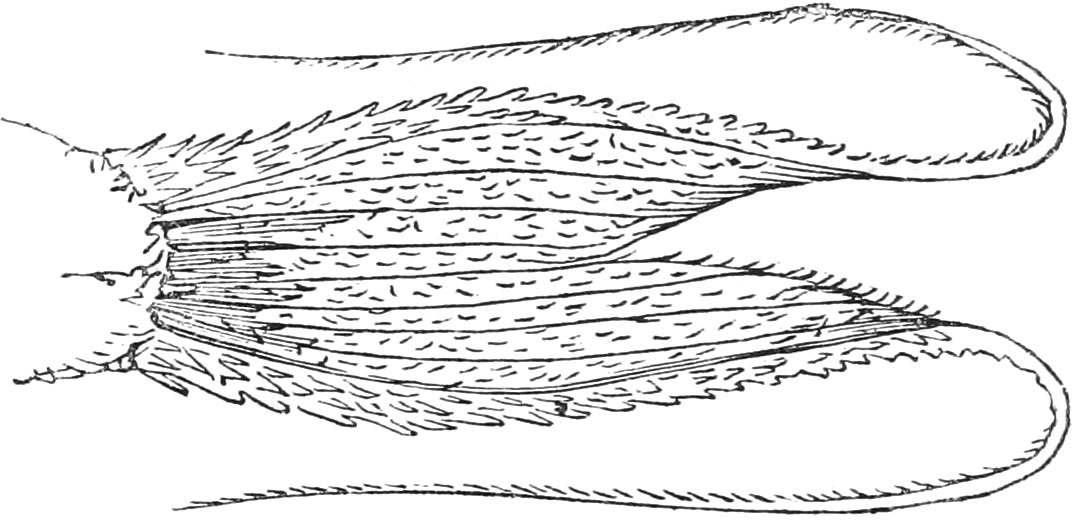
Brazilian Fish Tail
The tail exhibits none of the lengthened or filiform appearance represented in the figure in the Brazilian fishes, of which we add a reduced copy, but the outer ray of the lower lobe is rather lengthened, as we shall see is frequently the case in Hypostoma; this elongation, however, we believe in some instances to be sexual, and until this is ascertained, a high specific value should not be put on this as a character. The mouth is placed completely underneath, and appears as if it was capable of being applied to any flat substance, so as to cover closely a minute prey. When expanded in the dried specimen, it is of a rounded oval form, having a short barbie or cirrhus at each angle. The teeth on both jaws are thick set on slender stalks like wool-cards, with the tips hard, brown, bifid, and bending inwards. The general colour of the dried specimen is of a yellowish brown; the spines yellowish white tipped with reddish brown, those most elongated dark towards the base, from being there covered with an epidermis which runs upon them for nearly half their length in their present state, though in a fresh condition it may extend much farther. The formula of the fin-rays is
P. 1/6—V. 1/5—A. 1/4—D. 1/8—C. 2/14.

Plate I
Fort St. Joaquin in the distance

The genus Rhinelepis, as described by Valenciennes, will contain three species in addition to the two alluded to in the above description, and which are the only ones known where the armature is so formidable. These three will stand in Rhinelepis proper, and are R. strigosa, Valenc., which will ally the genus to Loricaria by the mouth being placed near the anterior extremity of the snout, cleft across, and instead of a surrounding membrane, has only a single narrow fold at the angle of the lower lip. This fish was found by D’Orbigny in the Parana and other rivers of the province CorItientes, particularly in those having a sandy bot rom.—B. aspera, figured and described in Spix and R. genibarbis, Valenc., distinguished from the others by a tuft of hairs or slender spines, stiff and thick, which are placed on each side of the oval space below the operculum.
The only other indication of a fish belonging to the Loricarinæ possessing a single dorsal fin, is represented in a rough sketch forwarded among a few drawings which Mr. Schomburgk has marked,
Not executed under my superintendence, and for the correctness of which I cannot vouch.
In its lengthened form and snout it resembles the L. rostrata of Spix, but the under jaw is cirrhated, as in the L. cirrhosa of Schneider, which, however, Valenciennes has placed as a synonim to his L. cataphracta. In the work of Schneider20 we have the two species described, and both are marked as existing in the museum of Bloch. According to that work, our sketch would represent L. cataphracta, the upper lobe of the tail not being elongated; but this character is given by Valenciennes to the other, and as we remarked in the description of the preceding fish, may be of uncertain value; as it stands, it is possible that two species may even yet be confounded; and we have introduced the subject here to direct the attention of future travellers who may have opportunities of investigating the subject in the South American waters. It should be noticed, that although the specific characters given by Schneider are very close to each other, in that of L. cirrhosa, “thorace inferius squamato” seems of importance.
Formula of the fins of L. cataphracta, given by
Schneid. P. 1/7—V. 1/6_A. 5—C. 16—D. 8 1/1. Valenc. B. 4—D. 1/7—A. 1/5—C. 10—P. 1/5—V. 1/5.
L. cirrhosa, given by Schneider,
B. 4—P. 1/7—V. 1/6—A. 1/6—C. 12—D. 1/8.
The habits of Loricaria have not yet been detailed, nor their anatomy described. Nine distinct species are described or indicated by Valenciennes, and figures of three of these have been given as new in the Atlas to D’Orbigny’s Voyage (pl. 6); only one, the L. cataphracta, is noticed as occurring in the waters of Guiana.
Hypostoma
The next form in the Collection which will receive our notice is the genus Hypostoma, Lacepede, of which Mr. Schomburgk has brought three species, two of them apparently different from those described in the last volume of the “Histoire Naturelle des Poissons,” by Valenciennes. Three subdivisions have been made in the genus; the first with the body thick and short, and the head disproportionally large;—where the angles of the plates become less developed, and the head becomes depressed;—and the last, where the interoperculum is very moveable and is furnished with tufts (as in Acanthicus) of rigid spines which can be displayed at will; when at rest, they are concealed in a furrow or hollow. Of these we have now examples of two, the first and the last. In their outward structure we have a prevalence of the spination and rough armature which seems so remarkably developed in this tribe of fishes, and in them we also see the first trace of the double dorsal fin, analogous to the adipose among the Salmonidae, but differing in the spinous defence which is placed anterior to the membrane. In the habits of Hypostoma, as intimated by D’Orbigny, we have a confirmation in many parts in the short notes with which we have been favoured by our own traveller, and which will be stated in the descriptions of the fishes to which they refer.
These fishes (Hypostoma) are always found in the places where the current is most rapid; they conceal themselves in numbers under stones and in the clefts of rocks, and attach themselves there by the suction of their lips, or they fasten themselves on by the hooks of their opercular spines so strongly that it is easier to break them than to tear them off; when touched, they erect their spines to defend themselves. They swim with rapidity, and often with the back undermost, (“c’est souvent sur le dos qu’ils nagent”). They feed on worms, and spawn in September, eggs which are attached to the rocks by a gluten.21
Again, in speaking of the Hypostome de Commerson, which occurred in the whole courses of the Parana and the Uruguay,
they never quitted the stony or rocky parts of the rivers, and when the waters fell they are taken in holes or under insulated stones; at Corrientes they squatted among the rocks. Their movements are lively, but always at the bottom; they keep in shoals, and deposit their spawn in the month of September, in the clefts of rocks.22
The first species we have to describe belongs to the more ordinary form of the genus, with a deep body and large head, but is entirely without the pre-opercular spines. It appears to be the plecostomus represented in Gronovius, tab. iii. figs. 1 and 2, although it differs slightly from that figure in the form of the tail, which has no elongation of the outward rays, and has the lower longer than the upper. We keep it in the mean time as,
Spotted Hypostoma
H. Plecostomus
L’Hypostome plecostome, Valenc. Hist. Nat. des Poissons, xv. p. 489.—Macusi name, Yau-ura. Schomb. Drawings, No. 66.
Mr. Schomburgk’s notes inform us that this fish was found in April in the Rio Branco under the roots of trees, that it was retentive of life, and that the intestines form many flexures but possessed no appendices. Specimen in the Collection eight inches in length to the extremity of longest caudal ray. The whole body rough, with rather minute hard studs, which are elongated only on the extremity of the first pectoral ray and on the centre of the plates. The plates covering the body, with the exception of the abdomen (anterior to the anal fin), are rounded, somewhat sub-angular, and on their posterior margins at first sight appear crenated, from the points of the studs or small spines projecting over. On the centre of the three first rows of plates, counting from the dorsal fin downwards, the points or studs are lengthened and form three lines to the tail; a fourth arises opposite the opercula, but is lost about two-thirds of the length from the extremity. On the part of the abdomen without plates, the studs are arranged in parcels of irregular form, which gives the appearance of a minute plating. The head in its form is somewhat triangular; on the snout there is a central rounded ridge, which is lost between the nostrils and eyes, but again becomes more prominent, running into the first plate upon the back in a rounded point; from each nostril, above the eyes, there is an elevated ridge, which by the form that it gives to the sides of the head reminds us of the Gurnards; in every part it is closely covered with minute studs, very slightly lengthened on the side of the operculum. The mouth is triangular, and of smaller dimensions than in some of the other species; the teeth are also stronger, and are set in a single row around; the surrounding lips not much developed for sucking, and furnished at each angle with a cirrhus very short and slender. The fins have the first ray all strong; the first dorsal fin is proportionally large and much developed; and the tail is lunated, but with the lower lobe considerably elongated. The formula of the fins are,
Schomb. Spec. D. 1/7—P. 1/6—V. 1/5—A.—C. 2/14.
Valenciennes. D. 1/7—P. 1/6—V. 1/5—A. 1/5—C. 16—Br. 3.
The colour represented in the drawing is a greenish yellow, paler beneath, and having the former colour prevailing entirely on the lower surface of the fish and on the stronger rays of the fins; the whole body is covered with black spots, of considerable size upon the fins; the eyes are coloured yellow.
Shark-Tailed Hypostoma
Hypostoma squalinum
Carib name, Warra-warra; Macusi, Morutta; L. Geral, Uacari. Schomb. Drawings and MSS. No. 15.
This fish is found in the Rios Branco, Negro, and Essequibo; it lives under the roots of trees and among rocks; and they issue from their hiding-places to the sand-banks to feed at night. The body and head are covered with a scaly armour, the former armed with small spines; the head is flat; lips fleshy, and formed for sucking; teeth fine and moveable, to allow the sucking apparatus to lie flat on the trunk of the tree or whatever they wish to hold by; the pectoral spiny rays are covered with numerous small spines; the outer rays of the caudal fin are semi-spiny and covered in a like manner, and all the rays are rough. The colour is greenish brown, spotted all over the body with black; the fins lighter and webbed with blue; the under parts of the fish are yellowish white; the eye is like as if it had been gilt, and much resembles that of a frog. They are eaten by the Indians, and are considered good and fat. One which was kept alive a day in water ate boiled rice: I suppose their principal food is vegetable matter.
The above notes accompanied Mr. Schomburgk’s specimen and drawing, and we do not find any description by Valenciennes which will accord with them. The specimen before us is in length thirteen and a quarter inches to the extremity of the lower or longest caudal ray, to the end of the upper twelve inches, and is considerably depressed in form, particularly in the shape of the head; the upper part of the body is rounded, slight angles appearing, and forming lines where the centre of the plates are marked; the lower row of plates running from the opercula, are however, much angulated, show a distinct line, and towards the tail, lie at nearly right angles, causing the lower surface of the body to appear much flattened. The head is much depressed, between the eyes it is nearly flat, but in the centre of the occipital plate rises into a narrow ridge before joining the first dorsal plate. The whole is rough, but not spined; but before each opening of the opercula there are a few short spines placed in a tuft, and indicating the approach to the structure we shall see in the next fish. The plates upon the anterior part of the body are rounded on their edges, but as they reach the tail the outline becomes angular; they are rough on the edges with short spines, and towards the tail the angle becomes marked with a longer spine, the others on each side gradually shortening. The lower parts of the body anterior to the anal, and within the insertions of the pectoral and anal fins, is thickly studded over with minute points, separated into groups, and having the sharp points of each of a deep brown colour, so much so as to influence the tint of the part. The mouth is rounded, and is furnished with a large labial disk, having at each angle a cirrhus of about three-eighths of an inch in length. The teeth are fine, sometimes notched at their cutting points, and are placed upon moveable stalks. The whole body above the angular line running from the opercula to the tail is spotted over with black or brownish spots, more minute and thicker on the head, and appearing very conspicuous between the membranes of the fins, where they have a brown appearance and are of a larger size. The development of the fins is considerable; all the rays are rough; the first ray of the pectoral fin armed towards its extremity with spines fully a quarter of an inch in length, apparently having the same structure and crooked tips as in Acanthicus. In the caudal fin the rays are strong, those on the outsides powerful; the lower exceeds the upper in length by at least one-half, and is strongly spined at its extremity.
Formula of the fins is,
D. 1/7—2d D. 1—P. 1/6—V. 1/5—A. 1/4—C. 2/12.

Plate II

No. 68, Schomb. Drawings, represents another small Hypostoma, which we do not refer to any described species; it belongs apparently to the second division, or to those with a tuft of spines upon the inter-operculum.
Small Black-Spotted Hypostoma
Hypostoma punctatum
Warrau name, Uassi; Macusi, Karuasse; L. Geral, Uacari. Schomb. Drawings, No. 68.

Head of Black-Spotted Hypostoma
The short notes attached to No. 68 inform us that the specimen represented was taken In the Rio Branco in the month of April, and that it possessed a long “vivaceousness.” It was a female, the roe being double, and occupying one-half of the length of the cavity of the abdomen; the ova large. No food was found in the stomach; the intestines form many flexures, but have no appendices. The air-bladder long. Formula of fins given:—
D. 9—C. 15—A. 4—V. 1/5—P. 1/6.
The drawing, of the natural size, is in length six and a half inches to the end of lower caudal ray, and is coloured entirely of a dull olive-green, slightly paler beneath, dotted over with small black spots. The eyes red. The cirrhi springing from the angles of the labial disk are represented as ciliated or fringed on one side, and on the nose there appears to be six short barbules, as represented in the annexed cut. The inter-opercular tuft is represented about half an inch in length. The plates on the body are crenate on their edges, and of an angular outline. The lower ray of the tail longest, but the fin or membrane runs straight between the tips, without any junction or curvature. In addition, we possess a specimen of a fourth Hypostoma somewhat allied to the above, but more depressed in form, and in its dried state without any appearance of the black dots; it also agrees in many respects with the H. barbatus, Valenc. xv. p. 506, though wanting in the development of having processes on the head and gill-covers; it agrees, however in the under parts being without plates or studs of any kind. We give it now as
Bearded Hypostoma
Hypostoma barbatus
L’Hypostome barbu, Hypostomus barbatus, Cuv. et Valenc. Histoire Naturelle des Poissons, xv. p. 506.
Length of our specimen six inches and a quarter, to the lowest ray of the tail. The form is depressed, particularly that of the head, and the body is nearly without angles, a slight one appearing opposite the opercular openings, where the last plate of the sides joins the skin of the abdomen. The head is thickly studded over with short spines, sharp and bending backward when viewed through a glass, yet scarcely giving the appearance of “une barbe mal faite,” as indicated by Valenciennes. The inter-opercula are furnished each with seven or eight spines, bending and gradually decreasing in length forwards, that farthest back standing alone, and nearly half an inch in length. The plates on the body are rounded on their posterior edges, except the four or five first in a line from the opercula, which show a blunt angular outline towards the tail, gradually becoming rounded; they are covered with points which assume the form of lines, each terminated with a sharp spine, which gives a ragged outline to the margin of each plate. The abdomen is entirely smooth and without plates. The mouth and labial disk are rather large, each angle of the latter furnished with a very minute barbule; but on each side of the mouth there is also two minute barbules or tentaculi. Rays of the fins all rough, those of the pectoral fin becoming strongest towards the tip; but a series also runs in a continued row along the upper margin, and which seems to be a characteristic mark of the other rays of the same fin. The caudal fin with the lower ray much longest, the web with no sinuation. The colour of this fish seems to have been of a yellowish green, the lower part, or that wanting plates, of a browner tint, or apparently very similar to the same part in the Cotti of our British seas.
Valenciennes has described another species under the name of H. duodecimalis, procured in the river St. Francis in Brazil, and considers it identical with the H. edenticulatum of Spix, and with the H. multiradiatus of Dr. Hancock. We notice this, as, if Valenciennes is correct, the species may be added to the Guianese fishes, and is known by the provincial name, among the Warrau Indians, of Guasiquitu. Dr. Hancock’s fish is said to frequent lakes, living on the slime, and laying its eggs in holes which it forms in the borders of the lakes.23
The late volume by Valenciennes contains the description of nineteen species of Hypostoma, nine belonging to the ordinary form, and ten to those with spined opercula. Only one in Mr. Schomburgk’s Collection can be referred to any of these, and we have little hesitation in adding three to the list, and still less in thinking that the rivers of Guiana will yet furnish a rich harvest to any one who will investigate the history and habits of the Loricarinæ. We have noted all that is known of the habits of the genus we have been examining, but with the exception of the species which was observed to eat boiled rice, we are ignorant what is their food, or the manner in which they seize it; in all those dissected, the stomach has contained either nothing, or has been filled with mud.24 It would be curious to know, also, how the opercular spines or brushes, and the strong armature, which is nearly-confined in its development to the pectoral fins, are employed; and whether the conjectures which have been already hazarded are in part correct. In one species lately figured by D’Orbigny (H. cirrhosus, Ichth. pl. 7), the snout is armed with a long tuft of these spines, but which appear to have a structure somewhat different.
Son museau est revêu d’une peau molle et douce qui reste lisse dans la jeune age. Plustard elle se herisse de filamens charnues, plus ou moins montreux, plus ou moins branchus selon les individus ou meme selon les eaux ou ces poissons vivent.25
Are these fishes preyed upon by any particular class of animals?
Of their anatomy we also know little, and in some parts it seems peculiar. In the H. verres, Valenc., a species from Cayenne, that naturalist remarks that the liver is flattened, rounded, and not large; it is placed beneath a stomach, of which the membranes are very delicate, but which, when inflated, becomes a large pouch, the one-half bending to pass into a separate branch leading to the intestine. The alimentary canal becomes very remarkable and unique among the Siluridæ; the diameter is very narrow, but its length equals that of twenty times the length of the body.26 In a Plypostoma mentioned by Dr. Hancock, the stomach ended in an intestine, which, in a specimen about eight inches long, measured twenty-four feet in length; it was most accurately coiled up like a rope, in a great number of convolutions, with the liver disposed in the centre of the coil. Nothing but mud was found within,27 This structure, as connected with the food of the whole family, may be interesting to investigate further. The branchial circulation and arrangement would also be an interesting part of the anatomy; and as they all appear to possess to a considerable degree the power of subsisting out of their element, and also to live freely in pools, or even a vessel, experiments while resident at a station might not be very difficult to be carried through.
The characters given in the conspectus venerium of Spix are—
Hypostoma.—Corpus subangiilosum, scutatum. Abdomen alepidotum. Dentes sub-radiati, apice hamati. Velum labiale circulare, papillosum cirrhatumve, aut papillosum et eirrhatum. Pinnae dorsales duæ, postica radia unica simplici crasso.
Callichthys
Drawings of two species of Callichthys occur: one has been marked C. longifilis, Hancock, but it scarcely agrees exactly with the description of that fish, or with the species bearing the same name in the work of Valenciennes (xv. p. 317). The provincial names given are in the L. Geral Tamoatta, which appears more to be a family name than specific, we find it given also to the second drawing, and so long since as the time of Margrave it seems to have been applied to C. asper, Valenc. Kariwau is that applied by the Macusi Indians.
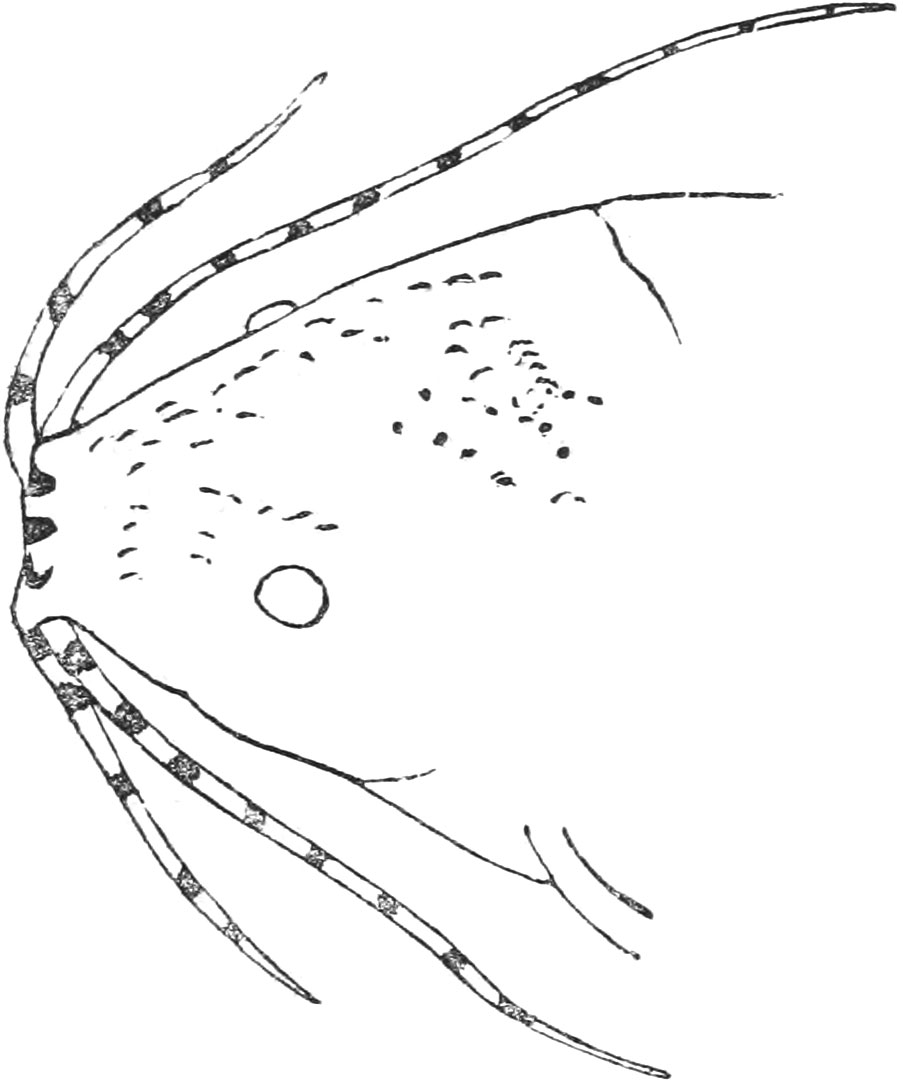
Callichthys, No. 22, Schomb.
Mr. Schomburgk gives the following notes regarding this fish.
Inhabits pools, marshes, and creeks; grows sometimes eight inches in length; is capable of living a long time out of water, and migrates from one pool to another in, dry seasons overland: they are very fat, and a good viand. The whole fish is completely covered with armour, except a small portion of the belly, of a greenish brown. The pectoral fins serrated; mouth fleshy; teeth, a single row; caudal fin nearly even; eyes placed near the snout, dull brown; intestines form many flexures. It is of a uniform greenish brown colour, and can exist in muddy holes without any water whatever; great numbers of them are sometimes dug up from these situations. They lay their eggs on straws, which they gather together and cover over; they are watched by the parent until they arrive at maturity; I have seen many of them in the trenches of the sugar estates; the adults are taken at this time by putting a basket near the nest, with which it is lifted out of the water. The spawn is very large, considering the size of the fish.
D. 1/8—2d D. with membrane—P. 1/6—A. 7—C 12—Branch. 3—Vert. 23—Cirrh. 2/2.
The drawing of the second fish is marked, “Caught at Curassarraka, 17th Dec. 1837.” Same name in L. Geral, Tamoata; Macusi, Arawai, Formula of fins, &c.
D. 1/8—2d D, 1, with a membrane—P. 1/6—V. 6—A. 7—C. 12—Branch. 3—Vert. 23.
From the drawings, it is difficult to discover whether the mailing of these fish have been smooth or rough; in this, the markings lead us to believe that it has been rough, particularly on the head; and the first ray of the pectoral fin seems to have been spined or serrated near the tip. The mouth of this species is terminal, but the upper jaw projects and is furnished with four cirrhi, the under ones longest reach to about the middle of the pectoral fins; and both are barred alternately for their whole length, a marking which we have not seen noticed in any description. The plates appear to be twenty-four or twenty-five in number.
Both the older and modem writers agree in the facts, that fishes of this genus are capable of surviving for a long period out of water; that when that element fails them, they have even the instinct and power to travel overland in search of some other pool not yet dried up; and in the want of this, by burying themselves in the ground, they can sustain life in a state apparently torpid, until the return of the rainy season again fills the temporary reservoirs. Nests are also formed of straws and grass, where the ova are deposited; and which are watched over and defended by one or both of the parents, with a solicitude which we have not been accustomed to give this class of beings credit for. Whether these curious properties are common to the whole genus, or to what species they are more particularly the attributes, does not seem yet to be clearly defined; and we would consider these facts worthy still of investigation, together with a more minute examination of the branchial and respiratory structure. Ten species are indicated by Valenciennes, but few remarks are given relative to their habits or structure, all of which, require investigation. One or two small species are figured in the Atlas of D’Orbigny, and of one, C. levigatus (pl. v. fig. 2), it is remarked, that it was found in the province of Corrientes, in still waters, always at the bottom, in the sand or mud. They conceal themselves under and among the aquatic plants, swimming slowly, and feeding on the small worms and insects which may fall into the water. They are not used as food, and will not bite at a baited hook. This species had been kept out of the water for eight or ten hours without appearing to suffer.28

Callichthys, No. 22, Schomb.
Doras29
Valenciennes divides his genus into two forms those having the mouth cleft at the extremity and furnished with teeth on each jaw, and those having it placed below with teeth in groups on the lower jaw only. The characters given by Spix apply more particularly to the large species described as Corydoras edentatus, Spix, Doras Humholdtii, Agassiz, the D. niger of the present volume; we would consider that which we are about to describe as more typical, where the plates cover the whole body w4th the exception of the belly and the centre of the back. The “corpus nudum” must therefore be taken under modification, so also must the “os parvum,” which is sometimes of considerable size and cleft terminally. The characters in Spix are:—
Denies velutini, minuti, in mandibula, ossibus inter-maxillaribus imoque in vomere. Membrana brancbiostega radiis sex. Os parvum. (Os mediocre terminalis inferiusve). Cirrhi sex. Caput clypeatum. Corpus nudum (omit “corpus nudtun”) in utroque (vero), corporis latere series scutorum osseorum, in medio spina aut carina elevata instructorum. Pinnæ dorsales duæ, posterior adiposa, interdum vix distincta. Radius primus pinnarum pectoralium, et pinnae dorsalis validissimus, serratus.
In the first division, and typical of what we shall consider the true form of Doras, we possess specimens and drawings of three species. The first agrees closely with the minute description of D. costatus which is given by Valenciennes, and to this we shall now refer it, mentioning any discrepancies as they occur, in their proper places.
The Mailed Doras
Doras costatus, Lacep.
Le Doras a cotes osseuses, Valenc. xv. p. 268.—Saurauwari, Macusi Indians; Yarauira, L. Geral. Schomb. Drawings, No. 41.
This species seems distinguished from the others in the Collection by the much stronger armature of its spines and plates, and by the strong spear-shaped process which runs from the gill-aperture along the sides. The costal plates are in number thirty, each, except the three first, furnished with a strong hooked, lance-shaped spine; the plates are simply granulated on the surface. Mouth furnished with six cirrhi; two on the upper jaw longest, reaching to the first costal plate; four on the lower shorter, the first scarcely more in length than one-third of that which accompanies it. Our fish was a female, and in length is about ten and a half inches. The formula of the fins given by
| D. | P. | V. | A. | C. | Branch | |
|---|---|---|---|---|---|---|
| Schomburgk | 1/6 | 1/7 | 6 | 12 | 11 | 6 |
| Gronovius, pl. v. figs. 1, 2 | 7 | 9 | 7 | 12 | 1730 | |
| Hancock, Zool. Journ. iv. p. 242 | 1/6 | 1/5 | 7 | 9 | 20 | |
| Valenciennes | 1/7 | 1/7 | 7 | 11 | 17 | |
| as counted in specimen | 1/7 | 1/6 | 7 | 12 | 1/11 |
From these apparent discrepancies, supposing all the authors to have described the same fish, it is probable that, as in other fishes, these rays may not, so far as number is concerned, be a certain specific character. In the dried specimen, and from the description of Valenciennes, the colours may be stated as of a dull brown, clearer along the centre of the costal plates, and upon the lower part of the head and strong rays of the fins. In the drawing before us, however, the whole fish is represented of a deep greenish blue, paler and tinted with yellow upon the lower part of the head and rays of the fins, and very much darker upon the whole of the plates covering the upper part of the head; the line running along the centre of the body and the spines are nearly white, and relieve the dull tint of the other parts. The eye is coloured chestnut-red. Dr. Hancock describes his Doras costatus to be brownish grey. Valenciennes considers Hancock’s Doras as new, and gives it the appellation of D. Hancockii,31 and from the descrepancy of the description in the Zoological Journal, and in the formula of the fins given above, we are inclined to agree in its distinction. The accompanying notes observe,
This species resembles the last (the species we next describe), but grows to a foot in length; the tail is rounded; adipose fin situate over the anal, to which the anus is near. The body is round; cranium covered with bony plates, serrated at the edges, and ending in the middle in a long spine; a white stripe runs along the middle, where these spines are situate. The air-bag is double,—one-half oval, the other long and pointed. The nostrils are single, round, placed near the snout; eyes near the middle of the head, with a brown iris (in drawing coloured bright chestnut red); the tongue is fleshy; teeth thickly set in both jaws, fine; intestines long, forming several flexures; the gut large near the anus; roe long, large, and double; eggs large. Gill-opening semilunar, the lid smooth-edged, with a striated surface. This fish lives long when taken out of the water, and is taken by bait and with the hand, about the roots of trees, where it forms for itself a retreat.
Another small species, with a drawing, occurs in the Collection, which we refer to the “Callichthys cirris sex,” &c. of Gronovius, tab. iii. figs. 4 and 5 3 and 4. Valenciennes quotes this as a synonim under his D. cataphractus, which he considers nearly allied if not identical with his species previously described, D. armadillo. The specimen is of a brownish colour, with the centre of the plates paler, but from the drawing may be described as,
Doras,—above deep olive-green, on the belly yellowish; lateral line of plates white; tail forked, with a double dark band,—the first basal, second nearly central; dorsal and pectoral spines deeply striated; lateral plates 29, each plate with smaller spines above and below the lateral line; cirrhi, 2 upper, 4 lower jaw. Uaricari of Warrau Indians; Dakerro, L. Geral. Schomb. Drawings, No. 40.
Formula of fins,
| D. | P. | V. | A. | C. | Br. | Lat. pl. | |
|---|---|---|---|---|---|---|---|
| Schomburgk | 1/5 | 1/4 | 7 | 12 | 22 | 6 | |
| Gronovius, tab. iii. figs. |
5 | 6 | 9 | 19 | 6 | 29 | |
| Valenciennes, of D. Cataphractus | 1/4 | 1/4 | 1/5 | 9 | 17 | 26 |
In the manner in which the numbers of Gronovius are expressed, we are not sure whether the strong rays of the dorsal and pectoral fins are counted or not; if intended to be counted, the numbers would agree. In the specimen we find 12 in the anal fin; and in the tail, by taking within the two exterior longest, we find 19 only, although others on the dorsal side, running shorter, make up Mr. Schomburgk’s number. Different observers count in different ways, and confusion in numbers have often in this way taken place.
This fish is a native of Rio Negro; is drawn of the natural size; the caudal fin is forked; ventral placed half distance between the pectoral and anal fins; adipose fin over the anal, small. The cranium is hard, opercles striated; the mouth terminal; teeth fine, thickly set in both jaws; cirrhi on the upper longer than those on the lower jaw; pectoral and dorsal spines serrated; along the sides a series of scaly plates, spined at the edge, and terminating at the angle in the middle with a large spine; a bony process on the body, near the head, which the dorsal spine lies against when it is closed. Colour of the fish is olive-green, darker on the back, with lateral line white; eyes yellow. Intestines form several flexures, the gut large as it approaches the vent; the gill-opening semilunar, with smooth edges for the spiracles; the roe long and double; air-bag double,—the first division, near the head, flat and oval, the second long and pointed. They are eaten by the inhabitants; occasionally take bait, but are killed in great numbers by poisoning. In the dry seasons their haunts are under the roots of trees, in sand-banks, where they bore holes for themselves, and under rocks. This species does not much exceed the length of that which is represented in the drawing.
(About five and a quarter inches in length).
Another species and drawing does not seem referrible to any description to which we have access we place it provisionally under the name of
Chestnut-Bellied Doras
Doras castaneo-ventris
Macusi, Karakirn; Warrau, Mutu-mutu; L. Geral, Keru-keru; in MSS., Anoya. Schomb. Drawings, No. 42.
The specimen is seven inches in length. In form the head is rather depressed; the eyes small, placed considerably forward, protected anteriorly by a process apparently of the superior maxillary bone, which seems capable of motion, and is spined upon its edges; nostrils small, and placed near the margin of the lip; the cirrhi reach to about the insertion of the pectoral fins. The buckler is strong and granulated, nearly regularly rounded over its whole surface, and having a small plain oval depression between the eyes. The number of entire costal plates is twenty-eight, preceded by two imperfect ones. These have the usual strong central spine, but the spination upon the whole surface of each is also strong, meeting on the back about mid way between the first and second dorsal fins, and continued thence to the tail, upon the rays of, which, for half their length, it also prevails. The rays of the dorsal and pectoral fins, in addition to being serrated on their edges, are also spined upon their upper surface, which is also the case with the strong axillary plate running along the sides; the lower surface of the strong pectoral rays is striated. The pectoral plate is produced at its posterior angles to two sharp points, which also is slightly armed; the whole lower surface, to the insertion of the anal fin, is otherwise smooth. The lower jaw projects slightly beyond the upper.
The formula of the fins from Schomburgk’s MSS.:
D. 1/4—P. 1/5—V. 6—A. 11—Br. 6—Vert. 26.
In colour, the specimen, like the others, is of a uniform rather deep brown; the lateral spiny line of a yellowish white. The fins appear to have been clouded with a deeper tint, particularly conspicuous on the ventral and anal members; and the tail has two transverse pale bands,—the one at the base distinct, the second about the centre more clouded. In the Drawings, the colours of the whole upper parts and the anal fin are of a deep greenish blue, enlivened by the nearly white colour of the spiny lateral line. The smooth part of the belly, the ventral and soft part of the pectoral fins, are coloured bright chestnut brown, blotched with large markings of deep blackish brown, paler on the fins; the eye is red. Our notes observe,
This fish was found in the river Pasawiri, and is drawn nearly of the natural size. The cranium is hard: the body covered with bony plates, ending at the angle in spines, as in the two last; the tail is rounded; adipose fin small, situate nearly over the anal; ventral and anal fins placed near each other; dorsal and pectoral spines much serrated; a bony process on the body, near the head, which the dorsal spine lies against when it is closed. The opercles have smooth edges, with striated surface; the cirrhi are long and white. It much resembles the two last in its habits and retreats, and is not much used for food.
(The “two last” refer to Nos. 41 and 40, Schomb. Drawings, also our two last described specimens).

Plate III

Brown Dorsal-Striped Doras
Doras brunnescens
Macusi, Kiru-kiru; L. Geral, Bayacu.—Schomb. Drawings, No. 18.
The drawing of this fish, though characteristic, is scarcely sufficiently detailed to work from; for this reason we have named it as distinct from the D. armatulus, Valenc., to which it approaches in colouring, but not at all in habits. From the drawing we cannot count the costal plates, and the formula of the fins unfortunately have been omitted. The formula of Valenciennes is given underneath, with his description, which can be compared with the notes of Mr. Schomburgk.
D. armatulus, Valenc.
Cost. p. 28 or 29—D. 1/6—P. 1/6—V. 7—A. 12—C. 17.
Ce poisson est d’un brun noir; un band fauve-clair commence au-dessus de l’œil, transverse le coté du casque et suit la série des épines jusqu’au milieu de la caudale, dont le bord superieur et l’inferieur sont aussi fauves; un ligne fauve moins tranchée suit la langeur du milieu du dos. La moitié inferieure de la dorsale est fauve clair ou blanchâtre, la moitié superieure est noire. L’anale a aussi une grande tache noiratre; la partie molle de la pectorale est noire, excepté le tiers de la base, qui est blanchâtre. Tout le dessous est d’un gris brun, plus pale en avant.
Found in the Parana, but not below 27 deg. 30 min. south latitude; never exceeding four inches in length. Frequents stony parts of the streams, where there is a considerable current, and never bites at the hook.32
This fish is found in the Upper Essequibo, and seldom exceeds five inches in length; the snout is flat, back high, body short and thick, tail rounded, dorsal and pectoral fins have serrated spiny rays, a spiny process on the body which the pectoral spine lies against when the fin is closed; upper part of the body covered with spinous armour, belly without armour. Colour dark brown, with a line of ochre along the back, and one along the lateral line; belly lighter, spotted with ochre; all the fins are light brown, banded and spotted with black; the eves are small and dull; cirrhi, two in the upper and four in the lower jaw; opercles smooth gill-opening semilunar. When killed, a milky substance is found in the head, very bitter to the taste; and there is a species in the creeks of the Demerara river, entirely black, which possesses a similar substance. They bite the bait readily, and are an annoyance to fishers, in nibbling off the bait from the hooks which are set for better fish: they are sometimes, but seldom, eaten.
Black Doras
Doras? Niger, Valenc.
Macusi, Saurawari; inhabitants of Esmeralda, Cuiu-cuiu. Schomb. Drawings, (2).
It is noted on the drawing of this fish, that there is no adipose dorsal fin; but this may have been overlooked from the peculiar structure, or very small development or plicate form sometimes assumed by this part; in the uncertainty, we introduce it last.
At the period of the publication of Spix’s Fishes of Brazil, M. Agassiz considered the large Doras figured on plate v. as Corydoras edentatus, Spix, Doras Humholdtii, Agas., to be distinct from the fish described in the Zool. Researches of Humboldt, by M. Valenciennes, under the name of D. niger, M. Agassiz pointed out what he considered the distinctions: but as the drawing agrees best with the late description of Doras niger in the Histoire Naturelle des Poissons, we have given it now under that name, without pretending to settle the question whether one or two species are involved in those referred to above. In our drawing the fish is coloured entirely black, with a blueish lustre on the fins and tail, and having the belly clouded with dull purple and altogether paler; and? the whole showing a metallic or bronze lustre. The eye blue. The cirrhi, six in number, are not so long by one-half as in the figure of Spix, and the tail appears to have been nearly square.
The formula of the fins, in Spix and Valenciennes, agree nearly; in our notes, we regret they have been omitted.
| B. | D. | P. | A. | V. | C. | Cost. pl. | |
|---|---|---|---|---|---|---|---|
| Doras niger | 8 | 1/6 | 1/10 | 11 | 7 | 17 | 24 |
| D. Humloldtii | 8 | 1/6 | 1/10 | 11 | 7 | 16/6 | 24 |
D. Niger, Valeric.—(Ore edentulo). Corpore nudo lævi, seutellis trigonis in utroque latere 24. Caput magnum elongatum, antice acutum, clypeatum. Labia crassa, cirrosa. Cirri sex, duo ad rictum; quator æquales brevisslmi, in maxilla inferiore. Scutella lateralia, quorum priora quatuor, inermia, csetera triangularia, aculeata. Pinna adiposa porrecta, angustata.33
Regarding another doubtful species, Mr. Schomburgk says:—
The following account of a species of Doras, or one of the Callychthidæ, has been politely furnished to me by Dr. Hancock, who, himself a long resident in Gaiana, made several excursions into the interior, and accompanied, in 1810 and 1811, an expedition which the colonial government of British Guiana dispatched at that period into the interior with a view to inquire into the feuds of the natives.
Mailed Fish caught at the Orooporary,34 Dec. 26, 1811.—Amongst these falls, in a very shallow rapid, one of our Carib guides caught a singular fish, armed with a coat of mail,—a species of Doras, or one of the Callychthidæ. It was adorned with beautiful bright yellow and scarlet colours, and elegantly spotted with black. Such a display of colours is rarely found in the mailed fishes; they are usually of a brown or dingy grey colour.
This fish is not only furnished with the usual appendages for swimming, but by means of the strong supports which form the anterior spines of its pectoral and abdominal fins, it is enabled to walk upon the stony bottoms of the rivers, nay even, I believe, to pass the falls by walking along the shore; for it appears, like the Hassar, to be in some measure amphibious. Although it had received a severe blow on the head from the man who caught it, yet it lived, exposed to the sun’s rays, for many hours afterwards. It made several attempts to jump out of the boat, but ineffectually. The Caribs called it Acáaru, the spinose fish, others the four-legged fish. The Arowaks were not acquainted with it, but said it resembled the Watawata in form. It was about ten inches in length its head depressed, upper jaw shorter and moveable. It had no teeth, but short crooked spines in the lips. The pectoral and abdominal fins had each six rays, besides the strong ambulatory one, or rather spine, in each. Anal fin six rays, dorsal nine, with a sharp and strong anterior spine. It was armed, in addition, on each side, with four longitudinal rows of strong spines, curved backwards. The whole body, except the thorax, was guarded with a coat of mail, consisting of strong plates, connected by cartilage, and moveable, like so many joints.
Among the few specimens of this form which have been dissected, the stomach has been seen to be large and round; in the D. costatus of Valenc. giving off at its base, on the right side, a branch which is prolonged to a duodenum nearly equal in size, which performs many folds beyond the stomach. The spleen is flat and large; the liver displays only a small lobe, and the gall-bladder is oval, with the kidneys large; the swimming-bladder large; the fibrous coat thick, and within, as if it were laid in folds. There is room for much research regarding their whole structure, and particularly for the correct study of their habits and manner of spawning, the structure of their respiratory organs, and the nature of the liquid which our author notices having observed in the cavity of the skull of only two species.
These will conclude the descriptions of the species of the Collection which will enter among the Loricarinæ; of the other forms of the Siluridæ, no specimens accompany the drawings, and there is thus a difficulty of judging of the value of some of the families which have been lately proposed. We shall, however, continue the genera as naturally as possible, and shall first take some of the more strongly armed or mailed. The genus
Phractocephalus
Agas.
is of a depressed form, a head large and disproportioned to the size of the body, strongly mailed, and having the mouth with lengthened barbules; the first rays of the pectoral and dorsal fins are strong and spined. The generic characters are thus given, and our woodcut copy from the drawing will illustrate the form:
Phractocephalus, Agassiz.—Denies velutini per fasciam latam in ossibus inter-maxillaribus, in vomere, in mandibvila, et in quinto radio branchiali. INIembrana branchiostega radiis 8. Ox maximum. Cirrhi 6. Caput latissum, scuto maximo ad nucham usque producto tectum. Corpus nudum. Pinnae dorsales duæ, posterior adiposa; radius primus pinnarum pectoralium validissimus, serratus.
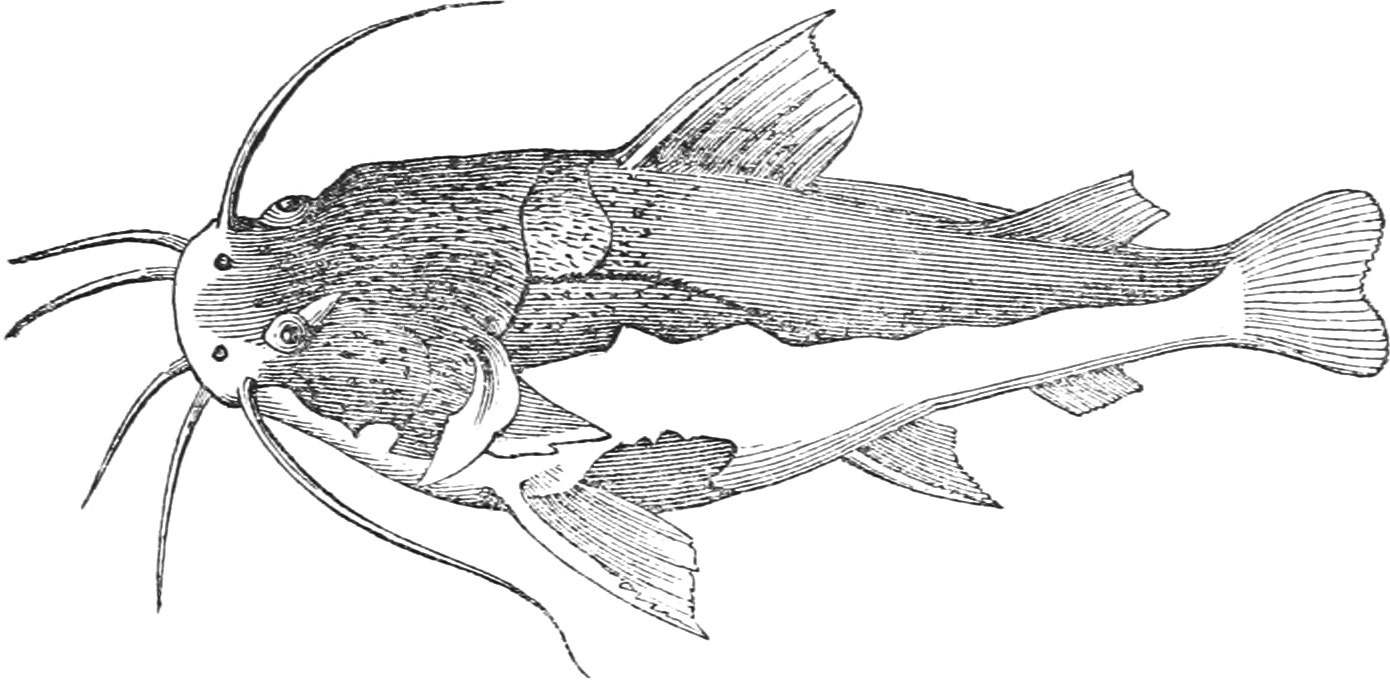
Phractocephalus
P. Hemilopterus
Agas.
Pirarara bicolor, Spix, tab. vi.—Phractocephalus bicolor, Agas. in Spix.—Le Phractocéphale hémiliotere, Valenc. xv. p. 3.—Paruaruima, Schomb. Drawings, (1).
There appears yet to be only one species of this genus discovered, and our drawing agrees generally with the figure given in Spix; in it, the first spine of the pectoral fin is represented as serrated on both sides in Schomburgk’s figure, it is serrated only towards the point of the inner side. In the first, the lateral line is represented as serrated, which we do not perceive. The cirrhi on the upper jaw of Spix’s fish exceed the pectorals in length; in the other they are shorter by three-quarters of an inch in the reduced drawing; but without the examination of specimens, we could not be sure that these discrepancies were sufficient for specific distinction. In colouring, our drawing shows deeper tints; the upper half of the body is olive-brown, shaded into a dark line at the junction of the colour with the pale straw-yellow of the lower parts, which shades into brick-red on approaching the dark lines; the dorsal and adipose fins, with the tail, are brick red, shading into olive at their bases; the eyes are represented blue. The following formula of the fin rays may be compared together:
| D. | P. | V. | A. | C. | Br. | |
|---|---|---|---|---|---|---|
| Schomburgk | 1/7 | 1/8 | 6 | 10 | 24 | 8 |
| Agassiz | 8 | 10 | 7 | 835 | 1736 | |
| Valenciennes | 1/7 | 1/9 | 6 | 8 | 1737 | 9 |
Mr. Schomburgk remarks:
A fish attaining from three to four feet in length, and common to all the rivers of Guiana. The head broad and depressed the helmet, which is formed by the cranium, is rough or shagrined, and a distinct osseous plate intervenes between it and the spine of the first dorsal fin. The lateral line is curved, commencing near the intervening buckler, and terminating towards the middle of the tail. The nose-holes or nostrils are double,—the first pair near the snout, the second mid-way between the snout and the eyes; the eyes oval, greenish blue; tongue round and fleshy; upper jaw slightly produced, and in each a band of crowded teeth; gill-openings semilunar. The air-bladder is single and heart-shaped; milt double, short, and thick. They are very Toracious and take bait readily; and when hauled on shore, after being caught with the hook, they make a loud grunting noise. They bite best by night, and are excellent eating.
Agassiz has dissected this fish, and states, that the opening of the mouth is immediately expanded into a large sac, forming the stomach, of the form of a globe, compressed anteriorly and posteriorly, and which fills nearly the whole upper part of the abdominal cavity. The walls are thickened; above, on the left side, the cæcal appendage arises, and, what is remarkable, the small intestine takes its origin behind nearly the same part. The air-bladder is very large, heart-shaped, and compressed, situate behind the stomach and outside of the peritoneum,—it stretches to the lower third of the abdominal cavity; the walls are thick, fibrous, and silvery. Agassiz has remarked a small mucous opening between the scapular processes and pectoral fins, which has not been noticed by Valenciennes, nor is it mentioned by Schomburgk. Future observers should attend to this.
Arius
In the genus to which we have referred the next two fishes, we are uncertain, looking at the distinctions which have been laid down by Valenciennes between Bagrus, Arius, and Pimelodus, among which they ought most properly to range. These have been taken from the teeth, their position and form, which it is difficult to ascertain from notes and drawing only. In all, the form is remarkably similar; so much so, that many of the Siluri of Hamilton Buchanan run into the others, and have been separated. This is, indeed, so much the case, that we are not sure if the dental classification be not too minute and artificial. In Bagrus, the palatine teeth are disposed in single transverse bands in Arius, as characterised by Valenciennes, and which is made to contain species from Africa, Asia, and South America, the palatine teeth form two distinct and separated patches, and are generally inserted in the palatine bones, although they sometimes advance upon the angles of the vomer. In Pimelodus, again, the palate is smooth, and entirely without teeth.38 Unfortunately, Valenciennes does not give his characters so that they can be transcribed. Pimelodus, as characterised by Spix and Agassiz, would contain all those of which we have drawings or any notes, but we have chosen to place two of them, provisionally, along with Arius, on account of their approaching nearer in form to some of those figured in the various works to which the French ichthyologist is at present contributing, particularly in the strong armature of their fins, &c. The first we shall for the present entitle
Marbled Arius
Arius oncina
Warrau, Awàyu. Schomb. Drawings, No. 49,
This fish was taken in the Rio Padauiri. The dorsal and pectoral spines are serrated, cranium hard, body without scales, but there is a bony process on which the dorsal spines close, posterior to the helmet or cranium. Lateral line straight, body yellowish brown, variously spotted with black, and not unlike the markings of the jaguar. The ventral fin is placed nearer to the anal than the pectoral, the second dorsal moderately large; tail is slightly forked, and has the upper lobe rather longer than the lower. The eyes are small, placed near the snout, iris brown; nostrils near the snout; teeth, a series thickly set in both jaws, all fine. Surface of the gill-covers slightly striated, edges smooth, opening semilunar; lives often three or four hours after being taken from the water. It is taken by the hook baited with worms on set-lines at night, and is one of our best flavoured fish; it is considered a great luxury, and grows to the length of ten inches. Intestines form flexures, and have appendices attached.

Plate IV
Another fish, of which we have even still greater doubt of ranging in the present genus of Valenciennes, we here provisionally name, from its form,
Arius? obesus
Schomb. Drawings, No. 57.
Our scanty notes mention the specimen to have been,
nine inches in length, in girth seven inches and three-quarters at the thickest parts. It is very fat, and is found under trees which have fallen into the river. The teeth are a series thickly set in each jaw; the intestines have no appendices no food was found in the stomach. Rio Branco, April.
The drawing is coloured of a dull bluish black, paler or slightly silvery beneath. The buckler is large, and is represented as granulated, projecting in a sharp angle on each side above the gill-openings. The first spines of the dorsal and pectoral fins, both in this fish and in the preceding, resemble those of the truly mailed fishes, and seem capable of being applied for similar purposes; here they are strong and toothed on both edges, and from the back of the pectoral spine or beneath the gill-openings arises another, pointing backwards, equally rugged in appearance. The anal fin is more than usually elongated. The cirrhi are six, but of only moderate length, those on the lower jaw short. In form it is allied to Aspredo, but varies in the presence of the second or adipose dorsal fin.
Pimelodus
The next series of interesting fishes to be noticed we shall place provisionally in Pimelodus. In that genus, as characterised by Valenciennes, none of them could rank, being all provided with teeth in one form or another; but in the uncertainty of their true structure and position, it would be equally uncertain whether they should range with Arius or Bagrus. They all possess a greater development of the second dorsal fin than we have yet seen, and most of them are somewhat strongly armed anterior to the first dorsal fin. The characters adopted by Agassiz will take them all in.
Pimelodus, Lacep., Cuv., Agas.—Dentes velutini, per fasciam in ossibus inter-maxillaribus et in mandibula dispositi. Membrana branchiostega radius 5–10. Os magnum. Cirrhi sex. Caput nudum aut scuto majori minorive obductum. Corpus nudum. Pinnæ dorsales duæ, posterior adiposa. Radius primus pinnarum pectoralium et pinnae dorsalis validus serratusque.
Of the first fish, which we shall place here, we possess only an imperfect drawing, from the caudal fin of the only specimen obtained being mutilated; but from the general form and the distribution of the teeth, as indicated by our notes, it would range in Bagrus of Valenciennes. It may presently stand as
Pimelodus (Bagrus) maculatus
Warrau, Mohocco; L. Geral, Jandia. Schomb. Drawings, No. 43.
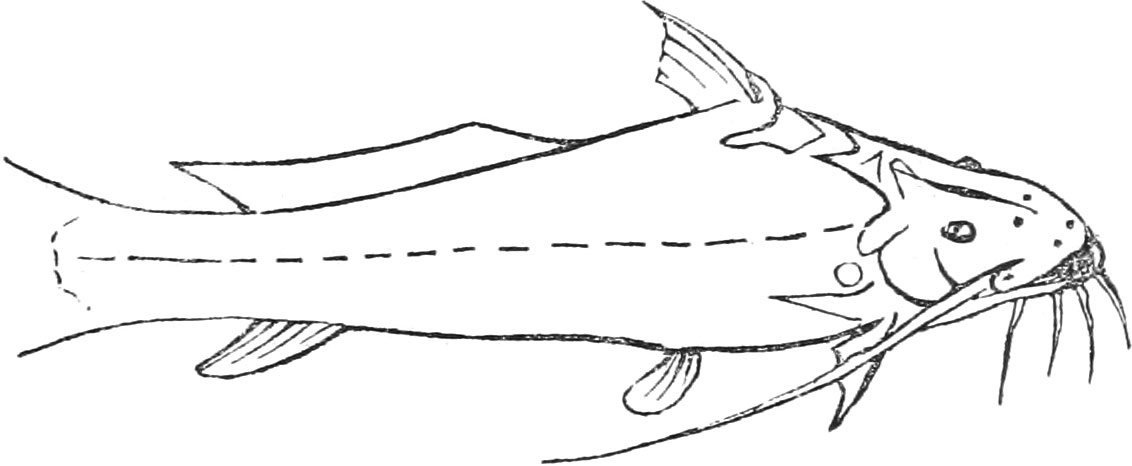
Pimelodus maculatus
This fish is found in most of the rivers of Guiana, also in the Rio Negro and Amazon; it grows to twelve inches in length, with cranium hard, head depressed, dorsal and pectoral spines serrated, a bony process for the pectoral spine to lie against when closed; opercles striated, with smooth edges; cirrhi long; lower jaw a little longer than the upper; teeth, a series thickly set in both jaws; adipose fin very large; vent about the middle of the body. The eyes are oval, dull blue, and situate near the middle of the head; nostrils double,—one pair on the snout, the other on the top of the head half-way to the eyes; the lateral line is nearly straight, running along the middle of the body; ventral fins half-distance between the pectoral and anal. They are said to be much used for food, and are well tasted. The body is without scales, its colour bluish green, with lighter spots, and becomes nearly white on the belly and under part of the head.
D. 1/6—P. 1/9—V. 6.—A. 12—Br. 8.
No. 5 of Schomburgk’s Drawings represents another species, which also would probably rank with the Bagri; it is thus described in his notes:—
This fish is found in the rivers of Demerara and Essequibo, as well as those of Brazil. The body is long, without scales, of a bluish black colour; the belly whitish, finely spotted with black; the head compressed; jaws equal; teeth, a fine series, thickly set in both jaws; cirrhi on the upper jaw long; eyes placed near the middle of the head, oval, bluish; nostrils double,—one pair on snout, the other nearer the eye; the tongue round and fleshy opercles smooth; ventral fins at equal distances from the pectoral and anal fins; a small bony process which the pectoral spine lies against when closed; adipose fin very large, lateral nearly straight. Air-bag single, heart-shaped; the intestines form several flexures; milt double, thick, but not very long. This fish will live for an hour after being taken from the water; it takes the hook at night, baited with worms, and is an excellent fish; it reaches the length of eighteen or twenty inches.
The native names are—Arawaak, Laukidi; L. Geral, Jandia.
D. 7—P. 1/7—V. 6—A. 9—C. 18—.Br. 8—Cirrhi 2/4—Ribs 11 pairs—Vert. 45.
Our next three figures will show species remarkable for their spotted markings, and at the same time presenting a considerable degree of beauty and symmetry.
Tiger Pimelodus
Pimelodus arekaima
Carib, Yacima; Arawaak, Aruà; Macusi, Arekaima; L. Geral, Jantia; Creole, Tiger-fish. Schomb. Drawings, No, 9.
The fish from which the drawing has been made was caught in the Upper Essequibo, 14th October 1837; they are pretty plentiful, and are also found in the Rio Branco. It is without exception one of the best fish for the table to be found in any of the rivers of Guiana; the flesh is firm, fat, and of an excellent flavour, with little bone. The cranium is hard and compressed; the opercles smooth, principal front bone rough, gill-opening semilunar, cirrhi two, very long on the upper jaw, reaching beyond the ventral fins,—four shorter; nostrils double,—one pair behind, the other near the snout; eyes oval, dull red. The body at the dorsal fin nearly triangular, round towards the tail. The fish entirely of a reddish brown colour, spotted irregularly with different sized spots of black, from which it has received the name of “Tiger-fish.” The belly is lighter, with the spots smaller and less distinct. It is destitute of scales; has a spinous process on the body, near the opercle, which the serrated spiny ray of the pectoral fin strikes against. Lateral line straight, from the opercle to the middle of the tail; the ventral fin about the middle of the fish. Tongue fleshy, upper jaw produced, teeth fine and thickly set in both jaws; intestines making several flexures; vent situate near the ventral fin. Air-bag single, heart-shaped. This fish lives half an hour after being taken from the water; it is caught by the hook, baited with a piece of flesh or other fish, and is sometimes also shot with the arrow. They are not found below the falls, and therefore few except Indians enjoy this delicious fish. The length of the specimen was two feet three inches.
D. 11—P. 1/10—V. 6—A. 6—C. 24—Br. 9—Ribs, 14 pairs—Vert. 44.

Plate V
Black-Spotted Green Pimelodus
Pimelodus insignis
Wapisiana Indians, Konnairu. Schomb. Drawings, No. 33.
This fish is more symmetrical in form than any of the Pimelodi or their allies which occur in the Collection. The head is comparatively small, the body becomes fine or slender near the tail, and that member is largely developed and forked, as in a fish which possesses the power of swimming and moving with ease and rapidity. The second dorsal fin occupies nearly the whole space between the first dorsal and the tail, and the upper pair of cirrhi exceed in length any of those we have yet described, reaching to the termination of the anal fin. The accompanying notes regard it as a
Rio Branco species, pretty abundant, of a shining green colour, on the back with a brush of purple and white, and on the belly tinted with rose-colour. The head rather small in proportion to the size of the fish, the eyes placed near the middle; the gill-lids smooth-edged; the surface of all the bones smooth, except the opercle, which is slightly striated. The cirrhi on the upper jaw very long, nostrils double, one pair on the snout, the other a little behind; upper jaw projecting, teeth thickly set in both, all fine. Lateral line running nearly straight along the middle of the body. Adipose fin very long, caudal fin forked and large. The tongue is round and fleshy; intestines form about four flexures. This fish lives about half an hour after being taken from the water, and is caught with the hook and line; it feeds on small fishes, and grows to about the length of eighteen inches.
D. 7—P. 11—V. 10—A. 6—C. 30—Br. 5—Vert. 46.
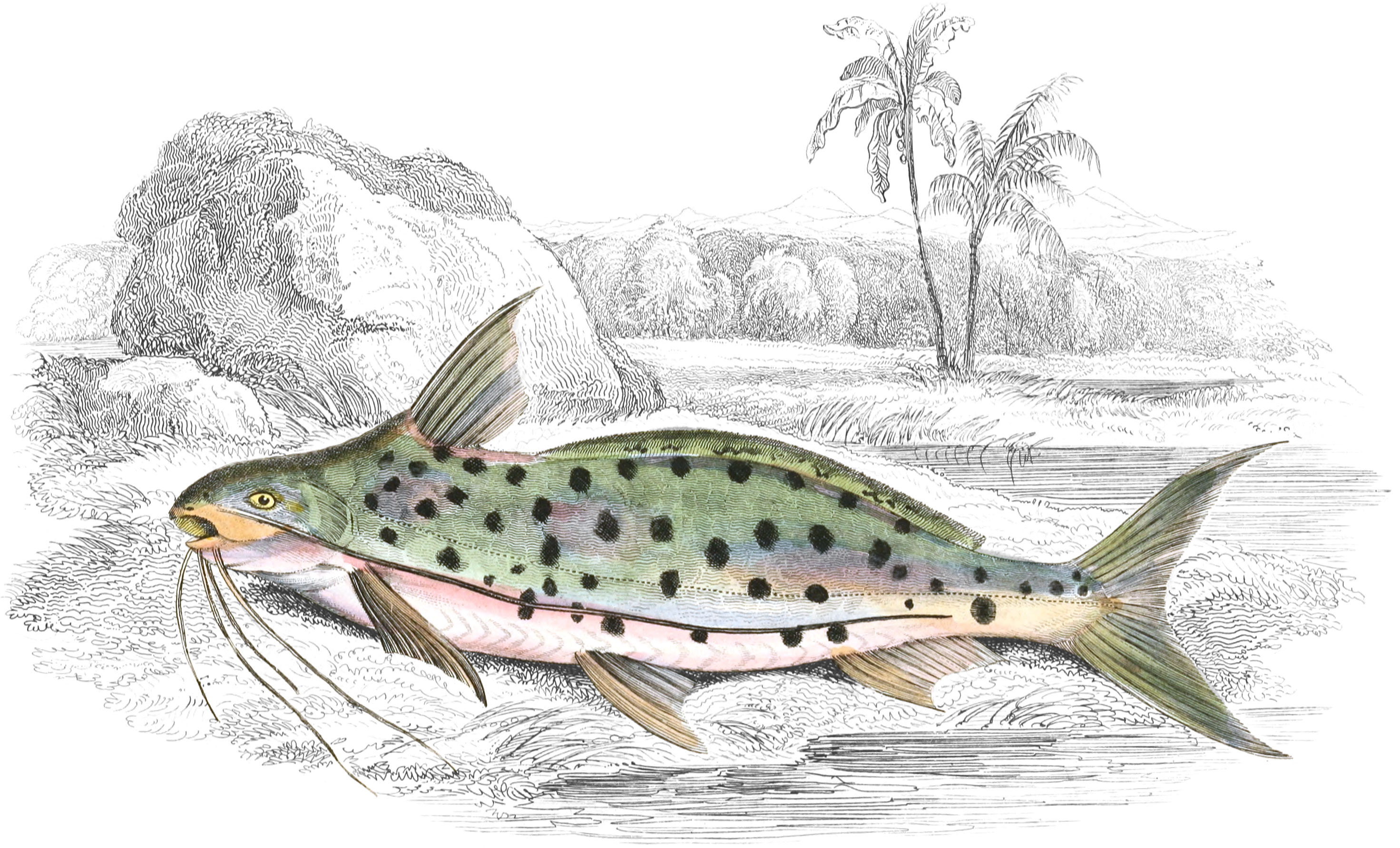
Plate VI
Stripe-Tailed Pimelodus
Pimelodus notatus
L. Geral, Caruatu. Schomb. Drawings, No. 31.
This is a very powerful fish, and, like the last, possesses no strong armature on the head or anterior to the dorsal fin; the body also becomes slender towards the tail, and that member is much developed; the second dorsal fin varies much in its small comparative size, while the cirrhi, not reaching beyond the ventral fins, are represented much stronger, and in resemblance more like those of the P. pirinampu of Spix. Mr. Schomburgk states:—
This fish was taken at Fort St. Joaquim on the Rio Branco, where it is not uncommon; they are also plentiful in the Amazon, but scarce in the Rio Negro, and seem partial to muddy waters. The specimen was three feet in length, six inches deep at the dorsal fin, where the body is nearly triangular, but from thence it becomes rounded to the tail. The head is depressed, upper jaw a little longer than the lower, teeth very fine and thickly set in both; nostrils double,—first pair near the eyes, second near the snout. Eyes dull, of a bluish cast, oval, and rather near the snout; surface and edges of the opercles smooth; the cirrhi smooth and winged. Lateral line visible only from underneath the dorsal fin, running on the body to the tail; first ray of the dorsal fin long and elastic, spinous ray of the pectoral fin serrated, the adipose fin large (not lengthened) and triangular. The general colour is a leaden grey, with black spots thickly set on the upper half of the body; the cheeks and sides are bluish, varying on the belly to cream colour, which is also the colour of the pectoral and ventral fins; the tail is large, with a black stripe on the lower lobe. The tongue is round and fleshy; intestines form three flexures, but are straight towards the vent; milt long and double; air-bag double, pointed, and bilobed. This is an excellent fish, being fat, well-tasted, and with little bone; it lives an hour after being taken from the water, and is caught with the hook and line, baited with flesh or smaller fish.
D. 7—P. 1/9—V. 6—A. 17—C. 40—Br. 9—Ribs, 16 pairs—Vert. 44.

Plate VII
Pimelodus pirinampu
Spix
P. pirinampu, Spix, tab. viii. p. 20.—Arawaak, Maripack; L. Geral, Mantopac. Schomb. Drawings, No. 6.
There are a few discrepancies between the author above quoted and our drawing and description the number of fin-rays vary, as may be seen by comparing the formula at the end of the description and the spine of the pectoral fin is represented as serrated in Spix’s figure, in ours it is smooth.—
This fish is found in the rivers of Brazil, as well as those of Guiana. The cranium hard, compressed; opercles striated, all the other gill-covering smooth; the eyes oval, blue, and dull; nostrils near the snout; back high; body nearly triangular at the dorsal fin, rounding from thence to the tail, which is forked; dorsal fin large, adipose very long (arising nearly at termination of first dorsal); pectoral, ventral, anal, and caudal fins webbed with blue, the latter spotted with vermilion (in the drawing, vermilion is the prevailing colour on all the lower fins). Body bluish green, lighter on the belly, and displaying there a rose-colour; the head is greenish brown; the cirrhi are black, webbed with blue, very large; lips are coloured lake; jaws equal, teeth thickly set in both. The tongue flat and fleshy; the air-bag simple, heart-shaped. This fish lives an hour after being taken out of the water, and like all others of the genus, they take bait readily, and are an excellent viand, being fat and well-flavoured. They grow to two feet and upwards in length, and may weigh fifteen or twenty pounds.
Platystoma
Platystoma, Agas.—Denies phractoeephali in fasciis latissimis, Membrana branchiostega radiis 15. Os amplissimum. Cirrhi sex. Caput depressissimum, planum, valde elongatum, maxilla superiore prominente. Corpus plus minusve compressum, omnino nudum. Pinnæ dorsales duæ, posterior adiposa. Radius primus pinnarum pectoralium et pinnae dorsalis cseteris parum validor.41
This genus contains many species, some of them reaching to a very large size, and many of them remarkable for their distinct and conspicuous markings. With the exception of what is contained in the notes of our own author, we have no knowledge of the anatomy or habits of these fish, and details of both should be marked as desiderata by future travellers.
Striped Platystoma
Platystoma tigrinum, Valenc.
Le Platystome tigre, Valenc. Hist. Nat. des Poiss. xv. p. 40 10.—Macusi, Corutto; Arawaak, Colite; Carib, Oronni; L. Geral, Surubim. Schomb. Drawings, No. 12.
On comparing the drawing before us with the descriptions in the Hist. Nat. des Poissons of P. tigrinum and D’Orbigianum, together with the plate of the latter given in the Atlas to D’Orbigny’s work, we agree with Valenciennes in considering them varieties of each other. The spotting of D’Orbigny’s figure and the description of P. tigrinum is just filled up by our plate, on which there is also seen a greater proportion of the white accompanying and relieving the black stripes; the spotting extends also to the lower fins. Our notes observe,
This delicious and beautiful fish abounds in most of the rivers of Guiana; its flesh, like that of the tiger-fish (Plate V.), is yellowish, but well-flavoured. The body is elongated, cranium hard, snout long and flat, and deeply serrated. The eyes are oval, situate near the middle of the head; nostrils single, on the snout; gill-lid smooth. Lateral line runs nearly straight to the middle of the tail it has a bony process which the serrated ray of the pectoral fin shuts against. Tongue round and fleshy the upper jaw slightly produced, the teeth fine and thickly set in both. Vent equidistant from anal and ventral fins. The colour of the body light blue, streaked with black and white; the fins blue, spotted with black; belly white. They are taken by the hook and shot with arrows, and are much esteemed by the Indians.
D. 7—P. 1/9—V. 6—A. 12—C. 30—Br. 14—Vert. 44.
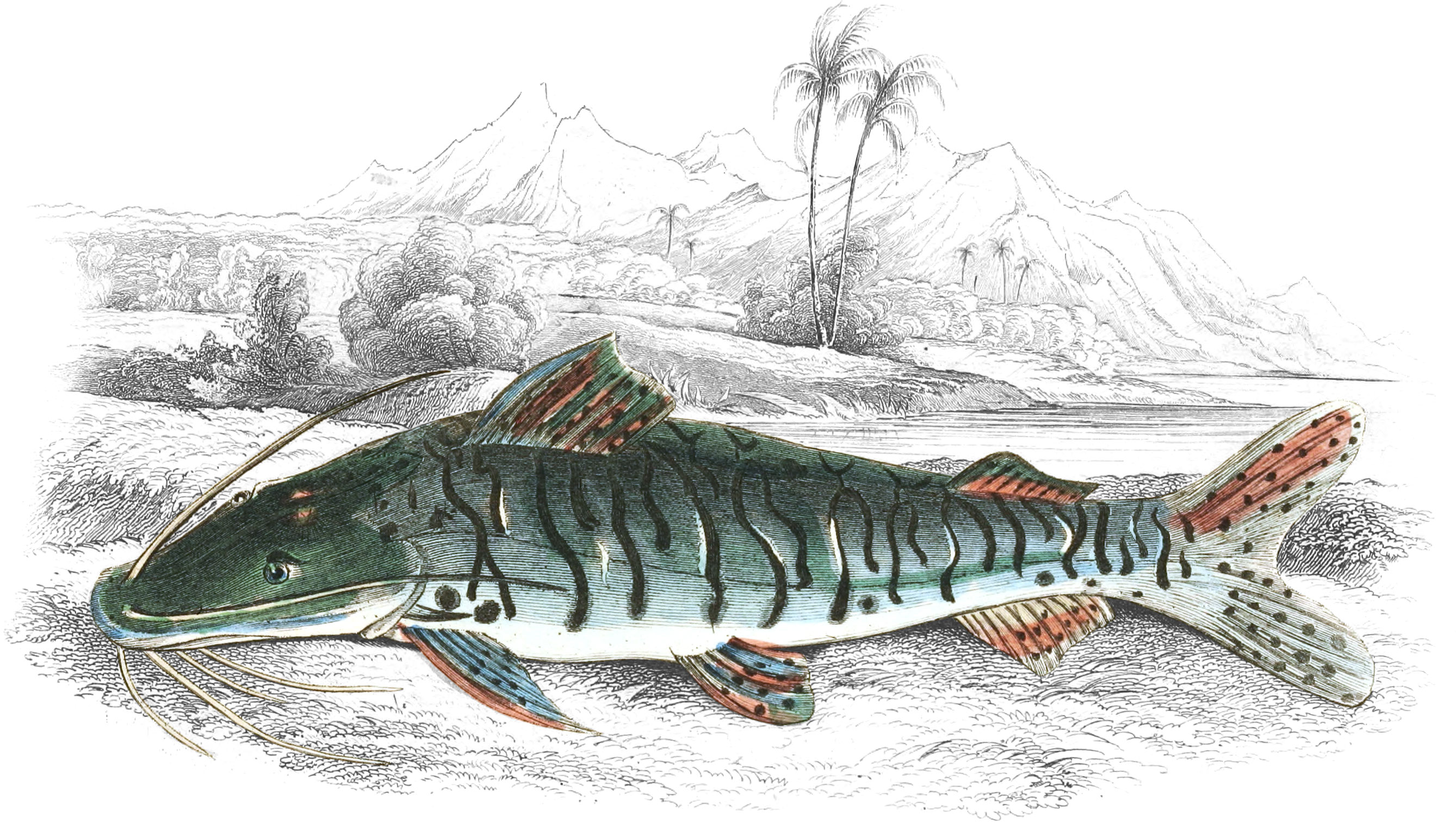
Plate VIII

Another species, nearly allied, and procured by D’Orbigny in the vicinity of Buenos Ayres, is Pl. pardalis, Valenc. The most important difference is mentioned to consist in the dorsal plate being not granulated. The colours of the fish are represented as nearly the same; the whole body and members, except the pectoral and ventral fins, being spotted over with small irregular black markings: upon the dorsal aspect, however, there are the pale irregular bands reaching to the centre of the fish. This species attains a large size, reaching a length of five feet.
Before leaving this form, we should notice the structure mentioned by Schneider to have been observed in the P. (silurus) fasciatus of Surinam. There is a hole on each side, above the pectoral fin, by which the abdomen can be inflated; this is not noticed by Valenciennes in any of the species above mentioned, nor by Mr. Schomburgk; but it may have been overlooked by the latter, if not aware of the circumstance, as it appears at first to have been by Schneider himself. The presence of a spine under the gill-covers, and above the pectoral fins, seems also to remove the want stated by Swainson,
that the Pimelodinæ of Tropical America want the spine attached to the gill-covers.42
This, though not attached, may present the analogy.
Flat-Headed Platystoma
Platystoma planiceps, Agas. in Spix, pl. xii.—Le Platystome à tête plate, Valenc. xv. p. 19.—L. Geral, Piranya-pu. Schomb. Drawings, No. 32.
Is not found within the boundary of British Guiana, but as one in the Collection of Drawings, is now introduced; it so closely resembles the figure and description of Agassiz, that we consider them identical. We should also remark, that the Indian name accompanying both specimens is the same; Agassiz reports it as found in the rivers Amazon and Negro. The colour is more of a bluish olive than that represented by Spix; the lips and lower fins are tinted with pink, and the spots on the dorsal and pectoral fins are more conspicuous. Our formula of the fins agrees with that of Agassiz in all important parts, but Valenciennes has given 16 rays for the dorsal, which we can only interpret as a misprint. Our notes state,—
This fish is a native of the Rio Branco; the body, without scales, is of a lead colour, spotted and striped with black; the belly is white, with a long black bar. The body is much elongated, the cranium hard and bony, gill-lid smooth-edged, the opercle striated; snout flat upper jaw produced an inch, the cirrhi there very long. Eyes flat, oval, dull blue; nostrils double, situate behind each other near the snout; lateral line bent from the top of the opercle, reaching the middle of the body under the dorsal fin, and proceeding straight to the middle of the tail. The teeth, a series thickly set in both jaws, of a fine needle-shaped form. The intestines form one flexure; the air-bag is single, flat, and heart-shaped. This species also takes the hook readily, and small fish are found in the stomach.
D. 7—P. 1/10—V. 6—A. 12—C. 18—Vert. 45.
Among the Platystoma described by Valenciennes there is one placed among his section having 15, 16, or 17 rays to the gill-covers, which was received from Guiana,—the P. Vaillantii, Valenc. It is remarkable for the excessive length of its cirrhi, of which the maxillary ones, in young specimens, exceed the end of the caudal fin, although it even has the points of its lobes prolonged into long filaments. In one specimen the filament of the superior lobe is double that of the rest of the fin. When fresh, the colours are said to be lead colour and silvery, while in spirits they appear of a dull fawn colour. They have been observed from six inches to two feet three inches in length. In the internal structure, the only part noticed is the air-bladder, which is large and is divided into two parts.
B. 11—D. 1/6—A. 3/10—C. 17—P. 1/10—V. 6—Vert. 42.
Hypothalmus
Spix
We have a single drawing of a fish referrible to the genus Hypothalmus as characterized by Spix, though it varies in many points from the restricted characters laid down by Valenciennes, and in both form, position of the fins, and internal structure, would come in almost intermediately between the genera Hypothalmus and Auchenipterus of the latter author. In the structure of the branchial arches, these fishes are remarkable in having interior processes elongated and toothed or serrated, as in Coregonus; and Agassiz has remarked that they maybe employed in capturing “innumera animalcula tenella”43 for their support. The notes of Mr. Schomburgk do not allude to this structure in our present fish, which may either have been overlooked, or, what is more probable, does not exist to the same extent, as we learn that it took bait freely. The internal structure, according to Agassiz, is nearly as follows:—The intestines very small, with many flexures; œsophagus short; stomach oblong, rounded above; the abdominal cavity very squall, scarcely equalling the head in length. Valenciennes restricts the form to those destitute of teeth, and with the dorsal fin removed from the nape, or placed nearly above the ventral fins, and describes only three species, one of which is the H. edentatus, Spix, given under the new title of H. Spixii. He remarks the peculiarity of the branchial arches, and the numerous folds and length of intestines confined in a cavity of very limited extent.
The digestive tube commences by a long and narrow œsophagus, which is suddenly enlarged to become the stomach, which is short, without forming any pouch; a contraction marks the pylorus, and immediately commences the duodenum, folded twice upon itself, becomes very narrow, and forms a slender tube, which winds so often that it is impossible to describe the folds. This intestinal mass is embraced by the two triangular lobes of the liver, and is concealed by its fatty epiploons. The gall-bladder is small, and there is no swimming-bladder.44
The characters given by Spix, to Hypothalmus, are as follow:—
Denies minutissimi, vix conspicui, velutini. Membrana branchiostega radiis 5 vel 15. Areus branchiales elasmiis instructi. Os angustum. Cirrhi sex. Caput parvum, ut corpus, compressum, in rostro depressum et omnino nudum. Oculi in margine inferiori et laterali capitis siti. Pinnæ dorsales duæ, posterior adiposa. Pinna analis ab ano ad pinnam caudalem producta. Radius primus pinnarum pectoralium et pinnæ dorealis cæteris paulo validior, serratus.
Sawalla of the Arawaaks
Hypothalus dawalla
Arawaak, Dawalla; L. Geral, Mapara. Schomb. Drawings, No. 11.
This fish was taken at the junction of the Rupununi and Essequibo, 15th October 1837; it was a male, and differs from all those described, by either Spix or Valenciennes in Auchenipterus, by its brilliant colours and the shortness of its cirrhi.
This fish is found in the rivers of Guiana, and is justly esteemed for the delicacy of its flesh. The head is much compressed, body rather triangular at the dorsal fin, but oval as it nears the tail; dorsal fin over the pectoral, the ventral about the middle of the body. The head and back are green, varying to blue and carmine; the lower part, from the ventral fin to the tail, is carmine, as also the gill-rays. Dorsal, pectoral, and anal fins brown; adipose, green tipped with carmine; anal and caudal, carmine tipped with black. The body is destitute of scales; lateral line nearly straight. It has a pair of short cirrhi, which are hidden in a groove near the eye; nostrils double, placed near the snout; eyes oval, situate in the middle of the head; the iris yellow. Tongue round and fleshy; jaws nearly equal; teeth, a series thickly set in each jaw, with two like processes on the palate. Intestines form only one flexure, and the vent is situate equidistant from the ventral and anal fins; milt long and double. The dawalla lives an hour after being taken out of the water, and reaches a length sometimes of two feet and a half. In the creeks, near the thickly populated districts, they are very hard to take, and will only bite at live bait; but in ascending the Essequibo, where it has fewer inhabitants, we found no difficulty in taking them with hooks baited in the usual way; we also obtained a good number at Fort St. Joaquim, in the Rio Branco.
D. 7—V. 7—A. 38—C. 35—Br. 11—Ribs, 11 pairs—Vert. 52.
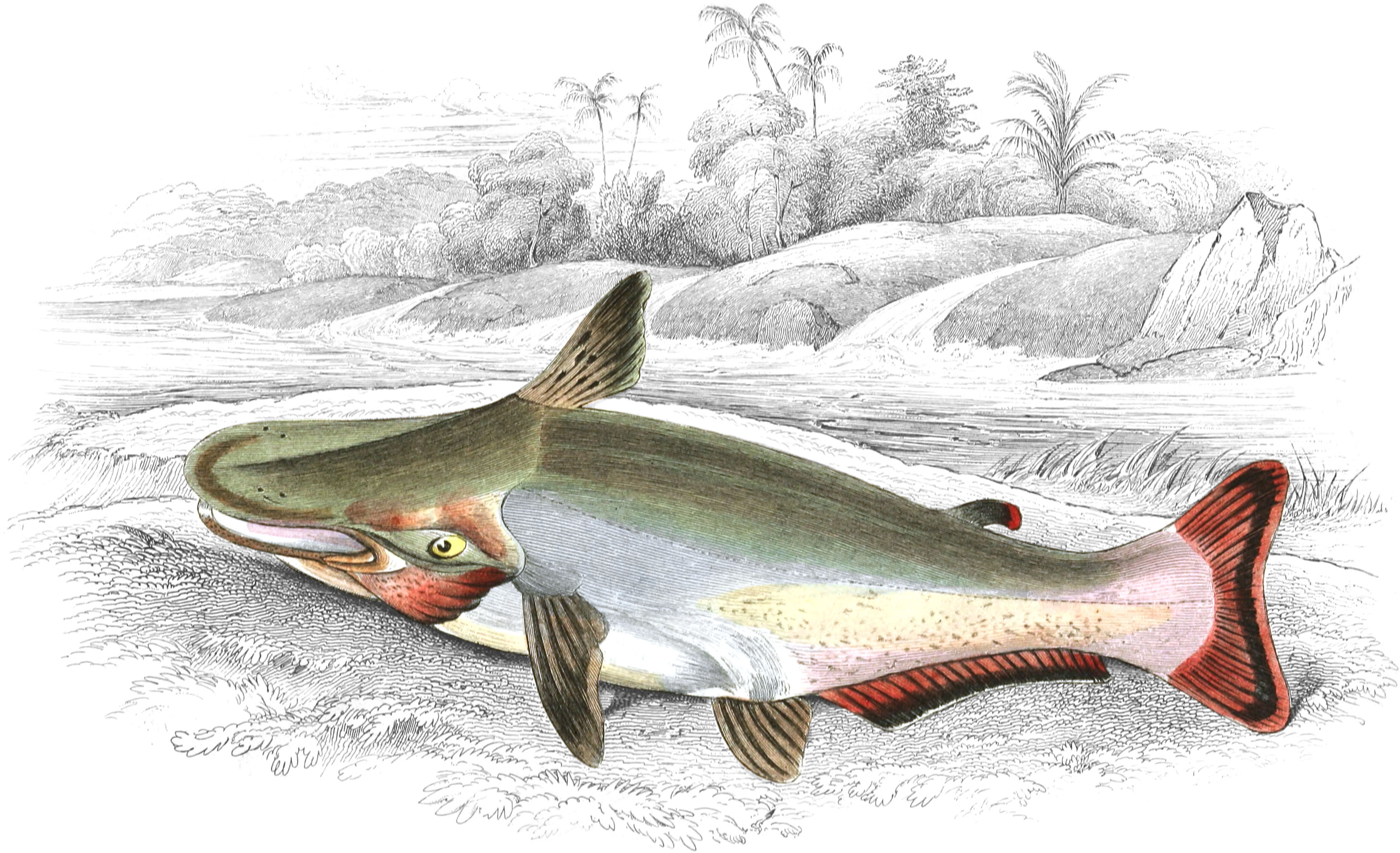
Plate IX
There will thus, from the foregoing description, be seen to be a considerable discrepancy in the structure as given in Mr. Schomburgk’s notes and the observations of Agassiz and Valenciennes; and we would desire that particular attention should be given to the general anatomy and to that of the branchial arches. We have no details either of the habits of these fishes, or of the place and manner of their spawning.
The only other drawing in the Collection, belonging to the Siluridæ, which we can notice, is an imperfect sketch of the large fish, Lau-lau, alluded to in the Introduction. It is so imperfectly finished, that it is not possible to make out the species satisfactorily, but from the extended economical uses to which it might be applied, every information regarding it is of importance. An outline of the drawing is added, with Mr. Schomburgk’s notes.

Lau-lau
The lau-lau is, next to the pirarucu (Sudis gigas), the largest fresh-water fish of the rivers of Guiana. Although it has been sometimes secured near the mouth of rivers which fall into the sea, it is nevertheless my belief that it has been carried thither by accident, and belongs properly to the inland rivers. They sometimes attain the length of ten or twelve feet and the weight of two hundred pounds, and their flesh is so much esteemed, that it is considered to be one of the ties which binds him who has once tasted it, for ever to the region where it is indigenous. It is smooth, of a greenish black, and silvery white near the belly; mouth and fins yellow, behind the latter somewhat reddish. The head is flat and broad, and covered with a strong bony plate which expands to the first dorsal fin. The first ray of the first dorsal and of the pectoral fin is strong and spiny, studded with whitish bony tubercles, and can be depressed or erected at pleasure. Four barbules below, those nearest the mouth smaller, two above; nostrils double, about an inch apart. Eyes small; iris silvery. Intestines with numerous appendices or cæci, otherwise simple. It is remarkable that the young of the lau-lau are excluded from the ovarium into the abdomen, in which state they might be likened to the yolk of an egg, in which the two specks of the eyes, the mouth, and fins, are, however, observable. If a lau-lau should be taken when near parturition, in consequence of fear, the eggs pass off. Mr. Hillhouse has assured me that he had repeatedly put the eggs in a glass of water, where they hatched themselves, and the young fish appeared with a large yellow protuberance on its belly, like the abdomen of a chicken just hatched. When left to nature, the eggs are hatched in the abdomen; and when the young are excluded, they swim in large shoals over the head of the mother. In case of danger, the mother opens her mouth, and the fry find a safe retreat in the thorax.
They live chiefly upon other fish, but we have likewise found seeds and vegetables in their stomach. In spite of their unwieldiness, they swim with rapidity, and their strength maybe conjectured from their size. They bite rapidly, but if the line be not calculated fur this giant among the inhabitants of the rivers of Guiana, it carries off both hook and line. While we ascended the river Parime, we encamped one night at the head of a large cataract, and Sororeng, one of the Indians who accompanied me afterwards to London, went late in the evening alone in a canoe, to try whether he could hook some fish. We were all fast asleep, when I was awakened by some person crying out for help, and we soon ascertained that it was Sororeng, who had hooked a lau-lau, and having got entangled in the line, with neither knife nor other sharp instrument at hand, the fish carried him and canoe at a rapid rate towards the cataract. Armed with cutlasses, we soon came to his assistance, and time enough to prevent him from being carried down; but so eager was he now to secure his prize, when he saw that assistance was at hand, that he begged us not to cut the line, although it had by this time fairly cut into his hand, but to try to slay the monster, which apparently was more inclined to haul the fisherman than the fisherman the fish. It was slain, and when brought on the land, measured eight feet and a half in length.
This fish, which is very numerous in the upper part of the rivers, might afford sustenance to many, if its fishery were carried on with regularity to a greater or less extent. The lau-lau, as already observed, is delicious, both in the fresh state and when dried; the liver would furnish oil of excellent quality, and we have frequently used the air-bladder, instead of isinglass, for glue
Before taking leave of this family, we must notice a structure of a very beautiful description which characterises the articulation of the dorsal fin, and seems to be present, so far as we can judge from outward appearance, in most of the families of the Siluridæ. The subject of the annexed engraving.
Dorsal Spine of Siluridæ
Was picked up on the sea-shore at Bombay, and was brought to us by James Inglis, Esq. M.D., who was much struck with the singular structure, for the purpose of ascertaining to what animal it belonged being occupied at the time in examining some specimens of this family, we immediately set it down as the first dorsal spine of one of the Siluri of India, and our opinion was very soon confirmed by the dissection of a small specimen of one of the Siluri or Pimelodi from North America, which was kindly given to us by Dr. Parnell for that purpose, and where we discovered the very same ringed articulation. It will be for future observers to attend particularly to the uses to which this spine is applied to require so complicated an arrangement. Is it ever struck into its enemies or prey, in attack or defence; and will the ring preserve it from dislocation in the extraction, which would be rendered difficult from the barbed spines?
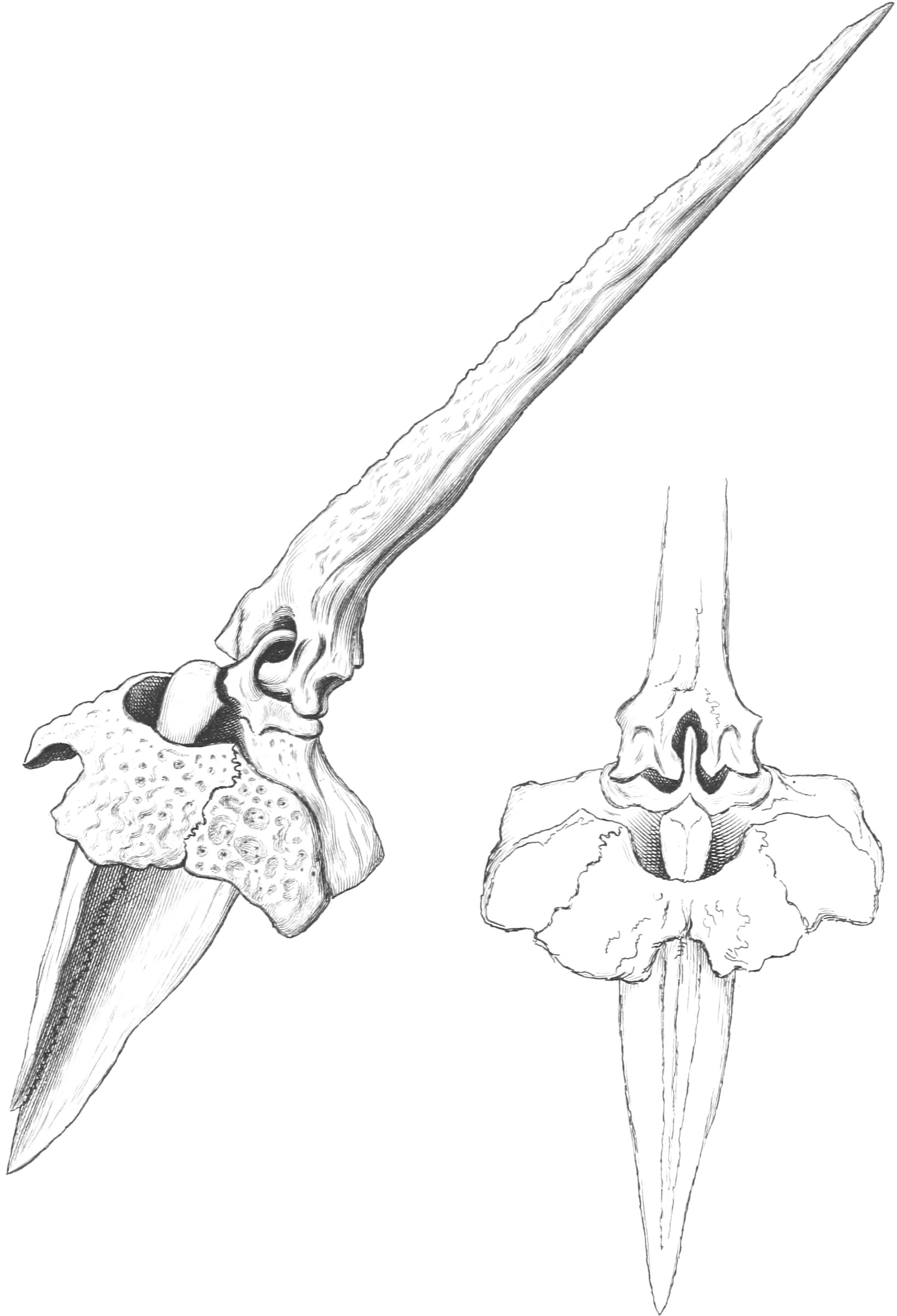
Plate X
Among the drawings in the Schomburgk Collection there are no representations of any species belonging to the Clupeæ or Herrings, with the exception of two rare and remarkable fishes, which, though placed there by some ichthyologists, have been so often removed, and have received so many stations, that in the absence of specimens we prefer noticing them separately, rather than allotting to them any place upon comparatively imperfect information. The first will be typical of the genus
Sudis
Cuv.
This genus of Cuvier is framed from two or three large fishes, natives of the rivers in Brazil and Guiana, and of the Nile in Africa; and by him it is placed near the end of the Herrings, after Erythrinus, to which he considers it also allied. By Agassiz it is placed at the commencement of his Clupeoidei, and in the Brazilian Fishes a detailed description of the skeleton is given. In the later “Classification of Fishes” by Mr. Swainson, again, its station is made to be between Salmo and Cyprinus, or as the connecting link between the carps and the salmon; at the same time, he restricts the genus to the species of America, giving to those of Africa the generic title of Clupesudis. In the latter arrangement he will, we believe, be found to be correct, from a difference in structure of the branchiæ. The following are the characters given in the Brazilian Fishes:—
Caput magnum, depressissimum, extus osseum. Os amplissimum, transversum, in toto suo margine dentibus elongatis, conicis armatum; in palato dentes velutini; ossa inter-maxillaria satis lata marginem superiorem, ossa maxillaria superiora retrorsum subarcuata, angusta, margines lateres maxillæ superioris conformant oculi et nares ad rostri apicem. Membrana branchiostega radiis 11. Corpus elongatum, eompressum, squamis magnis osseis tectum. Pinna dorsalis longissima anali opposita ad caudæ apicem usque producta.
Gigantic Sudis
Sudis gigas, Cuv.
Les vastrés, Sudis, Cuv. Reg. Anim. ii. p. 327.—Sudis pirarucu, Spix, pl. xvi. p. 31.—Pirarucu or Arapaima, Schomb. Drawings.
In the drawing of this fish, the head and fore part of the body is more attenuated than in the figure of Spix, and the snout or upper jaw, slightly shorter than the lower, is turned up. The body is entirely covered with large scales, round on their posterior edge, and the base of the dorsal and anal fins, thickened and muscular where they leave the line of the body, are scaled upward, for two-thirds of their depth, or until the rays are given off with a separate dividing membrane; at their termination succeeds the small caudal extremity, with its very narrow web of rays continued round, appearing, in fact, as if the rayed part of the dorsal and anal fins had been continuous with it, and had formed one large broad extremity formed for powerful sculling. In colour, this fish, on being newly taken, is much more brilliant than in any of the representations which have been given; the head and dorsal part of the body are of a rich umber brown, becoming paler as it reaches the central lateral line, and thence, shading into a brilliant crimson lake, which occupies also the basal or scaled part of the dorsal and anal fins each scale is darker at its base, and has a narrow line of deeper lake near its border. Near the caudal extremity, the body and scaled part of the fins are blotched with dark umber-brown, the anal fin showing fourteen streaks of the same colour in the direction of the rays. The pectoral and anal fins are grey, having the rays marked irregularly with dull blue. The membranous part of the dorsal, anal, and caudal fins are blackish grey, the rays being reddish brown. Schomburgk’s notes are,—
This fish is plentiful in the Rupununi, Rios Branco, Negro, and Amazon. In the latter three rivers there are extensive fisheries for supplying the different towns, and great quantities are sent to Para, where it is preferred to the fish salted on the North American coast, and commands a higher price. When fresh it is excellent, and the belly nearly all fat. They are taken generally with harpoons fastened on a long pole, which is thrown from the canoe, and to which is attached a long line to give the fish play, as they are so strong that they cannot be hauled to be killed until they are weakened. This is generally performed with a club of hard wood, with which heavy strokes are inflicted upon the skull. The canoes which are used in these fisheries are sometimes very small, with only a fisherman and a boy to steer. After the fish is killed, they sink the canoe, put it under the fish, and by shoving the canoe backwards and forwards, throw out as much water as allows it to float, the rest is baled out with a calabash, and the fish is transported to the place of rendezvous; it is there skinned and split to an inch thick the whole length of the fish, when a small quantity of salt is sprinkled over it, and it is put at once in the sun to dry, without being allowed to remain in the salt, as is generally done with other fish. In good weather it dries in three days, but it takes much longer in the rainy season, when the fish then cured is not nearly so good or white. They are sometimes taken with the hook and line, baited with other fish.
The intestines are short, forming only one flexure, which, together with the stomach, are entirely covered with fat. The liver is large and not used for food, but would serve for oil, which it appears to contain in large quantities. In the stomach of one which we opened, several small fish and a quantity of mud were found. It has no air-bag, but a curious process like the lungs of birds covers the spine inside, resembling the honeycombed inside of a bone. The roe is large, eggs small, and the membrane which contains them resembles in outward appearance the liver of a hog in size and shape. The young are protected by the mother for some time after they leave the eggs, just as in the case of the lau-lau (Silurus), and swim generally over her head. They delight in the kirahaghs, as those inlets are called which many of the South American rivers form, and where the water is quite currentless. They are sometimes found in water scarcely so deep as to cover them, and the fishermen frequently attempt to drive them on shallow ground, where they fall an easy prey. They are more plentiful in the muddy than in the clear water.
The Rupununi is the only river in British Guiana where they are to be found; and as during high floods this river is said to mingle its waters with those of the tributaries of the Rio Branco, they may have entered the latter river. They are occasionally carried by the flood, during the inundations, to the Lower Essequibo, where it is known that they have been taken.
I was assured by the inhabitants of the Rio Negro that they have caught some fifteen feet long and of twelve to thirteen arrobas (410 pounds) weight. The specimen, the skin of which I brought with me, and which is now in the possession of the British Museum, measured, when taken, eight feet one inch in length and three feet seven inches in girth. The caudal fin was only five inches long and eight inches broad, when extended.
The following spirited account of hunting the arapaima is given by our author:—
Partly to serve us for economical purposes, but more to satisfy our curiosity of witnessing the Indian manner of hunting the arapaima, this giant of the fresh-water fishes, Irai-i, the Carib chieftain at Curassawaka, induced his men to afford us an opportunity. We selected a sunny day, when there was more chance that at the heat of noon-tide one of those fishes would rise to the surface. Our party was distributed in five small corials, and we proceeded towards the mouth of the small stream Curassawaka where it enters the Rupununi. Here we remained stationary, one of the corials being put on the watch, and no length of time had elapsed when the signal was given that an arapaima was in sight. All hands were hushed as death: Irai-i and his brother-in-law Dabaero, who were considered the strongest and best shots, went forward with their corial and approached the fish as nearly as possible, the rest following softly to be within arrow-shot. There stood the sinewy Carib, Dabaero, his foot firmly resting upon the bow of the corial, his left hand grasping the large bow of tough uamara, his right the long arrow, upwards of six feet in length, and armed with a formidable iron point. His position, although forced to the unpractised, developed the symmetric forms of his figure, unadorned as it was by any art. Only those who have witnessed the Indian’s eye, when the bow is strung and he approaches his intended victim, can have any idea of that expression and that fire by which it appears lighted.45 Irai-i had adopted a similar position, when the crack of the bow-string told us that Dabaero had discharged his arrow, and the chief followed his example, but missed, his arrow floating on the water while the other disappeared with the monster. The corials pulled into the middle of the stream, the eyes of the Indians directed to all points to detect the arrow-feather appearing. Their quick eye saw it above the water, although it was only for a moment; away went all the corials in full chase, and just as it appeared a second time, a second arrow was sent into the fish. All was now excitement, and the yell of the Indian, the rushing of waters, harrowed up by the quick stroke of the paddles, was one of the most enlivening scenes I ever witnessed. Away we went where the experienced hunters expected to see the fish reappear, and scarcely made the tops of the arrows their appearance, when others flew from their strings and pierced the arapaima: down he went again, but the period he remained below the surface was much shorter than previously, a proof that he got fatigued, and when he reappeared he allowed the first corial to come so near that one of the Indians was enabled to give him a stroke with a cutlass; a few more arrows were discharged at him, and he became an easy prey. The question was now how to get him into a corial, as we estimated his length at least six to seven feet, and his weight not less than a hundred and fifty pounds. He was floated into comparatively shallow water, and when one of the corials was got under him, the Indians who were wading in the water shuffled the corial with the fish and water in it to and fro, until the water had got mostly out and the craft commenced to float again; the rest was bailed out, and under the huzza of our Indians we returned with our prize to Curassawaka, highly delighted with our sport of hunting the arapaima.
Fig. 2, on Plate X., represents the scales of Sudis, from the Brazilian Fishes.
D. 38—A. 30—Ribs, 32 pairs—Vert. 75.
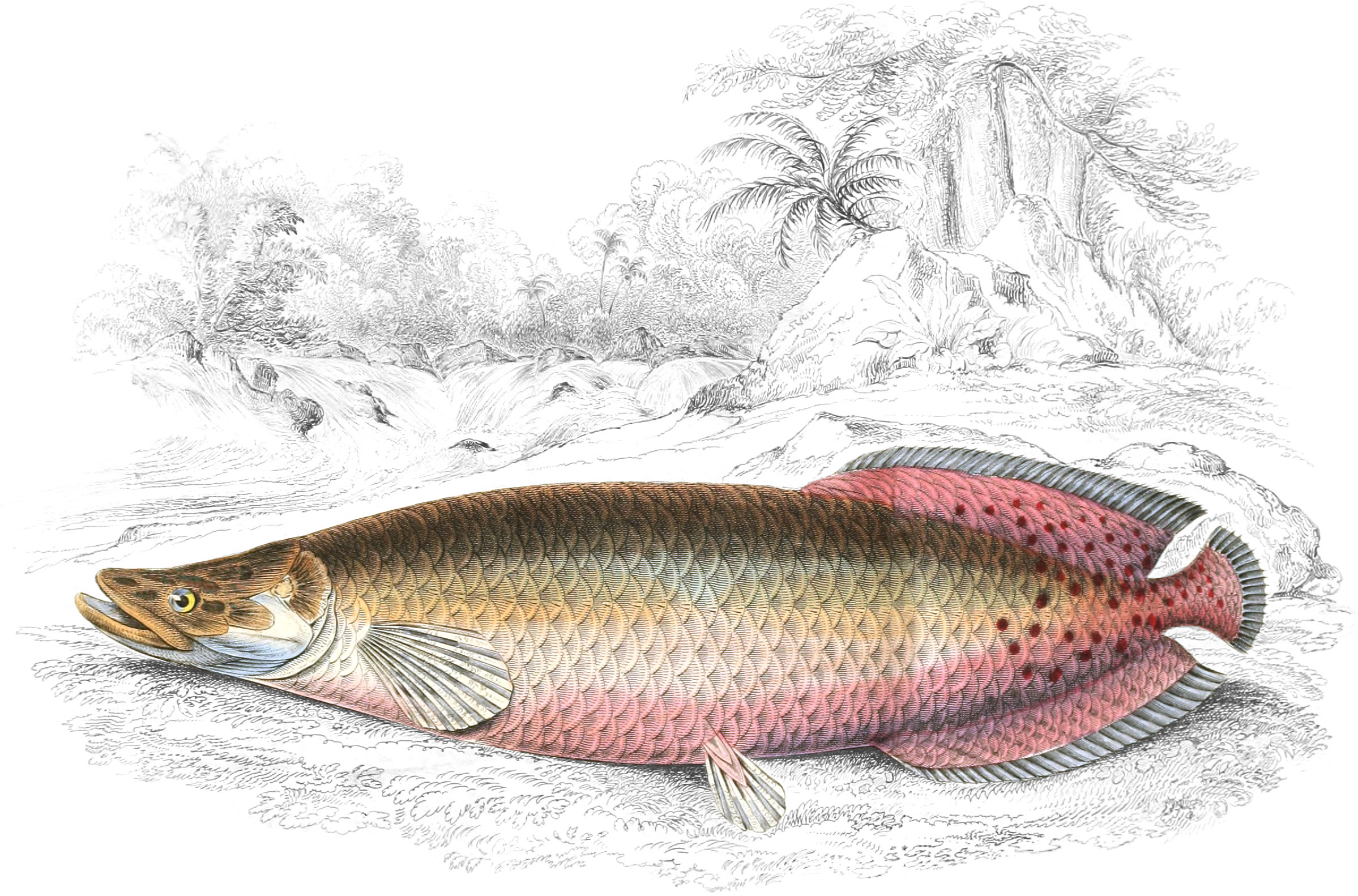
Plate XI
Osteoglossum
Vandelli
This remarkable genus is also ranged by Cuvier and Agassiz among the Herrings, and they are followed by Swainson, who places it as the first aberrant form in the same family. The original species, O. bicirrhosum, Vand., Ichonosoma of Spix, is figured in the Brazilian Fishes from the river Amazon, and is represented as large-scaled, of brilliant colours, and with the anal fin continuous with the tail, or appearing, in short, as if there was no real tail; the dorsal fin placed very far behind, being only separated from it by a very short space, so much so that Swainson has hazarded a conjecture that “it is not really in nature.” The drawing made by Mr. Schomburgk we consider to be that of a new and undescribed species; but before noticing it, we add the generic characters:
Caput parvum, compressum, omnino nudum. Ossa infra orbitalia buccas omnino obtegentia. Oeuli ad rostri apicem. Os amplissimum, dentibus in maxillis, in vomere, in palato et in lingua armatum. Ad symphysiu ossium mandibularium cirrhi duo. Corpus compressissimum, squamis maximis tectum; abdomen earinatum. Pinna dorsalis et analis latissima, heac cum caudali conjuncta.
The Arowana of Guiana
Osteoglosum arwana
Carib, Macusi, and L. Geral, Arowana. Schomb. Drawings. No. 16.
So far as we can trace, from our notes and drawing, the principal difference between this fish and that figured by Spix consists in the variation of the finrays, and in the anal fin being separated from the tail, which is formed as in most other fishes with graduated rays, and not as represented in Spix, a continuous fin surrounding the extremity, and only wanting a short space to unite it to the dorsal membrane; the dorsal fin also is longer and extends farther forward. The sketch is very slight, but at the same time perfectly defined; and the colours seem to be equally brilliant with that given by Spix. Our notes remark,
This fish is not uncommon in the Rupununi, although few if any are found in the Essequibo. In the Rio Branco they are also pretty plentiful, though scarce in the Rio Negro, which receives its waters. They delight in the muddy waters, and feed on grass and other vegetable substances. They swim near the surface, and are killed by the arrow. The body is long, much compressed at the belly, and ends in a sharp keel. The tail round, dorsal and anal fins nearly half the length of the body, pectorals very large, ventrals small. It is of a beautiful light green colour, lighter on the belly, and having each scale edged with red, blue, and purple. The lower jaw is produced; nostrils double; eye yellow, situate near the snout; teeth fine, thickly set in both jaws, and on the palate. The gill-bones are all striated. Scales very large, deciduous, smooth at the edges. The lateral line commences near the top of the head, bends towards the middle of the body, and runs thence to the middle of the tail. The ventrals are placed far behind the pectoral fins. There are two short cirrhi on the lower jaw. The tongue is pointed, intestines straight; the air-bag single, and runs the whole length of the cavity of the body. They are a general article of food among the Indians, and are well-tasted but bony, and do not keep long after being killed.
The size is not given, but it appears to grow to some length; that of O. bicirrhosum is stated as twenty-four inches.
O. arowana,—D. 46—P. 7—V. 6—A. 55—C. 12—Br. 7—Vert. 92.
O. bicirrhosum, from Spix,—D. 42_P. 7—V. G—A. 56—C. 6.

Plate XII
The next family of which specimens or drawings occur is that of the Salmon, which naturally seems to stand between the True Herrings and the Carps or Cyprinidæ. In placing some of the genera we have found considerable difficulty, particularly in the stations which Erythrinus and Prochilodus should stand; both are connecting forms; and it seems in a manner necessary that we should have one among the Salmon without the adipose fin, while a Carp might be expected with it. The two genera above mentioned stand in this manner, but both have in a great measure the internal structure of the Carps. By Cuvier and Agassiz, Erythrinus is placed among the Herrings; by Swainson it is put among the Carps; while, by both, Prochilodus is arranged among the Salmons. It is farther observations, with dissection, which alone can ultimately settle these points, when the facts to be ascertained have been pointed out to inquirers; but for the present we have thought it best to place Erythrinus at the end of the Salmon, as allied to them in dentition and habits, and as passing to the other by external form and the want of the adipose fin; while Prochilodus is removed to the Carps, some of them appearing to be so in every essential, the presence of the adipose fin excepted. Passing from the True Herrings then, the genera which appear to represent them among the Salmon are Coregonus, Anodus, Chalceus, &c. In the warm regions of South America, we are not aware that any examples of the typical Salmon have been discovered; none occur in the present collection, and the place of Coregonus seems supplied by Anodus and Chalceus, which are tolerably abundant in many of the rivers and lakes in Guiana. We shall first take the genus
Chalceus
In the outward form of several of the species we are reminded of the Herrings, a resemblance still more increased by the large scaling, the posterior position in which the dorsal fin is often placed, and in the elongated form of the anal tin. These will be seen in the outline figures given with our first description. In structure, it will be observed from our notes that they are equally remarkable by an alliance to the Carps in a double air-bladder, while their habit of feeding on vegetables brings them still nearer. The generic characters, as given in the Brazilian Fishes, are,
Caput mediocre, supra latum, lateraliter subcompressum. Oculi magni, laterales. Os mediocre, transversum, apertum, quadratum; mandibula prominens. Dentes acuti, inutissimi in parvis ossibus maxillaribus lateralibus et in serie anteriore ossium inter-maxillarium totumlabium superius in medio sustinentium; in mandibula et in serie posteriore ossium inter-maxillarium, dentes maximi, multicuspides, cuspide medio majori, magis prominente. Lingua papillosa. Membrana branchiostega radiis 4 gracilibus. Corpus latum, compressum, squamis magnis obductum. Pinnæ mediocres, analis latissima.
Chalceus rotundatus
L. Geral, Araisiri. Schomb. Drawings, No. 54.
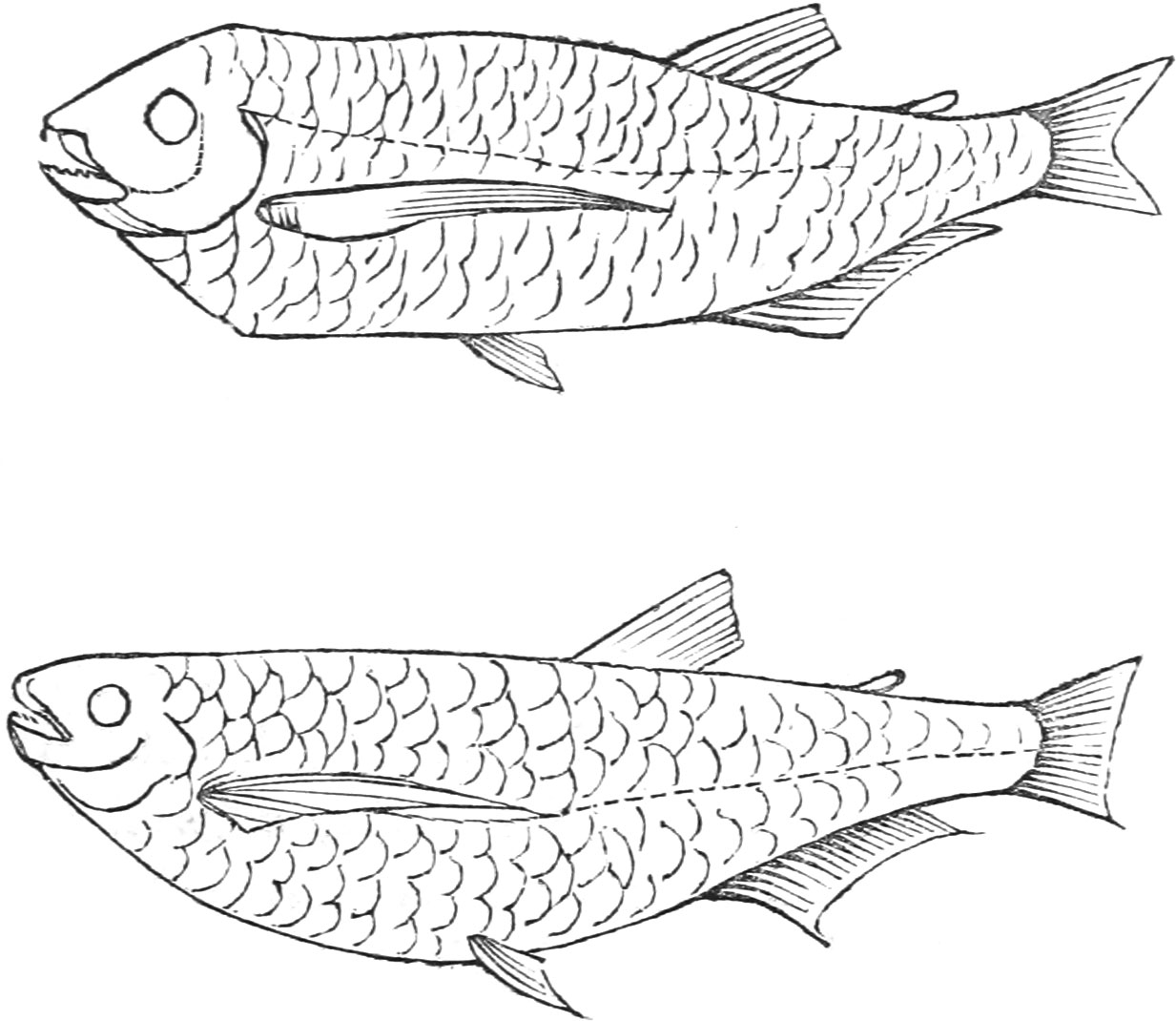
C. angulatus, Spix (top), C. rotundatus (bottom)
This fish seems nearly allied in general form, and in the position of the fins, to the C. angulatus of Spix; but that differs in the contrasted angular outline, the direction of the lateral line, and the comparative length of the pectoral fins. The first is from the rivers of Southern Brazil; the second was taken in January in the river Padauiri. The size is stated to be from six to seven inches in length (that of the drawing).
The scales are smooth and elliptical, very deciduous; teeth are a single row in each jaw, the tongue round and fleshy, the intestines are straight, and the stomach was found filled with cassada which had been left on the river’s bank to steep. The air-bag single, as long as the cavity of the abdomen.
C. rotundatus,—D. 11—P. 11—V. 7—A. 26—C. 22—Ribs, 14 pairs—Vert. 36.
C. angulatus, Spix,—D. 1/10—P. 12—V. 7—A. 4/28—C. 5/17/5.
Our next species is of a larger size, and is more typical in form.
Blue-Banded Chalceus
C.? tæniatus
Arawaak, Caborisi; Warrau, Hua; L. Geral, Jatuarana. Schomb. Drawings, No. 3.
The length is from fifteen to eighteen inches, depth six. It is an inhabitant of the river Essequibo, as well as of the Rios Negro and Branco; it is esteemed a great luxury, and is taken by the hook, baited with small fish. The body is silvery, with light blue stripes head and dorsal fin greenish; pectoral and ventral fins silvery, the latter tipped with black; anal fin tipped with blue, greenish yellow in the middle, and black near the base; tail slightly forked, and similarly coloured; scaling large, the edges slightly fringed, adhesive; there is no lateral line perceptible; head laterally depressed; eyes near the middle of the head, iris red and yellow; mouth terminal, tongue fleshy, jaws nearly equal; teeth, a single row in the under jaw, upper jaw has a series thickly studded on the roof, which are serrated; gill-covers slightly striated. They live only a short time when taken out of the water, and soon lose their colour, turning to a duller blue. Feeds on fruit, as well as on animal substances. Air-bag double; intestines form flexures, and have appendices; milt half the length of the cavity of the body.
This is a very handsome species, and is coloured bluish grey above, changing to silvery white on the sides and belly; and the whole is relieved by eight delicate blue longitudinal stripes. The structure of the teeth varies from that of the others.
D. 11—P. 14—V. 8—A. 26—C. 25—Br. 4—Vert. 38.
Thick-Lipped Chalceus
Chalceus labrosus, Fig. 1
L. Geral, Sardino. Schomb. Drawings, No. 55.
This small and delicately marked species seems typical in form, and has the same elongation of the anal fin which we saw in the last, but seems marked by the maxillary bones being more than usually elongated, and by their apparently forming the whole margin of lips.
It was taken in the river Paduiri in March. The scales are rather large, elliptical, smooth, and deciduous; the lateral line is curved, and runs nearest the belly. The tongue is round; teeth, a row on each jaw, three rows on the roof of the mouth. The intestines form flexures and have appendices. The air-bag is double,—one half long and pointed, the other oval. It is short-lived after being taken from the water.
Our drawing is in length five inches and a quarter to the centre of the fork. The form is of a rounder oval outline than among the Coregoni, and the lateral line is placed lower. The colour of the body is of a silvery bluish grey, darker on the back; that of the fins a bluish green; the pectoral elongated, but not so much in proportion as that of the preceding fish; the dorsal placed above the centre of the ventral fin. The anal fin is deeper in general tint, and has a broad black mark running from the centre of its anterior edge for one-third of its length. The tail is of a bluer shade than the other fins, and has a dark bluish black bar running across, parallel to the fork. The colour of the iris is yellow.
D. 10—P. 12—V. 8—A. 23—C. 24—Ribs, 16 pairs—Vert. 37.
Black-Striped Chalceus
Chalceus? nigro-tæniatus, Fig. 2
L. Geral, Waracu. Schomb. Drawings, No. 53.
This curiously marked fish we have placed in Chalceus with a little doubt; it wants the elongated anal fin, and in form closely resembles a Coregonus. It was a male;
from fourteen to sixteen inches in length, and was taken with the hook at Pedrero on the Rio Negro. The stomach was filled with cassada roots, which had remained on the banks of the river and were rotten. The scales were large, elliptical, smooth, and adhesive; lateral line straight, along the middle of the body; teeth prominent, a single row in each jaw; tongue round and fleshy intestines without any appendices; milt double, running the length of the cavity; air-bag double, the one long and pointed, the other oval.
As the drawing is coloured, the head and back are dark olive green, the colour shading gradually to the lateral line, where it becomes pale yellowish white for the remaining half of the body; all the fins are of a uniform dull green, but the singular marking of the fish is a deep black stripe of about half an inch in breadth, which runs on the lateral line from the centre of the fork of the tail, and terminates at two-thirds the distance between the ventral and anal fins. The vest is situate half an inch anterior to the commencement of the anal fin.
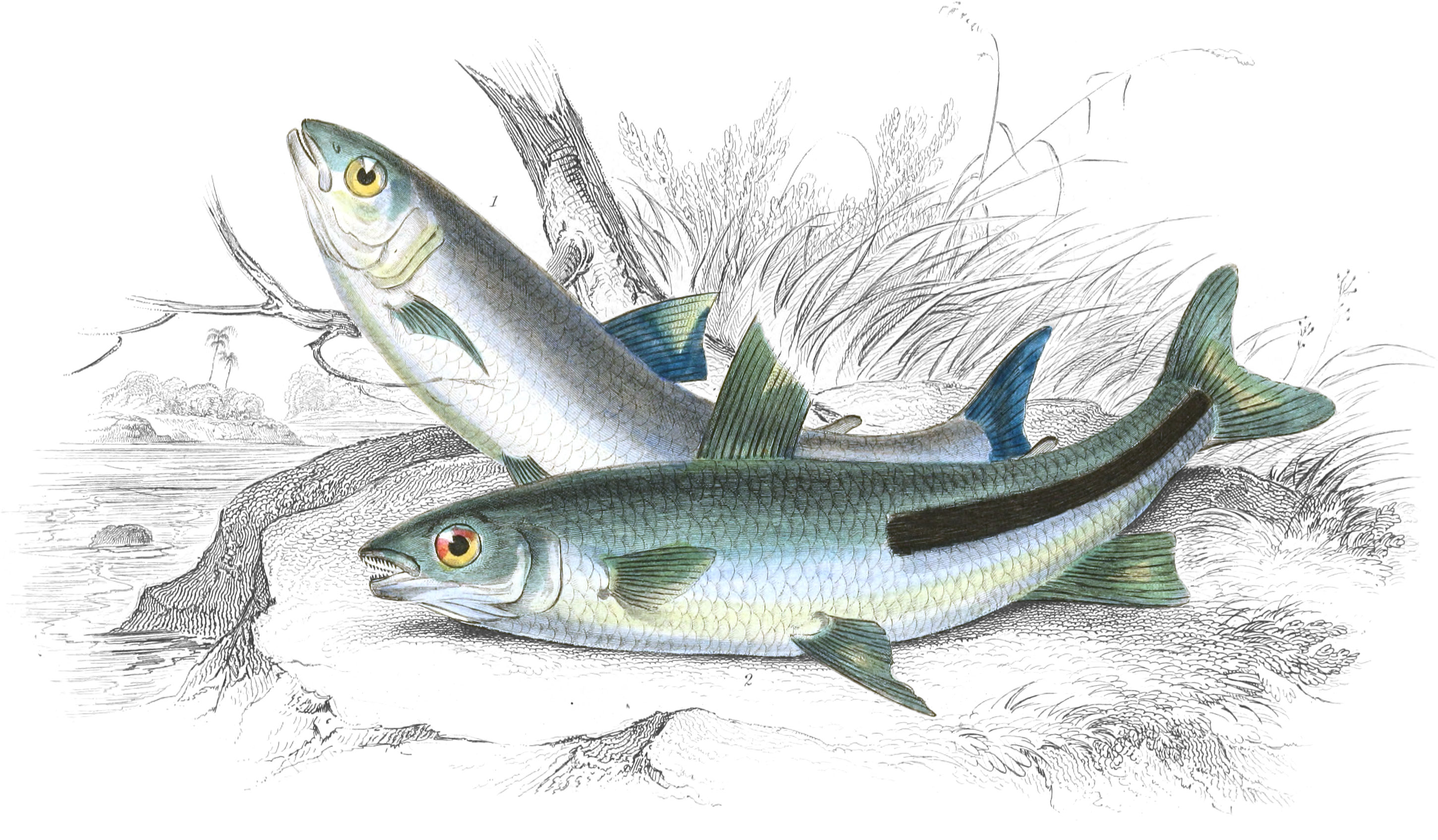
Plate XIII
Another fish seems to range here, although the shape is somewhat similar both to Serrasalmo and Tetragonopterus. Our notes, however, rather agree with the present genus.
Broad-Formed Chalceus
C.? latus
L. Geral, Matapuri. Schomb. Drawings, No. 51.
It was taken by the hook in the Padauiri, a tributary of the Rio Negro. The length is four inches to the centre of the fork, while its depth below the dorsal fin is two inches and a quarter. The scales are large, elliptical, deciduous, and slightly fringed on the posterior edge; lateral line runs near the middle of the body, slightly bending near the head. Tongue is oval 3 teeth, a single row in each jaw, intestines have no appendices; roe double, about one-third of the length of the cavity; air-bladder double, the first long and pointed, the other shorter and oval. The head is coloured pale olive, the iris golden yellow; the body bluish grey above, shading into silvery at the lateral line and on the under parts pectoral and ventral fins grey and pale. The other fins greenish blue, and as dark as the tint of the back.
D. 11—P. 13—V. 8—A. 21—C. 24—Br. 4—Ribs, 10 pairs—Vert. 29.
Ten-Banded Chalceus
Chalceus fasciatus
Arawaak, Darra; L. Geral, Warracu. Schomb. Drawings.
This fish was killed in the Rio Padauiri, but they are said to be found also in the Curantu. They grow to eighteen inches in length, are of a yellow-ochre colour, with several bands of black (in the drawing ten); the belly is rather lighter, the fins greenish. The head oval, something like that of a mullet; teeth in both jaws, single rows, but more in the roof of the mouth; adipose fin small, and caudal fin slightly forked. The eye situate near the middle of the head, with yellow raised iris. The lateral line straight, running along the middle of the body; the gill-lid is smooth and opening semilunar, and the vent is placed near the anal fin. They feed on fruits, and are killed chiefly by the arrow. They are fat and well-flavoured, and much esteemed for the table.
D. 12—P. 13—V. 10—A. 9—C. 22.
The next fish, if really entering this genus, is equally remarkable from its large scaling, and seems referrible to the species described by Cuvier as noted below. It is probable, however, that, with C. tæniatus, it may range elsewhere.
Large-Scaled Chalceus
Chalceus macrolepidotus
Chalceus macrolepidotus, Cuv. des Museum, t. iv. pl. 21, p. 454.—Arawaak, Arara-pira; Macusi, Parshama; L. Geral, Arara-pira or Macaw-fish. Schomb. Drawings, No. 5.
The fish from which the drawing has been made was caught at the Camuti mountain, in Essequibo, in October. It grows to the length of fifteen inches, and about five deep. It is beautifully shaped; the scaling very large, elliptical, smooth at the edge, deciduous; no lateral line visible; head depressed. Ventral fin placed under the dorsal, of a greenish colour, with tip of lake; dorsal and pectoral fins, ditto; anal, ditto, mixed with carmine; and caudal, carmine. The scaling is of a beautiful bluish silvery, varying to green on the back, and each scale has a border of blue The head greenish, opercles silvery; nostrils single, oval, placed on the snout. Eyes near the middle of the head, iris black and yellow; tongue fleshy; teeth, three rows in the upper and one in the lower jaw; jaws nearly equal. Vent situate near the anal fin; gill-opening semilunar; opercles smooth, with smooth edges. Lives but a short time when taken from the water. Takes bait, but is often killed by the arrow. Feeds on fruit, insects, and small fish; is esteemed for food. They are rather scarce, only one specimen having been killed during the expedition.
D. 11—P. 15—V. 8—A. 12—C. 20—Br. 4—Vert. 34.
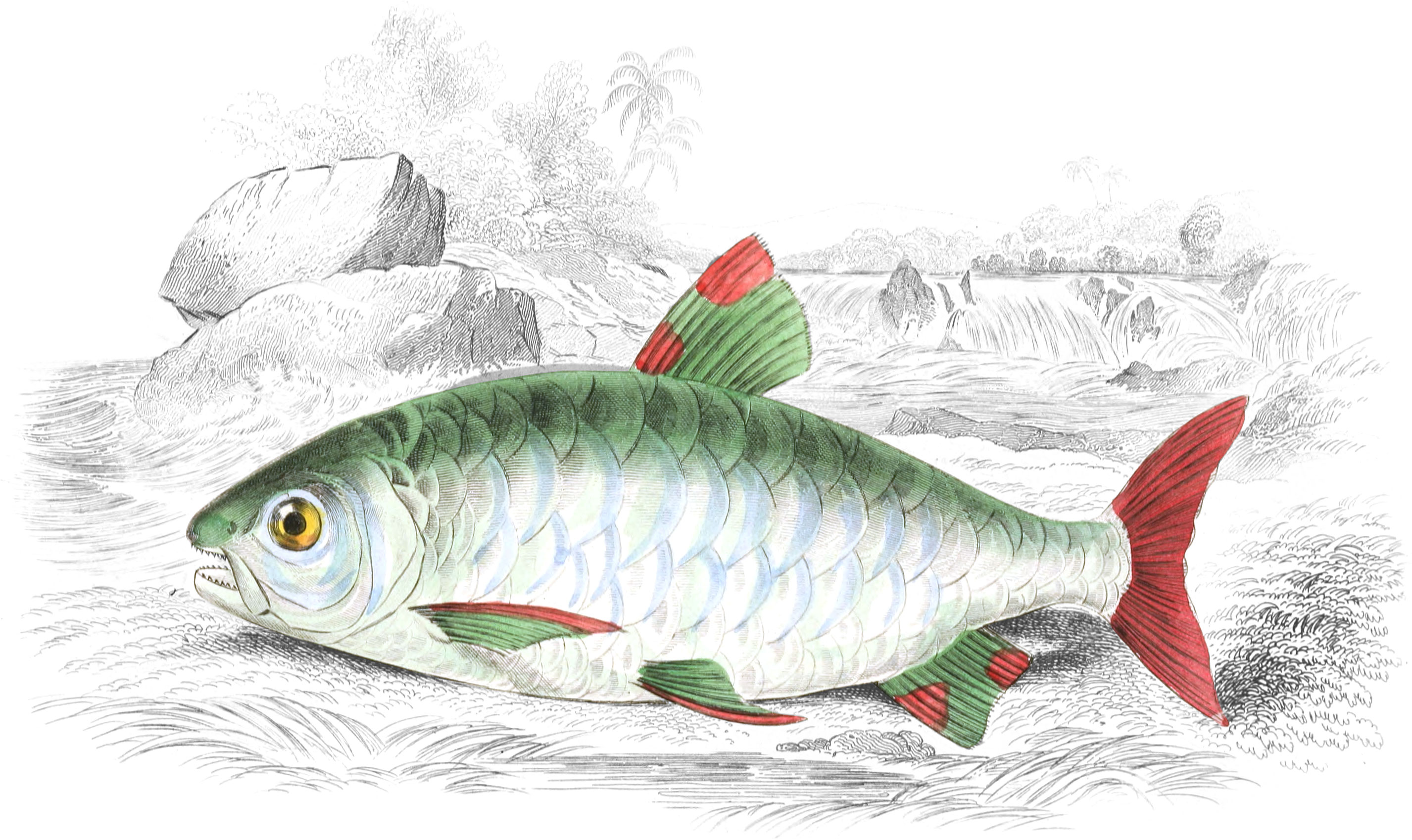
Plate XIV
There is a good deal to observe correctly in the internal structure of these fishes and allied species they vary from each other in some having the air-bladder single, others double,—and in some having appendices to the stomach, others being without. They are remarkable also as feeding on vegetables, at least in part. The next elegantly formed fish we have referred to
Anodus
Anodus, Spix.—Caput mediocre, supra rotundatum, lateraliter compressum. Oculi magni laterales. Os parvum, transversum. Denies nulli. Ossa inter-maxillaria magna, totum labium superius sustinentia; maxillarla superiora minima, lateralia; mandibula prominens. Lingua apice libera. Membrana branehiostega radiis 5. Corpus squamis minimis obtectum, elongatum, subteres, lateraliter subcompressum. Pinnæ mediocres.
Black-Marked Anodus
Anodus? notatus
Schomb. Drawings, No. 61.
We have marked the genus of this fish with a ? as “Dentes nulli,” in the generic characters of Spix, will not agree with it; although, if the genus is a good one in other respects, that character may require modification. Our notes remark,
Do not take bait; the specimen jumped into the canoe when passing a sand-bank on the Rio Negro. The scales are middle-sized, smooth, elliptical, and deciduous; lateral line straight, along the centre of the body; teeth, a single row in each jaw; tongue round, fleshy; intestines form two flexures, and have no appendices; milt extending half the length of the cavity of the abdomen; air-bag double.
The drawing, of the natural size, is in length six inches and three-quarters to the centre of the fork of the tail, and seven inches and a quarter to the tips of the lobes. The head is pale olive, approaching to yellowish on the opercle. The body above is a bluish grey, changing to silvery on the sides and belly. Above the lateral line, between the ventral and anal fins, or nearly in the middle of the fish, there is an oval spot of deep black. The dorsal fin is uniform bluish green; the other fins dark but more tinted with yellow, and across the tail there is a dark bluish green bar parallel with the fork. The vent is placed anterior to the insertion of the anal fin. It is probable that this with the last may be congeneric, as they agree in several particulars, and vary from the characters of Anodus as given above.
D. 11—P. 17—T. 11—A. 11—C. 25—Br. 4—Ribs, 22 pairs—Vert. 40.

Plate XV
Serrasalmo
We have drawings of several species whose correct station it is-extremely difficult to determine from figures only. The characters of Serrasalmo, Tetragonopterus, and Myletes, as given by Spix and Cuvier, running very much into each other, and, so far as we can judge, being to a certain extent artificial. We give the characters of the three from Spix’s Conspectus Generum, for comparison, but have placed most of the species under the first, though by no means asserting that they should permanently stand there.
Serrasalmo, Spix.—Caput magnum, lateraliter compressum. Oculi magni laterales. Os amplum, armatum, transversum. Denies maximi, acutissimi, latissimi per seriem simplicem in mandibula prominente, et in maximis ossibus inter-maxillaribus totum oris superiorem marginem conformantibus, Ossa maxillaria superiora minimaad commissuram maxillarum transversa. Lingua apice libera. Membrana branchiostega radiis 4 latis. Corpus compressissimum, latissimum, squamis minimis obductum; abdomen carinatum serratumque. Pinnæ mediocres, dorsalis latior, analis latissima.
We begin with the drawing which we consider identical with the Piranha Saw-bellied Salmon of the Brazilian Fishes, being given by both Agassiz and Cuvier as characteristic of the genus, and have figured it to show the colours, taken from the living fish, and appearing much more brilliant than any representation hitherto published.
Piranha Saw-Bellied Salmon
Serrasalmo piranha
Serrasalmo piranha, Spix, tab. xxviii. p. 71. Schomb. Drawings, No. 30.
This fish grows ten or eleven inches in length, and is plentiful in the Rio Branco, where they are killed by the hook and line in great numbers, being very voracious, and taking the bait eagerly. The upper part of the body is lead colour; belly, pectoral, ventral, and anal fins vermilion; the body is compressed, back high; teeth sharp, triangular, serrated, in single rows; jaws remarkably strong. Eye near the middle of the head. Lateral line bent near the head, otherwise straight. Opercles striated, with smooth edges. Gill-opening semilunar; nostrils double, situate in a cavity near the snout. Vent near the anal fin.
The figure and notes above will give an idea of the brilliant colour which tints the lower part of the body, and which seems to be changed to a dingy yellow by being kept in spirits.
| D. | P. | V. | A. | C. | |
|---|---|---|---|---|---|
| Schomb. | 17 | 17 | 7 | 30 | 30 |
| Agas. | 4/15 | 15 | 5 | 3/28 | 8/19/8 |

Plate XVI
The Pool Saw-Bellied Salmon
Serrasalmo stagnatilis
Macusi, Arri. Schomb. Drawings, No. 23.
This fish seldom exceeds eight inches in length, and is found in the Upper Essequibo. The head is greenish; gill-lid, belly, pectoral, ventral, and anal fins vermilion; body blue; caudal fin greenish. The eye is yellow; nostrils single, placed near the eye. Opercles striated. Lateral line is nearly straight, a little bent near the head, and running along the middle of the body. Body compressed, ending in a keel; teeth sharp, triangular, serrated; jaws strong, the lower slightly produced. Its resorts are in standing pools, called kirahaghs, where they live an enemy to every other tribe, and are not less voracious, although armed with less power, than its kindred fish, the pirai. (Plate XVIII.)
The length of the drawings is stated to be eight inches and a half; the depth of the fish, below the dorsal fin, three inches and three-quarters.
D. 17—P. 15—V. 6—A. 32—C. 26—Ribs, 12 pairs—Vert. 35.
Of our next drawing, which is allied to the two preceding in its shape and colouring, we have no notes; we have given a copy from it, with the provincial Indian names written upon the drawing.
Spotted Saw-Bellied Salmon
Serrasalmo punctatus
Macusi, Katte; L. Geral, Chitao. Schomb. Drawings, No. 23, B.
The outline is an oval, regular, and without so many angular undulations as the two last presented above, the colour is bluish grey, shading into white, perhaps silvery, before reaching the lateral line, and which covers the remaining part of the lower parts, contrasting sharply with the deep vermilion which colours the opercula, all the lower fins, and the tail. The dorsal fin is bluish olive at the base, shading to yellow at the upper edge; and this member, with two-thirds of the body, is spotted over with minute, round, black spots. The lateral line undulates at its commencement, but often runs straight to the tail; lower jaw projects about half an inch, and both are armed with strong triangular teeth. The vertebras are stated at thirty-five.
The Collection possesses two drawings of one fish, which approaches very near to the S. nigricans of Spix. The specimen from which the figure in the Brazilian Fishes was made was only four inches and a half long, and the lighter colour may be owing to a younger state. Our drawing, at the same time, shows a fish rather deeper in proportion, and there is no anterior dorsal spine represented. Another circumstance of variation occurs in the shape of the pupil, which spirits could not have changed; in Schomburgk’s drawing it is elliptical, and it may be worth the while of future observers to attend to the cause of this form. We place the Guiana fishes, for the present, distinct.

Plate XVII
Black Saw-Bellied Salmon
Serrasalmo niger
Arawaak, Huma; Carib, Pirai; Macusi, Arai; L. Geral, Piranha (meaning Sharp Fish). Schomb. Drawings, No. 4.
This most voracious fish is found plentifully in all the rivers in Guiana, and is dreaded by every other inhabitant or visitant of the river. Their jaws are so strong that they are able to bite off a man’s finger or toe. They attack fish of ten times their own weight, and devour all but the head. They begin at the caudal fin; and the fish being thus left without the principal organ of motion, is devoured with ease, several going to participate of the meal. Indeed, there is scarcely any animal which they will not attack, man not excepted. Large alligators, which have been wounded on the tail, afford them a fine chance of satisfying their hunger, and even the toes of this formidable animal are not free from their attacks. The feet of ducks and geese, which are kept in the neighbourhood where they are plentiful, are almost invariably cut off, and young ones devoured altogether; and in these places it is not safe to bathe, or even to wash clothes in the river, many cases having occurred of fingers and toes having been cut off by them. They vary in colour from lead-colour to nearly black; the eye is situate near the middle of the head; scaling rather small, smooth at the edge, oval, and adhesive. Lateral line runs near the middle of the body, bending from the top of the opercle. Head and body depressed; ventral fins, under the dorsal, large and strong; nostrils oval, double, situate near the eye tongue fleshy; lower jaw produced; teeth triangular, serrated, and very sharp,—six on each side of upper, and seven in the lower jaw; vent near to the anal fin; gill-cover striated, with smooth edges; gill-rays 4,—are not covered by the gill-lid, but free, and extend from its lower margin towards the throat; the opening semilunar. They live about half an hour after being taken out of the water; air-bag is long and double. They are a principal article of food amongst the Indians, and as they are so voracious, they are easily taken by hook and line, which is secured near the hook with a piece of tin to prevent cutting. Their flesh is dry and indifferent, and rather bony. It is, however, a good relish while the Indian is travelling in the rainy season, when other kinds are not to be obtained. The belly is serrated.
The pirai, or huma, by which name the fish just described is generally known to the aboriginal tribes of British Guiana, inhabits the rivers which intersect that fertile colony. They are not to be found within forty miles of the coast, nor are they plentiful at the upper part of the rivers. Their favourite haunt appears to be those parts of the rivers which are between a hundred and a hundred and fifty miles from the coast, chiefly if there be large blocks of rock, about which they hover to procure themselves worms, &c. The ovary in the female is double. They deposit their spawn in the currentless inlets which form so peculiar a feature in the rivers of Guiana; this occurs during the months of January and February, at which period we found the females generally destitute of roe.
While we ascended the river Cabalaba, a tributary of the Corentyn, from the east, we observed a river-cavia (Hydrochaerus capylard) with five young ones, out of which number three were captured; and all were deficient in their toes, they having been bitten off by the pirais.
Whilst we were continuing our course on the river Corentyn, one morning, an object was observed to drift into the middle of the stream, around which there appeared to be a great commotion. The telescope did not assist us in coming to a conclusion what it might be; and though we were in-shore, stemming a strong current, I ordered the corial to paddle for it. When we came near, we observed the head of a large luganani or sun-fish (Cychla ocellaris), which was surrounded by numerous pirais, tearing off large parts of its flesh. We secured the luganaui, which might have measured from twenty to twenty-six inches, and though the poor animal had been eaten off piecemeal to within its pectoral fins, it was still alive. Being deprived of its tail and lower fins, it drifted perpendicular. The corial was brought to, our hooks and lines were soon out, and we caught several of the depredators, which, with the remnant of the luganani, afforded us a good breakfast.
The ducks and geese are equally exposed to the attacks of the pirai, and those which the settlers keep near the banks of the river are generally deprived of the lower part of their feet. It is a strange sight to see them walking on mere stumps. In Wicki, a wood-cutting establishment at the river Berbice, there were two vicissi ducks (Dendrocygna viduata) which had been perfectly tamed by the Indians, and were brought from the large ponds in the interior. Unacquainted with the danger which the ravenous pirai offered them, their instinct directed them to their favourite element, and one of them paid its first visit with the loss of its toes, and the other was similarly injured in its future visits. They now became cautious, and it was remarkable to observe how studiously they kept in-shore, and never trusted themselves beyond their depth.
The pirai is from nature a tyrant, and connects with it the greatest voraciousness. I am almost persuaded that it surpasses the ravenous pike, though the latter, par excellence, is called the tyrant of the watery plain! They are caught with hook and line, and their greediness is so great, that no art is necessary to conceal the bait. The hook may be baited with a piece of fish, bird, or animal, or merely their entrails; the pirai will dart at it the instant it is thrown into the water, and seize it with eagerness but it frequently happens that, with its sharp teeth, it bites the line and escapes with the hook in its mouth. We therefore surrounded the line, where it was fixed to the hook, the length of two or three inches, with tin or lead; and though it had a clumsy appearance, we were not less successful. Some precaution is necessary, even after the fish has been lifted out of the water, or it will inflict, in its struggles, serious wounds; the angler has therefore a small bludgeon ready, wherewith its skull is broken.
Like the Balistes, several species of Silurus, &c. the pirai utters sounds when raised above the water; they resemble the grunting of a hog. Its vivaceousness is great, and it will live for hours after it is taken out of the water.
The flesh is firm, white, and well-tasted; nevertheless, many colonists scruple to partake of it, in consequence of its greediness, and the report, which appears but too well fi3unded, that when there is a deficiency of other food they will not decline carrion; it partakes, therefore, in that regard, of the nature of several of its congeners.
The length of these specimens was sixteen inches, by the half in depth below the dorsal fin. The air-bag is stated to be single and oval. The colour of the drawings is deep bluish black, paler on the lower half of the fish, and there, as well as on the opercula, appearing to have a golden or bronze tint, as represented in the two allied species of Spix, S. aureus and nigricans. All the fins are of a very deep shade of the same colour; the iris is coloured of a rich lake. The wood-cut beneath represents the size and form of the teeth in the specimens mentioned.
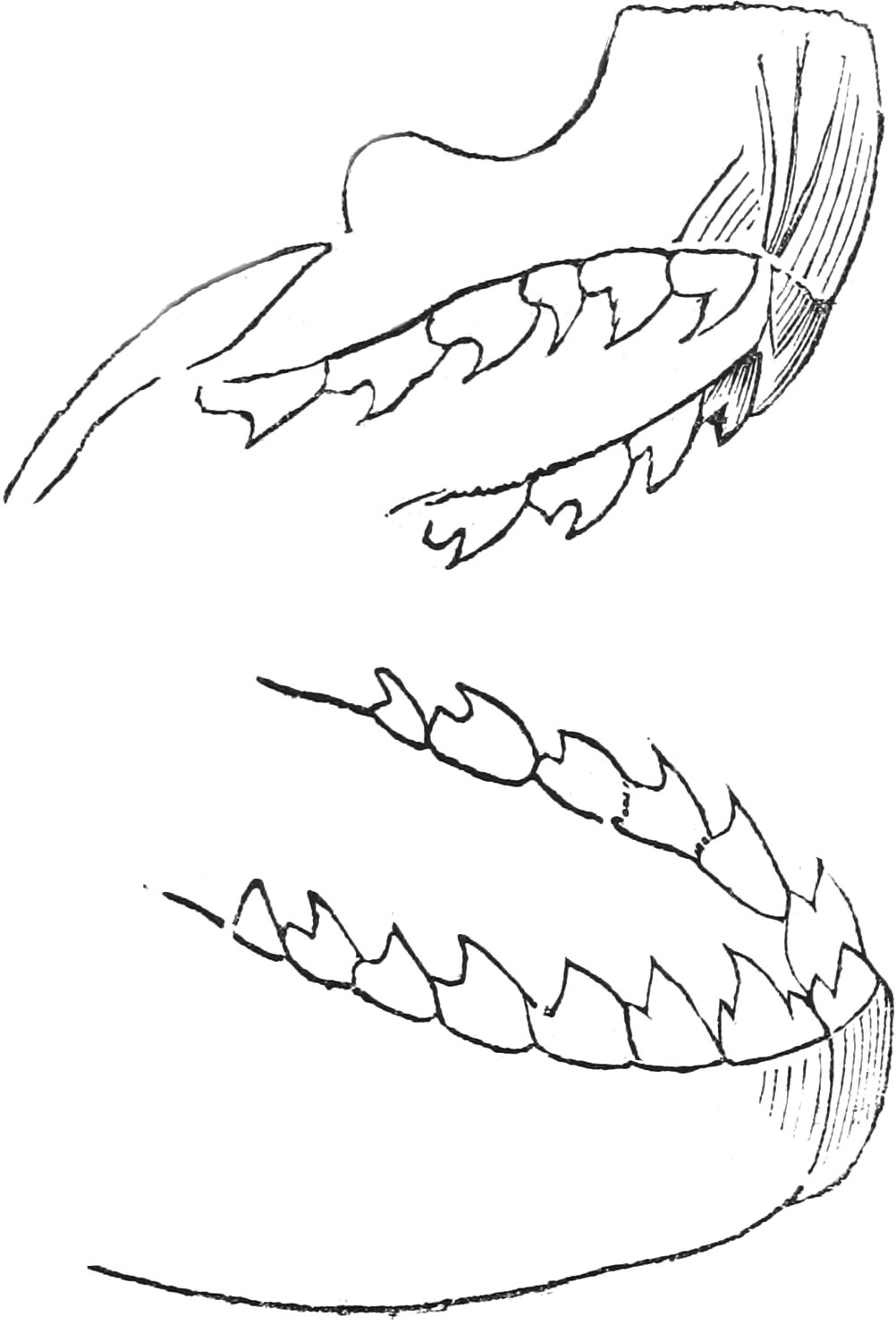
Teeth of Black Saw-Bellied Salmon
Formula of fins, &c.:
D. 18_P. 16—V. 7—A. 36—C. 23—Br. 4—Ribs, 16 pairs—Vert. 34.

Plate XVIII
Our next three drawings arc of a smaller size and more delicate form, and would approach nearer to the type of that figured by D’Orbigny as S. marginatus; one, indeed, is somewhat allied to that fish, but is much deeper, and wants the rich black border fringing the anal fin, though it possesses the red band within it. As a contrast, it may stand now as
Red-Bordered Saw-Bellied Salmon
Salmo emerginatus
Schomb. Drawings, No. 72.
No notes accompany this figure. The dorsal outline is very irregular from the insertion of the first dorsal fin to the commencement of the caudal fin. The head is proportionally small. The body above the lateral line is bluish grey, becoming paler towards the line; below, it shades to white or silvery. The dorsal fins and tail are greenish umber-brown, adipose pale greenish, tipped with red,—the former has a dark clouded band across it, and is furnished with a rather strong spine anterior to it; the pectoral and ventral fins are greyish brown; the anal is greenish brown at the base, bordered with a rather broad border of clear red. Iris is coloured yellow. The lateral line seems straight, except a slight undulation at its commencement; the mouth is small, and the teeth comparatively fine.
D. 17—P. 15—V. 7—A. 40—C. 28—Br. 4—Ribs, 14 pairs, large—Vert. 34.
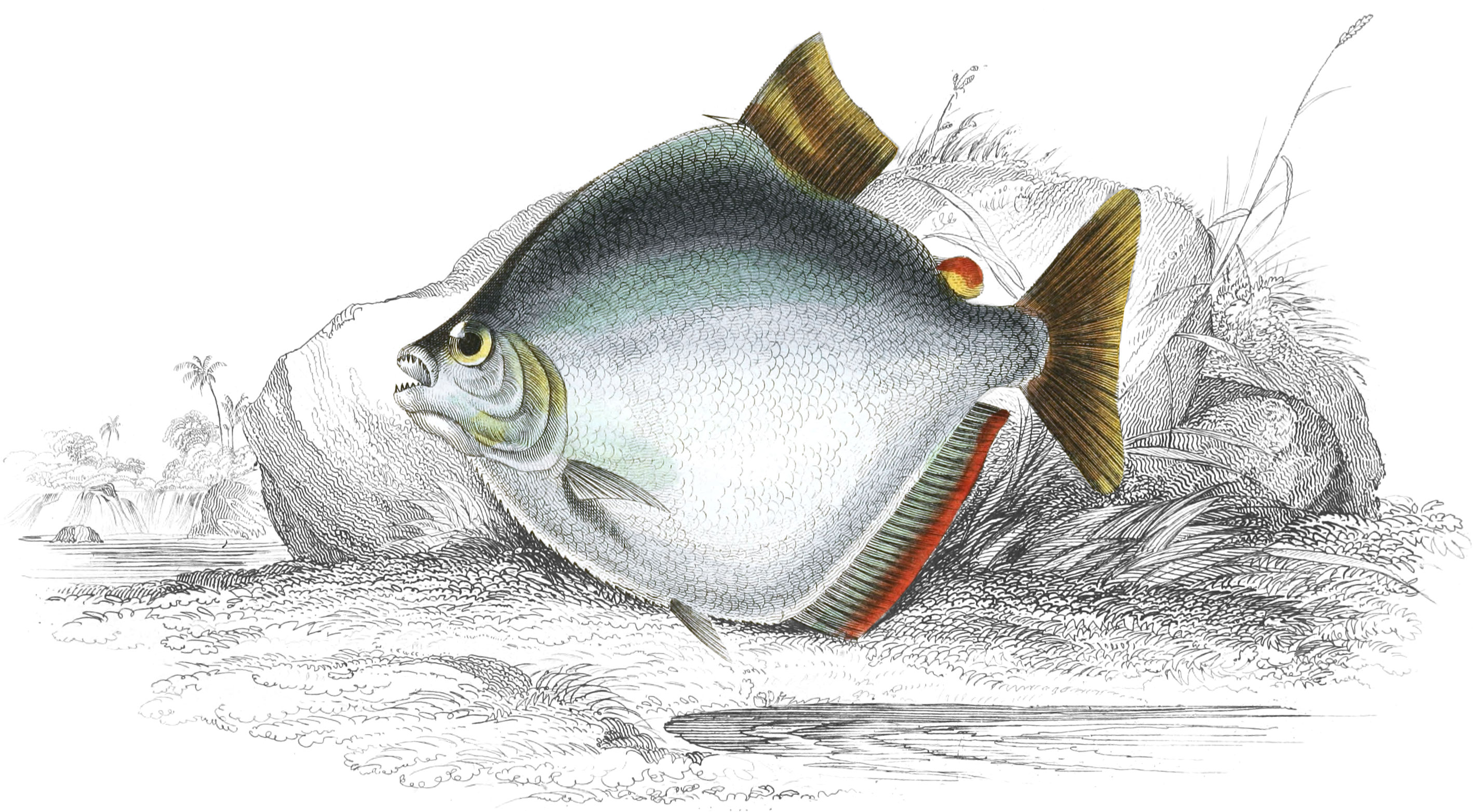
Plate XIX
Wave-Lined Saw-Bellied Salmon
S. undulatus
L. Geral, Chidova. Schomb. Drawings, No. 52.
The drawings of this small species show a different proportion from the last. The head is proportionally much longer, the under jaw projects, and both are armed with rather strong teeth. The dorsal outline is undulated to a less degree than the last, but the adipose fin is situate remote from the tail, and rather nearest to the dorsal. Another remarkable peculiarity is in the lateral line performing three distinct undulations in its length, as in the line below.

Lateral Line
The upper part of the body is bluish grey, shading to white or silvery above the lateral line, continuing thence over the belly and vent, and towards the tail becoming yellowish. The two dorsal fins and tail are blackish brown; the first has an anterior spine, and a distinct dark band nearly through the centre; the latter is considerably forked, and darkest near the base. The three lower fins are umber-brown, the anal darkish toward the tip, and thence slightly tinted with light red. The iris is coloured yellow.
Taken in the river Padauiri, in January; grows to six inches in length, and takes bait. Scales small, fringed, deciduous; tongue round, fleshy; teeth, single row, sharp, triangular, serrated; air-bag double. Food, the roe of other fish.
D. 17—P. 13—V. 6—A. 32—C. 28—Br. 4—Ribs, 12 pairs, large—Vert. 33.
Dark-Finned Saw-Bellied Salmon
Serrasalmo scotopterus
Schomb. Drawings, No. 64.
This drawing is still more longitudinal in form than the two preceding, but keeps the general characters. The dorsal outline is very undulated, and rises suddenly from the head in a hump; the head is large, and rather elongated; the rictus is large, and is supplied with large angular teeth. The general colour, until slightly below the lateral line, is greyish blue, changing to white or silvery below all the fins are very dark, and contrast with the pale greyish blue tint of the body; the two dorsal, caudal, and anal fins are dark bluish green, the first with the dark band across, which we have seen in the two former fishes; the second dorsal nearly equidistant between the first and the tail. The tail is somewhat forked, but with the lower lobe unequally elongated, and near the tip a dark band borders on the edges. The pectoral and ventral fins are small in proportion, and are greenish brown. The iris is coloured orange red. Notes state, that the
scales are small, elliptical, fringed, and somewhat adhesive; the teeth are a single row in each jaw, large and serrated; opercula are striated; tongue is round and fleshy; the intestines have no appendices; air-bladder double, the first oval, second long and pointed. Taken in the Rio Branco in April, with the hook baited with fish.
D. 15—P. 10—V. 7—A. 31—C. 25—Ribs, 11 pairs, large—Vert. 33.
Myletes
Cuv.
The fish which we place in the genus Myletus of Cuvier is of a clumsy and unsymmetrical form; and our author, from examination of the teeth, seems to nave considered it referrible to this. The Myletes of Agassiz, in the Brazilian Fishes, comes closer to Tetragonopterus in external shape, and can only be separated by the form of the teeth.
Myletes, Cuv.—Caput magnum, comprcssum. Oculi magni, laterales. Os magnum, transversum; apertum quadratum. Denies maximi, crassi, molares per seriem simplicem in mandibula, per duplicem in ossibus inter-maxillaribus maximis totum marginem superiorem oris conformantibus; ossa maxillaria superiora minima, ad commissuram maxillarum perpendicularia. Lingua lata, apice libera. Membrana branchiostega radiis 5 tenuibus. Corpus compressissimum, latissimum, squamis minimis abductum; abdomen carinatum serratumque. Pinnæ mediocres, analis maxima.
We should observe here, that the appellation of Pacu, made into a generic name by some, seems to be a provincial name for several species,—thus the Prochilodi have it applied to them; the fish represented on our next plate, however, is that to which it most properly belongs, and they seem to be held in equal estimation both by natives and Europeans.
Pacu of Guiana
Myletes? pacu
Pacu of the Natives. Schomb. Drawings, No. 101, A.; No. 101, B. Male and Female.
Snout short, and terminates In a small mouth lips fleshy; two rows of teeth on the inter-maxillary bone; teeth in sockets, nine in the lower and nine in the upper jaw, resemble much the molar teeth of sheep, chiefly the three middle ones; there is, however, likewise an acute tooth in the lower and four in the upper jaw, the upper ones forming a double row with the molar-like teeth. Body elliptical, rather compressed; belly almost trenchant, and obscurely serrated; fins supported by cartilaginous articulated rays; head covered with a naked skin; nose double; body descending suddenly towards the mouth; air-bag of moderate size; lateral line distinct and curved. Colour a brownish red, with several blackish spots in the vicinity of the dorsal fin; there are likewise four fasciae of the same colour towards the tail, two below and two above the lateral line. The rays of the fins are cartilaginous:, articulated,—the membrane marginated; the anal and caudal fins are more fleshy than the rest. Their impregnation is internal; the testes of the male are flat, and contain a liquor, but no matter resembling milt. The female distinguishes itself by the darker colour and the different shape of the part of the body towards the vent, which projects more, and causes likewise a difference in the shape of the anal fin. Male and female are about sixteen to twenty-four inches long, and weigh from six to ten pounds.
It is remarkable that the fry of the pacu is not known at the lower part of the rivers. The general belief among the fishermen is, that at the period the rivers overflow their banks, the pacu proceed up towards the savannahs, where the females deposit their eggs; having performed that duty, the parents return towards the granitic dykes of the Essequibo and Mazaruni, in order to feed upon the weyra,46 its principal and favourite food. When feeding, the fish turns on its side, in which position, in consequence of the formation and articulation of its mouth, it is enabled to do it more conveniently. While thus engaged, the pacu is so intent, that it permits the fisherman to approach it within a few feet, and it is shot with either of the arrows described already in the Introduction, and figured on Plate I.; but as they swim so rapidly, and are besides very strong, the reed of the arrow is thicker than the generality which are used for shooting fishes. At the period the rivers commence to fall, after the long rainy season, which is generally towards the end of September and beginning of October, they are very numerous at the first and second series of cataracts on the Essequibo and Mazaruni. The people of the Lower Essequibo undertake fishing expeditions at this period, and the extensive rocky dykes afford them the means of salting and drying the fish, which they bring to Georgetown. Where the weyra grows plentifully, and the locality permits it, a spot is enclosed with wooden hurdles or a wall of loose stones, leaving two narrow spaces for the fish to enter, which, when it is considered that a large number have entered, are closed up; and the fish are thus confined in a kind of pond, where it is easier to shoot them than when at perfect liberty. They are likewise fond of the seeds of the Caladium arborescens, or muccu-muccu, which are thrown into the stream, and when the fish rises in order to seize it, they are shot. Fishermen skilled with the bow and arrow thus secure from two to three hundred pacus in the course of a week, which, when cured, are sold in the colony for about sixteen pence a piece.
It is one of the most favourite fishes among the epicureans, when it can be procured fresh; but likewise in its salted state it is not to be despised. During our expedition in the interior, we were always delighted when we reached the regions which the pacu frequented; and when well dressed, according to the colonial fashion, with cassanipe, a kind of ketchup prepared from the juice of the cassada-root, it forms an excellent viand.
The morocoto, cartabac, and a species of pacu which we found in the river Parama, and which differed only from the common pacu in its colour being black, constitute a group of fishes which resemble each other by structure, teeth, habits, and their being phytivorous. One of the most delicious among this division is the morocoto or osihu of the Warraus; it inhabits only the estuaries, and does not occur in fresh water; it would fall, therefore, out of the limits of the present descriptions; but as it is so closely allied with the pacu, I shall mention at least its dimensions and general appearance. The teeth, which consist of fourteen in the upper jaw, and are placed in a double row in the fore part, are all distinctly molar or grinding teeth. It attains a length from about twenty-five to twenty-eight inches, and is twelve inches in depth. The gill-covers consist of three strong bones, the dorsal fin of sixteen rays, the ventral of eight, and the anal of twenty-four, the caudal is compressed and thin; in every other respect it resembles the pacu, and is extremely fat and delicious. During the month of August, when they feed upon the fruit of the caramacata, a tree of large size and very hard wood, and the bark, leaves, and fruit of which is extremely bitter, their flesh has a bitter taste, but otherwise it is much sought after, and large numbers of it are occasionally brought from the mouth of the Orinoco to Georgetown. It forms the chief support of the Warrau Indians who inhabit the coast regions in the vicinity of the estuaries of the Orinoco and the mouth of the Guainia and Barima. They possess great skill in securing them with bait, for which purpose they employ the fruits already mentioned, or they shoot them with the arrow, in which they are equally expert as the other Indian tribes. It is amusing to see the stratagem the Warrau uses to ensure his success. Acquainted with the predilection the morocoto has for the caramacata fruits, the Indian, after having provided himself with a number of those fruits, selects a spot where no trees of the description are growing along the banks, and having selected his place, he throws a few of the fruits as an allurement on the water where there is little or no current, and while the morocoto rises to the surface in order to seize the fruit, which it can only effect by turning itself partly round, the skilful archer pierces the fish with his arrow.
The palometo, which is about fourteen inches long and seven inches in depth, its body compressed and flat, with a thin sharp belly, is equally well flavoured as the morocoto and pacu, and frequents similar haunts as the morocoto.
I observed a species, different from the pacu, which inhabits the falls of the Essequibo and Mazaruni, at the cataracts of the Paramu, a tributary of the Orinoco which joins that river above Esmeralda it was of almost a black colour, and the size of the common pacu. Although we saw them in numbers feeding on the herbs at the rocks, we did not succeed in securing more than one, which the Indians had cut up before I could inspect it.
D. 22–P. 15—V. 9—A. 43—C. 26—Br. 4—Vert. 36.
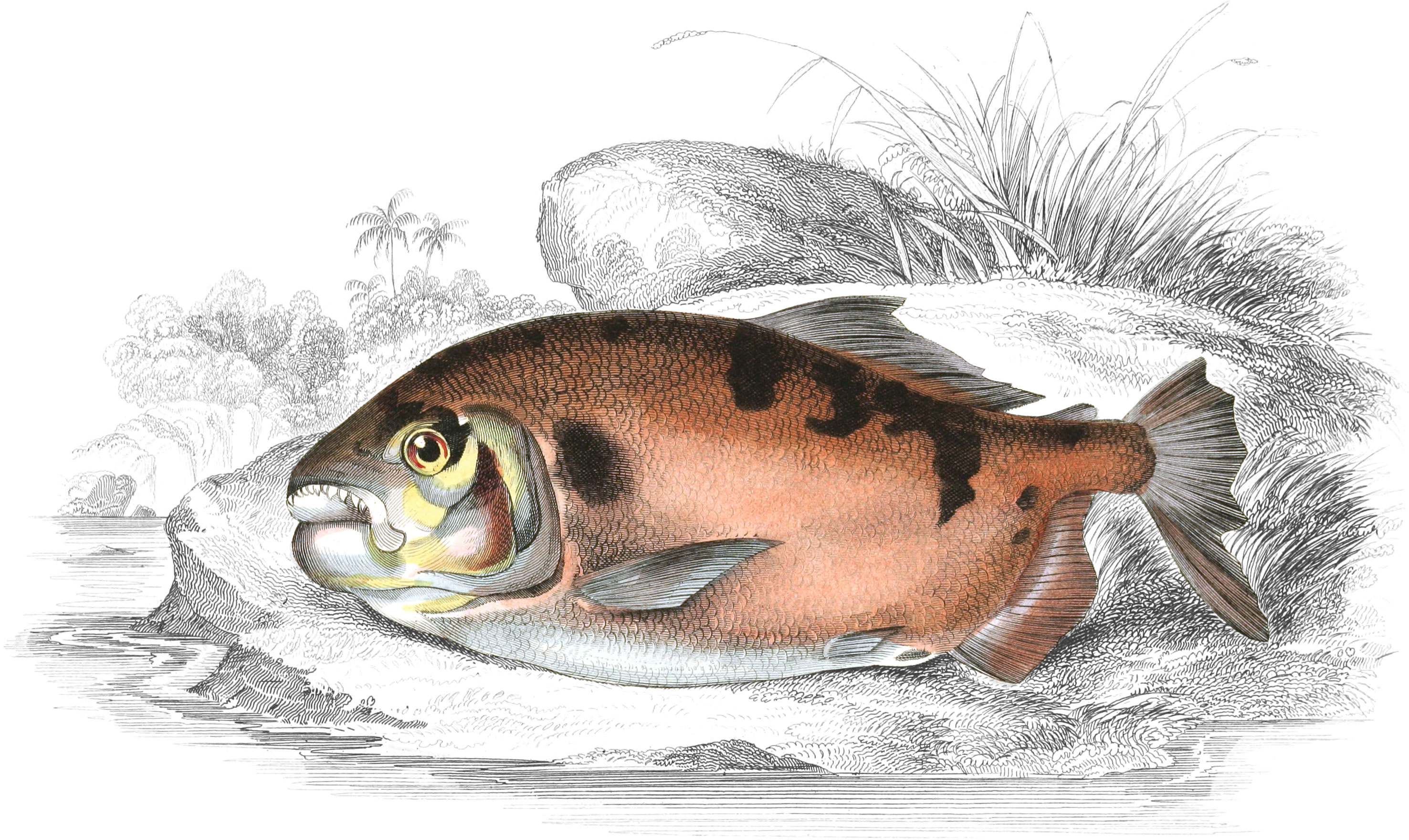

Tetragonopterus
Tetragonopterus, Cuv.—Caput minimum, lateraliter compressum. Oculi maximi, laterales. Os sat magnum, apertum quadratum; mandibula prominens. Dentes magni cuspidati, apice serrati in mandibulæ parte anteriore, et in duabus seriebus in latis ossibus inter-maxillaribus totum marginem supcriorem oris conformantibus; ossa maxillaria superiora parva rttrorsum subarcuata, lateralia, dentibus minutissimus, ut in parte posteriore ramarum mandibulse, armata. Lingua apice libera. Membrana branchiostega radiis 4 latis. Corpus squamis magnis tectum, compressissimum, latissimum. Pinnæ mediocres, analis latissima.
Two drawings appear to range in the above group, and neither of them do we find any where described, particularly the beautifully marked species which we have dedicated to our traveller.
Broad-Shaped Tetragonopterus
T. latus
Arawaak, Cartaback; L. Geral, Pacu.47 Schomb. Drawings, No. 29.
This fish is nearly as broad as long, with the head small in proportion, and the outline, were it not for the tail, almost round; it
inhabits all the rivers of Guiana, and is much esteemed for the table. Its flesh is good and not bony, and it grows to fifteen or eighteen inches in length. The body is much compressed, ending in a keel on the belly, with a serrated spinous process of a silvery blue, yellowish as it nears the vent; the head and fins greenish; scaling very small, smooth-edged, adhesive; lateral line undulating; head small in proportion to its size; eye large, yellow, and silvery; nostrils double, cup-shaped, between the snout and the eye; tongue fleshy; lips ditto; teeth triangular, sharp,—seven in the lower jaw in single row, in the inter-maxillary double, six outward, and on inner row seven; vent situate about one-third of the length from the tail; gill-covers smooth-edged, opening semilunar; feeds on various kinds of fruit, and lives half an hour after being taken from the water. The body is elliptical; tail almost forked, and undulating. It is taken with the hook, but more frequently shot with the arrow, and, like the pirai, it is very voracious.
D. 22—P. 16—V. 8—A. 37—C. 27—Br. 2—Vert. 36.
Schomburgk’s Tetragonopterus
Tetragonopterus Schomburgkii
L. Geral, Pacu. Schomb. Drawings, No. 63.
We have dedicated this species to Mr. Schomburgk, as one of much interest from its colouring, and as remarkable for the development of its fins and the singular mark across the centre of the body.
It was caught in the Rio Negro in April, feeds on fruits, and swallows sand. The scales are small, elliptical, adhesive, and slightly serrated; a spine anterior to the dorsal fin; tongue round and fleshy; the intestines have numerous appendices; the roe double, and filling two-thirds of the cavity of the abdomen the air-bladder is double, both portions of an oval form.
In colour the head is pale olive, approaching to yellowish on the opercula, and below the eye is marked with three black spots; the eye large, with a yellow iris. The dorsal half of the fish is greyish blue, shading to white at the lateral line, but changing on the ventral half of the lower surface to pale yellowish green, marked with indistinct black spots, and on the anal half of the lower surface it is of a paler tint of the bluish grey of the back, the centre of the body longitudinally only being white or silvery; across the centre of the body, in the opposite direction, or pointing between the insertion of the dorsal and anal fins, there is an oval mark of deep black, having a most remarkable and artificial appearance. The dorsal fin is deep bluish green, crossed by two dark bands; adipose fin olive, and set upon an elevated undulation of the back; the pectoral and anal fins small, and of an olive tint; the anal fin largely developed, dark bluish green, having the anterior tip broadly marked with black, the posterior edge margined with clear red. The tail at the base is bluish green, shading into black at the upper tip, after which a band of dull red margins the extremity and the centre of the undulated fork, crossing through nearly the middle of the lower lobe, which is of a paler green at its tip.
D. 25—P. 15—V. 8—A. 39—C. 27—Br. 4—Ribs, 13 pairs—Vert. 34.
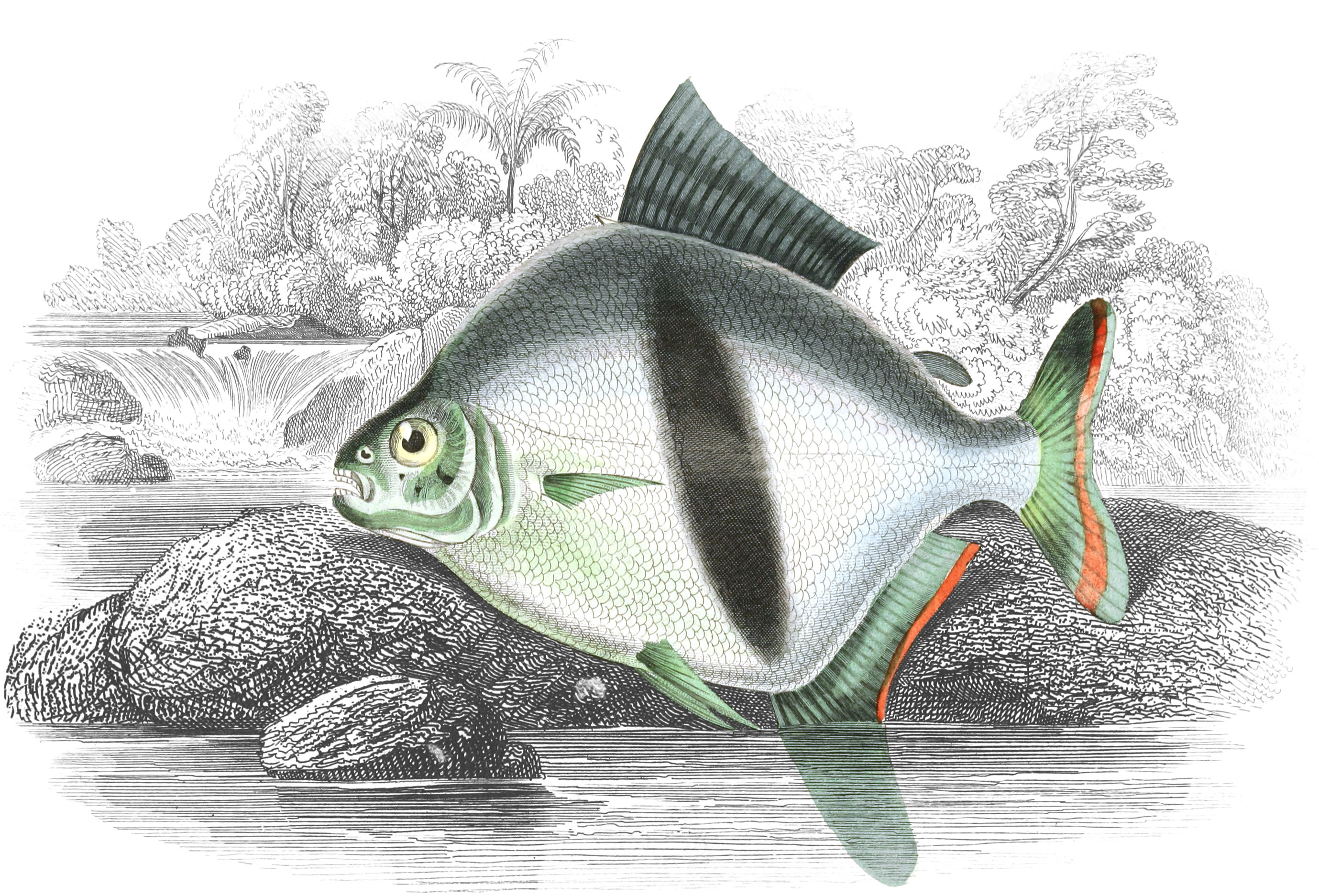
Plate XXII
Three species of fishes, which are generally arranged among the Salmon, have next to be noticed, before proceeding to those forms which seem to lead to the Carps or Cyprini.
Xiphostoma
Xiphostoma, Spix.—Caput longissimum, acuminatum, tenue, subteres. Oculi minores, laterales. Os quam maximum, longissimum, transversum, armatum dentibus minutissimis, confertissimis, acutis, in toto suo margins; id est, in longissimis ossibus inter-maxillaribus, que totum oris marginem superiorem conformant, nec non in mandibula; ossa maxillaria superiora minima, perpendicularia ad commissuram maxillarum. Liagua magna, lata, apice libera. Membrana branchiostega radiis 4 gracillious. Corpus elongatum, teres, squamis mediocribus duris obductum. Pinnæ vcntrales parvas, dorsalis pone ventrales, caudalis magna.
Ocellated Xiphostoma
Xiphostoma ocellatum
Arawaak, Pirapu; Macusi, Morowai; L. Geral, Pirapoco. Schomb. Drawings, No. 7.
Though very nearly allied to the figure given by Spix as X. Cuvierii, we have ventured to place it distinct. The form of the tail, as particularly alluded to by our author, is more rounded, and there is no appearance given in the drawing to the lined appearance occasioned by the structure of the scales. The mark at the base of the tail is distinctly surrounded or ocellated with yellow.
This fish is common in the Essequibo, Rios Negro and Branco; in the latter river it is much used for food; its flesh is yellow, but well-flavoured, although rather bony; the body long, head pointed, teeth sharp; nostrils single, placed near the eye all the opercles striated, bat with smooth edges. The ventral fins are placed rather before the dorsal. It is of a lead colour, lighter on the belly; the fins are variegated with light red, which is the predominant colour of the tail; at its insertion is a black spot, with a crescent of bright yellow, something like the eye of a peacock’s feather. The lateral line is nearly straight, the eye yellow, and tongue pointed. The cranium is hard and bony snout elongated, and protruding considerably over the lower jaw. They take bait readily; but as they swim near the surface of the water, are easily killed with an arrow. They live only a short time when taken from the water, and soon turn to a brownish colour. The lateral line is straight; the tail forked, but each lobe is rounded.
The length two feet; greatest depth three inches.
- X. ocellatum,—D. 10—P. 27—V. 8—A. 9—C. 30—Br. 4—Vert. 40.
- X. Cuvierii, from Spix,—D. 2/8—P. 26—V. 8—A. 3/8—C. 7/17/7.
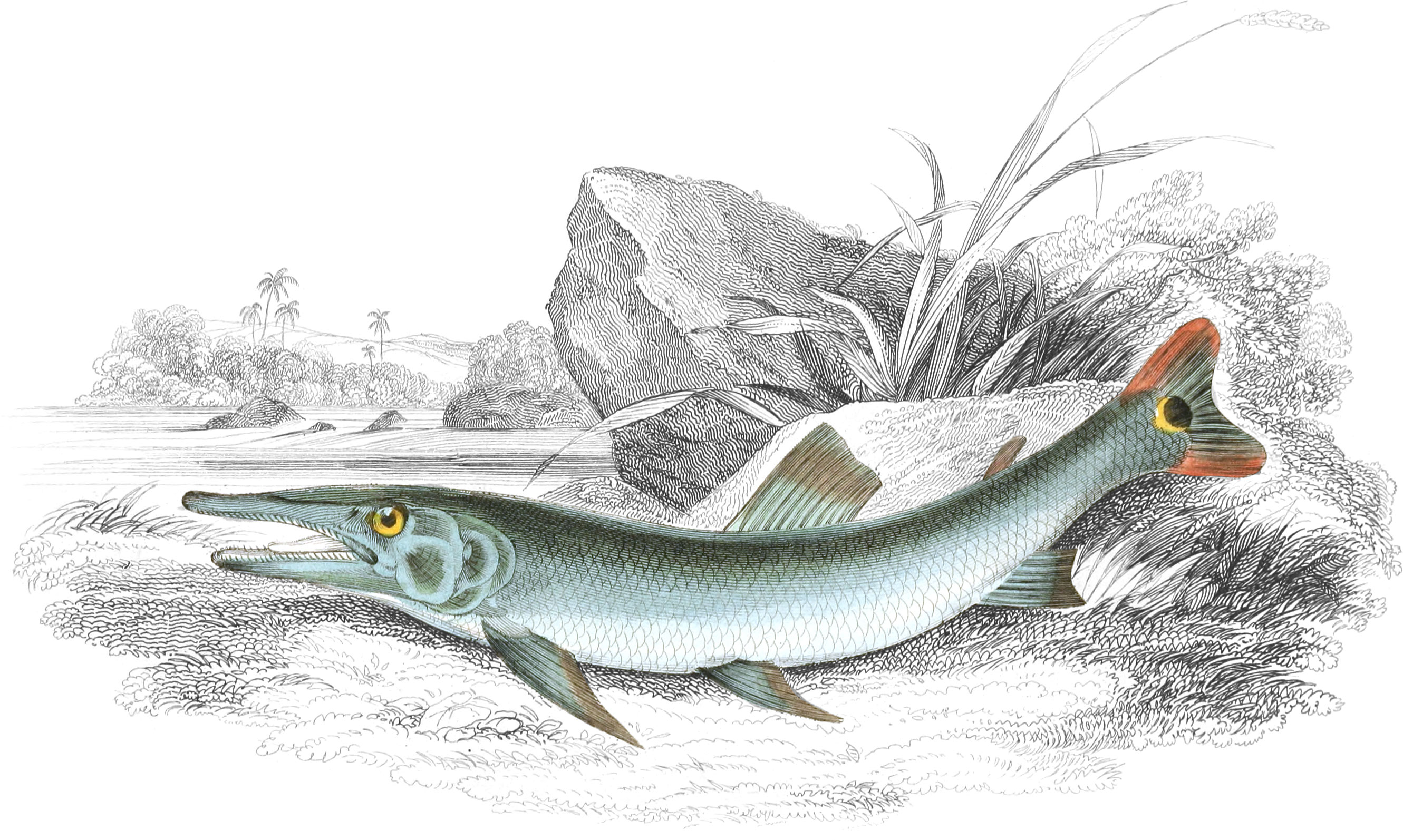
Plate XXIII
Hydrocyon
Cuvier
In Hydrocjon of Cuvier,48 several modifications of form seem to occur, no less than five being noticed and referred to particular types of fishes:
- Salmo falcatus, Bloch.;
- Characinus Amazonicus, Spix, xxxv.;
- Cynodon vulpinus, Spix, xxvi.;
- Xiphostoma;
- Characinus dentex, Geof.
The genus, therefore, would scarcely appear to be well defined, and we place our present drawing under it as approaching nearest in form to those species figured by D’Orbigny as H. hepsetus, humeralis, &c.
Small-Scaled Hydrocyon
Hydrocyon microlepis
Macusi, Ghawarrikang. Schomb. Drawings, No. 16.
This fish is found in the Rios Negro and Branco, as well as in the Essequibo. In the upper part of the latter river they are very plentiful; and when the river is low, several hundreds are taken in a night by placing a canoe across a small creek which they are descending, and in leaping over the obstacle fall into the canoe. They are good food, and, when fried, are much like the fresh-herring. The scaling is very minute; the colour is greenish on the head and back, varying to blue and rose on the belly; dorsal fin orange tipped with blue, adipose the same colour as the back, pectoral and ventral light blue, anal lake tipped with blue, caudal blue outer rays, others orange. At the insertion of the caudal fin is a black spot. The eye yellow; the opercles rose colour; nostrils single, placed near the eye; teeth formidable, the canines very large; the snout elongated; lateral line runs nearly straight, a little bent near the opercle; the gill-lid is slightly striated, with smooth edges; vent placed near the anal fin; the ventral placed under the commencement of the dorsal fin. They are killed by the arrow, and with the hook and line. They are very voracious, and constantly carry on warfare with the smaller finny tribes. They swim near the surface of the water, and seem to prefer shallows to the deeper spots.
Strong-Toothed Hydrocyon
Hydrocyon? armatus
Macusi, Patlia; Warrau, Baiarra; L. Geral, Pirantera. Schomb. Drawings, No. 8.
This remarkable and strongly armed fish should evidently have its station near to the last, but its true generic place is less easily determined from the drawing only. The structure of the teeth, as stated in Mr. Schomburgk’s notes, requires attention; and the base of the anal fin is represented as being covered with scales for a breadth more than equal to the whole membranous part. It has some alliance also to Cynodon of Spix, one of Cuvier’s types, where the anal fin is similarly scaled at the base.
This fish is found in all the rivers of Guiana, and is known from all others by the length of the canine teeth, which are so long in the lower jaw as to protrude through the upper, into sockets prepared for their reception. It weighs ten or twelve pounds. The body silvery bluish green on the back; the head of the same colour. Dorsal fin is greenish, webbed with blue and tipped with red; pectoral ditto, webbed with blue; ventral, greenish white; anal, green tipped with red; caudal, green tipped with red and a broad bar of black; over the opercle is a black spot, and at the sub-opercle another. The maxillary bone is strongly toothed; the bones of the gill-lid are all striated; the eye large and yellow, placed before the middle of the head scaling middle-sized, adhesive; ventral fins under the commencement of dorsal; nostrils single, oval, close to the eye; mouth terminal, gape large; teeth in a single row, spare canine teeth lying flat in the mouth to supply again in case of breakage, like the fangs of poisonous snakes. It lives a short time only when taken out of the water, is good food, but bony, takes bait readily, and preys on smaller fish, which it swallows whole.
D. 12—P. 8—V. 9—A. 19—C. 24—Br. 5—Vert. 48.
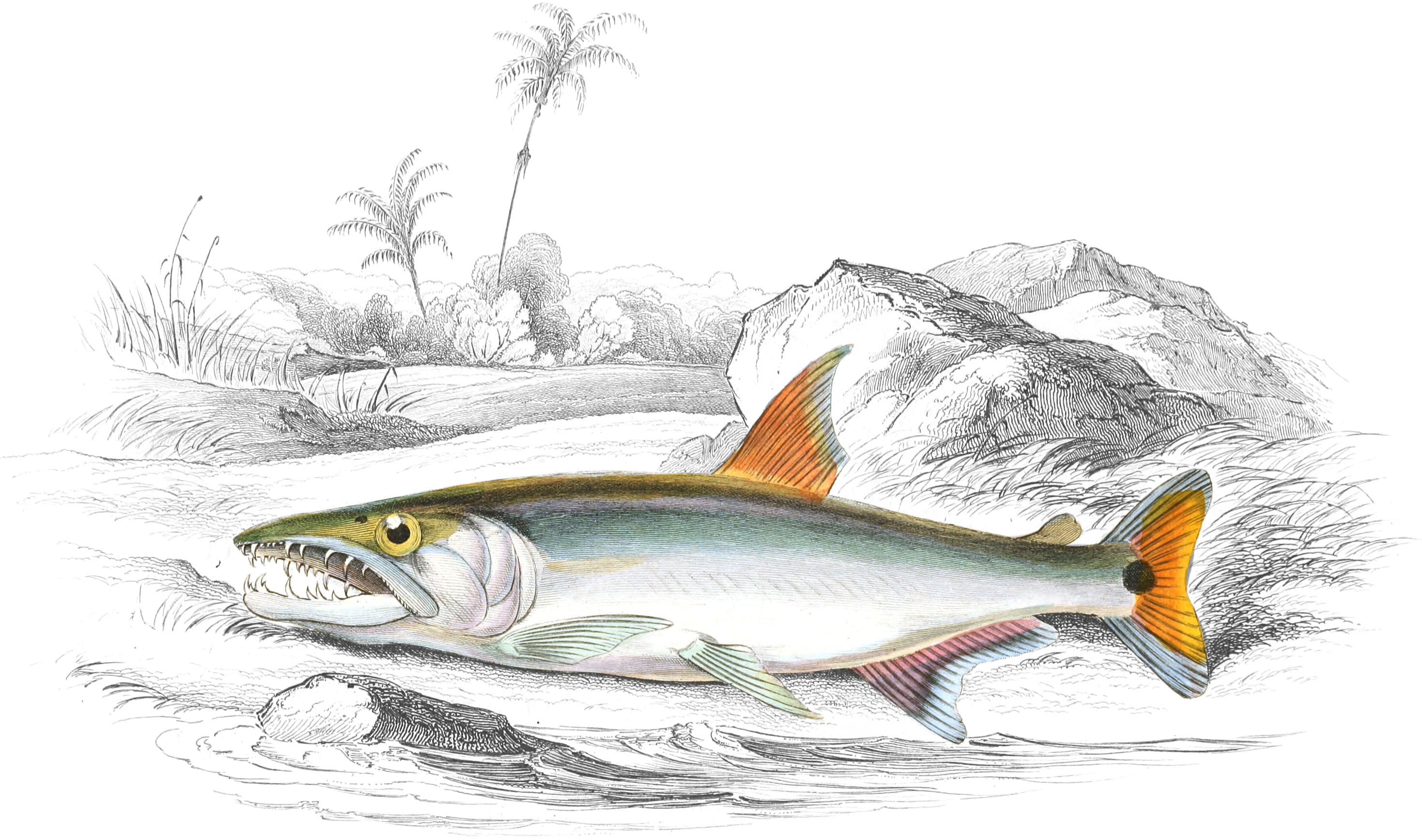
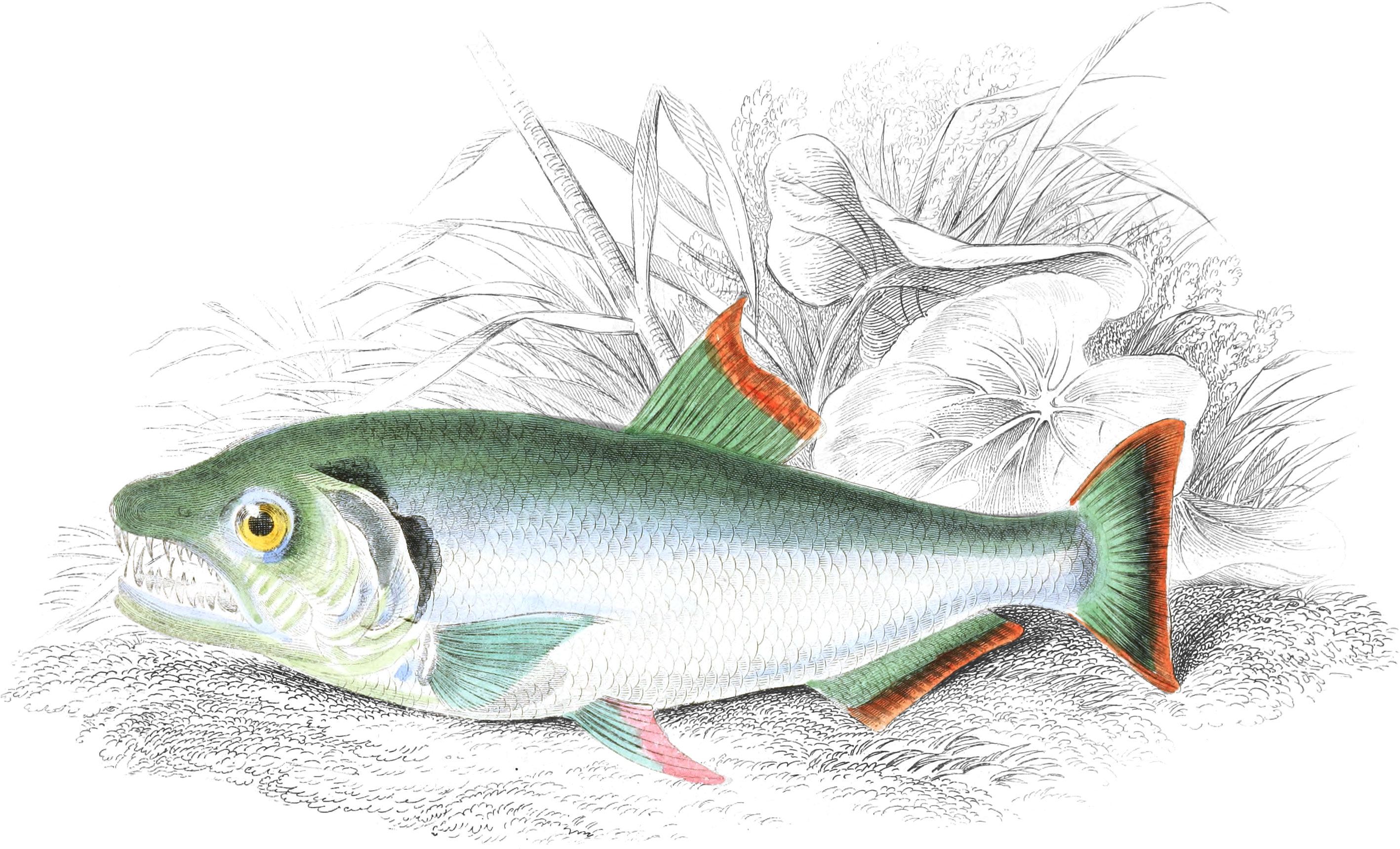
In some of the specimens belonging to the genera Serrasalmo and Tetragonopterus we saw species reminding us, by their form, of the deeper shaped carps; in the fish we have next to describe, we see another resembling the ordinary form of the chub and roach, covered with large scales, having the mouth, though armed with teeth, protruding, and having the second dorsal fin almost rudimentary. They are also vegetable eaters, but their habits in other respects are too little known to allow us to deduce from them any affinity. Agassiz has characterised them, from the cut margins of their teeth, under the name of
Shizodon
Schizodon, Agas.—Caput parvum, latissimum, depressum. Oculi magni laterales. Os parviim, rotundatum; denies latissimi, apice crenati, incissivi in ossibus inter-maxillaribus latissimis, totum labium superius sustinentibus et in mandibula prominente. Ossa maxillaria superiora minima lateralia. Lingua minima. Membrana branchiostega radiis 4 latis. Corpus subteres, elongatum, squamis magnis duris obductum. Pinnæ mediocres.

Shizodon Teeth
The only specimen in the Collection, entering this genus, we have referred to
Banded Schizodon
Schizodon fasciatus, Agas.
Curimata fasciatus, Spix, tab. xxxvi.—L. Geral, Warracu. Schomb. Drawings, No. 27.
The fish from which the drawing has been made was caught in the Rio Branco; it is of a dark grey colour, yellowish on the belly and head; the scaling is large, adhesive, round, and smooth at the edges lateral line single, straight; head short, gently sloping; lips fleshy; mouth protractile; teeth obtuse, serrated, in a single row in the inter-maxillary and lower jaw; ventral fins placed under the pectoral rudiment of a pinna adiposa above the anal fin, obtuse on the posterior extremity; (rays of dorsal and anal fins project in rather sharp points); nostrils double, oval; eyes middle-sized, silvery red above; tongue not perceptible. The gill-rays are not covered by the gill-lid, but free, and extend from its lower margin towards the throat; opercles smooth, with smooth edges; gill-opening semilunar, almost sharp-angled in the middle. The body is much elongated; back high. Is caught with the hook or shot with arrows, and lives but a short time after being taken from the water. The food found in its stomach was the seed of the awarra, a species of palm (Aristocaryon spec?)
D. 12—P. 15—V. 8/9—A. 10—C. 21—Br. 4—Vert. 36.

Plate XXVI
Erythrinus
In this place we have ventured to arrange the genus Erythrinus, in variation to previous systems. Exteriorly, with the exception of the mouth, many species are Carps in appearance; but the structure of the mouth, and the pancreatic appendages to the stomach, ally them to the Salmons; while the spotting of some, and handing on the fins in others, remind us of both the Trouts and the Graylings. The last form prepared us for the want of the second dorsal fin; and in one which could be placed at the limits or commencement of a family, we should expect either a small development or total want of this accessary character.
Erythrinus, Gronovius.—Caput obtusum, rotundatum, extus osseum, rugosum, non squamatum; ossa infra-orbitalia maxima, buccas omino obtegentia. Os amplissimum, traversum, in toto suo margine dentibus majoribus minoribusque alternantibus armatum; ossa intermaxillaria mediocria, maxillaria superiora angusta, untrinque ultra dimidiam partem labii superioris sustinentia; ossa palatina dentibus velutinis obsita. Lingua latissima, plana apice libera. Membrana branchiostega radiis 5. Corpus subteres, versus caudæ apicem subcompressum, squamis magnis tectum. Pinna dorsalis ventralibus opposita.
The Haimura
Erythrinus macrodon, Agas.
Erythrinus macrodon, Agas. tab. xviii.
Three drawings of Erythrini occur in Mr. Schomburgk’s Collection, very closely allied to each other, and it is possible that they may be different states of the same fish; one we refer to the species of Spix above quoted, and have selected it as that alluded to in the Introduction, and as a fish capable of being extensively employed in economical purposes. Our notes state,
Lower part of snout produced; scales large, margined by a skin. Dorsal fin in the middle of the elongated body, situate above the ventral fin; anal fin placed far back; teeth of the lower jaw acute; tongue smooth, thick mouth wide; rays of fins soft; palate set with teeth. Body compressed; back and abdomen produced, tapering suddenly towards the tail; central teeth longer than the others; scales deciduous; lateral line scarcely visible; ventral fin abdominal; margin of gill-flap smooth, surface striated; nose single near the eye; eye large; air-bag obtuse above, pointed below.
The haimura is one of the most delicious freshwater fishes of Guiana, and the head is particularly recommended to all gourmands. It is generally caught in the neighbourhood of falls and rapids, and reaches sometimes a length of from three and a half to four feet. Its flesh is firm and well-tasted, and at certain seasons is so numerous that it constitutes the principal article of food with the Indians. It is very voracious, and is taken with the hook, as well as in traps and with spring-hooks. These traps are most ingenious, and consist generally of a cylinder made of bark, or frequently of a branch of the trumpet-tree (Cecropia pellata), which is hollowed out. The cylinder is about five feet long, and from six to seven inches in diameter. The lower end is stopped up, and a live fish is fastened to the bottom. It is now tied horizontally to a tree which stands on the bank of the river, and kept about two feet below the surface. The haimura, attracted by the bait, enters the cylinder; but scarcely has it put its head beyond the centre, when the lower end of the cylinder sinks and becomes vertical, and the fish being enclosed with its head downwards, it cannot make its escape, and is secured. The river Berbice, beyond the cataract Itabru, and the Cuyuwini, a tributary of the Upper Essequibo, abounded in haimuras, and we sometimes caught a hundred weight in the course of an hour or two. Then: teeth and jaws are very powerful; and I have been told of accidents where the fish, when caught, has cut off a man’s hand.—I have seen very serious wounds inflicted by them.
D. 15—P. 14—V. 8—A. 9—C. 17—Br. 4—Vert. 40.
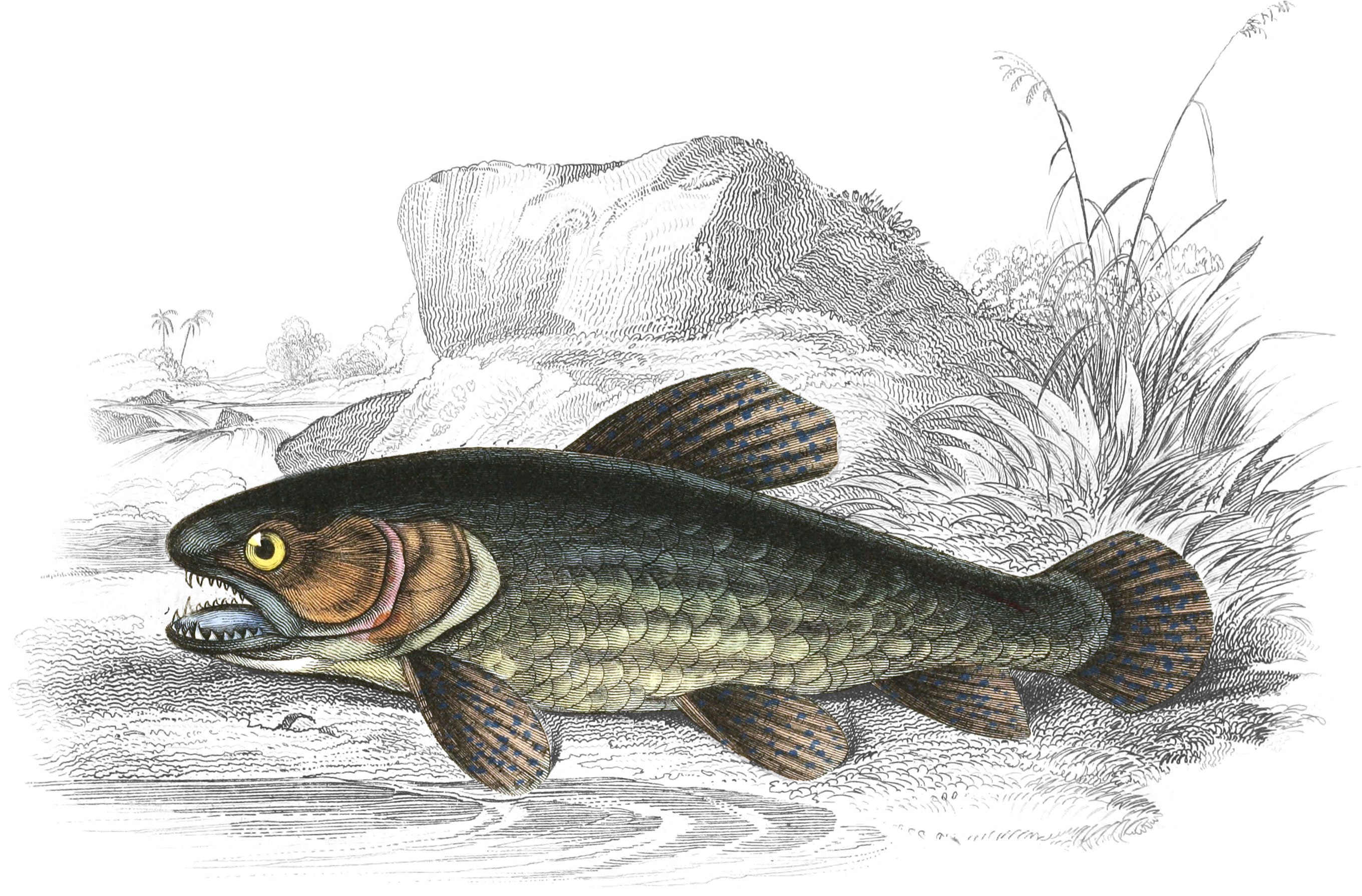
Plate XXVII
Another of our drawings is similar in form, but is coloured lighter, and has the dorsal fin with four distinct dark bands, instead of being spotted as in the last. The native names are different from those of the last:—Arawaak, Huri; Warrau, Cauhui; L. Geral, Tari-ira. Schomb. Drawings, No. 44.—Our notes remark:
Is common in every river of Guiana, and is a very voracious fish. The scaling is large, with smooth edges, elliptical, and adhesive; lateral line straight, running to the middle of the body. The gill-covers have smooth edges, with the surface slightly striated; nostrils double, near the eye; eye large, red, and situate near the snout; teeth in single rows, large,—the canines very large and powerful; ventral fins at half distances from the pectoral; tail rounded; air-bag double,—one circular, flattish, the other long and pointed. Tongue round and fleshy; lower jaw slightly produced. Intestines form only one flexure, and have appendices. The roe is large, long, and double; eggs middle-sized. Destroys immense quantities of small fish, and will live an hour after being taken out of the water. The flesh is good, but inferior to many others, being bony: it does not keep long. The Indians make excursions to creeks and pools where they are plentiful, and destroy great numbers, which they barbacote in the smoke to make them keep. In the Rio Negro, great numbers of them are taken and dried. They are sold at from two to three dollars per aroba of thirty-two pounds. They take bait with great avidity, and afford excellent sport to the angler and gain to those who live by taking them.
D. 15—P. 13—V. 8—A. 11—C. 18—Br. 5—Ribs, 23 pairs—Vert. 36.
Cyprinidæ or Carps
The reasons which induce us (with our present knowledge of their structure) to place Erythrinus with the Salmon, remove Prochilodus from them take away the second dorsal fin, and they would at once have been ranged here; and it seems as necessary to have among the Carps some form representing the Salmon, as there would be in the reverse of the proposition. In the internal structure the masticating stomach supplies the almost entire want of teeth, and the double air-bladder is similar to the form of that organ in the Cyprini. The characters of Agassiz are,—
Prochilodus, Agas.—Caput parviim, crassum, latum. Oculi magni laterales. Os parvum in summo rostri apice, labio latissimo, camoso, emergente omnino cireumdatum. Dentes minutissimi, apice introrsum flexi in ipso margine labii carnosi. Ossa inter-maxillaria, et maxillaria superiora minima in labii substantia reeondita. Lingua nulla. Membrana branchiostega radiis 4 latis. Corpus compressum, latum; squamis magnis duris obtectum. Pinnæ mediocres.
Among drawings of three species, we do not possess one agreeing with those figured in the Brazilian Fishes. The first may be designated
Pale Red-Streaked Salmon-Carp
Prochilodus rubro-tæniatus
Arawaak, Warrau, and Waccawai, Yacotta; L. Geral, Curimattu. Schomb. Drawings, No. 1.
The colour of the drawing above is of a pale brown, and the whole body is marked with bands of pale rose-colour. The Paca lineatus of D’Orbigny resembles this fish in form, and is striped somewhat similarly, but different in colour.
This fish is found as well in the Rios Branco and Negro as in the Essequibo and its tributaries the specimen from which the drawing was made was taken at Post Ampa; it weighs about two pounds, and is taken only by the arrow or with nets. They do not take bait; they are much esteemed for the table; the flesh is white and well-flavoured, but they do not keep long after being killed. The scaling is large and very slightly fringed, striated, elliptical, and adhesive; it is devoid of spinous processes; lateral line straight, and about the middle of the body; head depressed ventral fins situate under the dorsal, caudal forked, adipose moderately large. Ribs large, 22 pairs; air-bag double,—that next the head oval, the other long and pointed; nostrils single, near the top of the head, half distance between the snout and eye round, near the middle of the head, iris red and yellow; tongue round and fleshy; lips fleshy, and formed for sucking; teeth none; intestines long, forming several flexures, and situate near the anal fin. The gill-covering is slightly striated, opening semilunar; on examination, it is possessed of a second stomach, one of which resembles the gizzard of a fowl, being muscular and fleshy, and which was filled with fine clay; no other food was found in either stomach. They live but a short time after being taken out of the water. The body is silvery back darker, shaded with green, and slightly striped with purple; head greenish; dorsal, adipose, pectoral, and ventral fins slightly green; anal also green, with a patch of lake; the tail, lake, spotted with black. The length of the specimen was eighteen inches, depth below dorsal fin six.
D. 11—P. 15—V. 9—A. 10—C. 22—Br. 4—Vert. 40.
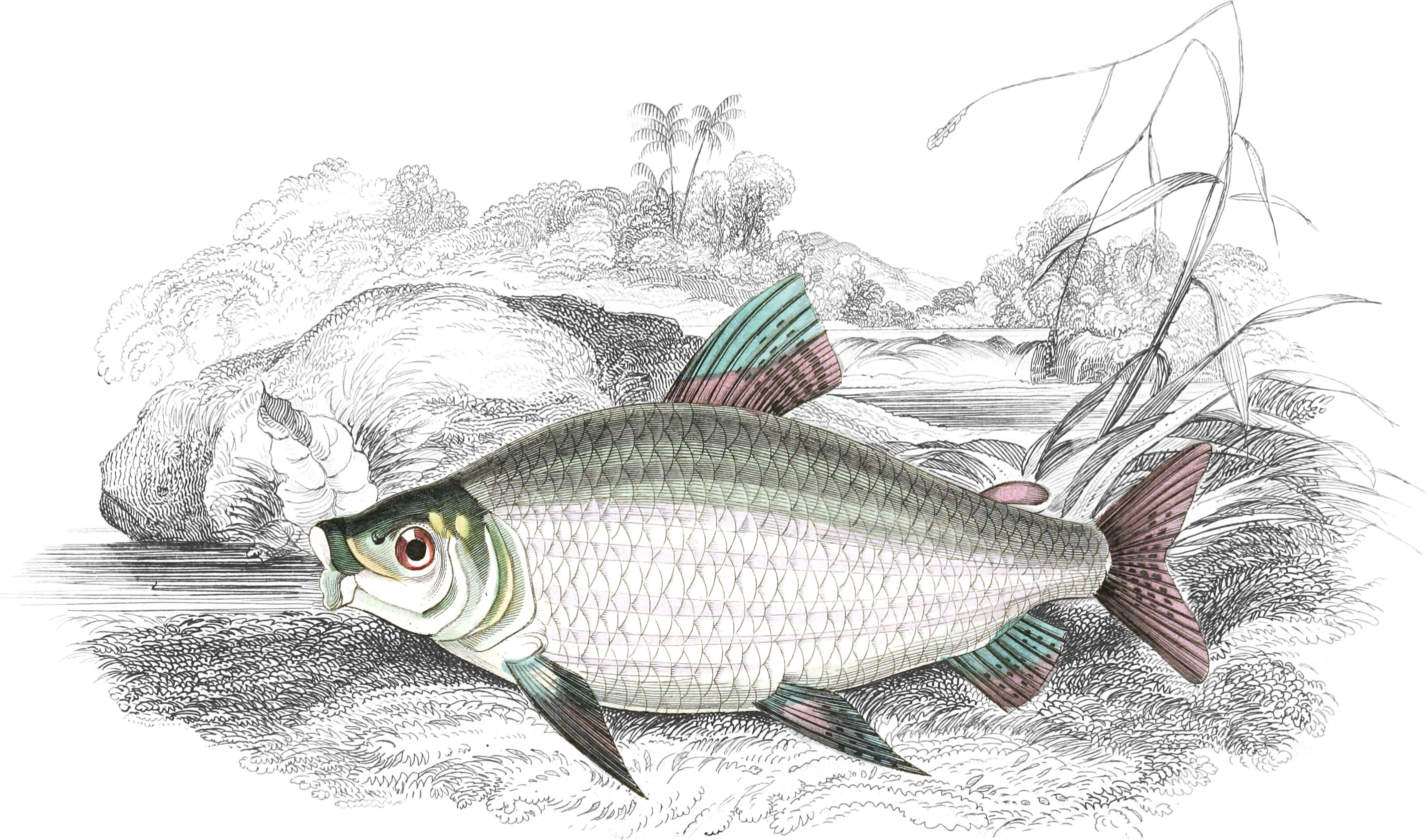
Plate XXVIII
Two other species, very nearly resembling this in form, were taken in the Rio Branco, but they are not known in the Demerara or Essequibo rivers. They are represented on our next plates, show bright and variegated markings, and are supplied with minute teeth.
Double-Marked Salmon-Carp
Prochilodus binotatus
Schomb. Drawings, No. 65.
This fish, regarding which we do not possess extended notes,
was shot with the arrow in the Rio Branco. In length it is thirteen inches and a half, in depth three and three-quarters. Teeth were thickly set in each jaw, and the tongue is stated as round and fleshy; at variance with the generic characters as given previously. The intestines have no appendices, and the air-bag is double.
The upper part of the head is coloured dark olive, shading into yellowish, perhaps silvery on the opercula, and to pale pink on the lower part of the head. The back above the lateral line bluish gray, shading into silvery and tinted with greenish on the abdomen; and there are two conspicuous round black marks, the one at the commencement of the lateral line behind the gill-cover, the other at the termination of the line at the insertion of the tail. Dorsal fin is bluish green, second dorsal olive; the pectoral and anal fins are pale greenish grey, tinted with pink at the base, the latter tipped with bright red the anal fin yellowish green, edged with bright red, and with two indistinct dark bands across the anterior tip. The tail, deeply forked, is dull yellow; there is a central longitudinal band or stripe of dull light blue, succeeded across each lobe by three others of a similar colour and equidistant, and terminated by the tips, also blue. The eye is large and coloured yellow.
D. 11—P. 13—V. 9—A. 10—Br. 4—Ribs, 19 pairs—Vert. 38.
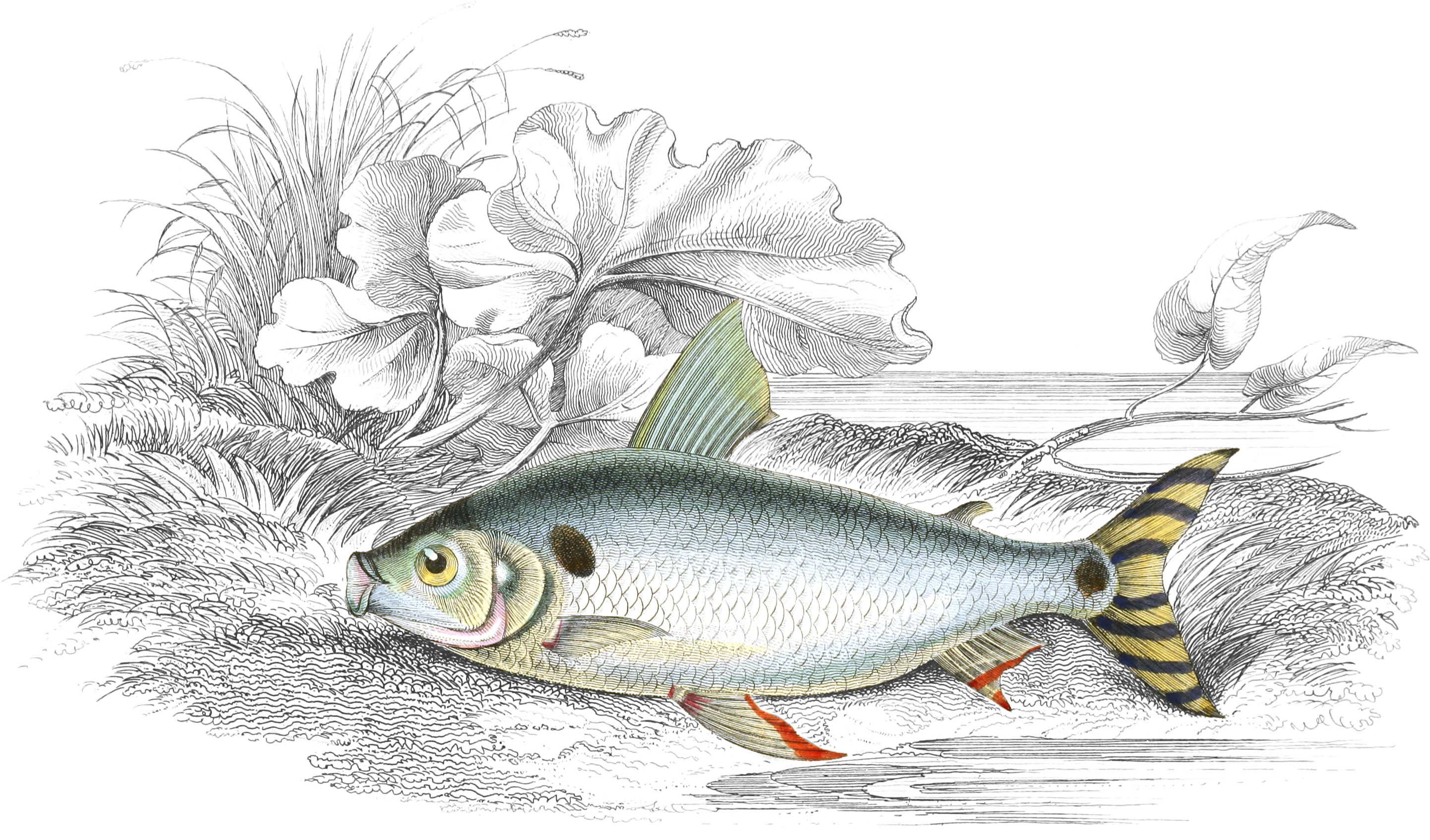
Plate XXIX
Beautiful Salmon-Carp
Prochilodus insignis
L. Geral, Geraki. Schomb. Drawings, No. 26.
This fish inhabits the Rio Branco, where it is plentiful and esteemed for food. It is killed by the arrows, as it will not take bait, and in its general manners resembles Plate XXVIII. Its colour is a silvery blue, inclining to rose on the belly. Head greenish, eyes yellow and red. The lips are fleshy and formed for sucking; ventral fins situate under the dorsal; gill-lid smooth, the opening semilunar. It has no teeth; nostrils single, placed between the eyes and snout, but nearer the top of the head. The scaling is large, striated, elliptical, adhesive, and slightly fringed; lateral line single, straight; head and body slightly depressed; the tongue fleshy, and attached to the lower jaw. It lives only a few minutes after it has been taken out of the water. The air-bag is double, and is possessed of a second stomach, which is generally filled with fine clay. Length eleven inches and a half, depth three inches and three-quarters.
This is even more gaudily coloured than the last. The colour above runs into streaks, pale but regular, as on the first described species. The anal fin is deep lake, crossed, as in the last, anteriorly with two dark bands, and having a third running through the posterior angle. The tail is bright orange red, and has the central dark stripe, with five narrow equidistant black bands crossing each lobe. In both the last fishes, the lateral line is nearly straight.
D. 9—P. 14—V. 8—A. 9—C. 22—Br. 4—Vert. 38.
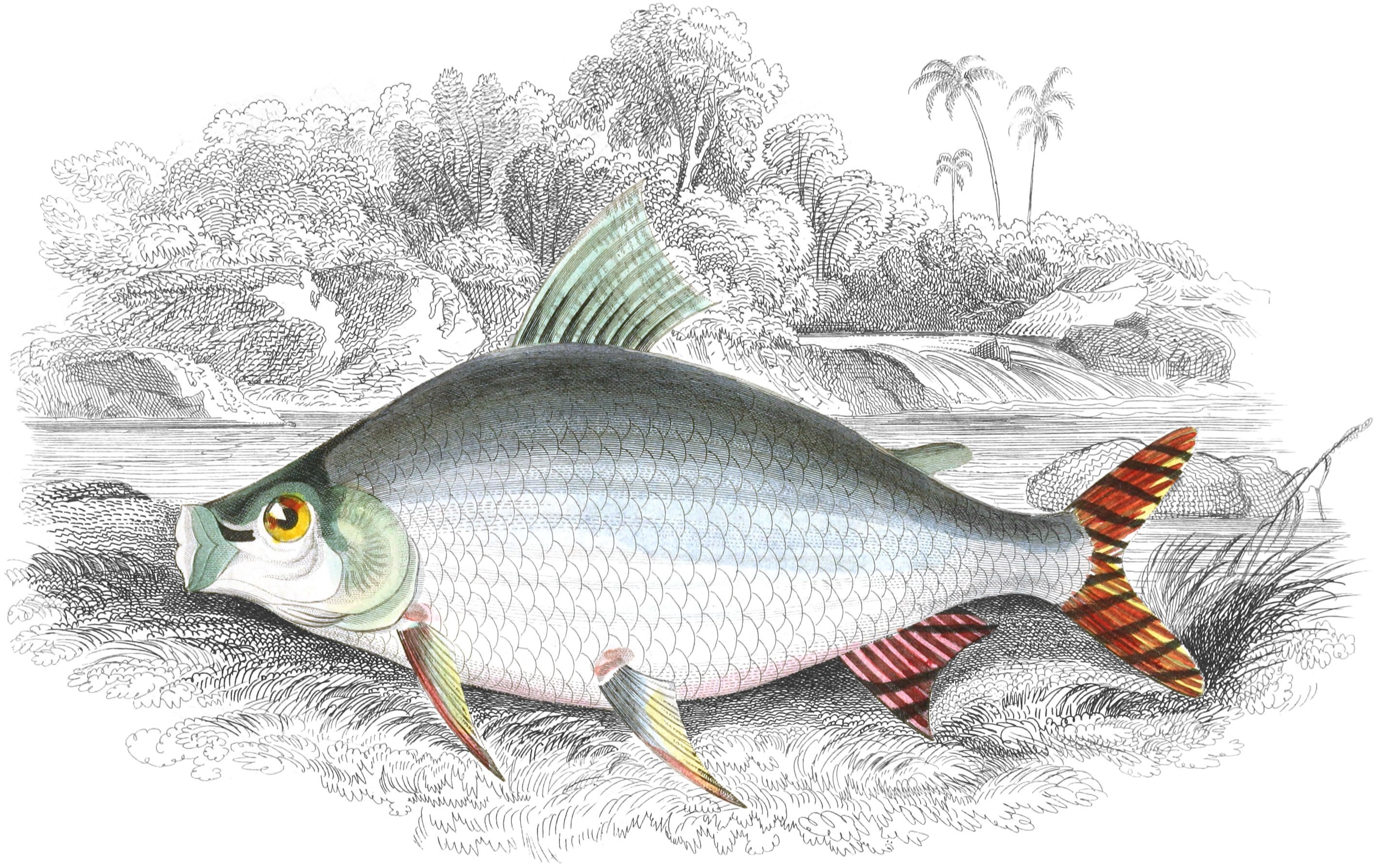
Plate XXX
Our limits will not now allow us to proceed with the Acanthopterigii, of which numerous species accompany the Collection; and they, with the cartilaginous fishes and a few insulated forms, will be illustrated in another Volume. Before concluding, however, we may remark, that our Arius? obesus, may be the Silurus galeatus of Bloch, pl. ccclxxix ccclxix.; our Hydrocyon microlepis is somewhat similar in form to the H. falcirostris, Annales du Museum, tom. v. pl. 27, fig. 3; and H. (cynodon) armatus is nearly allied to H. schomheroides, pl. 27, fig. 2, of the same work.
Fishing Implements of Guiana

Plate XXX*
- The British portion is called Guiana in official documents; Guayana is the Spanish name; Guianna the Portuguese. It is said to have received its name from a small river or tributary of the Orinoco.
- See Description of British Guiana, by Robert H. Schomburgk, p. 30.
- It is produced from the red pulp which covers the seeds of the Bixa orellana; perhaps better known in England by the name of amatto, where it is much used for dyeing cheese. The lana is the fruit of Genipa Americana, the juice of which gives a fine black dye.
- Journal of the Royal Geographical Society, vol. iv. p. 33.
- Vide Naturalist’s Library, Ichthyology, vol. 1.
- I believe that Hancock’s Callichthys littoralis, or Valencienne’s C. sulmlatus, and Margrave’s Tamoata, are nearer related than suspected. I am not aware that the Doras in the interior built any nests, and refer therefore only to the Callichthys at the coast regions or brackish waters.
- I extract from some manuscript notes of Dr. Hancock’s, formerly a resident in Demerara, and which only lately have been lent to me, the following confirmation of the above:—A large gillbakra (a species of salt-water silurus), just taken out of the water, was seen by Mr. Gibbs, and many others at the King’s Stelling, to vomit up vast numbers of the young fry of the same species, he thinks three or four hundred, each the length of a finger. The fish had been chased up and taken in shoal water. Something similar has been observed of a cuirass, another species of silurus.
- Mycteria Americana.
- Platalea ajaja, Cancroma cochlearia.
- Carbo Brasiliensis, Plotus Americanus.
- Rhynchops melanura.
- Ciconia Americana.
- Carbo Brasiliensis
- Sarcoramphus papa.
- Cathartes aura et solitaris.
- Annals of Natural History, vol, ii, p. 259.
- Ἀκανθικος, spined.
- Ρινε, file; λεπις, a scale.
- Quoted from Valenciennes.
- Page 125.
- Quoted from Valenciennes, xv. p. 513.
- D’Orbigny, quoted by Valenciennes, 1. xv. p. 147.
- Zool. Journ., iv. p. 247.
- Valenciennes.
- Valenc. xv. p.
312512. - Valenc. xv. 495.
- Zool. Journ. iv. 7. 247.
- Quoted from Valenc. xv. p. 315 and 316.
- Probably from δορας.
- Preter nonnula mimora utrinque liberalia.
- Vol. xv. p. 279.
- Valenc. Hist. Nat. des Poissons, xv. p. 274.
- Humboldt, Zool. Researches, ii. p. 184.
- A cataract on the river Essequibo, in about 4 deg. 38 min. north latitude.
- Two small.
- 6, 8 minores
- Et quelques petits.
- Valenciennes, Hist. Nat, des Poissons, xv. p. 21.
- 2 minores.
- 8, 10 minores laterales.
- Conspectus generum, Spix, p. 10.
- Fishes, vol. i. p. 341.
- Spix. p. 16.
- Hist. Nat. des Poissons, xv. p. 229.
- How frequently has the eye of the Indian, in similar movements, been admired by those who witnessed the bow exercise of the three Indians who had accompanied me to London. The aim they took then was the bull’s-eye of the target; and although it distinguished itself by sprightliness, still how far was it on such occasions behind that animation when standing, in lieu of the target, before the game which he intends to secure with his arrow.
- Different species of lacis, and other podostemaceæ, are called weyra or huya, and cover the granitic rocks while underwater; but when the river subsides and they are exposed to the air, and not further immersed, they commence to wither. The flowers are produced above the water; and by the time the rocks are dry, the seeds fall between the crevices, and germinate, when the water commences to rise again.
- The name Pacu, in the L. Geral, is common to the form.—Schomb.
- Regne Animal, vol. ii. p. 312.