Volume IV
The Felinæ
Lions, Tigers, &c.
Content warning: Portions of descriptions and imagery on this page contain inaccurate views, derogatory language, and offensive imagery. They are included here as they were originally created in order to compile a complete reproduction. They do not reflect the attitudes of this site’s creator.
Natural History of the Felinæ
The Felinæ are the most powerful and ferocious of all predatory animals, and appear to hold the same analogous place among quadrupeds, which the Falcons, Eagles, and Birds of Prey do among the feathered races. They have afforded scope for the talent of poets and orators, when portraying the characters of the brave, the strong, the magnanimous, or the cruel, and have been successfully employed by the sculptor and painter, as accessories in some of their finest conceptions. Few of the ancient courts, particularly those in the east, wanted an establishment of these animals, and they were led out as fitting attendants upon royalty, on occasions of great pomp and state. They were used also for the more degrading office of destroying criminals; and, in more barbarous realms, their skins and heads often constituted a conspicuous portion of the war-dress, while a string of their teeth was an acceptable present from a chief of the desert to his young bride, esteemed for their supposed power of preservation, and perhaps equally symbolical of his power, to preserve or punish.
The knowledge of the ancients regarding these animals was confined to a few of the more powerful species exhibited to the old world, and which became celebrated by the parts they were made to take in the triumphs and games.
These were sometimes sent as presents from the conquered nations; hut, in general, animals were collected from the shores of Africa and India in such numbers and variety, that we are at a loss to conceive how they were overcome, or afterwards transported to the utmost limits of the Roman empire.
All that with potent teeth command the plain,
All that run horrid with erected mane;
Or, proud of stately horns or bristling hair,
At once the forests ornament or fear;
Torn from their deserts by the Roman power,
Nor strength can save, nor craggy den secure—
is the account given of their variety by Claudian.
Those belonging to the tribe we are now about to describe were chiefly lions, and the larger spotted African and Asiatic cats, which then went under different appellations of varii, pardi, pantherae, &c. Lynxes were occasionally exhibited, but tigers only once or twice. At the triumphs, they were either led in procession, as trophies from the vanquished nation, or, in a few instances having been tamed, they were made to draw the chariot of the conqueror, symbolical of his prowess. But the most frequent exhibition of all kinds of animals was in the public amphitheatral shows, an amusement which became a complete passion with the Romans. Immense sums were lavished in their arrangement; even the armies, when stationary for a short period, must have their circus; and traces of these erections are to be found in the most distant parts of the Roman empire. Training men to these sports became a profession, and persons of rank were emulous to engage in them, because they were thought to keep up the martial spirit of the nation.
The number of fierce animals collected at these shows was immense, and the slaughter no less so,1 Cornelius Scipio Nasica introduced sixty-three lions. Scylla exhibited 100, which he received in a present from Boschus, King of Mauritania, with some Mauritanians to fight them. Pompey, at the opening of his theatre, exhibited a variety of games and battles with wild beasts, in which 500 lions were slain in five days; and in another exhibition, the tragedy consisted in
the massacre of 100 lions, and an equal number of lionesses, 200 leopards, and 300 bears.
In the extravagant theatre built by Scaurus, 500 panthers were let loose in the arena.
At a later period, during the zenith of the Mogul Empire, the number of the animals and birds which was kept around the sovereigns was almost incredible. They consisted principally of elephants, camels, hunting tigers, and hawks. Of the former, many thousands were always at command, and were employed in the wars, or in assisting to drive the more ferocious and cunning animals into inclosures, where they could be taken. Beasts of prey were taken in this way, and were kept in royal parks, to be hunted at leisure, or to be matched against each other at public fights. The others were used in hunting, and were equally numerous, with a proportionate number of attendants.
As among the Romans, the nobles and youth here were also anxious to display their prowess in the engagements with wild beasts; but they were brought in contact in a different manner, and instead of meeting: them in the hampered amphitheatre, they were encountered in the field, after being driven by a retinue of followers within a comparatively confined space. We cannot resist inserting a description of one of these imperial hunts, in which the army of Genghis Khan was engaged: it shews the scale upon which such expeditions were carried on; and the immense slaughter of animal life will in some measure account for the reduction of the numbers, and restriction of some species from many parts of northern and western Asia, and the European boundary, where they formerly abounded.
Genghis Khan being at Zermid in the midst of winter, a season that prevented him from prosecuting the war, ordered a great hunt, to keep his soldiers in action. Tonshi Khan, the Emperor’s eldest son, master huntsman of the empire, being absent, the Emperor commanded the Nevian, his lieutenant, to prepare the chase, and directed what circumference of ground they must encompass. The officers of the army were to follow at the head of their troops, according: to the prescribed laws concerning bunting. The officers having led their soldiers to the rendezvous, they ranged them round the space which was encompassed, in the manner of a thick hedge; sometimes doubling the ranks about the circle which the huntsman had appointed. They neglected not to remind the troops, that it was as much as their lives were worth to let the beasts escape out of the ring, which was an immense number of leagues in circumference, and enclosed a great number of groves and woods, with all the animals that lived in them. The centre of this great enclosure, whereto all the beasts must retire, was a plain marked out by the huntsman.
The officers of the chase immediately dispatched couriers to the lieutenant-generals for the orders given for marching: the Kevian himself went to receive them from the Grand Khan, and gave them to the couriers, who conveyed them to the hunting officers; having well observed where the Emperor’s quarters were, and in which direction he would advance. On the couriers’ arrival, the orders were communicated to the captains. The kettle-drums, trumpets, and horns sounded the general march, which began everywhere at the same time, and in the same order. The soldiers marched very close together, and always towards the centre, driving before them the beasts. Their officers were behind, observing them. All were armed, as if on a martial expedition, with helmets of iron, corslets of leather, bucklers of wicker, scimitars, bows, quivers full of arrows, files, hatchets, clubs, cords, packing-needles and threads. It was forbidden to kill or wound any animal, whatever violence the beast offered. They were to shout and frighten the game from passing the inclosure; for the Emperor so ordained. Thus they marched every day, driving the beasts before them. All that is practised in war, was punctually observed; sentinels relieved, watchwords given. Thus, for some weeks, they marched without interruption; but a river, not everywhere fordable, caused a halt: the beasts were driven into it, and swam across; the soldiers passed over upon round pieces of hide, hound together, several being seated upon one of these bundles of leather, each of which was led to a horse’s tail; the horse drew it across the river, following a person that swam before. Now the circle lessening, and the beasts finding themselves pressed, some ran to the mountains, some to the valleys, some to the forests and thickets; whence scenting the hunters, they fled elsewhere. They retreated to holes and burrows; but spades, mattocks, and ferrets, brought them out.
The beasts now began to mix, some became furious, and toiled the soldiers greatly to keep then in the circle, and to drive them from mountains and precipices; but not an animal escaped their vigilance.
Couriers went from different quarters to advise the Grand Khan of what was passing, and to give him news of the princes who shared the diversion and confusion of the chase. The Emperor kept a strict eye on the conduct of the troops. The wild beasts being now hard pressed, the strong leaped on the weakest, and tore them in pieces; bat their fury did not last long.
The timbrels, drums, and other instruments, were now played upon; which, with the shouts and cries of the soldiers, so frightened these wild animals, that they lost all their fierceness. The lions and tigers grew gentle; bears and wild boars, like the most timid creatures, seemed cast down and amazed.
The trumpets being sounded, the Grand Khan entered the circle first, holding in one hand his naked sword, and in the other his bow; his quiver was across his shoulder. He was attended by some of his sons, and all his general officers. He himself began the slaughter, striking the fiercest beasts, some of which became furious, and endeavoured to defend their lives. At last the Emperor retreated to an eminence, seated himself upon a throne prepared for him. From thence he observed the strength and agility of his children, and all the officers who attacked the savage animals. Whatever danger they ran, yet no one avoided it or gave back, but rather shewed more eagerness, well knowing that the Grand Khan, by this, would judge of their merit.
By many of the Indian sovereigns, beasts of prey were kept to be hunted, or being tamed, were placed near the throne upon occasions of pomp. They were also much more frequently employed as the executioners of criminals, or persons who had displeased their despotic masters. The King of Pegu
kept a park for lions, tigers, and other fierce beasts, called Liparo; and it is a sad and daily sight to see criminals devoured by them.
We have often seen models of these executions, of the natural size; they generally represented a man overthrown by a tiger, and had pipes within, which uttered a moaning sound, and by the turning of a handle, imitated the groans of the dying wretch. These instruments are said to be kept by natives of rank,—most intellectual toys.
But in other parts of these countries, particularly Hindostan, instead of being used to rouse the martial spirit of the youth, the beasts of prey occupy a prominent part in the religious rites. In the dark mythology of the Hindoos, many of them are held as sacred, or as evil spirits which can be propitiated by food. It is therefore a crime to destroy a tiger, and the teeth and claws are worn as charms against their ravages. Similar ideas prevail in a great part of the East Indian Archipelago, and precautions are scarcely ever taken against a wild beast. In Sumatra.
when a tiger enters a village, the foolish people frequently prepare rice and fruits, and placing them at the entrance, conceive that, by giving him this hospitable reception, he will be pleased with their attention, and pass on without doing them harm.2
Bringing the history of our knowledge of these wild animals to a still later period, we find them in Britain, in attendance upon the courts of our own kings. Henry the First had, at his manor at Woodstock, a royal menagerie, where he kept lions and leopards, lynxes, porcupines, and several other uncommon beasts. From Woodstock, these animals were transferred to the Tower, and formed the foundation of that establishment. But in all these immense collections, we have only seen them as accessaries of eastern magnificence, or delighting a barbarous people by their still more barbarous contests. It is true, certainly, that one of the greatest original works3 derived a great part of its accuracy and value from the numbers of animals which Alexander remitted during the progress of his conquests, and the Natural History of Pliny was partly supplied from the Roman shows; but these are only instances of great men making use of the advantages which these collections afforded.
The first establishment of the kind which was used practically, and for the study of their natures, was a menagerie founded at Versailles, by Louis XIV., and which served for the schools of Buffon and Daubenton; and following this, the fine collection in the Garden of Plants at Paris, formed a source from which all Europe drew their researches. In Britain, during this period, the collections of wild animals were confined to those of one or two individuals, who made them sources of profit; and for many years that belonging to Mr Cross, in Exeter Change, was well known as almost the only place where a study could be obtained. Later years, however, and an increasing knowledge of the utility of Natural History, has raised up noble collections. The Tower has been renovated; London, Liverpool, and Dublin, have now their zoological gardens, and England can no longer be taunted that she was unable to equal the menageries of the Continent. The various zoological gardens which are established and establishing throughout the country, are now the schools of Natural History; and the wild beasts of the forests, and fowls of the air, instead of being destroyed in savage and unnatural conflicts, are studied, to leant the wonders of their structure, and to discover the uses for which an all bountiful Creator has intended them.
Having thus attempted to trace one department of the history of these animals from the older ages to the present time, we shall describe the habits and structures which particularly characterise and distinguish them from other groups.
The Cats, or those animals known to naturalists under the designation of Feles, hold a very prominent station among the creatures which support themselves almost entirely upon animal food. In the arrangement of Linnæus, they stand among the Feræ; by Illiger they are placed in his order Falculata; by the Baron Cuvier among his Carnassiers; and by the two latter naturalists they are considered typical of subordinate groups, named by the first Sanguinaria, and by the last Carnivores, names which indicate the principal trait in their characters.
In geographical distribution, the Felinæ have a very extensive range, but the most powerful and dangerous are almost confined to the warmer climates. Different species are, however, found in every part of the world, with the exception of New Holland and the islands in the South Pacific Ocean; and though the hot jungles of India and Africa, and the wooded plains of South America, contain the greater numbers, a few extend to countries of almost arctic cold, and one or two of the most formidable, reach, in limited numbers, far beyond the boundary of a temperate climate. Notwithstanding that the species are spread over the greater part of the old and new world, none have yet been discovered, which are common to both. In many instances prototypes are found, and the place of the panther and leopard is filled in South America by the jaguar. The ocelots of the same country are represented in India and her islands, by the numerous small spotted and clouded cats, which so much abound in them; while in Africa the Cape cat and its allies enter into the same part of the economy of nature; the lynxes, though of a different form, find representatives to each other in more varied districts. A few species again, are more limited in the space which they occupy The tiger is exclusively Asiatic; the Ounce4 belongs to Persia, and to the Alpine ranges only; and the Felis macrocelis appears yet confined to the Indian Archipelago.5
The natural abodes of these animals, with a few exceptions, may be said to be the boundless forests. The scorching heat of the climates which they chiefly inhabit, renders a very impervious covering necessary during the day, and this, in its greatest need, is best supplied among the umbrageous palms, and luxuriant foliage of the tropics. By Mr Burchell the lion is said principally to frequent the open plains, but in this situation he was almost always disturbed during the day, from a patch of short brush, or from among the long and reedy vegetation, which, in the absence of other cover, often fringes the margins of the springs and rivers of these deserts. When disturbed, he generally betook himself to the mountains, where a temporary shelter and retirement might be found among the rocky cliffs. Change of country sometimes varies the habit of the same animal. The Cougar is often seen in the plains of South America, and so openly as to allow the exercise of the lasso; but in the northern parts, it is much more confined to the thick swampy woods. Almost all the smaller species which extend to a northern climate, are found in rocky situations, particularly if they are interspersed with trees; and the animals can penetrate among the rents and openings, which protect them better from the cold, and afford a safe retreat for themselves or their young. Some will also vary their abode in search of food, and accommodate themselves to circumstances.
All seek a living prey, which they seize by different methods, as we shall presently notice; and where-ever the various kinds of game, as it is called, abounds, there will be found their destructive enemies, following their migrations, hemming in their rear and flanks, and supplying their own wants by the destruction of another race of beings; and thus, in the ravages of the beast of prey, we may perceive a necessary check to regulate the balance between the herbivorous animals and the fruits of the earthy which, without it, might become too scanty for their sustenance.
The food of animals depending always on their own exertions, they must be endowed with peculiar senses and structures to secure a supply, while at same time they are furnished with organs which assist in their self-preservation. We find some, therefore, supplied with wings for flight, by which they can pursue a prey which have similar powers of locomotion; others, again, are swift of foot, and where this power is granted in a less degree, its place is supplied by a sense of smelling the most exquisite, which leads them to their victim, when every other power would be unavailing. The Felinæ are endowed with none of these means, but their dispositions are cunning and watchful, and they possess a delicate hearing and piercing sight; and, in combination with these faculties, their strong forms and powerful weapons of offence, render them terrible foes to the animal kingdom. The combination of their structure is expressed in their countenance, and has gained for them the appellation of ferocious, cruel, malignant, and bloodthirsty; and an old poet tells us—
Cælem oculis, cædem et vultu, cædem et ore minantur.
In hunting their prey, the endowments we have mentioned are employed with great address. Morning and evening are the times when it is chiefly sought, and it is either crept upon by stealth, or lain in wait for. Near to the passes in the thick forests, the edges of the jungle, the banks of the springs and rivers, where the beasts daily seek for water, are situations favourable for the exercise of their perfidious ambuscade; when the prey approaches, the animal gathers his strength for the spring, and by a succession of leaps, or by one immense bound, seldom fails in reaching the object. Or if the creature has to be approached, the assailant becomes flattened, as it were, and, crouching, advances swiftly but imperceptibly; the velvety-feeling pads of the toes touch the ground without noise; the eyes, gleaming on the prey, see no obstruction, but the slightest hinderance is told by the sensitive whiskers. The measured distance is gained, and the muscles of the animal are braced for the fatal spring; a roar or yell thrills through the victim, and overpowers its faculties; an instinctive terror renders strength or swiftness of foot equally unavailing, and it is borne off felled and unresisting to some neighbouring thicket, where it can be devoured in quiet.
Some species follow their prey into the trees, as the leopard and jaguar, and seize the monkeys and larger birds, after they have gone to rest for the night. Sometimes, says Humboldt, the cry of the jaguar comes from the tops of the trees, followed by the long and sharp whistling of the monkeys, which appear to flee from the danger which threatened them;6 and this manner of hunting is also pursued by most of the smaller cats, which vary the size of their prey, according to their strength to seize it. The cougar, again, is said to lie in wait upon a branch, or projecting rock overhanging the path, and to drop upon the passing animals; the fangs and claws are fixed into the neck and head, and the animal flies until terror and exhaustion render it an easy prey to its persevering assailant.
Where civilization has commenced, and around encampments of large travelling parties, the attack of the feline animals is made more openly, numbers are attracted by the hope of plunder, and a straggler from the main body is sure to be seized. Sometimes the flocks which have been put up for the night are openly attacked in the folds, and the enclosures into which the Guacha drives his wild horse, at the conclusion of his ride, is often entered by the jaguar, and much destruction effected. In the darkness of the night, cattle and flocks have an instinctive knowledge of the approach of these dire enemies. The beautiful courser knows that his speed will be unavailing, his limbs shake, and his glossy skin becomes frothed with a white sweat. The herds proclaim, by their huddled forms and low bellowings, that the savage is nigh, and a roar of disappointment or exaltation often throws every thing into confusion; bands are broken, and the animals, in a paroxysm of terror, rush in all directions, breaking down the enclosures, which were their only safety. Now is also the time of attack, and it is seldom made in vain; in the morning the settler or traveller has to lament the loss of some of his best horses or oxen. Among all the feline animals, the voice is a powerful instrument in overpowering the feelings of their prey; the sound of it has something harsh, and grating, and terrible, and produces a sensation of awe, which no animal is able to withstand. The roaring of the lion impresses even man himself with a feeling which he cannot control. “The lion hath roared; who will not fear?” and when it becomes instinctively known as the prelude to a sure destruction, it is dreadful indeed.
The instincts which induce these animals to approach their prey by stealth or a careful watchfulness, we noticed were accompanied with powerful weapons of offence: let us now see how their structure is arranged, so as to act in unison with them. The most striking feature in the form of the cats, is the immense power of the neck, shoulders, and fore limbs, and the great muscular activity which the whole body exhibits. They are—
Lithe muscular, huge-boned, and limbed for leaping;
and these qualities are often joined with a degree of slender elegance, and grace of motion, which one would almost consider impossible in their huge frames. The principal organs, in employment for these great wants, are the jaws and teeth, the limbs and claws, and upon these organs we find displayed the greatest proportion of beautiful mechanism. The system of dentition is remarkably simple, but from its simplicity it derives its efficacy. The canine teeth are of extreme power and strength, and the side teeth, which amount to only four in the upper, and three in the under jaw, instead of assuming the most common tuberculated form, are shaped like wedges, and being comparatively thin, require little power to be exerted to cut into any substance.
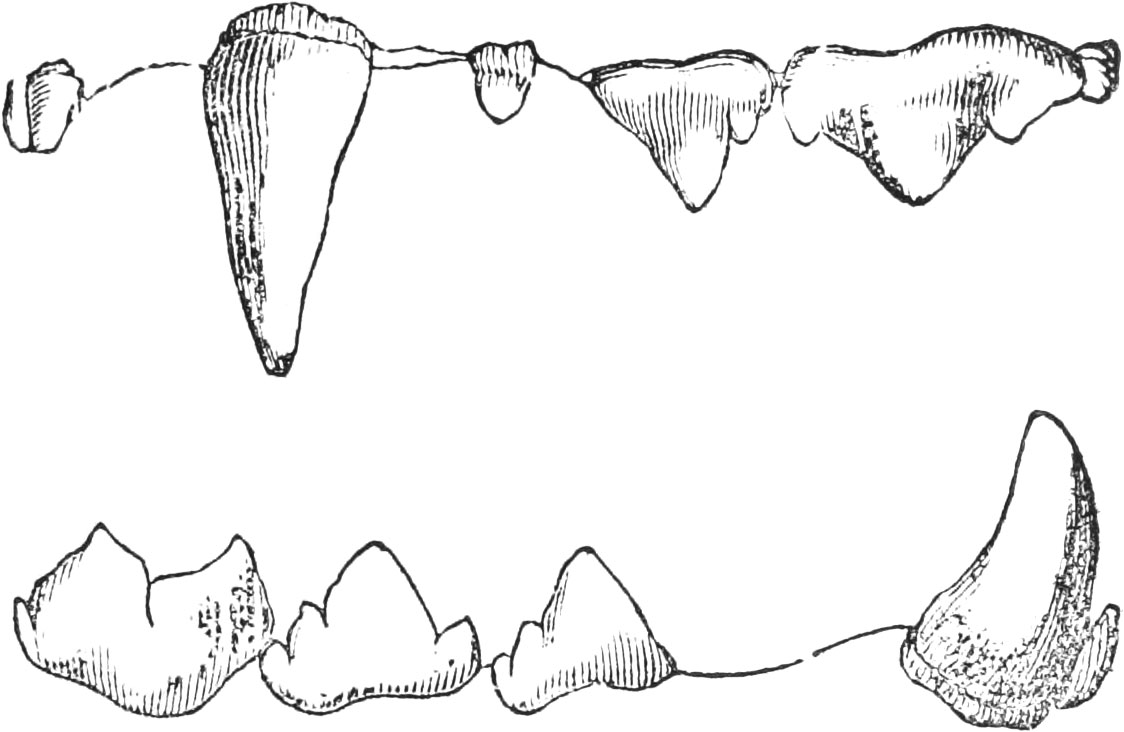
Teeth
The structure of the joint of the jaw assists this property; it is so constructed as to be incapable of a lateral motion, and the whole strength of the muscles is thus exerted in a perpendicular or cutting direction. The strength of the muscles employed in this action is prodigious, and some idea maybe formed of it by inspecting the markings upon the accompanying cut of the skull of the jaguar, and the great spaces which are allowed for their action. In addition to these implements for tearing and cutting their food, may be noticed the surface of the tongue, which is covered with numerous horny papillae, having the points directed backwards, and whose effect may be observed, when a lion or any large animal of the tribe is licking a hone, which is too powerful for his strong jaws to break.
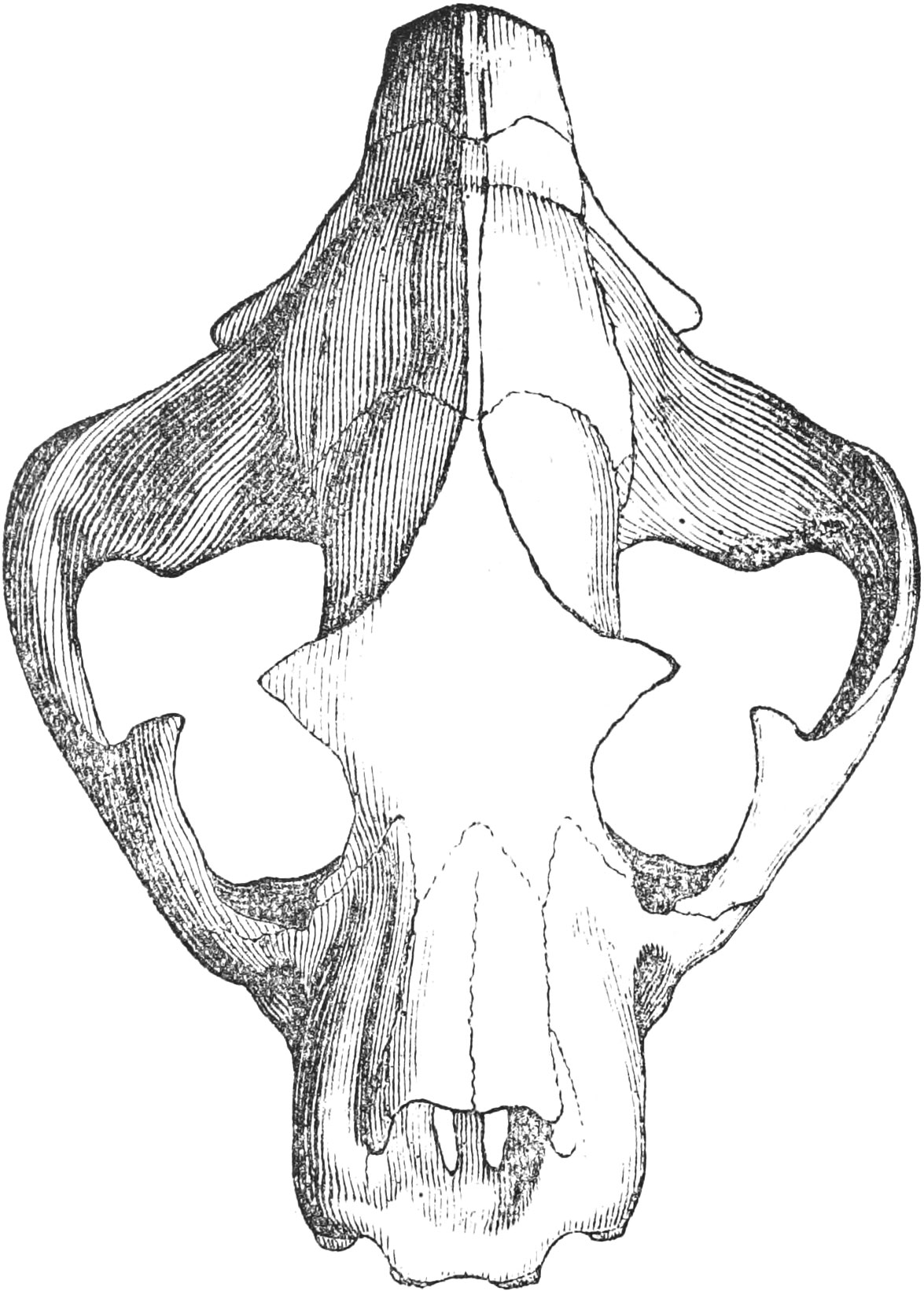
Jaw
It is suited more for laceration, and to retain the food within the mouth, than for an organ of taste; and the gustatory nerves are comparatively small, and distributed principally to the muscles.7 In the different species, these papillæ have not a similar arrangement, some are in straight rows and others run in alternate lines. Most people are familiar with the sensation produced when the common cat licks the hand; by the lion more marked traces would be left.
The fore-limbs exhibit a still more beautiful arrangement for strength and seizure. Sir Charles Bell writes,
The muscles of the fore-arm-of the lion bear a strong resemblance and shape to those of the same part in man. The flexors, extensors, pronators, and supinators, are, in the brute, exactly in the same place, and bear all the relations which the student of anatomy is taught to observe with so much interest in the human arm.8
Hence the power to inflict a blow at the moment of their fatal bound, which either kills or completely stuns their victim. The stroke from a Bengal tiger has been known to fracture a man’s skull. The feet having five toes on the fore extremity, and four only on the hind, complete the work. They are armed with most powerful, hooked, sharp, and hard claws, admirably fitted for tearing, and no less admirably protected by a peculiar mechanism, from being broken or blunted, or otherwise injured in the ordinary motions or walking of their possessors.
The accompanying figure illustrates this mechanism in the foot of the lion; and we are indebted to Professor Traill for a description of the parts, and the use of a clever sketch by Mosses, taken from a male of about two years and a half old, which was dissected by Dr Traill.
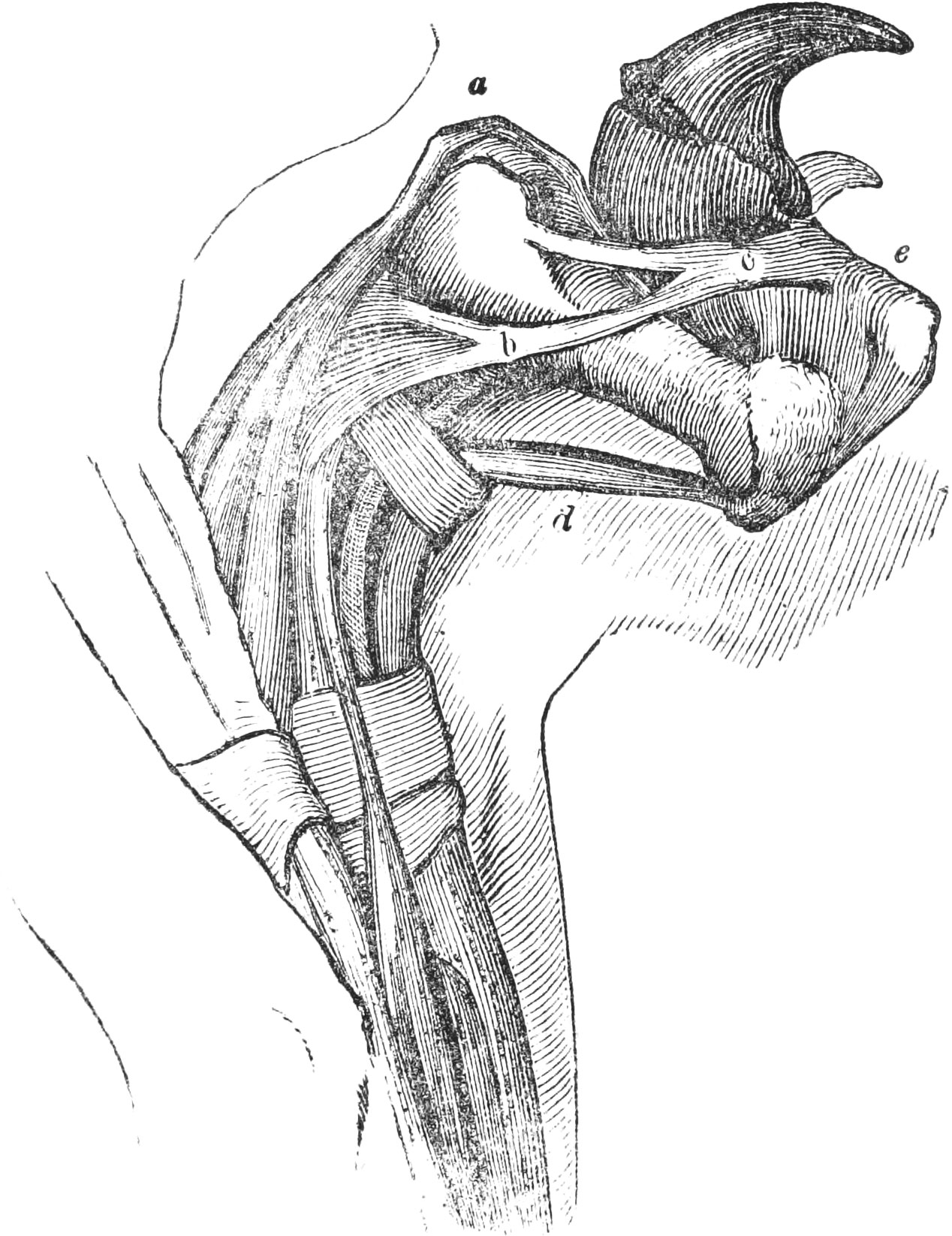
Foot
The position of the phalanges represents the claw in a state of retraction. The claw is supported on the last phalanx, which is of a very peculiar form. Its two portions are united to each other at nearly right angles. The base of the claw is received into a groove in the body of the bone, to prevent its being pushed backwards in the violent action of the paws. The two parts of the bone form a species of hook or crotchet. The superior end of this phalanx, in this state of repose, is placed almost vertically; while the other extremity lies nearly parallel to the second. The articulation is at the upper end of the vertical portion, and the flexor tendons, passing over the upper part of the bone, are strongly fixed to the other portion. The action of the flexor profundus causes the whole bone to move through 90° round the end of the second phalanx. The last phalanx is kept in its retracted state by the tendon a, which passes from the extensor tendon up to the base of the third phalanx; and also by b and c, elastic ligaments which proceed by double beads from the tendinous expansion at the top of the second phalanx, and form bands on each side, which are united at the palmar base of the claw. From the twisted form of the second phalanx, the third does not move over its end in the same place, but on retraction falls a little on its outer side.
d. is the strong round tendon of the flexor profundus, which passes over the superior extremity of the last phalanx to e, as over a pulley, giving prodigious power to the action of that muscle. This tendon does not arise, as in man, directly from the belly of the muscle, but from a flat irregular cartilaginous body, 2\(\frac{3}{4}\) inches long, and 1\(\frac{1}{2}\) broad, attached to the lower end of the muscle, and sliding between the annular ligament, and a very thick fascia covering the bottom of the forepaw; from this substance five very strong tendons proceed to the fingers, which perforate the tendons of the sublimus nearly as in other animals.
They are strongly strapped down, as seen in the figure.
In addition to these weapons, we also perceive, when examining an animal of this tribe, that the neck and muscles of the fore quarter are particularly powerful. When some prey has been killed, a large deer or bullock, it will require no ordinary strength to tear it open, or to drag and carry it to a secure retreat; and there seems good authority for believing, that the strength of these parts in the lion will enable him to carry off an ox or heifer with apparent ease.9 In other species, they are of a power as great in comparison to their size; and the prey is always dragged off; never, except perhaps in a case of great hunger, devoured where it is seized.
When we consider, then, these arrangements for destruction, and the fierce and murderous instincts with which the feline animals are endowed, we may be at a loss to comprehend what place they hold in the plans and economy of nature; but in looking a little farther, we will perceive that the races of herbivorous animals, without a natural check, would soon become too numerous for the substances which have been allotted for their nourishment, and, by creating famine, would be the cause of their own destruction. Instances of such a sweep upon the vegetation of a country, have in reality occurred. A recent traveller in South Africa, thus writes of the migrations of the Trek-boken or Migratory Springboks:—10
It is scarcely possible for a person passing over some of the extensive tracts of the interior, and admiring that elegant antelope, the Springbok, thinly scattered over the plains, and bounding in playful innocence, to figure to himself that these ornaments of the desert can often become as destructive as the locusts themselves. The incredible number which sometimes pour in from the north, during protracted droughts, distress the farmer inconceivably. Any attempt at numerical computation would be vain; and by trying to come near the truth, the writer would subject himself, in the eyes of those who have no knowledge of the country, to a suspicion that he was availing himself of a traveller’s assumed privilege; yet it is we known in the interior, that, on the approach of the Trek-boken, the grazier makes up his mind to look for pasturage for his flocks elsewhere, and considers himself entirely dispossessed of his lands, until heavy rains fall. Every attempt to save the cultivated fields, if they he not enclosed by high and thick hedges, proves abortive. Heaps of dry manure (the fuel of the Sneeuwbergen and other parts) are placed close to each other round the fields, and set on fire in the evening, so as to cause a dense smoke, by which it is hoped the antelopes will be deterred from their inroads; but the dawn of day exposes the inefficiency of the precaution, by shewing the lands, which appeared proud of their promising verdure the evening before, covered with thousands, and reaped level with the ground.
In their uses also to man, this balancing of creation, as it were, is the most important. The more direct benefits will be comprehended in the commerce which is maintained with their skins, which alike form comfortable protections from cold and the inclemencies of the weather, and are beautiful and ornamental articles of dress. Immense numbers of various skins are imported by the Chinese, where they are worn as emblems of rank. Still greater numbers are introduced into Russia, where they are worn in winter as real necessaries; and in the more temperate districts of Europe and Britain, perhaps the consumption during the same season is little inferior as ornamental dresses.
The classification of these animals appears to have been unsatisfactory to most naturalists, and so far artificial that it separates allied species from each other, and in one or two instances brings opposite forms together. Temminck divides them into two sections, those of the Old, and those of the New World; while, by Cuvier, they are arranged according to the presence or want of spots, and by the distribution and form of these upon the skin; the latter arrangement has been followed in most of the later systems, and will be found more extended in Desmarest’s Mammalogie, where there are seven subdivisions, in which the form of the ears is also included.
The Linnæan genus Felis, to which we have in the present volume applied the family name of Felinæ, is a group containing nearly fifty species, of which all the characters, though very closely assimilated,11 at the same time exhibit a variety of subordinate forms, which diverge from the typical genus, and show an alliance with the other sub-families of the Carnivora. The Prince of Musignano, in his family Felina, admits Proteles, Hyæna, and Prionodon. In restricting it, as we at present do, to the Linnæan Felis, we may be wrong, from being unable to examine many of the aberrant forms of what we consider Felinæ, and also those of the other families; but none of the above mentioned genera, we would say, can rank here, while they appear to have beautiful and appropriate stations elsewhere.
The Linnæn genus Felis has also, by different naturalists, been subdivided; the title Felis being retained for Tiger, Leopard, &c., which seem to display the characters of the family in the greatest perfection. Dr Leach formed a genus from the Lion, Leo, which will perhaps now contain three species, as some naturalists are of opinion that the African and Asiatic Lions are distinct, and we learn from the reports of the Zoological Society of London, that the long sought for maneless Lion has been discovered. Mr Gray has also made a genus from the lynxes, Lynchus; and M. Wagler, to the Felis jubata, gives the name of Cynailurus. Another form seems yet uncharacterized in the Puma, Jagourandi, &c., which have a flattened head and peculiar physiognomy, comparatively short legs, and the tail more furry or brushlike than the others. There thus seem to be five very distinct forms, but whether those which we have now mentioned would typically represent them, we cannot with decision assert. It maybe remarked, that both the Lynchus of Gray, and Felis, as we have placed it, would contain subordinate sections, which might rank as sub-genera.
We have experienced considerable difficulty in procuring specimens, or good copies, from whence to make the drawings for the accompanying illustrations. A few have been taken from the lithographic plates of Frederic Cuvier’s Histoire Naturelle des Mammiferes, and the Atlas of Ruppel, and those from other works are mentioned in the details; we have also two beautiful drawings by Mr Lear of London, taken from animals in the Surry Zoological Gardens; but drawings for the greater number of the plates have been made from specimens in the Edinburgh Museum, for the examination of which every facility was afforded by Professor Jameson. These drawings were all executed by Mr Stewart, whose assistance in this department we were fortunate in obtaining about the commencement of the work, and whose talents in the delineation of animals will supply a want which has been long sought after by the Naturalists of the Scottish Metropolis.
We shall now commence the detailed history of the animals of this group, with the description of
The Lion12
Felis Leo.—Auctorum.
Leo, Λέων, of the ancients.—Felis Leo of modern Naturalists.—Type of the Genus Leo, Dr Leach.
If we measure the station of the animals belonging to this group by their size and prowess, the Lion will undoubtedly hold the first; and by all its describers it has been allowed that place. Numerous figures of this formidable cat have been given in the various illustrated works on natural history, and, although they convey to us a certain knowledge of the form and appearance of the animal, they fall far short of our idea of the Lion roaming free and uncontrolled in his own deserts. The limited size of the accompanying illustrations is against any improvement in this department; but we have selected for our copies the plates of Mareschall, Frederic Cuvier, and Edwards, which we consider generally characteristic.
The Lion at present is an inhabitant of the greater part of Africa, and the warmer districts of India. In the days of antiquity, the range seems to have been much more extended, and reached to the European boundary. Lions were even found in the mountains of northern Greece; and, according to Herodotus, the camels which carried the baggage of the army of Xerxes were attacked by them in the country of the Pseonians, one of the races of Macedonia. In Africa, they may now be said to be extirpated from the line of coast, and nearly mark the boundary of civilization; while Mr Bennet remarks, that
In the sandy deserts of Arabia, and in some of the wilder districts of Persia, and in the vast jungles of Hindostan, he still maintains a precarious footing; but from the classic soil of Greece, as well as from the whole of Asia Minor, both of which were once exposed to his ravages, he has been utterly dislodged and extirpated.
In both Africa and India, he seems confined to the plains, rather than the wooded and alpine country; and the forest can scarcely be called the natural abode of the lion, especially when we contrast his habits with some others of the Felinæ, which are found only in those of the thickest and most impervious description, and which prowl and display almost as much activity among the branches of the trees as upon the ground. Burchel remarks,
Nor is the title of “King of the Forest” very applicable to an animal which, by myself at least, was never met but on the plains, and certainly never in any of the forests where I have been.
In India, where the character of the lower country is more that of a thick jungle than of an open plain, he has more ample shade; hbut in the arid plains of Africa, where the cover mostly fringes the banks of the rivers, or marks the spot of some spring of the desert, he is more frequently seen; he is satisfied with a less extensive and impervious protection, and is often disturbed from a patch of brush or rushes. Burchel met with a pair in such a situation as this, which was perhaps one of his most dangerous encounters throughout his long and varied travels, and in which his presence of mind brought him off unhurt. It is thus related in his interesting African Travels:
The day was exceedingly pleasant, and not a cloud was to be seen. For a mile or two, we travelled along the banks of the river, which, in this part, abounded in tall mat-rushes. The dogs seemed much to enjoy prowling about, and examining every bushy place, and at last met with some object among the rushes which caused them to set up a most vehement and determined barking. We explored the spot with caution, as we suspected, from the peculiar tone of their bark, that it was, what it proved to be, lions. Having encouraged the dogs to drive them out, a task which they performed with great willingness, we had a full view of an enormous black-maned lion and lioness. The latter was seen only for a minute, as she made her escape up the river, under concealment of the rushes; but the lion came steadily forward, and stood still to look at us. At this moment we felt our situation not free from danger, as the animal seemed preparing to spring upon us, and we were standing on the bank, at the distance of only a few yards from him, most of us being on foot, and unarmed, without any visible possibility of escaping. I had given up my horse to the hunters, and was on foot myself; but there was no time for fear, and it was useless to attempt avoiding him Poor Truy was in great alarm: she clasped her infant to her bosom, and screamed out, as if she thought her destruction inevitable, calling anxiously to those who were nearest the animal, Take care! Take care! In great fear for my safety, she half insisted upon my moving farther off. I, however, stood well upon my guard, holding my pistols in my hand, with my finger upon the trigger; and those who had muskets kept themselves prepared in the same manner. But at this instant the dogs boldly flew in between us and the lion, and surrounding him, kept him at hay by their violent and resolute barking. The courage of those faithful animals was most admirable: they advanced up to the side of the huge beast, and stood making the greatest clamour in his face, without the least appearance of fear. The lion, conscious of his strength, remained unmoved at their noisy attempts, and kept his head turned towards us. At one moment, the dogs perceiving his eye thus engaged, had advanced close to his feet, and seemed as if they would actually seize hold of him; but they paid dearly for their imprudence, for, without discomposing the majestic and steady attitude in which he stood fixed, he merely moved his paw, and, at the next instant, I beheld two lying dead. In doing this, he made so little exertion, that it was scarcely perceptible by what means they had been killed. Of the time which we gained by the interference of the dogs, not a moment was lost: we fired upon him; one of the balls went through his side, just between the short ribs, and the blood began to flow, but the animal still remained standing in the same position. We had now no doubt that he would spring upon us: every gun was instantly reloaded; but happily we were mistaken, and were not sorry to see him move quietly away, though I had hoped in a few minutes to have been enabled to take hold of his paw without danger.
The appearance of the lion, when unannoyed, or in confinement, where he is generally very tame, does not convey to us that idea of ferocity which generally associates itself with the greater number of the feline race. His ample front, and overhanging brows, surrounded with a long and shaggy mane, remind us of something more majestic than ferocity; but the gleam from his eye on the slightest motion of the bystander, the expression of his countenance, and erection of his mane upon provocation, shew that he will not be trifled with, and are sufficient intimations of the powers he is able to call to his assistance. The general form of the lion is stronger in front than the proportions of his congeners; and his broad chest and shoulders, and thick neck, point out the strength he possesses to seize and carry off a prey of even greater weight than himself. His common colour is of a rich brownish-yellow, and the head and neck of the males are covered with long flowing and shaggy hair, commonly denominated the mane, which is wanting in the females. This mane, and the tuft at the extremity of the tail, are peculiar to the lion only, and are possessed by none of the others in this group.
We shall first notice the lion in its wild or natural state, and afterwards the influence acquired over it by the ingenuity and tuition of man. In the actions of all animals, the influence of hunger has a very powerful effect, and the attributes of cruelty which have generally been given to this race, have been called forth by their search after natural sustenance. In like manner are they endowed with cunning and daring; and we accordingly find animals of such size and bulk as the lion and tiger, endowed with powers sufficient to overcome creatures both great and strong. When not pressed by the severe calls of hunger, the lion feeds chiefly at dawn and twilight, and is easily disturbed: he is nevertheless abroad during the whole night, and, prowling round the herds of wild animals, or near the flocks of the settlers, or caravans of travellers, watches an opportunity, and, seizing upon some straggler, carries it to his place of repose, and devours it at leisure. But impelled by the craving of hunger, which the scarcity of wild animals, and the care of the colonists sometimes force him to endure, he becomes a very different animal: his cunning becomes daring, no barrier will withstand him—he rushes with resistless fury upon the object of his attack—a bullock is torn from the team, or a horse from the shafts—and even man is dragged from the watch-fires, surrounded by his companions and powerful fire-arms.
Perseverance in watching, and in retaining his prey when seized, are other characteristics of the lion. An instance of the latter is related in the Journal of the Landdrost Jail. Sterneherg, kept in his journey to the Namaqua Hottentots. We have taken it from Phillips’s Researches in South Africa:
The waggons and cattle had been put up for the night, when, about midnight, they got into complete confusion. About thirty paces from the tent stood a lion, which, on seeing us, walked very deliberately about thirty paces farther behind a small thorn bush, carrying something with him which I took to be a young ox. We fired more than sixty shots at the hush. The south-east wind blew strong, the sky was clear, and the moon shone very bright, so that we could perceive any thing at a short distance. After the cattle had been quieted again, and I had looked over every thing, I missed the sentry from before the tent. We called as loudly as possible, but in vain; nobody answered, from which I concluded he was carried off. Three or four men then advanced very cautiously to the bush, which stood right opposite the door of the tent, to see if they could discover any thing of the man, but returned helter-skelter; for the lion, who was still there, rose up, and began to roar. About a hundred shots were again fired at the hush, without perceiving any thing of the lion. This induced one of the men again to approach it with a firebrand in his hand; but as soon as he approached the hush, the lion roared terribly, and leaped at him, on which he threw the firebrand at him, and the other people having fired about ten shots at him, he returned immediately to his former station.
The firebrand which he had thrown at the lion had fallen in the midst of the bush, and, favoured by the wind, it began to burn with a great flame, so that we could see very clearly into it, and through it. We continued our firing into it: the night passed away, and the day began to break, which animated every one to fire at the lion, because he could not lie there, without exposing himself entirely. Seven men, posted at the farthest waggons, watched to take aim at him as he came out. At last, before it became quite light, he walked up the hill with the man in his mouth, when about forty shots were fired without hitting him.
He persevered in retaining the prey amidst the fire and shot, and amidst it all carried it securely off’. For the satisfaction of the curious, it may however be mentioned, that he was followed, and killed in the forenoon, over the mangled remains of the unfortunate sentinel. His strength on these occasions is immense. There seems good authority for his being able to drag away a heavy ox; and a young heifer is carried off with ease. Sparrman relates an instance of a lion, at the Cape of Good Hope,
seizing a heifer in his mouth, and though the legs dragged upon the ground, yet he seemed to carry her off with the same ease as a cat does a rat. He also leaped over a broad dike with her, without the least difficulty.
The smaller prey is generally thrown upon the shoulders, and carried at an ambling pace with great apparent ease. Thompson, a recent traveller in South Africa, saw a very young lion convey a horse about a mile from the spot where he had killed it; and relates a more extraordinary instance of strength, which occurred in the Sneeuwberg:
A lion having carried off a heifer of two years’ old, was followed, on the spoor or track, for fully five hours, by a party on horseback, and, throughout the whole distance, the carcass of the heifer was only once or twice discovered to have touched the ground.
The most common and favourite prey of the lion is the various species of deer and antelope which abound in the plains of Africa and jungles of India. The zebra and quagga, bullock and buffalo, are also frequent victims; but the latter is frequently the victor, both in the public arena, and when attacked openly; and, unless two lions bunt in concert, the “horned front” proves a sufficient defence, and the powerful assailant is gored in the attack, which severe hunger may force him to brave openly. It is asserted by the native African tribes, and told to European travellers by the chiefs, that the camel-leopard is sometimes also attacked; and the strength of that animal is such, that the assailer is sometimes carried to a distance of fifteen or twenty miles, before terror and the loss of blood cause it to sink. The truth of this has often been questioned; for our own part, we believe in the attack, but doubt the ride. It has been, however, sufficient authority for the poet; and, in a South African periodical, we find a short poem devoted to this subject. The description of the ride may not be without interest.
The desert rings
With clanging sound of desperate strife;
For the prey is strong, and strives for life;
Plunging oft, with frantic bound,
To shake the tyrant to the ground;
Then bursts like whirlwind through the waste,
In hope to ’scape by headlong haste:
In vain! The spoiler on his prize
Rides proudly, tearing as he flies.For life—the victim’s utmost speed
Is mustered in this hour of need;
For life—for life—his giant might
lie strains, and pours his soul in flight;
And, mad with terror, thirst, and pain,
Spurns with wild hoof the thund’ring plain.’Tis vain! The thirsty sands are drinking
His streaming blood—his strength is sinking—
The victor’s fangs are in his veins—
His flanks are streaked with sanguine stains—
His panting breast in foam and gore
Is bathed—he reels—his race is o’er!
It is a common opinion among the South African tribes, that the lion will prefer a human prey to any other, will single out the driver from his cattle, and prefer the rider to his horse. This has gradually gained converts among the better informed, and in many of the colonies it is generally received as a fact. Sometimes he will seize any prey, but animals are certainly his favourite luxury, and none more than a horse, the pursuit of which, among other cattle, has given rise to the idea that the rider most attracted his attention. In corroboration of this, Thompson relates an incident which befel a boor who resided in the neighbourhood of his own farm in the colonies.
Lucas Van Vunsen, a Vee boor, was riding across the open plains, near the Little Fish River, one morning about daybreak; and observing a lion at a distance, he endeavoured to avoid him by making a wide circuit. There were thousands of springboks scattered over the extensive flats; but the lion, from the open nature of the country, had been unsuccessful in hunting. Lucas soon perceived that he was not disposed to let him pass without farther parlance, and that he was rapidly approaching to the encounter; and, being without his rifle, and others wise little inclined to any closer acquaintance, he turned off at right angles, laid the sjambok freely to his horse’s flank, and gallopped for life. But it was too late. The horse was fagged, and bore a heavy man on his back. The lion was fresh, and furious with hunger, and came down upon him like a thunderbolt. In a few seconds he overtook, and, springing up behind Lucas, brought horse and man in an instant to the ground. Luckily the poor boor was unhurt; and the lion was too eager in worrying the horse to pay any immediate attention to the rider. Hardly knowing how he escaped, he contrived to scramble out of the fray, and reached the nearest house in safety.
A perusal of Park’s Second Journey to the Niger will also afford many proofs of their indifference to the human race as their prey. During the last part of that unfortunate expedition, lions hung upon the route continually; but the asses of burden were what was sought after. Two-thirds of the soldiers and followers were so ill as to be unable to keep up with what was called the main body; many of them constantly lying down to die, and actually perishing, and the whole troop was so weak as to be an easy prey to animals of the kind. Not an individual was lost by them, though the havoc among the asses was considerable. Once only a hostile display was made, by three lions, on Park himself, when attending upon his dying friend Mr Scott, and a single shot was sufficient to drive them completely off.
Hunting the lion in Africa is generally pursued for the sake of destroying the animal only, without any view of sport. A regular hunt, when the country turns out, is a complete scramble, and a mixture of men of various figures and complexions; the dogs innumerable, and of every kind. Vaillant has given some ludicrous pictures of the tiger hunt, as the leopard is here termed; but we must have recourse again to Mr Thompson’s travels, from whom we have borrowed so largely in this article, for an account of a lion-hunt, after the manner of the country, which he witnessed himself, and which will give some idea of these encounters.
I was then residing on my farm, or location, at Bavion’s River, in the neighbourhood of which numerous herds of large game, and consequently beasts of prey, are abundant. One night, a lion, who had previously purloined a few sheep out of the kraal, came down and killed my riding-horse, about a hundred yards from the door of my cabin. Knowing that the lion, when he does not carry off his prey, usually conceals himself in the vicinity, and is moreover very apt to be dangerous, by prowling about the place in search of more game, I resolved to have him destroyed or dislodged without delay. I therefore sent a messenger round the location, to invite all who were willing to assist in the foray, to repair to the place of rendezvous as speedily as possible. In an hour, every man of the party (with the exception of two pluckless fellows, who were kept at home by the women) appeared ready mounted and armed. We were also reinforced by about a dozen of the Bastard Hottentots, who resided at that time upon our territory, as tenants or herdsmen; an active and enterprising, though rather an unsteady race of men.
The first point was to track the lion to his covert. This was effected by a few of the Hottentots on foot. Commencing from the spot where the horse was killed, we followed the spoor through grass, and gravel, and brushwood, with astonishing ease and dexterity, where an inexperienced eye could discern neither foot-print nor mark of any kind; until, at length, we fairly tracked him into a large bosch, or straggling thicket of brushwood and evergreens, about a mile distant.
The next object was to drive him out of this retreat, in order to attack him in a close phalanx, with more safety and effect. The approved mode in such cases is to torment him with dogs till he abandons his covert, and stands at bay in the open plain. The whole band of hunters then march forward together, and fire deliberately one by one. If he does not speedily fall, but grows angry, and turns upon his enemies, they must stand close in a circle, and turn their horse’s rear outward; some holding them fast by the bridles, while the others kneel to take a steady aim at the lion as he approaches, sometimes up to the very horses’ heels, couching every now and then, as if to measure the distance and strength of his enemies. This is the moment to shoot him fairly in the forehead, or some other mortal part. If they continue to wound him ineffectually, till he waxes furious and desperate, or if the horses, startled by his terrific roar, grow frantic with terror, and burst loose, the business becomes rather serious, and may end in mischief, especially if all the party are not men of courage, coolness, and experience. The Frontier boors are, however, generally such excellent marksmen, and withal so cool and deliberate, that they seldom fail to shoot him dead as soon as they get within a fair distance.
In the present instance, we did not manage matters quite so scientifically. The Bastaards, after recounting to us all these and other sage laws of lion-hunting, were themselves the first to depart from them. Finding that with the few indifferent hounds we had made little impression on the enemy, they divided themselves into two or three parties, and rode round the jungle, firing into the spot where the dogs were barking round him, but without effect. At length, after some hours spent in thus beating about the bush, the Scottish blood of some of my countrymen began to get impatient, and three of them announced their determination to break in and beard the lion in his den, provided three of the Bastaards (who were superior marksmen) would support them, and follow up their fire, should the enemy venture to give battle. Accordingly, in they went (in spite of the warnings of some more prudent men), to within fifteen or twenty paces of the spot where the animal lay concealed. He was couched among the roots of a large evergreen, but with a small space of open ground on one side of it; and they fancied, on approaching, that they saw him distinctly lying glaring at them under the foliage. Charging the Bastaards to stand firm, and level fair, should they miss, the Scottish champions let fly together, and struck—not the lion, as it afterwards proved, but a great block of red stone, beyond which he was actually lying. Whether any of the shot grazed him is uncertain; but, with no other warning than a furious growl, forth he bolted from the bush. The rascally Bastaards, in place of pouring in their volley upon him, instantly turned and ran, helter-skelter, leaving him to do his pleasure upon the defenceless Scots, who, with empty guns, were tumbling over each other, in their burry to escape the clutch of the rampant savage. In a twinkling he was upon them, and, with one stroke of his paw, dashed the nearest to the ground. The scene was terrific! There stood the lion, with his foot upon his prostrate foe, looking round in conscious pride upon the bands of his assailants, and with a port the most noble and imposing that can be conceived. It was the most magnificent thing I ever witnessed. The danger of our friends, however, rendered it at the moment too terrible to enjoy either the grand or the ludicrous part of the picture. We expected every instant to see one or more of them torn in pieces; nor, though the rest of the party were standing within fifty paces, with their guns cocked and levelled, durst we fire for their assistance. One was lying under the lion’s feet, and the others scrambling towards us, in such a way as to intercept our aim upon him. All this passed far more rapidly than I have described it; but, luckily, the lion, after steadily surveying us for a few seconds, seemed willing to be quit on fair terms; and, with a fortunate forbearance, turned calmly away, and, driving the snarling dogs like rats from among his heels, bounded over the adjoining thicket, like a cat over a footstool, clearing brakes and bushes, twelve or fifteen feet high, as readily as if they had been tufts of grass, and, abandoning the jungle, retreated towards the mountains.
After ascertaining the state of our rescued comrade, who fortunately had sustained no other injury than a slight scratch on the back, and a severe bruise on the ribs, from the force with which the animal had dashed him to the ground, we renewed the chase, with Hottentots and hounds, in full cry. In a short time we again came up with the enemy, and found him standing at bay under an old mimosa-tree, by the side of a mountain-stream, which we had distinguished by the name of Douglas Water. The dogs were barking round, but afraid to approach him, for he was now beginning to growl fiercely, and to brandish his tail in a manner that shewed he was meditating mischief. The Hottentots, by taking a circuit. between him and the mountain, crossed the stream, and took a position on the top of a precipice overlooking the spot where he stood. Another party occupied a position on the other side of the glen; and, placing the poor fellow thus between two fires, which confused his attention, and prevented his retreat, we kept battering at him, without truce or mercy, till he fell, unable again to grapple with us, covered with wounds and glory.
Such is the usual way of destroying, rather than hunting this mighty beast, where a host of men and dogs can be collected; and without some great indiscretion on the part of the men, these encounters are generally attended with little danger. The noise and worrying of the dogs, and shouts of their owners, distract the attention of the animal, until an opportunity for shots occur, which soon terminates the affair, the boors being very expert in the use of the rifle.
Some of the boors take a pride in shooting the lion without assistance; and in those remote settlements this is often practised from necessity. These men possess a steady coolness and presence of mind, with a reckless intrepidity, which a knowledge of the animal, and reliance upon themselves, could only inspire. One man will set out to shoot a lion; his only weapons, the long belt knife which is constantly worn, and his single barrelled rifle His life is almost placed upon the excellency of the lock of his gun, and, missing fire, or a very slight and unforeseen accident, places him in a situation from which all his daring sometimes cannot extricate him.
In these excursions a knowledge of the habits of the animal renders the boors often successful, and the following method is practised. When the lion is found and roused, he is allowed to approach, and before making the spring or bound, it is the practice always to couch, and to aim, as it were, at the object. Now is the time when the dexterity and coolness of the boors is put to the test; the animal is within twenty yards, the rifle is slowly raised, and deliberate aim is taken at the forehead. The aim is generally correct, and the bullet fatal; if the reverse, the bound is instantaneous, the situation of the huntsman most perilous, but even here his coolness does not forsake him.
Diederik Muller, one of the most intrepid and successful modern lion-hunters in South Africa, had been out alone hunting in the wilds, when he came suddenly upon a lion, which, instead of giving way, seemed disposed, from the angry attitude he assumed, to dispute with him the dominion of the desert. Diederik instantly alighted, and, confident of his unerring aim, levelled his mighty roar at the forehead of the lion, who was couched in the act to spring, within fifteen paces of him; but at the moment the hunter fired, his horse, whose bridle was round his arm, started back, and caused him to miss. The lion bounded forward, but stopped within a few paces, confronting Diederick, who stood defenceless, his gun discharged, and his horse running off. The man and the beast stood looking each other in the face, for a short space. At length the lion moved backward, as if to go away. Diederik began to load bis gun, the lion looked over his shoulder, growled and returned. Diederik stood still. The lion again moved cautiously off, and the boor proceeded to load and ram down his bullet. The lion again looked back and growled angrily; and this occurred repeatedly, until the animal had got off to some distance, when he took fairly to his heels, and bounded away.
The following relation of an encounter of another kind, will still more forcibly exhibit the coolness and presence of mind in the South African boor, upon any trying emergency, or unexpected attack from wild beasts; while it will shew that the lion will occasionally seek his prey during the day, and near the haunts of men. It is taken from Professor Lichtenstein’s Travels.
When passing near the Riet river-gate, and while our oxen were grazing, Van Wyk, the colonist, related to us the following interesting circumstance. He said,
It is now, more than two years since, in the very place where we stand, I ventured to take one of the most daring shots that ever was hazarded. My wife was sitting within the house, near the door, the children were playing about her, and I was without, near the house, busied in doing something to a waggon, when suddenly, though it was mid-day, an enormous lion appeared, came up and laid himself quietly down in the shade, upon the very threshold of the door. My wife, either frozen with fear, or aware of the danger attending any attempt to fly, remained motionless in her place, while the children took refuge in her lap. The cry they uttered attracted my attention, and I hastened towards the door; but my astonishment may well he conceived, when I found the entrance to it barred in such a way. Although the animal had not seen me, unarmed as I was, escape seemed impossible, yet I glided gently, scarcely knowing what I meant to do, to the side of the house, up to the window of my chamber, where I knew my loaded gun was standing. By a most happy chance I had set it into the corner close by the window, so that I could reach it with my hand; for, as you may perceive, the opening is too small to admit of my having got in; and, still more fortunately, the door of the room was open, so that I could see the whole danger of the scene. The lion was beginning to move, perhaps with the intention of making a spring. There was no longer any time to think; I called softly to the mother not to be alarmed: and invoking the name of the Lord, fired my piece. The ball passed directly over the hair of my boy’s head, and lodged in the forehead of the lion, immediately above his eyes, which shot forth, as it were, sparks of fire, and stretched him on the ground, so that he never stirred more.
Indeed, we all shuddered as we listened to this relation. Never, as he himself observed, was a more daring attempt hazarded. Had he failed in his aim, mother and children were all inevitably lost; if the boy had moved, he had been struck; the least turn in the lion, and the shot had not been mortal to him. To have taken an aim at him without, was impossible; while the shadow of any one advancing in the bright sun, would have betrayed him; to consummate the whole, the head of the creature was in some sort protected by the door-post.
Penetrating still further to the interior, where the rifle has not usurped the place of the arrow and assagay, we have the record of another method of destroying the lion. For an account of it we are also indebted to Phillips’s Researches. It has been generally observed that the lion is awakened with difficulty after his meal, and, when suddenly disturbed, loses all presence of mind, and runs off in dismay. The knowledge of this is taken advantage of by the bushmen. Phillips says,
It has been remarked of the lion by the bushmen, that he generally kills and devours his prey in the morning, at sunrise or at sunset. On this account, when they intend to kill lions, they generally notice where the springboks are grazing at the rising of the sun; and by observing at the same time if they appear frightened and run off, they conclude that they have been attacked by the lion. Marking accurately the spot where the alarm took place, about eleven o’clock of the day, when the sun is powerful, and the enemy they seek is supposed to be fast asleep, they carefully examine the ground, and finding him in a state of unguarded security, they lodge a poisoned arrow in his breast. The moment the lion is thus struck, he springs from his lair, and bounds off as helpless as the stricken deer. The work is done. The arrow of death has pierced his heart, without even breaking the slumbers of the lioness which may have been lying beside him; and the bushman knows where, in the course of a few hours, or even less time, he will find him dead, or in the agonies of death.
Such is lion-hunting in Africa. When practised in India, it is attended with every concomitant of eastern pomp and show; but as a clever sketcher observes,
from the zeal of English sportsmen, and the price put upon each victim by Government, the royal race of the forest, like other Indian dynasties, is either totally extinct, or it has been driven far back into the deserts.
Captain Mundy continues,
By crack sportsmen, the lion is reputed to afford better sport than the tiger; his attack is more open and certain, and the country which he haunts is less favourable for a retreat, than the thick swampy morasses frequented by the tiger.13
Another Indian sportsman14 tells us, that the lion, though not so swift as the tiger, is generally stronger and more courageous. Those which have been killed in India, instead of running away when pursued through a jungle, seldom think its cover necessary at all. When they see their enemies approaching, they spring out to meet them, open-mouthed in the plain, like the boldest of all animals, a mastiff dog. They are thus generally shot with very little trouble; but if they are missed or only slightly wounded, they are truly formidable enemies. Though not swift, they leap with vast strength and violence, and their large heads, immense paws, and the great weight of their body forward, often enables them to spring on the head of the largest elephants, and fairly pull them to the ground, riders and all.
Lion-hunting is a much more casual sport in India than in Africa; the numbers of the tiger afford a good substitute, and a description of the pursuit of that animal, which we have given with its history, will convey an idea of the chase of the lion; they are attended with the same hair-breadth escapes, and exciting adventure, the same mixed array of noise and followers. We shall only add a single anecdote from the above mentioned sketches. It illustrates a situation in which the hunters of wild beasts may occasionally find themselves placed.
A lion having chased my hero’s elephant, and he having wounded him, was in the act of leaning forward in order to fire another shot, when the front of the houdah suddenly gave way, and he was precipitated over the head of the elephant into the very jaws of the furious beast. The lion, though severely hurt, immediately seized him, and would, doubtless shortly have put a fatal termination to the conflict, had not the elephant, urged by the mahout, stepped forward, though greatly alarmed, and grasping in her trunk the top of a young tree, bent it down across the loins of the lion, and thus forced the tortured animal to quit his hold! My friend’s life was thus preserved, but his arm was broken in two places, and he was severely clawed on the breast and shoulders.
We have now to examine the lion in a state of confinement, or, we might almost say, of domestication, for most of those which have been exhibited, or which are now to be seen in Europe, have either been taken young, or have been bred in this country, and have not acquired those propensities which example and necessity render so very marked in their native wilds. We have noticed in the introductory chapter, the early period at which menageries were established, first from superstition and pride, and as attendants of power and royalty; more lately for the purposes of emolument and science; almost none of these were reckoned complete without their lion, and this animal alone, in his district excursions, is sufficient to draw a crowd and revenue to his keepers It is from repeated observation upon these, that a knowledge of them in this situation has been gained; but we can only refer with confidence to such as have been exhibited within a comparatively late period.
The lion, when taken young, is easily tamed, principally by mild and persuasive usage, and appears to possess more equality of temper than any of the other cats, with which an acquaintance of intimacy has been formed. The more manageable he can be made, the more valuable he becomes to his proprietor, who puffs off in his bills the feats he performs, and the liberties he will allow. Great pains is therefore taken in his education or training, and the animal really becomes attached, and appears to go through his exhibitions with a sort of pleasure. Many of the keepers, perhaps, display more rashness than prudence, particularly when strangers are admitted to a share of the performance; and it may be remarked that the lion only, among the more powerful Felinæ, will admit visitors to a share of his benevolence. In these exhibitions the keeper generally enters the den or cage, and after caressing the animals, commences to shew what he dare take upon him, opening the mouth, and shewing the teeth and tongue, pulling out his claws, &c. Taking him by the tail is sometimes though less frequently resorted to; and putting the head into the animal’s mouth is looked upon as the greatest daring; and for this operation it is necessary to cover the face with a strong cotton or worsted cap to prevent the skin being lacerated by the rough structure of the tongue.
Nero, well known in Wombwell’s Menagerie, was of a remarkably mild disposition, and allowed his keepers every liberty; strangers were frequently introduced into the den, and when last in Edinburgh, this was a nightly exhibition, the visitors riding and sitting on his hack. Nero, during the while, preserved a look of magnanimous composure, and on the entrance or exit of a new visitor, would merely look slowly round.
But the most docile lion which has occurred to our own observation, was one in a travelling menagerie at Amsterdam, where, it may be remarked, that all the animals shewed a remarkable degree of tameness and familiarity. The lion alluded to, after being pulled about, and made to shew his teeth, &c., was required to exhibit; two young men in fancy dresses entered the spacious cage, and in the mean time, the lion, apparently perfectly aware of what he had to do, walked composedly round. He was now made to jump over a rope held at different heights; next through a hoop and a barrel, and again through the same covered with paper. All this he did freely, compressing himself to go through the narrow space, and alighting gracefully. His next feat was to repeat the leaps through the hoop and barrel with the paper set on tire; this he evidently disliked, but with some coaxing went through each. The animals were now all fed, but the lion had not yet completed his share in the night’s entertainment, and was required to shew his forbearance by parting with his food. The keeper entered the cage and took it repeatedly from him, no farther resistance than a short clutch and growl was expressed; his countenance had, however, lost its serenity, and how long his good temper would have continued, is doubtful. We did not previously believe that any of the Felinæ could have been so far tampered with. A fear or regard for the master or keeper is always manifested, and there are many instances, after long absence, of marked pleasure being shewn at again meeting. In an anecdote related by Major Hamilton Smith, great deference at least was shewn.
A keeper of wild beasts at New York, had provided himself, on the approach of winter, with a fur cap. The novelty of this costume attracted the notice of the lion, which, making a sudden grapple, tore the cap off his head, as he passed the cage; but, perceiving that the keeper was the person whose head he had thus uncovered, he immediately lay down.
The same animal once hearing some noise under its cage, passed its paw through the bar, and actually hauled up the keeper, who was cleaning beneath; but as soon as he had perceived that he had thus ill used his master, he instantly lay down upon his back, in an attitude of complete submission.15
The temper of the female seems even generally milder than that of the male, previous to her having young; but, says Mr Bennet,
from the moment she becomes a mother, the native ferocity of her disposition is renovated as it were with tenfold vigour, and woe to the wretched intruder, whether man or beast, who should unwarily at such a time approach her sanctuary.
A similar restless solicitude, but much less fierceness, was exhibited by a lioness, which had young in the Parisian Menagerie, and although she allowed the keeper to enter her den, and administer to her wants, a nearer approach or interference with the cubs would have been dangerous. When disturbed by visitors, she displayed great anxiety, and would carry her cubs round the cage for an hour at a time, much agitated and apparently wishful to conceal them. This anxiety began to diminish about the fifth month.16
The breeding-places of the lion in a wild state are generally selected in some deep cover, and all around is watched with such care, that a transgression of the prescribed boundary would speedily call forth an attack. From two to four are produced at a litter; they are born with open eyes, but continue helpless for some weeks. During that period they are nursed with the utmost solicitude, and in some instances at least, the male also attends. George, an Indian lion, alive in the Tower in 1829, was attended by both his parents, who, on the approach of a stranger, rushed fiercely to his defence. Mr Bennet thus relates his capture:—
It was in the commencement of the year 1823, when General Watson was on service in Bengal, that being out one morning on horseback, armed with a double-barrelled rifle, he was suddenly surprised by a large male lion, which bounded out upon him from the thick jungle, at the distance of only a few yards. He instantly fired, and, the shot taking complete effect, the animal fell dead almost at his feet. No sooner was this formidable foe thus disposed of, than a second, equally terrible, made her appearance in the person of the lioness, whom the General also shot at, and wounded so dangerously, that she retreated into the thicket. As her following so immediately in the footsteps of her mate, afforded strong grounds for suspecting that their den could not be far distant, he determined in pursuing the adventure to the end, and traced her to her retreat, where he completed the work of her destruction, by again discharging the contents of one of the barrels of his rifle, which he had reloaded for the purpose. In the den were found a beautiful pair of cubs, male and female, supposed to be then not more than three days old. These the general brought away with him, and succeeded, by the assistance of a goat, who was prevailed upon to act in the capacity of foster-mother to the royal pair, in rearing them until they attained sufficient age and strength to enable them to bear the voyage to England.
By great attention to cleanliness and feeding, and the general health of the animal, the proprietors of several menageries, both in Britain and upon the continent, have succeeded in procuring litters from the lioness in confinement;17 but at the shedding of the milk teeth, many of the young have been lost. For the first months they are very easily reared, and are remarkably playful, but their strength soon unfits them for playmates, and their natural dangerous propensities become developed at an early period. We recollect two (among the first which had been bred in this country) in 1819 or 1820, belonging to Mr Wombwell’s Travelling Menagerie, which exhibited all the playfulness of kittens; but their propensities were early displayed in the murder of a cardinal grossbeak, which was dragged through the wires of their cage and devoured, in the absence of Mrs Wombwell, who had the charge of the nurslings. Their size and strength increased rapidly, and in riotous play the unintentional protrusion of their claws produced sensations which taught that ere long they would tear severely.
From the above observations and anecdotes, which have almost exceeded our limits, we may conclude that the lion possesses the most certain and tractable, and the mildest disposition among the Felinæ, and is the most susceptible of recollection and attachment for those who have treated it with kindness; that, in general, it will not attack man unless attacked, or under the influence of extreme hunger; and that its most favourite prey is various animals among the Ruminantia, and some allied groups. But, notwithstanding all that has been recorded of its majesty, magnanimity, and gratitude, we cannot divest it of a share of that uncertain temper, which is a characteristic feature in the disposition of the Cats.
But we have yet spoken of the lions of Africa and India as the same animal, and have noticed only their habits and dispositions. By naturalists, the lions of these different countries have been described as varieties; the first being always of a darker shade, and more powerful form, than the latter. These characters are mentioned by all writers, and appear constant in the different countries; and we strongly suspect, that future observations will prove these animals to be, in reality, distinct species. We now propose to notice them separately, and shall first describe the African variety, or that which we believe will stand as the Leo Africanns.
Africa exhibits the lion in all his grandeur; and in many an unknown desert, he reigns with undisputed sway over the more feeble races. Here he appears most powerful, and of greatest size and fierceness; his disposition bold and fearless. Temminck, in his Monograph, places the African lion in two varieties, that of Barbary and that of Senegal; but without at all referring to those of the southern parts of the continent. There appear to be two varieties, or perhaps three; but they are more indiscriminately scattered over the country, and in the descriptions of the animals of Southern Africa, two kinds are also mentioned, the yellow and the brown, or, as they are sometimes termed by the Dutch colonists, the “blue and the black,” and which are analogous with the northern varieties. In what the above mentioned naturalist calls the Barbary lion, the hair is of a deep yellowish-brown, the mane and hair upon the breast and insides of the fore legs being ample, thick, and shaggy; while in the Senegal variety, the colour of the body is of a much paler tint; the mane is much less, does not extend so far upon the shoulders, and is almost entirely wanting upon the breast and insides of the legs. A third variety of the African animal seems also to exist, in which the mane is nearly quite black. It appears to have been one of those which Mr Burchel encountered.18 They are reckoned by the Hottentots to be the fiercest and most daring; an opinion which may be perhaps heightened by the dark and formidable appearance given by the shaggy covering.
The principal characters of the male lion of both continents is the presence of the shaggy mane, and the tuft at the end of the tail; and these marks at once distinguish him from all his congeners. The young males do not receive these appendages for some time, and they increase in length and thickness with their age. According to Frederick Cuvier, it is nearly the third year when they begin to appear; and it is not before the seventh or eighth that they attain their full and bushy grandeur. When newly whelped, the fur of the lion is of a woolly or frizled texture; the shade of colour a little darker than at a more advanced period, and they are distinctly clouded or brindled with deep brown, and have a line of the same dark colour running along the centre of the back. About the commencement of the second year, these markings begin to disappear.
The length of a full-grown, dark-coloured African lion, is sometimes above eight feet from the muzzle to the root of the tail; the height, at the shoulder, nearly five. These, however, we believe, are rather extraordinary dimensions, and above the average size. F. Cuvier gives the length of a lion from Barbary, reared in confinement, as only about six feet four inches in length, exclusive of the tail, at the age of six years, and in height, at the shoulder, only about two feet nine inches.
The lioness is considerably smaller than the lion, and her form is much more slender and graceful; but the great distinction between the sexes is the absence of the ample mane, and the lengthened hair which adorns the other parts of his body. In her motions, the lioness displays more agility, and, in the exercise of the various passions, seems much more impetuous.19
The Indian or Asiatic lion will next deserve our notice. By all zoologists it has been looked upon as a variety of the former; but, if proved to be distinct, it will stand in our Systems as the Leo Asiaticus. Temminck calls this the Lion of Persia, without alluding to the animals from any other part of the Asiatic continent. It does not, however, vary so much as the African lion, in the different districts which it still inhabits. The most marked distinction is the very pale tint which pervades the whole body, it approaches almost to a fawn-colour, and is paler on the under parts and insides of the legs. The mane is scarcely so ample; but Mr Bennet remarks,
it is furnished with a peculiar appendage, in the long hairs, which, commencing beneath the neck, occupy the whole of the middle line of the body below.
The size is also somewhat less, and his strength and fierceness are generally held in comparatively less estimation.
For the accompanying illustration (Plate III.*) of this animal, we are indebted to the attention of Mr Warwick, of the Surrey Zoological Gardens, who procured for us a characteristic drawing from the pencil of Mr Lear, who is already well known to naturalists by his beautiful illustrations of the Parrots. The following note from Mr Warwick accompanied the drawing, which we give in that gentleman’s words, as best pointing out the distinctions of the animals which are now living in the above mentioned establishment.
They were brought as a present for his late Majesty, George IV. from Bussorah, in the “Boyne,” man-of-war, Captain Campbell, who presented them to the Menagerie, then at Exeter Change. The Asiatic differs from the South African lion, in being rather less in size, with the mane much more scanty, and of a light yellow colour, tipt with grey, the whole body being of a uniform fawn colour. The head wants the width and nobleness of countenance so apparent in the African species. In two young preserved specimens I have in my possession, the fur is as light as the general colour of the puma, without any trace of the mane, or tuft at the end of the tail. In this species, the animal falls off towards the withers more than the African lion, the tail not so delicately tapering, and the tuft at the end much longer in proportion.
The Asiatic lioness, Temminck observes, is of the same pale colour with the male, but does not differ much from those which are found in Barbary and Senegal.20 If the animals are, however, now found to be distinct, the females will probably also bear distinctive characters.
These are the principal outward marks which distinguish what has hitherto been considered the varieties of this formidable creature; but we have yet to notice another animal, apparently closely allied, which has long remained known only by the records of antiquity. Among the figures represented on the hieroglyphic monuments of Upper Egypt, a lion is represented without a mane; and it was conjectured, that an animal with this character must have at one time existed, or most probably did still exist in some of the more unexplored districts. The first notice of any grounds for this conjecture proving true, is in a note to Griffith’s Animal Kingdom.21
Major Smith was lately informed by Professor Kretschmen of Frankfort, that he was in expectation of receiving from Nubia, the skin and jaws of a new species of cat, larger than the lion, of a brownish colour, and without mane.
Within these few months, skins of a large maneless lion, from Guzzerat, have been exhibited to the Committee of Science of the Zoological Society; and we understand that a detailed description of them is preparing for the next part of the Transactions of the Zoological Society;22 so that we may soon expect to see this point set at rest. We shall anxiously look for the appearance of this volume.
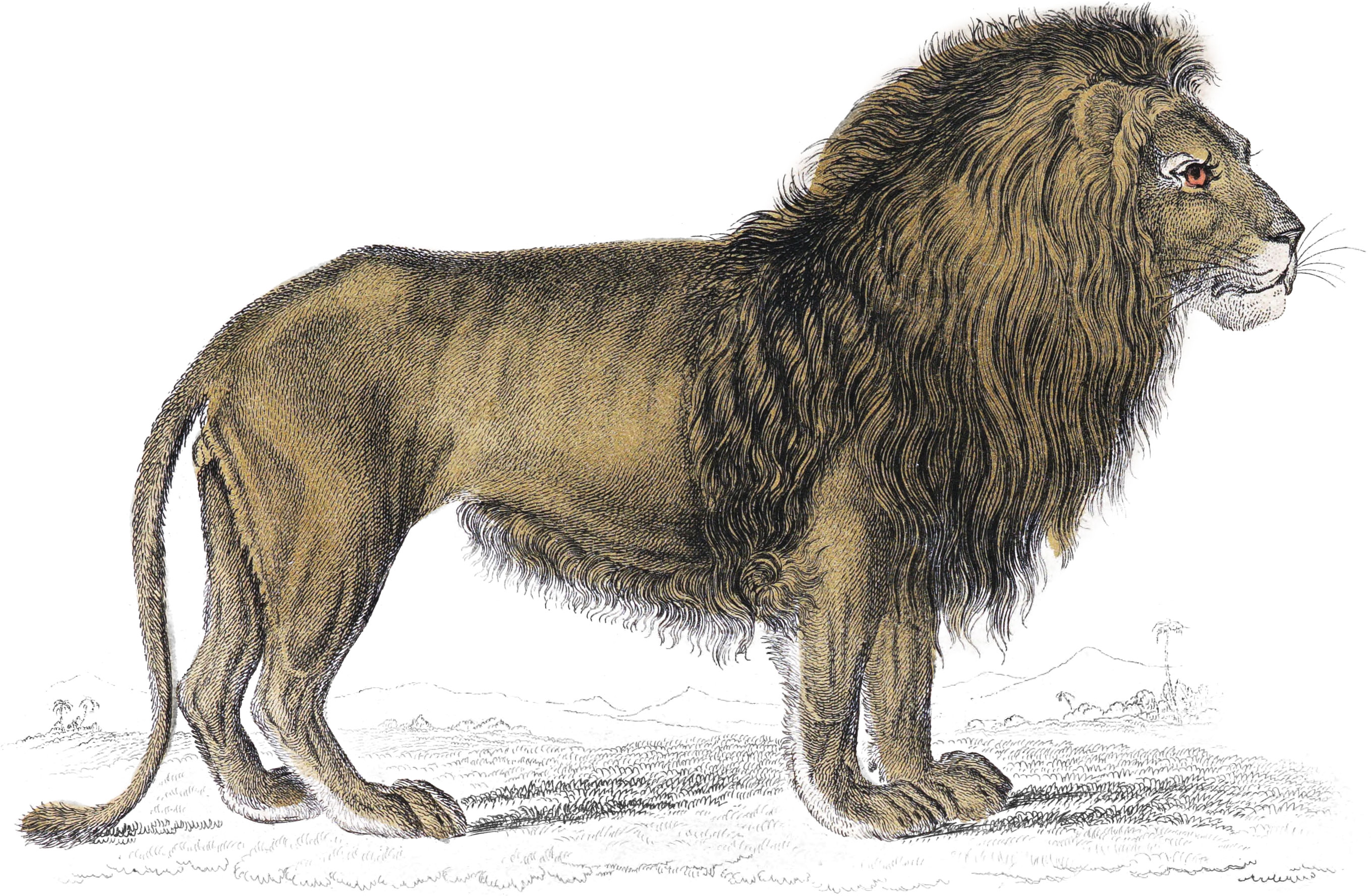
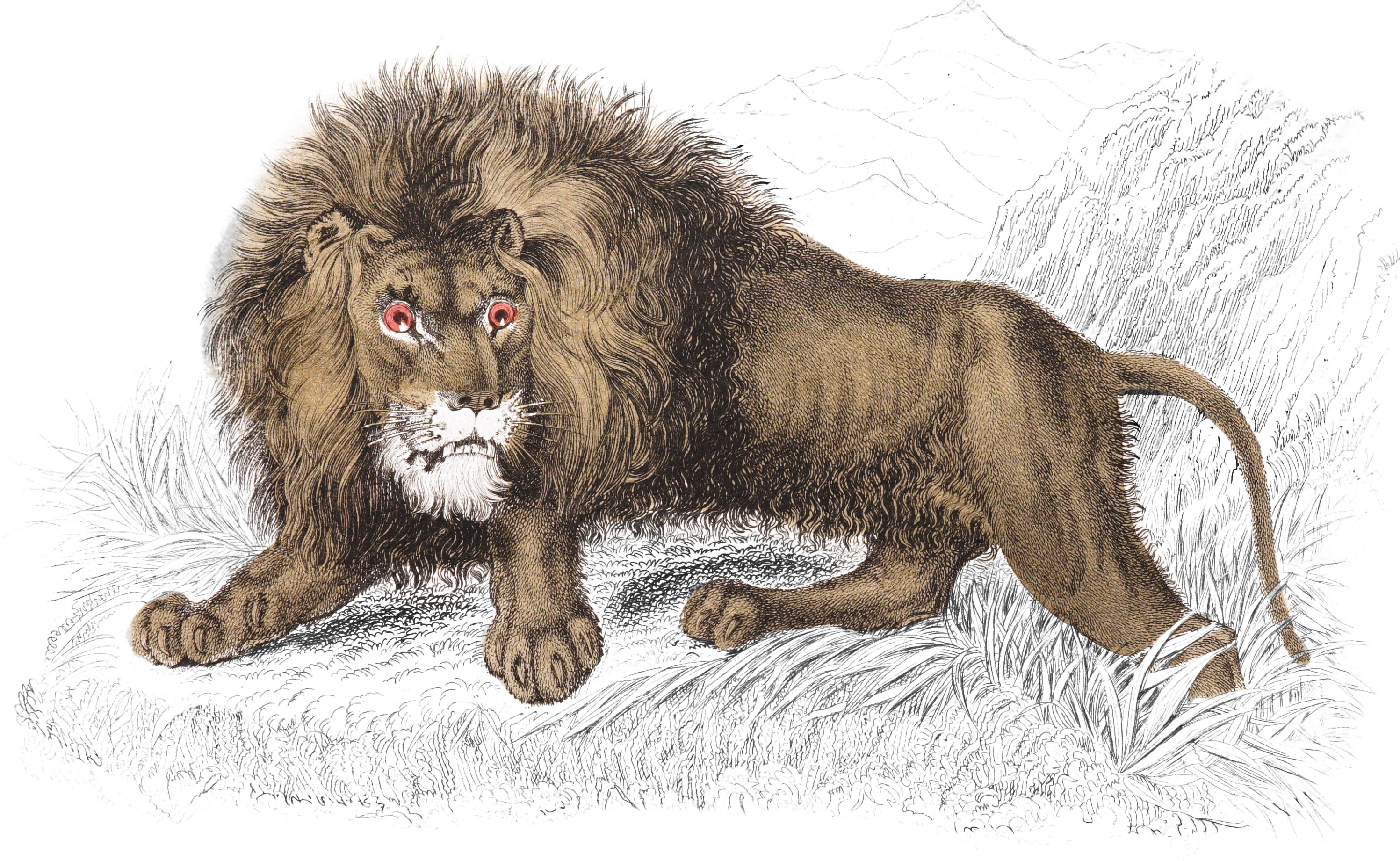
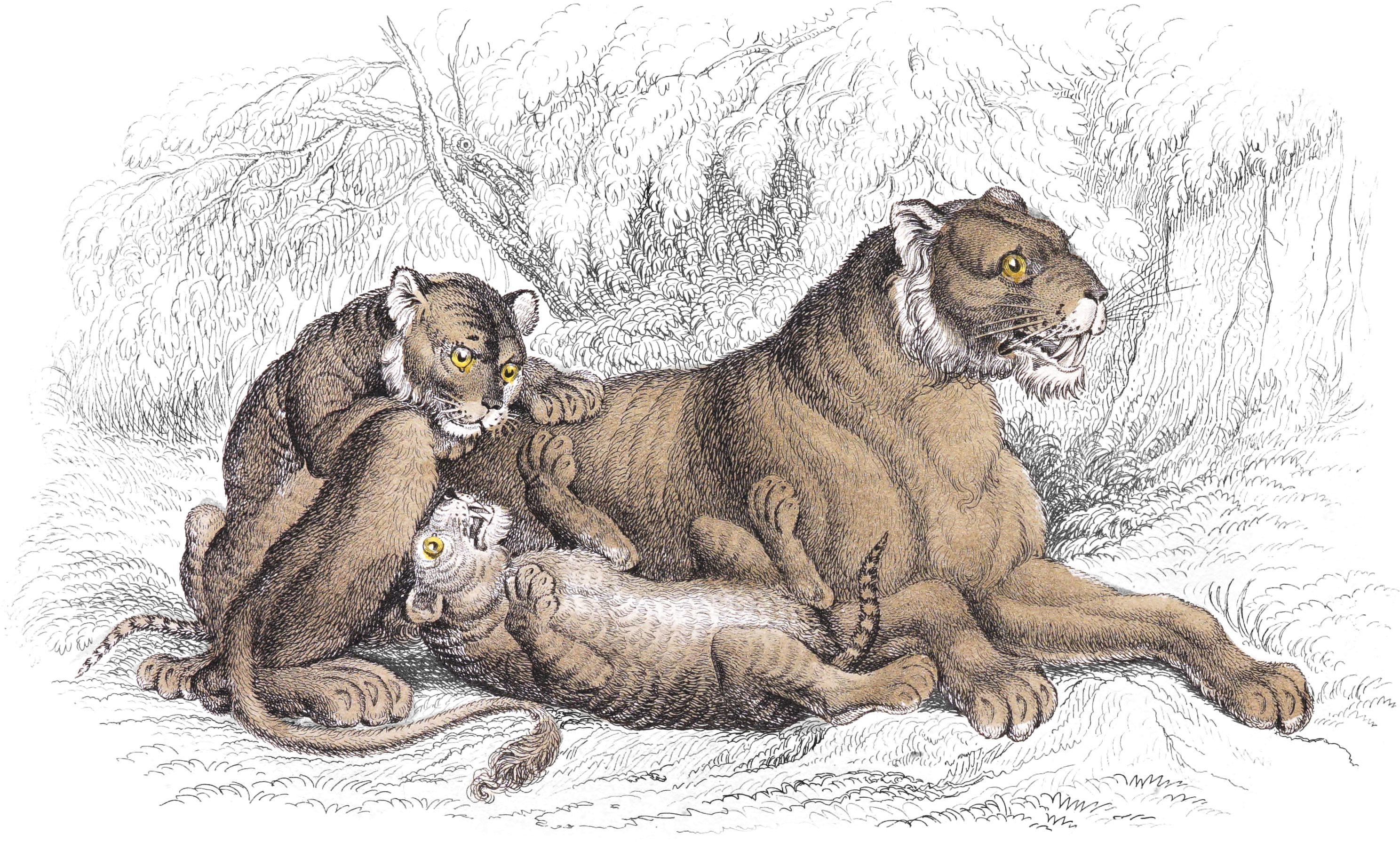
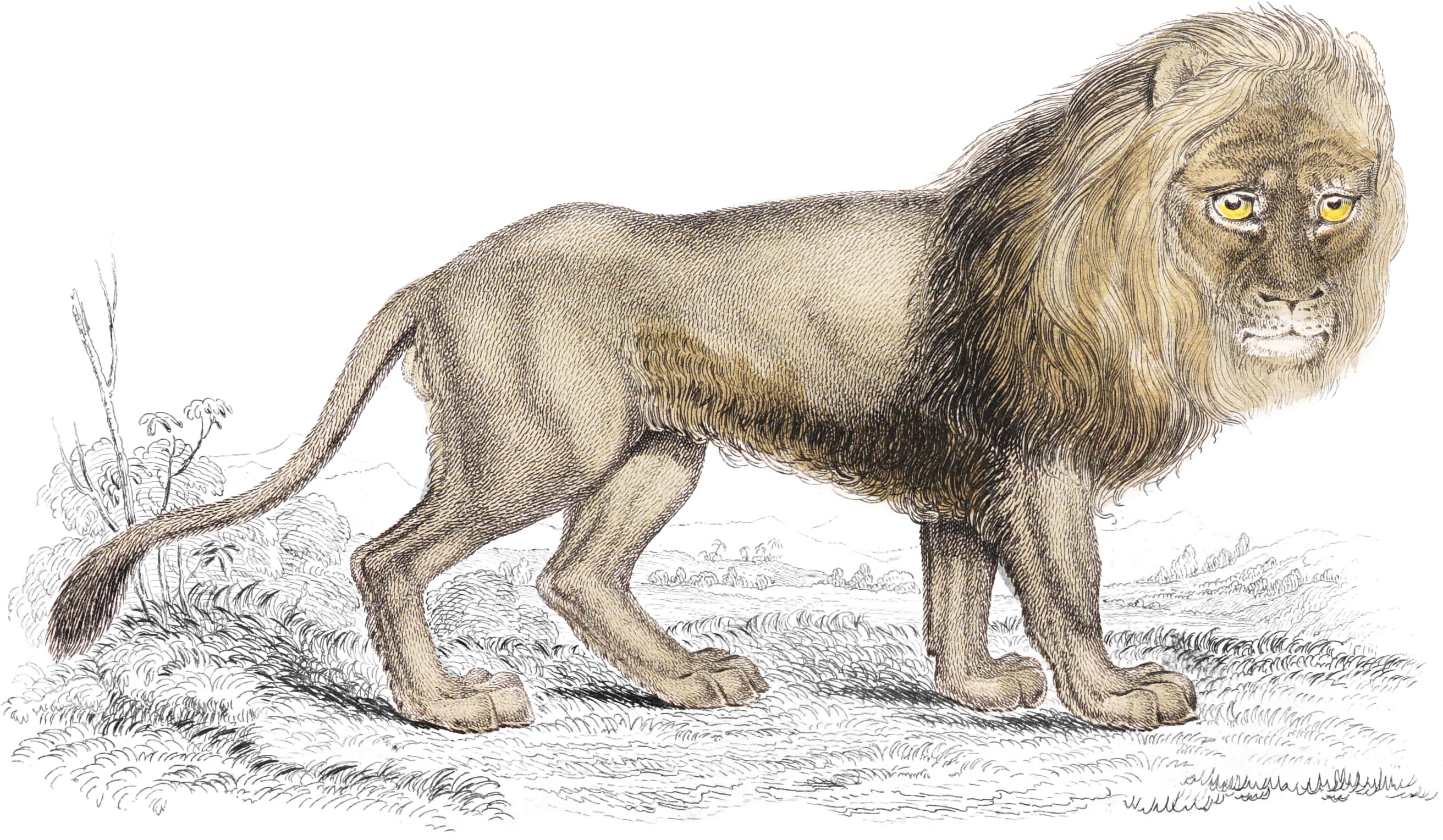
We shall now endeavour to describe the lion of the New World, an animal much inferior in size and strength, and of very different habits.
The Puma, or American Lion
Felis concolor.—Linnæus.
Felis concolor, Linnæus, Desmarest.—Le Couguar, Buffon, plate xix.—Fred. Cuvier, Histoire Naturelle des Mammifères.—Güazúará, Azara, Apuntamientos de los Quadrúp. del Paragüay, i. p. 120—Felis cougouar ou Puma, Felis concolor, and discolor, Temminck, Monographies, p. 134.—The Puma, or American Lion, Wilson’s Illustrations of Zoology, pl. i.
The True Puma, or Couguar, has a very extensive range over both the continents of America. Towards the south, it reaches Patagonia, and, in the northern division of the New World, extends on the one side to California, on the other to Pennsylvania; and it is probable that its northern range may even have been more extensive, before the inroads of the numerous settlers had extirpated or driven it to seek a more secluded retreat.
Cuvier tells us, that, in this vast extent of country, he was suspicious that more than one species existed; but, from the researches which these suspicions induced him to make, he arrived at the conclusion, that one alone was found.23 There are some much smaller animals, of a colour and form closely resembling the puma, which could scarcely he confounded with it. These we shall notice under the description of the next plate.
The total length of the body of the adult puma is from four feet to four feet and a half, that of the tail from two to two feet and a half. The females are somewhat less. The fur is thick and close, above of a reddish-brown, approaching nearly to the colour of a fox on the back. It lightens on the outsides of the limbs and on the flanks, and upon the belly becomes of a pale reddish-white. The muzzle, chin, throat, and insides of the legs, are greyish-white, and on the breast the colour becomes more marked, and is almost pure white. The part from which the whiskers spring, and the lips and back of the ears, are black; the whiskers themselves white. On the face and flanks of the animal from which our representation was taken there were a few indications of stripes or brindling. When the animal arrives at maturity, these are lost, and the colour becomes entirely uniform, except where it shades into a paler tint.
In still younger animals,24 the back is marked with three chains of blackish-brown spots, besides scattered markings on the sides, neck, and shoulders; but these had already disappeared. The tail is covered with thick fur, of the same colour with the upper parts, and black at the tips; and in all the animals of this kind which we have seen, and also in those which have been figured in the various works, it was carried in the usual manner, and, upon any excitement, was moved from side to side. The present animal always carried it as represented in the Plate, rolled or coiled up, and, Mr Wilson observes, always pointed to the left side.25 It looked as if it was to be used for climbing. For this purpose it was never employed, and an examination regarding the cause was unfortunately at the time omitted.
The puma, though very active in climbing, seems more to frequent the grassy plains of the southern part of America, and the marshy meadow-lands bordering the rivers, than the forest; and is found in a country so open, as to be frequently taken by the lasso, when attacking the herds. Upon the Pampas, this is one of the most common methods of destroying it. Captain Head,26 in his “Rough Notes,” tells us, as soon as the dogs unkennel a lion or tiger, they pursue him until he stops to defend himself. If the dogs fly upon him, the guacho jumps off his horse, and while he is contending with his enemies, he strikes him on the head with the balls, to which an extraordinary momentum can be given. If the dogs are at bay, and afraid to attack their foe, the guacho then hurls his lasso over him, and gallopping away, drags him along the ground, while the hounds rush upon him, and tear him.
In the northern districts, it inhabits the swamps and prairies, living chiefly upon different species of deer, upon which it is said sometimes to drop from a tree, which it had ascended to watch their path; or it makes inroads upon the hogs of the squatter, who has ventured to the unopened country. Other kinds of food, however, are sought after, and taken without much discrimination; and the Royal Society of London possesses a skin of a puma which was said to be shot in the act of devouring a wolf. Unlike most of the other Felinæ, it is not satisfied with the seizure of a single prey; but, when meeting with a herd of animals, will kill as many as it can, sucking only a small portion of the blood from each. It is thus extremely destructive among sheep, and has been known to kill fifty in one night. Active means are, therefore, constantly in use for its destruction, and it is either hunted, speared, or shot. Molina and Azara say that it will flee from men, and its timidity renders the pursuit generally free from danger, when it is followed singly with the rifle; but the following incident will shew that these encounters are sometimes fatal, and that the smart of a wound may occasionally rouse the courage of the most dastardly animal. It is probable that the shot fired by the hunter’s companion had slightly wounded the puma.
Two hunters went out in quest of game on the Katskils Mountains, in the province of New York, each armed with a gun, and accompanied by his dog. It was agreed between them, that they should go in contrary directions round the base of the hill, and that if either discharged his piece, the other should cross the hill as expeditiously as possible, to join his companion in pursuit of the game shot at. Shortly after separating, one heard the other fire, and, agreeably to their compact, hastened to his comrade. After searching for him for some time without effect, he found his dog dead and dreadfully torn. Apprised by this discovery that the animal shot at was large and ferocious, he became anxious for the fate of his friend, and assiduously continued the search for him; when his eyes were suddenly directed, by the deep growl of a puma, to the large branch of a tree, where he saw the animal couching on the body of the man, and directing his eyes towards him, apparently hesitating whether to descend and make a fresh attack on the survivor, or to relinquish its prey, and take to flight. Conscious that much depended on celerity, the hunter discharged his piece, and wounded the animal mortally, when it and the body of the man fell together from the tree. The surviving dog then flew at the prostrate beast; but a single blow from his paw laid him dead by his side. In this state of things, finding that his comrade was dead, and that there was still danger in approaching the wounded animal, he retired, and, with all haste, brought several persons to the spot, where the unfortunate hunter and both the dogs were lying dead together.27
In the north, they are hunted like the lion in Africa, with a mingled band of squatters, dogs, and horses. The following sketch, from Audubon, of a hunt in the more inland recesses, seems drawn with characteristic truth. In the course of one of his rambles, he came to the cabin of a squatter, on the banks of the Cold-Water River; and, after a hospitable reception, and an evening spent in mutually detailing their adventures in the chase, it was agreed, in the morning, to hunt the painter, which had of late been making sad ravages among the squatter’s herd of hogs.
The hunters accordingly made their appearance, just as the sun was emerging from beneath the horizon. They were five in number, and fully equipped for the chase, being mounted on horses, which, in some parts of Europe, might appear sorry nags; but which, in strength, speed, and bottom, are better fitted for pursuing a cougar or a bear through woods and morasses, than any in that country. A pack of large ugly curs were already engaged in making acquaintance with those of the squatter. He and myself mounted his two best horses, whilst his sons were bestriding others of inferior quality.
Few words were uttered by the party until we had reached the edge of the swamp, where it was agreed that all should disperse, and seek for the fresh track of the painter, it being previously settled that the discoverer should blow his horn, and remain on the spot until the rest should join him. In less than an hour, the sound of the horn was clearly heard; and, sticking close to the squatter, off we went through the thick woods, guided only by the now and then repeated call of the distant huntsman. We soon reached the spot, and in a short time the rest of the party came up. The best dog was sent forward to track the cougar, and in a few minutes the whole pack were observed diligently trailing, and bearing in their course for the interior of the swamp. The rifles were immediately put in trim, and the party followed the dogs, at separate distances, but in sight of each other, determined to shoot at no other game than the panther.
The dogs soon began to mouth, and suddenly quickened their pace. My companion concluded that the beast was on the ground; and, putting our horses to a gentle gallop, we followed the curs, guided by their voices. The noise of the dogs increased, when, all of a sudden, their mode of barking became altered, and the squatter, urging me to push on, told me that the beast was treed, by which he meant that it had got upon some low branch of a large tree, to rest for a few moments, and that should we not succeed in shooting him when thus situated, we might expect a long chase of it. As we approached the spot, we all by degrees united into a body; but on seeing the dogs at the foot of a large tree, separated again, and gallopped off to surround it.
Each hunter now moved with caution, holding his gun ready, and allowing the bridle to dangle on the neck of his horse, as it advanced slowly towards the dogs. A shot from one of the party was heard, on which the cougar was seen to leap to the ground, and bound off with such velocity, as to shew that he was very unwilling to stand our fire longer. The dogs set off in pursuit with great eagerness, and a deafening cry. The hunter who had fired came up, and said that, his ball had hit the monster, and had probably broken one of his fore-legs, near the shoulder, the only place at which he could aim. A slight trail of blood was discovered on the ground; but the curs proceeded at such a rate, that we merely noticed this, and put spurs to our horses, which gallopped on towards the centre of the swamp. One bayou was crossed, then another still larger and more muddy; but the dogs were brushing forward, and, as the horses began to pant at a furious rate, we judged it expedient to leave them, and advance on foot. These determined hunters knew that the cougar, being wounded, would shortly ascend another tree, where, in all probability, he would remain for a considerable time, and that it would be easy to follow the track of the dogs. We dismounted, took off the saddles and bridles, set the bells attached to the horses’ necks at liberty to jingle, hoppled the animals, and left them to shift for themselves.
After marching for a couple of hours, we again heard the dogs. Each of us pressed forward, elated at the thought of terminating the career of the cougar. Some of the dogs were heard whining, although the greater number barked vehemently. We felt assured that the cougar was treed, and that he would rest for some time, to recover from his fatigue. As we came up to the dogs, we discovered the ferocious animal lying across a large branch, close to the trunk of a cotton-wood tree. His broad breast lay towards us; his eyes were at one time bent on us, and again on the dogs beneath and around him; one of his fore legs hung loosely by his side; and he lay crouched, with his ears lowered close to his head, as if he thought he might remain undiscovered. Three balls were fired at him, at a given signal, on which he sprang a few feet from the branch, and tumbled headlong to the ground. Attacked on all sides by the enraged curs, the infuriated cougar fought with desperate valour; but the squatter, advancing in front of the party, and almost in the midst of the dogs, shot him immediately behind and beneath the left shoulder. The cougar writhed for a moment in agony, and in another lay dead.28
The puma is very easily tamed, and becomes harmless and even affectionate. Azara records its docility from one which he long kept tame, and the celebrated Kean possessed one which followed him loose, and was often introduced to company in his drawing-room. We have frequently been in company with the animal which served for the accompanying illustration. It was extremely gentle and playful, and showed no symptoms of ferocity to the strangers who came to see it. Its motions were all free and graceful, and it exhibited the greatest agility in leaping and swinging about the joists of a large unoccupied room in the old college of Edinburgh. For the following additional particulars we are indebted to the account given by Mr Wilson.
It rejoices greatly in the society of those to whose company it is accustomed, lies down upon its back between their feet, and plays with the skirts of their garments, entirely after the manner of a kitten. It shews a great predilection for water, and frequently jumps into and out of a large tub, rolling itself about, and seemingly greatly pleased with the refreshment. While in London, it made its escape into the street during the night, but allowed itself to be taken up by a watchman, without offering even a show of resistance. It was brought from the city of St Paul’s, the capital of the district of that name in the Brazilian empire. During the voyage home, it was in habits of intimacy with several dogs and monkeys, none of which it ever attempted to injure, nor did it even attempt to return the petty insults which the latter sometimes offered; but if an unfortunate fowl or goat came within its reach, it was immediately snapt up and slain. Since its arrival in Edinburgh, it has not been indulged with living prey; and the only animals which have fallen victims to its rapacity, were a mallard and cock-pheasant, both of which approached inadvertently within the circle of its spring, and were each killed by a blow of its fore paw.
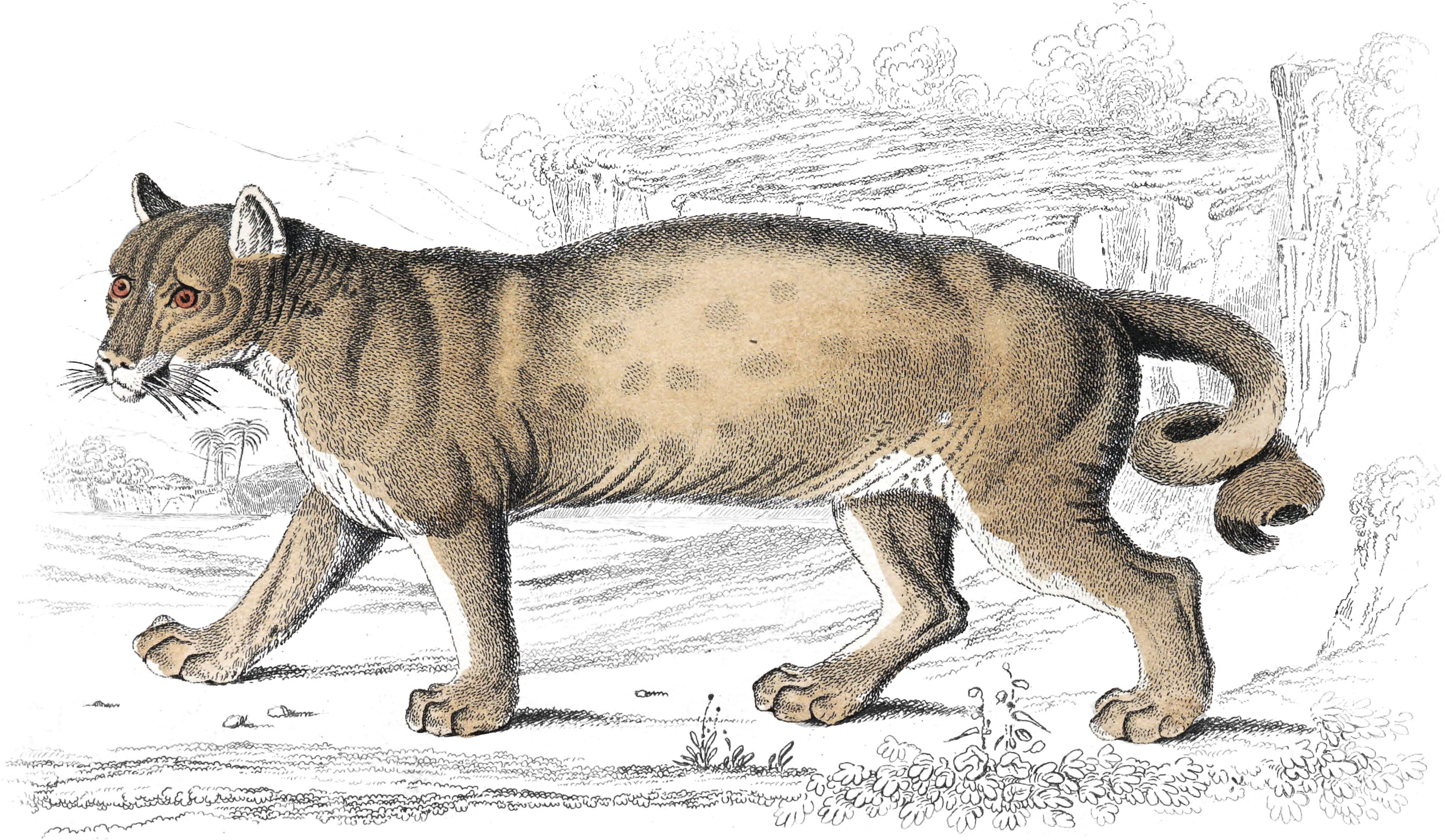
Plate IV
We shall now endeavour to describe, from the most authentic materials in our power, two or three smaller South American cats, of which we regret to say our knowledge is yet imperfect. The first we shall notice is what appears to be the El Negro of Azara, and we may perhaps be accused of giving our representation upon too slender grounds, having not seen the animal ourselves. It is taken from a sketch and memoranda made from two specimens brought to Greenock in an American vessel, and we always hope, that in thus directing the attention to little known animals, their history may be sooner elucidated. Our next plate represents
The Black Puma
Felis nigra.—Griffith.
Chat nègre, El Negro, Voyages d’Azara, French edition, i. p. 272? 273.—Quadrup. del Paraguay, i. p. 154.—Felis nigra, The Black Cat of America, Griffith’s Synopsis, sp. 444.?
In our uncertain knowledge of this animal, we have given all the synonyms with a mark of doubt. They will belong to the Gato negro of Azara, but whether to the animal now represented is doubtful. Azara’s description of the El Negro is very short. It is entirely of the colour indicated by the name. Its length is about 33\(\frac{1}{2}\) inches, without including that of the tail, which is about 13. As above alluded to, the animals from which the sketches for the accompanying illustration were taken, were brought in a merchant vessel to Greenock. There were three of them, and the most striking feature to the first view of a stranger, was the pale and clear greenish-blue of their eyes, which contrasted finely with the deep glossy black of their fur. They were extremely ferocious in their dispositions, which might probably have arisen from being plagued by the sailors during their voyage, and from their being fed entirely upon animal food.

Plate V
We have next to notice
The Yaguarundi
Felis Jaguarondi.—Lacepede.
Yagüaründí, Azara, Quadrúp. del Paraguay, i. p. 156.—Felis Jaguarondi, Lacepede, Œuvres d’Azara, Atlas, pl. x. Temminck, Monographies, p. 130.—Spotless Cat, Felis unicolor, Traill, Transactions of the Wernerian Society, iii. p. 170.
This animal, according to Azara, is a native of Paraguay and Guiana, but Temminck says that he has seen skins from Surinam and the Essequebo, which have always been of larger dimensions. It frequents the borders of woods and thickets, and feeds on small animals and birds. It climbs readily.
According to Azara, the total length of the yaguarundi is about 3 feet, that of the tail 13\(\frac{3}{4}\) inches, while Temminck gives the dimensions of the largest he has seen as 4 feet 4 inches, of which the tail measured 1 foot 10 inches, and the height of the animal at the fore quarter 1\(\frac{1}{2}\) foot. The colour is a deep grey, produced by each hair being ringed alternately with black and white; the tips of the hairs being of the latter colour, gives the prevailing shade. By age the shade becomes darker, while the young are of a deep reddish-brown. Temminck mentions a specimen in the Paris Museum, where the greyish-white greatly predominated upon the head, fore part of the limbs, and upper part of the body; while the rump and tail are entirely black, without white rings upon the hairs. It is said to be easily tamed.
Temminck, in his “Monographies,” refers the spotless cat, Felis unicolor of Dr Traill, to this species. In colour and markings, however, it agrees much nearer to the next, but differs in the length of the tail, which is very nearly as long again as in the eyra; again the total length of Dr Traill’s specimen is exactly that of Temminck’s largest yaguarundi. We add Dr Traill’s description. The specimen was brought from Demerara. In length, exclusive of the tail, it measured 2 feet 8\(\frac{1}{2}\) inches; that of the tail was 1 foot 8\(\frac{1}{2}\) inches; the height of the shoulders 10 inches.
The head of the spotless cat is much more pointed, its nose more elevated, and its limbs are much more slender, in proportion to its size, than in the puma. The strength of the jaws and size of the teeth, are likewise proportionally less. In the puma, the hacks of the ears are black; in our animal, they are of the same colour as the adjacent parts. The tail of the puma is claviform, or appears thickest towards the tip, which is black; but the tail of the spotless cat is nearly of one thickness throughout, and it wants the conspicuous black tip which appears constantly in the puma. The general colour of the two animals is also different. This new species is of a clear but deep reddish-brown; the colour of the puma is of a fulvous hue; and when about the size of the animal in question, the young puma is marked on the body with many black spots, which disappear as the animal advances to maturity. Even in its earliest stage, the tip of the tail in the puma is black. The eyes of this new species, which are large, are said to have a pale yellowish iris. The heard is slender and scanty; the teeth sharp and long.
What I have been able to collect of the habits of this animal, is, that it is an inhabitant of the deep recesses of the forests, that it climbs trees to prey upon birds, monkeys, &c. but that it will boldly attack the larger quadrupeds.
The Eyra of Azara
Felis eyra, Desmarest’s Mammalogie, p. 231.—Eyra, Azara, Quadruped, del Paragüay, i. p. 159.
The eyra is of a reddish-brown, with the exception of the under jaw, and a small spot on each side of the nose, which are white. The length of the body is about 20 inches, that of the tail 11\(\frac{1}{2}\) inches. This description is copied by Desmarest, and every author who has mentioned it; in fact, it is all that is known regarding it. There is, however, a figure given by Griffiths, of an animal which he refers to this species, and which seems to agree exactly with it. It is very like a little puma, and, with a slight variation of markings, would agree except in size with the description of that animal.
The Tiger
Felis Tigris.—Auctorum.
Nearly equal to the lion in strength, and perhaps excelling him in activity, the tiger has been generally placed second in this tribe of animals, and will bear a very prominent part among the Felinæ of the Indian continent. In many places he is the scourge of the country, and neither man nor beast can with safety inhabit the districts which he has selected for his own.
The general form and appearance of the tiger is so well known, that a very short description will suffice, and which will be assisted by the accompanying illustration, taken from a specimen in the Edinburgh Museum. He possesses no trace of the shaggy mane which adds so much to the bold and majestic-looking front of the lion, and his countenance scowling under the different passions, conveys a greater idea of treachery and wanton cruelty, than really belongs to the animal. In shape he is more lengthened and slender than the lion, the head rounder, and on the whole form more cat-like, and all his motions are performed with the greatest grace and apparent ease. In an animal high in health, the hair is thick, fine, and shining, the colour bright tawny yellow, shaded into pure white on the under parts, and being beautifully marked with dark bands and brindlings, exhibits a distribution of colour altogether beautiful and pleasing. These markings vary in number and intensity of shade in the young and females, and the very young animals are of a pale grey colour, with obscure dusky transverse bands. A pale whitish-coloured variety of the tiger is sometimes met with, with the stripes very opaque, and only seen in particular lights. Griffith has given a beautiful representation of this variety from a specimen in Exeter Change.
The tiger is exclusively confined to the Asiatic continent, and though its range from north to south is very extensive, that in the opposite directions is rather circumscribed. It is found in the desert countries which separate China from Siberia, and as far as the banks of the Obi; and in the greater number of the larger East Indian islands, such as Java and Sumatra. The peninsula of Malacca is also said to abound with them; but the great nursing places of the tiger, their cradle, as Temminck terms it, is the peninsula of Hindustan; the vast jungles of this rich country lining the courses of her majestic rivers, harbour thousands of these animals, for water is almost as indispensable for their nourishment as food. The larger islands are therefore also favourite resorts, and many lives have been sacrificed in attempting to free this district from these powerful pests. Cozimbar and Saugur islands are well known in the annals of tiger destruction, and many has been the fatal encounter on their luxuriant shores.
The tiger was much less familiarly known to the ancients, than either the lion or the spotted African cats. Among the Greeks it was scarcely known at all, Aristotle merely mentioning it as an animal he had heard of. Pliny tells us that the first tiger known among the Romans, was a tame one belonging to Augustus. Claudius, however, afterwards exhibited four at a time, and it has been conjectured that the beautiful Mosaic picture of four tigers, discovered some years ago in Rome, near the arch of Gallicius, was executed at that period in commemoration of so striking and unprecedented a display.29
The tiger, in a country where he can be well supplied with food, is a nocturnal animal, lying during the day in some thick cover defended from the scorching heat, and gorged with his last meal in sleepy indolence. In such uncultivated districts he watches at dawn and even by the side of some track, where the various animals pass, or about the edges of the jungle, and above all at the springs and drinking-places of the rivers, which in the impenetrable thickets have but one common access to friend or foe. Hither animals both weak and powerful crowd, forced by the scorching heats to seek coolness and drink, and here the tiger is seldom baffled of his prey.
Here couched the panting tiger, on the watch;
Impatient but unmoved, his fireball eyes
Made horrid twilight in the sunless jungle,
Till on the heedless buffalo he sprang,
Dragged the low-bellowing monster to his lair—
Crashed through his ribs at once into his heart—
Quaffed the hot blood, and gorged the quivering flesh,
Till drunk he lay, as powerless as the carcass.
Where civilization has commenced, the tiger has learned to prowl around the villages, and attack the cattle-folds, to seize indiscriminately whatever comes in his way. Travelling parties are followed, and a luckless straggler seldom escapes; the baggage-trains, consisting of troops of oxen and buffaloes trained to the yoke, are closely watched, and though attended during the day with drums and noisy instruments, and during night with torches, a journey is seldom performed without some accident or attack.
In the New Indian settlements, the ravages committed by the tigers were such, that active means were necessary for their destruction, and a price of ten rupees was put upon the head of each. Various methods were employed by the natives to destroy this animal, which could only he partially successful; but the improved use of the rifle has rendered the more thickly inhabited parts comparatively safe from them. Among the inventions formerly in use, and still practised in many parts, the most successful was that of shooting them with a poisoned arrow, from a bow, placed so as to be disengaged by the animal passing. The bow is made of split bamboo, from six to eight feet in length, and at the middle from nine to ten inches in girth. The string is of strong catgut, and often half an inch in circumference. The bow is fixed with great nicety at the middle by two stakes, distant enough to allow the arrow to pass freely without touching, and placed at a distance from the ground, in proportion to the size of the animal to be killed. The string is drawn back and fastened by a wedge, to which a cord is attached, and strained moderately tight to a stake on the opposite side of the path, to be traversed by the animal. The tiger generally falls within 200 yards of the fatal shot, being frequently struck through the lungs, and often through the heart, and the poison, if less mortally wounded, seldom fails to kill within the hour.
A heavy beam is also sometimes suspended over the path, to which a cord is attached, which is in like manner disengaged, and the animal is crushed below the weight of the wood. Another method said to be common in Persia, is mentioned in the Oriental Field Sports.
This device consists of a large spherical cage, made of strong bamboos, or other efficient materials, woven together, but leaving intervals throughout, of about three or four inches broad. Under this cover, which is fastened to the ground by means of pickets, in some place where tigers abound, a man provided with two or three short strong spears, takes post at night. Being accompanied by a dog, which gives the alarm, or by a goat, which, by its agitation, answers the same purpose, the adventurer wraps himself up in his quilt, and very composedly goes to sleep, in full confidence of his safety. When a tiger comes, and, perhaps after smelling all around, begins to rear against the cage, the man stabs him with one of the spears through the interstices of the wicker-work, and rarely fails of destroying the tiger, which is ordinarily found dead at no great distance in the morning.
Another, rather of a more ludicrous character, is related by the same entertaining writer, as successfully practised in the dominions of Oude.
The track of a tiger being ascertained, which, though not invariably the same, may yet he known sufficiently for the purpose, the peasants collect a quantity of the leaves of the prous, which are like those of the sycamore, and are common in most underwoods, as they form the largest portion of most jungles in the north of India. These leaves are smeared with a species of bird-lime, made by bruising the berries of an indigenous tree, by no means scarce. They are then strewed with the gluten uppermost, near to that opaque spot to which it is understood the tiger usually resorts during the noon-tide heat. If by chance the animal should tread on one of the smeared leaves, his fate may be considered as decided. He commences by shaking his paw, with the view to remove the adhesive incumbrance, but finding no relief from that expedient, he rubs the nuisance against his jaw, with the same intention, by which means his eyes, ears, See. become agglutinated, and occasion such uneasiness, as causes him to roll, perhaps among many more of the smeared leaves, till at length he becomes completely enveloped, and is deprived of sight, and in this situation he may be compared to a man who has been tarred and feathered. The anxiety produced by this strange and novel predicament, soon discovers itself in dreadful bowlings, which serve to call the watchful peasants, who in this state find no difficulty in shooting the object of their detestation.
In addition to these we shall only mention another device said to be at this day practised among the Chinese; and singular, as corresponding with the sculptured representation of the ancients. It is taking them in a box trap, to which the animal is attracted by a looking-glass, placed in the inside, and when attacking its own image, it disengages the fastening of the lid of the box. This very subject is represented by Montfaucon, as carved upon one of the sides of the tomb of the Nasus, and l believe the ancient origin of it is also confirmed by Claudian. Since India became so much the country of Europeans, the race of tigers has been much thinned, and ere long it is probable that they will be driven to the most remote and impenetrable districts. Hunting the tiger is a sport exclusively Indian; and it suits well to the ardour and spirit of British sportsmen: it is looked upon as far pre-eminent over the other sports of India, as that of the fox in Britain is held superior to a chace with rabbit beagles. It is pursued with great parade and show, a large retinue of followers, and almost royal splendour; and in addition, it possesses the excitement of being attended with considerable danger.
The only animal found suitable to assist in the capture of this formidable beast, is the elephant, which often displays great courage and coolness in the chase, and at times a sagacity which has saved the rider’s life. When notice has been got that there is a tiger in the neighbourhood, the whole station is roused,30 and preparation to proceed to the cover is commenced; the elephants are prepared, and the tumult which commences before all is ready, between mahouts and syces, dogs and horses, elephants and their masters, can be compared to nothing in this country, where, in well regulated hunting establishments, rule and regularity prevail. From ten to thirty of these animals, each carrying a sportsmen armed with rifles of various descriptions, generally start for the jungle, though sometimes a field of nearly 100 elephants have been out, and being arranged in line, commence regularly to beat for the game; but having thus brought them to the jungle’s edge, we shall allow one more experienced than ourselves to describe the hunt.31
We found immense quantities of game, wild hogs, hog-deer, and the Neil-ghie, (literally blue-cow.) We, however, strictly abstained from firing, reserving our whole battery for the nobler game, the tiger. It was perhaps fortunate that we did not find one in the thick part of the forest, as the trees were so close set, and so interwoven with thorns and parasite plants, that the elephants were often obliged to clear for themselves a passage by their own pressing exertions. It is curious on these occasions to see the enormous trees these animals will overthrow on a word from the mahout, they place their foreheads against the obnoxious plants, twisting their trunks round it, and gradually bending it towards the ground, until they can place a foot upon it. This done, down comes the tree with crashing stem and upturned roots. The elephant must be well educated to accomplish this duty in a gentlemanlike manner: that is, without roaring sulkily, or shaking his master by too violent exertions.
On clearing the wood, we entered an open space of marshy grass, not three feet high; a large herd of cattle were feeding there, and the herdsman was sitting singing under a bush; when, just as the former began to move before us, up sprang the very tiger to whom our visit was intended, and cantered off across a bare plain, dotted with small patches of bush-jungle. He took to the open country in a style which would have more become a fox than a tiger, who is expected by his pursuers to fight and not to run; and as he was flushed on the flank of the line, only one bullet was fired at him ere he cleared the thick grass- He was unhurt, and we pursued him at full speed. Twice he threw us out by stopping short in small stripes of jungle, and then heading back after we had passed; and he had given us a very last trot of about two miles, when Colonel Arnold, who led the field, at last reached him by a capital shot, his elephant being in full career. As soon as he felt himself wounded, the tiger crept into a close thicket of trees and bushes, and crouched. The two leading sportsmen overran the spot where he lay; and as I came up, I saw him, through an aperture, rising to attempt a charge. My mahout had just before, in the heat of the chase, dropped his ankors or goad, which I had refused to allow him to recover; and the elephant, being notoriously savage, and farther irritated by the goading he had undergone, became consequently unmanageable; he appeared to see the tiger as soon as myself, and I had only time to fire one shot, when he suddenly rushed with the greatest fury into the thicket, and tilling upon his knees, nailed the tiger with his tusks to the ground. Such was the violence of the shock, that my servant, who sat behind, was thrown out, and one of my guns went overboard. The struggles of my elephant to crush his still resisting foe, who had fixed one paw on his eye, were so energetic, that I was obliged to hold on with all my strength, to keep myself in the houdah. The second barrel, too, of the gun which I still retained in my hand, went off in the scuffle, the ball passing close to the mahout’s ear, whose situation, poor fellow, was any thing but enviable. As soon as my elephant was prevailed upon to leave the killing part of the business to the sportsmen, they gave the roughly used tiger the coup de grace. It was a very fine female, with the most beautiful skin I ever saw.
We shall only give another sketch of a tiger hunt; our last is told by a gentleman, this one shall be from the pen of a lady, herself the heroine of the chase, and will be curious, as we believe it is the only instance upon record.
We had elephants, guns, balls, and all other necessaries prepared, and about seven in the morning we set off. The soil was exactly like that we had gone over last night; our course lay N. W. The jungle was generally composed of corinda bushes, which were stunty and thin, and looked like ragged thorn bushes; nothing could be more desolate in appearance: it seemed as if we had got to the farthest limits of cultivation, or the haunts of man. At times, the greener bunches of jungle, the usual abodes of the beasts of prey during the day-time, and the few huts scattered here and there, which could hardly be called villages, seemed like islands in the desert waste around us. We stopped near two or three of these green tufts, which generally surrounded a lodgment of water, or little ponds, in the midst of the sand.
The way in which these ferocious animals are traced out is very curious, and, if related in England, would scarcely be credited. A number of unarmed half-naked villagers, go prying from side to side of the hush, just as a boy in England would look after a stray sheep, or peep after a bird’s nest. Where the jungle was too thick for them to see through, the elephants, putting their trunks down into the hush, forced their way through, tearing up every thing by the roots before them. About four miles from our tents we were all surrounding a bush, which might he some fifty yards in circumference, (all includes William Fraser, alone upon his great elephant, Mr Barton and myself, upon another equally large, Mr Wilder upon another, and eight other elephants; horsemen at a distance, and footmen peeping into the hushes). Our different elephants were each endeavouring to force his way through, when a great elephant, without a houdah on his back, called “Muckna,” a fine and much esteemed kind of elephant, (a male without large teeth), put up, from near the centre of the bush, a royal tiger. In an instant Fraser called out, “Now Lady H., he calm, he steady, and take a good aim, here he is.” I confess, at the moment of thus suddenly coming upon our ferocious victim, my heart beat very high, and, for a second, I wished myself far enough off; but curiosity, and the eagerness of the chace, put fear out of my head in a minute; the tiger made a charge at the Muckna, and then ran back into the jungle. Mr Wilder then put his elephant in, and drove him out at the opposite side. He charged over the plain away from us, and Wilder tired two balls at him, but knew not whether they took effect. The bush in which he was found, was one on the west bank of one of those little half dry ponds of which I have spoken. Mr Barton and I conjecturing that, as there was no other thick cover near, he would probably soon return, took our stand in the centre of the open space; in a minute the tiger ran into the bushes on the east side; I saw him quite plain; we immediately put our elephant into the bushes, and poked about, till the horsemen, who were reconnoitring round the outside of the whole jungle, saw him slink under the bushes to the north side; hither we followed him, and from thence traced him by his growling, back to the outer part of the eastern bushes. Here he started out just before the trunk of our elephant, with a tremendous growl or grunt, and made a charge at another elephant farther out on the plain, retreating again immediately under cover. Fraser fired at him, but we suppose without effect; and he called to us for our elephant to pursue him into his cover.
With some difficulty, we made our wav to the inside of the southern bushes; and, as we were looking through the thicket, we perceived beau Tiger slink away under them. Mr Barton fired, and hit him a mortal blow about the shoulder or back, for he instantly was checked, and my ball, which followed the same instant, threw him down. We two then discharged our whole artillery, which originally consisted of two double-barrelled guns, loaded with slugs, and a pair of pistols. Most of them took effect, as we could discover by his wincing, for he was not above ten yards from us at any time, and at one moment, when the elephant chose to take fright and turn his head round, away from the beast, running his haunches almost into the bush, not five. By this time William Fraser had come round, and discharged a few balls at the tiger, which lay looking at us, grinning and grow-ling, his ears thrown back, but unable to stir. A pistol fired by me, shattered his lower jaw-bone; and immediately, as danger of approaching him was now over, one of the villagers, with a matchlock, went close to him, and applying the muzzle of his piece to the nape of his neck, shot him dead, and put him out of his pain. The people then dragged him out, and we dismounted to look at him, pierced through and through; yet one could not contemplate him without satisfaction, as we were told that he had long infested the high road, and carried off many passengers. One hears of the roar of a tiger, and fancies it like that of a bull, but, in fact, it is more like the grunt of a hog, though twenty times louder, and certainly one of the most tremendous animal noises one can imagine.
The tiger is readily tamed when taken young, but its temper may be said to be scarcely so much depended upon as that of the lion. Keepers enter the cage and caress them, but they never venture upon those annoying liberties which are generally so freely taken with the lion; and strangers, I believe, have never attempted to venture within their reach. It may also he remarked, that there is only one instance upon record where the tiger allowed a dog to become an inmate of his den. With the lion it is frequent, and great affection is displayed. On the contrary, however, the Indians appear to have great power in the management of the Tiger, and it is more frequently seen tame in that country than an of the other Felinæ. The tame tigers of the Fakirs exhibit great gentleness and confidence, which may in part be attributed to the ample way in which they are fed, and a singular instance of great control over their temper is related in Griffith’s Animal Kingdom.
A full-grown Tiger was lately in the possession of some natives of Madras, who exhibited it held merely by a chain: it was indeed kept muzzled, except when allowed, (which was occasionally done) to make an attack upon some animal, in order to exhibit the mode of its manœuvring in quest of prey. For the purpose of this exhibition, a sheep in genera) was fastened by a cord to a stake, and the tiger being brought in sight of it, immediately crouched, and, moving almost on its belly, but slowly and cautiously, till within the distance of a spring from the animal, leapt upon and struck it down almost instantly dead, seizing it at the same moment by the throat with its teeth. The tiger would then roll round on its back, holding the sheep on its breast, and, fixing the hind claws near the throat of the animal, would kick or push them suddenly backwards, and tear it open in an instant. Notwithstanding, however, the natural ferocity of these animals, the individual in question was so far in subjection, that, while one keeper held its chain during this bloody exhibition, another was enabled to get the carcase of the sheep away, by throwing down a piece of meat previously ready for the purpose.
They are also capable of affection for the person who has reared them, who will be recollected after a considerable absence.
A tigress in the Tower, upon her arrival in this country, became very irascible and dangerous, from irritation at the crowd and bustle upon the Thames. Her deportment was so sulky and savage, that Mr Cops could scarcely be prevailed on by her former keeper, who saw her shortly afterwards, to allow him to enter her den; but no sooner did she recognise her old friend, than she fawned upon him, licked him, and caressed him, exhibiting the most extravagant signs of pleasure; and when he left her, she cried and whined for the remainder of the day.
Tigers have also been induced to breed in captivity, though much less frequently than the lion. Mr Cross, we believe, has succeeded in breeding six of the former, while his litters of the latter have amounted to no less than twenty-four. We are not certain whether any of the tigers bred in confinement have arrived at maturity.
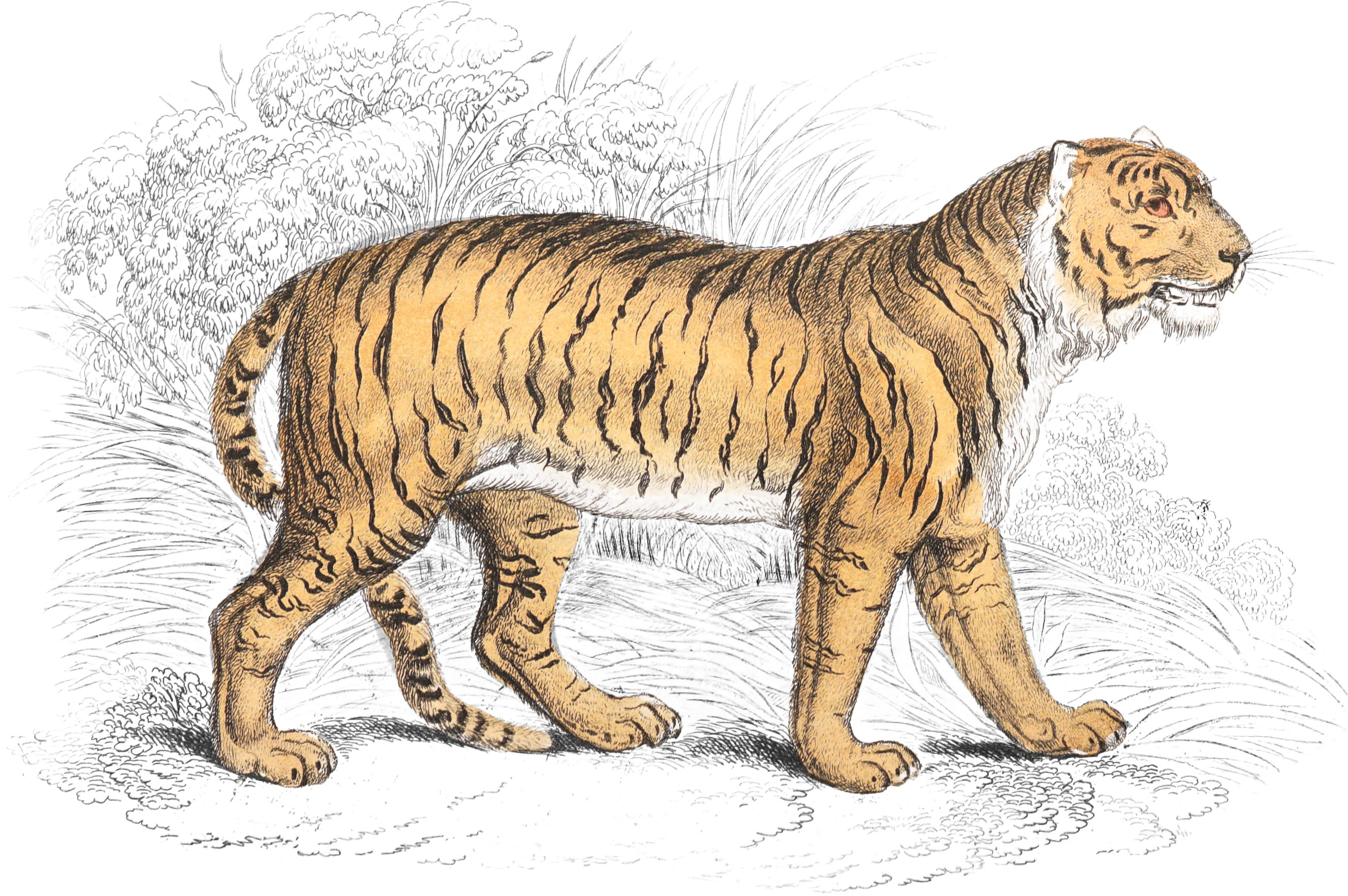
Plate VI
The Hybrid between a Lion and a Tigress
We have given in this place a figure (Plate VII.) of a hybrid between a lion and a tigress, which formed part of the collection of Mr Aitken, exhibited in Edinburgh in 1827. They were whelped in December, but only lived for a very short period, owing, perhaps, to the inclement season at which they were produced. The colour was brighter than that of the lion, and the bands were better marked than they generally are in the young of the true breed. One of the cubs was preserved for the Edinburgh Museum, and has served as a copy for the accompanying illustration.
Another instance of this hybrid production took place at Windsor. The male was the Asiatic lion bred in this country by Mr Aitken, and the tigress was a very gentle animal, about four years old. The cubs, immediately after birth, were taken from the mother, and were fostered by several bitches and a goat. They also died before reaching maturity.32

Plate VII
The Leopard
Felis leopardus.—F. Cuvier.
Le Leopard, F. Cuvier, Histoire Naturelle des Mammiferes. The Figure in Griffith’s Translation of Cuvier.
We have given a plate of the African Leopard, from the Histoire Naturelle des Mammiferes of Frederic Cuvier; but, under this, we propose to describe, as far as possible, the Panther, or Felis pardus of naturalists, and regret that we have been unable to procure either an authentic figure, or a specimen of an animal which we could reconcile to the characters given under that name. We shall not attempt to unravel the synonyms, a task of great difficulty, and which would occupy much more space than can be afforded in the present work.
That there are two species confounded under the names of Leopard and Panther, seems to have been the opinion of most zoologists; and the ancients, who had more extensive opportunities of examining them, though not with a view to their zoological characters, invariably characterised them under two names. Our own opinion is, that there are at least two distinct species, though it is very difficult to fix upon good characters. That the Leopard is by far the most common, inhabiting both Africa and India; while the Panther is to be found chiefly, if not entirely, in Africa. Both are subject to very great variety, which may be seen in the number of skins which annually arrive in Europe indiscriminately under these titles; but it is perhaps not greater than is exhibited by the next three figures of the American Jaguar. The representation we have given from Frederic Cuvier, we should consider typical of the markings of the adult Leopard, which, in its make, is remarkably graceful and slender, while in its action it displays more than usual easy activity. The figure given in Griffith’s translation of Cuvier likewise accords with this; and some skins which we lately saw from the more alpine districts or India, closely resembled these in the distribution of their spots, and were of a pale tint, almost approaching to a fawn colour. We shall now give F. Cuvier’s own description and dimensions:
Our animal was brought from Senegal, and, though still young, from the elegance of its proportions, appeared to have readied its full size. The entire length of the body was 3 feet 1 inch 6 lines; that of the tail 2 feet 3 inches; the height of the animal, when standing, about 2 feet 1 inch. All the upper parts of the body, and outsides of the limbs, were yellowish, the lower parts white, both covered with spots, which varied in their number, form, and size. Those on the head, neck, a part of the shoulders, and the limbs, were full, small, and placed close to each other in a confused manner: those on the thighs, back, Banks, and a part of the shoulders, were equally full and small, but they were grouped in a circular manner, so that each group formed an isolated spot “en form de rose;” and the part surrounded by this union of little spots being of a deeper shade than the ground colour of the skin, contributed in appearance to separate them still more from the others. Ten of these ringed spots can be counted in a perpendicular line from the back to the under parts. On the belly, there are large black spots, which are not so numerous as upon the other parts, and the spots upon the upper part of the inside of the limbs are lengthened and transverse, and on the higher part of the shoulders there are some which are long, narrow, and joined two and two upon the same line. The back of the ear is black, with a white transverse spot on the middle: there is a black spot upon each side at the opening of the lips, and a white one above each eye.
We are not aware of any authentic figure of the Panther, though several have been given as such. That of Mareschal, and that given by Griffith, from a drawing by Major Hamilton Smith, were both taken from specimens in the Parisian Museum. Now, Temminck says at once that, these are all leopards; while Cuvier, so late as 1829, confirms his opinion that the former is the true Panther pardus of the ancients. Amidst these strong but conflicting authorities, it is difficult to decide the question satisfactorily, without a much larger series of specimens than we can at present command. The panther we considered nearly of a similar size to the leopard, but more powerfully made, the ground colour darker, and the markings, though crowded, arranged with considerable regularity, entirely “en form de rose,” the rings formed of separate spots, and the body with few or no smaller and irregular intermediate markings. The tail is also said to be longer in proportion.33
It was this animal which was so abundantly supplied to the games and public spectacles of the Romans—at least the representation upon ancient carvings and architecture have more the appearance of its markings than those of the leopard. The number of them which were brought together at once was almost incredible, Pompey having exhibited 410, and Augustus 420.
Some zoologists have been of opinion, that there were more than two species involved in the animal designated Leopard and Panther; and the figure and description given by Major Smith in Griffith’s Cuvier, of an animal under the conditional title of “The Panther of the ancients,” goes far to confirm it. Major Smith met with this animal stuffed at Hesse Cassel. It is an animal of great power, and measured 5 feet 3 inches from the nose to the insertion of the tail, and stood about 2 feet 9 inches high at the shoulders; the length of the body alone being very nearly equal to the whole of Frederick Cuvier’s Leopard. The other great distinguishing differences were, that the colour of the whole animal is a buff-yellow, which assumes a darker tint, approaching to red, on the nose, and more ochrey on the back and sides. The belly and insides of the limbs partake of this general colour, but paler, there being no white part about the animal. There may be said to be seven vertical rows of interrupted or imperfect annuli on the sides of the animal. These, as well as the like open spots which mark all the panthers, have the inner surface of the annuli more fulvous than the general colour of the sides. The dorsal line is marked in the same manner, not with close but with open spots, and the tail is spotted from beginning to end. The forehead, cheeks, sides of the neck, shoulders, throat, and inside of the limbs, are covered with numerous, close, small spots, and there is a narrow black bar across the lower part of the throat. Its native country was unknown.
This animal, we have every reason to think, will be found to be completely distinct, and will be most interesting, as possessing characters intermediate between the large spotted cats of the odd world and the Jaguar of South America; and we hope that the attention of those who ’nave it in their power will be directed to the solution of the dubiety which still exists between this and the other animals we have just mentioned.
Cuvier observes, that a variety of the panther is sometimes found black, with the spots of a deeper shade, and that he has seen this variety in the same litter with those of the ordinary colours.34 This black variety the same author refers to the Felis melas of Peron.
In a wild state, these animals appear to inhabit thick cover and the forest, more than the tiger, and are much less seen abroad. Their prey is necessarily continued to the smaller mammalia, such as the deer and antelopes; and, when the farm-yard is attacked, to the sheep and poultry. Hares, wild fowl, and monkeys, are also attacked, and the latter are often followed or surprised upon the trees; for they are expert climbers, and resort to the branches either in pursuit of game, or when they are themselves pursued. They are also hunted in India with elephants, like the tiger; but this formidable style of hunting is seldom thought necessary; and their abode, in the thickest and most pathless jungles, renders pursuit, in this way, nearly impossible. The most common methods of destruction are various kinds of traps, or with dogs, which run them until the animal takes refuge upon a tree, where, being kept at bay until the hunter gets up, it is easily shot; and, from the deliberate aim that can be taken, it is generally so far disabled with the first bullet, as to be easily overpowered by the dogs.
In a state of captivity, we are perhaps best acquainted with the leopard. They have, in a few instances, bred in this country; but not so frequently as either the lion or tiger. The pair which were in the Tower in 1829, and described by Mr Bennet, were of very different dispositions; and in this they resembled their congeners, for scarcely two are found which can be equally trusted. The male, notwithstanding very kind treatment, continued sullen and savage, while the female suffered herself to be patted and caressed by the keepers. She possessed a singular propensity, however,
for the destruction of umbrellas, parasols, muffs, hats, and such other articles of dress as may happen to come within her reach, seizing them with the greatest quickness, and tearing them into pieces, almost before the astonished visitor has become aware of his loss. To so great an extent has she carried this peculiar taste, that Mr Cops declares he has no doubt that, during her residence hi the Tower, she has made prey of at least as many of these articles as there are days in the year.35
The activity of these two animals is also very great, and their motions, when sporting in their cage, are executed with extreme grace and elegance. Their food (beef) is generally tossed up in front of the den, at the distance of nearly two feet from the bars, and to the height of six or eight feet from the floor. The animals, who are upon the alert for their dinner, immediately leap towards the bars, and, darting out their paws with incredible swiftness, almost uniformly succeed in seizing it before it falls to the ground.36
The following interesting account of a panther, with which we shall conclude this description, is given in Loudon’s Magazine of Natural History, by Mrs Bowdich; and, though of considerable length, it is so interesting that we cannot omit it. It is beautifully told, and the traits in the disposition of the animal shew that at least some of the race, by gentle treatment, are capable of great attachment and gentleness.
I am induced to send you some account of a panther which was in my possession for several months. He and another were found, when very young, in the forest, apparently deserted by their mother. They were taken to the king of Ashantee, in whose palace they lived several weeks; when my hero, being much larger than his companion, suffocated him in a fit of romping, and was then sent to Mr Hutchison,37 the resident left by Mr Bowditch at Cootnassie. This gentleman, observing that the animal was very docile, took pains to tame him, and, in a great measure, succeeded. When he was about a year old, Mr Hutchison returned to Cape Coast, and had him led through the country by a chain, occasionally letting him loose when eating was going forward, when he would sit by his master’s side, and receive his share with comparative gentleness. Once or twice he purloined a fowl, but easily gave it up to Mr Hutchison, on being allowed a portion of something else. On the day of his arrival, he was placed in a small court, leading to the private rooms of the Governor, and, after dinner, was led by a thin cord into the room, where he received our salutations with some degree of roughness, but with perfect good humour. On the least encouragement, he laid his paws upon our shoulders, rubbed his head upon us, and his teeth and claws having been filed, there was no danger of tearing our clot lies. He was kept in the above court for a week or two, and evinced no ferocity, except when one of the servants tried to pull his food from him; he then caught the offender by the leg, and tore out a small piece of flesh; but he never seemed to owe him any ill will afterwards. He one morning broke Ins cord, and, the cry being given, the castle gates were shut, and a chase commenced. After leading his pursuers two or three times round the rampaits, and knocking over a few children by bouncing against them, he suffered himself to be caught, and led quietly back to his quarters, under one of the guns of the fortress.
By degrees the fear of him subsided; and orders having been given to the sentinels to prevent his escape through the gates, he was left at liberty to go where he pleased; and a boy was appointed to prevent him from intruding into the apartments of the officers. His keeper, however, generally passed his watch in sleeping; and Sai, as the panther was called, after the royal giver, roamed at large. On one occasion, he found his servant sitting on the step of me door, upright, but fast asleep; when he lifted his paw, gave him a blow on the side of his head, which .aid him flat, and then stood wagging his tail, as if enjoying the mischief he had committed. He became exceedingly attached to the Governor, and followed him every where like a dog. His favourite station was at a window of the sitting-room, which overlooked the whole town; there, standing on his hind-legs, his fore-paws resting on the ledge of the window, and his chin laid between them, he appeared to amuse himself with what was passing beneath. The children also stood with him at the window; and one day, finding his presence an incumbrance, and that they could not get their chairs dose, they used their united efforts to pull him down by the tail. He one morning missed the Governor, who was settling a dispute in the hall, and who, being surrounded by black people, was hidden from the view of his favourite. Sai wandered with a dejected look to various parts of the fortress, in search of him; and, while absent on this errand, the audience ceased, the Governor returned to his private rooms, and seated himself at a table to write. Presently he heard a heavy step coming up the stairs, and, raising his eyes to the open door, he beheld Sai. At that moment he gave himself up for lost; for Sai immediately sprang from the door on his neck. Instead, however, of devouring him, he laid his head close to the Governor’s, rubbed his cheek upon his shoulder, wagged his tail, and tried to evince his happiness. Occasionally, however, the panther caused a little alarm to the other inmates of the castle, and the poor woman who swept the floors, or, to speak technically, pra-pra woman, was made ill by her fright. She was one day sweeping the boards of the great hall with a short broom, and in an attitude nearly approaching to all-fours, and Sai, who was hidden under one of the sofas, suddenly leaped upon her back, where he stood in triumph. She screamed so violently as to summon the other servants; but they, seeing the panther, as they thought, in the act of swallowing her, one and all scampered off as quickly as possible; nor was she released till the Governor, who heard the noise, came to her assistance. Strangers were naturally uncomfortable when they saw so powerful a beast at perfect liberty; and many were the ridiculous scenes which took place; they not liking to own their alarm, yet perfectly unable to retain their composure in his presence.
This interesting animal was well fed twice every day, but never given any thing with life in it. He stood about two feet high, and was of a dark yellow colour, thickly spotted with black rosettes; and, from the good feeding, and the care taken to clean him, his skin shone like silk. The expression of his countenance was very animated and good-tempered, and he was particularly gentle to children. He would lie down on the mats by their side when they slept, and even the infant shared his caresses, and remained unhurt. During the period of his residence at Cape Coast, I was much occupied by making arrangements for my departure from Africa; but generally visited my future companion every day, and we, in consequence, became great friends before we sailed. He was conveyed on board the vessel in a large wooden cage, thickly barred in the front with iron. Even this confinement was not deemed a sufficient protection by the canoe-men,38 who were so alarmed at taking him from the shore to the vessel, that, in their confusion, they dropped cage and all into the sea. For a few minutes I pave up my poor panther as lost; but some sailors jumpt into a boat belonging to the vessel, and dragged him out in safety. The beast himself seemed completely subdued by his ducking; and as no one dared to open his cage to dry it, he rolled himself up in one corner, nor roused himself till after an interval of some days, when he recognised my voice. When I first spoke, he raised his head, held it on one side, then on the other, to listen; and when I came fully into his view, he jumped on his legs, and appeared frantic; he rolled himself over and over, he howled, he opened his enormous jaws, and cried, and seemed as if he would have torn his cage to pieces. However, as his violence subsided, he contented himself with thrusting his paws and nose through the bars of the cage, to receive my caresses.
The greatest treat T could bestow upon my favourite was lavender-water. Mr Hutchison had told me, that, on the way from Ashantee, he drew a scented handkerchief from his pocket, which was immediately seized on by the panther, who reduced it to atoms; nor could he venture to open a bottle of perfume when the animal was near, he was so eager to enjoy it. I indulged him twice a-week by making a cup of stiff paper, pouring a little lavender-water into it, and giving it to him through the bars of his cage: he would drag it to him with great eagerness, roll himself over it, nor rest till the smell had evaporated. By this I taught him to put out his paws without shewing his nails, always refusing the lavender-water till he had drawn them back again; and in a short time he never, on any occasion, protruded his claws when offering me his paw. We lay eight weeks in the river Gaboon, where he had plenty of excellent food, but was never suffered to leave his cage, on account of the deck being always filled with black strangers, to whom he had a very decided aversion, although he was perfectly reconciled to white people- His indignation, however, was constantly excited by the pigs, when they were suffered to run past his cage; and the sight of one of the monkeys put him in a complete fury. While at anchor in the before-mentioned river, an ourang-outan (Simla Saigrus) was brought for sale, and lived three days on hoard; and I shall never forget the uncontrollable rage of the one, or the agony of the other, at this meeting. The ourang-outan was about three feet high, and very powerful, in proportion to his size; so that when he fled with extraordinary rapidity from the panther to the further end of the deck, neither men nor things remained upright when they opposed his progress: there he took refuge in a sail, and although generally obedient to the voice of his master, force was necessary to make him quit the shelter of its folds. As to the panther, his back rose in an arch; his tail was elevated, and perfectly stiff; his eyes flashed, and, as he howled, he shewed his huge teeth: then, as if forgetting the bars before him, he tried to spring on the ourang-outan, to tear him to atoms. It was long before be recovered bis tranquillity: day and night he appeared to be on the listen; and the approach of a large monkey we had on board, or the intrusion of a black man, brought a return of his agitation. We at length sailed for England, with an ample supply of provisions; but, unhappily, we were boarded by pirates during the voyage, and nearly reduced to a state of starvation. My panther must have perished but for a collection of more than three hundred parrots, with which we sailed from the river, and which died very fast while we were in the north-west trades. Sai’s allowance was one per diem; but this was so scanty a pittance, that he became ravenous, and had not patience to pick off the feathers before he commenced his meal. The consequence was, that he became very ill, and refused even this small quantity of food. Those around him tried to persuade me that he suffered from the colder climate; but his dry nose and paw convinced me he was feverish, and I had him taken from the cage; when, instead of jumping about and enjoying his liberty, he lay down, and rested his head upon my feet. I then made three pills, each containing two grains of calomel. The boy who had the charge of him, and who was much attached to him, held his jaws open, while I pushed the medicine down his throat. Early the next morning, I went to visit my patient, and found his guard sleeping in the cage; and having administered a further dose to the invalid, I had the satisfaction of seeing him perfectly cured in the evening. On the arrival of the vessel in the London Docks, Sai was taken ashore, and presented to the Duchess of York, who placed him in Exeter Change, to be taken care of till she herself went to Oatlands. He remained there for some weeks, and was suffered to roam the greater part of the day without any restraint. On the morning previous to the Duchess’s departure from the town, she went to visit her new pet, played with him, and admired his healthy appearance and gentle deportment. In the evening, when her Royal Highness s coachman went to take him away, he was dead, in consequence of an inflammation on his lungs.
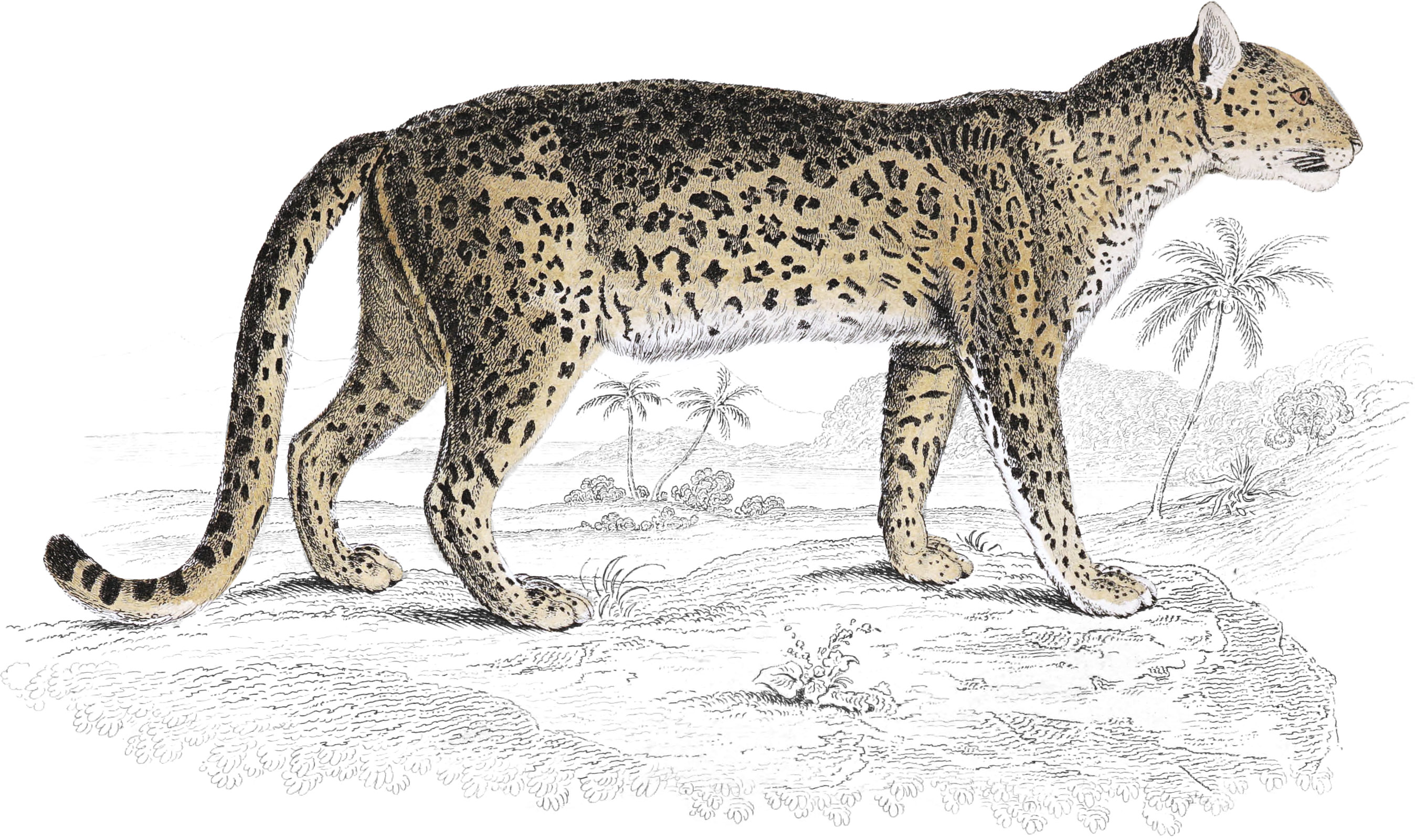
Plate VIII
The Rimau-Dahan39
Felis macrocelis.—Temminck.
Rimau-Dahan, Raffles, Trans. Linnean Society, vol. xiii. p. 251.—Dr Horsfield, Zoological Journal, vol. i. p. 542.—Félis longibande; Felis macrocelis, Temminck, Monographies, p. 102.
The first notice of this interesting animal was given by Sir Stamford Raffles, in his Descriptive Catalogue of a Collection made at Sumatra. Subsequently Dr Horsfield gave a detailed description and an excellent plate of it, which we have now made use of; and, about the same period, M. Temminck drew up an account from some imperfect skins in the Dutch and Parisian collections, under the name of F. macrocelis, which, upon his visit to this country, he submitted to Dr Horsfield, who found the animal to be identical with the Rimau-Dahan of Sir Stamford.
It is an animal of considerable size. Temminck gives the length as 5 feet 6 inches, of which the tail measures two feet and a half. Dr horsfield’s measurement of a female exceeded this, although it had scarcely attained its full size: the total length was 5 feet 6 inches, of which the tail made 2 feet 8 inches; and at the shoulders it stood in height 1 foot 4 inches. We shall now transcribe Dr Horsfield’s description of this specimen, in which it will be seen, that the peculiar marking of the skin, the strength of the limbs, and the fulness and length of the tail, will at once distinguish it from any known species.40
The head of the Felis macrocelis is proportion ally small, somewhat attenuated, obtuse, and rather high in its vertical dimensions. The upper lip is full and distended, the lower lip is less swelled and projecting, than in several other species of this genus. The termination of the muzzle is abrupt. The forehead is rather depressed and plain, and the nose but slightly elevated. The general aspect, even in a state of nature, indicates less ferocity than that of the Tiger or Leopard; the character of the eyes and the physiognomy have considerable resemblance to those of the Domestic Cat. On the upper lip and cheeks short whiskers, alternately of a white and black colour, are scattered; small fascicles of stiff hairs are also situated above the eyes. The eats are small and rounded. The teeth, as far as regards the generic character, present nothing peculiar: in the specimen before me, the second set of canine teeth is protruding, while the first still occupies its original situation. The neck is rather slender, and of moderate length. In its general habit, our animal has much of the elegance and gracefulness of the Leopard: the form of the body is on the whole cylindrical; the breast and flanks have a moderate rotundity, and not the flatness which is frequently observed in the Tiger, but in the character of the extremities, our animal resembles the latter species. The strength and robustness of the thighs, legs, and feet, afford a peculiarity to it, which has very properly been taken by M. Temminck as the character of the species. The tail is of greater length and fulness than in any other species of Felis hitherto discovered: it is equal in length to the body and neck together. The hairy covering of the tail is longer and more delicate than that of the body; it increases in thickness towards the extremity of that organ, where it has a lanuginous texture. In general, the animal is thickly clothed with fur, which is of moderate length, soft to the touch, and provided at the base with a soft down.
The ground colour of our animal is a whitish-grey, inclining to cinereous or to brownish-grey; and one of the peculiarities mentioned by Sir Stamford Raffles, is the almost entire absence of yellow or red in the external tint. On the upper portions of the neck and back, the tint is more purely cinereous; on the abdomen, the interior of the thighs, and the tail underneath, a slight admixture of tawny is observed in the fur, which appears to increase with the age of the animal. This ground is more closely covered, in the Felis macrocelis, with spots and bands, defined posteriorly by a deep black margin, than in any other of the large species of this genus with which 1 am acquainted. The black has, on the larger discolorations, most strikingly the appearance of velvet. The form of the marks is in the highest degree irregular, and we must refer to our Plate for their illustration. The highest parts of the neck and back are marked throughout with two longitudinal bands, which, arising on the occiput between the ears, pass along the spine to the rump, and finally disappear near the middle of the tail. On the neck these longitudinal bands separate, and form a curve outward: their course is then nearly parallel, but in some individuals they meet in a single line on the back, and diverge again in a small degree on the rump. Two smaller bands, disposed within the principal pair, have nearly the same origin; they extend along the highest portion of the neck, and are lost on the region of the shoulders. Here the large bands are interrupted by transverse spots of the ground colour. The breadth of the bands is not regular throughout; they gradually increase in breadth towards the posterior portion of the neck, and, in their course along the spine, are occasionally interrupted oy grey spots. Exterior of these two principal bands, a smaller band arises on each side, at the base of the ear, and, passing along the neck, terminates in a curve on the shoulder. The cheeks and sides of the head are marked with two parallel hands, arising from the angle of the eye and from the mouth, and terminating under the ear. At this point a broad hand has its origin, which passes transversely across the throat. Several oblong marks extend longitudinally along the neck, and unite near the breast with other marks, which have a transverse disposition. The upper lip is very elegantly marked with three or four dotted lines, and an interrupted series of oblong spots passes under tire eyes towards the cheeks. The border of the mouth is black. The forehead at the sides is dotted, in the middle it is transversely marked with several partially interrupted curves, adjoining to which a large discoloration is disposed immediately behind the eyes, consisting of numerous semiconfluent spots, arranged in a circular manner. The nose is delicately variegated with grey and black. The ears exteriorly are black with an irregular grey spot in the middle of the lobe; interiorly these organs are grey, and covered with short hairs, disposed near the anterior margin in a small tuft.
The most distinguishing character is, however, afforded to our animal, by the marks on the shoulders, and on the sides of the body. These are oblong, irregular, of great breadth, transversely disposed and connected on the shoulders, interrupted and angular, on the sides and flanks. In all, the posterior margin has uniformly a deep velvet-black tint, and consists of a curved or irregularly waving line. The marks, on the shoulders and on the sides, are separated by narrow grey interstices, affording a tessellated appearance to the covering. But no uniform or determinate character prevails on the surface, and in different individuals a slight diversity appears to exist. I shall, however, describe them from the specimen before me. Here the most conspicuous mark is placed on the shoulders, and extends from the longitudinal lines which pass along the spine, to the anterior extremities: it is oblong and broad above; about the middle, the posterior margin is contracted by a curve, and it is regularly rounded at its lower extremity; the anterior border is perfectly regular and transverse, but without any defined margin. Before this principal mark, another discoloration extends from the neck to the anterior portion of the fore-thighs: this is interrupted in the middle by several dots, from which the borders proceed in a waving direction; a third mark, less distinctly defined, is placed below the principal mark on the shoulders. On the sides of the body, from the shoulders to the rump, the marks are interrupted, and have a partially oblique disposition, but a distribution into three principal compartments can generally be traced: these, however, vary in different individuals. They are in all cases separated by transverse streaks, into smaller angular or rounded spots, by which the tessellated character above mentioned is produced. In the specimen now before me these lateral marks are subdivided and irregular: in another specimen, they were more connected, which will be mentioned in the sequel. In a skin contained in the Honourable East India Company’s Museum, obtained by Dr Finlayson, they have considerable uniformity, and a more oblique disposition. In this individual they distantly resemble the marks of the Bengal Tiger. On the rump and on the upper parts of the thighs, several series of marks are disposed in succession: the highest of these is nearly regular, and runs parallel to the spine, consisting of four or five spots; the second has a curved direction, and below this several irregular marks are scattered on the rump and thighs. In all these, the character of a dark posterior border is preserved, but their contour is annular or elliptical, exhibiting a slight resemblance to the spots of the leopard, and several marks of a similar characters re also observed on the flanks near the abdomen below the principal transverse compartments. The lowest portion of the abdomen is marked with short, broad, transverse bands, disposed apparently without regularity. On the thighs, the marks differ greatly in size and form; they consist chiefly of simple spots, with an irregular margin, but in some cases several of these marks have an annular disposition, and a slight resemblance to the marks of a Leopard; their number gradually decreases towards the feet. The interior of the thighs, near the abdomen, is marked with broad spots, forming on each thigh several interrupted lines; below these small dots are irregularly scattered. The feet are uniformly grey. The tail is marked with less regularity in the Felis macrocelis than in most other species of this genus: on the base, and beyond one-third of its length, the parallel longitudinal bands are continued; the upper portion of this organ is covered with broad black bands, not regularly disposed; the under part, near the base, has several broad black spots, which meet the superior bands, but without regularity; beyond the middle of the tail, the bands have an oblique disposition, and they are gradually obscured and lost towards the extremity, where this organ has a greyish tint, with a slight admixture of tawny. The claws are robust: they are completely retractile, as in other species of this genus, and of a pale horny colour. The irides are yellowish.
The surface of the large marks of the Felis macrocelis is covered with a mixture of grey and black hairs, among which small black dots are distributed; the anterior margin is in most cases without any defined boundary, while a distinguishing character of our animal is afforded by a deep velvet-black margin, which confines the spots posteriorly.
The Felis macrocelis seems to be of a less mischievous disposition than many of the other cats In the forests of Sumatra, it lives much upon the trees, pursuing and feeding on birds; and it is said by the natives to be in the habit of sleeping stretched across the fork of a large bough.41 While in a state of confinement, adds Sir Stamford Raffles, they were remarkable for good temper and playfulness:
No domestic kitten could be more so; they were always courting intercourse with persons passing by, and in the expression of their countenance, which was always open and smiling, shewed the greatest delight when noticed, throwing themselves on their backs, and delighting in being tickled and rubbed. On board ship there was a small Musi dog, who used to play round the cage with the animal, and it was amusing to observe the playfulness and tenderness with which the latter came in contact with his inferior-sized companion. When fed with a fowl that had died, he seized the prey, and after sucking the blood and tearing it a little, he amused himself for hours in throwing it about and jumping after it, in the manner that a cat plays with a mouse before it is quite dead.
He never seemed to look on man or children as prey, but as companions, and the natives assert, that when wild they live principally on poultry, birds, and the smaller kinds of deer. They are not found in numbers, and may be considered rather a rare animal, even in the southern part of Sumatra. Both specimens were procured from the interior of Bencoolen, on the banks of the Bencoolen River. They are generally found in the vicinity of villages, and are not dreaded by the natives, except as far as they may destroy their poultry. The natives assert that they sleep and often lay wait for their prey on trees; and from this circumstance they derive the name of Dahan, which signifies the fork formed by the branch of a tree, across which they are said to rest, and occasionally stretch themselves.
Both specimens constantly amused themselves in jumping and clinging to the top of their cage, and throwing a somerset, or twisting themselves round in the manner of a squirrel when confined, the tail being extended, and shewing to great advantage when so expanded.
One of these animals upon its arrival in this country, was sent to Exeter Change, where the noise and novelty of the menagerie appear to have rendered it very intractable for a few days; but it soon became perfectly familiar, and fond of the persons who were employed about it. It was rather less voracious than a leopard, and was fed with beef and the heads of fowls.
The Felis macrocelis inhabits Sumatra. M. Temminck considers that it is also found on the continent of India, having received several of the mantles of the Daiakkers which were made of the skin of this animal.
Dr Horsfield is not satisfied that this animal and the Felis nebulosa of Griffith are identical, the latter being described as equalling the tiger in the size of his head and body; it will be somewhat difficult now to decide, as the skin was unfortunately cut up for fur caps, and we think it preferable not to add it to the list of synonyms. It is said to inhabit China.
Sir Stamford Raffles has also mentioned a very large Sumatran animal, which we do not recollect having seen noticed elsewhere, and if the form bears any likeness to the short indication given of it in that gentleman’s catalogue, from the description of the natives, it must be a very interesting animal indeed:
It is called Rimau-maug in the southern districts, and is described as larger than the tiger, more dangerous and destructive, and as making his attacks in a different manner, not crouching and darting from a covert, but rushing furiously and steadily forward, and enforcing his way into villages and houses. It is stated to have a mane of long hair on its head and neck, to have a tuft at the extremity of its tail, to be of a more uniform and dark colour, and to have a larger and longer head than the tiger. It has been seen in various parts of the country, but is by no means common.42
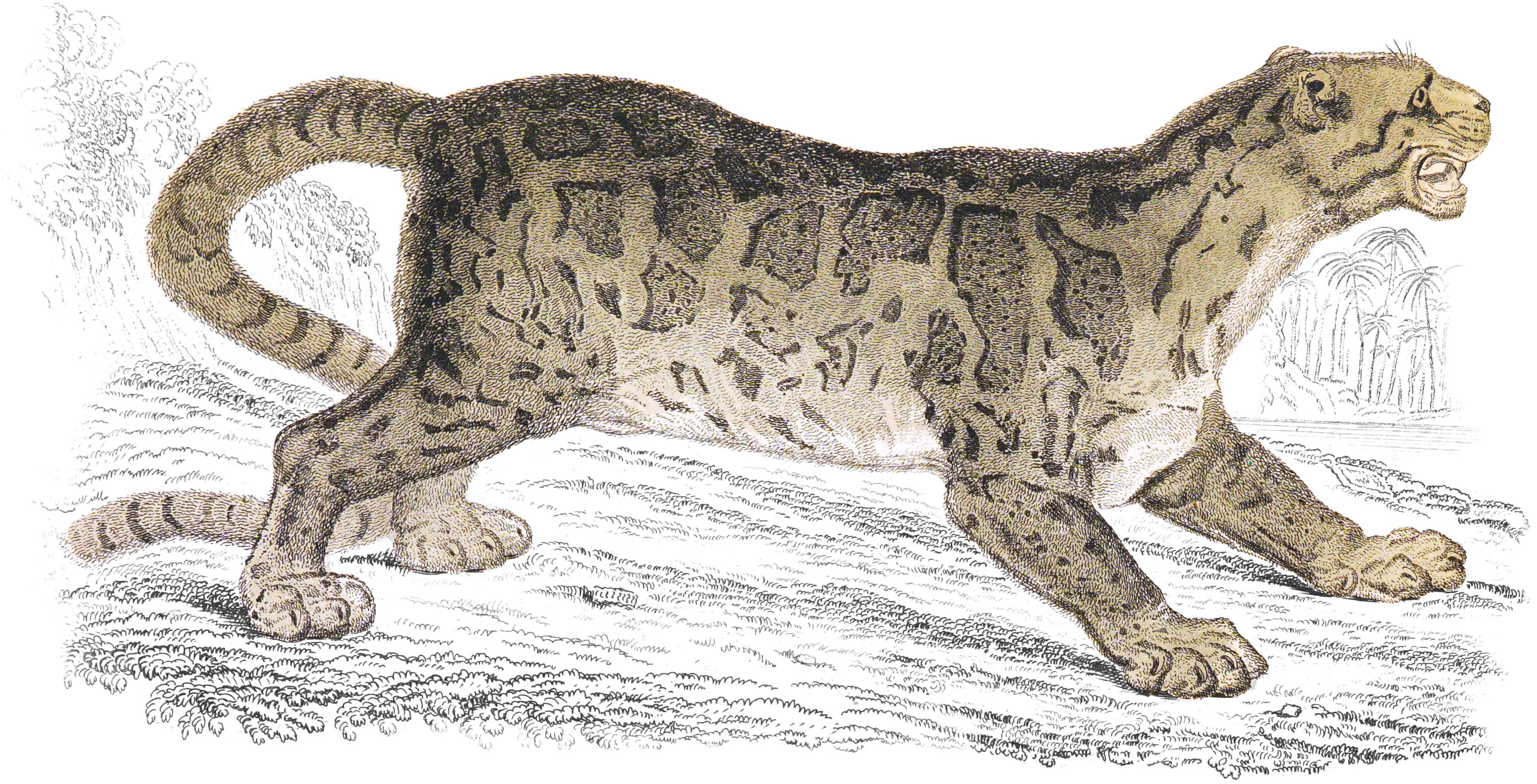
Plate IX
The next animal we have to describe is one of the largest of the Cats with spotted or ringed markings. It is
The Jaguar, or American Panther
Felis onca.—Linnæus.
Yagüareté, Azara.—Le Jaguar, ou Tigre d’Amerique, Cuvier, Règne Animal, i. 161.—Frederic Cuvier, Histoire Naturelle des Mammiferes. Male and Female.—Félis Jaguar, Temminck, Monographies, p. 136.—Desmarest’s Mammalogie, p. 229 219.—The Jaguar, or American Panther, J. Wilson, Zoological Illustrations, pl. ix.—Griffith, Animal Kingdom, pls. Greater and Lesser variety.
The continents of Asia and Africa we have seen inhabited by species beautiful from the rich and spotted markings of their skins; while their size and proportions were still large and powerful. In the warmer parts of the New World, we have a prototype, rivalling them in beauty, and exceeding them in strength, but apparently filling the same station in animal life.
The Jaguar, or, as he is sometimes called, the American Panther, inhabits the warmer parts of South America, chiefly Paraguay and the Brazils, but is nevertheless found from the most southern extremity to the isthmus of Darien. It is one of the strongest and most powerful of the Felinæ after the Tiger; and its thick and compact limbs and form, independent of the difference in marking, at once distinguish it from the spotted or ringed Cats of the old world; yet it is only within these few years that the distinctions have been pointed out, the quotation of the plates of Buffon, the copies that were afterwards made from them, gave rise to considerable confusion between it and the Leopard.
The markings of this animal vary very much, as may be seen from the accompanying illustrations; and after much research in America, Major H. Smith has come to the conclusion, that there are in reality two varieties, which he characterises under the titles of the Great and Lesser Jaguar, the large species measuring about 2 feet 10 inches in height at the shoulder, the smaller one about 2 feet 2 inches. The lesser variety, of which Major Smith has given a figure, was of a paler almost ashy colour, the spots few and very distinct.
We shall now notice the illustrations which accompany our description. The first (Plate X.) was taken from a very fine and beautifully marked skin, for which we are indebted to Mr L’ry, furrier in Hanover Street, and who obligingly displayed to us his whole extensive stock of furs. It was a very large animal; the markings were of a very deep chocolate-brown, upon a rich yellowish ground, and were remarkable for their clearness. Along the centre of the back there was almost a line of open spots only occasionally interrupted, and the next two lines were of an oval or diamond shape, producing a very beautiful appearance. Upon the sides the rings became more defined and distinct, and many of them possessed the small spot or spots in the centre, which has been always given as one of the characters of this species.
The next illustration (Plate XI.) is taken from Frederick Cuvier’s representation of the male jaguar. The dimensions of this animal were in total length 6 feet 9 inches, of which the tail made 2 feet 2 inches; the height at the shoulder 2 feet 6 inches, a size altogether approaching near to that of the Greater Jaguar of Hamilton Smith, which it also somewhat resembles in the markings of the body. The rings are few and very defined, but there is little trace of any central dots, and the intermediate spaces are equally free from interruption.
Our next Plate (Plate XII.) is taken from Mr Wilson’s beautiful illustration, from a drawing by Mosses. In it the rings can scarcely be traced at all, and the whole marking is of a more irregular and confused character. But the animal had not reached its full dimensions, and with its growth the completion of the rings may have become more developed. In whatever way it may be taken, it forms a very interesting addition to the figures of this animal. It was brought to Liverpool from Paraguay, and the Captain of the vessel could venture to play with it, as it lay in one of the boats on deck, to which it was chained, but it had been familiarized to him from the time that it was the size of a small dog.43
The jaguar inhabits the forests, and seeks its prey by watching, or by openly seizing cattle or horses in the enclosures. It actively pursues smaller animals, and even the monkeys, with all their agility, are not exempted from its attacks. It climbs “freely and expertly.” Sonnini tells us, that
he has seen the prints left by the claws of the jaguar on the smooth bark of a tree forty or fifty feet in height, and without branches, and although several slips could be traced, it had at last succeeded in reaching the very top.
Humboldt says,
Sometimes, after a long silence, the cry of the jaguar comes from the tops of the trees: and in this case it was followed by the sharp and long whistling of the monkeys, which appeared to flee from the danger that threatened them.
But horses, oxen, and sheep, are his favourite seizures, and the depredations committed are sometimes very extensive. Nor is it to be wondered at that the inroads of these creatures are looked upon with horror, when one is possessed of sufficient strength to carry off a horse; and their numbers are so prodigious, that 4000 were killed annually in the Spanish Colonies, and 2000 were exported every year from Buenos Ayres alone.44
Among the Pampas of Paraguay, great havoc is committed among the herds of horses, and the swiftness of the courser is unavailing before one of these relentless foes. Fear seems to paralyze his efforts, a spring brings the formidable assailant upon his back, and he is either brought to the ground by the weight, or the neck is broken by a blow or twist on the muzzle. A full grown jaguar is quite able to drag off a horse. Azara caused the body of a horse which had newly fallen a victim to this animal, to be drawn within musket shot of a tree, in which he intended to pass the night, anticipating that the jaguar would return in the course of it to its victim; but while he was gone to prepare for the adventure, the animal returned from the opposite side of a large and deep river, and having seized the horse with its teeth, drew it for about sixty paces to the water, swam across with its prey, and then drew it into a neighbouring wood, in sight the whole time of a person whom D’Azara had left concealed to observe what might happen before his return. Its prey, however, is very various, and its taste by no means confined to what may be called the finer game of the plain or forest. They take the water very freely, and are said even to fish in the shallows, seizing the fish with their paws. I am not sure that we have very good authority for this, but as the common domestic cat has been known to be a successful angler, the jaguar may have similar abilities. We have better authority for their partiality to turtles. Humboldt relates,
We were shewn large shells of turtles emptied by the jaguars. These animals follow the arraus towards the beaches, when the laying of eggs is to take place. They surprize them on the sand; and in order to devour them at their ease, turn them in such a manner that the under shell is uppermost. In this situation the turtles cannot rise; and as the jaguar turns many more than he can eat in one night, the Indians often avail themselves of his cunning and malignant avidity. When we reflect on the difficulty that the naturalist finds in getting out the body, without separating the upper and under shells, we cannot enough admire the suppleness of the tiger’s paw, which empties the double armour of the arraus, as if the adhering parts of the muscles had been cut by means of a surgical instrument. The jaguar pursues the turtle quite into the water, when not very deep. It even digs up the eggs; and, together with the crocodile, the herons, and the gallinazo vulture, is the most cruel enemy of the little turtles recently hatched.45
Like their congeners, they do not attack man when unannoyed, but are neither very easily scared from their prey, nor do they readily flee from his approach. They will often follow travellers, Humboldt remarks, even when they will not attack them, skirting the road, and appearing only at intervals among the bushes;46 and during his long abode in America, the same traveller heard of only one example of a Llanera who was found torn in his hammock opposite the island of Achaguas.47 In another part of the Narrative of this accomplished traveller, we have the following anecdote, which shows the jaguar to be very easily frightened; we doubt, however, if the forbearance of the animal would have been very long continued.
Two Indian children, a girl and a boy, the one about seven, the other about nine years old, were at play on the outskirts of the same village, when a large jaguar, about two o’clock in the afternoon, came out of the woods and made towards them, playfully bounding along, his head down and his back arched, in the manner of a cat. He approached the boy in this way, and began to play with him; nor was the latter even sensible of his danger, until the jaguar struck him so hard on the head with his paw, as to draw blood, whereupon the little girl, with a small switch which she had in her hand, struck him, and he was already bounding hack again, not at all irritated, to his retreat, when the Indians of the village, alarmed by her cries, came up to them.
The jaguar is generally hunted with dogs, which run him to bay, or make him take refuge in a tree, where he is kept till the coming up of the hunters, who shoot him or disable him with their long spears. He is also said to be hunted singly, the huntsman having his left arm defended by a sheep’s skin, on which he receives the animal’s spring, and stabs him with a spear about five feet in length.
Jaguars are occasionally met with having the ground colour of the skin of a very deep brown tinge, almost approaching to black; on these the markings are of a still deeper shade. This variety is rare, and has never been well or characteristically figured, and we regret having been unable to procure a drawing from well preserved or living specimens. Azara has also mentioned a white variety, with the rings appearing darker in particular lights. This seems to be still more rare, and we are not aware of any specimen having been lately seen in Europe.


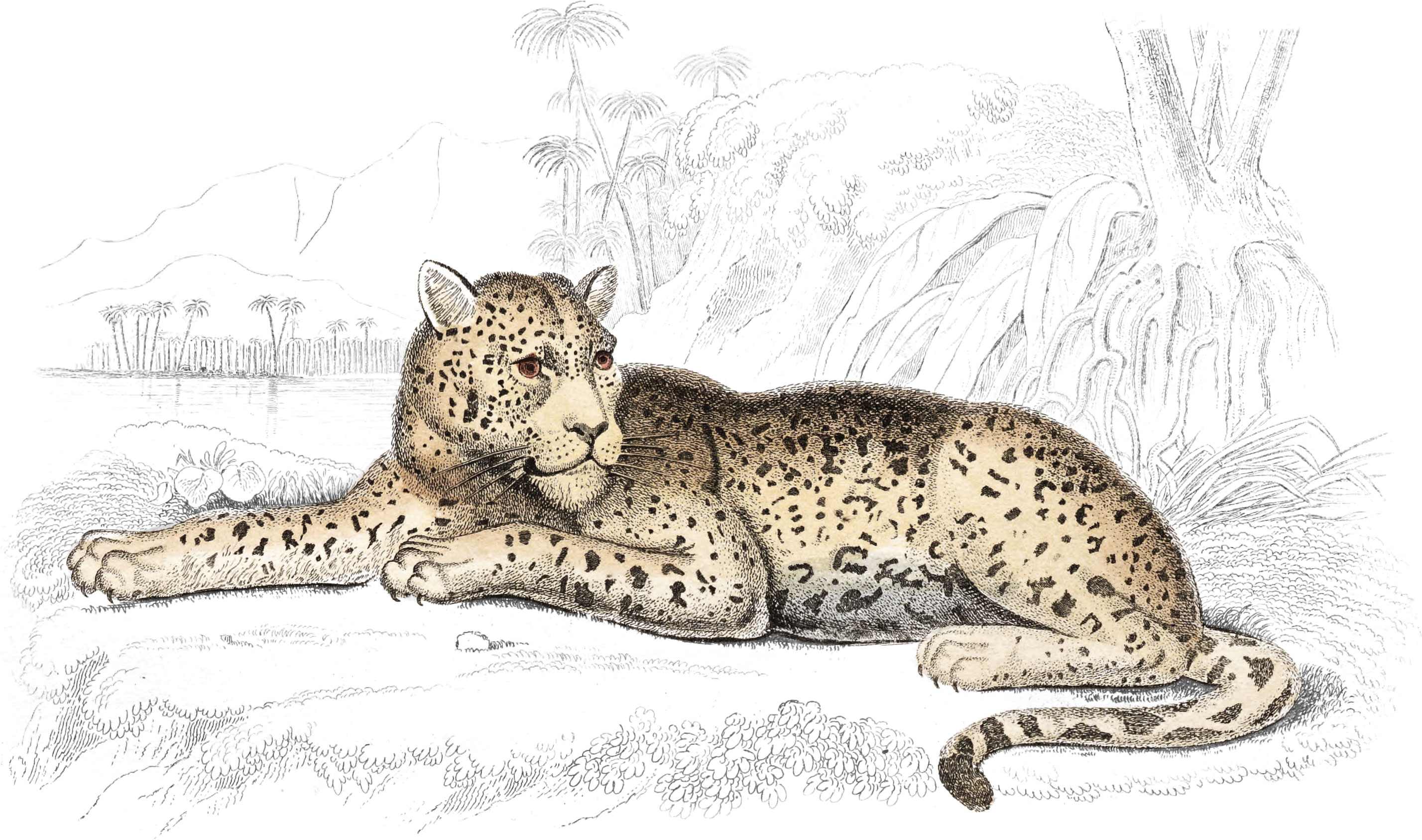
Next to this animal, we have ventured to point out what we consider will be the distinguishing characters of one which is yet almost unknown.
The Ounce
Felis uncia.—Linnæus.
The Ounce, Plate in Griffith’s Animal Kingdom, ii. p. 468?
When the present series of volumes were commenced, we hoped that they would come into the hands of many, besides those of the professing naturalist. While it is attempted to give a general view of the different branches, as far as they can be carried by our knowledge at the time, it is also hoped that rare or doubtful species may be occasionally restored, by having the attention of individuals directed to them. In the present tribe of animals there are many opportunities where this might happen; for among the many thousands of skins which are annually imported as articles of trade, how few are looked at with the view of furthering the descriptions of the animals that once bore them; and when one is noticed as different from the rest, it is generally passed over as merely an accidental occurrence. This is the only apology we can offer for introducing the Ounce with a separate plate and title, and it may succeed in directing the attention of those who have opportunities of seeing numbers of the skins of the Large Spotted Cats.
The Ounce is first noticed by Buffon, who describes it as an animal of considerable size, of a greyish-white, yellowish on the upper parts, and with the hair much more lengthened than in any of the other spotted cats.
Both Temminck and Cuvier leave out the Ounce in their descriptions of the Felinæ, and we should have been content to have merely mentioned it, as described by Buffon, had not the plate in Griffith’s Animal Kingdom, and the notes in the same work by Major Smith, given us some grounds for thinking that it will one day constitute a very interesting species. The figure in Griffith is taken from a specimen which was in the Tower of London, brought from the Gulf of Persia. It corresponds in a remarkable degree with Buffon’s representation; and Major Smith is said to have once met with a skin also from the Gulf of Persia, and from the length of the fur, which was shaggy, he conjectured it to be from the higher mountain ranges of that country.48
The Baron Cuvier, in his observations on Buffon’s plate, does not mention, and seems to overlook, the long and shaggy hair, which we would consider as one of the most marked characters of the species, and one by which a person comparatively unacquainted with the subject, would distinguish it from the leopard or panther. Our plate is a copy from that of Buffon, with a slight variation of attitude, and we think that naturalists who have the opportunity of seeing or receiving specimens from Northern or Western Asia, should keep this species or variety (whichever it may prove) in recollection.
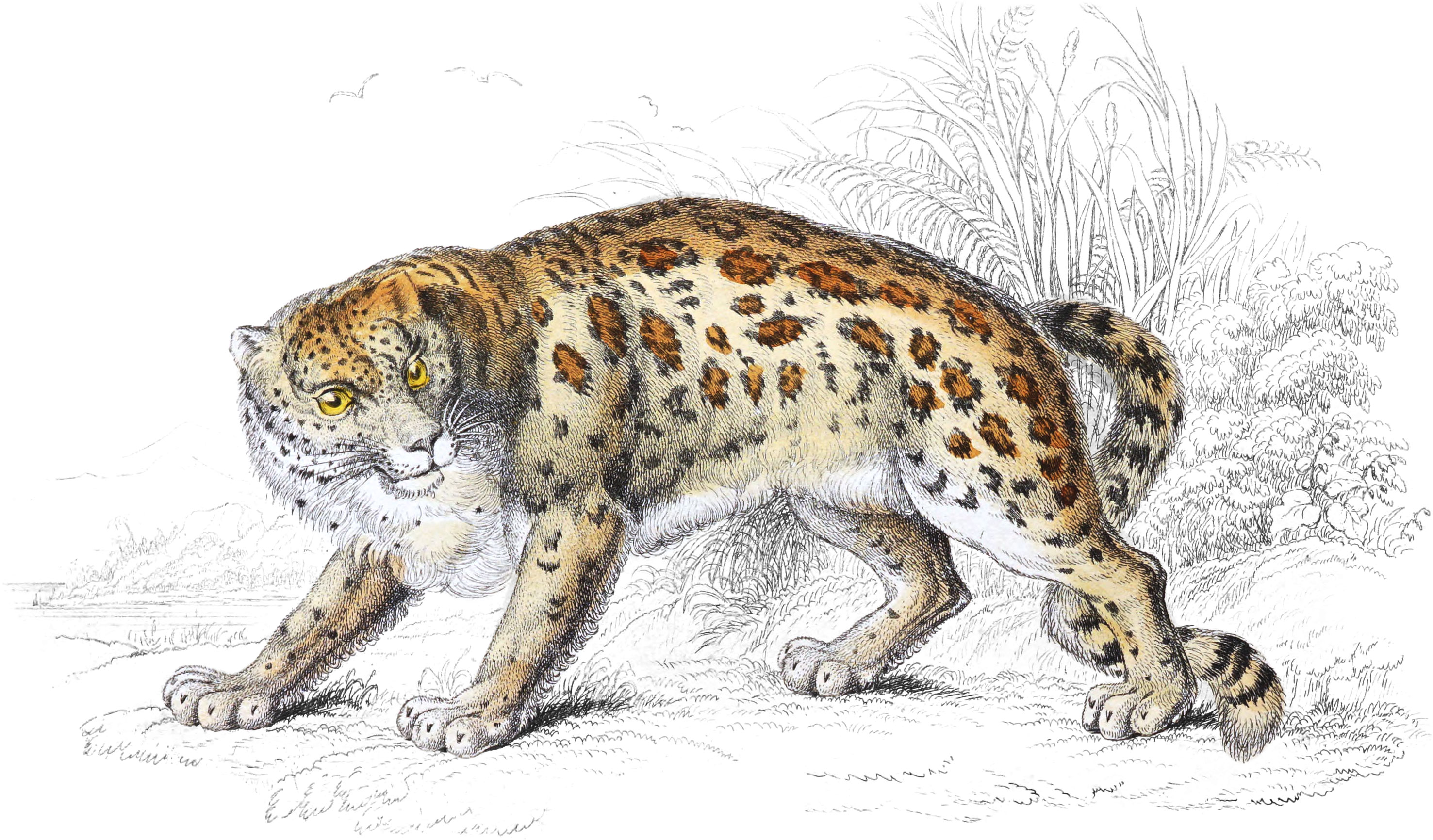
Plate XIII
The Chati
Felis mitis.—F. Cuvier.
Le chati femelle, Felis mitis, Fred. Cuvier, Histoire Naturelle des Marumifères.—Fèlis chati, Temminck, Monographies, p. 150 149.—Felis chibigouazou, Desmarest, Mammalogie, p. 221.
The first modern notice of this beautiful species is in the magnificent work of Frederic Cuvier, who gave his figure and description from a living specimen in the Paris Menagerie, and which has been now used for our illustration. This also served Desmarest for his descriptive letter-press to the Encyclopedic Methodique, but he identifies it with the Chibigouazou of Azara, while Temminck, who uses much of the same materials for his “Monographies,” considers it distinct from that animal, and completes his description from a skin which he received from Rio de Janeiro, and thus to a certain extent fixes the locality of the animal, of which Frederic Cuvier was ignorant.
Being unable to see specimens of this animal, we have followed Frederic Cuvier, and give his description of the female. It was procured alive from a dealer in Brest, without his being able to ascertain whence it came. It now seems to be pretty well ascertained that the species is a native of South America, and that it will most probably be identified with some of the doubtful species which have been described by the older travellers in that country.
This is a very beautiful and graceful animal, and possesses all the general characters of the diurnal cats. It is about one-third larger than the domestic cat, being in length, exclusive of the tail, rather more than two feet; and in height, at the middle of the back, about one foot two inches. The tail is eleven inches in length. The ground colour of the fur, on the upper parts of the body, is of a pale yellowish tinge; on the lower parts it is pure white; at the roots it is of a dull grey, and it is very thick and close. The whole body is covered with irregular dark patches; those upon the back are entirely black, and are disposed longitudinally in four rows. Those upon the sides are surrounded with black, have the centres of a clear fawn colour,49 and are arranged in nearly five rows. The spots upon the lower part of the body, where the ground colour of the fur is white, are full, and appear arranged in two lines, composed of six or seven patches on each side. The limbs are covered with nearly round spots of smaller dimensions; and upon the fore legs, near the body, there are two transverse bands. Upon the throat there is a sort of half collar, and upon the under jaw two crescent-formed spots; behind each eye run two bands, about two inches in length, which terminate opposite the ear. The forehead is bordered by two lines, between which there are numerous spots, and at their origin there is a blackish mark from whence the whiskers spring. The outside of the ear is black, with a white spot upon the small lobe. The base of the tail is spotted with small blotches, which, towards the extremity, run into half rings, broadest upon the upper surface. The pupil of the eye of the chati is round; in other parts of its formation, and in its motions, it is said to resemble the common cat; it also utters a similar cry, only that it is a little harsher and more lengthened.
The animal from which F. Cuvier took his description was extremely gentle; towards those with whom it was familiar, and who did not approach its cage, it would express its discontent by a short cry, and when caressed would shew the greatest satisfaction and delight. It was from this mild temper that its first describer applied to it the trivial name of Mitis.

Plate XIV
Female
The Hunting-Leopard
Felis jubata.—Schreber.
Felis jubata, Schreber, tab. 105.—Félis Guépard, Temminck, Monographies, p. 89.—Desmarest, Mammalogie, p. 221.—Cynailurus jubata, Wagler.
This is one of the most curious and interesting animals of the Feline race. Possessing at first sight all the colour, marking, and appearance of the larger spotted cats, one becomes surprised, upon closer examination, to find the form of the dog almost interwoven in its appearance. Its alliance to the dog is still more confirmed by the disposition being so canine as to be susceptible of training, so that the animal will obey the orders of its master. In confinement, or when tamed, it exhibits great mildness and affection; one which Frederic Cuvier describes, being so domesticated as to live at large, and in the company of children and domestic animals.
The hunting-leopard is a native of both Africa and India; but, of late, naturalists have suspected that the animals from these countries were distinct, the Indian species being said to be more dog-like, to stand higher upon its legs, and to have a more scanty mane, or rather nearly to want that appendage. This has suggested for it the title of “Maneless Hunting-Leopard,” F. venatica; while the former appellation of jubata has been retained for the African animal only. We cannot at present decide this point, but we think it is extremely probable that two species are involved in the common synonyms which are given. Baron Cuvier was of opinion that this animal should stand in a separate genus, of the propriety of which there can be no doubt; and it has in fact been removed by Wagler under the title Cynailurus.
Desmarest gives the length of the hunting-leopard as three feet six inches, exclusive of the tail. Temminck gives that of a very large specimen, as nearly five feet. The tail is rather long in proportion to the body, reaching to about the shoulder of the animal. Our description we have copied from that of Mr Bennet, taken from two living males in the Tower of London. It is more correct than any thing we could give ourselves; and that gentleman’s observations on the form and structure, are both judicious and interesting.
The hunting-leopard forms a sort of connecting link between two groups of animals, otherwise completely separated, and exhibiting scarcely any other character in common than the carnivorous propensities by which both are, in a greater or less degree, actuated and inspired. Intermediate in size between the leopard and the hound, he is more slender in his body, more elevated on his legs, and less flattened on the fore part of his head than the former; while he is deficient in the peculiarly graceful and lengthened form, both of head and body, which characterizes the latter. His tail is entirely that of a cat; and his limbs, although more elongated than any other species of that group, seem rather fitted for strong muscular exertion, than for active and long continued speed.
In the number and form of his teeth, in the asperity of his tongue, in the conformation of the organs of sense, and in the number of his claws, he accurately corresponds with the legitimate species of the genus Felis. The principal character in which he differs from them, consists in the slight degree of retractility of these latter organs. Instead of being withdrawn within sheaths appropriate for the purpose, as in the cats properly so called, the claws of the hunting-leopard are capable of only a very limited retraction within the skin, and are consequently exposed to the action of the ground on which they tread, their points and edges being thus rendered liable to be blunted by the constant pressure to which they are subjected, almost to the same extent as in dogs. The slightest consideration of the uses to which the claws are applied, by the whole of the Feline tribe, in whom they are, in fact, in consequence of their extreme power and sharpness, organs of offence, if possible, more deadly and more destructive than the teeth, will teach us, that the modification which has just been described as so important a part of their organization, must of necessity he accompanied by a corresponding change in manners and habits; and that circumstance alone, and the want of analogous structure in any other animal, could justify us in continuing to class the Chetah among the cats, from which he differs in so essential a particular.
In outward form, however, notwithstanding his more slender make, the difference between them is by no means great. His head, although more elevated and prominent in front, exhibits the same broad lateral expansion, caused by the thick mass of muscle, which acts so powerfully upon the throat and dilated jaws of the cats, and imparts to them that tremendous force and effect for which they are so remarkable. His legs, notwithstanding their increased length and slender proportions, retain all the elastic springiness, by means of which the leopard or the tiger are enabled to bound with so much vigour and velocity upon their unsuspecting prey. His air and manners, too, are unquestionably those of the cats; and his mode of colouring, which we shall next proceed to describe, although exhibiting very peculiar and marked distinctions, offers so close an analogy to that of the jaguar and the leopard, that were we to regard this character alone, it would be impossible to arrange him in a different group from that which comprehends those beautifully spotted but ferocious beasts. His fur, however, it must be remarked, has little of the sleekness which characterizes those animals, but exhibits, on the contrary, a peculiar crispiness, which is not to be found in any other of the tribe.
His ground colour is a bright yellowish fawn above, and nearly pure white beneath, covered above and on the sides by innumerable closely approximating spots, from half an inch to an inch in diameter, which are intensely black, and do not, as in the leopard and other spotted cats, form roses with a lighter centre, but are full and complete. These spots, which are wanting on the chest and under part of the body, are larger on the back than on the head, sides, and limbs, where they are more closely set; they are also spread along the tail, forming on the greater part of its extent, interrupted rings, which, however, become continuous as they approach its extremity, the three or four last rings surrounding it completely. The tip of the tail is white, as is also the whole of its under surface, with the exception of the rings just mentioned; it is equally covered with long hair throughout its entire length, which is more than half that of the body. The outside of the ears, which are short and rounded, is marked by a broad black spot at the base; the tip, as also the inside, being whitish. The upper part of his head is of a deeper tinge; and he has a strongly marked flexuous black line, of about half an inch in length, extending from the inner angle of the eye to the angle of the mouth. The extremity of the nose is black, like that of the dog. The mane, from which he derives his scientific name, is not very remarkable; it consists of a series of longer, crisper, and more upright hairs, which extend along the hack of the neck and the anterior portions of the spine.
We observed that the disposition of those animals was so much allied to that of the dogs, that they were capable of being trained for the chase; it is, however, more properly similar to the species of docility which characterizes a falcon, and the employment of the hunting-leopard may be compared to the sport of falconry. The natural instinct teaches to pursue the game; the reward of a portion of it, or of the blood, induces them to give it up, and again subject themselves to their master. It is in India that this sport is pursued; in Africa the hunting-leopard is only valued for his skin, which is worn by persons of consequence, or the chiefs of tribes; and brings a high price on exportation.
At an early period of the Mogul empire,50 these animals were employed in the greatest numbers; and it appears certain that others of this race were also used.
Leopards and lynxes were kept for the chasing of deer, and also tigers for seizing boars.
Although it is not likely that it was the real tiger which was employed, it is evident that there was at least three animals so distinct as to entitle them to various denominations. It is said that some of the emperors, in their great hunting expeditions, were accompanied to the field with a thousand hunting-leopards.
At the present period this sport is confined entirely to India and Persia, and the hunting-leopards alone is employed in it. They are so tame and gentle, as to be led about in a leash like greyhounds, but when brought to the hunting-field, they are carried either on an elephant, or on horseback on a pad behind the rider, but more generally on a cart made for the purpose, and drawn by oxen. This carries both the sportsmen and his attendants, and upon approaching the game, the animal is unhooded and slipped. But the description of a chase by one who has enjoyed the sport, will give the best idea pf the manner in which it is conducted.
Just before we reached our ground, the shuter suwars, (camel courier,) who always moved on our Hanks in search of game, reported a herd of antelopes about half a mile out of the line of march, and the chetahs being at hand, we went in pursuit of them. The leopards are each accommodated with a flat-topped cart, without sides, drawn by two bullocks, and each animal has two attendants. They are loosely bound by a collar and rope to the back of the vehicle, and are also held by the keeper by a strap round the loins. A leathern hood covers the eyes. The antelopes being exceedingly timid and wild, the best way to enjoy the sport is to sit on the cart alongside the driver; for the vehicle being built like the hacheries of the peasants, to the sight of which the deer are accustomed, it is not difficult, by skilful management, to approach within 200 yards of the game. On this occasion we had three chetahs in the field, and we proceeded towards the spot where the herd had been seen, in a line with an interval of 100 yards between each cart On emerging from a cotton field, we came in sight of four antelopes, and my driver managed to get within 100 yards of them, ere they took alarm. The chetah was quickly unhooded and loosed from his bonds; and as soon as he viewed the deer, he dropped quietly off the cart, on the opposite side to that on which they stood, and approached them at a slow crouching canter, masking himself by every bush and inequality which lay in his way. As soon, however, as they began to shew alarm, he quickened his pace, and was in the midst of them in a few bounds.
He singled out a doe, and ran it close for about 200 yards, when he reached it with a blow of his paw, rolled it over, and in an instant was sucking the life’s-blood from its throat.
One of the other chetahs was slipped at the same time, but after making four or five desperate bounds, by which he nearly reached his prey, suddenly gave up the pursuit, and came growling sulkily back to his cart.
As soon as the deer is pulled down, a keeper runs up, hoods the chetah, cuts the victim’s throat, and securing’ some of the blood in a wooden ladle, thrusts it under the leopard’s nose. The antelope is then dragged away, and placed in a receptacle under the hachery, while the chetah is rewarded with a leg for his pains.

Plate XV
The Ocelot
Felis pardalis.—Linnæus.
Felis pardalis, Linnæus.—Félis ocelot, Temminck, Monographies, p. 144.—Desmarest, Mammalogie, p. 222.—Mexican Tiger, Pennant, History of Quadrupeds, i. p. 267 pl. 57A.—Ocelot, Hamilton Smith, in Griffith’s Cuvier, ii. p. 475.—Wilson’s Illustrations of Zoology, pl. xvii.
This is a very beautiful and graceful little species, at the same time it is easily tamed, and becomes very playful, good-tempered, and familiar. Like the jaguar of the same country, it is subject to considerable variety in the form and distribution of the markings; but the colouring is always chaste and beautiful, and the rich reddish or tawny of the ground tint, blends finely with the deep brown, or almost black, on the borders of the spots.
The best representations of the ocelot that we are aware of, are those drawn by Major Hamilton Smith, for Griffith’s edition of Cuvier; they are full of character, and represent four variations in the markings of the animal, while another plate represents a fifth, which the Major considers a distinct species. The ocelots, that gentleman thinks, form a subordinate group in the great family of the Felinæ, and he describes them as being of middle size, between the larger and smaller cats, of more slender and elegant proportions, without tufts on the ears, the markings diverging more or less in open chain-like spots or streaks from the shoulders, backwards and downwards. They all belong to the New World; but there are two or three species of the Old that resemble them in several particulars, and therefore might form the next group.51
In the four varieties above mentioned, the ground colour varies, on different parts of the body, from tawny-yellow to rufous, and to grey tinged with red; and the markings change from lengthened chain-like streaks, surrounded with a dark margin, to spots like those on the jaguar, and to solid streaks and blotches of black. The spots and blotches are frequent on the legs of all the varieties; but the chain-like streaks appear only on the neck, sides, and loins. Upon the back, the blotches often run together, forming an irregular but continuous dark line. The rufous colour prevails chiefly on the head, neck, and shoulders.
Temminck gives the length of a full-grown ocelot at from three feet and a half to four feet, including the tail, which is from 11 to 15 inches. Specimens of this animal have been brought from Mexico, Brazil, Guiana, and Surinam. It inhabits the forests, and climbs trees expertly in search of prey, which consists of birds and small animals.
The subject of our first illustration of the ocelot is copied from Mr Wilson’s plate. The original was a painting by Mosses of Liverpool, in the possession of Dr Traill. It was a female, and measured, exclusive of the tail, about 2 feet 9\(\frac{1}{2}\) inches, the tail 11\(\frac{1}{2}\) inches.
The upper part of the head is deep tawny, streaked with blackish-brown. A blackish streak passes from the upper and inner canthus of each eye to the forehead, between the ears, in a converging manner; and between them there are several delicate lines of the same colour. Another strongly expressed stripe passes from the outer canthus of the eyes to the angles of the lower jaw, where an irregular blackish bar passes upwards, to within an inch of the outer edge of the ears. From the angles of the jaw, two stripes pass downwards, and meet in front of the throat. The ears are thin, and blackish externally, with a spot of pure white on the back of each. There is a patch of pure white at the angles of the mouth, beautifully speckled with three rows of black dots, which lie at the roots of the vibrissee; chin and throat white, with blackish bars; the ground-colour of the breast less pure; that of the belly and insides of the legs dull grey. Around the eye are white marks, nearly inclosing the orbit, but interrupted by the blackish stripes above described There are four chains of open lengthened spots on each side, more or less distinct, sloping down from the shoulder towards the flanks. The legs are irregularly marked with numerous black spots, differing in size and shape. The tail is barred with black on its sides and dorsal line, but is not annulated as in some of the varieties.
We have the following additional particulars of the habits of this animal in Mr Wilson’s account.
She is remarkably playful, much inclined to climb up the legs of those who approach her (an inconvenient tendency, from the length and sharpness of her claws), and delights in being carried about in people’s arms like a cat- She is an extremely powerful animal, but gentle through the influence of domestication, and attached to those who feed her. She one day seized a chamois leather glove, which she tore to pieces, and swallowed immediately. The person to whom the glove belonged could not rescue it with the strength of both his hands. While young, this animal was fed on oatmeal porridge and milk, and has been all along sustained chiefly by milk and vegetables, with occasionally a bit of boiled liver, or other offal. The nature of the diet has obviously a considerable influence on her disposition. When farinaceous food and milk prevail, she is certainly more tractable than when animal food is given in any considerable quantity; and when treated with live birds or raw flesh, she is observed to assume greater fierceness in her aspect, and to strike more forcibly with her fore-paws at passing animals. She has sometimes made her escape from confinement, and exhibited a power of climbing trees with great ease and activity. She has occasionally committed considerable havoc in the poultry-yard, and has more than once greatly alarmed a horse by jumping on its back in the stable. In this last feat, however, the Ocelot seemed to be actuated rather by a desire for society than the love of mischief, for she coiled herself up on the hind quarter, evidently with the view of effecting a settlement for the purpose of repose: but the plunging of the horse induced her to use her claws to render her seat more secure. Upon this the steed, as might be expected, redoubled his exertions to dislodge the enemy, and the Ocelot was at last thrown, receiving in her descent a kick which she never afterwards forgot; for it has been since observed, that, on seeing a horse, she immediately betakes herself to her den. A house-dog and “puss” speedily acquired a knowledge of each other’s powers, and neither seemed disposed to court an attack. It is believed, however, that no dog could have any chance with this animal: her jaws would have crushed at once any bone in its body. A few days before her departure from Liverpool to London, she occasioned a serious alarm. Being secured by a long chain, in front of a cottage door, she suddenly threw down a young girl of four years old, and, to the horror of the beholders, appeared to seize the child by the throat. This was, however, intended merely as play, tor neither her sharp teeth nor crooked talons inflicted the slightest injury, and, after tumbling over each other more than once, the child was taken up severely frightened, but no way hurt.52
So much for this Ocelot in particular.
Our second illustration (Pl. XVII.) is from a specimen in the Museum of the College. It had also been kept tame for some time, and, though excessively mischievous, it exhibited all the playful familiarity of the preceding. The ground-colour of the skin of this specimen was paler than usual, and of a general tinge, more approaching to a tawny-yellow. The chain-like markings were of greater length than in the last, and there were few intermediate spots. The markings on the back also were neither so dark nor so much joined.
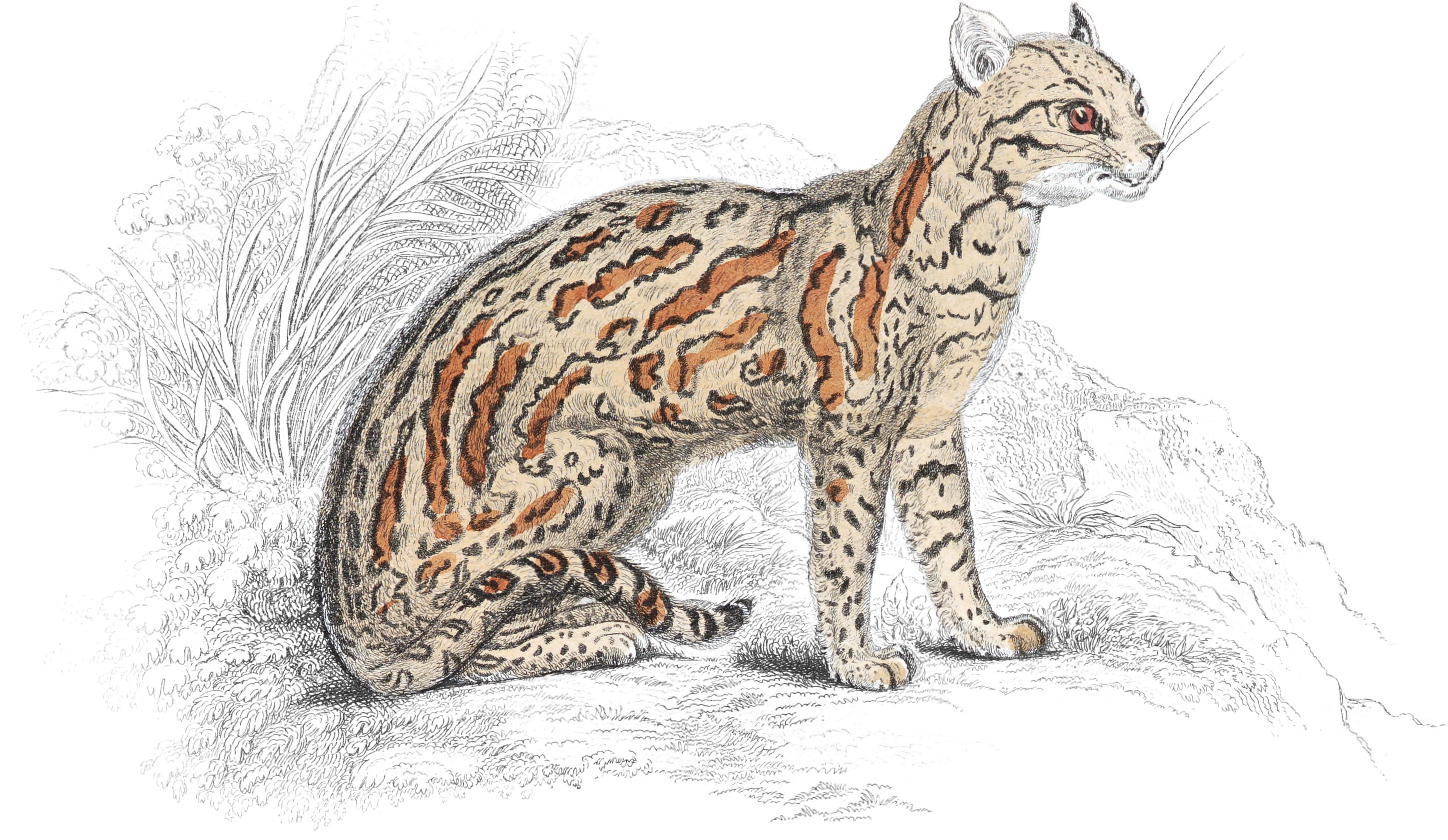

The Linked Ocelot
Felis catenata.—Hamilton Smith.
This is considered by that gentleman as an undoubted species, though two specimens only had been seen of it, the one in Mr Bullock’s museum, the other in the museum at Berlin. The latter was examined also by Professor Lichtenstein, and the conclusion arrived at was, that it was distinct from the F. partialis. The great distinction is in the lengthened arrangement of the markings, which even upon the legs assume the form of lengthened spots with an open centre. We give the Major’s description in his own words.
It is about the size of a wild cat; the legs are, in proportion, shorter than the ocelot; the head and body heavier; the mane, forehead, under the eyes, arms, shoulders, back, rump, hind-legs, and tail, are of a reddish-yellow colour; the temples ochrey; the cheeks, throat, belly, and inside of the legs, white. Several rows of black spots from the ears converge on the forehead. There is a single streak from the outer angle of the eye to below the ear. On the shoulders, back, sides, rump, and hams, there are long chain-like streaks of black and reddish brown intermixed; the belly and throat have black streaks, and the tail has imperfect black annuli.
The Long-Tailed Ocelot
Felis macrourus.—Neuwied.
Felis macrourup, Prince Maximilian of Neuwied.—Felis oceloide, Temminck, Monographies, 147.—Neuwied Cat, Griffith’s Synopsis.
This elegant little species was discovered by the Prince Maximilian of Neuwied, during his travels in Brazil, where it is known under the name of “Gotta Pintado Domato." Temminck considers that this has long been known to naturalists as a variety of the common ocelot, and thinks that even the characters which Linnæus drew up for his F. pardalis were partly taken from this animal.
Temminck gives the total length of an adult male as 3 feet 8 inches, of which the tail made 1 foot 7 inches; that of a young male was only 2 feet 4 inches. The ground-colour of the skin is of a clear ochraceous-yellow, and brighter upon the sides. The lower parts are white. The forehead is marked with five hands, more or less distinct, and upon the cheeks there are two which run transversely, the upper one from the corner of the eye, the lower from the whiskers. On the throat and fore part of the neck, there are four crescent-shaped hands, and upon the upper part of the hack there are six longitudinal streaks, four of which run upon the hack, and the two lateral ones bend down upon the fore-limbs. The rest of the body is covered with irregular lengthened blotches, which form an interrupted line upon the back, and which, on the limbs, assume the form of small round spots. There are none of the beautifully surrounded spots, with a pale centre, which so strikingly characterise the ocelot. The tail is semi-annulated, and black at the tip. In habit it resembles the shape or the ocelot.
The Margay
Felts tigrina.—Linnæus.
Felis tigrina, Linnæus.—Le Margay, Buffon.—Felis margay, F. tigrina, Temminck, Monographies, p. 152.—Desmarest, Mammalogie, p. 232.
This little species rivals the ocelot in the beauty of its markings. The ground-colour of the skin is of a pale fawn colour, white on the lower parts. The head and neck are adorned with black longitudinal bands, narrow and distinct upon the crown, and becoming broad upon the neck. Upon the cheeks are three lines; upon the throat a crescent-shaped gorget; and upon the neck and breast numerous transverse bands. The back and sides are marked with open circular rings, surrounding a centre of a redder tinge than that of the body, the whole surrounded irregularly with a black line. The thighs and tail are ringed with black and tawny bands; the insides of the former with black and white. Mr Temminck considers this to have been confounded with the last, but says it is easily distinguished by its comparatively small size, and the shortness of its tail. The whole length is only 2 feet 2 inches, of which the tail makes nearly 8\(\frac{1}{2}\) inches. It is a native of Brazil, and M. Temminck has also received it from Surinam.
Sumatran and Javanese Cats
Felis minuta.—Temminck.
Pl. xviii. Felis Sumatrana, Horsfield, Zool. Researches in Java.—Kuwuk Javanese.—Pl. xix. Felis Javanensis, Horsf. Zool. Researches in Java.—Félis servalin, Felis minuta, Temminck, Monographies, p. 130.
The figures which accompany this description represent animals, at first sight, apparently very different, and they have, in fact, been described as different species. It is now, however, pretty well ascertained, that they are the young and the adult states of the same animal; and, on this account, we have thought it better to adopt the name given to it by Temminck (though it is a bad one), than to retain the former names given to them from the country in which they are found.
Both states are figured by Dr Horsfield, in his excellent Zoological Researches, from specimens collected by Sir Stamford Raffles. The general colour of the adult is ferruginous, inclining to yellowish-grey, more intense on the back, the crown of the head, and upper part of the tail, paler on the sides, and passing into whitish-grey on the cheeks, breast, abdomen, and the interior o: the thighs and legs. The back is marked with four dark brown lines, consisting of oblong confluent spots, which commence at the forehead, between the eyes, and pass along the back to the root of the tail. The throat is marked with several transverse hands. The spots on the sides of the body are angular and scattered, without almost any regularity, and are intensely brown, inclining to black. As the various longitudinal series of spots approach the lower part of the hack and thighs, they increase in number, so as almost to cover those parts with irregular oblong spots. Towards the feet the colour is more uniformly rufous, and the marks are more minute. On the upper part of the base of the tail, narrow transverse lines are crowded together; they are paler and more distinct in the middle, and the tip is uniformly brown.
Temminck gives the entire length of this animal as 2 feet, of which the tail measures about 8 inches. The height is between 8 and 9 inches. This is considerably less than the dimensions given by Dr Horsfield of the young or F. Javanensis, or of the size of the specimen from which we took the drawing of the latter, which we shall now describe.
The specimen from which we took our figure of Plate XIX. forms part of the collection in the Royal Edinburgh Museum. The total length of the body is 21 inches; the height, at the shoulders, 10\(\frac{1}{2}\) inches.53 The ground-colour of the upper parts is a reddish-grey, changing gradually to pure white on the under parts of the body. On the back there are four lines of lengthened spots, of a deep rich brown; on the sides there are about four regular rows of rounder shaped brown spots, and the limbs are dotted with similar markings, decreasing in size as they approach the feet.54 On the throat and breast there are transverse bands of the same colour. The upper part of the tail is crossed with bands consisting of spots.
The Felis minuta has been found in Java and Sumatra, but not upon the continent of India. It is found in the extensive forests, where it forms a retreat in hollow trees, remaining concealed during the day. At night, it ranges about in quest of food, and often visits the villages at the skirts of the forests, committing depredations among the hen-roosts. The natives ascribe to it an uncommon sagacity, asserting that, in order to approach the fowls unsuspected, and to surprise them, it imitates their voice. It feeds chiefly on birds, and small quadrupeds; but, in cases of necessity, it also devours carrion. This animal is perfectly untameable, and its natural fierceness is never subdued by confinement.55
M. Temminck’s account confirms this fierce and untameable disposition. He kept two of these cats alive for two years, and the most gentle treatment was unavailing. They always kept themselves squatted and concealed in the darkest corner of the cage, and only came out when forced by hunger.
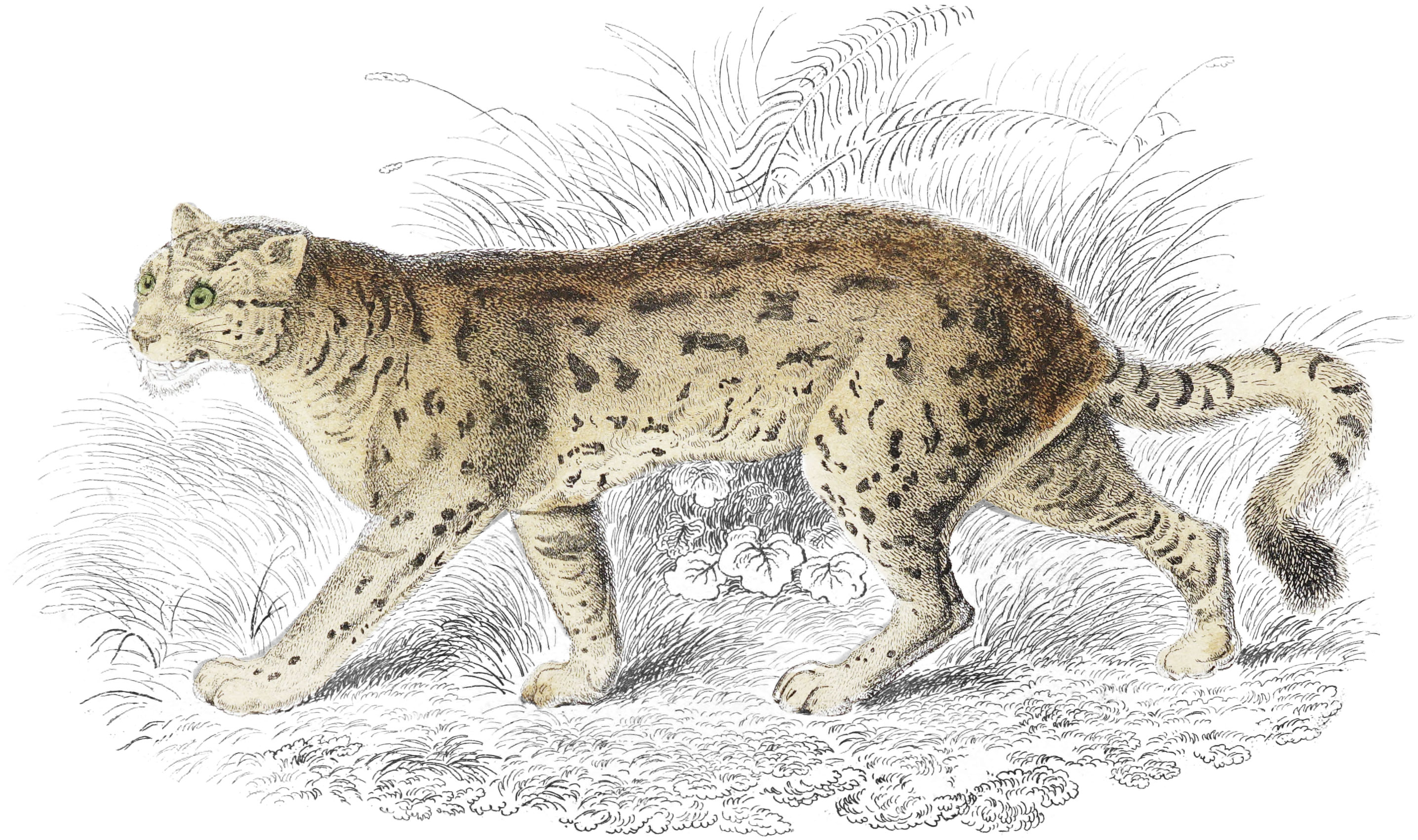
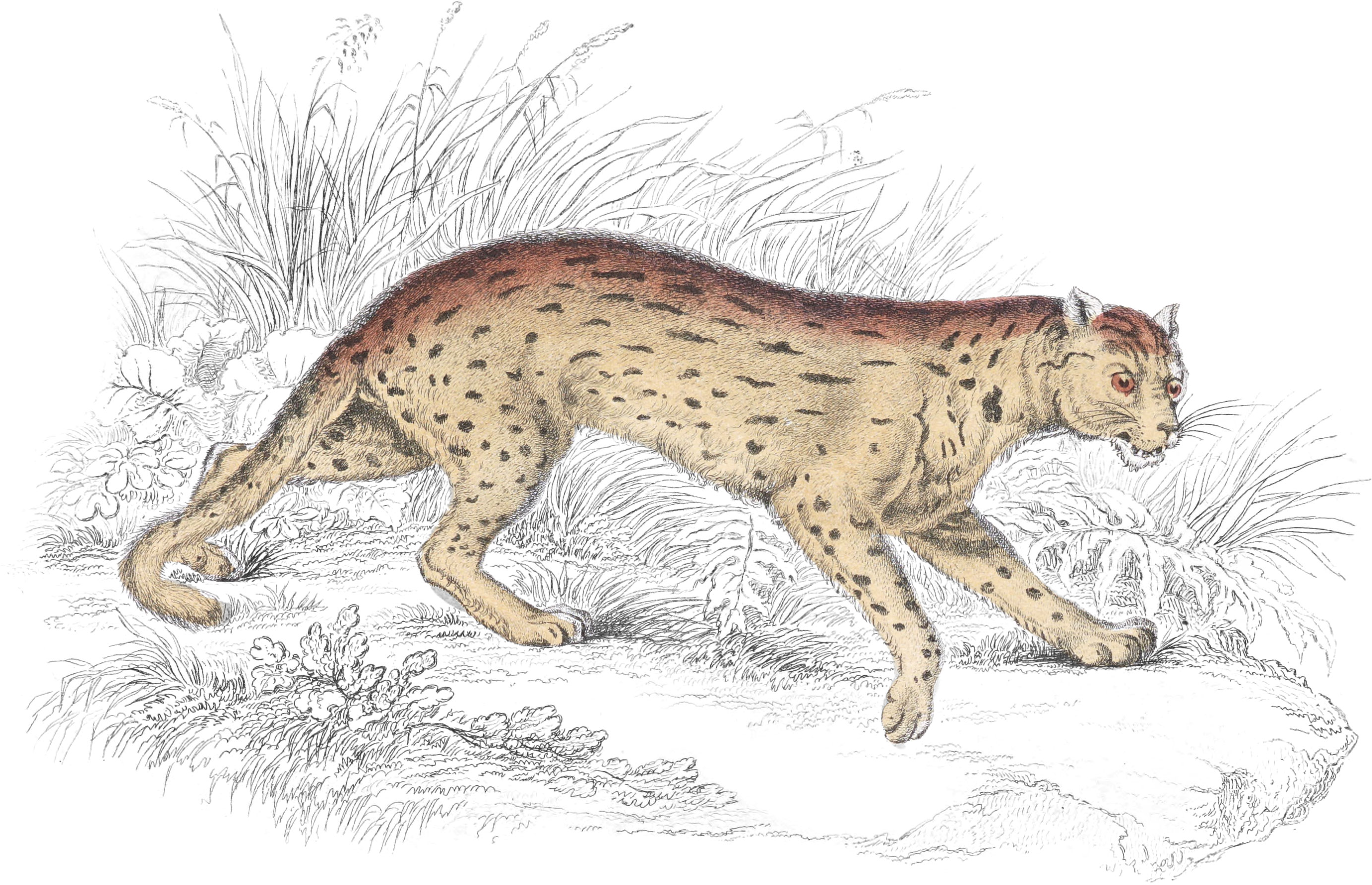
The Bengal Cat
Felis Bengalensis.—Pennant?
The very different appearance which we have seen that many of the Feline animals assume at various ages, is extremely puzzling, especially when only one or two skins can be examined. On this account, the next three figures are given with considerable doubt, and we at once confess that they do not exactly agree with the descriptions of the animals which have been similarly named. They are, however, very nearly allied, and those to which they are referred, are the only animals from the same country to which they bear any resemblance. It is possible they may be undescribed altogether, but with a species of each only before us, we can scarcely decide. The figures and descriptions may be depended upon, and some of our subscribers may have an opportunity of seeing similar skins, and will perhaps be so kind as inform us of the result of their observations.
The length of the body to the base of the tail is 18 inches; the tail wanted a little of the tip, and could not therefore be exactly measured. The height of the shoulder is 9 inches. The ground colour of the upper parts is yellowish-brown, paler upon the legs; the body thickly marked with lengthened spots, sometimes taking a turn as if to form a circle. These become smaller and more numerous, and are round upon the legs and toes. The ears are black at the bases and tips. The forehead is marked with irregular lines, which extend backwards and terminate in two broader stripes upon the back of the neck. There are two dark lines upon the cheeks. The tail at the base is spotted irregularly, and towards the end becomes indistinctly ringed. The under jaw is pure white, surrounded by a band of brownish-black. The belly is white, spotted with large black spots or patches, as in the jaguar; the base of the fore legs has two dark bands. The whole hair is of a woolly texture, and the markings are more blended with the ground colour than what is represented in the plate.
This animal was received from Java.

Plate XX
Diard’s Cat
Felis Diardii.—Desmoulins.
The total length of the subject of Plate XXI. is 3 feet, of which the tail measures 16 inches, and the height of the shoulder, when standing erect, appears to have been from 9 to 11 inches. The general colour of the fur of this specimen is of a yellowish-grey, the yellowish tinge predominating upon the face, breast, and limbs; the centre of the belly and inside of the limbs are greyish-white. A stripe of deep black arises above each eyebrow, and running close, to the base of the ears, becomes broader upon the back of the neck, and joining there, it forms a conspicuous black irregular line along the middle of the back. This line is bordered on each side with a narrow one of a yellowish shade, which is again barred by another line of black, making that in the centre well marked and conspicuous. The centre of the forehead is marked with irregular lines and spots, running backward. Next to the central dorsal line the markings continue lengthened but irregular, but upon the sides they assume the form of irregular patches having a paler centre, and surrounded with a double margin of black. Two or three of these markings on the sides are very well defined. On the shoulders and hind thighs they become less so, but still keep the general appearance; upon the limbs they assume the form of rounded spots, diminishing in size as they reach the extremity, and between the fore legs and upon the fore part of the belly, they are conspicuous among the white as brown blotches. From beneath the eye arise two lines of black, which approach and join upon the cheek; the parts, where the whiskers spring, are marked with very narrow dark streaks. The ears are short and rounded, black at the base and tips, the intermediate spaces grey, which is extended to the edge of the lower lobe; at the base of the ear, on the side of the neck, there is a grey spot, which gradually shades or is lost in the colour of the neck. Under the throat there is an indistinct trace of a collar, and the markings on the sides of the neck run indistinctly across the breast in about three bands. The tail, of which the fur is very ample, may be said to be grey above, assuming a yellow tinge beneath, and for its whole length on the upper side is indistinctly clouded with a dull black, which sometimes runs so as to surround a spot of the grey. On the lower side there are no spots.
The subject of Plate XXII. is we believe a young male (though in the Plate it is marked female). The length of the body is 19 inches, and not so stoutly made as in the former, but the tail is longer, being nearly 18 inches. In the whole fur of this specimen the yellow tinge predominates, and is darkest upon the head. The forehead is marked in the same manner, and the lines form the strongly defined dorsal streak; upon the sides the markings are more irregular than in the former, and only in one or two places there is an indication to surround a paler centre. Upon the limbs the spots are as in the former. The cheeks bear the same markings, but the lines upon the whiskers are more distinct, the edge of the upper lip is black, and the collar upon the throat with the pectoral bands are well defined. The black markings on the tail are also more distinct. Both specimens were received from Java.
In both these specimens, the markings about the cheeks and head, and the enclosed spots upon the sides, strongly remind us of the Ocelot of the New World; while the ample fur of the tail, and the same distribution of markings, approach them to the group which will contain the F. macrocelis from their own country.
The great discrepancy in our species and the description by Desmoulins56 of the F. Diardii, is the great size given of that animal, 5 feet 4 inches, and we must consider that this is some mistake. In the plate given by Griffith, there is no appearance of the open black rings with grey centres, and the length of the tail is by no means proportional.

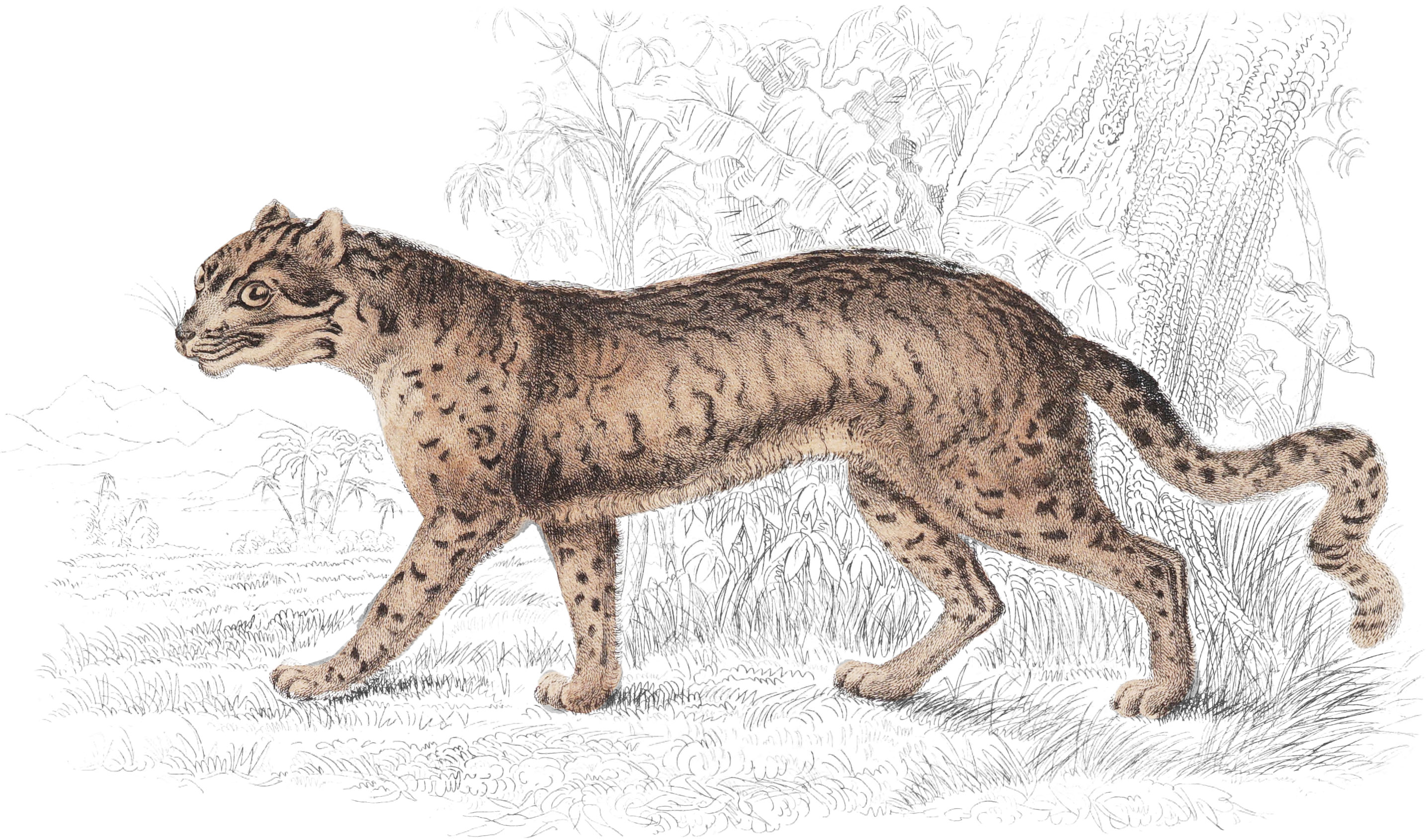
Nepaul Cat
Felis Nepalensis.—Horsfield and Vigors.
Felis Nepalensis, Horsfield and Vigors, Zoological Journal, No. xv. p. 382.
This species of cat is described by Messrs Horsfield and Vigors in the Zoological Journal, from a specimen in the Society’s Museum at Bruton Street, which was said to have been sent from Nepaul. The distinguishing characters of this species, say its describers, are its comparatively lengthened habit, and the slenderness and proportional length of the tail; the disposition of the marks on the flanks, and the characters of these marks, as far as regards their diversified form; and the saturated or black patch with which they are individually marked at their upper or posterior edge. We have given a copy of this animal from the Zoological Journal, and shall also give the description which accompanies it; they are the only published authorities for this species.
The length of the body is 1 foot 10\(\frac{1}{2}\) inches, that of the tail 10\(\frac{1}{2}\). Length of the outer extremities 10\(\frac{1}{2}\) inches, the posterior 12. We may remark here, that some of the cats are of proportions long and render, and appear to run into the vivcrrine groups of the carnivora, by means of the genus Prionodon and that this will most probably rank here.
The size of this animal is that of the Felis Javanensis; its habit more slender, the tail and neck proportionally elongate. The ground colour is grey, with a very slight admixture of tawny; the hands and spots of the head, hack, neck, throat, abdomen, and thighs, are of a deep black colour; the superior longitudinal bands resembling those of the Felis Javanensis. The ground colour of the throat and abdomen is nearly white, the lower flanks being marked with a faint tawny longitudinal streak. The cheeks are streaked with two parallel longitudinal lines, at the termination of which follows a transverse lunar mark, which passes with a bold curve to the angle of the mouth, near which a very narrow band crosses the throat.
The sides of the neck appear marked with two broad waving bands, at the termination of which stands an oblong regularly transverse band. The neck underneath is nearly immaculate. The shoulder and flanks exhibit irregular diversified marks, the anterior oblong, the posterior angular; these are of a mixed tawny and black colour, and individually bear above or posteriorly a broad dash of a saturated black colour: they are scattered over the sides without any regular longitudinal disposition; but they have generally an oblique direction.
The abdomen is marked throughout with uniform oval spots, the anterior thighs within exhibiting one, the posterior thighs two, broad black bands. The rump and thighs are marked externally with roundish or oblong spots. The tail above, to within about an inch of the tip, has uniform roundish spots, which posteriorly are arranged in regular transverse bands.

Plate XXIII
The Serval
Felis Serval.—F. Cuvier.
Le Serval, F. Cuvier, Histoire Naturelle des Mammiferes.—Mareschal, Menagerie du Museum National.—Félis Serval, Felis Serval et Capensis, Temminck, Monographies, p. 103.
The length of Frederic Cuvier’s Serval, exclusive of the tail, is 1 foot 11\(\frac{1}{2}\) inches, that of the tail 9 inches; when standing erect, it is about 12 inches high at the shoulder, at the hind quarters about 15. All the upper parts are of a clear yellowish tint, with black spots, the lower parts white, also with black spots, but in less numbers. The most conspicuous markings are upon the head and neck, where they form symmetrical lines on both sides, which point or run towards the shoulders. The spots on the other part of the body are placed irregularly. Their form on the hack is lengthened, and they seem to be there disposed in four rows; upon the sides of the body and thighs they are larger and round, and they are smaller, but equally round on the limbs; while upon the head and muzzle they are remarkably minute. The back of the ears is black at the base, which is succeeded by a transverse white bar; the tips are of the same colour with the body. On the inside of the fore-limbs, there are two conspicuous black transverse bars, and the hind limbs have similar markings, but not so well defined; the last joints of the limbs are paler than the general tint of the body, and the spots on them are round and very small. The tail has eight black lings, and is finished by a tip of the same colour.
This serval was a very young male, and was remarkable for its gentleness and mild temper. It sported in the manner of the common cat, attempting often to catch its tail, and playing with whatever it could roll about with its foot. The country where this specimen came from was not known.
We have given this as the serval of Frederic Cuvier. Azara described a cat from South America, which has been referred to under the above name, and until the publication of Temminck’s Monograph, it does not seem to have been very clearly known to what part of the world the animal belonged. The species of Azara is now thought to have been the margay, which he had confounded with it in the Paris museum; and what should now stand as the true serval, is a native of South Africa, where it is far from uncommon, and is often imported by the continental furriers. Temminck also makes the serval of F. Cuvier identical with the F. serval and Capensis of Linnæus, and with the animal described under the latter name in Miller’s Cimelia Physica. He also gives the plate of Buffon among his synonyms.
Though the skins are said to be frequently imported from the Cape, this animal is not common either in menageries or collections of this country; and the continental museums seem only to possess a few specimens.

Plate XXIV
Himalayan Serval
Felis Himalayanus.
Our attention was directed to this curious cat by Mr Warwick of the Surry Zoological Gardens, whose assistance we have already had occasion to mention. The skin was received from the Himalayan district of India; and Mr Warwick procured for us a characteristic drawing by Mr Leer, of which our plate is a copy; and the accuracy of that gentleman’s zoological portraits are so well known, that we can place every dependence upon it. As far as we can judge from this drawing, and Mr Warwick’s description which accompanied it, we are aware of no animal that this can he referred to; the size is much beyond what has been just now given of the common serval, and the peculiar tint of the ground shade is different from that of the spotted cats. We have therefore named it provisionally as above, and shall now give the dimensions and descriptions as they were sent to us.
Total length from the nose to the end of the tail, is 3 feet 2 inches; that of the tail 9\(\frac{1}{2}\) inches, considerably shorter in comparison than that of the serval. The girth round the body is 1 foot 7 inches; the height at the shoulder 1 foot 2 inches. The colour of the upper parts of this animal are greyish-brown, which becomes paler towards the belly, and on the lower parts is nearly pure white. Along the back there are four rows of extremely elongated spots, which run in stripes between the ears over the forehead; upon the sides the spots become shorter and more irregular in their lengthened distribution, and upon the sides of the breast and limbs, are round and smaller. A streak extends from the corner of the eye upon the cheek, until in a line with the base of the ear; beneath it another streak of less length but parallel to it The tail is obscurely ringed, with eight or nine bars,—all these dark markings are of very deep chocolate brown.
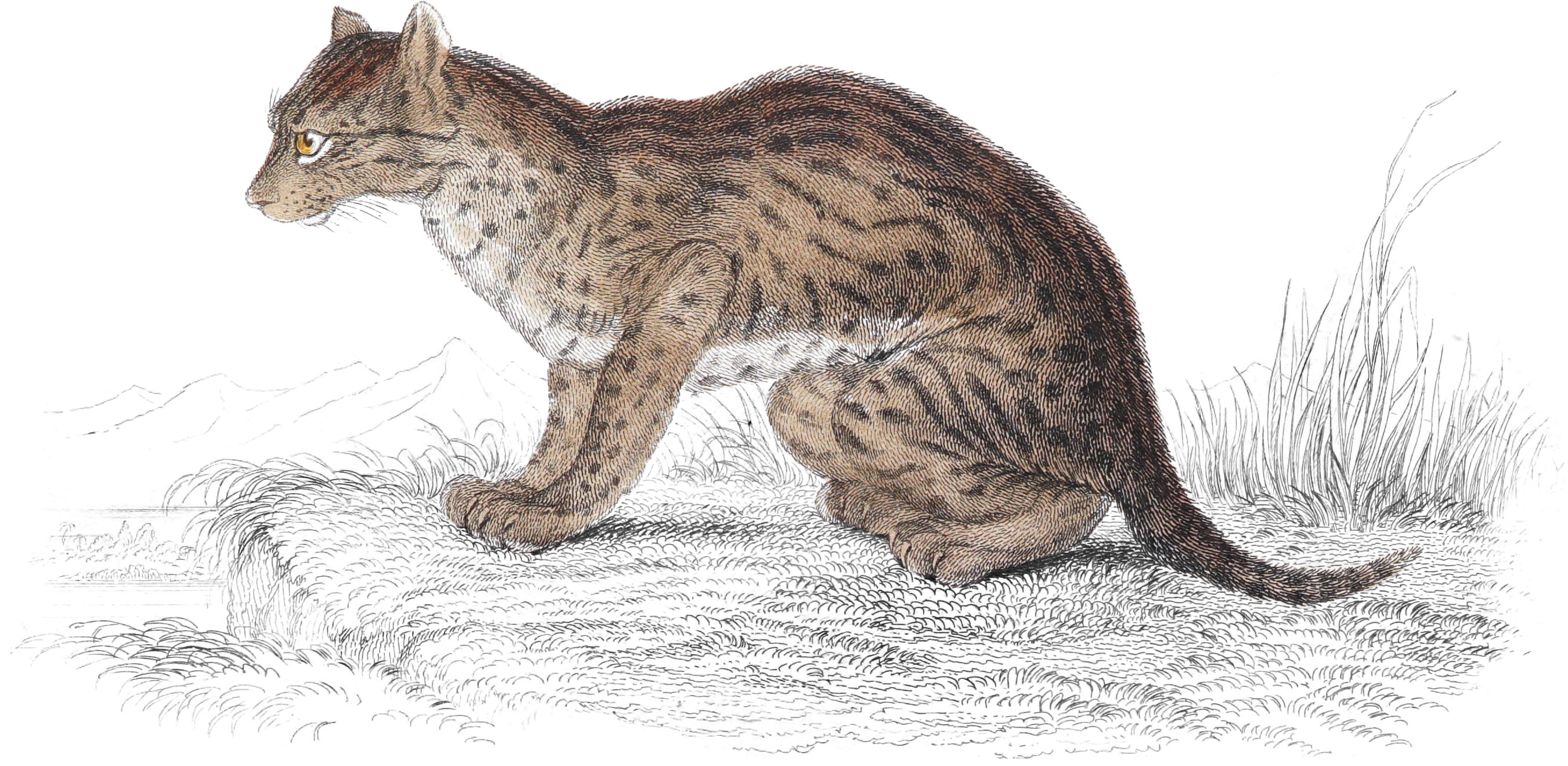
Plate XXIV*
Servaline Cat
Felis servalina.
The animal from which our Twenty-Third Illustration is given, under the title of F. ornata, is a very perfect specimen in the Edinburgh Museum. Upon our first examination, we considered it as identical with an animal which Mr Gray has figured in his interesting illustrations of Indian zoology, selected from the drawings of General Hardwicke; but upon submitting our plate to the discrimination of that gentleman, he considered them distinct, and we have therefore thought it just to Mr Gray to keep them separate, until a comparison of specimens enables us to judge of the correctness or incorrectness of our suspicions. Both animals are from India; the colour and markings are very nearly similar, and there is no other Indian species to which it bears any resemblance. The following is a description from our specimen, a female, and apparently an adult.
In this animal the fur is longer and more wiry than that of the small cats of Lower India, where it is soft and almost woolly; and in this it resembles the serval of Africa. Its length, from the nose to the base of the tail, is 15 inches; that of the tail 10\(\frac{1}{2}\) inches; the height of the shoulder rather exceeds ten inches. The ground colour is a pale tawny, slightly paler on the lower parts, and inside of the legs; and upon the chin and throat white. From between the eyes, over the head, and upon the hack of the neck, run four very indistinct lines; from the corner of the eye, under the ear, runs one better defined; and upon the cheeks and whiskers are a few irregular lines and spots. The body is spotted with comparatively few roundish and irregular markings, which on the shoulders assume the form of indistinct hands running forward upon the breast; and upon the legs, bars with a transverse direction. The inside of the fore-legs is marked with two rather indistinct bars. All these markings are of a rich brown. The heels are deep brown, which, reaches a short way up the back of the legs, as in the booted lynx; the tail is marked very indistinctly with pale brown rings for two-thirds of its length; it is after that distinctly ringed with black, and is black at the tip. The ears are more lengthened than in F. minuta or Diardii, where they are of a peculiar rounded form; and the tips are furnished with short tufts, as in the lynxes. This is a character which Mr Gray’s figure also exhibits.

Plate XXV
The Colocolo
Felis colocolo.—H. Smith.
F. colocolo, Molina, Hist. of Chile?
We regret that we have been unable to obtain in time, Frederic Cuvier’s description of this beautiful and curious species. Molina is the first who notices an animal somewhat similar to this, which has furnished most naturalists with materials for their descriptions. The only other materials which we now have in our power to use, are those given by Major Smith in Griffith’s Cuvier.
The specimen I have named conditionally Colocoio? from Molina, seems to terminate this little group, and, by the character of its markings, to approximate to the Servals and Tiger-Cats of the Old World.
It does not appear certain, though it may be probable, that this is the animal Molina indicated as the Colocolo, as he calls the marks spots, and not streaks; at least the word is so translated.
This fierce animal was shot in the interior of Guiana, by an officer of Lewenstein’s Riflemen, and by him stuffed and sent to England, for his Royal Highness the Duke of York, but probably never reached its destination. A whimsical occurrence took place with it. The gentleman who had shot it, placed it on the awning of the boat to air, as be was descending the river Paramaribo; the boat often passed under the branches of large trees, which overhung the river, and on which were the resting-places of numerous monkeys, sometimes hanging to the extremest branches above the water. Although the vessel would on other occasions excite but little attention, no sooner was the stuffed specimen in sight, than the whole community would troop off with prodigious screams and howlings. It was of course surmised, from the excessive terror of these animals, that this species of cat must be an active enemy to them.
This animal was larger than the wild cat. The head was remarkably flat and broad; the ears large and round; the body slender; the tail just touched the ground when the animal was standing; the legs were very strong; the colour of the neck and back was whitish-grey; the head, throat, shoulders, sides, belly, and inside of the limbs, white. The back was marked with lengthened streaks of black, edged with tawny; and towards the shoulders and thighs, with streaks of tawny. There was a black streak from the corner of the eyes to the jaws, and some barry marks on the forehead. The outside of the ears were dark-grey, the insides pink and naked as well as the nose. The tail was semi-annulated with black, having a black tip, and it exhibited a great peculiarity in the legs, which were all them of a very dark grey colour up to the knees.

Plate XXVI
The Egyptian Cat
Felis maniculata.—Ruppel.
Kleinpfotige Katze, Felis maniculata, fœm., Rüppel, Atlas Zuder Reise in Nordlichen Afrika, tab. i.—Félis ganté, Felis maniculata, Temminck, Monographies, p. 128.
This very interesting species is a native of the north of Africa, and has been first described and figured in the Zoological Atlas of figures of the productions which M. Ruppel discovered during his first travels in Nubia. We shall transcribe his very important remarks, and the description of the superintendants of the Frankfort Collection.
The total length is 9 feet 5 inches, of which the tail measures about 9, and the height of the shoulder is about 9\(\frac{1}{2}\) inches.
Its size is that of a middle-sized domestic cat, and smaller than the European wild cat (Felis catus ferus, Linn.) by one-third. All the proportions of its limbs are on a smaller scale, corresponding with those of the latter, with the sole exception of the tail, which in this smaller species is found to be longer. The woolly or ground hair is in general of a dirty ochre colour, which on the back and the posterior parts assumes a darker hue, and gradually becomes lighter on the anterior and lateral parts; its bristles are of a swarthy dirty white colour and wrinkled, thus giving the animal an appearance of a greyish yellow hue. The skin of the labial edges and the nose are bare, and of a black colour. The heard and bristles of the eyebrows are of a shining white colour, but are brown at their roots; the edges of the eyelids are black; the iris is of a glaring yellow. From the inner corner at the eye, a dark brown streak runs in the direction of the nose, and sideways at that streak, and towards the middle, runs another white streak as far up as the arch of the eyebrows; between these two streaks is to be found another streak of a greyish colour, extending on the forehead by the side of the ears, and under the eyes. The exterior of the ears is grey, the interior white and without tufts of hair; eight slender black undulating lines, taking their origin on the forehead, and from thence running along the occiput, lose themselves in the upper part of the neck; the cheeks, throat, and anterior part of the neck are of a shining white. Two lines of an ochre-yellow colour, the one starting from the outer corner of the eye, the other from the middle of the cheek, meet both together under the ear; two rings of the same ochre-yellow colour encircle the white neck, and below these rings similar coloured spots occur. The chest and belly are of a dirty white colour, and present similar spots or semicircular lines. Along the back runs a dark streak, which, after rising of a lighter colour over the shoulders, becomes darker on the cross, and gradually loses itself on the upper part of the tail, the lower surface of which is of a white-yellow colour; the tail itself is almost of an equal thickness, rather slender, and presenting at its point two dark rings. The extremities, with proportionally less hair on the outer side, show everywhere the general colour of the animal, having, besides, five or six blackish semicircular bands on the fore-legs, and six distinct dark cross-streaks on the hind legs. The inner sides are of a lighter colour, the anterior parts of which present two black spots, and on the posterior parts are seen the cross streaks winding around the thighs towards the inner side. The foot soles, as well as the hind parts of the ankles and wrists, are of a shining black hue.
The model which served for the above description is an aged female. The teats and their nipples concealed under the skin, indicate her having suckled at the time that she was killed. The bones of the extremities and skull, and her teeth, bear ample proof of her being aged, and of course full grown.
Ruppel has found this cat in Nubia, west of the Nile, near Ambunol. Its abode is rocky and bushy regions.
This cat must, in more than one respect, excite the interest of natural philosophers, as there can be no doubt but that from it is descended the domestic cat of the ancient Egyptians. It is a well known fact, that this nation, of which nothing now remains but some monuments, had brought up the cat to be a domestic, animal, as may be judged by the cat-mummies, and their representations on the monuments of Thebes.57
A question arises now, whether this domestic eat might have been bequeathed or transferred by the Egyptians to the contemporary civilized Europeans? Great difficulties lie in the way of giving a satisfactory answer to this question, in as far as there are such great varieties of cats to be met with among us, as to make it no easy matter to decide, by the aid of drawings, and an account of figure, which of them is to be considered as the type for our domestic animal. We have strictly compared the wild cat of Nubia with our own domestic cat, and, after a careful examination, found that there is among us a kind of grey-white cat. possessed of the principal features of the Felis maniculata; such as the eight small streaks on the forehead, the two streaks running along the cheeks, and the two rings around the chest, and likewise the cross streaks and bands on the extremities. We have farther observed in the same kind the thin long tail, and a size of the body perfectly similar with our Felis maniculata. Another similarity is its disposition for propagating, under the same roof, for many years, provided the external circumstances remain unchanged. All this, taken together, must strongly favour the opinion, that Felis maniculata is the type of our domestic cat, as the Egyptians undoubtedly had domesticated this animal much sooner than the Europeans. Still there are, on the other hand, among the varieties of our domestic cats, many which have all the characteristic features of the wild cats of our forests, such as few, broad, widely-separated streaks on the head, 8–12 similar streaks on the lateral parts of the animal, the short, thick, and woolly tail, with four or more black rings, and a body larger by one-third, and so forth.
This investigation and comparative view now leads us to the conclusion, that it is with the house cat the same as with other domestic animals; namely; many people, during the progress and development of social life, while living in totally different climates, had domesticated different small kinds of cats, which, when these people approximated to each other, and intermixed, would equally intermix; and hence produced those great varieties. At the same time we must bear in mind, that the whole genus of cats, even in a wild state, is susceptible of varying their colour, as has really happened in the case of Felis onca, Linn., and others. Of the former species even perfectly black ones have been found.
In order to obtain further elucidation with respect to the Felis maniculata, as the original type of the Egyptian domestic cat, we have enjoined our travellers, busied with zoological researches in Egypt, to send us all such varieties of the domestic cat as may be found in Northern Africa, trusting that a comparative examination of them may lead to some farther results. We have felt the more inclined to do so, from some accounts of M. Ruppel, that among the animals he saw in Kordostan, he discovered a new small species of this genus.
M. Temminck is also of the same opinion with M. Ruppel, that this is the type or stock from which our domestic cat has sprung. The opinion generally accepted before this, by most naturalists, was, that the wild cat of Europe was the original stock; but although, since the introduction of our house cat to this country, there may have been an accidental cross with the wild native species, an attentive examination of the greater numbers will at once shew a very different form than that exhibited by the wild cat; the most prominent distinctions are the shortness of the legs, and shortness and thickness of the tail.
The domestic cat is the only one of this race which has been generally used in the economy of man. Some of the other small species have shewn that they might be applied to similar purposes; and we have seen that the general disposition of this family will not prevent their training. Much pains would have been necessary to effect this, and none of the European nations were likely to have attempted it. The scarcity of cats in Europe, in its earlier ages, is also well known, and in the tenth and eleventh centuries, a good mouser brought a high price.
Although, however, our opinion coincides with that of the above mentioned authorities, and we think that we are indebted to the superstition of the ancient Egyptians for having domesticated the species described by Ruppel. We have no doubt that since its introduction to this country, and more particularly to the north of Scotland, there has been occasional crossing with our own native species, and that the result of these crosses have been kept in our houses. We have seen many cats very closely resembling the wild cat, and one or two that were very tame, which could scarcely be distinguished from it.
There is perhaps no animal that so soon loses its cultivation, and returns apparently to a state completely wild. A trifling neglect of proper feeding or attention, will often cause them to depend upon their own resources; and the tasting of some wild and living food, will tempt them to seek it again, and to leave their civilized home. They then prowl about in the same manner as their congeners, crouching among cover, and carefully concealing themselves from all publicity. They breed in the woods or thickets, and support themselves upon birds or young animals. Few extensive rabbit warrens want two or three depredators of this kind, where they commit great havoc, particularly among the young in summer. They sleep and repose in the holes, and are often taken in the snares set for their prey. I once came upon a cat, which had thus left her home: she had newly kittened in the ridge of an uncut com field. Upon approaching she shewed every disposition to defend her progeny, and beside her lay dead two half grown leverets. We have also known cats, which, though they sought their prey in the woods and fields, regularly carried it home before devouring it, and in this way various young game and hares were brought in.
Cats are also particularly fond of fish, and in a few instances have been known to catch them from shallow streams. There is generally, however, a dislike to water, and the examples of this departure from their general habits are rare. They will also often pursue and feed upon some of the larger insects. There is one mentioned by Bingley, who was a great enemy to cockroaches; and we have often seen them catch the common cricket, and the white ghost-moth (Hepialus humuli), which may be seen flying about a foot from the ground in the summer evenings. One individual used to hunt these insects regularly, and about dusk might be seen looking along the lawn for them; when one was perceived, she crouched and approached rapidly, and when within a proper distance, always sprung, and generally brought the insect to the ground with her paws or breast.
The domestic cat is capable of great attachment to, and long recollection of, those who have been kind to it, but not more so than many of its congeners; for the very limited number of those which are subjected to the care and tuition of man, have in many instances shewn as strong feelings towards their keepers. Several examples of this have been already mentioned, particularly the mildness of the Chati of Frederic Cuvier, and the attachment of the panther which Mrs Bowdich brought with her to England.
One of the most singular instances of attachment or fancy, in the common cat, took place with one which we have often seen in attendance upon the watchman in St James’ Square, Edinburgh. When the man commenced his rounds, the cat was as regularly at his post, and continued walking with him during the whole night. This continued, we believe, for nearly two years; and when we last saw the man the cat was in his company. Upon the approach of any person, the cat would run up to the guardian of the night, and rub against his legs until the individual had passed. In the quieter hours, towards morning, he ventured to a greater distance, but would always appear at the call or whistle of his protector.
The common cat, like all other animals in a state of domestication, is subject to an almost infinite difference of colour and markings. The more remarkable varieties, perhaps, are the Chartreuse cat, of a bluish-grey colour; the Persian cat, with long white or grey hair; the pendant-eared cat of China, a variety apparently but very little known.

Plate XXVII
The Angora Cat
Another is the Angora cat, which we have represented on Plate XXVIII, from a specimen in the Edinburgh Museum; it is of a brownish white colour, and the hair is remarkably long and silky. They are frequently kept in this country as drawing-room pets, and are said to be more mild and gentle in their tempers than the common cat. Their long covering takes off to a certain extent the cat-like appearance; and being generally well fed and kept, the hair assumes all the glossy beauty of a healthy state. We have not heard much in praise of their utility.

Plate XXVIII
But the Spanish, or tortoise-shell cat, as it is more generally called, is by far the most pleasing and beautiful variety of this animal. They are often kept for their beauty alone; and at one period a male tortoise-shell, among cat-fanciers, brought a high price, obtaining its value from the scarcity in which this sex with the tortoise-shell markings was said to be.
In this place we ought to notice an animal which has been figured by Griffith as the wild tortoise-shell cat from South America. The species is in the museum of Erlangen, about two feet in length, of which the tail is ten or eleven inches. The hair is extremely soft, long, and silky. The ground colour is white, but the animal is variously clouded with shades of brown and yellow. May the tortoise shell variety not have been introduced into America by the Spaniards, and become wild?
There is a singular breed of cats frequent in Cornwall, and also in the Isle of Man, without any tail. This is analogous to a similar breed of shepherd’s dogs, which are much more frequent. Sir Stamford Raffles also mentions a breed in the Malayan Archipelago, with a twisted or knotted tail, and a similar variety is also said to exist in Madagascar.
The Common Wild Cat
Felis Catus.—Linnæus.
Felis Catus ferus, Linnæus.—Félis chat, Felis catus. Temminck, Monographies, p. 126.—Desmarest, Mammalogie p. 232.—The Wild Cat, Bingley’s British Quadrupeds.—Bewick’s Quadrupeds.
The Common Wild Cat is the only animal of this family which extends its range to the British islands. In the south of England, it was formerly much more common than at the present time; but, like its more formidable congeners in warmer climates, it has been forced to yield to the dominion of man, and in these districts it is now almost extirpated. Among the woody mountainous districts of Cumberland and Westmoreland, they are still found; but even here they are not numerous. In the wild districts of the north of Scotland, and in Ireland, they are, however abundant; and in some counties of the former, there are men who obtain a livelihood by the hunting and destroying of the wild cat, foxes, &c. which make considerable inroads into the stocks of both flocks and poultry.
In Ireland it abounds in similar situations; and on the continent of Europe, it is generally found in the countries which will afford it cover and shelter. According to Temminck, it extends to Asia; and those of Hungary and Russia are of a larger size than the animals from other parts of the continent, their fur finer, and more esteemed by the furriers.
They are found exclusively in extensive wooded tracts, which, in the north of Scotland, always extend over ground much broken with crags and precipices. Among these they breed and seek shelter, and flee often for refuge when pursued. They are also active climbers, and instances have been recorded where they have produced their young in the deserted nests of some large birds. Their food is small animals, and birds of all kinds, and their depredations in a country well stocked with game are immense.
In the form and shape of the tail, this animal somewhat resembles the lynxes. The fur is very thick, woolly, and long. The general colour is a greyish-yellow, in some specimens inclining much to a shade of bluish-grey. The forehead is irregularly marked with dark brown spots, which turn into lines between the ears, and run over the back of the neck in four broad dark stripes; these join again at the shoulders, and form a dark dorsal line to the insertion of the tail. The sides are brindled indistinctly with dark bands, and the legs are banded with two or three broad black rings, diagonally surrounding the limb. The heels of the hind-legs are black, running up to the first joint. The chin and under lips are white, and the throat is marked with a large white patch. The breast and belly are a tawny grey, having different shades of yellow in various individuals. The tail is thick and furry, indistinctly ringed with a darker shade at the base, and at the tip having two or three black rings.
Temminck gives the average length as about three feet; that of a large specimen in possession of Mr Ross, gun-maker, was 2 feet 9 inches, of which the tail amounted to 11 inches.
Some persons have mentioned specimens which exceeded five feet: but we have never been so fortunate as to find a specimen of such extraordinary dimensions, nor should we wish to encounter a wild cat so nearly approaching the size of me puma or leopard.
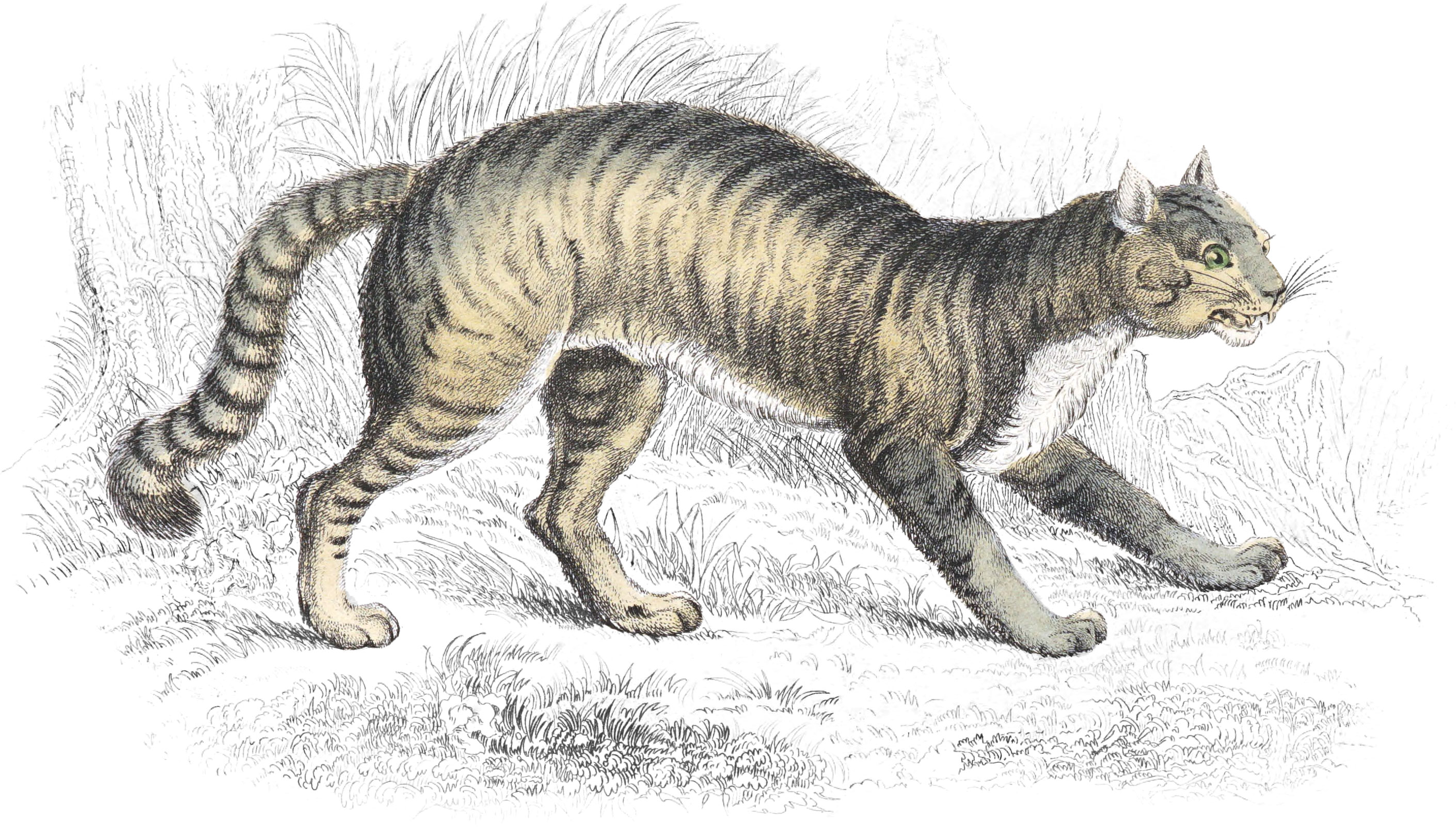
Plate XXIX
The Caracal
Felis caracal.—Linnæus.
Le Caracal, Buffon.—Félis Caracal, Linnæus.—Temminck, Desmarest.
With this animal we shall enter the group of Lynxes, the first division of which have more slender bodies, lengthened tails, and long ears, furnished with a tuft of hair at the tips. This latter character we should consider somewhat inconstant, and only present in spring, or at the commencement of the breeding season, like those adorning the ears of many squirrels.
The Caracal has always been considered to be the lynx mentioned by the ancients as possessing such wonderful power of sight. It is a native of Southern India and of Africa, no difference being perceptible among the specimens which have been received from these countries. Lynxes were said to have been kept and trained for hunting, like the hunting-leopard, by the sovereigns of the East; but, in modern times, no trace of this property can be found, at least in the present animal; and indeed the character of all is great irritability in confinement, and a mistrust towards their keepers, which is never entirely overcome. The Caracal feeds on small animals and birds; the latter it pursues with great activity upon the trees. M. Temminck says, that they hunt in packs like the wild dogs, aim thus run down their prey. If this is the case, they will most probably use their nose, and will present a very interesting deviation from the typical species. It is also said to eat the leavings of the larger animals of prey (also a more dog-like habit), and has, like the jackall, received the name of the lion’s provider, by being often found in the rear of its monarch, and feeding on the food which has been provided and left by him.
The total length of the Caracal, according to Temminck, is 2 feet 10 inches, of which the tail measures about 10; the average height is about 14 inches. The prevailing colour of the fur is a pale reddish-brown, tinged with a vinous shade; the reddish colour becomes paler as it reaches the lower parts. Above the eyes there are two spots of pure white, the uppermost on the inner side, the lower at its outer angle. The end and edges of the upper lip, the chin, breast, belly, and insides of the legs, are also pure white. The parts where the whiskers spring are black; the base of the hack of the ears is of a deep shade of the same colour, assuming a greyer tint towards the tips, which are furnished with tufts of long black hair. The Turkish and Persian names both signify “black ear,” and have evidently been taken from these markings.
The specimen in the Edinburgh collection is from the East, and the dimensions of it are generally less than those of an adult which we have taken from Temminck.
In this place may be mentioned another animal, which M. Temminck has described as distinct, under the title of Felis aurata. The fur is of a bright reddish tint, paler upon the lower parts of the body, and having the sides marked with small indistinct spots. The length of this animal is 3 feet 4 inches, at which the tail is about 1 foot. Its native country is not known.

Plate XXX
The Booted Lynx
Felis caligata.—Temminck.
The Booted Lynx, Bruce’s Travels, vol. v. p. 146.—Félis botté, F. caligata, Temminck, Monographies, p. 123.
The Booted Lynx of Bruce has been confounded by many with the Felis chaus of Gueldenstad, figured upon our next Plate; but they are very different animals, and that of Bruce will stand under the designation applied to it by M. Temminck.
The Booted Lynx is sometimes 3 feet 3 inches in length, of which the tail will measure about 15 inches. The more general or average length is from two feet and a half to three feet. The fur of the adult male is of a bluish-grey tint, sometimes indistinctly clouded with transverse bands of blackish. The under parts are reddish. The ears are very long, tipped with a pencil of blackish hair; the backs are of a bright reddish brown, the inside white. On the heel, and stretching up the back of the leg, until nearly the first joint, is a large patch of deep black; whence its describers have taken its trivial name. This booted marking is common to many of the cats; but it runs much further up the limb of this animal than any of the others. The tail is black at the tip, where there are two or three alternate rings of black and white; the portion next the body of the animal is of the same uniform tint with the upper parts. The female has a shade of a yellower colour over the whole body; and in the young, the dark bands upon the sides are distinct and well defined.
This species seems to be very generally distributed over Africa, and, according to Temminck, is also found in Southern India. It feeds upon small animals and birds, and, in Africa, very much upon the wild Guinea-fowl; but it will also eat carrion, and the remains of animals which the larger hearts of prey nave killed.
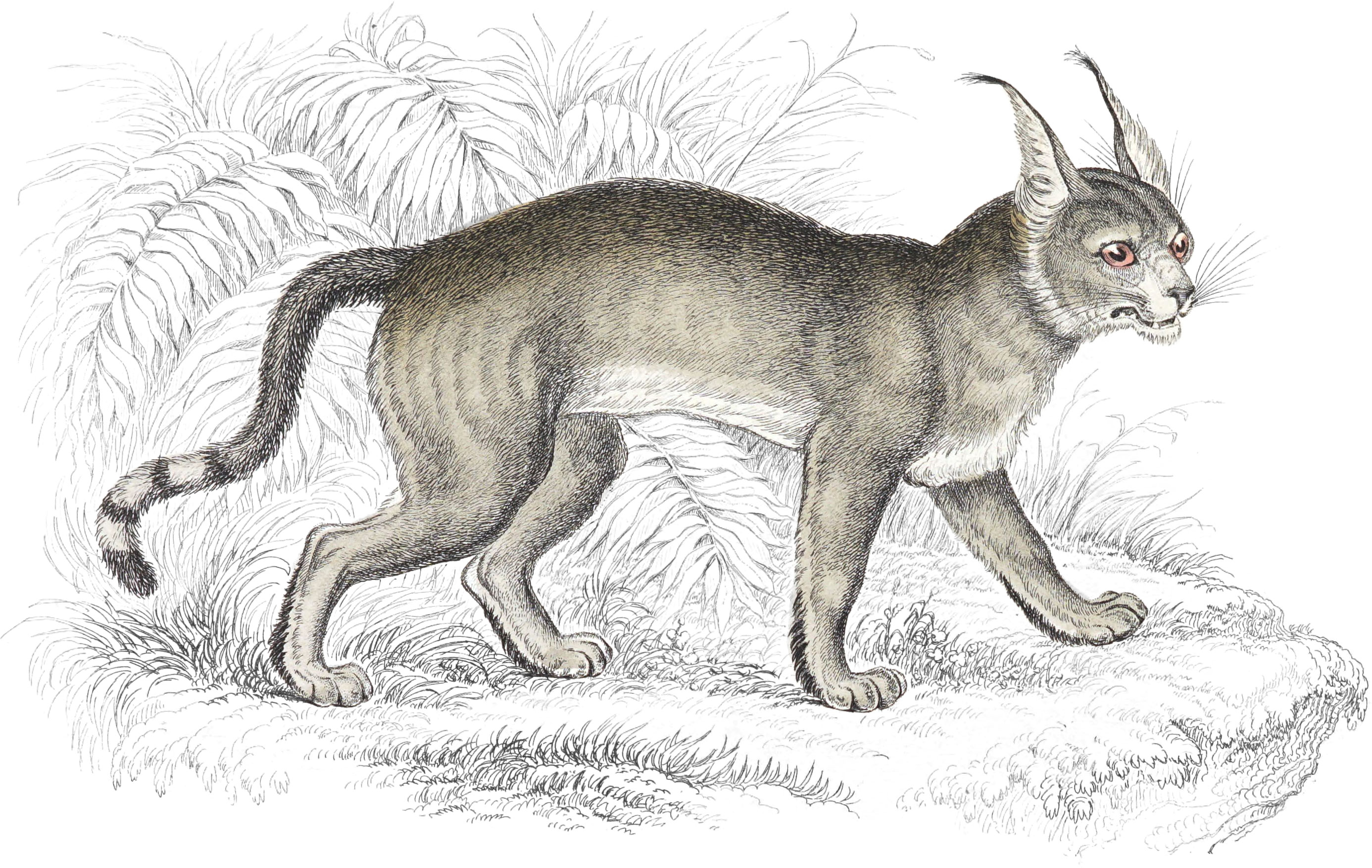
Plate XXXI
The Chaus
Felis chaus.—Gueldenstad.
F. Chaus, Gueldenstad.—Ac. Petropolitana, tab. 14. Temminck, Monographies, p. 121.—Kyrmischatz, female, Ruppel, Atlas.
We have taken our figure of this animal from the beautiful atlas of M. Ruppel, before alluded to. We have also transcribed his description, which explains the confusion which existed between it and the subject of our preceding plate.
This lynx is throughout strongly covered with hair; the woolly or ground hair is very soft and covers the body very copiously, the bristles are more scarce.
The woolly hair has throughout a dirty light ochre-yellow colour, which i3 darker on the back and lighter on the belly; the bristles have on the bottom the same colour, with a dark brown ring in the middle, and on the top are greyish-yellow or white or saffron-coloured, so as to make the appearance of the animal a mixture of greyish-yellow and impure white. Many bristles are provided with a black point, and on the lateral parts of the belly, where many are lying together, they form pale black perpendicular or oblique running spiral lines, and here and there single black points. The bristles of the back have light ochre-yellow nearly saffron-coloured points, and form, from the shoulders to the tail, a yellow streak, which is darkest on the cross; the nose black, and its back ochre-yellow; above the eye there is a large white spot, and under it another of the same colour but smaller. From the inner corner of the eye runs a black streak as far as the nose. The labial edges are small, have a black border, and are encircled above and below by a fine white ring. The eyebrows, cheeks, and bristles of the heard are white, and among the latter there are a few shining black hairs. The inner surface of the ear, towards the outside, is bordered by white and yellow tufts of hair; the back of the ear is grey-brown, the tops brown, and terminate with a black tuft of hair half an inch long; the cheeks, lower jaw-bone, throat, neck, and chest, are ochre-yellow coloured, the belly inclines to whitish-yellow with darker spots. The outer side of the anterior and posterior extremities have the same general colour of the animal, as far down as the ankles, which are of a dirty ochre-yellow colour and black behind, and their surface presents four or more black cross-bands. The inner side of the extremities is yellow, and on the fore-legs is a round large black spot. The tail measures one-fourth of the whole body, find is of a greyish colour; its point is black and blunt; towards the point of the tail there are two black rings, lying between two greyish-white ones, neither of which are very distinct.
The female, which served as a model for the above description, and which, to judge by the form of her teeth and bones, is full grown, was killed at the Lake of Menzale.
The Felis chaus inhabits marshy and boggy regions, and the banks of rivers. Travellers do nor mention how far up the course of the Nile it is found; according to Guldenstadt it is met with in the morasses and bushy lowland’s along the Caspian Sea, and along the banks of the rivers which flow into it. These animals are said to be more numerous in Persia. They go out hunting during the night, in order to catch birds, small gnawing animals, and fishes, but they very rarely climb up trees, and are not easily tamed.

Plate XXXII
The Canada Lynx
Felis canadensis.—Geoffroy.
Felis canadensis, Geoffroy, Annal. du Museum.—Richardson, Fauna Boreali Americana, i. p. 101.—Félis polaire, F. borealis, Temminck, Monographies, p. 109.
With this animal we enter another form among the lynxes, in which the body is more thickly made than in the caracal and booted lynx. The tail and ears are short, and the fur is very thick and long There are several species which are not well deter mined or distinguished from each other, and even the two which we have selected to illustrate this division appear to have been confounded by M. Temminck who makes the lynx of Europe identical with that o North America. The descriptions of the other animals allied to the European and American species are, in general, very short and unsatisfactory, and are noticed in the synopsis. For the present species we have used Dr Richardson’s description.
This is the only species of the genus which exists north of the Great Lakes, and eastward of the Rocky Mountains. It is rare on the sea coast, and does not frequent the barren grounds, but it is not uncommon in the woody districts of the interior, since from 7000 to 9000 are annually procured by the Hudson Bay Company.
It is found on the Mackenzie River, as far north as latitude 66°. It is a timid creature, incapable of attacking any of the larger quadrupeds, but well armed for the capture of the American hare, on which it chiefly preys. Its large paws, slender loins, and long but thick hind legs, with large buttocks, scarcely relieved by a short thick tail, give it an awkward clumsy appearance. It makes a poor fight, when it is surprised by a hunter on a tree, for though it spits like a cat, and sets its hair up, it is easily destroyed by a blow on the back with a slender stick, and it never attacks a man. Its gait is by bounds, straightforward, with the back a little arched, and lighting on all the feet at once. It swims well, and can cross the arm of a lake two miles wide, but it is not swift on land. It breeds once a year, and has two young at a time. The natives eat its flesh, which is white and tender, but rather flavourless, much resembling that of the American hare.
The head is round, the nose obtuse, and the face resembles the domestic cat. The ears are erect and tipped with a tuft of black hairs; on their posterior surface they have a dark mark beneath the tip, which continues downwards to their bases. On the body and extremities the fur is hoary, most of the hairs being tipped with white; on the crown of the head and down the back, there is a considerable mixture of blackish-brown, and on the sides and legs of pale wood-brown. In general there are no very distinct markings, a rufous tinge is sometimes present about the nape of the neck, and on the posterior part of the thigh. The tail is like the back, except the tip, which is black. The fur is close and fine on the bank, longer and paler on the belly. The legs are thick, the toes very thick and furry, and are armed with very sharp claws.

Plate XXXIII
The European Lynx
Felis lynx.—Linnæus.
Felis lynx, Linnæus, Temminck, Monographies, p. 111.—Desmarest, Mammalogie, p. 223.—Le Lynx, Buffon, ix. pl. xxi.
The Common Lynx is extensively spread over the south of Europe, the numbers decreasing as the northern districts are approached, and increasing as it reaches the borders of Asia, which it also abundantly inhabits. It has been occasionally found in France, which may be termed its most northern range. Like the cat, it is subject to very considerable variety of marking and colour, and the characters of the fur of the adult may be said to be scarcely fixed. It is this species and the last that principally furnish the immense quantities of furs that are known under the name of lynx. The fur becomes much longer in winter, and in the colder climates it probably is much more ample than in those specimens which ate brought from the warmer regions bordering upon Asia, which have the fur much finer in its texture. The most ordinary tint of the upper parts is a dull reddish-grey, marked upon the sides with oblong spots of reddish-brown, which upon the limbs become round and smaller. All the lower parts are white, clouded with blackish markings. The tail is only about 7 inches long, and black at the tip. In winter the long hair becomes tipped with greyish-white, and gives a more hoary look to the animal, and it also causes all the markings to appear more clouded and indistinct. The entire length of the European lynx is about 3 feet.
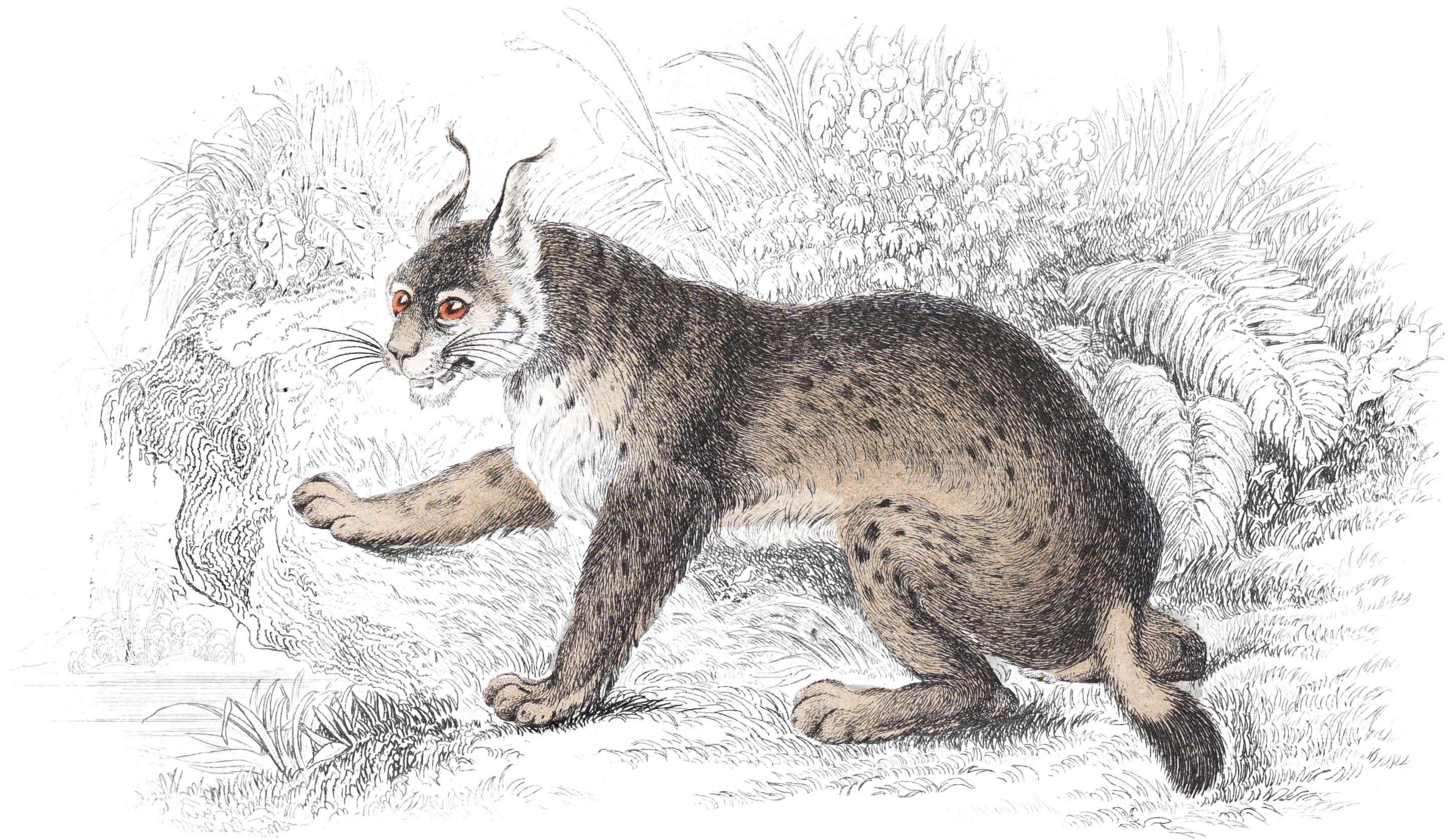
Plate XXXIV

Synopsis
Felinæ. Front teeth in each jaw, six; canine teeth, two in each jaw, very powerful, and formed for tearing; molar or cheek teeth, four in the upper jaw, three in the under comparatively thin, pointed, and wedge-shaped, formed for cutting.58 Head, large and round; eyes, with the pupil often oblong; tongue, with strong horny papillae, directed backwards. Feet, formed for walking; toes, on the fore-feet five, on the hind-feet four; claws, very strong, hooked and sharp, retracted when the animal walks or is at rest, by a peculiar mechanism.59 Food, animals or birds, sometimes fish and reptiles, seldom carrion, except when pressed by hunger. Inhabit forests, or wooded rocks where shelter can be obtained in the clefts. Native countries, Europe, Asia, Africa, America; species most numerous and abundant within the Tropics.
Genus I.—Leo
Leach.
-
Pl. I., II.—L. africanus, African Lion.—Males with a shaggy mane and tuft of hair at the extremity of the tail. Varies—
- The colour brown tawny yellow; the mane, nearly black and very ample.
- The colour much lighter, the mane more scanty, and slightly darker than the body. Both very generally diffused over Africa.
-
Pl. III*.—L. asiaticus, Asiatic Lion.—Somewhat less than the first. Of a very pale yellowish-tawny colour; the mane long, and mixed with longer straight hairs, nearly of the same shade with the body. Inhabits the Continent of India, Persia.
The females of both species are less than the males, and want the mane; the young resemble them till nearly three years old.
Under this division will most probably also rank the Maneless Lion, which is said to have been recently discovered.—See [description].
Genus II.—Puma
- Pl. IV.—P. concolor, The Puma.—Above pale reddish-brown, shading into white upon the lower parts; back of the ears, and parts from which the whiskers spring, deep brownish-black; tail at the tip black. Length, by Azara, 6 feet 2 inches, tail 2 feet 2 inches; Temminck, nearly 5 feet, tail from 1 foot 8 inches to 1 foot 10 inches. Inhabits both continents of America; extensively distributed over the Southern.
- Pl. V.—P. nigra, The Black Puma.—Fur entirely of a glossy black; the tail thick and furry. Length, by Azara, 33\(\frac{1}{2}\) inches, that of the tail 13 inches. Inhabits Paraguay.
- P. yaguarundi, The Yaguarundi.—Fur deep blackish-grey, hairs ringed with black and white alternately. Length, by Azara, 36\(\frac{3}{4}\) inches, tail 13\(\frac{3}{4}\) inches; by Temminck, reaching to 4 feet 4 inches, the tail 1 foot 10 inches. Inhabits Paraguay and Guiana—Azara; Surinam and the Essequebo,—Temminck.
- P. eyra, The Eyra.—Fur entirely pale reddish-brown; chin white. Length 31 inches, that of the tail 11\(\frac{1}{2}\), Azara. Inhabits Paraguay.
- P. pajeros, The Pampa Puma.—Grey above, lower parts white; transverse greyish-cinnamon coloured bands on the throat and breast; on the belly indistinct bands of the same colour, legs ringed with cinnamon colour. Length 34\(\frac{1}{3}\) inches, tail 11\(\frac{3}{4}\) inches, Azara. Inhabits the plains of Buenos Ayres.
- P.? chalybeata, Liver-coloured Puma.—Greyish liver-colour, with numerous dark brown simple spots; tail darker than the body, ringed with black. Length 4 feet tail 1 foot 3 inches. Inhabits Chili.
Genus III.—Felis
Auctorum.
- Pl. VI.—F. Tigris. The Tiger.—Fur rich tawny yellow, paler upon the lower parts, and almost approaching to pure white on the belly and inside of the limbs; body brindled with deep black stripes. Inhabits continent of India, China, Indian Archipelago.
-
F. pardus, The Panther.—Ground-colour of the fur fine tawny yellow, paler towards the lower parts; the body covered with well-defined circles, formed of from three to five spots, less numerous than in the next. Length 6 feet 6 inches, Desm. Inhabits India and Africa.
Most abundant, perhaps, in the latter. Form more stout than that of the next; the animal more powerful. Major Smith’s F. antiquorum may prove a distinct species. Fur buff-yellow, approaching to reddish on the nose, having about seven vertical rows of open spots. Length, exclusive of the tail, 5 feet 8 inches.
-
Pl. VIII.—F. leopardus, The Leopard, F. Cuvier.—Ground-colour of the fur tawny yellow; paler towards the lower parts; the sides and back with numerous circles, formed of from three to five spots; the head, forequarter, and limbs, numerously marked with irregularly shaped spots. Inhabits India and Africa.
Most abundant, perhaps, in the former. Form slender and elegant. Distinctions between this and the last not yet well defined.
-
Pl. X., XI., XII.—F. onca, The Jaguar.—Fur rich tawny yellow above, beneath nearly white; body marked with open circles of deep brown, often with a central spot, more irregular and closer upon the back; head and legs spotted; belly with large deep brown blotches. In the young the markings assume the form of imperfect circles, sometimes only irregular spots. Length 6 feet 9 inches, Desm. Inhabits South America.
Varies to a black ground colour, with the rings seen distinctly only in particular lights; very rarely white.
Major Smith is of opinion that there are two decided and almost permanent varieties of this animal, chiefly distinguished by the greater and lesser size.
-
Pl. XIII.—F. uncia. The Ounce—Fur long, rather shaggy; ground-colour very pale tawny yellow; the body marked with irregular and rather large spots or blotches, sometimes assuming the form of irregular rings; on the head and limbs the spots are smaller, and round. Size about that of the Leopard—Ham. Smith. Inhabits Persia.
Yet wants confirmation. Distinguished by its long hair.
-
Pls. XVI., XVII.—F. pardalis, The Ocelot—Deep tawny-yellow, more rufous upon the nose and forehead; the markings in longitudinal open rows, with a pale centre, surrounded with a black margin. The limbs spotted. The tail black at the tip and ringed. Length from 2 to 3 feet, tail from 11 to 13 inches. Inhabits South America.
Varies much in the markings.
-
F. catenata, Linked Ocelot—Ground-colour reddish-yellow, the temples, cheeks, throat, belly, and inside of the legs white; body marked with long chain-like marking; belly and throat with black streaks; the rings upon the tail imperfect. Size of the last. Inhabits South America.
This is considered distinct from the last by Major Smith, on account of the uniform lengthened markings.
-
F. macrourus, Long-tailed Ocelot.—Greyish-tawny-yellow, paler on the lower parts, the body with longitudinal markings very irregular in form. Length 3 feet 8 inches, tail 1 foot 7 inches, adult male—Temm. Inhabits Brazil.
Distinguished from the two last by the length of the tail and by the unenclosed form of the markings. Discovered by Prince Maximilian of Neuweid.
- F. tigrina, The Margay.—Tawny-yellow, black longitudinal lines upon the head and neck, upon the throat dark bands; body with open spots, enclosing a centre of a redder tinge than the common colour, these are again surrounded with a black line; the limbs are spotted, the tail ringed with black. Length from 2 feet to 2\(\frac{1}{2}\) feet. Inhabits Brazil.
-
Pl. IX.—F. Macrocelis, The Rimau-Dahan.—The head rather small in proportion; ground-colour of the fur very pale tawny-yellow; six black bands upon the upper part and sides of the neck; the body covered with irregular large patches, paler in the centre, and towards the hind-part bordered with velvety-black. The form very powerful. Tail long, thick, and furry. Length 5 feet 6 inches, of which the tail is 2 feet 6 inches. Inhabits Sumatra; according to Temminck, also Siam.
The form of this animal differs from that of F. tigris leopardus, onca, &c. which we consider typical of Fells, particularly in its robust proportions, small head, and thick bushy tail. An allied animal, if distinct, will be the F. nebulosa of Griffith. Its characters are:
Head small, body long, heavy; legs thick, short, and muscular; tail very thick, long and annulated; body covered with large irregular patches, forming enclosures, deeper than the ground-colour, but lighter round the edge. Inhabits Sumatra, China.
—Griff. Cuv. v.
- Pl. XIV.—F. mitis, The Chati.—Fur pale tawny-yellow, white on the under parts; back of the neck with black spots, which run in lines, continued obliquely over the shoulder •, back with four longitudinal rows of lengthened spots-, body and hind quarters with blotches or irregularly formed circles of black, continued also upon the legs, but decreasing in size as they reach the feet; on the fore-legs assuming the shape of bands; tail half ringed above with black. Length 2 feet 8 inches, of which the tail is 11 inches. Inhabits South America.
-
Pls. XVIII., XIX.—F. minuta.—F. Sumatrana and Javanensis of Horsfield.
Adult.—Fur greyish-brown, lower parts and insides of the limbs white. From the forehead along the back there are four lines, of irregular lengthened blotches of dark brown, towards the tail these become very small; the sides are marked with blotches of the same colour, of an irregular but broader form; on the legs the spots are small but still irregular, and on the insides they assume the form of bands. Tail is imperfectly ringed, black at the tip.
Young.—The fur is of a reddish-brown, paler on the lower parts, rows of lengthened spots run from the forehead along the back, and upon the sides they continue in the same direction, but are of a rounder form; on the legs and feet these are round, small, and numerous. Tail without the black at the tip, and marked with spots upon the Upper surface. Females are always darker in the ground-shades.
Length 2 feet; tail about 8\(\frac{1}{2}\) inches. Inhabits Java and Sumatra.
-
Pl. XX.—F. Bengalensis, Bengal Cat? (Desmarest).—Fur above tawny-yellow, beneath pure white; forehead with four brown lines rising between the eyes and the nose. Upon the cheeks two brown lines, separating at the upper corner of the eye, and again uniting to form a collar upon the neck; back marked with dark lengthened spots, which form a dorsal line body irregularly spotted with irregular markings dispersed longitudinally, decreasing in size upon the legs and feet. Tail with irregular spots on the upper surface. Length 1 foot 6 inches. Inhabits Bengal.
This species is hardly confirmed by any author, and it is probable that the state described under this name is that of a young animal. The description of Desmarest agrees with the animal in the Edinburgh Museum nearly. In our figure the spotting is too much united.
-
Pls. XXI., XXII.—F. Diardii, Diard’s Cat. (Diction. des Scien. Nat.—Cuv. Oss. Foss.)—Fur yellowish-grey; the neck and vent with lengthened irregular spots forming a dorsal line; upon the body and thighs black rings with a gray centre, and upon the limbs full black spots. The tail with indistinct rings, long, and more furry than usual; the under parts are yellowish-white, with brown patches upon the breast. In the young the general colour of the fur is very rich tawny-yellow, the ringed markings not defined, and the dorsal line and spots upon the limbs clouded. Length of adult 3 feet, tail 1 foot 4 inches; of young, 1 foot 7 inches; female, 1 foot 6 inches. Inhabits Java.
A very interesting species, and apparently the prototype of the ocelot. The surrounded spaces with a light centre bring it near in marking to the F. macrocelis, and the tail is also proportionally long and thick.
Messrs Vigors and Horsfield describe another Sumatran cat, which seems previously unknown—F. Temminckii—entirely reddish-brown, the lower parts white, from each eye a grey line runs to the occiput, gradually increasing in breadth; cheeks streaked with reddish-brown. Length 31\(\frac{1}{2}\) inches, of which tail 12\(\frac{1}{2}\) inches.
-
Pl. XXIII.—T. Nepalensis, Nepaul Cat.—Tawny-grey, nearly white below, the marking on the back runs in irregular lines, that of the body in irregular rather angular blotches, upon the legs in spots. Length 2 feet 1\(\frac{1}{2}\) inches. Inhabits Nepaul.
Distinguished by the long and slender form of the body and smaller head. It may lead to Prionodon.
Messrs Vigors and Horsfield have discovered another cat. which they consider allied to prionodon—F. planiceps. In the shortness of the tail it resembles the Lynxes. General colour dark brown tinged with reddish about the head, the lower parts white; two light coloured streaks between the eyes run backwards towards the occiput. Length 23\(\frac{1}{2}\) inches. Tail 5\(\frac{1}{2}\) inches. Inhabits Sumatra.
-
Pl. XXIV.—F. serval, The Serval.—Upper parts of an ochry yellow, deepest on the back, and shading into pure white upon the lower parts; the body with dark brown or black markings, those on the shoulders and neck longitudinal, on the body round; inside of the fore-legs with two transverse black bands; tail black at the tip, and ringed with black. The fur on this animal is long, almost shaggy, particularly upon the flanks. Length 4 feet; that of tail 13\(\frac{1}{2}\) inches. Inhabits South Africa.
Temminck considers the Cape cat, F. capensis, identical with this.
Pl. XXIV*.—F. Himalayanus, Himalayan Serval.—Upper parts dull rich brown, paler as it reaches the lower third of the body, changing into white on the breast, belly, and inside of the limbs; cheeks with two streaks; the fore and upper part of the back marked with lines slightly interrupted; the sides with longitudinal marks, the white parts with blotches, and the limbs with spots, all of very deep brownish-black. Length 3 feet 2 inches, tail inches, tail 9\(\frac{1}{2}\) inches. Inhabits Alpine India.
Pl. XXV.—F. servalina, Servaline Cat—Very pale tawny; the head with brown lines, which run upon the back of the neck and diverge upon each shoulder; sides and limbs with irregular spots of the same colour, inside of the limbs barred with deep brown; tail black and ringed at the tip, the rings indistinct at the base; ears with very short tufts. Length 15 inches, tail 10\(\frac{1}{2}\) Inhabits India.
Mr Gray’s Falis ornata is thus characterised.—Felix ornata, Gray.—Yellowish-brown; forehead spotted; black stripe from the corner of the eye, and another from the whiskers approaching it; body irregularly marked with round black spots, on the sides of the breast, the hams, and fore-legs, taking the form of short bands; belly and inside of the limbs pale; tail at the base with very obscure rings, tip black, and next to it four well marked black rings; ears rather lengthened, slight tufts at the tip.—Illust. Ind. Zool.
- Pl. XXVI.—F. Colocolo, The Colocolo.—Whitish-gray; body covered with lengthened streaks of black and tawny; legs to the knees dark-grey; tail ringed with black, and black at the tip. Larger than a Wild Cat.—Ham. Smith. Inhabits S. America.
- Pl. XXVII.—F. maniculata, Egyptian Cat.—Above, of an ochry-gray, with a darker dorsal line; beneath grayish-white; forehead with eight small streaks; limbs with blackish semicircular bands; heels black tail rather slender, with two dark rings at the tip. Length 2 feet 5 inches, tail 9 inches. Inhabits Northern Africa.
- Pl. XXIX.—F. catus, Common Wild Cat.—Fur long and thick, but not shaggy; ground colour varying from a yellowish-gray to a blackish-gray, darkest on the back, where it forms a dorsal line, diverging into four on the neck and head; sides brindled with broad dark but indistinct bands; legs with two or three black bars, running generally transversely upwards; tail thick, black at the tip, ringed with black, becoming nearly indistinct at the base. Length 33 inches; tail 11 inches. Inhabits Britain and Northern Europe.
Genus IV.—Cynailurus
Wagler.
-
Pl. XV.—C. jubata, Maned Hunting Leopard—Bright tawny yellow, covered with full round black spots; legs longer than usual, the claws not retractile; back of the neck with a ridge of longer hair in the form of a mane. Length 3 feet 6 inches. Inhabits Africa, India.
Griffiths describes a second species, very similar to this, without the mane, but it wants confirmation. It inhabits India, and will stand under the title of C. venatica.
Genus V.—Lynchus
Gray.
-
Pl. XXX.—L. caracal, The Caracal.—Upper parts vinous reddish-brown, shading into white upon the breast and belly; ears very long, with tufts of hair at tips; tail of middling length. Length 2 feet 10 inches; tail 10 inches. Inhabits Africa, South-eastern Asia.
Varies in the shade of the fur, and with having clouded markings upon the sides, most probably the different states incident to age.
- L. aurata. Golden Caracal.—Very bright yellowish-red, the lower parts reddish-white; the throat white; the sides marked with very small indistinct dark spots; ears short and without tufts; tip of the tail black. Length 3 feet 4 inches, tail 12 inches. Inhabits——
-
L. chelidogaster, Temm.—Uniform deep gray, marked with spots of chocolate brown; breast with from six to ten circular bands; under parts pure white, blotched with chocolate brown; tail irregularly spotted with clear brown. Length about 3 feet 3 inches, of which the tail is 13 inches. Inhabits Chili.
In the museum at Leyden.
- Pl. XXXI.—L. caligata, Booted Lynx, Bruce.—Fur bluish-gray, tinged with reddish on the lower parts; ears very long, with tufts at the tips, reddish-brown upon the back; heels black, running nearly up to the first joint of the leg; tail black at the tip, followed by two or three alternate rings of black and white. Sides of the young with distinct dark bands. Length\(\frac{1}{2}\) feet to 3 feet; tail 13 to 15 inches. Inhabits Africa,—S. India, Temm.
-
L. nigripes, Black-footed Cat, Burchell.—Light-brown ochre, entirely covered with rather lengthened black spots; thighs and shoulders with cross black bands; tail confusedly spotted; feet black. Length, exclusive of the tail, from 16 to 18 inches. Inhabits S. Africa.
Pl. XXXII.—L. chaus. The Chaus, Gueldenstad, Ruppel.—Upon the back deep yellowish-brown, paler and yellower upon the lower parts and inside of the legs; legs are Blightly banded with a darker shade, the heels very deep brown; ears with small tufts; tail black at the tip, with three or four alternate rings of black and white. Length about 2 feet 9 inches; tail about 8 inches. Inhabits Northern Africa.
Pl. XXXIII.—L. Canadensis, Canada Lynx.—Fur very long, particularly in winter; on the back brownish-gray, changing to pure white on the lower parts; tail short, and black at the tip. Length about 3 feet 5 inches; tail 4 inches. Inhabits Canada, as far north as 66°.
- L. rufa, Bay Lynx—Fur very long, grayish-brown with a darker dorsal stripe; neck and sides pale chestnut, varied with short transverse stripes of blackish-brown; belly white, marked with large blackish-brown spots; tail reddish-white beneath. Length 37 inches, tail 4. Inhabits banks of Colombia river. United States, not Canada, Temm.
- L. fasciata. Banded Lynx, Richardson.—Fur long, above reddish-brown, irregularly varied with small spots of dark brown, and upon the back banded with black stripes. Length about that of the Canada Lynx. Tail 2 inches, black at the tip. Inhabits N. America,—Woody countries in the neighbourhood of the Pacific, Lewis and Clark.
There is yet considerable confusion among the Lynxes of America, and, except the Canada Lynx, the species are perhaps not well determined. Messrs Vigors and Horsfield describe one under the title of F. maculata. from Mexico, above reddish-gray, very dark upon the back, and with the limbs spotted with brown; belly white, blotched with brown; tail black at the tip, and with 3 or 4 alternate white and black bands Length 3 feet, tail 6\(\frac{1}{2}\). Inhabits Mexico.
-
Pl. XXXIV.—L. Lynx, European Lynx.—Fur very long, above of a dull reddish-gray, marked upon the sides with oblong spots of reddish-brown, upon the limbs becoming round and smaller; lower parts white, clouded with black motlings. Length about 3 feet. Inhabits S. Europe, Asia.
Another Asiatic Lynx may be perhaps added in the Felis affinis of Gray, figured in his Ulust. of Ind. Zool.: the upper parts reddish-brown, with a tinge of yellow; lower parts paler; feet and legs brown; tail short, black at the tip, with four black bands; ears lengthened, margined with white, tips black.
- Eutropius (confirmed by some other historians) tells us that 5000 wild beasts of all kinds were slaughtered at the dedication of the ampitheatre of Titus.
- Memoirs of Sir Stamford Raffles, p. 314. They do the same on the approach of the small-pox, and thus endeavour to lay the evil spirit by kind and hospitable treatment.
- Aristotle.
- See description of that animal.
- Felis nebulosa, Griff., from China, has not been satisfactorily identified with F. macrocelis.
- Pers. Nar.—See variety of prey which is sought by the jaguar in the description of that animal.
- Desmoulins.
- Sir Charles Bell. The Hand, Bridgewater Treatises,
120135. - See instances in description of Plates I, II, III.
- The same writer computes the number of Springboks in the Karroo Plains, seen within a compass of fifty miles, to be at least 100,000.
- La genre des Chats, est l’un des plus rigourfeusement determinés du Regne Animal.—Cuv. Oss. Foss.
- The figures in this volume are drawn without regard to the proportional size of the species, but the dimensions of each are given in the descriptions. A proportional scale would have reduced the lesser animals to a very small size.
- Mundy’s Sketches, i.
- Mr Boulderson, Heber’s Journal, i. 463.
- Griffith’s Cuvier, ii. 431.
- F. Cuvier.
- According to the French naturalists, the lioness goes 108 days with young.
- See [Burchel’s remarks].
-
There is a very interesting specimen of a lion in the Surrey Zoological Gardens, of which we have a beautiful drawing by Mr Lear. It is an African lion, which had been emasculated at a very early age. Mr Warwick says,
This animal is generally taken for (what it very much resembles) an uncommonly large lioness, it being totally devoid of any mane. It was brought from Caffraria, and the operation was performed when a few weeks old. It is much larger than either the Barbary or Persian lion, and extremely docile. The organs of voice have been affected by the change; he has never been known to roar.
- Monographies, p. 86.
- II. p. 428.
- These Transactions are got up with great care. The illustrations are beautiful, both in drawing and execution.
- Annales du Museum, xiv. p. 142.
- In the sketch of an immature puma shewn to us by Dr Traill, the spots upon the body and sides are very distinct; on the back they form a broken line.
- Mr Macgillivray informs us, that he lately saw a puma in the Zoological Garden at Dublin, with the tail always carried in the same manner.
- Captain Head’s Rough Notes of the Pampas and Cordillera, p.
148132. - Griffith’s Cuvier, ii. 438.
- Audubon, p.
198207. - Cuv. Oss. Foss.
- Military officers pursue this sport with the greatest keenness, which their frequent movements, and the array of men and elephants which attend a camp, greatly facilitate.
- So many accounts of tiger hunts have lately been before the public, that we have had some difficulty in making the selection. The one we have chosen is from Captain Mundy’s Sketches, and will serve also to shew the danger which is sometimes run by the keenness of the elephant.
- Griffith, Library of Entertaining Knowledge.
- Temminck says the tail of the leopard contains 22 vertebræ, that of the panther 28. The number, however. I believe, varies in many well-established species of the Felinæ.
-
We add here Cuvier’s characters of these two animals from the Regne Animal:
La Panthere, Felis pardus, Linn. Fauve dessous, blanc aessus, avec six ou sept rangées de taches noires en forme de roses, c’est à diree formée de l’assemblages du cinq ou six petitstaches simples, sur chaque flanc; la queu est de longeur du corps, moins la tete.
Temminck asserts this is a leopard.
Le Leopard, Felis leopardus, Linn. Semblable à la Panthere, mais avec rangees des taches plus petites.
- Tower Menagerie.
- Tower Menagerie.
- This very intelligent and enterprizing gentleman, after performing prodigies of valour, and being severely wounded in the Ashantee war, returned to Scotland, his native country, in 1833. He never completely recovered his health, and unfortunately died at Bankhouse, in the neighbourhood of Edinburgh, in December of that year.
- The panther, in these countries, is a sacred or Fetish animal; and not only a heavy fine is extorted from those who kill one, but the Fetish is supposed to revenge his death by cursing the offender.
- “Tree Tiger.” M. Temminck says the orthography should be Arimau-Dahan.
- Felis nebulosa of Griffith, if proved to be distinct, will be closely allied; but we cannot yet state what may be its distinctions.
- Sir S. T. Raffles, Linn. Trans. vol. xiii. p.
254250. - Sir Stamford Raffles, Linn. Trans. vol. xiii. p. 250.
- Wilson’s Illustrations.
- Humboldt, Pers. Nar.
- Humboldt, Pers. Nar. iv. p. 492.
- Humboldt, Pers. Nar. iv. p. 176.
- Humboldt, Pers. Nar. iv. p. 436. Azara mentions more frequent attacks on man.
- Griffith’s Animal Kingdom, ii. 469.
- Temminck calls these spots irregularly surrounded with black, and having the centre of a reddish fawn colour.—Monographies, p. 150.
-
This sport appears to have had a very early origin. From Sir William Jones, we learn that
Hushing, probably contemporary with Minos, and king of Persia, B. C. 865, was the first who used dogs and leopards for hunting, and introduced the fashion of wearing the furs of wild beasts in winter.
- Griffith’s Cuvier, ii. p. 475.—A very near prototype to the ocelots of the New World will be seen in the subjects of plates xxi. and xxii.
- Wilsons Illust. Zool.
- Dr Horsfield thus gives the dimensions of his F. Javanensis, length of the body 1 foot 11 inches; of the tail 8\(\frac{1}{2}\) inches; height at the shoulder, 7 inches.
- In the specimen in the Museum, the spots are rather more crowded than they have been represented in the Plate.
- Dr Horsfield’s Researches in Java.
- Dictionnaire Classique d’Histoire Naturelle.
- See Description de l’Egypte, Hypagées’ de Thebes, vol. ii. planche 45. No. 14. a cat represented; again, in the same volume, planche 51. No. 3, a cat’s mummy, and, planche 54. No. 7, the skeleton of a cat’s mummy, which, from the size of its body, form of its head, and, above all, from its long tail, may be considered as in perfect accordance with our Felis maniculata.
- For a particular account of the teeth of the various genera of Mammalia, see Fred. Cuvier, Des Dents des Mammifères. 1 vol. 8o. 1825.
- Their mechanism, see [description] of this volume. In F. jubata they are not retracted.