Volume XL
The Birds of Great Britain & Ireland
Part IV, Swimming Birds

Introduction
Watchful and agile, uttering voices wild
And harsh, yet in accordance with the waves
Upon the beach, the winds in caverns moaning,
Or winds and waves abroad upon the water.
Some sought their food among the finny shoals,
Swift darting from the clouds, emerging soon
With slender captives glittering in their beaks;
These in recesses of steep crags constructed
Their eyries inaccessible, and train’d
Their hardy broods to forage in all weathers.
As Naturalists and believers in the unerring wisdom so greatly and wonderfully displayed throughout the animated creation, we are not to judge of their qualities from the exaggerations of fancy, but to consider whether their powers are notfitly and beautifully adapted to the places they are destined to fill in the great chain of the universe. Viewed in this the only true light, we shall find much to admire, since their instincts and habits are in such perfect accordance with, and so ablysupport the economy of their being.—Selby.
We have now to describe the remaining British genera which compose the Natatores or Swimmers, generally considered as the concluding Order among Birds, and whose whole life and business is among the waters. From the insular character of our lands, these are more than proportionally numerous in a Fauna so limited; and while thousands in summer seek our precipitous coasts and headlands as breeding stations, others scarcely less numerous flock in winter from their more northern incubations, and fill our bays and marine inlets.
The contrast of these localities at the different seasons is most striking; rocks standing far in the ocean’s void, and precipices of the most dizzy height to which all approach by land is cut off, possess a dreary solitude for seven or eight months of the year; a few cormorants seeking repose during the night, or some gulls claiming a temporary shelter or resting-place from the violence of the storm, are almost the only and then but occasional tenants. In the throng of the season of breeding, a very different picture is seen: the whole rocks and sea and air are one scene of animation, and the various groups have returned to take up their old stations, and are now employed in all the accessaries of incubation, affording lessons to the ornithological student he will in vain look for elsewhere; the very rocks are lighted up, and would seem to take a brightness from the hurry around, while the cries of the inhabitants alone discordant, harmonise with the scene.
During the same season, upon the low sandy or muddy coasts, or extensive merses, where the tide recedes for miles, and the only interruption on the outline is the slight undulations of some mussel-scalps, the dark colour of some bed of zostera contrasting against the long bright crest of the surf, or in the middle distance some bare posts set up as a land-mark, or the timbers of some ill-fated vessel rising above the quicksand, there reigns, on the contrary, a solitude of another kind; it is now broken only by the distant roll of the surf, by the shrill pipe of the ring-dotterel, or the glance of its flight as it rises noiselessly; a solitary gull or tern that has lagged from the flock may sail along, uttering as it were an unwilling inward sound as it passes the intruder; everything is calm and still, the sensation increased by the hot glimmer that spreads along the sands; there is no voice, there is no animal life. During winter, the scene may at first sight appear nearly similar; the warm and flickering haze is changed for a light that can be seen into; the noise of the surge conies deeper through the clear air of frost, and with it at intervals hoarse sounds and shrill whistles to which the ear is unaccustomed; acres of dark masses are seen, which may be taken for low rocks or scalps, and the line of the sea in the bays contains something which rises and falls, and seems as if it were about to be cast on shore with every coming swell. To the old sportsman all these signs are familiar, and he knows their meaning; but to one who has for the first time trodden these flat coasts, some distant shot or other alarm first explains everything. The line of the coast is now one dark moving mass; the air seems alive with water-fowl, and is filled with sounds that rise and fall, and vary as the troops wheel around, and this continues until they have again settled to their rest; as dusk approaches, these sounds are gradually resumed, at first coming from the ground, as warnings that it is time to be alert; as the darkness and stillness of night sets in, one large flock after another hastens to its feeding-ground, and the various calls and the noise of wings is heard with a clearness which is sufficient to enable the sportsman to mark the kinds and trace his prey to their feeding stations, to make him aware of their approach long before they come within his reach.
In an economical relation, this Order is of considerable importance. It is scarcely necessary to state that it is to the members of it that we owe all our domesticated breeds of geese, ducks, &c., and that from them our finest feathers and downs, employed as articles of luxury, or by the fair sex as dresses and adornments of ornamental comfort, are derived. Next to the Gallinaceous Birds, they hold the highest rank for artificial breeding and improvement, and after being so treated, stand in high reputation for the table. Their breeding and rearing, in all their branches, yield considerable incomes to their proprietors, and employ numbers for their care. Among northern nations, the collection of the eggs and young of many wild species are regular objects of employment and commerce;1 by many they are depended on as of much importance in the winter stock of food; and among the inhabitants of the arctic countries, where they are migratory, the appearance of the first train of geese is looked for and watched with intense anxiety.—Guano, now bearing so much importance as a manure, is the dung of birds belonging to this order.
In proportional numbers, we have nearly one-third of the whole British birds Natatores. The Vertebrata of Mr. Jenyns, as a recent list (though later investigations have slightly added to it), will serve as a general guide. The total number of British birds enumerated by him, exclusive of twenty-six doubtful species, is three hundred and twelve, of which the Natatores furnish ninety, while the Incessores only muster one hundred and eight, a proportion which could occur in no district except one situate similarly with our own islands. Of the Natatores, again, one-half nearly is made up of the Anatidæ or ducks, there being, according to the above-mentioned list, forty-one species, including the Mergi or Gooseanders. The remainder is chiefly composed of the Laridæ or gulls, including the terns and petrels; while the grebes, divers, cormorants, and solan-goose make up the remainder.
Anatidæ
We naturally enter upon the Fifth or Natatorial Order of Birds with the Anatidae, or Ducks and Geese, a large group whose dwelling is among the waters, from which they derive their almost sole support, and around the margins of which they incubate and rear their young. The Ducks and Geese, and Swans, though aquatic in their habits, many of them exclusively so, conjoin a Grallatorial form, frequently breed at a distance from the water (a few even perch and nestle in trees), wander far from it in quest of food, and seek for their support often in the midst of cultivation. An exotic form, the Flamingos, considered to lead directly from the waders, are in fact Grallatorial geese; and though fitted with an apparatus of the bill similar to them, and taking their food in the same manner, they follow or pursue it like the waders, their lengthened legs and small feet unfitting them for frequency or expertness in swimming. In the true geese and swans, we have the species partly feeding on grain, living well in comparative absence from water, and capable of easy domestication; the latter almost a certain indication of their being a representative of the Rasores. In the next sub-family, we have the facility for domestication in several of the species continued, and we see in them the greatest perfection in the structure of the bill In the Fuligulinæ, or scaups and pochards, &c. we see the time spent almost entirely on the waters, the powers of swimming and diving augmented, while the wings in many are proportionally short; and in the last sub-family, or the Mergansers, the habits are more aquatic still, their progress when upon land, which is only during the time of breeding, more constrained, and their food composed almost entirely of fishes, for the holding fast of which their bill is strongly toothed or serrated. In the males of most of the species there is a dilatation or bony labyrinth in the windpipe or trachea, the use of which seems scarcely to be understood, while in others, as the swans, it performs a doubling or a convolution in the interior of the sternum. In all the species we have examined, this structure is different in each, and presents a distinguishing mark where they are closely allied. The geese of the Rasorial form is characterised in
Anser, Brisson.—Generic characters.—Bill somewhat conical in shape, narrower than the head, elevated at the base; lateral laminae in the form of blunt teeth, slightly developed, and apparent exteriorly; nostrils central, rather large, pierced entirely through; wings pointed, ample, tuberculated; legs placed under the centre of the body, tarsi rather long, hallux articulated on the tarsus, free, without a lobe or membrane.
Types.—A. segetum, allifrons, lernicla, &c. Europe, Asia, America.
Note.—Gregarious; feed chiefly on vegetables or grains; easily domesticated. Dive only to escape danger. Trachea simple.
The term “wild-goose,” or “wild-geese,” is so promiscuously applied to the species found in our islands, that it is impossible to trace their individual range or frequency. In Scotland, one species is, however, much more numerously and generally distributed than any of the others; and as we have had more opportunities of observing this, we shall first give some account of the
Bean Goose
Anser segetum, Pennant.—This species, in the north of England, and over two-thirds of the southern portion of Scotland, is a winter visitant from higher latitudes, appearing on the coasts at the approach of severe weather, making excursions inland to feed, and, when the weather has become settled to winter, often selecting some interior inland situation, where the party or flock will remain for some time, or until a change has taken place. The haunts at these times are extensive flat tracts, such as holm or meadow pasture, wet marshy ground, often at a considerable elevation and on the borders of pastoral lands. As spring advances and when the geese only proceed inland for the sake of feeding, pastures or fields of young wheat are much resorted to, and often prove fatal from enclosures permitting an approach not to be obtained in an open country, and always difficult from their extreme watchfulness and acute sense of hearing. Mr. Selby states, that
in the early part of spring they often alight on the newly sown bean and pea fields, and is inclined to think that their trivial name has been acquired from their apparent predilection for this kind of food.
(No doubt that of “segetum” was received from frequenting the young grain fields.)
At night, on the Northumbrian coast, they retire to the water, or else to some ridge or bar of sand on the sea-coast, sufficiently distant from the mainland to leave a safe retreat.2
Mr. Yarrell also mentions their arrival in various of the more southern counties, but at a much earlier period than they are ever observed in Scotland; having seen them himself in the month of September, and being informed that they visit Gloucestershire even so soon as the month of August, feeding at these seasons on the stubbles. This agrees nearer with their habits on some parts of the Continent, where they have received the common name of “Oie des moissons,” or Harvest-goose. During their migrations, or in flights to any considerable distance, they fly high, and generally in a straight line to their point. They are sometimes very clamorous, and we have often been made aware of their passage overhead during the night from this cause, when otherwise they would not have been discovered.
In summer some of the Hebrides are, we believe, regularly visited by them for the purpose of breeding; and the northern counties of Scotland, as the limit of their range, likewise receive a considerable number of pairs for a similar purpose.3 In 1834, we had the satisfaction of seeing them during incubation, upon several of the larger lochs in Sutherlandshire, on some of which they assembled in considerable numbers. The first party was met with about twelve miles up Loch Shin, and when walking amidst some long heath, a short distance from the water’s edge, on a piece of very broken ground, an old goose was raised from her brood of newly hatched young; after allowing herself to be nearly trampled on, the whole scrambled, as it were, to the water, and, when fairly afloat, the young were left to themselves, the parent instinctively knowing that when on that element they were comparatively safe, which their activity in paddling from the shore, and repeatedly diving, abundantly warranted. On Loch Naver, broods were again seen, and specimens of the young were procured about a fortnight or three weeks old, though their powers in the water rendered their capture, even with a boat, a work of exertion and difficulty. On Loch Laighal they were more abundant still, though they here suffer more disturbance; according to the keeper’s account, from thirty to forty pairs breed annually, and on inspecting the situation of the nests, we found many of them placed near each other on the small islands, often near the shore, and among heather at least three feet in length. In Ireland the Bean Goose is considered as a frequent winter visitant In Central and Southern Europe it is also migratory; in Northern Europe it breeds, and was met with by Mr. Hewitson near the arctic circle, during his excursion for the benefit of his Oology. The nest was found on one of the numerous islands which cover the Norwegian sea; these are visited by the natives of the neighbouring coasts for the sake of the eggs, and the birds, even in those remote regions, are much persecuted. We do not know, however, what the extent of its extra-European range may be, and have no trace of it from Asia or Africa; and though met with by Hewitson near to the arctic circle, it is neither mentioned in the reports of any of the northern voyagers,—in the “Northern Zoology,” nor by Audubon as American, while in the “Comparative List,” Anser Canadensis is placed as its opposite representative.
The Bean Goose has lately bred in confinement in the collection of the Ornithological Society in London.
In our own collection we possess two specimens of Geese, agreeing in size and colouring, but showing the differences in the outline and size of the bill, which we have endeavoured to represent in the following wood-cut:
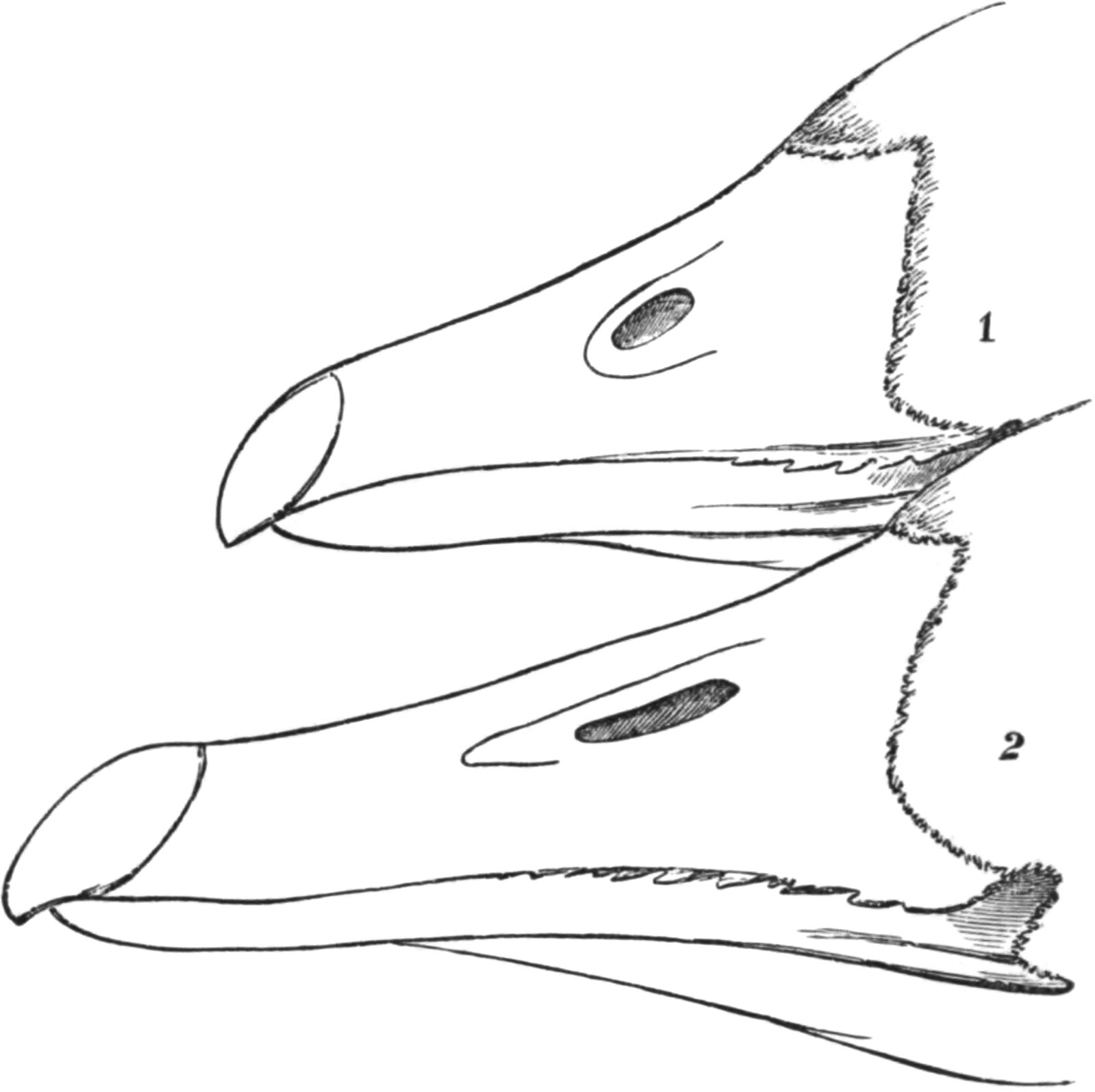
Bean Goose Bills
No. 1 we have always considered to be the ordinary size and proportions of the Bean Goose, the colour of the pale parts being orange-yellow, that of the nail black; the plumage in this agreeing almost with that which we shall describe from a fresh specimen of the larger billed bird. Soon after examining these stuffed specimens, we procured another from the Edinburgh market in a fresh state, agreeing in the form of the bill with No. 2. In this goose we had that member orange-yellow, black at the base, in the centre between the nostrils and base of the maxilla, and with a large oval nail of the same colour. The length two feet nine inches; the head and neck yellowish brown, darkest on the crown and cheeks, and having a narrow list of white around, the base of the bill. The colour of the neck gradually shading into dark brownish grey, on the back the feathers tipped with yellowish white, and having a shaded band of a darker tint separating the two colours; the lower back and rump uniform greyish black, followed by the pure white upper tail-covers, which form a narrow crescented band, contrasting with the dark lower back and tail. The tail containing sixteen feathers of the same colour with the lower back, shortly tipped with white, and having a narrow edging of the same colour on the outer web of each feather. The colour of the back is continued to the wings of a darker shade, with little light edging on the shoulders, but having the lesser covers with a broad white tip, and the dark tertials narrowly edged with that colour on their outer webs; the quills are black at the tips, grey towards the base, and with a broad white shaft; greater covers black. Below the breast, the feathers shade from yellowish white to greyish white, and pure white on the vent and under tail-coverts, the sides and feathers covering the thighs are similar to those on the back with pale tips. Legs and feet are orange yellow.
Another species, confounded with the last, but distinguished by the white nail of the bill, the different colour of the feet, its larger size, and some other less conspicuous distinctions, is the
Grey Lag-goose4
Anser ferus.—From the species of British geese having been so confounded, the habits of the Grey-lag have been mixed up with them; and though information that can be relied on has been obtained in regard to the others, we have no very authentic notice of the bird now before us during the breeding time, or of its range and migrations. From the testimony of various writers, it appears to have been more common in former days, remaining even to breed; but if the latter fact can be relied upon, it has many years since fled from the inroads of cultivation, and may be considered as a bird of considerable rarity, and so far as is at present ascertained, it is not known to breed in any part of the British islands. Mr. Yarrell states that it is equally rare in the London markets, some winters passing without any instances of the bird being brought in. In Ireland it is now also rare, though formerly considered to have been more abundant. In Central and Southern Europe it is only partially known; but in the North, upon the authority of Mr. Dann, it regularly breeds, and a few pairs at the same season visit some parts of Sweden. It is neither, however, mentioned by any of the arctic expeditions, nor by Audubon.5
This goose has been judged to be the stock of our domesticated breeds, though Mr. Yarrell hints that the white-fronted species may be also implicated. The ordinary stock has in general the greatest resemblance to the former, and a curious fact is stated by the author we have so frequently had occasion to quote, that a grey-lag gander would only mate with a tame goose, though females of both the bean and white-fronted species had been previously kept on the same waters.
For two winters past we have been watching to procure afresh specimen of this goose, but have been unsuccessful. The general colouring of the plumage is described as somewhat similar to the last, with which at a distance it maybe easily confounded; and even when examined near, without a knowledge of the differences, the species may not be at once detected. The larger size will always attract attention, the length reaching nearly three feet. The livid greyish pink of the feet and legs serve at once to mark it from the last; while the flesh-coloured bill, with the nails on both mandibles, being white or pale-coloured, distinguishes it from all other allied birds yet found as natives of Britain.
The Pink-footed Goose
Anser brachyrhynchus, Baillon, 1833.—Anser phœnicopus, Bartlet in 1839; Yarrell.
This species was evidently overlooked by our British Ornithologists, and appeared in no complete work as distinct, until the publication of the commencement of Mr. Yarrell’s third volume. It was first noticed as new to Britain by Mr. Bartlet, who exhibited specimens to the Zoological Society in 1839, and pointed out the distinctions which existed between it and the two previously described species. The same bird, however, seems to have been (unknown to Mr. Bartlet,) noticed and described several years previously by the discriminating naturalist of Abbeville, M. Baillon, under the name of “A. brachyrhynchus, or Short-billed Goose;” and since the time that it has been thus brought into notice, it turns out that it is occasionally brought to the Edinburgh market in winter,6 and Mr. J. M‘Gillivray, in his paper on the Zoology of the Outer Hebrides, states that
they breed in great numbers in the small islands of the Sound of Harris, as well as those of the interior of North Uist.7
Mr. Yarrell mentions some birds killed in the English counties, and that specimens were frequent in the London markets during the last three winters. There is yet no notice of it from Ireland. We have also scarcely any information regarding its continental, or its extra-European range. Living specimens have been already kept by the London Zoological and Ornithological Societies, but have not yet bred there.
During the winter of 1841–42, one of considerable severity, comparatively few wild geese appeared in the south of Scotland, and those which came under our notice were all Bean-geese. During the following season, 1842–43, geese were almost equally scarce, but on the 3d April we found a specimen of the pink-footed bird, along with one or two bean geese, in the shop of Mr. Muirhead, poulterer, who is always most obliging in allowing us to inspect his cargoes of wild-fowl and select any thing curious from among them. These were said to have come from the east coast, along which, from Edinburgh to Newcastle, the wild geese, in spring, and when on the move to their breeding-grounds, feed on the young wheat, and were formerly at this season sent in considerable numbers to the Edinburgh market.
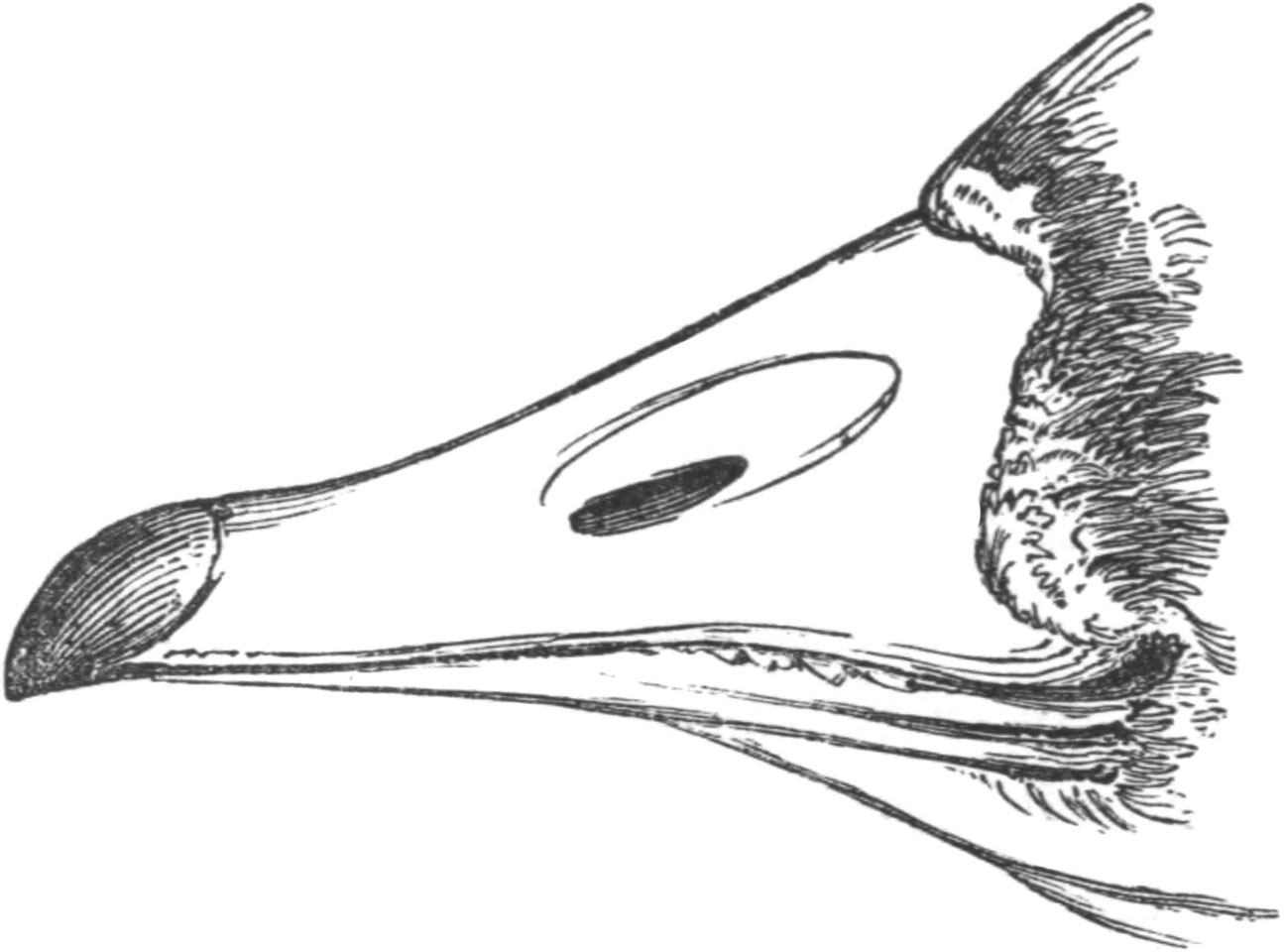
Pink-Footed Goose Bill
This specimen has served for the following description:—In extreme length it is about two feet five inches; the bill, from having been kept, had become dark, but appeared to have been of a livid pink;8 the nail black but pale towards its base; the base of the bill is surrounded by a narrow list of white, and the head, cheeks and throat are dark clove-brown, shading into yellowish brown upon the neck; on the back and scapulars the base of the feathers is greyish brown, each towards the tip inclining to yellowish brown, and finally tipped with yellowish white; on the lower part of the back and rump they are uniform dark greyish black, those nearest the tail tipped with white; the upper tail-covers pure white, having the crescented pale mark common more or less to the three species; tail (of fourteen feathers) dark at the base and broadly tipped with white, the shafts of the feathers of the same colour; the wings, except the quills and greater covers, are of a paler tint, the feathers tipped with the same colour with those of the back, but on the secondaries the pale ends are broader and nearly pure white. The quills are black at the tips shading into pale grey on the outer webs, with very strong broad white shafts; the greater covers are dark brownish black. Below, the colour of the neck gradually shades into a yellowish grey on the breast and belly, interrupted by the darker base of the feathers, farther shading into pure white on the vent and lower tail-covers; the sides and feathers covering the thighs are greyish brown, each feather broadly tipped with white. The feet and legs are of a livid tint, the nails pale at the base with dark tips.
These descriptions contain nearly all that is known of the British wild-geese, which, from their close alliance, have been confounded together; but notwithstanding the authorities we have given, we are not sure that their distribution or frequency can be deduced from them without fear of contradiction. We feel also almost inclined to think that a fourth species may even yet be involved among them in the large-billed bird of our wood-cut. We find that this, from the different size and form of the bill, has been by several authors considered as the true wild-goose or Grey-lag, while the later writers do not seem to have observed this bird among their researches, and we have to regret that we have been unable now to procure a recent specimen of that described as having flesh-coloured feet and the white nail. To bring them at once before the observer, the following summary may be of use:
- Wildor Grey Lag-goose.—Bill long, pale flesh-colour, nail white; feet and legs dull flesh-colour; tail consisting of—feathers.
- Pink-footed Goose.—Bill short, deep pink colour, nail black, nostrils oblong; feet and legs livid pink; tail consisting of 14 feathers.
- Bean Goose.—Bill short, orange-yellow, nail black, nostrils round; feet and legs orange-yellow; tail consisting of—feathers.
- Goose, wood-cut No. 2.—Bill long, orange-yellow, nail black, nostrils oblong; feet and legs orange-yellow, nearly tile-red; tail consisting of 16 feathers.
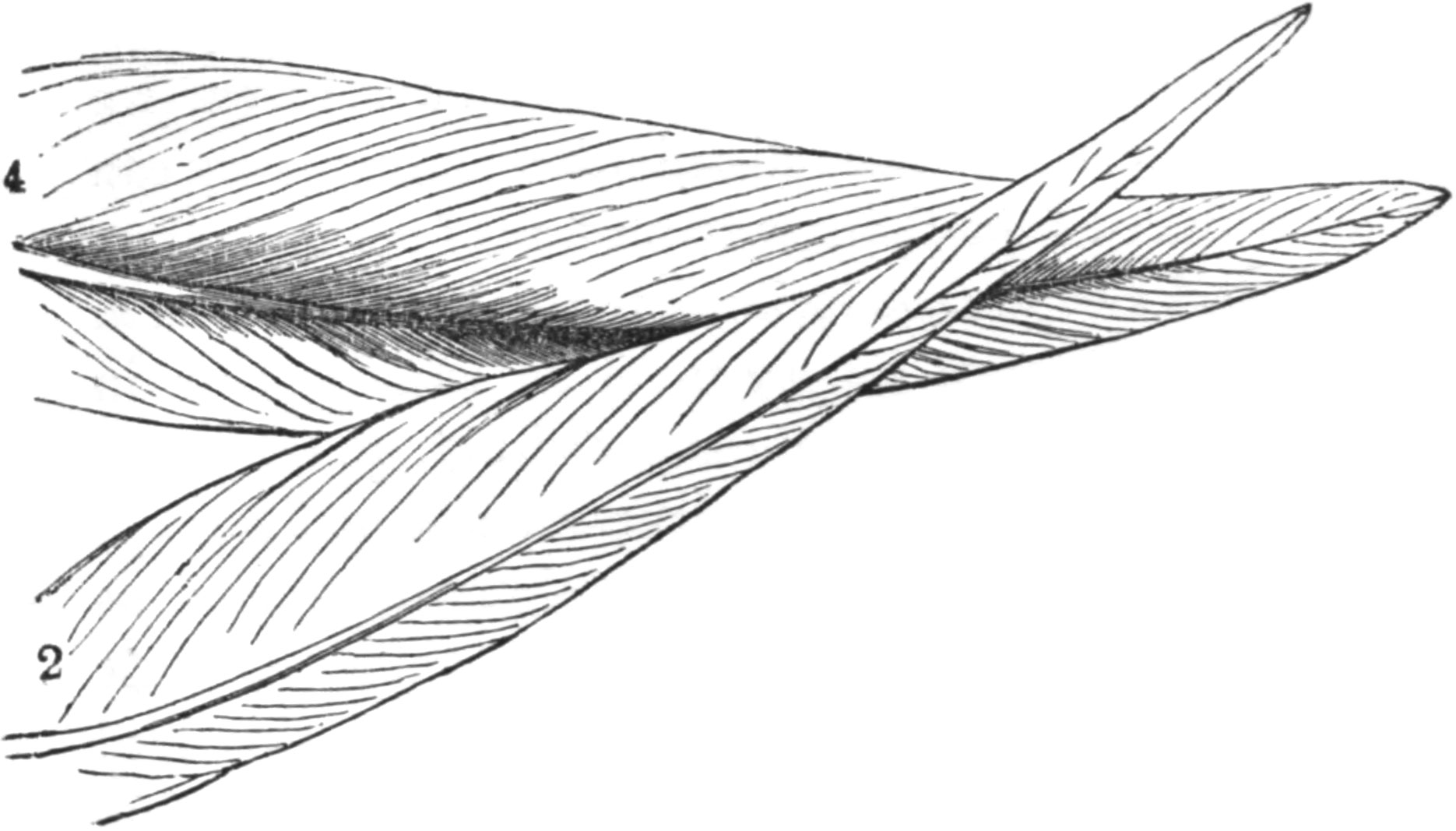
Bastard Quills of Nos. 2 and 4
The White-Fronted Goose
Anser erythropus, Linnæus.
Anaserythropus, Linn.—A. albifrons, Gmel.—Anser erythropus and albifrons of modern Ornithologists.—Oie rieuse, on de front blanc.—Laughing or White-fronted Goose of British authors.
The White-fronted Goose will exhibit the general form and colouring of the three species we have now noticed, and of those in this livery maybe ranked as the most frequent after the Bean-goose. It is a winter visitant only to this country, appears to have very much the same habits with the others, only it frequents more upland pastures, there feeding on the young grains or grasses; and is sometimes found in “turnip fields.”9 Mr. Yarrell records it as occurring in many of the English counties, and as being frequent in the London markets during winter, where it is somewhat esteemed for the table. Mr. Selby meets with it occasionally on the east side of our island; we have seen it in the Edinburgh markets, and have once or twice fallen in with a small flock during winter in our own vicinity. The last we saw was raised from a rushy upland sheep-pasture, where, after a few turns, it again alighted, and we procured the specimen which will serve for the following description. We do not know its range further north in Scotland, but it does not seem to reach the extreme northern coasts, nor to be met with in the islands. In Ireland it is frequent. On the continent the White-fronted Goose extends south to Italy,10 but it becomes more frequent in its range northward, and is abundant in Sweden; in Lapland also it is common, breeding in both countries. Out of Europe, Japan is given to it by Temminck, and the specimens from Northern and Arctic America have been considered identical by all our authorities upon the ornithology of that continent. Dr. Richardson states that its breeding-places are the woody districts skirting the Mackenzie, to the north of the sixty-seventh parallel, and also the islands in the Arctic Sea, to which it regularly passes through the two countries in large flocks,11 Audubon met with them in Kentucky, and high on the Arkanzas river; their flocks seldom exceeded above thirty or forty, and he considered them as by far the least shy of the species which are indigenous to or that visit that country. They are considered there as “delicious eating.”
Head and neck yellowish clove-brown, or dark wood-brown, the under eyelid paler, and the forehead or base of the bill yellowish white, separated from the colour of the head by a darker line, which gradually shades into it. Plumage above, dark greyish brown, feathers tipped with pale wood-brown; on the wings the ground colour assumes a greyish tinge, except on the quills, which are nearly black; upper tail-covers white, forming a crescent of that colour at the base of the tail, as in the three previously described species; tail tipped with white. Beneath, the colour of the neck shades into pale wood-brown on the breast and belly, gradually gaining pure white on the vent and under tail-covers; but the lower parts of the breast, belly, and sides, are irregularly marked or barred with black, in greater or less proportion. Audubon considers this as the mark of breeding plumage, and that it is most diffused during the period of incubation, in fact, that it forms a marking somewhat like that on the plovers. All the specimens we have seen have been killed in winter, and had these dark lines in various proportions. Feathers covering the flanks are dark, tipped with pale wood-brown, and the thighs are yellowish-brown. The bill of this species is pale, the nail is white.
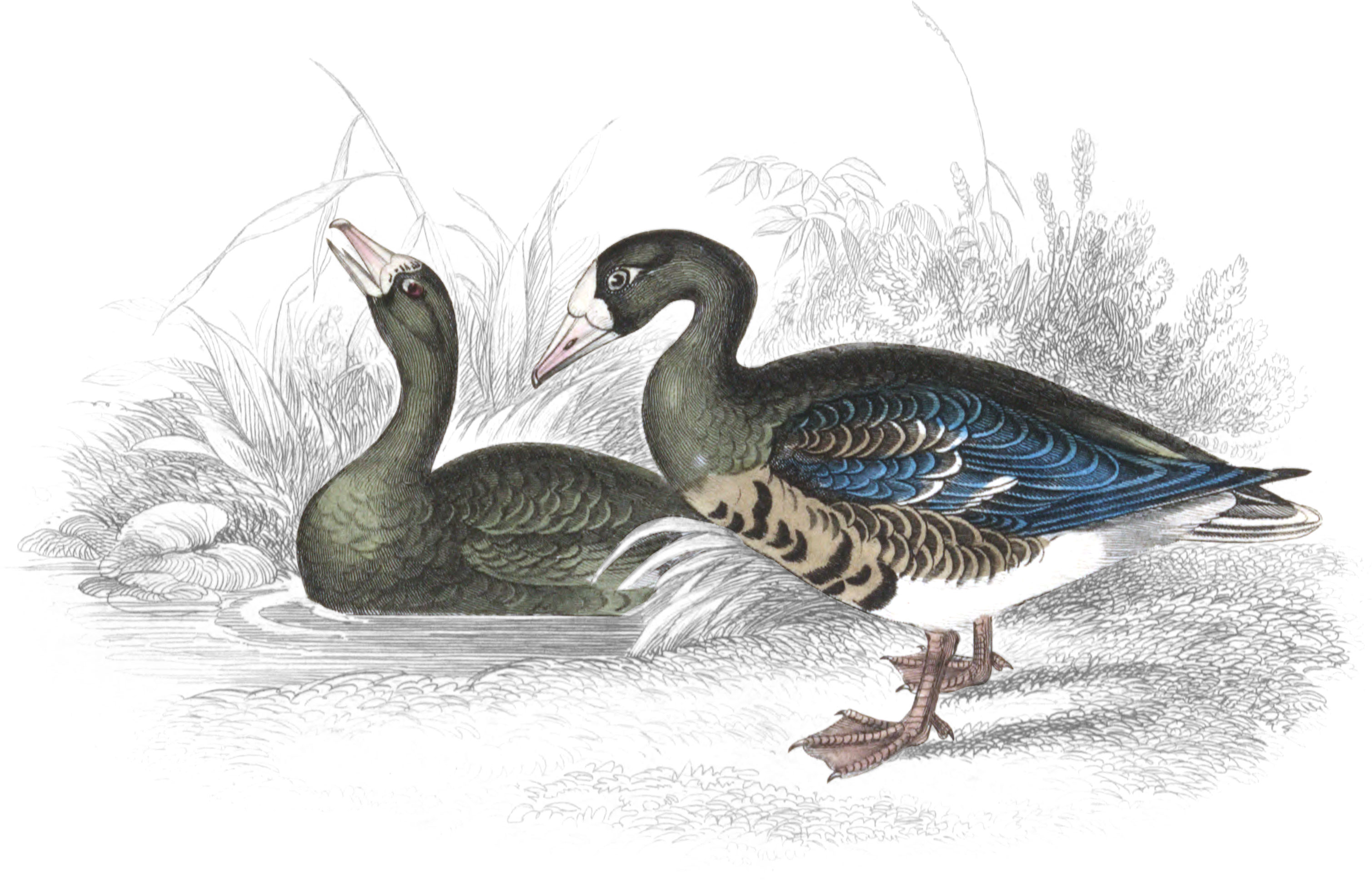
Plate I
The Bernicle Goose
Anser leucopsis, Bechstein.—Oie lernacle, Temm.—The Bernicle or Barnicle Goose of British authors.
This beautiful goose is also a winter visitant along the shores of our islands, in some parts appearing in large flocks, and on the western coasts apparently taking the place of the next, which is equally, or even more abundant on the east side of the island, each appearing only as comparative stragglers where their congeners are most numerous. It does not appear to range far inland, being a more maritime species than any of the preceding birds, resting by day on the shores, and commencing to fly with the twilight, to the feeding-grounds, which, where we have observed them, were extensive merses or flats partially inundated by the higher tides.
On the shores of the Solway Firth they are at times very abundant; and although it is not much practised, they are occasionally shot during their flight by waiting, or, as it is called on the Northumbrian coast, “slaking.” They are of some repute for the table, and are superior to any of the “true” wild-geese. The Bernicle is a bird also easily tamed, and several pairs are kept by the London Societies and at Knowlsley; but though eggs have been laid, no young have yet been produced. Mr. Yarrell states that it is not uncommon in the shops of the London Poulterers from November to February. The correct distribution of the Bernicle elsewhere, seems scarcely ascertained; in Europe it is not traced so far south as the last; it is more frequent in the north as a migratory bird, but in Lapland, where the last was abundant, this is rare. Its distribution to America is either uncertain or the species is very rare. In the Comparative List it is entered “Northern parts;” but we have it not in the Northern Zoology, while the birds introduced under that name in the appendices to the previous arctic expeditions, are in the above-named work considered to be a distinct and new species, there described as A. Hutchinsii. Audubon never met with it either on the coast or in the interior, and introduces it to his biography on the authority of others, at the same time he states having seen mounted specimens in various parts. It undoubtedly does not occur frequently or in any thing like the abundance of the other European and American geese, and its breeding-places are still a desideratum to our ornithological knowledge.12 Japan and Northern Asia are given to it by Temminck. It may be remarked, however, that “Barnacle” is a name commonly also applied to the Brent Goose; in the Edinburgh markets, where the latter species is abundant during winter, it is known under no other name, and thus by the intermixture of its provincial appellation, confusion of distribution may easily occur.
In this goose the bill is very small, and with the feet and legs black; the forehead in a line with the eyes, the chin, throat and cheeks are white; between the bill and the eye there is a broad line of interrupted black, and the back of the head, neck, and breast are of a deep and glossy shade of the same colour; on the back this appears to shade gradually in, from the apparent portion of the feathers being of that colour, lightening as they approach the middle, and having the edges at first very narrowly margined with white, that also gradually broadening. The lower part of the back and all the wings, except the quills and greater covers, have the base of the feathers grey, shading into a band of brownish black and finally they are tipped with white, forming a beautiful and chaste arrangement; the quills are black at the tips, shading into grey at the base; the rump is black; the upper tail-covers white, forming the crescented band; the tail entirely black. The lower parts beneath the black breast are of a beautiful silvery white; on the flanks brownish grey, feathers tipped with white; thighs black, feathers with pale tips.
The Brent Goose
Anser brenta, Willughly, Flem., Selby.—A. Bernicla, Oie cravant, Temm.—The Brent or Brand Goose, Ware Goose of British authors.
The Brent Goose is also a winter visitant; and as we saw the last abundant on the western sides of our islands, so do we find the present species most numerous on the eastern coasts. On the north-eastern shores of England, where we have had opportunities of seeing them, they might be considered as entirely maritime, not being known to leave the water mark, r ever to feed on the pastures or young grain. During ebb-tide, they fed on the banks of zostera marina, then uncovered; and Mr. Selby mentions the ulva latissima as very frequently found in their stomachs; at other times they rest on the sand-banks, which are quite open, and afford no shelter for approach; or they ride, as it were, just off the land, buoyant upon the wave, and occasionally pluck the sea-grass or weeds which are yet borne up within their reach. During the feeding-time, or when resting, as we have last mentioned, they are clamorous, and a flock is heard at a considerable distance from the regularity of the call of all the members, which is simultaneously kept up. They are also extremely wary, and we have never been able to approach them openly; and according to the accounts of Hawker and other sportsmen, shots are best obtained, either at night, by lying in wait in the line of the flight, or by coasting in a punt on a day when the wind is favourable, when they may either be “run into” or watched for in the range of flight. In Ireland this goose is also abundant, and furnishes most of the night shooting, which is much followed on various parts of the coast. Edinburgh market is largely supplied from thence.
The geographic range of the Brent Goose is northward; we have it in Shetland, and in Northern Europe, Iceland, Hudson’s Bay,13 Greenland,14 and Nova Zembla.15 In some of those northern latitudes it breeds, but we have no information of the situation or structure of the nest: the eggs are described to be greyish white.16 In North America it is migratory, but Mr. Audubon states, the “extent of the migrations of this species remains as yet unknown.” He did not observe it to the southward in South Carolina or the Texas, and we have never ourselves received it with any Mexican or Asiatic collections, though it may range to the northern extreme of the latter continent. Mr. Audubon considers it exclusively a maritime goose, but easily tamed, feeding upon grain; it has been known to produce young in captivity.
The head, neck and upper part of the breast are dull black, on the sides of the neck an interrupted patch of white; back, scapulars, rump, and under parts anterior to the legs clove-brown, paler on the latter, each feather having the tips and margins of a lighter shade; flank feathers tipped with white; vent, upper and under tail-covers, the latter exceeding the tail in length, pure white; tail clove-brown, quills and secondaries blackish brown; bill, legs, and feet black. The sexes do not vary much in plumage.
The Red-breasted Goose
Anser ruficollis, Pallas. Anas ruficollis, Lath., &c.—Oie a cou roux, Temm.—Red-breasted Goose or Barnacle of British authors.
This species is so unfrequently met with either in Britain or elsewhere, that we cannot describe it from observation. From all the information which has been hitherto collected, it appears to be one of the rarest European birds, and its range elsewhere being little known, its value to collections is very great In our own country it has been more frequently taken or killed than elsewhere; a fact which would lead us to believe that some far distant and little visited region will afford a breeding station to some troops of this beautiful bird, for its great scarcity in any known locality, renders it difficult to account for the specimens which from time to time have occurred in our islands, amounting now, from the statistics so carefully brought together by Mr. Yarrell, to seven or eight instances. These have principally been in the south, but one in Mr. Bullock’s collection was killed near Berwick on Tweed, which is the most northern British range on record. A few other specimens are mentioned by Temminck and Nilsson, in Scandinavia and northern Europe, but almost nothing is known of its habits. It is said, and the information is handed down from one to another, to breed on the shores of the Frozen Ocean, but we scarcely trace any minute or recent authenticity of the fact. The latest account from observation is that of M. Menetries, who, during the Russian expedition on the Caucasus and frontiers of Persia, observed a considerable flock of this species near Leukoran, so exhausted that they were caught by the hand and preserved in captivity. In feeding they preferred vegetables to grain.17
Forehead, crown of the head, list down the back of the neck, chin, throat, and band extending upwards to the eye, black. Between the bill and the eye is a large spot of white; behind the eye and surrounding a large patch of orange-brown on each side of the neck is a list of white, which is extended farther, and forms a line of division between the orange-brown and black of the lower part of the neck; front of the lower part of the neck and breast fine orange-brown, the latter margined by a list of black and another of white; immediately before the shoulders is a second bar of white; mantle, belly, wings, and tail, black; abdomen, vent, thighs, upper and under tail-covers, white; bill reddish brown, with the nail black; legs blackish brown, with a reddish tinge,
—is the description by Mr. Selby of the Wycliffe specimen, now in the collection of the Newcastle Natural History Society.
Anser Canadensis
Canada Goose.—Anser Canadensis Steph., Richards.—Cygnus Canadensis, Jen. Canada Goose or Cravat Goose of British authors.
The Canada Goose is omitted by Mr. Selby in his British Birds; by Mr. Jenyns it is said to be introduced into Europe from America, but Mr. Yarrell considers that some of the birds or small flocks which are frequently met with, are really visitants from another country. We see no reason why some specimens, as well as other northern birds, should not loose the line of their migration, and seek our shores, and that they would thus have as strong a claim upon us as natives as many other birds which are now admitted in our Fauna; at the same time it is a bird so easily domesticated, and so frequently kept where there are artificial waters, that we have no doubt many escape or stray, and are at times killed and considered wild. It has been killed in various parts of England, but we do not know or recollect of any Scotch instances of its capture; at times small flocks have appeared, some pairs of which would remain after the mass had departed, and select a breeding spot where they would rear the young. An instance of this is related to have taken place near Derby, where an artificial piece of water was selected for a breeding place;18 the birds thus exhibiting none of the wariness we usually see among this tribe, and in this instance we would rather consider that they had been accustomed to confinement, and had selected a situation resembling that to which they had been used. In their native countries, however, they are far from wild, and are described by Dr. Richardson as easily decoyed, several are often killed at a shot, and by Audubon they are stated to afford a frequent temptation to the sportsman. That ornithologist also observes, that they breed sparingly at the present day in many parts of the western districts, on the Missouri, Mississippi, the lower parts of the Ohio, Lake Erie, &c.; he also found them on the Magdeline Islands, Newfoundland, and Labrador. In the Western and Eastern States it is crossed with the common goose, and the breed is considered superior; it is more easily reared and speedily fattened, and brings a higher price in the market.19 The species is of large size, measuring in length above forty inches. The head, neck, and upper breast are black; the chin and throat marked with a white patch which passes upon each side in a point behind the auriculars. The upper parts are blackish brown; the feathers edged with a paler colour; quills, tail, and rump black; upper tail-covers white; fore part of the breast and under tail-covers also white; the sides of the breast of a pale brown, the feathers having paler edges; bill, legs, and feet are black. Mr. Yarrell states, that the organ of voice is similar in structure to that of the mute swan.
These are all the British species which enter into the typical genus or the true geese, and whose stronghold perhaps is Europe and North America. The other forms which have been placed in the sub-family being all found in other and warmer countries, and consequently (we may almost say) they are all aberrant, and are either wanting altogether to the British list, or appear as rare examples of insulated genera. We may perhaps exempt the swans from these, which also belong in part to temperate or northern countries, though their distribution is more extended than the geese.
There are only other two forms which occur in our islands. The one, Chenalopex, Mr. Swainson thinks, may find a place as a sub-genus in Dendrocygna, or among the Tree Ducks, which are marked by lengthened toes and hallux, the claws considerably curved, the former connected by a more deeply cut uniting membrane, the tarsi also are more than usually elongated; as signified by the name, the principal members of it are to a considerable extent arboreal in habit. The species we have now to notice, however, goes considerably off from the types, being grallatorial in habit, strong, rearing its young easily in confinement.
Chenalopex.—Generic characters.—Bill rather depressed, laminæ slight, internal, completely hid by the edges, nostrils round, basal; feet grallatorial, tibiae bare above the tarsal joint, hallux articulated above the plane of the foot, not lobed; wings ample, tuberculated at the carpal joint, second quill longest.
Type. C. Egyptiaea.
Note.—Europe, Africa.
The Egyptian Goose
Chenalopex Egyptiaca.—Anas and Anser Egyptiaca of authors.—The Egyptian Goose of British authors. Vulpanser of the ancients.
This species is easily kept and reared in confinement, and is in consequence frequently to be found in the vicinity of artificial waters, and in parks or pleasure-grounds; from this circumstance many of those specimens which have been killed as wild birds, have made their escape or strayed from their civilized residences; such we consider to have been the case with those which were shot on the Tweed in 1839, and on the Fern Islands in 1830; some of which we saw and examined, and had little doubt at the time that they had previously formed part of the interesting collection kept at Gosford House on the banks of the Firth of Forth. We agree, nevertheless, with Mr. Yarrell in thinking, that all the birds killed in our islands may not have been derived from these sources, and specimens of this goose are just as likely to stray from Africa, as several other birds which claim that country more peculiarly as their own, particularly when they are found in flocks amounting to eighty in number, as in that seen in Hampshire. They have also been met with in several other English counties; in Scotland, besides those on the Tweed, once near Glasgow; and also in Ireland. Temminck gives the south of Europe as their range out of Britain, where they occur also in straggling parties. Northern Africa is, however, their natural station, and so far as we can gain information, they spread over the northern half of that continent. We have received a specimen in a collection understood to be made in Southern Africa, but could not ascertain its exact locality, or whether it had not been elsewhere procured. The nidification in a wild state is not described, neither have we any detailed notice of their habits.
The specimen from Southern Africa alluded to has the base of the bill and a space surrounding the eyes chestnut brown (reddish). The cheeks, crown, chin, and throat, yellowish white; the neck is yellowish brown, paler on the fore part, and on the back reddish brown; the upper part of the back, the breast and flanks, pale yellowish brown, minutely waved with a darker tint, centre of the breast and belly nearly white, with a patch of chestnut-brown where these parts may be said to join; vent and under tail-covers buff orange; the lower back, rump, upper tail-covers and tail, black; wings, as far as the greater covers, pure white, the latter having a deep black bar near their tip; the scapulars and tertials chestnut red, greyish brown on the inner webs, secondaries black at the tips, and with the outer webs brilliant varying green, quills black, carpal joint with a prominent tubercle; a fine specimen killed on Holy Island, and procured for me by Mr. Selby, does not materially differ, the white on the wings being slightly clouded.
The other insulated genus to which we alluded, Plectropterus of Leach, or the Spur-winged Geese, named from having the wings armed at the carpal joints with tubercles or spurs. It is considered by Mr. Swainson as a rasorial type. The species which has been killed in Britain is the Plectropterus Gambensis, introduced into our Fauna upon a single specimen killed in Cornwall in June 1821, presented to Mr. Bewick, serving for the figure in his Water-birds, and now deposited in the museum at Newcastle-upon-Tyne. It was seen for several days near a small fishing-place, associated with the common geese at a farm in the vicinity, and was much disturbed before being finally shot. Bewick’s description of this single specimen is as follows:—
The bill is reddish-yellow, with a jointed protuberance on the base of the upper mandible; the tipper parts of the head and neck are dingy brown; the auriculars and sides of the throat white, spotted with brown; the lower part of the neck, sides of the breast, and all the upper plumage appear black, but this colour is lost, particularly in the scapulars and tertials, which are most resplendently bronzed and glossed with brilliant green, and most of the outer webs of the feathers partake of the same hue; on the bend of the wings or wrist is placed a strong white horny spur turning upwards, about five-eighths of an inch in length, and pointing rather inwards; the whole of the edges of the wing from the alula spuria to the elbow and shoulder are white, all the under parts the same.
The bird apparently has been scarcely in complete plumage.
Before describing the more typical ducks, we shall shortly notice the swans belonging to the present sub-family. They are far more natatorial in their habits, their unwieldy size and weight unfitting them for frequent flight, though, at the same time, their powers for sustaining themselves and performing long migrations are very ample. The neck is much more elongated than in the birds we have already described, giving facilities for procuring food and cropping vegetation under water, and it is used in a similar manner to that member among the flamingoes; the one reaching deep water by means of lengthened legs, the other being supported on its surface by its form and ample plumage.
Cygnus.—Generic characters.—Bill equally wide throughout its length, base elevated, sometimes tuberculated, laminas nearly concealed, nostrils medial; wings long, ample; legs placed far back, short, hallux small, not lobed.
Types. C. ferus, Bewickii, &c.
Note.—Gregarious in winter; size large; trachea convoluted in the sternum; cosmopolite.
British Swans
In the accompanying plate we have endeavoured to shew the principal external distinctions of the four species of swans which occasionally visit this country. The plumage of all of them is so similar, that without noticing the differences of the bill and head, or comparing the structure of the trachea and its convolutions, there is great difficulty in distinguishing them.
The Mute or Tame Swan
Cygnus olar, Fig. 2
Is easily distinguished from the Hooper, or Bewick’s Swan, by the distribution of the colours on the bill. In the two last the apical half of the bill is black, the base yellow in different proportions, while in the domesticated bird the reverse is the case, the bill being of a rich reddish orange, the nail, base, space between the eye, and tubercle or knob, black; internally the trachea is simple, and enters directly into the cavity of the body, consequently the sternum has no hollow in its keel for its reception.
This species is chiefly known as an ornament on our rivers or artificial waters, and at a very early period of our history so much importance was attached to having these birds, that laws were enacted, and it required a certain qualification and sometimes royal consent for persons to keep them on their domain, and hence different marks were adopted by which the owners or companies could distinguish their own birds. Mr. Yarrell, in his history of this bird, has given a very interesting abstract of the ancient laws and usages regarding this subject, to which we shall refer our readers.20 The marks were generally made upon the bill in the manner represented on the accompanying cut, which we have taken the liberty to borrow from one of the many which the above mentioned intelligent author has given.
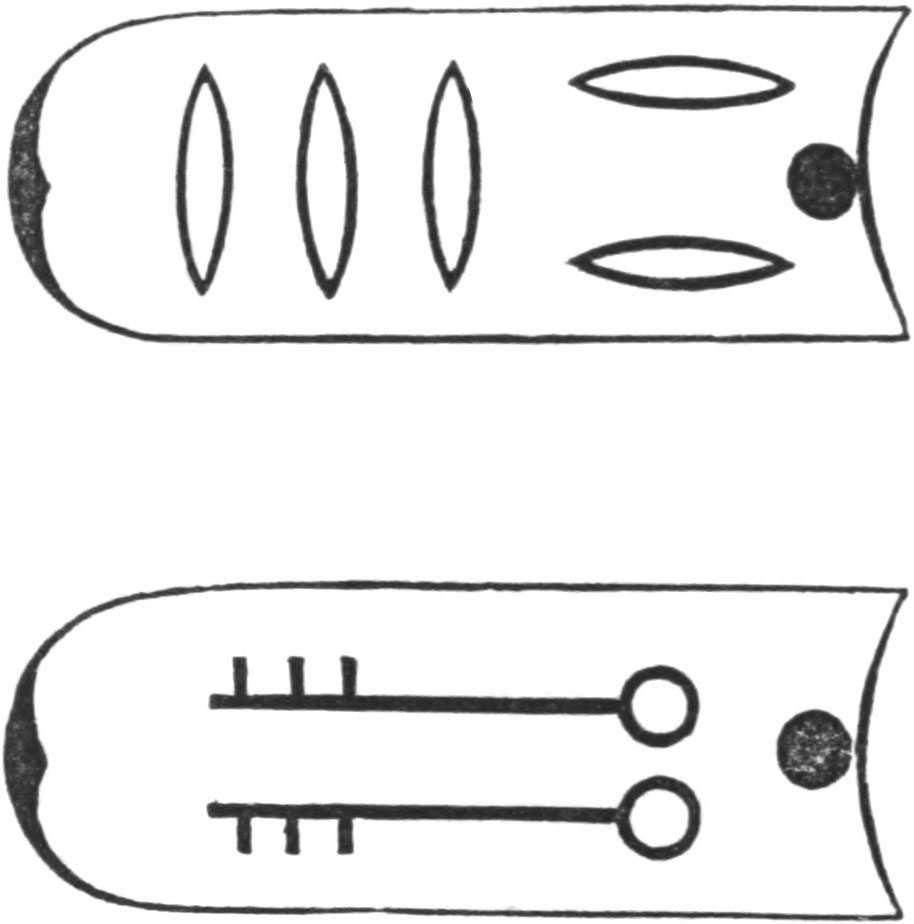
Swan Bills
The upper figure is the Royal Swan-mark of our most gracious Queen, Victoria, who at the last swan-voyage possessed 232 birds. The lower figure is that of Lord Buckhurst, and the keys adopted have reference to the office of Chamberlain to the Household.
There seems to be very few records of this species appearing in a wild state in Britain, none in modern days. Their natural residence seems to be Eastern Europe, but our information is yet scanty.21 Mr. Strickland states that the species visits Smyrna Bay in winter.
The Hooper or Wild Swan
Cygnus ferus, Fig. 1
This species is the most common in Britain, being a general winter visitant, frequenting at this time the coasts of England, and the lochs, together with occasionally the shores and inland estuaries of Scotland, in severe weather frequently ascending the courses of rivers for many miles; we possess a fine specimen of one killed on the river Annan in our vicinity, and know that they have been shot on the Nith as high as Drumlanrig, and on some alpine lochs on the confines of Dumfries-shire and Selkirkshire, they are frequently to be met with in winter. In the Edinburgh market, and among the poulterers there, a few specimens generally occur during winter, all of which are said to come from the “North.” In the time of Mr. Low a few pairs were said to breed in Orkney, but we have been unable to ascertain if this still continues. The greater mass migrate and incubate in the northern countries of Europe. We have, however, few records of an extra-European range, the American bird being now considered distinct. In confinement to artificial waters, this swan seems very readily to accommodate itself. In the gardens of the Zoological Society they have repeatedly bred.
The wild swan is easily distinguished from the last by the want of the knob and black base of the bill. This member is orange-yellow for more than half its length; the colour extends forward on the edges of the mandible, and forms a lengthened triangle of that colour, the apical portion of the bill is black. The plumage is pure white, but on the head, cheeks, and upper part of the neck, is often narrowly streaked with reddish brown; the young are often of a dull brown; internally, the trachea forms a convolution inside the keel of the sternum, entering and returning inside of the os furcatorius; the bronchial divisions are of considerable length.
Bewick’s Swan
Cygnus Bewickii, Fig. 4
A distinct species of Swan only began to attract attention about the years 1827 or 28, although one or two Ornithologists had previously examined specimens and pointed out distinctions. Soon after, its dedication, to hand down to posterity the Ornithologist of Newcastle, was by common consent recognised. Specimens have since been procured in several districts of England, Scotland and Ireland, but it is by no means common. A good many swans occurred last winter in the Edinburgh markets, where we were on the outlook for any thing remarkable, but they were all birds of the preceding species, and it may be considered as a much rarer bird. On the continent it has also been sparingly obtained, but nearly the same proportional disparity of numbers occur there, while its range over Europe or beyond that boundary is comparatively unknown. M. Temminck states that it breeds in Iceland.
The adult plumage is white after passing through the changes of dull brown, as we saw in the last. The head and neck are also generally streaked with rufous. But it is easily distinguished by its lesser size, and by the colouring of the bill, which has the greater part of its terminal portion black, the orange at the base assuming nearly the form of an oval spot carried out to the eye. This species has also a convolution of the trachea within the sternum, but it enters the cavity outside the os furcatorius, and the bronchial divarications are very short.
Polish Swan
Cygnus immutabilis, Fig. 4, Yarrell
Appears to have been first brought into notice as a British bird by Mr. Yarrell in 1838, who exhibited a specimen to the Zoological Society. He states, that during the severe weather of the winter of that year,
several flocks of these Polish Swans were seen pursuing a southern course along the line of our north-east coast from Scotland to the mouth of the Thames, and several specimens were obtained.
Four were shot out of a flock of thirty on the Medway, and the bird above alluded to was one of these; one or two other specimens are recorded as shot since, in different parts of England. Nothing appears to be known about its range, farther than that the London dealers receive skins of a large swan from the Baltic known under this name, and we think, considered by Mr. Yarrell as identical with it. The Polish Swan is a large species, measuring fifty-seven inches in length; the plumage at all ages is pure white, which in fact was the circumstance which first directed attention to the bird; the bill is reddish orange, that colour completely surrounding the nostrils; the nail, lateral margins, and base, with the space to the eye, are black, and even in a male, known to be eight or nine years old, the tubercle is extremely small; feet and legs slate grey; the trachea is without the sternal convolutions.

Plate II*
Following the birds we have now described, we place the Typical Ducks, or the “River Ducks,” as they are termed by Swainson. In these we have continued the easy or ready domestication, as particularly observed in the tame duck and its varieties, springing originally from a wild race still existing; all the genera also, at least all that have been tried, take at once almost with confinement, and breed readily in that condition. In habits they are fluviatile or palustrine, most of them not commonly frequenting the sea; and although they possess great activity on the waters, swimming with ease, and diving to avoid danger, they do not dive in search of food, or live so almost exclusively on that element as the Fuligulinæ. The bill and tongue are formed upon a plan to search into soft mud, among the roots of aquatic plants, and under the grassy margins of the lakes and rivers, and from the structure and sensibility of the edges of these members, they are calculated to separate the nourishing particles from the mud, sand, or herbage, and to seek their food in the dark. The legs are placed nearly under the centre of the body, and consequently the greater number of the species walk freely; and the feet, though they are amply webbed, have the membrane lining the hallux either narrow or entirely wanting. We shall place first in this sub-family, not as typical of it, but as apparently somewhat allied to the true geese, and on one side leading from them, the sheldrakes, of which we possess two very beautiful examples, one of them, during the breeding season, common everywhere around our shores. Before giving the characters, we must, however, shortly notice an American and Asiatic form which is beginning to creep into our lists, and which would lead from the tree geese (Dendrocygnus) mentioned in the description of the spar-winged Egyptian goose. This is the genus Dendronessa, of which the beautiful summer or wood-duck of North America is the most familiar example, while another inhabiting the waters of China may now soon become as plentiful in our collections. A pair of these birds were shot some years since near Dorking in Surrey,22 but we have no reason to believe that they were really accidental wanderers; many specimens are kept on artificial waters, and as in the instances of the Egyptian geese, they have most probably escaped. The species seems easily domesticated, and in a wild state feeds chiefly on grains or seeds, and insects; during incubation they are partially arboreal in their habits, perch on trees and place their nests in the hollow trunks or branches.
Tadorna, Leach.—Generic characters.—Bill depressed at tip, slightly undulated in its lateral outline, slightly dilated at the tip, base elevated with a knob in front; maxilla concealing the mandible; lamellæ scarcely visible externally, not developed; wings long, tertials broad, carpal joints with a rudimentary knob; tarsi with hallux articulated high.
Types. Tadorna Belonii, &c.
Note.—Breed in holes. Europe, Asia.
The Common Sheildrake
Tadorna Belonii
Anas tadorna, Linn, &c.—Tadorna vulpanser, Flea, Selby, &c.—Canard tadorne, Temm. Sheildrake or Sheildrake of British authors.
We have preferred the specific name of “Belonii” for the Sheildrake to that of “Vulpanser,” lest it should mislead, it being apparent that that name was anciently applied to the Egyptian goose previously described. In the full adult state of this bird, from the decided markings of clear white, reddish orange, and black, it is one of our most beautiful and clean-looking ducks. It is, we believe, a truly maritime species, or a shore duck, being seldom or never seen far inland, nor frequenting fresh waters, except during the season of incubation. At that season it is common, and frequents most of the British shores, where there is an extent of flat common or warren, or undulating land free from cover, and where the shore in addition is low and sandy. These are its frequent haunts, but we have met with it also where the sandy shore had a precipitous boundary covered with brushwood, but intersected with bays; and by the mouths of rivers we have seen them coming from their inland breeding places over extensive woods, skimming with a low flight just above the trees. It breeds in the holes and crevices of rocks, and when near warren, selects the rabbit burrows. When the young are hatched, they are conducted to the sea, and Mr. Selby states, are sometimes carried in the bill of the parents to their protecting element. If come upon when the young are newly hatched, the old birds endeavour to lead off the in-[indecipherable] feigning lameness like some of the rasores and grallatores; but when they have reached a more advanced state, unless a dog is present, they almost invariably fly straight away. When half fledged, however, they are seldom found far from water, though we have once or twice come upon them on the flat sands of the Solway, more than half-a-mile from the sea or any stream; but notwithstanding, a single specimen was all that could be obtained, from the brood scattering, and making use of every little pool as a cover by diving, which in an extremity of this kind they do most actively. We have usually found the sheildrakes arriving about their breeding grounds in the beginning of March; and where land had been embanked from the sea, have seen them early in the morning frequenting the fallow or newly sown grounds. After the young have been fully fledged, they appear to keep to the open sea, and we have seldom then seen them on land, and neither have we seen them on the coasts after September. They are generally distributed in Britain wherever suitable localities occur, and range to the very north of Scotland and to Orkney. On the shores of Europe they also appear from Sweden to Italy; out of Europe, on the authority of Temminck, they are found in Japan. They are easily kept in confinement where they have access to water, and form a very handsome ornament, but they do not breed freely under restraint; perhaps the want of a suitable cover or retreat may have some effect in preventing this, for we have not generally seen any place provided where they could form a nest, as among rocks or burrows. The nests we have seen in an artificial state were placed under some bushes or herbage, and formed with the down from the bird like that of a tame duck when breeding away from the poultry-yard.
Head and neck glossy blackish green; lower part of neck and upper breast pure white, succeeded by a broad pectoral and narrow dorsal band of pale chestnut-red; centre of back, rump, tail, shoulders, lesser wing-covers, sides and thighs, pure white; scapulars, quills, and tip of the tail, back; tertials white, outer webs broadly edged with chestnut, separated from the white by a dark line shading into both colours; centre of the belly and running through the chestnut band, black; vent and under tail-covers pale yellowish red. The young birds have not the bright colouring or decided markings of the old; the chestnut colours are more of a blackish brown, and the white is clouded with grey. The glossy black of the head and neck is also wanting; the fore part of the neck being white, the crown and back of the neck blackish brown.
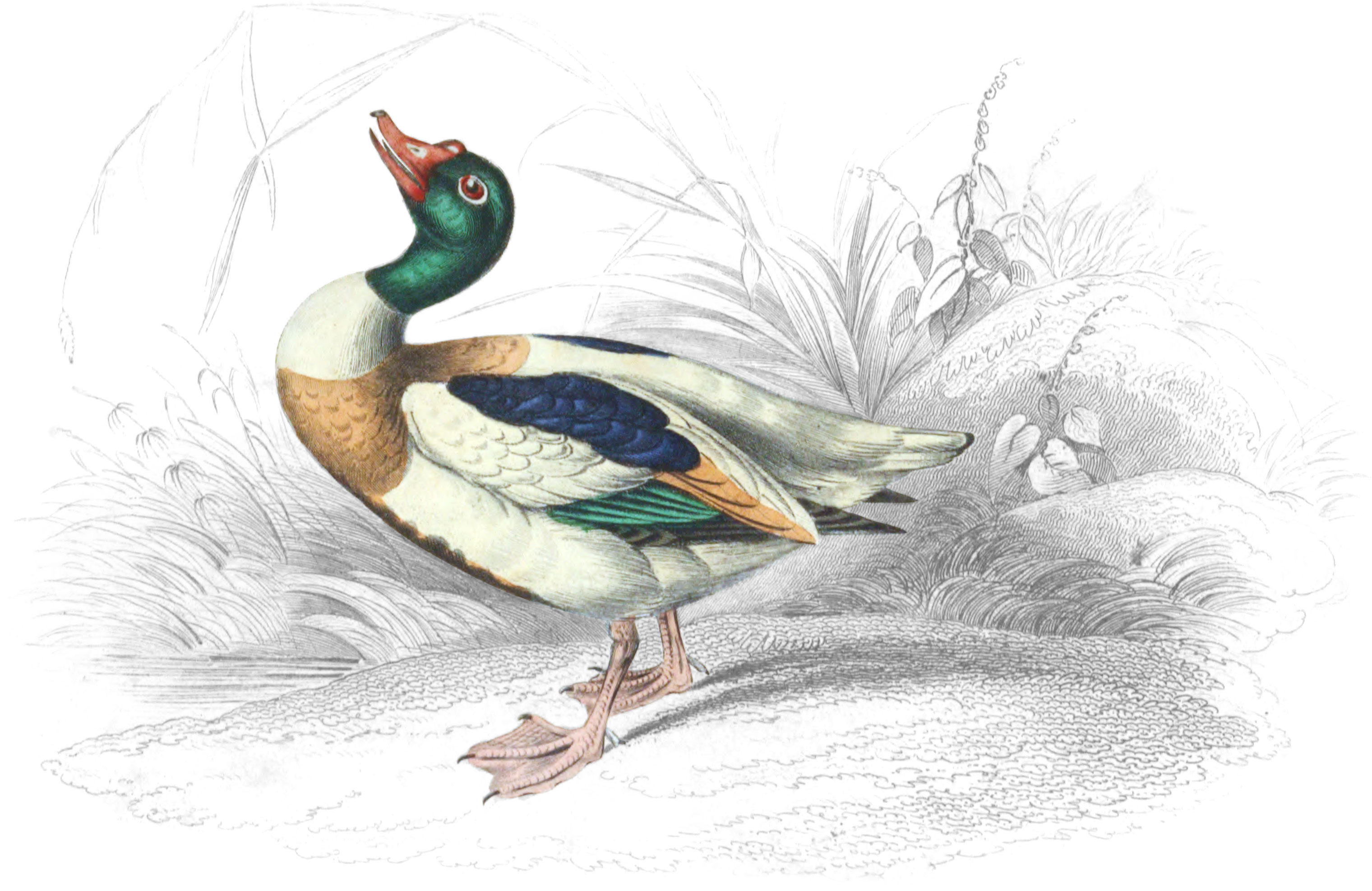
Plate II
The Ruddy Sheildrake
Tadorna rutila.—A. rutila, Pall.—Ruddy or Casarka Sheildrake of British authors.
Three specimens of this rare and handsome duck are all on which we can rest its claim as British; the first and original one, a female, is now in the Newcastle Museum, it was killed in Dorsetshire; another, that which served Mr. Selby for his Illustrations, is now in that gentleman’s collection; and the third was shot in 1834 upon the Sussex coast. It is also a rare bird in Central and Southern Europe, but seems to stretch to the east and across the Asiatic boundary. It is
abundant at Erzeroom, frequents marshes during the day, but feeds late in the evening and early in the morning in corn and stubble fields; great numbers on the Lake Van in August.23
Found also on the Indian Peninsula, on the authority of both Colonel Sykes and Mr. Jerdan; the latter remarks,
This large duck is less common towards the south than in the more northern parts of the Peninsula. Is frequently seen in pairs, or small parties of four, five, or six, but occasionally, as in the Chilka Lake, in numerous flocks of some hundreds; only found, so far as I can learn, in the Peninsula during the cold weather.24
Fore head, cheeks, and chin, pale ochreous-yellow; region of the eyes, crown of the head and nape of the neck, greyish white; neck, as far as the collar, ochreous-yellow, tinged with orange; collar about half an inch in width, glossed with green; breast, mantle, scapulars, and under parts of the body, gall-stone yellow tinged with orange, being deepest upon the breast; the feathers on the upper parts of the body have their margins paler, and the long tertials pass into sienna yellow; lesser and middle wing-covers white; secondary quills green, glossed with purple, and forming a large speculum; greater quills black; lower part of the back, upper tail-covers, and tail, black glossed with green; bill, legs, and feet black.25
Female is said to want the black collar.
We shall next examine the true ducks, or those where the lamina? of the bill are farthest developed, and shall show first the form of which the common wild duck is typical, as carrying forward the great facility or domestication in a species which in its native haunts exhibits exceeding wariness. We do not here find the laminae either much developed or exposed, at the same time the whole food is taken by searching for it in the mud or among the aquatic vegetation, as any one may observe by noticing our common breeds of ducks while feeding, grain or food of any kind when placed even in clean water, is immediately taken as if it required separation from foreign substances.
Boschas, Swainson.—Generic characters.—Bill long, depressed, broad and of equal width throughout, laminæ nearly concealed; nostrils oval, basal; wings sharp-pointed; tail cuneate, of moderate length; feet ample, hallux free.
Types.—B. fera, crecca, obvcura, &c. Europe, Asia, America.
Note.—Gregarious; easily domesticated; feed on grain or vegetables.
The Common Wild Duck
Boschas fera, Briss.—Anas Boschas, Linn., &c.—Common Wild Duck—Mallard of British authors.
This abundant and useful species is very commonly distributed over all our islands, few localities being without some parts suitable for their habits, and many districts being peculiarly adapted for them; at the same time, causes similar to those which have operated on the frequency of many other species, have very materially diminished the numbers of the wild duck, and among the most serious is the profuse system of drainage which has taken place in many of the lower lying counties of England, where decoys and the produce of the fens furnished a regular and often handsome income to the followers of an occupation now getting nearly extinct; while in all those districts of England and Scotland where a more partial extent of moss or marsh existed, extensive improvements have taken place, and their wonted haunts disturbed, or in a manner destroyed.
In spring, at the beginning of the breeding season, flocks of wild ducks begin to separate into pairs and partially leave their more frequent localities. At this time the female may be frequently seen at a considerable height, pursued by one or more drakes, performing many coy evolutions, flying in circles with extreme rapidity, and keeping up the chase, as it were, for a considerable time. They now either retire to secluded pools or to ditches, and soon after to the boundaries of the morass, or upland pastures, where the nest is generally made, being almost never placed immediately in or very near the great or common rendezvous, to which the young are led soon after hatching; but although the ordinary breeding places are where we have stated, they are sometimes varied; we have known the nest placed on the summit of a precipitous rock enclosed with wood, and the stump of old willows, the fork of an old tree, or some deserted nest, such as that of a crow mentioned by Mr. Selby, at least thirty feet from the ground, are not unfrequently chosen.26 It is composed, in its usual situation, of dried grass or the vegetable substances near, and is always warmly lined with the down from the parent bird.
After the young have received complete first plumage, the whole again begin to congregate and to frequent at the time of rest some chosen piece of water or large morass, where they remain during the whole day, making excursions morning and evening to various feeding grounds. These differ according to the season; a river, if near and at all secluded, is much frequented; in autumn the fields of grain are flocked to at dark, and where the crop has been laid is selected for a spot to alight upon. Extensive holms or valleys are much frequented, particularly if water be in the vicinity, to which for a time they can retire after feeding. As twilight approaches they may be seen by the watcher, early in the night, coming from the points where he knows the daily resting-places are situate. They at first fly round in circles, gradually lowering and surveying the ground around; but as the night advances, they fly straight to the spot and alight at once; many years since, when wild ducks were much more abundant, we have shot them by watching among the ripe grain. As the season advances, the stubble-fields are selected, and more particularly if the ground is at all moist, or is liable to be occasionally flooded and the water continues standing in the furrows; in these situations they are able to find the grain, and by the sensibility of their bill-apparatus to separate it from the water and foreign substances. When winter ensues, and their resting-place is perhaps frozen, they have to seek for water in the springs and ditches which do not freeze, and in the rivers which are generally partially open, assembling in small parties or flocks; but in severe seasons they are often driven to great extremity, for we do not think that the individuals belonging, as it were, to a district, migrate far, or seek the coast. In a locality not more than twelve miles distant, we have rather seen an increase than the reverse at such times; and in one or two winters of unusual severity which have occurred within the last twenty years, where almost every pool or hole was either entirely blown up by snow or frozen, we have seen the wild duck (generally so shy) so reduced as to seek for any greener spot in a field, or the least open part of a ditch, and, if disturbed from these, merely fly around or to a short distance, until the cause of annoyance had been removed, their bodies being at the same time completely emaciated. Upon the sea-coast there is always a considerable number to be found during winter and in severe weather, but bearing no proportion to the large flocks of widgeon and some of the true sea-ducks; these we conceive to have been either birds which have migrated from another country, or those which belonged to the district in immediate vicinity to the coast, and they have resorted to the sea more as a resting-place than for food, preferring at all times to seek it inland, unless when the severity of the weather has completely shut up all their accustomed sources.
We have not very varied information as to the geographical range of the wild duck; it seems generally spread over Europe, and reaches the arctic circle; it is American, and is said to be found eastward as far as Japan,27 but we do not trace it on the peninsula of India or in Africa. Mr. Audubon has given us a very good and interesting account of the mallard in North America, which, with the addition of the remarks of Wilson, will contain all that is at present known of the species in that country. From these it would appear that this bird is very rare in the United States:
Farther eastward, so rare, that it is scarcely known and; not one was seen by myself or my party beyond Portland in Maine.
On the western coast of Labrador, and in Newfoundland, the people were equally unacquainted with it. From New York southwards they became more plentiful, and they are abundant in the Carolinas and Floridas.
In the Floridas they are at times seen in such multitudes as to darken the air, and the noise they make in rising from off a large submerged savannah is like the rumbling of thunder.28
We have not any information how far their range is to the south.
We consider that a minute description of this well-known bird is not necessary; one peculiarity which will always distinguish it as a species is the dark green curled feathers of the tail, showing a development or variation carried out in other parts or in other ways among the members of this or other very nearly allied genera. The young males in their first dress resemble the female, but before winter-time they have nearly assumed the complete breeding state of the adults. The males, after the season of incubation has passed, lose the green head and distinguishing plumage of the upper parts and become of a more sombre tint, with markings similar to the female, but from which they may be at all times distinguished; and late in autumn they again resume their proper dress, which is completed and thickened before winter commences. The wild duck is sometimes subject to variety; we have seen drakes having the upper parts of a bluish grey, the dark breast paler; and we possess a duck shot from a flock which has the wings and part of the head and neck white; we did not consider this to be a tame bird mixing with the others. Mr. Yarrell also states having once or twice seen females having partially assumed the male plumage, which we have little doubt sometimes occurs, though we have not fallen in with examples of it.
It is among the birds which constitute our present genus that we place also those which have been denominated Teals, and which, from the various generic appellations that have been bestowed upon many of them, show that there is a variation from the form of the last. In general they are of a more slender form and smaller size, the bill is scarcely so broad in proportion, the laminae are even less developed, and the tail in what has been considered teals is more accuminated. Perhaps these may be the true generic forms, that of the mallard, and one or more species approaching close to it being rather the digression to the grallatorial structures we have just left. In habits they agree, frequenting inland marshes, rivers, and lakes, and seldom seeking the vicinity of the coast. In illustration, we have represented our native teal grouped with that from America, which was long confounded with it.
The Common Teal
Boschas crecca
Anas crecca, Linn.—Querquedula crecca, Steph.—Canard Sarcelle d’Hiver, Temm.—Teal, or Common Teal of British, authors.
This small species is one of our most beautiful ducks, the male, in adult plumage, exhibiting a richness and variation which can scarcely be exceeded. In many parts of the south of Scotland the Teal was an abundant species, but the same causes that influenced the numbers of the last, have had effect, though in a less degree, here also. In these parts of our islands no general migration takes place; the bird is a constant resident, breeds in the vicinity of its haunts, and partially leaves them only in either very dry or severe weather; and we do not think that there is any accession of numbers at any season from more distant localities, like the last. It wanders to feed at twilight, to rivers, moist ground, or wet stubble-fields, and we have frequently shot them in company with other species. In very wet weather, when its haunts are flooded, it will resort to the inundated lands, parties assembling from various parts of the neighbourhood; and in severe winters it may be met with in ditches or rivers, where, however, it does not seem to be at home, and ceases to frequent, so soon as support can be found elsewhere. The teal is not nearly so shy a bird as many of our wild fowl, and with ordinary care may always be approached; when disturbed, it flies in circles around, wheeling somewhat like plovers; and, if taken at the proper time, several may often be procured at a shot. We have found the nest, generally at a distance from the water, placed dry, often among brush or young plantations, formed upon the ground, upon the same plan as that of the mallard.
In England, again, Mr. Yarrell states that it is a winter visitor, making its appearance by the end of September, the numbers increasing during winter by additional arrivals from the north of Europe; at the same time, several instances of its breeding are given. The same ornithologist states that it stands confinement well, those in the gardens of the Zoological Society having bred regularly for the last five seasons.
Out of Britain it is pretty generally found on the continent extending north to Norway and Sweden, in some parts of which it is partially migratory; it extends to Northern Asia, and we have it also among the birds of the Indian peninsula. It visits Northern Africa in winter.29
The bird from America, the green-winged teal of Wilson, was considered identical, and the geographic range therefore made very extensive; we consider that bird, however, quite distinct, in which opinion we are joined by most modern ornithologists.30 The distinctions consist principally in the white crescent-shaped band, which crosses the sides of the breast nearly in a line with the bend of the wing, and in the want of the white scapulars which form so conspicuous a line down each side of the back of the European birds. The distribution of the colours on the head are also different. We have never met with an American specimen without that white band and dark scapulars, nor one from any portion of the Old World possessing them; and we notice it here, both from the difference of opinion which has existed, and as a guide, if any American birds should happen to stray so far as our shores, which, however, would be much more probable were the habits of the bird at all maritime.

Plate III
American Teal (Left), European Tail (Right)

The Gargany Duck
Boschas circia.—Anas circia, Linn.—Querquedula circia, Steph.—Canard Sarcelle d’été, Temm. Gargany, or Summer Teal of British authors.
This beautiful species is a summer visitant to this country. Mr. Yarrell states having seen specimens in October, and a few may occur at the time of the autumnal migration, but there can be no doubt that the great body touch our islands in their spring passage, a few stragglers only remaining to breed, and these instances seem chiefly to be recorded from the county of Norfolk. In the north of England we have Mr. Selby’s authority for their non-occurrence, while in Scotland the species has never come under our own observation, either at large or in a fresh state, though Mr. Yarrell states, on the authority of Dr. Edward Clark, that six specimens were shot in Stirlingshire in March 1841. We have little doubt that the southern half of England is the boundary of its northern range, except in accidental instances. In Ireland it has been sparingly obtained. Over the greater part of Europe it appears either to be a visitant in spring, or towards the south in some cases remaining to breed, and it reaches as far north as Sweden,31 but the winter retreat of the bird seems scarcely to be ascertained. The Zoological Society have received specimens from the vicinity of Tunis.32 It is included among the birds of the Deccan by Colonel Sykes, and by Mr. Jerdon is said to be common on the Indian peninsula through the cold weather, being one of the first to arrive in the country.
On the crown there is a broad line of brownish black, gradually narrowing on the hind head and losing itself in a point on the back of the neck; on the forehead this is shaded into light reddish brown, which is the prevailing ground-colour of the cheeks and neck, each feather in the centre having a more lengthened mark of white. This colour and the line on the crown is separated by a broad list of white arising anterior to the eye, following the line of the dark crown, and gradually also narrowing towards its termination; chin black. The whole of the back is brownish black edged with yellowish brown, the edging becoming paler and more irregular on the lower back and rump. The shoulders are pale grey, quills brownish black; the greater covers dull greyish green, tipped with white; the lesser covers white, forming a narrow bar above them. The great ornaments, however, to the bird, are the scapular feathers, which are long and lanceolate, deep black, shading into grey at their lower edge, and having a narrow distinct line of white running along the shaft. The breast almost to the centre of the belly is yellowish brown, the feathers with broad irregular waves of brown; lower part of the belly white, the vent and under covers yellowish white waved and spotted with brownish black; flanks white, distinctly waved with black, the feathers near the insertion of the tail having a broad tip of grey based by a deep black waving bar, the whole forming there a conspicuous crescented band.
The Bimaculated Duck
Boschas glocitans.—Querquedula glocitans, Vig.—Bimaculated Duck, Penn. Selly, Gould, and British authors.
Pennant, in his British Zoology, describes this bird, and adds in conclusion, “Taken in a decoy in 1771, and communicated to me by Eward Poore, Esq.” Two other specimens were killed near Maiden, in Essex, in the winter of 1812–13; and Mr. Yarrell informs us, that a specimen has been obtained during the last winter (1842–3) in the London market. These are the authorities for the introduction of the bird to the British list, while out of it we have even still less evidence of its occasional occurrence, and nothing whatever on what we might build a conjecture of its habits.
Mr. Procter sent me word that he saw this species in Iceland, but could not obtain it,
is observed by Mr. Yarrell, but we have no information of the locality or circumstances under which it was seen. It is a beautiful species, and approaches to the pintails in the lengthened neck and its colours, and in the form of the tail more elongated than those we have left, and whether united or separated, it will stand on the confines of either sub-genus. Mr. Selbys description of the original specimen is as follows:—
Bill blackish grey, passing towards the base and edges into orange yellow; front, crown, and occiput very deep reddish brown, glossed with purplish black, and passing on the hind part of the neck into deep violet purple. Between the bill and the eyes, and behind the ear-coverts are two large or regular patches of chestnut brown, margined and varied with white; sides of the neck and cheeks glossy duck-green, the rest of the upper part of the neck and throat being greenish black; front of the lower part of the neck and sides of the breast reddish brown, with oval black spots; middle part of the breast pale reddish brown, also spotted with black; ground colour of the mantle pale sienna-yellow, undulated with black lines, scapulars the same, tipped with glossy Scotch blue; wing-coverts hair-brown, the lower range having pale wood-brown tips; speculum dark green, glossed with purple; tail wedge-shaped, with the two middle feathers black, narrow accuminate, and much longer than the rest, which are hair-brown margined with white; belly and abdomen yellowish white, with undulating black lines most distinct upon the flanks; legs and feet pale orange.
The somewhat lengthened shape and partially accumulated tail of the last, leads us to a form which, though closely allied, has been raised to the rank of a sub-genus, chiefly on account of the great development of the tail. The bill deviates from that of the typical form of boschas, but runs into that of the species to which the title of teals was applied, and which were placed by many ornithologists under Querquedula of Ray; few species are yet known, and these frequent principally inland localities.
Dafila, Leach.—Generic characters.—Bill long, slightly widened at the tip, laminae not visible externally; nostrils pierced through; wings long, accuminated; tarsi and feet slender, and not developed; hallux articulated on the tarsus, free, without a lobe; neck, tail, and scapulars elongated.
Types. D. caudacuta, capensis.—Europe, Asia, Africa, America.
Note.—Gregarious, feed chiefly on vegetables; lacustrine or fluviatile.
Common Pintail
Davila caudacuta.—Anas caudacuta, Ray.—Anas acuta, Linn.—Common Pintail or Sea Pheasant of British authors.
This beautiful duck is only a periodical visitant with us, arriving late in autumn, and occurring chiefly during winter, both in the decoys and inland lakes and fens of the south, and on the coasts of the north of England and Scotland. In Scotland, however, it is by no means frequent, and it is nearly certain, as Mr. Selby has remarked, that the long-tailed duck or Harelda glacialis has been mistaken for it on the Western Islands and northern coasts, where its presence has been recorded as frequent. In the south of Scotland a few specimens have occurred to us every winter, and we once shot a pair in immature dress in the month of September feeding at dusk on some wet stubble, in company with the mallard and common teal. We have occasionally observed them in this state of plumage in small numbers, mingling for a short period with the mallard, about or rather previous to the period of the migration and arrival of the winter birds of passage. Through the whole of winter and spring also, specimens might have been now and then seen hanging in poultry shops of Edinburgh, killed in this country; but these must not now be mistaken for the numbers that are received from decoys, and said to be killed m France and Holland. During the last winter (1842–3) the pintail was in Edinburgh perhaps one of the most abundant species next to the widgeon, and all from the sources we have noticed. Of its habits we know comparatively little from observation in this country. Mr. Selby states, that in confinement it becomes soon tame, but does not breed, or at least rarely, which we rather attribute to other circumstances; and the same thing has been observed of the birds in the Zoological Society, though the males periodically undergo the change to the duck-like plumage that we noticed as occurring in the mallard. A hybrid progeny between this species and the widgeon has been obtained, and we may mention here, that we have seen a hybrid between it and the mallard purchased from a poulterer in Dumfries, who procured it in a wild state; this bird is now in the collection of W. T. Carruthers, Esq. of Dormont. It combined the resemblance of the form and plumage of the pintail, but with a few minor differences; the curled feathers of the tail were completely developed, as much so as in an adult mallard. We have since also received a drawing of a bird also procured wild, by the attention of Col. H. Smith, which exhibits a mixed plumage, and is considered a hybrid bird.
It is generally distributed in Europe, becoming more unfrequent in the south. It extends to Asia: specimens received from Mr. Jerdon do not differ from those of Britain, and that gentleman states that they are
tolerably abundant towards the more northern parts of the peninsula, rare in the south, found in large flocks.
In the New World it is noticed in the works of Wilson and Audubon; by the latter it is said to be rare on the coast, and is considered as an inland bird. It is migratory in many parts, and does not extend so far north as many other species.
In Kentucky, and the whole of the western country, it is extremely abundant in early autumn, during winter, and up to a very advanced period in spring; it follows the waters of the Mississippi, is seen westward to the prairies of the Oppelousas, and eastward to Massachussetts, beyond which it is seldom seen; they extend to Florida.
It is said to be extremely fond of beech-mast, and in search after it even rambles a short way into the woods.
In the male the colours are very decidedly marked: the head, throat, and fore part of the upper neck are umber-brown; on the crown, with the feathers having pale tips, and on the hind head and sides of the head and auriculars, having a bright purple gloss; the hind head shades gradually into deep greenish black, forming a dark nuchal stripe joining with the grey plumage of the upper parts; the fore part of the neck, breast, and belly, are white, that colour running up in a narrow lateral stripe between the umber-brown throat and dark nape; on the belly, flanks and sides, the feathers are minutely freckled with grey; the vent and under tail-covers black; the lateral covers edged with white. On the upper surface, the lower part of the neck, back, and part of the scapulars are marked with zigzag bars of black and yellowish white, giving a grey tone to the whole; the scapulars are elongated, black along the centres, and having the edges of a more yellow tint, the bars broader and more clouded; the lower back and rump are greyish hair-brown, tail accuminated, and of the same colour, but the principal covers, also lengthened, are pale wood-brown on the inner webs, black on the outer; wings are lengthened, hair-brown, quills darker with broad pale shafts; the secondaries exhibit a dark broad bar across, glossed with purple; the tips are white, tinted with reddish near the shaft, and form a light bar, while the covers have a broad tip of reddish brown, forming a third basal bar, all well marked across the wing; the tertials, lengthened and accumulated, show a narrow black stripe along the centre; the feet, tarsi, and bill are bluish black.
The next species coming under our notice will begin to lead us to the form where the lamellæ of the bill are developed to the utmost. In the gadwalls they are seen when the bill is closed, but they still show considerable strength. The birds also, though inland in their habits, seem to have a greater propensity for diving in search of food than any we have already described.
Chauliodus, Swainson.—Generic characters.—Bill long, rather depressed, of equal width throughout; laminas strong, developed, and visible externally; nostrils pierced through; wings long, accumulated; tail rounded, upper and under covers nearly equalling it in length.
Types. C. strepera, &c. Europe, Asia, Africa, America.
Note.—Habits fluviatile and lacustrine, diving in search of prey. Form not known in the Polynesian Archipelago.
The Gadwall
Chauliodus strepera, Swainson.—Anasstrepera, Linn., &c.—Canard Chipeonou Rideau, Temm.—Gadwall, or Grey of British authors.
From the rarity of the Gadwall in Britain we have had little opportunity of observing its habits, and have only seen it recent in the shops of the London poulterers in spring, or living in one or two instances on the “Meers” of Holland, during a short excursion through that country. The latter were in small parties upon the water, feeding by constantly diving, which they appeared to do freely, though remaining under water for only a short period. According to Temminck, it is abundant in that country, breeding in the marshes. In Ireland it is said to be but rarely met with, and we do not recollect of any instance of its occurrence in Scotland, though lately specimens have been seen, we believe, in the Edinburgh markets; but since the importation of wild fowl from the Continent, these could not be depended on as procured in Britain.
In North America it is found along the whole of the Atlantic coast from Eastport in Maine to Texas, and is supposed to breed in the latter country. The migration also extends to the fur countries.33 It is mentioned by Colonel Sykes among the birds of the Deccan, and by Mr. Jerdon, as by no means rare on the peninsula, but found only in the cold season.
Head and neck yellowish brown, thickly mottled over with brownish black, and on the crown and back of the head glossed with green; lower parts of the neck and breast black, each feather having a series of crescented white lines, on the lower parts becoming gradually broader, so that there they appear spotted, before shading into the greyish white which covers the centre of the belly. The same white wavings are continued a short way down the upper part of the back, but the centre of the back in our specimens is brownish-black, the feathers broadly edged with yellowish brown, and intermixed with feathers nearly black with white wavy bases similar to those of the teal; the scapulars are of the same colours, the outer webs waved with black and white; the rump, upper and under tail-covers, and sides of the tail, black, tinted with green, and when the tail is closed the latter almost conceal it; the tail itself is hair-brown edged with yellowish white; the middle of the wing is chestnut brown, the lesser covers and lower half of the greater, velvet black; the upper half of the greater covers pure white, forming a marked and conspicuous spot, quills dark clove-brown. The female is described as having the under parts pure white, except the lower part of the neck and breast, where the crescented bands are broader, and are of dark brown and pale buff. The upper parts are less distinctly marked.
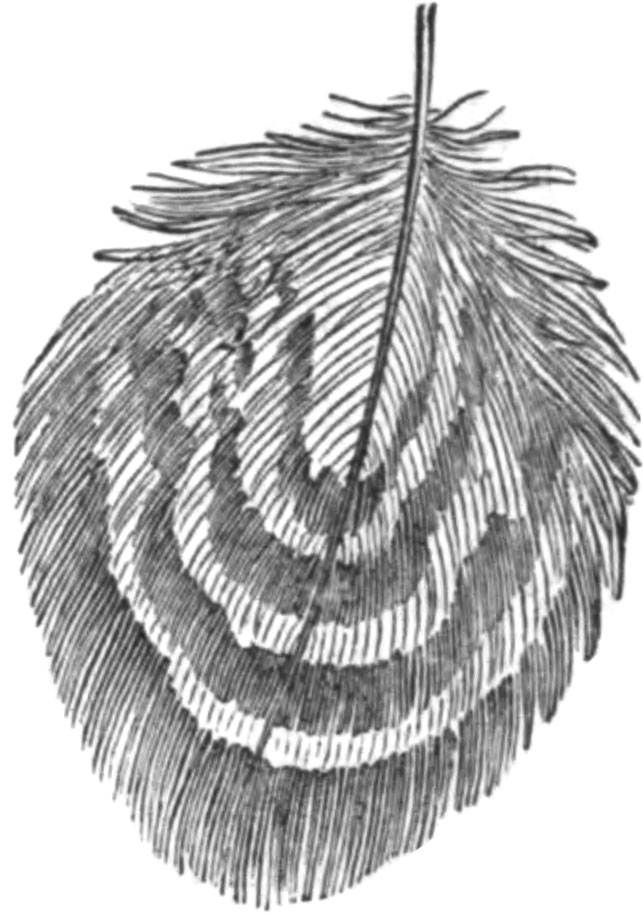
Gadwall Feather
The Shovellers have been placed by Swainson as characteristic of the whole family Anatinæ, and exhibit the greatest known development of the lamellæ, which are at the same time of extreme fineness and fit into each other. We cannot conceive a more beautiful apparatus to retain what is wished; allowing the watery portion to escape, it performs the same purpose here which the “Rakers,” do in the gills of the Coregoni and some other genera of fishes.
Anas, Swainson (not of authors).—Generic characters.—Bill long, depressed, very much dilated at the tip, nail small, maxilla extending much over the mandible; laminae exposed, long, fine; nostrils basal, round, the fossae small; wings long, accuminated, first and second quills longest; tail slightly cuneiform; feet small; legs slender, short.
Types.—A. clypeata, &c. Cosmopolite.
The Common Shoveller
Anas clypeata
Anas clypeata, Swains.; Linn., but not restricted.—Rhychapsis clypeata, Steph.—Spathulea clypeata, Flem.—Shoveller, Red-breasted Shoveller of British authors.
This very beautiful and interesting duck is of considerable rarity in Britain, generally considered as a winter visitant, but now known to breed in limited numbers in the marshes of Norfolk.34 It occurs also, during winter, in the south. In Scotland we have never ourselves met with it living, but have generally seen one or two specimens, during the winter and spring, among the Edinburgh poulterers. Mr. Selby states that it has been known to breed in the vicinity of the Tweed, and possesses a specimen killed in July in intermediate or changing plumage. We recollect once seeing the nest and eggs, along with the female, brought in to the late Mr. Wilson, janitor to the Edinburgh University, a most zealous observer of our native birds, and one to whom we are indebted for much of our early information regarding British birds. This was procured somewhere about Guillon Links on the Firth of Forth, where there was then a good deal of marsh and small reedy pools of water; the same person occasionally also received specimens during summer from some correspondents in the fenny countries.
In its habits it is an inland bird, so far as we know being seldom seen at sea; Audubon considers it as “promiscuous in its feeding,” and states that it never procures its food by semi-immersions, nor does it dive unless when hard pressed.
In America it is much esteemed for the table, and Audubon remarks, that “no one should pass a shoveller to shoot a canvas-back.” In olden times they seem also to have been more in request than now, perhaps more easily procured. In the poetry of Howard, Earl of Surrey, the second course for his Grace the Duke of Norfolk, is made to contain, among other fowl, four seapeys, two shovellers, &c.35
Out of Europe we find the shoveller in Asia; Mr. Jerdon states it to be common over all India. In North America we have descriptions both in Wilson and Audubon, and the Prince of Canino has placed it as identical with our native bird. Mr. Audubon considers it scarce in the United States;
and although many pass north and breed in the fur countries, a greater number spend the summer in the Texas and the districts farther westward; they were found breeding in Texas in the month of May. Dr. Smith brought the shoveller from Africa,”36
and Mr. Temminck records it from Japan, so that its range seems more extensive than almost any other British species.
Bill black, the head and neck in some lights appear brown, in others, rich green, but anterior to the eyes, and on the crown and throat, there is the least reflection of the bright colour; lower parts of the neck, breast, scapulars and sides of the rump, pure white; back blackish brown, gradually shading to greenish black on the rump and upper tail-covers; whole of the wing anterior to the greater covers with the outer webs of the large scapulars, greyish blue; the latter have a remarkable form, the inner white web being produced in a narrow point beyond the outer; the lower scapulars are blackish green, the tips along the shafts for a narrow space, white; lesser covers clove-brown with white tips, secondaries bright green; belly, vent, and flanks, chestnut-brown; under tail-covers glossy blackish green; tail clove-brown, with pale edges.
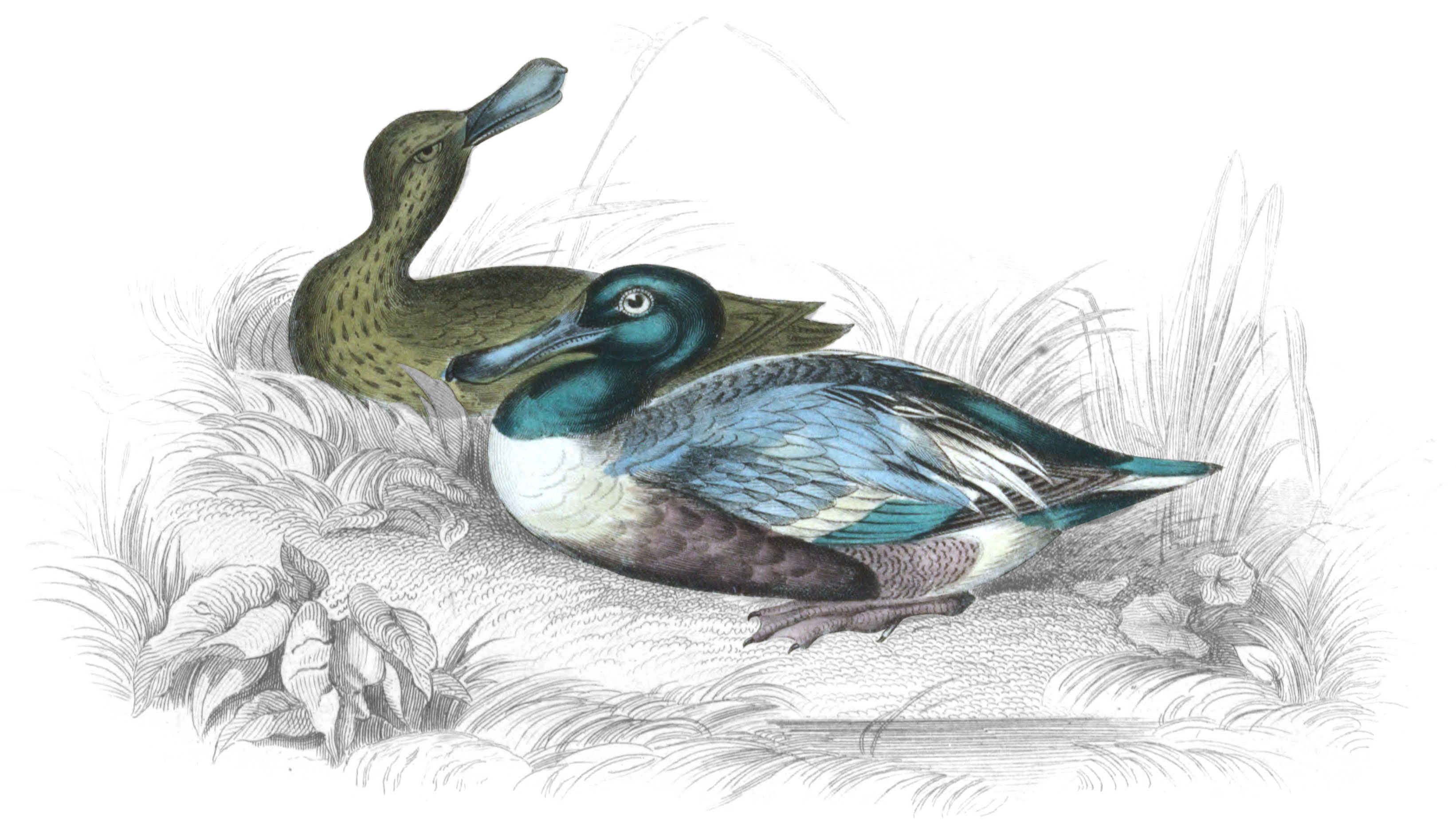
Plate IV
The Common Widgeon
Mareca penelope.—Anas penelope, Linn., Selby, &c.—Mareca fistularis, Steph.—L. Canard siffleur, Temm.—The Widgeon or Whew of British authors.
We have placed the widgeon here, or last, among the first sub-family of British ducks, as being a bird of shy character, and though it breeds inland, frequenting the coast more commonly than those which have preceded it. From the hallux being slightly lobed, and from the bill having that peculiar blue colour seen in the scaups and pochards, and altogether, although its habits of feeding are more goose-like and grallatorial, there is something that assimilates it to the maritime species.37 In the south of Scotland, and throughout England, it maybe considered a winter bird of passage, appearing in large numbers late in autumn, or after the broods have gained complete winter plumage. They are generally seen now in small parties on lochs or pieces of water, mingling with the mallards and teal, but are easily distinguished from them during flight, by the silvery colour of their lower parts, or in the dusk, by the shrill whistle whence they derive their name of “Whewer” and “Fistularis,” “Siffleur,” &c. While on the coasts and estuaries, or more extensive fens, they are often present in immense numbers, and furnish a plentiful supply to the southern markets. In spring they again migrate northwards to their breeding stations, which appear to be principally in Norway and Sweden; and according to Mr. Dann, they are by far the most plentiful species in Lapland,38 In the north of Scotland a limited number breed annually in the vicinity of the lochs, or upon the islands which stud their surface, this seeming to be the limit of their nidification in a southward line, the proportion remaining being very small, compared with the flocks which arrive on the winter migration. In several of the lochs of Sutherland, straggling pairs were seen in 1 834, all of which appeared to be breeding, and which indeed, by their manners at that season, first gave us the suspicion that this district was upon the boundary of their southern limit; and after repeatedly searching for it, we were at last so fortunate as to discover the nest upon a low island in Loch Layghal, thickly covered with fern (pteris aquilina), interspersed with huge matted patches of rushes, in one of the latter the nest was placed, formed chiefly of the down from the bird, and constructed on the same plan with those of the teal and wild duck. The female remained until nearly trodden upon, which in fact caused the discovery of her retreat; at this period the drakes had separated, and were seldom seen in company with the female, though ten days earlier they had been observed together. On the Continent they are also visitants in winter, and according to Temminck, a few pairs remain to breed in Holland, which maybe accounted for most probably by the favourable situations afforded by that peculiar country. Out of Europe they reach Egypt, and are said to be identically the same in Japan;39 and on the peninsula of India, Mr. Jerdon, states,
Common, in the cold weather, throughout India; in the rivers and tanks, found in large flocks.
They are frequently kept in confinement, and thrive well, though they have not, Mr. Yarrell states, bred in this condition, that is, the female has not laid eggs or incubated naturally, while the male has mated occasionally with the pintail, and with some varieties of the domestic duck. The following notice, however, taken from the Gardener’s Chronicle, seems to be an instance of breeding, at least in a partial confinement.
A few years since a pair of widgeons were kept in the river which bounds the Botanic Garden at Bury St. Edmunds. The male bird was shot during the winter, and the following spring was succeeded by a wild one (no doubt attracted by the call of the female), by whom it had several young ones, which all left at the usual period of migration, except the pinioned parent. Last year a male bird again made its appearance, and another brood was the consequence; a small portion of their wings have been taken off, and they are now become as tame as any of the water-fowl.40
The male widgeon, like most of the other ducks, receives his full and beautiful plumage in complete perfection in spring, putting it on in winter, but gradually attaining more brilliancy as the season for pairing advances; while, after incubation, it becomes of a more unobtrusive description, approaching nearly to that of the female.
In the male, in adult plumage, the bill is bluish-grey, black towards the tip, and having the nail of that colour; the forehead and crown are pale buff-orange, chin and throat black, while the rest of the head and neck are rich orange-brown; breast purplish red, tinged with grey; belly and vent pure white; the back, scapulars, sides, and flanks are finely waved with irregular bars of black and white; smaller wing-covers next the shoulders grey, the others pure white, the greater covers with black tips; the secondaries in the centre forming the speculum glossy green, the base and tips of the feathers black, quills hair-brown; the tertials, which are always conspicuous in this family, have their inner webs grey, the outer ones velvet-black margined with pure white; tail brown, and rather lengthened in form. In the female the head and neck are yellowish-brown, thickly covered with blackish-brown spots, upper parts greyish brown, the feathers with paler margins; breast, belly, and vent white; sides and flanks yellowish-brown, which is often more or less spread over the under parts.
The American Widgeon
Mareca Americana.—Anas Americana, Wils., Aud., Nutt., &c.—Mereca Americana, Steph. and Faun. Bor. Amer.—Asa British bird, Blyth, Nat. iii. p. 417.—Yarr. B. Birds. iii. p. 196.
A single specimen of this species was obtained in one of the London markets in the winter of 1837–8 by Mr Bartlet, and communicated in a notice by Mr. Blyth to the “Naturalist.” It was mixed with specimens of the common bird, and selected as a variety; and it appears that a female also had been sent with the same lot of birds, but was unfortunately not preserved. No trace of the locality from which the bird was received is given, and we have not heard of any other instance of its occurrence within the limits of our islands.41 In its native country the range is of considerable extent, most of the birds being migratory in their various stations. It is abundant on the Colombia river,42 where it breeds in the woody districts;43 while Audubon met with it in an opposite direction in the Floridas, and along the shores of the Bay of Mexico and in Texas; he thinks that they also “propagate” in the island of Cuba. (Some others of the West Indian Islands are also mentioned by authors as stations for the American widgeon, Martinique, St. Domingo, &c.) In summer it frequents the retired ponds of the forest, in company with the teals and pintails, roving from one another in quest of food.
They feed on the roots and seeds of grasses, water insects, beech-nuts, small fry, and leeches.
They also frequent the rice-fields of Carolina, feeding on that vegetable, when they are considered very deli cate as an article of food. Their winter habits are not noticed.
We select the description of the Northern Zoo-logy, in the absence of any specimen.
A white band from the forehead to the nape, bounded behind the eye by a broad dark green patch, which ends in the nuchal crest. Upper parts and sides of the breast brownish red, glossed with grey. Base of the neck above, interscapulars, scapulars, and flanks, minutely undulated with brownish red and black; hinder parts of the back undulated in a similar manner with clove-brown and white, the latter colour prevailing on the tail-coverts. Lesser wing-coverts, primaries, and tail, clove-brown; intermediate and greater coverts, sides of the rump, breast, and belly, pure white; speculum velvet-black below, duck-green above, bounded superiorly with black, as posteriorly with white; exterior webs of the tertiaries and lateral and inferior tail-coverts greenish black, the first bordered with white; bill bluish grey, bordered and tipped with black. Total length twenty-three inches.
Female has the upper plumage dark hair-brown, edged and remotely barred with pale brown and white; the intermediate wing-coverts are merely edged with white, and there is no green on the head; tail shorter and not so tapering. Total length about two inches less than the male.
Fuligulinæ
What we have now endeavoured to describe, constitute all the members of the Anatinæ or River Ducks which have been met with in our islands. We have next to examine the truly Aquatic or Sea Ducks, indicated as a sub-family by the appellation in our title; they are almost all entirely maritime in their habits, almost living on the sea, procuring all their food, which consists chiefly of fishes, by diving; they are all extremely shy and wary; a few genera retire to the brooks and fresh-water lakes to breed, and sometimes select a hollow tree for a nestling-place, such as Fuligula, Clangula &c., and these also in severe winters ascend rivers, where, in Britain, they find abundance of food in the young or smaller salmonidæ and cyprinidæ, or on the shallow streams where the spawn has been deposited. They are subject to periodical change of plumage, in finest perfection during spring; but the changes have not been so well ascertained as in the members of the last sub-family.
Fuligula, Ray.—Generic characters.—Bill of middle length, broad, depressed towards the point, where it is rounded and slightly dilated; laminæ broad, concealed by the deflected edges of the maxilla; nostrils basal, oblong, rather small; wings concave, acute; tail short, rounded, rather stiff; legs posterior, short; feet ample, hallux with a large lobe.
Types,—F. Gemeri, ferina, &c.—Cosmopolite.
Note.—Form broad and compressed; habits maritime or partially fluviatile; seek their prey by diving.
Fuligula or the Pochards is one of the groups of diving ducks that frequently seek the fresh waters, and though often found on the coasts, we believe their true localities to be extensive inland lakes, seeking the shores and rivers, when the others are bound up in frost. One of our most common species is
The Scaup Pochard
Fuligula Gesneri, Willughby.
Anas marila, Linn.—Fuligula marila, Steph.—F. Gesneri, Willughby, Ray.—Canard Malouinan, Temm.—Scaup Duck, or Scaup Pochard of British authors. (White-faced Duck, the young).
This very handsome species will give some idea of the general form of the pochards, but it is rather an exception in the colouring. In form these birds are compact and heavy, the wings comparatively short, but sharp-pointed, and propelling the bird, when once fairly raised, by short, but rapid and often-repeated strokes. The body is broad and depressed, of a form fitted for buoyancy, but at the same time, from its weight, sinking deep in the water when swimming.
The scaup is a regular winter visitant to the coasts on the north of England and south of Scotland, and from the testimony of most writers it is nearly equally so on both the southern and northern extremes of our island. It arrives about the end of October and continues with us till spring, frequenting the lower lying coasts of a soft or muddy character, and feeding on the smaller bivalves, which are generally found there in abundance. We have seen this duck only on the sea, perhaps entering the mouth or estuary of some stream; but we have not observed it, during winter, to frequent fresh waters, either in the vicinity or at a distance from the shore. It is a shy and wary bird, assembling in flocks and feeding together; at the same time, with a stormy wind, we have sometimes openly got within shot, while feeding in the mouths of the muddy creeks, with which the shores of the Solway Firth are in many parts intersected. It is brought abundantly to the Edinburgh markets during winter. We are not aware of any instances of this pochard breeding in Britain, but in 1834 we shot a single specimen upon a small fresh-water loch in Sutherlandshire, in the vicinity of the sea. This loch was fringed with rank aquatic herbage, and might have been a fitting place for its incubation; and when first discovered at a distance, and seen by the assistance of a glass to be a scaup, a young one was observed swimming with it, yet we could not afterwards trace it; we can scarcely say with certainty that it had bred where it was discovered and shot. We thought it probable that it had been a bird detained, and unable to migrate, by some wound or hurt; but none was visible, and, when skinned, it appeared to be in good and healthy condition. They breed in Scandinavia and in Iceland, by the sides of the fresh-water lakes, Mr. Procter of Durham procured the eggs from the latter locality, one of which has been figured by Mr. Hewitson in his Oology. With the exception of North America, we do not know of any extra-European range. By Audubon the scaup is said to be met with on the Atlantic coast from the Gulf of Mexico to the Bay of Fundy; it is also found in the larger rivers, the Ohio, Missouri, Mississippi.
The male in full-plumage is a showy bird; the bill is a bright bluish grey, with a black nail; the head and neck blackish green, with glossy green and purple reflections, the plumage full, and of a silky texture; the lower part of the neck and breast are deep black, belly and flanks white, the vent waved with narrow lines of blackish grey; the mantle and scapulary feathers, contrasting with the other dark plumage, are clear greyish white, strongly marked with wavy zigzag lines; quills black, secondaries having short black tips, but with the base white, forming a light bar; lesser covers traversed by white lines; legs and feet bluish grey, webs darker. Among the flocks of scaups that frequent our coast, and among those brought to market, there are always at least two-thirds of them in brown plumage, considered as females and young whales, and the adult female is described as having the head and neck deep umber-brown, the lower parts of the neck and breast darker, the feathers edged with yellowish brown; belly and vent white; the upper parts brownish black, having the back and mantle mottled with fine zigzag lines of white; the base of the bill is surrounded with a broad white line. The above is nearly the description of the female in winter, but we have not seen the bird at the season of breeding. The young are similar, but vary in the depth or distinctness of the markings.
In our edition of Wilson’s North American Ornithology, we stated our suspicions that the American birds, or at least a portion of them, were distinct from those of this country. There was a considerable difference in the size, and we considered that the pencilling on the back and sides was more minute or delicate. Mr. Vigors, in the Zoology of the Blossom, experiences the same difficulty in separating the birds of that expedition from European species; but considered, if they should ultimately be made out distinct, that the American bird might bear the title of F. mariloides. The Prince of Canino, in his latest list, on the other hand, considers the birds of the two continents identical.
Mr. Yarrell, a few winters since, procured a bird in the Leadenhall market, through the kindness of his friend Mr. Doubleday, which it is possible may turn out to be the same with the small American variety; of this he has given a wood-cut with a description, the latter of which we have used the liberty of copying.
The bill is blue, equal in breadth throughout, the sides being parallel; the irides yellow; head, cheeks, and upper parts of the neck, all round, rich Orleans plum-colour, but with more of red than purple; lower parts of the neck, and upper parts of the breast, jet black; all the back, scapulars, small wing-coverts, and tertials, one uniform tint, produced by fine black transverse lines on a ground colour of greyish white; greater wing-coverts black; wing primaries brownish black; secondaries white, forming the speculum, and tipped with black; rump and upper tail-coverts nearly black, tail feathers dark brownish black; the sides below the wings, and the flanks, covered with fine grey lines, on a ground of white; lower part of the breast and belly mottled with pale greyish brown and white; vent dark grey, almost as black as the under tail-coverts; feet like the beak, much smaller than those parts in the true scaup, and darker in colour, being of a more uniform bluish black.
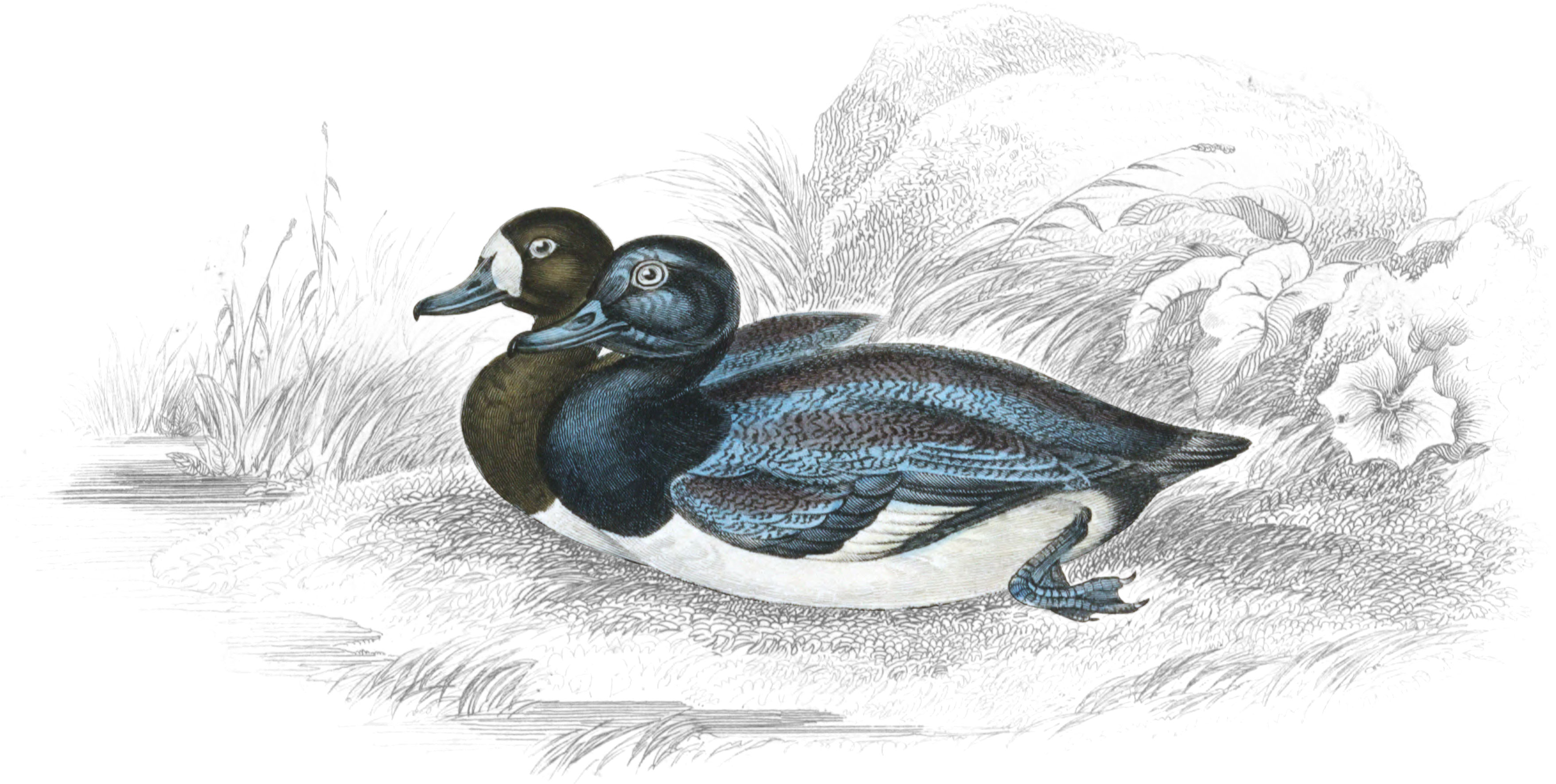
Plate V

The Tufted Pochard
Fuligula cristata.—Anas fuligula, Linn.—Anas cristata, Ray.—Canard morillon, Temm.—Tufted Duck, or Tufted Pochard of British authors,
Is an example of another dark-coloured pochard, easily distinguished by the rich glossy purple of the head and neck, and its loose and gracefully pendent crest. It is altogether a less bird than the last, and rather more gracefully made, while it at the same time keeps up the depressed and broad form, and is a most expert diver. The tufted duck is also only a winter visitant to this country, and seems pretty equally distributed during winter, but not nearly in equal numbers with the scaup. On the Solway we have observed it in a much less proportion, and only in small parties together. Its describers consider it more lacustrine than the scaup, and we have frequently shot specimens on the Annan, during winter, fifteen or twenty miles from the sea; the weather was always, however, severe when this bird appeared, seldom more than a pair were seen together, and they were far from being shy, trusting rather to falling down the river when danger appeared, and not attempting to fly unless surprised or approached very near. We saw several pairs upon Lochleven in the month of April last (1843), where we understood that they continued during a great part of winter. Here they were extremely shy.
In Southern and Central Europe it seems only to be a winter visitant also, and in the North is only recorded as breeding very sparingly, so that its real breeding haunts are scarcely yet known. By Colonel Sykes it was observed in the Deccan, and by Mr. Jerdon it is said to be “tolerably common throughout the peninsula in the cold weather.” Temminck gives Japan to it. It is not an American species. Mr. Yarrell states that the tufted ducks bred in the gardens of the Zoological Society in 1839, 40, and 41.
The head, adorned with a long and graceful crest, is rich blackish green with a strong purple gloss; the neck, upper back, and breast are deep black, in the centre of the latter having the feathers tipped with grey; the back, scapulars, and tertials, are also black, very minutely spotted with yellowish white, giving a subdued tint to those parts; the rump, tail, under tail-covers, and thighs, are black, quills of same colour greyish in the centre of the feather; the greater covers pure white, with a broad black tip; belly vent and flanks white; bill bluish grey, tip black. In an immature state, these birds have the base of the bill surrounded with white; the head dark umber-brown, with a slight tuft or crest; the dark parts of the breast deep wood-brown; belly and vent white; the dark upper parts umber-brown.
The Ferruginous Duck, or White-eyed Pochard
Fuligula ferruginea.—Anas ferruginea et nyroca, Gmel.—A. leucopthalmus, Canard à iris blanc, Temm.—Fuligula nyroca, Steph., Selby, &c.—Ferruginous Duck, Nyroca Pochard of British authors.
This pochard is, like the two preceding birds also a winter visitant, but it is much more rare than either, a few specimens only coming annually under the notice of those ornithologists who give up some portion of their time to the observation of what birds occur in the markets, and to sportsmen during the severity of the winter and spring. In the south, specimens are to be procured in the London markets and Mr. Yarrell states that these; “are generally received from the eastern counties, between the Thames and the Humber.” Towards the north of our island it becomes much more scarce, and we only recollect of having once met with the bird in a fresh state in the Edinburgh markets. Of its nidification or manners we know very little; according to Temminck, the nest is made near rivers and in marshes.
On the continent of Europe it appears also to be rare, in the southern parts a winter visitant only; while in the more northern districts it cannot be abundant, being omitted from works devoted to the natural history of portions of that range of country. Out of Europe, we have Africa mentioned as included in its range, but have not seen specimens from that country. It has been received from Alpine India and other parts of Asia. On the Indian peninsula, Mr. Jerdon states it to be rare, and seen generally in pairs. In North America it does not occur; and from its absence from thence, and its apparent scarcity in Northern Europe, we may probably look for its breeding stations and summer retreats in the colder and north-eastern portions of the Asiatic continent.
The whole head, neck, breast, and flanks are of a dull chestnut-red; the back, wings, and tail nearly uniform umber-brown, darker on the rump; the carpal edge of the wings and base of the great-covers being white, the latter forming a bar across the wing; the belly is yellowish white, shading towards the thighs into pale blackish brown; the under tail-covers are white, and show a triangular spot there; bill bluish black; eyes bluish white, whence one of its names; the irides of the two last described pochards are bright golden-yellow, and these, from the contrast of the colour with the dark plumage, gives to them a great deal of expression or animation.
The Red-headed Pochard, or Dun-bird
Fuligula ferina.—Anas ferina, Linn.—Fuligula ferina, Steph., Selly, &c.—Canard milouin, Temm.—Pochard, Red-headed Widgeon, or Dun-bird of British authors.
This chastely coloured bird is one of the more abundant of the British Fuligulinæ, but, like the others, is almost entirely a winter visitant. It extends from the south of England to the Orkneys and Shetland. In the south and fenny countries it is extremely abundant, great numbers being taken by decoys and other devices, and brought to the markets, where they are in request, from the estimation in which they are held for the table. As e proceed to the north of England and Scotland, they diminish in frequency; though they are still common. Their comparative scarcity maybe owing to the unsuitableness of the districts to their habits. They do not frequent the alpine lochs, and the places where they are chiefly found are river estuaries and the larger pieces of water in low lying districts. We have once or twice shot this species, during winter, in the river Annan. In the Edinburgh markets it is a frequent bird, though its qualities for the table are not generally known; the supply there is chiefly obtained from the coast. Mr. Yarrell states, on the authority of the Rev. Mr. Lubbock, that the pochard breeds occasionally at Scoulton Mere, Norfolk, which is confirmed by Messrs. Shepherd and Wheatear’s catalogue.
On the Continent of Europe the pochard seems also to be generally and abundantly distributed. It is not, however, traced commonly to the north; and a few breeding in Holland can only be looked upon as a boundary of their incubating range, as the few stragglers may also be which remain in some of the more favourable English localities.
Out of Europe it is said to be found in North or North-western Africa. In India it is found, and specimens we have seen are identical; on the peninsula Mr. Jerdon states it to be not very common, and to be seen generally in pairs. In North America it is common, being, however, in some districts, migratory, as at New Orleans, where it arrives in November, departing again in April; it is also found in great numbers in the States of Illinois, Indiana, Ohio, and Kentucky, but Mr. Audubon met with them neither on the coasts of Labrador nor in Texas. The habits of the pochard in America are described by him as chiefly maritime, seeking its food by diving; at the same time, when feeding in the shallow ponds of the interior,
they are seen dabbling the mud along the shores, much in the manner of the mallard; and on occasionally shooting them there, I have found their stomach crammed with young tadpoles and small water-lizards, as well as blades of the grasses growing around the bank. Nay, on several occasions, I have found pretty large acorns and beech-nuts in their throats.44
Dr. Richardson states that this species breeds
in all parts of the fur countries, from the fiftieth parallel to their most northern limits.45
When newly killed, the bill is black at the base and tip, having a rich bluish grey or lead-coloured space in the centre. The head and neck is rich chestnut-brown, shading into deep brownish black on the breast, occupying the whole of that part, and running round the back in a narrow dark colour; the colour of the neck at the back part running farther down, the dark shade being scarcely of so deep a tint; the rump, tail, and vent are also black, but the whole intermediate part of the body is of a delicate pale grey, minutely waved over with blackish grey; the wings are of a deeper tint, the quills dark clove-brown, and the lower tertiary feathers of a uniform colour, but edged with a narrow line of black as in the goosanders; on the belly the dark waving becomes much obliterated, and on the vent the ground colour shades to blackish grey. We have seen a variety with all the colours of a pale tint, or what might have been called a cream colour, yet having the colours marked in their particular places.
The Red-crested Pochard
Fuligula? rufina.—Anas rufina, Pall.—Fuligula rufina, Stepk., Selby, &c.—Mergoides rufina, Eyton.—Red-crested Duck or Pochard of British writers.
We place the generic name here with a mark of doubt, the species being of a somewhat aberrant form, though perhaps only typifying the goosander in its own family, both by the crest and form of the head and bill, and by the aspect of the female, as well also as partially by the form of the trachea; the habits, however, are not known, and it is a rare bird, not only in this country, but elsewhere, so far as has yet been discovered.
This handsome species was first noticed as a British bird by Mr. Yarrell, who gave a notice in the Zoological Journal of a male shot near Boston while feeding on fresh water in company with widgeons, and states that others were procured during the same winter in the London markets. While since that, a specimen has now and then been obtained in different parts of the south of England; as stated above, it is considered a rare species everywhere, being met with only now and then, as in Britain, in the different parts of the European continent where ornithology has been attended to. Out of Europe, Africa and India seem the only countries where we have an authentic notice of its presence. Mr. Yarrell describes, the male from his British specimens, as having the
beak vermilion-red, the nail white, the irides reddish brown, the whole of the head and upper part of the neck, all round rich reddish chestnut; the feathers on the top of the head considerably elongated, forming a conspicuous crest; the back of the neck below, and the upper-tail coverts, dark brown; the back and a portion of the scapularies, wing coverts, and tertials, yellowish brown; a white patch on the carpal joint of the wing, and another over the joint; greater coverts, ash brown; wing primaries and tail-feathers greyish brown; the secondaries with the outer webs white, forming a speculum; front of the neck, breast, belly, and under tail-coverts, rich dark brown; the sides and flanks white; legs and toes vermilion red; interdigital membrane almost white. The whole length twenty-two inches. The female is without a crest; the top of the head dark brown; cheeks, throat, and sides of the neck, greyish white; upper surface of the body pale rufous brown; front of the shoulder and speculum greyish white; breast reddish brown; the other parts of the under surface greyish brown; beak and legs reddish brown.
The Garrots, or genus Clangula, is somewhat allied to the pochards in being rather fluviatile and lacustrine in habit, but they vary considerably in the structure of the bill, which has been considered as indicating an alliance with the Goosanders.
Clangula, Fleming.—Generic characters.—Bill short, elevated at the base, outline narrowing to the tip; laminas dentate, concealed; nostrils aval, lateral; wings rather short, acute; tarsi short, feet ample, hallux lobed.
Types. C. vulgaris, barrovii, alleola, &c. Europe, America, Japan.
Note.—Frequent fresh waters, gregarious to the amount of their broods. Plumage of the head ample, colours varied.
Golden-eye Garrot
Clangula vulgaris, Flem.—Anas clangula, Linn.—Canard garrot, Temm.—The Golden-eye of British authors, Morillon the young.
This very handsome plumaged duck we consider as a good example of the Garrots. It is generally common, although in the full dress of the male it is not nearly so abundant as in that of the first year, and the females with their broods appear as if they migrated alone, the adult males not having joined them previous to leaving their summer retreats. In Great Britain and Ireland, the Golden-eye is a winter visitant, appearing rather early upon the rivers, and being very generally distributed over the country. The old males are rather shy, but the small parties, consisting of females and immature birds, allow a pretty near approach, and will rather avoid the danger by dropping down with the stream than take wing. In the rivers they feed on the shallow parts at the foot of pools, seeking their food by diving, and performing that act simultaneously, so much so that we have frequently approached them by taking the advantage of the party being under water, running forward, and again getting into concealment about the time when they should appear, until the last run carried us to the water’s edge. They would on rising then take flight, never attempting to escape by again diving, as a grebe or driver would do. The flight is rapid, performed along the line of the river unless when passing to some distance, when they rise to a considerable height.
Over Europe, the Golden seems to be pretty equally distributed in winter in suitable localities, but all retire northward, and breed in Scandinavia, Norway, Sweden and Lapland. In these countries in summer it is frequent, breeding in hollow trees naturally, but also taking possession of boxes or artificial holes made by the country-people for the sake of the eggs, and showing little wariness in availing itself of the shelter thus provided. Out of Europe, we have the authority of Temminck for Japan specimens being identical, while in the northern parts of the New World, the bird is common, and is well known to American ornithologists.
The adult male has the head and upper part of the neck rich glossy green, the feathers of a loose texture and capable of being much raised at will, on the chin nearly black; but a conspicuous mark is an oval spot behind the base of the maxilla of pure white, which can be seen in flight even at a great distance. The lower parts of the neck, breast, belly and vent are pure white, the long flank feathers having the outer part of their inner webs black; the back and mantle, part of the scapulars, and long tertials, black; the outer scapulars white, having their exterior webs margined with black; the intermediate wing covers, and last secondaries pure white; the quills and tail blackish brown; legs and feet orange. In the female the head and neck are umber-brown, the breast grey, and remaining under parts pure white; the upper parts are brownish black, the feathers edged with grey, and the conspicuous markings of white on the wings of the male are here much intermixed with brown or greyish brown. The young males are of a larger size, but in other respects nearly resemble the colouring of the females; the crown of the head, as they advance, gets darker, the white patch can be traced, and the proportion of white on the wings and scapulars is greater, the tint more pure.
We may remark, that Audubon considers the Clangula Barrovii of Rich, and Swain, only a variety of this bird, but a close comparison points out many differences between the Golden-eye and the only known European specimen of the other.
The Buffel-headed Garrot
Glangula albeola.—Anas albeola. Linn.
So far as we can ascertain, three specimens of this duck have been killed within the boundaries of Great Britain. One mentioned by Mr. Donovan, another shot near Yarmouth in Norfolk, and a third procured by Mr. Mummery of Margate, somewhere around the Orkney Islands. Its true country is North America, where it is found abundantly in the lakes and rivers and on the coasts, and it is there widely distributed, migrating northward to breed. Its appearance in Europe or Great Britain can only be looked upon as accidental. The colouring in its distribution is similar to that of the Golden-eye, black glossy green and white finely contrasted; the feathers of the head are elongated, and form a crest to be raised at will, this, with the upper part of the neck, is bluish black glossed with rich purple and greenish reflections; from the eye backwards, over the ends of the auriculars, there is an oval patch of pure white representing the oval spots on the cheek of the golden-eye and Barrow’s garrot; the neck and under parts are pure white; back, rump, and tertials are black; but the scapulars, wing covers, and secondaries are white, and assist in strengthening the pied appearance of its dress; the length is only about fifteen inches.
The Harlequin Garrot
Clangula histrionica
Anas histrionica, Linn.—Canard histrion, Temm.—Harlequin Duck, or Garrot of British authors.
This species has been placed here, but in the form of the bill it differs slightly from the true Garrots and approaches to the next genus, Harelda. The colours in this bird are also chiefly black and white contrasted, but these are harmonized or warmed, as it were, by a mixture of chestnut-red and grey, giving the whole a chaste appearance, though very varied. At the base of the bill, and reaching nearly to the eye, is a large patch of pure white, running off at its upper angle in a narrow line along the sides of the crown; from the forehead along the centre of the crown and occiput is deep black, bordered on each side by the white line already mentioned, and succeeding that by a continuation of pale reddish-brown, almost meeting at the termination of the central black; nape and cheeks rich purplish-grey, shading into bluish-black on the fore and lower part of the neck; behind the auriculars there is an irregular patch, and farther down a lengthened streak of white, having the space between of a deeper black; the lower part of the neck is terminated by a collar of pure white almost meeting behind, broadest on the sides, and there succeeded by a narrow border of black; the breast and back are purplish grey, intercepted opposite the bend of the wing with a crescented band of white bordered on each side with black; breast and belly blackish-grey, sides and flanks chestnut-brown, the long flank-feathers being seen above the wings; vent and under tail-covers black, on the sides of the former there are two or three larger feathers of a stiffer texture, having white tips, which form a small but conspicuous spot there. The middle and lower back with the wings above the greater covers are brownish-black tinted with purplish-grey; the lower back and tail black, the latter is more accuminated than in the true Garrots. There is an interrupted spot of white on the centre of the upper parts of the wings, from some of the lesser covers being white with a narrow greyish border around the feathers; the greater covers are black tipped with white; the scapulars are white for two-thirds of their inner breadth, edged with grey, a darker band intervening. The long tertials are white on their outer webs, bordered with blackish-brown; the secondaries black, outer webs glossy indigo-blue forming the speculum, quills brownish black.
The first specimens of the Harlequin Duck were obtained in Scotland by Lord Seaforth, and some others were afterwards procured in the Orkneys; one or two have been killed in England, Mr. Yarrell mentions having purchased two in the London market, and the latest is recorded by the same gentleman to have been killed by the game-keeper of Sir Philip Egerton, in Cheshire, during the winter of 1840. Straggling specimens also occur in Central Europe, and to the north, where perhaps a few may breed, but in the Old World it seems rather to retreat towards the north west. America seems to be the true country of the Harlequin Garrot, and it is well known to her ornithologists; Audubon found them breeding in the Bay of Fundy, under the bushes a few yards from the water, but in Newfoundland and Labrador they frequent for the same purpose, the inland lakes, incubating near their edges.

Plate VI
Following this bird we shall describe the genus Harelda, which we stated had, in outward form, some resemblance to it, but the Harelds vary in addition to the points previously stated, in the structure of the trachea and in the great development of the tertial feathers and tail.
Harelda, Ray.—Generic characters.—Bill short, elevated at the base, contracting suddenly at the tip, nail large, slightly notched, laminas strong, apparent; nostrils basal, linear; wings of mean length, accuminate, first and second quill nearly equal, scapulars very long;. tarsi short, feet of mean size, hallux lobed; tail elongated.
Type. H. glacialis, &c. Europe, America.
Note.—Habits maritime; plumage of the summer and winter dissimilar.
The Long-Tailed, or Northern Hareld
Harelda glacialis
Anas glacialis and hyemalis, Linn.—Harelda glacialis, Leach.—Long-tailed Duck, or Northern Hareld of British authors.
In all the ducks we have examined, the complete plumage has been perfected by winter, acquiring as the season of incubation advanced a fuller development and additional brilliancy; in the species now before us, however, we have almost an entire change, or in the breeding time a new dress is put on, much darker, and showing considerable analogy in its tints and markings to the changes incident to many of the grallatores. The figure on the plate will exhibit the winter dress and that of the young bird; the breeding plumage will be immediately described. The long-tailed duck, like many of these birds we have now described, is also only a winter visitant to our shores, none having yet been known to remain and breed, even among the more northern islands. Around the southern half of England it is considered as a rare bird, on the coasts a few instances are occasionally recorded of specimens being obtained; as we approach the north and the Scottish shores, it becomes more frequent, and at the mouth of the Firth of Forth a limited number may generally be seen. Northward still, and around the more distant isles, we believe it is common, and we have several times received a considerable package of them at a time, as if they were at least the birds most easily procured. On the Irish coasts a few specimens are also sometimes obtained. On the coasts of Europe it is met with as a straggling species, diminishing southward; and though included among the birds of Italy, its introduction there rests, we believe, on one or two immature birds only having been procured; but according to the continental ornithologists, it sometimes visits the large lake, both of Germany and Switzerland. In the Old World its breeding stations are Norway, Denmark, Sweden, Iceland, &c., on the banks of the inland lakes, as we learn from the observations of Hewitson, Atkinson, Dann, and Proctor. In the New World it is recorded by all the American ornithologists, and also by our arctic travellers. Audubon found it breeding in Labrador by the fresh-water lakes. He considers that it ranges as far south as Texas, and he also found it at the mouth of the Columbia river, but thinks that it is not met with in the “fresh-water courses,” and that authors who state having seen it there, have mistaken the pintail for it, which is abundant in such localities.
There is an extraordinary variation in the summer and winter dress of this bird. In a specimen procured in summer by one of the whaling vessels, the forehead and cheeks are greyish wood-brown, centre of the crown black; the occiput and chin white; the neck, breast, and upper parts of the belly, deep pitch black; the lower belly, sides, and under tail-covers, pure white; the upper part of the back and long scapulars are black, with broad margins of reddish brown; the mantle, lower back, rump, and upper tail-covers, wings, and tail, deep brownish black; the secondaries have the outer webs tinted with reddish brown, forming an indistinct speculum. In this specimen a few white feathers appear intermixed on the front of the neck and upper part of the back.
The plumage of the winter, in a very fine and perfect specimen shot in the Frith of Forth, the forehead and cheeks are pale greyish brown; the occiput, back of the neck, throat, upper part of the breast and back, belly, vent, under tail-covers, and scapulary feathers, pure white. On each side of the neck there is a large oval patch of pitch brown, terminating inferiorly in yellowish or reddish brown; the mantle, lower back, rump, tail, and wings, are as in the other dress, brownish black, in both the tail is graduated; the centre feathers narrow and much elongated; the bill has the nail and base black; behind the nail a band, coloured, when newly killed, of a deep lake; feet and legs yellowish grey. In winter the flocks are always accompanied by numbers of birds in various states of immature plumage, having the neck and breast partially white, and but little trace of the broad distinct pectoral band; the back and wings not nearly so deep in the tint, and the scapularies and tail not elongated. In the female, which is less in size, the crown, nape, spot upon the neck and breast are yellowish brown, darker on the head; lower breast and under parts pure white; the upper parts blackish. brown; the scapulars broadly edged with yellowish brown; tail not elongated. This is the state of a female killed in the Firth of Forth during winter.

Plate IX
The next generic form we shall notice is that of the Scoters, a race of ducks maritime in their habits, and except during the season of incubation, very seldom leaving the waters; they are most expert divers, feed in deep water, and the gizzards have generally been found filled with the remains of strong bivalve shells. The form of the body is large and heavy, and the colours of the plumage are black, in some slightly marked on the head and wings with white.
Œdemia,Fleming.—Generic characters.—Bill depressed, and much dilated for two-thirds of its length, base elevated and knobbed, lamellæ dentated, strong but not apparent; nostrils anterior, oval, large; wings pointed, quills strong, the first emarginated; tail wedge-shaped, stiff; feet large, hallux broadly webbed.
Types. O. fusca, perspicillata, &c. Europe, Asia, America.
Note.—Habits entirely maritime, except during incubation. Males separate from females when incubation commences. Form heavy, colour black or dark.
The Surf Scoter
Œdemia perspicillata
Anas perspicillata, Linn.—Œdemia perspicillata, Flem. Selby, &c.—The Surf Duck, or Scoter of British authors.
This curiously marked duck will give some idea of the form and appearance of the genus now under consideration. The bill, which is not so flat and becomes more narrowed towards the tip in the more typical species, begins to assume the tumid form and raised basal protuberance which will be seen in the next group of birds or eiders. The Surf Scoter is an extremely rare bird in Britain, and even in Europe; the coasts of North America being its real habitation. It has been stated by most of our modern British ornithologists, that specimens of this bird occur now and then in the vicinity of the Orkney and Shetland Islands, but we are not aware of any being very lately procured there. In the birds of Europe, a specimen is stated to have been killed in the Firth of Forth, and Mr. Yarrell records another instance of a recent specimen coming into the possession of Mr. Bartlett of London; all these in this country have occurred in winter. It is of nearly equal rarity on the Continent, and few notices of it occur either in any of the recent works devoted to Natural History, or in those books of tours which lately, under the apology of Sport, have recorded some interesting anecdotes on the habits of little known species.
On the coasts of North America this Scoter is abundant, Wilson states it is common in winter, along the whole coast, from the river St. Lawrence to Florida. Mr. Audubon, in his excursion to the coast of Labrador, found it there, passing on northward to breed, in numbers that exceeded all his previous conceptions; a very few pairs only remained to breed there, and he only succeeded in finding a single nest in an extensive fresh-water marsh. It was “snugly placed amid the tall leaves of a bunch of grass, and raised full four inches above the ground.” It was composed of withered and rotten weeds, and was lined with the down of the bird. The eggs, considered small for the size of the bird were of a uniform pale yellowish or cream colour.

Plate VIII

The Velvet Scoter
Œdemia fusca.—Anas fusca, Linn.—Œdemia fusca, Flem., Selby, &c.—Great Black Duck, Willugh.—Velvet Duck.—Velvet, or Double Scoter of British authors.
This fine species is also a sea duck in the most extensive sense, and is a winter visitant on our coasts. Mr. Yarrell states that it is not a common species on the southern coasts, and enumerates the counties off which it has been killed, which are few in number: 1832 and 1837, are mentioned as winters in which it had been obtained in the London markets, showing that its occurrence to the poultrymen there must be precarious. It increases northward; we have received specimens from the vicinity of Orkney, where we have been informed that it is abundant, while in the Firth of Forth it is by no means uncommon. In the latter it occurs in small parties, and some may almost always, during winter, be seen either riding leisurely at their ease, or diving actively. In a boat we have frequently come up with them, and did not perceive that extreme shyness which is attributed to them by many describers. With a slight breeze and sailing as if to pass the flock, keeping at the same time as free from motion as possible, we have not found difficulty in getting within shot, the birds not taking wing until approached within forty yards, and then giving abundance of time to the sportsman, from rising heavily until clear of the water. From being in little esteem for the table, they are not frequently seen in the Edinburgh markets, at the same time many specimens maybe obtained by attention during winter. The food is principally bivalve molusca, frequently those of a very hard structure; the strong covering of which their very powerful gizzard enables them easily to bruise and triturate.
Out of Britain, the continental ornithologists inform us that it is found as far south as Italy. Its places of nidification are however not narrated, but it was observed by Mr. Hewitson, and some other northern travellers, in Norway, Sweden, and Scandinavia. In Lapland, writes Mr. Dann, in his notes to Mr. Yarrell, it is common everywhere, breeding on hummocks, among the willow swamps, or long grass near the water, by the edges of large lakes in mountainous districts. In North America the Velvet Scoter is also migratory, arriving on the shores of the middle states about the beginning of September, and stretching sometimes as far south as Georgia, while in April it commences again to retire northward to breed. The extreme limits in this direction have not been ascertained, but it was met with abundantly on the coasts of Labrador by Mr. Audubon, many at the same time continuing their course northward. It is described by him as breeding by the sides of small lakes, two or three miles distant from the sea; the nests being usually placed under the low boughs of the bushes, of the twigs of which, with mosses and various plants matted together, they are formed.46
Plumage entirely of a deep velvet-black, except a pure white spot on the lower eyelid which passes behind the eye in the form of an acute angle, and the tips of the greater covers, which are of the same colour, and show a bright and strongly contrasting bar across each wing; on the head and neck the colouring is without lustre and soft the base and margin of the bill are black, the other parts bright orpiment-orange; inside of the tarsus carmine red, toes orange red, the membranes black. In the female the plumage is brownish black, paler on the under surface, on the auriculars a patch of greyish white; the bill and legs have not the vivid colouring of the male. According to Audubon, the young much resemble the female during the first year, the white spots on the head being apparent; the feet beginning to show their brilliant colour.
The Common or Black Scoter
Œdemia nigra.—Anas nigra, Linn. Œdemia nigra, Flem., Selby, &c.—Common or Black Scoter of British authors.
This species we consider in Scotland at least as more uncommon than the last, and in our boating excursions after wild-fowl, many years since, in the Firth of Forth, we always found it much more difficult to approach, and to attempt to escape more frequently by diving. It is there a winter visitant, and specimens may be occasionally obtained in the Edinburgh markets. To the south it is also principally a winter guest, but Mr. Yarrell states that birds are occasionally seen during the summer months near the shores, and suspects that they are birds which are either barren or have not attained maturity, as in the case of the last bird, thousands of sterile individuals of which, according to Audubon, pass the summer in the Bay of Fundy. On several parts of the continental shores it appears more common than on our own southern coasts, and Mr. Yarrell has described a kind of Christmas battu which takes place annually, in which the flocks are surrounded by boats and numbers killed. Something similar is said also to take place in Corsica.

Black Scoter Feather
It is a smaller species than the last, but somewhat resembling it in form, the tail being rather more wedge-shaped and lengthened. There is not a spot of white on the whole bird, the feathers on the head and neck are slightly elongated, their form marked, and have a rich gloss of indigo-blue. The remaining plumage is a deep dull black; the first quill has a considerable emargination; the bill black, tarsi and feet blackish red. Female blackish brown, paler beneath.
The last form which we have to notice among the British ducks is that of the Eiders, Somateria Leach, composed of large heavy birds, having the bill enlarged or swollen at the base. In their habits they are completely maritime. One bird which we place provisionally among them, we do so with some doubt, not having been able to examine it minutely; by ornithologists also it has been shifted from genus to genus, and our different generic terms have been by different authors applied to it. Eniconetta, Gray; polysticta, Eyton; Macropus, Nuttal; and Stelleria, Bonaparte.
Somateria, Leach.—Generic characters.—Bill narrow, swollen at the base and running high into the plumage of the head, being divided on the forehead by an acute angle of feathers, nail large and strong, hooked, lamellæ dentate, concealed; nostrils lateral, oval; wings of mean length, accummated, first quill slightly longest, tertials long, curved; legs placed behind, short, feet ample, hallux broadly lobed.
Types.—S. mollissima, spectalilis, &c.
Note.—Habits maritime; long in attaining adult plumage; females separate from males after incubation. Europe, America.
The Common Eider
Somateria mollissima
Anas mollissima, Linn.—Somateria mollissima, Leach., Flem., &c. The Eider, or St. Cuthbert’s Duck of British authors.
This gaily-plumaged, but rather clumsily-formed duck, is a good example of the genus. It is completely maritime in habits, frequenting the sea-coasts or islands, and in its distribution is a northern bird. According to Mr. Yarrell, it is occasionally found on the southern coasts of England, and is sometimes brought to the London markets during winter, but it does not breed much farther south than the Feni Islands in the mouth of the Firth of Forth. From thence until within the range of the Bass Rock, it breeds in comparative abundance, many nests being always to be found on the smaller islands, and also sometimes on the more rugged parts of the mainland shores; we once shot a female from the nest close to the old castle of Tantallon. Farther northward still, and among the distant islands, it is common. On the continental coasts we have little intelligence, but on all the shores of Northern Europe, where we have seen that so many of our summer migrating species breed, it is to be found in profusion, and is even far from being shy. It is recorded by Leemius
that it breeds near to the inhabited houses; it even suffers itself to be lifted from the eggs and set down again, and sometimes a countryman will carry the young in his hat from the nest to the sea, the duck running by his side, and mourning gently from anxiety.47
The Eider is also distributed around the shores of North America, and has been noticed by most of the ornithologists of that country. Audubon states that now it does not range farther south than the vicinity of New York, though formerly it must have had a rather more extensive range.
The plumage of the head is short and soft; the forehead and sides of the head, running in a line with the lower part of the eyes, and terminating in a narrow point opposite the nostrils, rich bluish black, having in some lights a deep bluish tint; this is divided on the crown from the line of the eyes backwards by a narrow line of greenish white; the occiput and sides of the neck, with a large patch rounded inferiorly pistachio green, the feathers being rather long and stiff, capable of being raised at will; the checks, neck, back and sides of the rump, pure white; breast, rich cream-yellow; the wings above the greater covers, scapulars, and tertials white, tinted with straw-yellow; the latter loose in their webs, and curved over the wing; the rump and upper tail-covers, belly, vent, and under tail-covers, black; the greater wing, covers short and black; secondaries blackish brown; quills and tail greyish brown; bill and legs greenish yellow. The female has the general colouring of the plumage yellowish brown, on the head and neck streaked with blackish brown; on the back and upper parts, the greater portion of the feathers is blackish brown, tipped and cut into on the sides with yellowish brown; on the under parts the feathers are transversed with broad bars of the dark colour, which become indistinct in the centre of the belly and vent; on the wing-covers the pale markings are more rufous in colour; the greater covers are tipped with white.
Among the small parties on our shores, many birds of a piebald appearance are to be seen, which are those that have not attained their complete dress. Three and four years is the time allotted by most of our British writers for this purpose, the fact being stated, without entering into the causes for a departure from the more general rules.
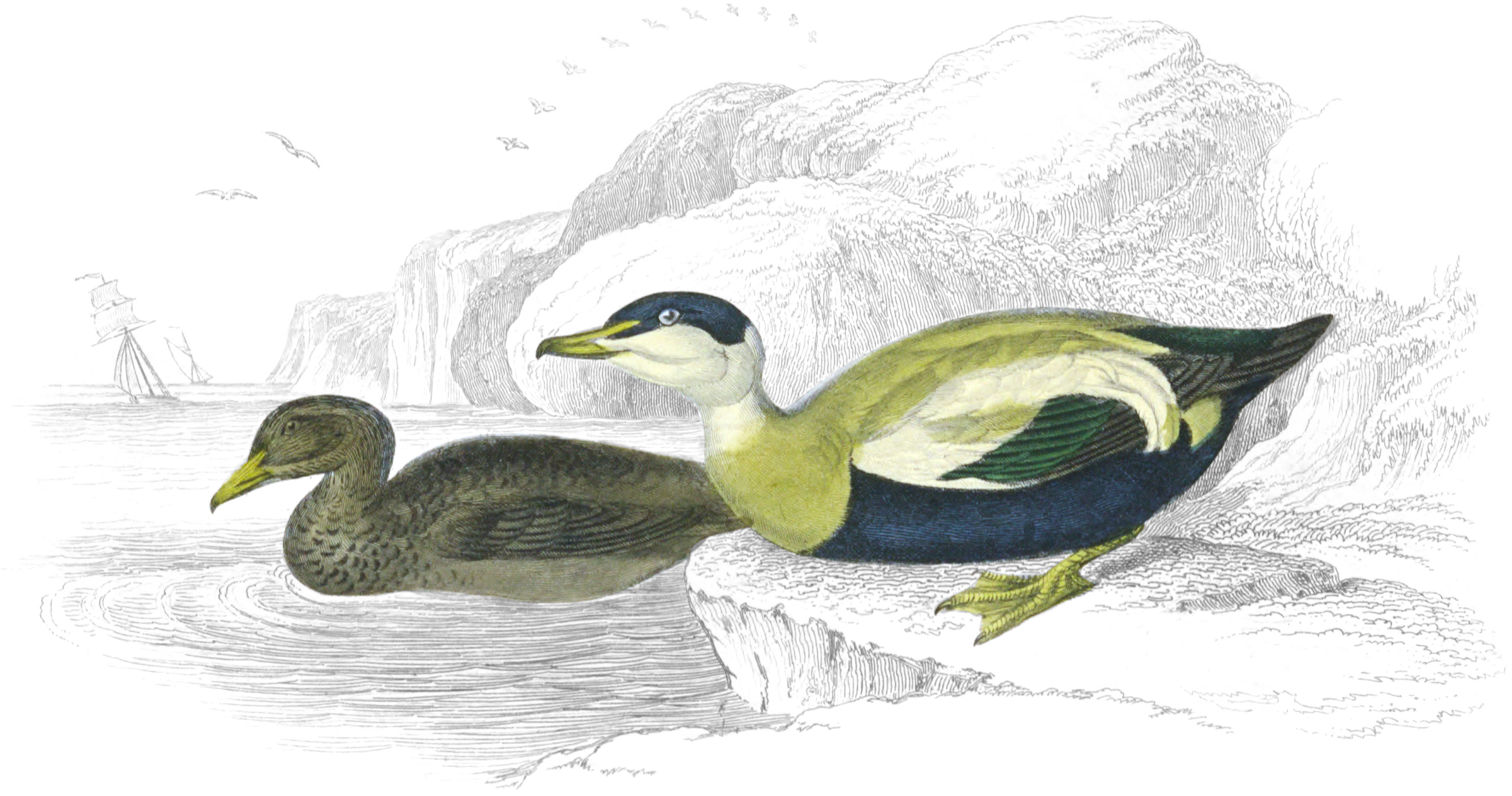
Plate VII
The King Eider
Somateria spectabilis.—Anas spectabilis, Linn.—S. spectabilis, Flem., Selby, Jen., &c.—The King Duck, or King Eider of British authors.
The claim which this species has to be considered a British species is very scanty. Colonel Montagu states that Mr. Bullock informed him he had found it breeding in Orkney, but we have not since traced its occurrence on any of the Scottish coasts. A specimen is mentioned by Mr. Jenyns as killed on the Suffolk coast, and one from the Irish shores is in the collection of Mr. Ball. On the Continent its distribution is equally uncertain, but it increases in abundance northward, though apparently it never becomes so frequent there as the last. It is near to the Arctic circle that the stronghold of this species prevails, breeding on the sea-shore, but sometimes in the neighbourhood of fresh-water ponds. Captain Beechy (exp. of the Dorothea and Trent, 1818) mentions the great abundance of the King Eider on some rocky islands on the coast off Spitzbergen. The sailors could scarcely walk without treading on their nests, and sacks might have been filled with the eider-down. The females would remain on the nests until knocked over with sticks.48 We are indebted for most of the specimens in the collections of this country to the Arctic voyages, a few being occasionally brought by the Greenland and other whaling vessels, but good skins are by no means easily procured.
This Eider has the base of the bill much more elevated, or rather it laterally rises upwards in the form of two large oval protuberances, the plumage of the forehead separating them; these with the bill are described as “vermilion red,” when the bird is newly killed; the plumage between the tubercules with a band surrounding them, and the base of the maxilla with the form of a V on the throat, the acute end entering the fork of the mandible, and the eyelid, velvet-black; the cheeks and side of the throat exterior to the V pistachio-green, the feathers having a structure similar to those of the Eider; the crown, hind-head, and nape, bluish green; neck, mantle, and lesser wing covers, white; breast rich cream-yellow; the lower back, rump, tail, scapulars, and quills, brownish black; greater covers and secondaries black; tertials brownish black, paler along the shafts and very much curved; belly, vent, and under tail-covers, black; on each side of the rump a large and conspicuous triangular patch of yellowish white. In the female, the general appearance somewhat resembles that of the common Eider, the light parts are more rufous in tint, and on the back the dark centres of the feathers are more elongated, while below, the bars also take a more lengthened form, and are narrower; on the head and neck the yellowish-brown colour prevails; the wings are darker, and the greater covers are narrowly tipped with white, while the tertials continue their curved form, and are nearly as much so as in the male Eider.
Steller’s Western Duck
Somateria Stellerii.—Fuligula dispar, Selby.—Polystlcta, Eyt.—Enkonnetta, G. R. Gray.—Stelleria, Bonap.—Macropus, Nutt.—Western Duck, or Pochard of British authors.
This rare and interesting species has been placed in various genera, new appellations have been proposed by different ornithologists for its reception, and it is now placed at the conclusion of the Eiders provisionally, until its structure is better ascertained; the general colouring and form of the tertials show a considerable alliance. Only one specimen of this bird has been killed on the British coasts, in the vicinity of Yarmouth in Norfolk, and is now in the Norwich museum. In Europe it is nearly equally rare; a specimen killed in Denmark, nearly at the same time that the Norfolk bird was procured, was at the period Mr. Selby wrote his History of British Birds considered the only one on record; since, it has been occasionally killed in Northern Europe, and Temminck, in his Supplement, states that it occasionally wanders into Germany. It also ranges to North-eastern Asia, and the Prince of Canino gives to it the northern coast of America; but even there it must be extremely rare, for Audubon writes, “so very scarce indeed is it, that all my exertions to obtain a specimen have failed,” and he figures the bird from the Norwich specimen alluded to; it is said to breed like the Eiders.
Succeeding the extensive series of birds we have now had under review, has been placed another group, duck-like in form, but at the same time having, while in the water, the appearance and almost the aquatic activity of the divers; the Goosanders, or genus Mergus, Linn, is much more aquatic in habits than even the Fuligulinæ, and are in fact seldom seen except swimming or during flight, the short period devoted to incubation being almost the only necessary exception; when swimming, they sink deep into the water, but move rapidly and gracefully, and dive with great facility; the food is chiefly fish, caught by diving, and held securely by the serrated structure or modification of the lamellae of the bill, which member becomes also more elongated and narrower than among the ducks; the feet are placed far behind or beyond the centre of gravity. The males are unlike the females in plumage, having the colours very marked and contrasted; these are in their greatest beauty during the commencement of incubation, but as this advances, a change takes place, and the dress becomes unobtrusive and more like that of the other sex. The number of species is very limited, and with one exception they are natives of northern or temperate countries.
Gen. Mergus, Linnæus.—Generic characters.—Bill long, narrow, tapering to the point, edges with strong serratures pointing backwards, nail strong, hooked; nostrils basal, lateral, oblong, pervious; wings of mean length, accuminated, first and second quills nearly equal; legs placed behind, tarsi short, feet ample, hallux lobed.
Types.—M. merganser, albellus, &c. Europe, North and South America, Asia, Japan.
Note.—Maritime, except when breeding; form rather elongated, but heavy; plumage pied; wings slightly tuberculated.
In the species we shall first describe, though not considered generically typical, we see a resemblance to some forms of the ducks, particularly that of the Garrots.
Smew, or White Nun
Mergus albellus.—Mergus albellus of authors.—Harle piettè, Temm.—Smew, Nun, or White-headed Merganser of British authors.
The Smew, with the exception of the species more properly American, is perhaps our rarest British Goosander. It is occasionally in winter brought to the English markets, and Mr. Yarrell says “it is well known on the east, south, and west coasts.” Northward it becomes less frequent, and in Scotland it can only stand as an occasional straggler; a single specimen of the male has only occurred to ourselves recently killed, though we know of a few other instances that can be depended on. In Ireland it has sometimes been killed. In Central Europe it does not seem unfrequent; during winter we have seen the females and young carried about the Boulevards of Paris, among other water-fowl. In Northern Europe it is also found, and most probably will extend to North-eastern Asia. M. Temminck gives Japan to it; the Prince of Canino, the northern and central coasts of North America. Audubon, again, considers it of extreme rarity, scarcely deserving of the rank of an American species; he only once saw a specimen of a female, which he shot, and was obliged to have recourse to a British specimen for his drawing of the male. The modification is unknown.
In this species, of much less size, we have again the decided contrasts of black and white. The plumage of the head is loose and silky, and rises on the crown and hind head to an ample but gracefully drooping crest; the head, neck, breast, belly, vent and under tail-covers are pure white, on the flanks and under the wings irregularly crossed with black, but the purity is broken on the head by a round spot under the eye and bounded by the bill, of deep black glossed with green, while the posterior part of the occipital crest has a streak of the same colour marking its base; centre of the back, the rump, and wings are black; the feathers of the back, where joining the pure colour of the breast, being tipped with black, run upon it in two crescented narrow bands, the one upon and more than half across the breast, the other about an inch farther back; scapulary feathers white, bordered on their outer web with a narrow edge of black, large tertials grey, secondaries and greater covers deep black tipped with white, upper tail-covers and tail grey. The female in distribution of colour resembles the other birds of the genus; the head, nape, and back of the neck are chestnut red, darker under and between the eye and the bill where the male has the black spot; on the crown and occiput the feathers are elongated, and on the last are separated and somewhat hackled; the chin, throat, and upper part of the back, white; the lower part of the neck, sides, and upper parts of the breast and flanks, grey; lower breast, belly, and vent, pure white; the back, scapulars, tertials, quills, and tail, blackish grey, on the back with a tint of brown; middle part of the lesser wing-covers white, secondaries and greater wing-covers deep black; the last secondary grey, having the outer web white, bordered with the tint of black. The young males of the year nearly equal the adults in size, but in plumage resemble the female, that of the head is a clearer reddish brown, and without so much elongation behind; the secondaries and greater covers are a deeper black, and the white tips are conspicuous.
The Goosander
Mergus merganser.—Mergus merganser, male; M. castor, female, of authors.—Grand harle, Temm. Goosander, male.—Dun Diver, female, of British authors.
This beautiful and typical species is one of those which, like the hen-harrier and ringtail, the golden and ring-tailed eagles, occasioned some controversy among the more early modern British ornithologists. The plumage of the sexes for the first year is nearly similar, but the males and females were long by many considered distinct species, and were known under the names of Goosander and Dun Diver, Mergus merganser and castor. The fact of their identity has, however, been long since proved, and the difference in the colouring of the sexes agrees with that incident to the other known species. On the main land of Great Britain this bird is principally almost entirely a winter visitant; we are aware of no instance of its incubation being discovered, and in our own rambles we have only once observed it during summer, but that in a locality where some northern sea isle may have been its haunt. In winter it frequents the inland lakes when not frozen, and ascends rivers, apparently becoming less numerous towards the south. In rivers, at the season mentioned, we have principally observed it in small parties of from four to eight or nine, a single full-dressed male frequently accompanying them, or at least the birds in the female plumage being always much more numerous. The whole party frequently will dive simultaneously, and we have, as in the case of the Golden-eye, occasionally got within shot by taking advantage of their disappearance for a run, getting concealed by the time of their expected re-appearance. In these localities we have almost invariably found the food to be fish, small trout, or pars. According to Mr. Macgillivray, the Goosander breeds in the vicinity of the lochs on the outer Hebrides. Its summer retreat seems to be principally in Northern Europe, whence it is in winter that we have our supplies, as well as the birds which roam over Central Europe; it may range also to North-eastern Asia, and Temminck records it from Japan. The Prince of Canino gives to it “America generally,” and Audubon states that they breed in the interior of the states of New York, &c., and “suspects” that they advance pretty far into the interior of Mexico.
This is the largest of the genus; the colouring consists of few tints, principally light, with a marked contrast of dark, softened and relieved by grey and by the rich hues of the bill and legs. The bill is vermilion red; the irides of a purplish red, the feet and legs very rich reddish orange; the lower part of the neck and breast, belly and vent, lesser wing-covers, secondaries, and scapulars, buff orange, varying in tints from a pale shade to one of extreme richness, fading after death, and often very much lost after exposure to light; the long tertials are of the same buff-orange, and have on their outer webs a narrow black edge, appearing conspicuously from its distinct and generally regular lines; the mantle, with the last long scapular, rich glossy black, often varied with reflected lights of green; the middle and lower back, upper tail-covers, and tail grey, on the sides, posterior to the line of the legs, shading into a pale greyish white, freckled with a darker tint quills dull black; the head and upper part of the neck is rich glossy blackish-green, often with purple rejections, having the plumes of the crown and nape long and silky, drooping behind. The female, known under the name of Dun-diver, is very different; the sides of the breast, flanks, and upper parts, from the insertion of the neck downwards, of the grey colour which marks the lower back of the male; the quills are greyish black and the tertials are of a deeper shade, and have black shafts. The only relief here is produced from the greater covers being broadly tipped with white and concealing the dark base of the secondaries, the half of which is also white; these united exhibit a triangular patch or speculum of considerable size; the head and neck are reddish brown, nearly pale chestnut brown, and the feathers on the hind head and neck are much elongated, loose, and rather hackled in structure, showing a curious sexual difference in the development of this ornament, and which was long brought forward as only incidental to the male. The chin and throat are white, and the fore part of the breast, belly, and vent are generally yellowish white, but sometimes present a depth of tint equalling those parts of the male. The bill, legs, and feet are of a duller vermilion and orange.
The Red-Breasted Merganser
Mergus serrator
Mergus serrator, Linn.—Le Harle Huppè, Temm.—Red-breasted Merganser of British authors.
Tins species is a winter visitant to the shores of England and south of Scotland, and appears at that season more maritime in its habits than the last; in the south of Scotland it does not ascend rivers regularly like the last, nor is it nearly so common in winter, and the specimens which we have procured have been generally from the sea or its vicinity; its breeding range is however more extended, for it incubates by the margins or on the islands of most of the more retired Highland lochs, and towards the north is by no means uncommon. The nest we have generally found placed among brush-wood, a few yards from the water, with a beaten run to it; it is warmly constructed with the down of the bird. When the female commences sitting, she is left by the drake, which retires and completes its moult, after having assumed a somewhat duck-like appearance.
On the authority of Mr. Thompson, it is also found in Ireland, during summer. In Central Europe it occurs in winter sparingly as in this country, but breeds and is abundant in Northern Europe. Japanese specimens, by Temminck are said to be identical with those from other countries, and it is well known to the ornithologists of North America.
In a specimen procured from the Orkney seas during winter, we have the head and neck greenish black, mingled with a few reddish brown feathers; the occiput adorned with a long loose crest; the chin yellowish white; the lower neck and upper breast reddish brown, paler and more mixed with white where it is joined with the greenish black of the head; the back, sides of the breast, scapulars and quills, black; the lower part of the back, rump, tail and flanks grey, the latter with narrow irregular bars of black; the breast, belly and vent, pure white; the greater wing-covers and secondaries white, each with a black base which forms a double bar across the wing; the tertials white with a narrow edging of black, but a most conspicuous marking is seen in a few rather large feathers which spring from each side of the breast above the bend of the wing, and over which, while the bird is at rest, they fold, these are pure white with a margin all round of deep black. During the breeding season the colours are more vivid and more distinctly marked, the reddish brown or chestnut on the sides of the breast is deeper, and the head and crest are entirely glossy blackish green.
The female somewhat resembles the Dundiver; one shot from the nest on Loch Awe has the crown and crest pale umber-brown, cheeks and neck reddish brown, paler on the fore part and chin, and shading into a brownish grey on the lower part of the neck; the upper parts and sides of the breast are blackish grey, the tips of the feathers ragged and of a pale grey; the greater covers and secondaries are as in the male, showing the double black bar across; the tertials have the black edge, but it is much broader, and except on one or two the white is not pure; the breast, belly, and vent are pure white. The young males are nearly similar, the colour, of the head being rather brighter and the crest very short. The young, a few days old, are, above, of a dark clove-brown; below, white, having the sides of the neck reddish.

Plate X
The Hooded Merganser
Mergus cucullatus.
Mr. Selby first noticed this species as a native of Britain, and sent a description of a specimen, a young female, to the Transactions of the Natural History Society of Newcastle and Durham, and afterwards gave a figure of the same in his Illustrations of British Ornithology. Since that time a few additional specimens have been obtained in England, among them an adult male by Mr. Hay of Stoke Nayland. In Europe it also only claims the rank of an occasional visitant, and is best known as an American species. In winter it ranges through the United States, and breeds in the vicinity of Louisville, placing the nest in hollow trees; but farther north, where these are wanting, the ground is resorted to.49
In form and colouring the Hooded Merganser resembles the smew nearer than the other species. The plumage of the head is very ample, and is capable of being converted at will into a flat rounded crest; this, with the neck, is blackish green, and behind the eye there is a large triangular spot of pure white bordered exteriorly with black, appearing very conspicuous when the crest is displayed; the breast and under parts are white, two crescent-formed bars of black crossing the sides of the former; flanks undulated with yellowish brown and black; the wing is crossed by a broad bar of white, divided by a narrow band of black at the base of the secondaries.
The specimen figured by Mr. Selby had the chin greyish white, speckled with pale brocoli-brown; crown of the head inclining to liver-brown; the occipital crest, large and semicircular, passing into pale reddish brown. Face, cheeks, and neck, pale brocoli-brown or mouse-colour; breast and sides of the lower part of the neck brocoli-brown, deeply margined with pale grey; upper parts of the body brownish black, the feathers upon the mantle and scapulars being margined with obscure greyish brown; outer edges of the exterior webs of the secondaries white, forming a small speculum in the midst of the wing; under plumage white; the sides and flanks brocoli-brown with paler margins. Tail of fourteen feathers, deep clove brown; legs and feet brown, tinged with red.50
Colymbidæ, or Divers
Succeeding the extensive and generally distributed family of the Ducks and Goosanders, we place another, much more limited in numbers, but of habits even more peculiarly aquatic. They are all most expert divers, as their title indicates, live entirely on the water, except during the process of incubation, and undergo a periodical change of plumage in one form or another. The different modifications of form, though limited, are distributed over the world, but are scarcely employed in any economical purpose. The skins of the larger species are sometimes dressed and used as ornaments. We have only two genera entering the British list, the first, the True Divers, have the body flat and heavy, and when stretched out, tapering and dart-like; the wings small, sharp-pointed, and stiff, admirably adapted for progress under water, at the same time capable of quickly transporting their owners over land when required. The legs are placed still more backward than in the Sea-Ducks and Goosanders, so as almost to preclude the possibility of walking, while they are calculated to give their whole propelling force to the body of the bird on the water; the tarsus is very thin and flattened, the webbed foot very ample, and constructed so as to fold when drawn forward to give the stroke, and, with the thin edge of the tarsus, thus offers a very slight resistance. The food is entirely fish taken by diving. The number of species is limited, and they are confined chiefly to northern and temperate climates. The generic characters of this form are,
Gen. Colymbus, Linnæus.—Generic characters.—Bill long, straight, pointed, strong, tomia smooth, lower outline of mandible curved, but showing little or no angle; nostrils basal, lateral, linear; wings short, accuminated, feathers in structure stiff, first and second quills longest; tail short, rounded; legs placed far behind, tarsi much compressed, feet large, amply webbed, outer toe longest, nails broad and flat, hallux articulated inside the tarsus, lobe small.
Types. C. glacialis, arcticus, &c. Europe, Asia, America.
Note.—Habits peculiarly aquatic, maritime; breed inland; a marked summer plumage, lost in winter.
The Red-Throated Diver
Colymbus septentrionalis.
Colymbus septentrionalis, Linn.—Plongeon cat marin, ou à gorge rouge, Temm.—Red-throated Diver of British authors.—Speckled Diver, or Loon.—First and Second Speckled Diver of Bewick (the young).
The Red-Throated Diver varies from those species which we shall immediately describe, and which we consider as more typical both in the less distinctly marked plumage and in the form of the bill, which in this bird appears slightly turned up, hut this is caused by the mandible having a more marked ascending angle, the maxilla in reality bending as much as in the others. From the different appearance of the young and of the birds in winter, there for a long time existed a confusion, and the birds in that state were described as the “Speckled Diver.” The grey head and rufous throat we consider to be the plumage of the breeding-time, lost when that is over, and only regained late in winter or on the approach of spring. This, however, in regard to the Red-throated Diver, still requires attention; red-throated birds are got in “winter,” (the months are not stated), but they bear no proportion whatever to those which occur without it. Mr. Dann, writing to Mr. Yarrell, says,
The red neck disappears in the winter, a darker hue only marking the space occupied by the red.
Audubon considers, that they are four years in attaining the complete plumage, but at the same time thinks that afterwards very little change takes place, having killed them in December, January, and February, with the red throat, &c. perfect.
We have no record of the Red-throated Diver breeding in England, nevertheless it is tolerably common around the coasts, entering the estuaries and mouths of rivers after the shoals of sprats, &c., and is frequent on the broads of Norfolk; although writers have not stated it, we consider that their occurrence in the localities mentioned is principally during winter; Mr. Yarrell remarks that it is very commonly exposed for sale in the London markets at that season. Along all the Scottish coasts it is also at this time common, sometimes coming inland to such lochs as are not frozen, and occasionally ascending rivers; we have shot specimens in the Annan fifteen miles from the sea. Mr. Thompson also records it visiting the shores of Ireland at the same season, but we have no notice of its breeding there, though some of the wilder districts would seem suited for it. Its British breeding stations are chiefly Orkney and Shetland, by the margins of the fresh-water lochs; on the main land a few pairs may frequent some of the lochs and incubate, but they are by no means common, and we have only once or twice met with the birds apparently breeding, though we were never able to discover the nest, which is described as placed near to the water’s edge, without much formation. This species is often taken in nets when diving after fish, and we once procured a specimen caught upon a newly tarred buoy, to which it had approached too near and was unable to extricate itself. There must be a large winter migration from the south, the numbers that breed on the main land and northern isles bearing no proportion whatever to those that frequent our coast in winter. In Northern Europe it seems to be extremely abundant, breeding as in this country; and both Mr. Dann and Mr. Procter write of seeing flocks of twenty and thirty old birds together, which they considered were males, the females being at the time occupied in incubation. In Central and Temperate Europe it frequents the shores during winter. As before remarked, Audubon has stated that this bird requires four years to attain mature plumage; this may account comparatively for the numbers of birds without the red throat; but these must all follow the older birds northward in spring, for on the coasts of Scotland at least, few are to be seen in this state after the month of April. Out of Europe the Red-throated Diver is found in North America, appearing on the coasts of the United States during winter and spring, and retiring westward to breed. Audubon found the nests in Labrador in June, on the banks of the fresh-water lakes, the nest being composed of a few blades of grass loosely put together. Dr. Richardson observed that it frequents the shores of Hudson’s Bay up to the extremity of Melville Peninsula.
The male in summer has the bill nearly black, crown blackish grey, feathers margined with a paler shade, upper plumage with the flanks behind the legs deep blackish grey, on the line of the nape and sides of the breast having the feathers edged with white, giving a striated appearance to those parts, which will be seen much more distinctly marked in the specimens which we have immediately to describe; on the back and wings the ground colour is tinted with brown, each feather with a paler margin, and in the specimen before us, in other respects completely mature, a few scattered oval spots of white appear; quills and tail of a darker shade. Below, the sides of the head, the cheeks, chin, throat and sides of the neck, are bluish grey; fore part of the neck with a lengthened patch of rich orange-brown, narrow at its upper end, and broadening downwards; breast, belly, and vent, pure white. In birds procured in winter we have the bill paler; the space around the gape, cheeks, sides of the neck, and under parts, pure white; the forehead, crown, and nape, grey, clouded longitudinally with white, indicating the place of the striæ; back and upper parts dark blackish grey slightly tinted with brown, each feather with an oval white spot at the tip on each web, becoming more marked, larger, and more triangular, on the scapulary feathers; tail tipped with white.
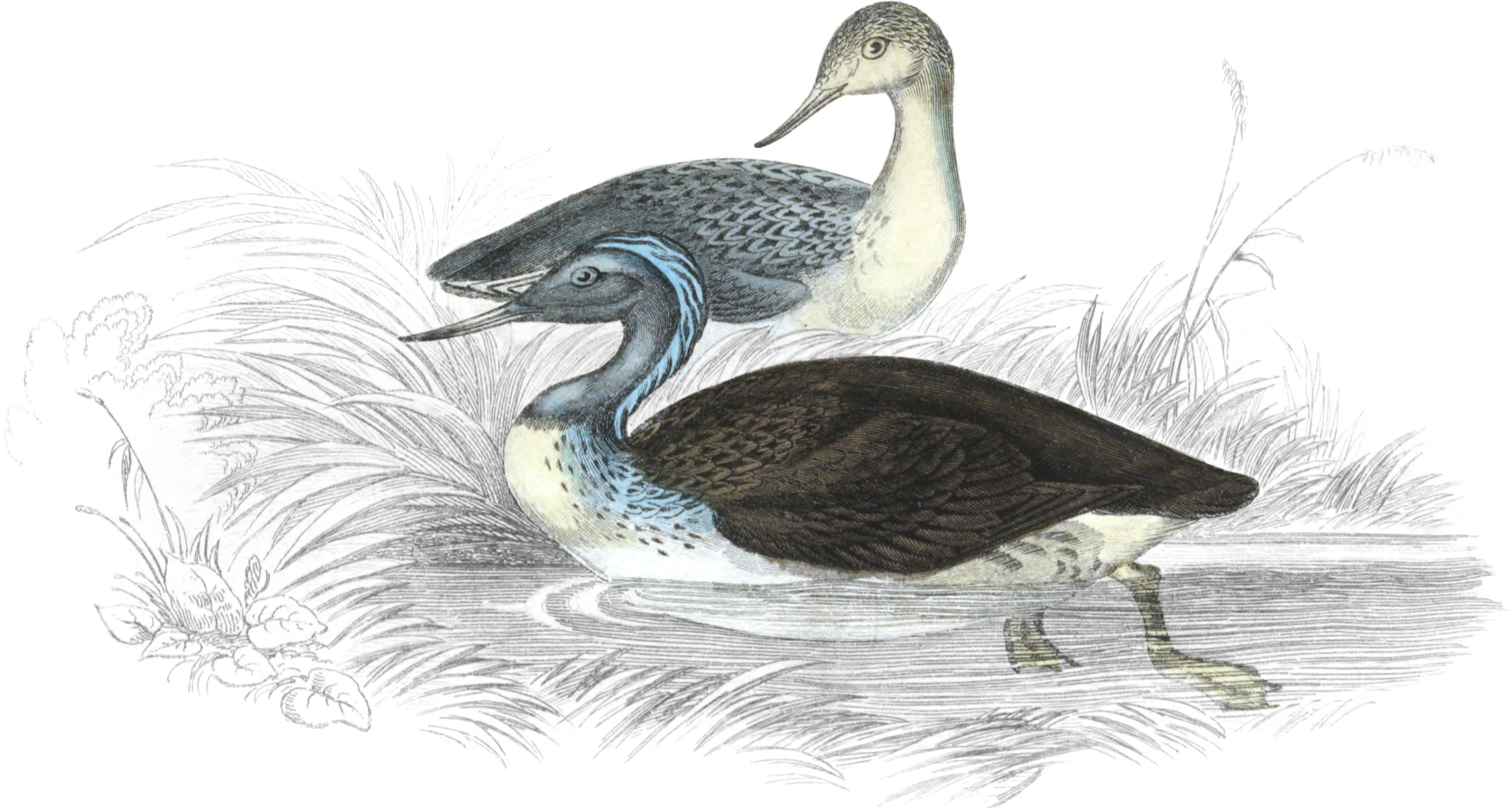
Plate XII

The Black-throated Diver
Colymbus arcticus.—Colymbus arcticus. Linn.—Plongeon lumme, ou à gorge noir, Temm.—Black-throated Diver of British authors.—Lesser Imber, Bewick (the young).
On the English shores, Mr. Yarrell states that of our three Divers this is the most rare, and he gives a record of several of the specimens which have been killed south of the Tweed. In the whole of the southern half of Scotland the same may be observed; during winter, specimens may be occasionally procured in immature plumage, and we have seen from three to four in a day when boating in the Firth of Forth; northward they become more common, but in all the districts where we have any account of the species, either in this country or abroad, it does not seem to occur anywhere in such numbers as the last described. In the lochs, beyond the middle part of Scotland, a few resort to breed; Loch Awe is the most southerly upon which we have observed them. In Sutherlandshire, where the country is very thickly studded with lochs of various extent, a pair was seen in many of those of moderate bounds; in one or two instances, two pairs were noticed; these bred on the small islands or upon the banks, placing their scanty nest a few yards from the edge of the water in a hollow formed by the bird, and composed only of a few straws of herbage gathered around; we discovered one nest on a small bare islet on Loch Shin, and landing on the opposite side, approached, and could perceive the bird lying, as it were, on the eggs, but with the head raised, having heard our approach. On perceiving us she scuffled along her short trodden path to the water, diving immediately, and rising out of gun-shot, diving again almost instantaneously, and joining the male, which was apparently surveying the scene at a few hundred yards distance. On another loch we succeeded in procuring both the male and female birds, from their being accompanied with their young, which had been hatched on a bare promontory near. When unaccompanied with the young, we have never been able to overtake this bird on the water; it could invariably beat a couple of good rowers, even though kept almost constantly under water by firing at it, and if approached within a moderate distance, its next rise might probably be many hundred yards a-stern, having closed and doubled on the way of the boat. On these occasions the bird never attempted to fly. From the accounts of those persons who have visited Orkney and Shetland, the Black-throated Diver also breeds there in the fresh-water lochs, though not very abundantly. It occurs also in Ireland, but we have no account of its breeding there. In Middle and Southern Europe it is found occasionally, as upon our own shores, most sparingly to the south, and there the specimens obtained are principally birds in immature plumage. In the north of Europe, Norway, Sweden, Lapland, and Scandinavia, it breeds among the retired lakes, and, from all our information, is by no means uncommon, appearing with the first break of the ice. Out of Europe, Temminck’s collections from Japan contain identical specimens; and in various parts of North America it is not unfrequent, reaching as far south as Texas and the Columbia river, and towards the north having been seen by the arctic voyagers on Hudson’s Bay and the coasts of Melville Peninsula.
In this beautifully marked species, which we consider typical, the head and neck are of a deep rich grey, similar in texture to the plumage of the Guillemots, and on the cheeks shading into the rich dull black which prevails on the chin; this is separated from the gular patch by a gorget of feathers striated black and white, surrounding the patch, running down upon the sides of the breast, and nearly meeting on the back of the neck; the striated appearance is produced by the feathers being black, with a streak of white on each margin; the gular patch is deep black, having a rich gloss of purple, conspicuously seen when viewed across; it ends in a peaked form upon the centre of the breast; the under parts pure white, sides of the tail greenish black, axillary feathers white; the upper plumage is deep glossy black with green reflections; on the upper part of the back or mantle there are two lengthened patches of square white spots, separated from the scapular patch; the latter runs the whole length of the feathers, and has the markings of a large size, running in fourteen or fifteen bars; the wing-covers are marked with an oval spot on each web; quills and tail black; feet and legs black, the centre of the webs yellowish olive.

Divers’ Feathers
The accompanying wood-cut will shew the form of these regular spots in the Black-throated (No. 1) and Great Northern Divers (No. 2). A specimen killed in winter (in the plumage of the Lesser Imber) has the tint of the legs, feet, and bill, pale; the under plumage, sides, and flanks, pure white; the head and back of the neck pale grey; the back brown, having the feathers broadly edged with grey, quills blackish brown. The downy plumage of the young, soon after hatching, is greyish black, paler beneath.
Some of the continental ornithologists consider that there are two nearly allied species of Black throated Divers, giving to the one the title of “arcticus” to the other that of “balticus;” we are not at present aware of the distinctions which are considered to separate them, but a specimen from Northern Europe, which we had for a short time in our possession, and before we were aware of the continental opinions, appeared to us considerably less in size, and the gular patch terminated inferiorly in a curved outline, not in a peak or angle as in the British specimens. We now mention this to call the attention of our ornithologists to the probability of there being two species of this beautiful Diver confounded.
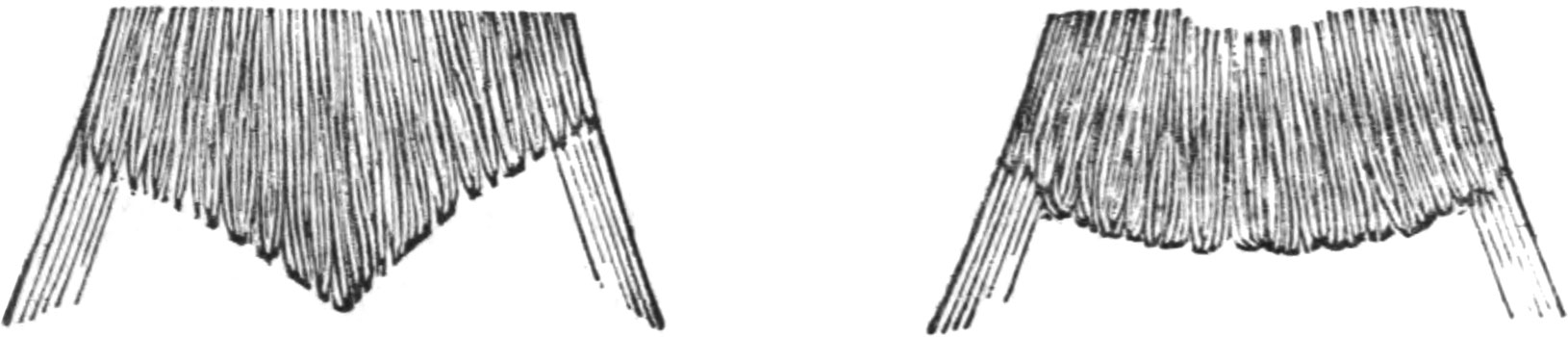
Gulars of Colymbus arcticus (Left) and balticus (Right)
Great Northern Diver
Colymbus Glacialis.—Colymbus glacialis, Linn., &c.—Plongeon Imbrim, Temm.—Northern or Great Northern Diver of British authors. Dimmer or Imler Diver, the young).
This very handsome bird occurs on the shores of England, during winter, in a manner similar to the bird last described, but less frequently; and upon all the British or Irish coasts it is much more rare. In the range of our own excursions, we have seen it in spring more plentiful in the Firth of Forth than elsewhere, frequenting the vicinity of the oyster-scalps, and there well known to the fishermen from its loud and monotonous call.51 We have never been able to come up with this bird on the water, and all the exertions of our rowers could not gain one yard upon it but it is sometimes; taken in nets and at set lines. In the north of Scotland and the Orkney and Shetland Isles it disappears in full plumage in June, and in none of the excursions which have within these few years been made there have the nest or eggs been discovered. We saw a pair on the coast of Sutherland in the month of June in their perfect dress; these might have been incubating on some of the adjacent islands, as it was at least a fortnight after we had procured the young of the Black-throated Diver in the opposite side of the county; at the same time, they were the only birds we saw in many suitable localities. The north of Europe does not even serve it for a breeding-ground; all those gentlemen, to whose observations we are indebted for much of the information we possess of the northern breeding-birds, did not find the Northern Diver during summer in Norway, Sweden, or Lapland. It is said to breed in the Feroe Isles,52 and Mr. Procter found it in Iceland on the fresh-water lakes, the nest being placed near the water. At the same time, from a note in Leemius de Lapponibus, we would suppose that this bird was far from being uncommon in Lapland.
The Laplanders make two sorts of hats from the skins of the different divers, which are sometimes given as presents or sold to traders on the coast. The one kind, and which must have rather a handsome appearance, is made from the skins of the Great Northern Diver; the shape of the head is formed out of several skins sewed together, and an entire skin, with neither the head nor tail cut off is placed overhanging, the head and bill turned in front. Some other articles of dress are also made of the neck of this species and that of the Red-throated Diver, the skins being preserved in a manner somewhat similar to those of penguins among the South Sea Islanders. The other kind of hats are made of five skins of the neck of the Northern Diver, with a part of the breast prepared with art.53
The Great Northern Diver was met with by Dr. Richardson, during the arctic land expedition, in abundance on the inland lakes, but seldom in the Arctic Sea or Hudson’s Bay. Audubon writes,
I have met with the Great Diver in winter on all the water-courses of the United States. I hare seen it along the whole of our Atlantic coast, from Maine to the extremity of Florida, and from thence to the mouths of the Mississippi and the shores of Texas.
It breeds in many parts of the United States, and was also found in Labrador, where “it lays fully a month later.”
In the plumage of the first year, when the bird is known as Colymbus immer, the whole under surface is pure white, shading upwards on the head and neck to greyish brown or clove-brown; the back and wings a very dark similar tint, each feather broadly margined with grey; the bill pale, except along the culmen; the inside of the tarsi and toes of a much lighter colour. In another specimen further advanced, we have the under parts still pure, all the upper plumage darker, and advancing further on the neck and breast, sparingly intermingled with the black and white spotted nuptial plumes, particularly on the wings; tail tipped with white; bill slightly darker than the last. In a third specimen, where we are inclined to believe that the perfect plumage is going off, we have the head and neck dark, clouded with grey above, and very much mixed with white on the chin and throat, the striated collar distinctly apparent; the under surface pure white, the upper with a large proportion of the distinct white marking, but intermixed, particularly along the middle line of the back, with apparently new dark feathers, having grey margins as in the young.
These three specimens were obtained from Orkney, and it is curious that in the bird last described the spotted feathers on the back and wings had the white spots gradually wearing out by the barbs of the feathers breaking off, which would soon leave the back of a uniform dark colour. This will be understood from the wood-cut at the end of the description, and altogether we do not think that the seasonal change of the divers is yet rightly understood. The adult male, in spring, or at the commencement of breeding, is a remarkably handsome bird, and we give Mr. Selby’s description, taken from one of the finest specimens we have seen in in our own collection, procured in spring, in the Firth of Forth; we were unable to ascertain how the bird had been killed, but scarcely a feather was wanting or out of its place:—
Bill black, paler towards the tip, nearly three-quarters of an inch long, much compressed, tapering, the upper mandible gently arched, the lower one channelled beneath and deepest in the middle, the angle sloping gradually upwards to the point; tomia of both mandibles inflected; head and neck black, glossed with purplish green; transverse bar upon the throat, middle neck, collar, and sides of the upper part of the breast, black, the feathers having raised white margins, which give these parts a striated appearance; the whole of the upper plumage glossy black, each feather having two pure white spots (see [following] woodcut) one on each side of the shaft near the tip, forming rows; those upon the scapulars and tertials large and quadrangular, but becoming small and nearly round upon the lower part of the back and rump. Flanks and sides black spotted with white, the rest of the under plumage white; the long axillary feathers the same, with a black stripe down their centres; tail short and rounded, consisting of twenty feathers; legs greyish black, paler on the inside.

Great Northern Diver Feathers
The other British form among the Colymbidæ is that of the Grebes, also peculiarly aquatic and totally unfitted for a life upon dry land. If we take the last form as typical of this family, we shall find some varieties in the structure of the Grebes, although they are even more expert divers. The tail is almost wanting and the toes are unconnected, but are widely lobed. The plumage is very close, and is silky to appearance, during the breeding season changing to deep brown and chestnut, and receiving additions in the form of ruffs or elongations about different parts of the head and neck. They are more frequent on fresh waters than on the sea, and fly with reluctance. The species are more numerous than the last, and they are more generally distributed.
Genus Podiceps.—Generic characters.—Bill of mean length, straight, slightly compressed, pointed; maxilla with a slight notch; mandible with the lower outline sometimes showing a slight angle; nostrils lateral, linear, pervious, with a protecting membrane; lores naked, wings short, concave; tail, a downy tuft; legs placed far behind, tarsi much compressed, posteriorly serrated, toes flattened, outer longest, bordered with an ample lobed membrane, nails large, flat; hallux with a broad lobe.
Types.—P. cristatus, minor, &c. Cosmopolite.
Note.—Habits peculiarly aquatic, partially maritime, breed on the water; fly reluctantly;—plumage of the summer characterised by tufts or gular ruffs.
The Crested Grebe
Podiceps cristatus.—Colymbus cristatus. Linn.—Grebe huppè, Temm.—The Crested or Tippet Grebe, or Dab-chick of British authors.
This is a large and fine species, we believe the largest of the genus, and in the plumage of incubation has an imposing appearance, from the rich colouring and ample adornments of the head and neck. Unlike the divers, the larger Grebes have their range to the southward and continue resident in many of the English counties for the whole year, and more particularly in the fenny districts to the; north of England they become more unfrequent in summer, and although Mr. Heysham has recorded the occurrence of this bird in Cumberland, we have never been so fortunate as to meet with it on the border during summer. It may be considered, indeed there, and in Scotland, rather as a winter visitant, and that in no great abundance. Mr. Thompson says it is resident during the year on the larger Irish lakes. Neither does it seem very abundant in Northern Europe, though it is said to breed in Sweden,54 while it is only a winter straggler on the coasts of Norway. Upon the waters of Holland it is not unfrequent, and we once, after a long chase, succeeded with difficulty in shooting one in the vicinity of Rotterdam; we had the assistance of a sail to our oars, and a fair wind. Out of Europe it has been recorded from Tangiers and Smyrna,55 and South Africa,56 and from the latter country we possess a specimen in breeding plumage. It is introduced in the Northern Zoology, and Mr. Audubon writes that it returns from its northern places of residence, and proceeds as far as the Mexican territories, passing through the air in flocks of from seven or eight to fifty and more.
The nest, placed among reeds or aquatic herbage, is formed of decayed plants, and is sometimes of considerable bulk. The old birds at this time are very wary, the female sliding almost imperceptibly from the nest, dives, and rises at a distance, leaving her track without a possibility of being discovered.
In a specimen from Norfolk the forehead and crown are greyish brown, and on each side of the latter the feathers become elongated and form two lengthened tufts, the colours gradually shading into deep greyish black; from the base of these tufts, around the auriculars and throat, springs an ample ruff, which can be displayed at pleasure; the chin and below the eyes shading into orange-brown, which deepens in shade towards the terminal end of the ruff, where it becomes lustrous greyish black; the occiput and neck succeeding the ruff are chestnut-red and brownish black intermixed; the back of the neck, upper parts, and wings, are blackish brown, darker on the back, and there with slight greenish reflections; secondaries white; the back of the neck tinted with grey; the fore part of the neck below the ruff, breast, belly, and vent, silvery white; sides of the breast and flanks dashed with brown and chestnut. The young birds want the ruff and the deeper rufous tints in the plumage, and it has generally been considered that these were the distinctions of the nuptial dress, but Mr. Yarrell states that a specimen kept in St. James’ Park by the Ornithological Society has retained its ruff for the whole of the last winter. Is there any age when these accessary plumes become permanent?
The Red-necked Grebe
Podiceps rubricollis.—Colymbus rubricollis, Gmel.—Grèbe jou-gris, Temm.—Red-necked Grebe of British authors.
Of the habits of many of the Grebes we know comparatively little, as may be at once seen by looking at the descriptions which have been given of them. This bird has never come under our own observation living. It has not been found breeding in Great Britain, and may be considered only as a winter visitant. Mr. Yarrell mentions several localities on the southern coasts where it has been killed, as well as in the fenny countries; and Mr. Selby writes of its tolerably frequent occurrence in Northumberland, and considers that being seldom seen may rather be attributed to its maritime habits than to its real scarcity, for that it is as frequent on the coast as the last, during winter and spring. Whatever may be the cause, it is certainly not so often procured as several of our other species, and we have not many observations on its habits; the most recent and interesting being those furnished to Mr. Yarrell by Mr. Dann, regarding it in Northern Europe. That gentleman writes that it is common during the breeding season in the reedy lakes at the head of the Bothnian Gulf, and it seems confined to the vicinity of the coast of the Baltic. The character of the lakes where the Red-necked Grebe was seen is precisely similar to that of the broads in Norfolk or the meers in Holland.57 Mr. Temminck has received it from Japan. Mr. Audubon found this species along the coast from New York to Maine, in winter, and on the Bay of Fundy it was met with in spring plumage in May.
A specimen procured for me by Mr. Selby on the Northumbrian coast, late in autumn, has the crown and back of the neck blackish brown, the cheeks, chin, and throat, white, the former clouded with blackish grey; the sides of the neck sienna-red, the upper parts blackish brown, feathers tipped with greyish brown; the wings of the same colour, except the bend at their junction with the body and the greater part of the secondaries, which are white; one or two of the first of the latter, or those nearest the outside of the wing, have the tips only white, the extent of that colour increasing towards the last. The fore part of the lower neck, sides of the breast, and flanks, are pale brownish grey; the centre of the breast, the belly, and vent, pure silky white. The bill of this bird is proportionally stronger than in the other British species.
The Horned or Sclavonian Grebe
Podiceps cornutus.
Colymbus cornutus, Gmel.—Grèbe cornu ou Esclavon, Temm.—Horned or Sclavonian Grebe of British authors. Colymbus and Podiceps obscurus. Dusky Grebe (the young).
This handsome species in its winter dress has been sometimes confounded with the next, from which however it is always easily distinguished by the form of its bill; and it is more than probable that the synonims of the immature state have been applied indiscriminately to them. In its full summer or breeding dress, it appears to be a rare bird in England, a few specimens only being recorded by Mr. Yarrell as lately occurring; and it has probably diminished to a partial extent, as the drainage of the fenny countries has advanced. In Scotland we are not aware of any breeding locality. In its winter dress, on the contrary, it is not uncommon in England, and we may say that in Scotland it is in this state the most abundant, next to the Little Grebe, and ranges from the Tweed to Shetland. Specimens occur during the whole winter in the Edinburgh markets, and we have frequently shot it in the river Annan during winter; it never attempted to fly, but was not nearly so watchful as the Little Grebe, diving but coming up again in sight, and allowing itself to be approached within shot The Little Grebe, on diving, immediately seeks some cover, and is not again seen. In Central Europe it is also chiefly a winter visitant, but breeds in Sweden,58 and Mr. Proctor found it in Iceland; Mr. Selby states that it is found in Northern Asia; in North America it is generally distributed, the greater numbers going far northward to breed; it migrates in flocks of as many as thirty together.59
The bill is shorter than the head and bends slightly but regularly to the tip;
forehead, crown, and large ruff encircling the neck, glossy greenish black; between the bill and eyes is a patch of reddish brown; streak behind the eyes, and the occipital tuft (or horns), buff-orange; hind part of the neck, back, scapulars, and wings, blackish grey, the feathers having paler margins; secondaries white; fore part and sides of the neck, and sides of the breast, rich reddish orange; the rest of the under plumage shining silky white; the outside of the tarsus is deep grey, and the inside pale yellowish grey.60
In the plumage of the Dusky Grebe, the specimens shot in the Annan, before alluded to, have the upper plumage greyish brown, darker on the scapulars and tertials; the secondaries white; the cheeks, throat, and neck, white, inclining to grey on the latter; the remaining under parts of the brightest and most unsullied silky white.

Plate XI

The Eared Grebe
Podiceps auritus.—Colymbus auritus. Linn.—Grèbe oreillard, Temm.—Eared Grebe, or Dab-chick of British authors.—Dusky Grebe? (the young).
We cannot describe this bird from observation, and in any state we consider it as the rarest of the British species. Its habits, which we presume may be somewhat similar to the birds already noticed, have not been recorded by any one who has seen it in a wild state, and the proper breeding localities have been scarcely ascertained. A few instances of its capture in various English counties are mentioned, Mr. Selby stating that he has frequently met with it in Northumberland during winter. In Scotland we have never personally found it, but a few instances have also occurred where specimens have been procured; none of these were far north, and it is not mentioned by any of the ornithologists who have more lately visited Orkney or Shetland. On the Continent it seems to be equally unfrequent; it breeds but rarely in the north, and it is probable that its range may be more towards Eastern or North-eastern Europe and Asia. Temminck, in his supplement, says that it is rather common in the Adriatic.
Bill black, about an inch in length, measured from the forehead; depressed at the base, and having the tip slightly reflected; lore blackish red; crown of the head and short ruff round the neck, shining black; from behind and below the eyes, on each side, a tuft of long, slender, shining, orange-buff feathers, which cover the ears and nearly meet behind; throat, neck, sides of the breast, and upper plumage, deep shining greyish black; flanks and sides reddish brown mixed with greyish black; secondaries white; under plumage white, with a silky lustre.61
In the plumage of winter it closely resembles the last but may be distinguished by the turned up form of the bill; we have thought, when compared together, that the Eared Grebe has an appearance rather more slender and graceful.
The Little or Black-chinned Grebe
Podiceps minor.—The Black-chinned and Little Grebe of British Authors (1. adult summer, 2. winter plumage.)
This small species is in winter very generally distributed over the British islands, and is by no means uncommon in open lakes, marshes, or rivers; but its breeding stations are more local, being more general in the south, at the same time extending partially to the north of Scotland, Orkney, and Shetland. Thus, in our own vicinity there are many suitable places, but we are not aware that it incubates, though very common in winter; whereas we have seen it much more diffused among the Highland lochs, and we have shot it in Sutherland in June, in the full breeding dress. During winter it is common in the river Annan, and on looking down a reach, one or two may always be seen swimming and diving, and sometimes sporting with each other; if the intruder shews himself, it immediately dives, and is not again seen; taking refuge among the banks, or falling down the stream, until some cover is obtained. We have sometimes seen it surprised in clear water, when it would either seek refuge about the sides or endeavour to conceal itself under weeds at the bottom, the time that it can remain under water being almost incredible. We never saw it attempt to save itself by flight, except once, when we suddenly came upon a party of four or five, towards evening, in very shallow water. Even in a circumscribed pool, diving seems almost its only resource; the last specimen we procured was taken in a small piece of water about ten feet square, where the bird might have escaped by flight, but it kept diving and attempting to get under the banks or weeds, until exhausted; during the while, the motions under water were beautifully seen; when moving straight forward it is propelled by the wings, a sort of flight, but when turning, and we presume when seeking its food, it has an easy gliding motion, feet and wings being used as occasion requires, sometimes on one side and sometimes on the other and we were reminded of the graceful gliding motions of the otter, where every turn seems given with perfect ease, at the same time with great activity and quickness. Mr. Selby mentions sometimes taking the Little Grebe in pools left by the tide, where no endeavour was made to escape by flight, and where it tried to conceal itself under the fronds of algae. Upon the continent of Europe we find its distribution somewhat similar to what it is in Great Britain and Ireland, but its extra-European range does not seem to be so well determined. There seems to be one or two small Asiatic species closely allied, that are different, and may have been confounded with it in the notices of it from that continent; at the same time we have it noted in the catalogues of Indian birds by persons on whom dependence can be placed. In our own collection we have specimens which appear in every way identical, both in summer and winter plumage, from the Cape of Good Hope and South Africa. It does not extend to North America.
A specimen shot in a loch in Sutherland in June, when it might be considered as in full breeding plumage, has the throat, the head above the eyes, and back of the neck, dark brownish black, glossed with green; the cheeks, sides, and fore part of the back, chestnut-red; the upper plumage with the wings blackish brown, shading round the breast to a paler tint, which is continued down the sides and flanks, and gradually shades into a silvery grey, covering the centre of the belly and vent; secondaries tipped with white, but only seen during flight bill black, white at the tip; the lore greyish or pinkish white; feet and legs blackish-green, paler on the insides. The plumage of one shot in the river Annan, in winter, is pale umber-brown, darker on the wings; on the cheeks and sides of the neck there is a tint of rufous, and the chin and under part are of a clear and silvery white.
Alcadæ, or Auks
The birds contained in this group are entirely maritime in habit. In the preceding family we saw the legs placed very far behind and the feet very ample; in the Auks we have the former structure continued, with the tarsi short and the feet small, and these members are not so amply developed or adapted for so swift a passage through the water, nevertheless the Auks are expert divers, and procure their food by that means alone. They do not breed on the ground, but either burrow or select precipitous rocks for this purpose; and they sit and move with ease on the shelves and ledges, keeping themselves nearly in an upright posture, and resting on the whole posterior edge of the tarsus. The wings are short, but in many are capable of a swift and rapid flight; while in a few these organs are totally unable to raise the bird from the water, and act only as powerful oars in their submarine flight; in all the penguins the feathers of the wings are very short, scale-like and adpressed. From the Divers we are very easily led to the Auks by means of the Guillemots, forming the
Genus Uria, Brisson.—Generic characters.—Bill of mean length, compressed, pointed; maxilla bending to the tip, which is notched; mandible with a gentle ascending angle; nostrils basal, lateral, half concealed by feathers; wings rather short, accuminated, first quill longest; legs placed far behind, tarsi short, somewhat compressed; feet small, palmated, outer and centre toe equal in length, claws falcate, sharp; hallux wanting.
Types. U. troile, Irunnickii, &c. Europe, Northeastern Asia, North America.
Note.—Breed gregariously on precipitous rocks: summer and winter plumage slightly different, variation confined to the head and neck; eggs disproportionally large.
The Common Guillemot
Uria troile, (plumage of the winter.)
Colymbus troile, Linn.—Guillemot à capuchin, Temm.—Guillemot, or Foolish Guillemot of British authors.—Colymbus minor, Gmel.—Lesser Guillemot, young and winter plumage.
This is the only one of the British Guillemots that can be called common or abundant, the others being comparatively rare, and some only straggling visitants; it is distributed all around our islands, and at any season small parties maybe seen a short distance from our coasts. While near their breeding places, at the proper season, they assemble in thousands, at times blackening the sea. They breed on the precipitous cliffs of the coast, or on the rocky islands, where they assemble in spring, and select ledges of rock for themselves, separate from the razor-bills and gulls which nestle on the same precipice, and a whole colony of Guillemots may be perceived ranged in rows, without a single bird of another kind among them. Any intrusion, or a shot fired, causes them to stream down in thousands to the water, their lengthened form, and continued multitudinous flight, giving them the appearance of a line. Some will however remain, the more anxious for their young, and we have seen repeated shots fired without effect at birds who would merely look over the ledge, or creep farther back out of harm’s way. The young are said to be carried down to the water by the parents; this, we believe, has never been seen, but at the same time birds have been so often found in the sea, of an age so tender, as would lead observers to believe that they could not have reached it without assistance. After incubation, the broods scatter over the ocean and form the small parties which are at other times to be seen at sea. They frequent firths, and seem to float in and out with the tide, a few approaching pretty near the shore. In the open seal they are easily approached within shot with a boat; but dive at the flash, and do not readily take wing. Some of them lose their shyness entirely and enter the harbours; during last winter (1842–3) we saw several specimens in the open harbour of Newhaven (Firth of Forth), swimming and diving among the fishermen’s boats, and allowing themselves to be pursued by boys; and we understood that several birds came daily in, diving for the young fish that had resorted to a calmer part of the sea, or after the refuse from the fishing-boats.
The Common Guillemot is found around all our coasts to the Shetland and Orkney Isles, and also around the shores of Temperate Europe, breeding in suitable localities, stretching to the northern seas, but decreasing southward, and met with “only as a straggler in the Mediterranean.”62 It was also met with by the arctic voyagers, far north in the arctic circle. Audubon writes that it is seldom found farther south than the entrance of the Bay of New York, and that countless numbers breed on the islands on the Labrador coast; his boat returned from one excursion laden with two thousand five hundred eggs, of which he writes,
they afford excellent food, being highly nutritious and palatable, whether boiled, roasted, poached, or in omelets.
In the adult bird, in breeding plumage, the head and neck are of a hair-brown, the feathers of a very close and smooth texture, and from each posterior angle of the eye they seem to separate and leave a deep distinct line; the upper plumage is of a duller tint than the head, approaching nearly to clove-brown, some of the feathers on the mantle being tipped with a paler shade of colour; the secondaries have half an inch of their ends white, forming a bar across the wings, and are the only interruptions: the under parts, from the neck downwards, are pure white, the feathers on the flanks being dashed with clove-brown on the outer edges; the bill is greyish black, the inside of the mouth a rich saffron-yellow; legs and feet brownish black In the dress of the winter, the cheeks, chin, sides, and front of the neck, are white; a dark streak running behind the eye, and the colour of the head and upper parts of the neck assimilates more nearly in tint with that of the back, and looses in part the agreeable brownish tinge and soft feel perceived at other times. In the young, before the appearance of feathers, the dark parts of the adult, in summer, are of a dull greyish black, the hair-like down having white tips, the under parts white.

Plate XIII
Brunnich’s Guillemot
Uria Brunnichii, Sabine.—U. Brunnichii, Flem.—Guillemot à grosbec, Temm.—Brunnich, or Thick-billed Guillemot of British authors.
This species rests its claim as British on a very few specimens. It was seen by Capt. Sabine in July on the coast of Kerry, was met with in Shetland by Capt. James C. Ross, and there is a specimen in the Edinburgh Museum said to have been received from Orkney. On the European coasts it is also very rare, and ranges northward to the Feroe Islands and Iceland, Baffin’s Bay, and the Arctic Seas. Our own specimen was procured from a whaler, and was, we believe, killed in Davis Straits. On the American shores it appears also to be rare; Audubon “never met with it on the coasts of our midland districts,” neither did he find it breeding on his excursion to Labrador. His specimens were procured from Eastport on Maine and forwarded in ice to him; a useful hint, for we believe that many of the Arctic species of birds, which it would be of advantage to examine fresh, might be thus brought to England by the whalers, &c.

Guillemot Beaks
1. U. brunnichii; 2. U. troile; 3. U. lacrymans.
Brunnich’s Guillemot is easily distinguished from the last, by the thicker form of the bill and the greater angle of the mandible, and also by the much deeper tint of the head and neck, and, indeed, of the whole plumage. The cheeks, throat, and sides of the head are deep blackish brown, and of the peculiar tint occasioned by the very close texture of the feathers; the eye small, the line behind not exceeding an inch in length; the crown, back of the neck, back, wings and tail, black, on the two first deep and glossy; the secondaries are tipped with white, forming a bar across, and the tips and edges of the outer webs of the quills are grey; the under parts are pure white, rising up to a narrow point in the centre of the neck. In the winter and young plumage the changes are of a similar kind to those of the last, the throat and sides of the head becoming white; we have not, however, seen a figure or description of the bird in this state.
The Bridled Guillemot
Uria lacrymans.
Una lacrymans, Bridled Guillemot, Gould, Yarr., &c.—Guillemot bridé, Temm.
By the attention of Mr. Yarrell, we have had the satisfaction of examining specimens of this Guillemot in the summer and winter states of plumage, and have very little hesitation in considering it one of those closely allied species which we so frequently meet in particular genera; besides varying in some parts of its plumage, it breeds exclusively with its own kindred, though in company with U. troile and brunichii, and is very local in distribution. In Iceland and the adjoining islands, where it seems to be found in greatest abundance, it is known by a different provincial name, and the natives at once distinguish it, and can separate not only the birds, but also the eggs, from those of the common species.
The claim of the Bridled Guillemot to a place in the British list rests on the authority of Mr. Gould, who states, in his Birds of Europe, that it breeds on the coast of Wales; while Mr. Yarrell writes, that since Mr. Gould’s description, it has been taken on the coasts of both Yorkshire and Durham. We have never had the good fortune to meet with it in Scotland, nor do the fishermen or inhabitants near the breeding-places almost always very correct in their distinctions of the creatures frequenting their vicinity know it. It was procured by Mr. Procter in his excursion to Iceland, and Nilsson includes it as a variety in his Fauna of Scandinavia.
Bill weaker, and more slender than that of the common Guillemot; the head and neck dark olive-brown, intermediate in shade between that of the common and Brunnich’s, the eye surrounded with a ring of white, which is prolonged in a narrow line below the separation of the auriculars; the back, wings, and tail are a dark greyish brown, the secondaries narrowly tipped with white, all the under parts white.
In an apparently young bird the upper plumage is rather darker, the throat and fore part of the neck are white, that colour extending above the auriculars; but on the sides where it joins the dark colours and in front of the neck, the feathers are tipped with greyish black, showing a slightly motled appearance.

Plate XV
The Black Guillemot
Uria grylle.
Colymbus grylle, Linn.—Guillemot à miroir blanc, Temm.—Greenland Dove, or Black Guillemot of British authors.—Spotted Guillemot (the young).
This species, differing in colour and marking from all the others, is a more northern bird; the coasts of the south of Scotland being near to its southern range in Britain. Mr. Yarrell, however, mentions having seen it on the Hampshire coast, and his knowledge of its occurrence off Dorsetshire, Devonshire, and Cornwall. Northward, we have seen it ourselves around the precipitous parts of the Isle of Man, where, we have no doubt, that it was at the time breeding; and on the eastern coast, we have shot specimens on the Isle of May, where one or two pairs breed annually. Its breeding places are unlike those of its congeners; one which we discovered was in a cave, and the young were found at the extremity, among some loose rocks, on which we could land and scramble up. The retreat was betrayed by the old birds fishing near its entrance, and passing and repassing out with a supply of food. Northward still, we saw it in Ju.ie, among the precipitous shores of Sutherlandshire, and it Is known to be common on the Orkney and Shetland islands. During winter, it is seldom killed; indeed, the only recent example which has come under our notice was that described afterwards, shot by ourselves on the lee side of Inchkeith. The Black Guillemot is also a summer resident in the seas of northern Europe, as well as near and within the arctic circle; it is in these regions that the great stronghold of the species is found, decreasing gradually to the Shetland and Orkneys, and disappearing on the shores of Middle Britain. Audubon writes, that, in severe winters they reach as far south as the shores of Maryland; and he found them breeding abundantly on the coast of Labrador, in fissures of the rocks, or among great piles of blocks with holes in their intestices.
The specimens alluded to as shot on the Isle of May, while breeding, were entirely of a dull but deep brownish black, relieved by the vermilion-red of the legs and feet, and by an oval patch of pure white on the wings, the greater and middle wing covers being entirely of that colour; the tips of the last secondaries and of the quills, except the first, are grey, the colour running along the edge of the outer webs for a third of their length; the bill is black; there is a very slight difference in size between the sexes. The young birds, two in number, a few days old, were of a dull black; they were taken alive, and kept for a few days; their time of greatest activity was during the night, in the day-time, running behind anything the room afforded; and, if brought out, immediately again retiring to their hiding-place. The plumage, in the winter, varies; but we are not sure that the young always attain what is considered the complete pale dress at that season. When shooting, many years since, on the Firth of Forth, in January, we were driven by a gale to take shelter upon the lee side of Inchkeith; and, among many other birds that had sought refuge there, apparently for a similar purpose, was a specimen of this bird, which we, from what we considered at one time an unfortunate change of weather, procured. From the chin downwards it is pure white; the head, upper part of the neck, and sides of the breast, clouded with brownish black; the back of a deeper tint, each feather tipped with white; the rump nearly pure white; quills and tail black; and the white conspicuous spots on the wings clouded with brownish black.

Plate XIV
Following the Guillemots, and before describing the more typical Auks, we may notice a small bird assimilating certainly with the last in the plumage and its changes, but varying in the form of the bill. One species only is known.
Genus Mergulus, Ray.—Generic characters.—Bill short, thick, tumid at the base; nostrils basal, round, partly plumed, protected by a scale; wings rather short, two first quills longest and equal; legs placed behind, tarsi short; hallux wanting.
Types.—M. alle. Vicinity of the arctic circle, roaming accidentally to temperate Europe.
Note.—Gregarious; breeds on the ledges of rocks.
The Little Auk
Mergulus alle.
Alca alle. Linn.—Uria alle. Temm.—Little Auk, or Rotche, of British, authors.
We have never had the satisfaction to meet with this species in a recent state; and it may be considered as rather a northern bird than one which regularly visits our shores in winter, except under peculiar circumstances. Instances are recorded of specimens being procured on various parts of the English coasts, and also on those of Ireland, Mr. Thompson suspecting that it may breed in the same locality with Brunnich’s Guillemot; but one or two remarkable instances are mentioned by Mr. Yarrell, on the authority of Dr. Clarke of Hartlepool, where flocks of hundreds were driven upon the coast, by a violent storm from N.N.E., and where five or six were sometimes killed at a shot. A similar circumstance happened on the Yorkshire coast; and on the cessation of the gale, they again disappeared. On the southern Scottish coasts, specimens have been very seldom procured, but it is seen sparingly on the northern islands. Dunn says it appears regularly in Shetland every winter, though he had not heard of it visiting Orkney; stretching still northward, its proper resorts are the vicinity on both sides of the arctic circle, in some parts appearing in great abundance, according to Captain Sabine, even “supplying the ship’s company with a variation of food;”63 and Capt. Beechy, in his account of the voyage to the North Pole, in 1815, under command of Capt. Duncan, in the Dorothea and Trent, while describing the scenery of Magdalena Bay, a deep commodious inlet on the western side of Spitzbergen, writes,—
At the head of the bay there is a high pyramidal mountain of granite, termed Rotge Hill, from the myriads of small birds of that name that frequent its base, and which appear to prefer its environs to any part of the harbour. They are so numerous, that we have frequently seen an uninterrupted line of them, extending full half way over the bay, or to a distance of more than three miles, and so close together, that thirty have fallen at one shot. This living column, on an average, might have been about six yards broad, and as many deep. There must have been nearly four millions of birds on the wing at one time.
Skins are frequently brought home by the whaling vessels; and those which we shall now describe were obtained from that source. In the New World it is not abundant, except on some parts of its arctic shores. Audubon did not meet with it in Labrador or Newfoundland, and to the south it is taken frequently in a state of exhaustion, and has not reached “beyond the shores of New Jersey, where it is of very rare occurrence.”
In the plumage of the summer, or while breeding, the head, neck, upper part of the breast, back, wings and tail, are glossy brownish black, on the head and neck having a browner tint; the tips of the secondaries are white, and the long scapulars are bordered with the same colour; above each eye there is a narrow speck of white; the under plumage is white, except a part of the long flank feathers covering the thighs, which have the inner webs blackish brown. In winter, the change is confined to the sides of the neck and breast, and the posterior parts of the cheeks, which become pure white.
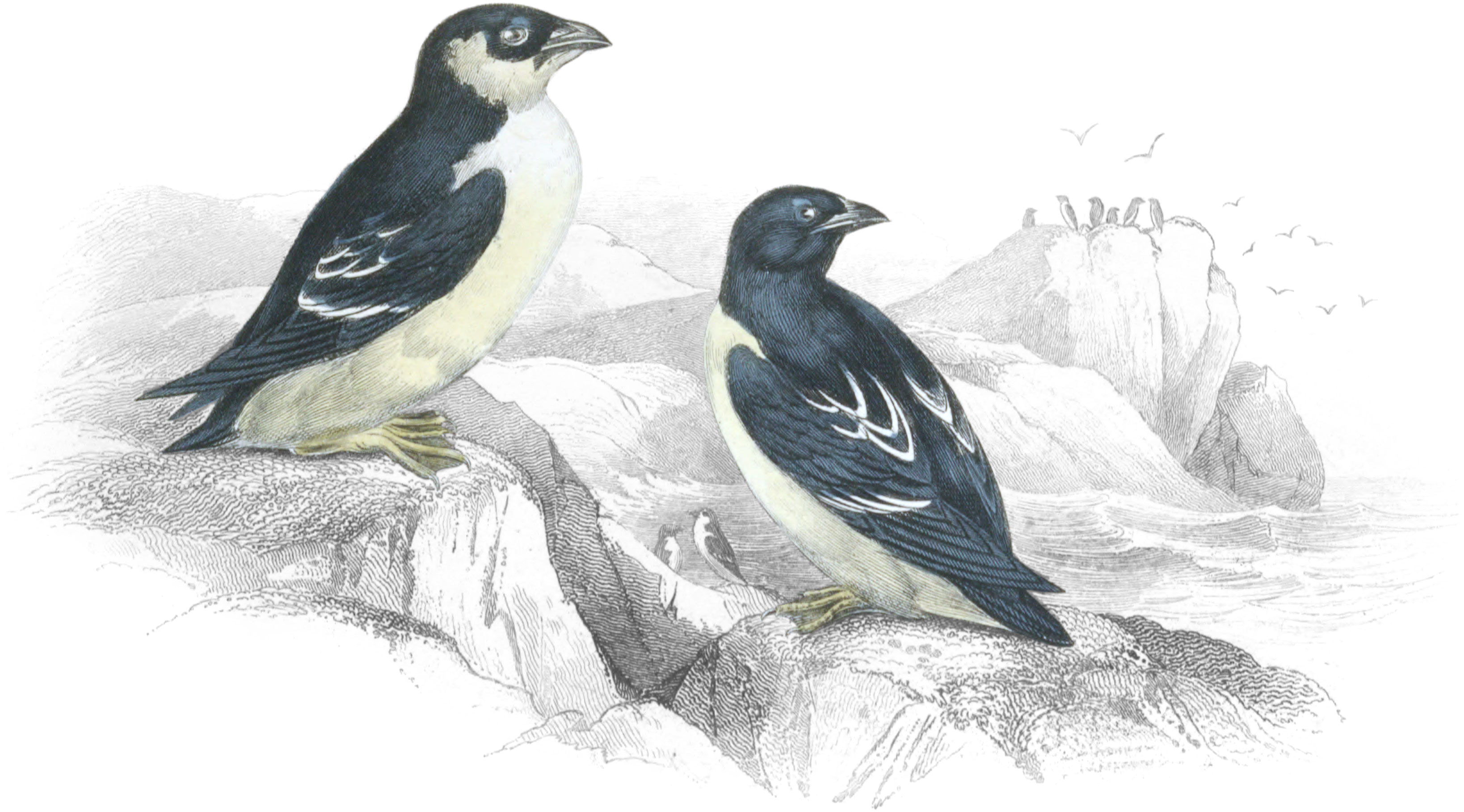
Plate XVIII
In succession to this form, we would place what may be termed the True Auks, expert sea birds, penguin-like in form, the wings proportionally shorter and less developed than in the preceding birds, but they breed in the same manner, and have the same seasonal changes with them.
Genus Alca.—Linnæus.—Generic characters.—Bill short, deep, compressed, cultrated, surface transversely sulcated; tip of the maxilla arched, hooked; nostrils linear, lateral, placed near the gape, (head narrow in front, prolonged); wings short, narrow, first quill longest; legs placed behind, tibia within the integuments; tarsi short; feet small, hallux wanting.
Types. A. impennis, torda.—Northern Europe and America.
Note.—Principally gregarious; breed on ledges of rocks; flight imperfect.
The Great Auk
Alcus impennis.
Alca impennis, Linn.—Penguin brachipter, Temm.—Great Auk of British authors.
The king and queen of the Auks, as the sexes of this bird are called by the northern islanders, have some claim to the title, whether we regard their ample size or extreme rarity; and, we believe there is no bird in more request by the British, or even general collector, or one which would bring a larger price in the ornithological market. Very few specimens have been obtained or seen; that in the British Museum and long unique as a British bird, was procured for Mr. Bullock, near Papa Westra; some one or two specimens have been seen, one obtained by Mr. Stevenson off St. Kilda, which afterwards, we believe, escaped; two are recorded as picked up in England, but evidently under peculiar circumstances; and one is mentioned by Mr. Thompson to have been taken in 1834, off the coast of Waterford, in Ireland. In the old account of a voyage to St. Kilda, in 1697, by M. Martin, Gentleman, we have this account,—
The sea fowls are, first, the Gairfowl, being the stateliest, as well as the largest, of all the fowls here, and above the size of a solan goose, of a black colour, red about the eyes, a large white spot under each eye, a long broad bill stands; stately, his whole body erected; his wings short; he flyeth not at all; lays his egg upon the bare rock, which, if taken away, he lays no more for that year; he is palimpes, or web-footed; and has the hatching-spot upon his breast, i. e., a bare spot, from which the feathers have fallen off with the heat in hatching; his egg is twice as big as that of a solan goose, and is variously spotted, black, green, and dark; he comes, without regard to any wind, appears the 1st of May, and goes away about the middle of June.
In Northern Europe and America it appears to be equally rare, none of those gentlemen who have lately visited the former having met with it. It was not obtained on the arctic expeditions; Mr. Audubon did not meet with it in Labrador, and in fact, procured comparatively little authentic information regarding it.
The Great Auk seems incident to the same changes which will be described in the better known Razor-bill. The length of the bird, so far as we can make out from descriptions, is from thirty inches to three feet; the bill, four inches long, is black, with transverse furrows, the grooves white; in front and around the eyes is a large oval patch of white; the other parts of the head, the neck, back, wings, and tail, are black; tips of the secondaries are white; the breast, belly and under parts, white. In the dress of winter, the chin, throat and sides of the neck, are white.

Plate XVI
The Razor-Bill Auk
Alcus torda.
Alca torda, Linn.—Le penguin macroptere, Temm.—Razor-bill, or Marrot of British authors. Alca pica, Linn.—Black-billed Auk (winter, and young.)
This species is nearly equally abundant with the Guillemot on all our coasts, and resembles it much in habits, breeding in the same manner and gregariously on the same rocks, appearing off our shores and in our firths, during the winter in small parties. These are easily approached in a boat; but they do not suffer it to get quite so close to them as the guillemots, diving or taking wing at from twenty to forty yards distance. The wings are proportionally rather shorter, and the flight is performed with more rapid strokes, but is, at the same time, swift while it lasts; and, except when seeking its nesting-place, on the face of the rocks, is never far raised above the water. This Auk is found breeding in suitable localities, from Shetland to the Isle of Wight. On the continental shores we believe it to be equally abundant; but we are not sure of its southern range. Mr. Yarrell mentions a specimen in the winter dress, in the collection of the Zoological Society, received from Tangiers. In the arctic seas it is also abundant; and Audubon writes,
A few birds of this species occasionally go as far south as New York during winter; but beyond this parallel I never met with one.
In its breeding stations, farther north, he found this bird incubating in fissures of the rocks.
In the breeding plumage, the head and neck are brownish black, of a paler or browner tint on the throat, a narrow streak of white extends from the culmen of the bill to the angle of the eye; the plumage is thick and soft; above, very deep brownish black; the secondary quills tipped with white, forming a narrow bar across the wing; tail cuneated with the centre feathers, narrowed towards the tip; under plumage entirely white; the bill black, transversely furrowed, with a line of white in that of the centre; legs and feet nearly black.
In the plumage of the first year, when it is known under the name of Black-billed Auk; the bill is very weak (see wood-cut, next page), and the indication of the white streak to the eye is just marked; the upper parts are as in the adult breeding state, but without the lustre; while the chin, throat, cheeks and sides of the head, as well as the under parts, are white, the light colour passing over nearly to the occiput, where it is very slightly clouded, and the feathers become gradually purer, the tips for a certain space only being dark.
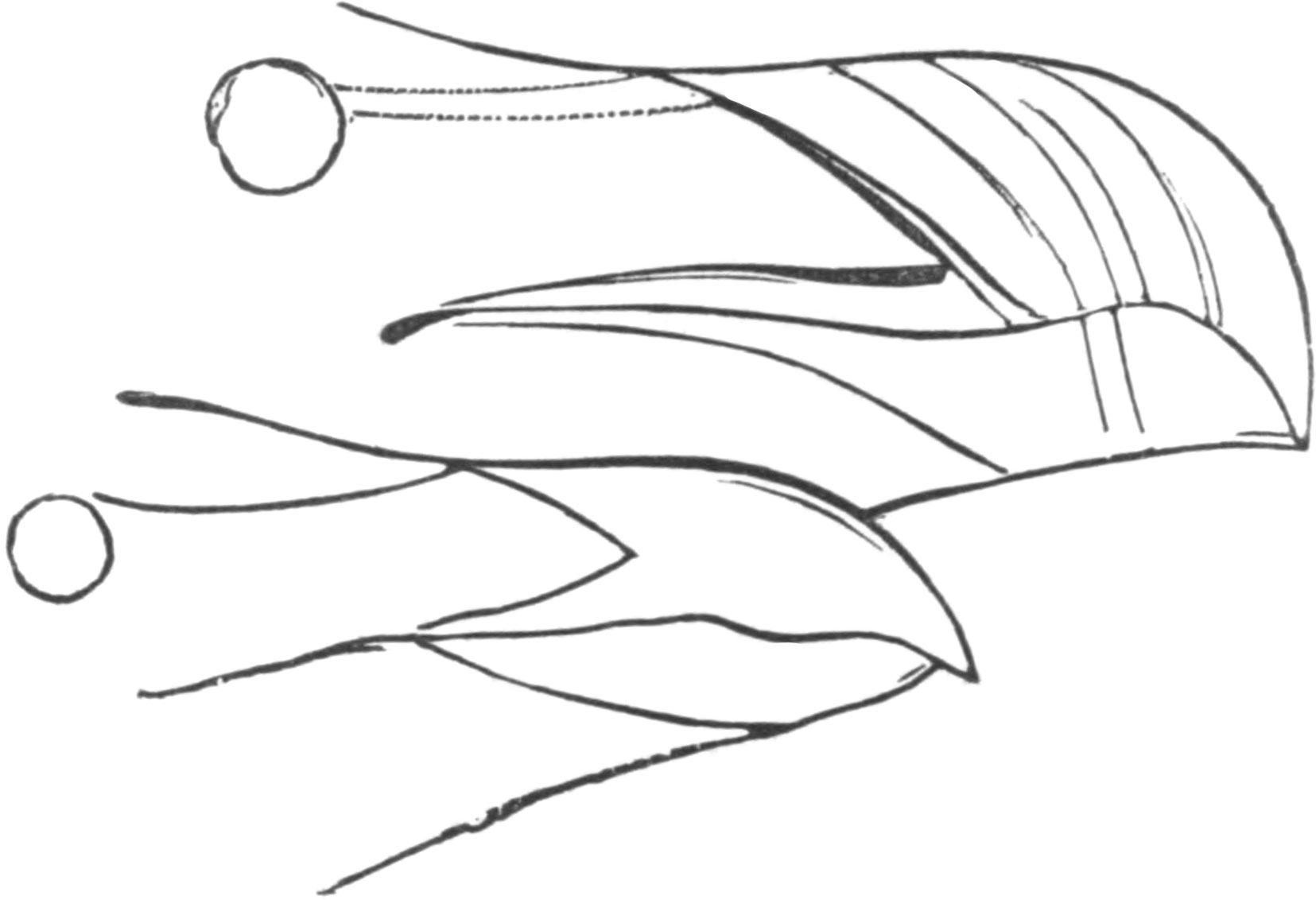
Auk Beaks
A specimen in this state is before us, shot in winter, and showing the breadth of the bill not developed. We possess another, where the breadth of the bill is greater, but the white marking is not complete; the plumage of the head and neck darker, and with white mixed, as if the adult breeding state was still in progress.
Plate XVII
The Puffin
Fratercula arctica.
Alca arctica, Linn.—Fratercula arctica, Steph.—Mormon fratercula, Temm.—Puffin or Sea Parrot, of British, authors.
This curious bird is a summer visitant only to our shores, repairing to them for the purpose of incubation; its winter range, however, does not seem to be so correctly ascertained, Mr. Selby stating that the rest of the year is spent on the southern coasts of France and Spain. Around our islands it is common, extending to St. Kilda and Shetland in the one direction, and to the Isle of Wight in the other; it is also frequent on the coasts of Ireland. We have observed it chiefly in the islands in the Firth of Forth. It sometimes breeds in fissures of the rocks; but its most general resort is in holes or burrows, either formed by itself, or supplied by rabbits if they happen to be inhabitants of the same locality. On the Bass Rock, the holes in the ruins of the old fortifications afford a retreat, burrows being also made in the shelving ground in front of the building, and which is almost the only station for them on this rock. On a small rocky island, opposite the harbour of North Berwick, a large colony of these birds used to resort; they breed entirely in burrows, or under piles of large rocks; when approaching the island, the tops of these rocks might be seen covered with those which were not on duty under them; and when alarmed, they would betake themselves to the sea; but, after a time, they appeared to congregate, and flew in one large flock around the island, taking the same line; so that, by standing on one spot, we procured as many as we wished from the regular return of the flock past us.
The Puffin is used as an article of food by various island and northern tribes in whose vicinity they breed, by the St. Kildeans they are eaten, and the “Voyagers round the Coast of Scotland and the Isles” have stated that their chief sustenance at this time consisted of the small sea-fowl before-mentioned under the name of Puffin. They are caught by stretching a piece of cord along the stony places where they chiefly congregate, to which nooses are attached,—and many are salted for the winter’s use.
Out of Europe, we do not know how far south their breeding stations extend; but northward they incubate in very high latitudes. In the New World, Audubon observed them, in winter, as far south as the entrance of the river Savannah, in Georgia, and found them breeding in abundance in Labrador, some of the islands being completely undermined by them.
Cheeks and throat pale grey, when viewed from the side appearing as a round pale patch on the side of the head; the colour is darker at the sides of the chin and immediately behind the eye, where the line separating the auricular feathers from the others is apparent; eyes protected by a large scale above and below, that above triangular, that below oblong; crown forming a band to the occiput, collar round the throat, upper parts, wings and tail, black, on the crown and collar tinted with grey, under parts pure white. The bill occupies the whole face of the bird, is very much compressed, and is traversed on the maxilla by three, on the mandible by two furrows; the colours are bluish grey and orange-red; the sides of the mouth are furnished with a corrugated orange-yellow skin. Feet and legs orange-red.

Plate XIX
The Fratercula glacialis, Leach, is a good species; Mr. Gould has been so kind as forward a specimen for our examination; it differs in its larger size and proportions, different colour of the bill, brown colour of the crown, form of appendages over the eyes, and in the black colour coming up to the chin, leaving no white space between it and the bill.
Pelicanidæ
Succeeding the family of the Auks, very limited in numbers in every part of the world, and comprising only seven species that can rank as British, we pass to the group of the Cormorants and Solan Geese, of which we possess only two forms, represented by three species. These birds are still prominently aquatic, seek their whole food under the water, and are extremely voracious; some breed gregariously on precipitous rocks in the vicinity of the sea but; the Cormorants often travel inland, and perch and sleep on trees; the latter form the
Genus Phalacracorax, Brisson.—Generic characters.—Bill long, straight, slightly compressed, maxilla terminating in a powerful hook, furrowed laterally to the tip; nostrils basal, concealed, base naked; wings rather short, second or third quill longest; legs placed behind; tarsi short, strong, but ample; four toes, all connected, the outer longest, others gradually shortened.
Types.—P. carlo, &c. Cosmopolite.
Note.—Undergo a seasonal change; migrate partially inland in winter; perch on trees; capable of domestication; trained to fish.
The Common Cormorant
Phalacracorax carbo.—Pelicanus carlo, Linn.—Carbo cormoranus, le grand cormoran, Temm.—Phalacracorax carbo, Steph., Flem., Selby., &c.—Crested Cormorant, Bewick.—Cormorant of British authors.
This species, from the changes incident to its plumage, was described under several names; but these states have since been better understood, and the British birds are now known to constitute but one species. The present bird is the most common and most widely distributed, and extends around the whole coasts of our mainland and islands, breeding in suitable localities, and in winter entering the bays and estuaries, and at times ascending the courses of rivers; its breeding stations are described to be rather on the summits of rocks than on the ledges, where they construct a large nest of seaweeds, or material collected on the waters; but where we have observed them, ledges of rock have been selected, and so broad, that the birds, if shot dead, would not fall from them. On the Ross of Kirkcudbright, St. Bee’s Head, and the Isle of Man, there are several breeding-places of this description. During winter it occasionally follows the river courses; and we have known several birds take up a regular station, remaining to fish on the river, and roosting during night on its banks, upon some overhanging trees; and where inland lakes or waters are situate at no great distance from the sea, they are constantly frequented. On the sea, except during incubation, the Cormorant is not easily approached, but gets out of harm’s way by flight, not by having recourse to diving, like so many of the true aquatic tribes; the flight is powerful, and, overland, is performed at a great height. In the firths it has favourite fishing-grounds, to which, at certain periods of the tide, it resorts regularly; and we have often procured specimens by placing ourselves in concealment as near as possible to the line of flight, which, in several localities, had to pass over some narrow isthmus, or sufficiently near some jutting-out point of land, to be within shot. This Cormorant is easily domesticated, and will come readily to be fed; and at one time, we believe, there was such a royal office as “Master of the Cormorants.” We have not seen any recent account of the fishing with these birds, nor has it been practised for a long period in this country. We do not know with certainty the extra European range of this species; but it may probably extend to North-eastern Asia; Mr. Yarrell states, the Caspian Sea and India. Audubon describes the Cormorant as breeding along the Labrador coast, in parties of fifty or more pairs.
In the full breeding plumage, the chin, and around the rictus, is white; the head and neck, the middle line of the back, and entire under-parts, glossy bluish black; and the cheeks and sides of the neck are more or less interspersed with white lengthened hair-like feathers; the occiput is furnished with a long, hackled, recumbent crest, erectile at will; the shoulders and wings, except the quills, are bronzed brown, darker at the shafts, and surrounded by a broad zone of velvet black; on the secondaries this occupies the outer edge only; quills and tail dull black; upon each thigh there is a conspicuous oval spot of pure white, of greater or less size and distinctness according to the season, and at times only marked by one or two straggling feathers; feet and legs black.
Green-Crested Cormorant
Phalacracorax cristatus.
Phalacracorax cristatus, Steph., Flem., Selby.—Carbo cristatus, cormoran longup, Temm.—Crested Cormorant, or Shag Green Cormorant of British authors.
This species, undergoing a less general change than the last, only losing its beautiful crest, is more decidedly maritime in habits, and although generally, it is not so abundantly distributed around our shores as the last; its British range is, however, as extensive; its breeding-places are precipitous sea-cliffs; the most extensive colony which has ever come under our observation is one in the Isle of Man, on the precipitous coast adjacent to the Calf, of such elevation, that the centre was out of range, either from the top or from the sea; there they nestled in deep horizontal fissures, conscious apparently of their security, and would poke out their long necks, to ascertain the reason of the noise below, or when a ball struck the rock near them, with the hope of causing them to fly. There were hundreds of nests, and the birds not sitting kept flying in front of the rock, passing and repassing so long as anything remained to disturb them. One, of a pale grey colour, mingled among the other dark birds, and was an object of request, but our perseverance was unavailing for not breeding, it took to the open sea when much annoyed. On approaching this resort, and also at a similar, but smaller one, on St. Bee’s Head, few of the birds quitted the rock; but, at the surprise of our first shots, they fell, as it were, or darted straight to the water, some of them close to the boat, so much so as at first to cause us to think that great havoc had been made, in which we were soon undeceived, by seeing numerous heads appearing at a distance, and the birds immediately making off in safety; they soon, however, learned to sit and look down in content., though at new stations we procured specimens by one firing at the rock, and another taking the birds as they darted to the water. Caves are also resorted to as breeding places by this bird, on the ledges of which the nest is placed. On the Bass Rock and the Isle of May, where only a few resort, they select the deep caves; and a boat, stationed at the entrance, but out of sight, may sometimes procure shots at the disturbed birds flying out, although they more frequently dive into the water of the cave, and swim under until far past the entrance. Some recesses on the Kirkcudbright coast, frequented by these birds, have the name of the “Doukers’ Bing.” The Cormorants have the practice, after fishing, and having satisfied themselves, of alighting in rows on some sand-bank or rock, and resting with their wings held out as if to dry. We have frequently observed from five to twenty thus at rest on the low banks, with which the Solway Firth is so fatally interspersed, and in particular states of the atmosphere, they appear of large size, almost like human beings, in search of shell-fish. We do not trace the range of the Crested Cormorant satisfactorily. Northern Europe and North-eastern Asia are the probable localities. Birds which we have received from Southern Africa, resembling this, appear to be different, although Mr. Yarrell gives that country to it, on the authority of Dr. Smith.
This very beautiful bird, in the full breeding state, has the general colour of the plumage of a rich blackish green; on the head, neck and under-parts, of a silky texture; on the back and wings of a deeper tint, and having there each feather banded at the tip with velvet black; the quills and tail (the latter consisting of twelve feathers) are nearly without lustre, and of a uniform black; in this state, the head is adorned with a transverse crest of broad loose feathers, springing nearly from the line of the eyes, and bending forwards; in some specimens it is very ample, but in others, shot at a similar period, it is very little developed; there may be a slight difference in the sexes; but the crest is perhaps more incidental to age, or a very much developed state of plumage, than a decidedly seasonal or breeding adornment; in some specimens, shot from the nest, and at the season of incubation, it consisted of two or three, and sometimes only a single elongated plume. We have sometimes seen a few spots of the white hair-like feathers, which became so conspicuous on the neck of the last during the breeding time, appear also there in this bird; the bill and feet are black, the basal skin of the former, and edges of the rictus, gamboge-yellow; in the young birds, and before breeding time, the plumage is of different shades of brown, varying in intensity, the throat white.
Plate XX
The remaining form of the Pelecanidæ belonging to the British Fauna is that of the Solan Goose, or Gannet, and known under the title of
Genus Sula, Brisson.—Generic characters.—Bill long, compressed near the point; maxilla curved at the tip, sulcated for nearly the whole length, base with a hinge; mandible straight, with a slight angle; tomia irregularly broken, face naked; wings long and accuminated; legs placed far behind, tarsi short; feet ample, four toes united, middle claw broad, inner edge pectinated.
Note.—Great development of wing; do not dive, but seize their prey by plunging.
The Solan Goose
Sula bassana.
Sula bassana, Briss.—Pelecanus bassana, Linn.—Fou blanc ou de bassan, Temm.—Solan Goose, or Gannet, of British authors.
The Gannets, though exhibiting a some what similar structure of feet, differ widely in habits from the Cormorants; and, in their general form, the one is that of a bird whose life is to be spent in the waters, and the other that of one living in the air. The Solan Goose is a summer visitant to our coasts; and although, from its power of flight, it seems to be widely scattered, yet its real stations, or breeding places, are few and local. The Bass Rock, St. Kilda, and Ailsa Craig, have long existed as the Scotch localities; while Lundy Island, on the coast of Devon, and the Skelig Isles, are less known English and Irish stations.
It is on the Bass Rock, in the Firth of Forth, only that we have seen this bird assembled to breed; and altogether, it is perhaps one of the most interesting sights that the ornithologist can be placed before, whether he surveys the crowd nestling upon their eggs, greeting their mates on their arrival from the sea, or squabbling, if one happens to intrude a little too near another; or to sit aside and view the troops of birds in adult and changing and first year’s plumage, pass and repass, surveying their visitor, and sailing past him in a smooth, noiseless flight, so near, that the eye and every feather is distinctly seen, the bird motionless, except a slight inclination of the head when opposite. On the Bass, the great proportion of the birds build on the ledges of the precipitous face of the rock; but a considerable number also place their nests on the summit, near the edge, where they can be walked among; there the birds are quite tame, allowing a person to approach them, and will fight at the foot when held out. On our last visit to this rock, we had a small cocker in company, which, in such situations, gave regular battle to the geese, though commonly forced to retreat; and had he not been tied up, it is nearly certain that he would either have lost his sight, or been tumbled over the rock, by the strokes of the birds’ wings. Several of the breeding birds have black (or immature) feathers on the scapulars and wings, and a few on the back, with sometimes one and sometimes both the centre tail-feathers. The flight and habits at sea are also very interesting to witness; when returning to the rock, it pursues a straightforward course, at a considerable elevation, without turning to the right or left; but when fishing, it may be seen suddenly to turn, and prepare itself for the plunge, and then follow its survey, the sight having either been mistaken, or the prey disappeared; but, when certain, the course is in a moment stopped, the wings closed to the sides, and a perpendicular descent is made, often to a considerable depth, if we may judge from the period of immersion; the spray dashes up, and the bird is for sometime lost, until it again appears with a fish in its beak, which is soon got into the proper position, and swallowed head downwards. The Solan Goose is said to be taken by a fish attached to a board, the force of the stroke killing the bird; but we have not been able to ascertain whether its ordinary prey is pursued after the plunge, or is at that time transfixed, like the prey of the herons. It ranges far from its breeding-place to fish, pursuing the species that swim in shoals, or tracing the resort of some particular food; it roams upwards, opposite to Leith, and seawards to and beyond the Fern Islands; it will turn from its course to look at any unusual object, and its curiosity is sometimes fatal to it; we have procured birds that have thus come to inspect our craft, generally sailing once or twice around within reach, and almost always allured by throwing some white or marked object overboard.
Most, if not the whole, of these breeding stations are rented from the proprietors, the rent being paid chiefly by the feathers. The young geese are killed and cured. The Bass furnished yearly, we believe, from fifteen hundred to two thousand. The young are also said to be brought to the Edinburgh markets, and sold fresh; but we have never met with the dish at table, nor been able to ascertain what class of people were the chief purchasers; nor are we very sure where is the principal market for those that are salted in the north, although we have once or twice eaten them boiled as a ham, and considered them by no means either strong, fishy, or unpalatable.
Its ascertained range out of Britain is to the north of Europe, Iceland, and the Feroe Isles. Out of Europe, we have Wilson and Audubon, considering the birds of America similar to the European species, breeding in the same way, and upon local precipitous rocks, their stations on the coast of Labrador are visited annually by the cod-fishers to procure bait, the flesh of the goose being cut up into strips and cured for that purpose; the birds are knocked down with sticks-, boat-hooks, &c., and appear as if they were confused, or ignorant of the attacks of man. The Prince of Canino, however, has placed the American goose in his Comparative List, distinct, as the S. Americana. It is also said to be a native of the African coast; and we give a short description of a bird procured from Southern Africa, wherein it will be seen that there is little variation that would entitle specific distinction, except in the colour of the tail; the length is two feet ten inches; of the wing to the tip of the second quill (the longest), one foot eight inches. The plumage appears completely adult, and is coloured as in the birds from the Bass, but the tail, consisting of twelve feathers, is entirely brownish black, with white shafts. It is more uniformly graduated than in a Bass bird, in a partially immature state, though breeding; in the latter the feathers have commenced to change, and are grey at the base on the outer webs. The Bass birds are larger in all their proportions, and stronger.64 Mr. Gould’s figure of Sula mclanura is extremely like our Cape specimen, and he gives it as a species, on the authority of Temminck, who received the specimens from Iceland. Mr James Wilson, in his Tour around the Coasts of Scotland, has mentioned that the inhabitants of St. Kilda are aware of a Gannet with a black tail.
The Solan Goose is easily kept in confinement, though the required supply of fish renders its keep expensive; but it will tame well, and live for years, where it has access to a piece of water, even though its limits are not large.

Plate XXI
Young & Old Plumage
Laridæ
The last family of the Natatores, typically represented by the extensive group of the Gulls, live in a manner by plunder. Some of the forms not by the exercise of their own exertions, but seize and carry off what has been watched for and procured by others; some, again, feed on the blubber of the larger cetaceous animals, the carrion, as it were, of the ocean; and many of them, when slightly pressed by hunger, will avail themselves of very indiscriminate food; in most the bill is strong compared with the size, the wings long and ample; while those that we shall describe first are the most exclusively sea-birds; and, although they do not enjoy the property of diving, they seldom seek the land except while breeding.
The British Petrels are comprised in three genera, two of which run very closely into each other. The birds are entirely maritime in their habits, and seem to run in zones of distribution; the species are more numerous than what they are yet supposed to be, and present individuals very closely allied.
Genus Procellaria, Linnæus.—Generic characters.—Bill strong, straight, thick; maxilla dilated at the base, tip distinct compressed, hooked; mandible laterally furrowed, tip distinct, angulated, compressed, fitting into the dertrum, tomia of both sharp; nostrils tubular, combined in a strong elevated sheath, opening by a single orifice; wings accuminated, first quill longest; feet not large, toes slender, outer slightly longer than the centre, claws slightly falcate, tarsi short, slender.
Types.—P. glacialis.—Northern Europe, Arctic America.
Note.—Habits maritime; breed on rocks; diurnal.
The Fulmar
Procellaria glacialis.
Proccllaria glacialis, Linn.—Petrel fulmar, Temm.—The Fulmar, or Fulmar Petrel of British authors.
The Fulmar is an accidental winter visitant to the more southern shores of England; but we are not aware of recent specimens having been obtained at that season northward, or along the Scottish shores, until we reach its breeding stations at St. Kilda and the Outer Hebrides. Mr. Yarrell, among his useful ornithological statistics, has given us instances of specimens being obtained in Durham, Essex, and Cornwall; while we have accounts of the bird by all the voyagers who have visited St. Kilda, from M. Martin, Gent, in 1698, to James Wilson, Esq. in 1842. The first states, “The inhabitants prefer this, whether young or old, to all others; the old has a delicate taste, being a mixture of fat and lean, the flesh white.” The latter writes, “The Kildeans use the oil afforded by the stomach as a catholicum for diseases, especially for any aching of the bones, stitches,” &c.
In Middle Europe, it sparingly frequents the seas, as it does on the south of England; it is found and breeds on the Feroe Islands, Spitzbergen, Iceland, Davis Straits, Hudson’s Bay, and arctic latitudes generally, and is well known to the whalers as a constant attendant on the stricken whale, feeding voraciously on the carcasses after the flensing operations have terminated.
Audubon, however, saw the Fulmar on the American coast, south of Long Island; he was disappointed in not meeting with it on the shores of Labrador, but found it breeding on the Seal Islands off the Bay of Fundy.
The form of the Fulmar is that of a strong-built gull; and the appearance is strengthened by the similarity of plumage.
A specimen, received by the attention of Mr. Logan, brought to Orkney by one of the whalers, from Davis Straits, has the body pure white, except the mantle and lower parts of the back and wings, which are brownish grey, tinted with bluish; the base of the covers and tertials are paler, showing a shaded broad band across; the tail is slightly greyish at the tip, and the under-covers exceed it in length; the bill is described to be gamboge-yellow, the legs and feet yellowish grey, but in the dried skins the colours have completely faded. Another specimen, from the same locality, has the whole plumage of a brownish grey, paler beneath, darker on the wings, and with the quills and a spot on the anterior angle of the eye, dark blackish grey; feet, legs, and bill, are here also of a darker shade.
Plate XXIX
Fulmar Petrel
The Puffins, or Sheerwater Petrels, have been separated from the strong-built Fulmar on account of their rather more slender shape, their more slender bill, the structure of the nostrils, and the backward position of the legs. We believe the species will prove numerous, though comparatively few are at present known, and some of the lesser run much into the larger forms of the next genus.
Genus Puffinus, Brisson.—Generic characters.—Bill of middle length, straight, slender, maxilla arched and hooked at the tip; that of the mandible bent downwards, and fitting into the other without any angle at the symphisis; nostrils basal, placed on the culmen, with two distinct openings in front; wings long, accuminated, first quill longest; tarsi laterally compressed, feet of middle size, hallux, a straight nail or claw.
Types.—P. cinereus, anglorum, &c. Cosmopolite.
Note.—Habits maritime; breed chiefly in holes or burrows; nocturnal.
The Cinereous Shearwater
Puffinus cinereus, Selby.—Puffinus cinereus, Selby, Jen., Eyt., Yarr.—Puffin majeur, Temm.
This rare British species seems to have been observed both by Mr. Strickland and Mr. Selby, without either being aware of the specimens procured by his friend. Mr. Selby procured his upon the Northumbrian coast; Mr. Strickland on that of Yorkshire. Mr. Strickland afterwards met with a second specimen, and Mr. Yarrell records one or two more; Mr Thompson has noticed it in Ireland; but, in addition to these instances, from the information Mr. Yarrell has quoted from D. W. Mitchell, Esq. of Penzance, this bird must be at times extremely abundant in Mount’s Bay.
They appear some autumns off Looe and Polperro in thousands. M. Temminck refers Mr. Gould’s figures, taken from Mr. Strickland’s Birds, to the P. major of Faber. It appears to be a northern bird, at the same time there are specimens in the British Museum from South Africa.65
From Mr. Gould’s figures, this bird would seem to vary in the dark and under-parts in a manner similar to some of the genus Lestris; the whole appearance of Mr. Yarreirs wood-cuts reminds us of the jagers. In the darker bird, the
head and neck all round, and the back dark clove-brown; scapulars and tertials the same, but with lighter coloured margins; wing-coverts, primaries, and tail-feathers, blackish brown; breast and belly greyish hair-brown, each feather much darker in colour on the margin than over the centre; legs brown on the outer surface, but pale wood-brown on the inner; toes and their membranes yellowish brown; whole length of the bird seventeen inches and a quarter.66
In the lighter coloured bird the head and occiput dark ash-grey; back of the neck almost white; both wing-coverts and tertials ash-grey; all the margins greyish white; primaries and tail-feathers blackish brown; chin, sides, and front of the neck, the breast and sides of the body, white; lower belly, vent, and under tail-coverts, varied with dull white and ash-brown; legs, toes, and their membranes, brownish yellow; the whole length, eighteen inches.
In Mr. Selby’s specimen, the
head, back part of the neck, and upper plumage, blackish brown, with the margins and tips of the feathers of the scapulars lighter; throat, lower part of the neck, and whole of the under plumage, deep ash-grey, with a tinge of brocoli-brown.
The Max Shearwater
Puffinus Anglorum.—Procellaria puffinus, Briss.,—Lath. Puffinus Anglorum, Will., Ray, Selby, &c.—Manx Petrel, or Sheancater of British authors.
This species appears to have been at one period much more abundant than it is now, its habits leading it apparently to shun the habitations of man; and it has thus banished itself from some of the stations which were formerly occupied by it. These, like the breeding-places of most of the sea fowls, are taken up by colonies, which, although numerous at their different resorts, are often far removed from each other, and are selected in places where some peculiarity pleases the birds, but which renders their distribution extremely local. Formerly, the small precipitous island, separated by a narrow channel from the mainland of Man, and called the “Calf,” was the best known station, probably then the only known one, and gave the bird its title; but becoming more frequented, and a light-house being erected, the birds disappeared entirely, and on a visit which we made to this interesting island, we were much disappointed in scarcely being able to trace even the recollection of their former abundance. We are not aware of this Shearwater having been seen in the Solway, or about its entrance, for many years. On the Calf of Man the birds bred in burrows, but at the time of our visit, there was little cover on the island except whin, and in some places long heath. To the northward it breeds on St. Kilda, and in one or two stations among the Orkneys. Mr. Selby procured a single specimen off the Fern Islands. Mr. Yarrell writes, “that it is a rare bird” on the eastern part of the southern line of our coast, more frequently seen at sea off Dorset and Devon, becoming still more numerous farther to the westward; at times abundant in spring on the coast of South Wales, Mr. Gould having obtained four dozen of them at one time.67 The Isle of Annet, one of the Scilly group, seems now to be one of the best-known localities, and Mr. Mitchell has given Mr. Yarrell a very interesting account of its habits; one part is covered with short ferns, among which the Shearwaters burrow; they leave their holes when the other birds are resting from fishing, and appear to be completely nocturnal. Northern Europe possesses some stations, probably also North-eastern Asia. Mr. Strickland obtained it at Smyrna. Mr. Audubon met with it to the westward of the banks of Newfoundland.
In the adult bird the colours of the plumage are few, above deep greyish black, beneath white, having the junction of the two colours on the sides of the neck and breast, transversely banded with grey and white; behind the thighs a patch of black; length, about fourteen inches.
Following the Shearwaters, we reach another form allied, at the same time exhibiting considerable differences. All the known species are small, entirely maritime in habits, and possess an extraordinary development of wing; these have been formed by Mr. Vigors into the
Genus Thalassidroma, Vigors.—Generic characters.—Bill short, maxilla hooking downwards at the tip; mandible slightly angulated, following the curve of the maxilla; nostrils in one tube, showing two orifices; wings long, accuminated, second quill longest, third nearly equalling it; feet rather small, outer toe slightly longest; tarsi long and slender; hallux a small sharp dependent claw.
Types.—T. leachii, pelagica, wilsonii, &c.—Cosmopolite.
Note.—Habits entirely maritime; breed in burrows; flight swift; “run upon the waves;” size small; colour black.
Bulwer’s Storm Petrel
Thalassidroma Bulwerii.—Jard. and Selby.—Procellaria Bulwerii, Jard. and Selby.—Illust. of Orn. Gould, Birds of Europe.
Mr. Gould, in the last number of his European Birds, writes,—
On the authority of Colonel Dalton of Henningford, near Ripon, we are enabled to add this rare species to the Fauna of Britain, from a fine specimen which was found on the banks of the Ure, near Tanfield, in Yorkshire, on the 8th of May 1837, and which could not have been long dead, as it admitted of being mounted as a good cabinet specimen.
We add the description of the specimen from Madeira, originally figured in “Illustrations of Ornithology.” We may remark, that this bird is of a larger size than the greater number of the species, and exhibits a cuneated form of the tail, in which member, even among the British birds, we shall see a considerable variation.
The length is about ten inches; the plumage is entirely of a deep sooty black, paler upon the throat, and on the breast and belly slightly tinged with brown; the form of the tail is the greatest peculiarity, this contains twelve feathers, and is very much cuneated, the centre plumes being about two inches longer than the exterior, thus giving it a form at variance with the smaller and true petrels, where we find it either square or forked.
The Storm Petrel
Thalassidroma pelagica.
Procellaria pelagica, Linn.—Petrel tempete, Temm.—Storm or Stormy Petrel, or Finch, of British authors.
To our own observation, this is a much more uncommon bird than that which we shall notice next; we have scarcely ever met with it living, at the same time, the breeding places that are recorded are both numerous and widely scattered, extending from Shetland, St. Kilda and the Orkneys to the Scilly and Channel Islands. We have seen small parties off Douglas Harbour in the Isle of Man in June, but did not discover any breeding station; several instances of dead or very exhausted birds have been picked up inland, and large flocks appear at times to be driven from their proper course. In the Natural History of Yarmouth, it is stated that between two and three hundred were shot in Nov. 1824 after severe gales, and Mr. Yarrell tells us of Mr. Gould having exhibited to the Zoological Society twenty-four in a large dish. Mr. Thompson mentions some Irish breeding stations. The geographic range appears to be very extensive, but we have not verified what is recorded, by the examination of specimens. It reaches northward to Faroe and Iceland, southward to Italy,68 and South Africa,69 Audubon obtained specimens on the banks of Newfoundland.
In habits this bird is entirely maritime, except during incubation, feeding on floating marine molusca, &c.; it will keep company with ships for days together, perhaps assisted by the draft of their wake, and will feed on the little bits of bread or meat which may be thrown towards it or fall from the vessel, and is thus sometimes procured by using small hooks. When we have seen them, they allowed the vessel to pass, and seemed the lightest and most buoyant things that could be imagined. To their breeding places they are migratory; Martin writes,
It comes (to St. Kilda) about the 22d of March, without any regard to winds, lays its eggs about the 20th of May, and produces the fowl towards the middle of October, then goes away about the end of November.
The nest is placed among loose stones or rocks, or in fissures, and a single pure white egg is laid; it remains concealed during the day, and appears at dusk, which is the time of feeding and activity.
A specimen before us has the upper plumage of a dull black, the last feathers of the rump and the base of the upper tail-covers pure white, forming a broad band; the tips of the greater covers are also of a pale grey, marking their line across; the under parts are brownish black or pitch-brown with a white patch behind each thigh; legs, feet, and bill black. We are not aware that there is any difference in the sexes.70
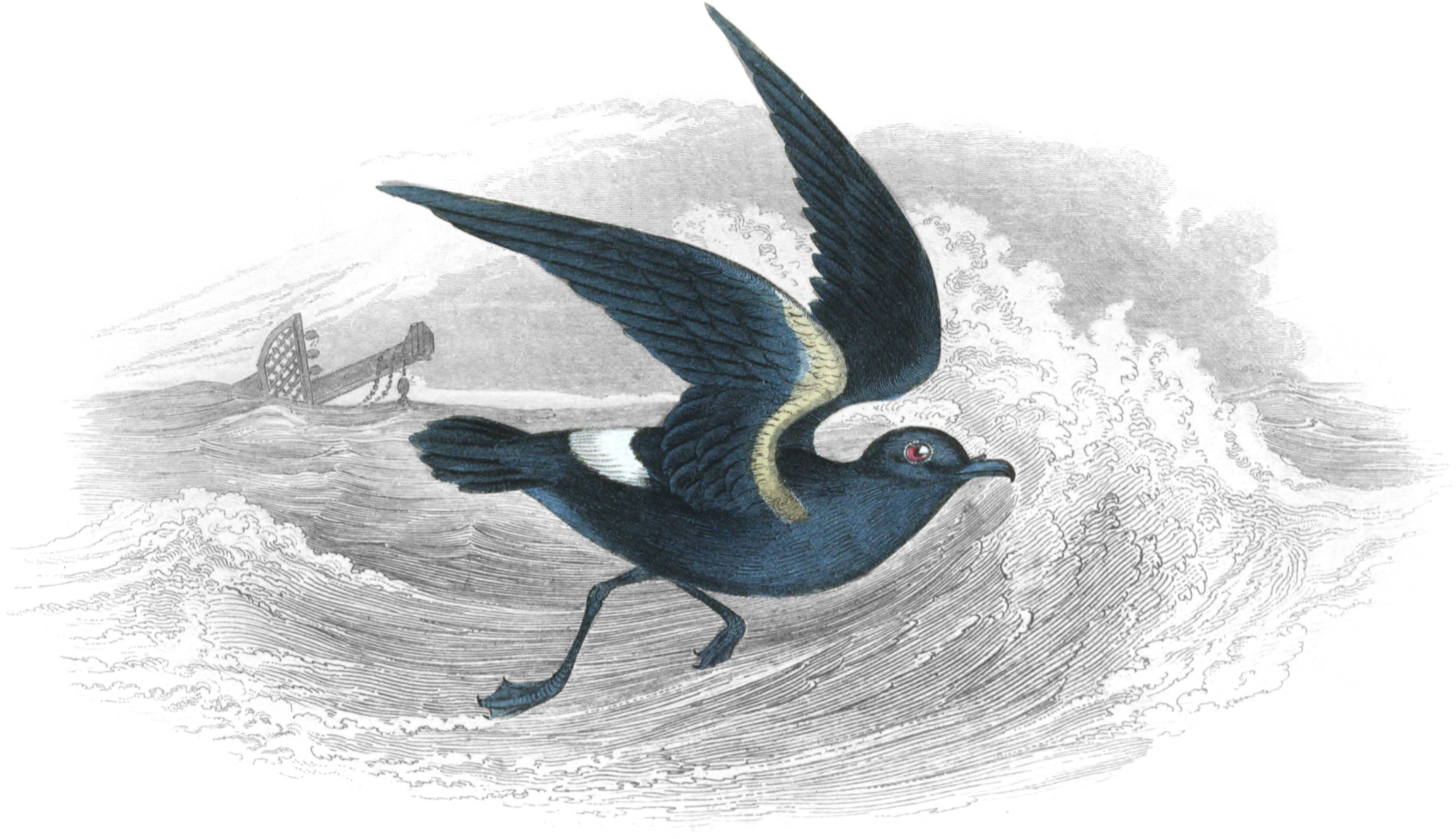
Plate XXX

Wilson’s Storm Petrel
Thalassidroma Wilsonii.
This bird was given by Mr. Jenyns as an accession to the British List, in “Vertebrata,” on the authority of birds procured, or thought to be procured, in the British Channel; but since that, Mr. Yarrell, in the concluding parts of his excellent British Ornithology, from which we have derived so much advantage in the progress of these volumes, has recorded four specimens picked up in Cornwall, Norfolk, Sussex, and Cumberland. From other accounts, its nearest ordinary approach to our shores is from about two hundred miles distance to the vicinity of the Azores. It was originally distinguished and named by the Prince of Canino, and the American seas seem more properly its habitation. Audubon says it breeds on the southern extremity of Nova Scotia, on some small islands called Mud Islands, where it forms burrows to the depth of two or two and a half feet; he also found it abundant towards Charlestown. We have never met this species recent, but Mr. Yarrell describes a fine specimen as seven and a half inches in length;
the bill black, the head, neck, back, wing-primaries and tail-feathers, dark brownish black; greater wing-coverts and the secondaries dark rusty brown, lighter in colour near the end, with the extreme edges and tips white; upper tail-coverts white; chin, throat, breast, and all the under parts, sooty black, except the feathers near the vent on each side, which are white, and some of the under tail-coverts are tipped with white; legs long and slender, and with the toes and their membranes black, but with an oblong greyish yellow spot upon each web.
Fork-tailed Storm Petrel
Thalassidroma Leachii.—Procellaria leachii, Steph., Temm.—Procellaria bullockii, Flem., Selby.—Pétrel de Leach, Temm.—The Fork-tatted, Bullock’s and Leach’s Petrel of modern authors.
This Petrel was originally discovered by Mr. Bullock in St. Kilda during the season of incubation;
and subsequent observation has shown that they annually resort to the island for that particular purpose.
We believe no other breeding station is now upon record. It has generally been found upon the mainland, at a distance from the sea, either dead or very much exhausted, evidently driven out of its course. There has occurred to our own observation one picked up dead in the lower part of Annandale, and kindly sent to us by Sir Patrick Maxwell, Bart, of Springhall; a second by Mr. John Jardine, on the Glasgow and Carlisle road, still alive, but exhausted, and dying in ten minutes after it was found; and the remains of the third were picked up on St. Boswell’s Green, Roxburghshire, sufficient parts being preserved to identify the species. Other European localities seem scarcely ascertained, specimens being accidentally found in different parts, as in this country. It is an American species. Audubon writes, in his Journal from this country, that Wilson’s Petrel was first seen about two hundred miles from England, and the Fork-tailed only came in sight when the middle of the Atlantic was readied. The Fork-tailed Petrel was also shot by Mr Audubon on the banks of Newfoundland, in company with the two last.
In this bird, as the name implies, we have a third form of tail, a fork of nearly an inch; in the second specimen we alluded to above, in full and very clean and perfect plumage; the head, neck, and under-parts, are greyish black, tinted with brown on the belly, and on the chin paler, nearly dark-grey; the quills and tail are black; the greater and lesser wing-covers grey, the latter tipped with greyish white, which shows a pale bar across; the last rump-feathers, part of the tail-covers, and a limited spot behind each thigh, white; tarsi, feet, and bill, black.
These are all the birds belonging to the Petrels which have yet been found on our islands; but it is possible that others of this small race may yet have been overlooked, more particularly as the real range of the last has been seen to be so far distant. They, with one or two allied genera, are by far the most decidedly sea-living birds among the Laridæ.
Our next form also spends a great portion of its time on the ocean, has a powerful flight, exhibits some alliance with the last in the structure of the feet, and is remarkable in pursuing the true gulls, and forcing them to disgorge or quit their newly-taken prey. It constitutes the
Genus Lestris, Illiger.—Generic characters.—Bill strong, thick, compressed at the tip, covered as far as the anterior angle of the nostrils with a horny cere; tip of maxilla finishing in a powerful hook; mandible with a strong angle, fitting into the maxilla; nostrils lateral, placed immediately behind the tip, angular, anteriorly widest, pervious; wings long, first quill longest; legs with the lower part of the naked, feet large, claws much hooked, strong, hallux small.
Note.—Breed in pairs; pursue other sea-birds and force them to quit or disgorge their prey.
The Common Skua
Lestris skua.—Larus cataractes. Linn.—Cataractes vulgaris, Flem.—Stercoraire cataracte, Temm.—Skua Gull, or Common Skua, of British authors.
The Skua is a northern bird, appearing on our shores in autumn and beginning of winter. Specimens have occurred on the coasts of Norfolk, Essex, Kent, Sussex, Devon, and Cornwall,71 and we have seen them occasionally on the Solway Firth, on the Northumberland coasts, and far up the Firth of Forth; these seem almost its most southern range; and it is there seen now flying swiftly over the waves, now pursuing some of the weaker gulls, following them about as a hawk does a small bird, and generally finishing the chase when the victim has given up its own prey. Shetland is, we believe, the only breeding place known within the British limits, and St. Rona’s Hill has been long known as a favourite station there; it incubates in pairs, making the nest among the moss and heath (not on rocks as the true gulls), and during this time both sexes are very fierce and courageous in defending their property, driving off all animal intruders, and they are even said to attack man when he enters upon their precincts. Mr. Thompson has noticed it on the Irish coast. Mr. Yarrell has occasionally procured specimens in the London market. The more proper territory of the Skua is, however, northward; it is found in the Faroe Islands, Norway and Iceland,72 Nova Zembla and Spitzbergen.73 On the opposite hemisphere we have several authorities for it being found in the Straits of Magellan and the Falkland Isles; we have not, however, seen specimens from these latter regions.
The Skua is a powerfully made bird, little inferior in size to the lesser black-backed gull, but of a thicker and stronger make. The ground colour of the plumage may be said to be shades of clove-brown, the feathers in the centre yellowish and reddish brown; on the head and neck the feathers are pointed and the yellowish brown prevails on the sides and auriculars; on the lower parts the ground tint is paler, and in the centre the reddish brown prevails; the secondaries, quills, and tail are nearly brownish black, the base of the quills with their shafts white; the tail is rounded; legs and feet black, front of the tarsi irregularly scaled, the other parts with small prominent rounded or oval scales, rough to the touch, and reminding us of the fish-hawks.
The Pomarine Skua
Lestris pomarinus.—Lestris pomarinus, Stercoraire pomarine, Temm.—Pomarine Gull, Skua or Jager of British authors.
Next in size and strength is the Pomarine Skua, a winter visitant only to the British isles, and not known to breed within their range. Mr Yarrell has given many instances of specimens being obtained on the English coasts, showing it to be by no means a very rare species. We have observed it at the mouth of the Firth of Forth, and have obtained several specimens as high up as Newhaven. Its flight is very swift and rapid, and when present in the Firth it may almost always be seen making its attacks on the lesser gulls. Its proper range appears to be Northern Europe and the Arctic Seas, but the northern travellers did not often find it breeding; in one voyage the eggs were found on the margin of a small lake.74 Audubon met with it near the harbour of Little Macatina, on the Labrador coast, where it pursued the kittiwakes and ring-billed gulls, and when these birds could not supply them, picked up the fishes that had been thrown on shore.
The legs of this species are sometimes pied black and yellow.
Richardson’s Skua
Lestris Richardsonii.
This species has been evidently considered by many authors as the true parasitic or arctic gull, and it has been described as L. parasiticus and crepidatus. It is certainly the most common of the British Skuas, but is a larger and much more strongly formed bird than the next. Late in autumn, when the young and old birds have left their breeding stations and scatter themselves about, this species is not uncommon in the Firth of Forth, and maybe seen pursuing its course like the two preceding, distinguished (as they all are) at once by its swifter flight and darker plumage. We have procured many specimens there in various states of plumage, and have once or twice shot both the adult and young. At a similar season we believe it is generally to be seen around our islands, and Mr. Yarrell has given a few instances of specimens being obtained southward; but to judge from his statistics, it would appear to be scarcely so frequent there as the last. Its breeding stations are various islands in the Hebrides, Orkney and Shetland, where it is more diffused and more abundant than any of the others. Jura and Isla are noted by Pennant; many parts of the Orkneys by the latest voyagers there; the old recorded Holm of Eddy, in Hoy, being still one of the more favourite resorts; and by Messrs. Dunn and Hewitson it was found on the Ross in Shetland. It breeds on these islands in small colonies, sometimes selecting the summits of the hills, at others the low and marshy grounds, making the nest of dried grasses, &c. The eggs are somewhat similar to those of the true gulls. In Norway, Mr. Hewitson found the Skua breeding in pairs, each taking possession of its separate island. It visits Massachusetts and Maine during winter.75
In three specimens of this bird before us, all shot in the Firth of Forth, one has the entire plumage of a greyish clove-brown, paler beneath, the edges and bend of the wing only being white; the auriculars and sides of the neck slightly tinted with shining sienna-yellow. In the second, the crown, back, wings, tail, and thighs, are dark clove-brown, the back of the neck and all the under parts white. In both these birds the centre tail-feathers exceed the others by two inches and a half; in the last the legs and feet are completely black, in the former slightly pied. The third specimen is in the young state, or Black-toed Gull, where the legs are pied and the half of the feet are yellowish white with a band of black in front. The head, neck, bend of the wing, and all the under parts, are wood brown, paler on the belly and vent; the centre of the feathers clove-brown; mantle and lower back and wings clove-brown, feathers edged with yellowish brown; quills and tail blackish brown, the former tipped with yellowish white; centre tail-feathers exceed the others by half an inch.
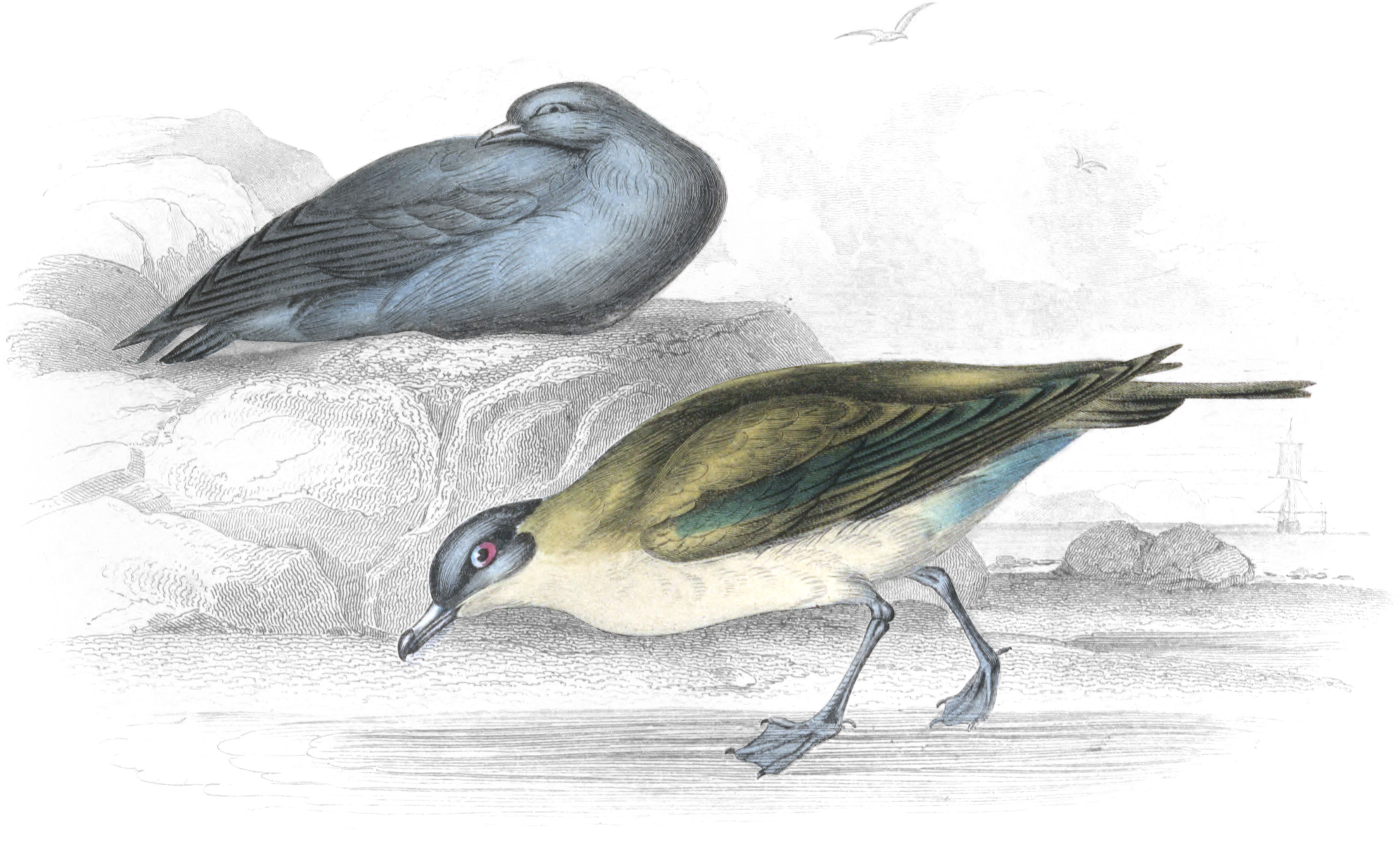
Plate XXVIII

Arctic Skua
Lestris Parasiticus.
The True Arctic Skua has been confounded with the preceding, but it is a much more rare species, and is at once distinguished by its smaller size, more graceful proportions, and by the very elongated centre-feathers of the tail. Three specimens only of this Skua have been obtained on the northeastern coast of England. The Zoological Society are said to have received it from Orkney, and we possess a single specimen from the same islands. We are not sure, however, that it breeds even in the more northern parts of our limits, for most of the older notices of the Arctic Gulls are referrible to the preceding bird. It has been obtained on the French coasts, but is also apparently rare there. Its true station appears much farther northward, and we have received, at different times, specimens by the northern trading vessels, chiefly the whalers. Mr. Audubon states that it ranges along the southern coasts as far as the Mexican Gulf and the shores of the Floridas,
but I never met with a single individual in summer, even in the most northern parts.
An Orkney specimen of this bird, but we do not know at what season obtained, has the crown, back, wings and tail very deep greyish clove-brown, the under parts greyish brown, the sides of the neck glistening sienna-yellow, but not so bright as when killed at breeding season; the centre-feathers exceed the others by three inches.
Before passing from these remarkable gulls, we may observe, that it is generally stated that they derive their whole food from their pursuit of other birds, using what they are made to disgorge. In the somewhat analogous case of the fish-hawks, we know this is practised; but, at the same time, these birds can and do forage for themselves, and we would almost be inclined to believe that the Skuas are not quite dependent on the work of others, but occasionally seek food for themselves, and that the large species will feed on carrion thrown upon the coast. We acknowledge that we have never seen these birds employed for themselves, but would wish a little more attention was paid to this part of their economy by those who have the opportunities.
The next group of birds we shall notice, though not immediately connected with the Skuas, is the Terns, contrasting with them in the delicacy of their plumage and the slight, airy, and elegant proportions of their form; they lead us directly to the True Gulls by means of the intermediate form represented by the black-headed group. Most of the species are summer visitants.
Genus Sterna, Linnæus.—Generic characters.—Bill rather long, nearly straight, compressed, drawn to a fine point, maxilla with a slight angle near its centre; nostrils basal, lateral, linear, oblong, pervious; wings very long, accuminate, quills in situ having a narrow surface, first longest; legs short, feet small, tibiae naked for a short space down the tarsal joint, hallux short, claws sharp.
Types.—St. hirundo, rosea, minor, &c. Cosmopolite.
Note.—Gregarious; breed on the coasts or islands; take their prey by a partial plunge.
The Caspian Tern
Sterna Caspia, Pall.—Hirondelle du iner, Tschegrava, Temm.—Caspian Tern of British authors.
The Caspian Tern has been killed at different times on the English coast, particularly on the eastern side, but we are not aware of any birds occurring to the northward or in Scotland. It is a bird of which very little generally is known; it breeds eastward along the shores of Europe, has been obtained in the Grecian Archipelago, and, as its name indicates, in the Caspian Sea. Its only recorded breeding station is at Lylt, an island on the west coast of Jutland.76 We have received specimens from Southern Africa, as mentioned below; and Senegal is also given as a locality. It occurs sparingly m Continental India.77
A specimen of this very fine species, received many years since, by the attention of Dr. Smith, from the Cape of Good Hope, has the strong bill vermilion-red, the tip of the maxilla brownish black; the forehead and crown ending in a rounded point on the nape, white, but having the feathers very broadly marked with black along the shafts, so that to appearance there is a greater proportion of the latter colour; around the lower part of the eye and the auriculars dull black; mantle and wings pale grey, the four first quills dark greyish black,with strong white shafts; tail grey, not slaving a great fork, and having a dull shading band at a short distance from its extremity; back of the neck and all the under parts pure white; feet and legs black tibiæ naked for nearly an inch above the tarsal joint.
The Sandwich Tern
Sterna cantiaca.—Sterna cantiaca and Boysii, Mont., Penn.—Hirondelle de mer Caugek, Temm.—Sandwich Tern of British authors.
In the seas bordering the Continent, the Sandwich Tern is frequent, stretching to Italy. Dr. Smith is said to have brought specimens from South Africa, and we have skins apparently very near to it from India. Mr. Audubon writes that it is seen from Texas to the Floridas, where it breeds. Thus, if all these authorities are correct, the range of this species will be of great extent. Mr. Audubon found it on the Florida Keys in the end of May, and considered those which he procured there as new to the North American Fauna, but there and Charleston were the only parts where he met with it.
It is remarkable that the Sandwich Tern should have remained so long unnoticed by our ornithologists, for it is by no means an uncommon species, although in Ireland, or the south of England, it does not appear to have been so frequently noticed. In the former, Mr. Thompson mentions no breeding stations, but Mr. Yarrell has stated on authority, that it breeds on Romney Marsh and in the mouth of the Blackwater in Essex, localities differing from those in which we have elsewhere seen them. On the north-eastern coast it breeds abundantly on Coquet and the Farn Islands, on the latter in great abundance; further into the Firth, we have it breeding on the Isle of May and some lesser rocks off North Berwick. We have seen it on the Solway also, but do not know of any breeding station there; and we have observed it on the very northern coasts of Scotland in the month of June. It has been on the Firth of Forth that we have chiefly observed this tern; on the Farn Islands there is a large colony, which we have visited in company with Mr. Selby. That gentleman states that it has
selected a station apart from the other species, generally on a higher site, and the nests are so close to each other as to render it difficult to cross the ground without breaking the eggs or injuring the unfledged young.
Further up the Firth the colonies are not so numerous, but their habits are similar. At low water the birds which are not incubating rest on the sandbanks; they will not suffer a near approach, but rise in a silver cloud and fly towards the intruder with great clamour and angry demonstrations; and if one can be secured, they will approach very near, hovering over it. Immediately on seeing any person or animal with which they are unacquainted, they commence venting their harsh and wild screams, and small parties, flying noiselessly along, betray themselves by their calls as soon as the stranger is perceived.
The forehead, crown, and occiput, where the feathers are lengthened and almost form a pendent crest, are black, more or less spotted with white, which appears very seldom to go entirely off. The under plumage and back of the neck white, with a greater or less degree of rosy tint in different specimens; mantle and wings grey, quills blackish grey, the inner half of the inner webs white, shafts strong, yellowish white; rump, upper tail-covers, and tail, white; bill, legs, and feet, black, former with the tip straw-yellow. In winter the crown and forehead are described to be white, the occiput black feathers tipped with white. The young are above pale wood-brown, transversely barred with brocoli-brown; white below; the tail greyish black in the centre.
The Roseate Tern
Sterna Dougallii, Montagu.—Hirondelle de mer Dougal, Temm.—The Roseate Tern of British authors.
This is perhaps the most elegantly formed of all those elegant birds, and is far from being uncommon, but the close resemblance of species being only more looked into lately, it remained for a considerable period undistinguished; Mr. Selby, however, seems to think that it was not always so plentiful as at present on the Farn Islands, and recollects the period when the light-keeper intimated to him its appearance as a distinct species. In distribution this tern does not seem very widely spread, Mr. Yarrell has only given us a few stations southward of a line between Cumberland and Northumberland. On the Farn Islands “it breeds on the outskirts of the station occupied by the arctic tern,” as stated by Mr. Selby; and when we last visited those islands in that gentleman’s company, was in considerable abundance. When intruding on the nest, it showed great anxiety, approaching so near that we knocked one or two down with a fishing-rod used by the keeper for catching white fish from the rocks. All the terns are very light, the body being comparatively small, and the expanse of wings and tail so buoys them up, that when shot in the air they are sustained, their wings fold above them, and they whirl gently down like a shuttlecock. This bird is remarkably buoyant, and we could almost run below and hatch the specimen in our hat before it reached the ground. The Roseate Tern breeds also on the Isle of May in considerable abundance, where our specimens were obtained. There is another colony on the Cumbrae Islands in the Firth of Clyde, and there may be many others around the Scottish coast which have not yet been noticed, when parties are met with at sea, there is a lengthened slightness of form that betrays them to the ornithologist, or they are at once distinguished by their call being different from that of the arctic or common terns. We have a specimen very closely allied, if not identical, from the island of Tobago. Mr. Audubon found the Roseate Tern breeding in. abundance on the Florida Keys, in company with the Sandwich tern.
Specimens of this graceful species, shot on the Isle of May, Firth of Forth, during the breeding season, are distinguished by the delicate form, the pale tint of the mantle, the rosy hue of the under parts when newly killed, and by the bill being black as far as the nostrils, the base of it only vermilion-red. The forehead and crown passing narrowly below the eyes, and terminating in a peak on the back of the neck, deep black; the mantle and wings very pale grey; the quills having the outer webs and shaft half of the inner darker, the outer webs of the first blackish grey, the shafts of all strong and white; rump and lower back white; tail long, the outer feathers narrow, much lengthened, forming a deep fork, entirely pure white. The cheeks, sides of the neck, and all the under parts, white, with a delicate rosy tint, which, in a few hours after death, becomes paler, and in stuffed specimens is generally completely faded. The plumage of the winter does not seem to be authentically known.
The Common Stern
Sterna Hirundo.—Hirondelle de mer Pierre Garin, Temm.—Common Tern of British authors.
This Tern is a much more uncommon bird than either the roseate or arctic. On the eastern side of the island it is by no means frequent, two or three pairs being all the number that Mr. Selby has at any time observed breeding on the Farn Isles, and further up the Firth we have observed it sparingly, a few breeding on the Isle of May. The ornithologist above quoted states that it visits the western coast, and would almost seem, comparatively there, to take the place of the other two. Mr. Yarrell has given us frequent instances of its occurrence on the southern coast, but we do not trace it with authenticity northward to the islands of Scotland, except that it is mentioned by Mr. John Macgillivray on the outer Hebrides. In its breeding habits it differs from the last, and resembles more nearly the lesser tern, seeming to prefer a shingly beach or low lying ground to rocky islands. Mr. Heysham of Carlisle has mentioned Rockcliff Salt-marsh on the Solway to Mr. Yarrell as a station, and a few pairs breed on the shingle above Skinburness, where there is also a small colony of the lesser tern. This species also is said to ascend the course of rivers and to roam more inland than the preceding. Many years since we have shot this tern on the river Annan, fifteen miles from the sea; and in spring, one or two pairs appeared regularly following the course of the stream and fishing, but apparently returning seaward the same day. Their appearance for a month or six weeks was quite regular, darting into the stream, as in the sea, after minnows, &c., and approaching clamorously any one walking on the banks. It has not now been seen for many years.
In a specimen also procured on the Isle of May during the breeding season, the proportions of this bird are stronger than those of the last the bill is; vermilion-red for two-thirds of its basal length, the end black, the extreme tip yellowish white; the forehead and crown not passing below the eye, and terminating in a peak on the back of the neck, deep black; the back, mantle and wings grey, quills with the shaft, outer and half of the inner webs blackish grey, the outer web of the first black, shafts of all strong and white; rump and upper tail-covers white; tail long, but not nearly so deeply forked as in the last, white, except the outer web of the outer feather, which is black; cheeks, sides of the neck and under parts, white, very slightly tinted with greyish, and, while newly killed, having a slight roseate blush.
The Arctic Tern
Sterna Arctica.—Hirondelle de mer Arctique, Temm.—The Arctic Tern of British authors.
This tern, ranging to a much higher latitude than either of the preceding, would perhaps have been more appropriately named Common than the last, for we consider it the most frequent bird on our shores; it also seems to prefer the shingly beach to rocks, and around Great Britain seems, from all our information, to be. dispersed pretty generally. We have observed the colony on the Farn Islands, where the eggs are “deposited on the bare sand or gravel.” On the Isle of May it is also plentiful, but breeds in a situation nearly similar to the roseate. It stretches northward to both Orkney and Shetland, and in the latter was the only species seen by Mr. Dunn. The nest was here made on the “gravelly beach, sometimes amongst the short dry grass on the tops of low cliffs.” In one or two instances large flocks of this species have appeared inland as if driven from their course, these chiefly occurred in spring. The harbour and docks of Bristol were visited by large flocks during high winds that prevailed on Sunday 8th May, and two or three hundred were killed with sticks and staves.78 They here seemed to be quite exhausted. Accounts of another large colony being driven astray are given by Mr. Strickland in the Annals of Natural History, and which seemed to have spread over a larger extent of country. This occurred in June, when the birds ought to have been breeding. Forty specimens were taken to one bird-stuffer, thirty-three to another. A few common terns were said to be mixed with them, but Mr. Yarrell, who saw several specimens sent up to London, and who had a good deal of correspondence at the time regarding them, considers that the great proportion of the birds were Arctic Terns. This flight occurred on the 8th and 9th June, 1842; and it is stated that some specimens had not acquired the perfect black head. Now, all our birds would be at their stations and in full plumage by that season. May these not have been some almost Arctic colony later in assembling, and thus dispersed by the north-west gale which accompanied them?
In the Arctic Tern the bill is shorter than in either of the two preceding birds, and is entirely vermilion-red. The tarsus is comparatively shorter, and the leg is feathered to the tarsal joint, whereas in the others a small portion of the tibiæ are bare; the forehead and crown not passing below the eye, and terminating in a rounded peak on the back of the neck, deep black; the back of the neck, mantle and wings grey, the quills having the outer webs and the shaft half of the inner, blackish grey,—the outer web of the first black, the shafts of all strong and white. The rump white, the tail rather more deeply forked than the last, the feathers broader, white, except the outer webs of the two on the outside, which are blackish grey; the under parts white, vent and under tail-covers pale blackish grey. The only difference in the sexes is a slightly larger size, and in the black extending rather farther down the nape on the male.
The Whiskered Tern
Sterna Leucopereia.
Of this tern a single specimen only has been obtained on the coasts of Britain, shot by a boating party at Lyme in Dorsetshire, and fortunately coming under the observation of T. C. Heysham, Esq. of Carlisle, that gentleman procured for Mr. Yarrell an opportunity of examining it, and a well executed wood-cut has appeared in the British Ornithology. It still appears a rare bird everywhere, or it has been overlooked; but Europe may be only the limit of its range northward, and abundant colonies may at some time be met with. Temminck states having received specimens from Borneo. We borrow Mr. Yarrell’s description of the Dorsetshire, and at present, the only British specimen.
The bill is red, inclining to dark brown on the edges of both mandibles towards the point, rather short, and the under mandible prominent, an approximation to the form of the under mandible in the gull-billed tern; the irides brownish black; forehead, crown and nape black; from the base of the upper mandible, in a line below the eye to the ear-coverts, a stripe of white, forming the whisker or moustache; back, wing-coverts, upper tail-coverts and tail-feathers, uniform dark grey, almost slate-grey; first quill-feathers lead-grey on the outer web, and over a considerable portion of that part of the inner web nearest to the white shaft, the other part of the inner web white; the outer webs of the other primary and secondary feathers lighter grey than the inner webs; chin and throat greyish white neck; and breast slate-grey, and as dark as the back; abdomen, thighs and flanks, lead-grey; under wing and tail-coverts white; legs, toes and membranes red, the membranes deeply indented.
Length to the centre of the fork of the tail, ten inches and a half; to the tip of the longest outside feather, eleven and a half.
The Lesser Tern
Sterna minuta.
Sterna minuta, Linn.—La petite Hirondelle-de-mer, Temm.—The Lesser Tern, or Sea Swallow, of British authors.
This beautiful and graceful little bird is in suitable localities pretty generally distributed around England and the south of Scotland, stretching round in the latter as far as Aberdeen79 on the east side. According to Mr. Thompson, it is a regular summer visitant in Ireland. It breeds on the shingly beach, never, that we have seen, on the rock or among grass, like some others; but the nest is placed in a situation similar to that of the ring-dotterel, in a slight hollow, and without the protection of any cover or lining. Mr. Selby has mentioned a colony on the coast opposite the Farn Islands; we have visited another upon Guillon Point, above North Berwick on the Firth of Forth, and a third upon the Solway at Skinburness, all similar to each other. When approached, this tern may be heard at a distance seeking for the invader of its ground, and by and bye its tiny form is seen advancing with long strokes of the wing; but it is scarcely so bold or clamorous as some of those we have described, and hovers over the person, making long stoops at him, and again rising high. We have once or twice met with it in small parties of young and old, late in autumn, but it seems to leave the coast immediately after incubation, and is much less frequently seen la e in the season than the Sandwich and arctic terns Its European range is not very well ascertained in France and Holland it is said to be common, and the shores seem suited for it, but although included in some of the southern Fauna, little more is said regarding it. We believe the Indian specimens are identical, but those from North America, closely allied to it, are distinct.
The Gull-billed Tern
Sterna Anglica, Montagu.—Hirondelle de mer hansel, Temm.—Gull-billed Tern of British authors.
This tern, very rare to the British list, was distinguished by Colonel Montagu in his Supplement, and Mr. Yarrell states that he has heard of two examples killed in 1832, one of them in Kent; but it may be considered as of accidental occurrence even in temperate Europe, and its breeding places have not been described. We have had no opportunity of seeing foreign specimens, but many authors that we ought to have reliance on give it a very extensive range. Mr. Audubon and Mr. Selby consider Wilson’s marsh tern identical; Colonel Sykes gives it from India; it is also a native of the Isles of Sunda according to Temminck, who considers the S. affinis to be the same species. In habits it is said to frequent lakes and rivers rather than the open sea, and to resemble more the two next species than those which are more decidedly maritime. The angle of the maxilla is more developed than in the other British species.
In summer the forehead, crown, and nape are black; the upper parts, including the tail, grey; quills with the outer web of the first darker; the under parts of the body white; bill, legs and feet, black. In winter the black upon the head is wanting; length from fifteen to sixteen inches.
The Black Tern
Sterna nigra.
Sterna nigra, Linn.—Viralva ngira, Leach, Steph.—Hirondelle de mer noir ou epouventail, Temm.—Black Tern or Sea Swallow of British authors.
The Black Tern, as will be seen from the synonims, has been considered by some worthy of a sub-generic rank, the differences in form, are, however, not very marked, and here we think it unnecessary to separate them. Its habits, during incubation at least, are, however, different, being an inland breeding bird, frequenting lakes and extensive marshes, and during that time being in a great measure insectivorous. In Scotland we are not aware of specimens being obtained, and no breeding station exists; in England it resorts principally the fenny districts of Norfolk, Lincoln, and Cambridgeshire, besides other less noted situations; but some of these are disappearing, and one in Norfolk, where, twenty years since, hundreds of nests might be found, has been broken up for some time.80 In Ireland it breeds at a small lake at Roxburgh, near Middleton, Cork.81 In the more marshy districts of the European continent this tern is also found, most abundant in Holland and Hungary, and it is known to reach to the north-eastern Asiatic boundary. The American bird is identical and there frequent.
Head and back of the neck black, shading on the throat, breast, and belly, to deep blackish grey; vent and under tail-covers white in like manner; the black on the upper parts shades into deep bluish grey, which is nearly of a uniform tint over the wings and tail; the outer web of the first quill is black, a narrow pale list bordering the edge of the inner; bill black; feet and legs reddish black, the palmations of the toes very deeply cut, claws comparatively long.
The plumage of winter is described as being white on the crown, back of the neck, cheeks, throat, and fore part of the neck. In the young the under plumage is entirely white.

Plate XXII
Terns: Black (Left) and Lesser (Right)
The Noddy Tern
Sterna stolida.—The Noddy Tern, Noddy, or Black Noddy, of British authors.
The last tern we have to describe as British has only lately been noticed, two specimens having been recorded as obtained between the Tasker lighthouse, off the coast of Wexford, and Dublin Bay. It appears also to be occasionally seen off the coast of France, but its precarious appearance is such that it can only be esteemed as a straggling visitant to any parts of the European coasts. It is a North American birdy but ranges southward to breed, Audubon having met with it in one of the Tortugas. He gives a very interesting account of the colony, which was extremely numerous and very tame, apparently unaccustomed to the inroads of plunderers. Its manner of breeding is as much at variance with that of the truly maritime terns as the last. The nest of this species is placed on bushes or low trees (nearly on the ground) which rarely grew taller than the party, and therefore the interior of the nest could be easily inspected; it was constructed of twigs and dry grass, and a series of old nests often were raised into a considerable heap.—We have received specimens from the island of Tobago, and also from the China seas. Our description is from Tobago skins.
The colouring of the plumage is extremely simple, being of a nearly uniform umber-brown, darker on the wings and tail, except on the forehead and crown, which are yellowish grey shading, above, backwards into brown; bill and legs black. The feathers of the tail are broad, and make that member, though forked, appear proportionally ample.
Passing from these terns of less maritime habits, and from those where the angle of the mandible is greater, we enter .into the typical form of the family, or the True Gulls, by means of a series of smaller species, more inland in their habits, possessing a distinct dark colour, during the breeding season upon the head, partially insectivorous, and resembling the terns also in their cry. These nave been placed in a separate genus, Xema, which, in the general system, may be adopted; we shall here, however, include all under the generic title of Larus, deriving our characters from the larger species. These, the True Gulls, have a wide geographical range, are almost entirely maritime in habits, breed principally on precipitous coasts, have very ample powers of flight, and feed on almost any animal matter in addition to the living produce of the seas. The seasonal change is comparatively slight, the head in summer being pure white, in some, during winter, streaked with grey along the shafts of the feathers.
Genus Larus.—Linnæus.—Generic characters.—Bill strong, cultrated, maxilla with the tip sharp and much curved, mandible with a strong angle; nostrils lateral, central, widest anteriorly, pervious; wings long, accuminate; legs central, tibiae bare for some portion, feet strong, palmated but formed for walking, hallux articulated on the tarsus.
Note.—First division or Xema, breed in colonies inland; insectivorous; decided seasonal change; size small. True Gulls, Larus, are maritime, gregarious during incubation, no decided seasonal change; size generally large.
Sabine’s Gull
Larus Sabini.
Xema Sabini, Leach.—Mouette de Sabine, Temm.—The Sabine, or Sabine’s Gull, of British authors.
The first British specimens of this gull were noticed and brought before the public by William Thompson, Esq. Belfast, and up to 1839, four specimens of this rare species had occurred in different parts of the coast, all during the month of September, and were all which at that time were known to have been met with within the British range. These were noticed in the Magazine of Zoology and Botany and in the Annals of Natural History, and we were indebted to Mr. Thompson for a drawing of the bird in its young plumage, which appeared in the Illustrations of Ornithology. Since 1839 Mr. Yarrell states that he has notes of one shot at Milford Haven, and another in Cambridgeshire. A few straggling specimens have also been killed on the Continent, but the true country of the species is in the vicinity of the arctic circle. The first specimens were procured by Captain Sabine during the Northern Expedition in 1818, and they were afterwards seen by the other arctic voyagers; they have been met with in Spitzbergen, Igloolic, and Behring Straits; and the first birds were killed on a group of islands on the west coast of Greenland, where they were breeding in company with the arctic terns, laying their eggs on the bare ground.
This species, in the forked form of the tail, exhibits a variation from any of the others either belonging to the black-headed division or to the true gulls; in other respects it is a small graceful bird, rather slightly made. In the adult breeding plumage a specimen before us has the head, throat, and upper part of the neck, blackish grey on the nape black, shading into the grey, and running to a point forwards; mantle, wings, and tertials grey; greater covers and secondaries broadly tipped with white; lower part of the neck, upper tail-covers, tail and under parts, pure white; quills black, with white tips, except the first; the half of the inner webs white, as in the terns; whole edge of the wing black; bill black at the base, the tip yellowish white; feet and legs black.
The specimen shot in Belfast Bay, the drawing of which we have alluded to, was in the autumnal plumage of the first year, and Mr. Thompson thus described it:—
The forehead, space immediately above the eye. and between it and the bill (with the exception of the narrow line of greyish black closely encircling the front and lower part of the eye), upper part of the throat, and sides of the neck, are white; crown, nape, and back of the neck, blackish grey; back, scapulars, greater and lesser wing-coverts, blackish grey, tinged with yellowish brown, the extremity of every feather varying from greyish white to white, as it approaches the tail; under part of the throat and upper part of the breast, pale ash-colour; lower breast and all the under plumage white; shafts of the first six primaries brownish black at base, becoming gradually darker towards the extremity, where they are black in the first three, but in the fourth, fifth, and sixth, assimilate in colour to the feather at that part, which is white; the entire of the outer webs of the first five, black; the inner webs with a broad edging of white, to within from one to two inches of the end, which part is black in the first three, but tipped with white in the fourth and fifth; in the sixth, the inner web is white, the outer black, excepting for three or four lines from the tip, where it is white, and again, at about an inch from the end, where a white spot of an oval form appears.82 Feathers of the tail twelve in number, white with black tips; in the two shortest the latter colour extends upwards of an inch from the end, in the outer web especially; of the other feathers, the black prevails in a less degree as they increase in length; upper and under tail-coverts white.
The plumage of the winter, or its range during that season, are not known.
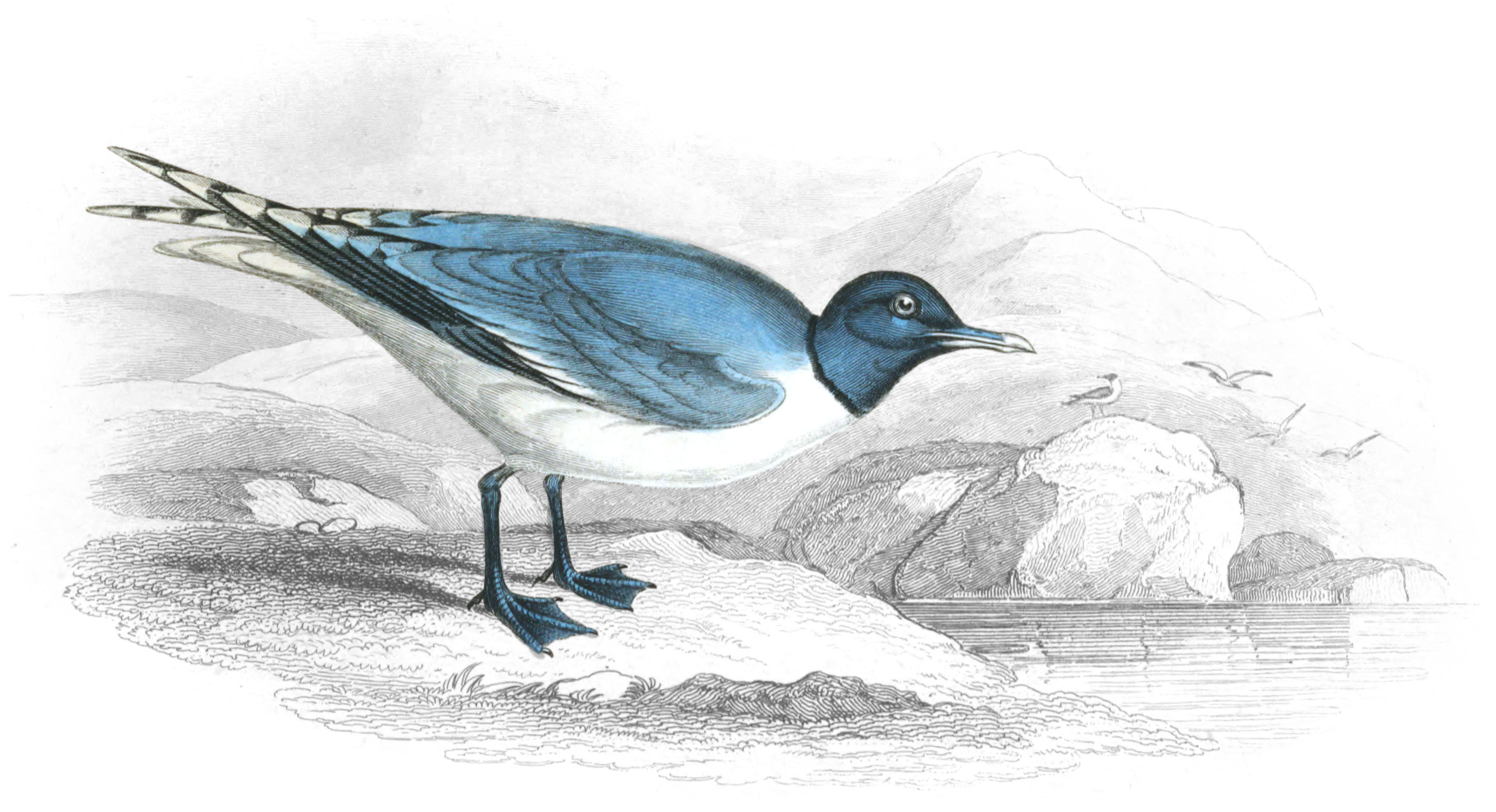
Plate XXIV
(Summer Plumage)

The Little Gull
Larus minutus, Pallas—L. minutus, Pall., Gmel.—Chroiocephalus minutus, Eyton.—Xema minuta, Gould.—Mouette pyymée, Temm.—Little Gull of British authors.
This beautiful little species is also a rare bird, and neither its breeding stations nor its true winter localities are yet correctly traced. We are indebted to Colonel Montagu for the first notice of it, from a young specimen shot near Chelsea. Since that period various specimens have been obtained in England, from the coasts of Devon and Cornwall to the mouth of the Tyne. In Scotland two or three have been killed; one at the mouth of the Clyde, in the first year’s plumage, is possessed by the Edinburgh Museum; and a second, also in the same collection, was procured by Dr. Neill from some part of the Solway. In Ireland, a single specimen is recorded by Mr. Thompson as shot on the Shannon, in the complete dress of summer. On the Continent it seems also only sparingly distributed, and as if having strayed; but it is stated by Prof. Nillson that it breeds in the marshes in the vicinity of the Baltic and in Gothland.
In summer the whole of the head and upper part of the neck become black; the white of the lower part of the neck and the under plumage assumes a slight rosy tint, but the lower part of the back and tail remain of a pure white; the bill becomes of an arterial blood-red colour, and the legs and toes acquire an additional intensity of hue.83
In winter the black of the head is lost and becomes white, marked on the “ anterior angle of the eye, ear-coverts, nape, and back part of the neck with deep blackish grey.” In the first plumage there is a considerable mixture of clove-brown with the upper plumage, and the tail is terminated by a broad black bar.
The Black-headed Gull
Larus ridibundus, Linn.—La mouette rieuse, ou à Capuchin brun, Temm.—Black-headed Gull, Red-legged or Laughing Gull, of British authors.
This is the most common and best known species of all the British Black-headed Gulls, being generally distributed over Great Britain and Ireland, and assembling in large colonies to breed in marshes or reedy lakes; in some parts it is protected, and the benefit of collecting the eggs is let. Early in spring, before taking up their breeding stations, and before having attained the black head, these gulls assemble in small parties during the day, often following the plough, but apparently returning for a time to the coast at night. The black head is assumed in the course of a week, the change of colour being extremely rapid, and nearly when this is completed, they assemble at their stations,84 remain during the night, and commence all the operations of incubation. On approaching their retreat they become very clamorous, stooping at the stranger, whether man or animal; all settling for a few minutes, and again simultaneously rising to renew the attack; in a large colony, the noise of their cackling or laughing voices will nearly drown any other sound. At this season they frequent fallows, the banks of a river when flooded, and in ordinary state will often assemble on the shingle to dress and feed on the aquatic insects, some parts being much more resorted to than others. They will also watch the appearance of the Pryganidoæ or river-flies, which rise in troops at stated times and; while the trout make war on them as they rise and leave their element, the gulls pursue them on the wing, skimming the surface of the water, and following the insect almost like swallows. When the insect flight is over, the birds again settle; but their perceptions tell when it is again about to rise, and before an observer can detect them, they are again active, skimming and hovering over the stream. When the young are able to travel they resort to the shores, and in autumn they may be found in flocks, the young easily distinguished by their different plumage, the black bar at the end of the tail, and their far weaker cry. The Black-headed Gull is at all times to be met with on the coast in the south of Scotland during winter, but in no proportion whatever to the large numbers that annually resort inland to breed, and there can be little doubt that a partial migration takes place to this country in spring, and from it again in autumn. During winter a few ascend rivers, retiring seaward at night. On the river Annan, at that season, six or seven may be daily seen singly following its course upwards in the morning, resting and feeding among the shallows, and at night wending their way again downwards. They are at this season very shy, and being seldom long at rest, are difficult to approach even with the assistance of cover; and they will always turn aside to a sufficient distance from any object they suspect. They are particular in choice of a breeding place, at least some which we would think suited for them are passed or deserted, and others more unlikely are selected. We possess a reedy loch which was for many years a haunt of these birds, but the edges were planted, and they left it; ten years afterwards, and when the plantation had grown up, a few pairs returned, and in time increased to a large colony, when an artificial piece of water was made by damming up a narrow pass in an extensive muir nearly two miles distant; thither the gulls resorted the following spring, leaving their ancient ground, and they have been increasing in numbers for some years past. In Scotland it extends to the most northern counties, the Orkneys and Shetland. On the Continent the Black-headed Gull seems also distributed, but we have no detailed account of its habits there, and we have few memoranda of its extra-European range. The Zoological Society have received it from Erzcroom.85
The next three species of black-headed gulls are only accidentally found in Britain, and are now introduced that attention may be attracted; one of them may be found in some locality in the Orkneys or the northern islands of Scotland; they are easily confounded with the last by an inattentive observer.
The Masked Gull
Larus capistratus.
This appears to be everywhere a rare species, and the examples of it which have occurred in Britain have been few, amounting to five or six in number. We have not a specimen before us, and borrow generally the British information regarding it. The first specimens were those in the collection of Mr. Bullock, sold to Dr. Leach at the dispersion of his collection, and said to be taken with the young and eggs in Orkney; and a third specimen has since that time been procured from Shetland. It has occurred in Wales, and to Mr. Thompson in Ireland. On the Continent a few instances are also recorded, but we have no information of its breeding places. It may probably be a northern species; Temminck states that it is found in Baffin’s Bay and Davis Straits.
In this species the dark colour of the head does not reach to the occiput, but covers the forehead, region of the eyes and cheeks, and extends downward on the throat and fore part of the neck; the back of the head and neck, underparts and tail, pure white; the mantle and wings pale grey; the bill, legs and feet, according to Mr. Yarrell, are brownish red. In winter the dark colour of the head is lost, and, according to the author we have quoted, there are a few dusky grey lines on the crown and a small patch of dusky black under the eye, and upon or under the ear-covers. Length fourteen inches and a half.
Black Winged Laughing Gull
Larus melanoccphalus.
Another species, which has not yet been discovered in Britain, was drawn and engraved, and stood as
Plate XXIII
before the mistake was discovered; it is very closely allied to the last, and is a native of the coasts of Southern Europe; we have thought it best to allow this to remain and exhibit the distinctions of the pale mantle and pure white quills when contrasted with

Plate XXIII
The Laughing Gull
Larus atricilla.
Xema atricilla, Gould.—Black-winged or Laughing Gull of British authors.
This is even more rare than the Masked Gull as a British visitant, and the specimen in the collection of Col. Montagu still remains the only one that can be claimed to our Fauna, it was obtained in the month of August in the shingly flats near Winchelsea. It has been noticed sparingly in South and Southeastern Europe. This is properly a North American species, and Mr. Audubon found it breeding on the Tortuga Keys, New Jersey, at Gavelston in Texas, and at Great-egg Harbour, at the latter place on the borders of a salt marsh bordering the sea shore. It constantly evinced a dislike to rocky shores. We possess specimens from Tobago. The head, throat, and fore part of the neck, greyish black, with a spot above and below each eye white; the lower part of the neck all round, upper tail-covers, tail, and all the under parts, pure white; mantle and wings dark grey, tips of the greater-covers, secondaries, arid tertials, white; three first quills black, slightly greyish at the base, the fourth and fifth black at the tips, with the point white; bill carmine red; feet and legs brownish red. Plate XXIII. exhibits the Larus melanocephalus, Boye; in this the head is black, and does not extend so far down the front of the neck; the back of the neck, mantle and wings, very pale grey; quills white at the tips, the outer web of the first black to within two inches of the tip; the bill orange-red, with a dark band across the angle; legs and feet brownish red.
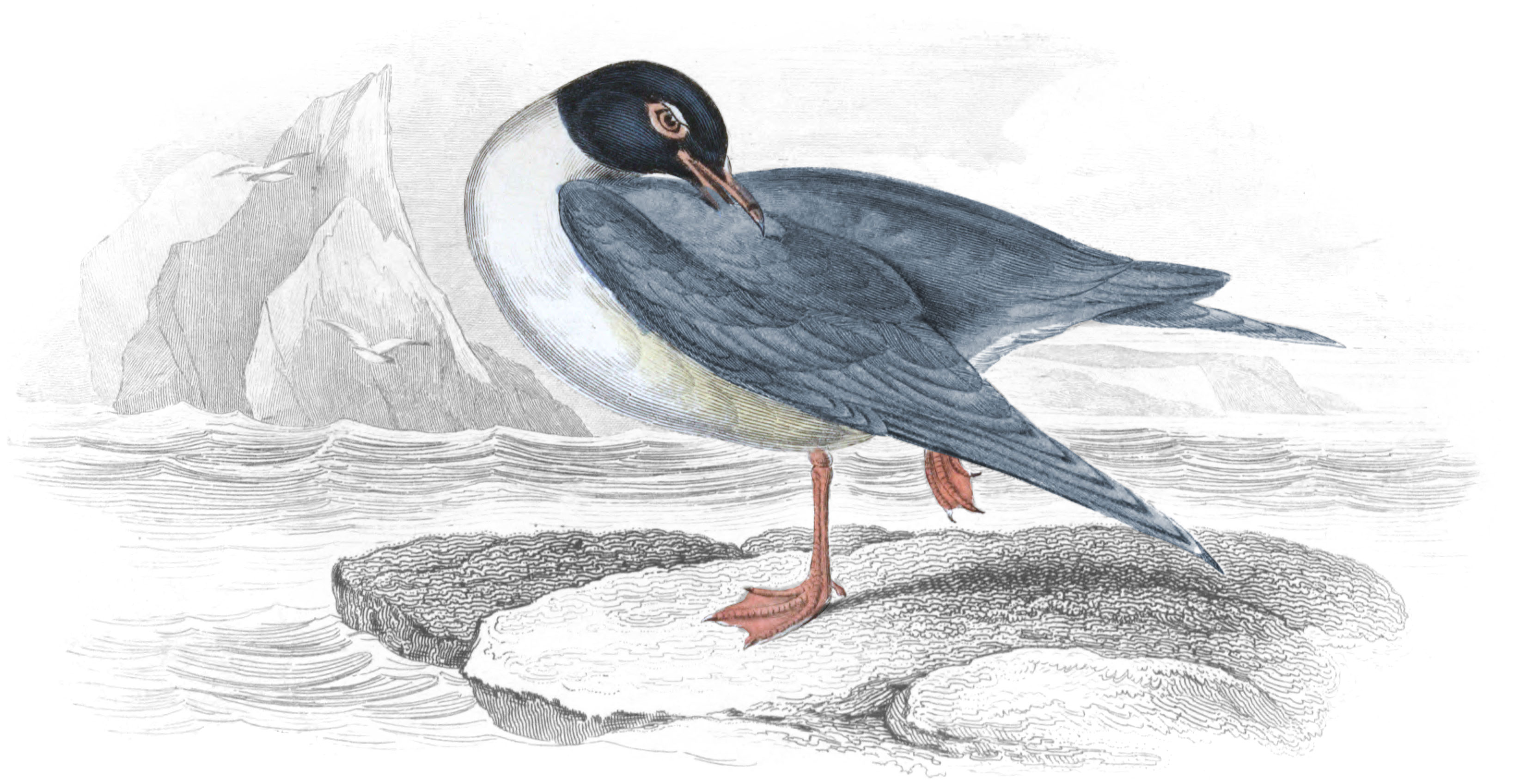
Plate XXV
We now have to describe the British series of True Gulls, placing one or two smaller species at the conclusion, as being more exclusively maritime, and in some points assimilating with the petrels with which Ve commenced the family. The True Gulls are mostly of large size, and are almost all distinguished by two colours, pure white covering the head, vent and under parts, and by a darker mantle and wings of some grey shade. One of the largest is
The Great Black-Baked Gull
Larus marinus, Linn.—Goeland à manteau noir, Temm.—Black-lacked or Great Black-lacked Gull of British authors.—(L. nævis, the Wagel, young).
This fine species, the largest of our British gulls, is much less frequent than the next bird we shall describe, and for which we think it has been sometimes mistaken, at least when seen only in flight. It is chiefly seen in pairs in its adult plumage, is a comparatively shy and wary bird, and maybe said to be generally distributed around the coasts of Scotland and England after the season of incubation, frequenting estuaries, but seldom straying far from the sea or inland along the course of rivers. In Ireland, from all our records, its frequency and habits at this season are nearly similar. In Europe, it has been found on the Italian shores, and in Sweden and Norway, but we have no notice of its abundance or rarity there. Towards the arctic circle it becomes rare, but by Audubon is given to North America, breeding on the shores of Labrador for an extent of three hundred miles; in winter the young migrate as far as the Floridas. In Asia or Africa we appear yet to possess no authentic traces of its existence. The Great Black-backed Gull breeds chiefly in marshes, and on the kind of tracts called in the northern islands of Scotland “Holmes,” being elevated flats of rather wet muil or muirish meadow; the low lands about the estuary of the Thames being an example of the first, where Mr. Yarrell observes that this bird frequently breeds. In Orkney and Shetland, however, Mr. Hewitson tells us that it breeds in places nearly inaccessible, and in large companies, the space of half an acre supplying in one year no less than sixty dozen of eggs. We have ourselves observed a few pairs breeding on the Bass Rock in the Firth of Forth, and in one or two similarly insulated situations, and the nest was always placed on the flat or grassy slope of these islets, never on the precipitous part of the cliff, the eggs almost laid on the ground, or with a small portion of dried grass collected. Mr. Dunn writes, in Orkney and Shetland the Black-backed Gull “builds its nest on small islands on stalks and the most inaccessible part of the rocks.” The parent birds defend their nest from all winged aggressors, but on the more frequented islands they seem to dread more the presence of man, and soar high over head, showing their anxiety by their continued hoarse cackle, and only occasionally venturing a stoop at the aggressor.
A specimen shot in the Firth of Forth in February, and sent for our use by Mr. Fenton of Edinburgh, is in length between twenty-six and twenty-seven inches;86 the extent of the wings, fully expanded, five feet; the whole of the bead, neck, rump, tail, under wing-covers, axillary feathers, and all the under parts of the body, pure white; the centre of the back and mantle deep greyish black, the quills nearly black; the secondaries are tipped with white, forming a bar across the wing; the first quill is tipped with white for nearly two inches, the second for a shorter space, but having a narrow black bar interrupting it near the tip; the third with a short white tip, and the fourth with a short white tip succeeded by black, again succeeded by a narrow clouded bar of greyish white; the bill is strong, yellow when fresh, slightly tinted with greenish, the mandible on its angle orange-red, and having in this an irregular dark spot upon its cutting edge, which crosses and appears on the maxilla also about half-way between the nostrils and the tip; the legs and feet are livid, or of a yellowish grey tinted with pink. The larger size, colour of the legs, and dark spot on the bill, easily distinguishes this species from the next.
The Lesser Black-Backed Gull
Larus fuscus, Linnæus.
Larus fiiscus, Linn.—Goeland à pied jaunes, Temm.—Lesser Black-backed, or Yellow-legged Gull of British authors.
This handsome species was long confounded with the last, from the great similarity of its plumage to a casual observer. It is at once, however, distinguished by its lesser size and yellow legs, and it varies considerably in its habits being much less maritime. It is a bird very generally distributed around our shores as well .as those of Ireland, but both this and the last sometimes vary their breeding stations; thus, Mr. Yarrell states, the Great Black-backed Gull is on our south-eastern coast a much more rare species than the Lesser Black-backed Gull, and in those districts decidedly a marsh breeder; while the Lesser Black-backed Gull here as constantly resorts to the rocks and cliffs. Generally we have found the nests of the Lesser Black-backed Gull somewhat inland on low lying extensive marshy moors, or on the islands of fresh-water lochs. On Loch Awe we found several pairs breeding on the small islands there, and we were repeatedly told by the boatmen that they sometimes built their nests on the trees; which, however, we did not see, and at the time scarcely credited, though Mr. Audubon’s account of the Herring Gull on the Labrador coast, leads us to think that this may sometimes be the case. Colonies were also met with on Lochs Shin and Laighal, in Sutherlandshire. We are aware of several stations where precipitous sea-cliffs are selected; one on the Solway, which we have often visited, nestles a colony of both Lesser Black-backed and Herring Gulls, a few only of the nests of the latter being accessible. This gull also follows the course of rivers for many miles inland. During winter, spring, and autumn a few pairs may be constantly seen upon the Annan, fifteen miles from its mouth, passing and repassing daily from the sea; at this time it is not very shy, and before being disturbed, will sail along the river within shot, only in passing gives utterance to its alarm note. It extends northward to Orkney and Shetland. On the lakes of the Continent it appears to be equally distributed as in Britain, extending northward to Norway and south-eastward to Italy. Mr. Yarrell also gives to it Barbary, Syria, Egypt, the Red Sea, and Trebisond, and Mr. Temminck says it has been received from the Cape of Good Hope. We possess a gull from Southern Africa very similar, but which we have hitherto considered distinct.
This bird in the breeding season has the neck, lower back, tail, and under parts, white; the mantle and wings deep blackish grey; the quills black, the first having the tip and a broad bar white, the others with triangular white tips; the bill and legs are yellow, the angle of the mandible orange, a ring of vermilion-red surrounds the eyelids; the length is about twenty-three inches or two feet. In winter the head and nape are streaked with pale greyish brown. The young resembles much that of the last, but is always much less.
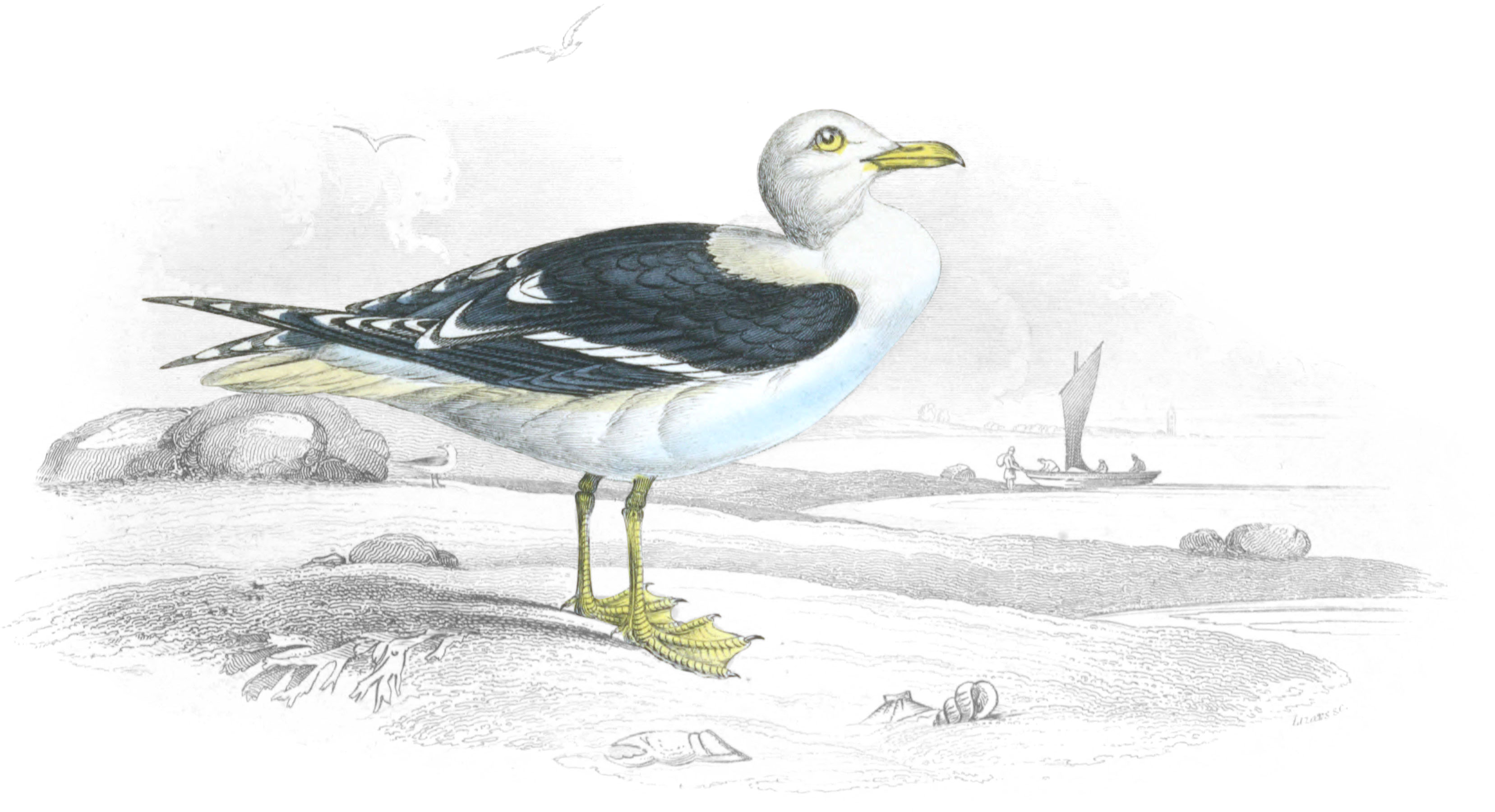
Plate XXVI
The next three large species have the mantle of a pale shade, but are distinguished from each other by a different distribution of the markings, &c. The most common is
The Herring Gull
Larus argentatus.—Goeland à manteau blue, Temm.—Herring Gull of British authors.
The Herring Gull is generally spread around Great Britain and Ireland, and is extended northward to Shetland, it is, however, perhaps more local, scarcely so abundant as the last, and by Mr. Selby is considered comparatively more rare on the Northumbrian coast, being there supplanted by the lesser black-backed species. Further up the Firth it is not uncommon, and a large colony breeds on and seems to have taken possession for themselves of a precipitous cliff on the east side of the Puffin Island, off North Berwick Harbour. We are aware also of other parties breeding on similar situations on the Solway, accompanied, as we mentioned, with the preceding bird, and we believe that marshy situations or islands on fresh-water lochs are never selected for this purpose. On the Continent it ranges from the coasts of France to those of Italy; out of Europe, it is said to be found at Madeira87 and in Asia Minor.88 Audubon found the Herring Gull distributed in America from the Gulf of Mexico to Labrador, and describes the manners of a colony which he found on Whitehead Island in the Bay of Fundy. The Gulls here were breeding on the pine trees, some forty feet from the ground, others with the nest only seven or eight, and placed close to the bole of the tree; others, again, (what he considered to be the younger birds), made the nest on the ground. Mr. Frankland recollected when the birds commenced to select the trees, for they all previously built on the ground; and considered that it was an instinctive care that had induced them to breed out of reach, from the nests on the ground being constantly robbed.
In summer the head, neck, lower back, tail and edge of the wings, and whole under plumage, pure white; the mantle and wings pale grey; quills crossed by a black bar, broad on the first but afterwards rapidly narrowing upon the others, and on the sixth scarcely an inch in breadth; the first quill with a white tip; the bill is a pale dull yellow, angle of the mandible reddish orange; legs and feet grey, tinted with light red. In winter the head is streaked with pale greyish brown.
The next two birds closely resemble each other except in size, and also the Herring Gull, differing and both at once distinguished from the latter by the quills wanting the black at their extremities. An example will be seen in our next plate, representing
The Glaucous Gull
Larus glaucus.
Lams glaucus, Brun.—The Glaucous or Large White-winged Gull of British authors.
This gull was first noticed in Britain by Mr. Edmondstone as a winter visitant to the Shetland Isles where a few specimens were regularly seen every autumn and winter; stray birds have within the last fifteen years been obtained at the same season, in several of the English counties, in Scotland, and in Ireland. On the Continent it also occurs accidentally, and is recorded by the northern ornithologists. We possess a specimen killed in winter in the Firth of Forth, and for the last two winters a gull with white wings has occasionally travelled up and down the river Annan for fifteen miles, but has been so shy as to baffle all endeavours to procure it. In Shetland, Mr. Edmondstone remarks, that when allured by carrion, it “enters the bays and boldly ventures inland.” It is an Arctic bird, however, in its breeding habits, has been observed by nearly all the northern voyagers, and its habits described by several of them; these are said to be extremely voracious, and one disgorged a little auk when struck by shot, a second being found in the stomach of the same bird on dissection. It breeds on the projecting ledges of rocks, but Captain Scorseby found the eggs on the coast of Spitzbergen, deposited in the same way as those of the tern, on the shingle above high-water mark.
The specimen alluded to as killed in the Firth of Forth has the head, neck and under parts white, clouded with pale clove-brown, that colour on the crown and cheeks assuming the form of streaks; mantle and wings pearl grey, secondaries and scapulars with white tips, quills for two or three inches at the .tips nearly pure white; tail and upper covers white, the former clouded with clove-brown on the outer webs; feet and legs appear to have been flesh-colour; the bill with a pale tip, across the angle brownish black, base pale flesh-colour. “In the young state the ground colour of the plumage is greyish white, barred or spotted with pale brown.”

Plate XXVII

The Iceland Gull
Larus Icelandicus, Edmondstone.—Iceland or Lesser White-winged Gull of British authors.
This species, so very closely allied to the last as not to be easily distinguished except by its lesser size and proportionally larger wings (while some differences have been observed in its habits), was also noticed by Mr. Edmondstone as an occasional visitant to Shetland; a few specimens have been killed on the English shores; Mr. Thompson has observed it in Ireland, and the same gentleman has noticed its appearance on the south-west coast of Scotland.89 We have occasionally seen what we considered to be this bird, on the shores of the Solway, and a young specimen before us was killed in the Firth of Forth. Like the last, however, it is also an Arctic bird, and was met with by most of the Arctic expeditious. It was found breeding in company with the glaucous gull on the face of the same precipice, but at a much less height and in much greater numbers. It is also found in Iceland, and Faber has given an account of its habits there; it is a tame bird, following the boats of the fishermen on shore, to feed on the refuse thrown from them.
A description of the last might serve for this bird, adding, that the length is only twenty-two inches (that of the other being from thirty to thirty-three), the wings exceeding the tail in length; in winter the head is streaked with greyish brown. The young specimen in our possession appears of a dull brownish white, from the clouding of that colour on the plumage; on the head the brown assumes the form of streaks, and on the tail and wings of indistinct broken markings.
The Common Gull
Larus canus.—Mouette à pied Hue, Temm. Common Gull of British authors (Winter Gull, the young).
This bird, though smaller than any of the preceding species, is perfectly typical in form, and to a person resident at a distance from the coast, will perhaps be that with which he is best acquainted; for in autumn, winter, and spring, it roams far inland, feeding on the fallows and pastures, and after-floods on the inundated lands; always, however, retiring to the coast at night. Its breeding stations are frequently on precipitous rocks by the sea, where we have seen it generally away from the other gulls. It also resorts to the shore of fresh-water lakes, and to their islands, breeding there on the ground, though in one instance we found it using the walls of a ruin, on which several nests were placed. The Common Gull is very generally distributed over our islands, reaching Orkney and Shetland. On the European shores it is also frequent, reaching southward to Spain and to Trebisond. A bird under the same name is also introduced in the Northern Zoology, which is said to spread northward as far as Arctic America, breeding there and retiring southward when the winter sets in.
In the summer or breeding state, the head, neck, the rump and tail, and all the under surface of the bird are pure white, the mantle, scapulars and wing-covers pearl grey, quills black with white tips; the bill is greyish green passing into yellow at the tip; eyelids vermilion red; legs and feet greenish grey. In winter, the head, sides of the neck and nape, are streaked with brocoli-brown.
The young have the upper plumage clove-brown, the feathers margined with greyish white; underneath they are clouded with a paler brown, the degree varying with age; quills blackish grey; the basal part of the tail white, with the other part black, tipped with greyish white.
In the two birds which follow, the form slightly varies, in the first the feet are more tern-like, the webs deeply cut; while the second, a truly maritime bird, leads to the petrels.
The Ivory Gull
Larus Eburneus.—Larus candidus, Flem. Mouette blanche ou sancteur, Temm.—Ivory Gull of British authors.
It is to Mr. Edmondstone also that we are indebted for the first notice of the Ivory Gull as a British bird, the specimen was shot in Balta Sound, Shetland; another was killed in the Firth of Clyde, both in immature plumage; since it has only been again noticed once, as recorded by Mr. Thompson in his report on the Fauna of Ireland, a specimen being noticed in a field near Tralee. On the continental shores it is also very rare, appearing, according to northern ornithologists, more frequently northward. Its proper resorts are the high Arctic latitudes, where it is met with both by the whaling vessels and by nearly all the northern expeditions. Dr. Richardson observed it breeding on the cliffs of Cape Parry in lat. 70°.
An Arctic specimen of this bird is entirely pure white. In the dried state, the bill is dark at the base, apparently greenish grey, the tip before the nostrils yellowish; the feet and legs brownish black, very little unfeathered space above the tarsal joint; the feet small, the webs deeply cut. In the young state it is more or less varied with blackish grey and brown.
The Kittiwake
Larus rissa, Linn.—Rissa Brunnichii, Steph.—Mouette tridactyle, Temm.—Kittlwake of British authors (Tarrock, the young).
This small but handsome species is truly maritime in habits, and recedes slightly from the type in the imperfect development of the hallux, the backward position of the legs, and the weaker tarsi. It is a bird widely distributed, and breeds in most suitable localities on all our shores from Shetland to the Isle of Wight. Generally speaking, it may be termed a summer visitant, the great mass of birds leaving their stations after incubation, a few only remaining over winter or migrating from some other latitude. Fleming mentions it in winter Mr. Yarrell is confident he has seen it in winter on the coasts of Dorsetshire or Hampshire; on the Scotch coasts, however, it is certainly rare at that season; in the Firth of Forth it is sometimes seen, and in January last (1843) Mr. Fenton in Edinburgh had a newly killed specimen, which we examined. It breeds on precipitous rocks, never we believe in low situations, and on approaching one of their stations the air resounds with the call of “Kittiwake,” uttered distinctly; whence, without doubt, their common name. It is a gull which does not venture inland, and feeds exclusively on the productions of the sea. These birds often follow the shoals of young fish and are shot for the sake of the feathers in great numbers, apparently not willing to leave their prey. On the European shores it ranges as far south as Italy; and, Mr. Yarrell states, is found in winter at Genoa; but it seems to be more a northern bird; occurring abundantly in Iceland, Spitzbergen, &c., and was met with by the Arctic voyagers in the highest latitudes which were reached. Mr. Audubon records it in the autumnal and winter months, from the mouth of the Mississippi to the coast of Maine, and found it breeding on the famous Gannet rock in the gulf of St. Laurence, and on the shores of Labrador.
In the breeding season the head, neck, tail and under plumage are pure white; the mantle, scapulars, back and wings, pearl-grey; the quills with the ends black, the colour running along the whole outer web of the first, and on the second, third, and fourth to a gradually lesser extent; the bill is greenish yellow, the inside of the mouth rich reddish orange-yellow; legs and feet greenish black. In winter, the feathers in front of the eye, the end of the auriculars, and the occiput, shading downwards on the back of the neck, are pale blackish grey.
- The rent of St. Kilda is paid almost entirely from feathers collected from both young and old birds, 240 stones being the quantity required; while their whiter light is supplied from oil collected from the stomach of the fulmar. Wilson, West. Isles, ii. p. 27.
- Brit. Birds, ii. p. 264.
-
A few pairs, it is said, breed annually in Sunbiggin Tarn, near Orton, Westmoreland.
Yarrell, iii. p. 61.
- Grey-legged Goose has been lately considered as the correct reading of this name; as, however, long applied to it, we prefer the old provincial spelling.
- “Said to be found in Northern Asia, China, and Japan.” Yarrell.
- Proceed. of Wern. Nat. Hist. Soc. 1840.
- Annals of Nat. Hist, &c. viii, p. 13.
- We soon afterwards procured several specimens in a good state; the colour of the bill was in some instances of a rather vivid pink, the “crimson-red of Syme;” the feet were livid.
- Yarrell.
- M. Savi.
- Northern Zoology, p. 466.
-
I suspect the shores of the White Sea, to the eastward, are the great breeding-places of this bird.
Yarrell, iii. p. 74.
- Richardson.
- Scoresby.
- Von Bauer. See a Translation of his “Animal Life” in that country, Annals of Nat. History.
- Yarrell.
- Quoted from Yarrell, iii. p. 82.
- See Mag. of Nat. Hist. viii. p. 255.
- Aud., vol. iii.
- Yarrell, Brit. Birds, vol. iii. p. 124.
- Sibbald includes them among the birds of Scotland.
- Jenyns.
- Dickson and Ross, quoted from Yarrell.
- Madras Journal of Science for 1840.
- Selby ii. p. 295.
- Mr. Audubon mentions having found the nest of the mallard on large prostrate and rotten logs, three feet above the ground, and in the centre of a corn brake, nearly a mile distant from any water. Orn. Vig. iii. 169.
- Yarrell.
- Aud. Orn. Biog., iii. 169.
- Yarrell.
- See Illust. of Ornith. pl. 146.
- Nilsson.
- Yarrell.
- Aud. vol. iv.
- Yarrell, Trans. Linn. Soc.
- Dublin University Mag. for Nov. 1841.—Early English Poets.
- Yarrell.
- Mr. Waterton considers it a more familiar bird than either the pochard or teal, but in our own shooting practice, we have always found it much more difficult to approach than the latter. That gentleman also considers the widgeon a day feeding bird, living on grass and vegetables.
- See note in Yarrell.
- Temminck.
- N. S. Hodson, Gard. Chronicle for April 1842.
- Is it certain that the widgeons in question were not received from the continent, whence we believe quantities of water-fowl come to the London markets?
- Townsend, quoted from Aud. iv. 339.
- Faun. Bor. Amer. Birds. p.
437436. - Aud. Orn. Biog. iv. p. 199.
- Faun Bor. Amer. ii. p. 437.
- Audubon, iii. p.
357355. - Leemius de Lapponibus,
276267, note. - Sabine.
- Audubon.
- Selby.
- The Laplanders believe, that if a person hear the cry of any of the divers in the spring, and while fasting, the milk from his flocks will not curdle for the whole year. Leemius.
- Yarrell.
- Page 71, note.
- Nilsson.
- Yarrell.
- Smith.
- Mr. Dann, quoted from Yarrell.
- Nilsson.
- Audubon.
- Selby.
- Selby.
- Prince of Canino.
- Birds of Greenland, page 46.
- The parasites on this specimen were submitted to Mr. Denny, and were determined to be Docophorus bassani, identical with those from British bird.
- Yarrell.
- Yarrell.
- Quoted from Yarrell.
- Savi, Birds of Italy.
- Smith.
- The tail, in the Plate, is represented too much rounded.
- Yarrell.
- Selby.
- Yarrell.
- Capt. James C. Ross.
- Audubon.
- Yarrell.
- Jerdon, Blyth.
- Bristol Mirror, quoted by Mr. Yarrell.
- Professor Macgillivray.
- Yarrell.
- Yarrell.
- This marking of the sixth primary is just the opposite of that observed by Mr. Sabine in some mature specimens, in which its prevailing colour was white, “with sometimes a black spot near the end.” Dr. Richardson has remarked, in the Faun. Bor. Amer., that this primary is subject to variation.
- Selby.
- Mr. Yarrell states that a gull belonging to the Zool. Soc. changed from white to dark brown in five days, the colour changing without any moult or accession of feathers.
- Yarrell.
- Mr. Yarrell gives the male as thirty inches, the female as twenty-seven.
- Dr. Henniken
- Mr. Strickland.
- Mag. of Nat. Hist.