
Volume V
Natural History of Gallinaceous Birds
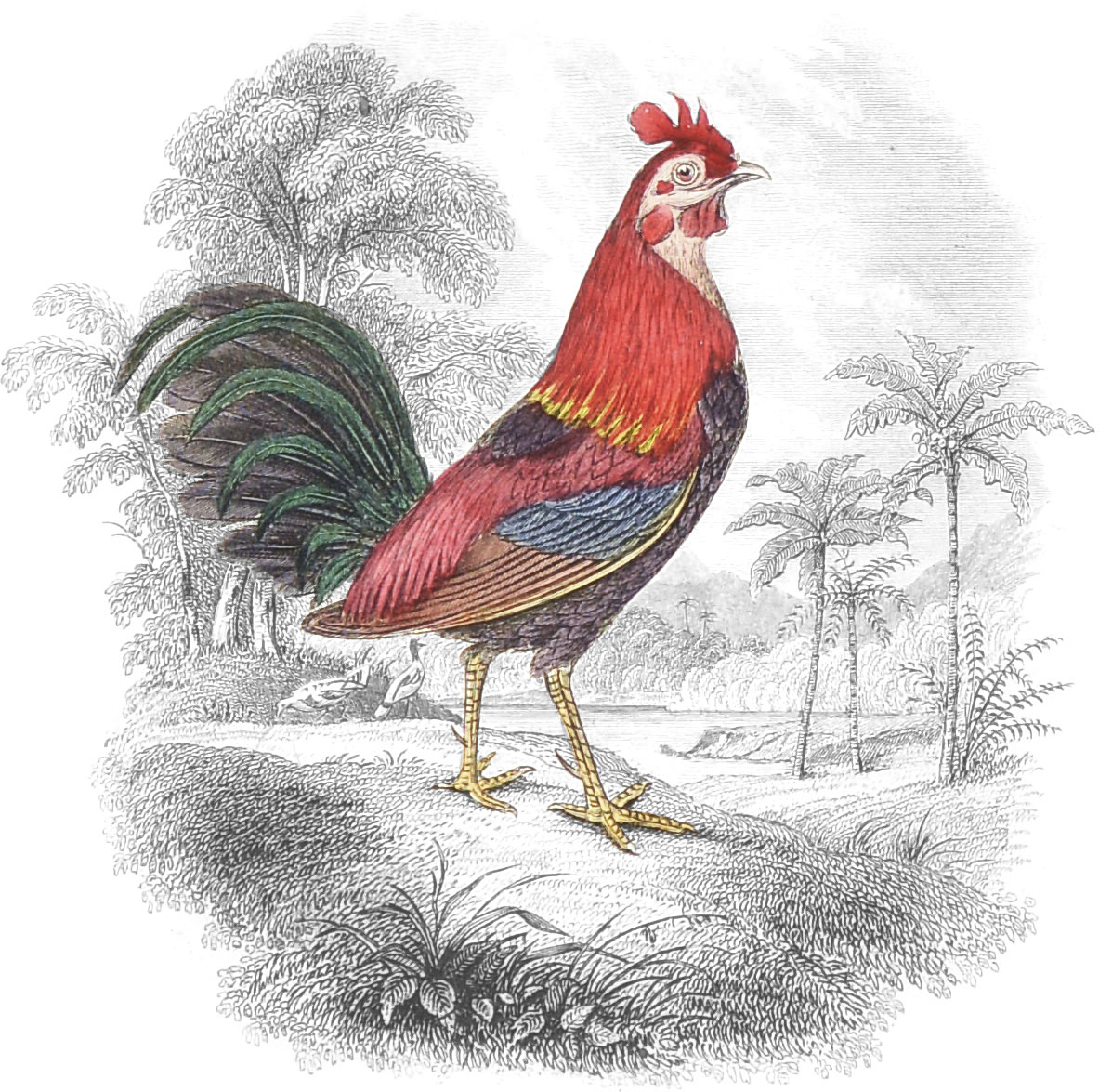

This order contains a part of the feathered creation, which is by far the most useful in the domestic economy of man. The Jungle-cock, better known in its reclaimed state as the Barn-door Fowl, the Turkey, Peacock, and Guinea-fowl, the extensive race of Pigeons, and the various birds known as Game, all fall under it and administer to his taste and wants; and whether as wholesome and grateful articles of food, adornments to his abode, his dress, or draperies, or a solace to his body when weary, they are universally esteemed, and by almost all nations are reared and domesticated for their various uses. We propose, therefore, to devote more space to the history of these birds than might perhaps be the real proportion in the extent we had marked out in this work, and the present volume will be confined to a single family of this important group.
The Gallinaceous Birds, named in the scientific language of modern ornithology Rasores, are placed third in Class Aves or Birds, and in addition to the Gallinée, to which by former authors they were limited, they are now made to contain the Pigeons, and the Struthious birds, such as the Ostrich, Bustards, &c. The class has also been termed the first of the aberrant series, from the members of it possessing in a less degree the powers of flight and of perching and grasping—the great attributes of birds. These are developed to their greatest extent in the birds of prey and the incessorial order; and although in the present division we find some species with a strong flight, and feet fitted for grasping, yet, when they are examined as a whole, these are not seen as marked properties of the order, while others are most conspicuous.
The Rasorial birds are formed principally for abode upon the ground, and for this purpose the legs and feet are strong, the toes placed upon a plane, and connected at the base by a strong binding membrane. The hallux or hind toe, the great accessory in perching and grasping, is often wanting, and is always short, and the nails are short, or, when lengthened, always stretch in a line with the toe; consequently the powers of walking and running are great, and in some instances conduce alone to the preservation of their possessor. The greater part of their food is taken upon the ground, and consists of insects, grain, roots, seeds, and tender vegetables. Their nests are generally made upon the ground, and the young run immediately when hatched. On the contrary, the organs fitted for flight are less powerfully developed, the wings are short and rounded, the body remarkably heavy, and of course requiring great strength to raise it, and the tail and its accessories are often so unwieldy, as to prove a complete incumbrance in any flight extending beyond a few yards. The internal structure is complicated, and appears to bear a strong analogy with the Ruminantia.
By modern ornithologists this order has been divided into five great families—Pavonidæ, Cracidæ, Columbidæ, Tetraonidæ, and Struthionidæ. The characters which we have given above are of course taken from the typical families of the order. The pigeons, with which we leave the incessorial birds, in many of their groups, possess extensive powers of flight and grasping, perform migrations on the wing, and live much upon trees. Their food, however, is almost entirely taken upon the ground, and we are beautifully led to the principal family of the true gallinaceous birds, by means of the. Great Crowned, Nicobar, and Carunculated Pigeons. The Tetraonidæ or Grouse also in many of their members exhibit pointed and lengthened wings, and a flight of great strength. They however chiefly live upon the ground, feed and breed upon it. The Cracidæ, again, where the form and habits approach much nearer the type, where the toes are nearly upon a plane, and that behind is very short, breed on trees, while the Struthious family shew the very extreme form in the wings and feet, running with prodigious swiftness, and using their short wings only as an assisting power in carrying them forward. None of them perch, and they all feed and breed upon the ground.
Wo devote the present little volume to the illustration of the first or typical group, the Pavonidæ, and shall describe in detail the various members of it, before noticing its peculiar characters, and the arrangement of the genera.1 The first we have to notice is
The Turkey
Meleagris gallopavo.—Linnæus.
Meleagris gallopavo, Linnæus.—The Turkey, Pennant, Philosophical Transactions, vol. lxxi. p. 67.—Le Dindon, Buffon.—Temminck, Histoire Naturelle des Pigeons et Gallinacés, ii. p. 375.—Meleagris fera, Vieillot, Gallerie des Oiseaux.—Wild Turkey, Bonaparte, Continuation of Wilson’s N. American Ornithology, No. I. p. 79. Synopsis, p. 123.—Audubon, Ornithological Biography, i. p. 1.—Domestic Turkey, Pennant, British Zoology. 8vo edit., p. 374.—Meleagris occidentalis, Bartram.
The Wild Turkey should have been the emblem of North America, and so thought Benjamin Franklin. The Turkey is the national bird, truly indigenous, and not found beyond the limits of that continent: he is the herald of the morning, and around the log-house of the squatter, must convey associations similar to those produced by the crowing of the cock around the cottage of the European farmer. Batram says,
I was awakened in the morning early, by the cheering converse of the wild turkey cocks saluting each other from the sun-brightened tops of the lofty cypress and magnolia.
They begin at early dawn, and continue till sunrise. The high forests ring with the noise of these social sentinels, the watchword being caught and repeated, from one to another, for hundreds of miles around, insomuch that the whole country is, for an hour or more, in an universal shout; or, in the poetry of Southey,
——on the top
Of yon magnolia, the loud Turkey’s voice
Is heralding the dawn; from tree to tree
Extends the wakening watch-notes, far and wide,
Till the whole woodlands echo with the cry.
Although the Turkey is one of the most important of the feathered race in the luxury and domestic economy of man, the exact period of its introduction into Europe and to Great Britain has been lost sight of, and by the older naturalists attempting to recognise in it some of the poultry of the ancients, it was conjectured to have come originally from India and Africa, and the knowledge of its native country was, even for a considerable time, placed in uncertainty.
The Turkey is a native of North America, and extends from the north-western territory of the United States to the Isthmus of Darien, to the south of which it is not found; the Curassows or Craves being evidently mistaken for it, by those who have noted it as an inhabitant of the southern continent. The great nursery of the Turkey is in the wooded parts of Arkansaw, Louisiana, Tenessee, and Alabama: the unsettled portions of the States of Ohio, Kentucky, Indiana, and Illinois, and the vast expanse of territory on the Missisippi and Missouri, as far as the forests extend, are most abundantly supplied with this valuable game, which forms an important part of the subsistence of the hunter and traveller in the wilderness. It is not probable that its range extends to or beyond the Rocky Mountains. The Mandan Indians, who a few years ago visited the city of Washington, considered the Turkey as one of the greatest curiosities they had seen, and prepared a skin of one to carry home for exhibition.2
There can be little doubt that we are indebted to the Spaniards for the introduction of the Turkey to Europe, and that it would be brought from Mexico upon the discovery of the New World. Front Spain a bird of such value, and so easily domesticated, would easily find its way to Britain; and although we cannot trace its introduction, we may confidently asset t that it was not before 1525, and most probably between that and the year 1530. They do not appear in the bill of fare in the celebrated feast of Archbishop Neville; and the first published notice of the bird is in a “History of the Indies,” by Oviedo, written in 1525. It appears from that traveller, that it was then an inhabitant of the greater islands, as well as of the mainland, and he speaks of them as peacocks; for, being a new bird to him, he adopts that name, from the resemblance he thought they bore to the former; but he adds,
The neck is bare of feathers, but is covered with a skin which they change after their phantasie into diverse colours. They have a horn, as it were, on their front, and hairs on the breast.
Their increase after their introduction must have been extremely rapid, or their worth must not have been duly appreciated; for in 1555 we find them rated at only four shillings each; and in 1573, they are recorded as the usual Christmas fare of a farmer’s table, and ill “neighbours to peason and to hops.” In France, they seem to have been first noticed a few years later, for the first Turkey that appeared at table was said to have been served up at the wedding banquet of Charles IX. in 1570; but four years previous to this, twelve Turkeys were thought worthy of being presented to that king. These are parts of the history of this bird which are perhaps only curious to the antiquary or historian, and of little practical use. The Turkey has now been domesticated in almost every civilized part of the known world; and it is probable that it will be sooner extirpated from the greater part of its native wilds than from the poultry-yards of the opulent and luxurious. Bonaparte observes, that it is now extremely rare, if, indeed, it exists at all, in the northern and eastern parts of the United States. In New England, it even appears to have been already destroyed one hundred and fifty years back. Again, he adds,
In Canada, and the more densely peopled parts of the United States, Wild Turkeys were formerly very abundant; but, like the Indian and the buffalo, they have been compelled to yield to the destructive ingenuity of the white settlers, often wantonly exercised, and take refuge in the remotest parts of the interior. Although they relinquish their native soil with slow and reluctant steps, yet such is the rapidity with which the settlements are extended and condensed over the surface of this country, that we may anticipate a day, at no distant period, when the hunter will seek the Wild Turkey in vain.
The imperfect records of its introduction to Europe may then be interesting to future generations.
A person who has seen the Turkey only in the poultry-yards of this country, can have no idea of the splendour of a fine cock in his full plumage, previous to the breeding-season. His plumage gleams with the brightest golden-bronze, tinged, according to the position, with blue, violet, and green, and beautifully broken by the deep black bands which terminate each feather, and which also have a metallic lustre. The length of the male figured by Mr Audubon3 was four feet and an inch; the expanse of the wings five feet eight inches. This is beyond the average size, and the bird was a remarkably fine specimen. The extraordinary accounts of the great weight and size of the Wild Turkey have been only the licensed tales of travellers, heightened by the idea, that a New World must produce every thing on a scale proportioned to its extent.4 Mr Audubon says, that from 15 lb. to 18 lb. may be a fair estimate of their average weight; and he only once saw one in the Louisville market which weighed 36 lb.: the tuft of hair on the breast of this bird measured upwards of a foot. Bonaparte confirms this account, but says that birds of 30 lb. are not rare, and had ascertained the existence of some which weighed 40 lb. The male Turkey may be said to be adult at the third year though it increases in both beauty and weight for some seasons afterwards. Upon the approach of the first winter, the bunch of hair upon the breast begins to appear: at the commencement of the second, it is from three to four inches in length, and the caruncules about the head and neck have become large, and have assumed their deep and livid hue; by the third winter, all these marks of maturity have nearly reached their greatest development.
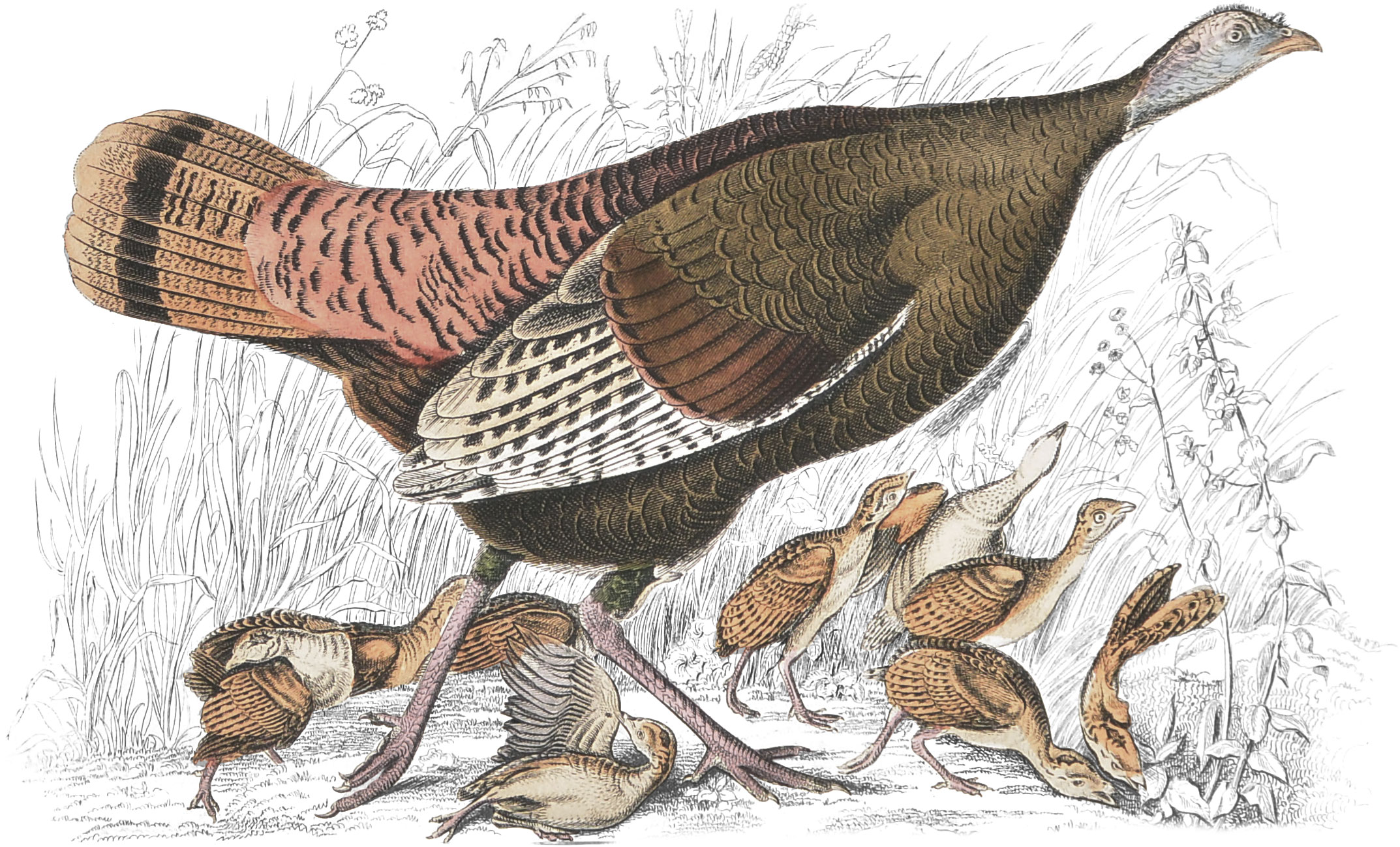
The Female which we have represented on our Plate II., has been copied from Mr Audubon’s beautiful Illustrations; and we have to ask his forgiveness for having done so without previously obtaining his permission. The average weight of a hen is about 9 lb.; but in strawberry time they sometimes reach 13 lb. and are so fat as to burst open when falling, after being shot. In length, the female is only about 3 feet 4 inches. The head and neck are not so naked, and there is no trace of spurs upon the legs. The general shade of the plumage is of a grayer tint, each feather having a metallic band, less brilliant than that of the male, and is then tipped with a blackish bar, and a grayish terminal fringe.
We shall now introduce the account of their manners from the Prince of Musignano’s continuation.
The males, usually termed gobblers, associate in parties, numbering from ten to a hundred, and seek their food apart from the females; whilst the latter either move about singly with their young, then nearly two-thirds grown, or, in company with other females and their families, form troops, sometimes consisting of seventy or eighty individuals, all of which are intent on avoiding the old males, who, whenever opportunity offers, attack and destroy the young, by repeated blows on the skull. All parties, however, travel in the same direction, and on foot, unless they are compelled to seek their individual safety by flying from the hunter’s dog, or their march is impeded by a large river. When about to cross a river, they select the highest eminences, that their flight may be the more certain; and here they sometimes remain for a day or more, as if for the purpose of consultation, or to be duly prepared for so hazardous a voyage. During this time the males gobble obstreperously, and strut with extraordinary importance, as if they would animate their companions, and inspire them with the utmost degree of hardihood; the females and young also assume much of the pompous air of the males, the former spreading their tails, and moving silently around. At length the assembled multitude mount to the tops of the highest trees, whence, at a signal note from a leader, the whole together wing their way towards the opposite shore. All the old and fat ones cross without difficulty, even when the river exceeds a mile in width but the young, meagre, and weak, frequently fall short of the desired landing, and are forced to swim for their lives; this they do dexterously enough, spreading their tails lor a support, closing their wings to the body, stretching the neck forwards, and striking out quickly and forcibly with their legs. If, in thus endeavouring to regain the land, they approach an elevated or inaccessible bank, their exertions are remitted, they resign themselves to the stream for a short time, in order to gain strength, and then, with one violent effort, escape from the water. But. in this attempt all are not successful; some of the weaker, as they cannot rise sufficiently high in the air to clear the bank, fall again and again into the water, and thus miserably perish. Immediately after these birds have succeeded in crossing a river, they for some time ramble about without any apparent unanimity of purpose, and a great many are destroyed by the hunters, although they are then least valuable.
The wild turkeys do not confine themselves to any particular food; they eat maize, all sorts of berries, fruits, grasses, beetles; and even tadpoles, young frogs, and lizards, are occasionally found in their crops; but where the pecan nut is plenty, they prefer that fruit to any other nourishment; their more general predilection is, however, for the acorn, on which they rapidly fatten. When an unusually profuse crop of acorns is produced in a particular section of country, great numbers of turkeys are enticed from their ordinary haunts in the surrounding districts. About the beginning of October, while the mast still remains on the trees, they assemble in flocks, and direct their course to the rich bottom lands. At this season they are observed in great numbers on the Ohio and Missisippi. The time of this irruption is known to the Indians by the name of the turkey month.
When the turkeys have arrived in their land of abundance, they disperse in small flocks, composed of individuals of all sexes and ages intermingled, who devour all the mast as they advance; this occurs about the middle of November. It has been observed, that, after these long journeys, the turkeys become so familiar as to venture on the plantations, and even approach so near the farm-houses as to enter the stables and corn-cribs in search of food; in this way they pass the autumn, and part of the winter. During this season, great numbers are killed by the inhabitants, who preserve them in a frozen state, in order to transport them to a distant market.
Early in March they begin to pair; and, for a short time previous, the females separate from, and shun their mates, though the latter pertinaciously follow them, uttering their gobbling note. The sexes roost apart, but at no great distance, so that, when the female utters a call, every male within hearing responds, rolling note after note, in the most rapid succession; not as when spreading the tail and strutting near the hen, but in a voice resembling that of the tame turkey, when he hears any unusual or frequently repeated noise. Where the turkeys are numerous, the woods, from one end to the other, sometimes for hundreds of miles, resound with this remarkable voice of their wooing, uttered responsively front their roosting places. This is continued for about an hour; and, on the rising of the sun, they silently descend from their perches, and the males begin to strut, for the purpose of winning the admiration of their mates.
If the call be given from the ground, the males in the vicinity fly towards the individual, and, whether they perceive her or not, erect and spread their tails, throw the head backwards, distend the comb and wattles, strut pompously, and rustle their wings and body-feathers, at the same moment ejecting a puff of air from the lungs. Whilst thus occupied, they occasionally halt to look out for the female, and then resume their strutting and puffing, moving with as much rapidity as the nature of their gait will admit. During this ceremonious approach, the males often encounter each other, and desperate battles ensue, when the conflict is only terminated by the flight or death of the vanquished.
The conqueror now selects the objects of his gallantry, and one or more females thus associated follow their favourite, and roost in his immediate neighbourhood, if not upon the same tree, until they begin to lay, when they change their mode of life, in order to save their eggs, which the male uniformly breaks, if in his power. After the love season, the sexes again separate, the males cease entirely to gobble, and
retire and conceal themselves by prostrate trees, in secluded parts of the forest, or in the almost impenetrable privacy of a cane-brake. Rather than leave their hiding-places, they suffer themselves to be approached within a short distance, when they seek safety in their speed of foot; at this season, however, they are of no value to the hunter, being meagre and covered with ticks. By thus retiring, using very little exercise, and feeding on peculiar grasses, they recover their flesh and strength, when they again congregate, and recommence their rambles.
About the middle of April, when the weather is dry, the female selects a proper place in which to deposit her eggs, secured from the encroachment of water, and, as far as possible, concealed from the watchful eye of the crow: this crafty bird espies the hen going to her nest, and having discovered the precious deposit, waits for the absence of the patent, and removes every one of the eggs from the spot, that he may devour them at leisure. The nest is placed on the ground, either on a dry ridge, in the fallen top of a dead leafy tree, under a thicket of sumach or briars, or by the side of a log; it is of a very simple structure, being composed of a few dried leaves. In this receptacle the eggs are deposited, sometimes to the number of twenty, but more usually from nine to fifteen; they are whitish, spotted with reddish brown, like those of the domestic bird. Their manner of building, number of eggs, period of incubation, &c. appear to correspond throughout the Union, as I have received exactly similar accounts from the northern limits of the turkey range, to the most southern regions of Florida, Louisiana, and the western wilds of Missouri.
The female always approaches her nest with great caution, varying her course so as rarely to reach it twice by the same route; and, on leaving her charge, she is very careful to cover the whole with dry leaves, with which she conceals it so artfully, as to make it extremely difficult, even for one who has watched her movements, to indicate the exact spot; hence few nests are found, and these are generally discovered by fortuitously starting the female from them, or by the appearance of broken shells, scattered around by some cunning lynx, fox, or crow. When laying or sitting, the turkey hen is not readily driven from her post by the approach of apparent danger; but, if an enemy appears, she crouches as low as possible, and suffers it to pass. A circumstance related by Mr Audubon will shew how much intelligence they display on such occasions; having discovered a sitting hen, he remarked that, by assuming a careless air, whistling, or talking to himself, he was permitted to pass within five or six feet of her; but, if he advanced cautiously, she would not suffer him to come within twenty paces, but ran off twenty or thirty yards with her tail expanded, when, assuming a stately gait, she paused on every step, occasionally uttering a chuck. They seldom abandon their nests on account of being discovered by man; but should a snake, or any other animal, suck one of the eggs, the parent leaves them altogether. If the eggs be removed, she again seeks the male, and recommences laying, though otherwise she lays but one nest of eggs during the season. Several turkey hens sometimes associate, perhaps for mutual safety, deposit their eggs in the same nest, and rear their broods together. Mr Audubon once found three females sitting on forty-two eggs. In such cases, the nest is constantly guarded by one of the parties, so that no crow, raven, nor even polecat, dares approach it.
The mother will not forsake her eggs, when near hatching, while life remains; she will suffer an enclosure to be made around and imprison her, rather than abandon her charge. Mr Audubon witnessed the hatching of a brood, while thus endeavouring to secure the young and mother. He says,
I have lain flat, within a very few feet, and seen her gently rise from the eggs, look anxiously towards them, chuck with a sound peculiar to the mother on such an occasion, remove carefully each half empty shell, and with her bill caress and dry the younglings, that already stand tottering and attempting to force their way out of the nest.
When the process of incubation is ended, and the mother is about to retire from the nest with her young brood, she shakes herself violently, picks and adjusts the feathers about the belly, and assumes a different aspect; her eyes are alternately inclined obliquely upwards and sideways; she stretches forth her neck in every direction, to discover birds of prey or other enemies; her wings are partially spread, and she softly clucks to keep her tender offspring close to her side. They proceed slowly, and, as the hatching generally occurs in the afternoon, they sometimes return to pass the night in the nest. While very young, the mother leads them to elevated dry places, as if aware that humidity, during the first few days of their life, would be very dangerous to them, they having then no other protection than a delicate, soft, hairy down. In very rainy seasons wild turkeys are scarce, because, when completely wetted, the young rarely survive.
At the expiration of about two weeks, the young leave the ground on which they had previously reposed at night under the female, and follow her to some low, large branch of a tree, where they nestle under the broadly curved wings of their vigilant and fostering parent. The time then approaches in which they seek the open ground or prairie land during the day, in search of strawberries, and subsequently of dewberries, blackberries, and grasshoppers; thus securing a plentiful food, and enjoying the influence of the genial sun. They frequently dust themselves in shallow cavities of the soil, or on ant-hills, in order to clean off the loose skin of their growing feathers, and rid themselves of ticks and other vermin.
The young turkeys now grow rapidly, and in the month of August, when several broods flock together, and are led by their mothers to the forest, they are stout and quite able to secure themselves from the unexpected attacks of wolves, foxes, lynxes, and even cougars, by rising quickly from the ground, aided by their strong legs, and reaching with ease the upper limbs of the tallest tree. Amongst the numerous enemies of the wild turkey, the most dreaded are the large diurnal and nocturnal birds of prey, and the lyrix (Felis rufa), who sucks their eggs, and is extremely expert at seizing both parent and young; he follows them for some distance, in order to ascertain their course, and then, making a rapid circular movement, places himself in ambush before them, and waits until, by a single bound, he can fasten on his victim.
The following circumstance is related by Bartram:—
Having seen a flock of turkeys at some distance, I approached them with great caution, when, singling out a large cock, and being just on the point of firing, I observed that several young cocks were affrighted, and in their language warned the rest to be on their guard against an enemy, who I plainly perceived was industriously making his subtle approaches towards them, behind the fallen trunk of a tree, about twenty yards from me. This cunning fellow-hunter was a large fat wild cat or lynx; he saw me, and at times seemed to watch my motions, as if determined to seize the delicious prey before me; upon which I changed my object, and levelled my piece at him. At that instant my companion, at a distance, also discharged his piece, the report of which alarmed the flock of turkeys, and my fellow hunter, the cat, sprang over the log, and trotted off.
These birds are guardians of each other, and the first who sees a hawk or eagle, gives a note of alarm, on which all within hearing lie close to the ground. An they usually roost in flocks, perched on the naked branches of trees, they are easily discovered by the large owls, and, when attacked by these prowling birds, often escape by a somewhat remarkable manœuvre. The owl sails around the spot to select his prey; but, notwithstanding the almost inaudible action of his pinions, the quick ear of one of the slumberers perceives the danger, which is immediately announced to the whole party by a chuck; thus alarmed, they rise on their legs, and watch the motions of the owl, who, darting like an arrow, would inevitably secure the individual at which he aimed, did not the latter suddenly drop his head, squat, and spread his tail over his back; the owl then glances over without inflicting any injury, at the very instant that the turkey suffers himself to fall headlong towards the earth, where he is secure from his dreaded enemy.
On hearing the slightest noise, wild turkeys conceal themselves in the grass, or among shrubs, and thus frequently escape the hunter, or the sharp-sighted birds of prey. The sportsman is unable to find them during the day, unless he has a dog trained for the purpose; it is necessary to shoot them at a very short distance, since, when only wounded, they quickly disappear, and, accelerating their motion by a sort of half flight, run with so much speed, that the swiftest hunter cannot overtake them. The traveler, driving rapidly down the declivity of one of the Alleghames, may sometimes see several of them before him, that evince no urgent desire to get out of the road; but on alighting, in hopes of shooting them, he soon finds that all pursuit is vain.
In the spring, when the males are much emaciated by their attendance on the females, it sometimes may happen that, in cleared countries, they can be overtaken by a swift cur dog, when they will squat, and suffer themselves to be caught by the dog or hunter, who follows on horseback. But from the knowledge we have gained of this bird, we do not hesitate to affirm, that the manner of running down turkeys, like hares or foxes, so much talked of, is a mere fable, as such a sport would be attended with very trifling success. A turkey hound will sometimes lead his master several miles, before he can a second time flush the same individual from his concealment; and even on a fleet horse, after following one for hours, it is often found impossible to put it up. During a fall of melting snow, turkeys will travel extraordinary distances, and are often pursued in vain by any description of hunters; they have then a long straddling manner of running, very easy to themselves, but which few animals can equal. This disposition for running, during rains or humid weather, is common to all gallinaceous birds.
The males are frequently decoyed within gunshot, in the breeding season, by forcibly drawing the air through one of the wing bones, producing a sound very similar to the voice of the female; but the performer on this simple instrument must commit no error, for turkeys are quick of hearing, and, when frequently alarmed, are wary and cunning. Some of these will answer to the call without advancing a step, and thus defeat the speculations of the hunter, who must avoid making any movement, inasmuch as a single glance of a turkey may defeat his hopes of decoying them. By imitating the cry of the barred owl (Strix nebulosa), the hunter discovers many on their roosts, as they will reply by a gobble to every repetition of this sound, and can thus be approached with certainty about daylight, and easily killed.
Wild turkeys are very tenacious of their feeding grounds, as well as of the trees on which they have once roosted. Flocks have been known to resort to one spot for a succession of years, and to return after a distant migration in search of food. Their resting place is mostly on a point of land, jutting into a river, where there are large trees. When they have collected at the signal of a repeated gobbling, they silently proceed towards their nocturnal abodes, and perch near each other: from the number sometimes congregated in one place, it would seem to be the common rendezvous of the whole neighbourhood. But no position, however secluded or difficult of access, can secure them from the attacks of the artful and vigilant hunter, who, when they are all quietly perched for the night, takes a stand previously chosen by daylight, and, when the rising moon enables him to take sure aim, shoots them down at leisure, and by carefully singling out those on the lower branches first, he may secure nearly the whole flock, neither the presence of the hunter, nor the report of his gun, intimidating the turkeys, although the appearance of a single owl would be sufficient to alarm the whole troop: the dropping of their companions from then sides excites nothing but a buzzing noise, which seems more expressive of surprise than fright. This fancied security or heedlessness of danger, while at roost, is characteristic of all the gallinaceous birds of North America.
The more common mode of taking turkeys is by means of pens, constructed with logs, covered in at top, and with a passage in the earth under one side of it, just large enough to admit an individual when stooping. The ground chosen for this purpose is generally sloping, and the passage is cut on the lower side, widening outwards. These preparations being completed, Indian corn is strewed for some distance around the pen, to entice the flock, which, picking up the grain, is gradually led towards the passage, and thence into the enclosure, where a sufficient quantity of corn is spread to occupy the leader until the greater part of the turkeys have entered. When they raise their heads and discover that they are prisoners, all their exertions to escape are directed upwards and against the sides of the pen, not having sagacity enough to stoop sufficiently low to pass out by the way they entered, and thus they become an easy prey, not only to the experienced hunter, but even to the boys on the frontier settlements.
In proportion to the abundance or scarcity of food, and its good or bad quality, they are small or large, meagre or fat, and of an excellent or indifferent flavour; in general, however, their flesh is more delicate, more succulent, and better tasted than that of the tame turkey: they are in the best order late in the autumn, or in the beginning of winter. The Indians value this food so highly when roasted, that they call it “the white man’s dish,” and present it to strangers as the best they can offer.
The Indians make much use of their tails as fans; the women weave their feathers with much art on a loose web made of the rind of the birch tree, arranging them so as to keep the down on the inside, and exhibit the brilliant surface to the eye. A specimen of this cloth is in the Philadelphia Museum; it was found enveloping the body of an Indian female, in the great Saltpetre cave of Kentucky.
We have already mentioned, that the turkey, in a domesticated state, has been distributed to almost every part of the civilized world; but, contrary to the general effect of domestication, it has rather deteriorated than improved in that state.
So far from having gained by the care of man, and the abundance of food accessible in its state of domestication, this bird has degenerated, not only in Europe and Asia, but, which is certainly extraordinary, even in its native country. The domesticated turkey of America, accustomed as it is to roam in the woods and open fields almost without restraint, is in no respect superior to that of the European poultry-yard.
Crossing the tame breed with the wild inhabitants of the forests, is said again to improve them, and is often resorted to in Pennsylvania, and a few of the other States.
This crossing often occurs in countries where wild and tame turkeys are found. It is well known that they will readily approach each other; and such is the influence of slavery even upon the turkey, that the robust inhabitant of the forest will drive his degenerate kinsfolk from their own food, and from their females, being generally welcomed by the latter and by their owners, who well know the advantages of such a connexion. The produce of this commixture is much esteemed by epicures, uniting the luscious obesity of the one, with the wild flavour of the other. A gentleman, residing in Westchester county, New York, a few years since procured a young female wild turkey, in order to make the experiment of crossing the breed; but, owing to some circumstance, it did not succeed, and in the ensuing spring the female disappeared. In the following autumn she returned, followed by a large brood; these were quite shy, but, by a little management, they were secured in a coop, and the mother allowed her liberty. She remained on the farm until the succeeding spring, when she again disappeared, and returned in autumn with another brood. This course she has repeated for several successive years.5
The eggs of the wild birds are frequently hatched with the view of crossing, and also to rear as decoy birds; for although they retain much of the wild habit, and are easily frightened, they feed with the tame stock and in the woods alternately, and entice their forest neighbours to partake of the food of the yard.
In the European poultry-yard, turkeys of almost every shade of colour are found; and the curious effect which domestication exercises over the plumage of birds, is seen in them to its utmost range. The gray or gray and white varieties are most and generally esteemed. Some persons, again, fancy those of the most unsullied white, as feeding to a large size, and having pure and tender flesh; while, again, those of a reddish or cream colour are alone admitted. The most hardy variety, however, certainly is what is called the black. The general colour is black, but various shades of brown occur, and the whole plumage has more of the rich bronzy lustre of the wild bird than any of the others. We successfully cultivated this variety for several years; the young were reared with the greatest ease, and with very few accidents, and they reached a weight of from twenty to twenty-five pounds, without cramming, or other extra feeding. It was a curious circumstance, that almost every brood had one of a pure white, though the parents and rest of the flock were black. M. Temminck mentions a variety of the turkey, which was kept by Madame Backer in a menagerie or aviary at the Hague. It had a crest springing from the crown, of black or white feathers. The same lady reared a flock of this variety of a pale reddish tint, and having the crest ample, and of a pure white.
Upon the Continent, Languedoc and Provence have been long celebrated for their breed of turkeys. In this country, Norfolk, Suffolk, and some of the neighbouring counties, contribute most to the London markets. They are an article of much importance to the cottagers and farmers; and, during autumn, flocks of many hundreds are met on the roads, upon their way to town, driven and kept in order by a long stick, with a lash of red rag. Dr Latham tells us, that, one Saturday night and Sunday morning, no fewer than 1700 turkeys left Norwich by the coaches; and, two days after, half as many more. In some of the extensive parks and royal forests, turkeys are also kept in considerable numbers, where they soon fatten upon the mast and acorns; and, in addition to the emolument yielded by their sale, add much to the picturesque beauty of the woodland scene. Many were thus kept in Richmond Park;6 and the great park of Windsor Forest, says Gilpin, always alive to the fitting accessories for forest scenery, was much frequented by wild turkeys. It could hardly have had a more beautiful decoration.
Birds are among the most picturesque objects; their forms and plumage are both picturesque, and the turkey is both a large bird, and, being gregarious, form groups which become objects of consequence.
Many of the larger gallinaceous birds might be employed both as beautiful and useful adornments to the scenery of a modern park; and, if water ranked among its advantages, another tribe might be introduced with equal effect.
The turkey is generally esteemed a stupid bird, and, in its tame state, perhaps with truth. Its vigilance and cunning in its native forests, however, often baffle the experience of well trained hunters; and the attention and cunning of the female are noted by Mr Audubon. The attention of the male to the young is also, in some cases, extraordinary. We have known him regularly attend and protect the female and brood from dogs, or other intruders; and, in two instances, to take the sole charge upon himself, refusing to admit the female to any share of his cares. The same bird frequently drove the hen from her nest, and sat upon the eggs until hatched.7
Mr Audubon relates a curious anecdote of the turkey, which also illustrates the disposition of the dog.
While at Henderson, on the Ohio, I had, among many other wild birds, a fine male turkey, which had been reared from its earliest youth under my care, it having been caught by me when probably not more than two or three days old. It became so tame, that it would follow any person who called it, and was the favourite of the little village. Yet it would never roost with the tame turkeys, but regularly betook itself, at night, to the roof of the house, where it remained until dawn. When two years old, it began to fly to the woods, where it remained for a considerable part of the day, to return to the enclosure as night approached. One morning I saw it fly off, at a very early hour, to the woods, and took no particular notice of that circumstance. Several days elapsed, but the bird did not return. I was going towards some lakes near Green River to shoot, when, having walked about five miles, I saw a fine large gobbler cross the path before me, moving leisurely along. Turkeys being then in prime condition for the table, I ordered my dog to chase it, and put it up. The animal went off with great rapidity, and, as it approached the turkey, I saw, with great surprise, that the latter paid little attention. Juno was on the point of seizing it, when she suddenly stopped, and turned her head towards me. I hastened to them, but you may easily conceive my surprise, when I saw my own favourite bird, and discovered that it had recognised the dog, and would not fly from it, although the sight of a strange dog would have caused it to run oft at once.
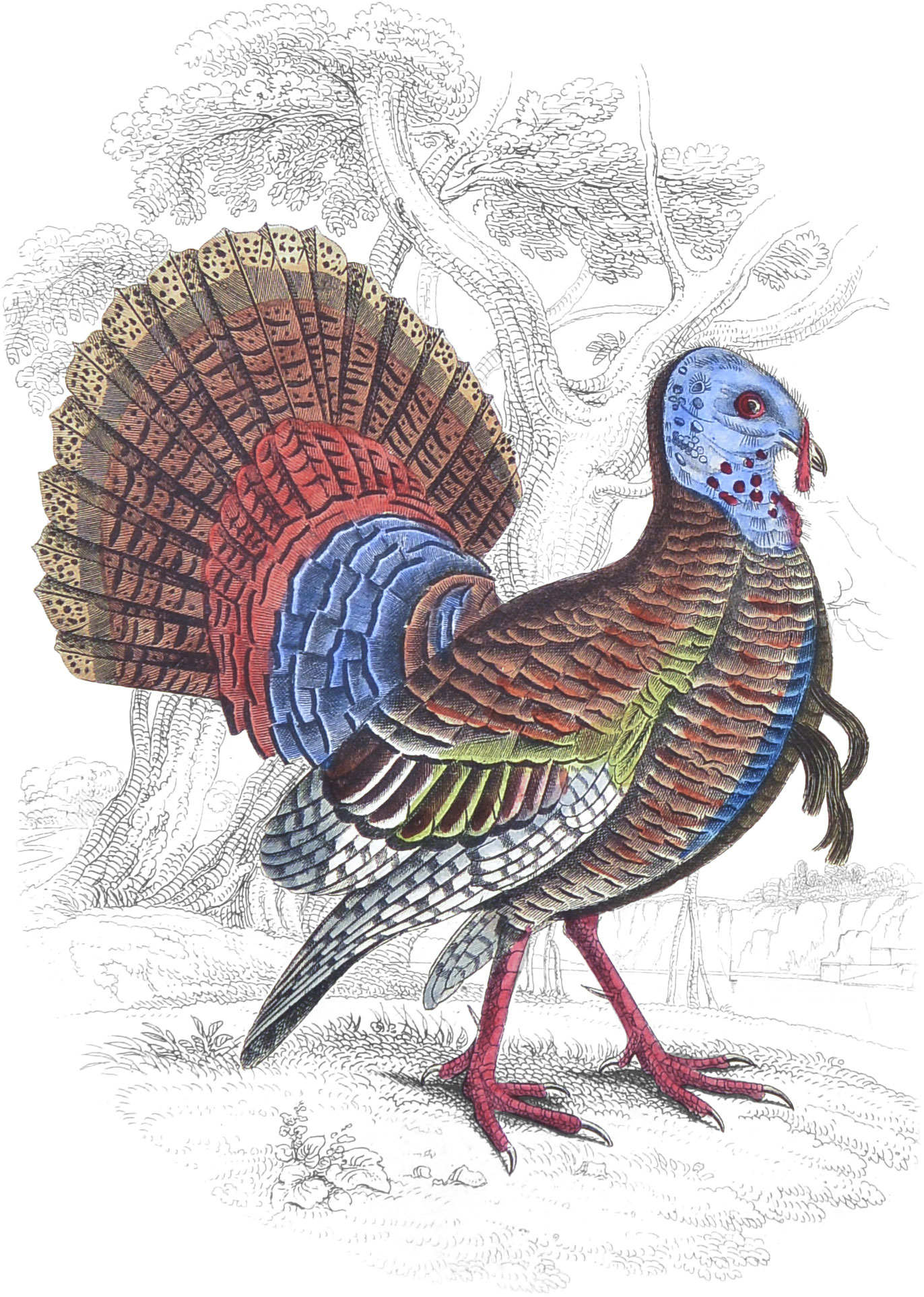
The second species of Turkey is
The Ocellated Turkey
Meleagris ocellata.—Cuvier.
Meleagris ocellata, Cuvier, Memoires du Museum, vi. pl. 1.—Dindon ocellé, Temminck, Pl. Coloriées, pl. 112.—Honduras Turkey, Latham, General History of Birds, viii. p. 129.
This splendid and curious bird was first described by the Baron Cuvier in the Memoires du Museum, from the specimen which graced the collection of Mr Bullock, and which, at the dispersion of that valuable museum, was purchased by the French Government; and we believe that it is still the only specimen known to exist in any collection.
The bird was taken by the crew of a vessel, who were cutting wood in the Bay of Honduras. Three specimens were seen, and they succeeded in capturing one of them alive, which was sent to Sir Henry Halford, but, meeting with an accident in the Thames, it died before being delivered, and that gentleman presented it to Mr Bullock for his exhibition in the Egyptian Hall, then in all its splendour, and the nest in Britain. Nothing was recorded of its habits and it is not known whether the tail is capable of being expanded as in the common species. The following is nearly the description, taken from that of Temminck.
In size it is nearly equal to the common turkey, but the tail is not so ample. The bill is of the same form, and the base with a caruncle, which is apparently capable of the same dilatations and contractions with that of its congener. The head and two-thirds of the neck are naked, and appear of the same livid colour, but without any trace of the fleshy tubercles on the lower part, which are so prominent a feature in the physiognomy of the common turkey. The only appearance of any is five or six above each eye, five upon the centre of the crown, and upon the sides of the neck six or seven, arranged in a line above each other, and at nearly equal distances. Upon the breast there was no trace of the tuft of hair, but the plumage was somewhat damaged, and the knowledge of other specimens must decide whether this character is also present in this bird. The form of the feathers is rounded at the ends; those of the lower part of the neck, the upper part of the back scapulars, and all the lower part of the body, are of a bronzed green, terminated by two bands, the one black, and the next, or that next the tip, of a golden bronze colour; on the other parts of the back, the distribution of the colours is the same, but as they approach the coverts of the tail, the tints become more vivid, the bronzed part becomes of a rich blue, or emerald-green, according to the change of light, and the outer band becomes broader, assumes a more golden lustre, and upon the rump, being tinted with red, the shades become similar in beauty to the throat of the ruby-crested humming-bird; the brightness of this border becomes still more striking, being separated from the blue by a band of deep velvetty black. The base of each feather on those parts concealed, is grey, mottled with black; upon the tail and upper coverts, this grey part becomes apparent, and the marks assume the form of bars, one of which, immediately succeeding the blue band, surrounds it, and makes each feather appear eyed or ocellated. From the distribution of the tail-coverts and the lower feathers of the rump, there are four rows with these eyed tips, where the gray basal half of the feathers 13 visible, and which combines very chastely, or keeps down as it were the lustre of the others. The tail is rounded at the end, and only contains fourteen feathers, The lower parts of the body are banded with bronze black and green, but without the brilliant lustre of the upper parts. The quills and bastard pinions are black, bordered obliquely with white, which almost entirely occupies the outer margin of the first. The secondaries have the outer webs pure white, the bands in the centre not appearing when the wings are closed; the uppermost are blotched in the centre with black, having a green lustre, which, as the plumes shorten, expands more over their surface, leaving the last with the edge only white. The greater coverts are chestnut. The feet and legs are of a rich lake or purplish red.
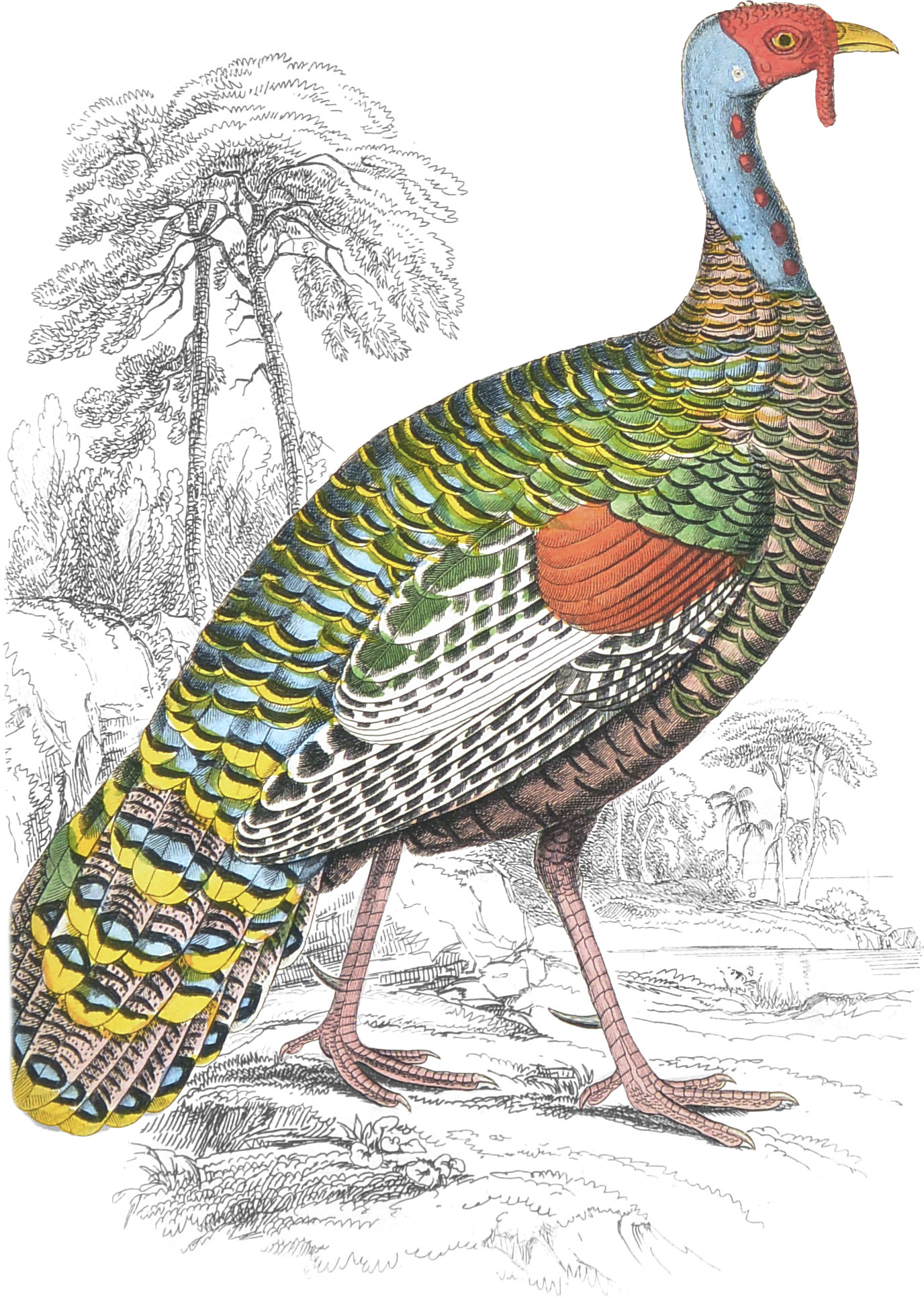
Plate III

Genus Pavo
Linnæus.
This form or genus is typical of the family with which we are now employed, and should most properly have been placed first. It is at once characterized by the very great development of the upper tail-coverts, or train, as they are called, which it is enabled to raise and spread in a circle by means of the true tail, composed of strong and powerful feathers. There are only two species known; both inhabit the Continent and Islands of India, and they present a plumage certainly the most splendid among the whole feathered world. Their frequency in our barnyards has accustomed us to this splendour; but when the question comes really to be asked, “Which is the most splendid bird?” we shall be able to find no competitor; there are many birds which have tints more exquisite for their delicacy, or more dazzlingly brilliant, but none present such a mass of gorgeous adornment as the Peacock.
The splendour of such a bird could not be seen without attracting attention, and we accordingly find it mentioned at a very early period. The earliest notice of it will perhaps be found in the Bible; it attracted the notice of the mariners of Solomon, who, in their southern expedition, among many other productions of nature, carried these birds to their royal master. We afterwards lose sight of it until discovered by the army of Alexander, who felt such admiration for it, as to order the infliction of a severe penalty upon its destroyers. Hence it found its way to Greece, and Rome, and Europe generally, and had to perform its part in the luxurious entertainments of the ancients, while it was thought worthy of being dedicated to the royal Juno, and of being handed down to posterity upon the coinage of the countries. At an early period of English history, when the baronial entertainments were characterized by grandeur and pompous ceremonies, approaching nearly to the magnificence of royalty, there was scarcely any noble feast without “pecokkes,” which were stuffed with spices and sweet herbs, roasted and served up whole, and covered, after dressing, with the skin and feathers. In our own times, both the young and the eggs are often seen at the tables of the opulent. They are also reared as picturesque accessaries for the park or lawn, in which they will breed and rear their young without assistance, and with a little attention only during winter. In their native countries, superb dresses and shades are made of the skins and train, and, adorned with precious stones, form a fitting accompaniment to the magnificence and show of Eastern manners.
Peacock-shooting is a favourite amusement in India, where, in some parts, they are extremely abundant. Colonel Williamson says,
About the passes in the Jungletery district, I have seen such quantities of pea-fowls as have absolutely surprised me. Whole woods were covered with their beautiful plumage, to which a rising sun imparted additional brilliancy. The small patches of plain among the long grass, most of them cultivated, and with mustard then in bloom, which induced the birds to feed, increased the beauty of the scene; and I speak within bounds when I assert, that there could not be less than twelve or fifteen hundred pea-fowls, of various sizes, within sight of the spot where 1 stood for near an hour.
When they are in numbers scattered in a jungle, it is easy to get a shot; but I have always found much difficulty when the birds flock together, as they frequently do, to the amount of forty or fifty. At such times it is not easy to raise them. They run remarkably fast, and I doubt whether a heavy spaniel or pointer could raise them. When on the wing, they fly heavy and strong, generally within an easy shot; but if only winged, they speedily recover, and, it not closely pursued, will nine times in ten disappear. These plantations are their favourite shelter, being close above, so as to keep off the solar rays, and open at the bottom sufficiently to admit a free passage for the air. If there be trees near such spots, the peacock may be seen mounting into them every evening towards dusk to roost, and in which they generally continue till the sun rises, when they descend to feed, and pass the midday in the heavy covers. They are very jealous of all quadrupeds, especially of dogs; and when peacocks are discovered on a tree situate on a plain, if a dog be loose and bunt near it, the bird will rarely move from its situation, though it will probably shew extreme uneasiness.
The Colonel continues,
It will appear curious, but it is very certain, that peacocks have often been hunted and run down by horsemen. The wings of a peacock are by no means proportioned to the weight of its body and limbs; besides, they are not accustomed to long flights, and are soon out of wind. When a bird is discovered in a tree standing in a plain, which is frequently the case when game is abundant, a person mounted on a tolerably active and governable horse, provided with a lash whip, may, after keeping as near as possible during the first flight, and urging the bird, when it alights, to its utmost exertion, so completely fatigue it, as to find some opportunity for whipping, and perhaps entangle the whip so as to obtain a complete command.
The same has been noticed in the account of the Wild Turkey; but we should consider the opportunities for practising such a chase very uncommon, and that the instances of escape will perhaps exceed those of capture.
Peacocks are frequently found entirely white. This variety occurs, according to Temminck, in a wild state as well as in domestication, and is not caused, as was alleged by some, from being transported from a warm to a temperate and even cold climate. If, however, we may judge from the analogy of other gallinaceous birds, this colour is much more frequent in domestication than in its native country. Pied varieties are also sometimes seen; and when the deep blue of the neck and breast is contrasted with pure white, they form a beautiful and much sought for state among collectors for a menagerie. In the white variety, the feathers, from retaining their structure, exhibit all the markings of the tail and other parts distinctly, according as the light falls upon them. To illustrate this genus we have figured
The Javanese Peacock
Pavo muticus.—Linnæus.
Pavo Javanensis, U. Aldrovandus, Ornithologia, ii. p. 33–34. Pavo muticus, Linnæus.—Shaw’s Naturalist’s Miscellany.—Japan Peacock, Latham, General Hist. of Birds, viii. p. 116.—Pavos speciferus, Vieillot, Galerie des Oiseaux, pl. 202.—Paon specifere, Temminck, Histoire Natur. des Pigeons et Gallinacés, ii. p. 56.—Pavo Javanicus, Horsfield, Transactions of Linn. Society, xiii. p. 185.—The Aldrovandine Peacock, Pavo Aldrovandi, Wilson’s Illustrations of Zoology, plates xiv. and xv.
The history of this very beautiful species is yet little known, though specimens of it, both preserved for the museum, and also alive, are now much more frequently brought to this country, and there can be little doubt, that attention would soon render it as frequent in our barn-yards as the common species.
The first notice of this bird is in the voluminous work of Ulysses Aldrovandus, who has given two of his peculiar figures of it, and which at once indicate the species by the form of the crest. These were taken from drawings sent by the Emperor of Japan to the Pope, and served for the ground-work of all the descriptions previous to that of Dr Shaw in the Naturalist’s Miscellany, which, with his figure, are also taken from an Indian drawing. The first living specimen seen in modern days was one which Le Vaillant noticed in a menagerie at the Cape of Good Hope, and of which he forwarded a description to M. Temminck, who describes it, and gives a sketch of the head and crest in his Histoire Naturelle des Pigeons et Gallinacés. M. Vieillot next gave a figure in his “Galerie,” from specimens in the Paris Museum, under the title of P. speciferus; and Mr Wilson has given two representations from specimens in the Edinburgh collection; while, lastly, a beautiful wood-cut appeared in the “Gardens and Menagerie of the Zoological Society.” Not much, or rather nothing, is known of its habits; but there is nothing in its form that would indicate any great or important variations from those of the common bird. It inhabits Java and Sumatra, and also the Continent of India, the two specimens in the Zoological Gardens having been received from the Burmese Territory; and it is probable that its distribution over the mainland, and the great Eastern Archipelago, will be found more extensive as research proceeds.
The most striking distinction in this species is the crest, which, instead of being composed of a naked shafted feather, with a round and eyed tip, as in the common bird, has these plumes of nearly an uniform breadth. Another prominent mark is the yellow skin which surrounds the eyes. The following is a more detailed description of a beautiful specimen in the Edinburgh Museum, from which our illustration is taken.
This bird is nearly similar in size to the common peacock, but the whole plumage is of more subdued brilliancy. The principal distinction is in the form of the feathers of the crest, which, instead of a nearly bare shaft, and round moon at the tip, as in the common peacock, are lengthened, webbed from the base nearly of an equal breadth, and compared by Temminck to the tail of the long-tailed titmouse. The bare space upon the cheeks, and round the eyes, is of a fine gamboge-yellow. The head, neck, and fore part of the breast, are of a peculiar greenish tint, being brilliant, with golden reflections in some lights; in others appearing dull and subdued. The lower parts are of a dull deep greenish brown, instead of the rich blue of the well known bird. The train is not so ample in proportion, and the eyes or moons are less numerous; the centre of each is rich blue, encircled with green, brown, and finally with a bronzed ring. The shoulders and wing-coverts are without the beautifully waved appearance of the common peacock, and are of a deep blue. The edge of the wing and quills are pale yellowish-red. A gradual change from the young state to the full plumage takes place, and it is the third moult before the complete train is displayed.
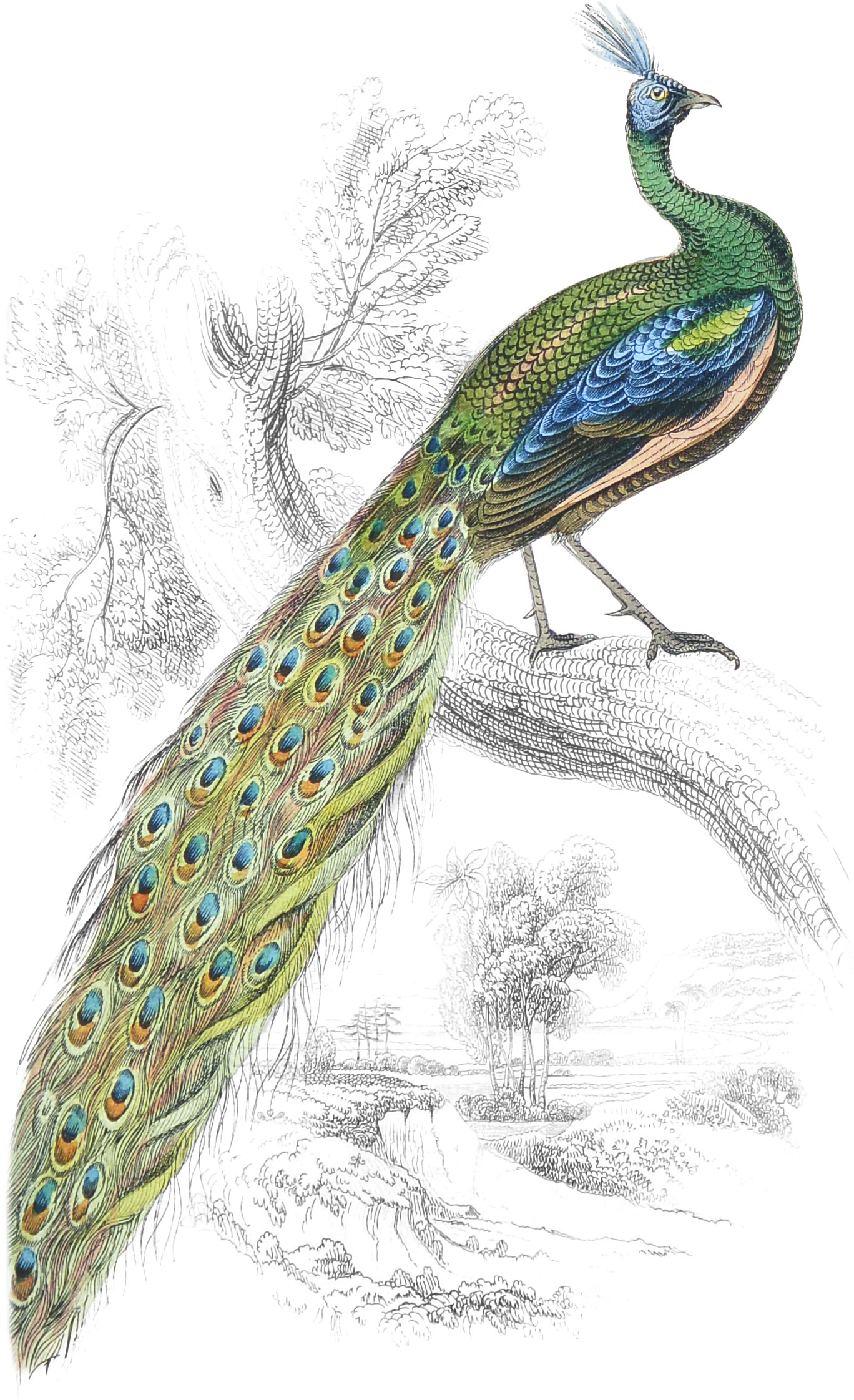
Plate IV
Genus Polyplectron
Temminck.
This genus was established by Temminck, from the l’Eperonne of Buffon, the Peacock Pheasant of Edwards and Sonnerat, the Paco bicalcaratus and Tibetanus of Gmelin’s Linnæus. We think there is no doubt that both this species and that of our Plate VI. was known to Gmelin; while the representations of Buffon and Sonnerat might have been taken from either. Prior ornithologists retained these birds with the peacocks, and that place is assigned to it in the last edition of Cuvier’s Regne Animal. Since the institution of the genus, however, the P. Tibetanus has been examined, and two additional birds have been discovered, which agree with the characters assigned to the type, and all differ from the peacocks in the modifications from which Temminck has proposed to form his distinctions.
They inhabit the Indian Islands or China, and seem almost equally hardy with the peacock, living and thriving well in confinement; and, if they could be procured m sufficient numbers to ensure a stock, would form a most lovely addition to the ornamental poultry-yard. The chief distinction is in the form of the tail; it is rounded and very ample; the feathers stiff, and forming a plane surface. It is never erected, like that of the two preceding genera, hut is capable of a very wide expansion. It has also what its describers term the upper range of feathers. These cover the first half of the tail; and if the lower range or true tail were removed, the upper would appear to an unaccustomed observer to be perfect, and the only feathers belonging to this organ. Another singularity is in the tarsi being generally furnished with two spurs upon each, sometimes three, and, in a few instances, three on one leg, and two only on that opposite. The cheeks are covered with feathers, and the whole plumage is perfectly different in structure from that of the true peacocks. The fourth species (Plate VII.) varies in the form of the tail, which becomes much more lengthened, the shape of the feathers resembling somewhat those of the next genus to be described. We shall first notice that which seems to have been the species first known, or brought to Europe; it is the
Argus Polyplectron
Polyplectron bicalcaratum.—Temminck.
Pavo bicalcaratus, Linnæus, Gmelin.—Polvplectron bicalcaratum, Eperonnier argus, Temminck.—Le Paon de Malacca, Sonnerat.
It is evident from the characters given by Gmelin, that two species of this genus were known, the species we are about to describe, and the P. chinquis of Temminck, for which the old name of Tibetanus should be retained. The length of the Argus polyplectron is about 18 or 19 inches. The feathers of the forehead are lengthened to a crest, are large, of a brownish-black, and marked with white at the base. All the rest of the head and neck is covered with short feathers, of a dull black. The throat is whitish; and the cheeks and space surrounding the eyes is freer from feathers than those parts in the remaining species. The back, scapularies, and wing-coverts, are of a yellowish-brown, thickly sprinkled with black spots, and having at the tip of each feather an eyed spot of a rich bluish-green. The breast, belly, vent, and thighs, are umber-brown, having the shafts white. The quills are dull brown. The tail, composed of two ranges of feathers, and rounded, is of the same colour with the back, thickly mottled with black, and has the tip of each feather rufous, blotched with deep black. Near the end of each feather are the two beautiful eye-like spots, of a brilliant green, placed close together, and surrounded with a circle of black.
This bird, which is far from being common, is a native of Malacca; most probably also China and the Indian Islands. It may be easily distinguished the P. Tibetanus, its nearest ally, by the less size, the comparative bareness of the cheeks, its larger crest, and the different form of the feathers composing it, and by the eye-like spots being much smaller, and surrounded only by a ring of black.
Our next Plate will give an idea of the general form of these birds. That which follows of the beautiful ocellated distribution of the markings of the plumage; our first is
The Crested Polyplectron
Polyplectron emphanum.—Temminck.
Eperonnier à Toupet, Polyplectron emphanum, Temminck, Planches Coloriées, p. 540.
This bird, of remarkably rich plumage, forms part of the collection of the Prince of Essling, and was supposed to have been received from the Sunda and Molucca Islands. It is about the size of the Argus polyplectron. The forehead and crown are adorned with a crest of long, narrow, and loose feathers, and, with the neck and breast, are of a rich bluish-black, with metallic reflections. Above the eyes there is a large white streak, and a patch of the same colour upon the auricular feathers, both of a pure and shining tint, rendered more conspicuous from the contrast of the surrounding parts. The belly and vent are deep black. The back and rump are of a dull brown, with irregular wavy bands of a paler tint. The wing-coverts and secondaries are of a brilliant blue, each tipped with a band of velvety lack. The tail, very much rounded, is brown, marked with numerous minute spots of ochraceous white; it has, near the tip, on each side of the shaft, a large ocellated oval spot, of a very brilliant and metallic green. These are surrounded with two circles, the first black, the next of a clear brown; and toward the end of each feather there is a bar of black, which, at the very tip, is succeeded by a narrow band of white. The legs, like the others, are armed with two spurs.
The female has not been yet discovered; and it may be remarked, that this species is by far the rarest in ornithological collections.
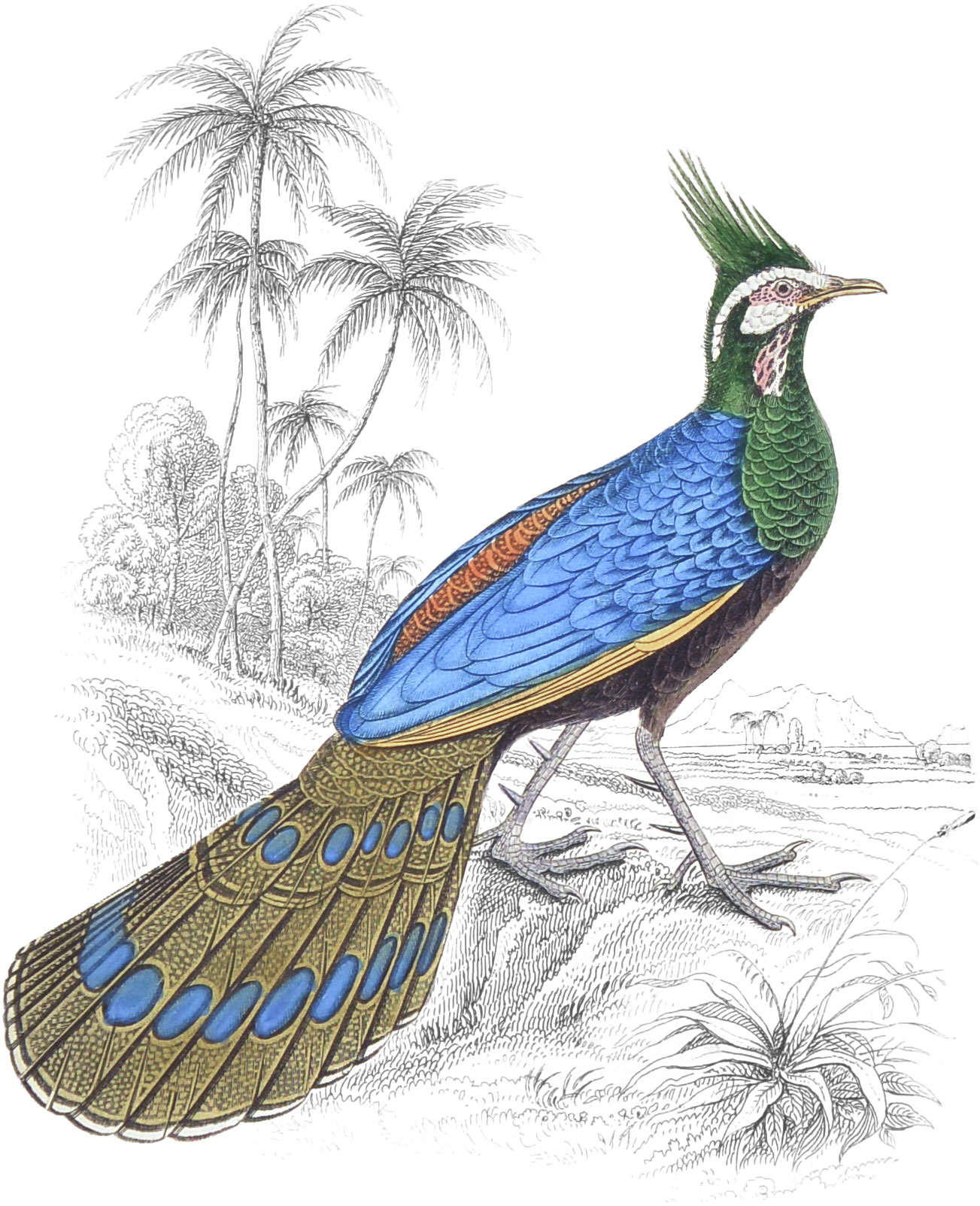
Plate V
The Thibetian Polyplectron
Polyplectron Tibetanus.—Gmelin.
Pavo Tibetanus, Linn. Gmel. ii. 731.—Peacock Pheasant, Edwards.—Eperonnier chinquis, Polyplectron chinquis, Temminck, Planches Coloriées, 539. Male.
This is another very beautiful species of Polyplectron, inhabiting, it is believed, the mountainous chain which separates Hindostan from Thibet, whence they are procured, and reared in the menageries of the wealthy Chinese. It is easily domesticated, and might be made to breed in confinement; the bird from which Temminck took his drawing and description having lived for five or six years in an aviary at the Hague.
The entire length of the Thibetian Polyplectron is 22 inches, the form rather light and elegant. It is without a crest; but the small feathers of the crown are turned forward, and appear in an irregular or disarranged state; they are of a greyish-brown. The throat is whitish. The feathers of the neck, the breast, and belly, are of a dull brown, crossed with transverse undulated bands of blackish-brown. The back, rump, and coverts of the tail, are of a clear brown, spotted, and transversely undulated with greyish-white. The quills are brown, marked with greyish. The other feathers composing the wings are generally of a yellowish-grey tint, sprinkled with little bands of blackish-brown, and having at the extremity of each a large round eyed spot, of brilliant blue, with purple and opaline reflections. These are surrounded with a circle of deep black, which is again encircled with a ring of yellowish-white. The feathers composing the tail are of a dull brown, sprinkled with small spots of ochraceous yellow. Upon each of the twenty-two true tail-feathers, at about an inch and a half from the tip, and on those which have been called the upper range, at one inch from the tip, there are two oval spots, separated only by the shaft. They, like those upon the wing, have the double circles of deep black and yellowish-white, and are clouded with the same purple and blue reflections, but which scarcely equal the others in brilliancy.
The female is said by Temminck to differ only in the lesser brilliancy of the eyed spots, in having a shorter tail, and in the want of spurs. In the young, the plumage is of an earthy grey, marked with large brown spots and bands; at the first month the plumage becomes more irregular, and the space upon the wings and tail, where the spots are to appear, are seen, they are still deprived of their lustre, and there is no trace of the pale circle. At the third moult the plumage of these beautiful birds attains its perfection and brilliancy.

Plate VI
Long-Tailed Polyplectron
Polyplectron chalcurum.—Temminck.
Eperonnier chalcure, Polyplectron chalcurum, Temminck, Planches Coloriées, 519.
This bird differs from its congeners in wanting the ocellated spots on the various parts of the plumage, which is also entirely of a more sombre shade, and in the form of the tail, which becomes lengthened and runs into the form of that of Argus. Temminck is the only ornithologist who has described and figured it, and the specimen in the Parisian Museum, which served for the copy, he tells us, was unique. The head, neck, breast, belly, and wings, are of an umber brown; the back, greater coverts, and scapulars are of a reddish umber, having numerous waves or crosses of black; the tail, as we mentioned, is much longer than in any of the others, and has not the two ranges, as it were, of feathers, is brown, with green and violet reflections, and is mottled over with irregular spots of black. Each tarsus is aimed with two sharp spurs. The total length of the specimen was about eighteen inches, and was received from the island of Sumatra.

Plate VII
Two additional species are figured by Mr Gray, in his Illustrations of Indian Zoology, but without descriptions. These figures are correct copies from the drawings collected by General Hardwick, and are the work of native artists. The first, Mr Gray has dedicated to the General, Polyplectron Hardwickii. It is nearly allied to the P. bicalcaratum. The ground colour of the plumage is ochrey yellow, with black spots and waves, the ocellated spots are surrounded with a black and yellow ring, and the head is furnished with a slightly bending forward greenish crest. Two of the dorsal feathers from each bird are also given; the distinctions are, that of P. Hardwickii has a yellowish ground, with irregular black spots, that of P. bicalcaratum, darkish grey, with pale yellow spots.
The other bird is named P. lineatum, apparently from a narrow pale line along the shaft of the feathers, particularly conspicuous on the rump. This, however, appears to me to be the young of some other species; there arc no spurs on the tarsi, and the description which Temminck gives of the young state of P. ocellatum, is near to the plumage of this bird. Our next illustration represents the genus Argus of Temminck, containing a single species, which is
The Argus Pheasant, or Gigantic Argus
Argus giganteus.—Temminck.
Argus or Luen, Philosophcal Transactions, 55, p. 88.—L’Argas ou Luen, Buffon.—Argus Pheasant, Phasianus Argus, Latham’s General History, viii. p. 206.—L’Argus, Argus giganteus, Temminick, Pigeons et Gallinacés, ii. 411.—Synopsis, iii ii, 679 710.
This superb bird presents a very singular form among the Gallinaceous order, one which puzzled most ornithologists into what genus it was to be placed, until Temminck thought of forming one to contain itself. It is chiefly remarkable for the super-abundant development of its plumage, particularly that of the wings; while its colours, though possessing little of the brilliant splendour of those which we have past, by a union of chaste tints and harmonious blending, produce an effect at once unique, striking, and pleasing.
The descriptions and figures were long imperfect, by reason of the skins being transmitted to Europe wanting, and the wings only being sent. It was described in the Philosophical Transactions, and also in those of Batavia, by the Baron Cuvier, but from imperfect specimens. Dr Latham collects the information of his predecessors, and that afforded to him by Dr Buchanan, and his figure of the Malay Peacock, evidently this bird, is taken from General Hardwick’s drawings; the description in Sonnini’s edition of Buffon is extracted from the Philosophical Transactions. M. Temminck appears to have been the first to have described this bird, from a series of specimens received from Batavia, where, with some other birds of splendid plumage, they form an article of commerce, and are exported as ornaments to different parts of dress, screens, or drapery. It is a native of Sumatra, probably some others of the Indian islands, but principally of the peninsula of Malacca; and although said, generally by ornithological writers, to inhabit China and Chinese Tartary, there exists no proof of specimens having been brought from thence.
In size the Argus is not larger than an ordinary fowl, but the length to the end of the two long tail feathers, is five feet three inches, these last being of themselves three feet eight inches. It is impossible to convey any idea of the markings and blending of the shades on many parts of this bird, and the following description will serve as only an indication of the colours. The throat, the anterior part of the neck, and the cheeks, are naked, or nearly so, having only a few black hairs dispersed over them. The head and back of the neck are covered with short velvety feathers. The lower part of the neck, breast, belly, and thighs, are reddish brown, each feather regularly spotted with dull yellow and black; the upper part of the back, and lesser wing coverts, are covered with large black spots, separated by a narrow line of an ochreous tint; the upper tail covers are of a clear ochreous yellow, with brown spots; the longest of a paler tint, with the spots thicker than upon the back, and of a reddish brown in the centre. The tail is of a deep chestnut, sprinkled with white spots, surrounded with a black ring. The wings, of which the secondaries are three times the length of the quills, being about two feet ten inches long, from their unwieldy size, almost entirely deprive the bird of flight, but greatly accelerate its pace when running, and, acting as powerful sails, furnish it with a mode of transportation or escape, possessing great fleetness. The power of flying, however, adds M. Temminck, is not altogether denied to it; it sometimes rises from the ground, but the flight is always heavy, and kept up only for a short way, and upon these organs, and particularly upon the secondaries, is lavished the greater part of the beautiful adornment. When at rest, or not excited, these spots are hardly visible, but when in the presence of his females, the wings are expanded and trailed upon the ground, displaying their beauties as the peacock exhibits his train, or the turkey his tail. At this time the tail is comparatively spread, and is raised erect. When it rests, it is carried in a line with the body, and with the two plumes folded together.
The young males possess none of the varied markings just now attempted to be described. They are of a uniform dull brown, spotted and irregularly blotched, reddish-yellow, brown, and black. After the first moult, there is still no appearance of the ocellated spots. The shafts of the feathers of the wings are black, the quills are of a dull brown, clouded with a line on the inner webs, and marked towards the tip with black and brown spots; the secondaries are of a uniform brown on the inner webs, but the outer ones have a ground of brownish-yellow, with black wavy bands, and the part where the ocellated spots are to appear are marked with black crescents surrounded with chestnut. After the second moult, all the colours of the adult acquire a regular distribution; after the third, they are still better defined, the showy spots are small, of an irregular form, and much less numerous than in the adults; and it is not until after the fourth moult, that the shades acquire their perfect brilliancy, and the markings their regularity.8
The female is still less known than the male. Among the birds sent from abroad, those of unobtrusive plumage are seldom included, and when commerce is the object, even a reiterated request fails in procuring the wished for specimens. With thirty males, Temminck thought himself fortunate in procuring two females. Like the male, the head and forepart of the neck is naked, a thick short down covers the top of the head, stretching down upon the neck, where it gradually lengthens, and assumes the form of feathers: these parts are of a brownish grey. The lower part of the neck, breast, and upper parts of the back, are of a chestnut red; the lower part of the back, rump, lesser wing coverts, and those of the tail, have, upon a yellowish-brown ground, numerous black transverse bands, some large, and others narrow in the form of zigzags; the tail, which has no long feathers, as in the male, folds together, and forms an angle like that of a hen; it is of a brownish chestnut, varied with spots and black bands, but the most remarkable difference is in the secondaries; in the male we found them to be two feet ten inches long, in this sex they are only about thirteen inches, and possess neither the development in breadth, nor the ocellated spots so conspicuous in the other. They are of a blackish brown, marked with small and irregular bands of ochrey yellow.
The habits of this singular bird are yet a point of much interest in Ornithology. They are said not to thrive well in a state of confinement, and we believe have never been brought alive to this country. Their incubation and breeding are equally unknown.

Plate VIII

Genus Gallus
Brisson.
Modern ornithologists have properly separated the birds generally known under the title of Cocks, from the Pheasants, with which they were formerly united, and have restored to them Brisson’s more ancient title of Gallus. Thus restricted, they are distinguished from the pheasants, by the crown of the head being naked, and the skin being raised into a fleshy elongation, called the comb, assuming different forms in different species, and by the base of the lower mandibles having fleshy lobes or wattles, by the tail being generally carried erect, composed of two planes folded together at a sharp angle, and in the males having the centre feathers elongated, and falling gracefully over the others. The feathers of the neck, and lower part of the back and tail-coverts, assume a particular form, and are either long and hackled or truncated; in either state they are very amply supplied. They are all natives of India and her islands, frequenting the forest and jungle. They are polygamous, and very pugnacious regarding their females, proclaiming their victory and prowess with a loud and piercing voice. The plumage of the males is brilliant, of the female dull and unobtrusive, and there is often a considerable disparity in size.
It is from these birds that we are indebted for the domestic poultry of our farm-yards. Many native species are at the present time known, and we consider it very difficult to determine which is the direct origin of our reclaimed fowls. They may have reached their present state from a mixture of many, but with Temminck we are inclined to give the preference to two species, the Gallus giganteus and Bankiva, both natives of Java, on account of the domestic females bearing the greatest resemblance to those in a wild state, by the similarity of the form and structure of the feathers, and by the males of those possessing the greatest development of comb and wattles. The first of these birds may be now described:
Gigantic Cock
Gallus giganteus,—Temminck.
The description of M. Temminck is founded upon the notices which have been given by Dampier and Marsden, the only portion of the bird which he had seen being the leg and foot, of which he gives a plate in his Natural History of Gallinaceous Birds. There is a specimen in the Edinburgh Museum said to be wild from Sumatra, of a large size, and to which, in several particulars, the large breed of cocks in this country bear considerable resemblance, particularly in the comb, which extends backwards in a line with the eyes, and is thick, slightly raised, and upon the top rounded, and as it were cut off. The throat is bare, and there are two wattles from the under mandibles of comparatively small size. The head, neck, and upper part of the back is covered with pale golden-reddish hackles, which spring also slightly before the bare space of the throat. The centre of the back and lesser wing-coverts are deep chestnut, the feathers with the webs disunited, the hackles covering the rump, and base of the tail pale reddish-yellow, long and bending down. Tail very ample and entirely of a glossy green. Greater wing-coverts glossy-green, secondaries and quills with outer webs pale reddish-yellow. The whole under parts deep glossy blackish green, with strong reflections, and having the base of the feathers deep chestnut, which occasionally appears and makes these parts seem mottled and interrupted. The height of this specimen from the ground is about 2 feet 2 to 2 feet 4 inches.
The cocks with ample crests upon the head, five toes; the rumpless cock, and those of very varied colours, appear chiefly to have arisen from the various circumstances attending domestication and crossing. The most pleasing of these are specimens with a super-abundant crest and auricular feathers. The crest is composed of narrow hackled feathers, which grow erect from the head, but fall down in graceful curves, and are sometimes so long as to overhang and shadow the eyes. In many parts this breed is much cultivated, and is esteemed in proportion as the colours of the body and crest can be got most conspicuously contrasted, a black body with white crest, and the reverse, &c. Other fancy breeds are also frequently seen in the Dutch Pencilled Fowl, pure white spotted with black, the Siberian Fowl, having long tufts of feathers springing from the lower jaws and hanging down, and the Barbary Fowl, of a pale dun colour, and having the feathers of the neck very ample and spotted with black. Amore singular anomaly occurs in those with five toes, generally called Dorking Fowls from being found and bred in most abundance in the neighbourhood of Dorking in Surry. This race is easily continued, and seems analogous either to the six-fingered or six-toed individuals of mankind, or to the dogs with the additional claws. They are much esteemed, are generally pure white, and grow to a large size; Dr Latham records one which weighed almost fourteen pounds. A still more anomalous race occurs perhaps in those without a tail, the Rumpless or Persian Cock, but we have also races analogous to them in the tailless races of dogs and cats.
There are three races of cocks, however, whose claim to actual distinction of species is not very well or satisfactorily ascertained, the G. morio, having the periosteum of the bones black, and the comb, wattles, and skin of a dull purple. It has received the name of Negro and Blackamoor Cock, but I believe is scarcely to be seen in the poultry-yards of this country. The other two varieties are more frequently seen, and are known as the Silky Cock (G. lanatus), and the Friesland Cock (G. crispus). The first, Temminck is inclined to consider distinct. It is found in Japan and China, and is sold to Europeans as a rarity. In this country it crosses easily with the white domestic poultry, and a breed having the feathers less disunited and silky is the consequence. It is a curious fact, that the periosteum and skin of this bird are of the same dark colour with those of the G.morio, while the flesh is remarkably white. The size is rather small, the plumage of the purest white, the feathers having the webs disunited are of a silky appearance and feel, and the comb and wattles are of a laky purple. The Friesland or Crested Cock has all the feathers as it were turned the wrong way they stand nearly at right angles with the body. The general colour of the plumage is white, but it is often seen varied like the other domestic races. It also occurs in a domesticated state in Java and Sumatra, but Temminck thinks it a distinct species, and peculiar to some parts of the Indian islands yet unexplored. We, however, think this less probable, than that the two previously mentioned are separate in their origin, as we meet with analogous variations in the hair of animals, which we know to belong to one race.
It is from a better known species that the race of Bantams appears to have sprung; the G. Bankiva of Temminck, which we have represented in the vignette accompanying this volume. It will stand as the
Bankiva Cock
Gallus bankiva.—Temminck.
Coq et Poule Bankiva, Temminck, Pigeons et Gallinacés, ii. p. 86 87.—Gallus Bankiva, and Ayam utan or Brooga, Transactions of Linnean Society, xiii. p. 135 185. and 319.—Javan Cock, Latham, General History, vol. viii. p. 166.—Gallus Bankiva, Illustrations of Ornithology, plate 150 139.
Many Bantams so nearly resemble this bird, that there would be great difficulty in making a distinction. Around the eyes and the throat is bare, the comb is ample, with an irregular outline, and narrow lengthened lobes arise from the crown, and two wattles spring from the lower mandible. The head, back, and sides of the neck surrounding the bare skin upon the throat and the rump, are covered with long hackles of a clear and brilliant golden-orange. Below the hackles the upper part of the back is bluish-black, and the centre with the lesser wing-coverts are of a rich deep chestnut, the webs of the feathers quite disunited. The greater coverts are steel-blue, the secondaries of the same colour, with a broad margin of chestnut, the quills brownish-black, edged with pale reddish-yellow. The tail is black, with rich green and blue reflections, the whole under parts are black.
There is another bird, of which we have seen three or four specimens, very closely allied to this, but certainly distinct. The specimens alluded to were all from the continent of India. In size they were rather larger than what we consider the true G. bankiva. The following is a description of one of them:—
Comb large, dentated upon its frontal margin, an oval lengthened wattle at the base of each lower mandible, the cheeks, throat, base, and fore part of the neck terminating in a point bare of feathers. Crown of the head surrounding the comb yellowish-brown, changing into golden ochraceous-yellow, the colour of the exterior margin of the hackles, and most predominating. These cover the whole back and sides of the neck. Each hackle has a black centre, and is rather abruptly as it were worn off at the tip. The fore part of the neck is of a steel-blue surrounding the naked skin, the feathers rounded and solid. Under this the breast, belly, and lower part of the back is covered with hackles of a clear reddish-yellow on the outer margins, the centres of a chestnut-brown, having the same form at the tip with those of the neck, and becoming broader as they reach the lower part of the body. On the shoulders the margins of the small feathers are of a pale golden-yellow, the centres chestnut-brown, edged on each side with black. As they approach the long banging secondaries the margins become darker, and the centres only chestnut, nearly similar to those on the breast. On the lower part of the hack, rump, and part of the tail-coverts, the hackles are broad, the centres solid deep black, glossed with green, steel blue, and purple, none of them very lengthened or pendulous. The quills and secondaries black, glossed with steel-blue, the greater coverts chestnut on the outer webs. Belly and vent black. Tail nearly like that of the common fowl, perhaps a little more horizontal, centre feather longest, curved and bending out. The larger tail-coverts steel-blue, broad, curved, and bending outwards.
To this we refer the Gallus Turcicus of Brisson, or Cock of Turkey. The true Bantams, so called from the name of the town in Java, are distinguished by the plumed legs, a variation incident only to cultivation and domestication. A still more dwarf race is known under the title of the Gallus pumilo; this is extremely diminutive, but nearly of the same colours, and is much cultivated among cock-fanciers. There is a club in the vicinity of London who compete and give prizes to those who succeed in producing the smallest breed.
These seem to be the principal cultivated races of these useful birds. Innumerable crosses are, however, made according to the taste of fanciers, remarkable both for their beauty and deformity. The origin of them all, and the claim of some to distinction, is however still in a certain obscurity, and will probably continue so.
The cock in some of its varieties was known at a very early period, but we have no traces how it was introduced to Greece or Southern Europe. It made a figure at the public shows of the Greeks and Romans, who have preserved records of it upon their coinage, and in their mythology have dedicated it to Apollo, Mercury, Æsculapius and Mars. At the Roman banquets it was also for a while a prominent dish; the finest were fattened in the Island of Delos, whose inhabitants were proud of their success in Reding, and that island, with Rhodes, also produced the best and boldest at the public fights. Meal, milk, and darkness, were said to be the great secrets of the art;
Pascitur et dulci facilis gallina farina,
Pascitur et tenebris, ingeniosa gula est.
Mart. xiii. 62.
and the modern art of cramming, with all its cruelties, was also perhaps resorted to; for a law was afterwards made, that no one should bring to his table more than one fowl, and that this should neither be crammed nor forcibly fattened.
In later days a certain superstition is attached to the cock and the various periods at which he crow’s; his crowing dispels all spirits, whether good or evil—
Whether in sea or fire, in earth or air.
The ghost in Hamlet “faded at the crowing of the cock,” and the idea has ever been a favourite one with poets and romancers, and is frequently called to assist in getting rid of the many mysterious forms which the embellishment of their story required. During the season of the Welsh ceremony of the plygan or cock-crowing, the cock was supposed to exert this power through the night to the utmost extent, an old opinion finely described by Shakspeare:
Some say that ever against that season comes
Wherein our Saviour’s birth is celebrated,
The bird of dawning singeth all night long;
And then, they say, no spirit walks abroad;
The nights are wholesome; then no planets strike;
No fairy takes; nor witch has power to charm,
So hallowed and so gracious is the time.
But the most disgraceful purpose of luxury, fashionable amusement, or whatever it may be termed, to which this noble bird has been subjected, is that, of cock-fighting. It is generally allowed to have been a Grecian institution, and at its commencement to have been held in the estimation of a rite entirely religious and political. By degrees its serious character became lessened, and it was practised with all its cruelties, and the zest heightened by the gambling propensities of its greatest supporters. It is supposed to have been introduced to this country in the time of the Cæsars, and became a royal pastime. In India it has also been long known, and perhaps carried to a greater extent than among any other people, whole fortunes and properties being staked, and even wives and children risked, upon the event of the contest. In England, with what was called “throwing at cocks,” it formed a prominent part in the amusements of Shrove-Tuesday, till so late as the commencement of 1700. It was permitted in the public schools as an amusement to the boys, the preceptor, in some instances, being obliged to furnish the victims, which served to lessen the expense of these institutions, by collecting a certain rent or due for each cock which was produced; and in a parish in the north of Scotland, according to the last Statistical Account, the schoolmaster’s perquisites were the cock-fighting dues, equal to one quarter’s payment of each scholar.
Throwing at cocks is perhaps less known. The following description is given by Brand, in his interesting popular antiquities:
The owner of the cock trains his bird for some time before Shrove-Tuesday, and throws a stick at him himself, in order to prepare him for the fatal day, by accustoming him to watch the threatened danger, and, by springing aside, to avoid the fatal blow. He holds the poor victim on the spot marked out by a cord fixed to his leg, at a distance of nine or ten yards, so as to be out of the way of the stick himself. Another spot is marked, at the distance of twenty-two yards, for the person who throws to stand upon. He has three shys or throws for twopence, and wins the cock if he can knock him down, and run up and catch him before the bird recovers his legs. In 1680 this custom was sanctioned in the environs of London, and the proceeds applied to the poor-rates.
A hen was also sometimes made use of in another noisy and ridiculous pastime of this period “Threshing the Hen.”
At Shrovetide to shroving go thresh the fat hen,
If blindfold can kill him, then give it thy men.
Tusser.
Brand says,
The Hen was hung at a fellow’s back, who has also some horse bells about him; the rest of the fellows are blinded, and have boughs in their hands, with which they chase this fellow with his hen about some large court or small enclosure, the fellow with his hen and bells shifting as well as he can, they follow the sound, and sometimes hit him and his hen; at other times, if he can get behind one of them, they thrash one another right favourably. When the hen was killed, it was boiled with bacon, and store of pancakes and fritters are made.
For economical purposes there is no bird used to the same extent. Among all nations it is most extensively reared, and we believe is one of the only instances where artificial means have been attempted with success. The Egyptians have practised this manner of rearing poultry with the greatest nicety, and m the edifices heated by flues, and constructed tor this purpose only, from 40,000 to 50,000 chickens could be hatched at once. This was attempted to be introduced into various parts of Europe by Reaumur, but with only partial success, and within these few years an establishment to a considerable extent was tried in London. The temperature of modern Europe is, however, too variable, and the greatest delicacy in the management of the heat is necessary.
Vignette
Among the birds belonging to this group not so generally known, and remarkable for the beauty of their plumage, we may first mention
The Bronzed Cock
Gallus œneus.—Cuvier.
Coq bronzé; Gallus æneus, Temminck, Planches Coloriées, p. 374. Male.
This beautiful bird seems first to have been figured in the Planches Coloriées from a single specimen sent from the interior of Sumatra by M. Diard. It is rather larger than the Bankiva cock. The comb is very large, and with an unbroken edge The cheeks and throat are bare, and from the base of each lower mandible there is a small thick wattle; the whole of these parts are bright red. The feathers of the head, neck, and upper part of the back, are slightly lengthened, but do not take the usual long hackle shape, and are of a metallic green, with brilliant reflections. The plumes are of deep and rich purple, and are edged with a broad border of pale lake. The tail is also purple, with bright metallic green reflections. The throat, breast, and the whole under parts, are of a deep black, shaded with purple, and in some lights with a greenish tinge.
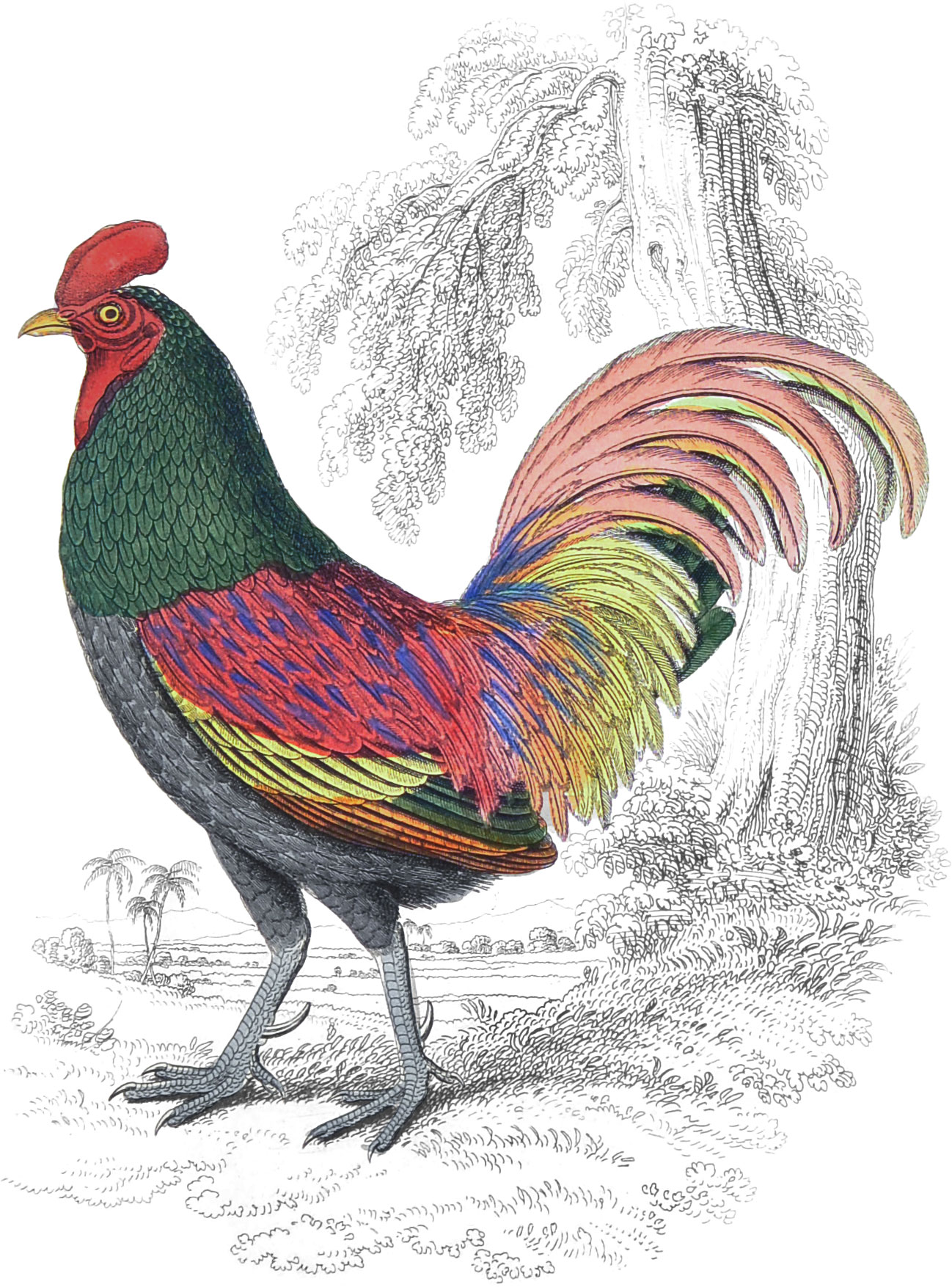
Plate IX
Our next Plate represents
The Fork-Tailed Cock
Gallus furcatus.—Temminck.
Coq ayam-alas; Gallus furcatus, Temminck, Histoire Naturelle des Gallinacés, ii. p. 261.—Pl. Coloriées, pl. 483.—Gallus Javonicus, Horsfield.
This curious Cock was first described by M. Temminck in 1813. It is nearly two feet in length to the extremity of the tail. The cheeks are bare, the head furnished with a simple entire comb, and the throat with a single large wattle springing from the centre: they are all bright red. The head, neck, and upper part of the back, are remarkable, from the short and rounded form of the feathers: the centre of these feathers is of a deep metallic blue, which shades towards the edges to a golden-green, and at the extremities they are finished with a narrow band of very deep black. The feathers of the lower part of the back and tail-coverts lengthened as usual, are of a deep black in the centre, and are bordered with a narrow stripe of pale yellow: those forming the wing-coverts are of the same form, but the pale narrow border is of a rich orange-red: the whole under parts are deep black. The tail is said to be earned more in a line with the body than usual, and to have a slightly forked form: the large hanging feathers are of a rich metallic green, tinged with steel-blue. The bill, legs, and feet, are yellow.
The hen has a circle round the eyes only, naked and of a livid tint: the head and back part of the neck are brown, and above each eye there is a red-dish streak: the back and wing-coverts are of a dull green, with golden reflections, each feather having a greyish-brown margin: the greater coverts and secondaries are black, with greenish reflections, waved transversely with yellowish-brown, and having the tips entirely of that colour; the tail and wings brown, the feathers of the former edged with pale reddish, the whole of the under parts are grey, the tips of the feathers on the breast tipped with a deeper tint; the feet and legs are brown.
This bird is said to be very abundant in Java, and may be often seen during the day upon the edges of the woods and jungles, but possesses the same wary disposition of its congeners and the pheasants, and upon the least alarm runs for cover. Temminck observes that they are not kept in a domestic state, but that they occasionally breed with the tame hens—a curious fact, and showing the uncertainty with which the true origin is clouded. The cry may be expressed, he says, by the syllables co-crek.

Plate X
Sonnerat’s Wild Cock
Gallus Sonneratii.—Temminck.
Coq sauvage, Sonnerat’s India, ii. pls. 94. & 95.—Phasianus Gallus, Lath. Index Ornithologicus.—Coq et Poule Sonnerat, Temminck, Pigeons et Gallinacées, ii. p. 246.—Planches Coloriées, pls. 232, 233.—Sonnerat’s Wild Cock, Latham’s General History, vol. viii. p. 181.
Sonnerat’s Cock has been dedicated by M. Temminck to its discoverer. The first notice we find of it which can be trusted, is in the Voyage to India by that traveller, under the title of Wild Cock, and asserting it as the probable stock from which all our domestic races have arisen. The very great difference of the structure of the plumage, however, renders this most improbable; and none of the domesticated races in India bear the least resemblance to it. It is a native of the continent of India, inhabiting the higher wooded districts, particularly Indostan, where, among English sportsmen, it receives the name of Jungle Fowl; and specimens of it, next to the Bankiva cock, are much the most frequent in collections in this country. In size, it is nearly equal to an ordinary domestic fowl, the proportions rather more slender and graceful: the comb is large, and with an unequal margin; and double wattles hang from the base of the under mandibles. But the most singular part in the plumage is in the form of the shaft in all the long hackled feathers: those of the neck, wing and tad coverts have a dark greyish ground, but the shafts are of a bright golden orange, and in the centre and at the tip dilate into a flat horny plate, similar to what is seen in the wings and tail of the Bohemian Wax-wing. They will, however, be better understood by the accompanying representations of their form.

Feathers
Their appearance is both singular and beautiful. The centre of the back, the throat, breast, belly, and thighs, are of a deep and rich grey, having the shafts and edges of a paler tint. The tail is of a rich and deep green: the feathers which immediately succeed the long hackles of a rich purple, edged with a pale yellow, and those immediately succeeding of a golden-green, edged with grey, the whole with very brilliant metallic reflections. The bill, legs, and feet, are yellow.
The hen is about a third less than the cock, without comb or wattles. The, plumage has no trace of the horny structure adorning the other sex. The upper parts of it are of a uniform brown: the feathers on the neck edged with a dark margin, upon the back and wing-coverts with a pale streak along the shaft, and on the wings, tail coverts and tail, waved and mottled with darker markings. The throat and fore part of the neck is white, and on the rest of the lower parts each feather is of a greyish-white, edged with dark brown; towards the vent the brown predominates. The legs and feet are bluish-grey.
Dr Latham observes that this species is by far the boldest and strongest in proportion to its size, and in Indostan is anxiously sought after by the cock-fighters, seldom failing to secure the victory over the larger game cocks.


Genus Phasianus
Auctorum.
The Ring-Necked Pheasant
Phasianus torquatus.—Temminck.
Faisan à collier; Phasianus torquatus, Temminck, Pigeons et Gallinacées, ii. p. 327.
With this bird we enter the genus Phasianus, as it is now restricted by modem ornithologists. Formerly the birds which we have just left were included in it, and another group which we shall reach after having described a few of the more interesting and typical forms of that now before us.
The Pheasants may generally be characterized by having the bill rather strong, the upper mandible convex, and naked at the base: the nostrils are lateral, and covered with a cartilaginous scale. The head is clothed with feathers, but the region of the eyes, for a considerable space, is covered with a naked verrucose skin, generally of a bright vermilion. I he wings are short, but firm and compact. The tail is remarkably long, generally wedge-shaped, The feet have the anterior toes united by a membrane to the first joint. The hind toe is articulated upon the tarsus, which, in the males, is furnished with a strong conical sharp spur. The plumage of the male is generally of the most brilliant tints. In their habits, the Pheasants exhibit all the characters of the rasorial birds: they live on fruits and roots, and the larger seeds, are remarkably active upon the ground; and though their short and concave wings prevent them from taking a long and sustained flight, their power is sufficient to carry them away from ordinary dangers; while in the form of the tail and rump feathers, or upper tail-coverts, we find the samefulness which we have seen to be so extraordinarily developed in the peacock, turkey, and cocks.
For our first illustration, and as typical of this group, we have selected the Common Pheasant, familiar to every one, and universally admired, for the richness and beauty of his plumage. It is now generally admitted that the Pheasant was originally introduced into Europe from the banks of the Phasis,9 a river in Chalchis in Asia Minor. The Greeks, in the ascent of the stream, were attracted by their beauty; and the bird being so easily domesticated, a valuable addition to the luxury of themselves and the Romans was soon secured, and rapidly extended itself over the southern countries of Europe. They appeared at the expensive and superabundant repasts of the ancients, and for a time bore the palm for novelty; and Heliogobalus in his ostentation is said to have fed the lions of his menagerie with them. The I peasant may be said to have been originally restricted to the Asiatic continent, extending over the greater part of it, and reaching to China and the confines of Tartary. Now, however, it is much more extended, and its facility of domestication, and hardy constitution, suit it for almost every country. It is even abundant in Siberia, where the inhabitants adorn their caps with its plume; and one of the Governors of St Helena succeeded in almost naturalizing it to the more barren soil of that island. In the greater part of Europe it is completely naturalized; and we have heard of its introduction to North America, where it will certainly thrive. We are not aware of any similar attempt having been made m either Africa or New Holland. In the latter we should have little doubt of its success; but the climate of Africa we should consider as one of the most unpropitious for its establishment. We are in greater uncertainty of the time of its introduction into Great Britain than of its original discovery. They are mentioned in Echard’s History of England as worth only 4d. in 1299. Two hundred made part of the great feast of Archbishop Neville, about the middle of 1400; and in the regulations of the fifth Earl of Northumberland, begun in 1512, we find their value increased to 16\(\frac{1}{2}\)d. each. Upon the Scottish bonier and high Cheviot range they must have been early abundant; for in the old ballad of the Field of Otterbourne, we have
The roo full rekeles there sche rinnes.
To make the game and glee;
The Eawkon and the Fesaunt both.
Among the haltes on hee.
The markings and varying and splendid hues of the plumage of the male Pheasant are so well known and have been so often celebrated, that any detailed description will be unnecessary. Pope’s poetical description is extensively known: that of another, perhaps less frequently quoted, will give some idea of his splendid appearance:
Splendid his form, his eyes of flaming gold
Two fiery rings of living scarlet hold;
His arching neck a varying beauty shows.
Now rich with azure, now with emerald glows
His swelling breast with glossy purple shines,
Chestnut his back, and waved with ebon lines.
To his broad wings gay hues their radiance lend.
His mail-clad legs two knightly spurs defend.
In this country we have, however, Pheasants which exhibit a marked difference in the want or presence of the pure and conspicuous white ring which encircles the neck. These, by sportsmen, and many ornithologists, have been considered as varieties only; while Temminck, who compared native specimens of each, thinks them completely distinct. Out of India they breed freely together, and it is impossible to decide the question from any series which could be procured from the preserves of this country; and we possess Indian specimens of the ringed bird only. We shall therefore mention the reasons tor separating them which the above-mentioned naturalist has pointed out, stating, at the same time, that we consider his opinion to be correct, and that the differences evidently appear more marked than in many allied birds which have universally been acknowledged distinct.
The ringed pheasant chiefly inhabits the forests of China, where the common species is also abundant, but in this natural state they never breed together. The eggs of the ringed bird also differ: they are of a pale bluish-green, marked with small blotches of a deeper tint; while those of the common pheasant are of an olive white,10 and without any spots. The ringed pheasant in its wild state, is always of a lesser size, the extreme length never exceeding two feet five inches, and the tail itself is much shorter in proportion to the body. The head is of a whitish fawn colour, tinted with bluish-green; and above each eve there are two white lines, forming a sort of eyebrow. The markings on the back are different and smaller, and the rump feathers shew the same peculiar tint which the mixture of fawn and greenish-blue exhibits; and, lastly, the white ring broadest upon the sides of the neck, is a mark which never can be mistaken. The female also differs in her lesser size, and comparative length of the tail. The ground colour of the plumage is brown. There are no dark spots upon the breast, and the barring of the tail is very distinctly marked; but what Temminck has observed to be the principal distinction in the female, is a little band of thick and black feathers, which runs a short way under each eye, and which he thinks is wanting in the other.
The common pheasant does not much differ in its markings from those of the mixed breed we are accustomed to see, except in the entire want of the ling, and the peculiar tint upon the head and rump, but it is longer by five or six inches than the other, extending to three feet.
Of the habits of these birds in a natural state, we know little in reality, but have no reason to doubt their similaiity to those exhibited in our own country and the deep matted jungles of India, particularly where water abounds, must be their favourite resort. In their naturalized state, woods with a thick undergrowth of brush, brambles, long grass, &c. and interspersed with open glades, which some little stream refreshes, and the sun enlivens, are their delight during the day, and whence they run morning and evening to the open skirts, where some favourite food abounds. It is in their way to such feeding ground, that they are so easily secured by unqualified persons, for, never taking flight unless disturbed, they run and thread their way through these tangled brakes, and leave passages which are easily distinguished by the practised eye of the poacher.
During the winter months the pheasant goes regularly to roost, and the abundance of a preserve may easily be ascertained about twilight, by the noise which the males make in flying up to their perch. During summer, however, and when moulting, they do not tree, but squat among the long grass and cover, offering themselves in this way an easy prey to another class of enemies, polecats, foxes, &c. When pheasants are numerous, Mr Selby observes,
the males are in general found associated during the winter, and separate from the females; and it is not until the end of March that they allow the approach of the latter without exhibiting signs of displeasure, or at least of indifference. At the above mentioned time, the male assumes an altered appearance; the scarlet of his cheeks, and around his eyes, acquires additional depth of colour, and he walks with a more measured step, with his wings let down, and with his tail carried in a more erect position. Being polygamous, he now takes possession of a certain beat, from whence he drives every male intruder, and commences his crowing, attended with a peculiar clapping of the wings, which answers as the note of invitation to the other sex, as well as of defiance to his own.
During summer, the favourite food of the pheasants are tender shoots of the potato and other plants, and insects with their larvæ; as the autumn advances, the ripening grains of all kinds are abundant, and the ample store of wild fruits and ben lies which nature has every where provided, render this their time of feasting. As winter approaches, they are reduced to less various fare, and resort to the fallows in search of roots, and to the turnip fields; and Mr Selby has remarked, that the roots of the bulbous crowfoot (Ranunculus bulbosus), and of the garden tulip, are both much sought after. The latter they omit no opportunity of obtaining, and which, by means of the bill and feet, they are almost certain to reach, however deep it maybe buried. In extensive preserves, during this season, they are always regularly fed, and know the feeding hour and call of the keeper correctly, and by this means they are prevented from straying. The most successful and favourite food at these times is peas or grain. In the south of England, the breeding of pheasants for the supply of preserves, is carried on to a great extent, and on this account the bird can almost never be seen except in an artificial state; for being turned out of the nursing-houses early in the season, and fed and nursed in the covers for the winter’s batteau, they are sluggish and lazy, quite fearless, and can afford any thing but sport to one accustomed to follow game in their wild and natural haunts. The slaughter at these shooting meetings is sometimes so immense, that the game can scarcely be made use of, and they were formerly much more wanton on the Continent than in England.
In perhaps the largest game establishment of modem days, and conducted in a most magnificent scale, that of Chantilli, 54,878 head of various game were killed in one year; and during a period of thirty-two years, 12,304 is the lowest number that was obtained. In the same course of years the number of pheasants killed was 86,193, averaging nearly 2700 yearly. In Germany, there were some parties scarcely inferior in massacre. A party of ten in Bohemiaare said to have killed in two days, within a limited extent, above 950 pheasants, besides about 1200 partridges; and in another part of Germany, twelve sportsmen, if such a name is applicable to them, killed in one day of fourteen hours, 39,000 head of game, of which pheasants bore a proportion. At the Christmas batteau in England, 800 to 1000 head of game is a frequent daily amount, the greater share of which are hares and pheasants. From these some idea may be formed of the extent to which breeding and turning out is carried.
The pheasant is subject to considerable variety of plumage. Like most of the gallinaceous birds, as we have already mentioned, the female assumes the plumage of the male, and those in this state should be killed or expelled the preserves, as with the livery, they assume a disposition at war with their own race. They vary in being mottled with white, or becoming entirely of that colour; and Temminck is of opinion that in such cases the change is owing to disease in some of their functions, and mentions that persons who have long bad the charge of a pheasantry, have known the white birds resume all their former brilliancy of plumage, after continuing for years in the albino state. There is another very beautiful variety which of late years has become extremely common in Scotland, and has received the appellation of Bohemian Pheasant. The ground shade of the plumage becomes of a rich green cream colour, but the head retains its glossy tint, and the black tips and markings on the breast and belly, and back, appear even more conspicuous than in the ordinary state. This state may occur from a modification of the same causes which influence the change in the white varieties.
The pheasant sometimes also crosses with the domestic fowl. Temminck mentions this as requiring great attention to accomplish; but where poultry is kept upon the borders of a wood abounding with pheasants, it occasionally happens, and would do so perhaps more frequently, if favourable opportunities occurred; a specimen in our own possession, exhibiting all the mixed characters, was procured in a wild state. M. Temminck also records a solitary instance of a mule between the female common pheasant and male golden pheasant, which exhibited a curious but splendid mixture; all his endeavours, however, to procure a second specimen were ineffectual. The common pheasant breeds also freely with the ringed bird, and the offspring is productive. This has been considered by many as a proof that these two birds were identical, but in the whole of this order, and its corresponding one among quadrupeds, this law has a much more extended modification, and can scarcely be taken as a criterion except in very opposite instances.

Plate XIII
We shall now examine another very beautiful pheasant, very much allied in form to that we have been describing. It is
Diard’s Pheasant
Phasianus veriscolor.—Vieillot.
Le Faisan versicolor, Phasianus versicolor, Vieillot, Galerie des Oiseaux, pl. 205.—Temminck, Planches Coloriées. Male, pl. 486. Female, pl. 493.
This beautiful pheasant was first noticed by M. Diard, who procured a specimen which had been imported to Batavia, and is first figured and described by M. Vieillot in his Gallery, and since by M. Temminck, who has also added the portrait of the female, both of which have been used for the accompanying illustrations. It is a native of Japan, frequenting the woods, according to Seiboldt, and possessing the manners and habits of the common bird.
Diard’s pheasant is nearly of the size and form of the common naturalised breed, but the tail is somewhat shorter in proportion. The naked space of the cheeks is bright scarlet. The head and upper part of the neck are of a golden green, with violet reflections; the throat and fore part of the neck of a lively blue; lower part of the neck, breast, and upper parts of the body, of a deep green, with a shining lustre. The feathers of the back and scapulars have small yellowish white bands upon a ground of rich metallic green, glossed with purple and violet, and surrounded with a border of golden yellow. The lower part of the back and rump are grey, clouded with green. The tail coverts blue or green, according as the light falls upon them. The feathers of the tail are of a greyish green, the lateral ones thickly mottled with very small spots; the four centre ones crossed with bars, largest and broadest towards the base. The edges of these feathers are long and disunited, and have on each side one of a greyish purple, almost like a fringe. The feet and legs are reddish. The total length of the bird is about three feet seven or eight inches.
The female, Plate XV, about sixteen or seventeen inches in length, M. Temminck observes, so closely resembles the common hen pheasant, as scarcely to be distinguished from her, except by the less size, and the proportional length of the tail. The upper parts, however, have generally a greener tint, and are of a metalic lustre, and the lower parts have a much greater number of black spots and markings. We have given a representation of the female of this bird, with the view of exhibiting the differences of sex among the pheasants; among all, even the most splendid, the plumage is of a shade of yellowish brown; the feathers to a certain extent, following the form of those of the male, and generally barred with black about the tips.


The Barred-Tailed Pheasant
Phasianus superbus.—Latham.
Barred-tailed Pheasant, Latham’s General History, vol. viii. p. 196.—Phasianus superbus, Faisan superbe. Temminck, Pigeons et Gallinacés, ii. 336.—Faisan venere, Phasianus veneratus, Temminck, Planches Coloriées, pl. 485.
From Temminck’s own shewing, this is the Phasianus superbus of his former work, and of Latham’s General History. Why he changes the name to that of veneratus, which was engraved on the accompanying plate, before enquiring into the matter, we do not know; and seeing no reason for it, we have now retained the original one, already introduced into many works of natural history.
Dr Latham’s original description of this very splendid bird, was taken from one of the drawings of Sir J. Anstruther; from the writing beneath it in the Persian language, it was called Doom-durour, (long-tail), and was found on the snowy mountains of Surinagur. Temminck’s first description, amounted only to that of two of the tail feathers, but having since procured two entire specimens, he has been enabled to give a figure and more detailed account the former has now served for the accompanying illustration. It appears to be extremely rare in China, and to be brought from the confines of the empire to Pekin, where it is kept in the menageries of the most wealthy. Temminck is also of opinion that their exportation is prohibited under a severe penalty. The most remarkable feature in this bird is the extraordinary and disproportional length of the tail. Temminck gives the length of the longest feather as above four feet, while Dr Latham remarks,
Some years since, I had an opportunity of seeing a bundle of thirty or forty of these tail feathers, which were brought from China: I found among them every length from more than seven feet to eighteen inches.
Tie body of the bird is about the size of the Silver Pheasant of our Plate XVIII. A small portion round the eye is bare of feathers, and is red. The head is covered with a cowl of white, surrounded by a narrow band of black, broadest towards the ears. Two white collars cover the neck, and are broadest on the fore part; the first stretches from the base of the bill upon the throat, the second spreads upon the breast. The back of the neck, back, and rump, are covered with feathers, in the form of scales, of a rich and brilliant golden-yellow, and terminated at the extremity by a narrow band of black; the plumes of the breast and lower parts are of a shining white, covered by two irregular bands of deep black, and tipped with a band of the same colour; the middle of the belly, breast, thighs, and under tail-coverts, deep black; the latter spotted with golden yellow. The tail is composed of eighteen feathers, which fold over each other, and when closed appear very narrow; at the base they are about two inches in breadth, of a greyish white, clouded with a golden red upon the edges, and crossed on each side of the shaft with alternate crescent-shaped bars, brown at the shaft, and chestnut-coloured at the edge. Temminck counted upon the feathers of his specimen above four feet in length, forty-seven of these bands. The feet and legs are greyish brown, and are armed with spurs, like the greater number of the genus.

Plate XVI
Sœmmering’s Pheasant
Phasianus Sœmmeringii.—Temminck.
Faisan Sœmmering, Phasianus Sœmmeringii, Temminck, Planches Coloriées, pls. 487 and 488.
This very beautiful species was sent to the Dutch collections by Dr Seiboldt from Japan, and is dedicated to the venerable Sœmmering by M. Temminck, by whose description and figure it is only known.
That naturalist describes it as intermediate in size between the common and golden pheasants, or about 3 feet 6 inches long. The plumage of the male is generally of a rich reddish-purple, with a shining or bronzy lustre, the feathers bordered with a band of still more brilliant appearance. Upon the under parts and wings, the colour becomes of a redder tint, with purple reflections, and mixed with large black spots. The tail is long and very ample, clouded with darker shades, and crossed with thirteen large black bands.
The female is much smaller, being about nineteen inches long. The tail only about six inches in length, perfectly wedge-shaped, is of a lively red; the feathers except those in the centre, banded towards the tip with black; the tip itself of the whole is white. The rest of the plumage is varied with black and reddish-brown; the markings arranged in bars or crescents, a good deal similar to that of the common grey hen.
We have here to notice another very interesting bird, of which Mr Gould has given a figure in his Century of Birds from the Himalayan mountains, under the title of Phasianus Staceii. The head is adorned with a considerable crest, and, with the neck, is of a dull tawny yellow, every feather, except on the cheeks and throat, being barred with black. The quill feathers are marked with zigzag lines, and are tipped with black; the rump is rich red brown, each feather having two spots of black near the tip; the tail is pale tawny, barred at regular distances with a narrow and broad band of deep blackish-brown; the under surface is pale tawny, barred on the back; the bill and tarsi brown. The total length is about three feet four inches.

Plate XVII
Our next bird differs from the true or typical pheasants, in being also crested, and in having the tail in a manner folded, bending and very ample. By Temminck it is placed first among the pheasants, after the Macartney Cock, with which he concludes his genus Gallus; it is
The Silver Pheasant
Phasianus nycthemerus.—Temminck.
Phasianus nycthemerus, Linnæus, Latham.—Black and White Pheasant, Edwards.—Pencilled Pheasant, Latham.—Falsan bicolor, Temminck, Pigeons et Gallinacés, ii. p. 281.
This is one of the most powerful of the pheasants, and is a match in battle for a game cock. The naked space round the eyes is very large, and extends forward upon the nostrils, rising above each in the form of a small caruncle, and at the lower part falling down in a small wattle. This part is of a soft velvety texture, and of a bright vermilion tint. The head is adorned with a long and ample crest of glossy purplish black feathers; the throat and whole under parts of the same deep tint; the feathers covering those parts are of a lanceolate form, similar to those upon the same parts of he next genus we shall describe. The rest of the plumage may be said to be pure white, but the webs of each feather, from the upper part of the back downwards, are diagonally streaked with black, producing a beautiful wavy pencilled appearance. The tail is folded; the centre feathers without the black waves and bending; the others graduating to the outside, and broadly marked with black; the legs and feet are purple-lake.
The female is smaller, the crest much less ample, and the tail more regularly graduated to the end the centre feathers brown, the outer ones obliquely streaked with black and white; the upper parts are of a chaste greyish brown, with minute black irregular bars. The under parts are white, irregularly marked with brown, and crossed with black bars.
The Silver Pheasant is a native of the northern parts of China, where it is frequently kept in a tame state. It has often been imported alive to this country, with the next it forms a very beautiful ornament to our aviaries, and, being perfectly hardy, it is reared with the greatest ease. Some attempts have been made to turn it out in the preserves, but generally without much success. They are with great difficulty raised from the ground, and may fall a frequent prey to all kinds of carnivorous animals they also drive off the common pheasant, and the sacrifice in many instances has been thought too great. When in confinement they become extremely tame and familiar.

Plate XVIII
The Golden Pheasant
Phasianus pictus.—Linnæus.
Phasianus pictus, Linnæus, Latham.—Painted or Gold Pheasant, Edwards.—Faisan tricolor, Temminck, Pigeons et Gallinacés, ii. p. 341.
In this bird we see another form among the true pheasants. The head is crested, and even more amply than the last; the tail is broad, folded, and bending, and the neck is adorned with a ruff of broad truncated feathers, which fall from the occiput around like a hood, and can be raised and depressed at the will of the bird. This form is only exhibited by the present bird, and another described by Mr Leadbeater, under the title of Ph. Amherstia.
This pheasant may be said to be the most gaudy of its race, and for its gay and splendid plumage and comparative hardiness, is often kept and sought after for the aviary, and is so generally known, that a detailed description is unnecessary, particularly where words are so inadequate to convey an idea of the brightness of the plumage. In addition to the brilliant ruff of golden orange and black, differing from the plumage of the pheasants, we have the feathers covering the rump, particularly upon the sides, long, narrow, with loose webs, almost like hackles, but of a texture quite stiff and almost horny. The female has the usual unobtrusive brownish plumage, broken with black crescent-formed bars, and the tail is short and regularly graduated.
This bird is also a native of China, where it is called Kinki or Kinkee, Gold Flower-fowl, or Wroght Fowl.11 It is kept in domestication, and may now be procured in considerable numbers from many parts in the south of England. Like the Silver Pheasant, they have also been attempted to be set at large in the preserves, but generally also without success. For the table they are said to be more delicate than the common pheasant; their numbers are, however, too limited for them to be often seen in a cooked state. The feathers of the crest and ruff are held in much request by anglers, and particularly to assist in dressing the gaudy Irish hooks.

Plate XVIII*
The other beautiful species now alluded to is
Lady Amherst’s Pheasant
Phasianus Amherstia.—Leadbeater.
First described by Mr Leadbeater of London, in the Transactions of the Linnean Society, from two male specimens presented by the King of Ava to Sir J. Campbell, who gave it to Lady Amherst.
The feathers on the top of the head are green; the crest-feathers are crimson, and 2\(\frac{1}{2}\) inches in length; the pendant tippet is of a beautiful white, each feather tipped with a dark green circular band, with a straight band of the same colour across each feather, about three-eighths of an inch above the end; the whole depth of this tippet is 5\(\frac{1}{2}\) inches, the longest feathers 4\(\frac{1}{2}\) inches; the neck, back, shoulders, chest, and wing-coverts are of a beautiful metallic green, each feather ending in a broad zone of velvet black; the wing primaries dusky, with lighter coloured shafts, and white outer edges; the greater wing-coverts and secondaries bluish-black; the breast and belly white; thighs and under tail-coverts mottled dark brown and white; the legs light blue. The feathers on the rump are brown at the base, green in the middle, the remaining most exposed portion of a bright saffron-yellow; the tail-coverts are also brown at the base, the centre portion barred green and white, ending in scarlet; these feathers elongated to the extent of 10 inches, as their plan of insertion approaches that of the true tail primaries; the first tail primary measures only 29 inches, the plume 1\(\frac{1}{2}\) inch in depth, of a beautiful white ground, with broad bars of green about three-fourths of an inch apart extending in the direction of the web, and mottled across from bar to bar; the third and fourth primaries are the longest, and measure 38 inches each; the inner web narrow and mottled black and white; the outer web 1\(\frac{3}{8}\) inch wide, with transverse circular dark green bars about three-fourths of an inch apart, on a ground the inner portion of which is greyish-white, the outer part light chestnut-brown.
Genus Euplocomus
Temminck.
This genus was formed by M. Temminck, for the reception of a few birds differing in form and structure from the cocks and pheasants, but still appealing closely allied to both; while its alliance to Lophophorus is also so great, that the founder of that genus has transferred one described by himself to the present little group. The form of the tail is one of the principal distinctions, being often forked, in all cases very ample; the feathers broad, and pointed. The first we shall notice is
The Macartney Cock
Euplocomus ignitus.
Fire-backed Pheasant of Java, Macartney, Embassy to China, pl. xiii.—Phasianus ignitus. Lath. Index Ornithologicus.—Houpifére Macartney.—Gallus Macartneyi, Temminck, Pigeons et Gallinacés, ii. p. 273.
The first notice of this very beautiful bird is in the description of the embassy to China, under Lord Macartney. It was met with by Sir George Staunton in a menagerie at Batavia, and figured in the large Atlas of Plates accompanying the above mentioned work. Temminck subsequently gave a description of it in his Gallinaceous Birds, made from many specimens received from Sumatra.
The length of the adult male is about 2 feet. The skin of the nostrils stretches backwards, and covers the sides of the head behind the eyes, and is of a bluish-purple. Upon the centre of the crown there is an upright crest, composed of feathers with a naked shaft, and expanding at the tip into a number of slender barbs, which spread out and form a broadish crown. The head, neck, breast, belly, and upper part of the back, are of a very deep black, with steel-blue reflections. The feathers on the middle of the back are of a brilliant orange, or what would be called flame-colour, and in different lights assume various degrees of intensity of lustre. The rump and tail-coverts are broad and truncated, and are of a brilliant bluish-green, with a bar at the tip of a paler tint, and in those at the sides of the same colour with the orange of the centre of the back. The tail is slightly folded, like that of a hen, or, when seen flat, appears forked. The centre-feathers are white; those on the out-side black, with green reflections. The legs and feet are bright vermilion.
The female, Plate XX., only about 20 inches in length, has the plumage almost entirely of a rich cinnamon-brown. On the upper parts the feathers are slightly mottled with black. The throat is white; and the lower parts, of a paler tint than those above, have the feathers bordered with nearly pure white. head wants the erect crest of the male; but the feathers on the hind-head are lengthened. pears slightly forked. The tail appears slightly forked.
The Macartney Cock inhabits Sumatra; but nothing has yet been learnt regarding its habits.


Pucras Pheasant
Euplocomus pucrasia.
Phasianus pucrasia, Pucras Pheasant, Gould’s Century, and Gray’s Illustrations of Indian Zoology.
This is one of the most beautiful of the Euplocomi, but differs slightly from the typical examples in the form of the tail, which is more pheasant-like. There seems to be considerable variations in the shades of the plumage of this bird. The most frequent tints are upon the head, throat, and neck, of a beautiful green, with blue and violet reflections. Upon the sides of the neck there is a conspicuous patch of pure white. The head is crested with long, rather broad feathers, the first and shortest arising from the crown, of a reddish-yellow; the others hanging over the back of the neck, of the same rich colour with the head and neck. The upper parts are of a rich brown; the feathers of a lanceolate form, and dark centres. The under parts are of a rich chestnut, and bordering this are lanceolate plumes, of a still greater length, nearly white; the centres dark, tinged with yellow, and appearing conspicuous when lying over the darker plumage of the upper parts. The tail is ample, and above of a brownish-chestnut. The female is very similar to those of Lophophorus and Tragopan, of a dull umber-brown, with dark waves and crosses. This bird inhabits the alpine regions of India, and is yet but imperfectly known.

Plate XXI
To this same genus belong one or two beautiful birds even still less known than that now represented. Among them is the Lophophorus Cuvierii of Temminck. The plumage of this is black, barred delicately with grey; the rump with large truncated feathers, broadly edged with white. Temminck is of opinion, that his specimen, unique at the time, was scarcely adult, and that the plumage, with the exception of the rump, was glossy bluish-black. A bird which we lately received from India agrees with this, and is entirely of a rich bluish-black, except the rump.
Another beautiful species, inhabiting Alpine India, has been figured by Mr Gould under the name of Phasianus albocristatus. In this the crest is composed of long hackly white feathers. The plumes upon the lower parts are very lanceolate in their form, and are conspicuously seen on the black shoulders and mantle. The rump-feathers are of the same broad form, with broad white margins.
The next form we have to notice is
Genus Lophophorus
Temminck.
Temminck instituted this genus in the Histoire Naturelle des Pigeons et Gallinacés, from what yet remains nearly a solitary species, the Impeyan Pheasant of Latham. At the time of its formation, he placed several other birds with it; but he is now of opinion himself, that they will more properly range with the preceding genus Euplocomus. The only bird which has any claim to be reserved is what was described in “Ornithological Illustrations” as Lophophorus Nigelli; but being a female, we cannot so clearly decide. This genus differs from Euplocomus in the form of the tail, which is flat and rounded; the nearest approach to that being in the Ph. erythropthalmus of Raffles, and in the old Loph. Cuvierii of Temminck. The form of the bill is also much more hooked or curved downwards, as if intended to dig or root up bulbous plants, in the same way with some tribes of the partridges. The head is also splendidly and peculiarly crested, and the plumage extremely brilliant.
Our next Plates will represent the male and female of this splendid bird; and we have to acknowledge our obligation to Mr Gould for permission to copy his beautiful Plates in the Century of Himalayan Birds, by far the best which have ever appeared of this, and some other members of this beautiful family.
Impeyan Lophophorus
Lophophorus Impeyanus.
Lophore resplendisant, Temminck, Pigeons et Gallinacés, ii. p. 355—Impeyan Pheasant, Latham’s General History, viii. p. 210.—Phasianus Impeyanus, Index Ornithologicus, ii. 632.—Lophophorus Impeyanus, Gould’s Century, Male and Female.
The splendour and changeability of the tints up on the male of this bird, it is almost impossible to describe, either bywords or the pencil. The greater proportion of the plumage is of varying hues of green, steel blue, violet and golden bronze. The texture is very dense and metallic looking, the feel soft and velvety. Upon the head there is a crest of feathers, composed of a naked shaft, with an oval tip of a similar texture with the rest of the plumage; this appears capable of erection at pleasure, but in a state of rest seems to recline or bend over the hind head. The centre of the back is pure white, following the distribution of colour which we have observed in the Euplocomi; the tail is plane, rounded, and of a bright chestnut, clouded transversely, with bars of a duller tint. The legs are armed with strong spurs.
The female, Plate XXIII., is considerably smaller. The feathers of the head lengthening behind, the throat and fore part of the neck pure white; the rest of the plumage is of a pleasing reddish-brown, varied and mottled by spots and bars. There is no trace whatever of the resplendent colours of the male.
These splendid birds inhabit the alpine ranges of Nepaul and Himalaya, and with numerous others, almost as beautiful, enliven these stupendous solitudes; little is known of their habits, and they have not yet been brought to Britain alive. The first specimens which were seen, were procured by the exertions of Lady Impey, and died after having lived on ship-board more than two months.


Our next illustration represents the
Genus Tragopan
Cuvier.
The Horned Pheasant of Edwards and Latham, for the reception of which the Baron Cuvier established his genus Tragopan, long puzzled ornithologists, and we have it accordingly changed from one place to another, and find it ranking sometimes with Phasianus, sometimes with Meleagris, and at another with Penelope. The form of these birds perhaps approach as near to the next genus, or the Guinea hen, as any other. The plumage is very ample; the tail comparatively short; but the most prominent feature about them is a loose pendent skin which hangs from the base of the lower mandibles, and can be inflated at pleasure; and on the head, behind the eyes, two lengthened protuberances, which are also capable of enlargement and erection. The females, again, are of unobtrusive plumage, and resemble those of the last genus. This small group has been now extended to four species. The first we shall notice is
The Nepaul or Horned Tragopan
Tragopan satyrus.—Cuvier.
Horned Pheasant, Edwards’ Birds, pl. 116.—Phasianus satyrus, Temminck, Histoire Naturelle des Pigeons et Gallinacés, ii. 349.—Horned Pheasant, Latham’s General History, viii. p. 208.—Tragopan satyrus, Cuvier, Regne Animal, i. p. 479.—Gould’s Century.
In looking over the various ornithological works in our possession for the history of these beautiful birds, we have been able to find literally nothing their habits are completely unknown, or not touched upon. They seem confined to the more alpine regions, reach the limit of snow, and the present species has been brought from Thibet and Nepaul the next has been received from Himalaya. It would be of great importance to ornithologists, if notes were made regarding all the birds composing this genus, Euplocomus and Lophophorus. Until we know a little more regarding them, it is impossible to assign to them with any certainty a place in any system.
This bird is about the size of a large domestic fowl. The bare skin is of a bright bluish-purple. The feathers on the crown are lengthened, of a disunited texture, and are of a purplish-black, becoming deep crimson-red at the occiput. The back of the neck and bare skin in front are surrounded with deep black. The upper part of the back, neck, and all the under parts, are of a deep purplish cinnamon-red; the wings and upper parts of an umber brown, and the tip of each feather has an ocellated spot of white; these are largest and most conspicuous upon the flanks. The tail is rounded, but almost concealed by the tail-coverts, which are very ample, and spread over it in two ranges, each with a very conspicuous and white spot. The tarsi are spurred.
We have not seen the female of this species, but Dr Latham describes it as nearly similar to the male, but having the colours less bright. If this is correct, there must be a considerable difference from this and the female of the next species, figured by Mr Gould, which almost resembles that of Lophophorus.
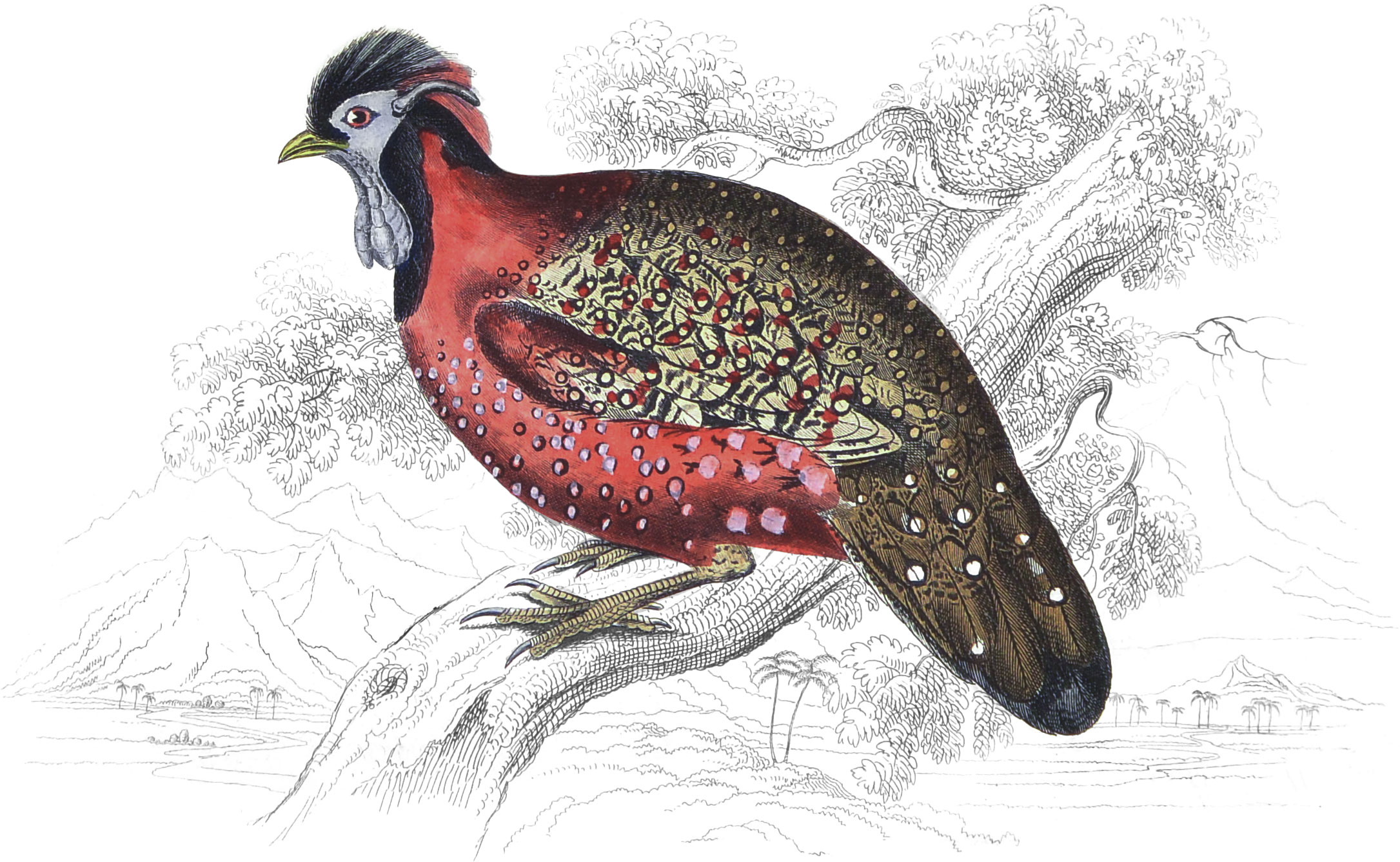
Plate XXIV
The Golden-Breasted Tragopan
Tragopan Hastingii.—Gould.
Tragopan Hastingii, Gould’s Century.
This is another very beautiful species, about the same size with the last, and figured and described by Mr Gould in his Himalayan Century. The horns and wattles are of the same bluish-purple. The crown is furnished with a lengthened crest of the same kind of disunited or hairy-looking feathers, pure black: the back of the neck, upper part of the back and shoulders, are of a deep uniform purplish-red: the wings, and whole of the upper parts, except the tail-coverts, are of a deep wood-brown, each feather having an ocellated spot of white, surrounded with black, most prominently conspicuous on the lower part of the back and tips of the secondaries. Immediately below the naked wattles there is a patch of brilliant golden-orange; the feathers composing it narrow and lengthened, and of a hard horny consistence, their points disunited, stretching over, and very conspicuous upon the deep black which covers the rest of the under parts. The tips of each feather covering the breast and belly are marked with a large white spot, with the dark shaft running through. The tail is black, clouded with brown; the coverts do not extend so far over it as in the last, and are of a yellowish-white, with a narrow bar of black at the tip of each.
The female given by Mr Gould, and represented on our Plate XXVI. is entirely of a dull umber-brown, marked with a variety of dark bars and waves. The feathers of the hind head are of the usual texture, and are slightly lengthened behind. Neither wattles nor horns are apparent.
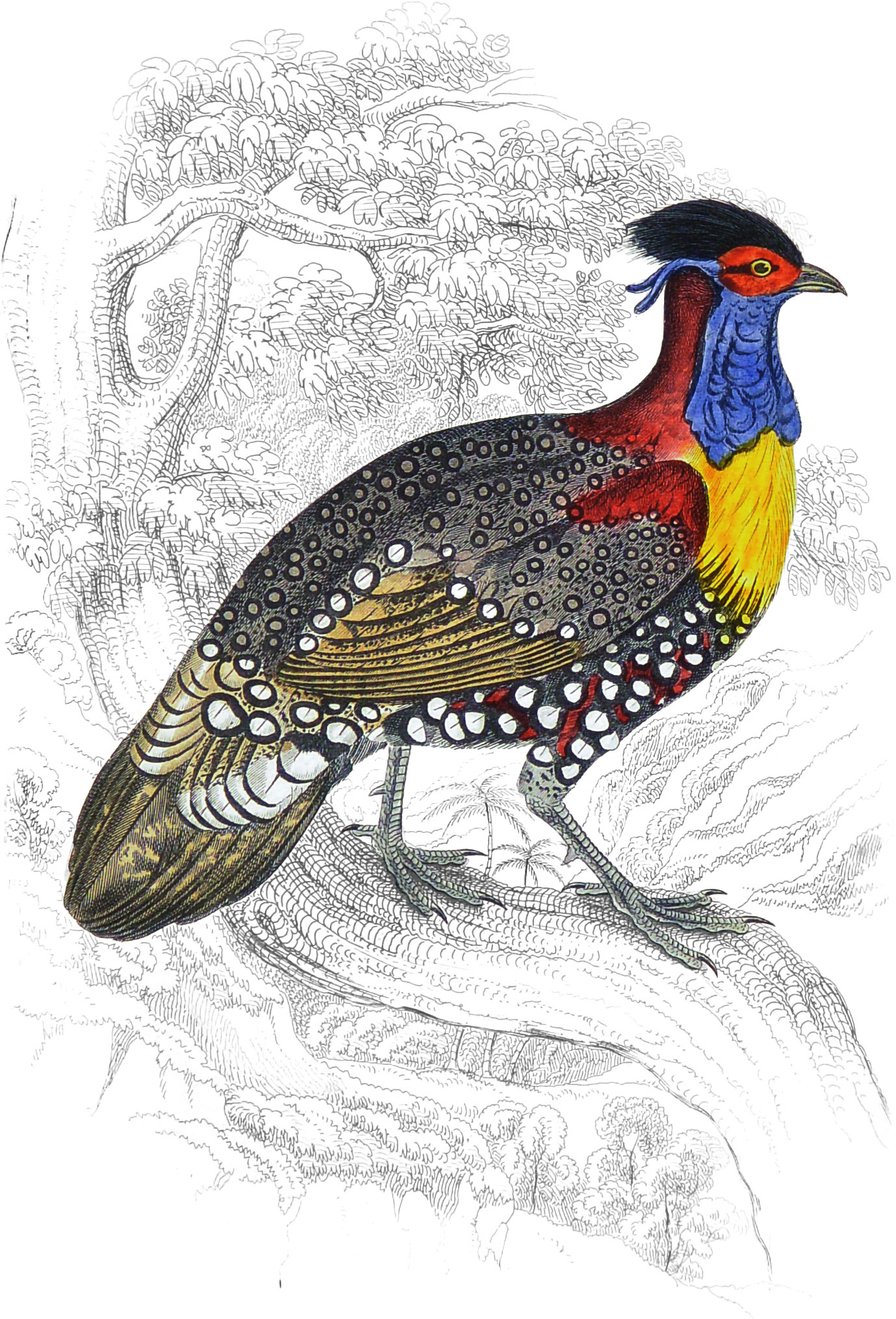

Our next plate represents a modification of this form in
Black-Headed Tragopan
Tragopan melanocephalus.—Gray.
Satyra melanocephalus, Gray’s Illustrations of Zoology.
Mr Gray has given a representation of this bird in his Illustrations, from one of General Hardwick’s drawings. It differs from the others in the want of any naked appendages to the head or throat, and in the head having a large crest, which is represented rising from the crown in erect feathers, with disunited webs, from the nostrils to the hind head: it is of a deep black, inclining to purple at the tip, and the whole of the head, cheeks, and throat are of the same colour, whence Mr Gray has taken his specific name. The plumage bears a strong resemblance to the others, but we can give no detailed description of it, or any information regarding its habits.

Plate XXVII
A fourth species is also figured by Mr Gray, under the name of Satyra Pennantii, which is the last of the known species belonging to this division.
Genus Numida
Linnæus.
The last form which we have to describe in this Family is the Guinea Fowl, as they are generally termed, constituting the genus Numida of Linnæus. It contains only three or four species, all natives of Africa, and some of them were known to the ancients. During the zenith of the Roman Empire they bore a high value at the public feasts, anti with its decline were for a time lost to Europe, to which they were again most probably introduced by the early Spanish navigators. Their plumage is very ample, their form compact and huddled together, and more formed for abode on the ground than for flight. The bill is curved and strong. They are gregarious, and roost on trees. We have figured as examples
The Crested Guinea-Fowl
Numida cristata.—Latham.
Peintade à crete, Sonnini’s Buffon.—Peintade cornal, Temminck, Pigeons et Gallinacés, ii. 448.—Numida cristata, Crested Pintada, Latham, General History, viii. p. 148.—Vieillot’s Gallerie, pl. ccix.
This bird is considerably less than the Common Guinea-fowl, represented on the next Plate, which ought properly to have come first in the older, the head and neck are bare, and of a dull blue, shaded into red upon the head. On the head, instead of the hard casque, there is an ample crest of hairy-like disunited feathers of a bluish-black, reaching as far forward as the nostrils, but in general turned backwards. The whole plumage, except the quills, is of a bluish-black, covered with small greyish spots, sometimes four, sometimes six, on each feather. The quills are pale yellowish brown, and the edges of the secondaries pure white, appearing very conspicuous from the contrast with the other parts. It is said by Temminck to inhabit the Great Namaquas country, and to have the same manners with its congeners.

Plate XXVIII
The Common Guinea Fowl
Numida meleagris.—Linnæus.
Numida meleagris, Linnæus, Latham.—Peintade, Buffon.—Peintade Méléagride, Temminck, Pigeons et Gallinacés, ii. p. 431.—Guinea Pintado, Latham, General History. viii. p. 144.
This beautiful but rather clumsily formed bird is very generally known. As its name proclaims, it is a native principally of the Guinea coast, although it is also found in various other parts of Africa, and is mentioned by both Sparman and Le Vaillant as occurring near the Cape of Good Hope. They are difficult to raise from the ground, but, when pressed, fly with a powerful flight, and for a considerable distance. They live in flocks, the amount of their broods, but at some seasons assemble in hundreds, when their noise in going to roost upon the trees is grating, and almost stunning. In this country they are kept in the poultry-yard, both for the sake of their young and eggs; but being very quarrelsome to other poultry, and possessing great strength, they have often to be sacrificed to the preservation of the rest, or to be separately confined. Several attempts have been made to turn them out in preserves, but this has never been persevered in, from their driving away and persecuting every other game. The plumage sometimes varies in being pure white.

Plate XXIX

Another species is described under the name of the Mitred Guineafowl, N. mitrata. It is said to be found in Madagascar, and is very closely allied to the common bird, differing chiefly in the ground colour of the plumage being darker, and in the spots being larger. The cry and habits are nearly similar.
Remarks on the Arrangement
We have now seen most of the members of this useful family, but as we mentioned at the commencement, they are not arranged in the order they should properly stand. This, even now, we may be unable to do as we should finally desire, having not had an opportunity of examining minutely all the forms, or of arranging the other families which compose this order; but the following short table will serve as some guide how they should be placed, which we shall afterwards alter, if necessary, in the synopsis of the whole, to be given with the concluding volume, according to the plan pursued with the Humming-Birds.
The Rasores, or third order of birds, contains the families Pavonidæ, Tetraonidæ, Cracidæ, Struthionidæ, Columbidæ.
The family Pavonidæ contains the genera and subgenera
- Pavo.
- Meleagris.
- Polyplectron.
- Argus.
- Phasianus.
- Gallus.
- Euplocomus?
- Lophophorus.
- Tragopan.
- Numida.
These are the genera at present established; it is however, probable, that one or two subgenera will still be found necessary, particularly in Phasianus.
The opinions regarding whether Pavo or Phasianus should stand as the typical form, are at variance among our ornithologists. Mr Vigors, in his arrangement, proposes the latter; Mr Swainson, Pavo, which for the present we have adopted. Looking at the forms of both, we find the tarsus and foot of nearly equal proportional strength, the hallux articulated above the plane of the foot, but in Pavo proportionally shorter, and the nail short. In this form, also, flight, from the unwieldiness of the plumage, is seldom resorted to, except in extremities, and the tail cannot be used in directing it. In Phasianus flight is often resorted to, and is powerful though not capable of being long sustained, and the tail is used in directing it: it therefore deviates more from the peculiarities of the order. The other forms are more difficult to fix. We are uncertain whether Euplocomus should not only form a subgenus of Lophophorus, and of the situation of Tragopan. In both the attributes of flight and perching are more extensively used. Numida, again, seems to connect the next family, by its alliance to the partridges, in the form of the tail and feet, harsh cry, and general habits. The more extensive examination of the whole order will, we trust, enable us ere long to solve all these difficulties, and we now prefer mentioning them as they have occurred, than leaving them entirely unnoticed. Our next volume upon this order will be devoted either to the Columbidæ or Pigeons, or the Tetraonidæ or Grouse.
Poultry and the Poultry Yard
At the conclusion of this volume, it has occurred to us, that a few observations on the more Common and Useful Varieties of Poultry, and the Poultry Yard, might not be unacceptable.
The name Poultry is derived from the French word Poulet, and comprehends all the domestic varieties which we are in the habit of rearing for the table, whether they be Land or Water Birds.
Common or Barn-Door Fowl, and Turkey
The most approved breed of the Common Fowl, is procured from the Dorking Cock, crossed with any Domestic Hen. The Dorking is very frequently distinguished by the peculiarity of possessing five toes on each foot, by their pure white colour, and their superior plumpness, with delicacy of flavour and whiteness in the flesh. Black or Speckled Hens are, however, esteemed better layers, and, in our experience, are less inclined to sit than most other varieties; which is particularly the case with the black breed of Poland.
When the rearing of Poultry is entered upon, on a moderate scale, care should be taken to select a warm well sheltered apartment, for their lodging in during the night, and for placing the nests for laying their eggs in.
The nests, for the purpose of laying in, may be arranged in tiers, one above another, in chequers, and may be constructed of wood, filled with straw or hay, once a-week—cleanliness in this and every particular being very essential. They should have a foot-board in front, for the purpose of the birds perching easily into them, and a fillet in front, to hold in the straw; and the situation in the apartment ought to be darkish rather than light, on account that Hens do not like to be disturbed in this operation. They should also be supplied with a ladder or stick, to assist them in perching up, as care should be taken not to injure the bird in its passage to the nest, when about to deposit her egg.
Nests prepared for the business of incubation, should have moveable gratings to place before them, to prevent the intrusion of other Hens while the mother is sitting. This grating must be taken off in the morning, when the other Fowls in the yard are being fed, the noise of which operation will, in general, excite the mother to rise and feed also; but should she delay to get off her eggs, she may be removed carefully, and placed near to the feeding board, when, after having satisfied herself, she will return to the nest, and the grating is to be replaced. She will not require food again till next morning at the same time. In this manner we have attended to half a dozen Hens and a couple of Turkeys, engaged in the process of incubation at the same time; the operation of removing and replacing the whole, not occupying more than half an hour each morning, and the birds, without the least confusion, all again set upon their respective nests. The attention incident upon these creatures at this time is very interesting; in a day or two, they become so familiar, as to permit themselves to be handled without fear, apparently conscious that no harm is meant; and as the period when the chick is destined to emerge from the shell approaches, they become more cautious and solicitous, that no injury shall befal the tender cases which envelope their future hopes.
The time which a Common Hen sits is twenty-one days, that of a Turkey and Duck about twenty-nine or thirty days.
On the day previous to being hatched, the chirp of the bird in the shell proclaims, both to the attendant and parent, that the young are about to make appearance; and, on the day following, if all goes well, the whole brood will be found rolling amongst broken fragments of their late frail tenements. The mother is, at this juncture, to be handled with very great care and tenderness; she is to be removed to the feeding board, where her anxiety will only permit of a very momentary absence, during which the shells are to be removed, and a small quantity of fine meadow hay inserted into the bottom of the nest, the chicks being previously held in a small basket till the return of the parent, who instinctively makes for and occupies her former abode, no doubt sufficiently alarmed at the apparent absence of her young, but which fear is soon removed, by their being placed one by one under her. We have repeatedly experienced the value of this precaution, in saving the chicks from being overlaid, through the restless anxiety of the mother, to secure the brood under her fostering wings, after feeding herself.
It is of great consequence to have a proper quantity of dry sand or ashes near the feeding-board, in which the sitters may rub themselves, in order to disengage any vermin adhering to their bodies, causing such restlessness, as in some cases to induce them to desert their charge; and along with this requisite, water in abundance must be provided.
We quote, from the interesting work of M. Bucknell, Esq., the following account of the progressive stages of life, as developed in the egg of a Common Hen:—
On the third day the embryo organization of the skull, brain, heart, and blood, is perceptible by the aid of a magnifying glass.
Fourth day—The pulsation of the heart is distinguishable by the naked eye.
Sixth day—The chief vessels and organs rudimentally formed; the pulsation and circulation of blood apparent.
Ninth day Intestines and veins formed, and the deposition of flesh and bony substance commenced; the beak for the first time opens.
Twelfth day—The feathers have protruded; the skull has become cartilaginous; and the first voluntary movement of the chick is made.
Fifteenth day—Organs, vessels, bones, feathers, closely approaching in appearance to the natural state.
Eighteenth day—Vital mechanism nearly developed, and the first sign of life heard from the piping chick.
Twenty-first day—The chicks break the shell, and in two or three hours are quite active and lively.
We have perused various modes of tending and feeding the young brood, upon its first appearance, but have found none more successful than the following:—
The parent is to be removed, along with the young, to a box or other receptacle, under cover, about four or five feet square, and eighteen inches deep. She, with the brood, are to be placed in a small coop, inside the box, so that she may be secured from treading upon them. A little soft hay should be put into the coop, and some dry sand or earth in a corner of the box, and the food placed within reach of both.
The coop may be constructed in the following manner:—
A wooden frame, of eighteen inches square, with one door in front, in two halves, in the form of a grating, to permit of the chicks getting easily out and in for their food, &c., and another door, outside of that, for shutting all in at night. Our own wooden frames are covered with coarse canvass, which is both lighter and cooler, than if constructed altogether of boards. For Turkeys the dimensions must be proportionally larger—about two feet square—formed in the same way. To prevent the other Poultry having access to the young brood, there should be a grating in front of the coop, in which the food and water is to be placed, and, in the course of the first or second day, the chicks will find their way to both. The vessel containing the water should, of course, be very shallow, with a few pebbles placed in it to prevent the birds getting wet precautions which, although obvious, are sometimes not thought upon. Being economists in our way, we have constructed very suitable coops out of old tea-chests.
At this stage of life many are the odd condiments recommended; but the food should consist of coarse oat meal, or bruised grits, for the chicks, with oats for the mother. In a few days, a little soft boiled rice may be mixed with the meal, and they will have no objection to a few small worms, and a little chick-weed occasionally. We have fed our Turkeys most successfully in the same way, with only substituting bread and milk, instead of worms; and chopped cresses or turnip shaws, in place of the chick-weed. Both will be the better of a little fine gravel and some particles of lime thrown in their way.
Generally speaking, the chicks should only get into their power such a supply of food at a time as they can nearly consume at once; for if more is placed before them, it is trodden down and wasted; but care should be taken that they receive that little very often at least five or six times a-day. The chicks of Common Fowls should not get out of the box for at least a fort-night, and Turkeys fully three weeks, during which time the parents are mostly to be confined to the coop, unless the weather be very fine, in which case both may be permitted a little liberty.
The Turkey is generally thought to be a tender bird when young, and difficult to be reared, although in our experience this is not the case. Our breed is the pure white variety; and, the first season, the hen hatched and brought to full maturity fifteen birds. In her second year, she and one of her daughters reared about thirty, which were fed up to full size. The old lady deserted during the existence of the charge, and commenced laying eggs, which were consumed in the family. This is the third season, and the mother and daughter, at its commencement, very early in spring, hatched only nineteen between them. The old bird again deserted her young, having handed over her charge to the junior parent, after which she laid and hatched twelve eggs, nine of which are all, at present, strong healthy birds, with every promise of being brought to full maturity of size.
In the successful management of this bird, much depends upon continued care in keeping them perfectly dry and warm, particularly during wet, moist, or hazy weather, with very frequent small supplies of the food already recommended. When they come to be about full size, they will be found to be even more hardy, and stronger than other common poultry, frequently roosting upon trees, in the open air, during the night, and braving the roughest and most inclement weather with impunity.
It is singular, and very interesting, to contemplate the quick-sightedness of the chick, about two or three weeks old, in capturing flies, and all sorts of small insects, as articles of food, while they are needling their tiny bodies through the grass, or brushwood of any kind. We were this season much amused, while watching our beautiful little brood stripping off the small green insects which were infesting our rose bushes.
We have already said, that we have found simple food most advisable for these birds when young, and we cannot refrain from deprecating the use of all pungent articles, such as pepper, of all sorts. Chopped nettles are also recommended, but will be found a most annoying food. We, on one occasion, ventured upon a trial of them; but we shall never forget the pain which was produced in the mouths of these tender little creatures, from the sting of this noxious weed.
Some sort of net or grating should cover in the box, to prevent the Hen, when out of the coop, from leaping or flying over, in her restless anxiety, which increases daily, until set at large with her little brood. The box may either be placed in the open air or in the house, according to the state of the weather and season of the year.
We have said, that a board should be used for placing the food upon, whatever it may consist of, being preferable, in our opinion, to a trough, in which the food is apt to get sour, while the board does not labour under that objection, and can be readily cleaned. All descriptions of Poultry are the better of being fed up generously from the very shell, and we prefer the flesh of those brought up at large, to those which are artificially fed, or crammed, as the phrase is. We have found a mixture, neither too moist nor too dry, of boiled potatoes and barley, or pease meal, equal parts, excellent feeding, either for producing eggs, or good sound flesh for the table; and this mixture seems to suit all varieties, whether Land or Water Poultry: it has the recommendation of being easily and universally procurable, and not over expensive; and, with this, one feed of good corn, in the middle of the day, will be advisable and sufficient. In the absence of potatoes, the two sorts of meal just mentioned, with a third part of sharps or fine bran, will make a suitable mess.
The Poultry Yard should be enclosed in such a manner, as to render it convenient for confining the birds when required; but the more they are at liberty beyond its narrow range, the better for their health at all times, on account of the quantity of green food and insects, requisite to make up their proper nourishment.
Before dismissing this portion of our subject, and commencing with a short account of the Domestic Water Fowls, we quote the following from the work of the celebrated White of Selborne:—
In so extensive a subject, sketches and outlines are as much as can be expected; for it would be endless to instance, in all the infinite variety of the feathered nation. We shall, therefore, confine the remainder of this letter to the few Domestic Fowls of our yards, which are most known, and therefore best understood. And first, the Peacock, with his gorgeous train, demands our attention; but, like most of the gaudy birds, his notes are grating and shocking to the ear: the yelling of cats, and the braying of an ass, are not more disgustful. The voice of the Goose is trumpet-like and clanking; and one saved the Capitol of Rome, as grave historians assert: the hiss also of the Gander is formidable and full of menace, and “protective of his young.” Among Ducks the sexual distinction of voice is remarkable; for, while the quack of the female is loud and sonorous, the voice of the Drake is inward and harsh, and feeble, and scarce discernible. The Cock Turkey struts and gobbles to his mistress in a most uncouth manner; he hath also a pert and petulant note when he attacks his adversary. When a Hen Turkey leads forth her young brood, she keeps a watchful eye; and if a bird of prey appear, though ever so high in the air, the careful mother announces the enemy with a little inward moan, and watches him with a steady and attentive look; but, if he approach, her note becomes earnest and alarming, and her outcries are redoubled.
No inhabitants of a yard seem possessed of such a variety of expression, and so copious a language, as Common Poultry. Take a chicken, off our or five days old, and hold it up to a window where there are flies, and it will immediately seize its prey, with little twitterings of complacency; but if you tender it a wasp or a bee, at once its note becomes harsh, and expressive of disapprobation and a sense of danger. When a Pullet is ready to lay, she intimates the event by a joyous and easy soft note. Of all the occurrences of their life, that of laying seems to be the most important; for no sooner has a Hen disburdened herself, than she rushes forth with a clamorous kind of joy, which the Cock and the rest of his mistresses immediately adopt. The tumult is not confined to the family concerned, but catches from yard to yard, and spreads to every homestead within hearing, till at last the whole village is in an uproar. As soon as a Hen becomes a mother, her new relation demands a new language; she then runs clocking and screaming about, and seems agitated as if possessed. The father of the flock has also a considerable vocabulary; if he finds food, he calls a favourite concubine to partake; and if a bird of prey passes over, with a warning voice he bids his family beware. The gallant chanticleer has, at command, his amorous phrases and his terms of defiance. But the sound by which he is best known, is his crowing: by this he has been distinguished in all ages as the countryman’s clock or larum, as the watchman that proclaims the divisions of the night. Thus the poet elegantly stiles him:
——the crested Cock whose clarion sounds The silent hours.
A neighbouring gentleman, one summer, had lost most of his chickens by a Sparrow-hawk, that came gliding down between a faggot pile and the end of his house to the place where the coops stood. The owner, inwardly vexed to see his flock thus diminishing, hung a setting net adroitly between the pile and the house, into which the caitif dashed, and was entangled. Resentment suggested the law of retaliation; he therefore clipped the Hawk’s wings, cut off his talons, and fixing a cork on his bill, threw him down among the brood-hens. Imagination cannot paint the scene that ensued; the expressions that fear, rage, and revenge inspired, were new, or at least such as had been unnoticed before: the exasperated matrons upbraided, they execrated, they insulted, they triumphed. In a word, they never desisted from buffetting their adversary till they had torn him in a hundred pieces.
The Pea Fowl
We cannot, in this place, resist the opportunity now afforded, of noting down some circumstances which fell under our own observation, regarding the sagacity of a favourite Pea Hen, generally supposed a very wild bird:—In her third year, and very early in spring, the weather being most unsettled and stormy, she commenced the process of depositing her eggs, the first of which she dropped in a situation perfectly open and unprotected, the consequence of which, as might have been expected, was its immediate destruction by the Magpies. Of this blasting of her hopes, however, she was unconscious; and she sat perched, during a fearful night, upon the naked branch of a high tree, watching over the precious deposit. Next day she soon discovered her loss, and immediately selected a more secluded spot for her future operations, in the immediate view, and about fifty yards from our dwelling-house. We used the precaution to cover this second egg with the dried leaves of the beech tree. The third day she not only deposited another egg, but added some more leaves herself, which we encouraged sparingly, lest we should cause her to desert her charge. Six eggs were in this way deposited and secured, and which, with the one destroyed at first, made seven, four of which were hatched. During the long period of hatching, in the most inclement season, exposed to very severe weather, we resolved to run the risk of endeavouring to protect the devoted bird. The first day we put up a branch or two over the spot she had chosen; then a few more; and during a pitiless night, a complete awning was erected, consisting of a piece of matting, which screened her from the incessant rain and wind, like an umbrella. During all these operations the bird continued to sit upon her nest, apparently conscious of the care and sympathy exerted in her behalf. It would thus appear, that with proper precaution, this bird maybe managed with nearly as much freedom as the Common Domestic Fowl, and instead of being a rara avis in our yards, it might form a profitable and highly ornamental addition. The flesh of the young bird for the table is, in our opinion, exquisite; much superior to that of the Turkey, resembling more that of the Common Pheasant. Although this bird be more independent of regular supplies of food being held up to it than other Domestic Poultry, yet, when young, the Chicks should be repeatedly attended to, and the same food which we have recommended before, namely, oat meal, a very little moistened, will be found very suitable for them.
Guinea Fowl
We purposely pass over the breeding and rearing of Guinea Fowl, with only a very few observations, our; experience being, that it is a bird which retains too much of its original wild nature to be bred and kept with advantage. It is easily made to forsake the nest, which the Hen secretes with great care and adroitness, generally in the midst of standing corn, so that, in most cases, it falls a sacrifice to the reaper’s operations, or is destroyed when they are upon the field. We once reared, at the latter end of the month of September, a large flock of seventeen, under a Common Hen, from eggs got in such circumstances, the proper parent, being scared, having deserted them; and we were most successful in bringing the whole brood to nearly the size of their foster mother, when a distemper, not understood, and which it baffled all our attempts to arrest, carried them off one by one, till at length the Hen, tired out, forsook the last three or four remaining birds, the strongest of the brood; but, to our grief and disappointment, even these also became victims to the same fatal malady. Before the birds began to droop, they were very strong and promising; but the lateness of the season must have been very trying to them, and most probably the cause of the illness, which proved so destructive.
Domestic Water Fowl
Ducks
Geese and Ducks are our most common domestic Water Fowl, and both may be reared with advantage, and, in our experience, without much trouble. Ducklings may be brought out either under a natural mother, or a Common Hen; and, during the first week or two, should be managed in a manner similar to that recommended before for Turkeys and Common Fowls.
On the second or third day, they acquire considerable strength, and in a couple of weeks, are nearly independent of all care, running about, in all directions, after grubs and insects, if within reach. They should be kept from much exercise in water for fully three weeks, however, and ought not to be permitted to get wetted by rain, from which they suffer considerably at this tender age.
There are various breeds of this most useful Fowl, amongst which may be mentioned the Aylesborough, the White or English, and the Dark Brown, approaching to the plumage of the Common Wild Duck.
The presence of a small running stream of water, or a wholesome pond, is of course indispensable in the rearing and keeping of these birds to advantage, and without trouble, for without this they are miserable dirty looking objects; while, on the contrary, nothing can exceed the interest which arises from looking at their droll evolutions, and beautiful gestures, in their own natural element.
Ducks are profitable as layers of eggs, of which they deposit prodigious numbers, commencing early in spring, and seldom leaving off the operation, daily, till towards autumn; and although their eggs are not esteemed so highly as those of the Common Fowl, they are most useful in many domestic purposes. Their food may consist of the same materials as that already mentioned for other Poultry.
Ducks may be housed at night in the same apartment with other Poultry, care being taken to protect them from the droppings of the birds perched upon the roosts above them, and a proper comfortable bed of straw strewed on the ground below, for the Ducks to rest upon; the heat arising, and ascending to the other birds upon the roosts, we believe, benefits both.
Geese
As we have no great experience in the rearing of Geese, we shall quote from a very useful work, in two volumes, by R. W. Dickson, M.D., London, 1805:—
There are several distinct breeds of Geese kept in different places; but the largest and most useful sort, whether for the purpose of food or feathers, is the common breed.
In the choice of store Geese, care should always be taken to procure them as large in size as possible, and from places where they have been well kept. Geese, like most other birds, begin to lay in the spring months; and the earlier this happens the better, as the price of early green Geese is generally high, and in some cases it may be possible to have a second brood. Both these purposes may be promoted by letting them be well fed with oats, grains, or some such kinds of food at the period. The Goose generally lays from eight to twelve eggs. It may be known when Geese are about to lay, from straw being frequently picked up and carried about by them. The length of time of sitting is about thirty days. When Geese are inclined to sit, they generally show it, by remaining on their nest after laying a considerable time. In this case, a proper quantity of eggs, as from ten to twelve, should be placed, in the nests, and something put before them, so as to prevent the Geese from being much seen. They should also have plenty of food, sand, and water, near them, in order that they may not have to remain long off the nests, and in that way let the eggs be too much cooled. The Ganders should be left with them as guards. When the weather is warm, they generally hatch rather sooner than when it is cold. After the Goslings are hatched, the best method is to let them remain with the Goose, especially where they are strong, in some warm sunny place, that is well secured against the entrance of rats, and all other sorts of vermin, and which is properly supplied with water; being well fed with the crumbs of bread, grits, wheat, and some chopped livers. They should remain in this confinement until they are grown strong, and capable of following the Goose with ease; they may then be put into a small field, or paddock, where the grass is short, till they are fit to be turned out with the Geese. When they are weakly, it is customary to feed them in the house, with bread, soaked in milk, or a little barley-meal, &c. Where this is done, they should, however, always be put under the Goose again, immediately after such feeding, and handled as little as possible, warmth in this stage being the most essential article in rearing them. They should never be suffered, while very young, to go into the water, as the cold soon destroys them.
The practice in Lincolnshire, where vast numbers of these birds are annually produced, is for their nests to be made for them of straw, and confined, so as that the eggs cannot roll out when the Geese turn them, which they do every day. When near hatching, the shell is broken a little against the beak or nib of the Gosling, to give air, or to enable it to receive strength to throw off the shell at a proper time.
The time of plucking them is about the beginning of April, when the fine feathers of their breasts and backs should be gently and carefully plucked. Care must be taken not to pull or interrupt their down or pen feathers.
The quills should be pulled five out of a wing. They will bear pulling in thirteen or fourteen weeks again, or twice in a year: the feathers three times a-year, of the old Geese and Ganders, seven weeks from each pulling. The young Geese maybe pulled once at thirteen or fourteen weeks old, but not quilled, being hatched in March. But when late in hatching, the brood Geese should not be plucked so soon as April, but the month after. When well fed with barley and oats, they thrive and do better, and their feathers grow faster, and are better in quality than where it is omitted. They must constantly have plenty of grass and water.
In many parts of this fenny district, vast advantage is made by the frequent plucking of the Geese. At Pinchbeck, it is the practice to pluck them five times in the year, as at Lady-day, Midsummer, Lammas, Michaelmas, and Martinmas. The feathers of a dead Goose are worth 6d., three giving a pound. But plucking alive does not yield more than 3d. a-head per annum. Some wing them only every quarter, taking ten feathers from each Goose, which sell at 5s. a thousand. Plucked Geese pay in feathers Is. a head in Wildmore Fen.
In the fattening of Green Geese, care should be taken that a little green food be given, along with the oats or other grain, that may be employed for the purpose when they are put up, and that they be well supplied with water and sand* A fortnight or three weeks is long enough for this purpose, if they be well and regularly fed; but, in the fattening of the older Geese, there will not be any necessity for the green food. The place in which they are confined, with this view, should neither be too light, nor too public in its situation, as they do not feed so well, where these points are not attended to. They should likewise be at a distance, so as to be out of the hearing of the old or store Geese.
Besides the benefits that may be derived from Geese in the feathers and the birds as food, it seems not improbable, but that they might be made to produce a considerable advantage in the way of manure, if managed under a system of constant littering with straw, fern, or some other substance of the same kind, as from the great quantity of grass they consume, the discharge in the night is very considerable.
- The arrangement in the descriptive part of the volume is not quite regular; most of the plates were long ago numbered and printed, and it was found impossible to change them. This will be corrected, however, in the synopsis, and in the short summary which we propose to give in the conclusion.
- Bonaparte, Continuation of Wilson.
- The habits of the Turkey in a wild state have been so well and minutely described by the Prince of Musignano and Mr Audubon, that we could not with propriety introduce a substitute, and we have therefore adopted the more interesting parts of their descriptions.
- Temminck gives the weight from 20 lb. to 80 lb. Pig. et Gall. ii. 379. Clayton, in his Account of Virginia, 50 lb. even 60 lb.
- Bonaparte.
- Pennant, Phil. Trans.
- I once knew it take place upon two addled eggs, which the hen had long persevered upon, and upon which kept his place for a fortnight.—Ed.
- Temminck.
- Now the Rioni.
- This may be seen in any part where the two breeds exist together.
- Latham, General History.