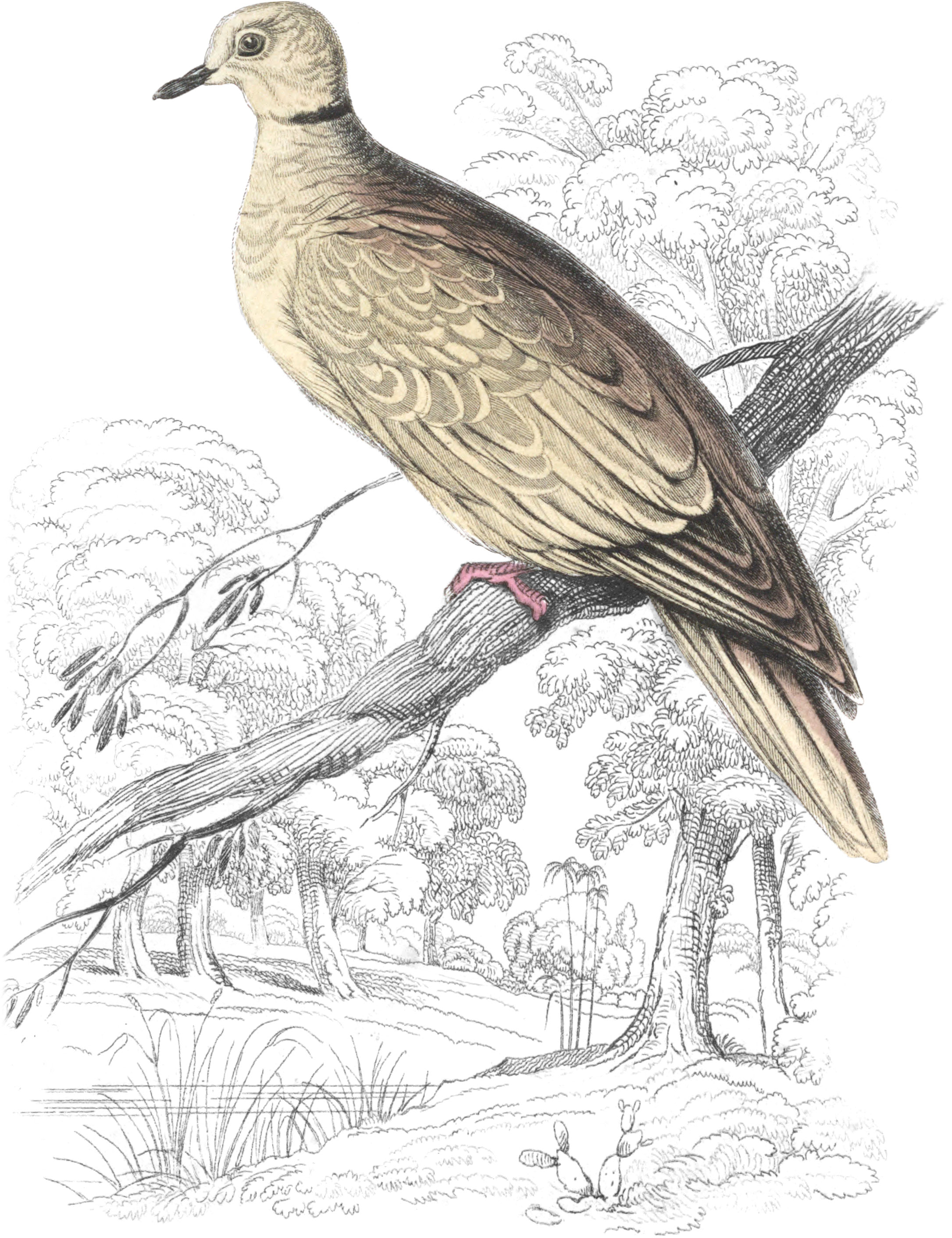
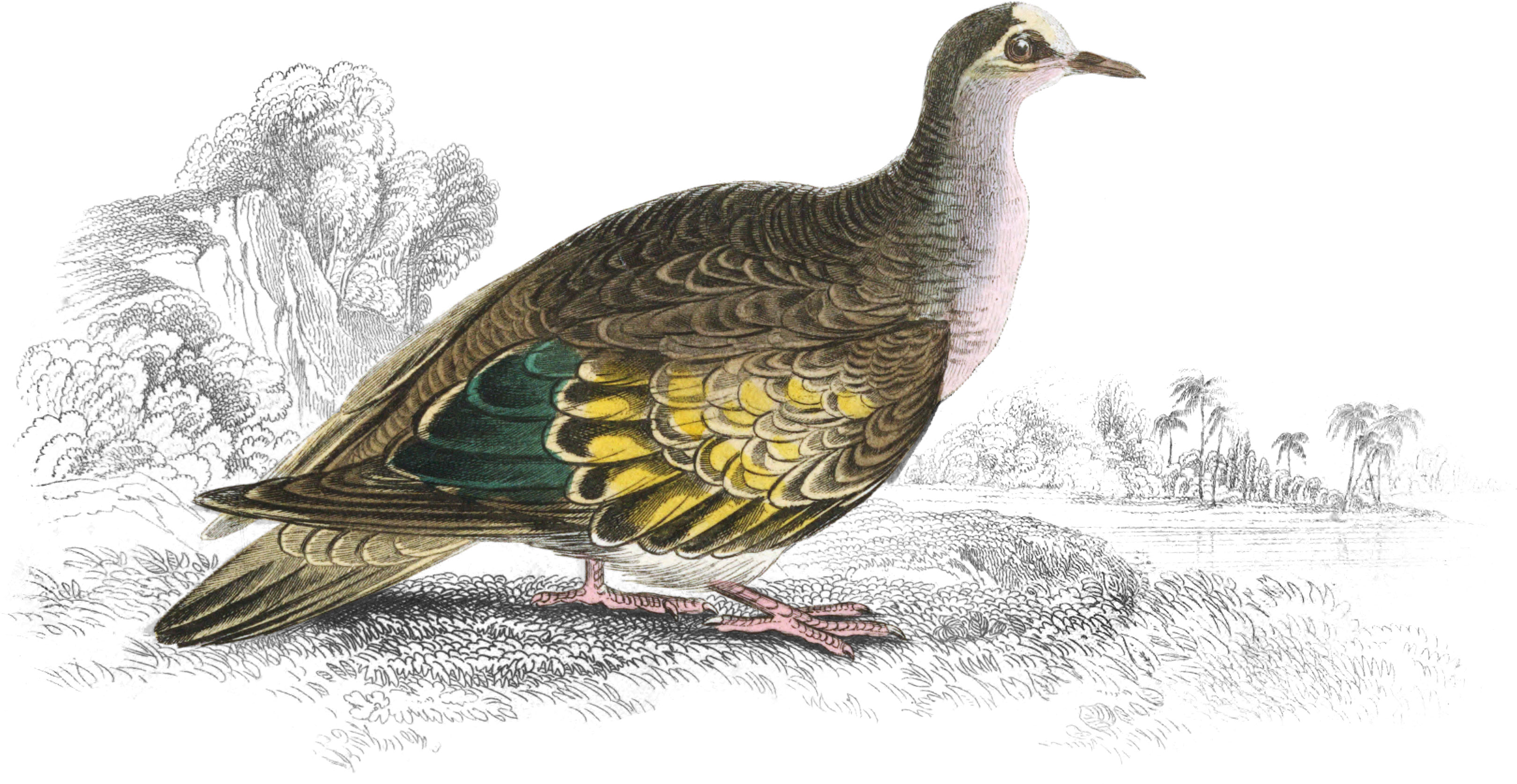
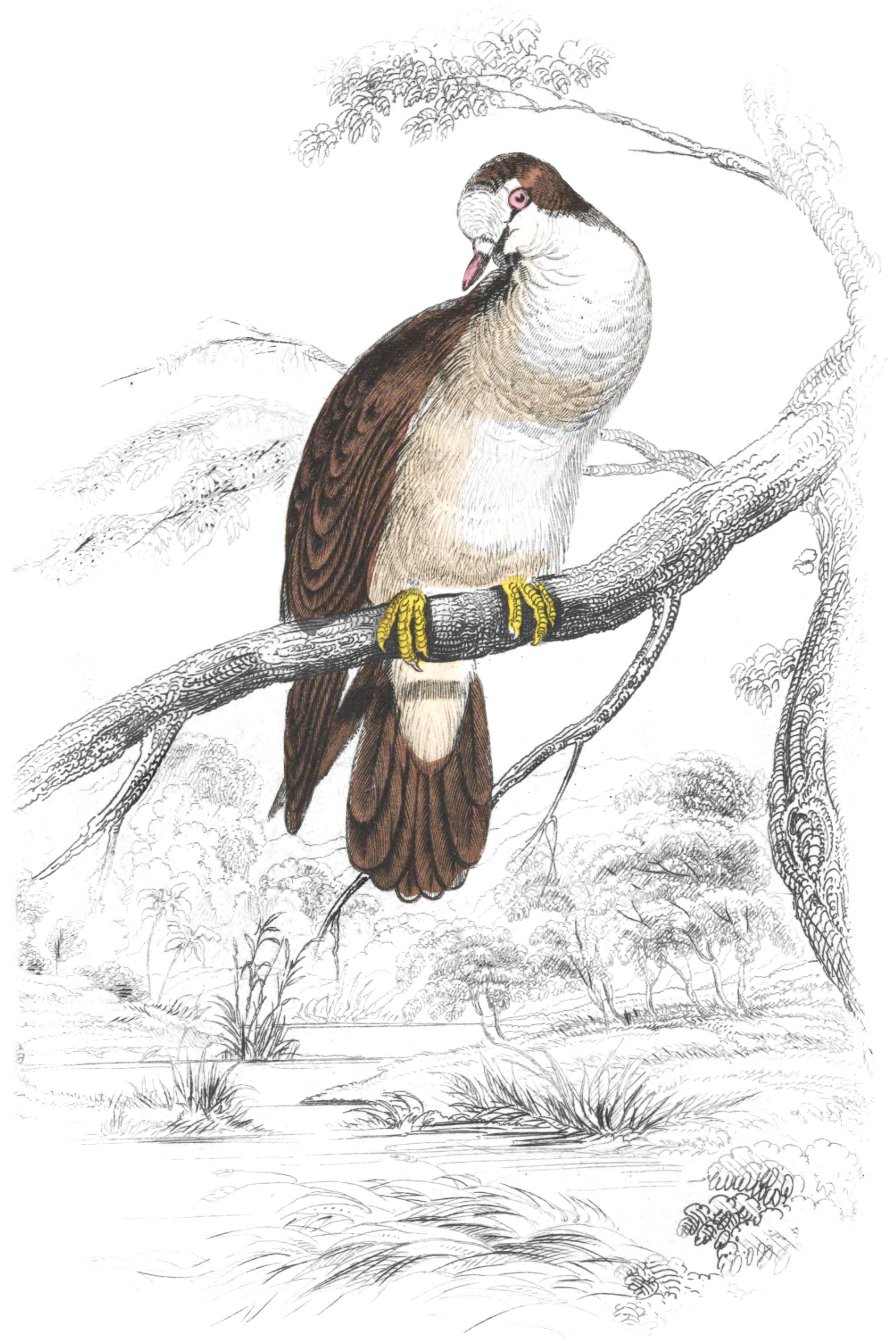
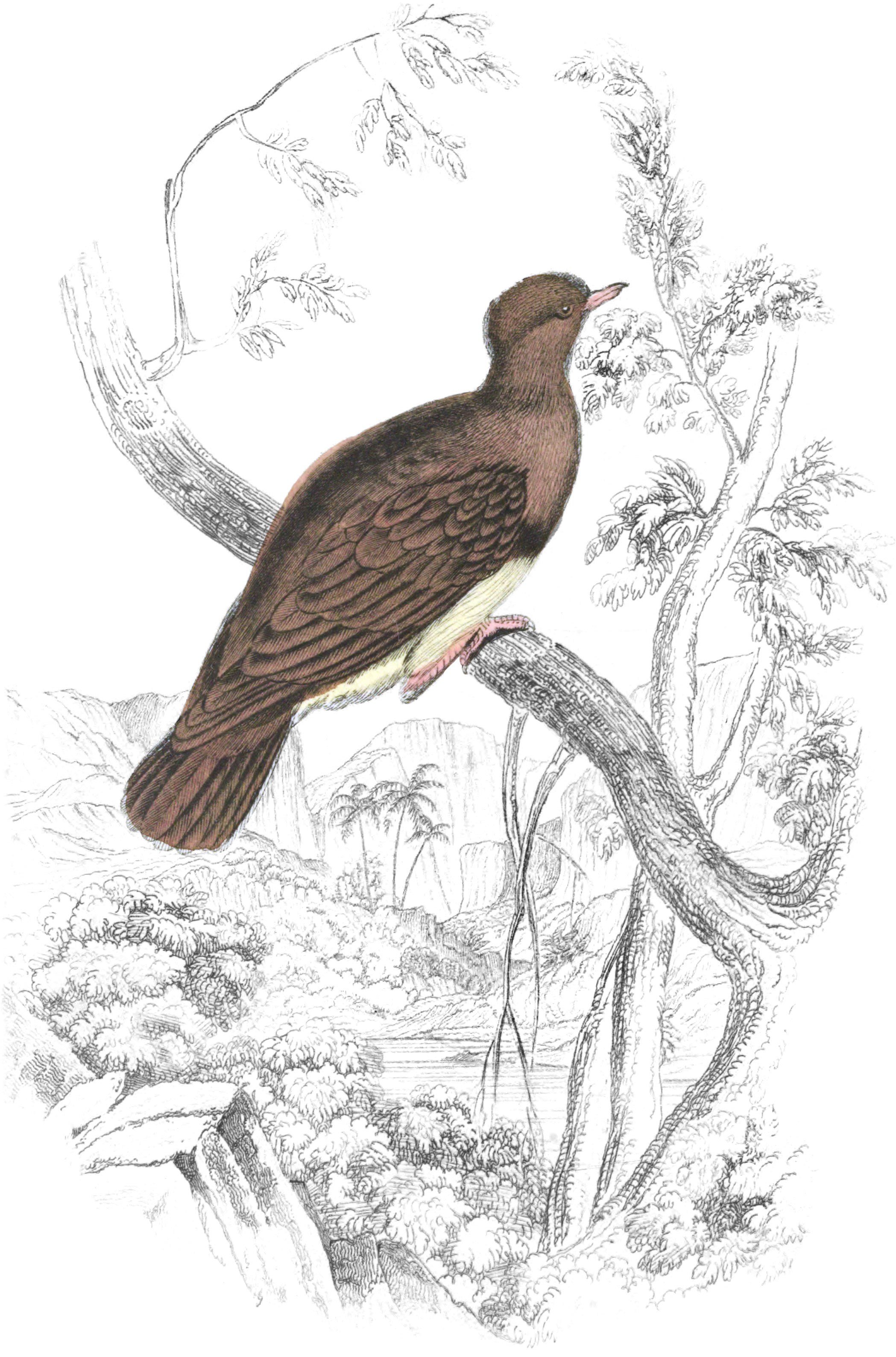
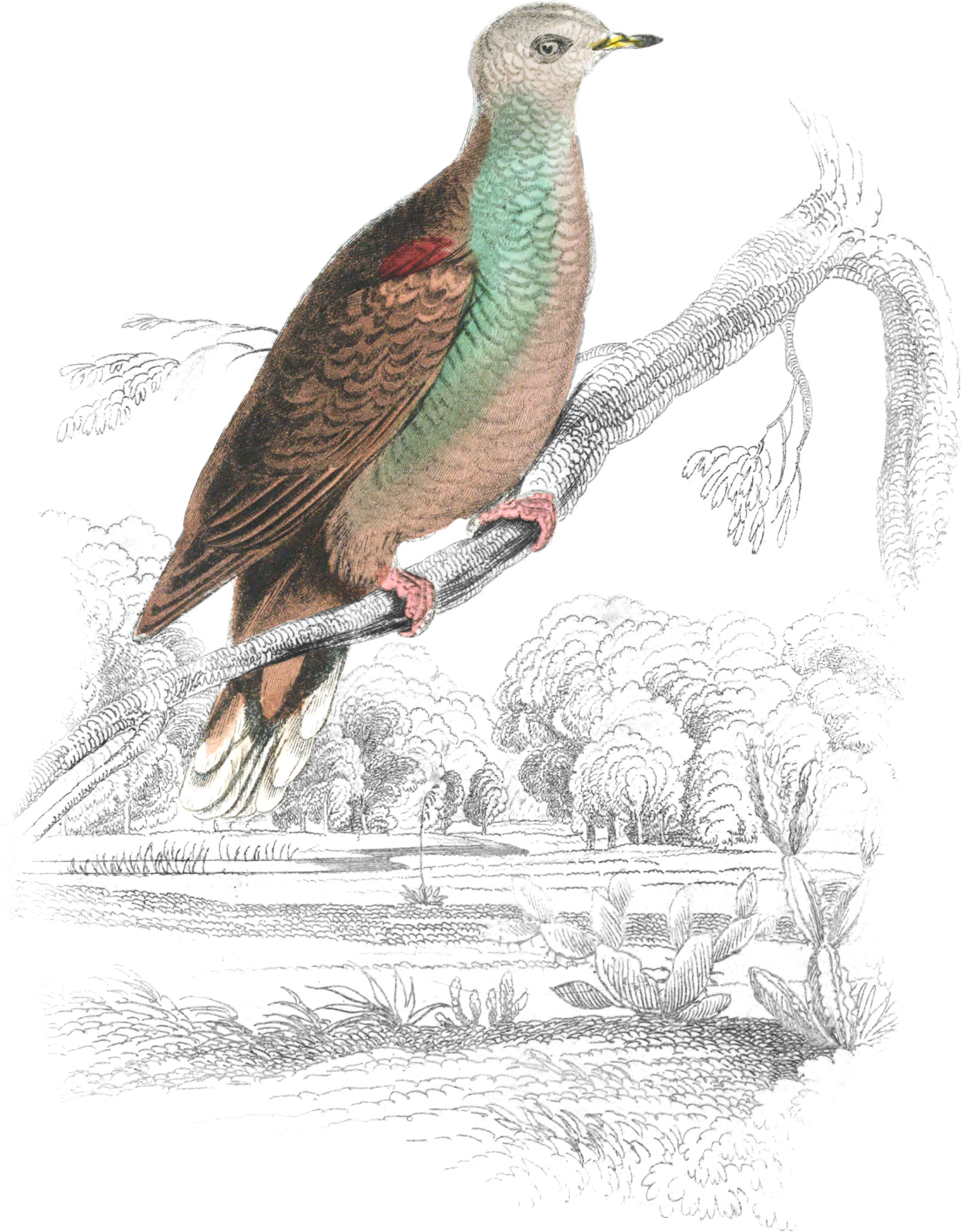
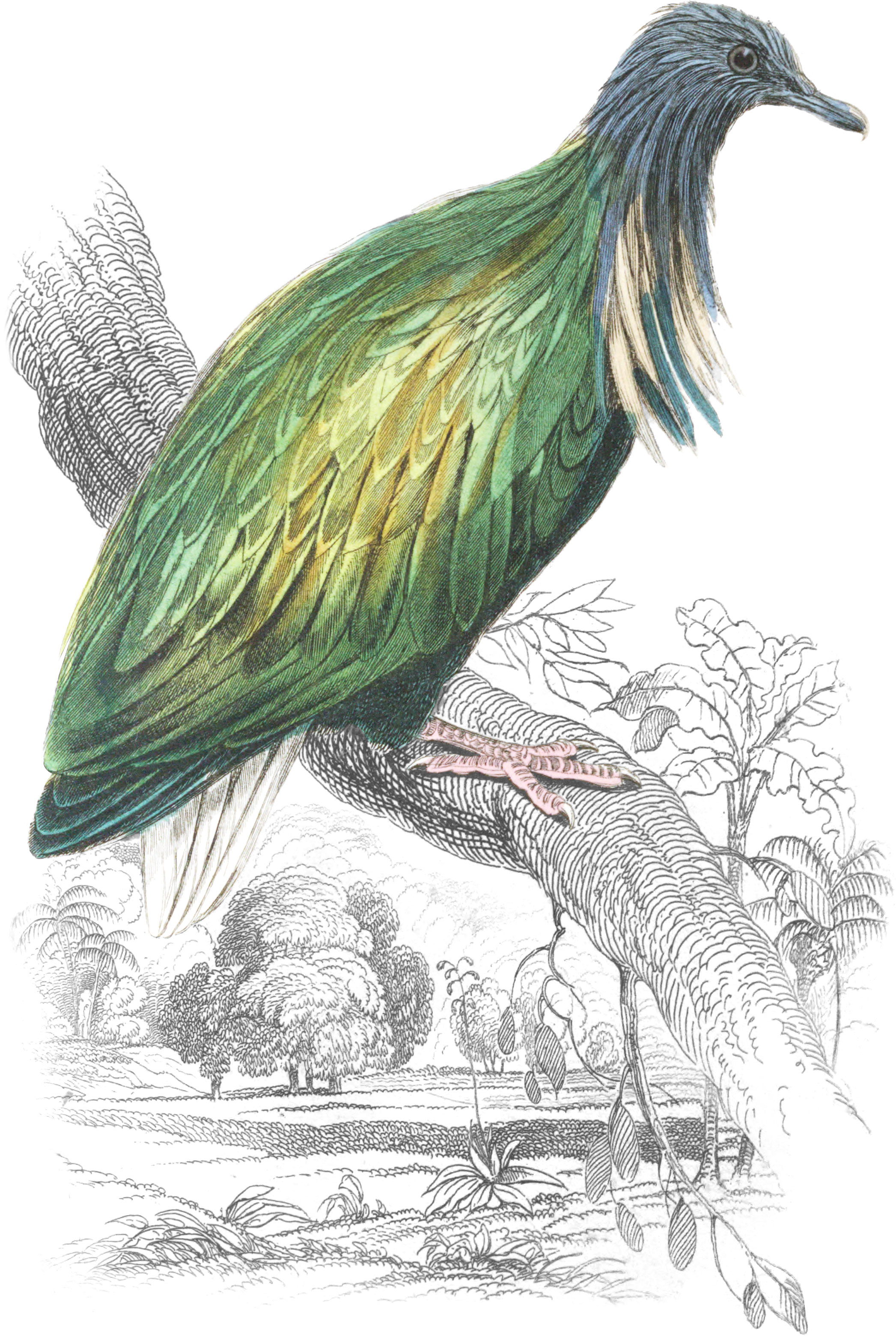
The Pigeons, or family of the Columbidæ, which furnish the materials for the present volume, are now, in accordance with their true affinities, admitted into the order of the Rasores, or Gallinaceous Birds, of which they form one of the five great groups or divisions, the other four being represented by the Pavonidæ, Tetraonidæ, Struthionidæ, and Cracidæ. In this Order, they constitute what is termed an Aberrant family (considering the Pavonidæ and Tetraonidæ as the typical groups); and, from the affinity that several of the members composing it, shew to the Insessores or Perching Birds, they become the medium by which the necessary connexion between the Rasorial arid Insessorial orders is supported. Such, indeed, appears to have been nearly the view taken of this interesting group by the earlier systematists, whose classification was not always conducted on those philosophical principles which guide the naturalists of the present day, as we find the Columbidæ arranged alternately among the Rasorial and Gallinaceous Birds, or sometimes, as an intermediate order, separate from both. An investigation of their habits and economy, as well as their anatomy, both external and internal, shewing the close approximation that some species make to the typical Rasores, is, however, sufficient to prove that their affinity to the true Gallinaceous Birds is much stronger than that which connects them with the Insessores, though the latter is sufficiently so to support the requisite connexion between the two Orders.
Till of late years, the Pigeons appear to have been a tribe unaccountably neglected; and, in all the writings of the earlier authors, they are classed under one generic head (Columba), without any attempt to distinguish groups, or to notice the differences of character and form exhibited by various species, and particularly apparent in such as approach nearest to the true Gallinæ. Even at the present day, much remains to be done, as not only do many of the minor groups remain uncharacterized, but even the greater Divisions or Subfamilies, as they are termed, are neither precisely nor satisfactorily established.
In the history of the Pigeons and Gallinaceous Birds, published by M. Temminck some years ago, that learned author divided the former into three sections; the first restricted to the Strong-billed Arboreal Pigeons, or those species now constituting Cuvier’s genus Vinago; the second embracing not only the typical Pigeons and Turtles, but many other forms, which appear more nearly allied to his first section; and the third including such species as, from their habits and form, shewed a decided deviation from the Columbine Type, and an evident and nearer approach to the true Rasorial Birds. Vieillot has since separated the great crowned pigeon or Goura from the other ground doves, under the generic title of Lophyrus; and to our distinguished naturalist, Mr Swainson, we are indebted for indicating four additional generic groups, under the titles of gen. Ptilinopus, Ectopistes, Peristera, and Chamæpelia. To these we have ventured to add three more; the first under the name of Carpophaga, containing the large arboreal fruit-eating pigeons; the second Phaps, of which Col. chalcoptera, Auct. is the type; and the third, Geophilus, represented by the Col. carunculata and Col. Nicobarica, species remarkable for their close approximation in form and habits to the true gallinaceous groups.
Of the subfamilies or five typical forms of the Columbidæ, we can only speak with diffidence uncertainty, as no analysis of the species sufficiently strict or extensive has hitherto been instituted, from whence conclusive deductions can be drawn. We shall only cursorily observe, that the Arboreal Pigeons, embracing Vinago, Swainson’s genus Ptilinopus, our genus Carpophaga, and some other undefined groups, with feet formed expressly for perching and grasping, and through which, from their habits and form, the necessary connexion with the Insessorial Order is supported, are likely to constitute one; the True Pigeons, of which our ring-pigeon and common pigeon may be considered typical, a second; the Turtles, and their allies, with feet of different proportions from the preceding, and graduated tails, a third; the Ground Pigeons, or Columbi-gallines of the French naturalists, a fourth; and the fifth is not unlikely to be represented by Vieillot’s genus Lophyrus, in which the deviation from the proper Columbine form is not to that of the typical Rasores, but to the Cracidæ, placed at the farther extremity, and, like the Columbidæ, another aberrant family of the Rasorial Order.
The Columbidæ possess a very extensive geographical distribution, species being found in every quarter of the world, and in all its climates, except those within the frigid zones. It is, however, in the tropical climates of Southern Asia, and the islands of the great Indian Archipelago, that the species swarm in the greatest variety and abundance; for in these warm and genial climates, a never-failing supply of food, adapted to each kind, is always to be found. It is here that most of the thick-billed pigeons,1 vying with the parrots in the colour of their plumage, and, in some respects, resembling them in their manners, luxuriate amidst the thick and umbrageous foliage of the banyan, and other trees, whose fruit affords them a rich and never-failing repast. It is here also that the small and beautiful Ptilinopi or turtelines, and the larger Carpophagæ, or fruit-eating pigeons, are met with. It is in the odoriferous region of the Spice Islands, that these curious birds, the great crowned pigeon or gowra, and the Nicobar ground pigeon, remarkable for their respective deviation from the proper Columbine form, find a suitable abode; besides a variety of other species belonging to different groups. Africa also abounds in many beautiful species, among which are several of the genus Vinago; and to this continent belongs the Col. carunculata, Auct., a bird that makes as near an approach as any of the family to the true Rasorial groups. In both regions of the American Continent, we meet with a great variety of species, many of them possessing the typical form of the family, as represented by the ring-pigeon or the common pigeon; others approaching, both in form and habits, in a greater or less degree, to the typical Gallinaceous Birds, and in a manner taking the place of, or representing certain forms of the Tetraonidæ, of which that continent is destitute. In Europe, the species become greatly reduced in number, and are confined to its warm and temperate districts, as it is only where the cerealia and leguminous plants nourish, and the oak and the beech bring their fruit to perfection, that the pigeons can find a regular supply of their appropriate food; and even in many of those districts where they abound during the summer and early autumnal months, they are obliged to migrate to warmer latitudes during the severity of winter, when the ground becomes congealed by frost, or covered with snow.
In no tribe of the feathered race do we meet with a plumage better adapted to gratify and delight the eye, than that of the pigeons or family of the Columbidæ; for among the numerous species of which it is composed, there exists a diversity as well as a brilliancy of effect, that cannot be contemplated without admiration. In some, the plumage shines with a dazzling and metallic gloss, varying in tint with every motion of the bird, and which vies in lustre with that of the diminutive and sparkling humming-bird. Such is that of the Carpophaga ænea, Oceanica, and many other species. In other genera, as Vinago and Ptilinopus, the plumage is admirably assimilated to the arboreal habits of the birds, consisting of delicate shades of yellows and vivid greens, just sufficiently contrasted with smaller masses of richer or more resplendent hues to produce the happiest effect. In the typical groups again, a modest yet chaste assortment of colours generally prevails, and which, though less striking at first sight, never fails to give permanent satisfaction to the eye. As the species approach the true Rasorial tribes, the colours become more uniform in tint, but still, in certain lights, are encircled by glossy reflections, which especially prevail upon the region of the neck arid breast.
In texture the plumage is generally close and adpressed, and the feathers feel hard and firm to the touch, from the thickness and strength of the rachis or shaft. Upon the neck they assume a variety of forms, in some species being rounded and stiff, and disposed in a scale-like fashion; in others, of an open, disunited texture, or with the tips divided and curiously notched; and, in the hackled and nicobat pigeons, they are long, acuminate, and laciniated, like those of the domestic cock; and we may add, that, in nearly all, they are so constituted as to reflect prismatic colours, when held at various angles to the light.
In their mode of nidification, the majority of the Columbidæ bears a close analogy to the Insessores; for, with the exception of some few of the ground pigeons, they build their nest in trees. The number of eggs laid at each period of hatching is (with the above exception) restricted to two, the colour white, or yellowish-white; they are incubated by both sexes, the male relieving his mate whenever she is compelled to quit the nest in search of food. The young are hatched with merely a thin sprinkling of hairy-like down, and are fed by their parents in the nest till able to fly. At first the food is administered in a soft or pulpy state, being thrown up by the old birds from their crop, after undergoing a partial digestion, by which it is rendered a fit nutriment for the callow young; but as they advance in age, it is given in a less comminuted form.
The flight of many of the arboreal, and most of the typical pigeons, is powerful and rapid, the wings being fully developed, and often acuminate; and the pectoral muscles strong, and calculated to support it for a long continuance without fatigue. As the species depart from the typical form, and approach Hearer to the true Rasores in their form and habits, these members become shorter and rounded, and, when expanded, rather concave beneath, like those of the common partridge. In these groups, the flight is abrupt, and at a low elevation, and can only be supported for a short time. This deficiency of flight, however, is in a great degree compensated by the increased length of their legs, which enables them to run with great rapidity upon the surface of the ground.
In disposition the Columbidæ are wild and timorous, and with the exception of the common pigeon and ringed turtle, the attempts to reclaim or domesticate other species have hitherto failed. In regard to the first mentioned kind, it may be observed, that its peculiar habits and economy appear to have been taken advantage of from the remotest period, for besides the interesting mention made of it in the earlier pages of the sacred volume, when it was sent forth as a messenger from the ark, and returned the harbinger of glad tidings, bearing the olive branch of peace in its mouth, we afterwards find it and the turtle enumerated among the sacrificial offerings and atonements under the Mosaical dispensation. Among the heathen nations, from the affection exhibited by the sexes to each other, it was dedicated to the Goddess of Love, and represented as her constant and appropriate attendant. That the common pigeon and domestic turtle of the present day, are the same species which were thus cultivated and protected by the ancients, is evidently and satisfactorily proved by the descriptions of various authors, as well as the numerous and faithful representations handed down to us by the chisel of their sculptors.
The voice or notes of the Columbidæ are few, in all the species much akin to each other, and consist of guttural sounds or cooings frequently repeated; in many they are plaintive and tender in tone, in others hoarse and rather unpleasant. They are principally used by the male when paying court to his mate, and are mostly confined to the pairing and breeding season.
As a food for man, the flesh of the pigeons is wholesome and very nutritious, generally rich in flavour, juicy, and highly coloured.
The general characters of the family may be thus stated: Bill strait, the tip hard and horny, more or less arched and deflected, the base covered with a soft, naked, and bulging membrane, which partly covers and protects the nostrils. Orbits of the eyes more or less naked. Feet with four toes, nearly divided, three anterior and one posterior, the latter placed on the same base or plane with the front toes.
We now commence our description of the family with the
Genus Vinago
Cuvier.
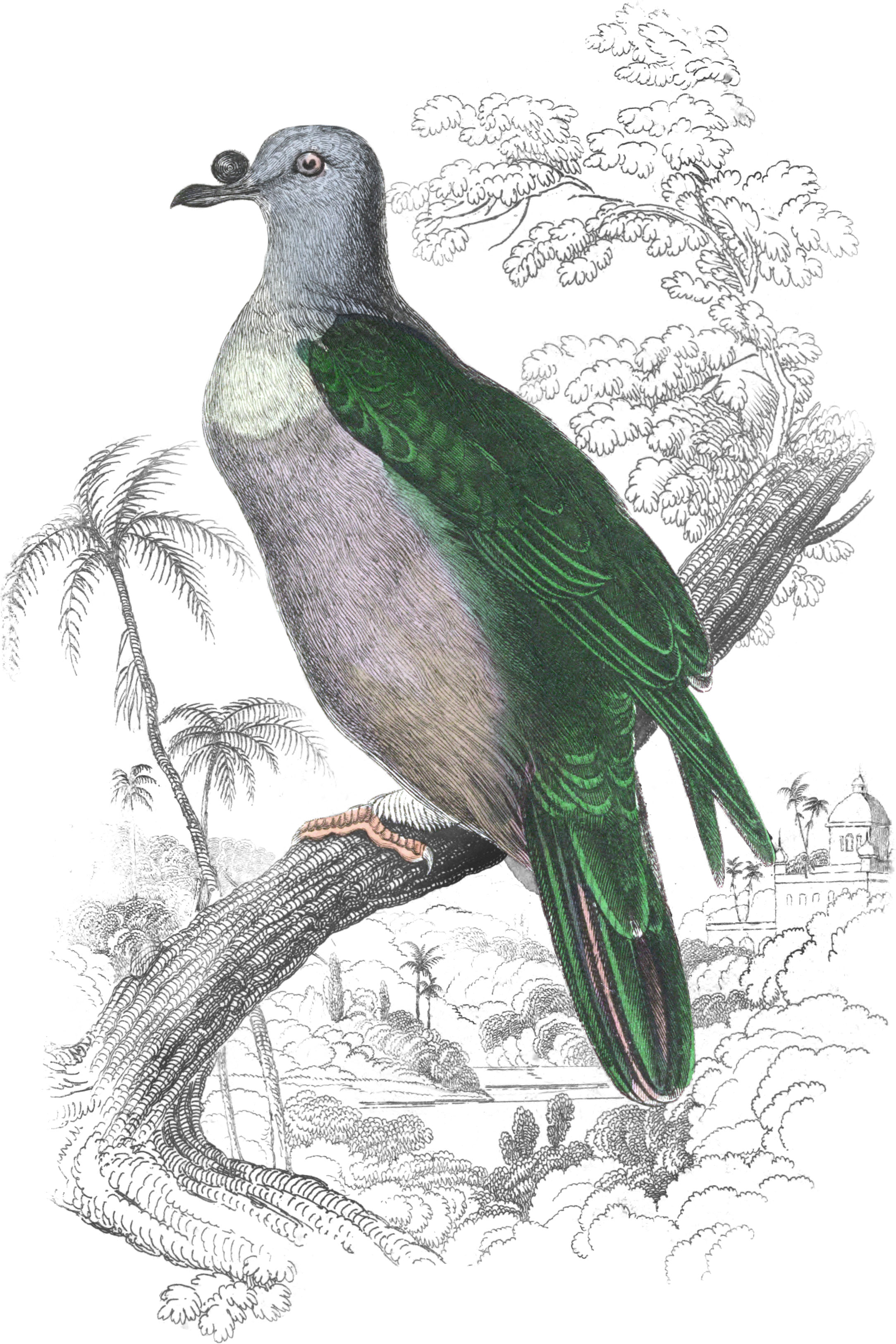
In the warm and intertropical climates of Asia and Africa, besides a variety of pigeons, characterized by a form similar to that of our ring-pigeon and other European species, groups of this beautiful race are met with, differing from them in many particulars, both as to form, habits, and economy, and constituting independent genera or divisions in this extensive family. Such are the members of the genus Vinago, a group which Cuvier first separated from the typical pigeons, and of which our first plate, representing a common though elegant species, is given as an example. The predominating colours in all are green and yellow of different intensities, contrasted more or less in certain parts with rich purple or reddish-brown. The greater wing-coverts and secondary quills are also in most of the species distinctly margined or edged with a conspicuous line of the brightest yellow, which gives them a singular and beautiful effect. In the more essential characters, their bill is much stronger and thicker than that of the pigeons, the tip or horny part being of a very hard substance, much hooked and inflated, the nostrils are more exposed, and scarcely exhibit any appearance of the swollen or projecting membrane so conspicuous in the common pigeon and its congeners. The legs are very short and partly clothed with feathers below the tarsal joint; the feet are formed expressly for perching or grasping; the sole, or that part of the foot which rests immediately upon the branch, being greatly enlarged by the extension of the membrane, giving it a firm base of support; the exterior toe is longer than the inner, and the claws are very strong, sharp, and semicircular, closely resembling in form those of the woodpecker or other scansorial birds. The wings are of mean length, but strong and pointed, the second and third quill-feathers being nearly equal, and the longest in each wing.
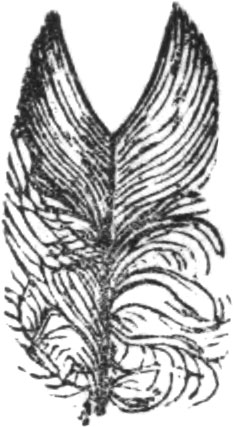
In all the species submitted to examination, the third quill has the central part of the inner web deeply notched, as if a piece had been cut out, as represented in the wood-cut annexed. This particular character is confined to the genus, but many other members of the Columbidæ possess peculiarities as striking in the form of the first and other quill-feathers, which, as modifications of form in members of such importance, become of value in arranging the species according to their affinities. The tail consists of fourteen feathers. In accordance with the structure of their feet, they are the constant inhabitants of woods, where they subsist upon berries and fruits. In disposition they are wild and timorous. Our first plate represents a species common in many parts of the east. It is the
Aromatic Vinago
Vinago aromatica.—Cuvier.
Columba aromatica, Lath.Ind. Orn. 2. 599. sp. 23.—Colombe aromatique, Temminck, Pig. et Gall. 1. p. 51.
The Aromatic Vinago is found in all the warmer parts of Continental India, as well as in Java and other adjacent islands, but being strictly an arboreal bird, it is only to be met with in the retirement of the forest, or amid the thick and expansive foliage of the banyan, the sacred tree of the East, and which from its peculiar mode of growth almost constitutes a forest of itself. Ensconced in this leafy covering, in which it is still more effectually concealed by the assimilating colour of its plumage,2 it passes the greatest part of its life, with an abundance of food always within reach, the fruit of this tree, which is a species of fig, constituting its favourite and principal support.
Temminck, in his “Histoire des Pigeons et Gallinacées,” besides a description of the Aromatic Vinago, agreeing with the specimens we have seen, describes two varieties, one with the head and neck of a reddish colour, the other with the under parts of the plumage grey; but whether such varieties are accidental, or result from age or sex, he has riot mentioned. He also considers the Pompadour and hook-billed pigeons of Latham, and the yellow-faced pigeon of Brown, as all referable to this species; but of the correctness of this supposition, it is impossible, without a comparison of specimens, to speak with any degree of certainty, especially where the species bear so great a general resemblance to each other.
The Aromatic Vinago is of a wild and timorous disposition, and is generally seen in flocks or societies, except during the period of reproduction, when they pair, and retire to the recesses of the forest.3 The nest is simple and composed of a few twigs loosely put together, and the eggs are two, a number which prevails in the majority of the family, a few of the ground pigeons, which approach more nearly to the other Gallinaceous tribes, being the only exceptions. The base or softer part of the bill is blackish-grey, the tip yellowish-white, strong, much hooked, and bulging on the sides. The forehead is of a bright siskin green, the crown greenish-grey, the chin and throat gamboge-yellow, the remainder of the neck, the breast, belly, lower back, and rump, yellowish-green. The upper back or mantle, and a part of the lesser wing coverts, are of a rich brownish-red, and exhibit a purplish tinge in certain lights. The greater wing-coverts and secondary quills are greenish-black, with a deep and well-defined edging of the purest gamboge-yellow throughout their length. The tail has the two middle feathers wholly green, and slightly exceeding the rest in length; these are of a bluish grey with a dark central band. The under tail-coverts are yellowish-white, barred with green. The legs and toes red, the claws pale-grey, strong, sharp, and semicircular.
In this species a slight deviation from the typical example delineated in the foregoing plate may be observed, the wings being devoid of the yellow edging so conspicuous in most of them, and the tail having acquired a more conical form, with the two middle feathers acuminated and projecting considerably beyond the rest. This modification seems to indicate some slight deviation in the habits and economy of the bird; but as M. Temminck’s description (the only one hitherto published) is totally silent on this interesting point, we are obliged to confine ourselves to a mere description of the plumage.
The greater part of the body, both above and below, is green, but brightest upon the throat and belly. Across the breast is a narrow bar or half collar of saffron-yellow; the vent and under tail-coverts are yellow, the latter with a great part of their inner webs green. The greater quills are black, but some of the secondaries are margined with grey. The elongated tail-feathers have their upper surface of a greyish-brown; the remainder are of a deep grey at the base, succeeded by a black bar, and terminating with bluish-grey. The under surface of all the tail-feathers is black for two-thirds of their length from the base, the tips being of a pale pearl-grey. The tarsi are partly dotted with green feathers, the remainder and toes red; the claws are grey and much hooked. The bill is pretty stout, the tip arched and inflated, and of a leaden or grey colour; the soft or basal part is of a deep bluish-grey.
This kind is also a native of Java, where it is widely disseminated, and was first discovered by MM. Reinwardt and Diard, who forwarded specimens to the Parisian and Netherland Museums.
In addition to the species here described, the following are found in India and its islands: V. militaris, psittacea, pornpodora, and vernans. In Africa, the V. Australis, calva, and Abyssinica, and a new species from the Himalaya has been figured by Mr Gould in his beautiful Century of Birds from that district, under the title of Vinago sphenura.
Nearly allied to the Thick-billed Pigeons or Vinago, in the form of the feet, arboreal habits, and prevailing dispositions of colours, we find another extensive group inhabiting the tropical forests of India and Australia, and the islands of the Pacific, but differing from that genus in the weakness and slender structure of their bill, which member approaches nearer in form to that of the typical pigeons. To this group, taken collectively, Mr Swainson, in the first volume of the Zoological Journal, in an interesting paper containing observations on the Columbidæ, has given the title of Ptilinopus; but as he there points out the different structure of the wing, in regard to the form of the first quill-feather, as it exists in the Columba purpurata, Lath., and Col. magnifica, Temm., he proceeds to observe, that it may be necessary still further to subdivide it. This, upon an investigation and analysis of a variety of species, we feel inclined to do, restricting the generic title of Ptilinopus to that group of smaller pigeons in which the first quill-feather becomes suddenly narrowed or attenuated towards the tip, and the tarsi are feathered almost to the division of the toes. This group is typically represented by the Col. purpurata of Lath., and also contains two beautiful species figured in the “Planches coloriées,” C. monacha, and C. porphyrio, the C. cyano-virens of Lesson also belongs to it. To the other groups, of which C. magnifica, Temm., and Columba Œnea, Lath., may be taken as typical examples, we have given provisionally the name of Carpophaga, as indicative of the fruits upon which they subsist. In the genus Ptilinopus, as thus restricted, and which, in conjunction with Carpophaga, seems to connect Vinago or Thick-hooked-billed Pigeons, with the typical Columbidæ, the bill is comparatively slender, the base slightly depressed, and the soft covering of the nostrils riot much arched or swollen; the tip though hard is little inflated, with a gentle curvature; the forehead is rather low and depressed, the legs are short but strong, the tarsi clothed with feathers nearly to the division of the toes the feet are calculated; for grasping, and are similar in form to those of Vinago, the sides of the toes being enlarged by the extension of the lateral membrane, and the outer longer than the inner one; the wings are strong and of moderate length, the first quill-feather considerably shorter than the second, and suddenly narrowed towards the tip, a peculiarity also possessed by several pigeons belonging to other distinct groups, and by which means a connection is thus kept up between them. The third and fourth quills are nearly equal to each other, and are the longest in the wing. The tail is of proportionate length, and generally square at the end. They inhabit the Malaccas, the Celebes, and the islands of the Pacific, feeding upon the various fruits and berries produced in such teeming abundance in those warm and productive latitudes. The predominating colour of their plumage, like that of Vinago, is green, varied in parts with yellow and orange, and in some beautifully encircled with masses of purplish-red and vivid blue. Their habits seem retired, as they pass the greatest part of their life in the solitudes of the forest, and their resort is only to be detected by their frequent and audible cooing notes.
The first example we give of this beautiful genus, is the
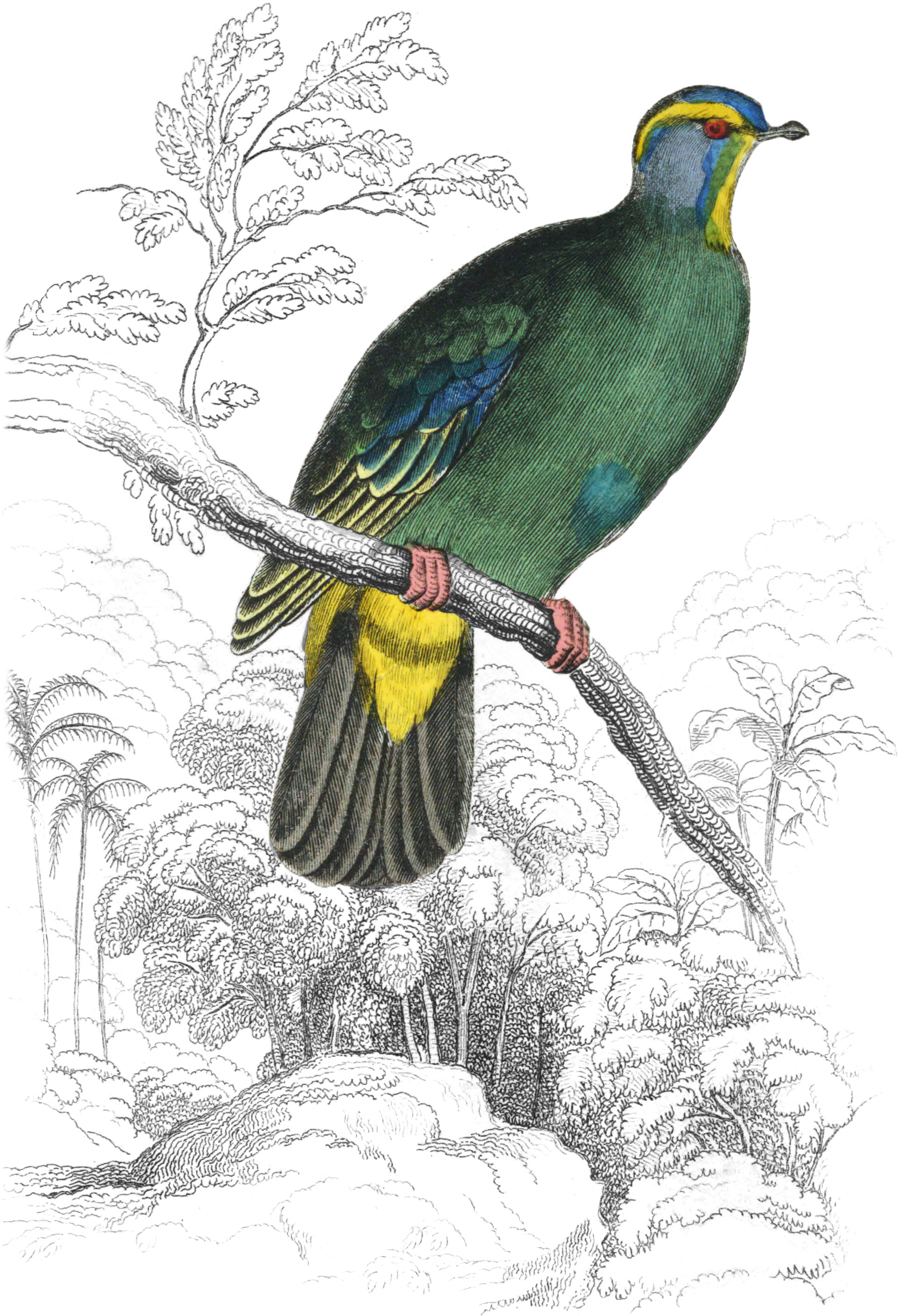
Purple-Crowned Turteline
Ptiliopus purpuratus.—Swainson.
Columba purpurata, Lath.Index Ornith. 2, 398 598, sp. 17.—Temm.Pig. et Gall. 8vo, i. p. 180.—Wag.Syst. Av. No. 30.—Purple-crowned Pigeon, Lath.Syn. iv. 626, 15.
This lovely bird, first described by Latham in his General Synopsis, from specimens brought from Tonga-Taboo, in which, as well as Otaheite, and others of the Friendly Islands, it is found numerously disseminated in all their wooded districts, is also met with in the Celebes, the Isle of Timor, and in Australia. It is not, however, improbable that other nearly allied species have sometimes been mistaken for it, as some supposed varieties have been described, which it is difficult to reconcile with the usual plumage of the P. purpuratus. Such, indeed, appears to be the opinion of Wagler, who, detailing the plumage of both sexes as alike, considers the bird figured by M. Temminck, in the “Planches Coloriées,” for the female of this species, to be distinct, and has accordingly, in his Systema Avium, named it Columba xanthogastra, and such also may be the case with the variety mentioned by Latham and Temminck, in which the crown of the head, instead of a bright ruby or amaranth colour, is of a very deep purple, and altogether devoid of the yellow encircling band so conspicuous in the true P. purpuralus. Mr Swainson, again, has described, in the paper formerly alluded to, a supposed female or young bird, in which the ruby-coloured crown is merely indicated by a spot of dull lilac in front of the head, and the yellow line encircling the crown is only visible near the eye. Under such circumstances, it is difficult to say what the plumage of the female actually is, and whether the varieties described are to be attributed to age, immaturity, or local distribution, or are really indicative of specific distinctions. Future and more extended observations can alone determine these questions.
The length of this species is from nine to ten inches. The bill, about half an inch long, is of a grey colour; the tip or horny part of the upper mandible moderately arched, that of the lower suddenly contracted where it forms the darker portion of the bill. The forehead and crown is covered by a patch of rich amaranth or rose-lilac colour, bordered round by a narrow band of king’s-yellow. The cheeks, occiput, and sides of the neck, are of a delicate greenish-grey, the chin and throat of a pale gamboge-yellow. The feathers upon the lower part of the fore-neck and breast, are of a peculiar form, their colour a delicate pale-green, tipt with cinereous or ash-grey, having, as it were, a piece cut out from the tip of each in the form of a V. Beyond the breast is a band of pale green, succeeded by a small spot of rose-lilac in the middle of the belly, which passes into a rich orange, that again by degrees fades into a pure yellow, which occupies the vent or lower part of the abdomen. The flanks and sides are pale-green; the under tail-coverts rich orange. The upper plumage is of a rich and glossy parrot-green; the scapulars with their central part of a deep purple or blue, according to the light in which they are viewed: the wing-coverts and secondaries are margined with yellow. Greater quills, with their anterior webs, black, glossed with green, the base of the exterior webs green, finely margined with pale yellow; first quill, with the tip, for nearly an inch in length, is suddenly narrowed, in the form represented in the wood cut. Tail of fourteen feathers, even at the end; the exterior webs green, the inner blackish-green. The tips of all, except the two central feathers, which are wholly green, with a broad band of rich yellow. The tarsi are covered nearly to the division of the toes, with soft thick-set yellowish-green feathers. The soles of the feet are broad and flat; the claws hooked and strong, the exterior toe longer than the inner.
This species, as the structure of the feet so evidently implies, is the constant inhabitant of wooded districts, where it subsists upon various fruits and berries, among which are enumerated those of the Limonia bifoliata and Banana. Its voice or cooing notes are said to be pleasing in tone, and it is probably from their sound that it has obtained in Tonga-taboo, the name of Kurukuru. In Otaheite it is called Oopa or Oopuro.
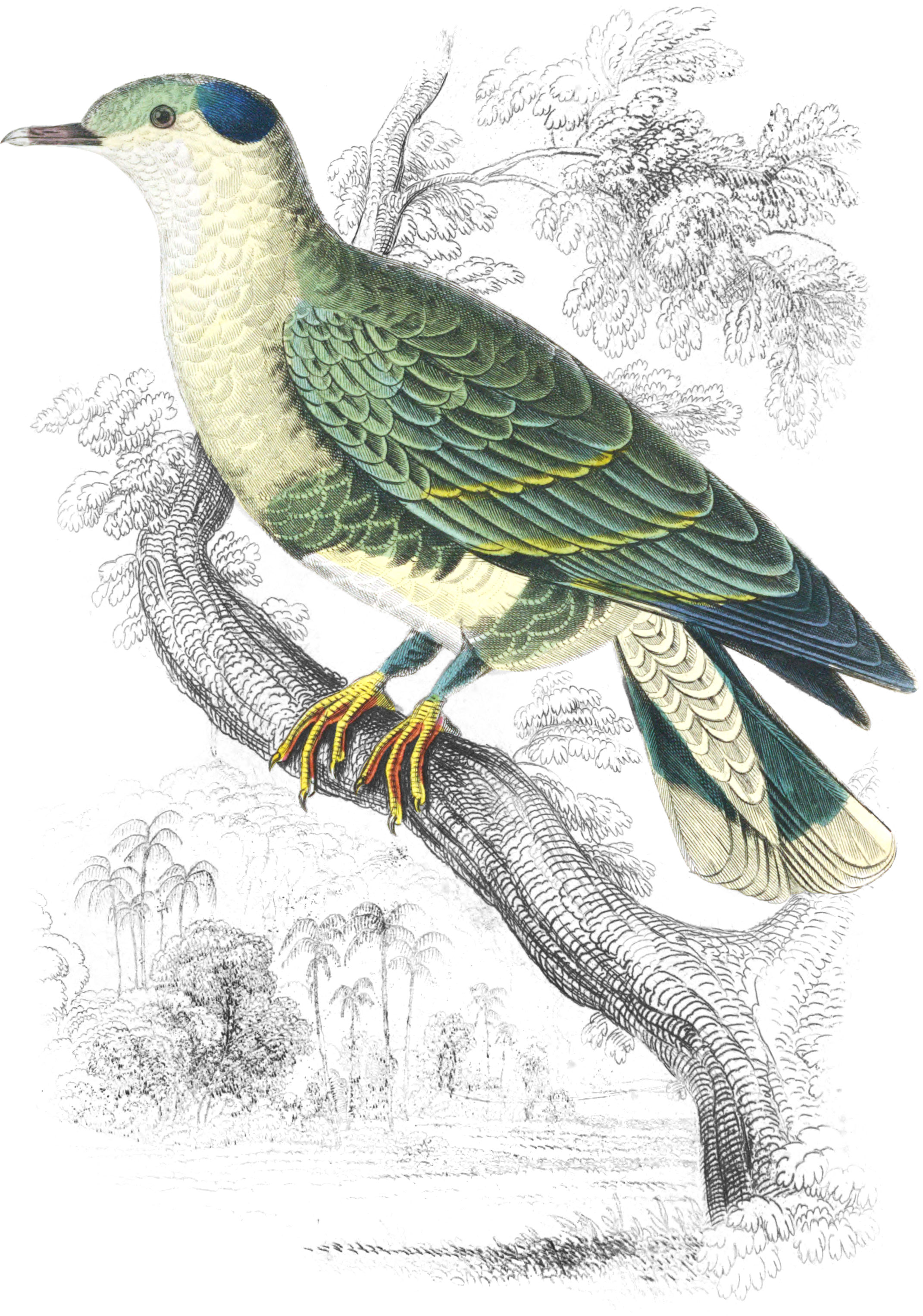
Our next plate represents a second species of this genus, an inhabitant of the evergreen forests of the Celebes; it is the
Blue-Capped Turteline
Ptiliopus monachus.—Swainson.
Columba monacha, Reinwardt.—Temm.Pl. Col. 253.—Wag.Syst. Av. sp. 35.
This beautiful little species, which belongs to the same group as the P. purpuratus, is a native of the Celebes, and was first discovered by M. Reinwardt, and afterwards figured by M. Temminck in his splendid work, the “Planches Coloriées.” In size it is inferior to the above mentioned bird, as its utmost length does not exceed seven inches. Of its habits we have no detailed account, the description given by Temminck being confined to the colours and disposition of its plumage, which in a great degree is analogous to that of the other species. The forehead, the crown, the corners of the mouth, and a large patch upon the central part of the abdomen, are of a brilliant Berlin blue. Over the eyes, and encircling the occiput, is a band of king’s-yellow, and the same colour prevails upon the chin and throat, vent, and under-tail coverts. The rest of the plumage is of a fine grass or parrot green; the secondary quills are edged with yellow. The tail has the interior webs of the feathers grey, the lateral feathers, when spread, exhibiting a deep bluish-green spot or bar even to their tips. The bill is blackish, grey. The tarsi are plumed nearly to the division of the toes, which are crimson-red.
The next plate, a nearly allied species; it is the
Blue and Green Turteline
Ptiliopus cyno-virens.—Lesson.
This species, which vies in beauty of plumage with the preceding, is a native of New Guinea, where it dwells in the evergreen forests of these equatorial regions, and where, from the frequent low cooings which were heard by the crew of the Coquille, when on a voyage of discovery to these parts, it appears to be very abundant. Its total length barely exceeds eight inches. The bill is slender, the basal part black, the tip or horn of a light grey. The sides are reddish-brown. The tarsi are short and feathered nearly to the toes, which are of a rich orange yellow, and their structure similar to those of the P. purpuratus. The upper part of the body, wings, tail, lower breast, and sides, are bright grass green. Upon the occiput is a large spot or bar of indigo blue, which colour also occupies the shaft or central part of the scapulars, and some of the lesser wing-coverts. The chin is greyish-white, passing into greenish-grey towards the breast. The lower part of the abdomen and the costal band, are white, the feathers margined with pale yellow; the thighs and tarsal feathers are green; the vent is white, arid the under tail coverts are yellowish-white, with the greater part of the inner webs green. The greater quills are brownish-black, with a narrow edging of pale yellow, and the wing-coverts and secondaries are also margined with yellow. The female is devoid of the blue spot upon the occiput, as well as those which ornament the scapular feathers of the male. The forehead and chin are grey, and the abdomen and vent clothed with feathers of a uniform pale-green. In other respects her plumage is analogous to that of the male.
In the description of this bird by M. Lesson, it is to be regretted that no notice is taken of the form of the first quill-feather, its emargination being an essential character of the group. This we the more lament, as no opportunity of examining a specimen has occurred. Weare therefore unable to state positively, whether it agrees in this particular with the last described kind; but, judging from analogy, and its close resemblance to that species in other respects, we entertain little or no doubt of its presence in nearly a similar form, particularly as it is found developed in other species apparently further removed from Ptilinopus purpuratus, one of which, the Ptilinopus porphyrea, is figured in the Planches Coloriées of M. Temminck. Omissions of this kind shew the necessity of great accuracy in the description of new species, as it is upon characters in such essential members as the wings, feet, bill, &c. that their situation in regard to other species or groups must be determined.
We now pass on to the larger species of Mr Swainson’s group, to which we have given the name of—
Genus Carpophaga
Selby.
In this group, which is composed of birds of a much larger size than the preceding, the wings, though possessing the same relative proportions, have no emargination or sudden narrowing of the tip of the, first quill. Their tarsi also are not so thickly or entirely feathered; and their nostrils are placed nearer to the base of the bill. In some species, green, yellow, and purple, are the prevailing colours; in others a rich bronzed or metallic colour composes the upper plumage, exhibiting shades of deep green and purple, according to the light in which it is viewed, while in those which lead the way to the typical pigeons, the tints become less vivid and more uniform in their distribution. Their bill is considerably depressed at the base, the membrane in which the nostrils are placed but little prominent or swollen, the tip compressed and moderately arched, the tomia slightly sinuated. The forehead is low, and the feathers advance considerably upon the soft portion of the bill. In many of them a caruncle or gristly knob, varying in size and shape according to the species, grows upon the basal part of the upper mandible during the season of propagation. This is supposed to be common to both sexes, as the female is described with it in Duperry’s Voyage. After this epoch it is rapidly absorbed, and its situation scarcely to be observed upon the surface of the bill. The feet are powerful, and formed for grasping, the soles being flat and greatly extended. As in the other members of this group, the hind toe is fully developed and long, and the exterior longer than the inner toe.
They inhabit the forests of India, the Moluccas, Celebes, Australia, and the Pacific Isles. Their food consists of fruits and berries. That of the precious nutmeg, or rather its soft covering, known to us by the name of Mace, at certain seasons affords a favourite repast to some species, and upon this luxurious diet they become so loaded with fat, as frequently when shot to burst asunder when they fall to the ground. And here we may remark on the remarkable provision Nature has made for the propagation as well as the dissemination of this valuable spice, for the nutmeg itself, which is generally swallowed with the whole of its pulpy covering, passes uninjured through the digestive organs of the bird, and is thus dispersed throughout the group of the Moluccas and other islands of the east. Indeed, from repeated experiments, it appears that an artificial preparation, analogous to that which it undergoes in its passage through the bird, is necessary to ensure the growth and fertility of the nut; and it was not till after many and unsuccessful attempts had been made that a lixivium of lime, in which the nuts were steeped for a certain time, was found to have the wished-for effect, arid to induce the germinating tendency. The fruit of the Banyan (Ficus religiosus), the Sacred Tree of the Hindoos, is also a favourite repast of all the pigeons of this group, as well as of the stronger-billed Vinago.
The subject of our next plate represents one of the most beautiful of its kind: It is the
The rich assemblage of colours exhibited in this bird induced M. Temminck, its first describer, to give it the appropriate name of Magnificent. It is a native of the eastern parts of Australia, a country whose productions present so much of what is new and interesting in every department of zoology. It is said to feed chiefly upon the fruit of one of the Palms, in that country called the Cabbage Tree, from the culinary use made of the top or embryo leaves. In form and character it agrees with the Carpophaga ænea, or Nutmeg Pigeon, and also with the Carpophaga oceanica, the subject of our next plate. In size it equals, or rather surpasses, the Common Ring Pigeon, the tail being longer in proportion. The bill, which is rather slender, has the soft or membranous part of a brownish-orange; the horny tip, which is yellowish-white, is slightly arched, but hard and compressed; the nostrils are open, and their covering but little swollen, and not projecting to the same extent as in the Common Pigeon; the forehead, as in other members of this restricted genus, is low and flat, and the feathers of the antiæ cover a considerable portion of the soft part of the bill. The head, the cheeks, and the upper part of the neck, are of a fine pale bluish-grey, which passes into pale green towards the lower part of the neck and back. The upper parts of the body are of a rich golden-green, assuming various shades of intensity as viewed in different lights, the wing-coverts are spotted with rich king’s-yellow, forming an oblique bar across the wings. The quills and tail are of the richest shining green, changing in effect with every motion of the bird. From the chin downwards proceeds a streak of the finest auricula purple (the base of the feathers being of a deep sapphire green): this line gradually expands as it descends and covers the whole breast and abdomen. The lower belly, thighs, and under wing-coverts, are of the richest king’s-yellow. The feet are bluish-black, the tarsi short and clothed with yellow feathers half way down their front and sides, the claws strong, much hooked, and formed for prehension. Nearly allied to this species, if not a small variety of it, is the Columba amarantha of Lesson, which inhabits the Islands of New Ireland and New Guinea.
The metallic splendour of the dorsal plumage of this beautiful bird, is only equalled by that of another species, viz. the Nutmeg Pigeon, or Columba ænea of Latham, to which it bears a marked resemblance, and that not confined to a similar effect or play of colour, but to a peculiarity of form observable in the bills of both species. This consists of an excrescence or globular knob, which has its origin upon the basal part of the upper mandible, and which in the present species attains the size of a small cherry, but in the ænea is not so large, and scarcely so globular in shape. From the observations that have been made upon these birds, it appears that this excrescence, common to many of the group, is not a permanent feature, but, like that which we see in the sheldrake, is only developed during the season of reproduction, the base of the bill at other times scarcely exhibiting any indication of the swelling.4 The great similarity in the appearance of these two birds, might naturally create a suspicion that they were merely varieties of one species; but the observations of naturalists, and particularly of M. Lesson, prove that they are quite distinct; for, in addition to a constant and unvarying difference in certain parts of the plumage, and in the form of the frontal knob, they possess a different geographical distribution, the Carpophaga ænea, or Nutmeg Pigeon, being a native of continental India, the Moluccas, and New Guinea, the Carpophaga oceanica an inhabitant of the Caroline and other islands of the Pacific. The oceanica is also inferior in size, being nearly a third less than the ænea, the latter measuring nearly eighteen inches in length, the former not more than fourteen. It belongs to the same group as the subject of the preceding plate, possessing a similar form in the characteristic members of the bill, wings, and feet. Its food in the Isle of Onalan, where it was met with in great numbers by the Coquille, in her voyage of discovery, consisted of a berry, not named, but which abounded in all the wooded districts of that island. The following is a description of this species, as given by M. Lesson, in his Manuel d’Ornithologie. Total length, fourteen inches. Bill one inch, surrounded at its base with a rounded black carruncle or knob. Feet strong, and of a vivid orange colour, the tarsi feathered nearly to the toes, which have their lateral membranes much distended. Wings pointed, and about an inch shorter than the tail. The forehead, cheeks, and throat, are of a greyish-white. The lower and back part of the neck deep bluish-grey. The back, wings, rump, and tail, of a uniform metallic deep green, the breast and upper part of the abdomen of a pale purplish-grey, the lower belly, vent, and thighs, of a deep reddish-brown.
Besides the species already mentioned, the Carpophaga hyogastra, Carpophaga pinon, Carpophaga luctuosa, and many others belong, to this beautiful group.
Before we proceed to the Pigeons, we must here introduce an interesting form, apparently belonging to this division of the Columbidæ, the structure of the bill being intermediate between that of Vinago and Columba, and the feet formed upon the same plan a those of the rest of the Ptilinopinæ: It is the
Pheasant-Tailed Pigeon
Columba phasianella.—Temm.
Columba phasianella, Temm.Pl. Col. t. 100.—Id. in Trans. of Linn. Soc. v. 13, p. 129.—Columba Amboinensis, Auct. Juv.
The group or genus to which this species belongs is distributed throughout the Isles of Sonda, the Moluccas, the Philippines, and Java, and is also met with in Australia; and, besides the present species contains the Col. macroura of authors, the Col. nuchali of Wagler, and the Col. Reinwartii of Temminck. Of its precise station in the circle of the Columbidæ, we speak with some degree of doubt, not having had an opportunity of instituting so strict an analysis of the species as the subject require, but we believe it will be found to enter among the Ptilinopinæ or Arboreal Pigeons, as the feet and tarsi of its members are similar in form to those of that division, the latter being very short and partly plumed below the joint, the former with the exterior toe longer than the inner, and the binder toe fully developed; the sole of the foot, by the extension of the membrane, is broad and expansive, and the claws are arched and strong, all of which are characters evidently shewing these members to be expressly adapted for perching and prehension, and not for gressorial movements. The bill also in one species (C. Reinwartii) approaches in point of strength near to that of Vinago, and in all of them the tip of both mandibles is hard and firm, the upper one with a visible emargination, and moderately arched. Their habits and mode of life are also nearly allied to the other arboreal species, being the constant inhabitants of the woods, and subsisting upon the fruits and berries of various trees and shrubs.
M. Temminck in his description of this species, says that it possesses a structure and form precisely similar to that of the Columba migratoria of North America. To this we cannot subscribe, seeing that its essential characters, as above described, are different, and that the only point of resemblance consists in the length of the tail. Indeed, so far removed do we think it from the American group, that we cannot consider it as its analogue in the Asiatic regions where it resides.
In length it measures from fourteen to sixteen inches, the tail itself being upwards of seven. The wings are short, not reaching when closed above an inch and a half beyond the root of the tail, rounded, and having the third quill-feather the longest, and the first and fourth equal to each other. The bill, from the forehead, is nearly three quarters of an inch long; the tip of the upper mandible is moderately arched, and having a distinct notch or emargination; that of the under angulated and strong. The throat is yellowish-white. The head, the sides, and front of the neck, as well as the whole of the under plumage is orange-brown. The hinder part of the neck is of a rich violet-purple, with brilliant golden reflections, changing according to the play of light. The back, the wing-coverts, and remainder of the upper plumage, are of a deep reddish-brown, in some lights exhibiting a bronzed gloss. The tail, which is graduated or of a cuneiform shape, has the two middle feathers of an uniform brown, the lateral are marked with an oblique transverse bar or black. The feet and naked part of the legs are reddish-brown. The sole of the hind and inner toes is greatly expanded, which gives a large and firm base of support to the bird when moving amidst the branches of the trees.
The young differ from the adults, in having the neck of a dirty reddish-brown, fasciated with narrow bars of black, the abdomen of a pale reddish-grey, notched with very minute dark specks, the back inclines more to hair-brown, and the smaller wing-coverts are deeply edged with orange-brown.
It was first described by M. Temminck in the Transactions of the Linnean Society, from a specimen brought from Australia, but has since been found in most of the Philippine and Molucca islands, Java, &c. It inhabits the woods, and its chief subsistence consists of a species of pimento and other warm and aromatic berries, all of which it swallows entire. Its flesh, though dark in colour, is reported to be of excellent flavour.
From the preceding division or sub-family of Ptilinopinæ, we now enter upon that of the Columbinæ, embracing a vast variety of species, distributed throughout every quarter of the globe, and of which (as well as of the Columbidæ collectively), our native Pigeons may be taken as the typical representatives This division, for the present, we retain under one generic head, as it would be impossible, in a work of this brief nature, to enter into the laborious investigation necessary to determine and point out with precision the subordinate groups into which the species may require to be divided. Taking, however, the Ring Pigeon,5 the Wood Pigeon,6 and the Rock Pigeon,7 as types of form, a great majority of the species will be found to possess similar characters and habits, and to arrange themselves with them; the remainder, which by gradual modification of structure lead to other divisions of the family, and support that circular succession of affinities, which is shewn to pervade all nature, will then, when the difference is carried to the greatest excess, become the types of other genera or groups.
The Pigeons are characterized by a bill of mean strength, the tip hard, bulging, and moderately arched, the nostrils partly covered and defended by a large soft projecting membrane, the orbits more or less naked. The feet formed for walking as well as perching, the hind toe being of moderate length, and the claws so shaped and disposed, as not to interfere with their progress upon the ground; the outer and inner toes in the typical species are of the same length. Their wings are fully developed and rather acute, the second and third feathers being the longest. The tail is generally square and of mean length.
In those species which are the media of connexion with other groups, the above characters become partially modified, as we see exemplified in the species nearest allied to the Ptilinopinæ or arboreal pigeons, their feet losing the true character of that of the Common Pigeon, and assuming more of the grasping form than that fitted for progress upon the ground.
The prevailing colour of the Pigeons is bluish-grey, of various intensities and shades, frequently embellished upon the neck with feathers having a metallic lustre and peculiar form, and which exhibit various tints of colour, according to the light in which they are viewed. They are naturally birds of a wild and timid disposition (though one species has been partly reclaimed), and usually live congregated in extensive flocks, except during the season of reproduction when they pair. Most of the species seek their food upon the ground. This consists of the different cerealia, as also acorns, beech-mast, and other seeds, and occasionally of the green and tender leaves of particular plants. Their flesh is sapid and nutritious, being of a warm and invigorating nature. Their flight is powerful, very rapid, and can be long sustained, and many species are in the habit of making distant periodical migrations. They are widely disseminated, species of the genus being found in every quarter of the globe, and in all climates except the frozen regions of the two hemispheres. They build in trees or holes of rocks, making a shallow nest of small twigs loosely put together. Their eggs are never more than two in number, their colour a pure white, these are incubated alternately by both sexes, and are hatched after being sat upon from eighteen to twenty-one days. The young, upon exclusion, are thinly covered with down, which is rapidly succeeded by the proper feathers. For some time after birth they are fed with a milky half-digested pulp, disgorged into their mouth by their parents, whose “craw, at this period, is furnished with certain glands,” to aid in reducing their food to this necessary consistency.
As nearly allied to the arboreal species already described, and connecting them with the typical Pigeons, our next plate represents the
It is not without a question of doubt we place this large and beautiful species in the present division, for although it presents characters in some of its members approaching those of the Pigeons, it cannot be denied, that, in its general appearance, and the metallic lustre of its plumage, it also shews evident marks of a near affinity to several species of the genus Carpophaga, and it might perhaps with equal propriety be placed at the extremity of that group. It is a native of the Friendly and other islands of the Pacific, and has been accurately described by Latham and Temminck, so far as regards its plumage; of its peculiar habits and mode of life, we have little information, a deficiency the more to be regretted, as, from a minute and correct detail of these, we should have been better able to judge of its proper position in relation to other species, Temminck makes mention of one peculiarity not noticed by Latham, viz. the subfurcate form of the tail, and the rigid consistency of the feathers composing it, which he compares to those of the Plotus and the Hornbills, but he makes no remark as to any probable effect such a structure may have in the economy of the bird. From the form and size of the feet, we may judge that its habits are more those of an arboreal than terrestrial bird, though its claws want the great curvature of those of the Ptilinopinæ, and shew the capability it has of occasionally resorting to the ground in search of food.
In length the Chestnut-shouldered Pigeon measures from nineteen to twenty inches. The head, foreneck, and breast, are of a deep green, with a rich metallic lustre. The occiput and back part of the neck are olive or greenish-brown, with a rufous tinge; the abdomen and vent are pure white. The mantle, scapulars, and lesser wing-coverts, are of a brownish-red, with rich metallic reflexions. The greater quills are of a rich purplish-brown, exhibiting green reflexions, according to the light in which they are viewed. The tail is composed of twelve feathers, of which the exterior on each side is a little longer than the others, its coloura deep bistre brown, shewing green and purple reflexions, the tip banded with ochraceous yellow; the under surface is of a pale-grey colour, with a green metallic lustre. The bill and feet are red.
In this curious species, besides the occipital crest, an ornament which is found in many other birds, there is an additional one in front, composed of long recurved and lax feathers, which not only occupy the forehead, but also the superior part of the soft or basal portion of the bill. This double crest gives the head of this pigeon a character unlike any of its congeners, and more resembling that of some of the crested Phasianidæ or Cracidæ, with which an analogical relation is thus sustained. In other respects its characters agree with those of C. spadicea, the proportion of the wings and the form of the feet being nearly the same. Temminck, who first described it, observes,
Cette nouvelle espèce à le plus de rapports dans toutes ses formes, avec la Columbaspadicea, et toutes les deux sont tres peu differentes de notre Ramier d’Europe.
In the concluding observation, we cannot concur to the extent implied by that eminent naturalist; for, although an approach from the Fruit-eating Pigeons or Carpophaga, to the true Pigeons, is made by C. spadicea and dilopha, still the form of their feet, evidently better adapted for arboreal than terrene habits, and their general aspect, are such as to shew that some intermediate form is wanting to bring them into that immediate connexion with the group represented by the European Ring Pigeon, which M. Temminck seems to intimate.8
In size the Dilopha nearly equals the Chestnut-shouldered Pigeon, some specimens measuring nearly eighteen inches in length. The wings are long and powerful, reaching, when closed, beyond the middle of the tail, the second, third, and fourth feathers, are the longest, and nearly equal to each other, the fifth is shorter than the first. The bill is. of a rich orange colour, the tip of the under mandible obliquely truncated, that of the upper compressed and moderately arched, with a rounded culmen. The frontal crest originates on the upper part of the bill, immediately behind the horny tip, and above the nostrils, and is composed of long arched feathers pointing backwards, of a soft and loose texture, their colour bluish-grey, tinged with rufous or reddish-brown. The occipital crest is also decumbent or falls backwards, and is likewise composed of long soft feathers, with open or decomposed barbules, each feather increasing in breadth towards the tip; its colour is a rich reddish-brown. On each side from the posterior angle of the eye it is bounded by a streak of glossy black. The cheeks and ear-coverts are pale reddish-brown, the chin and throat pearl-grey. The feathers of the side and fore-part of the neck and breast are of a pale grey where exposed, but black at the base, their form is trifid, each feather having a division or rather separation of the vanes at a short distance from the tip, as represented in the cut.
Upon the back part of the neck, though acuminated, they are not distinctly divided as upon the breast. The whole of the back, scapulars, and wing-coverts are of a deep bluish-grey, each feather shewing a distinct darker margin. The quills and secondaries are bluish-black. The whole of the under plumage is grey. The tail is square at the end, and nearly seven inches long, the basal part and narrow band, pale grey, tinged with reddish, the tip and intermediate bar black. The naked part of the tarsi and the toes are crimson-red, the hind toe strong, with a broad flat sole, and longer than the tarsus. The nails are long and moderately curved.
This species is a native of the interior of New Holland, and has also been found in Java, but of its habits and manners we can give no detailed information, as the notice of the species by its first describers has been confined to the limited detail of its dimensions and plumage.
In the title-page vignette of the present volume, our readers will recognize an animated representation of this indigenous species, taken from a beautiful drawing by Mr Stewart. It is a bird widely disseminated throughout Europe, either as a permanent resident, or as a periodical visitant; in the first state, in all those countries where the climate and temperature are such as to ensure a constant supply of food, and in the latter, in those higher latitudes where the rigour of winter is severely felt, and the ground for a long period remains covered with snow. Of its geographical distribution in other quarters of the globe, we can only speak with uncertainty, as it is evident, that species, bearing a resemblance in form and colour, have been mistaken for it, and as such recorded in the relations of various travellers. Temminck mentions it in his History of the Pigeons, as inhabiting parts of northern Asia and Africa, and it is known to be a native of Madeira, as well as another nearly allied species, lately described in the “Illustrations of Ornithology,” under the title of the Columba Trocaz. In America it has not yet been recognized, neither does it appear among the species which abound within the tropical latitudes of the ancient world. In Britain it is distributed from one extremity of the kingdom to the other, residing permanently with us; for, though subject to a partial movement upon the approach of winter, when the various individuals scattered over the country collect together, and form extensive flocks, no actual migration takes place, but these congregated masses still keep within their respective districts. The magnitude of these winter flocks, has no doubt suggested the idea, that a migration from distant climes to this country annually takes place at this season of the year, and that the numbers of our native stock are thus augmented. We see no necessity, however, for supposing this to be the case, nor is it authorised by any observed or established fact. The species in districts favourable to its increase appears to be sufficiently numerous to account for the largest bodies ever seen assembled together.
This congregating of the Ring Pigeons takes place towards the end of October or beginning of November, at which time all the autumnal broods have become fully fledged, and they remain thus united till the beginning of February, when the first mild days and the genial influence of the ascending sun again call forth those instinctive feelings which urge them to separate and pair, and each to seek an appropriate retreat for the rearing of a future brood. At first when thus congregated, they haunt the stubbles, or, in districts producing an abundance of beech-mast or acorns, the woods and trees but as these resources become exhausted, they resort to the turnip fields, the leaves and tops of which root they greedily devour. This food now constitutes their principal support during the winter and early spring months, or until the clover begins to sprout, and the seed-corn is committed to the earth, and it has been observed that the increase of the species has been progressive with that of the culture of this valuable root. The numerous and extensive plantations that of late years have been so generally made throughout the island, arid which, in a young and close growing state, are peculiarly favourable to its habits, must also be taken into account, and perhaps these tend, in an equal degree to the cause above assigned, to the rapid increase of its numbers. When thus united, they repair to their feeding-ground early in the morning, and again in the afternoon before they retire to roost, the middle of the day being passed in repose or digesting their first meal, upon the nearest trees. When thus perched, some are always upon the watch, and so great is their vigilance, that it is almost impossible, by any device, to get within gun-shot. In the evening they retire to the woods to roost, preferring those of the fir tribe and the ash to any other, and in those nocturnal retreats great slaughter is sometimes committed, by waiting in concealment their arrival, which regularly takes place immediately after sunset.
As we have previously remarked, the first mild weather in February produces an immediate effect upon these congregated pigeons, and we may almost calculate to a day when their cooing and plaintive murmurs will again be heard in their wonted summer haunts. The flocks are now seen daily to decrease in magnitude, and in a short time every wood and copse becomes peopled with the numerous pairs of this lovely bird. The male soon after commences a flight peculiar to the season of courtship and love, this is a rising and falling in the air, by alternate movements, in which flight, and when at the greatest elevation, the upper surfaces of the wings are brought so forcibly into contact, as to be heard at a considerable distance. Nidification soon follows this well-known signal, and by the end of April the young in many instances are fully fledged, and ready to quit the nest. Few, however, of the early brood, comparatively speaking, attain maturity, as the eggs at this season, from the naked state of the woods, are easily discovered by the prying eye and inquisitive habits of the cunning magpie and predacious carrion crow.
The nest of the cushat is a flimsy fabric, being a mere platform of small twigs loosely interwoven, so open, indeed, that the eggs, in one newly built, and before it becomes thickened by the droppings of a previous brood, may be seen through it from beneath; and so slight is the central depression, that it frequently happens, where the incubating bird is suddenly disturbed, the eggs, in the hurry to escape, are tumbled from the nest, and perish upon the ground. The site selected for nidification is various, and no tree or bush seems to come amiss at certain periods of the year. In early spring, however, and before the deciduous trees acquire their umbrageous and leafy covering, firs, and other evergreens, are preferred, on account of the better concealment and protection they afford. From this diversity of site, the nest is necessarily placed at various elevations, at one time being far removed from the ground, as when it is built near the summit of a lofty spruce, or in the thick foliage of a beech or sycamore, at another scarcely out of reach, and but a few feet from the earth, as we find it in the holly, the young fir, the thorn, or other bushy trees. The eggs, always two in number, are white, of an oblong form, and rounded nearly equally at both ends. Incubation lasts from eighteen to twenty days, and both sexes sit alternately, the male taking the place of his mate when hunger compels her to quit the nest, and so vice versa. When first excluded, the young are blind, their skin of a blue or livid colour, thinly covered with a harsh yellow down. In this tender state, they are long and assiduously brooded over by the parent birds, and are fed with a milky pulp, ejected from the crop, where the food undergoes a partial digestion, preparatory to its being given to them. As they gain strength and become fledged, food is more frequently supplied, and, consequently, from its not remaining so long in the craw of the old bird, in a less and less comminuted form, till at length, previous to their finally quitting the nest, it is administered in a state but little altered from that in which it is first swallowed by the old birds.
The Ring Pigeon breeds twice in the year, viz. in spring, and again in autumn, a cessation taking place during the greater part of June and July, being a period of comparative scarcity, the seeds of such plants as they principally subsist on not having then ripened or attained perfection. The autumnal brood, on account of the more effectual concealment of the nests by the now matured and thick foliage of the woods, is always more abundant than that of spring, and, in favourable districts, great numbers annually escape. In certain seasons, the young produced in autumn are subject to a peculiar disease, which destroys many of them even after they have quitted the nest. It appears in the form of large swellings or impostumes, upon the feet and head, which, rapidly increasing, at length deprives them of sight and the power of perching, and they perish upon the ground, emaciated by hunger and disease. This complaint, for many years past, has been observed in the northern districts of the kingdom, but whether it prevails to an equal extent in other parts, we have had no opportunity of ascertaining, The flesh of both young and old is of good flavour, that of the latter being little inferior to the moor-game or grous, which it is thought by many to resemble in taste. This, however, can only be said of it, so long as the bird derives its support from the stubbles, or the produce of the forest; for as soon as a deficiency of other food compels it to resort to the turnip field, the flesh becomes imbued so thoroughly with the strong flavour of the plant, as no longer to be fit for the table. Though the Ring Pigeon frequently approaches our habitations during the breeding season in search of a site for its nest, and almost seems to court the vicinity of man, it always evinces a timorous disposition, and is startled and alarmed by the slightest motion or noise. In the winter, and when congregated, it becomes still more impatient of approach, and is then one of the most wary and watchful of the feathered race.
Various attempts have been made to domesticate the Ring Pigeon, but hitherto without success,9 for, although they may be rendered very tame when in confinement, they shew no disposition to breed even by themselves, much less with the common pigeon, and upon being set at liberty, soon lose any little attachment they may have shewn to the place in which they were reared, and betake themselves to their natural haunts to return no more.
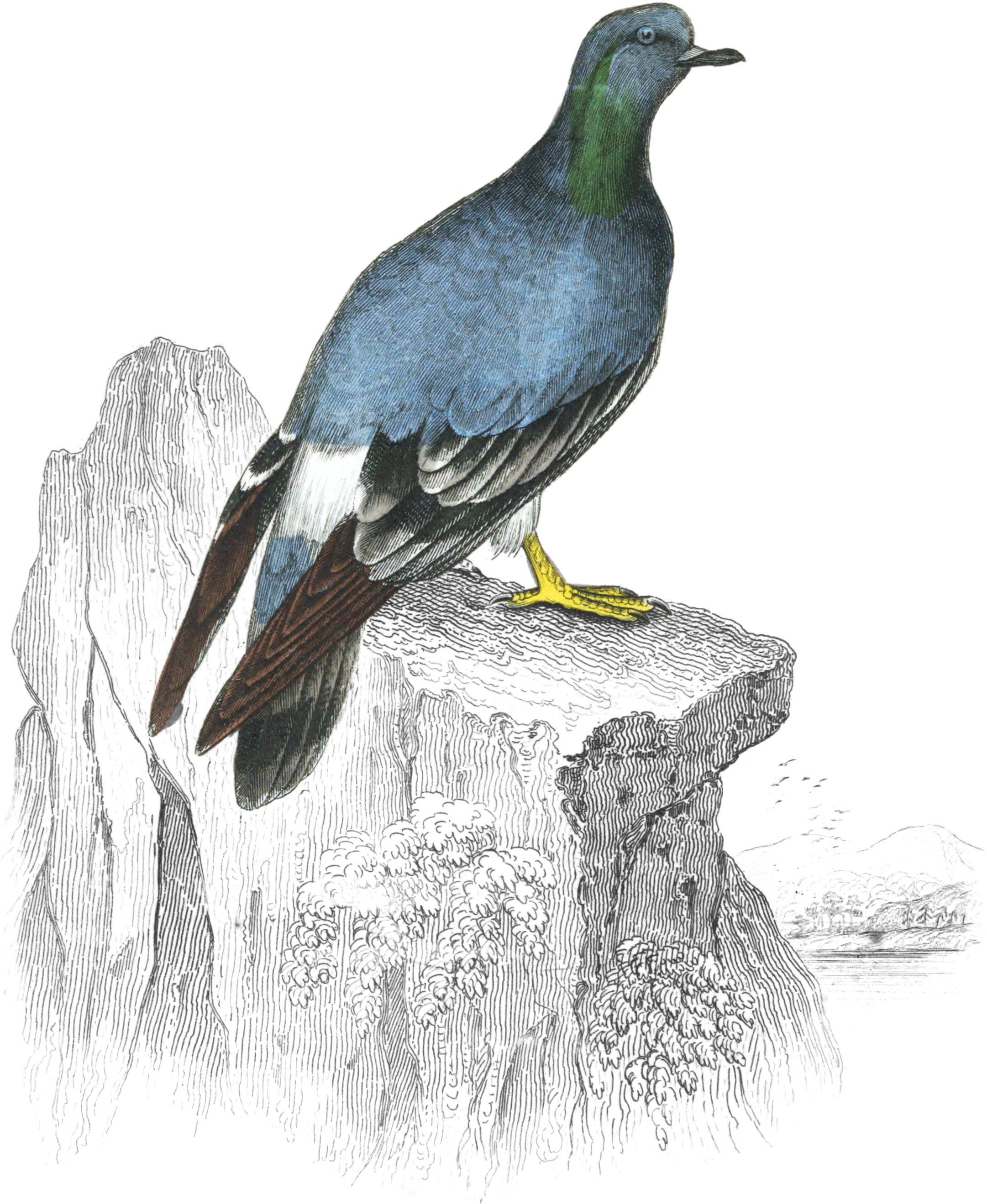
Taking the species as a typical example of the restricted genus Columba, we find the bill of moderate strength, the tip without emargination and gently arched, the nostrils protected by a soft inflated membrane; the wings calculated for vigorous flight, the second and third quills being the longest, and nearly equal; the tail is square or even at the end; the tarsi short, and the feet adapted either for perching or walking; the outer and inner toes are of equal length, the hinder rather shorter than the tarsus, and not provided with so broad or flat a sole, as that of the true arboreal pigeons. In size it is superior to the majority of the Columbidæ, measuring from sixteen to seventeen inches in length. The horny part of the bill is orange-yellow, the basal or soft part impending the nostrils, covered with a white mealy substance. The head, cheeks, throat, neck, lower back and rump, are bluish-grey, those of the side of the neck glossed with green, and bounded by a patch of white, which nearly meets behind, and forms an imperfect demicollar round the lower and back part of the neck. The mantle, scapulars, and wing-coverts are deep bluish-grey. The breast and belly purplish-red, passing towards the vent and under tail-coverts into pale bluish-grey. The outer ridge of the wing and a few of the greater coverts are white. The quills are blackish-grey, their interior webs conspicuously margined with white. The upper surface of the tail is of a bluish-grey at the base, passing gradually into black towards the tip. The legs and feet are purplish-red. The irides yellowish-white.
Of inferior size, but nearly allied in habits and manners, we now present our readers with the figure of a species, which, till of late years, by most of our writers, was confounded with the rock pigeon, the original stock of our common pigeon, or at least had its history so mixed up with the descriptions of that bird, as to render its individuality and specific distinction a matter of considerable doubt. Brisson appears to have been the first who accurately pointed out the distinctions between the two, and he has since been followed by Temminck, who, in his general history of the pigeons, and his excellent and useful Manual of Ornithology, has so clearly marked its distinctive characters, and described its habits, as to render it almost impossible even for a very tyro to confound or mistake the one with the other.
Like the previously described species, it is indigenous, but its distribution is much more limited in extent, being confined to the southern and midland counties of England, and to such districts only as are well clothed with wood; for, possessing arboreal habits, it is never found inhabiting those localities affected by the Columba livia (rock pigeon), such as the caverns of rocks, ruinous edifices, &c. During the spring and summer, it is distributed in pairs throughout the woods, where it breeds, sometimes in the decayed hollows of the ivy-mantled trunks, at others on the forks or amidst the higher branches of the trees. The nest is similar to that of the ring pigeon, and its two white eggs, though inferior in size, present the same oblong form. Two broods are annually produced, the first in spring, the second after midsummer, a period of rest or recruiting of the vital forces taking place between the end of May and the middle of July. As autumn advances, the various broods begin to congregate, and soon form flocks of great magnitude, which continue assembled during the winter, and are sometimes seen commingled with bodies of their larger congener the cushat. In parts of France, Germany, and the northern kingdoms of Europe, it is a migratory species, and a summer or polar visitant, the late autumnal arid winter months being passed in warmer latitudes, where a due supply of food can then be found. In disposition it shews a timidity and watchfulness equal to that of any other species, particularly during the winter months, when associated in troops. Its food consists of grain of all kinds, pulse, acorns, beechmast, &c., and like the cushat, when pressed by hunger, it frequently resorts to the turnip fields to devour the tender leaves and tops of that plant. Its flesh by Temminck is said to be of exquisite flavour, and far superior to that of the ring pigeon, but this perhaps may only be at certain periods, and when feeding upon some peculiar food.
Near as it approaches the common pigeon in size and form, no mixed breed that we are aware of has ever been obtained between them, although repeated attempts to effect an intercourse have been made. This in our mind appears a strong and convincing proof, that all the varieties, generally known by the name of Fancy Pigeons, have originated from one and the same stock, and not from crosses with other species, as some have supposed, the produce of which, even could it be occasionally obtained, we have no doubt would prove to be barren, or what are generally termed mules.
In length the Wood Pigeon measures about fourteen inches, and in extent of wing nearly twenty-six. The head, cheeks, and throat, are pale bluish-grey. The feathers upon the sides and back part of the neck imbricated, of a fine green, changing into purple, or bronzed green in different lights. The lower part of the foreneck and breast are pale vinous, or purplish grey, passing into pale grey, which colour obtains over all the lower parts of the body. The mantle and scapulars are grey, with a brownish tinge, the lesser wing-coverts, the lower part of the exterior webs of the secondary quills, lower back and rump, are pale bluish-grey. Upon the two secondary quills nearest the body, and upon some of the greater coverts, a spot of black confined to the exterior webs, but not forming any defined bar, as in the Rock Pigeon. Tips of the secondary and the greater quills greyish-black. The tail is grey at the base, with a fainter bar immediately adjoining the black tip. The exterior feather on each side, with the basal part of its exterior web, white. Under surface with the bar more distinctly defined. Wings when closed reaching within an inch of the end of the tail. The horny part of the bill is pale orange, the legs and toes red, the claws brownish-black, strong, and moderately arched, the hinder part of the tarsi, as in the Ring Pigeon, are covered with very small scales. The tarsi longer than the middle toe.
Columba livia, Lath.Ind. Orn. v. 2. 390 590. sp. 2. v. β.—Briss.Orn. 82. sp. 3.—Colombe Biset, Sauvage, Temm. Pig. 8vo. edit. 1. p. 125.—Id.Man. of Ornith. 2. 446.—Biset and White-Rumped Pigeon, Lath.Ind. 4. 605 589. 2. A.—Rock-Dove, Mont.Orn. Dict.—Id. Sup.—Selby’ Illus. Br. Orn. 2. 410. pl. 56. f. 2.—The Common Pigeon or Wild Dove, Low’sFaun. Orcad. p. 52.
Rocky and precipitous cliffs, particularly those of the sea-coast perforated by caverns, either originating in the nature of the rock itself, or worn and hollowed out by the action of the waves, are the appropriate retreats of the pigeon in its wild or natural state. In this condition it possesses a very extensive geographical distribution throughout the maritime districts of the world, being abundant in most of the Rocky Islands belonging to Africa and Asia, and in those of the Mediterranean, where it swarms in incredible numbers. Upon our own coasts it is found wherever the nature of the barrier suits its habits, extending as far as the Orkneys, where Low describes it as the inhabitant of all their numerous and extensive caves, retiring to their inmost recesses, and generally beyond the situations selected for nidification by the auks, gulls, and other aquatic fowl. It is also met with upon the northern and western coasts of Sutherland, the perforated and cavernous rocks which gird the eastern side of Loch Eriboll, and those of the limestone district of Durness, furnishing suitable places of retreat, and again upon the eastern coast of Scotland, it is seen about the rocky steeps of the Isle of Bass, and the bold promontory of St Abb’s Head.
The supposition of many of our ornithologists that this and the preceding species were identical, has led to considerable confusion in their writings, and produced a mixed sort of description strictly applicable to neither. The distinctions, however, between the species, even in regard to plumage, are such, that, if attended to, no mistake can well arise, and if accompanied by a corresponding attention to their respective habits, the difference becomes still more apparent and convincing. In one we have a bird the frequenter and inhabitant of the woods, where it roosts, breeds, and perches with security and ease upon the trees, like the ring pigeon and other arboreal species; in the other, an inhabitant of caves and the holes of rocks, and which is never known, under any circumstance, to affect the forest or perch upon a tree.
But the rock or wild pigeon is better known to our readers as the inhabitant of the pigeon-house, or, as it is frequently called, the dove-cot, buildings erected expressly for the purpose of containing colonies of these birds. In this state, where they enjoy a perfect freedom of action, and are nearly dependent upon their own exertions for support, they can scarcely be called reclaimed, much less domesticated. Man, indeed, has only taken advantage of certain habits natural to the species, and by the substitution of an artificial for a real cavern, to which the pigeon-house may be compared, has, without violating or at least greatly infringing upon its natural condition, brought it into a kind of voluntary subjection, and rendered it subservient to his benefit and use. Vast numbers of young pigeons in various parts of the world are by this system annually produced and rendered available as a wholesome and nutritious food, as well as a source of considerable profit to the proprietors of these edifices.
Various practical treatises upon the management of the dove-cot, and other details connected with it, are already before the public, and to them we must refer our readers for further information, as the limited nature of the present work will not admit of such copious extracts as would be necessary to embrace all the respective details. It may not, however, be out of place to advert to a few of the principal objects to be considered, by those who contemplate the erection of a pigeon-house; and first in regard to the form of the building. The most approved is that of a circular tower, as it affords advantages not possessed by the square, giving an easier access to the breeding birds to their nests, and a greater facility of taking the young, and inspecting and clearing out the holes, by means of a ladder turning upon an axis. Around the interior of the tower, about three or four feet from the bottom, a horizontal ledge of eight or ten inches in width ought to project, in order to prevent rats, weasels, and other vermin, destructive to the eggs and young, from scaling the walls and entering the pigeon-holes, and if this ledge be covered on its under surface with tin or sheet-iron, it will the more effectually prevent the entrance of such intruders. A second ledge of less width, and about midway up in a pigeon-house of considerable height, may also be of advantage, not only for additional security against enemies, but as a resting-place for the pigeons when they enter the house. The holes or nests are best built in quincunx order, and not directly over one another, and they ought to be sufficiently large to allow the old birds to move in them with freedom, and to stand upright, in which position they always feed their young.
Frequent attention to the state of the holes is necessary, and they ought regularly to be inspected and cleansed after each great flight, that is, towards the end of May, and again before winter. The dung accumulated at the bottom of the house should also be removed every three or four months, as the effluvium which arises from it when in a large mass, arid in a state of fermentation, is injurious to the health of the birds, and also prevents them making use of the lower tiers of nest-holes. In point of situation, a gentle acclivity, exposed to the south, and open to the rays of the sun, in which the pigeon delights to bask and repose, is the most favourable. It ought not to be too far removed from a plentiful supply of water, as the pigeon is a great and frequent drinker; neither too closely surrounded by trees, as, when near, they interfere with the free egress and ingress of the birds, and are supposed to be disagreeable to them, from the noise they make in winds and storms. The pigeon being a bird of a timid nature, and easily alarmed, the house should stand at such a distance from all the other offices, as not to be incommoded by any noise or movements about them. From a pigeon-house of tolerable dimensions, a produce of many dozens of young may annually be procured, and that for nearly eight months out of the twelve, as they are in full breeding from March till the end of May, and again from August till the close of November; and all that is required to keep up the breeding stock, is to permit a limited portion of the latter hatchings to escape.
In its natural state, the plumage of the pigeon is as follows:—Bill blackish-brown; the nostril membrane red, sprinkled, as it were, with a white powder. The hides pale reddish-orange. The head and throat are bluish-gray. The sides of the neck and upper part of the breast are dark lavender-purple, glossed with shades of green and purplish-red. The lower part of the breast and abdomen are bluish-gray. The upper mandible and wing-coverts are blue-gray. The greater coverts and secondaries are barred with black, and form two broad and distinct bars across the closed wings. The lower part of the back is white; the rump and tail-coverts bluish-gray. The tail is of a deep gray, with a broad black bar at the end. The legs and feet are pale purplish-red. When closed, the wings reach within half an inch of the end of the tail.
It is under this species that we include not only the common pigeon, or inhabitant of the dove-cot, but all those numerous varieties, or, as they are frequently termed, races of domesticated pigeons, so highly prized, and fostered with such care and attention by the amateur breeder or pigeon fancier; for, however diversified their forms, colour, or peculiarity of habit may be, we consider them all as having originated from a few accidental varieties of the common pigeon, and not from any cross of that bird with other species, no signs or marks whatever of such being apparent in any of the numerous varieties known to us. In fact, the greater part of them owe their existence to the interference and the art of man; for, by separating from the parent stock such accidental varieties as have occasionally occurred, by subjecting these to captivity and domestication, and by assorting and pairing them together, as fancy or caprice suggested, he has at intervals generated all the various races and peculiar varieties, which, it is well known, when once produced, may be perpetuated for an indefinite period, by being kept separate from, and unmixed with, others; or what, by those interested in such pursuits, is usually termed “breeding in and in.” Such also, we may add, is the opinion of the most eminent naturalists, as to their origin, and it is strongly insisted on by M. Temminck in his valuable work, the Histoire Generale Naturelle des Pigeons. Indeed, the fact, that all the varieties, however much they may differ in colour, size, or other particulars, if permitted, breed freely and indiscriminately with each other, and produce a progeny equally prolific, is another and a convincing proof of their common and self-same origin; for it is one of those universal laws of nature, extending even to plants, and one which, if once set aside or not enforced, would plunge all animated matter into indescribable confusion, that the offspring produced by the intercourse of different, that is, distinct species, is incapable of further increase. That such an intercourse may be effected, is well known to all; but it is generally under peculiar or artificial circumstances, and rarely when the animals, birds, or whatever they may be, are in their natural state, and in a condition to make their own election. It is seen in the crosses obtained, in a state of confinement, between the canary and goldfinch, linnet, &c.; in the hybrids produced between different species of the Anatidæ when domesticated, or kept in captivity; in the cross between the pheasant and common fowl, &c. But in all these instances, the progeny are invariably mules, and incapable of further production; for although they may exhibit the passions natural to the sexes, and the female may even produce eggs, these, with every care, are always found addled, and incapable of being hatched. Such, we may add, is the case with hybrids of some of the crosses themselves; for the bastard produce of the common wild turtle (Turtur communis) with the turtle of the aviary (Turtur risoria), has been proved, by frequent experiment, to be barren,10 although the two species from whence it originates appear to be closely allied, and a mixed breed is easily procured; and such, we have no hesitation in saying, would be the event, if a cross could be obtained between the common pigeon and the ring-pigeon, the wood-pigeon, or any other species.
To describe or particularize all the varieties cultivated by pigeon fanciers, would require a volume of itself; as, in addition to the permanent races, or those which, when kept pure, transmit their likeness to their offspring, there are intermediate forms, produced by particular crosses between individuals belonging to the different varieties, which, though highly prized in the first generation, are not considered worthy of further cultivation, as their produce cannot be depended upon, but is found to degenerate, and liable to run into still more distant and less valued varieties. We must therefore confine our remarks to a few observations upon the mode of treatment, and the means adopted to perpetuate and keep pure such races or varieties as are held in the highest estimation by the amateur, and then present our readers with the figures and description of three or four of the most remarkable deviations from the original type of the species.
Domestic or fancy pigeons are generally kept confined in aviaries, or lodged in appropriate buildings attached to or near the house of the breeder, in order that they may be regularly and easily fed, cleansed, and duly attended to in all matters having reference to their condition and health; for their natural instinct and their feeling of liberty have been so nearly effaced, or placed in abeyance by the captivity to which they have been subjected for so many generations, that they have become nearly dependent upon man for support, and have lost the power or capability, even when allowed to fly at large, of looking for and finding their own food, insomuch that, if left to themselves, they would in all likelihood perish from hunger and want. In these buildings, it is usual to erect a certain number of boxes or divisions against the walls or sides, each calculated to accommodate a pair of pigeons, with their nest and young. They are best when separated and distinct from each other, with a small platform, and an entrance just large enough to admit the bird; as, when disposed in a continuous row, and open in front, the birds are apt to interfere with each other, and, by their jealousies and contentions, to prevent the due increase of eggs and young. To ensure the purity of any particular kind, the young males, as soon as they shew symptoms of maturity, which is known by particular gesticulations and their cooing-notes, are placed apart in a chamber constructed for the purpose, with a female of the same variety. Here they remain till a mutual attachment has taken place, after which they may be returned to the general aviary or dove-house; for, when once an alliance is effected, it generally continues undissolved and inviolate till the death or removal of one of the parties; on which account many different varieties may be kept in the same aviary, or associated together in one building, without much apprehension of having a contaminated breed.
Among the numerous varieties cultivated by the pigeon fancier, the following list embraces such as are held in particular estimation, viz. the Roman, Rough-footed, Crested, Norway, Barbary, Jacobine, Laced, Turbit, Broad-tailed and Narrow-tailed Shaker, Tumbler, Helmet, Turkishor Persian, Carrier, Horseman, Pouter, Smiter, Turner, and Spot pigeons. The first variety we present to our readers is the
This curious variety, remarkable for the number of its tail-feathers, which, in some individuals, have been known to amount to upwards of forty, possesses, at the same time, the power of erecting it in the manner of a turkey cock, during which action, and particularly when paying court to its mate, it trembles or shakes, like the peacock when moving about with his train expanded and in full display. This power of spreading and erecting the tail is not, however, confined to the male bird, but is possessed to an equal extent by the female, who resembles the male in every respect. In size it is inferior to most of the varieties, and is farther characterized by having a short, slender bill, pendant wings, and naked legs and feet. It is not very prolific, and seldom succeeds so well in the aviary or pigeon-house as most of the other kinds; and, from the size and position of its unwieldy tail, flies awkwardly, and is apt to be carried away or overset by the wind. To retain all the characters above mentioned, it is necessary to keep the breed perfectly pure, as any cross is certain to dimmish one or more of the peculiar qualities of the race. The ordinary appearance of the fan-tail is white, or white with a black head and tail. It is also frequently seen with the mantle and tail affecting the various colours which prevail in domestic pigeons, as dark and light blue, reddish-brown, &c. The female of this variety, crossed with the male glou-glou, or Tambour Pigeon, produces the Narrow-tailed Shaker or Quaker, in which the number of the tail-feathers decrease, as well as the power of spreading and erecting it. The trembling action, however, remains unabated.
This curious variety, which, as transmitting to its posterity a form precisely similar, with all the peculiar characters undiminished, comes under the designation, among pigeon fanciers, of a pure or permanent race, is distinguished by a remarkable ruff or frill of raised feathers, which, commencing behind the head, and proceeding down the neck and breast, form a kind of hood, not unlike that worn by a monk; and from its resemblance to which it has obtained its Gallic trivial name of Nonnain capucin.
In size it is one of the smallest of the domestic pigeons, but its form is light and elegant. The bill is very short; the eyes surrounded with a moderate circle of naked red skin. The legs are unplumed. The head, the wings, and the tail, are always white The usual colour of the hood is reddish-brown, with iridescent tints. The mantle, the wing-coverts, and the breast, are reddish-brown. It is also sometimes seen with the mantle and wing-coverts of a very deep red, spotted with black. Another variety, of a uniform pale fawn-colour, is not unfrequent; but that most highly prized is entirely of a pure and glossy white. It is a very productive species, and, having its flight considerably impeded by the size and form of its hooded pile, keeps much at home, and is well adapted for the aviary or other buildings where pigeons are kept confined.
Columba (var.) gutturosa subrubicunda.—Pigeon grosse gorge soupe en vin, Monog. des Pig. Domest. p. 173.
The faculty of inflating the œsophagus, to a limited extent, appears to be possessed by the pigeon and all its varieties, and is no doubt in some way connected with and essential to its economy; but in this variety it is developed to an extraordinary extent, far exceeding that of any of its congeners, and can only be considered as resulting from a monstrous or unnatural formation of the gullet. In what is considered the pure, or most esteemed examples of this sort, that is, where this power is the greatest, the œsophagus, when fully inflated, sometimes equals the body itself in dimensions. As might be supposed, this peculiarity subjects the bird to many inconveniences, and frequently to fatal accidents, for when thus puffed out to its full extent, the bird, in order to sustain its centre of gravity, is obliged to keep in an upright or nearly perpendicular position, with the head thrown far back, which prevents if from seeing any thing directly before it, and causes it to become an easy prey to the hawk or other enemies. It is also unable, in consequence of this constrained attitude, to defend itself from the attacks of other pigeons, who, by a single stroke of the bill, frequently pierce the inflated craw, and give it a mortal wound. But in addition to accidents from external enemies, it is also liable to a disease in this part, which generally proves fatal in the course of a few days. This always attacks them when they happen to have a young brood, and is produced by the reiterated and severe efforts they are obliged to make, in order to bring or cast up the partially digested food necessary for their support. For by those oft repeated and violent attempts, the muscles of the œsophagus or craw, weakened in all probability beforehand by the constant inflation of the parts, become paralyzed and lose their power of contraction; and the crop being no longer able to discharge its proper digestive functions, inflammation ensues, which is rapidly succeeded by ulceration, and a period is soon put to the life of the bird. On this account, added to its unproductiveness, it holds but a secondary place in the estimation of the amateur, although, in point of appearance, it is as singular, and in regard to beauty and diversity of plumage, equal to any of the other races.
It is found of all the various colours incident to domestic pigeons, though the reddish-brown is perhaps the most prevalent among the English breeders. The horseman pigeons, another esteemed variety, are supposed to have originated from a cross between the Powter and the great Roman Pigeon.
Columba Turcica vulgaris.—Pigeon Turc ordinaire, Monog. des Pig. Domest. p. 188.—Carrier Pigeon.
In England, the pigeon generally known by the name of the Carrier, appears to belong to this race, as it possesses all the characteristics of the Columba Turcica of authors, viz. great size, a bill tuberculated at the base, and the eyes surrounded with a broad circle of naked red skin, elevated tarsi, and wings reaching nearly to the end of the tail. This name, however, according to the authors of the “Monographic des Pigeons Domestiques,” is improperly applied, and ought to be appropriated to a very different variety, which they designate in their interesting work as the Columba tabellaria, or race of “Pigeons volans.” This, in contradistinction to the Turkish variety, is of small size, without tuberculated nostrils, and the circle around the eye small and narrow. In point of fecundity and productiveness, it surpasses any other race, and shews a still greater attachment to the place of its birth, a fact in proof of its superior claim to the title in dispute, as it is the excessive development of this instinctive feeling that urges the Carrier, when transported from its native habitation, even to a distance of many hundred miles, to wing its way back without stop or delay, the moment it is uncaged and set at liberty. Its flight is also very rapid and generally at a high elevation, particularly when employed as a messenger, and at a great distance from home. Upon such occasions its first essay is to attain a high altitude by a series of circular evolutions. This accomplished, it instinctively darts off in the direction of its native home, as if guided by the compass, and acquainted with the true bearings of the place it seeks to regain.
The pigeon, and we may presume the variety, thus adverted to by MM. Boitard and Corbié, as to it may be referred all the figures depictured in the monuments of the ancient sculptors, representing Venus as attended or drawn in a car by doves, has from the earliest ages been employed as a messenger to convey information between distant points, where unwonted celerity and despatch were required. Thus we read of it as conveying the welcome intelligence of succour and relief to besieged cities, of battles lost or won; and in the poetry and tales of the East, it is frequently described as the appropriate bearer of a lover’s vows to his distant mistress. Even at the present day, it is still employed where extraordinary despatch is required, and in Holland, France and other countries, the race is kept uncontaminated and pure. The Turkish variety, or that represented in our Plate, on the contrary, possesses none of the qualifications requisite for a speedy messenger, its flight being slow and heavy, from its superior size and weight, nor is it distinguished by any extraordinary attachment to the place of its birth. It is therefore probable, that the name of carrier has been given to it more on account of its oriental origin, where the pigeon was first made use of in this way, than for any real fitness for such an office. It is among the largest of the domestic pigeons, and is remarkable for the tubercles which grow upon the soft or membranous part of the bill, and the breadth of the naked skin encircling the eye. It is of various colours, but the dark-blue or red-brown predominates.
We shall now take our leave of the Columba livia and its varieties, and proceed to describe other interesting members of the family.
The next extensive division of the Columbidæ we have to notice, is that of the Turtles, or Ectopistina, adopting the term from the genus Ectopistes, instituted by Mr Swainson for the reception of the Columba migratoria of authors, which, in all probability, from the great development of its wings, tail, &c. will prove the typical form of the group. They are distinguished from the pigeons by a general inferiority of size, by a bill of weaker conformation, by the comparative length of their toes, the inner in this section being longer than the outer toe; whereas in the true pigeons they are of equal length, and by the form of the tail which is more or less graduated, being merely rounded in the common Turtle, and graduated to an extreme degree in the Passenger Pigeon (Ectopistes migratoria). The passage from the pigeons to the turtles is by an easy gradation of form, and is effected by such species as the Columba Levaillantii of Wagler, which in external appearance bears a close resemblance to the Turtur risorius of South Africa, but retains the bill and feet of the preceding group. A great similarity exists in their habits and manners, and, like most of the true pigeons, they are gressorial as well as arboreal birds, their feet being equally adapted for walking or grasping. They seek their food upon the ground, and subsist upon the different cerealia, pulse, &c. They repose, roost, and nidificate upon trees, and, like the pigeons, lay but two eggs each hatching. Few of the minor groups, or genera, or by whatever name the lowest assemblage of species may be denominated, have yet been characterised. We may point to the turtles or group containing the common Turtle Dove, the domestic Turtle, &c. as one; another, as we have above stated, is represented by the Passenger Pigeon of America; a third seems indicated by the Columba humeralis of Temminck, the Columba erythrauchen of Wagler, in which the wings are comparatively short and rounded, having the first quill-feather abruptly narrowed towards the tip, as in genus Ptilinopus, and as it also exists in several members of the ground doves or Partridge Pigeons. The Columba Capensis of authors, and Columba Macquarrie of Lesson, also appear to possess characters which in all probability will separate them from the foregoing groups, and it is by these arid some other nearly allied forms, that a passage to the next division or Ground Doves is effected.
Genus Turtur
The birds belonging to this group are distinguished by their bill, which is slenderer in its proportions than that of the Pigeons. The tip of the upper mandible is gently deflected, that of the lower scarcely exhibiting an appearance of an angle. Legs, the tarsi rather shorter than the middle toe. Feet formed for walking or perching, the inner toe longer than the outer. Front of the tarsi covered with broad imbricated scales. Wings, the first quill a little shorter than the second, the third the longest of all. Tail rounded, or slightly graduated. The Turtles are inferior in size to the Pigeons, which they closely resemble in their habits. They feed upon the ground, but roost and breed in the woods.
As an example of the genus, we present our readers with a figure of the well known
Collared Turtle
Turtur risorius.
Columba risoria, Auct.—Turtur torquatus Senegalensis, Briss.1. p. 124. t. 11. f. 1.—Colombe blonde, Temm.Pig. 1. p. 323.—Tourterelle à collier, Buff.Pl. Enl. No. 244.—Boitard et Corbie.Monog. des. Pigeons, p. 236. pl. 25.
From a very remote period this species appears to have been domesticated, or rather kept in that state of captivity in which it is retained at the present day; for there is every reason to suppose that the turtle dove adverted to in Holy Writ may be referred to the same bird, as it is still abundant in Egypt and other parts of the East, where it is fostered and cultivated with care, and it is certain that many of the representations in the works of ancient art, where the dove figures as the emblem of tenderness and affection, or where it is depicted as the appropriate attendant of Venus, are accurate delineations of the Collared or domestic Turtle.
This bird does not appear to be susceptible of that attachment to its home or place of birth, fur which the common or Dove-cot Pigeon is remarkable, and which peculiar quality renders that species so serviceable to man. On the contrary, like its congener the common or wild European turtle (Turtur communis), it cannot be left to range at perfect liberty, without the danger of its flying away to return no more, and must therefore be kept constantly confined either in cages or in aviaries adapted for the purpose. In this state of captivity, if properly attended to, it breeds with facility, sometimes producing as many as eight broods within the year; but, being a native of warm climates, and very impatient of cold, it is seldom cultivated to the same extent in this country as it is in those where the temperature is better adapted to its constitution. The male shews great tenderness arid affection to his mate, and is constantly by her side, soothing her with caresses, or paying his court by soft cooing notes, and that peculiar cry so expressive of laughter, and from which it takes its specific name.
In its wild or natural state, it is found in various parts of Africa, and we have by us specimens from the southern part of that continent, a description of which, as varying in depth and intensity of colour from the domestic variety, is here subjoined. The length is about ten inches. The chin is whitish, from the corners of the mouth to the eyes, is a narrow streak of black. The forehead is pale bluish-gray; the crown darker; the cheeks, neck, breast, and belly gray, tinged with vinaceous or pale purplish-red; the hind neck with a demi-collar of black, some of the side feathers composing it being tipped with white. The back scapulars and rump are of a pale clove-brown, with a greenish tinge. The margins of the wings, the greater coverts, and under wing-coverts, are blue gray. The greater quills are hair-brown, delicately edged with grayish-white. The tail is slightly rounded, the two middle feathers entirely clove-brown, the remainder on each side with the basal half black, the tips bluish-gray, except those of the two outermost, which are white. The vent and under tail-coverts are white; the legs and feet gray; the inner toe a little longer than the outer. In its natural state, it inhabits the woods, where it breeds, making a nest similar to that of the common turtle, and lays two white eggs. It seeks its food in the open grounds, and subsists upon grain, grass-seeds, pulse, &c. It is easily distinguished, and the place of its retreat soon discovered by its cooing-notes, one of which we have already stated to resemble the human laugh.
A mixed breed is sometimes obtained between this species and the common wild turtle, but the progeny are invariably mules, and incapable of farther increase, a fact that has been established by many careful and oft-repeated experiments, and one which affords a strong argument against the supposition, that many of the varieties of the common pigeon, or of the domestic fowl, are the result of a mixture of different species.
Besides the wild turtle known to us as a regular summer visitant in the southern districts of England, the Columba maculicollis and the Columba aurita of Temminck, and several others belong to the group, of which the present species may be considered a type.
Our next Plate represents a beautiful species, which we shall call the
Crested Turtle
Turtur? lophotes.
Columba lophotes, Temminck, Pl. Col. pl. 142, Le mâle.—Wägler, Syst. Av. sp. 103.
The general contour of this bird, as well as the form of its bill and feet, plainly indicate its near relationship to the turtles, among which we have provisionally placed it, though it is likely it may form, in conjunction with the Columba humeralis of Temminck, and some other species, in which the tail is long and considerably graduated, a separate or subgeneric group. It is distinguished from all its congeners, and rendered remarkable by its long occipital crest, which, in form as well as in the quality of the feathers of which it is composed, exactly resembles that of the common Peewit (Vanellus cristatus). Its native country is Australia, and it inhabits the interior and mountainous districts of that interesting country; but we regret to add, that of its peculiar habits and economy we have no detailed accounts,—a loss the more to be regretted, as it is from our knowledge of these that the proper position of the species, in relation to the other Columbidæ, can he satisfactorily ascertained. The following is a description of the plumage of the adult male.
The bill, which is small and slender, is black. The head, neck, and the whole of the under plumage, pale gray; the hind neck slightly tinged with lavender-purple. Crest horizontal, composed of several long acuminated narrow feathers, of a grayish-black colour. Back and lesser wing-coverts inclining to clove-brown, each feather terminated with yellowish-brown, and having a transverse black bar. Greater coverts of a shining metallic green, finely edged with white. Secondaries with their exterior webs of a metallic purple, spotted with black; the exterior webs and greater quills blackish-gray. Lower back, rump, and two middle tail-feathers, umber-brown; the rest of the tail violet, with a green metallic lustre; the tips of the feathers white.
The characters of this group, as given by Mr Swainson, who first separated the members belonging to it from the Turtles, are as follows:—Bill slender, the tip of the upper mandible emarginated. Wings sub-elongated and pointed, the first and third quills equal, the second the longest. Tail rounded or cuneated. Legs short, naked. The tarsi scaled as in genus Turtur.
Our next Plate represents the well known
Passenger Turtle
Ectopistes migratoria.—Swainson.
Columba migratoria, Auct.—Passenger Pigeon, Wils.Amer. Ornith. pl. 44, fig. 1.—Aud. Ornith. Biog. p. 319, pl. 62.
Among the few groups of the Columbidæ already characterized, is that of Ectopistes, a genus instituted by Mr Swainson, for the reception of the Columba migratoria and Columba Carolinensis of authors, birds which, though nearly allied in other characters, are distinguished from the rest of the turtles by the greater length of their wings and tail, those essential organs of motion, the extra development of which necessarily indicates an economy and mode of life different from that of those species where these members are comparatively short, and differently proportioned. The subject of our present Plate is a native of the North American Continent, where it occupies a very extensive range between the twentieth and sixtieth degrees of N. latitude, and is not less remarkable for living at all times, even including the period of incubation, associated in flocks of countless myriads, than for its migrations, which, unlike those of other birds, whose movements are considerably affected by temperature, are not undertaken, at any fixed period or season of the year, or frozen or cold, to a warmer climate, but are entirely regulated by the supply or want of food; for Audubon, in his interesting account of this bird, remarks,
It sometimes happens, that a continuance of a sufficient supply of food in one district will keep these birds absent from another for years. I know at least to a certainty, that, in Kentucky, they remained for several years constantly, and were no where else to be found. They all suddenly disappeared one season, when the mast was exhausted, and did not return for a long period.
Their power of flight, indicated by the length of their wings and tail, is very great; and, indeed, without a locomotive gift of extraordinary extent, it would be impossible for such countless numbers as are seen associated together to exist; for the supply of food in the immediate neighbourhood of their roosting resort or their breeding-places, when they are necessarily engaged for months together, soon becomes exhausted, and they have frequently to traverse each day an immense distance in quest of a further supply. This is proved by facts narrated by Wilson in his graphic history of this bird, as well as by Audubon, who mentions the extraordinary circumstance, that
pigeons have been killed in the neighbourhood of New York, with their crops full of rice, which they must have collected in the fields of Georgia and Carolina, these districts being the nearest in which they could possibly have procured a supply of that kind of food.
The distance between these points is stated to be between three and four hundred miles; and, as the decomposition of their food is completely effected in twelve hours, this space must have been travelled within the short period of five or six hours.
The account of their roosting and breeding places is too curious to be omitted; we therefore make no apology for quoting at length Wilson’s description contained in the American Ornithology.
The roosting-places are always in the woods, and sometimes occupy a large extent of forest. When they have frequented one of those places for some time, the appearance it exhibits is surprising. The ground is covered to the depth of several inches with their dung; all the tender grass and underwood destroyed; the surface strewed with large limbs of trees, broken down by the weight of the birds collecting one above another; and the trees themselves, for thousands of acres, killed as completely as if girdled with an axe. The marks of their desolation remain for many years on the spot; and numerous places could be pointed out, where, for several years after, scarcely a single vegetable made its appearance. When these roosts are first discovered, the inhabitants, from considerable distances, visit them in the night, with guns, clubs, long poles, pots of sulphur, and various other engines of destruction. In a few hours they fill many sacks and load horses with them. By the Indians, a pigeon-roost or breeding-place is considered an important source of national profit and dependence for that season, and all their active ingenuity is exercised on the occasion. The breeding-place differs from the former in its greater extent. In the western countries, viz. the States of Ohio, Kentucky, and Indiana, these are generally in back woods, and often extend in nearly a straight line across the country for a great way. Not far from Shelbyville, in the State of Kentucky, about five years ago, there was one of these breeding-places, which stretched through the woods in nearly a north and south direction, was several miles in breadth, and was said to be upwards of forty miles in extent! In this tract almost every tree was furnished with nests wherever the branches could accommodate them. The pigeons made their first appearance there about the 10th of April, and left it altogether with their young before the 25th of May. As soon as the young were fully grown, and before they left the nests, numerous parties of the inhabitants, from all parts of the adjacent country, came with waggons, axes, beds, cooking utensils, many of them accompanied by the greater part of their families, and encamped for several days at this immense nursery. Several of them informed me that the noise was so great as to terrify their horses, and that it was difficult for one person to hear another speak without bawling in his ear. The ground was strewed with broken limbs of trees, eggs, and young squab pigeons, which had been precipitated from above, and on which herds of hogs were fattening. Hawks, buzzards, and eagles, were sailing about in great numbers, and seizing the squabs from the nests at pleasure; while, from twenty feet upwards to the top of the trees, the view through the woods presented a perpetual tumult of crowding and fluttering multitudes of pigeons, their wings roaring like thunder, mingled with the frequent crash of falling timber; for now the axemen were at work, cutting down those trees that seemed to be most crowded with nests, and contrived to fell them in such a manner, that, in their descent, they might bring down several others., by which means, the falling of one large tree sometimes produced 200 squabs, little inferior in size to the old ones, and almost one heap of fat. On some single trees, upwards of a hundred nests were found, each containing one squab only; a circumstance, in the history of this bird, not generally known to naturalists. It was dangerous to walk under these flying and fluttering millions, from the frequent fall of large branches, broken down by the weight of the multitudes above, and which, in their descent, often destroyed numbers of the birds themselves; while the clothes of those engaged in traversing the woods were completely covered with the excrements of the pigeons. These circumstances were related to me by many of the most respectable part of the community in that quarter; and were confirmed, in part, by what I myself witnessed. I passed for several miles through this same breeding-place, where every tree was spotted with nests, the remains of those above described. In many instances I counted upwards of ninety nests on a single tree, but the pigeons had abandoned this place for another, sixty or eighty miles off towards Green River, where they were said at that time to be equally numerous. From the great numbers that were constantly passing over our head to or from that quarter, I had no doubt of the truth of this statement. The mast had been chiefly consumed in Kentucky: and the pigeons, every morning, a little before sunrise, set out for the Indiana territory, the nearest part of which was about sixty miles distant. Many of these returned before 10 o’clock, and the great body generally appeared on their return a little after noon. I had left the public road to visit the remains of the breeding-place near Shelbyville, and was traversing the woods with my gun, on my way to Frankfort, when, about 1 o’clock, the pigeons which I had observed flying the greater part of the morning northerly, began to return, in such immense numbers as I never before had witnessed. Coming to an opening by the side of a creek, called the Benson, where I had a more uninterrupted view, I was astonished at their appearance. They were flying with great steadiness and rapidity, at a height beyond gunshot, in several strata deep, and so close together, that, could shot have reached them, one discharge could not have failed of bringing down several individuals. From right to left, as far as the eye could reach, the breadth of this vast procession extended, seeming every where equally crowded. Curious to determine how long this appearance would continue, I took out my watch to note the time, and sat down to observe them. It was then half-past one; I sat for more than an hour, but instead of a diminution of this prodigious procession, it seemed rather to increase, both in numbers and rapidity; and anxious to reach Frankfort before night, I rose and went on. About four o’clock in the afternoon I crossed Kentucky River, at the town of Frankfort, at which time the living torrent above my head seemed as numerous and as extensive as ever. Long after this, I observed them in large bodies, that continued to pass for six or eight minutes, and these again were followed by other detached bodies, all moving in the same south-east direction, till after six o’clock in the evening. The great breadth of front which this mighty multitude preserved would seem to intimate a corresponding breadth of their breeding-place, which, by several gentlemen who had lately passed through part of it, was stated to me at several miles.
After a few additional observations, our author proceeds to give a rough estimate of the numbers of the above mentioned mighty flock, and the quantity of food necessary for its daily support. He says,
If we suppose this column to have been one mile in breadth (and I believe it to have been much more), and that it moved at the rate of one mile in a minute, four hours, the time it continued passing, would make its whole length 240 miles. Again, supposing that each square yard of this moving body comprehended three pigeons, the square yards in the whole space multiplied by three, would give two thousand two hundred and thirty millions, two hundred and seventy-two thousand pigeons! an almost inconceivable multitude, and yet probably far below the actual amount. Computing each of these to consume half a pint daily, the whole quantity at this rate, would equal seventeen millions four hundred and twenty-four thousand bushels per day!
This wonderful account of the roosting and breeding places of the Passenger Pigeon, is corroborated in every point by Audubon, who, in his delightful work the “American Ornithological Biography,” has added various other particulars connected with its history, which want of space alone prevents us adverting to; we cannot, however, pass over some of his observations on the mode of flight of these birds. He remarks,
It is extremely interesting to see flock after flock performing exactly the same evolutions which had been traced as it were in the air by a preceding flock. Thus, should a hawk have charged on a group at a certain spot, the angles, curves, and undulations that have been described by the birds, in their efforts to escape from the dreaded talons of the plunderer, are undeviatingly followed by the next group that comes up. Should the bystander happen to witness one of these affrays, and, struck with the rapidity and elegance of the motions exhibited, feel desirous of seeing them repeated, his wishes will he gratified, if he only remain in the place until the next group comes up.
His description of their evolutions, when a supply of food has been discovered, is also highly graphic.
As soon as the Pigeons discover a sufficiency of food to entice them to alight, they fly round in circles, reviewing the country below. During their evolutions on such occasions the dense mass which they form exhibits a beautiful appearance, as it changes its direction, now displaying a glistening sheet of azure when the backs of the birds come simultaneously into view, and anon, suddenly presenting a mass of rich deep purple. They then pass lower over the woods, and for a moment are lost among the foliage, but again emerge, and are seen gliding aloft. They now alight, but the next moment, as if suddenly alarmed, they take to wing, producing, by the flapping of their wings, a noise like the roar of distant thunder, and sweep through the forests to see if any danger is near. Hunger, however, soon brings them to the ground. When alighted, they are seen industriously throwing up the withered leaves in quest of the fallen mast. The rear ranks are continually rising, passing over the main body, and alighting in front, in such rapid succession, that the whole flock seems still on wing. The quantity of ground thus swept is astonishing, and so completely has it been cleared, that the gleaner who might follow in their rear, would find his labour completely lost.
Beech-mast and acorns, produced in incredible quantities by the primeval American forests, constitute a great proportion of the food of these birds; but great quantities of buckwheat, hempseed, Indian corn, rice, hollyberries, hackberries, and other small fruits, are also consumed in their respective seasons.
They commence breeding early in spring, and are said to produce two or three broods in the year, each hatching, according to Wilson, consisting of a single young one. Audubon, however, mentions, that they lay two pure white eggs, of a broadly elliptical form,
and further adds,
It is a remarkable fact, that each brood generally consists of a male and female.
Judging from analogy, and the habits of other nearly allied species, we are inclined to think that Wilson, who does not profess to have ascertained the fact from observations made by himself, must have been misinformed upon this point by those who gave him the information. The nest is composed of slender twigs loosely put together, and, like that of the Ring Pigeon or Turtle, has little or no concavity. Upon the approach of the breeding season, the male pays court to the other sex by sundry and oft-repeated gesticulations, accompanied by cooing notes, and the billing observed in many other species is also practised by them. The flesh of the old birds is of a dark colour, and rather hard and dry. The young or squabs, are, however, stated to be excellent, and before they leave the nest, or are left by their parents to seek their own food, are loaded with fat. This is frequently melted down in large quantities for culinary purposes, by those who are near enough to profit by the plunder of a breeding station of this remarkable bird.
The form of the Passenger Turtle is graceful and elegant. The wings are long and acuminate, having the second quill-feather exceeding the others in length. The tail is greatly cuneiform or graduated, and consists of twelve tapering feathers. The bill is of a black colour, and similar in form to that of the turtle, and the legs, which are purplish-red, are short and strong. The iris is of a bright orange-red, the naked orbit purplish-red. The head and cheeks are pale bluish-grey, the fore-neck, the breast, and sides of a brownish-red, with a purplish tinge. The abdomen and vent are white. The lower part and sides of the neck are of a purplish-crimson, reflecting tints of emerald green and gold. The upper plumage is of a deep bluish-grey, some of the scapulars and wing-coverts spotted with black. The greater coverts are grey, tipped with white. The quills are blackish-grey, with their exterior webs bluish-grey. Tail, with the two middle feathers, entirely black, the other five on each side grey at the base, with a black bar on the interior arch, and passing into white towards the extremities. The female is rather inferior in size, and has the colours of her plumage much duller than those of the male, though the distribution is the same.
Another American species, the Columba Carolinensis of authors, also belongs to this genus.
Our next plate represents a beautiful, though diminutive, species, which we have provisionally placed under this genus, though it is probable, from its geographic distribution, and that of another species discovered by Freycinet, as well as from some differences of structure, that it will eventually be found the type of a distinct group. It is the
Cape Turtle
Ectopistes? Capensis.
Columba Capensis, Auct.—Columba atrogularis, Wäg.Syst. Av. sp. 108.—Tourterelle à cravatte noire du Cap. de B. èsp. Buff.Pl. Enl. p. 140.—Colombé tourtelette, Temm. Pig. 8vo, i. p. 366. pl. 53.—Id. Pl. Coloriées, Jeune mâle, pl. 341. fig. 2.
The great length of the tail of this pretty species, which of itself measures six inches, gives it an appearance of bulk, which it does not in reality possess, as the body scarcely exceeds that of the common lark in size. Its wings are moderately long, and reach, when closed, to about the third the length of the tail; the second quill-feather rather exceeds the first, and is the longest in the wing. The tail is greatly cuneated, and, like that of the Passenger Turtle, consists of twelve feathers, the tips of which are rounded, except the two middle ones, which are generally worn to a point. The bill Is very slender, without emargination, and the upper mandible very gently deflected towards the tip. The tarsi and toes are short, the claws blunt, and but little hooked, shewing it to be partly ambulatory in its habits.
Another species very nearly allied to the present has lately been discovered in Australia, to which the name of Columba Macquarrii has been given; and the Columba venusta of Temminck’s Planches Coloriées also appears referable to the same group, or at least may be considered as its analogue in South America.
The Cape Turtle, as its name implies, is common around that district of Southern Africa, and is also met with in Senegal, Senegambia, and Nubia. Of its habits and manners we have no detailed account, except that it makes its nest in low trees and shrubs, and lays two white pellucid-looking eggs, very fragile and easily broken. The male, as represented on the plate, has the forehead, the region around the base of the bill, the chin, throat, and central part of the breast, intense black. The crown of the head, the region of the eyes, the sides of the neck and breast, flanks, and lesser wing-coverts, are of a pale French-grey; the middle of the abdomen, thighs, and vent, are white. The lower part of the hind neck and back are of a pale hair-brown. Two of the greater wing-coverts, and the secondary quill nearest the body, have a large spot of violaceous or metallic purple upon their outer webs. The greater quills are rich orange-brown, with the exterior webs and tips brownish-black. The under coverts of the wings are orange-brown, the long axillary feathers and under tail-coverts black. Upon the rump are two black bars, with an intermediate one of pale grey. Tail, with the two centre feathers grayish-brown from the base half-way up, and then passing into black, those on each side rapidly graduated, bluish-gray at the base, with a broad black fascia near their tips, which are gray. Bill and feet yellow. Extreme length from the tip of the bill to the end of the tail nearly ten inches.
The colours of the female are more sordid, and the forehead and chin, instead of being black, are nearly white; the metallic spots upon the wings are also less, and her tail shorter.
The young, instead of the black throat and breast, have these parts brown, barred with white. The feathers of the back and wing-coverts are also barred with black, and terminated with white and reddish-white, and the crown of the head is hair-brown, the feathers margined with reddish-brown. The forehead and chin are white.
The next division, to which we direct the attention of our readers, is that of the Ground Doves, or Peristerinæ, distinguished from the preceding groups by their terrene habits, and their evident approach, in many points, to the more typical Rasores or Gallinaceous Birds. In these the bill is rather slender, frequently subemarginate, and the tip of the upper mandible but gently deflected; the wings are generally short and rounded, and in many instances concave, as we see them in the partridge, grous, &c. The legs are considerably longer than in the typical pigeons; the tarsus usually exceeding the middle toe in length, and the feet are better adapted for walking than grasping; the claws are obtuse, and slightly arched. The hallux shorter, and its relative position different from that of the arboreal species. Their plumage is plainer and more uniform in tint than that of some of the preceding groups, though it still boasts of brilliancy in those species which connect them with other forms. They live almost entirely upon the ground, and many of the species run with great celerity, on which account they have been called Partridge Pigeons. Their flight, which is usually low, is effected with greater exertion than that of the Pigeons, and is never long sustained.
This division contains a great number of species, and when better investigated, will be found divisible into a variety of minor groups or genera. Mr Swainson has already characterized two, viz. Chæmepelia, which embraces the diminutive Ground Doves of America, and Peristera, which contains the smaller Columbi-Gallines of the French naturalists, distinguished by their lengthened tarsus and gallinaceous habits, and which are found inhabiting Africa, as well as America and its islands. We also include in this division the Bronze-winged Dove of Australia, and other kindred species, such as the Columba elegans of Temminck, and Columba picata of Wägler, to which we propose to give the generic name of Phaps, an appellation formerly bestowed by the Greeks upon some species or variety of pigeon. This group is distinguished by a longer bill, very faintly emarginate, and by its tarsi, which are moderately long and naked, with the frontal scales divided into two series, and the sides and hinder part reticulated with minute scales. Another group seems indicated by certain Asiatic species, conspicuous for the rich metallic green of their dorsal plumage, similar to that of some of the Ptilinopinæ. These have the tarsi destitute of scales, except a few indistinct ones in front, just above the junction of the toes Their bill rather long, and destitute of the notch. They live mostly upon the ground, but possess considerable powers of flight. Of this latter group the Columba superciliosis of Wägler may be taken as the type.
Genus Phaps
Selby.
Is characterized by a bill of moderate length, rather slender, the upper mandible gently deflected at the tip, arid shewing an indication of a notch or emargination. Wings of mean length, the second and third feathers the longest, and nearly equal. Tail slightly rounded. Legs, the tarsi as long as the middle toe, the front covered with a double row of scales, the sides and hinder part reticulated with small hexagonal scales. The hind toe or hallux short; the inner toe exceeding the outer in length. Claws blunt, and slightly arched. Type Columba chalcoptera, Lath. To this group the Columba elegans of Temminck and Columba picata of Wägler belong.
Although this species cannot vie in richness and diversity of plumage with many of the pigeon tribe, yet there are few whose general appearance gives greater satisfaction or pleasure to the eye. This appears to be the result of the effect produced by the metallic splendour of the spots upon the wing-coverts (which, in different lights, emulate the opal, the ruby, and the sapphire in brilliancy), as contrasted with the pleasing though subdued tint of the rest of the plumage.
The Bronze-winged Dove is a native of Australia, and many of the islands of the Pacific. It affects sandy and arid situations, and is usually seen upon the ground, or sometimes perched upon the low branches of the shrubs that grow in such situations. It breeds in the holes or decayed stumps of trees near the ground, arid not unfrequently upon the surface of the earth itself, making a very inartificial nest, and laying two white eggs. It is usually seen in pairs, and the place of its retreat is readily discovered by its loud and sonorous cooings, which, at a distance, are said to resemble the lowings of a cow. Its chief food consists of a berry resembling a cherry, the stones of which are generally found in its stomach, during its abode around Sidney, which appears to be there restricted to the breeding season, as it is only met with in that district from the month of September till February.
In size it equals our Wood Pigeon, measuring about 15 inches in extreme length. The bill, from the corners of the mouth, is nearly one inch, of a black colour, reddish towards the base. The forehead, the sinciput, the streak beneath the eyes, and the throat, are white. The crown hair-brown, with a reddish tinge, surrounded with a broad fillet of dusky cochineal red. Cheeks and sides of neck bluish-gray. Lower part of fore neck and breast purplish gray. Abdomen and vent gray, slightly tinged with pale lavender-purple. Back, scapulars, rump, and upper tail-coverts, hair-brown, with a greenish tint in some lights, each feather margined paler. Lesser and greater wing-coverts bluish-gray, the exterior webs each with a large ovate metallic spot, exhibiting various tints, according to the light in which it is viewed. Quills hair-brown on the upper surface; the inner surface of the inner webs deeply margined with pale reddish-orange, which is also the colour of the axillary feathers and under wing-coverts. Tail bluish-gray, with a broad black fascia about an inch from the top, slightly rounded. Legs red, with two rows of scales in front, the sides reticulated.
The characters of which are: Bill slender, entire, the upper mandible gently deflected at the tip. Wings rounded, the first arid fourth feathers of equal length, and a little shorter than the second and third, which are also equal; second, third, and fourth feathers, with their exterior web sinuated, the fourth with the middle of its inner web strongly toothed. Tail rounded. Tarsi of nearly equal length with the middle toe. The paratarsia or exterior side of the tarsus with a line of small feathers.
Type Columba Talpicoti Temminck. The members of this genus are natives of Continental America, and its islands, and, with the exception of the Columba Hottentotta of Temminck, an African and nearly allied form, are the most diminutive of the Pigeon tribe, several of the species scarcely exceeding a sparrow in bulk. The wings are rounded, though of ample extent, and the quill-feathers very large and broad; and, in all the species we have examined, the fourth feather exhibits a remarkable tooth or projecting notch near the middle of the inner web. They inhabit the confines of woods and bushy tracts, and are generally seen in pairs or small families. They live much upon the ground, where they walk and run with great facility, and their flight is low, usually in circling sweeps. They nidificate upon low trees and shrubs, making a flimsy nest of small twigs, and lay two spherical white eggs.
As a specimen of this group, our next Plate represents the
Ferruginous Ground Dove
Chæmepelia Talpicoti.—Swainson.
Columba Talpicoti, Temm.Pig. 8vo. 1. p. 121.—Wägler, Syst. Av. sp. 86.—Colombe-Galline Talpicoti, Temm.
This diminutive species, which only measures about six inches and a quarter in length, is pretty widely distributed throughout Brazil, Paraguay, and other districts of South America. It lives in the open grounds, but generally near to the confines of woods, as it roosts and breeds upon the lower bushes or underwood, but never upon the larger trees, or far from the ground. It is generally observed in pairs, sometimes in families of four or six, but never associated in large flocks. It appears to be of a tame disposition, as it is seen constantly about the confines of the houses or in the farm-yards, and readily admits of a near approach. Wagler observes, that, in Europe, it is easily kept and propagated in the aviary. It is active upon the ground, and feeds upon the smaller cerealia, berries, &c.
The following is the description of the adult male. Forehead, crown, and nape of neck, ash-gray. Cheeks and throat pinkish-white. Upper plumage entirely brownish-orange, with the exception of a few transverse streaks of black upon the exterior webs of some of the wing-coverts nearest the body. Under plumage deep vinaceous red. Axillary feathers and part of under wing-coverts black. Tail with the two middle feathers brownish-orange, the remainder brownish-black, with reddish-brown tips, moderately curvated. Bill and orbits bluish-gray. Legs and toes pale red, the outer side of the tarsus with a row of small feathers down the line of junction between the acrotarsia and paratarsia. Quills broad, the fourth with a large projecting notch towards the middle of the inner web. The female has the crown of the head of a sordid gray. The upper plumage of a wood-brown, tinged with red; the scapulars and wing-coverts marked as on the male. Under plumage dirty gray, tinged with pale purplish-red.
Another species, the Chæmepelia Picui, in the colour of the plumage greatly resembles the female Talpicoit. The wing-coverts are more deeply tinged with red, and the black bars upon them rather broader. The whole of the under wing-coverts, as well as the greater quills, are black, The tail is moderately rounded, with the margin of the exterior feathers white. In size it exceeds the Talpicoti, measuring full seven inches in length. The fourth quill-feather is notched, and the tarsus feathered as in the other species. The toes are stronger and shorter.
The Columba passerina of authors, and the Columba minula, belong to this genus.
Genus Peristera
Swainson.
This well-marked group was first characterized by Mr Swainson, in the third volume of the Zoological Journal, and embraces a variety of species, natives of America and the West India Islands. To it we are inclined to add, at least for the present, a few species belonging to the African Continent, as they appear to possess characters precisely analogous, and are distinguished by similar habits and manners. In this group, an evident and near approach is made to the true Gallinaceous Birds, both in regard to form and economy. They have wings of a like shape, being rounded and concave when expanded, like those of a partridge. Their legs are considerably longer than in the Typical Pigeons, and naked; and the feet formed for walking or running. From their habits and general appearance, the French naturalists have distinguished them from the other Columbidæ by the name of Colombi-Gallines, as expressive of their near affinity to the other families of the Rasorial Order; and they stand, together with other groups, as a separate section in Temminck’s valuable History of the Pigeons. They live and procure their food upon the ground, where they walk and run with facility; but most of the species retire to low trees or shrubs to roost. Their flight is generally low, of short continuance, and by quick repeated strokes of the wings. Many make their nest upon the ground, others upon low bushes; and it is believed that all lay but two eggs each hatching, in which respect they resemble the more Typical Pigeons.
Their generic characters are as follows:—Bill slender, the tip of the upper mandible slightly deflected, with a distinct emargination. Wings rounded, concave, the first quill short, and, in some instances, abruptly attenuated; third and fourth feathers the longest, and nearly equal; exterior webs of the second, third, and fourth quills deeply sinuated. Legs, the tarsus as long as or longer than the middle toe, the front covered with a row of large imbricated scales, the sides and hinder part naked. Toes entirely divided, the inner toe longer than the outer. Claws moderately arched, blunt. Tail slightly rounded.
The first we have to notice is rather an aberrant form of the group, and appears to be one of the connecting links which more immediately unites it with the turtles; it is the
Tambourine Ground Dove
Peristera tympanistria.
Columba tympanistria, Temm.Pig. Pl. 36.—Id. 8vo, i. 28.—Wägler, Syst. Av. 1. sp. 102.—La Tourterelle Tambourette, Le Vaill.Ois. d’Afric. 6, p. 61 86.—Columba tambourette, Temm.Pig. 287.
So called, from the loud cooing notes of the male, which at a certain distance resemble the sound of a tambourine. It is a native of South Africa, from whence we have obtained specimens; but it appears by no means plentiful, as M. Le Vaillant informed . Temminck, that, for two hundred specimens of another species, he could only obtain twenty seven of this. In the rounded and concave form of the wings, it agrees with the rest of the group, and the first quill-feather is attenuated near the tip, as in Peristera Jamaicensis, &c. The bill, however, does not exhibit so distinct an emargination, and the sides of the tarsi, though smooth, indicate an appearance of minute scales. It is said to inhabit the woods, but as no detailed circumstances relating to its habits are recorded, we are unable to judge whether its economy is more in accordance with that of the Turtles, or the present genus. It is a neat and clean looking bird, the whole of the upper plumage being of a bistre-brown, slightly tinged with grey upon the neck. Upon the outer webs of three or four of the greater wing-coverts are large spots of lustrous blackish-green. The middle tail-feathers are umber brown; the two exterior on each side gray, with a broad black bar near the tip. The greater quills have their inner webs deep brown. The forehead, streak over the eye, and under plumage, is pure white. The under wing-coverts and sides are pale orange-brown; under tail-coverts umber-brown. The bill and legs are gray, the latter slightly tinged with red. In length it measures nearly nine inches.
Columba Jamaicensis, Lath.Ind. Ornith. 2, 595. sp. 8.—Temm.Pig. 8vo, p. 411.—Columba rufaxilla, Wagler, Syst. Av. sp. 69.—Columbe-Galline à front gris, Temm.Pig. pl. 10.—White-bellied Pigeon, Lath.Syn. 4, 619, 8.
In this species we again have the curious attenuation of the first quill feather, which, as already mentioned, exists in several species belonging to different groups of the Columbidae, in other respects, but distantly connected with each other. In the rest of its characters, it agrees with those we have given of the genus, the bill being emarginated, the wings rounded and concave, and the sides and hinder part of the tarsi perfectly smooth. It is found in the island of Jamaica, and is also widely distributed throughout South Americas far as the River Plate. It inhabits wooded districts, and is seen perched amidst the low thick bushes, where it conceals itself and roosts, or else upon the ground where it obtains its food, and where it walks and runs with great activity and quickness. Its flight is very low, and amidst the shrubs, as if endeavouring to conceal itself, and is never long sustained. It is usually observed alone or in pairs, rarely in families or small flocks. It feeds upon the seeds of various grasses, maize, &c., and is also supposed to devour berries and small fruits.
In length it measures about twelve inches. The forehead, the chin, and throat, are hoary white. The crown and nape of neck deep greenish-gray, tinged with purple. The sides and hinder part of the neck deep vinacious-red, with rich red lilac-purple and golden-green reflections. Whole of the under plumage white, tinged with vinacious-red upon the foreneck and breast. Upper plumage pale umber-brown, with a slight tinge of oil-green. The three exterior feathers on each side of the tail gray, tipped with white, the middle feathers greyish-brown. First quill-feather suddenly narrowed towards the tip. Basal part of the inner webs of the quills, and the whole of the under wing-coverts, pale orange-brown. Bill black, five-eighths of an inch long. Legs and toes reddish, the claws blunt and short. Tarsus one and an eighth inch long.
Columba Martinica, Auct.—Columbe-Galline rouxviolet, Temm.Pig. 8vo, p. 400.—Columba cuprea, Wagler, Syst. Av. sp. 76.
In form, as well as in its habits, this species of Ground Dove approaches so near to some of the Tetraonidæ, as to have acquired in the West Indies the name of the Mountain Partridge. It inhabits elevated and rocky districts, where it runs with great quickness, emulating in this respect the typical Rasores. Its legs are long as compared with those of the Pigeons, and are bare a little above the tarsal joint, characters indicative of its terrene habits; its wings are also short and rounded, and the tail not so long as that of the species already described. Its flight is consequently low, and by quick repeated strokes of the pinions, like that of the Common Partridge or Pheasant. It lives constantly upon the ground, except during the time of repose, when it perches upon the lowest limbs, or the stump of a decayed tree. In its mode of nidification and breeding, it also shews a nearer approach to the true gallinaceous birds, for its nest is not fixed or built like that of the species we have described, in a tree or bush, but upon the surface of the ground. The number of its eggs, however, are only two, but the young are said to become sooner fledged, or at least able to follow their parents, than those which nidificate at a distance from the ground. In general they are found in families, or associated in larger covies, and in disposition are described as wild and not easily approached.
In length this bird measures about nine inches. The bill, which is red, is rather more than half an inch; the basal part of the culmen of the upper mandible is thinly covered with small feathers. The cheeks and throat are of a reddish-white; the crown of the head, the back part of the neck, and the whole of the upper plumage are of a rich orange-brown, glossed with purplish red, giving it a coppery appearance. The foreneck and breast are reddish-white, tinged with pale purplish-red, and passing upon the belly and abdomen into pale wood-brown, slightly tinged with pale purplish-red. The tail and quill feathers are of the same colour as the back, the first quill broad to the tip. The legs and feet are red; the tarsi one and an eighth of an inch in length.
Another species apparently belonging to this group is the
White-Fronted Ground Dove
Peristera larvata.
Columba larvata Temm.Pig. pl., 31.—Id. 8vo. p. 266.—Wag.Syst. Av. sp. 67.—Columba à masqúe blanc, Temm.Pig. p. 266.—Columba Erythrothorax, Temm.Pig. Fam. Troisieme, pl. 7.—Id. 8vo, 405.—Wag.Syst. Av. sp. 68.—Columbe-Galline á face blanche, Temm.Pig. 405.
In size and the colour of its upper plumage, this species bears a great resemblance to the White-bellied Ground Dove. It belongs, however, to a different quarter of the world; as hitherto, it has only been found in the southern division of the African Continent. In the form of its bill and legs, it is true to the type of the genus; the wings are also greatly rounded and concave, and the proportion of the respective quill-feathers nearly the same, but it wants the sudden attenuation or narrowed point of the first feather, as observed in Peristera rufaxilla; in this respect, however, it agrees with the last described, and some other species, which have the first quill broad, and without any sudden narrowing near the point.
In M, Temminck’s valuable history of the Pigeons, two birds have been described under the names of Columba larvata, and Columba erythrothorax, the first of which is placed in the second section or Colombes. Although he has made some very pertinent remarks on its close affinity to the Ground Doves, the other in the third section or Columbe-gallines, upon referring to the descriptions of these two birds, we cannot find any recognisable distinction between them, that of the one answering equally well to the other; and we are strongly inclined to think he has described the C. erythrothorax as a distinct species, merely in consequence of his belief that the skin from which he took his description belonged to an American and not an African bird, as he was informed by the person who possessed it, that it had been addressed to him from Surinam, a mistake in all probability for Senegal. Our own researches have not enabled us to find any American species that can possibly be confounded with the African bird, specimens of which we possess direct from the Cape of Good Hope. We have therefore, to avoid further confusion, brought the synonyms of Temminck’s two species together.
By Le Vaillant, who first discovered the species in South Africa, it is stated to inhabit extensive woods, where it lives upon the ground, merely betaking itself to low bushes for concealment or repose, or to build its nest. This is composed of small twigs, and the eggs, which are two in number, are stated to be of a yellowish-white colour. It flies low, and with a considerable noise of the wings, and is difficult to kill, as it generally escapes from the opposite of the bushes, in which it takes refuge when pursued, or apprehensive of danger.
In length it measures nearly eleven inches. The forehead, the cheeks, and the throat are white. The crown, the neck, and the whole of the under plumage orange-brown, with a purplish tinge, the sides of the neck in certain lights reflecting golden-green. On the lower part of the hind neck, and commencement of the mantle, is a large patch or demi-collar of blackish purple, the feathers terminated with shining golden-green. The rest of the upper plumage is brown, with a greenish lustre in certain lights. Tail with the two middle feathers brown, the remainder on each side with their basal part black, the tips bluish-grey, Bill bluish-black. Legs and feet reddish-brown.
The subjects of the four remaining Plates differ in many respects from all we have yet been engaged with, but whether they will form a separate division or the three first will enter among the Peristerinæ, and the Lophyrus alone remain the representative of another group, we are unable to determine, not possessing sufficient materials to institute so strict an analysis as is necessary, or to trace out with precision the direct affinities of these species, and the situation they hold in respect to the other groups of the Columbidæ, as well as those of adjoining families. The three first we have provisionally included in the
Genus Geophilus
Selby.
In their form and habits they approach still nearer to the typical Gallinaceous Birds than the species we have just been describing. Their tarsi are long and covered with hexagonal scales; their tail short and rather pendant, their wings concave, short, and rounded, and their body, as compared with the typical pigeons, thick and heavy. A striking departure from the general economy of the Columbidæ is further observed in their mode of propagation, the number of the eggs they lay each hatching not being confined to two, as is seen to prevail in the groups already described, but extending to eight or ten, which are incubated upon the ground, and the young, like those of the true Gallinaceous Birds, are produced from the egg in such a state as to be able immediately to follow the parent, which broods over and attends them like the partridge or domestic fowl. They live entirely upon the ground, except during the hours of repose, when they sometimes retire to bushes or the low branches of trees. They walk and run with great quickness like the Gallinæ, and in fact appear to be the forms which immediately connect this family with the Pavonidæ and Tetraonidæ. Although for the present we have placed the first three under the same generic head, yet from their distinct geographical distribution, and the difference observed in the bill of the first, it is more than probable that a further division will be required.
In this interesting bird we find a modification in the form of the bill, not exhibited by any of the species already described. It is nearly straight, the upper mandible having scarcely any deflection at the tip, and the under one being without any apparent angle, and so similar in appearance to that of a certain species of Turnix, that Temminck observes, the bill of the one might be substituted for that of the other, without detection. It has also the whole of the base of the upper mandible covered with feathers, an approximation to which we have seen in the Copper-coloured Ground-Dove, in which bird the culmen or upper part of that mandible is thinly clothed with small feathers. The tarsi, which are pretty long, are covered with small hexagonal scales, as in the two species afterwards to be described; and the wings, which are short, concave, and rounded, indicate but a weak and inferior power of flight. This bird is a native of the southern islands of America, and is plentiful in Cuba and Jamaica, in which latter island it has obtained from its gallinaceous habits the name of partridge. It lives entirely upon the ground, where it runs with great rapidity, like the above-named bird, the neck being drawn in, and the back forming a curve, by the pendant manner in which it carries its tail. It nidificates upon the ground, and lays several eggs, and the young when hatched soon learn to follow the parent. It has a deep murmuring note, which is not often heard, the bird being of a retired and solitary disposition.
In size it nearly equals our common partridge, being about eleven inches in length. The bill is reddish at the base, the tip grey. The tarsi and feet are red, the former, as we have previously observed, are covered with hexagonal scales. The head and chin are of a fine azure-grey blue. The throat, fore neck, and upper breast are black; the lower tier of feathers upon the last named part are tipped with white, and form a bar of that colour across the breast. From each corner of the mouth a band of pure white passes beneath the eyes and meets behind the head below a black occipital bar of a curved or horse-shoe form. The rest of the plumage, both upper and under, is of a deep bistre brown, tinged with vinaceous or purplish-red.
Columba carunculata, Temm.Pig. 8vo. p. 415.—Wägler, Syst. Av. sp. 41.—Le Colombe-Galline, Le Vaill. Ois. d’Afric.5 6. t. 278.—Colombe-Galline à Barbillon, Temm.Pig. Fam. Trois. pl. 11.
Of all the species hitherto discovered, there is no species, Temminck observes, that shews a more decided analogy, or rather affinity, to the true Gallinaceous Tribes, both in appearance and manners, than the subject of the present Plate, and this likeness is rendered still more striking by the accessory appendages, which ornament the face and throat, and which bear so direct an analogy to the wattles of the common domestic fowl. It is a native of South Africa, and was first discovered by Le Vaillant in the Namaqua country, and the following detail of its habits and economy is derived from the interesting description given by that enterprising and scientific traveller, in his splendid work on the African birds. Its affinity to the pigeons, he remarks, is shewn by the form of its bill, which is modelled exactly after theirs, as also by the nature and texture of its plumage; but it differs from them, in possessing a naked red wattle, which hangs pendant below the bill, in having more elongated tarsi, a rounded body, and less graceful form, by the manner in which it carries its tail, which is pendant like that of the Partridge, and lastly, by its rounded wings; characters, he adds, which, by bringing it near to the true Gallinæ, naturally place it between the Pigeons and these birds, as if to mark and form the passage between the two groups. It builds its nest upon the ground in some slight depression, making it of twigs and the stems of dried grasses, upon which the female deposits from six to eight reddish-white eggs, which are incubated alternately by both sexes. The young, which are evolved from the shell clothed with a reddish-grey down, are immediately able to run about and follow their parents, which conduct and keep them together by a constant and peculiar cry, arid which brood over them with extended wings, either to protect them from the chilly airs of night, or to shelter them from the burning ardour of a midday sun. Their first nutriment consists of the larvæ of ants and dead insects, as well as worms, which are shewn to them by their parents, and which they alone devour. As they gain strength, they begin to look for their own food, and soon learn to pick up all sorts of grain, berries, insects, &c. They continue, however, associated in coveys like the Partridge and other Tetraonidæ, until nature again urges them to separate and pair, in order to insure the propagation of the species.
In size it about equals the Common Turtle, but is thicker and rounder in the body. The base of the bill and forehead is covered with a naked red skin, and the chin is ornamented with a large wattle, which turns upwards on each side towards the ears. The head, the cheeks, the neck, and the breast, are of a purplish-grey, the mantle, the scapulars, and the wing-coverts are pale grey, the feathers finely margined with white. The belly and abdomen, the upper and under tail-coverts, as well as the flanks and under wing-coverts, are pure white. The tail, which is short, is rounded, the feathers of a deep reddish-brown colour, except the exterior feather on each side, which has the outer web white. The bill is reddish at the base, the tip black. The legs are of a purplish-red and covered with hexagonal scales. The iris is composed of a double circle of yellow and red. The female resembles the male in the distribution of her plumage, but the colours are less pure in tint, and she is destitute of the wattle upon the throat.
The subject of our next plate is a form equally interesting and curious. It is
The Nicobar Ground Pigeon
Geophilus Nicobaricus.
Columba Nicobarica, Lath.Ind. Ornith. ii. p. 605. sp. 44.—Columba Gallus, Wägler, Syst. Av. sp. 113.—Colombe-Galline à Camail, Temm.Pig. p. 5 3. t. ii. Id, 8vo, p. 385.—Nicobar Pigeon, Edw.t. 339. female.—Lath.Syn. iv. p. 642, 38.
In richness and splendour of plumage, this interesting species yields to none of the Columbidæ, though it may not be able to compete in elegance of form, or gracefulness of carriage, with others belonging to the typical groups. Its heavy and rounded body, its pendant tail, and concave wings, evidently shew its situation to be among the species which lead immediately to the typical Rasores, and this affinity is still further strengthened and confirmed by its habits, which closely resemble those of the species we have lately been describing. Its habitual residence is upon the ground, where it runs with great celerity, and it is only during night, or the hours of repose, that it perches upon the lower branches and limbs of trees.12 It makes its nest upon the ground, and lays several eggs, and the young, like those of the preceding species, follow the parent birds soon after their evolution from the egg. The notes of this bird consist of low guttural cooings, not nearly so sonorous or pleasing as those of our Common Ring Pigeon. Unlike the Columbidæ in general, it shews but little timidity or wildness of disposition, on which account it is easily rendered tame, and made an interesting addition to the aviary; but it does not appear that any success has hitherto attended the attempts to propagate it out of the warm climates of which it is a native. Upon the base of the upper mandible of the male (and probably confined to the season of love) is a round fleshy tubercle, analogous to that we have stated as existing in the Carpophaga senea, and Carpophaga oceanica, a fact peculiarly interesting, and which serves to keep up the connexion between these otherwise widely separated groups.
The length of the Nicobar is nearly fifteen inches. The bill, which is rather slender, and the tip but little deflected, is about an inch and a quarter long. The whole of the plumage, with the exception of the tail, which is pure white, and the quills, which are deep blackish-blue, with greenish reflections, is of a rich metallic green, changing with every play of light into golden green, cupreous, and deep purplish-red. The feathers upon the neck are long, narrow, and acuminate, like those of the domestic cock; their barbules towards the tip silky and distinct. The tail is very short and pendant, and nearly square, and the wings, when closed, reach nearly to its end. The legs, which are robust, and of moderate length, are black, and covered with hexagonal scales. The nails are yellow, slightly curved, and blunt.
Besides the Island of Nicobar, from whence its trivial name, this species inhabits the Islands of Java and Sumatra, as well as many others in the great Archipelago of the Moluccas. The female resembles the male in the colour of her plumage, but the feathers upon the neck are not so long or narrow, and she is also destitute of the maxillary fleshy knob.
The last bird we have to describe constitutes the type of the
Genus Lophyrus
Vieillot.
The characters of which are, bill rather slender, a little gibbous towards the tip, the upper mandible channelled upon the sides. Wings short, rounded. Tarsi longer than the middle toe, covered with round scales.
In this magnificent and beautiful bird, we observe a combination of form different from that of the Ground Pigeons, so lately described, for, instead of the marked affinity to the typical rasorial families, the Pavonidæ and Tetraonidæ, so decidedly exhibited by these species, both in their mode of life, and in their deviation from the usual Columbine figure, we have, in the present instance, an approximation of structure much nearer that of some of the Cracidæ, another tribe of birds which constitutes an aberrant family of the Rasorial Order, and it is on this account, we think, that this bird cannot well be placed in the same division with the Ground Doves, but must constitute the type of a separate group. Standing as the two families of the Columbidæ and Cracidæ do, the first commencing, the other completing, the circle of the Rasorial Order, such a form as that of the Lophyrus was required to connect the two extremes; and in this species we have a beautiful illustration of the manner in which Nature has contrived to sustain, in this order of the feathered race, that circular succession of affinities, which appears to prevail throughout the whole of animated matter.
In the form of its bill, its voice, and mode of propagation, it shews its near relation to the Typical Pigeons more decidedly than the Ground Pigeons already described; but its gait, its elevated crest, its short wings, and lengthened tail, are so much in accordance with those of the Cracidæ, that Temminck observes, to make it a Hocco or species of Crax in exterior, it would only be necessary to substitute the hill of the one bird for the other. The Crowned Goura is a native of many of the islands of the great Indian Archipelago, being by no means rare in Java and Bauda. In New Guinea it is abundant, as well as in most of the Molucca Islands. It inhabits the forests, and feeds upon berries, seeds, grain, &c. Its nest is built upon a tree, and, like the majority of the Columbidæ, it lays but two eggs each hatching The voice of the male is a hoarse murmuring or cooing, accompanied by a noise, seemingly produced by the compression or forcible ejection of the air contained within the thorax, something similar to that so frequently heard from the turkey, when, strutting with expanded tail, he pays his court to the female. Temminck conjectures, from this peculiar noise, that its trachea! artery or windpipe may probably bear some affinity or resemblance to that of some of the Cracidæ, in which this organ is greatly lengthened, and makes certain convolutions before it enters the lungs. We regret that no opportunity of examining the internal structure of this interesting bird has offered itself, nor can we find any observations made by others, which have reference to this part of its anatomy. By the Dutch it is frequently brought to Europe from their East Indian possessions, but being of a delicate constitution, and impatient of cold, it seldom long survives in the humid and comparatively chill temperature of Holland. In consequence, all attempts to propagate or render it available in the poultry-yard have hitherto failed, which is greatly to be regretted, not more on account of its external beauty, than for its excellent flavour as a wholesome and nutritious food.
In size it exceeds all the other Columbine species, being from twenty-seven to twenty-eight inches in extreme length. The bill, which is two inches long, is black; the tips of the mandibles thickened, and that of the upper one moderately deflected. The head is adorned with a large, elevated, semicircular and compressed crest, composed of narrow straight feathers, furnished with disunited silky barbules, and always carried erect. This, as well as the head, the neck, and all the inferior parts of the body, are of a pure greyish-blue colour. The back, the scapulars, and smaller wing-coverts, have the feathers black at the base, the tips terminated with rich purplish-brown. The greater coverts are of the same colour, but with a broad central bar of white, which forms a conspicuous transverse band across the closed wings. The quills and tail are of a deep grey, the latter having all the feathers terminated with greyish-blue. The legs are grey; the tarsi, three inches and a quarter in length, are covered with rounded scales not closely set, but shewing a whitish margin of bare skin around each. The toes are strong and rather short, the scales disposed as in the Typical Pigeons.
On the Rearing, Feeding, and Management of Domestic Pigeons
At the conclusion of this very interesting and learned treatise upon this beautiful class of the feathered race one with which we are so intimately familiar it has occurred to the Publisher, that a few observations relating to the breeding, feeding, and rearing of the pigeon, with some directions respecting the dovecote, may be esteemed not an unsuitable adjunct. To our juvenile readers this must be an important matter; for, where is there a boy, who does not admire and cultivate the pigeon with anxious solicitude, decorating its cote with mirrors, and prosecuting all other practices, whether legitimate or not, for its increase? while to those of maturer years, the congregation of facts upon any subject is ever acceptable, when these supersede the labour of personal investigation and research.
Although, in point of national economy, it may be doubted whether the cultivation of this group of birds be profitable, yet from their peculiar beauty and innocent manners, they well deserve the regard of mankind. In eastern regions, the dove has always been venerated; and even in Christian countries, it has ever been regarded with delight. Every one is aware of its being the honoured bearer of the olive leaf to the prisoners in the ark of the deluge.
But altogether apart from these considerations, it is very doubtful, whether the pigeon be not as much a protector as a destroyer of land under cultivation; for although there can be no question that these birds consume and destroy a great deal of grain, yet it must not be lost sight of, that they also devour a great quantity of the seed of many noxious weeds, which, if permitted to grow, would be more prejudicial to agriculture than all the corn they abstract from the soil or sheaf, in the spring and autumn.
It is recorded in Mowbray’s Practical Treatise, 1842, that pigeons will rather fly to a great distance for corn, than content themselves with other food; and that by means of various expedients, they contrive to acquire these viands fully three quarters in each year, the remainder of the twelve months being taken up in the search for the seeds of weeds and bentings.
The gross amount of this consumption of corn has been computed at 157,500,000 pints, 4,921,875 Winchester bushels, the value of which may be estimated at 1,476,562, 10s.
To this fearful estimate is added the loss to the country by their picking up grains sown in spring and autumn, and which are, consequently, prevented from growing up for the food of man. However, as far as our own experience and observation enable us to judge, we are inclined very much to doubt the correctness of these calculations; for, with respect to the consumption of seed sown, it is only that which rests on the surface which is taken; and if pigeons have any thing like a proper allowance of food served to them by their keepers, or a fair chance of the stable or straw-yard, they do not incline to wander much from home.
In the choice of situation for the dovecote, care should be taken to select one with a southern exposure, for the bird delights in warmth, so that the more the sun can be made to penetrate into the recesses of their dwelling the better. The access to the nests, from the outside, should be as direct and easy as possible; and the nests should be free and unconfined, for the pigeon delights in liberty.
The pigeon being one of that class of birds which is very regardless of the form of its nest, in so far as the comfort of itself or offspring is concerned, it is of much importance to attend to the cleanliness of the nest before the business of incubation is commenced; and, at the same time, to place a little straw therein, both to protect the egg and also the young when hatched. The attendant should be careful to inspect the apartment, at least once a-week, early in the forenoon, for the purpose of removing dead birds, eggs which have not been fortunate, or any other nuisance which may have accumulated. The apartment should be kept clean also throughout the year, but more particularly after the spring and autumn flights, to be afterwards explained; and this operation should be set about quietly and cautiously, in the early part of the forenoon, while the birds are absent feeding in the fields. Upon this, as well as other points, we cannot do better than quote from a very able book upon this, as well as upon other subjects connected with rural affairs: viz.—Practical Agriculture, &c., by R. W. Dickson, M. D., 1805.
It is also of importance in the economy of these birds, that the floor of the dovecote be nearly upon a level with the holes where they enter, and that these holes be not too large or too numerous: the holes where they form their nests should not be much enclosed, as pigeons delight in being at liberty. Salt and strong scents, such as that of assafœtida, are said to be agreeable to these birds, so as frequently to attach them to their habitations.
The pigeon seldom lays more than two eggs, which are sat upon about twenty days, by the male and female alternately. They are capable of breeding frequently, but in general produce only two or three broods or flights in the year, There are several sorts, but the common blue pigeon is probably the most productive. The tumblers are small, but very domestic.
After recommending the harvest flight of pigeons as the most proper for the purpose of stock, as being the strongest to withstand the winter season, the author of the “Experienced Farmer” gives the following directions on the management of these birds: In regard to feeding them, it is advised as only necessary during the season, between seed-time and harvest, when
it should be done by three or four o’clock in the morning; as they rise early. If you serve them much later, they will keep hovering about home, and be prevented taking their necessary exercise.
If fed
the year round, they will not breed near so well as if forced to seek their own food; for they pick up in the fields what is pleasant and healthy to them; and from the beginning of the harvest to the end of seed-time they find plenty.
They may be fed with tares, grain, or seeds of any kind.
Be cautious of not letting the first flight fly to increase the flock, but let every one of them be taken; as these will come in what is called benting-time, that is, between seed-time and harvest. It is then that pigeons are the scarcest; and many of the young ones would pine to death through weakness during that season.
At the latter end of every flight, care should be taken to destroy all those eggs which were not layed in a proper time. The proper time for the spring-flight is in April and May. After the harvest-flight, cold weather begins to come on, which injures the old pigeon much if she sits late; and the young will be good for nothing if hatched.
It is very necessary to observe cleanliness in the management of a dovecote. Before breeding-time the holes ought to be carefully examined and cleaned; for if any of the young die in the holes in summer, maggots are soon bred in them; they become putrid and emit a disagreeable and unwholesome stench, very injurious to the inhabitants of the dovecote. Pigeons are tenacious of their nests, as appears from the conduct of the wood-pigeon, which will breed for years in the same tree, and the mother forsakes her nest with regret; but, unable to endure the filth and stench of her dead offspring, she is obliged to quit the eggs she has laid for a second brood, and the prime of the season is lost. Every summer, immediately after the first flight, the nest should be all cleaned out, and the dung totally taken away, as it breeds filth. But remember to do this business early in the morning. The remaining eggs ought likewise to be destroyed, and a perfectly clean habitation made for the harvest-flight.
It is advised
never to go into a dovecote later than mid-day, but as early in a morning as convenient. Whatever repairs are necessary, either to the building or to the nests, should be done before noon: for if you disturb the pigeons in the afternoon, they will not rest contentedly the whole night; and the greatest part, perhaps, will not enter the cote until the next day, but will sit moping on the ground; and, if in breeding-time, either a number of eggs may be spoiled, or several young ones starved to death
Pigeons are supposed to be more productive from the breeds being crossed, in proof of which a few tame pigeons were put into a dovecote; and the consequence was, that a more early and more numerous hatch of young were produced than in any of the neighbouring cotes.13
These birds have a great antipathy to owls, which find their way sometimes into dovecotes; and there is no getting rid of such troublesome guests but by destroying them.
Rats are terrible enemies to pigeons, and will soon destroy a whole dovecote. Cats, weasels, and squirrels will do the same. It will be necessary, therefore, to examine the dovecote once every week at least, very minutely,
to see that there are none of these intruders.
Pigeons
make an extraordinary good manure, which, if worked up into a compost, instead of being used in the present slovenly way, would be of still more value.
We also quote from Loudon’s Encyclopedia of Agriculture the following valuable observations, directions, &c.:—
Of the pigeon (Columba, L.), there are three species, and many varieties in cultivation. The species are, the common, ring, and turtle-doves, all natives of Britain. The varieties of the common pigeon, enumerated by Linnæus, amount to twenty-one; but those of the pigeon fanciers to more than double that number. The ring-dove (C. palumbus, L.), and the turtle-dove (C. turtur), with the greater number of the varieties, are cultivated only by a few persons known as pigeon fanciers; but the common pigeon, of different colours, is cultivated for the table. The flesh of the young pigeon is very savoury and stimulating, and highly valued for pies; that of the full aged pigeon is more substantial, harder of digestion, and in a considerable degree heating. Black or dark feathered pigeons are dark fleshed, and of high flavour, inclining to the game bitter of the wild pigeon. Light coloured feathers denote light and delicate flesh. The dung of pigeons is used for tanning upper leathers for shoes; it is also an excellent manure. Pigeons are now much less cultivated than formerly, being found injurious to corn fields, and especially to fields of peas. They are, however, very ornamental; a few may be kept by most farmers, and fed with the common poultry, and some who breed domestic fowls, on a large scale, may perhaps find it worth while to add the pigeon to their number.
The variety of pigeon most suitable for the common pigeon-house, is the grey pigeon, inclining to ash colour and black; which generally shows fruitfulness by the redness of the eyes and feet, and by the ring of gold colour which is about the neck.
The varieties of the fancy breeders are numerous, and distinguished by a variety of different names, as carriers, croppers, powters, horsemen, runts, jacobines, turbits, helmets, nuns, tumblers, barbs, petits, owls, spots, trumpeters, shakers, turners, finikins, &c. From these, when differently paired, are bred bastard pigeons; thus from the cropper or powter, and the carrier, is bred the powting horsemen; from the tumbler and the horsemen, dragoons, &c.
In the selection of pigeons for the stocking of a new cote, care must be taken to procure those of a very young sort, called squeakers, which being confined to their future place of residence, and well fed for a few days, will not be inclined to wander away, while it will be found next to impossible to domesticate old birds to any other locality than their own.
Pigeons sometimes lose themselves, even in the neighbourhood of their own cote, which is awkward during incubation, as in a few hours the eggs will be rendered useless; but if an accident of this kind happens after hatching, either of the parents, if one is left, will be sufficient to bring up the young. If both be lost, the young birds are easily accustomed to be fed from the hand, the food being small peas, tares, or barley, the preference being given to the two former. Should the birds be only about a week old, they will require to be fed with softer substances, such as bread and milk boiled into a pap.
In breeding, the pigeon lays two white eggs, which produce young ones of different sexes. When the eggs are laid, the female sits fifteen days, not including the three days she is employed in laying, and is relieved at intervals by the male. The turns are generally pretty regular. The female usually sits from about five in the evening till nine the next morning; at which time the male supplies her place, while she is seeking refreshment abroad. Thus they sit alternately till the young are hatched. If the female does not return at the expected time, the male seeks her, and drives her to the nest; and should he in his turn be neglectful, she retaliates with equal severity. When the young ones are hatched, they only require warmth for the first three days; a task which the female takes entirely upon herself, and never leaves them except for a few minutes to take a little food. After this they are fed about ten days, with what the old ones have picked up in the fields, and kept treasured in their crops, from whence they satisfy the craving appetite of their young ones, who receive it very greedily. This way of supplying the young with food from the crop, in birds of the pigeon-kind, differs from all others. The pigeon has the largest crop of any bird for its size, which is also quite peculiar to the kind. In two that were dissected by an eminent anatomist, it was found, that upon blowing the air into the windpipe, it distended the crop or gullet to an enormous size. Pigeons live entirely upon grain and water; these being mixed together in the crop, are digested in proportion as the bird lays in its provision. Young pigeons are very ravenous, which necessitates the old ones to lay in a more plentiful supply than ordinary, and to give it a sort of half maceration in the crop, to make it fit for their tender stomachs. The numerous glands, assisted by air and the heat of the bird’s body, are the necessary apparatus for secreting a sort of pap, or milky fluid (commonly called pigeon’s milk); but as the food macerates, it also swells, and the crop is considerably dilated. If the crop were filled with solid substances, the bird could not contract it; but it is obvious the bird has the power to compress its crop at pleasure, and by discharging the air, can drive the food out also, which is forced up the gullet with great ease. The young usually receives this tribute of affection from the crop three times a-day. The male, for the most part, feeds the young female, and the old female performs the same service for the young male. While the young are weak, the old ones supply them with food macerated, suitable to their tender frame; but, as they gain strength, the parents give it less preparation, and at last drive them out, when a craving appetite obliges them to shift for themselves; for when pigeons have plenty of food, they do not wait for the total dismission of their young; it being a common thing to see young ones fledged, and eggs hatching at the same time and in the same nest.
The terms applied to pigeons of different ages are, the youngest, when fed by the cock and hen, squabs, at which age they are most in demand for pies. Under six months of age, they are termed squeakers; at that age they begin to breed, and then, or earlier, they are in the fittest state for removal to a strange situation.
In respect to food, pigeons are entirely granivorous, and very delicate and cleanly in their diet; they will sometimes eat green aromatic vegetables, but are fondest of seeds; and tares, and the smallest kind of horse-beans, is the most suitable food both in point of economy and fattening qualities. Pease, wheat, buckwheat, and even barley, oats, &c., are also eaten by pigeons, but old tares may be reckoned their very best food; new tares, pease, or beans, are reckoned scouring. Wherever pigeons are kept, the best way to keep them chiefly at home, and thereby both prevent their being lost, and their doing injury to corn-crops, is to feed them well: this is also the only way in which, in modern times, they will afford abundance of fat and delicate squabs for the table, which, well fed, they will do every month in the year, and thus afford a constant supply of delicate stimulating food. Pigeons are generally fed in the open air adjoining their cote or house; but in inclement weather, or to attach new pigeons to their home, both food and water should be given internally. That this may be done without waste, and without frequently disturbing the birds, two contrivances are in use; the first is the meat-box or hopper, from whence grain or pulse descends from the hopper, as eaten out of a small shallow box; the next is the water-bottle, an ovate, long naked bottle, reversed in a small basin, to which it serves as a reservoir. Any bottle will do, but the pigeons are apt to alight on and dirty such as, when reversed, present a flat top.
Pigeons being fond of salt, what is called a pigeon-cat is placed in the midst of the pigeon-house, or in the open air near it. It seems these birds are fond of salt and hot substances, and constantly swallow small stones to promote digestion. The salt-cat is thus composed; gravel or drift-sand, unctuous loam, the rubbish of an old wall, or lime, a gallon of each; should lime be substituted for rubbish, a less quantity of the former will suffice; one pound of cummin-seed, one hand-mix with stale urine. Inclose this in full of bay-salt; jars, corked or stopped, holes being punched in the sides, to admit the beaks of the pigeons. These may be placed abroad. They are very fond of this mixture, and it prevents them from pecking the mortar from the roofs of their houses, which they are otherwise very apt to do.
Cleanliness is one of the first and most important considerations: the want of it in a dovecote, will soon render the place a nuisance not to be approached, and the birds, both young and old, will be so covered with vermin, and besmeared with their own excrement, that they can enjoy no health or comfort, and mortality is often so induced. Mowbray’s were cleaned daily, thoroughly once a week, a tub standing at hand for the reception of the dung; the floor covered with sifted gravel, often renewed.
Pigeon-houses are of three kinds, small boarded cases fixed on posts, trees, or against the ends of houses; lofts fitted up with holes or nests; and detached buildings. The first are generally too small to contain a sufficient brood, and are also too subject to variations of temperature; and the last, on the other hand, are now-a-days too large, and therefore the most suitable for the farmer, is a loft or tower, rising from a building, in which no noisy operation is carried on. The lofts of any of the farm-buildings, at a distance from the threshing-machine are suitable, or a loft or tower over any detached building will answer well; but the best situation of all is a tower raised from the range of poultry-buildings, where there is such a range, as the pigeons can thus be more conveniently treated, and will feed very readily with domestic poultry. For a tower of this sort, the round form should be preferred to the square; because the rats cannot so easily come at them in the former as in the latter. It is also much more commodious; as, by means of a ladder, turning round upon an axis, it is possible to visit all the nests in the house, without the least difficulty, which cannot be so easily done in a house of the square form. And in order to hinder rats from climbing up the outside of it, the wall should be covered with tin-plates to a certain height, as about a foot and a half, which should project out three or four inches at the top, to prevent their getting up more effectually. A common mode in France, is to raise a boarded room, on a strong post, powerfully braced, the interior sides of which are lined with boxes for the birds, and the exterior, east and west sides, with balconies or sills for them to alight on and enter to their boxes. The north and south sides are lined with boxes inside, but without openings, as being too cold on the one front and too warm on the other.
The interior of the pigeon-house must be lined with nests or holes, subdivided either by stone, as in the ancient mural pigeon-houses; by boards, or each nest composed of a vase or vessel of earthenware fixed on its side. Horizontal shelves, divided vertically at three feet distance, are generally esteemed preferable to every other mode; the width of the shelf may be twenty inches, the height between shelf and shelf eighteen inches; and a slip of board three or four inches high is carried along the front of the partitions to keep in the nests. Sometimes, also, a partition of similar height is fixed in the middle of each three-feet division, which thus divides it into two nests. This, Mowbray and Girton concur in recommending as likely to prevent the young from running to the hen when sitting over fresh eggs, and perhaps occasioning her to cool and addle them; for when the young are about a fortnight or three weeks old, a good hen will leave them to the care of the cock, and lay again. Some prefer breeding-holes with no board in front, for the greater convenience of cleaning the nests; but as the squabs are apt to fall out by this practice, a good way would be to contrive the board in front to slip up and down in a groove, by which each nest might be cleaned at pleasure. As tame pigeons seldom take the trouble of making a nest, it is better to give them one of hay, to prevent the eggs from rolling. There are also straw buckets, made in the form of nests, and also nests or pans of earthenware. Where pans are used, it is common to place a brick between them (two being placed in a breeding hole), for the cock and hen to alight on; but on the whole, straw nests are best. The pigeon-house has two entrances, one a common sized door for man, either on the ground level, or to be ascended to by a ladder, as used formerly to be the case; and the other on a rising above the roof, and consisting of small holes, three or four, by twelve or fourteen inches for the entrance of the pigeons. A series of ranges of these are generally placed over each other, in a boarded front looking to the south, with a shelf to each range, and surrounded by a row of iron spikes to protect them from cats. The elevation of pigeon-houses, as already described, are of endless variety.
The breeding holes constitute the fixtures of the pigeon-house; its utensils are the hopper and bottle already described, a barrel or box for food, a step ladder to reach the nests, and some other articles not peculiar to this department of rural economy. The pigeon-trap for enticing and entrapping the pigeons of others, we do not describe.
Although the Persians do not eat pigeons, they appear to make an extensive and important use of their dung as manure. See the following quotation from the same book:—
The dung of pigeons is so highly prized in Persia, that many pigeon-houses are erected at a distance from habitations, for the sole purpose of collecting their manure. They are large round towers, rather broader at the bottom than at the top, and crowned by conical spiracles through which the pigeons descend. Their interior resembles a honeycomb, forming numerous holes for nests; and the outsides are painted and ornamented. The dung is applied almost entirely to the rearing of melons, a fruit indispensable to the natives of warm countries during the great heats of summer, and also the most rapidly raised in seasons of scarcity; and hence the reason, that during the famine of Samaria, a cab of dove’s dung was sold for five pieces of silver, 2 Kings vi. 25.
Pigeons in new lodgings are apt sometimes to forsake their habitations. Many nostrums have been recommended to prevent them from doing so; but if squabs be selected, cleanliness and security attended to, and a salt cot placed in or near the house, there will be little danger of this taking place. Fumigations, with highly odoriferous drugs, or even assafœtida, is also said to attract pigeons to a neglected dovecote, or attach them to a new one.
Diseases of Pigeons.—Fancy pigeons, being many of them monstrous productions, are very subject to diseases. Girton enumerates upwards of a dozen, with their cures, including the corruption of the egg in the uterus, from over high feeding; a gorged crop from voracious feeding; insects from filthiness in the pigeon house, and the canker from cocks fighting with each other. Little can be done in the way of curing any of these diseases, otherwise than by recurrence to the proper regimen; if this does not speedily take effect, it is better to put the bird hors de peine, both for humanity’s sake, and to prevent infection. Fortunately, the common pigeon, reared for the table, is little liable to diseases.
Laws respecting Pigeons.—By the 1st of James, c. 27, shooting, or destroying pigeons by other means, on the evidence of two witnesses, is punishable by a fine of 20s. for every bird killed or taken; and by the 2d of Geo. III. c. 29, the same offence may be proved by one witness, and the fine is 20s. to the prosecutor. Any lord of the manor or freeholder, may build a pigeon-house upon his own land, but a tenant cannot do it without the lord’s licence. Shooting or killing within a certain distance of the pigeon house, renders the person liable to pay a forfeiture.
Vinago, Cuv.
The following note accompanied the skins of V. militaris and aromatica sent from India, and as illustrative of their peculiar habits, we make no apology for thus introducing it:
Green Pigeon.—This beautiful bird has brilliant red eyes. Its feet are something like the parrot’s, and it climbs in the same way as that bird. It is very difficult to find, for although a flock is marked into a tree, yet its colour is so similar to the leaf of the banyan (on the small red fig of which it feeds), that if a bird does not move, you may look for many minutes before you can see one, although there may be fifty in the tree.
Of the notes of this bird no notice has been taken by any of its describers, but those of a nearly allied species, the Vinago Sphænura, appear to be more diversified than the usual cooings of most of the Columbidæ, as we may collect from the following anecdote, communicated by Mr Neill. who kept two birds of this species in confinement for some years. He says,
I had two, but both I believe were males. Both had a song very different from the mere cooing of the Ring Dove. When they sung in concert, they gave the same little tune, but on different keys. After the death of one, the survivor used to sing at command, or at all events when incited to it, by beginning its tune.
As bearing more particularly upon this subject, we quote the following passage from Du Puy’s Voyage de la Coquille, where, speaking of the pigeons, it says,
Nous citerons des belles colombes Muscadivores, dont plusieurs étaient privées de la caroncle noire et arrondie que presentaient le plus grand-nombre des especes. Get organe entierement graisseauz, ne doit-s’elever surlebase dela mandibule superieure qu’a1’epoque que se distend pour recevoir cefluide, resultat d’une vie en exces, doit aprés la fecondation, se dissiper, se recouvrir, et ne plus paraitre au dessus des narines quo comme une legere fronçure cutanée.
We have lately been informed that a pair of Ring Pigeons, in one of the aviaries of the Zoological Gardens, this last year built their nest in a tree or shrub contained within it, and that the female laid two eggs, which unfortunately were destroyed by some accident during incubation. This fact shews, that, under favourable circumstances, and when the habits of the bird are attended to, a progeny may be obtained.
In the history of the “Pigeons de Voliere,” by MM. Boitard and Corbié, under the head of the “Turterelle des Bois,” these authors mention the fact of the cross-breed between it and the Tourterelle à collier, and the sterility of the offspring. They add,
Le métis s’accouplent entre eux, ou avec des individus a collier ou des bois: ils se caressent avec la meme ardeur, pondent et couvent leur œufs avec la meme solicitude, et cependant ces œufs n’élorent jamais, sans doute faute de germe. Cette expérience faite par Mauduyt, par Vieillot, et avec une espèce d’obstination par mon collaborates M. Corbié, a toujours eu le meme resultat.
Named on the plate P. rufaxilla.
Mr Bennet asserts, in his description of the splendid aviary of Mr Beale at Macao, that the Nicobar pigeons
were usually seen perched upon the trees, even upon the loftiest branches. They build their rude nests, and rear their young upon trees, similar to all the pigeon tribe.