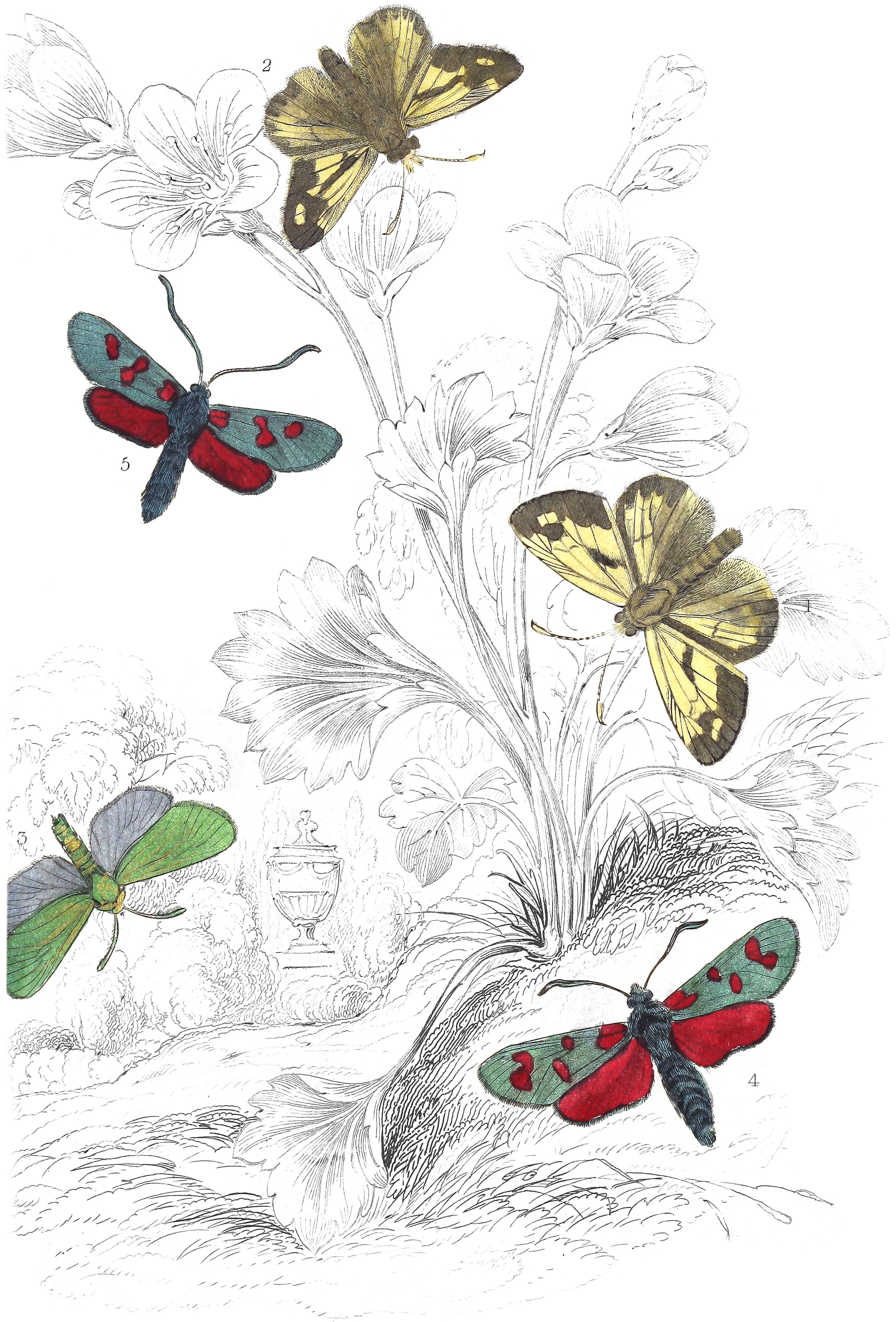
Volume 14, Plate II / Entomology (Insects)
Large & Pearl Skippers, Green Forester, Six- & Five-Spotted Burnet-Moths
Pamphila Sylvanus, P. Comma, Ino Statices, Anthrocera Filipendulæ & A. Loti
- Large Skipper. Expanding fourteen to sixteen lines, fulvous with brown nervures and a blackish outer line, the forewings bearing small quadrate fulvous spots towards the tip, the under side yellow inclining to green and the male showing an oblique black streak on each forewing. The commonest skipper, it occurs in tolerable plenty throughout Britain on woodland borders and moorlands from May to August.
- Pearl Skipper. About the size of the Large Skipper, the male fulvous suffused with brown, the forewing disk bearing a linear black mark with silvery scales and quadrate whitish spots forming a semicircle towards the apex, the larger female lacking the discoidal line. The caterpillar, obscure green mixed with rust-red, feeds on leguminous plants or grasses, this insect found in some plenty on chalky soils near Lewes, Dover, and elsewhere.
- The Green Forester. Spanning twelve to sixteen lines, the upper wings, head, thorax, and antennal stalk a beautiful golden-green with silky gloss inclining to blue, the under wings and body beneath brown and glossy green tinged with blue. The depressed green caterpillar, tapering at both ends with black head and two rows of black spots, feeds on lady’s smock and dock, the insect appearing in June and of frequent though somewhat local occurrence in England.
- Six-Spotted Burnet-Moth. The commonest burnet, measuring fifteen to eighteen lines, the forewings fine greenish-black with high lustre bearing six red spots in pairs and the hinder wings carmine-red with a narrow blue-black border, the body velvet-black with bluish gloss. The yellow black-spotted caterpillar feeds on grasses and many common plants, and this gregarious sluggish insect appears from late June to August, plentiful across England and locally abundant in Scotland.
- Five-Spotted Burnet-Moth. Smaller than the Six-spotted Burnet, the forewings blue-black with less green reflection and bearing five red spots equally distinct on both sides, the hinder wings bright red with a wide blue-black border sinuated within. The green caterpillar, with macular bands and a yellow segmental dot, feeds on honeysuckle, bird’s-foot trefoil, and many plants, the moth occurring occasionally in many parts of Britain.
Location:
Contents:
Related wildlife
 Agarista Picta, Eusemia Lectrix & E. Maculatrix
 Angerona prunaria & Alcis scolopacea
 April Miselia, Peach-Blossom Moth & Buff Arches
 Arctia Hebe, Spilosoma arge & S. Virgo
 Asthenia podaliriaria, Macrotes netrix, M. sospeta & Eumelea Rosalia
 Beautiful China Mark, Green Silver-Lines & Scarce Silver-Lines
 Bee Clear-Wing, Breeze Clear-Underwing, Black and White Horned Clear-Wing & Ruby-Fly Clear-Wing.
 Black Arches & Scarlet Tiger-Moth