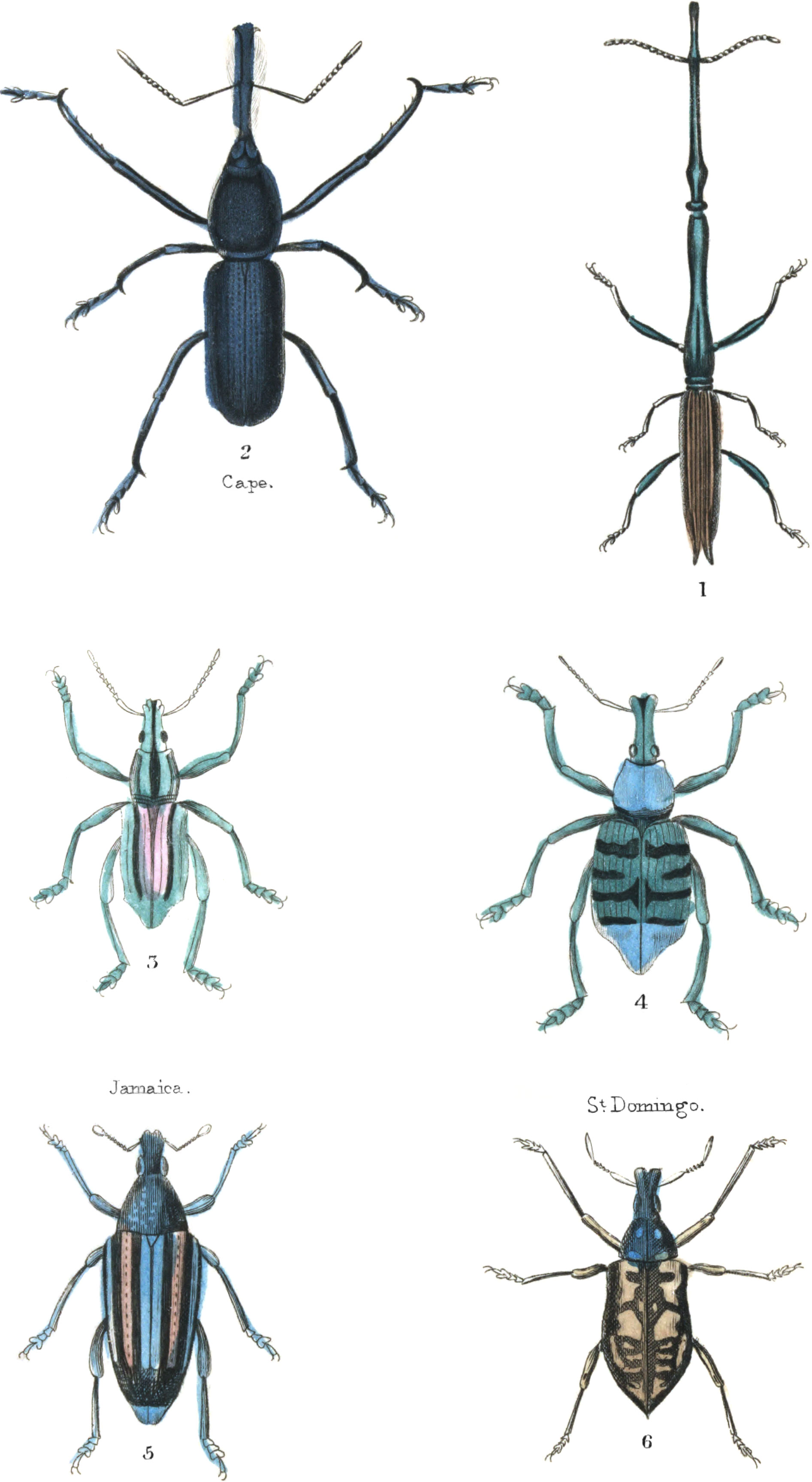
Volume 8, Plate XXI / Entomology (Insects)
Tetramera
- Brentus anchorago. Very narrow and elongate, shining black, the markings differing slightly between the sexes, the male’s head grooved in front and the thorax grooved from middle to base. The elytra are scarcely wider than the thorax base, deeply grooved near the suture and punctured at the sides, each with two narrow reddish-yellow lines, the fore thighs toothed beneath; it lives under bark, congregating in hundreds on old tree stems.
- Rhina Barbirostris. Found at the Cape of Good Hope, entirely black except the reddish-yellow hairs on the rostrum, which is longer than the thorax, trifid at the point, and tubercled above. The thorax is rough with deep punctures and bears yellowish hairs at the sides and beneath, the elytra marked with closely placed lines of deep square punctures, the anterior legs much longer than the others and all tibiae bearing remote spines.
- Curculio Cuvierii. A fine green colour with a black stripe down the middle of the rostrum and thorax, the elytra suddenly narrowed at the apex and each bearing a central black band that does not reach the extremity. The under side and legs are green; it was obtained in a recent French voyage of discovery round the world.
- Curculio Geoffroyii. Brilliant green glossed with violet, the rostrum and thorax each bearing a narrow impressed central line, the striated elytra marked with four cross bands of deep black, the second and last abbreviated and the third dilated beside the suture. This and the preceding species were obtained in a recent French voyage of discovery round the world.
- Curculio vittatus. The rostrum and thorax black, smooth and shining, the elytra with punctured lines bearing a broad white stripe beside the suture, a broader red one in the middle of each, and a narrower one toward the outer margin, the apex greyish. The legs and belly are black, the belly sides white or greenish, the stripes varying in tint; it occurs in Jamaica and other West Indian islands.
- Curculio sphacelatus. The antennae, rostrum, and thorax black, the thorax with white sides and four white spots, the elytra likewise black, irregularly punctured, and marked with two or three very irregular yellowish-scaled spots that often run together into large patches. The body beneath and the legs are black more or less covered with white scales; found in St Domingo and elsewhere.
Locations:
Contents:


