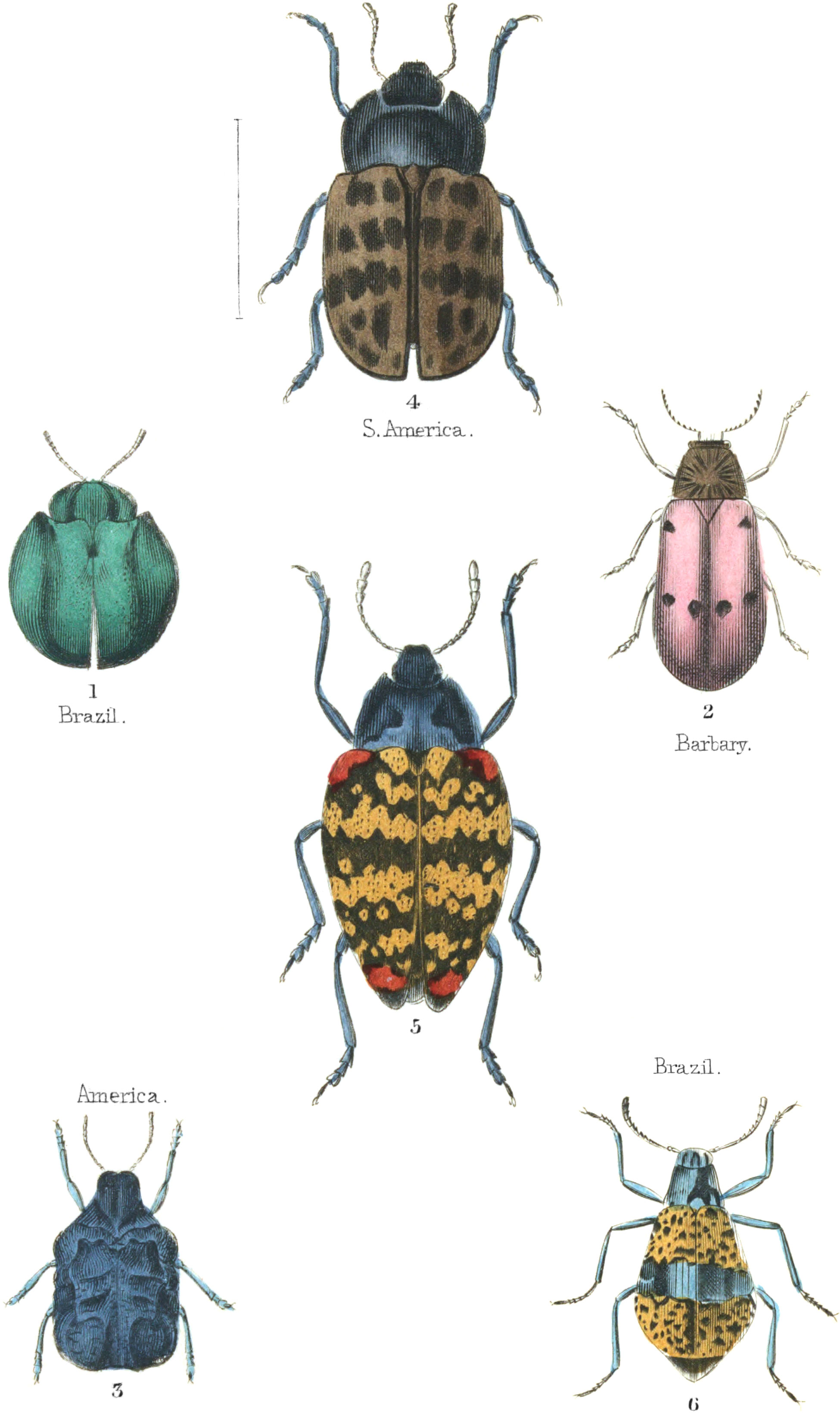
Volume 8, Plate XXIX / Entomology (Insects)
Tetramera
- Cassida six-pustulata. Bluish green above and shining black beneath, the elytra gibbous on the back and thickly punctured, each wing-case marked with three red spots. It is found in Brazil, where it is rather common.
- Clythra hirta. The head, thorax, scutellum, and all under parts blue and covered with rather long ash-coloured hairs, the elytra brownish red with three black spots on each, one on the shoulder and two behind the middle. It occurs in Barbary.
- Chlamys monstrosa. About five or six lines long, uniform violet blue, the thorax raised into a tuberculated protuberance with a silky gloss and the much-wrinkled, tuberculated, punctured elytra bearing toothed sutures like mill-wheel cogs. Proper to the New World, it walks slowly on leaves and feigns death when seized, resembling withered fungus, the telescoping abdominal segments ending in a deeply impressed penultimate one.
- Doryphora tessellata. Nearly nine lines long, very convex, smooth, and glossy, the head and thorax glossy black with a brassy lustre and unpunctured, distinguished by a long conical horn projecting from the breast. The punctured yellow elytra bear five cross rows of large quadrate black or brown spots, the under side, legs, margins, and suture black; peculiar to South America, it walks slowly on leaves and discharges a foetid yellow liquor when handled.
- Erotylus histrio. About an inch long, the head, antennae, and thorax black, the elytra much elevated in the middle and black with irregular bands of confluent yellow spots, two on the shoulders and one at the apex reddish. The surface bears dark impressed points forming irregular lines in front, the under side and legs black, the markings varying so that the black bands are sometimes almost obliterated.
- Spheniscus erotyloides. A Brazilian insect closely related to Helops, the head and thorax black and shining, the latter sparingly punctured, the elytra very gibbous in the centre and marked with punctured lines, pale yellow spotted with black with a broad band over the middle and the apex black. The under side and legs are likewise black; though figured among the tetramerous insects, it belongs to the heteromerous section by its tarsal joints.
Locations:
Contents:


