Memoir of
Conrad Gesner
General Zoology
1516–1565
Originally published in volume 31, Horses.
In several of the biographical memoirs accompanying former volumes of this Work, we have, given a record of the labours, and attempted to appreciate the merits, of some of the most eminent naturalists who flourished in the sixteenth century.
Such of them belonging to that early period as deserve to be held in remembrance, are comparatively few in number; but these few are entitled to our warmest gratitude. It was by their means that Natural History was enabled to emerge from the obscurity in which it was sunk, in common with every other department of knowledge, during the long intellectual night of the dark ages. The generations who may be described as having
eyes but who saw not, ears but heard not, and understandings but understood not,
had given place to others in which the senses and faculties were beginning to be converted to their proper use. Individuals appeared in various countries making observations for themselves, collecting and appropriating the knowledge which had been transmitted by the sages of Greece and Rome, and, in short, accomplishing, though in a smaller degree, for natural history, what Dante, Petrarch, and others, had previously done for literature.
Among the small band of congenial spirits by whom this result was brought about, there is none more meritorious than Conrad Gesner. Indeed, when we consider his high scholarship, indefatigable industry, general knowledge of natural history, and the influence which his works have had on the progress of knowledge, it may perhaps be doing him injustice not to assign him the first place. We should not at least hesitate to do so, were we to trust implicitly to the eulogiums that have been passed on him by his admirers, for he has been affirmed to be the greatest naturalist the world had seen since Aristotle, the discoverer of the only true principles of a botanical arrangement in the flower and fruit, to which the very existence of botany as a science is owing,—as the German Pliny, a prodigy of diligence, learning, and penetration. Even the more philosophical and discerning judgment of Cuvier allows him a high degree of merit, which will, we think, be fully borne out by the character of his works hereafter to be examined.
Conrad Gesner was born at Zurich on the 26th March, 1516. His parents were in very humble circumstances; his father. Ours Gesner, being a worker in hides, and his mother, Barbara Friccia, of a very poor though respectable family. Having a numerous offspring besides Conrad, his parents could do little to encourage the love for reading and learning which he showed at an early period. But his maternal uncle, John Friccius, who was a minister, did every thing in his power to promote the talents which he could not fail to discover in his young relative; and it was to this individual that Conrad was indebted for the rudiments of his education. Besides instructing him in the elements of literature, his uncle inspired him with a love for the study of plants, from Which the transition became easy to other branches of natural history. He had a garden well supplied with plants, including many of the rarest kinds then known, the care of which was in a great measure entrusted to young Gesner, who even at this early period, acquired some reputation in his immediate neighbourhood as an herbalist. But before his progress had been considerable, this valuable friend was removed by death, and Gesner’s prospects assumed a very unpromising aspect. He was taken for a while, however, into the family of John James Ammianus, a professor of polite literature, who gratuitously superintended his studies, and showed him many acts of kindness otherwise for a period of three years. Shortly after the death of his uncle, his father, who was engaged in the civil wars of Switzerland, was killed in the battle of Zug (the same in which the famous reformer Zwinglius perished); and thus deprived of any assistance that might be expected from that quarter, he was thrown entirely on his own resources. He was at this time about fifteen years of age.
He proved for a time, however, so unfortunate in obtaining the means of prosecuting his studies, that he was reduced to great extremities; and he is even said, by one of his biographers, to have repaired to Strasburg and engaged himself as a servant.1 The same authority on which this statement is made informs us, that his master soon discovered his strong inclination for study, and was so indulgent as to afford him every opportunity of doing so, consistently with the duties of his station. The knowledge he now acquired, added to his previous attainments, rendered his scholarship highly respectable, and he was employed for a time by Capiton, a distinguished scholar of the day, to assist him in his literary labours. With the means acquired in these various ways, and aided by a contribution from the prebendaries of Zurich, who manifested considerable interest in the welfare of their townsman, he was enabled to repair to Bourges and commence the study of medicine, a profession which both expediency and inclination led him to adopt. Subsequently to this, and when he was about eighteen years of age, he visited Paris, where he remained for a considerable time, devoting himself entirely to the acquisition of different branches of learning, and completing his acquaintance with the ancient languages of Greece and Rome, in which he attained more than usual proficiency. During his residence in the French capital his circumstances were often much straitened, and he was frequently relieved on these occasions by a young Bernoin of noble family, named Steiger, with whom he had contracted a friendship. But all his resources were ultimately exhausted, and he was obliged to return to Strasburg, in the hope that his friends in that city would be able to obtain for him some employment either as a private or public teacher. Here, however, his stay was very short, for we find that, in 1 536, he returned to his native place, and opened a school for teaching the languages and philosophy.
He was now about twenty years of age, and although his professional studies were far from being completed, and his situation in life unsatisfactory and precarious, he thought proper to marry; and notwithstanding the remonstrances of his friends on the imprudence of such a step, under the circumstances, he never appears to have had the least reason to regret having taken it, but in every respect the contrary.
We are not informed what success attended him in his capacity as an instructor of youth, but while so employed he conciliated the good will of the magistrates of Zurich, who, appreciating his learning and abilities, sought to obtain him the means of turning them to better account. Through their influence and support, he was enabled to repair to Basle for the purpose of resuming his medical studies, which had suffered a considerable interruption. His residence there, however, was but short, not upwards of a year, for the senate of Berne had founded an academy at Lausanne, and prevailed on him to become one of the teachers. Here he continued for about three years, employed, most of that time, in teaching Greek. His worldly circumstances being by this time greatly improved, he was enabled to reside for about a year at Montpellier, then the seat of a celebrated school of medicine, and the resort of learned men from all parts of Europe. Here he formed a friendship with Rondelet, professor of medicine at Montpellier, and one of the ablest naturalists of his age, whose excellent work, De piscibus marinis,2 illustrated with woodcuts of great merit, has rendered his name known and honoured even in the present day. It was, in all probability, owing to his intercourse with this naturalist, and others then residing at Montpellier, that his predilection for the study of Nature was fully confirmed, and the resolution, which he appears to have formed at a very early period of his life, of illustrating it by his writings, first carried into effect.
After many vicissitudes, the most important of which have already been alluded to, he obtained his degree of doctor of medicine at Bâsle in 1540, being then in his twenty-fourth year.3 He shortly afterwards settled as a medical practitioner in Zurich, and his success was such that he was enabled to devote a portion both of his time and money to the prosecution of the studies which he had so much at heart. He even had it in his power to make excursions, at intervals, through various parts of Switzerland, Savoy, &c. in search of plants and other natural objects; and, in 1545, he paid a visit to Venice, where he became acquainted with many individuals who were in a condition to promote his views, and where he had an opportunity of consulting many rare books and manuscripts, whence he derived valuable materials for his numerous works both on literature and natural history. While there, he devoted much of his time to the examination of the fishes of the Mediterranean, writing descriptions of them, and getting drawings made by the best artists he could obtain.
From this period the life of Gesner was of a pretty uniform tenor, and affords not very many incidents of sufficient interest to be deserving of minute record. Every moment of his time was employed on the numerous works he had on hand, and scarcely a year elapsed in which he did not lay several before the public. The most important of these will be afterwards alluded to; the mere enumeration of their titles would occupy a large space; many of them, moreover, were only of temporary value, and a particular account of these could not be of much interest in the present day. The celebrity which Gesner had now acquired, both as a scholar and naturalist, caused his correspondence to be courted by most of the learned of Europe; and we find him in communication with nearly all those whose names have come down to us as promoters of learning and science. His botanical garden included many of the rarest and most curious plants then known; and the numerous specimens of natural objects sent to him for examination, formed the basis of a general museum. Much of his time was spent in the most zealous exertions to collect materials for his history of animals and plants; his reading was interrupted only for the purpose (to use the words of one of his biographers),
domi et foris videndo, subinde sciscitando a quibusvis doctis, indoctis, civibus, peregrinis, ventoribus, piscatoribus, aucupibus, pastoribus, et omni hominum genere,
in order that his works on these subjects might be more perfect than any that preceded them.
In the midst of his multifarious occupations connected with literature and natural history, he continued his practice as a physician; and, indeed, it was from this source that his income was principally derived. In 1554 the magistrates of Zurich appointed him chief physician (αρκιατρος), and public professor of philosophy and natural history, an honour which he justly merited, and which he seems to have valued highly. He had scarcely attained this more influential sphere of action, than he exerted himself to turn it to the public good and he succeeded in establishing an association of medical men to watch over the public health. By these means, a college of medicine and surgery was ultimately established; and Gesner may thus be regarded as the founder of an establishment which has been of great service to the city of Zurich up to the present day.
His natural history expeditions into various parts of Switzerland, Germany, &c., were frequent, and he had an additional motive for undertaking them besides his love of collecting, for his constitution was naturally feeble, and he had still further impaired it by ardent study. Among other excursions of less note, we find, that in the year 1555, he visited Lucerne and the places adjacent, in company with two brother physicians, and a draftsman named John Thoma. He was received with distinguished honours by the magistrates of that place,—honours such as were wont to be paid only to those invested with offices of public authority. He asked permission, as was then the custom, to ascend Mont Pilate (mons fractus), and a public officer was appointed to conduct him, and guard him from danger; for the well-known superstition regarding the vicinity of this mountain, was at that time in full force. He ascended on the 21st of August, passing the night in a hay-loft. He carefully examined everything in which he felt interested, and a few days after his return home, published an account of the mountain, along with his curious treatise, “De Lunariis.”4
It has just been stated that Gesner was of a delicate constitution, and this circumstance had a considerable influence on his proceedings during several of the latter years of his life. While a youth, he was threatened with general dropsy, and although the immediate effects of this malady were overcome, it seems to have produced a permanent debility, which peculiarly exposed him to the inroads of other disorders. In 1565 we find him complaining, in a letter to a friend, of an affection of the brain, which he says lasted nearly nine years. In 1559 he was afflicted with calculus, and used all the remedies then in vogue, against that excruciating disease. He likewise tried to find relief by travelling, as he was wont to do on like occasions. Some of his friends at the court of Ferdinand, Emperor of Germany, thought that his visit to that country on this occasion, afforded a good opportunity of introducing him to that monarch, to whom his celebrity as a scholar and naturalist were well known. His reception was highly flattering, and led the way to several important favours, which he afterwards received from the hands of the emperor. On this journey, Gesner likewise visited Ulm, and ultimately repaired to the warm baths of Baden, that he might try their effect on his health. These proved more beneficial than he anticipated, and he returned to Zurich greatly invigorated both in body and mind.
The following year he was much occupied in forming a new botanic garden, to facilitate the study of plants, which now engaged a large share of his attention, as he designed to publish a general history of vegetables. Shortly after his appointment to the professorship of natural history, he had employed his increased means in building a museum, of such extent, that it contained fifteen windows. These windows (we translate the description of his biographer, Schmiedel), he ornamented in a manner as unusual, as it was agreeable; on each of them he painted most elegantly on the glass, arranged according to their classes, different species of marine, river, and lacustrine fishes. His shelves contained an immense quantity of metals, stones, gems, and other natural productions, which he had either obtained as presents from his friends, or purchased. The most liberal of the contributors to his museum was his friend Kentmann, who, among other objects, presented him with a collection of fossil fishes, and a great many different kinds of metals. Amidst these riches of nature, he was often wont to spend his time, seeking tranquility of mind from the contemplation of them, and refreshing himself after the numerous toils and vexations of life, from which the best are not exempted.5 As a necessary adjunct to this museum, he now enlarged and enriched his botanic garden, stimulated thereto by having witnessed the superiority of that of Didymus Obrecht at Strasburg. He obtained rare plants from most parts of Europe, in particular from France, Italy, Britain, Germany, and Poland, and it contained many of the most curious kinds found in his own country, which is of such great interest in this respect, as well as in most other of its natural features.
Towards the close of 1560, his health again gave way; he was afflicted with severe pain in the limbs, and almost entirely lost the use of his right leg. Having tried various remedies, without deriving much benefit, he again repaired to Baden, and the baths so far restored him, that he was able, in the beginning of 1561, to visit many different parts, both of Germany and Switzerland. He traversed the Rhetian Alps, ascended Mount Braulius, and penetrated into several of the most retired parts of the country. Part of the Venetian territory was likewise included in this extended expedition, the chief object of which was the improvement of his health, one, however, quite compatible with the study of botany, which he prosecuted with unwearied zeal. The advantage he derived from the warm springs of Baden, seems to have likewise turned his attention to various mineral springs in Switzerland, with a view to ascertain their medicinal properties. The water of some of these he used as a bath, and others, of a chalybeate nature, were taken internally. These various restoratives, in connexion with his long travel, bodily exercise, and the agreeable society of friends, of whom he had many scattered over the whole country, so improved his health, that we find him writing, on his return, to one of his friends, that he was now stronger than he had been for many years. Among other fruits of this expedition, his herbarium, garden, and museum, received large accessions.
He now enjoyed a respite for some time from his various maladies, and we accordingly find him immersed in a multitude of literary undertakings, including several publications on botany. It was probably, in a great measure, in consequence of the too great exertions thereby entailed, that he was so soon again compelled (in the month of August 1562) to seek relief from the waters of Baden, whither he repaired, for the third time, in company with his wife, whose health had been all along as precarious as his own. By using the waters in a manner somewhat different from his former practice, he speedily became convalescent, and in order to follow up this favourable change, as he had been accustomed to do on former occasions, by long continued exercise in the open air, he invited his friend John Bauhine, the well-known botanist, to accompany him back to Zurich on foot, that they might have a better opportunity of conversing by the way on the subject of their common study. This arrangement, however, could not be effected, and Gesner returned alone. It was soon after this that he wrote a long letter to the English botanist. Turner, in which he gave a particular account of all his writings up to that date.
Although Gesner at no time neglected any of the great branches of natural history, but used every exertion to improve his various works, which may be said to embrace them all; yet, during the two or three last years of his life, botany was his principal study. One of the great objects of his ambition was, as has been already intimated, to produce a history of plants, and foreseeing, doubtless, that his life was not destined to be a long one, he redoubled his exertions to attain the purpose he had so much at heart. This formed his chief occupation in 1563. He had plants in a living state brought to him from all parts of the country Bauhine sent him many dried specimens; and even when his health was most precarious, he was in the habit of swimming in the lake of Zurich and others in that neighbourhood, for the purpose of collecting aquatic species. The utmost exertions were at the same time made to have these plants drawn and engraved, which was done entirely at his own expense. The number, qualities, and ultimate destiny of the engravings thus accumulated, we shall afterwards have occasion to allude to. This, and numerous other avocations, both of a literary and professional nature, were interrupted by a recurrence of his old complaints, which occasioned a fourth visit to Baden, the only quarter to which he was now accustomed to look for relief, nor were his expectations disappointed even on this extreme occasion.
Knowing the favourable opinion which the Emperor Ferdinand entertained of his services to science and literature, Gesner felt desirous of obtaining some public expression of his regard, not only as an encouragement to others to follow his example, but as an honorary distinction to his family. This was no sooner intimated by his friends, Alexander, Amorfort, and Craton, physicians to the court, than the wish was immediately complied with; and letters patent were issued granting armorial bearings to Gesner and his family, with a statement of the circumstances for which this honour was conferred. Without attempting to describe the shield in the technical language of heraldry, it may suffice to say, that the devices were all emblematical of the subjects which Gesner had illustrated by his writings. Each of the four quarters was occupied by an animal—an eagle with expanded wings, a lion rampant, a basilisk, and a crowned dolphin; the crest, a swan sitting on a crown of laurel, with three stars on its breast, and a like number on each of its expanded wings. As Gesner was childless, he obtained permission that the same arms should be borne by his uncle, Andrew Gesner, an old man of eighty as well as his offspring, who were very numerous. This honour was accompanied by another mark of the Emperors esteem, which our naturalist valued highly, namely, a present of some fragments of bezoir stone, which was then very rare, and held in high estimation.
Subsequently to this he again visited Baden, and for the last time. On his return he was greatly distressed by the death of his mother, to whom he was very warmly attached: this event took place in April 1564. Soon after, the plague, which had for some time raged in Basle, made its appearance in Zurich; and Gesner, both on account of his professional experience and scientific skill, was looked to more than any other individual for some means of checking its ravages. He was not slow in devoting himself to the inquiry; and the result of his investigations soon appeared in a work on the nature of the contagion and the best means of cure. He was fully sensible of the risk he incurred by visiting so many patients, and had a strong presentiment that he was himself to be a victim. In a dream, which made a great impression on him, he thought that he was bitten by a serpent; this he interpreted to denote the attack of the disease; and he wrote to several of his friends to intimate that he was now preparing himself for another world. For the present, however, it pleased Providence to spare him. The severity of the disease gradually abated, and Gesner was enabled to resume his former occupations, and for a considerable time to labour at his favourite work on plants, and likewise another on the nature of stones and fossils.
Although the pestilence had abated, it had never entirely left Zurich and its neighbourhood, and about the middle of July, 1565, it again broke out in that city with greater virulence than before. Gesner witnessed its approach with tranquillity; but his presentiment again returned, and he endeavoured to make preparation for the great change which he believed to be near. He was seized with the disorder on the 9th of December, when it had a second time greatly moderated, and he had again almost overcome his apprehensions. A large pestilential carbuncle made its appearance under his right arm, but it was accompanied with no pain in the head, fever, or other bad symptom. His strength was so little reduced, that he continued to walk about his apartment, only reclining occasionally on a couch. But he had seen many die with precisely the same symptoms, and from the first he indulged no expectations of recovery. He therefore called together his friends, and delivered to them his will, in which he made some provision for his wife and nephews, and appointed his only surviving sister his heiress. His library and manuscripts were entrusted to Caspar Wolf, formerly his pupil, and latterly his colleague, with injunctions that his writings should be carefully perused and arranged, and such of them published as were likely to be serviceable.
These matters arranged, his whole thoughts were turned to futurity, and he conversed calmly with Henry Bellinger and John Simler (two clergymen with whom he had lived on terms of the most intimate friendship), using words of hope and resignation. The fifth day after the commencement of his disorder, his medical attendants saw that death was near; but he thought himself better, and declined having any one to sit by his bed-side during the night. About eleven o’clock, however, of the same night, he became conscious that his strength could hold out very little longer against the violence of the disease; and calling his attendants, he requested that they would carry him into his museum, where he had caused a bed to be prepared for him the day before. It was in this place, the scene of many a laborious study, and among the objects which he had collected with such indefatigable zeal, that he breathed his last, in the arms of his wife, on the 13th December, 1565, not having quite completed his fiftieth year.
The whole city was thrown into mourning by Gesner’s death, and his funeral, which took place on the following day, was attended by a large concourse of people of all ranks. He was interred in the cloister of the great church of Zurich, near the tomb of his intimate friend Frisius, who died the preceding year. His funeral oration was pronounced by Simler, who afterwards became his biographer. Many verses, both Greek and Latin, were written in his praise; and among the authors of these we find Theodore Beza, and many others of scarcely inferior name.
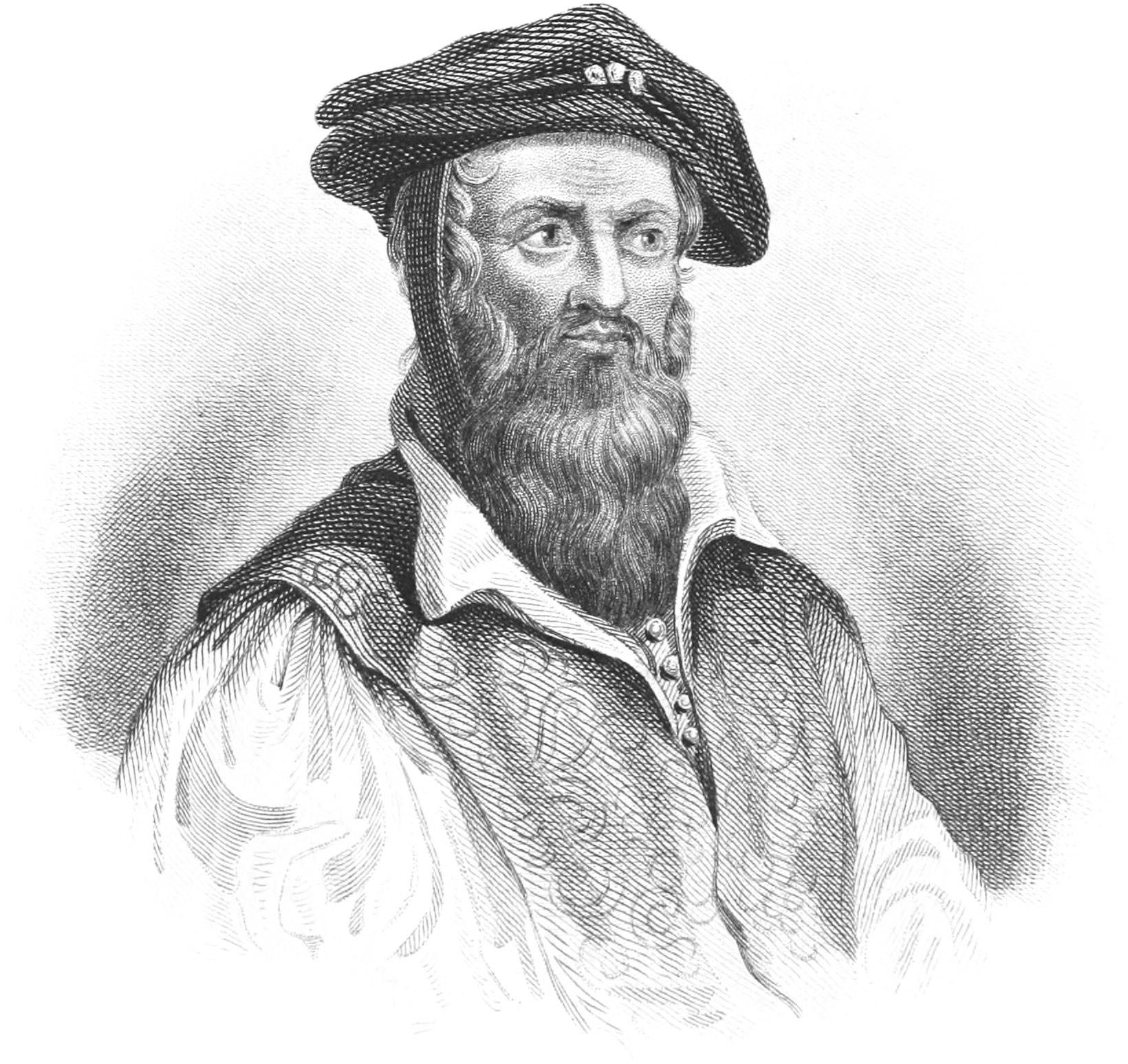
It may be inferred, from what has been already said regarding the frailty of Gesner’s constitution, that there was little likelihood of his attaining an advanced age, even if he had escaped the contagion which carried him off. The delicacy of his health was indicated by a pallid and almost emaciated countenance, the general expression of which was, however, highly agreeable, and indicative of great sensibility. His forehead was broad, high, and prominent, marked with numerous deep wrinkles, the result of severe study and profound thought. His nose was long and elevated, without being aquiline his lips thin; mouth expressive and agreeable. His beard was copious, long and dense, slightly curled or undulating,
lenitatis ingenii indicium esse potest,
says his biographer Schmiedel, on whose authority we wish the statement to rest. Various portraits exist, corresponding to this description; that prefixed to this memoir is taken from one which we regard as the most characteristic.
The voluminous works of Gesner may be divided into three classes; first, those on literary subjects; secondly, those relating to medicine and the materia medica; and, thirdly, those on natural history.
As it is most appropriate to the purpose we have at present in view to consider Gesner as a naturalist, we do not propose to enter, in this place, into a very minute detail of his numerous productions on the two former of these subjects; but some account of them is necessary to enable us to form an idea of the extent of his acquirements, his extraordinary powers of application, and the wonderful fertility of his genius. Shortly after obtaining his degree, he published numerous translations of Greek treatises, on various subjects of literature and criticism, an edition of Martial, &c., besides editing several works for his friends. Of the latter we may mention that of his friend Moibau, of whose work on Dioscorides he superintended the publication, in order that the friends of the author might obtain the emoluments: that of Valerius Cordus, “De Historia Plantarum,” a zealous naturalist, who died at Rome at the early age of twenty-nine; and lastly, the “Lexicon Rei Herbariæ Trilinque” of his friend Kyber, who was carried off by the plague at Strasburg at an equally early age. But his most important work in this department was his Bibliotheca Universalis, the object of which was not only to give the titles of all the works then known, in Hebrew, Greek, and Latin, whether actually existing or lost, but to afford some knowledge of their contents, a specimen of their style, and a critical estimate of the merits of the respective authors. The idea was an excellent one, and has, as is well known, been often acted upon since. It is said to have suggested to Haller the plan of his Bibliotheca Britannica, and Biblioth. Anatomica. The first part of the work was published at Zurich in 1545. This contained the names of the authors arranged alphabetically. The second part, which he called the Pandects, appeared in 1548, divided into nineteen books, and arranged according to the nature of the subjects: the twentieth book was to be devoted to medical subjects, but was never finished, as the author was unable to satisfy himself as to its completeness and accuracy; the twenty-first embraced theological authors and did not appear till about a year after the rest.6 Many editions of Greek and Latin authors, with notes and commentaries, were published by Gesner, as well as several Dictionaries, amended and enlarged, such as the Latin Lexicon Ambr. Calepini, Greek Dictionary of Favorini, &c. He likewise published many portions of Greek manuscripts which he had copied during his travels in Italy and Venice, such as the Aphorisms of Abbas Maximus, Institutions of Theophilus, the Oration of Tatianus Assyrius, translating several of them into Latin, and adding explanatory notes; besides many other treatises relating to ancient literature. One of the most curious and ingenious of his productions on literary subjects was published in 1555, under the name of Mithridates, or an inquiry “De differentiis linguarum,” an investigation for which his extensive acquaintance both with ancient and contemporaneous languages admirably qualified him. He originated many views in this work which have been more fully developed since by authors who have neglected to mention the source from which they derived them.
Medical men have often expressed their regret that the portion of the Bib. Universalis relating to the literature of the healing art was never completed; the materials which Gesner had amassed were certainly extensive (he expressly affirms so in a letter to one of his friends), and their publication would have been desirable, even although they fell short of his own wishes. This desideratum, however, was to a certain extent supplied by the publication, in 1555, of a large volume entitled, “De Chirurgia Scriptores optimi quique veteres et recentiores, plerique in Germania ante hac non editi, nunc a Conr. Gesnero in unum conjuncti volumen,” to which various treatises on medical subjects are appended. Many small treatises on medical subjects emanated at different times from his prolific pen. He published more than one edition of Galen; that of the date 1562 was enriched with prolegomena, an elaborate life of Galen, and a very full list of the authors who had in any way illustrated his doctrines. With a view to induce medical men to co-operate with each other, and communicate their discoveries for the general good, he published, in 1552, what he called “Thesaurus de remediis secretis,” &c. This at first appeared under the fictitious name of Euonymus; but it came into great request, and was afterwards laid before the public in an enlarged and amended form, with the name of the author attached. “Libelli tres medicinales; unus de sanitate tuenda; alter contra luxus conviviorum; tertius contra notas astrologicas Ephemeridum in secandis venis;” were printed at Zurich in 1556. He was likewise the author, or editor, of several other small works and treatises on subjects similar to those mentioned, but we cannot here afford space for a full list of them. A little work, “De lacte,” treating of milk and its various preparations, which appeared in 1543, may, from the mode in which the subject is treated, be regarded as a contribution to medical dietetics.
We shall now proceed to give some account of his principal works on Natural History, and shall first mention his “Historia Animalium,” for that is the work with which Gesner’s name is usually associated, and on which his reputation principally depends. It is certainly a singular mass of matter, original and compiled, displaying a degree of erudition, research, and industry, which might well lead us, as has been remarked, to believe, that instead of being the work of a physician, who raised and maintained himself by his practice, and who was cut off in the midst of a most active and useful life, it was the labour of a recluse, shut up for an age in his study, and never diverted from his object by any other cares. He had conceived the design of such an undertaking at an early period of his life, but it is not probable, when we consider his other avocations, that much of it was executed till a few years before its appearance. The numerous friends in various parts of Europe whom his reputation for learning had procured him, encouraged his design by transmitting specimens, and remarks on the animals of their respective countries.7 The journeys also which he had an opportunity of making, afforded him a rich harvest of materials, of which he did not fail to avail himself to the uttermost. Still it is surprising how he could accomplish so much, in the comparatively limited time which he could devote to the task.
The work in question is divided into five books, generally bound up, as he himself recommended, in three folio volumes. The first part, printed at Zurich in 1551, treats of viviparous quadrupeds; the second, published in 1554, of oviparous quadrupeds the third, of the date 1555, of birds; and the fourth, 1556, of fishes and other aquatic animals. The fifth part was a posthumous publication, drawn up from Gesner’s manuscripts by James Carron, a physician of Frankfort. It is said to be rarer than the others; it treats of serpents, and has usually appended to it a treatise on the scorpion, published from our author’s papers under the superintendence of Caspar Wolf. The two latter treatises did not appear till 1587, that is, twenty-two years after the author’s decease.
Besides this, the original edition, it may be proper to mention that a number of others subsequently appeared, some in Latin, others in German, and one or two in French. Several of these, we believe all, are more or less abridged and altered in the arrangement; some of them are designed to be mere vehicles for the woodcuts, with the addition of a portion of the original text in explanation of the figures. It is these later and less regular editions which are most commonly met with in libraries.
The animals are simply arranged in the alphabetical order of their Latin names; and the account of each is divided into eight heads or chapters, referring to the following particulars:
- the names in different languages, ancient and modern;
- description of parts external and (occasionally) internal, and varieties of the species;
- various actions and passions, whether natural or contrary to nature;
- affections of the mind, manners, and instincts, &c.
- various uses to man, besides food and remedies;
- uses as food;
- diseases;
- philology, or references made to them by authors, whether in prose or verse, the epithets they have applied, &c.
The general arrangement, if such it can be called, differs but little from that of Aristotle, the grand division being into land and water animals. As an example of his mode of subdividing a primary group into what he calls orders, we shall give a digest of his arrangement of quadrupeds:—
Quadrupcdes aut sunt viviparæ, aut oviparæ; illas in sex ordines distiibuimus.
Continet igitur Quadrupedum vivipararum mansuetarum
- Ordo 1. bestias mansuetas, quæ armenta vel greges constituunt; cornutæ omnes et bisulcæ sunt, et ruminant, non utrinque dentatæ; ut boves, oves, capræ.
- Ordo 2. ex niansuetis jumenta quæ sine cornibus et solipeda sunt; ut equum, sues, canes, et felem domesticam.
Ferarum vero Quadrupedum vivipararum quæ omnes utrinque dentatce sunt,
- Ordo 1. complectitur feras comutas; ut boves, capras, cervum, elepliantum,8 &c.
- Ordo 2. non comutas majores: quæ hominem aut alia animalia unguibus et dentibus lacdant, multifidæ omnes praeter aprum bisulcum; ut sunt ursus, leo, tigxis, &c.
- Ordo 3. ejusdem naturæ reliquas mediæ magnitudinis minusque noxias; ut sunt castor, lutra, vulpes, &c.
- Ordo 4. minimas et murium ferè generis; quorum ea quæ per arbores aut parictes repere et scandere possunt; ut sunt cuniculus, mus, glis, talpa, &c.
Animalium Quadrupedum ovipararum
- Ordo 1. et ultimus, complectitur chamæleontem, testudinem terrestrem, lacertarumque et ranarum terrestrium genera. Nam crocodilum, ranas et lacertas aquatiles, aquatilium libro subjunximus.9
At the period when Gesner wrote, any thing approaching to accurate views of classification or arrangement could not be expected; indeed the importance of the subject was never thought of. But the above subdivisions are altogether arbitrary and useless; nay, with our present notions on the subject, they cannot be regarded as otherwise than ludicrous. Animals are referred to different orders according to the accident of their being domesticated or wild; and size is assumed as determining ordinal differences. Thus the lion and tiger are placed in one order, while their near relatives the panther and other smaller spotted felines, are referred to another, magnitudinis ratione, as he himself expresses it. Perhaps his division of fishes is preferable; but after having afforded one example of this kind, it is unnecessary to dwell on the subject.
His description and history of the animals themselves cannot in general be spoken of otherwise than in terms of high commendation, particularly of those kinds which fell under his own observation, the animals of Switzerland, for example. We have at full length all that has been previously written respecting them, combined with much original information. Take the general history of hawks for an example, in the commencement of his volume on birds. Without attempting to discriminate many of the closely allied kinds,—an object which can scarcely be said to be satisfactorily accomplished even in the present day,—he enters into the generalities of the family with considerable knowledge of their habits and general history; giving instructions for rearing them and training them for the chace, for curing their disorders, &c. All this, it is true, is mixed up with a great deal of quaint information and obsolete erudition; but when these are subtracted, not a little sound natural history remains. As a good specimen of his manner, we may refer to the account of the eagle, which extends to nearly thirty closely printed folio pages. Much curious information might be extracted from his volumes regarding many species of almost every order, as, for example, the account of the speaking nightingales; but space cannot be afforded in this place for such a selection. We may translate, however, his short account of the white ox of Scotland (what is now usually called the Hamilton breed of cattle), which is curious in several respects. He names it the Bison albus Scoticus, and gives a figure of the animal, which, however, is not so well executed as many of the others.
The Caledonian forest of Scotland produces very white oxen, having a mane like that of a lion, but in other respects very similar to the domesticated kinds. They are so fierce, untameable, and eager to avoid human society, that when they feel that any plant, tree, or shrub has been touched by the hands of man, they continue to flee from it for many days. When taken by any stratagem (which is very difficult), they die soon after for grief. But when they are aware that they are pursued by any one, they rush upon him with great fury and drive him to the earth. They fear neither dogs, hunting-spears, nor any kind of weapon. Their flesh is very agreeable to the taste, and particularly in request by the nobility, although it is cartilaginous. Although they were wont to occur throughout all the forest, they are now found in only one part of it, which is called Cummernald the rest having been destroyed for food. This race of oxen,
adds Gesner to the above account, which is partly from another author,
seems properly to be called the white Scottish or Caledonian bison, because it is maned like a lion, as Oppian writes of the bison.
We must now allude to what forms not the least remarkable or interesting feature in this great work, namely, the woodcuts with which it is so copiously replenished. The great majority of the animals described are represented by wood-engravings, many of them on a large scale, those of the horse, camel, and swan, for example, nearly filling a folio page, and there are many others of equal magnitude. The number, it is obvious, must therefore be very great, almost every page presenting one or two, and the majority several. By far the greater number of them are well executed, so much so indeed, that several can be pointed out which would bear comparison with modern specimens of the art. The outlines, in general, are accurately drawn, and although the workmanship is occasionally rather coarse, the figures are, in most cases, not only perfectly recognisable, but even form faithful and characteristic delineations. It is a matter of surprise that artists could then be found capable of representing such objects so well, and that Gesner could incur the expense, for he must have had what may be almost called a little manufactory under his charge; and we are told that the artists resided in his own house. We find him thus modestly speaking of these figures in one of his prefaces:
With regard to the Icones, I acknowledge that they are not all very well drawn; this, however, is not my fault; but this is not the occasion to speak on that matter. Most of them are very fair and tolerable, especially those of quadrupeds, which may be esteemed the best. None of them are fictitious, as some suspect or if any of them be, they were not approved by me, but pointed out and censured, such as the reindeer of Olaus and a few others among quadrupeds, some among the water animals, certain salamanders, &c. If I have not delineated such as these myself (that is to say, superintended the engraving) from the life, I have mentioned the authors from whom I received them, or the books from which they are copied, &c.
The latter remark leads us to say a few words respecting the numerous monsters scattered throughout Gesner’s work, which at first sight, and on superficial observation, are apt to make us distrust his authority altogether as a veracious author, and indeed tend to throw an air of ridicule over the whole. A careful perusal of his text, however, will soon convince us that no author of early date has been more solicitous to guard his readers against mistaking what is imaginary for what is real,—for placing that which has been merely supposed to exist, on the same level with what has fallen under the evidence of the senses. The most remarkable of these ideal figures are, a marine lion, covered with scales, and having the face of a man; the monk and bishop fish, strongly resembling the parties from whom they derive their names, but with the visage somewhat distorted, and the figure slightly pisciform; a marine Pan or Satyr; several monstrous cetaceous animals, with snouts like a hog, and almost capable of swallowing a moderate sized ship; the monoceros or unicorn; two wild men of the woods; the hydra with seven heads like those of a human being, &c. None of these monsters originated with Gesner; they are in every instance adopted from other authors, who produce a kind of hearsay evidence to justify their descriptions. In a general work like Gesner’s, their entire exclusion would have been scarcely warrantable; he does all that can be expected of him; intimates his suspicion of their authenticity, and cites the authority on which they rest. With regard to the seven-headed dragon, the most absurd of the whole, he distinctly states that it is to be regarded as equally fabulous with Castor and Pollux, or any other fancies of the heathen mythology; and with this belief it would have been better to have excluded it; but he wished to gratify his readers by the representation of a specimen said to have been brought from Turkey to Venice, and which appears to have been so skilfully manufactured as to deceive for a time even the most incredulous. As to in any of the sea-monsters, particularly the huge cetacea and snakes, we are not yet in a condition to say that they do not exist; on the contrary, there is every reason, arising from tradition and the incidental reports of voyagers, to believe that there are such creatures, of extraordinary size and aspect, although opportunities have not occurred of examining them with sufficient care to bring them within the established categories of natural history. The existence of sea-snakes, of enormous volume, has been proved beyond question. But it may be asked, why figure and describe such inhabitants of the “bottom of the monstrous world,” until their forms and history can be more accurately ascertained? The answer of Gesner, which we give in his own words, is judicious and satisfactory.—
Falsas etiam vel prorsus vel aliqua ex parte imagines, illarum rerum, quarum veras adhuc nemo dederit, exhibere, modo nominato authore et nulla dissimulatione id fiat, non est inutile: sed occasio ad inquirendas ab aliquibus, aut communicandas ab eis qui jam habent, veras.
One of the objects for which this great work of Gesner’s may yet be consulted with advantage, is the ascertainment of the names of animals in many different languages. A slight glance at his synonyms often reveals the meaning of a common and familiar name, and the transitions through which it has passed before assuming its present form. The name marmot (to take a simple example) does not convey any obvious meaning; but a very brief synonomy renders it obvious; mus montanus, Lat.; marmontana, or contracted, marmota, Ital.; murmontain, French, or adopted from the Italian, marmote; whence the English name, a literal translation of mountain-mouse. Most of the English names of animals were communicated to Gesner by the famous botanist, Dr. Turner.10
This work, the most famous of Gesner’s productions, continued for a considerable period to be the principal authority on zoological subjects. Much of it was copied by Aldrovandus, in his voluminous compilations; Jonson did little more than abridge it; and it has formed the basis of works of much more recent date.
As it was designed to be a general work on animals, it necessarily formed part of the authors plan to include insects, and with this view he had collected a good many materials, but of these his early death prevented him making any use. His manuscripts and wood-engravings on the subject fell into the hands of Dr. Penny, an Englishman, who was at that time travelling in Switzerland, and had become intimate with Gesner. It is conjectured by Pulteney that Penny was present at Gesner’s death; and, being a zealous botanist, that he assisted Wolf in arranging the plants of his deceased friend. However this may be, it is well known that Penny studied insects with great care,11 and must have highly valued such an acquisition as the manuscripts and drawings of so distinguished a zoologist. The use he made of them is well known. They formed a portion of the work on insects published in England in 1634, under the title of “Insectorum sive minimorum Animalium Theatrum olim ab Edoardo Wottono, Conrado Gesnero, Thomaque Pennio, inchoatum; tandem Tho. Movfeti, Londinâtis opera sumptibusque maxime concinnatum, auctum, perfectum, et ad vivum expressis iconibus supra quingentis illustratum.” Schmiedel supposes that it is chiefly the figures of butterflies that were obtained from Gesner. These are, in most cases, recognisable, but they cannot be compared to the icons of plants.
Although Gesner was unable to complete the great work on botany which he so anxiously contemplated, the result of his labours were by no means lost; and these, in connexion with what he did publish, have proved of the greatest service to the science. In order to appreciate his merits in this respect, we have only to consider the state of botany at the time when it first attracted his attention. It was considered solely as a branch of the materia medica. The only authors consulted on the subject were the ancient writers of Greece and Rome. Manuscripts of Theophrastus, Dioscorides, Pliny, and some other writers of similar character, had been at all times rare; and while they continued as manuscripts, even the meagre information they contained was consequently accessible to few. Pliny was first printed at Verona in 1448; Dioscorides, in Latin, at Cologne in 1478; and Theophrastus at Venice in 1483. Numerous editions, both in Latin and in Greek, soon followed, and these works were now in the hands of most of the learned. It was long, however, before the latter made any attempt to add to the knowledge which they contained; contenting themselves by writing voluminous commentaries, translations, &c. of the original text. This continued to be the state of things till a good while after the commencement of the sixteenth century, when several individuals appeared who entered upon the study with more enlarged views, and a juster estimate of its importance. The following names include the most distingiuished of these “Patres Botanici:” Brunsfelsius, Tragus, Fuchius, Cordus, Cæsalpinus, Clausius, Turner, and Gesner. They began to study in the fields, and instead of confining themselves to the closet and the musty glosses of the scholiast, endeavoured to peruse the illuminated page of Nature herself.
The original motive with most of these, was still, perhaps, the laudable one of improving the materia medica. Gesner made great exertions for this purpose, and discovered many useful remedies, some of which, with slight modifications, are still in use. Like Sir Humphrey Davy, he frequently made himself the subject of his own experiments, and, as happened on several occasions with the eminent philosopher just named, he once nearly killed himself by an over dose of the root of doronicum. When he recovered, he amused his friends by an account of his sensations while under its influence. But although the sanatory properties of herbs may have first led most of these individuals to investigate them, they soon ceased to be restricted by that consideration, and zealously studied the subject, as it ought to be studied, for its own sake, and irrespectively of the benefit that might arise from it in any economical point of view.
Several works on botanical subjects have been already named as edited by Gesner for his friends, as well as an original work of his own, “De Lunariis, &c.” His earliest botanical work was entitled “Enchiridion Historiæ Plantarum, ordine Alphabetico, ex Dioscoride sumtis descriptionibus, et multis ex Theophrasto, Plinio et reantioribus Græcis facultatibus autem ex Paulo Aégineta, &c.,” Bâsle, 1541. This, however, is deserving of little consideration, as it was a work of his youth, and professedly a mere compilation. In 1552 he wrote an elaborate preface to Tragus’s History of Plants, and superintended the publication of the work. A long letter addressed to Melch. Grilandinum, a celebrated botanist of Padua, in which Gesner discussed ancient and modern names of plants, and many other matters relating to them, appeared in 1557. Several productions of a similar kind exist; but it is unnecessary to allude particularly to them, because the reputation of Gesner as a botanist rests on what was laid before the public long after his death. In the specimen, published by Caspar Wolf, of the plan of his great work on plants, Gesner first gives the various names, including Hebrew, Greek, Latin, and most of the modern languages of Europe; secondly, Descriptions, derived both from ancient and recent authors, with the addition of his own remarks in reference to the leaves, roots, flower and fruit, habit, sex, &c. of the plant; thirdly, the time of flowering, ripening of the seed, and places best adapted for germination; fourthly, Sympathia and Antipathia; fifthly, Culture, and various matters relating to its use in agriculture and gardening; sixthly, the various useful purposes to which the plant may be converted; seventhly, the Remedies prepared from it, and temperamenta; eighthly, Philologia.
Such was the extensive plan on which the work was conceived. In prosecuting his task, we have the high authority of Sir J. E. Smith for saying, that he united the investigation of the external character of plants with a careful study of the fructification, the importance of which, as affording stable and obvious characters for the distinction of species, had been previously very little understood. In many of his figures the parts of fructification are delineated separately, as well as the root and other important parts of structure. In letters to his correspondents, he often tries to impress them with the necessity of attending to such parts as yielding the most valuable characters. The figures of the plants are much more accurately executed than those formerly spoken of as illustrating the History of Animals. Many of them, in fact, are finished with considerable delicacy; they are highly characteristic of the habit of the plant, and display no small degree of freedom and skill in the drawing. The fate of these excellent figures we cannot better describe than in the words of Pulteney.12 He says,
It forms a mortifying but curious anecdote in the literary history of the science of botany. Of the fifteen hundred figures left by Gesner, prepared for his “History of Plants,” at his death, in 1565, a large share passed into the Epitome Mattkioli, published by Camerarius in 1586, which contained in the whole a thousand and three figures; and in the same year, as also into a second edition in 1590, they embellished an abridged translation of Matthiolus, printed under the name of the “German Herbal.” In 1609 the same blocks were used by Uffenbach for the herbal of Castor Durantes, printed at Frankfort. This publication, however, comprehended only nine hundred and forty-eight of these icons, nearly another hundred being introduced of very inferior merit. After this period, Camerarius the younger being dead, the blocks were purchased by Goerlin, a bookseller of Ulm, and next served for the “Parnassius Medicinalis illustratus” of Becher, printed at that city in 1663; the second part of which work contains all those of the Epitome, except six figures. In 1678 they were taken into a German herbal, made up from Matthiolus by Bernard Verzascha, printed at Bâsle; and such was the excellency of the materials and workmanship of the blocks, that they were exhibited a sixth time in the Theatrum Botanicum of Kräuterbuch of Zwinger, being an amended edition of Verzascha, printed also at Bâsle in 1696, with the addition of more than one hundred new blocks, copied from C. Bauhine and Tabernæ-montanus; and finally into a new edition of the same work, so late as the year 1744.
Thus did the genius and labours of Gesner add dignity and ornament to the works of other men, and even of some whose enmity he had experienced during his lifetime.
Besides the above mentioned, Gesner left five volumes, consisting entirely of figures, which, after various vicissitudes, became the property of Trew of Norimberg. Sensible that, whether we view the extent of Gesner’s knowledge and learning or his singular industry, such must be the veneration for his character, that any of his remains must claim the attention of the curious, the possessor gratified the public, by the pen of Dr. Schmiedel, with an ample specimen, published in 1753.13
The work alluded to by Pulteney is an elegant folio in two volumes. The first, which in the copy now before us bears the date of 1751, contains an elaborate and interesting life of Gesner by Schmiedel, to which we have been largely indebted in drawing up the present biography; portrait and armorial bearings of Gesner; the history of his works on plants; commentaries on the fifth book of Valerius Cordus, with a notice, De morbo et obitu Yalerii Cordi; the first book of Gesner’s Historia Stirpium; and an extensive series of his wood-engravings, followed by others on copper by Seligmann of Nuremberg. This work is beautifully printed and embellished, and forms a kind of repertory of the botanical lore of the period, of the highest interest to the historian of the science.
Much valuable botanical information is likewise to be found in Gesner’s letters to his friends, many of which letters still exist. His views with regard to arrangement arc chiefly to be derived from this source.
When we have mentioned our author’s work, “De omni rerum fossilium genere, gemmis, lapidibus, metallis et hujusmodi,” (Zurich, 1565), a publication which excited great attention at the time, and contains much curious information, as well as many illustrative engravings of a no less curious character, we shall have noticed the most important of Gesner’s contributions to the general stock of knowledge. An entire list of everything he wrote may be collected from Schmiedel’s life, the additions of Tussier to the eloges of M. de Thou, and his own letter to William Turner.
Every one who has written of Gesner has expressed surprise that he should have been able to accomplish so much; and when we consider the difficulties he had to encounter in his youth, the laborious duties of his profession at a subsequent period, his frequent illnesses, and his early death, it is impossible to regard the results of his labours in any other light. His devotion to literature and natural science must have been intense; his application unceasing; the facility and fertility of his genius such as are rarely met with. With much that is crude, obsolete, and useless, the necessary consequence of the period and circumstances under which he wrote, his publications must be regarded as of great merit, displaying a wonderful accumulation of knowledge derived from previous writers, with an important accession resulting from his own observation and original power of thought. Whether we consider them as a repertory of the existing knowledge of the times, or in reference to the light which they for the first time shed on the subjects of which they treat, they must ever secure for their author a venerable name among the Fathers of Natural History.
In accordance with the praiseworthy practice of botanists, whose beautiful science it is desirable to surround with all agreeable influences and associations, the name of Gesner has been conferred on a species of tulip,—Tulipa Gesneriana. Not contented with this, Plumier, who has indulged in the practice more than any other botanist, has devoted to his honour an American genus of the family Campayndaceæ, under the name of Gesneria.
- This circumstance is not mentioned by Schmiedel, one of Gesner’s ablest biographers, and may therefore be considered as questionable.
- Gulielmi Rondeletii Libri de piscibus marinis, in quibus veræ Piscium effigies expressæ sunt. Lugduni, 1554, 1 vol. fol. The figures are rudely engraved, as might be expected from the state of the art at that period, but the outlines are in general accurate, and highly characteristic of the species. We will not say this much, however, for the Bishop-fish, and some others, which afford curious instances of the credulity of the age.
-
It is worth while to mention the subject of Gesner’s Thesis, as an example of the questions then discussed on such occasions:—
- An cerebrum sit principium sensus et motus, an cor?
- An qui crescunt, plurimum habeant calidi innati?
- An qualitates formse sint elementorum?
- Conr. Gesneri, de raris et admirandis herbis, quas sive quod noctu luceaut, sivc alias ob causas, Lunariæ nominantur, &c. Ejusdem descriptio montis fracti, sire mentis Pilati, jaxta Lucernam in Helvetia. Tigurini, 4to. (without the year).
- Schmiedel’s Vita Conradi Gesneri, p. xxiii.
- An abridgment of the Bib. Universalis, with the addition of a good deal of new matter, by Simler and J. J. Fries, was published at Zurich in 1583, 1 vol. fol.
- In the list of contributors, to whom he expresses his obligations, we find the names of Gulielmus Turnerus, Anglus Jo. Caius, medicus Londini clarissimus; Jo. Fauconerus, Anglus; Jo. Parkhurstus, Anglus, theologus et poeta elegantissimus: and Theodorus Beza.
- He regards the tusks of the elephant as horns,
- Icones Animalium, &c. ed. sec. Tigur. 1560, p. 8.
- Prefixed to the third volume of the Frankfort edition of Gesner’s Hist. Anim., 1620, we find a letter from Dr. Turner relating to English fishes. It consists of three pages, briefly describing more than fifty species; and seems to be intended to give information respecting English names, which Turner had carefully noted, and often added the provincial appellations. Pulteney’s Sketches of Botany, vol. 1.
-
As a proof of this, and as an example of the subjects which then interested entomologists, the following extract from a letter written by Penny to Camerarius is worth quotation.
Teexoro, si quid ecrti de insectis sequentibus habeas, utme, cum otium nactus fueris, certiorem per litteras facias: Τενθρηδὼν Aristotelis quid sit lubenter scirem; et an in nostris regionibus reperiatur? Βομβουλιος vero an sit Himilen Gemianorum intelligerem? Πρασοκουρὶς an sit species erucæ, ut D. Gesnerus arbitratur? Τρςξαλλις an sit bestiola cauda bifurca, quem Germani Orenmotel vocant, quamqueut arbitror, Hadr. Junius in suo nomenclatore Fullonem Plinii non reete arbitratur. Scias Auriculariam alas habere sub cingulo absconditas, ae uliquaudo volare quod idem experientia didici. Arodit flores, si quæ alia, etc. Blattam fœtidam spero etiam reperisse, Scalabseo pilulari similis est, sed corporc magis oblongo, nee tam erasso; caudam habet mucronatam, vel ut Plinius loquitur, acutam. Nullas habet alas, tardigradum animalculum et valde fætens.
- Sketches of Botany, vol. i.
- Pulteney’s Sketches of Botany, vol. i.