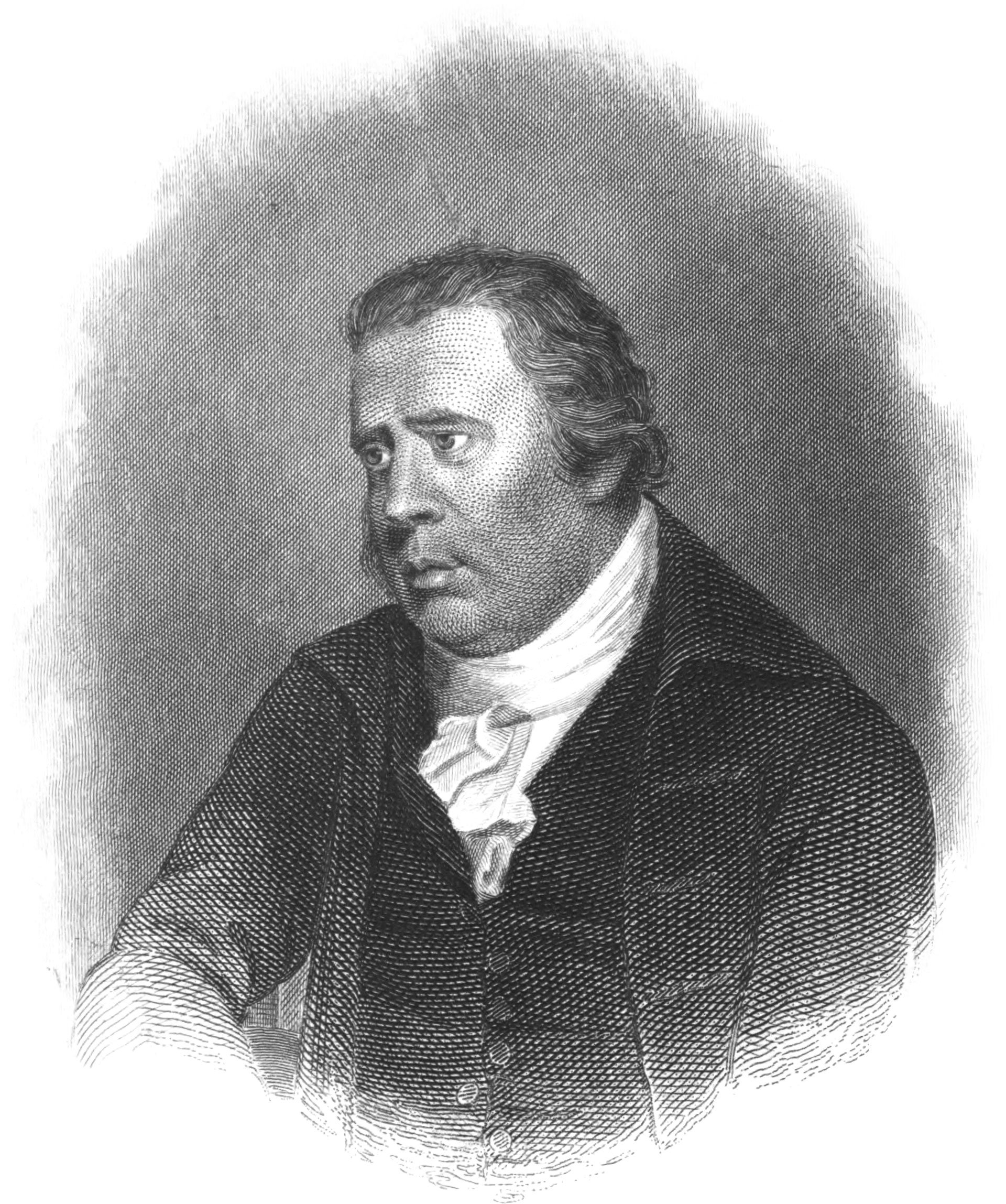
Memoir of
William Smellie
Buffon’s Translator
1740–1795
Originally published in volume 24, The Birds of Great Britain & Ireland, Part II, Perching Birds.
William Smellie, the youngest son of Alexander Smellie, a master builder of sufficient eminence to have attained the title of Architect, is said to have been born in the Pleasance, one of the suburbs of the city of Edinburgh, in 1740; but there is no register of his birth extant, either from the parish records of the time being incorrectly kept, or, as is more probable, from his father not having attended to the registration on account of his peculiar religious tenets, he being a member of that sect of Presbyterians which is termed Cameronians, a class of persons with whom readers of the present day have been made familiarly acquainted by the writings of Sir Walter Scott.
There is a sepulchral monument in the Greyfriars Churchyard of Edinburgh, commonly denominated the Martyrs’ Tomb, which was erected after the Revolution by the Cameronians, to the memory of those of their brethren who fell in the battles of Pentland and Bothwell-bridge, which is supposed to have been originally built by Mr Alexander Smellie, or his father, Mr William Smellie, who was also a builder; and there Mr Alexander Smellie and several of the elder branches of the family are interred.
William received the first rudiments of his education at a school in the village of Dudding-stone, about a mile from his paternal residence, which was followed by a regular course of classical study at a grammar school, from whence he was taken, in 1752, at twelve years of age, and apprenticed on the 1st of October, 1752, to Messrs Hamilton, Balfour, and Neil, printers in Edinburgh, for six years and a half; during which time he conducted himself with most exemplary diligence, and gave indication of superior intelligence; so that, two years before the expiration of his apprenticeship, his masters appointed him to the important employment of corrector of their press, with a weekly allowance of ten shillings. They also kindly permitted him to attend some of the classes of the University, an indulgence he appears to have turned to very good account. In the year 1757, the Edinburgh Philosophical Society offered a prize for the most accurate edition of a Latin classic; on which occasion, Mr Smellie, in the name of his masters, became a competitor, and produced an edition of Terence in duodecimo, the whole of which he set up and corrected himself, and for which the prize was awarded to his masters, as the work was published under their names. The medal is of silver, and of considerable size. On one side the word Merteni is surrounded by a wreath of laurels; on the other side are these words:
The Edinburgh Society,
to Messrs Hamilton, Balfour, and Neil,
Printers in Edinburgh,
For their Edition of Terence,
M,DCC,LVII.
This work was published in 1758, and is mentioned by Harwood and Dibdin, in their writings on Classical Bibliography, as an immaculate edition.
At the expiration of his indentures in 1759, young Smellie entered into an agreement with Messrs Murray and Cochrane, printers in Edinburgh, who were proprietors of the Scots Magazine, as corrector, to collect articles, and make abstracts for that periodical; and this engagement continued till 1765. During the whole of this time Mr Smellie diligently attended the lectures of the University, and appears to have had some idea of studying for the Church, as he went through a regular series of those academical exercises, which are prescribed as the necessary preparations for entering upon the study of theology; and, in 1760, entered into a society, established for mutual improvement among the young men attending the College, to which they gave the name of the Newtonian Society. About the same time he commenced forming a collection of indigenous plants, which he arranged into a Hortus Siccus, and presented to Dr Hope, the professor of botany he subsequently competed for, and gained the honorary gold medal given by the professor for the best botanical dissertation, the substance of which he afterwards published in the first volume of his Philosophy of Natural History.
His progress in the study of Botany was so great, that Dr Hope, meeting with an accident, which prevented him for some time from lecturing to his class, selected Mr Smellie as the fittest person to carry on the lectures to the students during his own necessary absence, and ever after honoured him with his friendship. Various literary schemes appear to have floated through his mind at different times; and frequent thoughts of pursuing the study of divinity or medicine—in the midst of which he fell in love. The following letter to his friend, the late Rev. Dr Charters of Wilton, Roxburghshire, will explain his views at this time.
Mr Smellie to the Rev. Dr Charters.
1763.
Dear Sir,—To study physic to the bottom, as I would wish, is perfectly impracticable. A penury of precious metal is indeed the principal cause of this impracticability. I formerly expressed my difficulties as to divinity. Were I to prosecute that study, I could not with a clear conscience declare, as I am told every minister at his ordination is obliged to do, that my sole motive for assuming the sacred office was purely to advance the glory of God, and to promote the eternal interests of mankind. How amiable the principle! But, alas the highest stretch of vanity, and the most enthusiastic self-approbation, will never be able to make me dream that I am possessed of such a God-like heart. The converse of this idea is shocking and nauseous; therefore let me speedily banish it. Besides, bating all scruples of this nature, supposing I had got a charge, read Pictet, commenced preacher, held forth in all the pulpits in Edinburgh, and ten miles round; at last shut up in a country cloister with L.60 or L.70 a-year, excluded from all rational converse with mankind—I mean the ingenious part of the species—afraid to speak my genuine sentiments of men and things, and, to crown all, perhaps hated by nine-tenths of the parish—I put the case to yourself,—What satisfaction, what pleasure, what society, what mighty profit, can such an employment afford to a man of my kidney? Even supposing I had the good fortune to be admired by some—but the supposition is indeed extremely absurd; for however elegant the composition, yet elocution—O sovereign elocution! thou canst never flow from Smellie’s awkward tongue. By consulting my own imagination, I learn that I have a passion for novelty, and for straining things to their utmost pitch,—a very dangerous and very unpopular turn for a clergyman!
I shall now inform you of an affair which will surprise you more than if I had turned a worshipper of Mahomet. Nature has deemed me to be a violent lover for some years past. Many expedients have I tried to overcome the passion; vain and unsuccessful, however, every attempt of this kind has been. Neither books, conversation, or philosophy, have been able to eradicate the deep-rooted affection. What is still more singular, the flame had seized both our hearts long before either of us were aware of or suspected the secret cause, which forcibly determined us to be no where so easy as in the simple society of two. I have coolly and deliberately, and warmly and passionately, alternis vicibus, considered what was most proper to be done. To give up all correspondence would have hurt me extremely; but I have every reason to believe, it would have proved fatal to a female who is constitutionally constant in affection, and whose mind is sensibility itself. I often resolved, and as often tried to forsake her; and had several times almost diverted the natural bias of my heart. But, when I beheld the very cause of my pain, tortured beyond expression, unless flint or adamant had been the principal ingredients of my composition, I must infallibly have dissolved, retracted my former resolution, and resumed my former passion.
The result of all this is, that in a few days I shall perhaps be personally acquainted with the right-worshipful Hymen. Like the common herd of younkers, you will, no doubt, pronounce this a mad and distracted resolution. But pause a moment, and listen to the following thoughts. Old Reekie1 gave me birth, and in Old Reekie have I lived these twenty-three years and some more. Most of my blood relations have long been in their graves. By a don’t know what nor how, I have gained several friends and well-wishers, besides a tolerable competency of good acquaintances, in the said Old Reekie. I might probably have lived as long, and perhaps much longer, in a different quarter of the globe, before I could have been so well known, or have met with such friendly reception from a strange people. Here, therefore, moneyless and rich-relationless, I have a better chance than any where else; unless you plead that some lucky fortune is always ready to drop into a traveller’s pocket. But in the common run of adventures, might not some horrible misfortune have as probably gravitated towards my head, and struck me to the ground. Moreover, the girl is far from being in my situation. She has many good relations, to whom I have been introduced, and by whom I am not only well received, but loved and caressed. And over and above, she has a business which, without any chance of loss, brings in between twenty and thirty pounds yearly. This, added to my present pittance of L.42, will not come far short of a country parsonage. Wonder not when I tell you, that the love of virtue is a strong stimulus to matrimony. I need scarcely mention how hard it is for a young man living singly in a room to be virtuous: having no spur to prick him home but affection for books and literary speculation, he is constantly dragged along by his thoughtless companions, and his no less thoughtless self, to foolish, and frequently to sinful irregularities. Every other evening he is obliged to crawl to his bed with his body steaming with liquor, or his mind dissipated by nonsensical conversation. It has been a frequent wish of mine to be in a situation which would enable me to banish fools and sycophants from my dwelling-place; to be often serious, and seldom giddy. Experience teaches me, however, that my wish can never be gratified so long as I dine in a tavern, live in a hired room, &c. A society, consisting of a very few members, has always the best chance of being sober and virtuous. A crowd, for what reason I at present know not, is almost constantly impious. I think an essay on this subject would be an excellent lunarian2 number.
I could urge many other motives for the alteration about to take place in my way of life. I could even shew, by mathematical demonstration, that to act otherwise would be highly criminal; nay, even a refractory species of rebellion against the great God of nature; but this I decline, as my letter is already too voluminous. Thus have I, without reserve, opened my mind to one whom I may call my friend. I need not add, that it would be highly improper that this letter should be shewn; for not a single companion but yourself knows any thing of the matter. If you write me not very fully by first post, I shall, as the saying is, be very much out with you.
If you are to stay in Edinburgh this summer, and if I have a house of my own, as the folks say, it would add greatly to my happiness if you would make one in our little society. Every thing shall be made as agreeable to you as possible, and we shall frequently crack about the Man of the Moon, &c. So keen am I about the lunarian scheme, that I believe, though you should entirely desert me, as Heaven avert, I shall one time or other attempt the execution of it alone. Yours, &c.
William Smellie.
It appears he shortly after married, as we find him immediately after speaking of Mrs Smellie.3 Her name was Jean Robertson, daughter of Mr John Robertson, an army agent in London. The lady, however, had no fortune; and thus, with all the inexperience of youth, did this young couple brave the stern realities of life, he being twenty-three, and his wife only seventeen years of age.
By this marriage Mr Smellie had thirteen children—six sons and seven daughters, of whom four sons and four daughters survived him. Mr Alexander Smellie, his second born, but eldest surviving son, is married, and has a family. He carries on his father’s profession of a printer. His eldest daughter, Rebecca, married the late Mr George Watson, an eminent portrait painter, who was the first president of the Scottish Academy. She died May 5, 1839, leaving several children, one of whom, Mr William Smellie Watson, inherits his father’s talents as an artist, and his grandfather’s taste for Natural History, which he cultivates with great ardour and enthusiasm.
Finding his emoluments, as corrector of the press, inadequate to his increasing wants as a married man, on the 25th of March, 1765, Mr Smellie commenced business in partnership with Mr William Auld, who had been a fellow apprentice with him, as master printers, on which occasion Dr Hope, and Dr James Robertson, the professor of Oriental languages in the University of Edinburgh, assisted him with the pecuniary means for establishing himself. Mr Robert Auld, a writer in Edinburgh, was also a member of this firm, but after two years withdrew his name; and Mr John Balfour, of the firm of Hamilton, Balfour, and Neil, with whom Mr Smellie had served his apprenticeship, was admitted in his stead. This new copartnery commenced December 22, 1766, and existed till November, 1771, when Mr Auld retired, and a new arrangement was then entered into by Messrs Balfour and Smellie. About this time, Dr Ramsay, the Professor of Natural History, died, and the friends of Mr Smellie applied in his favour for the vacant chair, but without success. It was given to Dr Walker, whose political interest was greatest. Mr Smellie’s knowledge of medicine had brought him acquainted with the celebrated Dr Buchan, to whom he rendered considerable assistance in the composition of that popular work, the Domestic Medicine, which was first published in 1770.
Ever active and indefatigable, he, at this time, entered into an engagement with Messrs Bell and M‘Farquhar for compiling and entirely conducting a Dictionary of Arts and Sciences, the result of which was the first edition of the Encyclopaedia Britannica, in three volumes, which appeared in numbers. He was again applied to by the proprietors to superintend the second edition of that work in 1776. but he declined, on the ground of it being intended to include biographical articles to the work, which Mr Smellie considered inconsistent with its title as a Dictionary of Arts and Sciences. This plan was, however, adopted, and the edition extended to ten volumes.
He then engaged, in 1773, in conjunction with the celebrated Dr Gilbert Stuart, in a new monthly periodical work, called the Edinburgh Magazine and Review, which was commenced in October that year. This work was conducted with very considerable talent, but with so much irritability of temper and personal abuse, that it was found necessary to give it up, after having reached forty-seven numbers, in August, 1776. There is no doubt that the principal blame of these defects rested with Dr Stuart, but we fear Mr Smellie cannot be entirely acquitted of some share in them. The following reviews were written by Mr Smellie.
- Kames’s Sketches of the History of Man, Art. III.
- A small part of Lord Monboddo on the Origin and Progress of Language.
- Revelation, the most effectual means of civilizing and reforming mankind; a sermon, by Robert Henry, D. D. 1773.
- Worthington’s Scripture Theory of the Earth, 1774.
- The Druids’ Monument, a tribute to the memory of Dr Goldsmith, by the Author of the Cave of Morar, 1774.
- Considerations on the Broad-cloth Manufacture, 1774.
- Buffon’s Natural History, in French, 1774.
- Goldsmith’s History of the Earth and Animated Nature, 1775.
- Pringle’s Discourse on the Torpedo, 1775.
- Hamilton’s Observations on Mount Vesuvius, 1775.
- Essays on Agriculture, by a Farmer, 1775.
- Dr Hardy’s Sermon before the Commissioner, 1775.
- Jenkinson’s Botany, 1775.
- Harris’s Philosophical Arrangements, 1775.
- Clark on the Shoeing of Horses, 1775.
- Boutcher on Forest Trees, 1775.
- Cockburn’s Collection, 1775.
- Martyn’s Elements of Natural History, 1775.
- Rose’s Elements of Botany, 1775.
- Innes on the Muscles, 1775.
- Hamilton’s Practice of Midwifery, 1775.
And several others which he did not choose to be known.
In 1780, the late Earl of Buchan projected a Society of Antiquaries of Scotland; and upon its establishment Mr Smellie was enrolled one of the original members, and was appointed printer of their journals and transactions; and in the following year he was elected keeper and superintendent of the museum of natural history, which it was proposed should be collected by the society, in addition to their intended cabinet of Scottish antiquities. In 1782, he published an account of the institution and progress of the Society, which he continued and extended to 1784. It was the intention of Mr Smellie to have delivered a course of lectures on natural history to this society; but the proposal excited the jealousy of Dr Walker, the professor of natural history in the University, and the idea was in consequence abandoned. The materials were, however, subsequently made use of in the Philosophy of Natural History.
Mr Smellie then engaged in a general system of natural history; but this was also abandoned from want of pecuniary resources for its publication. As exhibiting a specimen of the progress in the study of Natural History which he had made, we print a syllabus of this work as drawn up by himself.
I. History of the Earth.
- Of its figure—Its dimensions—Its motions—Its connection with the moon—Its relations to the other planets in the solar system, &c.
- Of the earth’s surface—Its divisions into land and water—Its continents—Islands, mountains, and plains—Rivers and lakes—Seas—General productions, &c.
- Of the earth’s atmosphere—General properties of the air—Its motions—Uses in the animal and vegetable kingdoms—Of rain, snow, hail, dew, water-spouts, lightning and thunder, aurora borealis, and other meteors—Examination of Dr Hutton’s theory of rain, &c.
- Of the interior parts of the earth—Its strata—Their general positions—Their different substances—Their regularities and irregularities—Their fissures, &c.—Of mines and minerals—View of British strata—Natural History of all the metals—Of extraneous bodies found in the strata; as shells, wood, bones, &c.—Of the causes of partial derangement in strata; as earthquakes, volcanoes, the operations of water below the surface, &c.—Of precious and other figured stones.—Several plates are to illustrate these subjects.
- Of the different theories which have been formed upon the preceding and other historical facts—Theory of Woodward, of Burriet, of Whiston, of Scheutzer, of Buffon, of Hutton, &c.—A new theory of the earth—General remarks by way of conclusion.
II. Of Animals in General.
- Of the structure and organs of animals and vegetables—Their discriminations—Their analogies in structure and organs, in growth and nourishment, in dissemination and decay.
- Of the gradual progress of animals from birth to puberty, and thence to decay.
- Of instinct—Its various kinds endeavoured to be classed—Its principal objects and uses—Human reason a necessary result of the superior number of instincts possessed by man.
- Of the distribution of animals into classes, orders, genera, and species.—The arrangement of different authors from. Aristotle to the present time—Their principles of classification examined—The technical system—The philosophical system—Reasons why the Linnæan system of arrangement is observed in this work, in the animal and vegetable kingdoms.
- History of man—Varieties of the human species, in figure, colour, genius, dispositions, manners—Probable causes of this difference.
-
History of quadrupeds.—Description—manners, food, genius and moral character, habitations, address in seizing their prey and avoiding their enemies—Peculiar instincts, &c.
Engravings to be given of each known species; and the synonymes of authors to be added, with references to the works of natural historians.
- History of birds, conducted in the same manner as that of quadrupeds, with the following exceptions: As the species are exceedingly numerous, and as many of them are so similar that they can only be distinguished by the aid of illuminated plates, to give engravings of each species could answer very little purpose; besides that, it would augment the expense to such a degree as totally to frustrate the intention of this work. Several species of each genus only will therefore be engraven, which will suffice to give proper ideas of the rest; especially as short descriptions of the whole are given.
- Amphibious animals, as turtles, serpents, &c.
- Fishes.
- Insects; including flies, worms, and microscopic animalcules: preceded by a dissertation on the transformations of insects.—Caterpillars to be engraved where figures can be had.
N.B.—These three classes to be treated of and illustrated as already mentioned in respect to birds.
III. Of Vegetables in General.
- Classification of vegetables—Explanation of the Linnæan system, with the necessary plates, by way of example of a genus from each class, and a species or more of each genus, &c.
N.B.—The engravings to be executed according to a scale, which will be attended with many obvious advantages.
Not discouraged by this failure he next ventured on a translation of Buffon’s Natural History of the Earth, and of Man and Quadrupeds, which he completed in nine volumes 8vo. with numerous notes and illustrations, and a considerable number of new observations. This introduced him to the correspondence of Buffon and Pennant, the former of whom acknowledged the compliment of translation in the following letter.
Le Cte. de Buffon to Mr. Smellie.
Montbard in Burgundy, I8th Feb. 1780.
Sir,—Yesterday, the 17th of February, I only received your letter, which was dated at Edinburgh on the 22d of October last. It was accompanied with a prospectus of the translation of my work, and an engraving of the fallow deer, and was transmitted by my friend Mr Andrew Lumisden, a Scots gentleman who resides at Paris. He informed me that he knew not the name of the person who had sent this packet; but undertook to transmit my answer to Scotland, which I begged of him to do with all possible expedition. This Mr Lumisden is an intimate friend of Mr Macgowan, who lives in Edinburgh, and has a friendship for me, as likewise have Mr Carnegie and Mr James Bruce, of both whom I have heard this day; and likewise of Mr Mackenzie, whom I had the honour of receiving at my house. I was also some time ago, a great correspondent of Mr Maclaurin, Mr Murdoch, and some others of your learned countrymen. I have entered into this detail to shew you, Sir, that I am not entirely a stranger to your illustrious country; and I am exceedingly flattered by your having taken the trouble of translating my works. As my productions please you, I am certain that you understand them fully, and that your translation will be good, and well received by the public. Your plates also are very well engraven. Receive my acknowledgments for the copy you are so kind as to destine for me; but permit me, at the same time, to subscribe for other three, which you may send me, unbound, by means of Mr Macgowan, who ought also to transmit me a pair of Adams’s globes, when the last discoveries of Captain Cook are engraven on them. Mr Lumisden will transmit to Mr Macgowan the price of the copies I ask, and will likewise take the trouble of sending the bound copy which you are so kind as to offer me.
I perceive, Sir, that your translation is to comprehend only what I have inserted in the first fifteen volumes in quarto, and the supplementary volume to the History of Quadrupeds. To this last volume there is to be a second part, which will be as large as the first. The plates, to the number of seventy, are actually engraven for it; and I intend putting it to press in the course of this summer. The chief animals to be included in this volume are the tapir, the gnou, the nilgau, male and female, the antelopes, several gazelles and goats, the musk, the lama, the vicuna, the small and large jerboas, &c. and a considerable number of monkeys. Most of these animals have come to hand since the publication of the other volumes; and as soon as this volume is printed, I shall have the honour of sending you the first copy. I would cheerfully have communicated to you all my notices, if I had not intended to publish them myself; and I have now nothing else remaining respecting quadrupeds.
As to the request you have been so good as to make, Sir, of dedicating your translation to me, I accept it with gratitude; and, at the same time, I beg you to receive my thanks for all the marks of esteem and all the eulogiums which you have so liberally bestowed upon me in your prospectus. I shall only observe, that there are a few things which are not sufficiently exact. For example, you say,
That I received all the animals through royal munificence, and that all the expenses of my work have been defrayed by the king.
You may be assured, Sir, that the whole was executed by myself, and by my own proper researches. In the same manner, you say,
That the king ennobled me, as a mark of his satisfaction with my work.
Now, Sir, I assure you, that I was formerly noble, as well as my ancestors; and that the king only added a higher title when he erected my estates into an earldom.
Since you are so much occupied, Sir, with my works, it is proper to inform you that, independent of the sixteen quarto volumes with which you are acquainted, and of the volume upon quadrupeds I am about to print, I have composed the Natural History of Birds in nine volumes quarto, six of which are published, and the seventh is in the press; and that, beside the common copperplates which are inserted in these volumes, I have, during twenty years, caused illuminated plates to be made in folio, which give a perfect representation of the birds in their natural colours. These plates are at least as good as those of Mr Edwards, and they are a thousand in number. It is the most beautiful work of the kind ever exhibited to the public.
In 1773 and 1774, I published two quarto volumes, under the title of “Supplements serving as Introduction to the History of Minerals,” on which subject I am now labouring. And in 1777, I published a quarto volume as a supplement to the Natural History of Man. Finally, I published in 1778, a fifth volume in quarto, which is one of the most important of the whole work, and is entitled, “Of the Epochs of Nature.” If you wish it, I shall present you with a copy of this. But it is vexatious that war should interrupt the communication between men of letters. I much regret the loss sustained by the premature death of your illustrious navigator, Captain Cook. You will see, Sir, when you read my Epochs of Nature, that I have made much use of his discoveries in the southern hemisphere.
If you do me the honour of writing to me, I beg you will inform me whether Dr Horsley has published his new edition of Newton’s works. I subscribed for a copy of this work, for which I paid 120 livres to Lord Stormont’s Secretary, when he was ambassador in France. He is one of your most accomplished countrymen, and shewed me every mark of civility. I shall ever respect both his merit and his person. I most earnestly beg of you to remember me to Mr Carnegie, whom we had the pleasure of enjoying in Burgundy for twelve months; and he left me and every person who knew him, to regret his departure. He does not live at Edinburgh, but at Kinnaird, which is distant from it, I believe, about 15 or 20 leagues. I have learnt, with infinite satisfaction, that, though a young man, he represents the burghs of his county in Parliament.
Receive, Sir, the assurances of the respectful esteem and gratitude with which I have the honour to be, &c.
The Count de Buffon.
During the publication of the translation of Buffon, Mr Smellie’s partnership with Mr Balfour was dissolved, and he entered into a new engagement with Mr Creech, in 1783.
His principal original work, which he entitled the Philosophy of Natural History, was published in quarto in 1790. For this first volume he received one thousand guineas. It is divided into twenty-two chapters; consisting of a series of essays on various topics in the general economy of animal bodies chiefly, excepting one chapter devoted to a critical examination of the hypothesis of the sexual system of vegetables.
- Is an essay on the distinguishing characters of animals, plants, and minerals.
- Gives a view of the organs and general structure of animals, beginning with man.
- On the respiration of animals.
- On the motions of animals.
- On instinct.
- On the senses of smelling, tasting, hearing, touch, and sight.
- On the infancy of animals.
- On food.
- On the sexes of animals.
- On puberty in different animals; its symptoms and effects.
- Of love; sexual intercourse, and parental affections.
- Of the transformations which various animals undergo.
- Of the various habitations of different animals, as accommodated to their several exigencies.
- Of the hostilities of the several kinds of animals, and the advantages derived from this seemingly destructive institution of nature.
- Of the artifices employed by animals in catching their prey, and in escaping their enemies.
- Of the association of animals.
- Of the docility of animals; their improvement by culture or education, and the effects produced by domestication.
- Of the character and disposition of animals.
- Of the principle of imitation in animals.
- Of the migrations of various animals.
- Of the longevity and death of animals.
- Of the progressive scale of animals, rising through many gradations from those most imperfectly organized to man.
The second volume was published by his son, the present Mr Alexander Smellie, in 1799, four years after his father’s death. It comprises nine chapters, and had been entirely completed, ready for the press.
- Gives a concise view of the utility of method or arrangement in every department of science, and points out methodical arrangement into tribes and families, or what are usually called orders and genera, as being evidently founded in nature, both in the animal and vegetable kingdoms. To this he has appended a concise, historical, and characteristic account of the writings and arrangements of the principal ancient and modern naturalists, beginning with Aristotle and ending with Pennant.
- On the multiplication and construction of the species; and the theories of various authors, ancient and modern, are explained and commented on.
- Of mules, or the anomalous productions of nature.
- Of the varieties of man in different regions of the globe; and of the varieties in manners and customs, religion, war, agriculture, marriages, burials, government, arts, manufactures, &c. of the different nations of the world.
- On dreaming and somnambulism.
- On hibernation, or the torpid state to which some animals are reduced during winter.
- On the language of beasts.
- Miscellaneous remarks on the comparative pleasures and sufferings of animals.
- On poisonous animals, with an account of hydrophobia.
Mr Smellie thus concludes the work,—
I have now finished my original plan, with what success I know not. I shall only say, what every intelligent reader will easily perceive, that my labours have been great. Before I began the work, had I known the numerous authors which it was necessary to peruse and consult, I should probably have shrunk back, and given up the attempt as impracticable, especially for a man so early engaged in the business of life, and the cares resulting from a family of no less than thirteen children, ten of whom are still in life.
In the first and second volumes I have endeavoured to unfold the general as well as distinctive properties of the vegetable and animal kingdoms. Occasionally I have done more. I have sometimes given pretty full characters both of the figure, dispositions, and manners of animals. In these descriptive discursions man has not been neglected. Being the principal animal in this planet, he of course deserved particular attention, and it has not been withheld. The varieties of the human species in every region of the globe, have been collected and described from the most authentic sources, both ancient and modern. Even in the most uncultivated, and, to us, deplorable situation of the human race, evident traces of goodness, of genius, and of heroism, are to be found. These amiable qualities, it must be confessed, are too often sullied by cruelty, irascible passions, and every species of vice. But these qualities are universal, in whatever situation men are placed, whether in a civilized or barbarous state of society. The strangest and most unaccountable part of the history of mankind is that of their eating one another; and yet, from the numerous evidences I have produced, it is impossible not to give credit to the shocking fact. The reality of human sacrifices, is equally certain as the existence of cannibals. The diversity of dispositions, the versatility of genius, the great differences of taste and of pursuits, are strong characters of man, and distinguish him eminently from all other inhabitants of this earth.
His next employment was an intended series of the lives of such authors as had employed him to print their works. In this he had made sufficient progress to have finished memoirs of Hume, Adam Smith, Monro, and Lord Kames, which were published in an octavo volume in 1800, together with some juvenile essays.
Amidst these pursuits his health began to fail him in 1794, and after a lingering illness, which he endured with great fortitude, he expired on the 24th June, 1795, aged 55. His moral character, as a husband and parent, is represented to have been peculiarly estimable.
Like many other learned men, Mr Smellie’s opinions in religion and philosophy have occasionally been misrepresented by well meaning but somewhat narrow-minded people. In fact, opinions in regard to religious doctrines and forms, on which many good and wise men have disputed almost with rancour, and seldom in the spirit of charity, are manifest to all; but the following pious sentiment, with which he concludes his first volume of the Philosophy of Natural History, we think ought not to be omitted:
Let man be contented. His station in the universal scale of Nature is fixed by Wisdom. Let him contemplate and admire the works of his Creator; let him Jill up his rank with dignity, and consider every partial evil as a cause or an effect of general good.
His works have been for many years extolled both by domestic and foreign authors; and latterly by Lords Brougham and Althorp, Miss Edgeworth, &c. The following picture of Mr Smellie is from the pen of Burns, in a letter, accompanied with a present of a cheese, to the late Mr Peter Hill.
Dear Sir,—I know that you are no niggard of your good things among your friends, and some of them are much in need of a slice. There in my eye is our friend Smellie; a man positively of the first abilities and greatest strength of mind, as well as one of the best hearts and keenest wits that I have ever met with. When you see him, as alas! he too is smarting at the pinch of distressful circumstances, aggravated by the sneer of contumelious greatness! a bit of my cheese alone will not cure him; but if you add a tankard of brown stout, and superadd a magnum of right Oporto, you will see his sorrows vanish like the morning mist before the summer sun. I am, &c.
Robert Burns.
- A customary quaint name for the old part of the city of Edinburgh.
- Lunarian, an illusion to an intended publication to be entitled—The Man of the Moon.
- She was full cousin of the present Mrs Oswald of Dunnikier.