Volume XXIV
The Birds of Great Britain & Ireland
Part II, Perching Birds

Incessores
Introduction
For to me it appears, that, of all inferior creatures, Heaven seems to have intended birds as the most cheerful associates of man; to soothe and exhilarate him in his labours by their varied melody; to prevent the increase of those supernumerary hosts of insects which would soon consume the products of his industry.
Alex. Wilson.
Others more gorgeously apparell’d, dwelt
Among the woods, on nature’s dainties feeding,
Herbs, seeds, and roots; or, ever on the wing,
Pursuing insects through the boundless air:
In hollow trees or thickets there conceal’d
Their exquisitely woven nests, where lay
Their callow offspring.—
Of these, a few, with melody untaught
Turn’d all the air to music within hearing,
Themselves unseen.
In our former volume we detailed, so far as our limits would permit, the history and habits of the order of birds which has, by common consent, been placed at the beginning of the class Aves, and following out our plan, we propose to devote the present volume to that which has, in like manner, been placed second, or next to it.
The Incessorial order of birds is by far the most important in the whole circle or chain, whether viewed in a scientific light, or taken in relation to its economy in the great plan of nature. In extent it is the most numerous, nearly equalling the numbers of all the others collectively; consequently may be expected to contain an almost endless variety of forms, and modification of structure; and thus it has been considered the typical order, or that in which the greatest united perfection of all the properties of a bird were combined. As the name indicates, the power of grasping and of perching, is a prominent feature in their form; ’all possess the hallux, or hind toe, but in none are the claws retractile, as among the members of the former order. The habitual residence of the greater proportion is in the woods or thickets; and the powers of flight are in all perfect, and in many very highly developed. Their food is nearly as varied as their structure; but this is never seized by the feet, nor, with a very few exceptions, is the devouring of it assisted by these members. While the bill wants the form of a “tooth,” which characterizes the typical raptores, and in those which here represent them by their partially predatorial habits, it is modified by the appearance which we express by the term “notched.” The great majority of the order are of comparatively small size.
Amidst this number of beings to be characterized, there has been unquestionably much difficulty, and considerable difference in the opinions of our systematists. The most of whom have considered what are placed as the subordinate divisions by the latest writers in a higher place, and have thus made their systems to consist of a much greater number of primary divisions, although, when the whole was analyzed, the discrepancies consisted more in the comparative value of the different parts, than in the points or boundaries within which each was contained. In the Systema Naturæ, the orders are six in number, and correspond nearly with those at present advocated, the pieæ and passeres only being thrown together in the group we have now under consideration. In the Règne Animal, the orders are also six, the incessores of moderns being there still divided, though the separation is differently effected, the scansores (grimpeurs) being kept by themselves. By Illiger we have seven orders proposed, occasioned by the division of the grallatores, as well as the incessores, and in most of the systems where the number of primary divisions run between five and seven, or eight, it will be seen to be caused by the splitting of these two orders. When they extend beyond that number, as in the system of Temminck, composed of sixteen orders, and of others having even more, we have only a still farther separation of those, particularly the last, and see considered as of high rank those portions which have more lately been placed in a subordinate value.
In the systems of Vigors and Swainson, based on the principles laid down by Mr Macleay, we have for this order the primary divisions of Cuvier’s “passeres” adopted, including also his third order “grimpeurs,” but by both with a considerable variation in the distribution of the genera. This, indeed, is the chief point of difference between our two followers of Macleay; for while they agree in the value of the order, and in its primary divisions, they differ widely in what should constitute the types of the families and sub-families, and in the station which the genera should hold in regard to each other; but the system of the last named ornithologist having been adopted, with slight deviations, as the arrangement of the present volumes, we subjoin a table of the leading divisions of the incessores, which, on comparison, will at once exhibit the differences which exist between them.
| Lantandæ. | Merulidæ. | Sylviadæ. | Ampelidæ. | Musciapidæ. |
|---|---|---|---|---|
|
*Lanainæ.
Thamnophilinæ. Dicrurinæ. Ceblepyrinæ. Tyranninæ. |
Brachypodinæ.
*Myrotherinæ. *Merulinæ. Crateropodinæ. *Oriolinæ. |
*Saxicolinæ.
*Philomelinæ. *Sylvianæ. *Parianæ. *Motacillinæ. |
Leiotrichanæ.
Vireoinæ. *Bombycillinæ. Ampelinæ. Piprinæ. |
Querulinæ.
Psarianæ. Fluvicolinæ. *Muscicapinæ. Eurylaiminæ. |
| *The families marked thus * have British representatives. | ||||
| Corvidæ. | Sturnidæ. | Fringillidæ. | Musophagidæ. | Buceriaæ. |
|---|---|---|---|---|
|
*Corvinæ.
*Garrulinæ. Glaucopinæ. Coracinæ. *Frigillinæ. |
*Sturninæ.
Lamprotorninæ. Scaphidurinæ. Icterinæ. Aglainæ. |
*Coccothraustinæ.
Tanagrinæ. *Fringillinæ. *Alaudinæ. *Pyrrhulinæ. |
Phytotominæ.
Colinæ. Musophaginæ. |
1 genus only Buceros is yet known. |
| Ramphastidæ. | Psittacidæ. | Picidæ. | Certhiadæ. | Cuculidæ. |
|---|---|---|---|---|
|
Macrocircinæ.
Psittacinæ. Plyctolophinæ. Lorainæ. Playcercinæ. |
Picianæ.
Buccoinæ. |
*Certhianæ.
Anabatinæ. *Sittinæ. *Troglodytinæ. Buphaginæ. |
*Cuculinæ.
Coccyzinæ. Crotophaginæ. Leptosominæ. Indicatorinæ. |
| Meliphagidæ. | Cymindinæ. | Trochilidæ. | *Promeropidæ. | Paradisiadæ. |
|---|---|---|---|---|
|
Sub-families not ascertained. A single British form represents the Promperopidæ. |
||||
| *Meropidæ. | *Halcyonidæ. | *Trogonidæ. | *Camprimulgidæ. | *Hirundinidæ. |
|---|---|---|---|---|
| Sub-families not ascertained. | ||||
Viewing this important order as a part of the great plan of nature, and as connected with the benefits and injuries done to the productions used by man, the influence of its members on his feelings and enjoyments, and their effects on the scenery of their various native countries, we shall find them still more interesting. The desire for food, and the manner of searching for it, are nearly the primary causes of all the benefits or injuries received from birds. In this order some feed entirely on grains and seeds, others on the buds and tender shoots of plants and trees, others on various fruits and berries, and some again, on all these substances indiscriminately. Wherever any production is cultivated extensively, considerable ravages may be committed at some period of its growth by a portion of the incessores: our grains may be stripped off when just ripe, or torn up when newly springing from the ground; the shoots of our young trees and the buds of the orchard may be bruised, and our choicest fruits may be plundered, or rendered useless. These injuries, however, may be generally revented by some attention at the proper seasons, when the species are so numerous as to become annoying; and in a country where cultivation is not extensively practised, the inducement to flock towards large and artificial stores of favourite food does not exist, and the proportion of the produce to that of the consumers is naturally kept up. But even in those districts where inattention on the part of the proprietor would soon permit considerable loss, we have abundant compensation in the numbers of insects and their larvae, which are consumed during the season of incubation by the very birds which are at other times most hurtful to his crops. There is not a vegetable production which we cultivate, from the strongest forest tree to the most tender garden flower, that is not liable to the attacks of multitudes of insects, and though tiny in their form and weapons, and insidious in their mode of attack, the consequences are not less severe and fatal. The depredations which they have been known to commit, are many thousand times greater and more extended than the worst attacks of the feathered creation, and we cannot look upon this large group of birds, all of them wholly or partially insectivorous, than as the natural check interposed by Divine Providence upon a race of creatures which, in their own places, also lend efficient aid against other classes of depredators.
As articles of food, the members of the incessorial order are either, many of them, too diminutive, and in other respects, such as flavour, &c. unpalatable, at least to the British taste; and although in some countries, as Italy and France, neither their utility, beauty of plumage, nor melody of voice, saves them from the appetite of the epicure, still, among the many important services which they afford to man, that of administering to his supply of food can scarcely be enumerated.
Among our enjoyments out of doors, perhaps those which we derive from the incessores are not the least or most insignificant. Our walks are ever cheered by their lively notes or song, and it is only those who have wandered through the lonely forest, and experienced the gloom which prevails, when not a motion is seen, or a noise heard, save the trembling leaf or the sighing of the blast, that can appreciate the effects of the wildest and most monotonous notes of its tenants. What a change in the character of our woods and ornamental groves does even the accession of our summer birds of passage occasion. In winter the landscape is filled up by flocks of various creatures, all active in looking for subsistence, or assembling together for warmth; but with the return of spring, and the freshness of vegetation, we have also the bustle and activity of incubation—voices that have been for a season unheard, coming to the ear as the greeting of an old acquaintance, and the notes of love, warbled in the simplest strains, or poured forth in deep and full-toned cadence.
While thus the imprison’d leaves and waking flowers
Burst from their tombs, the birds that lurk’d unseen
Amid the hybernal shade, in busy tribes
Pour their forgotten multitudes, and catch
New life, new rapture, from the smile of spring.
The oak’s dark canopy, the moss-grown thorns,
Flutter with hurried pinions, arid resound
With notes that suit a forest.
These remarks may be considered referable more particularly to the incessores of Britain or of Europe. Were we to extend our observations to the inhabitants of other continents, we should enter a field much more varied in the manner in which the allotted offices were performed, and we should find them no less suitably adapted to the very different circumstances of each. They would be, however, mostly inapplicable here, and we shall proceed to the consideration of the British families, endeavouring, as we go along, to point out whatever may be useful or interesting in the economy of each.
Dentirostres
The first of the great tribes into which the incessorial birds are separated, the Dentirostres, exhibits a continuation of the notched or toothed form of bill, which, under its various modifications, is more or less adapted for seizing and lacerating a living and resisting prey. This is particularly marked in the
Lanaidæ,
all the sub-families of which are raptorial, feed entirely on living prey seized by their own exertions, and typify, as it were, the noble and ignoble forms of the true rapacious birds. When passing from one great order of birds to another, we would naturally expect to find some on each side, to a certain extent, assimilating in their form and habits; and thus, among the sub-family Lanianæ or Shrikes, of which the British fauna possesses only three representatives confined to one genus, we perceive the lesser size and weaker form of the incessorial order, combined with a lacerating and toothed structure of the bill, and with raptorial or predaceous manners. The typical form, which is distributed in nearly equal proportions in the four great quarters of the world, but is wanting in its restricted sense to Australia, may be thus characterized:—
Lanius—Generic Character.—Bill rather short, compressed; mandible hooked, furnished with a strong and prominent tooth; wings with the three first quills graduated, third and fourth equal and longest; claws sharp, but not formed for grasping prey.—Type, L. excubitor.
Europe, Asia, Africa, North America.
Note.—Breed on trees, seize living prey, and use a thorn or cleft branch, as a support not afforded by their feet.
The Great or Ash-Coloured Shrike
Lanius excubitor.—Linnæus.
Lanius excubitor, Linn.—Pie-Grieche Grise. Temm. Man. &c.—Great Grey-Cinereous-Ash-coloured Shrike, or Butcher Bird of British Authors.
The Shrikes are generally of a size and form exhibiting a moderate degree of strength, and do not shew any indications of raptorial disposition, except in the strong and toothed form of the bill; and in many of the species, the centre feathers of the tail being longest, an elegance and lightness to their shape and figure is imparted, at variance with the powerful form necessary for contest. The colours of the plumage are pleasing shades of grey, rufous, or white, interrupted by decided black markings on the head, wings, and tail. Our native birds are migratory, being either summer or winter visitants, and indeed the great proportion of species in other countries, also partially travel at the breeding time, pass at the change of seasons from one distant part of a continent to another, or seek altogether a more genial or otherwise suitable climate, wherein to spend the winter, or the season of incubation. In disposition they are solitary, seldom appearing in greater numbers than the amount of the last brood, and most frequently in pairs, or single. They appear to delight more in woodland districts than in wild or extensive forests; and in Britain are commonly found about the well-wooded hedgerows or parks of the south. Their food consists of small birds, together with their young, small mammalia, reptiles, and the larger insects. We are not sure that the manner in which the prey is captured has yet been noticed.1 It is most probably, however, generally effected by suddenly darting on, or wearing out, the object of pursuit, and seizing it with the bill; for neither are the wings suited for a rapid pursuing flight, as among the true raptorial birds, nor are the feet capable of seizing or holding it until torn to pieces; and it may be from the comparative weak formation of these organs that the Shrikes have been endowed with the curious faculty of imitation, by which they are in a manner able to entice within their power the adult birds, and also the young which so readily obey the call of their parents. It is to the same cause, also, that we may refer that instinctive propensity which has gained for them both their Latin and English appellations, and forms such an excellent substitute or provision to assist in the tearing or disjointing of their food. Every author and observer has noticed the singular manner in which the Shrikes impale their prey on some thorn, or sharp pointed branch, or fix it in some cleft, before commencing to devour it, or when kept in confinement, by thrusting it between the wires of the cage. From the weak structure of the feet and claws, it is evident that the birds could not tear their prey to pieces without some firm resistance, such as that which is given in the strong and grasping feet of the falcons and hawks, and nature has taught them mechanically to supply this structure in the same way that she has instructed the thrush to resort to some convenient stone to break the snail shells, or the crow to mount aloft with the crab or shell fish, and smash their strong defence by falling on the rocks beneath. Le Vaillant says this process of impalement is performed in the wilds of South Africa, and remarks, that the spine or thorn was always thrust through the head of the bird or insect, and that the prey was not devoured at the time of capture, but allowed to hang on the branches and shrubs, and was returned to apparently when the calls of hunger demanded.2 Mr Selby, also, had the satisfaction of seeing our native grey Shrike impale its victim, after hovering over the hedge with the bird (a hedge accentor) in its bill, apparently for the purpose of selecting a convenient thorn.3
The common Grey Shrike is perfectly typical in its form, and will rank among the larger species of the genus. In length it is about nine inches, appearing more graceful from the graduated form of the tail, though it is in reality a firmly and compactly made bird. In the old male, the upper parts are of a chaste and clear pearl grey, while the whole of the under parts are pure white; these tints are beautifully broken and contrasted, by the deep black of the greater portion of the wings and tail, and by the marking of the same colour which appears on the forehead, the lores, and on the auriculars, on the latter there is an oval patch resembling in form and situation the distribution of the darker shades on these parts of the falconidæ. The wings have the base of the primaries white, forming a triangular mark on these parts, and the exterior tail feathers, with the tips of all the rest, except the two in the centre, the space widening to the outside, are of the same pure tint. The female has the colours in general duller, and the breast is undulated with narrow dusky transverse bars. Temminck mentions the occurrence of a variety nearly pure white, having the black parts slightly tinted with grey. The young are tinted with brownish purple on the grey parts, and have the breast, belly, and vent, of a reddish or yellowish white, thickly foarred transversely with umber brown. The dark parts of the plumage are not so intense, or so defined in their boundaries.
In the British islands, the Grey Shrike can only be viewed as an occasional visitant, and that even of rare occurrence, except in some of the southern and midland counties. There, during the winter months, and towards the approach of spring, straggling specimens are frequently procured; towards the north, and on the confines of the border, it becomes less frequent; in the south of Scotland it is a rare bird, a few instances only of its capture having occurred to our notice; while in Ireland, according to the observations of Mr Thompson, it seems to be equally rare.4 No instances of this species breeding in this country are yet recorded;5 its summer visits, indeed, appear accidental, and have only been observed once or twice. Its range of geographical distribution seems confined to Europe, or if it does pass the Asiatic boundary, it is soon lost, to give way to some other species which may represent it, within a limit of its own. In the northern parts of the new world, again, its place is filled by several species so closely allied, that they were long considered identical. In Europe, it extends as far north as Lapland and Sweden, and parts of Russia, but its stronghold, or metropolis, may be viewed as the midlands and south of France, where it breeds, devaricating on each side in varied proportions. Their principal haunts are the well-wooded but enclosed countries, the parks, and enclosed forests. According to Temminck, they build on trees and lower brushwood; while Mr Hewitson says,
that it builds its nest in thick bushes and high hedges; it is composed of umbelliferous plants, roots, moss, and wool, lined with finer roots and dried grass.
The eggs are from five to seven in number, they are of a blueish or greyish white, spotted, and blotched over with brown or purpleish grey.6
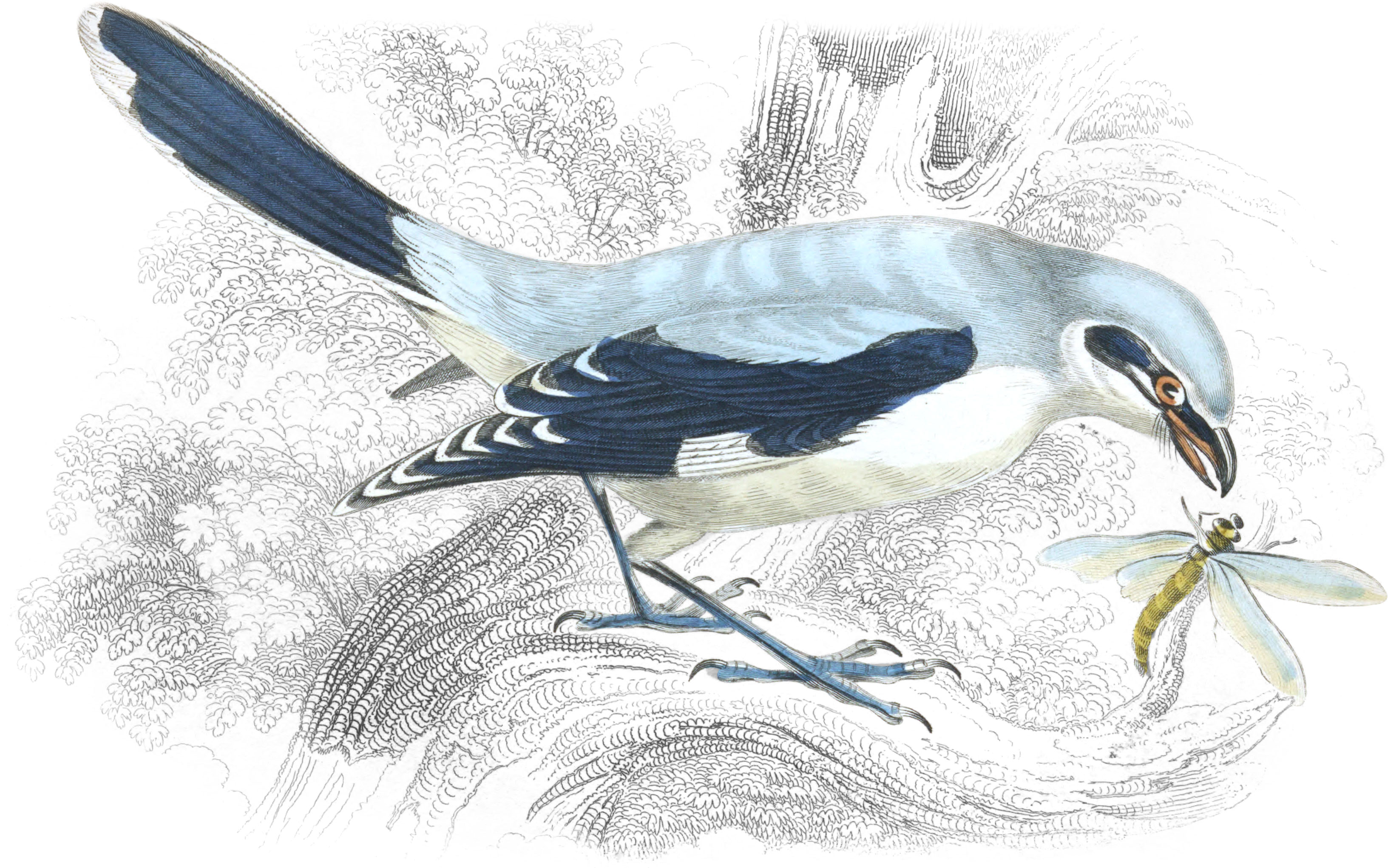
Plate I
Red-Backed Shrike
Lanius collurio, Linn.—Red-Backed Shrike of British Authors.
Unlike the species we have just described, the Red-backed Shrike is one of our summer visitants, breeds with us, and again migrates to enjoy a more genial winter after the cares of incubation. It is also more abundant than the last in the southern and midland counties of England, decreasing in numbers as we approach the Border, and, so far as we can learn, not yet captured either in Scotland or Ireland. England, in fact, seems the limit of its migration to the north. It extends to the African Continent; and, like most of the European species which are also African, is found in almost equal abundance in the south of Europe; and parts of Spain and Italy, with the south of France, may perhaps be stated as the districts where it is most abundant. Mr Yarrell mentions that specimens have been sent to the Zoological Society from Trebizond.7
In its habits it exhibits the same propensities with the gray shrike, though perhaps in a less degree. Large insects are its most common food, particularly grylli, and some of the coleoptera, and it pursues this food in preference, its weaker form preventing it from attacking small birds or mammalia, except when impelled by a greater degree of hunger. Instances, however, of the red-backed shrike seizing and impaling small birds, are detailed by several ornithologists worthy of credit,8 while it is known that it is frequently taken by the London bird catchers when striking at the decoy birds in the clap net. The nest is generally placed in a bush or hedge, and has not yet been recorded to be built on trees, as that of the gray shrike is occasionally; it is comparatively a large structure, coarsely but firmly built with weak twigs, roots, &c. as a base work, and lined with moss, grass, hair, or wool. The eggs seem somewhat variable; those in our possession are milk-white, spotted with rufous, and they are described as bluish white, spotted and zoned with wood brown and ash gray, also greenish white, with dark spots.
The head, back of the neck, and rump, are ash gray; the centre of the back and wing coverts reddish brown; space between the eye and the bill, surrounding the eyes and auriculars, deep black; the under parts, when newly killed, pale peach-blossom red, inclining to pure white on the throat, and varying in intensity in different species; quills are wood brown; the tail has the four centre feathers entirely black, those on the sides white at the base, that colour forming a bar across, and limiting the black of the tips gradually towards the exterior feathers; shafts black for their whole length; on the last feather the outer web is white entirely, and the black assumes the form of an irregular spot at the tip. The female has the colours duller, the back more tinted with gray, and the under parts barred with blackish brown, the ground colour being of a more yellow or grayish white, and without any appearance of the delicate blush colour seen in the male. In the young birds, the upper parts and auriculars are yellowish brown, tinted with gray, having each feather barred transversely at the tip with umber brown, followed at the extremity with pale wood brown, altogether shewing rather close undulations; above the eye there is a yellowish white streak; the under parts are of the same colour, nearly unspotted on the throat and centre of the belly, but having the flanks and breast of a darker tint, and transversely barred with umber brown. The tail is of a uniform yellowish brown, darker at the tip, and having the two outer feathers edged with white.9
The length of the adult male is about six inches.
Woodchat
Lanius rufus, Brisson.—L. rufus, Lath. inc.—Woodchat, or Woodchat Shrike of British Authors.
The Woodchat, until of late years, was not admitted to a place in the British Fauna. Some of the older ornithologists, most probably, were acquainted with it, but as no authentic specimen could be traced, it was with praiseworthy scrupulosity excluded; and nearly the first public record of a specimen being captured is in the second edition of Mr Selby’s British Ornithology. It is there introduced on the authority of Mr Lead-better, and of the Rev. Mr R. Hamand, of Swaffam. Since that, a few more instances have been noticed, and there are some interesting derails published regarding it by Mr Hoy in the Magazine of Natural History; but still it can only be viewed as a very rare British straggler, visiting us during the summer months. None of our writers dwell much on the habits of the Woodchat in this country, certainly from the want of opportunity to observe them. Mr Hoy, in the Magazine of Natural History, gives a few interesting particulars, though the authority on which he relies is not stated. According to that gentleman, the nest is placed “invariably on trees,” the oak being selected in preference, it is composed on the outside of sticks and wool, mixed with the white moss from the bodies of the trees, and is lined with fine grass and wool. The eggs are described to be smaller, but somewhat similar to those of the red-backed shrike, and as variable in their markings.10
The Woodchat ranges generally over the more temperate parts of the European Continent, but only becomes a common bird in the south. According to Swainson it is migratory in Sicily, residing there for a short time during the month of May.11 On the African Continent its distribution is very extensive, being found in the north, west, and southern coasts, residing during the year, and, except in an occasionally more or less brilliant tint of colour, not varying from the birds of Europe, or the few stragglers which have been killed in this country. Above each nostril, between that and surrounding the eyes, yellowish white; the forehead, a streak above each eye, and auriculars, brownish black, which extends downwards in a narrow streak, reaching the mantle, which is of the same colour; crown of the head, occiput, and nape reddish orange. Separating the mantle from the scapulars and coverts, there is a patch of white converging and almost insulating those parts; the rump and tail coverts are of the same colour, sometimes tinted with yellowish; the wings are blackish brown, except the base of the quills, which are white, and exhibit a triangular spot of that colour; the four centre tail feathers are brownish black, the others are white at the base, and that on the outside entirely of that colour, except a few dark bars on the inner web; the under parts are white, or yellowish white, more or less barred with brown, according to the maturity of the specimen. In the female, the upper parts are of a browner tint, and the under surface more barred. In size it fully equals the last, being from six to six and a half inches in length.
In some specimens, and perhaps those which have attained maturity, and are in full breeding plumage, the dark parts of the plumage are nearly black.
In specimens which we possess from Sierra Leone, and which do not appear to vary materially from those of Europe, we have the dark parts very deeply coloured, the pale patches tinged with yellowish, and the colour of the head arid nape of a very deep brownish orange. In all respects, however, they seem in complete plumage, and not in the intermediate changes described by Mr Swainson,12 in which state the same collection also possessed specimens.
Murulidæ
From these three birds just described being the only British members of the Laniadas, we have to pass by a long list of varied forms, beautiful in their gradations, to reach the second great family of the Dentirostres, where we snail find a few examples of the typical group, and one of a very curious and interesting genus, the only example we possess of the sub-family Myothcrinæ. This is the Cinclus aquaticus, the Dipper, or Water Ousel of British ornithologists.
This very interesting little bird has long been a stumbling block to systematists. It has been handed about from one genus to another, and even when a name has been allotted to itself, and one or two others, it still gives uneasiness, and has scarcely yet received a family mansion, where it can dwell in order undisturbed; and although our opinion of its proper station may be formed, we cannot expect, where there is a complication of characters, that all our ornithologists will coincide with it. We do think, however, that it will maintain its place among the Myotherinæ, where nearly all our great advocates of a natural system of affinities have arranged it; and by means of foreign genera the gradation of form can be beautifully traced. The genus consists of only three well authenticated species, and may be thus characterized,—
Cinclus.—Generic Characters.—Bill slender obsoletely notched, nostrils naked, forehead small and narrow; wings-rather short and rounded, first quill nearly spurious, second, third, and fourth nearly equal; tail rather short, even; feet large and strong, lateral toes equal, tarsal scales entire.—C. aquaticus.
The European Dipper
Cinclus aquaticus.—Bechstein.
Cinclus aquaticus, Bechst.—Merula aquatica, Briss.—Sturnus cinclus, Linn.—Turdus cinclus, Lath.—Cincle plongeur, Temm.—Water-Ousel, Dipper, European Dipper, of British authors.
The Common Water Crow, or Pyet, as it is familiarly termed in Scotland, is a favourite with every one who resides near its haunts. The solitary and secluded nature of the streams it frequents, and their often wild character, render it a most fitting accompaniment,—sufficient to break the solitude, but never obtruding on the calmness of the picture; one of those beautiful instances of nature’s chaste compositions, where the life of the landscape combines to harmonize with all around; and here the effect is still more brought home by the simple and peculiar melody of its song. Its common locality in summer is rocky alpine, or subalpine streams, and it seems indifferent whether the banks are thickly clothed with wood and natural brush, or are bare and barren. If civilization has encroached on their retreats, and machinery or mills have been in consequence erected, it accommodates itself to the event, loses its secluded habits, and seems to enjoy the bustle. It may often be seen perched on the inner spokes of the mill-wheel, singing its low melody; and we have known it to breed within the passage of the torrent which drove it. In such places they Jive in pairs, each having as it were a locality or limit within which they range, and select an appropriate situation for the nest. They sport about the banks of the stream, flying short distances, and during flight utter their single monotonous alarm or call note. When about to alight, they drop or splash into the pools or stream, and almost never at once settle on the stones or rocks. They are one of our most pleasing songsters, though from the lowness of the note it is not often observed; but to the angler, who plies his rod at all hours, and in the most sequestered scenes, it is a well-known and welcome strain. It may be at times heard during the whole year; but spring and the breeding season are the periods when it may be most easily and constantly enjoyed. The birds being early breeders, this sign of the coming year is often heard in February, while the streams are still bound up in ice; and a clear and shining morning, at this early time, will be sure to display some of those clean songsters perched on a prominent stone or stick, or on the edge of a frozen pool, warbling their notes just audible above the murmurs of the stream. Their breeding places are chosen near to the brook or river, and often in curious situations. The nest is generally constructed under some brow or overhanging rocks, or among the matted roots of a tree; at other times under some fall, which is projected over a space hollow, and comparatively dry within, or beneath the dam or weir which serves to turn off the water to supply machinery; and we have once or twice observed it under the very sluice of the millwheel. In the latter situations the parent bird dashes through the face of the rushing waters when about to enter the nest, and seems to enjoy the act, entering and retreating again two or three times before commencing her seat. The nest is built chiefly of the common mosses, lined on the bottom with dried leaves. It is of a circular form, with an entrance hole on the one side, and seen exteriorly is very similar to the structure of that of the common wren. Where it is placed in a situation resting on some narrow ledge, but entirely free above, the building is made completely round; but where the impending brow or rock may form the top, it is used as a part, the front only being filled up with moss. Mr Thomson has mentioned one instance, where the “domed structure” was dispensed with; but though this may occasionally happen, the general character of the structure will be found to be supplied in a manner instinctively either one way or another. In like manner the circumstance of the bird perching on the willows around, as mentioned by the same author, was unusual; it is not their general habit even in gardens fringed with brush. A stick or branch which had fallen across the stream may be resorted to; but we have never seen it inclined to perch on the overhanging bushes, and would refer this variation to some peculiarity in the locality. In winter, when the higher streams become frozen, and the cold intense, the “Water Crow” removes to the banks of the larger and lower flowing rivers, or to the margins of some unfrozen lake. Here they find a more abundant supply of food, and their aquatic habits and manner of fishing are more easily observed. On every reach one or two may be now seen perched on some projecting stone or stick, or watching by the very edge of the ice, whence they drop at once on their prey, consisting at this time in great part of small fishes. They are most active in their motions during this occupation, and dive and return to their station with much rapidity. In milder weather, or when the rivers are less choked with ice, they swim and dive in the centre of the pools, and so expertly, that we have mistaken and followed them for the little grebe. At this time, and I may say generally, aquatic insects, the larvæ of phryganidæ, and in some situations different species of fresh water shells, form their chief food, which in summer again is varied by a greater choice of insects and aquatic larvæ. It has been during the continuance of a very severe frost only that we have seen this bird seize small fishes in the manner above mentioned, of diving from the edge of the ice; at the distance observed they appeared to be minnows, and were brought up held cross-ways in the bill. The ova of any kind of fish we have never detected in their stomach or intestines, nor do we think they habitually, at the proper season, frequent the places where spawn would be deposited; and if they did, we would deem it almost impossible that they could reach it after it was impregnated and covered in the spawning bed, which it is before the parent fish leaves the place of deposition. Neither have we any knowledge of the ova being sought after about the period when they begin to acquire vitality, and when they might become a much more easy prey. This, in fact, is the only time when any destruction could be accomplished. In the north of Scotland this little bird is persecuted for its supposed depredations; and we were astonished, before learning the reason, to find such suitable localities totally uninhabited by them. Here the provincial name of King-fisher is given to them, a reward of sixpence is put upon their head, and in one Highland district we have the factor’s authenticated report of five hundred and forty-eight having been destroyed during three years!
The European Dipper, so far as we know, is entitled to its specific name, and has not been found out of the European Continent. We have no record of its passing the Asiatic frontier; and we have reason to think that its range ceases even long before it reaches that boundary. In Britain, Scotland may be said to be its stronghold—very few districts wanting it; and it extends to all the larger Hebrides. In suitable localities in Ireland, according to Mr Thompson, it is equally plentiful;13 and it is found in England wherever the character of the country assimilates with that which it elsewhere frequents.
The head, sides, and back part of the neck, umber-brown; the upper parts of the body, the wings, and tail, black, having the feathers on the shoulders and back edged with blackish-gray; the eyelids, the throat, neck, and breast, are pure white; the belly chestnut-brown, shading into dark brownish black on the flanks, and to blackish-gray on the vent and under tail covers; the legs and feet are yellowish-grey; the tarsi clearest in colour along the front. In the female the white and chestnut of the under parts are scarcely so clear, and the gray edges of the feathers on the back are more clouded. In the young the upper parts, including the head and neck, are of a deep gray, the edge of each feather being yellowish white. On the throat and breast dusky yellowish or grayish white, darker where the chestnut band commences, and shading into dark gray, having there the feathers edged with a pale tint, while on the throat and breast each is tipped with a narrow bar of blackish gray, giving a clouded or dark appearance to the whole.
We have no doubt that the Penrith Ousel of Dr Latham, and Colonel Montague’s varieties mentioned in the appendix to his supplement, are birds in the first plumage, perhaps of a late brood.

Plate II

Merulinæ, or Thrushes
The next sub-family, the Merulinæ, will comprise all the more typical forms of the group itself, but in our Fauna we possess an example of one only, that of the true Thrushes, comprising the genus Merula of Kay, of which we now add the characters.
Merula.—Willughby, Ray.—Generic Characters.—Bill slightly bending to the tip, distinctly notched; rictus furnished with weak bristles; wings lengthened, first quill spurious, third longest; tail moderate; feet formed for walking as well as perching. M. viscivorus, vulgaris, &c.
Note.—Cosmopolite; breed on trees or bushes; many species migratory and gregarious; voice often melodious.
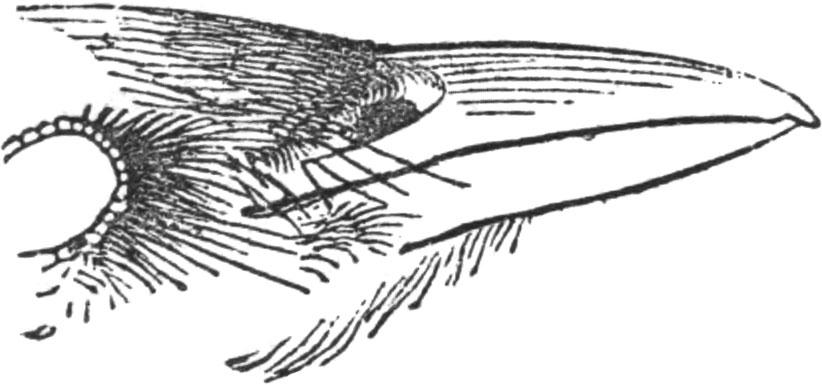
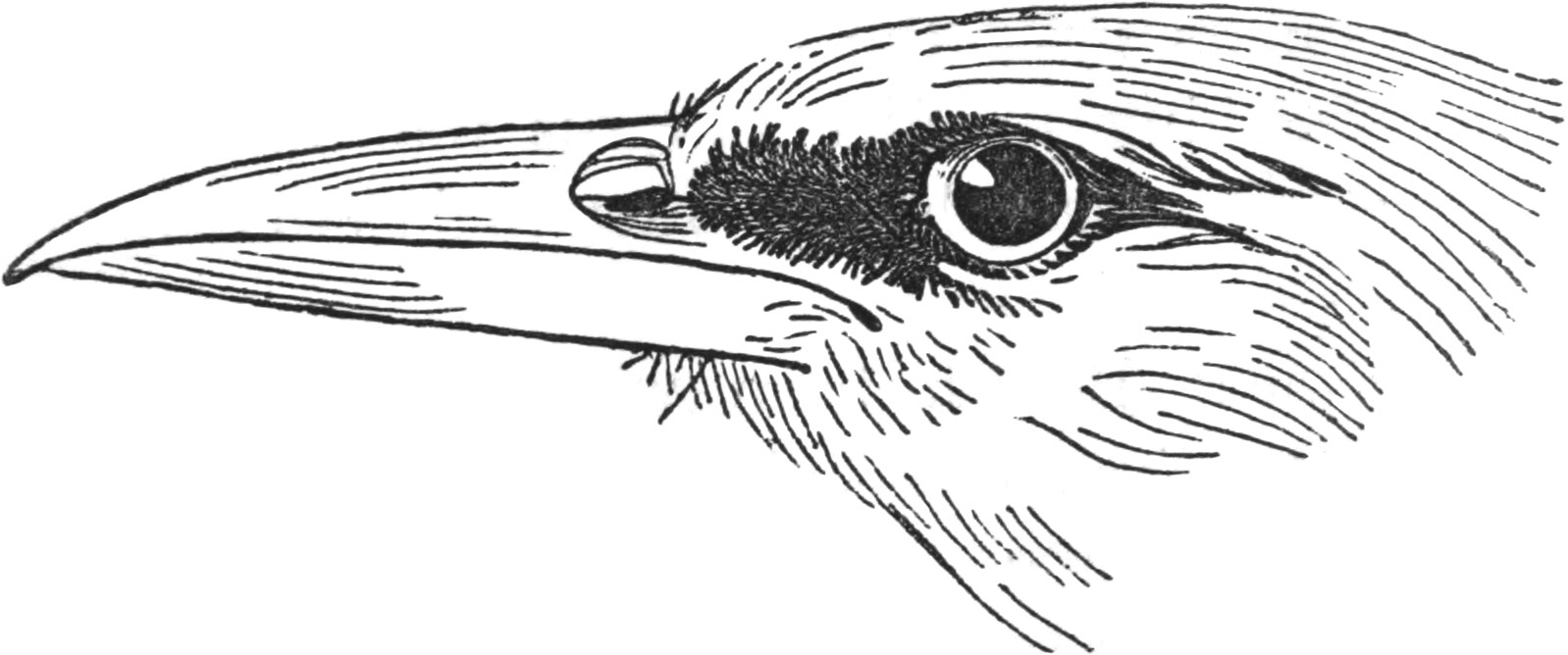
Thrush Beak
The true Thrushes, in all their members, taken collectively and in adaptation to their general habits, shew considerable perfection. The parts are adapted for extensive locomotion, either in walking or perching, or during flight; many perform long migrations, and extensive flights are taken even in those countries where the climate does not render this annual removal necessary. They are nearly omnivorous; a great part of their sustenance is sought for upon the ground, particularly during that season when insects are not indispensable for the welfare of their broods; and their feet and tarsi are admirably formed for walking and inspecting the various places where their food is then chiefly to be found; at other times, they live upon fruits and other vegetables, with the larvæ of insects, and the abundant supply of large and succulent caterpillars; but during winter, the molusca and worms common to low meadows and moist woods, such as the various snails, &c. are nearly their only food; for after the first month of the inclement season has passed, most of the winter wild fruits and berries have fallen from their stocks, or have been already consumed by the various tribes which subsist upon them. Very few of the species are quite solitary. During the breeding season the greater part of them separate into pairs; but after the broods have been reared, they congregate either into large flocks, or in groups of five or six. Those of smaller numbers generally become more domestic, and approach dwellings and cultivated districts on the approach of winter, while the birds which congregate into large flocks are always remarkably shy, and difficult to be approached, the flock being on the alert the moment the note of alarm has been uttered by one more watchful than the rest. Their cry or note is harsh and sharp, or shrill and monotonous, except during the season of incubation; at this period the notes of some are remarkably pensive and melancholy, while others possess considerable compass of voice, accompanied with great melody. On this account they are universal favourites, and in all countries are listened to with pleasure, and with feelings which recall many recollections and associations of days which had long passed away. Their melodies, however, do not save them from varied persecutions. In many countries they are used for food, and are taken in the south of Europe by various snares for this purpose; and in North America the destruction of some of the species is described by Wilson to be immense. In geographical distribution, the genus will range extensively in every quarter of the world; but the greatest numbers seem confined to regions of a moderate degree of temperature. Europe possesses twelve14 species authentically described, of which our British list can now boast of seven individuals. We have selected for an illustration a very beautiful and perfectly typical species.
Missel-Thrush
Merula viscivora.—Turus viscivorus, Linn.—Merula viscivora, Selby.—Merle draine, Temm.—Missel-Thrush of British authors.
The Missel-Thrush is at the present time pretty generally distributed over England and the southern portion of Scotland, living in the latter in pairs, in the richer woodland parts; yet neither so abundant, nor prevailing so equally and indiscriminately, as the common Song Thrush or Blackbird. We would consider it naturally a forest bird, but here it also frequents the borders of the wood, or the orchards and gardens situated in a well-clothed district. We believe that in England, and particularly in the northern counties, it has increased in abundance; and in its Scotch localities, within the last fifteen years, it has, from being a rare bird, become one of frequent occurrence. Out of Europe, it extends to Asia, and we possess specimens from the Himalayan range, varying in no respect. They pair very early, arid the male begins to attempt his song often ere the winter’s storm has commenced; this year (1839) one was heard warbling his low and pensive notes so early as 5th January. During the whole breeding season, they are bold defenders of their territory, suffering no intruder to approach without every attempt being made to defend their nest Magpies and carrion crows are severe assailants, though both are often successfully engaged; but their most troublesome enemy, where there happens to be a colony near, is the jack-daw, which gains by perseverance what the others fail to obtain by force. We have seen four or five of these birds assail the parent thrushes, and while some made the attack, the others deliberately plundered the nest. During the contest, the cries of the thrushes are loud and incessant, and at once tell that some depredator is near. The nest is placed almost always in the cleft of a tree, or close to the bole; at times we have seen it near the summit, at other times, placed so low that we could look into it from the ground, and it is very frequently built on the fruit trees of a garden or orchard. The foundation of the nest is laid with slender twigs, or stalks of grass, and when the fabric is reared, the outside is patched over with pieces of lichen, apparently generally taken from the tree on which it is built, certainly never of a very opposite character from those which grow around, and thus they serve as an excellent blind against detection. The eggs are from four to six in number, of a green or blueish white, spotted and blotched with reddish brown. When the duties of incubation are concluded, the broods with the old birds keep together, and towards the commencement of winter, sometimes collect in flocks of from twenty to thirty, feeding on the wild berries which are at this time nearly ripe. They soon, however, seem to disperse again, and during the whole of the winter may be seen in parties of five or six, or in pairs, feeding sometimes on the wild fruits, and at others selecting the low meadows or pasture grounds. They are remarkably fond of ripe grapes, and commit great havoc among a crop of this fruit; in winter we have seen them select the berries of the holly and the yew in preference to those of the hawthorn, or our other native kinds. This thrush remains with us during the year, and we are not aware of any partial migration taking place, or of any accession of numbers, though we have sometimes thought that the small flocks of from twenty to thirty before alluded to, appeared to be removing at least from one district to another. These may have been parties of the younger birds commencing a migration, for we have hardly an increase to account for all those which are bred in a district; at the same time, we know that many pairs of old birds remain constantly, and without changing the range to a great distance, and some we have seen, for a year together, every day we remained at home.
The general colour of the upper plumage is hair brown, varying in intensity, and sometimes tinted with yellowish or with oil-green, which prevails on the neck. The outer webs of the quills, coverts and scapulars, are edged with pale wood brown; the inner webs umber-brown, tinted with ash-gray; the tail is chiefly of the latter colour; the outer feathers tipped with white. The under parts are clear and delicate yellowish white, often shaded on the sides of the breast and flanks with buff-orange; the tip of each feather has an umber-brown spot, triangular in form on the throat and breast, on the belly and flanks of the shape of the tip of the feather. The edges of the auriculars are also tinted with the same colour, and the whole under surface presents a rich but chaste combination of colours and markings. The under wing coverts and axillary feathers are of the purest white, serving at once to distinguish the Missel-Thrush from any state of the Javanese and Indian species somewhat similarly dressed. Legs are pale wood-brown. The length is from eleven to eleven and a-half inches, and there is little difference either in the size or colours in each sex. The young have the upper plumage confusedly barred with yellowish white, and have more gray on the head and neck. The quills and coverts have broader pale margins and tips, and the under parts have a more yellow tinge.
White’s Thrush
Merula Whitei.—Merula Whitei, White’s Thrush.—Turdus Whitei, Eyton’s Rarer Brit. Birds.—Gould. Yarrell.
We have been unable to see any of the specimens procured in England of the bird which has been figured and described by the above quoted authors, under the name of White’s Thrush, and as there can be no doubt of its being an addition to the British Fauna, we give the substance of what is known regarding it, acknowledging our information to be derived from the descriptions of these gentlemen only. The proper situation for its introduction seems to be after the Missel-Thrush: at the same time there is a considerable difference in the general form, and also of that of the bill, between the true thrushes and the Merula varia with some species from Alpine India, which seem all to be very closely allied to it, arid may hereafter be found to constitute a small section or sub-genus.
Two specimens of this bird have been obtained, the original one shot by Lord Malesbury, on his estate of Heron Court, near Christchurch, the other procured by Mr Bigge, and shot in New Forest, Hampstead. Two specimens seem also to have been obtained on the Continent in every way identical; and on comparison of these birds with specimens of M. varia from New Holland, Java, and Japan, there seems to be a little discrepancy between some and a tolerable agreement between others. Neither the distribution, nor the history of the British or European specimens, are yet understood. Mr Eyton thus describes Lord Malesbury’s bird:—
The general colour of White’s Thrush, on the upper surface, is ochraceous yellow, with a greenish tinge on the crown; tips of all the feathers black or dusky, forming narrow transverse lunated spots; auriculars with a black line extending from the occiput over their posterior edges; under surface white, with an ill-defined ochraceous fascia across the vent; all the feathers tipped with a black or dusky lunule, within which is one of light ochraceous; the throat and under coverts pure white; thighs dusky; quills tipped with light ochraceous, the edges of each extreme web, near the points and the base, marked with an elongated patch of the same colour, presenting, when the wing is partly closed, the appearance of two transverse fasciæ across the whole of the quill feathers; spurious wing, ochraceous, tipped with black; greater wing coverts, with the outer webs, ochraceous; lesser and middle wing coverts, ochraceous, with a large spot of black on each web; legs and bill of nearly the same colour as in the Missel-Thrush; claws horn colour; size rather larger than that of the Missel-Thrush.15
Fieldfare, Merula pilaris
Turdus pilaris, Linn.—La Litorne of the French, Field or Fieldfare of British authors.
It is nearly equal in size to the Missel-Thrush, and is clothed in colours more gay, but as chastely and beautifully blended, and instead of remaining with us during the whole year, is one of our most regular and abundant visiters in winter. Its time of arrival is late in November, generally at least a fortnight subsequent to that of the Redwings, and it appears sometimes in vast flocks, and commonly in parties of not less than thirty or forty together. On arrival, they often betake themselves to the vicinity of the berry-bearing trees, where they remain until the crop has been entirely stripped. The fruit of the mountain ash is a great favourite, and being nearly ripe about the time of their arrival, is eagerly sought after. As the winter advances, and these supplies fail, they seem to seek and frequent the more moist upland pastures, and as the storm sets in with severity, gradually seek the lower grounds where there is more shelter and moisture. If a storm continues for some length, they are reduced to sad extremity: many of them, in some years, perish with exhaustion and for want, and their incapability to exist during a continuance of frost and snow plainly shews the necessity and wisdom of their migration, for they never seem to attain the domestic habits of the common thrush or blackbird, which, when driven by distress, will seek relief with the poultry and the refuse of the farm-yard. In some severe winters we have repeatedly taken this commonly wild bird with the hand in a state of complete exhaustion.16 When the ground has been for some time frozen up, we perceive a sure indication of the distress of the Fieldfare, by small parties of from a pair to five or six, frequenting the open springs and shallow ditches, remaining by the river’s side, and endeavouring to find about the moist edges a precarious subsistence. This forenoon, (29th January, 1838,) after fourteen days of intense frost, we see them sitting associated with the snipe, and when alarmed, instead of the alert rising flight, and loud chatter of prosperity, they weakly flutter off to the nearest cover, where they conceal, and will scarcely again betake themselves to flight. When the time of their remigration returns, which is sometimes not till May has far advanced, they have for some weeks been collected in bands larger than usual, as if the various flocks had been called in from the district around. They now regularly frequent some favourite feeding ground, and may be seen scattered over the plain or passing overhead now with renewed vigour and a noisy flight, as if preparing for the more lengthened journey which they are about to perform. Their roosting places at night are either on trees, particularly the pines at evergreens, or on the ground. We have undoubted authority that they occasionally resort to the first for shelter,17 and we have often, ourselves, intruded on the sleeping grounds in the evening. One situation is a whin cover where there is abundance of tall grass; another was a young plantation of two or three years growth, among long heath: in both places the flock had alighted, and were disturbed so late at night as only to be known by their alarm-cry, uttered as they rose. Their roost, in these instances, was among the long grass and heath. Mr White’s observations long since corroborated this fact, for he tells us,
that larkers, in dragging their nets by night frequently catch them in the wheat stubbles.18
Mr Thompson mentions having disturbed them from similar places in Ireland, after they had settled for the night.
The great body of the Fieldfares re-migrate19 during the month of May; and immediately on their arrival at the summer’s residence, commence to prepare themselves for the great purpose of breeding, and it is a remarkable circumstance, for the first intimation of which we are indebted to Mr Hewitson, that contrary to what we know of the habits of the other thrushes, this species breeds in companies or gregariously. Their summer country is the north of Europe, where they seem to frequent the extensive pine forests, and here they have been, by all our writers recorded to breed; but as we have only had this fact, in modern times, satisfactorily proved by the excursion of Mr Hewitson, we are tempted to extract his description of their breeding place from his beautiful “Oology.”20
We had, during a long ramble through those almost impassable woods, met with many nests of a previous summer, which we supposed must have been once tenanted by the birds of which we were in search; and after having climbed many a tree to no purpose, were returning homewards disappointed, when our attention was attracted by the harsh cries of several birds, which we at first supposed must be thrushes, but which afterwards proved to be Fieldfares, anxiously watching over their newly established dwellings. We were soon delighted by the discovery of several of their nests, and were surprised to find them breeding in society. Their nests were at various heights from the ground, from four to thirty or forty feet or upwards, mixed with old ones of the preceding year: They were, for the most part, placed against the trunk of the spruce fir. Some were, however, at a considerable distance from it. Upon the upper surface, and towards the smaller end of the thicker branches, they resemble most nearly those of the ring-ousel. The outside is composed of sticks and coarse grass, and weeds, gathered wet, matted together with a small quantity of clay, and lined with a thick bed of fine dry grass. The eggs are from four to six in number, and in colour closely resemble those of the blackbird or ring-ousel. Two hundred nests or more were frequently within a small space.
During the last year, (1837,) one or two notices have appeared in Charlesworth’s Magazine of Natural History, of the Fieldfare having bred in Scotland; but with every wish to pay deference to the discrimination and accuracy of the writer, we cannot help still feeling a little sceptical as to the fact; and it would be most satisfactory if, during the ensuing summer, he would secure a specimen or two of the old birds, and of their eggs. In these instances, the nests have been quite solitary.
A specimen shot in December, presented the following colours, which, with a slight variation of depth and clearness, will come near to the ordinary winter dress of the species:—Bill black at the tip, yellow towards the base, particularly of the lower mandible; crown, cheeks, nape of the neck, rump, and upper tail coverts gray, (the lavender purple of Syme;) the centre of the feathers on the crown streaked with black, which, towards the breeding season, appears to widen, and become deeper tinted; before the eye, and beneath it, there is a patch of the same black which sometimes runs narrowly over the auriculars; above the eye there is a streak of pale gray sometimes inclining to pale yellowish white; the centre of the back and wing coverts are rich umber-brown, deeper in the centre, and on the coverts edged with paler; quills blackish brown; secondaries edged with paler brown, primaries with gray; tail blackish brown, feathers at the base edged with grayish brown; throat, breast, and flanks ochraceous yellow, the centre of the feathers dashed with black, these markings broadest on the sides of the breast and flanks; centre of the belly and under tail coverts, pure white, the latter at their base having grayish blotches running up the outer part of the webs; under wing coverts and axillary feathers pure white. Length about ten to ten and a half inches. The Fieldfare is sometimes found with the whole colours of a paler tint, but still keeping their general distribution and varieties with the head, or head and neck white or pale gray, are mentioned by Dr Latham. There seems little difference in the colours of the sexes.
Redwing
Merula Iliaca, The Redwing, Turdus iliaca, Linn.—Redwing of British authors.
Is another of our migratory thrushes, visiting us, like the former, in winter, and returning to nearly the same latitudes to breed and spend the summer. It arrives on our shores, however, at a much earlier period than the fieldfare, being often seen in small parties towards the beginning of October, when, after quitting the coast, we have generally first observed it about the sub-alpine glens, partially clothed with hawthorn and brush, now comparatively tame, and seeking the shelter rather than attempting to escape by flight. With the advance of the season, it also gradually draws towards the lower grounds, feeding on the hedges mountain ash, &c. and frequenting one locality until it has plundered and devoured the whole crop of berries. They are now wary, and can scarcely be approached openly, but still are not so watchfully alert as the fieldfare; their alarm cry is a shrill whistle, and, during their winter visit, they give utterance to no more melodious note. When the wild berries fail, they betake themselves to the low meadows or upland pastures, as the weather is severe or mild; and, on the return of spring, again re-migrate to their more northern summer quarters. In some seasons, also, they appear to remove or perform partial migrations, according to circumstances, after their arrival in this country; and when food fails, or severe weather ensues, those of the more northern districts travel still farther southward. Mr Selby mentions an instance of this in 1822, when, on the failure of the abundant crop of wild berries which that year afforded, and at the commencement of a temporary thaw, they migrated southward; in the present year, (1838,) a few flocks as usual appeared at the time of their arrival, but, since the middle of November, a Redwing has not been seen. The breeding of the Redwing is still less known, and its nest has been less frequently seen than even that of the fieldfare. The northern forests seem also to be their resort, but in some parts of Norway it is less frequent, or it is, perhaps, more locally distributed. Mr Hewitson found the nest only twice, both times with young, and states that it is similar to that of the fieldfare, but is placed nearer the ground. During the season of incubation, it is a sweet songster, selecting, like most of its congeners, the summit of some eminence, for the pouring forth of its melody; in Norway it has received the appellation of Nightingale from its “delightfully wild note.”21
The head, upper parts, wings, and tail, are hair-brown, tinged with oil green; and, in a flock, a single thrush can be at once distinguished from them by the yellow tint of its plumage. Over each eye there is a streak of yellowish white, also a conspicuous distinction from the thrush. The under parts nearly white, purest in the centre of the belly, and covered on the throat, breast, and sides of the belly, with oblong-brownish black spots, which often run in lines. Side of the belly covered by the wings, and under wing coverts deep orange-red, somewhat approaching to the light-red of artists, and whence the species has received its common English name, also the best specific mark. Female does not vary much except in the intensity or clearness of the colour. Cream-coloured, or yellowish white varieties, not unfrequently occur—seldom, however, of a pure white.22
Song Thrush
Merula musica.
Song Thrush, Merula musica. Turdus musicus, Linn.—La Grive, Merle grive, Buff. Temm.—Throstle, or Song Thrush, of British authors.
In all countries, the cries of animals, and the notes and songs of birds, are taken notice of by the most untutored natives of an uncivilized region—they are listened to as indications of the changes of the weather—and to point out where some wild crop of a useful and important vegetable or fruit may be found; or in the times of recreation, of weariness, or distress, they exhilarate or soothe the feelings, and create associations, upon which every mind loves long to dwell. Every country also has its favourite songster among the feathered tribes. The bulbul of eastern tale, the nightingale of our own land, hold prominent ranks; and the cheerful melody of the common Song-Thrush, in a balmy evening of spring, cheers the early labourer, and is listened to with a delight and quiet pleasure which is felt by all. The nightingale (redwing) of Norway, and the wood-thrush of America, seem, in their respective countries, to awaken similar feelings and associations. Most of the thrushes, during the breeding season, utter a song grateful to the ear, while some of them, at this time, utter notes clear and deep toned, and possessing peculiar melody. They have also the peculiarity of selecting some elevated spot to utter their song, and the same spot is chosen day after day to resume their music. Our own bird, when pairing, may daily be found perched on the summit of a tree, generally the most elevated in the wood, pouring out with swelling throat his loud clear melody, which ceases during mid-day, but is again commenced with the declining sun. If the day is of that character which we often feel depressing in the spring and fall, dull, unnaturally warm and close, the song is often continued with little intermission; and when we have seen the same kind of weather prevail before winter had entirely passed, the thrush may be heard attempting his lay even in January and February; for the last few years where, in the north at least, a winter of frost and snow has scarcely been known, the music was sung frequently, and with an approach to its usual clearness. This bird, which is arboreal in its usual habits, when gaining the limits of its range where the wood becomes scanty and stunted, still retains its desire for an elevated perch during the continuance of its song; and in the northern extremity of Scotland, the pinnacle of a rock is often selected as the site, whence to cheer his mate, who has selected her breeding place in the brush or ivy screen, or, perhaps, in the rank and tangled herbage growing on the edges of the cliff below.23
The Song Thrush is generally distributed over the whole of Britain. It is met with in the richest demesnes, and abundantly in the vicinity of gardens, attracted by the plentiful supply of food; while it is also found in the wilds of our northern Highlands and Hebrides, where the stunted copse affords a low and comparatively bare shelter. Its European range is also pretty general, but we are not aware of its being traced beyond this division of the world. It continues resident with us during the year; and we do not know that any of them which are bred here migrate, but we have an annual addition to our numbers, which arrive probably from the north of Europe, a little previously to the appearance of the redwing and fieldfare. These, on their arrival, may be found abundantly in the turnip fields, and congregated in the moist pastures. They remain for a short period, and then appear to depart still farther to the south. We do not think that any of our real natives, and Mr Selby has expressed the same opinion, thus congregate. During a severe storm, small parties may be seen together in the vicinity of food of feeding ground; but they are attracted by a common cause, and not by that instinctive desire of congregating together, which we perceive among most birds which perform extensive journeys.
The Thrush breeds early, and has frequently two broods in the year. The nest is built generally not very high above the ground. Evergreens are a favourite shelter, and the young spruces and silver firs frequently afford it a welcome concealment. Where ivy abounds it is also often selected; and in the want of any of these, the hazel or white and black thorns are usually taken as a substitute. It is composed exteriorly with roots, strong grasses, and slender twigs mixed with moss, and the interior is plastered smoothly with a tolerably thick coating of clay or moist earth and cow-dung.24 Our British Thrushes generally use a proportion of clay or dung to strengthen the framework or sides of their nest, but none except the present bird use it so liberally, or make it the substitute for the lining. It is smoothed by the action of the bird turning round in the inside evidently for the purpose, a similar action being employed by many other birds to lay close the down or hair, or other material selected for the lining of the nest The eggs are generally five, very seldom six, in number, well known and admired by almost all for their bright turquois-green and clear black spots, a contrast so beautiful that it is scarcely ever to be resisted by the young bird-nester. The male parent continues his song near his mate during the greater part of hatching time, but flies to her assistance upon any alarm; and both will attack and endeavour to drive off an intruder by their screams. The female at first, and when unsuspicious of danger, allows a close approach to her nest; and if situated in a public place or garden, where persons are frequently passing, becomes a familiar and apparently unconcerned spectator. In our own garden last spring, (1837,) a somewhat singular circumstance occurred. The nest was placed in a common laurel bush, within easy reach of the ground, and being discovered, was many times daily visited by the younger branches of our family. It occurred to some that the poor Thrush would be hungry with a seat so constant, and a proposal was made to supply the want. A good deal of difficulty occurred from the fear of disturbing her, but it was at last proposed that the food should be tied on the end of a stick; this as done, and the bird cautiously approached, and took the first offering. The stick was gradually shortened, and in a few days the Thrush fed freely from the hand until the young were half fledged. After this, when the parent was more frequently absent, a visit would immediately bring both male and female, who now uttered angry cries, and struck at the hand when brought near the nest. This bird is frequently kept in confinement, and if placed in a roomy cage, and kept clean, is a tolerable songster. It is a bird, however, which we never like to see confined, and whose notes in this state can never be relished if they have been previously listened to in its native haunts.
The upper parts of the male are yellowish brown, on the crown and forehead tinted with chestnut brown. The quills and tail are of a deeper tint, and have the margins of the outer webs pale yellowish wood brown; space between the eye and the bill pale buff orange, together with the auriculars; the latter have each feather marked with umber brown, and from the clearness of the markings, a streak of that colour stretches from the base of the maxilla and defines the extent of the plumes covering the ears. The throat, neck, and breast, are rich buff orange, having each feather marked on the tip with broad triangular spots of umber brown. The centre of the belly and vent, and under tail coverts, are pure white, marked with the same dark spots, which become more scarce in the middle, and of less size and more oval form. The flanks are tinted with buff orange and pale hair brown, and have the spots lengthened and in the form of dashes. The under wing coverts, and base of the inner webs of the quills, are rich buff orange, and are marked distinctions between this and the last species. There is comparatively little difference between the sexes; a general dulness of the tints, and a want of clearness in the orange and spotting of the breast, is often all that is observable. Length, about nine inches.
The Blackbird
Merula vulgaris.—Ray.
Merula vulgaris, Ray.—Turdus merula, Linn.—Le Merle, et Merle Noir, Buff. and Temm.—Blackbird of British authors.
With the Song Thrush we concluded the list of our British species possessed of plumage gene rally brown above, and spotted on the under parts, that of the two remaining birds being of deeper colours more uniformly disposed. The Blackbird is equally well known, as widely distributed, and almost as great a favourite as the last. His song is full and deep, but has a greater monotony of tone, and wants the clear and varied notes of the Song Thrush, and we do not think that it is either so frequently sung or so long continued at a time. It is, nevertheless, a better cage bird than the other, is more sprightly in its manners, is easily tamed, and learns to whistle parts of tunes, and even to imitate the sound of one or two words; but though we have often heard the Blackbird whistle correctly the first part of a tune, we never knew perseverance able to teach the commencement of the second part.
The Blackbird is a more skulking and shy bird than the Thrush; it delights more in shrubbery and low bushes, and except when singing to his mate, we seldom see him perched aloft. When disturbed or alarmed, he escapes by running or a low flight, sounding his alarm scream as he flies, and when alighting raises and expands his tail. The food is nearly similar to that of the last, but is sought in gardens, hedges, under the shade and edges of copse or brushwood, and seldom in exposed meadows or pastures; and it pursues the same method of obtaining the snail of the helix nemoralis, which we have already mentioned as observed by Mr Selby. The nest is built in low bushes, evergreens being preferred, and last year we discovered one placed upon the ground, in a plantation, at the root of a young Scotch fir tree. The nest is rather loosely built, with a considerable quantity of mud in the structure of the sides, but lined internally with fine grass. The eggs generally are bluish green, blotched with dull reddish markings. Plumage of the adult male entirely of a deep black, having the bill and eyelids of a rich orange yellow. In young birds, during winter, although the black colour has obtained on the whole plumage, the bill is not of the pure colour until the breeding time, but is more or less of an umber brown, the yellow gradually increasing. Length, from ten inches to ten and a half.
The female, above is nearly umber brown; the colour darker on the wings and tail. The throat is a dirty white, having the feathers in the centre umber brown, which runs downwards in streaks. The remaining under parts are yellowish umber brown, darkening in the centre, and at the tips of the feathers, and towards the vent and tail coverts, and on the breast tinted with rufous. The bill is umber brown tinted with the fine yellow of the male. The young are somewhat like the female, but have the plumage varied by darker waves again contrasted with those of a pale yellowish umber brown, but towards autumn those are thrown off, and the plain dress of the female but many shades darker, is succeeded.
Varieties of almost a pure white occasionally occur, and from the marked contrast to the general colours either in this state or when much pied, is almost immediately noticed; they sometimes also appear of a cream colour, and when either of this shade or pure white, in the female sex the differences in her shades of colour are observable through the structure of the feathers and a very slight variation of tint.

Plate III

Ring Ousel
Merula torquata.—Turdus torquatus, Linn.—Le Merle à plastron blone, Merle à plastron, Buff. Temm.—Ring Ousel of British authors.
This Thrush, not so commonly known as any of those we have already noticed from its not being so generally distributed, and only frequenting particular localities, is a migratory species in every part of Britain, residing with us during the summer and season of incubation, and leaving us on the approach of winter. It frequents mountainous situations, extending also to such as bear an alpine character. We have noticed it on the Cumberland and Westmoreland ranges, and on all the mountain district in the south of Scotland; it is tolerably common on the Pentland range, and we have seen it amidst the scenery where the tale of the Gentle Shepherd is laid; we have seen it also in many parts of the Highlands as far north as the Benmore range in Sutherlandshire, Mr Selby mentions its occurrence on the Cheviots, and we have records of its presence in the more alpine parts of Yorkshire, Derbyshire, and Wales. In Ireland Mr Thompson mentions its occurrence on the mountains in the north-west of Donegal, at Ochil Head, the Mourne mountains, and the Belfast range, &c.25 Though by no means a rare bird in these and similar localities, it is no where abundant, and is generally seen in pairs about some solitary glen or ravine, or by some shelving cliff. At the commencement of breeding, and during the time the female is sitting, the male assumes the characteristic site of his congeners, and may be heard from the elevated rock singing his plaintive melody, consisting of a few notes uttered in a clear and warbling whistle. In these situations he may be frequently heard long before the eye can catch his form, for, perched on high, the colours of his plumage assimilate with the grey rocks, and some motion often first discovers him to the sight. When the young are hatched, the parents fly around with anxious cries, and will venture to attack either a dog or other animal, or feathered aggressor. The nest is placed mostly on the edge of the ravine, or on some shelve of the cliff or bank, among rank or matted herbage, or under the screen of some brush, whin, or juniper; it is a comparatively careless structure, with a base-work of slender roots and stalks, strengthened with clay or mud. The eggs are four or five in number, so similar to those of the blackbird as scarcely to be distinguished from it. These birds arrive at their alpine stations during the month of April; but not residing in the immediate vicinity of their haunts, we cannot speak to within a week or ten days from actual observation. They do not remain any where on the coast or low lands for a short period before their arrival on the hills in their northern range; but we are not sure whether the birds which arrive at once here come directly from abroad, or are a part of those which assemble for a short while on the downs of the south, and then take their departure after apparently resting. In the vicinity of their breeding places, after their young are fully fledged, they descend to the gardens and feed on the fruit. At this time also they are occasionally seen in the lower districts, and frequent the mountain ash or holly for the berries; but in the north, when returning to their summer stations, they are never seen on the lower grounds previously, but seem to hasten directly to the hills. On many of the English “Downs,” they appear regularly in small flocks and parties, both in coming and departing, and remain, at both periods, for a week or ten days.
Entirely of a dull black; the margins of the feathers on the head, throat, and belly, blackish gray. In the female this is much more conspicuous over the whole body. The wings are of a black, rather more gray, or paler, if we may so write, and have the edges of all the feathers broadly margined with gray. On the upper part of the breast there is a crescent-shaped patch of pure white in the male, contrasting finely with his darker plumage; in the female it is rather less in size and scarcely so pure in colour, and the edges of the feathers are sometimes tinted with gray. In the young there is no trace of the pectoral band; the plumage is entirely of a brownish black, varied above by the edges of the feathers being wood-brown, and by those covering the scapulars having a clear streak along the shaft of yellowish white, and the feathers of the wings are more deeply margined with gray. Underneath, the throat is yellowish white, sparingly marked with brownish black, and on the breast, belly, and vent, each feather is varied with alternate bars of yellowish white and blackish brown, giving a spotted or mottled appearance. In the very young plumage, the feathers covering the scapulars have the central streak more distinct, finishing broader towards the tip of the feather. The length is from ten inches to ten and a half.
Oriolinæ
Our next British form will be seen in the family Oriolinæ, containing many birds of very splendid plumage. It is among these that we have the beautiful Irena of the Indian islands, and the Sericulus of New Holland, while the members of the typical genus, distributed over the old world, are clothed in brilliant yellow, broken and interrupted by bold markings of deep black. In form, the true Orioles are rather strongly made, and all possess considerable powers of flight. A minute account of the habits of any species is still wanted, and we only know that they frequent countries moderately wooded, appear in small flocks when the season of incubation has passed, feed on soft insects, caterpillars, fruits and berries, and display considerable care in the structure and mechanism of their nest.
Oriolus, Linn.—Generic characters.—Bill straight, hooked at the tip, distinctly notched, depressed and rather wide at the base, rictus with very fine bristles; wings with third quill longest, first two graduated; tarsus short, feet rather weak, toes united at the base.—Oriolus Galbula.
Europe, Asia, Africa.
Oriolus bicolor
The Golden Oriole
Oriolus galbula.—Linn.
Oriolus galbula, Linn.—Golden Thrush, Golden Oriole of British ornithologists.
The Golden, or European Oriole, to which a much more extensive geographical range has been assigned than what really belongs to it, is the only species which has any claim to a place in the British Fauna, and that is only in the character of a rare straggler, seen generally in spring or autumn, as if the birds had been driven, or had wandered from the regular course of their migration; one or two instances only are mentioned of their having bred in this country, which may have taken place under circumstances entirely fortuitous. During summer, the south of Europe seems to be the stronghold of this beautiful species, straggling northward to Great Britain and as far as Sweden, abounding during the season of incubation in the islands of the Mediterranean, where they assemble in their passage from Northern Africa, but how far they extend on that continent, or how far they pass the Asiatic line, we do not know. The species so frequently received from the Continent and islands of India is distinct, and so also is that from Southern and Western Africa; in both, the black between the rictus and the eye passes through it over the auriculars, as we have endeavoured to represent in a woodcut of O. bicolor. In our British bird it stretches only to the eye.
The nest has been stated by some writers to be of a lengthened and suspended structure, but there seems to have been a good deal of uncertainty regarding this point, although in France there appears no great difficulty in procuring the eggs. From the vignette given by Mr Yarrell,26 drawn from a nest in the collection of the Zoological Society, it is of the ordinary round shape, but is placed in the horizontal cleft of a branch, and each side is included in the substance of the sides of the nest. The structure, moreover, has the appearance of being delicate and careful. The eggs are of a beautiful clear white, relieved by deep black spots, most numerous on the thicker end.
The specimens which have been obtained in this country have been all taken at uncertain intervals; but being a bird of such marked plumage, the occurrence of one is generally heard of. It takes place generally about the time of migration; and in corroboration, we have it remarked by Mr Couch,27 that it occasionally alights on the fishing boats. In Scotland, we have very few instances of its capture, Mr Selby mentions that his drawings were made from two specimens in the Edinburgh Museum, shot near the Pentland Hills. In Ireland, Mr Thompson has recorded five different instances.
The body of the adult male is clear and brilliant yellow; the wings, and the space between the bill and the eye, deep black; the quills are edged, and tipped with yellowish white, which sometimes extends to the tips of the secondaries; the tips of the feathers forming the spurious quills are of the same yellow with the body, forming a triangular spot of that colour when the wing is closed; the two centre feathers of the tail are entirely black, those on each side black only at the base, the tips yellow, which colour increases in extent towards the outside, the last quill having only about a third of its basal length black. The female above is of a yellowish-green, shading on the sides of the neck and breast into yellowish-white, which covers all the under parts, becoming pale yellow on the flanks and under tail coverts, and nearly pure white in the centre of the belly, in all relieved with narrow brownish streaks along the shaft of each feather. The black mark between the rictus and the eye is indicated by ash gray; the wings are brownish-black, shaded with ash gray, and a tinge of yellowish-green on the greater covers, having the quills edged with a broader margin of grayish-white; the tail is yellowish-green at the base, becoming gradually darker towards the junction with the yellow, where it is almost black; the distribution of the yellow is nearly similar to that in the male, but the dark extends on the outer webs nearer the tips, and causes the separation of the colours to appear more irregular.
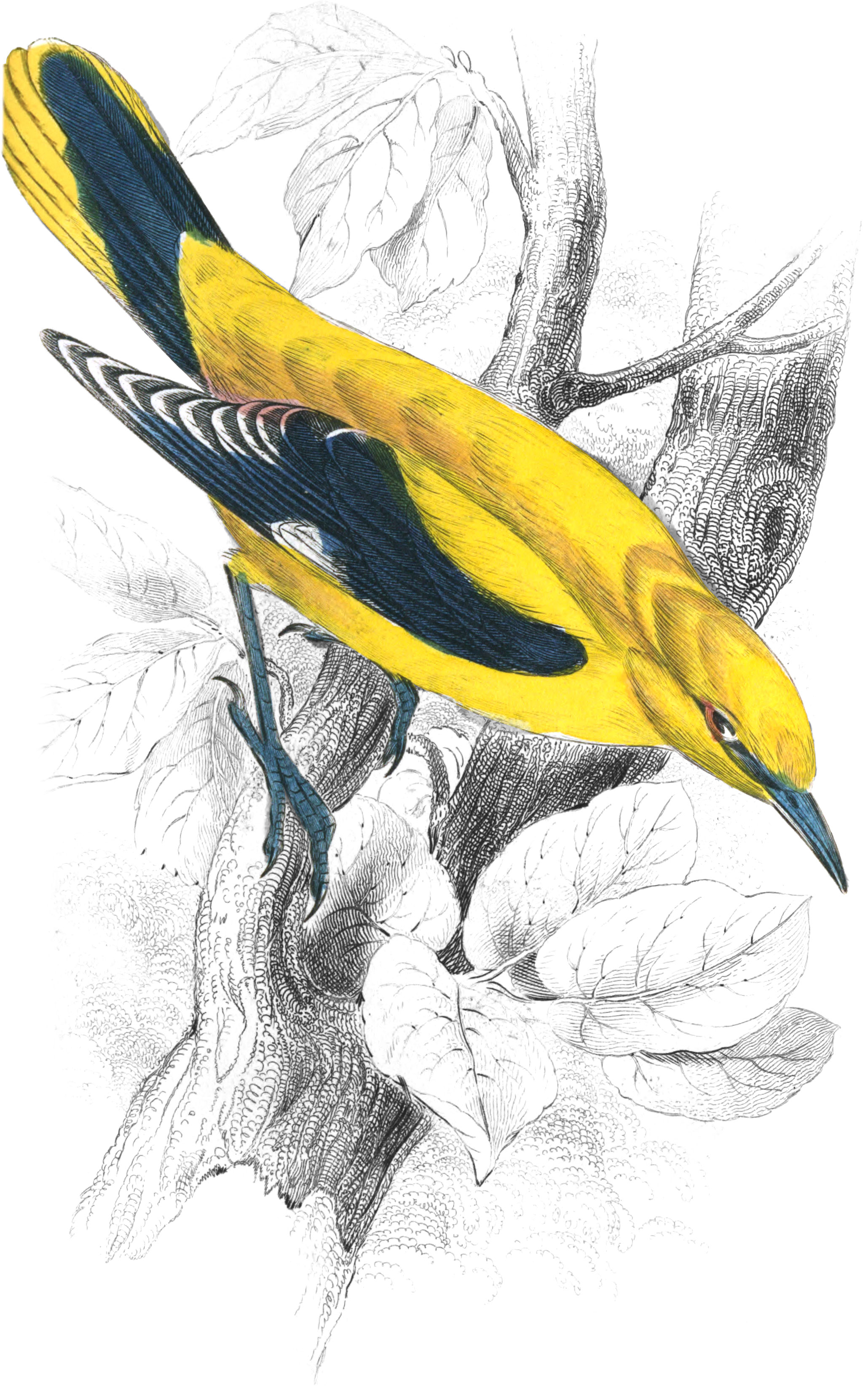
Plate IV
Sylviadæ
We next enter a family of smaller species, abounding in numbers, and extremely interesting, whether we regard the modifications of their form, or the manner in which many of them become familiarized and associated with man in his outdoor occupations. A very great proportion of our native members are migratory, and they change, during the spring and summer months, the ornithological character of our groves and forests, by their cheerful notes or more soothing melody, while they, at the same time, place an important check on the ravages of the various insects which are then bursting forth in great profusion.
In Mr Swainson’s arrangement of the Sylviadæ, the following table will exhibit our British genera, and the numbers in each.
| Saxicolinæ. | Philomelinæ. | Sylvianæ. | Parianæ. | Motacillinæ. |
|---|---|---|---|---|
|
Saxicola 3.
Erithaca 1. |
Phœnicura 3.
Philomela 1. Curruca 4. |
Melizophilus 1.
Syvia 3. Regulus 3. |
Parus 7.
Accentor 2. |
Budytes 2.
Motacilla 2. Anthus 4. |
The Saxicolinæ, or Stone Chats
This sub-family in the British list contains, as our table points out, only two genera, and four species, the typical Stone Chats, and our well known bird, the Robin Red-breast. The first are all natives of the old world, frequenting the wilder solitary moorlands, the wastes and extensive downs and commons of Britain, the steppes of Eastern Europe, or the deserts of Africa and Asia, rendering them almost more desolate from associations produced by their monotonous click or note, or breaking the stillness by their frequent short flight from stone to stone, or from one tall plant to another. The colours of their plumage are sombre and unobtrusive, but they are blended in a pleasing arrangement of gray or yellowish, and reddish-browns, while white is often very conspicuous about the rump and tail, and is sometimes strongly contrasted with black, or some dark tint on those parts. In most countries we believe the species are migratory, or partially so; and the plumage undergoes a change during the breeding season to very dark brown or black in those parts which, in their general dress, exhibit the deepest shades. The food is chiefly insectivorous, it is taken from the ground, very seldom during flight; and thus it is that we always see the birds occupying the summit of a tall plant, the topmost twig of a bush, or the top of a stake or railing, whence they can survey the ground around them, and make a dart on such insects as come within their view. Two of our species migrate, appearing in spring, and disappearing again about the same period with our other summer visitants. The third species migrates only partially, a few pairs remaining stationary on the moors or commons during winter. Their nidification is on the ground, in holes, or at the root of some low bush, the colour of the eggs green, or bluish-green.
Saxicola, Bechstein.—Bill straight, advancing on the forehead, dilated at the base, slightly bent at the tip, faintly but distinctly notched; rictus furnished with weak bristles; wings moderate; first quill very short, third, fourth, and fifth equal and longest; tail even, or slightly rounded; tarsi long, lateral toes slightly unequal, claws weak.
Note.—Europe, Asia, Africa, New Holland.
The Wheat-Ear
Saxicola œnanthe.—Bechstein.
Saxicola œnanthe, Bechstein.—Motacilla cenanthe, Linn.—Sylvia œnanthe, Lath.—Vitaflora œnanthe, Steph.—Provincially Wheat-ear, Fallowsmith, White-tail, or White-rump.
This clean, and to the ornithologist, interesting bird, is one of our earliest summer visitants, sometimes appearing even when the ground is whitened with the last snow showers of spring. It is a common species, and extends from the Land’s End to Cape Wrath, reaching northward to the Hebrides. It abounds in the downs arid warrens of the south, on the lower ranges of sea coast around our islands, and in nearly all the pastoral districts of Scotland. In the latter it arrives in the first week of March, and spends the breeding season, flitting from stone to stone, from one rising ground to another, or in a district where stone walls form the enclosures, flitting before the traveller, and appearing to fall, as it were, on the opposite side of the wall, when starting to resume its flight. It breeds in holes, under and among rocks and stones, in the burrows of rabbits, even occasionally in those scraped by the Sand Martin,28 in old walls and in quarries, and we have found the nest in the rents or splits of dry peat mosses. The nest is built according to the form of the hole, and is composed of fine grasses, with a little lining of wool or hair. The eggs are of a pale verditer green. The food, during its residence in Britain, is composed of insects. On the coast the small mollusca of the warrens are fed upon.
The colours of the adult birds blend and harmonize beautifully together, and are at the same time very contrasted. The forehead, and a stripe above the eyes, are white; the space between the bill and the eyes, the auriculars, the wings, one-third of the outer tail feathers, and the whole of the pair in the centre, are deep black; the secondaries, quills, and coverts, being edged with a pale brown, or brownish-white. These decided markings relieve the pale and delicate bluish-gray of the head and back, which is still farther broken by the pure white of the base of the tail and its coverts, which form a beautiful band, appearing very conspicuous during flight, and presenting a characteristic mark in the distribution of the colouring of the whole genus. The under parts are pale chestnut-brown, becoming paler towards the vent In the female the colours are less clear, and are marked with more brown. In the young birds the tips of the feathers are brown, and the dark markings are indistinct, the pale colours of the edges of the feathers of the wings broader, and the breast is marked with narrow dark bars. We have not been able to procure specimens of this bird in its winter dress; but from what we know of some others, we suppose that the black markings which are so prominent in its high breeding plumage, seen on its arrival in Britain, become in winter more subdued from the lengthened brown tips of the feathers. These fall off as spring advances, and allow the deep tint to be seen unsullied; the same occurs with the gray portion of the back, which is supposed to be more or less tinted with brown.
The other species of British Saxicolæ differ slightly in their habits from the last. They frequent districts covered with low barren brush, or whin and broom, and are less frequently seen on the ground, except when in the very act of taking their prey. They build about the roots of brush, large tufts of grass, &c.
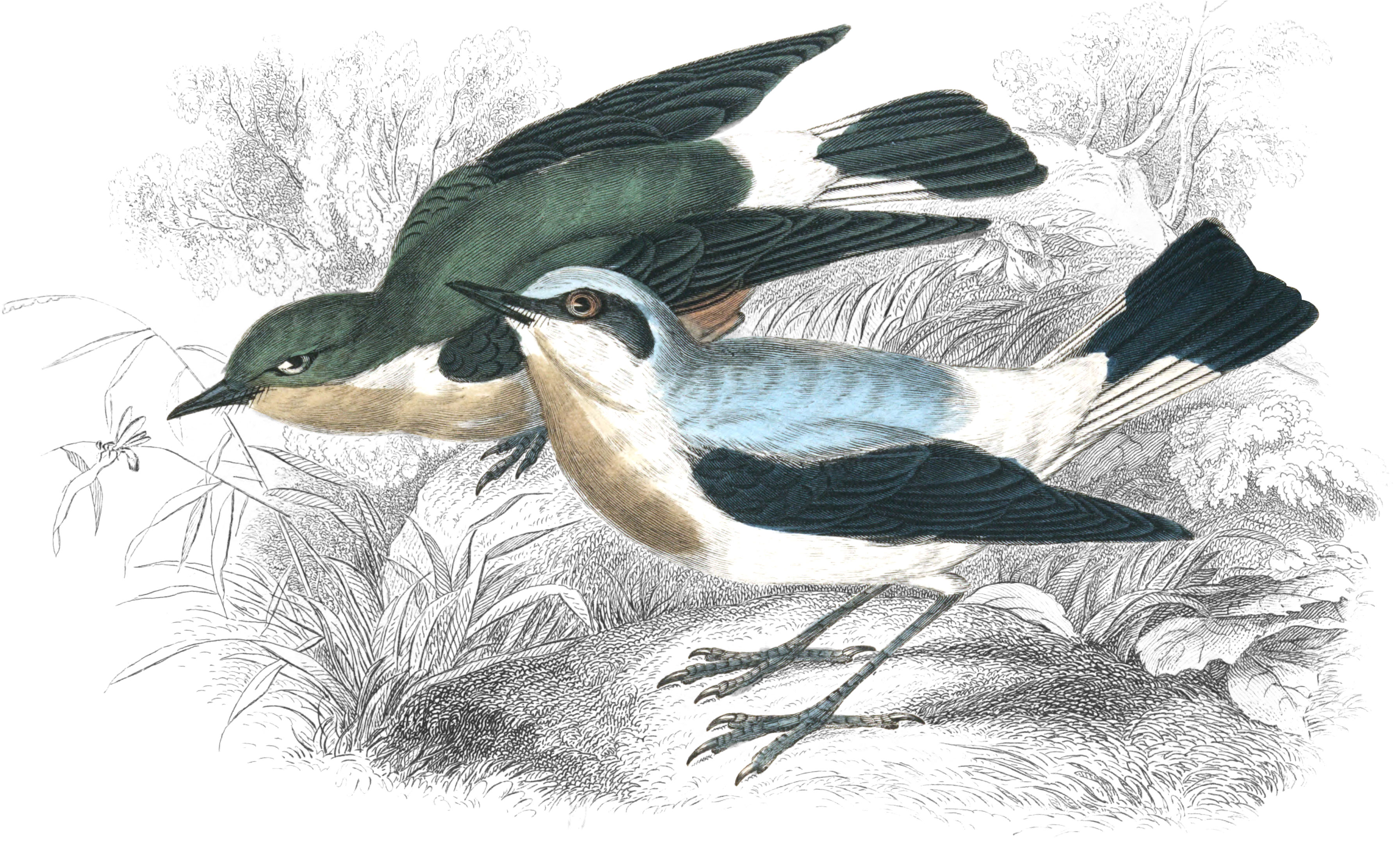
Plate V

Winchat
Saxicola rubetra.—Motacilla rubetra, Linn.—Sylvia rubetra, Lath.—Winchat of British authors.
This is the most common of our next two birds, and is also the most familiar, approaching near to cultivation, and in some districts and seasons occurring in immense abundance. Extensive commons and wild pasture lands, the edges of a muirland district and some of our large parks and chases, are favourite resorts for this bird, and they are sometimes so numerous as to appear to keep up an incessant motion, by their flitting from one tall bush to another, uttering, at the same time, their unvarying clicking note, which has given them their provincial name. When the young are newly hatched, or rearing, this anxiety is very marked; but at other times, a few short and not unpleasing notes are uttered, while on its perch, or when fluttering over the bushes, or tall herbaceous plants. They have also the same manner of flitting before a person, dog, or any disliked intruder, with the last described species; but when having conveyed them to a safe distance, they return, by one or two lengthened flights, to their usual haunt.
The crown, cheeks, and vent, are brownish-black, each feather broadly margined with ochre yellow; from the nostrils, over each eye, and above the auricular feathers, runs a white streak; and on the sides of the neck, and on the scapulars there are white patches, the latter contrasting with the pure black which covers the shoulders. The wings and tail are brownish-black, the feathers of the former edged with ochraceous, and the feathers of the latter, except the two in the centre, being white at the base, that mark which runs through many of the members of this sub-family; the shaft of the feather runs along each, conspicuously black. The chin is white, but the throat, breast, and flanks, are pale orange-brown, shading into white on the belly, vent, and under tail coverts. The female has more of the ochraceous tint on the upper parts; the shoulders are blackish-brown, and want the white patch; and the tail does not exhibit the white band so distinctly. The brownish-orange marks the breast only, and is of a paler tint than in the male; the other lower parts are dull yellowish-white, tinted on the flanks slightly with orange-brown. The general length of the species is from four to five inches.
Stonechat
Saxicola rubicola, Bechst.—Motacilla rubicola, Linn.—Saxicola rubicola, Stonechat, of British authors.
Some Stonechats reside with us during the whole year, a portion, at the same time, arriving and departing at the usual seasons of spring and autumn, either from the Continent, or by performing a partial migration from other parts of our own island. It is a species not nearly so abundant as either of the preceding, and frequents localities of a more wild and secluded character, extensive whin covers, the skirts of nmirland districts, or the vicinity of the coast, where whin or brushwood prevail. It is generally seen in pairs, except immediately after breeding, and flits before the visiter to its territory, alighting, like the others, on the tops of the cover, and uttering a note more closely resembling the knocking together of two stones than either of the preceding, using a gentle jerk or motion of the wings at the same time. It builds generally near the root of some low bush, constructing the nest of grass and moss, lined with the finer grasses, and a few hairs. The eggs are pale greenish blue, speckled with reddish brown. In distribution, it is pretty generally diffused in suitable localities over Britain and Ireland, reaching northward to Sutherland29 and the Hebrides.30 On the Continent, also, it is not uncommon, migrating in some parts. Out of Europe, it has been seen at Smyrna31, J the Dukhun in India,32 Japan,33 Senegal,34 and in southern Africa.35 The specimens, however, which we have received from the latter country seem to vary in some respects. This range may be considered as one of the most extensive shewn by our British birds, and the authorities we have mentioned are in general considered of high respectability.
The male in summer has the head and throat black, the back of the same colour, having the feathers edged with yellowish brown.; wings and tail black; sides of the neck, upper parts of the wings and rump, white; breast and flanks orange-brown, shading into yellowish-white on the belly. In winter, the feathers of the head and throat assume yellow tips, and appear brown, and on the back the yellow edges also lengthen. In the female, during summer, the black parts are brown, and the white is less in extent; the breast is yellowish-brown. The young above are brownish-black, the centre of each feather marked in a triangular form with brownish-yellow. The white portion of the rump is reddish-brown; the under surface is entirely yellowish-brown, waved on the breast with umber-brown.
Robin
The genus Erythaca, or Robins, placed next to the Stonechats, has as yet, we believe, had only one species characterized as belonging to it, the corresponding extra European forms bearing other titles.
Erythaca, Swainson.—Generic characters.—Bill strong, depressed at the base; tip obsoletely notched; rictus weakly bristled; wings graduated, fourth quill longest, first rather short; tarsi rather long; feet formed for being on the ground; claws not much bent. E. rubecula.
Note.—Form compact, rather robust; plumage rather loose. Europe, Africa occasionally; habits social.
The Robin, or Redbreast
Erythaca rubecula.—Swainson.
Motacilla rubecula, Linn.—Sylvia rubecula, Lath.—Erythaca rubecula, Swainson.—Redbreast, or Robin of British authors.
The common Robin, or Redbreast, has been so frequently described, and has been the subject of so many anecdotes from the time of the publication of the “Babes of the Wood,” until that of the works of 1839, that we shall confine our observations to a few remarks on its form and habits. A marked peculiarity in the manners of this bird is its familiarity. A constant attendant on the works of man, it follows him during his out of door avocations, and enters his dwellings, as if conscious of the general feeling with which it is beheld, and unsuspicious of the possibility of being entrapped by the closing of his doors or windows. This may be accounted for both by a disposition to sociality with mankind and cultivation, undoubtedly innate to many tribes of creatures, and particularly to the ruminantia and the rasores, which this bird, in its own circle, will partly represent, and it may be also attracted by the prospect of food which instinct teaches will be found in his vicinity. Certain it is, however, that the woodman, labouring in the most secluded forest, where scarcely a moving thing is visible, will soon perceive a Robin, perhaps a pair, cautiously approaching by short flights and uttering their single watch-note, and which, if unnoticed and undisturbed, will soon take up a position within a few yards, occasionally flitting down to gather the insects or worms disturbed by his operations upon the matted ground. When the weather becomes severe, many are drawn towards our houses, entering for warmth and to collect food. At first they are wary and watchful, but if unmolested, and allowed a free egress, they will take up their abode in a room or lobby for a month at a time, selecting a roosting place on the cornice, or on some curtain top, warbling their song when the day is clear, or the fire burns brightly, and in every way seeming at ease and in confidence with the inmates.
During the breeding season, they seem equally to live either in company or retirement; for while, at this time, we shall find many in our woods and plantations placing their nest under some broken bank, or supported by some break or hole in the trunk of a tree, rearing their young on the food which nature has supplied, and singing the song in complete seclusion; we shall find as many around our gardens and out-houses, gaining their sustenance with the poultry, building their nest in the very midst of bustle and labour, and hatching their family amidst all the motion and noise. Garden houses and tool sheds, the green-house, holes in the walls, and above all, the inside of saw pits are in their turn chosen. We scarcely recollect one of those old-fashioned sunk sawpits built on the sides with dry stones, moss-grown with time, and margined with a split log, that did not possess its Robins, quietly sitting, while the men wrought, often within the distance of a yard. Sawmills, and the structures of the modern time, are sadly deficient in convenience for the inmates of the forest or grove.
In its habits, the Robin is naturally solitary or lives in pairs. It is arboreal, though at the same time a great part of its food is taken on the ground, the grass or leaves being turned over by the [unintelligble]. but the necessity for which is often prevented, as we remarked, by the operations of the woodman or gardener. Daring summer, in retired situations, the food is in a great measure composed of insects and their larvae; indeed, it is similar to that of the Sylvianæ, with the exception that earth worms, small slugs, and mollusca, are also sought for and eaten. Notwithstanding the favour in which the Robin is held, his disposition is not of the mildest character. He will drive intruders of his own size from the vicinity of his nest; he will fight with other small birds if placed in confinement with them. In a house in winter, he will take and keep his particular station, and obstinate combats may frequently be witnessed, when one intrudes on the range of another, or attempts to share any limited deposit of food.
The Robin is very generally distributed over the mainlands of Britain, becoming less frequent towards the south, and disappearing in very alpine districts. In the northern islands, it also almost disappears, and in Shetland is migratory, which is probably the commencement of the range where it begins to be a temporary resident only. In the northern countries of Europe, it continues only during summer, arriving early, and being late in departure. In the south of Europe again, it is stationary through the year, but we have been unable to trace its extent of range in this direction. It has been noticed at Smyrna, and in Northern Africa.
The crown and upper parts deep yellowish oil green; quills yellowish brown on their outer webs, darker on the inner, having the tertials and coverts tipped with pale orange; forehead, region of the eyes, throat, and upper part of the breast, gall stone yellow, approaching to reddish orange, and separated from the oil green of the upper parts by a narrow banding of bluish gray, which shades into the former, and nearly encircles the lower part of the reddish breast; the belly and vent are yellowish white, rising into brownish white on the flanks; the thighs are oil green. The female is not so brightly or distinctly marked. The young, in their first plumage from the nest, are entirely of a yellowish oil green, without any trace of the red breast, each feather being spotted near the tip with pale orange, or pale chestnut brown. The red on the breast gradually makes its way with the autumnal moult, and specimens in October may be procured in the partial change.
Vignette
Philomelinæ
The next sub-family is that of the philomelinæ, so named from the nightingale, philomela, being presumed to exhibit the typical characters of a small group, arboreal in their habits, and remarkable for a melodious, and very powerful song. Between two of the principal genera, philomela and curruca, the distinctions seem scarcely yet to be rightly understood, and require more close observation; as it is, however, we have kept them apart, separating also from both as a sub-genus, Mr Selby’s salicaria, or reed warblers, which appear tp us very marked both in form and in habits. Phœnicura naturally leads from the Robins, and as, in the last sub-family, we saw an arboreal form, allied to the Nightingale warblers, so among these have we the Redstart, blending into the habits of the Saxieolæ. They feed on fruits as well as upon insects.
Phœnicura, Swainson.—Generic character.—Bill straight, rather slender, depressed, and rather dilated at the base; rictus with weak bristles; wings with the first quili very short, the third and fourth nearly equal and longest; tarsi rather lengthened, and with the feet slender.
Types, ph. ruticilla, atrata.
Note.—Europe, India. Tail generally coloured red or rufous.
Common Redstart
Phœnicura ruticilla, Swainson.—Ruticilla, Will. Ray.—Sylvia phœnicura, Lath.—Motacilla phœnicura, Linn.—Redstart, Redtail of British authors.
This clean and chastely coloured bird is of local distribution, and except in some of the southern counties of England, it can scarcely be called of common occurrence. It extends, nevertheless, to the northern parts of Scotland, and over the width of the mainland occasional pairs may generally be met with; in one or two districts it is plentiful, but in others, as remarked by Mr Selby, it has disappeared without apparent cause, unless from hedges occupying the place of stone walls, and in greater attention being paid to the management of woods. It frequents the skirts of woods and plantations, particularly those of considerable age, the vicinity of old gardens and orchards, and extensive parks, where there are shades for cattle, and bounding walls rather in a state of neglect, and where the trees have been allowed to find their own decay; in the holes of these, and sometimes in banks, it places its rather loosely constructed nest, and remains during the period of incubation almost close to the spot. They are found in pairs together, and from their quick, but silent and deliberate motions, they give an impression of solitariness. The male generally perches on some standing out branch of a hedge or bush, shaking its tail with a peculiar trembling motion, and when disturbed, flits or falls, as it were, and flies rapidly along the edge of the cover, to some other suitable resting-place. In this it reminds us of the kind of flight prevalent among the Saxicolæ, often like them seeking a screen by flying on the side of the enclosure away from the observer. The spot chosen for the nest is another point of resemblance. The song is low toned and sweet, but not of much compass. Fruits and berries are eaten as well as insects. The latter are occasionally taken on the wing, by an excursion from the perch, somewhat similar to the manner of the Spotted Flycatcher.
On the middle and southern parts of the Continent of Europe, from all accounts, it is generally spread, apparently in greater numbers than in Britain. It occurs also more sparingly in the northern European countries, extending to Norway and Sweden, and reaches also to Siberia, but we have no record of it beyond the Asiatic frontier. Temminck includes it among the Japanese birds.
The Tithys Redstart
Phœnicur tithys.—Jardine and Selby.
Motacilla tithys, Linn.—Sylvia tithys and Gibralteriensis, Lath.—Phœnicura tithys, Jard. and Selby.—Tithys Redstart of British authors.
Mr Gould first added this European species as an occasional visitant, to our Fauna in 1829. Since, a few specimens in different localities, chiefly southern, have occurred, and it has been at least once met with in Ireland. In the northern parts of England, or in Scotland, however, it has not yet occurred. In the north of Europe, it is also recorded as rare, but increases in numbers towards the south, where it remains during the year. On the Continent, it is a summer bird of passage, and it is curious that most of the specimens obtained in this country were procured either in the depth of winter, or late in autumn. Thus, Mr Gould’s specimen was got in October, one near Bristol in December, and another in Devonshire in January. In its habits it is said to resemble the last species, frequenting rocky defiles, and being rather abundant in mountainous districts, breeding in clefts of rocks, or in walls, even frequenting villages, and using the crevices in the buildings as nestling places. Temminck gives the Morea, and Mr Strickland the bare rocky hills near Smyrna, as portions of its range. The food also consists of berries, fruits, or insects. The song is clear, but riot extensive, and it has a call note, uttered as it moves from place to place. In all it is more allied to the Stonechats than the last.
In the male, the chin, throat, sides of the neck, and breast, shading into bluish gray on the belly, and having the lower feathers of the black margined with the same colour. The head and back are dark bluish gray, shaded into the black of the neck. The quills are blackish gray, having the greater covers and tertials margined with grayish white. The centre tail feathers are umber brown, the others, with the rump and upper tail coverts, orange red. The female has the whole of the body of a yellowish gray colour, the quills and secondaries of a deeper shade, margined with pale yellowish brown; the under tail coverts pale orange; the tail the same colour as in the male.36

Plate VI
Blue-Throated Redstart
Phœnicura suecica.—Montacilla suecica, Linn.—Sylvia nuecica, Lath.—Phœnicura suecia, Selby.—Blue-throated Redstart, and Blue-throated Warbler of British authors.
This interesting bird claims to be a still rarer visitant than the last, two instances only of its capture being recorded. The one on Newcastle Town muir,37 the other in Dorsetshire.38 On the Continent it is generally diffused, but not abundantly, except in a few localities. It migrates from the south northward as far as Russia, Siberia, and the northern parts of Sweden.
According to Temminck,39 there are two very distinct varieties of this bird, he seems almost to think species. In the centre of the blue throat, there is in one a spot of silvery white, in the other of rufous red,—the last confined to the north, and supposed to be the true S. suecica of Linnæus, the other found in the southern districts, and for which, if proved distinct, he proposes (following Meyer) the trivial name of cyanecula. We cannot enter as we would wish into this subject, from the want of sufficient specimens of each variety. It is possible that it may be dependent on the age of the birds, and that the pure colour, as in a few species, may not appear for some years; yet, if Temminck be correct, the difference in their range is against this, and the probability is, that two species are still confounded, and that a strict comparison will detect more differences than the colour of the pectoral spot. The British specimens all possess the white spot, and would stand as P. cyanecula, Meyer. From the accounts which Mr Yarrell quotes from Mr Hoy’s observations, the manners of the Blue-throated Redstart are more akin to the Robins than to the Stonechats, being more arboreal in habits, and frequenting, during the breeding season,
low swampy grounds, on the woody borders of boggy heaths, and on the banks of streams running through wet springy meadows, where there is abundance of alder and willow underwood.
Again,
the nest is placed on the ground among plants of the bog myrtle, in places overgrown with coarse grass, on the sides of sloping banks, in the bottom of stubs of scrubby brushwood in wet situations;
and he adds,
I do not believe they ever build in holes of trees.40
Its manner of living, also, is very different from either the Stonechats or Redstarts, and altogether it forms a gradual blending or passage to the typical songster warblers, comprising its sub-family. Perhaps the beautiful Motacilla caliope, bandied about from Motacilla, Sylvia, Accentor, Phœnicura, and at last into Caliope, Gould, when its habits are better known, will shew a still farther gradation, and it does not seem at all unlikely, also, that our present bird may one day ere long be removed to a sub-genus, standing near to Phoenicura. In the male, the
crown of the head is umber-brown; feathers at the base of the bill, and eye streak, yellowish-white; upper plumage hair-brown, tinged with gray, with the margin of the wing-coverts and scapulars paler; chin, throat, and upper part of the breast, rich azure blue, with a central spot of silky white; the lower margin of the blue being bounded by a narrow gorget of black, which is succeeded by another of reddish-brown; abdomen, and under tail coverts, dirty white, or inclining to smoky gray; tail, with two middle feathers, hair-brown; the rest having the basal half orange-brown.41
The female has the chin and throat white, surrounded with deep brownish black, each feather having a pale margin; a streak of azure extends from each side of the lower angle of the maxilla, and the upper part of the breast has the Crescent of azure bounded beneath with blackish brown, and a slight tinge of reddish.
In a specimen having the rufous patch on the breast, the auriculars are tinted with rufous, and above the eye streak there is another of dark umber-brown; the dark parts of the tail are deep brownish black.
The genera Philomela and Curruca, as we previously observed, are very closely allied to each other, both are woodland in their habits, and both possess great melody of song. The first, however, is more frequently seen upon the ground. The feet are more adapted for walking, and the alliance with the Robins of the last sub-family, is consequently greater than that of Curruca, which scarcely or ever alights on the ground. The bill of the latter is also more depressed and dilated at the base, more formed for seizing a truly insect prey.
Philomela, Swainson.—Generic characters.—Bill straight; culmen rounded, tip emarginated and slightly bent; wings with the first quill very short, third longest; tarsi rather long, and adapted for walking or hopping, as well as perching. P. luscinia, Swainson. Europe.
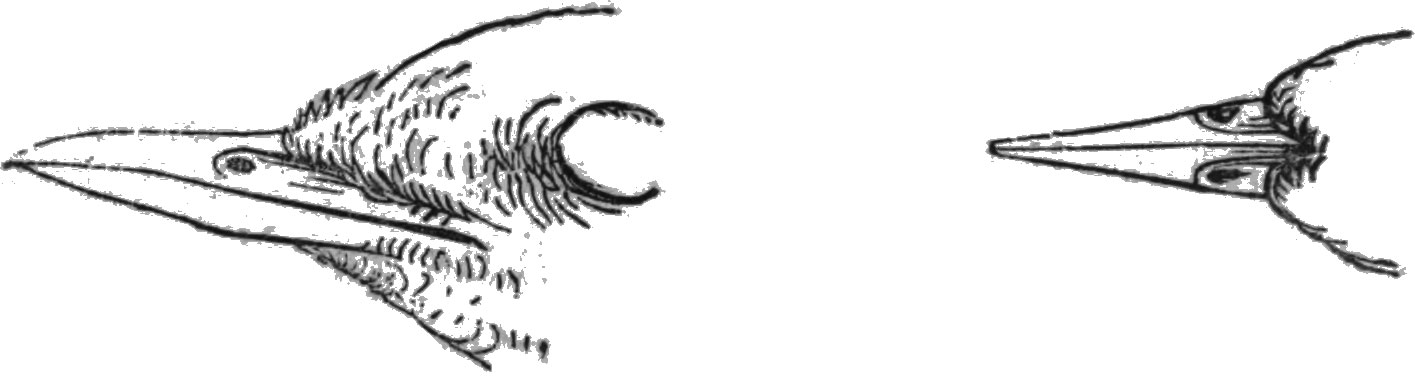
Philomela
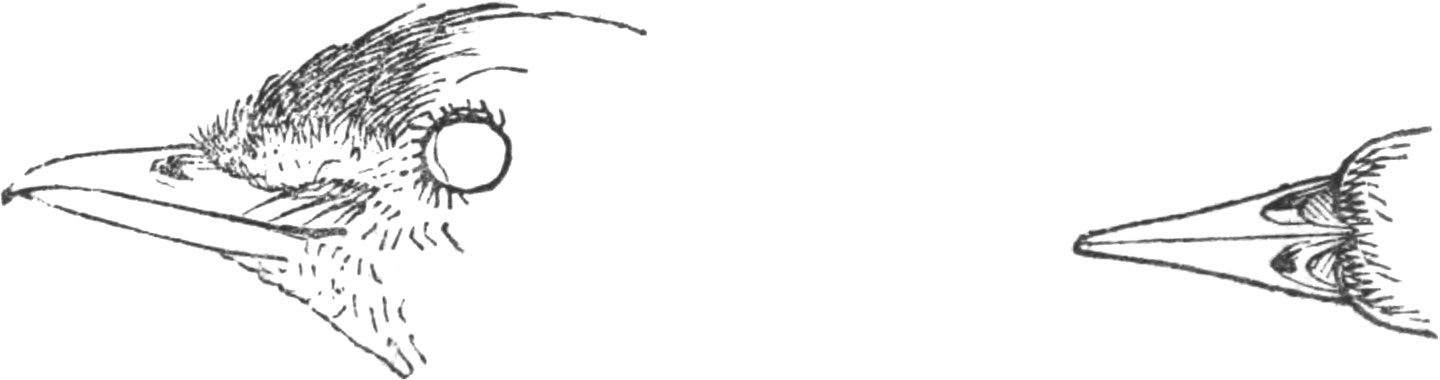
Philomela
The Nightingale
Philomela luscinia.
Montacilla luscinia, Will. Linn.—Sylvia luscinia, Lath.—Philomela luscinia, Swain. Selby.
This far-famed songster has been alike celebrated by historians and poets. We have never yet enjoyed the treat of its midnight music, for the food or climate of North Britain seems hitherto unfavourable to its existence; and not even the perseverance of Sir John Sinclair has been able to naturalize it to our colder soil; nevertheless, we can conceive the power of its melody swelling on the balmy breeze of evening, or poured forth during the stillness of night. There is little else attractive about the bird, for its manners are shy, and its dress unobtrusive. In some parts of the south of England, the Nightingale appears to be far from uncommon, but at the same time it is very local in distribution. On the eastern side of the island, it scarcely reaches York for its northern demarkation, while on the western side it is said to have extended to Carlisle. It does not visit Wales, and has not yet been heard or seen in any part of Scotland or Ireland, but on the Continent it is said to extend as far north as Russia and Sweden. This country is visited for the purposes of incubation, and on the first arrival of the males, which occurs some days before that of the females, (similar to what takes place with most of our migratory birds,) the song is commenced immediately, and for this short period they are in great request by the London bird catchers, for if taken after a mate has been gained, their melody is not continued in confinement. It frequents the lower coppices, rather than the grown or aged woods, plantations, or countries thickly interspersed with lanes and hedges, and, according to Mr Yarrell,42 the grounds of the market gardeners, near London, are favourite haunts with this bird, where, undoubtedly they find an ample supply of suitable food. When disturbed in these retreats, the call or alarm note is even less pleasing than that of our other summer warblers, being a kind of guttural croak, or “jug,” as it is termed, frequently and quickly repeated. The nest is formed upon the ground, and is rather carelessly built of dried grasses and slender roots. The eggs are of an uniform olive-brown colour, without spots, which is somewhat at variance with the tints and markings generally seen in those of Curruca.
Of very plain and unobtrusive colours. The male has the upper parts of the plumage yellowish-brown, tinged with reddish on the crown; the quills are of a darker tint; the outer webs, the whole tail and rump, are pale reddish chestnut-brown; the throat, breast, and flanks, grayish white, shading to nearly purely white on the centre of the belly and vent; under tail coverts yellowish-white. The female is rather less in size, but otherwise does not vary much in the shades of plumage.

Plate VII

Curruca
Curruca, Bechstein.—Generic characters.—Bill straight, rather depressed at the base, and very slightly notched, the tomia having a slight inflection; rictus sometimes weakly bristled; wings with the first quill short, third longest; tarsi not lengthened; feet with the sole widened, and fitted for perching. C. atricapilla, hortensis, &c.
Europe, Asia, Africa, northern principally.
Black-Cap
Curruca atricapilla.—Motacilla atricapilla. Lath.—Sylvia atricapilla, Lath.—Curruca atricapilla, Selby.—Philomela atricapilla, Swainson.—Black-Cap, or Black Cap Warbler of British authors.
This bird and the next are truly sylvan warblers, living entirely in our woods and shrubberies, and by their full-toned melody lessening our regret for the want of the more gifted species we have just described. The Black-Cap is a late summer visitant, (though it has been occasionally detected during winter,) but his arrival is immediately betrayed either by his song, or by the few peculiar notes warbled as he flits from bush to bush. The voice is much clearer in tone than any of our other warblers, the last excepted, and when in full song, it is a delightful addition to our summer songsters. As with all the others, it is the voice of the male, previous to pairing, or holding converse with the female during the time of incubation, in which he also partially assists. When this is completed, the song becomes broken, the melody gradually ceases, and we hear only the usual call notes. Either are easily interrupted; and a slight noise, or the intrusion of a stranger, will induce silence, and the bird will remove itself gradually and quietly to the closer parts of the thicket, or having gained the edge of a more limited shrubbery, it will silently flit to some more extensive and secure retreat. The nest, where we have seen it, has never been placed far from the ground, generally in some bush, and is composed of dried fibres of roots, or slender twigs, lined with the finer grasses and a few hairs. Mr Selby states, that he has sometimes found it among brambles and nettles, formed with the dry stalks of galium aparine. The Black-Cap is a more abundant species every where than the Nightingale, and is more equally distributed in England. In Scotland, it extends far north, but is somewhat local, and in our own vicinity has only appeared within these few years, which may be perhaps owing to the gradual increase of more extensive shrubbery and plantations giving it suitable food and retirement. In Ireland it appears more rare, and has only been recorded once by Mr Thompson. On the Continent it extends far north to Norway,43 and even Lapland.44 It is also spread over the south of Europe, and there seems rather to diverge to the African Continent, the Azores being given as one locality, while we have received it from Madeira. Temminck gives the Cape of Good Hope and Senegal, and the Zoological Society have specimens from Trebizond. It is included in the list of Japanese birds, and one specimen has been received from Java,45 the only other Asiatic instance. From these various localities, the authorities for which we have every reason to respect, we perceive a very ample and extended range, more so, indeed, than any of the Sylviadæ we have either noticed, or have yet to describe.
The male has the crown arid back of the head, in a line with the eyes, deep black; the cheeks, sides of the neck and nape, bluish-gray, the remaining upper parts gray, tinged with oil-green, or of a colour very nearly approaching to hair-brown; the lower parts are grayish-white, darker on the flanks and across the breast, and clearest in the centre of the belly and vent; legs and feet are bluish-gray or lead colour. The female has the head, where black in the male, of a clear yellowish-brown, reaching rather farther back to the nape; the cheeks and nape are gray, tinged with greenish, and the upper parts are nearly of the same colour with those of the male; underneath, the colour is a yellowish hair-brown, approaching to white on the centre of the belly, and being darker on the flanks and across the breast.
Greater Pettychaps
Curruca hortensis, Bechstein.—Curruca hortensis, Selby, Swain.—Greater Pettychaps, or Garden Warbler of modern authors.
This interesting and unobtrusive bird, in the districts where the Black-Cap is found, is scarcely so common; at the same time it is generally distributed, and in Scotland extends farther north. It is a bird of extremely retired and shy habits, seldom appearing out of the thicket and shrubbery. By close and silent watching it may generally be seen, but it is commonly discovered by its full song: at times this is warbled from the thicket, but, we think, more frequently from some elevation, and we have often watched it thus occupied near the top of a tall tree. The song is continued for a considerable time, but ceases upon any noise or interruption, the bird dropping stone-like from its perch to the thicket, whence it makes its way by hopping or flitting beyond the reach of its alarm. The garden is a favourite resort for this bird, particularly if it be much interspersed with shrubbery, and it here finds an ample food both in the hosts of insects and their larvæ, and in the smaller fruits when ripe. The nest is placed in a low bush in these cultivated parts, but it is much more commonly built in a tangled brake of bramble, or black thorn, or large herbaceous plants, which form the under growth to some wood or plantation: it is rather loosely constructed of straws, of the stalks of grasses, slender roots, &c. lined with a few hairs or fine straws. The eggs are four or five, of a yellowish gray or pale purplish brown, spotted and blotched with dark markings of the latter colour. The retired habits of the species may in part account for it; but from the testimony of all our modern observers, it seems by no means commonly seen or heard either in Britain or in Ireland. On the Continent, again, it seems to reach almost as far north as the last, visiting Sweden. To the south, we know of its occurrence in Italy; but we seem to have no record whatever of its appearance beyond the European boundary, or in Africa.
In form very similar to the last; the whole of the upper parts yellowish hair brown; darker on the quills and tail; and having above the eyes an indistinct streak of a lighter colour. The breast and flanks are yellowish white; the chin and centre of the belly nearly pure white. There seems little difference, except in the intensity or clearness of the colours, between the sexes.
White Throat
Curruca cinerea, Bechstein.—Motacilla cinerea, Linn.—Sylvia cinerea, Latham.—Curruca cinerea, Selby.—White-throat, or common white-throat of British authors.
The two previous species we have seen to be truly arboreal and sylvan birds, shy and retired in their habits, and possessing a song of considerable compass and melody. That we are now about to describe, though true to the characters in form, begins to vary in that of its habits: it is much less shy, and more active and lively, is more incessant in uttering the alarm note, while what may be called the song is not varied, and is held in little estimation for sweetness. It is also a species much more abundant, and is very commonly distributed over all parts of the country, frequenting hedges, whin covers, thickets of brushwood, the outskirts of plantations, and the garden; but the older and more retired woods, and a country road or lane can scarcely be travelled during the early part of summer, without being enlivened by this pretty warbler, flitting out from the hedge or brushwood, uttering its few notes of alarm or song with erected crest,46 and again for a short space concealing itself. At other times the song is uttered during a short and peculiar flight above its retreat, and which being completed, it descends, hides, and continues to utter a few low irregular notes in cover. The nest is also of the same careless structure with those of the two preceding; indeed, this manner of building seems, to a certain extent, characteristic of all the currucæ with which we are acquainted; the nest being loosely constructed of straws, roots, &c. the lining by no means warm or very compact,—that of the White-throat is placed generally in a low bush, or among strong and tall herbaceous plants.
Over the British islands this bird is plentifully distributed, extending northward to the extremity of the mainland. On the Continent it is equally plentiful; but our knowledge of its extra-European range is confined to its appearance in the vicinity of Smyrna47 and Trebizond.
Upper parts and auriculars yellowish brown; tinged with gray between the bill and the eyes, and a streak over each of the latter with yellowish white; the wings and tail are pale umber brown, having the tertials broadly edged with reddish or yellowish brown; the edge of the outer quill white; the tail is more rounded than usual, or slightly cuneated, and the outer feather has the outer web, and often a portion of the inner, white; the throat and centre of the belly are white, shading to yellowish white over the flanks; the breast is tinted with rose red, which, in a subdued manner, often tints more or less the whole lower parts; the richness fades somewhat after being killed. In the female, all the tints are more subdued, and less marked, particularly the edging of the quills and the rose tint on the breast. Length about five inches and a half. In this species the colour of the iris is remarkable; in the two or three preceding birds it is of a clear chestnut or umber brown, but in this it is of a beautiful straw yellow, when nearly inspected appearing of the consistency of bronze.
Lesser White-Throat
Curruca garrula, Briss.—Motacilla curruca, Linn.—Curruca garrula, Briss. Selby.—Lesser White- throat of British authors.
This bird is not nearly so widely distributed in Britain as the last, which it resembles considerably in its habits, being even more noisy and restless; it is also shy, and remains silent when intruded on. In the north we have not had opportunities of examining its habits, and in the descriptions of our modern ornithologists there is not much detail given, farther than that they are similar in most respects to the last. They are also said to breed in nearly the same situations. The nest, though slim and careless, is of a construction rather warmer, wool and cottony substances being occasionally mixed in the lining. Its distribution in Britain is nearly similar to that of what may be termed the more southern warblers: it is not plentiful in Wales, nor, we presume, in the more alpine districts of England; but is known to extend northward as far as Durham. Upon the border, in Scotland, or in Ireland, there has, however, been no instance of its capture recorded. On the Continent, its range is more extended, it visits the northern countries as well as Spain and Italy, and from the last even migrates with regularity, most probably towards the Asiatic continent, being mentioned as arriving there by Temminck, and in the Dukhtm by Colonel Sykes, while we do not know of its appearing on the coast of Africa, where so many of our warblers pass over from the nearest parts of the European Continent.
In general appearance and distribution of colours this a good deal resembles the last. The crown, nape, and rump are bluish gray; the centre of the back and rump pale yellowish brown tinted with grey. The wings and tail brocali brown, having the tertials and covers broadly edged with yellowish brown, and the tail, which is rather longer in proportion than in the last, and even at the end, has the outer web and tips of the three exterior feathers white. The throat and centre of belly pure white, tinted on the breast and sides with reddish, and having a shade of pink over the whole. The flanks are yellowish brown, with the same shade of pink. The sexes here do not differ any more than the last, except in intensity of the tints, and the female being of a more yellowish brown above, particularly where these spots are grey in the male. Iris reddish brown.
Salicaria
As we previously stated, we have thought it right to keep the aquatic warblers under the title of Salicaria, proposed for them by Mr Selby, and separated from the last sub-genus as forming a marked group both in form and habits. As partly indicated by their name, they frequent the vicinity of water, or at least marshy lands. Many of them build their nests among reeds, amidst which, and other aquatic plants or shrubs, they spend their days, skulking and climbing about them, using their wedge-shaped tail as an accessory, and deriving sustenance from the insects which affect these localities. Another feature in their economy, and in which an alliance may be traced between them and the African and American “Babblers,”48 also frequenting aquatic situations, is their almost incessant noise, it can scarcely be called song. At times this is kept up as an ill-natured chatter, particularly on being disturbed; but when undisturbed it is uttered sitting on some low twig, with the wings rather drooping. A number of natural notes are produced, but the faculty of imitating parts of the song of other birds is more developed than in any other European genus. These are introduced in constant succession, and with great volubility, they are often continued very late; and in clear moonlight almost during the whole night.
Salicaria, Selby.—Genetic characters.—Bill straight, subulate, with a distinct culmen, rather depressed at the base, and slightly bristled; tip very slightly deflected and notched; forehead narrow and depressed; wings, with the first quill, minute; second and third longest, and nearly equal; tail rather long, rounded or cuneated; feet rather large, formed for grasping; hallux and claws very strong. S. socutella, phragmites, &c.
Note.—Habits aquatic; climb among reeds and aquatic plants.
Sedge Warbler
Salicaria Phragmites.—Sedge Warbler, Sedge Bird, Reed Fauvette, of British authors.
This bird is by far the most frequent and commonly distributed of our native species; indeed it is nearly as abundant as any of our summer warblers. It frequents reed-brakes and willow-holts, moist meadows surrounded with underwood, the margins of rivers fringed with brush or tall aquatic plants, and young woods planted in low or damp lands. In passing the skirts of these, this little bird may almost day and night be heard rattling away at his own song and that of others; and if for a moment he should be silent, a stone cast into the cover will bring him forth again with even more than his usual energy. During the clear long nights of summer this is also carried on with little intermission, and if silent, any sudden noise made on approaching or passing his haunts will immediately rouse him. The nest is built among reeds or tall aquatic plants, or it is placed among the lower branches of the brushwood. Amidst the former it can scarcely be said to be suspended, but the situation is so chosen that several convenient stalks support the fabric, and are often wrought into its substance. It is composed of moss, dry grasses, and leaves, lined with the finer grasses and hair, and is often of a rather large but careless form. The eggs are small, from six to seven in number, and of a pale wood brown, minutely and confusedly speckled with darker shades.
In localities such as we have mentioned, the Sedge Warbler is generally spread over the British islands, avoiding the more mountainous districts, but reaching to the extremity of Scotland.49 In Europe, its range extends far northward, reaching the arctic circle,50 It is abundantly distributed also over the middle and southern parts; and it is recorded by Mr Strickland as being found in the vicinity of Smyrna.
Over each eye a distinct pale yellowish white streak; crown of the head deep yellowish brown, marked with deep umber brown; the marks immediately above the eye streak confluent, so as to form nearly an uninterrupted stripe; back oil green, with the centre of each feather darker, and nearly umber brown; rump yellowish brown; wings and tail blackish brown, the latter paler; the quills and coverts margined with pale greyish brown; chin, throat, and centre of the belly nearly pure white; the other under parts yellowish white, darkest across the breast. The female differs only in the clearness of the colouring, and the eye stripe is less marked and distinct. There is also perhaps a slight difference in size. Length of the male about five inches.
Reed Warbler
Salicaria aundinacea, Selby.—Curruca arundinacea, Briss. Swain.—Reed Wren and Reed Warbler of British authors.
This bird closely resembles the last in habits and disposition, being nearly equally garrulous, imitating the notes of other birds, singing during the whole day, and often during the greater part of light nights. It is, however, much more local, and confined in its distribution, occurring only in the southern and in a few of the midland counties of England, and these again only in favourite localities, brakes of reeds, and willow beds. They often occur in some favourite haunt which scarcely exceeds an acre in extent, where they make limited excursions for a few hundred yards in search of food, returning with the captured prey to their young or mate. The nest of this warbler is almost completely pensile, being fixed or woven to stalks of aquatic plants, often so fragile as to almost touch the surface of the water when acted on by the blast.51 Mr Yarrell writes, describing from a specimen before him,
The nest is formed of the seed branches of the reeds, and by long grass wound horizontally round and round, including four upright reeds in the substance, thus forming, with a little wool, the sides of the nest, which frequently measures five inches in depth on the outside, three inches in breadth across the top, and very frequently three inches deep inside. The lining is formed of very fine grass and long hairs. The nest is made so deep, that the eggs do not roll out when the supporting reeds are moved by the wind.52
In England, it has not been observed northward of Stafford and Derbyshire, and it has not yet occurred in Scotland. In Ireland, a single instance is mentioned of its occurrence near Belfast. On the Continent it occurs moderately plentiful in suitable localities, but does not extend far to the north. Out of Europe we have no knowledge of its occurrence.
In this species the bill is a little more dilated at the base than in the preceding or following. The space between the bill and the eyes pale yellowish white, running in an indistinct streak above each eye; the whole of the upper plumage is oil green, tinged with brown, and of a yellower shade on the rump; the edges of the feathers composing the wings are paler; the under parts are yellowish white, of a deeper tint across the breast and flanks. The difference between the sexes is trifling. In this form, we see a uniform and unbroken colouring, which is possessed also by one or two species from southern Africa. In the more varied marking of the last and next species, we have an alliance with Swainson’s genus Hemipterix, also South African.
Grasshopper Warbler
Salicaria locustella, Selby.—Curruca locustella, Swains.—Grasshopper Warbler of British authors.
This species, though somewhat similar in its manners to the two last, still differs very widely, and blends with them the skulking disposition of curruca, together with the structure of the nest The situations which it frequents are somewhat different also, and it is almost confined to what are called “bottoms,” low lying dells watered by a small stream, arid clothed with a tangled thicket of brushwood, black-thorn and brier, bramble and whin, intermixed with the various herbaceous plants and rank grasses which overgrow such retreats; here, by persevering watch, it will be discovered by its low sibilous note, closely resembling that uttered by some of the grasshoppers, and serving, no doubt, as Mr Selby observes, both to attract the insect and its own mate. It is so shy and diffident, that the least noise will cause its concealment, and it possesses none of the garrulity of the former birds, and cannot be brought to recommence its notes by any disturbance among the bushes. The nest is placed in the bottom or roots of the low close bushes, sometimes a little way raised, and has no appearance of a pensile character, in structure and materials rather resembling those of the last genus. The eggs are of a dull white, sometimes of a pinkish gray tint, spotted with the same colour, and amount in number to from five to seven.
In distribution it is not uncommon in various parts of England, so far north as Northumberland; and, according to Mr Thompson, it is occasionally met with in Ireland. In Scotland it is more rare, and perhaps does not reach north of the Firth of Forth. We have it stated as coming near Edinburgh,53 and we possess a single specimen, shot near New Abbey, in Galloway, for which we were indebted to the kindness of Dr Bushnan, and the individual who procured it was aware of its occasional occurrence. In the middle and southern parts of Europe it is also not unfrequent, but we have no records of its farther range.
This species more resembles the first in the distribution of the colours of the plumage, but the structure of the hallux and hinder claw is not nearly so strong, which may be accounted for from the difference in its habits from those of either of the last. The colour of the upper parts of the plumage is deep oil green; the edges of the quills paler, and having the centre of each feather, except those on the rump, umber brown; the chin and centre of the belly are pure white, the breast, flanks, and under tail coverts pale oil green; the feathers immediately below the white of the chin spotted with a narrow triangular spot of umber brown; the under tail coverts have the shaft yellowish brown. The sexes are similar in plumage.
The next sub-family, the Sylvianæ, composed of what are considered the true or typical Warblers, is very extensive, and comprises a great variety of forms, exhibiting representations of most of those which constitute the great family to which it belongs. The typical species are arboreal and insectivorous, and are characterized by a comparatively small size and much activity. The form we shall first notice is an aberrant one.
Melizophilus, Leach.—Generic characters.—Head large; bill slightly arched from the base; tip deflexed and notched; rictus slightly bristled; wings with the first quill very small; third, fourth, and fifth nearly equal, and longest; tail rather lengthened, and soft; tarsi and feet strong. Type, M. provincialis.
Europe—New Holland, or at least represented there by a bird very closely allied in form, structure, and colour.
Dartford Warbler
Melizophilus provincialis, Leach.—Sylvia Dartfordiensis, Lath.—Dartford Warbler of British authors.
Of the habits of this interesting bird, we have no experience from personal observation; but from the accounts given of it by Montague and its more recent describers, we consider them more nearly allied to those of curruca than of the true tree Warblers. The Dartford Warbler was first made known by Dr Latham, as an addition to the birds of Britain, while the indefatigable Montague gave us the first detailed description of its manners. A portion of these birds remain during the whole year in this country, while it seems also the opinion that a migration in spring and autumn takes place. They may, in this respect, resemble the Stonechat, some of which remain constantly with us, an accession arriving in spring. Their most favourite localities are the extensive furze or whin commons, and coverts in the south of England, stretching westward as far as Cornwall. In the north of England, Scotland, and Ireland, we have no traces of the bird, it seems also only to be known in central and southern Europe, and we have no record of its range in any other quarter of the world. It is thus, so far as we know, local, but it is not so uncommon in some districts as has been imagined. Thus, a writer in the Magazine of Natural History states, that near Godalming it is plentiful,—
I have seen them by dozens skipping about the furze, lighting for a moment on the very tops of the sprigs, and instantly diving out of sight again, singing out their angry impatient ditty, for ever the same. While the fox-hounds have been driving the furze-fields, I have seen the tops of the furze quite alive with these birds.54
Then Mr Gould remarks,
They are very shy, and though sometimes to be seen on the topmost branches of the brake, they conceal themselves in the thickest part on the least alarm, and creep about from bush to bush.55
These are all habits resembling those of the common and lesser White-throats. On the Continent, again, they are said to frequent the cabbage gardens, where they will, no doubt, find abundance of food; but it will be so different, and the locality altogether is so much at variance with that frequented in Britain, that we can scarcely account for it.
The nest is placed a little way from the ground among the whins, and is described by Montague as
composed of dry vegetable stalks, particularly goose grass, mixed with tender dead branches of furze. These are put together in a very loose manner, intermixed very sparingly with wool. The lining is equally sparing, for it consists only of a few dry stalks of some fine species of carex.56
Mr Yarrell has also given us a pretty woodcut of one procured last year, which generally agrees with the description above given; it is of the loose and careless structure we have alluded to, as characterizing the architecture of the genus curruca. The eggs are grayish green, speckled over with olive brown. Upper parts of the body clove brown, on the wings and tail assuming a very deep shade; cheeks and auriculars gray; the throat, back, breast, and flanks, brownish purple red, becoming paler on the vent, and shading to grayish clove brown on the under tail coverts; the centre of the belly white; the tail is cuneated, having the outer feather (tipped with grayish white) about half an inch shorter, the others gently graduating; the legs and feet are sienna yellow. The female and young birds have the colours less distinct, and have the chin marked with triangular spots of reddish white, running in lines. These are said to disappear with age, and this part in the full breeding state to become uniform in its tint.
Our next British genus is that of the true Warblers, all arboreal in their habits, exhibiting great activity, insectivorous, or nearly so, and regularly migratory. The nest is built on the ground, having an entrance on one side.
Sylvia, Lath.—Generic characters.—Bill slender, rather dilated at the base, and very weakly bristled; wings moderate, the third and fourth quill longest, the first very short; tail sub-furcate; feet slender, hind toe and claw proportionally strong. S. trochilus, Selby, &c.
Note.—Form, slender, arboreal, breed on the ground.
Wood Warbler
Sylvia sibilatrix, Bechst.—Wood Wren, Yellow Willow Wren, Wood Warbler of British authors.
The three species, which constitute the British portion of the genus Sylvia, are all somewhat alike in form and plumage, but are at once easily recognizable to the ornithologist by their notes and habits. The one we are about to describe is generally distributed, though not very abundant in numbers, but it is considered even more rare than it is in reality, from its frequenting only aged woods, and generally feeding among the high and thick foliage, while the two following are found indiscriminately in young plantations and coppice woods. The Wood Warbler is a retired species, quietly seeking its food, consisting of insects and larvae, among the upper branches of the trees, and only occasionally singing its low sibilous note. When the vicinity of the nest is approached, it ventures nearer, and exhibits much anxiety, and constantly utters a single louder alarm note. The nest is placed on the ground, by the root of a tree or bush, and often on a sloping bank, and is formed nearly round, with a hole or opening outward; it is composed of moss, withered leaves, and dried grasses, and is lined with hair or fine grass. The eggs, six or seven in number, are rather round in form, and are white, with purplish red spots. In England the Wood Wren, or Warbler, is distributed wherever the locality is suitable, stretching at least to the middle districts of Scotland, in apparently equal abundance. On the Continent it is in like proportions, the numbers decreasing northward; and out of Europe we have it recorded as appearing in Egypt and Asia.
Willow Warbler
Sylvia Trochilus, Selby.—Willow Warbler or Willow Wren of British authors.
This pretty and active little bird is the most abundant of our summer warblers, enlivening every plantation or coppice, or clump of brushwood, with its few lively notes. It is one of our earliest sylvan visitants, and in some of those warm April mornings, scented by the opening birch, and bright with the first fresh green of the larch, the associations are completed when the cheerful song of this little bird, for the first time in the season, meets the ear. It is every where common, and frequents the older woods as well as those of younger and more humble growth. It stretches to the extremity of the mainland of Scotland; and in some of the birchen woods which gird that district, is the only warbler whose voice will recall the existence of some climes less wild and picturesque. In Ireland it seems very nearly as equally distributed.57 Like the last, it is ever in motion, constantly repeating its lively but limited song. The situation selected for the nest is also similar, and is often only discovered by the bird flying off from a too near approach, which it does in a low flutter, almost like what is performed by some of the rasorial or grallatorial birds; it does not fly far, but remains within a few yards, uttering a plaintive call of distress. The nest also is constructed of the same shape and materials as that of the last, feathers in addition being always used for the lining. The eggs are smaller, but are very similar in colour and shape.
Its extra European range yet recorded, is Trebizond,58 and the western parts of Europe.59
Upper parts pale oil green; a rather indistinct streak extends above each eye, and surrounds the orbits; quills and tail are hair brown, edges of the feathers yellowish white; the margins of the lesser wing coverts, and edges of the quills, pale yellow; the under parts yellowish-white, clearest on the centre of the belly and throat, and across the breast, and on the flanks, sulphur yellow; the legs are yellowish brown. Length about four inches and three-fourths. Female slightly less, a little more tinged with brown above, and having the yellow of the under parts less clear.
Chiff-Chaff Warbler
Sylvia hippolais, Selby.—Chiff-Chaff, Least Willow Wren, Lesser Petty chaps of British authors.
This little Warbler, arriving in its summer station considerably earlier than any of the preceding, is at once betrayed by the peculiar call note whence its provincial name has been derived, and which is so plainly uttered as never to be mistaken if it has once been heard. It is by no means, however, a very common species, and northward it decreases in numbers, reaching the Scottish border, but extending very short way beyond it; we have heard it once or twice of late years in our own neighbourhood, but have no trace of it beyond the Firth of Forth. In Ireland it occurs, though not so numerously as the last.60 Norway is the most northerly European station we know of,61 and Mr Strickland observed it at Smyrna. The habits are very similar to those of the last, and so are the situations in which it is most frequently found. The call note is constantly repeated while searching for its food, and it has another low anxious note when the nest is approached. It has been observed so early as February and March, and at this time finds sustenance from the insects which attack the blossom buds of trees, particularly those of the orchard. Its nest is placed on the ground, or a short way above it, in some tuft or bush as instanced by Mr Hewitson, and is even a larger ball-shaped fabric than those we have yet noticed, warm and closely lined with feathers. The eggs are smaller, but of similar shape and colours.
Upper parts oil green, tinged with gray; the eye streak faint and undefined; wings and tail hair brown, edged with yellowish white; the under parts pale primrose yellow, shading into the oil green on the sides of the neck, and without any deeper tint on the breast; under wing coverts rich sulphur yellow; legs deep blackish brown; sexes similar in colours, males rather brighter. Length of the latter about four inches and a half.
From those Tree Warblers, we may pass to the beautiful and active Gold-crests, which prepare us by their habits for the Parlianæ.
Regulus, Ray.—Bill nearly straight, slender, tip very slightly notched; wings with the first quill short, third the longest; tail subfurcate, points of its feathers mucronate; feet with the hallux and its claw proportionally strong. R. auricapillus. R. reguloides, &c.
Note.—Nostrils in some covered with a single plumulet, directed forwards.
Regulus Feathers
This little genus, confined, so far as we know, to Europe, North America, and Northern Asia, is remarkable for its tiny size, its active and hardy manners, and the peculiarity of the covering of the nostrils. The common, and until these few years the only known British species, is by no means unfrequent, remaining with us during the whole season. All the known species are very closely allied in colouring, and are distinguished by the beautiful orange crest with which the head is adorned, and which they display and erect on irritation or pleasure. In addition to the common bird, R. ignicapillus, or Fire-Crowned Gold-crest, has been several times captured in our island; and by the attention of Mr Hancock of Newcastle, we are enabled to give the description of a bird taken in Northumberland, which agrees with the figure of Mr Gould’s R. modestus. From the very small and apparently tender frame of these little birds, we become astonished that they are able to perform any lengthened migration; but on the coast, particularly on the eastern side of the island, they may be seen to arrive in troops about the same period with our other winter visitants, many of them in a state of great exhaustion. An account of a very remarkable flight is given by Mr Selby;62 and we have yearly notices, from some district on the east coast, of large flights appearing at the accustomed season. On the opposite side of the island we are not aware that their arrival has been observed on the shore; but there can be no doubt, that, at the same period, a large accession is received in the woods and plantations. A peculiarity of structure, for which we do not at present see an adeqate reason, is seen in the covering of the nostrils. These organs, in the incessorial order, are generally either protected by a corneous scale, or with setaceous feathers. In Regulus the covering is composed of a single dilated little plumulet, beautifully fitted for protecting the opening from cold and other usual annoyances. This has been considered as present in all the true Reguli, and has been made use of as a generic character,63 but it is lost in the beautiful South American genus, Cyanotis. Our first and best known species is the
Common Gold-Crest
Regulus auricapillus.—Selby.
Motacilla regulus, Linn.—Sylvia regulus, Lath.—Regulus cristatus, Will. Ray.—Gold-Crested Wren, and Gold-Crest of British Authors.
The Common Gold-Crest is abundantly distributed from the middle Highlands of Scotland over the whole of England. It delights, however, chiefly in those parts where there is an abundance of the evergreen pines, either in the character of clumps and limited plantations, or as extensive forests. These afford them both shelter and an abundant food from the variety of insects which frequent them, and which nestle in the scales of their shoots and cones, but more particularly from the supply furnished by a genus living on or infesting the Coniferæ. We mean the Eriosoma of entomologists, which has lately given so much cause of grief to the patrons of arboriculture by the ravages which it is apparently able to commit on the silver firs. These little birds undoubtedly do their best to check its increase; and during winter, when they are in a state of ova, they find a most abundant supply of nourishment. But when we give the middle of Scotland as an abundant locality, we do not mean that it is the northern limit of the Common Gold-Crest, for it extends far to the northward wherever protection by cover is afforded; and it is mentioned by Low as inhabiting the Orkneys. Dunn also, in his Ornithologist’s Guide, says he has shot it there, and had it brought to him in Shetland.64 The season when met with, in these last localities, is not noticed; and we would rather suppose that the specimens were procured during a migratory visit than that they remained or bred in any of the islands. In its habits this bird is most active, climbing among the branches, and often hanging from the moss or fir cones, and occasionally resting on the bole of the tree itself, and searching into its crevices. They indeed exhibit all the activity and restlessness of the true Titmice, with groups of which they may frequently be seen associated. Their note of alarm, generally uttered on the approach of a stranger, is a shrill “cheep” frequently repeated; when feeding undisturbed, it consists of a few low notes, or a short not unpleasing song. The Common Gold-Crest breeds early, and forms a beautifully constructed nest, generally interwoven near the end of the branch of some pine or fir, and shewing a half pendulous structure. It is formed principally, where we have seen it, of the green mosses or hypni, softly lined inside, and contains from seven to eleven or twelve eggs, rather round in form, and of a hair brown tint, darkest at the larger extremity. The parent birds are bold and familiar, and will even continue on the branch while the nest is inspected, uttering shrill and distressing cries, and erecting the crest as if wishful to attack the aggressor. The young brood continues together until about November, the time of migration, when our accession of numbers arrives, and when it is possible some may also depart and perform a partial journey; during winter they are generally seen in pairs plying their search after insects, and in stormy weather hunting among the lowest branches of the firs and brushwood. The extra British distribution of this bird is somewhat extended. It inhabits Northern Europe generally,65 and it is perhaps from this range that we receive our winter visiters. Edwards gives part of Asia; Temminck, Japan; and Mr Yarrell states, that the Zoological Society have received specimens from Trebizond.
The male Gold-crest has the cheeks, sides of the neck, and upper parts, clear wax yellow; on the rump the feathers are lengthened as in some of the Laniadæ, and are disconnected in their texture; succeeding the yellowish tips there is a band on each side of dull yellowish white, which gives a wavy or pale appearance to those parts where the feathers are smoothed down. The feathers on the crown are soft and silky, of a brilliant orange in the centre, shading to gamboge yellow on the front and sides, and on each side of this runs a band of deep black, setting off, as it were, their beautiful ornament. The under parts are yellowish gray, darkest on the breast; feathers of the wings brownish black, margined with wax yellow. The secondaries have a black bar at their base, which is relieved by the white tips of the coverts forming a narrow band before it. The tail is also brownish black, edged with wax yellow; feet and legs are pale wood brown. In the female, the crest is of a less intense colour, almost wholly gamboge yellow, deepening in tint in the centre. The rest of the plumage is scarcely so brightly coloured, but in other respects it does not vary.
The Fire-Crowned Gold-Crest
Regulus ignicapillus.
This is the second and very rare species of British Gold-crest. We can give nothing of its history in addition to what Mr Yarrell has published in his excellent “British Birds,” having had no opportunity of examining its habits. It is to the Rev. Leonard Jenyns that we are indebted for the first notice of this species as a British bird,66 who obtained a specimen in his own garden at Swaffain Bulteeck, near Cambridge. Instances have since occurred of its capture at Brighton, near Durham, and on the coast of Norfolk. Their continental range does not seem exactly ascertained. Temminck mentions it as common in the Belgian provinces, and Brehm as breeding in Northern Germany. Mr Hoy, in some interesting notes communicated to Mr Yarrell, considers that they are migratory on the Continent during the winter, and that it prefers low brushwood and young plantations of fir to the loftier trees. He has not heard their song; but their common call-note differs, and is at once distinguishable from that of the common species.
In our plate we have endeavoured to group this bird with the common species, and to exhibit the markings on the head and cheeks by which it is most easily at once distinguished from it. The principal colours assimilate very closely with those of the common Gold-crest. The upper parts are of a more yellow tint, particularly on the back and sides of the neck. The crest is of the most brilliant orange or fire colour, as the name indicates: it is surrounded in front and on the sides with deep black, and above each eye, from the nostril, the black is contrasted with a line of clear yellowish white; succeeding this there is a second band of black passing through the eyes, and a third stretching under from the corners of the gape. In the female, the colour of the crest approaches nearer to that of the common bird; but the three black bands always serve to distinguish them, and, in ignorance of the peculiarity of their call-note or song, as pointed out by Mr Hoy, they are good marks to be looked for when seeking this species among the troops of our more abundant native.
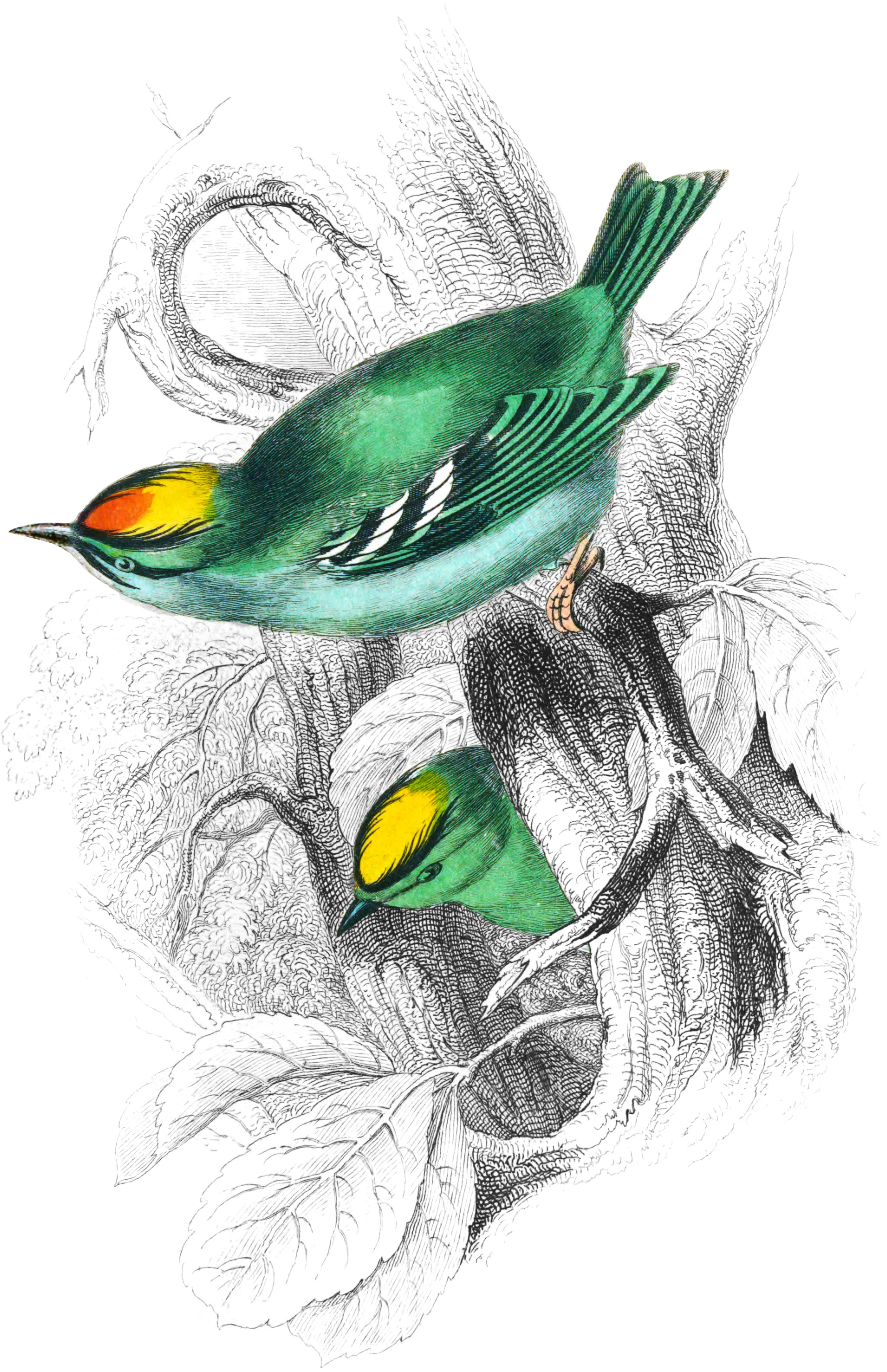
Plate VIII
Dalmation Gold-Crest
Regulus modestus, Gould.—When Mr Gould published his figure of a bird under this name in his Birds of Europe we expressed our suspicions that it might be an immature specimen, or one in the nestling plumage, of either of the two birds we have just mentioned. The existence of only a single specimen, and the impossibility of examining it, prevented us from coming to any decided opinion for ourselves; but the occurrence lately of a bird in a similar state of plumage on our own shores, has given fresh interest to the subject, and will ultimately enable us to decide whether or not our suspicions were correct. Mr Gould received the specimen from which his figure is taken from the Baron de Feldegg of Franckfort, who shot it in Dalmatia in 1829, and by dissection proved it to be a male. Mr John Hancock of Newcastle, whose attention to the minuter distinctions between some of our most closely allied birds has been attended with so much success, has sent a notice to the Annals of Natural History regarding the capture of a bird on the Northumbrian coast, which he considers to agree in every point with Mr Gould’s Dalmatian Regulus; and as a reason for considering it as a good species, he states, that the covering of the nostril is not composed of a single plumulet, as in the other known Reguli. We transcribe the notice as we got it, containing a minute description, and will request ornithologists to attend farther to this interesting addition:—
I beg to send you a notice of a very scarce and interesting species of Regulus, which I shot on the banks near Hartley, on the coast of Northumberland, on the 26th of last September. It corresponds exactly with Gould’s R. modestus, a species so extremely rare, that he considers the individual from which he described as unique in the continental museums. The description of my bird, which will now entitle this species to a place in British Fauna, is as follows: length, 4\(\frac{1}{16}\); breadth, 6\(\frac{1}{2}\); length from the corpus to the end of the wing, 2\(\frac{1}{16}\); tail 1\(\frac{1}{16}\); the bill, from the gape to the tip, nearly \(\frac{7}{16}\); and from the tips of the feathers, which extend to the extremity of the nostrils, \(\frac{1}{4}\). The whole of the upper plumage a greenish yellow; on the centre of the crown of the head is a streak of paler; a light lemon-coloured streak extends over the eye from the base of the bill to the occiput; a short streak of the same colour passes beneath the eye; and a narrow band of dusky passes through the eye, and reaches he termination of the auriculars. The under parts pale yellow; the ridge of the wing bright lemon colour; wing feathers dusky, edged with pale yellow, becoming broader on the secondaries; two conspicuous bands of lemon colour cross the coverts. The wings reach to within | of an inch of the end of the tail. Bill brown, with the under mandible paler at the base; mouth yellow; legs and toes brown, with the under surface of the toes inclining to yellow; claws brown. Its manners, as far as I had an opportunity of observing them, were so like those of the Golden-crested Wren, that at first I mistook it for that species; it was continually in motion, flitting from place to place in search of insects or umbelliferous plants, and such other herbage as the bleak banks of the Northumbrian coast affords. Such a situation could not be at all suited to the habits of this species; and there can be little doubt that it had arrived on the coast previous to, or immediately after, its autumnal migration.67
Parianæ
By a resemblance in their habits and manner of searching for food, we are naturally led from the Gold-crests to the next of Mr Swainson’s sub-families, the Parlanæ, or True Titmice. These will exhibit the typical form, and although many genera are wanting to trace out the minute relations between them and the other Sylviadæ, heir general connection will, nevertheless, be at once perceived. In the British Fauna this sub-family contains only two genera, the one we are now describing, and the genus Accentor. The Pari or True Titmice exhibit considerable modifications of form, which, by some, have been considered sufficiently varied to constitute different sub-genera; in all, we possess seven species, five of which are perfectly typical, and the deviations of the other two will be pointed out under their respective descriptions. In geographical distribution they are spread extensively over the old world, frequenting mostly temperate climates, or those districts of a warm region where the same character is kept up by an alpine elevation. Their natural habitation is in wooded countries, some abounding in parts comparatively cultivated, while others prefer the depths of the most retired forests. One of our native species, however, the aquatic type, prefers the vicinity of water and the shelter of reedbrakes. They are every where favourites with the ornithologist, who studies them in their natural haunts, amusing him by their active and restless motions, or instructing him by the ingenuity they display in selecting a breeding place, or in procuring their food. Insects are their proper and most ordinary nourishment, and their search after them, or their eggs and larvae, is incessant, climbing and hanging, in every imaginable attitude, among the moss-covered branches of trees, seeking for them among their roots, or on the ground, and carefully inspecting the crevices of rocks, clothed with our natural creepers. In addition to this supply, they can also resort to seeds and kernels, and in winter the barnyard is not an uncommon locality for one or two species; carrion also is sometimes resorted to, and if kept in confinement a little fresh meat will be found to keep them in good and healthy condition. The aquatic species find an ample support, and, no doubt, a good substitute for insects, in the aquatic molusca, which creep upon, and are abundant among reeds or fenny districts. They breed in the holes of trees, banks, old walls, &c. and sometimes in pituations of much publicity, where there is a constant thoroughfare, and even much noise and working near. The hole is sometimes excavated or enlarged by the labours of the bird, and is lined with the softest materials. The parents are most assiduous in attending on their brood, and in defending them from any attempts to force an entrance to their citadel. They lay numerous eggs. The notes of all are shrill and wild, and small troops, feeding in company, are responded to by each other in their tract through the wood, or along the hedge row. At the commencement of the breeding season the song of the male is long continued and little varied. In some it is harsh and grating, and is continued for more than an hour with little intermission. With a few exceptions, there is much alliance in the colours of the group. Steel bluish black, in broad markings, contrasted with white and yellow, and on the upper parts yellowish green or gray are the prevailing tints, several possess a crest capable of being raised or depressed at pleasure. Their appearance is always clean and engaging.
Parus, Generic character.—Bill strong, sub-conical, comparatively short, sharp pointed; notch obliterated, or barely perceptible; nostrils covered with setaceous feathers; wings with the first quill short, four, five, six nearly equal and largest; tail commonly of moderate length, rounded, very seldom square; feet and legs strong and powerful, fore toes unequal; hallux very powerful, nearly equaling the outer toe in length. Types, P. major, cæruleus.
Note.—Habits of the typical species sylvan, arboreal, breeding in holes. Distribution, the known world, except Australia.

Titmouse Head
The Blue Titmouse
Parus cæruleus.—Willughby.
Parus cæruleus, Will. Linn. &c.—Mesange blue, Buff. Temm. &c.—Blue Titmouse, or Tit of British authors.
Being one of our most common, as well as a typical species, we have selected the Blue Titmouse to illustrate the common form of the pari. Over the greater part of Britain and Ireland it is very generally and equally distributed. Where-ever a moderate proportion of wood, plantation, or hedge row timber exists, we shall be almost sure to find this cheerful and active little bird; and within the limits of our range it is only as we advance to the North of Scotland that it becomes comparatively rare or unequally distributed. In some parts there the wood becomes more scattered and stunted, and ultimately fails to grow in sufficient profusion; and in others the forest tract is too dense and extended to furnish haunts suited to the liking of the Blue Titmouse. It delights also in society and cultivation, living in our gardens, and in the vicinity of our dwellings, frequenting the farm and poultry yard, and roosting under the eaves of ricks or thacked cottages, in the rents of walls, almost in any part where shelter can be found. The carvings of larger buildings also serve to protect it during night. For nearly ten years an individual, during summer and winter, has slept under the carved work of one of the capitals heading the pillars which support our own front door, and during the period mentioned we have only known the place untenanted once or twice.
Though we consider insects to be the general food of the pari, it is by no means confined to these only. In winter, when the supply becomes more scanty, it is more varied, grains and kernels form a great proportion of it, and we have frequently observed the Blue, Greater, and Cole Titmice assembled together, and feeding on the beech mast under the trees, turning them over, and at the same time searching amidst the fallen leaves, and undoubtedly procuring insect food also. The poultry-yard is also a favourite resort, a boiled potatoe or half-picked bone are not despised, and the skeleton of a cooked fowl suspended near a window adjoining some shrubbery will afford amusement, and procure information of their habits, until divested of any adhering meat. At all times it is an extremely familiar and fearless little bird, allowing an observer to approach very near, while it pursues its vocation without apparent distrust; and we have observed that the brood or little troop frequent particular localities for a considerable period, day after day, in succession, as if procuring a supply of some peculiar or favourite food. It breeds in the holes and rents of trees, walls, or rocks, and we have seen it occupy the end of a leaden water-pipe, which had fallen into disuse. Mr Hewitson relates his knowledge of one which
continued building its nest for many days together, under the handle of a pump, although its labours were daily destroyed by its action.68
The opening to the place selected is generally so small as not to admit of investigation without enlargement, and the nest is built according to the form of the hole or excavation, warm and well lined. The female, when sitting, can scarcely be dislodged, even when the opening has been broken into; she will hiss and snap at the intruder, and will attempt to bite the hand when introduced. The eggs are, in number, generally from six to eight or nine; but Mr Hewitson mentions one instance, on which he could depend, where a nest containing eighteen eggs was brought to him.69 The eggs, like those of most of the other species, are of a thin and delicate texture, of a transparent pinky white, more or less spotted with clear rufous brown.
The forehead, cheeks, and a band above each eye, and joining indistinctly on the occiput, white; the crown within this band is Berlin blue, and a collar of very deep azure surrounds the white of the cheeks and narrow occipital band, joining upon the throat, where it is nearly black, and where it runs down the belly as a central dark streak. A streak of the latter colour also runs through each eye, and joins the azure collar. The back is grayish green, but on the nape of the neck the colour is pale lilac purple, which shades into the surrounding colours; this is a spot conspicuous at all times, but principally when the neck is stretched, and it runs more or less through the distribution of the colours in the genus. The wings, when closed, appear entirely Berlin blue; but the inner webs of the feathers composing them are nearly olive brown, and the greater covers are tipped with white. The inner webs of a few of the outer tail feathers are also olive brown; but those in the centre, and the tail when closed, appear Berlin blue. The belly and flanks, except the central streak, are sulphur yellow; the bill and legs are blueish gray. In the female and young the colours are less distinct, and the central streak, with that through the eyes, are less defined.

Plate IX

Greater Titmouse
Parus major, Will.—P. major, Will. Linn. &c.—La Grosse Messauge ou Cherboniere, Buff. Temm. &c.—Greater Titmouse or Ox-eye of British authors.
There are a few birds which have something peculiarly marked and clean-looking in their plumage. These are most frequently aquatic in their habits, but our present species will vie with any of them, and from the distinct colours, and the decided contrast in which they are placed, always convey lively associations. The Greater Titmouse is also very generally distributed over our islands; but it is scarcely so common as the former, and has a more limited northern range. So far as we have observed, it seems to delight more in older timber, such as we find growing in some of the fine and extended parks of the south, than in the lower brushwood and younger plantations which the Blue Titmouse frequents: at the same time, it is by no means uncommon in gardens or orchards, and the vicinity of dwellings; it is active, but does not possess the very quick and constant motions of some of the smaller kinds. Its common note is loud and monotonous, very constantly repeated when alarmed; during the season of pairing, that of the male is harsh and grating, resembling the noise produced by sharpening a saw; it is now uttered for a considerable time from one station, chosen somewhat elevated, which is occasionally changed to a short distance, and the note of incubation again resumed. The nest is built in an old tree, where the hole is sometimes excavated, and is almost always enlarged by the birds. Nor is publicity more avoided: we have known the nest of both this and the former placed in a window frame, and having for an entrance the opening by which the leaden hanging weights were introduced; a mass of moss and warm materials are carried in, and from eight to ten or twelve eggs are laid, of a delicate white, spotted or slightly blotched with clear rufous red. The parents are equally pugnacious and bold when disturbed, the one flitting near and around with anxious cries, while the other is prepared to defend her charge within.
This beautiful bird is one of the largest of the genus. The forehead, crown, throat, and a narrow band encircling the auriculars, deep glossy steel-bluish black. The black of the throat extends in a mesial line upon the breast, belly, and vent, expanding on the centre of the belly, and forming there a broad patch; on these parts the colour wants the steel blue lustre of the head. The cheeks and auricular feathers are pure white, forming a triangular spot, very conspicuous from its contrast with the surrounding colour. The tips of the auriculars are sometimes slightly tipped with lemon yellow; back of the neck and back olive green, of a paler and clearer tint on the nape, and becoming nearly white where it joins the black hood; on the rump and tail coverts it shades into bluish gray; the breast, belly, and flanks, with the exception of the mesial line, sulphur yellow; the vent and under tail coverts white; the shoulders, edges of the lesser coverts, and quills, bluish gray, giving that tint to the wing when closed, which is interrupted by a pale yellowish white band formed by the tips of the lesser coverts; quills and secondaries black, the latter broadly edged with yellowish green; tail black, feathers edged with bluish gray; the tip and exterior web of the outer feather pure white; feet and legs strong, and of a clear lead colour. In the female, the distribution of colours is similar, but not so clear and defined. The size is slightly less.
Cole Titmouse
Parus ater, Will.—Parus ater, Will. Linn. &c.—Mesange petit Charbonniere, Buff. Temm. &c.—Cole Titmouse or Colemouse of British authors.
This little species we think to be the most abundant, or one which, in winter at least, is seen in greater profusion in the south of Scotland than any of the rest of the tribe. Ten or twelve years since, it was by no means common, and its frequency now may be accounted for by the increasing age of the plantations, and by the immense quantity of wood which has been lately planted, and which is now rapidly advancing to maturity. The Cole Titmouse is, generally speaking, pretty evenly distributed over the British islands, where the localities are suitable; it is found in most of the English counties,70 is common in Ireland,71 and reaches to the most northern counties of Scotland;72 but we consider its most favourite stations to be extensive and retired woods, particularly those of pine, in a sub-alpine country, where it spends its summer and rears its young, and whence, on the approach of autumn, it removes to the lower and warmer woods, rambling in small troops from clump to clump, or from one wood to another, and marking their progress by an incessant shrill call. It breeds in holes, generally preferring the locality we have mentioned, but sometimes also choosing a lower territory. The nest is placed in the hole of some bank or low rock, and less frequently in any high station, or in holes of trees; last summer we found it in a hole in a stone and lime wall, about two feet from the ground; it is composed of warm materials, and the eggs are from six to nine or ten, white, with reddish spots, chiefly on the thicker end. During the season of pairing and incubation it utters, like the Greater Titmouse, a shrill harsh note, continued for some time, and still more closely resembling the sharpening of a saw. Its extra-British range extends over Northern Europe,73 and also as far south as Italy,74 to Siberia.75 and probably Northern Asia, also Japan.76
Crown of the head, nape, and throat, black, the latter nearly joining with the black of the nape, and enclosing an irregular patch of white on the sides of the neck and cheeks; on the nape a spot or patch of white. Back and scapulars greenish gray, tinged on the rump with yellowish; wings and tail gray, the inner webs of the feathers of the latter hair brown; the covers tipped with ash gray; the under parts grayish white, tinted with yellowish on the flanks; plumage of the female very nearly similar. Length about four inches.
Marsh Titmouse
Parus palustris, Will. Linn.—Parus palustris. Will. Linn.—La Nonnette Cendree, Buff.—Marsh Titmouse, or Tit of British Authors.
This bird is undoubtedly the most unfrequently met with of those species which have been, generally speaking, accounted common. In the district where we have been for many years attending to ornithology, it has decreased, and is at present a rare bird, an occurrence which we cannot satisfactorily account for, as its former localities have not been so much changed in character as to drive them entirely away. Our modern British ornithologists all agree in considering the Marsh Titmouse as less abundant than any of the preceding species. The common call-note is so peculiar that it can never be mistaken, and its unfrequency cannot be attributed to its being confounded from similarity of appearance with some of the others. In its habits it prefers low brushwood to the wood, forest, or hedge row, and is found seeking its food near the ground, though, at the same time, it does not appear to possess any of the habits of the aquatic type, the food being principally insects. In; winter, Mr Selby says, “it exhibits no dislike to carrion,” it feeds also on seeds and kernels, among which are particularly mentioned as favourites those of the thistle and sun-flower. It is said to breed in the holes of trees, frequently selecting a pollard willow, often forming a cavity itself for the reception of the nest, the materials of which consists of grass and moss for the skeleton, and of the soft pappus or down of the willow catkins for lining.77 The eggs seven or eight in number, round in form, and spotted with rufous. We are not aware that any particular note in spring or pairing time has been noticed. Its geographical range is known to extend from Italy on the one side, to Russia and Siberia on the other; but it has not been ascertained to reach beyond the bounds of Europe. The species of North America, parus atricapillus, for some time confounded with it, though closely allied, is quite distinct, and is at present known only as a North American bird. We have given a woodcut of the head of the latter, which will serve to point out the most prominent distinctions in the markings. The head, nape of the neck, and throat, black; the former in a line with the eyes, forming a very distinct and marked cowl or cap. The upper parts are yellowish gray, so also are the wings, having the inner webs of the quills hair brown. The cheeks and breast are nearly white, the other lower parts yellowish white, tinged with brownish on the flanks. The female differs very slightly. The form is rather strong and robust.

P. atricapillus
Crested Titmouse
Parus cristatus, Will. Linn.—Parus cristatus, Will. Linn.—La Mesange Huppé, Buff. Temm.—Crested Titmouse, or Tit of Brit. Authors.
This bird was originally admitted as belonging to our British list, on the authority of John Walcot and Dr Latham; the former stating that it had been observed once in Scotland; by the latter as being heard of as plentiful in the pine forests, “whence I have received a specimen now in my possession.” Colonel Montague states, that it is “not uncommon in the forest of Glenmore, the property of the Duke of Gordon, from whence we have seen it.” Notwithstanding these good authorities, there has, until very lately, been a kind of doubt thrown over the occurrence of this bird in Scotland, and by more modern authors our own authority for its occurrence has been added, and it rests on this,—we have made many excursions to the Highlands of Scotland, but were never so fortunate as to meet with a troop of these birds, though they were always anxiously watched for; but Lieutenant Chauner, of the dragoons, informed me, that he had several times seen the bird brought fresh into Glasgow, killed in a plantation of fir not far distant. This gentleman was well acquainted with birds, and could scarcely be mistaken; and now we have still less reason to doubt its occurrence, for Mr Yarrell gives us two instances, where the gentlemen shot and observed the bird itself, Thomas Macpherson Grant of Edinburgh, and F. W. Byge, Esq. of Hampton Court, who saw it in the pass of Killicrankie. Its describers, Temminck, &c. say, that it inhabits pine forests, and that its habits are retired and shy; and thus if a bird of local distribution, it has been difficult to be traced, even though individuals have travelled purposely to search for it, and unless knowing and being familiar with its peculiar call, an ornithologist may traverse the extensive forests of lofty pines often and often, without passing the tract, or coming within the sound of the notes of these little birds. Such seems, in reality, to be the case, and we have little doubt that when their haunts are discovered, they will be found equally abundant there, with our other species, in their proper localities. From personal observation we can say little regarding the habits of the Crested Titmouse; we met with it only once, and that in a locality very different from that which has been hitherto assigned to it. It was in the apple orchards near Havre de Grace, where a small group, apparently a brood, were actively employing themselves, keeping together by a shrill call, and following each other in a tract; they were extremely tame, allowing me to use stones, in the hope of procuring a specimen, and erecting and depressing their beautiful crest as they appeared to find any deposit of ova, or as one of the troop happened to agress upon another. It was in the beginning of November that those were seen, and it is possible that a partial migration may have thus, for a time, brought them so far from their usually recorded localities. They are known to occur over northern Europe, but we do not trace them beyond these bounds. Mr Hoy has stated to Mr Yarrell that it prefers woods having a mixture of oak and pine, using the hollow oaks for its nest. Head crested, the longest feathers curving forwards, they are black, broadly edged with white; auriculars, throat, upper part of the breast, and a narrow collar to the occiput black, enclosing a white space in the region of the eyes, and on the sides of the neck. Upper parts yellowish brown. Quills and tail hair brown, outer webs edged with pale yellowish gray. Under parts tinged with yellowish brown on the vent and flanks. The five birds, which we have just described, are all true part, or typical to the characters given to the genus. The next which we have to notice, the
Long-Tailed Titmouse
Parus (Mecistura) Caudatus.—Parus caudatus. Will. Linn.—P. longicaudatus, Briss.—Mecistura Vagans, Leach.—La Mesanye à longue queue, Buff. Temm.—Long-tailed Titmouse of British authors.
Varies in some of its proportions, and in some parts of its manners, and by Dr Leach was removed from the others, under the generic title Mecistura, which, by some of our modern ornithologists, has been retained as a sub-genus. Mr Swainson, on the contrary, considers that this bird, and the next, are only the representing forms of the different types, and that they should not be separated. It is curious, that in these aberrant forms one species only in each has yet been discovered. The principal differences in the form of the Long-tailed Titmouse, and which strike the observer at first sight, are the lengthened form produced by the long graduated tail, resembling that of a magpie, or some of the longer tailed shrikes, and the very short bill, concealed almost by the thick downy feathers of the forehead. In their nidification also, they vary, building a nest of exquisite workmanship both inside and out, and not seeking shelter in holes, as we have seen the preceding species to do. In every other part of their habits they, however, closely resemble their congeners, actively seeking their food, which seems almost exclusively insects, or their ova and larvae, in small troops, following a tract by a call, and keeping company with the Blue and Cole Titmice, to which we have often seen added a small company of Goldcrests, altogether forming a curious and most interesting assemblage. The nest is woven among the branches of some evergreen, appearing rather large externally, but is beautifully patched over with the mosses and lichens furnished by the tree or shrub which supports it; interiorly it is lined with abundance of feathers, or soft down; the form is oval, appearing rather suspended, and from its form and warmth it, in some districts, gains the popular appellation of “Feather Pokes.” It seems to have nearly the same geographic distribution with our first five species, and Temminck adds Japan to its range. In Scotland it does not seem to extend nearly so far northward as the Cole Titmouse; but in the middle districts and south is abundant, appearing, when the trees begin to be bared of leaves, in troops of from five to ten or twelve, and at once catching the eye and ear by the lengthened form and shrill low note.
Forehead, and a broad central stripe running to the occiput white, so also are the cheeks, throat and breast, the centre of the cheek feathers being marked with blackish gray. Above each eye a broad stripe of black, which meets on the occiput, and runs down the centre of the back, forming the mantle. Most of the back and scapulars rose red, centre of the feathers sometimes streaked with black, rump and upper tail coverts black. Wings black, the secondaries deeply edged with white. Tail black, three outer feathers, with the tips and outer webs, black. Belly and vent ash gray, tinted with rose red, particularly on the flanks and under tail coverts.
A specimen in our possession, killed near Edinburgh, has the crown and under parts white, but all the other parts of the plumage black, tinged only on the scapulars with rose red.
Bearded Titmouse
Calamophilus biarmicus, Leach.—Calamophilus biarmicus, Leach. Cat, of British Museum.—Jen.—Parus biarmicus, Linn.—Le Mesange barbue ou moustache, Buff. Temm.—Bearded Titmouse of British authors.
This form appears to us to be still more aberrant than that of the Long-tailed Titmouse, and we are by no means satisfied that it should not rank as a sub-genus ofparus. By Dr Leach it was separated under the title of Calamophilus, and by a modern writer it has received the name of Laniellus. It varies certainly as much from the pari as the aquatic warblers do from the Willow Wrens or Curruca; and if two or three species had been known, it is probable there would have been no difference of opinion. In the Long-tailed Titmouse we found no great difference in the structure except the elongated tail; the habits agreed with those of the other pari. In our present bird we have the elongated tail, but we have in addition a differently formed wing. The feet are lengthened and slender, and the bill differs somewhat in form. The habits of the birds are entirely aquatic; they delight in reed brakes, where they shew a similarity of manners in-climbing about them in search of a part of their food, which consists, in a great measure, of molusea, particularly succinea and pupa; and for the digestion of these the stomach assumes the muscular form of a gizzard.78 They build a nest of a cup shape, or ordinary form, raised a short way above the ground, and composed of the flag leaves and strong bents.
From the structure of the feet, we should say that it was a bird which was frequently on the ground, and whence they have probably received the title of “Reed pheasant.” One which we observed in the Earl of Derby’s magnificent aviary, was most active, hopping like a sparrow, picking up grain, (oats,) and appearing from its manners to be quite at home. We have added woodcuts of the bill and wing, and a comparison of these and our description will explain the principal distinctions.
In other parts of their manners they exhibit much similarity; they are found (except during the breeding time) in small troops, feeding and clinging among the reeds in every attitude, and following each other by responding cries; so tame and engrossed with their occupation, as to be taken with a bird-lime twig attached to a fishing-rod. They flit just above the tops of the reeds,79 and are not easily discerned except by one accustomed to their haunts and cries. Their parties are sometimes said to be extended to small flocks,80 which is not usual with the pari, their troops never exceeding the number of their brood.
The reed beds on the banks of the Thames seem to be the most abundant and best known locality for the Bearded Titmouse. Cambridgeshire, Suffolk, Norfolk, and Lincolnshire, also possess it, and its most northern range in Britain is Lancashire. One specimen only is recorded from Ireland, while in Scotland no traces have ever been heard or seen of it. In Holland they are frequent; but perhaps are not elsewhere abundant on the Continent, and their occurrence in some of the northern countries seems scarcely well authenticated. According to Temminck, it is found on the borders of the Black and Caspian Seas.
The male is a graceful and chastely coloured bird. The bill is orange yellow, and the irides are bright and shining gamboge yellow. Before and below the eyes the feathers are jetty black, and those placed lowest are elongated for half an inch, and form a dark stripe or “moustache” on the sides of the neck, and which are apparently capable of being raised or puffed out at the will of the bird on excitement. Head, neck and auriculars are bluish gray, extending across the breast in a paler shade, and slightly tinted with pink. The back, rump, lower parts of the flanks, and the tail, as it appears when closed, are yellowish brown; the two outer feathers gray, dark at the base. Quills blackish gray, edged with white; the secondaries blackish brown, with the outer edges orange brown; the inner webs yellowish white, shewing a longitudinal stripe. The throat is nearly white, tinted with a blush of purplish gray; centre of the belly pale, under tail coverts deep black. In the female, the upper parts are of a paler shade than in the male, and the crown is wood brown, often of a rather dark tint; in the tail the inner webs of the three outer feathers are brownish black, the under parts are pale yellowish or brownish white; and although the feathers of the part forming the moustache are elongated, there is no difference of colour either there or on the under tail coverts. The size is slightly smaller than that of the male. According to Mr Yarrell, the young bird from the nest, or in young plumage, has the back black, the wing and tail feathers are patched with black, and the under surface is entirely fawn colour. In the young males, the “moustache” is marked by a narrow black line. In the adults the length is about six inches.
The only other British form among the Parianæ is Accentor, one altogether aberrant, but leading away to the Anthi or Pipits, and by them to the next sub-family or Wagtails. The genus is very limited, four species only being known,81 two of which have been killed in Britain, another is European, and the fourth has been described from the Himalayan district, and has been sent to us by Mr Hodgson from Nepaul. There is also a bird figured in Lewin’s Birds of New Holland, plate XVI. which has always appeared to us as belonging to this genus; but we have never been able to procure a specimen: if we are correct in this, the range will be more extensive. The habits of these birds are solitary; the food insects, and in winter small grasses and seeds. Our common native is seldom seen far from cultivation; the two European species frequent the passes of the Alps, climbing among the rocks in search of food; and we may presume that the Himalayan bird possesses somewhat similar habits. Some are partially migratory from the countries they inhabit. They build a careless nest, and possess a song pleasing, though of little power or variation of note.
Accentor.—Generic characters.—Bill strong, depressed at the base; wings with the first quill very short, third longest; wing altogether rather short; legs and feet strong. A. modularis.
Note.—Europe, India.
Alpine Accentor
Accentor alpinus, Bechst.—Accentor alpinus, Bechst.—La Fauvette des Alpes, Buff.—Collared Stare, and Alpine Warbler, Latham.—Alpine Accentor of British authors.
The Alpine Accentor lays claim to rank in the British Fauna, from the occurrence of a single specimen shot in the garden of King’s College, Cambridge, and now forming part of the collection of the Rev. Dr Thackery. The alps of Middle Europe are its natural and most frequent station; but its geographical range in either direction does not seem to be ascertained, or at least is not mentioned by our modern writers on European ornithology. So far as we at present know, it is local, or spreads over a very limited space of country. Its occurrence in Britain can be only looked on as a specimen driven somehow from its course. During the summer months, it keeps to the higher parts of the mountains, where it breeds in the clefts of the rock; but like its British congener, it also seems to be fond of society, for it frequents the vicinity of cottages built at a high elevation, and breeds about or very near them. During winter it descends nearer the plains, and depends partly on the produce of cultivation for its support.
Bill brownish, with the base of the maxilla yellow. Head, nape of the neck, back, and breast, pale hair brown, on the back having the centre of the feathers blackish brown. Quills hair brown, margined with yellowish white. Greater and lesser coverts brownish black, terminated by a pale spot, and the former broadly margined with pale reddish brown. Tail subfurcate, dark hair brown, margined with yellowish white, and each tipped with the same colour. The chin and throat yellowish white; the tip of each feather blackish brown. This distribution of colour runs in an oval form, and marks the part where the brilliant crimson spot occurs in Caliope. The belly and flanks are orange brown; the feathers margined with yellowish white. The under tail coverts are blackish brown, deeply margined with yellowish white.
Hedge Accentor
Accentor modularis, Cuv.—Motacilla modularis, Linn.—Accentor modularis, Cuv.—Accenteur mouchet, Temm.—Winter Fauvette, Hedge Sparrow, Hedge Accentor of British authors.
The Hedge Accentor, more commonly known by the name of “Hedge Sparrow,” is a common and frequent accompaniment among the heaps of fire wood, or brush and rubbish, pea stick or garden stakes, which may be often seen around the offices of a country dwelling, or vicinity of the garden and shrubbery. There it finds shelter during the night, and thence it enlivens the early morning with its pleasing but simple song; and there it finds a place for its rudely built nest, often disturbed by the removal of the materials for various purposes before its duties of incubation have been accomplished. At the present time this bird is scarcely seen far distant from the vicinity of houses; but before the period when cultivation became so general, its breeding places were low bushes on the skirts of a wood or common, a hedge or low evergreen, and there its nest may still be occasionally discovered. The time of breeding is very early, and the birds may be seen evidently paired in the first week in February. The eggs are deposited in March, and a second brood is generally produced during the summer. The nest is based with slender twigs and roots, and is lined within with hair or grass. The eggs from four to six, of a beautiful bluish green, are always looked upon as a valued prize; their delicate beauty bring an additional attraction when discovered ere many birds have commenced their labours, and often when all is surrounded with snow and hoar frost. When this earthy prize is attacked, considerable agitation is manifested, and both parents flit around with shrill and often reiterated complaints. The food during summer is insects and the smaller molusca. During the winter, various seeds of grain and the provision of the poultry-yard, furnish it with support. The range of this species seems confined to Europe, chiefly to the temperate parts of it; and Temminck states, that in some parts of France it only appears during winter, performing a partial migration in the breeding time. In the British Islands it is generally distributed.
Top of the head and nape gray, streaked longitudinally with brown; the auriculars brown, having the shafts of the feathers pale; back, wing coverts and rump yellowish brown; centre of the feathers, except on the rump, liver brown, which form in their disposal longitudinal streaks of that dark colour; feathers, composing the wings, liver brown; the outer webs nearly yellowish brown, margined with yellowish gray; the middle wing coverts tipped with white; the tail deep yellowish brown; the throat, breast, sides of the neck bluish grey; belly grayish white; flanks and under tail coverts pale yellowish brown, having the centre of the feathers darker, and which, from their loose texture there, makes the whole appear of a brownish tint. Plumage of the female is nearly similar.
We now enter another of Mr Swainson’s sub-divisions, the Motacillinæ or Wagtails. The passage from the Titmice will be led by means of Accentor, and by the American genus Seiurus, more particularly by S. aquaticus; thence to Budytes of Cuvier to the true wagtails and Anthi or Pipits; but the British genera being extremely limited, many other foreign types intervene to fill up the blanks in the complete system. The birds composing the typical genera are chiefly aquatic in their habits; that is, they frequent the banks of streams or rivulets, or low and moist meadow lands. They are beautifully clean in their appearance, breed on the ground, or on low rocks and banks adjacent to the stream. They are chiefly insectivorous, and most of them are birds of passage, while all perform a partial migration. The colours of the plumage are contrasts of black and white, or of gray combined with yellow. Some species are found in Europe, Asia, and Africa. In America and New Holland other forms represent them. These birds have, by modern ornithologists, been separated into two types of form,—the one forming the genus Budytes of the illustrious Cuvier, the other being retained typical of Motacilla as restricted by Dr Latham. There is a slight difference in the form of the two types,—Budytes is less lengthened, has the hinder claw elongated, and in its habits approaches nearer to Anthus, partaking of their manners, but retaining the Wagtail plumage. It frequents low alluvial districts, and breeds on the ground, often away from any stream. We shall first notice the typical form; or,
Motacilla.—Generic characters.—Bill slender, straight, slightly entering the feathers of the forehead; rictus smooth; wings with the first and second quills longest; scapular feathers very long, especially the quills; tail lengthened; tarsus larger than any of the toes; feet short, formed for walking; hinder claw not lengthened. M. boarula, Yarrellii, &c.
Note.—Aquatic in habits; forehead and crown depressed. Europe, Asia, Africa.

Motacilla (left). Budytes (right).
The Gray Wagtail
Motacilla boarula.—Linn.
Motacilla boarula, Linn.—Gray Wagtail of British authors.
As a good example of this beautiful form, we have given a figure of the Gray Wagtail in its breeding dress,—in summer enlivening the margins of our rocky streams, and in winter occasionally varying the ornithology of our farm and poultry yards. This bird performs partial migrations; and we are not sure that we do not both receive an accession in spring, and lose some of our numbers in autumn, by a visit to or from the Continent. A favourite haunt of the Gray Wagtail is by some clear alpine stream, where they take a station near a rapid or water fall, and select a breeding place on the ledge of the surrounding rocks, and thus they are met with far up and retired among the hills; but as if some portion of the race had lived to delight in civilization, the fall which drives a mill is a habitat as frequent, and they nestle among the works of man with as much confidence, and an appearance of even more security, than their more secluded neighbours. The nest is placed on a ledge of rock or bank hung over with wild plants, and generally sheltered above from the rain. It is built rather rudely, exteriorly of roots and the stems of plants, and is lined inside with hair and fine grasses. Incubation commences very early, and two broods are commonly reared within the summer. The food consists in great part of insects, but the smaller aquatic molusca form a portion of it. The small cycladæ and ancylus have been found in the stomach.
This species is not an abundant bird, but it is pretty generally distributed in the southern counties of England. However, it is a winter visiter, and only remains during the year north of Yorkshire; the recorded instances to the contrary, form only the exceptions. It is curious, however, that, notwithstanding this British distribution, the ornithologists of the Continent consider it as remaining, during the whole year, in the countries of southern Europe. In Scotland it is frequent by all the alpine streams, and extends to the northern counties. In Ireland it is equally frequent during the year.82 Out of Europe it is said to have been met with in Madeira,83 in India,84 Java, Sumatra,85 and Japan.86
In winter this beautiful Wagtail is plainly and chastely dressed. The upper parts, as far as the rump, are bluish gray, tinged on the centre of the back with yellow. The rump is a yellowish olive; a white streak, a prevailing mark in this genus and the next, runs over each eye; underneath, the throat is pure white, shading into a pale buff orange, which again changes to the pale gamboge yellow, which colours the breast and belly. The wings are dull brownish black, the long scapulars edged with yellowish white. The tail, very lengthened, is of the same colour, the centre feathers edged with olive, and the outer feathers pure white; the outer web of the second and third being edged with dark brown, the third having, in addition, a streak of that colour on the inner web. In summer, and during the breeding season, all the colours become much more vivid and brilliant, and the uniformity of the lower parts is broken by the gorget of deep black which covers the throat and fore part of the neck, descending in a point upon the breast.

Plate X

Pied, or Yarrell’s Wagtail
Motacilla Yarrellii, Gould.—Motacilla alba, Linn.—Motacilla Yarrellii, Gould, Mag. of Nat. Hist, for 1837, p. 459.—Pied or White Wagtail of Modern British Authors.
From the account of Mr Gould, given in the work quoted above, there can be no doubt that our modern ornithologists have been mistaken in the synonimy of the Pied Wagtail, and that two birds have really been confounded. The British species seems not to have been described by most of the older writers, if we except Willughby, who hints at the existence of “two kinds,” but only figures that commonly met with on the Continent. Linnæus also describes the gray backed bird, which appears curious when we read Mr Gould’s statement, that Norway and Sweden are the only localities where he had been able to procure our common bird.
In an alpine country the habits of our native black backed bird are very similar to those of the last. It breeds and rears its young in the same localities; but where the country becomes more densely peopled, the manners are accommodated to circumstances, and the nest, though generally placed in the vicinity of water, is often built in the midst of a manufactory, and without apparent interruption from the noise and constant moving about of workmen. In autumn, flocks of this species, composed of the young broods, assemble together, and may be found feeding by the margins of streams, or on the bare uncultivated lands in their vicinity. At this season insects form a great proportion of their food, which they actively seize by running at on the ground, or by rising a short way in pursuit of them; and for this purpose the roofs of buildings, tops of walls, &c. are much frequented, on account of the various diptera and winged flies which resort there to enjoy the warmth of the sunbeams. These flocks continue near their favourite haunts for a few weeks, and gradually disperse, many of them, undoubtedly, leaving the island as the winter advances. The birds, which remain stationary, may be seen singly, or in pairs, frequenting the farm yard, the streets of villages, the vicinity of mills, &c. In spring we again receive an accession of numbers; and in addition to the localities we have alluded to, they are seen, in parties of from four or five to a dozen, attending the plough, or feeding among the sheep, which have been netted on turnip lands. On the change to milder weather they betake themselves to their usual breeding stations, returning for years in succession to the same place, and placing their nests either very near, or in its former site. The nest is constructed externally of roots or small twigs, and is lined with hair and fine grasses. It is placed at no great elevation, though very seldom on the level ground, and in every situation is almost always supported against something, a ledge of rock, bank, tree, or wall.87 Two broods are reared annually, and the parents evince great anxiety when the nest is approached, flitting about with restless and reiterated cries. The food, during the summer months, is almost exclusively insects and larvae, particularly aquatic ones, also the smaller fresh water moluscæ; a great deal, during winter, is picked up in the farm yard or dunghill, which, from its heat, is an attraction to many insects, and also affords soft portions of grain or seeds. In addition, small fish may be occasionally taken, for on the authority of William Rayner, Esq. of Uxbridge, Mr Yarrell has stated, that this Wagtail, when kept in confinement, caught minnows, in the most dexterous manner, from a fountain in the centre of his aviary.88 There are many favourable situations, in our brooks and ditches, where this might be practised, though we have never seen it put in execution.
In geographical distribution it has been generally understood that this bird ranges over the whole United Kingdom; but from the evident confusion between the birds of Europe and of Britain, it is possible that the range of both may be more extended. So far as we presently know, M. Yarrellii of Gould is at present the only known British species; and it is likely, as Mr Gould suggests, that the Channel may be the boundary line; at the same time we have little doubt that specimens of the gray-backed bird will be found on our own side of the Channel.
The principal and most quickly caught distinctions between the two birds in question, are the greater breadth in the bill of M. Yarrellii, when seen from above, (as seen in the cut at conclusion of description,) the deep black colour of all the upper parts in the plumage of the summer, and the different form of the black on the throat and breast. In this species, which assumes a gray tint on the back during winter, the tint is nearly the blackish gray of Syme, mixed with a little brown, while, in the Continental bird, it is of a much clearer shade, and resembles closely dark bluish gray of the same nomenclature.
In the plumage of the male in summer, the upper parts, tail, except the two outer feathers, on each side the throat and breast, are deep black, on the rump there is occasionally a tinge of gray. In winter the black throat is lost, and that colour on the breast is restricted to the form of a crescent; above, the centre of the back becomes deep blackish gray, and specimens frequently occur where the black of the former state continues intermixed. The secondaries, greater and lesser coverts, become more broadly edged with white, and the feathers of the rump obtain narrow edgings of the same hue.

M. Alba (left). M. Yarrellii (right).
Our next two birds shew the form from which the Baron Cuvier framed his genus Budytes; since the separation they have been assimilated with Motacilla, or retained as a sub-genus, according to the different opinions of systernatists; and for the present we shall retain them in the rank of the latter. In form they merge into that of Anihus, which should almost immediately follow them, and in their habits they may be found frequenting the meadow lands and pastures in the vicinity of streams, rather than the brinks of edges of the water itself.
Budytes, Cuvier.—Generic characters.—Bill slender, straight, mandible slightly notched, rictus smooth; wings with the three first quills nearly equal; legs, with the tarsus and middle toe nearly equal, lateral toes nearly equal, hind toe long, the claw lengthened, as in anthus, and slightly bending; all these parts rather weak.
Note.—Colours, yellow beneath, above olive or gray.
Types, B. flava, neglecta.
Yellow Wagtail
Budytes Flava.—Motacillaflava, Will Ray.—Yellow Wagtail, Selby, and modern British Authors.
As in the case of the preceding birds, two species have also been confounded under the name of “flava, or Yellow Wagtail;” the one common in Britain, but comparatively rare on the Continent, the other quite the reverse. Mr Gould, in modern times, was the first to perceive that a confusion existed in the nomenclature of the species; and he applied the title of “Neglecta” to the bird of the Continent. Lately the common British bird has received the honour of being named after Ray; but “Flava” having been given to it undoubtedly so far back as the time of Willughby and Ray, a change now seems uncalled for, and we have retained the ancient title.
This bird is truly migratory, and forms one of the earliest additions to our summer Fauna, appearing early in March, or about the springing of the grains, whence it has received the common name of “Oat-seed bird, or Oat-ear.” It is local in distribution, but where it occurs is met with in comparative frequency. Its favourite haunts are the low meadows and alluvial valleys watered by a gentle stream, where they may be met with in pairs running and searching for food on the bare spots or near the water, and perched on the summit of the tall plants or on the twigs of low brushwood; when approached, it is quickly betrayed by the anxiety exhibited, and the female, if sitting, is soon induced to join her partner, from the frequent and urgent calls and notes of alarm. The nest is placed on the ground away from the stream, and is a slender rather careless structure, composed of roots and withered grasses, lined with fine leaves of the latter and hair. The eggs are pale wood brown, spotted thickly with a darker shade. The geographical range does not extend far to the northward, and the extreme counties of Scotland, where it was observed in 1834, may probably be nearly its limit in this direction, as it is not known to occur in the northern countries of Europe. Southward it reaches Spain and Italy;89 and its extra European range is India,90 Japan, Java, and Sumatra.91
In form, the Yellow Wagtail is elegant; but appears less lengthened than the members of the former genus, from the comparative shortness of the tail. The colours of the male and female are nearly similarly distributed, but differ in intensity and brilliancy. Above, the plumage is entirely of a clear yellowish olive or oil green, extending over the auriculars and half of the neck, and paler there and on the head; a streak over each eye, and above the aurieulars, with all the under parts, are bright gamboge yellow, darkest on the breast. The quills and long secondaries are brownish black, and with the greater and lesser coverts are tipped and edged with yellowish white. The tail is deep brownish black, except the two outer feathers on each side, which are white; the second having the outer web, and both a streak on the inner webs, of a pale brown. The bill, legs, and feet, are also blackish brown; the claws and under surface paler. These birds retire early, so soon as they have accomplished their incubation; and although there is no such decided change exhibited as in the genus Motacilla, yet the plumage at the commencement of the love season exhibits a degree of brilliancy not at other times seen.
The second species of British Yellow Wagtail, which can only yet claim the rank of an occasional visitant, is,
Gray-Headed Wagtail
Budytes neglecta.—Gray-headed Wagtail—Motacilla neglecta, Gould.—Motacilla flava, Linn. Temm.
As we previously noticed, Mr Gould first called the attention of British ornithologists to the confusion of the synonimes and the differences between the plumage and proportions of this bird and the preceding; and attention being turned to the point, the Gray-headed Wagtail was discovered as a straggler in our own islands. The first British specimen which is recorded was obtained in October, on Walton Cliffs, near Colchester by Mr Henry Doubleday; since that specimens have been occasionally shot in England, ranging as far north as the vicinity of Newcastle. In Scotland, the authority for the occurrence rests on two instances brought before the Wernerian Society of Edinburgh; but its frequency evidently decreases northward. In Ireland, at this date, it has not been observed. On the Continent it reaches the northern countries, Norway, Sweden, and Scandinavia. Out of Europe, it has been sent from the Himalaya92 and from Japan.93
The habits of this Wagtail have not been very minutely detailed; but on the authority of Mr Hoy, Mr Yarrell tells us, that it inhabits wet springy places in moist meadows. In size, it is rather less, and in form more slender, than the Yellow Wagtail. The crown of the head, nape, and auriculars, are clear bluish gray; the latter of a darker shade from the nostrils to the eyes; passing over these, and above the auriculars, pure white. The back and rump are dusky oil green. The wings are pale brownish black; the secondaries, scapulars, and coverts, edged with yellowish white. The tail, with the exception of the two outer feathers, is blackish brown, of a darker shade than the wings; and the outer feathers are pure white, having a streak of brown on their inner webs. The throat is pure white, and all the other lower parts are of a brilliant gamboge yellow. Bill, tarsi, and feet are blackish brown.
The next form in the British list which calls our attention is that of the Pipits.
Anthus, Bechstein.—Generic characters.—Bill slender, rather compressed; wings, with the second, third, and fourth quills nearly equal, and longest; scapulars nearly equalling the quills in length; tarsus longer than any of the toes, hallux produced, claw lengthened, and slightly bent. A. pratensis.
Cosmopolite.
The Anthi were formerly associated with the larks, with which they had been artificially considered as allied by the form and length of the hinder claw. The habits of many are so far aquatic, that they delight in moist meadow lands, marshes, or the vicinity of the sea shore, but they do not possess that decided character which marks Motacilla as the true aquatic type of the sub-family. All our British species wholly or partially migrate, and at certain seasons they may be met with in flocks. The general colours of the plumage are chaste and unobtrusive, consisting of shades of oil green above, and on the lower surface they are marked and streaked in the manner of the Thrushes, and of the American genus Seiurus. Several foreign species are so closely allied with those of this country, as to be with difficulty separated; but our natives are all easily distinguished from each other, representing, as it were, the form in the different and peculiar localities which they frequent. They breed on the ground. The most common and widely distributed species is
Meadow Pipit
Anthus pratensis, Bechstein.—Alauda pratensis, Will. Ray, Linn.—Titlark and Meadow Pipit of modern British authors.
This bird is in some districts extremely abundant, and is distributed generally, where the locality is suitable, over our islands from north to south. Its most favourite haunts are the meadow lands,—in England, the downs or commons, particularly those of a muirish character; and in Scotland, all the extensive ranges of low muir. In these situations it breeds, arriving in spring in great numbers near its places of incubation, and again partially departing after these duties have been performed; and at times in spring and autumn it may be seen in flocks. It runs swiftly, feeding principally on insects, but occasionally also on seeds. In winter, it selects the moist places, or the sides of upland rills; and in severe weather, it retires to the lower unenclosed pastures. In spring, it enlivens the muirs and more solitary downs by its numbers and its manner of singing while on the wing. This is practised by all our species; and at this period of the year, on a beautiful morning, where the common Meadow Pipit is abundant, one may almost be constantly observed rising on the wing, or when, having attained a height of from forty to fifty feet, falling slowly with motionless wings and outspread tail, singing its gentle and little varied lay. At other times the song is even more simple, consisting of not more than two notes, and is uttered only when alarmed or intruded on. The nest is placed at the root of some hillock, tuft, or small bush, a structure warmly and neatly lined within, and often carefully concealed. The eggs are purplish brown, thickly marked with darker irregular spots, and Mr Selby has remarked, that it is one of the most frequently resorted to by the Cuckoo as the protection for her solitary treasure.
A pale streak above each eye; the head, neck, back, and rump, oil green, having the centre of each feather umber brown, except on the latter part; the wings and tail are umber brown; the edges of all the feathers of the former grayish white, or on the scapulars yellowish oil green; in the latter the outer feathers being white except at the base, the second tipped with white; the throat and breast are buff orange, inclining on the sides of the latter to oil green, and on the sides of the neck and on the breast, having each feather marked at the tip with a triangular spot of umber brown; the belly, flanks, and under tail coverts are yellowish white, and have the spotting continued along the flanks in a more longitudinal form, the feathers being dark along each shaft. During the winter the whole plumage is of a more yellow tint, and varieties of a yellowish or grayish white sometimes occur. The female does not materially differ. Length from five inches and a half to five and three quarters.
Tree Pipit
Anthus arboreus.—Alauda trivialis, Linn.—Field Lark, Tree Lark, and Tree Pipit of modern British authors.
This is a more decidedly migratory species than the last, never remaining with us during the winter. It arrives in its spring migration sometime during May, according to the locality, and retires again towards the end of September guided by the same influences, appearing thus considerably earlier in the south of England than what it does in the middle and northern parts of Scotland. It is not an unfrequent species, but is much less common than the last; and even in those districts where its abundance is greatest, the numbers are comparatively small. It frequents partially wooded lands, and the borders of woods and copses, and is soon discovered by the practice of its song, and of the flight common to the group. The first is always heard with delight by the ornithologist, and can scarcely remain unnoticed by any lover of the country or observer of the habits of its creatures; but though the most varied in its compass of those of its British allies, it still contains only a few notes, and it is somewhat indebted to the conspicuous manner in which it is uttered, and the generally pleasing character of its favourite localities, for the interest it excites in its hearers. In flight it rises in the air, uttering a single tremulous note, and having attained its elevation, again singing, it slowly descends with motionless wing, and perches on some neighbouring tree. The nest is placed under a bank, at the root of a tree or bush, and is carefully constructed in the inside. The eggs are subject to great variety, varying in ground colour from grayish brown to brownish purple, and are blotched, spotted, or freckled over with darker shades of the same colours.
The Tree Pipit so closely resembles the preceding bird, as formerly, by many, to be confounded with it. The variance in the habits first drew attention, and then the differences of form and of the shades of colouring become apparent. It is a more lengthened and more slender formed bird than the last, but is at once easily distinguished by a comparison of the hinder claws, which, in the former, are lengthened, and but slightly curved, being formed for walking; while in the latter they assume the arboreal structure, and are short and crooked. In its winter state of plumage, where a slight change in the tint may occur, we have not had an opportunity of examining it. In the summer or breeding state it may be thus described:—
The whole of the upper plumage deep oil green, of a paler tint on the nape, and having the centres of the feathers on the crown and back umber brown, which becomes distributed in lines; wings umber brown, quills narrowly edged with grayish white, scapulars margined with grayish white, and the greater and lesser coverts tipped and edged with the same colour; the latter of a clear tint, and forming a conspicuous bar across the wing; tail umber brown, outer feather white, except the base of the inner web, second tipped with white; the under parts pale yellowish white, shaded into buff orange on the breast and flanks, and having each feather marked at the tips with dark umber brown; the spotting here assumes a more oval and lengthened form than in the last, runs upon the sides of the neck, and in a single line to the base of the maxilla. The female has the upper parts occasionally of a more yellow shade than in the male; but there is no other material distinction.
Rock Pipit
Anthus aquaticus, Bechstein.—Anthus rupestris, Bechstein.—Rock Lark, Sea Lark, Rock or Shore Pipit of modern British authors.
We have in this another British Pipit, frequenting localities very different from either of the preceding. Its favourite and peculiar haunts are the bold, rocky, and solitary sea coast, where it holds the same place, and exhibits the same habits, with those we have already described, and even the small solitary islands of our firths, if they possess a little herbage, are tenanted by a pair or two of this interesting species. It remains during the whole year in pairs, never congregating in flocks, and although no migration has been noticed, it is probable that we may both receive some additions, and lose a few birds, at the usual time of arrival and departure. Except during the breeding season, it is quiet and solitary, flitting before the intruder from rock to rock, without much apparent annoyance; but during the season of incubation, the approach of any one, or of a dog, calls forth their restless and monotonous note, and a constant motion from place to place, frequently hovering above the animal, as if wishing to attack or to draw him from the vicinity. The nest is placed by a rock, or under the edge, where it is concealed by the herbage above; it is formed chiefly of dried grasses. Mr Hewitson mentions having found one “in the centre of a heap of dry sea weed, which lay upon the sandy shore.” The eggs are not so variable in colour as those of the last, grayish brown being the prevailing tint.
The Rock Pipit stretches pretty generally from north to south around our coasts, and is found in the Orkney and Shetland isles. On the European coasts, it is also not unfrequent, particularly on their lying in a range nearly similar with the shores of Britain. Mr Swainson has given a good figure of a bird in the Northern Zoology, under the title adopted by Bechstein; but Mr Yarrell having examined the specimens, and compared them with native ones, considers them distinct; Temminck states, that those received from Japan differ but slightly, being darker and more largely spotted.
In the breeding state, the plumage of the upper parts are grayish umber brown, the margins of the feathers lighter, but so narrow as not to be very conspicuous; a light streak passes above the eyes; the wings and tail are umber brown, the feathers of the former margined with yellowish white, and the outer tail feathers being yellowish brown; under parts grayish white, changing to yellowish white on the centre of the belly, and being there, and on the throat, free from spots; on the breast and flanks, the feathers are indistinctly but broadly marked with umber brown, and produce a clouded rather than spotted appearance to those parts. In the winter state, the gray tint of the plumage disappears; above it becomes yellowish oil green, with little interruption from dark markings; and underneath it becomes wine yellow, clouded on the breast with brown or deep oil green, and on the flanks appearing almost entirely of those colours. The length is about six and a half inches.
Richard’s Pipit
Anthus richardi.—Corydalla Richardi, Vigors, Zool. Jour.
This species only claims the rank of a very rare straggler, five or six specimens being all that have been yet recorded as taken in Britain. These have occurred chiefly in the south, and there, in the vicinity of London, the most northern range mentioned being that of a single specimen shot near Howick on the Northumbrian coast. Its European range and its habits do not seem to be well known; it is still accounted very rare, and it is probable that its real locality may be still more to the south, and in those little explored regions which mark the European and Asiatic boundary, and also in Northern Africa. In an excursion made to Holland some years since, we recollect having our notice attracted by several specimens of this bird rising before us on the bare sandy patches, which occur among the low sand hills bordering the sea beach at Schevelling near Leyden, and on looking at our memorandum taken down at the time, we find it recorded “as running very fast, and being rather shy.” Mr Vigors has the merit of first making it known to our fauna, from a specimen which was taken alive in the vicinity of London in 1812. He afterwards proposed separating it from the Anthi, under the title of Corydalla. The crown and nape deep brown, margined with yellowish brown; the back and wings blackish brown, the feathers deeply edged with yellowish brown, and having altogether a tinge of oil green; middle feathers of the tail deep brown, the outer, and that next to it, having considerable proportions of white; a streak over the eyes and chin yellowish white; the throat yellowish white, surrounded by lengthened brown spots; the breast yellowish brown, with oblong spots of umber brown; the belly, vent, and flanks, yellowish brown; the bill, legs, and feet are yellowish brown, the hinder claw very much produced or lengthened.
Bombycillinæ
In the next family, the Ampelidæ, at which we have now arrived, we have only one bird ranking as a native; but of the other splendid and curious forms of which it is composed, we can give no idea, without wandering very far from the object of our present volume. The bird we have alluded to has been placed in, and is typical of a sub-family the Bombycillinæ, or, as Mr Swainson terms them, the “Swallow Chatterers,” from their lengthened wing, very wide gape, and imperfect or weak feet. The genus Bombycilla consists of only three known species, one exclusively inhabiting North America, another-found hitherto only in Japan, while the third, found in Northern Asia and Europe, has been also lately discovered in North America. They possess a powerful flight, are arboreal in their habits, and feed on fruits or berries.
Bombycilla, Brisson.—Generic character.—Bill short, strong, dilated at the base, the gape very wide; nostrils oval, covered at the base with feathers; wings long, first quill longest, afterwards regularly graduating; tarsi short, plumed slightly below the knees; lateral toes equal; tail short, and nearly even.
Note.—Secondary quills and tail have their tips sometimes ornamented by a coloured flattening of the shaft. The general plumage is soft and silky.
Bombycilla Feather
The Bohemian Waxwing
Bombycilla garrula.
Ampelis garrulus, Linn.—Bombicivora garrula, Temm.—Garrulus Bohemicus, Ray.—Bombycilla Bohemica, Briss.—Bomhemian Chatterer, European Chatterer, and Bohemian Waxwing, of modern British authors.
This beautiful species has now been many times killed and seen in Britain, though its appearances are very uncertain both in regard to time and numbers. A few have occurred from time to time in the southern and midland counties of England. In Ireland we have the authority of Mr Thompson for notices of its appearance, and in Scotland it has been occasionally seen and recorded during the last fifty years, and we possess a specimen shot on the Calton Hill, near Edinburgh. In Europe it appears to come and depart in the same straggling and uncertain manner, while in America it is also a rare bird, and confined to the northern parts. When seen in this country, they are assembled in flocks of various numbers, sometimes consisting only of a few, and at others of considerable numbers. Their food, at these times, is entirely the various kinds of winter berries; two shot on the English Border, which we had an opportunity of examining, were filled with the berries of the holly, and the same observations have been made by Mr Selby. At other times, insects form a portion of their food, and which were mostly taken on the wing. Their breeding places are yet unknown. They are supposed to be in northern or central Asia, and by Dr Richardson, in the mountainous limestone districts between the sixty-eighth and sixty-ninth parallels. These, in the words of Bonaparte,
are circumstances involved in darkness, and which it has not been given to any naturalist to ascertain.94
On various parts of the Continent, particularly Italy, we learn from the same ornithologist, that their appearance was looked upon with superstitious awe, and as “the precursors of war, pestilence, and other public calamities.” We are not aware, that the large flocks which sometimes visit Europe, according to Gesner, “in such numbers as to obscure the sun,” are used for food; but in America, the small species, (B. Americana,) on the authority of Wilson and Audubon, is esteemed by epicures, and when fattened during the profuse season of the berries, is brought to the markets, and sold from twelve to twenty cents per dozen.95
The plumage of this bird is loose and soft; the feathers on the crown are elongated, and form a beautiful crest, erectile at the will of the bird; it is purplish red, and shades into dull chestnut red immediately above the bill; round the eyes, a narrow stripe, stretching above the nostrils, black, continued behind the eyes, and marking the separation of the crest from the nape; the throat, and fore part of the neck, are of the same dark colour; the neck, back, and under parts of the body, purplish red tinged with gray, particularly on the under parts, where it is also paler, and on the cheeks and auriculars it is slightly tinged with chestnut red; the rump and upper tail coverts are smoke gray; the under tail coverts are dull chestnut-brown; the quills are black, the second, third, and fourth tipped with white, which also runs a short way along the outer webs, and on the fourth is tinted with yellow, the other quills have the outer webs, for half an inch, gamboge yellow, the whole forming a line when the wing is closed; the bastard quills are also black, tipped with white; the secondaries are smoke pray, tinged with purplish gray on the inner webs. In what we consider to be adult birds, the shaft of the feather is elongated, and at the tip is broadened into a flat oval appendage, similar to what is observed in some of the Gallinaceous birds, the Ibis lamelligera, &c. and is of a brilliant scarlet; the inner web of the feather borders this for about half its length, but the outer is stopped near its commencement, and there exhibits a triangular patch of white, sometimes slightly tinged with yellow, and when the wing is closed, continues more broadly the line of the markings on the quills; the tail is black, slightly tinged with gray, the feathers for a quarter of an inch tipped with gamboge yellow. These feathers also are sometimes tipped with an oval scarlet appendage, always narrower than when present on the secondaries, and sometimes occurring on only a few of the feathers.

Plate XI
Muscicapidæ
Among the Muscicapidæ. which follow next, we have also very few native species, (two only,) among a vast variety of forms. The British species are members of the genus Muscicapa, typical of their own sub-family, and shew a form confined to the Old World. They are in general small birds of not very obtrusive colouring, they have a solitariness and depression of appearance about their habits and manner, and are almost entirely insectivorous, seizing their prey on the wing, for which purpose their form is in every respect beautifully fitted. All, we believe, are migratory, or partially so.
Muscicapa, Linnæus.—Generic characters.—Bill rather strong, triangular, dilated at the base, the rictus furnished with very fine but short bristles; wings rather long, the first quill spurious, third longest, second and fourth equal; tail even, or slightly forked; tarsus and middle toe equal, the whole member rather weak.
Type.—M. luctuosa and grisola.
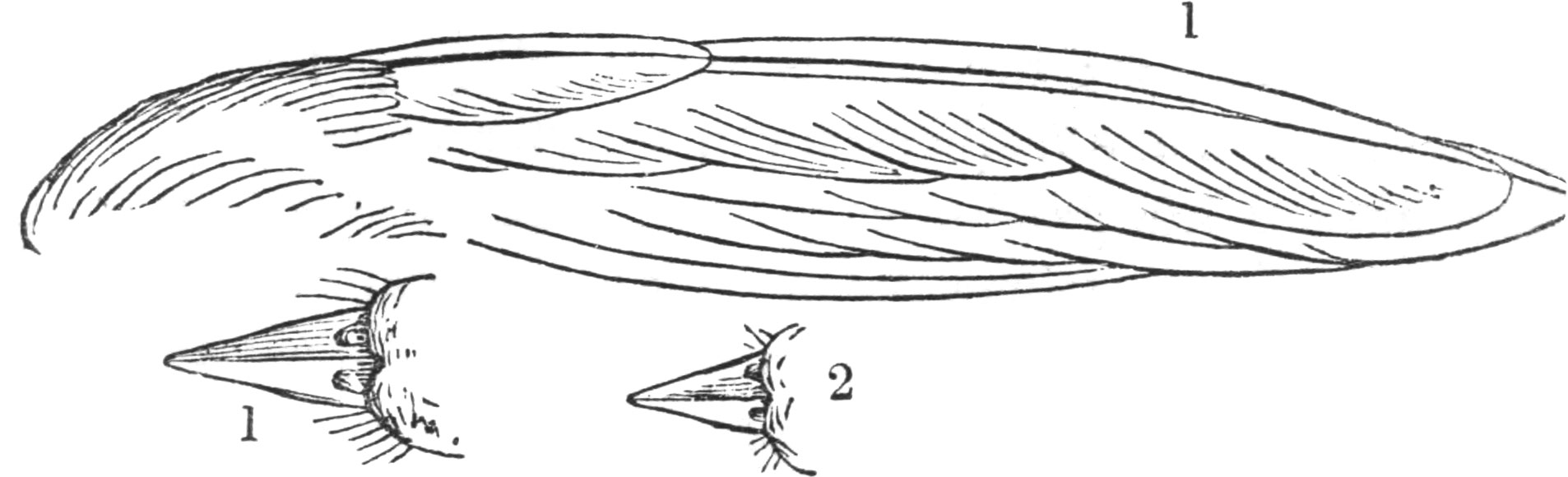
Muscicapidæ
1. M. grisola.. 2. M. luctuosa.
Muscicapa grisola
Spotted Flycatcher.—M. grisola, Linn. &c.—Spotted Flycatcher of British authors.
The Spotted Flycatcher is the most abundant of the two British species, being very commonly distributed over England, and extending to the very north of Scotland, though it decreases in frequency as it reaches the extremity of the latter. It frequents gardens and lawns, and seems to draw near to cultivation. In Scotland, it may be often seen by the side of some sub-alpine stream with precipitous banks, and here, perhaps, are its more natural haunts and breeding place, those in the garden and the lawn being its more artificial state. In the former locality, the nest is placed against the stem of some old tree, or on the shelf of a rock, always, however, with a support on the one side. The approach to it is betrayed by the shrill monotonous note or click of the parents. They take up their stations, and do not remove far from them, and in general select the top of some bare branch as their favourite perch, where they sit motionless, or dart on and pursue the passing insects. These are frequently taken at a single dart, but are also sometimes pursued for a few yards, and when seized carried to the perch, and always held for a few seconds in the bill. We have frequently seen bees taken, but they do not seem to be in any way particularly sought after or hunted, though in some districts the bird has obtained the provincial appellation of “Bee Bird.” In its artificial haunts, any projection of masonry, or top of some iron railing or garden stake, is chosen for its perch, while the nest is placed often in very unlocked for situations. A very common locality is against the garden wall, on the branches of a fruit tree; a nitch in the wall, capitals of pillars, or some corner amidst statuary, is as frequently chosen; and we have known the same birds, apparently, return to the very same spot or hole year after year. As an instance of a situation, quite at variance with its natural breeding sites, we may mention that noticed by Mr Jesse, of one building on the top of a lamp in Portland Place, London. The nest was taken with five eggs in it.96 The nest is generally composed of slender roots, or small twigs laid so as to form a broad base, the walls built of green moss, and the interior lined with hair, down, and feathers. They are one of our latest summer birds in arriving, and the process of building and incubation is commenced almost immediately. They seem to have paired almost before they had reached their decided locality, or, at all events, they lose no time in seeking and securing a mate. Insects have been accounted their only food, but we have occasionally seen them eat the ripe cherries, and we had an old gardener who used to destroy their nests on account of the fancied destruction they made of this fruit. Fruit we, of course, consider as an unusual kind of food, but at the height of the seasons, we have little doubt that some of the stronger billed species occasionally indulge in it. We are aware that the present bird has been by several accused of eating the smaller summer fruits, and we seldom find any thing of this kind recorded without there being some cause to be assigned; and we mention this, as the fact has been stated, but always with a doubt, or without quoting any actual instance of it.
This bird is comparatively a large species, the length being nearly six inches; the upper parts of the body are hair brown, having the base, and centre of the feathers on the crown, darker; wings brownish black, the quills and secondaries edged, and the coverts also tipped with reddish white; tail of the same colour, paler at the tip, and slightly inclining to be forked; the throat, middle of the belly, and under tail coverts, white; the chin, sides of the neck, breast, and flanks, streaked or clouded with hair brown. The young are of a browner tint, and have the centre of the feathers tipped with a spot of yellowish white.
Pied Flycatcher
Muscicapa luctuosa, Temm.—Muscicapa atricapilla, Gmel.—Pied Flycatcher of British authors.
This species is much less common than the preceding, and also more restricted in its localities. It occurs occasionally in some of the southern counties, and extends to the Border; the vicinity of some of the lakes in Cumberland and Westmoreland is a favourite locality; and in some parts of Northumberland and Durham it has also been met with.97 We are not aware that it has been met with in Ireland, or in any part of Scotland. From their unfrequency, their habits have not been much studied by our British ornithologists. On the lakes, Dr Heysham states, that their manners considerably resemble those of the Spotted Flycatcher; but they breed in the old pollard oaks, and old trees, and are very clamourous when the nest is approached. Mr Hewitson again states, on the authority of a friend near Penrith, that the nest is placed in the holes of trees, walls, and bridges, often near a stream of water, and that the hole is so small as scarcely to admit the hand. The eggs are from five to eight in number, and of a pale verdegris green. Among birds generically allied, we almost always perceive a similarity of colouring to prevail in their eggs, but which here is at much variance. In the manner of building and colour of the eggs, this bird runs into the Saxicolince, particularly the Redstarts, which it also resembles in the distribution of the colours on the tail, dark at the end, with a partially pale bar at the base.
Head, cheeks, and upper parts of the body, deep black; forehead and under parts pure white, also the scapular feathers. In a native specimen before us, the tail is entirely black, except the basal half of the outer web of the outer feather, which just marks the coloured portion of the tails of several of these birds and allied genera. During winter, the plumage, where black, changes to brown or blackish gray. In the female, the frontal white band is not so distinct, and the upper dark parts are blackish gray.
Conirostres
We have now reached the second great “tribe” or division of the perching birds, the Conirostres. It is composed of a great variety of forms, and according to Mr Swainson’s views, exhibits a series of birds having the highest degree of organization in all their parts collectively, and they are considered as shewing the typical form among the Incessores, and consequently among the entire Class “Birds.” We shall enter only into the description of those genera which arc natives of the British Islands; for it would be impossible, with any degree of accuracy, to point out the interlacing of the whole, without greatly overstepping our limits. Suffice it to say, that the bill, as indicated by the title, is somewhat conical in form in all the genera, that they are mostly omnivorous, and all perch or walk with nearly equal facility. In size they are extremely variable. The first family to be noticed is that of the Crows, (Corvidæ,) of comparatively small extent. The members of it are mostly of a large size, and are clothed, with the exception of one sub-family, in dark and unobtrusive colours. The European genera are also limited, and in our Fauna we possess representatives of only five, which stand in three of the sub-families. That which we shall first consider is the sub-family Corvinæ, or True Crows, exhibiting three British modifications of form in the genera Corvus, Pica, and Nucifraga. In the genus Corvus, or typical crows, the size is large; the colours of the plumage, with very few exceptions, black, occasionally contrasted with gray or pure white. In form they are made extremely compact and powerful; they possess strong organs for sustaining flight, are active and daring in their manners, but extremely wary ana cunning, while at the same time they are easily tamed, and soon become forward and familiar. They are social, and many species live constantly in bands, and breed together in large communities. They are in a great measure omnivorous, but feed chiefly during summer and autumn on grains, fruits, roots, and insects with their larvae, often serving by their perseverance to keep in check the ravages of the latter, During winter and spring, weak and sickly animals and birds fall an easy and acceptable prey, and carrion of all kinds is quickly discovered and eagerly devoured by them. The latter propensity has been attributed to their keen scent; but whether this sense is so very fully developed, as to enable them to discover their quarry without the assistance of sight, is scarcely distinctly ascertained, and has not yet been the subject of direct experiment.
Corvus, Linnæus.—Generic character.—Bill strong, culmin elevated, bending towards the tip, which is often obsoletely notched; nostrils oval, covered with stiff incumbent feathers; wings rather long, pointed, first quills to the fourth, which is longest, graduating; tail square or cuneated; feet formed for walking; long lateral toes of nearly equal length; claws strong and curved.
Types.—C. corone, cornix.
Cosmopolite.
The Raven
Corvus corax.—Linnæus.
Corvus corax, and Raven of ornithologists.
This is the most powerful species of the group: it has every member fully and strongly developed, and when in full plumage is in reality a beautiful and almost noble looking bird. There is, however, a wariness and suspicion about the expression, which produces an unfavourable idea, and is at variance with the frank and open daring seen in the carriage of many raptorial birds. This seems to have been an opinion handed down from antiquity, for before natural history became a science, or the habits of birds were studied, “the evil-boding crow”—“infausta cornix”—found a place in many savage superstitions,98 or served as the emblem of bad fortune, in the tales of the historian, or imagery of the poet.
The Raven is a bird which prefers an alpine range of country, though at the same time in pursuit of food, or attracted by the presence of carrion, it often frequents the cultivated districts. and even the vicinity of towns. In Britain it is pretty generally distributed; towards the south, however, becoming more local, and frequenting either the mountainous parts, the rugged maritime promontories, or some of the extensive and wild chases, abounding with aged timber; to the north it increases in numbers, and frequents similar situations, and in the same direction across the Firth of Forth it may be accounted a common bird. In Scotland, where this bird has most frequently come under our observation, it is spread over the immense tracts of wild wood and rocky muir, where it finds secure retirements in the breeding time, descending to the pastoral walks in search for much of its food, and living there, and in the lower country, during the severity of winter. Its favourite breeding haunts are precipitous rocks, either on the coast or inland, and there, on some projecting shelve or ledge, the nest is placed, formed of an immense mass of sticks, warmly and compactly lined inside with hair or wool; or if, on the face of the cliff, some aged and time-worn tree still remains, and can afford a sufficient resting-place for the heavy fabric, it is sometimes selected, but in general the rock itself is preferred. These eyries are returned to year after year, and the same spot is again chosen, as is the case with many of the raptores; particular crags and woods have received their names from the presence of these nesting places; and it is not uncommon, particularly in the south of Scotland, for the rock which affords an eyry to the Peregrine Falcon, to be also tenanted by the Raven. In England, the breeding place is more frequently selected on trees, from the want, undoubtedly, of suitable cliffs; but all along the rugged coasts, and in mountainous districts, the latter seem to be preferred, and, so far as we are aware, this is the case in the north of Europe, where the species is also abundant. The Raven is one of our earliest breeders, commencing in a mild season in the beginning of February. Where the birds have been undisturbed, the nest may be easily approached, but after alarm they become extremely wary, at the commencement of their incubation soaring in circles at a great height above the intruders, uttering at short intervals their hoarse and singularly sounding croak. As their cares increase, they become less timorous, and cross and recross the situation of the nest, when it is approached, with a rapid flight, the wings being moved with a peculiarly short and quick stroke, the voice becoming at the same time much more angry and impatient; still the parents keep out of harm’s way, and it is only when the young are handled, and utter their shriller croak, that they dash at the enemy, and pass within his reach. Such is their manner at this interesting period, in a district where they are occasionally molested, but where man is less frequently present, they fiercely defend their young, and become an easy prey if they dread intrusion on their premises. A specimen of a female in our collection was so wary, that she could not be approached on the nest, which was built on an old tree, growing from the precipitous bank of a deep mountain ravine, and which commanded a view of the country around. Finding access impossible, stratagem was resorted to, and a gun was fixed at about thirty yards distance, pointed at and bearing on the nest, a long string was attached to the trigger, the gun was cocked, and some hours after dark, the string was pulled, the result was the capture of the bird alluded to. This disposition was very different from that of the bird mentioned by White of Selborne, which allowed the tree on which she sat to be cut, and
was whipped down by the twigs, which brought her dead to the ground.99
In Ireland, their distribution, habits, and breeding stations, are nearly similar.
The food of the Raven varies at different seasons; grains form but a small portion, though they are sometimes eaten;100 insects, and their larvæ, as they occur, may be occasionally preyed on, but they by no means form so general a portion of food as they do among the lesser species of Crows. The small mammalia are preyed on, and in spring, when all creatures are producing their offspring, the eggs of birds, and the young of animals are sought after and devoured; and it is this carnivorous propensity which has caused to them so much persecution from the shepherd. They are undoubtedly very destructive both to the newly dropt lambs, and to weak sheep, and the extensive range of a pastoral farm renders watching or attention quite impossible; but from this loss suffered by the tenant, must be subtracted the advantages derived from the check which they keep upon many of the smaller members of the animal kingdom, which, unless to a certain extent kept down, might, and on some occasions have, become extremely troublesome; for in all our reasonings on the harm or advantages produced to man by various creatures, we are much too apt to look only at the question in immediate consideration, without at all examining its consequences on some other portion of living beings, or on the productions of the vegetable world. It is, however, from its depredations on the young lambs, that its persecution is chiefly carried on, and in many parts very considerable rewards are offered for its destruction. This, indeed, is almost the only check on their own multiplication. The strength of the bird itself renders it a match for most of its open enemies. Carrion is at all times eagerly sought after, and any circumstances which produce its presence, at the same time attracts these birds from their more usual haunts in the neighbourhood. In some of our Scottish deer forests, now mostly let for the sport of deer-stalking, we are told that the numbers which collect soon after the season has commenced, is in some parts almost incredible. They are drawn there by the spots where the deer have fallen, and by the animals which have escaped wounded, and which have either died, or from their weak and sickly state can be attacked without fear. Dr Richardson, speaking of its habits in the fur countries, says,101
The experienced native, when he sees from afar a flock of Ravens wheeling in small circles, knows that a party of his countrymen, well provided with venison, are encamped on the spot, or that a band of wolves are preying on the carcass of some of the larger quadrupeds, and pushes on briskly in the certain prospect of having his wants supplied;
and thus in another way is a knowledge of their habits made subservient to the necessities of man. Ravens are also said occasionally to frequent the vicinity of towns, but in Britain this is far from being frequent, though near some of the cities and villages on the Continent, where dead animals are more commonly exposed on the outskirts, it has been recorded to be their habit. In the vicinity of Edinburgh there formerly existed one or two eyries, one on the Castle rock, another on Arthur Seat, &c. We have seen a pair perch early in the morning on the chimneys of St James’ Square, but at no time have we been aware of their being attracted within the precincts of the city by the presence of carrion or any offal.
When reared from the nest, the Raven becomes extremely familiar, and in a stable or court-yard is even of some use, seldom allowing a rat to escape; but their instinct here does not teach them selection, and a young puppy, or early poultry, are not respected more than vermin. The power of pronouncing words and sentences also makes them more frequently tamed, and their articulation is so distinct, that many mistakes have in consequence happened, while the anecdotes related of them are still more numerous.
Its geographical distribution is extremely wide, pretty generally spread over the mountainous parts of Europe; it extends also to Northern Asia, and according to Temminck it is found in Japan. In North America, it is not an unfrequent bird, becoming more plentiful towards the north, and abounding in the fur countries. It is noticed by almost all our northern travellers.
There is little difference between the sexes except in size, the male being slightly larger, and having the lanceolate feathers on the head and neck longer, and more marked. In the height of plumage, during the breeding season, its clear and dark glossy plumage, with brilliant steel-blue reflections, render it a beautiful object for the ornithologist.
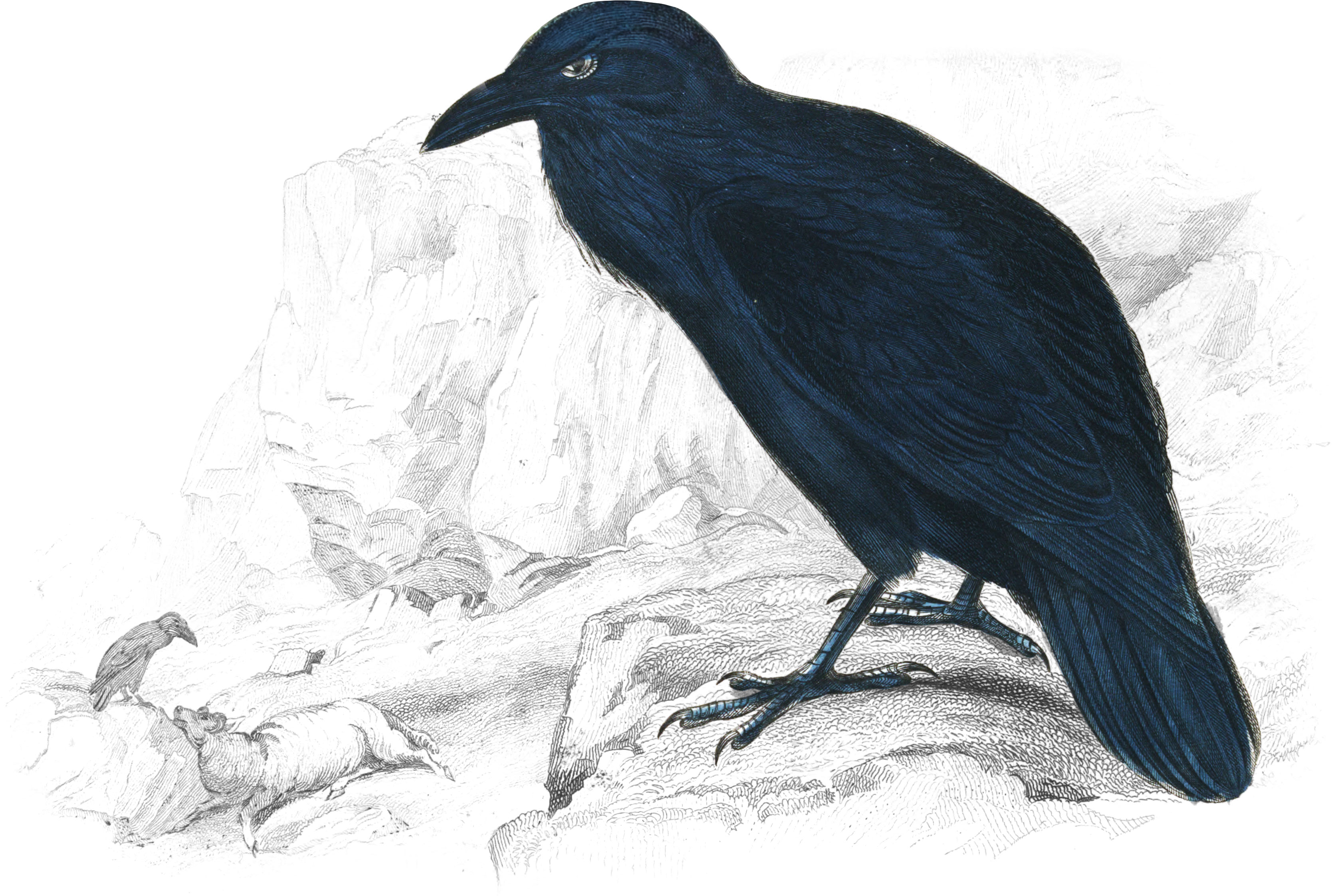
Plate XII

Carrion Crow
Corvus corone, Linn.—Corvus corone, Linn. &c.—Carrion Crow of British authors.
The British species, next in size and strength to the Raven, is the Carrion Crow, so named apparently from its preference to dead animal matter, either newly killed, or in a state of carrion. This bird is of very common distribution over the greater part of Britain, inhabiting chiefly wooded districts, and the presence of a dying or newly killed animal is surely indicated by the assemblage of these birds; but although this is the case, the food is very various, or rather indiscriminate, grain, berries, insects, weak or small animals, young birds, eggs, &c.; and it is chiefly persecuted on account of its depredations on the game, attacks on the poultry yard, or occasionally on weak lambs or fallen sheep; from the latter we have at times seen the eyes torn out before the animal was dead, and before it could be relieved. Minnows and small fishes are frequently watched for in the shallow pools by the edges of rivers, &c. and on the coast the sea wrack is almost daily examined, the shoals are waded through, and in both abundance of food is obtained; shell-fish is also eaten, and the manner of rising in the air, and allowing the shell to fall and break, so that the interior can be obtained, has been often cited as an instance of high instinct, and of the fact that animals will perform an action with a foreknowledge or memory of the result which is to be effected. Reptiles are also sometimes seized, particularly frogs in the very young, or in the tadpole state. We once saw this bird seize and carry off an adder; it exhibited great wariness of approach, but at last used a favourable opportunity, and seized the reptile behind the head, and immediately flew off, it passed in flight within a few yards, and we could distinctly see the manner in which it was held. The Carrion Crow is a more woodland bird than the preceding. It lives in pairs, or continues during the barren part of the season in small troops, the amount of the last brood. The nest, strongly framed with sticks, and warmly lined with wool and hair, is almost always placed on a tree, and at a considerable distance from the ground. At times in a wild sub-alpine sheep district, where the ravines and green sides of the mountain valleys are dotted with a few natural, rugged thorn and mountain ash trees, we have seen the nest not more than eight or ten feet high; but in woods and hedge rows, the tallest and often the barest tree is selected.
Though distributed generally in Britain, it may be called an inland bird; for in those districts where our next species, the Gray-backed, or Hooded Crow is abundant, its place on the coast is almost entirely supplied by it; and beyond the middle Highlands the same comparative distribution occurs, the Carrion Crow giving place to the next. In Ireland, Mr Thompson writes to us, that through the north of Ireland they chiefly frequent the sea coast. Of its foreign range we know it to be spread over Europe, and is noted by Temminck among the Japanese birds; but it does not extend to North America, as was supposed the species occurring there, (C. Americanus) being quite distinct, differing in all its form and proportions. When writing the notes for Wilson’s North American Ornithology, although we had no doubt of the fact, the want of specimens for comparison prevented us entering on the subject. Soon after, we received a specimen from Pennsylvania, through the kindness of Mr Swainson, which at once removed all doubt; and since that, we have examined other American skins sent to us by Mr Doubleday. Mr Audubon, in 1834, described it in his biography as distinct. The outline of the bill of the American bird exhibits some difference from that of the true C. corone, being weaker and much less conical in shape, forms at once reconcilable with the bird much less carnivorous, and almost as it were holding a place between C. corone and frugilegus.
The plumage is entirely black, with steel-blue reflections, and in the height of the breeding state it is very rich and glossy. The female is rather smaller than the male. The Carrion Crow may be distinguished from the C. Americanus by the colours of the reflections of the plumage, and also by its structure; on the head and neck it is much looser and more unconnected, and the lustre is of that peculiar reddish purple seen in the Rusty Crackle, (Scolecophagus ferrugineus.)
Hooded, or Royston Crow
Corvus cornix, Linn.—Corvus cornix. Linn.—Hooded, Gray-backed, or Royston Crow of British authors.
So far as our information and observation have extended, this species is stationary through the year in the northern parts of Scotland, while in the south, and in some parts of England, it is migratory. It possesses the same predatory habits with the last, but from being confined almost in distribution to the coast, they are not so severely or generally felt. It destroys the eggs and young of birds, and where not defended, robs the nests of the sea fowl; it is also said occasionally to attack young lambs. Its great fund of subsistence, however, is on the shore, and the various marine animal productions which arc cast up with every tide furnish it with a constant supply, which, perhaps, in some measure checks the degree of mischief which it might otherwise commit on the productions of cultivation. As we previously remarked, in those localities where it abounds, it fills almost entirely the place of the last, extending inland for five or six miles; and beyond that distance, unless where the country is intersected with bays or long salt water lochs, stragglers only appear. In the very north of Scotland, however, where, from the form of the land, the distance from sea to sea is comparatively short, it is by far the most prevailing bird, the other appearing gradually to decrease. In the south, again, they arrive with our winter birds of passage, frequent the shores and extensive downs or commons, and in spring depart again for their breeding quarters. They breed chiefly on cliffs, placing the nest on a ledge of rock, or selecting some stunted tree which has a suitable resting place. In many parts, the coast is wooded nearly to the water edge, and then a tree is selected; at the same time, we may safely affirm, that a rugged rocky coast is their most favourite breeding station. An individual occasionally strays inland, and in spring finds a mate in the Carrion Crow. We have repeatedly seen them breeding together, and could only account for it in this way, one or two individuals only occurring in the district alluded to during the winter. The produce is birds of intermediate plumage; but we have never been able to trace them again breeding, or for any long period. In Ireland the habits are similar, and Mr Thompson writes that it is common, and resident through the year. Temminck remarks, that it is abundant in the eastern parts of Europe, which are of a mountainous character, but he does not mention whether it is particularly confined to the coast. He also states that it is abundant in Norway and Sweden, migrating, however, in winter from some of the districts. They swarm in Carinthia and Croatia, in Holland they appear only in winter and autumn, and out of Europe, he states, they are very common in Japan.
The head, throat, wings, and tail black, the rest of the plumage clear smoke gray, having the shaft of each feather black, and the centre rather darker. In the mule specimens the gray parts of the back and under parts are indicated by the edges of the feathers being narrowly margined with gray.
Jackdaw
Corvus monedula.—Corvus monedula, Linn. &c.—The Jackdaw of British authors.
This species is of a more familiar nature than any of the preceding, and in all the cultivated districts of Europe where it abounds, it lives as freely in the midst of the most populous cities, as in its natural wild localities In noticing the manners of a bird such as the Jackdaw, we are often at a loss to describe what they are in a state of wildness, for we cannot say that the belfreys of churches, or the chimneys of houses, are their natural breeding stations; and with a few other of our native birds, their habits have been so associated with cultivation, that by many they have never been observed in their really wild and original state. The Jackdaw, as known over the greatest portion of the British islands, is one of our most forward and familiar birds, frequenting ruined buildings, churches, office-houses, wherever there is an empty chimney or turret, often causing annoyance by stopping up those which have been in disuse during the spring; and abounding in all our large towns, where towers, and castles, and spires furnish holes and niches to support or hide its nest. It there assembles in small parties, and carries on the duties of incubation, regardless of all the bustle around. The nest is built with sticks, and it is astonishing with what perseverance the birds will carry on until some vacancy is filled up, and a resting-place is secured for the nest; but at the same time they often exhibit a great want of instinct, for they will continue to drop sticks down a wide chimney, where perhaps not one will remain, until cart loads have accumulated beneath. We have also seen attempts made to build amidst the capitals of large supporting columns, and week after week endeavours to place the sticks across the projecting ledges or ornaments. One or two might remain for a short while, but were sure to be displaced in fresh attempts, while underneath the result of a morning’s labour was often as much as a single person could at once remove; this we have known continued in the same spot for some years. In their more natural state, the rugged precipices and caves on the sea coast, and particular localities in mountain districts, abounding with fissures, and clothed with ivy, seem the places resorted to; aged and hollow trees are also sometimes chosen, but it is perhaps more from particular circumstances, in the same way that rabbit-warrens are in some districts much frequented, and on the rocky islands, or near the shores, where this little animal is often kept and abounds, their burrows are used by the Jackdaw as well as by various sea fowl, (the sheldrake, puffins, petrels, &c.) nevertheless, we consider rocky and mountainous places to be their natural resorts. On many parts of the sea coast, and upon inland rocks, have, in ancient times, been placed old castles, or places of defence, and now amidst their ruins a colony is always to be found spreading themselves also over the suitable parts of the adjacent crag; but around all the northern shores of Scotland, where buildings are less frequent, there are many colonies of this bird, and apparently in places where nothing but the natural fitness of the situation could attract them. Here the nest is built in fissures, in holes, or in the interior of caves, and often outwardly exhibits a vast assemblage of sticks, sometimes partially concealed by a drapery of ivy, or other wild creepers. Many nests are often placed together, so near that the birds almost touch, at the same time there is no interference or community of hatching, and the entrance is generally by different apertures. In cultivated districts, again, where there is a want of the retreats, incident to buildings, they live in small companies intermingled with the common rook, with which they seem always to associate in terms perfectly friendly, and in the rookery make the mass of nests, which the accumulation of years collects, serve as a cover and substitute for the shelter of caves or ruined buildings. We have seen three or four nests placed underneath one of those large masses, which was hollowed out and added to beneath, so as to form a hollow apartment, in which the various appropriate linings were deposited.
The food of the Jackdaw is similar to that of its congeners, only being a bird of less strength than many of them; its habits are in a manner modified to the power it possesses of procuring subsistence. Amidst cultivation it associates with the common rook, and feeds on grains, roots, insects, &c.; or being a little more forward, it occasionally takes what can be procured in the barn and stable yards, or in the garden, while in the midst of cities and towns it is never at a loss, and will indiscriminately feed on almost any kind of offal. It is a bird very easily tamed, and with moderate attention will continue for years to obey the call. It will alight on the head and shoulder, and take up an accustomed perch in the kitchen, in expectancy of its usual allowance.
The geographical range of this species seems scarcely to have been so much attended to as some of the preceding. Over Britain and Ireland it is general, but is wanting in many extensive tracts of the outer Hebrides. In Europe it seems nearly equally common, but to what extent it ranges in Northern Asia, or of its limits, we are ignorant. Temminck, in his Supplement, adds, that it is extremely common in mountainous parts of the Morea.102
In country localities the Jackdaw is a clean and agreeable looking bird, and the adult male, in the height of his breeding plumage, is not devoid of beauty, while the bright and peculiarly pale coloured iris always conveys an idea of activity and sprightliness, however much the plumage may be dulled by the dirt and smoke of towns. Length of the male about thirteen and a half, or fourteen inches; crown of the head rich black, with violet reflections, forming a circular cap or crown; back part of the head, cheeks, nape, and sides of the neck, dark smoke gray; the feathers loose and unconnected; upper parts, wings and tail, black, with blue and violet reflections; the under parts blackish gray, nearly dull black on the chin, and with the tips, for nearly half an inch in breadth on the breast, paler; the irides are clear grayish white, and add much to the lively appearance of the bird. The female is rather less, being only about thirteen inches in length, the markings on the head are rather less distinct, and the upper parts are of a blackish gray, with violet reflections. Cream coloured and dusky varieties are not unfrequent; the former presenting the characters of an albino having the irides red. Pied varieties also occur.
Rook
Corvus frugilegus.—Corvus frugilegus, Linn. &c.—Common Rook of British authors.
We have placed the Common Rook last among the British species of Crows, because it varies somewhat in its gregarious habits, and by the bareness of the base of its bill, which by some ornithologists have been thought to be characters of sufficient importance to entitle it to a place generically separate. In every respect, however, it is essentially a Crow, and any little differences of either structure or habits will only serve to connect its own group with some of those nearly allied to it.
The Common Rook is perhaps more connected with the park scenery of Britain than any other wild bird. The huge piles of its nest which dot the avenued approaches to the residences built in the end of the sixteenth and in the seventeenth centuries, are seen from a distance, and have a marked appearance on the character of the place, while the bustle and the. noise of the rookery on a near approach is always interesting, and is protected by the ’owners as a fitting accessory to their chase or domain. In the manners of the group generally, there is a familiarity which leads many of its members to court the vicinity of cultivation and of habitations. Few rookeries exist at present far from some mansion, though this may be accounted for by the prevalence of the largest and finest timber occurring near the residence. At the same time, we are not aware of any station existing in a retired or secluded region of forest, or indeed of any which has not a mansion of one kind or other, baronial hall, or lowly cottage, within sight or hearing. The Rook is at all times gregarious, and whether during the season of incubation, or during winter, may always be seen in large flocks feeding and roosting together. For a breeding station or rookery, all kinds of trees are indiscriminately used, though it is most frequently seen among woods of fir trees, or on those of beech, plane, and ash, which were then most in use for planting the avenues of the last and previous centuries. When it happens to be chosen among deciduous trees, the locality serves for a rookery only, and is returned to at the proper season, almost on a particular day, the premises being frequently visited during the intervening time; but when placed in a wood of pines, the birds return nightly to roost through the year. In the former case, they resort during the winter to some pine wood often many miles distant from the breeding station, and which affords them warmth and shelter. Thence at day-break they depart to their feeding grounds, often visiting their breeding place as they pass or repass, and remaining for a short time as if examining its condition. Their, flights are taken simultaneously, and having gained a convenient altitude, they fly in a mixed troop directly to the point intended.
The food of the Rook consists less frequently of animal matter than that of the other Crows we have just described; carrion may be occasionally eaten, and we have trapped them with the bait of an egg, or a piece of bacon fat, but this forms the exception, and it may be stated as made up of grains, fruit, roots, worms, slugs, insects and their larvæ. During the season of incubation the neighbourhood furnishes an ample supply; when the young are able to accompany their parents, excursions are made to a distance; and previous to the ripening of the grains, the muirs are much frequented, and at this time the wild berries are ripe, and many species of large caterpillars abound. As the grain ripens, they descend to the fields, and consume a considerable quantity; as the season advances, the potato and turnip crops are in their turn partially attacked; and when these cease, or during the severity of winter, scarcely any thing will come amiss, from whatever can be gathered in the fields, to the refuse of the dung-hill and barn-yard. The greatest damage which the husbandman can allege against the Rook, is done when his young wheat begins to appear above ground; then a “flock of Crows” may cause considerable loss, and being guided to the sweet and swollen grain by the tender shoot, they burrow with their bills, and leave the “braird” to perish deprived of its nourishment. Another destructive period is, when the potato has been newly planted, to the sets of which they are equally guided by the young shoot, and a crop thus may be materially injured. These depredations are by far the most serious, but in general a watching would prevent or lighten them, for neither the grain nor the root is sought after when vegetation has somewhat advanced, and we consider the destruction of slugs, and the grubs, or larvæ of the insects, which feed on the roots of the various grains and grasses, and therefore affect our crops and pastures, as at least compensating for their destruction or injury to the produce of the fields. In a few districts orders for extirpation have been issued. These, in some instances, have not been followed out, in others their execution has been regretted, but even the addition of the destruction made among the young when they have left the nest, and are termed “branchers,” as a matter of sport to some, and as articles of food to others, have been insufficient to check their numbers, for on the whole the species seems to have rather increased, and we know of the growth of several new rookeries without a corresponding falling off of those near them. Except such as are of modern date, the age of the establishments seems nearly coeval with that of the trees on which they rest, and it is very seldom, indeed, that we learn of a complete extirpation. Villages and towns have, in many instances, arisen around their colonies, but the inhabitants will only quit their venerable resting place on the removal of the trees themselves, and if left thus unmolested, will continue to assemble at their stated times, and perform their allotted duties, seemingly unconscious of the most crowded and noisy thoroughfares. Both Edinburgh and Glasgow can, at this day, exhibit their rookeries within their well-peopled bounds.
We are not aware that the geographical range of this bird has been attended to with any more precision than the last. In the British islands it is generally distributed, preferring, however, the cultivated districts, decreasing towards the north, and being always least abundant in the alpine or wooded mountainous regions. Out of Britain it has been mentioned to be frequent in temperate European regions, and to extend to Asia, and according to the list in M. Temminck’s Supplement, is enumerated as a bird of Japan.
The complete plumage of the Rook is, like that of the preceding, clean, glossy, and beautiful, a clear black, with blue and violet reflections; the feathers of the head and neck, with their webs, decomposed, and the texture loose and silky. The greatest difference in form exists in the bill, which is more tapering and slender towards the point, formed for digging, rather than a wedge or lacerating instrument. The nostrils are not covered by the incumbent narrow feathers, and the base of the bill and chin are bare, covered only by a naked scaly skin. In the young birds, previous to the first moult, the plumage on these parts is similar to the other Crows, and the denudation seems to be a very necessary provision when they have to provide for themselves, occurring naturally and not by wearing, and evidently intended to prevent annoyance from wet soil, &c. adhering to the feathers; in the nestling state, and during summer and autumn their food is not sought where this would be. a hindrance, and by the time the fallows are turned up, and the fields bare, the plumage near the bill is in a state not to be incommoded.
The Rook is subject to variety, entirely white, of a sienna colour of different degrees of intensity, and often beautifully pied.
In the next form which is now considered as entitled to a sub-generic appellation, after being long since placed by Brisson as such, and again withdrawn and replaced according to differing views of his followers, we have a continuation of the habits of the lesser or weaker true Crows, but in conjunction with a lengthened tail, and very short wings, of which the first quill is rather abruptly narrowed towards the tip. In consequence, they do not possess the power of a strong or often soaring flight, as among the former, but proceed in jerking curves, and with a short often repeated stroke. The colours of the plumage are brighter and more contrasted. They live in pairs, or assemble in parties to the amount of the broods of the past year. Their habits are arboreal, at the same time they are partial to the vicinity of cultivation. Very few species are known; those which were formerly included being now separated among other genera.
Pica, Brisson.—Generic characters.—Bill and feet as in corvus; tail much lengthened and cuneated; wings with the fourth quill longest, the two preceding graduating, the first short, and narrowing for two-thirds of its length. Pica melanoleuca.
Europe, America, Asia.

Pica Feather
Magpie
Pica melanoleuca.—Corvus pica, Linn.—Garrulus picus, Temm. Supp. p. 63.—Magpie of British authors.
Although the principal colours of the Magpie are only two, yet from the manner in which they are contrasted, and from the brilliant reflected tints by which they are varied, it is perhaps one of our most beautiful birds, while its presence in the midst of cultivation, and its active and rather forward manners, render it in many countries a favourite, while in others it is looked upon with a kind of superstition. The natural localities of the Magpie seem to be a district partially wooded, where there are no vast tracts of forest, no mountainous elevation, but ground, through which it can ramble, and where it can find shelter at night or from the storm, in the natural groves with which it is interspersed. In Britain, it is now nearly a constant attendant on cultivation, and is very generally distributed except in the north, or in very alpine districts, where the elevation becomes too great, and the forest range too extended. Like its congeners, it would even seem to delight in the vicinity of population, perhaps in some degree attracted by the food which is there presented to it, and the neighbourhood of villages, or the trees which generally surround the farm steading, are almost sure to be tenanted by a pair at least of these active birds. There they station their nest, and a particular tree year after year for that purpose is selected, plantations and woods of limited extent being also frequently chosen. Among all our native or introduced trees, the ash is that most frequently built upon; there was an ancient law or regulation in Scotland, whereby tenants were obliged to plant and rear a certain number of ash trees round the farm-steading, and accordingly most of those sites are surrounded by some venerable trees of this species on which the Pies love to build, and the prevalence of this tree in such situations may be the cause, without any particular partiality in the birds existing for it. The nest is generally placed high on a topmost branch, so weak as scarcely to bear the weight of a boy; but at other times we have seen it placed at a moderate height from the ground, in low shrubbery trees, in tall overgrown hedges, and a gooseberry bush is in one instance recorded as bearing the burden for several years. The structure of the nest is very different from that of the true Crows; independent of the usual cup-shaped nest, strongly built with sticks, chiefly selected from thorn or other prickly shrubs, it is strongly covered over with an arched roof of the same materials; two opposite holes are left for access and egress, so small as scarcely to admit the hand, and we have scarcely ever examined one of them without being considerably scratched and torn when procuring the eggs. The base of the nest, as mentioned, is firmly built with sticks, but in addition it is thickly daubed with clay, which renders it so strong as on a high tree to resist the effects of ordinary shot; the inside is commonly lined with fine dried grasses. In this country, the Magpie, though breeding so near to houses, is a watchful and shy bird, arising from its persecution, and frequently attempted destruction on account; of its depredations upon the game, and the inmates of the poultry yard; but in some of the European countries where it is protected, it becomes familiar and devoid of fear. In Norway, Mr Hewitson tells us,
It is on the most familiar terms with the inhabitants, picking close about their doors, and sometimes walking inside their houses. It abounds in the town of Drontheim, making its nest on the churches and warehouses. Few farm houses are without several of them breeding under the eaves, their nest supported by the spout.103
Mr Laing confirms this:
The Magpies hop about the houses in a half tame state, and are never pelted by the children.104
What a different picture of the bird these accounts exhibit, when compared with the watchful bird in this country, which will not permit an approach within at least sixty yards. Its food is similar to that of the true Crows, carrion forming the smallest portion of it; like the Jackdaw, it is much given to plunder the nests of other birds which do not possess sufficient strength to combat the aggressor.
In geographical distribution the range is extensive. It is frequent in temperate countries where the locality is suitable, and reaches considerably to the north. It extends, we believe, to Northern Asia. According to Temminck’s Supplement, it is widely spread over the Morea, while in Japan it is exactly the same with the bird of Europe.105 It seems also to be found in the interior of China, though to what extent we are ignorant.106 In America the bird was described by Wilson, but specimens brought home by the Arctic expeditions were considered distinct, and named C. Hudsonicus by Mr Sabine, in which state the Prince of Musignano in his latest comparative view is still inclined to keep them. We have compared a northern specimen, but do not perceive differences sufficient to entitle separation, and by all our modern ornithologists, with the exception above named, we are borne out in this view. Dr Richardson states it as a resident in the interior districts of both sides of the Rocky Mountains, but it is rare on the Atlantic coasts, or near Hudson’s Bay.
The Nutcracker, the last British bird entering among the Corvinæ, was separated generically from the true Crows by Brisson, under the title of Nucifraga. For a long period only one species, that of Europe, was known. Lately Mr Gould figured another very closely allied from the Himalaya range, and the Prince of Musignano and Mr Audubon have now ranked the Corvus Columbianus of Wilson along with them. The form is a very remarkable one, uniting the structure of the Crows with some of the habits of a Scansorial bird.
Nucifraga, Briss.—Generic characters.—Bill nearly straight, culmen rounded, and slightly entering among the frontal feathers, rather dilated at the base, the point blunt; wings long, fourth and fifth quills longest and equal, first, second, and third, graduating; tarsus and feet strong; the centre toe and claw equalling the first in length; the centre and hind claw long. N. caryocatactes.
Europe, Asia; in North America represented by C. columbianus.
Common Nutcracker
Nucifraga caryocatactes, Briss.—Corvus caryocatactes, Linn.—Caryocatactes, Will.—Nutcracker, Nutcracking Crow of British authors.
As a British bird, very few instances are on record of the Nutcracker having been seen or captured The following may be mentioned: two noted by Montague,—one killed in North Devon, the other in Cornwall; and, in addition, Mr Selby states that the bird was once seen in Northumberland in Netherwitton Wood. Of its habits we desiderate much a correct account from observation; so far as the works of authors describe the bird, we know it to be gregarious, that it frequents wooded alpine regions, feeding partially on the kernels of hard seeds, and on insects; breeding in the holes of decayed trees, and occasionally ascending their trunks in a climbing manner.
This is the account Temminck gives us. Mr Selby, in a note, has stated, on the authority of his brother, who met with a large flock in a forest in Switzerland, composed of pinasters and stone pines, that they were busily engaged feeding on the seeds contained in the cones.107 The locality of the Himalaya bird in general confirms these accounts.
Crown of the head and nape blackish brown; the quills black, with a narrow tip of white on some of the last, feathers of the bend of the wing and on the shoulders tipped with white; the tail black, tipped with white, the white tips increasing in size and extent towards the outside, the under tail coverts pure white; the remaining parts of the plumage rich umber-brown, with a purplish tinge, having the tip of each feather marked with a large oval spot of white; on the throat the spots are narrow, but under the eyes, and on the sides of the neck, they are nearly confluent. In this species the bill is straighter and more subulate than in that from alpine India, and the claws on the centre and hinder toes are much more slender and lengthened. Length rather more than eleven inches.
The Jays composing the next sub-family of the Corvidæ, are generally of much more gaudy plumage than any of the preceding, and at the same time are more arboreal in their habits. The old genus has been divided into sub-genera, some of which from warm latitudes are of very beautiful plumage. Our British example belongs to the old form, or true Jays, a group which rather affects a temperate and sub-alpine region, and of which the principal extra European species have been chiefly found in the mountainous regions of India.
Garrulus, Willughby.—Generic characters.—Bill rather short, straight at the base, tip bent and distinctly notched, commissure straight, nostrils covered and protected by short bristly feathers; wings rounded, first quill short, next four graduated, fifth and sixth longest; legs weaker proportionally than in Corvus; hind toe strong, with a dilated sole. G. glandarius.
Note.—Head crested, plumage loose. Europe, Asia.
The European Jay
Garrulus glandarius.
Corvus glandarius, Linn.—Pica glandaria, Klein.—Garrulus, Briss.—Jay of British authors.
The common Jay is perhaps one of our most beautiful birds. The general tint of his plumage is chaste and pleasing, it is finely contrasted by the deep black of the wings and tail, and the brilliant hue of the feathers composing the spurious pinion enlivens the whole beyond the general brilliancy of our northern birds. To these may be added the quick and lively habit of the bird, and altogether he is an ornament and acceptable tenant of our woods. In the wooded districts of the south we believe the Jay is frequent; as we proceed northward, it becomes much more local, though by no means rare where it is found, frequenting generally the older wood around private seats, and in parks, and. some of the forests in the middle Highlands. It is common both in Perth and Argyllshires, but we are not sure that it extends to the forests of the far north. In Ireland it inhabits some of the more southern counties. The Jay is strictly arboreal in its habits, seldom settling on the ground, and never, we believe, feeding there in the manner of the True Crows. The food, nevertheless, consists of nearly all the materials furnished by the forest, garden, or farm yard, acorns and beech mast, with the seeds of the forest trees, sometimes different grains; the eggs of other birds, sometimes the young birds themselves, and almost every produce of the garden, in seeds or fruits, are constantly plundered, particularly the various wall fruit. For this purpose, excursions are made early in the morning, and the hoarse and peculiar cry of the watchers will often rouse a host of respondent plunderers, when the voice or appearance of the gardener calls their attention to danger. Residing in a district where the Jay is not immediately common, we have not had a constant opportunity of seeing them, but when visiting where they abounded, we have delighted in watching their manners. They are imitators artificially, as all the Corvidæ are, but not naturally we think, and we have not heard in a wild state other notes than what would by most be termed rather discordant, no appearance of the “low song” in spring mentioned by Montague; still we know that gentleman to have been a close and accurate observer, and we would not wish to impugn his accuracy. When kept tame, which they very soon become, and allowed sufficient room, they are agreeable pets, become familiar, playful, and impudent, and possess the faculty of imitation to a considerable extent, some of them so accurately as to have deceived both man and beast, if we may believe all the recorded anecdotes.
The Jay builds on trees, and constructs a nest almost intermediate between those of the Crows and Thrushes. It is formed externally of sticks, much weaker, however, than that of the True Crows, and internally it is built and lined with, the fibres of roots, and a few strong straws or grasses. The eggs, five or six in number, are of a pale bluish green, blotched with yellowish or reddish brown. (See plate XXVIII.)
The forehead, and crown of the head, streaked with black, feathers behind lengthened, and forming a crest erectile at pleasure or excitement, which adds much to the lively appearance of the bird. From the corners of the mouth there is a large black eval patch or moustache running below the auriculars on each side of the neck. The upper parts of the body, except the rump, are pale brownish purple red, having a peculiar and agreeable opaque appearance. The under parts are of the same colour, but paler, and shade in the centre into a reddish yellow-white, becoming pure white on the under tail coverts. The rump and upper tail coverts are also of this same pure tint. The greater quills are bluish black, the outer webs pale grayish white. The secondaries are black, the basal half of the outer webs pure white, forming a conspicuous mark on each wing. The tertials are also black, having the base of the last bright chestnut-brown. The feathers composing the bastard wing and greater coverts, beautifully barred with black and brilliant blue, forming a lovely ornament, which is much prized by the angler. Tail black at the base, with the appearance of bars from the structure of the feathers, and sometimes there exhibiting a trace of blue. The legs and feet are pale reddish, or flesh red. The general length is from thirteen to fourteen inches.
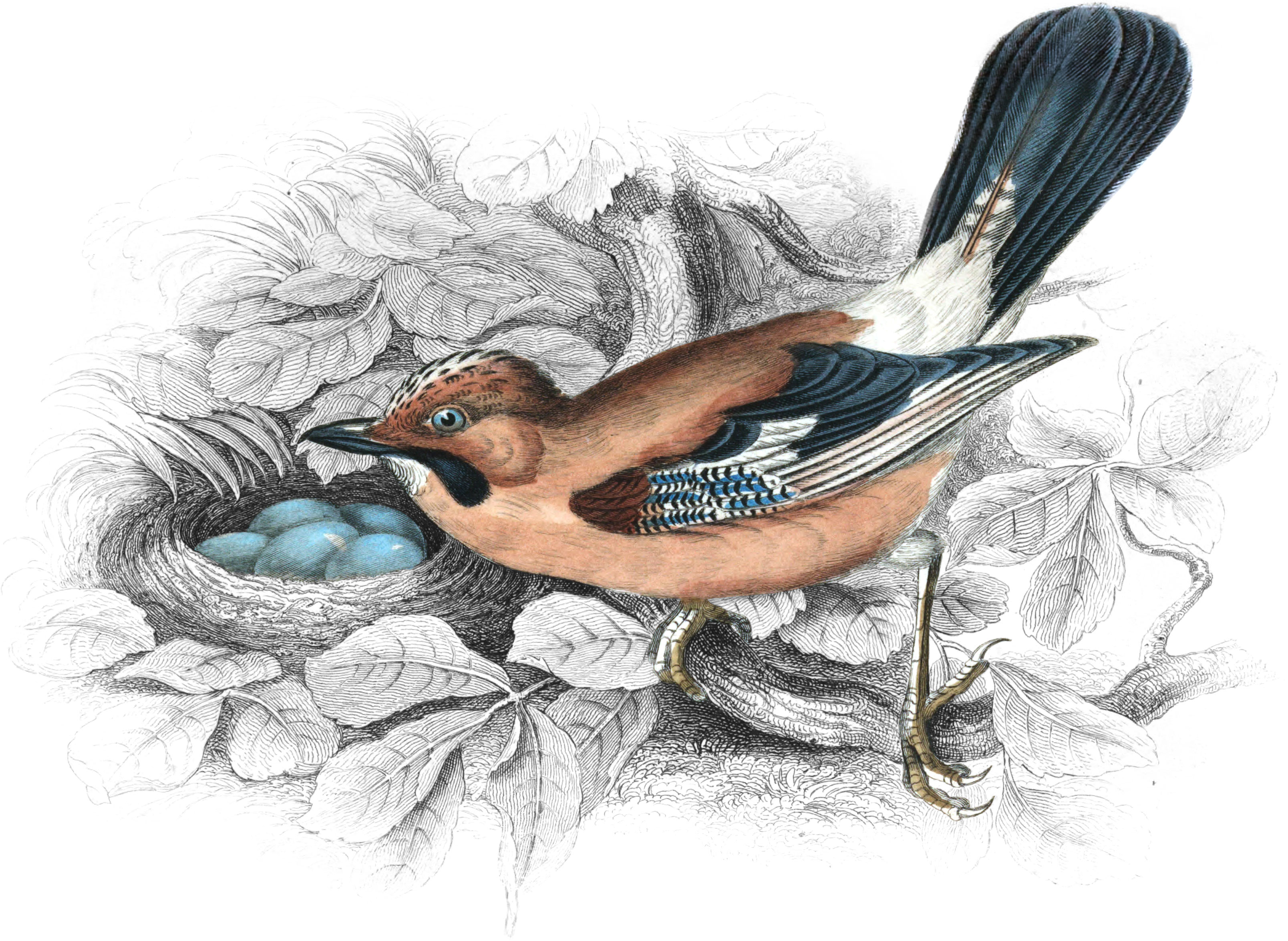
Plate XIII

Another sub-family shewing the Tenuirostral form, presents us with a single British example, and indeed the sub-family Fregillinæ contains so few species assigned to it on sufficient grounds, that farther than adopting it as apparently that which would fill this place, we know little more. Our native example, familiarly known as the Chough, or Cornish Chough, and rendered a classical bird from the allusion made to it by Shakespeare in King Lear, may be considered as typical of one genus, the bird of alpine Europe shewing another form. The first may be thus characterized.
Fregilus, Cuvier.—Generic characters.—Bill strong at the base, culmen rounded, gradually arched for the whole length; tomia entire; nostrils covered with thick, short, strong plumes, regularly rounded off at the extremity; rictus bristled; wings long; quills irregularly graduating, fourth longest; tail slightly rounded; tarsi and feet strong and short; claws strong. F. graculus, leucopterus.
Europe, Asia, New Holland.
Chough or Red-legged Crow
Fregilus Graculus, Cuvier.—Corvus gracidus, Linn.—Pyrrhocorax gracidus, Temm.—Red-legged Crow, or Cornish Chough, of modern authors.
This very handsome bird is locally distributed, but is perhaps not so rare as has been generally accounted. In this country it only frequents sea-coasts, never venturing far inland, and in this respect seems to differ considerably from the birds on the Continent, where Alpine inland districts are in part inhabited by them. In Britain, the rocky coasts of Devon and Cornwall, various parts of Wales, and some of the adjacent isles, are southern localities; in Scotland, St Abb’s Head on the eastern side, and the shores of Wigtonshire and Galloway on the western, are frequented; and we learn that it reaches even the Hebrides. In Ireland, Mr Thompson writes,
it frequents the sea-coast chiefly, and occurs in certain localities, in the north, south, and east of Ireland.
But that part where we have seen it most abundant is in the Isle of Man, an island of considerable extent, and having precipitous coasts for at least two-thirds of its circumference. Round these shores it is so common that we once procured nearly thirty specimens in a forenoon. The habits of the bird, as well as the flight, manner of alighting among the rocks and fissures, very closely resembles those of the Jackdaw; so much so, that when we first enjoyed the satisfaction of seeing this bird on a part of the mainland where they were not so frequent, we mistook their flight for that of the last named bird, and missed some opportunities of procuring what we then considered a very rare bird; a glimpse of their red legs first undeceived us. During the breeding season, when we have chiefly seen these birds, we found them almost constantly on the coast near the caves and fissures where the nests were placed; and they were very seldom seen more than a quarter of a mile inland, but they made excursions so far, alighting among the rocky parts of the upland sheep pasture, and occasionally feeding and walking on the dry pasture itself, where they appeared to procure insects, their stomachs being chiefly at this time filled with coleoptera. It is also said to feed on grains and berries; and we are not aware of any particular food afforded by the rocky British coasts which in that country so peculiarly attracts them to such localities, while on the Continent, the Alpine ranges on the borders of the snow-line are their usual haunts. Colonel Montague, who kept one as a pet in his garden, and whose account, given in his Supplement, will be found interesting, states,
His natural food is evidently the smallest insects, even the minute species he picks out of the crevices of the walls, and searches for them in summer with great diligence. The common grasshopper is a great dainty, and the fern-haffer is another scarce but favourite morsel. Worms are wholly rejected; he sometimes eats barley with the pheasants, and never refuses hempseed.
When the situation of the nests was approached, no great restlessness or anxiety was exhibited. They were placed in rents of the rocks, in the entrances of the caves, or in overhanging ledges of rock, built much in the same manner as those of the true Crows. The eggs, from five to seven in number, are of a verditer or bluish green, spotted and blotched with blackish brown, some specimens nearly resembling those of the Jackdaw, and apparently subject to nearly the same variation. As previously stated, this species inhabits the alpine parts of the European Continent, and most probably extends to the mountainous portions immediately across the frontier, being found in India and Himalaya.108
This beautiful species is entirely of a deep glossy black above, with steel blue and green reflections; plumage on the head and neck rather loose and tinted with purple; underneath, of a deep and uniform tint with less lustre. The bill is of a brilliant vermilion red, strong, bending for the whole length, and without any trace of a notch; the plumes covering the nostrils are close and stiff, and appear as if rounded off with scissors on the bill. Legs and feet are of the same brilliant tint with the bill, and are strongly formed; the claws brownish black, crooked and strong; the development of the wings and tail large and powerful, the flight consequently light and buoyant; length, about fifteen inches. The bill and legs of the young do not shew for some time the brilliant red colour.
We have reached the second family of the Conirostres, the Sturnidæ or Starlings, but two species only holding a place in the British list, we shall be able to enter but slightly into the forms of the various genera which compose it. The birds at present included in it are almost all above the middle size; they are chiefly gregarious groups, and many of them feed much on the ground. The colours of the plumage are rich and varied, generally, however, dark, and running through all the beautiful gradations of black, blue, and green. When relieved by other tints, it is by broad masses of crimson and yellow, in a few instances of white. The first member we have to notice is the Common Starling, according to Swainson forming the Conirostral as well as typical form of the family, and exemplified in the genus.
Sturnus, Linn.—Generic characters.—Bill depressed from the base; culmen rounded, and entering the feathers of the forehead; wings rather lengthened, first quill very short, second longest, the others graduating; tail short, inclining to be forked, tips of the feathers divaricating; feet strong, terrestrial.
Type.—St. vulgaris.
Europe, Asia.

Sturnus Head and Beak
Common Starling
Sturnus vulgaris, Linn.—Stare or Starling of British authors.
This beautiful bird is an abundant inhabitant of many parts of Britain, but is not equally distributed, though it extends from the most southern parts to the Hebrides. The rocky sea coast, old castles, and ruined buildings, and the wood in parks or in cultivated districts where it is aged, and abounds in hollow and decayed trees, are their favourite breeding places, and there many pairs nestle together, according to the conveniences of the station. At other seasons the lowest lying districts seem to be their favourite resorts, and in the fenny counties of England, and what in Scotland are called holm lands, are frequented often by immense bodies, associating with the rook and pigeons, flying with them, and feeding in their company. They roost in willow beds, or reeds by the sides of lakes, or in marshes, and an hour before dusk is the most favourable time to see their beautiful and varied evolutions, extending far from, and around their station, and to a considerable height; the flock at one time appearing an irregular and straggling company, and at another wheeling into one dark and compact mass, so close as scarcely to be seen through. In Holland we observed this bird in immense troops during autumn, shewing its propensity for a low-lying and watery country. There they might be seen in every meadow,—if distinction could be applied to a country which for miles and miles shewed an extent of rich low pasture land, separated only by ditches or a canal,—keeping company with Rooks and Lapwings, and roosting at night in the immense reed beds skirting the meres or lochs, breeding about the churches and buildings having spires, and sometimes in the old pollard willows. In many parts of Scotland where they do not breed, they are migratory, appearing in autumn and spring; but near her old towers and castles, now mostly in ruins, a few pairs may be seen, giving life to the generally grave characters of these buildings. It may be remarked, however, that on the north coasts of Scotland, and in the Hebrides, the Starling roosts among the rocks on the coast, and so accommodates itself to the want of its more usual southern roosting places. For a situation for the nest various places are chosen. In the stations we have mentioned, the rocky caves and fissures are chosen, and it is rather an unlocked for medley of forms to find the Rock-dove and Cormorant nestling with the Starling, in the same great cavity, within the distance of a few yards. Mr Macgillivray also mentions, that he has found their nests
in large winding holes in grassy banks of an unfrequented islet, which I conjecture to have been originally formed by rats.
Ruined buildings and aged trees are in other parts the most favourite stations, and where these are awanting, a pigeon-cot, the abutments of a bridge, or any large and exalted, not much frequented building, is also occupied by them.
From the difference in the plumage of the immature birds, some confusion has arisen, and species have been multiplied, while the name of solitary thrush being mistakenly applied to the young, has caused the introduction into our fauna of the genus Petrocincla. The male, in adult winter or complete autumnal plumage, is of a rich velvet black, splendidly lightened with reflections of green, blue, and purple, and having each feather tipped with a triangular or star-like point of yellowish or reddish white. As the breeding season advances, these tips fall off, by which the feathers become narrower or more hackled, and the tints of the head and neck, and greater portion of the lower parts, become of a uniform dark tint, having the reflections still more brilliantly kept up; on the back, wings, and tail coverts, the pale tips and edges still remain. The shoulders and wing coverts are black, with a predominance of purple reflections; the secondaries are grayish black, margined with deep shining greenish black, and exterior again to that with reddish white, which, however, is lost during the breeding state. The quills are grayish black, with dark outer webs, and a pale reddish white margin. The tail short, but full and broad, is of the same colour, and has the shafts and a dark margin distinctly marked, and is completed by the same coloured pale edge. The bill is gamboge yellow, darker towards the base. The feet and legs reddish brown. In the female the colours are nearly similar, but during the breeding season, the pale tips of the feathers are not so completely lost. Length of a specimen now before us is about nine inches.
The young are nearly of a uniform hair brown, paler beneath, and having the secondaries and greater coverts edged with rufous or yellowish white. Sometimes the upper parts are glossed with green reflections. Cream-coloured varieties occur.
The other British genus belonging to this family is Pastor of Temminck, considered by Swainson as the Dentirostral type. They are confined chiefly to the warmer districts of Africa and Asia. It is thus characterized:
Pastor, Temminck.—Generic characters.—Bill depressed at the base, tip notched; wings long, first quill short, second and third longest; tail short, inclining to be forked; feet strong, gressorial.
Type.—Pastor roseus.
Note.—Europe, Asia, Africa. Habits gregarious, feed much on the ground.
The Rose Coloured Pastor
Pastor roseus.—Temm.
Turdus roseus, Linn. Scop.—Merula rosea, Ray.—Pastor roseus, Temm.—Rose Coloured Ouzel, Thrush, or Pastor of British authors.
This rare and beautiful bird is one of our straggling visiters from warmer climes, and in the instances recorded of its capture, Starlings were often associated with it. The habits, so far as we know, resemble those of the Sturnidæ. They feed gregariously, in great part on insects and their larvaæ, particularly the grillidæ, and they breed in the holes of trees and in old walls. Several instances of this bird occurring in England are recorded, also a few instances of its capture in Scotland, and Mr Thompson mentions it as occasionally visiting Ireland. In the south of Europe it is met with frequently, and appears with more regularity, and we have frequently received specimens from various parts of India and Africa.
In the male, the head is adorned with a full crest of long, loose, silky feathers, which, with the neck, chin, throat, and upper part of the back, are deep black, having purple and green reflections. The middle part of the back, rump, breast, and lower parts, are of a delicate rose red. In a young bird from India, there is no indication of a crest The upper parts are of a dull brown, darker where the black occurs. The under parts dull white, clearer in the centre of the belly.
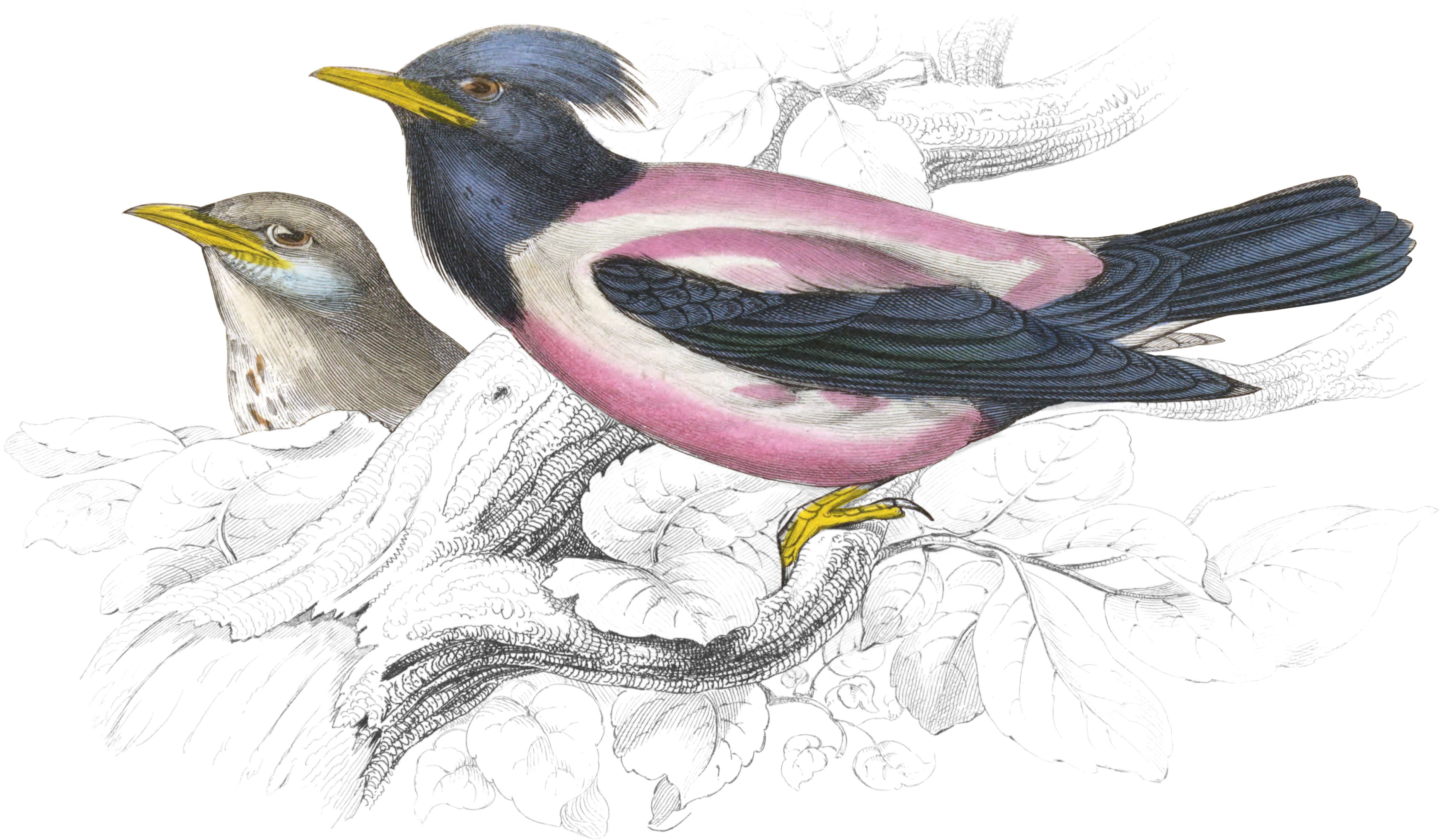
Plate XIV
Fringillidæ
Our next group is that of the Fringillidæ, or Finches, composed of birds possessing great perfection of form, or a very considerable development of all the members; as a group they are distributed in all countries, are abundant, and often appear in large flocks. They are admired for their clean appearance and docile manners, and many are in request, and are kept in confinement on account of their song. They feed chiefly on grains and seeds, or on the kernels of stone fruits, for the purpose of breaking which the bill is in. some genera constructed of immense strength. During the season of incubation, the food is insects, or their larvæ; and the number of this race of beings now destroyed is almost incredible. In the first sub-family, the Coccothraustinæ, we see the development of the bill carried to its utmost extent in the African genus, Pyrenestes, and that to which our British form belongs is not far deficient, and is represented by Coccothraustes of Brisson, thus characterized.
Coccothraustes, Briss.—Generic characters.—Bill very strong, large, mandible entire at the tip, the commissure bending without any rudimentary tooth or undulation; head large; wings rather long and pointed; first, second, and third quills longest, and slightly graduating; tail short, nearly square or forked.
Types, 1. C. Europeus, 2. vespertina, 3. melanura.
Note.—1. Europe, 2. North America, 3. Asia. Breeds on trees.
The Hawfinch
Coccothraustes vulgaris.—Fleming.
Loxia coccothraustes, Linn.—Fringilla coccothraustes, Temm.—Coccothraustes vulgaris, Fleming, Selby.—Coccothraustes Europeus, Swain.—Grosbeak, or Hawfinch, of British authors.
This distinctly marked species was until lately considered as a winter visitant to our island, and only at uncertain and unequal intervals; it has, however, been lately ascertained to breed in some parts of the south, but seems extremely local, while in other parts it appears occasionally, and generally in the winter and spring. For the notice of the permanent residence and nidification of this bird in England, we are indebted to Henry Doubleday, Esq. who communicated his observations made in the vicinity of Epping Forest, to the Magazine of Zoology and Botany.109 This gentleman has most obligingly furnished our own collection with specimens of the birds, with the nest and eggs procured in the same neighbourhood, and we must now resort to this source for information, having never had the satisfaction of seeing the bird alive, or in its natural localities. Mr Doubleday considers that their extreme shyness has hitherto kept us in ignorance of their habits. Their principal food in Epping Forest is the seeds of the hornbeam, (carpinus betulus) also the kernels of haws, plumb stones, laurel berries, &c. and in summer green peas, from the gardens in the vicinity of the forest. The situation of the nest is various, but it is most commonly placed in an old scrubby white thorn bush, often in a very exposed situation. They also frequently build on the horizontal arms of large oaks, the heads of pollard hornbeams, in hollies, and occasionally on fir trees in plantations, the elevation of the nest varying from five to twenty-five, or thirty feet. It is composed of dead twigs of oak, honeysuckle, &c. lined with fine roots and a little hair, the whole very loosely put together. The eggs, from four to six, are of a pale olive green, spotted with black, and irregularly marked with dusky brown. During winter they congregate in flocks, but at pairing time separate again. The song is of little compass; and Mr Doubleday states that, like the Linnets about the season of separation, they congregate on a tree, and utter a few notes in a soft tone, having some resemblance to those of a Bullfinch. According to Mr Yarrell, however, it possesses considerable imitative powers, for he states, on the authority of Mr Bartlet, that a female
sung the notes of the Linnet. But being afterwards hung out of doors, it learned to imitate the song of a blackbird.110
The occurrence of the Hawfinch in other parts of England, so far as our information goes, is confined to straggling parties or individuals, but the attention of our ornithologists may perhaps discover other breeding stations besides Epping and Windsor, and the vicinity of Wolverhampton, where we have also records of its nidification. In the north it is a straggler, but has been killed and seen in the counties of Durham and Cumberland, reaching across the border to Dumfriesshire; farther north in Britain we do not know of its occurrence. In Ireland we have the authority of Mr Thompson for its occasional appearance. In the north of Europe it appears also rare, more frequent in the southern countries, but not so much so as to enable us to say where its strongholds lie. Temminck states having received it from Japan.
In the full plumaged male the colours are rich, and decidedly marked, the space between the eye and rictus running in a narrow line above the nostrils and upon the base of the maxilla, with an oval patch on the chin and throat, are deep black; the crown, cheeks, and rump, are pale chestnut; the colour palest on the forehead, and of a browner tinge on the rump; a collar of bluish gray surrounds the nape, while the centre of the back and shoulder are deep umber-brown, shading into the tints of the collar and rump; the breast, belly, and vent, are pale purplish red; the axillary feathers, and under tail coverts, pure white; the quills and secondaries are deep black, tinted with steel blue reflections; the first four quills having a narrow bar of white on their inner webs, which is more broadly continued upon the same parts of the secondaries; the ends of the lesser quills and secondaries are truncated, and have the webs elongated at the tip on the outer side; the outer webs of the secondaries are loose, and unconnected; the tail is short, and very nearly square; the basal half of the feathers is black, extending on the outer feather for the whole length of the outer web; the tips are white, the extent of that colour being greater on the feathers towards the outside. In the living bird the bill is of a brownish pink; but Mr Doubleday states, that in the breeding season it becomes deep blue. In the female the colours are less marked, and blend more into each other, while the black markings are less in extent, and are scarcely so deep in tint. In a young specimen procured on the Continent, the black on the throat is not apparent; the upper parts are yellowish brown, darker on the back, and having the tips of the feathers with darker undulated bars; under parts yellowish white, on the breast, belly, and flanks, spotted with crescent-formed marks of pale umber-brown.

Plate XV
Green Grosbeak, or Greenfinch
Coccothraustes chloris, Flem.—Loxia chloris, Will. Linn.—Fringilla chloris, Temm.—Coccothraustes Moris, Flem. Selby, and modern British ornithologists.—Chloris flavigaster, Swain.—Greenfinch, Grosbeak of British authors.
Although Mr Swainson has placed this species as a sub-genus of Linaria, connecting that form with the Hawfinches, we have, nevertheless, placed it following the latter, and have not, for the present at least, adopted the sub-genus Chloris. In form it approaches most closely to Coccothraustes, and in its general habits it has also a very near alliance; as an intermediate form it may still connect Linaria, without entering it as a sub-genus, some of its modifications or sub-genera being still imperfectly known.
The Greenfinch is very generally distributed over the mainland of Britain and in Ireland, frequenting cultivated districts in the vicinity of gardens and limited plantations. During winter they congregate in large flocks, feeding on the stubble ground on various small seeds, and resorting towards nightfall to the vicinity of the plantations or evergreens surrounding some mansion, flying for a time around, and clustering, before taking up their roost, on the top of some bare tree. Their sleeping place is returned to night after night through the winter, and the flock may be seen assembling and taking up the perches in the same bushes with great regularity. In spring, when paired, they resort to the garden and shrubbery, breed in the various cover which is there afforded, and at this time the male may be seen in the morning rising with slow or heavy strokes of wing, uttering his simple note, and performing his long winding flight peculiar to the season of love. The nest is placed at no great elevation, and is built rather carelessly, the base being formed of small twigs or slender roots, the remainder of mosses often interwoven with wool, and lined with a few feathers or hair. The eggs are of a bluish or greenish white, spotted with dark purplish brown, and two broods are commonly hatched in the year.
In Europe the Greenfinch is distributed with nearly equal profusion as in Britain, decreasing towards the south and north, and ceasing entirely in the extreme parts of the latter. It was. seen by Mr Strickland at Smyrna, and by some, Japan has been added to its geographical range; but from the notes of Temminck, and the account which Kitlitz gives of its habits, we suspect that the species, as well as several others, when more closely examined, will be found to be distinct in the different countries.
In the female the upper parts are more tinted with brown, and the yellow of the rump and breast is not so vivid. In the young the feathers are streaked along the centre with a darker shade of oil green, and there is little yellow on any part of the plumage.
From these birds of powerful structure, both as regards their body and the bill, with its accompanying bones and muscles, we pass through many foreign genera having no British representative, and arrive at those of more slender form. The first to be noticed is the Goldfinches or Siskins, Carduelis, Briss. which, although hitherto kept in one genus under the above scientific title of Brisson, have each a family dress as it were, which, in popular language, at once suffices to distinguish them. We possess one example of each, and the characters may be given as follows:
Cadeulis, Briss.—Generic characters.—Bill rather lengthened, compressed, attenuated, and sharp at the point; the edges of the mandible very slightly sirmated, and bending Towards the tip; wings lengthened, pointed, and having the first three quills nearly equal; tail short, and slightly forked; tarsi short, feet of moderate strength.
Types, 1. C. elegans, 2. Americanus.
Note.—1. Europe, Alpine Asia; 2. America, Africa. Habits arboreal, and to a certain extent scansorial.
The Common Goldfinch
Carduelis elegans.—Stephens.
Fringilla carduelis, Will. Linn, &c.—Carduelis elegans, Steph.—Carduelis Europeus, Swain.—Goldfinch of British authors.
Though black and yellow, distributed in large and distinct masses, are prevailing colours in all the members of this genus, they have also a family dress varied in addition with crimson and chestnut. This is seen in our native favourite, one of the most beautiful birds in the British list, and which adds to its appearance the acquirements of docility, and attachment to its master or mistress. The Goldfinch is a common but not an abundant species, and does not appear in the large flocks in which the Siskin and Linnets assemble; it is generally distributed in the British Islands, decreasing in numbers towards the north, and disappearing in the districts of Scotland where wood and cover becomes scarce. In the breeding season it frequents gardens and the shrubbery, or the partially cultivated pleasure grounds, frequently placing its nest on the fruit trees, and near situations where work is constantly going on. The nest has been often remarked for the beauty of its workmanship, and it is neatly and carefully constructed, exteriorly with moss and the lichens of the tree on which it is placed, in the interior lined with soft materials finely laid flat and rounded, but it scarcely comes up to the fashioning of the nest of the Chaffinch, or to the care and beauty with which the outside of it is worked. During winter they assemble in small parties, seldom exceeding fifteen or twenty, and frequent commons, extensive pasture fields, or the borders of waste lands, where the thistles and the horse-knot, (centaurea nigra,) or common ragweed, and other syngenesious plants, have thriven undisturbed, and on the seeds of which they now delight to feed. It is in such situations that they are taken by bird-catchers in trap cages, or with limed twigs, a call bird being used to attract them.
The Goldfinch is sought after as a cage bird, on account of its beauty and clean appearance, for its docility and aptness to be taught tricks, and to obey its master or mistress, and for its song. The latter in confinement is pleasing and cheerful, but wants that depth of tone and variety of modulation which some of the Sylviadæ and the Thrushes possess. It becomes very familiar and without great difficulty may be taught to draw up its food and water in small buckets, and some have been trained to go through the little farce of the deserter,—the torment of dogs and canaries, and of those animals or birds whose memories and fears have been wrought on to furnish amusement or a livelihood for man. They are also kept to obtain a cross with the canary, with which they readily breed, and whose progeny is thought to combine advantages by a mixture of both their songs.
In its range, the Goldfinch extends over the greater portion of Europe, becoming more rare towards the north; we have it also recorded as occurring at Smyrna and Trebizond. In Alpine India, we find it represented by a species somewhat similarly marked, but the European bird has not yet been received from that region, Japan, or any part of Asia.
In the male the forehead, temples, chin, and upper parts of the throat, are bright crimson, (the arterial blood-red of Syme;) the space between the eye and the gape, the occiput, and part of the nape, running round the sides of the neck in the form of a collar, are deep glossy black; the back and scapulars are yellowish brown, paler where the colour joins the black upon the nape, and on the rump and upper tail Averts shading into nearly pure white; the cheeks, throat, and centre of the belly are nearly pure white; the breast and flanks yellowish brown, of a clearer tint than that of the back; the wings are black, the quills and secondaries tipped with white, the proportion increasing on the latter; across both is an irregular bar of rich yellow produced by the basal half of the outer web of each being of that colour; the tail, slightly forked, is black, the four centre feathers (at least) being always tipped with white; on the inner webs of the two outer pairs is a large oval patch of white, which is indicated on the third pair. In the female the colours are all less decided and brilliant. In the first plumage the young birds want the black and crimson on the head, and the other markings are more undecided, the under parts slightly waved across; as the season advances they gradually attain their full dress, but the birds of late broods may be known in the spring by a slight intermixture of black with the crimson of the chin and forehead.

Plate XVI

The Siskin
Carduelus spinus, Selby.—Fringilla spinus, Linn.—The Siskin, or Aberdevine of British authors.
The Siskin is an example of the other distribution of the shades of the plumage which we alluded to in our short remarks upon the genus. It is here entirely black and yellow, tempered by shades of olive, forming together a very chaste and pleasing mixture. This species in Britain is more locally distributed than the last, is migratory to a certain extent in winter, and its appearance seems to depend on some circumstances with which we are not acquainted; its visits being uncertain, sometimes consisting of large flocks together, at others of only a few scattered pairs. In the south it is chiefly a winter visiter, accompanying the lesser Redpoles; towards the north of Britain it is also seen chiefly during winter, often in very large flocks, and they are there still more uncertain in the times of their appearance. During the winter of 1820 and 1821, they visited Northumberland in considerable flocks, but were not afterwards seen for several years;111 and as we have elsewhere remarked, in 1827, Annandale, in Dumfriesshire, was also visited by large flocks,112 which did not again return, and where, since, they have only been partially seen in small parries or pairs. This partial appearance, on the authority of Mr Thompson, extends to these birds in Ireland, where they are occasionally seen.
Their annual visitations in winter were, until lately, considered their only appearance in this country, though occasional surmises were hinted at, that they bred in the pine woods of the north. In 1829, they were observed by myself and Mr Selby, in a large pine wood near Killin in Perthshire, evidently breeding; and in an extensive wood, of a similar character, near New Abbey, in Galloway, bordering upon a wild muirland district, a few pairs have been also known to breed. In these situations, the nests were placed high from the ground. In one, however, mentioned by Mr Gardiner, in the Camperdown Woods, near Dundee,113 the nest was not more than six feet from the ground; Mr Meyer again states, that the nest has been twice found near Combe Wood, in furze, within three feet of the ground.114 From all our present knowledge of the nidification of the Siskin, it would appear that the places selected were almost as local and uncertain as the times of its appearance in winter, and it is probable that the greater portion of the very large flocks which we sometimes see, perform a more extended migration northward, and that those partially met with breeding are the stragglers on the southern boundary of their range. Their particular habits and their food at this period are still desiderata to the British ornithologist. In winter, where we have observed them, their manners have been very similar to those of the Goldfinch, frequenting pastures or districts where tall syngenesious plants abounded, feeding also on the catkins of several trees, and apparently, Mr Selby remarks, attracted by the abundance of the birch and alder. We have also seen them picking out the kernels from beech mast, and frequenting a spot on account of the supply afforded. On the Continent it is known, but somewhat partially in the middle countries; we are not sure that very authentic accounts exist of its frequency or nidification in the north, as has been generally supposed, and, as a matter of course, has been handed down from one author to another. Temminck places it among his birds of Japan.
In the male, the crown and throat are black, the feathers tipped with yellowish green. The upper parts, cheeks, sides of the neck, and breast, “siskin green,” mixed with grayish green, and streaked along the shafts on the centre of the back with blackish green; on the rump, cheeks, and breast, the plumage is tinted with primrose yellow. The wings are brownish black, the quills edged with yellowish green, and having on the base of the outer webs a patch of yellowish white, forming a slanting and serrated bar. The coverts are broadly tipped with greenish white. The tail is brownish black, having the feathers at the base pale primrose yellow. On the belly the primrose yellow shades into pure white, slightly dashed with the former colour on the flanks, and having the feathers there, and on the under tail coverts, grayish black along the shafts. This is the plumage of the male in winter. In the summer or breeding state, the general tints are heightened in colour; the black of the wings becomes deeper, and the feathers of the head and throat lose their pale tips. The female is without the black on the crown or throat, and the black of the wings and tail is more subdued. The upper parts are entirely of a grayish green, streaked along the centre with blackish gray, and the under parts are nearly pure white, tinted with primrose yellow on the breast, and having the sides of the breast and flanks very decidedly marked with longitudinal streaks of brownish black. In some specimens we have seen the upper parts of a much grayer tint, and the under surface of the body streaked entirely over with dull black.
From the Goldfinches we pass to the True Linnets, the genus Linaria of Brisson, composed of birds of unobtrusive plumage during the winter, but which, on certain parts of their dress during the breeding season, acquire tints of considerable brilliancy. The bill is short and tumid, but in many other parts of their form they resemble the last. They are gregarious in winter, and are migratory, or partially so; they inhabit countries of temperate climate, rather inclining to those of a northern latitude. Europe and America chiefly possess them. A bird very nearly allied to Linaria, but perhaps entering into Crithagra, belongs to South Africa. On the boundaries, or alpine districts of Asia, one or two species, common also to Europe, may be found, while, according to Temminck, Japan can boast of them also,
Linaria, Briss.—Generic characters.—Bill short, gibbous at the base, sharp pointed; wings lengthened and pointed, first quill longest; tail forked; tarsus and feet rather short, claws very slender, that of the hind toe somewhat lengthened. Types, L. canabina, montium, &c.
Europe, Asia, America.
Common Gray, or Brown Linnet
Linaria Canabina, Swain.—Linaria, Will.—Fringilla canabina. Linn.—F. linota, Gmel.—Linaria canabina, Swain. Selby.—Linota canabina, Yarr.—Common or Brown, Gray, or Rose Linnet.—Greater Redpole of British authors.
This species is a common and generally distributed bird over the British islands, frequenting commons, furze covers, and the borders of muirland districts in summer, and then migrating to the coasts, the stubble lands, or fallows, in large flocks. Towards the north of Scotland it becomes less frequent, its place being there taken up by another species, at least this is the case in the breeding time, and then a hundred pairs of the Mountain Linnet or Twite may be seen for one pair of the common species. Furze covers are a favourite breeding station for this bird, and many pairs may be seen where these abound, the male sitting perched on some elevated twig, singing a low but agreeable song. The nest is placed in a cleft of the whin or bush,115 and is a rather careless structure of slender twigs, moss, and wool, lined with hair or feathers. Mr Hewitson hints at the probability of there being two species of what is termed the Brown or Common Linnet, the one breeding among whin, the other in hedges, and the latter always having smaller eggs, In our own immediate locality, we have not observed this difference in the site of the nest, but the subject may be worth while investigating, as many of the species known are closely allied. During winter they assemble often in vast flocks, feeding on the stubble lands, or ploughed fields, and sometimes descending near the shore. When disturbed, they fly in a wheeling flight close together, and several times pass the object of their alarm before they quit the vicinity. At this time their cry is their usual call-note often repeated. They roost among the whin covers, in any thick brush, or low plantations of evergreens, near their haunts, and if undisturbed in a fine and serene evening, the flock will assemble on some tree or more elevated bush, pluming themselves, and rehearsing, as it were, their songs for the coming spring. The song is taken up by the whole flock, each warbling his own strain; and this, when the air is still, may be heard at a considerable distance. They are a favourite cage bird both in England and Scotland, and for this purpose are taken during winter, particularly in the south, by means of various snares. In the north it is more frequently reared from the nest. The song is continued in confinement.
In addition to the mainland, the Common Linnet extends sparingly to Orkney and Shetland.116 In Europe, in suitable localities, it ranges from north to south, though we are not aware of the particular districts where it most abounds or fails. Smyrna is given as a habitation, and Japan is stated by Temminck as possessing it.
In the breeding plumage, the adult male is a beautiful bird; the forehead running back upon the crown, and the breast, are bright carmine red, the feathers having a shining lustre, the throat and neck yellowish white, streaked with brown. The cheeks, occiput, and neck, are brownish gray, upon the hind head having the feathers darker in the centre; the back, scapulars, and wing-coverts, chestnut brown, shading into a paler tint on the rump. The quills are brownish black, edged with white on the outer webs; the tail of the same colour, having the outer webs entirely white at the base, and the outer half of the inner webs of the same colour. The flanks, centre of the belly, and under tail coverts, pale chestnut red. In the female, the carmine of the head and breast is wanting, and the upper and under plumage is different shades of umber brown, having the centre of the feathers darker. In winter, also, all trace of red on the plumage is lost, the feather which the carmine patch occupies being of a deep purplish brown at the base, but which is nearly obscured by the pale tips concealing the darker tint.
It may be remarked, that in confinement the breeding plumage is not assumed, and a male taken in the highest stage of his full summer livery does not regain it in the coming year.
The Mountain Linnet, or Twite
Linaria montana.—Fringilla montana, montium, Penn. Mont.—Linaria montana, Selby.—Linota montium, Yarrell.—Mountain Linnet, or Twite, of British authors.
The northern parts of Britain are, perhaps, the localities which may be most properly assigned to this Linnet, as it regularly breeds there, assembling in large flocks during winter, many also being permanently resident; it decreases and becomes partially migratory as it approaches the south, while the last species which there replaces it is similarly affected in the borders of its northern range. In the north of Scotland and Hebrides, it is the common species;117 and although its nest has been recorded in Yorkshire, Staffordshire, and Derbyshire, (all of which are in many parts almost Alpine districts,) these, as Mr Yarrel observes, may be the limit of its southern nidification. In the south of Scotland, and in England, the general time of appearance is in winter, frequenting nearly the same localities with the last, though perhaps selecting the more upland districts, when a choice can be obtained, but, in few, if any instances, appearing with the same regularity, or in such abundance. They are known to the southern bird-catchers by their cry, and the difference in this was in fact the first thing that drew our own attention to them in the south of Scotland, their manners being in other respects similar to those of the last. Their nest is described as being placed in bushes of whin118 and heath.119 In the localities where we have observed it, the heath where it was placed grew with considerable rankness, or the thick arid varied Alpine brush and herbage which clothed the shelving rocks and precipitous banks of the coast, furnished it with a secure and well sheltered concealment. The young were seen in Sutherlandshire fledged, having left the nest, and able to make short excursions before the middle of June. The nest and eggs are both very similar to those of the last. The call of the Mountain Linnet, during winter, is a sharp single note, closely resembling the pronunciation of its common name of “Twite.” The song during the breeding time is pleasing, and of the same general character with that of the common Linnet; it is often sung from a perch on some exalted rock, and at times when fluttering above the spot or shelve which was supposed to contain its nest. In Ireland Mr Thompson states it to be partially distributed. In Europe, its peculiar localities have perhaps not been remarked with sufficient accuracy; it, so far as we can trace, is most abundant in the northern countries, but extends its migrations to Italy. Its range does not seem to extend to North America.
Specimens of this bird killed in Sutherlandshire in the month of June, have the upper parts dark umber brown; the feathers edged with brownish yellow, inclining to grayish yellow on the back of the neck; the wings brownish black, and having the quills after the fourth or fifth edged on the outer webs with pure white, which forms a conspicuous pure line along the wing; the greater coverts are broadly tipped with pale yellowish white, which forms a bar; the tail is much forked, brownish black, the inner webs of the feathers paler, and the outer webs of the base white; the rump is rich purplish red, almost inclining to scarlet; the cheeks and throat are pale yellowish brown, paler on the breast, and shading into nearly pure white on the belly and vent; upon the breast and flanks the centre of the feathers are umber brown, giving a broken or streaked appearance to these parts. In the females the colouring of the rump is less vivid, and the general marking less deep and distant. In specimens of the same species, shot during winter in the Lowlands, the yellowish brown edgings to the feathers on the upper parts is broader, rendering the colour more subdued, the tint on the rump is of a more purple hue, and the whole of the chin, throat, cheeks, and breast, are of a uniform pale reddish brown, little interrupted by the dark centres of the feathers appearing, the centre of the vent and under tail coverts only being pure white. In the female, at this season, the colouring of the rump deepens, and the lower parts are nearly entirely of pale yellowish brown.
The Lesser Redpole
Linaria minor, Ray.—Linaria minor, Ray, Selby.—Fringilla linaria, Linn.—Linota linaria, Bonap. Yarrell.—Lesser Redpole, or Stone Linnet, of British authors.
The distribution of this species in the British Islands is very similar to that of the last; in the southern Highlands of Scotland it is, perhaps, more generally spread, but its breeding localities in England depend on some peculiar locality, During winter it is not uncommon in flocks in the south or in the Lowlands of Scotland; it is frequently detected feeding on the seeds of the birch and alder, and we have once or twice seen it in company with the Siskin feeding on the beech mast. In the same years which we mentioned as remarkable for the appearance of flocks of the former, this species was observed to be more than ordinarily numerous. The nest where we have seen it has been built on some bush or young tree, not exceeding an easy reach with the hand from the ground, and frequently much lower; it is more carefully and neatly constructed than that of either of the preceding birds, is formed of moss, intermixed with the down of willow catkins, which also furnishes the inside lining, and seems an indispensable material. In procuring both this material and their food, they exhibit considerable scansorial powers, hanging and clinging to the slender twigs in all positions. Their song is pleasing, but contains little modulation or variety. In its extreme British distribution, it stretches over northern Europe, and extends its range to the arctic portions of North America. In Europe southward, M. Temminck remarks that it is migratory in the temperate parts, but in the south appears only at intervals of one or two years: he also records it from Japan.120
The male, in the breeding season, has the crown of the head blood-red; the sides of the neck and breast carmine, becoming paler on the sides and flanks, which are streaked with brown; the forehead is hair brown; the whole upper parts, including the wings and tail, are deep umber brown; the feathers on the neck and back edged with yellowish or grayish brown, to a greater extent in some species than in others; the lower part of the back and rump tinted with carmine; the wings are nearly uniform in tint, except a dull bar of pale brownish white, formed by the tips of the coverts being of that tint; the throat with a black patch; the centre of the belly and vent very pure white. In the female the colours are duller, the rump and breast sometimes slightly tinted with pink, but generally of a uniform yellowish brown. In winter the red tints on the cheeks and breast are wanting, they have of a more uniform yellowish brown, streaked with umber brown; on the crown the red continues, but loses much of the brilliancy and lustre which it possessed in summer.
Northern Redpole
Linaria borealis—Linaria canescens, Gould, Eyton.—Linota canescens, Yarrell.—Large variety of the Lesser Redpole, Selby.
We shall write of this bird only as British, and from British specimens. A more rigid examination than we can now give, and a comparison of British specimens of this bird and the L. minor, with individuals of the three North American species indicated by the Prince of Musignano, and specimens of the L. borealis of the European ornithologists, must be made before a proper decision can be come to of their identity or distribution. We have taken the name of L. borealis, because we are inclined to believe that the straggling specimens which are annually captured in our islands are there on the limits of their southern range, and that the bird is indigenous to a more northern climate. No instance of its breeding has yet occurred with us, and it is more straggling and uncertain in its visitations than any of its British congeners. By Mr Yarrell it is stated, that a figure of this bird is given by Walcot in his Synopsis of British Birds; but we have not the work now by us to refer to. The next notice of it is in the first edition of Mr Selby’s British Birds, where it is figured and described as a variety of the Lesser Redpole, from a specimen in our own collection, shot near Edinburgh, and which is now before us. More lately, British specimens have been described by Mr Eyton and Mr Yarrell, under Mr Gould’s title of Linaria canescens; the bird itself being beautifully represented in the last named ornithologist’s “Birds of Europe.” By our modern ornithologists the Continental species are considered identical with those of Britain, and also with those brought from North America; but on the other hand, the Prince of Musignano, in his last comparative list, considers that there are two European species, the L. canescens, Gould, and the L. borealis of Savi; the latter only being also common to the North American Fauna. In these circumstances it will be seen that there may be some difficulty in referring the bird now before us to these two species of the Prince’s list, and consequently to its distribution. We have, therefore, confined our synonims to those of British authors describing from British birds, though it is possible, in doing this, that we may be now overlooking the circumstance that the Prince’s two species may be both good ones, and both present occasionally in Britain.
Of the habits of this Linnet we do not yet know much. It is known to the London bird-catchers as distinct from the little species, and has been noted as occurring abundantly some years, and with much uncertainty for a period after, as in the case of the Siskin in various parts of Scotland. We have only seen it alive twice, and then the manners were similar to those of the Lesser Redpole.
The specimen originally figured by Mr Selby is in length about 5\(\frac{1}{4}\) inches; the occiput, cheeks, nape, and back are umber brown, the feathers very broadly margined with grayish white, giving to the whole of those parts, particularly to the nape and cheeks, a hoary appearance, whence Mr Gould took his name; the second quills are also edged with grayish white, and the greater and lesser coverts are tipped with the same colour, forming a double bar across the shoulders; on the chin is a patch of brownish black; the cheeks, sides of the neck, throat, breast, and flanks, are pale peach-blossom red, shading into white on the vent and tail coverts, and on the side of the breast and flanks, being streaked with umber brown; the feet arid claws of this bird are proportionally shorter and stronger than in the other British species.
Of the numerous and very beautiful family of Tanagrinæ, Britain does not possess a single example. They are mostly confined to warmer climates, exhibit both a brilliant and choice assemblage of colours, and in their general form approach to that of the True Finches, which will now claim attention. The sub-family Fringillinæ, or Typical Finches, is composed of birds of moderate size, of a strong yet elegant form. The bill nearly perfectly conic. They abound in the various countries of the old world, extending from north to south. In America the genera are fewer in number, and are still more limited in the southern continent. In Australia none have been discovered, their place there being filled up, and chiefly represented by the genus Estrelda, which ranges in the sub-family Coccothraustinæ. The genus first to be noticed now is
Pyrgita.—Generic characters.—Bill strong; sides of the mandible swollen; culmen slightly raised and bending; maxillæ of nearly equal strength; wings moderate in development, with the three first quills nearly of equal length; tarsi and feet rather strong; tail scarcely forked.
Types, P. domestica, Hispanoliensis, &c.
Europe, Asia, Africa.
The House Sparrow
Pyrgitta domestica, Flem.—Passer domesticus. Will. Ray, Selby.—Fringilla domestica, Linn.—The House Sparrow of British authors.
The typical Sparrows are distributed generally, but in limited numbers, over the Old World, inhabiting countries of varied temperature. In colour, and the character of their markings, they closely agree; and except in one or two instances where a patch of yellow occurs, particularly on the throat, the tints are deep chestnut with shades of brown and black blended together in a marked and beautiful assemblage. The Common Sparrow is so frequent everywhere, as scarcely to require any description of its dress. Suffice therefore to say, that it is subject to variation with white or cream colour either in whole or in part; while the vicinity of towns, (in addition to the dirt or smoke which obscures their plumage,) seems also to affect the natural depth of the tints. The whole of our large cities and towns abound with Sparrows; and the extensive squares and gardens, or the grass plot of a few yards square, with some bush in the centre, equally supply them with a substitute for the country. Here they breed under the eaves of houses, in waterspouts or any other hole, and in the open squares, in the hollow trees or bushes; and here they also keep up their incessant chatter, varied by the more mixed notes of a general battle. Our rural villages and farm steadings also are each supplied with their flock or flocks of Sparrows, assembling in the adjacent hedges, or some favourite bush, and often, when the grain or seeds of the gardens are ripe, committing severe depredations, which causes a price to be set on their head, and their flocks to be easily thinned from the close manner in which they congregate. In the country, their breeding places are still more varied than in towns, and among the most favourite, where the houses are covered with thatch or turf, is under the eaves, often in long holes, to the end of which the arm can scarcely reach, and where there is deposited an immense mass of feathers. Bushes in the vicinity are also fixed upon, and we once knew a party breeding regularly on some tall Scotch firs that stood near a cottage, and from want of early thinning, exhibited long bare stems, with a close tufted head, which was chosen for the retreat of these active birds. The nests, when built thus exposed, are composed of hay, straw, or grass collected, and form a large irregular heap when one or two are placed together, little inferior in size to the nest of a Magpie. The entrance is generally at one side, and the centre is abundantly lined with feathers. In a rookery, we have frequently seen the nest of the crows serving for a cover; or if the mass had been of some years standing, holes were formed in it, and used as those in the eaves of houses.
The distribution of the House Sparrow has been accounted very extensive. Over Europe it is very generally spread, being less frequent, perhaps, in the south. It extends to Northern Africa, and it is reputed to be found in several parts of India, both on the plains and Himalaya range. Some years since, Mr Selby and myself described an Indian Sparrow as distinct, though very closely allied; and it may be possible that this bird may have been considered as that of Europe by some of those who have mentioned its occurrence on the Asiatic continent. We subjoin the distinctions which we at the time thought existed between the bird of India and our own, so that a comparison can be made.
The Indian bird is much smaller in all its proportions, and the under parts of the body, instead of being of an ash-gray, or cinereous colour, are nearly white, having only a slight tinge of sienna yellow; the lower part of the back and rump are also much redder, and the tail feathers are deeply margined with yellowish brown. The female differs very considerably from the European, the whole of her plumage being much paler. The scapulars of the skin we received are also marked with a patch of reddish brown, not possessed by the Common Sparrow, and the under parts of the body are of an uniform yellowish white, without any tinge of the cinereous or smoke gray, the prevailing tint of the abdomen and belly of our own species.
The Tree, or Mountain Sparrow
Pyrgita montana.—Passer montana, Ray, Selby.—Fringilla montana. Linn.—Tree or Mountain Sparrow of British authors.
This species closely resembles the former, and it is only an ornithologist who would mark their difference in a wild state. The first time we saw the species alive, we were some time near them without perceiving that they were not our common bird, and their shriller call was what first drew attention to examine them more close!}’. In their habits the Tree Sparrow also very closely resembles the last; it assembles in small flocks, feeds in a similar manner, and builds in like situations, with the exception that old pollard trees are frequently resorted to, in the holes and crevices of which the nests are concealed, and the bird seems partial to a low-lying country where these abound. Thus we have observed it plentiful in many parts of Holland, frequenting trees of the description alluded to, and some of the low-lying counties of England also possess it. The Tree Sparrow is not nearly so equally distributed as our common bird; it spreads, nevertheless, over the most of Europe, but the localities where it is wanting, or is most abundant, have not been pointed out with sufficient accuracy. In Britain it seems confined to England. Mr Thompson makes no mention of it in his Irish notes, and we have never observed it, and have no note of its occurrence, in Scotland; its most northern locality in our islands being the vicinity of Newcastle, where, Mr Selby states, several instances of its capture have been communicated. Out of Europe the Himalaya range and China are recorded on the authority of Mr Gould; Japan upon that of M. Temminck.
Male, with the crown of the head and nape, deep chestnut brown, of an opaque shade; space between the bill and the eyes, spot below the auriculars, chin and throat, black; auriculars, and sides of the neck, white, the latter extending nearly to the back of the head. Upper part of the back appearing spotted with reddish brown and blackish brown, from each feather exhibiting these colours in nearly equal proportions. The wings are deep blackish brown, the greater and less coverts tipped with white, forming thus two bars across the shoulder; the secondaries are broadly margined with reddish brown, the quills with narrow margin of the same colour on their outer web, broadening where the web widens, and extending to the shaft at the base. The rump, upper tail coverts, and tail, are umber brown, the latter with the feathers having pale edges. The under parts are grayish white, tinted with yellowish brown on the sides of the breast and flanks. In the female the markings are less distinct, and the black and chestnut of the head more subdued.
Our next genus is composed of the typical birds of the present sub-family, the Fringillæ or Finches, more elegant in their form than the last, and possessing a greater variety in the distribution of the colours of their plumage. They are principally natives of rather temperate climates, Europe and America being their strong-holds. At the same time, these countries can scarcely with strictness be called their geographical limit, for we believe that some of them pass the Asiatic boundary; while it is not certain that Northern Africa, and some of the islands which are generally placed as belonging to that continent, do not possess typical species. They are subject to a marked periodical change of plumage, and most species are partially or wholly migratory.
Fringilla, Linn.—Generic characters.—Bill nearly a cone, tomiee very slightly bent, point entire; wings pointed, second, third, and fourth quill longest, and nearly equal; feet moderate, hind claw not lengthened; tail slightly forked.
Types, F. montifringilla, cælebs.
The Mountain Finch
Fringilla montifringilla, Linn. &c.—Brambling or Mountain Finch of British authors.
This very beautiful Finch is in Britain a winter visiter only, arriving between September and November, and leaving us again early in spring; in no instance, yet authenticated, remaining to breed, or during any part of the summer. In some seasons it is much more abundant than others, and according to all our modern ornithologists, is very generally distributed over our islands in the localities which suit it. They are found in partially wooded districts, or those interspersed with old hedgerows, assembling in considerable flocks, often intermixing with the Chaffinches, which they resemble in their manners, but from which they are easily distinguished during flight by the clear white on the rump. They feed on the ground upon various grains and seeds, and where beech trees abound, seem to prefer the mast, as the season advances, to any other food. In such parts we have known them frequent a few fruitful trees for many weeks, until the supply most probably began to fail. In winter they are frequently caught in the common bird traps, and gins baited with oats or grain; and when the weather was somewhat severe, we have seen them busily engaged among the ricks in the farm yard, in company with all the host of our small birds which usually congregate there under similar circumstances. The nidification of the Mountain Finch is unknown to the British ornithologist, but those of the Continent describe its nest as placed on fir trees, formed outwardly of moss, and lined on the inside with wool and feathers. The eggs resemble those of the Chaffinch or Greenfinch. In distribution, the Mountain Finch ranges chiefly in Northern Europe, extending partially to the south, and there as a winter visiter. By Temminck it is placed among the birds of Japan.
In summer, during the breeding season, the head and back of this handsome bird are of a deep bluish black, with the tints of the rest of the plumage possessing great clearness. The bill also becomes of a deeper blue. In the winter, when the plumage has been again completed, and it is in this state that it will be seen in Britain, the head, cheeks, and back, are black, each feather being edged with yellowish gray, giving the latter colour to those parts where the feathers he close. From above the eyes, along the back of the neck, the gray prevails, and two dark streaks appear which break the uniformity. The lower back and rump are pure white, and in flight this mark is conspicuously seen, and serves at once to point out the Mountain Finches from any other birds with which they may be associated. The wings are brownish black, the quills narrowly edged with yellow, and having a white spot at the base. The secondaries are edged, and the greater coverts are tipped with reddish orange. Scapulars and lesser coverts also reddish orange, the latter inclining to golden orange. Tail black, edged with gray, and in form considerably forked. Chin, throat, breast, and under tail coverts, pale reddish orange, still paler on the flanks, where the tips of the feathers are streaked with grayish black. Belly and vent pure white. The axillary feathers rich golden yellow. The female, in size, is slightly less, and is less vivid in the tints and separation of the markings.

Plate XVII

The Chaffinch
Fringilla cælebes.—Fringilla cælebs, Auct.—Chaffinch of British authors.
This Finch, also a bird of great beauty in its full summer garb, is one of our most common and equally distributed species, frequenting almost every locality which can boast of a moderate portion of woodland cover, and being wanting only in some of those bare northern tracts where neither tree nor bush prevails. During the summer, Chaffinches, like nearly all our smaller birds, continue pairs, and as the broods become able to associate with their parents, they may be found in small parties; as winter comes on, the flocks increase, frequenting woodland districts, and feeding on the ground upon various seeds. They visit the farm yard and the vicinity of cultivation, more than the last, and trust, as it were, more to artificial sustenance. During summer, and the season of incubation, their food is in a great part insectivorous, and the caterpillars of the Lepidoptera, which are at this time abundant, particularly those of the Geometræ, are materially kept in check by their assistance. In gardens this bird is frequently very destructive to the newly sown small seeds, such as turnips, radishes, any kind of greens, &c. seizing the young plant, and pulling it up, with the view apparently of reaching the seed. In this way we have seen whole beds and rows completely torn up. Another mischievous practice is, that of pulling off the heads of the polyanthus and primrose, for the purpose of either getting at the supply of honey or sweet juice which rests at the bottom of the tube of the corolla, or to feed on the small insects which are attracted there; a bush or plant is often stripped in a single morning, and the care of the florist rendered vain.
The great proportion of our migratory birds appear at the seasons of migration to separate into flocks, composed almost entirely of only one sex. Thus we know, that the males of many of our summer birds of passage arrive before the females, and it has been thought by some of our ornithologists, that we receive an addition to the numbers of the Chaffinch in the end of autumn. About this period they begin to assemble in flocks, and it has been also thought that these flocks were, in many instances, composed of females alone. This is perhaps occasionally the case to a considerable extent, but from many young males having not received their full plumage, it has been overrated. In the south of Scotland, at least, the flocks are not of this exclusive sexual character, though in many we have noticed since we were aware of the opinions of others, two-thirds, at least, were females, while not a half of the remaining third were males in full, or nearly perfect plumage. When kept in confinement, and regularly attended, the Chaffinch soon becomes familiar and even playful, but as the song has never been esteemed, it is not often subjected to captivity. In its nidification the Chaffinch ranks high as an architect: the nest is not often placed far from the ground, and when built in the cleft of some middle-sized tree or bush, often requires a sharp and penetrating eye for its detection. It is formed with extreme care, and is often of very beautiful structure, being built into the cleft or small branches, and the outside so carefully patched over with the same lichens that clothe the tree, or characterize the barks of those in the vicinity, as to be of very difficult detection. The inside is lined with equal care with hair or feathers.
In geographical distribution, this bird is scarcely so extended as some others of our Fringillida. It is generally spread over Europe. Mr Yarrell mentions its occurrence in Northern Africa, and on the authority of Mr Dewar states, that it was met with in the Azores. We have no trace of it on the Asiatic continent.
In the adult male, the forehead is clear bluish black, the crown, nape, and sides of the neck, grayish blue, and on these parts during winter having the feathers tipped with tawny, so as to give a brownish tinge over the whole; back chestnut brown, margined during winter with yellowish gray; rump and upper tail coverts deep sulphur yellow; quills brownish black, edged with yellowish; greater coverts black, tipped with white, and forming a very distinct bar across the wing, scapulars white, also conspicuously seen; tail, with the centre feathers, greenish gray, the others black, the two exterior tipped on the inner webs with white; the throat, cheeks, breast, belly, and flanks, tinted with purple; vent and under tail coverts pure white. The female is more soberly dressed.
The next genus we have to notice, is Emberiza, or Buntings, containing a good many subordinate forms which have been placed as sub-genera. In the British Fauna, what has hitherto been looked on as the true Buntings, has been lately divided on account of some differences in the structure of the wing and feet, and would be represented by the E. milaria, or Common Bunting, placed subgenerically under its trivial name, and the E. schæniculus, as Emberiza. In a limited Fauna, however, we prefer keeping them together. The Buntings are, in some of their forms, widely distributed. They are mostly solitary, or at least appear only in parties amounting to the number of the last broods. They frequent enclosed countries, but not those abounding with wood, except during the breeding season. They are granivorous; and the hard internal knob of the upper mandible enables them easily to remove the husks from seeds. They breed on the ground, or on low bushes, and possess a simple, often monotonous song.
Emberiza. Linn.—Generic characters.—Bill rather strong, culmen slightly arched, the internal roof of the mandible projecting in a hard knob; maxilla strong, and forming an angle at the gape; wings, with the second and third quills longest, first and fourth equal, feet moderate, outer and inner toes equal, hind claw lengthened; tail slightly forked. E. milaria and citrinella.
The Common Bunting
Emberiza miliaria, Linn. &c.—Emberiza miliaria, Linn. &c.—Miliaria Europea, Swains.—Bunting, Common or Corn Bunting, of British authors.
This Bunting, though generally called the “Common,” is perhaps not so abundant as some of the others, and is certainly in some districts of local distribution. In England, it is said to frequent the cultivated parts; and in Scotland, we have chiefly observed it in the valleys where an extent of holm land lay on each side of the stream which generally runs through them. In wooded or very hilly districts it is scarcely known. During the season of incubation they may be seen sitting on the top of a hedge, bush, or stone wall, repeating at short intervals their shrill and little varied note, and they occasionally shift their station to some other elevated twig by a slow fluttering flight, expanding the tail at the same time, and uttering their notes as they fly. The nest is built on the ground in a hay or grain field, or among any lengthened herbage in an open situation, and sometimes it is slightly raised from among coarser plants or bushes. The fabric is rather large, and is carelessly composed, exteriorly of roots and dried grasses, on the inside lined with hair or very fine grass. After breeding, the party of young may frequently be found by the edges of the cultivated districts, and often in potatoe fields. In winter, they congregate into larger flocks, and seem more gregariously disposed than many of our other British Buntings.
The range of the Common Bunting is general in Britain, extending northward to Sutherlandshire and the Hebrides. In Europe also it reaches for a considerable way both to the north and south, passing the Asiatic boundary.
The Yellow Bunting
Emberiza citrinella, Linn.—Em. citrinella, Linn. &c.—Yellow Bunting, or Yellow Hammer, of British authors.
This very beautiful and common species is distributed in abundance through all the cultivated districts of the British mainland, becoming less plentiful towards the north, and, according to Mr Dunn, being an occasional visiter of Orkney. It may be found every where, though partial to culture and population, and may be seen in almost every hedgerow or lane, either flitting before the traveller, or basking in the dust of the way, or perched on some rather elevated spray, and thence uttering its little varied note. In winter, it congregates in small parties, mixes with flocks of other small birds, and frequents the farm-yard, or vicinity of cottages, where food may be expected; it is not, however, gregarious like the last, and does not collect into flocks composed solely of its own species. The nest is generally placed on some bank amidst herbage or brush, by the root of a hedge or other cover. It is formed of small roots or dried grasses, lined with hair and the finer grasses. The eggs are pale purplish white, with lines and blotches irregularly dispersed. We are not aware of any extra European locality for the Yellow Bunting; and middle or temperate Europe seems to be its strong hold, decreasing as we gain either of the extremes.
In the male, the principal colours are shades of gamboge yellow and brown. The head, cheeks, and under parts are of the latter colour, varied on the head and cheeks with olive green, which, though irregularly marked, has a disposition to run in two lines over the head, another through the eye, and a third under the auriculars. On the throat and centre of the belly the colour is nearly unspotted. The back is yellowish brown, varying somewhat in intensity; the centre of each feather broadly streaked with blackish brown; the rump and upper tail coverts brownish orange, having the shafts of the feathers dark and conspicuous, and their tips of a grayish yellow; quills are nearly black, edged narrowly with gamboge yellow; secondaries and coverts brownish black, broadly margined with brownish orange; tail brownish black, edged with pale brownish orange, the two outer feathers tipped with white on the inner webs. The females have the colours less brilliant, and the markings less distinct on the lower parts; the gamboge yellow is less clear, and is streaked with greenish orange. In the young birds the colours are also less distinct, and nearly resembles that of the female.
The Cirl Bunting
Emberiza cirlus, Linn.—Emberiza cirlus of authors.—Cirl Bunting, French, or Black-throated Yellow Hammer, or Ammer, of British authors.
This very distinct species was added to the British Fauna by the late Colonel Montague, who first discovered it near King’s Bridge, in winter, among flocks of other small birds. During the summer following, he discovered its nidification, and his account and history was our only British record for many years. Since his discovery, it has been frequently met with, principally on the coast, in several of the southern counties of England, ranging northward as far as Yorkshire. In Scotland we have one notice of its occurrence near Edinburgh, which seems to have been overlooked by modern ornithologists, except Mr Yarrell. Mr Thompson does not include it in his Irish Fauna. On the Continent, in the middle and southern districts, it seems more equally distributed; and Mr Strickland observed it near Smyrna.121 We have never had the satisfaction of seeing this bird alive; but, from the descriptions given, and the accounts which some of our friends have detailed to us, it appears, in many respects, to resemble the last in its manners, in some districts being more partial to trees than the lower hedges and brushwood. The nest is said to be generally placed in a furze bush, and is composed of materials similar to that of the last, and, indeed, of all our British species. During the season of incubation, and most of the summer, the food is partly insects, grasshoppers being a large portion; berries of various kinds seem also to be frequently eaten, and there, in one instance mentioned, where those of solanum dulcamara were much fed upon.
The throat of this species is of a dark blackish green, which immediately distinguishes it from the Common Yellow Bunting; a streak of the same colour passes through the eye and under the auriculars, and the intervening spaces with a streak over the eye, and a gorget under the dark throat, are of a delicate primrose yellow; crown of the head and nape yellowish gray, with the centre of the feathers black; feathers on the back orange brown, dark in the centre, and having paler margins; scapulars reddish orange; wings blackish brown; the secondaries edged with brownish orange; the quills narrowly, with greenish gray; tail umber brown, edged on the outer webs with greenish gray, that of the outer feather nearly pure white, and having a portion of the inner web of the two entire feathers also white; the breast is greenish gray, forming a band across, and running up upon the sides of the neck; this is followed by brownish orange, which shades into primrose yellow on the belly, gradually paler on the vent and under tail coverts, and running into yellowish brown on the flanks, where it is also dashed with umber brown along the shafts of the feathers. In the female all the colours are somewhat similar, but the markings are indistinct and less clear.
The Ortolan Bunting
Emberiza hortulana.—Emberiza hortulana, Linn.—E. Tunstalli. Lath.—E. chlorocephala, Mont.—Ortolan, or Ortolan Bunting, of British authors.
The Ortolan Bunting, famed among the Epicures of France, is of a very rare occurrence in Britain, and can only be viewed as a mere straggler. Its first notice as a native of our Fauna appears under another name, that of E. chlorocephala, or Green-Headed Bunting, and is thus figured by Mr Brown in his Illustrations of Zoology. From thence, the specimen which was used by Mr Brown, has been traced by the perseverance of Mr Fox to the collection of Mr Tunstal, and thence to that of the Newcastle Museum, where it now remains, and has been ascertained to be identical with the Ortolan of Europe; this specimen was taken by a bird-catcher near London. The specimen which served for Mr Bewick’s figure was caught at sea, on the Yorkshire coast; another is mentioned as taken near Manchester, and a fourth in 1837, near London. These, up to last year, seem all the instances of its capture in Britain; and although not easily distinguished, so as to be sought out from any parties of its congeners, there can be no doubt of its being very far from common. In Scotland, or Ireland, it has not been recorded. The Ortolan ranges over the European continent, but not abundantly; among the dealers in France, we did not find it a species at all times to be obtained. It extends out of Europe to Northern Africa, and to the Dukhun in India.
A specimen from the Continent, before us, has the following distribution of colours:—The head and nape are grayish green; the shafts of the feathers dark; the back is of a dull chestnut brown, having the centre of each feather streaked with dark blackish brown; the wings are umber brown, the secondaries and coverts edged with reddish brown; the quills margined with yellowish white; tail of the same shade with the wings, the centre feathers tinted with reddish and with pale margins, and the two outer feathers with the usual white patch on the inner webs; the chin and throat are pale lemon yellow, with an indication of a dark stripe from the base of each maxilla; the remaining under parts are very pale reddish brown, on the breast marked with an indistinct dark streak in the centre of each feather.
Reed Bunting
Emberiza schæniculus.—Emberiza schceniculus, Linn. &c.—Reed, or Blac-headed Bunting of British authors.
This distinctly marked species differs considerably in its habits from those we have already described; frequenting the vicinity of marshy places, among willow beds and reeds, and only coming to the vicinity of population when pursued by the severity of the weather. It is by no means uncommon in suitable places, continuing in pairs, and immediately shewing itself to an intruder by its restless flight and anxious note, and by perching near the top of reeds or bushes which grow around. The undisturbed call is one of the most monotonous of the genus, and the bird will sit for a length of time constantly repeating the three or four notes which compose it, without any variation. On approaching the place where the nest is placed, the parents exhibit more than the usual anxiety, and have been said to use stratagem to decoy off the stranger; when raised from the nest, the female flutters along the ground for a few yards, and then commences her anxious calls, in which she is soon joined by the male. The nest is placed in a tuft or hillock of grass, by the root of some bush, or among the taller herbaceous plants, and we have very frequently found it in plantations bordering some marshy spot, placed on a young spruce fir from one to three yards from the ground. It is formed of straw, dried grass, and roots, lined with fine grass or hair. The eggs purplish red, boldly marked and veined with dark brownish purple. The Reed Bunting is commonly distributed over the whole of our islands, extending to the extremity of the mainland. It is also general on the Continent, particularly the low-lying portions, but it has not been noticed as an extra European bird.

Chaffinch Feathers and Beaks
This bird Mr Swainson considers typical of Emberiza, placing our other species with the Common Bunting, as Miliaria. In the wood-cut preceding our characters, we have given the wings of the present species, and E. citrinella, between which little difference will be perceived. The characters given are, in Emberiza, “first quill shorter than the four next, which are longest;” in Miliaria, “three first quills the longest, and nearly equal in length.” In the latter, the bill is much stronger, and the knob very prominent. In Mr Swainson’s Emberiza, the palatal knob is nearly obsolete. See fig. 5.
In summer or breeding plumage, the male of the Reed Bunting is a clean and distinctly marked bird. The head, cheeks, and throat, are deep black, contrasting beautifully with the pure collar of white which surrounds the back part of the neck and cheeks, running in a line below the auricular feathers to the base of the maxilla. The back is deep brownish black, having the feathers broadly edged with chestnut. The lower part of the back and rump has the centre of the feathers of the same dark tint, edged with gray, but the dark stripe is so narrow as to allow the real collar to appear almost entirely of the latter tint. Quills are brownish black, narrowly edged with pale reddish brown. The secondaries and coverts are of a darker tint, broadly edged with chestnut, and the shoulders are nearly entirely of that colour. The centre tail feathers are grayish brown, paler on the edges, the others black, the two exterior ones with white running diagonally from the base to the tip of the inner web. The breast and flanks are grayish white, the feathers of the sides of the breast and flanks streaked along the centre with brownish black; belly, vent, and under tail coverts pure white. In the female, shades of brown and chestnut predominate over the black. There is no black or white on the head, the place of that colour being indicated by a darker chestnut; from each eye and over the auriculars there is a pale reddish white streak. The upper parts are reddish brown, varied by the dark centres of the feathers, and on the breast and flanks the colour is pale yellowish brown, shading into white on the centre of the belly, and streaked along the feathers of the breast and flanks with chestnut red.
Our next form is one previously associated with the Buntings, but lately placed with a few others into a separate genus, standing intermediate between the true Buntings and Larks. It has been designated Plectrophanes or Lark Bunting. In habits the birds differ from the Buntings, in keeping constantly upon the ground, being possessed of very ample powers of flight, and in being mostly gregarious. The bill in form is shorter than that of the Buntings; the palatal knob is not apparent. The claws are all straighter, and that of the hallux is more than usually lengthened, the wings are long and pointed, and fitted for their long migrations. They breed on the ground, and are mostly natives of cold or arctic latitudes during summer, migrating during winter, at which time we receive their visits. The genus may be thus characterized:
Plectrophanes, Meyer.—Generic characters,—Bill short, culmen bending, palatal knob scarcely apparent in profile; wings long, first quill longest, second and third graduating, the fourth suddenly shortening; tarsi and feet rather short, claws slender, not much bent, that of the hallux nearly equal to the toe in length.
Types.—Pl. 1. nivalis, 2. Lapponica, 3. picta.
Note.—1. 2. Europe, 3. America.

Plectrophanes Feathers, Claw, and Beak
The Snow Bunting
Plectrophanes nivalis.—Meyer.
Emberiza nivalis, Linncæus.—Plectrophanes nivalis of Moderns Emberiza glacialis, nivalis, montana, in winter plumage.—Snow Bunting, Mountain and Tawny-Bunting, of modern British authors, for its various states of plumage.
It is probable that a few scattered pairs of this beautifully marked bird breed on some of the higher mountain ranges of Scotland; at the same time these instances are certainly so rare and limited, that we can only look upon it as a winter visiter among our birds. They appear in the south of Scotland soon after the month of .October, and are common in large flocks in all the sub-alpine districts, descending to the borders of cultivation as the winter advances, and in very severe times retiring even to the lowlands, the sea coasts, and the courses of the rivers. In both the latter localities, we have repeatedly seen them, seeking their sustenance among the rejectamenta left by the tide, or picking up whatever could be found among the gravel by the river sides. In less severe weather, they frequent the stubbles, fallows, and cultivated fields, on the borders of the muirland districts, and feed on the left grain and seeds, while, in still milder weather they keep to the muir or sheep pastures. In the alpine districts, and similar sub-alpine sheep ranges in England, they are in a like manner found during winter, but towards the south their numbers decrease, and the flocks become smaller and more straggling; and, according to Mr Yarrell, these flocks, still farther decreased,
by separation and other causes, are seen in Yorkshire, Norfolk, and Suffolk, sometimes on open heaths and warrens, at others in the marshes and fields contiguous to the coast. A few reach the southern counties, and have been seen from Sussex to Devonshire.
In Ireland, Mr Thompson has mentioned them to us as occurring in similar localities in the mountainous and subalpine districts. At this season of the year, as we have already stated, they appear in flocks, often consisting of some hundreds. When disturbed, they fly around, making sudden wheels before again alighting, and in their turnings, exhibit the dark and light parts of their plumage in a simultaneous manner, almost as distinctly as some of the Sandpipers; but when the flock is travelling, the flight is near the ground, in an undulating manner, and with frequent strokes of the wing. On the ground, they run with facility and quickness, and often squat. They never alight on trees or bushes, during their abode in this country, at least not within our own observation, or that of our friends whom we have consulted.
Their occurrence in Scotland during summer is now known as a very rare occurrence, though we have often expressed our conviction, that straggling pairs would be discovered on our higher mountains. Mr Macgillivray states, that he and Dr Greville observed a beautiful male flitting in the neighbourhood of a patch of snow, on the summit of Ben-na Muic-dui, on the 4th of August; and some days after a party of eight, evidently a brood, was observed on Lochnagar.122 The state in which the birds are seen on their arrival in this country, is in the adult winter plumage, or as that of the young birds of the last broods. In the first, the shoulders and secondary quills are pure white, the latter sometimes with a proportion of black at the tips, and these markings, when the wings are expanded in flight, exhibit a bright but variegated appearance. The head, cheeks, neck, and sides of the breast, back, and rump, appear nearly chestnut brown, but on the back and scapulars the feathers are black, with the tips grayish chestnut, and on the centre of the back and scapulars, these not entirely concealing the black, gives a rich pied appearance. The quills are black. The tail, with the middle feathers, dark brownish black, edged with yellowish brown, the three outer feathers white, tipped with black on the outer webs. These are also conspicuously seen in flight when the wings are expanded. The under parts are nearly pure white, with a slight tint of chestnut on the throat and breast. In the birds of the previous summer’s brood, the head, cheeks, and sides of the breast, are chestnut; the whole upper parts are yellowish brown, having the plumes on the back brownish black in the centre, but shaded into the yellowish edges. The wings are brownish black, without white on the shoulders, and having a small portion only of the base of the secondaries white. The tail is similar to that of the old bird, but with the proportion of white much less. These two states of plumage form the Mountain and Tawny Bunting of authors. In the full breeding dress, the head, neck, and under parts, are pure white, and the feathers of the back and wings having thrown off their pale tips, leave those parts of a deep black, giving to the bird a plumage of very decided contrast.
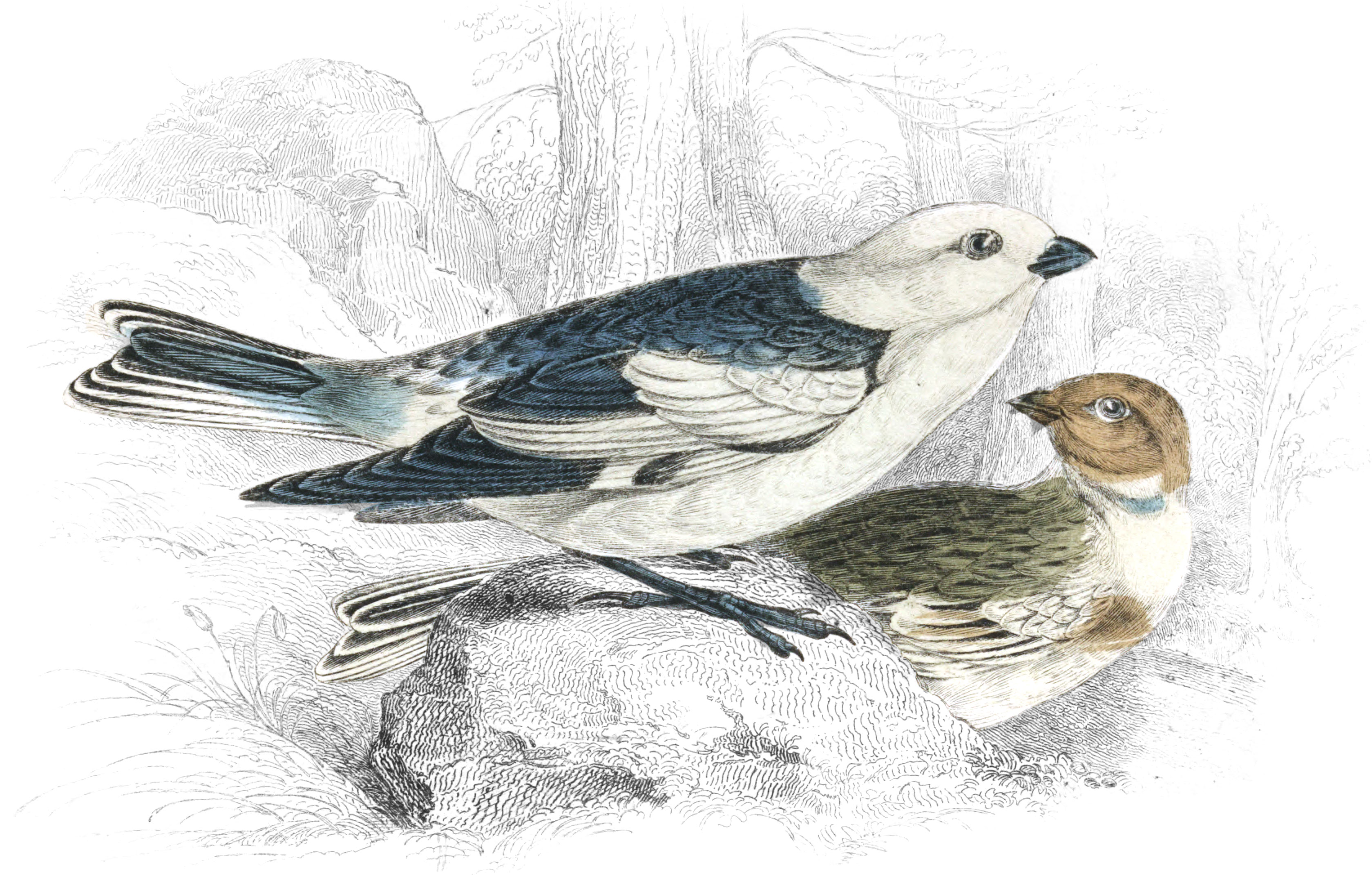
Plate XVIII
The Lapland Lark-Bunting
Plectrophanes Lapponica, Selb.—Fringilla Lapponica, Linn.—Emberiza calcarata, Temm.—Lapland Longspur, Bonap.—Lapland Lark-Bunting of modern British authors.
This bird, almost quite a northern species, has been taken occasionally in Britain, and has thus obtained a title to rank in our Fauna. The first specimen which was noticed was obtained in the London market, and came into the possession of N. A. Vigors, Esq. from whose collection Mr Selby described it, and added some remarks on its affinities and distribution, and its occurrence as a British bird, in a volume of the Transactions of the Linnæan Society. This bird is now in the collection of the Zoological Society; the other specimens which have occurred have been met with accidentally, chiefly in the vicinity, or not far from London. The most northern was taken in Lancashire, and is now preserved in the Manchester museum. Its proper country seems to be Northern Europe, the islands in the Northern Ocean, and arctic America, and in many of these countries it is to a certain extent migratory. They are mentioned by most of our arctic voyagers, and were found breeding in “moist meadows, on the shores of the Arctic Sea, the nest placed on a small hillock among moss and stones.” formed externally of dried grasses, and lined with deer’s hair. In the beginning of May, they were found to have fed on the berries of Arbutus alpina.
Mr Selby’s bird, the original British specimen, had
the head and upper parts of the body pale wood brown, tinged with yellowish gray, the shafts of the feathers being blackish brown. Greater wing coverts and secondary quills blackish brown, deeply margined with chestnut brown, the tips being white, quills dusky, with paler edges. Above the eyes is a broad streak of pale wood brown, cheeks and ear coverts wood brown, the latter mixed with black. From the corners of the under mandible, on each side of the throat, is a streak of blackish brown. Throat yellowish white. Lower part of the neck and breast sullied white, with numerous dusky spots. Belly and rent white, flanks with oblong dusky streaks. Tail dusky, the exterior feathers having the outer web, and half of the inner one, sullied white; the next to it, with a small wedge-shaped white spot near the tip; legs and toes brown; claws not much curved, the hind one nearly, straight, and longer than the toe.123
The plumage of the adult state, or breeding season, is much more contrasted, the head, throat, and upper part of the breast, being of a rich and clear black, which is relieved by a margin of white, running into the light colour of the lower parts. The upper parts are of a clear rufous brown, with the centre of the feathers black, and having the colours of the wings and tail deeper, and more distinctly marked. In the female, at the same season,
the chin is grayish, the black plumage of the head and breast edged with pale brown and gray, the chestnut feathers on the nape fringed with white.124
All the specimens which have been taken in this country agree nearly with that described by Mr Selby, and have either been young birds, or those which have passed from their breeding plumage.
From these Lark-Buntings, a title indicating a mixture of characters, we are led to the next sub-family, Alaudinæ, or True Larks, easily distinguished from any of the preceding birds by the less conical bill, and peculiar form of the feet. By far the greater numbers live entirely on the ground, run swiftly, feed on grains, bask in the sun, and among the dust, and exhibit in their manners a great resemblance to the rasorial birds. Their flight is powerful, and capable of being long sustained, and the song is often melodious, and of considerable compass.125 In the British list, we can only rank a single genus, the True Larks, which Mr Swainson considers as the Fissirostral type of the family.
Alauda, Linn.—Generic characters.—Bill sub-conic, nearly cylindrical, nostrils concealed; wings long, with the spurious quill very short, the three next nearly of equal length; tertials lengthened; feet with the claws slightly curved, that of the hinder toe long, and nearly straight.
Europe, America.
Type.—A. arvensis. Habits terrestrial.
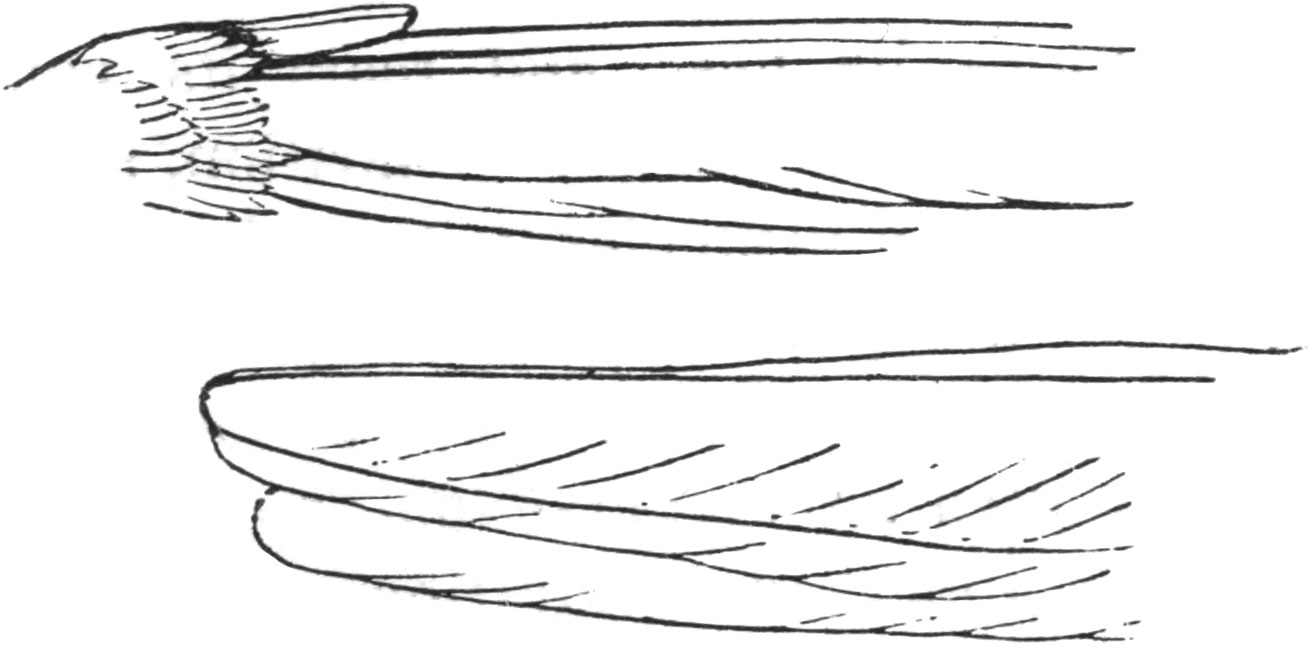
Alauda Feathers
The Skylark
Alauda arvensis, Linn.—Common Field or Skylark of British authors.
This well known bird and favourite songster is plentifully distributed over the whole of our islands, though in the more northern isles it is said to be only a summer visitant. In a country where the plough was little known, and the cultivation of the grains had not commenced, we would consider the natural localities of the Skylark to be extensive ranges of grass or pasture land, not lying too low, yet scarcely reaching to what might be generally termed a sub-alpine country. In the present state of our lands, it is a close attendant on cultivation, finding shelter or food among our crops, and enlivening the labours of the husbandman by its cheerful and peculiar song. Grazing lands, however, are still its favourite range, and it is often found in considerable abundance where the upland sheep pastures begin to commence. In these localities, and among the hay crops, it builds or forms its nest, and rears its young. The male, during the time of incubation, singing from clod or tuft, a little elevated, or rising above the spot with a rapid motion of the wings, and during ascent pouring forth that melody which has been so often the theme of our more homely poets, and is a marked illustration with all who describe the accessaries to rural scenery. The song is continued for a considerable time without interruption, during the ascent and after having attained its wished-for elevation, and while remaining poised in the air, so high as frequently to be known only by its song faintly heard. It frequently also continues its song in a gradual descent, but upon any alarm it is suddenly stopped, the wings closed, and it falls as it were a stone to the ground in a line often very slightly slanting. When the duties of incubation have passed, the birds begin to congregate, and by the commencement of the winter months, flocks here assemble in the stubble and fallow fields, their melody gone for a time, their only note being a short chirrup when raised or disturbed. When severe weather advances, they retire to the lowest grounds, and to the vicinity of the sea shore, and it is immediately previous to or about this time, that the partial movements and migrations take place, and we receive a compensation for what we lose in flocks from countries lying more northerly than our own. The Skylark never perches on trees, but is entirely terrestrial, walking and running with facility and swiftness, and never hopping in the manner of the finches. On the approach of danger it squats in any irregularity, hole, or foot print in the ground, and before a pointer will thus continue until approached within a yard. They also bask in the sun, and dust themselves like the rasores, and we have frequently seen the basking places strewed with feathers, and resembling those of a covey of partridges. The nest is placed on the ground, sometimes close to some hillock, and generally more or less sheltered by tall grass or herbage; it is rather carelessly formed of strong bent or grasses, lined interiorly with finer materials.
In the larger towns, and on the Continent, this bird used to be, and to a certain extent is still esteemed at the table, and during winter the flocks were netted extensively, bringing in this country a price of from three to four shillings per dozen. As a song bird, they are also esteemed, both from the facility with which they are reared, and for their capacity as songsters in confinement, for this purpose their price seems almost extravagant, twelve or fifteen shillings being “a common price for a good bird.”126 In its geographical range, the Skylark seems pretty generally and commonly distributed over Europe, decreasing to the northward, and there becoming migratory in winter. It extends into the Asiatic continent, but how far, or in what proportion, is not accurately ascertained.
The upper parts of the plumage are yellowish brown, having the margins of the feathers pale wood brown. In the breeding season the centres of the feathers assume a deeper and richer tint, and the pale edges partially fall off. Above the eyes there is a pale yellowish streak, and the feathers of the crown are elongated, and capable of being erected at will; this formation of some part of the plumes, covering the crown, runs through the known species, and will almost rank as a generic character. The tail is considerably forked, and a great portion of the outer, with the exterior web of the second feathers white. The cheeks are wood brown, the breast a paler and more yellow shade, spotted with longitudinal marks of brownish black; the remaining under parts are yellowish white, nearly pure on the centre of the belly. Legs and feet are yellowish brown. The female scarcely differs. Cream-coloured and nearly white varieties occur.
The Woodlark
Alauda arborea, Linn.—Alauda arborea, Linn.—Woodlark of British authors.
This species, as the familiar name indicates, is more woodland in its habits than the last, or indeed than any species with whose habits we are acquainted. At the same time, it is not an arboreal bird, perching even but rarely, but frequenting pasture lands and cultivated fields in a woodland country, or one interspersed with old hedges and copses of brushwood. It is celebrated also for its song, which by all its describers is stated to be melodious, and more richly toned than that of the last, while it is deficient in variation and compass. The song is also uttered while on the wing, but the flight is described to be in wheeling circles, occasionally hovering, and not in the gradual perpendicular ascent to a great height, as performed by the last. It also sometimes, but less frequently, sings from the branch of a decayed tree. The nest is placed on the ground, under shelter of some tuft and herbage, and in structure is somewhat similar to that of the Skylark. The eggs are pale reddish white, spotted and speckled with reddish brown. During winter, they are said to assemble in small parties, the amount of the year’s brood, and we do not find it stated that they are migratory, or perform any partial change of station.
The Woodlark, so far as we can learn, is by no means a common bird, even in its most favourite stations, and its distribution in Britain is extremely local, confined in England chiefly to the southern counties, and extending more sparingly to Derbyshire, Yorkshire, and Lancashire, in the northern counties becoming very rare, so as to cause its appearance to be recorded, and we have instances stated by Mr Selby and Mr Heysham, of specimens being killed in Northumberland and Cumberland. In Scotland, it is admitted by many writers, but without mentioning particulars. Dr Fleming gives the Gaelic name, while Mr Heysham states that it is taken occasionally y bird catchers in the neighbourhood of Dumfries.127 We have not ourselves seen a Scottish specimen, and cannot at present refer to any authentic instance of its capture. In Ireland, Mr Thompson has recorded it as partially distributed. On the Continent, it is perhaps more numerous, at the same time being local in its stations. In the Paris markets, we have frequently noticed specimens among the bunches of small birds, and mixed with the Common Lark. We do not yet know its range to the south, or towards Asia.
The Woodlark, though somewhat resembling the last in its colours and their distribution, is easily distinguished by its less size, and the shortness of the tail, which renders it a more compact and less elegant looking bird. On the upper parts, the feathers are brownish black, edged with pale yellowish brown. The form of the feathers and marking more rounded than in the last. The lower parts are pale straw yellow, upon the neck and breast spotted longitudinally with dark brownish black. Above the eye the streak is well defined, and is of a yellowish white. Hinder claws very long.
The Shore Lark
Alauda alpestris, Linn.—Alauda alpestris, Linn.—A. cornuta, Swain.—Shore Lark of Wilson and modern British authors.
This is the third Lark which the industry of modern British ornithologists have added to our list. It is, however, of rare occurrence, and can only rank as an occasional straggler, four specimens being all that are at present on record. It is a bird having the organs of flight amply developed, and having an extensive geographical range over the New World,128 extending also to Asia and Europe. The specimens which are now and then picked up in Britain can only be looked upon as having strayed, or been driven from their migratory courses. In most of its localities it is migratory, and we have notices of its occurrence in the Arctic Regions, by the authors of the Northern Zoology, and a very interesting account of its manners in summer by Mr Audubon.129 That ornithologist found them breeding on the coasts and islands of Labrador. Like the others, the song is sweet, warbled when on the wing, and occasionally on the ground. The nest is placed on the moss-covered ground, and
is disposed with so much care, while the moss so much resembles the bird in hue, that unless you almost tread upon her as she sits, she seems to feel secure, and remains unmoved. It is imbedded in the moss to its edges, which are composed of fine grasses, circularly disposed, and forming a bed about two inches thick, with a lining of grouse feathers, and those of other birds. The eggs are four or five in number, large, grayish, and covered with numerous pale blue and brown spots.130
In a specimen before us from North America, the upper parts are hair brown, the centre of each feather darker, and tinged upon the nape with pale hyacinth red. The shoulders and rump are hyacinth red, the feathers having pale edges. The wings and tail are blackish brown, having the secondaries and coverts nearly wood brown, but darker in the middle. The tail has the centre feathers edged with wood brown, and the outer edge of the outer feather, with the half of that of the next, white. In the adult male, the forehead is yellow, bounded behind with a black band terminating on each side with some narrow black feathers, elongated, which can be raised at will, and which have obtained for this bird one of its appellations, Horned Lark, (A. cornuta.) The lores, cheeks, and throat in the form of a crescent band, are deep black, and the chin, sides of the neck, and a streak above each eye, are of a pale but rich king’s yellow; beneath the black gular band, the breast is hyacinth red, varied with blackish brown, the sides of the breast are of the same colour, and the flanks are wood brown, having the centre of each feather darkest. The belly, vent, and tail coverts are white.
In our next sub-family, the Bullfinches or Pyrrhulinæ, the typical forms are very different from the birds we have now left; but there is a genus of Africa and India, Pyrrhulauda, or Lark-Bullfinch, which, as the name indicates, combines characters of both. In the form of the True Bullfinches, the head is large, the bill short, and very broad at the base, at the same time of very considerable strength, and in these the principal food seems to be the tender bark or young shoots, and the buds of trees. Others attack the seeds of trees, and in one genus we have a remarkable and peculiar form in the mandibles of the bill, being crossed over each other. They are mostly arboreal in their habits, and many of them frequent extensive and retired woods. The genus we have first to notice is,
Pyrrhula, Brisson.—Generic characters.—Bill short, thick, and swelled, or inflated in all its parts, wide at the base, edges of the mandible folding over the maxilla, culmen rounded; wings with the third quill longest, second and fourth equal, first slightly shorter; tail ample, sometimes lengthened; feet with the tarsus and middle toe nearly equal.
Type.—1. P. vulgans, 2. erythrocephala.
Form compact, stout. Europe, Asia.

Pyrrhula Head, Feathers, and Beaks
The Common Bullfinch
Pyrrhula vulgaris.—Temm.
Loxia pyrrhula, Linn.—Pyrrhula vulgaris, Temm. &c.—Bullfinch of British authors.
This very beautiful bird is generally distributed over our islands, though no where very numerous. It is of retired habits, frequenting woods and plantations, often where they are wild and of considerable extent, and here their call-note reaches the ear of the wanderer when their haunts are intruded on, clear and distinct, yet melancholy in its tone and cadence. In spring and winter, the shrubbery and gardens are frequented, apparently on account of the food derived from the fruit trees, where buds are eagerly sought after and eaten, the bud being paired down or bruised by the edges of the bill, forms itself the food, and is not broken, as some suppose, in search after the insects contained in it. The Bullfinch thus commits often serious depredations on the crop of the coming year; at other times the food consists of the seeds of many plants, particularly those of the order Syngenesia, as the thistle, ragweed, &c.
The nest is constructed on the lower branches of some evergreen tree, or among the underwood of the cover. It is rather carelessly built, shallow, based with slender twigs, and lined with fine roots or grasses. The eggs are of a pale and delicate greenish blue, marked with reddish or purplish spots.
The geographical range of the Bullfinch is not very extensive, neither does it seem more common in other districts than in Britain. In our own country, it scarcely reaches the north of Scotland, and is, we believe, unknown in the northern islands. On the Continent it reaches to a lower proportional latitude, but decreases in numbers, and it has been long since known as a Japanese bird.
The Bullfinch is esteemed in confinement on account of its imitative powers, and numbers are annually imported on this account from Germany, under the title of “Piping Bullfinches.” These have lost almost entirely their natural limited song, excepting their call-note, but have been taught to whistle an air or favourite melody, which the best do with great truth and distinctness, and with a deep and full tone. The price of some of these birds is extravagant. The Bullfinch, in form, is a compact and stout bird, and the adult male shews a beautiful assemblage of colours. The crown of the head and nape, the throat, wings, and tail, are rich velvety black, with a steel blue and purplish gloss. The back and shoulders delicate bluish gray, and the rump, vent, and under tail coverts, pure white. The cheeks, throat, and under parts, delicate tile red, shading gradually into the other colours. In the female, the general markings are the same, but not so distinct. The upper parts are more of a brownish tint, and so also is the under surface of the body tinted with the red of the male. The Bullfinch is subject to considerable variety. Individuals pied black and white occur, white occupying the red and gray portions. Some are of a yellowish white, or cream-colour, and occasionally they occur nearly pure white, while black varieties obtain at times, an effect which, it is said, may be artificially produced by confining the food to hempseed. A very beautiful species, much allied in form, is found on the Himalayan range.

Plate XIX
Our next bird is very closely allied to the True Bullfinches, but diverges from their form in that of the bill, and in the colours of the plumage, in the last respect much more closely approaching to the tints and changes undergone by the Cross-bills. The tarsus is also proportionally shorter. These differences have induced many of our ornithologists to adopt Cuvier’s genus Corythus, in preference to continuing them with Pyrrhula. Corythus may be thus characterized:
Corythus, Cuvier.—Generic characters.—Bill somewhat swollen, with the culmen rounded, mandible “projecting and curving over the tip of the lower;” tarsus shorter than the middle toe; tail slightly forked; wings as in Pyrrhula.
Type.—C. enucleator.
Europe, Alpine India, Nipaul,131 America.
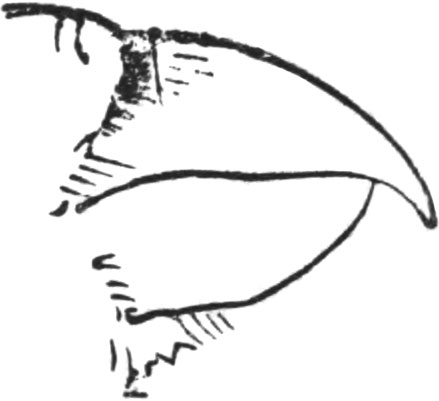
Corythus Beak
The Pine Bullfinch
Corythus enucleator, Cuvier.—Loxia enucleator, Linn.—Pyrrhula enucleator, Temm. Selby.—Corythus enucleator, Cuv. Swain.—Pine Bullfinch or Grosbeak of British authors.
This species seems to be rare, and of limited distribution even in its own countries, for we very seldom receive it in collections, and with dealers it is as unfrequently found. In Britain it stands as one of our rarest and most sought after birds. One of our first authorities for its occurrence is Mr Pennant, who met with them flying above the great forests of Invercauld in Aberdeenshire, and since that we are not aware of any authentic instance of their occurrence in Scotland, and we have never ourselves met with them in the north, though they have been often anxiously looked for. Mr Yarrell mentions three instances of their having been seen or killed in England, one specimen of a female, obtained on Harrow-on-the-Hill, being in his own collection. Mr Thompson has not recorded its appearance in Ireland. In Europe, it is most frequent in the north, and the specimens from the New World have always been considered identical with them, and it is in the northern parts of the latter country also that they are chiefly found, being met with by Dr Richardson as far as the sixtieth degree, and by Mr Audubon in Newfoundland, the coasts of Labrador, and Hudson’s Bay. It is from these writers on the ornithology of North America, that we learn any thing regarding their habits, and, according to the latter, they feed on the buds and seeds of almost all kinds of trees. The nest is said to be placed not far from the ground, arid to be composed of small sticks lined with feathers, the eggs white. It is recorded also as being a beautiful songster, possessing a deep and full tone, and is occasionally kept in confinement on this account, becoming soon very tame and familiar.
We do not know the changes of the colours assumed during the breeding season, or at different ages by this species, but it apparently varies from different shades of yellowish red to carmine red. The plumage is soft and rather loose; that of the adult male in summer is described as carmine red, the feathers on the back, scapulars, and rump, grayish black in the centre. Feathers of the wings and tail blackish brown, edged with reddish white, which is broader on the tips of the wing coverts, and forms there a bar across the wing. The under parts are also of the rich carmine red of the upper, becoming paler, and shading into gray on the belly and vent. In the Northern Zoology, the old male, again, “is said to have the head, neck, and under plumage, orange.”132 According to the last quoted work, a female, " killed in winter, has the head, ears, rump, and tips of the back and neck feathers hoary yellow, the rest of the plumage bluish gray. This accords with a European specimen in our possession supposed to be an adult female. The tinge of hoary yellow, however, extends to the centres of the feathers on the back and breast, while the colour on the rump is extremely brilliant. The wings and tail are brownish black, the quills and secondaries edged with grayish white, the tips of the greater and lesser coverts of the same colour forming bars across the wing.
We have now to examine a very curious and interesting genus, limited in numbers, but containing birds whose habits, though often described, have not been sufficiently observed in this country. The appellation of Loxia, has by modern ornithologists been restricted to these birds, familiarly known as Crossbills from the structure of the bill. They are natives of temperate countries, are strongly formed, possess a powerful flight, and feed chiefly on the seeds of the different species of pine, to which they are enabled to find access by the peculiar structure and strength of their bill. The colours of the plumage are bright, and undergo periodical changes. They are partially migratory, and in winter are gregarious.
Loxia, Brisson.—Generic characters.—Bill strong, rather lengthened, compressed, mandible and maxilla crossing each other at the tip when closed, entire at the tips; wings with the first quill longest, the others graduating; tarsi short; feet rather strong, with the lateral toes unequal, claws hooked.
Types.—Loxia curvirostsa, &c.
Note.—Europe, America.
Common Crossbill
Loxia curvirostra.—Linn.
Loxia curvirostra of authors.—Common Crossbill of British authors.
This very interesting bird appears to have had attention directed to it since a very early period, which may be perhaps traced to their occurrence at uncertain intervals, their curious habits and want of fear, and the destruction which they make in some places upon the crop of apples, by splitting the fruit in search of the pips or seeds. Mr Yarrell has been at pains to search out some of the earlier records, and from him we learn that they were noticed in 1254 and 1593, particularly in the latter year, on account of the above mentioned havoc in the orchards. Since these records, similar observations have been made; and at various intervening periods, up to the present time, flocks have been seen in England, Wales, and Scotland, frequenting some particular locality; of later years these appearances have either become more frequent, or the attention which is given to ornithology, with the numerous periodicals, &c. to which the occurrence of such flocks is communicated, has made them appear so. We are, however, inclined to believe the former, and in the south of Scotland, at least, where an immense extent of young pine timber has been planted, within thirty years, the Crossbill has undoubtedly become more common, and we know now remains through the year. Since 1829 and 1830, scarcely a year has passed without the English border and the southern counties of Scotland, being visited by flocks of Crossbills. In our own vicinity they were, however, rare, the first birds having been seen in 1836; next year, at the commencement of winter, a small flock appeared, and continued for some months; and in the November following, (1838,) a party of from fifty to seventy returned, and have been seen every week up to the present date, (July 30, 1839;) notwithstanding, we have been unable to discover the nest, or any traces of their having built. During winter, the flock kept together, but after spring they have been seen in pairs or small parties, and it is possible that some of the older pine woods, from twelve to fifteen miles distant, may have furnished breeding stations, though as yet we have been unable to ascertain this. These birds, during the winter, kept together, and were generally discovered when looked for by their noisy notes when passing from one plantation to another, or removing short distances in search of cone-bearing trees. When the flight was made to any distance, the birds rose to a considerable height, and flew with a very powerful rather undulating motion, uttering as they flew a continued single sharp call-note. On alighting they become silent, at once commencing to attack the fir cones, and only uttered their notes when disturbed, or on removing to another station. The spruce fir was chiefly frequented, and trees with a large crop of cones presented a very interesting sight when the flock was engaged upon them. The feet and bill being both powerful, are used as scansorial and prehensile members, and they would climb and hang about the cones and branches in all the attitudes, and with all the agility and security of a parrot, and they possess sufficient strength to enable them at times to fly off with the cone of a spruce fir to an adjacent tree. The cones are split or cut up one or both sides longitudinally, and are so torn in search for the seeds as to be easily perceived, and mark the progress of the flock, while the ground beneath is strewed with numbers which have been unable to withstand their attacks on the branch. The larch was less frequently here attacked, though in other districts the seeds are much fed upon, and we never saw any of the cones of the Scotch fir or pinaster broken by them, but this may be accounted for by a great prevalence of spruce in the places they frequented, and by these trees last years (1838 and 1839) producing a most abundant crop of cones. By using a little caution, one could easily gain the foot of the tree where the birds were feeding, and examine their motions, and if the person remained quiet, they would feed and climb about the branches until within a few yards of the looker on. On one or two occasions when shot at on the top of a tall tree, those unhurt would fly straight towards the person, and flight within a few yards, looking about and beginning to feed as if nothing had occurred.
The nidification of the Crossbill in Britain is comparatively little known. A few instances are recorded of its nest having been found in England, but so scattered as to warrant the conclusion that the birds had been detained from their natural haunts by some cause. In the south of Scotland, the nest has not been lately found, but we have little hesitation in believing that for the last years they have bred in some numbers in different districts, though the precise locality and their nests have not been yet discovered. In its foreign distribution, the Crossbill ranges extensively over Europe, being more abundant and less migratory towards the north. Specimens of the common bird from. America we have never ourselves had an opportunity of comparing, and can only now mention the opinion of others; it is certain, however, that if distinct, the alliance of the two is very close. Wilson was of opinion that they were distinct species, and when Buonaparte wrote his observations on Wilson’s Nomenclature, he considered that ornithologist in error. In his last work, however, on the Birds of America and Europe, his opinion is again reversed, and they are considered distinct. On the other hand, Mr Audubon, in his second volume of the Ornithological Biography, says, that he has not “succeeded in detecting any differences sufficient to indicate a specific distinction.”133 The American bird is spread extensively over the northern and central parts of the northern Continent.
In the colouring of this species, and the changes it undergoes at various seasons, we are scarcely aware in what manner it is influenced, and without being able completely to note these from observation, it is best to describe the birds in apparently adult plumage. An adult male shot here in last November, was entirely of a yellowish crimson red, most vivid on the crown, breast, and rump, the vent inclining to yellowish white; around the auriculars there is a broad stripe of pale umber brown reaching from the eye; the feathers on the centre of the back have the base darker, the tips only being crimson, which gives a duller appearance to these parts; the wings and tail are very dark umber brown, tinted with crimson on the scapulars, and having the quills and secondaries very narrowly edged with reddish white. Another male shot in Roxburghshire in July, has all the crimson parts tinged with brownish green, by that colour occupying the base of the feathers, the centre of the back and scapulars appearing nearly entirely of a deep shade of that colour. In a female shot in November, the upper parts, throat, and neck, were of a grayish green, the feathers edged with yellowish green on the head and back, and on both being dark at the base; the breast and belly were greenish yellow, shading into gray on the vent; the under tail coverts grayish black, edged with pale yellowish gray; wings and tail dark grayish umber brown, having the feathers edged with greenish yellow. In a young bird procured on the Continent, the whole upper parts are umber brown, with the yellowish green feathers appearing; underneath the throat and sides of the breast are reddish yellow, shading into yellowish white in the centre of the belly and vent, each feather marked longitudinally along the shaft with umber brown; the wings and tail are not so dark, and are edged with pale brownish white.

Plate XX

White-winged Crossbill
Loxia leucoptera.—L. falcirostra, Penn.—White-winged Crossbill of British authors.
The first noticed specimen of this distinct Crossbill was shot within two miles of Belfast, in 1802. Since, a very few instances are on record of specimens occurring in England, while its claim to a place in the Scottish list rests on a specimen mentioned by Pennant, which, “he was told,” had been killed in Scotland. In Europe, it seems confined nearly to the northern parts, and is seen there very rarely. It was omitted by Temminck in the second edition of his Manual, and seems only to have been noticed by the more recent ornithologists. It is supposed also to migrate or extend to Northern Asia, but North America may be yet considered as its true country, and though comparatively scarce there, it is met with in greater numbers than elsewhere. Buonaparte considers it as inhabiting the northern and central parts, being in most districts migratory, frequenting chiefly the
pine swamps and forests, often feeding to excess on the seeds of pinusinops. The nest is built on the limb of a pine near the centre, and is composed of grasses and earth, lined interiorly with feathers.134
Their manners are described as similar to those of the Common Crossbill, equally regardless of danger, and in snow allowing themselves even to be caught by the hand. We do not at present possess a specimen of this bird, but the adult male is described as rich crimson red, tinted with brown on the forehead, and having the base of the feathers dark gray, which sometimes gives a mottled appearance to the plumage. The wings and tail are black, the former with two conspicuous white bars, one across the shoulders, the others formed by the white tips to the wing coverts. The vent and under tail coverts white. The female is described of an olive green, paler beneath, and tinted brightly on the rump and breast with lemon yellow; the bars on the wings indicated indistinctly.
Parrot Crossbill
Loxia pittyopsittacus, Bechstein.—Loxia pittyopsittacus, Bechstein, &c.—Parrot Crossbill of British authors.
The Parrot Crossbill was first noticed as British by Mr Pennant. It was more recently figured by Mr Selby in his Illustrations of Ornithology, and Mr Yarrell has given notices of several instances of its capture in England, and states that last year specimens were brought for sale to the London market. The specimen figured by Mr Selby, with another procured along with it, are the only instances we are acquainted with of its occurrence in Scotland. These specimens were obtained by Mr Ross, gunmaker, Edinburgh, from Ross-shire, so far as we can recollect, from the property of Sir Francis Mackenzie of Garloch. One of them came into my possession, and served for the figure and description given by Mr Selby. The other was for a time lost sight of, but Mr Ross afterwards recovered possession, and it is now in Mr Selby’s collection. The locality of the specimen in the Edinburgh Museum can scarcely now be authenticated. It does not yet seem to have occurred in Ireland. According to Temminck, it only partially and occasionally visits Holland and France, is probably still more rare in Southern Europe, and is said by the ornithologists of the north to increase in numbers in that direction, being resident and breeding. It is not acknowledged as a North American species. We add a description and measurements of our own specimen for comparison with others.
Length, so far as we can measure from the stuffed specimen, about six inches and a quarter; length of the wing, from the tip of the shoulder, four inches one-eighth; length of the tarsus one Inch. The whole plumage is of a yellowish crimson red, shading into gray on the flanks, and centre of the belly and vent, more brilliant on the rump, and on the centre of the back having the base of the feathers dark; the wings are umber brown, the feathers narrowly edged with greenish yellow. This specimen was used by Mr Bewick and Mr Selby for their figures and descriptions.
Scansores
We have now described all the members of the Conirostres which can be numbered in the British list, and in entering the next tribe of the great incessorial order, we pass a wide gap, our more northern country possessing in the first no representation of the Musophagidæ or Buceridæ, while those belonging to the Scansores are few in number, and belong only to scattered genera. The third tribe, the Scansores or Climbers, are characterized by the structure which adopts all their members for climbing or hanging among trees, in some developed to the utmost extent, and enabling the birds to scale the smooth and upright trunks; in others more adapted to grasping and hanging among the branches; in all, the structure of the feet is intimately connected with this provision, and we find them strongly formed, the tarsus short, and the toes in the greater number placed in a zygodactyle manner, or two turned forward, two standing behind, one of which is frequently versatile. In some genera the bill is so formed, as to take the place of a prehensile organ, and assists in the support. On entering this tribe, we have to pass the remarkable genera of the Toucans, with the numerous and varied forms of the Parrots, but we fortunately possess a few representations of the typical family, the Picidæ, or Woodpeckers, many of which live almost entirely in a climbing position. Of these, the Picidæ, or Woodpeckers, are eminently remarkable. Many of them are strong and powerful birds. The feet very strong, and furnished with hooked claws. The tail rigid, and used as an assistant in supporting them, when running up the trunks of trees. The bill strong, and shaped like a wedge, capable of being used with great force, and of quickly excavating from their retreats the various larvæ which feed and burrow in the bark and wood of trees, while the tongue is long and slender, and by the particular structure of its parts, and the hyoid bone, is capable of being extended, and of bringing up the prey from a cavity of considerable depth. The Great American Ivory-billed Woodpecker, is a fine example of this form. In our native fauna we shall see it in the genus Dryotomus of Mr Swainson.
Dryotomus, Swains.—Generic characters.—Bill straight, rather depressed, straighter than high, lateral ridge nearest the culmen; versatile toe shorter than the anterior.
Types.—D. pileafus, martius.
Note.—Plumage black and white, very closely allied to Picus. Europe, America.
Great Black Woodpecker
Dryotomus martius.—Picus martius, Linn.—Mr Jenyns, the latest writer on our British fauna, in 1835 writes thus:
No specimen, however, known to have been certainly killed in this country, exists in any of our museums, and there is strong reason to doubt the reality of its claims to a place in the British fauna.135
The authority previous to this rests with the works of Drs Latham and Pulteny. We have no means of immediately clearing this doubt, or of tracing the specimens alluded to by the above mentioned gentlemen; but, at all events, the bird will only rank as a straggler, and as one of the rarest in our list, and we introduce it, as we have done many others, to attract attention to the subject. On the Continent it is most common in the northern and central parts; according to Temminck extending to Siberia, and sometimes appearing in Holland. It is not known beyond the, European boundary. In the males, the plumage is entirely black, excepting the crown, which is crimson. In the female, the crimson is limited to ’a spot on the occiput; while in the young the crimson is partially mixed with black.
The next form is
Dendrocopus, Swains.—Generic characters.—Bill, with the culmen nearly straight, as broad at the base as high, and not compressed on the sides; feet with the versatile toe longer than the anterior; wings rather lengthened and pointed, third quill longest.
Types.—D. major, &c.
Note.—Plumage chiefly black and white, disposed above in patches or bars.
Europe, Asia, America.
Great Spotted Woodpecker
Dendrocopus major, Swainson.—Picus major, Linn.—Greater Spotted Woodpecker of British authors.
This species is the only representative of the Picidæ, which extends to the northern part of our island, and it is there of rare occurrence. The unfrequency, indeed, of all the specimens of British Woodpeckers, particularly in the northern parts of Britain, prevents us from giving any account of them from observation, but so far as we can learn from the works and information of others, the present species is most common in some of the southern counties of England where it breeds; as we proceed northward it appears to be partially migratory, and in Northumberland, Mr Selby observes, scarcely a year passes without some of these birds being obtained in the months of October and November. This also accords with our own observations, of a few individuals which we have known to have been killed in Dumfries and Roxburghshires, and which were obtained at these seasons. Mr Selby also mentions having seen it on the banks of the Dee and Spey; we are not aware of its occurrence farther north, and never met with it in any of our excursions in the Highlands. In Ireland, on the authority of Mr Thompson, it is only recorded to have occurred twice, one specimen, killed in the vicinity of Dublin, being in the museum of the Dublin Royal Society. On the Continent it seems more abundant, but in some parts it is probably partially migratory. Of its extra European range we do not know the limits, the Himalayan bird so closely allied to it being apparently distinct.136 The habits of this bird are strictly arboreal; it prefers, we believe, extensive forests, rather than a more woodland country; feeds chiefly on insects, but often also on seeds and nuts;137 and we were informed by a gentleman long resident in Russia, that the cones of the pines were opened for the seeds, and for this purpose they were carried by the bird to some particular spot, and placed in the cleft of a tree, to be held forth for dissection; that piles of the cones, after being opened, might be seen in various parts of the forests at the roots of trees, and that one near his own garden was a favourite spot where the birds were often observed at work.
A male shot in Dumfriesshire in winter, had the forehead yellowish white, the plumes covering the nostrils black; the plumage above generally of a deep black, relieved by a narrow band or spot on the occiput of arterial blood red, and various patches of white, of which the space around the eyes, the auriculars, a patch on each side of the nape, and the scapular covers, are the most prominent. The lower parts are yellowish white, having the black of the sides of the neck stretching across the breast in the form of a crescent shaped half collar, the vent and under tail coverts crimson red. The quills with spots of a square shape on the outer webs, on the inner ones rounded, those on the first quill being placed near the base, and only two in number. Tail black, the two outer feathers yellowish white for two-thirds of their length, barred with black, the third feather tipped with yellowish white. In the female, the red occipital band is wanting. In the young birds, the crown of the head is entirely crimson previous to the first moult.
Lesser-spotted Woodpecker
Dendrocopus minor.—Picus minor, Linn.—Dendrocopus minor, Swain.—Lesser-spotted Woodpecker of British authors.
This pretty little species is more local than the last, and has a much less extended range in Britain, being unknown, we believe, in the Scotish and Irish fauna, and being found chiefly in a few of the southern and western counties of England. According to Mr Gould it is very common in the parks and woods around London, being always to be found in Kensington gardens, &c. where it seems partial to the elm trees, keeping, in great part, to the topmost branches; and is also recorded as being met with in Gloucester, Wilts, Hereford, Cambridge, Norfolk, Suffolk, Shropshire, Derbyshire, and Warwickshire, and one was killed near Newcastle in January, 1829, which is perhaps the northern range of the bird in our country. It has been remarked in the districts it frequents, even more than the larger species, on account of its peculiar note, continued for a time together, and which is most probably a call-note during the breeding season, though we are not aware that it is confined to this period only. Mr Bree says,
It resembles that made by the boring of a large auger through the hardest wood, and hence the country people sometimes call the bird “Purnp Borer.”
The Lesser-spotted Woodpecker breeds like the last in hollow trees, laying the eggs, it is said, on the bare or rotten wood, and having the entrance hole always of a size in proportion to that of the bird. On the Continent Temminck considers it as most abundant in the north, frequenting the pine forests, becoming more uncommon in the south, and very rarely occurring in Holland.
In the male the forehead is grayish white, crown arterial red, running into black on the occiput, which is continued down the centre of the nape, and forms a broad band of the same colour upon the shoulders; the cheeks, and a patch on each side the neck white, bordered beneath the auriculars with black; the upper parts and wings are banded alternately with black and white, the latter predominating on the centre of the back; the rump and middle tail feathers black, the outer feather white, with black bars, the second and third with a still less proportion of white; under parts grayish white; centre of the feathers brownish black on the flanks and sides of the breast. In the female the crown is yellowish white.
From the Black and White Woodpeckers we pass to a form less truly arboreal, alighting frequently on the ground, and representing apparently the genus Colaptes of other countries. It has been designated Brachylophus, and may be now characterized.
Brachyophus, Swains.—Generic characters.—Bill slightly curving, lateral ridge near the culmen, depressed and widening at the base; neck thick; feet with the versatile and anterior toes nearly equal; tarsi short.
Types.—B. viridis.
Note.—Europe, alpine India.
Green Woodpecker
Brachylophus viridis.—Swainson.
Picus viridis, Linn.—Brachylophus viridis, Swain.—The Green Woodpecker of British authors.
This species is perhaps in England the most common of our native Woodpeckers; but we believe that it seldom extends beyond the line of Yorkshire. In Scotland we have never seen it, and know of no authentic specimen, while in Mr Thompson’s notes it is not enumerated. The scream or cry of the Green Woodpecker, when heard for the first time, in a retired place or lonely wood, the bird being unseen, strikes the hearer as most remarkable and startling. The tone and expression is not to be explained by words, and can only be felt by hearing; and it appears to be uttered on alarm, or on hearing any noise, often without the person being able to catch a glimpse of the bird. We have seen this bird both in England and on the Continent, and it appears to frequent woods where there is a less proportion of tall wood than any of the preceding birds, climbing among the bushes; we have also seen it among strong hedges, and once or twice in whin covers, where it had been apparently searching for food on the ground. This, we know, is an occasional habit of the bird, when hunting for ants and their larvae, a favourite food, sought for on the hillocks or nests, and on old turf fences. The flight is low and undulating, and the call is often repeated in passing from one station to another.
This species is said to be generally distributed over Europe; but we are not aware of its range being extended farther, the form being represented in alpine India by several other beautiful but closely allied species.
In the adult male the space around the eyes and rictus is deep black; the crown of the head running down in a narrow point upon the nape, and a lengthened patch .on the jaw, are arterial red, the base of each feather gray, and appearing through and breaking the bright colour; the upper parts are siskin green, shaded on the rump into gamboge yellow; the under parts are yellowish gray; quills greenish black, marked on the outer webs with square spots of yellowish white, at the base of the inner webs with round spots of the same colour; the tail almost inclines to blackish oil green, indistinctly bordered with a deeper shade. In the female the crimson is wanting on the jaws, where the patch with the region of the eyes is black. The rest of the plumage is similar to that of the male, but less brilliant. In the young birds the crimson of the head is less brilliant, and is more mixed with grey; and the patch on the jaw, and black in the region of the eyes, are only indicated; the cheeks, sides of the neck, and under parts are yellowish white; on the first appearing streaked with black, and on the under parts having the feathers barred and marked in the centre with the same colour; above, the plumage is siskin green, interspersed with gray, the feathers marked with yellowish white along the shafts. M. Temminck states, that varieties of a yellowish white sometimes occur.

Plate XXI
From the Woodpeckers so eminently scansorial, we pass to another genus limited in its numbers, insectivorous and arboreal, but not possessing all the structure for a climbing life, or strength to dig out the burrowing larvæ of insects. It has been placed among the sub-family of the Barbets or Bucconinæ and is the only representation of it which we have in the British, or, indeed, in the European Fauna.
Yunx, Linn.—Generic characters.—Bill straight, nearly round, dilated at the base; tongue long; feet zygodactyle, exterior toes nearly equal in length, and to the tarsus; wings with the first quill very minute, third longest, second and fourth nearly equal; tail ample, soft, very slightly rounded.
Type.—Y. torquilla.
Note.—Europe, Asia.
Yunx torquilla
Wryneck.—Yunx torquilla, Will. Linn. &c.—Wryneck of British authors.
This chaste and delicately marked bird is a beautiful example of the pleasing eifects of the blending of a few simple colours; gray, brown, with shades of yellowish white, forming nearly the only tints, but so distributed as to produce a whole which gives satisfaction to every observer. The Wryneck is a summer visiter to our island, arriving about the same period with most of our other migratory birds. It, however, does not extend in any numbers, or with regularity, to the northern or the midland counties of England; but southward, in the wooded districts, it is considered to be generally and not uncommonly distributed. Mr Selby mentions having traced it as far as Morpeth, in Northumberland, where a few are seen every year. Mr Greenhow includes it in a list of birds of the parish of Tynemouth, same county.138 In Scotland it becomes still less frequent; we have heard of very few examples, and one only has come under our own notice, killed on the banks of the Solway, early in spring, and now in our collection; it drew attention by its peculiar, and there unknown cries. It is not mentioned by Mr Thompson in the Irish list. On the Continent, it is said by Temminck to be found in central Europe, seldom ranging more to the northward than Sweden. Of its more extended range we have fewer indications; it occurs in Temminck’s list of Japanese birds identical with those of Europe, and we have received it in a collection of birds from the vicinity of Canton. Montague mentions it as known in Africa.
We can give no description of the habits of this bird from observation. All authors agree in the food being insectivorous, and consisting in a great measure upon ants, which has obtained for it the common appellation of “Emmet Hunter.” These it takes with the tongue, by darting out and touching the prey, which adheres to the glutinous secretion with which it is abundantly supplied. This was seen by Montague, who kept a female in confinement, supplying it with ants for food. In the ant hills it is said to introduce the tongue into the hollow parts, thus rousing the community and bringing them within reach upon the surface. The eggs are laid in holes of trees on the rotten wood without lining. This has been the manner in which they have been, by most authors, considered to be deposited. But we find Mr Salmon giving an instance, where he pulled out the nest, composed of moss, feathers, &c. five times, taking in all twenty-two eggs from the birds. He, at the same time, however, states, that it may have been the old nest of the redstart on which the eggs had been deposited.139
To describe this beautifully pencilled bird is almost impossible, the colours are so blended. Above, the general tint is of a yellowish gray, mottled with black and brown; on the centre of the back the middle of the feathers is black, and the ground colour is of a browner tint; this also covers the scapulars, where the feathers are tipped with a yellowish white, succeeded by a band of black; the quills are brownish black, bordered with reddish wood brown; the tail has four irregular bars of black, broadest at the shaft, and succeeded by pale mottled space on the one side, darker on the other, which gives the effect of three shades or bands; the auriculars are pale chestnut, the same tint being carried down on the sides of the neck; under parts are yellowish white, paler on the breast and belly; the feathers on the throat, neck, and breast, irregularly barred across with blackish brown, on the belly and flanks having the bar widening at the shaft; and running along it in a point. In the female the differences of plumage are extremely slight.
From the Picidæ we pass to the Certhiadæ, or creepers, a very interesting family, and considered as that which connects the Scansores with the Tenuirostres. The British list possesses only three forms representing as many families, so that we can scarcely enter into the manner in which they unite each other. The first sub-family, Certhianæ, we have represented by the genus Certhia, composed of a very limited number of species, truly arboreal in habits, climbing with facility, and supporting themselves by the tail, which is rigid as in the Woodpeckers.

Picidæ Feathers
Certhia, Linncæs.—Generic characters.—Bill slender, both mandibles curved; wings long, four first quills graduated; tail lengthened, graduated, feathers lanceolate at the tips, rigid; feet large, all the claws slender, that of the hallux long and curved.
Type.—Certhia familiaris.
Note.—Europe, America, Asia.140
Common Creeper
Certhia familiaris, Linn.—Creeper or Common Creeper of British authors.
The Creeper, next to the Common Goldcrest, is one of our smallest birds, and on this account, together with its shy and retired habits, and peculiar manner of avoiding being seen, by suddenly placing the tree or branch on which it rests between itself and the observer, it is not easily discovered, and has been accounted a rather uncommon bird. This, however, is by no means the case either in England or in the south and middle of Scotland, neither is it urifrequent in Ireland in favourable localities.141 The Creeper delights in the older woods, and in parks with old scathed timber; by remaining stationary for a short while in any retired wood suited to their habits, the weak sibilous note will be heard repeated at short intervals, and on following the sound the bird will be seen scaling the trunk or branch of some neighbouring tree, while the least noise on the part of the observer will cause it to jerk round to the opposite side, pursuing its way in concealment, and occasionally just coming so far round as to gain a view and ascertain if the cause of alarm is still present. Having gained the summit or termination of the branch, it suddenly and swiftly falls as it were to the root of some other tree, and again commences its twisting course upwards, in its way searching the moss and cracks in the bark for insects, which constitute its sole food. The nest is formed in the hole or rent of a tree, is formed of moss and fine grasses or roots, lined with feathers, and we have sometimes seen the fabric of considerable bulk when the bottom of a rent had to be filled up; we have reason to believe also, that a hole in a wall is sometimes selected where the situation is otherwise suitable; and we once knew the nest placed in a stack of peat or turf dried for fuel. At this time, the birds are more than usually noisy, uttering their shrill cry frequently, and quickly repeated. The female, while hatching, sits remarkably close, and will not leave the nest or hole when the intruder is near, but will watch an opportunity, and dart silently off, when he removes to a little distance, or keeps from sight.
In Europe, it is generally distributed, and ornithologists have hitherto considered the bird of America as identical. The Prince of Musignano, however, has placed it distinct in his last comparative list, while the opinions of Richardson and Audubon are opposed to the separation. Upper parts of a British specimen yellowish brown, intermixed with blackish brown, and yellowish, and greyish white, the mixture caused by the centre of the feathers being paler; the same colours surround the eye, and pervade the auriculars; the rump and upper tail coverts are gallstone yellow; the quills are hair brown, and have a diagonal band of yellowish white crossing them about the middle, except the three first, succeeded on each side by a deeper tint, and forming almost three bars; nearer the tips there is another pale band on the outer webs; the tail also is hair brown, the shafts gallstone yellow; the under parts are white, tinted on the flanks with yellowish brown. In American specimens, the most prominent mark is the comparative shortness of the tarsi, less size of the feet, and shortness of all the claws, particularly that of the hallux. The other varieties of plumage are difficult to distinguish, though, to a certain extent, present; and we have only more and more to regret that the Prince of Musignano has not, in his comparative list, given us the distinctions which, he considers, will separate such closely allied birds.142
The next sub-family, Sitting contains also only one British representative from the genus Sitta, or Nuthatch, a small but interesting group of birds dressed in chaste and sober colours, and restricted to more temperate regions, the known species being found in Europe, North America, and Alpine India. They are active climbers, and breed in the holes of trees.
Sitta, Linn.—Generic characters.—Bill straight, somewhat rounded, entire, rather dilated at base; wings rather long, first quill short, third and fourth largest and equal; tail short, even; feet strong, lateral toes very uneven, hallux strong and lengthened, claws hooked, that of the hallux broad and strong.
Types.—S. Europea, Canadensis, Himalayana.
Note.—Plumage loose, soft. Europe, America, India chiefly in alpine districts.
The Nuthatch
Sitta Europea, Linn.
Sitta Europea, Linn.—Nuthatch of British authors.
Within these few years, very considerable additions have been made to this genus. One species was only considered to exist in Europe, the others being confined to North America; but true species have since been discovered in India, and two have been added to the European list. The bird of Britain is, so far as we have ascertained, of local distribution, occurring most frequently towards the south of England, and becoming a rare bird upon the border. On this account, we are again obliged to have recourse to the authority of others instead of our own observations. Mr Selby states, that he has traced it to the banks of the Wear and Tyne, and we have no record of its occurrence farther north, neither is it noted in Mr Thompson’s Irish list. Out of Britain, it seems to be spread generally over middle Europe, but we do not know its exact range, or whether it crosses the Asiatic boundary, or is there represented by other allied species. In its habits, the Nuthatch is a truly scansorial bird, hanging and climbing about the trunks and branches of trees with the greatest ease and activity, and in all positions. At the same time, it is more frequently seen upon the ground than birds of its structure; and here it is occupied in the search after seeds and nuts, on which it feeds as well, as upon insects. Montague mentions, that they frequent the apple orchards during the cider season, and pick out the seeds from the refuse of the pressed apples. A writer in London’s Magazine mentions them frequenting the ground under the yews in Kensington Gardens in company with the Titmice, and there feeding on the kernels of the yew berries; and in Bushy Park, my brother used frequently to catch the Nuthatch in the common fall-trap baited with crumbs of bread.
The curious mode by which the Nuthatch assists its own powerful means, by fixing the object to be wrought upon, has been detailed by most of our writers. The nut or stone is fixed into the chink or crack of a post or bark of a tree, and is there hammered at until split; the same place being resorted to for a considerable time, as may be seen from the quantity of shells and splinters accumulated beneath; and we think it more than probable that this instinctive knowledge may be given to many of the scansores which require assistance, and feed on nuts and kernels; even among the Woodpeckers, which are more truly insectivorous, and if it is more limited what we have stated in our account of the Greater Spotted Woodpecker is a curious instance of alliance in the instincts of the two families. We have no record of the manners of the other European species, or of the Indian birds, in this part of their habits.
The Nuthatch breeds in holes of trees, often in those prepared by the Woodpeckers, and where the hole is too large at the entrance it is patched or built up with clay. The nest, or rather the bottom of the hole, is filled with dried leaves, moss, &c.; and during incubation the eggs are defended from any aggressor by strokes of the bill, and a violent hissing.
The upper parts, and two centre tail feathers, are of a clear and delicate blackish grey; from the eye to the bill, through the auricular feathers, and running up on the sides of the neck, there is a streak of black; the throat and cheeks are nearly pure white, and the rest of the under parts are buff orange; upon the flanks and thighs chestnut brown; the under tail coverts are white edged with chestnut brown; the wings are brownish black; the feathers forming the spurious quill edged with white; the secondaries edged with gray; the centre of the outer webs of the principal quills marked with grayish white, and forming, when the wing is closed, an indistinct diagonal bar across; the tail, with the exception of the centre feathers, is black at the base; the tip of that next the centre greyish white, which colour increases in breadth to the outside, and shades into a bar of white across the two outer feathers. The female appears to vary by having the black on the sides of the neck running down for a less distance, and in wanting the chestnut on the flanks and under coverts. Mr Salmon mentions an unusual variety almost white, having only a few chocolate feathers on the breast, and here and there a dark feather intermixed with the rest of the plumage; the legs and bill were quite white.143
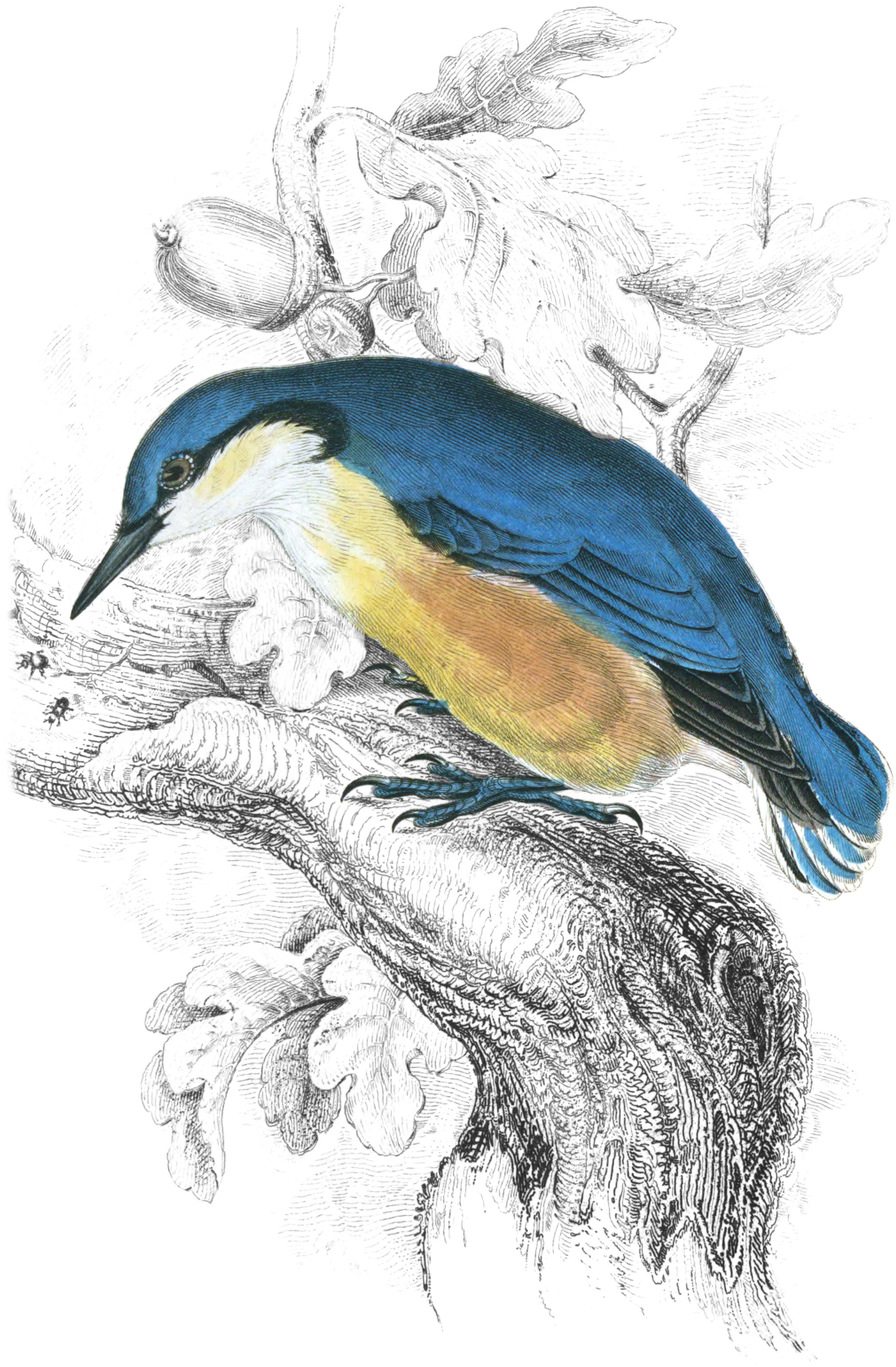
Plate XXII
The next British form among the Certhiadæ is represented by the Wrens, Troglodytes, of which we possess a single species. The birds composing this genus are all of diminutive size, of plain and unobtrusive shades of brown, and are extremely active in their manners. They lose, however, in a great measure, the true scansorial habits, but cling to sticks or buildings, and thread their way through any entangled heap with facility. They may be thus characterized,—
Troglodytes, Linn.—Generic characters.—Bill slender, compressed, slightly curved; wings short, rounded, fourth and fifth quills longest; tail short; tarsi and toes rather long, outer toe connected to the middle, inner free, claws on anterior toes slender, hinder claws lengthened.
Type, T. Europeus.
Note.—Europe, America.
The Common Wren
Troglodytes Europeus.—Cuvier.
Motacilla troglodytes, Will. Linn.—Sylvia troglodytes, Lath.—Troglodytes Europeus, Cuv.—Wren, or Common Wren, of British authors.
This very active and hardy little bird is very continuously distributed over the British Islands, being resident in some of the northern isles; while out of Britain it reaches even to the arctic circle.144 The Wren is a favourite bird with most persons. Its sprightly and active manners, and its loud and clear cry of alarm, call attention; while Its cheerful song in spring, and its utility in destroying insects, together with the small injury which it commits upon any of our crops, secures its protection. It is found in woods, and in the most retired the wanderer is frequently arrested by its shrill note, or its rapid flight across the path; it dwells also in the midst of cultivation, delights in the garden, and in winter may be found near the farm yard among any heap of sticks or rubbish, using them as a shelter or as a retreat from danger; and it is found also on grounds covered with a scanty foliage, but strewn with rocks, where it can hide and travel under. The’ nest is constructed under some hanging bank, or amidst the ivy or natural creepers which cover rocks or walls, even sometimes in a hedge or thick evergreen; it is a structure large in proportion to the size of the bird, being almost equal to that of an ordinary sized hat; it Is built chiefly of moss, and is circular or domed, having an entrance hole on the one side; and it is often so skilfully concealed, and so interwoven with the moss or herbage around, as to be with difficulty observed. In winter, the Wren comes nearer to the house and garden, often in small parties. It may be seen even in the most severe weather seeking for its sustenance, and sheltering itself in outhouses, or among rubbish, at night roosting in holes, or under the eaves of houses and ricks, several taking up their sleeping place in the same hole, and thus keeping up the temperature, and increasing their defence against the cold of winter. The holes in the eaves where sparrows have nestled are very frequently resorted to; and in a frosty winter’s evening, eight or nine Wrens may be seen entering one of these retreats, hanging about the thatch, and clinging to the wall, before going to rest; when all is quiet, and they have taken their places, the hand and arm introduced into the hole, will find them huddled together almost in a mass, surrounded by the feathers which the industry of the sparrows had collected in spring; and the degree of heat which is thus kept up is much greater than at first we would conceive that their small bulk could maintain.
Over each eye there is a pale streak; the whole upper parts of the body are of a dull chestnut brown, of a redder tint on the tail coverts and rump, the whole indistinctly marked with bars of a darker shade; the under parts are pale wood brown; the wings are of a deeper shade than the back and upper parts, and are barred with black; the tail somewhat similar in tint to its coverts, and barred with brownish black. The female does not differ, but is generally somewhat less in size.
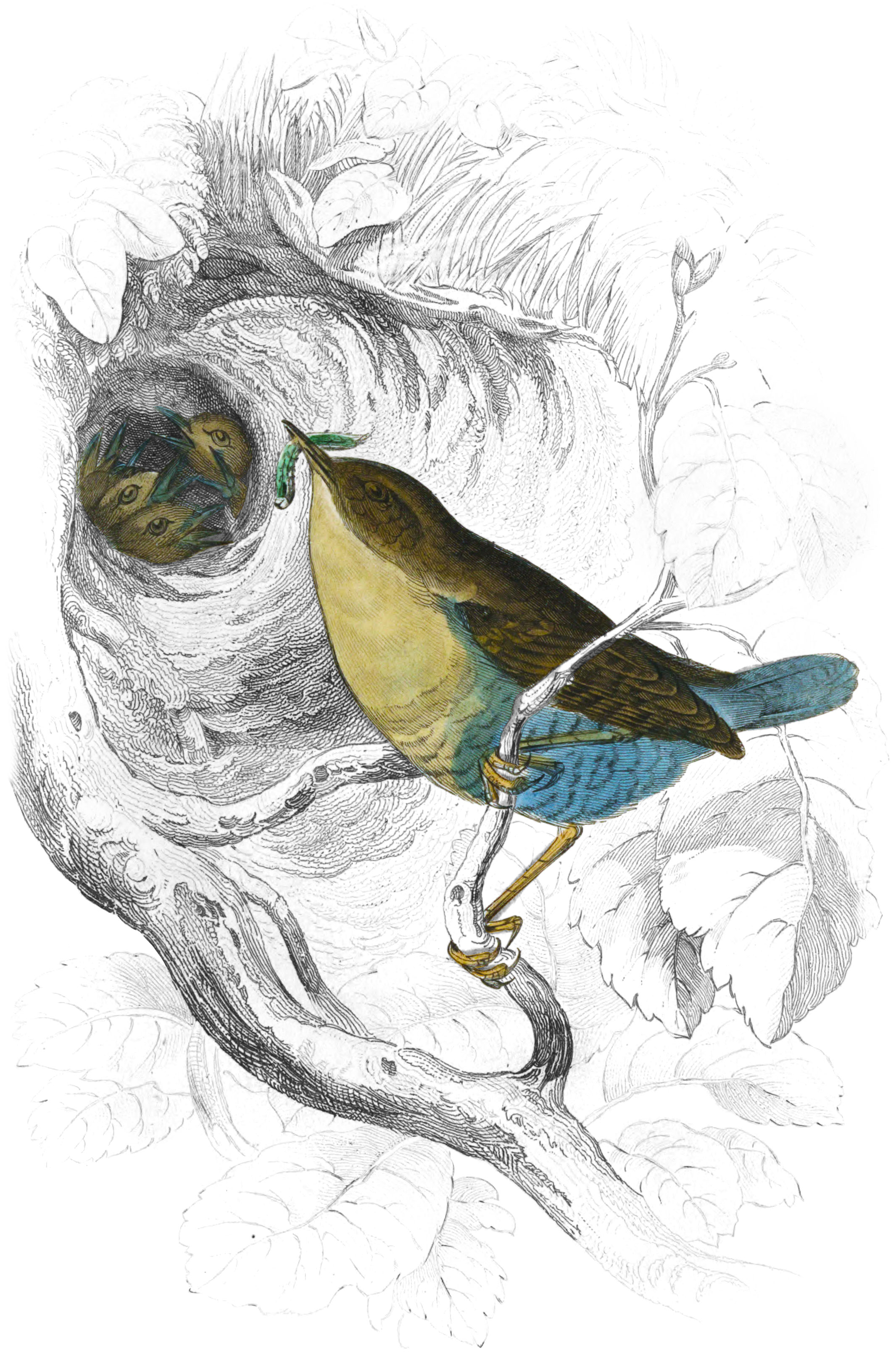
Plate XXIII
Before leaving the tribe of Scansores, we have still another family to review shortly, that of the Cuculidcæ or Cuckoos, of which, until lately, we possessed only a single example in the well known “harbinger of spring.” Within a few years straggling specimens of a second form have been added, which we shall notice in its place. The True, or Parasitic Cuckoos, typical of the sub-family Cuculinæ, are found only in the Old World, and have chiefly drawn attention by the fact of their employing another bird to rear the young. They are all migratory, have sombre and unobtrusive plumage, and feed principally on insects.
Cuculus, Linn.—Generic characters.—Bill slightly curving, with an obsolete notch, depressed at the base, rictus ample, nostrils round; wings long, pointed, third quill longest; tail cuneated, long; tarsi short, partially feathered.
Note.—Do not rear their own young. Europe, Asia, Africa, Australia.
The Common Cuckoo
Cuculus carnorus.—Linnæus.
Cuculus canorus, Will. Linn.—C. canorus rufus, Gmel. Lath.—The Common Cuckoo of British authors.
There are few birds which have excited so much interest as the Common Cuckoo; its note in spring heralding the return of sunny skies and bursting vegetation, carries with it dear associations in every country where it is known, while the singular provision of its making use of the nest of other birds in which to deposit its eggs, has created an interest and curiosity to ascertain its history. It has been ascertained without doubt, that the Common European Cuckoo, and several foreign species, deposit their eggs in the manner we have alluded to, none of the species afterwards attending to the fate of the egg, or to the after rearing of the young. And in a bird, not apparently differing in structure from many others which are migratory at the same seasons, and feed on similar food, ornithologists and naturalists have been unable to account for the different manner in which incubation is managed. No doubt, it might have been managed in the usual course; but there can be no doubt also that when we do ascertain the cause of departure from it, we shall find that it has been so arranged to fill up or complete some principle in the economy of this tribe of birds, or some link in the zoological chain which has not yet struck the mind of inquirers; and we would suggest that a probable means of discovering the bearings of this mysterious deviation, would be to endeavour to connect it with analogous cases in the other branches, where the variety of circumstances by which it would be developed, might lead to something which would give the key to the whole. Birds possessing this parasitical economy are very few in numbers; the True Cuckoos, confined to the Old World and Australia, and another form peculiar to America, being all that are now known to exercise this almost unnatural disposition. In both of these we see provisions predetermined to secure the rearing of the young, and the work of previous design in the whole economy, which should lead us to persevere in ascertaining the end for which they are intended. The Cuckoo in Britain arrives during April, earlier or later according to the season, and according to the part of the country; like all our other summer birds, its note is immediately heard proclaiming its arrival to its mate. This is continued until the season of breeding has passed, gradually becoming hoarser and more indistinct as the season advances, and ultimately before their departure the birds become entirely mute. The old birds leave us very early, they are among the first of our visiters that travel, none remaining after July, so that their visit to this and other regions to which they migrate, seems confined entirely to the time necessary to search for a place and deposit a certain number of eggs. The young are attended to for a certain time by their foster parents, and afterwards are left to themselves; they, however, remain much longer, and we have frequently shot them towards the end of August, at which time, when suddenly disturbed, they utter a note or whistle, very dissimilar to the “Cuckoo” of the love season.
The Cuckoo is very commonly and frequently distributed, being found in districts of almost every character. In choosing the nest for the reception of its eggs, it has been remarked, that those of insectivorous birds chiefly have been selected; at the same time, some of the Fringillidæ are also recorded, and in the south the variety of species, whose nests are thus used, are much greater; for, in the north of England, and in Scotland, where the skirts of a high pasture or muirland are chiefly frequented, the Common Pipit, Antkus pratensis, is almost invariably resorted to. The borders of a county, such as we have mentioned, interspersed with natural wood and brush, is a favourite resort for the Cuckoo, and he may be seen flying low over the ground or bushes, uttering at the same time his call, and occasionally resting on some twig or eminence, still calling and swinging himself round with outspread tail, as if to attract attention. It is also remarkable, that he is almost always attended by some of the Pipits, commonly called the “Titling,” who flutter around, or follow after in his flight with noisy notes, impelled by some instinctive feeling, either to attract observation, or of distrust at his appearance in their vicinity. The young bird we see endowed with a remarkable feeling to get rid of its companions in the nest, which is continued, it is said, for twelve days, if after which time it has been unsuccessful in its efforts, it remains quiet and at peace with its neighbours. In its form, it is also said to be provided with a peculiar depression between the shoulders, which assists it in working itself under the other young, and getting them on its shoulders, so that by a jerk it can tumble them out. In the American cow-pen bird, we have the want of the instinctive inclination and the structure of the shoulders compensated, by its eggs requiring less time to hatch than those of the birds with which they are deposited.
During the short period of it’s residence here, the food of the Cuckoo is wholly insectivorous, and consists in a great proportion of caterpillars, of which the muirs and pasture lands at this season furnish a most abundant supply. We are not sure of the range of the distribution of the Common Cuckoo; over Europe it is pretty evenly spread, decreasing as we gain the north. In its migration, it seems to pass to Northern Africa, but whether the specimens from Southern Africa are exactly identical, we have not now the means of ascertaining. Vaillant considers them identical, yet says that the African race shews several distinctions; the note of both is similar, so much so, as to have nearly cost him his life from the reflections and associations which it recalled preventing him from seeing the approach of a beast of prey. Mr Swainson has described a bird from Western Africa very closely allied, which may also have been confounded with it. According to Temminck, specimens from Egypt are exactly identical. The same ornithologist records its presence on the Morea, in Siberia, and Japan.
The corners of the mouth and eyelids, with the inside of the mouth, are orange. The plumage of the head, neck, breast, and upper parts, are deep bluish gray. The whole of the belly, and remaining under parts, and axillary feathers, white, with distinct black bars. The quills are blackish gray, the inner webs with white bars across. The tail is of a darker tint, approaching to black at the end, and is often glossed with green; the feathers are tipped with white, and along the shaft of each there are triangular marks of white, which on the outer feathers meet with indentations of a similar colour, and give an appearance almost barred. The feet are gamboge yellow. In the young of the first year, when it has attained its complete first plumage, the general tint is clove brown, tinted with gray particularly on the rump, darker on the wings and tail, and glossed with green, each feather being tipped with white, and broadly barred with reddish brown; on the hind head there is often a patch of white of greater or less size; the outer webs of the quills are barred with reddish brown, and the bars on the inner webs of the same colour become white as they reach the exterior edge; the tail is tipped with white, and is beautifully barred with the pale reddish brown, the bars white at the shafts and edges of the feathers; the sides of the neck and throat are tinged with rufous; the rest of the under plumage is white, both broadly and distinctly barred with black. It may be remarked, that, so far as we have seen, this change of colouring takes place among all the True Cuckoos, between the young state and the attainment of the adult plumage. There is trifling distinction between the sexes.

Plate XXIV
The American form of the Cuculinæ has been taken as the type of a distinct genus by Mr Swainson. In several parts of structure it differs from the True Cuckoo, and the birds also vary by being sylvan in their habits, and in forming for themselves a nest, and rearing their own young. Mr Swainson has given the characters of his genus as follows:—
Erythrophrys, Swain.—Generic characters.—“Head not crested; nostrils oval; wings lengthened, pointed, extending beyond the tail coverts, the third quill longest, the second much shorter than the fourth; tarsus moderate, naked.”
Type.—E. Carolinensis.
Note.—America. Rear their own young. Habits sylvan.
Yellow-billed American Cuckoo
Erythrophrys Americanus, Cuculus Americanus, Linn.—C. Carolinenis, Wils.—Coccyzm Americanus, Bonap. Eyton, &c.—Erythrophrys Americanus, Swain.—Virginia or Carolina Cuckoo of modern British authors.
A few specimens of this bird have of late years been taken in different parts of Great Britain and Ireland. One specimen was killed on the estate of Lord Cawder, in Wales, in 1832, and, we believe, first called attention to the fact of its accidental occurrence. Two captured in Ireland came into the possession of Mr Ball of Dublin, and were brought before the Zoological Society by Mr Thompson of Belfast. One or two others have also occurred, but so uncertain is it in its appearance, that it can only bear the rank of an occasional straggler to our shores. For all that we know of its habits, we are indebted to Alexander Wilson; from him we learn, that in many parts of the United States it is migratory, and that they prefer the borders of solitary swamps, and apple orchards. The nest is placed on the horizontal branch of a tree, and is constructed with little art, and scarcely any concavity, of small sticks and twigs, intermixed with green weeds and blossoms of the common maple. On this are placed the eggs, generally four in number, of a uniform greenish blue colour. The female sits remarkably close, and when roused feigns lameness, fluttering and trailing her wings. Their principal food is insects and caterpillars, also berries, and they are accused with some justice of sucking the eggs of other birds.145
All the upper parts of the head and body, wings and two middle tail feathers, cinereous brown, with a slight tinge of olivaceous; the other tail feathers black, with a broad white space at the extremity of each of the three outermost; the fourth just tipped with white; primaries and wing coverts bright rufous; throat, sides of the neck, and all the under parts, white; upper mandible black, edged with yellow at the base; lower mandible yellow, tipped with black; legs black; tarsi long, naked.146
Tenuirostres
Among the Tenuirostres, the fourth great tribe of the Incessores, we have only in Britain a solitary example, the members of all the families belonging chiefly to tropical climates. It is here that we have arranged the beautiful Humming-Birds and Sun-Birds, and the gorgeous Birds of Paradise, also the Honey Suckers of New Holland and the Indian Isles with the Promeripidæ, to which our British form belongs, constituting the genus Upupa of Linnæus, and containing only two well authenticated species, the one belonging to Europe, and it is said to Northern Africa, the other being a bird of Southern Africa.
Upupa, Linn.—Generic characters.—Bill long, slender, compressed, curved, nostrils perfectly uncovered and open; wings ample, fourth and fifth quill longest, others graduating; tarsi and feet short, claws strong, grooved beneath, that of the hallux nearly straight.
Types.—U. epops, Capensis.
Note.—Europe, Africa. Head crested.
Hoopoe
Upupa epops, Will. Linn, &c.—Hoopoe of British authors.
This beautifully marked and elegant bird strays occasionally to the British isles, and scarcely a year passes without some specimens being obtained, sometimes in the south, and at others almost in the extreme north. Those of late years have generally been recorded in the periodicals of the day, and the notices are sufficiently authentic and numerous for us to consider it as a bird not so uncommonly met with, as many others which have acquired a title to a place in our fauna. A very few instances are also on record, of its having bred occasionally in Britain, but these have been, perhaps, occasioned by circumstances over which the bird had no control. On the Continent, it is a regular and periodical visitant in summer, and breeds particularly in the southern countries, retiring afterwards to Asia and Northern Africa. It is said to frequent districts rather low and moist, feeding chiefly upon insects. Mr Greenhow has remarked it on the Bordeaux side of the Garonne, in marshy places, planted with poplars and willows for use of the vineyards. These trees being topped down or pollared, gradually decay in the heart, and are attacked by numerous tribes of insects, particularly the formica fuliginosa, and there the Hoopoes were frequently observed examining the rotten wood, and feeding on the insects with which it abounds.147 The principal, if not the only, food, seems to be insects, which it procures chiefly on the ground. A specimen dissected by Mr Selby, had the stomach filled entirely with the larva of tipulæ and phalænæ, no remains of perfect insects being visible. It is said to build in hollow trees, or in crevices of walls, forming the nest of dry grass or leaves, and lining it with soft materials.
Head adorned with an ample crest of broad feathers, capable of being raised and depressed at pleasure; these feathers are of an orange brown, of various intensity in different specimens, shading .nearly into white at the extremity, and finished by an oval spot of black. The head, neck, back, and breast, are reddish gray, tinted with vinous purple, also varying in intensity, and on the belly and vent shading into pure white, dashed along the centre of the feathers on the latter parts with umber brown. The rump is white, the upper tail coverts black. The wings are black, and when closed and meeting on the back, exhibit five white bands across the whole, one of which crosses the quills at about an inch from the point. The tail also is black, with an angular band of white across the centre, and a narrow edging of the same colour on the outer feather. The female differs in having the plumage less marked, and the crest not so fully developed.
Fissirostres
Merops
Those members of the fifth great tribe, the Fissirostres, which we can claim as natives or visiters to our islands, will complete our review of the British Incessores, which, in our anxiety to give as complete as possible, has already exceeded our usual limits, and obliged us to condense the notices of some of those which come more seldom to our shores. The forms which occur in Britain among the Fissirostres are, as in the two last tribes, also extremely limited. The great mass of known species are entirely insectivorous; countries of particular temperature and characters are necessary for the production of insects, and the climate of Northern Europe being unfavourable for their extensive development, the birds which compose the tribe are comparatively deficient within its range. In two of the families we have a single example, and in another only two. In the first, Merops may be thus characterized:
Merops, Linn.—Generic characters.—Bill long, compressed, carinated, dilated at the base; wings long, pointed, first quill very short, second longest in the wing; tarsi and feet short, exterior toes united, claws hooked, strong, hind claw small.
Note.—Colours of the plumage vivid, shades of green, yellow, and rich brown. Breed in holes in banks, feed on the wing.
Europe, Asia, Africa.
Common Bee-Eater
Merops apiaster.—Merops apiasler, Will. Linn.—Common Bee-Eater of British authors.
This is another very rare visitant. A few instances of its having been seen and killed in England are recorded. Mr Thompson states, that it has been taken once or twice in Ireland; and it has been captured about a like number of times in Scotland, of which, we believe, the last is mentioned in the Magazine of Natural History for 1838. We can look upon all these, however, as only straggling birds driven from their migratory course. On the Continent, it appears sparingly in the middle and southern parts, but is said to be common in Spain, also in Sicily, and in Greece and Turkey. In Southern Africa it is also frequent, and we have received many specimens which do not seem to vary from those killed in Europe. The Bee-Eater feeds on insects, and in a great measure on those of the genus hymenoptera, and from sometimes being an attendant on the vicinity of. the apiary, has received the name it bears, with the blame of being destructive to Bees. Except in the breeding season, it is said to assemble in troops, but this may perhaps be only at times preparatory to migration. Those killed in this country have been mostly single, except in the instance of a flight of twenty occurring in Norfolk in 1794. Mr Swainson remarks, they annually visit Italy in flocks of twenty or thirty, and may be seen skimming over the vineyards and olive plantations, with a flight much resembling the Swallow, though more direct and less rapid.148 They breed in deep holes, excavated in the banks of rivers, the nest being said to be composed of moss and soft materials at the end. The eggs are pure white.
A specimen from Southern Africa now before us, has the head and back of a deep orange coloured brown, passing into safron yellow on the lower part of the back and rump. The forehead is white, changing to verdegris green, which again runs in a line over each eye, and shades into the chestnut of the crown; quills and secondaries blackish gray on the insides, the tips and shafts appearing black on the outsides. The outer webs bluish green, shading on the inner webs to black. Tail greenish blue, the two centre feathers elongated and narrowed to a point at the ends, which are blackish green. The chin and throat are yellow, surrounded below by a gorget of black, and above by olive of the same colour, which runs from the sides of the gape below the eyes, and through the auricular feathers. The remaining under parts are rich greenish blue, changing with the light, and becoming paler on the vent and under tail coverts. In the female, the colours are less brilliant, the yellow of the throat less clear, and the breast more clouded.
Coracias
From the Bee-Eaters, we very naturally pass to the Rollers, Coracias, having a lengthened or forked tail, a plumage of an almost similar distribution of colours, and a bill, though modified, not very far differing in shape. The members of this genus are all natives of warm climates, a single species being met with in Europe.

Coracias Head
Coracias, Linn.—Generic characters.—Bill strong, deep, compressed, culmen rounded, gape very ample, bristled; wings pointed, second quill longest; tail more or less forked; feet and tarsi short, more incessorial than in the last, lateral toes very unequal.
Type.—Coracias garrula, Abyssinica.
Note.—Colours of the plumage brilliant blue and green, mixed with chestnut.
Europe, Asia, Africa.
European Roller
Coracias garrula.—Linnæus.
Coracias garrula, Linn.—Common or Garrulous Roller of British authors.
This bird is yet another in our list of accidental stragglers. It has been killed at various times, within the British bounds, in England, in the southern counties and as far as Northumberland; in Scotland, the specimen which served Mr Selby for his figure, was killed in Dunkeld; we know of another specimen taken in Dumfriesshire, and a third, now in our own collection, we received from the southern part of Shetland. We are not aware of its being recorded in Ireland, and it does not occur in Mr Thompson’s lists. On the Continent it is said to be frequent in Germany, and seems rather to stretch to the northern countries than towards the south, which may account for our occasionally procuring stragglers upon the coast of Scotland. It is met with also in the Morea, and Temminck enumerates it. among the Japanese birds. In Sicily and Malta it is also said to be frequent, and is there sold in the markets and poulterer’s shops. We would desire more information from actual observation as to the habits of this bird than we now possess. It appears to be sylvan in its places of abode, nestling in the holes of trees; the food is chiefly insectivorous, and it is mostly taken on the wing; but at other times they are said to assemble like rooks in the ploughed fields, to search there for insects; from all our accounts they are much more terrestrial in their habits than the last, and, according to Temminck, feed on grasshoppers, worms, snails, and the myriopada, most of which must be sought for and seized upon on the ground.
We take our description from the Shetland specimen above alluded to. The head, neck, cheeks, and all the under parts verditer blue, sometimes inclining to greenish, and changing with the light; back and scapulars pale chestnut brown; the rump and tail coverts bluish purple, the centre of the feathers darkest; the covers of the shoulders, from the bend of the wing, forming a broad line, are of a brilliant tint, in some lights of deep auricular purple, in others of the blue of smalt, shading on the lower side into ultramarine blue, which is the tint of the lesser and greater coverts, and spurious quills; the quills and secondaries appear black on the outside, at the base exhibiting a bar of pale bluish purple; the base of the secondaries and greater coverts are pale verditer blue, as also the axillary feathers, dividing the wing on the inside diagonally across from the dark colour of the quills, which, in different lights, have a shade of rich blue or deep auricular purple; the tail has the exterior feathers slightly lengthened, the commencing modification of the form so much developed in some of the foreign species; it is deep purple-blue at the base, for half the length, paler on the outer webs of the quills; the other half pale verditer blue; the outer feather tipped with black; the two centre feathers are entirely of a deep grayish green, tinted with blue at the base.

Plate XXV
Halcyonidæ
In the second family, the Halcyonidæ, we possess also only one form, seen in the Common Kingfisher; showing an aquatic type feeding almost exclusively on fish.

Oriolus bicolor
Alcedo, Linn.—Generic characters.—Bill very straight, sharp, somewhat compressed, gape ample; wings rather rounded, third quill longest, the first and second very gently graduating; tail very short, scarcely longer than its covers; feet syndactyle, inner toe and hallux very short, tarsus short.
Types.—A. ispida, semitorquata, &c.
Note.—Aquatic; plumage blue or green, varied on the under parts with chestnut; breed in holes.
Europe, Asia, Africa.
Common King Fisher
Alcedo ispida.—Linnæus.
Alcedo ispida, King Fisher, Will. Linn.—Common King Fisher of British authors.
The King Fisher is one of our most gaily tinted birds, and when darting down some wooded stream, and shone upon at times by the sunbeams, it may give some faint idea of the brilliant plumage that sports in the forests of the tropics, and that flits from place to place like so many lights in their deeply shaded recesses. It is a bird by no means common any where, living in retired places, solitary or in pairs; but it seems pretty evenly distributed, decreasing in frequency as we reach the north, where it also becomes stationary only in winter, instances of its breeding having been very seldom recorded beyond the English border, or the south of Scotland. It is distributed over Ireland with nearly equal frequency.
The King Fisher is never seen away from the sides of streams or rivers, appearing rather to prefer those of smaller size, not too rapid in their course, and which run through a district partially wooded, having the banks fringed with brushwood. In flight it keeps to the line of the stream, flying with great rapidity, in an undulating motion, and with very quick strokes of the wings, the eye catching the brilliant light of the upper parts, as the turns and windings bring it into sight. When watching for its prey, or when undisturbed, it sits motionless on some projecting branch or dead stake, and calls to remembrance the manner of perching which is seen to run through many of the insect feeding birds, and many of the genera of the Fissirostres. The prey is darted on from the branch or perch, and consists chiefly of small fishes; to which Temminck adds snails and leaches, &c. The nest is formed in the holes of banks, and is said to be constructed of the castings of the birds, composed of fish bones arranged around, and beaten down. The eggs, six or seven in number, are of a delicate transparent pinkish white.
On the Continent the King Fisher seems to be also generally, but not plentifully diffused, and probably extends beyond the Asiatic boundary, until it is replaced by the Alcedo Asiatica spread over the East India Islands, Japan, and China, a species closely allied, but smaller, and more delicately proportioned in all its parts.
The mandible is blackish brown, but the interior of the gape, the base of the maxilla, and the feet, are bright reddish orange; the head and nape, shoulder covers, scapulars, and wings, are of a deep olive green, the feathers of the head and nape bordered with clear verditer blue; the centre of the back, rump, and tail covers are brilliant verditer blue, appearing conspicuously in flight; (the feathers on this part are in great request by the dressers of Limerick or Irish flies;) the quills are brownish black, edged with olive green; the tail underneath appears of the same colour, on the upper parts approaching to ultramarine blue. From the base of the maxilla runs a streak of dull verditer blue, joining with the colour of the back, and separating the auricular feathers and a patch of white on the sides of the neck, from the colour of the under parts; the chin and throat are yellowish white, and the whole under parts with the auricular feathers are clear orange brown, becoming paler on the vent and tail covers. In the female the colours generally are less vivid, and the white patch on the sides of the neck is more subdued.

Oriolus bicolor

Plate XXVI

We have now reached the more truly fissirostral families, characterized by their wide gape and amply developed organs of flight, birds which seize their prey entirely on the wing, and which seldom settle, except for temporary rest. These in Britain are the Swallows and Night-jars, each possessing representatives in our list.
Caprimulgidæ
The Night-jars, Caprimulgidæ, are, with we believe a single exception, nocturnal birds, are nearly all insectivorous, hunting their prey by twilight, and having their plumage constructed on the plan of that of the owls, which possess a soft and noiseless flight, and blended shades of unobtrusive colouring. Several genera are known, the British form ranks in
Caprimulgus, Linn.—Generic characters.—Bill very small and weak, dilated at the base; rictus very ample and furnished with strong bristles; wings with the second quill slightly longest; tarsi short, feet weak, lateral toes equal, claw of the centre pectinated.
Type.—C. Europeus.
Europe, Asia, Africa, America. Breed on the ground, and feed by night; plumage soft.
European Goatsucker
Caprimulgus Europeus,—C. Europeus, Linn.—Common or European Goatsucker, Night Hawk, or Night Jar of British authors.
This chastely coloured and beautiful marked bird is of general distribution, extending to the most northern counties of Scotland, and appearing with us towards the end of May. At the commencement of twilight, when they are first roused from their daily slumber, they perch on some bare elevation of the ground, an old wall or fence, or heap of stones, or peat-stack, and commence their monotonous drum or whirr, closely resembling the dull sound produced by the wheel used for spinning wool, and possessing the same variation of apparent distance in the sound which is perceived in the crake of the land rail, or the cry of the coot and water rail, or croaking of frogs. At one time, it appears so near as to cause an alarm that you disturb the utterer; at another, as if the bird had removed to an extreme distance, while, during the time, it remained unseen at a distance of perhaps not more than forty or fifty yards. The flight, when hawking in the open grounds, is never high, and is performed without any regularity; sometimes straight forward, or in gliding circles, with a slow steady clap of the wings, in the middle of which they will abruptly start into the air for thirty or forty feet, resuming their former line by a gradual fall. At other times it will be performed in sudden jerks upwards, in the fall keeping the wings steadily closed over the back, skimming in the intervals near the ground, and still retaining the wings like some Gulls and Terns, or a Swallow dipping in the water, until they are again required to give the stroke upwards. All the while, the tail is much expanded, and is a conspicuous object in the male, from the white spots on the outer feathers. When in woods, or near trees, the flight is made in glides among the branches, or it flutters close to the summits, and seizes the various phalcence which play around. During the day, the Night Hawk rests on the ground among fern, broom, or heath, or on the low branch of a tree, on which it lies lengthwise, and close to the stem. When disturbed, the flight is low and fluttering, or it skims off to a short distance, and again alights. The nest is formed upon the ground by scraping or deepening some cavity already partly made, and the eggs, two in number, are laid on the bare surface. When the young are approached by night, before they are perfectly fledged, the old birds fly around very near, uttering incessantly their clicking cry, and making frequent dashes at the intruder like the Lapwing. On the continent of Europe, this bird is generally distributed, but we do not know its extra European range.
It is scarcely possible to describe the plumage of the Caprimulgidæ so that it can be understood in all its parts, and one or two prominent markings are often sufficient to make out the species. In our native bird, it is composed of shades of gray and brown, white and ochry yellow, and black. In the male bird, gray predominates, the head being of that colour, minutely mottled with black, and having two lines of the same colour running down the crown; the wings and tail are marked with indistinct mottled bars of gray, brownish black, or orange yellow; the more conspicuous marks, however, are a line of white running from the corners of the mouth below the auriculars; two oval spots on the throat, which nearly converge together in the middle; a large oval spot of pure white on the inner web of each of the three first quills, and the tips of the two outer feathers being of the same colour. In the female, all the plumage is more subdued and blended, and the white markings are of an ochraceous yellow.
Hirundinidæ
The family of the Hirundinidæ, or Swallows, possesses great interest, both on account of their typical station in their tribe, and from the vast destruction which they make among a train of beings, in many instances extremely destructive to various kinds of our productions, and they hare also created much speculation from the fact of their entering into a state of torpidity, either in holes or under water, being advanced with much confidence and maintained by men who were considered to be possessed of great learning and information. In the last family, nocturnal in its habits, we noticed that a foreign species was known which fed and hunted during the day; in like manner, do we find in our present group a single foreign species, which feeds by night in the manner of the Coprimulgidæ; and in both groups completely insectivorous do we find species at times feeding on fruits and berries, the whole running into each other in a manner beautifully graduated, at the same time each being distinct and easily separated. The Swallows range over the whole world, and are every where migrating birds. They breed in the crevices of rocks, or form curious nests of various substances agglutinated together by their saliva, and most delight in the vicinity of waters. The colours of the plumage are steel blue, glossy green, and brown, contrasted with white and chestnut. In Britain we have two genera. The first of which is
Hirundo, Linn.—Generic characters.—Bill small, very slightly bent, triangular, dilated at the base, rictus very ample, without bristles; feet incessorial, but very slender; tarsus short; wings long, pointed, first quill longest; tail forked, often much developed.
Types.—H. rustica, urbica, riparia.
Note.—Colours of the plumage glossy blue or green, varied by chestnut and white; migratory, mostly gregarious. Cosmopolite.
The Chimney Swallow
Hirundo rustica, Linn.
Hirundo domestica, Will. Ray.—H. rustica, Linn. &c.—Chimney or Common Swallow of British authors.
This favourite bird is perhaps the most common and most equally distributed of our native species. Its arrival in April is watched and hailed as the precursor of summer, and as the period when the piercing blasts of winter and spring shall have ceased for a time. In this country, and indeed in Europe, it is the constant attendant on cultivation, and makes use of the artificial structures of man as retreats for shelter and breeding. We are not aware of any natural breeding station for this bird, nor have we seen any mentioned in the various ornithological works to which we have access. Its most common and favourite place here is in the interior of outhouses, open barns, or sheds, where the nest, composed of clay, and strengthened with straws or slender roots, lined with feathers, and open at the top, is placed against some of the rafters or woodwork of the roof; the insides of chimneys, (whence its common name,) the eaves of houses, and the forsaken shafts of mines and coal pits, are all resorts during the season of incubation, so that in a natural state, or rather in a country wanting these structures, its breeding places may be supposed to be the rents in rocks, and caves or fissures. Two or three pairs often frequent the same out-house, and are known to have returned from year to year to the same nest. They hunt in small parties; as the time of their departure arrives, the young are collected together, and many of those in the vicinity assemble; at times during the day they may be seen congregated on the roof of some building, on a wall or railing, or on some bare tree, pluming themselves, and resting from the incessant activity, and hunting after food, which characterizes them in the previous part of the year. At this time, they also roost together, and select for this place willow beds, or brushwood fringing some lake or stream, occasionally among the tall reeds, and this has given rise to the idea that they retired during winter under water, for the departure of the great mass takes place simultaneously; and the retreat which was one night enlivened by their evolutions and sprightly twitter, is the next solitary, or rendered to appearance more deserted, by the appearance of the few who have been unable to accompany the great body of the flight.
In distribution, this species decreases northward, but is abundant in central and southern Europe. How far it extends into Asia has not been traced, or whether it is partially migratory from any part of that division of the world. The great mass of European birds seem to pass from Northern Africa. M. Temminck places it among the birds of Japan.
The adult male has the head and upper parts deep and rich steel blue, running into a black pectoral band; the forehead and throat are deep reddish chestnut; the belly and feet reddish white, tinged on the flanks with brown; the tail deeply forked, the outer feathers narrowing towards the ends, is black with blue reflections, and has a large white spot on the inner webs of all the feathers, except the two in the centre. In the female the colours are all less brilliant, and the chestnut on the forehead and throat less in extent. The young have the tail nearly square, and the colour of the throat a pale reddish brown, shading into gray upon the breast. Pure white varieties are occasionally met with.

Plate XXVII
Martin
Hirundo urbica.—H. urbica, Linn.—Martin, Martlet, or Window Swallow, of British authors.
This Swallow arrives generally a few days later than the last, and is much more local in distribution. It is also an attendant on civilization, and its general breeding places are seen on the eaves of houses, the corners of windows, (whence its most frequent name,) under the arches of bridges or gateways; it there builds its nest gregariously, in parties of from twenty to one hundred, returning year after year to the same place, and rearing its nest even in the same hollow or corner. These, however, are its artificial stations. In what may be called its wild or natural state, it would seem rather inclined to alpine situations, the windows of a Highland inn in a muirish or half alpine district being a very favourite resort, attracted probably from the neighbouring rocks by the greater variety of food incident to the vicinity of poultry and cattle; its really natural breeding situations, by no means commonly met with, are generally on the face of some steep cliff or overhanging rock, to which the nests can be easily attached; they are built at one spot, not dispersed to any distance, and often touch each other. Mr Selby mentions one of these natural eyries on the lofty precipices of St Abb’s Head. There was another on the rocks of the coast opposite the Bass Rock, where the whole colony, amounting to a hundred or a hundred and twenty, had their nests placed within the space of the roof of an ordinary-sized room under an overhanging rock. We met with another large colony in a more northern district, Sutherlandshire, where the face of a limestone precipice was occupied. These are busy and interesting communities; the parent birds continually flying to and fro, uttering their cheerful whistle of recognition of their own household, and bringing food to their young, or to their mate while incubating; both sexes may often be seen in the nest together, and they spend the night thus. Any noise or interruption beneath causes them to protrude their heads, and they will thus suspiciously survey the cause of their alarm until it is either removed or forces them to leave the nests. The nest is formed of clay agglutinated together, and is of a circular form, suited to the shape of the rock or building which supports it, but completely closed round, except a small hole at the upper side for access. The inside is first lined with dried grasses, and within with a warm coating of feathers. The eggs are of a delicate white with reddish brown spots.
This Swallow is generally distributed over middle and southern Europe, but we are ignorant of its range elsewhere. Temminck states that it does not extend beyond the tropics. The American species, H. bicolor, for some time confounded with it, is distinct, the bird of Europe not being known in the New World.
The upper parts, with the exception of the rump, glossy bluish black, with a steel blue lustre; the wings and tail, the latter slightly forked, brownish black glossed with bluish; the rump pure white, appearing most conspicuously during flight; under parts of the same pure colour. Difference between the sexes is very trifling.
The Sand Martin
Hirundo riparia, Linn.—H. riparia of authors.—Cotile riparia, Boje.—Sand or Water Swallow or Martin of British authors.
This Swallow, with a few others, has been made typical of a sub-genus; and in looking at the form of the typical Swallow there is a considerable difference, but whether this should be considered sufficient ground for separation, or should be looked on only as modification of structure, seems not yet quite determined among ornithologists; and we now wish to direct attention to the little group to which it will belong, and to the value of its characters when compared with the species which begin to recede from it. The Sand Martin is one of our earliest birds of passage, reaching us often in March, and is sometimes to be seen even amidst hail and snow. On its first arrival, small groups visit their annual breeding stations, and may be observed flitting along some river-course or quarry-pool, or by the margin of some lake, lazily and without their usual activity, being without doubt wearied with their migration, and yet able to procure but a scanty subsistence. As the spring advances, the various colonies arrive and take up their stations for rearing their broods. These are chosen in some sandy or easily pierced bank of a river or sea shore, some quarry or sand pit, and the sides are seen bored with numerous holes from two to three inches in diameter; they enter the bank for a considerable length, and are formed by the birds themselves scraping with the feet, assisted by the bill, and at the extremity a loose nest of dried grass lined with feathers is formed. When the young are hatched and reared, they assemble with the parents in considerable numbers, and previous to migration congregate largely together, often resting on the sandy parts of the shores of lakes or of the sea, when their breeding places have been near the latter; at this time the cause of alighting may both be to rest the young birds and to procure food, for, as we stated in a note to Wilson’s Ornithology, we once observed many hundreds of the Sand Martin resting on the sands of the Solway Frith, upon a space not exceeding two acres; a small stream entered the sea, and they seemed partly resting and washing, and partly feeding on a small fly that had apparently come newly to existence, and covered the sands in immense profusion.
This Martin is distributed generally over Britain and the continent of Europe, extending in the former to the Orkneys. In the Old World, we do not authentically know its exact range; but in America, the species are now generally considered to be identical. Mr Audubon has placed them as such, and the Prince of Musignano, though using a query, has placed both species opposite in his comparative list.
The upper parts, except the tail covers, sides of the head, and a band across the breast, are of a deep hair brown; the wings and tail brownish black, in some lights appearing slightly glossed with greenish; the lower parts of the body, with the upper tail covers, are white, shaded slightly on the flanks with hair brown.
The remaining British swallows, concluding our members of the Fissirostres, have been with propriety arranged in a sub-genus, on account of their different form. They are commonly distinguished by the English name of “Swifts,” and the scientific title of
Cypselus, Illiger.—Generic characters.—Bill very small, weak, dilated at the base, triangular, gape very ample; wings of extreme length, second quill longest, first very little shorter; feet and tarsi very strong, former feathered, toes generally directed forwards, inner subversatile; claws broad and sharp hooked; tail nearly square, or slightly forked.
Type.—C. apus, melba.
Europe, Asia, Africa.
Common Swift
Cypselus apus.—Hirundo apus, Linn.—Cypselus murarius, Temm. &c.—Swift, or Slack Martin of British authors.
The form of the Swifts is beautifully adapted to. their mode of living, and it is well exemplified in that of the common European Swift. It is a bird formed entirely for flight, and unless when incubating or at rest during the night, it is scarcely ever seen except on the wing. Its natural breeding and resting places are the holes and crevices of rocks and cliffs, and for entering them the neck is short, and the body can be made so as to form one line, and to be of equal thickness, while the limbs are so extremely short as not to incommode in turning, while at the same time they are fitted for scraping holes, and hanging or climbing about the rocks or the walls of buildings. The wings are of extreme length and pointed, the consistency of the plumes almost like whalebone, presenting a strong resisting surface to the air; and we should here notice a structure much developed among the Hirundinidæ; they, from their very rapid motion and the minute character of their prey, would require organs of vision possessing great perfection, and to external appearance the eye is large, full, and expressive; from experience we also know that it possesses the requisite powers for minute vision, and as it is obvious that it would require some protection during the very rapid evolutions of the birds, we find that the feathers growing between the angle and the bill are of a peculiar soft but close and rigid texture, and stand up as a blind to break the current induced by swift motion.
The Swift, like its congeners, and the Swallows in all countries, seem to attend on population, brought thither, as we before remarked, by the greater prevalence of food, and we now find its resting places only in ruined towers or old buildings, where lapse of time has formed holes and rents; bridges, and towns and villages, also furnish retreats; and we have a notice in London’s Magazine, of their breeding in the holes of trees, deserted by Woodpeckers; but we are not aware of any natural station for this bird, which we would be prepared to find in the clefts and rents of rocky precipices. When an entrance is found suitable in any old building, the hole is examined and cleared out, often rendered more extensive by the bird scraping among the joints of the stones; a small portion of dried grasses or straw, &c. is carried in, which is rendered soft and warm by a lining of feathers, all of which are caught in the air or hanging from some projection or ledge, the birds never alighting to procure them. We have .occasionally seen the Swift alighted on a cornice or flat roof, but the motions are all awkward, they reminded us of a seal, waddling almost on their breasts to the edge, where they would fall off as it were, before expanding their wings to catch the air. The same procedure takes place if the bird be placed upon a table; but at the same time, they can rise from a flat surface, a road or pathway for instance, if forced by necessity so to do; it is, however, done with difficulty, the bird raising itself by repeated attempts and strokes upon the ground by the shoulders. The Swift is gregarious in small parties of from six to twenty, but does not apparently congregate before departure, like the Swallows and Martins; in these small troops it delights to wheel around buildings and its breeding stations, taking the turns about an old tower or church spire with great sharpness and precision, and uttering during flight its shrill scream or whistle. The troop move in a mass by simultaneous impulse, and utter their cry in the same united manner, and they form, as it were, an accompaniment associated with old or ecclesiastical buildings, which is almost inseparable from them.
The range of the Swift in Britain is general, at the same time local, and on the Continent it is we believe similar In Britain, it is one of our latest visiters, and one of our earliest to depart. Their whole time is occupied in the duties of incubation, and so soon as these are completed, and the young able to travel, their departure is commenced. Of its range out of Europe we are uncertain. Temminck says they do not migrate beyond the tropics. We possess specimens from Madeira.
The length of the common Swift to the extremity of the bill, is only about seven inches and a quarter; that of the wing about six inches and three quarters; the plumage is of a uniform shining brownish black, glossed with green; the chin and throat in the male nearly white, in the female smoke gray. In our specimen from Madeira, the plumage is of a much paler tint, the throat and chin pure white.
The Alpine Swift
Cypselus Alpinus, Temm.—C. melba, Gmel.—Alpine or White-bellied Swift of British authors.
This species, according to Temminck, inhabits the Alps in Switzerland and the Tyrol, and the coasts and islands of the Mediterranean, particularly in rocky and alpine situations. Its claim to a place in the British list rests on a few specimens having been at different times captured on the shores of our islands. The first notice of its occurrence was communicated by Mr Sinclair of Belfast to Mr Selby; this bird was killed in March a few miles off Cape Clear by the captain of a vessel. It has occurred in one or two instances since attention was directed to it, and the ornithologists of Ireland seem to be of opinion that it may breed in limited numbers about the cliffs on some part of the Irish coast; the clefts and holes in rocks being its usual places of nidification. The alpine Swift is much superior in size to our common species; in length, to the extremity of the forked tail, it is about eight inches and a quarter, while the wing, from the shoulder, measures fully nine. Above, the plumage is of a light grayish black, glossed with green; this extends over the cheeks and sides of the neck, and across the breast, in the form of a broad band, leaving the throat, the belly, and breast, pure white; on the quills the shade is slightly darker. In the female, the pectoral band is less distinct.
Eggs

Plate XXVIII
1. Song Thrush. 2. Golden Crested Wren. 3. Chimney Swallow. 4. Common Wren. 5. Jay. 6. King Fisher.

Plate XXIX
1. Water Crow. 2. Raven. 3. Robin. 4. Wheatear. 5. Goldfinch. 6. Nightingale. 7. Magpie. 8. Hawfinch.
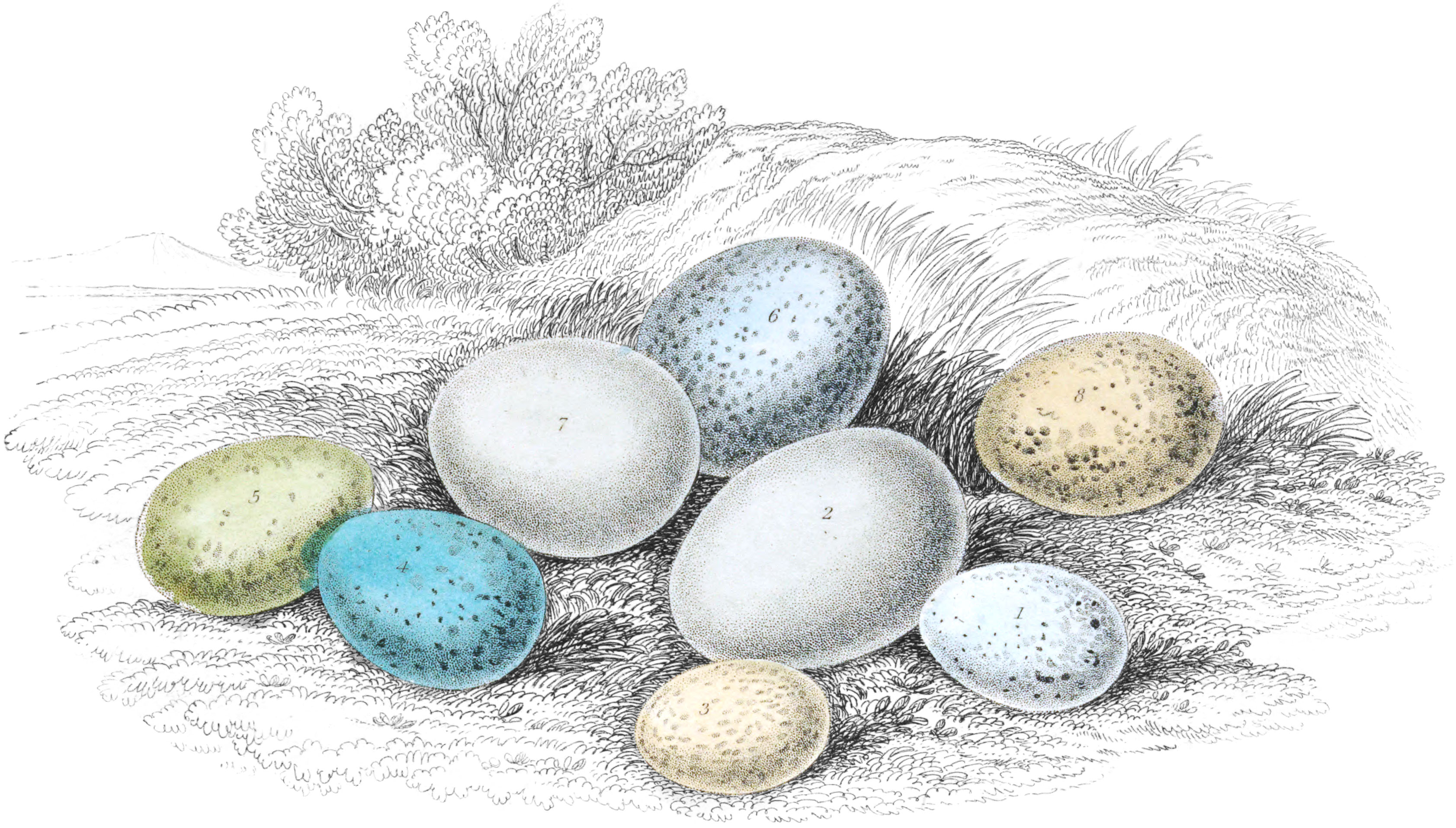
Plate XXX
1. Mountain Finch. 2. Green Woodpecker. 3. Gray Wagtail. 4. Common Shrike. 5. Hoopoe. 6. Common Blackbird. 7. Common Bee-Eater. 8. Cuckoo.
-
The indefatigable Wilson says, speaking of the great American Shrike, that he resorts to stratagem, but at the same time, that he can
at any time seize upon small birds by mere force of flight. I have seen him in an open field dart after one of our small sparrows with the rapidity of an arrow, and kill it almost instantly.
And again of the Loggerhead, (L. Ludovicianus,) that
it sits, for hours together, on the fence, beside the stacks of rice, watching like a cat, and as soon as it perceives a mouse, darts on it like a hawk.
- Le Vaill. Ois. d’Afrique, ii. p.
2242. - Selby, Br. Ornith. i. p. 149.
- See Mag. of Zool. and Bot. ii. p, 427, for instances of capture in Ireland.
- “I have seen it in Wiltshire, and have no doubt of its breeding there,” are the words of Lewin. (Birds of Britain, i. p. 70.) He had not, however, actually observed the act in question.
- Hewitson, Oology, pl. cviii.
- History of British Birds, i. 157.
- Hewitson, Knapp, Blyth.
- The description of the young is taken from a specimen procured on the Continent.
- Hoy, Mag. of Natural History, iv. p. 343. Observations on British Shrikes.
- Birds of Western Africa, i.
- Birds of Western Africa, i.
- Mag. of Zool. and Bot. ii. p. 428.
- See Temm. Supp.
- Eyton’s Rare British Birds, p. 93, 94.
-
Colonel Montague mentions the effects on this bird and the redwing during the snow-storm of 1798:—
They became too weak to shift their quarters to a more southern climate, and thousands were picked up starved to death. Orn. Dict.
- Selby, I. p. 161; Thomp. in Mag. of Zool. & Bot. II. p. 433.
- White, Sir W. J. edit. p.
97113. - Mag. of Zool. and Bot. II. p. 433.
- British Oology, by William Hewitson, with lithographic figures—two vols. are completed See also a paper by the same author, detailing the habits and breeding of many of our British birds, from notes during a tour made for Norway, Mag. of Zool. and Bot. II. p. 309.
- Hewitson, Mag. of Zool. and Bot. II. p. 312.
- See Selby and Montague.
-
As indicating this propensity for selecting an elevated singing place, whatever the character of the country, Mr Thompson writes,
When travelling over a very wild mountain tract between Cushendall and Ballycastle, covered with heath, and having no trees within miles, the nearer one (a Song Thrush) was perched on a ragweed that overtopped the heath.
Thomp. Mag. of Zool. and Bot. II. p. 434.
- Rotten wood seems to be the principal ingredient of the interior plaster of the nest.—Selby.
- Mag. of Zool. & Bot. II. p.
439438. - History of British Birds.
- Fauna of Cornwall.
- Hewitson.
- Selby.
- M‘Gillivray.
- Strickland.
- Sykes.
- Temminck.
- Swainson.
- Vaillant and Smith.
- Illustrations of Ornithology. Descrip. to pl. LXXXV.
- Synopsis of Newcastle Museum, p. 298.
- Naturalist, vol. ii. p. 275. Yarrell British Birds, i. p. 234.
- Supplement, i. p. 143.
- Yarrel, British Birds, i. p. 235.
- Selby, i. p. 196.
- Yarrell, i. p. 276.
- Hewitson.
- Nilson.
- Temminck.
- This is a habit common in several species. The Blackcap does it constantly when flying, particularly when uttering its call note, and is a conspicuous ornament from its deep colour in the male.
- Strickland.
- Crateropus, Meglurus, Swain. Donacobius, &c.
- Selby.
- Pennant.
- Montague’s Ornithological Dictionary.
- Yarrell, British Birds, i. p. 271.
- Rennie.
- Magazine of Natural History.
- Gould’s Birds of Europe.
- Montague’s Ornithological Dictionary.
- Mr Thompson.
- Mr Strickland.
- Mr Gould.
- Thompson.
- Hewitson.
- Brit. Orn. i. p. 230.
- See account of R. modestus, which may alter its importance as a character.
- P. 78.
- Mr Hewitson noticed it in the pine forests of Norway. See British Oology, and Mag. of Zool. and Bot. II. p.
313314. - British Vertebrata, p. 113.
- Mr Hancock’s notice in the Annals of Natural History.
- Oology,
iii. - Oology,
iii. - Yarrell, British Birds, p. 338.
- Thompson.
- Selby, in Jameson’s Journal.
- Mr W. Christie, Ent. Mag.—Nilson.
- Prince of Musignano, in Yarrell, British Birds.
- Pennant.
- Temm. Supp. to Ois. d’Europe.
- Hewitson’s Oology.
- Yarrell.
- Hoy, Loudon’s Mag. of Nat. Hist. iii. p. 329.
- Dykes, in Loudon’s Mag. of Nat. His. iii. p. 329.
- Temminck, in his Supplement, places the rare Motacilla caliope of Pallas with accentor. In this bird the bill is more slender and the gape more lengthened. In the structure of the wings, the third and fourth quills are longest, and nearly equal, and the first is not proportionally short, as in the type of accentor. Mr Gould makes a sub-genus, caliope, from it.
- Thompson.
- Yarrell, Brit. Birds.
- Gould.
- Temminck.
- Temminck.
- Hewitson.
- Yarrell, i. p. 365.
- Prince of Musignana.
- Gould.
- Temminck.
- Gould.
- Temminck.
- Continuation of Wilson.
- Wilson’s Ornithology.
- Mr Atkinson, in his Compendium, mentions a pair having built and reared their young on the angle of a lamp-post in one of the streets in Leeds.
-
Dr Heysham mentions, that they breed at Lowther, in the holes of trees.
On the 12th of May, 1783, I shot there two pair.
—Cat. of Cumberland Animals in Hutchinson’s Hist. vol. i. p. 13.
-
On the contrary,
this bird is among the American savages an emblem of returning health: the physicians, or rather magicians, when they visit a sick person, invoke the Raven, and imitate his croaking voice.
—Adair, Hist. of Am. quoted from Penn. Arct. Zool. ii. p. 246.
- White’s Selborne.
- Hysham, &c.
- Northern Zoology, ii. p. 290.
- Supp. p. 61.
- Mag. of Zool. and Bot. ii. p. 311.
- Laing’s Residence in Norway, p. 111.
- Temm. Man. Supp. p. 63.
- North. Zool. ii. p. 292, note.
- Vol. i. p. 68.
- Temm. Sup. i. 70.
- Vol. i. p.
148448. - Yarrell, British Birds, i. p. 486.
- Selby, British Birds, i. p. 308.
- Wilson’s North American Ornithology.
- London’s Magazine.
- Yarrell, British Birds, i. p. 497.
- Mr Yarrell states, that he possesses a note of the nest of this bird being placed in a fir tree, ten or eleven feet from the ground, and has seen one built high in a white thorn bush.—History of British Birds, i. p. 504.
- Low.
- Macgillivray, Lowe, Dunn, &c. our own observations.
- J. D. Salmon in Loudon’s Magazine.
- Low, Dunn.
- Supplement, Part I. p. 268.
- Yarrell, i. p.
619450. - Macgillivray, British Birds, i. p. 464.
- Selby, British Ornithology, i. p. 285.
- Northern Zoology.
- The Alauda calandra, according to Colonel Sykes’ late observations, is a delightful singing bird.—Proceed of Zool. Soc.
- Yarrell, i. p. 413.
- Upon the authority of Mr Yarrell, Brit. Birds, i. p. 419.
- The Prince of Musignano has separated the North American birds from those of Europe, keeping the trivial name of alpestris for the last. By Brehm and Boie, this bird has been placed as the type of a sub-genus. In the wing, the small spurious quill is wanting.
- Orn Biog. ii. p. 570.
- Orn Biog. ii. p.
570571. - We have a very distinct and typical species from Nipaul, sent by Mr Hodgson.
- Northern Zoology, ii. p. 263.
- P.
560562. - Bonaparte continuation of Wilson.
- British Vertebrata, p. 151.
- See Orn. Illust. plate 116.
- Temminck.
- Loudon’s Mag. v. p. 568.
- Loudon’s Mag. vii. p. 465.
- We have not seen the Asiatic form: it may be typical of another sub-genus.
- Thompson.
- This constitutes the C. brachydactyla of Brehm.
- London’s Mag. Nat. Hist, VIII. p. 112.
- Temminck.
- Wilson.
- Jenyn’s Brit. Vertebrata. Description of specimen in collection of Zool. Society.
- London’s Mag. of Nat. Hist. vii. p. 155.
- Lardner, vol. ii. p. 152.