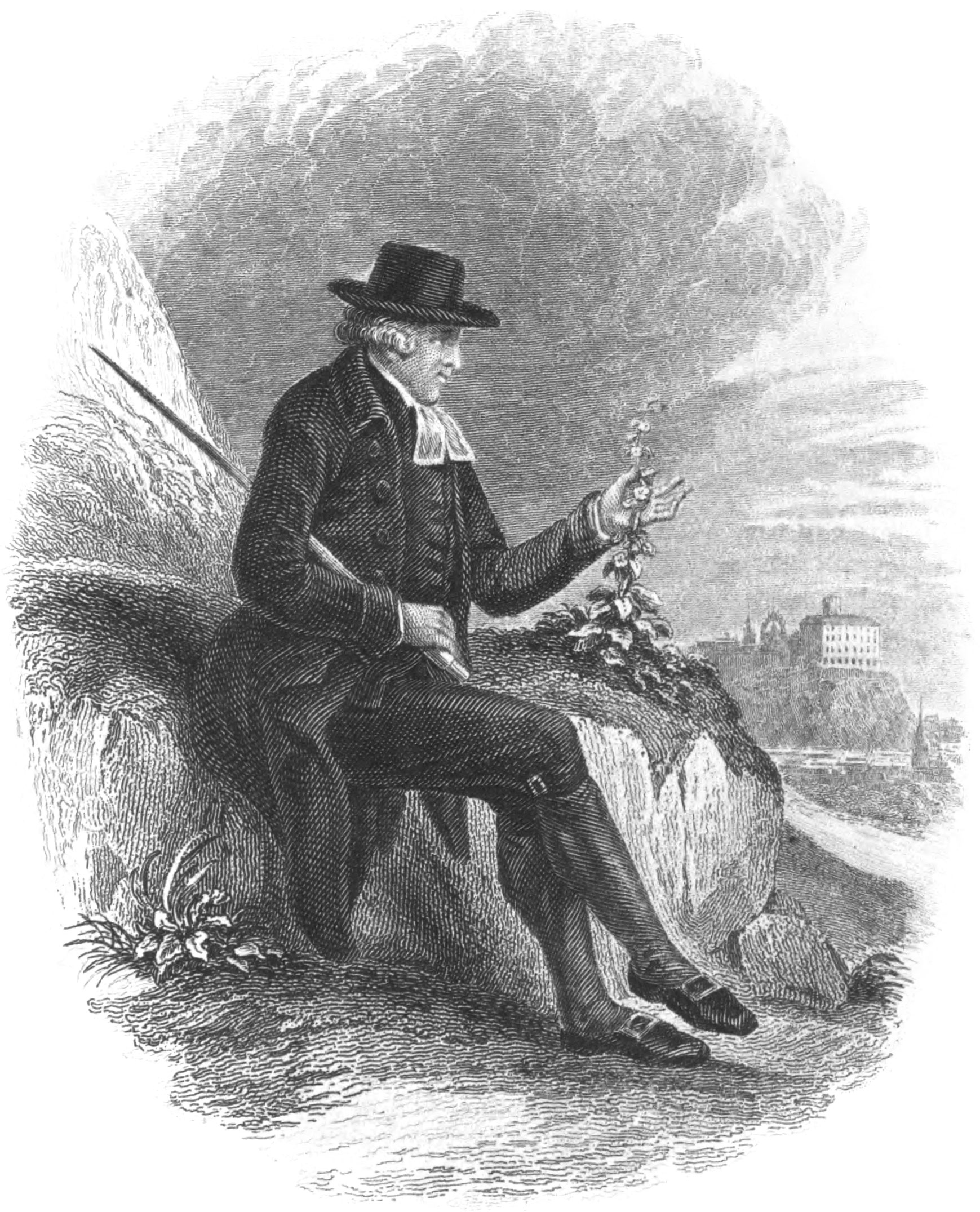
Memoir of
Rev. John Walker, D.D.
General Zoology
1731–1804
Originally published in volume 34, The Birds of Great Britain & Ireland, Part III, Landfowl & Wading Birds.
John Walker, D.D., was born towards the beginning of the last century in the Canongate suburb of Edinburgh, and received his education at the grammar-school of that district, of which his father was at the time rector.
His early proficiency in classical literature is said to have been so great, that he was able to relish Homer at ten years of age; and if this be correct, he must have owed much to paternal instruction.
He tells us himself, in a letter to Lord Kames, that he was a kind of naturalist by intuition:
Let your lordship pursue the analogy between plants and mankind as far as you will, it is not likely I shall be as much offended as with my friend Linnæus. I have been, from my cradle, fond of vegetable life; and though I like my species and the rank I hold in the creation, I declare I would sooner claim kindred to an oak or to an apple-tree than to an ape
This predilection was confirmed and directed by Sutherland’s “Hortus Edinburgensis,” published in the year 1684. The author is thus characterised by Bishop Nicholson, in his “Scottish Historical Library,”
The best advances in botany made in Scotland are owing to the extraordinary skill and industry of Mr. James Sutherland, the present worthy overseer of the Royal and Physic Gardens at Edinburgh, whose happy labours and settlement in that city are justly registered among the many and great benefits for which she will ever be indebted to the memory of Sir Andrew Balfour;
and
Dr. Walker mentions this performance as a book I have some respect for, as it was the first on botany I ever perused, when ten years old: containing a catalogue both considerable and accurate for that period.
From the Canongate high-school he was sent to the university, to prosecute that course of study prescribed by the Church of Scotland to candidates for the sacred ministry within her pale. While engaged in these preparatory labours, about the year 1750, his attention was attracted by the museum of Sir Andrew Balfour, the sight of which first inspired him with an attachment to natural history that operated powerfully upon his mind and future pursuits, and which he never lost. It is melancholy to relate the fate of a museum that had cost the collector forty years of unremitted attention, and which, after his death, had been deposited in the hall of the old college of Edinburgh, then the library-hall, and was believed to be the most considerable that was in the possession of any university in Europe, There it remained for many years, useless and neglected, some parts of it going to decay and others abstracted; till, soon after the period that Mr. Walker had seen it, it was dislodged from the hall where it had been so long kept; was thrown aside and farther and farther dilapidated, and at length almost completely demolished.
In the year 1782, when the Doctor filled the natural history chair, he extracted out of its ruins and rubbish many pieces still valuable and useful, and placed them in the best order he could and; adds, in the conclusion of the account from which the above is taken,
These I hope may now remain long in this place, and be considered as so many precious relics of the first naturalist, and one of the best and greatest men this country as produced.1
Unfortunately the Doctor’s anticipations were not destined to be realized. He had collected, for the use of his class, a number of specimens, which he added to the pitiful remains of Balfour; but he had not the generosity to bestow them on the public, or perhaps did not consider them worth a bequest; and at his death the museum, and the remains he seemed so desirous to preserve, underwent a second spoliation; and the miserable fragments left were of little benefit to his more eminent successor, who presented his own private collection to the public, and may thus be considered the founder as well as the builder of that splendid museum, which is the boast of our university, and one of the most attractive as well as useful objects of curiosity in our city.
When Mr. Walker had finished with propriety his preliminary course at the university, and gone through with approbation his trials before the presbytery of Edinburgh, he was licensed to preach the gospel. He did not, however, continue long what is called a probationer, having been ordained as minister of the parish of Glencross on the 13th day of September, 1758. This parish, which lies south from Edinburgh seven miles, was delightfully situated for a botanist, among the Pentland heights; and here Mr. Walker spent the next four years of his life, assiduously cultivating the science he loved, not only amid the romantic scenery by which he was surrounded, but making extensive excursions to explore the vegetable and mineral kingdoms throughout the country, and examine any of the remarkable productions of nature which claimed the attention of a philosopher.
Among the acquaintance he formed at this time, and with whom he ever after kept up a correspondence upon subjects in which they both felt equally interested, was the Honourable Henry Home of Kames, one of the senators of the college of justice, &c., better known as Lord Kames; and one of their great bonds of connexion was a desire for the improvement of the Highlands and Islands of Scotland.
After the rebellion of 1745, the act which annexed the forfeited estates to the crown declared the special purposes of that annexation to be for
civilizing the inhabitants on the said estates and those of the other parts of the Highlands and Islands of Scotland; promoting among them the Protestant religion, good government, industry, and manufactures, and the principles of loyalty, and no other purposes.
The produce of the estates was to be expended on the erection of schools for the education of youth, to instruct them in agriculture and manufactures, and also to erect and institute manufactures; and the execution of these great and benevolent public purposes was entrusted to commissioners, under the title of “The Board of Annexed Estates,” of which Lord Kames was one of the most active members. Dr. Walker, who was then a frequent visitor of his lordship’s, gives the following pleasing trait of his attention to the poor claimants.
I have frequently visited him of a morning; and his breakfast, which was at an early hour, was a very elegant one, and usually a sort of levee,
and I seldom missed finding in the lobby some tradesmen or countrymen, who came to speak to him about applications they had made to the Board of Trustees for bounties or premiums for new inventions, or to the Commissioners of Annexed Estates; and all such applications he listened to with the utmost attention. To do Mrs. Drummond justice, she never failed to remind him of these poor petitioners and their claims, in which, to say the truth, she took great interest herself. She was an admirable woman, and seconded all her husband’s useful plans.
In 1759 he met Benjamin Franklin, who visited Lord Kames that year, and received from him, in conversation, the account of the pines and the hiccory, and other trees of America, mentioned in his tract, “Remarkable Trees in Scotland;” a tract for which he must have been collecting materials at this time. And to this period, from internal evidence, though it has no date, I feel inclined to place his “Mineralogical Journal from Edinburgh to Elliott,” the tenth of his tracts.
At Glencross he also had the good fortune to be introduced to Mr. Tytler of Woodhouselee, afterwards Lord Woodhouselee, whose friendship he long enjoyed, and who, in his “Life of Lord Kames,” when noticing the Doctor’s death, says, that he lost in him one of his earliest and most valued friends.
In the year 1762 he was presented to the parish of Moffat by the Earl of Hopeton, and settled there on the 13th of July, where he continued unremittingly to pursue his favourite employments, improving himself, silently but not unobservedly, till 1764, when he was recommended by Lord Kames to the Commissioners of Annexed Estates, as a person most eminently qualified by his uncommon natural talents and scientific acquirements to make a survey of the Western Islands, with regard to their moral and physical state and capabilities for those improvements which they were so anxious to promote; and accordingly he received the appointment. He was at the same time requested by the Society for Propagating Christian Knowledge to visit their stations and report upon the progress of their schools. Both of which objects he accomplished, much to the satisfaction of those who had employed him.
The Report which he made to the Board of this journey, which lasted seven months, during which he had traversed, by his own computation, a space of above three thousand miles by land and water,—relative to the then state of agriculture, fisheries, and manufactures in those, at that time, almost unknown regions, with an ample detail of the best means for their improvement, as suggested by the nature of the country and its local advantages, was esteemed highly interesting and important, but was not printed by the Commissioners. It was, however, found, after his death, among his papers, new modelled, and published by his friend Charles Stewart, printer (himself favourably known as the author of “Elements of the Natural History of the Animal Kingdom”), under the title of “An Economical History of the Hebrides,” 2 vols. 8vo.
Although there has been a great and beneficial alteration in the state of the Hebrides since the days when this inspection took place, yet the following letter which he addressed to Lord Kames from the isle of Lewes is not without interest.
Stornoway, August 17, 1764
My Lord, I received yesterday the favour of your lordship’s, and have taken this first opportunity, since my last, to acquaint you with my progress. After leaving Isla, I proceeded to Jura, Colonsay, Oronsay, Icolmkill, Mull, Coll, Tiree, Rum, Egg, and Canna; after which I went through Barra, South and North Uist, Benbecula, Bernera, Yalay, Pabhay, Ensay, and Harris, and arrived yesterday at this place.
have seen the most fertile lands I ever saw in my life, without cultivation; a people by nature the most acute and sagacious, perfectly idle; the most valuable fisheries, without lines or nets; and in every corner one of the finest harbours that ever nature formed, a beautiful though useless void, as inanimate and unfrequented as those of the Terra Australis.
The only appearance of industry I have met with in the islands is at this place. They have for some time had a considerable fishery of cod and ling. Their greatest discouragement is the difficulty of procuring salt, and the hazard they run with salt-bonds. But that I hope will be removed in this corner by the erection of a custom-house, which was done yesterday.
One of the most effectual encouragements of the fishery in the islands, and I think the easiest and cheapest that has yet occurred to me, would be £1000 worth of salt and casks laid up at one or two proper places, to be sold to the inhabitants at prime cost. The herrings have been swarming since the end of last month, on the coasts both of the main-land and Long Island; but except a few taken in Skye, I have not seen nor heard of one last being preserved.
Lying at anchor last Monday night, in calm moonshine, in the fine land-locked lake at Island Glass, in the Lewes, which is a circle of two miles, perfectly surrounded with lofty mountains, I saw the water heaving with fish, and felt even the air strongly impregnated with their smell. Three small Highland yawls, each of them with an old tattered net, came alongside of us by daylight, loaded to the brim with the largest herrings I ever saw, which the poor people were anxious to sell at four-pence the six score, having no salt or casks to preserve them. And this is at present the case in every loch in these parts.
When the spinning-school was erected here eight months ago, it met with the greatest opposition from the people. No young women could be brought to it till they were compelled. To avoid this, great numbers of them got themselves married! which was the case with several but of twelve years old!! But finding that this was to be no protection, they at length submitted, and ever since the school has continued full. They now find it both easy and profitable, and pursue it with a degree of spirit and cheerfulness which is very agreeable. I saw above fifty of them, from nine to twenty-five years of age, at their wheels, in one room, where a wheel was scarce ever known before. They seemed quite happy at their work, and all joined in a Highland song, which gave me more pleasure, if it be safe to own such an unpolite notion, than any concert 1 was ever present at.
The spinning-mistress, who is a woman from Fife, I found under real, I may say, bodily amazement, at the quick apprehension and docility of her scholars, who, though they understood not her language, comprehended in a day or two every thing she meant. I was not, however, so much surprised at this as the good woman seemed to be, having been for two months past more and more convinced, that the mind of man is to be observed more and more perfect as one moves northwards; that a penetrating air seems to produce penetrating souls, and that wind and weather, the keener they are, appear to give the sharper edge to the human understanding.
I have met with a strong confirmation of my notion of raising hemp in the Western Islands. I was on Tuesday last on board of a herring-buss on Loch Shell, bound from Stornoway to the rendezvous at Campbelton, whose nets are wholly made of hemp which grew in the Lewes; but there is not a stalk of it in any other of the islands.
I inquired carefully after the plant which dyes black without burning the cloth, and found it at length in South Uist, where, indeed, they make a fine black with it. I hope to have the pleasure of showing it to your lordship in great plenty in Duddingston Loch. But the franking act obliges me to stop.
I ever am,
Your Lordship’s devoted Servant,
John Walker
During this excursion he ascended the two high mountains called the Paps of Jura, chiefly for the purpose of making two experiments; the one to measure the height of the highest mountain, by the barometer, at its base and upon its summit; the other to ascertain whether boiling water is not of the same degree of heat at the top of a mountain that it is at the bottom, or is visibly colder, by the thermometer, upon the mountain than upon the plain.
His account of this excursion is beautifully told.
Upon the 27th of June we filled a barometer at the shore of the Sound of Isla, at seven o’clock in the morning; and being placed at the level of the sea, the mercury stood at twenty-nine inches and seven-tenths. At ten o’clock it stood at the same height, when we set off in order to ascend the mountain, which is one continued steep from that point of the shore. Some Highland gentlemen were so good as to go along to conduct us; and a box with barometrical tubes, a telescope, large kettle, water, fuel, provisions, and a couple of fowling-pieces, loaded seven or eight servants.
The first part of our progress lay through deep bogs, from which we sometimes found it very difficult to extricate ourselves. We then came to a chain of small but steep hills, where the heather struck us to the breast, and which were cut everywhere with deep glens and gullies, which we could not have ascended on the opposite side, without the assistance of the junipers and strong heather with which they were covered.
We next travelled along the rocky skirts of three or four extensive hills, and came to a small gloomy lake at the foot of the highest mountain. Upon this side, which was to the south, we found the ascent impracticable, being so abrupt and full of precipices, which obliged us to make a circuit east. Here we had before us about fifteen hundred feet of perpendicular height, and composed entirely of loose rocks and stones. They lay upon the side of the mountain like a great stream, and upon the least motion gave way on all sides, which made our progress both tedious and dangerous. With great difficulty we made our way against the hurling ruins of the mountains; and at last, after an ascent of seven hours, with excessive fatigue, we gained the summit.
It was now five o’clock in the afternoon; the day was serene, not a cloud in the firmament, and the atmosphere uncommonly clear; so that the view we now enjoyed of the earth and the seas below, made us forget the toil of our ascent. Every way we turned we had a prospect of sea and land as far as the eye could reach. The sea in many places running out into the sky, and in others terminated by lands and islands of various shapes, forming a very singular and grand horizon.
On one hand we had a thousand hills, the whole alpine country of Argyleshire, the ancient Albion; here only our view was intercepted, and that only by mountains in the distance. In another quarter, we saw distinctly the whole of the Hebrides and Deucaledonian Ocean. Southwards, the vast promontory of Cantyre lay under our eye; and beyond it, in one view, all the west of Scotland, rising to the great mass of mountains in the head of Clydesdale and Nithsdale; in another view, the spiry summits of Arran, and the whole Irish Sea, with its shores, to the Isle of Man. From the south to the west, the north of Ireland lay as a plain before us, further than the eye could reach. The impetuous strait between the Mull of Cantyre and the Fair Head, with its lofty cliffs, was at hand; through which the Irish Sea is filled every tide by the pouring in of the Atlantic. The promontory of the Giant’s Causeway appeared near and distinct; and beyond it the high land of Inis-huna, the north extremity of Ireland; beyond this, to the Hebrides, nothing but air and ocean.
The emotions in the mind of the beholder, arising from the grandeur of this scene, are not to be excited by any description. The extent of prospect from this mountain is indeed surprising, not much under three hundred miles south and north. But the curvature of the earth is here greatly overcome by the elevation of the spectator and the great height of the distant lands. Nothing else could render the Isle of Skye and the Isle of Man at the same time visible. At three such views, the naked eye might extend from the one extremity of Britain to the other. To stretch the eye over so many different seas, over such a multitude of islands, and such various countries in different kingdoms, is perhaps a scene that can nowhere be beheld in Europe but from the summit of Jura.
During the time that our fire was kindling, we constructed a barometer, when the mercury stood at twenty-seven inches and one-tenth. Fahrenheit’s mercurial thermometer was then put into the boiling water, in a kettle which had been made for the purpose; and, after many repeated immersions, was found to stand constantly at two hundred and seven degrees. We left the summit of the mountain at seven o’clock; and left it indeed with regret, having been so much delighted. We descended, not without some difficulty and danger, upon the west side, where the mountain is very abrupt, and about midnight arrived upon the Sound of Islay, at the place from which we set out. Here we again repeated our experiments. The same barometrical tube was filled, and at one o’clock in the morning the mercury stood, at the level of the sea, at twenty-nine inches and seven-tenths; the same height precisely at which it stood the preceding morning at seven o’clock. And as the air and weather had been altogether serene, without the least perceptible alteration during the intermediate time, there was reason to think that we had now the altitude of the mountain with as great exactness as it could be taken by the barometer.
We at the same time put the thermometer into boiling water, and after repeated immersions, it was observed to stand constantly at two hundred and thirteen degrees. The thermometer employed was one constructed by Professor Wilson at Glasgow, and we were therefore assured of its accuracy. The water carried to the top of the mountain was from a pure perennial spring on the shore of Jura; and the water of the same fountain was employed in the repetition of the experiment.
From these experiments, therefore, it appears that a column of air of the height of this mountain is equal to two inches and six-tenths of mercury. And assuming Dr. Halley’s calculation of ninety feet for each tenth, the perpendicular height of the mountain turns out to be 2340 English feet above the surface of the sea, which is just three hundred feet less than half a measured mile.
The difference of the heat of boiling water, at the summit and at the bottom, appears from these experiments to be equal to six degrees of Fahrenheit’s thermometer; and the height of the mountain, divided by this number, gives three hundred and ninety feet for each degree.
The following is the Report which he made to the Society for propagating Christian Knowledge, concerning the state of the charity schools in the Highlands and Islands.
It is proposed in the following Report, to lay before the Society an account of those schools which I had occasion to visit and examine last year, in the course of my journey through the Highlands and Islands; to mark out those places where ignorance and superstition do most prevail, and where the inhabitants are most destitute of the means of instruction; and to communicate those observations which occurred to me, concerning the most proper methods of spreading the knowledge of the doctrines of the gospel, and the practice of its precepts, in those remote and unenlightened parts of the kingdom.
On the 23d of June 1764, I visited he charity school in the parish of Kilchoman in the island of Isla, of which Dougald M’Innish is master. This school was erected only in the month of November preceding, and during the greatest part of the winter was attended by forty-seven scholars. On the above day in June, the number of scholars in it was forty-four, from five to eighteen years of age, who all appeared to be making very good proficiency. Of this number only four could speak English when they came to the school in November, and in June they were all considerably advanced in speaking that tongue. None of these scholars come above two miles to the school, and they are the children of the very poorest people, who without the opportunity of this school, could not possibly have their children educated. The school is kept in the church of Kilchoman, and the schoolmaster is precentor and session-clerk. The minister officiates at this church every other sabbath only, and on the sabbath he is absent, the schoolmaster convenes the scholars in the church, where he reads the Scriptures, examines them, and joins with them in psalms and prayer. I examined this school in presence of the Reverend Mr. M‘Lea, minister of the parish, Robert Campbell of Sunderland, and Alexander Campbell of Balloal, Esqrs., ruling elders, from whom’ I had a very good character given of the schoolmaster.
On the 29th of June, I visited the charity school kept in the island of Colonsay, which is situated in the parish of Jura. This island is eight miles long and three broad, and, with the adjacent island of Oronsay, contains four hundred and forty inhabitants. These islands are distant above twenty miles of sea from Jura, and can only be visited by the minister twice a year. The school is kept by Donald McLean, in a house built for the purpose in the centre of the island. The number of scholars in winter and spring is usually between thirty and forty, and there were twenty-three attending in June, from seven to nineteen years of age, of whom the greatest part read the Scriptures very distinctly. I was accompanied by Mr. Neil M‘Leod, minister of Jura, Gilbert M‘Lean, elder, Mr. M‘Neil, younger of Colonsay, and Alexander M‘Neil of Oronsay, Esq., ruling elder, who all attested the diligence of the schoolmaster.
On the 30th of July, I visited the charity school kept in the island of Barra. It was then attended by thirty-seven scholars, who were all making excellent proficiency in reading, writing, and arithmetic, under Donald Campbell, a very capable and diligent teacher. In the island and parish of Barra there are at present thirteen hundred people who are Papists, and only about fifty Protestants. For many years the Popish parents would not send their children to the Protestant school, but they have since got over that scruple, and send them now without reluctance. I was accompanied by Donald M‘Neil of Yatersay, Esq., ruling elder in the parish, a man of excellent principles and understanding, and the chief support of the Protestant interest in this and the neighbouring islands. The good character which he and the other Protestants in the island gave of the schoolmaster, I had reason to think, upon examination, to be very just. He is at the greatest pains to make the Popish children mandate those passages of Scripture that are most subversive of Popery, and to ground them in our catechisms and Confession of Faith, and is indeed a very assiduous and useful master. He complained much that he had great difficulty to live upon his salary, which is nine pounds, and if the society could augment it four or five pounds, it would be no more than what he really deserves, and what the important station he is placed in requires.
On the 31st July, I examined the charity school in South Uist, of which Donald M‘Queen is master. He was seven years schoolmaster in the Harris, before the year 1738, when he was removed to South Uist, where he has officiated ever since. The parish of South Uist contains two thousand two hundred people, of whom only two hundred and fifty are Protestants; and besides the island of South Uist, it comprehends the islands of Benbecula and Erisca, which altogether compose a parish between thirty and forty miles long. The charity school is at present, and has been kept for two years past, in the village of Kilbride, at the south extremity of South Uist; but for three years before it was settled here, it was kept in the island of Benbecula, and unless it be thus removed from place to place at proper periods, it cannot have its full effect in instructing the inhabitants of such an extensive country. On the foresaid day, this school contained twenty scholars, most part of whom were very well instructed in reading and speaking English. The master’s character and diligence were well attested by Colin M‘Donald, Esq. younger of Boysdale, who is ruling elder, and by Ronald M‘Donald, Esq. younger of Clanronald. He received a box of books from the society in- the year 1738, containing a dozen of Bibles and a dozen and a half of New Testaments, but he has received none since that time; and is at present in such want of catechisms for teaching the children the alphabet, that he is forced to make use of the leaves of other books for that purpose.
As the charity school kept at Balliloch, in North Uist, receives a vacation of twenty days in the beginning of August, this deprived me of an opportunity of visiting the school, or of conversing with Charles Tawse, the schoolmaster. The minister, however, and the gentlemen of the country, gave him an ample character, and a very good account of the state of the school, at which there were thirty-five scholars attending upon the 1st of August.
Upon the 16th of August, I visited the society’s school kept at Stornoway in the Lewes. In November 1763, Neil M‘Leod was appointed master of this school by the society; but giving up his charge on the 19th of June 1764, the Rev. Mr. Clark, minister of the parish, and Mr. M‘Gillander, Mr. M‘Kenzie of Seaforth’s factor, with the approbation of the presbytery, appointed, in his place, Alexander Anderson, who now officiates, and gives general satisfaction in the place, and this appointment they hope will be confirmed by the society. On the day I examined this school, it contained fifty-two scholars, from five to fifteen years of age, which was the most numerous of any I saw in the Highlands or Islands, and it had been still more numerous in winter. The progress they-were then making in reading, writing, arithmetic, and in the principles of religion, was truly surprising, considering their great number and the small appointment of the master, which is only eight pounds; and I doubt if there be so much service performed, for so little money, by any of the society’s servants.
The other school kept by the society at Knock, in the parish of Stornoway, of which Murdoch M‘Aulay is master, I had not the opportunity to examine, but was informed that it was always attended by upwards of thirty scholars, and that the master was diligent and successful.
Upon August the 25th, I had an account of the society’s school, erected some months before in the parish of Gerloch in Ross-shire, from Sir Alexander M‘Kenzie of Gerloch and the minister of the parish. This school, of which James Herdman is master, was granted by the society, with ten pounds salary, on condition that the heritors should add a hundred merks to their appointment. This the heritors have accordingly done, and were to build, this last summer, a convenient school-house at their own expense. This new school deserves the particular attention of the society, as it is the only school in that extensive parish, which contains two thousand eight hundred people, of whom there are not above twenty persons who can read English, exclusive of the gentlemen and ladies who live in the parish.
The parish of Lochbroom, which lies to the north of Gerloch, has no legal parochial school, but the Commissioners upon the Annexed Estates erected a school, in the year 1763, at Kirkton of Lochbroom, and appointed twenty-five pounds a year of salary for the schoolmaster. When I visited this school, it contained thirty-four scholars, who were making very good progress in reading, writing, and arithmetic, and ten of them were pretty well advanced in the Latin and Greek languages. The society also has a school in this parish, in the country of Coygach, which is well attended; yet these two schools are altogether insufficient for the instruction of the inhabitants of this vast parish, which contains about two thousand five hundred people, and in its extent rather resembles a province, being thirty-six Highland miles in length and twenty in breadth. There are three catechists supported in this parish upon the royal bounty, whose salaries amount to twenty-seven pounds per annum, and if a considerable part of this sum was rather employed in supporting schools, it would probably be productive of greater advantages.
Upon the 30th of August, I visited the society’s school kept at Dinetil, in the parish of Slait, in the isle of Sky, by John M’Intosh. His salary is eight pounds, and he has great difficulty to subsist upon it. All his scholars, who had been two full years at the school, read the Scriptures distinctly, and understood them better than most of those I met with. He is at great pains to make them translate the English Bible into Gaelic, and to translate the Irish Bible into English, which is certainly an excellent practice, and should be more followed by the society’s schoolmasters. For the Highland children frequently come to read the English currently, before they have so much of the language as can make them understand it when it is read; but this practice improves them in speaking as well as in reading English, and makes them well acquainted with the meaning of what they read.
The society’s school kept at Bradfoord, in the parish of Strath, in the isle of Skye, requires some immediate attention. Lauchlan M‘Kinnonhas taught in it since the year 1 759, but is now become so old and decayed, as not to be able to teach it with that success that might be expected. The minister of the parish, Mr. Donald Nicholson, a man of uncommon probity and goodness, did not incline to prefer any complaint against the poor old man, but did not propose again to attest the school.
Appended to the Report were the following propositions.
That the distribution of the royal bounty be confined to those parishes in which the Gaelic language is preached, That one-fourth of the present catechists be employed as schoolmasters. That no parochial schoolmaster receive a salary as a catechist. That the presbyteries be enjoined to prosecute the erection of legal schools in those parishes where they are wanting
As long as Dr. Walker continued at Moffat, his correspondence with Lord Kames was uninterrupted; and in the Life of his lordship have been preserved several letters addressed to him on subjects of physiology and natural history, when he was engaged in writing his “Sketches of the History of Man,” which appear chiefly to have been replies to queries respecting the subject of his investigations. The first, dated February 18, 1773, on the analogy between man and the inferior animals, and that between animals and vegetables, is extremely curious, in the course of which he produces a number of striking marks of differential similarity which readily escape a common observer, one of the most striking of which is the effects of habit on the external characters of animals and vegetables; that is, the alteration produced by climate and culture; and the examples given are the dog and the cabbage, both from original stocks producing varieties so essentially different, as scarcely to be recognised but by tracing them back to their primitive sources. The last, July 1776, on the wonderful provisions of Nature for the augmentation and preservation of plants, their aliment, and the soils they most affect, is likewise exceedingly ingenious.
In the year 1 775 the professorship of natural history became vacant by the death of Dr. Ramsay, and Dr Walker, most probably through the interest of Lord Kames, was nominated his successor. Conjoined as they had been in agricultural pursuits and habits of intimacy, and as his lordship entertained a very high opinion of the talents of his friend, this was just as might have been expected; only there existed what ought to have been an insuperable objection, he was minister of Moffat, upwards of fifty miles distant from the capital; and as it was impossible that he could fulfil the duties of both situations, justice, and even a decent respect for appearances, required that he should relinquish the one or resign the other. This, however, he unfortunately could not resolve to do.
At that time the ruling clergymen of the Church of Scotland were actuated by a strong desire for literary eminence, to attain which they expended all those energies which ought to have been expended in a nobler cause; and unhappily considered their sacred calling a more secondary object, subordinate to the other. The Doctor was led aside to sacrifice to the idol of the day, and thus involved himself in an awful responsibility, and his parish for some years in most lamentable destitution. He contrived, however, to satisfy both his conscience and a majority of the presbytery of Dumfries, and struggled through a few unpleasant years, till he obtained a presentation to Colinton, among a more peaceful people than the mountaineers of Moffat.
Perhaps in his appointment the wreath went to the worthy; but, if so, “it was more by chance than good guiding,” for there were numerous other applicants, and the decision appears to have been made rather from regard to political influence than professional talent, though fortunately in this case they went hand in hand.
That the university of Edinburgh should have maintained its high character for so long a period, amid the violent struggles of party politics and family partialities which so frequently invaded its bowers during these and other perilous times, when an interest in the council or a vote at an election were deemed superior to any qualifications of a candidate, is truly astonishing; and when we recollect the long reign of this system, it is amazing that all the chairs did not become hereditary, or were not filled with the sons and the grandsons of baillies and deacons:
——“but there’s a Providence That shapes our ends, rough-hew them how we will,
and to this is to be attributed the elevated station which the university of Edinburgh, in her scientific classes, still bears among the institutions of Europe, sustained, however, in no small degree, by the excellence of many of the private lecturers, and the salaries of the professors being in general too small to allow them to disregard the number or estimation of the students. We hope now a better morn begins to dawn, whether it shall produce a more brilliant day we venture not to prognosticate; of our old reformer, “time will try;” meanwhile it may not be amiss to recall a little of the manoeuvring which took place upon the present occasion, as a picture of former days.
Dr. Ramsay, the Professor of Natural History, having been prevented from lecturing regularly for some time before his death, Lord Kames, who was well acquainted with Mr. William Smellie, then in the prime of life and expectation, and to whose attainments in the study of natural history he was no stranger, proposed to him, in the year 1774, to deliver a series of lectures on the philosophy and general economy of nature, leaving the regular scientific treatment of the subject to the public professor. This plan met with Dr. Ramsay’s entire concurrence, who afforded every assistance in books and advice, and it would have been carried into effect, had not Mr. Smellie been induced by the booksellers to undertake a translation of Buffon’s “Natural History of the Earth and of Quadrupeds,” then in the full bloom of its reputation.
When the Professor’s health began visibly to decline, about twelve months before his decease, he applied for the succession, and had then the support of Lord Kames; after his death, however, his lordship refused to make any application, but Sir John Dalrymple of Cousland warmly espoused his cause, and his letters afford a little insight into the principles upon which professorships were to be obtained. In one to Mr. Smellie, he tells him that the minister of the day (Lord North) had given the disposal of everything in Edinburgh to Thomas, afterwards Lord, Dundas of Kerse, M.P., to enable him to keep the town;
I will write to him with all my heart; but as he is pushed in Edinburgh by the Duke of Buccleuch, and is like to be pushed in Stirlingshire by the Duke of Argyle, he is forced to give everything with a view to his politics, much against the natural turn of one of the best heads and hearts I am acquainted with.
And afterwards, in another to the representative,—
Smellie, besides being very able for the business, has this advantage, that he lives close to Edinburgh, is much liked, and has a sagacious insinuating address, which may make him useful to you in your politics; and he will go through fire and water to do anything I bid him, provided it is not wrong!
Mr. Smellie, in his own behalf, was likewise constrained to appeal to his political services, performed or to be performed, when writing to Mr. Dundas. But the influence of Sir Laurence, who was engaged on the other side, and the politics of Stirlingshire, in which the family of Home too were involved, prevailed for Dr. Walker, and he carried the day.
But the Doctor’s troubles were not yet at an end, when he was installed in the professorship; Mr. Smellie resumed his plan of giving lectures on the philosophy of natural history, and proposed commencing his course under the auspices of the Antiquarian Society, whose secretary he was, and in their hall. Upon receiving this information, Dr. Walker immediately addressed the Earl of Buchan, president of the Society.
Moffat, 14th September, 1680.
My Lord, I received the honour of yours of the 10th inst., concerning Mr. Smellie. I find, what I suppose your lordship has not been informed of, that under the title of Keeper of the Museum of the Antiquarian Society, his design is to give lectures on natural history. I should never object to any person doing this as an individual; but to do it under the protection of a numerous society, containing so many respectable members, is what, to be sure, I cannot see without some regret.
That private teachers, for their own interest, should pursue plans of this sort, is not at all surprising; but surely neither I nor the university of Edinburgh merit such an opposition from any public body. In the professorship I am soon to undertake, I have foreseen many difficulties which I yet hope to surmount but this indeed would be a new; discouragement which I did not expect. Were I to fail in my attempt, and be found incapable of teaching the science to the satisfaction of the public, the field would then be open, and I could have nothing to object. But till that happen, I certainly have some claim to be treated with equity and candour, I may say, too, with humanity, by those who think themselves concerned.
By engaging in that office, I run the risk perhaps of some character, but certainly of having my income diminished, in serving the public; which at my time of life is no very agreeable prospect, and renders me more dependent than ever I have yet been upon the support of my friends.
If your lordship will allow me to number you among these, I would beg your attention to what I have now stated, which could not indeed so readily occur to your lordship as to one whose reputation and interest is at stake.
I shall be happy to receive your favourable answer, and am, in the mean time, with my best compliments to Lady Buchan,
Your Lordship’s, &c.
John Walker
Mr. Smellie instantly and frankly renounced all idea of rivalry; he wished merely to pursue the same course which he had projected along with Dr. Walker’s predecessor; and in addressing his explanation to the Earl, he concluded with an ingenuous candour, which ought at once to have silenced opposition.
I know your lordship has long had and still entertains a high regard for Dr. Walker, whose abilities and learning are universally acknowledged. I know that your lordship has likewise honoured me with marks of attention. You wish both of us to succeed in our different departments, not from personal considerations alone, but because your lordship is of opinion that from an amicable correspondence the interests of literature and of the public may be promoted by our mutual labours, which never can interfere. Instead of opposition, I know it to be the intention of your lordship, as well as of the Antiquarian Society, if a friendly understanding take place, which I shall do everything in my power to procure, to communicate the specimens of our museum to Dr. Walker.
The Professor’s fears were not so easily to be quieted; next year, when the Society of Antiquaries applied to his majesty for a royal charter, they unexpectedly found themselves involved in the unseemly quarrel. The Senatus Academicus participated in their associate’s alarm, and presented a memorial to the late Lord Melville, then Lord Advocate, objecting to the grant, on the ground that such a society would interrupt the communication of many specimens and subjects of natural history which would otherwise be deposited in the museum of the university, and of many documents tending to illustrate the history, antiquities, and laws of Scotland, from being deposited in the library of the Faculty of Advocates. But, above all, the possession of a museum of natural history might enable and induce the Society of Antiquaries to institute a lectureship of natural history, in opposition to the professorship in the university.
The curators of the Advocates’ Library, too, were likewise induced to join in the clamour against the Society, and to write to the Lord Advocate to prevent the obnoxious Antiquaries from becoming an incorporated body, lest their own magnificent collection should be impeded in its progress by the interception of ancient Scottish manuscripts and muniments destined for them, but which might be sent to enrich the repository of a new and active competitor. The Lord Advocate, however, wisely judging that no such pernicious consequences would follow, but that both might exist prosperously together, and, acting as honourable rivals, by mutual emulation promote the common cause, rather forwarded the application, and on the 6th of May, 1783, the royal charter to the Society of the Antiquaries of Scotland was finally ratified, his majesty George III. having voluntarily declared himself their patron. Mr. Smellie’s lectures, however, did not proceed, but they afterwards appeared in a more permanent form, under the title of “The Philosophy of Natural History,” forming two respectable quartos.
Dr. Walker’s own lectures were much esteemed for the clear and scientific manner in which he conveyed his information, joined to his very superior acquirements in natural history; notwithstanding a dry and formal manner, he interested his students in no common degree in the pursuits he passionately loved, and created an era in the history of that science in Scotland: so much may a teacher effect when he brings his whole heart to his business.
In 1781 he printed, for the use of his class, “Schediasma Fossilium,” and in 1782, “Delineatio Fossilium;” and in 1788 he delivered an admirable introductory lecture on the utility and progress of natural history and manner of philosophizing, which was afterwards printed, and appears among his tracts. But it was not till 1792 that a complete syllabus of the course was published, under the title of “Institutes of Natural History.”
Early in 1783, Dr. Walker was translated from Moffat to Colinton, where he was admitted Feb. 13. In the same year, Principal Robertson having matured the plan of a society, upon the model of some of the foreign academies, proposing for its object the cultivation of every branch of science, erudition, and taste, it was carried into effect, and the Royal Society of Edinburgh was incorporated by charter from the King, 1783. It comprehended almost all the men eminent for science and literature in Scotland, and Dr. Walker was one of the first members in the management; he was very active, and many of his essays illustrate the volumes of their Transactions.
During the whole of his incumbency at Moffat, he was under the necessity of keeping house in Edinburgh, and enjoyed much the literary social parties, which if not more frequent in those days than after, were yet of a fashion somewhat different rom those of later times. Lord Kames had his morning levees; Lord Monboddo, in imitation of the ancients, had his learned suppers; these he held once a fortnight during the sitting of the Session, and at them Dr. Walker was a frequent guest, along with Drs. Black, Hutton, and Hope. Even after his presentation to Colinton, Dr. Walker kept up his Edinburgh establishment, though he was oftener and longer a lodger at his manse, from its nearness to town and the attractions of a fine garden.
As might naturally have been expected, one great source of delightful amusement to the Doctor was horticulture; and both the gardens of Moffat manse and of Colinton bore ample testimony, in the rarity of their plants and the beauty of their arrangements, to his taste; but his successors in each, preferring the utile to the duke, delved up the rarities, and planted, in their stead, turnip and carrot, kale and potatoes.
Eheu! fugaces posthume posthunc Labuntur horti!
He married, late in life, Jane Wallace Wauchope, a sister of Mr. Wauchope of Niddry, who had also passed her meridian. For many years Mrs. Walker was in good health, and added much to the Doctors enjoyment of life; at a late period, she was afflicted with a long indisposition, from which she had not recovered when he died; while he, for several years, suffered under total blindness, superinduced by that not uncommon yet most pernicious practice of preferring to study by candle-light, and after the fatigues of the day, instead of enjoying the beams of the morning and labouring after the night’s repose. Lord Woodhouselee adds,
Yet, though thus deprived of the principal source of his enjoyments, and deeply suffering from domestic misfortune, the blessings of a well-regulated mind, an equal temper, a happy flow of animal spirits, and a memory rich in knowledge and stored with amusing anecdotes, not only rendered his conversation delightful to his friends, but supplied the means and power of still occupying his time with his favourite literary and scientific pursuits.
He died on the 22d of January 1804, aged seventy-three.
While he was laid aside, his place was ably supplied by the present Professor Jameson, who has raised the reputation of the chair to a height which overshadows the well-earned reputation of his predecessor; but whose fame is secured by more lasting memorials than the mere delivery of lectures could confer. After his death, a volume of Tracts was published, which, together with his “Travels in the Hebrides,” his “Heads of Lectures,” and his essays in the Royal Transactions, are all that remain to keep alive his remembrance.
- Memoirs of Sir Andrew Balfour, Tracts, 365.