Volume XXXIV
The Birds of Great Britain & Ireland
Part III, Landfowl & Wading Birds
Introduction
Ces oiseaux (gallinacés) meritent cependent bien plus notre attention, si nous envisageons sous le rapport de rutilite et des jouissances que nous serions à même d’en retirer: ce n’est qu’a Tinsouciance qui nous est si naturelle, qu’on doit reprocher de n’avoir pas des longtemps mis en ceuvre les moyens necessaires pour nous rendre familiers des etres qui, en s’accoutoutumant a l’homme auroient continue de vivre sous son domaine, et lui seroient devenus de la premiere utilite.—Temminck
In exploring the tract which leads us, step by step, to an acquaintance with them (grallatores), we must travel through reeds and rushes, with doubtful feet, over the moss-covered, faithless quagmire, amidst oozing rills and stagnant pools.—Bewick
Incapable of that perfection in swimming which is developed in the next order, the Waders may be termed Marine Rasores. or Fowls of the Sea. They are always walking on its shores, or on the sides of its fresh waters; and they depend as much upon their ambulations, for seeking sustenance, as upon their wings, for those long expeditions they are known to make.—Swainson
The Rasorial order of birds in the British Islands, contains a number of species so limited, that it has been necessary, in the present volume, to join with it the history of the Grallatores or Waders. The direct importance of the first to man, whether in a wild or in their reclaimed and cultivated state, is greater than that of any of the other divisions; almost all of them are available as a delicate and nutritious food, and the facility of their domestication and introduction from one climate to another, the ease with which they seem to be able to accommodate themselves to change of temperature or situation, afford additional proofs of the wise adaptation of structure to the wants of the species, or for the purposes which they were intended to fill in the arrangements of nature.
Continents containing an immense extent of forest and of dense cover, or stretching out into unbounded plains, are necessary for their abundance; and in all the great lands of our globe, we shall find analogous forms marked out for their respective localities. In the islands, the supply becomes naturally limited according to their extent; and it should be recollected, that here the native inhabitants have their maintenance supplied from the seas, in proportion as the ruminating animals and rasorial birds are wanting to the land. In Europe and Western Asia we find the least proportion, the families there being now confined to the Tetraonidæ or grouse, the bustards, and a limited number of pigeons. It may be remarked, at the same time, that these countries have been longer in a continued state of progressive civilization than any others, and that in them the greatest advantages have been taken of the capabilities which the foreign species afforded of being naturalised, every other continent having been laid under contribution for the luxury and refinement of this partial territory, as the fowls, turkeys, peacocks, and pintadoes, of the most ordinary farm and poultry yards will at all times show. Africa may be stated as next in scarcity, and her arid plains are most suitable to the Struthionidæ, the noble ostrich, and numerous bustards, exhibiting its rasorial character, accompanied by a peculiar form of partridges, and the genus Pterocles, or sand-grouse, while the guinea fowls seem to be the arboreal form, and frequent the lines of wood and cover which fringe the borders of the streams and rivers; but in this remarkable country we see every deficiency in this family of birds, as a mean of sustenance, more than compensated by the innumerable herds of ruminating quadrupeds, particularly antelopes, which are followed after and fed upon by the wandering hordes. It is in Central Asia and North America, with the northern half of the Southern Continent, that we find the great stronghold of the typical Rasores. In the former, we have the stock of our domestic poultry, the splendid pheasants and gorgeous peacocks, all so successfully introduced to Europe, besides bustards, numerous partridges, and pigeons, and the cassowary, or the Asiatic representation of the ostrich. To North America we are indebted for the turkey, and it possesses many species of grouse, in size, with a single exception, generally exceeding those of Europe. In the Southern Continent we encounter the whole family of the Cracidæ, abounding in the forests, easily procured, and producing a savoury food; and, towards the extremity, we meet with the Rhea or South American Ostrich. One continental island maybe noticed in this short sketch. Australia is remarkable, not in possessing many rasorial forms, for they are very few if we except its pigeons, but as showing another peculiar analogue to the large Struthionidæ, in the emu, and in possessing as its representing rasorial form, the Megapodinæ, composed of birds remarkable for the great development of their feet. The various islands in the world possess their Rasores, according to their extent and the continents to which they are related those of Britain; are now becoming too thickly inhabited to lay claim to many species, while these are even gradually decreasing in numbers; two or three pigeons, a straggling bustard, the partridge in our cultivated fields, the grouse or black game in our wooded valleys, are nearly all; the moor fowl of our heath-clad hills being our only peculiar boast, most remarkable, as continuing so restricted, and apparently still unknown elsewhere, either indigenously, or by the assistance of introduction.
The next order, the Grallatores, leads us to those birds which are truly aquatic in their habits, or which are appropriated to, and hold their place in, that important element, “the waters,” which cover so great a portion of the surface of our earth. The Waders, as the name implies, frequent the margins of the waters, and scarcely intrude on the great field itself, but stalk among its shallows, and feed among the wreck brought down by its streams or left by its tides, and upon the various animal life periodically uncovered by the same agency. In point of utility, these birds stand more as a check upon the tribes of being’s which serve for their support, than as being directly beneficial. The flesh of some is used for food, and is both highly flavoured and wholesome; and the pursuit of a few in the fenny countries, with the collection of their eggs for the London and some other great markets, for a month or two, give employment to the fen-men. Others are domesticated, and walk about the public markets, or in warm countries through the towns, ridding them of all offal and animal refuse, which would so soon taint the air, and tend to increase the sickness or epidemical diseases. But their great place seems to be for the reduction of the numbers of reptiles, which abound in the districts where the larger typical species are most numerously found. The habits of patient watchfulness among all the Ardeadcæ or Herons, their quick sight, ravenous appetite, and great power of digestion, render the quantity that can be devoured in a short period very great, and they place a powerful restraint upon creatures which reproduce most rapidly. The other families are chiefly insectivorous, or support themselves also on molusca and the various marine life; and during the summer on our higher located pastures, or in winter on our fallows, keep within bounds many species of insects which, when exceeding, have been known to commit most severe ravages.
The British Islands possess some representative in all the families, which will be noticed as we proceed with our descriptive part.
Rasores or Gallinaceous Birds
The British Rasores are, as we have stated, so few in number, that we shall not here attempt to lead any chain of affinities between their various families; and we shall at once pass to those of which we possess some examples. The first, or the pigeons,
Columbidæ,
lead us from the true Incessores to an order of birds, which, in their greatest proportions, seek their food upon the ground, and subsist on grains or seeds, roots, and occasionally fruits. The true pigeons, although they are as much incessorial as the typical perchers, have, at the same time, their feet formed for walking, and exhibit no awkwardness when in quest of their food, which, with little exception, is procured upon the ground. Their internal structure also closely assimilates with that of the true gallinaceous birds, and in the group taken together, we find many foreign species, which, by their forms or manners, run very closely into genera that meet them from other families. There is one peculiarity, however, by which they differ, we believe, from all the Rasores, that of their young being produced unfledged,1 and requiring care and attention before leaving the nest; this is their nearest tie to the Incessores, and we are not at present aware of any example among that order, where the young are even partially clothed with down, or run soon after exclusion from the egg.2
Britain possesses examples of three genera, one of them, however, resting on the capture of one, or at most two specimens.
Columba—Generic character.—Bill of mean strength, anteriorly deflected, maxilla with a slight angle; nostrils nearly linear, widest anteriorly and covered with a soft protuberant cartilage; tarsi short, partly feathered in front; toes entirely divided, hind toe of considerable length; wings powerful, rather pointed, second quill longest.
Types, C. palumbus, trocaz, &c. Cosmopolite.
Note.—Breed on trees, gregarious in winter, incessorial, but walk with facility.
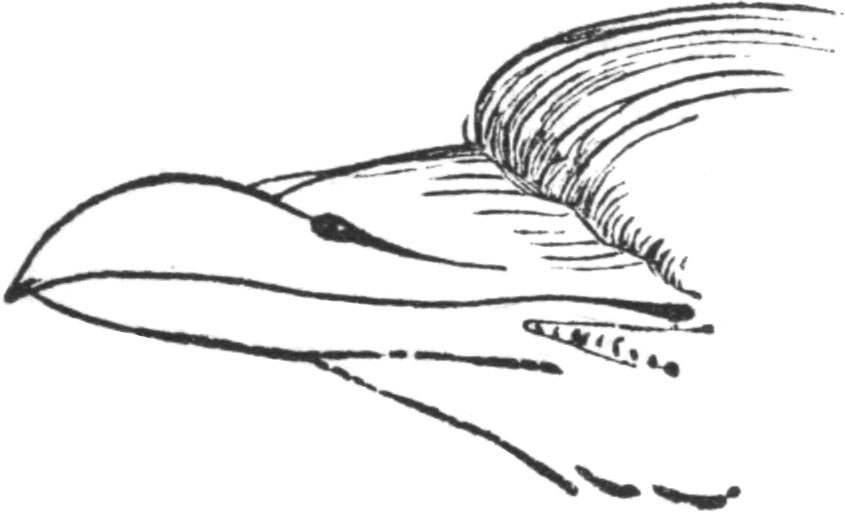
Columba Beak
Wood Pigeon or Ring Dove
Columba palumbus.—Linnæus.
Palumbus torquatus, Willough. Ray.—Columba palumbus, Linn.—Colombe ramier, Temm.—Wood Pigeon, Ring Pigeon, Ring Dove, of British authors. Quest or Cushat, Provincially.
The Wood Pigeon or Ring Dove is the most common as well as the most generally distributed of our native pigeons, extending over the three kingdoms; but becoming more sparingly distributed to the northward, where the low character of the woods is unfriendly to its presence. In the south and middle of Scotland, and in all the wooded districts of England and Ireland, it is abundant; it is even blamed, and with some reason, for its depredations on the crops of the farmer, particularly turnips, to which the appearance of snow or frost invariably drives them. In the garden, in spring time also, they occasionally do considerable damage, breaking over and eating the young cabbage plants and other greens, and cropping the peas even when five or six inches above the ground. Nevertheless, they are a favourite bird, and are not frequently molested or wantonly destroyed. The love note or cooing is one of those harbingers of a change from the severity of winter, that is looked for and listened to by the resident in the country with feelings of delight; and previous to the arrival of the summer birds of passage, bears a marked part in the melody of our woods and groves. Mr. Yarrell gives the southern parts of Russia and Siberia, and during summer Denmark and Sweden, as their northern range, and states that it is found in the latitude of Madeira; in the notes to a small collection of birds given to us by W. T. Carruthers, Esq., of Dormont, the common Wood Pigeon is stated to have been seen in that island.3
The Wood Pigeon, in winter, when not tamed by its severity, is a remarkably shy and watchful bird, and being then assembled in flocks, often amounting to hundreds, is very difficult to be approached. As spring advances, and pairing has commenced, this wariness is in part lost, and young plantations, the shrubbery, and even the garden, if possessing some large evergreens, are favourite resorts. There they become familiarised with the presence of company, and will proceed unheedingly with the slender structure of their nests, and other duties of incubation. A few years since, one built upon an evergreen overhanging a walk, scarcely a yard above the heads of persons passing; there was a constant thoroughfare, the bird was hourly looked at, and even spoken to, still it persevered in its charge, and seemed to have confidence in being protected.
The food of the Wood Pigeon is very varied. Grains of all kinds are eaten with avidity; a field of peas or beans, after the crop has been reaped, is a tempting pasture. The roots of several of the grasses, and as Professor Macgillivray observes, that of Potentilla anserina are gathered on the fallows: beech mast is a great favourite, and, during winter, turnips and other green crops are often attacked, to the serious injury of the proprietor. Except during the breeding season they are gregarious, feed together in large flocks, and like many other species, retire at night to some common roosting place, where they are often successfully procured, by watching in concealment about the time of the coming in of the birds. Many of the pigeons possess peculiar flights, in the typical species it is powerful, and the strong feathers of the wings render it noisy when suddenly disturbed, or when escaping from some thicket. During incubation they may also be seen rising with rapid strokes, and making the wings clap together as the elevation is attained, and then, keeping them expanded, falling gracefully to their former level.
This species has never been applied to any economical purpose, their shy and timid nature being a bar to their domestication. It was indeed thought that they could not be made to breed in confinement, and it is probable that it would require a series of generations to accustom them to domesticity; the few instances where successful taming has been accomplished, having been attended with great trouble and attention. Mr. Yarrell mentions, that they have bred in the aviary at Knowlsley, and that a pair in the Zoological Gardens constructed a nest, which was unfortunately destroyed.
The prevailing colour of this beautiful bird is blueish-grey, being dark on the back and wing-coverts, and forming there, as it were, a mantle. The breast and under parts are brownish purple-red, shading to paler onvent, and being nearly pure white on the under tail-covers; the breast and sides of the neck exhibit rich green and purple reflections, and the sides of the latter are marked with a conspicuous patch of dull white, having the webs of the feathers there unconnected. The quills are blackish-grey, margined with white. The shoulders white, and form a conspicuous mark on the wings during flight. The ample tail is blackish-grey, with a dark band at the extremity. The bill is orange, brownish-red above the nostrils, and at the base covered with a white scaly substance. Feet and legs purplish-red. In the first plumage the feathers are edged with pale yellowish-brown, and even after this state has been changed, the breast does not receive the rich reflected play of colours, nor the sides of the neck the white patch, and all the other markings are less distinct.

Plate I

The Stock-Dove
Columba œnas, Linnæus.—C. œnas. Linn. Columbe columbin, Temm.—Stock Dove of British authors.
This species, though apparently possessing a very wide geographical distribution, is local in its British range, and, so far as we can ascertain, has not yet been met with in Scotland or Ireland; it is, in fact, confined to a few of the southern counties in England, and there, not even to those in which wood abounds; and
in the open counties of Suffolk and Norfolk, this species frequently makes its nest in the holes in the ground, generally selecting a rabbit’s burrow for the purpose.
We have had little opportunity of seeing the species wild, or of attending to its habits; where we have seen it, it has been among aged wood, and at a distance the flight is not easily distinguished from that of the wood pigeon. According to our best informed British ornithologists, it is most frequent in a comparatively well wooded district, breeding in decayed trees and in the pollards. They are also described in the open countries to “nestle under thick furze bushes, which are impervious to rain.”4 Its manners, in other respects, somewhat resemble the last, mixing occasionally with it and being gregarious in winter; the food is also similar. Its note is described as more indistinct and regular than the last, and does not bring with it the same associations as that of either the wood pigeon or turtle dove. The young are frequently brought to the London market, and are much esteemed.
There appears to be authority for the occurrence of the Stock Dove in Sweden5 as a summer visitant. The same also in Germany and France, and the eastern part of Spain,6 Madeira,7 North Africa,8 Erzeroom.9
Specimens procured from Kent, in spring, had the head, throat, and fore part of the neck, dark blueish-grey, on the crown approaching to blackish-grey; the sides and back of the neck of a metallic lustre, changing from green to purple, the former being the prevailing shade. Back, blueish-grey. Wings on the shoulders, blueish-grey. The wing-covers pale, and marked with undecided dark nearly square spots, which form sometimes a partial bar. The greater covers are pale blueish-grey at the base, shading into deep blackish-brown at the tips. The quills blackish-brown, rump and upper tail-coverts blueish-grey. Tail at the base of the same colour, black at the tip, with an indistinct paler clouded bar about the centre, the outer web of exterior feathers white. The breast is reddish lavender purple, and the remaining under parts are pale blueish-grey. Feet and legs red.
White-Rumped Pigeon or Rock Dove
Columba livia, Linn.—Columbe biset, Temm. White-rumped Pigeon, Rock Dove of British authors.
It is to this species that all our most accurate ornithologists refer the domestic races of pigeons. Those of the dove-cots of Britain are undoubtedly referable to it; but it may be, that the more marked varieties have some additional cross. It is this bird also which has furnished those so celebrated in story as the messengers of politics, commerce, or of love; and it is the “blue rock” which supplies the traps for the modern pigeon-shooter.
In habits, the Rock Pigeon is very similar to those we have already described, only that rocks and gloomy caves 011 the sea coast, supply the place of hollow trees and the umbrageous forest. In winter they assemble in flocks, and feed on the various grains or seeds which their vicinity may supply, but they rarely venture to any distance from the shore; in addition, the animals of our land molusca, particularly Helices, seem to be frequently devoured. In a wild state, and when in health, we believe they never perch on trees, which are indeed very seldom present near their haunts; but we can corroborate the facts stated by Mr. Eyton, of the inmates of our pigeon houses frequently perching, when the cot happens to be built near or amidst old trees, particularly such as have bare branches; and, in one instance, we have seen a tree nearly dead and leafless, always selected. Nevertheless, as the name indicates, rocks and caves are the natural resting places, and a curious assemblage of birds, very different in their natures, may sometimes be observed in and about the entrance of these sea worn caverns. An eagle, or pair of peregrine falcons, may claim the centre of the precipice; a little lower, gulls and guillemots may nestle; cormorants may occupy the mouth of the cave, and jackdaws and starlings may chatter in its outward rents and crevices; the murmur of the Rock Dove, from its shelves, fills the interior, when it can be distinguished from the noise of the surge at its entrance.
As the last species particularly frequented the southern parts of our island, so do we find the Rock Dow, frequent, and most numerous, towards the north. We have indeed few English localities mentioned. Mr. Selby states, that they are found in the cliffs of Caldy Island in South Wales; and we are informed by a letter from Mr. Yarrell, on the authority of Dr. Moore and Mr. Couch, that they breed on some parts of the Devonshire and Cornish coasts. In Scotland the localities are numerous; on the southern shores, St. Abb’s Head, the Bass Rock, and Isle of May, produce them; but as the domestic varieties are occasionally seen in their company, it may be questioned, as Professor Macgillivray10 remarks, whether they are now quite pure in these stations. Scarcely any difference can be observed, except in size, from Orkney specimens, and the birds seem to have been inhabitants of these rocks as far back as we can trace. On all the rocky shores of the north of Scotland, and the islands Orkney11 and Shetland,12 they are common birds, breeding and roosting in the numerous caverns with which the precipices are pierced.
Its extra European range appears from various authorities to be very extensive. We have not had opportunities of examining specimens from any of the localities mentioned, nor have we ever received it in collections from abroad, but we give beneath the sources of our information. Denmark, Sweden, Norway, and the Feroe Islands, islands of the Mediterranean as far eastward as Greece, Madeira,13 Lake Baikal,14 Japan,15 North of Africa, and the island of Teneriffe.16
The prevailing colours in this species are also shades of blueish-grey, relieved by two broad and distinct dark bars on the wing-coverts and secondaries running across, and by the lower part of the back being white. The breast and neck are dark lavender purple, with rich purple and green reflections, but without any neck patch. The tail is of a deeper tint, tipped with a broad dark band. The feet and legs purplish-red.
The principal variations in a domestic or dove-cot state, are to paler shades of blueish-grey, and to the extinction of the white on the rump; vinous or reddish purple is a change not unfrequent, and here all the markings of the true state are kept up in darker and lighter shades; white birds occur, and they are sometimes pied with black. Among the fancy breeds, now become very numerous, and receiving provincial names from their properties. The “Tumbler” and “Carrier” pigeons are remarkable, from the proportional shortness and length of their respective heads and bills, and where a deviation of structure from the original type is observed. Another remarkable deviation is in the “Fan Tails” and “Broad-tailed Shakers” where the tail is displayed, and consists of numerous feathers, sometimes amounting to thirty-six in number. In the “Jacobin” the feathers are reversed, and turn over as a cowl on the back of the head and neck. In another, again, the tarsi become feathered, and in the extreme of this variation, the plumes are lengthened, and stick out in the form of little wings.17
The Turtle Doves or Pigeons of which we possess a single migratory example, are all of a smaller and more slender proportion than the true pigeons, and the tail is much graduated. They are thus characterized.
Turtur—Generic character.—Bill slender, tip deflected; the maxilla showing little appearance of an angle; wings lengthened; the second quill longest, the first often partially accuminated; tail slightly graduated.
Types,—T. migratorius, risorius. Europe, Africa, Indian Islands, Australia.
Note.—Arboreal, chiefly migratory.
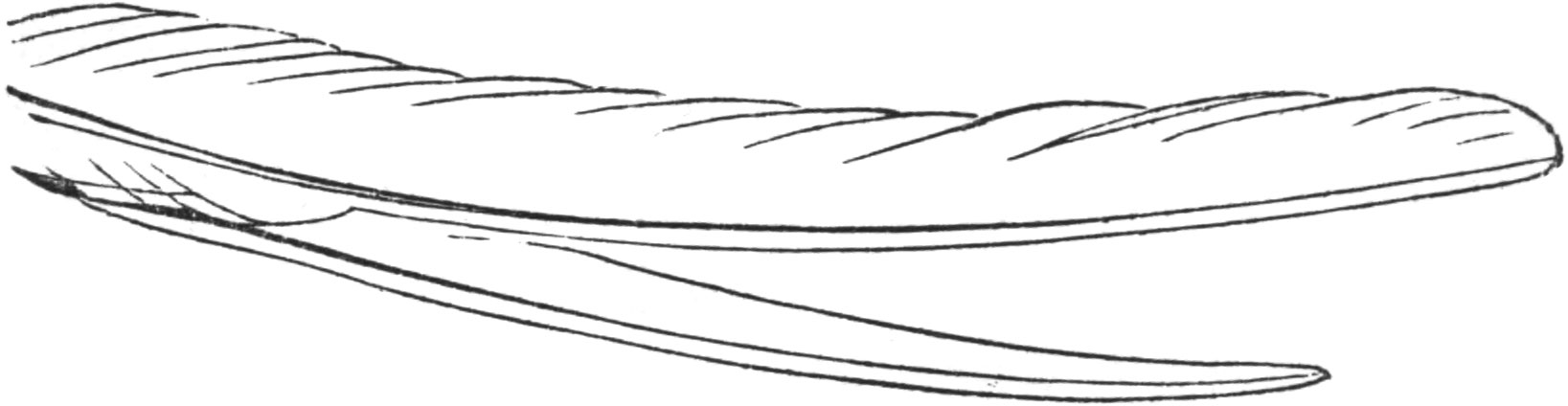
Turtle Dove Feathers
The Turtle Dove
Turtur migratorius, Swainson.—Columbaturtur, Linn.—Turturauritus, Ray.—La Tourturelle, Temm. and French authors. The Common Turtle, or Turtle Dove of British authors.
The Turtle Dove maybe considered as a species entirely southern; the instances of its capture in the northern counties of England, or in one or two instances in Scotland or Ireland, being only those of stray birds, which, from some cause or other, have exceeded the limit of their migration. We have seen it ourselves in Kent, in Hertfordshire, and in Holland, during temporary excursions, but have had no opportunity of observing it closely. In the instance, which we communicated to Mr. Yarrell, of shooting a specimen in the garden at Jardine Hall, the bird had frequented a break of peas, nearly ripe, for several days, and at last attracted the attention of the gardener, as one not previously known to him. When it was afterwards sought for, it was discovered in the same place, rose with considerable noise, and alighted on a neighbouring tree, whence it was shot. The plumage was that of an immature bird. Mr. Yarrell considers the Turtle more numerous in the wooded parts of Kent than in other districts of England, but it occurs in most of the southern counties, and becomes only occasionally seen in Yorkshire, Cumberland, and Northumberland, &c. The only other instances of the occurrence of the bird in Scotland, of which we have any record, is that of one killed in Perthshire, in October, 1834;18 and a few days since (2d October) we saw a fresh skin in possession of Mr. Carfrae of Edinburgh, taken from a specimen killed in Aberdeenshire about a fortnight previously. In Ireland it appears to be equally rare, arid equally a straggler. Out of Britain, it occurs on the continent and on the shores of the Mediterranean, in Asia Minor,19 in the vicinity of Smyrna;20 and it is considered to winter in Africa.21 In its British localities it is a regular summer visitant, arriving about the end of April or beginning of May, leaving us again in August or September. The love note is described as low and plaintive, and the nest is a structure resembling that of the true pigeons. Their food is also similar, consisting* of various grains and seeds, at least during their visit to this country, elsewhere it is probable some green food may be in part resorted to. We have once or twice received the young birds from the south, but was never successful in preserving them alive over the ensuing spring; at first they are easily tamed and thrive well, but at the time of migration they became restless, and drooped ere the spring again advanced.
Crown blueish-grey; back of the neck and upper part of the back wood-brown, the same colour extending to the lower part of the back, rump, and upper tail-covers, the feathers on the last being grey at the base; scapulars and covers black, passing into grey, deeply edged with rufous orange; edges of the shoulders and first lesser covers, blueish-grey; quills, brownish-black; tail is blackish-grey, tipped with white, except the centre feathers, which are entirely clove-brown; at the separation between the white tips the blackish-grey becomes deeper, and sometimes indicates an indistinct bar; on looking at the tail from below, the dark part appears uniform black, and contrasts finely with the pure white extremities of the feathers, together with the outer web of the exterior feather, which is also white. The fore part of the neck, breast, and belly, shading gradually into the vent, are dull brownish crimson-red; the vent and under tail-covers pure white; on the sides of the neck there is the irregular patch of scale like feathers so frequently occurring among the Columbidæ, deep black, edged with white.
The genus Ectopistes was long since established by Mr. Swainson, for the Passenger and Carolina Pigeons of America. They are closely allied to the last, and differ chiefly from it in the development of the organs of flight, the wings and tail; all the species that we know of are gregarious, perform lengthened migrations, and are arboreal in their habits.—Swainson.
Ectopistes—Generic character.—Bill moderate, the maxilla with little angle; “wings very long, pointed, the two first quills longest; tail cuneated, the four middle feathers lanceolate; hinder toe and tarsus equal, the latter half plumed. The fissirostral type.”
Types, E. migratorla. America.
Passenger Pigeon
Ectopistes migratoria, Swainson. Columla migratoria, Linn., etc.—Colombe voyageuse, Temm.—Ectoputes migratoria, Swain., Selby.—Passenger and Migratory Pigeon and Turtle of British authors.
The addition of the above genus to the British list, consists in the capture of a specimen of the migratory pigeon of America, recorded by Professor Fleming to have been
shot while perched on a wall in the neighbourhood of a pigeon-house at Westhall, in the parish of Monymail, Fifeshire, 1st December, 1825. The feathers were quite fresh and entire, like those of a wild bird.22
A second specimen is said to have been killed in Roxburghshire, but we have not been able to trace it. According to Temminck, it occurs in a similar stray manner in the northern parts of the continent, and it is probable that some of these birds may occasionally wander and be taken on our islands.
The Passenger Pigeon is a native of and ranges over nearly the whole of the immense continent of North America, extending far to the northward. It visits the fur countries,23 and the district around Hudson’s Bay,24 but reaches the 53° only in fine summers. In warmer parts it extends to the 62°, and to the gulf of Mexico.25 Its habits in its native country are described by Wilson and Audubon, with their own spirit and enthusiasm, and will repay the perusal; but extracts, which would do justice to the authors, are far too long to be inserted here. In this country they have been several times kept in confinement, and seem to thrive well, and not to suffer at the period of the spring and fall, as most migratory birds do, when detained from their change of country at the appointed time. Mr. Audubon, on one of his visits to America, returned with a large stock of live birds, which were distributed among those who possessed the convenience for keeping and superintending their almost domesticated state. Several pairs were presented to the magnificent aviary at Knowlsley, arid also to the Zoological Society, and in both instances they incubated and hatched their young.
Tetraonidæ
The Tetraonidæ is another family of the Rasores which belongs to British ornithology. The birds belonging to it in general pair and remain in parties, the number of the broods from season to season; but some species are polygamous, and run into this great characteristic of the rasorial group. They, during winter, congregate in large flocks, without distinction of broods, and continue thus assembled until breeding time. There is in all a greater or less change of plumage during the breeding season, and in some, that of the winter is very different from the summer state. The deprivation in this family of the naked skins and wattles, &c., with the large development of the tail and its accessaries so prevalent among the Pavonidæ, is represented only by the bright coloured skin around the eyes; the elongation of the feathers on the sides of the neck, and by the bare skins, capable of being inflated upon the axilla and sides of the neck.26 All of them breed upon the ground, and, with few exceptions, they lay numerous eggs; they are, indeed, chiefly terrestrial in their habits, though several species inhabit wooded districts, perch on trees, and feed on their young shoots or buds.
The genus Tetrao, or the Grouse, which are chiefly characteristic of this family, were formerly all included under that title, but have, by modern ornithologists, been sub-divided, both on account of a difference of habit, and a modification in the form of several of the parts, and Tetrao is now kept for those large and powerful species, with expanded tails and naked feet, which are polygamous, and dwell in shaded forests or wooded districts. Once we possessed a truly typical species, for the recovery of which great exertions are making; but the true forms are now chiefly found in Northern Europe and America, though a very near example of the general shape and appearance may be seen in the female of our black cock, the greatly developed tail of the male presenting a variation, which has been considered by some as of sub-generic importance.
Tetrao of modern ornithologists.—Generic characters.—Bill short, very strong and arched from the base; nostrils basal, lateral, and hidden from view by closely set feathers; a naked skin above the eyes, enlarging in spring, and coloured brightly; wings short, concave, third and fourth quills longest; tail very ample and expanding, (rounded;27) feet naked, with the edges of the toes fringed; tarsi feathered.
Types, T. urogallus, obscurus. Europe, Northern Asia, North America.
Note.—Polygamous, gregarious in winter, breed on the ground; but in habits are partly arboreal.
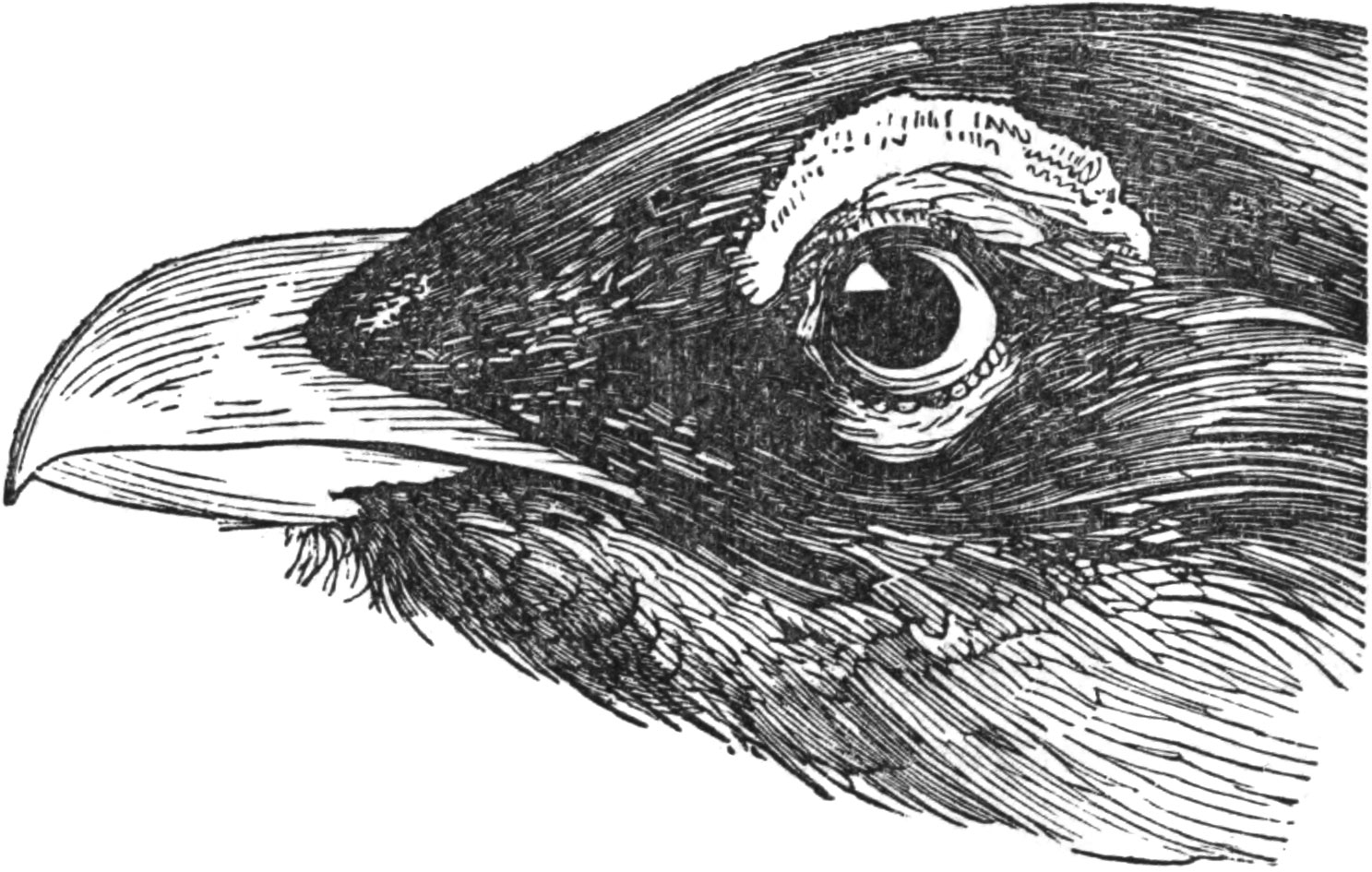
Tetrao Head
The Wood-Grouse or Capercailzie
Tetrao urogallus, Linn.—Tetrao urogallus, Linn.—Tetro auerhan, Temm.—Wood Grouse, Cock of the Wood, Capercailzie, of British authors.
We gave the descriptions of most of the birds composing the game list in a former volume, and although, according to the plan of the “Library,” they must be also given here, we have little to add, except in bringing down our information to the present time, where any thing worthy of notice may have occurred.
At the head of this section we may place the Capercailzie, as first in both size and strength; the strong and hooked bill of the male reminding us more of that member in the birds of prey, than in one of the Rasores. The Capercailzie was certainly the noblest of the British feathered game: but the attributes of size, strength, and beauty, have proved his destruction, and it has been for many years extinct. In ancient times they were tolerably abundant in the primeval forests of Scotland and Ireland.28 From the latter they appear to have been entirely extirpated at a very early period, while in Scotland their destruction was more gradual, but they dwindled away, and the last specimen is recorded to have been killed in the neighbourhood of Inverness, more than sixty years since. There is a prospect, however, of the species being again introduced into Scotland, by the exertions of some of our Highland nobility. Lord Fyfe has attempted to naturalise the Cock of the Wood at Mar Lodge. The first importation from Sweden was accomplished in 1827, or early in 1828, but was unattended with success, owing to the death of the male bird, most probably from harm received during the transportation. In the year following, fresh birds were imported, and young were successfully reared after several attempts. These, in 1831, it was intended to turn out, so soon as they were sufficiently advanced; but we have been unable to trace whether this was done, and what was their fate.29 At a later period, 1838–39, Lord Breadalbane received from Mr. Loyd no fewer than forty-four Capercailzies, some of which were turned out, while others were retained in confinement; both have succeeded; and Mr. Yarrell states, that in 1839, seventy-nine young birds were known to be hatched. The Duchess of Athole had some birds sent to her at Blair, and some have been hatched in the aviary at Knowlsley. Thomas Fowell Buxton, Esq., has succeeded in rearing them in confinement in Norfolk; and it is evident, that with ordinary attention, there is little difficulty in their propagation in confinement, whence, in a few years, a stock could be reared in some suitable locality, where there was a strict protection. In various parts of Northern Europe also, we have the authority of Mr. Loyd, Nilsson, and others, for their being not unfrequently domesticated.
In its habits in a wild state, all our accounts agree, in stating their close alliance to those of the black cock. They frequent forests, and those wild tracts of country, which, we imagine, are partially interspersed with native brush-wood, intermingled with patches of old timber, where they feed on the tender shoots, the buds, and berries which those regions furnish. In breeding time the male attracts the females by his call, on some eminence or open spot, and, after that season has passed, retires and skulks to undergo the process of moulting; the female alone performs the duties of incubation, and the brood continues with her until the males begin to change their plumage. Such, at least, is the information we draw from the works of those gentlemen who have had occasional opportunities of observing them. The poulterers, in London and Edinburgh, now import them in considerable quantities, along with the other northern grouse, after the season has terminated here, and, we rather think, that many must be then procured after the season of courtship has commenced. In this present spring (1840), several pairs were for sale in the latter city, and in very good condition, and one guinea was the price asked for a male in a tolerable state of plumage. We have also received specimens from Newcastle, where we understand the importation is frequent at a similar period. They may be brought to table as a curiosity, but those we have tasted were coarse and highly flavoured with the fir; but during summer they may lose this, and the young birds may be very palatable.
Before passing from this species, we must shortly notice the Tetrao medius of authors, of which there are slight indications of its having once existed in Scotland, and, if the supposition of those ornithologists who consider it as a hybrid between the Capercailzie and the black cock, be correct, we see no reason why the occasional crossing should not have taken place in this country, as well as in Norway or Sweden. The continental ornithologists generally, we believe, adopt the theory of hybridity, and it has been assented to, or at least not contradicted, by those of this country. One residing at a distance from their haunts cannot be expected to go narrowly into the question, and the following remarks are made with the view of directing the attention of persons who have the opportunity, to a fact which we do not consider as yet satisfactorily proved. The bird in the dress of T. medius, appears to be far too common for a hybrid; since the introduction of game from Northern Europe, it is to be procured almost every spring in the poultry shops of some of the larger towns, and Mr. Yarrell speaks to as many as seven specimens, during ten years, in the shops of one poulterer in London. But among all the specimens we have examined, and in those of our own collection, there was, and is, no difference whatever in the plumage of the specimens, they are exactly similar; now, in hybrids, we should expect, and do find, not two species similar. The intermediate form of the bird is just that which we would look for to intervene between the Capercailzie, or the round tailed grouse of America, and the extreme of development seen in the black cock. On the other side, we have an intermediate form between them and the long acuminated tail of the cock of the plains. The scarcity of the females we would attribute to their being confused with the true Capercailzie hens, which vary so much in size. The similarity of the specimens we, however, consider now as the strongest fact against the hybrid theory, and even if a differently marked specimen should occur, and they can bear no proportion whatever to the resembling ones, we should consider it much more probable to be a cross between the presently considered hybrid and the Capercailzie. A fine male specimen of the Capercailzie will sit fully two feet above the branch on which he is perched; and will be in total length from two feet ten inches to three feet. The bill very powerful, is yellowish-white, darker towards the base; the whole head and neck is blackish-grey; the feathers of a lanceolate form, darker in their centres, and minutely freckled over with black; immediately below the chin they are elongated, and can be raised at will, these are of a deep black, and are edged with a glossy border of green and purple; underneath each eye there is a white patch; the centre of the back and wings are rich orange coloured brown, marked in wavy lines of freckles of brownish-black; the quills are reddish-umber-brown; the lower parts of the back and rump, have a ground colour of grey or brownish-grey, thickly marked with broad wavy lines of black, giving the whole, at a little distance, an appearance of blackish-grey; the centre upper tail-coverts are elongated, are nearly black, clouded with brownish-grey, and have the tips of each white; the tail is black, marked at about two inches from the extremity with broken white patches, which form a wavy interrupted band across; the breast is bright, shining greenish-black, shaded with purplish reflections on the sides, the feathers, of a very fine and close texture, and presenting a surface that would turn ordinary shot striking it directly; the belly and other parts of the under surface are glossy black, in the centre interspersed with patches of white on the sides and; flanks the feathers have the grey or brownish-grey ground colour, freckled with black; the tarsi are feathered with brownish-grey plumes, very much elongated behind, and approaching to the loose texture of those in the true moorfowl; they are double the length of the hind toe, which they completely conceal.
The females appear to vary considerably in size. One procured in the same cargo which contained the above described male, is only from two to three and twenty inches in length, and would not sit more than seventeen inches high. The general appearance of the markings are similar to those of the grey hen, ochreous-brown, barred with black, but the colours are clearer, the barring broader and more distinct, the edges of the feathers being always paler; the centre of the breast, where the rich green of the male is seen, is of a uniform tint of rich brownish-orange, in parts slightly marked with freckles, where the bars are placed. The bill is dark horn colour, paler towards the tip. In another female from Russia, now before us, the entire length is twenty-two inches.
The Black Grouse or Black Cock
Tetrao tetrix, Linn.—Tetrao tetrix of authors.—Tetras birkhan, Temm.—Lyrurus tetrix, Swain.—Black Grouse or Black Cock. Grey Hen of British authors.
This species is pretty generally spread over Europe, being met with in France and Germany, and even so far to the south as in Italy;30 and as we reach the north, in Russia, Norway, Siberia, Scandinavia, and in Lapland. In Britain it occurs in the two countries, being most sparingly distributed, however, in England; the New Forest in Hampshire, Somerset, Dartmoor and Exmoor in Devonshire;31 the wild parts of Staffordshire and Lancashire, and so on until we reach the “border,” where it becomes abundant in the wild districts which conduct us to its still more frequent haunts in Scotland. There it is abundant, and may be found in most of the districts which are suited for it, extending north to Sutherland, and to the islands of Mull and Skye.32 In Ireland, Mr. Thompson informs us, it long since became extinct, though in Smith’s history of Cork (1749) it is mentioned as “frequent”
The favourite abodes of the Black Grouse are sub-alpine sheep countries, where there is comparatively little heath, where there are moist flats or meadows, abounding with a rank and luxuriant herbage, and where the glades and passes among the hills are clothed with natural brushwood of birch and hazel, willow and alder, and have a tangled bottom of deep fern. These afford an abundant supply of food, with shelter from the cold at night, and the scorching rays of a midsummer sun.
The Black Cock is polygamous. In the warmer sunny days, at the conclusion of winter, and commencement of spring, the males, after feeding, may be seen arranged on some turf fence, rail, or sheepfold, pluming their wings, expanding their tails, and practising, as it were, their love-call. If the weather now continues warm, the flocks soon separate, and the males select some conspicuous spots, from whence they endeavour to drive all rivals, and commence to display their arts to allure the females. The places selected at such seasons are generally elevations, the turf enclosure of a former sheep-fold, which has been disused, and is now grown over, or some of those beautiful spots of fresh and grassy pasture which are well known to the inhabitants of a pastoral district. Here, after perhaps many battles have been fought and rivals vanquished, the noble full dressed Black Cock takes his stand, commencing at the first dawn of day, and where the game is abundant, the hill on every side repeats the humming call; they strut around the spots selected, trailing their wings, inflating the throat and neck, and puffing up the plumage of these parts and the now brilliant wattle above the eyes, raising and expanding the tail, and displaying the beautifully contrasting white under tail-covers; he is soon heard by the females, who crowd around their lord and master. This season of admiration does not continue long; the females disperse to seek proper situations for depositing their eggs, while the males, losing their feeling for love and fighting, reassemble in small parties, and seek the shelter of the brush and fern beds to complete a new moult, and are seldom seen, except early in the morning or at evening, when they exhibit a degree of timidity, the very reverse of their former boldness and vigilance. The old males continue separate until winter, and afterwards seem to display an inclination to flock by themselves; but in many cases they join with the young broods, and all resort; morning and evening, to some favourite feeding grounds, spending the middle part of the day in rest, or in basking, pluming, or sporting upon some sunny hill side. Upon the females devolve the whole duties of rearing and protecting the young; the nest is made upon the ground, not far from water, and the young, when hatched, are conveyed to the low rushy hollows, where there is abundance of food, supplied by the tender seeds of the rushes and alpine grasses. The young are seldom full grown before the 1st of September; and even, at this season, if they have been undisturbed previously, they will almost suffer themselves to be lifted from before the pointers. During summer the general food is the seeds of the various grasses, and the berries of the different alpine plants;33 in winter, the tender shoots of the fir, catkins of birch and hazel, heath, and even the leaves of fern, and these often give their peculiar flavour to the flesh. But in the lower districts, where, indeed, this bird is most abundant, the gleaning of the stubble yields a plentiful meal, fields of turnip and rape are also favourite feeding places, and the leaves supply a more grateful food during hard frost than they could elsewhere procure. In some places, flocks of hundreds assemble at feeding times, and although at this time they are extremely shy and wary, the fences and enclosures often allow them to be approached within shot.
The plumage of the adult male is on all the upper parts of a rich steel-blue, on the lower parts pitch-black, which duller colour is also seen on the secondaries and wing-coverts; the greater coverts are tipped with white, forming a bar across the wings, conspicuous in flight, and the under tail-coverts are of the same pure colour. In the full plumage, immediately succeeding the moult, there is a tinge of brown intermixed, which is changed as the winter terminates but the most remarkable structure of this bird, is that of the tail, formed of gradually elongated feathers, diverging or curving outwardly, and when at the highest development, expanding into a graceful lyre shaped tail. There is nothing in the habits of the bird which corresponds with this structure; the flight is powerful, but is neither in general long sustained, nor applied to any peculiar habits in the species. Mr. Swainson has from this form made his sub-genus “Lyrurus,” considering it as the fissirostral type, and bearing analogy, in its forked tail and glossy plumage, to the Drongo Shrikes of Africa and India. In the female the form is similar, but the proportions are smaller, and the divariation of the tail scarcely exceeds half an inch in depth. The ground colour of the entire plumage is pale brownish-orange, becoming nearly yellowish-white on the throat, breast, and belly; and on the sides of the neck, slightly tinged with a shade of vinous purple; all is barred with black, intermixed with wavy broken lines of the same colour; on the wings and shoulders the centre of the feathers are black, but the shaft runs through of a paler colour, broadening and becoming paler towards the tip, as in the partridges; the bill in both sexes is nearly black. This species does not seem so liable to variation as some of the other Tetraonidæ. We possess a female or grey hen, shot by the late Sir Sidney Beckwith, entirely of a dull whitish grey, having the cross markings of a darker and browner shade.
Lagopus.—Generic characters.—Bill very short, clothed at the base with feathers, which conceal the nostrils; wings short, somewhat rounded, with the third and fourth quills longest; tail short, and nearly square at the end; tarsi and toes completely covered with hair-like feathers, sometimes covering the claws, which are long, straight, and somewhat flattened.
Types, L. Scoticus mutus, &c. Europe, northern parts of North America. The Arctic Circle.
Note.—Monogamous; gregarious in winter; habits entirely terrestrial.
The Red Grouse or Red Ptarmigan
Lagopus Scoticus, Vieillot.—Tetrao Scoticus, Linn., Penn., etc.—Tetras rouge, Temm.—Moorfowl or Red Grouse of British authors.
The Red Grouse, or Moorfowl, has peculiar claims on the naturalists and sportsmen of Britain, as being an insulated species, hitherto undiscovered except in moorland districts of Great Britain and Ireland. Those birds which, in other parts of Northern Europe, resemble it in the colouring of the plumage of summer, differ from it in several particulars, considered of sufficient importance to constitute distinct species.
The Red Grouse is still plentiful in Scotland and England, but is no wmore sparingly spread over the southern districts of the former; upon the moors it is well known that not a tenth of the former number of birds at present exist, and it is only in the more remote districts, where access and accommodation for sportsmen are still in some degree wanting, that they are to be seen in any thing like their former numbers.
The habits of the birds have considerably changed. By the approaches of cultivation to the higher districts, and by insulated patches of grain even in the middle of the wildest, the grouse have learned to depend on the labours of the husbandman for his winter’s food, and instead of seeking a more precarious subsistence, during the snow, of tender heath-tops or other mountain plants, they migrate to the lower grounds and enclosures, and before the grain is removed, find a plentiful harvest. Hundreds crowd the stooks in the upland corn-fields, where the weather is uncertain, and the grain remains out even till “December’s snows;” while in the lower countries they seek what has been left on the stubble or ploughed fields. It is only in the wildest parts of the Highlands, the Cairngorm range, Koss, or Sutherland, where the grouse is an inhabitant, through the year, of the moors, his native pasture, and where he is also nearly the only enlivener of these wild solitudes, by his loud morning and evening call. During summer it may be varied by the whistle of the curlew, or the wailing of the golden plover, or perhaps interrupted by the sailing flight of some harrier or other bird of prey; but in winter, for miles around,
Dwells but the gor-cock and the deer.
Unless where much disturbed, the grouse is not a wild bird, and, unaware of danger, it will allow a person to approach or walk past, uttering only its call, as if to make its companions aware that something is near. In districts where they are much followed, they, however, become one of the most wild and wary of our game, and are almost impossible to be approached except by stratagem. For nearer concealment they are amply provided, by the similarity of the tints of their plumage with the dark brown moss and heath, and, except for the assistance of the pointer, could not be discovered. Unlike the large true grouse, the birds of the present group all pair and continue with their broods until a return of the warm season. The young in some seasons are dreadfully ravaged by the tapeworm almost entirely destroying them in the districts where it occurs. It is their most severe natural enemy. The Bed Grouse pairs very early—if mild in January—and the female commences laying at the end of March. The eggs are deposited in a shallow hollow at the foot of some tuft of heath, which affords a partial covering and shelter, and only a few straws or grasses serve to separate them from the ground. Both parents attend, and boldly defend the nest or young from the ordinary aggressors; one of the most dangerous for the eggs is the common carrion crow (C. corone); and this is attacked in return, and often beaten off successfully. In confinement they are easily tamed, and become familiar. They even lay under very dissimilar circumstances to the exposure of their native moors, though the young are not often so reared to maturity. We have known a brood hatched under a kitchen dresser. They have also bred in several aviaries; but the young have suffered a similar fate, most probably from the absence of some food peculiarly fitted for this season, and wanting in their artificial breeding grounds.
The adult plumage of the grouse which have attained an age beyond a year or two, is a ground colour of deep rich sienna-brown, shading on the belly almost to pure black, with paler tips, and wared across with brownish-black. Many specimens are much marked with white on the underparts, and some to a greater degree than others, and this, though it is generally considered to be the mark of age, is rather incident to the younger birds. The female is of a paler ground tint, and has all the pale markings larger. During the breeding season the feathers of both become much more marked, and cut into, as it were, with yellow, and have the tips pale yellowish-white; and the bare skin above the eyes increases in size and intensity of colour. The young, in their first plumage nearly resemble the female, but have rather more ochreous mixed with the plumage, and have the markings more distributed in bars. The Red Grouse is subject to variety, though not very frequently. It is generally to a paler tint of the whole plumage. Mr. Selby notes the occurrence of a cream-coloured or light-grey variety upon the Blanchland moors of Durham, which appear to have bred, and continued the variety from year to year. We possess a Grouse, shot on the moors of Galloway, where the ground colour is nearly yellowish-white, and all the dark markings are represented by pale reddish-brown; the quills are dirty white. In some instances the plumage takes an opposite shade, and is remarkable for its deep tint, and the almost entire absence of markings. The whole, or a part of the quills, are often found white.
The Common or White Ptarmigan
Lagopus mutus, Vieillot.—Tetrao lagopus. Linn., Penn., etc.—Lagopus mutus. Ptarmigan or White Grouse of British authors.
This bird, delicately marked in its summer dress, and of a snowy whiteness in that of winter, has generally been considered as a native of both the American and European continents. The comparison, however, of many specimens of grouse which become white in winter, leads us to believe that the distinction of species is still somewhat undecided, and that the range or comparative abundance of the British species is still undetermined. We have seen, however, what we consider the L. mutus, from arctic America, and also among the packages of birds which are said by the poulterers to come from Norway; but many of the birds mentioned by authors as “Ptarmigan,” from various localities, cannot always with certainty be referred to that of Britain.
In Great Britain it is a species confined to the most alpine districts, and its only habitation now, seems to be the high mountain ranges in the middle of Scotland, increasing in abundance as the same kind of wild country reaches to the north; and it also extends to the Hebrides. According to Pennant, and some contemporary writers, these birds were once found on the hills of Westmoreland and Cumberland; and, we believe, recollections even exist of a few having been seen upon the high ranges which appear on the opposite border of Scotland. These have been for some time extirpated, and unless a few solitary pairs remain on Skiddaw, or some of its precipitous neighbours, the range of the Grampians will be its most southern British station.
They inhabit the most barren and rocky spots, often where nothing is to be seen butan interminable series of rugged rocks distributed in boulder masses, varying in size from huge lumps to pieces of a few inches in diameter. Here, during spring and summer, the pairs and their broods remain almost the only inhabitants, and are discovered with the greatest difficulty, the mixture of the colours of the plumage forming a tint which harmonizes with that of the grey rocks around. At this season they are also tame and familiar, running before the intruder, and uttering their peculiarly low wild call, which is often the means of their discovery. In this way they will often reach the opposite edge of the rock, and will, as it were, simultaneously drop off; but the expectation of finding them on some lower ledge will be disappointed, for they have, perhaps, by that time, sought for and reached the opposite side of the mountains, by a low, wheeling flight, as noiseless as the solitudes by which they are surrounded. The nest is made under the rocks and stones, and is very difficult to be found, for the female, on perceiving a person approach, generally leaves it, and is only discovered by her motion over the rocks, or her low clucking cry. In winter they descend lower, but seldom seek the plains. In Ireland, Mr. Thomson states, “it is not now, nor do I consider it ever was, indigenous.”
Both sexes in winter are pure white, except the space between the bill and the eyes, the outer tailfeathers, and the shafts of the quills, which are deep black in the young birds. In seasons intermediate from the breeding season the darker feathers or clouded markings are generally grey, or brownish-grey, mottled with black. In the female, we believe the breeding state to be rich ochreous-yellow, barred and cut into with large masses of black, the pure white of the lower parts and shoulders remaining. We are uncertain, however, whether this change takes place in the male at the commencement of the season of incubation, or if, during the heat of the love season, he retains his pure plumage, commencing his change and moult to grey when the female begins to sit. The length of the male specimen before us, in this intermediate state, is sixteen inches.
We have, in this place, to notice another bird, which has lately gained a place in the British list as a distinct species, and we give a figure of the L. rupestris, both as illustrating the form of Lagopus, and as showing the appearance of the bird to which we have now to refer.
The Rock Ptarmigan
Lagopus rupestris.—Sabine and Richardson.
The British specimens of Ptarmigan, which have been given as L. rupestris or Rock Ptarmigan, seem now, by Mr. Yarrell, and our later ornithologists, to be considered as merely seasonal or sexual variations of the common bird. We have not been able personally to examine any of those which have been described and represented as such, but at no time have we been completely satisfied, even of the specific value of the northern bird, and consider that this, with the whole of the limited genus, requires revision, to ascertain what are really distinct; their geographical ranges, with the changes undergone by the young and old birds at different seasons. In illustration of the subject, we have now given a figure, taken from that represented in the “European birds,” by Mr. Gould, accompanied with what Sabine, Richardson, and Swainson, say upon the subject; and we add a minute description and measurement of a female bird, shot by ourselves on Ben More, Sutherlandshire, in the month of June, and which Dr. Richardson considered identical with the northern specimens of L. rupestris, comparing it at the time with the northern specimens in the Edinburgh Museum. In the Northern Zoology the description of the male is given,
colour, snow-white; shafts of the six greater quills and fourteen tail-feathers, pitch black, the latter narrowly tipped with white; bill black; nails whitish, dark at the base; male, with a black eye stripe from the nostrils to the hind head; form, bill narrower at the base, and more compressed throughout than that willow grouse, also larger and narrower than that of the T. lagopus34 (Scotch specimen); third and fourth quills the longest; tail very slightly rounded, consisting of sixteen feathers, fourteen black ones, and two white incumbent ones, which, with a pair of the coverts, are rather larger than the rest of the tail; tarsi and toes feathered as in the willow grouse; the nails more compressed, but otherwise similar to the latter.
Summer plumage.—A female killed on the rocky mountains, latitude 55°. Head, neck, back, scapulars, tertiaries, part of the intermediate coverts, and the under plumage, barred with blackish-brown and brownish-yellow, the dark colour predominating above, and the yellow beneath; most of the dorsal plumage bordered on the tips with brownish-white; the remainder of the wing above, its whole surface beneath, and the auxiliaries, white; the quill shafts slightly tinged with brown; the vent feathers yellowish-brown; the tail consisting of fourteen black feathers, with the white tips worn off, and of two central incumbent feathers, which with the adjoining coverts, are barred like the back; tarsal feathers very short; toes naked beneath and partially so above. No summer specimens of the male were brought home; but that sex differs in having the black eye stripe, and in the middle of the belly being white.35
Total length of the summer female, 14 inches; tail, 4; wing, 7; tarsus, 1. 4\(\frac{1}{2}\); lines of middle toe, 1; nail of ditto, 1 line.

Rock Ptarmigan Beak
The dimensions of the Sutherlandshire specimen alluded to, are as follows, and the woodcut will show the proportions of the bill: The entire length is rather more than 12 inches, but would not exceed 12\(\frac{1}{2}\); of the wing to the extremity of the third quill, 7\(\frac{1}{2}\); of the tarsus, 1\(\frac{3}{8}\), equalling that of the centre toe, nail included; the nail about \(\frac{3}{8}\). On the upper parts the dark or ground colour of the feather is deep brownish or pitch-black; but each feather is cut into, or partially barred, with ochreous-yellow on the back and tail-coverts, being tipped and edged with a much paler tint, sometimes approaching to yellowish-white; the quills, secondaries, and shoulders, are pure white, the shafts of the former black, and having sometimes a brownish-black tint accompanying their length; the tail contains sixteen feathers; the outer pair are edged with white along the outer web, and, with the next six, on each side, are dull black; the centre, or eighth pair, are grey, mottled with dull black, white at the tips, where they are also slightly worn; the upper covers reach within a quarter of an inch of the end of the tail. On the cheeks, throat, neck, and breast, the yellow and pale markings predominate to a greater extent, and on the latter assume more the form of bars; on the belly, flank, and other lower parts, the yellow markings still prevail, and assume a greater space in the form of transverse broken masses, while in the lower part of the breast, and centre of the belly, there are many pure white feathers, which give a paler or more hoary shade to these parts; the tarsi and half of the toes only are strongly feathered; the nails are brownish-black, paler at the base.
On comparison, our specimen will be seen to be nearly two inches shorter, in extreme length, than that of Dr. Richardson and Mr. Swainson’s birds, the markings running in them more in bars. In our Scotch specimen, also, there are occasionally feathers interspersed, having the grey and white markings of the young birds, and males, in autumn plumage; but whether the Rock and Common Ptarmigan may be found to be distinct or not, we have little doubt that the female of the former, in the breeding season, will exhibit a much clearer plumage than that of the autumnal dress of the males.36
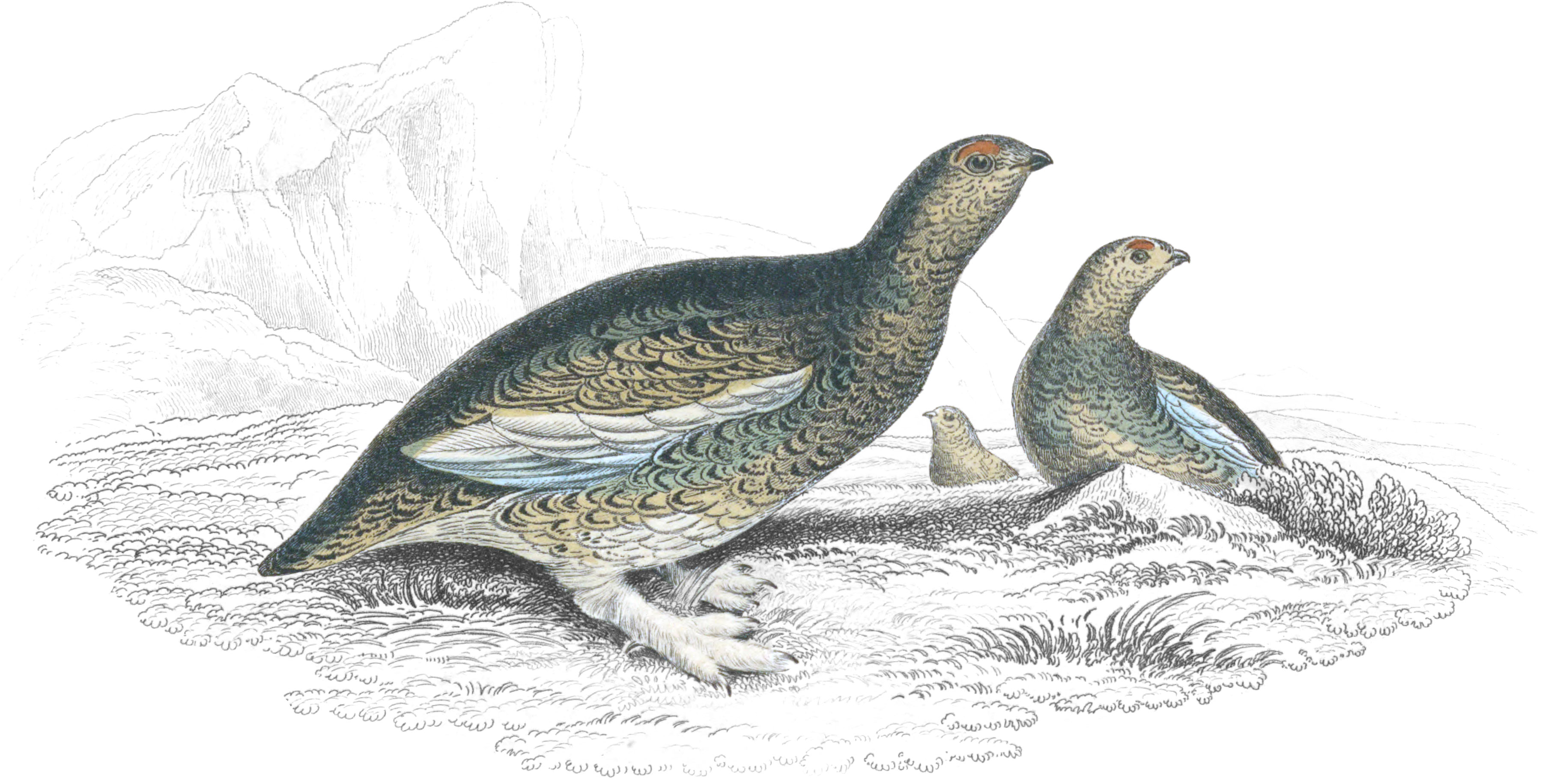
Plate II
Perdix, Latham.—Generic characters.—Bill short, rather strong, bending from the base; nostrils lateral, uncovered by feathers, but protected by an arched naked scale; wings short, rounded, fourth and fifth quills longest; tarsi and feet naked; anterior toes united at the base by a membrane.
Types, P. cinerea, picta, &c. Europe, Asia.
Note.—Frequent lower countries, and are partial to cultivation. Not arboreal, gregarious only to the amount of their broods.
The Common Partridge
Perdix cinerea, Ray.—Perdix cinerea. Partridge of British authors.
The Partridge is distributed extensively over Europe, and, according to Temminck, extends to Barbary and Egypt, where it is migratory. It is almost everywhere abundant in our own island, the more northern moorish districts excepted. It follows the steps of man as he reclaims the wastes, and delights in the cultivation, which brings to it, as to the labourers, a plentiful harvest of grain. It is, perhaps, most abundant in the lower richly cultivated plains of England; but even the south of Scotland supplies many of the more northern markets with this game. Very early in spring the first mild days even of February the Partridges have paired, and each couple maybe found, near the part selected for their summer abode, long before the actual preparations for incubation have commenced. These are begun at a later period than generally imagined, and even in the beginning of September, particularly in the wilder districts, the young are not more than half grown. The nest is formed, or rather the spot where the eggs are to be deposited, is scraped out in some ready made hollow or furrow, or placed under cover of a tuft of grass, and from twelve to twenty eggs are deposited. This mode of nidification prevails through the whole genus. No nest is made, and often no great care of concealment is displayed. In cultivated countries, the young grasses and corns are their favourite breeding places, the former often fatal, from the hay-harvest having commenced before the brood is hatched. The choice of a place of security for their eggs is not always the same, for Montague mentions a pair which successively selected the top of an old pollard oak, and Mr. Selby writes of having known several parallel cases. It is a singular trait in the habits of many birds, that those of a wild nature will often select the most frequented parts for their nests. Both Partridges and Pheasants are often discovered with the nest placed within two or three feet of a highway or footpath, where there is a daily passage of men and animals. The parents, as if knowing their safety depended on sitting close, remain quiet amidst all the bustle, and often hatch in such places.
During incubation the male sedulously attends, and will generally be found near, if the female is intruded upon by any of her less formidable enemies. When the brood is hatched, both lead about the young and assist them to their food; and mild and timid as the partridge is generally described, instances have been seen where the love of offspring prevailed, and a vigorous defence was successfully maintained against a more powerful assailant. Among the many instances of such defence, mentioned by various authors, we shall notice one of the latest, which Mr. Selby has recorded in the last edition of his Illustrations of British Ornithology:37—
Their parental instinct, indeed, is not always confined to mere devices for engaging attention; but where there exists a probability of success, they will fight obstinately for the preservation of their young, as appears from many instances already narrated by different writers, and to which the following may be added, for the truth of which I can vouch. A person engaged in a field, not far from my residence, had his attention arrested by some objects on the ground, which, upon approaching, he found to be two Partridges, a male and female, engaged in battle with a carrion-crow; so successful, and so absorbed were they in the issue of the contest, that they actually held the crow till it was seized, and taken from them, by the spectator of the scene. Upon search, the young birds (very lately hatched) were found concealed amongst the grass. It would appear, therefore, that the crow, a mortal enemy to all kinds of young game, in attempting to carry off one of these, had been attacked by the parent birds, and with the above singular success.
Such displays are, however, comparatively seldom witnessed, or indeed exercised, for nature has implanted another device in the greater number of this family, in which the organs of defence are in reality weak, against their many assailants. Stratagem is resorted to, and the parent feigns lameness, and even death, to withdraw the aggressor. The noise and confusion which occurs when a person suddenly, and unawares, comes on a young brood of partridges, is remarkable. The screams of the parents, apparently tumbling and escaping away with broken legs and wings, is well acted, and often succeeds in withdrawing the dog, and his young attendant, beyond the possibility of discovering the hiding places of the brood. When this is attained, their wonted strength is soon recovered, a flight to a considerable distance is taken but by the time the aggressor has reached the marked spot, the bird has again circuitously come up with her charge, and is ready again to act her part if discovered.
During the breeding season, all the colours of the plumage of the Partridge become deeper, and in the male, the skin above the eyes showing a modification of the slight wattle incident to the true grouse, becomes of a pinkish-red colour. In the female, the tips of the feathers become more decidedly marked with pale yellowish-grey. It is a bird much more liable to variation than any of the other British Rasores the pheasant, if included, being excepted. It is frequently met with of different shades of cream colour, the dark markings keeping a corresponding measure of intensity; and it is sometimes blotched, as it were, with pure white spots. We, last winter, procured a specimen from Mr. Fenton, in Edinburgh,38 above of a brown tint, deeper than usual, but with the ordinary markings; the ground colour of the breast and under parts is of the uniform grey, which covers the breast in the ordinary state of the bird, having the black wavy markings; but there is not the slightest trace of broader marking to the feathers, or of the “horse shoe,” which prevails in other states, and, to a certain extent, even in the female; the head, neck, and patch on the throat, are umber-brown, and around the bill, mouth, and eyes, is nearly pure black; the bill itself is of a darker colour than usual.
The Common Quail
Coturnix dactylisonans, Temm.—Tetrao coturnix, Willough., Ray, Linn.—Perdix coturnix, Lath., etc.—Quail or Common Quail of Brit. Ornith.
The Common Quail seems to be generally distributed over the old world, though, in the south of Europe, it is perhaps more abundant than elsewhere. In Britain they may now be termed only an occasional visitant, the numbers of those which arrive to breed having considerably decreased, and they are to be met, with certainty, only in some of the warmer southern or midland counties of England. Thirty years since they were tolerably common and regular in their returns; and, even in the south of Scotland, a fewb roods were occasionally to be found. Mr. Macgillivray mentions its occurrence in Morayshire, and of having received a nest and eggs from Aberdeenshire.39 Its occurrence farther north has not been recorded. In these same districts they are now very uncertain; we have known of broods only twice, and occasionally have shot a straggler apparently on its way to the south. In Ireland the Quail seems to be more abundant than in any parts of Britain; and according to notes by Mr. Thompson, they have of late years remained permanently in the north, and in winter have occurred in considerable numbers. In the winter of 1836–7, a gentleman shot, in one day, ten brace of Quails, in stubble fields bordering Belfast Bay.40 They are extremely difficult to flush after the first time. The nest is made by the female, but, like the partridges, the eggs are deposited almost on the bare ground; these, also, unlike the uniform tint which we find prevailing in those of the true partridges, are deeply blotched with oil-green, and, except in form, are somewhat similar to those of the snipe.
In France the Quail is very abundant; and, besides supplying the markets of that country, thousands are imported alive by the London poulterers, and fattened for the luxury of the metropolis. They are taken by nets, into which they are decoyed by imitating their call. On the coast of Italy and Sicily, and all the Greek islands, they arrive at certain seasons in immense numbers. An hundred thousand are said to have been taken in one day. They are run after during the flight like the passenger pigeons of America, and a harvest is gathered when the numbers are greatest. In Sicily, crowds of all ages and degrees assemble on the shore. The number of boats is even greater than the crowd; and enviable is the lot of the idle apprentice, who, with a borrowed musket or pistol, no matter how unsafe, has gained possession of the farthest rock, where there is but room for himself and his dog, which he has fed with bread only, all the year round, for these delightful days, and which sits, in as happy expectation as himself, for the arrival of the Quails. Ortygia was named from them; and so abundant were they on Capri, an island at the entrance of the Gulf of Naples, that they formed the principal revenue of the bishop of the island. From twelve to sixty thousand were annually taken; and one year the capture amounted to one hundred and sixty thousand. In China, and in many of the eastern islands, and Malacca, they are also very abundant, performing regular migrations from the interior to the coast. It is thus seen that the geographical range of this bird is of great extent, reaching northward to Russia and Scandinavia,41 found in the intermediate countries of temperate heat, and abounding in continental India and Africa. We possess specimens which do not materially differ from each other, from Madeira, alpine India, the plains of India, China, Cape of Good Hope, and southern Europe. A specimen shot at Jardine Hall, in autumn, has the crown nearly black, the feathers edged with pale chestnut, streaks of ochre-yellow run over each eye, and the centre space between the eyes and bill, and auriculars, are chestnut. Colour of the upper parts black, having the shafts and a lanceolate mark in the centre of each, ochreous-yellow, palest at the tip, where the wings join the body; the central markings are wanting, and the black is relieved by grey tips and wavy bars of sienna-yellow; throat, pale ochreous-yellow, bounded by a deep blackish-brown gorget, and on the sides cut into by a dark stripe of the same colour, running from the gape, and curving inwards near the middle of the pale space; breast, yellowish wood-brown, shading into pale ochreous on the lower parts; on the breast, the feathers are marked with two round or oval spots, on the exterior of each web; on the flanks these patches border each feather irregularly, bounding a pale open space along the shafts, which is nearly pure white. The above described specimen was a female, and it may be stated, that all those which have been met with in autumn were of the same sex. In the male the chin and throat are brownish-black, forming almost a cross in the pale space of the female, the ends of the cross turning up to meet the stripes from the gape; the markings above are more distinct, and there is more chestnut in the tints, particularly on the flanks and sides of the breast; the breast itself is pale reddish wood brown, without spots.
In all our modern works on ornithology, we have a few birds among the Rasores included, which have been introduced from other countries, and of which some have in a manner completely naturalised themselves and are generally distributed, being as hardy as many of the truly indigenous species; but there are also others, which, though they thrive comparatively well, yet require considerable attention, and continue very local and limited in their range; and while it becomes necessary to notice these, it is scarcely right to hold them in the same place with our indigenous game.
The Red Legged or French Partridge
Perdix rufa
Is a beautiful bird, and, in our park preserves, will make a most interesting addition or variation to the naturalist, though, from the experience which has been already had, it is not in request as a bird of game to the sportsman, nor is it so much esteemed for the table as the common grey partridge. There are a few birds distributed over southern Europe, Africa, and India, which are nearly allied to it in colouring and in markings, and which seem to have more skulking habits, and to be much more difficult to force upon the wing; all of these, we have little doubt, might be introduced to our parks, and would thrive equally well with the common red-legged bird. It appears to have been introduced so long since as in the time of Charles the Second; and several English noblemen, during the last century, are recorded as having bred them from continental eggs, and turned them out on their respective manors. Mr. Yarrell, in his British Birds, has stated various instances where they have been killed, or are now breeding, in several of the southern and eastern English counties; while the possibility also is suggested, of some straggling birds, occasionally met with on the coast, having made a flight, or been driven from Guernsey or Jersey. It has not appeared or been naturalised in any parts of Scotland or Ireland.
Virginian or American Ortyx
Ortyx Virginiana
Is another beautiful little bird, more lately introduced into some of the English counties, but with even less claim to a right in the British fauna, the success of its introduction having been scarcely yet ascertained. It belongs to a group of birds more strongly formed, having a stronger bill, and holding the place in the new world which the partridges do in the old, frequenting the borders of woods, roosting and occasionally perching on trees. Colonel Montague notices a specimen of the Virginian Ortyx shot near Mansfield, and some time previous to that, states, that some had been turned out. Staffordshire, Cambridge, and Norfolk, are also mentioned as localities where they have been tried, but we have been unable to trace exactly what has been the success of the trials.
Phasianidæ
The birds we have noticed, are all the species of Tetronidæ, whether indigenous or naturalised, which have any claim to a place in our fauna. Of the next family, the Phasianidæ, Europe presents no natural example; but one of the finest and most successful of all our ornithological introductions, typically represents it in
The Common Pheasant
Phasianus Colchicus.
It is recorded to have been introduced into Europe 1250 years before the Christian era;42 and into Britain in 1299, during the reign of Edward the First.43 From its ease in rearing, the beauty of its plumage, the delicacy of its flesh, and value in cover to the sportsman, it has been, since that early period, fostered and preserved, and turned out from one locality to another; and, at the present time, there are few districts to the south of the middle of Scotland, or over England, where it is not to be met with in greater or less proportion. In Ireland we believe its distribution to be not so equal, owing to the impossibility of preservation. In Europe, or wherever they have been introduced, we have two birds of different plumage, the one with a conspicuous white ring upon the neck, the other wanting entirely that ornament. These, in our preserves, have bred together, and we have specimens with the mark modified or almost obliterated. By Temminck they are considered to have been originally distinct species, and several prominent differences are pointed out, which, in all our naturalised birds, are blended together. We have not been able to compare a sufficient number of wild specimens; but, in one from continental India, without the white mark on the neck, there are sufficient distinctions of plumage in addition, to warrant its separation. In our preserves, which, in most instances, are only a kind of semi-domestication, they are much inclined to become spotted or pied with white, and often show very beautifully contrasted markings. The female seems to assume an entirely pure white plumage more frequently than the male; in some localities, a silvery grey variety has become abundant, known under the name of Bohemian Pheasants; it is singular also, that in a number of eggs, received some years since from an extensive preserve, where the variety was prevalent, we could separate those which would produce the grey birds, the shells being different in their shade of colouring. There is also a tendency of the pheasant to breed with other gallinaceous birds; crosses with the domestic fowl are frequent, and some instances are given where there had been intercourse with the black grouse, and even with a turkey.
Struthionidæ
The family of the Struthionidæ, or Ostriches, is, in all countries, extremely limited in numbers, and contains birds of a very large size; in Europe we have only one representing genus in the Bustard, and the stronghold may be said to be in Africa and India, in the deserts and plains of which we see the ostrich and cassowary, besides several species of large bustards. In America and New Holland they are still more limited.
Otis Linn.—Generic characters.—Bill nearly straight, slightly depressed at the base; nostrils open; legs long, having the tarsi naked above the knees; toes, three directed forwards, short, bordered with a scutellated membrane; wings long and powerful, second, third, and fourth quills largest, nearly equal, first narrow towards the point.
Type, O. tarda. Europe, Asia, Africa, New Holland.
Note.—Inhabit plains and open countries, or with a thick clothing of rank vegetation; polygamous; run swiftly.
The Great Bustard
Otis tarda.—Outarde barbue, Temm.—Bustard, or Great Bustard of British authors.
The Great or European Bustard, indeed, the whole of the Struthionidæ, from their form and habits, and large size, are marked objects, and are a tribe of birds which have fled before the inroads of population and agriculture. Abroad, in many of the districts where the Emu and Ostrich abounded in almost innumerable herds, they have become extremely rare, and are either entirely extirpated or driven to seek more retired plains, and like causes have, in a similar manner, reduced the numbers of our native Bustard to straggling instances of their occurrence. In some few stations they seem still to be preserved, and keep up a scanty stock, from which, perhaps, may stray the occasional specimens of whose capture we are generally made aware through the public prints.
Newmarket Heath and Salisbury Plain, Sussex or South Downs, Royston Heath, &c., are well known stations of old for these birds; and Devonshire, Wiltshire, Cambridgeshire, Norfolk, and Suffolk, Lincolnshire, &c., are all mentioned as districts where occasional specimens have been seen or procured. So late as 1819, Mr. Yarrell states, upon “authority,” that nineteen were observed together at Westcape in Norfolk, where they are carefully preserved by the proprietor. In Scotland, we have very few records of them. Sibbald seems to think they appeared occasionally
unam non ita pridem in Lothiana Orientali visam fuisse.”44
One was shot in 1803, in Morayshire, by William Young, Esq. of Boroughhead.45
Mr. Mudie, in his British Birds, relates, that he saw two birds in the parish of Carmyllie, Forfarshire,
which I have no doubt, in my own mind, were bustards.46
They were, however, seen early in the morning, at the distance of a quarter of a mile, and objects seen “against the sky,” at an early hour, oftentimes “seem forms of giants’ height.” In Ireland, Mr. Thompson states it as “extinct long since,” but it is enumerated in 1749, by Smith, as one of the birds of Cork. On various parts of the continent they appear still to be far from unfrequent. During winter and spring, we have often seen specimens for sale in the poulterers’ shops in the Palais Royal, for which from fifty to one hundred franks were asked. Spain, Italy, and the plains of Greece are its southern range; Sweden,47 Russia, Tartary, and Lake Baikal48 is its northern extent.
The Bustard is recorded to have been run with greyhounds, and to be an object of chase; and instances where specimens have been taken in this way are mentioned, one or two of not very ancient date. The bird is heavy, and does not readily take wing, but is described, at the same time, to be of very powerful flight; and it has always appeared to us, that those taken in this way must have been under particular circumstances, either of moult or fatigue. The rifle is also sometimes used; but, so far as we can learn, the ordinary fowling piece is by far the most fatal weapon employed against them. The male Bustard will stand two feet six or eight inches in height, and, when the lengthened feathers, which most of them possess on the throat, or sides of the jaw, are raised, they have a very hold and commanding appearance. The head, neck, and upper part of the breast, are bluish-grey, darker on the crown, which is often marked with a streak of brownish-black; the chin and long maxillary feathers of a paler grey; the tint of the neck and breast shades nearly into pure white on the belly, vent, and lower tail-covers; the lower part of the back of the neck, the back, rump, shoulders, and scapulars, are reddish-orange; the feathers crossed with entire and interrupted bars of black; the greater covers greyish-white; secondaries deep brownish-black; quills very powerful, the first narrow and acuminated, the others with the outer web suddenly broadening at about a third from the base, these wood-brown, becoming brownish-black at the tips; the central feathers of the tail are reddish-orange with white tips, and a black bar crossing at about an inch from the extremity, with another narrower towards the base. The more exterior feathers are greyish-white nearly pure at. the base, and slightly tinted with the reddish-orange near the black bar.
The Little Bustard
Otis minor.—Willoughby.
Otis tetrax, Linn.—Outard cannepetière, Buff. and Temm.—Little, or Lesser Bustard of British authors.
There appear to be several small species of Bustard, which are subject to a much greater change of plumage than the last or some of the large Indian and African birds, and it is the case with this very rare British visitant, which, however, is only seen here in its less obtrusive garb, or that assumed after incubation has ceased. Specimens have occurred in Cornwall, Devonshire, Hampshire, Oxford, and Kent, also in Essex, Norfolk, and Suffolk, Yorkshire, and Northumberland, becoming more rare northward. Once only has it occurred in Scotland that we are aware of, that mentioned by Mr. Yarrell as having been killed near Montrose, in the winter of 1833; and, in Ireland, two are recorded by Mr. Thomson to have been seen in the county of Wicklow, in August of the same year, one of which was procured.49 In its extra British distribution it is not very widely spread, and on the continent is by no means a frequent bird. On the borders of Europe it appears to occur more frequently, and we have little doubt that it extends beyond the Asiatic boundary. It occurs also in Northern Africa,50 and reaches to Russia in its most northern limit. The food is chiefly grains and vegetables, also at times insects; Mr. Yarrell states, that, in a fresh specimen which he examined, killed near Harwich,
the stomach contained parts of leaves of white turnip, liverwort, dandelion, and a few blades of grass.
We have not an adult male before us for description, but our figure will give an idea of the distinct black markings which occupy the neck and breast, and we add, from Mr. Yarrell, who can be depended upon for accuracy:—
The adult male, when in the plumage peculiar to the breeding season, has the beak brown; the sides golden-yellow; the top of the head pale chestnut, mottled with black; cheeks, ear-coverts, the fronts and sides of the neck, bluish-grey, bounded inferiorly by a border of black passing to the back of the neck; below this is a narrow white ring all round the neck, and below this a broad collar of black, with a gorget of white, and another of black, at the bottom of the neck, in front; shoulders, back, scapulars, tertials, and upper tail-coverts, pale chestnut-brown, streaked irregularly with numerous narrow lines of black; all the wing-coverts, and base of the primaries, white, the distal half of the primaries greyish-black; the secondaries patched with black and white; the base of the tail-feathers white, the ends mottled with black and buffy-white, crossed with two narrow bars of black, the extreme tips white; the breast, and all the under surface of the body, white; legs, toes, and claws, clay-brown.51
In another specimen before us, probably of a female, from the continent, we have the ground colour of the upper parts, except on the neck, nearly black, very much cut into upon the edges, and on the surface marked with wavy bars of ochreous-yellow and pale reddish-orange; throat and chin pale yellowish-white; on the neck the dark shade is nearly deep wood-brown, the centre of each feather being pale ochreous; on the breast, the pale colour becomes the prevailing tint, the feathers distinctly barred with blackish-brown; the belly, flanks, and under tail-covers, pure white, the barrings confined to the flanks, and then taking the form of lengthened cross spots, the shaft being marked with a thread of black; the edges of the wings white; the quills wood-brown, white at the base; upper tail-covers with white tips, which form a pale basal band; the tail itself white, barred and irregularly marked with black; the centre feathers tinted with ochreous.
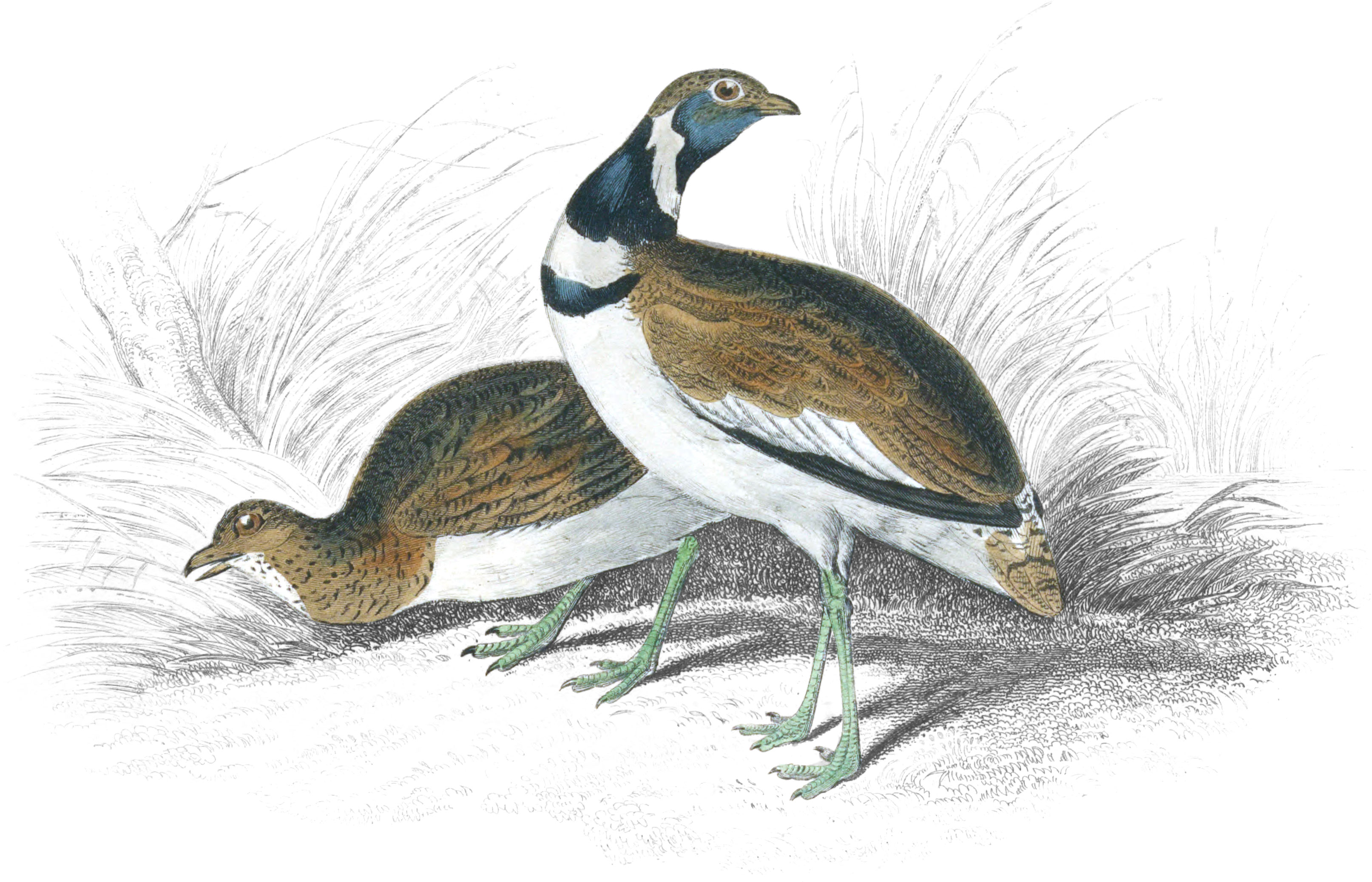
Plate III
Grallatores or Wading Birds
In passing from the Rasorial birds, one link of connection is at once conspicuous between the Bustards, which we have just described, and the Charadriadæ. The form of the feet and tarsi, and mode of running among the plovers, remind us of them; but in the genera Tachydromus and Œdicnemus, we have very near approaches, particularly in the last or “Thick-knees,” several foreign species being as tall as some of the middle-sized bustards. Mr. Swainson again states, that the Herons, by means of the Cranes, show the greatest affinity to the Ostriches, being all very tall birds, in a great part terrestrial in habit; and though the wing is ample, it is comparatively not in much use. But, in a limited fauna, it is impossible to enter minutely into these alliances, without introducing many species that are foreign; suffice it to say, that we esteem the connection through the Charadriadæ as the most marked at the same; time, we shall commence the order, by describing the British members of the family of the Herons, or the
Ardeadæ
The greater proportion of which, as stated, are birds of large size all of them have the feet and; legs elongated, and particularly fitted for wading, and, by the assistance of a lengthened neck, they are enabled to survey the pools and waters in which they seek their food, and thus easily discover and secure their prey. The true Herons, of which we possess two native species, will show a typical example, and their habits, which we shall endeavour to describe, if we take them in connection with the physical character of the various countries inhabited by others, will be found, with such modifications as depend on these, to be very nearly a picture for the whole.
They are gregarious during the breeding season, and the colours of the plumage are chiefly shades of grey, intermixed with brown, black, and white, or yellowish-white. Most have the head adorned with a crest, greatly developed during the breeding season, at which time also the plumes on the back and breast become elongated into narrow flattened tips, which, indeed, is almost the only change occurring at this period.
Ardea Linnæus.—Generic characters.—Bill long, straight, compressed, sharp pointed, edges irregularly broken or serrated inwards; lores naked: tarsi lengthened, tibiæ naked about the joint; toes four, all placed on the same plane, and resting entirely on the ground, hindertoe about half the length of the middle; claw of the middle toe pectinated:—wings ample, rounded, very concave, third quill slightly longest; tail short:—plumage rather loose, plumes of the neck, breast, and back, elongated into narrow points during the breeding season; head generally crested.
Types, A. cinerea, herpdias, &c. Cosmopolite.
Note.—Often gregarious during the season of incubation. Breed on trees.
The Common Heron
Ardea cinerea.—Linnæus.
Ardea cinerea, Linn.—Heron cendré, Temm., &c.—Common Heron of British authors.
This beautiful bird, and picturesque accompaniment, either to the finished park or wild landscape, is very generally distributed over the British Islands. When the sport of hawking was in reputation, the Heron was a chosen bird to fly at; it held a place in the game laws, and its capture or destruction was severely punished. By a few it was esteemed for the table, and by those who believed in the “mysteries” of angling, its fat was sought after as an ingredient in the pastes and compositions, prepared as baits for that purpose.52 The Heron, during the greater part of the year, is a wading or terrestrial bird, and here all his motions and attitudes are easy and graceful. Whether sitting at rest on some stump, or large stone at the edge of the stream, or stalking erectly by the side of the water, and surveying it for his active prey; or with outstretched neck, and depressed crest, the whole aspect displaying anxiety, before the fatal stroke is made, he appears unconstrained. But when these habits are exchanged for the forest, the lengthened legs and ample wings are used without freedom, and they appear to be accommodating themselves to a temporary sojourn, among the branches and foliage proper to another great tribe of birds. Nevertheless, a heronry is a much to be coveted ornament among the furnishings of an extensive park, and the whole process of incubation is most interesting to witness. The localities selected generally abound in old wood, and they are very frequently near some mansion, where there is a constant thoroughfare, which can only be accounted for from the greater proportion of old timber to be found in such situations, for a bird naturally so shy would scarcely, were choice allowed, select one so public. We, at the same time, know of a few breeding stations in most retired places, a wild and pastoral glen, or the solitary islet in some Highland loch;—and they are sometimes also seen upon precipitous rocks, South Stack Lighthouse, and Great Ormes Head, &c.53 Of their breeding on the ground we have the fact stated, but we cannot trace it to any thing authentic.
Except during the breeding season, the abodes of the Heron are by the banks of streams and rivers, or along the sides of lakes and their islands, fenny districts, and, in the late parts of autumn and winter, by the sea shore; in the latter situations, they may be seen taking their station so soon as the shoals begin to be uncovered by the ebbing of the tide; and, when satiated with feeding, rows of birds may be observed on some retired sand bank, their head sunk between their shoulders, exhibiting a picture of full-fed laziness. They appear at this time to be partly gregarious, and to resort, day after day, nearly to the same stations. In inland parts they occasionally rest during the day, and roost upon trees. Their food is very mixed, though the great proportion consists of creatures inhabiting or frequenting the waters, fish of all accessible kinds, and aquatic reptiles; but, when motion is perceived in the water, or herbage by the brink, the attention is drawn to it, and a stroke is made at the object, though imperfectly seen; thus, water rats or mice, young aquatic birds, and now and then a water-hen or rail, are killed. In confinement, any kind of fish or raw meat will be eaten, and Dr. Neil has recorded their qualities as rat killers. We have also known several instances of this propensity in Herons kept in a garden, and where also it was nearly impossible to preserve any smaller tame birds in company. In a state of nature, the prey seems generally to be transfixed by a dart or blow of the bill. The great proportion of trouts, eels, &c., which we have observed as supplied to the young, being all pierced through as if struck in the manner we have stated.
The Heron is generally, though nowhere very abundantly, distributed over Europe; in Britain, extending to Orkney and Shetland, where they are said to be plentiful. In these islands we have no notice of any breeding places, and it would be interesting to know how they are situate, or if the birds migrate to the mainland for the purpose of incubation. In the very north of Europe the Heron is migratory. Its extra European range is confined to the Old World, Northern Africa, and Madeira, India,54 Java,55 perhaps some others of the eastern islands, and Japan.56 In the New World, we have it represented by the A. herodias, a large species resembling it in colours and habits.
The entire length of an adult bird will exceed three feet, of which the bill to the rictus will measure six inches and a-half. The back, scapulars, and tail, are pale blackish-grey, tinted sometimes with brown, and, in the breeding season, having the ends of the dorsal feathers lengthened into narrow points of a much paler tint, and which now gives the prevailing shade to the back. The quills are dark dull bluish-black. The forehead, crown, cheeks, chin, and throat, are pure white, and from above each eye proceeds a broad stripe of deep black, which meets from both sides upon the hind-head, and from which springs the graceful long narrow plumes of the same colour, forming the crest. The whole plumes on the crown are lengthened, but the true crest, generally consisting of only two narrow feathers, is often from six to seven inches in length. The neck above, and on the sides, is of a rich purplish-grey, shading into the colour of the back as it approaches; the fore part of the neck is relieved by two lines of white feathers, black for a portion of the one-half, gradually elongating to the lower part of the neck, where they become of one colour and lengthen into narrow points, often five or six inches long, of a yellowish-white, and which hang gracefully from the sides, as well as the fore part of the neck and breast. The centre of the breast and belly is pure white, but it is bordered and relieved on each side by a streak of black, arising, from the anterior sides of the breast, in two broad tufts of loose lengthened feathers. The thighs and under tail-coverts are white. The feet and legs are yellowish-brown, but the naked parts of the tibiæ are yellow, shading into brown as they reach the tarsal joint. The bill is nearly deep yellow, inclining upon the ridge to brownish, and having a greenish tint on the [indecipherable] and near the gape. The irides are bright gamboge-yellow. On the fore part of the breast there are two patches of a thick yellow down, concealed by the other plumes, and which we find more or less in all the Herons. This is jointed in its structure, and would appear to be connected with the habits of this tribe of birds.
In the birds of immature plumage, we have the blackish-grey colour predominating, with a considerable tinge of brown, no white in the crown, which gradually shades into black on the occiput, the feathers there lengthening, but without changing into the narrow form of those in the adults. We have also no elongation on the back or lower part of the neck, and the white, in the centre of the breast and belly, is bordered only with blackish-grey.
Vignette
The Purple Heron
Ardea purpurea.—A. purpurea, Linn.—Heron pourpre, Temm.—Purple Heron, Purple-crested Heron, Crested Purple Heron, African Heron of British authors.
This beautiful Heron has been sufficiently often killed in England, to entitle it to the rank of a frequent occasional visitant. Its range in our islands, however, is confined to the south, for we know of no instance of its occurrence in Scotland, and Mr. Thompson has recorded its appearance in Ireland only once. We possess one native specimen killed in Norfolk, and many others are known to have been procured in different parts of the southern and eastern counties. It should be observed, however, that birds, “in the flesh,” frequently come to the London markets from the continent, and may be (to increase their value) given out as British-killed specimens. Its most abundant country is perhaps Africa, the north and eastern coasts and we have received it also from the Cape of Good Hope. “Mr. Franklin exhibited specimens, at the Zoological Society, that were brought by himself from India;”57 and Java is given as a locality.58
Of the habits of the Purple Heron we have no detailed account to a certain extent it will resemble the others, but there are, without doubt, peculiarities belonging to it. Neither do we know much of its nidification, whether it is gregarious during that season, or breeds singly. Temminck states, that the nest is made “dans les roseaux, ou sur les bois en taillis,” very rarely upon trees; and, altogether, the habits approach nearer to those of the bitterns than of the typical herons. Writers agree in stating, that it is far from being uncommon in Holland, where it also breeds, and where we have seen it nailed up to trees, among crows and birds of prey; if some details of its economy could be procured from thence, they would be interesting.
The upper parts, wings, tail, and under tail-coverts of the breeding state of this Heron are of a dark brownish-grey, deeper on the tail, quills, and coverts, and these are tinted with greenish reflections, having the dorsal plumes narrowed and elongated as in the last, the narrow tips being of a much paler tint, those at the sides longest, and of a pale reddish-brown. The forehead and crown are black, the feathers lengthening into a long narrow crest, while a line of the same colour is carried down the back. The feathers covering the ears are black, forming a narrow stripe from the rictus, joining the black of the occiput. On each side of the neck a narrow stripe descends, mingling with the more irregularly dark edges of the lengthened plumes. The throat and fore part of the upper neck are pure white, gradually shading into the chestnut-brown, which covers the cheeks and sides of the neck, not occupied by the black stripes. On the fore part of the neck each feather elongates until it attains the lengthened narrow form; on the upper parts, the one side of each is yellowish-white, the other black and thus irregular lines of these colours are formed, until the long tips become entirely yellowish-white. The centre of the breast and belly is black, bounded on each side with very deep purplish-chestnut or brownish-red. The thighs are pale brownish-red. The fore part of the tarsus and toes are brown, tinted with greenish; the hinder part of the tarsus and naked tibiae, yellow. The development of the feet, compared with the length of the tarsus, is much greater than in the last, the centre toe, with its claw, being nearly equal to the tarsus in length. The claws are much more lengthened, slender, and less bent. The bill is nearly pure gamboge-yellow, shading from brown upon the ridge and extremity of the mandible.
In a specimen which we received as a female, and in which the elongated feathers of both the breast and lower part of the neck were marked as in the last described, the upper plumage has a brown tint spread over, the occipital crest is short, and the stripes of black on the neck are only slightly indicated. The purplish-brown on the sides of the breast is not so deep, and none of the colours are so vivid or well defined.
In an immature bird, brown is the prevailing colour, the upper plumes being all broadly edged with it. The crown and occiput chestnut, without a crest, and the sides and fore part of the neck yellowish-white, marked on both with lengthened dashes of brownish-black; no elongated feathers either there or upon the back.
Egrets
Our next beautiful division of the Herons, is that of the Egrets, distinguished by a more slender form in every part, by the plumes on the back being very long and disunited, and in the plumage being generally pure white, and always pale at one period, either in the complete or incomplete plumage. Some of the lesser species, where the colours and form vary, serve to connect them with the small bitterns. They breed on trees, sometimes at only a few feet from the ground, but in general at a high elevation, and, with few exceptions, in the vicinity of water. The species are numerous, and spread over the world, and are often so closely allied, that there is great difficulty in distinguishing them, consequently, our synonymes are both numerous and often erroneous.
Egretta.—Generic characters.—Bill very slender, slightly bending at the tip; gonys not ascending; legs long; inner toe shorter than the outer; feathers of the breast, back, and scapulars, very long, and with the webs much disunited.
Types, Ardea alba, A. garzetta, luce, Bonap., &c.
The Little Egret
Egretta garzetta.
Ardea garzetta, Linn.—Heron garzette, Temm.—The Little Egret or Egret Heron, Selby and Yarrell.
The close alliance of the Egrets, to each other, has caused a much wider geographical range to be given them than they possess. The present bird is confined to the Old World; but how far restricted, or whether the other White Egrets, from almost all parts of the Old Hemisphere, of a similar size, are all identical, perhaps still requires a more strict investigation. Its best acknowledged range is Southern Europe, Greece, and Northern Africa, from some of which countries an occasional specimen, at rare intervals, strays to our shores. Mr. Yarrell, whose exertions in collecting information of this kind are indefatigable, records six instances of its capture, in Britain or Ireland, which he considers may be relied on. The first is the bird noticed by Pennant, who saw only the feathers; the others were taken in Cornwall, Hampshire, Warwickshire, and one in the harbour of Cork, mentioned by Mr. Templeton. In Scotland, we are not aware that it has ever been taken.
During the last winter (1840–41), there have been several instances of “White Herons” being seen and killed, both in England and Scotland, which, it is little doubt, were Egrets of one species or other, but the difficulty of tracing them is great. These notices appeared chiefly in the newspapers, and from the peculiar colour and appearance of the bird, they were sure to draw attention. The winter was remarkable for the intensity of the cold.
Annexed, we give the description of a specimen procured on the continent. The entire length, from extremity of the tail to the end of the bill, will be from twenty to twenty-two inches; length of the bill to the rictus four inches. The plumage is entirely pure white; from the hind-head spring two narrow feathers, four inches in length, while those on the lower part of the neck (nearly of a similar length), toward the tips, become narrowed and compact in form; the loose hair, like plumes, spring entirely from the centre of the back the; bill with the tarsi are black; the toes appear to have been greenish-yellow; the length of the leg, unplumed, above the tarsal joint, is two inches and a fourth of the tarsus four inches.
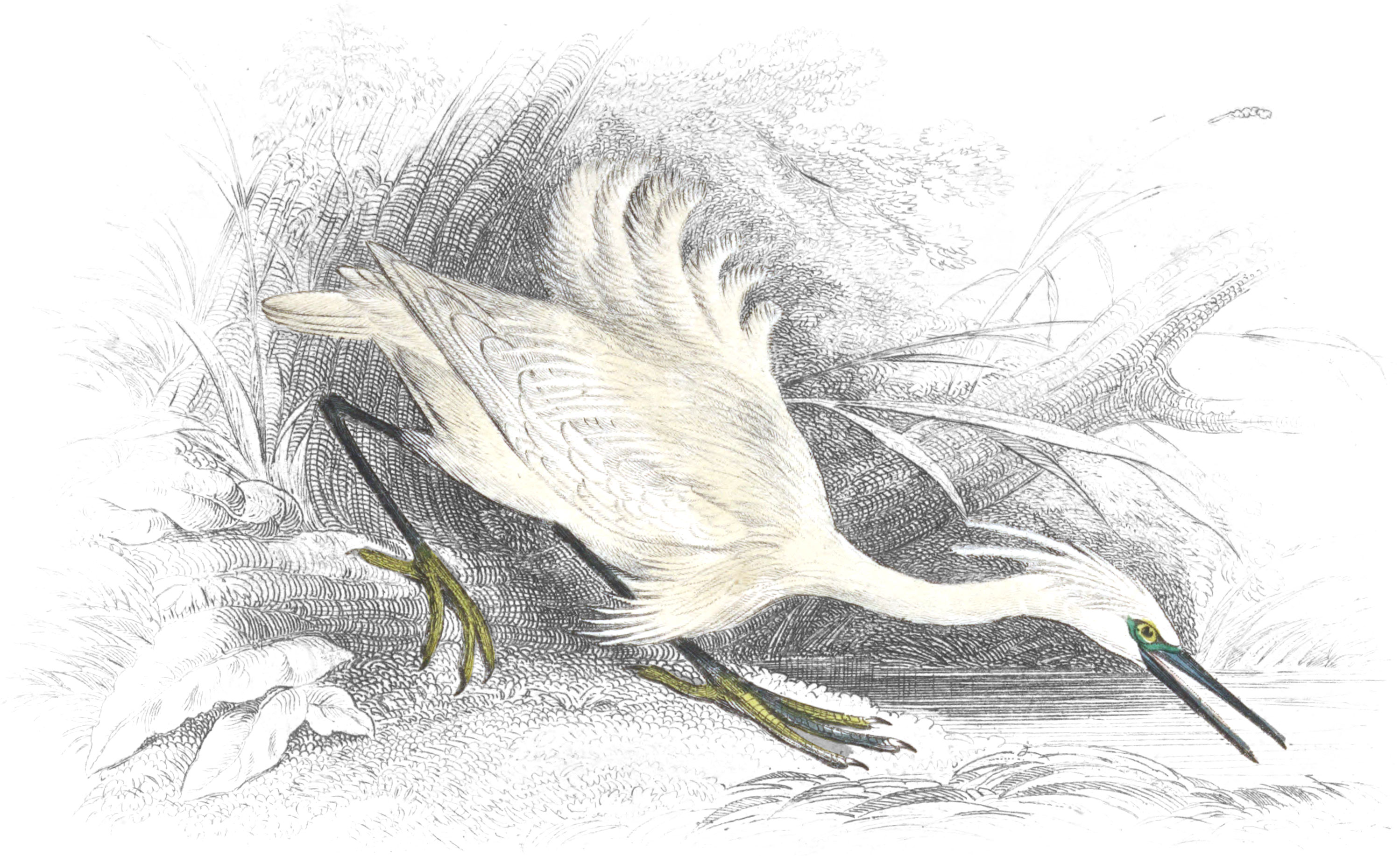
Plate IV

The Great White Egret
Ardea alba.—Ardea alba, Linn.—White Heron, or Great White Heron of British authors.
This is even of rarer occurrence than the last, and, until within these few years, authentic accounts of its appearance were somewhat questionable, or rested on the authority of specimens which could not be then traced. At the meeting of the British Association, in 1838, Mr. Strickland stated his opinion, that this bird was improperly excluded, and stated three instances of its capture within a comparatively recent period in Yorkshire to these Mr. Yarrell; adds an instance of another, shot on the Isis in Oxfordshire. A specimen, of a White Egret, was also shot during last winter at Tyningham, the seat of Lord Haddington, in Haddingtonshire. This has been considered to be the large species, or that we are now describing, but we have not had an opportunity of examining it: and, according to the newspapers, a “White Heron” was several times seen during the same winter upon the shores of the Solway, on the English side, above Port Carlisle, which also may have been identical with the Great Egret.
In Northern or Central Europe, the Large Egret appears to be nowhere very abundant, but becomes more frequent in the Grecian Archipelago, in Turkey, and on the Asiatic boundary. White Herons brought from Continental India by Colonel Sykes, are considered identical in that gentleman’s catalogue, and it is a range very likely to be taken by the species. The American Large White Heron is distinct, and represents it in the New World. We have also another, closely allied, in New Holland.
We have not a British or European specimen before us, and we do not find descriptions agree exactly in the colour and dimensions of some of those parts (the bill and legs), on which, among the Egrets, the specific distinctions in many instances rest. The plumage of both sexes, and, so far as we know, of the young, is pure white, the crest and elongated dorsal feathers being emblems of the season of incubation. The adult birds measure in length three feet four or five inches. The dimensions of the bill and legs are given by
| Selby | Bill about | 6 inches |
| Tarsi | 8 inches | |
| Naked part of the tibia | 4\(\frac{1}{2}\) inches | |
| Yarrell | Bill from the eye | 4\(\frac{7}{8}\) inches |
| Tarsi | 6\(\frac{1}{2}\) inches | |
| Naked part of the tibia | 3\(\frac{1}{2}\) inches | |
| Middle toe and claw | 4\(\frac{1}{2}\) inches |
The colour of the bill is black, or deep wood-brown, yellow at the base and about the nostrils;59 legs almost black.60 In the young birds, Mr. Selby states, the bill and legs are greenish-black.
The Buff-Backed Egret
E. russata, Wagler.—Ardea Œquinoctialis, Penn. Red-billed Heron, Penn.—Little White Heron, Montague.—Ardea russata, Wagler.—Buff-Backed Heron, Selby, Yarrell.
The occurrence of this Egret in Britain, rests still on the solitary specimen obtained by Colonel Montague, and removed with his collection to the British Museum.
It was shot near Kingsbridge, in Devonshire; had been seen for several days in the same field, attending some cows, and picking up insects, which were found in its stomach.
The attendance on cattle is a curious habit in someof the Egrets, without doubt, on account of the insects that abound near them; in India, for this reason, some have received a provincial name, signifying “Cow or Cattle Heron.”
The Asiatic continent, from every authority, would seem the most abundant locality, or rather the real country of this bird; Upper Hindostan,61 the Dukhun,62 Java,63 isles of Sunda, Japan,64 Himalaya and Nepaul,65 are all given as countries from where it has been received.
In the adult birds, the feathers, at the roots, are pure white, but on the head, neck, and breast, with the elongated feathers on the back, are of an ron-yellow; the remaining parts of the bird are pure white; the bill and legs are yellow, the joints of the latter and the toes darker.
Montague’s young specimen is described by him to be in
length about twenty inches the bill; two inches long to the feathers on the forehead, and of an orange-yellow. The whole plumage snowy white, except the crown of the head, and the upper part of the neck before, which are buff. Legs three inches and a-half long, and one inch and a-half of bare space above the knees these; parts are nearly black, with a tinge of green; the toes and claws are of the same colour the middle; claw pectinated.
The above agrees nearly with the description given by Wagler of the young state, the brown colour prevailing with the advance of age.
A detail of the habits and nidification of this Egret is still much wanted.
The Squacco Heron
E. ralloides.—A. ralloides, Scopoli.—Ardeacomata. Pall., Penn.—Heron crabier, Temm.—The Squacco Heron of British authors.
In form, this species begins to depart from the true Egrets. The legs are feathered nearly to the knees, as among the bitterns. It has occurred several times in the southern and eastern counties of England, but we do not learn of any instance of its capture either in Scotland or Ireland. One is recorded, so lately as July 1840, to have been killed near Kingsbridge, Devonshire. In Middle and Southern Europe it is more frequently obtained, also in Greece but Africa and; some parts of Asia are its true localities; further than that its habits are considered as similar to its congeners, we have little knowledge of them.66
The extreme length of this Egret is from the head, or rather the head and nape are crested, the feathers amount in number to eight or ten, and are so long as to reach the back, they are pure white, relieved by a narrow border of black on each side. The wings, and lower parts of the bird, are nearly pure white, but the upper parts are almost hidden from view, by a series of long hair-like feathers, which spring immediately from behind the shoulders, and exceed the tail in length; these are of a deep sienna-yellow, tinged with purple on the back. It is from these plumes that the name “comata” of Pallas has been taken; and we may state here, that we have some doubt whether that name or “ralloides” of Scopoli should have the priority; the chin and throat are white, and the neck and breast are sienna-yellow. Mr. Selby states the base of the bill, for nearly two-thirds of its length, to be pale azure-blue, black towards the end. The legs dusky, tinged with red. Mr. Yarrell again describes the bill to be greenish-brown, darkest towards the point. The legs yellowish-brown. In the young birds, the plumage has no pure white, except that of the tail, which is nearly so, and the dorsal plumes are wanting; the colour is wood-brown, streaked on the head, neck, and wing-coverts, with a darker shade the bill and; legs are tinted with yellowish-brown.
Bitterns
Where one individual of a form is only present in a fauna, it is often difficult to show its gradations; and, were no more discovered, it might merge into the adjacent genera, as only a very aberrant species; but, where others appear of a like structure, and are seen carrying a representative type into other countries, it is often better, for the sake of facilitating the artificial arrangement, to separate them. In the Little Bitterns, we have some parts of the form of the small egrets strongly marked, but the feathers on the head and neck are more broadly formed, and those on the back and scapulars are without division or separation of the webs, the tarsi clothed to the knees the; manners very skulking, and the nidification said to be on the ground; in which habits, and in the very narrow and compressed form of their bodies, they show a close alliance to the rails. The Prince of Canino has apparently acted on the same principles, and has given to these birds, taking the Ardea minuta and Exilis as typical, the title of Ardeola (Bittern-Heron.) Our native species is
The Little Bittern
Ardeola minuta. Ardea, minuta, Penn, etc.—Heron blongios, Temm.—Botaurus minutus, Selby, etc.—Little Bittern-Heron, Penn.—The Little Bittern of British authors.
The Little Bittern-Heron has been frequently met with in many of the English counties, extending to the Scottish border, and it is supposed that they have also occasionally bred in this country, young birds having been procured in one instance,67 and, in some others, the circumstances in which they were taken left little doubt that they had bred near the locality where they were killed.68 A specimen is recorded to have been procured so far north as Sanda, in Orkney,69 and Mr. Thompson has stated its occurrence once or twice in Ireland. Its extra British range is the south of Europe, parts of Asia and Africa, where, however, a representing species may yet be confounded. Its habits, except in confinement, are not recorded but it is said; to frequent marshes, by the sides of rivers, amidst aquatic brush-wood, and to make its nest upon the ground. Wilson, speaking of the American bird, which is so closely allied as to have led to confusion, says,—
Those we have seen in confinement skulk, and walk with the head drawn closely in, and without showing any portion of the neck;
which agrees with the manner in which it and other small species, kept in our British gardens, conduct themselves. Mr. Audubon, in describing them, states, that specimens he had in confinement were fed on small fish and stripes of pork, and were very expert in catching flies. They showed also great scansorial powers. In trying to escape from the windows, they could climb with ease from the floor to the top of the curtains, by means of their feet and claws. The nest of the American species is also described as placed on the ground, or a few inches above it, attached to the stems of reeds, and, in one or two instances, in bushes about three feet from the ground.70
In the adult state of this bird, the crown and upper parts are black, richly glossed with green; the cheeks, neck, and wing-coverts, pale sienna-yellow, the under parts of a redder or browner tint, dashed with brown upon the flanks; the bill and legs are of a dark yellow, the former generally brightest, the legs feathered down to the tarsal joint. The young are without the dark glossy mantle, and have the feathers there brown, margined with a paler shade. The lower plumage and sides of the neck are yellowish-brown, on the sides of the neck occasionally streaked with white, and on the flanks with brown; the bill, legs, and feet, are of a greenish-brown.
Butor.—Antiquorum.—Generic characters.—Bill lengthened, compressed, and strong at the base, angle of the maxilla placed far forward; nostrils placed in a deep furrow, and partly covered with a membrane; legs proportionally short and strong, tibias partially bare, feet much developed, toes long and slender, claws long, slightly bent, that of the middle toe serrated; wings rather long, the three first quills longest, second rather exceeding.
Types, B. stellaris, lentiginosa, &c. Europe, Asia, Africa, America.
Note.—Nocturnal, skulking. Back of the neck bare of feathers; those of the sides elongated, covering it, but capable of erection. Nest large, placed on or near the ground.
The Common Bittern
Butor Stellaris.
Ardea stellaris, Penn. &c.—Botaurus stellaris.—Heron Grand Butor, Temm.—The Common Bittern, or Bittern-Heron of British authors.
The Bittern, like all our marsh birds, is, at the present time, much less common than it was fifty years since; yet it is still frequently met with, and, in one or two instances, is recorded as breeding in England. The general time of its appearance is in winter, or on the decline of the year; and, as observed by most of our modern writers, in some seasons they are much more plentiful than others; the winter of 1830–31, is mentioned, both by Mr. Selby and Mr. Yarrell, as remarkable for the number of specimens which were obtained. In the south of Scotland a similar comparative abundance occurred several were; brought to me in Dumfries-shire; and, on a visit to Edinburgh, it was found that the bird preservers there had obtained also a more than usual number of specimens. Since that period, they have not been seen in Scotland, except as stray individuals. In Ireland, they are also occasionally met with. On the continent of Europe, particularly the southern and central parts, in suitable localities, they are not uncommon, and appear to extend far northward, being found in Scandinavia, Russia, and Siberia;71 a specimen from the Cape of Good Hope before us does not differ very materially; and it has also been met with in South Africa by Dr. Smith. Japan72 and India73 are given to it; the Dukhun is mentioned by Colonel Sykes, but as a locality where it occurs rarely. We have received skins of a Bittern from continental India, very nearly allied to the European birds, but we have hitherto considered them distinct.
The fact of the Bittern breeding in this country takes place also only at uncertain seasons, and is, perhaps, owing at the time to particular circumstances. It does not occur with any degree of regularity, nor are there any spots where the birds return periodically at the period of incubation. The nest is said to be placed on the ground, near the waters edge, among thick reeds or aquatic herbage, and the eggs are of a uniform pale brown.74
In active habits the Bittern is chiefly nocturnal, remaining during the day in its covert retreat, and coming forth in the evening and twilight to feed; and it is at this time, as well as in the morning, that its peculiar booming noise is uttered, to which has been attached various superstitions, and also singular conjectures as to the manner in which it was produced. We do not find it stated whether it is a general call, or is more particularly uttered during, or immediately antecedent to the season of incubation, such as the drumming noise of the snipe, and the call of some of the rails; at other times, and when surprised, the cry is different, being harsh and sharp. The food, we should consider, was seized by watching, somewhat in the manner of true herons. Any thing having motion is struck at, whether perfectly seen or not, and the prey is swallowed whole; thus, we have taken a water rail from the stomach of one, and perceive that similar instances have elsewhere occurred.75 Fish or aquatic reptiles are probably the most general food.
In olden times, both the Bittern and heron were esteemed for food, particularly the young birds; now they are never brought to the table, which may perhaps be from some prejudice existing against them as fishy-tasted, for we have heard more than one gentleman assert, that a heron, if kept a proper time, was excellent eating.
A specimen of a male Bittern, shot in winter, in the vicinity of Jardine-Hall, has the crown and occiput deep brownish-black, with green and purple reflections; the feathers on the occiput elongated, tipped for half an inch with ochraceous, and there minutely edged with black; under the eye, from each rictus, descends a streak of rich and deep brown; the centre of the throat is of a paler brown, and between, the tint of the sides of the neck is yellowish-white; the feathers of the sides of the neck are lengthened, and fold over the back part, which is covered only with a thick down; these can also be thrown forward, and are sometimes made to appear as a ruff. The whole ground colour of the plumage is a pale sienna-yellow, the tint slightly varying in different specimens, and being of a redder colour on the shoulders, quills, and tail; this ground colour is varied, and rayed in such a manner as to be very difficult to convey by words; on the back, being confined to the centre of the feathers, it assumes the form of downward broad lines; but on the sides of the neck, breast, and flanks, it runs in transverse bars and crossings. On the fore part of the breast and neck, where the feathers are lengthened, the one half is brown, the other without markings, which produces to a certain extent the same appearance we saw in the true herons. In the Bittern, about three quarters of an inch of the tibiae is free from feathers, and the proportional development of the feet is great, the centre toe exceeding the tarsus in length. In a specimen from the Cape of Good Hope, the colours appear all more vivid, and the dark transverse markings on the sides of the neck and cheeks are deeper and more thickly placed, and the feathers are there more elongated. No material difference, however, exists.

Plate V
The American Bittern
Butor lentiginosus, Ardea lentiginosa, Montague.—Botaurus mokoho, Vieill.—Heron lentigmeaux, Temm.—The Freckled Heron or Bittern, American Bittern of British authors.
The original British specimen of this Bittern fell under the observation of Colonel Montague, and was killed in Dorsetshire. Since the capture of that specimen, a few have been taken, chiefly in the southern or south-eastern counties of England, and a bird taken in the Isle of Man, the description of which was communicated to Mr. Yarrell, is thought to be also referable to this species. It has not yet been found in either Scotland or Ireland. Hitherto, this bird has been considered identical with the species of America, representing there our native bird. The Prince of Canino, however, places the A. lentiginosa, Montague, and the American bird (under the title of B. minor) opposite, or as representatives in form and markings the last, of course, distinct. We possess specimens of the American bird, but have had no opportunity of comparing it with European or British killed specimens, and the description underneath, is taken from a skin sent to us from South Carolina. In habits, as described by Wilson and Audubon, the species of America closely resemble those of the Common Bittern.
Length of the skin, from the point of the bill to the end of the tail, rather more than two feet; bill to the rictus four inches, being longer proportionally, more slender and heron-like than in the true Bitterns. Length of the naked space on the tibiae one inch; of tarsus three and three quarters; of the centre toe, including the claw, four inches. The ground colour of the plumage, except the wings, is ochreous-yellow, on the crown being dark chestnut, changing into that colour; on the neck the centres of the feathers are pale sienna-brown, and they want the “rayed” appearance of dark and light seen in the common bird; on the back and wings the markings, although somewhat similar, are much divided; the throat is white, a stripe of the pale ochreous running along its centre, and, on the lower parts, the general colour is considerably paler than above; each feather is marked on the centre with a dash of sienna-brown, which is bordered and minutely freckled with brown. The quills, instead of being irregularly barred and blotched with pale reddish-brown, as in the Common Bittern, are of a uniform dull brown, pale reddish towards the edge of the inner web, where the dark colour is shaded off by minute freckles; the .tail is sienna-brown, freckled minutely with blackish-brown. Such is the general description of an American bird, but the distinguishing mark is a broad patch of glossy greenish-black upon each side of the neck, arising below the auriculars, and passing backwards, so as nearly to meet at the back of the head. This occupies the place of the dark stripe in the European bird, but arises much farther back, and is much broader. The distribution of this bird has been considered as European and American.
Night-Herons
Following the true Bitterns, but of a stronger form, we have a small group of birds known under the Anglicised name of Night-Heron, or Night-Raven; the latter given evidently from the hoarse call uttered by them, and from their feeding during the night, and remaining inactive during the day. They are generally distributed over the different quarters of the world; breed in companies, and on trees, and have the plumage of some dark chaste shade of grey, olive, or brown, above; white below, but tinted in parts with the same colour as that of the upper parts; the head crested generally with three long narrow feathers.
Nycticorax.—Generic characters.—Bill strong, rather short, bending from the base, tip notched, cutting edges not serrated; legs feathered to the knees, inner toe shorter than the outer; head generally crested.
Types, N. Gardenii, Americanus. Cosmopolite.
Note.—Nocturnal, gregarious during incubation, breed on trees.
The Common Night-Heron
Nycticorax Gardenii.
N. Europeus steph.—Ardea nycticorax, Linn.—Bihoreau a manteau noir, Temm.—Night-Heron of British authors.—Nyctiardea, Swain.
This bird is considered by all our writers, the Prince of Canino excepted, as ranging over both Europe and America, but by the ornithologist dissenting the distinctions are not given. We have been unable to compare an American specimen, but whatever may be the result, they are most closely allied, and although we keep the synonymes separate, we shall now treat of the species as identical.76 Like many other birds where the livery is double, the adult and young have been described as distinct. The latter state is represented in the back figure of our plate, and was known under the appellation of A. Gardenii, which we have used at the head of this description. In Britain it is of occasional appearance, like all those rare species we have last described, and we do not know of any instance of its breeding with us. In habits they are nocturnal, frequenting marshes, where brush or rank herbage abounds, and there skulking in the day time; feeding in the evening, twilight, or in light nights, and supporting themselves chiefly on fish or aquatic reptiles. Several instances of their capture in the English counties occur; but, in Scotland, when the pair which were killed at Hirsel, the seat of the Earl of Home, were presented to the Edinburgh Museum, they were accounted great rarities. That nobleman, who is a keen sportsman, has several large preserves of water on his grounds, skirted with willows and tall reeds; and, we believe, that it was on the margin of one of these where the pair of birds was shot. A specimen in our own collection was obtained just after it had been skinned, and had been killed a day or two previously on the banks of the Cluden, a tributary to the river Nith in Dumfries-shire. In Ireland, Mr. Thompson records its capture twice; one, a specimen sent from Letterkenny to Dublin; the second, in the plumage of the young bird, was killed in the county of Armagh, and was presented to the Belfast Museum.
In North America, the Night-Heron, or as it is there-termed, the “Qua Bird,” is in some parts migratory; during the season of incubation it is gregarious, and breeds together in the inundated swamps, the stagnant pools near the rice plantations, and on the low islands clothed with evergreen trees. The nests are placed sometimes on bushes, sometimes on trees at a very great height, and, in the low islands, on the mangrove trees that overhang the water. The birds are described as extremely noisy and watchful, their sense of hearing being particularly acute; at the same time, they are easily procured by lying in watch, and shooting the birds as they come into their nests or to roost. The nests are of considerable size, and are constructed of sticks and roots; the eggs are of the pale bluish-green common to the greater part of the Ardeadæ. The young are esteemed, as food, equal to young pigeons, and seem to be sought after both by man and the rapacious birds, which collect around the breeding stations for the supply which is at this season there furnished.77 If we consider the American specimens to be distinct, the range of the British bird will be restricted to Europe, Africa, and parts of India; also Japan.78
The back of the neck, wings, rump, and tail, are of a fine pearl grey, palest on the back of the neck; the forehead, cheeks, throat, and under parts, pure white; the crown of the head and nape, with the upper part of the back and mantle, are of a rich glossy greenish-black, the feathers on the centre of the back being rather long, and having their webs unconnected, as in the true Herons; and, from the occiput, springs a beautiful adornment of generally three pure white narrow feathers, which reach to the back. The bill is black; the legs greenish-yellow, appearing of a clearer colour as the bird attains maturity. In the young bird, represented in the back figure of our plate, and known as the Gardenian Heron, the colour of the plumage is different shades of wood-brown, very deep above, and approaching to yellowish-white below, and on the back and wing-coverts having each feather marked along the centres with triangular white spots; beneath, the feathers are margined with darker wood-brown, which gives an interrupted appearance to these parts; the bill is more of an olive colour at the base, and the legs and feet are nearly olive-green; in this state there is no indication of the crest.
On comparing a specimen of an adult bird from Southern Africa with two others, the one from the continent, the other killed in Scotland, we find no difference, except in the crest of those of Europe and Britain; in it the narrow feathers are uniform in their breadth, and are pure white; in the specimen from Africa, the feather is a quarter of an inch in breadth at the base, gradually narrowing to an accuminated point; the shaft is dark, and in one of them the half is entirely black.

Plate VI
Storks
The Storks will naturally hold a place among the Ardeadæ, but their proper situation among them is yet a little uncertain; they are aberrant in the form, and, with the next, run more into some rasorial families. The Storks, in the extended value of the term, as that of a group, will include all those very large birds belonging to India, South America, and New Holland, and known under the common names of Jabiru, Adjutant, &c., and they are mostly remarkable in the selection of some insulated elevation for the position of their nests. These will form Several genera, but the bird of Europe, the Ciconia alba, we shall consider as typical of the true Stork, or
Ciconia.—Generic characters.—Bill lengthened, straight, very strong, sharp pointed; nostrils nearly basal, pierced in the horny substance of the bill, somewhat linear; legs very long; tibiæ naked; toes four, connected by a membrane, considerably developed between the outer and middle toe, the posterior toe short, articulated above the place of the rest; claws short, that of the middle toe not serrated; tail comparatively short; wings long, third and fourth quills longest.
Europe, Asia, Africa.
Note.—Often familiar; breed on insulated elevations.
The White Stork
Ciconia alba.
Ciconia alba, Brisson.—Ardea alba, Linn.—Cicogne blanche, Temm.—Common Stork, White Stork of British authors.
In Europe, the Stork is a migratory bird, visiting it only during the season of incubation, seen upon our shores as a straggler, and in modern days, much more rarely than it even anciently seems to have occurred. In France, Holland, and Germany, the Stork is common during the breeding season, and being in these countries protected, it mixes familiarly with the noise and bustle of population, and incubates on the tops of the chimneys, on spires, or other elevated structures of the towns. Artificial flat-topped erections are often put up for its use and convenience, and, in some parts, penalties are levied on its molestation. In no work, to which we have access, have we seen the natural breeding-places mentioned, for although they may in Europe congregate about towns and villages, we have little doubt that colonies will elsewhere exist, inhabiting, at the time of breeding, elevated rocks, or dead or bare trees. When so frequent, then, on the opposite shores, it seems remarkable that we have them so seldom among us, and is another instance where the narrow channel of the straits forms the well-kept boundary line for species. On the continent, these birds are frequently kept tame in the market-places, for the purpose of clearing off refuse, &c., which they perform in a complete manner, stalking lazily amidst the stalls and purchasers, or are seen standing on one leg, with the head retracted, after having glutted themselves with the offal of the slaughter-house. In England it has occurred lately, at various seasons, in many of the southern counties; once or twice in Scotland so far north as Shetland;79 and Mr. Yarrell states, “this species is said to have been killed in Ireland.” We do not, however, find any thing regarding it in Mr. Thompson’s notes. On the continent, it reaches so far north as Sweden, and Scandinavia also, as a summer visitant, while its winter quarters have always been considered as Northern Africa.
The plumage is entirely pure white, with the exception of the quills, secondaries, and tertials, which are glossy black, towards the shafts having a shade of grey; the bill, legs and feet, crimson-red. In the young birds these parts are tinged with brown, but other differences have not been pointed out.
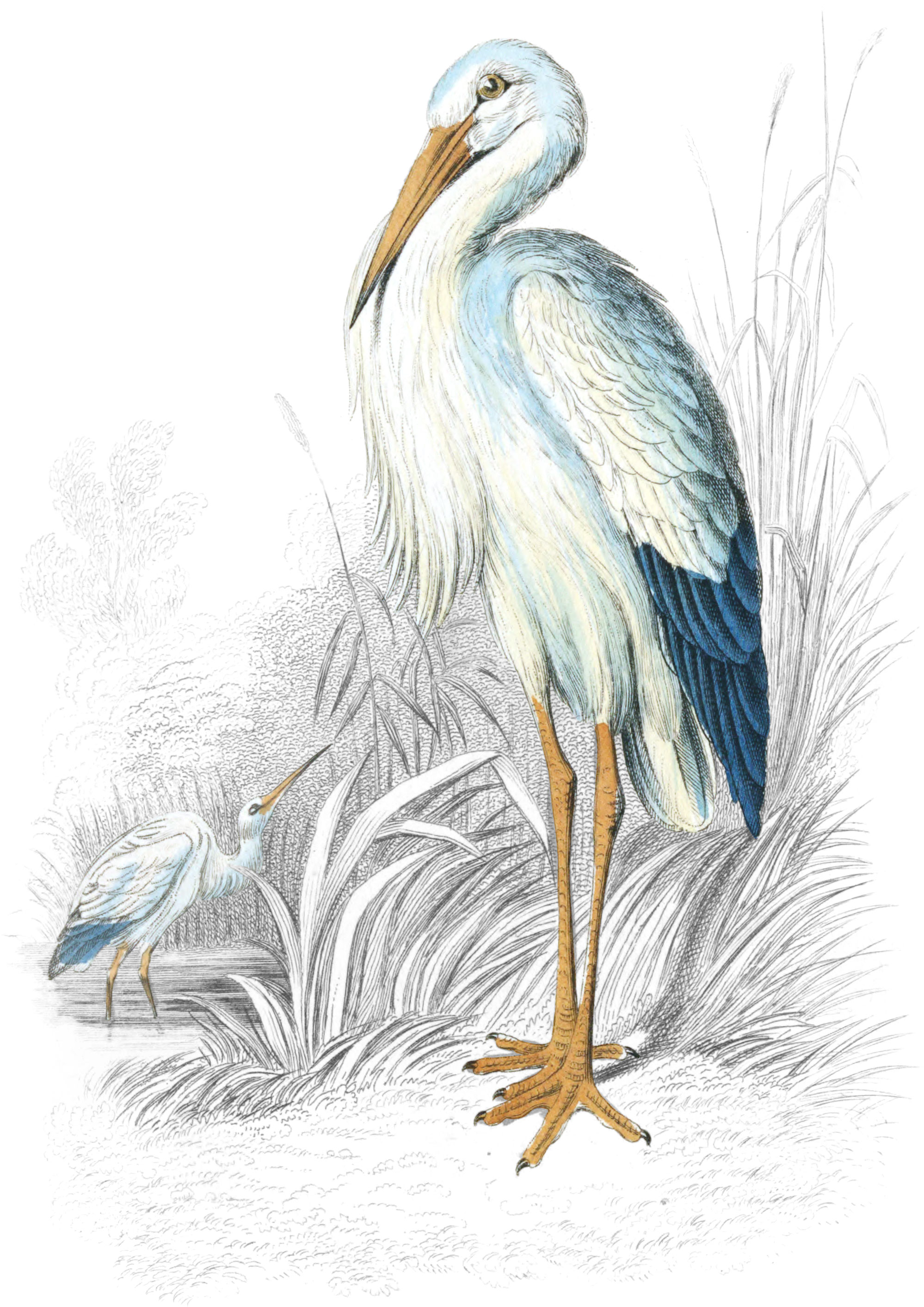
Plate VII
Another fine Stork has been admitted to a place in our fauna,
The Black Stork
Ciconia nigra.—C. nigra, Will.—Ardea nigra, Linn.—Cicogne noire, Temm.—Black Stork of British authors.
The first specimen, taken in the British Islands, was in Somersetshire, in 1814, and it fortunately came into the possession of Colonel Montague, who published the record of its appearance, with an account of its habits during the period it continued alive in his possession.80 Another was taken, in 1831, on the Thames, a third near Ipswich, and the last in November, 1839, in the Isle of Purbeck, at the south side of Poole harbour,81 Its native countries are said to be Switzerland, Hungary, and Turkey, building in secluded forests, on the tops of high trees.82 It is also found at the Cape of Good Hope83 and Madeira.84 It is easily tamed, and is an elegant species, its dark and glossy upper plumage contrasting beautifully with the white of its under parts, relieved by the deep red of the bill and legs.
Mr. Yarrell thus describes the bird in the Zoological Gardens.
The beak and naked skin around the eye are red, tinged with orange; the irides reddish-brown; the head and neck all round, upper surface of the body, wings, and wing-coverts, are glossy black, varied with blue, purple, copper-coloured, and green reflections; the primary quill-feathers and the tail, black; the whole of the under surface of the body, from the bottom of the neck to the ends of the under tail-coverts, white; legs and toes, orange-red; the claws black.
Spoonbills
In the genus, which we place next, we find birds possessing the form, and many of the habits, of the herons; the bill lengthened, but instead of that member being sharp-pointed and rough on the edges, fitted for darting at and securing a slippery and sometimes strong prey, we see it depressed, endowed with sensibility, and modelled somewhat upon the plan of the bill among the ducks.
Platalea.—Generic characters.—Bill long, straight, depressed, very flat, dilated towards the tip; nostrils basal, placed above, and near each other; legs long, naked above the tarsal joint; toes before partially webbed, posterior toe articulated slightly above the plane of the others; claws short, not serrated; wings long, second quill longest; head often crested.
Types, P. leucorodia, ajaja, &c.
Note.—Gregarious, breed on trees, sometimes swim. Europe, Asia, America.
The White or European Spoonbill
Platalea leucorodia.—Linnæus.
Piatalea leucorodia, Linn.—Spatule blanche, Temm.—Spoonbill or White Spoonbill of British authors.
The Spoonbill is an occasional visitant to the three kingdoms of Great Britain and Ireland, being most frequently met with in England, while it is rare in the others; in the former, they are even recorded by Sir Thomas Browne to have bred occasionally, while, on the other hand, in Scotland, they appear to have strayed even so far north as Orkney and Shetland.85 Out of Europe, they seem to range to Africa and India, although the specimens brought by Colonel Sykes are from three to four inches longer than the European birds.86 The Spoonbill seems to breed both on trees and upon the ground, or nearly so, among tall reeds; and the eggs deposited in a nest of large and strong structure, differ from those of the other Ardeadæ in their colour, being nearly white, with blotches of pale brown over them. Their food is usually described to be small reptiles and fish, with all the produce of marine and aquatic life which occurs in pools left by the tide, or is formed by fresh waters. The form and structure of the bill would, however, lead us to believe, that if their manner of feeding was strictly observed, it would be found adapted to a peculiar kind of food, abundant in the places which they frequent. In confinement it is various, and nothing seems to come far amiss. Young birds we have seen fed on bread and milk, and also with fish, which they eat with great avidity.
The plumage of the adult Spoonbill is entirely pure white, with the exception of a band of a rich buff colour, placed on each side of the lower parts of the neck, and which shades off to pure white on the fore part of the breast, scarcely however meeting. The head is adorned with a very ample crest of long broad feathers, hanging half way down the neck, and capable of being erected at pleasure; the bill is Hack, yellow towards the tip, and very rugous above; the legs and feet are also black. The female is described as having a small crest. In the young the head is not crested, and the buff-coloured band is not present. In young birds which we saw in Holland, fully feathered, but not long from the nest, the plumage above was dusky, from a dull or dark stripe passing along the centre of each feather; and the bill, with the bare skin of the face, was of a grey or lead colour, the former quite soft, and tinted on the edges of the gape with pink.

Plate VIII
Cranes
The next form has given some difficulty in assigning it a situation; it is more varied in habits and feeding, and, in internal structure, seems to approach nearer the Rasores than the typical Grallatores; but the British bird, when viewed in conjunction with the foreign species, and some of those large birds which were formerly associated with the genus, will be found to take its place, and fill up a wanting gap among the Ardeadæ.
Grus, Pallas.—Generic characters.—Bill strong, nearly straight, compressed, pointed; nostrils large and pervious; legs long, much of the tibiæ naked; toes strong, but comparatively short, the hinder toe short, articulated, high on the tarsus; wings ample, rather rounded, third quill longest; tertial feathers often elongated.
Types, G. cinerea, Americana. Europe, Asia, America.
The Common Crane
Grus cinerea.—Bechstein.
Ardea grus, Ray, Linn., &c.—Grus cinerea, Bechstein, Selby, and modern ornithologists.—Grue cendrée, Temm.—Common Crane of British authors.
The Common Crane would seem formerly to have been much more frequent, than it now is, in our islands, appearing in the old bills for many of the feasts. Crane, however, we do not think can always, in these records, be translated as the Grus cinerea of the ornithologists of the present day. In later days the bird appears only as an occasional visitant; and not more than seven or eight instances of its occurrence are mentioned between 1 820, and the present year, 1841; some of these have been in Devonshire, others in Orkney and Shetland. In Ireland it has not been seen for a hundred years. In the north of Europe it is seen, at similar interrupted intervals; and, in Central Europe, they are observed during their migrations. “Egypt, and various parts of Africa, are said to be their winter quarters;”87 but of their stronghold, or of their breeding stations, little, indeed, seems yet known to ornithologists. The latter is said to be in marshes, by the sides of lakes or rivers, where the vegetation is dense, and a love for elevated situations is also ascribed to it. The structure of the trachea is somewhat similar to that observed in some of the Natatores, the swan for instance, and in several of the Rasores; it performs extensive convolutions in the sternum as it advances in age, occupying nearly the whole of its internal space.
The crown of the head exhibits a naked oval space, of a bluish or livid colour, we believe, in the living bird, thickly scattered over with black hairs, or rather hair-like plumes; immediately succeeding this, the feathers on the occiput are brocoli-brown; the chin, and fore parts of the neck, ending in a point on the breast, are of the same colour; all the general plumage is ash-grey, slightly paler beneath; the bastard and primary quills, secondaries, and tertials, are black; a portion of the secondaries and tertials being elongated, assume a curved form, have the webs disunited, and droop gracefully over the ends of the wings and sides, in the form of the curved feathers in the tail of the domestic cock. The tail is blackish-grey, short in comparison with the size of the bird; the under coverts reaching in length to its extremity; the legs and feet black.
In the female the development of the long plumes is less, and the colours of the plumage scarcely so clear. The young want the dark colour on the neck and occiput, and have the plumage more tinted with brown.

Plate IX
Tantalidæ
This is another group of birds, of which we possess only one example in our fauna, the Glossy Ibis, evidently of form intermediate between some of the herons and Scolopacidæ. The family has been denominated, from another genus, Tantalus, having all the proportions somewhat similar, but much more developed. These birds, though partially aquatic, are gregarious, breed on trees, and many of them possess the large development of the secondary quills which we saw in the cranes, while, in others, the elongated feathers of the neck and breast of the herons are represented. In the genus Ibis, as now restricted to the type of I. rubra, falcinellus, &c., we have the form more slender, and running into that of the curlew division of the Scolopacidæ, and their habits are also more akin to them, frequenting the edges of marshes, the borders of rivers, and the sea shore.
Genus Ibis.—Generic characters.—Bill long, curved at the base, compressed, thickened, and powerful; mandible deeply grooved for its whole length; tip, without development for sense of touch; face, chin, and throat, sometimes naked; legs rather long, strong; tibiæ partially naked; feet strong; toes joined by membrane, hinder toe on the same plane with the others; wings long, second, third, and fourth, nearly equal and longest.
Types, I. rubra, falcinellus, &c. Europe, Asia, Africa.
The Glossy Ibis
Ibis falcinellus.
Tantalus falcinellus, Linn.—Ibis falcinellus, Temm.—Bay Ibis, Green Ibis, Glossy Ibis, of British authors.
This richly-coloured bird has now been frequently killed in several of the English counties, from the south even to Northumberland. In Ireland, by Mr. Thompson, it is stated as a rare visitant. On the continent it also occurs sparingly, and reaches a locality so far north as Iceland.88 The bird of India was considered identical by Dr. Latham. Colonel Sykes includes it among the birds of the Dukhun; and, in a list of birds published in the Annals of Natural History, Little Thibet is given to it.89 Java, Sunda, and other islands in the eastern seas, are also mentioned as within its eastern range.90 In Africa, it has been found in Egypt and in the vicinity of the Cape of Good Hope.91 In America, an Ibis has always been considered as identical with this species, and ranges from the United States to Mexico, Florida, and the Brazils; this, in fact, being considered as the head quarters of the species. The Prince of Canino, in his last geographical and comparative list, however, places the American bird under the title of Ibis Ordii, restricting the I. falcinellus to Southern and Central Europe, whence the stray specimens reach the British shores. As in many similar cases, we have thought it right to state the views of the Prince, though we do not know his distinguishing characters, and have only more and more to regret the want of that information, which would have rendered his work so much more valuable.
In the adult bird, the plumage may be said to be one brilliant changing mass of greenish-black, purple, arid dull red, all parts having a metallic lustre, these prevail on the head, neck, back, and general upperparts; beneath, the colour is of a deep reddish-brown, with little play of colour; the bill is deep brown, and the naked part of the face, the legs, and feet, are blackish-green, darkest on the latter. The young specimen procured by Mr. Selby, in Northumberland, is thus described by him, and, with little variation according to age, may suffice to mark the young in their first or early state.
The bill is greenish-black, fading towards the tip to wood-brown, and measures five inches in length; the lores are green; the head, throat, and back of the upper part of the neck, are pale hair-brown; the feathers margined with white, and giving a spotted appearance; on the fore part of the neck are two narrow transverse bars, and a large irregular spot of white; lower parts of the neck, and the whole of the under parts, of a hair-brownish colour, the margins of the feathers having greenish reflections; upper parts of the body, wings, and tail, glossy olive-green, with faint changeable reflections of purplish-red upon the scapulars and wing-coverts; legs and toes blackish-green.

Plate X
Scolopacidæ
The Scolopacidcæ typically represented by the Snipes and Woodcocks, is well seen in our British list, by a numerous series of forms and species, all extremely interesting, and is, we believe, a favourite family with almost every ornithologist. By far the greatest proportion of them frequent extensive marshes, or the shores and banks of our coasts and rivers, retiring, for a time, to the inland moors or fens, to breed and rear their young. A few only are partial to woods and thick covers, where, however, they are to be found in marshy glades, or the moist and more exposed openings which occasionally prevail; many of them are much esteemed for the table, and by the sportsman. The plumage of all is coloured with chaste and subdued tints, and is often remarkable for the purity and distinctness of its markings. The young run immediately on being hatched. Several of the genera feed and perform their migrations by night, these have the eye proportionally large, and much developed. The bill is often furnished, at its tip, with a structure of high sensibility, by which it can discriminate by the sense of touch, the insects, &c., with which it comes in contact. The first form we notice, is that of the Woodcocks or Snipes, which we shall here keep together, though, by several intelligent ornithologists, they have been separated, partly on account of the more sylvan habits of the former, and partly from a slight difference in the feathering of the tarsi, or in the one set of birds being formed for a wading or more aquatic life than the other. Without doubt, the three known species of Woodcocks, all sylvan in their habits, could at once be separated by any one from the Snipes; but, at the same time, we have one or two intermediate birds which could not, assuming the distinctions we have stated as characters, be placed in either.
Genus Scolopax, Linn.—Generic characters.—Bill lengthened, straight, basally compressed, slightly curved at the tip, and there dilated; the tip of the maxilla fitting into that of the mandible; legs and feet slender tarsi of moderate length; tibiæ only for a short space naked, or altogether clothed with feathers; wings moderate, tips of the quills somewhat rounded, but the first or second longest.
Types, Scolopox rusticola, gallinnago, Sabinii, &c. Cosmopolite.
Note.—Habits of several, to a certain extent, sylvan, all migratory, or partially so. Squat on the approach of danger. Breeding and winter plumage similar.
The Woodcock
Scolopax rusticola, Linnæus.
Scolopax rusticola, Linn, &c.—Becasse ordinaire, Temm.—The Woodcock of British authors.
The Woodcock is the largest species in the genus, and, from the oldest records, has been in high favour for the table, and since the time that shooting flying has been practised, has been much sought after by the sportsman, to whom it makes an agreeable variation among the winter rover-shooting. Although there are now many instances on record of the Woodcock breeding in various parts of Great Britain, yet it still must be considered as one of our winter migrating birds, the great mass visiting us in the commencement and towards the end of October, and removing again in February. The great attention that has been paid to British ornithology, for thirty years past, has made known many instances of breeding; for we do not see any changes in the country that could have, at a later period, increased their frequency; but, even those which have been recorded, are few indeed, compared with the number of birds that visit us every winter. Some situations appear more favourable, or are preferred by the birds to others, and there, almost with tolerable certainty, one or two pairs may be found, season after season; but, with that exception, there is no indiscriminate breeding, as with the snipes, in suitable localities. In Ross-shire, they have now been frequently discovered breeding.92 Near Dunkeld, they are stated also to breed,93 and this locality must be a favourite one of long standing; for, twenty years since, in rambling through the woods in that vicinity, we were told by the keepers, that Woodcock nests had several times been found. In Fifeshire we have heard of instances, and once received the egg in a fresh state from that county. In Northumberland we have also authentic records of their breeding;94 and various scattered instances have been noted, in different periodicals, &c., of nests being found in other and more southern districts of England. But all these can merely be looked upon as cases on the very limit of their breeding range, and not at all similar to birds, which, though they remove, or partially migrate, yet regularly and in numbers breed with us.
Like a great proportion of the aquatic birds, a dry spot is selected for the nest, often at a considerable distance from water. By one writer, the nests were said to be all placed in
dry, warm situations, amongst dead grass and leaves, without any attempt at concealment;
and, by Sir Francis Mackenzie,
the soil where the nests were found is gravelly and rather dry; the grass tolerably long, without underwood; and the trees, oak, birch, and larch, not exceeding thirty years growth.
In Norway,
they (eggs) were placed upon the bare ground, under some brushwood, and in a place from which the timber had been cleared, and in which the young spruce firs were again springing.95
The eggs are of a pale purplish-brown, sometimes yellowish-white, with irregular markings of a deep brown tint.
The Woodcock, when first arriving in this country, may be found in whin covers on the coast, or at a great distance from wood, often on the moors, amidst long heath; at times, in these localities, they are extremely shy, while at others, as if fatigued with their flight, they can scarcely be raised, and frequently, when fallen in with in such a state, are killed in numbers. They soon, however, leave these districts, and do it simultaneously, scarcely a bird being to be found in the morning where the day previous they had been abundant. Their most favourite haunts, when settled, as it were, for the winter, are woods of some extent, where there is cover that can be run through beneath, and where shelter is afforded by spreading low-branched spruce trees, hollies, or other large evergreens. There they rest by day, only at times feeding, or turning over the dried leaves, and at twilight regain activity, resorting to the open glades, or marshy bottoms, or sheltered outskirts, and then, for a time, feed in earnest. Their food seems to be aquatic insects or larvæ, which they procure by thrusting their bills into the soft mud, or “boring,” as in sporting language it is termed; in this process a quantity of sand is also taken, for the stomach is almost always filled with it, in addition to any remains of insects that can be seen. In the woods, they also seem to turn over the dead leaves in search of what maybe beneath; and, in hard frost, this bird, from these peculiarities, is one that suffers most severely. The number of Woodcocks which visit us vary much from year to year, and without apparent cause. Whatever that may be, it should be sought for in their summer land, not in that which receives them in winter. Ireland seems to be a most abundant locality for both this bird and the snipe. The character of the country would, to a certain extent, account for the latter; but, even its position, in reference to that in which they are summer residents, does not completely account for the abundance. Fifty couple are recorded as killed by a single gun in one day,96 and a range of from ten to thirty is not accounted extraordinary. Natural copse-wood, on the hills and valleys of the moorlands, are said to be favourite retreats for them; in whin covers they are also found, and we have the word of a keen shot, some time resident in Ireland, that, after a flight, many might be found in the hedges.
The migration of the Woodcock is nocturnal; in the partial changes which they make in this country, we know that this is the period selected, and their arrival has been witnessed at early dawn on our coasts,97 The Woodcock, also, is one of the birds which are occasionally taken, after having dashed themselves against lighthouses, attracted by the light; and instances have occurred, where they have alighted on the decks of vessels in the channel.
The geographical distribution is extensive. Besides being generally met with in Great Britain and Ireland, wherever suitable localities occur, it extends occasionally to Orkney and Shetland, but, from the want of shelter there, it continues for no time; and, as we have seen with various species which range far to the north in the British Islands, still, abroad, the same degrees do not restrict them; thus, we have the Woodcock extending even beyond the Arctic Circle,98 and breeding in Austria, Siberia, and Silesia. In an opposite direction, they reach the Italian States, Smyrna,99 and some parts of the African coast. They are seen at Madeira;100 and Mr. Yarrell states, that the
Zoological Society have received notices of our Woodcock having been obtained at Cashmere; and Dodah, near Cashmere;
is given by another authority.101 We possess specimens from India, which we understood came from the alpine districts, the only variation being a greater preponderance of rufous marking the plumage. It is also found in Japan.102 In the catalogue of the Sumatran and Javanese specimens, collected by Sir Stamford Raffles, it is stated,
There is a specimen in the Sumatran cabinet, nearly allied to the British Woodcock, which remains to be examined.
The Woodcock is the largest known species of the genus, weighing from nine to eleven ounces. The colours vary in intensity in different birds, the prevailing tint in some being of a yellowish-grey, in others of a reddish almost sienna-brown. The forehead, until in a line with the eyes, is grey; and immediately succeeding, across the crown and nape, there are four bands of rich blackish-brown, the two first very marked and distinct, and all separated by a narrow bar of yellowish or reddish-white; from the corners of the eye to the rictus, there is a streak of the same rich brown colour, below the auriculars a longitudinal patch, and on the fore part of the neck, two oval patches, also brown, the latter formed by the tips and bars on the feathers being very broad and uniting. The upper plumage is a mixture of chestnut-brown, pale ochraceous, and grey, interspersed with black and rich brown markings, chastely disposed, the pale colours being generally surrounded by a dark margin often shading into them. The rump and the tail-coverts are chestnut-brown, the latter concealing the tail until within three-quarters of an inch from the tip. Wings blackish-brown, interiorly appearing pale sapio-brown, the feathers cut into on the edge of each web with triangular markings, on the outer of chestnut-brown, on the inner of reddish wood-brown; the outer web of the first quill is generally paler, in some instances yellowish-white, that colour predominating, and the dark assuming the form of triangular spots upon it. The tail, of twelve feathers, is black, the outer webs of the feathers cut into with chestnut-brown; the tips above grey, on the under side appearing pure white; under parts yellowish-white, of a redder tinge on the breast, and varying in specimens to a more ochreous and redder tint; the whole is narrowly barred with blackish or hair-brown; under tail-covert ochreous, with black centres. Legs, and base of the bill, pale brownish-pink; the tint of the latter increasing in intensity to the tip, where it becomes nearly black.
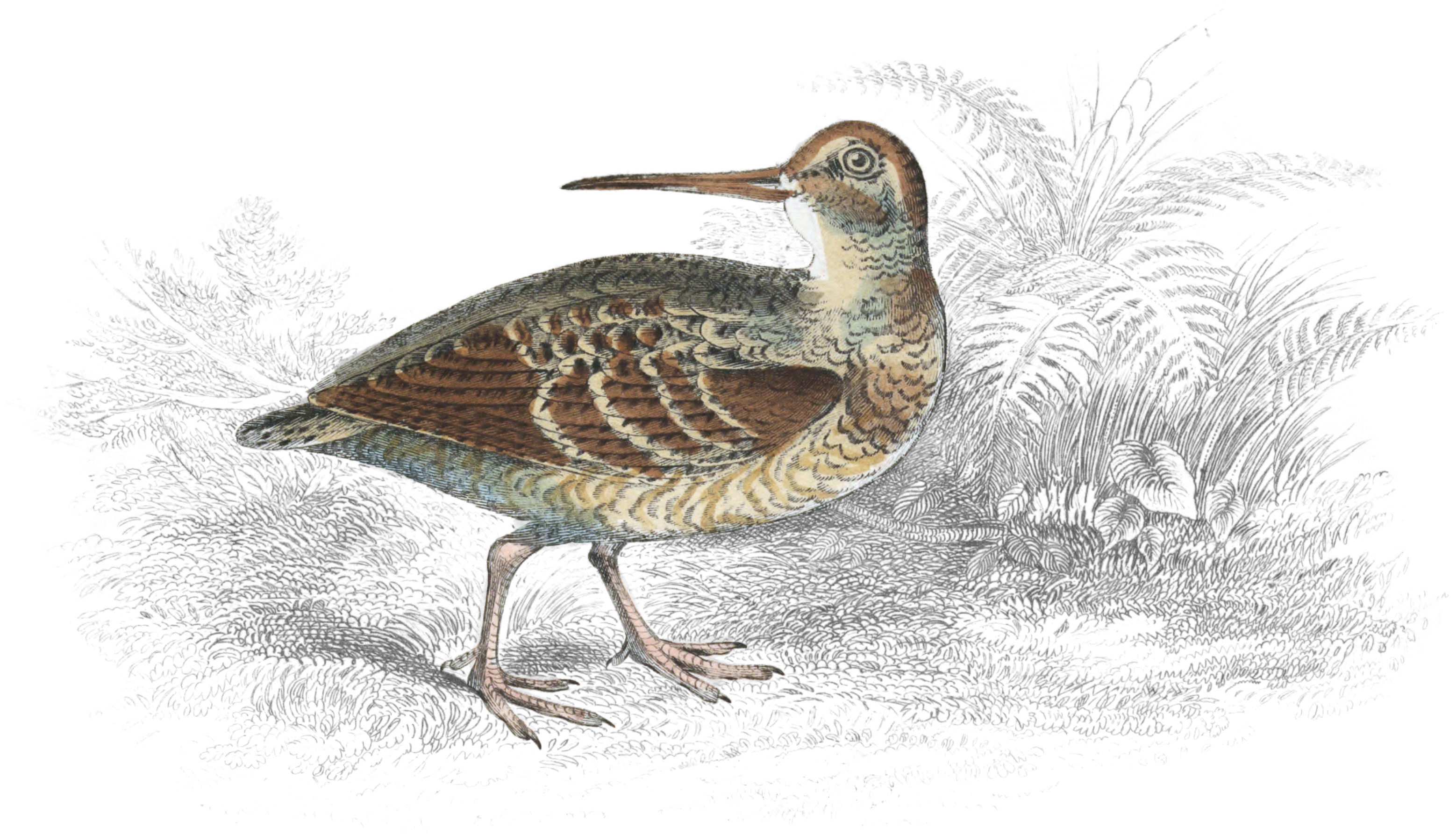
Plate XI

Sabine’s Snipe
Scolopax Sabinii.—Vigors.103
We have introduced this Snipe after the woodcock, in consequence of the intermediate form and colour it possesses between the true woodcocks (Rusticola of some authors) and the Snipe. The upper parts are nearly of a dusky-brown, varied by narrow bands of pale yellowish-brown. The under parts are also rufous dusky-brown, alternately barred with pale yellow-brown. The tail, containing twelve feathers, has the basal half black, the terminal half chestnut-brown, barred with black or blackish-brown. Tibiæ plumed entirely to the knees. The entire length of the bird is from ten to twelve inches, of which the bill will measure from two to three.
This interesting bird was described by N. A. Vigors, Esq., in the fourteenth volume of the Linnæan Transactions, from a specimen shot in Queen’s County, Ireland, on the 22d of August 1822. A second Irish specimen was afterwards procured and exhibited to the Zoological Society, by Mr. Thompson; and three other specimens have since been killed in England, the last near Morpeth, in Northumberland, which is the most northern range ascertained for the species. We are not aware, with certainty, of any extra European locality.
Of the habits of the Sabine Snipe we know little. That exhibited by Mr. Thompson was not procured until after the third shot, and showed no shyness or timidity, alighting, after being fired at, without flying far. The cry is described as different from that of the Common Snipe.
The Great Snipe
Scolopax major.—Scolopax major, Gmel.—Grandeou Double Becassíne, Temm.—Great Double or Solitary Snipe of British authors.
This species occurs, as a straggling bird of passage, chiefly in the south of our island, where, in some seasons, its occurrence is pretty frequent; but, as we reach the borders of Scotland, and proceed northward and westward, or into Ireland, it becomes more rare in its appearance. In Continental Europe it is also migratory; appears to be most common and to breed in Norway and Sweden, occurring in Central Europe only at uncertain periods, but also incubating in scattered localities in Holland. Specimens were sent from Trebizond to the Zoological Society, by Messrs. Dickson and Ross, but its extra European range is not ascertained; some of those foreign specimens, which were considered identical (that from America for instance), being found to be distinct.
It is remarkable, that in Britain the specimens of the Great Snipe have been almost all met with in autumn, comparatively few being found in the spring, or on their return northward. When found, it is generally alone, or in pairs, which has gained for it the appellation of “Solitary Snipe,” and it is said to be not shy in approach. It is at once distinguished by its heavier flight, and by its out-spread tail.
In comparison with the Common Snipe, the hill and legs are short; the tibiae bare for only a short distance above the tarsal joint. The upper parts exhibit the general distribution of colouring and marking seen in the Snipes, the distinctions in which, between species, it is almost impossible to point out in words, but the under parts, to the breast, are pale ochreous, below that nearly white in the former, the latter having the feathers barred with black, the markings covering the whole under surface; the wings are short and rounded in all their proportions; the edges of the innerwebs very slightly tinted with a pale rufous, and minutely and delicately mottled with greyish-black (as in Tringa rufescens), though not so conspicuously; the axillary leathers with very broad and distinct black bars; tail very much concealed by both upper and under coverts; the centre feathers black, with rich rufous-orange tips, finished by a black and a white narrow bar; the four exterior feathers, on each side, white on the inner webs, more or less barred with black on the outer, and those next the centre being tinted with reddish-orange.
The Common Snipe
Scolopax gallinago, Linn.—Scolopax gallinago, Linn.—Becassíne ordinaire, Temminck.—Snipe, or Common Snipe of British authors.
The Common Snipe is abundant over the whole of Great Britain and Ireland, and is familiarly known to every sportsman. Many birds permanently remain, but in all districts we believe that a partial migration takes place, and we receive a large accession of numbers about the period of the arrival of our earliest winter visiters, which again, in part at least, remove with the coming spring. The general character of the English counties is rather unfavourable for this bird, but wherever these are suitable, it abounds. As we proceed to the northward, the moisture and moorlands increase, and with them the Snipe, and it reaches and increases in numbers, even to the most distant of the Hebrides. In the breeding season, the relative frequency of incubation is comparative with its numbers; and, on reaching the Scottish border, it may be said to breed every where. The localities preferred at this time, are the edges of marshy grounds; or, where these are very extensive, some drier spot amidst the lower moors, and the borders of the northern lochs. In the south, the marshes in the commons, and the open marshy valleys in the tracts called forests, are frequented by them. The nest is placed on some dry raised tuft or hillock, and it is a pressed or scraped hollow, the little herbage that is present being used, rather than a nest formed of carried materials. At this season, or when the pairing has commenced, the birds may be heard piping among the herbage, or may be both seen and heard in the air, performing their evolutions, and uttering the loud drumming sound, which, at one time, gave rise to so much discussion in regard to the manner Hi which it was performed. The sound is never heard except in the downward flight, and when the wings are in rapid and quivering motion; their resistance to the air, without doubt, causes the noise, which forms one of those agreeable variations in a country walk, so earnestly watched for by the practical ornithologist.
After incubation, the young may still be found near their breeding places, and it is not until the weather becomes variable, that they, according to circumstances, begin to shift their ground. We have often found them abundant in the low and sheltered marshes, and the day following sought the same ground, scarcely meeting with a bird. The same occurs on the upland wet pastures, and they come in and remove with the night. Frost has a similar effect on their motions, but in very severe weather, this drives them to be pretty stationary until the next change. They are also sometimes found in grounds having a considerable growth of scattered willow or alder, where the woodcock would rather have been looked for; and, in a very severe winter, we have seen Snipes come to the garden, and perch on the cabbages and greens along with the wood-pigeon, apparently in search of any moisture held between the blades.
From the close resemblance and alliance of some apparently distinct species of Snipe to that of Britain, the exact geographical range has not been ascertained; by some it is made to be extremely wide, while by others, again, it is almost restricted to Europe. Both are probably wrong, and much of our authority rests on the evidence of sportsmen; Lloyd, in his Northern Field Sports, finds it abundant in the north of Europe. Mr. Yarrell, on the authority of Mr. Dann, states, that it “breeds in extensive morasses and swamps, in the mountainous districts of Norway and Sweden.” From Scona to Lapland it is widely distributed. Russia and Siberia are given to it by Pennant; the vicinity of Smyrna by Mr. Strickland. It is enumerated in the Sumatran Catalogue of Sir Stamford Raffle’s collection. The birds of America are distinct.
The markings of the plumage of many of the Snipes is so similar, that there is great difficulty in describing them so as to show specific distinctions. The general upper ground colour of the Common British Snipe is deep brownish-black, and this is varied by the light wood-brown edges of the feathers, which are so distributed in many parts as to run in lines. The colour of the crown is divided by a central pale line produced in this manner; from the nostrils, over each eye, another broad line stretches, and from the gape to the eye there is a blackish-brown streak of uninterrupted colour; on the back of the neck, from the centres of the feathers only being dark, an irregularly varied mixture is produced; but upon the back scapulars and long tertials, the feathers are edged with a broad margin of clear wood-brown, which runs in lines along the back; the lower part of the back, when the long tertials are laid aside, is nearly black, each feather tipped with white, producing altogether a distinctly and beautifully varied appearance. Beneath, the chin is white or yellowish-white; the throat and breast dark wood-brown, the feathers of a deeper tint in the centre, the colours shading into pure white on the lower part of the breast, belly, and vent. The tail contains fourteen feathers, the two in the centre black, tipped with reddish-orange for the length of half an inch; this pale tint is sometimes mottled with black, and is crossed near the tip with a narrow dark bar; the other feathers to the exterior, are greyish-black, the reddish-orange extending further down, varied and clouded with the dark ground colour of the feathers; the outer feather is white at the tip, and on the outer web. When running, the Snipe jerks with its tail, spreading and expanding it like a fan, and often placing it in a lateral position; the shafts of the feathers bend inwards, that of the outer having a distinct angular curve.
The Jack Snipe
Scolopax gallinula, Linnæus.
Scolopax gallinuta, Linn.—Becassîne sourde, Temm.—The Jack Snipe or Judcock of British authors.
This beautiful little Snipe is generally dispersed over the British Islands, upon the whole less numerously than the common species, at the same time always to be met with during winter, and at times in considerable numbers. It is a winter visitant, arriving among the most early, and returning, as it were, year after year, to its favourite and accustomed haunts. It is also one of the last to leave us, always remaining until the month of March, and, at this period, when the nuptial dress has commenced to be put on, and has reached a certain degree of maturity, the glossy green and purple of the dark parts of the back, contrasting with clear ochreous-yellow, exceeds in beauty the plumage of any of our Snipes, or, indeed, of any foreign species we are acquainted with.
The Jack Snipe is a solitary species during its stay with us, being met with singly, or with a single companion; at the same time, in some sheltered or favourite locality, five or six may frequently be found within a limited space. We have never, however, known them congregate in small parties, as the common Snipe does, or rise in more than a single bird at a time. It may be interesting to know how the migration is performed. They are far from being shy, though at times we have seen them rise “wild;” but, in general, they will allow the sportsman to approach very near, sometimes within a few feet, and lie squatted on the ground with the head and bill stretched out before, unmindful of cover, but selecting any inequality, hollow, or foot-step, to screen themselves.
In regard to the incubation of the Jack Snipe, we may say, that attempts to discover its nest in this country have hitherto been unavailing. Mr. Yarrell has been at pains to collect all the information and evidence on the subject, but, among the few notices of the occurrence of the eggs, we cannot trace authenticity, while the straggling instances which have occurred, of the bird being sometimes shot during summer, must be attributed to other circumstances than the occasional remaining of some pairs for the purpose of breeding.
They are, however, as before stated, a very late bird in leaving us, and are regularly seen with the London poulterers in the first week of April.104 In an excursion to Sutherlandshire, some years since, we thought we had found a breeding station for this bird near Tongue. The gamekeeper there, an intelligent man, said, that he frequently met with them and their young in August, while shooting; and every cross-questioning that could be put, would not allow him to think that he was mistaken by the young of the common Snipe. He mentioned the peculiar breeding-places frequented by them, and which, when visited, were exactly the spots we should have expected, or looked for a “Jack.” Our search, however, was fruitless, and, so far as this point is concerned, we have been unable to fill it up in Scotland. So far as we know any thing of its European range, it is a northern species during the time of incubation, being a winter visitant only in France and most parts of central Europe; by Temminck, it is said to breed in the vicinity of Petersburgh.105 Out of Europe, Colonel Sykes considers the species of the Dukhun to be identical. We have never, however, seen it, or received it with any collection from India.
From the bill, over each eye, to the back of the head, there is a broad streak of pale ochreous-yellow, divided immediately above the eye by a line of rich blackish-brown along the crown of the head; arising narrowly from the bill is a broad streak of the same colour, running backwards the same length with the pale markings; between the bill and the eye a streak of umber-brown; cheeks, sides of the neck and breast, greyish-white, tinged with ochreous, and spotted with black by markings in the centre of each feather; back black, with green and purple reflections, the feathers narrowly tipped with white, broadly margined with pale ochreous-yellow, and undulated on their middle surface with lines of chestnut-red, the pale edges forming four lines along the hack; the wings are greyish-black; secondaries tipped with white, the coverts broadly tipped with white and tinted with ochreous; the long tertials are edged with pale greyish-white, and undulated on their outer webs with pale chestnut-brown; the tail consists of twelve lanceolate feathers, and exhibits a form more wedge-shaped than most of the others, the colour is blackish-brown, edged with pale chestnut-brown; the belly and under parts pure white, on the flanks dashed with greyish-black, and tinted with brown; the axillary feathers white, clouded irregularly with blackish grey; feet and legs greenish-grey.

Feathers of S. gallinago and major
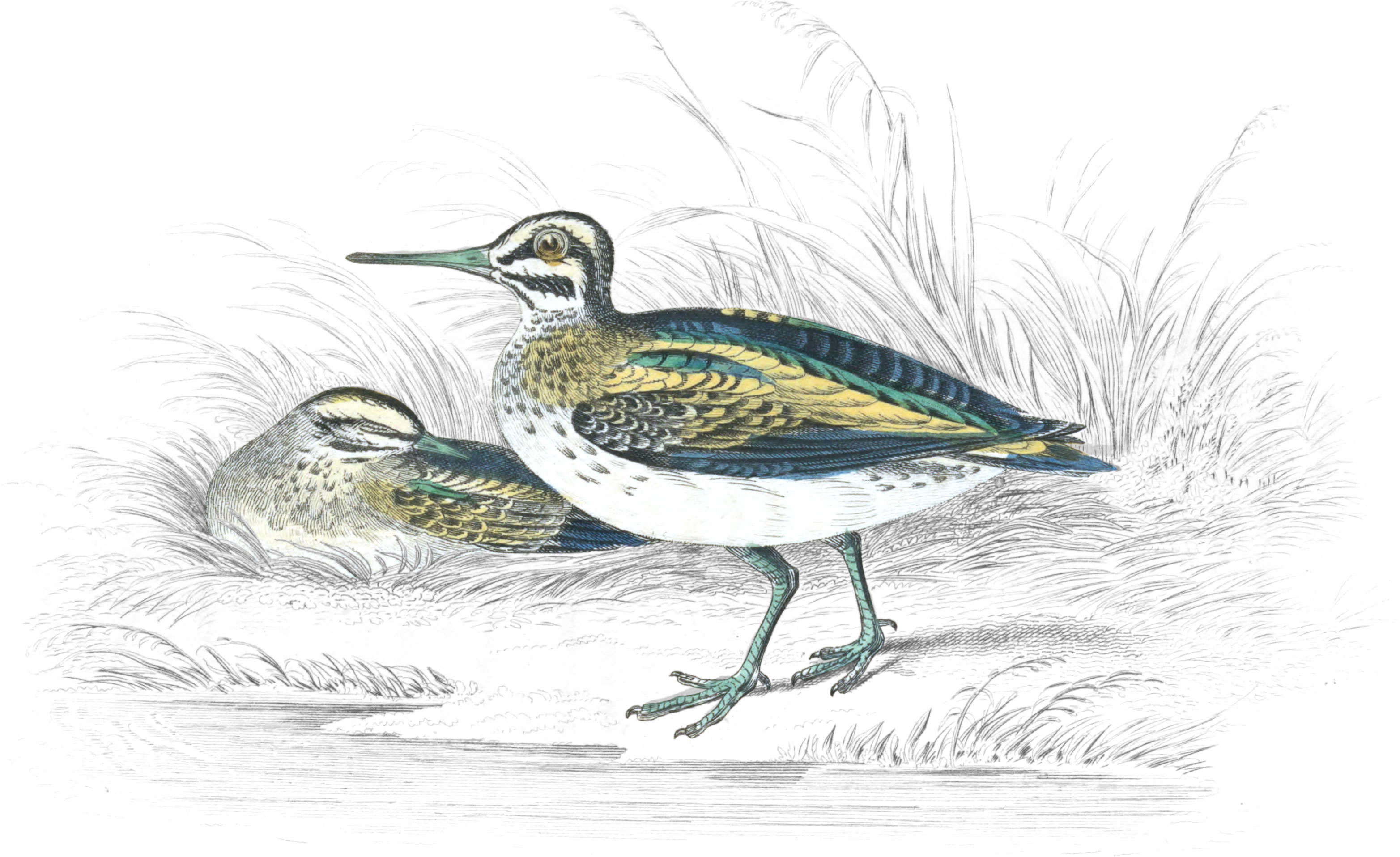
Plate XII
Macrorhamphus
Next to the Snipes, and by some persons among them, has been placed a rare British bird, forming the genus Macrorhamphus of Leach. It is, in reality, a marine Snipe, with the plumage and seasonal changes of the tringæ.
Genus Macrorhamphus, Leach.—Generic characters—Bill long, slightly dilated at the tip, and there incurved and rugose above and below; mandible and maxilla furrowed until near the tip; nostrils basal, pervious; wings long, first and second quills longest, and nearly equal; small bastard quill narrow and rigid; legs, with the tibiae, naked for half the length; outer toes connected by a web to the first joint, hinder toe resting on its tip only.
Type, M. griseus.
Note.—Frequents the sea coasts, and is seldom seen inland; breeding and winter plumage dissimilar. Distribution, Europe, America.
The Brown Longbeak
Macrorhamphus griseus, Leach.—Macrorhamphus griseus, Leach, Selby.—Scolopax grisea, Penn., Mont., Jenyns, Temm.—Brown Snipe, Brown Longbeak, Red-breasted Snipe, Grey Snipe of British authors.
This bird is properly a native of North America, and reaches as far north as the fur countries, even to the Arctic Sea,106 during the season of incubation; has been killed six or seven times in this country, and was first noticed, as a distinct species, by the indefatigable Montague. These have occurred chiefly in the south, and no instances have been noticed of its being met with either in Scotland or Ireland, the most northern range recorded, being that of a specimen killed near Carlisle, in the possession of Mr. Heysham.107 In Northern Europe108 it seems to be likewise uncommon, occurring only as a straggler.
The entire length of the bird will be about ten or ten and a-half inches, of which the bill measures from two and a-quarter to two and three-eights, and in the whole form and appearance, it is not unlike the Knot (Triga canutus), to be afterwards described. The plumage also has a good deal of the character of that bird, in the summer state being above broadly marked with black, cut into by narrow waves of brownish-yellow; the rump and tail-coverts are white, the tip of each feather marked with a crescent-formed spot of black on the tip, and barred diagonally with the same colour; the tail is also white, slightly tinted with rufous, and with all the feathers barred with black; beneath, the throat, neck, breast, and flanks, are orange-brown, each feather tipped and barred with black, these colours gradually disappear downwards, and the centre of the belly, with the vent, are pure white. In the winter, the plumage is of a greyish-brown on the head and neck, deeper on the hack and wings, and these, in some states, having the feathers edged with paler margins. There is a tinge of rufous on the breast, but the lower part and the belly, with the chin, are white; the tail and its coverts are similar in all states, a slightly deeper rufous tinge on the former during summer; the axillary feathers are white, barred with black; quills are deep hair-brown, shafts of the first broad and white. It may be observed, that, from the month of April until winter, various intermediate states of plumage are passed through, often very beautiful; the young exhibit a good deal of rufous on the under parts, when in their first feathers.
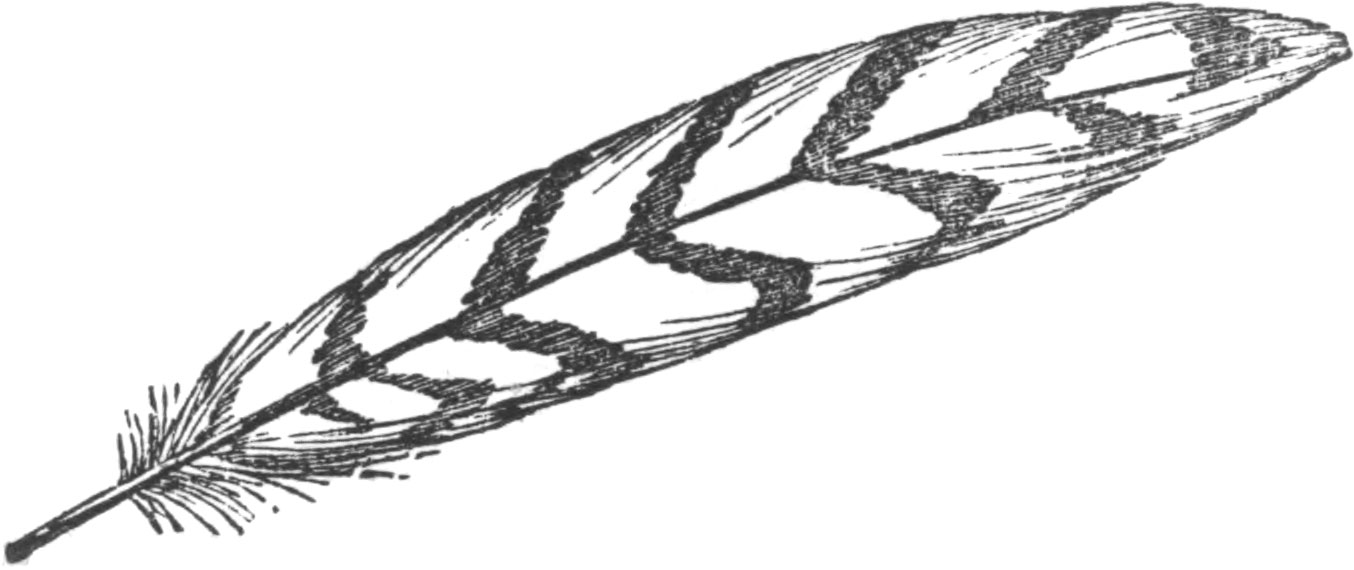
Macrorhamphus Feather
Godwits
With the last we entered into a race of birds, remarkable in the changes incident to the plumage between the breeding season and winter. In the genera which are now to follow, it is very dissimilar, assuming in some, colours of bright chestnut-red, mingled with deep black, in others of grey, also decidedly marked with black and white. This difference in appearance has given rise to a varied synonimy, and often to one species being described as several distinct birds. The Godwits, Limosa, frequent the open coasts during winter, and breed in inland marshes, differing from the true snipes in the habit of never frequenting or skulking among cover of any kind, and of being extremely noisy and vociferous when their nest or young is approached the change and colours of their plumage, and their whole structure, adapted for an open, partly maritime life, not for seeking their chief sustenance by boring into soft marshes, and seizing their slender and minute prey by the sense of touch rather than that of sight.
Limosa, Brisson.—Generic characters.—Bill very long, strong at the base, compressed, bending upwards; mandible smooth, rounded, slightly dilated at the tip, projecting beyond the maxilla; wings long, quills with the shafts very strong, flattened, first longest; legs long; tibiæ naked for the greater part of their length; outer toes connected by a membrane more than half the length of the basal joint; hind-toe articulated on the tarsus.
Types, L. melanura, rufa, &c.
Note.—Habits maritime, gregarious in winter, clamorous in breeding season. Europe, Asia, America.
Black-Tailed Godwit
Limosa melanura.
Scolopax limosa, Linn. (winter plumage.)—L. ægocephula, Linn. (summer plumage.)—Barge a queue noir, Temm.—Limosa melanura, Leisler, Selby, &c.—Black-tailed Godwit, Jadreka Snipe of British authors.
This handsome species breeds annually in the fenny districts of England, and, during winter, is partially distributed along the oozy shores of the English coast, and those of the south of Scotland; but, although a frequent, it is by no means an abundant species, and, in Ireland, it is “of occasional occurrence during the autumnal months.”109 Out of Britain, it ranges, in summer, so far north as Lapland and Greenland, and specimens have been received, in the winter dress, from the vicinity of Tangiers, and parts of Northern Africa.110 Japan, and the isles of Sunda are also given to it.111 Of old, the Black-tailed Godwit was considered a delicacy for the table, and at present they are occasionally taken, during or previous to the breeding season, and fatted by the fen men for the London markets; but Mr. Yarrell does not consider them to be held in such high estimation for the table as the ruff, when treated in the same manner. The long legs, neck, and bill of this bird, with the great naked space above the tarsal joint, give somewhat of a heron appearance to it, and remove it from the more squat or lowly figure of the plovers and true tringæ. The Godwits assume red in different shades as their breeding plumage, and, at this season, the head, neck, breast, and flanks of this Godwit are pale brownish-orange, very pale around the eyes and on the throat, upon the crown having the centre of each feather marked longitudinally with brownish-black, and having the breast and flanks barred irregularly with the same colour, the marks on the flanks becoming very broad and distinct. The belly, neck, and under tail-coverts, nearly white, also barred broadly with blackish-brown. The ground colour of the back is a rich blackish-brown, tinted with purple, broadly barred, and cut into with pale orange-coloured brown; the rump and tail-coverts, and base of the tail, are pure white, and contrast with the deep black of the extremity, from which the common English name has been given to it. The form of the tail, when closed, appears very slightly forked, or diverging on the outsides, and the black which almost reaches to the base, on the centre feathers, is gradually narrowed in extent to the outside, and, on the exterior feather, scarcely occupies more than half an inch of the end. The long tertials are clear brown, darker along the centres, and sometimes more or less variegated with orange-red. The greater coverts show a white tip, which forms a bar crossing the wing. The quills are blackish-brown on the outer webs and tips, shading to nearly white on the inner; the shafts of all strong, broad, and yellowish-white. The bill is deep blackish-brown at the tip, shading to “fine orange colour at the base;”112 the feet and legs are blackish-grey. In the winter state, the plumage above is pale clove-brown, darker along the centres; and the rufous parts of the head, neck, and breast, are of a paler tint of the same colour approaching more to white in the centre or fore part of the body, and shading into white on the belly, vent, and under tail-coverts; the other parts nearly resemble what we have stated as being the summer dress. The broods, which assemble in the autumn, present birds of various markings, according to circumstances of age or of early incubation; but nearly all assume the complete winter dress in a few weeks afterwards.

Plate XIII
Summer (Left), Winter (Right)
The Common or Red Godwit
Limosa rufa, Briss.—Red-breasted Snipe, Mont., (summer plumage.)—Scolopax leucophea, Lath. Grey Godwit, Linn., (winterplumage.)—Common or Red Godwit of British authors.
This species, though more abundant and more generally distributed than the last, is by no means common, and their general time of appearance is in autumn, remaining with us during the winter, on the low lying shores of our islands, where the beach is soft, and there are rivers, or small streams from springs. They appear at that season in small parties, which have left the district where incubation had been carried on, and now mingle with other allied birds, but are easily known at a distance by their more compact form, and by the length of their bill, which is seen boring into the soft sand or mire. On taking wing their shrill cry, or “Whelp,” at once betrays them. We have shot many specimens, on the low shores between Holy Island and the Northumbrian coast. The Merse, at Skinburness, and banks of the Wampoole on the Solway, are localities where we have never missed parties of them in the end of August and in September, mingling with several others the Totani and Tringæ, which are considered of less common occurrence on the border. In Ireland they are “a regular autumnal visitant.” From the information we possess and can procure, the range of this bird is much more limited than that of the last, does not appear to reach so far north, and, out of Europe, parts of Continental India and the East India Islands, are its best authenticated localities. These are given on the authority of Temminck.
This bird, with the exception of the longer legs and variegated tail, much resembles the last. In summer, the whole head and neck, breast, and all the lower parts, are of a subdued orange-red of uniform tint. The centre of the feathers on the crown, lower parts of the back of the neck, being broadly marked along the centres with blackish-brown, which extends upon the sides of the breast in narrow streaks. The lower eyelid is white. Above, the ground colour is rich purplish blackish-brown, the feathers deeply cut into with ochraceous and pale reddish-orange; on the shoulders and wing-coverts the tint approaches more to clove-brown, each feather edged with white, and these are generally intermixed with feathers of a darker colour, cut into with red; but we do not find in that part that the whole plumage assumes the summer tints. The rump and tail-coverts in this state are white, tinted with rufous, and have the centre of the feathers dark, the tail-coverts often become entirely rufous, barred with blackish-brown; the quills are deep blackish-brown at the tips and along the outer webs, shading into white on the edge of the inner, and becoming there mottled with hair-brown. The tail is greyish-white, tinted with rufous, the tip of each feather white, the shafts of very deep clove-brown, with irregular but decided bars crossing each feather of the same colour. The axillary feathers are white, crossed diagonally with clove-brown, set in distinct bars, and in this is easily distinguised from the last, where they are pure white. In the winter state, the head in all its parts is greyish-white, broadly marked along the centre of the feathers with clove-brown. The neck and breast are wood-brown, the centre of each feather darker, and this shades into a very pale tint, approaching almost to pure white on the vent and lower tail-coverts, having the shafts of the feathers on the flanks, only relieving it by a dark thread-like streak. In specimens in this state, the axillary feathers show little of the angular barring, but have only an interrupted patch on the webs. On the upper parts, the ground colour is very rich purplish clove-brown, cut into with yellowish-white or pale wood-brown, in the centre of the back having the markings running in lines, and on the shoulders and coverts, having the edgings so broad, as almost to give the pale tint to those places. The rump is pure white, very conspicuous during flight; the upper tail-coverts and tail similar, now without any rufous tint, and are very distinctly barred with deep clove-brown. The bill, in both states, is blackish-brown for more than half its length, becoming paler towards the base, and there tinted with pink. Feet and legs dark greyish-green.
Totanus
In the next genus, some of the species are of comparatively small size, and resemble the true sandpipers or tringæ; the typical birds, however, are equal in size to the snipes, and stand higher upon their legs, have the bill hard at the tip, and seek their food without boring for it among the soft mud or sand; they are more fluviatile or lacustrine in their habits, most of them frequenting the sea coasts less frequently; the seasonal changes of plumage are less marked in many than in Limosa, but in some it is as complete, the colour in summer being black or very deep grey, instead of red and chestnut, changing in winter to pale clear shades of grey.
Totanus, Bechstein.—Generic characters.—Bill of mean length, sometimes slightly bending upwards, rather slender, rounded, the tip of the mandible bending over that of the maxilla, hard and sharp pointed; legs long, slender, naked above the tarsal joint; the toes, in front, connected with a slight basal membrane; wings rather long; scapulars elongated.
Types, T. fuscus, glottis, hypoleucus, macularius, &c.
Note.—Cosmopolite (N. H. excepted?) Breed in marshes, habits more lacustrine than maritime, plumage in some undergoing a seasonal change.
The Dusky Totanus
Totanus fuscus.
Scolopax fuscus, Linn.—Totanus fuscus, Leisler and modern British authors.—Chevalier arlequin, Temm.—Dusky Sandpiper, Spotted Snipe, Spotted Red-Shank, and Cambridge Godwit (birds in the different states of plumage), of modern British authors.
In this species we see the seasonal change of plumage marked by very deep blackish-grey on some parts, inclining to black, instead of the chestnut-red seen in the godwits and some of the true tringæ. It is assumed at similar periods, and prevails on similar parts of the plumage. We have not a specimen in this state beside us, but our figure will in part illustrate it, and we give the description of Mr. Yarrell. Both illustrate the dark change of plumage, as our last plate and description did that of the red.
The adult bird, in summer, has the beak nearly black, but the base of the lower mandible is dark red; the irides dark-brown; over the eye the eyelid is white; the whole of the head and the neck all round, sooty-black; back, scapulars, all the wing-coverts, secondaries, and tertials, sooty-black, with well defined triangular spots of pure white along1 the margin of the web of each feather, which is also tipped with white; the primaries black, with white shafts, but no white spots; breast and belly black, a few of the feathers with white tips; under wing-coverts white, with dusky-grey spots; axillary plumes pure white under tail-coverts barred black and; white; legs and toes dark red claws black.113
In the plumage of the winter, the upper parts are ash-grey, beneath pure white. In a bird before us, the eye-brows, or from the base of the mandible above the eyes, are pure white; the head, back of the neck, back, and tertials, are ash-grey, tinted with brown; on the wings, the ground colour of the feathers is blackish ash-grey, tipped and cut into on the edges with dull white, and the greater and lesser coverts are barred with that colour; lower part of the back and rump are pure white, the upper tail-coverts distinctly barred with black, like the axillary feathers of the snipe; the tail ash-grey, barred with a darker shade, and having the edges paler; the under parts are entirely pure white, dashed with ash-grey on the cheeks, neck and sides of the breast, on the latter, assuming the form of undecided triangular bars.
This Totanus is a rare bird in Britain Mr. Yarrell records, in all, only seventeen instances of its occurrence, one of which, on the authority of Mr. Thompson, was shot in Belfast Bay. The most northern English localities, are specimens taken in Cumberland, and recorded by Mr. Heysham. In Scotland we have not lately seen specimens, but several years since we saw two, in a fresh state, immediately after being shot on the Frith of Forth, above Queensferry. Out of Europe it is found in Bengal,114 and Mr. Yarrell states Asia, on the authority of Mr. Gould. We possess a single specimen, in winter plumage, from continental India.

Plate XIV
Summer (Left), Winter (Right)
Redshank
Totanus calidris.—Scolopax calidris, Linn.—Totanus calidris, Bechstein.—Chevalier gambette, Temm.—Redshank or Pool Snipe, Red-legged Sandpiper or Horseman, Gambet of modern British authors.
This species is one of the most common of the larger British Totani, and although breeding in marshes, is perhaps more decidedly a maritime species than the others. It is also interesting, as showing an intermediate colouring, in the breeding season, between red and dark grey. In a few localities, on the Scottish coasts, it is stationary during the whole year; these are, where some suitable marsh is near for a breeding place; in this the nest is formed on, or sheltered by some tuft or bush of rank aquatic herbage; and the birds, on the approach of any stranger, are very clamorous, flying about with a slow quivering flight, uttering their shrill whistle, to which is now imparted an additional degree of wildness, and having their bright orange legs stretched out, and sometimes dangling behind them. We have several times procured them in the breeding season, and with the young, in a marsh such as we have noticed, on the banks of the Solway at Southerness, where a few pairs annually breed. It has also been found breeding in stations in Sutherlandshire, near Lairg, and at the head of Lochnaver. Several broods afterwards join on the shore, and continue together in parties, consisting of from a dozen to fifty. They are very wary, and, when taking wing, almost always utter their alarm note; but, if come upon unawares, from behind some rock or other cover, this note or scream is extremely loud and wild, and is always taken as a signal by the other birds feeding around. They feed on the sand banks and shell scalps, and rest at the full tide, assembling on the tops of the first appearing rocks as the waters recede; frequenting the same places, and following the same flights, day after day, so that persons may, by a little observation, easily conceal themselves in a situation which they are certain at a particular time either to pass or alight near. During winter their habits are nearly similar, and they are almost always to be met with on our coasts; but we have never seen them even as stragglers upon our lochs and rivers, as the Greenshank and some other maritime Totani frequently are.
The Redshank is also generally distributed over the greater part of Europe. Out of Europe, Japan is given to it.115 The Northern Zoology states, that a specimen from “Hudson’s Bay exists in the British Museum;” but it is not admitted by the Prince of Canino, to his last comparative list, as an American bird. We possess several birds from continental India, in their winter and young dress, which we refer to the Redshank; they are slightly larger, but present no other material difference.
In the dress of the summer, the Redshank has the prevailing colour of the upper parts (with the exception of the rump) hair-brown, with an olive gloss or reflection, such as is seen in the plumage of T. hypoleucus, each feather being darker along the centre, and many of them being barred with brownish-black and dull rufous the bird we describe from was killed from the nest, and is therefore in the complete breeding plumage. Some specimens are more or less intensely marked with the dark and rufous colours, but we believe that they never completely and regularly cover the upper plumage as in some of the tringæ; lower part of the back and rump, pure white. Underneath, the ground colour is white, the centre of each feather on the throat, neck, and breast, broadly marked with blackish-brown, and tinted with rufous; on the belly, flanks, and under tail-coverts, the markings are equal in intensity, but run more in the form of bars; quills are brownish-black, the shaft of the first white, and the tips of the four or five last pure white, the pale space longer in extent towards the last quill, and here barred and freckled with greyish-brown; secondary quills pure white, with distant indistinct bars of white towards the ends; the markings towards the base darker, irregular, and more crowded; the upper tail-coverts white, barred with black; the tail white, approaching to grey or hair-brown at the tip, barred with black, and tinted with rufous. Before appearing in the livery of winter, the flocks present many modifications of plumage. Out of a large flock, on the Solway Frith, in the end of August, we were once so fortunate as to procure thirteen specimens at one shot; among these, the upper part had, in the greater part, assumed the uniform hair-brown of winter, but many of the darkly marked and barred feathers were still interspersed; on the lower parts the white was more pure, but there still more or less dotted and barred with blackish-brown; on both, however, and indeed on the whole, all tinge of rufous had disappeared. In the perfect winter dress, the upper parts are of uniform greyish hair-brown; the lower parts pure white, dashed with narrow longitudinal streaks of grey on the throat, neck, and sides of the breast; on the flanks, the markings assume the form of irregular bars; and the centre of the breast and belly, with the vent, are unspotted; in both these states the base of the bill is rich tile-red; the legs and feet bright orange. In the young birds the upper parts are wood-brown, each feather edged on the margins with yellowish-white, on the wings and long tertials these markings become more decided, and are often surrounded by a darker shade; the grey markings on the lower parts are broader and more crowded, and on the breast form almost the prevailing colour the colour of the; base of the bill and the legs is less vivid. It may be remarked, that several of the specimens received from India are in this young state of plumage.
Greenshank
Tontanus glottis.—Scolopax glottis, Linn.—Le Chevalier aboyeur, Temm.—Greenshank, Green-legged Horseman of modern British authors.
In Scotland, whether in summer or in winter, the Greenshank is only a straggling visitor, in summer being confined to the extreme north, where it breeds sparingly, and in autumn or winter being met with singly, as young birds, on their migration from the breeding places, or in pairs. In the southern parts of our island it seems equally straggling, its nidification there being unknown, consequently, the autumn or winter are the only times when it is seen. A few years since, authentic accounts of its nidification in Britain were wanting; when, in the summer of 1834, several pairs were met with breeding by myself and Mr. Selby, and some others, during an excursion to Sutherlandshire; the season, however, being advanced, the young only were procured, which did not differ from similar states of the sandpipers, except in the down being of a grey or hair-brown colour, instead of the more umber and ochreous tints which characterise the same state in the Redshank. The nest was not seen, but the places selected, and where we found the young, were in low marshy hollows, in one instance surrounded with brushwood. The parents were extremely clamorous, flying around, sometimes with rapid evolutions, at others, with the legs stretched out behind, arid with the slow beat of the wing, peculiar to this and allied families during this season. They approached very near, and, at intervals, would alight on a large stone, or upon the highest twigs of the brushwood,116 uttering at the same time their wild and plaintive note. The young, in their first plumage, we have often met with, by the sides of the Highland lochs, which had evidently been bred in this country. In the south of Scotland (in our own vicinity) they are frequently, in autumn, observed in the evening, flying or passing over at a considerable elevation, as if on some passage or migration, and are betrayed by their noisy notes. During winter one or two individuals are seen, and occasionally procured, by the river side, or near some wide ditches arid we have also; frequently seen them, and have shot the young birds, on the banks of the Tweed, between Kelso and Coldstream. According to Mr. Yarrell, its occurrence in the south is, in a similar manner, only at times; and he states, that they are most frequently found in the London market in April and May, when beginning to assume the dark markings of their summer plumage, and, we have no doubt, they are at that time on their passage northward. In Ireland, according to Mr. Thompson, it is occasionally met with, but has not been known to breed there.
If the evidence of other observers is good, the Greenshank has a most extensive European, as well as extra European range, being met with nearly over all the Continent of Europe; near Smyrna, in winter,117 Trebisond,118 India and China,119 Bengal, islands of Sunda, the Moluccas,120 and Java.121 The North American bird mentioned by various authors, has been placed by the Prince of Canino as T. Floridanus, and we know that a nearly allied species has often been confounded with the true European bird.
The change exhibited by this species is not nearly so marked as in the last, at the same time, it presents many differences. In the breeding state of birds shot in Sutherlandshire, from the nests, and with the young accompanying them, the crown and back of the neck appeared greyish-black, having the colour broken by narrow edgings of white on each feather on the centre; of the back the colour was nearly black, the edges of the feathers slightly cut into with white, and having the plumage intermixed with a hair-brown tint, giving these parts a patched or irregularly marked appearance, in which the masses of black were conspicuous; the long tertial feathers were hair-brown, paler and with a grey tint on the edges, having the shafts, and a series of diagonal bars, which lose themselves before reaching the centre, dark clove-brown; the shoulders and quills are greyish-black, the inner webs of the latter shading to a paler tint, and the shaft of the first only being white; the centre of the back, the rump, and upper tail-coverts, pure white tail of; the same colour, except the centre feathers, which are tinted with a brownish-grey; the whole irregularly, and in a broken manner, barred with clove-brown; all the under parts are pure white; the sides of the neck streaked along the centre of each feather with greyish-black; the feathers on the middle of the neck, and on the breast, being marked with an oval spot of the same colour, which marking extends irregularly downwards on the sides and flanks, taking on the latter the form of bars, and leaving the centre of the belly and vent very pure; the axillary feathers are narrowly waved across with hair-brown. In a specimen shot upon the Annan, in winter, there is a much greater mixture of white on the crown and back of the neck, and the dark markings are not so deep, the whole appearance being of a greyish tint; on the back, tertials, and wings, the colour is a greyish hair-brown, each feather edged with a much paler shade, succeeded by a narrow line of clove-brown, which often runs into the last barrings, seen in the summer state, particularly on the long tertials. In all the feathers the shaft is dark, and meets this dark line with a dilated end; the tail is similar, except in having fewer dark bars, the inner webs of the outer feathers being unmarked; the centre feathers are of a deeper grey, and have indications of the dark line upon the edges; the under parts are pure white, the shafts only on the sides of the neck and breast being dark, and on the latter having the colours dilated at the tips. In a young specimen, apparently in the plumage of the first year, all the upper parts are clove-brown, having the feathers cut into with wood-brown, particularly on the long tertials and coverts, where they take the form of regular triangular markings; the sides of the breast are crossed with irregular clove-brown bars, reaching, without being interrupted, to the flanks; the tail is as in the adult, but without the centre greyish feathers, and has the white warts tinted with rufous wood-brown.
The Green Totanus
Totanus ochropus, Temm.—Tringa ochropus, Linn.—Totanus ochropus, Temm., etc. Chevalier cul blanc, Temm.—The Green Sandpiper of British authors.
The birds belonging to the genus Totanus which we have described, were of considerable size, and attained proportions a little different from the other British species, and some others of a like form. They also showed a more distinct variation or plumage during the season of incubation, in one of them (that represented Plate XIV), as decided and marked as in any of the allied forms, or of the Charadriadæ or Tringæ. In the three or four beautiful birds which we have now to describe, the plumage is much more unbroken in its colours, and is confined to a dark shade above, and commonly pure white beneath, sometimes marked on the throat and breast with grey, or greenish-grey, distributed in streaks or spots. The Green Totanus is one of the most distinctly marked, arid, to the practical ornithologist, is always a bird of great interest, being seen only at rare intervals, startling the intruder by its clear whistle when first raised, and enticing him to follow, from its shyness and the fine contrast its white rump has with the upper plumage during flight. In Scotland it is met with in about equal numbers with the last, but has not been known to breed in the north; its most frequent appearance is in spring and autumn, particularly the latter, when it is evidently on its passage. In autumn it appears most commonly from the end of August to October, and is met with on the low moors, singly, or in pairs. Scarcely an autumn passes without one or two being seen in such localities, generally single, always extremely shy, and never remaining on the spot beyond twenty-four hours. The specimens alluded to by Mr. Yarrell, as shot in Dumfries-shire, were killed in spring, at the mouth of a small tributary of the Annan, where they remained some days notice having been sent to Mr. Murray of their being there, as a bird not known: they had also been seen near the same spot in previous years. Once or twice the Green Totanus has been seen near Jardine Hall in winter, stationary for some weeks, frequenting the banks of the Annan, where it is was soft, or some large ditches. One was shot in January 1836, which had remained for some time, and was frequently seen in some ditches, sheltered all around with wood. When disturbed, it would not continue flitting along the ditch, but would at once rise over the trees, and leave for the time; its return being often intimated by its shrill whistle, when passing in, before alighting. In the south of England it appears to be more frequent, decreasing northward; and, although there is no instance on record of the nest being found, it is more than probable that a few pairs have occasionally brought out their young. Mr. Blyth and Mr. Salmon consider that it does; and, from the old birds being by others also met with in summer, and young specimens in the first plumage (but quite able to migrate), having been killed very early in autumn, it has been concluded that it may occasionally incubate with us. In Ireland it is seen in somewhat similar proportions. Over the Continent of Europe, from all accounts, it is pretty equally distributed, but is no where very abundant, and regular breeding-stations seem scarcely to be mentioned with sufficient authenticity. Out of Europe, India122 and Japan123 have been given to it; but we have no representative placed opposite in the Prince of Canino’s comparative list; T. chloropigius occupying the representing place of the next. Nevertheless, it may be occasionally found in North America, as it is stated in the Northern Zoology, that an individual
exists among a collection of birds from the fur countries, sent to the British Museum by the Hudson’s Bay Company.
In the specimen alluded to, as killed at Jardine Hall in winter, the head and nape, with a narrow streak above the rictus, are clove-brown between; the base of the bill, reaching halfway over each eye, is a triangular patch of white; all the other upper parts, except the tail-coverts, are blackish-green, tinted with brown, and with a bronzed and glossy lustre, each feather being marked on the outer webs with small triangular spots of dusky-white, relieved by a darker shade interiorly; the quills are greenish-black, having the shafts of the same colour; the rump is of a greyer tint than the upper parts; tail-coverts pure white the tail; white, the centre feathers to the third from the outside having three distinct broad black bars towards the tip, the third from the outside with two only, the second with a spot on the outer web, the exterior feather entirely white; on the under surface of the body the ground colour is entirely pure white; the cheeks, sides of the neck, and breast, being marked with narrow streaks and triangular spots of clove-brown in the centre of the feathers; the under wing-coverts are greyish-black, bordered with white, the axillary feathers of the same colour, and very narrowly barred with white; the bill, feet, and legs, blackish-green.
The Wood Totanus
Totanus glareola, Temm.—Tringa glareola Penn., Mont., etc.—Chevalier sylvain, Temm.—Totanus glareola, the Wood Sandpiper of British authors.
This bird has been considered a much rarer British visitant than the last, with which it was long confounded, though it has of late years appeared more frequently. It was first brought into notice by Colonel Montague. Many of the specimens mentioned seem to have been taken in spring and early in summer, its appearance in autumn being less frequent. To the northward, in England, we trace it to Northumberland, but, hitherto, we are not aware of any specimen killed in Scotland. In Ireland, with the last, it is recorded as a “summer visitant," from which we are not sure whether straggling birds occur, or that a few remain to breed. Out of Britain, it is recorded as met with in Norway and Lapland,124 South Africa,125 India,126 Chili, and islands of the Pacific;127 perhaps the last locality may be doubtful, and will require comparison. The specimens of T. affinis, Horsf., from Java, have also been considered identical, and we have received numerous specimens from Singapore, Java, &c., which are closely allied, though a comparison with many British or European specimens has been wanting. Mr. Jerdan states, that the T. glareola is common every where on the peninsula of India.
In a continental specimen before us, the upper parts are very deep clove-brown, tinted with umber-brown, on the crown and nape having the appearance of being narrowly streaked with white; on the back and wings the feathers are deeply cut into with white, and are sometimes tipped and edged with yellowish-white; the tail-coverts are white; the tail, with the centre feathers, grey towards the tip; the basal half, and the others, pure white, barred to the base with black, the outer feathers having the bars fewer or indistinct on the inner webs; the ground colour of the under parts is entirely white on the cheeks and sides; of the neck streaked with clove-brown; on the lower parts of the neck and breast closely marked with triangular spots, which stretch upon the flanks, and gradually assume the form of bars; the vent is dashed with black in the centre of the feathers the under tail-coverts barred with the; same colour; the axillary feathers pure white, clouded with hair-brown; bill and legs appear to have been blackish-green, the length of the naked space above. the tarsal joint fully seven-eighths of an inch.
In the Singapore specimens, and those from the Indian islands, the colour above is much more uniform, but this may be caused from the European specimen having been killed in summer there is; also little marking on the breast, that part being of a uniform shade; the axillary feathers show a greater disposition to have the markings; the centre tail-feathers show a slight difference of appearance and marking, and the naked space, above the tarsal joint, is in length scarcely five-eighths of an inch. We do not perceive much difference in the markings of the secondary quill-feathers. Dr. Horsfield states,
it differs principally in the marks of the secondary quill-feathers, and in the lower continuation of the covering of the tibiæ.
Additional comparisons of birds, from all the localities given, should still be made.
The Common Totanus
Totanus hypoleucus.
Tringa hypoleucus, Linn., Penn., Mont., &c.—Totanus hypoleucus of moderns.—Chevalier guignettee, Temm.—The Common Sandpiper of British ornithologists. Provincially Summer Snipe, Will-Wicket, Sand Lark, or Sandy Lavrock.
This pretty and lively species is one of the most common, being a regular summer visitant, many pairs frequenting the banks of every stream and river, or the margins of the Scotch lakes; its piping note or whistle is one of the sounds watched for by the ornithologist in spring, or recognised by the angler as some pleasant companion returned to his well-known haunts. It frequents the edges of these waters, running along them, and picking up aquatic insects, moving its body as it runs, occasionally flitting along, whistling as it flies, and perching on some stone, the top of a stake, or bare branch by the water side. During the pairing time, they exhibit more activity, chasing each other along the stream, and, when alighting, keeping their wings stretched above the back, running for some time in this position, and now uttering the notes with a peculiar prolonged and quivering-whistle. The nest is always placed a short way from the water, on some dry bank, among straggling willows, or in a pasture or grass field it is made in a hollow with a little; of the surrounding herbage collected, and is generally protected on one side by some slight elevation or tuft; when openly approached, we have always seen the female go off her nest as quietly as possible, and without any demonstration of alarm, sometimes running before rising, as if wishing to prevent the detection of the spot. When with the young, both the birds are clamorous, but never to the same extent as those we have been describing. When the young are hatched, the broods continue together, and may be found in these small companies, on the sea shores, after they have left their inland breeding quarters. Its habits, in England, so far as we know and have, seen, are similar, but it seems to prefer a subalpine district for its breeding stations, and is perhaps more frequent in the lower lying and flatter districts of the south, after its nidification has been performed. It is met with in similar stations in Ireland in abundance. Although extending to the northernmost parts of the mainland of Scotland, it does not appear to visit the islands; at the same time, it is recorded as ranging northward to Iceland, Greenland, and the Faroe Islands.128 Southward, we find it in India,129 the East India Islands, Japan,130 and Java.131 Mr. Jerdan states it to be “found solitary in similar situations with the last (T. ochropus), but not nearly so common.” We possess specimens from Southern Africa, Continental India, and Singapore.
The bill is greenish-brown, paler and inclining to yellow at the base and rictus. The upper parts of the adult bird in the breeding state are hair-brown, with a glossy lustre and greenish reflections, the shaft of each feather appearing dark, and showing on the wings, and sometimes on the back, narrow transverse lines of a deeper brown. The throat, chin, belly and vent, white, on the former with minute spots of hair-brown the neck and breast; are greyish-white, streaked with hair-brown; axillary feathers white. In the tail, the centre feathers are hair-brown; the next pair show clouded bands across, and are pale at the tips, while those on the outside become more and more distinctly barred with white and hair-brown; in this they show a difference from the same parts in the Spotted Sandpiper, where the outer feathers, though barred, are much more clouded, the outer feathers only showing bars defined in the marking; the tail, in the Common Sandpiper, is also slightly longer and more cuneated. In the young and winter plumage, the wings and upper parts are considerably broken up by dark bars near the tips of the feathers, which are paler in some parts, inclining to greyish-white.
The Spotted Totanus
Totanus macularius, Temminck.
Tringa macularia, Linn.—Totanus macularius, Temm., Flem., Selby, Jenys.—Chevalier perlé, Temm.—Spotted Sandpiper, Penn., Mont., Selby, Yarr., &c. (The synonyms have, in various instances, been confounded with the young of T. hypoleucus.)
This species was generally considered to be found as a straggler in the British islands, but even so late as the publication of Mr. Yarrell’s numbers, upon questionable authority. There is no doubt now, however, that one specimen at least has been killed in this country, and although some others cannot be authentically traced, or may have turned out to be only young specimens of T. hypoleucus, it has now a claim, as strong as a few others, to a settlement within our bounds. The specimen alluded to, is in the possession of Mr. Georgo Johnstone of Norwich, and the following is an extract from the letter in which that gentleman transmitted to Mr. Yarrell an account of the bird.
The bird in question came to me from the west. It was shot (about the 26th September, 1839) between Renton and Sherringham, on the north coast of Norfolk, in company with a flock of Common Sandpipers, five or six of which came into my hands with it.132
There is no instance, on record, of specimens being found either in Scotland or Ireland, and in Europe it is rare. North America is its proper locality, where it represents our T. hypoleucus, and by Bonaparte it is entered as “accidental” in Europe, showing the true state of its range. We possess specimens in the plumage of the winter and young state, from the island of Tobago.
The Spotted Sandpiper is slightly less in its proportions than the last, the bill also rather shorter, but stronger towards the base, and of a more yellowish tint. In the breeding plumage the upper parts are hair-brown, having a greener tint than in T. hypoleucus, but showing the same shining lustre on the head and neck each feather is; marked with a darker streak in the centre, and on the back, wings, and long tertials, the shafts appear as lines, and each feather is crossed by one or more dark irregular bands, running to a point in the centre upon the shaft; the under parts are entirely pure white, each feather near the tip being marked with an almost round spot of dark hair-brown, whence the name has been taken; axillary feathers white; the tail is entirely hair-brown, all the feathers slightly tipped with white, those in the centre uniform in tint the other; pairs, except the outer, clouded with a deeper shade, and the outer pair marked indistinctly with bands of white and hair-brown. In our Tobago specimens we have the upper parts, except the wing-s and tail-coverts, of a uniform shade; on these other parts the feathers are barred alternately with pale wood-brown and clove-brown, but broader and more boldly than in similar states of the common bird; beneath, the colour is pure unspotted white, the hair-brown without lustre, reaching slightly upon each side of the breast.

Plate XV
Spotted (Left), Common (Right)
Ruffs
The next form, separated from the Totani and true Tringæ, is very remarkable, both on account of the singular development of feathers on the neck during the breeding season, and for the variations in the colouring by which these are marked, no two individuals being exactly similar.
Machetes, Cuvier.—Generic characters.—Bill straight, rather slender, tip slightly dilated and smooth; wings long and pointed, first and second quills longest; legs long, naked above the tarsal joint; outer toe somewhat palmated; hallux articulated on the tarsus.
Type, M. pugnax. The only species known.
Note.—Polygamous. Head of the male during the season of breeding covered with fleshy warts or papillæ; neck adorned with lengthened feathers. Distribution, Europe, Africa.
The Ruff
Machetes pugnax, Cuvier.
Tringa pugnax, Linn., Penn., &c.—Machetes pugnax, Cuvier and modern writers.—Tringa littorea, cinereus, equestris, Shore Sandpiper, Yellow-legged Sandpiper (female and young of the year).—Ruff (male), Reeve (female), of British authors.
This very remarkable bird is in England a summer visitant, arriving annually to breed in the fenny districts, to which it is at this time restricted, and from whence it is gradually decreasing, both from the numbers taken, and from the great and extensive drainage which has been made in their favourite haunts. In other parts of Britain it is a spring and autumnal bird of passage, being occasionally met with on the moors, in the way to these southern stations, but much more frequently along our shores; and on our mosses and salt marshes after breeding has been completed, and all traces of the adornments of the male have passed away.
In this species, we have one of the most remarkable analogies existing between forms belonging to distinct orders of birds. Among a family of the typical Grallatores, we see one which is polygamous, and which, during the commencement of the love season, frequents a particular elevated spot, displaying his plumage to the other sex, and challenging and combating with all rivals that intrude on his station. These habits are all found among the Rasores almost alone, and it is among them, also, that we most generally see the largely developed wattles, and the exuberance of plumage about the head or: neck represented here by the warty papillæ, and large ruffs in the males, all which is still more marked by the constant variation which occurs in the colouring and marking of the latter. The best account of the habits and manner of taking the Ruff, during the breeding season, will be found in Colonel Montague’s Dictionary, from which we give some abridgment, it being impossible to pass over the singular habits of a bird belonging to this family, that so peculiarly possesses them, even though they should have been often detailed already.
In the spring the Ruffs hill, as it is termed, that is, they assemble upon a rising spot of ground contiguous to where the species prepare to deposit their eggs: there they take their stand at a small distance from each other, and contend for the females. This hill, or place of resort for love and battle, is sought for by the fowler, who from habit discovers it by the birds having trodden the turf somewhat bare, though not in a circle, as usually described.
We had occasion to remark, that although the pugnacious disposition of the Ruff never entirely ceased in confinement, yet it increased with the growth of the long neck feathers in spring, when the least movement of either, from their usual stand, provoked a battle. Their actions, in fighting, were similar to those of a game cock; the head is lowered, and the bill is held in a horizontal direction; the ruff, indeed every feather, more or less distended, the former sweeping the ground as a shield to defend the more tender parts; the auricles erected, and the tail partly spread, upon the whole, assuming a most ferocious aspect. When either could obtain a firm hold with the bill, a leap succeeded, accompanied with a stroke of the wing; but they rarely injured each other.
When the breeding season has terminated, and the young have obtained their first mature plumage, the males having lost their sexual adornments, a dispersion from the fens takes place. It is after this period, about the end of August or beginning of September, and for the next two months, that they are most frequently met with in Scotland, either as straggling birds passing along the moors, or on the sea shore, where they continue, often intermixed with plovers, and are to be met with in small parties. They are not particularly shy, and may be distinguished from among the other birds by which they are generally accompanied, by the length of the legs. We have often shot them on the shores of the Forth, from Holy Island northward, and also on the banks of the Solway, where, at the seasons alluded to, they may almost always be met with.
In the breeding plumage, as we have already stated, the colours, or distribution of the markings, are not similar in any two birds. The general appearance of it varies from white to very deep brown, variegated on the ruff and breast by cross markings of a deeper shade, or of Mack, and on the back and upper plumage assuming the general distribution of the colouring of the Tringæ, but subject to the same variation of grey, brown, or chestnut, in some examples almost amounting to black; the paler or very dark coloured specimens are, we believe, the most uncommon. It is very remarkable, however, that the annual changes in the same bird do not vary, at least such was the result of Colonel Montague’s observations on birds kept in confinement for three or four years; he found the ruffs produced of the same colour every spring, as well as the other markings; at the same time, the warty tubercles on the forehead did not appear in this state of restraint. In the birds, after the sexual adornment has passed away, the appearance has a resemblance both to the true snipes and to some of the Tringæ or sandpipers. In a male before us, shot on the Northumbrian coast, in the end of December, the crown is reddish-brown, deeply streaked along the centre of each feather with olive-brown; the neck and breast are wood-brown, having the back part of the former clouded, by the centres of the feathers being darker, and, towards the belly, shading into pure white, The back and scapular feathers are brownish-black, glossed with purple, each feather being deeply margined with pale orange-brown. The rump, wings (except the quills), and tail, are hair-brown; the feathers on the shoulders edged with greyish-white; greater coverts edged with pale rufous, and the long tertials, of a deeper tint at the ends, are margined, and have a second intermediate angular marking of rufous-orange. The tail is tipped with rufous, and also is clouded there with clove-brown; the lateral tail-coverts are white. This specimen stands nearly ten inches high. In another specimen, shot on; the Pentland Hills in spring, and thought to be a female, though not dissected, the whole plumage has a more rufous tint, and is more broken with brown upon the head and back of the neck, but varies remarkably in size, standing scarcely more than seven inches in height.

Plate XVI
Tringæ
The true Tringæ, or Maritime Sandpipers, may be placed next. They are gregarious at all times, except during incubation, assembling in vast flocks, and frequenting, almost entirely, the sea shores, or marshes adjacent to them, a few being found in pairs, on the shores of our largest inland lakes, while breeding. Their changes during summer are black and chestnut, or grey and black.
Tringa of authors.—Generic characters.—Bill of the same length, or slightly longer than the head, often gently curved, soft and pliable; wings rather long, sharp pointed, the first quill longest; tarsi and feet of middle length (proportionally shorter than in Limosa, Totanus, or Machete;) toes slightly joined at the base, and narrowly fringed on the edges with a membrane; hallux small, articulated on the tarsus.
Types, T. canutus, variabilis, maritima, &c.
Note.—Gregarious in winter. Cosmopolite.
The Purre or Dunlin
Tringa variabilis.
Tringa alpina, variabilis of authors.—Pelinda variabilis, Stephens.—Tringa cinclus, Linn. (in winter plumage.)—Purre, Dunlin, or Stint of British authors.
This beautiful, and by far the most abundant of the British Sandpipers or Tringæ, is very equally and numerously distributed along all our sea shores, from the most northern islands to the southern coast of England. During winter, the shores and banks of the sea and estuaries are only frequented by them; they return there after the season of incubation is completed, and congregate sometimes in small parties, at others in almost innumerable flocks, according to circumstances, following and feeding after the retiring tide with the greatest activity, along all the margins of the waters where a soft food may be found, and delighting in those oozy flats of soft sand or mud, which cover many acres in extent upon much of the low lying shores of our islands. During the full tide they rest, and may be found perched on some rock that stands above the waters, or huddled together on the beach, inactive, until the tide has commenced to recede. In spring they disperse, for the most part inland, to various moorland districts, a few remaining in suitable localities near the shore, such as extensive mosses or salt marshes, and a considerable proportion also migrate entirely to a distant or new locality. In the north of Scotland, where the country is intersected with arms of the sea, or studded thickly with large lochs, the shores and banks of which afford favourite breeding spots, we find them thickly frequented, a few pairs taking up a station at almost every hundred yards, where they reside as a constant haunt, and are so little molested, and consequently so tame, that when fishing, we have thrown our flies over, and caught the old birds rising on the shingle before us. The nest is placed under or by the side of some tuft or bush of grass or herbage, often ingeniously concealed, but exhibiting little workmanship, except a little hollowing and pressing of the dried grass to the bottom.
In Europe its distribution, from all authorities, seems as wide and general as it is in Britain, abounding and breeding far to the north; its range is also very equal over North America, reaching from Mexico to the fur countries. By Temminck, Japan and Timor are given as localities, where, however, it would seem to be a winter visitant only. From the difference in its plumage during summer and winter, very great confusion in the nomenclature existed, and it has been described in these states as distinct species. There is also great disparity in size, as we shall see in the dimensions to be given.
In two specimens, the one killed on the Frith of Forth, in the winter dress, the other procured in the south, in the complete summer or breeding dress, the entire length is respectively eight inches and seven and a-half. In the winter state, the plumage above is hair-brown, the feathers slightly darker in the centres, those of the wings being nearly clove-brown, on the shoulders, greater coverts, and long tertials, edged with greyish-white; the hair-brown of the upper parts extends across the breast, becoming paler in the centre, and having the shafts of each feather dark; the chin, throat, belly, and vent, pure white; the rump and upper tail-coverts clove-brown, edged with rufous; the tail itself very much cuneated, hair-brown, with the exception of the centre feathers proportionally longer than the others, and which are clove-brown. In the dress of the breeding season, the colours are very different. Above, the head and neck are greyish-white, each feather marked with clove-brown in the centre, and on the crown and nape tinted with orange-red; on the whole back and mantle the feathers are reddish-black, broadly edged with reddish-orange, at the tips paler, and approaching to greyish-white; the chin is white; the fore part and sides of the neck and breast are greyish-white, the centre of each feather marked with an oval black spot; the flanks and under tail-coverts pure white, sparingly marked with longitudinal black streaks; the centre of the belly, so far back as the insertion of the thighs, brownish-black, each feather narrowly tipped with white, so as to form a broken fringe. In this marking they remind us of the summer appearance of some of the Charadriadæ or plovers.
Specimens, in the summer dress, procured on the margins of some of the lochs in Sutherlandshire, present some difference, both in size and tint. They run, in total length, from six to six and a-half inches, the parts keeping a near proportion one to another. The whole upper plumage shows a much greater mixture of black, the rufous edges of the feathers being narrower, their colour deeper, and with less of a pale tint towards the tip; underneath, the black marking on the throat and breast occupies a much greater part of the feather, and is more angular in form, and the black patch on the belly proportionally covers more space, and extends farther upon the flanks. It might be curious to ascertain if this state prevailed among northern birds, and if there is much difference in their size.

Plate XVII

The Knot
Tringa canutus, Linn.—Tringa canutus, Flem., Selby, etc.—Tringa lslandica, Penn. (summer plumage.)—T. cinerea, Penn. (winter plumage.)—Red and Ash-coloured Sandpiper, Penn., etc. (in summer and winter plumage The Knot of British authors.
This bird, from its very different seasonal dress, has also undergone a variety of nomenclature, but is now understood in its changes. It is not known as a summer bird with us, or as breeding in this country, although it remains sufficiently long to attain its full breeding dress, and often returns with it only partially changed. It is by no means uncommon, though the range is not so extensive or general as the last; but at times, and on some of our shores, it appears in flocks of very great numbers in the autumn and winter. After they have recovered from their migration, they are rather shy, and we have often found them difficult to be approached; at other times, again, we have seen them almost regardless of danger; and once, in September, when making a circuit of Holy Island, on the Northumbrian coast, we fell in with a large flock, in great part composed of the birds of that year, which allowed an approach within ten yards. They must have been newly arrived from their flight, for, even when disturbed by a shot, they would not remove more than from fifty to one hundred yards, alighting and crowding the tops of the insulated rocks. We procured many specimens with stones, and believe that the whole flock, consisting of several hundreds, might have been shot. It occurs in a similar manner in Ireland. On the Continent, Mr. Yarrell states, he is unable to trace it farther eastward than France and Germany; but it is found in Northern and Arctic Europe, in Northern and Arctic America, and we possess a single specimen from New Holland that appears in every way identical. This specimen is either coming into, or removing from, the breeding state, being tinted with rufous beneath, and above having the light-grey plumage mixed with dark feathers.
In the plumage of incubation we see the reddish-orange predominating; all the face, crown, and under parts, from the chin downwards, are of that tint, on the cheeks slightly spotted with brownish-black, and on the crown and occiput having the feathers broadly marked in the centre with the same colour. The centre of the back, scapulars, and long tertials, are deep blackish-brown, on the first having the feathers broadly margined with buff-orange, on the latter having them irregularly blotched, and cut into with yellowish-white. The quills are clove brown, paler on the inner webs, and having the shafts broad and white; the tail is dark broccoli-brown, tinted with rufous. In the adult full winter dress, the plumage above is broccoli-brown, on the crown and back of the neck with the centre of the feathers darker, on the back having the shafts only dark; the under parts of the bird are pure white, having the feathers on the cheeks and neck dark in the centres; on the breast these are broader, and on the flanks they are distributed in irregular waves; the rump and upper tail-coverts are white, barred with clove-brown; the tail is nearly of the same tint with the upper plumage, the outer feathers paler in shade, all narrowly edged with, and having the shafts yellowish-white. In the young in their first dress, the upper parts are broccoli-brown, but the feathers on the back and wings are edged with yellowish-white, succeeded by a band of clove-brown, and having the shafts dark, the whole, as it were, tinted over with buff-orange; beneath, the dark markings in the centre of the feathers are broader and more spread over the surface, and the whole is also tinted with buff-orange on the belly, often approaching near to the shade of reddish-orange incident to sienna.
The Buff-breasted Sandpiper
T. rufescens, Vieillot.—Becasseau rousset, Temm. Buff-breasted Tringa or Sandpiper of British authors.
Only four specimens of this Tringa appear to have occurred in Britain up to the present time. These have all been killed in the more southern districts of England; Scotland or Ireland being unable yet to reckon it in their fauna. On the European Continent it also appears to be of rare and only accidental occurrence, and we are not aware of its being met with elsewhere in the Old World. In America, its true country (though it is generally a scarce bird even there), it extends from the Brazils133 through the Northern Continent; and Mr. Audubon conjectures that it may breed near the Arctic Circle, having seen a wing in the possession of Captain J. C. Ross. We have not access to a specimen, but give Mr. Audubon’s description, probably taken from various birds, as he states it to be
by no means rare, at particular periods, along the shores of our eastern districts.
The entire length is eight inches, the weight two ounces and a half, the female being somewhat larger. The
bill, dull olive-green, dusky towards the point; iris hazel; feet dull yellowish-green; claws dusky. The general colour of the upper parts is greyish-yellow, each feather blackish-brown in the centre; wing-coverts lighter; quills and their coverts light greyish-brown, greenish-black at the end, but with a whitish tip; the inner webs whitish in the greater part of their breadth, and beautifully dotted with black in undulating lines; the inner secondaries like the feathers of the back; the two middle tail-feathers greyish-brown, dark brown glossed with green at the end, and slightly margined and tipped with white, the rest gradually paler to the outer, margined and tipped with white, within which are two lines of blackish-brown; sides of the head, fore neck, and sides, light yellowish-red; the throat paler; the sides of the neck and body spotted with brownish-black; the rest of the lower parts paler and unspotted. The lower wing-coverts are white, those near the edge of the wing black in the centre; the primary-coverts dotted with black, and having a spot of the same near the edge. The female has the lower parts paler, and the feathers of the upper parts of a lighter brown, with an inner margin of broccoli-black, and an outer edge of greyish-yellow.134
The Purple or Rock Sandpiper
T. maritima, Brunnich.—Tringa nigricans, Mont., Linn. Trans.—Becoisseau violet Temm.—Selninger Sandpiper, Penn.—Purple or Rock Tringa, or Sandpiper of British authors.
We do not consider this Tringa as a very numerous species on our coasts, though, at certain seasons, in winter and spring, they may generally be met with where the shore is rocky, and particularly if it possesses long ridges of crag jutting out into the sea. The parties generally consist of four or five, the amount of the brood; but these at times assemble or congregate into flocks of considerable numbers. Such have been our own observations on the coasts of the south of Scotland and north of England; and Mr. Thompson states it to be “a local species, rather rare in Ireland,”135 at the same time we have other authorities. Thus, Mr. Dann says,
the Purple Sandpiper is very numerous in Orkney and Shetland, appearing early in spring, and leaving again at the latter end of April, about which time it collects in large flocks.
Our information relative to its breeding in this country is very limited; Mr. Selby met with a family on the Fern Islands, which were scarcely able to fly. Mr. Rodd also communicated to Mr. Yarrell that he had killed them in Cornwall both in winter and summer;136 and we once met with a pair of Purple Sandpipers on the Bass Rock at a time when all the other inhabitants had young; but, like the other birds of this and allied genera which are known to breed in northern latitudes, those which remain, and, as it were, accidentally breed with us, can only be considered as the very limit of the range, or as happening to do so from other circumstances. This species seems to be altogether a northern bird, extending over northern Europe and the continent of America to the Arctic Circle, being found incubating by many of the late Arctic travellers, while it does not range to Africa or India. In its habits, on our coasts in winter, it is tame, running upon the rocks, or skulking, and allowing a person often to approach within a few yards, their colour assimilating well with the surrounding objects, and preventing their being observed so long as they remain motionless; when disturbed they will also make a circuit, and return to the rock whence they rose.
In form this bird is more compact than many other of the Sandpipers, which, in appearance, is increased by the shortness of the tarsi and legs. In the winter and spring dress in which it is generally procured upon our coasts, the upper parts are of a greyish-black, the feathers margined with grey, and becoming more conspicuously so on the shoulders and wings, where the pale edgings are broader, and in colour almost greyish-white, the whole glossed over with purple, which, in some positions, appears very conspicuous, and has gained for the bird its English trivial name; the wings are nearly of the same colour with the upper parts, inclining to blackish-brown; the tertials and coverts are edged with white, the shafts of the quills appearing also of that colour; the rump and upper tail-coverts are of a very deep shade of greyish-black, and are more strongly glossed with the purple reflections; the tail itself is much cuneated, the centre feathers blackish-grey, the others greyish wood-brown, becoming paler on the outer pairs. The lower parts to the breast are greyish hair-brown, paler on the chin, and on the breast having the feathers broadly edged with white; the remaining under parts are pure white, on the centre of the belly and vent unspotted; but on the flanks and under tail-coverts having each feather broadly marked in the centre with hair-brown; bill brownish-black, pink or nearly reddish-orange at the base and gape; the legs and feet axe ochreous yellow. The entire length of the specimen alluded to, is from eight to nine inches; one before us being eight and a-half, the other nine inches. In a specimen in summer plumage, purchased some time since from Mr. Carfrae in Edinburgh, and said by him to have been procured from Hudson’s Bay, the head and back are deep purplish-black, the feathers on the head broadly edged with reddish-orange, on the back and scapulars deeply cut into with a paler shade of the same colour and tipped with white; the wings, including the tertials, the rump and tail, are as in the winter state; the back of the neck is pale wood-brown, tinted with rufous, each feather greyish-black in the centre; beneath, the colour is generally a greyish-white, each feather in the neck and breast marked angularly with brownish-black, in the centre of the belly crossed near the tips with a broad black bar, and though interrupted, showing there the rudiment of the dark band prevailing among many of the plovers, and in the Purre or Dunlin at this season, to which, in the whole summer dress, there is a considerable resemblance; the flanks and under tail-coverts are dashed along their centres with brownish-black. The length of this specimen is eight and a-half inches, and shows a great disparity in the length of the bill, which, to the forehead, is only one inch and a-tenth, while in the two previously described, it is respectively one inch and three-tenths, and one inch and four-tenths. The Northern Zoology, however, states, that the bill in the female is generally a quarter of an inch larger than in the opposite sex. In the young, Mr. Selby states the plumage to be
dull greyish-black, the feathers being margined with dirty yellowish-brown; bill at the base ochre yellow.
The Curlew Sandpiper
Tringa subarquata, Temminck.—Tringa subarquata, modern British writers.—Becasseau corcoli, Temm.—Curlew Tringa or Sandpiper, and Pigmy Curlew of British authors.
Of a more slender form, and standing higher than the Dunlin or Purre, this species has nevertheless been at times mistaken for it but it; may always be distinguished from that species, even in flight, by the white colour of the rump and upper tail-coverts. It is nowhere so abundant, and does not assemble in the vast flocks in which we sometimes find the others, but sometimes it mixes with them, where, in addition to the conspicuous white rump, its different call betrays it if at a distance. Spring, autumn, and winter, are the seasons when it is generally met with, though there seems to be evidence of the bird occasionally breeding with us. Mr. Yarrell states having obtained this bird in June, in the height of its summer plumage, from Norfolk, and having seen the young, from the same locality, in July. It has been in the autumn, after their return from breeding, that we have met with it on our shores, and have killed it on both sides of the Solway, either in small parties, or mixed with the Purre, or feeding by some muddy streams, in a salt marsh which they seemed fond of frequenting, and, when come upon unawares, would utter a shrill lengthened whistle, very different from that of the Purre under similar circumstances. In Ireland, Mr. Thompson considers it as a regular summer visitant. It inhabits also Northern Europe and America, extending there from the Arctic Circle even to the southern boundary. The East Indian Islands are given to it by Temminck, and the Zoological Society have specimens from Tangiers.137
Specimens killed on the shores of the Solway, in autumn, have the head and neck hair-brown, shading into dark clove-brown on the back and wings, each feather in the first being darker in the centre, and on the latter, together with the tertials and coverts, being broadly edged with yellowish-white; the rump and upper tail-coverts pure white; the tail itself hair-brown, the feathers tipped and edged (those towards the outside paler and clouded) with white; the under parts are pure white, tinged on the sides of the neck and upon the breast with pale wood-brown, having the shafts and a narrow streak in the centre of the feathers hair-brown; the bill is proportionally long, being from one and a-half to one and seven-tenths in length, slender and slightly bending towards the point, which has gained for it its Curlew appellation; this, with the legs and feet, are greenish-black. The season and state in which these birds were procured, induce us to consider them as in the plumage of the young, or in the state intermediate to assuming the complete winter dress, which, we believe, to be quite uniform, or very nearly so, above, without pale margins to the feathers, the tint hair-brown, glossed with purple. In the summer or breeding state this Sandpiper follows more nearly the colours of the Knot; the head, neck, and breast, are a rich chestnut or the feathers on the crown dark in the orange-red; centre; the back and scapulars are nearly black, the plumage cut into with pale orange-red, and tipped with yellowish-white, and the white on the rump and tail-coverts appears to become spotted and barred with black; the under parts are reddish-orange, becoming paler on the belly and vent, and are crossed with irregular bars of black. A skin from Mexico, in our possession, shows an intermediate state of plumage.
In the next two small species, admitted as occasional visitants, there is a very close alliance, and in specimens intermediate in plumage, or not quite mature, there is a good deal of difficulty in distinguishing them. The first,
The Minute Sandpiper
Tringa Minuta, Leisler.—Minute tringa, Selby.—Little Stint, Yarrell,
is chiefly distinguished by the comparative greater length of the tarsus, the uniform colour of the tail, except the centre feathers, and in that member being slightly forked, the two centre feathers, however, projecting in the centre, and being longer than any of the others. The seasonal changes are somewhat similar to those we have been describing, dark above, having the feathers cut into with chestnut-red; but underneath, the plumage is pure white, interrupted by a band of pale reddish-chestnut, which crosses the breast, shading into the white below and on the sides of the neck; the centres of the feathers are dark; the tail is uniform hair-brown, except the long centre feathers which are glossy clove-brown. In a continental specimen before us, in the summer plumage, there is a great proportion of rufous intermixed, on the head and nape the feathers have dark centres, on the neck the rufous is nearly the prevailing tint, and on the back and wings the feathers are very broadly edged with it, and with buff-orange. In the complete winter dress, the plumage above is described as ash-grey, the centre of the feathers darker, beneath pure white, the band on the breast slightly indicated on the sides. Two specimens before us, from Southern Africa, show an intermediate state, the plumage above being hair-brown, darker along the shafts of the feathers, and mixed with dark feathers cut into with reddish-orange; the long tertials are deep purplish-brown, broadly edged with reddish-orange; the pectoral band is indicated by hair-brown, mingled with reddish-orange. The entire length of the Minute Sandpiper, is from five and a-half to six inches; the length of the tarsus given by Mr. Yarrell, is ten lines and a-half; by Mr. Selby as seven-eighths, which agrees nearly with an African specimen.
This bird has occurred in various parts of the English coasts, chiefly to the south and east side of the island, and Mr. Yarrell states, on the authority of Mr. Heysham, that they have been several times taken on the shores of the Solway. We have never been so fortunate as to meet with them there, nor do we hear of any instances of their capture in Scotland being recorded. Mr. Thompson has found them on the Irish coasts. On the European continent it does not appear to be of very frequent occurrence; and out of Europe, as already stated, we find it in Southern Africa; and various authorities consider Indian specimens identical.138 In Mr. Jerdan’s catalogue, however, it is introduced with a ?139
The second species we mentioned,
Temminck’s Sandpiper
Tringa temminckii, Leisler. Temminck’s Sandpiper and Stint, Selby and Yarrell,
is rather less than the last, has the tail graduated, and the tarsus comparatively shorter. In a continental specimen before us, in the intermediate plumage, the upper parts are hair-brown, the feathers darker in the centre, a few dark feathers with rufous margins being interspersed; the sides of the neck and breast are hair-brown, and the remaining under parts are white. In summer, the rufous colours above predominate, and tint the neck and breast; and, in the winter, the upper parts are hair-brown, tinted with olive. This specimen is only about five inches and a-quarter in length, and Mr. Yarrell gives five and three-quarters as the length of the largest specimen he has seen. He states the length of the tarsus also at eleven-sixteenths; Mr. Selby at five-eighths; in the specimen before us it is nearly six-tenths. Temminck’s Sandpiper is described to approach nearer to some of the Totani in habits, frequenting at times rivers of fresh water rather than the shores of the sea. It has occurred several times in England, but more sparingly than the last; Mr. Thompson mentions its appearance in Ireland, but we have not met with Scotch specimens. Out of Europe, North Africa and Himalaya are given to it,140 also the Dukhun,141 Timor, and the Indian Archipelago;142 and Mr. Jerdan places it with a ? in his catalogue of the birds of the Peninsula of India.143
Since the publication of Mr. Selby’s work on British Ornithology, three species of Tringa have been discovered to be occasional visitants on our coasts, and although they are of very rare occurrence, our volume would be incomplete without some notice of them, however short, and though it is not derived from observation.
Pectoral Sandpiper
T. pectoralis, Bonap.—Pelinda pectoralis, Bonap. Comp. List. Becasseau pectoral, Temm.—Pectoral Sandpiper, Jenyns, Yarrell, and modern British authors.
Two specimens of this species have been killed in Britain, one of them on Brydon Board in Norfolk. One or two other birds have been seen in the same country, but none have yet occurred in Scotland or Ireland. It is an American species, and seems to have been first detected as such by Mr. Say, and afterwards to have received a regular place in the histories of American ornithology. Mr. Audubon met with them “in the State of Maine, feeding on the rocky bars of the rivers at low water;” and states that Nuttall found them in. abundance in Massachusetts Bay, where they are migratory, and whence they are brought in numbers to the market in Boston, during their temporary abode. They extend also to the Southern Continent, are found in the Brazils;44 and we have received the bird from the island of Tobago. We are not aware of any other extra European range.
In a Tobago specimen before us, the whole upper parts are deep blackish-brown, the feathers margined with ochreous; on the rump and upper tail-coverts the tint is nearly black, glossed with purple, and having the pale tips and edgings very narrow and indistinct; the quills are clove-brown, shafts of the first white; the tail is much cuneated, the centre feathers deep brownish-black, the others shading into hair-brown to the outer pair, and all edged narrowly with wood-brown; beneath, the throat is nearly white, the neck and breast wood-brown, the centre of each feather dark; the same colour extends slightly on the flanks, and the dark shaft of each feather is only seen; the belly, vent, and under tail-coverts, are pure white; the legs appear to have been greenish-yellow. The total length of this specimen is eight inches. The breeding state, as well as the regions where it incubates, seem yet to be undiscovered.
Broad-billed Sandpiper
T. platyrhyncha.—Becasseau platyrhynque, Temm.—Broad-billed Sandpiper, Gould, Yarrell, and modern British authors.
A single specimen of this bird was killed in 1826, in the same locality with the last; and is, we believe, the only instance of its occurrence in the British Islands. It is also of rare appearance in Southern and Central Europe, but has been found by Mr. Dann to be by no means uncommon in Sweden and Norway, breeding in the latter country at an elevation of three thousand feet above the level of the sea. Avery interesting notice, on the authority of that gentleman, of the bird during the season of incubation, is given by Mr. Yarrell.145 The Indian Archipelago, Borneo, Sumatra, and Timor, are given to it by Temminck.
The adult bird, in the breeding season, has the beak, which is one inch and one-sixteenth in length, dark brown at the point, inclining to reddish-brown at the base; irides brown; from the base of the beak to the eye a dark brown streak, over that and the eye a white streak, with a brown central longitudinal line; top of the head brownish-black, slightly varied with greyish-white, and tinged with ferruginous; interscapulars nearly black with rufous edges; scapulars, wing-coverts, lower part of the back and tertials, black; the feathers having broad margins of buffy-white or rufous; the primary and secondary quill-feathers black; the shafts white; upper tail-coverts black, with rufous edges; the two middle tail-feathers nearly black, longer than the others, pointed and margined with rufous, the others ash-grey margined with buff colour; chin nearly white, with minute dark specks; sides and front of the neck, and upper parts of the breast, greyish-white, varied with black spots, and tinged with buffy-red; belly, vent, and under-tail coverts white; legs, toes, and claws, greenish-black. The whole length of the adult bird six inches and three-eighths.146
Schintz’s Sandpiper
Tringa schintzii.—T. Schintzii, Bonap. (not Brhem.)—Schintz’s Sandpiper, Yarrell, Gould, and modern British authors.
Like the two last, this bird is very rare to our fauna, one British specimen only being on record, killed near Stoke Heath in Shropshire, and preserved in the collection of Sir Rowland Hill. This was made known to the public by Mr. Eyton, in his fauna of the above mentioned county.147 We have very little knowledge of its distribution in Europe, and consider America as its stronghold; and though, from the accounts of American writers, the species does not appear very uncommon in that country, yet specimens are obtained with difficulty in England, and, on this account, we have to borrow our description. They appear to extend to the Arctic Circle on the one side, and to Florida on the other, but their regular breeding stations have not hitherto been marked. By the Prince of Canino they are said to
frequent marshy shores, and the borders of lakes and brackish waters. They are very social even in the breeding time, and are then by no means shy. During autumn they join company even with different birds, and become very wild. Their form resembles that of Tringa alpina, but is more feeble.148
Audubon again says,
I have always found these birds gentle, and less shy than any other species of the genus; they fly at a considerable height with rapidity, deviating alternately to either side, and plunge towards the ground in a manner somewhat resembling that of the solitary Sandpiper.149
The same ornithologist’s description is as follows:—
Bill and feet dusky; iris brown; the general colour of the upper parts brownish-black, each feather edged with yellowish-grey; the scapulars with light red; wing-coverts greyish-brown, the shafts black; primary and secondary coverts tipped with white; quills brownish-grey, darker towards the tips, the inner primaries, and outer secondaries, more or less edged and tipped with white; tail-coverts white, with a dusky spot, excepting the two central, which are blackish, with a few greyish-white markings; tail-feathers light grey, the two middle brownish-black towards the ends; sides of the head, fore neck, anterior part of the breast, and sides, greyish-white, with small lanceolate central brownish-black spots; rest of the lower parts white. Length seven and one-twelfth inches; tarsus eleven-twelfths of an inch.150
Mr. Yarrell’s specimen, received from America, is noted at six inches and a-half.
Himantopus
These appear to be an enumeration of all the species of true Tringa now known to frequent suitable localities in the British Islands, or to be met with as occasional stragglers along their shores; many parts of their history are yet incomplete, together with their range of distribution, and both are worthy of the attention of our ornithologists. The remarkable bird which we place next, has an alliance with the Scolopacidæ, sufficient, by preference, to place it among them, particularly by its resemblance to the Totani and Tringæ, both in form and habits, and leading, by means of a curious New Holland bird figured by Mr. Gould, to the Avosets, it assists to form one point of connexion between the Grallatores and truly aquatic birds.
Himantopus, Briss.—Generic characters.—Bill long, slender, round, drawn to a fine point; tip of the mandible slightly bending over that of the maxilla (bill sometimes slightly turned upwards); nostrils linear, elongated, removed from the base; wings very long and pointed; tibiæ and tarsi very long and slender, the former naked for the greater part of their whole length; feet proportionally small, three toes, outer and middle connected by a broad membrane, which diminishes between the middle and inner; claws small, inner edges dilated.
Types, H. melanopterus, leucocephalus, &c.—Cosmopolite.
The Black-Winged Stilt
Himantopus melanopterus.
Charadrius himantopus, Penn., Mont., &c.—Himantopus melanopterus of modern authors.—Echasse à manteau noir, Temm.—Long-legged Plover, or Black-winged Stilt of British authors.
This bird Las been known as an occasional visitant to Britain since the time of Sibbald. It has occurred at rare intervals in the three kingdoms, and seems to have been met with both in the low fenny districts of England, and on the mountains of Scotland, either singly, or, as in the case of those mentioned in the History of Selborne, in small flocks of five or six. Representing species, closely allied, but distinct, have been discovered in the other quarters of the world, and in New Holland; and, perhaps, have been sometimes taken for the British bird, giving to it a range more extended than it in reality has. On good authorities, however, we have given to it India,151 Java,152 and Japan.153 Mr. Yarrell mentions, that the Zoological Society possess specimens from Trebizond; and in the south of Europe it is perhaps also a visitant, but its real, or any abundant locality, does not appear to be well ascertained. The time of their appearance in Britain varies, though it is generally in spring or winter; that, however, from which Mr. Yarrell derived his drawing, as well as another, were procured in the London market, during the month of July. A curious habit was noticed by the Rev. R. Lubbock, in a specimen killed in Norfolk:
When shot it was standing in a shallow pool of water, mid-leg deep, apparently snapping at insects in the air as they buzzed round it.154
An African specimen before us is in length to the end of the tail, fourteen inches, to the extremity of the centre claws, nineteen; the unfeathered part of the tibiae is two inches and three-quarters in length, the tarsus four and one-quarter; the whole plumage, except the wings and centre of the back or mantle, is pure white, slightly tinted with grey on the occiput, and having the centre tail-feathers of a pale broccoli-brown; the tail, in this specimen, is slightly forked, the outer feathers exceeding the others more than one fourth of an inch; the under coverts equal the tail in length; the centre of the back and tertials approach nearest in tint to dark clove-brown, glossed with green; the whole of the wings are rich glossy-black with green reflections; the legs and feet are described to be pink,155 and vermilion-red;156 in the young birds orange.

Plate XVIII
Avosets
Following Himantopus may stand the Avosets, Recurvirostra, Linnæus, a limited series of birds of grallatorial form and habits, but having the palmated feet of a natatorial or aquatic species.
Recurvirostra, Linnæus.—Generic characters.—Bill gradually bending upwards, long, slender, subulate, depressed for the whole length, becoming thin and weak, almost flexible towards the tip; nostrils basal, long, linear, semi-lateral; legs long and slender, great part of the tibias naked; toes in front united by a membrane occupying two-thirds of their length, hind toe minute, articulated on the tarsus; wings long, somewhat pointed.
Type, R. avosetta, Americana. Europe, Asia, Africa, America.
Note.—Plumage, in colours departing from the Scolopacidæ, no seasonal change, breed inland, partially gregarious in winter, do not naturally swim.
Avoset
Recurvirostra avosetta.—Linnæus.
Recurvirostra avocetta, Linn,—L’avocette, Buff.—Avocette à nuque noire, Temm.—Avoset or Scooping Avoset of British authors.
This bird, also of a very remarkable form, is of more frequent occurrence with us than the last, breeding in some of the fenny districts. Their stations, however, are fast decreasing, and the bird in England maybe considered as becoming more rare year after year. Mr. Yarrell states, that some years since, more than twenty specimens were seen in Leadenhall market within one month; but, lately, they have been much less frequent, the last heard of being in the spring of 1837.157 In Scotland, we have the authority of Mr. Selby and Dr. Fleming158 for saying, that they sometimes occur; but we have never had the satisfaction of meeting with it. By Mr. Thompson, it is said to be a rare visitant in Ireland. In Europe it is found on various parts of the continent, though not generally abundant, except in the north of Holland, where M. Temminck states it to be common. Out of Europe, we Lave received it from Africa. By Mr. Gould it is stated to be Indian, and Mr. Jerdan includes it in his Catalogue of Birds belonging to the Peninsula of India,159 stating it to range as far south as Madras, though it does not appear to be any where frequent. The habits of this bird are curious so far as they are known, and when taken in reference to its station among the Grallatores. They frequent the banks of rivers or estuaries, and feed on aquatic life in various forms; and we have little doubt, that the structure of the bill is adapted for seeking some peculiar kinds of prey. They are said to wade about the shallow pools or soft mud, but do not attempt to swim, or to use their feet if placed beyond their depth, these webbed members showing apparently a repetition of form only, without the use of it being applied, except in so far as it may assist as a support in soft or oozy ground. In their breeding they resemble the Scolopacidcæ, being marsh birds, and flying around clamorously, with the legs outstretched or dangling, as seen in many of the Totani during the season of incubation.
The length of a specimen of the European Avoset from Africa, now before us, to the end of the tail, is eighteen inches, and to the extremity of the stretched-out legs twenty-one and a-half; the whole colouring is a marked and distinct variegation of black and white; the forehead, crown above the eyes, and back of the neck, for about two-thirds of its length downwards, the outer scapulars, shoulders, middle wing-coverts and quills, are black, of a deeper tint on the wings, and on the head and wings slightly tinted with greyish-brown; the other parts of the plumage are pure white; the bill black, resembling towards its tip a narrow stripe of thin whalebone; the legs and feet bluish-grey. The young birds are described as having the black portions of the plumage tinted with brown, that on the. head extending a little past the nape; the scapulars and dark wing-coverts edged with reddish-brown.

Plate XXI
Turnstones
The Turnstone is another insulated form, which will hold its place in the present family; in its manners it most nearly resembles the Tringæ, while in its periodical changes it agrees with neither them nor the plovers, farther than in the breeding colours being black and red. The structure of the feet leads us to the plovers or Charadriadæ. The British bird, having a wide geographical range, is the only species known.
Strepsilas Illiger.—Generic characters.—Bill, in the form of an elongated cone, strong at the base, and on the culmen rather flattened, the maxilla from the angle ascending; nostrils nearly basal, linear, pervious. Wings long, and nearly as in Tringa. Legs feathered nearly to the tarsal joint, strong; toes bordered with a narrow membrane; hinder toe articulated on the tarsus, and only touching the ground with the point.
Type, S. interpret (only species known.) Cosmopolite.
Note.—Breeds on rocks under cover of brush or herbage; colours of the summer seasonal change red and black, lower parts continuing pure white.
The Turnstone
Strepsilas interpres, Leach.
Tringa interpres, Linn.—Stripsilas interpres, Leach.—Le Tourne pière a Collier, Temm.—(Tringa morinella, Linn.—Hebridal Sandpiper.—Synonyms of the young or first plumage.)—Turnstone or Sea Dotterel of British authors.
The Turnstone is only a winter visitant to the British Isles. It breeds in the north of Europe and in the cold latitudes of both hemispheres, migrating late in spring from this country, and returning again with its brood in August, From the time of its return, during the winter and in early spring, it may be found in small parties along the shores, frequenting chiefly those parts where there are jutting-out ledges of rock, or the smaller rocky islands and; being somewhat local in its habits, particular places are seldom without it. It feeds on nearly the same substances as the Tringæ and Maritime Dotterels; but, as the name implies, it actively turns over the small stones and other bodies on the feeding ground in search of prey; and, it is probable, that this is more confined to the particular animals that hide or live under cover. The flight is rapid, and a shrill peculiar whistle is uttered during it, or when suddenly startled, which easily betrays its presence if associated with the sandpipers or dotterels. We have frequently shot the young and adult states of the bird on the shores of the Solway, and on the Isle of May and other rocky islands in the Frith of Forth. In August, the plumage of the old birds has lost its brilliancy; but, towards spring, we have met with them in great beauty and richness; and we believe they are frequently brought in this state to the poulterers in London. No authentic account of its breeding in our islands has been given, but Dr. Fleming states,
From having seen this species at all seasons in Zetland, I conclude that it breeds there.160
Mr. Hewitson discovered it breeding on rocky islets on the coast of Norway; the nest
was placed against a ledge of the rock, and consisted of nothing more than the dropping leaves of the juniper bush; under a creeping branch of which, the eggs, four in number, were snugly concealed, and admirably sheltered from the many storms by which these bleak and exposed rocks are visited, allowing just sufficient room for the bird to cover them. We afterwards found several more nests with little difficulty, although requiring a very close search.
The extra European range is very extensive;—breeding in Northern Europe, as we have seen from the preceding extract from Hewitson’s Beautiful Oology, it incubates also within and around the Arctic Circle;161 has been met with in the Straits of British Magellan,162 Cape of Good Hope,163 Peninsula of India, “at the Tank at Jaulnah, two hundred miles inland, and as far southward as Madras,”164 Japan, Moluccas, New Guinea,165 New Holland,166 and is well known to the ornithologists of the United States. We have received the young states from the island of Tobago.
The adult breeding plumage in the Turnstone is beautifully variegated with black, white, and chestnut. The forehead, eye-brows, around the auriculars, lower part of the back and upper tail-coverts, throat, belly, vent, and under tail-coverts, are pure white; the crown of the head is black, and is relieved by the edges of the feathers being yellowish; but the auricular feathers, streak from the base of the maxilla stretching down the neck, surrounding the white of the throat, and occupying the whole breast (the white of the other lower parts running up in the centre to a point) and the rump, deep black; the back, scapulars, and long tertials, are varied with deep black and clear brownish-orange, some of the feathers being entirely of either colour, while others have the basal half, or the shafts only, black, and these colours do not seem to be disposed regularly, or the same in different specimens; the outer margins of the scapulars are narrowly edged with white, which mixes conspicuously in the general mass; the wings are dark brownish-black, the secondaries with a broad white tip forming a bar across the wing, the base of the outer webs of the last quills are also white, showing a triangular spot adjoining to the bar; the shafts of the quills are broad, and are light coloured in the centre, darker at the base, losing themselves in the same colour as the feathers towards the tip; the tail is tipped with white, is then crossed by a broad dark band, and is again white at the base, the latter colour being greater in extent as the feathers reach the outside, and on the last the bar is not more than half an inch in breadth; the upper tail-coverts lie over the tail, so as to conceal the whole of the basal white, and make it appear entirely dark with a white tip; the feet and legs are bright orpiment orange.
In the young of the year the upper parts, with the exception of the lower part of the back, rump, and upper tail-coverts, are dark hair-brown, the tips and edges of the feathers paler, tinged with yellowish; below, all the dark parts of the neck and breast are similarly coloured, and the quills and tail are of a browner shade; the legs dull yellow. Among the small parties which are met with, however, birds of intermediate shade occur, and may be seen with every gradation of change, from the adult to the less marked state of the young.

Plate XX
Phalaropes
The next form we have to notice is that of the Phalaropes or Natatorial Sandpipers, a group of very limited extent, but showing beautifully a connection of their own sub-family, both with the Natatores, and with the more aquatic members of the Rallidæ. Their form is that of the true Tringæ, but their feet show an advance to the webbed structure, by the naked fringes lining the toes, while their plumage somewhat resembles that of the aquatic birds by its compactness. The seasonal changes are from grey to red or chestnut. They are chiefly northern in locality, breed on the sea shores, and freely swim or take to the water, occasionally roaming to some distance from shore. Two genera have been given to these birds by modern writers; we shall give the characters of both; but it is probable that they may with propriety be resolved into one.
Phalaropus, Brisson.—Generic characters.—Bill nearly angular at the base, and strong, depressed; mandible dilated towards the tip, afterwards rather suddenly accuminated, and at the point deflected over the maxilla, grooved for the whole length; tongue short, blunt at the tip; nostrils nearly basal, semi-lateral, oval, surrounded by a membrane; wings of mean length, and as in Tringa, small spurious quill, pointed and possessing rigidity; legs comparatively short; tibiæ naked for a short space above the tarsal joint; tarsus somewhat compressed; toes before, at the base, connected, and on their edges fringed with a lobed membrane; hallux slender, naked.
Type, P. lobatus. Northern Europe, the Arctic Circle, Northern Asia.
Note.—Breed on the sea shore; swim, and venture far out to sea; undergo a seasonal change.
The second form was separated by Cuvier, under the title of Lobipes, and contains two species, that of Britain, and an American bird, L. Wilsonii, given also in ornithological works, under the titles of “Frenatus”167 and “Incanus.”168 In L. Wilsonii, the form of the bill is intermediate, being straight, depressed for its whole length, and slightly dilated towards the tip; the tarsi are remarkably flattened, and with the whole leg and foot are proportionally more slender than in L.hyperborea; the lobed membrane to the toes is also less broadly developed.
Lobipes, Cuvier.—Generic characters.—Bill proportionally longer than in Phalaropus, slender, straight, grooved; depressed for half its length, at the tip subulate, the mandible there slightly deflexed, nostrils lateral, basal, surrounded by a membrane; tongue slender and pointed;169 tarsi very much flattened; other parts as in Phalaropus.
Types, L. hyperborea, Wilsonii. Northern Europe, North and Arctic America, ranging to the borders of the Southern Continent.
Note.—Habits, and, to a certain extent, the changes of Phalaropus; “breeds in swampy situations close to the water’s edge.”170
The Grey Phalarope
Phalaropus lobatus, Latham.
Phalaropus lobatus, Lath. Ind.—P. platyrhynchus, Temm.—Grey and Red-coat-footed Tringa, Edw. (wint. and sum. plum.)—Grey Phalarope of modern British authors.
Specimen of the Grey Phalarope are now obtained in various localities, almost every autumn and winter, so that, although they cannot be accounted of frequent occurrence, they are not considered so valuable to collectors as some of the Tringæ we have already had occasion to describe. Mr. Yarrell mentions many instances of its occurrence in the south; and one or two, killed on the eastern shores of the north of England, have been seen by ourselves. In Scotland, specimens are also at times brought in to collectors, and a few have come under our notice freshly killed, both from the Frith of Forth and from the Solway, all during winter, or when they had attained their complete or nearly complete grey plumage. This, indeed, is the most frequent dress in which they are met with in Britain, a few specimens being killed in autumn when they are in an intermediate state, or in the plumage of the young. In Ireland, Mr. Thompson states it “to be a rare but occasional autumnal visitant.” In Europe it also occurs sparingly, chiefly towards the north; but its true and proper range seems to be near the Arctic Circle, or in very northern latitudes, Iceland and Greenland, &c. It is mentioned by nearly all the Arctic voyagers as frequenting many of the groups of islands visited by them, where they were often found breeding. Siberia and the north of Asia are also given to it by Pennant.
So far as they have been observed on our coasts, their manners have somewhat resembled those of the sandpipers, exhibiting a little less activity, and being occasionally seen swimming about the pools on the shore. Marine life of various kinds supplies them with nourishment. In the northern latitudes they are frequently met with far out at sea, in one instance out of sight of land; and it is for the capture of the immense profusion of minute animals which crowd the Arctic waters, that we believe the more developed structure of the bill is provided.171
In the plumage of the breeding season, a specimen before us from Arctic America, has the sides and fore part of the neck, and entire under parts, of a deep and uniform brownish-orange, of an opaque appearance from the dense and compact nature of the plumage; above, and behind the eye, is a broad streak of pale sienna-yellow; the throat is pale greyish-black; the crown running in a point to the occiput, is very deep clove-brown; the centre of the back, running slightly upon the back of the neck, is deep blackish-brown, each feather broadly edged with sienna-yellow; the tail of a cuneated form, is clove-brown; the wings of the same tint, darker on the quills, which have strong broad white shafts; the secondaries are broadly tipped with white, forming a conspicuous bar across the wing; the bill appears to have been yellow, deep brown at the tip, legs and feet of the same colour, probably a slightly duller tint. In another specimen, from the same locality, the lower parts are not nearly so intense or uniform in their tint, and the dark crown has the feathers broadly edged with rufous-orange, almost entirely destroying the dark appearance seen in that part of the other specimen. In the winter state, the plumage has a beautifully chaste appearance; the forehead, crown of the head (in its other state so dark), the throat, and all the under parts, pure white; the occiput descending for some way down the nape and the auriculars greyish-black; the back and scapulars chaste bluish-grey, the shafts of the feathers appearing darker, and each being narrowly edged with pale yellowish-white; the wings as in the summer state, but of a deeper tint, and on the shoulders having the feathers broadly edged with white. In a specimen killed on the Solway in the beginning of winter, the above colours have been nearly perfected, but upon the back, nape, and crown, several dark feathers intermixed with grey, and having rufous edges, still remain; the wings are of a deep tint, and the long tertials are broadly edged with white; the bill, in this specimen, is entirely black. Our plate represents both states of plumage.
Dr. Richardson has hinted at the existence of two species of broad or flat-billed Phalaropes, differing materially in the size and length of the bills.172 We give the dimensions of the birds before us, to induce comparison:
| No. 1 | No. 2 | ||
|---|---|---|---|
| Arctic specimen | Total length rather more than | 8 | 7\(\frac{5}{4}\) |
| Wing | 5\(\frac{3}{10}\) | 5\(\frac{1}{10}\) | |
| Bill | 1 | 1 | |
| Tarsus | \(\frac{9}{10}\) | \(\frac{9}{10}\) | |
| Specimen from Solway | Total length | 8 | |
| Wing | 4\(\frac{7}{10}\) | ||
| Bill | \(\frac{9}{10}\) | ||
| Tarsus | \(\frac{8}{10}\) | ||
| Dr. Richardson’s Arctic specimen | Total Length | 7 | |
| Wing | 4. 9 lines | ||
| Bill | 11 lines to rictus | ||
| Tarsus | 10 lines | ||
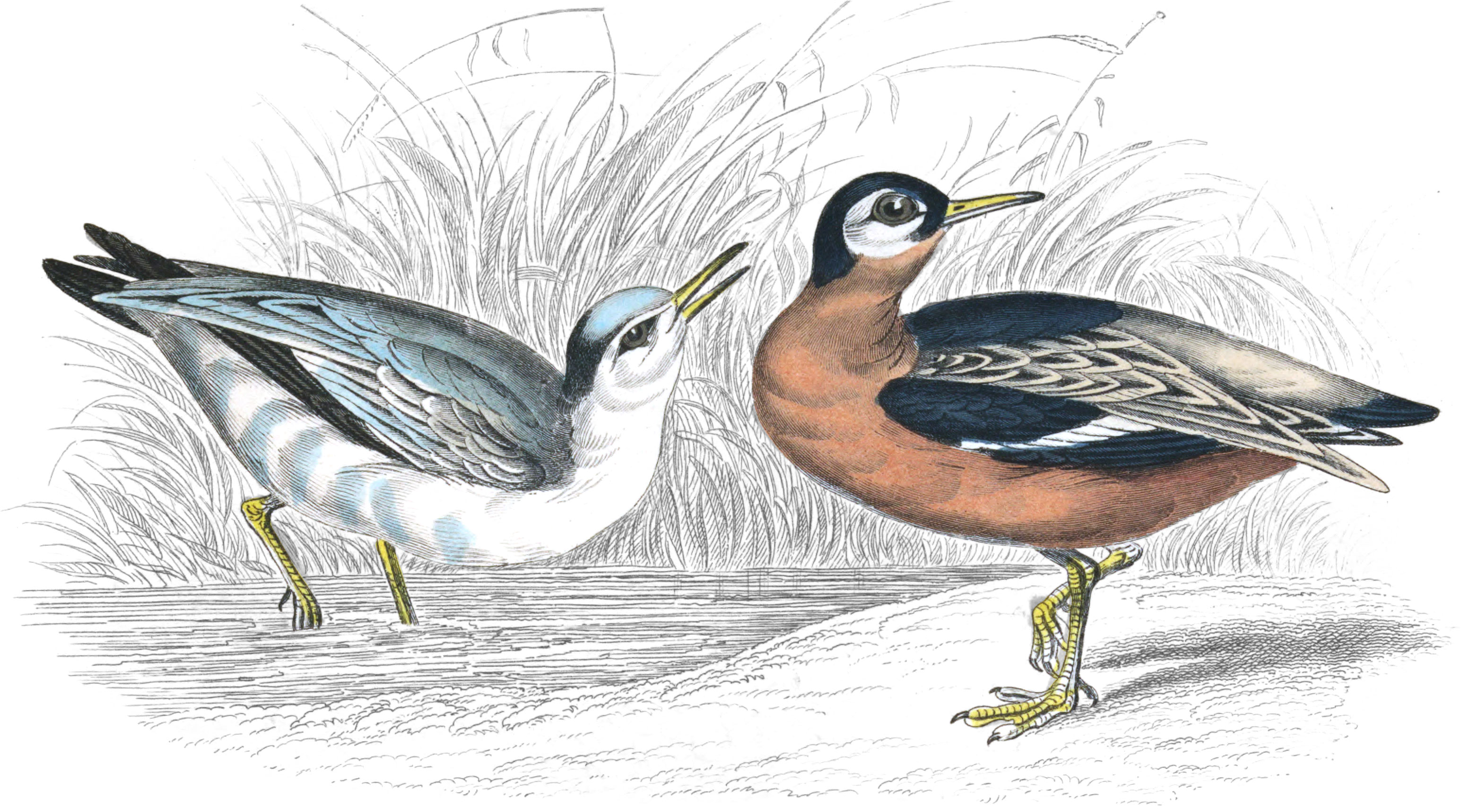
Plate XIX
Winter (Left), Summer (Right)
The Red-necked Phalarope
Phalaropus (lobipes) hyperboreus.—Lobipes hyperborea. Cuv.—Phalaropus hyperboreus, Lath., Temm., etc.—Red Lolefoot, Red Phalarope, or Red-necked Phalarope of British writers.
This small species, typical of the second form, possesses most of the habits of the last, swimming with facility; it is also, according to Audubon, gregarious in winter, and is found in large flocks, far from land, on the banks of sea-weed. It breeds near to the water’s edge, but in wet places or marshes, on some tuft or hillock of herbage. It has been occasionally procured in the English counties as far north as Northumberland, but not nearly so frequently as the last; and although it is said to be more commonly found in Scotland, we have never met with a freshly killed specimen. It is known, however, to be tolerably frequent, and to breed on several of the Orkney Islands, particularly Sanda and North Ronaldshaw.
We borrow Mr. Selby’s description of the different states, and add that of a specimen procured for us by one of the whale ships, and taken, so far as we could learn, on the island of Disco.
Crown of the head, nape, and hinder part of the neck, sides of the breast, and streak behind the eyes, ash-grey; sides of the neck marked with an irregular patch of orange-brown; throat, middle of the breast, and all the under parts, white, except the flanks, which are dashed with ash-grey; back and scapulars black, the feathers deeply margined with ash-grey and reddish-brown; wing-coverts blackish-grey, the greater ones terminated with white, and forming a bar across the wings; the two middle feathers black, the rest deep ash-grey, margined with white; bill black, legs and toes greenish-grey.
In the winter state, the description is taken from a bird killed in Northumberland.
Forehead white, tinged with cinereous crown of the; head, streak behind the eyes, and list down the back of the neck, blackish-grey; chin, throat, middle of the belly, abdomen, and middle tail-coverts, white, with a slight pinkish tinge. Sides of the neck and breast grey, with a faint blush of purplish-red; back, scapulars, and wing-coverts, black, the feathers of the former deeply edged with yellowish-brown, and the greater wing-coverts having their tips white, forming a distinct bar across the wings; middle feathers of the tail black, margined with yellowish-brown, the rest ash-grey, margined with white.173
Our Arctic specimen had the crown, nape, and auriculars, clove-brown, on the first and second mixed with greyish-white and rufous; the throat, neck, and entire under parts, pure white, on the fore part of the neck, and sides of the breast, having traces of clove-brown and rufous; behind the auriculars, and running down each side of the neck, the red streak of the complete summer plumage is indicated the; back and upper parts are umber-brown, mixed with feathers having ochreous edges, and with the dark grey plumage edged with white intermixed; the quills dark brownish-black.
Curlews
The next form, or that of the Curlews, which we have placed last, reminds and leads us back to that of the Tantalidæ or Ibis, which we saw in the single British representative figured on our Plate X. They are, like them, also birds of considerable size; are chiefly maritime, except during the season of incubation; and, at that time, return to the wild subalpine pastures, the prairies or steppes of their respective countries, where their wild notes are often the only interruption that breaks the stillness of these barren tracts. We have them distributed over the world, though most abundant in temperate regions.
Numenius.—Generic characters.—Bill very long, slender, slightly compressed, curved, the tip, nearly round, hard; the mandible projecting over the maxilla; nostrils linear, lateral; face feathered; wings rather long, pointed; spurious quill rigid; legs proportionally, of middle length; tibiæ bare for some length above the tarsal joint; feet rather small; toes before connected by a basal membrane; hallux articulated above the plane of the others.
Types, N. arquata, longirostris, &c. Cosmopolite.
Note.—Maritime and gregarious in winter; breed inland are clamorous when their nest; is intruded upon. No seasonal change.
Common Curlew
Numenius arquata.—Latham.
Numenius, Willough.—Scolopax arquata, Linn.—Numenius arquata, Lath., Selby, Yarrell, &c.—Common Curlew of British authors.
The Common Curlew, during summer, or in the season of incubation, is a frequent inhabitant of all the subalpine pastures and pastoral districts of Britain, often descending to the borders of cultivation, and even depositing its eggs among the young grain. In the north of Scotland, they extend over all the wild country in many parts stretching mile after mile in extent, and affording fitting nurseries for them and a few allied birds. They reach also to the Orkney and Shetland Islands, breeding in both localities. About the time of their arrival, their clear shrill whistle may be heard, passing high over head to their summer haunts, which are soon betrayed when approached, by the birds, even at an early season, meeting the intruder. When the breeding stations have been taken up, the solitary moors will be seen, at early dawn in motion with the birds—we believe the males—rising aloft with a slow ascent, sailing along, and uttering their shrill quivering whistle peculiar to this season; or both will meet any stranger with noisy screams, beating at him, and approaching within a few yards. If they have been annoyed or fired at, their usual wariness overcomes their other instincts, and, although they may approach with the same screams, they are careful to keep out of harm’s way, and will retire to some eminence, whence, when approached, they will run and skulk, as if to decoy away the intruder. The nest is placed on some dry part of the moor or tuft in the moss we have found them also in a furrow; of fallow land, or of newly sown oats and it is; simply a hollow, smoothed by the bird, having in some instances a few grasses, or other leaves lining the bottom. In some districts the young are sought after about the time they are able to fly, and are considered excellent eating. We have occasionally shot them before the pointers, so late as the 12th of August; these were, however, late broods, as about this period, or very soon after, they have entirely left the moors, and returned to the sea shores, whence, during the influx of the tide, they travel inland, and rest in the pastures or meadows, regularly returning to feed with the ebbing waters. Though at a distance, they seem instinctively to know the proper time, and we have often observed them commencing to return almost to a minute, the first birds appearing when certain marks first began to be visible above the receding tide. During a flight to any distance, or in migration, they fly in a wedge form, at times skimming low above the waters or shore, at others high over head and if; the first party is alarmed, and gives notice by their scream, the next in succession will deviate from the track, uttering the same alarm note, as if for a warning to their followers. The Common Curlew is also found in various parts of the European Continent, extending northward, as a summer visitant, to Norway and Sweden, and is found in the Faroe Isles and Iceland, where it even occasionally winters.174 It was seen at Smyrna by Mr. Strickland; South Africa is given to it by Dr. Smith and; China and Nipal by Mr. Gould. Continental India possesses specimens from the catalogues of Elliot and Jerdan; but in that of the last a single specimen only is mentioned to have been obtained. We possess specimens from Southern Africa, very nearly resembling European birds; they have the axillary feathers in every specimen pure white. A specimen from China appears to present some differences, which farther comparisons only can give weight to. The range, however, of this bird, has been much overrated, from the similarity of allied species, which a close examination only can detect. It is represented in America by the N. longirostris.
The head, neck, and breast, are of a tint of yellowish wood-brown or ochreous, varying in intensity, and having the shafts of the feathers umber-brown, which broadens out at the base of the feathers, and forms narrow triangular dashes or streaks of that colour; the belly, vent, under tail-coverts, and flanks, are pure white, on the upper part of the belly and flanks, dashed with brown; the upper parts are deep clove-brown, glossed with purple, having the feathers margined and cut into with greyish and yellowish-white; the lower part of the back white, with the shafts of the feathers forming marked streaks; the quills are clove-brown, glossed with purple, and cut into half across on the inner webs with white nearly in the form of bars; the axillary feathers are barred, as in the snipes, sometimes clouded with hair-brown; the tail is white, distinctly barred with clove-brown, the edges of the bars irregular, often clouded and tinted with reddish-white bill; at the tip deep-brown, shading into pink or tile-red towards the base, particularly on the maxilla—it often varies considerably in length,—legs and feet a tint of greenish-lead colour or bluish-grey.

Plate XXII
The Whimbrel
Numenius pheopus.—Scolopax pheopus. Linn.—Numenius pheopus. Lath. Ind., and modern ornithologists.—The Whimbrel or Whimbrel Curlew of British authors.
The Whimbrel, though pretty generally diffused, is not nearly so common as the Curlew, and is not found breeding except in the extreme north of Scotland, appearing chiefly on our shores in spring, autumn, and winter, or more inland, as a casual passenger, during its passage to or from its breeding stations. On the shores of the north of England and south of Scotland, they are commonly to be met with in autumn or winter, in small parties, and are at once betrayed, among a flock of Curlews, by their peculiar note. According to several authorities,175 they breed in the Orkneys and in some of the Shetland Islands, and they were seen in Sutherlandshire, on the banks of Lochshin, in June, but neither nest nor eggs were discovered. We once shot a pair of Whimbrelson a salt marsh, on the Ross in Kirkcudbrightshire, in June, which appeared as if breeding, though no nest could be found. In Ireland, Mr. Thompson states that it
is a regular spring visitant in passage northward, and returns in autumn in much smaller numbers.176
In Europe, it is found in the more northern parts. Out of Europe, Temminck gives India to it, as do also Messrs. Jerdan and Elliot, the latter stating that it is
found everywhere along the sea shore and mouths of large rivers.
Mr. Gould states Himalaya as a locality; and it is probably found in North Africa.
In the colouring and marking of the plumage, the Whimbrel very closely resembles the Curlew, the upper parts being shades of hair and clove-brown, the feathers margined with white and ochreous white; the crown, however, is divided along the centre by a streak of paler colour, occasioned by the feathers being broadly edged with white, while on each side they have scarcely any pale edging, but form patches of dark hair-brown; the white on the lower part of the back runs farther up than in the Curlew the chin is white and; unspotted; the cheeks, neck, and whole under parts are also pure white, but thickly and broadly dashed with hair-brown, the marking’s on the flanks and upper parts of the belly assuming the form of irregular bars the vent and under tail coverts only being unspotted, except the appearance of the hair-like dark shafts; the axillary feathers barred with hair-brown the centre tail-feathers are pale hair-brown; barred with a darker shade, the tint becoming paler and more broken up towards the outside, where the ground-colour is nearly pure white; the bill is deep blackish-brown, tile-red at the base of the maxilla the; legs and feet are bluish-grey, rather more stout and proportionally shorter than in the Curlew. The above is nearly the colouring of the male bird stated previously to have been killed near Kirk-cudbright. In the female, shot at the same time, the pale tints are all more or less ochreous, and the markings on the under parts extend only to the breast, the centre of the belly, vent, and tail-coverts being pure white; the upper tail-coverts are also more distinctly barred with hair-brown.
Charadriadæ
The Charadrladæ or Plovers naturally follow the family we have left, to which many species show very close alliance; while to the previous groups, and that which has yet to be described, there are also many close links of connection. Many of the genera still continue to be maritime at particular seasons, but the larger proportion show a greater affection for the land, and spend a portion of their time inland. We shall commence the series with a form which still continues the alliance with the Tringæ and Totani in the structure of the feet; it has also a periodical change of plumage, but differs, in a much greater size, in one or two species being adorned with beautiful crests, and in the habits being so plover-like, that they sometimes are known under that name.177 The Lapwings may be thus characterized.
Vannellus.—Generic characters.—Bill straight, slightly compressed; tips of the mandible and maxilla rounded, smooth, and hard nasal; groove large and deep; nostrils linear, pierced in the middle of it; wings ample, more or less rounded, second or third quills often longest, sometimes narrowed or emarginated at the tip; the carpal joint spurred or tuberculated; leg’s of varied length; tibiæ more or less naked; toes before shortly connected by a membrane; hallux, when present, articulated on the tarsus.
Types, V. cristatics, Goensis, &c. Europe, Asia, Africa.
Note.—Breed inland; are very clamorous when the breeding-ground is approached; gregarious and partially maritime during winter; undergo a seasonal change.
The Common Lapwing
Vanellus cristatus.—Meyer.
Tringa vanellus, Linn, &c.—Vanellus cristatus, Flem. Selby, &c.—Vanneau huppè, Temm.—The Common Green or Crested Lapwing of British authors.
This beautiful and lively bird is abundant in suitable localities over the whole of the British Islands, though the inroads of cultivation are trenching rapidly on some of its favourite haunts. The improvements which have been made on lands that bore a subalpine character, and on that lower wet pasture, which, till lately, was not thought worthy of cultivation, and remained untouched by the plough, have much curtailed them. We have, at this moment, a wide range of land, once favourite haunts of the Pewit and Curlew, where few are now to be found; and on one farm, not exceeding a hundred acres in extent, forty or fifty pairs of Pewits might have been seen breeding yearly, whereas, at present, a single pair could not be shot upon it. This, in one sense, may give some satisfaction in the improvement which has taken place, and the additional rental it may bring in; yet there was a charm in these wild pastures, animated by their peculiar inhabitants, that cannot be replaced by any change produced artificially upon them.
Some Pewits reside constantly with us; but, at the same time, numbers leave our islands, and others annually perform a periodical migration to the breeding grounds, arriving there with as much regularity as our summer visitants from a distance; also, it is probable, that we receive a few birds in their removal from other countries. Their breeding stations are the subalpine moors, and the large boggy pastures on their skirts, low meadow grounds, extensive downs or commons, and the fenny counties. These are often at a great distance from the coast, completely inland; at the same time, a common upon the shore, where the extent is considerable, and the surface varied, is a favourite locality. They assemble there in small flocks or parties, even about the end of February, and gradually separate into pairs to take up their breeding stations.178 When incubation has fairly commenced, the common or moor often appears alive with their active motions; no stranger or intruder can enter upon their haunts without an examination, and both, or one of the pair, hover and fly around, tumbling arid darting at him, and all along uttering their vehement cry of “Peeswit.” When incubation is completed, the young and old assemble together, and frequent the pastures and fallows; some particular fields being often chosen by them in preference to others, probably on account of the abundance of food; and here they will assemble daily for some time, feeding chiefly in twilight, or clear nights, and resting during the day. Extensive meadow lands are similarly frequented, as also the low merse lands at the mouths of rivers, and, we believe, the fenny counties. The clouds of birds that rise about sunset, to seek their feeding grounds, performing many beautiful evolutions ere they go off, is incredible, except to one who has witnessed it. In Holland, where this bird is extremely abundant, and where the view on all sides is bounded equally by a low horizon, thousands may be seen on all sides at once, gleaming in the setting sun, or appearing like a dense black moving mass between its light. The extent of their pasture there is almost unbounded, yet it appears fully stocked. Towards the end of October and in November, those which have spent the summer inland, begin to return to the flat sea coasts, where they feed at the retreat of the tide, and on the low lands which generally accompany this character of shore, and remain until the spring again induces them to travel inland. The young are esteemed for the table, and plovers’ eggs, which, under that name (when pure), are those of the Peewit, are in great request in the London and some other of our large southern markets, their collection during the season, giving employment to many individuals. Dogs are trained to seek the nests of this bird and several of the other Charadriadæ, the eggs of which are also used in common; they hunt by the scent, and make a point as if at game, until the “egg-man” comes up. (We do not know the kind of dog that is employed.) The geographical distribution is extensive, though confined to the Old World. The Lapwing is generally spread over Europe, extending to Scandinavia;179 it extends northward, to Iceland and the Faroe Isles;180 it is enumerated among the birds of Japan,181 and we have received specimens from the neighbourhood of Canton, in the plumage of the winter.182
In the full breeding plumage, the crown, chin, fore parts of the neck and breast, are deep and rich black, glossed with green; from the occiput springs a long crest of narrow black feathers, bending or curved upward, and capable of being erected nearly straight when the bird is excited; surrounding the black crown there is a circle of yellowish-white, and under each eye, the auriculars, and a patch on the side of the neck, pure white, forming an irregularly oval spot of that colour; the nape is hair-brown, and the back and wings are pale glossy olive-green, having bright blue and purple reflections on the shoulders of a much deeper tint, and there reflected with steel-blue; the lower part of the back is also olive, terminated by a narrow band of chestnut; the quills are black, the third and fourth longest, the three first tipped with greyish-white; the belly and vent are pure white; the under tail-coverts pale chestnut-red; the tail comparatively short, is rich black, with a narrow white tip, and having a broad basal white band; the outer feather only is pure white, with a greyish black spot near the tip of the outer web; legs are purplish-red. In a female shot at the same time with the above described male, in full breeding state, the throat and chin were white; the dark crown, and marking between the eye and the bill, of a deep hair-brown the crest about one; half the length; a little less brilliancy marked the other parts of the plumage. In winter the dress is nearly in this state, there being no black on the chin or throat, and on the back and shoulders the feathers are all narrowly tipped with yellowish-white. The young have the upper plumage still more tipped with the same colour, or of a more ochreous tint.

Plate XXV
Green Lapwing or Peewit

Plovers
From Vanellus we reach the true Plovers, represented by the Grey and Golden Plovers of our own country. The birds known under the above name, in contradistinction to the true Charadrii or Dotterels, have been divided in their scientific arrangement, and the presence or absence of a hindtoe, has been given much weight to as a generic character. In both groups, we have so distinct and marked an arrangement of colouring, that the common observer, unaccustomed to scientific distinctions, will at once separate them. The sexual change is also to a certain extent different, and it is remarkable, that in both (arranging by plumage and marking), we have a species, which must, in either case, be placed away from those resembling it; the generic distinction resting alone on the presence or absence of the fourth toe, almost rudimentary. We have now, however, ventured to draw our characters, so as to allow the junction with it of C. pluvialis and Virginianus. These three species (including the Grey Plover) are closely allied in habits, in the marking and colouring, and in the dark state of their breeding plumage, occupying uniformly a great portion of the under surface of the body. In their habits they are gregarious, assembling often in vast flocks, while the others more generally congregate only in parties of limited numbers.
Squatarola.—Generic characters.—Bill rather strong, tumid, flattened on the culmen, cylindrical towards the tip, which is hard nasal; groove wide, more than half the length of the bill; nostrils linear, pierced in the nasal membrane; wings long, pointed, first quill longest; legs rather short, bare for a short space only above the tarsal joint; toes connected by a small basal membrane, slightly fringed on their edges; hallux rudimentary or wanting.
Types, S. cinerea, plumanus, Virginiamis. Cosmopolite.
Note.—Breed inland; gregarious except during incubation; undergo a seasonal change.
The Grey Plover
Squatarola cinerea.—Tringa squatarola, Linn., Penn., Selby, etc.—Fanellus melanagaster, Bechst.—The Greg or Bustard Plover of British authors.
We have no authentic record of this species breeding, or being a resident during the summer in our islands.183 We have seen it early in the season, in the breeding plumage, in the London markets, and Mr. Yarrell has remarked the same circumstance; neither does it appear difficult to obtain specimens in this state from collectors; but, we believe, that most of these have put on the nuptial dress, and are at the time of their capture actually on their migration. Mr. Selby has seen one or two occasionally on the Fern Islands in June, but adds, they “may have been unequal to the usual migration.”184 Their summer abode appears to extend very far north, reaching northern Europe, Iceland, and the Faroe Islands, and, on the authority of Captain James Ross and Dr. Richardson, extending over many portions of Arctic America. Its most usual appearance in Britain is in spring, autumn, and winter, and then generally on the coast, in small parties; never, so far as we have seen, in the large flocks in which the Golden Plovers assemble. We have met with them frequently on the Solway, and once shot a pair on the banks of one of the lochs at Lochmaben. Mr. Thompson states it to be an autumnal visitant to Ireland. There are various authorities for its having a very extensive distribution,—Algoa Bay,185 Egypt,186 Japan in summer and winter plumage;187 Java;188 and we have ourselves received specimens from China and Southern Africa, in the winter dress.
In summer, the Grey Plover has the forehead and streak over the eyes pure white; the space between the eye and the bill, auriculars, sides of the neck, breast, and belly, deep black, while the vent, under tail-coverts, and thighs, are white; the head and nape hair-brown, the feathers having lighter edges; the back and scapulars very deep clove-brown, sometimes nearly black, the shafts of the feathers being darkest, the tips edged with greyish-white; quills brownish-black, having the shafts white, and the inner webs shaded to greyish-white; tail-coverts white, barred with hair-brown; tail also white, barred with dark hair-brown, on the centre feathers the pale spaces are much clouded with the dark colour, and these feathers are accuminated, on the outer plumes the basal half of the feathers is without bars the; axillary feathers black. In the winter dress, the ground colour of the upper part of the body is hair-brown, the feathers margined and cut into with angular marks of greyish and yellowish-white no trace of black remains on the face or lower parts; the whole are white, on the chin and throat nearly unspotted, on the neck and auriculars having narrow streaks of hair-brown along the shafts, and on the breast and upper part of the belly, having those continued, more broadly expanded upon the base of the feathers, and forming a relief to the pale tips of those lying over them; the bill black; the feet and legs greyish-black. Two specimens, shot a few years since, by the side of one of the Lochmaben lochs, in the month of August, had the ground colour of the upper parts very dark, and the edging and angular spotting of the feathers nearly of the tint of sienna-yellow, so as to cause them to appear, when first taken up, to be the Golden Plover; the breast and belly also had the dark parts of the feathers much broader, and the whole tinted over with yellowish wood-brown. These were considered young birds arrived from migration; they were very tame, and allowed an easy approach. A bird from the Cape of Good Hope, apparently identical, is very dark above, having the colour glossed with olive reflections, has no white on the forehead, and very few light markings on the crown or centre of the back.
The Golden Plover
Squatarola pluvialis.—Charadrius pluvialis, Linn., etc.—Pluvier dorè, Temm. and French authors.—Golden or Yellow Plover of British authors.
This species, though retaining almost exactly the markings, and the corresponding seasonal changes in the plumage, with the last, differs in structure in the absence of the hinder toe; nevertheless, as stated, we consider, in these birds, that too much consequence has been set upon this form, and, for the present, prefer retaining them with S. Virginianus, as congeneric. In Britain, the Golden Plover is one of the most abundant species, being found on the coasts, generally in vast flocks, during winter; and, in summer, retiring to all the wide tracks of alpine moor which occur in Scotland and Ireland, extending northward to Orkney and Shetland, and, wherever such localities occur, to England. In Scotland, they reach their breeding grounds early in spring, and select some spot, from which they do not stray far. These are chosen both in the subalpine moorlands, and on the tops of hills of considerable elevation. The breeding plumage is altered almost immediately after the station has been fixed upon; and, when incubation has commenced, the appearance of an intruder causes reiterated utterance of their wailing cry, the birds flying around, and perching on some raised mossy hillock in the vicinity. The nest is scarcely more than a scratched hollow, very few grasses or lining material being used. When the young birds have attained their full plumage, the broods congregate together, and may be found in large flocks, frequenting for a time their moorland locality. As autumn advances, they descend to the lower meadows or fallows, collecting fresh numbers; and, by the time frost or winter has set in, they may be found assembled on the sea shores in flocks, the produce of the breeding grounds of the district. Before retiring to the shores, the flocks may be sometimes approached, or they come within shot in the wheels which it is their habit to make around any thing that disturbs them. On the coast they are much more shy, though, from the numbers composing the flock, the discharge of the fowler is often successful at a very long distance.
A very extended or cosmopolite distribution has been given to this bird, but, of its range, we may at once say we do not know the correct limits. We are inclined, at this moment, to consider it limited almost to Europe alone, its place elsewhere being taken up by the C. Virginianus. We have never seen an extra European specimen of the British Golden Plover. Sweden, as mentioned by Mr. Yarrell, on the authority of Professor Nilson and Mr. Loyd; Norway, where Mr. Hewitson saw it; Hammerfest, as stated by Mr. Chisty; and probably Lapland,189 with suitable localities in other western districts of the European Continent, may be held as a certain extent of range; but we still think Faroe, Greenland, and Iceland, questionable. The American and Arctic birds are undoubtedly distinct, and, besides their smaller size and other distinctions, may be at once separated by the hair-brown colour of the underwing coverts and axillary feathers, which, in the British and European birds, are pure white. Mr. Yarrell states, that eastward he has traced it through France and Italy to the shores of Africa, and that the Zoological Society have specimens from Trebizond. This range is probable. All the Asiatic birds, with those of the Indian Islands and New Holland, agree with the American species; and Mr. Audubon, in his Appendix to the concluding volume of his interesting “Ornithological Biography,” has also included the American Golden Plover, under the title C. marmoratus, Wagler, as found in the New World. In addition to the common bird, as stated already, all the specimens which have come under our own observation have been the latter bird; at the same time, we have no reason to doubt Mr. Audubon’s well known accuracy.
This beautiful Plover, in the full breeding dress, has the space between the eyes and the bill, cheeks, auriculars, throat, breast, belly, and vent, of a deep the flanks and under tail-coverts velvetty-black; white, shaded with pale yellow; the forehead and streak above the eyes, nearly pure white the; ground colour of the crown, back, scapulars, and long tertials, very deep clove-brown, with purplish reflections of a paler shade upon the back of the neck, and having each feather cut into with small triangular spots of king’s-yellow; on the nape the centres of the feathers only are dark, leaving the whole margins yellow, which lightens or renders more yellow the general tint of this part; and, on the long tertials, the yellow runs round, tipping the extremity of each feather; on the rump and upper tail-coverts, they almost, and in some instances do, cross the feather, assuming the form of diagonal bars; the quills are clove-brown, with white shafts; the axillary feathers pure white;190 tail hair-brown, the tint becoming paler towards the outside, and cut into with triangular markings, which almost meet at the shaft. In the female the black is not so intense, and is partially mixed with white. In the winter dress, the upper parts of the plumage are nearly similar to that of summer, the yellow tint spreading more uniformly over the cheeks and sides of the neck; beneath, the throat, vent, and under tail-coverts, are white, but the throat, breast, belly, and vent, are a tint of ash-grey, or greyish wood-brown, each feather having a darker centre, and the whole tinted over with king’s or Indian yellow; the bill black; legs dark grey. The intermediate states of plumage in which they are met with in autumn, are often very beautiful, the under parts being marbled with black, white, and pale king’s yellow, which blend softly together. Total length from ten and a-half to eleven inches. The true S. Virginianus is under these dimensions; but we possess specimens, said to be from America, in every way agreeing with the latter bird, having the hair-brown, instead of the pure white axillary feathers, which are fully eleven inches in length.
Dotterels
From what we have considered as the true Plovers, we pass to the genus Charadrius or Dotterel, all the known species of which present a generic similarity in colour and markings, differing from the others in being unspotted, of shades of hair or greyish-brown, the under parts generally crossed with distinct bands of black or chestnut. In their habits they are chiefly maritime, at the same time, a few agree in this respect with the true plovers, in their breeding in pretty inland localities. Their feet are of a more decidedly cursorial structure; but, in one or two exceptions, they possess the hinder toe.
Charadrius.—Generic characters.—Bill straight, somewhat dilated at the base, and gradually narrowed to the point, which is hard and slightly curved; nasal groove large; nostrils linear and pierced in it; wings pointed, of middle length, first quill longest; legs of middle length; tibiæ bare for a short space above the tarsal joint; toes short, formed for running; hallux entirely wanting.
Types, C. morinellus, hiaticula, &c. Cosmopolite.
Note.—Partially gregarious in winter; chiefly maritime; little seasonal change. The Squatarola cincta of “Orn. Illust.” The form Oreopholus, and Mr. Gould’s genus Erythrogonys, will either enter as sub-genera here, or may be taken as aberrant forms, as the systematist inclines.
The Dotterel
Charadrius morinellus.—Pluvier gingnud, Temm.—The Dotterel, or Dotterel Plover of British authors.
The Dotterel is a spring and summer visitant to Britain; in the southern counties of England only seen in their passage to and from their breeding stations; in the Lowlands of Scotland being occasionally found during a similar transition; but, in a few localities, incubating on some of the mountain ranges of both countries. In Ireland, we have the authority of Mr. Thompson for saying they are very rare. In the mountains of Cumberland and Westmoreland they regularly breed, though we hear their numbers are diminishing gradually. Mr. Heysham of Carlisle, has given a good account of their habits at this time,191 and states, that they assemble in their different localities, in the neighbourhood of Carlisle, about the middle of May, where they continue for ten days or a fortnight before retiring to mountains, in the vicinity of the lakes, to breed.
The most favourite breeding haunts are always near to, or on the summits of the highest mountains, particularly those that are densely covered with the woolly frieze moss, Trichostomum lanuginosum. They do not make any nest, but deposit their eggs, which seldom exceed three in number, in a small cavity on dry ground, covered with vegetation, and generally near a moderately sized stone or fragment of rock.192
On the alpine ranges of Scotland, in a similar manner, they are found in particular localities, after the young have attained maturity. There are several stations upon the Grampians, and some of our sporting friends generally meet with small parties before they have dispersed, on the first week of the shooting season. In our own district, there is a locality on some subalpine moorland, partially cultivated, which is visited during their passage in spring, but we have not been able to trace them on their return migration. Their winter retreat seems scarcely to be known with certainty,193 neither is it noticed whether at any time they frequent the sea shore like the grey and golden plovers; our information, in fact, is confined to their breeding habits, and their periodical passage to and from these stations. Their summer ranges extend to Northern Europe,194 Russia, Siberia, and Northern Asia,195 mountains of Silesia and Bohemia,196 steppes of Tartary.197 Mr. Yarrell also states, that Messrs. Dickson and Ross have sent specimens from Trebizond.
In summer, the chief food seems to consist of insects, particularly the Coleoptera, many species of which are extremely abundant on the coasts, and come abroad in numbers during the heat of the day.
A specimen killed in Dumfries-shire, in the end of March, has the crown clove-brown, bordered above each eye with white, which meets at the occiput; the chin, cheeks, and throat, are white the whole; upper parts of the body, neck, and upper part of breast, hair-brown the feathers on the back and; wings edged with pale orange-brown; immediately bordering the hair-brown on the breast, the feathers are tipped with dark edges, forming a narrow band, this is succeeded by a white gorget, gradually shading into rich brownish-orange, which occupies the whole lower part of the breast and belly, blending into a deep black conspicuous patch in the centre of the latter; the vent and under tail-coverts white; the quills are dark hair-brown, the first with a strong and conspicuous white shaft; the tail hair-brown, darker towards the tip, forming almost a bar across the ends of the three outward white feathers. This is nearly the plumage in the breeding time; the females have the colours of the breast scarcely so bright or marked. When these colours have been put off, the lower parts, we believe, are nearly white, and the crown loses the depth of its shade. Birds, however, are not frequently met with in this state, and a minute description is not given in any of our works.
The Ringed Dotterel
Charadrius haiticula.—Linnæus.
Charadrius hiaticula, Linn., &c.—Grand pluvièr a collier, Temm.—Ringed Plover or Dotterel, Sea Lark of British authors.
This lively species is abundant on all our coasts, wherever they are bounded by a sandy or gravelly beach, and their shrill and plaintive whistle will indicate their vicinity, long before the unaccustomed eye can detect the birds running among the shingle, to the colour of which the plumage closely assimilates. It is a constant resident with us; but, at the same time, an accession of numbers seems to be annually received during winter, from higher latitudes, where they are only summer visitants. The sea shore, in the situations mentioned, is almost their constant haunt; there they breed among the shingle, just out of water mark, depositing their eggs in some slight hollow, and there they feed, summer and winter, after the tide has retreated, finding daily the supply of food renewed. Exceptions, however, occur, where they breed at a greater distance from the sea and where they ascend far up the courses of rivers, although there they reserve their maritime habits, breeding among the pebbles of the sandbeds. They are known also to breed in the warrens of Norfolk and Suffolk, at a considerable distance from the sea;198 and we have found them upon the banks of various rivers, from ten to twenty miles inland. In our own vicinity they perform a short migration, breeding, and retiring afterwards. On the banks of the Annan, fifteen or sixteen miles from the coast, one or two pairs annually take up their station, seldom varying far from it. They arrive about the same time with the common sandpiper, and are sometimes later in retiring. When approached, at the season of incubation, they show extreme anxiety, fly around, incessantly uttering their piping whistle; if a dog is near, they feign lameness, and flutter off, returning to their charge in a circle. At first, when leaving the nest, they skulk away from it before taking wing, which they are easily enabled to do from their unobtrusive colouring; and, from the eggs, deposited in any slight natural cavity, being of a greenish-grey colour, assimilating with the shingle, they require great perseverance and an acute eye to discover. The range of this species seems to be northern Europe, running near to or within the Arctic Circle, Asia Minor,199 Japan.200 We do not, however, find it stated as an Indian bird by either Elliot or Jerdan.
Around the mandible, cheeks and auriculars, deep black; on the forehead a band of white, which reaches each anterior angle of the eye; and, above that, a broad band of black passing from eye to eye; the remainder of the head and nape hair-brown, a pale streak sometimes passing over or behind each eye. The chin and throat, passing in a collar around the neck, pure white; succeeding this is a gorget of deep black, on the breast about an inch in breadth, and passing entirely round the white in a narrow circle, is blended into a chaste and uniform hair-brown, investing all the upper parts, except the quills and tail. The secondaries are tipped with white, forming a bar across, and some of the last quills are edged with the same colour on their outer webs. The quills are deep clove-brown, a portion of the shafts, about an inch from the tips white; the tail is hair-brown, with an apical nearly black clouded band; the centre feathers have a very slight mark of white at the end; the others, to the second from the outside, are broadly tipped with white, the second has the outer web entirely white, and the exterior is altogether of that colour. The lower parts, below the pectoral gorget, are pure white; the bill is black at the tip; the base, with the legs and feet, rich gallstone-yellow. The above description is taken from a bird killed in December, and although the bill and legs, with the black parts of the plumage, may become more brilliant and intense during incubation, little apparent seasonal change takes place. In the young of the first plumage, there is no appearance of the dark bands on the forehead, auriculars, or breast; the latter is indicated by a pale shade of hair-brown; but, on the occiput, and below the white nuchal collar, there is a annular shade of dull black; the auriculars are uniform hair-brown; and the crown, back, and wings, except the quills, are also hair-brown, each feather being edged with yellowish hair-brown; the two centre pairs of tail-feathers tipped with the same colour; under parts pure white; legs and feet of a paler and duller yellow.
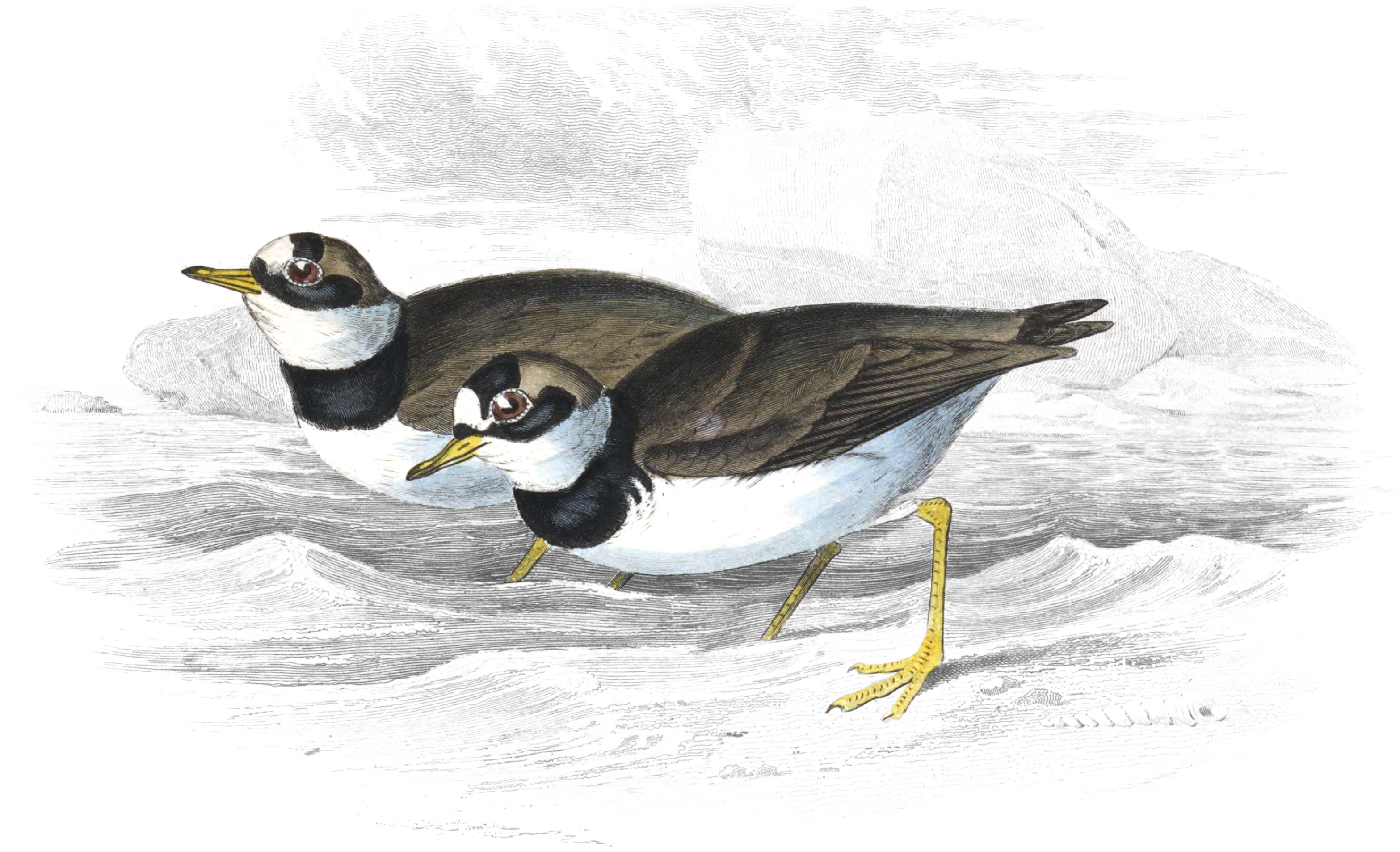
Plate XXIII

The Kentish Dotterel
Charadrius Cantianus.—Charadrius Cantianus, Lath.—Pluvier a collièr interompu, Temm.—The Kentish Plover of British authors.
This species, though nearly allied to the last, is easily distinguished, both by the variation in its markings, and by its smaller size. From all our accounts, its habits are very similar, associating with the Ringed Dotterel when they happen to be on the same coast together. The species was first named, as above, by Dr. Latham, from specimens procured at Sandwich, in Kent, where it has since been frequently killed, and has also been taken on the Sussex and Norfolk coasts; and at Lydd, in Romney Marsh, Mr. Yarrell states, on the authority of Mr. Francis Plomly, that it is numerous. It also breeds in the localities where it is found. In Scotland we are not aware of an instance of its occurrence, and Mr. Thompson does not mention it in the Irish List. It seems also sparingly distributed over the continent of Europe; but, by Temminck, is said to be abundant in Germany and Holland. Out of Europe, it is found in Northern Africa, in Nubia and Egypt,201 Indian Archipelago,202 Java.203 The specimen of this bird in our possession, which served also for Mr. Selby’s figure and description, was procured on the continent. The forehead, running in a streak over the eyes, whole of the under parts, cheeks, sides of the neck, and a collar surrounding it, pure white; a frontal band anterior to the eyes, a stripe between the mandible and the eyes, posterior edges of the auriculars, and a patch on each side of the breast, forming the commencement of an interrupted pectoral collar, black; the crown and nape deep yellowish-brown, tinted with hair-brown, and shading to chestnut at the edges; the back and wings pale hair-brown, shafts of the feathers darker; secondaries tipped with white; quills clove-brown, with the shafts entirely white, the last quills also having the same light edges which we saw in the Ringed Dotterel; the centre feathers of the tail are clove-brown, the shade being lighter towards the base and outside, the two exterior feathers entirely white. In another continental specimen, considered to be a young bird, we have neither black nor yellowish-brown on the head or sides of the breast, these markings being indicated by pale wood-brown, the white forehead and eye-streak only being marked; the legs, feet, and bill, are black in all states.
The Little Ringed Dotterel
Charadrius minor.—Charadrius minor, Meyer.—Petit pluvier a collièr, Temm. The Little Ringed Plover of British authors.
As a British bird, this interesting species rests on a single specimen procured by Mr. Henry Doubleday; it was taken at Shoreham in Sussex. The habits of this Dotterel become interesting to the ornithologist, as being somewhat at variance with those of the two last, frequenting the banks of rivers in preference to the coast; but like the others, it lays its eggs on the sand, without any attempt at a nest.204 From the very young state of Mr. Doubleday’s specimen, it is conjectured that it may have been bred in England, and if so, we may yet find the species as an occasional visitant; though, perhaps, the character of the banks of the rivers is not such as will suit its habits. On the continent it is met with in several localities; in summer, so far north as Sweden,205 Messrs. Dickson and Ross sent it from Erzeroom,206 and it extends to Japan.207
We do not possess a specimen of this bird, and borrow Mr. Yarrell’s description:—
In the adult bird the beak is black; the irides brown; the forehead white, with a black patch above it, extending to the eye on each side; top of the head and occiput ash-brown; lore and ear-coverts black; nape of the neck white; back scapulars, wing-coverts, tertials, rump, and upper tail-coverts, ash-brown; primary and secondary wing-feathers dusky-brown; these and the greater wing-coverts edged with white; the first primary quill-feather only with a broad white shaft; tail-feathers ash-brown at the base, darker towards the end the five outer tail-feathers; on each side white at the end, this colour increasing in extent on each lateral feather, the outer one on each side having only a dusky spot on the inner web, but this appears to be constant at all ages; chin and throat white, this colour extending from the latter round the nape of the neck; below this, and above the breast, is a collar of black; the breast itself, the belly, vent, and under tail-coverts, pure white; legs and toes flesh colour, tinged with yellow; claws black. Females have the black and white frontal bands narrower than in the males. Young birds of the year want all the decided black markings which distinguish old birds; the ash-brown feathers of the back and wing-coverts have buff-coloured margins.208
Sanderling
We have ventured, after some hesitation, to place a bird, extremely interesting in form, after the Dotterels; in the form of the bill, its seasonal changes, and several of its habits, it is allied to the Scolopacidæ and to the Sandpipers, while the structure of the feet would place it among the Charadriadæ and the Dotterels. On the one side, it may be urged that we ought to have a Tringa with the feet and structure of the Dotterel, while, on the other, it might equally be said, that we should have a Dotterel with the bill and seasonal changes of the Tringæ. In either case it would stand as an oscillating form, and perhaps might be placed with equal propriety on the confines of either group. One species only is known.
Arenaria, Bechst.—Generic characters.—Bill straight, compressed; tip, dilated, smooth, hard; wings as in Tringa; legs of mean length, slender, naked for a short space above the tarsal joint; toes three before, bordered with a narrow fringe, basal connecting membrane very small.
Type, A. calidris.—Europe, Africa, North and Arctic America.
Note.—Breeds in marshes; the seasonal change of Tringa; maritime except during incubation.
The Sanderling or Dotterel Tringa
Arenaria calidris.—Tringa arenaria, Ray, Linn.—Calidris arenaria, Leach.—Arenaria calidris, Meyer and modern ornithologists.—Sanderling or Common Sanderling of British authors.
The Sanderling is pretty frequent on our shores during spring, autumn and winter, but does not breed with us; at least no authentic instances are on record. Mr. Yarrell has stated its frequency on the English shores, and we have ourselves procured it from the north-eastern coasts. In Scotland it is also met with in small parties, and we have shot it on the banks of the Solway. Mr. Thompson records it in Ireland. When we have observed the Sanderling, it has generally been in small parties, unmixed with other Tringæ; and the manner of running along the sand or shingle, with the head drawn very close upon the shoulders, is much in the manner of the small Dotterels. Occasionally we have seen them associated with the Purre, among which they were easily detected by their lighter colour and their call. It is a species apparently of very wide distribution, breeding far north and within the Arctic Circle, and reaching southward at least to Mexico. New Guinea and Sunda are given to it by M. Temminck; it is not, however, enumerated by Mr. Jerdan. We possess specimens from Southern Africa and North America.
In the breeding plumage, the Sanderling may be said to have the ground tint of the upper plumage dark clove-brown, the feathers tipped with greyish-white, and margined broadly with pale reddish-orange, forming, at a little distance, a rather hazy mixture, in which the red and white predominates; the throat, breast, and sides of the breast, are white, having the feathers barred with pale clove-brown and orange-red; the quills clove-brown, with white shafts, and having the inner webs approaching to greyish-white; the under parts pure white tail; with the centre feathers lengthened, accuminated, and dark clove-brown, the others pale hair-brown, becoming lighter towards the outside, the last entirely white, except a patch of hair-brown near the tip of the inner web; legs, feet and bill, black. In the winter state the plumage is very different; the face, anterior to the eyes, and all the lower parts, are pure white; the upper parts a chaste shade of brownish ash-grey; centres of the feathers on the head and nape darker, the shafts of the others only, appearing marked; the tips and edges are of a paler tint, approaching nearly to white on the wing-coverts and secondaries. The bird, when in flight, appears very pure and silvery, and contrasted only by the shoulders and band of the wing, which are nearly greyish-black, and the brownish-black outer webs of the quills; the tail has the grey tint prevailing instead of the clove-brown. In a young state, in which it is often procured in autumn, the lower parts are, as before, pure white; the centre of the crown is black, the feathers edged with yellowish white, shading off to both sides in depth of tint; the nape, sides of the neck, and breast, are pale brownish-grey, tinted with ochreous; and the back, scapulars, and long tertials, are deep black, having the feathers cut into on their margins with rounded and angular spots, similar to those upon the Squataroles or true plovers. we have specimens before us in this state from the Northumbrian coast, and from North America. A specimen shot on the Solway, towards the end of August, is also almost in complete breeding dress; while others, from the Cape of Good Hope, are pure white beneath, but above, show a good deal of dark marking, mixed with the delicate grey of the winter state.
Thick-Knees
Our next bird, the only British representation of the genus Œdicnemus, serves as the connecting chain between the Grallatores and Rasores by means of the Bustards, to which its members approach very nearly in habits, form, structure, and plumage; but we are not aware whether they undergo any marked sexual change like the Bustards and Plovers. They frequent plains or extensive downs, or the moist fallow lands in a cultivated country; and, so far as we know, are not at any season maritime in their habits.
Œdicnemus, Temminck.—Generic characters.—Bill straight, strong, at the base depressed; tip slightly bending, compressed; maxilla angulated; nasal groove wide, covered with a ceral membrane; nostril medial, pierced in the membrane; wings comparatively short, somewhat rounded, second quill longest; tail cuneated; legs rather long; tibiæ bare above the tarsal joint; feet with three toes, connected by a membrane, which fringes their edges, cursorial.
Type, Œ. crepitans. Europe, Asia, Africa, New Holland.
Note.—Habits not maritime; partially nocturnal; no decided seasonal change.
Common Thick-Knee
Œdicnemus crepitans.
Charadrius œdicnemus, Linn.—Œdicnemuscrepitans, Œdieneme criard, Temm.—Thick-kneed Plover or Bustard, Great or Norfolk Plover, Stone Curlew, Common Thick-knee of British authors.
We trace the alliance in this bird to the Bustards, in its frequenting extensive and open downs, and in its laying, generally, only two eggs, of a form varying from the peculiar outline of the Plovers, Dotterels, and some of their allies. Some of the foreign species also stand equal in height to some of the intermediate sized Indian and African Bustards. As one of its names implies, the sandy plains of Norfolk are a favourite and abundant locality for this bird, where it periodically arrives and breeds. It is found in many other southern and eastern counties, but no where so abundantly. It is found more sparingly in Lincolnshire and Lancashire. Mr. Yarrell states, “farther north than Yorkshire I do not trace it.” We have no record of its appearance farther north, or of its being ever met with in Scotland, and Mr. Thompson places it, as an extremely rare visitant, to Ireland. In its more common periodical haunts, it appears in April and the beginning of May; and, after breeding, takes its departure in October, previous to which it assembles in flocks like the plovers. There are instances mentioned, notwithstanding, of specimens being seen in December,209 and of its appearance so early as February,210 The eggs are deposited on the bare ground, without any nest, and generally in stony or shingly places; and the fallows in some districts serve as breeding grounds. They are night-feeding birds, a habit indicated by their large and prominent eyes; and while insects, particularly Coleoptera, constitute a great portion of their food, during their residence in this country, worms, reptiles, and even small mammalia, are said to be also devoured by them. On the continent the species seems to be pretty generally, though locally spread, as a summer visitant. We have it ranging to the plains between the Black and Caspian Seas,211 to Asia Minor212 and Madeira.213
A specimen before us, procured from Norfolk, has the upper parts yellowish-brown; the centre of each feather umber-brown, dilating at the base, and running along the shaft to the tip; on the shoulders the dark tints are deeper, and a series of feathers are barred with yellowish-white, which is apparent, and, from the contrast, shows a diagonal band across that part; the greater wing-coverts are cream-yellow, edged with purplish-back, the quills and secondaries are also purplish black, the two first quills with a large diagonal yellowish-white patch, about an inch and a half from the tip, and which, on the first quill, crosses both the webs, on the second the inner only; the lower parts white, or yellowish-white; the chin and fore part of the neck unshaded; the neck, breast, belly, and flanks, narrowly dashed along the shaft of each feather with umber-brown; the feathers of the under tail-coverts ochreous, the shafts dark; in the tail, the centre feathers are pale yellowish-brown, the others brownish-black at the tips for a considerable space, succeeded by a broad yellowish-white bar running diagonally, afterwards alternately bordered with the brown and yellowish-white to the base, upon the under surface these bars appear very clear and decided; the bill is black at the tip; the base, and on the edges of the rictus, primrose-yellow; behind the eyes there is also a bare space nearly of the same colour; legs and feet greenish-yellow.
The female does not vary materially, and no seasonal change has been pointed out by ornithologists.

Plate XXIV
Swiftfoot
The Courser or Swiftfoot, which leads us nearer the typical Charadriadæ, are Little Bustard Plovers, intermediate in many respects, and showing a beautiful gradation of form. With the exception of their frequenting arid plains or steppes, we know little of their economy, and one specimen only occurs in the British List as an occasional and rare visitant.
Cursorius, Latham.—Generic characters.—Bill depressed, towards the tip curved, pointed; nostrils basal, pierced in the short and partial membrane of the nasal grove; wings of mean length, but ample from the breadth of the feathers; second quill longest, nearly equal to the first; tail short; legs long, slender; tibiæ naked far above tarsal joint; feet small; toes three, anterior, connected by a small membrane, claw of the centre pectinated.
Type, C. Europæus, licinctus, &c. Europe, Asia, Africa.
The Cream-Coloured Swiftfoot
Cursorius Europæus.—Cursorius Europeus, Lath.—C. Isabellinus, Meyer, etc.—Courvite Isabelle, Temm.—Cream-Coloured Courser or Swiftfoot of British, authors.
This interesting bird appears to be of extreme rarity both in Britain and upon the continent, all the instances of its occurrence being capable of being enumerated within the limits of a page. Four specimens seem only to be noted, at the present time, as having been killed in Britain, the first in Kent, which was presented to Dr. Latham, and served for his description of the bird; another in North Wales; a third in Yorkshire; and the last in Charnwood Forest, Leicestershire. No examples have occurred either in Scotland or Ireland. On the continent, stray specimens are mentioned by different writers as being met with, but the instances are extremely few. Africa appears to be its most abundant locality, or its stronghold; but little is known either of its habits or nidification, the specimens which have been observed here being in localities foreign to their habits. The other species of the genus are natives of Africa and India, frequent extensive dry plains or sandy deserts, and have both a powerful flight, and run with extreme swiftness, as the name implies, and which maybe at once seen from the structure of the feet and legs.
The crown is pale buff-orange, shading into grey; on the hind head there is a triangular, spot of black, terminating in a streak from the posterior angle of each eye, but through the centre of this, around the occiput, and passing over the eyes, is a stripe or band of pure white; the whole of the body is of an opaque tint of sienna-yellow, tinged with grey, paler on the under parts, and on the throat and fore part of the neck, shaded to reddish or yellowish-white; the quills are brownish-black, glossed with purple; the tail is nearly of the same tint with the body, the feathers paler towards the exterior pairs, and with the exception of those in the centre, there is a dark spot near to the tip of each; the legs and feet are yellowish-white. The whole length of this species is from nine to a little above ten inches, and from the length of the legs, it appears to stand proportionally taller. Mr. Yarrell states, the young birds of the have the feathers clouded with two shades of “year pale brown, with dark irregular transverse lines of dusky ash colour,” and the lines round the head are not very conspicuous.
Pratincoles
The remarkable genus Glareola or Swallow Plovers, to be placed next, continued for some time uncertain of its proper station; but it is evidently intimately connected with the last. In many of the Grallatorial birds, we have seen the wings developed to a great extent; but the principal varieties of structure are exhibited in the feet and legs, the organs on which this order is, in a great measure, dependant for seeking after its prey. The tail, comparatively of small use to wading birds, has been formed short, or verging in some to a rounded or considerably wedge-shaped form, but never to a greatly developed fork, as in the Fissirostral tribes, and this is what has puzzled systematists in looking for a station to place the Pratincoles. In all the other parts, the form of the Plovers is more or less kept up. We have the bill of the last; the colouring of the plumage continues pale rufous or fawn colour beneath, and has a narrow collar, representing the pectoral and abdominal bands, the upper parts generally glossed with a green or bronze reflection; the feet resembling Tringa, at the same time showing those of a Fissirostral type; while the tail, formed on the model of the swallows’, is the only exception among all the Grallatorial birds.
Glareola.—Generic characters.—Bill short, depressed, and expanded at the base, compressed towards the point, and bending for half its length; nostrils basal, oval, oblique, partially protected above with a membrane; wings very long, pointed, first quill longest, or equal to the second; tail forked; legs rather short, a short bare space above the tarsal joint; feet lengthened and slender, outer toes connected by a membrane; hallux of middle length, articulated on the tarsus; claws long, dilated at the base, that of the middle toe pectinated.
Types, G. torquata, lactea, &c. Europe, Asia, Africa.
Note.—Habits partially aquatic; food insectivorous; taken both on the ground and on the wing; “breeds on the ground, eggs four”214
Collared Pratincole
Glareola torquata.
Hirundo marina, Meyer.—H. pratincola, Linn.—Glareola Austriaca, Lath.—Glareola torquata, Selby, Gould, &c.—Glareole à collier, Temm.—Collared or Austrian Pratincole of British authors.
Seven or eight specimens of this curious bird are ascertained to have been killed in Britain, all of them in England, with the exception of the second, shot in Orkney by Mr. Bullock. No other instance has occurred in Scotland, nor is notice taken of it in Mr. Thompson’s Lists. On the continent it appears also only as a straggler, and it has been received from some parts of Africa; Mr. Yarrell mentions having seen specimens both from Tangiers and Tripoli. In habits they are described as possessing great powers of flight, as well as being able to run with swiftness and activity; they are insectivorous. Mr. Bullock’s specimen was shot in the act of catching flies, and it is stated, that
like the sandpipers, it runs with the greatest rapidity when on the ground, or in shallow water, in pursuit of food, which was wholly of flies, of which its stomach was full;
and Mr. Yarrell has recorded, on the authority of a son of Mr. Drummond Hay, that the habits of the Pratincole
corresponded closely with those of our plovers, frequenting sandy plains, flying and running with great rapidity; forming a slight nest in any accidental depression in the dry soil, and laying four eggs.
In a continental specimen, the plumage above is of a dark hair-brown colour, tinted with a greenish metallic lustre. This passes across the breast, having there a yellower tint, or appears nearly as wood-brown; the upper tail-coverts are white; the quills brownish-black, the shaft of the first broad and yellowish-white. The throat and fore part of the neck ochreous, bounded and separated from the colour of the upper parts by a narrow line of black, arising from the anterior angle of each eye, and passing as a collar above the wood-brown of the breast; belly, vent, and under tail-coverts, white. The axillary feathers deep orange-coloured brown; the tail, which is forked to the extent of two inches, is white at the base; the centre feathers almost wholly black, the ends of the others being blackish-brown, the white increasing in extent on every feather towards the outside. Bill black, lips or edges of the rictus reddish-orange.215 In the young birds the feathers above are edged with a paler tint, and the dark colour is less distinct. We have no information whether a partial seasonal change takes place.
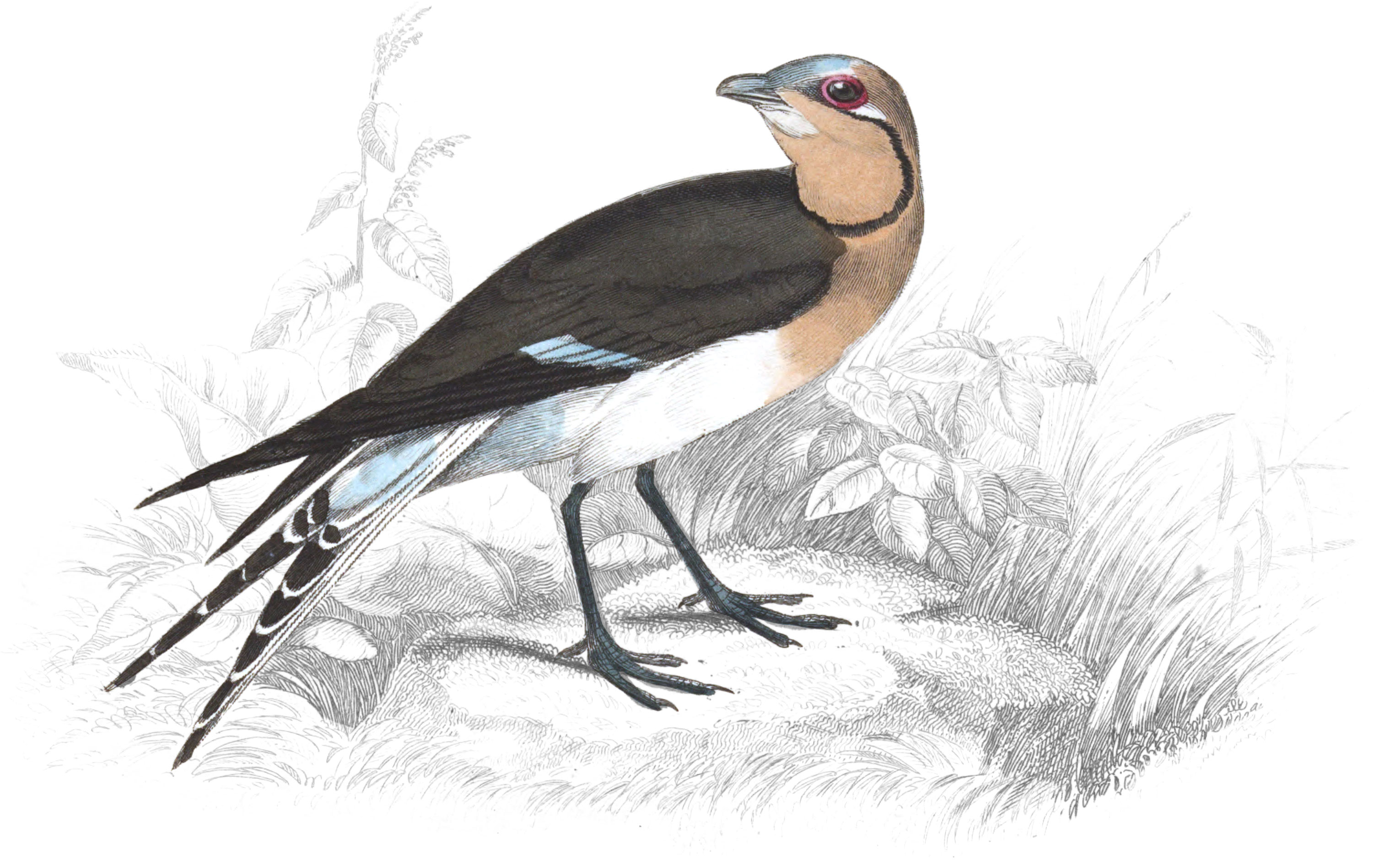
Plate XXVII
Oyster Catchers
The interesting birds which constitute the next limited genus, are nearly completely maritime in their habits, and exhibit an alliance, in various respects, to the family in which, by the almost common consent of modern ornithologists, they have been placed. They are gregarious except during the breeding season, and, even then, incubation is frequently conducted in companies. They breed chiefly upon the ground, making little or no nest, and lay four eggs. They are subject to a double moult, analogous to that of the Charadriadæ; and their manner, when an intruder approaches the nest, is also similar. We have representatives of the form in every quarter of the world.
Hæmatopus.—Generic characters.—Bill long, straight, or slightly bending upwards, compressed, point abruptly truncated; mandible with a large short nasal groove in the membrane, of which the nostrils are pierced; nostrils linear; wings ample, first quill longest; legs comparatively short; tibiæ for a short space naked; toes three, anterior, short, united by a membrane which borders them.
Types, H. ostralegus, paltiatus, niger, &c. Cosmopolite.
Note.—Habits maritime; gregarious except during incubation; breed on the ground.
The European Oyster Catcher
Hæmatopus ostralegus, Linnæus.
Hæmatopus ostralegus, Linn., &c.—L’hueterier pie, Temm.—Common or Pied Oyster Catcher of British authors.
The Oyster Catcher is frequent (in some parts abundant) on our coasts from south to north, except where they are very rocky and precipitous. Their favourite stations are where there is a large extent of sandy shore, interspersed with scalps, or beds of muscles or other shell fish. These are generally uneven in their surface, or are interspersed with pools, which contain, breed, or tidely receive from the ocean, various molusca and marine animals, furnishing a favourite food to the birds. Hither they may be seen hastening, from their marshalled ranks along high water mark, so soon as the first object appears above the waves, alighting, or clamorously flying around it when its place is only visible from the surf; and, as it becomes uncovered, a dense mass of birds crowd upon it, impatient for the additional store of food which the last tide may have washed upon it. In general they are shy, and will scarcely allow approach within shot, sounding their shrill whistle on the approach of an enemy, and flying off in small parties at a time; single birds may, however, be called within reach, and if one is killed, the flock or party will turn and hover over it, uttering their cries during the while. As stated, they feed at low water, resting during the height of the tides, and equally so if the change is during the night. When residing on a coast where they were abundant, we have often, at night, been able to distinguish the state of the tide, from the whistle of the Oyster Catcher passing to its feeding grounds. Though their chief haunts are the shores of the sea, they are also occasionally seen inland by the course of rivers. This appears more prevalent as we reach the north, where, however, the land is often much cut up by bays and arms of the sea, along which they also stretch. Professor Fleming has mentioned, that they breed on islands in the Tummel in Perthshire, where we have ourselves seen them. Mr. Thomas Grant of Edinburgh, as quoted by Mr. Yarrell, states, “that they regularly migrate to the interior of the north-eastern counties to breed.” We have also seen the Oyster Catcher on the river Tweed, as high up as Dryburgh. On the English rivers it is sometimes killed far inland, but only as a stray visitant, and not breeding. They incubate upon the ground, generally in pairs, but in some instances in, as it were, a common breeding place; little nest is made, but the eggs are laid in some hollow in the sand or shingle; in one or two instances we have found the nest placed on the top of rocks standing insulated in an estuary, and probably from ten to fifteen feet above the ground. When approached at this season, the parent birds are very clamorous, and fly around, or hover over the intruder.
In distribution, the Oyster Catcher appears common throughout Europe, where the coasts are fitted to its habits. It extends northward to Russia and Siberia, and even to Kamtschatka.216 It is probable, that it may extend beyond the European boundary, Temminck mentioning it among the birds of Japan; but extra European specimens have never come under our examination.
Specimens before us reach in length from sixteen to nineteen inches; the first, however, is a young specimen of the year, in full plumage; another, seventeen inches, is, however, adult. The winter plumage is noted to consist of a collar of white beneath the throat; but the specimens alluded to, one killed in December, the other in July, are nearly similar; the feathers on the throat of the first being narrowly tipped with white. In these, the head, neck, breast, upper parts of the back, shoulders, scapulars, lesser wing-coverts, and tip of the tail, are velvet-black; on the back and mantle glossed with green; the lower part of the breast, and other under parts, under eyelid, lower part of the back, upper tail-coverts, base of the tail, greater wing-coverts, and part of the inner webs of the quills, pure white; the bill and circle round the eyes, orange; legs and feet deep purplish-red. At times, these birds, in winter, are distinguished by a collar of white beneath the throat, which disappears as the season of incubation approaches, but it is occasionally only more or less marked by white tips to the feathers. In the young birds of the first plumage, the dark parts are all of a duller black, approaching in some parts to brownish-black; and on the back and scapulars, the feathers are tipped with ochreous; the tips of the white upper tail-coverts are barred with black and ochreous; the colours of the bill and legs are not so brilliant as in the old birds, that of the latter being of a livid grey. We have seen specimens of a dull white or fawn colour.

Plate XXVI
Rallidæ
The family of the Rails, which we place last, as being the most truly aquatic of the Grallatores, is composed of birds, whose habits are skulking; during the day, frequenting meadows or marshes, and the banks of lakes and rivers, and there hiding themselves among the thick herbage which covers the localities selected by them. In the typical families, we saw the power of flight amply developed, in some instances, showing great swiftness and a capability of being long sustained; among the Rails, on the contrary, the wings are short and concave, the flight in the greater number awkward and fluttering; but, to compensate for this, the feet and legs are adapted for running, and the whole form is narrow, and when the neck is stretched out, is pointed and fitted for threading through a vegetation, which may be at once thick, and, at the same time, strong and matted. Many of them also swim and dive readily, and the feet are so constructed in those which are not natatorial, as to enable them to tread and walk with ease upon soft mud, and even over the large leaves of water plants. Many of them, however, differ, and come nearer the Rasores in building or constructing nests of a large fabric, and in laying a number of eggs. The British genera are limited.
Rallus.—Generic characters.—Bill long, slender, compressed, towards the tip subcylindrical and slightly curving; nasal furrow long and wide; nostrils linear and pierced near the centre of its length; wings short, concave, rounded, third and fourth quills longest; carpal angle often armed with a spine; legs of mean length; bare above the tarsal joint; feet long, slender; toes cleft to the base; hallux short, articulated near the plane of the others.
Type, R. aquaticus, &c. Cosmopolite.
Note.—Habits aquatic; skulking; lay numerous eggs; perch on rails or low trunks of trees; feathers of the forehead with the shafts prolonged into horny points
Water Rail
Rallus aquaticus.—Linnæus.
Rallus aquaticus, Linn.—Ralle d’eau, Temm.—Velvet Runner, Willough.—Common or Water Rail of British authors.
The Water Bail is found in the fenny counties of England, and, where there is an occasional marsh or fen, through most of the other districts; in Scotland it occurs also in similar localities, but is accounted far from abundant, though its apparent scarcity may be attributable to its very shy and secluded habits. During winter, in our own vicinity, we generally see or procure a few specimens, in wet ditches which do not soon freeze, and to which the bird at this time resorts, being driven from its better covered haunts by the severity of the storm; in such places, after being pursued, it will creep into some hole or under cover, and allow itself to be taken by the hand. In summer, we have shot it once or twice, but have always been unable to discover the nest. It utters a discordant croak in the evenings, and during the while remains stationary, possessing the same ventriloquial power as the corn crake. Out of Europe its range appears very restricted; we have never received it with any collection, and the notices of its occurrence are very scanty. Pennant mentions Malta, and Mr. Strickland Smyrna.217
An adult male, shot in this vicinity, has the crown and all the upper parts yellowish-brown, tinted with oil-green, the centre of each feather black; on the centre of the back occupying nearly the whole feather, but on the lower part and scapulars being in the centre only, and there on the wings and tail, allowing the pale colour to be the prevailing one; quills nearly clove-brown; on the forehead, until beyond the line of the eyes, the shafts of each feather is strong, and protrudes in a horny point; the chin greyish-white; the region of the eyes, cheeks, sides of the neck, and under parts, until in a line with the legs, bluish-grey; the flanks black, barred with white; tips of the feathers reddish wood-brown, forming a line of that colour along the centre of the vent, joining with the under tail-coverts, which are similar, their basal half being black, which sometimes appears mixed with them; axillary feathers barred with black and white; the bill is blackish-brown at the tip, at the base tile-red, becoming brighter and orange-red upon the edges of the gape; legs greenish-brown. White varieties sometimes occur.

Plate XXVIII
Crakes
Crex, Bechstem.—Generic characters.—Bill short, strong at the base; culmen entering the plumage of the forehead, its outline slightly deflected to the tip; maxilla angulated; nasal fossa broad; nostrils pierced in its membrane; wings, at the carpal angle armed with a knob or rudimentary spine, rather short, concave, second or third quills longest; legs strong, naked for a short space above the tarsal joint; anterior toes long, slender, cleft to their base; hallux short, articulated nearly on the plane of the others.
Types, C. pratensis, porzana, gularis, &c. Cosmopolite.
Note.—Habits skulking; chiefly aquatic; breed on the ground; and lay numerous eggs; noisy and often nocturnal.
The Meadow or Corn Crake
Crex pratensis.—Bechstein.
Rallus crex, Linn.—Gallinula crex, Lath.—Ortygometra crex, Steph. Crex pratensis, Bechst., &c.—Poule d’eau de genet, Temm.—Corn Crake or Land Rail of British authors.
The Corn Crake is generally distributed over the British Islands, extending northwards to Orkney and Shetland; at the same time, it affects peculiar localities, and there are many districts where it is scarcely ever heard. Low lying and sheltered vales, along a river’s course, are its favourite haunts, and there it will he found in meadows, young grass or grain, osier beds, &c., preferring places in which there is a certain degree of moisture. It is migratory, being a summer visitant only, appearing at an earlier or later period in the spring according to its range northward or southward. In some parts it has decreased, and without apparent cause; in the vale of the Annan, in the south of Scotland, ten years since, the bird was extremely common, its note being heard in almost every alternate field; at the present time, it may almost be accounted rare; during the last summer (1841) only one or two pairs being heard within a stretch of several miles. During the season of incubation, which commences immediately after their arrival, the call or crake, which is said to belong exclusively to the male bird, is, in the mornings and evenings, uttered with unceasing perseverance, and by its imitation, they may be easily brought within a few yards distance, though even then they are with difficulty raised from the ground. The Rails possess a curious property in the utterance of this call, a sort of ventriloquism, by which it appears at one time at the extremity of the field, and the next minute close at hand. The crake is uttered when running, but more frequently when the bird is seated on some stone or clod, and in this position possesses all the modulations of distance. After incubation the call ceases, and the birds are found in the growing crops, hedge rows, &c., and during autumn are frequently shot when in quest of partridges. In some parts they seem to assemble before migration, and many couples are at times shot by persons looking for them. Instances occur of this bird being occasionally met with very late in the season, and even in winter, but this can only be considered as owing to particular circumstances.
Over the eyes, behind the auriculars, and extending a short way down the neck, is a streak of grey, blending into the colours on either side; on the crown, back of the upper parts and tertials, the ground colour or centre of the feathers is hair-brown, each being very broadly edged with yellowish-brown, or a yellow tint of oil-green; the wing-coverts and axillary feathers orange-brown; the quills a dull reddish hair-brown, darkest. on the inner webs; the region of the eyes, auriculars, and sides of the neck, are reddish wood-brown, shaded into the throat and breast, the former of which is white, tinted with grey, the latter yellowish-brown; the centre of the belly is nearly white, shading gradually to the sides and flanks, which are reddish-orange, barred with hair-brown and reddish-white; bill brown, pink towards the base; legs and feet yellowish-brown.
The nest is placed on the ground, in a furrow or some slight hollow, and is constructed of grasses; the eggs often amount to ten or eleven in number; and, altogether, the nest much more resembles that of the partridge or some of the Tetraonidæ than of the Grallatorial birds. The food, during its summer migration, is insects, worms, slugs, &c., and we once took a mouse from the stomach of one killed in the vicinity of Edinburgh. Out of Europe, we have the range of this bird noted to Africa,218 and also to Madeira.219
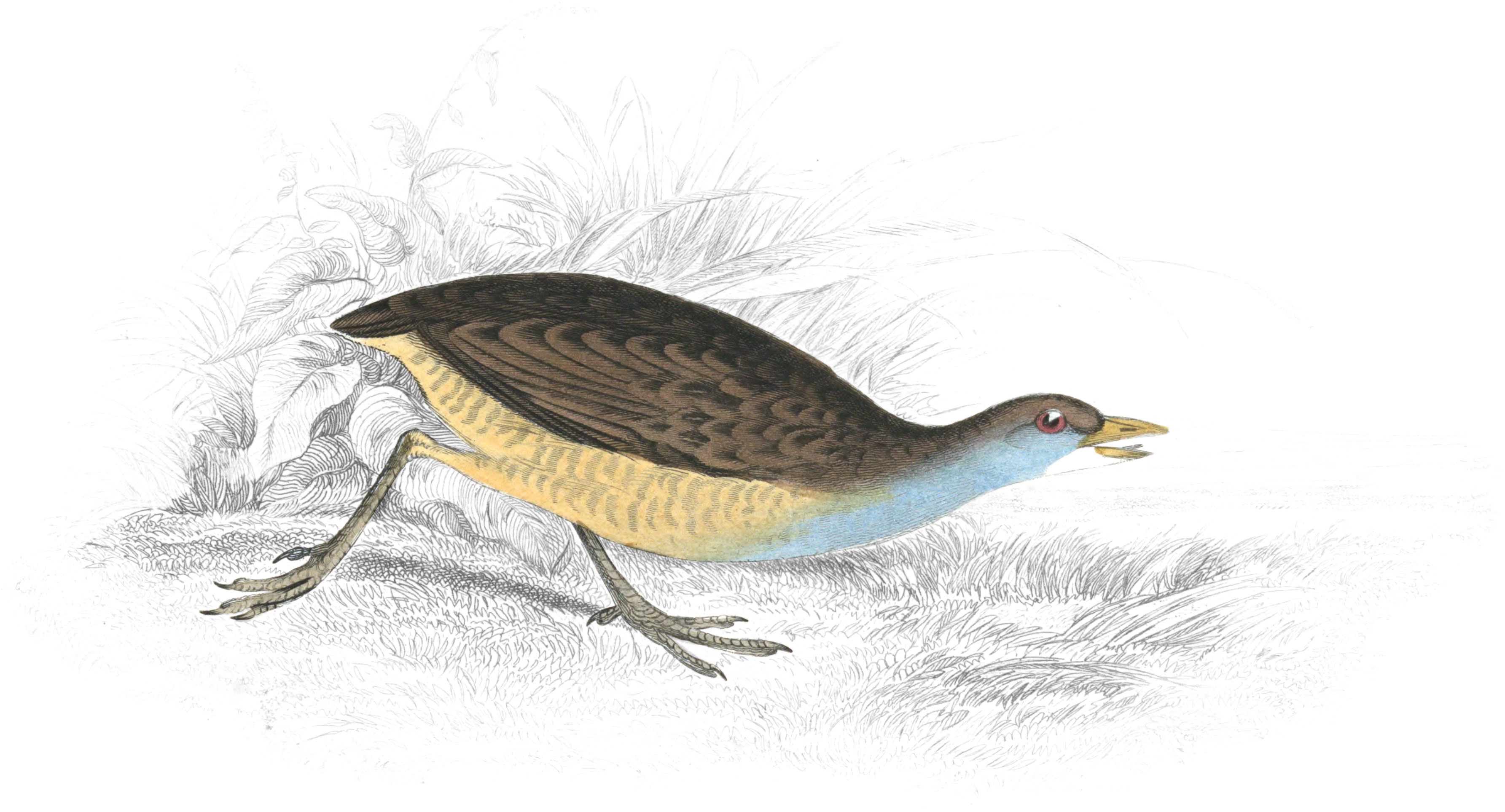
Plate XXIX
The Spotted Crake
Crex porzanna.—Bechstein.
Rallus porzanna, Linn.—Poule d’eau maronette, Temm.—Spotted Gallinule or Crake of British authors.
The Spotted Crake is also a summer visitant to Britain, arriving early in spring, and departing later than almost any of our other summer migratory birds.220 It is much more aquatic in its habits than the last, frequenting marshes and the borders of lakes and rivers, which abound with tall reeds or grass; and, from its skulking habits, not betrayed by a call, it is extremely difficult to raise, and is thus accounted much more rare than we are inclined to believe it to be. In localities which suit it, it may be pretty generally diffused over England, being more or less abundant, according to the prevalence of reedy lakes or fenny districts. In Ireland it is named as “an occasional summer visitor,” and in Scotland we have met with it frequently. In a marsh in our own vicinity, it may be always met with, if carefully looked for; but we have often run it for twenty minutes before a dog, previous to its taking wing; and it will often creep into some hole or matted parcel of grass, rather than rise a second time. We have also seen specimens taken near Edinburgh, and Mr. Yarrell gives a notice of one shot in Forfarshire, in October, 1832. We do not, however, know its range in a northern direction. The nest is described as found in the vicinity of its haunts, near the water, and to be constructed of the dead parts of the reeds and grasses. The eggs are numerous, pale reddish white, spotted with dark reddish-brown. On the continent it occurs in abundance or scarcity, according to circumstances. In the vicinity of Smyrna it was found by Mr. Strickland.221 We have not seen or traced it to other extra European localities.
A specimen shot at Jardine Hall, in the month of July, has the head, back, and rump, clear hair-brown, approaching nearly to black; on the crown the feathers are edged with yellowish-brown; on the back and rump broadly with oil-green, the margins with irregular white spots; on the lower part of the back and wings, where the apparent colour is nearly wholly oil-green, they are marked with white lines, being both surrounded with a narrow border of black; the long tertials, nearly equalling the quills in length, are crossed by irregular diagonal white bars, surrounded by a broad shade of black; quills hair-brown, tinted with oil-green; above the eyes, the sides and front of the neck, greyish oil-green, each feather spotted on the tips white; chin greyish-white; breast and flanks oil-green, on the former indistinctly marbled with white; on the flanks barred with white, relieved with black; middle of the belly nearly white; vent and under tail-coverts ochreous; axillary feathers dark clove-brown, barred narrowly with white as in some of the Scolopacidæ; bill orange-red at the base, shading to yellow, in some to greenish-yellow, at the tip brown; legs and feet greenish-yellow.
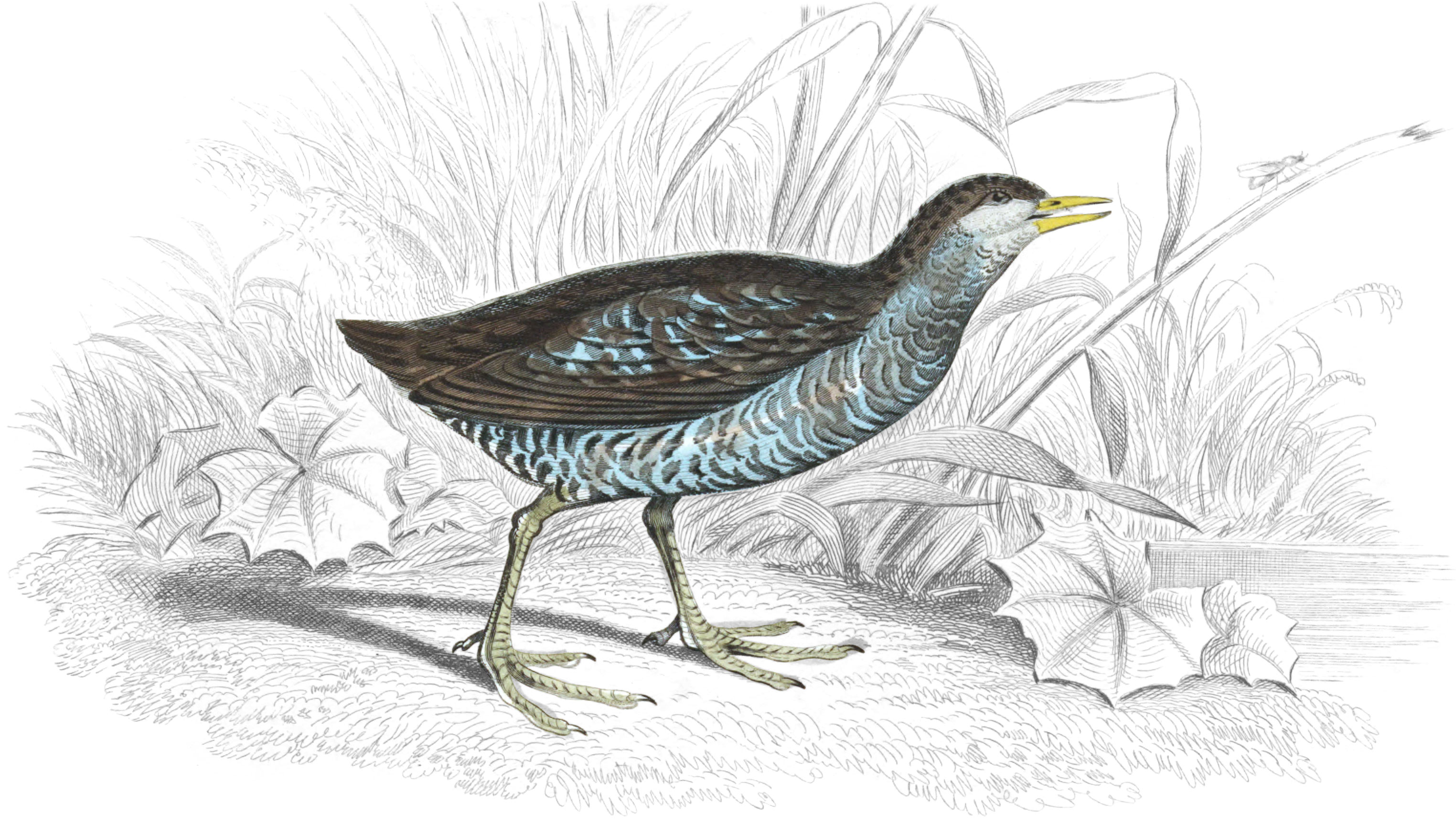
Plate XXX
Baillion’s Crake
Crex Baillonii.—Crex Baillonii, Illust. of Ornith.—Gallinula Baillonii, poule d’eau Baillon, Temm.—Zapornia Baillonii, Steph., Gould.—Baillons Crake or Gallinule of British authors.
This little Crake is almost a miniature representation of the last, and is beautifully marked on the upper parts with clear white spots. It is a bird not frequently met with, both from being comparatively limited in numbers, and from the activity it displays in eluding attempts to raise it from its retreats. It has been taken in several of the English counties as far north as Derbyshire; but we have no notice of it in Ireland. A specimen, which we shall immediately describe, is now before us, shot in summer, a few years since, in an extensive moss in this vicinity. Baillon’s Crake seems to be taken at all seasons with us, though most of the captures recorded have been made very late in autumn, or in winter; the nest is said to be constructed similarly to that of the last. In the marshes of the continent it seems to be more abundant than in our island; and has been found in those of Picardy by the naturalist whose name it bears, and extends southward to Italy; but we want information as to its continental range. Out of Europe, South Africa222 and Japan223 have been given to it. From the former we possess specimens, received at various times, which do not seem to vary, except in the colours being richer and more brilliant than in the British specimen before us.
The upper parts and wings are yellowish-brown, tinted with oil-green; on the head the centres of the feathers darker; on the centre of the back the feathers are black, having the outer webs without the yellowish-brown, and finely freckled with white, the appearance given is like an irregular white patch, interspersed with black; on the secondaries and tertials the markings have the form of zig-zag lines, bordered with black; the under parts, as far as the line of the legs, is nearly bluish-grey; the colour of the upper parts running into it on the sides of the breast; the vent, flanks, and under tail-coverts, are dull black, crossed with broken bars of white; bill dark yellowish-green; feet and legs yellowish-green. Mr. Yarrell describes the under parts of the young birds to be “pale buffy white, mixed with light brown.” Length of our Scotch specimen about four inches, (perhaps slightly stretched.) Those from South Africa range from five and a-half to six and three-quarter inches.
The Little Crake
Crex pusilla.
Gallinula minuta, Mont.—Rallus pusillus, Lath.—Crex pusilla, Selby.—Poule d’eau poussien, Temm.—Little Crake or Olivaceous Gallinule of British authors.
This little species, of plainer dress than the last, is of equal rarity in occurrence, having been met with only at intervals in the counties to the southward of Yorkshire, between March and October; no specimens are noted in Scotland or Ireland, or, indeed, to the south of the county named above. So far as we know, its habits and nidification are similar to those of the two last; but its habits, except with great patience, are a great hinderance to investigation. It is curious that these birds—this as well as the last—are said by Temminck to be of “accidental” occurrence in Holland, a country which we should have considered in every way suited to them. In Southern and Eastern Europe it seems plentiful. Temminck considers the Japanese species identical.
The head and upper parts are oil-green, and on the middle of the back, as in the last, there is a patch of white, varied by black; there are also white markings on the scapulars, but “never on the wing-coverts;” the lower parts bluish-grey; on the vent darker and crossed with white; bill, legs, and feet, deep green, the former, according to Mr. Yarrell, red at the base.

Plate XXXI
Gallinules
Following the Crakes, the form of the Gallinules next presents itself. They are birds of larger size, and more aquatic in their habits, swimming with ease, and diving to avoid danger.
Gallinula, Latham.—Generic characters.—Bill short, compressed; culmen broadened into a shield on the forehead; nasal furrow not conspicuous; nostrils pervious and pierced in it; wings short, concave, second or third quill longest; carpal joint armed with a spine; legs rather short, strong, naked above the tarsal joint; feet large; toes long and rather slender, cleft to the base, bordered with a narrow membrane; tarsus comparatively short and articulated on the same plane.
Types, G. chloropus. Europe, Asia, Africa, and America.
Note.—Habits aquatic; swim freely; lay numerous eggs; perch on rails or low trees; fly with comparative difficulty.

Young Gallinule Beak and Claw
Common Gallinule
Gallinula chloropus.—Latham.
Fulica chloropus, Linn.—Gallinula chloropus, Lath., &c.—Poule d’eau ordinaire, Temm.—Common Gallinule, Water-hen, or Moor-hen, of British authors.
This species is more aquatic than the true Rails, swimming freely, spending a great deal of its time in the water, apparently diving at times in search of food, and always to avoid danger. It is commonly distributed through our islands; and, in addition to the more extensive resorts of water fowl, is extremely fond of ponds, or still rivers, fringed with willow, brushwood, or any rank vegetation. Amidst these it finds shelter and a retreat in time of danger, and a convenient breeding place. It is a bird which becomes extremely familiar, and, if unmolested, will continue long about one spot, and will approach the vicinity of houses for food that is regularly laid for it. When pursued, it will run, or half fly to the nearest water, and will creep into holes, or dive amidst the vegetation, the bill merely kept above water. In this position it requires a very strict search to find it, allowing the stems of grasses and brushwood to be put aside without moving; and, when discovered, is seen squatted under water, immoveable, and permitting itself to be lifted, making no struggle for escape until secured. It breeds among reeds or roots of brush, by the water’s edge, supporting the nest upon them; and an instance is mentioned, by Rusticus of Godalming, where the nest was placed on the branch of a spruce, twenty feet from the water. It frequently perches on bushes near the water, and on trees at a considerable height, particularly when alarmed.
The European range of the Common Gallinule is general and extensive. Out of Europe it appears limited, and we do not trace it authentically very widely; Dr. Smith is said to have brought it from Southern Africa.224 An adult Water-hen is a beautiful bird in spring; the base of the bill, and shield on the forehead, now considerably enlarged, is a bright red, and contrasts well, or enlivens the deep blackish-grey of the head, throat, neck, and under parts; this colour shades into a deep oil-green on the upper parts, at this season glossed with rich green reflections, which are spread on the sides of the breast; the quills are nearly pale umber-brown, the outer edge of the first, with the bend of the wing, white; the tail rounded at the tip, is black, shading into deep oil-green, and shows the narrow cross dark markings incident to structure, seen in various incessorial birds, and in the aquatic
genus Plotus. On the lower part of the belly and vent, the feathers are tipped with greyish white, which prevails more or less on the centre of these parts, and on the flanks, where the oil green predominates, the feathers are dashed with long streaks of white; the true under tail-coverts are white, but the feathers of the vent are deep black, and run in upon them in an angular point; the naked parts of the tibiæ are bright vermilion-red, shading to yellow, and often appear conspicuous; the feet and legs are olive green. In the female the colours are not so bright, and the frontal shield does not cover so large a space. In a specimen before us, the rump is barred at the tips of the feathers with deep brown and pale yellowish-brown, producing a pleasing arrangement. In the young, the frontal shield is scarcely visible, the whole plumage has a tint of brown spread over it; on the throat brownish-white, and on the lower parts being yellowish-brown, paler in the centre of the belly, and nearly wanting the white longitudinal streaks seen in the adults; the feet and legs are of a duller tint. The young, when newly hatched, are covered with a hair-like black down.
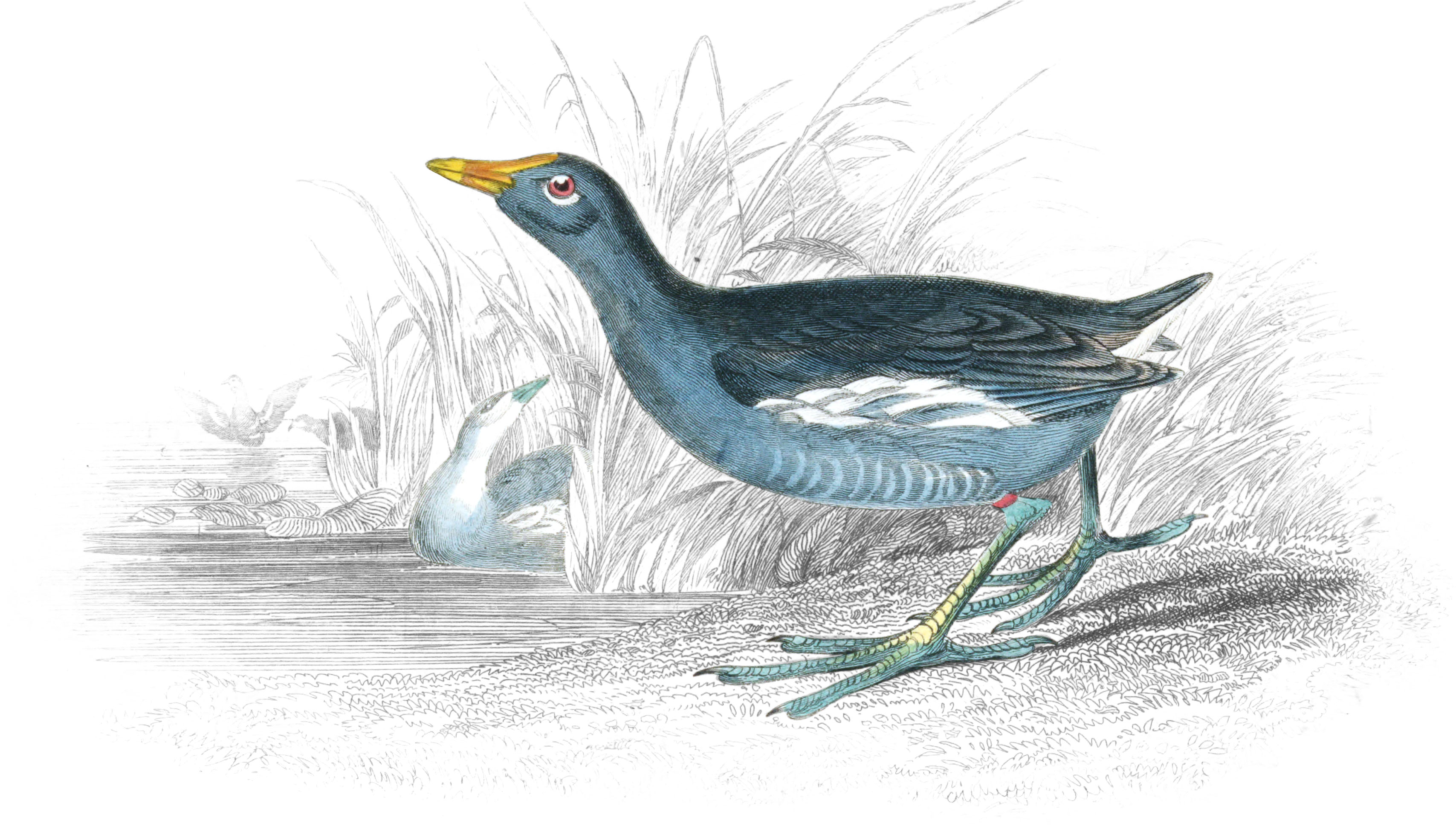
Plate XXXII
Coots
The last form among the British Rallidæ is still more aquatic than the preceding, swimming freely, and diving expertly for its food.
Fulica, Linn.—Generic characters.—Bill strong, compressed; culmen gently curved to the tip, and forming a large frontal shield; nostrils oval, medial, pervious, pierced in the membrane of the nasal furrow; maxilla with a considerable apical angle; wings of middle length, rather pointed, second quill considerably larger than the first; legs rather short, strong, feathered nearly to the tarsal joint; feet large; toes long and slender, cleft to the base, and bordered with a broad lobed membrane; hallux articulated on the same plane, bordered with a continuous membrane; claws sharp, gently curved, compressed.
Types, F. atra, Americana, &c. Europe, Asia, Africa, America.
Note.—Swim and dive with facility; pursue their food under water; partially maritime; flight powerful; breed among herbage growing in the water; lay numerous eggs.
The Common Coot
Fulica atra.—Linneas.
Fulica atra, Linn., &c.—Foulque macroule, Temm.—Greater Coot, Penn.—Coot or Bald Coot of modern British authors.
The Common Coot appears to be a constant resident in many parts of south and middle England, in some localities making partial migrations to the coast. To the northward, and in Scotland, it can scarcely be considered more than a summer visitant, arriving early in the spring to breed. In Southern England, where the rivers are broader and more lake-like, it is found in them as well as in broad expanses of water; but in Scotland it may be considered as confined to the lochs, and to those districts where the country has no alpine character. We have never traced it among the wilder Highland waters, though Dr. Neil and Mr. Dann have remarked it in the Orkneys. In the south of Scotland, they arrive in their breeding stations early in spring, and a straggling few only remain during mild winters. Before they have dispersed in pairs, or after having joined when incubation has been finished, they may be seen in companies, diving like ducks, remaining long underwater, and evidently feeding. At the same seasons, and in winter, in some of the English rivers and estuaries, they appear to assemble in vast numbers, and are pursued by regular fowlers, who sell them at eighteen-pence a couple. They breed among reeds or brush, growing in the water, the nest being generally placed where it would swim, were it not supported by the stalks and roots beneath; the nest is very large, and mostly composed of the stalks and leaves of aquatic plants. During this season they will suffer a near approach, but become shy if often disturbed; at other times, the Coot is shy and rather difficult to be got at. When on the wing, it flies strongly, with the legs stretched out behind.
There is very little variation between the sexes except in size, the female being slightly less. In a pair before us, shot in this vicinity, during the breeding season, the bill is pinkish-white, spreading out on the forehead in a large milk-white shield, very conspicuous and contrasted with the dark plumage of the bird. The head, neck, and tail, are deep black, the former shading into a uniform blackish-grey, which is the only other colour in the plumage; slightly paler beneath; on the wings and back, the shafts are darker, and are seen as narrow lines; the edge of the first bastard quill, and a very narrow line bordering the outer quill, white; the under surface of the wings, in some lights, appears of a silvery grey; the tibia3 are orange; the feet and legs greenish-grey.
The young, when newly hatched, are covered with a strong hair-like covering, black, but around the head red and orange-red.
White, and partially white varieties, sometimes occur.

Plate XXXIII
Young of the Rasores & Grallatores
On this Plate we have endeavoured to represent the young of these two orders or groups of birds. Leaving the Incessorial birds, we entered the first by means of the Pigeons, where, among the greater part, the young were still hatched unfledged, and were fed for some time in the nest. In all the other families, the young run almost immediately after exclusion from the egg, and, in consequence, are protected by a close and ample soft down. In the greater part of the Rasores, the colours at this time are shades of brown, chestnut, and yellow, as instanced in the Partridge. In the Ardeadæ, it is shades of grey and white. In the Scolopacidæ or Snipes, and Charadriadæ or Plovers, it is also shades of brown, chestnut, yellow, or grey, like the middle figure of the young Curlew; while in the Rallidæ, it is either deep brown or black, often mixed with red or orange about the head and neck, and, in the aquatic species, is of a much coarser or more hair-like texture. See the figures of the young Water-hen and Land-rail.

Plate XXXIV
Left to Right: Water Hen, Partridge, Curlew, Land Rail
- Some of the Cracidæ breed on trees; but we believe that here the young are covered, with down, and are almost immediately transported to the ground. In the genus Penelope, the young are like the typical species.
- Mr. Gould has mentioned a species of Cindosoma from Australia, which breeds on or near the ground, and the young of which, he understood, left the nest at a very early period.
- See Edin. Journal of Nat. and Geog. Science, i. p. 244.
- Yarrell.
- Nilson.
- Vieillot.
- Yarrell.
- Selby.
- Dickson and Ross, Proceed. of Zool. Soc.
- See an interesting account of this species, Macgillivray’s British Birds, i. p. 268.
- Magillivray, Low, Salmon.
- Mr. Dunn.
- Yarrell, Brit. Birds, ii. p.
261260. - Pennant. Arct. Zool.
- Temminck.
- Selby, Brit. Birds.
- See a notice of the principal varieties, Nat. Lib. Vol. ix. “Pigeons.”
- Mag. of Nat. Hist. vol. viii.
- Mr. Fellows.
- Mr. Strickland.
- Yarrell, ii. p. 268.
- Fleming, Brit. Animals, p.
146145. - Richardson.
- Hutchins.
- Yarrell.
- See particularly in the American species. T. cupido, &c.
- If Lyrurus be kept as a sub-genus, “rounded” should be inserted in the characters.
-
Smith, in his History of Cork, completed in 1749, remarks, that this bird is
found rarely in Ireland since our woods have been destroyed.
- See an interesting and long account of this introduction in Jameson’s Journal for July, 1832, by James Wilson, copied in the Nat. Lib. Ornith. vol.
ivvi. - Savi.
- Yarrell.
- Macgillivray.
- Empetrum nigrum, Vaccinium oxycoccus, myrtillus, vitis idea, arbusu uba ursi, &c.
- L. Mutus.
- North. Zool. ii. p. 356.
- Average length of the male specimen is 13\(\frac{1}{2}\) inches; of female, 12\(\frac{1}{2}\). Sabine Supp. to Append. to
RossParry, p.cxcviicxcvi. - Vol. i. p. 435.
- Mr. Fenton, Preserver of Birds, &c., No. 66, George Street, Edinburgh.
- Brit. Birds. i. p.
237236. - Annals of Nat. History, iv. p. 284.
- Yarrell.
- Daniel’s Rural Sports.
- Echard’s His. of England.
- Prodromus ii. part 2. p. 17.
- Yarrell ii. p. 367.
- I. p. 53.
- Nilson.
- Pennant.
- Proceed. Zool. Soc. 1835, p. 79.
- Yarrell.
- Yarrell ii. p. 374.
-
And some affirm, that any bait anointed with the marrow of the thigh-bone of an Heron, is a great temptation to any fish. The scent from his legs was considered attracting to them, when he waded in the water.
- Eyton.
- Yarrell.
- Horsfield.
- Temminck.
- Yarrell.
- Horsfield.
- Selby.
- Yarrell.
- Major Franklin.
- Colonel Syles.
- Horsfield.
- Temminck.
- Gould.
- Since writing the above, we have a note from Mr. A. Grounds, Ludlow, stating that a specimen of the Squacco Heron was killed near that town, about six years since, and was stuffed by him.
- Yarrell.
- Heysham.
- Fleming.
- Audubon, iii., pp. 77 to 80.
- Yarrell.
- Temminck.
- Lieut. Colonel Sykes.
- Yarrell.
- Yarrell.
-
Wilson however remarks,
that the European species is certainly much smaller than the American.
- Wilson, Audubon.
- Temminck.
- Yarrell.
- See Trans. Linn. Soc. for 1815.
- Yarrell.
- Selby.
- Dr. Smith.
- Dr. Heineken.
- Fleming.
- Yarrell.
- Yarrell.
- Wagler.
- Letter from G. F. Vigne, Esq. viii, p. 224.
- Temminck.
- Dr. Smith.
- Sir F. Mackenzie.
- Loudon, Mag. of Nat. Hist.
- Selby.
- Hewitson.
- Daniel.
- See Yarrell.
- Yarrell.
- Strickland.
- Heineken.
- G. T. Vigne, Esq., Annals of Nat. Hist. viii. p. 225.
- Temminck.
- Linnæan Trans. vol. xiv., Illust. of Ornith. pl. xxvii.
- Yarrell.
- Manuel, Supplement.
- Mr. Richardson.
- Yarrell.
- Nilson.
- Thompson.
- Yarrell.
- Temminck.
- Selby. ii. p. 99.
- Yarrell, ii. p. 523.
- Temminck.
- Temminck.
- In Norway, Mr. Hewitson observed the Greenshank perched on top of a tall tree.
- Strickland.
- Keith Abbot.
- Pennant.
- Temminck.
- Dr. Horsfield.
- Colonel Sykes. By Mr. Jerdan, in his Catalogue of the Birds of the Peninsula of India, the Green Totanus is introduced.
Temminck, ii. p. 392.- Nilson.
- Dr. Smith.
- Colonel Sykes.
- Mr. Gould.
- Yarrell.
- Colonel Sykes.
- Temminck.
- Horsfield.
- Quoted from Yarrell.
- Notteren.
- Ornith. Biog. iii. p.
452445. - Thompson’s M.S.S.
- Yarrell, ii. p. 666.
- Yarrell.
- Franklin, Temminck, Selby.
- Madras Journal, July, 1840. p. 209.
- Gould.
- Colonel Sykes.
- Temminck.
- Madras Journal, July, 1840, p. 209.
- Bonapart auct. Yarrell.
- Yarrell, ii. p. 641.
- Yarrell, ii. p. 641.
- Annals of Nat. Hist. ii. p. 53.
- Bonap. Contin. iv. p. 73.
- Orn. Biog. iii. p. 529.
- Orn. Biog. iii. p. 530.
- Colonel Sykes.
- Dr. Horsfield.
- Temminck.
- Yarrell, ii. p. 561.
- Yarrell.
- Selby.
- Yarrell, ii. p. 556.
- British Animals, p. 101. “Resident in England, a straggler in Scotland.”
- Jerdan, p. 210.
- British Animals, p. 111.
- Dr. Richardson.
- Darwin.
- Dr. Smith.
- Jerdan, Madras Journ. of Science, July, 1840, p. 211.
- Temminck.
- Yarrell. Specimens in Museum of Linnaean Society.
- Temminck, pl. color.
- Jardine and Selby, Illust. of Ornith.
- Selby.
- Dann.
- Mr. Audubon found them gregarious (during winter), on the Ohio, swimming along the margin, and picking up seeds of grasses; also at sea, far from land, assembling in hundreds, on banks of sea-weed. They proved excellent eating.
- Fauna Boreali-Americana Birds, pl. 408–9.
- Selby, ii. p. 167–8.
- Yarrell.
- Dr. Fleming, Slamon, Hewitson, Neil, &c.
- Thompson, MSS.
- The Lapwings are so nearly allied to the genus Pluvianus, that although we are in the habit of looking upon our native species as representing the former, it will more properly come in as an aberrant species.
- 11th February, 1842. The Lapwing has already commenced its inland migration.
- Nilson.
- Yarrell.
- Temminck.
-
A very ancient Lincolnshire family, the Tyrwhitts, bear three Pewits for their arms; and, it is said, from a tradition, that it was in consequence of the founder of their family having fallen in a skirmish, wounded, and being saved by his followers, who were directed to the spot where he lay by the cries of these birds, and their hovering over him.—Yarrell’s British Birds, communicated by Charles Anderson, Esq. of Lea.
Mr. Selby considers the birds served up at the feast of the Archbishop Neville, to the number of one thousand, were Lapwings, not specimens of the heron known as egret, under which name they are recorded.
- Dr. Fleming says, “he has reason to believe that it breeds in the high grounds of Kincardinshire.”
- Selby ii. p. 229, note.
- Dr. Smith auct. Yarrell.
- Selby.
- Temminck.
- Horsfield.
- Linn. Tour in Lapland.
- The axillary feathers in C. pluvialis are pure white in, S. Virginianus, hair-brown; and in S. cinerea, black.
- See Yarrell, ii. p. 393, et seq.
- Yarrell.
- Mr. Selby states, “Its winter quarters in the warmer parts of Europe and Asia,” ii. p. 236.
- Linnæus, Nilson, Hewitson.
- Yarrell.
- Temminck.
- Selby.
- Messrs. Scales and Hoy auct. Yarrell.
- Fellowes.
- Temminck.
- Selby.
- Temminck.
- Horsfield. It is possible that the Indian specimens may yet be found distinct, though very nearly allied.
- Hewitson, Oology, quoting from Mr. Hoy.
- Nilson.
- Yarrell.
- Temminck.
- Yarrell, ii. Pl. 411, 412.
- Mr. J. D. Salmon.
- Montague.
- Hohenacher.
- Strickland.
- Yarrell.
- Yarrell.
- Bullock.
- Pennant.
- On the authority of Yarrell.
- Mr. Wilde, quoted by Mr. Yarrell.
- Dr. Heineken.
- Mr. Blyth notices a specimen seen in the London market in the month of January.
- Yarrell.
- Dr. Smith.
- Temminck.
- Yarrell.