
Volume VI
The Natural History of Game Birds
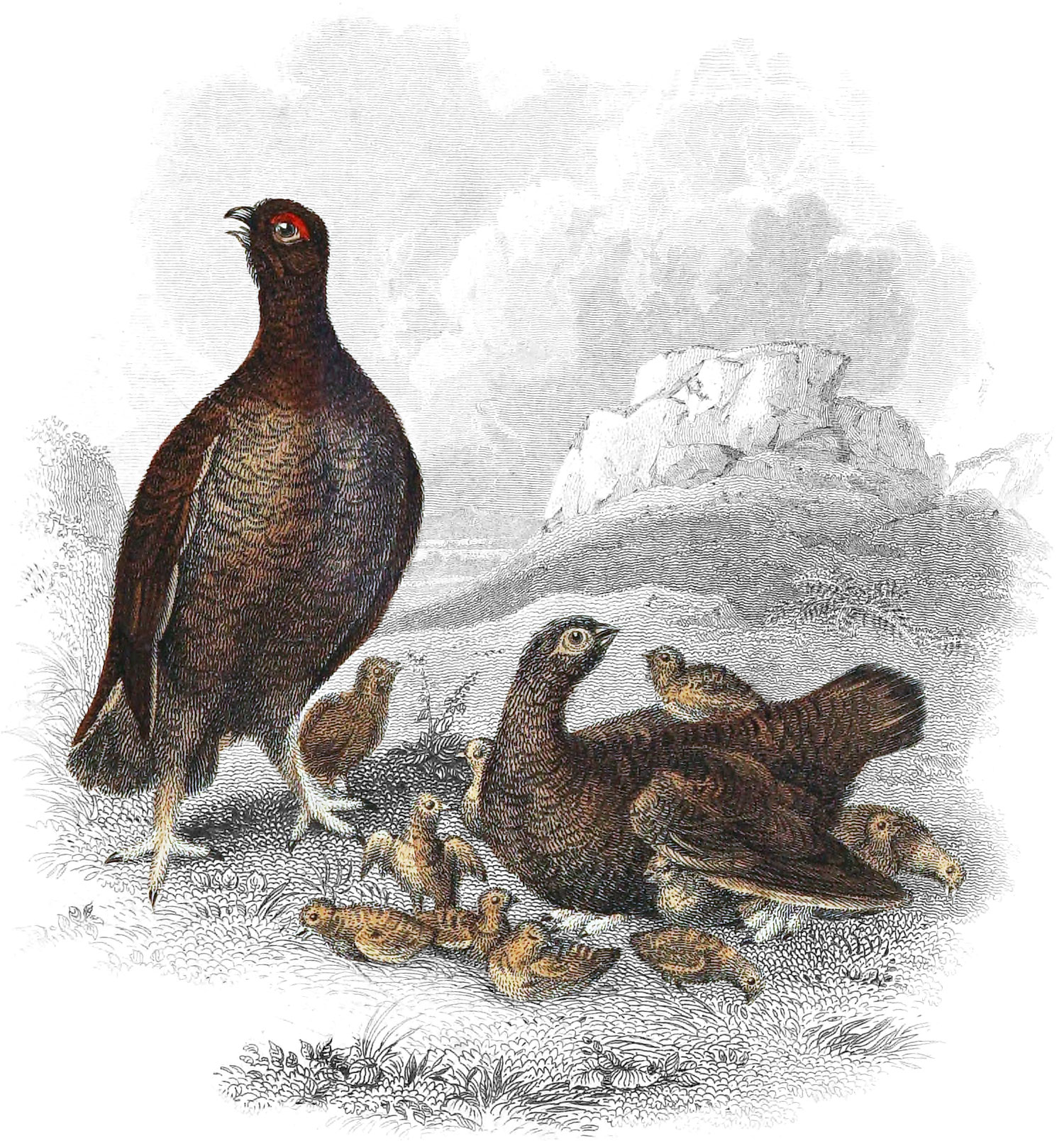

In fulfilment of our promise stated at the conclusion of the last volume, we now proceed to consider another family among the Rasores or Gallinaceous Birds—the Tetraonidæ or Grouse.1
The Tetraonidæ or Grouse contain the principal part of those birds which, in sporting language, have been called game. Very few of these have been domesticated for the use of man, but their preservation in a wild state, and means for an abundant capture, have in all ages exercised the ingenuity of the inhabitants of civilized districts, and at this time form a large account in the luxuries of populous cities; while in countries in a state of purer nature, they are much used as a wholesome and general food.
Among the true Gallinaceous birds, we find the different members living very much upon the ground, the power of flight limited, from the great weight of their bodies or unwieldiness of plumage, and very commonly an extraordinary development of the parts composing the tail. In the present family, the ground is still their prevailing habitation, though many of them frequently perch and roost on trees. Their power of flight is ample, very strong, in some, as the genus Pterocles, extremely rapid, but in a few forms almost as little used as among the Pavonidæ. Some portion of these useful birds are spread over every region of the world, and in almost all localities. The section of the grouse to which the muir-fowl of Britain and the ptarmigan belong, occupy the wild heathy districts of the temperate circle, and extend to the most barren and alpine mountains, or the extremes of polar cold. The true grouse, again, to which the European wood grouse belongs, occupy the forest and bushy grounds, and extend almost as far. The partridges prefer open countries free from wood, and draw near to cultivation; but within the tropics there are one or two forms, which, like the grouse, prefer the brush and wood, where, on the branches, they are safer from the attacks of the numerous tribes of reptiles which swarm around them. The gangas, again, or, as they have been named, the sand grouse, frequent the most barren districts in the world, the plains of India and the trackless deserts of Africa and Arabia, far from the haunts of men, and almost as far from food and water, but endowed with powers for extensive locomotion, they traverse in a day leagues of the waste.
A few species are polygamous like the former family, the males at dawn seeking some eminence, and attracting the females by their continued calls, strutting around and displaying their plumage; but by far the greater number are monogamous, and regularly pair. The male remains near his consort during incubation, and both sedulously attend upon and defend the young, which keep together in coveys until the warmth of the following spring excites new desires, and causes their separation. All breed upon the ground, making scarcely any nest, and, with a few exceptions, they lay a number of eggs. In one or two instances, two broods are hatched in the season, but this is rare, and only continues where the regions inhabited are very warm. The cry of most of these birds is harsh, in a few deep and hoarse; it is uttered only in the breeding season, in cases of dispersion, and at morn and even like a roll-call to see that none are wanting. The plumage is subject to considerable variation between the males and females during the breeding season, and in those which inhabit northern regions or alpine districts, a change of plumage in winter, different from that of spring or summer, takes place.
Among the true grouse, such as the wood-grouse, black-cock, and beautiful birds of America, the males are distinguished by a plumage of deep glossy black, tinted with blue or green, or they have broad and conspicuous patches of these colours mingled with the other shades. The females are invariably of a brown or greyish-brown ground tint, barred or waved with black. The plumage of the young differs from both in being of paler shades, and in the markings being more irregular and confused. In the Lagopus or ptarmigan the males are deep brown or yellow, barred with black and a lighter shade; females always of a lighter tint, and the paler markings more conspicuous. In winter the change is to pure white, having the quills or tail-feathers only dark. Among the partridges and quails the difference is not generally so great, but there is always some distinguishing mark, often black or deep brown. The wattles, caruncules, and naked spaces, so frequent about the heads of the Pavonidæ, we find represented in the beautiful scarlet skin above the eyes, and which in spring becomes much developed and brightened in colour.
In the arrangement of these. birds, Mr Swainson has pointed out what he considers may be the typical forms, although he thinks that a little examination is still necessary. They are Perdix, Tetrao, Cryptonix, Ortygis, and Crypturus. We shall now proceed to examine these, together with the different genera which have been established, and shall commence with
Perdix
Brisson.
The partridges appear to form one point of connection between the present family and that which formed the subject of our last volume, through the guinea-fowl. There are many resemblances in their habits and dispositions, harsh cry, and in numerous instances the spotted plumage. The Perdix clamater of Temminck may perhaps be mentioned as one of the birds forming this passage. It is remarkable for its loud harsh cry, which, says Temminck, like the guinea-fowl, it delights incessantly to repeat, particularly at daybreak and dusk, when the broods assemble to perch on the trees and woods which overhang the rivers. It is in many ways, says the same author, connected with our pintadoes, and may one day form an addition to our poultry-yard, the Cape colonists having already succeeded in rearing them in captivity.
The genus Perdix was established by Brisson, taking the common European partridge as typical, but it was made to contain an assemblage of birds, some of which will not even rank among the family. The quails and the strong-billed American partridges have been separated by modern systematists. Stephens made another separation in the Francolins with spurred legs, and there are several other modified forms which will undoubtedly form subgenera, such as the large bare-necked pheasant-looking partridges of Africa, but as we do not think the present work suitable for characterising new genera, or for entering into minute distinctions, with the exception of Ortyx and the Quails, we have kept them under the denomination of Perdix, but will point out the most marked distinctions as they occur. We have represented as typical of the true partridges—
The Common Partridge
Perdix cinerea.—Aldrovandus, Ray.
Perdix cinerea, Montague, Latham, Bewick, Selby, &c.
A detailed description of this familiarly known bird is unnecessary. It is distributed extensively over Europe, and, according to Temminck, extends to Barbary and Egypt, where it is migratory. It is almost everywhere abundant in our own island, the more northern muiry districts excepted. It follows the steps of man as he reclaims the wastes, and delights in the cultivation which brings to it as to the labourers a plentiful harvest of grain. They are perhaps most abundant in the lower richly cultivated plains of England, but even the south of Scotland supplies many of the more northern markets with this game.
Very early in spring—the first mild days even of February—the partridges have paired, and each couple may be found near the part selected for their summer abode, long before the actual preparations for incubation has commenced. These are begun at a later period than generally imagined, and even in the beginning of September, particularly in the wilder districts, the young are not more than half grown. The nest is formed, or rather the spot where the eggs are to be deposited, is scraped out in some ready made hollow or furrow, or placed under cover of a tuft of grass, and from twelve to twenty eggs are deposited. This mode of nidification prevails through the whole genus. No nest is made, and often no great care of concealment is displayed. In cultivated countries the young grasses and corns are their favourite breeding places, the former often fatal from the hay-harvest having commenced before the breed is hatched. The choice of a place of security for their eggs is not always the same, for Montague mentions a pair which successively selected the top of an old pollard oak, and Mr Selby writes of having known several parallel cases. It is a singular trait in the habits of many birds, that those often of a wild nature will select the most frequented parts for their nests. Both partridges and pheasants are often discovered with the nest placed within two or three feet of a highway or footpath, where there is a daily passage of men and animals. The parents, as if knowing their safety depended on sitting close, remain quiet amidst all the bustle, and often hatch in such places.
During incubation the male sedulously attends, and will generally be found near if the female is intruded upon by any of her less formidable enemies. When the brood is hatched, both lead about the young and assist them to their food; and mild and timid as the partridge is generally described, instances have been seen where the love of offspring prevailed, and a vigorous defence was successfully maintained against a more powerful assailant. Among the many instances of such defence mentioned by various authors, we shall notice one of the latest which Mr Selby has recorded in the last edition of his History of British Ornithology:2—
Their parental instinct, indeed, is not always confined to mere devices for engaging attention; but where there exists a probability of success, they will fight obstinately for the preservation of their young, as appears from many instances already narrated by different writers, and to which the following may be added, for the truth of which I can vouch. A person engaged in a field, not far from my residence, had his attention arrested by some objects on the ground, which, upon approaching, he found to be two partridges, a male and female, engaged in battle with a carrion-crow; so successful and so absorbed were they in the issue of the contest, that they actually held the crow, till it was seized, and taken from them by the spectator of the scene. Upon search, the young birds (very lately hatched) were found concealed amongst the grass. It would appear, therefore, that the crow, a mortal enemy to all kinds of young game, in attempting to carry off one of these, had been attacked by the parent birds, and with the above singular success.
Such displays are, however, comparatively seldom witnessed or indeed exercised, for nature has implanted another device in the greater numbers of this family, in which the organs of defence are in reality weak, against their many assailants, both animal and feathered. Stratagem is resorted to, and the parent feigns lameness and even death to withdraw the aggressor. The noise and confusion which occurs when a person suddenly and unawares comes on a young brood of partridges is remarkable, The shrieks of the parents apparently tumbling and escaping away with broken legs and wings is well acted, and often succeeds in withdrawing the dog and his young attendant beyond the possibility of discovering the hiding places of the brood. When this is attained, their wonted strength is soon recovered, a flight to a considerable distance is taken, but by the time the aggressor has reached the marked spot, the bird has again circuitously come up with her charge, and is ready to act her part if again discovered.
Partridge shooting is one of the most esteemed sports of the British fowler; and when pursued in a sportsman-like manner, with finely bred dogs, is of considerable interest. The county of Norfolk has been long celebrated for the number of its partridges, as well as for her zealous agriculturist, Mr Coke, one of the first shots in the kingdom. The following account from Pierce Egan’s anecdotes, will give some idea both of the abundance of the partridge, and the excess to which the sport may be carried.
The bet between Mr William Coke and Lord Kennedy, was for 200 sovereigns a-side, play or pay, who shot and bagged the greatest number of partridges in two days sporting; both parties to shoot on the same days, the 26th of September 1823, and the 4th of October in the same season. Mr William Coke to sport upon bis uncle’s manors in Norfolk; and Lord Kennedy in any part of Scotland he pleased. The result of Mr Coke’s first day’s shooting was eighty and a half brace of birds bagged. On Saturday, October 4, Mr W. Coke took the field soon after six o’clock in the morning; he was accompanied by his uncle, T. W. Coke, Esq. M. P., and by two umpires; Colonel Dixon for Mr Coke, and F. S. Blunt, Esq. for Lord Kennedy; also by two of his friends, Sir H. Goodrich, Bart., and F. Hollyhocke, Esq. He was attended by several gamekeepers, and by one dog only, to pick up the game. Several respectable neighbouring yeomen volunteered their services in assisting to beat for game, and rendered essential service throughout the day. Mr Coke sported over part of the Wigton and Egmere manors. The morning was foggy, and the turnips were so wet that the birds would not lie among them. Very little execution was done, in consequence, in the early part of the day; in the two first hours only six brace of birds were bagged. The day cleared up after eight o’clock, and the sportsman amply made up for his lost time. He found birds plentiful among Mr Denny’s fine crop of turnips on the Egmere farm, and in one and twenty acre breck of Swedes, he bagged thirty-five and a half brace of birds. He concluded his day’s sport soon after six in the evening, and had then bagged eighty-eight brace of birds, and five pheasants; but a dispute having arisen among the umpires about one bird, Colonel Dixon gave the point up, and the number was ultimately declared to be eighty-seven and a half brace of birds bagged; pheasants and other game not counted in the match; so that Mr W. Coke’s number of birds bagged in the two days shooting, stands 173 brace. He had much fewer shots in the second than in the first day, but he shot better, as will be seen from the comparative number of birds bagged. On Saturday he bagged 180 birds from 327 shots, which was considered good shooting in a match of this nature, when a chance, however desperate it may appear, is not to be thrown away. His uncle, T. W. Coke, Esq. loaded a great part of the gun on Saturday, and as a finale to the day’s sport, shot at and killed the last bird, which his nephew had previously missed Lady Ann Coke was in the field a great part of the day; her ladyship carried refreshments for the sportsmen in her pony gig. Lord Kennedy chose for the scene of his exploits Montreith, in Scotland, a manor belonging to Sir William Maxwell, considered equal to any lands in Scotland for rearing partridges. On the first day of trial his lordship bagged fifty, and on the second, eighty-two brace, being in all 132 brace of partridges in two days.
Varieties of the partridge frequently occur, the most common are those varied with white, which sometimes prevails through a whole covey. Specimens entirely of a cream-colour are also not unfrequent, and here, although the tint may be said to be uniform, the various markings of the plumage appear conspicuous in different lights, as if from a variation of the structure of the feathers. But the most curious variety of the partridge is one which, by many authors, has been thought to be distinct—the Perdix montana. We have given a representation of this variety on our next plate, from a specimen in the Edinburgh Museum.
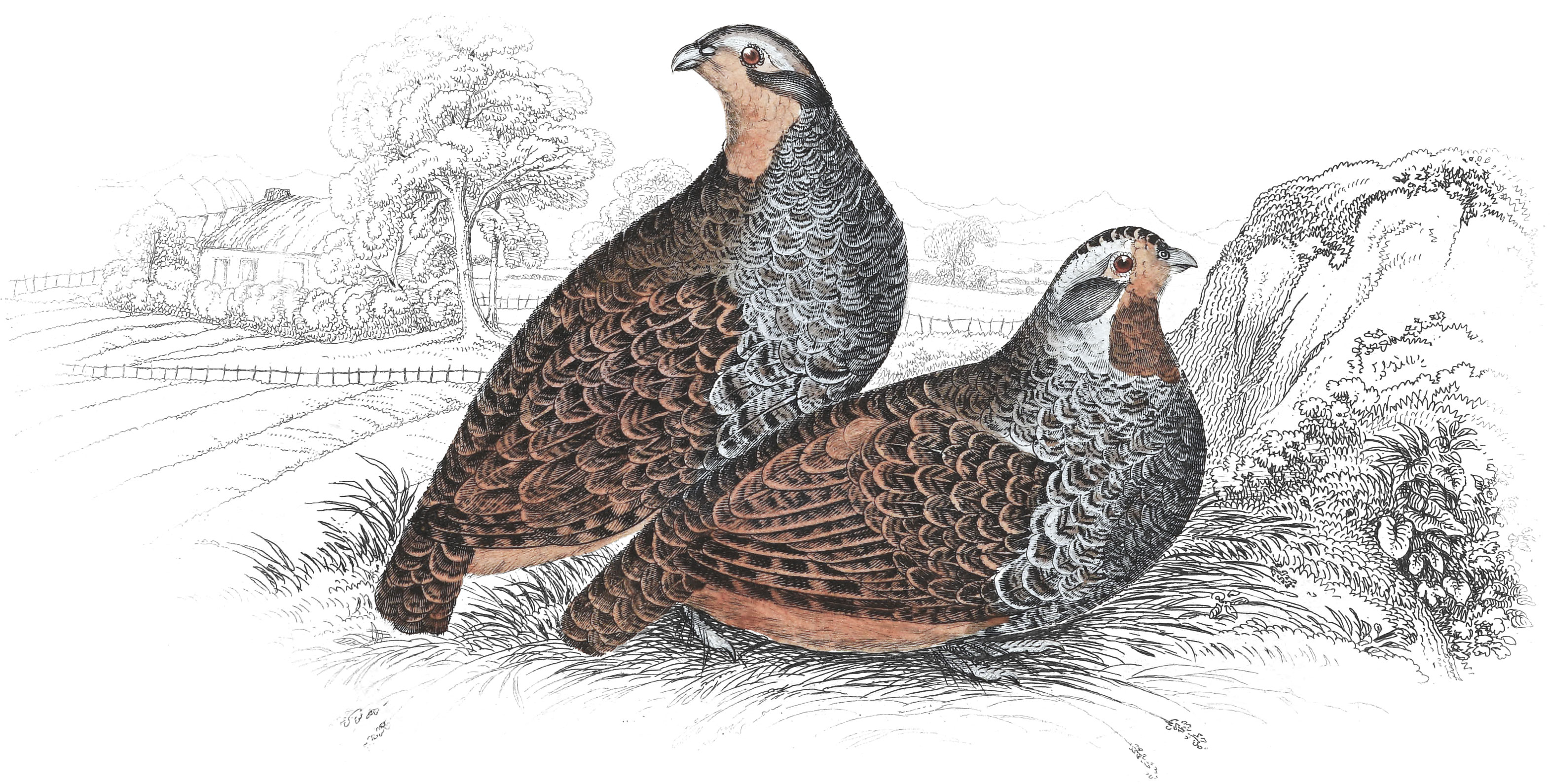
Plate I
The Mountain Partridge
Perdix cinerea.—var. Montana.
This variety has been said to be more frequently found in alpine districts than in lowlands, but they are known to mingle occasionally with those of common plumage. The colour is remarkable to be assumed as a variety, though it is often, we may say, generally mingled with whitish or reddish-white. The whole plumage is of deep sienna-brown, and this colour, somewhat like that of the common grouse, prevails in many species entirely upon the breast, lower parts, and shoulders. The specimens are generally less than those of ordinary plumage.
The partridge, therefore, seems to have a more extensive range of variation than almost any bird we are acquainted with, and according to Temminck and some other authors, is somewhat influenced by almost every change of climate. Those broods which frequent and are bred on the marshy grounds of the Zuyder Zee and mouth of Meuse are less in size and of a duller tint than those found in the drier lands of Belgium. Dry or parched districts, abundance of food and water, will always influence their condition, and it is to the same causes, with variation of climate, that Temminck attributes the migrations of the partridge on some parts of the continent, and which are also said to be of a smaller size than those which do not migrate. This migratory bird has by some been also raised to the rank of a species, and named the Damascus partridge. By the modern ornithologists of this country, it is very little known, or its claims upon which even the variety rests ascertained, beyond the fact of its migration. And our latest, or indeed only authority from actual examination, is that of Temminck, who says that among many individuals he has been able to discover no good distinctions.

Plate II
Our next illustration is from a very beautiful species inhabiting the continent of India; it is
The Painted Partridge
Perdix picta.—Jard. and Selby.
Perdix picta, Jardine and Selby’s Illustrations of Ornithology, vol. i. pl. l.
This very beautiful species, belonging to the true partridges, is a native of the plains of India, and of late years has not unfrequently been brought in collections to this country; yet, notwithstanding, it is to be regretted that little is known of its habits. The following is a description of the specimen from the neighbourhood of Bangalore, from which the original of our plate was taken. The crown is brown, with the margins of the feathers yellowish-white; the face, region of the eyes and auriculars, pale brownish-orange; the hinder part of the neck pale buff; the centre of each feather black; the front and sides of the neck white, spotted with black; the breast, belly, and flanks, beautifully spotted with black and yellowish-white; the ground of each feather may be said to be black; and on each web there are two, and sometimes three, round spots of yellowish-white, which leave, as it were, a bar across, and a line along the patches, those at the end have the extremity with a black margin. The upper part of the back and wings deep brown, with round spots of yellowish white, and with the margins of the feathers wood-brown; the lower part of the back and rump transversely barred with black and white; quills barred with hair-brown and pale reddish-orange; upper tail-coverts brown, delicately waved with irregular bars of black and white. Tail brownish-black, with narrow white bars, principally at the base of the feathers; vent and under tail coverts deep orange-brown.
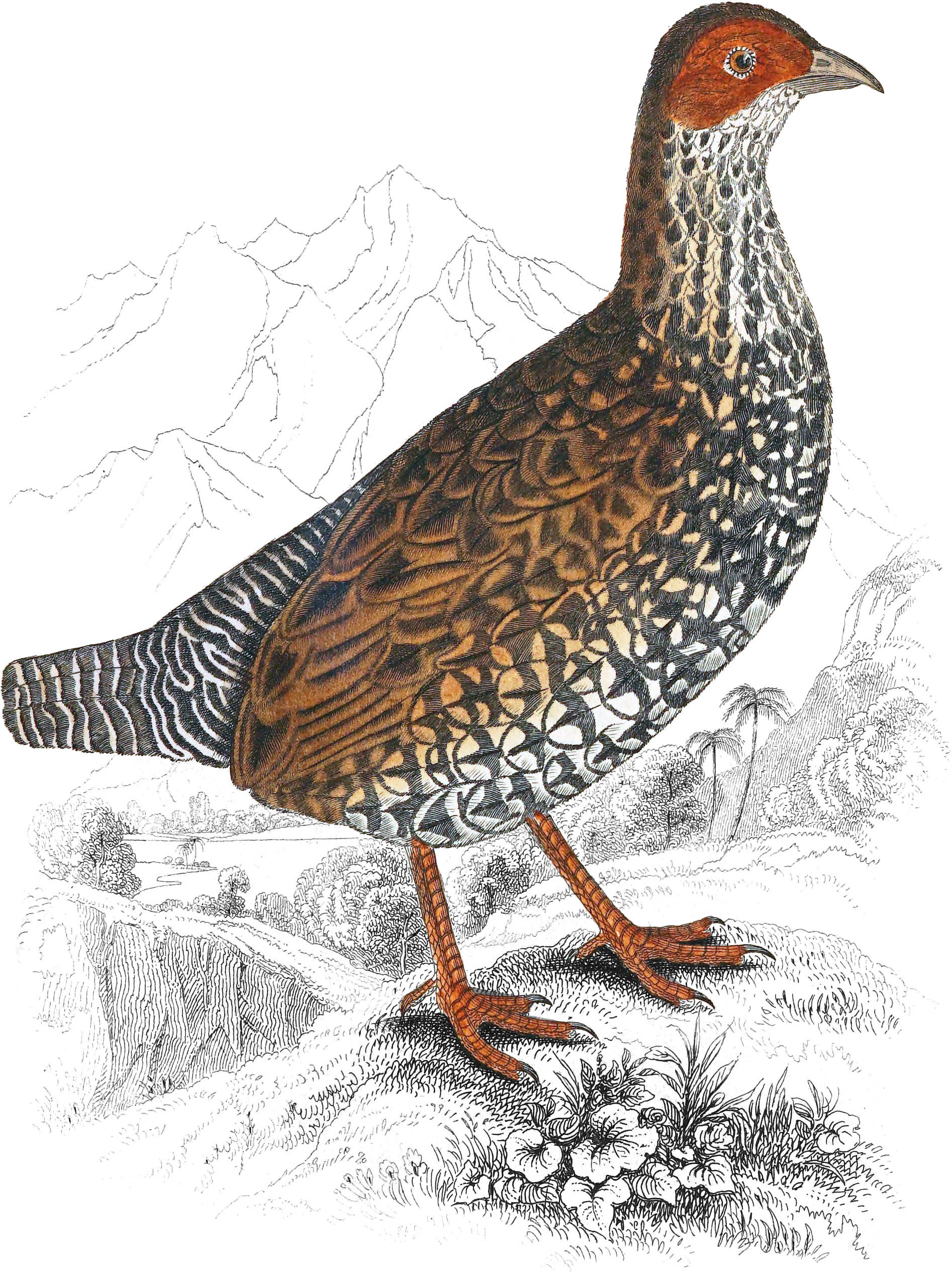
Plate III
The Rock or Barbary Partridge
Perdix petrosa.—Linnæus.
The Red-Legged Partridge from Barbary, Edwards’ Birds, pl. 70.—Lath. General History, vol. viii. p. 293.—Perdix petrosa, Latham.—Temminck, Pigeons et Gallinacés, iii. Ind. p. 727.—Perdix Gambra, Temminck, Pigeons et Gallinacés, iii. 368.
With this handsome bird we enter a small group of the partridges which are remarkable for the beautifully marked and shewy appearance of the feathers covering the flanks. The general tint of plumage is very regular throughout; the bill and legs are always red, and the latter are sometimes slightly spurred and knotted. They inhabit Europe, the north of Africa, and India. The most familiar example will be the common Red-legged, French, or, as it is sometimes termed, Guernsey Partridge; but we have selected two equally beautiful, but less known birds, as examples of it.
The Rock or Barbary Partridge inhabits the most southern-countries of Europe, stretching into Spain, and thence upon the coast of Africa. It is also met with upon the banks of the Gambia, and in the island of Teneriffe. It delights in rocky districts, and the rugged precipices of the southern Alps, and seldom or never strays down upon the plains. The accompanying figure will convey an idea of the colours of this species. It is distinguished from all the others by the patch of deep chestnut upon the sides of the neck, beautifully relieved by the clear white spots. It is not very commonly met with in collections, being like almost all the birds of southern Europe, more difficult to be procured than those of more distant countries.
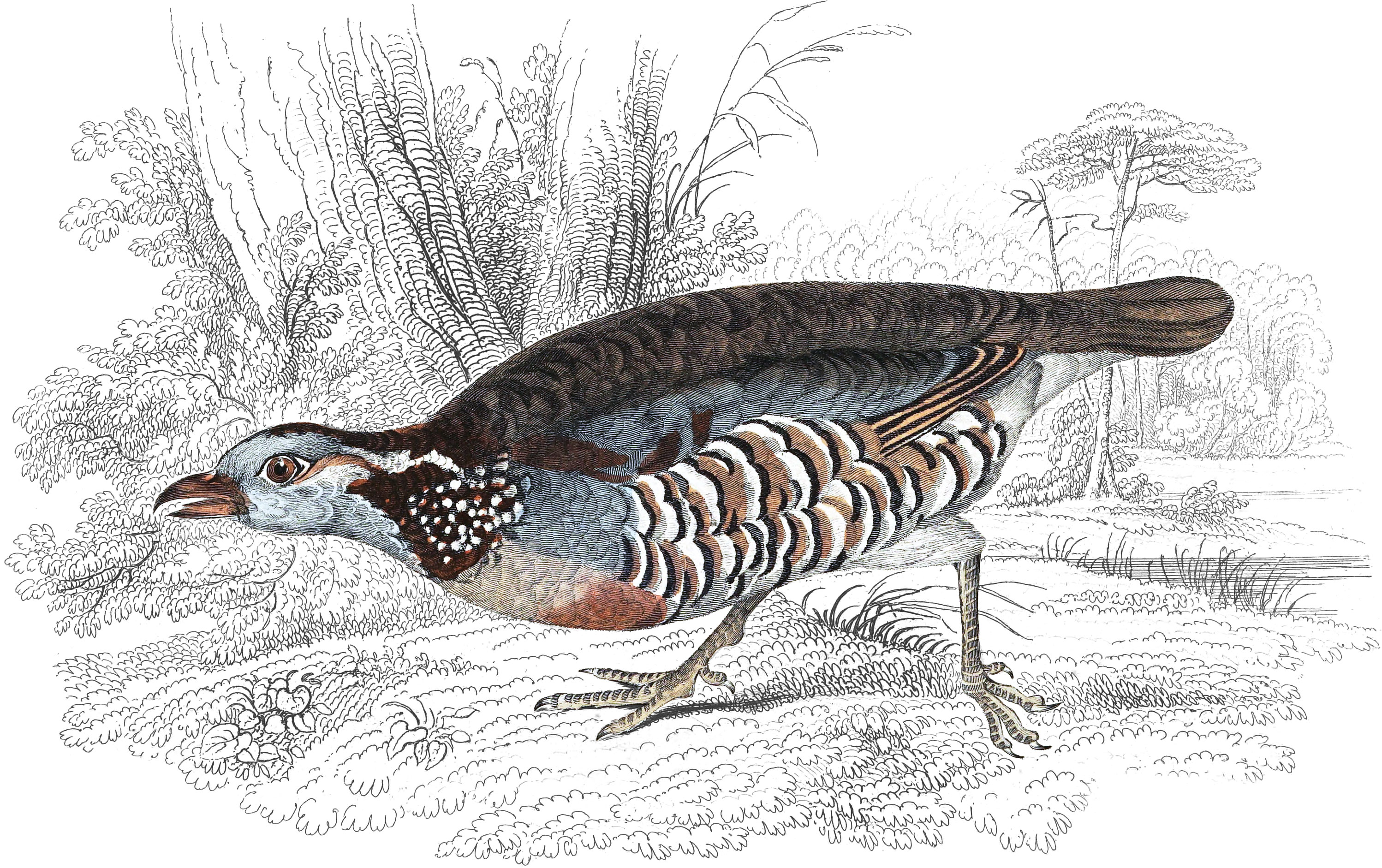
Plate IV
The next we shall mention is
The Chukar Partridge
Perdix chukar.—Latham.
Perdix chukar, Gould’s Century, vol. lxxi.—Gray’s Illustrations of Indian Zoology.
The general colour of the upper plumage is ash-grey, tinged with a shade of purple, particularly across the centre of the back; a deep black line passes across the forehead through the eyes, and extends downwards in a crescent form upon the sides of the neck and chest, the threat, and inside of the circle, being pale yellowish-white. The breast is nearly of the same colour with the centre of the back, but paler, and the rest of the lower parts are of a dull yellow. The conspicuous barring on the sides is alternately yellowish-white, chestnut, and black.
We are indebted to Mr Gould for the use of his illustration, taken from a Himalayan specimen. That gentleman also tells us that specimens are alive in the Zoological Garden, where they have the same pugnacious and irritable temper of the Common Red-legged Partridge, being perpetually at war with their fellow captives.
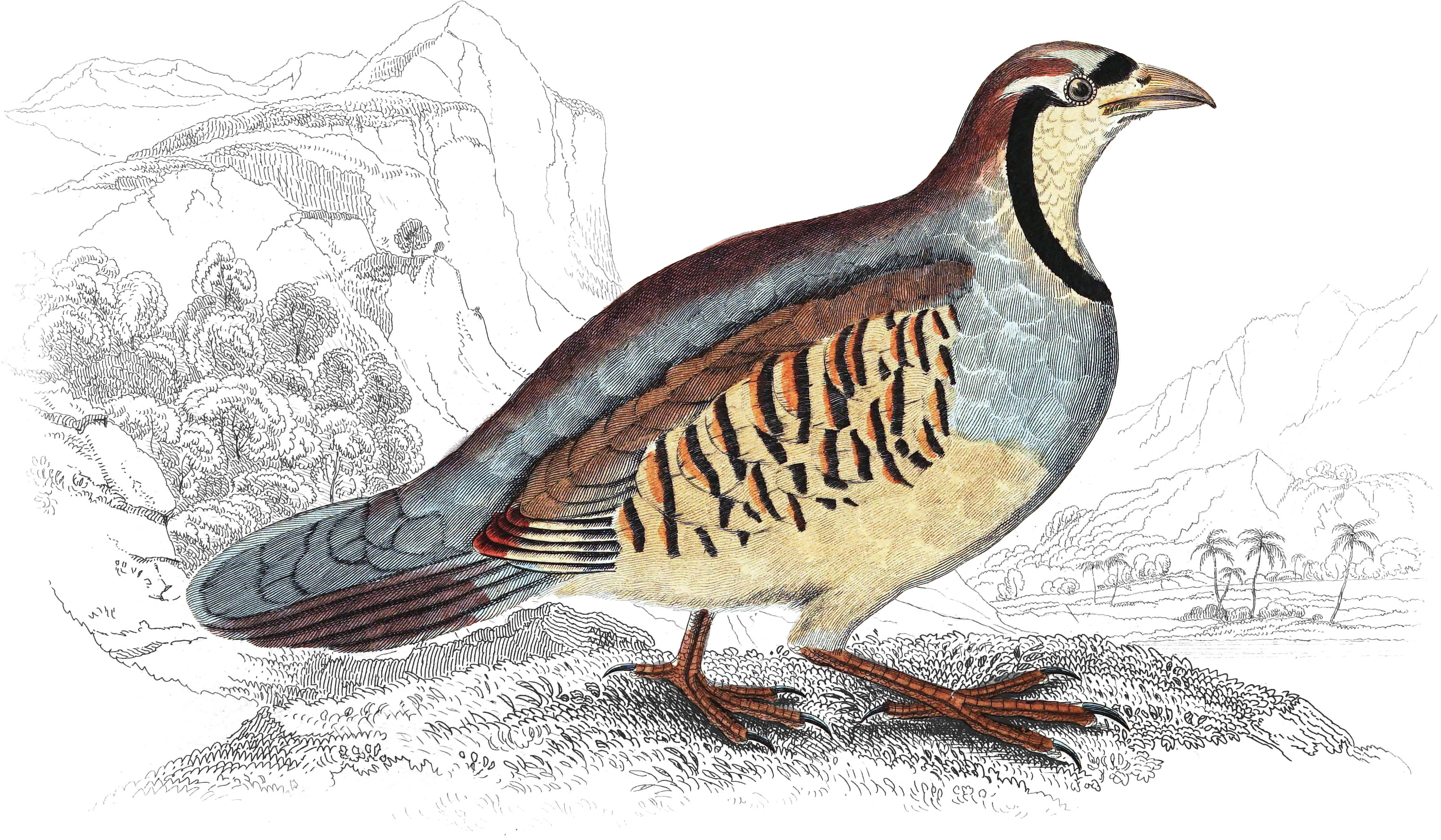
Plate V
These figures will give a tolerable idea of this small group. The others belonging to it are the Greek Partridge, Perdix saxatilis of authors, so very closely allied to the last, as by many to be considered identical; the distinctions have never been clearly pointed out, and it is a bird very likely to extend to India. Plate V. will shew what has been considered P. Chukar.
The Greek Partridge is found abundantly upon the German Alps of middling height, never descending to the plains or low valleys. They remain in small coveys until the breeding season, when they pair like the others, the female making her nest in more concealed situations under the roots of trees, or among stones or rocks, covered with brush. The eggs are yellowish-white, indistinctly blotched with reddish-yellow. They scarcely stretch into France, being found only sparingly in some of the higher mountainous provinces. It is most abundant in the Ottoman empire, in the Greek Islands, and in the south of Italy.
The other is the Perdix Rufa or Red-legged Partridge. The last has now been introduced into several of the southern counties of England, and appears to succeed and multiply. As game, however, they are esteemed neither by the sportsman or epicure, their flesh being much drier than that of the ordinary bird, while their skulking habits upon alarm, the great speed with which they run, and their unwillingness to take flight, prevents them being sought after in the field. Both the last are occasionally subject to be spotted, and nearly white varieties occur.
The next partridge we shall notice is one of the most beautifully marked.
The Common Francolin
Perdix francolinus.—Latham.
Perdix francolinus, Latham, General History, viii. p. 271.—Le Francolin, Buffon, Pl. enluminée, M. and F. pls. 147 and 148.—Francolin à Colier Rousse, Temminck, Pigeons et Gallinacés, iii. p. 340.
The Common Francolin has been placed at the extremity of those with one or more spurs upon the legs, of a very much barred and spotted plumage, the bill stronger, the tail more lengthened, and forms the genus Francolinus of Stephens. All the members of it perch as well as frequent the ground, and in some of the species, the legs are armed with spurs of very great strength and sharpness. We have represented the common bird, as it is the only European species, though not the most typical.
The Francolin is a native of the south of Europe, Sicily, and the islands of the Greek Archipelago, Africa, and India, where it inhabits the marshy grounds, and thence has received the name of Meadow Partridge. In Africa, particularly upon the coast of Barbary, and in India, it is every where esteemed for its excellency at the table, and admired for its fine plumage. It is not a large species, the male scarcely exceeding twelve inches in length; the colouring is black, white, rufous, and yellowish-brown, disposed in decided and contrasted markings of large patches, spots, or bars, but yet so distributed as to want all harshness, and to have a chaste and blended appearance. The female wants all the deep black and white markings of the male, as well as the rufous collar; the ground colour of the plumage is a yellowish-brown, waved and barred with umber-brown, and having the markings of the wings and tail nearly the same as in the male, but of a paler colour.

Plate VI
Our next bird is a very singularly formed species. It is
The Sanguine Partridge
Perdix cruentatus.—Temminck.
Phasianus cruentatus, Trans. of Lin. Soc. vol. xiii. p. 237.—Sanguine Pheasant, Lath. General History, p. 205.—Francolin ensanglante, Perdix cruentata cruenta, Temminck, Pl. Coloriées, pl. 382 332.
This bird has also been placed among the Francolins, on account of the spurred tarsi, but it is probable it will stand ultimately as some subgenus, being one of those birds which are almost neither one thing nor another. It forms the connexion in some points between the present family and the Pavonidæ. The remarkable parts of its structure are the lengthened form of the feathers of the head and neck, the brilliant tints of the plumage, and, like the polyplectron, having sometimes one, two, or three spurs upon the tarsi, which are themselves more slender and lengthened than those of most of the others. It inhabits the upper parts of the unexplored districts of Nepaul, and adds another to the many splendid and peculiar gallinaceous birds, which are there so abundant.
It was first described in the Transactions of the Linnean Society, under the name of Phasianus, a name at once implying its connections. A second description and figure appeared in the Planches Coloriées of Temminck, and our present representation is from a specimen in the Edinburgh Museum. The male is about 16 inches in length, and the accompanying Plate will sufficiently detail the colours without a description. It las received its specific name from the blotches of red upon the breast, and the rich crimson which adorns the tail and its coverts. The legs are irregularly spurred, two sometimes on one and only one on the other. In Temminck’s figure two are represented on the one leg, and on the other four, in two pairs. The female is said to resemble the male in the colours, except in being duller in hue; the size is less and the legs are without spurs. This is a rare bird in collections.

Plate VII
It would be impossible in our present limits to describe every species of the larger groups of this family, but before proceeding to the quails, we shall notice one or two other birds. There is a beautiful bird from the deserts of Acaba in Arabia, which Temminck has dedicated to Mons. Hey, the companion of Ruppel. Perdix Heyii is of size intermediate between the common partridge and the quail, and is now mentioned from the resemblance which it bears to the Red-legged Rock and Barbary partridges, in the nearly uniform tint of the upper plumage; the feathers on the flanks are also bordered with black upon the sides, while the legs, feet, and bill are bright red. The tail, rump, and secondaries, again, shew the beautiful delicate barring seen in those parts of the common francolin and painted partridge.
There is a small Indian group among the partridges which also deserves notice. The wings are more ample and rounded, the tail short, the body more clumsy; the bill and legs strong, and the feet large. They inhabit principally the Indian islands, frequenting the skirts of the mountain forests. The Perdix Javanica of Latham, Perdix megapodia, Temminck, and Perdix personata, Horsfield, are examples of this form. Another form we noticed before was the pheasant-like partridges of Africa, so similar to the females of these birds, that, with the addition of the tail, they might be passed off to an ordinary observer. Perdix bicalcarata of Latham will exemplify this. To these perhaps might also be added another remarkable bird, the hackled partridge of Latham, of which there seems an uncertainty regarding its native country. Dr Latham’s bird was in the Leverian Museum, and was supposed to have come from the Cape of Good Hope; while Temminck, upon the authority of Sonnerat, makes it a native of Eastern Asia. The most remarkable feature in the plumage of this otherwise soberly dressed bird is in the feathers on the back and sides of the neck and upper part of the back being of an inch and half Jong, and hackle-shaped, as in the common cock, and in their colour they possess the changing greenish tints of the cocks and pheasants. It is a very rare bird, and much to be regretted there is nothing known of its habits.
We shall now proceed to the Quails, and as characteristic of these neat little birds have represented
The Coromandel Quail
Coturnix textilis.—Temminck.
Coromandel Quail, Latham, General History, viii. p. 310.—Caille Nattée, Coturnix textilis, Temminck, Pigeons et Gallinacés, iii. p. 512. Pl. Coloriées, pl. 35.
The Quails, forming the genus Coturnix of moderns, are at first sight so similar to the partridges, that they are not to be distinguished without a knowledge of their habits, and examination of their forms. In the bill and legs there are slight modifications, but the form of the wing is quite different, the first three quills being longest, while in the partridges the third is the longest, and a rounded wing of less power is the consequence. It may be recollected that, though the partridges were said to migrate in some countries, the migration is comparatively very partial, and often only from one part of a continent to another; on the other hand, almost all the quails migrate to a certain distance, and hence perform lengthened journeys often across the seas. In their habits they also shew considerable difference, as they never perch. They often assemble in large flocks after the breeding season: and although they pair regularly, so soon as the female commences to sit, she is left alone, and the male attends no longer, nor afterwards assists in protecting the brood. They delight in cultivated countries, and never frequent woods. They are found in Europe, Asia, Africa, and New Holland. The allied birds of America come under a different section.
The pretty little species figured will give an exact idea of the form of the quails. It is rather less than the European species, being in length only about six inches. The upper parts somewhat resemble those of the common bird, but are more broadly marked, while the deep black markings on the lower parts at once distinguish it, and are beautifully relieved from the paler parts of the breast and belly. The female differs from the male in wanting the greater part of the black on the lower parts, indications of the two bands on the throat being only seen. The breast is reddish-brown, the feathers with a black centre, and the other lower parts are of a dull white. This quail seems abundant, and is pretty generally distributed over the continent of India. Among the quails there are many beautifully marked species, all of diminutive size. We shall only, however, be able to notice that of Europe, an occasional visitor to Britain.

Plate VIII

The Common Quail
Seems to be generally distributed over the old world, though, in the south of Europe, it. is perhaps as abundant as elsewhere. In Britain they may now be termed only an occasional visitant, the numbers of those which arrive to breed having considerably decreased, and they are to be met with certainty only in some of the warmer southern or midland counties of England. Thirty years since they were tolerably common and regular in their returns; and even in the south of Scotland a few broods were occasionally to be found. In these same districts they are now very uncertain. We have known of broods twice, and occasionally have shot a straggler apparently on its way to the south. They are extremely difficult to flush after the first time. The nest is made by the female, but, like the partridges, the eggs are deposited almost on the bare ground; these, also, unlike the uniform tint which we find prevailing in those of the true partridges, are deeply blotched with oil-green, and, except in form, are somewhat similar to those of the snipe. In France they are very abundant; and besides supplying the markets of that country, thousands are imported alive by the London poulterers, and fattened for the luxury of the metropolis.
They are taken by nets, into which they are decoyed by imitating their call. On the coast of Italy and Sicily, and all the Greek islands, they arrive at certain seasons in immense numbers. An hundred thousand are said to have been taken in one day. They are run after during the flight like the passenger pigeons of America, and a harvest is gathered when the numbers are greatest. In Sicily, crowds of all ages and degrees assemble on the shore. The number of boats is even greater; and enviable is the lot of the idle apprentice, who, with a borrowed musket or pistol, no matter how unsafe, has gained possession of the farthest rock, where there is but room for himself and his dog, which he has fed with bread only, all the year round for these delightful days, and which sits in as happy expectation as himself for the arrival of the quails.3 Ortygia was named from them; and so abundant were they on Capri, an island at the entrance of the Gulf of Naples, that they formed the principal revenue of the bishop of the island. From twelve to sixty thousand were annually taken; and one year the capture amounted to one hundred and sixty thousand. In China, and in many of the eastern islands, and Malacca, they are also very abundant, performing regular migrations from the interior to the coast. Here they are domesticated along with a small species of Ortygis, and trained to fight. Large stakes are risked upon the result, as in the cockpit. They are also used by the Chinese to warm their hands in cold weather, their bodies being thought to contain a large proportion of animal heat, from the pugnacious disposition of their tempers.
The common quail has the crown of the head and back of the neck black, each feather margined with chestnut; and down the centre of the head and neck there is a cream-yellow streak. Over each eye, and proceeding down the neck, is a white streak: chin and throat chestnut-brown, mixed with blackish-brown. Back scapulars and wing-coverts black, the feathers margined and varied with brown, and each having its shaft and central parts sienna-yellow. The breast and belly are pale buff or orange, the shafts and margins of the feathers yellowish-white. Tail blackish-brown, with the shafts, tips, and base cream-yellow. In the female there is no black or brown on the neck and throat. Her breast is spotted with blackish-brown, and the general tints of her plumage are paler. Pure white on spotted varieties sometimes occur.
We must now describe a singular American bird, of whose station we are by no means certain.—It is
Latreille’s Attagis
Attagis Latreillei.—Lesson.
L’Attagis de Latreille, Attagis Latreillei, Less. Illustrations de Zoologie.
Two species of these curious birds have been figured by Lesson, the one in his “Zoological Century,” the other in his “Illustrations,” the latter of which has now served for our copy. Both are from Chili; but we regret that nothing has been communicated regarding their habits, or the districts in which they are found, and conjecture only is set to work to place them in their proper situation. The present species is about eight inches in length, therefore not much exceeding the size of the common quail. The bill appears formed somewhat like that of pterocles, but the feet and tarsi are unplumed. It is probable that they may hold the same place in the vast South American plains, which the ganga does in the more sterile deserts of the old world. The tints of the plumage in both are blended with chaste shades of brown.

Plate IX
There is another bird of which Lesson and Eschscholtz make a genus,—Tinochorus, which approaches near to this, and is also a native of South America; but from want of materials, it can only be now indicated.
When these are better known, we have no doubt of their proving very interesting forms, and filling up some blank in the present family of birds. We shall now proceed to a small group, better, though but imperfectly, known, the American Quails, included under the genus Ortyx. The first we shall notice is
The Virginian Quail or Partridge
Ortyx Virginianus.—Bonaparte.
Quail or Partridge, Perdix Virginianus, Wilson’s American Ornithology, pl. xlvii.—Perdix borealis, Temminck, Pig. et Gallin.—Ortyx borealis, Stephens, Continuation.—Ortyx Virginianus, Bonaparte, Synopsis, p. 124.
The genus Ortyx was formed by Stephens, the continuator of Shaw’s General Zoology, for the reception of the thick and strong-billed partridges of the new world. They hold the same place there with the true partridges, francolins, and quails of the other parts of the globe, living on the borders of woods, among brushwood, or in the thick grassy plains, and occasionally frequenting cultivated fields in search of grain or roots. During night they generally roost on trees, and occasionally perch on them by day, particularly when alarmed, when they immediately take refuge, and even walk with ease upon the branches. Their general shape is robust, the bill is strong, and apparently fitted for a mode of feeding requiring considerable strength, such as the digging up of bulbous or tuberous roots. The colours of the plumage are generally different shades of brown, red, orange, grey and white. The head is almost always crested.
This bird is best known by the description of Alexander Wilson. Audubon has also figured a whole covey on one of his immense plates. It is a general inhabitant of North America, from the northern parts of Canada and Nova Scotia, to the extremity of the peninsula of Florida. They become very familiar, frequenting the vicinity of well cultivated plantations; but when alarmed, seek shelter in the woods, perching on the branches, or secreting themselves among the brushwood. Where not too much persecuted by the sportsman, they become almost half domesticated, approach the barn, particularly in winter, and sometimes in that severe season, mix with the poultry to glean up a subsistence. Immense havock is at this season made among them with the gun and by snares, and they are sold in the markets from twelve to eighteen cents each.
They begin to build early in May, and, according to Wilson, the nest is made most carefully. It is formed on the ground, usually at the bottom of a thick tuft of grass, that shelters and conceals it; the materials are leaves and fine dry grass, in considerable quantity; it is well covered above, and an opening left on one side for entrance. The female attends the young when hatched with great care, and performs the same part of counterfeiting lameness with our own partridge. They have been frequently brought up by placing the eggs under the common hen, and become very domesticated, but always desert in the first spring, when the season of incubation commences.4
Among the many methods taken to capture these birds, one related by Audubon seems eminently successful. A cylindrical. net is used thirty or forty feet in height, and about two in diameter, except at the mouth, where it is wider. This is fixed to the ground with the mouth open, and two additional pieces of net are fixed at each side, to enlarge as it were the entrance. Into this the birds are driven by a number of persons on horseback, who surround the covey when discovered. Fifteen or twenty partridges are thus often caught at one driving, and sometimes many hundreds during the day.5
The Virginian partridge has been attempted to be introduced in several parts of the European continent, but we are uncertain with what success. They have also been tried in some of the English counties.
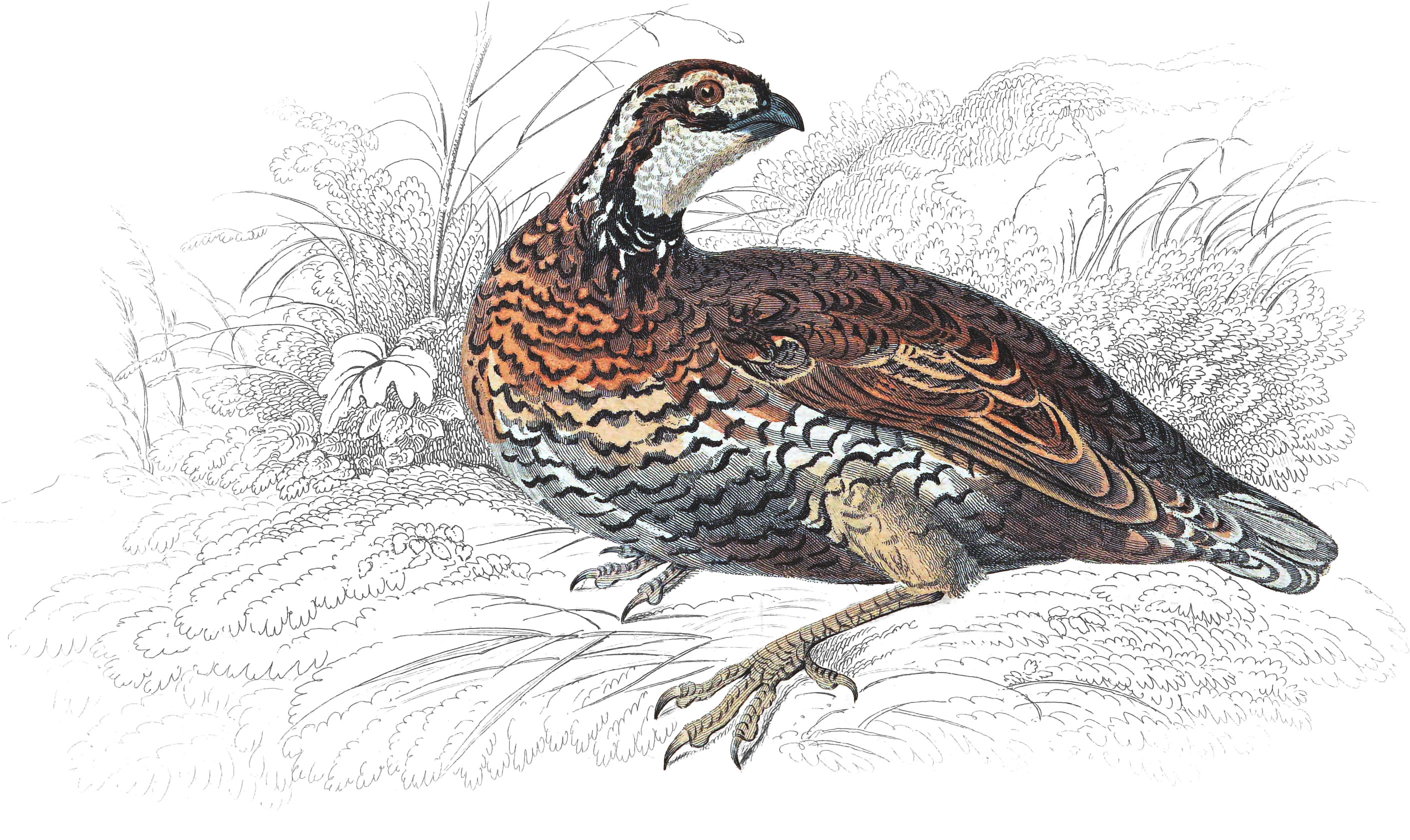
Plate X
Our next Plate exhibits one of the most beautiful of the genus—
The Californian Ortyx
Ortyx Californica.—Stephens.
Californian colin, Ortyx Californica, Stephens, Continuation, vol. xi. p. 384.—Californian Quail, Gardens of Zoological Society, ii. p. 29. a beautiful woodcut.
This graceful and beautifully marked species is found in the low woods and plains of California, and was met with during both the voyages of La Perouse and Vancouver; and a figure is given in the atlas of plates accompanying the former. A single specimen, part of the produce of the latter voyage, was deposited in the British Museum, and served for the descriptions and figures given in this country, previous to the return of Captain Beechey from his voyage to the Pacific, &c., who brought with him specimens alive. One only survived its arrival to the Zoological Gardens, but seemed to bear the change of climate perfectly.
The general colour of the upper plumage is a brownish-grey. The feathers on the back and sides of the neck have a deep black margin, and often a white tip. The throat is deep rich black, but between and the angular markings of the sides there is a crescent band of pure white. The feathers of the lower part of the belly are deeply margined with black, and the long plumes of the flanks are marked along the centre with a stripe of yellow. But the beautiful and remarkable adornment is the crest upon the crown, composed of several feathers, narrow at the base broadening towards the tip, and folded as it were together from the shaft. They are of a dull rich black and lie generally backwards, but can be raised at pleasure; and upon any excitement are erected, almost bending forward upon the front.
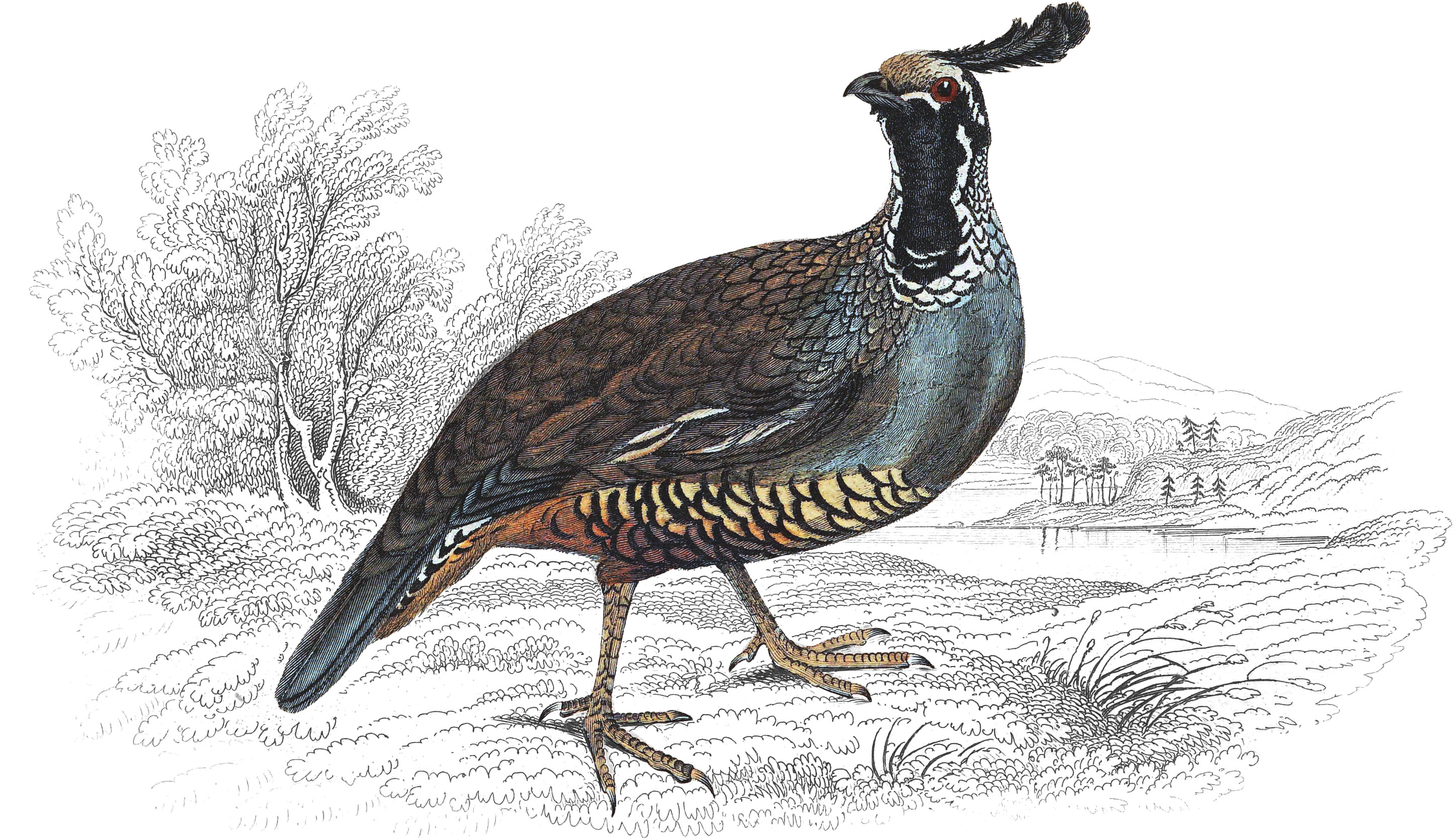
Plate XI
The Long-Tailed Ortyx
Ortyx macroura.—Jard. and Selby.
Ortyx marcoura, Illust. of Ornithol. pl. xlix.
On this Plate we have figured a species of Ortyx, of a form at variance with those already noticed, being remarkable for its long and broadly formed tail. We regret that nothing is known of its habits. It is a native of Mexico, and the only specimen we know of was purchased at the sale of Bulloch’s Mexican collection. Its length is about 13 inches, the bill very strong, and with the legs orange-red. The feathers on the crown, throat, and cheeks are black, those on the head lengthened into a crest and tipped with reddish-brown. A line of reddish-white extends above the eyes and auriculars, and loses itself on the sides of the neck; another of the same colour runs under the eyes upon the auriculars. The back, sides of the neck, and upper parts of the breast, are reddish-brown; the middle of the belly and vent silvery grey, passing into bluish-grey, and minutely freckled with black. The rest of the upper parts are wood-brown, barred and spotted with black, and blotched with large spots of yellowish-white. The length of the tail-feathers is 5\(\frac{1}{2}\) inches, they are broad and rounded.
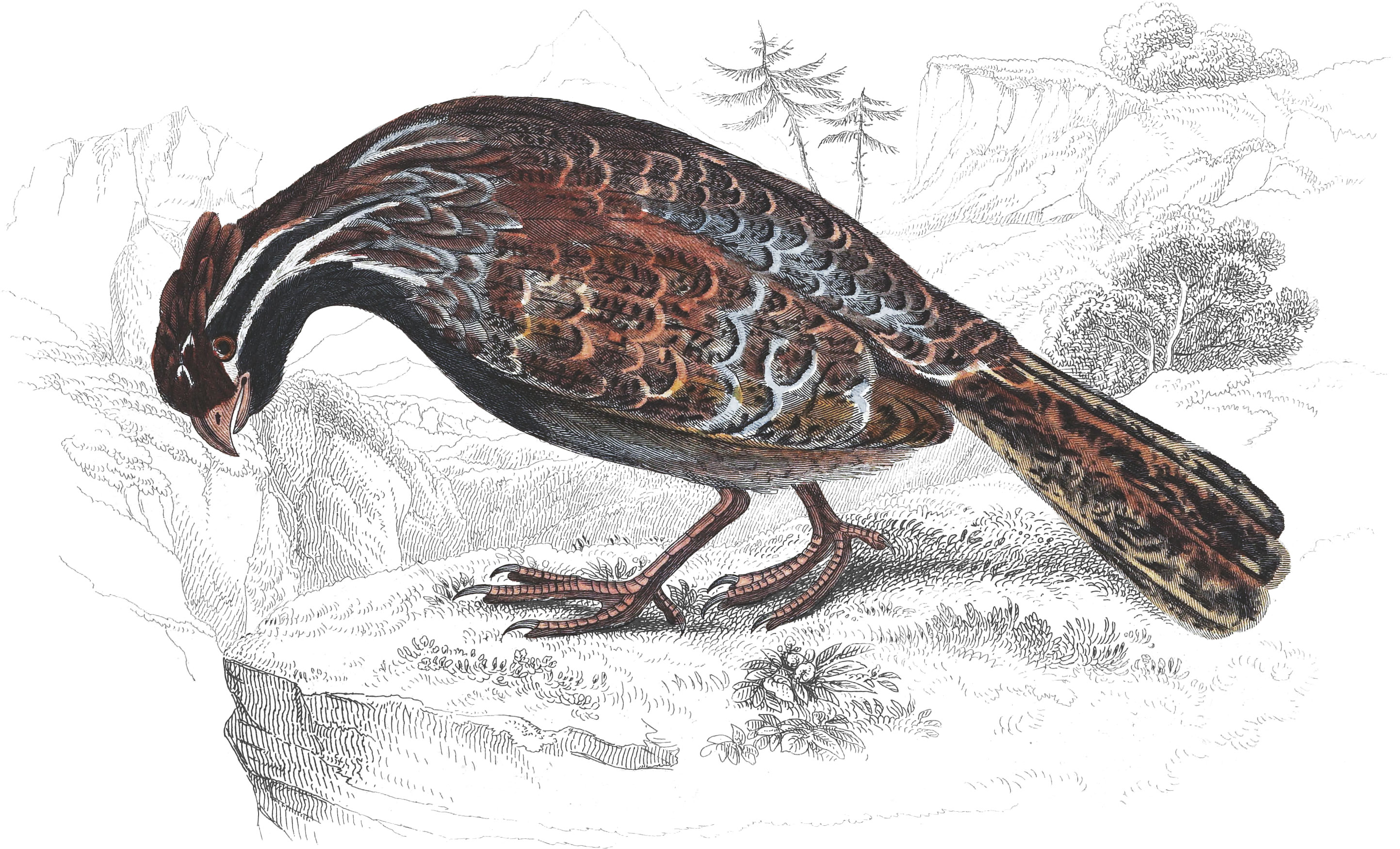
Plate XII
Several other species are known. Two were brought to this country by Mr Douglas from his journey to Columbia; one has been denominated O. picta, which is also crested. This bird, says Mr Douglas, congregates in vast flocks in the interior of California from October to March, and seem to live in a state of perpetual warfare. Dreadful conflicts ensue between the males, which not uncommonly end in the destruction of one or both combatants, if we may judge from the number of dead birds daily seen plucked, mutilated, and covered with blood. When feeding they move in compact bodies, each individual endeavouring to outdo his neighbour in obtaining the prize. During winter, when the ground is covered with snow, they migrate in large flocks to more temperate places in the vicinity of the ocean.
Ortyx Douglasii is another bird said to be distinct, so named by Mr Vigors, and brought by Mr Douglass nearly from the same country. Ortyx Montesumæ, capistrata, and Sonnini, are all rare and beautiful species.
From these birds we shall now commence an account of the true grouse, Tetrao, the typical group of the family.
Grouse
By the word Grouse, we, in general language, are most apt to associate our ideas with the common Muirfowl. But in the technical terms of Ornithology, the generic name Grouse and Tetrao is restricted to those bearing the form of the European wood-grouse, Dusky grouse of America, &c. They are the largest birds of the family, of a very round and powerful form, and frequent heathy forests in preference to the wild and open muir, perch and often roost on trees, where young shoots and tender bark also supply them with food; and although the legs are plumed with short feathers, the toes are naked. The tail is composed of broad feathers and is proportionally long and rounded. They are mostly polygamous, and the females and young differ considerably from the males, the plumage of the former being shades of brown and tawny, with black bars and markings, the colours of the latter distributed in broad masses of black, glossy green or steel-blue, and deep brown. They inhabit North America and Europe, those of the latter country extending into Northern Asia.
The Wood Grouse or Capercailzie
Tetrao urogallus.—Linnæus.
Tetrao urogallus, Linnæus.—Wood Grouse, Pennant.—Tetrao auerhan, Temminck, Manuel, ii. p. 457.
At the head of this section we place the capercailzie—the “giant grouse” as he is somewhere termed. First in size and first in noble bearing, his strong and hooked bill and robust form resemble more a bird of prey than one of the Galline. The capercailzie was certainly the noblest of the British feathered game, but the attributes of strength, size, and beauty, have proved his destruction, and they have been for many years extinct. In ancient times they were tolerably abundant in the primeval forests of Scotland and Ireland. From the latter they appear to have been entirely extirpated at a very early period; while in Scotland the destruction was more gradual, but they dwindled away, and the last specimen is recorded from fifty to sixty years since to have been killed in the neighbourhood of Inverness. There is, however, a prospect of the species being again introduced to the Scottish forests, and the following interesting account of the attempts which have been made at Mar Lodge, and of the habits of the female and young, will be read with interest.
I was wading down the Dee one fine afternoon, a little below Mar Lodge, and with a lighter pannier than usual, when I heard the cry of a bird to which I was unaccustomed, and my bad success in that day’s angling, induced me the more readily to diverge from the “pure element of waters,” to ascertain what this might be. I made my way through the overhanging wood for a few hundred yards, and soon after reaching the road, which runs parallel with the river on its right side, I observed a wooden palisade, or enclosure, on the sloping bank above me. On reaching it, I found it so closely boarded up, that I had for a time some difficulty in descrying any inmates, but my eye soon fell upon a magnificent bird, which at first, from its bold and almost fierce expression of countenance, I took rather for some great bird of prey than for a Capercailzie. A few seconds, however, satisfied me, that it was, what I had never before seen, a fine living example of that noble bird, I now sought the company of Mr Donald Mackenzie, Lord Fyfe’s gamekeeper, the occupant of the neighbouring cottage. He unlocked the door of the fortress, and introduced me to a more familiar acquaintance with its feathered inhabitants. These I found to consist. of two fine capercailzie cocks and one hen, and the latter, I was delighted to perceive, accompanied by a thriving family of young birds, active and beautiful.
The first importation of these capercailzies arrived from Sweden about the end of the year 1827, or early in January 1828. It consisted of a cock and hen, but the hen unfortunately died after reaching Montrose Bay. As the male bird alone arrived at Braemar, the experiment was judiciously tried of putting a common barn-door fowl into his apartment during the spring and summer of 1828. The result was, that she laid several eggs, which were placed under other hens, but from these eggs only a single bird was hatched, and when it was first observed it was found lying dead. It was, however, an evident mule, or hybrid, and shewed such unequivocal marks of the capercailzie character as could not be mistaken.
The second importation likewise consisted of a cock and hen, and arrived safely in this country in January or February 1829. The female began to lay in the ensuing April, and laying in general an egg every alternate day, she eventually deposited about a couple of dozen. She shewed, however, so strong a disposition to break and eat them, that she required to be narrowly watched at the time of laying, for the purpose of having them removed, for otherwise she would have destroyed the whole. In fact, she did succeed in breaking most of them, but eight were obtained uninjured. These were set under a common hen, but only one bird was hatched, and it died soon after. In the spring of 1830, the hen capercailzie laid eight eggs. Of these she broke only one, and, settling in a motherly manner on the other seven, she sat steadily for five weeks. On examining the eggs, however, they were all found to be addle.
In the early part of 1831, three apartments were ingeniously formed adjoining one another. The hen was placed in the central chamber, between which and the enclosure on either side, each of which contained a male, there was an easy communication; so contrived however, that the female could have access to both the males, whilst they, from their greater size, could neither approach each other, nor disturb the female as Jong as she chose to remain in her own apartment. In May and June of that year she laid twelve eggs, seven of which were set under a common hen. Of these, four were hatched in an apparently healthy state, one was addle, and the other two contained dead birds. Of those left with the capercailzie hen, she broke one, and sat upon the other four, of which two were hatched, and the other two were found to contain dead birds. Of the two hatched one soon died. Both the barn-door hen and the female capercailzie sat twenty-nine days, from the time the laying was completed till the young were hatched; and Mr Cumming calls my attention to the fact, that there were birds in all the eggs of this year’s laying except one.
My visit to Braemar took place about the first week of last August. I think all the five young were then alive, and although only a few weeks old, they were by that time larger than the largest moor-game. I had no opportunity of handling them, or of examining them very minutely, but the general view which I had of them, at the distance of a few feet, did not enable me to distinguish the difference between the young males and females They seemed precisely the same at that time both in size and plumage, although 1 doubt not the male markings must have soon shewn themselves on the young cocks. The single surviving bird of those hatched by the mother died of an accident, after living in a very healthy state for several weeks. Two of those hatched by the common hen died of some disease, the nature of which is not known, after lingering for a considerable time. It follows that there are only two: young birds remaining. These are both females, and when I last heard of them some months ago, were in a thriving condition.
The whole progeny were fed at first, and for some time, with young ants,—that is, with those whitish grain-shaped bodies, which are the larvæ and crysalids in their cocoons of these industrious creatures, though commonly called ant’s eggs. At that period they were also occasionally supplied with some tender grass, cut very short. As soon as they had acquired some strength, they began to eat oats and pot barley, together with grass and the various Kinds of moss. They are now fed like the three old birds, chiefly on grain and heather tops, with the young shoots, and other tender portions of the Scutch fir. I am informed that the distinction between the sexes had become very obvious before the death of the young males. The plumage of the latter was much darker, their general dimensions were greater, their bills larger and more hooked. These characters became very apparent during November and December.
The old males have never. yet had access to the young birds, so that. it has not been ascertained whether they entertain any natural regard for their offspring, or would manifest any enmity towards them. From the continued wildness of the old birds, especially the males, it was found difficult to weigh them, without incurring the risk of injuring their plumage. However, the male which arrived in 1829, and which then appeared to be a bird of the previous-year, was lately weighed, and was found to be; eleven pounds nine ounces avoirdupois. Judging from appearances, it is believed that the weight of the old hen would not much exceed one half. There is, indeed, a striking disparity in the dimensions of the sexes in this species.
The intention is, as soon as some healthy broods have been reared in confinement, to liberate a few in the old pine woods of Braemar, and thus eventually to stock with the finest of feathered game the noblest of Scottish forests.6
In addition to the forests of the north of Britain, the wood-grouse inhabits those of the continent of Europe, and is indeed more abundant there than ever it could shave been in this country. It also seems to extend to several districts of Northern Asia. It is perhaps most abundant in some parts of Russia, Norway, and Sweden, and it is from thence that an annual supply of this and another bird, the Tetrao medius, is furnished to the London markets. In these countries they frequent the deep and far-spreading forests of pine, feeding on the young shoots and cones, the catkins of the birch, and berries of the juniper which form the underwood. They are polygamous, and at the commencement of incubation, the male places himself conspicuously, and attracts the female by his loud cries,
resembling Peller, peller, peller, and various attitudes. On hearing the call of the cock, the hens, whose cry in some degree resembles the croak of the raven, or rather, perhaps, the sounds Gock-gock, gock, assemble from all parts of the surrounding forest. The male bird now descends, from the eminence on which he was perched, to the ground, where he and his female friends join company.7
When the females really commence incubation, they are forsaken, the males skulking among the brushwood and renewing their plumage, while she attends to the hatching and rearing of her progeny.
The male is nearly three feet in length, and gains a weight of sometimes fifteen pounds. The feathers of the head and cheeks are elongated, and during his displays of courtship, the former are raised, and those on the cheeks brought forward. The: back of the neck, back and sides, are, when minutely observed, delicately varied with brown, grey, and black The lower part of the breast and belly are black, generally interspersed with a few white feathers, and the forepart of the breast is of a rich glossy green, the feathers thick and compact, and when seen in some lights, emit a very brilliant lustre of golden green and blue, whence the old appellation of “peacock of the woods.” The female is considerably less, bearing even more disproportion in size than many of the others; the colours of the plumage disposed in crescent markings of black upon a ground of rich brown. For the first autumn, the young males are nearly similar to the females, the brown tint being rather deeper; but before the ensuing spring, they receive the greater part of their adult plumage.
The wood grouse is extremely shy, and in Germany he is reckoned an, excellent hunter who can say that he has killed twenty or thirty males. Temminck mentions one person particularly celebrated, who had shot fifty. They can only be approached during the time when the male calls the hens around him, and even the greatest delicacy and caution of approach. is necessary. They are reckoned royal game, and the female is prohibited, under a severe penalty, to be shot.8 The great numbers, however, of indiscriminate sexes which are brought to London, shew that this prohibition is not everywhere attended to, and that the approach of the males is also not so difficult. Neither is the season attended to, for in Norway particularly, the female is sometimes shot from her nest.
In addition to what has been given of the habits of this noble bird, it will be interesting to insert the following from Lloyd’s “Northern Field Sports.”
The capercailzie is often domesticated in Sweden; indeed, at both Uddeholm and Risater, as well as in other places, I have known these birds to be kept for a long period in aviaries built for the purpose. These were so perfectly tame as to feed out of the hand. Their food principally consisted of oats and of the leaves of the Scotch fir, large branches of which were usually introduced into their cages once or more in the course of the week.. They were also supplied with abundance of native berries, when procurable. They were amply provided at all times with water and sand: the latter of which was of a rather coarse quality, and both were changed pretty frequently.
In farther corroboration of the fact, that the capercailzie will breed when in. confinement, I make the following quotation from Mr. Nilsson’s work. That gentleman’s authority was the Ofwer Director af Uhr; and the birds alluded to were at a forge in the province of Dalecarlia.
They were kept together during the winter in a large loft over a barn, and were fed with corn, and got occasionally a change of fresh spruce, fir, pine, and juniper sprigs. Early in the spring, they were let-out into an inclosure near the house, protected by a high and close fence, in which were. several. firs and pines, the common trees of the place. In this inclosure they were never disturbed; and during the sitting season no one approached, except the person who laid in the meat, which at that time consisted of barley, besides fresh sprigs of the kinds before mentioned. It is an indispensable rule that they shall have full liberty, and remain entirely undisturbed, if the hens are to sit and hatch their young. As soon as this had occurred, and the brood were out, they were removed to the yard, which was also roomy, and so closely fenced that the young ones could not escape through; and within this fence were hedges and a number of bushes planted. Of the old ones, one of the wings was always clipped, to prevent their flying. I have seen several times such broods both of black game and capercailzie, eight to twelve young ones belonging to each hen. They were so tame, that, like our common hens, they would run forward when corn was thrown to them. They should always have a good supply of sand and fresh water.
According to Mr Nilsson,
when the capercailzie is reared from the time of being a chicken, he frequently becomes as tame as a domestic fowl, and may be safely left by himself. He however seldom loses his natural boldness and, like the turkey cock, will often fly at and peck people. He never becomes so tame and familiar as the black cock.
Even in his wild state, the capercailzie frequently forgets his inherent shyness, and will attack people when approaching his place of resort. Mr Adlerberg mentions such an occurrence. During a number of years, an old capercailzie cock had been in the habit of frequenting the estate of Villinge at Wermdö, who, as often as he heard the voice of people in the adjoining wood, had the boldness to station himself on the ground, and during a continual flapping of his wings, pecked at the legs and feet of those that disturbed his domain.
Mr Brehm, also, mentions in his Anvecdli page 626, a capercailzie cock that frequented a wood a mile distant from Renthendorf, in which was a path or-roadway. This bird, so soon as it perceived any person approach, would fly towards him, peck at his legs, and: rap him with its wings, and was with much difficulty driven away.
At the period of the dent of which I am now speaking, I usually shot the capercailzie in company with my Lapland dog, Brunette, (a cocker,) of which I have already made mention. She commonly. flushed. them from the ground, where, for the purpose of feeding. upon berries, &c. they are much during, the autumnal months. In this. case, if they saw the dog, their flight in general was short, and they a soon, perched in the trees. Here, as Brunette had the eye of an eagle and the foot of an antelope, she was not, long in following them. Sometimes, however, those birds were in the pines in the first instance; but, as my dog was possessed of an extraordinarily fine sense of smelling, she would often wind, or, in other words, scent them from a very long distance.
When she found the capercailzie, she would station herself under the tree where they were sitting, and, by keeping up an incessant barking, direct my steps towards the spot. I now advanced with silence and caution; and as it frequently happened that the attention of the bird was much taken up with observing the dog, I was enabled to approach until it was within the range of my rifle, or even of my common gun.
In the forest, the capercailzie does not always present an easy mark; for, dipping down from the pines nearly to the ground, as is frequently the case, they are often almost out of distance before one can properly take aim. No. 1 or 2 shot may answer very well, at short range, to kill the hens; but: for the cocks, the sportsman should be provided with much larger.
Towards the commencement of, and during the continuance of the winter, the capercailzies are generally in packs; these, which are usually composed wholly of cocks, (the hens keeping apart,) do not separate until the approach of spring. These packs, which are sometimes said to contain fifty or a hundred birds, usually hold to the sides of the numerous lakes and morasses with which the northern forests abound; and to stalk the same in the winter-time with a good rifle is no ignoble amusement.
Among other expedients resorted to in the northern forests, for the destruction of the capercailzie, is the following:—During the autumnal months, after flushing and dispersing the brood, people place themselves in ambush, and imitate the cry of the old or young birds, as circumstances may require. By thus attracting them to the spot, they are often enabled to shoot the whole brood in succession. The manner in which this is practised may be better understood from what Mr Greiff says on the subject.
After the brood has been dispersed, and you see the growth they have acquired, the dogs are to be bound up, and a hut formed precisely on the spot where the birds were driven from, in which you place yourself to call; and you adapt your call according to the greater or less size of your young birds. When they are as large as the hen, you ought not to begin to call until an hour after they have been flushed; should you wish to take them alive, the common net is placed round him who calls. Towards the quarter the hen flies, there are seldom to be found any of the young birds, for she tries by her cackling to draw the dogs after her, and from her young ones. As long as you wish to shoot, you must not go out of your hut to collect the birds you have shot. When the hen answers the call, or lows like a cow, she has either got a young one with her, or the calling is incorrect; or else she has beer frightened, and will not then quit her place. A young hen answers more readily to the call than an old one.
In other instances, the capercailzie is shot in the night-time, by torch-light. This plan, which is said to be very destructive, is, I believe, confined to the southern provinces of Sweden, for in the more northern parts of that country I never heard of its being adopted.
In Smaland and Ostergothland, this is said to be effected in the following manner:—Towards nightfall, people watch the last flight of the capercailzie before they go to roost. The direction they have taken into the forest is then carefully marked, by means of a prostrate tree, or by one which is felled especially for the purpose. After dark, two men start in pursuit of the birds: one of them is provided with a gun, the other with a long pole, to either end of which a flambeau is attached. The man with the flambeau now goes in advance, the other remaining at the prostrate tree, to keep it, and the two lights in an exact line with each other; by this curious contrivance they cannot well go astray in the forest. Thus they proceed, occasionally halting, and taking a fresh mark, until they come near to the spot where they may have reason to suppose the birds are roosting. They now carefully examine the trees; and when they discover the objects of their pursuit, which are said stupidly to remain gazing at the fire blazing beneath, they shoot them at their leisure. Should there be several capercailzies in the same tree, however, it is always necessary to shoot those in the lower branches in the first instance; for, unless one of these birds falls on its: companions, it is said the rest will never move, and, in consequence, the whole of them may be readily killed.

Plate XIII
There is another fine European grouse, somewhat allied to the capercailzie, Tetrao medius of Meyer; the Rakkelhan of the Germans. It is chiefly found in the north of Russia, Sweden, and Courland. In size it is scarcely inferior to the first, being, according to Temminck, two feet three, four, and five inches in length. The same author describes this bird as having also lengthened plumes upon the head and throat, which are raised during the love-season, or upon any irritation. The head, neck, and breast are rich black, with purple and bronzed reflections. The back and rump are black, but the feathers are terminated with a violet reflection, and each is marked with minute pale dotings. The belly is black, with some dashes of white on the centre. The scapulars and lesser wing-coverts are deep brown, marked with delicate yellowish irregular waves. The secondaries are white from their base for half their length, then brownish-black, and terminated with a tip of white. The tail very slightly forked, and upper coverts are black, the under coverts tipped with white. The female has nearly the same distribution of the plumage with the former species. Both species extend into Asia, but are entirely different from any of the Species on the American continent, which we shall next notice.
The first of the American birds coming nearest in size and form to those we have been just describing, is the Dusky Grouse, Tetrao obscurus of Say, which was first noticed to science by that gentleman in his description of the various productions, the reward of the expedition to the Rocky Mountains. Bonaparte figured his specimen a female; and in this country two beautiful representations of both sexes appeared in the Northern Zoology. It is known to inhabit the Rocky Mountains from latitude 40° to 64°. In length it is about two feet; and the plumage exhibits the beautiful glossy tints of the others, mixed with grey and white.
The next of the American grouse which we have to notice is
The Canadian Grouse
Tetrao Canadensis.—Linnæus.
Tetrao Canadensis, Bonaparte’s Continuation.—Variety, North. Zool. ii. pl. 61.
The figure of this species is taken from a specimen in the Edinburgh Museum, and from the distribution of the colouring, strongly resembles the markings of the variety dedicated to Captain Franklin as distinct. Among several of the lesser grouse, there is a certain variety in the tints and distribution of the plumage; and during the breeding season, and at the different ages, these become very different indeed. On these accounts, we do not consider that sufficiently distinctive marks have yet been assigned to the birds which have been designated T. Canadensis and Franklinii.
The entire length is about seventeen inches. It is common in Hudson’s Bay through the whole year. It inhabits Canada in winter, and abounds on the Rocky Mountains. Bonaparte writes,
The favourite haunts of the spotted or Canada Grouse are pine woods and dark cedar swamps, in winter resorting to the deep forests of spruce, to feed on the tops and leaves of these evergreens, as well as on the seeds contained: in their cones, and upon juniper berries. Hence their flesh, though at all times good, is much. better in summer, as in winter it has a strong flavour of spruce. At Hudson’s Bay, where they are called indifferently Wood or Spruce Partridge, they are seen throughout the year. Like other grouse, they build on the ground, having perhaps fewer eggs; these are varied with white, yellow and black. They are easily approached, being unsuspicious, by no means so shy as the common ruffed grouse, and are killed or trapped in numbers, without much artifice being necessary for this purpose. When much disturbed, like their kindred species, they are apt to resort to trees, where, by using the precaution of always shooting the lowest, the whole of the terrified flock may be brought down to the last bird.
Mr Douglas says that they (the var. Franklinii) are the most common birds in the valleys of the Rocky Mountains from 50° to 60°, and that some small troops are found in the higher mountains, which form the base of the snowy peaks. The alarm-note is two or three hollow sounds, ending in a yearning disagreeable grating note, like the latter part of the call of the Guinea fowl. The male is represented on the accompanying plate; the female is smaller, more varied, with less of black, and more of dusky; the upper parts are confusedly mottled with dull rusty orange and grey. The sides of the head, throat, and all the neck below, are dull rusty brown, each feather varied with black; on the lower part of the breast the black bands are broad and very deep, alternating equally with rusty orange.

Plate XV
Our next bird is—
The Ruffed Grouse
Tetrao umbellus.—Linnæus.
Tetraoumbellus, Linnæus.—Northern Zool.—Ruffed Heathcock, Edwards.—Bonasia umbellus, Bonaparte.—Ruffed Grouse, Wilson, Audubon.
This curious and beautiful grouse is found from the 56° parallel to the Gulf of Mexico. It is common in Pennsylvania and the United States, and very abundant in the Kentucky and Indiana territory, and it was found on the banks of the Saskatchewan by the Northern expedition, frequenting the horse-paths and cleared spaces about the forts. The following account of the manners of this bird, given by Alexander Wilson, will be acceptable:—
The manners of the pheasant are solitary; they are seldom found in coveys of more than four or five together, and more usually in pairs, or singly. They leave their sequestered haunts in the woods early in the morning, and seek the path or road, to pick up gravel, and glean among the droppings of the horses. In travelling among the mountains that bound the Susquehanna, I was always able to furnish myself with an abundant supply of these birds every morning without leaving the path. If the weather be fogey, or lowering, they are sure to be seen in such situations. They generally move along with great stateliness, their broad fan-like tail spread out in the manner exhibited in the drawing.. The drumming, as it is usually called, of the pheasant, is another singularity of this species. This is performed by the male alone. In walking through solitary woods, frequented by these birds, a stranger is surprised by suddenly hearing a kind of thumping very similar to that produced by striking two full-blown ox-bladders together, but much louder; the strokes at first are slow and distinct, but gradually increase in rapidity, till they run into each other, resembling the rumbling sound of very distant thunder, dying away gradually on the ear, After a few minutes’ pause, this is again repeated, and, in a calm day, may be heard nearly half a mile off. This drumming is most common in spring, and is the call of the cock to his favourite female. It is produced in the following manner:—The bird, standing on an old prostrate log, generally in a retired and sheltered situation, lowers his wings, erects his expanded tail, contracts his throat, elevates the two tufts of feathers on the neck, and inflates his whole body, something in the manner of the turkey cock, strutting and wheeling about with great stateliness. After a few manœuvres of this kind, he begins to strike with his stiffened wings in short and quick strokes, which become more and more rapid until they run into each other, as has been already described. This is most common in the morning and evening, though I have heard them drumming at all hours of the day. By means of this, the gunner is led to the place of his retreat; though, to those unacquainted with the sound, there is great deception in the supposed distance, it generally appearing to be much nearer than it really is.
The Prince of Musignano has formed anew genus for the reception of this bird, under the title Bonasia. The principal distinctions are the unplumed tarsi, contrasted with Tetrao and Lagopus. It is also remarkable for the tufts of feathers springing from each side of the neck, twenty-nine or thirty in number, of a deep rich black. These it can raise at pleasure, and uncover two bare patches of naked-looking skin, which during the drumming noise are distended and as it were blown up. The length of the bird is about 18 inches, and the whole plumage is a beautiful mixture of brown chestnut and grey, relieved by the black tufts upon the neck, and a broad band of the same colour at the extremity of the tail. The female, according to Audubon, is generally of a lighter colour than the male; the ruff, though present, being smaller and of a duller black. The nest is made by the side of a prostrate tree or at the foot of a low bush, composed of dried leaves and herbaceous plants. From five to twelve eggs are laid, which are of a uniform dull yellowish colour.
In America this bird is termed the pheasant, and is one of the best. game of the country, only excelled by the pinnated grouse, which we shall immediately notice. In winter and fall many hundreds are brought to the markets, and in Philadelphia, in Wilson’s time, they sold at from three quarters of a dollar to a dollar and a quarter per pair.

Plate XIV

The Pinnated Grouse
Tetrao cupido.—Linnæus.
Attagan Americana, Brisson.—Tetrao Cupido, Bonaparte, Synop.—Pinnated Heathcock, Stephens.
This curious bird resembles the last in having tufts to the sides of the neck, the form of the feathers narrower and almost 3 inches in length. It frequents the dry open plains, studded with trees or interspersed with patches of brushwood. New Jersey, Pennsylvania, Kentucky, Indiana territory, and the plains on the Columbia, are all recorded by Wilson as the favourite resorts for this grouse. In the cultivated and populous districts, it is, however, rapidly decreasing, and though laws were enacted for the preservation of the heath hens, they flee before the settlers, and are certain ere long to be extirpated from grounds where they formerly abounded. The pinnated grouse is as large as the last. The general colour of the plumage is yellowish-red, with bars and crossings of black, in distribution much similar to the colours and markings of the European grey hen. The remarkable parts of its adornment are the neck tufts, or, as Wilson terms them, supplemental wings, composed of about eighteen narrow feathers, the largest of which are 5 inches long, and black. Under each of these are two loose, pendulous, and wrinkled skins, extending along the side of the neck for two-thirds of its length, each of which, when inflated with air, resembles in bulk, colour, and surface, a middle-sized orange. The female is considerably less, and wants the neck tufts and naked skin.9
It is during the season of spring that the skins on the sides of the neck become most conspicuous. An interesting account of their manners at this season, is given in a letter from Mr Mitchell, New York, to Wilson.
The season for pairing is in March, and. the breeding time is continued through April and May. Then the male grouse distinguishes himself by a peculiar sound. When he utters it, the parts about the throat are sensibly inflated and swelled. It may be heard on a still morning for three or four miles; some say they have perceived it as far as five or six. This noise is a sort of ventriloquism. It does not strike the ear of a bystander with much force, but impresses him with the idea, though produced within a few rods of him, of a voice a mile or two distant. This note is highly characteristic. Though very peculiar, it is termed footing, from its resemblance to the blowing of a conch or horn from a remote quarter. The female makes her nest on the ground, in recesses very rarely discovered by men. She usually lays from ten to twelve eggs. Their colour is of a brownish, much resembling those of a guinea hen. When hatched, the brood is protected by her alone. Surrounded by her young, the mother bird exceedingly resembles a domestic hen and chickens. She frequently leads them to feed in the roads crossing the woods, on the remains of maize and oats contained in the dung dropped by the travelling horses. In that employment they are often surprised by the passengers. On such occasions the dam utters a cry of alarm. The little ones immediately scamper to the brush; and while they are skulking into places of safety, their anxious parent beguiles the spectator by drooping and fluttering her wings, limping along the path, rolling over in the dirt, and other pretences of inability to walk or fly.
During the period of mating, and while the females are occupied in incubation, the males have a practice of assembling, principally by themselves. To some select and central spot, where there is very little underwood, they repair from the adjoining district. From the exercises performed there, this is called a scratching place. The time of meeting is the break of day. As soon as the light appears, the company assembles from every side, sometimes to the number of forty or fifty. When the dawn is past, the ceremony begins by a low tooting from one of the cocks. This is answered by another. They then come forth one by one from the bushes, and strut about with all the pride and ostentation they can display. Their necks are incurvated; the feathers on them are erected into a sort of ruff; the plumes of their tails are expanded like fans; they strut about in a style resembling, as nearly as small may be illustrated by great, the pomp of the Turkey Cock. They seem to vie with each other in stateliness; and, as they pass each other, frequently cast looks of insult, and utter notes of defiance. These are the signals for battles. They engage with wonderful spirit and fierceness. During these contests they leap a foot or two from the ground, and utter a cackling, screaming, and discordant cry.
They have been found in these places of resort even earlier than the appearance of light in the East. This fact has led to the belief that a part of them assemble over night. The rest join them in the morning. This leads to the farther belief that they roost on the ground. And the opinion is confirmed by the discovery of little rings of dung, apparently deposited by a flock which had passed the night together. After the appearance of the sun they disperse.
These places of exhibition have been often discovered by the hunters; and a fatal discovery it has been for the poor Grouse. Their destroyers construct for themselves lurking holes made of pine branches, called bough houses, within a few yards of the parade. Hither they repair with their fowling-pieces, in the latter part of the night, and wait the appearance of the birds. Watching the moment when two are proudly eyeing each other, or engaged in battle, or when a greater number can be seen in a range, they pour on them a destructive charge of shot. This annoyance has been given in so many places, and to such extent, that the Grouse, after having been repeatedly disturbed, are afraid to assemble. On approaching the spot to which their instinct prompts them, they perch on the neighbouring trees, instead of alighting at the scratching place. And it remains to be observed, how far the restless and tormenting spirit of the marksmen may alter the native habits of the Grouse, and oblige them to betake themselves to new ways of life.
They commonly keep together in coveys, or packs, as the phrase is, until the pairing season. A full pack consists, of course, of ten or a dozen. Two packs have been known to associate. I lately heard of one whose number amounted to twenty-two. They are so unapt to be startled, that a hunter, assisted by a dog, has been able to shoot almost a whole pack, without making any of them take wing. In like manner, the men lying in concealment near the scratching places have been known to discharge several guns before either the report of the explosion, or the sight of their wounded and dead fellows, would rouse them to flight. It has farther been remarked, that when a company of sportsmen have surrounded a pack of Grouse, the birds seldom or never rise upon their pinions while they are encircled; but each runs along until it passes the person that is nearest it, and then flutters off with the utmost expedition.
The Sharp-Tailed Grouse
Centrocercus phasianellus.—Swainson.
Tetrao phasianellus, Buonaparte’s Continuation of Wilson.—Long-Tailed Grouse, Edwards.—Sharp-Tailed Grouse, Pennant.—Centrocercus phasianellus, Northern Zoology.
The two following specimens are remarkable for the elongated form of the tail, and have been placed by Mr Swainson, as the scantorial forms of the family, particularly the next bird, where the feathers are rigid and sharp pointed, and almost bare at the tips. The present bird, though previously hinted at by several authors, appears never to have been authentically known or described, until after the return of Say from the Rocky Mountain expedition; but the best description is given by Bonaparte in his continuation, who has also figured the female.
It is common in the southern parts of the Hudson Bay settlements. According to the Northern Zoology, the most northern limit is the Great Slave Lake, 65° parallel, and its most southern recorded station, 41° on the Missouri. It abounds on the outskirts of the Saskatchewan plains, and is found throughout the woody districts of the fur countries, haunting open glades and low thickets on the borders of lakes.10
Buonaparte thus details their manners.
The Sharp-tailed Grouse is remarkably shy, living solitary, or by pairs during summer, and not associating in packs till autumn; remaining thus throughout the winter. They, of choice, inhabit what are called the juniper plains, keeping among the small juniper bushes, which. constitute their food. They are usually seen on the ground, but when disturbed fly to the highest trees. Their food in summer is composed of berries, the various sorts of which they eagerly seek: in winter they are confined to the buds and tops of evergreens, or of birch and elder, but especially poplar, of which they are very fond. They are more easily approached in autumn than when they inhabit large forests, as they then keep alighting on the tops of the tallest poplars, beyond the reach of an ordinary gun. When disturbed in that position, they are apt to hide themselves in the snow; but Hearne informs us, that the hunter’s chance is not the better for that, for so rapidly do they make their way beneath the surface, that they often suddenly take wing several yards from the spot where they entered, and almost always in a different direction from that which is expected.
Like the rest of its kind, the sharp-tailed grouse breeds on the ground, near some brushwood, making a loose nest of grass, and lining it with feathers. Here the female lays from nine to thirteen egos, which are white, spotted with blackish. The young are hatched about the middle of June; they utter a piping noise, somewhat like chickens. Attempts have been repeatedly made to domesticate them, but have as constantly failed, all the young, though carefully nursed by their step-mother, the common hen, dying one after another, probably for want of suitable food. This species has several cries: the cock has a shrill crowing note, rather feeble; and both sexes, when disturbed, or whilst on the wing, repeat frequently the cry of cack, cack. This well known sound conducts the hunter to their hiding place, and they are also detected by producing with their small, lateral, rigid tail-feathers, a curious noise, resembling that made by a winnowing fan. When in good order, one of these grouse will weigh upwards of two pounds, being very plump. Their flesh is of a light brown colour, and very compact, though, at the same time, exceedingly juicy and well tasted, being far superior in this respect to the common ruffed, and approaching in excellence the delicious pinnated grouse.
The adult male is about sixteen inches in length. The general colour a mixture of white, different shades of dark and light chestnut, on a rather deep and glossy blackish ground. The tail is composed of eighteen feathers; the centre: ones, according to Bonaparte, exceeding the others only by an inch. Between the sexes there is almost no difference in plumage; the female is merely less bright and glossy, the size is however somewhat less.11
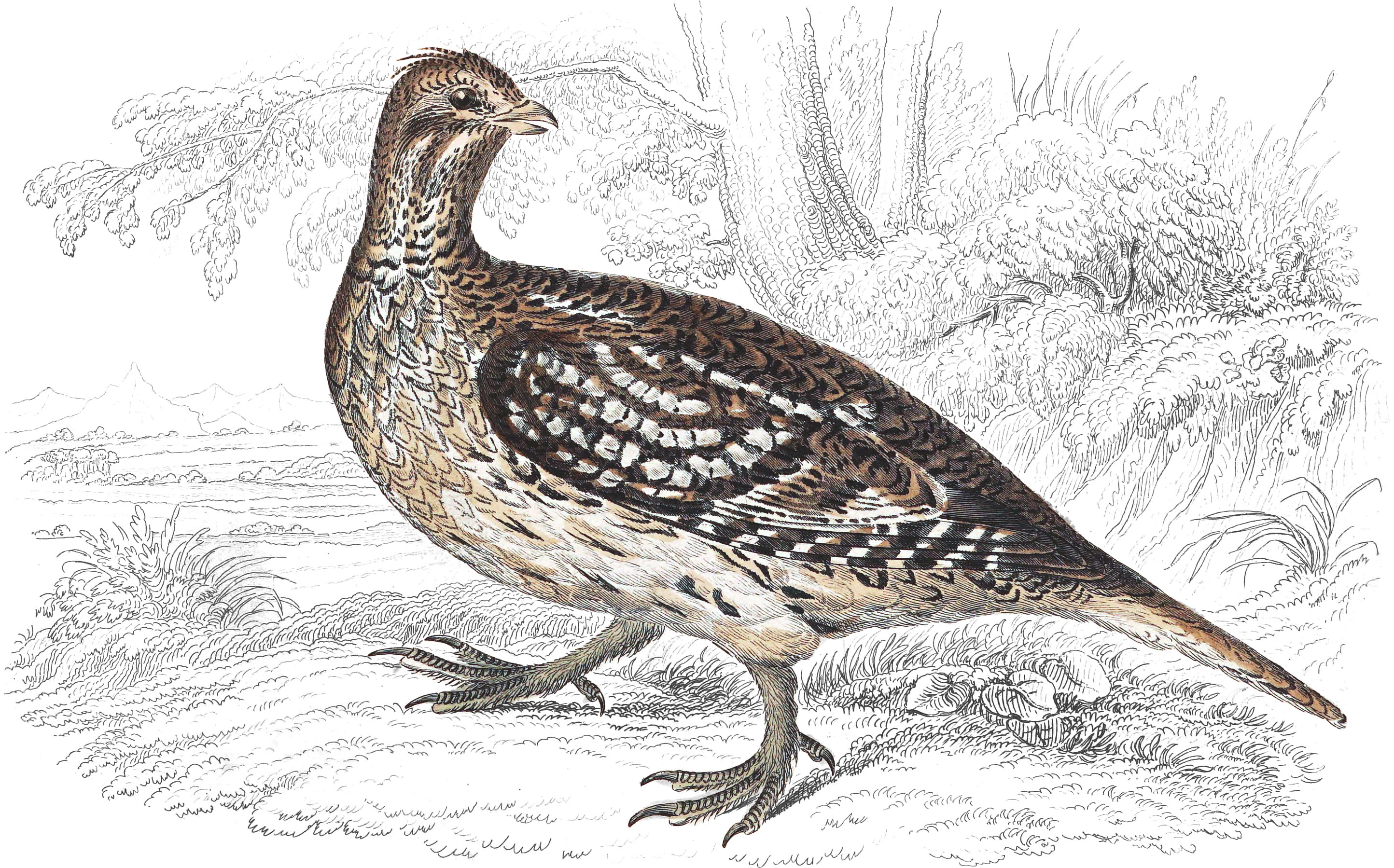
Plate XVI
The Cock of the Plains
Centrocercus urophasianus.—Swainson.
Cock of the Plains, Lewis and Clark.—Tetrao urophasianus, Bonaparte, Continuation, pl. xxi.—Pheasant-tailed grouse, Wilson, Illust. of Zool. pls. xxvi. and xxvii.—Centrocercus urophasianus, North. Zool. ii. p. 353 358.
This splendid bird is the largest of the American grouse; and, as far as beauty, size, and rarity are concerned, bears the same rank in the American Fauna with the wood-grouse or cock of the wood of Europe. He is equally sought after by the huntsman, and is even now as difficult to procure as that we have just compared him to. But the form and habits are quite distinct. In our once native bird the form is remarkably powerful, the tail rounded and very ample, the habitation, the most extensive forests, delighting to perch on the highest trees. The bird of America inhabits only the uncovered plains, never perches, and the form of the tail is lengthened, the feathers narrowing to a point. This acquisition to the grouse was first noticed in the expedition of Lewis and Clark, who met with it near the fountain of the Missouri, in the heart of the Rocky Mountains, and also on the Columbia River. A figure was first given of it by Bonaparte, from a specimen in the possession of Mr Leadbetter. Both sexes were again figured in Mr Wilson’s Illustrations of Zoology, and an excellent representation of the male is given in the Northern Zoology.
The total length of the male is thirty-one and a half inches, that of the female twenty-two. The colour of the plumage is a beautiful mixture of yellowish-brown, mottled and varied with deeper tints, the under parts nearly white, with longitudinal streaks of brown, and the centre of the belly dotted with large black patches. On each side of the breast are two round naked protuberances, placed farther forward than those of T. cupido, or pinnated grouse. Above each there is a tuft of feathers, having their shafts considerably elongated, naked, and tipped with black radii. On the sides of the neck and across the breast, below the protuberances, the feathers are short, rigid, and sharp-pointed, but lie over each other with the same regularity as the scales of a fish. The tail is eleven inches long, each feather lanceolate, and is gradually attenuated to a fine point. The female has the whole of the upper plumage umber-brown and yellowish-white, barred or mottled in equal proportions. Under part nearly as in the male, but without the projecting stiff feathers.
The description of the manners of this species by Mr Douglass, is. the best account we yet have.
The flight of these birds is slow, unsteady, and affords but little amusement to the sportsman. From the disproportionately small, convex, thin-quilled wing,—so thin, that-a vacant space half as, broads as a quill appears between each,—the flight may be said to be a sort. of fluttering, more than any thing else the bird giving two or three claps of the) wings in quick succession, at the same time hurriedly rising; then shooting or floating, swinging from side to side, gradually falling, and thus producing a clapping, whirring sound. When started the voice is cuck, cuck, cuck, like the common pheasant. They pair in March and April. Small-eminences on the banks of streams are the places usually selected for celebrating the weddings, the time generally about sunrise. The wings of the male are lowered, buzzing on the ground, the tail spread like a fan, somewhat erect, the bare yellow œsophagus inflated to a prodigious size, fully half as large as his body, and, from its soft. membranous substance, being well contrasted with the scale-like feathers below it on the breast, and the flexile silky feathers on the neck, which on these occasions stand erect. In this grotesque form he displays, in the presence of his intended mate, a variety of attitudes. His-love-song is a confused grating, but not offensively disagreeable tone—something that we. can imitate, but have a difficulty of expressing—“Hurr-hurr-hurr-r-r-r-hoo,” ending in a deep hollow, tone, not unlike the sound produced by blowing into a large reed. Nest on the ground under the shade of; Purshia and Artemisia, or near streams, among Phalaris arundinacea, carefully constructed of, dry grass and slender twigs. Eggs from thirteen to seventeen, about the size of a common fowl, of a wood-brown colour, with irregular chocolate blotches on the thick end. Period of incubation from twenty-one to twenty-two days. The young leave the nest a few hours after they are hatched.
In summer and autumn months these birds are seen in small troops, and in winter and spring in flocks of several hundreds. Plentiful throughout the barren, arid plains of the river Columbia; also in the interior of North California. they do not exist on the banks of the river Missouri; nor have they been seen in any place east of the Rocky Mountains.

Plate XVII
Grouse-Ptarmigan
We now come to that section of the Grouse to which the Red Grouse and Ptarmigan belong. They have been separated from the others under the title of Lagopus—Grouse-Ptarmigan. They are even of a more solitary nature than the others, inhabiting the wildest muirs or most barren alpine ranges. The principal generic distinction is the entirely clothed feet and legs, covered with a rather rigid hair than feathers, and the want of the scaling upon the sides of the toes; the hind toe short, and the claws long and of a particular flat triangularly pointed form in the more alpine birds, to assist in digging or burrowing under the snow. Five species only are known, natives of North America and Europe. Great Britain possesses three, one of which is not known out of the British Isles. It is the first we shall notice—
The Red Grouse
Lagopus Scoticus.—Leach.
Red Grouse, Muirfowl of British Ornithologists.—Tetrao Scoticus, Auctorum.—Lagopus Scoticus, Leach.
The Muirfowl, the delight of the sportsman, may be placed at the head of the sports of the fowler; it is to him what the fox is to the hunter, the salmon to the fisher. The light air of the early morning of a fine twelfth, and the free and open almost unbounded prospect, exhilarate the spirits; while the boldness of the game upon discovery, erectly uttering his cry of warning to his brood,—his vigorous lengthened flight, so long as to create doubts of his being again seen,—carry with them a continuation of excitement, long after it is satiated with following the skulking black game, or the more rural amusement of walking up partridges. But independent of this claim upon the sportsman, it has another: the red grouse is exclusively confined to the British Islands, and has never been found on any part of the Continent, and it would be much to be regretted if unlimited persecution or want of preservation should in after years exterminate this bird, so exclusively national. It is well known that on all the more southern muirs, not a tenth of the former number of birds at present exist;12 and it is only in the more remote districts, where access and accommodation for sportsmen are in some degree wanting, that they are to be seen in any thing like their former numbers.
The red grouse is plentiful still in Scotland and Ireland, now more sparingly spread over the southern districts of the former, and upon the wilder muirs of England. There also the habits of the birds have considerably changed. By the approaches of cultivation to the higher districts, and in insulated patches of grain even in the middle of the wildest, the grouse have learned to depend on the labours of the husbandman for his winter’s food, and instead of seeking a more precarious subsistence during the snow, of tender heath-tops or other mountain plants, they migrate to the lower grounds and enclosures, and before the grain is removed, find a plentiful harvest. Hundreds crowd the stooks in the upland corn-fields where the weather is uncertain, and the grain remains out even till December snows; while in the lower countries they seek what has been left on the stubble or ploughed fields. It is only in the wildest parts of the Highlands, the Cairngorum range, Ross, or Sutherland, where the grouse is an inhabitant through the year, of the muirs, his native pasture, and where he is also nearly the only enlivener of these wild solitudes, by his loud morning and evening call, Duying summer it may be varied by the whistle of the curlew or the wailing of the golden plover, or perhaps interrupted by the sailing flight of some harrier or other birds of prey; but in winter, for leagues around,
Dwells but the gor-cock and the deer.
Unless where much disturbed, the grouse is not a wild bird, and, unaware of danger, it will allow a person to approach or walk past, uttering only its call, as if to make its companions aware that something is near. In districts where they are much followed, they, however, become one of the most wild and wary of our game, and almost impossible to be approached except by stratagem. For nearer concealment they are amply provided by the similarity of the tints of their plumage with the dark brown moss and heath, and except for the assistance of the pointer, could not be discovered, Unlike the large true grouse, the birds of the present group all pair and continue with their broods until a return of the warm season. The young in some seasons are dreadfully ravaged by the tapeworm, almost destroying them entirely in the districts where it occurs. It is their most severe natural enemy. The red grouse pairs very early, if mild, in January, and the female commences laying at the end of March. The eggs are deposited in a shallow hollow at the foot of some tuft of heath, which affords a partial covering and shelter, and only a few straws or grasses serve to separate them from the ground. Both parents attend, and boldly defend the nest or young from the ordinary aggressors. One of the most dangerous for the eggs is the common carrion crow or corby, but this is often attacked in return and successfully beaten off. In confinement they very easily tame and become familiar, and have even bred, though I believe the young, after being hatched, have very rarely been reared.
The adult plumage of the grouse which have attained an age beyond a year or two, is a deep rich sienna brown, the belly almost entirely black. Many specimens are much marked with white on the under parts, and some to a greater degree than others; and it is a usual thing to remark of these birds, where the colours are so richly contrasted, “What a fine old bird he is.” The reverse, however, is the truth, for though white is so often the attribute of age, it is in this case most prevalent upon the young males. The females are of a paler tint, and have the markings larger. During the breeding season, the feathers of both become much more cut into, as it were, with yellow, and their tips are pale yellowish white. The grouse varies occasionally to different shades of cream colour, but we are not aware of any specimens being perfectly white.
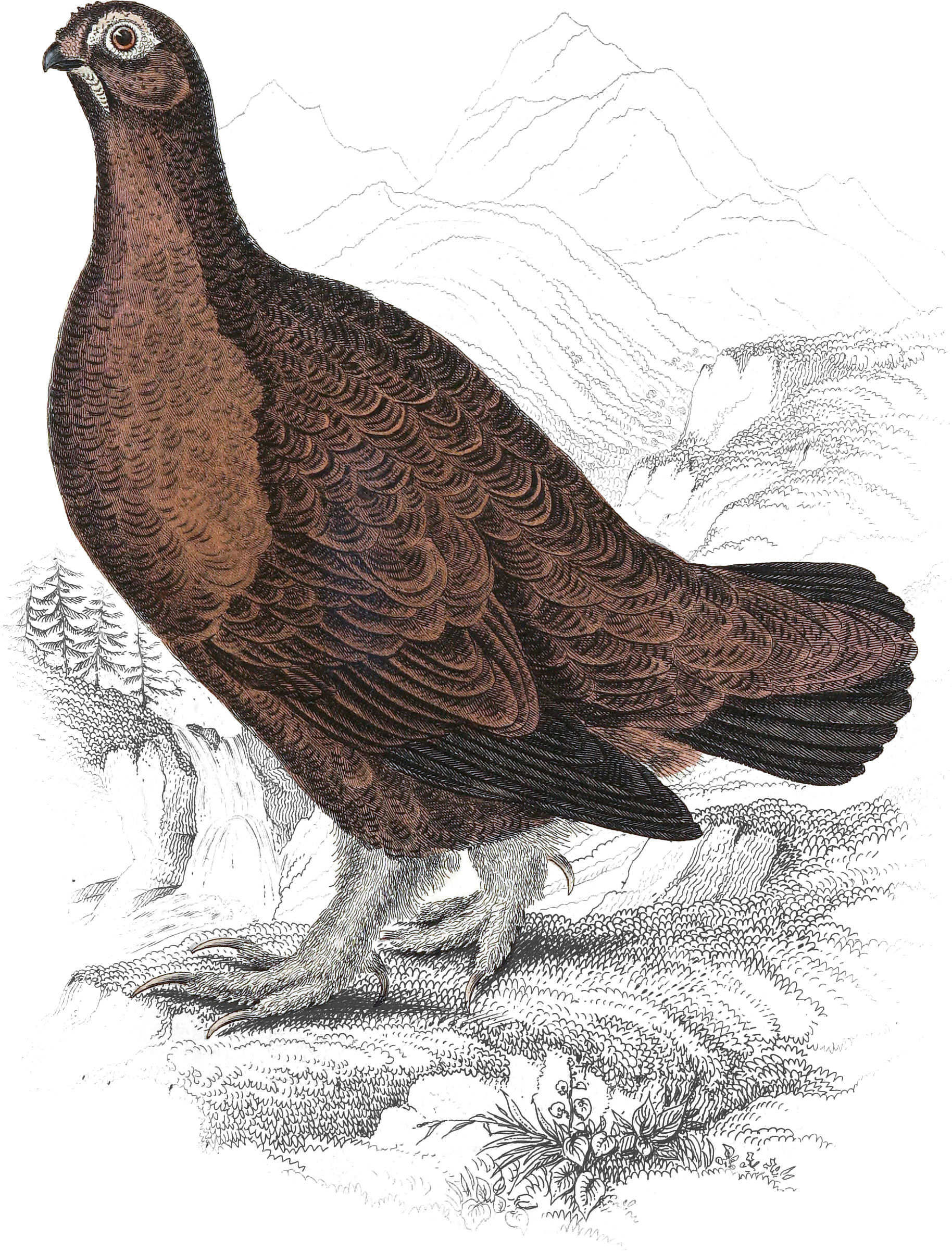
Plate XVIII
Another grouse, very nearly resembling the moorfowl of Britain, is the Willow Grouse, Lagopus saliceti, inhabiting the arctic parts of North America, and extending from thence to the north of Europe. The plumage of the summer is extremely similar to the red grouse, but that of the winter is entirely white. The entire length is about sixteen inches, the weight about one and a half pounds.
According to Dr Richardson, the Willow Grouse is partially migratory in the fur countries; it breeds in the valleys of the Rocky Mountains, and, collecting in flocks on the approach of winter, retires southward as the severity of the weather increases. On the shores of Hudson’s Bay, it assembles in vast flocks during winter, 10,000 being sometimes captured in a single season. Greenland, Iceland, and the valleys of the Alps, are almost their only habitations in the old world, frequenting rather wet and brushy situations. In America, they shelter themselves among the thickets of willow and dwarf birch. They pass the night in holes in the snow, and when perceived, practise a novel artifice in attempting to escape; they often terminate their flight by diving precipitately into the loose snow, working their way with considerable celerity beneath its surface.
The next bird we shall notice is
The Common Ptarmigan
Lagopus mutus.—Leach.
Tetrao lagopus, Linnæus.—Ptarmigan, Pennant, Latham.—White Grouse, Bewick’s Birds.—Common Ptarmigan, Selby’s Illustrations, lix. and lxix lx. p. 433.
This delicately marked bird in its summer dress, and of snowy whiteness in winter, appears also to be a native of both the European and American continents, though it is certainly more abundant in the former, It is a species confined to the most alpine districts, and may be said to be very generally spread over those of Europe. In Great Britain, its only habitation now seems to be the high mountain ranges in the middle of Scotland, increasing in abundance as the same kind of wild country reaches to the north, and it also extends to the Hebrides. According to Pennant, and some contemporary writers, these birds were once found on the hills of Westmoreland and Cumberland; and, I believe, recollections even exist of a few having been seen upon the high ranges which appear on the opposite border of Scotland. These have been for some time extirpated, and unless a few solitary pairs remain on Skiddaw, or some of its precipitous neighbours, the range of the Grampians will be its most southern British station. Another bird has lately been found in this country, which was before thought to be an inhabitant of America only, the Lagopus rupestris or Rock Ptarmigan. From its close resemblance in plumage, it has been confounded with the common ptarmigan; but one or two specimens have lately been got in the more northern Highland districts. In both birds the plumage is of the most unsullied white during winter. In summer they are mottled with tints of black; in the first mingled with grey and yellow, in the second with yellow alone. The size varies also, the last being about two inches less than the Common Ptarmigan. The chief distinctions to be seized upon at first sight, are the less size, and the black feathers of the back being cut into upon the edges, with patches of yellow only, contrasted with the larger size and grey plumage of the other.
They inhabit the most barren and rocky spots, often where nothing is to be seen but an interminable series of rugged rocks distributed in boulder masses, varying in size, from huge lumps to pieces of a few inches in diameter. Here, during spring and summer, the pairs and their broods remain the only inhabitants, and are discovered with the greatest difficulty, the mixture of the colours of the plumage forming a tint which harmonizes with that of the grey rocks around. At this season they are also tame and familiar, running before the intruder, and uttering their peculiarly low wild call, which is often the means of their discovery. In this way they will often reach the opposite edge of the rock, and will, as it were, simultaneously drop off; but the expectation of finding them on some lower ledge will be disappointed, for they have perhaps by that time sought for and reached the opposite side of the mountains, by a low, wheeling flight, as noiseless as the solitudes by which they are surrounded. The nest is made under the rocks and stones, and is very difficult to be found, for the female on perceiving a person approach, generally leaves it, and is only discovered by her motion over the rocks, or her low clucking cry. In winter they descend lower, but seldom seek the plains.


The only other bird belonging to this interesting group is an American species, discovered by the expedition under Captain Franklin. It has the habits of the rest, and inhabits the Rocky Mountains. It has been termed by Dr Richardson Lagopus leucurus, or White-tailed Ptarmigan, and is at once distinguished from any of the rest by the want of black on the pure winter plumage, wanting both the black eye-stripe and black tail, so conspicuous in the others. The summer dress is intermediate in colour between that of the rock and common ptarmigan.
The Common Black Grouse
Lagopus tetrix.—Swainson.
Tetrao tetrix, Linnæus.—Black Grouse, Black Cock, Male; Grey Hen, Female, Pennant, &c.—Black Grouse, Selby, Illustrations, lviii. and lviii.* p. 423.
The most proper place to have described this beautiful bird was after the true American grouse, the ptarmigan being more naturally succeeded by the next Plate (Pl. XXIII.) As it is, it has been placed here, and we must refer to the conclusion for the situation of the different groups.
This species is pretty generally spread over Europe, being found in France and Germany, while, as we reach the north, in Russia, Sweden, Norway, &c. it becomes very abundant. In Britain it occurs in the three countries, most sparingly, however, in England, from the rich cultivation and champagne character of the country. The New Forest, Hampshire, Somerset, and the wild parts of Staffordshire, can boast of it, but these are nearly all the English stations, until we reach the borders, where it becomes abundant in the wild districts, which conduct to its still more frequent haunts in Scotland.
The favourite abode of the black grouse is an alpine sheep country, where there is comparatively little heath, moist flats or meadows, with a rank and luxuriant herbage, and where the glades or passes among the hills are clothed with natural brush of birch, hazel, willow, and alder, and have a tangled bottom of deep fern. These afford both an abundant supply of food, and shelter from the cold at night, and from the rays of the mid-summer’s sun.
Like the greater proportion of the true grouse, the black game is polygamous; and during the months of January, February, and March, when his adult breeding plumage of glossy steel-blue is put on, he is a noble-looking and splendid bird. In the warmer sunny days at the conclusion of winter and commencement of spring, the males after feeding may be seen arranged, on some turf fence, rail, or sheep-fold, pluming their wings, expanding their tails, and practising, as it were, their murmuring love-call. If the weather now continues warm, the flocks soon separate, and the males select some conspicuous spot, from whence they endeavour to drive all rivals, and commence to display their arts to allure the female. The places selected at such seasons are generally elevations; the turf enclosure of a former sheep-fold which has been disused, and is now grown over, or some of those beautiful spots of fresh and grassy pasture, which are every where to be seen, and are well known to the inhabitants of a pastoral district. Here, after perhaps many battles have been fought and rivals vanquished, the noble full-dressed blackcock takes his stand, commencing at first dawn; and where the game is abundant, the hill on every side repeats the murmuring call, almost before the utterers can be distinguished. They strut around the spot selected, trailing their wings, inflating the throat and neck, and puffing up the plumage of those parts, and the now brilliant wattle above the eyes, raising and expanding their tail, displaying the beautifully coutrasting white under-covers, and imitating, as it were, the attitudes of a little turkey-cock. He is soon heard by the females, who crowd around their lord and master.
This season of admiration does not long continue; the females disperse to seek proper situations for depositing their eggs, while the males, losing their feeling for love and fighting at the same time, reassemble in small parties, and seek the shelter of the brush and fern beds to complete a new moult, and are seldom seen except: early in the morning, being now the very reverse in stupidity to what they were formerly in vigilance. The sexes continue separate until the winter, when the old males join with the young broods, and all resort, morning and evening, to some favourite feeding grounds, spending the middle of the day in basking, pluming, or sporting upon some sunny hillside. Upon the females devolve the whole duties of rearing and protecting the young. The nest is made on the ground like that of the other grouse, and when hatched the young are conveyed to the low rushy hollows, where there is abundance of water, and plenty of food, in tender seeds of the rushes, and alpine grasses. The young are seldom full grown before the first of September; and even at this season, if they have been undisturbed previously, they will almost suffer themselves to be lifted from among the rank herbage before the pointers. At this time the plumage of the young is somewhat like that of the female, a lighter tint of yellowish-brown, mottled and crossed with bars of black, the males commencing to get the black feathers of the adult plumage, or to spot, as sportsmen term it; this is almost always completed by the beginning of October, but does not gain its richness of gloss and lustre before the following spring.
During summer the general food is the seeds of the various grasses, and the berries of the different alpine plants, such as the cran and crow berries, blaeberries, &c.;13 and in winter the tender shoots of the fir, catkins of birch and hazel, afford them support in the wilder districts, and often give their peculiar flavour to the flesh; but in all the lower districts, where, indeed, this bird is most abundant, the gleaning of the stubble yields a plentiful meal. Fields of turnips or rape are also favourite feeding places, and the leaves yield them a more convenient supply of food during hard frost, than they could elsewhere provide. In some places flocks of hundreds assemble at feeding times, for of late years this species has increased to an immense extent, and from the life of the hens being to a certain degree protected, a sufficient. breeding stock is always kept up. At the season of their thus assembling in flocks, they are extremely shy and wary.
The plumage of the adult male is, on all the upper parts, of a rich steel-blue; on the under parts, pitch-black, which duller colour also is seen on the secondaries and wing-coverts. The secondaries are tipped with white, forming a bar across the wings conspicuous in flight, and the under-tail coverts are of the same pure colour. The form of the tail is, however, the most curious or anomalous structure in this bird, differing from all the others, (except one, where it is very slightly indicated,) in being forked, and having the feathers bending outward. From this circumstance, it has been formed into a subgenus by Swainson, under the title Lyrurus, and is made in that gentleman’s system to represent the fissirostral form among the Tetraonidæ, bearing analogy in its forked tail and glossy plumage to the Drongo shrikes of Africa and India. The female bears the more unobtrusive colours which run through the sex in the rest of the group; and has a chaste and beautiful arrangement, of brown, black, and greyish-yellow. The fork of the tail is very slightly seen.
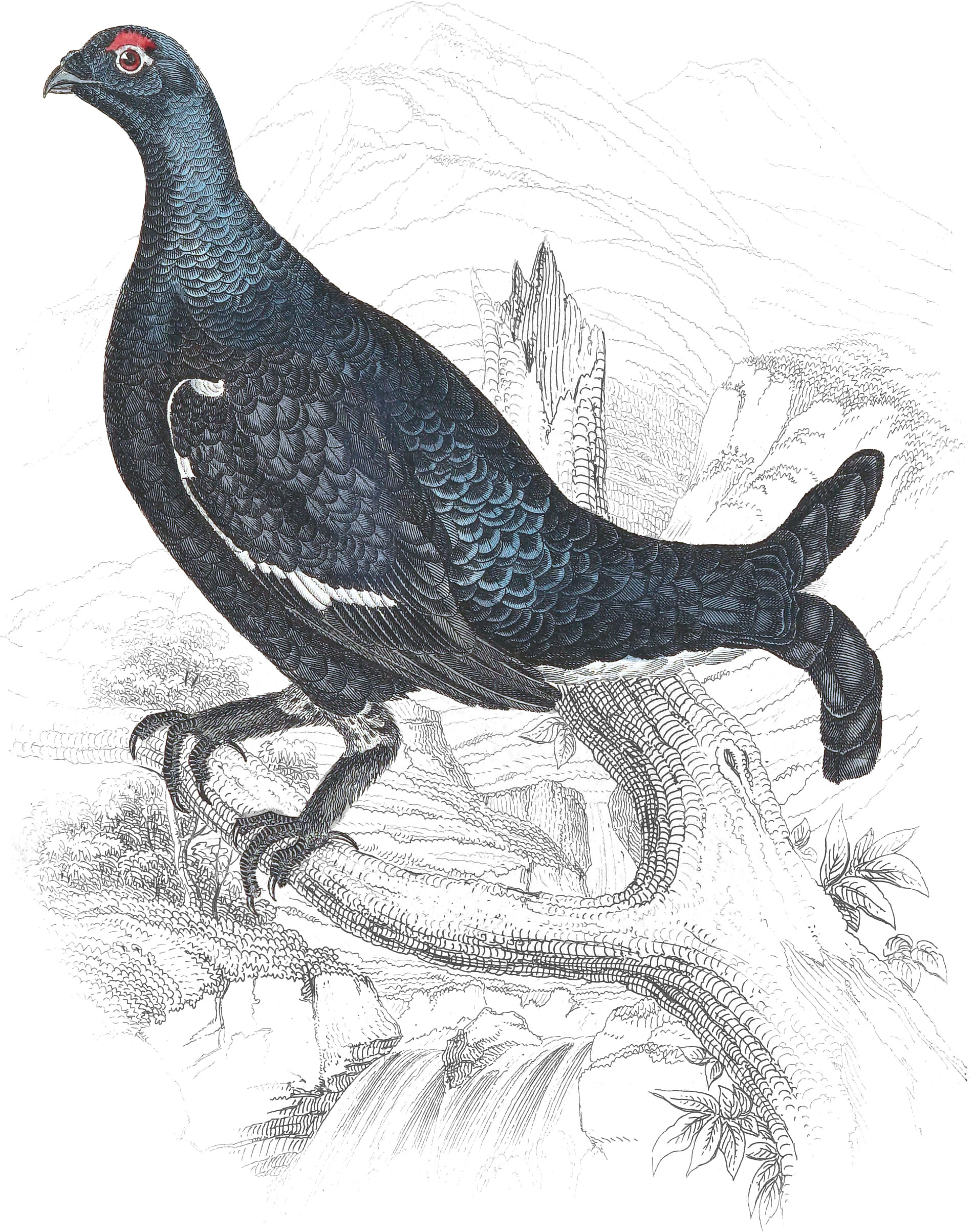

From the Grouse and Ptarmigan. we appear to arrive naturally at those birds which fill their situation in the most barren districts of the world; and for abode there, they possess requisites equal to those belonging to the inhabitants of the moors or forest. These have been named Sand-Grouse, and in scientific language Pterocles. They inhabit the parched and arid deserts of Africa and Arabia, plains of burning sand, bounded only by the horizon, “where no palm-trees rise to spot the wilderness,” themselves almost the only living creature, often proving a most welcome sight to those who, from necessity or avarice, attempt their dangerous passage. For abode in these deserts, a more extended locomotive power is necessary, the distances to be passed from the various watering places and supply of food being very great. We find the feet small therefore, formed for running lightly on the burning sand, the bodies more light and slender than any of the birds we have been describing, and the wings lengthened, with the first quills longest; the tail also is often long, thus shewing an extent of development in the most important organs of flight, far beyond any of the others. They are thus enabled to pass over vast distances, and they sweep over these wastes with an easy, noiseless, and extremely rapid flight.
Swainson accounts these birds the tenuirostral group in this family, and as a departure from the Gallinæ. The Prince of Musignano remarks, that some species of them lay a small number of eggs, and that the young remain for a considerable time in the nest after being hatched. The colours of these birds are peculiar shades of brown and ochreous; yellow, assimilating with the colour of the deserts they inhabit.
The first we have to notice is a European bird of great rarity. It is
Pallas’s Sand-Grouse
Syrrhaptes Pallasii.—Temminck.
Tetrao paradoxa, Pallas.—Heteroclite grouse, Latham.—Heteroclite Pallas, Syrrhaptes Pallasii, Temminck, Pigeons et Gallinacés; Pl. Coloriées, 95—Delanoue, Dictionnaire Classique d’Histoire Naturelle, viii. p. 182.
The entire length of this curious bird, figured by Temminck, was scarcely nine inches, of which the very long tail feathers occupy three; but the specimens procured by M. Delanoue from the borders of China, were above eleven inches, exclusive of the tail, which was above three. The colours of these birds were much more brilliant also, and he is of opinion that the subject of our plate was a young male of small size. The plumage is generally of the brownish-yellow tint, the common colour of the whole; upon the back and wings of a clearer and more yellow tint than on the other parts. Across the lower part of the breast, the feathers have a black band at the tip, which forms a bar across; and upon the centre of the belly there is another broader band of brownish-black. The feathers on the back are tipped also with a circle of black, and the secondaries are terminated with reddish-brown, forming a bar of that colour across the wings. The wings are long, the outer feather surpassing the others, and lengthened to a fine narrow point: in the same way are the centre feathers of the tail much extended beyond the others, and terminate in the same kind of narrow setaceous plume.
The feet of this bird are very extraordinary. According to Delanoue, who appears to be the only one who has seen them alive, the toes are so short as to be scarcely distinguishable, the centre one only deserving that appellation, and they are covered to the claws with thick down, these parts being alone observable without putting aside the covering. The consequence is a slow, and, as it were, painful manner of walking; while on the contrary, the flight is rapid and high. The same traveller found the nest of the female among some stones collected under a shrub, containing four eggs of a reddish-white spotted with brown. The nest was perfectly simple, constructed with only a few stalks of grass, and the female exhibited the utmost solicitude for her precious deposit. The female differs little from the male, except in size, and a little less brilliancy of plumage.
The genus Syrrhaptes was established by Illiger for the reception of this curious bird, and M. Temminck dedicated the only species yet known to the celebrated Pallas, its first describer.

Plate XXIII
The next bird is more typical of this beautiful little group; it is
The Banded Sand Grouse
Pterocles arenarius.—Temminck.
Tetrao arenarius, Pallas.—Ganga unibande, Pterocles arenarius, Temminck, Pig. et Gallinacés, and Pl. Coloriées, pls. 52 and 53.
In this beautiful sand-grouse, we see, if such an expression may be used, a more perfect form. The form of the bird is strong but light, the wings long and ample. The tarsi feathered only in front, and the feet evidently adapted for running. We have, however, the same prevailing colour of grey and yellowish-brown, of the peculiar opaque lustre which prevails among them. The belly of the male is deep brownish-black, the throat is marked with a spot of the same colour, and below the breast there is another similarly coloured band, from which Temminck has derived his trivial name. The female is of the same general tint. The dark parts of the under plumage are paler, and the patch on the throat is wanting, but apparently replaced by another of grey, while the head, breast, and upper parts are covered with brownish-black bars and crossings, somewhat akin to those which distinguish the females of the true grouse. The tail in this species is rounded, but rather lengthened; it varies in length from twelve to fourteen inches.
The banded sand-grouse is found on the vast sandy plains in the south of the Russian empire, upon the banks of the Volga, but most abundantly in the north of Africa. Temminck also thinks that it is entitled to the rank of a European straggler, one or two instances having occurred of its being met with in Spain and Germany. Nauman killed one on the territory of Anhalt, and several others were said to have been found in the same season; Temminck possesses two specimens killed in Spain. The nest is made among stunted brush, upon the ground, and four or five eggs only are deposited. The principal food during the season is the seeds of an astragalus.
Pterocles exustus, coronatus, Lichtensteinii, are other delicately marked species, inhabiting the African deserts, and having nearly the same manners, while a beautiful species inhabiting India was made known by Sonnerat, under the name of Gelinote des Indes. The Pterocles quadricinctus of Temminck, is so named, from four bands of brown, white, black, and again white, which encircle the breast of the adult males.


Another interesting species is the pintailed sand-grouse, Pteracles setarius of Temminck, a native of Europe as well as Africa, and the only one which can be called really European. It is remarkable in the lengthened form of the centre tail-feathers, and particularly so in the strong bill, (which forms a marked contrast. with the others, which are all comparatively weak,) and approaches almost to the strength of that of the grouse, while the nostrils still remain uncovered. It is found in Spain and some of the southern provinces, and the north of Africa frequenting, perhaps, more the Landes, where there is a greater proportion of herbage. The nest is made among loose stones or scanty herbage, and the eggs are only four or five in number.
The next birds we have to describe are, if possible, still more curious. In illustration of these, we have figured
The Crowned Cryptonix
Cryptonix coronata.—Temminck.
Le Rouloul de Malacca, Sonnerat, ii. p. 174, pl. 100.—Cryptonix ou Rouloul couronné, Cryptonix coronatus, Temminck, Pl. Coloriées, pls. 350 and 351.
This singular bird has been placed by ornithologists alternately among the pheasants, pigeons, and partridges. Its nearest alliance is perhaps to the last, but it differs from them in the form of the bill and nostrils, and from all the Tetraonidæ in the imperfection of the hallux, which wants the claw. It is further remarkable for the large naked space round the eyes, and for the ample tuft or crown of hairy-looking plumes which adorn the head. The form of the bird is compact and robust, the wings short and rounded, and the tail almost concealed by the feathers of the rump. It inhabits the forests of India, never visiting the plains, and is most frequently met with in Malacca, Java, Sumatra, &c.
The length of the male is about ten inches; the plumage of the upper parts, except the wings, head, and neck, is a deep olive-green; on the breast and under parts it becomes almost black or steel blue, and the head and neck are of that colour, with purple reflections. The wings are umber brown, varied with a deeper tint. The crown and hind head are adorned with a lengthened crest of hair-like feathers, of an orange-red, but marked in front with a conspicuous band of white. Before this, at the base of the bill there springs a tuft of strong black hair or bristles, which curve backwards. The space surrounding the eyes, base of the bill, and legs, are bright red. The female has the plumage entirely of the green which covers the upper parts of the male, except the wings. On the forehead are the black hairs or bristles, but the red occipital crest is entirely wanting.
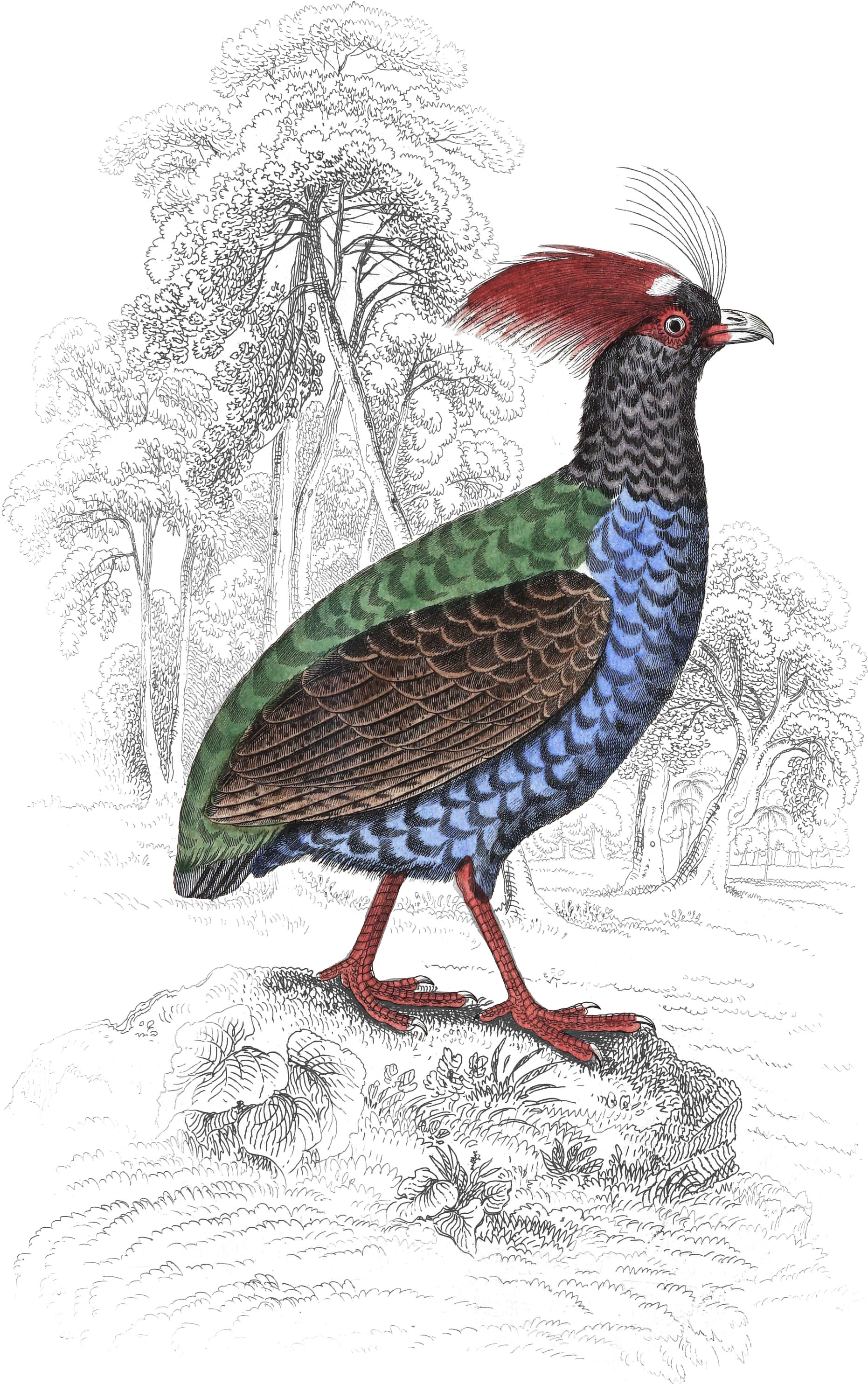
Plate XXVI
Cryptonix niger, entirely black, is another species belonging to this form, the female is brown. There appears also to be one or two other birds which will rank with these, which have not yet been properly distinguished. Our next birds compose the genus Ortygis of Illiger, and the form will be seen in
The White-Spotted Ortygis
Ortygis Meiffrenii.—Temminck.
White-spotted Turnix, Swainson, Zool. Illust.—Turnix Meiffeinii, Temminck, pl. 50.
These curious diminutive birds are found in Africa, India, and the warmer parts of New Holland. Few of them are so large as the common quail, and several do not attain half the size. The colours are somewhat similar; but in the form of the body—the length of uncovered leg above the joint, form of the foot in wanting entirely the hallux—reminds us of the true bustards. They inhabit the barren Landes, and the confines of the deserts, seldom taking wing except when pressed, and running with great swiftness. They are polygamous, and it is one of these birds which are so much used by the Malays, Javanese, and Chinese in quail-fighting, which is carried to a much greater excess than the same practices in the cock-pit. The species represented on the accompanying plate exhibits the peculiarity of form and length of legs. The bird itself is scarcely larger than the figure, the upper parts delicately shaded with yellowish white, the lower parts nearly pure white. By Mr Swainson it had been, (subsequently to Temminck, we think,) named nivosus, from the white spots which delicately mark the breast. It is a native of Africa.

Plate XXVII
Our next bird is of stronger proportions. It is
The Black-Necked Ortygis
Ortygis nigricollis.
Turnix cagnan, Hemipodius nigricollis, Temminck, Pigeons et Gallinacés, iii. p. 619.
This is a stronger species than the last, coming nearer to the true quails, being rather more than six inches in length. The head and neck are deep black, mingled above with white and brown, but upon the throat generally of a solid black. The upper plumage is varied with irregular markings of yellowish-brown and black, and the breast is largely barred with the latter colour upon a pale yellowish-brown ground. It inhabits the island of Madagascar, and most probably also the continent of Africa.
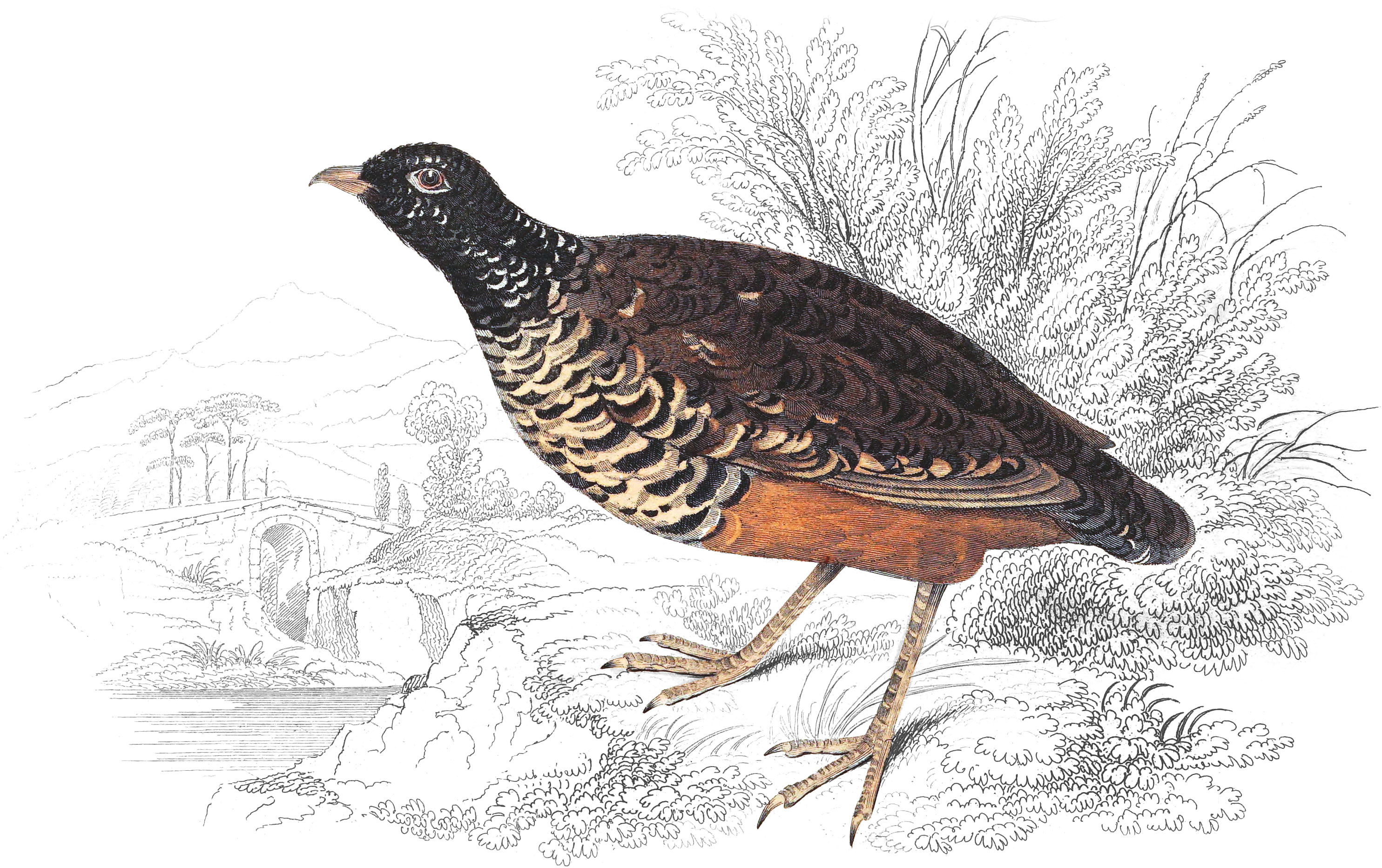
Plate XXVIII
The next birds we have to notice are the last in this important and interesting family, but although they have been placed last, we are by no means certain of their situation. The Tinamous, forming the genus Crypturus of Illiger, are all natives of the New World, particularly abounding in the Brazilian and tropical forests, whose open glades they frequent during the day, and at night repose on the large branches of the trees, seeking safety from the numerous carnivorous animals which hunt their prey during night, and delight in the varied game of these wilds. During day they skulk about the long herbage, and even when assailed by men, allow themselves to be killed with sticks, rather than exert their, little powers of flight. The wings and tail are both short and without power, the latter almost wanting; but their feet are more fitted for running in, the marshy grounds, and the disincumbrance of the tail enables them to thread an easy passage through a tangled herbage. The next Plate represents
The Guazu
Crypturus rufescens.
Tinamou isabelle, Tinamus rufescens, Temminck, Planches Coloriées, pl. 412.
This is a large bird, measuring in length above 15 inches. It is a native of Paraguay and Brazil, and is said to frequent the plains of deep grassy herbage, and to come forth in moonlight and twilight to the fields of newly sown grain. During day it is difficult to raise, and will allow itself apace to be trodden on. They are hunted with dogs, and somewhat esteemed for their flesh. The nest is formed among the long grass, and four or five eggs are laid, according to Temminck, of a brilliant violet colour, the form nearly round.
On the crown are rows of black spots upon the tips of the feathers; the ground colour, with that of the neck and breast, is a pale and delicate yellowish orange. The whole of the other parts, except the; quills and secondaries, are of a delicate wood-brown, or, as Temminck expresses it, “couleur de café à lait;” palest beneath, and marked above with large black crescent-formed patches. The quills and secondaries are bright yellowish-orange.

Plate XXIX
The other species of the genus we have represented is—
The Tataupa
Crypturus tataupa.
Tinamou tataupa, Tinamus tataupa, Temminck, Planches Coloriées, pl. 415.
This bird is also a native of Paraguay, and has nearly the manners with the last, a little more familiarity is displayed, and it approaches commonly nearer to cultivation, whence it has received the provincial name of Tataupa. It breeds in similar places to the last, and the eggs are of a deep brilliant blue. Violet and blue are remarkable colours in the eggs of the gallinaceous birds, the former very rare among any, and the tinamous seem to lead off in this respect as well as many other peculiarities.
The Tataupa is a small species, being only about nine inches in length. The head, neck, breast, and belly are of a greyish leaden colour; the throat pure white, the back and wing-coverts brownish-black, the feathers on the thighs and rump are dull black, bordered with a narrow band of white. The bill is brilliant red, and the legs are of a purplish-red, both contrasting well with the otherwise dull and chaste plumage.

Plate XXX

Fourteen or fifteen species of these curious birds are described, but their history is not well known, a and there is considerable confusion among their names, from the works of Spix affixing new appellations to almost all that were known. One of the most curious is the Tinamus nanus of Temminck, of very diminutive size, being about a third less than the common quail. It is very interesting from its form, which approaches in many respects to that of Ortygis, and is thought by Temminck to stand at the extremity of the present genus, and lead to that we have just mentioned. The hallux is simply a nail, and there is an extraordinary development. in the feathers of the rump. It will stand as the type of a subgenus.
We now give a short arrangement of the genera which have been already proposed by different ornithologists. Those in capitals are what Mr Swainson considers the five leading forms, those in common letters are the subgenera, of which one or two more will be necessary in both Perdix and Crypturus.
The Rasores, or third order of birds, contains the families Pavonidæ, Tetraonidæ, Cracidæ, Struthionidæ, Columbidæ.
The family of Tetraonidæ contains the genera and subgenera
- Perdix.
- Francolinus.
- Ortyx.
- Coturnix.
- Tetrao.
- Lyrurus.
- Centrocercus.
- Lagopus.
- Syrrhaptes.
- Pterocles.
- Attagis?
- Cryptonix.
- Ortygis.
- Crypturus.
- Mr Selby has undertaken the description of the beautiful Columbidæ or Pigeons; and Thirty Drawings from the pencil of Mr Lear are now in the hands of the engraver.
- Vol. i. p. 435.
- Galt’s Travels.
- Wilson’s North American Ornithology.
- Audubon.
- James Wilson, in Jameson’s Journal for July 1832.
- From Lloyd’s Northern Field Sports.
- Temminck.
- Alexander Wilson.
- Northern Zoology.
- Bonaparte.
- In former days, the Earl of Strathmore’s gamekeeper, for a considerable bet, undertook to shoot forty brace of game upon his Lordship’s muirs in Yorkshire. By two o’clock he had killed forty-three brace.
- Vaccinium oxycoccus, Empetrum nigrum, Vaccinium myrtillus, Vitis Idæa, and Arbutus Uva-ursi, are all sought after.