Volume I
The Natural History of Humming-Birds
Part I
His silken vest was purfled o’er with green,
And crimson rose-leaves wrought the sprigs between;
His diadem, a topaz, beam’d so bright,
The moon was dazzled with its purest light.
The geographical distribution of the various races of created beings has of late excited considerable interest, and a mass of facts have been collected which go far to prove that it is regulated by certain laws, chiefly dependent upon the conjoined influences of climate and temperature. Birds are equally subject to those rules, though, as might be suspected from their more extended locomotive powers, their ranges are wider, and some groups and species are more generally spread over the world than those beings which require the assistance of a solid medium to transport themselves from place to place. Instances of this may be given in one or two examples. The great families of the falcons, pigeons, and swallows, are universally diffused; parrots are found in every quarter of the world except Europe; and woodpeckers are wanting only to New Holland. The peregrine falcon, so renowned in a noble, but nearly forgotten, sport, has its free range over the greater part of Europe, America, and Greenland, and has been sent from the distant continent of New Holland; the short-eared owl is common to Europe, Siberia, North America, and the neighbourhood of Canton in China, and Pennant mentions it as an inhabitant of the Falkland Islands; the common magpie extends over Europe, has been sent from the Himmalayan range in India, and reaches to the cold regions of North America; while specimens of the glossy ibis have reached this country from each of the four quarters of the world, besides from many of its far distant insulated lands.
At variance, however, with this, we sometimes also find the large continents possessing some peculiar forms; but, as if the economy of each great land could not be properly supported without an organization somewhat analogous, there is, in most instances, a representative, modified and adapted to the region it is destined to inhabit. Thus, America has the South American ostrich, or nandu, inhabiting the vast grassy pampas of Paraguay, and extending nearly to the Straits of Magellan; India, and her great archipelago of islands, particularly the Moluccas and Borneo, possess the cassuary; Africa, the true ostrich; and New Holland, the emeu. The Great Sahara, and the deserts of Arabia, little fitted for the abode of any animal creation, have their peculiarities in the coursers and ganga, or sand-grouse, beautifully formed for abode in these weary solitudes. They sweep them with a flight as rapid as the mighty hurricane, and receive as much enjoyment in a boundless waste, as the ruff-necked and pheasant-tailed grouse in the rich and luxuriant prairies of North America, or our native moorfowl on the heath-clad knolls of its Highland hills. In like manner do Africa and India, in their creepers and honeysuckers, present splendid types to a class of fairy birds nearly confined to the deep and shady forests of tropical America.
The beautiful and delicate beings to which we must now particularly direct the attention of our readers, appear to have excited the admiration of their discoverers, and, indeed, of every one who has observed them, either reveling in their native glades, or at rest in the more artificial display of our museums, by the spirited proportions of their form, and the dazzling splendour of their plumage.
———Delicate and beautiful, Thick without burden, close as fishes’ scales.
The ancient Mexicans used their feathers for superb mantles in the time of Montezuma,1 and the pictures so much extolled by Cortes were embroidered with their skins;—the Indian could appreciate their loveliness, delighting to adorn his bride with gems and jewellery plucked from the starry frontlets of these beauteous forms. Every epithet which the ingenuity of language could invent, has been employed to depict the richness of their colouring; the lustres of the topaz, of emeralds, and rubies, have been compared with them, and applied in their names. “The hue of roses steeped in liquid fire,” and even the “cheveux de Tastre du jour” of the imaginative Buffon, fall short of their versatile tints.2 Let us enquire, however, whether an exterior of “gorgeous plumery” is all which they possess, and if there is no beautiful adaptation of structure to supply the wants of so frail a tenement.
The humming-birds, or what are known by the genus Trochilus of Linnæus, have lately received vast additions to the number of their species, and, though forming a large and closely connected group, they exhibit a great variety of forms and characters, which are not easily comprehended in the old twofold division, “into those with straight, and those with curved bills.” They have been, accordingly, divided by modern ornithologists into various sections and genera, which will be detailed in that part of our work devoted to their classical arrangement.
We previously mentioned that these birds were nearly confined to the tropical portions of the New World, and, according to our best information, that great archipelago of islands between Florida and the mouths of the Orinoco, with the mainland of the southern continent, until it passes the Tropic of Capricorn, literally swarms with them.3 In the wild and uncultivated parts, they inhabit those forests of magnificent timber overhung with lianas and the superb tribe of bignonacese, the huge trunks clothed with a rich drapery of parasites, whose blossoms only give way in beauty to the sparkling tints of their airy tenants; but since the cultivation of various parts of the country, they abound in the gardens, and seem to delight in society, becoming familiar and destitute of fear, hovering over one side of a shrub, while the fruit or flowers is plucked from that opposite. As we recede from the tropics, on either side, the numbers decrease, though some species are found in Mexico, and others in Peru, which do not appear to exist elsewhere. Thus Mr Bullock discovered several species at a high elevation, and consequently low temperature, on the lofty table lands of Mexico, and in the woods in the vicinity of the snowy mountains of Orizabo; while Captain King, in the late survey of the southern coasts, met with numerous members of this diminutive family flying about in a snowstorm near the Straits of Magellan, and discovered two species, which he considered undescribed, in the remote island of Juan Fernandez.4 Two species only extend far into the northern continent of America. The one, the ruff-necked humming-bird, (Selasphorus rufus, Swainson,) was discovered by Captain Cook in Nootka Sound, and has been traced by Kotzebue to the 61° along the western shores; the other, the northern humming-bird, (Trochilus colubris, Linnæus,) so beautifully described by Wilson, has been obtained from the plains of the Saskachewan, and was found breeding by Mr Drummond near the sources of the Elk River; it is know to reach as far north as the 57th parallel.
The best accounts of the habits and economy of the humming-birds are those given by Wilson and Audubon, in their histories of the northern or ruby-throated humming-bird; and by Bullock, of several species which are found in Mexico and in the island of Jamaica. And from the little we have been able to glean from other writers, there appears to exist great similarity in their manners. They are of a lively and active disposition, almost constantly on the wing, and performing all their motions with great rapidity; their flight is in darts, and it is at this time, in a brilliant sun, that the variations of their plumage are displayed with the greatest advantage.
Each rapid movement gives a different dye; Like scales of burnish’d gold they dazzling show,
Now sink to shade—now like a furnace glow.
But when performing a lengthened flight, as during migration, they pass through the air in long undulations, raising themselves for some distance, and then falling in a curve. When about to feed, or in search of a favourite flower, they hover stationary, surveying all around, and suddenly dart off to the object. Wilson says,
I have often stopped with pleasure, to observe their manœuvres among the blossoms of a trumpet-flower. When arrived before a thicket of these that are in full bloom, he poises or suspends himself on wing, for the space of two or three seconds, so steadily, that his wings become invisible, or only like a mist.
And Bullock says,
they remain suspended in the air in a space barely sufficient for them to move their wings, and the humming noise proceeds entirely from the surprising velocity with which they perform that motion, by which they will keep their bodies in the air, apparently motionless, for hours together.
An older writer, Fermin, a Surinam physician, compares this action to the balancing of the bee-like flies over fœtid waters; perhaps it may be also likened to the motions of a large hawk-moth before alighting on a flower.
They seldom alight upon the ground, but perch easily on branches. The ruby-throated humming-birds settle on twigs and branches, where they move, side-wise in prettily measured steps, frequently opening and closing their wings, pluming, stroking, and arranging the whole of their apparel, with neatness and activity. They are particularly fond of spreading one wing at a time, and passing each of the quill-feathers through their bill in its whole length, when, if the sun is shining, the wing thus plumed is rendered extremely transparent and light.5
They are also possessed of boldness and familiarity. Wilson has seen them attack and tease the king-bird, and among themselves they are exceedingly pugnacious, two males seldom meeting on the same bush or flower without a battle. In the gardens they flutter about without heeding intruders.
A person standing by the side of a common althea in bloom, will be surprised to hear the humming of their wings, and then see the birds themselves within a few feet of him.
And Wilson mentions one so familiar as to enter a room by the window, examine the bouquets of flowers, and pass out by the opposite door. The same was known to take refuge in a hothouse during the cool nights of autumn, to go regularly out in the morning, and to return as regularly in the evening, for several days together.
During the breeding season, if the nest is approached, they dart round with a humming sound, often passing within a few inches of the person; and should the young be newly hatched, the female will almost immediately resume her seat, though the intruders continue within a few yards distance. The intrepidity and jealousy of a diminutive Mexican species, (T. cyanopogon—Mexican star,) according to Mr Bullock, far exceeds the quiet courage of the northern birds.
When attending their young, they attack any bird indiscriminately that approaches the nest. Their motions, when under the influence of anger or fear, are very violent, and their flights rapid as an arrow. The eye cannot follow them, but the shrill piercing shriek which they utter on the wing, may be heard when the bird is invisible, and often led to their destruction by preparing me for their approach. They attack the eyes of the larger birds, and their sharp needle-like bill is a truly formidable weapon in this kind of warfare. Nothing can exceed their fierceness when one of their own species invades their territory during the breeding season; under the influence of jealousy they become perfect furies; their throats swell; their crests, tails, and wings expand; they fight in the air, uttering a shrill noise, till one falls exhausted to the ground.
And an older writer, Fernando Oviedo, still farther confirms their boldness:—
When they see a man climb the tree where they have their nests, they flee at his face, and stryke him in the eyes, commying, goying, and returnying, with such swyftness, that no man woulde ryghtly beleive it that hath not seen it.
The nests are built with great delicacy, but at the same time with much compactness and warmth. Wilson thus describes the situation and workmanship of the northern, or ruby-throated humming-bird, and which is also confirmed by Audubon.
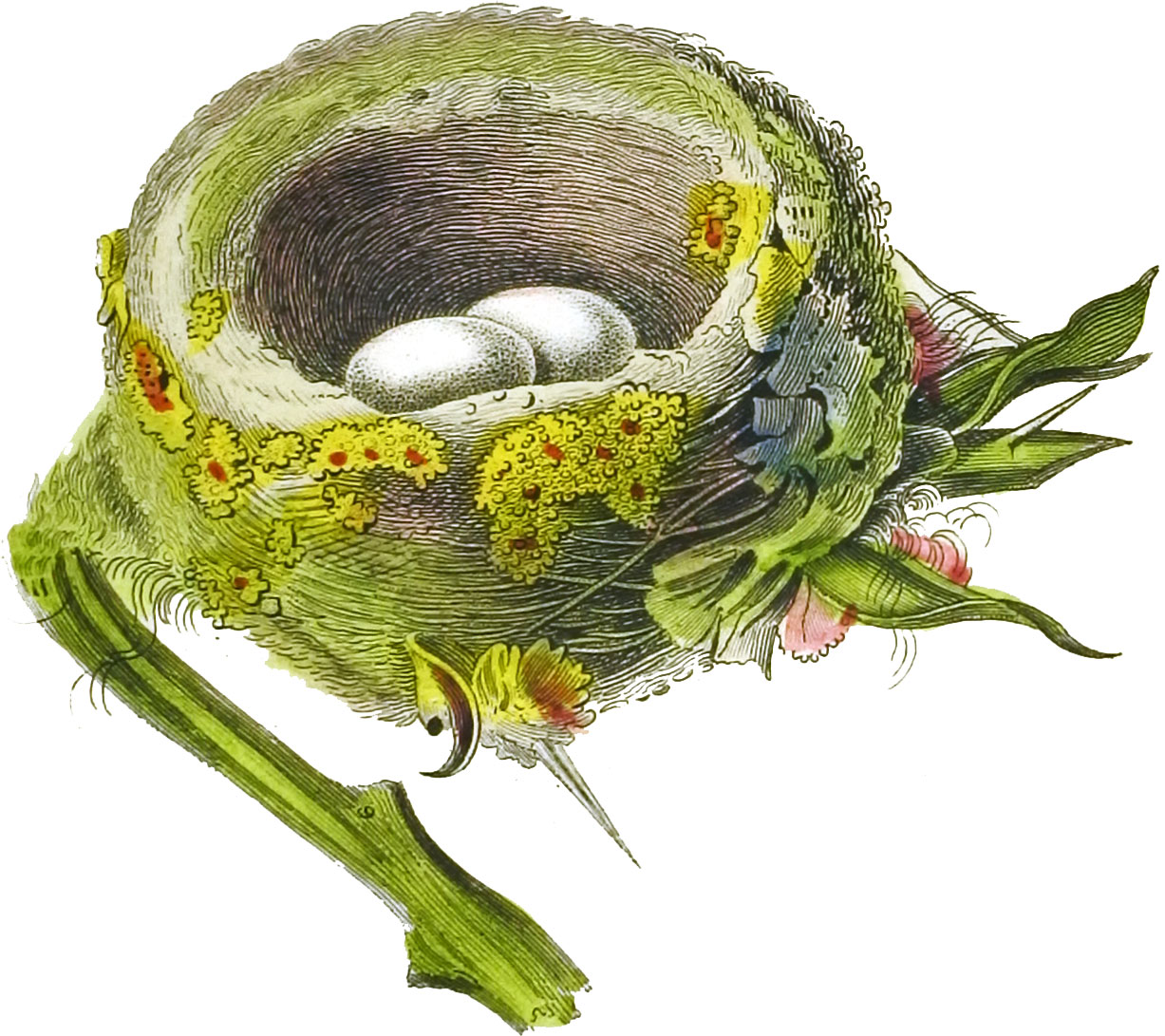
It is generally fixed on the upper side of a horizontal branch, not among the twigs. Yet I have known instances where it was attached by the side to an old moss-grown trunk; and others, where it was fastened on a strong rank stalk, or weed, in the garden. In the woods it often chooses a white oak sapling, and the branch is seldom more than ten feet from the ground. The nest is about an inch in diameter, and as much in depth; the outward coat is formed of small pieces of a species of bluish-gray lichen, that vegetates on old trees and fences, thickly glued with the saliva of the bird, giving firmness and consistency to the whole, as well as keeping out moisture. Within this are thick, matted layers of the fine wings of certain flying seeds, closely laid together; and lastly, the downy substance from the great mullein, and from the stalks of the common fern, lines the whole. The base of the nest is continued round the stem of the branch, to which it closely adheres, and when viewed from below, appears a mere mossy knot or accidental protuberance.
On the plains, near the Elk River, the nest of this hardy bird was built of the materials that were most appropriate in the country; the downy seeds of an anemone, bound with a few stalks of moss and lichen.
Lesson describes the nest of Trochilus pella as principally composed of a spongy cellular substance, apparently similar to that of a fungus of which some species of wasps build large habitations, suspended from the branches of trees in the virgin forests of Guiana; and the same naturalist has given a curious figure of the nest of T. cristata? composed entirely of the down of some thistle; the seed is attached, and is placed outwards, giving a jagged or prickly appearance to the outside, while the interior is warmly lined with the down. Dr Latham says, that the nest of the black humming-bird is also made of cotton, entwined round the thorns and twigs of the citron-tree, and is of so firm a texture as not to be easily broken by the winds and a nest of the topaz-crested humming-bird, now before me, about seven-eighths of an inch in diameter, is composed of the same materials, stuck over with lichens on the outside, and firmly fixed in the hanging cleft of some strong creeper by threads of a cottony substance, and very slender roots or tendrils, the whole lower part as if cemented by a thin coat of glue. It is probable that the greater number build their nests nearly in a similar manner, and in proportion to their size, though there are also some variation in the different forms, which a little more attention may allow us to introduce in our reasoning upon their affinities. Thus, in some valuable remarks accompanying a collection of birds from Tobago, we have, regarding the T. hirsutus, (provincially named doctor humming-bird,)—
It builds its nest suspended like that of the yellow-tail, (Cassicus crisiatus,) with the entrance somewhat downwards, and lays only one egg.
The nest received is of a lengthened form, composed of dried grass and slender roots, moss, &c., and does not show the compact manufacture of those previously described. It is suspended to the leaf of some reed-like plant, to which it is cemented chiefly by the threads of spiders or caterpillars. I trust erelong to procure some interesting answers to my queries from the same source. Our materials at present to judge from are, however, very scanty. There is one provision apparent in the whole, that for warmth,—and most necessary, when we consider the small bulk of the owners to retain the animal heat.
Most writers agree in the fact, that humming-birds lay only two eggs, but we have seen that the T. hirsutus lays only one. This small fecundity, with the many casualties which are liable to destroy them, the vicissitudes of season and the assaults of various animals, birds, and even insects, will give us some idea in what immense profusion these little birds exist, when two, or at most four, is the number of young reared in a season. The eggs are not so small in proportion as one would imagine on looking at the bird. That of the topaz-crested humming-bird is nearly \(\frac{5}{8}\) of an inch in length, and about \(\frac{3}{8}\) in diameter. In shape they are nearly a complete oval, and are pure and delicate white. The period of incubation is remarkably short. Latham says that the black humming-bird sits twelve days, and that the young leave the nest and follow their parents in eighteen days; and the North American species, according to Audubon, hatches only ten days, and the young are ready to fly in one week.
The desire to possess creatures of such beauty in a tame state, has induced persons often to try the experiment of keeping them in cages, though yet comparatively without success. The attempts which have been made, however, do not preclude a possibility, by perseverance, of ever bringing them to this country. Bullock said that he had nearly seventy in cages, that no bird was more easily reconciled to its new situation, and that by attention they, might easily have been brought to Europe. We learn also from Azara, Wilson, and other sources, that they have been frequently kept in their native countries for several months on sugar or honey and water, assisted by the insects which were attracted by and drowned in the sweets; and Charles Peale, proprietor of the Philadelphia Museum, reared two from the nest, which became so tame as to perch on Mrs Peale’s shoulder.
The only instance of their being carried to a different climate is thus related by Latham; and there can e little doubt, from the partial success of these attempts, that great care and greater experience, with a more perfect knowledge of their proper food, would enable them to reach this country, and perhaps adorn a separate apartment in some conservatory. The European summer birds of passage have been now successfully kept in confinement for several years, and an attempt upon similar principles might prosper.
It was a mango humming-bird (T. mango) which was successfully brought to England,—
A young gentleman, a few days before he sailed from Jamaica for England, met with a female humming-bird sitting on the nest and eggs, and cutting off the twig, he brought altogether on board. The bird became sufficiently tame to suffer herself to be fed on honey and water during the passage and hatched two young ones. The mother, however, did not long survive, but the young were brought to England, and continued for some time in the possession of Lady Hammond. The little creatures readily took honey from the lips of Lady Hammond, and though the one did not live long, the other survived for at least two months from the time of their arrival.
The food of the humming-birds was always considered to be only the honey or sweet juices extracted from the nectaria of flowers; but later observations have proved that this alone was not sufficient to preserve even such small bodies; and when we compare the structure of the tongue with that of birds which use that member for darting suddenly out and catching up small objects, we shall find considerable resemblance, and the adaptation is farther confirmed by the reality of their food being in a measure insectivorous. Audubon found even coleopterous insects in their stomach, and Wilson observes—
I have seen the humming-bird, for half an hour at a time, darting at those little groups of insects that dance in the air in a fine summer evening, retiring to an adjoining twig to rest, and renewing the attack with a dexterity that sets all other fly-catchers at defiance.
And in all the deep tubular flowers in which they so much delight, such as the different daturæ, the bignonacese, &c., I have no doubt that insects are as often withdrawn by their active and viscid tongue as any portion of the honey.
But of the various ways employed by these birds to procure an insect prey, the most singular as well as dangerous to themselves, is that of seizing the half-dead entangled flies from the webs of the large Mexican bird-spider—whose name implies a power to seize and detain some of the weaker at least of the feathered race. It is thus detailed by Mr Bullock, and is so curious that the account must be given without abridgement:—
The house I resided in at Zalappa for several weeks, on my return to Vera Cruz, was only one story high, enclosing, like most of the Spanish houses, a small garden in the centre, the roof projecting six or seven feet from the walls, covering a walk all round, and leaving a small space only between the tiles and the trees which grew in the centre. From the edges of these tiles to the branches of the trees in the garden, the spiders had spread their innumerable webs so closely and compactly, that they resembled a net. I have frequently watched, with much amusement, the cautious peregrinations of the humming-bird, who, advancing beneath the web, entered the various labyrinths and cells in search of entangled flies; but as the larger spiders did not tamely surrender their booty, the invader was often compelled to retreat. Being within a few feet, I could observe all their evolutions with great precision. The active little bird generally passed once or twice round the court, as if to reconnoitre his ground, and commenced his attack by going carefully under the nets of the wily insect, and seizing by surprise the smallest entangled flies, or those that were most feeble. In ascending the angular traps of the spider, great care and skill was required; sometimes he had scarcely room for his little wings to perform their office, and the least deviation would have entangled him in the complex machinery of the web, and involved him in ruin. It was only the works of the smallest spider that he durst attack, as the largest rose to the defence of their citadels, when the besieger would shoot off like a sunbeam, and could only be traced by the luminous glow of his refulgent colours. The bird generally spent about ten minutes in this predatory excursion, and then alighted on the branch of an avocata to rest and refresh himself.
In the preceding pages we have endeavoured to give a short history of the distribution and economy of this interesting family, deriving our information from those sources which we judged were most worthy of credence, and always, when possible, from observers who had seen the birds in their wild state, and untrammeled by any restraint. The examination of their structure will have the next claim to our attention, with its adaptation to the habits we have already attempted to describe.
When we examine attentively the structure of any bird, we soon come to the conclusion that the most important parts of its outward form are those organs which serve for the means of transporting it from place to place. On presenting a humming-bird to the most common observer, the first exclamation generally is, “What a beautiful little creature!” The second, “But what large wings it has!” Such, indeed, is the case, and in most instances the size of the wings and strength of their quills are entirely out of proportion to our ideas of symmetry in a creature clothed with feathers; but, upon comparing them with its necessities, and the other parts of its frame, their utility and design become obvious. All their other parts, not called into action during flight, are very slender, almost frail; their tarsi are short, and the feet small, so as not to incommode during flight, while they point out an inability for any long support, or assistance in procuring sustenance, by climbing or hanging in various positions, as we see employed by the titmice, and many of the slender-billed warblers. Their food is derived from the sweet nectar of flowers, or from insects which must either be taken in a rapid flight, or withdrawn from the deep tube, or cup-shaped recesses of blossoms which grow and hang in every direction, and which it would be impossible to reach, unless by suspension above or under. Another great necessity for their possessing organs of such power, is to enable them to pass in safety through the migrations, and the long flights which are sometimes necessary for their preservation, and during which they have often to withstand a passing gale, showers, or even the rigour of a snow-storm. The beautiful climes where we have seen they inhabit, are at seasons subject to perpetual rains, which drench and almost inundate their abodes, or to hurricanes, that in a few minutes leave only a wreck of all that was before so magnificent and luxuriant; and they pass by these means before the dangerous season, to districts where the reparation of a previous wreck is proceeding with all the magical rapidity of tropical vegetation.
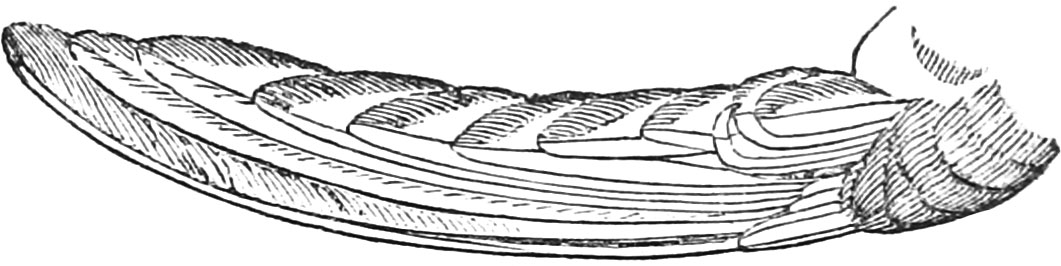
Humming-Bird Wing
The form of the wings is very nearly similar to those of the swift, (Cypselus, Illiger,) whose power of flight every one is acquainted with. They in general exceed the tail in length, unless when that member is extraordinarily developed. The exterior outline of the wing is very much curved, and the first quill is always longest, the others shortening gradually. The secondaries are very short, and the lesser wing-coverts occupy little space. The plumulets of the quills are narrow and compact, firmly united together, forming a substance, when used, almost like a thin plate of whalebone, and which, by presenting resistance to the air when struck, and allowing no part to pass through the webs, as in nocturnal feeding birds, produces that humming sound which is heard during their suspension, and whence their common name has been applied. In all, the shafts of the quills are remarkably strong and elastic, but in a few species, known under the denomination of sickle or sabre-winged humming-birds, and forming the genus Campylopterus of Swainson, they are developed to an extraordinary degree at the base, and nearly equal the breadth of the plume.
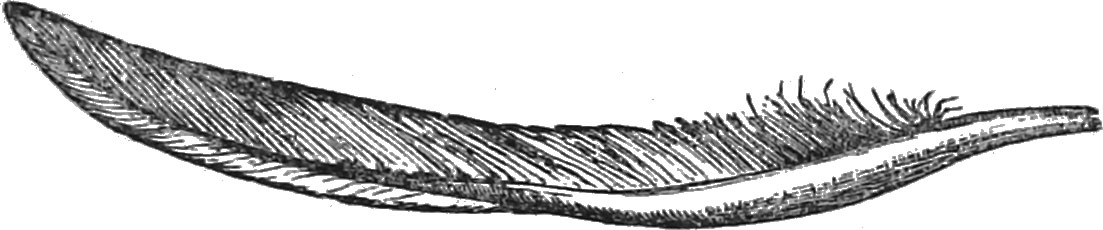
Humming-Bird Feather
The birds composing this division are large, but not the largest of the family; and our present information of their habits does not point out any peculiarity to which this development is adapted. It, besides, is wanting, or in a great measure reduced, in the females of some of them. Mr Swainson has figured two birds, which seem almost identical, except in the absence of the broad shaft in the one; and in specimens of the sabre-wing, which we have figured at Plate XXXIV, the shafts of the female bird were in breadth only about one-half.
The organ of next importance, as directing the flight, is the tail. This is always powerful, and presents every modification which we find in those birds endowed with powerful or rapid flight, and will be of use to the systematist in directing the forms which present themselves in analogy with the other families of the feathered race. In one species6 it presents a very curious anomaly among birds, by being composed of only six feathers. This species is rare, and I have had no opportunity for an examination; but the testimonies of Temminck and Lesson show that it is not an accidental variation, but that it remains constant in all the birds which they have examined.
The bill is always an important organ in birds. This family presents great modification of form, which will be seen by inspecting the plates, and will be farther illustrated when we characterise the divisions. But although most of the species are partly insectivorous, and take a great portion of their food in the air, we find no rictorial bristles or great development at the base, as among the truly insectivorous tribes; and except in one or two instances, no very evident appropriation of structure. In a few species the edges of the mandibles are toothed, (see Plates I. II. and III.,) and in the individuals which form the genus Ramphodon of Lesson, this member is furnished with recurved saw-like teeth, a manifest provision for more effectually securing some peculiar prey.

Humming-Bird Bill
The tongue and its accessory parts show a greater resemblance to the scansorial insectivorous birds, being in fact nearly similar in their formation to those of the woodpeckers. The os hyoides passes round the back part of the skull, and its horns, or extremities, when joined, reach forward beyond the line of the eyes.
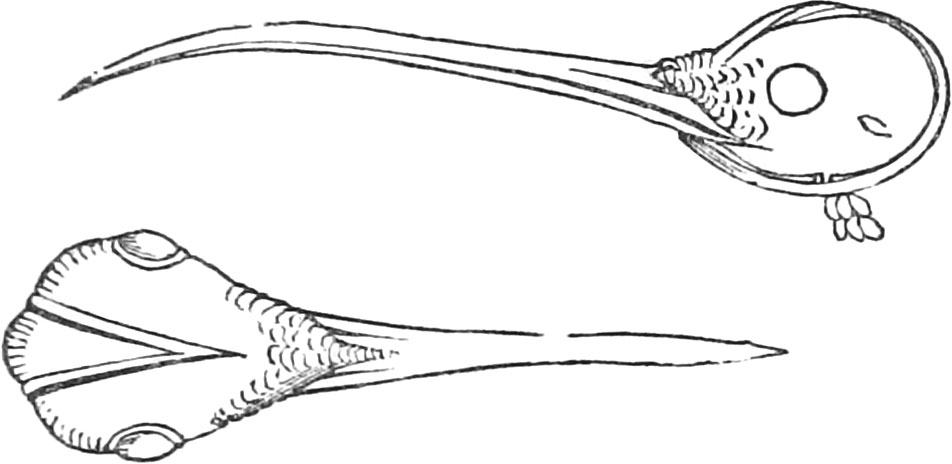
Humming-Bird Heads
The tongue is very long, and by the structure of its parts above mentioned, is retractile, and capable of being darted out with considerable force. It is composed, according to Brisson and Lesson, (which we have confirmed as far as the examination of the moistened parts would allow,) of two muscular tubes joined together for the greater part of their length; towards the tip, broadened or swelling, and, according to Lesson, terminated in a spoonlike point on the upper surface. They assist in retaining the different substances, which are immediately conveyed to the opening of the œsophagus by the contractility of the tubes. Our own examination, however, of the tongue of the Trochilus moschitus, relaxed with warm water, gave the appearance of a fimbriated opening at the tip, having the exterior margin of each fork set with recurved sharp-pointed pliable spines, as if to assist its viscidity in securing any substance seized by them.

Humming-Bird Tongue Tubes

Humming-Bird Tongue Opening

Humming-Bird Tongue Forks
Their feet, as we have before said, are small and slender, and in general present the form which we see among the kingfishers, bee-eaters, and jackamars. The claws are rather large in proportion, very much hooked, very sharp, and may thereby assist in securing a firmer grasp, but which is evidently little needed in their economy. For one purpose they would be useful, if Mr Bullock is correct in his observations; that gentleman remarks, that,
in sleeping they frequently suspend themselves by the feet, with their heads downwards, in the manner of some parrots.
The structure of the feathers, which shine with so much lustre, has occupied the attention of most of their describers. Audebert has tried to demonstrate the cause on mathematical principles, the form of the feathers, and the manner in which the light strikes them; while Lesson is of opinion, that the colours are due to elements contained in the blood, and diffused by circulation. He says, at the same time, that all the barbules and plumulets are deeply furrowed in the centre, and the light, when striking vertically, produces no colour, or only black; but when striking transversely, every opposite side of the furrow acts as a reflector to the others, and in this way assists in producing the colours,
Bullock, when speaking of the same subject, says, that
the preserved specimens were but the shadow in brilliancy to what they were in life. The reason is obvious; for the sides of the laminæ, or fibres of each feather, being of a different colour from the surface, will change when seen in a front or oblique direction and as each lamina or fibre turns upon the axis of the quill, the least motion, when living, causes the feathers to change suddenly to the most opposite hues.
We have thought it proper to mention those different opinions; and though they do not entirely coincide with our own, we are not at present able to explain all the causes. In birds possessing this shining and metallic variation of lustre, we have found the structure of the feathers exhibiting them so various, that the effects must be produced in several ways. Diagrams of many of these have been from time to time made; and when a little more complete, an opportunity will be taken of introducing them, in illustration of this curious subject.
Descriptions
The following plates, with their descriptions, have been made as much as possible from specimens of the birds themselves, but when these could not be procured, they are taken from those works which could be most relied upon for their accuracy. We have accordingly availed ourselves generally of Lesson’s splendid monograph of this family, and of Temminck’s Planches Colorieés. For the plate of the sabre-winged humming-bird, we are indebted to Mr Swainson, who kindly permitted his beautiful figure, in the first series of the Zoological Illustrations, to be copied, and specimens of the bird itself having since reached us, have served for the description.
The systematic arrangement of this family presents considerable difficulties. Mr Swainson has given the characters of what he considers the five leading groups, and has also formed several subgenera. M. Lesson has also instituted several families and genera, and we understand that Mr Lodiges, who possesses a collection unrivaled by any in Europe, has lately been engaged in working out their proper arrangement.
The desire to procure every information previous to forming any decided opinion, has therefore determined us to attempt no arrangement in the present volume, and, with two exceptions, to retain the whole under the family name of Trochilus. The genera which have been adopted, are illustrated in the first and last plates.
In a second volume now in preparation, it is intended to figure thirty-five or forty additional species, and with these to give the characters of the families and genera which have been instituted, illustrating the parts and dissections by woodcuts; to add a systematic synopsis of the species which have been described, and in this manner endeavour to complete the natural history of the group.
Spotted Saw-Billed Humming-Bird7
Ramphodon nævius.—Lesson.
Trochilus nævius, Dumont, Dictionnaire des Sciences Naturelles, x. 55.—Colibri tacbete, Trochilus nævius, Temminck, Planches Colorieés, cxx. fig. 3.—Le Ramphodon tacheté, Ramphodon maculatum, Lesson, Histoire Naturelle des Colibris, pl. i.
We mentioned in the introductory part of the work, that among the humming-birds we did not generally meet with, in the form of the bill, any evident provision for securing an insect prey as among the truly insectivorous tribes, farther than the retractile tongue. For the species now figured, there is, however, an exception in the strong and rather broad bill, furnished upon each edge of the mandibles with strong recurved teeth, evidently intended to assist in securing some peculiar prey, and reminding us by this formation, and the sharp hooked point, of some water-fowl which are provided with these requisites, for seizing a plunder at once slippery and vigilant. In none of the descriptions do we find any notice taken of the adaptation of this structure, and we are yet in the dark regarding the manner in which it is employed. In the two next plates, where the bill presents also a very curious form, we have the edges toothed in a weaker degree, and Mr Swainson is of opinion that the turned up form assists also in procuring some peculiar nourishment.
This species was discovered in Brasil by MM. Delalande and Naterer, chiefly on the mountains of Coreovado, in the vicinity of Rio Janeiro. It is not generally common in collections, though Lesson says that in Paris many specimens are now to be found.
The length of the bird, including the bill, is about five inches and a half; the crown, back, and shoulders, are olive green, with metallic reflections, which are much brighter on the shoulders and wing-coverts. The auricular feathers, and a patch extending down the sides of the neck, are of a bright reddish-brown, darker below the eye, and at the tips of the auriculars, where it assists in relieving a streak from the eye, of the same colour, but of a paler tinge. The wings are strong, and with the very powerful shafts, are of a rich purplish brown. The tail is very much rounded; the centre feathers, and the base of the outer ones, are of the same color, with the wings, and the tips of the outer feathers are of a pale yellowish brown, the pale colour covering the tip only of those next the centre, gradually extending in length upon those on the out side, and contrasting finely with the dark parts; the feet are remarkably small and slender. M. Lesson has formed from this species his subgenus Ramphodon, under which it should now stand. It is yet a solitary representative, and the female is unnoticed by any ornithological writer.

Plate I
Male
Avoset-Billed Humming-Bird
Trochilus avocetta.—Lesson.
L’Oiseau-mouche avocette, Ornismya avocetta, Lesson, Histoire Naturelle des Oiseaux-mouches, pl. xxiv.
The curious form and structure of the bill of the birds figured on this and the following plates, first attracted the attention of Mr Swainson, who gave an excellent representation of the latter on plate 105 of his Illustrations, from specimens procured in Peru by Mr Bullock. Upon the publication of M. Lesson’s beautiful monograph of this family, he was obliged to have recourse to Mr Swainson’s figure, to gratify (he observes) the French amateurs with the representation of a bird so rare and curious, no specimen at this time existing in the Paris collections. Soon after, an accession of species previously unknown to him, occasioned the continuation of the monograph by a supplement, and he has in it figured two birds, the one as identical with T. recurvirostris, Swainson, the other given under the title of T. avocetta, and considered by that ornithologist as the young of some new and undescribed species. There is very considerable alliance between them, but it is impossible to decide, without a more extensive examination of specimens than we at present possess; and copies of Lesson’s beautiful plates have been introduced, more from the desire to exhibit the curious form of the bill, than to discriminate the species.
We provisionally retain Lesson’s name for this bird, and nearly translate his description. With the next, the descriptions of both Lesson and Swainson are given.
The individual from which the accompanying plate was taken, is part of the collection of M. Longuemare in Paris, and was received from Cayenne. The length is about three inches and six lines, of which the bill occupies nearly seven lines; the bill is black, rather strong, assumes a singular bend upwards, and has the extremity of each mandible very fine, and slightly flattened. The wings equal the tail in length, and are of a brownish purple; the tail is large, and on both sides is of a dull blackish blue; the upper part of the head, the back, rump, and shoulders, are of a golden green; a patch of emerald green occupies the forepart of the neck, and is bordered by a lateral line of white, which reaches almost to the crissum; from the green of the neck, a broad patch of deep black stretches along the centre of the belly, and is also bordered by the white streak above mentioned; the flanks are of a greenish brown, and the under coverts are brownish.

Plate II
Recurved-Billed Humming-Bird
Trochilus recurvirostris.—Swainson.
Recurved-billed Humming-bird, Swainson, Zoological Illustrations, 1st series, pl. cv.—Oiseau-mouche à bec recourbé, Ornismya recurvirostris, Lesson, Histoire Naturelle des Oiseaux-mouches, pl. xxxvii. p. 129, and Supplement, pl. xxxiv. p. 166.
It has been asserted by some ornithologists, that the curvature of the bill in these buds was an accidental formation, or received in transportation, from the position in which the specimen was laid. This was maintained as long as Mr Swainson’s specimen was the only one generally known; but we have already mentioned two with the same formation, and Lesson says, that he has seen six or seven individuals having the upward bend; there can be no doubt, therefore, that it is a peculiarity of structure which will have its use in the economy of the species.
The specimen used for this figure, had not quite attained the complete plumage. The length was about three inches and three lines, that of the bill about nine lines; the latter is black, strong, much bent, and ending in a fine depressed point. The dorsal surface of the upper mandible is straight, and becomes at once curved. The upper part of the body, from the forehead to the tail-coverts, is of a bluish green, with metallic reflections; the throat, forepart, and sides of the neck, extending to the upper part of the breast, are of a brilliant emerald green; a grayish-brown line crosses the middle of the belly, reaching to the crissum, which is white. The flanks and under tail-coverts are golden green, and the plumes covering the thighs are whitish. The tail is composed of feathers of unequal length, the outer ones being gradually shorter than those in the middle. They are golden green in the centre, bluish at the sides, and above present a bronzed reddish tinge. The wings are blackish purple, and reach to the extremity of the tail.
A comparison of the above description by Lesson, and of what follows from Swainson’s Illustrations, with that of the former plate, will point out the distinctions between T. avocetta and T. recurvirostris.
Mr Swainson observes as follows:—
The extraordinary formation in the bill of this beautiful little creature, is without parallel in any land bird yet described, and presents in miniature a striking resemblance to that of the avoset. It is almost impossible to conjecture rightly the use of this singular formation; but it appears to me not improbable, that the principal sustenance of the bird may be drawn from the pendant bignonaceæ, and other similar plants, so common in South America, whose corollæ are long, and generally bent in their tube the nectar being at the bottom, could not be reached either by a straight or a curved bill, though very easily by one corresponding to the shape of the flower.
Bill black, depressed along the whole length, but more especially at the tip, which is rounded, thin, obtuse, and recurved in both mandibles, the under of which, towards the middle, has a convex swelling, which gives the recurvature a stronger appearance. All the upper plumage and body beneath golden green; the throat to the breast shining with scale-like feathers, of a vivid emerald green; from the breast to the vent is a stripe of black down the middle thighs white; tail even; the two middle feathers dull greenish blue, the rest above obscure coppery brown, but beneath of a rich shining topaz colour.
It was purchased at Bullock’s sale, and that gentleman received it from Peru.
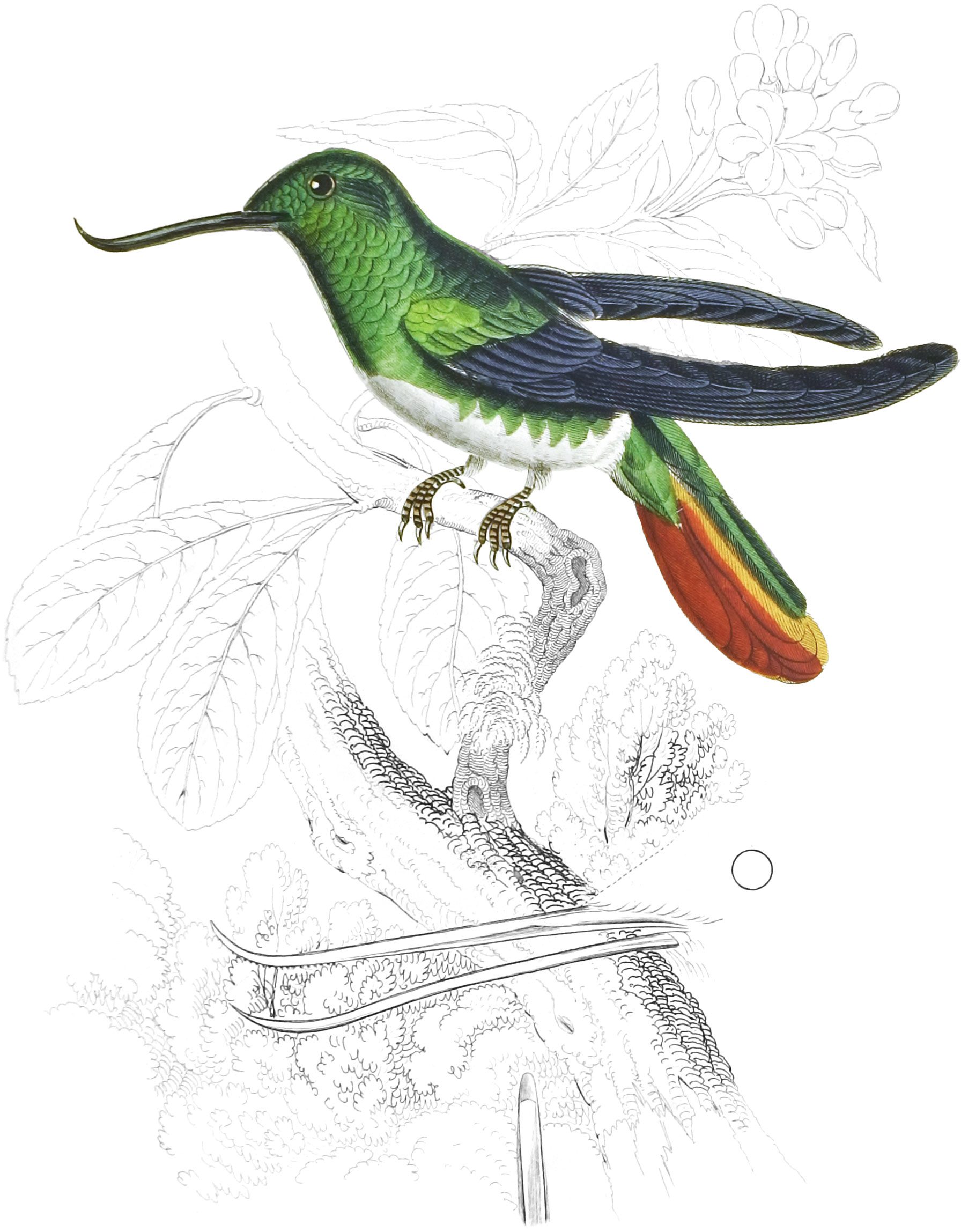
Plate III
Young
Rufous-Bellied Humming-Bird
Trochilus rufigaster.—Vieillot.
Colibri à ventre roussâtre, Temminck, Planches Colorieés, pl. cxx. fig. 2, female.—Le Colibri à ventre roux, Lesson, Histoire Naturelle des Colibris, pl. ix. male.
According to the work of M. Lesson, perhaps at present the best authority for the distinction of species in this beautiful tribe, this bird is not identical with the Trochilus Brasiliensis of Dr Latham; and it has also been confused with some states of the “Brin blanc,” T. superciliosus, and with the T. squalidus of Temminck and Natterer, though we should have thought the difference of size presented by the former, sufficient to distinguish it. We give the description of Lesson, which accompanies the copy used for our plate. The entire length is scarcely three inches, of which the bill will make about eleven lines; that member is lengthened, slender and bending, yellow at the base, and blackish towards the tip; the head, upper part of the neck, and back, are of a bronzed green, which passes into a rich cinnamon colour upon the rump; the wings small and narrow, of a brownish purple; the throat is whitish; the sides of the neck, breast, belly, and flanks, of a soft shining rufous colour. A narrow line borders the auriculars, and a blackish spot is seen in the middle of the throat; the tail is composed of narrow brown feathers, is wedge-shaped, tipped with reddish. It is a native of Brasil.

Plate IV
Male
Northern Humming-Bird
Trochilus colubris.—Linnæus.
Red-throated Humming-bird, Edwards, Pennant, Latham.—Trochilus colubris, Bonaparte The Humming-bird, Wilson’s North American Ornithology, pl. x. figs. 3 and 4.—The Ruby-throated Humming-bird, Audubon, Ornithological Biography, pl. xlvii. vol. i. p. 248.—Northern Humming-Bird, Northern Zoology, vol. ii. p. 323.—Le petit rubis de la Caroline, Omismya colubris. Lesson, Histoire Naturelle des Oiseoux-mouches, pls. lxviii xlviii. bis, p. 151.
Where is the person, who, on seeing this lovely little creature moving on humming winglets through the air, suspended as if by magic in it, flitting from one flower to another, with motions as graceful as they are light and airy, pursuing its course over our extensive continent, and yielding new delights wherever it is seen—where is the person, I ask of you, kind reader, who, on observing this glittering fragment of the rainbow, would not pause, admire, and instantly turn his mind with reverence towards the Almighty Creator, the wonders of whose hand we at every step discover, and of whose sublime conceptions we everywhere observe the manifestations in his admirable system of creation? There breathes not such a person.
It is in these words that the enthusiastic Audubon commences the description accompanying his beautiful illustration of these hardy little birds, and with the answer, they are equally applicable to the whole of this numerous family.
For the natural history of the Carolina or Northern Humming-bird, we are principally indebted to the observations of Alexander Wilson, and the ornithologist just now quoted; and their descriptions, taken from reality, being Superior to any thing we could supply, the greater part of them will be now used. We remarked in the Introduction, that the humming-birds, with two exceptions, were wanting to the northern continent of America, being apparently unable, from their delicate structure, to bear the severities of a hardier climate, and where the limited supply of the gorgeous plants, and their inhabitants, which form so prominent a feature in the forests of the southern division, would afford a scantier nourishment. Our present species is one of the most hardy, and bears a range of temperature almost from Tropical heat to the rigour of an Arctic latitude, having been lately observed as far north as the plains of the Saskachewan, and the banks of Elk River. It is only during summer that an excursion of such distance is made, and we find their arrival, during migration, occurring at different periods, in various parts of the Canadas and United States. We learn from the American Ornithology,
About the 25th of April, the humming-bird usually arrives in Pennsylvania; and about the 10th of May, begins to build its nest. In the Savanna in Georgia, it appears from the south about the 23d of March, two weeks earlier than it does sixty miles higher up the country.
The nest is generally fixed on the upper side of a horizontal branch, not among the twigs, but on the body of the branch itself. Yet I have known instances where it was attached by the side to an old moss-grown trunk; and others where it was fastened on a strong rank stalk, or weed, in the garden; but these cases are rare. In the woods it very often chooses a white oak sapling to build on; and in the orchard or garden, selects a pear-tree for that purpose; the branch is seldom more than ten feet from the ground. The nest is about an inch in diameter, and as much in depth; the outward coat is formed of small pieces of a species of bluish-gray lichen, that vegetates on old trees and fences, thickly glued over with the saliva of the bird, giving firmness and consistency to the whole, as well as keeping out moisture; within this are thick matted layers of the fine wings of certain flying seeds, closely laid together; and lastly, the downy substance from the great mullein, and from stalks of the common fern, lines the whole. The base of the nest is continued round the stem of the branch, to which it closely adheres; and when viewed from below, appears a mere mossy knot, or accidental protuberance. The eggs are two, pure white, and of equal thickness on both sides. On a person approaching their nest, the little proprietors dart around with a humming sound. The precise period of incubation I am unable to give; but the young are in the habit, a short time before they leave the nest, of thrusting their bills into the mouths of their parents, and sucking what they have brought them. As I have found their nests with eggs so late as the 12th July, I do not doubt but that they frequently, and perhaps usually, raise two broods in the same season.
Their only note is a single chirp, not louder than that of a small cricket or grashopper, generally uttered while hovering from flower to flower, or when engaged in a fight with his fellows; for when two males meet at the same bush or flowers, a battle instantly takes place; and the combatants ascend in the air chirping, darting, and circling around each other, till the eye is no longer able to follow them. The conqueror, however, generally returns to the place to reap the fruits of his victory. I have seen them attack, and for a few moments tease the king-bird; and have also seen him, in his turn, assaulted by a humble bee, which he soon put to flight.
The singularity of this little bird has induced many persons to attempt to raise them from the nest, and accustom them to the cage. Mr Coffer of Fairfax, county Virginia, raised and kept two for some months in a cage, supplying them with honey dissolved in water, on which they readily fed. As the sweetness of the liquid frequently brought small flies and gnats about the cage, the birds snapped and swallowed them with eagerness, so that these insects formed no inconsiderable part of their food.
And in the summer of 1803, Wilson himself succeeded in raising and keeping some young ones for nearly three months, and might have extended the period, had they not been injured by flying about the room. He thus relates the circumstance:—
In the summer of 1803, a nest of young humming-birds was brought me, that were nearly fit to fly. One of them actually flew out by the window the same evening and falling against a wall, was killed. The other refused food, and the next morning I could but just perceive that it had life. A lady of the house undertook to be its nurse, placed it in her bosom, and as it began to revive, dissolved a little sugar in her mouth, into which she thrust its bill, and it sucked with great avidity, and in this manner it was brought up until fit for the cage. I kept it upwards of three months, supplied it with loaf-sugar dissolved in water, which it preferred to honey and water, gave it fresh flowers every morning sprinkled with the liquid, and surrounded the space in which I kept it with gauze, that it might not injure itself. It appeared gay, active, and full of spirit, hovering from flower to flower, as if in its native wilds, and always expressed, by its motions and chirping, great pleasure at seeing fresh flowers introduced into its cage.
This little bird is extremely susceptible of cold, and if long deprived of the animating influence of the sunbeams, droops and soon dies. A very beautiful male was brought me this season (1809,) which I put into a wire cage, and placed in a retired shaded part of the room. After fluttering about for some time, the weather being uncommonly cool, it clung to the wires, and hung in a seemingly torpid state for a whole forenoon. No motion whatever of the lungs could be perceived, on the closest inspection; though at other times this is remarkably observable; the eyes were shut, and when touched by the finger, it gave no signs of life or motion. I carried it out to the open air, and placed it directly in the rays of the sun, in a sheltered situation. In a few seconds, respiration became very apparent; the bird breathed faster and faster, opened its eyes, and began to look about, with as much seeming vivacity as ever. After it had completely recovered, I restored it to liberty; and it flew off to the withered top of a pear-tree, where it sat for some time dressing its disordered plumage, and then shot off like a meteor.
The flight of the humming-bird from flower to flower, greatly resembles that of a bee; but is so much more rapid, that the latter appears a mere loiterer to him. He poises himself on the wing, while he thrusts his long slender tubular tongue into the flowers in search of food.
And Mr Audubon adds,
during their migration they pass in long undulations. I have not, however, been able to assure myself whether they migrate during the day or by night, but am inclined to think the latter the case, as they seem to be busily feeding at all times of the day, which would not be the case, had they long flights to perform at that period.
This humming-bird has generally been supposed to live only on honey or liquid sweets, but Wilson observes,
I can speak decisively on this subject, having seen the humming-bird for half an hour at a time darting after those little groups of insects that dance in the air in a fine summer’s evening, retiring to an adjoining twig to rest, and renewing the attack with a dexterity that sets all our other fly-catchers at defiance. It is well known that they are particularly fond of tubular flowers, where numerous small insects resort, and there is every reason for believing that they are as often in search of these insects as of honey, and that the former compose at least as great a portion of their usual sustenance as the latter.
The Northern Humming-bird is three inches and a half in length, and four and a quarter in extent; the whole back, upper part of the neck, sides, under the wings, tail-coverts, and two middle feathers of the tail, are of a rich golden green; the tail and wings are deep brownish purple; the sides of the belly, and belly itself, dusky white, mixed with green. But what constitutes the chief ornament of this little bird, is the splendour of the feathers of his throat, which, when placed in a proper position, glow with all the brilliancy of the ruby. These feathers are of singular strength and texture, lying close together like scales, and vary, when moved before the eye, from a deep black to a fiery crimson and a burning orange. The female is destitute of this ornament, which is white, with all the other under parts, and the tip of the tail feathers. The young birds have the under parts brownish white, and are somewhat lighter in the under parts. The males begin to acquire the red feathers on the throat about autumn, but they are not complete before the following season.
The same ornithologist, to whom we have been so much indebted for the history of this bird, has also made it the subject of a poem, which we cannot now omit.
When morning dawns, and the bless’d sun again
Lifts his red glories from the eastern main,
Then round our woodbines, wet with glittering dews.
The flower-fed humming-bird his round pursues,
Sips with inserted tube the honied blooms,
And chirps his gratitude as round he roams
While richest roses, though in crimson dress’d.
Shrink from the splendour of his gorgeous breast.
What heavenly tints in mingled radiance fly
Each rapid movement gives a different die;
Like scales of burnish’d gold they dazzling show.
Now sink to shade—now like a furnace glow!
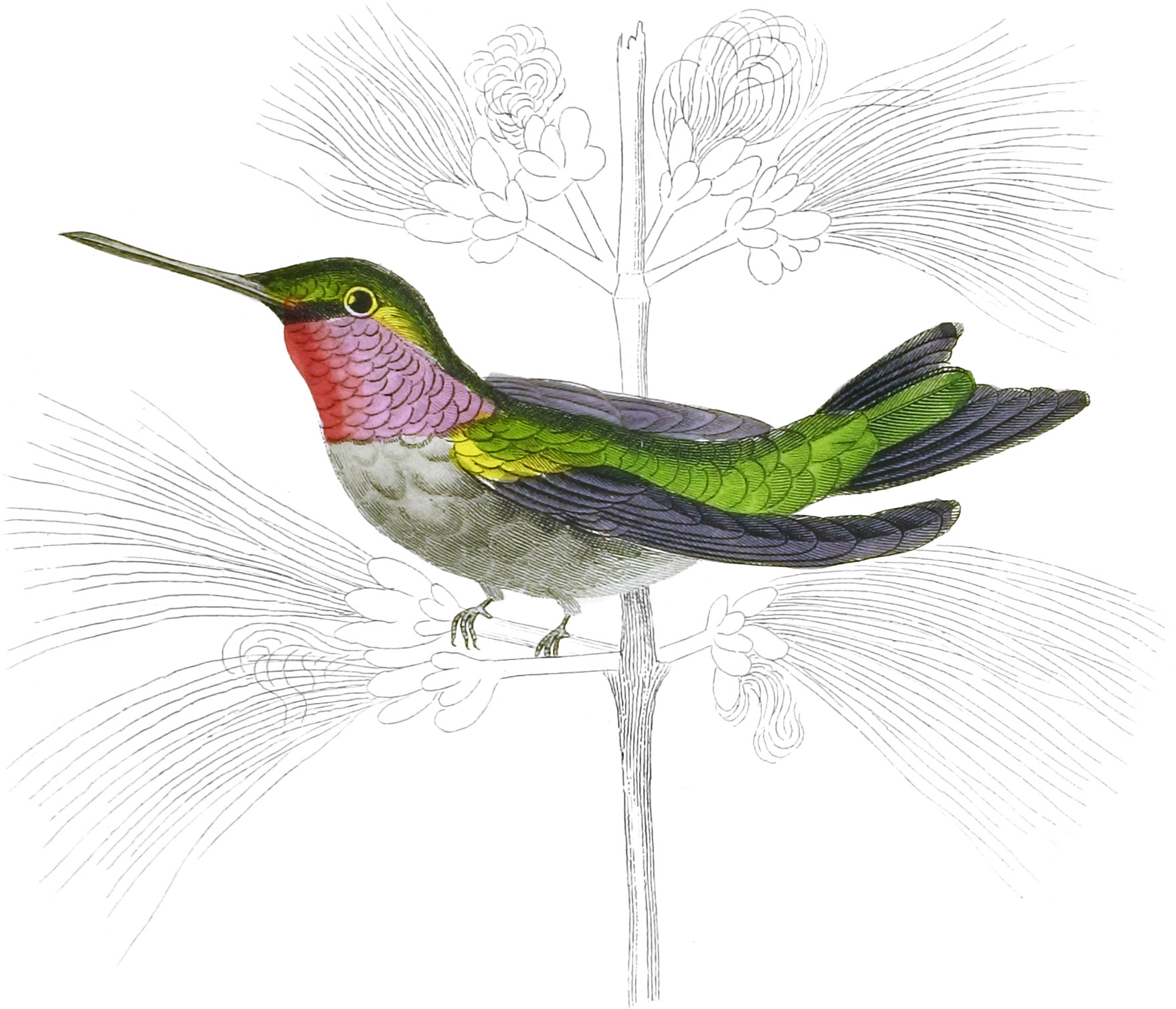
Plate V
Dutchess of Rivoli’s Humming-Bird
Trochilus Anna.—Lesson.
Oiseau-mouche Anna, Ornismya Anna, Lesson, Histoire Naturelle des Oiseaux-mouches, pl. lxxiv.
This very beautiful species is said by M. Lesson to be entirely new and unfigured, and he has dedicated it to the Dutchess of Rivoli, (using her Christian name,) whom, with her husband, he has extolled as enthusiastic naturalists. It was discovered in California, by Dr Botta, and introduced in 1829 to the Paris collections, but without any notice of its habits.
This bird is about three inches and five lines in length. The wings, equaling the length of the tail, are of a purplish brown. The tail, very slightly forked, is brown, except the centre feathers, which are green, with metallic lustre. But the most marked feature in the colouring of the plumage is a cowl, of the richest changeable amethystine red, which covers the upper part of the head, and with a more purplish tinge surrounds the eyes, covering the cheeks, and continued upon the throat and forepart of the neck lengthways on each side. The feathers composing this part, as in the greater number of other species, present the scaly form, and to the touch feel soft like velvet. The upper parts of the neck, back, rump, and lesser wing-coverts, are bright golden green; the forepart of the throat, and lower parts, are greenish, mingled with gray, becoming whitish as they approach the tail.
The young birds have the upper parts of a duller tinge, beneath gray, and the scaly patch is much less brilliant, and loses the scaly texture of the feathers.

Plate VI
Blue-Green Humming-Bird
Trochilus cyaneus.—Vieillot.
Oiseau-mouche verazur, Ornismya cyanea, Lesson, Histoire Naturelle des Oiseaux-mouches, pl. lxxi. p. 199.
This species was discovered in Brasil, by MM. Langsdorff and Delalande, and, according to Lesson, was first described by Vieillot, in 1818. It is of small size, being scarcely three inches in length, including the bill and tail. The bill is of a clear yellow, brownish at the tip, slightly dilated at the base; the crown is of a dull green, changing with the light to a pure and brilliant blue; the throat is a mixture of grayish and rich ultramarine blue, according to the position, and in the centre has the plumes of a scaly form and of a brighter hue; the neck, back, and lesser wing-coverts, are of a golden green; the rump and tail-coverts green, with reddish or bronze reflections; the wings, equal in length to the tail, are narrow, and of a purplish black; the tail is slightly forked, and of a uniform steel blue; the breast green, or clear blue, according to the position, changing to brownish green on the belly; the vent is white, and forms a distinct mark between the green of the belly and brown of the under tail-coverts. The young have the blue of the throat less clear, and the under parts more mingled with gray; the bill is also brown, where it is yellow in the adults.
The female has not been discovered.
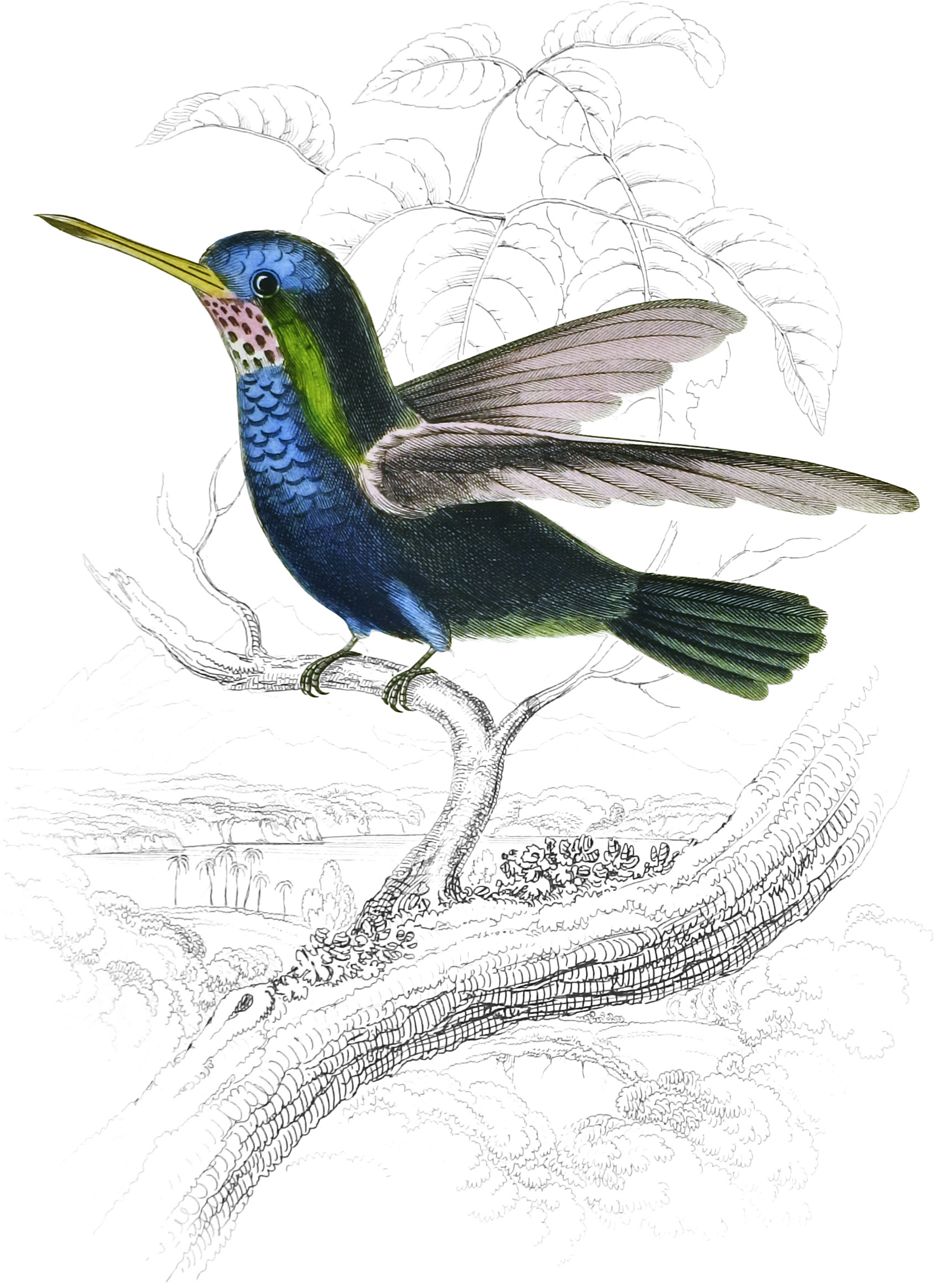
Plate VII
Golden-Green Humming-Bird
Trochilus prasina.—Lesson.
L’Orvert, Omismya prasina. Lesson, Histoire Naturelle des Oiseaux-mouches, pl. lxv.
Lesson considers the species to which he has given the name of prasina distinct from T. viridissimus of modern authors, but identical with the T. viridissimus of Linnæus and Latham. It is a native of Brasil, and certainly yet very little known in collections.
The entire length of this beautiful little bird is about two inches and eight lines, of which the bill makes up seven lines, and the form is in general delicate. The whole plumage, excepting the vent, is of a very deep golden green, but with a clear brilliant and changing lustre, occasionally of a bluish tint; the plumes on the forehead, and breast, presenting the greatest brightness, and assuming the scaly form. The vent is whitish; the wings are brownish purple, of a narrow form, and firm texture; the tail dull indigo blue, broad, and slightly rounded. The plumage of the young birds, and the female of this species seem yet imperfectly known. Dr Latham, under his T. virdissimus, mentions three varieties, one of them having the under parts from the chin to the vent white, the others not materially differing.

Plate VIII
Azur-Crowned Humming-Bird
Trochilus quadricolor.—Vieillot.
Trochilus quadricolor, Vieillot.—Oiseau-mouche à tête d’azur, Omismya cyanocephala. Lesson, Histoire Naturelle des Oiseaux-mouches, Supplement, pls. xvii. and xviii.
This very beautiful species has been described by Vieillot by the name we have adopted, as that of its prior describer; and although perhaps not quite so applicable as that given by Lesson, it should be adopted. We are at a loss to understand why that ornithologist has introduced so many changes of nomenclature in his beautiful monograph.
An inspection of the plate will show a difference of form from any of those previously described; and it is probable that this species will form the type, or a very marked individual, in one of the subdivisions. The total length is nearly four inches; the bill is straight, rather enlarged at the base, and of a clear yellow, except the tip, which is black; the tarsi are very short; a patch, or cowl, of brilliant blue, covers the crown, extending to the occiput, from the rictus, in a line beneath the eyes. The upper parts of the body are of a brilliant golden green, and the under parts of a chaste and clear white; the wings are large, equaling the tail in length, and of a purplish brown; and the tail is composed of broad and strong feathers. In the birds of one year, the upper parts assume a grayer tinge; and below, the white is less pure, becoming browner on the flanks and vent. The bill also wants its clearness, and the beautiful azure crown only begins to appear as age advances. The species has yet been only brought from Brasil.

Plate IX
Delalande’s Humming-Bird
Trochilus Delalandii.—Vieillot.
Trochilus Delalandii, Vieillot, Dictionnaire d’Histoire Naturelle; Temminck, Planches Colorieés, pl. xviii. figs. 1, 2.—Le Plumet bleu Omismya Delalandii, Lesson, Histoire Naturelle des Oiseaux-mouches, pl. xxiii. male; pl. xxiv. female.
This remarkable humming-bird was discovered in Brasil by MM. Delalande and Ménétrier, and has been dedicated by Vieillot to the first of these naturalists. The crown of the male is adorned with a beautiful crest, composed of short feathers, with generally one narrow and elongated, which rises in the centre to an inch in length; it is of a rich and deep blue, tipped with white, and appears very graceful, either when erected, or reclining and folded at rest. Behind the eye, upon the auriculars, there is a small, nearly circular patch of clear white, which forms a conspicuous object. The forepart of the throat, breast, and belly, are rich azure blue, surrounded with gray the head, back, flanks, and wing coverts, bright and shining green; the vent and flanks are gray; the wings are brownish purple; the centre feathers of the tail of the colour of the upper parts; the remaining feathers are dull blue, and the outer feathers have a conspicuous spot of clear white at the extremities.
The female is nearly of the same size with the male, but wants the beautiful crest; the upper parts are of a golden green, but less shining, and the under parts, instead of the fine azure, are of a clear gray. The white auriculars and spots on the outer tail feathers are, however nearly as conspicuous as in the other sex.
From this species, and another lately discovered, having the lengthened crest of a lilac colour, Mr Lodiges proposes to form a genus Cephalepis. The lilac-crested bird is from the Rio Grande, and has been dedicated to Mr Lodiges.

Plate X
Ruby-Crested Humming-Bird
Trochilus moschitus.—Linnæus.
Trochilus moschitus, Linnæus; Gmelin, 494.—Ruby-crested Humming-bird, Edwards’ Gleanings, pl. cccxliv.; Latham, General History of Birds, vol. iv. p. 330.—Le Rubis Topaz, Omismya moschita, Lesson, Histoire Naturelle des Oiseaux-mouches, pis. lii. liii. liv. p. 166.
This common, but beautiful species, presents perhaps some of the most splendid colouring of any of the family. The upper part of the head and throat are clothed entirely with the scaly-formed feathers, which always compose the parts producing the changeable colours. On the hind head the feathers are elongated, and form a short rounded crest. In one position, this part appears of a deep sombre reddish brown; when viewed transversely, it assumes a bright coppery lustre; and when looked upon directly, with a side stream of light, it becomes of the richest and most brilliant ruby red. The scaly part of the throat and breast again, when wanting the lustre, is of an equally sombre greenish brown; and when held in different lights, changes from a clear golden green to the most brilliant topaz yellow. It is impossible to convey by words the idea of these tints; and having mentioned those substances to which they approach nearest, imagination must be left to conceive the rest. The other parts of this bird are darkly coloured; the back and rump, breast and belly, are a rich brown, with scarcely any variation of colour, and the vent is pure white. The wings are of the purplish brown, so common in this part to the whole species; and the tail, broad and expansive, is a fine reddish brown, with a narrow band of a dark shade at the tip. The length is about three inches and a half. In some species the colour of the back is so dark around the ruby crest, as almost to appear a black band.
In the birds of one year, the scaly parts on the head and throat are of a brownish gray, a few of the bright feathers here and there appearing, and the other parts of the plumage have generally a lighter tinge. In another specimen which we possess, apparently that of a still younger male, the upper parts are of a grayish brown, with rather conspicuous golden green reflections, the under parts of a clear grayish white, darker on the throat and forepart of the breast, and the quills want the purplish lustre.
The female differs considerably from the male. It is scarcely three inches in length; above, it is of a brilliant golden green; the under parts of a clear grayish brown. But the tail shows the greatest difference in markings; the two centre feathers are a bronzed green; the base of the others are of the same rufous colour with that of the male; next there is a band of bronzed green, nearly equal in breadth with the reddish colour, and this again is succeeded by a white conspicuous tip to each feather.
The nest is remarkable for warmth and compactness; the sides being formed almost entirely of cottony substances, and only on the outside patched with the leaves of lichens.
In distribution this species seems to have a wide range, is common in most of the West India islands, besides many parts of the southern continent.
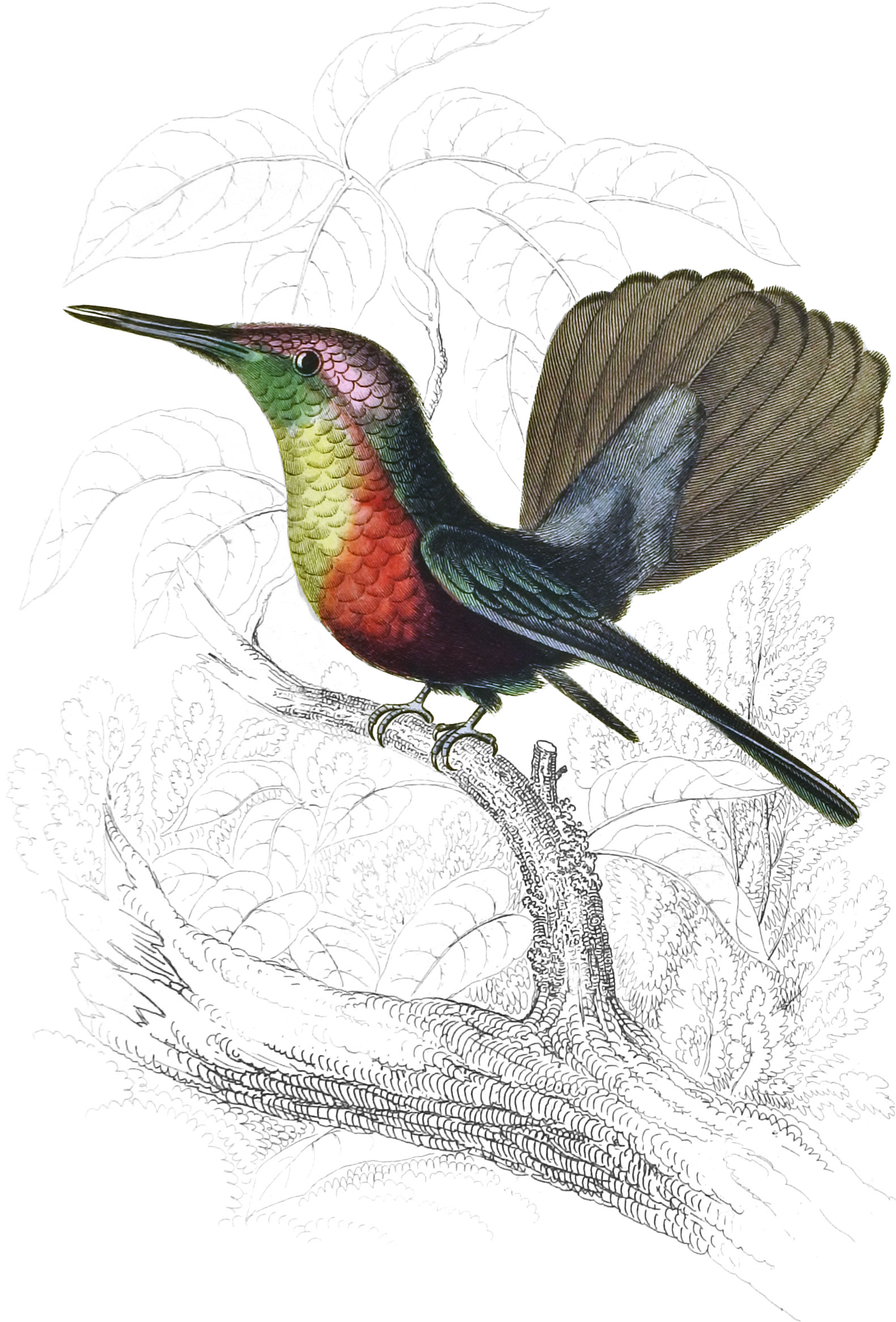
Plate XI
Violet-Crowned Humming-Bird
Trochilus sephanoides.—Lesson and Garnot.
Orthorhynchus sephanoides, Lesson et Garnot, Zoologie de la Coquile, pl. xxxi. fig. 2.—L’Oiseau-mouche a Couronne Violette, Omismya sephanoides, Lesson, Histoire Naturelle des Oiseaux-mouches, pl. xiv. p. 69.
Lesson, in his synopsis of this family, has introduced as a synonyme to the violet-crowned humming-birds, Melisuga Kingii of Vigors, described by that gentleman in the Zoological Journal; but in the monograph of the former naturalist no mention is made of the strongly acuminated tail feathers, which are mentioned as so distinguishing a mark by both Captain King and Mr Vigors; we have therefore for the present omitted it, until we have better grounds for the conjunction. We presume Lesson has not compared his specimens with those brought home by Captain King.
The discovery of the species, we believe, is due to MM. Lesson and Garnot, who met with it during the voyage of the Coquile, and have described and figured it in the splendid volume devoted to the natural history of that expedition.
It inhabits Chili, and was met with in the woods surrounding the Bay of Conception, near Talcaguano. They were generally found at mid-day, enjoying the flowers of a scarlet loranthus, which abounded in a honied juice. It was in that district a bird of passage, retiring north during winter.
This species is about four inches in length, and in form is stronger than many of its congeners, and the shafts of the quills are of more than ordinary strength. The crown is adorned with violet plumes, forming a sort of cowl, lengthened towards the occiput. The upper parts of the body are of a golden green, which also tinges the wings and tail. The throat is white, the plumage composed of scaly feathers, each marked in the centre with an oval brownish spot; the breast and belly are reddish white; the tail and, wings brown, with violet reflections.
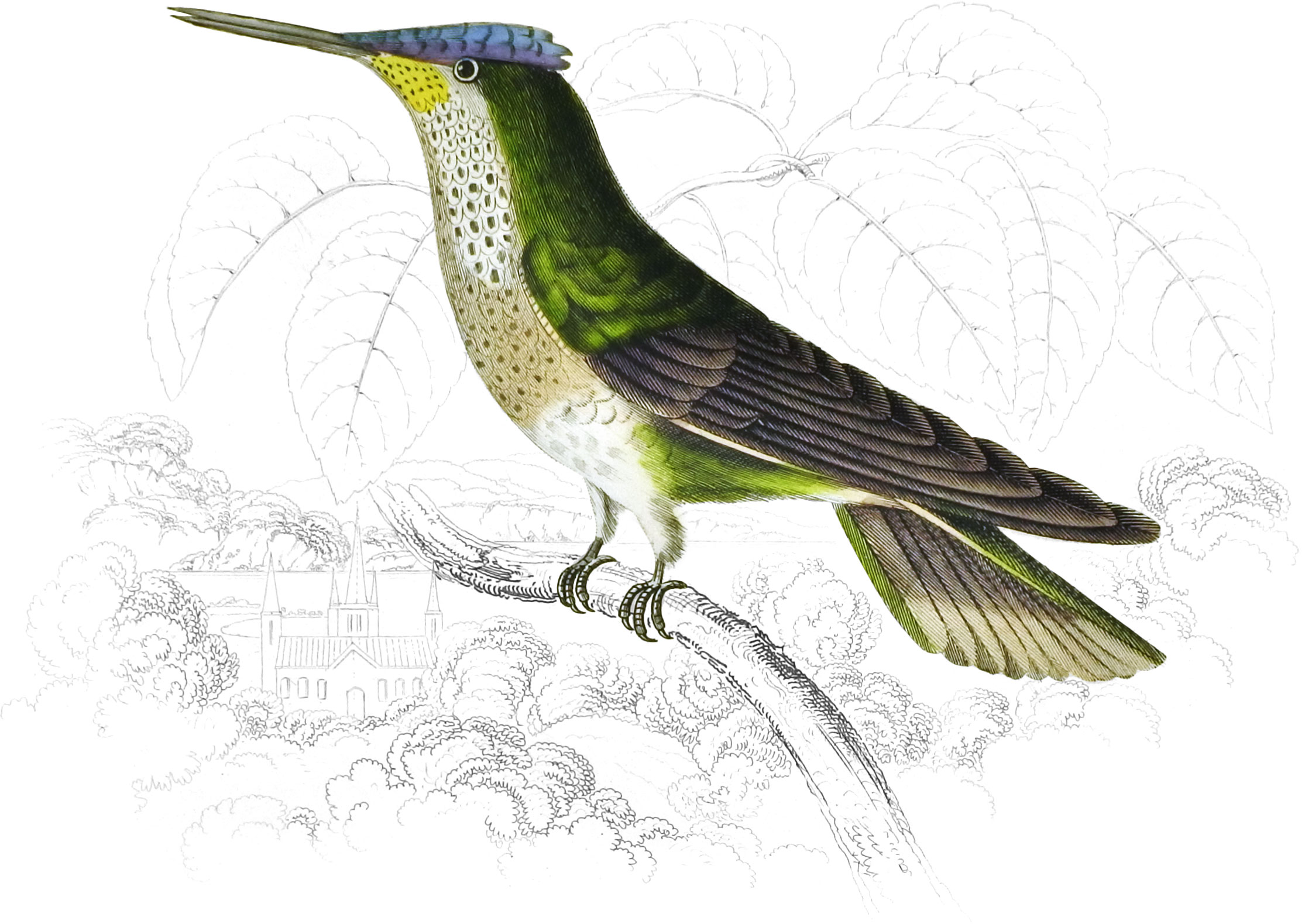
Plate XII
Violet-Tufted Humming-Bird
Trochilus petasophorus.—Neuwied.
Trochilus petasophorus, Neuwied; and Temminck, Planches Colorieés, cciii. fig. 3.—Oiseaux-mouches pétasophore, Ornismya petasophora, Lesson, Histoire Naturelle des Oiseaux-mouches, pl. i. male.
The birds figured on this and the following plates, present a curious feature in the tufts of feathers which arise from the sides of the neck, but in other respects show a close alliance in form to some other straight-billed birds, such as the T. squamosus and albicollis of Temminck; and that now described has the additional feature of having the bill serrated upon the margins.
It is a native of Brasil, and was met with by both Natterer and the Prince Maximilian of Neuwied. The upper parts are of a golden green, and a soft and brilliant tint of the same colour clothes the chin and throat, changing to a duller shade upon the breast, on the belly and vent having a slight tinge of gray, while the under tail-coverts are of a pure white.
The characteristic appearance, however, is the tufts of rather stiff feathers which spring from under the auriculars, and expand themselves upon the sides of the neck. They are of a purplish or violet tint, but in many lights assume that of a golden green.
Specimens have yet been only received from Brasil, and the female has not been discovered.

Plate XIII
Natterer’s Humming-Bird
Trochilus scutatus.—Natterer.
Oiseau-mouclie écussonné, Trochilus scutatus, Natterer; Temminck. Planches Colorieés, ccxcix. fig. 3.—Le Natterer, Ornismya Nattererii, Lesson, Histoire Naturelle des Oiseaux-mouches, pl. xvi, p. 75.
The first specimens of this remarkable humming-bird were sent to Europe from the interior of Brasil by M. Natterer and M. Auguste de St Hilaire.
The most remarkable feature in the plumage of this bird, is two thick, and almost downy tufts, of very deep indigo blue, which spring from under the eyes, and form a sort of ruff upon the sides of the neck, and which Lesson thinks appear only during the breeding season, as in the ruff, (Tringa pugnax, Linn.) If this is the case, do the ear tufts, and feathery appendages incident to so many of the family, appear only at this season, and disappear again when a quieter time succeeds? Each tuft is tipped with yellow, which relieves them, when hanging upon the same deep indigo which covers the upper part of the breast and belly. The forehead is clothed with bright green and scaly feathers, and is separated from the golden but duller green of the hind head and upper parts by a bandelet of deep velvety black, which runs over the head in a line with and from eye to eye. The throat and front of the neck is shining green, and the feathers, lengthened and narrow, form a beautiful gorget displayed upon the dark indigo of the breast. The vent and under tail-coverts are dirty white. The tail is equal at the end, and, like those of this form, has the feathers broad and expanded; it is of a metallic green colour—of an equal brilliancy above and beneath.
Lesson has changed Natterer’s name to that of the discoverer himself; but, independent of priority, when not entirely inappropriate it cannot be a compliment to change the name given by the discoverer, even when substituted by his own; we have therefore retained it.

Plate XIV
The Tufted-Necked Humming-Bird
Trochilus ornatus.—Linnæus?
Le Huppé-col, Buffon, Planches Enluminées, 640.—Tufted-necked Humming-bird, Latham’s General History of Birds, vol. iv. p. 348.—Le Huppé-col, Ornismya omata, Lesson, Histoire Naturelle des Oiseaux-mouches, pl. xli.
Among the curious forms assumed by the plumage of the humming-birds, we have already seen various feathered excrescences, as it were, issuing from different parts of the body, and in none are they so singular as in the tribe which our present species and one or two following represent. They are called by the French, Coquets; and Lesson has formed from them a genus, Lophornis, including this with the three following and some other species. In this bird, in addition to an ample crest of clear reddish chestnut upon the head, the sides of the neck are adorned with tufts of narrow feathers, almost an inch in length. They are composed of from ten to twenty plumes, of the same colour with the crest, and are terminated with a broadened tip of clear shining green.8 The throat, and upper part of the breast, with the forehead, bordering the rufous crest, is covered with bright emerald-green scaly feathers, which are separated from the upper parts by a line of a paler shade running through the eyes to the rictus, and from the lower part of the breast and belly, by a band of rufous of the same tint with the crest. The upper parts are of a bronzed green, with steel-blue reflections; and this is again separated from the tail by a conspicuous band of grayish white. The tail is broad and ample; the centre feathers greenish—the others deep chestnut red, with purplish reflections.
Cayenne, Guiana, and Brasil, are the countries where this species is most abundant; and the Prince Maximilian mentions having found them on dry and arid plains, clothed with a scanty and bushy vegetation.

Plate XV
Adult Male
The Tufted-Necked Humming-Bird
Trochilus ornatus.—Linnæus.
The female is in general rather less in size, and wants the crest and neck tufts, but the other parts of the plumage hardly fail in brilliancy to those of the male, represented on our last plate. The under parts are of a redder tinge, where the white predominates in the male, and the band on the rump is not so clearly defined.

Plate XVI
Female
Audenet’s Humming-Bird
Trochilus Audenetii.—Lesson.
L’Oiseau-mouche Audenet, Omismya Audenetii, Lesson, Histoire Naturelle des Oiseaux-mouches, Supplement, pl. ii. p. 102.
This fine species was first described and figured in Lesson’s Monograph, and will range in the division with T. ornatus and magnificus, having like them a slender form, a broadly expanded tail, and a neck adornment of nan-ow lengthened plumulets. M. Lesson observes,
Of this rare and valuable species, we know only a single specimen, which was communicated to us by M. Verreau, and now forms part of the collection of M. Audenet in Paris, and, without doubt, is one of the most remarkable for its elegance, its rich clothing, its light and airy form, and the delicate plumes which adorn its neck.
It is scarcely three inches long; the wings small, narrow, and falciform, scarcely reaching beyond the middle of the tail. The feathers on the crown are thick, loose, and slightly elongated, and with the back and wing-coverts are bright emerald green. A band of black, bordered on each side with white, crosses the rump, and the tail is of a clear blackish blue. The throat and forepart of the neck are clothed with small scaly feathers, having a rich green lustre, from each side of which springs a thick tuft of narrow rounded feathers, of a bright emerald green, and marked on the tip of each with a round white spot. The feathers on the lower parts of the body are of a rounded and scaly form, brownish black at the base, and yellowish at the tips, giving a waved appearance to the whole.
The specimen of T. Audenetii, as far as could be traced by its describers, was brought from Peru.
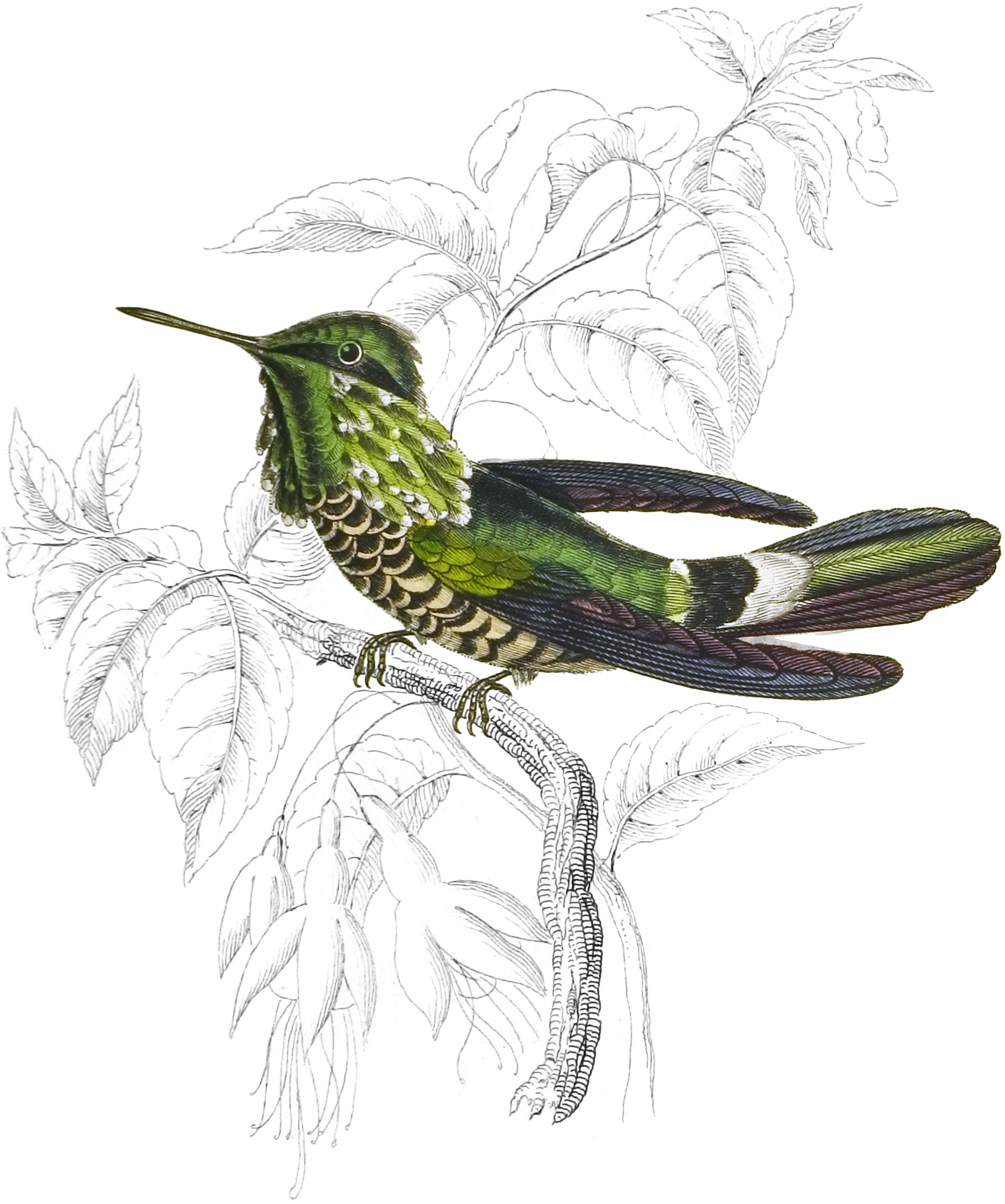
Plate XVII
Vieillot’s Humming-Bird
Trochilus chalybeus.—Vieillot.
Trochilus chalybeus, Vieillot; Temminck, Planches Colorieés, lx lxvi. fig. 2.—Oiseau-mouche Vieillot, Ornismya Vieillotii, Lesson, Histoire Naturelle des Oiseaux-mouches, pl. lxiv. p. 186.
This elegant humming-bird was first described by M. Vieillot in 1823; Temminck gave a very good representation of it in his Pl. Colorieés, and it has recently been figured in the splendid publication of M. Lesson, who has dedicated it to Vieillot, an eminent and laborious ornithologist. We have preferred retaining the name given by its discoverer.
It is about three inches in length, and of a light and graceful form; the sides of the neck are adorned with two bundles of green lengthened fan-shaped feathers, having a round white spot at the extremity of each. The forehead and cheeks are brilliant green, and a line of black runs from the bill to the occiput the back and upper parts of the body are green, with yellowish reflections; the sides and forepart of the neck are tinged with blue, and longitudinally spotted with grayish black; the other lower parts are gray, waved and mottled with black, and a white band crosses the lower part of the belly, and is seen upon the rump. The quills are of a purplish brown, and the tail, nearly equal at the extremity, is of a rich sienna red.
The female, and birds of young plumage, have been figured in Lesson’s Continuation the former is there described for the first time. It entirely wants the ear tufts, and is of a plain and unobtrusive dress. The upper parts, from the rictus in a line below the eyes, of a uniform golden green, interrupted by the reddish tail-coverts and their white crossing band the under parts gray; greenish on the flanks.
Vieillot’s Humming-bird is a native of Brasil, and is very rare in collections.
See vignette to vol. ii. for a figure of a male in very perfect adult plumage.

Plate XVIII
Magnificent Humming-Bird
Trochilus magnificus.—Vieillot.
Trochilus magnificus, Oiseau-mouche magnifique, Vieillot, Dictionnaire des Sciences Naturelles (1817 and 1818); Temminck’s Planches Colorieés, ccxcix. fig. 2.—Le Hausse-col blanc, Omismya strumaria. Lesson, Histoire Naturelle des Oiseaux-mouches, pl. xlii. and xliii. p. 143.
We have given plates of the young male and female of this species, as being less known than the bird in the adult state, and though presenting plumage of less splendour, it is perhaps more chaste and pleasing. It also ranges with the form represented by T. ornatus and its allies, and the adult male has the neck adorned with beautiful plumulets of snowy white, relieved by a black or very dark olive-green band on the tip of each. These tufts are also so far different, that the feathers are much shorter and broader, and scarcely present so stiff an appearance as those of its congeners, while the ruff extends nearly round like a gorget in front. In the young males neither the crest nor ruff appears; the crown of the head is of a dull yellowish red, changing into a darker and grayer shade towards the hind head, which runs in a line from the eye to the shoulders; the upper parts are of a rich green, and are separated by the above-mentioned line from the lower region of the body, which is of a grayish white, tinged with rufous on the throat and breast, and entirely devoid of the brilliant scaly plumes occupying the throat of the adult.
It is a native of Brasil.

Plate XIX
Young Male
Magnificent Humming-Bird
Trochilus magnificus.—Vieillot.
The plumage of the female is as unobtrusive as that of the young male, figured on the preceding plate, and it is only the adults that have any pretensions to the name which Vieillot applied to them. The female nearly equals the male in size, is destitute entirely of the ruff, and does not even show the dark line upon the sides of the neck, which indicates its place in the young of the opposite sex. The forehead and throat are yellowish chestnut, and the breast and lower parts are gray, delicately mottled with a darker shade; hind head and back are greenish gray, which changes into a shade of clearer green upon the sides and shoulders; the wings are purplish brown, and the tail is rufous, with the middle feathers, and a cross central band, olive green.

Plate XX
Female
Double-Crested Humming-Bird
Trochilus cornutus.—Neuwied.
Trochilus cornutus, Neuwied Voyage au Brésil.—Trochilus bilophus, Temminck, Planches Colorieés, xviii. fig. 3.—Oiseau-mouche aux Huppes d’or, Ornismya chrysolopha. Lesson, Histoire Naturelle des Oiseaux-mouches, pl. vii, p. 55.
The discovery of this most splendid species is due to the Prince Maximilian de Wied-Neuwied, who described it, in his “Voyage to Brasil,” under the name of T. cornutus and furnished the specimens from which M. Temminck made the drawings for his Pl. Colorieés. It inhabits the exalted Campos-Geraes of Brasil, near the sources of the river Don Francisco.
This humming-bird is about four inches in length, of which the tail alone measures nearly the half; the bill and feet are remarkably slender, the former slightly bent, terminating in a very fine point. The most characteristic mark of this species is the two flattened crests, composed of six feathers, which divide in front of the head, on a level with the eyes, and are directed forwards. Lesson, describing them, says,
Ces deux huppes pouissent de l’éclat le plus extraordinaire; elles étincellent avec le brillant de Tor et celui de cuivre rouge: le reflets du rubis et ceux de l’émeraudes, le rouge de feu, le vert le plus pur, le jaune le plus éclatant, chatoient de manière a èblouir les yeux, et surpasser la description qu’on chercherait à faire de ces teintes si fugitives et si belles.
The colours of these tufts, or horns, certainly baffle description, and an idea can only be conveyed by likening them to some familiar object, such as the bright and changing hues of steel, and other metals, or the sparkling tints of precious stones. The centre of the forehead between the tuft is covered with scaly feathers, of a brilliant green and blue reflections. A gorget of deep and rich purple composed of lengthened feathers, reaches from behind the eyes upon the breast; the breast and upper part of the belly is of the purest white; the same colour crosses the lower sides of the neck, nearly meeting on the back, and forms a beautiful contrast to the deep-coloured and delicately formed feathers of the gorget. The belly and vent are of the same green with the upper parts; the wings are brown; the tail is strongly wedge-shaped; the two centre feathers brown; the others pure white.

Plate XXI
Male
Double-Crested Humming-Bird
Trochilus cornutus.—Neuwied.
L’Oiseau-mouche aux Huppes d’or, Ornismya chrysolopha, Lesson, Histoire Naturelle des Oiseaux-mouches, pl. viii. p. 55.
The female wants the splendid crests which adorn the head of the male, but the other parts of her plumage will scarcely yield in brilliancy. The crown is rich ultramarine blue, and the dark gorget is distinctly marked; the tail is of equal length, and with the nuchal collar and under parts are pure white; the hind head, back, and shoulders, are bright golden green; the wings are purplish black.

Plate XXII
Female
Violet Fork-Tailed Humming-Bird
Trochilus furcatus.—Gmelin.
Trochilus furcatus, Gmelin, xxvi.—L’Oiseau-mouche à queue fourchue, Buffon, Planches Enluminées, 672, fig. 1.?—Lesser forked-tailed Humming-Bird, Latham’s General History, Variety B.—Oiseau-mouche violet à queue fourchue, Ornismya furcata. Lesson, Histoire Naturelle des Oiseaux-mouches, pl. xviii. p. 82.
This species, one of the oldest known, is common in many parts of South America, and possesses a considerable geographical range, being found in Brasil and Guiana, the island of Jamaica, and Cayenne. Notwithstanding, the male only is known, and even the plumage of the young is not accurately ascertained.
The bill, of considerable strength, is very slightly bent, and of a deep black. The general state of this bird is nearly that as figured by Buffon, golden green above, with the wings and tail inclining to a violet purple, a patch upon the throat of beautiful amethystine purple, and the under parts pure white, tinged with greenish on the flanks. Dr Latham describes three states, and our present figure agrees with his variety B, described from a specimen in the British Museum.

Plate XXIII
The Evening Humming-Bird
Trochilus vesper.—Neuwied.
L’Oiscau-mouche vesper, Omismya vesper, Lesson Histoire Naturelle des Oiseaux-mouches, pl. xix. p. 85; female, Lesson’s Continuation, pl. vi.
The present species has been figured by M. Lesson, from specimens in the collection of the Jardin du Roi, as different from the T. cyanopogon, to which it is nearly allied, but differs much in size. The upper parts are of a grayish green, of a more golden tinge on the back and rump, but generally wanting the lustre so prevalent in this race. The gorget is reddish violet, with all its changes, and is surrounded on its lower edge with a collar of grayish white. The breast and belly are white, changing into gray on the flanks and vent. The under tail-coverts are pure white.
The female has been also figured and described for the first time in the continuation of M. Lesson’s Monograph, which that ornithologist has again resumed the under parts are entirely white, and there is no trace of the brilliant gorget belonging to the male.
The Evening Humming-bird inhabits the neighbourhood of Valparaiso, upon the naked and little-wooded plains; and the above quoted ornithologist remarks, that the birds inhabiting these elevated, almost mountainous plains, want the splendid lustre to the upper plumage. Thus, T. cora is found in Peru, T. cyanopogon in Mexico, and T. vesper in Chili, all tinted as we have described.
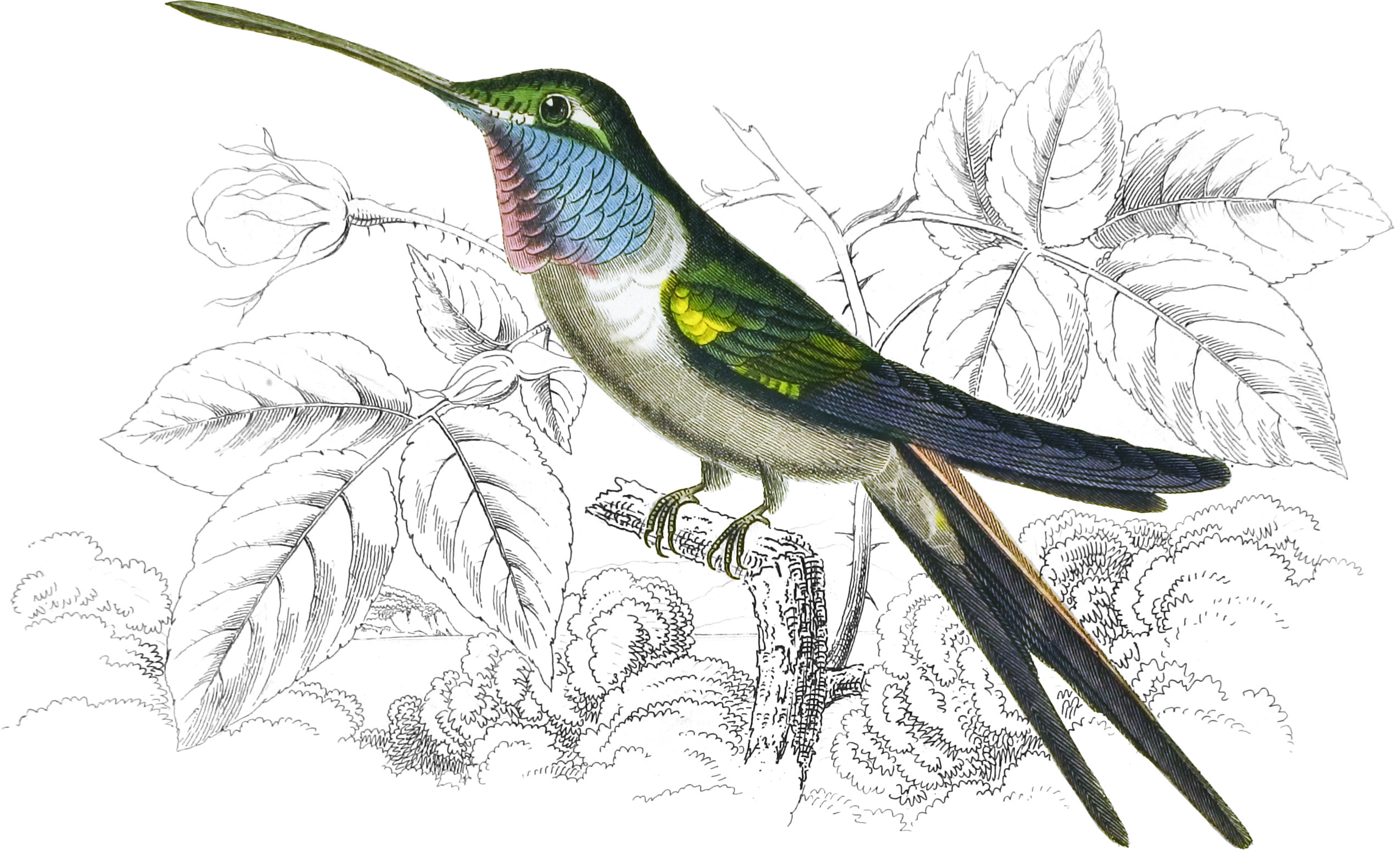
Plate XXIV
Male
The Cora Humming-Bird
Trochilus Cora.—Lesson and Garnot.
Orthorhynchus Cora, Lesson, Zoologie de la Coquille, pl. 31, fig. 4.—L’Oiseau-mouche Cora, Ornismya Cora, Lesson, Histoire Naturelle des Oiseaux-mouches, pl. vi. p. 52.
The Cora Humming-bird was discovered in March 1823, by MM. Lesson and Garnot, the naturalists who accompanied the Coquille in her exploratory voyage round the world, and a description and plate was first published in the zoological volume illustrating the novelties which occurred during it.
The Cora inhabits the sloping banks of the elevated country lying between Callao and Lima, where the surface is low and marshy, and large portions are covered with salt, crystallized by the heat, on which there is little vegetation, and where the foliage is of a hue dull and glaucous. This splendid species is seen constantly on the wing, and seldom alights upon any of the blossoms.
The whole length of this little bird is about five inches five lines, of which the tail makes three inches and two lines. The upper part of the head, back, rump, and wing-coverts, are of a uniform brilliant green; the feathers of the throat, neck, and cheeks, are of a bluish or steelly lustre, and have the form of scales; the remaining lower parts of the body are of a dingy white, brownish on the flanks. The tail feathers are white at the base of the inner webs, brownish on the outer and towards the tips. The feet are reddish.
Lesson has again employed one of his favourite mythological names to denote this species. He says, the specific name will recall one of the gods whom the ancient Mexicans and Haytians adored.
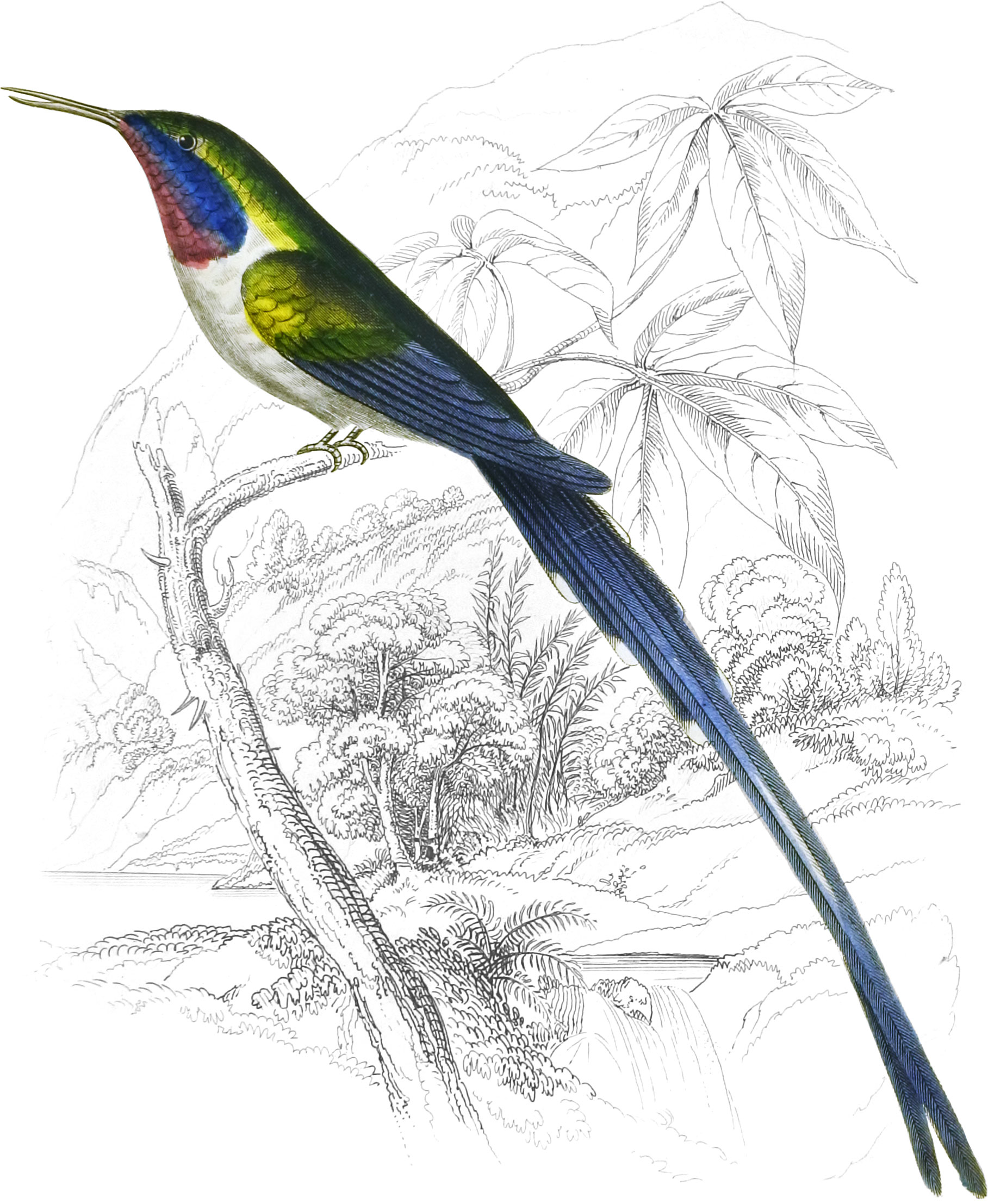
Plate XXV
Dupont’s Humming-Bird
Trochilus Dupontii.—Lesson.
L’Oiseau-mouche Zemes, Ornismya Dupontii, Lesson, Supplément des Oiseaux-mouches, pl. i. p. 100.
Our plate is engraved from the representation of Lesson, which is made from the only known specimen, in possession of M. Dupont, to whom the species has been dedicated.
It is a native of Mexico, has a sharp and pointed bill, a lengthened tail, and a form comparatively slender. The total length is about four inches and a quarter, inclusive of the bill and tail. The upper part of the plumage is of a shining yellowish green, crossed upon the lower part of the back by a white band; a patch of black, or dark blue, according to the light in which it is viewed, covers the throat, cheeks, and middle of the neck. The flanks and belly are a light brownish green, passing into pure white on the vent. The wings are rather short, narrow, and falciform, of a brownish purple. The tail is remarkable for the form of the exterior feathers, which are longest, and are expanded, or, as it were, flattened towards the tips; the inner feathers gradually decrease in length, are entirely broad, reddish at the base, changing to a fawn colour, and tipped with pure white.

Plate XXVI
Half-Tailed Humming-Bird
Trochilus encurus.—Vieillot.
Trochilus enicurus, Vieillot, Nouvelle Dictionnaire d’Histoire Naturelle.—Oiseau-mouche a queue singulière, Temminck, Planches Colorieés, pl. lxvi. fig. 3, Lesson, Histoire Naturelle des Oiseaux-mouches, pl. xv. p. 72.—Omismya heteropygia, Lesson’s Synopsis.
This humming-bird, remarkable in having only six quills in the tail, was first figured by Temminck, who remarks,
we cannot doubt the existence of this singular bird, as, besides that which I have myself seen, M. Vieillot has assured me that he has seen many others, (plusieurs autres.) Bullock’s museum possessed a specimen, Delalande another, in no way differing from the specimen in the Baron Laguier’s Collection.
The last-mentioned specimen has served as a copy for both Temminck and Lesson, which we have also used. There appears in all the specimens to be no falling out or want of the feathers, and it is a real anomaly among its numerous family. Nevertheless, and without any disparagement to the accuracy of these high authorities, we feel great curiosity to examine specimens of this bird. If the construction of the tail proves as has been mentioned, it will not only prove a singular tail among its own large family, but will be the only known bird which has only six tail feathers.
This little species is of a slender make; above, of a golden green, and the belly and vent are of the same colours. The throat and upper part of the breast is covered with a scaly patch of rich purple, and succeeding this, bands of white and yellow fill up the space between the gorget and green of the belly, stretching over upon the back in a crescent form. The tail, as we have mentioned, consists of six feathers of a purplish brown, the outer pair very short, the others lengthened, forming a fork of nearly two inches, almost two-thirds of the length of the body, which widens, or curves outward at the extremity.
Vieillot says that it inhabits Brasil, M. Temminck the island of Trinite.
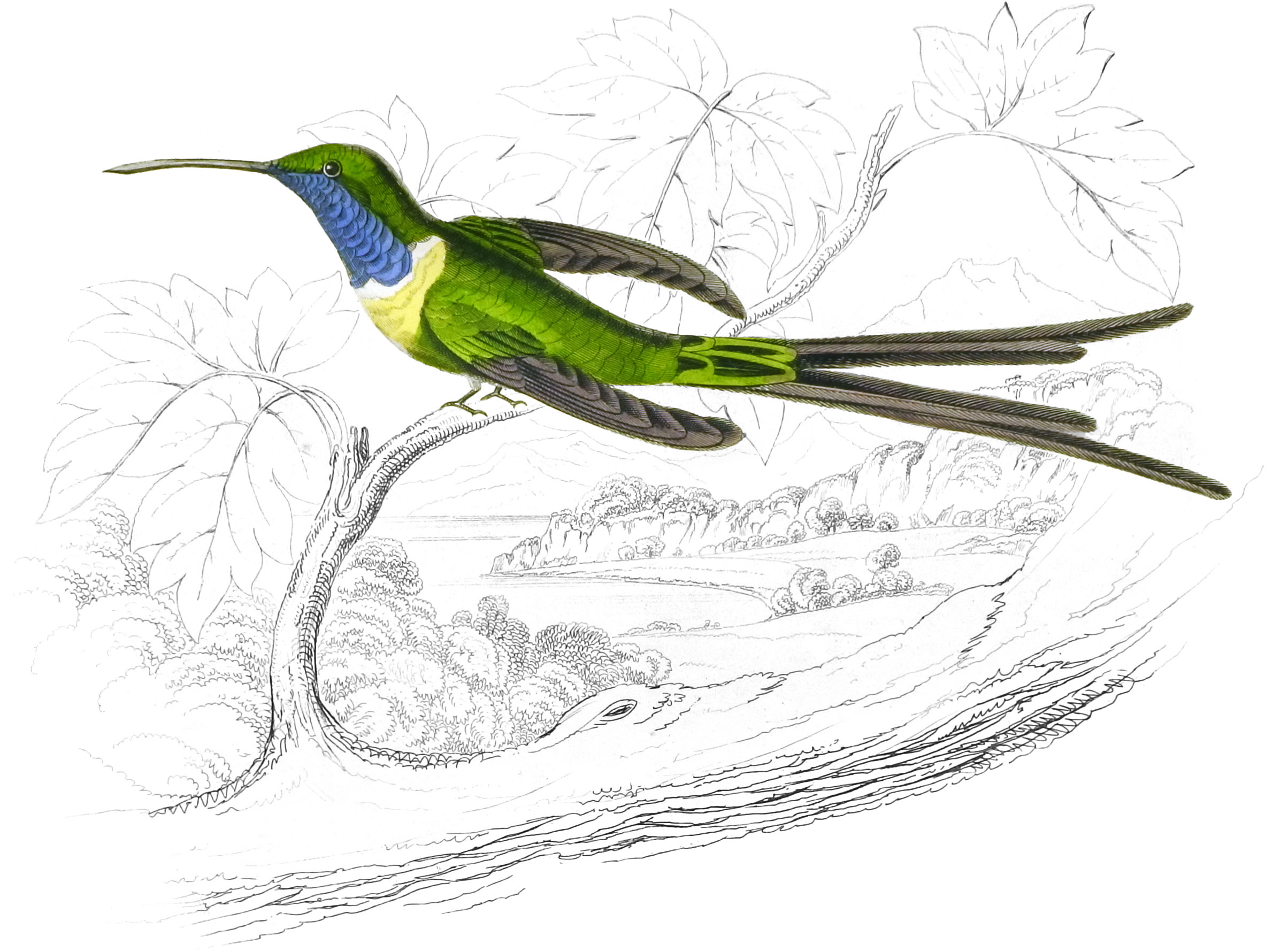
Plate XXVII
Sapphire-Throated Humming-Bird
Trochilus sapphirinus.—Linnæus.
Sapphire Humming-bird, Latham’s General History, vol. iv. p. 326 327.—Oiseau-mouche Saphir, Omismya sapphirina, Lesson, Histoire Naturelle des Oiseaux-mouches, lv. lvi. and lvii. p. 172.
The Sapphire-throated Humming-bird, or, as it is sometimes called, “the Sapphire,” is about three inches and six lines in length. The bill is a clear yellow, blackish towards the point; the crown and upper part of the body are bright golden green; the chin is of a clear reddish brown or rust colour, from which, covering the throat, breast, and upper part of the belly, extends the rich and beautiful blue that has furnished the name to the bird; it is composed of the scaly-shaped feathers, and, in some lights, has a violet lustre; the flanks and belly are brownish green, changing to gray on the vent; the tail is equal, and entirely of a clear red. The female wants the rusty-coloured chin, and is of a duller colour above. The young is described by Vieillot, as of a blackish gray underneath; the red on the chin slightly apparent the bill of a brownish colour. They inhabit Guiana, Cayenne, and Brasil, and, according to Dr Latham, they are not very rare in the island of Berbice.

Plate XXVIII
White-Eared Humming-Bird
Trochilus leucotis.—Vieillot.
Trochilus leucotis, Vieillot Nouvelle Dictionnaire l’Histoire Naturelle.—Oiseau-mouche Arsenne, Omismya Arsennii, Lesson, Histoire Naturelle des Oiseaux-mouches. pl. ix. p. 60.
Vieillot has described this species, in the New Dictionary of Natural History, under the title of “Oiseau-mouche a oreilles blanches” (Trochilus leucotis;) while Lesson has figured, and dedicated it, in his Synopsis, to M. Arsenne, a rising French artist. The latter name we haver ejected, for obvious reasons.
The head is of a brownish violet colour, which is insensibly shaded into the golden green which covers the whole upper parts, and even the quills. A tinge of azure blue shines upon the forehead, and is still more brilliant on the cheeks and throat, and a gorget of the clearest verdigris green covers the breast. A spot of pure white arises behind each eye, and forms a line of that colour above the auricular feathers; whence its name. The belly and flanks are grayish green; the vent and under tail-coverts pure white the tail is nearly equal; the feathers rounded, and rather broader at the tips; brown, except those in the centre, which are of a similar shade with the upper parts. The total length is about three inches.
It inhabits Brasil, and appears very rare. M. Lesson remarks, that the only collection in Paris where there is a specimen, is that of the Due de Rivoli, where his drawing was taken, and from which our plate is a copy.
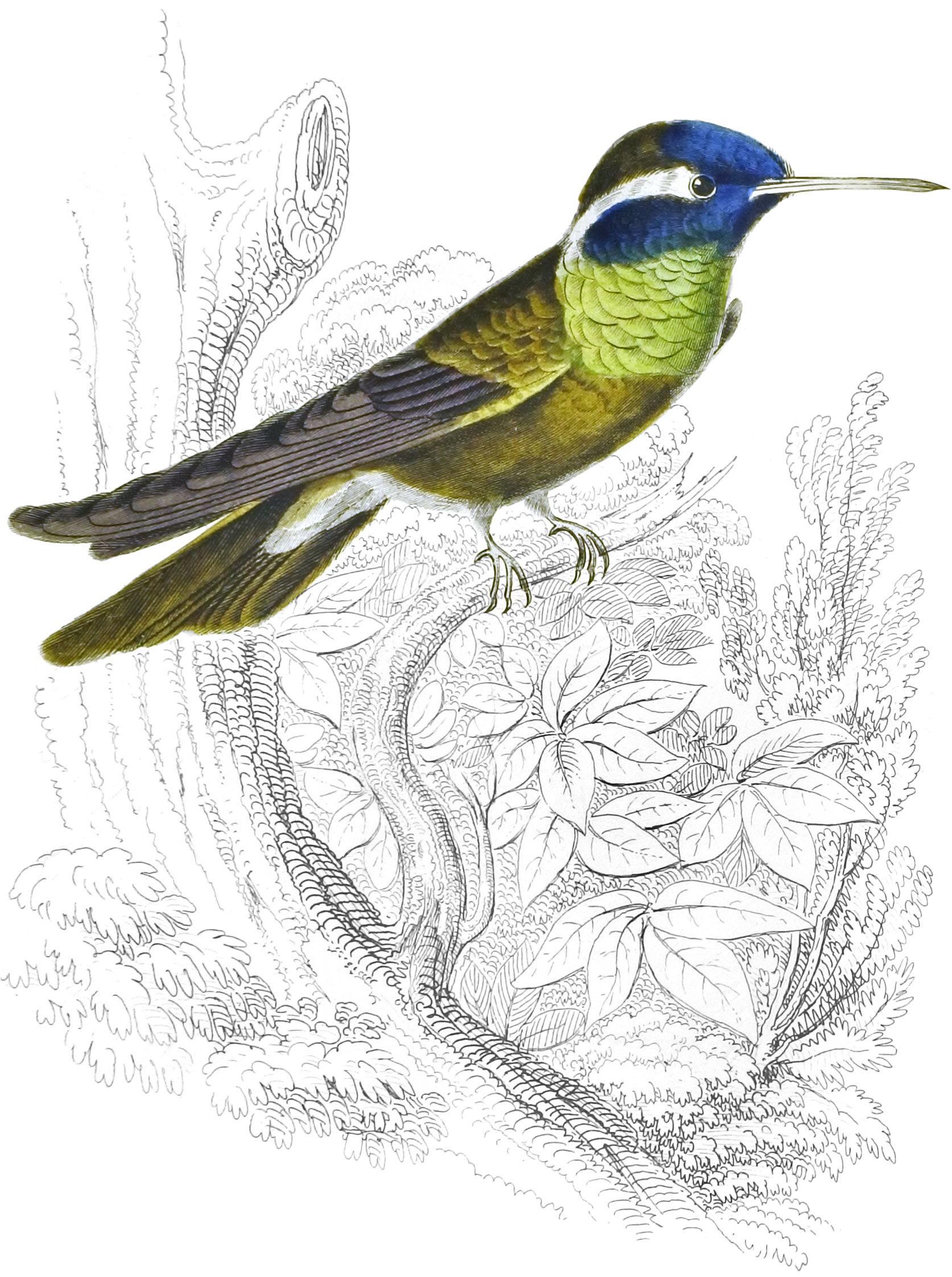
Plate XXIX
White-Collared Humming-Bird
Trochilus mellivorus.—Linnæus.
Trochilus mellivorus, Linnæus, Systerna Naturæ.—White-bellied Humming-bird, Edwards’s Birds, pl. xxxv.; Latham’s General History of Birds, vol. iv. p. 324.—La Jacobine, Buffon, Planches Enluminées, dcxl.;—Lesson Histoire Naturelle des Oiseaux-mouches, pls. xxi. and xxii. p. 90.
This distinctly marked species may be met with in almost every collection, and is one of the oldest known. The changes from the young to the adult plumage are considerable, which has occasioned its description under more than one name. The plumage of the adult male is a very deep and fine blue on the crown, cheeks, throat, and upper part of the breast the back, rump, upper tail-coverts, and shoulders, golden green, marked on the back of the neck with a crescent-shaped spot of the purest white; the belly and vent pure white; the tail, of very broad feathers, white, each tipped with black, and narrowly lined with the same colour on the outer margins.
Lesson has figured the female as golden green above, including the centre tail feathers, and basal half of the others; the remaining part of the tail, which is of the same form as in the male, is narrowly tipped with white, succeeded by a band of rich blue, the outer web of the outer feathers being the only other white portion. The under parts are gray; the feathers on the throat assuming the scaly texture, and marked in the centre of each with a darker colour. The same naturalist mentions a specimen in the Paris Museum, with the centre tail feathers black; and a specimen, in our own possession, has the tips of the tail feathers black, for nearly half an inch. These may perhaps agree with Latham’s spotted-necked humming-bird, Trochihis fimbriatus. We are almost inclined to think, that the white of the tail becomes perfect as they advance in age, like the same colour in many other birds.
It has been found in Cayenne and Surinam, and several of the West Indian Islands. The specimens which served for the accompanying plate, are from Tobago, where it is said to be found chiefly in low marshy situations, among the plantain bushes, in company with the sabre-wing, feeding constantly on the wing.

Plate XXX
Harlequin Humming-Bird
Trochilus multicolor.—Latham.
Harlequin Humming-bird, Trochilus multicolor, Latham’s General History of Birds, vol. iv. p. 316.—L’Arlequin, Vieiliot, Oiseaux Dorés, pl. lxix.—Lesson, Histoire Naturelle des Oiseaux-mouches, pl. lxxii. p. 201.
This curious and singularly marked species was figured and described by Dr Latham, from a specimen in the British Museum, and a representation of it also existed among the drawings of General Davis, and rests on these authorities. It was copied from Latham into the Oiseaux Dorés of Vieillot, again by Lesson in his Monograph, and we have ventured a third time to introduce it, with the view of attracting the attention of British naturalists, for it has been hinted that the specimen in the British Museum was a specimen made up from the feathers of different birds. Dr Latham, after the publication of his figure, was aware of this; and in a notice to his second edition, expressly says,
by every attention paid to it, I cannot detect it.
If there is a specimen in the British Museum, and a drawing in the possession of General Davis, corresponding and evidently done from an individual of the same species, there will be no doubt of its existence. We give Dr Latham’s description in his own words.
Length, four inches and a half; bill bent, one inch and a quarter in length, and brown; crown of the head, chin, breast, and middle of the back, green from the bill through the eyes, a fine blue stripe, passing almost to the nape; the lower part of this edged with black; upper parts of the body and wings, brown belly and vent, the colour of cinnebar, but not glossy, like the rest of the plumage; tail even at the end, and brown; legs, pale brown.

Plate XXXI
Black-Breasted Humming-Bird
Trochilus gramineus.—Linnæus.
Colibri du Mexique, Buffon, Planches Enluminées, dclxxx.—Black-breasted Humming-bird, Latham’s General History, vol. iv. p. 302.—Le Haïtien, Lesson, Histoire Naturelle des Colibris, pl. xii. male.
M. Vieillot says,
The Haitien delights in the vicinity of inhabited places, which it rarely quits as long as the trees and shrubs continue in bloom; it generally perches on a stray or withered twig, where it expands its tail. I have never heard it sing, but while flying, and especially during the season of incubation, it utters a continued cry, which often betrays it before it would otherwise be discovered. This little bird will seldom allow others to approach the tree on which its nest is built. The mocking-bird is obliged to yield to his pursuit; he continually darts around, and striking his bill at the eyes of the intruder, obliges him to fly.
This species is of a strong make, and above the average size of the humming-birds. It will range in the division which includes the well-known T. mango, for which in some states it has been mistaken. The young have also been described under different names; but a comparison of the present plate with that following, engraved from Lesson’s Monograph, will point out the distinction. It has been sent to Europe from Guiana and St Domingo, but will most probably have a wider range.
The upper parts of the adult male are of a golden green; on the throat there is a patch or gorget of deep and bright emerald green scaly feathers, and which with some lights appear almost black; this is succeeded with a large patch of dull black occupying the forepart of the breast, whence the name given by Latham; the belly and flanks are brownish, tinged with green, and the vent is white; the wings are powerful; the shaft of the first quill very strong; the tail is ample, rounded at the extremity, which is bordered with black for a quarter of its length, while the basal half is of a clear purplish brown.

Plate XXXII
Adult Male
Black-Breasted Humming-Bird
Trochilus gramineus.—Linnæus.
The Synonyms to this state will perhaps be Trochilus gularis, Linnæus.—Black-breasted Humming-bird, Latham, variety B.—Green-throated Humming-bird, Latham’s General History, vol. iv. p. 305.—Le Haïtien, jeune age. Lesson, Histoire Naturelle des Colibris, pl. xii. vir. p. 56.
The upper parts in this state are of a golden green, changing to brownish on the forehead; on the forepart of the neck there is a black streak, through which appear some green scaly feathers; the black is surrounded on the sides with white, clouded with grayish and reddish spots; the flanks and sides of the breast are green, tinged with brown; the middle tail feathers are a very deep greenish brown; the other feathers are nearly as in the adult state, but are terminated with a white spot.

Plate XXXIII
Young
Blue-Throated Sabre-Wing9
Trochilus latipennis.
Trochilus latipennis, Broad-shafted Humming-bird, Swainson, Zoological Illustrations, first series, plate cvii.—Oiseau-mouche latipenne, (Campylopterus latipennis, Sw.) Lesson, Histoire Naturelle des Oiseaux-mouches, pl. xxxv. p. 124.
We are indebted to Mr Swainson for permission to copy his beautiful plate of this singular bird; and since the figure was completed, we have fortunately, by the attention of Mr Kirk, received two perfect specimens of the bird itself from the island of Tobago, which have served for the following description. We may remark, that Mr Swainson’s specimen was purchased at Bullock’s sale, and that he considered the specimen unique; and when Lesson published his Monograph, in 1829, no specimen existed in the Paris collections.
The Tobago specimens are about five inches and a quarter in length. On the throat is a patch of the clearest violet-blue, shading off to steel-blue on the sides, and which forms a gorget, passing in a line with the rictus. The upper and under parts, and shoulders, are of a rich golden green, of a yellower tinge on the belly and vent. The wings are purplish black, and are remarkable for the strength and breadth of the quills, particularly the three first, which nearly equal the plume in breadth. The feathers of the tail are very broad and ample. They are ten in number the centre ones are black, with a bright green lustre. The next pair also black, with a steel-blue lustre, or, as Mr Swainson expresses it, raven black; the remaining three on each side are pure white.
The accompanying notes from Tobago mention,
that they take their abodes principally in the woods, by rivulets, or in low marshy places, among the wild plantain bushes. When some particular trees are in blossom, they are to be seen in great numbers, in the cool of the evening, playing and feeding around them.
This species will serve to point out the form which Mr Swainson proposes to designate by the title of Campylopterus.

Plate XXXIV
- The nation of the Aztecs call their capital Tzinzunzan, from the number of humming-birds in its vicinity, with which the statues of their gods are adorned; and the Indians of Patzquara are still famous for this art. They compose figures of saints with the feathers of the colibri, which are remarkable for the delicacy of the execution, and the brilliancy of the colours.—Ward’s Mexico in 1827.
- Their name in the Indian language is Beams or Locks of the Sun.
- It is remarked by Lesson, that the colibris, or those species with curved bills, never pass the intertropical limits.
- Trochilus Fernandensis, and T. Stokesii, King Reports of Zool. Soc. for Jan. 1831.—Mon. Berters, a French botanist, remained on the island of Juan Fernandez to examine its vegetable productions, and records that three species exist on it.
- Audubon.
- See Plate XXVII.
- It may be here mentioned, that all the figures in this volume are represented of the natural size.
- The number of feathers in these tufts is said to be generally from twelve to fourteen, but Dr Latham mentions having counted eighteen in one specimen and twenty in another.
- This plate is slightly reduced from the original.