Volume III
The Natural History of Humming-Birds
Part II


Like Fairy Sprites, a thousand birds
Glance by on golden wing,
Birds lovelier than the lovely hues
Of the bloom wherein they sing.
In our first volume, devoted to the illustration of a portion of this splendid tribe of birds, we endeavoured to collect all the information contained in the numerous voyages of discovery, and the expensive and elegant works which have been devoted to their natural history.1 It cannot, therefore, now be expected that we have discovered many additional facts regarding their curious habits and economy. But in our farther researches, we have been led more and more to wonder at the brightness of their external covering, and to admire the wisdom which has so admirably adapted the structure to the wants of these frail and shining beings. In the present volume we have given descriptions of most of the birds which have been satisfactorily established, and trust that the young Ornithologist will thus be enabled to determine the greater number of those which may come under his observation; these, as far as possible, follow a plate somewhat representing the particular form. At the conclusion, we have given a condensed Synopsis of the species, mentioning with each the modern genus in which it has been placed. An arrangement of the genera is not now attempted; for it is not yet very clearly established how these genera should stand, even by those who have had opportunities of seeing the greater part of the family together—and we are not surprised at this, when we look at the almost infinite variety of form which is assumed among them. They will one day constitute a most useful illustration of the natural system, strikingly representing forms in the other divisions of the great class to which they belong.
When alluding to the splendid plumage and singular feathered appendages of the males, we did not mention that we conceived it peculiar to the season of incubation. In many of those which are described as the young, before the brilliant plumage has been attained, we consider that it is from the difference of season, not of age, that this takes place; and instead of being called the adult plumage, it should rather obtain the name of the nuptial dress. We believe a change takes place in the plumage of all birds at the beginning of spring, or at the time when the business of reproduction commences. This is marked either by a greater brilliancy, or by the appearance of rich ruffs, crests, or some additional appendage of the skin or feathers. After the first months of the love season have passed, these are lost, and at the autumnal moult, the plumage is thickened, and commences the preparation for a sufficient clothing in winter, and a display of splendour for the ensuing spring. Among our native birds, we have constant and familiar examples of this, though perhaps they are not always noticed. The Chaffinch loses the brown tips to the feathers on his crown, and they become a rich and beautiful blue; the Linnet those of his breast, which assume a lovely crimson tint. The Snow Bunting, so common on the wild moors during winter, from a pleasing brown changes to a pure black and white. The Heron and Lapwing gain their beautiful crests, the former his pendent breast-feathers, and the Egrets receive their valuable ornaments. The numerous tribes of Bustards, Plovers, and Sandpipers, are some of the most remarkable for the distinct variation of their colours. The lower parts of the males, in almost all the species of the two first groups, assume a deep and glossy black while in the Sandpipers, bright shades of chestnut brown are the emblems that the season of incubation has commenced, and in one singular instance, the variable ruff reminds us of the Ruff-necked Humming-birds. Among the web-footed water-fowl we have similar changes. The common black headed Gull gains its soft and chaste looking cowl; the Teal, Wild Drake, and Goosander, their glossy heads; the Divers, the curious markings of their throats; the Grebes the lengthened fringes which spring from their cheeks or auricular feathers; and instances of the change of colour, or increased brilliancy of the skin, maybe mentioned in the naked space surrounding the eye of the Pheasant, the skin above the eyes of the various Grouse, and the forehead of the Coot and Water-Hen. Many other common instances might be given from our own well-known birds; and the inhabitants of other climes will present many still more singular, though none perhaps so splendid, as the temporary adornments of Humming-birds.
Regarding their manners during the breeding season, we may mention, in addition to what was related in the introductory chapter to the first volume, that both male and female sit by turns, and, on the authority of M. Drapiez, that there are two, three, and sometimes four broods in the year. This last fact will enable us better to account for the immense profusion of these little birds which are generally found together. Their nest seems to be built in a greater variety of shapes, and of more varied materials, than the compact and elegant structures which we see in collections, and which have been sent to this country, more from their beauty and neatness than for the sake of increasing our knowledge of their formation. The following remarks upon the manners of the Ruby-crested Humming-bird, which describe its manner of building, I have copied from a letter received a few weeks since from my very active correspondent, Mr Kirk, resident in the island of Tobago. Speaking of the appearance of this species in that island, he says,
Thus the Ruby Humming-bird makes its appearance here on the 1st of February. Some say it is found in the leeward part of the island all the year; others, that it arrives earlier by a month than to the windward; the latter I think more probable. Certain I am, that there is no individual in the island who takes so much exercise in the woods as I do; and I can positively say, that since the 1st of August last, and perhaps some time previous, until the 1st of February, I have not seen one of these birds; and now (1st March) they are abundant. They begin to make their nest about the 10th of February. I now know of several containing two eggs each, and watched one yesterday for nearly an hour. Her manner of construction was very ingenious: bringing a pile of small grass or lichen, she commenced upon a small twig, about a quarter of an inch in diameter, immediately below a large leaf, which entirely covers and conceals the nest from above, the height from the ground being about three feet. After the nest had received two or three of these grasses, she set herself in the centre, and putting her long slender beak over the outer edge, seemed to use it and her throat much in the same way as a mason does his trowel, for the purpose of smoothing, rubbing to and fro, and sweeping quite round. Each visit to the nest seemed to occupy only a couple of seconds, and her absence from it not more than as many minutes. In a few hours after I saw the nest, which had all the appearance of a finished one. I expect to find an egg there today.
In conclusion to the history of the economy of these birds, as far as our present information reaches, we add their description by a modern poet, a native of one of their own fair isles.
Still sparkles here the glory of the west,
Shews his crowned head, and bares his jewelled breast,
In whose bright plumes the richest colours live,
Whose dazzling hues no mimic art can give.
The purple amethyst, the emerald’s green,
Contrasted mingle with the ruby’s sheen
While over all a tissue is put on
Of golden gauze, by fairy fingers spun.
Small as a beetle, as an eagle brave.
In purest ether he delights to lave-,
The sweetest flowers alone descends to woo.
Rifles their sweets, and lives on honey-dew.
So light his kisses, not a leaf is stirred
By the bold, happy, amorous Humming-bird
No disarray, no petal rudely moved,
Betrays the flower the collibree has loved.
Descriptions
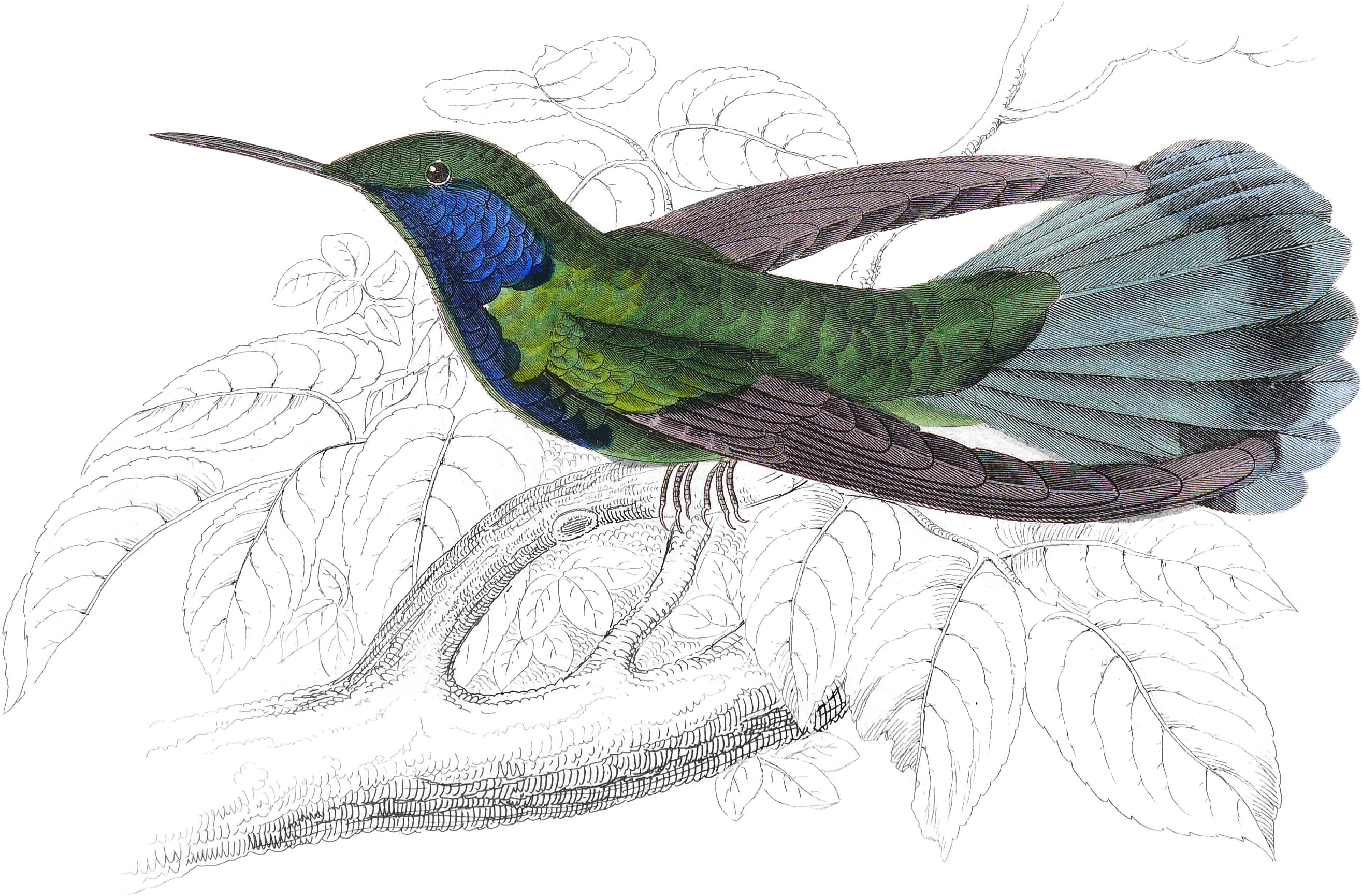
Blue-Bellied Saw-Billed Humming-Bird2
Throchilus thalassinus.—Swainson.
Trochilus thalassinus, Philosophical Magazine for 1827.—L’Anaïs, Lesson, Histoire Naturelle des Oiseaux-mouches. Supplement, p. 104. pl. ii iii.—Ramphodon anaïs, Lesson, Trochilidées, p. 146. pls. lv. lvi. and lvii.
This very fine species has been figured in the beautiful work of Mr Lesson, now completed, from which we have borrowed so largely for the illustrations of the present volume. That naturalist places it in his genus Ramphodon, with which it agrees in the structure of the bill. In other respects, however, it presents remarkable differences. What we have considered the type of Lesson’s genus has the form and colouring of the genus Pœthornus, and the under mandible, as in that form, sheaths itself, when closed, within the upper. The tail is also very much graduated. In the present species, we have the form of the wings and tail nearly as in the Mango Humming-bird, while the scaly feathers of the throat reminds us of T. mesalucus, and the rich splendour of the plumage differs much from the sober browns of the Spotted Saw-bill. We make these observations with every deference to M. Lesson’s opinion. They occurred to us when looking over his illustrations.
The Blue-bellied Saw-bill is a native of Mexico, where it is accounted rare. It is in total length about five inches. In the full plumage of the adult, the general colour is a deep-green, with a golden metallic lustre. The fore part of the neck is clothed with thick feathers, changing with the light from an emerald-green with golden reflections, to a blackish-green and deep velvet-black. The throat, and bordering the dark centre of the neck, is a mild but rich azure-blue, which is stretched upon the cheeks, and is lost in forming auricular tufts of the same colour. The plumes composing this ornamental part are of a scaly form. The centre of the belly is of the same rich colour, forming a large longitudinal patch, which seems to vary in its size and breadth in different specimens. The tail has a steel-blue lustre, and is crossed with a deep indigo band, a short way from the tip. Our first Plate represents a bird in this state. In Plate second the rich blue feathers on the cheeks and belly have not appeared, and the whole plumage has a greater tinge of steel-blue and purple. The bill and feet are black.
In a young bird, or more probably the female, Lesson has represented and described the flanks and vent of a dirty grey, mingled with green; the under tail-coverts reddish-white, without any of the rich blue patch on the belly. The auriculars appeared of equal richness, and the upper parts were of the same steel-blue as in our second plate.

Bill

Gigantic Humming-Bird3
Trochilus gigas.—Vieillot.
Oiseau-mouche géant; Trochilus gigas, Vieillot, Gallerie du Museum, plate 180.—L’Oiseau-mouche Patagon; Ornismya tristis, Lesson, Histoire Naturelle des Oiseaux-mouches, p. 43. pl. iii.
Among the delicate tribe of birds which we have been endeavouring to describe, we have seen those only of splendid plumage, of small size and slender proportions. That to which we have devoted the annexed plate, is a remarkable contrast: it is of dull plumage, and of a strength much greater than any of the others. It is the largest Humming-bird which has been yet discovered, and has been accordingly denominated “Le Patagon,” and “Oiseau-mouche géant.”
The length of this bird is nearly eight inches: the crown, back, the under and lesser wing-coverts, brownish-green, with reflections of the latter tint; the under parts are light reddish, mingled with a deeper tint, and shaded with greenish on the flanks; the feathers are generally darker at the base, and the paler tips give a slightly waved appearance to the breast and belly: on the throat, the feathers, though without lustre, retain the scaly form and texture of the more brilliant species. The wings slightly exceed the tail in length, bend up at the tips, and exhibit all the form of the most correctly formed organ of flight; they are of a uniform brownish-violet. The tail is composed of ten feathers, of a brownish colour, and with golden-green reflections; they gradually decrease in length, making the tail deeply forked. This is nearly the description of the birds which have hitherto been described as adult males. The females and young are represented to differ, by the feathers on the upper parts and wing-coverts being each bordered with pale rufous, and by those on the breast and belly being tipped with white; the vent and lower tail-coverts are pure white. In Vieillot’s plate, the quills and tail feathers have each a spot of white at the extremity.
The first specimen which we saw of this bird was brought by Lord Byron, from the expedition of the Blonde to Chili, and it agreed nearly with the female figured by Vieillot. It is yet a very rare species, and few are to be seen in the collections of Britain. It inhabits the forests in the interior of Chili: it reaches the country of the Auracanas, and extends to the base of the Andes. No specimens have yet been brought from Brazil, which was at first thought to be their abode.
In the arrangement of Lesson, this species is placed at the commencement, under the title of Les Patagons. This division contains it as a solitary species, and he characterizes it by the tail, lengthened, deeply forked, but seems to lay too much stress on the dull colouring of the plumage.

Plate III
Purple Humming-Bird
Trochilus cœligena.—Lesson.
La Cœligene; Ornismya cœligena, Lesson, Trochilidées, p. 141. pl. liii.
Lesson’s beautiful plate has served us for the illustration of this species, remarkable no less for its beauty than for its rarity, and the unusual tint which the plumage assumes. The only specimen which has come under his observation is one which he received from M. Florent Prevost, to whom it was sent from Mexico.
The general tint of the plumage of this bird is purple, possessing the changing hues so common in the family; and above, it varies from a rich violet to a brilliant and sparkling red, while below, it is tempered in the shade with a chaste and beautiful grey. The whole upper parts are of this rich purplish-red, but the feathers are banded with a darker and paler shade, without so much metallic lustre, and the plumage of the lower part of the back and tail-coverts assumes a golden greenish lustre, the only part of the plumage where this colour, so general, is seen. On the throat and breast, the feathers are of a delicate grey, darker in the centres. The vent is nearly white. The tail is very ample, and is slightly forked: the feathers are very broad, and, with those of the wings, take the same peculiar purple tint which the plumage generally has infused or mixed with it, overpowering the common colours of the family. The Purple Humming-bird is a large species, measuring more than five inches in length, and having the proportions relatively strong.
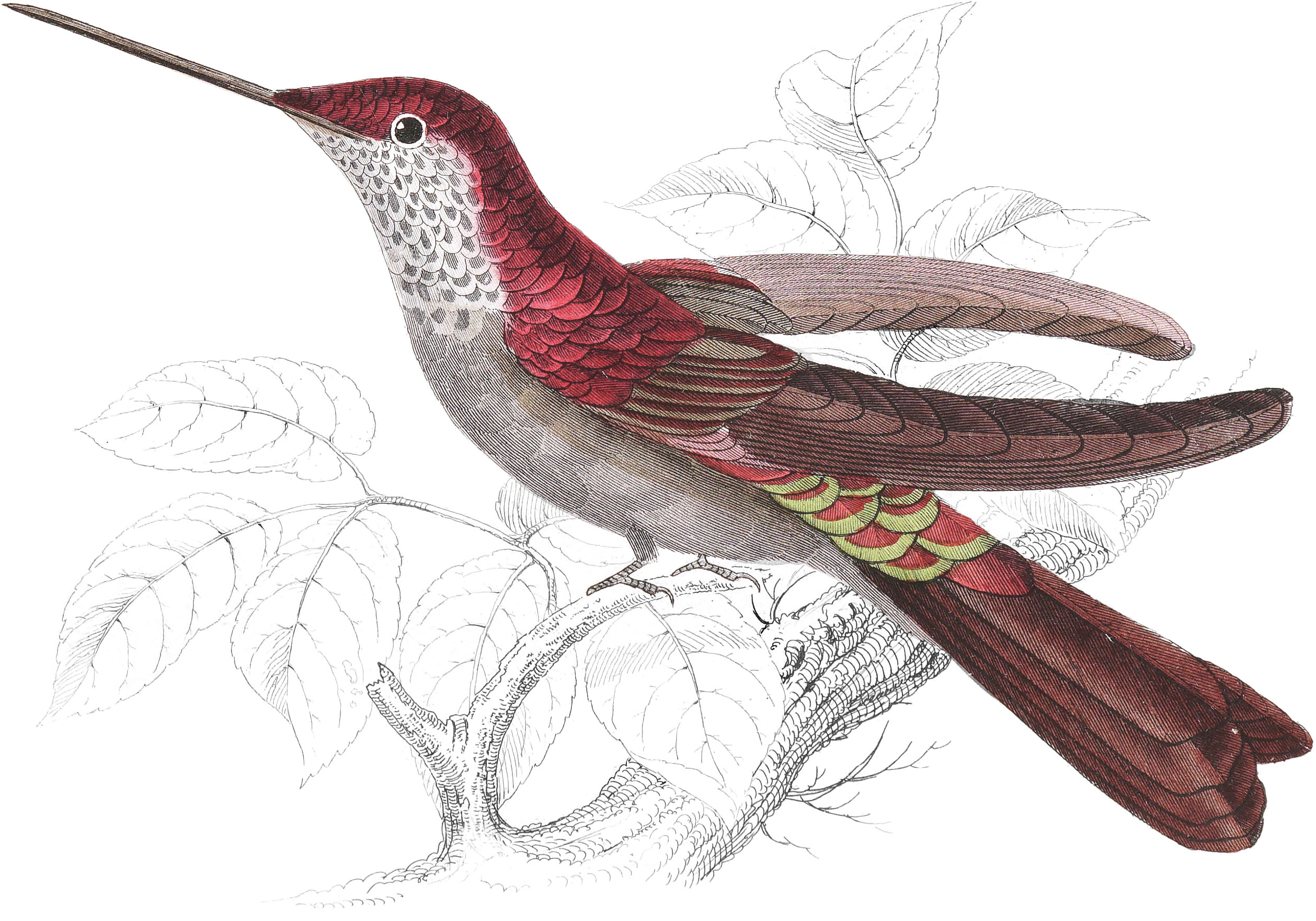
Plate IV
Stoke’s Humming-Bird
Trochilus Stokesii.—King.
Trochilus Stokesii, Capt. King, Proceedings of Zoological Society, p. 36 30.—Le Stokes, Lesson, Trochilidées, p. 135. pl. l.
This most splendid species was discovered by Captain King on the island of Juan Fernandez, thus adding another species to those already known to inhabit that remote land.
It is perhaps one of the most beautiful of the race, and combines at the same time great delicacy of colouring. The length is about four inches and a half: the crown is clothed with scaly feathers of a brilliant blue, changing in some lights to violet, and forming a lengthened and rounded crest behind. The upper part of the body is a bright emerald-green; the shoulders of the same colour: the tail has the two centre feathers entirely of the same green, the others pure white on the inner webs, green on the outer, except the first, which has the basal half of the outer web white also. The cheeks are of a dark purplish-green, with small round spots of a pink or violet colour, according to the light in which they are seen; and the under parts are pure white, except on the throat, which is tinged with green. All over the white are round ocellated spots, of a rich golden-green, appearing very dark in some lights, and everywhere beautifully relieved upon the snowy white. The wings are of the same colour with its congeners.
Upon examining Plate XII. of our first volume, it will be seen that the T. sephanoides and this bird will rank together, and are indeed the only species possessing the form and markings peculiar to them. The feathers on the crown are broad and lengthened, and form a splendid cowl. In this they somewhat resemble the birds on our next plate, except that the cowl is terminated by the feathers decreasing in breadth, and finally ending in along point The tail is very ample, and in both, the lower parts of the body are spotted—a marking at variance with the other species, and as yet confined to very few. In T. sephanoides, although the marking runs in spots, the imbricated form is maintained, and the spots are neither so insulated or decided as in that now described. The bill affords another character, being remarkably slender towards the point, and perfectly straight; and the feathers on the forehead extend quite upon the nostrils.

Plate V
Loddiges’s Humming-Bird
Trochilus Loddigesii.—Gould.
Trochilus Loddigesii, Gould, Proceedings of Zoological Society.—L’Oiseau-mouche de Loddiges, Lesson, Trochilidées, p. 138. pl. li.
In our description of De Lalande’s Humming-bird, Plate X. of Vol. I., we mentioned the discovery of a second species of this form, very nearly allied to it. We have now given a representation of it.
The principal distinctions are the longer bill, the less size of the white behind the eyes, and the more lilac tinge of the long and slender crest, which wants also the white tip. A comparison of the two plates will, however, best point out the differences. The present species was first noticed by Mr Gould, and characterized by him in the proceedings of the Zoological Society of London, under the above name—a well merited compliment.
The whole crest is a brilliant blue, with purple reflections. The upper parts of a golden-green. A spot of white is placed immediately behind the eye, and the whole of the under parts are of the same pure colour, marked with a longitudinal patch of deep black along the centre. The tail is steel-blue for two-thirds of the basal half, the tip is white. This lovely species is a native of Brazil. We have no mention of the female being yet discovered.
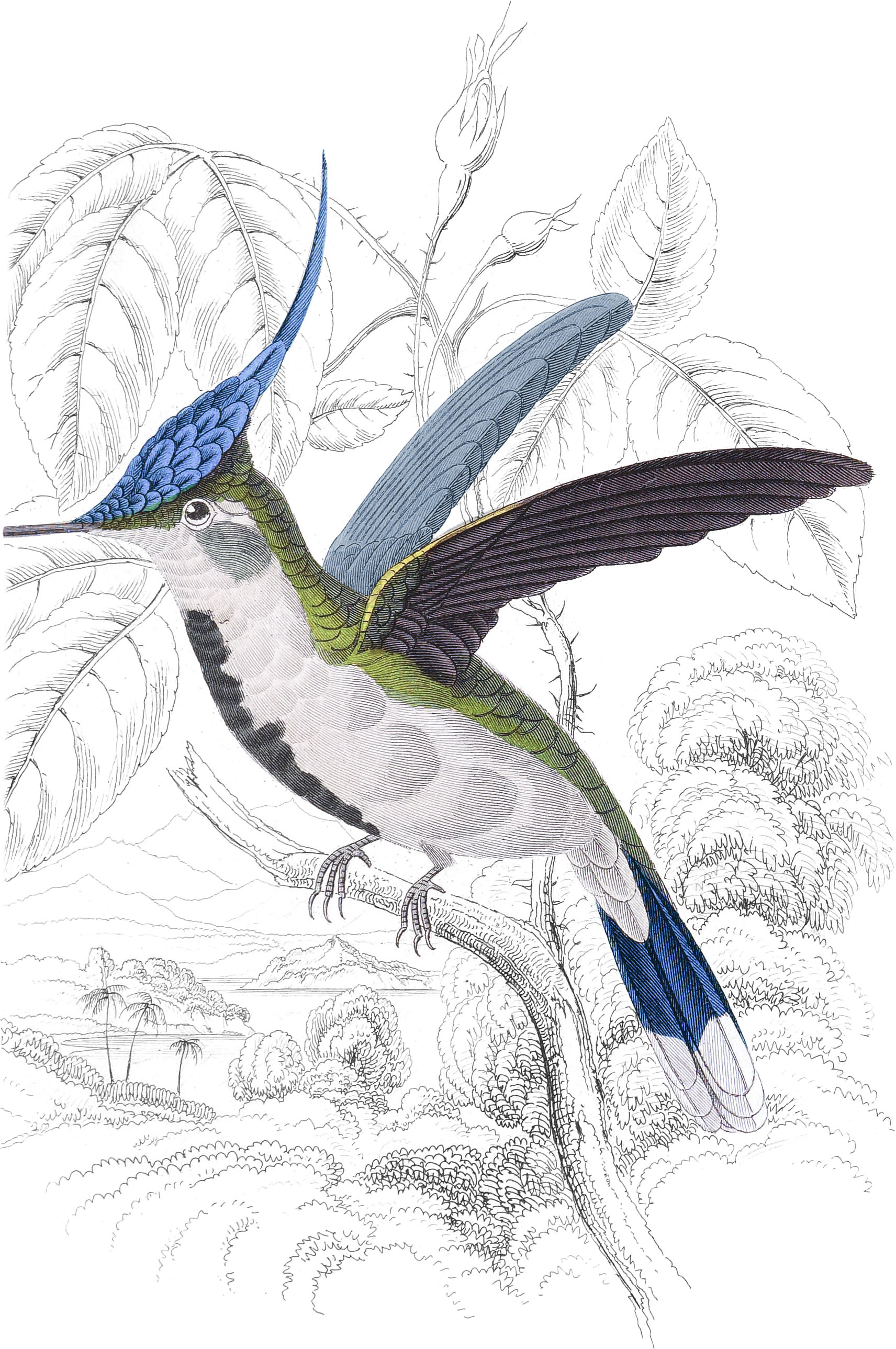
Plate VI
Delalande’s Humming-Bird
Trochilus Delalandii.—Vieillot.
Le Plumet bleu; Ornismya Delalandii, Lesson, Histoire Naturelle des Oiseaux-mouches, pl. xxiv.
We did not think the illustration of this beautiful little group complete without a representation of a Female. The whole upper parts are of the golden-green exhibited by the male; but we lose every trace of the splendid crest which adorns his crown. The white spot behind the eye and the deep blue upon the tail remains. The under parts are of a rich smoke-grey, of a chaste and pleasing tint.
The Male was represented in our first Volume, Plate X.
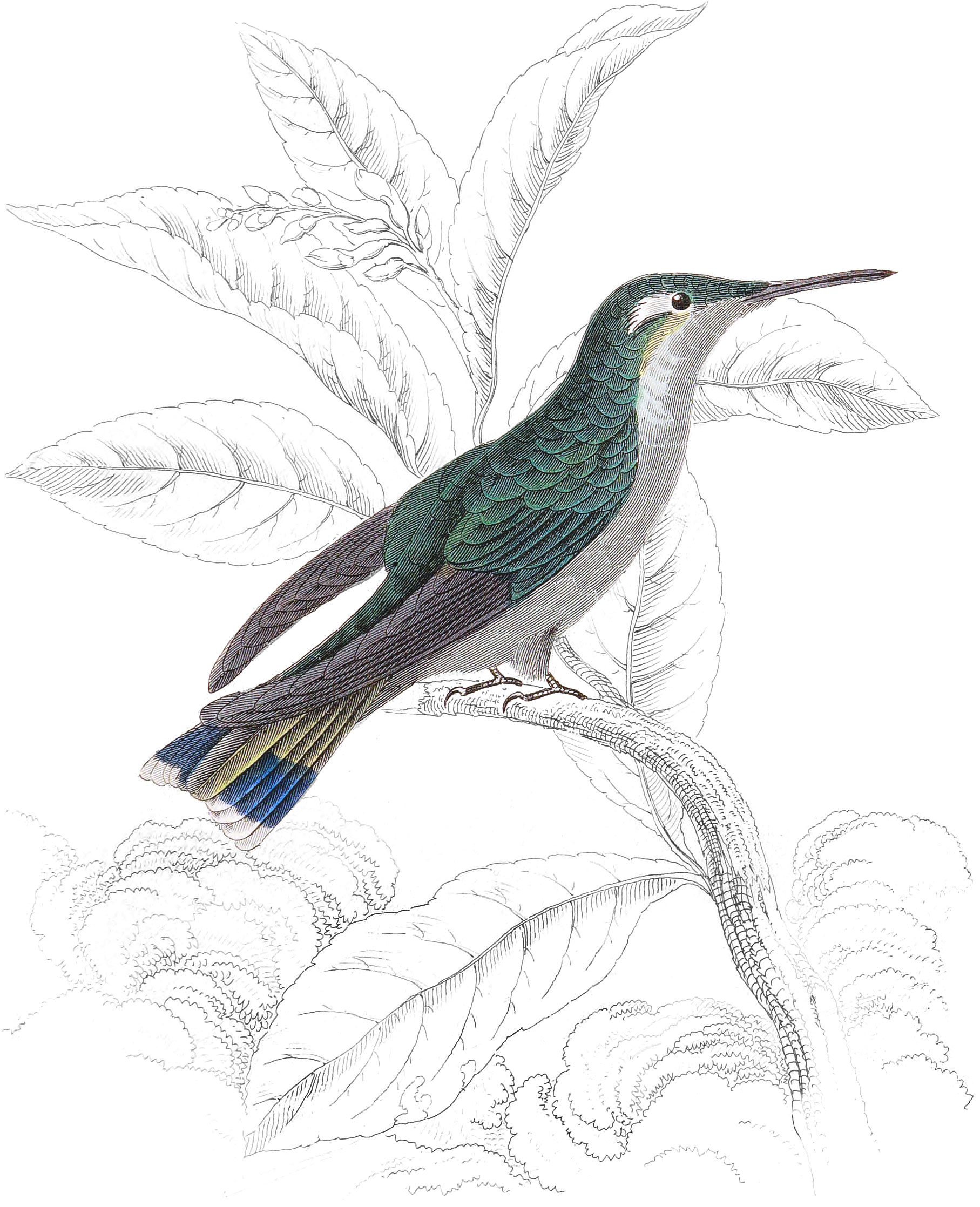
Plate VII
Female
Even-Tailed Amethystine Humming-Bird
Trochilus orthura.—Lesson.
L’Amethyste à queue égale: Ornismya orthura, Lesson, Trochilidées, p. 85, pls. xxviii. and xxix.
There are three Humming-birds, which, though not coming in the same group, we shall now introduce together, from a confusion seeming to have arisen in the discrimination of the species. They are generally known under the name of the “Amethysts,” and Lesson proposes to distinguish them by the titles “L’Amethyste, Le petit Amethyste ou L’Amethystoide, et L’Amethyste a queue égale.” The last, the subject of our plate, we shall first describe.
The length of this species is about two inches and a half: the head, neck, back, rump, and upper tail-coverts, are golden-green; two narrow lines of white spring from each corner of the mouth: the fore-part of the neck, and running upon the breast, is covered with a patch of scaly feathers, of a rich amethystine purple, changing to red with the position: this patch is surrounded with a broad band of greyish-white, which extends upwards upon the sides of the neck in a crescent form, and this is again bordered with a band of deep brown, assuming a greenish tinge as it comes upon the back. The flanks and lower tail-coverts are deep cinnamon-red, and the centre of the belly is pure white, exhibiting a very marked contrast. The tail, in the form of which it differs so much from the other two, is ample, and perfectly square: the feathers are of a golden-green above, black at the ends, except the two on the outside, which are tipped with white.
In a young specimen figured by M. Lesson, the bright patch on the throat is nearly pure white, having the centre of the feathers slightly marked with a greenish tinge. It differs also in the centre of the belly, and under tail-coverts, being pure white, instead of the rich cinnamon of the adults.
M. Lesson has also figured the beautiful nest of this species: it is compactly built upon the sprig of a passion-flower, and is composed of cotton, fortified on the outside by lichens, and by slender roots.
This species is a native of Cayenne—The next we shall mention has been found in the mountainous provinces of Brazil: it is the

Plate VIII
Little Amethystine Humming-Bird
Trochilus omethystoides.—Lesson.
Le petit Amethyste: Ornismya amethystoides, Lesson, Trochilidées pls. xxv. xxvi. and xxvii.
This species Lesson thinks different from that represented on the following plate, and apparently with reason. It is scarcely more than two inches and a half in length: the upper parts are golden-green, with blue reflections; the throat and fore part of the neck are of a rich reddish amethyst colour, whereas in the T. amethystinus it is of a pure and brilliant violet. A collar of clear grey follows this beautiful patch, which gradually passes into the shades of the under parts. The tail is ample, and deeply forked.
In the young assuming the perfect plumage figured by Lesson, the tail is rather rounded than forked, and the whole plumage is of a deep and sombre shade, relieved by the white which occupies the place of the amethystine patch, by a white crescent on the breast, and a band of the same colour crossing the rump. In the succeeding plate of the young, the likeness to the other representations is scarcely recalled; the upper parts are of a chaste reddish-brown, tinged with green on the head, and without any trace of the white band on the rump; the tail is rounded at the end, and is dark olive-brown, the centre feathers having a greater tinge of green than upon the others, the whole are tipped with a narrow band of the same colour with the upper parts. The throat and fore part of the neck are white, interspersed with the young scaly brightly coloured feathers; and the belly and vent are pale reddish-brown, having a slight indication of the crescent band. In all the young species, the wings reach to about the middle of the tail; and it is a curious circumstance, that, in the adults, it should assume a deeply forked shape, and that the young feathers should appear in the very reverse form.—The next bird belonging to the “Amethysts,” is the
Amethystine Humming-Bird
Trochilus amethystinus.—Linnæus.
Trochilus amethystinus, Linnæus.—Amethystine Humming-Bird, Latham, General History of Birds, vol. iv. p. 357.—Oiseau-mouche amethyste, Buffon.—Lesson, Histoire Naturelle des Oiseaux-mouches, and Supplement. pls. lxvii. xx. xxi. xxii.
This long known but beautiful species Lesson has represented on no less than four Plates, exhibiting different states of plumage, all of which we shall endeavour to make use of to render the present description as perfect as possible. The colours of the adult are simple, the upper parts are of a fine golden green, the lower grey, and the throat is adorned by the amethystine patch from whence the name is derived. The colour of the amethyst must be familiar to most persons, and to say that it resembles it, will convey the best idea of its beauty. It is surrounded on the lower part with a light grey crescent.
In the adult the tail is deeply forked, the outward feathers being narrow and slender.
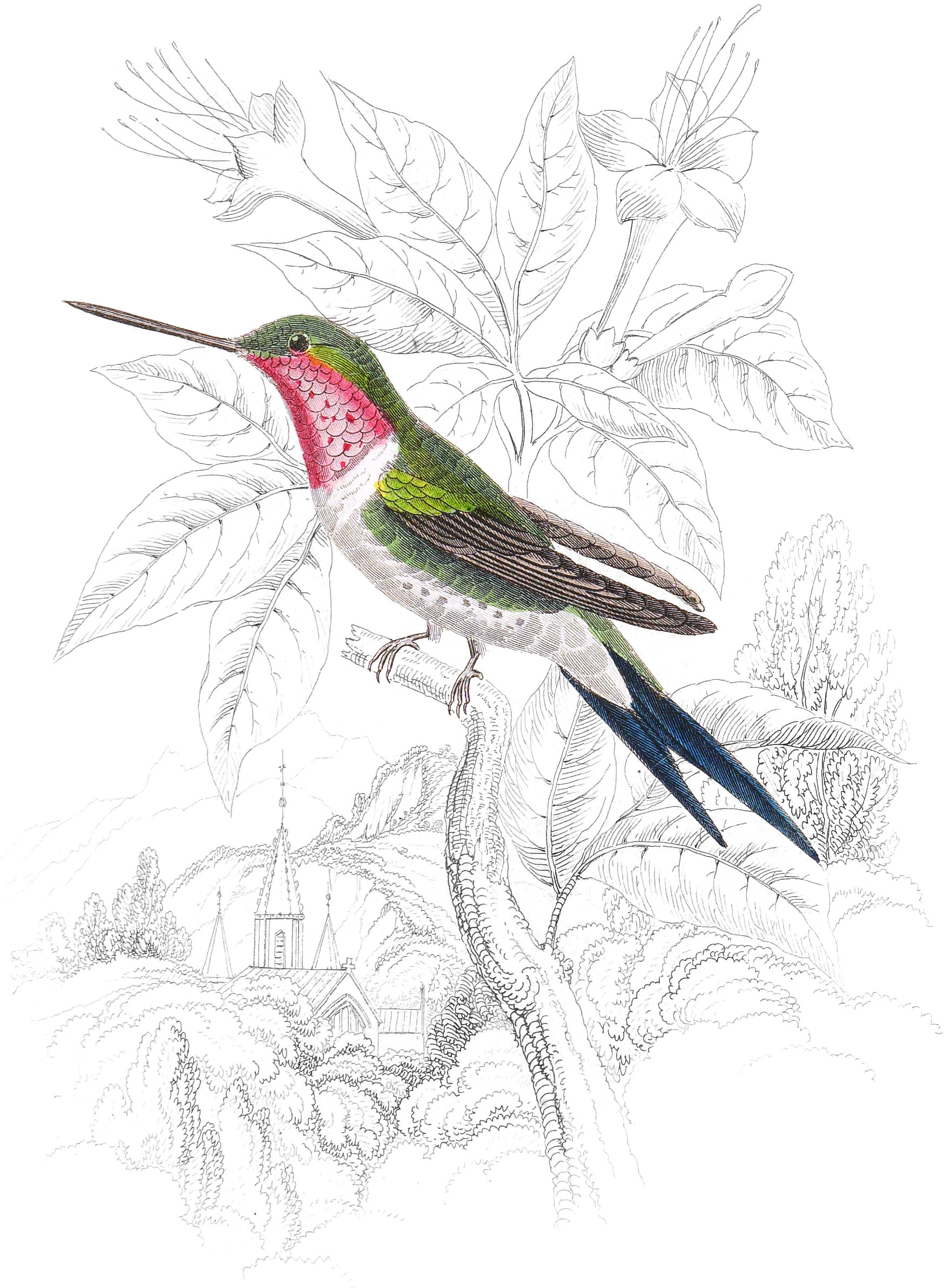
Plate IX

In the Plates representing the birds assuming the adult plumage, those parts which shew the amethystine tints are pure white, the feathers in this state exhibiting no appearance of a scaly form, and a few violet feathers are represented appearing. The plumage is a little duller in shade, and the tail has not reached the greatest development of the fork; but the white band is conspicuous, running over upon the back.
In the very young state, the tail is like that of those allied birds just described, rounded, with pale tips, the colour dark. The upper parts are a pale golden green. The patch on the throat is pure white, running into the crescent-shaped band, and the vent and belly are reddish-brown.
This species is a native of the north parts of Guiana and Brazil, and, though long known, is by no means common in modern collections. The next bird we shall mention as allied to this is the
Ruby-Throated Humming-Bird
Trochilus rubineus.—Linnæus.
Trochilus rubineus, Linnæus.—L’Oiseau a gorge rouge du Brazil, Buffon.—Ruby-throated Humming-Bird, Latham, General History of Birds, iv. p. 342.—L’Oiseau mouche rubis, Ornismya rubinea. Lesson, Histoire Naturelle des Oiseaux-mouches, pls. xliv. xlv. and xlvi.
This very splendid species has been described by authors under various names, in the states from young to adult plumage. We shall endeavour to point out its marking in the different liveries.
The adult male is above four inches in length; the whole of the covering of the body, except the throat, is of a very dark uniform golden green, brightest on the front of the breast, and on those parts where the feathers are scale-formed, on the lower part of the vent it is tinged with brown. The throat is adorned with a patch of very splendid ruby colour, assuming golden reflections; the wings are brownish purple, inclining to green on the shoulders, and the tail, which can scarcely be said to have any fork, is of a bright cinnamon red, with a narrow band of black at the tip; the under coverts are of the same colour.
The female has the upper parts of a lively green, beneath fine reddish brown, shaded to grey on the vent, and without any trace whatever of the splendid patch on the throat; behind the eye there is a white spot, and a line of the same colour runs from the opening of the mouth to the auriculars. The colour of the tail is not so bright as in the male, and the centre feathers are tinged with green.
The young of the first year, according to Lesson, is brown above, with a golden greenish lustre; beneath, dull grey; the outer tail-feathers reddish, the next black, tipped with white, and the centre ones greenish-brown. In the second year it resembles the female, but there is a slight tinge of ruby colour on the throat. And in the third year, the brownish colour of the plumage still remains, but is more tinged with green, the patch on the throat is defined, and rich scaly feathers commence in parts to appear, and the tail is red. The young of this species, according to Lesson, would therefore appear to require the fourth summer to perfect their plumage, to attain the full perfection of all their organs.
The Ruby-throated Humming-Bird is a native of the Brazils. Species brought from that country by MM. Quoy and Gaimard, decided the before undetermined locality of the species.
Wedge-Tailed Amethystrine Humming-Bird
Trochilus montana.—Lesson.
L’Amethyste du Mexique, Ornismya montana, Lesson, Trochilidées, pls. liii lxiii. and liv lxiv.
This bird differs from those arranged under the title of amethysts, by the form of the tail, which is strongly wedge-shaped at the tip. It would seem, as far as we can judge from the representation of Lesson, to range nearer the Nootka Humming-Bird.
It is a native of Mexico; its length is about three inches. The upper parts of the plumage are of a dear and shining green, and a large patch of bright amethystine red covers the breast, and is bordered beneath by a band of pure white; the belly and vent are white, dashed with reddish on the flanks. The tail, of the form we have mentioned, has the centre feathers of a clear green, the lateral ones brown, bordered with chestnut, and having a round whitish spot on the tip of each of the outer ones.
In the young, the throat wants the amethystine patch, and with the rest of the under parts is nearly white.
Langsdorff’s Humming-Bird
Trochilus Langsdorffi.—Vieillot.
Trochilus Langsdorffii, Temminck, Planches Coloriées, 66, fig. 1.—Le Langsdorff, Lesson, Histoire Naturelle des Oiseaux-mouches, pl. xxvi. Adult; pl. xvi. Young.
This beautiful species was discovered by M. Langsdorff, Russian Consul at Rio de Janeiro, to whom it was dedicated by the French ornithologists. It will also serve to recall, says Lesson, the companion of Krusenstern, in his voyage round the world.
It is most remarkable for the curious structure of the tail, and presents almost as great an anomaly in the form of the feathers, as the half-tailed Humming-Bird does in the number of them. It forms a complete and deep fork, but the feathers lengthen out and narrow to a perfect point, the outer one being almost three inches long. The upper parts are of a dull golden green of a uniform tint. The fore part of the breast and throat is covered with a patch of the same colour, but having beautiful reflections in different positions, and composed of the same scaly feathers which almost always occupy this space. Beneath this is a crescent-formed band of bright orange, in some lights approaching to crimson, and which has much the appearance of a similarly coloured band frequent in the African Cyniridæ. This is relieved by the deep brownish violet of the belly, which again contrasts with the pure white of the vent and under tail-coverts, and completes a series of five distinct colours on the under surface of this beautiful little bird. The white of the vent is continued over the rump in a very narrow band, and there contrasts beautifully with the deep green.
The tail, we have said, is deeply forked; it consists of ten feathers. The six in the centre are deep blue, the two on each side, which run to the fine points, are nearly white.
In the young the tail does not assume a forked or lengthened appearance; but, like the birds which have been figured in the preceding plates, it is of a rounded form. The throat is nearly black, but the space occupied by the brilliant green patch is defined by a plumage of a greenish white, and little trace of the lower orange band is seen. The upper parts are of a duller green, and the tail is deep bluish black, having the tips of the outer feathers white.
Langsdorff’s Humming-Bird is a native of Brazil the female has not yet been described, and I believe specimens are yet unknown in Europe.

Plate X
Ruff-Necked or Nootka Humming-Bird
Trochilus rufus.—Gmelin.
Trochilus rufus, Gmelin, edition of Systema Naturæ of Linnæus.—Ruff-Necked Humming-Bird, Latham, General History of Birds, vol. iv. p. 350.—Ruff-Necked Honey-Sucker, Pennant, Arctic Zoology, vol. ii. p. 177 290.—Selasphorus rufus, Nootka Humming-Bird, Swainson, Northern Zoology, vol. ii. p. 324.—Lesson, Histoire Naturelle des Oiseaux-mouches, pls. lxvi and lxvii, and Supplement, xi. xii. and xiii.
The discovery of this splendid species is due to our great navigator Captain Cook, while for its first description we are indebted to the now venerable ornithologist of our present day. It is an inhabitant of the inhospitable climate of Nootka Sound, but ranges over a considerable extent, having been received from Real del Monte by Mr Swainson.
Captain Cook made the following observations, when mentioning this beautiful species.
There are also Humming-Birds, which yet seem to differ from the numerous sorts of this delicate animal already known, unless they be a mere variety of the Trochilus colubris of Linnæus. These, perhaps, inhabit more to the southward, and spread northward as the season advances; because we saw none at first, though, near the time of our departure, the natives brought them to the ships in great numbers.
The most accurate description we can insert is that from the Northern Zoology.
General tint of the upper plumage rufous or cinnamon, which covers the head, ears, neck, back, rumps, upper tail, corners, and margins of the tail feathers; the crown and the wing covers, however, have a strong coppery greenish gloss, but which does not extend to the ears, the upper line above the eye, or to that between the eye and bill; the greater and lesser quills, and the middle of the tail feathers, with these tips, are all of a pale smoky brown, slightly glossed with violet. Under plumage; the whole of the chin and throat is covered with scale-like feathers of a fine looking colour and lustre, equally brilliant with the throat of T. moschitus, but with more of a red and less of an orange gloss; the tints, however, change in almost every direction of light, and in all are exquisitely splendid. The middle of the breast and vent are nearly pure white, but all the sides and the under tail covers are of the same colour as the back. Legs and feet dark brown. The female chiefly differs in being green gold, where the male is cinnamon; the throat being merely spotted with the glowing ruby colour of the male.
According to Dr Latham,
the female is green gold on the upper parts; instead of cinnamon on the throat, are only spots of the glowing ruby colour; breast and vent as in the male; tail coverts green; tail as in the other sex; the two middle feathers or one colour, the rest with a white spot at the tips.
In a specimen of a young female which Lesson has figured, the tail is only slightly rounded, having the outer feathers tipped with white; the upper parts are of a greyish green, and the lower part of the plumage is of a chaste grey, palest on the throat and vent.
Lesson has also given two representations of the young males. In these the bright scaly feathers of the throat are appearing, with the generally more vivid tints of the adult, but the tail assumes very little of its wedge-shaped form.
Mr Swainson forms from this bird his genus Selasphorus, which I believe would be before the institution of Lesson’s title of Lophornis for the same group, and includes all those magnificent species having tufts of feathers issuing from the sides of the neck, of which the Tufted-necked Humming-Bird was so long the most familiar example; and also the Trochilus platycercus, which has been described in the Philosophical Annals, with a Synopsis of Mexican Birds whitish; it is characterised as green above, beneath the chin and throat amethystine red, the tail rounded, with the four centre feathers very broad.
Vieillot’s Humming-Bird will also range here, and we may now mention, that since the publication of our First Volume, another figure has been given by Lesson, in which the neck tufts are represented at much greater length, and of a richer and more brilliant green. But of all the birds belonging to this splendid little group, one which M. Lesson has dedicated to Mr Gould of London, is the most exquisitely beautiful. We have represented it on the next plate.
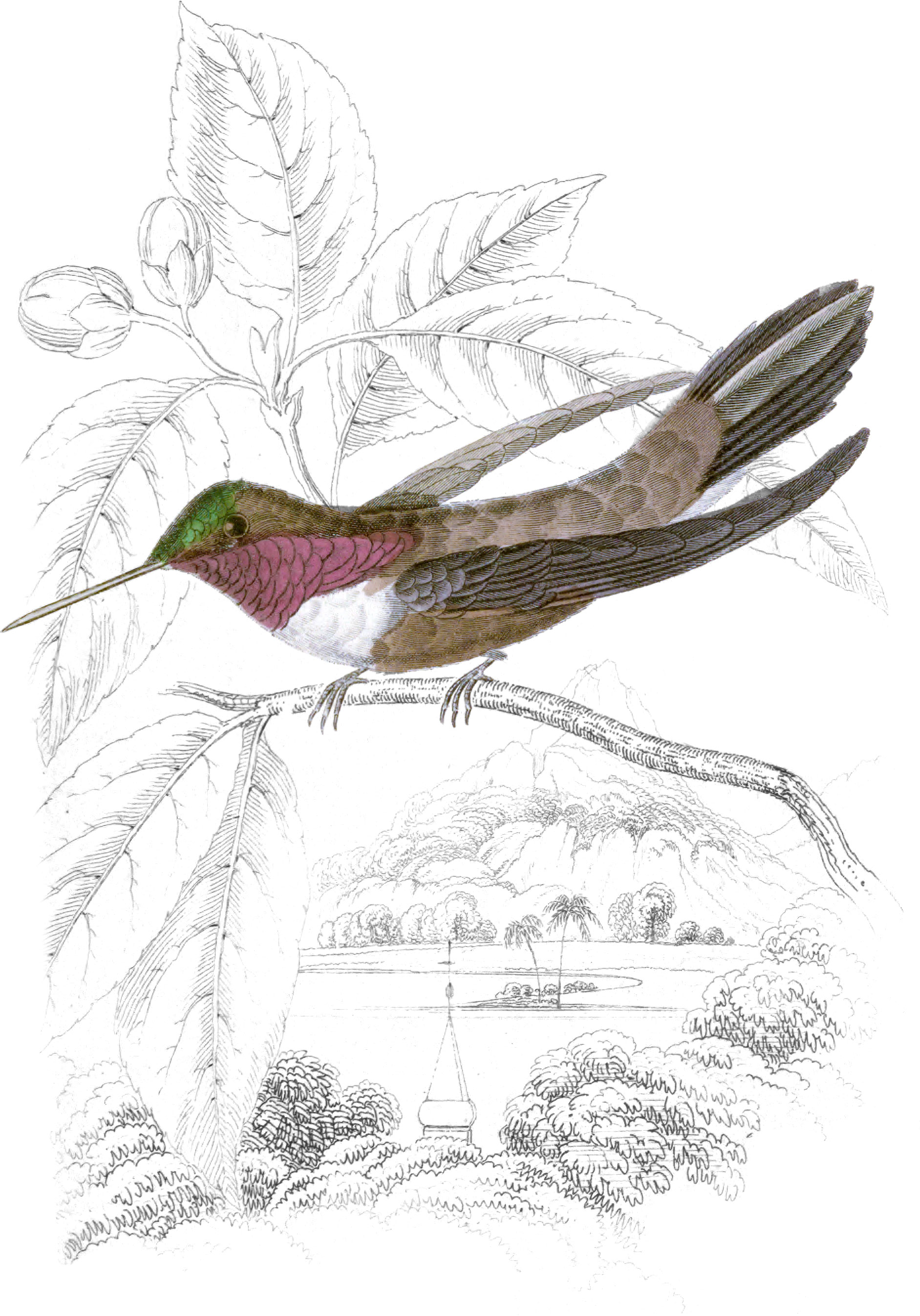
Plate XI
Gould’s Humming-Bird
Trochilus Gouldii.—Lesson.
L’Oiseau-mouche, Gould.—Ornismya Gouldii, Lesson, Trochilidées, p. 103, pl. xxxvi.
The native district of this splendid species is unknown. In size it is similar to the Tufted Necked Humming-Bird: the forehead, throat, and upper part of the breast, are of a most brilliant green, the feathers of a scaly form; from the crown springs a crest of bright chestnut feathers, of a lengthened form, and capable of being raised at pleasure; the back and upper parts are golden green, crossed upon the rump with a whitish band; the wings and tail are brownish purple, the latter having the centre feathers tinged with green; the lower parts are dark brownish green. The neck tufts are of the most splendid kind, and have a chaste but brilliant effect they are composed of narrow feathers of a snowy whiteness, the tips of each having a round ocellated spot of bright emerald green, surrounded with a dark border; the longest are at the upper part of the tuft, and they decrease in length, assuming the shape of a butterfly’s wing; shorter feathers again spring from the base, and their green tips are relieved on the white of the longer ones behind them.
There are specimens of this splendid species in the collection of Mr Loddiges.

Plate XII
Tri-Coloured Humming-Bird
Trochilus tricolor.—Lesson.
Le Tricolore, Ornismya tricolor, Lesson, Histoire Naturelle des Oiseaux-mouches Supplement, pl. xiv., and Trochilidées, pl. lx.
This species, also of great beauty, seems to be first described and figured by Lesson. It is about three inches in length. It appears to belong to that group where the throat is covered with feathers of a large size, and which can be expanded at the will of the bird. The bill is very slender, and is slightly curved. All the upper parts are of a brilliant golden green, tinged with brown on the forehead; the breast, belly, and under tail-coverts white, shading into green upon the flanks, and the throat and fore part of the neck is covered with rather large rounded scaly feathers of a brilliant carmine red, beautifully relieved by the white of the breast, and when expanded forming a ruff or collar. The tail is nearly equal at the end, but the feathers become narrow towards the tips, almost acuminated, which serves to distinguish it from those other species which have the throats adorned with an amethyst coloured patch. The centre feathers are tinged with green, the others are of a deep steel-blue, having the inner webs bordered with chestnut-red. Two beautiful figures of this bird are given by Lesson, the one said to be from Mexico, the other from the Brazils.
Another lovely bird having a singular distribution of the plumes upon the neck, will be seen on our next Plate. The form of the tail, however, is very different, and the bill is distinctly curved from the base.
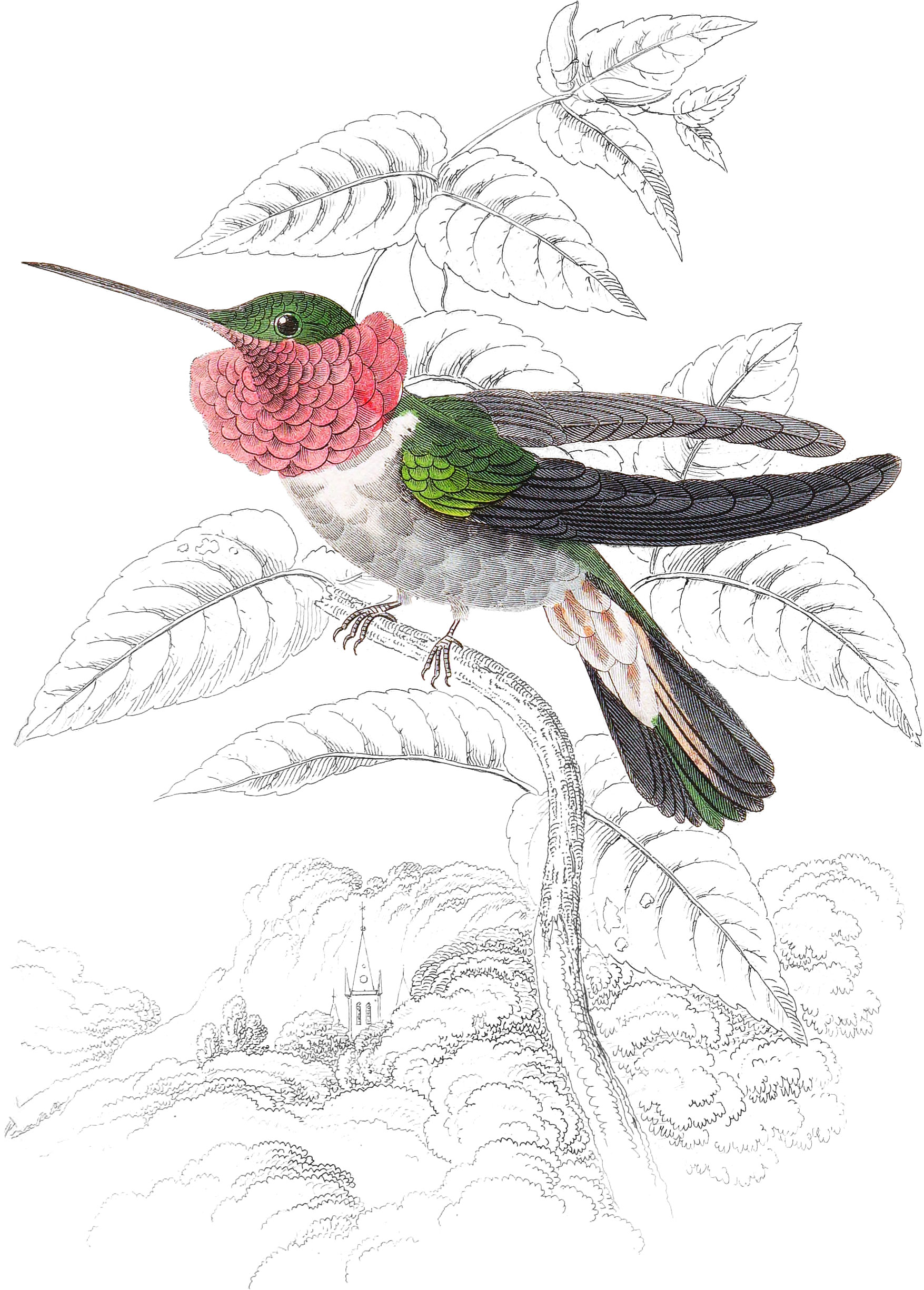
Plate XIII
Blue-Throated Humming-Bird
Trochilus lucifer.—Swainson.
Cynanthus lucifer, Swainson, Synopsis of Mexican Birds.—L’Oiseau-mouche barbe blue, Ornismya cyanopogon, Lesson, Histoire Naturelle des Oiseaux-mouches, p. 50, pl. v.
This lovely species seems to have been first noticed and described by Mr Swainson; consequently we have given his name at the head of this description, in preference to that of Lesson, which is engraved upon the Plate. The first specimens seem to have formed part of the collection of the Duke Rivoli in Paris, and several individuals have since been brought to this country. It is a native of Mexico. It is a bird of a very slender form; the upper parts are bright yellowish green, the under nearly pure white, tinged with greenish on the flanks, and the throat and fore part of the neck are covered with beautiful lengthened plumes of a bluish violet colour, assuming a pink or ultramarine tint according to the position. The tail is deeply forked, and the outer feathers become narrow towards the tips. The female has not yet been described.
From some allied species Mr Swainson has formed his group Cynanthus, but places this at the end as an aberrant species, from the curvature of the bill. This will stand as one of the five great divisions into which he would distribute the whole of the Trochilideæ.
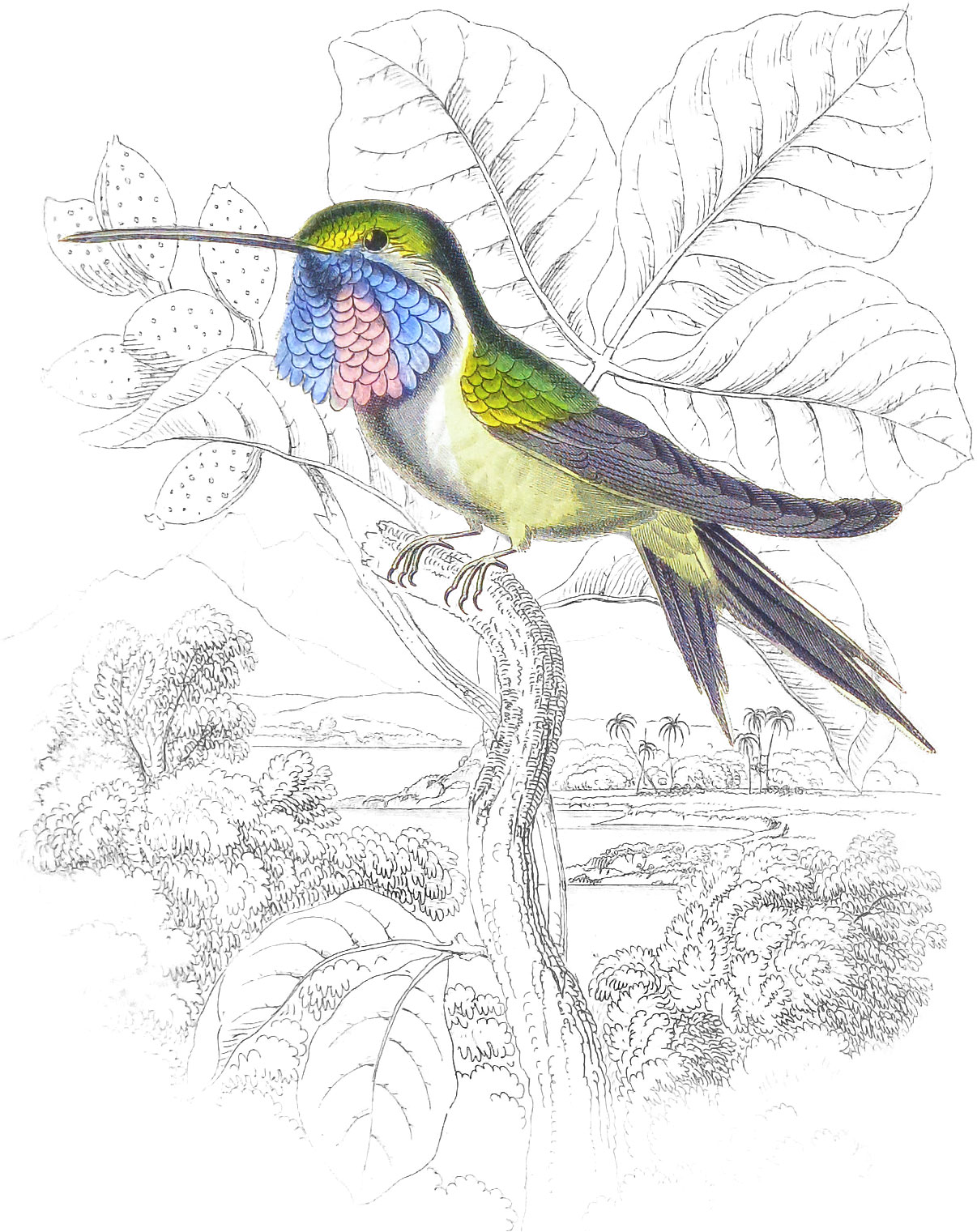
Plate XIV
Violet-Tufted Humming-Bird
Trochilus petasophorus.—Neuwide.
Oiseau-mouche pétasophore, female, Lesson, Trochilidées, pl. lix.
In the description of the adult male of this beautiful species, plate xiii. of our first volume, we stated that the female was not well known. Lesson has since published a figure of that sex, also received from Brazil. The upper parts of the plumage are entirely of a very clear green, which on the throat, neck, and breast increases in brilliancy. The belly, vent, and under tail-coverts are pure white. A stripe of the same colour runs from the corner of the mouth, below the eye, nearly to the ears, and alone disturbs the uniformity of the colouring above. The tail is rounded, uniformly green above, paler beneath, and crossed with a bar of steel blue; the outer feathers are tipped with white.
The plumage of the young is also very similar; but the green of the breast and throat is not so brilliant, and the belly and vent are grey. The white stripe from the opening of the mouth on the cheeks is conspicuous, and the neck-tufts are marked by a slightly brighter hue.
By Lesson this species is arranged in the second section of his “IV. Race, les Ramphodons,” with the species figured on our first and second plates. Both have the edges of the mandibles serrated, but differ very much in form and plumage from the type of the genus.

Plate XV
Female
Wagler’s Humming-Bird
Trochilus Waglerii.—Lesson.
Le Wagler, Ornismya Waglerii, Lesson, Histoire Naturelle des Oiseaux-mouches, p. 203, pl. lxxiii.
This beautiful species has been considered by some to be the male of T. sapphirinus; but we have followed the authority of Lesson, who has devoted so much time to the study of this family, in supposing it to be distinct. It is about four inches in length. The whole plumage is of a deep and dull emerald green, appearing very dark in those parts subjected to shade, but with very brilliant blue and golden reflections on the parts catching the light. The tail is slightly forked, and, with the wings, is tinged with dull blue, the latter appearing almost of that colour, and varying from the purple shade which is the general tint of the quills in almost all the species. The native country of Wagler’s Humming-Bird is Brazil.
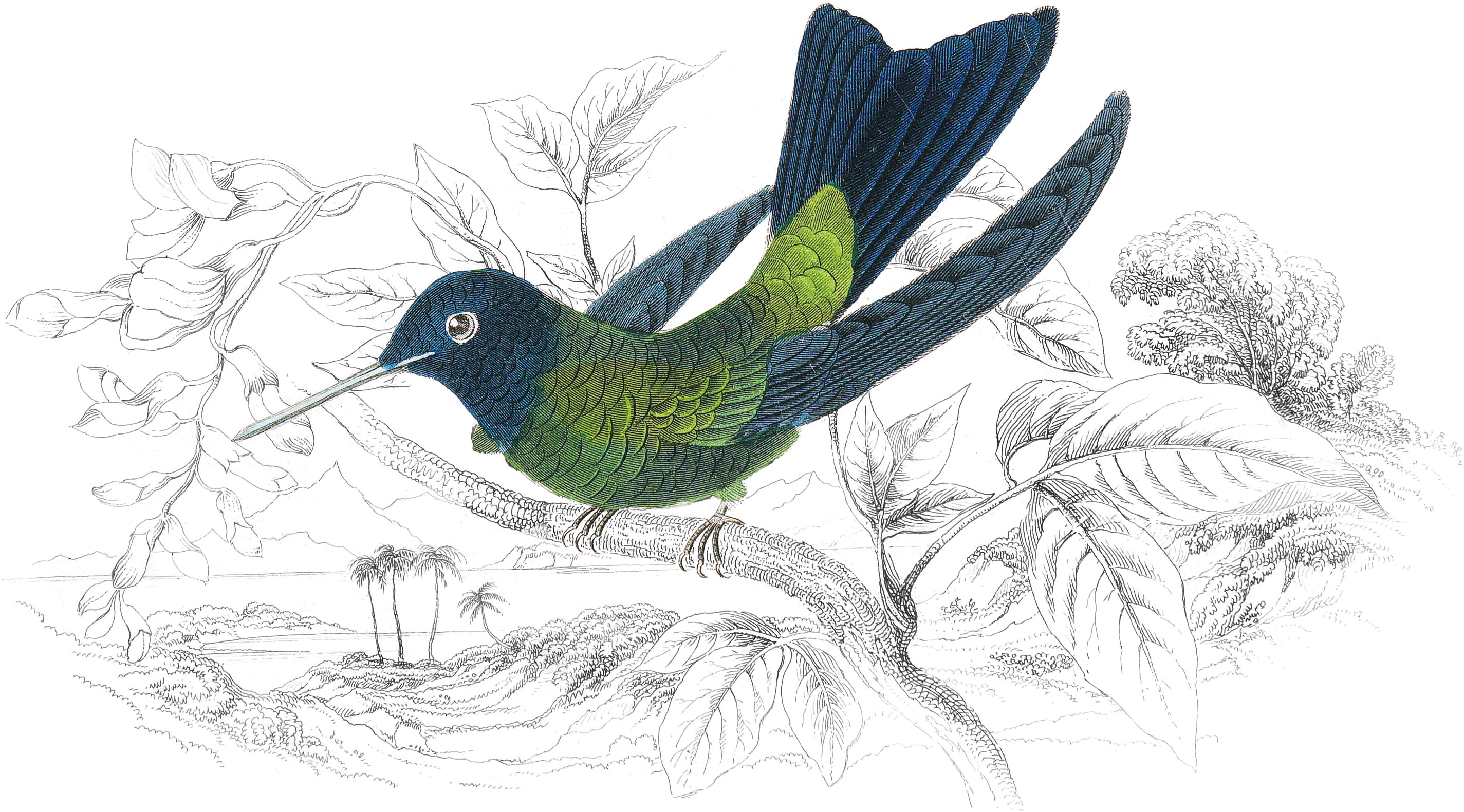
Plate XVI

In this place it will be proper to introduce one or two species, which are in many respects near allies. The first we shall mention is the
Sapphire and Emerald Humming-Bird
Trochilus bicolor.—Gmelin.
Trochilus bicolor, Gmelin, edition of Linnæus.—Sapphire and Emerald Humming-Bird, Latham, General History, iv. p. 329 Le Sapphire emeraude, Lesson, Histoire Naturelle des Oiseaux-mouches, p. 161, Pls. xlix and l.
This species is distinguished at once from that figured on the last plate, by the rich green of the whole body, except the throat, breast and tail. In the above mentioned bird these parts are tinged with a much greater shade of blue, and seem in some lights to be almost of that colour; the crown is of a very deep tint, and appears much darker than the rest of the body; the throat and breast gradually shading into the belly, are very rich blue, with metallic lustre; the tail is deep steel-blue above and below, and appears scarcely so much forked as in the preceding bird; the bill has the upper mandible black, the lower yellowish white, except at the tip, which is brown. The female resembles the male, except on the under parts; the beautiful blue of the throat and breast is nearly pure white, and, as it reaches the belly and vent, becomes mixed with green. The young birds differ by the blue throat being very dull, by the vent and flanks being of a greenish black, and by the whole plumage wanting in brilliancy.
It is a native of French Guiana, and Latham mentions it from the island of Guadaloupe.
The Ourissia
Trochilus Maugerii.—Lesson.
Trochilus Maugerii, Vieillot.—T. Ourissia? Linnæus.—Meillisuga Surinamensis, Edwards.—Oiseau-mouche Mauge, Lesson, Histoire Naturelle des Oiseaux-mouches, pls. lxviii. and lxix.
There is considerable difficulty in the unravelling of the synonyms and opinions regarding this species, and it is most probable that the name applied by Vieillot, and latterly by Lesson, must be supplanted by that of Ourissia.
We give the description of the bird, figured under the first title. It is about three inches and a half in length; the bill black, with the base of the under mandible yellow; the upper parts are dull green, but with very brilliant reflections, approaching sometimes to blue, and the same colour occupies the fore part of the breast; on the throat and belly the green is more brilliant; the vent and under tail coverts are greyish; the tail is deeply forked, of a steel blue, and it may be remarked, that this will be the character which will distinguish it from those it has been confounded with.
The female, according to Lesson, is less, and with all the colours duller; the lower parts grey; the tail slightly forked; the centre feathers green, the others brown, tinged with blue, and the two centre ones tipped with white. The specimens which Lesson describes were sent from Porto Rico.
The next species is
The Blue-Fronted Humming-Bird
Trochilus glaucopis.—Gmelin.
Trochilus glaucopis, Gmelin, edition of Linnæus.—The Blue Fronted Humming-Bird, Trochilus frontalis, Latham, General History, vol. iv. p. 352.—Oiseau-mouche glaucope, Lesson, Histoire Naturelle des Oiseaux-mouches, p. 175, Pls. lviii–lix.
The forehead of this species is of a rich metallic blue, with violet reflections; the upper parts of the body are of a rather dull green, but which, according to Dr Latham, is darker in some specimens, and in others nearly of the same tint with the lower parts. The lower parts are bright emerald green, with the feathers on the throat and breast in the form of scales; the vent and under tail coverts are greyish white; the tail is deeply forked, the feathers composing it broad, but graduated at the tips; the colour is an intense steel blue.
The only discrepancy between the description of Lesson, who has figured both sexes, and that of Dr Latham, is, that the latter describes the legs feathered to the toes, the former has drawn them unplumed.
The female wants the blue upon the crown, which is of the same uniform green with the upper parts; the throat, breast, and belly, are of a dull grey, dashed with green on the flanks, and the tail is greenish above, with a blue tip.
The young of the first year have the head brown, the under parts of a clear grey, covered with a collar of golden green upon the higher part of the breast. This species inhabits Brazil.
Audebert’s Humming-Bird
Trochilus cœruleus.—Audebert.
Trochilus cœruleus, Audebert, Oiseaux dorées, pl. 40.—L’Oiseau-mouche Audibert, Lesson, Histoire Naturelle des Oiseaux-mouches, 164. pl. li.
This species, to which Lesson has applied the title of Audebertii, though described by that naturalist under another name, is closely allied to T. bicolor, and is introduced by Buffon as a variety of it. The upper parts are of a dull green, the lower parts, except the throat and vent, bright emerald green the throat is a rich sapphirine blue, and the vent and under tail-coverts are white. The form of the tail differs from that of the T. bicolor, being completely rounded at the tip; above and below it is of a deep and dull blue. It is a native of Guiana.
There are yet two birds to be introduced here, which, as far as we can judge without an examination of specimens, are much allied to those just described, and of which Plate xvi. will give some idea of the form. They both appear to have been unfigured before the beautiful work of Lesson gave us a knowledge of them. The first that naturalist has described under the title of
Swainson’s Humming-Bird
Trochilus Swainsonii.—Lesson.
Le Swainson, Lesson, Histoire Naturelle des Oisseaux-mouches, pl. 70.
Before describing this bird, we may remark that Lesson has also applied the name of this distinguished British ornithologist to another Humming-Bird, and the only reason that we can see for retaining it to both is, that the other, represented on our thirtieth Plate, will belong to a separate group of this large family, that of which T. hirsutus forms the type, and which has been characterised by Swainson under the name of Pæthornus, and by Boié under that of Glaucis.
It is rather a large species, being above four inches in length; the upper parts are of a uniform golden green tint, while the throat and fore part of the neck are clothed with feathers of the most brilliant emerald green, and which shade into a duller tint upon the flanks; on the middle of the breast there is a patch of velvety black; the vent plumes are whitish. The tail is deeply forked, and of a dull indigo blue.
This species is described by Lesson from a single specimen in the Parisian gallery. It was received from Brazil. The other bird we alluded to may be termed the
Crimson-Rumped Humming-Bird
Trochilus erythronotus.—Lesson.
L’Erythronote, Ornismya erythronotos, Lesson, Histoire Naturelle des Oiseaux-mouches, p. 181. pl. lxi.
This bird, Lesson observes, may prove to be the young of the last. But although the form is very similar, the colour seems so distinct, that it is unlike what is seen in the others which vary from the young to the adult plumage. In length it is little above three inches. The head, back of the neck, and entire under parts, are of an emerald green, which, though dull, shews changes of tint with the position. On the under side the colour is quite uniform, and without any black patch. The lower part of the back, rump, and the wing-coverts, are of a rich crimson, with golden reflections. The tail is deeply forked, and is of an indigo-blue colour on both surfaces. It is a native of Brazil.
Neuwied’s Humming-Bird
Trochilus cyanogenys.—Neuwied.
L’Oiseau-mouche Wied, Troehilus Wiedii, Lesson, Supplement, pl. xxvi.
This is closely allied to the preceding, but is considerably smaller. The upper plumage is of a brilliant and shining sapphirine-green, with yellowish reflections. The lower parts are of a clearer or more emerald tinge, and are shaded into pure white at the vent. The throat and auriculars are of a brilliant sapphirine-blue. The tail is rounded at the end, and is of a very deep steel-blue, with green reflections above. It was discovered by Prince Newied, in Brazil.
The Atala
Trochilus Atala.—Lesson.
L’Atala, Ornismya Atala, Lesson, Trochilidées, pl. xlii.
This species is also very closely allied to several of those preceding. It is two inches and a-half in length, and is above and below of a clear emerald-green, without any blue on the throat. The vent and tail-coverts are pure white. The tail, which is square, is of a steel-blue, deep and bright. It is a native of Brazil.
White-Striped Humming-Bird
Trochilus mesoleucus.—Temminck.
Oiseau-mouche mediastin, Trochilus mesoleucus, Temminck, Planches Coloriées, 317. Male, Female, and Young.—Lesson. Histoire Naturelle des Oiseaux-mouches, and Trochilidées, pl. xxix., xxx. and xlv.
This curiously marked species was first described by M. Temminck, and figured in the Planches Coloriées. It is of considerable size and strength, and is remarkable for the narrow stripe of white which runs from the throat along the centre of the belly. The length is about four inches and a half, the bill perfectly straight and proportionally long; the plumes on the head are of a rich glaucous blue, and of the form of scales, the auriculars are brown, bordered below with a narrow line of white; the whole throat and neck is covered with scaly feathers of a rich amethystine tint, which lengthen upon each side, and stretch upon the neck in narrow points. From the centre of this patch is a pure white narrow line, which reaches to the tail-coverts of the same colour. The sides, as well as the back, are of a dull golden green, assuming a brighter tint on the upper parts. The tail is very ample and slightly forked; it has a brownish green lustre, and the two outer feathers are marked with a round white spot at the tips.
The female has nearly the same plumage as the male, except on the throat; the part occupied by the beautiful patch is a greyish-white, and the base of the feathers is marked with a darker tint; from this the middle line of white, equally conspicuous as in the other sex, descends to the tail.
In the young the tints are generally duller, and a few straggling crimson feathers are generally observable on the throats of the males. The species is a native of Brazil.
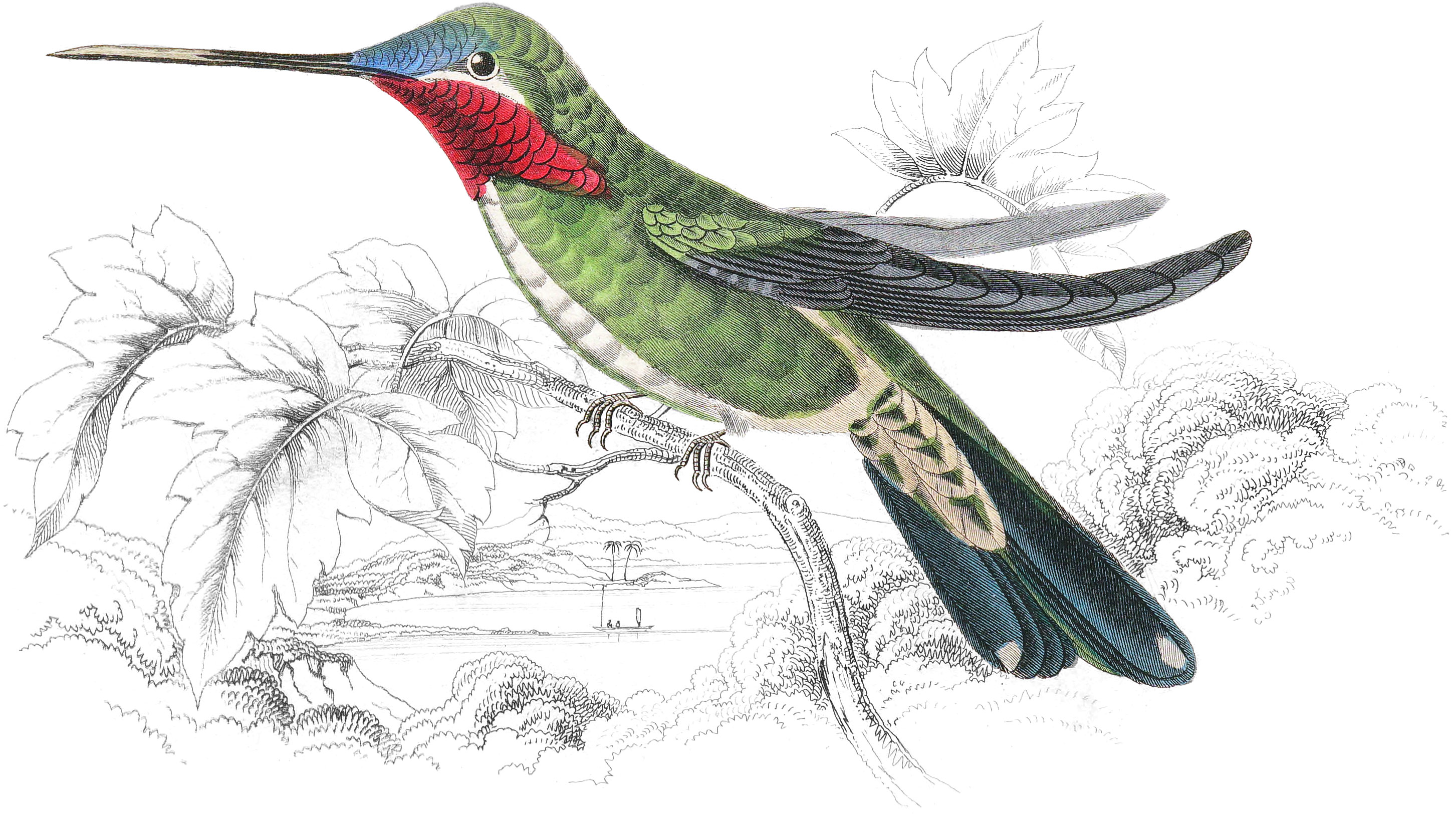
Plate XVII
Another bird, allied in form and colouring to this, and figured by Temminck, is the
Scaly-Throated Humming-Bird
Trochilus squamosus.—Temminck.
Oiseau-mouche ecaillé, Trochilus squamosus, Temminck, Planches Coloriées, pl. 205.—Oiseau-mouche, Temminck.—Ornismya Temminckii, Lesson, Histoire Naturelle des Oisseaux-mouches, pl. xx. Male.
To this bird Lesson has given the name of M. Temminck, its first describer, but as usual we have retained the name which that gentleman originally gave. It has exactly the same form with the last we have described, and the markings are all so similar, that the same species might almost be made by a change of colour on the same engraving. The colour of the body is of a rich green. The throat, where the amethystine patch of the former is placed, is a pure white, but the base of each feather is distinctly marked with a deep shade of grey, which gives a scaly appearance to that part, and from whence Temminck has taken the character for his name; a white line is continued along the centre of the lower parts, and joins the tail-coverts of the same colour. Its native country is also Brazil.
White-Throated Humming-Bird
Trochilus albicollis.—Vieillot.
Oiseau-mouche à gorge blanche; Trochilus albicollis, Temminck, Planches Coloriées, 203 Lesson, Histoire Naturelle des Oiseaux-mouches, pl. lxiii.
Another species, also corresponding in form with the last. There is, however, a considerable difference in Lesson and Temminck’s representation of the same bird, the first making the white patch appear in the middle of the breast, the latter placing it where the scaly feathers are in the preceding. The rest of the plumage is of a bright green, except the centre of the belly, and under tail-coverts, which have the same mesial line with the others. The tail is scarcely so much forked as in the last; the two centre feathers are entirely brownish-green, the others dull blue, with white tips. It inhabits Brazil.
There is yet a fourth species, which will most naturally be introduced here, though it differs in the form of the tail: it is the
Superb Humming-Bird
Trochilus superbus.—Shaw.
Superb Humming-bird; Trochilus superbus, Shaw, Naturalist’s Miscellany, vol. xii xiii. pl. 517.—Zoology, vol. viii. p. 323.—Oiseau-mouche superbe, Temminck, Planches Coloriées, 299.—Oiseau-mouche Corinne, Lesson, Histoire Naturelle des Oiseaux-mouches, pl. ii.
This splendid species was first noticed and de scribed by Dr Shaw: afterwards it was figured by Temminck; and again it is represented by Lesson, who has applied to it the name of “Corinne,” for what reason he does not explain. The description of its discoverer is as follows:
It is unquestionably one of the finest of this brilliant race. Its length is about four inches and a quarter; the bill being long in proportion to the bird, straight and black: the crown of the head bright sky-blue; from the bill to the head, on each side, a moderately broad black stripe, and beneath this a white stripe: throat and upper part of the breast of a most brilliant scarlet, the feathers full, or somewhat projecting; remainder of the body, both above and below, golden-green, but paler or greyer beneath: wings purplish-brown; tail of the same, but the outsides of the feathers golden-green, appearing of that colour when closed; each of the two outside feathers tipped with white.
The modern plates agree with this description, except that there is no trace of the black line beneath the blue of the head. But Temminck says that the females only are distinguished by this mark. The tail is very strongly wedge-shaped, instead of the form assumed by the three we have just now described. This species is a native of the Antilles—the island of Trinité.
Duke of Rivoli’s Humming-Bird
Trochilus Rivolii.—Lesson.
L’Oiseau-mouche Rivoli; Ornismya Rivolii, Lesson, Histoire Naturelle des Oiseaux-mouches, pl. iv.
This very splendid Humming-Bird maybe placed next to the last we have described, by the straight form of the bill; but the form of the tail is again different, in being very ample, and square at the end. M. Lesson considers it undescribed, and has dedicated it to the Duke of Rivoli, in whose collection the specimen which served for his copy was procured.
It is in length about four inches, of which the bill is an inch. The head is crowned with a beautiful cowl of rich violet-blue: the upper parts, breast, belly, and vent, are of a deep golden-green, assuming a very dark shade in some positions; this occupies the space wherein the eye is situated, in the form of a narrow line to the rictus, and separates the rich blue of the cowl from a splendid emerald-green gorget, which occupies the throat and all the fore part of the neck, resting upon the side in a rounded point. The lower tail-coverts are nearly white. The tail is nearly of the same colour with the upper parts, the outer feathers with a greater proportion of brownish gold colour.
This species is a native of Mexico.
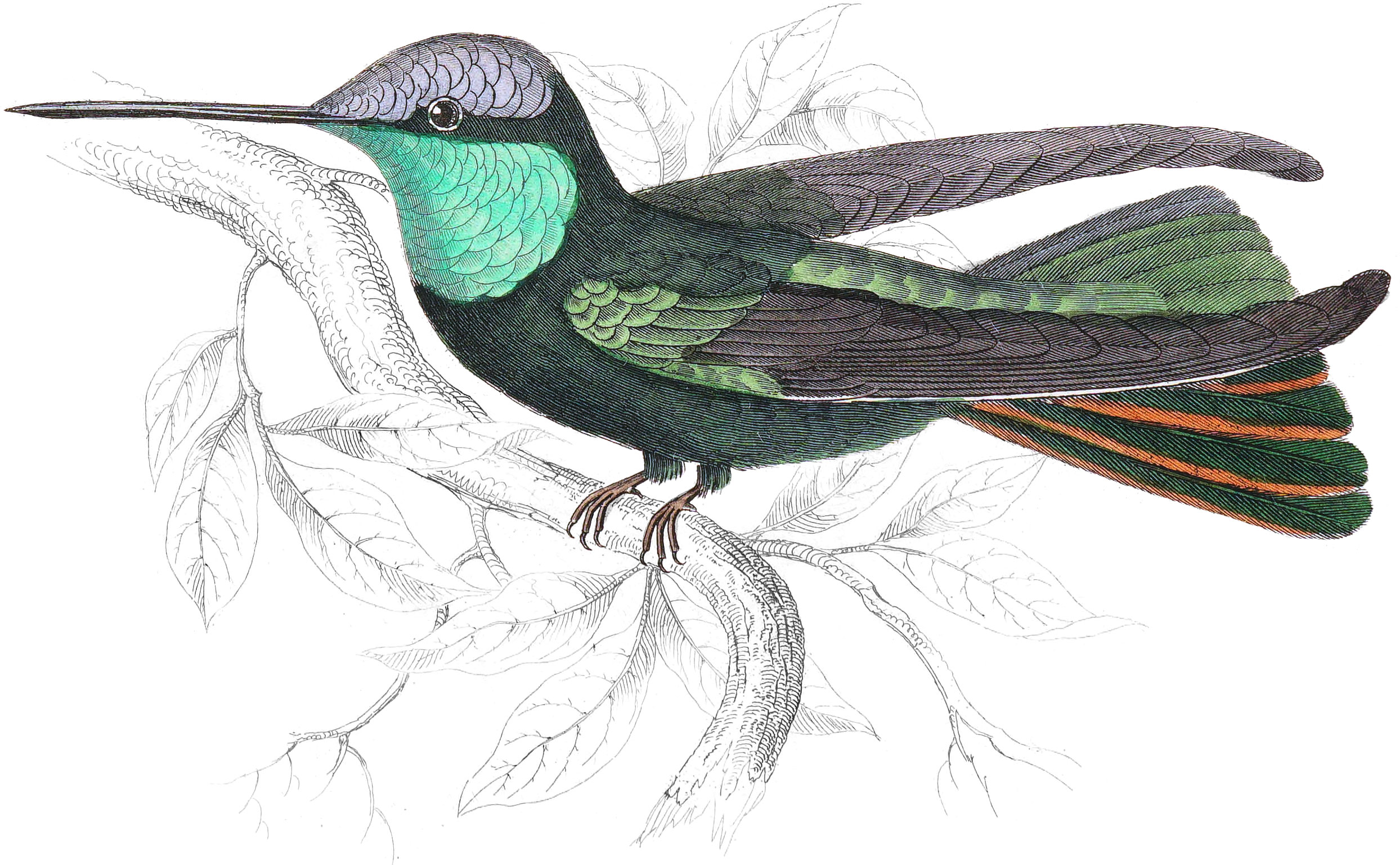
Plate XVIII
Buffon’s Humming-Bird
Trochilus Buffonii.—Lesson.
Le Colibri Buffon, Trochilus Buffonii, Lesson, Trochilidées, pl. v.
This is a large species, being more than five inches in length. The head is of a golden-green: the neck, back, and shoulders of the same colour, which changes to a reddish tint on the upper tail-coverts. The neck, throat, and upper part of the breast are covered with scaly formed feathers of an emerald-green, very brilliant: the rest of the under parts are of the same colour, but of a more subdued tint and having a bluish shade in some lights, while the uniform colour is relieved by each feather being edged with pale grey. The vent and flanks have a shade of brown intermixed, and the lower tail-coverts are pure white. The tail is slightly forked, and is of a uniform steel-blue.
The species from which M. Lesson took his figure, and the only one we are aware of, was supposed to come from Brazil. That naturalist places this bird at the head of his “viii. Race, Les Colibris de Buffon,” and includes with them the T. hirsutus and its allies. The form seems, however, very different; and we have retained the birds which are most allied, with the descriptions on our last two plates, on which the types are represented.

Plate XIX
Mango Humming-Bird
Trochilus mango.—Linnæus.
Trochilus mango, Linnæus.—Mango Humming-Bird, Latham, General History, iv. p. 310.—Shaw’s Zoology, viii. 294.—Plastron noir Buffon; Le Colibri à plastron noir, Lesson, Histoire Naturelle des Colibris, pl. xiii. bis, xiv. xv.
This very common species has been the subject of many descriptions, under different names, from the difference in the appearance of the adult and young. The list of synonyms might be made very long; but those we have given are sufficient to distinguish the adults.
The length is about four inches and a quarter: the upper parts, flanks, and under tail-coverts, are bright golden-green, having on the forehead and crown brilliant and distinct reflections with the light. From the chin to the vent there is a stripe of deep velvet-black, which is shaded into the sides with a brilliant steel-blue: the flank above the insertion of the thighs is barred with a narrow band of white. The tail, of which the feathers are very broad, is rounded at the tip: the centre feathers above are of a bright golden-green, with violet reflections; the others, and all beneath, violet or purple, according to the light, and tipped and edged with a shade much deeper. The young, I believe, will stand as the T. margaritaceus, gularis, and maculatus. In this state, the upper plumage is paler, with a more golden or browner lustre, the under parts pure white, shaded with green on the flanks, and having an irregular blackish-brown line from the chin below the centre of the belly. The tail is of rich and pale violet on both sides, except the upper surface of the centre feathers, which are of the same colour with the back; and in the very young states, the outer feathers are tipped with white.
This seems a very common species in all the West India Islands, and is also a hardy bird. We have alluded to its being brought alive to this country of the first volume. On Plates XXXII. and XXXIII. of the same volume we also represented a species allied to this, and which, with a few others which we shall immediately mention, form a very natural group, both in form and in disposition of colours. From this Lesson makes his “vi. Race, Les Caraibes,” and Boié his genus Anthracothorax. Trochilus mango and T. gramineus will be typical of it.

Plate XX

The next we may mention is the
Green Humming-Bird
Trochilus viridis.—Audebert & Vieillot.
Trochilus viridis, Audebert, Oiseaux dorées.—Colibri cyanure, Lesson, Histoire Naturelle des Colibris, pl. xi.
This species, more sombre-looking than usual, is about four inches and a half in length. The whole plumage of the body is of an emerald-green, without much reflection, except upon the upper tail-coverts, and the tint is nearly of one shade on every part: the tail, which is of the same form with the two preceding, is entirely of a steel-blue, having the outer edge of the last feathers relieved with a narrow fringe of white. The only specimen with which M. Lesson is acquainted came from Porto Rico.
Green Black-Bellied Humming-Bird
Trochilus holosericeus.—Linnæus.
Trochilus holosericeus, Linnæus.—Green Black-bellied Humming-Bird, Edward’s Birds, pl. 36.—Latham’s General History, iv. p. 313.—Colibri vert et noir, Buffon.—Le Caraibe, Lesson, Histoire Naturelle des Oiseaux-mouches des Colibris, pl. xx.
This species is in length about four inches and a The upper parts are of a bright golden-green: on the throat there is a patch of scaly feathers of an emerald-green, and immediately below a band of rich metallic blue, varying in size. The rest of the lower parts, except the tail-coverts, are of a deep blue, or brownish-black: the tail-coverts are white. The tail is entirely of a deep steel-blue, in some lights appearing nearly dull black.
The female, says Lesson, “according to Brisson, resembles the male.” It is probable, however, that this sex has not yet been distinguished. Dr Latham gives Mexico and Guiana for the habitation of this bird; while Lesson thinks that it is confined to the Antilles alone. It may be worth attention, as two species may be included in those from the different countries.
The next bird begins to assume more of the plumage of T. hirsutus: it is the
White-Tailed Humming-Bird
Trochilus leucurus.—Linnæus.
Trochilus leucurus, Linnæus.—Colibri à collier rouge, Buffon.—White-tailed Humming-Bird, Latham, General History, iv. 308.—Edwards, pl. cclvi.—Le colibri ruficol, pl. xxii.
This species is nearly similar to the preceding birds in size, but it is of a narrower or more slender make. The upper parts are of a golden-green; a stripe of reddish-brown passes from the eye above the auriculars, and another line of white from the rictus below them. The chin is blackish-grey, and immediately succeeding is a patch or collar of chestnut-red, without reflections; from thence the green of the upper parts spreads itself upon the breast, in the form of a broad band. The belly and vent are of a reddish-grey; the under tail-coverts green, bordered with a fringe of white. The centre tail-feathers are golden green, those on the outside greyish-white, each diagonally tipped with black. The plumage of the female and young do not seem to be known. It inhabits Dutch Guiana, and has been brought from Surinam. The next very splendid species which we have to introduce, though agreeing in the general distribution of colour, has the tail considerably forked; it is the
Aurulent Humming-Bird
Trochilus aurulentus.—Latham.
Aurulent Humming-Bird, Trochilus aurulentus, Latham, General History, iv. p. 307.—Le Hausse col doré, Lesson, Histoire Naturelle des Colibris, pls. xvi. xvii. xviii. xix.
Lesson has devoted no less than four plates to this splendid species, which we have said differs from the others placed in this group, by the forked tail. This form of the tail, however, is peculiar to the males, that of the young and females being in accordance with the characters of the others. It is a curious fact, that, in a great many species, the tail, which assumes such a variety of form, deviates in the males only in those species which, though in other respects they would be named “aberrant,” could not be with propriety separated.
The upper parts of this bird are of a golden-green, which extends to the flanks and lower tail-coverts. The gorget or throat-patch is of a brilliant golden-yellow, reflected with green. It occupies the whole fore part of the neck, and upper part of the breast. The breast and belly, in a line with the insertion of the thighs, is deep bluish-black, following which, and between the tail-coverts, there is a band of white. The tail has the centre feathers green on the upper surface; the others rich pinkish-violet, with the tips and edges nearly black. The length is about four inches and a-half.
The female, which, though less brilliant, is no less chastely beautiful, is above of a golden-green; the whole under parts of a pleasing grey. The tail, which assumes the usual form, has the two centre feathers green, the others rich chestnut at the base, each feather having next a diagonal broad band of deep steel-blue, and at the extremity tipped with pure white; an assemblage of colour very marked, and contrasting with the otherwise unobtrusive plumage.
The young male has the gorget and lower parts greyish-white, with the black appearing in the centre of the belly. The tail is of the usual form, but has the base, except of the centre feathers, chestnut-brown, with a band of black shading into it, and is tipped with white. The young females are like the adults, except in having the tail of a uniform steel-blue, with white tips. The description of the three last are given upon the authority of Lesson. Porto Rico and the Antilles seem to be the most general stations whence this species is received.
We have one other bird to mention in this place, which, though certainly distinct from any of those now described, is yet known only in its young state. Lesson has figured it under the name of T. Prevostii, young, referring, in his Synonyms, to the T. hypophæus of Latham. It has the same assemblage of colours, and form of body, wings, and tail, but the bill is straight, and comparatively short. We give the description with the intention of calling attention to the species.
Brown-Crowned Humming-Bird
Trochilus hypophæus.—Latham.
The Brown-crowned Humming-Bird, Latham, General History, iv. p. 331.—Colibri de Prévost jeune, Trochilus Prevostii, Lesson, Histoire Naturelle des Colibris, pl. xxiv.
The length is from three to four inches. The head and space around the eyes is clear yellowish-brown. The upper parts are brownish-green; the lower grey, shading into white, where they join the green of the upper. The centre of the throat is marked with a longitudinal patch of deep-black. The under tail-coverts are green, tipped with white. The tail is rounded, and, except the centre feathers, is of a deep blackish-brown, and at the tips white. Lesson did not know whence the species he copied was brought. Those described by Dr Latham were received from Tobago.
In the four birds figured upon the next Plates, we see a very remarkable development of tail, in three instances confined chiefly to the lateral feathers, in the other, to those of the centre. The three first remind us strongly of the forms assumed in the Drongo Shrikes, and many of the Muscicapidæ.
Black-Capped Humming-Bird
Trochilus polytmus.—Linnæus.
Long-tailed Black-capped Humming-Bird, Edwards, pl. xxxiv.—Black-capped Humming-Bird, Latham, General History, iv. p. 296.—L’Oiseau-mouche à tête noire, Ornismya cephalatra, Lesson, Histoire Naturelle des Oiseaux-mouches, pl. xvii.
The Black-capped Humming-bird is in length nine inches, of which the long feathers in the tail are alone six. The hill is of a fine straw-yellow black at the tip; the feet and legs are of the same colour. The feathers forming the black part of the head are of a loose and silky texture, considerably lengthened, and make a deep black crest. The upper parts, breast and belly, are of a rich golden-green, and the gorget of scaly feathers covering the whole of the throat and foreparts of the neck, is of the most brilliant emerald-green. The colour of the wings are a dark brownish-black. The tail is forked, and the eight centre feathers gradually decrease in length; the exterior shoots far beyond them into two narrow plumes, pliable from their weight. It is of a brownish-black colour, with green reflections.
The female, says Dr Latham,
is of the same size, with the bill the same, the base of the under mandible white half way; crown dusky brown; upper parts of the plumage as in the male; beneath, from chin to vent, white; on the sides of the neck the green and white are intermixed irregularly; tail green, without the long feathers, and the tips of all, except the two middle, white for almost half the length.
It is a native principally of the island of Jamaica but Dr Latham also mentions having specimens from Guiana.
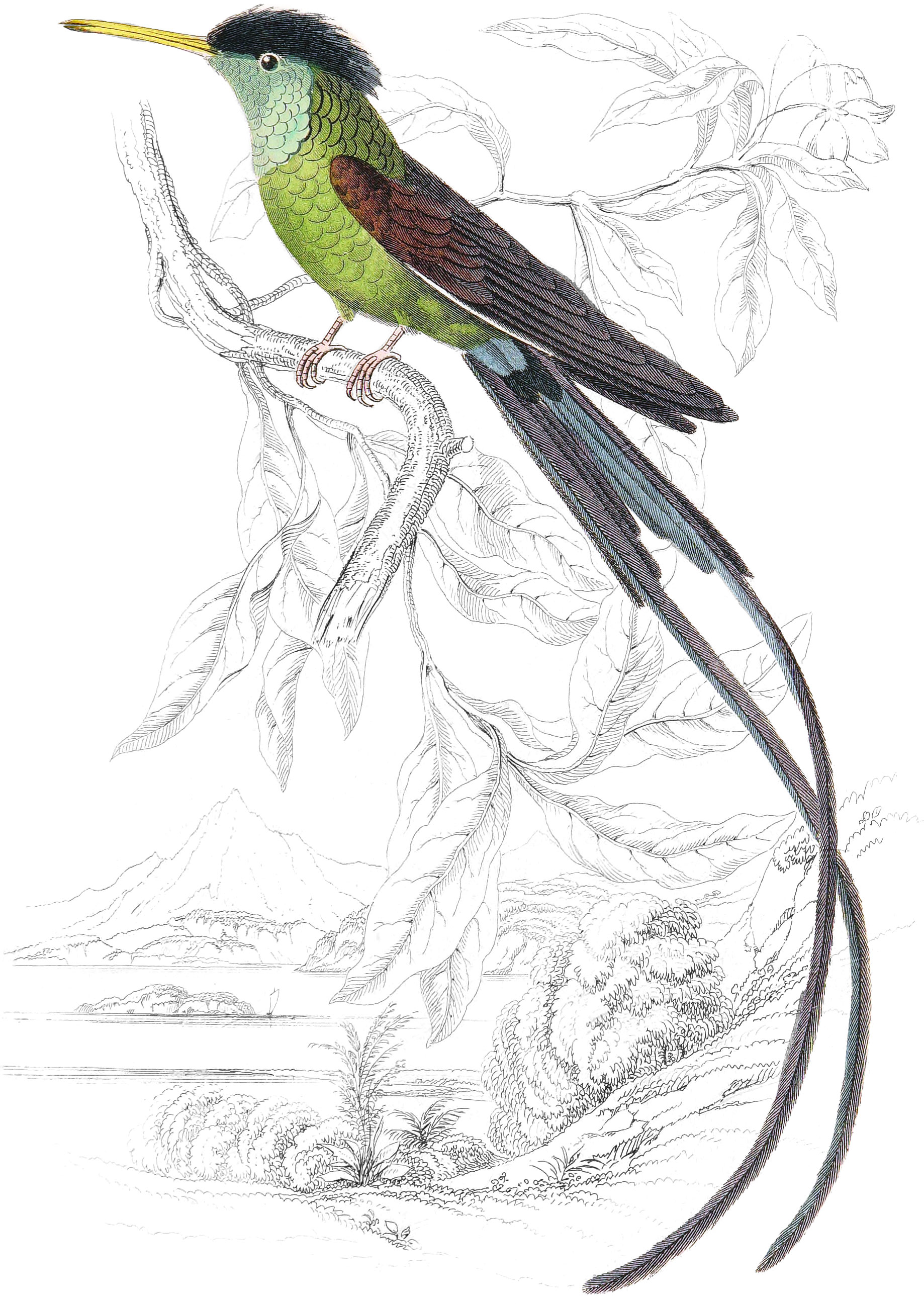
Plate XXI
Rough-Legged Racket-Tailed Humming-Bird
Trochilus Underwoodii.—Lesson.
La Raquette empennée, Trochilus Underwoodii, Lesson, Trochilidées, pl. xxxii xxxvii.
In the bird now represented, and another species, we see the fork of the tail assuming another variation, in the diminution and again widening of the web, so as to leave a part of the shaft bare of plumes. The present species is, besides, very remarkable for the feathering of its tarsi and base of the toes, which are thickly covered with narrow horny-like plumes, and I believe is the only instance of that structure among this tribe. All the upper parts are of a golden green, the ramp barred with a band of white. A gorget of bright emerald-green, occupies the throat, forepart of the neck, and almost the whole breast, which is immediately succeeded by a deep tint of brownish green. The thighs and plumed tarsi are pure white. The tail, deeply forked, is a blackish-brown, the centre feathers tinged with green. The form will be best understood by referring to the accompanying plate. The country of this species is unknown.

Plate XXII
The only other species whose tail takes a similar form is the
Racket-Tailed Humming-Bird
Trochilus platurus.—Latham.
Racket-Tailed Humming-Bird, Latham, General History, iv., p. 338.—Oiseau-mouche a raquettes, Lesson, Naturelle des Oiseaux-mouche, p. xl.
This bird at first-sight has nearly the resemblance of the last, but is at once distinguished from it by the unplumed tarsi. It is of a duller green above, and is of a uniform tint. The gorget is of the same bright emerald green, and occupies nearly a similar place, covering the whole of the fore part of the throat and neck. The belly is of a dull brown, tinged with green, and the vent and under-tail coverts are nearly pure white. The tail above, greenish brown, beneath of reddish or yellowish white. The feathers, excepting the two outer ones, are pointed, and assume a slightly forked form. The two on the outside exceed the others by about half their own length, and the shafts commence to be entirely bare where they exceed the length of the others, and are finished by a nearly round tip of black plume in the form of a racket-board.
The plumage of the female is not very well known. Guiana is the only country whence they have been received.
Bar-Tailed Humming-Bird
Trochilus sparganurus.—Shaw.
The Bar-Tailed Humming-Bird, Trochilus sparganurus, Shaw, General Zoology, viii. p. 291.—Fan-Tailed Humming-Bird, Latham, iv. p. 290 291.—L’Oiseau-mouche sapho, Ornismya sapho, Lesson, Histoire Naturelle des Oiseaux-mouches, pls. xxvii. and xxviii.
This splendid species seems to have been first noticed by Dr Shaw, in his General Zoology, and figured from a specimen in Bullock’s Museum. It is most remarkable for the splendid colouring and development of its tail, which Lesson compares to that of the New Holland Menura. It is composed of ten broad feathers, gradually exceeding each other by about half an inch, three quarters, &c., and the last by above one inch and a half longer than the others. The colour may be said to be a brilliant reddish orange, with a brazen or metallic lustre of the greatest clearness, according to the various lights in which it is placed assuming a greater tinge of red or yellow. The tip of each feather has a broad black bar, and the lower part of the web of the outer feather is of the same colour. When the tail is closed, the appearance is as if regularly barred with black. The upper parts of the plumage are of a golden green, except the rump, which is of a fine madder tint, but without any metallic lustre. The feathers upon this part are more tufted, and thicker than usual. The whole of the under surface, as far as the upper part of the belly, is of a bright emerald green, brightest on the fore part of the throat. The lower belly is dull brownish green, the vent whitish.
Lesson has represented another state of this bird, which he thinks is that of the female. All the upper parts are of a uniform green. The throat and breast, instead of the emerald-coloured scaly gorget, are of a dull yellowish grey, which colour occupies also the rest of the under parts. The tail is about only half the length, the feathers of the same broad form; the outer one of a yellowish, the others of a reddish coppery lustre, with a slight indication of a darker shade at the tips, but without any distinct bar.
There seems a little uncertainty regarding the native country of this bird. Shaw’s specimens were said to come from Peru; and Lesson mentions the interior of Brazil for those from which he took his drawings and descriptions. The figure of this bird is reduced one-half.

Plate XXIII
In this place we must mention another very beautiful species, figured and described by M. Lesson, possessing the same form, and in proportion, a development of tail nearly equal to it; it is the
Nuna Humming-Bird
Trochilus Nuna.—Lesson.
La Nouna-Koali, Ornismya Nuna, Lesson, Histoire Naturelle des Oiseaux-mouches, Supplement, pl. xxxv.
It is about five inches in length, of which the tail makes up three. The upper parts of the plumage are of a brilliant emerald-green, with golden reflections. The under parts are pure white; but each feather has at its tip a circular spot or eye, of a deep emerald-green, which forms a fine contrast. On the throat and breast, these are well and distinctly marked, but towards the vent they become less defined. The under coverts of the tail are bright chestnut. The tail itself has the feathers very broad, and they gradually increase in length like those of the bar-tailed species. The base of all the middle ones are brownish purple. The lower part of the exposed portion on the upper side is of a deep steel-blue, changing to a bright and beautiful green towards the tip. The outer feathers have the exposed parts of the tips deep steel-blue; but the lower half of the outer web is pure white. In another specimen, which M. Lesson supposes to be the young, the crown of the head is almost grey, and the long outer feathers of the tail want the white outer edge, and are entirely brown, and the under plumage was dashed with brownish red.
These specimens come from Peru.
Topaz-Throated Humming-Bird
Trochilus pella.—Linnæus.
Trochilus pella, Linnæus.—The Topaz-Throated Humming-Bird, Shaw’s General Zoology, viii. p. 274.—Latham’s General History, iv. p. 291—Le Colibri topaz, Lesson, Histoire Naturelle des Colibris, Pls. ii, iii, iv, v.
This species is without any exception one of the most splendid of the whole race; the plumage in every part is composed of the scaly formed feathers, which are always present when a metallic lustre prevails; and in every position, its brilliant colours receive a variation of tint differing from that last seen, and superior in splendour to any thing with which we could compare it. It is a large species also, and in many ways is a most interesting bird. The African form is naturally called to our remembrance by the general appearance of it to the Cyniridæ, in which the shape of the gorget and tail leads still nearer. In its habits it is also curious, being said to frequent the banks of rivers, skimming along their surface after insects, and often perching on dried twigs along their margins: in this there is an approximation to several groups.
The length of this bird, not including the long centre tail feathers, is five inches and a half, these exceed the others by nearly three inches; the colour of the whole plumage of the body may be said to be a rich brownish orange, in some lights appearing of the deepest lake, and in others of a brilliant ruby colour, tinted with golden; on the lower surface the golden lustre is most prevalent, above, the deep shade and ruby tint; the gorget is alternately of a topaz-yellow or emerald green, and it is surrounded by a shade of nearly velvet black, which gradually assumes a purple tint, and shades into the colour of the body; the wings are very long and powerful; the tail is above of a golden green shaded with red, below of a bright chestnut; in form it is rather rounded, and the two centre feathers make it appear sometimes very lengthened, sometimes forked, according to their position; the tarsi are feathered to the division of the toes.
The young differ in wanting the long feathers in the tail, the two centre plumes of which exceed the others by about one-eighth of an inch; the plumage of the upper parts is of a bright green, with the ruby tints appearing at intervals; the under part has more of the red colour, and is shaded with green and bright orange; the gorget has not appeared, though the space for it is clearly seen.
The female is somewhat less than the young males; the centre tail feathers are slightly longer; the prevailing colour of the plumage is brilliant emerald green, with metallic lustre, but which is somewhat diminished by a grey tint which pervades the whole; the gorget is marked by brown feathers, which have a golden lustre when placed in the light, but is not very distinctly defined; the vent is grey: the outer tail feathers are of a dull green, the next pair are of a brilliant violet, the others of a bright chestnut. These beautiful birds are found in Cayenne and Guiana.
The figure of this bird is reduced one-half.

Plate XXIV
Male
Topaz-Throated Humming-Bird
Trochilus pella.—Linnæus.
We have given a copy from Lesson of a curious variety of this bird, exhibiting an imperfect state of albino, and in which the pure white feathers contrast beautifully with the gorgeous plumage of the other parts, which did not seem to want anything of their brilliancy. It has been thought by some that the occurrence of white feathers, or of pale coloured varieties, did not take place in those birds having plumage of shining or metallic lustre. Of this the accompanying plate will be a proof to the contrary, where it is exhibited in one possessing those qualities to the utmost; and we have specimens of one or two other species where it also occurs. As familiar instances of it, we may mention the common Starling, Pheasant, and Peacock.

Plate XXV
Variety
The Supercilious Humming-Bird
Trochilus superciliosus.—Linnæus.
Supercilious Humming-Bird, Shaw, General Zoology, viii. p. 284.—Latham’s General History, iv. p. 293.—Le Brin blanc, Buffon.—Le Colibri à brin blanc, Lesson. Histoire Naturelle des Colibris, Pl. vi. Male; Pl. vii. Female.
Lesson makes of these birds his a “VIII. Race, les Brins blancs,” and separates them from the form of T. hirsutus, which immediately precedes them. By Mr Swainson they are united under his group Phæthornus, constituting his third division among the Trochilidæ. As a group we do not see how they can be separated, and even if an after division should be attempted, according to Lesson’s characters the female of the one would enter into a different section. Boié, again, seems to have made his genus Glaucis from them, and it is under either that or Mr Swainson’s title that they should now stand; that gentleman is of opinion that it is by these that the Humming-Birds will unite with the Promeropidæ, We shall proceed to describe what seems to be known as distinct species among them.
The bill of the Supercilious Humming-Bird is long and bent, considerably dilated at the base, and, as in all the genus, has the under mandible entering when closed within the upper one; the base of a bright orange. The upper plumage of the bird is of a brown bronzed green; two reddish white lines mark the cheeks; the one more in the shape of a spot above the eye, the other in a line from the corner of the mouth, below the auriculars brownish white; all the lower parts are of a brownish white. The tail without the long feathers is wedge-shaped, each feather widening towards the tip, and then ending in a triangular sharp point; the long feathers keep the breadth of the others for the same length, when they suddenly become narrow, and form the distinguishing marks of the male. The colour of the tail is bronzed green, shaded nearly to a rich black at the ends, which terminate in a narrow border of white; the projecting ends of the long feathers are also white.
The female is more brilliant in colour than the male, the upper parts of the same tint are very brilliant; the white line from the rictus is well marked, but that above the eye does not appear; the lower parts are of deeper shade of brown; the tail is very amply rounded; the centre feathers longest, but not projecting, of a bright green, with white tips; the others bright chestnut-red, shading to black, and furnished with a tip of white.
This species is found both in Guiana and Brazil.


The Scaly Backed Humming-Bird
Trochilus Eurynomus.—Lesson.
Le Colibri Eurynome, Trochilus Eurynomus, Lesson, Trochilidées, Pl xxxi.
This species, undescribed before the work of M. Lesson, is about six inches and a half in length, including the long centre tail-feathers; the head and back of the neck is covered with brown scaly feathers, fringed with chestnut; the remaining upper parts are of a fresh green, the plumes having the form of scales, large and rounded, and fringed with a dull reddish tinge; the upper part of the auriculars is black, while an ochreous yellow line runs above, and one of the same colour from the extremity of the gape; the throat has the feathers also in the form of scales brown in the centre, and fringed with ochreous yellow; the neck, breast, belly, and flanks, are brownish grey, dashed with reddish the lower tail-coverts are; of a reddish chestnut; the tail is wedge-shaped, the centre feathers much prolonged and narrow, green for the length of the others, the projecting tips white; the other feathers are of a deep black at the base, the tips, for very nearly the half, white. It is a native of Brazil.
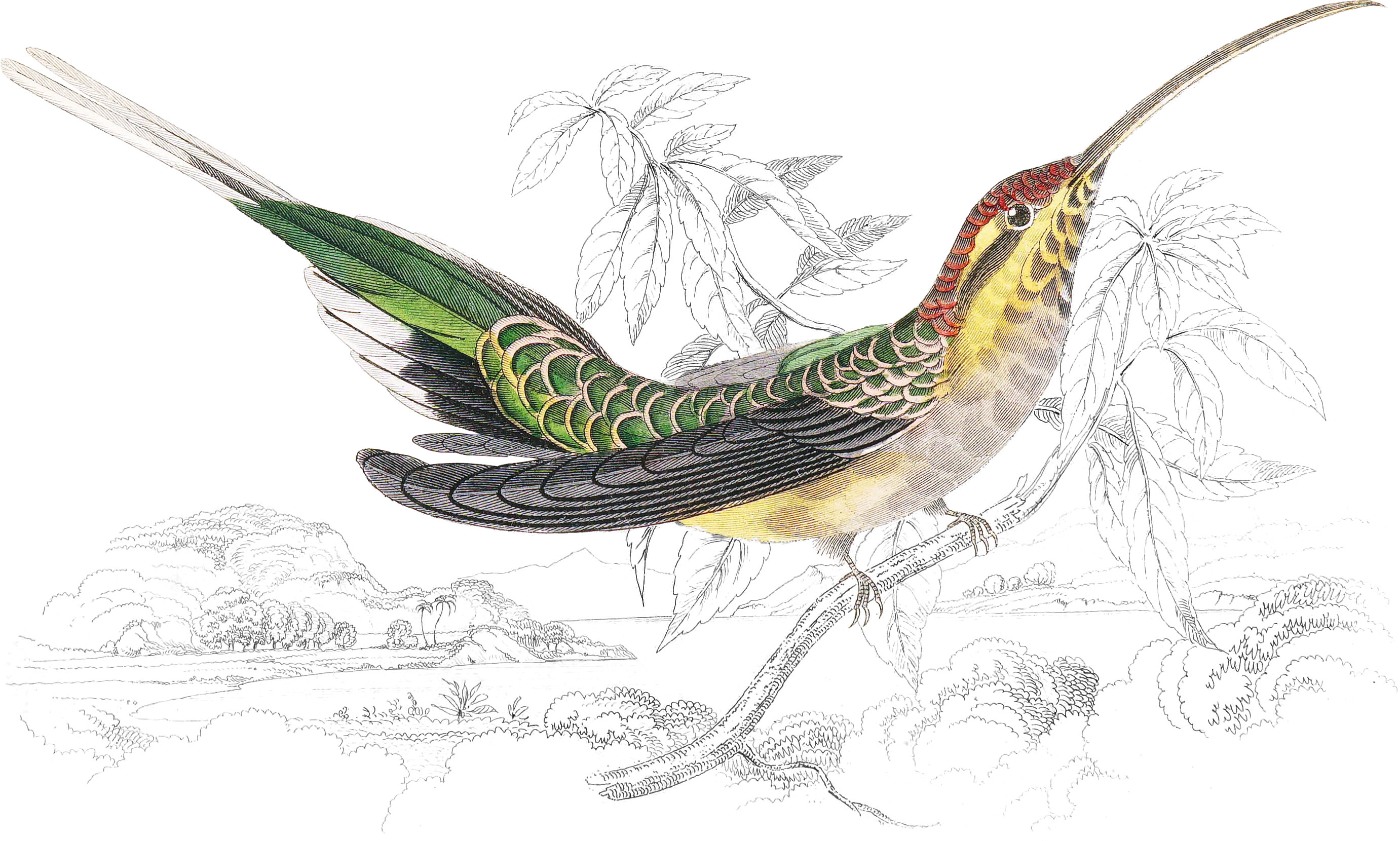
Plate XXVIII
The three preceding Plates will give an idea of the form of the birds composing this group, and of the resemblance of the females to those which M. Lesson separates. We shall give the description of the others which are known, some of which are very diminutive. The first we shall mention is
Guy’s Humming-Bird
Trochilus Guy.—Lesson.
Le Guy Trochilus Guy, Lesson, Trochilidées, Pl. xliv.
This species approaches nearer than the others to the Supercilious Humming-Bird, and seems even to have been confounded with it. It is considerably less, however, and the projecting feathers of the tail over-stretch it for a much less distance it is of the; same form with that of its near ally, above golden green at the base, then black, the lateral feathers fringed with white at their tips; the projecting narrow parts of the centre plumes also white. The bill is of considerable length, the under mandible bright orange red, brownish at the tip; the upper parts of the body are brilliant metallic green, the feathers on the crown bordered with reddish the auriculars are; black, surrounded, above by a streak of tawny yellow, and underneath by a line of the same colour the; chin is of a bright chestnut, in the form of a small gorget; the remaining under parts are of a rich bluish grey, changing to a yellowish red in the centre of the belly and on the vent the lower tail coverts are; pure white. Lesson, the only one who describes this bird, does not mention its native country.
Intermediate Humming-Bird
Trochilus intermedins.—Lesson.
Le Colibri intermediaire, Trochilus intermedius, Lesson, Trochilidées, Pl. xix.
This species is a native of Brazil. It is about three and a half inches in length. In Lesson’s representation, the under mandible of the bill is coloured pale pink at the base, then black, then pink and tipped with black; in the description it is mentioned of a yellow colour entirely, “l’inferieure jaunâtre.” The former is a curious distribution. The general colour of the plumage is a reddish brown belly, and vent, assuming a sienna colour; on the rump, above the eye is the pale yellow eye-stripe, beneath the auriculars, which are black, another; the centre feathers of the tail exceed the others only by about half an inch, and become gradually narrower from the base; the projecting part is pure white, the colour of the other parts black, the outer one bordered with reddish-brown.
Bourcier’s Humming-Bird
Trochilus Bourcierii.—Lesson.
This bird in general appearance also resembles the first we described, but is considerably less. The tail is very ample, and the centre feathers of considerable proportional length. The colour of the upper side is a greenish black, deeper towards the tip, where the outer web is marked with a chestnut spot; the long feathers are brown where they exceed the length of the tail, the tips white; underneath, whole has a brownish tint. The crown is of a reddish green, which is the prevailing tint over the upper parts, from each feather being fringed with reddish brown, somewhat in the manner of the Scaly-backed Species. The throat is white, the whole of the other under parts of a reddish grey, most vivid upon the sides of the neck; a slight tracing of the superciliary streak and that from the rictus is seen, but it is only visible when the position of the bird is varied. It is a native of Brazil, and Lesson thinks that it inhabits the mountainous districts of that vast country.
Brown Brazilian Humming-Bird
Trochilus squalidus.—Natterer.
Colibri terne, Trochilus squalidus, Temminck, Planches Coloriées, pl. 120.—Le Colibri & vestiture terne, Lesson, Histoire Naturelles des Colibris, pl. viii.
This species was discovered in Brazil by M. Natterer, and first figured by Temminck in the Planches Coloriées; in colouring and the distribution of it, it has every appearance of the supercilious Humming-Bird. Lesson goes so far as to say, that it is a degenerated local variety, with which we cannot agree. The size is scarcely one-half. The upper plumage is a dull brownish green.
The superciliary stripe is very conspicuous, of a reddish yellow, the auriculars beneath are deep brown, and another stripe from the rictus joins the uppermost, surrounding the eye and ear-feathers completely. The throat and breast are dull grey the feathers of the former are in the shape of scales, with dark centres. The belly and vent are of a tawny yellow. The tail is brown, each feather tipped with white, and the whole extending part of the centre ones of the same colour.
Longuemare’s Humming-Bird
Trochilus Longuemareus.—Lesson.
Le Colibri Longuemare, Lesson, Trochilidées, pls. ii. & lxii.
This species, says Lesson, has always been confounded with the next, but from which every character distinguishes it. We give this naturalist’s description, having no specimen of the bird.
It is about three inches eight lines in length; on the crown there is as it were a cowl of deep brown, tinged with red the back and sides of the neck are; of a brownish red, which is the prevailing colour of the whole upper parts, having upon the back metallic reflections of a green lustre; all the under parts are of a reddish yellow, deepest on the throat and breast; the lower tail-coverts are white. There is not so much variation in the length of the centre feathers of this species as in many, and it has more the appearance of a graduated or wedge-shaped tail. The exceeding tips of the centre feathers are, however, white, the other parts of them and the rest of the tail brown. This species is a native of Cayenne.
Red-Bellied Humming-Bird
Trochilus Rufigaster.—Lesson.
Colibri a ventre rousatre, Temminck, Planches Coloriées, pl. 120.—Le Colibri a ventre rouse, Lesson, Histoire Naturelle des Colibris, pl. ix.
This curious little Humming-Bird is little more than three inches in length, of which the bill alone is one. The crown is of a greyish tint. The superciliary streak is pure white, and passes above to the end of the auriculars. The back of the neck and back, are of a chestnut-red, with golden-green reflections. The under parts are also of a chestnut-red, palest on the throat, and almost changing to yellowish-white on the chin. The tail is brown, tipped with a reddish white. The two centre feathers have golden-green reflections, and the surpassing tips are white. It is a native of Brazil.
David’s Humming-Bird
Trochilus Davidianus.—Lesson.
Le Colibri David, Lesson, Trochilidées, pl. xiii.
This species M. Lesson has dedicated to the celebrated French artist, David. It is of the same size with the last, and of a light graceful form. The general tint of the plumage is brown, deeply coloured above, and beneath of a paler shade, tinted with yellow. The auriculars are of the same deep colour with the upper parts, and form a patch on the cheek, surrounded on the under part with a brighter shade. The tail is regularly graduated, the centre feathers, though longer, not far surpassing the others. It inhabits Cayenne.
These are all the birds which Lesson includes in this form. The others do not possess any particular elongation of the centre tail feathers. The first we shall mention is the
Hairy-Legged Humming-Bird
Trochilus hirsutus.—Linnæus.
Trochilus hirsutus, Linnæus.—T. Brasiliensis, Latham and Temminck, auct. Lesson.—Le Colibri hirsute, Lesson, Histoire Naturelle des Colibris, pl. xxi.
This species will stand as the type of what Lesson makes his second form, among those with curved bills. It was named by Linnæus as above, from the legs being slightly plumed below the first joints this, however, seems a character not quite constant, and does not appear in the specimens which we have under that name. The distinctions between the males and females of these birds seem to differ very little, as far as we at present know, and there is no prolongation of the centre feathers in the male sex, as we always found in the preceding group. In this species the nest is built of a much looser structure, and of a longer, almost pendulous form.
This bird is about four inches in length. The upper part of the body is of a shining green, with purple reflections, deeply tinged with reddish-brown. All the under parts are of a bright reddish-brown, duller on the flanks. The tail is of a deep shade of the same colour, the centre feathers shaded with green; a band nearly black crosses at the tips, which, with the exception of those in the centre, are white.
Lesson says it is a native of Brazil, and is rare. We have received numerous specimens of what we conceive to be this species, from the Island of Tobago, where it appears to be very abundant.
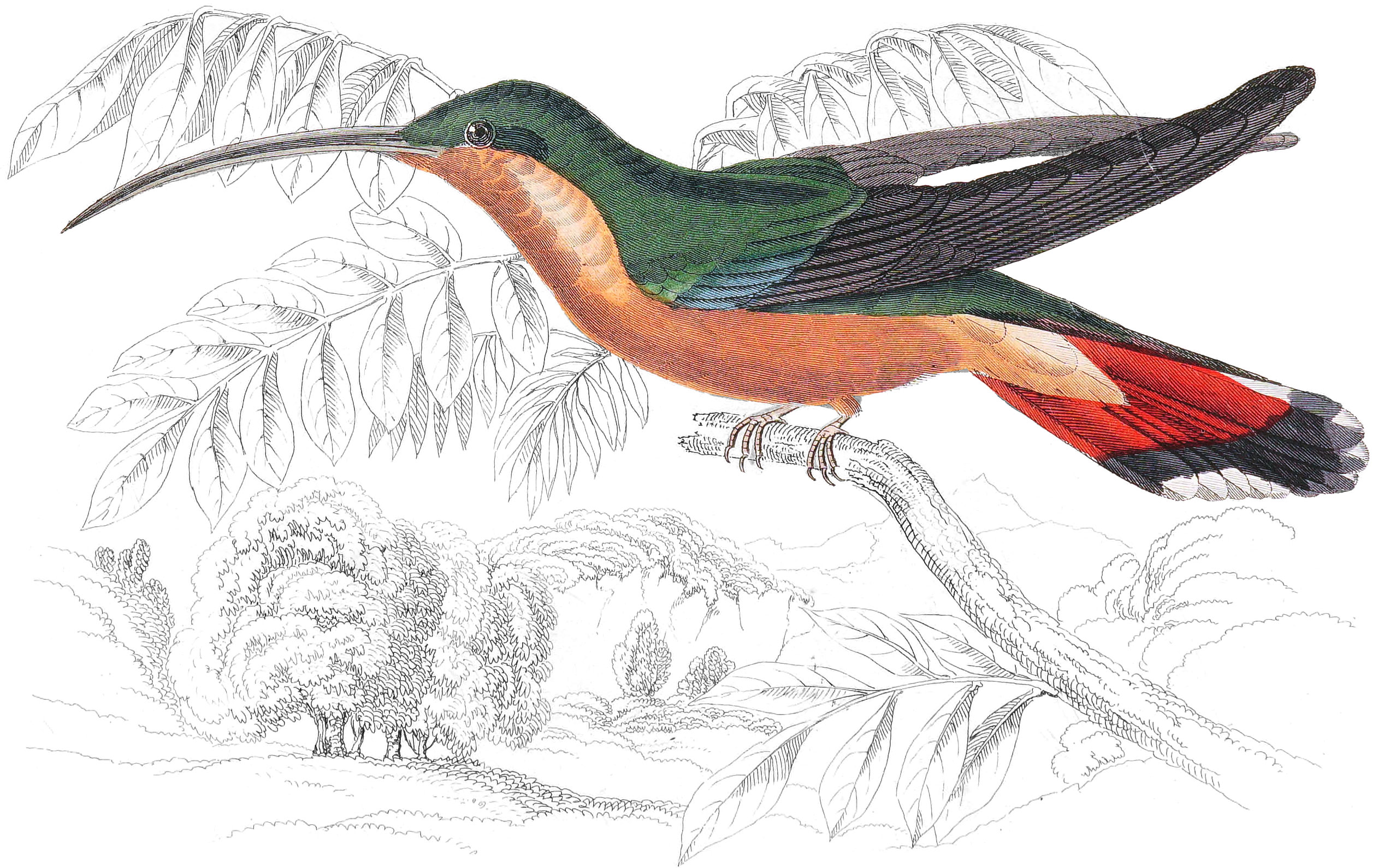
Plate XXIX
Another species having considerable resemblance, is the
Mazeppa Humming-Bird
Trochilus Mazepp.—Lesson.
Le Colibri Mazeppa, Trochilus Mazeppa, Lesson, Trochilidées, pl. iii.
This bird is about five inches in length. The upper parts are of a much finer greyish-green than its congeners; on the head having the feathers rather of a scaly form, with brilliant reflections. The lower parts are of a clear reddish-brown, tinged with green on the flanks. The tail is very ample, and, except the centre feathers, which are green, is of a brilliant chestnut-red, barred with black at the tip. It is a native of Guiana. Lesson asks, “May this not be the female of a species of which the other sex has not been discovered,” and seems to have an idea somewhat similar regarding that of the Hairy-legged Humming-Bird. We have received the latter often marked “male” and “female,” without any difference except in the brilliancy of colouring.
Lesson has introduced another bird into this group, which, to judge from his representation, will rank elsewhere. tint. The tail is slightly forked, and of a dark tint. He names it Colibri simple, Trochilus simplex. It is a native of Brazil.
The last of the group is
Swainson’s Humming-Bird
Trochilus Swainsonii.—Lesson.
Le Colibri Swainson, Trochilus Swainsonii, Le Swainson, Trochilidées, pl. lxvi.
In a former Plate we gave a bird from Lesson under the above title, and our only reason for again introducing another Humming-Bird with the same name is, that this group of birds will stand under Pæthornis Sw., and that this species will be placed in our Systems as P. Swainsonii; the other as Cynanthus Swainsonii.
It is a native of Brazil, and is about three inches in length. The tail does not shew the roundness or graduation which is so conspicuous in the others; like them, however, the centre feathers are green the others of an ochreous-yellow, barred with black, and with a white tip. The upper parts are of a brilliant brownish-green; the under parts of a reddish chestnut, of a tint nearly uniform.
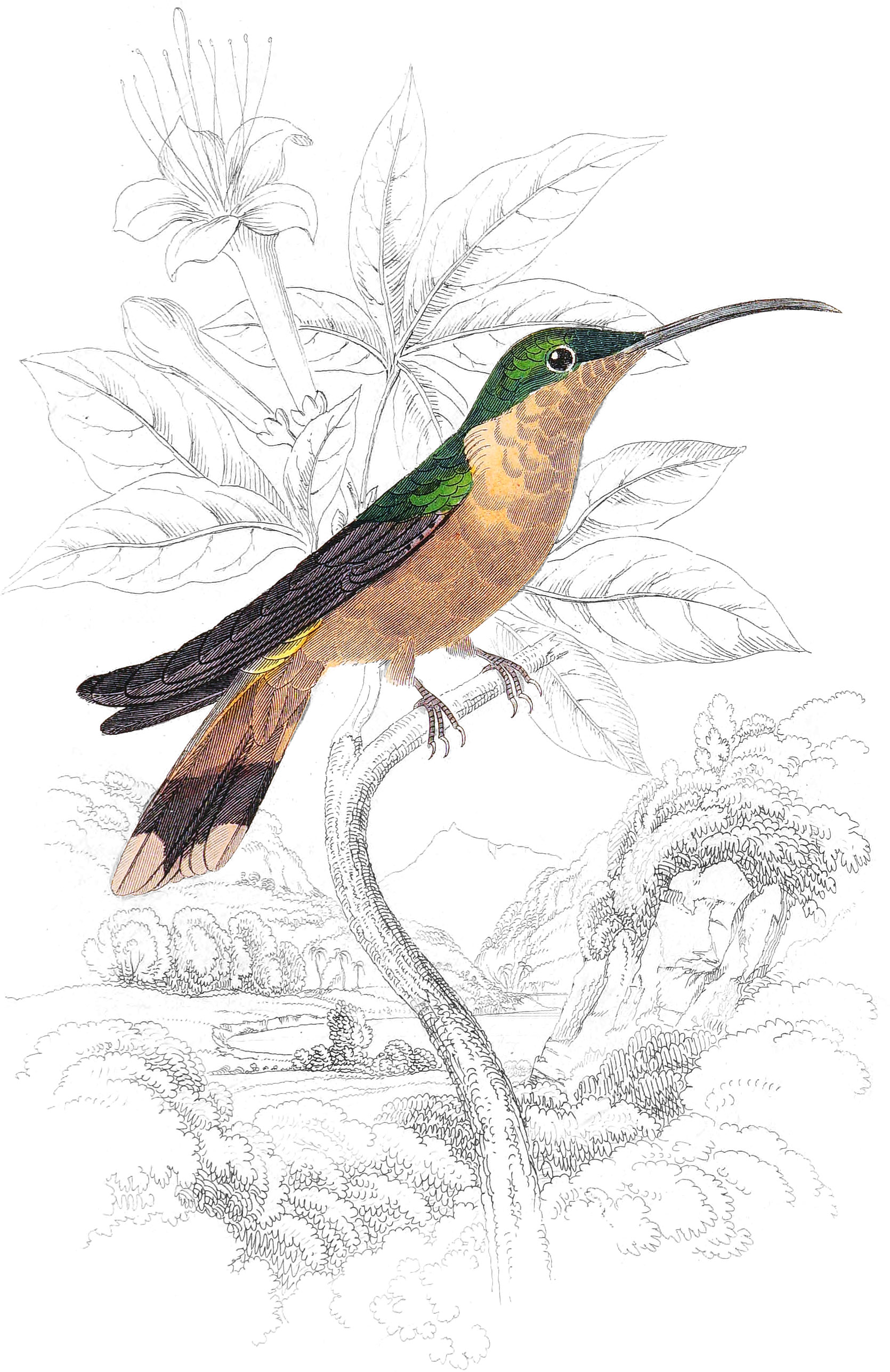
Plate XXX
Synopsis of the Trochilidæ4
Character of the Family. Bill longer than the head, straight or curved; the upper mandible slightly dilated at the base, the lower entering or sheathed within the upper, the points very sharp. Nostrils basal, lateral, the opening narrow, sometimes covered with the plumes of the forehead. Tongue extensible, long, tubular, divided at the tip, the os hyoides passing over the occiput (like that of the Woodpeckers). Wings long, rigid, the quills rounded at the tips, the first longest, the others gradually decreasing in length. Tail composed of ten feathers, length and form very varied. Tarsi small and slender, scutellated; toes three, nearly equal in length, the two internal connected at the base; hallux comparatively strongest, the nails compressed, much hooked, very sharp. Plumage with metallic lustre. Males usually adorned with a gorget of scaly-formed feathers, crest, ruffs, or ear-tufts. Native country Tropical America.5 Contains five Sub-Families.
I. Sub-Fam. Trochilus
Bill very straight. Tail moderate, equal or rounded.

Trochilus Bill
- T. superbus, Superb Humming-Bird.—Shaw, Gen. Zool. Temm. Pl. Color. 299. Oiseau-mouche Corinne, Less. O. M. ii. Crown of a rich blue; throat amethystine-red, surrounded with a line of pure white, gradually shading into pale grey which covers the under parts; upper parts golden-green; tail rounded, two outer feathers tipped with white. Inhabits the island of Trinite.
- Pl. IX. Vol. I.—T. quadricolor, Azure-crowned Humming-Bird.—Vieill. Oiseau-mouche tête d’azur. Less. O. M. Supp. xvii. xviii. Crown brilliant azure-blue, upper parts golden-green, beneath pure white, yellowish upon the flanks; tail brownish-green. Inhabits Brazil.
- Pl. XVII. Vol. II.—T. mesoleucus, White-striped Humming-Bird—Temm. Pl. Color. 317. Less. O. M. xxix. xxx. Plumage dull-green; gorget of rich amethystine-red stretching upon the sides of the neck; a central white line along the centre of the under parts. Female wants the gorget; that part is occupied by a patch of greyish-white, the base of each feather darker. Inhabits Brazil.
- T. squamosus, Scaly-throated Humming-Bird—Temm. Pl. Color. 205. Oiseau-mouche ecaillé, Less. O. M. xx. Plumage bright-green; throat white, with the centre of each feather grey, whence a white line along the centre of the under parts. Inhabits Brazil.
- Pl. XVIII. Vol. II.—T. Rivolii, Duke of Rivoli’s Humming-Bird.—Oiseau-mouche Rivolii, Less. O. M. iv. Plumage of a very dark golden-green; the crown with a cowl of very rich blue, separated from the gorget by a dark line of the general tint of the body; gorget bright emerald-green, spreading upon the side of the neck; tail very ample, nearly square. Inhabits Mexico.
- Pl. XXV. Vol. I.—T. Cora, the Cora Humming-Bird.—Orthorhynchus Cora, Less. Zool. de La Coq. xxxi. fig. 4. Above and on the flanks brilliant-green; gorget of amethystine-red, lower parts pure-white; tail very long, with the centre feathers much exceeding the others. Inhabits the elevated country between Callao and Lima.
- Pl. XXI., XXII. Vol. I.—T. cornutus, Double-crested, Humming-Bird Neuw. Voy. au Brés. Trochilus bilophus, Temm. xviii. Ornismya chrysolopha, Less. O. M. vii. Back and shoulders golden-green; forehead and gorget, the latter finishing in a point, bright bluish-purple, inclining more to blue on the forehead, above the eyes two crests of brilliant golden-orange; under parts pure white; tail very long, feathers nearly equally graduated. Female wants the crest. Inhabits the exalted Campos-Geraes at the sources of the river Don Francisco.
- T. auritus, Violet-eared Humming-Bird.—Vieill. Ois. Dor. 25. and 26. Violet-eared Humming-Bird, Lath. L’Oiseaux-mouche à oreilles d’azur. Less. O. M. x. and xi. Above brilliant green, beneath pure white/vent greenish; behind the ears a tuft of round violet-coloured feathers, somewhat elongated; a line from the rictus beneath the eyes black; tail wedge-shaped, the four centre feathers blackish-green, the others white. Female without the tufis, under parts tinged with grey. Inhabits Guiana and Brazil.
- Pl. XIII. Vol. I., Pl. XV. Vol. II—T. petasophorus, Violet-tufted Humming-Bird.—Neuw. Temm. Pl. Color. cciii. fig. 3. Oiseaux-mouche petasophore, Less. O. M.
xiiii. and lix. Plumage bright-green, palest on the vent; under tail-coverts pure white throat with, scaly-formed steel-blue feathers; elongated tuft behind the ears rich violet, changing from nearly orange-red to blue; tail even. Female brilliant emerald-green; vent and under tail-coverts white; a white stripe from the rictus below the eyes. Inhabits Brazil. - Pl. XIV. Vol. I.—T. scutatus, Natterer’s Humming-Bird.—Oiseau-mouche écussonné, Temm. Pl. Col. ccxcix. fig. 3. Le Natterer, Less. O. M. xvi.
and lxi.Above golden-green; front and gorget bright emerald-green; two ample tufts springing from below each eye of a deep indigo-blue, tipped with dull-yellow; breast and belly indigo-blue; flanks greenish; vent and under tail-coverts white; tail square. Inhabits Brazil. - Pl. X. Vol. I., Pl. VII. Vol. II.—T. Belalandii, Delalande’s Humming-Bird.—Vieill. Dict. d’Hist. Nat.—Temm. Pl. Col. xviii. Le Plumet bleu, Less. O. M. xxiii. xxiv. Above golden-green; behind the eye a white stripe; forehead and crown brilliant emerald-green, continued by a pointed crest of rich indigo-blue, the longest feather narrow and tipped with white under parts deep indigo-blue; vent and under tail-coverts grey. Female wants the crest; grey beneath tail banded with deep indigo-blue, tipped with white. Inhabits Brazil.
- Pl. VI. Vol. II.—T. Loddigesii, Loddiges’s Humming-Bird L’Oiseau-mouche Loddige, Less. Troch. li. Above golden-green, under parts pale grey, marked in the centre of the breast and belly with a velvety patch of deep black; crown and elongated crest entirely of a rich violet-blue; tail graduated, steel-blue, white at the tip. Inhabits Brazil. The two last form the genus Cephalepis of Loddige.
- Pl. XII. Vol. I.—T. sephanoides, Violet-crowned Humming-Bird—Orthorhynchus sephanoides, Less. et Gam. Zool. de la Coq. xxxi. Above, golden-green underneath, yellowish-white, feathers spotted with grey; crown with a rounded crest, rich reddish violet. Inhabits Chili, Talcaguana.
-
Pl. V. Vol. II.—T. Stokesii, Stoke’s Humming-Bird.—King, Proceed. Zool. Soc. Lond. Le Stokes, Less. Troch. l. Back and rump brilliant emerald-green, feathers broad and scale-formed; under parts pure white, each plume with an emerald-green spot, surrounded by a darker shade; auriculars blackish-brown, spotted with violet; crest very ample, rounded, brilliant blue; tail broad, centre feathers green, others white on the inner webs. Inhabits the island of Juan Fernandez.
T. sephanoides and Stokesii are closely allied to the two preceding.
-
T. cristatus, Crested Humming-Bird.—Edw. 37. Oiseau mouche Huppé, Less. O. M. xxxi. xxxii. Plumage golden-green; an elongated crest of emerald-green, with blue reflections. Female without the crest, beneath grey. Inhabits islands of Trinite and Martinique.
Oiseau mouche à Huppe blue, Vieil. Ois. Dor., seems a variety; body entirely brown, crest deep blue.
-
Pl. XI. Vol. I.—T. moschitus, Ruby-crested Humming-Bird.—Edw. Lath. Le rubis topaz, Less. O. M. lii. liii. liv.? Above, belly and vent, of a dull golden-brown, in some specimens very deeply coloured; crown of a brilliant ruby red; gorget, occupying the whole breast, topaz-yellow; tail chestnut, tipped with black, very ample. Female without the crest and gorget. Inhabits West India Islands.
Lesson figures the female green above, grey beneath, tail chestnut at the base, barred with green and white tips.
- Pl. XV., XVI. Vol. I.—T. ornatus, The Tufted-necked Humming-Bird.—Le Huppé-col, Buff. 640. Tufted-necked Humming-Bird, Lath. Gen. Hist.
xviv.318348. Ornismya ornata. Less. O. M. xli. Upper parts, belly, and vent, golden-green; rump with a white band; front, and gorget occupying the whole of the throat and breast, emerald-green; crest of pointed feathers, chestnut-red; sides of the neck with long narrow feathers, chestnut-red, tipped with a round spot of emerald-green; tail chestnut-red, centre feathers green. Female wants the crest and neck tufts; gorget chestnut; tail chestnut, barred in the centre with green. Inhabits Cayenne, Guiana, Brazil. - Pl. XVII. Vol. I.—T. Audenetii, Audenet’s Humming-Bird—L’Oiseau-mouche Audenet, Less. Supp. ii. Above golden-green: rump with a dark band, relieved on each side with white; gorget occupying the throat, emerald-green; feathers of the breast, belly and vent greyish-brown at the base, yellowish-white at the top, neck with tufts; the feathers narrow, emerald-green, tipped with white. Inhabits Peru.
- Pl. XVIII. Vol. I.—T. chalybeus, Vieillot’s Humming-Bird.—Temm. Pl. Col.
lxlxvi. Oiseau-mouche Vieillot, Less. O. M. lxiv. Above golden-green; rump crossed by a yellowish band; front and gorget emerald-green; under parts white, dashed with green on the flanks; tail chestnut; neck with lengthened tufts, feathers narrow, emerald-green, each with a white spot at the end. Female is grey below, and wants the neck-tufts; tail of a brownish-purple, tipped with reddish-brown. Inhabits Brazil. - Pl. XII. Vol. II.—T. Gouldii, Gould’s Humming-Bird.—Oiseau-mouche de Gould, Less. Troch. xxxvi. Upper parts golden-green; front, and gorget occupying the breast, brilliant emerald-green; crown with a crest of lengthened feathers, chestnut-red; belly and vent deep greenish-black; neck with lengthened tufts, feathers narrow, pure white, a round spot of brilliant green at the tip of each. Inhabits——.
-
Pl. XIX., XX. Vol. I.—T. magnificus, Magnificent Humming-Bird—Vieil. Dict. des. Scien. Nat.—Temm. Pl. Col. 299. fig. 2. La Hausse-col blanc. Less. O. M. xlii. xlii. Golden-green above, beneath of a duller shade of the same colour; front and gorget emerald-green; crown with a double chestnut crest of long pointed feathers, sides of the neck with tufts closing round the lower part of the gorget; the feathers broad and rounded, pure white, with a narrow black bar at the tip of each. Female without the crest or neck-tufts; gorget chestnut-red, lower part grey. Young entirely greyish-white below. Inhabits Brazil.
The last five species form the genus Lophornis of Lesson, in which he also includes T. petasophorus and the Cephalepis of Loddiges.
-
Pl.
IXXI. Vol. II.—T. rufus, Ruff-necked or Nootka Humming-Bird.—Gmel. Ruff-necked Humming-Bird, Lath. Selasphorus rufus, Nootka Humming-Bird, Swain. N. Zool. Above clear reddish-brown, with green reflections; crown bright emerald-green, the feathers scaly; shoulders of same colour; gorget, extending upon the neck in narrow points, brilliant fiery red; under parts white, reddish on the flanks; tail wedge-shaped. Inhabits California, and the northwest coast of America.This species is the type of Mr Swainson’s genus Selasphorus, in which he also includes the five preceding birds.
- Pl. VI. Vol. I.—C. Anna, Duchess of Rivoli’s Humming-Bird.—Oiseau-mouche Anna, Less. O. M. lxxiv. Crown and gorget rich amethystine-red, gorget spreading upon the sides of the neck; upper parts golden-green, under parts greyish white, shaded with pink; tail brown with metallic lustre, slightly forked. Inhabits California.
-
Pl. VIII. Vol. I.—T. prasina, Golden-green Humming-Bird.—T. viridissimus, Lath.? L’Orvert, Less. O. M. lxv. Entirely of a rich golden-green, brightest on the forehead and breast; tail blackish-blue. Inhabits Brazil.
The varieties of Latham with white under parts, may probably be the young and females.
- Pl. VII. Vol. I.—T.? cyaneus. Blue and green Humming-Bird. Vieill. Oiseau-mouche verazur, Less.
lxilxxi. Upper parts, tail and flanks green; the front, breast and belly blue; the gorget white, feathers dark at the base. Inhabits Brazil. - T. albiventris, White-bellied Humming-Bird.—Oiseau-mouche a ventre blanc, Less. Troch. xxii. Above golden-green; throat and breast shaded off upon the flanks emerald-green; belly, vent, and lower tail-coverts, pure white; tail above brownish-green, beneath steel-blue, graduated. Inhabits——.
- T. viridis.—Vieil. Ois. Dor. Oiseau-mouche à queue vert et blanche, Less, O. M.
xllx. Golden-green above; throat and breast brilliant yellowish-green, with a silvery lustre; tail wedge-shaped, green at the base, gradually shading into pure white. Inhabits the island of Trinite. -
T. tephrocephalus?—Less. O. M.
lxlxii. Crown grey; upper parts, throat, and breast, green; belly and vent greyish-white; tail blackish-green, the outer feathers tipped with white. Inhabits Brazil.Described from Lesson apparently in immature plumage.
- T. albicollis?—Less. O. M. lxiii. Entirely green, except a patch on the breast and vent white; tail steel-blue, all the feathers, except those in the centre, tipped with white. Inhabits Brazil.
-
T. viridissima?—Vieill. Ois. Dor., 42. Less. O. M. Ixxv. Upper parts golden-green; throat and breast green mixed with white; belly and vent greyish. Inhabits Brazil.
Numbers [28]. and [29]. are described from Lesson.
- Pl. II. Vol. I.—T. avocetta, Avocet-billed Humming-Bird.—L’Oiseau-mouche avocette, Less. O. M. xxiv. Golden-green above; throat green, forming a gorget; belly dull black; a line of white along each side of the body; tail steel-blue, square. Inhabits Guiana.
-
Pl. III. Vol. I.—T. recurvirostris, Recurved-billed Humming-Bird.—Swain. Zool. Illust. 1st series, cv. Oiseau-mouche à bec recourbé, Less. O. M. xxxvii. Plumage brilliant green; the throat with a gorget of emerald green, occupying the breast; centre of the belly with a dark streak; tail chestnut. Young with the belly and vent white; bill serrated. Inhabits Guiana.
We have placed these two birds last in the Sub-family Trochilus; from the curious form of the bill they will not answer any of the general characters. Lesson makes a separate race “Les avosettes” founded upon the turned up bill.
II. Sub-Fam. Cynanthus
Bill straight, or very slightly curved. Tail very long, forked.

Cynanthus Bill
- Pl. V. Vol. I.—C. colubris, Northern Humming-Bird.—The Red-throated Humming-Bird, Edw. Humming-Bird, Wilson’s N. A. Ornith. Northern Humming-Bird, N. Zool. Above, brilliant green; beneath, white, greenish upon the flanks; throat with a ruby gorget, varying with the light to brilliant red. Inhabits N. America.
- Pl. XIV. Vol. II.—C. lucifer, Blue-throated Humming-Bird.—Cynanthus lucifer, Swains. Ornismya cyanopogon, Less. Col. ix. Above brilliant green; beneath white; flanks dashed with yellowish; throat with a gorget of violet feathers, which can be raised and expanded at pleasure. Inhabits Mexico.
- Pl. IX. Vol. II.—C. amethystinus, Amethystine Humming-Bird.—Linn., Lath. Ornismya amethystina, Less. Col. xlvii. Above golden-green; beneath greyish-white; throat with a violet gorget, succeeded on the breast with a pure white band; tail deeply forked. Inhabits Guiana.
-
C. amethystoides, Little Amethystine Humming-Bird.—Le petit Amethyste, Ornismya amethystoides, Less.
Col.Troch. xxv., xxvi., xxvii. Length only 2\(\frac{1}{2}\) inches; upper parts golden-green; under parts greyish; gorget amethystine-red, succeeded by a collar of grey. Inhabits——.Distinguished from the last by its less size and the colour of the gorget. In the female and young of both the tail is rounded.
-
Pl. VIII. Vol. II.—C? orthura, Even-tailed Amethystine Humming-Bird—L’Amethystoide à queue égale. Less. Troch. xxviii & xxix. Above, golden-green; throat and breast with an amethystine gorget, succeeded by a band of white; lower parts cinnamon-red; tail equal, golden-green, black at the tips, except the two outside feathers, which are tipped with white. Inhabits Brazil.
We have placed this provisionally in Cynanthus; the bird seems only well known in its young state, when the tail is square. It is introduced upon the authority of Lesson.
- Pl. XXIX. Vol. I.—C. leucotis, White-eared Humming-Bird.—Trochilus leucotis, Vieill. Oiseau-mouche Arsenne, Less. O. M. ix. Front, cheeks and throat azure-blue; crown brown, shading into golden-green on the upper parts; a very marked white streak from the eye above the auriculars; gorget bright emerald-green; belly and vent greyish-green; under tail-coverts pure white. Inhabits Brazil.
- Pl. XXIV. Vol. I.—C. vesper, The Evening Humming-Bird..—Oiseau-mouche vesper, Ornismya vesper, Less. Col. xix., vi. Golden-green above, beneath white; gorget rich violet. Inhabits Chili.
-
Pl. XIII. Vol. II.—C? tricolor, Tri-coloured Humming-Bird.—Le Tricolore, Less. Troch. pl.
xivlx. Above golden-green; throat with a gorget of bright carmine; feathers rounded and capable of expanding under parts pure white, greenish upon the flanks tail slightly graduated, centre feathers golden green, others steel-blue, margined with chestnut. Inhabits Mexico.Swainson appears to make the form of the tail a principal character in his division Cynanthus. We have introduced T. tricolor, therefore, with a mark of doubt, from the difference in form. In other respects it is closely allied.
- C. platurus, Racket-tailed Humming-Bird.—Lath. Gen. Hist. iv. p.
388338. Oiseau-mouche a raquettes. Less. Col. xxxi. Above dull green; gorget and breast bright emerald-green; tips of the prolonged feathers nearly round; tarsi unplumed. Inhabits Guiana. -
Pl. XXII. Vol. II.—C. Underwoodii, Rough-legged Racket-tailed Humming-Bird.—Less. Troch.
xxxiixxxvii. Above dull green, a white band across the rump; gorget and breast bright emerald-green; tips of the prolonged feathers oblong: tarsi thickly plumed with hair-like feathers. Inhabits——.The two last forms Lesson’s genus Platurus.
- Pl. XXVII. Vol. I.—C. enicurus, Half-tailed Humming-Bird.—Vieill. Nouv. Dict. d. Hist. Nat. Oiseau-mouche à queue singulière, Temm.—Less. O. M. xv. Above bright green; gorget violet, succeeded by bands of white and yellow; belly and vent green tail of six feathers. Inhabits Brazil, Island of Trinite.
- Pl. XXVI. Vol. I.—C. Dupontii, Dupont’s Humming-Bird.—L’Oiseau-mouche Zemes, Ornismya Dupontii, Less. Supp. pl. i. Above golden-green, the gorget rich blue with violet reflections, succeeded by a band of white, whence the under parts are grey; tail deeply forked, the outer feathers narrowing and again expanding at the tips, as in C. platurus, but never leaving the shaft bare; all are tipped with pure white. Inhabits Mexico.
- C. Conivettii, Conivet’s Humming-Bird.—L’Oiseau-mouche parvule, Ornismya Conivetii, Less. Supp. xxxvii—Above golden-green, beneath dark emerald-green; tail deeply forked; feathers broad, brownish-black, tipped with grey; base of the upper mandible orange-yellow. Inhabits Brazil.
- Pl. XXI. Vol. II.—C. polytmus, Black-Capped Humming-Bird—Edw., Lath. Ornismya cephalatra, Less. Col. xvii. Crown black, the feathers loose and lengthened; upper parts, belly, and vent, rich golden-green; gorget, covering the whole of the throat and fore part of the neck, bright emerald-green; outer tail-feathers much lengthened. Female with the under parts white; wants the long feathers of the tail. Inhabits Guiana and Jamaica.
- C? jugularis, Red-breasted Humming-Bird.—T. jugularis, Linn. Red-breasted Humming-Bird, Edw. Above and below of a deep velvetty black, with violet reflections; gorget extending upon the breast carmine; tail steel-blue, rounded. Inhabits Guiana.
- Pl. X. Vol. II.—C. Langsdorffii, Langsdorff’s Humming-Bird Temm. Pl. Col. 66. Le Langsdorff, Less. Col.
xvi.and xxvi. Above bright green, crossed by a narrow white band on the rump; gorget bright green, succeeded by bands of yellow and reddish-orange; vent and six centre tail-feathers deep blue; tail deeply forked, exterior feathers acuminated. Inhabits Brazil. -
C. Keinerii, Keiner’s Humming-Bird. Less. Troch. lxv. Above golden green; throat, neck, and breast, pure white, the two latter with round emerald-green spots; belly and vent blackish-grey, under tail-coverts chestnut; tail lengthened, slightly forked, brownish-grey, darker at the end, outer feathers tipped with white. Inhabits Brazil.
Known only from the figure of Lesson, which was taken from a female in possession of M. Prevost. of Paris. The tail of the male most probably is deeply forked.
- Pl. XXIII. Vol. II.—C. sparganurus, Bar-tailed Humming-Bird.—Shaw’s Gen. Zool. viii. p. 291. Ornismya sapho, Less. O. M. xxvii. xxviii. Above golden-green; gorget covers the throat, breast, and belly; tail with the plumes very broad, deeply forked, golden reddish-orange, each feather tipped with black, giving a barred appearance when the tail is closed. Female, above brownish, beneath grey; tail ample, forked, but half the length of that of the male, brownish-red; outer web of outside feathers yellowish-white. Inhabits interior of Brazil.
- C. Nuna, The Nuna Humming-Bird—La Nouna-Kaoli, Less. Col. xxxv. Above, bright golden green; beneath white, plumes with a round spot of emerald-green at the tip of each; tail deeply forked, feathers broad, steel-blue at the base, green at the tips, outer edged with white. Inhabits Peru.
- C. rubineus, Ruby-throated Humming-Bird.—Linn., Lath. Oiseau mouche rubis, Less.
Col.O. M. xliv., xlv. and xlvi. Plumage of a deep uniform golden-green, brighter on the breast; gorget of a rich ruby tint, with golden reflections; tail cinnamon-red, with a narrow black bar at the tip, very slightly forked. Female reddish-grey beneath, a white spot behind the eye. Young nearly similar. Inhabits Brazils. - Pl. XXVIII. Vol. I.—T. saphurinus, Sapphire-throated Humming-Bird.—Lath. iv.
326327. Oiseau-mouche Sapphire, Less. Orn. lv. lvi. lviii. Plumage above the belly and vent green; throat chestnut; neck and forepart of the breast rich saphire-blue; under tail-coverts and tail chestnut-red. Female wanting the chestnut on the throat, and having the blue reaching entirely over the neck; belly and vent white; tail brownish. Inhabits Guiana, Brazil, the Island of Berbice. - Pl. XVI. Vol. II.—C. Waglerii, Wagler’s Humming-Bird.—Le Wagler, Less. Col. lxxiii. Plumage entirely of a deep emerald-green, having very brilliant blue reflections. Wings tinged with blue; tail slightly forked. Inhabits Brazil.
- C. bicolor, Saphire and Emerald Humming-Bird.—Lath. Gen. Hist. iv. 329. Crown and back of the neck deep greenish-brown; back and remaining upper parts, sides, belly, and vent, rich green; throat and neck shading into the green of the breast, brilliant blue; tail steel-blue. Female has the under parts pure white. Inhabits French Guiana, Guadaloupe.
- C? cœruleus, Audebert’s Humming-Bird.—T. cœruleus, Ois. dor. iv. Oiseau-mouche Audebert, Less. O. M.
ivli. Golden green above; throat blue; neck and under parts emerald-green; vent white tail steel-blue, square. Inhabits Guiana. - C. glaucopis, Blue-fronted Humming-Bird.—Gmel. Trochilus frontalis, Lath. iv. p. 352. Oiseau-mouche glaucope, Less. Col. lviii. lix. Forehead and crown deep blue with violet reflections. Above dull green, in some specimens blackish-green; gorget running upon the breast and upper part of the belly, rich emerald-green; vent greyish-white. Female without the blue on the head; lower parts grey. Inhabits Brazil.
- Pl. XXIII. Vol. I.—C. furcatus, Violet Fork-tailed Humming-Bird.—L’Oiseau-mouche a queue fourchue, Buff. Trochilus furcatus, Gmel. Less. xviii. Plumage of a deep violet-black, with lighter reflections; gorget, reaching to the upper part of the breast, bright emerald-green; tail ample, deeply forked. Inhabits Brazil, Guiana, Jamaica.
- C. erythronotus, Crimson-Rumped Humming-Bird.—L’Erythronote, Less. Col.
xilxi. Head, breast, and belly, bright emerald-green; lower part of the back, rump and upper tail-coverts, crimson-red; tail forked, of an indigo-blue on both sides. Inhabits Brazil. - C. Maugerii, The Ourissa.—Trochilus Maugerii, Vieill. Oiseau-mouche Mauge, Less. O. M.
lxviilxviii. lxix; Deep blackish-green above, the reflections brilliant forehead and throat emerald-green; breast banded with rich blue: vent greyish; tail deeply forked, steel-blue. Female of duller plumage; lower parts grey tail nearly square, centre feathers green, tipped with white, others nearly brown. Inhabits Porto Rico. - C. cyanogenys, Neuwied’s Humming-Bird.—Oiseau-mouche Wied, Less. O. M. Supp. xxvi. Above golden-green; chin blue; breast and belly emerald-green; vent white; tail square, deep and bright steel-blue. Inhabits Brazil.
-
C. Atala, The Atala—L’Atala, Less. Troch. xlii. Plumage of the head and body clear emerald-green, the vent and under tail-coverts white; tail square, of a deep and bright steel-blue. Inhabits Brazil.
The two last are very closely allied, the distinctions will be seen in the characters given to the lower parts; they vary from the character in the square form of the tail.
-
Pl. I., II. Vol. II.—C. thalassinus, Blue-bellied Saw-billed Humming-Bird.—T. thalassinus, Phil. Mag. L’Anais, Less. Troch. lv. lvi. lvii.; Sup. iii. General colour emerald-green, with golden and steel-blue reflections; gorget extends upon the side of the neck; in tufts; tail rounded, with a deep steel-blue band; bill serrated. Inhabits the table land of Mexico.
Placed by Lesson in Ramphodon; but with which we do not consider it allied.
-
Pl. III. Vol. II.—C. gigas, Gigantic Humming-Bird.—Oiseau-mouche Geant, Vièill. Gall. pl. 180.—O. mouche Patagon, Less. O. M. iii. Above brownish-green; under parts light red, shaded with green on the flanks; tail very ample, forked. Inhabits Chili.
The largest species known, it has the dull colouring of Phæthornis.
- C. leucogaster.—Ornismya albiventris, Less. Col. lxxiii. Above, golden-green; throat and breast white, the latter shaded into pale green; forehead and cheeks of a deeper shade than the upper parts; tail brown, very slightly forked. Inhabits Guiana.
- C. arsinoe, Arsinoë Humming-Bird.—L’Arsinal, Less. O. M. Supp. xxviii. Above golden-green; front and under parts emerald-green; secondaries and wings bright reddish-chestnut; tail purplish-brown, very slightly forked. Inhabits Mexico.
- C. œnone, Œnone Humming-Bird.—L’Œnone, Less. O. M. Supp. xxx. Head, neck, and throat rich blue back, breast, belly and shoulders golden-green; rump and tail brilliant orange; tail considerably forked. Inhabits Trinité.
-
C.? macrourus, Swallow-tailed Humming-Bird.—Trochilus macrourus, Gmel. F. forficatus, Lath. Ornismya hirundinacea, Less. Plumage of a bluish-black, with steel-blue reflections; tail indigo-blue, very deeply forked; shafts of the quills broad, as in Campylopterus.
Placed by Lesson in a division named “Campylopteres Hirundelies.”
III. Sub-Fam. Phæthornis
Bill elongated, arched. Tail lengthened, graduated, or cuneated.

Phænoris Bill
Centre tail-feathers of the male very long
- Pls. XXVI. & XXVII. Vol. II.—P. superciliosus, Supercilious Humming-Bird.—Lath. Le Brin blanc. Buff. Le Colibri brin blanc, Less. Col. vi. and vii. Above, of a bronzed green gold; a reddish-white line above, another beneath the eye; lower parts brownish-white; tail brown, beneath tipped with white. Female with a white stripe beneath the eye; tail chestnut, barred with black, tipped with white, the centre feather only green. Inhabits Guiana, Brazil.
- Pl. XXVIII. Vol. II.—P. Eurynomus, Scaly Backed Humming-Bird.—Le Colibri Eurynome, Less.
Col.Troch. xxxi. Feathers of the back golden-green, fringed with reddish; of the head deep green edged with rufous; of the throat brown, edged with yellowish-white; lower parts grey; tail black at the base, tips white, centre feathers green for the length of the others. Inhabits Brazil. - P. Guy, Guy’s Humming-Bird.—Le Guy, Less. Troch. xliv. Above brilliant green; beneath grey, with the throat, vent and stripe through the eye and under the auriculars ochreous-yellow; under mandible reddish-orange. Inhabits——.
- P. intermedius, Intermediate Humming-Bird.—Le Colibri intermediate, Less. Troch. xix. Head, neck, vent, wings, and tail, brown; rump, belly, and vent, reddish-orange; auriculars black, with a rufous stripe above and below; centre tail-feathers surpass the tip about half an inch. Inhabits Brazil.
- P. Bourcierii, Bourcier’s Humming-Bird.—Le Colibri faux brins blancs, Less. xviii. Tint of the upper parts reddish-green, each feather being fringed with rufous: throat white, remaining under parts reddish-white; tail blackish-green, tips of the outer feathers reddish, centre feathers extend two inches, white for half an inch at the tip. Inhabits Brazil.
- P. squalidus. Brown Brazilian Humming-Bird.—Colibri terne, Temm. Pl. Col. cxx. Colibri à vestiture ternè, Less. Troch. iiii. Above golden-green; beneath grey; stripe above and below the eye very conspicuous; tail deep brown, each feather tipped with white. Inhabits Brazil.
- P. longuemareus, Longuemare’s Humming-Bird.—Le Colibri Longuemare, Less. Troch. ii. and lxii. Crown deep brown; back and sides of the neck brownish-red, tinged with green; below reddish-yellow tail brown, centre feathers tipped with white, and almost regularly graduated. Inhabits Cayenne.
- Pl. IV. Vol. I.—P. rufigaster, Red-bellied Humming-Bird.—Colibri a ventre rousatre, Temm. Pl. Col. cxx.; Less. Troch. ix. Crown grey, superciliary streak pure white; upper parts chestnut-red; lower parts of a paler shade of the same colour, nearly white at the chin; tail brown, tipped with reddish-white. Inhabits Brazil.
-
P. Davidianus, David’s Humming-Bird.—Le Colibri David, Less. Troch. xiii. Deep brown above; beneath of a paler shade; auriculars form a dark patch on the cheek; centre tail-feathers not far surpassing the others; form more slender than the last. Inhabits Cayenne.
In the following birds, the tail is regularly graduated, as in the female of the preceding species. No. 7. may naturally lead to T. hirsutus, &c. by its lengthened but nearly graduated from.
- Pl. XXIX. Vol. II.—P. hirsutus, Hairy-legged Humming-Bird.—Trochilus hirsutus, Linn. Golden-green above, beneath bright chestnut-red; tail chestnut-red. barred with black at the end, and tipped with white. Inhabits Brazil.
- P. Mazeppa, Mazeppa Humming-Bird.—Colibri Mazeppa, Less. Troch. iii. Above golden-green, beneath pale chestnut; tail uniform chestnut, barred with black at the tip, centre feathers golden-green. Inhabits French Guiana.
- Pl. XXX. Vol. II.—P. Swainsonii, Swainson’s Humming-Bird. Colibri Swainson, Less. Troch. lxvi. Golden-green above; beneath, chestnut-red; tail even, chestnut, barred with black and tipped with white. Inhabits Brazil.
- P. leucurus, White-tailed Humming-Bird.—Lath. Trochilus leucurus. Less. O. M.
xxxxii. Above golden-green; throat with a patch of chestnut; breast golden-green; belly and vent grey; tail white, except the centre feathers which are green. Inhabits Dutch Guiana, Surinam. -
P.? simplex.—Colibri simple, Less. Col. xxiii. Golden-green above, beneath chestnut; the throat indistinctly in the form of a gorget, purplish; vent white; tail nearly equal, but rather hollowed in the centre, black, outer feathers tipped with white.
This seems to be a bird in immature plumage, and more allied to Cynanthus. Trochilus multicolor, we have every reason to think, is a made-up specimen, but would stand here.
- P.? chrysurus, Yellow-tailed Humming-Bird.—Oiseau-mouche chrysure, Ornismya chrysura, Less. O. M. supp. iv. Uniform golden-green; tail reddish-yellow, deeper at the tip, rounded. Inhabits Brazil.
-
P.? amazili.—Orthorhynchus amazili, Less. Zool. de la Coq. xxxi. Crown, throat and breast, emerald-green; upper parts golden-green; vent reddish-yellow; tail bright chestnut, nearly square. Inhabits Peru.
The last bird is described as new in Lesson’s Zoologie de la Coquile, and, with the preceding one, is introduced here in doubt. They shew a strong alliance to both this form and Cynanthus.
-
Pl. I. Vol. I.—P. nævius, Spotted Saw-billed Humming-Bird.—Colibri tacheté, Temm. Ramphodon maculatum, Less. O. M. i. Above golden green, a white stripe over each eye; auriculars chestnut; throat, breast, and belly, grey, spotted longitudinally with brown; central feathers brownish-green, tipped with pale chestnut, the pale tips occupying more of the feathers towards the outside; bill straight, serrated. Inhabits mountains of Corevado, in the vicinity of Rio de Janeiro.
This forms the genus Ramphodon of Lesson, including T. petosophorus and anais,—Heliortryx of Boié.
IV. Sub-Fam. Campylopterus
Bill rather long and slightly curved. Wings falcated, the shafts or scapes of the primary quills dilated and compressed. Tail rounded, or graduated.

Campylopterus Bill
- Pl. XXXIV. Vol. I.—C. latipennis, The Blue-throated Humming-Bird Trochilus latipennis, Lath. Swains. Zool. Illust. Oiseau-mouche latipenne, Ornismya latipennis, Less. Troch.
46xxxv. Body golden-green gorget brilliant blue; tail with the four outside feathers half white. Female, beneath grey, without the gorget. Inhabits Guiana, Tobago. - C. pampa, The Pampa Sabre-wing.—Campylopterus pampa, Less. Supp. xv. Crown in a line above the eye azure-blue; upper part of the body green, under parts pale grey; tail wedge-shaped, green, outer feathers, dark at the tips. Inhabits Paraguay.
- C. falcatus, Blue-bellied Sabre-wing.—Sickle-winged Humming-Bird, Swain. Zool. Illust. Oiseau-mouche à remiges en faucilles, Less. O. M. xxxvi. Upper parts, flanks and vent golden-green; throat, breast and belly deep-blue; tail even, chestnut-red, tips black. Inhabits Brazil.
-
C. cirrochloris, Grey-and-green Sabre-wing.—Trochilus cirrochloris, Vieill. Dict. des Scien. Nat. Oiseau-mouche modeste, Ornismya simplex, Less. O. M. xxxiii. Above, of a dull green, tinged with brown; beneath, grey, whitish on the vent. Inhabits Santa-Paulo, Brazil.
Allied to the female of C. latipennis. Perhaps a female, the male of which is unknown.
-
C.? Clementinæ.—Oiseau-mouche Clemence, Less. O. M. Supp.
xxxviii. Above brownish-green, clearest on the centre of the back; lower parts of a paler tint; a white streak behind the eye; throat occupied by a deep blue gorget; tail black, two outside feathers tipped with white. Inhabits Mexico.The quills of this bird are very strong, without being broach like the true Campylopterus.
V. Sub-Fam. Lampornis
Bill arched. Tail short, nearly even, (rounded, or slightly forked).
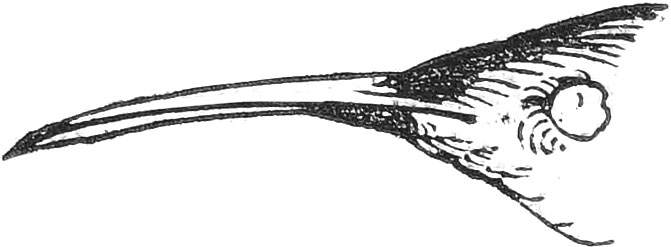
Lampornis Bill
- Pl. XX. Vol. II.—L. mango, The Mango Humming Bird.—Trochilus mango, Linn. Lath. Less. xiii, xiv. Above, golden-green; beneath, with a ventral stripe of deep black, changing to brilliant blue on the sides vent with a white band; tail purple-brown, with green reflections. Young, white beneath, with the ventral stripe dull black. Inhabits Jamaica, Tobago,
- Pl. XXXII., XXXIII. Vol. I.—L. gramineus, Black-breasted Humming-Bird—Colibri du Mexique, Buff. Black-breasted Humming-Bird, Lath. Le Haïtien, Less. Col. xii. Above, golden-green; throat with an emerald-green gorget; centre of the breast and belly black; vent with a white band; tail purple-brown, with green reflections. Young, with the under parts white, from the throat dull black, tail tipped with white. Inhabits Guiana, St Domingo.
- L. viridis.—Colibri cyanure. Trochilus viridis, Less. Col. xi. Plumage of the body uniform dull emerald-green; tail deep steel-blue. Inhabits Porto-Rico.
- L. aurulentus, The Aurulent Humming-Bird. Trochilus aurulentus, Less. Col. xvi. xvii. xviii. xix. Aurulent Humming-Bird, Lath. Above, golden-green; throat with a gorget, topaz-yellow; belly deep black; vent with a white band; tail brownish-purple, with green reflections, in form rather forked. Female and young beneath grey; no gorget, tail rounded, outer feathers tipped with white. Inhabits Porto Rico.
- L. holosericeus, Green Black-bellied Humming-Bird.—Trochilus holosericeus, Lath. Green Black-bellied Humming-Bird, Edw. xxxvi. Le Caraibe, Less. Col. xx. Above, golden-green; gorget emerald-green breast with a blue transverse band; belly deep brownish-black; tail steel-blue. Inhabits St Thomas, and Porto Rico.
- Pl. XXIV., XXV. Vol. II.—L. pella, Topaz-throated Humming-Bird. Linn., Shaw, Lath. Le Colibri topaz, Less. Col.
iii. iii. iv. v. Plumage rich brownish-orange, varied with lake-coloured reflections; gorget emerald green, varying to topaz-yellow, surrounded by a shade of black; tail chestnut. Female bright green, the gorget brown. Inhabits Guiana. - Pl. XXX. Vol. I.—L. meluvorus, White-collared Humming-Bird. Edw. xxxv. Lath. Le Jacobine, Buff. Less. O. M. xxi. xxii. Head, throat, and gorget deep brilliant blue; the under parts, and a collar round the back, pure white; upper parts and sides green; tail pure white, with a narrow band of white at the tip. Female, above green, beneath greyish-white, the centre of each feather darkest; tail green at the base, the outer feathers barred with blue and tipped with white. Inhabits Surinam and many of the West Indian islands.
- L. niger, Black Humming-Bird.—Swainson. T. lugubris, Le demi-deuil. Less. O. M. xxxviii. xxxix. Plumage deep black, tinged with blue on the head, and green on the back and shoulders; vent and tail white, the latter barred at the tip with black. Female, with a brown tinge pervading the plumage; tail black, with the outer web of the outer feather only white. Inhabits Brazil.
-
L. Swainsonii, Swainson’s Humming-Bird—Le Swainson, Less. O. M. lxx. Above, belly and under tail-coverts, golden-green; throat and breast emerald-green, centre of the breast and upper part of the belly with a deep black patch; tail forked, bluish-black, tinged with green above. Inhabits Brazil.
Described from Lesson’s plate and description.
-
Pl. XIX. Vol. II.—L. Buffonii, Buffon’s Humming-Bird—Le Colibri Buffon, Less. Troch. v. Golden-green, the plumage tinted with reddish on the cheeks and rump; feathers on the head and breast scaly-formed; under tail-coverts white, tail of a uniform steel-blue, slightly forked.
Lesson arranges this bird with T. superciliosus. The form of the tail is, however, very different, and the plumage much nearer the division of Lampornis, which contains T. niger, &c.
-
Pl. IV. Vol. II.—L. cœligena, The Purple Humming-Bird—La Cœligene, Less. Troch. liii. Above, purple, with green and violet reflections; beneath, grey, the feathers of the throat and neck with a dark centre. The tail ample, slightly forked. Inhabits Mexico.
These form Lesson’s Race Les Caraibes,—the genus Anthracothorax, Boié.
- The best work, describing the Humming-birds, is three beautiful volumes by Lesson, containing 219 plates, most delicately executed.
- The Figures in this volume are of the natural size, except where otherwise mentioned.
- This figure is considerably reduced.
- The Synopsis is made out chiefly from the works of Vieillot and Audebert, and the Monograph of Lesson, compared, as far as possible, with specimens in the Royal Edinburgh Museum, and in the collection of the conductor. Mr Swainson’s five sub-families are given, with that ornithologist’s characters, but some species are placed without examination; these, however, are generally marked with doubt. The five subdivisions have been placed as sub-families, and Mr Swainson’s title, without the proper termination, has been retained. Genera which have been proposed by different ornithologists are marked under the typical species of each.
- The Northern and Nootka Humming-Birds are found in the northern continent of America; and it is said that Mr Audubon has discovered a third species occasionally inhabiting these northern latitudes.