Volume XI
Ruminantia
Part I, Deer, Antelopes, Camels, &c.
Ruminating Animals
The last ornithological volumes of our series were devoted to the most useful tribes among the feathered race—the families of the Gallinaceous Birds. For similar reasons, we now mean to occupy our next two volumes on the Mammalia, with the history of those animals which are of equal utility, and appear to represent the same part in this higher circle of creatures—the Oxen and Sheep, the Camels, and the elegant and varied forms of the Deer and Antelope.
The Ruminantia, or those animals which chew the cud, have been so named from the faculty which the greater part of them possess, of bringing up their food from their stomachs, and again additionally masticating it—a property which, while it seems to impart a pleasing sensation, will render essential service in assisting the digestion of the various vegetable substances, after they have undergone a preparation by the heat and juices of the stomach. They constitute the Order Pecora of Linnæus, and the eighth order of the Mammifères of Cuvier, who considers them as one of the most natural and best determined groups among the Mammalia. The external characters maybe placed here, to indicate the order:
Incisive teeth only in the lower jaw, where they are generally eight in number. In the upper jaw, instead of teeth, there is a callous pad. Between the incisive teeth and the grinders there is generally an empty space; but in a few genera, as the Camels and Musks, this is partly supplied by one or two canine teeth sometimes assuming the form of tusks. The grinders are almost always six on each side of each jaw, and have their crown or surface marked with two double crosses, of which the convexity is turned inwards in the upper teeth, and outwards in the lower. The four feet are terminated by two toes, defended by two hoofs, which are applied to each other with a flat surface, so as to resemble a single hoof which has been cleft. Behind these hoofs there are sometimes two small or rudimentary hoofs, which are the only appearances of lateral toes: the two metacarpal and metatarsal bones are united in one, which receives the name of “Cannon bone”1 The head is most frequently furnished with horns, sometimes common to both sexes, sometimes confined to the male only, deciduous, or with a bony core. The hair is sometimes crisp, thick, and slightly curled, or long, and bearing the title of wool. They inhabit the known world, with the exception of Australia.
In the form of the Ruminantia, we find a structure as admirably fitted for their wants as in the groups we have already surveyed. In the Quadrumana and Carnivora, the fore extremities present marked arrangements for particular purposes: in the one, a power of prehension; in the other, that of wielding an immense force by a blow; and the chest and neck in these are particularly powerful, as connected with the necessary organization of their extremities. The one is omnivorous, and generally procures its food by search or stratagem; the other is carnivorous, and always exerts its great strength and formidable weapons for the seizure of its sustenance. The ruminating animals, on the contrary, subsist entirely on the produce of the vegetable world.2 They inhabit the forsaken plains, or vast forests, and even the more arid deserts of the tropics: they gain their livelihood entirely on the herbage and foliage which Nature has generally in those situations so bountifully and variously supplied; and where it is more scanty or limited, they possess a lightness of form, and swiftness, which carries the herd in a few hours from the exhausted pasture to one fresher and more abundant. Preferring a solitary country, far from the haunts of men, and freed from interruption, this large family lives apparently seeking little except sustenance and the continuation of the species. They are timorous and watchful, and wage no war on weaker races, and, except during the season of love, their lives with one another are peaceful and unintruding. Their defence is watchfulness and speed, for many of them are the swiftest animals in the world; and where these properties are less developed, they have strong horns, or large and thick or cutting antlers. The Buffalo of the Cape will often defeat the lion with his powerful front; and the combat has even proved fatal to the king of beasts. The antlers of the larger stags are formidable barriers, which can seldom be broken in upon, and, when brought to act upon the defensive, and assisted by the cutting strokes of the fore-feet, inflict serious and sometimes fatal wounds.
The outward appearance of the Ruminantia is in general elegant and pleasing. A few are of clumsy proportions, as the Camel, &c.; and an appearance of extraordinary disproportion appears in the Giraffe; but the extensive family of the Deer exhibit the height of beauty and symmetry, chaste colouring, and mild expression, embodying the whole imagery of the sometimes fanciful descriptions of the poets. The Bovidae or Oxen, again, shew the greatest combination for strength; but among the wool-bearing animals, the symmetrical parts are concealed by their thick and useful covering, which renders their apparent shape unattractive. In nearly the whole, a most striking feature will appear to every observer, that of horns implanted in the head, and sometimes of a very large and unwieldy appearance; and it is remarkable, that the few species which want these organs of defence or adornment, possess the tusks or cutting teeth which are deficient in the others.
The skeleton of the Ruminantia bears a lower grade of strength and firmness than in the more perfect Mammalia. The form of it is in general constructed for a power of walking or running with great swiftness; and the consolidation of the bones of the extremities, while it detracts from actual strength, materially assists the locomotive action. Like the horse, and the animals belonging to the same division of Mammalia, they have cannon bones; but the hoof is divided, which adds to the elasticity or spring of the motions, while the splitting may assist in the more easily withdrawal from soft or miry ground; but in the camel, where there is the exception of its being united on its under surface, the use is to prevent sinking in the soft and running sand. The neck is lengthened sufficiently to enable the animals to reach the ground with the mouth, and to pluck with ease, or gather in with the tongue, the herbage which compose their food. At the same time, it is furnished with a ligament of great strength, to wield the neck, and support the head, generally heavy, and in many instances extremely ponderous, from the weight of the horns or antlers. The other marked distinctions are—the small size of the cavity of the skull, compared with the face—the want of teeth in the jaws—the longitudinal suture of the frontal bone—the compression of the chest—the want of clavicles, which lessens the power of seizure or prehension;—while the lengthened form of the bones of the legs, and almost imperfect feet, are very marked peculiarities indicating swiftness; a power which is confirmed, when the pulley-like form of all the mints is examined, by which additional security and elasticity is given to them.
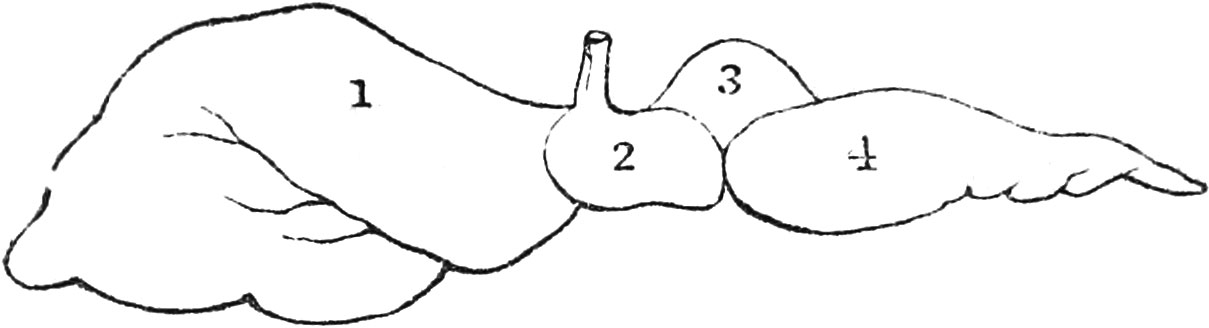
In the internal structure, the most remarkable provision is that exhibited by the digestive organs. Their food being composed entirely of substances which yield little nourishment, compared with the bulk of material, it was required that as much as possible should be extracted from it; and, for this purpose, we have a machine with various compartments, performing each their office in preparing and extracting the vegetable juices from the leaves, or blades, or the stalks and woody parts of the plants. Ruminating animals have generally been said to possess four stomachs: we shall look, however, on the organ as a single bag, but with divisions, which act independent of each other, and for the sake of clearness they are numbered. The first or largest, called the paunch, immediately receives the food from the mouth with little mastication.
Digestive Organs
This is by far the largest, and the food remains in it in a comparatively dry state, to undergo a preparation of softening. The second is of much smaller size, and the sides internally have numerous folds, forming polygonal cells, commonly called the honeycomb: here water or any liquid is received from the mouth, and it is from this that the food, after having passed and undergone its preparation, is passed to the mouth, and undergoes the operation of a second mastication, or “chewing of the cud.” When the food is again swallowed, it passes at once to the third stomach or compartment, which contains various septa or leaves, which are so placed, that whatever comes from the second stomach must fall between them, and describe three-fourths of a circle before it can reach the orifice of the fourth stomach. This, in the common language of Scotland, is called the “monyplies:” from hence the food is conveyed to the fourth division, where true digestion from the juices takes place, and it is entirely changed in its properties; milk is coagulated, &c.
In these animals a very beautiful process also takes place in the young, where the milk, then their only sustenance, requires no process of rumination.
When the young calf is fed on milk, that liquor, which docs not require to be ruminated, is conveyed directly from the œsophagus to the fourth cavity, not passing into the first or second, nor between the plicæ of the third, which at that time adhere together.
This is the general process which the stomach of ruminating animals perform; but we shall also find modifications of the structure in the animals which recede from the most typical forms, generally somewhat assimilating with the race to which they most nearly approximate. One of the most marked as well as admirable in its adaptation, is seen in the stomach of the camel. One cavity is fitted to answer the purposes of two of the bullock, and the second is employed as a reservoir for water, and has nothing to do with the preparation of the food.
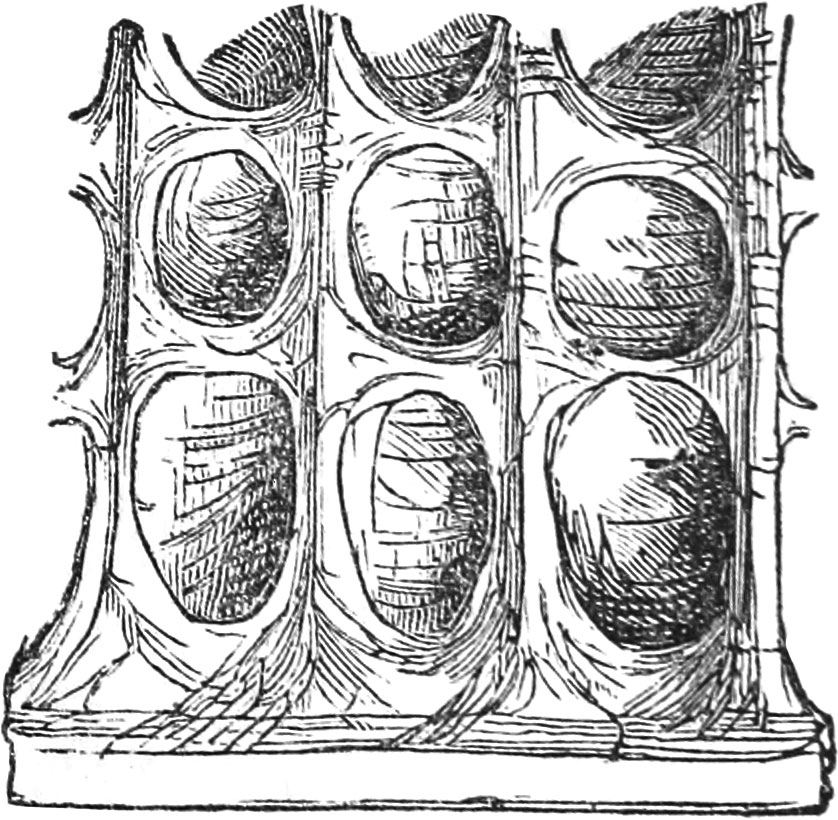
Cellular Structure of Stomach
This is of a cellular structure in its interior, and independent of its general use to retain water alone, it appears that longer deprivation from liquid enables the animal to dilate the cells, and renders the compartment capable of containing a greater quantity of its invaluable store.
The horns, the hoofs, and hair, present peculiarities in the ruminating animals. The horns in many of the species, particularly in the deer of temperate climates, are deciduous annually; and when the nourishing vessels, as it were, become obliterated by their growth, they lose their vitality, and fall off, to give way for the reproduction of the new material, which commences about the period when the system becomes influenced by the desires of rutting. In these animals, it springs from, and is for the time attached to, the prolongation of the frontal bone, which serves as a base or root; and when in its perfect state, or when the complete obliteration of the nourishing arteries takes place, it is of the consistence of bone, and remarkably compact and hard, entirely different in composition from the substance of true horn, as seen among the Bovidæ or Oxen, &c. Sir Everard Home looks upon their consistence as similar to bone, and thus describes their formation
Besides the common bones of an animal body, there are others peculiar to particular animals, which only last for a season. Of this kind are the bony projections or horns on the skull of the deer, peculiar to the male. As these are of quick growth, and only last for a season, the different stages of their formation can be readily traced; and when they are completed, and the supply of blood is withdrawn, the process of exfoliation, by means of which they drop off, is a beautiful illustration of that operation.
In their growth, the first change that takes place, is a very considerable enlargement of the arteries leading to that part of the skull; then the horn, as it is termed, begins to shoot. In the early stages, it is a vascular cartilaginous structure, covered with a velvet-like cutaneous covering. The cartilage is gradually converted into bone; and when this process is completed, the covering becomes so thin, that it is readily rubbed off by friction in the use of the horn.
As soon as the horns become hard, the blood-vessels going to them gradually diminish in size till the horns are deprived of all support, after which they are exfoliated like any other dead bone. This is perhaps the most beautiful instance in nature, of a bone being formed for a temporary use, and cut off by absorption, as soon as the purpose is answered for which it was intended: the use of the velvet-like covering is evident, as it corresponds to the periosteum of other bones, being the medium through which the nourishment is received; and as soon as that is separated, in both cases death takes place.
That this weapon of defence in the male of the deer kind should owe its growth, and its decay, to the state of the organs of generation, is a very extraordinary circumstance, and is such a deviation from the common course of nature, that it excites our wonder and astonishment.3
In some of the deer of the tropics, however, the horns of the same original structure appear to be continuous, and do not drop off: this is the case with the Indian Muntjak. In the Cameleopard, again, the frontal prolongations are not surmounted by any horny substance, but merely with a few strong homy bristles; and it has been placed at the termination of the Deer, which mostly shed their horns, and the commencement of the Antelopes, which begin to have these ornaments of the head of the substance of true horn, having a hollow bony core. In these, and among the Oxen, the structure of the outward covering is in lengthened fibres or laminæ cemented together, in a comparatively soft or elastic state while the animal is in life and health, and acting as a sheath or defence to the delicate cellular and highly vascular structure of the interior.
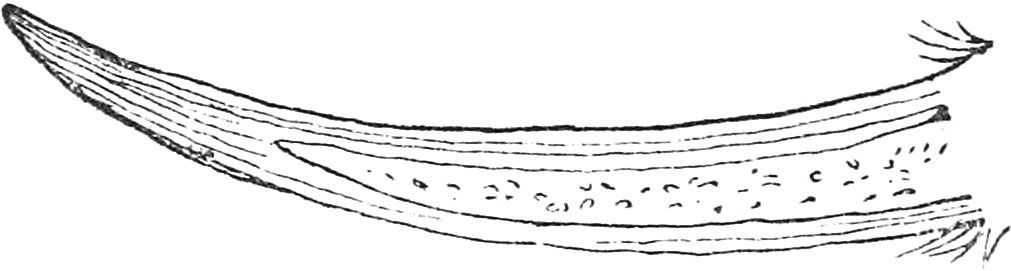
Horn Interior
The hoofs are of the same substance with the true horn, and serve simply as a covering and defence to the toes. In some animals, we find variations of structure adapted to their living. In the Musk-ox, an animal entirely an inhabitant of an arctic country, and consequently often having occasion to traverse plains covered with ice, the
under parts of the hoofs and frog, shew a singular softish, transversely ribbed surface, of a brown red colour, seemingly intended to secure the foot on slippery snow or ice, the outer hoof is round, the other crooked and pointed.4
In some African antelopes, the hoofs are low and flat, and in the broad-hoofed antelope they extend almost an inch laterally, a structure supposed to be of use to those species which inhabit a trackless expanse of sandy desert. The broad foot of the Rein-deer, and some others which inhabit a country covered for many months with snow, afford facilities when it is newly fallen and yet soft, and give them great power when exercising another mode of progression, by swimming across the large lakes and rivers, which otherwise would prove an impassable march-fence.
The rein-deer swim so swiftly, their broad feet, struck with great force, impell them so fast in the strongest currents, and across the broadest rivers, that a boat well manned can scarcely keep pace with them.
The hair of the ruminating animals assumes also different forms, according to circumstances, and is produced in greater or less profusion. In all those of the colder and temperate regions, it is abundantly produced, affording a thick and warm covering, and affording that most useful kind of it denominated wool. In some, as the sheep, the whole covering partakes of this structure: in others, as many of the arctic deer, it becomes the ground or root only. In the true deer, again, the hair is of a crisp structure, but is very close and thick; while in many of the antelopes which inhabit the sandy tracts of Africa, the hair is remarkably scanty, affords no covering, and is no encumbrance amidst the heat, and the colour of the animals is represented by that of the skin, which becomes changed almost immediately after death.
In geographical distribution the ruminating animals are spread over nearly the whole world—New Holland, and some of the South Sea islands, alone being without them. The great mass of the family is comprised in the deer and antelopes, and are principally distributed over India, Africa, and the Americas. In these countries, they lead lives with very different habits. In India and America, where the true deer principally abound, they frequent the thickest jungle, and umbrageous forest. There they receive shelter from the sun, lie lazily in the shade during the heats of the day, and wander during the cool of evening to the outskirts and open glades in search of food and water. In Africa, where we have the antelopes chiefly, innumerable herds people her deserts, mingled with the zebra and ostrich, without a shelter, and delighting, as it were, in the heats of noonday. These herds change their pasture according to its freshness and duration: they migrate in search of new food, and, like the locusts, mark the tract which they pursue;—woe to the colonist whose tender corns grow in the passage of these migratory troops, his efforts are unavailing, the destruction of the food alone drives them off.5 In Europe, a few only are to be found: these are fast falling before the inarch of civilization, and are only to be seen in the wildest and most remote districts. It may be here remarked, that, among the deer, the largest species seem to be found in the temperate districts. The Elk, Wapiti, and Rein-deer, reach even an arctic latitude, and, in their numbers, afford an abundant support where other necessaries of life are less plentiful. The larger stags also follow the temperate and exalted regions. One fine animal, the Red Deer, is still found in Britain; and the mountain ranges of India appear to possess more than another species.
Among the other families, the proportion of numbers is less, but the utility of the individuals is much increased. Among the Camels, that of the ancients can scarcely now be traced in a state of nature; but without this creature, the nations of the east could not pass the deserts, and as a beast of burden it is invaluable. Other animals belonging to this section, and also extensively used, are found on the American Andes; but, unless introduced, these creatures do not extend either to Africa or India. The Giraffe, again, is confined entirely to Africa. The tribe of Sheep and Goats are nearly equally distributed in the three great continents; but those of long hair and fine wool are found mostly in the warmer but alpine districts of Asia. Of the Bovidæ or Oxen, so important for food and labour, two are found in America, another in Africa; but the Asiatic continent appears to be their stronghold, and possesses several species, which have in their turn been subjected to the will and for the use of man. We shall now review the families separately, and enter more at large into the peculiarities of form and structure which has been observed in each: and, first,
The Camels
Among the Camelidæ or Camels, we include the South American animals, which, forming a distinct group, take the place of the Camel of the ancients in the New World, and in many instances are employed for somewhat similar purposes. They are characterized by an unwieldy form, placed high above the ground, a long and rather slender neck. The upper lip swollen and cleft in the centre, possessing a power of motion, and used to feel or examine the shrubby food before it is conveyed to the mouth. They have canine teeth in both jaws, and on each side two additional pointed teeth implanted in the incisive bones. The lower incisor teeth are six in number, the grinders either eighteen or twenty; the cuboide and scaphoid bones of the tarsus are separate, and they have the three bones of the second range of the carpus, which distinguish them from all the other ruminants, and exhibits one link of connexion between this order and the Pachydermata. There is one small hoof which is fixed to the last phalanx, as in the feet of the Pachydermata, and the toes alone are free, being connected beneath by a horny sole. The stomach is furnished with cells capable of retaining or producing motion. The uvula of the males is swollen during the rutting season, and protrudes from the mouth like a bag or bladder.
The Camels of the Old World, if we consider all the circumstances of their native country, may be perhaps considered as among the most useful of the ruminants. They are in fact the only animals which could perform the journey in the desert, and support for sufficient length of time, the heat of the burning sands, and the deprivation of sustenance, to which they are exposed; and while thus fitted for life and labour in countries of this description, they are of necessity, from organization, prevented from living in those which possess much humidity of climate, moisture producing inflammation of the feet and legs, and becoming as insupportable to the camel, as the seas of scorching sands would be to the horse or oxen.
Arabia with its deserts is the country most constantly associated with the Camel, but at the present day they are used most extensively in north and western Africa, in Syria and Persia, Chinese Tartary, and in some parts of India; in the former countries, being the only beast used for burden, and by its powers, rendering the most barren districts in the world habitable, and keeping up an intercourse across a barrier, which, without it, would have remained impassable. The Arabs are dependent on this animal for every necessary; like the rein-deer to the Laplander, it affords them food and raiment, and a carriage for their burdens. The milk in its various forms nourishes their families; slippers and harness are made of his skin, and tents and clothing of his hair;6 and in those perilous journeys where even the merchandise and profits are thought insignificant compared with life, the camel is often sacrificed for the sake of his supply of water to cool the feverish frame of his master. No wonder, then, that the wealth of these nations is centred in their herds of camels; and a man’s riches is complete “when the number of his camels is not known.”
Another remarkable fact in the history of the Camels of the Old World, is, that they are not at present found in a naturally wild state, and they thus form the only known instance of an entire race of animals, living and being continued only under the care and protection of man; for although it has been said by the natives of eastern countries, that in some districts these animals are still found completely at large, the information is not of so authentic a character as to warrant our now asserting it.
We shall illustrate this form by the
Bactrian Camel
Camelus Bactrianus.—Linnæus.
Camelus Bactrianus, Linn.—Menagèrie du Museum National.—Le Chameau à, deux Bosses, Cuv. Regne Animal.—Bactrian Camel, Hamilton Smith in Griffith’s Cuvier, iv. p. 48.
This species is supposed to have been originally found in Bactria, the present Turkiston, and there to have spread over Persia and Tartary to China. It is the most hardy species, and will bear with much more variety of climate than that which is more commonly made use of in the deserts, and they are carried by the Mongolians even as far as the Lake Baikal. It is at once distinguished from the other animal, or the Arabian Camel, by the presence of two large humps upon the back, composed of a mass of fatty substance; the first placed upon the shoulders, the other near the croup: it is considerably larger, and more heavily built than the dromedary, and is not used for any conveyance which requires much dispatch. A full grown animal of this kind will reach seven feet and a half to the top of the shoulder hunch. The colour of the hair is generally of a dark brown, though light varieties often occur, and are sometimes bred; on some parts of the body it is long and shaggy on the crown of each hunch, the mane, crown of the head, forepart of the neck, it is thick and lengthened; and where the fore leg proceeds from the body, there is a large bunch, which grows down on the fore arm.

Plate I

The second species of Camel, or that with only one hump on the back, is known under the name of the
Arabian Camel or Domedary7
C. dromedarius.—Linnæus.
It is by far the most extensively used, and seems from its constitution to be able to endure for a greater length of time those fatigues and deprivations to which it is subjected; and it is this animal which is of such vast utility in the east, the fortune of the Arab, and nearly the only beast of burden in Turkey, Persia, and the north of Africa. It is at once distinguished from the preceding animal by having only a single hump placed nearly in the centre of the back, and is of a size and stature somewhat smaller, being from five to seven feet in height at the shoulders. The muzzle is less swollen than in the others, and the hair is soft, woolly, and very unequal, longest on the neck, the throat, and the hump. The colour is always lighter than that of the camel, being, while young, of a dull or dirty white, becoming with age of a reddish-grey. In the internal structure they do not differ materially from the camel.
The Dromedary, according to Major Hamilton Smith, extends from the foot of Mount Caucasus, over Persia and Turkey, Arabia, northern Africa, and India. It is also much used on the western coast of Africa. Many varieties exist, and are endeavoured to be continued. The Turkish and Arabian are the strongest and most hardy; and another of lighter form, and possessing much swiftness, is much sought after, for carrying dispatches from one distant part of these kingdoms to another. An animal of such importance is of course looked at with a corresponding interest, and great care is exercised in tending and watching the herds. The males are generally rendered imperfect, and a few only of the most approved form is retained, to continue the property of the owner; in other circumstances, the fury and unmanageable disposition which they display during the rutting season, would render a large herd dangerous, and would often prevent numbers from being useful at the very time they might be most required. They are carefully trained when young, and taught to kneel and receive their burdens, and are generally of a mild and submissive disposition, docile and patient, but obstinate when overloaded—often refusing to rise if their burden is felt to be beyond their strength. The strong dromedary for burden, will carry 1200 pounds weight for a journey with the caravans across the deserts, and this at the rate of from fifteen to twenty-five miles in the twenty-four hours; and in cases of extremity, fifty miles of the desert have been traversed by the Arab in the same period of time; but this, while it places him in safety, and out of the reach from any one not provided with a similar conveyance, could not be kept up, and the scanty supply afforded by the produce of the country passed over, would soon fail to maintain the strength of the animal.
These caravans or travelling parties, are most frequently of the most motley description, consisting of merchants from various countries, exhibiting the variety of costume and manners incident to each, and the accompaniments are generally composed of persons who have chosen this escort for their safety across the desert, with a rear of followers who have also chosen the escort for safety, but join to this the hope of plunder, or of a scanty charity by the way. At other times, however, some of these expeditions are more regular; and it appears that the camels can be trained to obey orders like the discipline of a troop of horse. In the continuation of Clapperton’s Journal by Lander, we are told of the arrival of 500 camels laden with salt from the borders of the great desert.
They were preceded by a party of twenty Tauriac merchants, whose appearance was grand and imposing. They entered at fall trot, riding on handsome camels, some of them red and white, and others black and white. All the party were dressed exactly alike. They wore black cotton, robes and trowsers, and white caps, with black turbans, which hid every part of the face except the nose and eyes. In their right hand they held a long and light polished spear, whilst the left was occupied in holding their shields, and retaining the reins of their camels. Their shields were made of white leather, with a piece of silver in the centre. As they passed me, their spears glittering in the sun, and their whole bearing bold and warlike, they had a novel and singular effect, which delighted me. They stopped suddenly before the residence of the chief, and all of them exclaiming “Choir,” each of the camels dropped on its knees, as if by instinct, whilst the riders dismounted to pay their respects.8
The variety to which the name of Dromedary properly belongs, with the weight of a man only, can perform very lengthened journeys, and at a very quick pace. Several of these attend the caravans when crossing any of the African deserts, performing the offices of scouts, and keeping a look-out both for danger from the wandering tribes, and for the approach to the water stations. These will travel from seventy to one hundred and twenty miles in the twenty-four hours.
It is related by a modern traveller,
That one of these animals will in one night, and through a level country, traverse as much ground as any single horse can perform in ten. It was often affirmed to him by the Arabs and Moors, that it makes nothing1 of holding its rapid pace, which is a most violent hard trot, for four and twenty hours upon a stretch, without shewing the least sign of weariness, or inclination to bait, and that having then swallowed a ball or two of a sort of paste, made up of barley, and perhaps a little powder of dates among it, with a bowl of water, or camel’s milk, if to be had, and which the courier seldom forgets to be provided with in skins, as well for the sustenance of himself as of his pegasus, the indefatigable animal will seem as fresh as at first setting out, and ready to continue running at the same scarce credible rate for as many hours longer, and so on from one extremity of the African desert to the other.9
They are sometimes also trained to run races, and are extremely fleet. The same traveller relates, that, at the celebration of a royal marriage, the bride,
Among other entertainments she gave her guests, a favourite white dromedary was brought forth, ready saddled and bridled; the thong, which serves instead of a bridle, was put through the hole purposely made in the gristle of the creature’s nose. The Arab appointed to mount was straightly laced, from the very loins quite to the throat, in a strong leathern jacket, they never riding those animals any otherwise accoutred, so impetuously violent are the concussions the rider undergoes, during the rapid motion. We were to be diverted with seeing this fine Aashari run against some of the swiftest barbs of the whole Nija, which is famed for having good ones of the true Lybian breed, shaped like greyhounds, and which will sometimes run down an ostrich, which very few of the best can pretend to do, especially upon a hard ground perfectly level. We all started like racers, and for the first spurt, most of the best mounted among us kept up pretty well, but our grass-fed horses soon flagged, several of the Numidian runners held pace till we, who still followed upon a good round hand gallop, could no longer discern them, and then gave out, as we were told after their return. When the dromedary had been out of our sight for half an hour, we again espied it flying towards us with an amazing velocity, and in a very few moments was among us, and seemingly nothing concerned, while the horses and mares were all in a foam, and scarce able to breathe, as was likewise a fleet tall greyhound bitch, of the young prince’s, who had followed and kept pace the whole time, and was no sooner got back to us, but lay down panting as if ready to expire. I cannot tell how many miles we went, but we were near three hours in coining leisurely back to the tents.10
We may look upon these animals, then, as supplying the place of the horse and ox in all these countries, for although both the former are abundant, they are scarcely used as beasts of burden, but are reserved for war and the support of the families, or in the retinue of the native princes. In north and western Africa this is particularly observed. There the herds of cattle are immense, but we do not see them applied for burden or tillage. Camels only are applied to for all those laborious occupations, and the loss of life among them in consequence of bard labour, or extensive journeys, is often very great, and but seldom regarded.
Attempts have been made to introduce the camel into the West Indian islands, but hitherto without success. Whether from the ignorance of those who had them in charge, or actually from the climate, is yet uncertain, but we scarcely think that the lower lands of tropical America, would be suitable to their constitutions. Upon the Continent of Europe, and even in this country, their management has been much more successful. Several individuals have lived long and well in the vicinity of London; and a specimen of the brown or Turkish variety, was long used to draw water for the other animals in the Garden of Plants at Paris.
The Camels of the New World, known under the common name of the Llamas, and the scientific title of Auchenia of Illiger, differ from those we have been just reviewing, by their much smaller size; the largest specimen being only about four feet four inches high at the shoulder. Their whole appearance is more deer or goat-like, possessing a proportionally smaller head, long ears, and a lively eye of much brightness. In the form of the foot they also materially differ; it is truly cloven or divided into two bent or crooked hoofs, and has no connecting horny sole like the true camels. The outline of the back is nearly straight, and without any appearance of the fatty humps. In the toothing, the incisors are placed at some distance from each other, and have exactly the shape of canine teeth. The true canine teeth are considerably larger, and the cheek teeth form a regular series like those of the generality of ruminants, but consisting of only two false and three true molars. In the lower jaw there are but six incisors, the two outmost having all the character of canines. The cheek teeth consist of one false molar and three true ones.11 From the structure of the stomach also, these animals are entitled to rank with the camels. It was considered that this organ did not exhibit the same structure for retaining water as was observable in the Arabian Camel; but it was lately shewn by Dr Knox that, with some modifications, the same kind of structure was present. In the smaller divisions of the paunch of the Llama, there were sixteen rows of cells, occupying a surface of from one inch to an inch and a quarter in breadth; and in the greater division there were about an equal number, but much larger and deeper. The cells are hollows which have openings towards the cavity of the stomach, much narrower than their capacity within. The second stomach is entirely composed of cells, which are deep and extensive, and lie as it were imbricated and in layers, but in none of those cells is there any muscular apparatus to close their mouths and allow the solid food to enter into the truly digesting stomach, without going into these cells.12
The Llamas inhabit the Cordilleras of the Andes of Peru and Chili, living in herds, and exhibit considerable activity and grace of action. They are easily domesticated, and are still used as beasts of burden.
We illustrate the form by the
The Brown Llama
Auchenia Llama.—Illiger.
Mareschal, Menag. du Museum.—Brown Llama, Gardens and Menagerie of Zool. Soc. i. p. 250 273.
The individual which formed the subject of the accompanying plate, forms part of the collection of animals in the Museum of the University of Edinburgh. It stands about three feet high at the shoulder, and the whole colour of the animal is a deep and rich vinous chocolate-brown, palest beneath and on the inside of the legs. The hair is of a woolly texture, lengthened, and with a fine thick ground of shorter wool.
The Brown Llama has been occasionally kept in confinement in this country; and a pair which served for the figures of Mareschal, were kept by the Empress Josephine at Malmaison, exhibiting great docility, with mildness and affection towards each other.
It is not yet determined how many species of these animals exist. There seem to be pretty fairly established the present animal, inhabiting Peru and Chili; the Vicugna, appearing at a much higher elevation, more insensible to cold, and with a thick and longer fleece; and the Guanaca. Among these, however, the synonymy is still somewhat confused; and in the accounts of travellers, one animal is often named for another. The facts of their habits and domestication in their native regions is therefore also not always to be depended on. It was one of these animals which was employed by the ancient Peruvians at the conquest. They are still used for transporting burdens. They become very docile, are trained to kneel when loading, and the drove is generally preceded by one old and well broken in as a leader: his head is ornamented with ribbons, small streamers of cloth, and little bells, and he has rings in his ears; the rest follow regularly after, and the Indian driver in the rear whistles to the cadence of their feet. In this manner they will travel from fifteen to twenty miles daily through the rugged passes of the Andes, with a weight of 150 lb.
Another of these animals, at least it has not been identified correctly with any other, the Chilihueque of Molina, was employed for the cultivation of land, and to draw a kind of cart. The wool or hair of them all is used in the manufacture of dresses, which have the brilliancy of silk. Their milk is also esteemed, and the venison of both the young and old is eaten; and the bezoar which is found in the stomach is in repute as a charm. They are hunted, and either shot, or taken by the lasso.

Plate II
The form which has been placed next in the Ruminantia, is the Musks, a race of animals of small size, and retired habits, still without horns, but with the canine teeth, two in number, on each side, much elongated, sometimes so much as to assume the form of tusks, with which the males can defend themselves, and in the rutting season fight and generally inflict large wounds. They still want the lachrymal glands.

Musk Head
The most celebrated species is
The Thibetian Musk
Moschus moschiferus.—Linnæus.
Le Musc, Buffon, Cuvier.—Moschus moschiferus, Linn. Hamilton Smith, &c.—Thibetian Musk, Pennant, Shaw.
The Thibetian Musk is the celebrated animal which produces the substance called Musk. The specimen in the Royal Museum of the University of Edinburgh, from which our plate was taken, is about the size of a small roebuck, scarcely standing so high upon the legs, and having a thicker and more clumsy-looking body. It is entirely of a deep reddish-brown, paler beneath, and on the inside of the legs. The hair is of great length and thickness, crisp and curled like that of the true deer, and without any woolly or downy substance at the roots; it is sometimes varied with white. The canine teeth are longer in this than in any of the other forms, assuming the form of flat and cutting recurved tusks, which are visible for an inch outside the mouth. The hoofs are long, and assist while the animal is climbing upon the precipices among which it delights to dwell. Its habits, in fact, are similar to the Chamois and some of the mountain goats, climbing and bounding among the precipices of the alpine ridges of central Asia with astonishing activity, assembling in herds, and often appearing in very considerable numbers. It is extremely shy and wary, easily alarmed, and difficult to be approached. It is shot or speared, and sometimes killed by the cross-bow, with a string set in the path of the animal. They inhabit the region between China and Tartary, extending to the mountains above the sources of the Indus, and northward to near the Lake Baikal. At times they• appear to migrate from one district to another, assembling previously in large herds. Some zoologists, however, have considered this assemblage not connected with migration, but consisting entirely of males in search of the female. During winter, they are said to be able to subsist on a scanty fare of lichens, but during summer, a favourite food is the leaves of the Rhododendron Dauricum.
The musk is contained in a bag situated on the belly of the male, and appears to have some connection with the season of love, for at this or during the rutting period it is secreted in the greatest profusion, and of the strongest scent: it is chiefly for this they are hunted, and, when killed, the bag is cut off, fastened at the opening, and dried, when it is ready for sale. Several thousand bags are thus procured in a season; but even with this number the substance is often adulterated before being brought to market, principally by blood being added. When first taken from the animal, the scent is extremely powerful, so much so as sometimes to be with difficulty supported by the person. This flavour becomes mellowed through time, and by many is much esteemed as a perfume, which, indeed, is the principal cause of its being collected: it was also occasionally used as a medicine. As a perfume, it is one of the most subtle, and a very small quantity will suffice, and, when once introduced, is extremely difficult to be destroyed. In addition to the employment of a part of this animal as a luxury and medicine, the flesh is sometimes eaten, but is very strongly flavoured. A warm dress of the skins, with the fur preserved, is made for a winter clothing, and a soft and shining leather is prepared by another process.
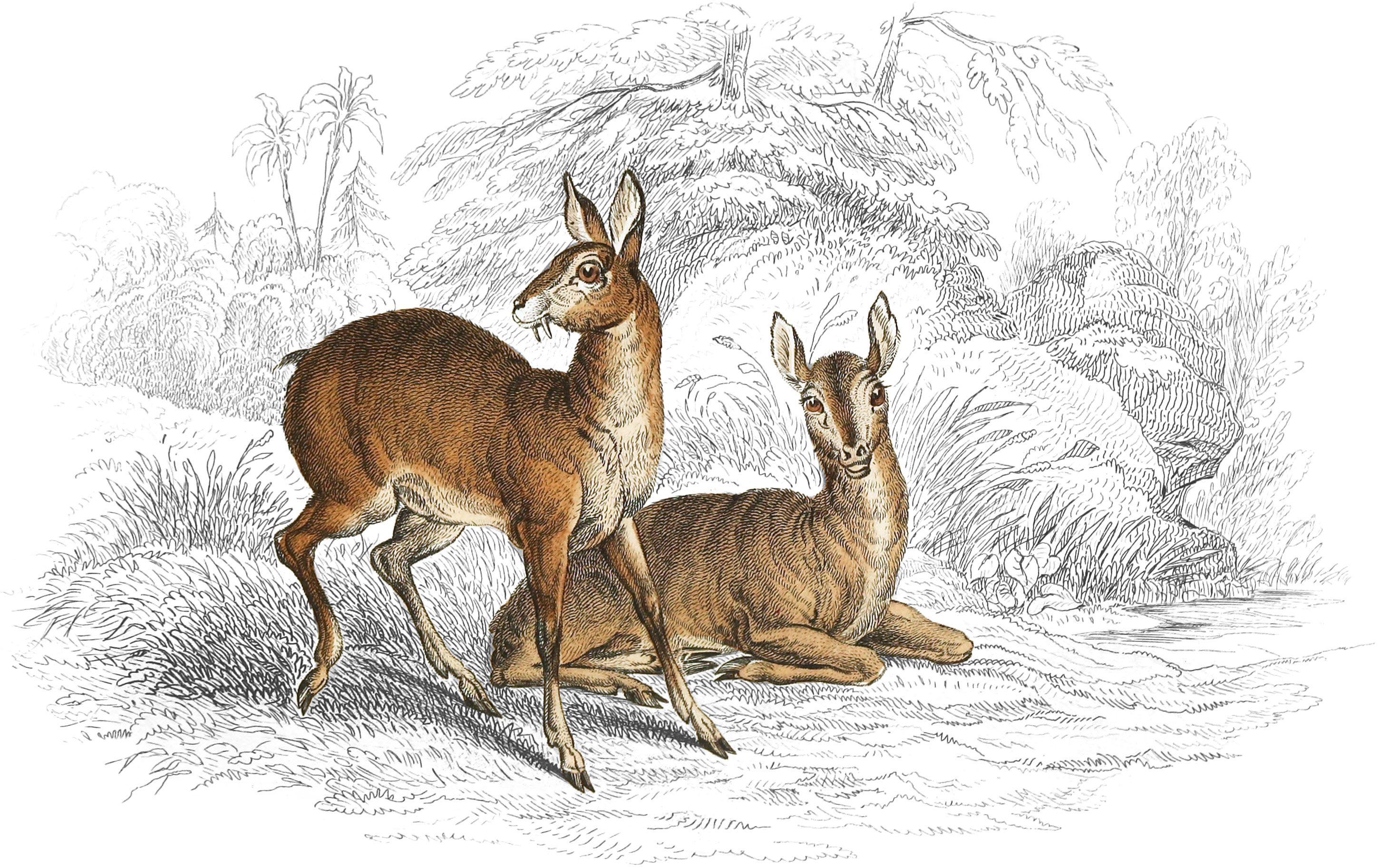
Plate III
The other animals which have been placed with the true Musk, as congeneric, differ in several particulars. The muzzle is very much elongated, and the accessory hoofs assume the form of adpressed conical claws They are the most diminutive in size of all the ruminating animals, not exceeding the size of a hare. They inhabit the Indian islands, generally the thick woody copses, intermixed with rocks. It is possible these may, when better known, be placed in a subgenus of Moschus. We illustrate this form by
The Napu Musk
Moschus Javanicus.—Raffles.
Moschus Javanicus, Raffles, Trans. Linn. Soc. vol. xiii.
In Griffith’s Synopsis of Quadrupeds, five species of these pretty little animals are described. Mr Bennett, in the “Gardens of the Zoological Society,” however, makes only four; and in our present state of knowledge we are inclined to follow this naturalist. With the exception of the Moschus Meinina, a native of Ceylon, and distinguished from the others by the spots, they are all natives of Java and Sumatra, and are closely allied, the synonymy of the one being often applied to the others. Our present figure is reduced and redrawn from the lithographic plate of Frederic Cuvier’s Histoire Naturelle des Mammifères; and we add the description which Mr Bennett has given of those alive in the Zoological Society’s Menagerie.
In size, it is about equal to a full-grown hare: its colour above is dark glossy ferruginous-brown, resulting from the intermixture of black and brown coloured hairs, somewhat lighter along the middle line of the back, and varying in intensity according to the position in which it is seen. The under parts and inside of the legs are pure white, as are also the throat and chin. The fore part of the chest is nearly of the same colour with the back of the neck, and is marked with three broad, white, radiating stripes, commencing at the throat, and passing the central one into the white of the under surface of the body, with the intervention of only a faint transverse band, and the two lateral ones nearly to the shoulders on each side. The bands of blackish-brown which separate these stripes are perfectly distinct at their anterior part—a mark of considerable importance in distinguishing this species from the Kanchil. On either side a white line passes backwards on the cheeks for some distance from the margins of the lower lip, which are continuous with the white of the throat; and this marking, in the usual sitting posture of the animal, which is something like that of the hare in its form, gives it, when viewed in front, the appearance of having five radiating stripes on the breast.
The Napu, continues the same author,
frequents thickets near the sea-shore, and feeds principally upon berries. It seldom visits the larger forests. When young, it is tamed with the greatest facility. In captivity, it appears perfectly at its ease, and quite indifferent of what is passing around it. Its full dark eye, and placid air, give it an appearance of a degree of intelligence which it does not really possess; for the greater part of its existence is passed in eating, drinking, and sleeping. Its voice is scarcely more than might be produced by a deep but gentle expiration.

Plate IV

The Ceylon species, M. Memina, is entirely confined to that island, and differs from the others by being longitudinally striped, and again barred with whitish. It is about seventeen inches high, the ground colour of a cinereous-olive. It inhabits the thick jungles.
Deer
We next proceed to the Ruminants with horns, at the commencement of which, the large Deer, or the Elks and Stags, have been generally placed; but their situation next to the diminutive Musks will appear extraordinary, and not following that gradation of form which we have almost invariably perceived. The true connection appears to be by means of the Guevi of Fred. Cuvier, and one or two of the small antelopes, which have in reality been confused and described as Musks, and which have the low crouching form, and larger looking body, and almost resemble the Peccaries.
The horns in the true Deer have a form and generation accompanied with many remarkable peculiarities. In form, they are flat or palmated, and of great size and weight, or they are nearly round, and branch into a number of projections, termed antlers. The substance is very compact, hard, and solid, and without any central support or core, as in those ruminating animals with which we are most familiar. In a great many, they are annually cast, and annually reproduced with great rapidity, and in all these the production of the horn is intimately connected with the process of generation. The size of the horn also increases with the age of the animal, and divaricates into a greater number of antlers. The deciduous horns, as far as can be yet ascertained, take place among all the Deer of the temperate countries but; it is supposed that some of those in hotter climates do not cast them annually. The palmated form of the horn, again, seems to be more restricted to those animals inhabiting an arctic or northern latitude, and is considered by Major Smith as a provision to remove the snow from their food.
On the first commencement of the horn in the young animals, it is perceptible like a small lump. This advances and reaches the condition of a true horn of a small size, and is cast at the proper season. The wound, which at first bleeds, is in a few hours covered with a fine film: the vessels are cicatrized, and the production of the next horn immediately commences with a burr round the old wound. When the rutting season begins, generally in spring, this reproducing power is exerted to the utmost. The vessels from the roots swell, and an immense degree of secretion, accompanied with heat and irritation, is generated. The horn shoots rapidly at this period, enveloped in a fine and soft downy covering, which serves as a protection in its tender state from the weather and insects. When it has reached its greatest development, or when the power of the supplying vessels is exhausted, an irritation induces the animal to rub against trees or rocks, which inflicts wounds on the external covering: the vessels, gradually exhausted, dry, and the covering becomes like a skin, and falls or is rubbed off, leaving the horn hard and solid, and bearing traces of the course of the many vessels which had been employed for its production. The animal now appears in all its majesty, prepared for the battle, and continues thus for a season, when the horns are again shed, and he is obliged to skulk in the recesses of the forest until they are again replaced.
The senses of hearing and smelling are both very acute in this group, and it is almost impossible to approach a herd of Deer down the wind. They are very nice in the choice of their food, and will not touch that which has been handled or touched by any foreign substance. They inhabit the forest or the plain, and in various forms extend from the poles to the warmest regions of the world.
In many of them there is a suborbital sinus, or an opening placed below the eye, and called by the French “Larmiers.” This is sometimes only indicated by an open or fold, but in others is of a considerable size, and was thought to communicate with the nostrils, and to assist in maintaining the respiration during great exertion or swiftness. It seems, however, that the communication exists only through the puncta lachrymalia, and that this opening is connected only with a glandular apparatus—a peculiar secretion being largely exuded from them by many species.
The flesh of many is used as food, and much esteemed under the name of Venison; and strong and lasting leather is made from their skins. We shall first notice the Elks.
The Elk, or Moose
Alces Americanus.
Original, of the French Canadians.—Cervus Alces, Linnæus Moose Deer, Richards. Fauna Boreali-Americ.—L’Elan de l’Amerique septentrionale, Fred. Cuvier, Hist. Nat. des Mammifères.
This splendid animal surpasses all the true Deer in size and strength, being as tall at the shoulders as a horse, and uniting great swiftness with the most patient endurance of fatigue.
The Elk has been usually considered as an inhabitant of the northern parts of both the old and new world; but, of late, surmises have been made that the animals of the different countries might prove distinct species, and there are some minute distinctions which will entitle it to the rank of at least two races or varieties, constant under the modification of climate.
In America, this animal is at present better known than in Europe. It is much esteemed for food, and, from its extremely wary and attentive nature, the success of a moose-hunter is reckoned one of the greatest trials of skill. The males are said occasionally to weigh eleven or twelve hundred pounds. The neck is remarkably short and strong, detracting from the elegant deer-like form of the family; but this form is necessary, to support the weight of the enormous palmated horns, weighing from fifty to sixty pounds, which adorn, perhaps some will say disfigure, the front. Some of the other proportions are also rather clumsy, if separated. But if the whole animal, “the aggregate of his appearance,” as Mr Smith expresses it, be taken, it will certainly combine with the majestic scenery which surrounds it, and render it a fitting companion to the American landscape.
The head, measuring above two feet in length, is narrow and clumsily shaped, by the swelling upon the upper part of the nose and nostrils; the eye is proportionally small and sunk; the ears long and hairy, and asinine; the neck and withers are surmounted by a heavy mane, and the throat is furnished with long coarse hair, and, in the younger species, encumbered with a pendulous gland: these give altogether an uncouth appearance to the animal. Its body, however, is round, compact, and short; the tail not more than four inches long; and the legs, though very long, are remarkably clean and firm. This length of limbs, and the overhanging lips, have caused the ancients to fancy that it grazed walking backwards. The hair of the animal is coarse and angular, breaking when bent.
Its movements are rather heavy, and the shoulders being higher than the croup, it does not gallop, but shuffles or ambles along, its joints cracking at every step with a sound heard to some distance. Increasing its speed, the hind feet straddle, to avoid treading on its fore heels, tossing the head and shoulders like a horse about to break from a trot to a gallop. It does not leap, but steps without effort over a fallen tree, a gate, or split-fence. During its progress, it holds the nape up, so as to lay the horns horizontally back.
The form of the upper lip is perhaps one of the most marked characters of the animal, and, as we shall presently see, is undoubtedly an organ of prehension, necessary for its mode of life, in which it is assisted by the lengthened tongue, possessing great flexibility. The upper lip, like most of the stags, is not finished by a naked muzzle; it is entirely covered with hair, and has only in the centre a small space entirely naked, and without glands. The edges of the lips, on the contrary, are covered with glands, and, towards their commissures, have numerous fleshy appendages, of four or five lines in depth, and almost like tentacula.
In its winter dress, the Elk is of a brownish-black, almost inclining to the latter colour, with the exception of the limbs, which are greyish-yellow or fawn colour. The mane is of a fawn colour: the sides of the head of a clear dull greyish-brown. In this state it is represented in the accompanying Plate. In the dress of summer, it is always of a browner tint. During the second year, the horns are only about seven or eight inches in length. During the third year, or the second of the horns, in the animal kept alive in Paris, they only reached the length of sixteen or eighteen inches, and had not commenced to palmate. This might be influenced by confinement. According to Hamilton Smith, the incipient horns appear the first year to the length of an inch; the second they rise to a foot; the third they are forked; the fourth they first assume six snags, and are somewhat flattened; the fifth year the blade is still small, but the expansion from that time forward is uniform. The snags sometimes amount to twenty-eight.
The Elk, according to most writers, and the more accurate accounts we have received, is not gregarious, one or two being only seen together, except during the breeding-season. During summer, they frequent the lower countries, near the borders of the lakes, where they find a refuge in the waters from the tormenting stings of the mosquitoes; and during the rutting season, the fringed banks and beautiful wooded islands afford cover and shelter to the gravid female or the young. To these retreats the does retire at this important season, the beginning of September, where they are sought out by the adult males, who drive away the younger, and keep off all intruders. In winter, again, they frequent the wooded hills, finding both shelter and food when the ground has received its winter covering. Their necks are so short, and the legs so long, that they are unable to feed on the low herbage like cattle, but crop the tops of the higher plants and low brushwood, or reach and pull down the branches of trees; for, as Fréderic Cuvier observes, their upper lip is a true organ of prehension, and that the whole of the manners of the animal, which he was enabled to study in confinement, plainly indicated the adaptation, of its form to an abode in forests, and to a sustenance on the foliage of trees. The same animal, when wishing to graze, reached the ground with its muzzle with extreme difficulty, and often on such occasions fed leaning on its knees. During winter, the shoots of the willow, birch, and red willow, are among their favourite food; and Dr Richardson, on the authority of Lewis and Clark, notices the Gualtheria Shallon as much sought after to the eastward of the Rocky Mountains.
During winter, it is a favourite object of the chase, particularly among the Cree Indians, who account themselves the most dexterous in this pursuit.
In winter, the hunter tracks the Moose by its footmarks in the snow, and it is necessary he should keep constantly to leeward in the chase, and make his advance with the utmost caution; for the rustling of a withered leaf, or the cracking of a rotten twig, is sufficient to alarm the watchful beast. The difficulty of approach is increased by a habit which the Moose Deer has, of making a daily sharp turn in its route, and choosing a place of repose so near some part of its path that it can hear the least noise made by any one that attempts to reach it. To avoid this, the judicious hunter, instead of walking in the animals footsteps, forms his judgment, from the appearance of the country, of the direction it is likely to have taken, and makes a circuit to the leeward, until he again finds the tract. This manœuvre is repeated, until he discovers, by the softness of the snow in the footmarks, and other signs, that he is very near the chase. He then disencumbers himself of every thing that might embarrass his motions, and makes his approach in the most cautious manner. If he gets close to the animal’s lair without being seen, it is usual for him to break a small twig, which alarming the Moose, it instantly starts up; but not fully aware of the danger, squats on its hams. In this posture, it presents the fairest mark, and the hunter’s shot seldom fails to take effect in a mortal part.
At other times, in winter, when the snow is very deep, they are hunted and run down on snow-shoes, and in this chase the endurance of the animal is remarkable.
During the rutting season, the Moose lays aside all his timidity and wariness, attacking every animal, and even man, if he comes in the way. At this period, they are attracted by the hunters within shot by
scraping on the blade-bone of a deer, and, by whistling, which, deceiving the male, he blindly hastens to the spot, to assail his supposed rival. If the hunter fails to give it a mortal wound as it approaches, he shelters himself from its fury behind a tree; and I have heard of several instances in which the enraged animal has completely stripped the bark from the trunk of a tree by striking with its fore feet.
According to Say, at other times, when wounded, he is also dangerous. His hunters wounded an animal, which fled to a thicket, where it was pursued by the party.
The noble animal finding his pursuers at his heels, turned on the foremost, who only saved himself by springing into a thicket, which the Elk could not penetrate.
In this case, his horns become his greatest foe, for he soon became entangled, and fell an easy victim: his head was enveloped in such a quantity of Cissus, Smilax, and other twiggy vines, that scarcely the tips of his horns could be seen.
In Europe, the Elk is less accurately known, and although, as we observed, surmises of a difference in the species have been raised, yet nothing definite has been discovered, and the correct characters, from European specimens, have not yet been published. It is said to be found in a part of Prussia, Poland, Sweden, Norway, Finland, Lapland, and Russia; and in Asia, to spread from the thirty-fifth to the fiftieth degrees.
In Sweden, the powers of this animal were made subservient to public utility. In the reign of Charles IX., Elks were made use of for the purpose of conveying couriers, and were capable of accomplishing 36 Swedish (about 234 English) miles in a day, when attached to a sledge.
Dorelli, a Swedish gentleman, recommends them to be used in the time of war, to be employed as flying artillery, to reconnoitre, and carry dispatches.
This is the only animal which will rank in subgenus Alces, though, to another animal, known only by the horns, the name of coronatus has been applied by Cuvier. They are in the Paris Museum, bear sixteen snags, but are scarcely a foot in length: they stand about three inches asunder, and more on the forehead than in the common Elk; and Mr Smith thinks they must have been borne by an animal not larger than the fallow-deer, and states his opinion that it may prove to be the Kistuke or little Elk of the Rocky Mountain Indians.

Plate V
The next form is now known by the subgeneric title of Rangifer.
The Rein-Deer
Rangifer tarandus.
Cervus tarandus, Linnæus and Authors.
As with the moose or elk, we shall consider the history of the Rein-Deer separately, as an inhabitant of the Old and New World. In both he fills a very important part in the economy of the native tribes but it is marked with this peculiarity, that in the one he is hunted in a state of nature, while in the other the greater proportion of the race is under the guidance and protection of man, and is considered as part of the riches and private property of the individuals. Also as with the animal above alluded to, they present varieties in the different countries, which have yet been not defined, and which may ultimately lead to a distinction of the species which inhabit the two continents. We shall first notice the rein-deer in America.
The works of Hearne, Hutchins, Pennant, Say, and more lately of Dr Richardson, have given many details regarding this animal. It inhabits a great range of country, nearly as far south as Canada, and extending north farther than any other deer. Two varieties at least exist, named by Dr Richardson, the Barren-ground Caribou, and the Woodland Caribou. The latter is the smallest in size, is less esteemed, and in every way reckoned inferior to the other. It inhabits a limited track of country, a stripe of low primitive rocks, well clothed with woods, about one hundred miles wide, and extending, at the distance of eighty or a hundred miles from the shores of Hudson’s Bay, from Athapascow Lake to Lake Superior; and it is curious, that the woodland caribon migrates or travels to the southward in the spring—a direction opposite to that of those inhabiting the barren grounds. This animal requires investigation. A naturalist has yet not had an opportunity; and it is much more than probable that it may turn out to be distinct from either the other inhabitants of America or those of Europe. Horns of another allied deer are described by Major Smith, under the title of C. coronatus. The horns of this variety are known to differ from the others.13
The barren-ground caribou of Dr Richardson is distributed over the fur countries, and passes the summer on the shores of the Arctic Sea. This is an animal of a small size, weighing, when in good condition, and without the offal, from 90 to 130 lb. During summer they migrate to the coast, and feed on the young shoots of the grasses which commence to spring up in the sheltered arctic valleys. They calf after their arrival on the coast. In September they commence their return to the woods, where they spend the winter, and find a sustenance from the usneæ, alectoriæ, and the other tree lichens, or on the cetrariæ and cenomyces which clothe the rocks and ground. In a wild state, this animal is no less necessary for the support of the native tribes, than it is to the Laplanders in Europe. Dr Richardson remarks,
The Chepewyans, the Copper Indians, the Dogribs, and Hare Indians of Great Bear Lake would be totally unable to inhabit these frozen grounds, were it not for the immense herds of deer that exists there. Of the caribou horns they form their fish-spears and hooks; and, previous to the introduction of European iron, ice-chisels and various other utensils were also made of them. The hide, dressed with the fur, is excellent for winter clothing, and supplies the place of both blanket and feather-bed to the inhabitant of the arctic wilds. It also forms a soft and pliable leather, adapted for mocassins and summer clothing; or, when sixty or seventy skins are sewed together, they make a tent sufficient, for the residence of a large family. The shin-bone of the deer, split so as to present a sharp edge, is the knife that is used to remove the hair in the process of making the leather. The undressed hide, after the hair is taken off, is cut into thongs of various thickness, which are twisted into deer-snares, bow-strings, net-lines, and in fact supply all the purposes of rope. The finer thongs are used in the manufacture of fishing-nets, or in making snow-shoes; while the tendons of the dorsal muscles are split into fine and excellent sewing thread.
To the Canadian voyager the venison is an important article. By the natives the whole animal almost is consumed, every part of the interior being eaten; but it is from a mixture of the meat and fat of this animal, that the composition named pemmican is made. If kept dry, it may be preserved for three or four years, and, containing much nourishment in small bulk, is well fitted for extensive journeys, as has already been proved by its utility in the arduous arctic expeditions of our countrymen. Another mixture of pounded deer’s meat and fish, or fish-roe, is made, which is either eaten raw, or made into soup; it is called Thucchawgan.14
Excellent and appropriate winter dresses are also made of the skins, by both natives and Europeans, which exclude the cold in a way hardly to be credited. This, however, will be better exemplified when we notice the Rein-Deer of Lapland.
To the European the gun is an indispensable accompaniment of the chase; but for the native tribes, necessity has been fertile in expedients to kill or capture them. They are said to be the most easy of approach of all the North American deer; and a single family of Indians will sometimes destroy two or three hundred in a few weeks. They are taken by snares, or shot with the bow and arrow, being approached by stealth, or driven into the passes, where an ambuscade lies in wait for them; or, as they freely take to the waters of rivers and lakes, they are easily overtaken in the canoes, and speared. The Esquimaux also shoot them with arrows, and exhibit great patience in waylaying their prey. They are so inquisitive as to examine any object with which they are unaccustomed; and to this the hunter trusts; or, creeping behind any object of partial concealment, he imitates the bellow of the animal, having his deer-skin coat and hood down over his head. In both cases he is generally successful, and rarely shoots before the animal reaches a distance of twelve paces. The most ingenious method of taking them is. however, noticed by Dr Richardson, as practised by the inhabitants to the southward of Chesterfield’s Inlet. It is by a trap made of snow and ice.
The sides of the trap are built of slabs of snow, cut as if for a snow-house. An inclined plane of snow leads to the entrance of the pit, which is about five feet deep, and of sufficient dimensions to contain two or three large deers. The pit is covered with a large thin slab of snow, which the animal is enticed to tread upon, by a quantity of the lichens on which it feeds being placed conspicuously on an eminence beyond the opening. The exterior of the trap is banked up with snow, so as to resemble a natural hillock, and care is taken to render it so steep on all sides but one, that the deer must pass over the mouth of the trap before it can reach the bait. The slab is sufficiently strong to bear the weight of a deer, until it has passed the middle, when it revolves on two short axles of wood, precipitates the deer into the trap, and returns to its place again, in consequence of the lower end being heavier than the other.
Hearne describes another method still, by which these important animals are brought within reach of the more imperfect weapons of the Indians,—that of driving into a pound, as is also done with the wild buffalo; the principle is the same. A fence, or the appearance of it, is placed in the form of an angle, the entrance being wide, into which, when the herds enter, they are impelled forward by noise behind, until they are gradually enclosed in the centre fold. In the present instance, the centre pound or fold is sometimes a mile in circumference, and is intersected with brush and fences, in which snares made of thongs of rein-deer skins are fixed, and in which, when entangled, they are easily speared.
In Europe, the rein-deer inhabits the more northern countries, Siberia, Lapland, Finmark, and Sweden; but is not, we believe, known to the south of the Baltic Sea. It also extends beyond the Asiatic boundary, and among some tribes is used as a beast of burden. In Iceland it has been for some time introduced. In none of these countries is it so much esteemed as in Lapland. It there becomes the sole wealth of the people, being every necessary they require; its care, food, and dressing occupying by far the greatest and most valuable portion of their time. The movements of the Laplander, and his habits of life, may indeed in reality be said to be under the control of his deer. He must follow them during summer in search of adequate pastures, and attend to their migrations to the coast; while in winter many a dreary hour is spent in the snowdrift in looking after the safety of his herd.
Independent of the indispensable utility for food and clothing, the rein-deer is also used to transport merchandise, as a courier, where dispatch is needed, and for general travelling. Sometimes they are even used to plough and harrow, and in winter are employed to draw hay and fodder laden upon trays.15 Travelling in winter is performed entirely by their assistance, in a sledge, or, as it is termed, a pulk but before adverting to this conveyance, novel to the European visitor, we shall notice the speed with which the animal can travel.
According to the best authorities, one hundred and fifty miles was performed with one deer in twenty-four hours, and once by two merchants across the mountains in nineteen hours, while the same distance has been performed with three deer in thirteen hours. But the greatest recorded instance of the speed of this animal, is that of the deer, of which a portrait, together with that of its driver, is preserved in the palace of Drottingholm. In consequence of the Norwegians making a sudden irruption into the Swedish territories, an officer was despatched, with a sledge and single deer, to convey the intelligence to Stockholm. The distance, 124 Swedish, or 800 English miles, was performed in forty-eight hours but the deer dropped down lifeless on its arrival.16 This relation of speed is always spoken of as a certainly authenticated fact; but we cannot help suspecting that there is some error in the time; both the time and distance appear incredible; and, at all events, it will prove the exception to the general rate of speed. Sir Arthur de Capel Brooke observed, that a deer can easily trot ten miles, and perhaps gallop nearly double the space in an hour, if put to extreme speed; but he would be unable to keep it up longer. That traveller has also given the details of a race, instituted for the purpose of ascertaining the comparative speed, and, as the details are short and simple, we shall insert them:—Four deer were used; the first accomplished 5397 Paris feet in six minutes; the second performed the same distance in seven minutes thirty seconds; the others were distanced. This race was performed while the snow was deep, and consequently a considerable impediment to the running. Another experiment was afterwards tried on more favourable ground. The first deer performed 3089 feet 8 inches in two minutes, being at the rate of nearly nineteen miles in an hour, and thus accomplishing 25 feet 8 inches in every second.17
To give some idea of travelling in Lapland with these useful creatures, we have abridged an account of a journey performed by Sir Arthur de Capel Brooke in that country, and can recommend the perusal of his “Winter in Lapland,” as a work of much interest, and containing one of the best histories of the domestic condition of the rein-deer.
The party of which Sir Arthur formed a part, were about to travel from Alten to Stockholm in sledges. They leave Alten; but, at a distance of some miles, find themselves stopped by one of the streams being still unfrozen. Some of the party, among whom was our traveller, return to Alten to pass the night, while others take up their quarters in the cottage of a Finlander, where the rendezvous was to take place again early next morning. About nine o’clock the journey was to be again commenced.
The morning was cold and stormy; I was jaded, miserably tired for want of re9t, and just on the point of being tied to the tail of a wild deer, and dragged at random in the dark, in a kind of cock-boat, some hundred miles across the trackless snows of Lapland. Our pulks were ranged together in close order; and the wappus or guide having performed the last office for us, by tying each of us in as fast as possible, and giving us the rein, jumped into his own, and then slightly touching the deer with his thong, the whole of them started off like lightning.
The want of light rendered it difficult to distinguish the direction which we were going in, and I therefore left it entirely to my deer to follow the rest of the herd, which he did with the greatest rapidity, whirling the pulk behind him. I soon found how totally impossible it was to preserve the balance necessary to prevent its overturning, owing to the rate we were going at, and roughness of the surface in parts where the snow had drifted away, the pulk frequently making a sudden bound of some hundred yards, when the deer was proceeding down a smooth slippery declivity. In the space of the first two hundred yards I was prostrate in the snow several times, the pulk righting again by my suddenly throwing my weight on the opposite side. My attention was too deeply engrossed by my own situation, to observe particularly that of my fellow-travellers, or to be able to assist them. The deer appeared at first setting off, to be running away in all directions, and with their drivers alternately sprawling in the snow. As I passed Mr Heinchen’s deer at full speed, I observed, to my great wonder, the former turned completely over in his pulk, without appearing to sustain any damage, or his deer at all to relax its pace. My turn was now arrived; and as we were descending a trifling declivity, and about to enter the fir forest, a sudden jerk threw the pulk so completely on its broadside, that I was unable to recover it, and I was dragged in this manner for a considerable distance, reclining on my right side, and ploughing up the snow, which formed a cloud around me, from the quick motion of the vehicle. To render my situation more helpless, on losing my balance I had lost also the rein; and though I saw it dancing in the snow within an inch of my hands, I was unable, from the position I lay in, to recover it. Notwithstanding the great increase of the weight, the deer relaxed but little of his speed, making greater exertions the more he felt the impediment. The depth of the snow, however, in parts, exhausted the animal, and he at length stopped for an instant, breathless, and turned round to gaze upon his unfortunate master. I began to fear I was now going to receive some punishment for my awkwardness; but after resting a moment, he again proceeded. In the mean time, I had been enabled to recover the rein, as well as to place myself once more in an upright posture, and we continued our way at increased speed.
This accident, however, threw our traveller behind, and he did not overtake the party until a halt had been called to collect the stragglers, and we find them now upon the banks of the Aiby Elv, a stream which was still open in the centre, and which they were obliged to cross. This was managed as follows:
The Laplanders, to whom these obstacles are trifles, prepared without hesitation to leap each deer with its driver and sledge over together. This seemed no less difficult than hazardous; indeed it appeared quite impracticable, from the width of the unfrozen part, which was about seven feet, and in the centre of the stream. The whole breadth of the Aiby Ely here might perhaps be twenty feet, and on each side there was a short precipitous bank, the space between that on which we were and the open part, being about six or seven feet, the ice of which appeared firm and thick.
The wappus now getting out of his pulk, stationed himself near the open part; and the sledges then advancing, each deer was urged forward by his driver to the utmost of his speed, descending the declivity at full gallop. Nothing less than such an impetus could have carried us across, from the heavy load of the sledge and driver. The natural force which its own weight gave it, being thus so greatly increased by the speed of the deer, and the icy smoothness of the bank, it made of itself so great a bound on coming to the open space, as in most instances to gain the firm part of the opposite ice, and by the strength of the deer was dragged up the opposite side. The first three or four took their leaps in fine style, carrying their drivers completely and safely over. The one immediately before me failed in the latter respect; for though it cleared the open part, yet the sledge, from its weight or some other cause, not making a sufficient bound, the fore part of it alone reached the firm ice, and the hinder, with its driver, was consequently immersed in the water, till the deer, by main strength, extricated it from its awkward situation. I relied greatly on mine, from its size, and fortunately was not disappointed, as it conveyed me safely across, both deer and sledge clearing the entire space.
At night the party, twenty-three in number, halted in a birch thicket at the base of the Finmark or Lapland Alps. The weather changes to a storm of wind and snow, but after much consultation, it is determined to proceed and attempt the crossing of the Solivara Mountains. The ascent was very tedious, from the steepness and the newly fallen snow, and the weather came on so thick, that the guide thought it advisable not to attempt crossing the summit. In the course of an hour, however, the fog cleared away, and it was determined again to proceed, after a short halt, to recruit the strength of the jaded deer.
Our halt scarcely exceeded a quarter of an hour; but, before the expiration of this, our twilight had failed us, and the arch of heaven was studded with twinkling lights. We had no time to lose; for we had yet many a weary stretch of mountain, before we should arrive at any place that would afford us wood for our night’s bivouac. The evening star, which shone brightly, cheered our lonely way, as we glided along the frozen top of the Solivara, the highest of the Finmark Alps. The snow on its bleak surface was hard as adamant, and our deer, refreshed by the rest they had made, flew swiftly along. We had at this time accomplished about half the distance to the commencement of the descent on the opposite side of the mountains. Hitherto we had considered ourselves fortunate in the clearness of the weather, but we were now about to experience a striking reverse. Our guides, with the usual caution of these people when crossing the mountains, on looking to the westward, discovered a small misty appearance, which slightly obscured that quarter, and seemed to be approaching us. I probably never would have discovered it myself. The Laplanders, however, know too well by experience what these mists portend, and are too fully aware of the danger of meeting with them, not to keep a constant look-out. In an instant we were in confusion, our guide quickly made known the approach of our enemy in the rear, and the immediate necessity there was of pushing forward at the utmost speed to which we could put the deer.
The guide coming to me, and whispering in my ear with a seeming mystery, gave me a piece of advice of some importance. The fog, said he with earnestness, would shortly overtake us, and when that happened, he briefly counselled me to halloo on ray deer as fast as it could gallop,—to mind no other person, and never to be in the rear. My deer, indeed, was one of the best and fleetest of the herd, and I was now so expert in the management of both animal and pulk, that I felt tolerably confident I should not be the hindmost, except some accident occurred. Fastening, therefore, the end of the rein tightly round my arm, to prevent dropping it, I followed the example of my wappus, flanking the sides of the animal to increase its speed. The whole party did the same, and redoubled their swiftness. Two stars in the south-east had hitherto served as steering points; all around us, however, became quickly obscured. The fog overtook us in our career, and in a few minutes the heavenly bodies were no longer visible. Our confusion was now greatly increased; we were suddenly enveloped in a dense mist, and were unable to discern our nearest neighbours. Our speed, notwithstanding, was unrelaxed, and it was a complete helter-skelter race in the dark, every one minding himself. The utility of the deer’s bells was here fully shewn, since without them half our party would probably have been lost.
In this manner we scampered along the top of the Sohvara, bewildered and dreading lest the mist should be succeeded by the snow-drift. By the inclination of the ground, our foremost guide perceived we were now coming to the descent of the range, and for the first time was sensible, that the darkness had brought us into a part of the mountains with which he was unacquainted. This unpleasant intelligence made us proceed step by step with the utmost caution, till we found our progress suddenly arrested. The foremost deer had reached the brink of a precipice, and had stopped from instinct. We had fortunately relaxed from our usual pace, or the whole party would have been over. We now turned in a different direction, to endeavour to find a part where the descent was more gradual. This was not easy, on account of the darkness, and every step was pregnant with danger. In a few minutes I heard a confused noise among the foremost sledges, and had little time for preparation, when I found myself suddenly descending a precipitous part of the mountain. The surface was smooth as glass, and both deer and sledge glided down like lightning. It was in vain to attempt to stop the latter The velocity it acquired in a few yards, from the weight alone, was so great, that it quickly overtook the animal that drew it. His legs being now hampered by the traces between them, the deer in consequence fell, and the pulk swinging round in a different direction, came on its side, and in an instant rolled like a ball. In this manner it continued its descent, and dragged the deer along with it. The surface of the snow was fortunately smooth, and I rolled along with the pulk with comparative ease; the lowness of it greatly increasing the facility with which it performed its evolutions, while the quickness with which it took place, made me hardly sensible of it.
During this time the situation of the other sledges was similar to my own, and the cry of Wappus! was now heard from all quarters to obtain assistance. The guide, as soon as he could extricate himself, came to our aid, setting the deer again on their legs. We now collected at the bottom, in a state of alarm naturally created by this sudden and unexpected descent. The damage sustained, however, was trifling, and, singular to relate, no one had suffered the least hurt.
These sketches from Sir Arthur’s work will serve to depict travelling in Lapland with rein-deer. The party arrive in safety at their destination, after many adventures of a similar kind, which our limits will not permit us to insert. No other conveyance at many seasons could traverse that country, and no animal hut the rein-deer could serve the same purposes; and though not affording the luxury and certainty of time of British travelling, there must be much spiriting incitement after the management of the pulk is obtained.
The rein-deer used for travelling are often kept by persons, and let out for that purpose, their owners generally accompanying any distant expedition, and acting as guides. A Lapland family generally possesses a herd of fifty to five hundred head; those with less than a hundred, however, are only able to enjoy a precarious living, and two or more families generally join their wealth; while with five hundred a man can support his family with curd, cheese, and milk during summer, and in winter can kill deer. To kill venison is looked upon as independence; one possessing a herd of a thousand deer, is talked of as a rich man, and a few individuals are said to possess the extravagant wealth of from fifteen hundred to two thousand.
The food of the rein-deer in Europe during summer, is the young shoots of the birch and willow, with a variety of mountain pasture and shrubs. During summer a migration to the coast appears essential to their health; and when in a state of domestication, this is yearly observed by the family of the Laplander migrating with his herds, for a sojourn of some months to the vicinity of the sea. In winter, the food consists in a great part of various lichens, but principally the rem-deer moss as it is called, Cenomyce rangiferina. Tn seeking for this, they use their broad hoofs, and sometimes the horns, to remove the snow, and the sense which the animal possesses to search for the plant, and to know the part of the ground where it grows, under a deep covering of snow, is extremely fine. Broke says,
The natural quickness in this respect is amazing. When a halt with the sledges was made, they quickly set themselves to uncover the moss, but if the stoppage happened to be on a lake, the attempt was never made, though the snow, as in the other case, was some feet in depth above the ice.18
There is a singular propensity in the rein-deer to feed on the lemmings, which they seize and devour with a sort of unrestrainable passion. During the migrations of these little animals, the herdsman is frequently unable to keep his deer together, they disperse so widely and eagerly in search of them.
Several attempts have been made to introduce the rein-deer into this country, but yet without success, chiefly, it appeal’s, from the improper selection of a place to which they might retire on their first landing.

Plate VI
Following the rein-deer, we advance to another series of animals, where the horns still retain a palmated form, but they have been arranged in a division or subgenus, from the circumstance of the base arising from the burr being rounded, the horns assuming the palmated form only at the top; it has also no canine teeth, and the muzzle is completely formed. It has been denominated Dama, and will be illustrated by
The Common Fallow-Deer
Dama vualgaris.—Gesner.
Dama vulgaris, Gesner.—Cervus Dama, Auctorum.—Fallow-Deer of Pennant, Shaw, Bewick, &c.
This beautiful and common adornment of our English parks is now scarcely to be met with in a truly wild state. There are a few places where the enclosures have, through time, been broken down, and the deer run at large without food or shelter in winter, and from thence they have occasionally strayed into such parts near as are wild, extensive, and wooded. They are said to be found wild in Moldavia and Lithuania; but, on the Continent, generally are kept in parks as in England. In the olden time, they were royal property, extensive chaces or forests were devoted to them alone, and property of all kinds disregarded, to make room for the keeping up and pursuit of those animals. With the advance of civilization and agriculture, less bounds were allotted to them, and, as always happens, the wild animals gave way to cultivation. The parks where deer are now kept are in a manner limited chaces or forests; several thousand acres being sometimes enclosed, embracing a variety of hill and dale, forest timber, water and cover, and stocked in addition with a variety of other game. Here, however, they are attended to in winter, and only such a number retained as can be sufficiently fed. Six thousand head of fallow-deer have been kept in one of these enclosures, and from three thousand to fifteen hundred is now common in most of the larger English parks. The flesh as venison is very highly esteemed, and the skins furnish a strong, pleasant, and durable leather.
The most common colour of this animal in summer is of a yellowish-brown, marked with numerous pale spots. The buttocks are always white, and a dark line passes along the back. The under parts and insides of the legs are white. It varies to white, and there is a constant dark brown variety, the fawns of which are not even spotted.

Plate VII
Three fossil animals belonging to this group have been enumerated, but two of these are thought by some to be identical. These are the Scanian Fallow-Deer,19 dug out of peat at Svedala, in Scania and the Fallow-Deer of Abbeville.20 Both are larger than the common species; but by far the most remarkable is the animal known under the name of
The Fossil Elk
Cervus giganteus.—Cuvier.
The remains of this immense animal has been dug up from peat and marl in various parts of England and Ireland; in Silesia, on the Rhine, France, and Lombardy; and the most perfect, from which we thought it necessary to give a figure, was found in marl in the Isle of Man, and is now in a beautiful state of preservation in the Collection of Edinburgh. The dimensions of
this animal are six feet high, nine feet long, and in height, to the top of the right horn, nine feet seven inches and a half.

Plate VIII
Stags
We now come to what maybe considered the true Stags, where palmation or flattening of the horns has ceased. Hamilton Smith has placed these animals in a subgenus Elaphus to which he has given the character of
Horns round; three antlers turned to the front; summit terminating in a fork or in snags from a common centre; suborbital sinus; canine teeth in the males; a muzzle.
It is to this small group that the European Stag belongs, represented on the Vignette; but we shall illustrate the form by
The Wapiti
Cervus Canadensis.—Brisson.
Wapiti, Barton.—Fred. Cuvier, Hist. Nat. des Mammif.—Landseer’s Charact. Sketches.—Cervus Canadensis, Bris.—Cerv. Wapiti.—Cervus major, Desmarest, Mammalogie, 432.—Griffith’s Cuv. Subgenus Elaphas.—Cervus strongyloceros, (Schreiber) Richardson, Fauna Boreal. Amer. i, 251.
The true Wapiti inhabits the savannahs in the interior of the more northern parts of North America.
The animal does not extend its range farther to the north than the fifty-sixth or fifty-seventh parallel of latitude; nor is it found to the eastward of a line drawn from the south end of Lake Winnipeg to the Saskatchewan, in the 103d degree of longitude, and from thence till it strikes the Elk River in the 111th degree. They are pretty numerous amongst the clumps of wood that skirt the plains of the Saskatchewan, where they live in small families of six or seven individuals.21
With the Canadian Stag of some authors, it has been confused, sometimes identified, and sometimes made distinct, but the researches of Baron Cuvier and of Hamilton Smith have proved to their own satisfaction that they are identical; and in our present state of knowledge, we can only use those authorities which have most studied the subject, and who have had the greatest opportunities of observation. Major Smith considers them as varieties resulting from circumstances, the Canadian animal living in deep forests and rocky mountains, the Wapiti on the savannahs of the interior. It was also confused with the European Stag, but either variety is much larger.
A specimen in the Parisian Menagerie in perfect health, and about four years old, bore the following dimensions and colours at the commencement of autumn. The height at the shoulders is four feet and a half. The upper parts and lower jaw are of a pretty lively yellowish-brown, and a black mark extends from the angle of the mouth along the side of the lower jaw; around the eyes a circle of brown. The neck is of a deeper tint than the sides of the body; it is mixed with reddish, and has coarse black hairs depending from it in the form of a dewlap. The hips are a clear French grey; the tail is yellowish, and scarcely two inches and a half long. The hair is of mean length on the shoulders, back, flanks, thighs, and under part of the head; the sides and limbs are clothed with shorter hairs, but they are very long on the sides of the head posteriorly, and on the neck, particularly beneath; and there is on the posterior and outer aspect of the hind legs a brush of tawny hair, which surrounds a narrow, long, horny substance. The ears are white anteriorly, and clothed with tufted hairs; exteriorly, their colour is the same with that of the neighbouring parts. There is a naked triangular space round the lachrymal opening near the inner angle of the orbit. The hoofs are small.
In confinement, this animal was remarkably gentle with its keeper, but so soon as the rutting season commenced in autumn, it became furious, and on the approach of anyone threw itself against the sides of its enclosures, uttering a shrill very strong cry. In America, the young are brought up and trained for the sledges. In England, they have also been often kept in confinement, and have even bred; and Lord Glenlyon is said to have had several descents from the pair which in 1822 were exhibited at Charing-Cross. These had the same gentle manners with the Parisian specimens.
The horns of this deer are of immense development, being said to reach a length of six feet. Major Smith possesses a drawing, in which they are shewn five feet in length. The brow and antlers are the largest; and he observes that they seem instruments of use, for when a small split pine, or bar of an split fence, sixteen or eighteen feet in length, lies their way, they will lift and toss it clear over their backs.
They feed on tender branches and shoots of the firs, as well as on the various ground herbage, and during the summer, when tormented by the flies, have a singular manner of gaining their sustenance, and at the same time defending themselfes from their attacks. They, at this season, feed on aquatic plants, and entirely immerse themselves in the lakes and rivers, browsing completely under water, and only raising their heads above it to breathe. At this time they are often so intent on their food, or careless of what surrounds them, that the hunters glide gently with the stream in a canoe, and often gain within shot.
Mr Smith introduces in this place another animal to which he has provisionally given the name of C. occidentalis or North Western Stag. He thinks it frequents the utmost western limits of North America beyond the Rocky Mountains; and in appearance and colouring is very closely allied to the Wapiti. The antlers, however, differ much; and besides the limited materials which he found in America, he discovered two pairs of horns in the British Museum, which corresponded exactly with his sketches, and presented the character which he considers belonging to this species, in having the bezantler the longest of the three in each beam.
The annexed wood-cut will explain this, and be a guide to any skins with the horns possessing this peculiarity.
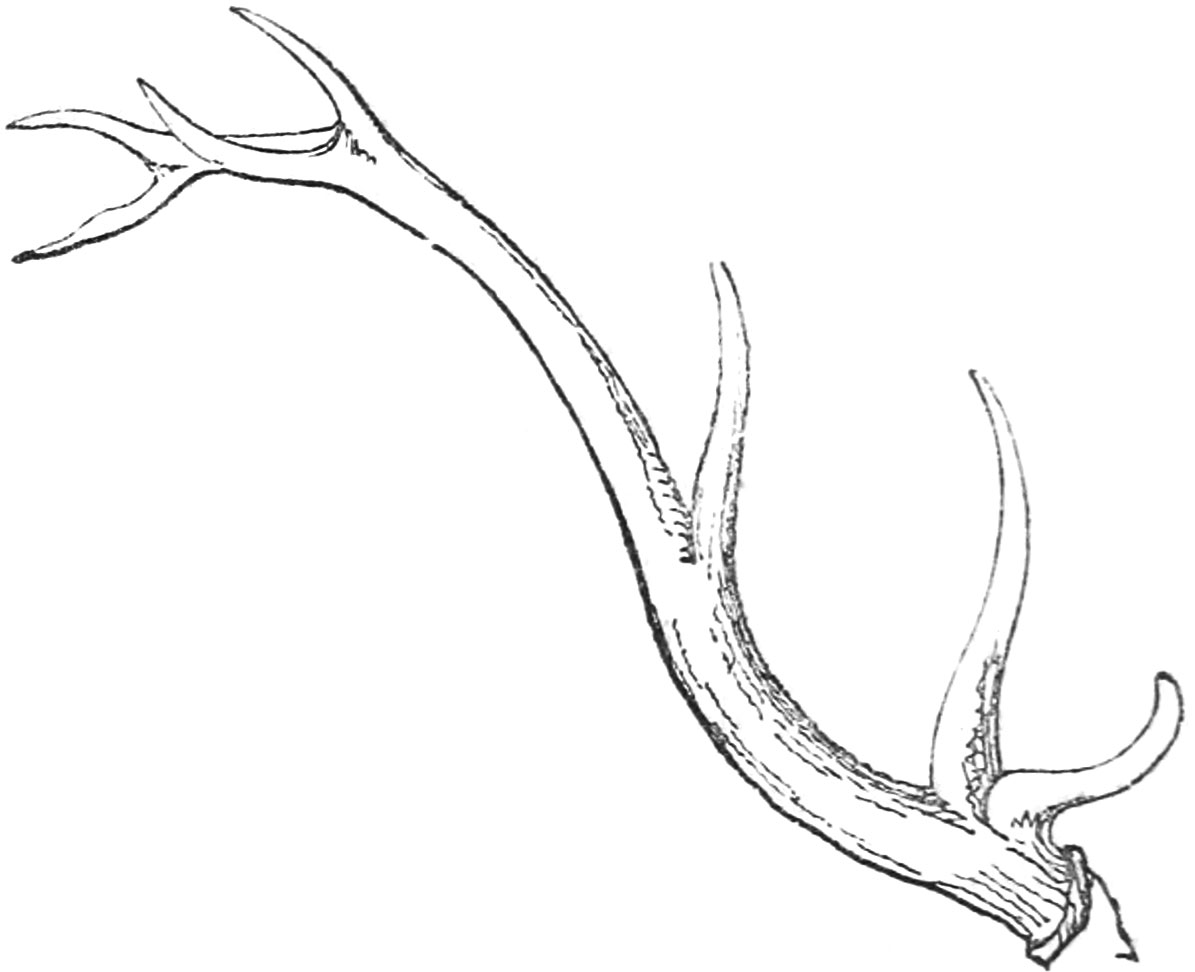
Waipiti Antler
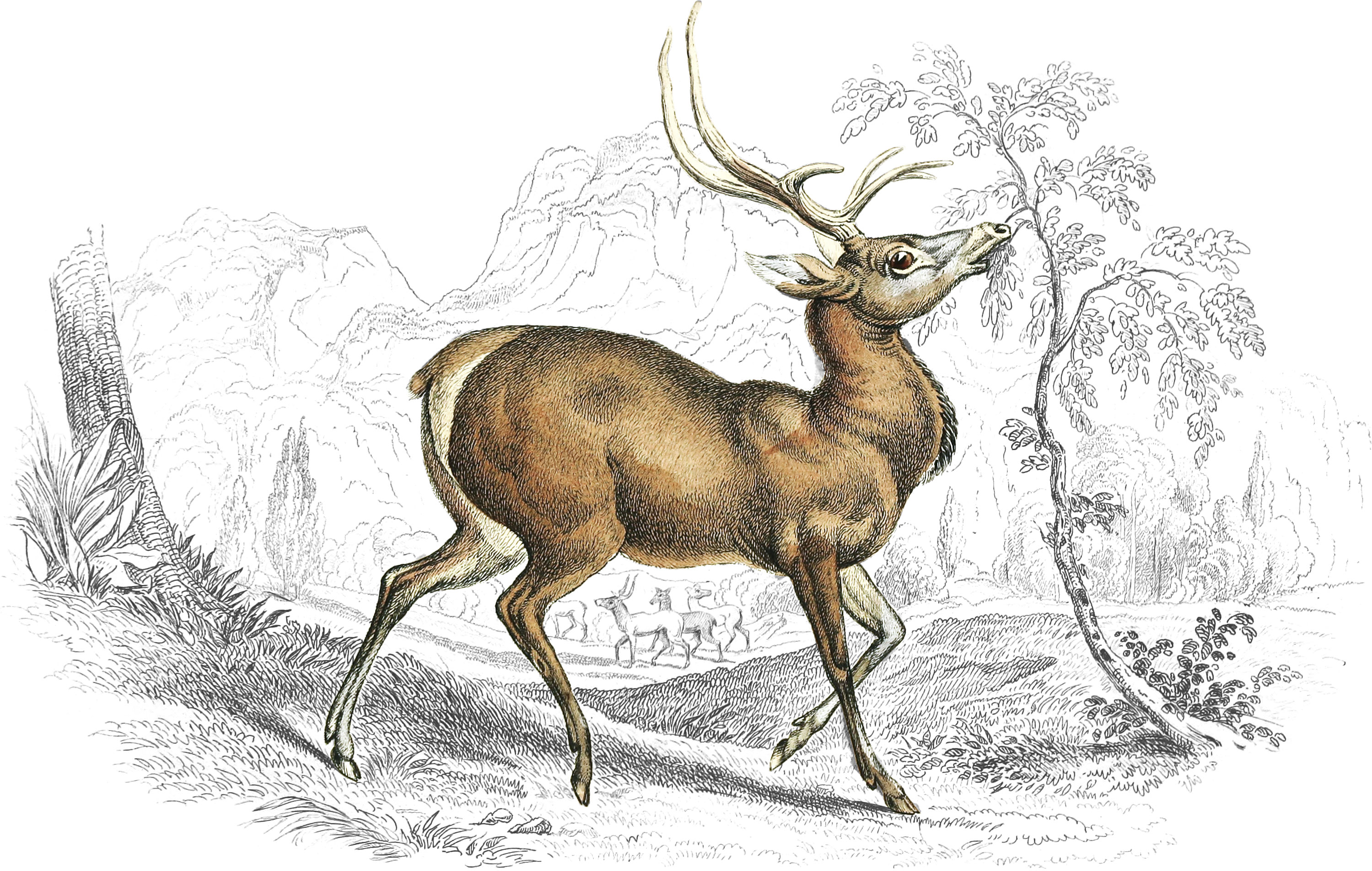
Plate IX
Our next plate will shew a farther example of the Stags in the
Nepaul Stag
Cervus Wallichii.—Cuvier.
Le Cerf de Wallich, Cervus Wallichii, F. Cuv. Hist. Nat. des Mammif.—Nepaul Stag, Griffith’s Cuv. iv. 103, and Synop.
The only authority for this animal is the lithographic plate published by Frederic Cuvier in his Mammifères. That plate is copied from a drawing procured by M. Duvaucel, from a specimen which Dr Wallich had sent from Nepaul to the Menagerie at Barrackpore. The notes and descriptions which were to have accompanied it were lost, and the drawing remained alone as the source of information. We can only give a translation from Fréderic Cuvier.
The Nepaul Stag is of a yellowish-brown; the muzzle, lower part of the cheeks, around the eyes, the lower part of the limbs, and their inner surface, are of a paler tint than the body; the lower jaw is white anteriorly, and there is a black spot on the lower lip at the point where it joins the upper. The tail is very short and white, as well as a large spot on the rump. The inside of the ear is also white. Upon all the body the hair is opening, but on the white spot, it is frizzled and curled; upon the neck, under the throat, it is longer than on the other parts, while on the head and limbs it is much shorter. The lachrymal glands are of moderate size. The horns, which widen from right to left, so as considerably to overreach the sides of the head, from the first antlers, are turned back-wards, and then rise vertically; upon each horn above the burr, very near to each other, spring two antlers, which are directed forwards, the first descending, the second rising; and in the middle of the horn a third antler springs, which is directed a little outwards.

Plate X
The fossil cranium and horns of a stag have been found in America, to which Dr Harlan has applied the name of C. Americanus.
The next group in Major Smith’s arrangement, are Asiatic Stags, chiefly inhabiting the forests of India, and distinguished from the other deer by having round horns, with a brow, but no median antler. This has been denominated the Rusa group, and may stand as a subgenus of Cervus. They are of large size, and differ principally from the true Stags in the form of their horns, possessing canine teeth, and large lachrymal glands. Most of them have also an ample mane, and long dewlap hairs.
The first species we shall notice is one of those apparently most anciently known, and by the best continental zoologists thought to be identical with the Hippelaphas of Aristotle.
The Great Rusa
Rusa hippelaphus.
Cerf-Noir da Bengale ou Hippelaphe, F. Cuv. Hist. Nat. des Mammif.—The Great Rusa, Hamilton Smith in Griffith’s Cuvier, iv. p. 105.
This Deer is thought by Frederick Cuvier to have been that described by Aristotle, while others again are inclined to consider the description of that naturalist might be equally applied to many of the other Indian species.
Frederick Cuvier mentions it as found in Bengal, but he is nevertheless uncertain of the country whence his specimen came; and the islands in the Indian Archipelago are much more probably the principal abode of this animal. The Great Rusa is remarkable for the ample mane which clothes its neck and shoulders, giving it a resemblance in this respect to a horse, whence the ancients applied their name of Hippelaphus. The specimen in the Paris Collection was at the shoulders about three feet in height, with the dimensions of the other parts in proportion. The coat of hair, of considerable thickness, was remarkable for its length. The hair thick, dry, and frizzled. The colour is of a uniform dull brown, except the lower part of the belly, round the muzzle, a part of the internal surface of the ears, and the lower lip, which are white, and the inside of the limbs and eyebrows, which are tawny.

Plate XI
Another fine specimen figured by Frederick Cuvier, is
The Rusa of Timor
Rusa Peronii?
Cerf du Timor, Fred. Cuvier, Hist. Nat. des Mammifèrers.
The figure of F. Cuvier has served for the accompanying illustration, originally taken from two living species in the Paris Menagerie, brought from the Island of Timor. The general colour is a brownish-black, duller upon the head, the neck and sides, and paler upon the flanks, the thighs, and limbs. Along the back, it is almost black, and a line of that colour runs downwards on the fore limbs. The hair upon the neck is stronger and longer than on the other parts of the body. The horns are those of the third year. This species is figured with uncertainty as distinct, being allied to several others.

Plate XII
The next group of animals have been separated from the Rusa by Major Smith, on account of some distinction which by other zoologists are scarcely considered sufficiently important. They are certainly very closely allied, inhabiting also the jungles and forests of continental India, and the islands of the eastern archipelago. Major Smith’s characters of the Axine group are:
Homs similar to the former (Rusa), but more slender; no canines; small or no suborbital opening; generally spotted with white; no mane; tail down to the houghs; size middling or small.
The most anciently known animal, which will exhibit the form, is
The Spotted Axis
Axis aaculatus.—Smith.
Αξις of the ancients.—Cervus Axis of authors.—L’Axis, Fred. Cuvier, Hist. Nat. des Mammif.—Subgenus Axis Hamilt. Smith, Griffith’s Cuv. iv. 116. & Synops.
This beautiful and graceful deer has been by all its describers compared with the European fallow-deer, from the nearness of size, and the similarity of colouring. The form of the horns, however, at once distinguish it, being destitute of palmation, or broadening at the tips, and the skin, in all its changes from the seasons, always retaining the spotted appearance. The spotted Axis is abundant in Bengal, upon the banks of the Ganges, and in many of the eastern islands; and by the British sportsmen in India is frequently hunted under the appellation of the Spotted Hog-deer. They frequent chiefly the thick matted jungles in the vicinity of water, are extremely timorous and indolent, and feed during the night. In these shelters they also produce their young, at which period the bucks lay aside their timidity and boldly act on the defensive against any assailant. In confinement they are mild tempered, and easily tamed, and, like many of the tribe, extremely nice in tasting any food which has been much handled or wrought among. The cry somewhat resembles that of the stag.
The height of the Axis at the shoulder is 2 feet 6 or 7 inches. The hair is softer than in the other deer, and not so dry or brittle. The ground colour of the body is of a rich but delicate fawn colour, changing to nearly black along the back, and on the lower parts shaded to a pure white. The flanks, shoulders, hind quarters, and a part of the neck, are marked with white spots. These are generally directed in lines, one along each side of the back, and one between the belly and the flanks; two also spring from the shoulders, and descend on the limbs, and two divide the hind quarters, and descend upon the belly; and the whole hinder part of the thigh is bordered with a lengthened white spot or border. This is the general distribution of the spots; vary in different individuals. but they The females are nearly similar, except being less in size, and wanting horns; and the young at their birth nearly resemble their parents in colouring. Several varieties of lesser size and varied spotting are found; and it is probable that another animal is still mixed up with some of these.

Plate XIII
Another animal, to be referred to this division, and whose characters have been somewhat obscure, is
The Brown Porcine Axis
Axis porcinus.
Porcine Deer, Pennant, Quadrup.—Cerf cochon, M. & F. Fred. Cuvier, Hist. Nat. des Mammif.
This appears undoubtedly to be the animal figured and referred to by Pennant in his History of Quadrupeds, from a specimen sent to Lord Clive from Bengal, and named, from its thickness and clumsy body, “Hog Deer.” A more modern and accurate figure has been given of an animal in the Parisian Menagerie, in the Mammifères of Frederic Cuvier, and which seems to have been similar to that which supplied Mr Pennant’s description. It is nearly of the size of the Spotted Axis, and is remarkable for the rounded outline of the head, and the heavy and awkward proportions of the body The horns in this figure are slender, with a single short antler at the base, and the fork at the tip slightly developed. The colour is entirely of a yellowish-brown, slightly paler on the lower parts. The insides of the limbs are white, and around the eyes, with the hinder parts of the cheeks, are yellowish. It inhabits the jangles of India, and, notwithstanding its form, is extremely active.
This animal, with the preceding, seems to go under the name of Hog-deer, and appears to be one of the species which are most frequently hunted on horseback or with greyhounds. It appears to be a variety of either this or the Spotted Axis which is introduced by Colonel Williamson in his Oriental Field Sports as by far the most abundant species in the jungles. His figures vary from either in having a single row only of white spots along each side of the back, and the form of the animal and of its horns; while the power it is described to possess when irritated, would lead us to believe that it is more nearly allied to the preceding, if it should not turn out to be an animal distinct from both. It evidently belongs to the present group, and a short notice of some of the Colonel’s observations may tend to throw light on the habits of the Axine Deer.

Plate XIV
Succeeding these have been placed the Capreoline group, varying slightly in form, in the branching of the horns, and in the want of a lachrymal sinus. It will be seen in
The Common Roebuck
Capreolus dorcus.—Gesner.
Cervus capreoius of Authors.—Chevreuil, Buffon.—Roe or Roebuck of English writers.
The common Roe or Roebuck is one of the most elegant of our native deer, and forms a most appropriate and beautiful object in the woods and copses of the Scotch Highlands. In Scotland, north of the Forth, it is every where abundant, where rock and wood abounds; so much so, as in some places to be condemned to extirpation, from the damage done to the young wood. It delights in what maybe called the lower coverts, the civilised woods, and eaves those of sterner character, more solitary and wild, to be frequented by that pride of the north, the Stag or Red Deer. South of the Forth, it is very rare, one or two wilder parks only possessing a few; but frequent traces of its former abundance is found in the border counties, remains and skeletons being almost yearly disinterred from most of the larger peat-mosses: in the rugged woods of Westmoreland and Cumberland it still abounds. On the continent of Europe it is common in many districts suited for it, Germany and Silesia, &c.; and it extends across the Asiatic boundary.
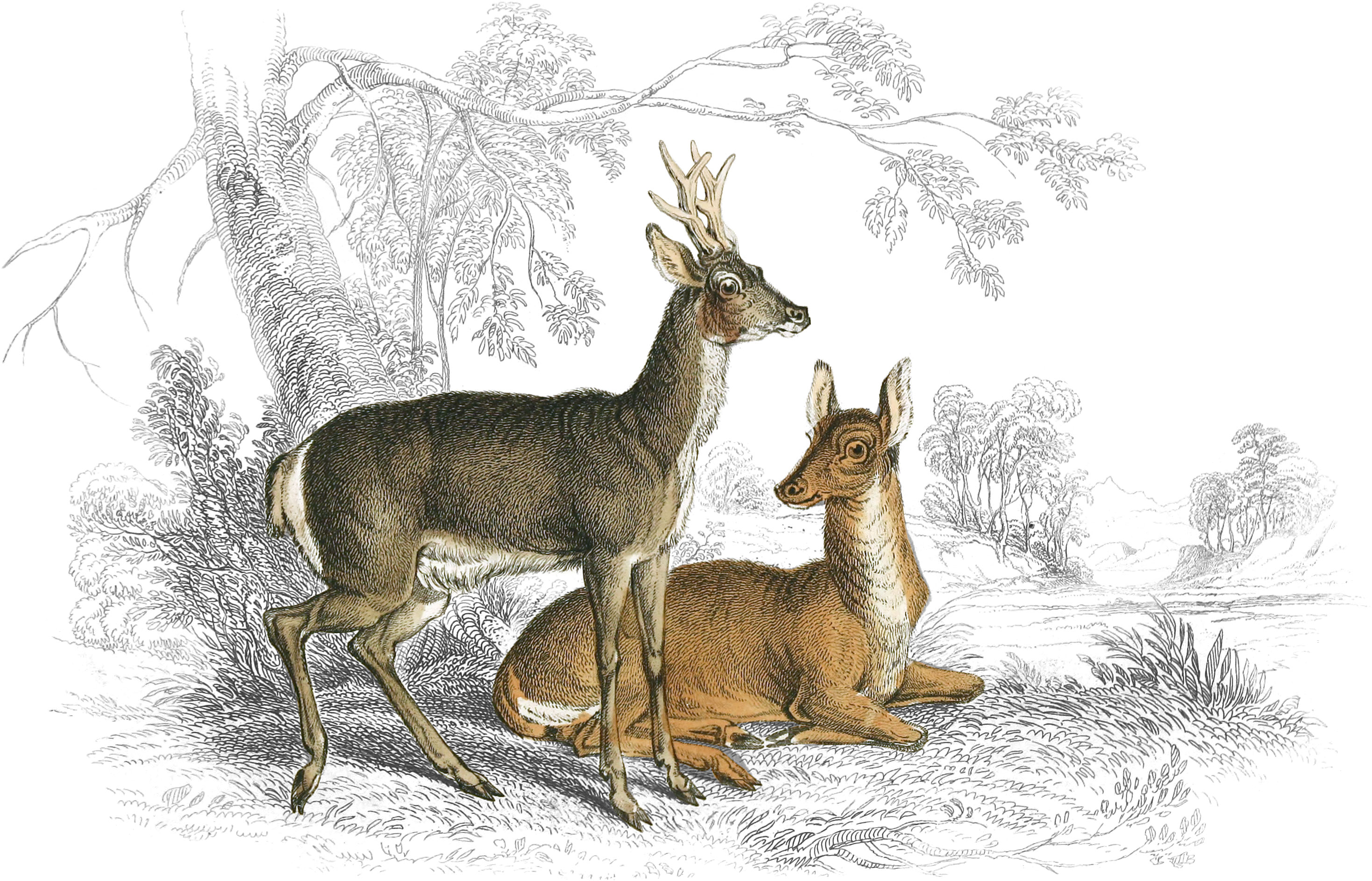
Plate XV
Another animal is mentioned as belonging to this group, the Tartarian Roe, C. pygargus, found in Russia and Siberia. It is larger than the common roe, brown, with the under parts yellowish. It is a species yet little known.
The next Deer in our arrangement is the Mazamine group, formed of the subgenus Mazama, H. Smith, and which will be represented by
The Guazupuco-Deer
Mazama paludosa.—H. Smith.
Del Güazú-pucú, Azara, Apuntamientos, i. p. 33, No. 4.—Cervus paludosus, Desm. Mammalogie, p. 443—Guazupuco-deer, Griffith’s Cuv. iv. 134.—Cervua paludosus, Lichtenstein, Saugethiere, pl. xvii.
This deer, with the following, seems first to have been noticed in the works of Azara. They were afterwards introduced in the Mammalogy of Desmarest; and we have a figure of our present species in Griffith’s translation of Cuvier, taken from a specimen exhibited in London. Later still (in 1829), it is described and figured in Lichtenstein’s Saugethiere, which has supplied the material for our illustrations. It is nearly as large as the European stag. The muzzle is large. The general colour is a reddish-bay, except the insides of the ears, the lower part of the breast, and inside of the limbs, which are white. The forehead and face is marked with a dark broad stripe, which runs irregularly down on each side of the lips, and is relieved by a paler tint on the eyebrows and cheeks. It inhabits the lower districts of Paraguay.

Plate XVI
The Guazuti-Deer
Mazama campestris.—Smith.
Del Guazuti, Azara, Apuntamientos, p. 41. No. 5.—Cervus campestris, Desm. Mammalogie, 444.—Griffith’s Cuv. iv. p. 136. Lichtenstein, Saugethiere, pl. xix., male female, and young.
This is another of the beautiful South American deer, recorded in the works of Azara, but which for long after remained in comparative obscurity, and is now rarely met with in a collection. A figure is given by Major Smith, from a specimen exhibited in London, under the name of Cushew; but we have again recourse to the plate of Lichtenstein, of a later date, for the accompanying illustration. It is not nearly so large as the former, standing only about two feet six inches high at the shoulder. The horns are more slender, also, about a foot in length, and with generally two snags. It inhabits the open plains, instead of the forests or thickets, and possesses great swiftness, so much so, that Azara mentions a horse cannot overtake it. According to the same author, the flesh of the young is delicate, but that of the adult strongly flavoured. A slice of their flesh applied to the wound is said to cure the bite of poisonous serpents. It sometimes varies to nearly white.
This group contains also several other South American species, which are yet in such obscurity as to render it uncertain whether they will all rank as different animals, or only as varieties or different states, from the influence of the season on the colour of their hair. M. Mexicanus and nemoralis stand in our systems as separate. Two others, found in North America, are better known, and maybe shortly noticed. The first, the black-tailed or mule-deer, Cervus macrotis, Say, seems to inhabit the whole extent of the plains of the Missouri, Saskatchewan, and Columbia. This species being of little interest, either as an article of food to the natives, or of profit to the traders, those of North America remained in uncertainty till the observations of Say and Dr Richardson have in a great measure removed it. The following description is that of Mr Say, from specimens killed during the expedition to the rocky mountains.22
The antlers slightly grooved, a small branch near the base near the middle of the entire length, they bifurcate equally, and each of these processes divides again near the extremity. The ears are very long, nearly half the length of the whole antler; the hair coarse and compressed, and undulated, light reddish-brown above; sides of the head, and hair on the fore portion of the mane above, dull cinereous, the back intermixed with blackish-tipped hairs, which form a distinct line on the neck near the head; tail pale reddish black at the tip.
Dr Richardson’s specimen stood about two feet six inches high at the fore shoulder, and the horns wanted the small basal process which existed in Say’s specimen.
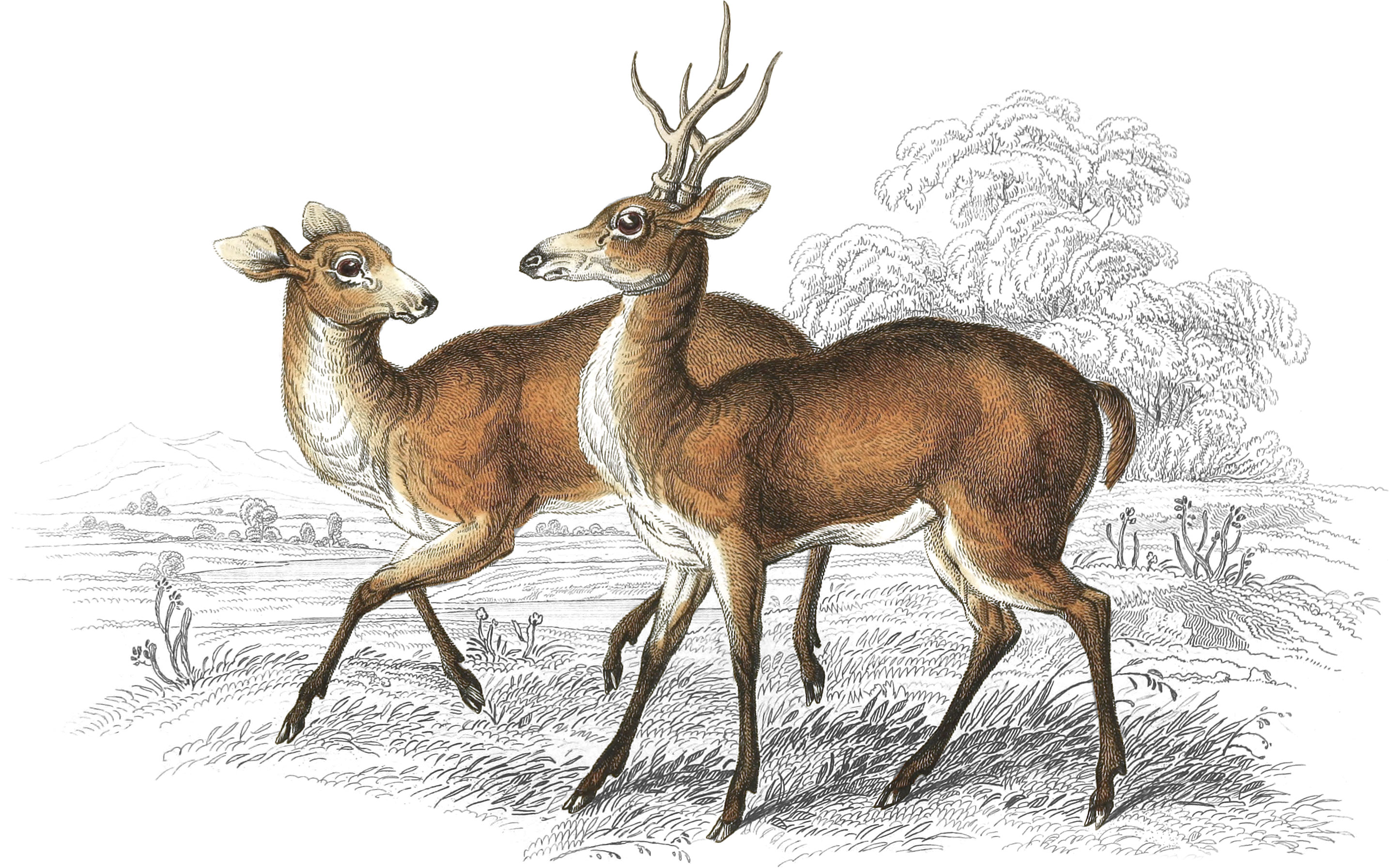
Plate XVII
The other species alluded to is the Virginian deer, Mazama Virginiana, H. Smith, and which that author takes as typical of his sub-genus, having
The light and elegant form; a long tapering nose; the horns reclining on the head, and turned outwards, and then with a very decided curve, pointing their extremities forward; the horns with a general tendency to flatten; a small suborbital pore like a fold, and no canines.
Subulo
The next form we have to notice is what Major Smith has named the Brochets, from their having horns, during all their ages, similar to those of a deer of the first year—a single straight and round horn; and hence also his generic title of Subulo. They inhabit South America, are of middling size, have a small muzzle, a lachrymal sinus, and a tail of moderate length. They inhabit the woods and jungle. The first species is
The Guazu-Pita
Subulo rufus.—Smith.
Del Guazu-pita, Azara, Apuntamientos, i. p. 51.—Cervus rufus, F. Cuvier and Desmarest.—The Pita Brochet, Subulo rufus, H. Smith; Griff. Cuv. iv. p. 140. Lichtenstein, Saugethiere, pl. xx., male, female, and young.
First noticed by Azara, and named by him as above, from the red colouring of the hair. They inhabit the low, moist woods, and are polygamous hence ten females are generally seen for one male, which gave rise to the idea that South America possessed deer without horns at all. They are very fleet for a short time, but are easily tired and overtaken by dogs, and are sometimes taken with the lasso and balls.
The height at the shoulders is about twenty-nine inches. The general colour of the body is a reddish-brown. The inside of the ears is whitish, the hairs very short. The same whitish colour surrounds the lips, the lower part of the head, and of the tail, the hinder part of the belly, the buttocks, and the inside of the fore legs, reaching to the knees. The females want the horns entirely, are nearly of the same reddish tint, with a white spot above the nose and on the upper lip.
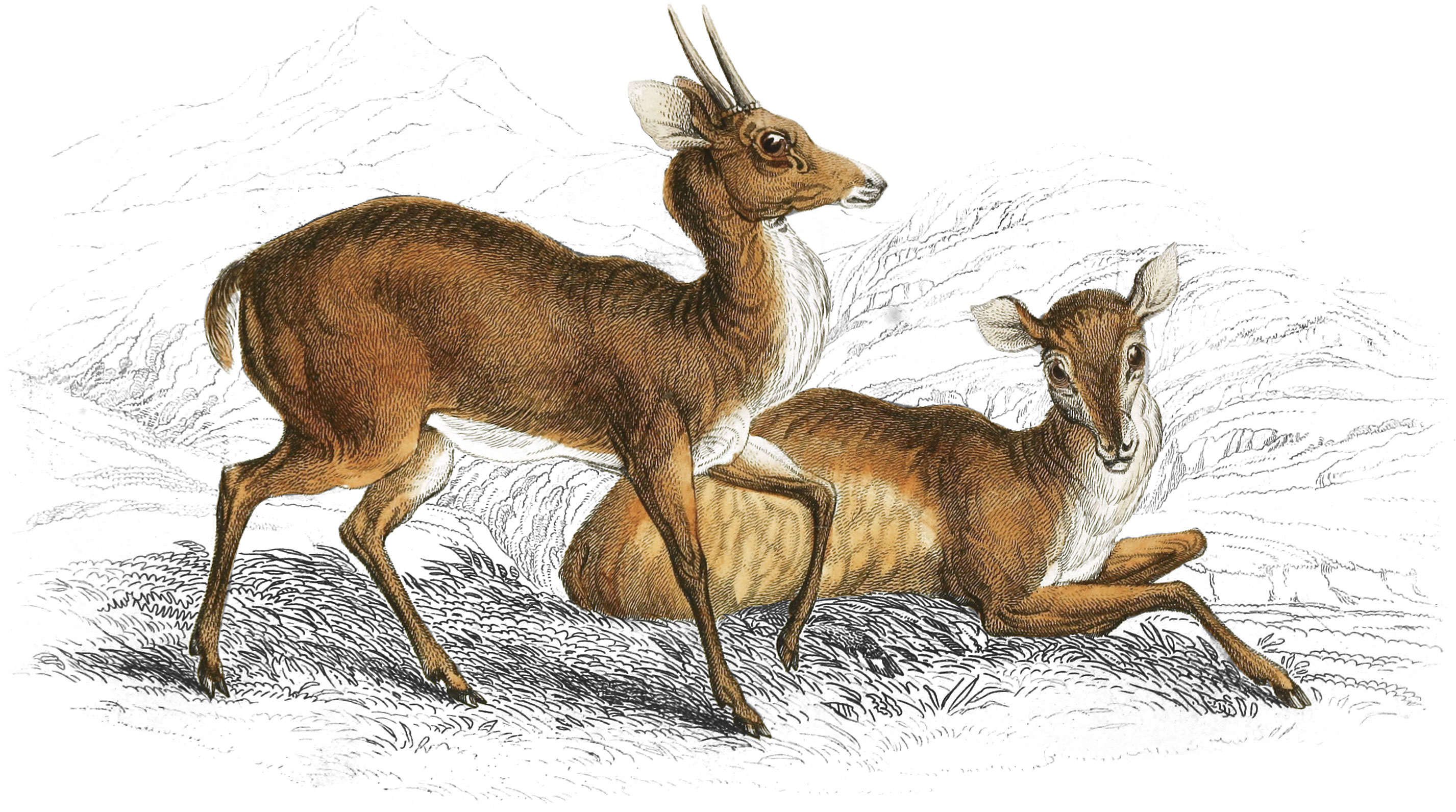
Plate XVIII
Another species mentioned by Azara, and entering this division, is the Guazu-bira, the Bira Roe of Major Smith, and the Cervus nemorivagus of Lichtenstein. This pretty deer inhabits the woody parts of the same country with the former, and also owes its first notice to Azara. It is about twenty-six inches in length. The aspect of the animal is said to be less deer-like than the preceding, and to approach somewhat to some of the sheep. The ears are more rounded at the extremity, and the lachrymal sinus is nearly imperceptible. The lower part of the head and lips are whitish; around the eyes, the inside of the fore legs, and from the lower part of the breast to the buttocks, is of a whitish cinnamon colour. The whole neck, and all the other parts of the animal, are of a brownish shade, approaching to greyish, from each hair having a delicate tip of white. The horns are short and simple. To these Major Smith adds another animal, from the collection of Prince Maximilian of Neuweid, very similar to the first, but about six inches lower at the shoulder. He has given it the title of Apara Brochet, Cervus (subulo) simplicicornis.
The next animals are now known under the title of Muntjak, and have been placed by Major Smith apparently with propriety, at the conclusion of the true deer, from the remarkable structure of the horns, the deciduous part being placed at the extremity of a lengthened pedicle, or, as it were, surmounting a fixed horn. He has termed the subgenus Stylocerus, and characterized it,
Horns small, with only one anterior snag, standing upon elevated pedicles; long canines in most males, deep suborbital sinus, a small muzzle.

Stylcerus Horn
They have yet been found only in India, and her islands. The first to be noticed is
The Muntjak
Stylocerus Muntjak.—Smith.
Rib-faced Deer, Pennant, Quad.—Cervus muntjak, Desm. Mammalogie; Horsf. Zool. Researches in Java.—Stylocerus muntjak, H. Smith; Griff. Cuvier, iv. 143 144, and Synopsis.
The Muntjak, or Sumatra Roe, as it is occasionally termed, is at present best known by the figure and description of Dr Horsfield, which appeared some years since in that naturalist’s “Zoological Researches in Java.” It is a native of many of the eastern islands, and while it resembles the roe of Europe in its general shape, an animal in full health and vigour is nearly one-fifth larger. They have the same elegance of appearance, the same springy lightness in their bounds, and, by native poets of both countries, have been employed as emblems of softness, timidity, or speed.
The height at the shoulders of Dr Horsfield’s animal, is about two feet two inches, and that gentleman’s description is nearly as follows.
The face affords a peculiar character of the Cervus muntjak; it differs La a small degree in the living animal, and in prepared specimens found in collections. In the former, there exists two rough folds of the skin, which are considerably distended and elevated; they are separated about an inch and a half above, and, following the direction of the prominent sides of the forehead, they unite below, so as to mark the face with the letter V. In the dried subject the folds are contracted, and three distinct ribs appear, which have suggested to Pennant the name of Rib-faced Deer.
A few straggling delicate bristles are scattered over the face, near the nostrils, and over the lower lip and chin. The ears are of moderate size, erect, oval, and internally bordered with a series of beautiful white hairs. The face is marked with two black lines, following the direction of the lateral ridges, and continued along the pedestals to the coronal margins, by which they are terminated. The colour of our animal is a reddish-brown, hut it differs in different parts in its intensity. The specimens belonging to the Museum of the India House have a reddish-brown tint, inclining to fulvous. The inside of the thighs, region of the pubes, and the under side of the tail, are white. The lower part of the thighs and the legs are dark brown, slightly variegated with grey; but a streak of reddish-brown extends along the legs, posteriorly, towards the tarsus, where it becomes dark and blackish. The colour of the Muntjak varies at different periods of the year. The female also, at least in Java, is darker than the male.
But it is in the horns that we see the most remarkable form and the character of the subgenus of Smith.
In the adult kidang in a perfect state, they consist of one principal branch, with a smaller additional antler, rising on the same base from the coronal margin of the pedestal, and projecting forward and inward. The latter is simple, very short, and, from the common base, one inch and a half in length. The principal branch in the adult animal, is four inches and a half, and measured along the curve five inches long. It rises for the space of two inches nearly erect, then forms a slight curve outward and forward, and, finally, bending suddenly backward and inward, nearly at a right angle, forms a hook with an acute termination, the curve of which varies in different individuals.
The base of the horns is finished by a tuberculated burr, but which is nearly concealed by the hair, which terminates the pedestals. The pedestals commence, as it were, with the ridges which are apparent on the face, which gradually diverge and follow the outline of the skull.
Thus they continue gradually increasing in size, until they have passed the orbits of the eye, where they enlarge by a lateral swelling, constituting an outer and inferior margin. Their form here is irregularly angular, being broader above, and having an even outer and inferior margin. They diverge now more abruptly from each other in a lateral direction, but in their ascent preserve the obliquity of the line bounding the skull above. Having passed the limits of the skull, they assume a cylindrical, somewhat compressed form, and constitute, on each side, a pedestal three inches in length, which, in its whole extent, is covered with integuments and hair, and at the extremity is crowned with a notched margin or burr supporting the hairs.
It has been observed by some naturalists, that we remain in uncertainty whether the Muntjak sheds its horns only once, or yearly. If the former were the case, it would shew a beautiful gradation of structure between the true deer with deciduous horns, and those animals where they rise from the bone of the forehead and are persistent. This will be better understood by looking at the annexed figures of the head and horns, from Horsfield’s Illustrations—See Plate XX.
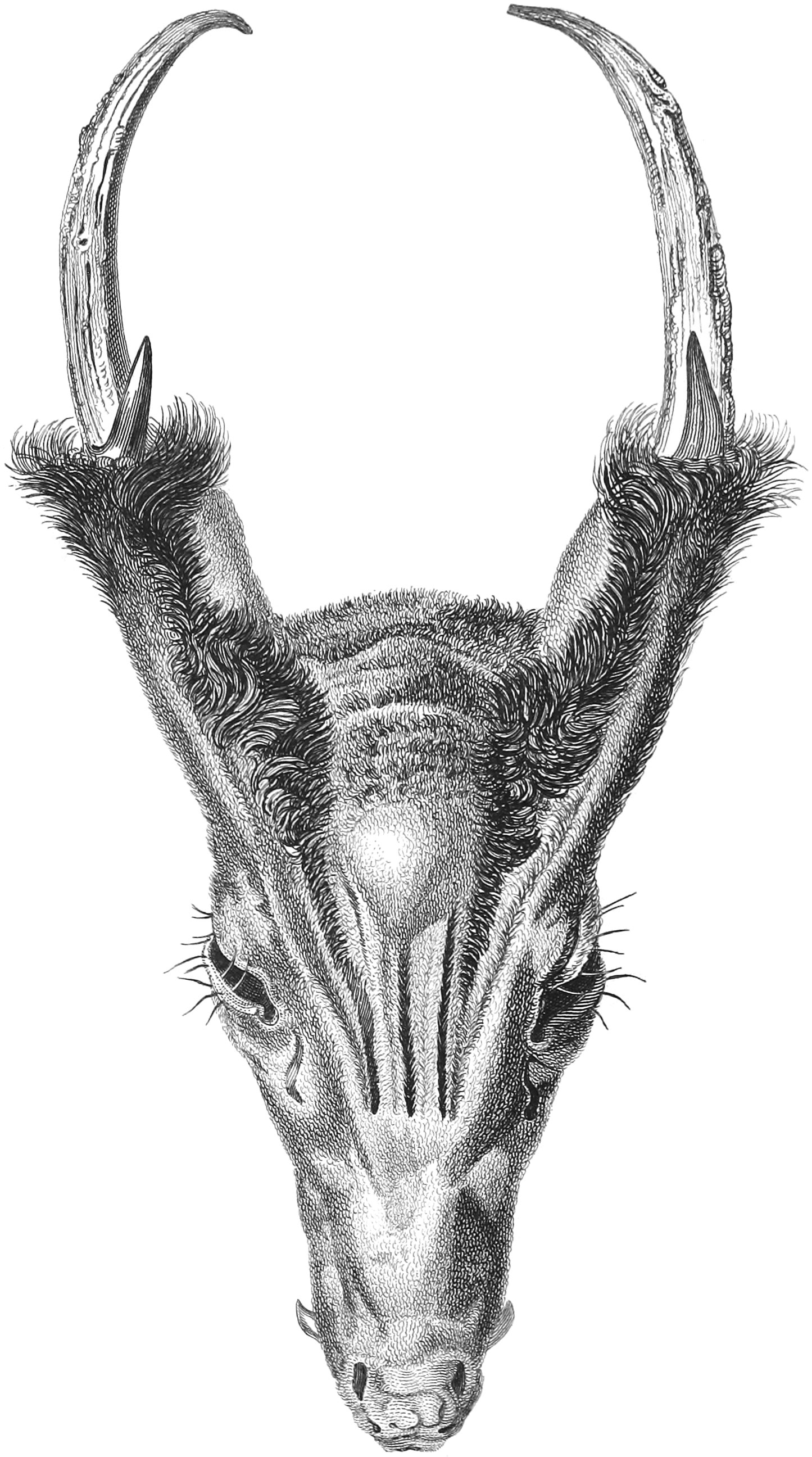
Plate XX
Front View of the Head of the Muntjak
The most favourite haunts of the Muntjak in Java, are the moderately elevated grounds, diversified by ridges and valleys, tending towards the acclivities of the more considerable mountains, or approaching the confine of extensive forests. Saccharum spicatum and Phyllanthus emblica are among the most abundant plants in these districts, and constitute its principal food, together with several other malvaceous plants, which are also greedily eaten. The Muntjak is often hunted by the Europeans and natives of rank. When started, its flight is very swift, and, taking a circular course, it generally returns to the spot whence it was raised. If the pursuit be continued, it thrusts its head into a thicket, and remains fixed and motionless, as in a place of security, regardless of the approach of sportsmen. It is hunted with pariah dogs, which are kept in large packs, and trained for the purpose, and, when brought to bay, makes a most vigorous resistance, often fatally wounding the dogs with its tusks, tearing the neck and breast, and laying open the belly. At other times, a wide district is surrounded as in the Norwegian skaals, and the game driven to a centre. Horses are trained to the chase, and the sportsman endeavours to overtake the animal, and kill it by a stroke of a sword. The rider is mounted on the naked back, and pursues with a frantic impetuosity, while the aged delight to recount the dangers and incidents of the chases long bygone. This animal is also taken with nooses and a variety of snares, and seems to be nearly equally persecuted by man and the beast of prey.

Plate XIX
Major Smith notices four other species, which he refers to this group. They are all, however, comparatively yet unknown. They are, S. Phillippinus (C. Phillippinus, Desmarest), S. subcornutus, S. aureus, and S. moschatus, or Nepaul Muntjak.
Giraffidæ
Following the Muntjaks, have been placed those extraordinary animals the Giraffes, from the circumstance that they possess the two bony elongations from the skull, covered with hair, and which, in the skeleton, appear like the bony core of horns, but which in the living animal are only surmounted with some stiff bristly hairs, standing erect.
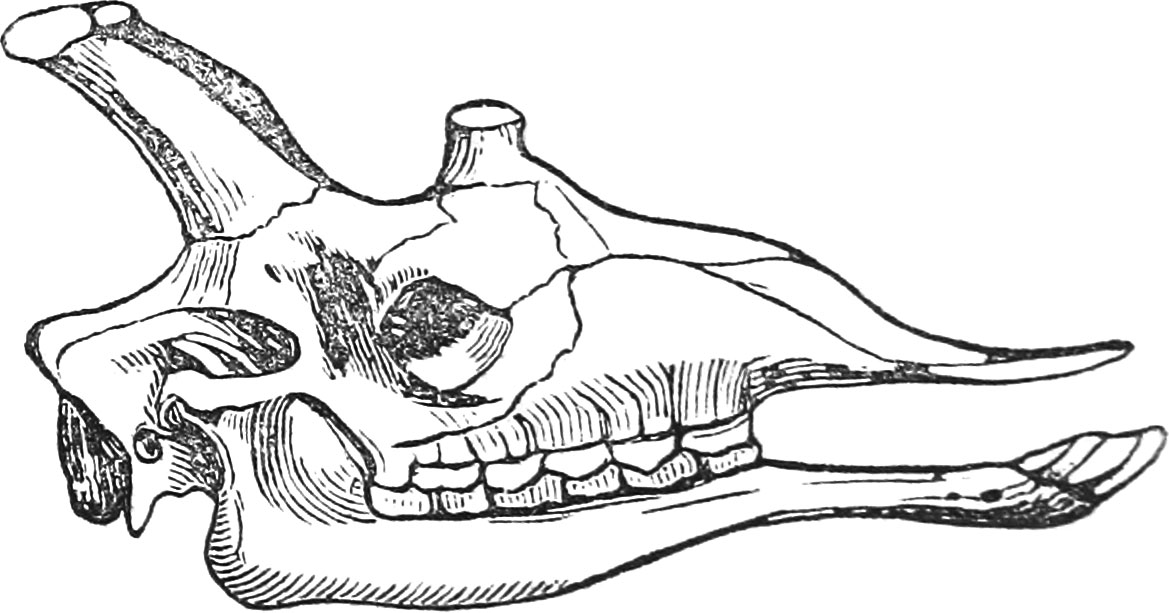
North African Cameleopard
The Cameleopard of North Africa
Cameleopardalis antiquorum.
Modern zoologists have considered that the northern and southern regions of Africa possessed separate species of this extraordinary animal, and have lately appropriated to that of the north the title of “C. antiquorum,” as being the animal known to the ancient Greeks and Romans, and to the old Egyptians, as proved by the appearance of the creature on the sculpture of the latter, and by the histories of the former, which we have handed down with apparent authenticity. We are ignorant, however, yet how far the limits of each extend, but know that one or other of them range from the most southern extremity of the Cape to the very north;—not very uncommon in the more unexplored regions, but rapidly decreasing wherever a commencing civilization has begun to plant her steps.
The present figure is that of an animal from the north, taken in the vicinity of Senaar and Darfour and the woodcut at the commencement of the description is also from the northern animals described by Ruppel; and as it is in this organ that the principal specific distinctions appear, it may serve for comparison with those from the southern part of the continent.
In both species, the immense length of neck, and the disproportional height of the fore-quarter, compared with the hinder, are the appearances which first strike an observer as unwieldy, clumsy, and unfitted for an active life. The food, however, is derived in a great measure from the foliage of trees, particularly a species of Acacia (Acacia Giraffæ, Burch.). It seizes the herbage or foliage with its tongue, which is long and narrow, and which rolls round the object with a considerable degree of pliability, using it as a prehensile organ, and one beautifully fitted as an accessory to the other parts of its structure. The perfection of its form enables it to reach the exalted branches, which are uncropped, from being above the height of ordinary animals; and, or! the other hand, a shorter neck would not have allowed it easily to reach the earth, in districts where wood was more unfrequent. Its pace is an amble, and, when put in motion, it is capable of considerable speed, according to Major Denham, such as to keep a horse at a pretty smart gallop. It occasionally falls a prey to the lion, the only beast of prey which dares to attack it; but the powerful strokes of both the fore and hind feet are sometimes an equal match in open combat. The height of the Giraffe is from fifteen to twenty-one feet. The general colour is yellowish-white, patched over with large square and irregularly formed spots, of a yellowish-brown or fawn colour, divided from each other by a narrow stripe of the pale ground colour, and represented among the antelopes by the appearance of the Tragelaphus scripta, and one or two others. The head is adorned with three prolongations of the hone, two of which, in the usual place of horns, are generally described as such. They are covered with a velvety skin similar to those of the deciduous horned deer at their first growth, but which does not fall off, and at the tip they are surmounted by some strong bristly hairs. hard and solid; In the adult, the internal structure is but in the young, Geoffroy St Hilaire observed the appearance of a cellular centre, nourished by vessels. The third protuberance is in the centre of the skull, and appears as a rounded knob, and is of a very spongy texture. The Cameleopard was seen by Denham and Clapperton in parties of five or six on the borders of Lake Tchad, and also met with and described by Ruppel in his Travels in North Africa; while those of the south are frequently mentioned in the Travels of Le Vaillant and Burchell.
In a state of nature they are timorous, and flee immediately from danger, but in a state of domestication lose a great part of their timidity, become mild and docile, know their keeper, and take from the hand what is offered to them.
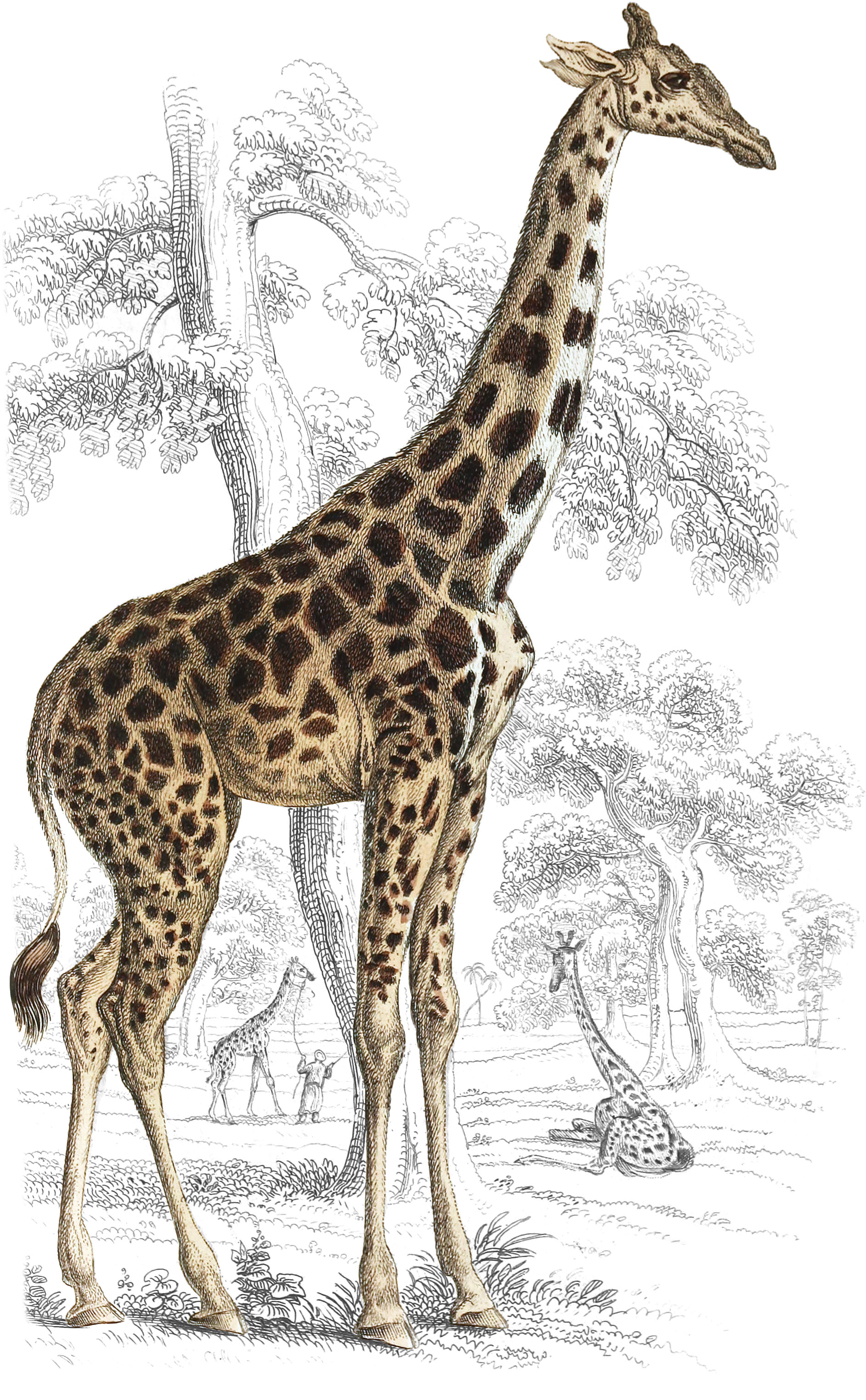
Plate XXI
Carpidæ
From an animal of so extraordinary form as that we have been just considering, we proceed to the fourth great family of the Ruminantia, placed by Major Smith under the title of Capridæ; but there is an evident gap of connexion on both sides of the Giraffe, which will undoubtedly yet be filled by the discovery of some animal of this order in the interior of Africa, traces or hints of something allied having been already given by several travellers in that fatal, but yet almost unexplored, interior. The Capridæ contain animals still possessing great grace and swiftness, and gentle dispositions, and many of great utility to man in a domesticated state. Their great distinction from the Cervine or Deer Group, is in the horns being persistent. Interiorly, they are a prolongation of the bone of the skull, of a very cellular texture, and nourished by appropriate vessels and nerves, while the external covering is the substance called horn, covering the other like a sheath, and also nourished from the root. The horns scarcely ever divaricate, or run into’-antlers, one animal where there is an exception being placed at the commencement of the Family. The character of the horn in this is in other respects maintained, a single strong prong jutting from it at the base, and shewing a modification of structure which, if not known to exist, would certainly have been surmised. The horns in the other species sometimes approach to a flattened form, are sometimes bent in abrupt knees, or sudden but the general form is rounded, or spirally hooks; twisted, almost always inclining backwards.
The first section of the Capridæ will be composed of the antelopes, forming a subfamily Antelopinæ, and containing by far the greater proportion of the whole. By Major Smith it has also been divided into subgenera, which we shall notice in succession, but in the present volume will be able only to review a portion of them.
In their general characters they continue the deer-like form, and only in some of the concluding forms resemble in appearance the succeeding groups of the sheep and goats, while a few indicate the peculiarities of the next or Bovine Family. The hair continues also the quality of that of the deer. The tail is in general somewhat lengthened. The horns are not Confined to the males only, though in the other sex they are generally less developed. The greatest part of them are gregarious, and form one of the most beautiful and interesting objects in the African desert. They are easily alarmed, and dart suddenly off on observing the cause of their distrust: but, possessing a great share of curiosity, make sudden wheels, and stop to inspect the intruders, without, however, allowing them to approach within the reach of harm. In India they hold various stations in the mythology of the Hindu, and in the superstitions of other sects. Their flesh is, however, generally eaten, that of many of them much esteemed. They form a great portion of the food of the larger carnivora.
The first animal to be noticed is
The Prong-Horned Antelope
Dicranocerus furcifer.—Smith.
Antilocapra American ord, Journal de Physique.—Antilope furcifer, Smith, Linn. Trans., xiii.—Richards. Faun. Boreali-Americana.—Dicranocerus furcifer, Smith in Griff. Cuv. iv. 167 170, and Synop.
This animal retains the cervine form, more than any of the other antelopes. The character of the hairing, the short tail, and light coloured disk upon the buttocks, combined with the slight palmation and prong of the horns, all contribute to keep up the resemblance; and in addition, the structure is also more allied to the deer.
The prong-horned antelope is found in the northwest territory of the United States. It is a common animal on the plains lying betwixt the Saskatchewan and Missouri, and is also met with on the plains of the Columbia. Their most northerly range, according to Dr Richardson, is about lat. 53°, on the banks of the north branch of the Saskatchewan, where they are merely summer visitants. They frequent open prairies and low hills, interspersed with clumps of wood; but are not met with in the continuous wooded country.
This animal has a graceful form, a slender head, with large eyes, and long delicate limbs. The horns are black, and rise directly upwards and outwards, without any inclination either forwards or backward, and curve sharply in towards each other at their tips. They are much compressed in a lateral direction, to about half their height, where they give out a thin triangular and bracket-shaped process, which projects directly forwards for more than an inch. The surface of the lower half of the horns is striated, and is rough, with small warts and knobs, two or three of which project from a quarter to half an inch. The situation of these knobs varies in different specimens.
The hair which clothes the body resembles that of the moose or rein-deer in its structure; it is long, round, tapering from the root to the point, waved, and of a soft and brittle texture; its interior is white and spongy, like the pith of the rush. When the hair makes its first appearance in summer, it forms a smooth coat, and has the ordinary flexibility and appearance of hair; but as it lengthens, it acquires the brittle spongy texture at its roots, and, increasing at the same time in diameter, it becomes erect, and forms a very close coat. As the spring approaches, the fine and flexible points are rubbed off, particularly on the sides, where the hair appears as if it had been clipped. The mane on the hind head and neck retains its darker points, even when the winter coat is dropping off.
The upper parts of the body are of a clear yellowish-brown colour, deepening on the ridge of the back into blackish-grey. The hairs are much longer between the ears and on the back of the neck, where they form an erect mane, of a blackish-brown colour on its tips. The sides and thighs are paler than the back, and approach in colour to a clear wood-brown. The under jaw is of a very pale yellowish-brown colour, fading to white. The hair is bushy about the angle of the lower jaw, and has a wood-brown colour. This colour forms three belts across the throat, which differ from each other in breadth, and are separated by two patches of pure white. The chest, belly, insides of the thighs, and legs, the tail, and a large patch around it, which includes the rump and upper part of the buttocks, are pure white. There is a pale yellowish mark at the root of the tail, which is four and a half inches long. The legs are slender, with long shank-bones. The fur covering their anterior surfaces is yellowish brown. It has only two hoofs, there being no vestige of the posterior supplementary ones.
The length of the animal, from the nose to the root of the tail, is about four feet four inches. The height at the shoulder about three feet.
The females examined by Dr Richardson were nearly without horns, although by some writers both sexes are said to be furnished with these weapons. In those there was merely a short obtuse process of the frontal bone, scarcely to be felt through the fur, and not covered with horn. The young at birth are covered on the upper parts with short hair, of a clove brown colour, more or less hoary. The situation of the mane is marked by a dark line. The tail is yellowish-brown, and the buttocks are pure white. The dark mark on the nose, the one behind the angle of the jaw, and the bands across the throat, exists as in the adult. The legs are of a pure wood brown colour.
The prong-homed antelope, continues Dr Richardson, appears on the banks of the Saskatchewan, sometimes a solitary animal, sometimes in herds of ten or twelve. Its sight and sense of smell are acute, and its speed is greater than any other inhabitant of the plains, although, when there is a little snow on the ground, it may, with some little management, be run down by a high bred horse. The Indian hunters have no difficulty in bringing an antelope within gun-shot, by various stratagems, such as lying down on their backs, and kicking their heels in the air, holding up a white rag, or clothing themselves in a white shirt, and shewing themselves only at intervals. The curiosity of the herd is so much roused, that they wheel round the object of their attention, and at length approach near enough to enable the hunter to make sure of his mark.
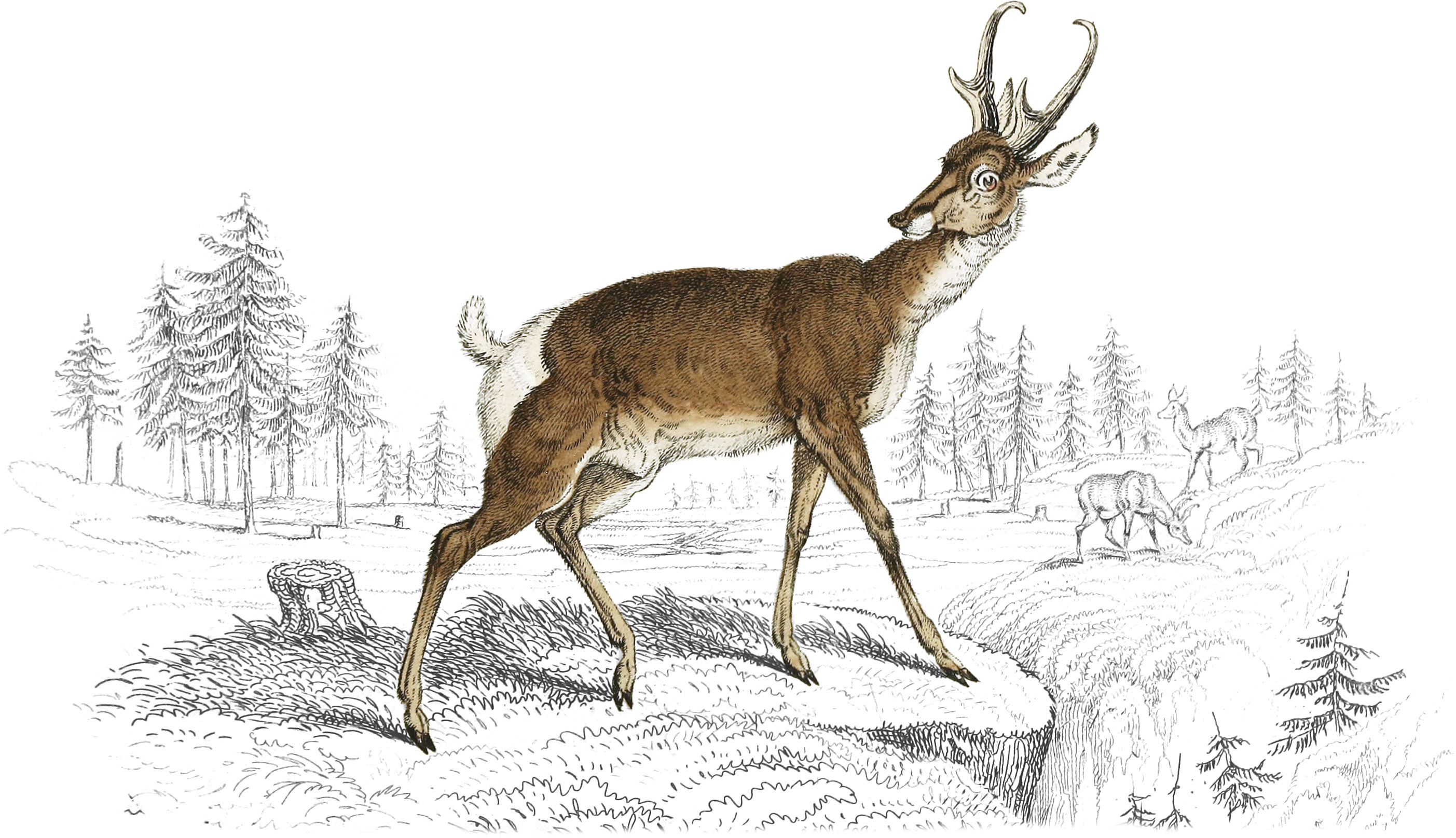
Plate XXII
Major Smith has noticed another animal, under the title of D. palmata, in which the horns have the prong much more palmated—(See annexed cut).

D. palmata Horn
He considers it a more northern animal, and that the palmation is a necessary provision to remove the snow from the food. Dr Richardson, however, considers that the variation of the horns is the effect of age, and that no antelope exists in the country assigned to this, “the bleak regions near the Frozen Ocean.” We notice this, and have introduced Major Smith’s representation of the horns to direct further attention to the subject.
We proceed next to an African group, and as the next three forms are closely allied, we shall add Major Smith’s characters at the commencement of each.
Subgenus Aigocerus, Smith.
Horns very large, common to both sexes, pointed, simply bent back, annulated, placed above the orbits. Half muzzle, no suborbital sinus, no inguinal pores, tail descending to the houghs; mane reversed; a white mark before the eyes; throat and under jaw somewhat bearded, mammæ two; stature large; shoulders higher thaw the croup.
The animals composing the subgenus are found in central parts of South Africa, inhabiting the borders of the deserts, living in small herds. Our information regarding any of them is by no means ample. They are all of large size. Among the best known may be mentioned the Blauw-bock of the Cape colonists, A. leucophaea, now a very rare animal, and extirpated from the colony. It is above four feet high at the shoulders. At a little distance it appears of a silvery bluish-gray, occasioned by long coarse hairs sparingly scattered over a deep black skin. Another, the Roan Antelope, A. equina, exceeds the preceding in height, and the general colour is grey, mixed with a reddish tint. It inhabits the elevated plains in the vicinity of Latakoo.
A third animal allied to the above we have selected to illustrate this form; it is
The Takhaitze
Antilope barbata.—Daniell.
The Takhaitze, Daniell, African Scenery.
This beautiful Antelope is known from the figure of Daniell, which has served for our illustration, and it has been surmised that the above was only another name for A. equina and leucophæa. The following is the notice which accompanies Daniell’s plate:—
This extraordinary animal, which has never before been drawn or described, is equally unknown to the colonists of the Cape, being first met with in the parallel of latitude under which Latakoo is situated. In the neighbourhood of this place we had the good fortune to fall in with a couple of them. They are exceedingly shy, and, when wounded, dangerous to come near; nor do the Booshuanas consider it safe to approach them in the rutting season. They rarely kill them, as they do most other antelopes, with the spear or assagai, hut entrap them in deep pits covered with sticks and earth, in the same manner as the Bosjesmans take the hippopotamus. The flesh is esteemed a great delicacy. This animal is, in general, from four and a half to five feet high, of a bluish colour like that of the Nyl-gau of India, to which, indeed, its general shape approaches, but it is sometimes seen of a tawny brown. Both male and female have horns, pointing backwards in a regular curve, and annulated to within less than one-third of their length from the point. They are usually found grazing on the edge of the Karroo Plains, near the foot of hills that are covered with the common Karroo mimosa and other shrubby plants; mostly in pairs, but sometimes in small herds of five or six together.

Plate XXIII
Oryx
Major Smith s next group is Oryx.
Horns common to both sexes, horizontal, very long, slender, without ridges, pointed, black, with annules somewhat spirally twisted to half or two-thirds of their length. The animals large, with long ears, small or no suborbital sinus, ovine muzzle, darker coloured streak through the eyes, mane on the neck reversed tail reaching to the houghs, and terminated by a tuft of long hairs; no tufts on the knees nor inguinal pores; two mammæ; stature large; general colour of the fur rufous or vinous grey upon a white ground.
This group is remarkable, as it is supposed that from some of its members the far-famed Unicorn would be made out. At various times reports have readied this country, that this animal of anomalous form had been discovered, sometimes it was in the interior deserts of Africa, sometimes from the unexplored districts of the Indian Mountains. The animal itself, however, has never reached this country, and most likely never will. In all the ancient carvings, coins, and Latin heraldic insignia, the form of the animal can always be represented as belonging to some one of the Oryxes. In the ancient carving the horns are often represented so much in profile as to appear only one, while it is well known that among African tribes, the art of twisting, carving, and otherwise adorning the horns of various animals, which were kept in domestication or confinement, was carried to a great extent, to the most fanciful forms, and the two were sometimes approximated and twisted together.
The Oryxes inhabit the more desert and uninhabited districts, extending from Southern Persia to the Cape of Good Hope. They are able to subsist on the most scanty vegetation, and on succulent plants; and being possessed of amazing swiftness, are able to pass quickly over a vast tract of country, and often change their station where the thin vegetation can be better obtained. When attacked, they are bold, and will resist, turning in necessity upon their assailer, and often with success. Although of the graceful and elegant proportions which we give to the tribe of Deer and Antelopes, there is a certain bovine look in their aspect, which might, perhaps, eventually cause a change to be made in their station, nearer to that group, and the native names generally have some reference to Cow. As an example of Oryx, we represent
The Algazel
Antilope besoartria.—Pallas.
Algazelle, Fred. Cuv. Mammifères.—Oryx Bezoastica, Ham. Smith, in Griff. Cuvier, iv. 191, and Synopsis.
The prevailing colour of the body of this animal is pale fawn colour, darkest on the back, and on the belly and limbs approaching nearly to white. The head is white, with two spots or marks of dull grey, which run from the base of the horns, and unite on the lower jaw, which they surround. In some species, the markings about the head, and on the flanks, are very dark, as in the species represented, where they are of a deep chestnut-brown. The horns were about twenty-eight inches in length, in the species figured by Fred. Cuvier, and slightly curved backwards; but by Major Smith they are stated as being three feet in length. They are ringed at the base, and although bending backwards, have a much straighter appearance than any of those we have seen, and are also more slender. The height at the shoulder is about three feet and a half. It inhabits Senegal, and it is from this animal, as the trivial name implies, that the celebrated bezoar stones were procured. These, however, are found in many others, and are not even confined to this group.
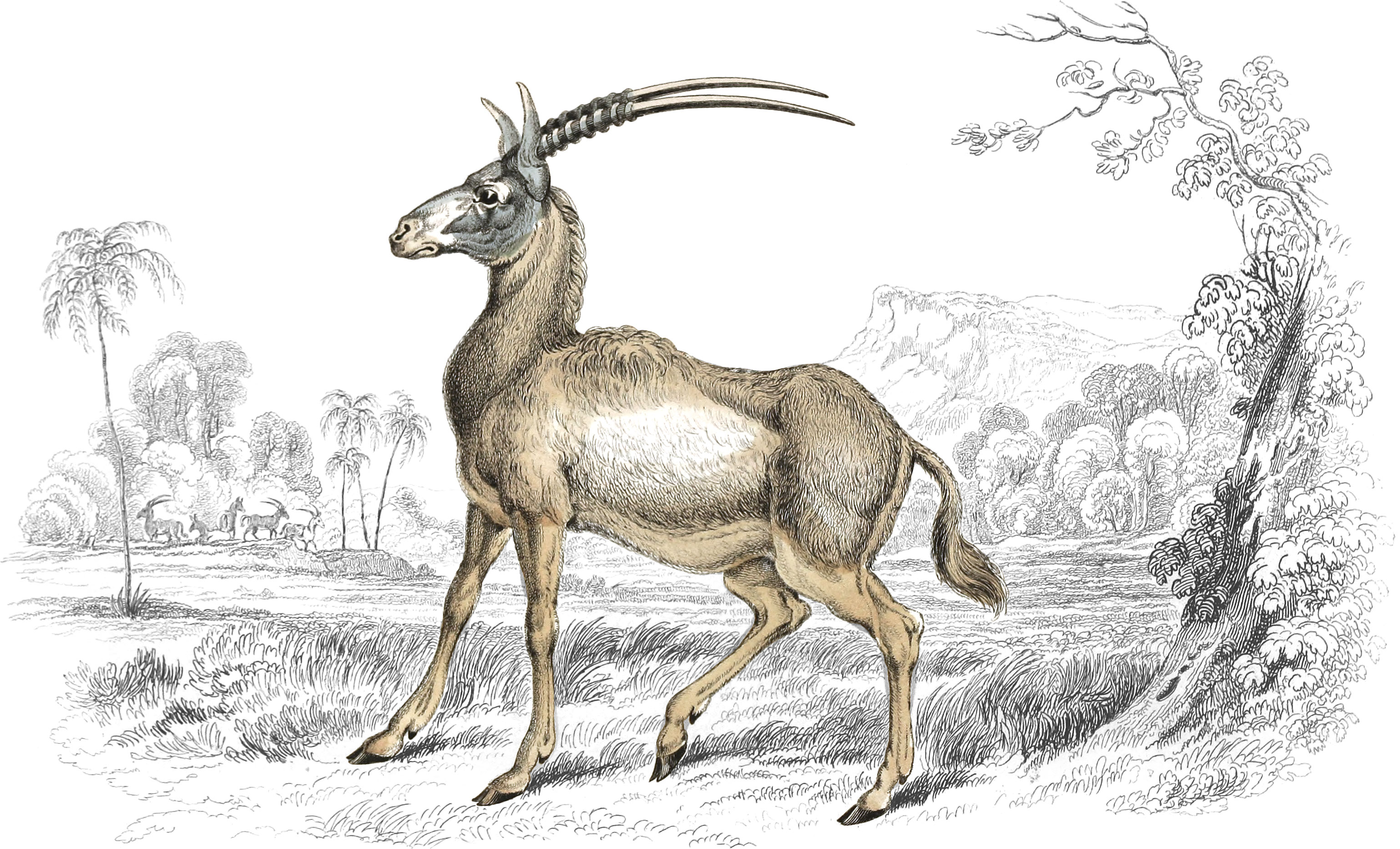
Plate XXIV
The Caffrarian Oryx (O. oryx) is another fine species, remarkable for its elegance, and famed for the flavour of its venison. It inhabits Southern Africa in its more wooded and rocky region. The male is nearly four feet high at the shoulder, and six feet in length. The general colour is a vinous buff, the breast, belly, and extremities white, and a black list from the nape of the neck to the root of the tail.
O. leucoryx is another beautiful animal from the East, inhabiting Eastern Arabia and the deserts of Persia, the body nearly pure white, the thighs from rufous dusky to black upon the houghs, the former with a dark band. Varying somewhat in form and characters, is another beautiful animal, which has been placed at the conclusion of the true Oryxes, viz.
The Addax
Oryx addax.—Smith.
Oryx addax, H. Smith in Griff. Cuv. iv. p. 193. and Synops.—Fred. Cuvier, Hist. Nat. des Mammif.—Antilope addax, Riese in Nordlichen Afrika.—Rappel, tab. 7.
The distinctions, or rather variations, between this fine animal and the true Oryxes, are, in
having the croup somewhat more elevated than the shoulders, a lengthened mane on the neck, and a tuft of hair below the throat.
The spiral twisting of the horns will also be seen to vary from those of the animal on our last plate, where they are nearly straight. According to Ruppel, the Addax is found in Nubia, and extends over the whole of the desert, which they are enabled to traverse from their fleetness, assisted by their wide-spreading hoofs, which do not sink in the running sands, nor clog their progress. In the plate of this animal given by Ruppel, which has served for our copy, the whole body and limbs are white, the head and neck of a greyish-brown, marked across the forehead and in front of the eyes with a white band, broadest at the ends as they fall upon the cheeks. The hair between the horns on the crown and below the throat, are larger and darker, approaching to chestnut; the tip of the tail the same colour, and the black hoofs are all the other contrast to the prevailing tint of white. The horns are above two feet in length, black, spirally twisted, and ringed on the forward aspect. The height of this animal at the shoulder is fully three feet. At some seasons the colour of the animal is a dull grey, as represented in the reclining animal.

Plate XXV
The only other animal probably belonging to the Oryxes, is the O. kemas of Smith, of which scarcely anything is known except the horns, which are figured by the Major.

O. kemas Horn
The hair is said to be long and ample, a variation from all the others which are natives of the Tropics, and it is supposed that it is an inhabitant of Alpine India, and that it might be the unicorn of the ancient Persians.
Our next group is of very beautiful form, and one often alluded to by the Eastern poets, as representing a light and airy carriage, and an expression of mildness and beauty. The Gazelles have the horns common to both sexes. They are often of a lyrate form, and either annulated or striated, and the bony core is solid. They have a small lachrymal sinus, often tufts upon the knees, and dark bands upon the sides They are gregarious, inhabit the plains, and rarely approach the covered or wooded countries, are wary and timid, and are extremely swift.
It is to these animals that the well known name of Gazal belongs, the Barbary Antelope, Gazal of the Arabs, and Gazella Dorcas of Smith and Lichtenstein. This animal has often been confounded in its synonymes with the Corinna Antelope and Kevel of our next plate, but appears local, to a certain degree, in its distribution, being nearly confined to the north side of the Atlas Mountains, and found in Egypt, Arabia, and Southern Persia.
The Kevel
Gazella kevella.—Smith.
Antilope kevella, Le Kevel, Buffon, &c.—Le Kevel, male, Fred. Cuvier, Hist. Nat. des Mammif.
This animal is found in great herds in Central Africa, extending beyond the river Congo, and as far south as the plains of Caffraria. That figured by Frederic Cuvier, and whose plate we have now used, was from Senegal. It was tame and familiar with those whom it knew, the colour entirely of a reddish fawn, white on the belly, insides of the legs, and insides of the ears. A dark, nearly black band divides the reddish colour from the white of the lower parts, and end of the tail for nearly half its length was of the same colour. The eye, surrounded by a white circle, is broader than in G. dorcas; it extends also forward, and the under lip is of the same colour. This animal also differs in the horns being more robust and longer.
The next doubtful species, the Korin of Adanson, is scarcely authenticated now, and if such an animal or distinct variety exists, it is found in the very interior of Africa, bordering on the Sahara. These three animals are exactly in the same state as other three of the same group, which we shall next notice. There is an uncertainty whether they are distinct or only local varieties, or races of the same, and until authentic specimens of each from the different countries can be procured and compared, they will remain so. The other three which we alluded to, may be noticed under the M’horr Antelope of Mr Bennet, the Nanguer of F. Cuvier and Ruppel, and the Addra. These have been brought from various districts of Africa, and are closely allied in form and colour. Mr Bennet thus describes the Gazella M’horr:—
The form of the M’horr is light and elegant; its neck is long and slender; its tail of moderate length; its limbs extremely slender and delicate, and its hoofs short, pointed, and form a rather acute angle at their anterior margin. The head tapers uniformly with a face moderately prolonged, suborbital sinus of small extent, and its naked muzzle limited to a narrow border round the nostrils, which is prolonged in a middle line as far as the margin of the upper lip. The horns are black, imbedded at their base in long hairs, and marked in this individual with eight complete, rather distinct, well defined rings, and one or two incomplete ones, which occupy about, two-thirds of their entire length, the remainder towards the points being perfectly smooth and shining.23
The colour of the upper parts is a deep fulvous or dull bay, which extends about two-thirds down the sides, where it terminates abruptly in the white of the belly. It is continued along the middle of the back to within a short distance of the tail, and is rounded posteriorly. From the hinder part of the sides the deep colour is continued in a broad and somewhat triangular patch upon the haunches, where it proceeds in a narrowing stripe down the middle of the outside of the legs as far as the neck, on which it extends rather broadly backwards, and below which the stripe crosses obliquely and gradually towards the front of the limb, terminating a short distance above the hoofs, and occupying at its termination the anterior outer part of the fetlock. Throughout this course, the separation of the fulvous colour from the pure white immediately adjoining it, is strongly defined.
The deep fulvous colour of the upper surface extends over the whole neck both above and below, and becomes fainter on the head, passing up the cheeks, and fading away under the eyes. Between the ears and behind the horns it is tinged with blackish or iron-grey. Are markable white patch is seated about half way down in front of the neck.
The whole of the lower parts of the sides and under surface, with the inner, the hinder, and the anterior surfaces of the limbs, are pure white. The white of the hinder part of the posterior limbs extends upwards for about four inches above the tail, including the tail and whole rump, and is prolonged forwards on each haunch, in a broad streak about five inches in length. The length of this animal from the nose to the base of the tail is 4 feet 2 inches, height at the shoulder 2 feet 6 inches. Another specimen was 5 feet 1 inch long, and at the shoulders 2 feet 11 inches high.
In the colouring of these three animals,
the dorsal fawn of the Nanguer extends along the back and sides, nearly as far backwards and downwards as in the M’horr; while in the young, as well as adult Addra, it gradually becomes narrower and fainter as it passes backwards from the lower part of the neck, leaving not only the haunches and the crupper, but also the greater part of the sides, white. In M. Ruppel’s work there is also figured and described a short longitudinal fawn-coloured streak on the haunches, which is equally wanting in the Nanguer and M’horr. In the former of these the haunches are wholly unmarked, the dorsal colour being cut off posteriorly in nearly a straight line, extending from the back downwards; while in the latter, as we have seen, they are nearly covered by a broad somewhat triangular patch continued from the sides, extending down the hinder leg, and bounded above by a white streak, which is continuous with the white of the crupper.
The M’horr is found in Western Africa, in the territories of the Sheikh of Wedroow; the Nanguer in Senegal; and the Addra in Nubia and Kerdofon.
The first is esteemed rare by the natives, and much sought after in producing the bezoars.

Plate XXVI
The Broad-hoofed Antelope, G. mytilopes, Smith is another animal belonging to this group, not much known, but would be distinguished by its heavier make and the broad form of the hoofs. It is understood to be found in Western Africa. Another very elegant animal is the Antilope euchore or Springer, the Springbock of the Dutch colonists, represented on our next plate.
The Springer or Springbock
Antilope euchore.
Antilope euchore of Authors.—Springbock of the Dutch Colonists.
This is one of the most beautiful of the Antelopes of Southern Africa, and is certainly one of the most numerous. The plain afforded no other object to fix the attention, and even if it had presented many, I should not readily have ceased admiring these elegant animals, or have been diverted from watching their manners. It was only occasionally that they took those remarkable leaps which have been the origin of their name; but when moving or grazing at leisure, they walked or trotted like other Antelopes, or as the common deer. When pursued or hastening their pace, they frequently took an extraordinary bound, rising with curved or elevated backs, generally to the height of eight feet, and appearing as if about to take flight. Some of the herds moved by us almost within musket-shot; and I observed that, in crossing the beaten road, the greater number cleared it by one of those flying leaps.
Two thousand of this beautiful creature were conjectured to form the above mentioned flock described by Mr Burchell, and their numbers everywhere met with is immense; but Pringle again observes, that, on the banks of the little Fish River,
so numerous were these herds, that they literally speckled the face of the country as far as the eye could reach, insomuch that we calculated we had sometimes within view not less than 20,000 of these beautiful animals.
The general colour of the Springbock is fulvous brown, beneath white, but the colours are distinctly separated by a dark brown band upon the flanks; but the most curious appearance in the structure of the animal, is two folds of skin ascending from the root of the tail, and terminating upon the croup. They dilate when the animal is bounding, and expose a large triangular space (otherwise concealed) of pure white-coloured hair, edged by two dark-coloured streaks.
It is this animal which commits so much damage during the passage of its vast migratory herds; while at the same time it affords a most ample sustenance to the African beasts of prey.
Plate Twenty-eight exhibits another animal belonging apparently to this group, inhabiting Northern Africa.

Plate XXVII
Sœmmering’s Antelope
Gasella Sœmmeringii.
Antilope Sœmmeringii, Ruppe’s Afrika Zool. Atlas, fol. 19.
A very beautiful and delicately coloured animal, standing about two feet seven inches high at the shoulder, and in length about four feet and a half. The colour of the upper parts, outsides of the ears and legs, a delicate reddish-grey isabella colour; the lower parts, insides of the limbs and buttocks, pure white. The forehead extending along the ridge of the nose, deep brownish-black, with a pale line above each eye, and a darker streak from the lower angle of the eye to the nostril. Inhabits north eastern Africa.

Plate XXVIII
Another series of Antelopes have received from Major Smith the title of “The Antelopine Group;” and that naturalist retains also the generic title of “Antelope.” They are much allied to the last, but differing in some lesser modifications of form, as in the horns being scarcely ever lyrate, having no dark bands on the sides, &c.; they are mere decidedly distinguished by the males only being furnished with horns. The females are nearly coloured like the males, but generally paler. The ears in both sexes are longer than usual.
The species which most naturally occurs first, is
The Pallah
A. melampus.—Desmarest.
Pallah, Daniell’s African Scenery.—A. melampus, Desmarest.—A. Pallah, Cuvier.
In this graceful animal we see the horns still retaining a lyrate form. It inhabits the interior of Caffraria, and Booshowana country; according to Daniell, appearing only in flocks of a few together. It is easily tamed, but extremely timid, and possesses great swiftness. At the shoulder it is about three feet high, and in length about five. The general colour of the upper parts of the body is a reddish or yellowish-brown, sometimes with a streak of a deeper tint along the back. The breast, belly, buttocks, insides of the legs, are white; around the muzzle, and above the eyes, is white, or very light coloured fawn; and above the spurious hoof on each leg, there is a spot of black, more or less conspicuous.

Plate XXIX
Another animal belonging to this group, has been named by Majoi Smith, A. adenota, from the circumstance of its having a small gland or tubercle on the loins, about equidistant between the hips and the root of the tail. Major Smith does not, however, surmise what purpose this would serve. The specimens to which the name was applied, were part of the collection in Exeter Change, and stood about twenty-six inches high. The general colour a fulvous bay. The belly and inside of the limbs white. They were brought from the west coast of Africa.
The Saiga, A. colus, Smith, is a European animal very little known. The collections of Petersburgh and Vienna, according to Major Smith, being the only museums, in 1827, where entire specimens of this animal were preserved. It is a large animal, nearly equal to the size of the fallow-deer, but more clumsily made; the horns intermediate between the lyrate form and the twisted appearance of the common Antelope. The colour in summer a grey dun, with a dark stripe down the back. The under parts whitish. It is found on the shores of the Danube, the Carpathian range, Caucasian Mountains, and the Altaic Chain. It is migratory, and said to assemble in troops of ten thousand (singular that our information is so scanty regarding them). It is also said to be easily tamed, and become gentle. The horns are used by the Chinese for their lanterns.
The last animal, but that most typical of the group, is the Common Antelope, A. cervicapra. A native of India, and celebrated for the religious superstition in which it is held by the natives, being consecrated to some of their deities, and alone permitted to be eaten in some of the religious ceremonies of the Brahmins. It is found abundantly over the whole Indian Peninsula, and is extremely graceful, and swift.
It is pleasing to see a herd of antelopes, consisting perhaps of fifty or sixty does, and led by a fine dark coloured buck, bounding over a plain. The height and distance taken at each bound, is wonderful; they often vault at least twelve feet high, and over twenty-five or thirty feet of ground. It is folly to slip greyhounds after Antelopes. Instances have been known of their being run down, but few dogs have survived the exertion.
The best method of shooting Antelopes, is to get a pair of very quiet bullocks, and walk between them, under the guidance of a native, who should hold a plough. The antelopes, to whom this sight is perfectly familiar, will, by this device, await with seeming confidence, and enable the sportsman to approach sufficiently near to get a good shot.24
The young are of a pale fulvous colour, which darkens with age to a sepia brown, sometimes to deep black, the centre of the flank becoming darker, and shewing a streak, as in some of the gazelles. The lower parts and insides of the legs are white, and the nose, around the orbits and the throat, is often of the same colour. The horns are spirally twisted, and are sometimes two feet in length.
Major Smith’s next group is formed of animals having the horns in a great measure bending forward. The appearance a little more sheep-like, the proportions not so fine; the hair thicker and longer; live in pairs, and frequent rocky districts. The title of Redunca has been given to the subgenus, but we have been unable to procure a figure of any species, of which four or five have been described. A. villosa will be an example of it.
The next animal, of which alone the subgenus Oreotragus has been made, is a remarkable form it is
The Klip Springer
Oreotragus saltatrix.
Klip Springer, Daniell’s African Scenery .—A. oreotragus, Smith.
This animal delights in the most precipitous rocks and precipices, where man or dog can scarcely follow. They are said to delight in perching upon the highest pinnacles; and in their general character have more of the habits of the ibex or goats than of the antelope. It is an animal of about twenty-two inches in height. The colour of Daniell’s figure is of a yellowish-grey, and Major Smith describes the hair as of three colours, ashy at the root, brown in the middle, and yellow at the point, producing the singular effect of a lively olive-green. The hair itself is hard, flat, spiral, flexible, and erect upon the skin, and forms a natural elastic pad to protect the body from bruises. The horns are about five inches in length, pointed and black, and annulated at the base. They are wanting in the female. Klip Springers were formerly abundant in the colony of Cape, but have lately much decreased, the venison being in high reputation, and the hair being much sought after to stuff saddles.
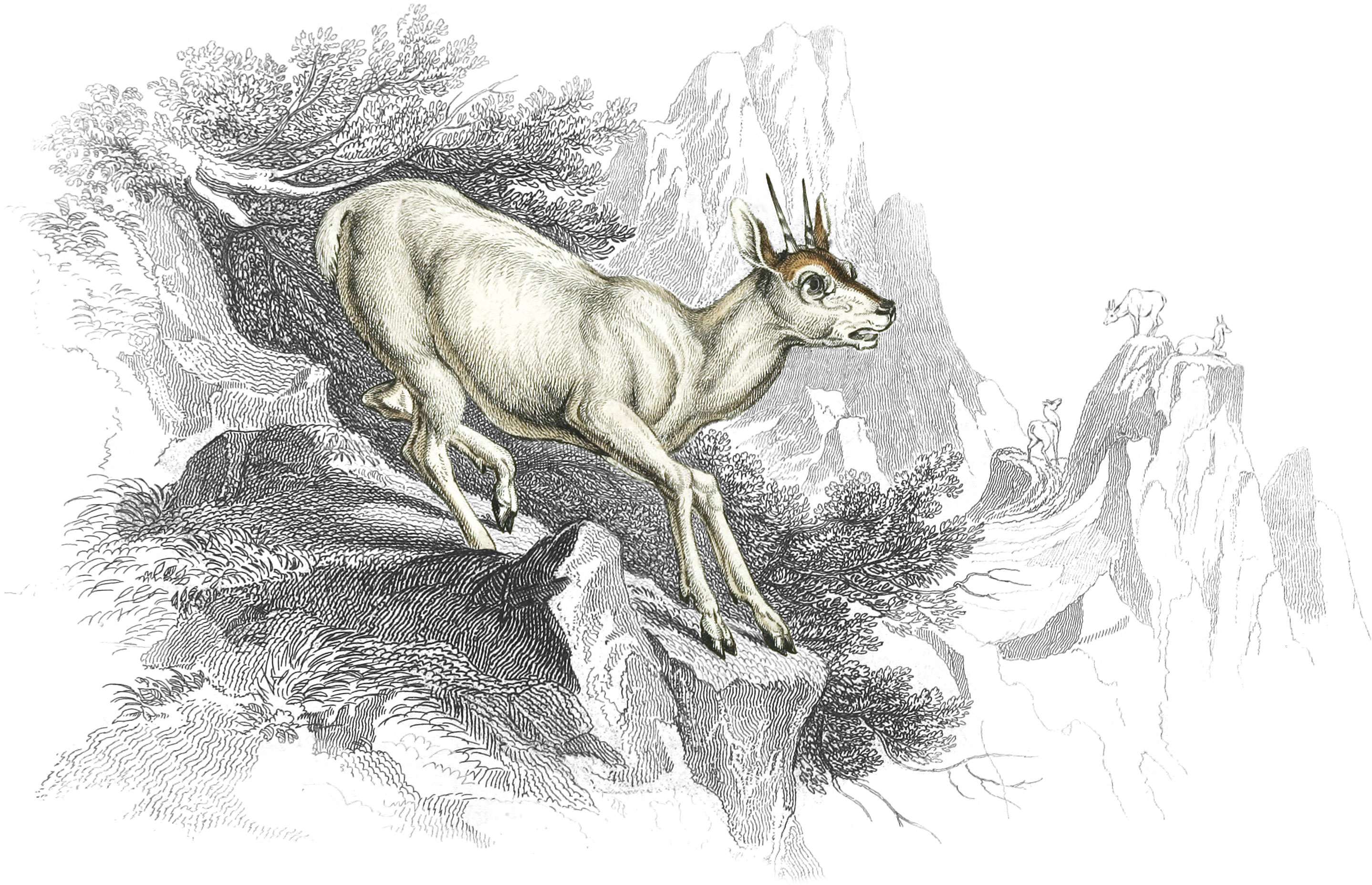
Plate XXX
Of the next animals, Major Smith makes another section, “The Traguline group,” and describes four species, of none of which we have been able to obtain any figure. The animals are all small, stand high upon their legs, and nearly want the tail, and the horns are short, round, and simple. The Grysback, Tragulus grisea, Smith, is one of the most frequent, but like many others of the African antelopes, the colonial name is often applied to several of the allied species. It is about nineteen inches high at the shoulder, and is generally of a chestnut-red, paler on the under parts of the body. It inhabits the mountains, and is very swift and vigilant. The Bleekbock, T. pallida, is another, but considered by some as only a pale coloured variety of the last. Major Smith is of a different opinion, considering the form somewhat different; and it varies also, as inhabiting the plains covered with bushes.
Another animal has been named and characterised as a subgenus, from the horns alone, specimens of which are in the Museum of the Royal College of Surgeons, London. They were brought from India, and Major Smith considers them so distinct, as to leave little doubt of the animal to which they belong being different from any of those forming his “Traguline Group” He has named it Raphicerus subtilata, or Awl-Horned Antelope, distinct from the R. acuticornis, which was previously described from specimens in the same collection.
Our next group presents a very remarkable configuration, in the animals belonging to it possessing four horns. It has been named as a subgenus Tetracerus. It appears that there is a possibility of two species with four horns existing, in the one perfectly smooth, in the other, rugged at the base; the materials, however, for establishing the latter, are imperfect; and, at present, we shall confine ourselves to that first described by General Hardwicke.
The Chickara
Tetracerus chickara.—Leach.
Antilope chickara, Hardwicke, Trans. Linn. Soc. xiv. p.—520.—Tetracerus chickara, Major Smith, Griffith’s Cuvier, iv. p. 254.
This animal is about twenty inches and a half in height at the shoulder, and about thirty-three inches in length The horns are black and perfectly smooth, and about three inches in length; in front of these the true horns, between the eyes, arise other two horns, about three quarters of an inch in length, and an inch and a half in circumference at the base, thence suddenly tapering to a point. The general colour of the animal is an uniform bright bay; on all the upper parts, and on the chin, the under line of the neck, the abdomen, the inner sides of the thighs, and under the tail, are inclined to white, more or less mixed with sandy coloured hairs. The female is lighter, and without horns.
These animals were kept in confinement by General Hardwicke, and produced young in his possession, two at a birth, a male and female.
The male, in the rutting season, becomes exceedingly wild and mischievous; and although partly domesticated, continued dangerous, running at every animal within its reach, whether deer, goat, or man. Even the feeder could only approach him on the verge of the circle, to which the rope he was tied with allowed him to reach. It inhabits the forests and hilly tracts along the western provinces of Bengal, Behor, and Orissa; and is extremely wild and agile.
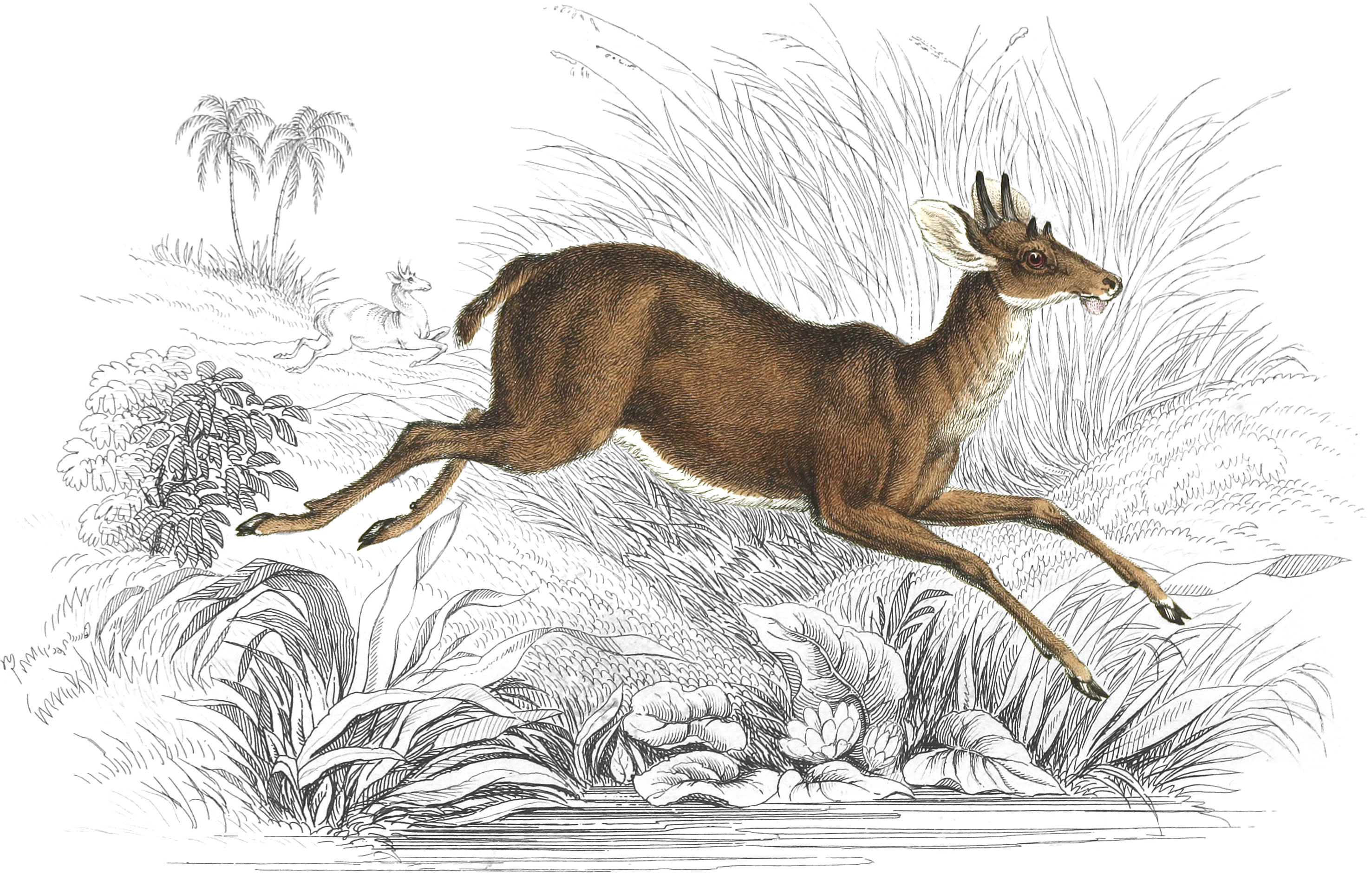
Plate XXXI
The other species if found to be distinct, will stand as T. quadricornes.
The next group, “The Cephalophine Group” of Major Smith, extend over southern Africa. They still contain animals of inconsiderable size, though some are large, and frequent bushes and low covers. They possess a curious manner of standing upon their hind legs to look out for danger (a habit we find in the hare and some of the Rodentia), and of even leaping into the air to overlook the surrounding vegetation. The horns are short and small, and they are all distinguished by a tuft of hair rising from the forehead, and by a pouch or sack opening between the orbits and the nostrils.
The largest of the group is the Bush Antelope, C. sylvicultrix, standing nearly three feet high. It is more clumsily made, and not so fleet as the other antelopes. The horns short and bending backwards. The colour principally of a dark brown, paler on the neck and flanks, greyish on the thighs and buttocks, almost yellow on the throat, and Isabella colour along the spine, widening over the loins, where the hair lengthens to two inches. It inhabits the vicinity of Sierra Leone, and is esteemed for its venison.
Another animal is closely allied to this, C. platous, Broad-Eared Antelope; but, for want of materials, Major Smith has provisionally kept them distinct. Amore remarkable antelope is what that naturalist describes under the title of C. quadriscopa, or Four Tufted Antelope, from a specimen which was exhibited in Exeter Change, and so named from brushes or tufts of a dark coloured hair being on each of the knees. The general colour was of a sepia grey; beneath whitish, the size about that of a roebuck; it was brought from Bengal. Burchell’s Antelope, and the Duiher Buck of the colonists, will also be placed here, and an example of an animal of the same form, but much less size, will be seen in
The Grim
Cephalophus grimmia.
Le Grim, Fred. Cuvier, Hist. Naturelle des Mammifères.—Antilope grimmia, Pallas’s Spicil. Zool. p. 35, t. iii.
The earliest authentic description of the Grim, is in Pallas’s Spicilegia Zoologica, described from two living males; a female had also been attempted to be brought to Europe, but had died on the passage; she was said to be destitute of horns, but the circumstance was not authenticated. They are described as timid but most agile creatures. They were fed on bread or chopped carrots, and were very fond of potatoes. The entire length of the animal two feet seven inches; its height in front one foot five inches. Horns two inches nine lines, thick in proportion, black and straight, longitudinally striated, and annulated at the base with about four rings. In Frederic Cuvier’s plate and description, which we have used for our illustration, this little animal is represented as about twenty-six inches high. The proportions of its head and body are rather heavy, but its agility is great, and is displayed in the fineness of the form of its limbs. The body is covered with a yellowish coloured hair, except along the back, where the hairs are of a rich grey. The end of the muzzle, with the extremity of the lower jaw, and the edge of the upper lip, is white; between the nostrils and the eyes appear two dark streaks, whence issues a dark coloured secretion from a suborbital sinus, which the animal appears always anxious to express by rubbing against every convenient substance. The horns were three inches in height, but did not appear to have reached their full development. The specimen was brought from Senegal.

Plate XXXII
The last form which we shall be enabled to notice in the limits of the present volume, is composed of very diminutive animals, inhabiting central and southern Africa, Neotragus of Major Smith. The best known species will be the Antilope pygmea of Dr Shaw, the Guevi of Frederic Cuvier. It is scarcely a foot in height, delicately formed, and possesses great agility. The colour is a reddish grey on the upper parts and sides, almost white on the neck and belly. Frederic Cuvier has given a figure of a female guevi, in which short and stumpy horns are exhibited, a circumstance which is at variance with the characters given by Major Smith to Neotragus. We shall illustrate the group by
Salt’s Antelope
Neotragus Saltiana.
Antilope Saltiana, Blainville, Ruppel, Atlas Zuder Reise im Nordliken Afrika, t. 21.—Neotragus Madoka, Major Smith, Griffith’s Cuvier.
This beautiful animal was first noticed by M. de Blainville, from imperfect specimens brought from Abyssinia by the British Consul, Mr Salt, and named in honour of that enlightened individual. M. Ed. Ruppel has, however, since published figures of both sexes in his Zoological Atlas of Northern Africa, which we have used for our illustrations. The height at the shoulder is only about thirteen inches, and the whole form of the limbs is of great delicacy. The forehead, where the hair is lengthened back, and outside of the limbs, are of a reddish-brown; the outsides of the forelegs spotted with whitish. The neck and sides are grey, and the lower parts are nearly pure white. The male only is possessed of horns, about three inches in length.
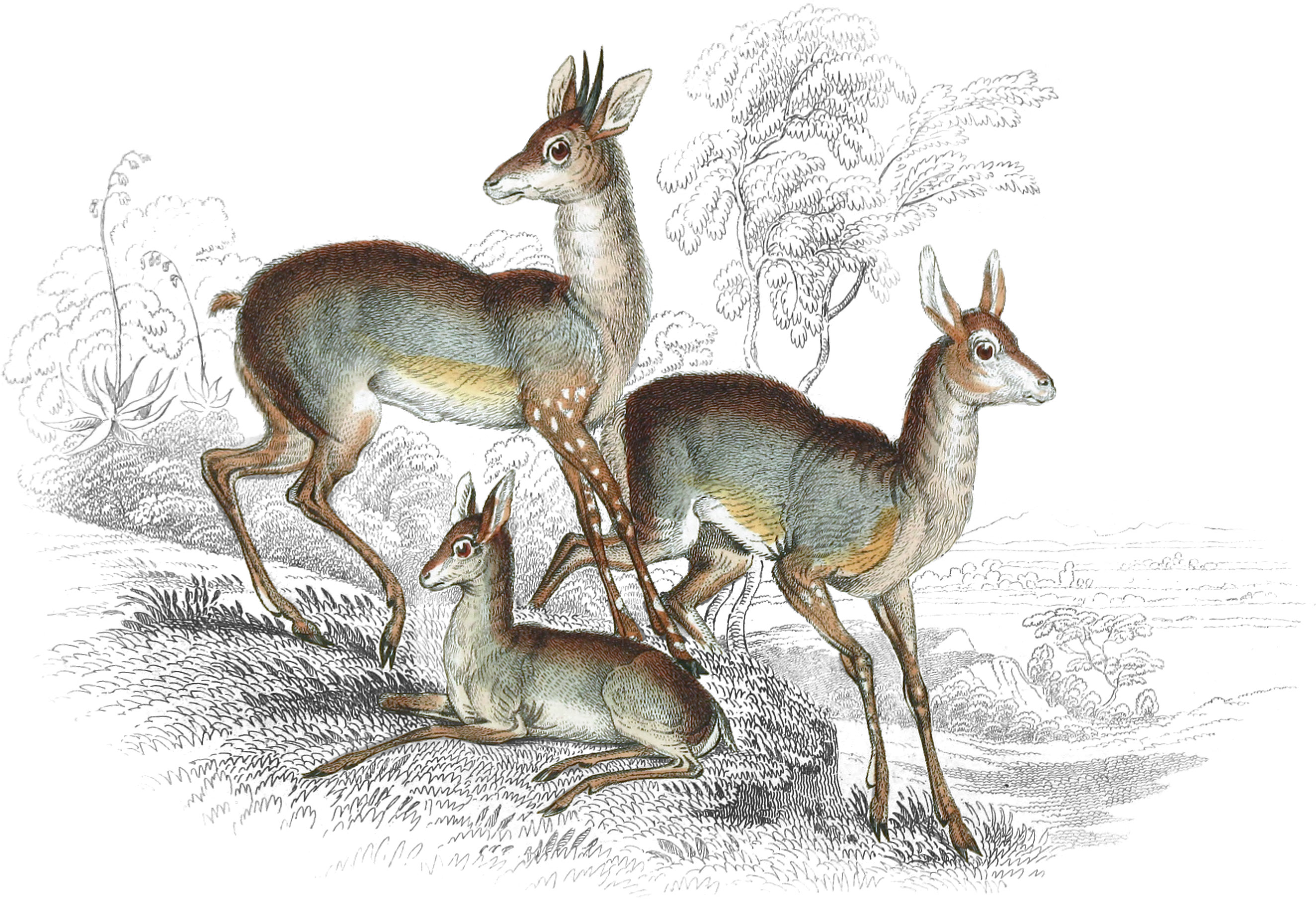
Plate XXXIII
The illustration of the remaining Subgenera among the Antelopes, and the rest of the Ruminantia, will be completed in another Volume, which will appear at the usual period.
- In some species there are traces of lateral metatarsal and metacarpal bones.
-
In Persia, a great proportion of the food of the small humped cows (zebu) and sheep is dried fish, a little salted. The cattle become very fond of this, mixed with pounded date stones, and the natives assert that both the quantity and quality of the milk is improved.
—Fraser’s Travels, quoted from Jameson’s Journal.
- Sir E. Home’s Lectures, i. p. 66.
- Hamilton Smith, Note to Griffith’s Cuvier.
-
The following note, extracted from Thompson’s Travels in South Africa, is descriptive of one of this graceful tribe, and is curious in detailing the migrations which they seem to perform periodically:
It is scarcely possible for a person passing over some of the extensive tracts of the interior, and admiring that elegant antelope the Springbok, thinly scattered over the plains, and bounding in playful innocence, to figure to himself, that these ornaments of the desert can often become as destructive as the locusts themselves. The incredible number which sometimes pour in from the north, during protracted droughts, distress the farmer inconceivably. Any attempt at numerical computation would be vain; and by trying to come near the truth, the writer would subject himself, in the eyes of those who have no knowledge of the country, to a suspicion that he was availing himself of a traveller’s assumed privilege. Yet it is well known in the interior, that, on the approach of the Trek-bokken, the grazier makes up his mind to look for pasturage for his flocks elsewhere, and considers himself entirely dispossessed of his lands until heavy rains fall. Every attempt to save his cultivated fields, if they be not enclosed by high and thick hedges, proves abortive. Heaps of dry manure (the fuel of the Sneeuwbergen and other parts) are placed close to each other round the fields, and set on fire in the evening, so as to cause a dense smoke, by which it is hoped the antelopes will be deferred from their inroads; but the dawn of day exposes the inefficacy of the precautions, by shewing the lands, which appeared proud of their promising verdure the evening before, covered with thousands, and reaped level with the ground. Instances have been known of some of these prodigious droves passing through flocks of sheep, and numbers of the latter carried along with the torrent, being lost to their owners, and becoming a prey to the wild beasts. As long as these droughts last, their inroads and depredations continue; and the havock committed upon them is of course great, as they constitute the food of all classes; but, no sooner do the rains fall, than they disappear, and, in a few days, become as scarce on the northern borders as in the more protected districts of Bruentjes-Hoogte-Camdebor.
The African colonists themselves can form no conception of the cause of the extraordinary appearance of these animals; and, from their not being able to account for it, those who have not been eye-witnesses of these scenes consider their account as exaggerated; but a little more minute inspection of the country south of the Orange River solves the difficulty at once. The immense desert tracts between that river and our colony, westward of the Zeekoe river, destitute of permanent springs, and therefore uninhabitable by human beings for any length of time, are, notwithstanding, interspersed with stagnant pools, and “vleys” or natural reservoirs of brackish water, which, however bad, satisfies the game. In these extensive boundless plains. Springboks multiply, undisturbed by the hunter (except when occasionally a Bosjesman is by starvation driven to make the attempt), until the country literally swarms with them; when perhaps one year, out of four or five, a lasting drought leaves the pools exhausted, and parches up the soil, naturally inclined to sterility. Want, then, principally of water, drives those myriads of animals either to the Orange River, or to the colony, when they intrude in the manner above described. But when the bountiful thunder-clouds pour their torrents upon our burnt-up country, reanimating vegetation, and restoring plenty to all graminivorous animals, then, when we could, perhaps, afford to harbour these handsome visitors, their instinct, and our persecutions, propel them again to their more sterile hut more peaceful valleys and plains, to recruit their numbers lost during their migration, and to resume their attacks upon us when their wants shall again compel them.
—Thompson’s Travels in South Africa, vol. i. p. 266.
- Volney.
- From Δπομεὺς, a runner, being used for conveying expresses, &c.
- Clapperton’s Second Expedition, p. 266.
- Morgan’s Algiers.
- Morgan’s Algiers.
- Bennett.
- Dr Knox, Edin. Journ, of Nat. and Geog. Science.
- Rich. Faun. Americ. i. 250.
- Richardson.
- Capel Brooke, p. 83.
- Capel Brooke, p. 105.
- Capel Brooke, p. 107.
- Sir A. C. Brooke, p. 502.
- Cervus (Dama) paleodoma.
- Cervus (Dama) lomonensis.
Expedit. ii. p. 88.Fauna Boreali-Americana. i. p. 251.- In a living specimen the number of rings is eleven.
- Williamson’s Oriental Field Sports, ii. 226.