Volume XII
Ruminantia
Part II, Goats, Sheep, Wild and Domestic Cattle, &c.

Content warning: Portions of descriptions and imagery on this page contain inaccurate views, derogatory language, and offensive imagery. They are included here as they were originally created in order to compile a complete reproduction. They do not reflect the attitudes of this site’s creator.
Ruminating Animals
Our first Volume devoted to these useful and interesting animals, was terminated by the description of a form of great elegance and beauty of colouring; and we have chosen to commence the present one with a series of animals, which begin to leave the elegant form of the Deer and Antelope, and to run into the more compact make of the Goats and Sheep. As we proposed in the commencement, we still continue the arrangement of Major Smith, as the best which has been hitherto proposed, and based upon actual observation in the greater number of instances. At the same time, we have to acknowledge the great benefit we have derived from his various writings upon the different groups of ruminants—materials which must form the groundwork of every dissertation on the subject, until our knowledge arrives at a much higher degree of perfection.
Since our first volume appeared, the new classification of animals by Mr Swainson has been published, where they are attempted to be arranged according to the principles of Mr MacLeay. Major Smith, who is here also the groundwork of the portion devoted to the Ruminants, is followed nearly in his arrangement, with the exception that the Camels are placed as the ruminating form among the Solipedes, but of course in either position forming the passage between the two, and standing between the Cameleopards and the Horse. Mr Swainson makes the Bovidæ or Oxen typical, and names the other families Antelopes, Stags, Musks, Giraffes.1 He also considers these animals as represented by the Rasores among birds, a position which has always appeared to us to be incontestable, but which is disputed by Mr MacLeay, who, if we recollect rightly, considers the Ruminantia and Grallatores or Waders as representing each other.
The animal we commence with will illustrate the Tragelaphine group of Major Smith; and, while it retains the elegance of the antelopine form, the horns will be seen to begin to assume an angular and compressed character;—on our Plate is represented
The Harnessed Antelope
Tragelaphus scriptus.—Smith.
Antilope scripta. Pallas.—Harnessed Antelope. Pennant, &c.—Tragelaphus scriptus, Major Smith.—Guib, femelle, Fred. Cuv. Hist. Nat. des Mammifères.
This is an animal of very great beauty, from the bright fulvous-bay which is the prevailing colour of the body, being marked or divided by longitudinal and transverse lines of white, which divide the ground colour into patches almost like those of the Cameleopard. The male is nearly of the size of the fallow deer, the horns black, and about seven inches long. For the accompanying representation, we have used the figure of Frederic Cuvier, which is a female, and regret that we have not been able to procure the observations of Liechtenstein in the Berlin Magazine. It appears to have been first noticed by Mr Adanson in Senegal, in the county of Podor, about sixty leagues inland from the sea. Lichtenstein says it inhabits Caffraria, but Mr Burchell did not meet with it; and, as far as we yet know, it is either very rare, or inhabits only those districts in the interior which have hitherto been scarcely penetrated by Europeans.
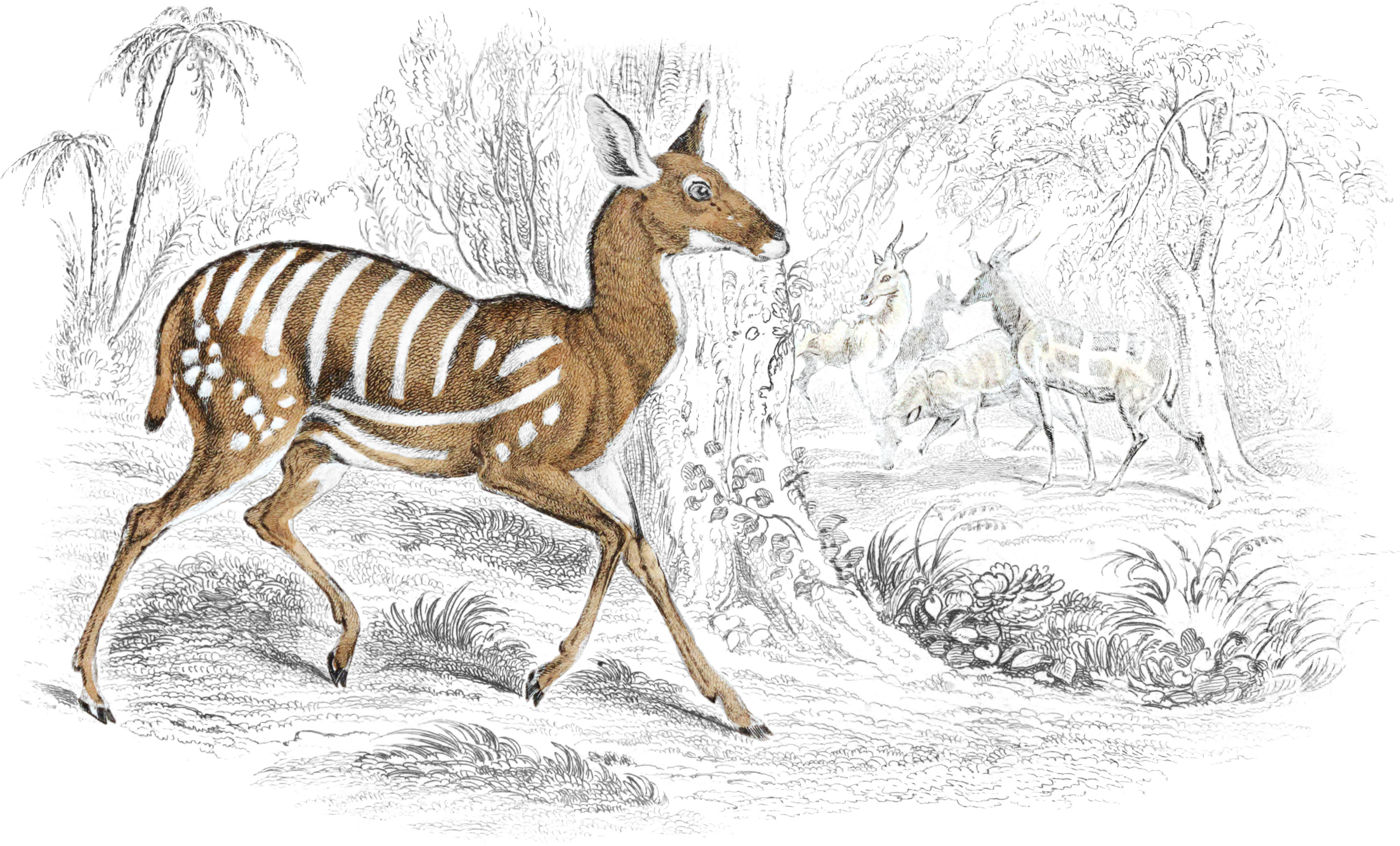
Plate I
The next animal approaches much nearer to the Goats.
The Cambing Ootan
Næmorphædus Sumatrensis.—Smith.
Cambing Ootan, Marsden.—Cambtan, Fred. Cuv. Hist. Nat. des Mammifères.
Specimens of this animal are yet uncommon, and almost all its later describers have been indebted to only imperfect materials. Mr Marsden was the first individual who noticed it, and for a long period remained almost the sole authority for the descriptions.
In 1821, Frederic Cuvier received drawings from MM. Diard and Duvancel, but without a detailed description. These were published in his Histoire Naturelle des Mammifères, which we have now made use of.
It is an animal standing from between 2 feet 2 inches to 2 feet 6 high. The hair on the head and body is entirely of a deep greyish-black, and is long. The neck and above the shoulders is covered with nearly white hair, also long, forming a sort of mane, and a strong contrast with the dark colours of the body. The suborbital sinus is very large, and secretes a yellowish liquid. The Cambing Ootan habits the wooded mountains of Sumatra, exhibits much activity, and is very goat-like in its appearance and habits.
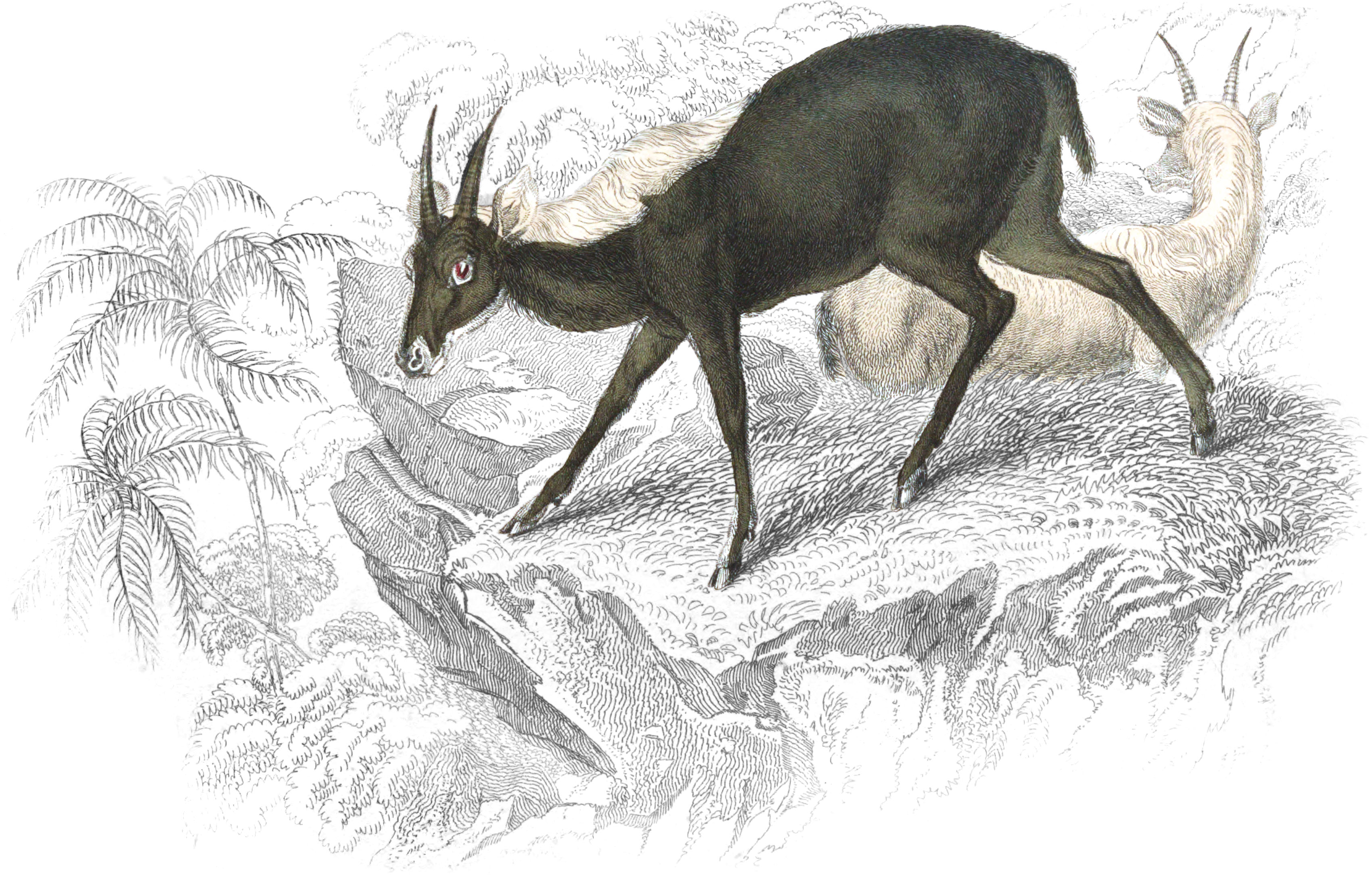
Plate II

Major Smith refers the Goral of General Hardwicke to this division;—a goat-like antelope inhabiting the Himalaya range and the mountains of the Nepaul frontier. The general tint is a grey mouse colour, but almost white about the lower part of the neck and throat; and darker, with the hair longer, along the upper part of the neck and back, inclining to ferruginous about the legs. The horns are simple, nearly connected at the base, and about four and a half inches long. The height of the animal is about two feet. It is considered by the inhabitants of Nepaul as the most active of the antelopes, it is seen in numerous herds, but is rarely taken, except by stratagem; if the herd is pursued, they disperse, and fly to precipices, and places to which no dogs can follow them.2
In the proceedings of the Zoological Society for August 1834, there is some information regarding this group communicated by Mr Hodgson. The centre of the horns is hollow and porous, and communicates with the frontal sinus, which are, however, small, while the core of the horns is only subcellular. The form is suited for heavy climbing or leaping. As the species of this group, he enumerates,
- The animal we are now describing:
- The N. Duvancellii, Smith, which he hints may be a variety of General Hardwicke’s Goral:
- The Goral, which he considers extremely goat-like in form, allied to the antelopes only by its round and ringed horns; and,
- A new species, N. Thar, Hodgson, the Thar of the Nepalese, closely allied to the Cambing-ootan, and furnished with a suborbital sinus, which secretes a viscid humour, as in that animal.
It is a large animal, standing about thirty-eight inches high, and weighing about 200 Ib. The hair is scanty, harsh, and applied to the skin. The colour of the animal above, with the entire head and neck is jet black, on the flanks mixed with deep clay-red. The limbs and hams outside, as far down as the great flexures, clay-red, nearly or wholly commixed; the rest of the limbs hoary, or rufescent hoary. Outsides of the ears dark. Chest pale. No stripes down the legs. Lips and chin dull hoary, and a stripe of pure hoary running backwards over the jaws from the gape. Horns, hoofs, and muzzle black.
It inhabits the precipitous and wooded mountains of the central region of Nepaul, up and down which it rushes with fearful rapidity, though it does not spring or leap well, nor is it speedy.3
The Rupricaprine group, consisting of a single animal, well known by name, “The Chamois,” follows this. It has no suborbital sinus, but possesses the inguinal pores, and the nose of the sheep. In form it resembles somewhat a slender formed goat, but is remarkable in the erect form of the horns suddenly bending at the tip to a hook, by which the animal might be suspended. It will be illustrated in the accompanying plate.
The Chamois
Rupicapra vulgaris.
Capra rupicapra, Linn.—Chamois, Buffon, &c.—Fred. Cuv. Hist. Nat. des Mammifères.
The general form of the Chamois is that of a slender formed goat, with less shaggy hair, and marked by the peculiarly turned horns. It inhabits the alpine districts of Europe and Asia, holding an intermediate station between the elevated glaciers and the wild but more covered country somewhat below them, making excursions into both, and exhibiting amazing agility amidst the precipices of those fearful regions. Two varieties are mentioned, the Pyrenean, and those inhabiting the Persian Alps, the latter smaller, and of a paler colour, with the horns bending from the base. The general height of the European animal is two feet three or four inches, the horns black, round, and hooked backwards at the tips. The colour of the hair a yellowish or greyish-brown, with a black streak extending through the eyes. The Chamois is gregarious, living in herds of fifteen or twenty; they rut in October or November, and produce one or two kids early in the ensuing spring. They feed on the alpine pastures, which give a richness and flavour to their flesh, much esteemed as venison; and for this purpose, and the skins, do the hunters ply their often perilous employment, which carries them to places of the wildest and most precipitous description, and adds to the dangers in view, the terrors of an avalanche, or the giving way of some chasm, concealed, but slightly covered.
Few ravines, however, walled their sides, will stop this active animal: it will either scale or leap them. Major Smith says,
We have seen it leaping down a precipice, sliding first the fore legs down the steep, while, with the spurious hoofs of the hind feet, it held the edge of the rock with firmness, till the centre of gravity was lowered as far as possible, then bounding forward by a jerk of the body during descent, turn the croup under, and alight on the hind feet first, with such apparent ease, that the fore feet dropped close to the hinder, and all expression of effort vanished. These descents we have witnessed more than twelve feet, and it will not hesitate to leap down twenty, and even thirty.4
All the senses of the Chamois are extremely acute, and these, combined with its great agility, are the guards and defence from danger with which Providence has endowed this otherwise defenceless animal. The sense of smell, it is said, will enable it to perceive an aggressor at the distance of half a league. Its voice, when undisturbed, is a kind of low bleating, but, when alarmed, it is changed into a shrill blast or whistle, which is known to the herd, and at once sets them upon the alert.

Plate III
As at the commencement of these volumes we proposed following the arrangement of the Ruminantia by Major Smith, we shall now proceed to his next forms, though, by later writers of authority and correct investigation, the species to be noticed has been placed with the Goats. The Aplocerine group of the above-mentioned author is represented by
The Wool-Bearing Antelope
Aplocerus lanigera.
Ovis montana, Ord.—Antilope lanigera, Smith, Trans. Linn. Soc. xiii.—Aplocerus lanigera, Smith, in Griffith’s Cuv.—Capra Americana, Rocky Mountain Goat, Richardson, Fauna Boreali-Americana, pl. 22.
Major Smith considers this animal as approaching nearest to the ovine form, or that of the sheep. It has no lachrymal or inguinal sinus, and no muzzle, while the horns are apparently distinct from either the goat or sheep, being “simple, conical, obscurely annulated, the points bent back.”
The interesting animal typical of this form was noticed so far back as 1697 by the Spanish missionaries, and, since that period, has been described by Blainville, Lewis and Clark, Ord, Major Smith, and, lastly, by Dr Richardson, whose trivial name we have adopted, and to whose description we shall now have recourse as the latest published.
This animal inhabits the north-west coast of America, frequenting the lofty peaks of the Rocky Mountains, and always keeping to a greater elevation than the sheep of the same regions; and Dr Richardson thinks its range of distribution may be from the 40th to the 64th or 65th degree of latitude. The size of the animal is about that of an ordinary sheep, and a resemblance exists to the Merino breed, in the mode in which the fleece hangs down the sides. The ears are pointed. The horns are awl-shaped, sharp, pointed, and nearly erect, having but a slight curvature and inclination backwards; they are marked at the base with rings, which disappear about half-way up, and towards the tips they are remarkably even, smooth and polished, their surface throughout black and shining. The colour of the fleece is entirely white: it is composed of long straight hair, abundant on the shoulders, back, neck, and thighs, coarser than the wool of sheep, but finer than that of goats. The flesh is in little esteem as food. The Indians make caps and saddles of its skin.5 The fleece, though thought by some to be available in our finer manufactures, has not yet been made use of or introduced.

Plate IV
Two other doubtful or little known species are recorded, A. mazama, Smith, Ovine Antelope, inhabiting the rocky forests and mountains of tropical America; and A. temmamazama, Smith, The Chichiltic, inhabiting the mountains of New Mexico.
The last group among what has been considered the tribe of Antelopes, depends on the spoils of the animal only. It is the Anoa of Major Smith, distinguished from the preceding animals, by
the horns placed on the edge of the frontal crest, on the same plane with the face, exceedingly robust, a little depressed, subtriangular, short, straight, wrinkled, and suddenly terminating in a very sharp point; the face straight, no lachrymal or suborbital sinus.6
The head of this animal, which is all that exists in our collections (one in the British Museum, another, before its dispersion, in that of Mr Brooks), appear to have been brought from the Island of Cœlebs by Dr Abel. The horns gave the character above, as made out by Major Smith, and the forehead was covered with bluish-cinereous hairs, short and close and feathering beneath the left eye. The length from the nose to the base of the horns was nine inches. The horns were ten inches long, and of a dark grey colour.7
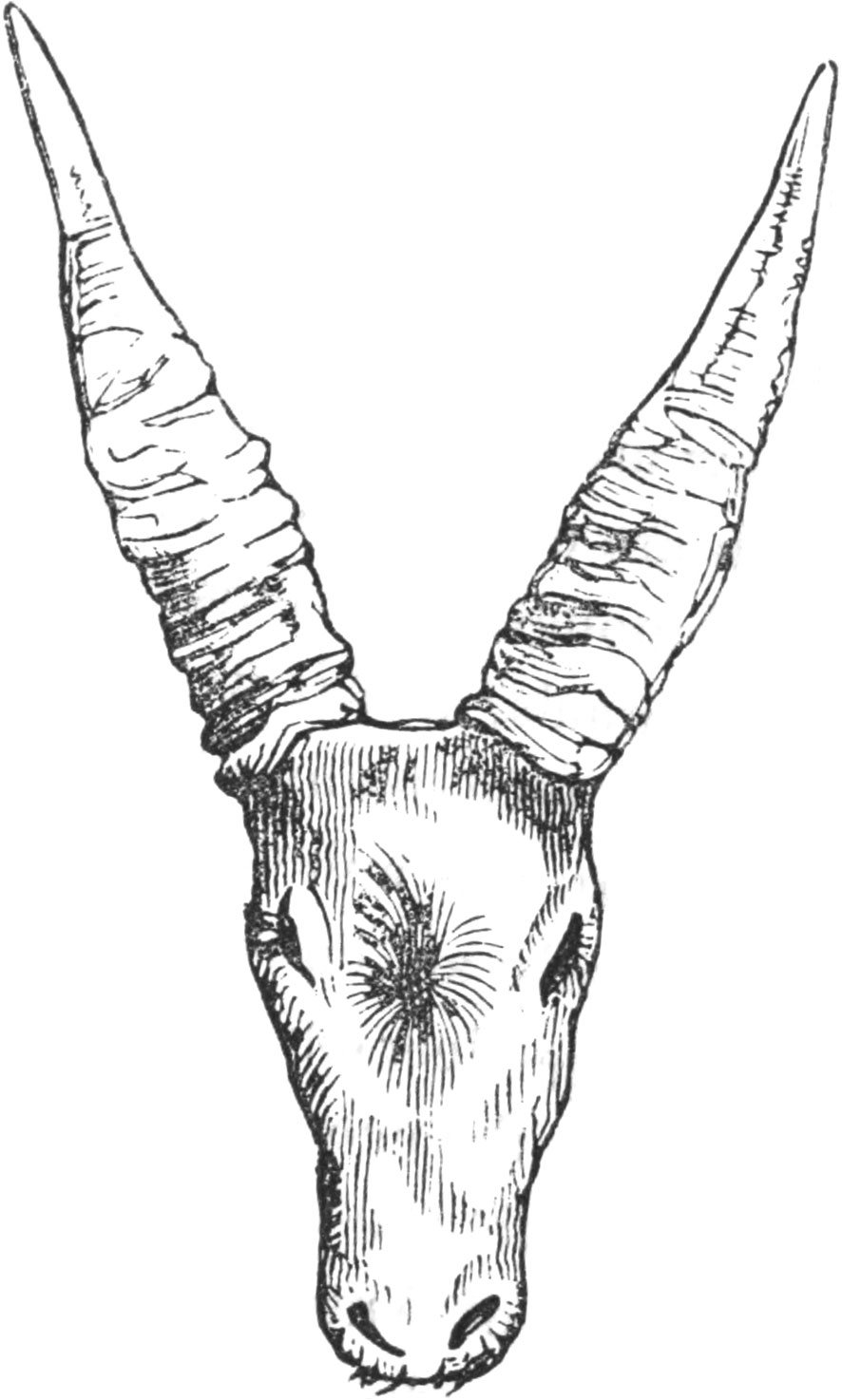
Anoa Head
Genus Capra
We have now arrived at those groups of the Ruminantia which are of most use to man in a state of civilization. Among the various forms, and curious and beautiful animals, which we have just been reviewing, we have seen many of very great importance to man; but the animals and their pursuers have been in nearly an equal state of unsubdued nature. The large deer of North America are an important article in the economy of the natives. Such is also the case with the native tribes of Africa in regard to the races of Antelopes; and the Rein-deer and Camel in their respective countries are indispensable for the commerce and support of their owners. The races of Goats, Sheep, and Oxen, which are now of such importance wherever man claims for himself the title of civilised, have been cultivated for his use, and by his care, since the commencement of the world. Among the first of mankind, keeping of sheep, and tilling of the ground, were the most common occupations; and that very circumstance of their early domestication, and the subjection to such varied circumstances, has made many changes and modifications of the forms, which now renders the original stock of the various races of the utmost difficulty to determine.
The first of those which comes under our notice, though not so abundantly kept, formed in the primeval ages a large portion of the flocks in southern Europe, and more particularly in Asia and Egypt; and figures of goats of a large and strong race, but not very nearly approaching to the wild animals from which they are conjectured to have sprung, have been handed down upon monuments of an aged date. They are now used for their flesh and skins, and hair or wool. In this country the former is little esteemed, though kid forms no despicable repast. Gloves of a fine kind are made from the skins subjected to maceration, and the coats of it separated; and it is from goat skins that the real morocco leather is manufactured, being supposed to take the dye better than those of sheep. The hair or wool of one variety is well known as the source of the beautiful Cashmere manufacture.
In common language, the appellation of “goat” and “sheep” is applied to very different looking animals. The one, clothed in a fine thick covering, familiarly known as wool, with the horns, if any, bending laterally, and generally spirally; the other, covered with shaggy hair, a long beard, and the horns directed with a gradual bend upwards or backwards. When the different animals are, however, brought together, this generic distinction is not so easily perceived, and there is a running into each other which has rendered the point of their separation disputed by various naturalists. We shall give the characters, however, placed to each by Major Smith, and consider, that, for the sake of simplicity, and ease of arrangement, they are best kept separate, even although Frederic Cuvier, a high authority, has said, that a better idea of the characters will be obtained by a figure than by a description, for that they have nothing in reality that can be expressed by language. It may be premised that they are distinguished from the true antelopes,
by the osseous nucleus of the horns being partially porous or cellular, communicating with the sinus of the frontals,
a structure to which we saw an approach in the Cambing ootan of Sumatra. And Mr Hodgson adds to this, as a
strong and invariable distinction, Males not odorous in the Sheep, as opposed to the males odorous in the genus Capra or Goat.8
They inhabit alpine districts, often upon the limits of perpetual snow, are extremely active and sure footed, and climb with the greatest ease and security. They are at present known to inhabit Europe, Asia, and Africa—Aplocerus being the nearest approach to them in America.
Capra or Goat, Linn.—Horns common to both sexes, rarely wanting in the females; in domesticated races occasionally absent in both, directed upwards or depressed backwards, more or less angular and nodose. No muzzle, lachrymal sinus, or inguinal pores; tail short and naked at the base, chin bearded.9
Naturalists for a long time were of opinion that the original stock of our domestic goats was to be found in the Caucasian Ibex. The discovery, however, of another animal inhabiting the same country and the Asiatic border, more similar in form, has rendered it more probable that to that animal we are indebted for our present races, in some cases mixed with both the Caucasian and Abyssinian Ibex. The animal alluded to is
The Ægagrus
Capra ægagrus.—Pallas.
Copra ægagrus, Pallas, Ham. Smith, &c.—L’egagre, Fred. Cuv. Hist. Nat. des Mammifères.—Le Passeng ou Bouc Sauvage, Menagerie du Museum.
The Ægagrus appears first to have been noticed by Pallas and Gmelin, by whom descriptions were given, imperfect in the details of its habits. A figure, with descriptions, has been given in later days by the Baron Cuvier, in the Menagerie du Museum, from individuals captured on the European Alps, though Frederick Cuvier, in his Mammifères, seems to place a doubt on this fact, which it would be important to know, as Pallas surmised, that the species may be found on the European Alps, as well as the Caucasian and Asiatic ranges.
The male Ægagrus stands higher on its legs than the largest varieties of our goat, and the body is more slender. The limbs are strong and thick, and have not the light appearance of those of the antelopes or stags. The neck is short and thick, on account no doubt of the huge horns which it is required to support. The head is not much lengthened, and the horns always bent backwards, are larger in proportion than those of any other known ruminant. The tail is very short, while the lower jaw is furnished with a lengthened beard. The head is carried high, the look is fixed, the movements rapid, and the whole carriage bold and easy. These are the appearances which at first strike an observer, but, on a narrower inspection, we perceive that the horns are of a triangular form, covered with transverse ridges. There is no lachrymal sinus. The nostrils are not placed in a naked muzzle. The face is covered with long and thick silky but loose hair, extremely soft.
Two specimens were possessed by the Parisian Menagerie; the one was of a greyish-brown, the other of a greyish-yellow colour. The last is represented in Fred. Cuvier’s great work, and has served for our copy here. They lived for several years, and exhibited the same manners with the domestic goats.


European Ibex
Capra Ibex.—Linnæus.
Ibex of the Ancients.—Capra ibex, Linnæus. Ham. Smith in Griffith’s Cuvier.—Bouquetin des Pyrenées, Fred. Cuv. Hist. Nat. des Mammif.—Young Male.
The European Ibex seems at the present time to be one of those animals which, though a native of a country where natural history is almost universally studied, has nearly escaped the detailed notice of zoologists, who have been more attentive to the productions of other countries, until the eagerness and perseverance of the Chamois and Ibex hunters have nearly extirpated the animal, and now rendered it a species earnestly sought after by collectors.
The Ibex is now known to inhabit sparingly, the Pyrenees, the Alps of Switzerland and the Tyrol, and some of the Spanish mountains. It loves to frequent the most exalted ranges, near the limits of perpetual snow, and seems in its common localities to ascend even higher than the chamois, which in other parts of its habits it closely resembles, being extremely watchful, and difficult of approach on account of the delicacy of its senses of hearing and smell. It is an animal standing from two feet six to two feet ten inches in height. The colour of its hair, like that of many of the deer, seems also to undergo a change with the seasons, being in summer of a reddish-brown, during winter of a greyish-brown, the inner parts of the legs and the belly being always whitish. A young animal figured by Fred. Cuvier is entirely of a greyish-brown, very dark above. The horns in this species are often very large, they rise from the crest of the skull and bend gradually backwards, are flat, and have the anterior surface ringed, with very strong cross rugged bands. These ridges are thought to become greater in number with age, but Major Smith is of opinion that a regular increase is not always to be depended on.
The Ibex was hunted for its flesh and skin, chiefly for the latter, and the chase was reckoned more arduous than even that of the chamois, for, independent of the difficulty and danger of the pursuit, the animals, when driven to extremity, would turn on their pursuers, and, if unable to pass, would attempt to butt with their powerful horns, and sometimes succeed in driving their adversary over tremendous precipices. In confinement it has been very seldom kept, so that little opportunity of observing its disposition has been afforded. The specimen above alluded to as kept in the Parisian Menagerie, was quiet and dull, and did not exhibit that appearance of gaiety and frolicking so conspicuous in the young of both the goats and sheep. It was brought up by a she-goat, and though still remaining in company, appeared to exhibit no sign of attachment towards its foster mother.

Plate VII
Another Ibex is distinguished under the title of “Caucasian Ibex,” Capra Caucasica. It is broader and shorter than the European species, dark brown above, white below, and, as its name imports, has been found on the Caucasian range of mountains.
A third species is introduced by Major Smith, under the name of the Abyssinian Ibex, a native of the mountains of Abyssinia and Upper Egypt, and on the shores of the Red Sea. It is said to stand higher than either of the foregoing species;
is of a dirty brownish fawn colour, with a short beard, and lengthened hair under the throat down the breast, and a darkish line on the anterior part of the legs and along the back. The horns are superior in length to those of the European Ibex, forming a half circle closer on the forehead.
It will stand as the C. Jaela, Smith.
Another very beautiful goat, which seems entitled to the rank of a distinct species, is
The Jemlah Goat
Capra Jemlahica.—Smith.
The Jemlah Goat, Capra Jemlahica, Smith in Griffith’s Cuvier, vol. iv. p. 308, and Synop.
Our authority for this animal is the description and figure given by Major Smith, from a skin in the British Museum, and we of course use his own words in describing it.
The size of this animal appears nearly equal to the ibex. The facial line is straight, though the prominence of the horns give the forehead a concave appearance. The eyes are rather small, the ears short, narrow, and rounded at the tips. The horns stand obliquely on the frontals; rather high above the orbits, nearly in contact at the base, extremely depressed, almost flat, four inches and a quarter in breadth at the root, nine inches long, inclining outwards, then suddenly tapering to a point which turns inwards, so as to nearly meet over the neck. Their colour is pale ashy buff, the anterior edge marked with seven small protuberances, round, distinct, almost detached, shaped like drops, being gradually obliterated as they ascend and each marking the commencement of a wrinkle, which passes round the external flattened surfaces, in the forms of grooves, resembling the joints of a lobster, and being about four inches smooth where they contract to a point. The bones of the head are exceedingly solid and ponderous, without a void space on each side of the nasal bones, as in the case of the Caucasian Ibex and Ægagrus. The hair on the face and legs is short, mottled with a dark earthy coloured streak down the cheffron; that of the neck and back is very abundant, long and loose, with a stripe of the same sepia colour down the ridge of the spine. The tail is very short. On the sides of the cheeks the hair is exceedingly long and coarse, having, like a lion’s, more on each side of the head, and feathering vertically also upon the shoulders; excepting the dark streaks above mentioned, and a darkish line on the anterior part of the legs, the whole animal is of a dirty whitish fawn, with a few locks of brown interspersed. It has no true beard, and the limbs are remarkably robust. It is said to inhabit the district of Jemlah, between the sources of the Sargew and Sampoo; that is the most elevated range of Central Asia, forming the nucleus between the western and south-eastern branches of the Himalayan mountains; it may therefore represent the ibex in the most lofty regions of the east beyond the Burrampooter, and extend into China.10

Plate VIII

A fifth species of goat has yet to be noticed, for which we are indebted to the researches of Mr Hodgson, who makes his observations from living specimens kept in his garden. It is
The Jahral
Capra Jahral—Hodgson.
It is closely allied by the characters of the horns to the Alpine Ægagri, and still more to the C. Jemlahica of our last plate. It differs from the former by the less volume of the horns, by their smooth anterior edge, and by the absence of a beard; from the latter, by the horns being much less compressed, not turned inwards at the point, nor nodose. The adult male is fifty inches in length from the snout to the rump, and thirty-three inches high. The head is finely formed, full of expression, clad in close short hair, and without the least vestige of a beard. The animal is of a compact and powerful make. The fur is of two sorts, the outer, hair of moderate harshness, neither wiry nor brittle, straight and applied to the skin, but irrigible under excitement, and of unequal length and colour; the inner, soft and woolly, as abundant as in the wild sheep, and finer, of one length and colour. The horns are nine inches long, inserted obliquely in the crest of the frontals, and touching at the base, with thin anterior edges, subcompressed, subtriangular, and uniformly wrinkled across, except near the tips, where they are rounded and smooth, peeled and sharpened towards the points, and obtusely rounded behind. The colour of the animal is a saturate brown superficially, but internally, heavy blue, and the mane for the most part, wholly of that hue. Fore arms, lower part of the horns, and back of the legs rusty, entire fronts of the limbs, and whole .face and cheeks, blackish-brown, the dark colour on the two last parts divided by a longitudinal line of pale rufous, and another before the eye shorter. Lips and chin hairy, with a blackish patch on either side below the gape; tip of the tail and ears blackish, tongue, palate, and naked skin of the lips and muzzle, black. Iris deep reddish hazel.
The Jahral is found wild in the Kachan region of Nepaul, in small flocks or solitary. It is bold, capricious, wanton, eminently scansorial, pugnacious, and easily tamed and acclimated in foreign parts.11
Having thus noticed what are now esteemed as the distinct species of the Goat 0r genus Capra existing in a state of nature, we shall proceed to survey one or two of the principal breeds or varieties, some of which are very different from the animals we have been now describing, and seem almost to assume a distinct and continued breed, so that there is much difficulty in supposing them, as ever derived from any of the wild animals. The common Goat, which is well known in the north of Scotland, and the most alpine counties of England and Wales, closely resembles the wild Ægagrus, and in some parts of the Highlands has become nearly naturalised, and scarcely to be approached except by stealth, or procured except by the assistance of the gun. We recollect once having a flock of this description pointed out to us on the precipitous side of Ben Nevis, and of endeavouring to get a shot in vain; their activity among the rocks surpassed any thing we could have imagined from description, and they had passed the rocky valley long before we had reached the station pointed out for an ambuscade. The goat is kept on account of its milk and the flesh of its young, the former being often in request as a medicine for persons of weak constitution or threatened with pulmonary complaints. They are frequently also kept about stable-yards as pets, where they become remarkably tame and attached, throwing off all the shyness and timidity which they exhibit naturally, and are ever prying and inquisitive. They are favourites with us; and an old he-goat, with full grown horns and an ample beard, always conveys an idea of something highly picturesque. A Welsh breed, generally of a white colour, is remarkable for its long hair and very large horns, which are sometimes three feet in length. In Holland, they are used in very pretty equipages for children, and we have seen two and sometimes four harnessed to a child’s car, obeying the rein, and apparently in complete subjection. As among the sheep, we have also a breed, white, and without horns, and here the distinction of the two forms is very close indeed, and scarcely to be distinguished except by the hairy fleece and indication of a beard. Many horned breeds also exist, and specimens with three and four horns are met with.
One of the most celebrated and important varieties of the Goat is
The Goat of Cashmere
But even this is subject to many varieties, differing both in colour and in the quality of the wool, or rather the fine hair, of which the fleece is composed.
The principal points in the most approved breeds are large ears, the limbs slender and cleanly formed, the horns not spirally twisted, and above all, the fleece being long, straight, silky, and white. A specimen in the Edinburgh Museum agrees nearly in these particulars, and is represented on the accompanying plate, together with one of the varieties of the same race, which has been figured by Fred. Cuvier in his great work. The last varies only in the head and neck being of a very deep black. Besides the true Cashmere breed, from which originally the celebrated Cashmere shawls were made, there are several others which have been employed for the same purposes in different parts of India; and there is a Tartar half-breed, which has been found to survive well in a colder climate, and which has been introduced with considerable success into France. The most in request, however, are still brought from the kingdom of Cashmere.
Sixteen thousand looms are there supposed to be inconstant motion, each giving employment to three men, and it is calculated that 30,000 shawls are disposed of annually. The wool of Thibet is thought to be the best. Twenty-four pounds weight of it sells at Cashmere, if of the best sort, for twenty rupees, but an inferior and harsher kind may be procured for half the money. The wool is spun by women, and afterwards coloured. When the shawl is made, it is carried to the custom-house and stamped, and a duty paid agreeably to its texture and value. The persons employed sit on a bench at the frame, sometimes four people at each, but if the shawl is a plain one, only two. A fine shawl with a pattern all over it, takes nearly a year in making; the borders are worked with wooden needles, having a separate needle for each colour. There is a headsman who superintends and distributes the pattern, and the rough part of the shawl is uppermost while it is manufactured.12

Plate IX
Two more grotesque looking goats, which have been generally placed as varieties of the domestic breeds, are represented grouped on the next plate, taken also from the figures of Fred. Cuvier. They are
The Nepaul Goat and the Goat of Upper Egypt
These two animals would almost seem not to be varieties, but distinct species, though perhaps there is not so much difference as we see in some of the races of the dogs; and this is one of those points in natural history which is extremely difficult to prove, even with the most extensive menageries and most favourable situations. The most marked characters in the black figure, the Nepaul Goat, is its high and slender figure. The arched form of the nose, occasioned by the convexity of the nasal bones; and the long and pendulous ears generally of a white colour, or paler than the tint of the body.
The other figure on the plate, the Goat of Upper Egypt, is generally of a brown colour, standing high, and somewhat of the form of the Nepaul Goat. The hair longer and more shaggy, the bones of the nose very much raised, and the appearance of the chin and face, with the exhibition of the teeth, putting one in mind of the pugs among dogs. The ears are also ample and pendent; from the neck there is frequently hanging two fleshy tubercles, an accessory which is also sometimes seen in some of the breeds of sheep. In the female, the udder is always very pendent, sometimes almost touching the ground.

Plate X

One of the prettiest breed of Goats is a dwarf variety, originally from Guinea, but now, according to Major Smith and Fred. Cuvier, multiplied in South America. Two of these animals are figured in the work of the latter naturalist, a male and female, prick-eared, but bearing very much in other respects a resemblance to the young or females of the common domestic breed. The horns are short, and bend backwards. The colour varies to the usual tints of the domestic races, and the forehead and nasal bones are rather concave. The height of the male was only twenty-two inches, that of the female about eighteen.
Genus Ovis
From the Goats, so closely allied, we naturally pass to the generally accepted genus Ovis or Sheep, and as we proposed, we add Major Smith’s character.
Horns common to both sexes, sometimes wanting in the females. They are voluminous, more or less angular, transversely wrinkled, pale coloured, turned latterly in spiral directions, first towards the rear, vaginating upon a porous bony axis. The forehead and chaffron arched; they have no lachrymal sinus, no muzzle, no inguinal pores, no heard properly so called. The females have two mammæ; tail rather short, ears small, legs slender, hair of two kinds, one harder and close, the other woolly. In a domestic state, the wool predominates, the horns vary or disappear, the ear and tail lengthen, and several other characters undergo modifications. The genus is gregarious in the mountains of the four quarters of the globe.13
On comparing the above with the characters given to Capra, the differences will not be found to be very great, consisting chiefly in the form of the horns and in the presence of a beard, with sharp-pointed ears; and to these might be added the remark of an able naturalist, that the males of Capra are always very strongly odorous during the rutting season, while the reverse is the case with the sheep; and it is mentioned in the Iconographia of Bonaparte, as a characteristic mark, that Ovis or the True Sheep are always furnished with an interdigital hole, opening on the anterior part of each foot, and secreting a sebaceous substance. This, he remarks, is wanting not only in Capra but in every other ruminant. They are timid, defenceless, and of a more dependent character than the Goats.
The Sheep is certainly one of the animals which was first placed by the Divine Providence under subjection to man. From the earliest period of the world’s history it has continued administering to the wants of almost all nations, and at the present time, is more extensively used in the human economy than any other animal. It is even sometimes employed in the less usual character of a beast of burden. Major Skinner relates in his excursions in India an instance of this fact.
I met several merchants, natives of the province of Bisehur, returning from it, driving a flock of sheep, bearing loads from thirty-five to forty pounds each. The burdens were swung in bags over their backs, without any cords to bind them on, and they moved up the steep crags with the greatest nimblences and indifference to the weight. It is very we to find a sheep a beast of burden; it is not uncommon however here. In this case, they were the bearers of their master’s food, and were natives of the northern part of the mountains, a larger race than the common animals of the hills. They are used for trade, and are made to carry grain from a fertile to a less happy quarter. They travel with surprising quickness, and are kept together without the least trouble. No four-footed animals but goats and sheep could be used for such a purpose in any part of the mountains; and the former being too apt to roam, perhaps the latter are the only ones that could be safely turned to such account.14
Mr Wilson also remarks, on the authority of Dr Gillies, that in some of the districts of South America, the children use tame sheep as ponies, on which they ride to school.15
Four or five animals are now ranked as distinct species of sheep, one of which, at least, we find a native of each continent. In nearly every case the wild breeds are subjected, though they retain their outward characters, while the different cross breeds and cultivated varieties have been distributed to other provinces and continents; and there are few districts in the world, if we except the extreme poles, which have not some breed of this useful animal carefully watched and tended; and even in those regions so remarkable for the want of Ruminantia and all large animals, they have been introduced, and are becoming of the utmost importance in the commerce of the colonies. In a wild state, they are all gregarious, watchful, defenceless, and extremely timid. They inhabit mountainous countries, and though possessing less activity than the goat, climb rocks and precipices with facility and speed, few hunters being able to come up with them if once alarmed. Their fleece, in their wild state, approaches nearer to hair than wool, or at least the wool is short, and forms the under covering, and is plentifully mixed with long and coarser hair. In the Rocky Mountain sheep, again, the fleece has the character of the hair of the deer, being strong and crispy, and having the woolly part of the coat quite concealed, being short but very thick.
In the frequent mention of the terms wool and hair, as partly characterizing the Goat and Sheep, it may be proper to notice their distinction. In a very great many animals the fur is composed of two substances, the one long and appearing outwardly, the other short and thick, and occupying the part next the skin. The lower covering has received the name of wool, and the getting rid of the long portion, or the hairs, is termed the “improvement of the fleece.” The under or woolly part possesses a quality decidedly characterizing it, its tendency to Felt, produced by its structure, the edges appearing serrated, and the surface imbricated, when viewed under a strong magnifying power, while hair is always cylindrical. An examination of the minute structure of the coverings of animals is yet much to be desired, and it will without doubt throw much additional light upon their properties.
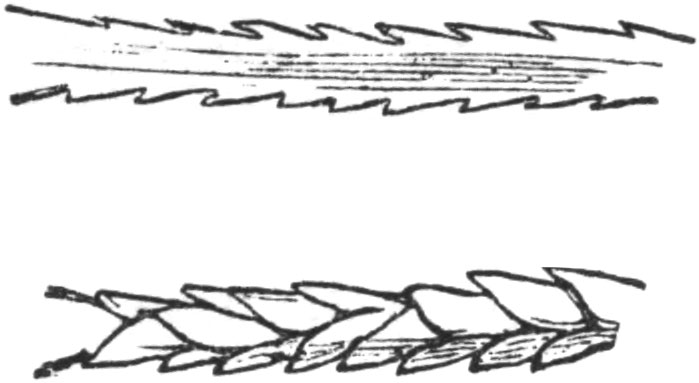
Magnified Wool
Although attempts have been made to trace the stock of our breeds and varieties, it is a subject which has never been done to the satisfaction of the writers themselves, and one on which it will perhaps be impossible to come to an accurate decision. The Musmon of Corsica, and the Asiatic Argali, although there are some discrepancies between the skeletons of these animals and the domestic races, have generally been considered as the most probable origin, the appearance being also nearest to that of some of the breeds; and as we pursued the same plan when speaking of the goats, we shall notice these animals, and one or two of the others, before mentioning some of the principal and best breeds, or more singular varieties. And first,
The Musmon of Corsica
Ovis Musmon.
Musmon of Pliny.—Mufflon, Buffon, Cuvier, Fred. Cuvier. Hist. des Mammif.—Ovis Musmon, Hamilt. Smith.—Capra Musmon, Ariete Muffione, Bonaparte, Iconographia.
This Sheep, now, we may say, so comparatively little known, inhabits the mountainous wilds of Corsica and Sardinia, and has there only to contend against man as its enemy, no large carnivorous animal existing which would carry destruction among its herds; and it is to this circumstance probably that these inlands are indebted to the remnants of the flocks which appear to have formerly existed among the mountains of Spain, and some neighbouring parts of the Continent of Europe.
We have chosen to extract the description which the Prince of Musignano has given in his erudite and highly finished Iconographia, as one of the latest, and, as far as we can judge, most authentic. In 1818, there were living specimens in the Parisian menagerie, taken when young in Corsica. They reached the ordinary size of sheep, and bred with the domestic races. They became completely domesticated, losing their great timidity; and the males would even attack their keeper. They were extremely hardy, and required little care, and their senses of hearing and sight, particularly the former, were very acute.
By the Prince of Musignano, the Musmon is placed in the genus or subgenus Capra, on account of the absence of the interdigital glandular hole: he has thus described it:
The head is long, with the muzzle compressed, the nose is somewhat raised. There is a trace of a lachrymal sinus: the forehead is swollen; the ears moderately large, erect, sharp. The horns of the males are large arid long, triangular, bending with an arch which constitutes more than half a circle. Their bases are so extended that they occupy almost all the forehead, and are separated only by a small space. They are attenuated almost uniformly from the base to the tip, which is obtuse; and for the whole length they are marked with transverse wrinkles, and with raised rings.
The chin is without a beard; the neck is of a moderate size, with the appearance of a dewlap beneath. The body is large and muscular; the tail very short, composed only of twelve vertebrae (whereas in the domestic sheep there are nineteen or twenty), indexed, bare on the under side. The legs are pretty long, the hoofs short.
The general tint of the body is a yellow, tending to chestnut or ash colour, deepest on the neck, and clear on several parts of the back and lumbar regions. The head is ash-grey: the muzzle more or less approaching to pure white, which colour occupies also the region of the eyes, the interior of the ears, the belly and inside of the thighs, the edges of the tail, and the extremity of the legs. A band of ill-defined brown stretches along the back to the upper part of the tail. The horns are brown, tending to ochraceous. All the fleece owes its tints to the long hair, which exceeds the woolly part in length. In the parts more intensely coloured, the hair is of a deep yellow, black, or black and yellow, in different proportions, according to the different parts they clothe. The curled hair which constitutes the wool properly so called, is of an ash colour or rusty white.
In winter, all the hair is thicker, more inclining to chestnut on the coloured parts. The line along the back is blackish, especially upon the shoulders. In some specimens, the tints, notwithstanding the seasons, are all pale or whitish.
The female is constantly distinguished from the male by the want of horns; but we have seen individuals furnished with them, though only one or two inches long. The young are generally of a paler yellow.
It inhabits the highest peaks and desert places of the mountains in the various provinces of southern Spain, in Sardinia and Corsica, European Turkey, in some of the islands of the Archipelago, and in the isle of Cyprus. The flocks consist sometimes of a hundred and more, placed under the guidance of some old and courageous male. In a domestic state, the young males and females are docile and gentle; hut the old males become subject to ill-natured fits, and sometimes assail children, women, and even men, attempting to bear them down by butting.

Plate XI
Mr Hodgson has lately noticed an animal from the Nepalese territory, under the title of Ovis Nahoor, but which he at the same time acknowledges to be very closely allied to the Musmon, and most probably to be only a variety of it. The adult is about forty-eight inches in length, and thirty-two high; the head coarse and expressionless, and clad with close short hair; the chaffron considerably arched. The fur is of two sorts: the outer hair of a harsh, brittle, quill-like character, serpentined internally with salient bows of hair fitting into the resilient bends of one another; externally straight, porrect over the skin, and being abundant, of medial uniform length all over the body: the inner coat soft and woolly, rather spare. Horns twenty-two inches along the curve: they diverge greatly, but can scarcely be said to be spirally turned; they are uncompressed, triangular, broadly convexed to the front, and cultrated to the back; they are transversely wrinkled, except near the tips, which arc smooth and round.
The colour of the animal is a pale slaty-blue, obscured with earthy-brown, in summer overlaid with a rufous tint. Head below, and inside of the limbs and hams, yellowish-white, edge of the buttocks behind, and of the tail, pure white; face, parts of the limbs and chest, blackish; bands on the flanks the same, and also the tip of the tail.
It is found in the wild state in the Kachar region of Nepaul, amid the glaciers of the Himalaya, and both on the Indian and Thibetian sides of the snowy crests of that range, and is sufficiently bold and scandent, but far less pugnacious, capricious and curious than the Jharal or goat formerly noticed. The female has the chaffron straight, the horns erect, subrecurved, and greatly depressed. The young want the marks on the limbs and flanks.
It differs from the Musmon by the decided double flexure of the horns, their presence in the females, and the want of a tuft beneath the throat.16
The Asiatic Argali is another animal from which some of the eastern races of sheep may have sprung. It is a very large and powerful creature, inhabits the highest mountain-ranges of Asia; Caucasus, and the plains of Siberia, and the flesh is much esteemed, while in Russia the skins are still used as articles of dress. They are extremely wild and watchful, but, when taken, are easily domesticated. The males are said sometimes to reach a weight of 200lb., and to stand about three feet high at the shoulder. The horns are of an immense size, weighing 30 lb., and reaching four feet in length. Altogether it must be a noble animal, approaching the dimensions of a stag rather than according with our ideas of the bulk of our sheep. The fur is short, fulvous-grey in winter, with a ferruginous, buff-coloured streak along the back, and a disk of whitish-brown on the buttocks. During summer, the tints of the fur are more rufous. It will stand as the Ovis ammon of our systems.17
There is also an animal inhabiting the mountains of northern Africa, in a wild state, which may have some claim to assistance in producing our present breeds: it has been considered in the light of a species, and distinct from any of those we have been noticing. It is
The Bearded Argali
Ovis tragelaphus.—Caius?
Tragelaphus, Caus?—Mouflon d’Afrique, Geoffroy, Mem. de l’Institute d’Egypte.—The Bearded Argali, Hamilton Smith.
There is an uncertainty in the history of this animal. The older writers, to whom we have referred in the synonyms, on the authority of Major Smith, state it to be a very large animal, of a dark colour, maned, and with lengthened hairs on the dewlap; but the sheep represented on the accompanying plate, supposed to be a variety, allowing something1 for age and exaggeration in the old describers, was discovered by the naturalists attached to the Egyptian expedition on the mountains of that country, and is figured in the great work on Egypt, one of the most remarkable publications for its splendour in existence. We have copied the figure, and it is described in the following terms:
Under the general name of Mouflon, are included all kinds of wild sheep; and the term is likewise used with a more restricted application, to indicate particular species. Thus, we have the Mouflon of Corsica, and the Mouflon of America, &c. The species, of which a figure is annexed, is the Ruffled Mouflon: and the following exact description of it has been communicated to us by our friend M. J. G. St Hilaire, who drew it up from an individual brought from Egypt by his father, and preserved in the collection of the Museum of Natural History in Paris.
The Ruffled Mouflon (Ovis ornata) is uniformly of a fine reddish-yellow, thus approaching in its general colour to our own species. The shade, however, is lighter than in the European animal, because the yellow hairs are not intermingled with black ones, but, on the contrary, they are even white at the point, a circumstance which gives the hair a dotted appearance when viewed near at hand. The colour just mentioned is that of the body, head, and greater part of the legs; but the anterior part of the shanks and the dorsal line are of a brownish tint, and on the medial line, between the two legs, a black longitudinal stripe is observable. Lastly, the under side of the body, as well as the internal and inferior regions of the legs, are of a white colour, as in our own species; always, however, with this difference, that the white portion of the body is of much less extent than in the latter. But the most singular character which this species presents, and which has procured it the French name of Mouflon à manchettes, is the long hairs which garnish the anterior parts of its body and legs. Hairs, from six to seven inches long, spring from the three lower quarters of the thigh, as far as the shank, on the anterior, posterior, and external sides, and hang down as far as the middle of the shank, thus forming a very remarkable kind of ornamental appendage. Besides this, a tuft of long hairs, from two to three or four inches in length, rises from each side, near the angle of the jaw; and a little below this, commences a hand of hairs, running along the medial line, which is continued to the lower part of the neck, where it is divided into two branches, which terminate near the articulation of the tibia with the thigh. A little before the place where they bifurcate, these hairs are from a foot to thirteen inches long; but towards the extremity of the neck and shoulder they are much shorter, not exceeding half a foot. Their colour is generally the same as that of the body, but those which are placed near the interior side of the thigh and shank, are brownish, and a line of the latter colour is observable on the anterior part of the neck.
This animal which is a fifth part larger than the European species, has the tail about seven inches long, and terminating in a pencil of hairs. The horns appear small in proportion to the size of the body, and, in the specimen preserved in the Museum, they are not larger than those of our own Mouflon, although the individual in question is a male, and seems full grown. These appendages present some peculiar characters besides those just mentioned: they are very different in shape from those of the common Mouflon, and their base is rather quadrangular than triangular; they have no salient angle, especially towards the base, and the extremity, which is directed inwards (contrary to what is observed in the other species) is scarcely dilated, but forms a true point, in the sense usually attached to that word. The wrinkles are faintly marked, unless it be near the head, and the extremity is almost wholly smooth. As in the other species, the horns approximate very closely on the forehead, and at one point they are almost contingent: the angle which they enclose is much less acute than in our Mouflon, being not more than about 60°. Finally, they are as broad at the base as in this species; but their circumference is more considerable, on account of the augmentation of surface resulting from their quadrangular shape.
In some descriptions, this beautiful animal bears the name of African Mouflon. It is riot yet certainly determined whether it ought to be referred to the bearded sheep of Pennant, the description given by that author being too incomplete to enable us to speak decisively about its specific identity. MM. Cuvier and Desmarest, however, have admitted it, and united these two species, under the name of Ovis trogelaphus. The Mouflon à manchettes of M. G. St Hilaire was killed near the city of Cairo; but it is uncertain whether that part of Egypt be the place of its habitual residence.

Plate XII
The American Argali, or Rocky Mountain Sheep
Ovis montana.—Desmarest.
Big-Horn, Lewis and Clark.—The Argali, Cook.—Mouflon d’Amerique, Desmarest.—Ovis montana, Rocky Mountain Sheep, Richards. Faun. Bor. Americana.
To the numerous travellers who have attempted to explore the northern parts of America, this animal seems to have been reported (and is sometimes mentioned by themselves), under the denomination of sheep, goats, and deer; and no description bearing any stamp of authenticity appears to have been made public, until the appearance of a paper in America by Mr Macgillivray, which attracted the attention of the naturalists of Europe; and the same specimen which furnished that description being sent to M. Geoffroy, a figure appeared in the Anriales du Museum. During the late journeys of Mr Drummond and Dr Richardson, many specimens have been both seen and shot, and sent to the collections in Britain; and the Fauna Boreali-Americana of Dr Richardson contains the latest and best figure and description, the latter drawn up from recent specimens, and the notes made in Arctic America. These we now use, and for our illustration have had recourse to a magnificent ram which has been lately added to the Edinburgh Museum.18
The Rocky Mountain sheep inhabit the lofty chain of mountains, from whence they derive their name, from its northern termination in lat. 68° to about lat. 40° and most likely still farther south. They also frequent the elevated and craggy ridges with which the country between the great mountain range and the Pacific is intersected; but they do not appear to have advanced farther to the eastward than the declivity of the Rocky Mountains, nor are they found in any of the hilly tracts near to Hudson’s Bay. They collect in flocks, consisting of from three to thirty, the young rams and the females herding together during the winter and spring, while the old rams form separate flocks, except during the month of December, which is their rutting season. The ewes bring forth in June or July, and then retire with their lambs to the most inaccessible heights. Mr Drummond informs me that in the retired parts of the mountains where the hunters had seldom penetrated, he found no difficulty in approaching the Rocky Mountain sheep, which there exhibited the simplicity of character so remarkable in the domestic species; but where they had been often fired at, they were exceedingly wild, alarmed their companions on. the approach of danger by a hissing noise, and scaled the rocks with a speed and agility which baffled pursuit. Their favourite feeding-places are grassy knolls, skirted by craggy rocks, to which they can retreat when pursued by dogs or wolves. They are accustomed to pay daily visits to certain caves in the mountains, that are encrusted with a saline efflorescence of which they are fond. The horns of the old rams attain a size so enormous, and curve so much forwards and downwards, that they effectually prevent the animal from feeding on level ground. The flesh is quite delicious when in season, far superior to that of any of the deer which frequent the same quarter, and even exceeding in flavour the finest English mutton.19
In 1818, Professor Jameson presented a skin of the Rocky Mountain sheep to the Wernerian Society of Edinburgh, and recommended an attempt to be made for its introduction to this country. For this purpose, a committee was appointed to confer with the Directors of the Highland Society, and Mr Thomas Laurie (the eminent land-valuator) was requested to give in a report regarding the value of the fleece. We have thought that gentleman’s remarks upon the wool worthy of insertion:—
The wool, which forms the chief covering of the skin, is fully an inch and a half long, and is of the very finest quality. It is unlike the fleece of the common sheep, which contains a variety of different kinds suitable to the fabrication of articles very dissimilar in their nature, and requires much care to distribute them in their proper order. The fleece under consideration is wholly fine. That on the fore part of the skin has all the apparent qualities of fine wool. On the back part it very much resembles cotton. The whole fleece is much mixed with hairs; and, on those parts where the hairs are long and pendant, there is almost no wool.
The wool, if separated from the hairs, would, I think, be adapted for the finest purposes of manufacture. But, in its present state, it could not be so applied, though many of the hairs would fly off in the manufacturing processes. It is, however, highly probable, that, by a careful selection of breeding stock, the hairs might, in a great measure, or perhaps entirely, disappear in the course of a very few generations. It has always been observed, that where sheep have been neglected, their wool has been comparatively coarse; and wherever they have been properly treated, arid due advantage taken of the accidental finer varieties, the quality of their wool has been proportionally ameliorated. Indeed, the improvement in the qualities of the wool has uniformly been marked as keeping pace with the progress of arts and civilization. I am therefore of opinion, that the wool of the Rocky Mountain sheep would soon become a great acquisition to the manufacturers of this country, were the animal which yields it to experience the judicious treatment of many British flocks; and there can be no doubt, that such an experiment would be well worth trying. Under this impression, I cannot help expressing a wish, that the Society, to whose consideration these remarks are submitted, would exert their influence for accomplishing an object which may prove of national importance.20
In the specimen which we have figured, the external coat consists entirely of the hair, which Mr Laurie alludes to as unfit for purposes of manufacture, forming a dense and deer-like covering, but at the root of this there is abundance of very close, fine, but short wool, which would be unattainable for any purpose, unless the hairs could be got rid of by the influence of a milder climate, and improvement or change of the breed.
The specimen in the Edinburgh Museum stands three feet two inches high at the shoulder, and is in length about three feet five inches. The general colour is a pale opaque wood-brown, having a peculiar dull tint. The lower parts are paler, nearly white, and the buttocks are marked with the pale dusk of the deer. The horns are large, about thirty-one inches long, and fifteen and a half inches in circumference at the base. Dr Richardson remarks that the old rams are nearly entirely white in the spring, occasioned by the rubbing or wearing of the hair, which is coloured only at the tips. We are not aware of this species having been domesticated in America, or imported alive to Europe, and we believe that no domestic breeds are at this time traced to it.
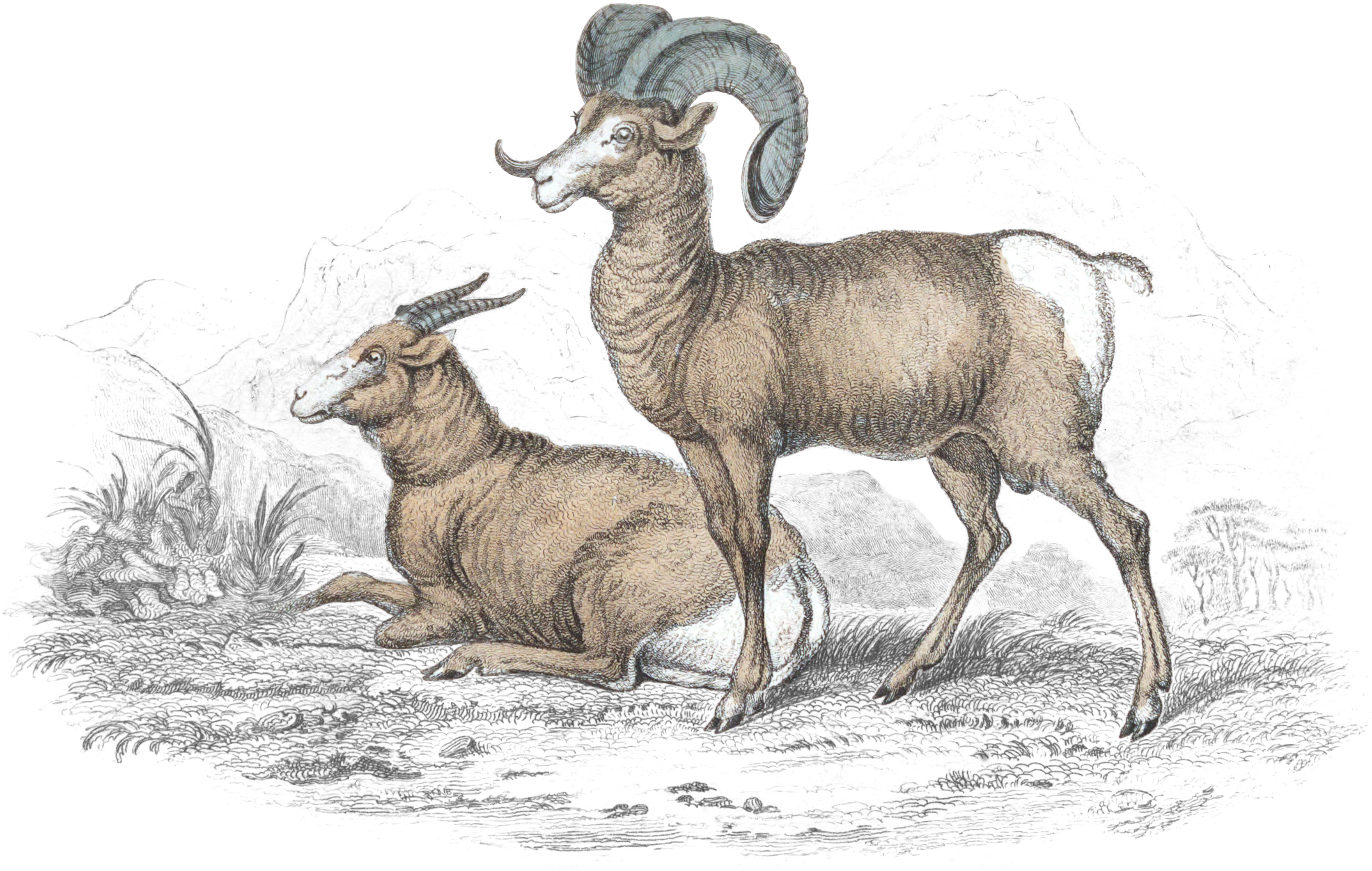
Plate XIII

We now come to review some of the more remarkable of the domestic races, but if all the varieties were to be described, much more than the proper proportion of our space would be occupied, and on that account one or two only of these from each continent will be noticed. It may be premised, that writers have generally placed all the varieties under the denomination of Ovis aries, though it is generally acknowledged that it is from some one of those we have been now describing that they are derived. Among the European races with which we shall commence, by far the most important, as far as regards the texture of the wool, is the Merino, though, if we shall look to a combination of advantages, some of the British breeds will surpass it in value; while by crossing, the hardier nature has been transferred, and the produce of a wool of equal quality, but nearly double in quantity, has been yielded by some of them. The sheep known by the name of the Ryeland breed has been most successful in Britain under this kind of management.
The Merino Breed
To the Merino breed, Ovis hispanica has been applied, and, as the name implies, is chiefly cultivated in Spain. It is distinguished from the British breeds, by bearing wool on the forehead and cheeks. The horns are very large and ponderous, and convoluted laterally. The wool is fine, long, soft, and twisted, in silky-looking spiral ringlets, and having a large proportion of natural oil, to which the dust and other impurities adhere, gives a dingy and unclean appearance to the animal, which conveys an idea of inferiority, but which is immediately removed when the unsullied pureness and fineness of the wool is seen on separating it. The make of the Merino is not so symmetrical as some of our British breeds, and there is a loose skin hanging from the neck, which detracts from its appearance. Many different breeds exist, hut the best is supposed to be those of Cavagne and Negrote. These are kept during the winter in particular districts of milder climate, and are travelled to other districts to be shorn, and again removed to the most favourable grazing stations. The Pyrenean races are rather more hardy, but yield a remarkably fine wool; they are cultivated to a great extent, and in a particular manner, which we find detailed by Mr Young in the Annals of Agriculture:
On the northern ridge, bearing to the west, are the pastures of the Spanish flocks. This ridge is not, however, the whole; there are two other mountains quite in a different situation, and the sheep travel from one to another as the pasturage is short or plentiful. I examined the soil of these mountain pastures, and found it in general stony; what in the west of England would be called a stone-brash, with Rome mixture of loam, and in a few places a little peaty. The plants are many of them untouched by the sheep; many ferns, narcissus, violets, &c.; but burnet (Poterium sanguisorba), and the narrow-leaved plantain (Plantago lanceolata), were eaten, as may be supposed, close. I looked for trefoils, but found scarcely any. It was very apparent that soil and peculiarity of herbage had little to do in rendering these heights proper for sheep. In the northern parts of Europe, the tops of mountains half the height of these (for we were above snow in July) are bogs; all are so which I have seen in our islands; or, at least, the proportion of dry land is very trifling to that which is extremely wet. Here they are in general very dry. Now, a great range of dry land, let the plants be what they may, will in every country suit sheep. The flock is brought every night to one spot, which is situate at the end of the valley on the river I have mentioned; and near the port or passage of Picada, it is a level spot, sheltered from all winds. The soil is eight or nine inches deep of old dung, not at all enclosed: from the freedom from wood all around, it seems to be chosen partly for safety against wolves and bears. Near it is a very large stone, or rather rock, fallen from the mountain. This the shepherds have taken for a shelter, and have built a hut against it: their beds are sheepskins, and their doors so small that they crawl in. I saw no place for fire, but they have it, since they dress here the flesh of their sheep, and in the night sometimes keep off the hears by whirling firebrands: tour of them, belonging to the flock mentioned above, lie here. I viewed their flock very carefully, and, by means of our guide and interpreter, made some inquiries of the shepherds, which they answered readily and very civilly. A Spaniard at Venesque, a city in the Pyrenees, gives 600 livros French (the livre is 10\(\frac{1}{2}\)d. English) a-year for the pasturage of this flock of 2000 sheep. In the winter he sends them into the lower part of Catalonia, a journey of twelve or thirteen days; and when the snow is melted in the spring, they are conducted back again. They are the whole year kept in motion, and moving from spot to spot, which is owing to the great range they everywhere have of pasture. They are always in the open air, never housed or under cover, and never taste of any food but what they can find on the hills.
Four shepherds, and from four to six large Spanish dogs, have the care of this flock: the latter are in France called of the Pyrenees breed; they are black and white, of the size of a large wolf, a large head and neck, armed with collars stuck with iron spikes. No wolf can stand against them; but hears are more potent adversaries; if a bear can reach a tree, he is safe; he rises on his hind legs with his back to the tree, and sets the dogs at defiance. In the night the shepherds rely entirely on their dogs; but, on hearing them hark, are ready with fire-arms, as the dogs rarely hark if a hear is not at hand. I was surprised to find that they are fed only with bread and milk. The head shepherd is paid 120 livres a-year wages, and bread; the others 80 livres, and bread; but they are allowed to keep goats, of which they have many, which they milk every day. Their food is milk and bread, except the flesh of such sheep or lambs as accidents give them. The head shepherd keeps on the mountain top, or an elevated spot, from whence he can the better see around, while the flock browses the declivities. In doing this, the sheep are exposed to great danger in places that are stony; for, by walking among the rocks, and especially the goats, they move the stones, which rolling down the hills, acquire an accelarated force, enough to knock a man down, and sheep are often killed by them; yet we saw how alert they were to avoid such stones, and cautiously on their guard against them. I examined the sheep attentively. They are in general polled, but some have horns, which, in the rams, turn backwards behind the ears, and project half a circle forward: the ewes’ horns turn also behind the ears, but do not project; the legs white or reddish; speckled faces, some white, some reddish; they would weigh fat, I reckon on an average, from 15 Ib. to 18 Ib. a quarter; some tails short, some left long. A few black sheep among them; some with a very little tuft of wool on their foreheads. On the whole, they resemble those on the South Downs; their legs are as short as those of that breed, a point which merits observation, as they travel so much, and so well. Their shape is very good; round ribs, and flat straight backs; and would be with us reckoned handsome sheep, all in good order and flesh. In order to be still better acquainted with them, I desired one of the shepherds to catch a ram for me to feel, and examine the wool, which I found very thick and good, of the carding sort, as may be supposed. I took a specimen of it, and also of a hoggit or lamb of last year. In regard to the mellow softness under the skin, which, in Mr Bakewell’s opinion, is a strong indication of a good breed, with a disposition to fatten, he had it in a much superior degree to many of our English breeds, to the full as much so as the South Downs, which are for that part the best short-woolled sheep which I know in England. The fleece was on his back, and weighed, as I guessed, about 8 Ib. English; but the average, they say, of the flock is from 4 to 5, as I calculated by reducing the Catalonian pound of 12 ounces to ours of 16, and is all sold to the French at 30s. the pound French. This ram had the wool of the back part of his neck tied close, arid the upper tuft had a second knot by way of ornament; nor do they ever shear this part of the fleece for that reason; we saw several in the flock with this species of decoration; they say that this ram would sell in Catalonia for 20 livres. A circumstance which cannot be too much commended, and deserves universal imitation, is the extreme docility they accustom them to. When I desired the shepherd to catch one of his rams, I supposed he would do it with his crook, or probably not be able to do it at all; but he walked into the flock, and, singling out a ram and a goat, bid them follow him, which they did immediately; and he talked to them while they were obeying him, holding out his hand as if to give them something. By this method he brought me the ram, which I caught and held without difficulty.21
The wool exported from Spain was lately above 9,700,000 lb., of which a portion comes to Britain. In 1829 above 30,000,000 lb. of wool was imported, the greater part of which was from Germany, Spain bearing but a small proportion, only about two-thirds more than what we received from our Australian possessions. In France cross-breeds are cultivated, demi-Merinos as they are called; and in Saxony, Bohemia, and Hungary, they also abound exceedingly.
Among the other breeds of Europe which are not British, may also be mentioned the Cretan, distinguished by the horns ascending directly upwards, with a spiral turn; and in a variety termed the Wallachian, the horns are equally developed, but diverge nearly at right angles from the head.
The Iceland Breed
But the most remarkable anomaly among the horn-bearing animals is the Many-horned Iceland breed, extending very frequently in this country to the common black-faced breeds of Scotland. Sheep and goats are the only animals which exhibit this multitudinous growth of horns, and in the breed of the former, which we have now alluded to, the flocks are almost in a state of unreclaimed nature, and by far the greater proportion have more than the usual number of horns; and it may be here remarked, that the same circumstance prevails among some of the Asiatic races. The natural horns rise in their proper places, the accessory horns usually upon the sides of the head, and are from one to three in addition. In other points there is no perceptible variation in the animal, from the common characters of the breeds to which it belongs.
Arriving nearer home, let us now look to the breeds of the British Islands, supposed at the present time to possess a living stock of about 32,000,000 sheep, yielding, of course, an immense quantity of wool annually; and there is no country in the world where this branch of rural economy has been carried to so great an extent, or the imported breeds so much improved in value, by an assiduous attention and care to procure the best varieties whence to continue the flock. The improvement has fortunately been attended with very large profits to the individuals who have from time to time engaged in it, and thus it is that we have such variety of constitution adapted either to the deep and rich soil, and luxuriant pasture and balmy climate of the south, the sharper soils and rich grasses of the upland counties, or the high and alpine herbage of the north, cold in its climate and searching: in its storms and snows, where the life of the shepherd is no sinecure, but where the summer bite, though short, is nourishing and sweet, and where the heathy mixture imparts a flavour coveted even by the luxurious of the southern metropolis.22
In illustration of the British breeds, we have selected two as opposite as possible, yet each of them very extensively bred. We shall for this time give the preference to those of the south, and first notice
The Leicester Sheep
Among all the artificial breeds of animals, a certain standard has been generally fixed, which is supposed to combine the greatest excellences, according to the purposes for which the animal is employed; and it maybe here proper to notice what has hitherto been considered as the most perfect form of the sheep, and which is equally applicable to every breed, as the nearer they approach to this standard, so it is thought they will be most profitable to the owners.
Mr Culley writes,
The head of the ram should be fine and small, his face white, nostrils wide and expanded, his eyes prominent, and rather bold or daring, ears short and thin, his collar full from his breast and shoulders, but tapering gradually all the way to where the neck and head join, which must be very fine and graceful, being perfectly free from any coarse leather hanging down; the shoulders broad and full, which must at the same time join so easy to the collar forward, and crops backward, as to leave not the least hollow in either place; the mutton upon his arm or fore thigh must come quite to the knee; all his legs white and upright, with a clean fine bone, being equally clear from superfluous skin and coarse hairy wool, from the knee and hough downwards; the breast broad and well formed, which will keep his fore legs at a proper wideness; his girth or chest full and deep, and instead of a hollow behind the shoulders, that part, by some called the fore flank, should be quite full; the back and loins broad, flat, and straight, from which the ribs must rise with a fine circular arch; his belly straight, the tail well set up, quarters long and full, with the mutton quite down to the hough, which should neither stand in nor out; his twist deep and full, which, with the broad breast, will keep his fore legs open and square; the whole body covered with a fine thin rosy pelt, and that with a fine long bright and soft wool.23
The Leicester or Dishley breed is now the most common, and most extensively reared, over all the rich and low-lying pasture-land of England. It is distinguished from the other long-woolled breeds by
having fine lively eyes, clean heads without horns, straight broad flat back, round or barrel-shaped bodies, fine small bones, thin pelts, and a disposition to make fat at an early age, with a superiority in the fineness of the grain and flavour of the mutton.24
This is properly what was formerly the Lincolnshire breed, remarkable for the quantity of wool, but affording a very coarse and unprofitable mutton. Mr Bakewell, by attention to the points already mentioned, attempted to combine quantity and quality of wool, with excellency of the meat and early feeding, and effected an improvement in the breed, which was not only productive to himself, but of lasting importance to the agriculturist and wool-grower. The advantages of this breed were so apparent, that, at the introduction of these sheep, Mr Bakewell was said to have made (in the year 1789) 1200 guineas by three rams, 2000 of seven, and 3000 of the remainder of his stock; a return unprecedented in the annals of sheep-breeding. They were capable of being made what may be called enormously fat at an early age. Mr Culley killed a three years old wether in October 1787, with more than seven inches of solid fat on his ribs; and it was common for two years old wethers to have four inches of thickness of fat on the ribs, and from two to three all down the back. This breed has now extended to the south of Scotland, and a few are kept by almost all the smaller farmers, for the sake of wool for his family; and with every cottar who has the means of keeping a pet, this is the kind which is selected, both from its abundant fleece, and its quiet, unstraying manners. In some districts, a valuable race has sprung from a mixture with both the Cheviot and black-faced breeds. The latter we now illustrate by a representation of

Plate XIV
The Black-Faced Ram
The Ancient, or Black-faced Heath-breed, extends from the north-western parts of Yorkshire to all the high districts of the Highlands, particularly those of the western coast. It is by far the most picturesque looking of our sheep, and, with wild little Kyloe, is a fitting accompaniment to the landscape of our northern hills. It is extremely active and hardy, even somewhat goat-like in its motions and scansorial habits; of a firm, compact make, a piercing and wild-looking eye; the horns in the male very large and voluminous, more convoluted than even in the Merino; the wool long, coarse-like and shaggy; the face and legs always black. There are spurious breeds, which have the face and legs brownish, and spotted with black; but, in the words of Dr Walker, in the true ram
his face and slender legs are black as jet, without any mixture of white.
The flesh or mutton is fine grained and well flavoured, but the wool is coarse, and comparatively unprofitable, which has of late caused a considerable change of the northern stock to the Cheviot breed, which are found to be nearly equally hardy, and to yield a more profitable fleece. Many attempts have been made to improve this breed. The Norfolk and Suffolk sheep are supposed to be derived from them, also the Dorset breeds.

Plate XV
The Hebridian is also a remarkable breed of British sheep. It is the smallest animal of its kind, of a thin lank shape, and with short straight horns. The face and legs are white, the tail extremely short, and the wool of various colours; for, besides black and white, it is sometimes of a bluish-grey colour, at other times brown, and sometimes of a deep russet, and frequently an individual is blotched with two or three of these different colours. In some of the low islands, where the pasture answers, the wool of this small sheep is of the finest kind, and the same with that of Shetland. In the mountainous islands, the animal is found of the smallest size, with coarser wool, and with this very remarkable character, that it has often four, and sometimes even six, horns.25
In conclusion we shall give Mr Culley’s synoptica table of the British breeds, of which he enumerates sixteen:—
| 1. Dishley | No horns | White face and legs | Combing wool | Fleece 8 lb. | Quarter 25 lb. | Age 2 years |
| 2. Lincoln | Ditto | Ditto | Ditto | Fleece 11 lb. | Quarter 25 lb. | Age 2 years |
| 3. Teeswater | Ditto | Ditto | Ditto | Fleece 9 lb. | Quarter 30 lb. | Age 2 years |
| 4. Dartmoor | Ditto | Ditto | Ditto | Fleece 9 lb. | Quarter 30 lb. | Age 2\(\frac{1}{2}\) years |
| 5. Exmoor | Horned | Ditto | Ditto | Fleece 6 lb. | Quarter 16 lb. | Age 2\(\frac{1}{2}\) years |
| 6. Dorest | Ditto | Ditto | Carding wool | Fleece 3\(\frac{1}{2}\) lb. | Quarter 18 lb. | Age 3\(\frac{1}{2}\) years |
| 7. Hereford | No horns | Ditto | Fine wool | Fleece 2 lb. | Quarter 14 lb. | Age 4\(\frac{1}{2}\) years |
| 8. South Down | Ditto | Grey face and legs | Ditto | Fleece 2\(\frac{1}{2}\) lb. | Quarter 18 lb. | Age 2 years |
| 9. Norfolk | Horns | Black face and legs | Ditto | Fleece 2 lb. | Quarter 18 lb. | Age 3\(\frac{1}{2}\) years |
| 10. Heath | Ditto | Ditto | Coarse combing | Fleece 3\(\frac{1}{2}\) lb. | Quarter 15 lb. | Age 4\(\frac{1}{2}\) years |
| 11. Herdwick | No horns | Speckled face and legs | Carding | Fleece 2 lb. | Quarter 10 lb. | Age 4\(\frac{1}{2}\) years |
| 12. Cheviot | Ditto | White face and legs | Ditto | Fleece 3 lb. | Quarter 16 lb. | Age 4\(\frac{1}{2}\) years |
| 13. Dun-faced | Ditto | Dun face and legs | Ditto | Fleece 1\(\frac{1}{2}\) lb. | Quarter 7 lb. | Age 4\(\frac{1}{2}\) years |
| 14. Shetland | Ditto | Colours various | Fine cottony | Fleece 1\(\frac{1}{2}\) lb. | Quarter 8 lb. | Age 4\(\frac{1}{2}\) years |
| 15. Romney Marsh | Ditto | White face and legs | Combing | Fleece 8 lb. | Quarter 25 lb. | Age 2\(\frac{1}{2}\) years |
| 16. Spanish | Horns | Ditto | Carding | Fleece 3\(\frac{1}{2}\) lb. |
We quote the following from M‘Culloch’s Commercial Dictionary, 1825:
| Number of long-woolled sheep in England and Wales | 4,135,308 |
| Number of short-woolled do. | 14,854,299 |
| 19,007,607 | |
| Slaughter of short-woolled sheep per annum | 4,221,748 |
| Carrion of do. | 211,087 |
| Slaughter of long-woolled do. | 1,180,413 |
| Carrion of do. | 59,020 |
| Slaughter of lambs do. | 1,400,560 |
| Carrion of do. | 70,828 |
| 7,140,856 | |
| Total Number of Sheep and Lambs | 26,148,463 |
In some parts of England there has been an increase in the number of sheep since 1800, and in others they have decreased. But we have been assured by competent judges that upon the whole the number has not materially varied in the interim.
During the last half century a very decided increase has taken place in the number of sheep in Scotland, and a very great improvement in the breed, particularly in the Highlands.
In the General Report of Scotland (Vol. iii. Appen. p. 6.), the number of sheep is estimated at 2,850,000; and allowing for the increase that has taken place since 1814, we may perhaps estimate the total number of sheep in that part of the empire at this moment (1835), at 3,500,000.
In Ireland, the total number may be estimated at about 2,000,000; and on the whole, therefore, 32,000,000 may be assumed as the grand trial number in Great Britain and Ireland at the present time.
Of the African breed of sheep, one of the most abundant is the Long-legged Sheep; according to F. Cuvier, the Ovis Africana and Æthiopica of systematists, but evidently only a peculiar form of the animal. It is particularly characterized by the great length of the legs, the pendulous ears, the arched forehead, and the fleece, which is short, curled, and crisp; upon the neck it assumes the form of a mane, and on the shoulders often spreads out from a centre, like hair on the rump of the camel or dromedary. Cuvier’s figure is represented black and white, and was procured from Faisan. We may here notice, as somewhat allied, a breed from Persia.
The Persian Sheep
This seems somewhat allied to these, has the pendulous ears and arched profile, stands somewhat high, and has short crisp wool. It now forms part of the collection in Edinburgh. For several years it was kept tame in Mr James Wilson’s garden, and we are indebted to that gentleman for the account of its life and manners during the period he preserved it.
The black-headed sheep which lived with me as a pet for nearly a year and a half, was, I understand, one of a small flock (originally from Persia) received some time before by Sir James Gibson Craig. The individual in question had been sent to the Edinburgh Museum as a specimen. It was thin, and in poor condition; but being otherwise an interesting creature, I begged and obtained its life from Professor Jameson, on condition that when it died a natural death, I would return it. I accordingly took it out to Woodville, where it rejoiced greatly in its first feed of sweet fresh grass, after a sojourn of some days in a large lumber room in an old part of the College now no more. As winter was approaching, we generally housed it in the stable before night; but it was always on the alert at an early hour in the morning, and anxious to be brought to a little plot of grass before our cottage windows, where it seemed to enjoy the vicinity of human beings, and delighted to be spoken to or fondled by children. It was extremely mild, gentle, and affectionate in its disposition,—never attempting to make a butt of, or otherwise annoy, its friends. It would follow us about the garden, and, if taken no notice of, would frequently remind one of its presence by a gentle insertion of its muzzle into the hand, or even pocket. This habit probably arose from its being so frequently fed throughout the day with bits of bread, biscuit, apples, &c. Although, of course, not allowed to go at large in the garden, it often escaped there from its own little plot of grass, and wandered about, apparently with a view to satisfy rather its curiosity, or love of company, than its appetite; for it seldom touched any of the plants, except those (of the culinary kind) to which it had a legal right. It continued thin and rather feeble all winter, but as the weather improved in warmth and brightness, it obviously increased in health and spirits, and throughout the summer season its motions were very free and graceful, and its attitudes at times expressive of great boldness. To human creatures, however, especially children, it continued to be uniformly gentle and attached; but it shewed great spirit in driving all strange dogs from the door, and I once saw it greatly astonish a large bull-terrier, by suddenly bounding upon it, and knocking it head-over-heels. When in a state of eagerness or excitement, it paced about more like a deer than a domestic sheep; that is, it held its head and neck very erect, and its fore limbs very straight and firm, lifting its feet high while walking, and setting them down with force. The stuffed specimen conveys no notion of the way in which it stood upon its pins. When a carriage came to the door, it would stamp with its feet, and utter a deep tremulous angry bleat, as if to deter the horses from entering any farther upon its domains.
It became again feeble and emaciated about the middle of the second winter, and died in the stable during the prevalence of a severe storm of frost and snow. Though of a picturesque and pleasing aspect, it was not of a form or countenance to be admired by the cultivators of our domestic sheep; its arched front, and various other characters, partaking strongly of the acknowledged attributes of our unimproved breeds. Its death, however, was deeply regretted by us all.
It appears to spread itself into many varieties; the Morocco breed: the Congo breed, with a very arched profile, and covered with very loose wool instead of hair; the ears very pendulous, two wattles beneath the throat, and the tail very long and slender: the Guinea breed, and the Angola races, which have a finer wool, and the profile more nearly approaching to the form of the sheep of Europe.
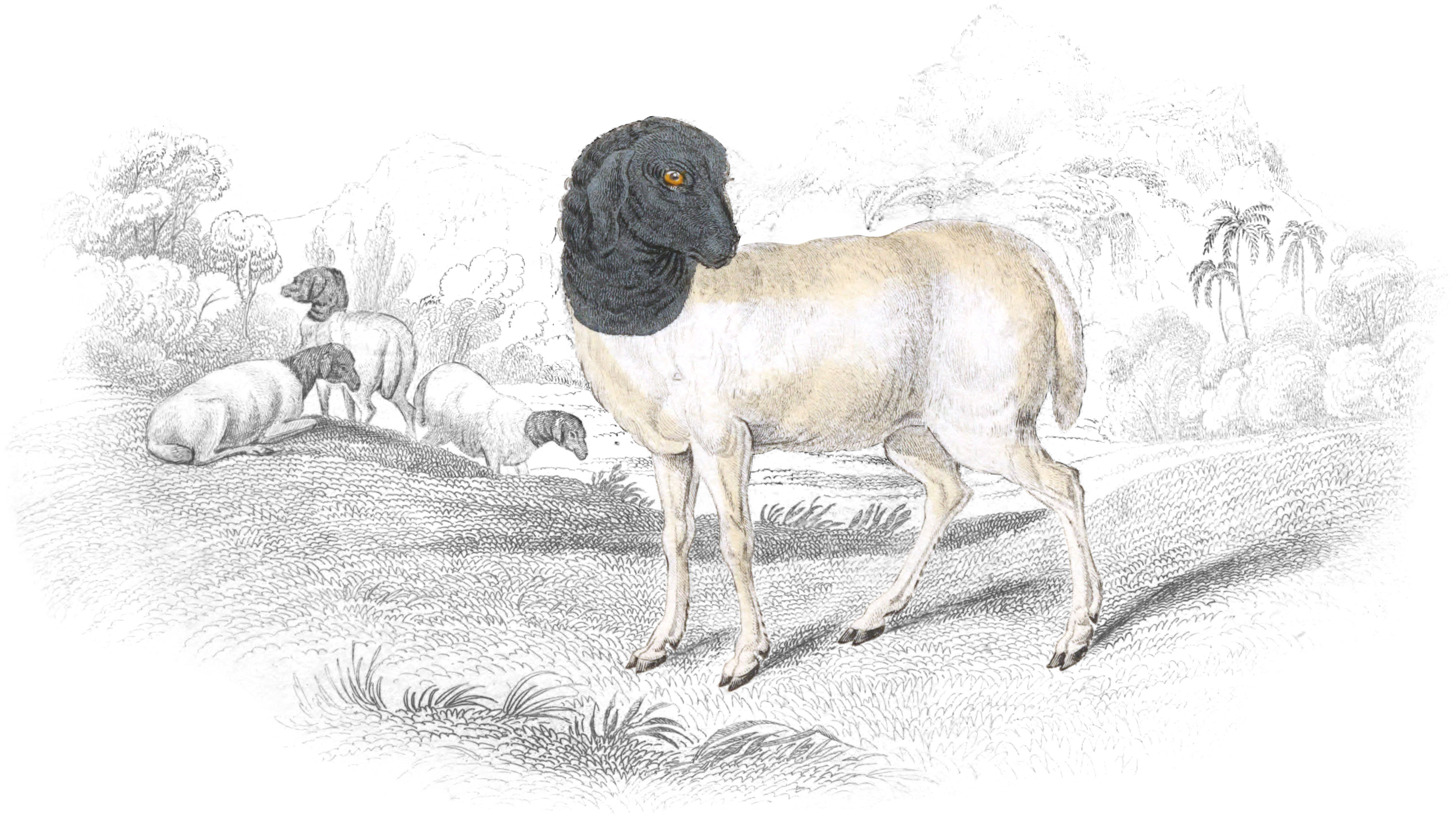
Plate XVI
There is a curious variety which Major Smith refers to the Angola race, and has given a figure under the name of the Zunu or Goitered breed,
it has the singular peculiarity of a mass of fat rising in the form of a high collar behind the horns, and resting upon the occiput, while upon the larynx another mass of fat hangs like a goitre under the throat.

Zunu Head
But one of the breeds of Africa which has been perhaps as often noticed as any other, is the large-tailed or fat-rumped sheep of South Africa. The races of this variety also extend to other parts of Africa, and apparently also to Asia. We here represent
The Barbary Broad-Tailed Sheep
From the great commercial intercourse possessed by the Cape of Good Hope, we might expect to find a large proportion of varieties among those animals which are domestic, and accordingly we find very various breeds both from Europe and India, and particularly some of the Dutch and Flemish breeds; but the Broad or Fat-tailed, is now what is termed the South African or Hottentot breed. It is below the middle size. The fleece soft and short wool, and the name is derived from two masses of fat on each side of the inferior part of the tail, which often reach a great weight, and are esteemed as a delicacy; those sheep which can grow them heaviest and largest being picked out and endeavoured to be continued as a breed, on account of the luxury of this part; a little carriage with wheels is sometimes attached to bear up the tail and protect it from rubbing on the ground. The Ovis steatopyga of southern Tartary, also belongs to these, but the ears are long and pendulous, while the broad-tailed breeds of northern and middle Asia have the ears pointing forwards, the profile much arched, and the horns from three to six in number.
The O. steatopyga or Fat-rumped Sheep of Pallas, the same we have just alluded to, is reared throughout all the temperate regions of Asia, from the frontiers of Europe to those of China in the vast plains of Tartary, where the hordes of Kirguize Tartars lead a wandering life, seeking fresh and fitting pasture. The body of the animal towards the posteriors swells gradually with fat; but the characteristic mark is the deposition of a solid mass of fat on the rump, which falls over in the place of a tail, divided into two hemispheres, which take the form of hips, with a little button of a tail in the middle, to be felt with the finger. It sometimes becomes so loose as to incommode the sheep, and weighs thirty-eight pounds.26
The subject of our plate is from the figure of Frederic Cuvier, and is the Barbary breed, with the profile arched, the ears of middling size and pendant; the fleece of a thick but coarse wool, the horns have the direction of those of the Moufflon, and the tail, on each side, is loaded with an accumulation of fat.
All observers have attributed this accumulation of fat to the peculiarity of feeding, but there seems no reason or detail of experiments which can prove any thing satisfactorily; Fred. Cuvier remarks, that the fat of the tail when run, will never assume the solidity or consistency of the tallow of the other parts of the body,—arguing from this that there is something different in its secretion. Dr Pallas suggests that it may be the prevalence of wormwood in the Asiatic pasture, which causes fat on the O. steatopyga, and the efflorescence from the salt lakes which impregnate the pasture.
Among the Asiatic breeds, besides the Fat-rumped Sheep, which we have noticed, that of the Broad-tailed extends very widely, to India, China, and Russia. One of the most celebrated, however, is the Astracan breed or Boucharian breed of Pallas, belonging also to this. It is remarkable for the fine spirally twisted wool; and it is from this breed that a great portion of the lamb skins, so much in request by the furriers, is procured. The colour of the wool is generally a pleasing mixture of black and white; and Fred. Cuvier remarks, that among the broad-tailed breeds, the wool of the young has a very great tendency to be united into two small twisted curls, closely united, but which, soon after birth, are separated; on this account, the skins of the lambs which are taken from sheep which have died, are much more valuable, and those of an entirely black tint are most sought after.
A small flock of this breed was introduced into France in 1821, by the Duke de Richelieu, with the intention of having them extended and brought to propagate in the country, and endeavour to organize a commerce of the lamb skins. The attempt, we believe, has not since been heard of.27
The Tscherkessian Sheep of the Russians and Tartars, mentioned by Pallas, as the Ovis Dolichura, is also very extensively used for the same purpose. It is a handsome animal resembling some of the Spanish and English breeds. The rams are horned, the wool is coarse in the adult state, and the tail, which contains twenty vertebrae, is covered with fine long wool, which trails on the ground, so as to efface the prints made by the animal’s feet. It is reared in all the European regions situated on this side of the river Occa, by the pastoral people of Mount Caucasus. They are commonly of a white colour. There is also more art resorted to here in the preparing of the lamb skins. As soon as the lamb is dropped, it is sewed up in a sort of coarse linen shirt, so as to keep up a gentle pressure on the wool, pouring warm water over it every day to make it soft and sleek, only letting out the bandage a little from time to time as the animal increases in size, but still keeping it tight enough to effect their purpose, which is to lay the wool in beautiful glossy ringlets, and thereby produce a delicate species of fur, in great request for lining clothes and morning gowns; and the animal is killed younger or older, according to the specimens of fur intended to be produced. Black is also in the most esteem.28
The most beautiful Indian breed is said to be from Mysore, hornless, with pendulous ears, short tail, and the wool very fine, curled in small meshes, and twisted like a cork skrew.

Plate XVII
Having reviewed the Sheep, Major Smith finds his way to the Bovine races, by means of a series of large and powerful animals, uniting in some degree the features of both, but although hitherto generally referred to the Antelopes, from the outward appearance of their horns, yet, perhaps, their real structure approaches nearer to the oxen then either to the Antelopes, or the Sheep and Goats. Mr Swainson, in his late arrangement, places the Damalis of Smith, as the last of the Goat, which he includes in his family Antelopidæ, while he makes Catoblephas or the Gnu at the commencement of the Bovidæ or the typical form of the Ruminants.
They are all rather large animals. The interscapular or first vertebrae of the back are generally elevated above the rest of the spine; and Major Smith has observed a curious structure in the horns, They are
placed on or even above the ridge of the frontals, having within the osseous nucleus or case a considerable cavity, communicating (in all the species we have been able to examine), externally by a sinus, which passes under the horny substance, nearly opposite the root of the ear.29
With one exception they inhabit Africa.
The Damalis, as a genus, or his Acronotine group, Major Smith has divided into subgenera, the first of which will be represented by
The Bubalis
Acrontus bubalis.—Smith.
This is a large animal, equalling the size of a Stag, but of heavy proportions, and of comparatively inferior speed. It is entirely of a yellowish dun colour, whiter on the lower parts and insides of the legs, and having the tail black, altogether resembling a cow in form, and being in reality termed in the native language of the Arabs, wild cow or ox. They inhabit the north of Africa, live in small troops, and are said to be easily tamed, a circumstance not, however, reconcilable with Fred. Cuvier’s specimen, which served for our present figure, and was a mischievous animal, while in the Menagerie of Versailles. The horns are directed backwards, and all those animals furnished with horns which point in this direction, use them by placing the forehead parallel to the ground between the fore legs, and in this position either wait for the assailant, or rush upon the enemy, and suddenly raising their head at the moment of contact with immense force, inflict large and torn wounds of the most dangerous description.
In the Dictionnaire Classique, it is mentioned, that on some antique carving, the peculiarity of the horns which the Bubalis exhibits, is distinctly marked on some ox-like animals represented harnessed to a chariot; while in others, supposed to be true oxen, no such marking of the horns is visible: from hence it becomes a question whether or not this animal was not tamed and sometimes used by the ancient Egyptians as beasts of draught, for in these representations such minute descriptions are often most scrupulously attended to.
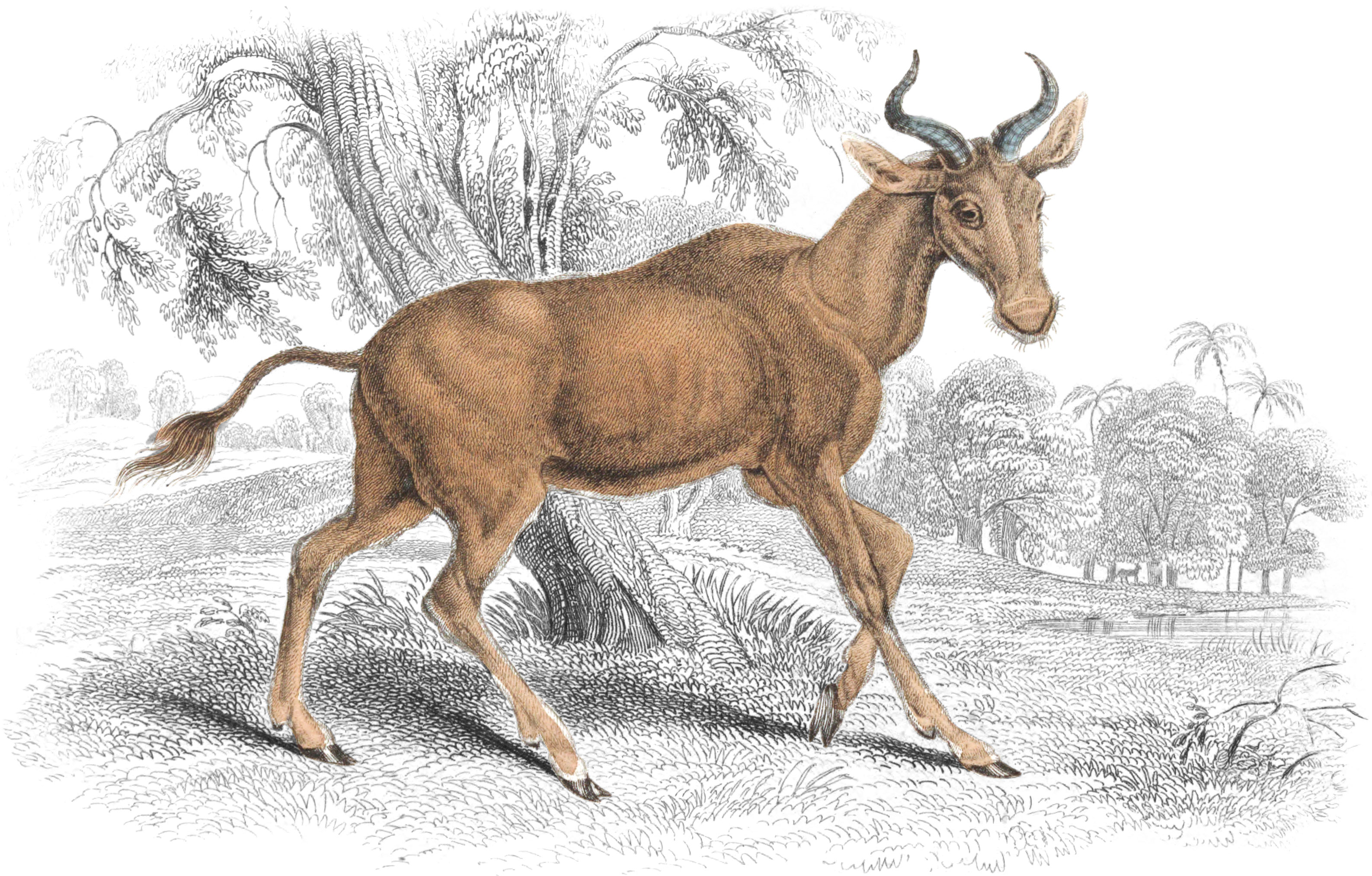
Plate XVIII
The Corina is another fine animal belonging to this group, the Hartbeest of the Cape colonists, but now, from being much hunted, having become rare within the bounds of the colony; according to Pennant, who confounds this with the last, they go in great herds, a few only being solitary. They gallop with a heavy pace, yet go swiftly, and drop on their knees to fight like the white-footed Antelope or Nil-Ghau.30 This is stated on the authority of Sparman, but Major Smith observes that they reside in small flocks of ten or twelve, in the interior of Caffraria.
The Collared damalis, A. saturosa, is another animal but little known, and supposed to inhabit Africa, is described in the Berlin Transactions. A. Senegalensis, the Koba, is known almost only by the skull, and has yet been imperfectly described; and the Sassayby of Mr Daniel, is the last which is referred to this form, termed A. lunata by Smith, and described from a specimen procured by Mr Burchell, which he refers to Daniel’s animal, though sufficiently accurate notes are wanting of this. Mr Burchell met with a single specimen in the Booshwana country, a female. The horns were robust, rising from the summit of the frontal crest at the base, close together, swelling out a little forwards, and then backwards. The height of the imperfect skin was about three feet at the shoulder, two feet eight inches at the croup. The fur of a deep blackish purple brown, the ears assinine, six inches and a half long, lined with light hair within and on the edges. There is a lacrymary sinus. The face is of a rufous dun colour, and a black streak commences between the horns, contracting between the eyes, and again widens near the nostrils.
The next is a very remarkable group or subgenus, Boselaphus, restricted by Major Smith to two species, and now represented by
The Impoofo
Baselaphus oreas.—Smith.
In this animal there is a great resemblance to some of the oxen. Its large size, its more clumsy form, its heavy gait, and the large hairy dewlap, all remind one of them. At present, the Impoofo is found on the Karoo plains, in company with some of the larger inhabitants and ostriches of these districts; though formerly it was so abundant in the Cape colony, and so easily managed by a swift horse, that the hunters would drive it in the direction of their homes, and bring it down only when they thought it convenient for their servants to carry it home.31
These animals, Lichtenstein observes, are much esteemed by the colonists for food. Hunting parties are often made from some settlement, attended with all the necessary apparatus, wagons to carry home the spoil, &c. The meat is cut in pieces on the spot, salted and packed in the skins, and some of it is smoked. The great muscle of the thigh smoked is more particularly esteemed; these are cut out at their whole length, and from the resemblance they bear to bullock’s tongues are called Thigh Tongues. They are sent as presents or for sale to Cape Town, and are eaten raw with bread and butter, cut into very thin slices. The taste of Eland’s flesh, when eaten fresh, much resembles beef. The skins are much esteemed for making leather, and the horns are formed into tobacco pipes.32 Thus, they appear to be a very useful animal, and it must be regretted that persecution is likely to destroy the species in the vicinity of civilization.
According to the above quoted author, the Eland is from seven to eight feet in length, and about four feet high. They are sometimes found in groups of twenty or thirty together, but more commonly from eight to ten, of which there are seldom more than one or two males, which are fattest, and are always singled out for destruction. They run swiftly at first, but are easily wearied and run down, and are said by the peasants to be more easily taken by man than any other of the African animals.
Major Smith gives the dimensions larger than those of Lichtenstein. The weight is often above a hundred pounds; the length between eight and nine feet. The height of a female in the Tower was five feet at the shoulder; and Mr. Barrow mentions a male six feet and a half high. The horns are placed on the summit of the frontal bone, sometimes two feet in length, and having a spirally twisted appearance. On the middle of the forehead there is a recurved crest of bristles, reminding us of what will be seen in the Gnu, and which passes along the ridge of the neck The colour of the animal appears of a dirty grey, a rufous or buff colour being placed on a black hide. The hoofs resemble those of a Guernsey Cow. The females exhibit all the separating marks which distinguish the bull and cow, less powerful neck, smaller horns and dewlap, and altogether a smaller bulk.
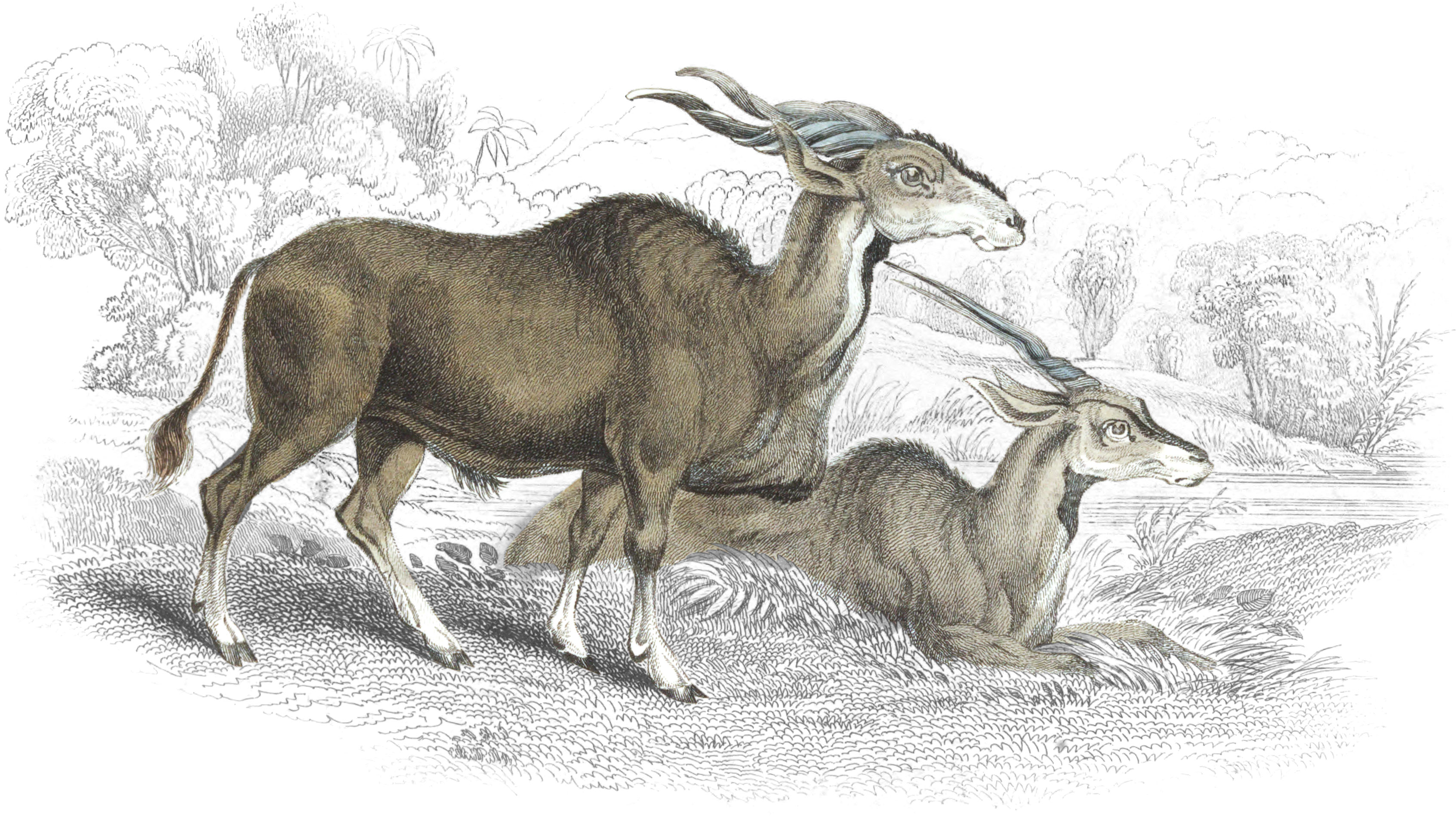
Plate XIX
The other species which Major Smith has introduced into this subgenus, he denominates B. Canna, an animal comparatively little known, and generally confounded with the preceding. It is of less size. The general colour is a dark brownish grey, a white space between the forelegs. They are met with in the same districts with the Impoofo, but the herds never mingle; and from the colonists they receive the name of Bastard Eland.
The next subgenus is also an African form, and is illustrated by
The Koodoo
Strepsiceros koodoo.—Smith.
Antelope strepsiceros of Authors.—Striped Antelope, Pennant’s Quad. i. p. 77.—The Koodoo, Daniel.—Damalis (Strepsiceros), Smith in Griffith’s Cuvier, iv. 357.
This is a large and very beautiful animal, combining many of the characters of the Sheep, Oxen, and Antelopes. The male is nearly four feet high, arid about eight feet long, exclusive of the tail. The general colour is a sort of buff-grey, with a line of white passing down the spine, crossed by four or five others from behind the shoulders, and from two to four across the croup. The forehead is black, and a white line passes over the orbits; a ridge of black hair runs along the crest of the neck, and a similar one, longer and coarser, hangs from the dewlap. The horns rise from the crest of the skull, and rise perpendicularly up in large spiral whorls. Mr Pennant mentions them as three feet nine inches in length.
The Koodoo inhabits the woody parts of Caffraria and the Karoo Mountains; but like the other large species, begins to get scarce. They are fleeter than the last, but cannot keep up a long run, coming speedily to bay, and defending themselves with their long horns.
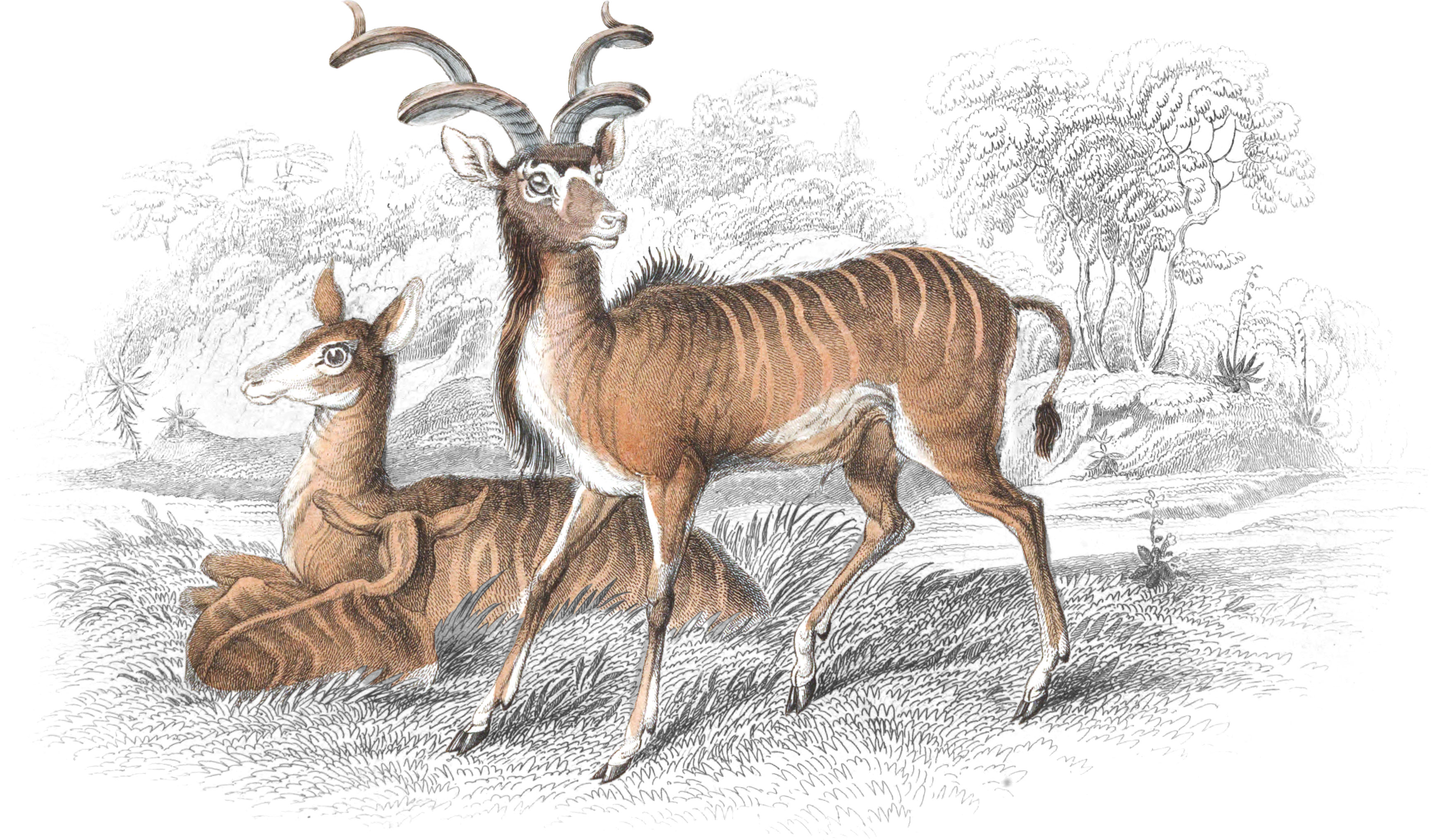
Plate XX
We have now reached the last form among the Antelopine animals, and also among those which our guiding author has placed in a manner by themselves, combining a variety of characters, but having one in particular, the shoulders always standing considerably higher than the croup. The three last groups of this description were found in Africa. The present animal inhabits Northern India; and though exhibiting the same make, and, as it were, humped form at the shoulders, is rather a graceful animal; but it is a curious circumstance, and shews their affinity, that by the native names these animals are not at all grouped with the antelopes, but invariably bear some designation having the meaning of cow or ox, with some accessory attached, derived from their colour or other distinguishing mark. It will be illustrated by
The Neel-Ghau33
Portax pica.—Smith.
Antelope picta of Authors.—Nyl-Ghau, Phil. Trans., vols. xliii. and lxi.—The White-footed Antelope, Pennant’s Quad. i. 74.—Neel-Ghau of the Indians.—Portax risia, Major Smith in Griffith’s Cuvier.
This very beautiful and active-looking animal is found on the jungles bordering the woods of Northern India, and from all our accounts, seems to increase in number as we approach the confines of Persia. Our first accurate information regarding it, is acknowledged by all to be due to Lord Clive, who introduced a pair to this country in 1767, which bred regularly, and were tame and gentle. Another pair were soon after described in detail by Dr W. Hunter, the brother of the distinguished anatomist and naturalist whose memoir precedes the descriptive portion of this volume.
The specimen which served for the accompanying Illustration, with a female, forms a part of the Edinburgh Collection, and is in a very perfect state of preservation. The colour generally is an agreeable dark grey; the colour is composed by two or three tints on each hair, black, brownish, and white; and although at a little distance, the general shade is produced, an inspection within a few yards shews as it were a speckled appearance. The hair is not thick, and is of a more rigid texture than in many of the antelopes. The horns are seven or eight inches long, round, the curve directed forward, and the base indistinctly rigid. The head, legs, and under parts of the body are of a much darker shade than the body, in many species nearly approaching to black. There is rather a strong mane, and the breast or dewlap is tufted with long pendulous black hairs. The legs are curiously marked by a transverse white mark in front, and by a second patch opposite to the accessory hoofs on the inner side. These are very conspicuous on the dark legs, and look like the traces or analogy to the peculiar colouring of some other animals. The female also, in Edinburgh, is of a pale reddish-fawn colour, rather less, and without horns. The young males are said to be of a similar tint.
Mr Bennet mentions, that in captivity it is gentle, and licked the hands of those who offered it bread, suffering itself to be played with, not only without shyness, but with evident pleasure. When meditating an attack, it falls suddenly on its foreknees, shuffles onward in that posture until it has advanced to within a few paces of the object of its irritation, and then darts forward with a powerful spring, and beats with its head in the most determined manner;34 and both horse and rider have been prostrated by a charge of these animals. Dr Hunter has mentioned an instance of their strength while butting, which proved fatal to the animal.
A poor labouring man, without knowing that the animal was near him, and therefore neither meaning to offend, nor suspecting the danger, came up near to the outside of the paling of the enclosure, the Nyl-Ghau, with the quickness of lightning, darted against the wood-work with such violence, that he broke it to pieces, and broke off one of his horns close to the root.35
In the Philosophical Transactions it is mentioned by Dr Parsons, that the animal never lay upon the side, but always upon its limbs, like the Camel. There was something particular in his voice, which imitated the croaking noise of a child’s rattle, or the croaking of some birds; and of the pair which are recorded in the same valuable work as entrusted to the care of Dr W. Hunter by the Queen, it is noticed that the male, though reported to be a very vicious animal, was in reality a most gentle creature, and seemed pleased with every kind of familiarity, always licked the hand which either stroked or gave it bread, and never once attempted to use its horns offensively. It seemed to have much dependence on its organs of smell, and snuffed keenly or with noise, whenever any person came within sight; it did so likewise when any food or drink was brought to it, and was so easily offended with a smell, or so cautious, that it would not taste the bread which the Doctor offered, when his hand had touched oil of turpentine or spirits.36
The Neel-Ghau is hunted in Persia in the favourite manner of pursuing large game in the east.
The animals are enclosed with large nets, which are gradually brought towards each other, till they encompass only a small space. Into this the king, omerahs, and hunters enter, and kill them at pleasure, either with arrows, short pikes, sabres, or muskets, and sometimes in such quantities, that the king is enabled to send a portion of them in presents to all the omerahs.37
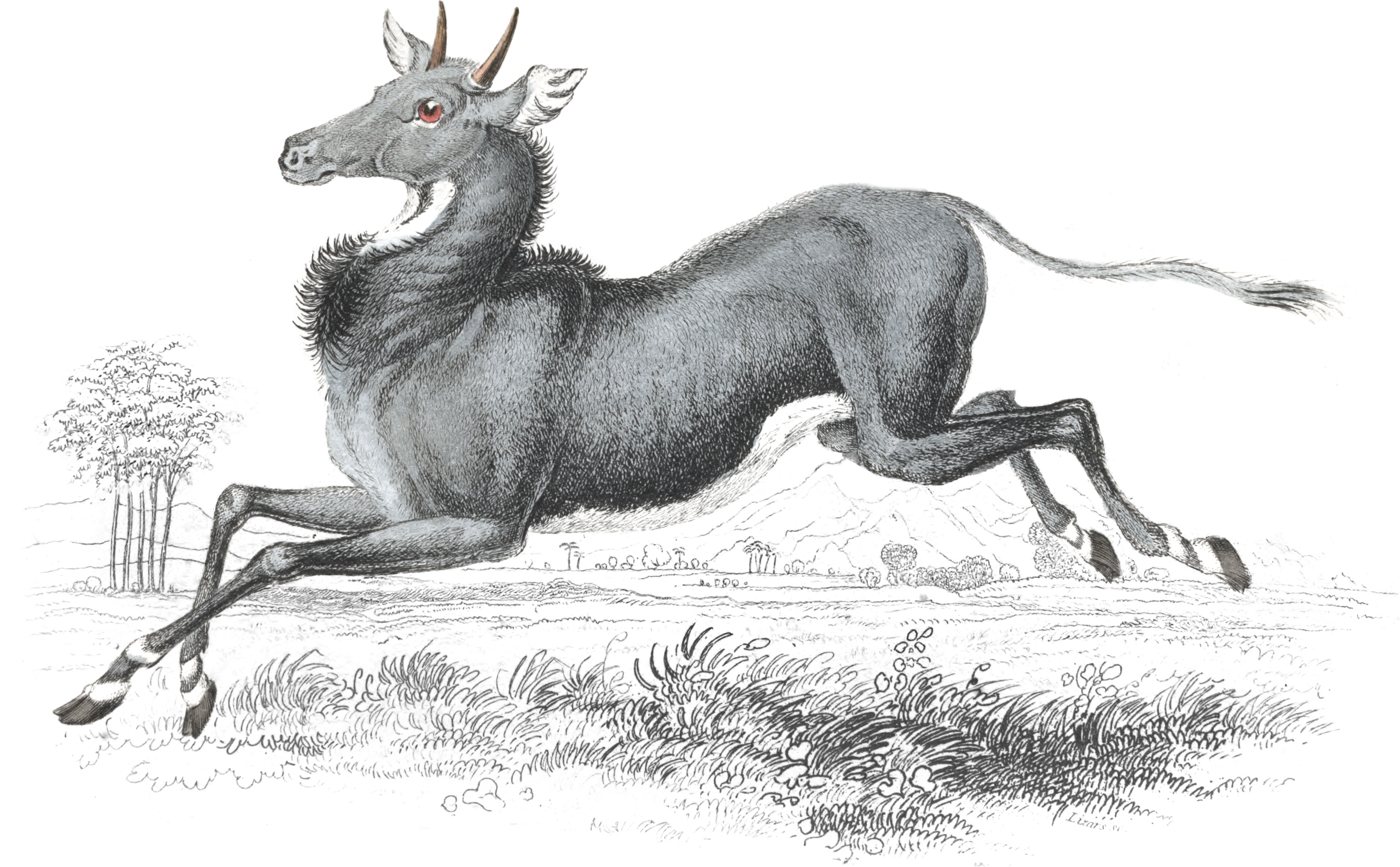
Plate XXI
The Gnoo
Catoblepas Gnu.—Smith.
Antelope Gnu of English Authors.—The Gnoo, Daniel, Illust. of the Scenery of Southern Africa.—Catoblepas Gnu, Smith in Griff. Cuv.
With this very singular animal Major Smith commences the Bovine race, and he is followed in a similar manner by Mr Swainson in his family Bovidæ. We shall particularly notice the family as we proceed, after describing the present animal and the Musk Ox. Mr Smith indicates four species, and applied the above generic name to them. They inhabit the plains of Central and Southern Africa, abounding on the arid deserts in company with herds of the zebra and quagga, and flocks of ostriches, and beyond the bounds of civilization, where some species have not been nearly extirpated, are almost always found in company. The aspect of the head is decidedly bovine, the forehead is ample and flat, and the horns, which are present in both sexes, are placed on the fore part of the frontal ridge, flattened and large, and nearly meeting at the base. They then bend forwards and downwards, and then suddenly upwards, are round and nearly smooth. The muzzle is broad and developed, and Major Smith and some others have observed a peculiar valve of a triangular form, which opens and closes at pleasure. On the brows and on the ridge of the face the hair is very long and shaggy, and curves forward, and in the whole aspect there is something fierce and restless. The neck is furnished above with an ample rigid mane, and on the lower part of the breast with a long and hairy dewlap. The general colour is a yellowish tawny, darkest on the back and legs; the tips of the mane, dewlap, and tail whitish. In the old specimens the white of these parts disappear, and are nearly black. The young are said to be white, but the indications which have been received are vague, as far as the species is described.
The Gnoo is extremely swift and active, and while not engaged in feeding, is sportive in manner, standing to gaze at one time, and at the next moment wheeling and scampering over the plains with immense rapidity. We had an opportunity many years since of seeing a specimen of this animal in Wombwell’s Menagerie, which was quite mild and tractable, and in appearance, from the disproportionate fineness of the limbs to the heavy looking body, did not seem to be capable of the speed which is generally attributed to it. It is remarkable that the cry of this animal is somewhat like that of the bellow of a bull.
This species is the smallest and most common of the genus, which is now considered to be composed of four species, the present animal C. taurina, gorgon, and Brooksii. The last is only known by a horn which was in the collection of the celebrated Joshua Brooks, and which could not be referred to any of the others. The C. taurina is nearly six feet high at the shoulder. It has been called Kokoon or Kokong, from an appellation of a similar sound in the Booshuana dialect. The colour is of a dark grey, of a silky appearance, the tail and mane white.38 It is found in the Caffre country. The last, the Brindled Gnoo, C. gorgon of Major Smith, that gentleman observes may be a variety of the C. taurina. It is intermediate in size between the two last, and the horns stand bending outwards, with the points turned towards each other. The colour of the animal is a dirty sepia dun grey, with indistinct darker streaks or brindles running from the back down the sides. Nothing farther was known of its habitat than that it was from South Africa. The specimen which furnished the description is in the museum of the Missionary Society of London.

Plate XXII
The Musk Ox
Ovibos moschatus.—Blainville.
Bos moschatus of Authors.—Musk Ox, Hearne, Pennant, &c.—Ovibos moschatus, Blainville, Nouveau Dictionnaire.
This animal may perhaps have an appropriate station as an intermediate form, connecting this division with the sheep, which De Blainville has endeavoured to express in his generic name. The appearance of the countenance, the long hair, or rather a sort of wool, ally it with the latter; while the horns and other parts of the form bring it nearer to the oxen, with which, by common consent, its namers,39 whether scientific or otherwise, have combined it.
The Musk Ox inhabits the barren lands of America lying to the northward of the 60th degree of latitude, and ranges to Melville Island over the islands which lie to the north of the American continent. They frequent country destitute of wood, rocky and barren, and they feed alternately on grass or lichens. They assemble in herds of thirty or forty, and are hunted by the Indians and fur-traders for the sake of their flesh and hides.
The size of the animal, when fully grown, is nearly equal to a small Highland bullock, rather shorter in the legs. The horns are very broad, covering the brow and whole crown of the head, and touching each other for their whole breadth from before backwards. The head is large and broad. There is no vestige of a naked muzzle, the end of the nose, middle part of the upper lip, and a great part of the lower, being covered with a close coat of short white hairs. The remainder of the head anterior to the horns is covered with very dark umber-brown hair, long and bushy towards the root of the nose. The eyes are moderately large. The general colour of the hair on the body is brown, on the neck and between the shoulders long, matted, and somewhat curled: on the back and hips it is also long, but lies smoothly, and on the shoulders, sides and thighs, it is so long as to hang down below the middle of the legs; on the centre of the back it has a soiled brownish colour. The hair on the throat and chest is very straight and long, and, together with the long hair on the lower jaw, hangs down like a beard or dewlap. The tail is so short as to be concealed by the fur of the hips. The cow differs in being of a less size, having smaller horns, not touching at the base, and with shorter hair on the chest and throat.40
The Musk Ox is of a more placid temper than some of its congeners, but it will attack if wounded, though not very active; for an expert Esquimaux hunter will allow himself to be attacked, and by dexterously avoiding the rush of the animal, is enabled to inflict various stabs, which in the end prove fatal. Their sense of smell is exquisite, and they will perceive and fly from danger by its use before it is otherwise perceived.
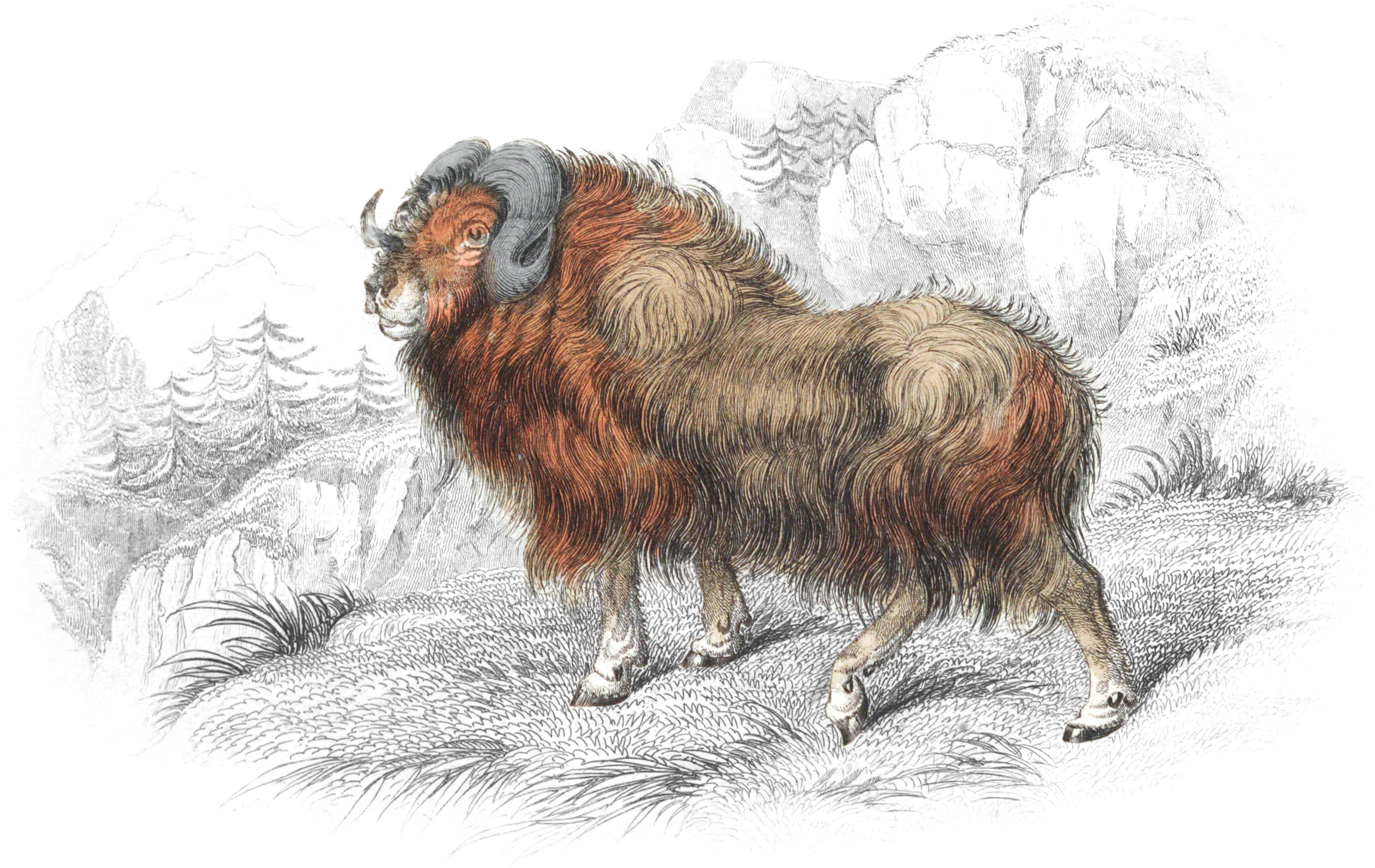
Plate XXIII

The Bovine Tribe, or Oxen
The animals which we have now arrived at, and with which zoologists have generally concluded the family of the ruminants, are fully equal to the wool-bearing tribes in value and utility. The several species and various races of Oxen, in all countries, are most important in the economy of the inhabitants. They are used for labour, and even assist in the wars of their masters. Their flesh affords a nourishment for the body, while their skin, hoofs, and horns, are indispensable for the stronger articles of clothing, and in the manufacture of many substances in daily use. In some countries they are so much esteemed, and their produce of milk and butter, &c. held in so much value, that they are never slaughtered except on the most extraordinary occasions, and never used as an article of common or general food. In other countries they are only used for the purposes of sacred offerings. In Egypt the bull was long considered a sacred animal; and in the mythology of the Hindus the “holy cattle” are cared for, and their molestation punished with the severest penalties.
In almost all the countries where oxen are employed, and this is over a great part of the known world, the varieties of the European domesticated races are almost the only animals which are used, few of the other species having yet been found capable of being domesticated to any extent, or easily reared in confinement.
Wherever the breeds may have originally arisen, or from whatever primitive stock they may have sprung, they have spread far and wide, over the European continent; they have reached north and south Africa, and now exist in innumerable herds. In the latter countries, they form a most important source of wealth, and are tended with the utmost care, their skins regularly dressed, and their horns twisted and variously ornamented. In North America, they are more numerous now than the wild buffalo; and in the steppes of the southern continent they range in immense droves, almost in a state of unreclaimed nature.
In tracing the origin of these breeds, so extensively spread, and affording a boon of such importance to mankind, there is much difficulty, no records of introduction or of produce existing; and we are driven to a comparison of the parts least subject to variation with corresponding parts of the wild species with which we are acquainted. In the British collections at this moment, we believe there are not materials for such a comparison; but in the works of Cuvier we shall find this in a great measure supplied, and whatever additional information may be within our reach shall be added. We shall begin with certainly the most important, and endeavour to trace the stock of our domestic races of cattle, and the forms they are supposed to assume in extra European countries. These stand in our systems as the Bos taurus of the older naturalists, the B. taurus domesticus of Linnæus.
It may be observed in this place, that our author, whose arrangement we have followed, divides this group into three subgenera, Bubalus, Bison, and Taurus. Mr Swainson, in his Natural System, makes Bos as pre-eminently typical of the Bovidæ.
By most persons it is thought that the domestic races of our cattle are originally sprung from the Bos bubalus, the Indian and European Buffalo, Some, again, treat of them as arising from the Aurochs or wild cattle of Germany and Poland. These, according to the system of Smith, come into subgenera different from the domestic breeds; and from both these suppositions the opinion of the Baron Cuvier varies, as he is inclined to consider our present cattle identical with a species no longer existing in a wild state, but which has, by the exertions of man, as in the instance of the Camel and Dromedary, been for ages entirely subjected to his power. The remains of this animal has been found in a fossil state, and it is upon the comparison of these remains with the skeleton of the Auroch, the Buffalo, and our domestic races, that the Baron has founded his opinion.
In examining the skull of any of the breeds of our domestic cattle, we shall find the front flat, and even a little concave; and in the horned varieties the horns are attached to the most elevated ridge of the skull, both of which may be seen in the annexed cut of the skull of a large horned Italian breed. The plane of the occiput forms an acute angle with the front in the domestic breed, and is quadrangular.

Large-Horned Italian Cattle Skull
In the Aurochs, again, the plane of the occiput forms an obtuse angle with the front, is semicircular, and the forehead is very markedly convex. Tho annexed cut will shew the convex skull of the Auroch, with the position of the horns; while beneath is given that of the domestic breed.
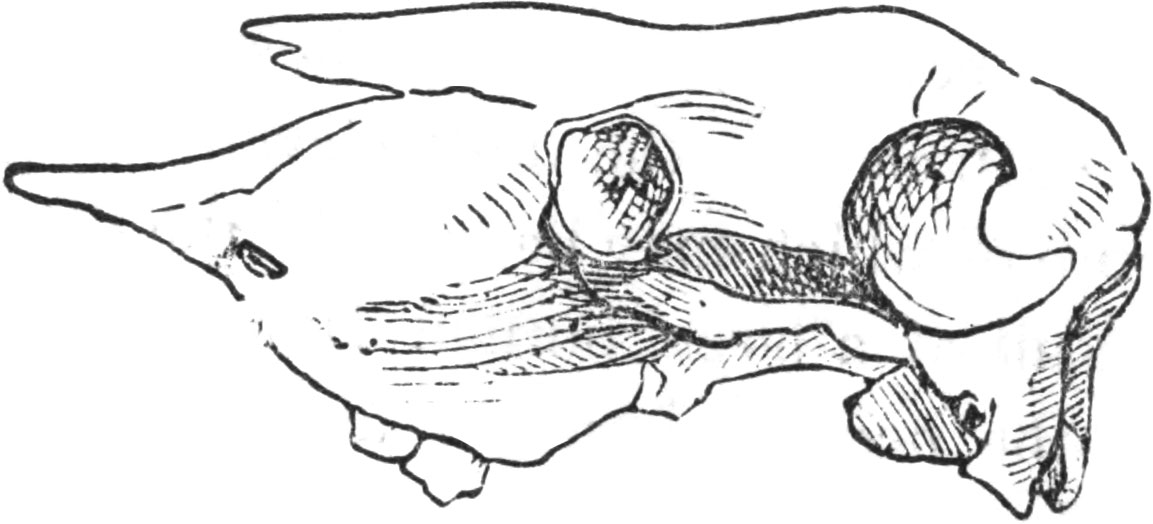
Auroch Skull

Domestic Auroch Skull
There are other parts of their form which are also very different. The limbs of the Auroch are slighter, and more slender, and the number of ribs is fourteen, whereas in the domestic breeds they are only thirteen. The Aurochs belong to the Bisontine group.
The Buffalo belongs to the Bubaline group, and differs even more than the Aurochs in form.
Major Smith places the fossil species, under the title of Bos (taurus) Urus, and considers the wild cattle of our parks as the white variety. The cut below exhibits the form of the head of Cuvier’s fossil species; while the wild breed of Hamilton is presented on the accompanying Plate.
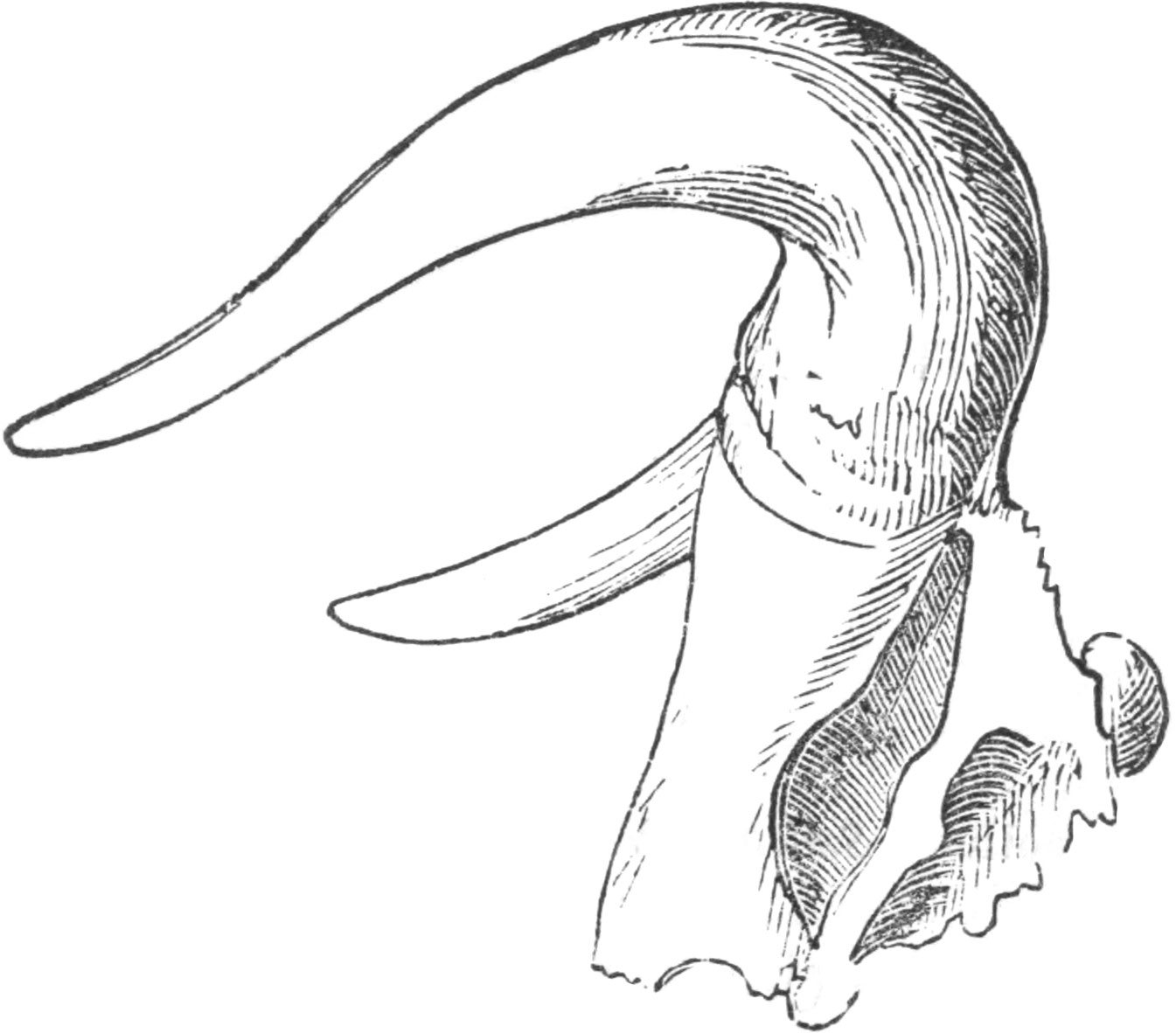
Bos Urus Horns
The White Urus, or Hamilton Breed of Wild Cattle
Taurus Urus.—Variety.
Urus Scoticus, Smith.—Wild Cattle, Pennant, Bewick, &c.
The White Urus (Urus Scoticus of Major Smith) is now only to be seen in one or two enclosures, which the proprietors are anxious to uphold, and, from the variety of the breed, not to allow it to be indiscriminately spread. The most remarkable now are the parks of Chillingham in Northumberland, the property of Lord Tankerville, and that of Hamilton Palace in Lanarkshire, where the drawing for the accompanying illustration was made.
This41 very ancient and peculiar breed of cattle has been long kept up with great care by the noble family of Hamilton, in a chase in the vicinity of their splendid seat at Hamilton, in the Middle Ward of the county of Lanark. They are generally believed to be the remains of the ancient breed of white cattle which were found on the island when the Romans first visited it, and which they represent as then running wild in the woods. The chase in which they browse was formerly a park or forest attached to the Royal castle of Cadzow, where the ancient British kings of Strathclyde, and subsequently kings of Scotland, used frequently to reside and to hold their courts. The oaks with which the park is studded over, are evidently very ancient, and many of them are of enormous size. Some of these are English oaks, and are supposed to have been planted by King David, first Earl of Huntingdon, about the year1 140. The chase is altogether of princely dimensions and appearance, amounting to upwards of 1300 Scotch acres. The number of white cattle at present kept is upwards of sixty. Great care is taken to prevent the domestic bull from crossing the breed; and if accidentally a cross should take place, the young is destroyed. In their general habits, they resemble the fallow-deer more than any other domestic animal. Having been exposed, without shade or covering of any sort, to the rigours of our climate from time immemorial, they are exceedingly hardy; and having never been caught or subjected to the sway of man, they are necessarily peculiarly wild and untractable. Their affection for their young, like that of many other animals in a wild or half-wild state, is excessive. When dropt, they carefully conceal them among long grass or weeds in some brushwood or thicket, and approach them cautiously twice or thrice a-day, for the purpose of supplying them with the necessary nourishment. On these occasions it is not a little dangerous to approach the place of retreat, the parent cow being seldom at any great distance, and always attacking any person or animal approaching it with the utmost resolution and fury. The young calves, when unexpectedly approached, betray great trepidation, by throwing their ears back close upon their necks, and lying squat down upon the ground. When hard pressed, they have been known to run at their keepers in a butting menacing attitude, in order to force their retreat. The young are produced at all seasons of the year, but chiefly in spring. The mode of catching the calves is to steal upon them whilst slumbering or sleeping in their retreat when they are a day or two old, and put a cloth over their mouths, to prevent them crying, and then carry them off to a place of safety without the reach of the herd, otherwise the cry of the calf would attract the dam, and she, by loud bellowing, would bring the whole flock to the spot, to attack the keeper in the most furious manner. These cattle are seldom seen scattering themselves indiscriminately over the pasture, like other breeds of cattle, but are generally observed to feed in a flock. They are very chary of being approached by strangers, and seem to have the power of smelling them at a great distance. When any one approaches them unexpectedly, they generally scamper off to a little distance to the leeward, and then turn round in a body to smell him. In these gambols they invariably affect circles; and when they do make an attack—which is seldom the case—should they miss the object of their aim, they never return upon it, but run straight forward, without ever venturing to look back. The only method of slaughtering these animals is by shooting at them. When the keepers approach them for this purpose, they seem perfectly aware of their danger, and always gallop away with great speed in a dense mass, preserving a profound silence, and generally keeping by the sides of the fields and fences. The cows which have young, in the mean time, forsake the flock and repair to the places where their calves are concealed, where, with flaming eyeballs and palpitating hearts, they seem resolved to maintain their ground at all hazards. The shooters always take care to avoid these retreats. When the object of pursuit is one of the older bulls of the flock, the shooting of it is a very hazardous employment. Some of these have been known to receive as many as eleven bullets, without one of them piercing their skulls. When fretted in this manner, they often become furious, and, owing to their great swiftness and prodigious strength, they are then regarded as objects of no ordinary dread.
The White Urus, or Hamilton breed of wild cattle, differs in many respects from any other known breed. As compared with those kept at Chillingham Park, Northumberland, by Lord Tankerville, they are larger, and more robust in the general form of their bodies, and their markings are also very different. In the Tankerville breed, the colour is invariably white, muzzle black, the whole of the inside of the ear, and about one-third of the outside, from the tip downwards, red. The horns are very fine, white, with black tips; and the head and legs are slender and elegant. In the Hamilton Urus, the body is dun-white, the inside of the ears, the muzzle, and the hoofs black, and the fore-part of the leg, from the knee downwards, mottled with black. The cows seldom have horns; their bodies are thick and short; their limbs are stouter, and their heads much rounder than in the Tankerville breed. The inside or roof of the mouth is black, or spotted with black. The tongue is black, and generally tipped with black. It is somewhat larger in proportion than that of the common cow; and the high ridge on the upper surface, near to the insertion of the tongue, is also very prominent. It is observable that the calves that are off the usual markings are either entirely black or entirely white, or black and white, but never red or brown. The beef, like that of the Tankerville breed, is marbled, and of excellent flavour, and the juice is richer, and of a lighter colour, than in ordinary butcher-meat. The size of the smaller cows does not exceed fifteen stones tron weight; but some of the larger sort, especially the bulls, average from thirty-five to forty-five stones. The circumstances of their breeding in-and-in,—of being chased so much when any of them are to be shot,—of being so frequently approached and disturbed by strangers,—and of having been exposed so long to all the vicissitudes of the seasons, and constantly browsing the same pasture,—have no doubt contributed greatly to the deterioration of the breed, and must have reduced them much in size and other qualities.
The ancient history of this breed is involved in much mystery. From fossil remains, chiefly found in marl-pits, it appears that two species of the ox tribe formerly prevailed in Scotland, namely, the Bos taurus and the Bos urus. Some heads of these, of very large dimensions, are still preserved in the collections of the curious. Professor Fleming of Aberdeen informs us, that he has a skull of the former in his possession, measuring 27\(\frac{1}{2}\) inches in length, 9 inches between the horns, and 11\(\frac{1}{2}\) inches across at the orbits. The accounts of ancient authors certainly allude to a species of wild cattle very different in their characters and dimensions from those of the present day. The favourite haunt of these animals in ancient times seems to have been the Caledonia Sylva, or Caledonian Forest, which extended from Stirling, through Menteith and Stratherne, to Athol and Lochaber. It is described by old authors as dividing the Picts from the Scots; and, being well furnished with game, especially with fierce white bulls and kine, it was the place of both their huntings, arid of their greatest controversies. Some say it took its name from Calder, which signifies a hazel, or common nut-bush. The Roman historians delight much to talk of the furious white bulls which the Forest of Caledonia brought forth. In these early days, they are represented as of large size, and as possessing jubarm densam, ac demissam instar leonis; or, as Holinshed has it, “crisp and curled manes like feirs leonis.” At what period this great forest was destroyed, and the white cattle extirpated, is uncertain. Sir Robert Sibbald describes them, in his time, as denuded of their manes. In the sixteenth century, they seem to have become entirely extinct as a wild race, and, as we learn from Gesner, “were all slain, except in that part which is called Cummernad.” Another author informs us, that “thocht thir bullis were bred in sindry boundis of the Colidin Wod, now be continewal hunting and lust of insolent men, they are destroy it in all parts of Scotland, and name of them left but allenerlie in Cumernald.” At what period the present breed were introduced to the royal chase at Cadzow, cannot now be well ascertained. It is well known that the Cummings were at one period proprietors of Cadzow and Cumbernauld, and it is likely that in their time the white cattle were in both places. But be that as it may, they have long been extirpated at Cumbernauld, while they have been preserved in great perfection at Hamilton. The universal tradition in Clydesdale is, that they have been at Cadzow from the remotest antiquity; and the probability is, that they are a part remaining of the establishment of our ancient British and Scottish kings. At present they are objects of great curiosity, both to the inhabitants and to strangers visiting the place. During the troubles consequent on the death of Charles I., and the usurpation of Cromwell, they were nearly extirpated; but a breed of them having been retained for the Hamilton family, by Hamilton Dalzell, and by Lord Elphingstone, at Cumbernauld, they were subsequently restored in their original purity. A tradition prevails in the country, that, about a hundred years ago, when it was found necessary, for a time, to remove them from one pasture to another, several hundred individuals, belonging to the different baronies on the ducal estate, were called out, and that they only effected their purpose with much danger and difficulty. Instances are recorded of their having been taken when young, and tamed, and even milked. The milk, like that of most white cattle, is described as thin and watery. The usual number of ribs is thirteen on each side; some have been slaughtered with fourteen pair of ribs, but this is exceedingly rare. There is no other park of cattle in Scotland of a similar description.
In Chillingham Park they roam at large, and there is between 1500 and 1800 acres enclosed, combining, besides good pasture, a range of wild and rocky moor, interspersed with abundant wood and cover for their shelter, and approaching as near as any enclosure can do to the wild nature of their original habitation. From sixty to eighty head are kept up here, a certain proportion being regularly destroyed, to prevent the increase of the breed beyond their means of support. About two-thirds of the stock may be cows, the remainder bulls and oxen. When becoming too numerous, they are killed, and used as beef, which is nearly similar in taste and flavour to that of the common kyloe. The colour of this stock is white, with red ears; and they generally reach from fifty to sixty stones in weight. The oxen feed heavier, and in shape and form approach near to the Lancashire breed, the horns being long, and beautifully turned. A few years ago, a fine ox was fed to a large size, and was quite tame and gentle. The present keeper of the park at one time possessed a cow, which he had taken when a calf, in consequence of the death of its mother: it was gentle, and milked as a cow, bred freely with the common bull; but the propagation was not allowed to proceed farther, the calves being killed at an early age.
They go in herds, and on the approach of a stranger, after standing to gaze, like many other wild animals, wheel round him in a circle, which, if he is so imprudent as to remain, will be gradually narrowed, till an attack is made. During the breeding-season, it is more dangerous to approach, as the calls of the young will always incite the parent or herd to attack the aggressor. When pursued or baited, they become very fierce, as they also do if but slightly wounded by a ball. Lord Ossulton had a narrow escape from a bull which had been wounded and separated from the herd. It attacked him on horseback, and, at the first onset, overthrew and gored the horse to death. One of the keepers was also tossed, and severely maimed by a wounded bull.
The other parks where this breed was kept up, were at Wallaton in Northamptonshire, Gisburne in Craven, Yorkshire, Limehall in Cheshire, Chertley, Staffordshire, Burton, Constable, Yorkshire, and Drumlanrig, Dumfriesshire. At the two latter places they have worn out, or have been destroyed by some means, neglect or disease;42 and we possess no very recent information regarding the stock in the other parks.
The mode of killing these cattle, Mr Bewick remarks,
was perhaps the only modern remains of the grandeur of ancient hunting. On notice being given that a wild bull would be killed on a certain day, the inhabitants of the neighbourhood came mounted, and armed with guns, &c. and sometimes to the amount of an hundred horse, and four or five hundred foot, who stood upon walls, or got into trees, while the horsemen rode off the bull from the rest of the herd, until he stood at bay; when a marksman dismounted, and shot. At some of these huntings, twenty or thirty shots have been fired before he was subdued. On such occasions the bleeding victim grew desperately furious, from the smarting of his wounds, and the shouts of savage joy that were echoing from every side.43
The races which have spread over Asia have been thought partly to have been mixed with some of the Indian breeds which are at present little known.

Plate XXIV
Among the largest domestic breeds known are those of the Kirguise and Calmuc Tartars, and those of the Roman States. The colour is generally of a bluish-ash, the horns remarkably ample and spreading. In Egypt a large white breed was maintained; and in northern and central Africa, according to Major Denham, two varieties at present exist, both humped, like some of the Indian breeds, the one with small horns, the other of a large size, with immense horns, one which was measured being three feet six inches and a half in length, following the curve, and twenty-three inches and a quarter in circumference,44 Upon the banks of Lake Tchad, and in the kingdom of Bournou, these cattle were kept in great abundance. They performed all the laborious business at home of carriage and tillage, the camel only being used for war and extensive journeys. They were the bearers of ail grain and other articles to and from the markets.
A small saddle of plaited rushes is laid on him, when sacks made of goat skins, and filled with corn, are lashed on his broad and able back. A leather thong is passed through the cartilage of his nose, and serves as his bridle, while on the top of the load is mounted the owner, his wife or his slave.45
Major Smith is of opinion, that the ordinary Egyptian white and spotted breed without humps has spread southward to Caffraria; and we find there, and among the Hottentots, where, as among the Cape colonists, they may now have a mixture with many of the Dutch breeds, cattle of very large size, and ample horns,46 of a white or light colour, and marked with large blotches of reddish or brown. Here, besides the ordinary economical uses, they are employed by the Caffrarians as beasts of burden, often transporting their whole families, house and arms and utensils. The annexed Plate from Daniel’s African Scenery, will illustrate both the breed and manner of travelling.
South African Cattle
With Caffrarian Family on a Journey
This interesting Plate is thus described in Daniell’s African Scenery:
The Caffres who dwell upon the eastern coast of South Africa are a race of people very superior to what they have usually been considered, both with regard to their physical and moral character. If taken in the mass, it maybe questioned if any nation can produce so great a proportion of tall elegant figures as appear among the Caffres. Though strong and active in a great degree, they eat very little animal food, but subsist chiefly on milk in a curdled state, and a few wild vegetables and roots. The shape of the head and the features of the countenance approach much nearer to inhabitants of the north than either the Hottentot or the Negro, and were it not for their colour, which is from black to bronze, even Europeans might pronounce them a very handsome race of men. Their weapons for war and for hunting are the hassagai and the kerie. The former is an iron spear fitted to a tapering shaft, which they hurl with effect to the distance of thirty or forty yards. In battle they usually break off the vooden shaft of the spear, and with the aid of a shield made of dried ox-hides, come to close quarters with the iron part only in their hand. The kerie is nothing but a small stick with a round knob at the end, with which they frequently kill the pigmy antelope, hares, and the smaller animals. The men in summer go naked. Their usual ornaments consist of rings of ivory on the arm, a brush of hair attached to the head, and frequently a cow’s tail tied to the knee; and when they go to war, they bind on the head, by a fillet of skin, the two wings of the Numidian Crane. The women wear long cloaks of skin, made soft and pliant with great pains, and gaily studded with metal buttons. The Caffre chiefs also wear cloaks made of the skins of animals, and generally prefer those of the leopard and tiger cat. The children always go naked, and have no decorations except a tuft of hair from the spring-bok, with which their heads are frequently ornamented.
In India we have another race of oxen which has been also referred to the same stock as our domestic breed, chiefly from the correspondence of the skeleton, and the similar flat form of the skull.
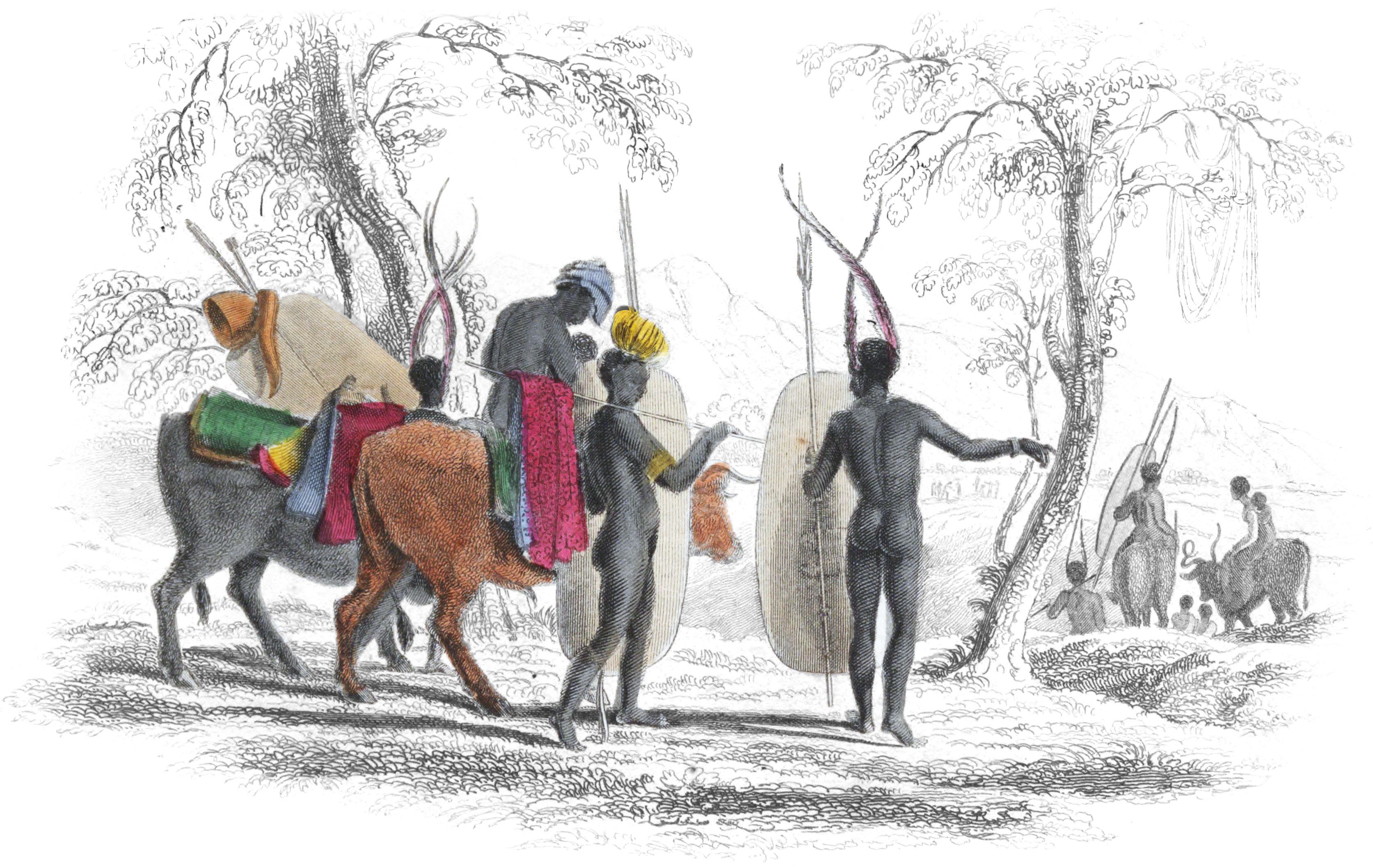
Plate XXV
The Indian Ox or Zebu
Taurus Indicus.
Zebu, Buffon, Desmarest.—Bos Indicus of Authors.
The Zebu seems to extend in its varieties over India and Northern Africa, and we believe the previously noticed animals from the kingdom of Bornou will be referable to one of these. The general colour of the Zebu is ashy grey, paler towards the lower parts, but varieties very commonly occur. The size runs from that of a large mastiff dog to a large and powerful bull of Europe, and they occur either horned or without horns, and sometimes with the horns, as it were, attached only to the skin, hanging loose and without any central core; while there is another race, however, in greater obscurity, of a large size, and having the horns nearly four feet in length. The ordinary varieties of the Zebu are furnished with a fatty hump or excrescence on the shoulders, which has been said to reach the weight of fifty pounds. Another variety has two fatty humps, the first placed on the shoulder, the other immediately behind it; these are said to be most common in the vicinity of Surat. The variety we have figured is of large size, the horns small, and the ears large and rather pendulous.
In India, where they have not been consecrated, they are used for burden and tillage, and are mild-tempered and gentle. They are also used occasionally for the saddle and in harness, and travel with considerable speed, from twenty to thirty miles being accomplished in a day. Among the Hindoo sects they are consecrated, and as with many other of the animals employed in the mythology of that remarkable people, are fed and pampered and allowed to use their freedom anywhere with impunity, severe penalties being inflicted on any one who will molest them, even when destroying their growing crops or other property.
The Brahminy, or sacred bull of the Hindoos, rambles about the country without interruption; he is caressed and pampered by the people, to feed him being deemed a meritorious act of religion. In many parts of Bengal, an absurd custom prevails, which frequently occasions much damage to the farmers. When a rich young man dies, and the ceremony in commemoration of ancestors has been performed, a young bull is consecrated, with much solemnity, to Siva, and married to four cows; he is then turned loose, after having been marked; he may then go where he pleases, and it is not lawful to beat him, even if he be eating a valuable crop, or enter a shop and there devour the grain exposed for sale. The sufferers shout and make a noise, to drive him away; but he soon despises this vociferation, and eats heartily until he is satisfied. These consecrated bulls become in consequence of these free quarters very fat, and are fine animals to look at, but very destructive. The wives are given away to Brahmins, and he seldom sees them again. The two last Rajahs of Dinajepoor, among other expedients which they devised with great success to ruin themselves, consecrated in this manner about two thousand cows, and as no person presumed to molest the sacred animals, the vicinity soon became desolate, and the magistrate was at last compelled to sell them all, with the exception of one hundred, which were left to the widow to soothe her misfortune.47
These breeds have all the inward grunting call heard in the Yak and some other Indian animals, not the open bellow of the true bull, and this has led to the conjecture that there was some intermixture between the European domestic races and the wild animals of India.
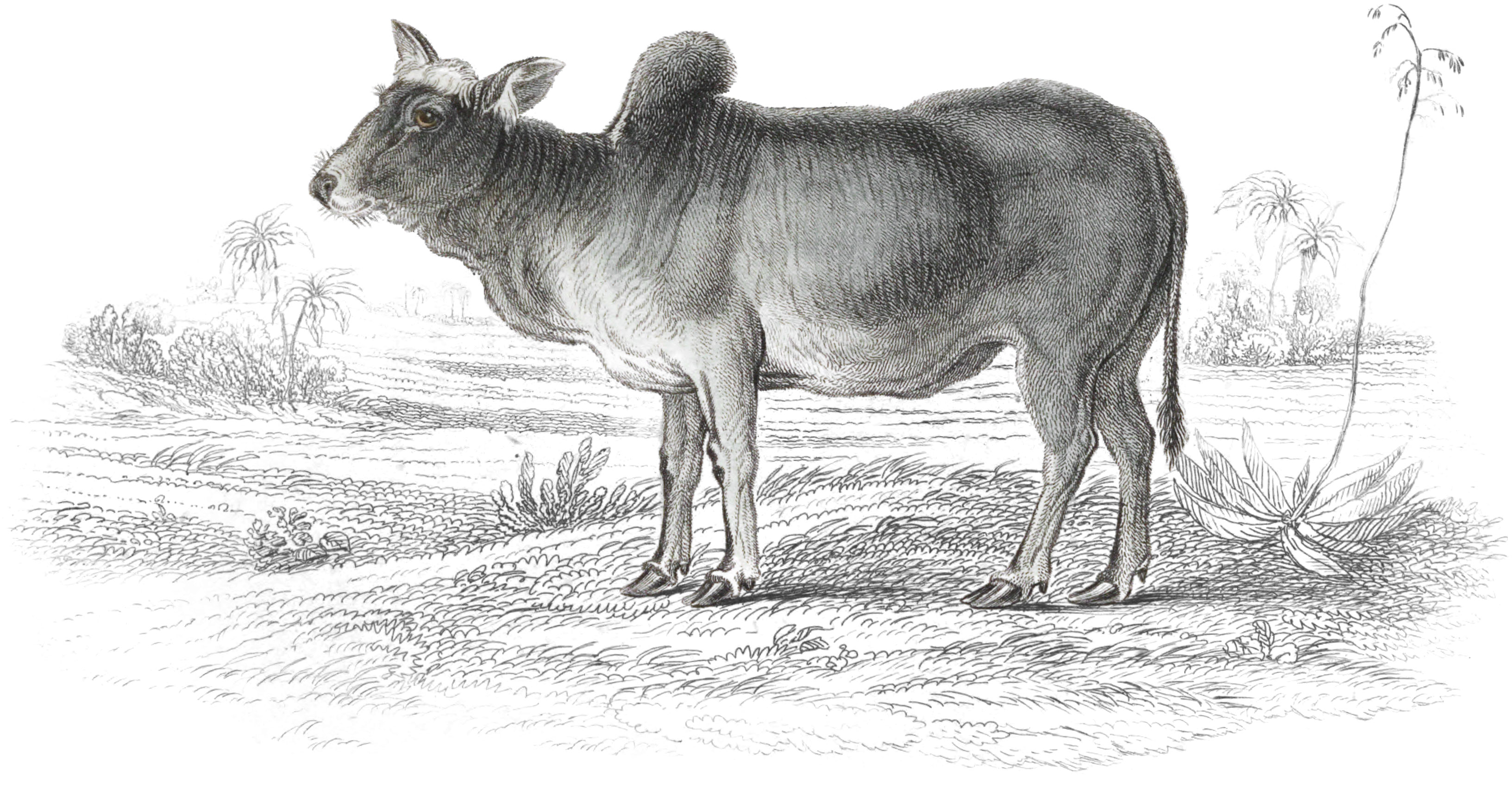
Plate XXVI

The domestic breeds of cattle in Europe are extremely numerous, varying with the nature and climate of the district, according as their proprietors have desired an animal fitted for the dairy or the butcher. As in the sheep, they had not the improvement of the fleece to assist in the returns of profit, and where the quantity of milk and its products was not an object, the best form for bearing a good covering of fat, and the animal which would produce a fine beef, and in large quantity, at an early age, was the aim to which all the great breeders sought to attain; breeds for draught or burden in this country at least having been nearly superseded, and even on the Continent al last, coming to the public market, the above mentioned qualifications are deemed most desirable.
Desmarest enumerates twenty French and Dutch varieties or races, differing merely in the form, which has pleased the breeder. His Bos lemovicensis supplies the Parisian market chiefly. They are kept while young in the district of Perigord, and driven to Normandy to be fattened and prepared for the market. This breed is of a pale colour, generally white or tawny, strongly formed, with large bending horns; their weight from 600 Ib. to 850 Ib. Another the Race Gasconne, Bos aquitanicus, feeds to nearly a similar weight, is also of a pale colour, and has; he horns enormously large. These are consumed at Bourdeaux, and furnish the principal supply for the French navy. B. avernus, reared on the mountains of Auvergne, is employed at the age of about three years for tillage, and afterwards fattened. It is of strong proportions, yet does not reach a heavy weight. The colour is generally red or brown, and are short and point upwards. B viducassencis reaches a large size, with large white but short horns, and rand at the tips, blotched with red and white, black and white, or black and red, considered by M. Desmarest as the finest breed in France, introduced from Holland, and used for tillage. Another large breed, B. uneliensis, when crossed with the last, reaches a weight of 1300 or 1400 lb., and is considered the largest in France. B. Helveticus is one of the Swiss races, celebrated for the quantity of their milk, and B. Batavius is the ordinary Dutch breed, celebrated for a similar good quality Denmark possesses a breed also remarkable for milk, and in Spain and Italy the breeds have a fine appearance from their very large size, their peculiar dull grey colour, and their immense horns diverging laterally. We are not, however, so well informed as to their other qualifications.
In Britain the catalogue of varieties is even greater. At the earlier periods of its history grazing was much more prevalent in proportion than in the present time, and from the times of the ancient Britains to that of the border forays, the carcasses of the beeves were a regular item in the winter’s larder. These, perhaps, might be taken from any stock without the true calculation of the quantity of meat a given time and feeding would produce, but they were, nevertheless, well fed on the natural pastures, and would be perhaps even more acceptable to the accomplished epicure in beef. With the march of cultivation, came the necessity of attending to the varieties which were most easily reared, and when the pasture lands began to yield so great a return by crops of grain it necessarily led to the attention for these requisites which have now been brought to such perfection. In the same manner which we pursued when noticing the natural history of the sheep, we have now selected two of the British breeds for illustration, as much contrasted as possible; the others we shall very shortly notice under them. About ten varieties are generally noticed, but there are more than double the number known locally, either by the name of the district or their original proprietors. The long-horned, the middle-horned, the short-horned, the Welsh breed, the Suffolk duns, Galloway polled breed, Highland or Kyloe breed, Lowland or Fifeshire breed, Alderney breed, and the wild breed, are those enumerated by Dickson.
But before proceeding to these details, we shall in this place give some account of the barbarous though stirring and heroic encounters of the Moors, Spaniards, and Romans in their bull-fights, widely contrasted as they are from the veneration in which we have just mentioned that other nations have held the animals at present under our notice. We have seen the natives of Egypt and of the East deifying these quadrupeds; and useful and peaceful as they are when unmolested, we must exhibit them tormented in a variety of ways, and with a cruelty which to our present habits seems almost incredible. The origin of bull-baiting is supposed to be derived from the Moors, and we cannot lay before our readers a more interesting account of these extraordinary exhibitions, than the following characteristic translation from a Moorish ballad.
The Bull-Fight of Ganzul48
I.
King Almanzor of Grenada, he hath bid the trumpet sound,
Hehad summonedall the Moorish Lords, from the hills and plains around:
From Vega and Sierra, from Betis and Xenil,
They have come with helm and cuirass of gold and twisted steel.
II.
’Tis the holy Baptist’s feast they hold in royalty and state,49
And they have closed the spacious lists beside the Alhamra’s gate;
In gowns of black with silver laced within the tented ring,
Eight Moors to fight the bull are placed in presence of the King.
III.
Eight Moorish lords of valour tried, with stalwart arm and true,
The onset of the beasts abide come trooping furious through;
The deeds they’ve done, the spoils they’ve won, fill all with hope and trust,
Yet ere high in heaven appears the sun, they all have bit the dust.
IV.
Then sounds the trumpet clearly, then clangs the loud tambour,
Make room, make room for Ganzul—throw wide, throw wide the door;—
Blow, blow the trumpet clearer still, more loudly strike the drum,
The Alcaydé of Agalva to fight the bull doth come.
V.
And first before the Kinghe pass’d, with reverence stooping low,
And next he bow’d him to the Queen, and the Infantas all a-rowe;
Then to his lady’s grace he turn’d, and she to him did throw
A scarf from out her balcony was whiter than the snow.
VI.
With the life-blood of the slaughtered lords all slippery is the sand,
Yet proudly in the centre hath Ganzul ta’en his stand;
And ladies look with heaving breast, and lords with anxious eye,
But the lance is firmly in its rest, and his look is calm and high.
VII.
Three bulls against the knight are loosed, and two come roaring on,
He rises high in stirrup, forth stretching his rejon;
Each furious beast upon the breast he deals him such a blow,
He blindly totters and gives back across the sand to go.
VIII.
“Turn Ganzul, turn,” the people cry the third comes up behind,
Low to the sand his head holds he, his nostrils snuff the wind;
The mountaineers that lead the steers, without stand whispering low,
‘Now thinks this proud Alcaydé to stun Harpado so?”—
IX.
From Guadiana comes he not, he comes not from Xenil,
From Guadalarif of the plain, or Barves of the hill;
But where from out the forest burst Xarama’s waters clear,
Beneath the oak trees was he nursed, this proud and stately steer.
X.
Dark is his hide on either side, but the blood within doth boil,
And the dun hide glows, as if on fire, as he paws to the turmoil.
His eyes are jet, and they are set in crystal rings of snow;
But now they stare with one red glare of brass upon the foe.
XI.
Upon the forehead of the bull the horns stand close and near,
From out the broad and wrinkled skull, like daggers they appear;
His neck is massy, like the trunk of some old knotted tree,
Whereon the monster’s shagged mane, like billows curl’d, ye see.
XII.
His legs are short, his hams are thick, his hoofs are black as night,
Like a strong flail he holds his tail in fierceness of his might;
Like something molten out of iron, or hewn from forth the rock,
Harpado of Xarama stands, to abide the Alcaydés shock.
XIII.
Now stops the drum close, close they come—thrice meet, and thrice give back;
The white foam of Harpado lies on the charger’s breast of black—
The white foam of the charger on Harpado’s front of dun—
Once more advance upon his lance once more, thou fearless one!
XIV.
Once more, once more;—in dust and gore to ruin must thou reel—
In vain, in vain thou tearest the sand with furious heel—
In vain, in vain, thou noble beast, I see, I see thee stagger
Now keen and cold thy neck must hold the stern Alcaydé’s dagger!
XV.
They have slipped a noose around his feet, six horses are brought in,
And away they drag Harpado with a loud and joyful din.—
Now stoop thee, lady, from thy stand, and the ring of price bestow
Upon Ganzul of Agalva, that hath laid Harpado low.
The excessive fondness of the Spaniards for bull-fights is a remarkable feature in their manners, and is hostile to the feelings of other European nations, who are less familiar with such sights. The Spaniards themselves regard this practice as the means of preserving energy of character, and of habituating them to strong emotions, which are only terrible to timid minds. In these sentiments the Spaniards are not singular; for it may be recollected that an enlightened legislator, the late Mr Windham, attempted to defend on the same principles the equally cruel sport of bull-beating in England, when a proposal was made for a legal enactment to suppress that barbarous practice. But although bull-fighting was formerly reckoned among the royal festivals in Spain, attempts have been made, if not entirely to abolish the entertainment, at least to diminish the number of the exhibitions.
These bull-fights are attended with very considerable expense, but they are also profitable to the undertakers; for the spectators pay for admission as to any other spectacle, and the price of the best and most commodious seats is as high as a dollar. The profits which remain after defraying the expense of the horses and bulls, and the wages of the torreadores or combatants, are destined to charitable purposes. In some cities the principal square is fitted up as a kind of theatre for this exhibition.
The spectacle begins with a kind of procession round the square, in which the combatants, either on foot or on horseback, make their appearance; after them two officers of justice in black robes, and of a grave deportment, advance to the president of the spectacle, and request to have an order for the entertainment to commence. A signal is then given, and the animal, which had been previously shut up in a cabin, with a door opening to the square, rushes forward, and is received by the spectators with the loudest acclamations. The picadores, or combatants, on horseback, dressed in the ancient Spanish manner, and armed with a long lance, begin the contest; and if the bull, without provocation, dart upon them, a favourable opinion is entertained of his courage; and if, after being wounded and repulsed, he return to the charge, the most enthusiastic expressions of joy are heard; but if he is struck with terror, and seem anxious to avoid his antagonists, he is hooted and hissed by all the spectators, and loaded with reproaches and blows by those who are near him. If after all this his courage cannot be roused, large dogs are let loose against him, and after being torn and mangled, in the estimation of the Spaniards he perishes ignobly. The most animated, as well as the most bloody scene, is exhibited with the combatant on horseback; for the irritated and wounded animal sometimes attacks and overturns both horse and rider; and when the latter is dismounted and disarmed, he is protected from immediate danger by the combatants on foot, who endeavour to provoke and divert the bull’s attention by shaking before him pieces of cloth of different colours; but in attempting to save the dismounted horseman, they are themselves exposed to great hazard; for the bull sometimes pursues them, when they escape by dropping a piece of coloured stuff, against which the deceived animal exerts all his rage; or, if this resource fail, the combatant springs over a barrier six feet high, which incloses the inner part of the arena. In some places this barrier is double, forming in the intermediate space a circular gallery, behind which the combatant is in safety; but in some cases the barrier is single, and the bull succeeds in his attempt to surmount it when an indescribable scene of consternation and confusion immediately follows, which proves fatal to many of the spectators, while the unfortunate animal falls under the blows which are levelled at him from all sides.
If the animal is not dispatched by those on horseback, and if he seem disposed to renew the combat, they retire and give place to the banderilleros, who are on foot, and presenting themselves before the animal, the moment he darts upon them, plunge into his neck a kind of hook-darts, ornamented with small streamers of coloured paper. The rage of the animal is raised to the highest pitch, and, were it not for the experience and skill of the assailants, his furious efforts would hurl destruction on their heads in a moment. The bull being exhausted with numerous wounds and loss of blood, another victim of barbarous sport is demanded; the signal of death is given by the president, and announced by the sound of trumpets. The matador then appears in the arena, when the other combatants retire. In one hand he holds a long dagger, and with the other waves a flag before his adversary. The interest and pleasure of the spectators, which had been suspended, are again awakened, and the matador, watching the favourable opportunity, inflicts the mortal blow; and if the animal fall, the loudest snouts of acclamation announce the triumph of the conqueror; but if he fail in the first attempt, a murmur of disapprobation pervades the assembly. The fallen animal is then dragged from the arena by three mules ornamented with bells and streamers, and another is immediately introduced to run the same course of barbarous torment. At one period six bulls were thus sacrificed in a morning, and twelve in the afternoon, on the days appropriated to these entertainments in Madrid.50
According to Gibbon, the Romans, about the decline and fall of the empire, borrowed this barbarous practice from the Moors.
In the year 1332, a bull feast, after the fashion of the Moors and Spaniards, was celebrated in the Coliseum itself; and the living manners are painted in a diary of the times.51 A convenient order of benches was restored; and a general proclamation, as far as Rimini and Ravenna, invited the nobles to exercise their skill and courage in this perilous adventure. The Roman ladies were marshalled in three squadrons, and seated in three balconies, which, on this day, the 3d of September, were lined with scarlet cloth. The fair Jacova di Rovere, led the matrons from beyond the Tiber, a pure and native race, who still represent the features and character of antiquity. The remainder of the city was divided as usual between the Colonna and Ursini. The two factions were proud of the number and beauty of their female bands. The charms of Savella Ursini are mentioned with praise; and the Colonna regretted the absence of the youngest of their house, who had sprained her ankle in the garden of Nero’s tower. The lots of the champions were drawn by an old and respectable citizen; and they descended into the arena or pit to encounter the wild bulls, on foot, as it should seem, with a single spear. Amidst the crowd, our annalist has selected the names, colours and devices of twenty of the most conspicuous knights. Several of the names are the most illustrious of Rome and the ecclesiastical state; Malatesta, Polenta, della Valle, Cafarello, Savelli, Capoccio, Conti, Annabaldi, Altieri, Corsi. The colours were adapted to their taste and situation; the devices are expressive of hope or despair, and breathe the spirit of gallantry and arms. “I am alone like the youngest of the Horatii,” the confidence of an intrepid stranger. “I live disconsolate,” a weeping widower. “I burn under the ashes,” a discreet lover. “I adore Lavinia or Lucretia,” the ambiguous declaration of a modern passion. “My faith is as pure,” the motto of a white livery. “Who is stronger than myself?” of a lion’s hide. “If I am drowned in blood, what a pleasant death,” the wish of ferocious courage. The pride or prudence of the Ursini restrained them from the field, which was occupied by three of their hereditary rivals, whose inscriptions denoted the lofty greatness of the Colonna name: “Though sad, I am strong:” “Strong as I am great:” “If I fall,” addressing himself to the spectators, “you fall with me;” intimating (says the contemporary writer) that while the other families were the subjects of the Vatican, they alone were the supporters of the rapitol.
The combats of the amphitheatre were dangerous and bloody. Every champion successively encountered a wild bull; and the victory may be ascribed to the quadrupeds, since no more than eleven were left on the field, with the loss of nine wounded, and eighteen killed, on the side of their adversaries. Some of the noblest families might mourn, but the pomp of the funerals, in the churches of St John Lateran and St Maria Maggiore, afforded a second holiday to the people. Doubtless, it was not in such conflicts that the blood of the Romans should have been shed, yet, in blaming their rashness, we are compelled to applaud their gallantry; and the noble volunteers, who display their magnificence, and risk their lives, under the balconies of the fair, excite a more generous sympathy than the thousands of captives and malefactors who were reluctantly dragged to the scene of slaughter.52
In Britain, similar exhibitions appear not to have been without their admirers; and we find bull-baiting and bull running patronised by royalty amongst us, and these shows even graced by the presence of the softer sex.
Queen Elizabeth, on the 25th of May 1559, soon after her accession to the throne, gave a splendid dinner to the French ambassadors, who afterwards were entertained with the baiting of bulls and bears, and the queen herself stood with the ambassadors looking on the pastime till six at night. The day following, the same ambassadors went by water to Paris Garden, where they saw another baiting of bulls and of bears; and again, twenty-seven years posterior, Queen Elizabeth received the Danish ambassador at Greenwich, who was treated with the sight of a bear and bull-baiting, “tempered,” says Holinshed,
with other merry disports; and, for the diversion of the populace, there was a horse with an ape upon his hack, which highly pleased them, so that they expressed “their inward-conceived joy and delight with shrill shouts and variety of gestures.”
The manner in which these sports were exhibited toward the close of the sixteenth century, is thus described by Hentzner, who was present at one of the performances.
There is a place built in the form of a theatre, which serves for baiting of bulls and bears; they are fastened behind, and then worried by great English bull-dogs; but not without risk to the dogs, from the horns of the one and the teeth of the other; and it sometimes happens they are killed on the spot. Fresh ones are immediately supplied in the places of those that are wounded or tired.
Bull-running at Stamford was another barbarous diversion somewhat different from bull-baiting, and much less known. The traditionary origin of the bull-running at Stamford, and the manner in which it was performed in the seventeenth century, are given by Butcher, in his Survey of that town.
The bull-running is a sport of no pleasure, except to those who delight in beastliness and mischief; it is performed just the day six weeks before Christmas. The butchers of the town, at their own charge, against the time provide the wildest bull they can get. This bull over night is led into some stable or barn belonging to the alderman. The next morning proclamation is made by the common bellman of the town, round about the same, that each one shut up their shop-doors and gates, and that none, upon pain of imprisonment, offer to do any violence to strangers; for the preventing where of, the town being a great thoroughfare, and then being term-time, a guard is appointed for the passing of travellers through the same, without hurt; that none have any iron upon their bull-clubs, or other staff, which they pursue the bull with. Which proclamation made, and the gates all shut up, the bull is turned out of the alderman’s house; and then hivie-skivy, tag and rag, men, women, and children, of all sorts and sizes, with all the dogs in the town, promiscuously running after him with their bull-clubs, spattering dirt in each other’s faces, that one would think them to be so many furies started out of hell for the punishment of Cerberus, &c. And which is the greater shame, I have seen persons of rank and family, of both sexes, following this bulling business. I can say no more of it, but only to set forth the antiquity thereof as tradition goes.53
We shall now illustrate the British breeds first, by
The Short-Horned Breed
The Short-horned British breed of cattle, so termed in contradistinction to other breeds, where the horns are long and ample. They are principally found in Lincolnshire, the eastern parts of Yorkshire, Durham, Northumberland, and Berwickshire, are still extensively bred in these countries, have extended in both directions, and are now commonly found in the south of Scotland. They are originally from a Dutch stock, and sometimes bear that appellation. They are a handsome breed, compact, yet elegant, should have smooth skins and thin hides, and have often a pleasing arrangement of blended colours of red and white, and a sort of roan, which sometimes almost appears purple. They feed easily, and to a large size, and are now prized as being capable of rearing to a heavyweight at a very early age. They feed in common to from 60 to 100 stones’ weight, and a few examples are recorded of 140 and 150 stones being exceeded. They are also most extensively used for the dairy, yielding abundant quantity of milk, though it is supposed by some to be of rather an inferior quality. It is, however, in repute for its produce of butter, for the Yorkshire firkin-butter, of the London markets, is supplied by this breed.

Plate XXVII
The long-horned breed is deeper in the fore-quarter, and lighter behind, rather inferior to the short-horned in size, of a thick and firm hide, long hair, and remarkable for their long horns. Lancashire is the mother country of this breed, which is most frequent in Warwickshire, Leicester, Gloucester, Chester, and other midland counties, but it is supposed to be in the highest perfection in Leicestershire. They are rather slow feeders, although there are some improved breeds, which feed more quickly.
The middle-horned cattle are only a variety. They are reared in Devonshire, Sussex, and Herefordshire. The first, when in a state of purity, are of a high red colour, are thin-skinned, and silky in handling. They feed early, are adapted for draught, and the shoulder points, according to Mr Culley, are beautifully fitted for the collar. As dairy cattle they are also esteemed, and, from their being steady and active, as well as capable of great exertion in harness, they are peculiarly adapted for the purposes of the team. They may be wrought from three to five or six years’ old before they are fattened; altogether they are a very valuable breed.
The Welsh cattle are small, active, and hardy black, with thick horns turned upwards. They are quick feeders.
The Suffolk duns are a small breed reared in that county principally, and supposed by Mr Culley to be a variety occasioned by an intercourse with the northern droves. They are a polled. breed, or without horns; the colour dun, but it commonly varies. They are esteemed for the dairy.
The Alderney breed is a very pretty and handsome race, finely made, and with slender limbs. They are of a light reddish or yellow colour, sometimes black, but are impatient of the cold of this climate, and do not thrive unless with extra care and keeping. They are kept for the richness of their milk. In many places a cross between some of our hardy smaller races has been found useful, and they then bear the climate of this country.
Galloway polled breed, as their name implies, is originally from Galloway, a rather wild district in the south of Scotland. They are now the most common cattle in that district and Dumfriesshire, where they are reared and grazed from two to four years old, at which period they are driven to the Norfolk, Suffolk, and some other Southern markets, to be farther fed; whence they reach Smithfield, and the other London markets, and there yield a high price from the superior quality of the beef.
The prominent feature in this breed is the want of horns; a peculiarity which is very striking to an individual accustomed to a district where a horned creed is reared. They are remarkably neat, strong, compact animals. The favourite and common colour is black, but red or dun brindled and pied colours are sometimes met with. The hair is rather long, but it should be close, fine, and silky. The last breed we shall notice is
The Kyloe or Highland Cattle
This, like the Black-faced Sheep, possesses the whole of the Highlands and the Western Isles of Scotland. On their native pastures, where they are not housed, they are extremely rough and shaggy, and wild-looking; but, when driven to the Lowlands, they become more polished, and, on a richer pasture, in a warmer climate, and with shelter at night, shew a rich and glossy covering, and a considerable degree of symmetry, uniting, at the same time, a firmness and compactness of limb and body. The favourite colour here is also black; but nearly the same varieties as of the last are prevalent. It is a horned breed, and the horns should be round, polished, and white at the base, in an animal of high health and vigour. Immense droves of this breed pass annually to the south, where they are fed and supplied to the London markets. They are easily fed, and afford rich and excellent beef. The smallest breeds are reared in the Isle of Skye.
These varieties, which we have now shortly enumerated, are the principal which are reared in this country; but there may be more than double the number which have local names applied to them, from their locality or breeder, all having at least some supposed qualification for which they are reared.
The actual consumption of black cattle in London alone in 1832, amounted to 1,364,160, and, besides the immense quantity of animal food which they afford, the different articles to which their various parts are applied and manufactured into, are almost incredible.—Leather of different kinds is prepared from the hides, after the hair has been removed, and put aside for the use of the plasterer, &c.; glue from the refuse; vellum from the skins of the calves. Tallow is a well known article, so is horn, in its various applications; the blood is not so commonly known as an article extensively used in the clarifying of sugar, and as the basis of Prussian blue; while the common and useful gold-beaters’ skin is not generally understood to be the lining of their intestines. With all those useful properties, both in a living state and after death, it is singular that in civilized nations this useful and commonly mild-tempered animal should be sometimes treated with the utmost cruelty. The old English practice of bull-baiting, which we have already given an account of, exhibits an example of this in Britain, and is curious to contemplate, in relation with the manners of our people, and to contrast with its more luxurious analogy the bull-fights of Spain.
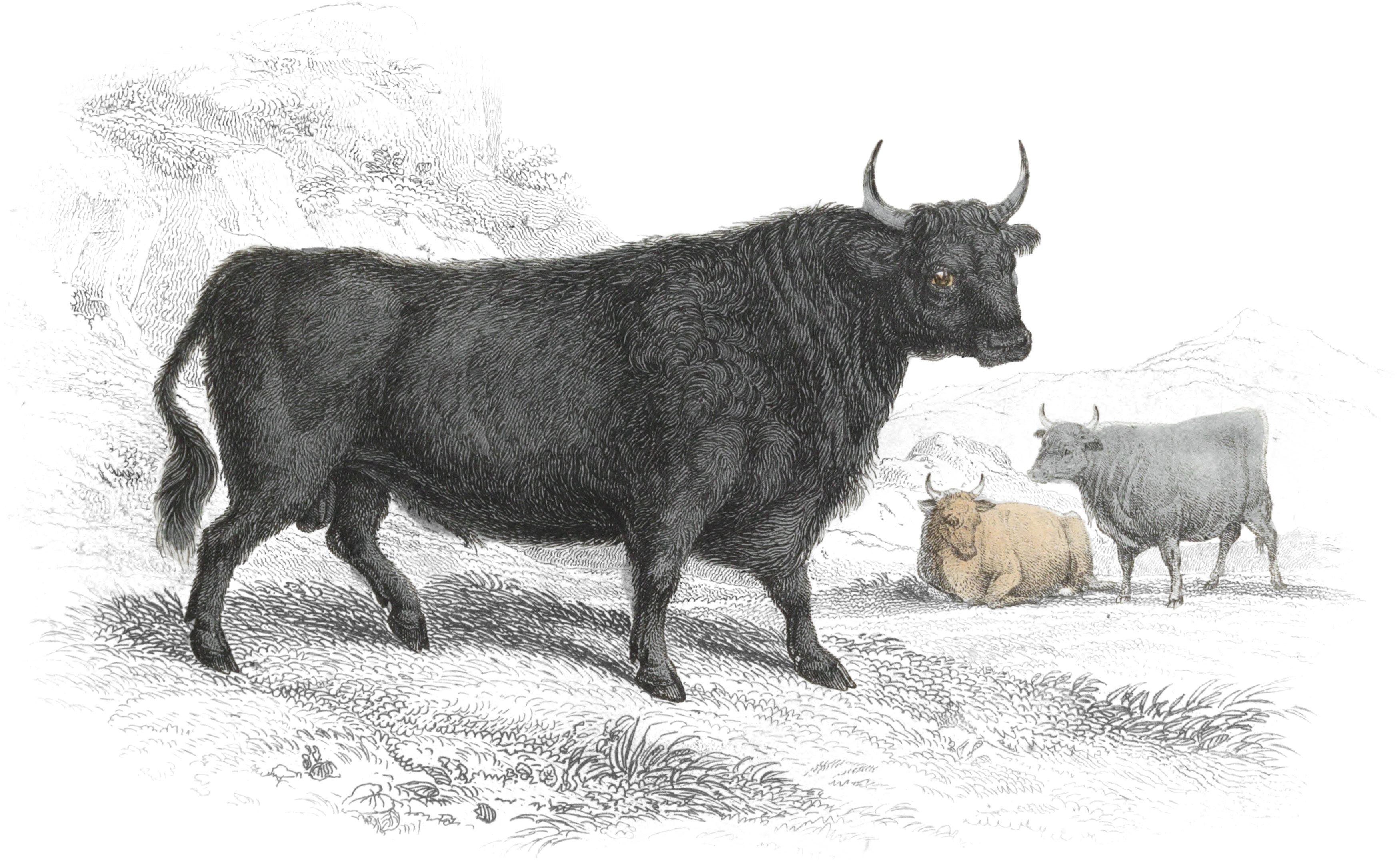
Plate XXVIII
Major Smith places his subgenus Taurus, which we have been now examining, last in the series of Bovine Animals. We have treated of it first, as containing the animals of most importance, not as disagreeing with the system of that accomplished zoologist, who has had much more extensive opportunities of investigating the Ruminant Animals than we are likely for a long time to enjoy. We now come to his subgenus Bubalus, which contains animals from both India and Africa. His characters are,
Animals low in proportion to their bulk; limbs very solid; head large, forehead narrow, very strong, convex; choppers straight; muzzle square; horns lying flat, or bending laterally with a certain direction to the rear; eyes large; ears mostly funnel-shaped; no hunch, a small dewlap; female, under with four mammæ; tail long, slender.54
The first species to be noticed is
The African Buffalo
Bulbalus cafer.—Smith.
Bos cafer, Sparrman, &c.
The Buffalo of the Cape has often been confounded with the animal of Southern Europe; but it is entirely of a different form, and is a much more ferocious and dangerous animal, and has never yet been domesticated, or used for any laborious purpose. It is an animal, Burchel remarks, found no where but in the extra tropical part of Southern Africa, and is widely distinct from every other species of the ox tribe, and most remarkable by its horns, which, though not of more than ordinary or proportional length, are so unusually broad at their base, as to cover the whole forehead, and give to it the appearance of a mass of rock; an appearance to which the ruggedness and unevenness of their surface greatly contribute. Its countenance exhibits a savage and malevolent expression. Its bulk far exceeds that of the ox, although its height be not much greater; but it is altogether more robust and strongly made. Its muzzle, when not young, is but thinly covered with short scattered black hair; that on the under lip, and about the corners of mouth, being longer, and somewhat resembling a beard. The wither rises high, but not sufficiently to form a rump. The tail resembles that of the common ox, but is much shorter; and the two spurious hoofs are rather longer in proportion. Its horns turn outwards and downwards, and their points are recurved upwards. The hide is much thicker than that of the ox, and is much valued by the Colonists and Hottentots for its strength. It is of a fierce and treacherous disposition, which, added to its size and strength, renders it dangerous to be attacked without caution, or without the certain means of escape at hand.55
The frame of this animal is strong and powerfully made, and the species is at once distinguished by the immense mass of horn which defends the forehead. According to Lichtenstein, the rib-bones are of such extraordinary breadth, that they almost unite with one another, so that on the outer side nothing at all is seen of the intercostal muscles.56
The African Buffalo is found in abundance in Southern Africa, and stretches along the east coast as far to the interior as has been yet explored. In the colony of the Cape, it is, however, becoming much less plentiful, from the constant warfare kept up against it as well as the other wild animals, and travellers now may look in vain for any fine specimens in the places where they were seen and hunted by Le Vaillant, Sparrman, or Daniel. All travellers have agreed in the danger of wounding, or intruding incautiously upon the haunts of the buffalo; he is easily irritated, and rushes towards his object with blind fury, bearing down all before him; he possesses also great activity, and in some situations considerable swiftness; and in an attack upon a herd, a place of safe retreat is generally looked for before commencing. They are killed in pitfalls, like much of the larger game, but the Dutch colonist or European makes use of the rifle alone, while the Hottentot prefers following this chase on foot, being more active then the animal in seeking a retreat from his pursuit. Mr Pringle relates the following incident of a buffalo hunt, which we extract, as characteristic of the animal and the sport.
A party of boors had gone out to hunt a herd of Buffaloes, which were grazing on a piece of marshy ground, interspersed with groves of yellow wood and mimosa trees, on the very spot where the village of Somerset is now built. As they could not conveniently get within shot of the game without crossing a part of the valei or march, which did not afford a safe passage for horses, they agreed to leave their steeds in charge of their Hottentots, and to advance on foot, thinking that if any of the buffaloes should turn upon them, it would be easy to escape by retreating across the quagmire, which, though passable for man, would not support the weight of a heavy quadruped. They advanced accordingly, and under covert of the bushes, approached the game with such advantage, that the first volley brought down three of the fattest of the herd, and so severely wounded the great bull leader, that he dropped on his knees, bellowing furiously. Thinking him mortally wounded, the foremost of the huntsmen issued from the covert, and began reloading his musket as he advanced to give him a finishing shot; but no sooner did the infuriated animal see his foe in front of him, than he sprang up and rushed headlong upon him. The man throwing down his heavy gun, fled towards the quagmire; but the beast was so close upon him, that he despaired of escaping in that direction, and turning suddenly round a clump of copse wood, began to climb an old mimosa tree which stood at the one side of it. The raging beast, however, was too quick for him, bounding forward with a roar, which my informant described as being one of the most frightful sounds he ever heard; he caught the unfortunate man with his terrible horns, just as he had nearly escaped his reach, and tossed him into the air with such force, that the body fell dreadfully mangled into a cleft of the tree. The buffalo ran round the tree once or twice, apparently looking for the man, until weakened with the loss of blood, he again sunk on his knees. The rest of the party recovering from their confusion, then came up and dispatched him, though too late to save their comrade, whose body was hanging in the tree quite dead.57
Major Smith has placed next in order, an animal of which we have at present no distinct account. It appears pretty certain that there exists in central and unexplored Africa, a rather large Bovine animal, for we have indications of it by various travellers, which do not agree with any of the known species. Major Smith met with a drawing in the collection of Prince John Maurice of Nassau, which bears some appearance of being drawn from this animal. The description of the drawing, a young male, is as follows; but that is all we yet know regarding an animal which may prove of considerable interest
A young male, the horns lying across the summit of the head; the tips turned up; colour darkish, with obscure transverse ridges; head very short, thick, abrupt at the nose; forehead wide; eyes large and full; neck with a dense mane; ears long, flaccid, pendulous; tail to below the houghs covered with long woolly black hair; general colour deep brown, feet white. Inhabits Congo, Angola, and central Africa.58
The late Caffre wars have increased the scarcity of all large game; and letters from the outposts of the new territory describe the country as totally forsaken, the herds of large animals being driven off to seek quiet and retirement.
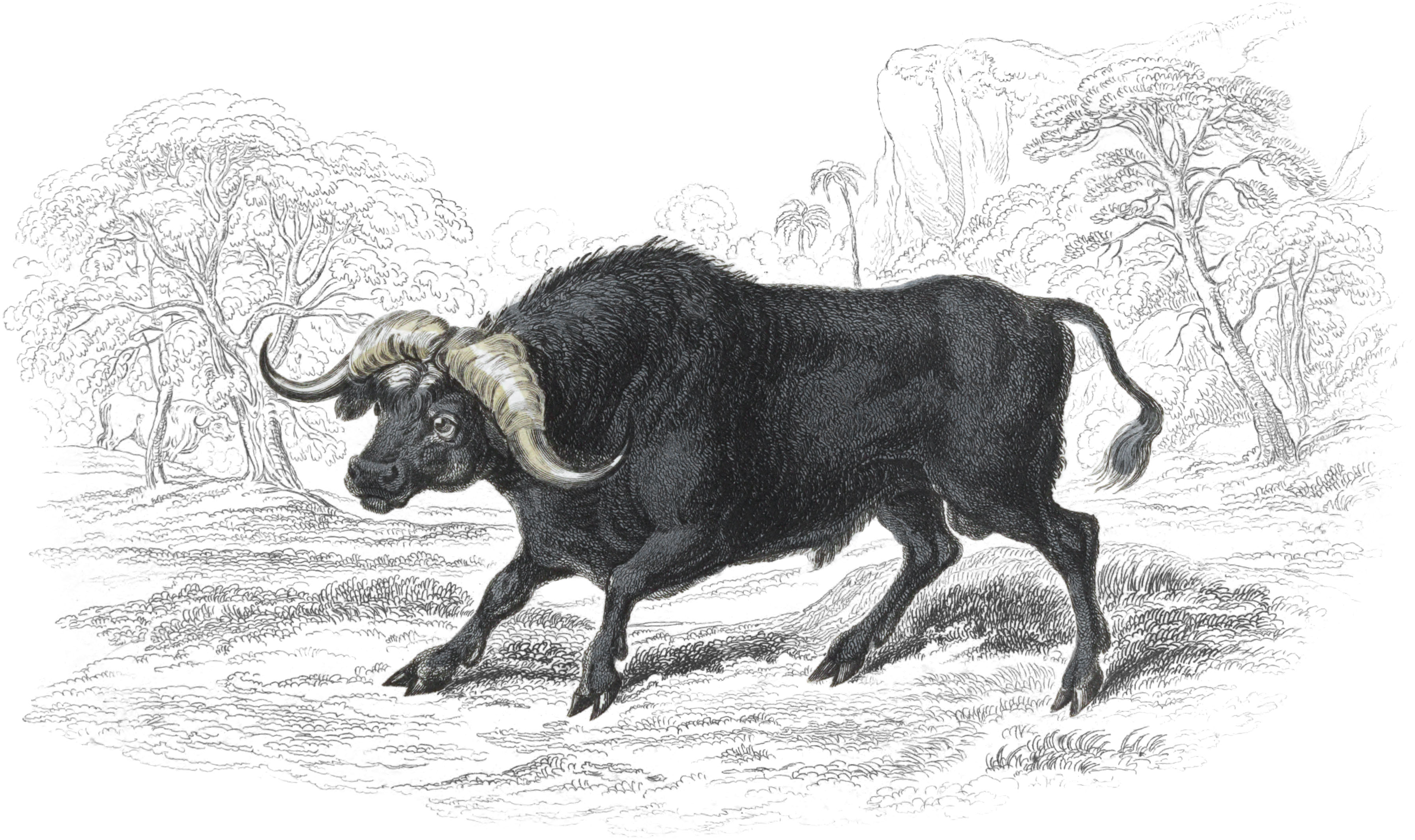
Plate XXIX

Another animal, which is yet little known, stands in our systems under the title of Bos pegasus. The colour is deep brown, the feet white, neck with a dense mane, the ears long and pendulous; the horns lying across the summit of the head, with the points turned up. Inhabits Congo, Angola, and central Africa.59
The Arnee Ox
The Arnee Ox, Bubalus Arnee, Smith, is the next animal we have to notice, remarkable in many instances, but particularly for the immense development of the horns, of enormous weight, and forming a curve rising erectly from the side of the head. This animal is a native of China and India; and from the evidence given by Major Smith, it appears pretty certain that there are two species, or at all events, several very distinct varieties. The one inhabiting Bengal is rather common, of moderate size, and has the horns above three feet in length. The other is found in small families in the forests at the foot of the Himalayas; and it is thought that the animal met with by Colonel Williamson in one of his hunting excursions, must be referred to this, and not to the True Wild Buffalo, to which the title Arnee is sometimes applied, as signifying an ox of very large dimensions. This animal is described as having a dark nearly black skin, scantily furnished with hair, the skin appearing and shewing the actual colour of the animal, as in the case of many of the ruminant animals inhabiting a very warm climate, many of the African Antelopes, &c. This buffalo (as it is termed by Williamson) measured above six feet high at the shoulder, and nearly a yard in breadth at the chest, and the horns were above five feet and a half in length.
Major Smith mentions another killed to the eastward of Bengal, whose head, when resting perpendicularly on the ground, required the out-stretched arms of a man to hold the points of the horns. Another pair of horns in the British Museum, measured by the same author, were six feet three inches in length, following the curve, and eighteen inches in circumference at the base.
Indian or Domestic Buffalo
Bubalus buflus.
Bos bubalus of Authors, Smith, &c.—Buffle, Buffon, Fred. Cuvier, Hist. Nat. des Mammif.
This animal exists in a wild state in many parts of India, and those in Persia, North Africa, and the south of Europe are used as domestic animals, performing labour and carriages, for which purposes they are managed by a ring through the cartilage of the nose. There is, however, something treacherous and designing in its look and appearance, and among the herds of India there always appears a certain jealousy of strangers, and especially of Europeans, whom they view with a suspicious glance, and riot unfrequently attack without any warning.
The colour of the domesticated animal is generally dark, the hair scattered and coarse, the horns large, reclining backward and sideways, with the tips turned up. With ample feeding and care the tame buffalo becomes a fine animal, sleek and fine-coated, and possessing great spirit and courage. Such are the animals which are picked and trained by the great to exhibit in the contests with the tiger or elephant The European domestic race exceed in size those of India, except such as are chosen for the combat, and stand from four to five feet high at the shoulder.60 The wild animal is of larger proportions. We are indebted to Colonel Williamson for interesting information regarding both the tame and the wild states, which we shall here make use of.
The Indian buffalo delights in water, so much so that burdens have to be most carefully attended to in travelling, the animals most probably being inclined to lie or roll themselves in the first swamp or water they meet with. No place seems to delight them more than the deep verdure on the confines of pools and marshes, especially if surrounded by tall grass, so as to afford concealment and shade while the body is covered by the water. In such situations they appear to enjoy a perfect ecstasy, having in general nothing above the surface but their eyes and nostrils, the horns being kept low down, and consequently out of sight. Frequently nothing is perceptible but a few black lumps in the waters, appearing like small clods, and a passenger would scarcely expect to see, as often happens, twenty or thirty great beasts suddenly rise. The banks of the Ganges and Cozzimbazar Island have long been favourite haunts of the wild buffalo. They are hunted with elephants in the same manner as the tiger, but with less danger. They often, however, charge and gore the elephant, though generally from the number and noise of the pursuers, fly until closely pressed or enraged by wounds.
In the combats with the tiger, the buffalo is generally the victor. Those chosen for this purpose are males of the domestic breed, trained to the spirit (as it is termed), and selected for their vigour, size, and spirit. The buffalo is remarkable for his courage, and the smallest provocation irritates him; he will even alone sometimes attack a group of elephants. For the spectacle an area of a round or oval form is erected of sufficient height to allow the spectators to look on in safety. Persons unacquainted with the true character of the tiger would expect to see him attack the buffalo as soon as he might enter the area; but no! as soon as the buffalo makes his appearance, the tiger, which, till then, does not perhaps betray any marked apprehension, all at once sinks into the most contemptible despondency. He sneaks under the pallisade, crouching and turning on his back to avoid the buffalo’s charge, he tries every device his situation will admit, and often suffers himself to be gored, before he can be induced to stand on the defensive. The buffalo on entering the area smells the tiger, and becomes instantly agitated with eagerness, his eyes sparkle with fury as they quest around for the skulking enemy, which is generally attacked the moment it is distinguished. The buffalo, shaking his head and raking the ground for a few seconds with his foot, places himself in the posture of attack, and with his face brought parallel with the surface, his horns pointing forwards, and his tail indicating both his determination and his vigour, rushes forward at full speed.61
For some other large oxen another group has been thought necessary, which will contain the European Bison, that of America, and one or two others, which are rather imperfectly known. They are characterized by the ridge of the spine being elevated, and often clothed with long hair, the legs rather long, and the hair soft and woolly.
The Auroch
The European Bison, very imperfectly known, is said to inhabit the forests of Russia in Asia, but is also supposed to be thinly scattered in some of the wilder parts of Germany and Poland. It is about six feet high at the shoulder. The fore parts are clothed with woolly hair above a foot in length, grey or whitish. On the legs and underparts it becomes shorter, and is of a blackish-brown colour. The forehead is convex, the horns short and pointed. The number of ribs on each side fourteen. They are said to live in small troops, and to have a groaning voice. It is the Auroch of the Germans.
Dr von Jarocki gave the following account of the Auroch before the Meeting of Naturalists at Hamburgh in 1830:
A remnant of these animals, which appear to have at one period existed in many parts of Europe, is still preserved in a wild state in the forest of Bialowiza in Poland, under the special protection of the Russian Emperor, in which situation the author, who is Professor of Zoology in the University of Warsaw, has had opportunities of observing them, and of collecting various facts respecting their habits and mode of life.
The wild oxen of the forest of Bialowiza live in herds, except a few of the older ones, which wander about singly. Though they have never been tamed, they are not so shy but that they maybe approached within a moderate distance, when care is taken to advance towards them from the windward side. Each herd keeps constantly to the same district of forest, near to some river or stream, so that each of the twelve foresters, who have charge of the wood, knows the herds that belong to his district. The number of oxen in every herd is ascertained in the beginning of winter, by observing their feet-tracks on the new fallen snow, as they pass between the wood and the store of hay, which forms their winter provender. The whole number, as thus estimated, is at present about 711, of which 48 are calves of last year. The cows scarcely bring forth above once in three years: the calves are produced in May, and are suckled nearly a whole year. They continue to grow for six years, and may live till forty. The Urus feeds on various grasses, and on the leaves and bark of young trees and brushwood, especially the willow, poplar, ash, and birch. In autumn they also browse on heath, and the lichens which cover the bark of trees. The rutting season commences in August, and lasts a fortnight; about which time they are fat and sleek, and unusually sportive. Their most common sport consists in thrusting their horns into the ground, near a young tree, and ploughing round it till they root it up. It is from this circumstance, in the author’s opinion, that the horns are almost always more or less torn, or otherwise injured at the points. Horses and domestic cattle scent the Urus afar off, and immediately give signs of great dread and aversion.62
Another animal is introduced here by Major Smith, also very imperfectly known, under the name of the Gaur, Bison Gaurus. The descriptions nearly all rest on the authority of sportsmen and natives, but they all turn to the evidence of a very large animal, exceeding in size any of the oxen, with longer hair on the fore parts, and of a light or greyish colour. The vicinity of Midnapoor, and the heavy jungles between Romghur and Nagpoor, are given as the districts they frequent.
The best known animal belonging to the group of Bisons, is that we have chosen for our illustration; it is
The American Bison
Bos Americanus.
The Buffalo, Catesby, &c. Bos Americanus, Gmelin, Richardson.—Bison Americanus, Griffith’s Synopsis.
Our information regarding this important animal is, thanks to the intrepid travellers in the arctic regions, and particularly to Dr Richardson, much more authentic than most of that we have been able to collect regarding one or two others. We have extracted the most important part of the above-mentioned naturalist’s description. They appear to have been formerly found in considerable plenty in Canada, Pennsylvania, and Kentucky, but are gradually receding before the white population; and the rifle, as in southern Africa, has here also done its work. They still exist in the north, and roam in countless herds over the prairies that are watered by the Arkansa, Platte, Missouri, and the upper branches of the Saskatchawan. They reach to latitude 63° and 64°, and are always to be found in the vicinity of the salt-licks, and in another direction extend to New Mexico and California. The Bison is a fierce and treacherous-looking animal; and all those which we have seen exhibited under the title of Bonassus, had a most disgusting and sinister look. The head and fore quarter is large, appearing more so by the thick coating of long shaggy hair, covering the bead and nape, and almost obscuring the small bloodshot-looking eye. The horns are small, tapering, and acute, set far apart, and nearly straight.
The colour of the animal is a liver or umber-brown, and its height at the shoulder is upwards of six feet. Twelve or fourteen hundred weight is a common weight in the fur countries; but they sometimes reach a weight of 2000 lb. The hump is a mass of fat of various size, according to circumstances, and is much esteemed by epicures. The flesh is juicy and well-flavoured. The skin, from the fine wool, makes an excellent blanket when dressed, and sells in Canada for £3 or £4; and the wool has in this country been manufactured into a fine cloth. Pemmican is made of the flesh and fat of the American Buffalo.
The Bison wanders constantly from place to place, either from being disturbed by hunters, or in quest of food. They are much attracted by the soft tender grass, which springs up after a fire has spread over the prairie. In winter, they scrape away the snow with their feet, to reach the grass. The bulls and cows live in separate herds for the greater part of the year; but at all seasons one or two old bulls generally accompany a large herd of cows. In the rutting season, the males fight against each other with great fury, and at that period it is very dangerous to approach them. The Bison is, however, in general a shy animal, and takes to flight immediately on winding an enemy, which the acuteness of its sense of smell enables it to do from a great distance. They are less wary when they are assembled together in numbers, and will often blindly follow their leaders, regardless of or trampling down the hunters posted in their way. It is dangerous for the hunter to shew himself after having wounded one, for it will pursue him, and, although its gait may appear heavy and awkward, it will have no great difficulty in overtaking the fleetest runner. One of the Hudson Bay Company’s clerks was descending the Saskatchewan in a boat, and having one evening pitched his tent for the night, he went out in the dusk to look for game. It had become nearly dark when he fired at a Bison bull which was galloping over a small eminence, and as he was hastening forward to see if his shot had taken effect, the wounded beast made a rush at him. He had the presence of mind to seize the animal by the long hair on its forehead, as it struck him on the side with its horns, and being a remarkably tall and powerful man, a struggle ensued, which continued till his wrist was severely sprained, and his arm was rendered powerless. He then fell, and, after receiving two or three blows, became senseless. Shortly after, he was found by his companions lying bathed in blood, being gored in several places, and the Bison was couched beside him, apparently waiting to renew the attack had he shewn any signs of life.
The favourite Indian method of killing the Bison is by riding up to the fattest of the herd on horseback, and shooting it with an arrow. When a large party of hunters are engaged in this way on an extensive plain, the spectacle is very imposing, and the young men have many opportunities of displaying their skill and agility.63
The pound, as it is termed, is used for taking several kinds of the larger wild animals, and, though differently constructed, according to circumstances, is always made upon the same principle of driving the animals within a toil or enclosure where they cannot escape. That for taking the buffalo has been described by both Captain Hall and Dr Richardson. In North America, in the fur countries,
the Buffalo pound was a fenced circular space of about a hundred yards in diameter; the entrance banked up with snow, to a sufficient height to prevent the retreat of the animals that may once have entered. For about a mile on each side of the road leading to the pound, stakes were driven into the ground at nearly equal distances of about twenty yards. These were intended to look like men, and to deter the animals from attempting to break out on either side. Within fifty or sixty yards from the pound, branches of trees were placed between these stakes, to skreen the Indians, who lie down behind them to wait the approach of the buffalo. The principal dexterity in this species of chase is shewn by the horsemen, who have to manœuvre round the herd in the plains, so as to urge them to enter the roadway, which is about a quarter of a mile broad. When this has been accomplished, they raise loud shouts, and pressing close upon the animals, to terrify them, that they may rush heedlessly forward towards the snare. When they have advanced as far as the men who are lying in ambush, they also rise, and increase the consternation, by violent shouting and firing guns. The affrighted beasts having no alternative, run directly into the pound, where they are quickly dispatched, either with an arrow or gun.64

Plate XXX
Another animal, which will range under this division, is an Indian Ox, which has been figured by Frederic Cuvier, whose plate we have used as the materials for the accompanying illustration.
The Sylhet Ox
Bison Sylhetanus.—F. Cuv.
Jungly-gau, F. Cuv. Hist. Naturelle des Mammif.
This animal was discovered wild in the mountains of Sylhet by M. Alfred Duvancel, and a description and figure remitted to Frederic Cuvier, who has published them in his great work. Both these gentlemen were at first inclined to consider it as one of the states or varieties of the domestic cattle; and the opinion of the former was not changed until he saw it on its native hills. They were as abundant and as extensively spread as the buffalo. They become soon domesticated when taken, and their milk is more abundant, and reckoned better than that of the other. They are hunted like the buffalo upon elephants.
The horns of the Sylhet bull are placed at the edges of the occipital crest, and are directed to the sides. They are compressed at the base, and become smooth as the animal increases in age. The hump on the shoulders is reduced to a slight fatty eminence, which reaches to the middle of the back. All this part is covered with a greyish woolly hair, longer than on the other parts, and covering also the back of the neck, occiput, and front. The rest of the hair is black, with the exception of the limbs, which are white to the knees. The tail is terminated by a tuft of long strong hairs; and in males of three years old, long black hairs also hang from the lower part of the neck. The cow is smaller in. size, with lesser horns; the hair of a duller black, the grey of the hump shading upon the sides, and having the end of the lower lip white. Major Smith seems to think this identical with the Gayal. B. Gavæus of India. His figure and description correspond in many parts; they inhabit also the same districts of country, and never willingly descend to the plains; they delight to range in the thickest forests, feed on the tender shoots, and rarely eat the grasses; they also never wallow in the water. They are held in veneration by the Hindoos, and perform a part in their religious ceremonies and offerings.

Plate XXXI

The Yak of Tartary is the only other animal we have now to represent.
The Yak
Bison poephagus.—Smith.
Poephagus of Elian.—Bos Grunniens of Pallas and Authors.—The Yak, Shaw, Zool. ii. p. 411.—Bison poephagus of Smith.
The Yak inhabits the range of mountains which separates Thibet from Bootan, living in the wooded valleys, and often making excursions to the limits of the snow line; and Major Smith is inclined to consider the white cattle of the Ramghur as varieties, which would extend the limits that have usually been assigned to it. The Yak is of an elegant form, heavy before, but not so light in the hind quarters as the bisons generally. The size varies, they are sometimes humped, sometimes without it. The general colour is black, or nearly so. The mane, hair on the hump and tail, nearly white, the latter almost always so. The hair on the forehead is frizzled, that on the mane and fore quarters of some length, and that on the hump also long and curled. The tail is always very long, one in the British Museum measuring six feet, and is composed of an immense mass of long, fine, and silky hair. These are in great request by the rich and luxurious in the east, as fly whippers, and when cut off and dressed, sometimes dyed, are called chordrees.
No man of fashion in India ever goes out, or sits in form at home, without two chourabadors or brushers attending him, each furnished with one of these tails, mounted on silver or ivory handles, to brush away the flies. The Chinese dye them of a beautiful red, and wear them as tufts to their summer bonnets.
The Yak is domesticated by the Tartars, and affords them many useful articles, besides their food, and milk as a nourishing drink. Their skins are used as a warm covering, and ropes are made of their hair. They are never used for tillage or as beasts of draught, but for bearing a burden they are much employed, are docile, and extremely sure footed. In their habits they agree with the bisons, and are said to be fond of wallowing, and they appear to enjoy the vicinity of snow.
Mr Swainson’s classification of the Ruminating Animals, according to their natural affinities.
The Class Mammalia is divided into Five Orders. Quadrumana, or Four-Handed Mammalia. Feræ, or Beasts of Prey. Cetacea, or Aquatic Mammalia. Ungulata, or Hoofed Quadrupeds. Glires, or Gnawing Quadrupeds.
The Fourth Order, Ungulata, or Hoofed Quadrupeds, is dividedinto Five Tribes, Pachydermes, Anoplotheres, Edentates, Ruminantes, Solipedes.
The Fourth Tribe, Ruminantes, the Ruminating Quadrupeds, is thus distributed:
-
Sub-Typical Group.—Horns sheathing; form gracile, slender. Fam. Antelopidæ, Sw.65
Genera, &c.
- Dicranoceros, Sm.
- Aigocerus, Sm.
- Oryx, Sm.
- Gazella, Sm.
- Antelope, Sm.
- Redunca, Sm.
- Tragulus, Sm.
- Raphicerus, Sm.
- Tetracerus, Sm.
- Cephalophus, Sm.
- Neotragus, Sm.
- Tragelaphus, Sm.
- Nemorhædus, Sm.
- Rupicarpa, Sm.
- Aplocerus, Sm.
- Capra, Sm.
- Ovis, Sm.
- Damalis, Sm.
- Acronatus, Sm.
- Baselaphus, Sm.
- Strepsicerus, Sm.
- Portax, Sm.
-
Typical Group.—Horns sheathing; form heavy, robust.—Fam. Bovidæ, Smith.
Genera, &c.
- Catolepas, Sm.
- Ovibos, Sm.
- Bos, Sm.
- Bubalus, Sm.
- Bison, Sm.
- Taurus, Sm.
- Anoa66, Sm.
-
-
Aberrant Group.{
—Horns solid,
deciduous.—
Cervidæ, Smith.-
Genera, &c.
{-
Alce, Sm.
- Rangifer, Sm.
- Dama, Sm.
-
Cervus, Linn.
- Rusa, Sm.
- Axis, Sm.
-
Capreolus, Sm.
- Mazama, Sm.
- Subulo, Sm.
- Stylocerus, Sm.
-
Alce, Sm.
-
Horns wanting;{
fore-legs shorter
than the hinder.-
Moschidæ, Sw.{
- Moschus, Linn.
-
-
Horns very short,{
covered with a
skin.-
Cameleopardæ, Sw.{
- Cameleopardalis, antiq.
-
-
At the commencement of the 5th Tribe Solipedes, is placed the Camels, &c.
- Camelus, Linn.
- Auchenia, Illig.
- Equus, Atiq.
Thus the Camels and Llamas, with which Major Smith has commenced his Ruminants, are placed here at the conclusion, to represent these animals among the single-hoofed quadrupeds, of which the Horse will be typical, and concluding the great and interesting order of the Ungulata.
-
Conclusion
Having finished our sketch of this important tribe of animals, we would wish to impress upon individuals abroad the imperfect knowledge we yet possess of a very great number of these animals, which seem capable of being applied to so many of the wants of mankind. Many gentlemen follow with great keenness the sports of the field, and undergo great fatigue, and risk much danger; and a little attention at the conclusion of their day’s sport, and a little care of some of the animals killed, besides those which are good for the table, would, in time, add to our knowledge, and would greatly increase the pleasure and satisfaction derived from their hunting expeditions. The skins, perhaps, could not always be preserved, but in a warm country, skeletons are easily made, and the skull, with the horns attached, are always of much importance in discriminating a species, and have the farther qualification of not being easily spoiled or destroyed. Native artists, particularly in India, draw with great accuracy; and, next to the animal itself, a correct drawing is of importance. Immense districts of our possessions in every part of the world are yet unexplored; and, wherever man has gained a footing for a short space, the animals are fleeing before him, and none more than the ruminants dislike interruption, and delight in solitude. Our Indian possessions are examples of this, in the extirpation of almost all the large animals from the cultivated lands; and the colony of the Cape is another, where the herds of antelopes are so fast receding. The registration of a single fact, the putting down of a memorandum of the habits of an animal, or a single measurement, is often thrown aside as insignificant, or it is not made at all (after it has been resolved upon), as being only one; but it may be of very great importance, and may solve some intricate question. A commencement will often carry with it a continuance, and one examination by its interest will beget another; while, in addition, it may be borne in mind, that their endeavours will increase our knowledge of the works of Him by whose power and goodness
all things were made, and without whom was not any thing made that was made.
- At the conclusion of this volume we have given a table the arrangement proposed by Mr Swainson.
- General Hardwicke, in Trans. Linn. Soc. vol. xiv. p. 518.
- Hodgson, Proceedings of the Zool. Soc. August 12, 1834.
- Griffith’s Cuvier, iv. 282.
- Richardson.
- Major Smith, in Griffith’s Cuvier.
- Mr Pennant placed the Anoa among the Buffaloes, and Mr Swainson has arranged it as the last of his Bovine family.
- Proceedings of Zool. Soc. Sept. 9, 1834.
- Major Smith.
- Major Smith in Griffith’s Cuvier.
- Hodgson, Proceedings of Zoological Society, part ii. p. 106.
- Tour in the Upper Provinces of Hindostan, by A. D. p. 187. 1823.
- Major Smith in Griffith’s Cuvier.
- Skinner’s Excursions in India, 2d edit. vol. ii. p. 73.
- Wood was formerly so scarce at Buenos Ayres, and cattle so plentiful, that sheep were actually driven into the furnaces of lime kilns, in order to answer the purposes of fuel. A decree of the king of Spain, prohibiting this barbarous custom, still exists.—History of Fossil Fuel and Coal Trade of Britain.
- Hodgson, Proceedings of the Zoological Society, September 9,
18331834. - Major Smith.
- Received from the Colombia River, from Dr Gairdner.—Edinburgh New Philosophical Journal, Jan. 1836.
- Fauna Boreali-Americana. i. p.
271272. - Wern. Trans. vol. iii. p. 310.
- Annals of Agriculture, viii, p. 195.
- A considerable number of hind-quarters of the best Scottish mutton is at present exported from Edinburgh to the London dealers, where the article fetches a high price.
- Culley, p. 73.
- Dickson’s Practical Agriculture, ii. p. 1135.
- Dr Walker’s Economical Hist, of the Hebrides, ii. 69.
- Pallas’s History of Russian Sheep.
- According to Dr Maculloch, the number of lamb skins imported in 1831 and 1832 (chiefly from Italy), amounted to 2,365,635.—Dictionary.
- Pallas’s History of Russian Sheep.
- Major Smith, iv. p. 345.
- Pennant’s Quadrupeds.
- Major Smith.
- Lichtenstein’s Travels, Engl. Trans. i. 97.
- Blue or Grey Bull.
- Bennet, Zool. Gardens.
- Phil. Trans.
- Philosophical Transactions.
- Voyages de François Bernier, ii. p. 225.
- Lichtenstein.
- The Cree and Copper Indians have names which signify “ugly and little Bison.”—Richardson.
- Richardson, Faun. Bor. Americana, i. 277.
- We are indebted to Robert Brown, Esq. Chamberlain to His Grace the Duke of Hamilton, for having procured for us the following interesting account.
- The stock at Chillingham was once reduced to a single cow in calf. The produce fortunately proved a bull.
- Bewick’s Quadrupeds, p.
4140. - Denham’s Narrative, Appendix.
- Denham’s Travels, p. 321.
- A horn from South Africa in our possession measures 21 inches in circumference at the base, and has apparently not been cut close to the skull.
- Hamilton’s Descript. of Hindostan.
- From Ancient Spanish Ballads, translated by J. G. Lockhart, Esq.
- The day of the Baptist is a festival among the Mussulmans, as well is among Christians.
- Encyclopædia Edinensis.
- This extraordinary bull feast in the Coliseum, is described from tradition rather than memory, by Ludovico Buonconte Monaldesco, in the most ancient fragments of Roman Annals (Muratori, Script. Rerum Italicarum, tom, xii. p. 535, 536); and however fanciful they may seem, they are deeply marked with the colours of truth and nature.
- Gibbon’s Decline and Fall of the Roman Empire, vol. xii. p.
416–418357. - Strutt’s Sports and Pastimes of the People of England.
Mem. of Brit. Quad.Griffith’s Cuvier.- Burchell’s Africa, ii. 250.
- Lichtenstein’s Travels, ii. 276.
- Pringle’s African Sketches, p, 271.
- Griffith’s Synopsis.
- Maior Smith.
- Major Smith is in doubt whether or not the Arnee of India may be the stock from which the domestic races of Buffaloes have sprung; and in Colonel Williamson’s Field Sports, the True Arnee is sometimes confounded with the Buffalo.—See Arnee.
- Colonel Williamson, ii. p.
4645. - Edinburgh Journal of Natural and Geographical Science, vol. iii. p. 105.
- Richardson, p.
232281. - Franklin’s First Narrative, p. 112.
- This family is equal to the Capridæ of Smith, but is here named from the Antelopes as typical.
- This genus is placed by Major Smith among his Capridæ.