Volume XXI
Flycatchers

The Natural Arrangement and Relations of the Family of Flycatchers, or Muscicapidæ
Containing the Todies and Flycatchers, as is well known, form one of the great divisions of the insessorial or perching order, and are united on one side to the Ampelidæ or chatterers, and on the other to the Liniadæ or shrikes. The food of the chatterers, however, is almost exclusively confined to fruits; but one of the chief characteristics of the family now before us is that of feeding entirely upon insects, these are captured by the bill, during flight, in the same manner as that adopted by the swallows and all fissirostral birds. Their organization is consequently in strict conformity with this habit, and we shall see how beautifully nature has adapted it for such a life. The wings are not formed for such rapidity and celerity of movement as those of the swallows, since the flycatchers do not pursue their prey to any distance; but this deficiency is compensated by a very unusual breadth in the bill, the sides of which are furnished with long rigid bristles pointing forwards; thus provided, a flycatcher darts upon an insect with unerring certainty, since, if it fails to get a firm hold by its bill, the bristles standing out on each side confine the struggles of the victim, and at the same time prevent either the eyes or face being injured by the claws or wings of the insect. We have already seen their structure slightly developed among several groups of the warblers, and indeed the two families, as will subsequently appear, are so closely united, that the best ornithologists are perpetually confounding one with the other. A little attention, however, will show their true distinctions. Both are flycatching families, but with some remarkable differences; the warblers pursue the chase from tree to tree; they are perpetually wandering about and hunting up their game; whereas the true flycatchers are sedentary, they will choose some convenient station, generally near their nest, from which they watch for their prey, and where they will remain, with little variation, for hours; after every capture, they almost invariably return to the identical twig they before occupied. Now these totally opposite methods of procuring the same description of food, is marked by a difference equally striking in the conformation of the legs and feet. Those of the flycatching warblers (Sylviadæ), however broad may be their bill, or strongly bristled, are invariably longer, the toes larger and unconnected, and the whole structure adapted for that constant exercise and locomotion which belongs to the habits of the warblers; we see this in the Setophaga ruticilla, one of the broadest billed birds among the Sylviadæ. Now, as the true flycatchers, comparatively, have very little use for their feet, we consequently find that these members are formed in a very different manner; the leg is shorter, scarcely indeed exceeding the length of the hind-toe; the toes are particularly small, and (as an additional support to the bird in its sedentary mode of life) the two outer are more or less united, so as to give a breadth and a support to the sole of the foot which it would not otherwise possess. Nothing will illustrate their distinction better than taking an example. Let the student, therefore, compare the feet of the American Red-start (Setophaga rutcilla, Sw.), which is a flycatching warbler, with the feet of the common American Tyrannula rapax or wood-pierce flycatcher, and he will at once comprehend the force of the above distinction.
In regard to the name by which this family should be designated, we have been sadly perplexed, and this has chiefly originated from what we conceive to be the mistaken notions that have been entertained regarding the Todius viridis. Strictly speaking, the name of a group should always be derived from the typical genus; now if this rule was followed in the present instance, Eurylaimus (which is evidently the type of the whole family) should preserve the generic name of Todus, by which indeed it was known to all the Linnæan writers; the Todus viridis should have received another generic name, and the whole family might then be correctly termed the Todidæ; but these alterations would lead to so much confusion, that we have not ventured upon, much less do we recommend, their adoption. Again, as the whole of these birds are flycatchers, we might give that name to the family with great propriety, but if this idea is followed up, and the nomenclature of the genera and sub-families also changed, greater changes still more numerous and still more objectionable would follow. Eurylaimus must be changed for Muscicapa, and Muscicapa, as it now stands, should have a new name! Todus would thus be retained only as a genus, and no group would bear such a well known designation as would immediately remind us of birds with syndactyle feet; an idea, which, from long habit, we always associate with words modified from Todus. Under all these disadvantages to applying a strictly correct and uniform nomenclature, we hope that the generality of ornithologists will approve of the middle course we have now chosen: that is, of naming the family after that typical group which is the largest and best known in the family, and sinking Todus to its proper level. This plan, after all, is certainly not without objections, but it is attended with fewer alterations of received names than any other we could devise, and it therefore may be thought the best. On a former occasion, some years ago, we designated this family by the name of Todidæ, but it has been represented to us and perhaps with justice, that as the great majority of the birds are the Muscicapidæ of all modern systems, whether artificial or natural, it would save much misapprehension if that name was preserved on the present occasion, and this we have accordingly done.
The great majority of the flycatchers belong to the typical groups, which are so dissimilar from any of the chatterers, that they are in no danger of being confounded, even by the student; but in such as appear to be aberrant divisions, or, in other words, which connect the two families, the leading characters of both are in a greater or less degree united. The birds which occupy this intervening station have an organization which proves them to feed upon fruit as well as upon insects, and the proportion in which these two different regimens are combined is manifested by the structure of the mouth; the presence or absence of rigid bristles at the rictus or gape, is decisive of the bird being frugivorous or insectivorous; and when, as in the Piauhou or red-throated chatterer of authors, the gape and general form of the bill assimilates to the Ampelidæ, yet that the rictus has stiff bristles, we infer that such a bird, although habitually a fruit-eater, is likewise a devourer of insects. And this accordingly turns out to be the fact. In this and all the other types which shew a tendency towards the family we have just left, the feet are much the same as those of the genus Casmorhynchus: that is, the toes are more or less united at their base, the soles broad, and the lateral scales of the tarsi are very small and numerous; the gape also continues to be very wide and the bill strong, often thick, and although depressed, is never so completely flattened as in the typical Muscicapidæ; the few birds placed in the genera Psaris, Pachrynchus, and Querula, are precisely of this description, and but for the stiff bristles round the mouth, and their obvious affinity to other genera truly insectivorous, might be placed at once with the true fruit-eaters (Ampelidæ), was there any hiatus wherein they could be introduced. According to our views, however, such an hiatus does not exist, the passage from the Leiotrichinæ to the Ampelidæ, although many links to render it perfect are wanting, is yet sufficiently well marked out, and we therefore decide on placing these fruit and insect eaters within the confines of the Muscicapidæ.
One of the chief peculiarities of the flycatchers is certainly found in their short and weak feet, a structure beautifully adapted for their perching habits, but quite incompatible with the power of walking. Yet it must be remembered that this, as well as every other, natural group, must have a rasorial type, and we therefore find that one of the aberrant divisions of the Muscicapidæ is distinguished by the length and strength of the legs. In all other respects, however, these walking flycatchers preserve the characteristics of their family, and although the bills of some are less flattened than usual, the stiff bristles of the mouth sufficiently indicate their true relationship. It may be proper in this place to observe, that no typical Muscicapidæ, as here defined, have yet been discovered in that part of America which lies north of Mexico: The flycatching tribe, which formerly bore that name, having been removed out of this circle to the confines of the next, where they now form part of the, Tyranninæ or Tyrants. This timely hint may save the student muchtrouble; and when we come to treat of the family in question, the peculiarities which separate the Old from the New World flycatchers, will he fully explained.
The geographic range of this family in their preeminent typical examples, is almost confined to intertropical regions; to those countries, in fact, where insects which constitute their principal, if not their only food, are the most abundant. During the heat of summer, three, or perhaps four species migrate into northern and central Europe, build their nests and rear their young, but on the first approach of autumn they disappear and return to the more genial coasts of Asia Minor or Southern Africa. The aberrant divisions, with the solitary exception of one genus, are all peculiar to South America. The great-billed Eurylaimi are exclusively Indian, while the true Muscicapidæ, which comprise a greater number of species than are to be found in all the other divisions collectively, are distributed in nearly equal proportions over the hot latitudes of Africa, India, and New Holland; some few of very particular forms are found in Brazil, and others equally remarkable are restricted to the Australian province, but none, as we have already intimated, occur in North America.
From these preliminary remarks, the reader will be better prepared to understand the nature of the family which will now be investigated. As a whole, it is not what we should call a perfect group, because several of the connecting types are wanting; and this will always militate against every circular arrangement. On the other hand, these gaps are by no means wide; and although some of the primary divisions contain very few species, one of the most typical (Muscicapinæ) is remarkably perfect; this is peculiarly fortunate, in as much as it enables us to test the accuracy of the remainder, and almost to demonstrate, that however poor they may be in regard to their contents, the sub-families themselves are natural: these will now be explained under the names of,
- Querulinæ;
- Psarianæ;
- Fluvicolinæ;
- Muscicapinæ;
- Eurylaminæ:
the three first constitute the aberrant group; the fourth, the sub-typical; and the fifth, the typical.
Of the Querulinæ we know but of two species, and even these differ so much, that we are obliged to consider them for the present as distinct types. One, the most remarkable, is the Piauhau chatterer of Le Vaillant, and it now forms the type of the genus
Querula
Linnæus and Brisson considered it as a flycatcher, on account of the stiff bristles of the mouth, but in all other respects this bird gives us the idea of a large strong billed chatterer. It is near twice the size of a thrush, measuring eleven inches; entirely black, except under the throat of the male, where the feathers are deep red and glossy; the bill is large, very strong, but considerably depressed, while the bristles, although short, are very stiff; the feet are remarkably short, small, and weak. It is not surprising that writers who are led to decide by outward and general similitudes, should have placed this singular bird in the same genus as its prototype, the Coracina scutata (Tern.), seeing that the colours of both are nearly the same. The Coracina, however, is merely the representative, among the crows, of Querula; its bill is high, compressed instead of depressed; and the feet, although very short, are remarkably strong; the lateral toes are likewise equal, while those of Querula are unequal: the bill, in short, of each bird, at once proclaims its family. Did the Piahau stand alone in the station we have assigned to it, we should have had much hesitation in removing it beyond the circle of the Ampelidæ, although quite ignorant what precise station it would hold in that circle. But fortunately there is another bird which is so clearly connected to Querula, yet is nevertheless such a decided flycatcher that our confidence in the arrangement we are now pursuing is greatly increased. We shall here insert the only species yet known of this genus.
Red-Throated Piha
Querula rubricollis, Vieillot.
Deep black; the male with feathers of the throat rigid, narrow, and deep crimson.
Le grand Gobe-mouche de Cayenne, Bris. Orn. ii. 386, Pl. Enl. 381.—Le Piauhau, Le Vaill. Ois. de l’Ameriq. Pl. 47, 48.—Muscicapa rubricollis, Linn. Auct.—Querula rubricollis, Vieillot Gal. Pl. 115.
Although by no means scarce, this singular bird appears confined to those limited portions of tropical America which constitute the colonies of Demerara, Surinam, and their immediate neighbourhood. In size, and in the general structure of its bill, wings, and feet, it bears a stronger resemblance to the chatterers than to the flycatchers; and Le Vaillant, who was also acquainted with its habits, makes no scruple of placing it in the genus Ampelis. Brisson, on the contrary, as well as all the writers of the Linnæan school, regarded it as a flycatcher, influenced, no doubt, by a consideration of the short but strong bristles at the gape, which plainly indicates that the bird is insectivorous. Le Vaillant is evidently prejudiced, however, in his determination to regard this as a perfectly true chatterer; and, to support his opinion, he asserts that it takes no other nourishment but fruits, an assertion which the above peculiarity in its structure absolutely demonstrates to be false; for there cannot be the least doubt that nature has given to this bird an organization in the stiff bristles of its bill, which, did it live on fruits only, would be perfectly useless.
The Piha, according to Le Vaillant, lives only in the forests, where it builds, on the highest branches, a large nest, in which the female deposits four eggs. It seems to have no other note than that which resembles the words pi-hau-hau, uttered rather in an agreeable than a harsh tone. The plumage of both sexes is of a deep and uniform black, with little or no gloss on the feathers, and equally dark on every part of the plumage. The male is distinguished by having the feathers of the throat of a very deep crimson, resembling, both in colour and rigidity, those which belong to the Ampilis pompadoura; Dut all the other feathers are of the ordinary softness: the tip of the chin is black. The female and young male are entirely without this ornamental patch, the throat being wholly black, like the rest of the plumage.
Total length, 11 inches; bill, from the gape, 1\(\frac{4}{10}\); from the front, 1; wings, 7; tail beyond, 1\(\frac{1}{2}\); from the base, 5; tarsus, \(\frac{8}{10}\).

Plate I
The bird jut before alluded to forms the genus
Lathria
It is about the size of a thrush, entirely of a dull brownish olive, and having every appearance, at first, of being a tyrant flycatcher (Tyrannus). On examining it, however, more attentively, we detect some of the peculiar characteristics of the Piauhau, blended with the more strongly bristled rictus and front, the flatter and weaker bill, and the diminished stature of the tyrants. The structure of this bird, indeed, is peculiarly interesting, because it not only shows a decided affinity to Querula, but opens an obvious passage to the next sub-family by means of a second species, rather smaller, which has recently come into our possession, as if to confirm the locality in the series we had previously assigned to its congener. But the relations of nature are so intricate and ramified, that the more we investigate them, the more do they seem to multiply; and no sooner do we get over one difficulty with “toil and trouble,” but another comes to light; and this we find in the present instance; there is a curious dull coloured bird, about the size of a very small thrush, which we described some years ago under the name of Tyrannus calcaratus, on account of its having a series of little spines at its knees. Now this bird has so much the general aspect and colour of C. cinerea, that it might pass for the young, or a smaller race of the same species, but that the legs are rather longer, and the claws instead of being short and broad are, like all those of the genuine tyrants,—slender, lengthened, and very much curved. The Tyrannus calcaratus differs also very materially from the L. cinerea and the Querula by having the commissure of the bill, as in Tyrannus, perfectly straight, except of course at the tip, where it suddenly bends down with the hook. Now, in all the typical Ampelidæ, and in the two birds just mentioned, the commissure is invariably arched. It seems, therefore, that this resemblance between T. calcarata and Lathria cinerea must be looked upon as only analogical, seeing that the former bird, however disguised, has all the essential characters of the true tyrants, the strong and clasping scales of the tarsi alone excepting; we are more disposed to take this view of its affinities, because the passage from Lathria to Psaris seems to be sufficiently made out without the intervention of the bird in question.
Grey Piha
Lathria cincerea, Swains.
Entirely cinereous; belly and vent paler, and tinged with fulvous.
Le Cotinga cendré, Le Vaill. Ois. de l’Ameriq. Pl. 44, p. 135 98.
The general aspect of this singular, although plain coloured bird, is so like that of the American tyrant flycatchers, that it is only upon looking to the more minute parts of its structure that our first opinion is shaken; and we feel disposed to place it much nearer the chatterers than it would he, if retained among the tyrants (Tyranninæ). In referring it to the station now proposed, we are strengthened both by the opinion of Le Vaillant, and by certain characters it presents, indicative of an affinity with the Querula rubricollis. Of its manners nothing whatever has been published, for Le Vaillant, who lived some years in Surinam, seems only to have become acquainted with this species by inspecting a preserved specimen in Paris; and although it was sometimes shot by my hunters in different parts of Southern Brazil, I could never learn any thing further than that it was found only near the thick.
In respect to its affinity with the red-throated piha, it has already been observed, that although the bill is shaped like that of several of the tyrants, and is even as much bristled at its base, yet that the commissure, as in Querula, is arched, and not, as in the Tyrannulæ, perfectly straight; the distinction is of much importance, for it indicates that the bird has nothing of the shrike-like habits or structure of the true tyrants, and that it probably feeds as much upon fruits as upon insects. It is this peculiarity also which leads me to the belief that Tyrannus calcaratus is merely a representative of our present bird, although its colours are almost precisely the same. The second affinity it shows to Querula is in its feet and claws; the first are remarkably feeble, and covered with minute posterior tarsal scales while the claws are broad, and not gradually tapering to an acute point, like those of the tyrants.
The plumage is sufficiently described in the specific character; the inner wing-covers and the vent are nearly white, and the tail is perfectly even. Although a common bird in South America, it has been so confounded with others by the old writers, that I can give no other synonyme with safety than that of Le Vaillant.
Total length, 9\(\frac{1}{2}\) inches; bill, from the gape, 1\(\frac{1}{10}\); front, \(\frac{7}{10}\); wings 4\(\frac{7}{10}\); tail beyond, 2\(\frac{1}{2}\); based, 4\(\frac{7}{10}\); tarsus, \(\frac{3}{4}\).

Plate II
We are now brought to the Psarinæ or black-caps, represented by the genus
Psaris
A more decided group than the preceding, and which makes a further step towards the typical characters of the genuine flycatchers. The general size of these birds is between that of a small thrush and a robin; and all the typical species are inhabitants of tropical America. They are conspicuous to ordinary observers, by their great heads and their thick depressed bill, the upper mandible of which has the very unusual character of being quite convex above, so that there is no culmen or ridge. The feet still retain the structure of the Ampelidæ, being weak, and protected on the sides of the tarsi by minute lateral scales; the wings also are long and ample. Of their manners, in a state of nature, very little is known. It would seem, however, from the observations of Azara, that the typical species, like many of the chatterers, are to be seen sitting on the tops of lofty forest trees, and the structure of their wings show that they are quick fliers. In those larger species which form the genus Psaris, the bill seems very powerful, and is so abruptly hooked at the tip, that it is not surprising that the Linnæan writers, and some of the moderns, placed the only species then known, Psaris cayana, with the tyrant shrikes (Tyranninæ). We suspect these birds to feed both upon insects and fruits, for several have rictal bristles, and their gape is very wide. There is a peculiarity in their colouring which deserves attention; four or five,—which from other circumstances we know to be distinct species,—are nevertheless coloured precisely alike; they are of that delicate light grey, so universally seen among the gulls, but with black heads and wings. Now, we explain this remarkable analogy by pointing to the part of the circle of Muscicapidæ where this group enters, and we shall then find that this station is precisely analogous to that which the Laridæ or true gulls appear to hold in the circle of the Natatores; the Natatores being itself represented among the Dentirostres by the family of Muscicapidæ. The large head, again, of all the Psarianæ reminds us at once of the Pachycephala among the chatterers, and on comparing the two family circles, those particular groups stand opposite to each other. It is right however to mention, that no such analogy can be traced between Querula and the swallow chatterers (Bombycillidæ), but then it may be as fairly supposed this want of conformity originates in ignorance of undiscovered birds, as in erroneous views. Time, however, will clear up such nice points which now lay open to controversy, and in the mean time we must endeavour to dispose the contents of imperfect groups, like the present, as near as we can to the course which nature has pursued in her more perfect groups.
Rufous-Eared Black-Cap
Psaris erythrogenys, Selby.
Cinereous-grey above; whitish beneath; front and sides of the head rufous; wings and tail black.
Psaris erythrogenys, Selby, Zool. Journal, ii. 483.—Illust. of Orn. i. under pl. 10.
The first intimation of this species was given by Mr. Selby, who observed it in the museum at Paris, where we subsequently drew and described it. Latterly, however, a specimen has come into our possession, but it must still be considered a very rare species, since we have not yet met with it in any of our public collections. It has been thought, indeed, to be the young of the Lanius inquisitor of Olfers; but I am by no means inclined to adopt this opinion, not only because there is no analogous instance of rufous changing into black merely upon one part of the head, but because a specimen of the adult male of the true inquisitor, forwarded to me from Berlin By Professor Lichtenstein, differs materially in its dimensions from our erythrogenys. That from which the accompanying figure was drawn is probably a female, since it has no spurious quill, and the hack is not only mixed with grey, but has those black detached spots seen in the females of P. Guianensis, Braziliensis, and other species; but it is our belief that the male possesses the rufous on the sides of the head even brighter than the female, and will possibly exhibit also the spurious quill so common in the more typical species. The rufous colour of the sides of the head spreads over the ears and forms a line above the eyes, where it is united to the other side of the head by a narrow line in front. The top of the head is deep black, which colour becomes broken into spots on the nape, neck, and interscapulars; the remaining upper plumage is cinereous-grey, but those feathers which are nearest the blank of the wings are pure cinereous, edged with white; the outer covers of the wings, the quills, and the tail, are deep black; the bill and the feet are bluish-black. The second and third quills are nearly equal, and are the longest; while the inner margins of all, and the inner wing-covers, are pure white. All the under parts are white, tinged with yellowish.
Total length, 7\(\frac{1}{4}\); bill, from the gape, 1\(\frac{1}{10}\); from the front, \(\frac{9}{10}\); wings, 4; tail beyond, \(\frac{8}{10}\); base, 3; tarsus, \(\frac{7}{10}\).
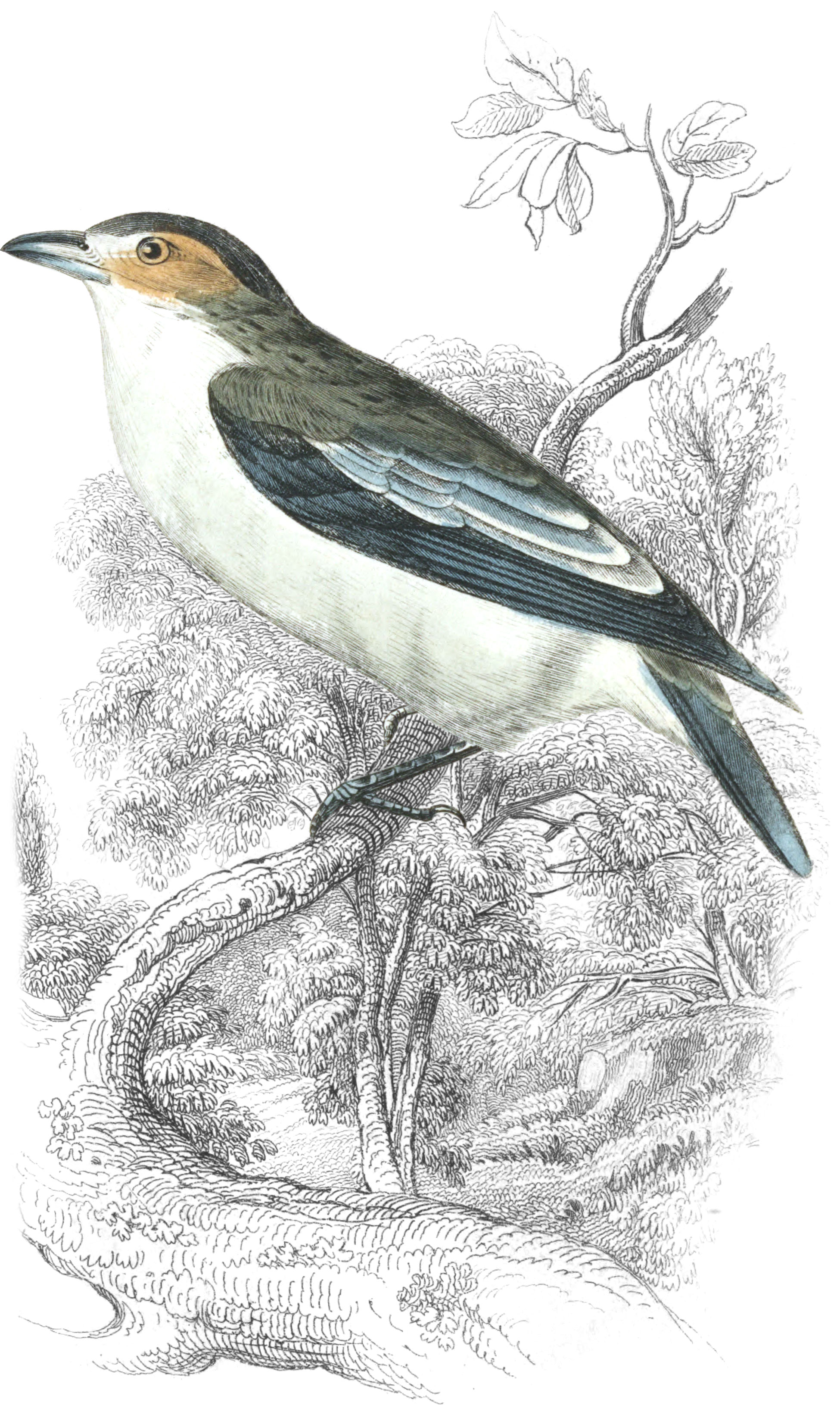
Plate III
Between Psaris and the next genus,
Pachyrhynchus
(A name which some erroneously have applied to both), there is such a beautiful series of connecting species, as to render it quite impossible to decide where one group ends and the other begins; although, if we look only to their typical examples, the difference is very striking. Several of the large Psari have a singular spurious quill, short and very slender, the use of which is altogether unknown, while in others the orbits and sides of the face are bare of feathers; it is by these nice but certain characteristics of species that we are able to distinguish the different sorts, which are all coloured alike. There are two or three birds even larger, which may possibly come in the range of this sub-family; they are from New Holland, and form the genus Sphecotheres of Vieillot; the size is larger than a thrush, and the bill is equally large and broad at the base with Psaris, yet it is much more compressed on the sides; the under mandible is strong, and there is a large naked space round the eyes; the wings, in general, are not unlike those of Psaris, but the tail is much longer; the feet are short and remarkably strong, the nostrils quite bare, and the rictus smooth. We confess, however, our belief, that the true affinities of this genus are not to be found in the present circle; that it has some relation, strictly so termed, to Psaris, is unquestionable, but we think that it is one of analogy rather than of affinity, and that Sphecotheres is the most aberrant type of the orioles, Oriolinæ, representing in that group, the genus Psaris. We incline the more to this view of the subject, because its position in this group seems to disturb the progression of forms between this and the sub-family we shall now enter upon.
Cuvier’s Thick-Bill
Pachyrynchus Cuvierii, Spix.
Above green; beneath white, with a bright yellow band across the breast; ears and neck above cinereous; the male with a black crown; the female with the wing-covers rufous.
Psaris Cuvierii, Zool. Illust. i. Pl. 32, the male.—Tityra Vieillotii, Jardine and Selby, Illust. of Orn. i. Pl. 10, fig. 1, the female.
The most elegant species of this division, and the only one yet discovered that is ornamented with bright colours, is the P. Cuvierii, first figured in the Zoological Illustrations, and subsequently placed in the sub-genus Pachyrynchus, which name M. Spix very improperly applies also to the genuine Psari. I had long entertained the suspicion that the female was the T. Vieillotii of the Illustrations of Ornithology; but I was only confirmed in this belief by M. Natterer, who assured me, when inspecting my collection, that such was truly the fact.
In size, both sexes in our specimens are equal, and they do not exceed that of a sparrow. In the male the crown is of a deep and glossy black, which is separated from the bill by a narrow frontal line of white, which passes over the lores to the eyes. The upper part of the neck is of a clear and delicate cinereous, which tinges the ears, and advances towards the sides of the throat. The rest of the upper plumage is of a bright olive, or rather yellowish-green, the quills alone being blackish beyond their outer edges; the tail is much rounded; the feathers olive-green, margined at their tips with yellowish-white; the under plumage is white, with a broad and bright band (undefined at the edges) across the breast, the under wing-covers being of the same colour.
The female is in all respects like the male, except in the following particulars:—The crown of the head, instead of being black, is of the same green as the back; the eyes are surrounded with a yellow ring; while all those wing-covers which are nearest to the carpus, or outer edge, are covered by a spot of bright rufous. Between the first and second primaries of the male is a spurious quill, half the length of the second, which the female has not. The hill and feet in both sexes are blue-black.
Total length, 6 inches; bill, gape, \(\frac{3}{4}\); front, \(\frac{1}{2}\); wings, 2\(\frac{3}{4}\); tail beyond, 2\(\frac{1}{2}\); tarsus, \(\frac{7}{10}\).
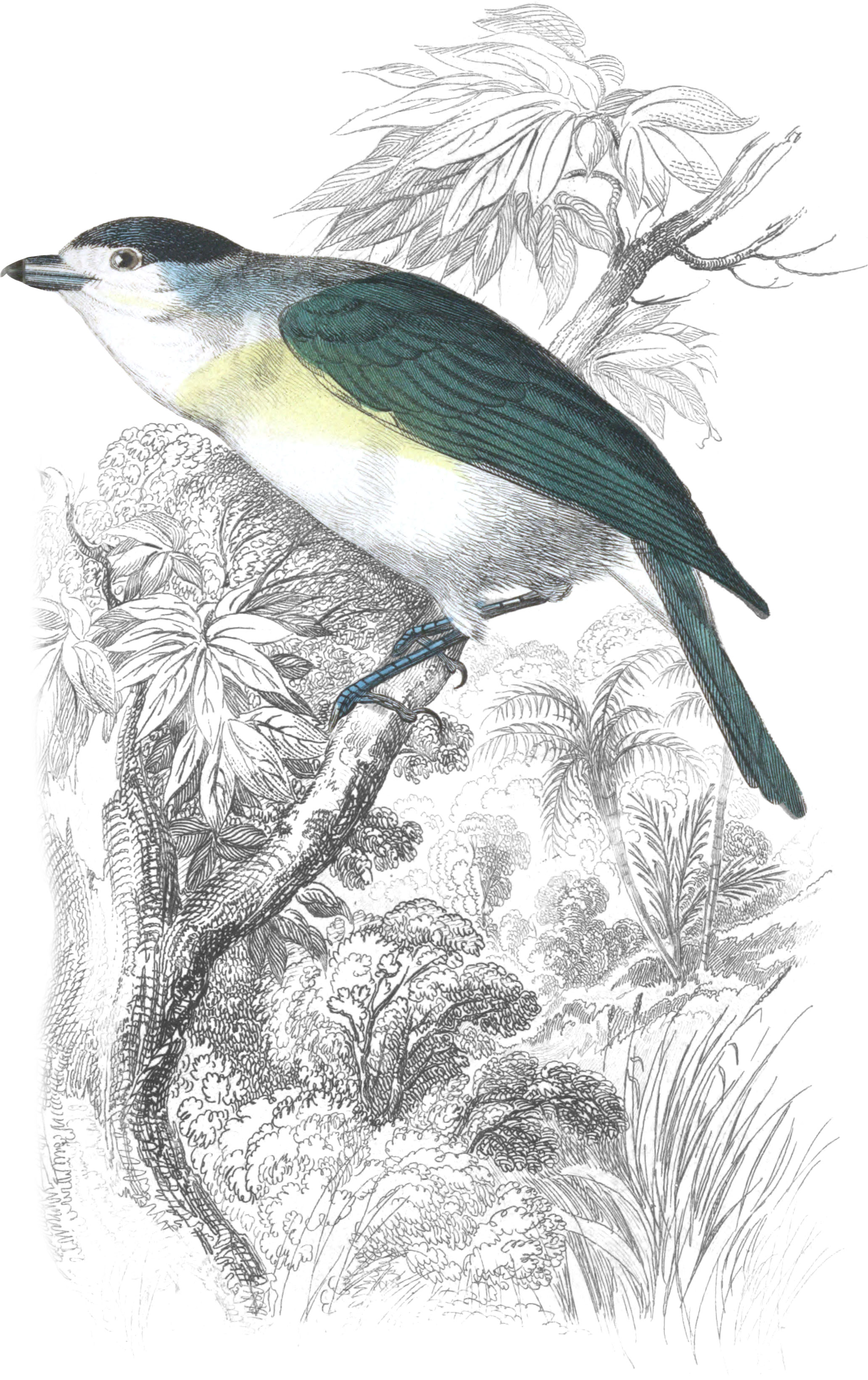
Plate IV

The Fluvicolinæ or Water-Chats
constitute the last of these aberrant divisions of this family. As it not only forms the passage to the shrikes but also to the Sylviadæ (as the other side of the dentirostral circle), it consequently presents in its contents a considerable deviation from the general characteristics of its own family. The birds, in fact, are terrestrial flycatchers, preserving all the characters of their tribe except in the legs,—these members being large, high, and stout, adapted for constant exercise upon the ground, where these birds are almost invariably seen. We have no examples of this group in England, but we may gather some idea of their forms and habits by looking to the stone-chats of Europe. Along the Brazilian rivers and in all the flat and humid savannahs, these birds are seen running with great celerity in pursuit of insects, and moving their tail in the manner of our wheat-ear, which bird they further resemble in the black and white colour of their plumage. Such are the general habits of the whole group, but it comprises several genera, differing in the formation of the tail, the bill, and the wings. Of these the most curious is Alectura, first noticed by Azara under the name of Le Petit Coq. (Voy. iii. p. 447); its tail is broad, and, like that of our domestic fowl, it is laterally compressed and carried erect; in one species these feathers end in long naked filaments, and in another it is greatly forked. Near to these may be placed the long-tailed shrike-like flycatcher, another bird equally remarkable for the developement of the tail; it is called Yiperu by Azara, and is the type of the sub-genus Gubenetes. The fly-catchers, in general, are by no means a social family, yet nearly all of this division appear to live in small societies, frequenting, in little troops, the low marshy grounds of South America, where they keep up a loud discordant and disagreeable babbling; they are no less distinguished by these peculiarities than by their plumage, which is universally varied only with different shades of black and white. The whole group, as here characterised, is confined to tropical America. There are more birds referable to this group than to either of the two preceding, but it has been so completely overlooked by all systematic writers, with the exception of Azara, that it is very difficult at present to form a just idea of its contents.
In the foregoing remarks, the reader will perceive some peculiarities of the aquatic type, mingled, as it were, with those of the rasorial; nor is this the only instance where such an approximation is discovered. Great bulk, feeble and imperfect feet, and a fondness for water, are the three great indications of such vertebrated animals as belong to the first of these types; while strong and powerful feet, short but broad wings, and a harsh discordant voice, are chiefly to be found in those groups which represent the Rasores or fowls. Now each of these latter characters are possessed by the birds before us, to which they have superadded one, and but one, of the characters of the Natatores, namely, aquatic habits. Some highly interesting speculations arise out of this, too abstruse, however, for our present discussion. Certain, however, it is, that there is always one division of a large group like the present, which either directly or indirectly manifests an attachment to water; and as this is not seen, so far as we yet know, in the Querulinæ, it would naturally be expected in that aberrant division which stood on the opposite side of the circle. And accordingly we find it to be so. Querula has three of the natatorial characters, namely, great size (it is the largest bird in the whole family), a very broad and strong bill, and yet remarkably small and weak feet; but a fourth, the love of water, it seems not to have, so far as our imperfect knowledge of its manners extends. It must be remembered, also, that no animals which are merely analogical representations of a type, represent all the characters of that type; a moment’s reflection will show this to be a necessary law of nature; because, were it otherwise, such animals would no longer be representations, but actual examples of the type itself, in its full developement. Besides, we must not allow every little difficulty to turn us aside from what is evidently the path of nature. Of all the birds in this family, Querula obviously makes the nearest approach to the chatterers, and it is equally certain that the water-chats (Fluvicolinæ) make the nearest approach to the genuine flycatchers and to the tyrants. These two points, therefore, being incontestable, our business is to trace, as far as can be, the intervening series, and then to see how far the results accord with the general laws of nature.
The passage from the Black-caps to the Water-chats is effected, as usual, by a representation of the rasorial type. Of all known birds the Scissor-tail,1 forming the genus
Gubernetes
comes nearest to Psaris cayana in the general character of its structure; it has, however, a very long forked tail, and amore perfect fissirostral bill,—that is, shorter, broader, and more triangular. On the other hand, its legs are large and strong, perfectly adapted for walking,—the lateral toes being even, and the claws, although sharp, very slightly curved; this structure of foot, in short, is exactly what we find in all the water-chats, but Gubernetes is the only type which still retains a small row of those minute lateral scales on the tarsi, which are so constant in all the groups we have yet mentioned; the stiff rictal bristles of the insectivorous birds are now fully developed, and we have obviously quitted all those groups which feed in some degree upon fruits. Azara is the only writer who says any thing of the habits of this remarkable bird, which we shall call the Swallow Black-cap.2 Duringflight, it seems to open and close its forked tail; it frequents humid situations, associated in small flocks, and seeks upon the ground for worms and insects. Hence we see the use of its possessing strong feet and somewhat straight claws; thus combining the leading characters of the Psarianæ and the Fluvicolinæ.
Scissar-Tail, or Swallow Black-Cap
Gubernetes forficatus, Swains.
Cinereous; wings and tail brown; chin and throat white, bordered by a chestnut collar; primary quills fulvous-yellow at their base.
L’Yiperu, Azara ed Sonnini, iii. p. 196.—Gubernetes Cunninghamii, Vigors, Zool. Journal, ii. Pl. 4, (fig. med.)
Azara was the first to record this remarkable bird, but, by a singular infelicity of arrangement, he has placed it among the Icterinæ, or hang-nests, with which it has obviously no connexion. This is the more unaccountable, as the account he gives of its manners are perfectly in unison with those of his Pepoazas, or water-chats, in which we include this and the last genus. Like these birds, it frequents, in small troops, the neighbourhood of swamps and rivers, sometimes perched upon the reeds and rushes, but more generally frequenting the ground in search of worms and other insects. During its flight it has the habit of expanding and opening its very long and forked tail, upon which account the natives of Paraguay have given it the name of Yetapa, or the Scissar-tail. When perched, it has the distinguishing habit of the flycatchers, of darting upon such insects as pass within its range of wing, without, as it would seem, pursuing them. It is common in Paraguay, and not unfrequent in Southern Brazil.
The general colour of the upper plumage, excepting the wings and tail, is light cinereous, tinged with grey; this latter tint is chiefly caused by the shaft of each feather being brown. The under plumage, from the bottom of the neck downwards, is of the same colour as the back, but towards the belly and vent it gradually changes to a dull white. From the chin to the bottom of the neck, which is very short, the feathers are pure white, this part being confined by a crescent of the deepest chestnut, which commences on the ears and crosses the upper part of the breast. Above the eye is a whitish stripe, but the lores are grey; the inner wing-covers, and the margins of the wings, are white; the wing-covers, scapulars, spurious wings, and most of the lesser quills, are dark sepia-brown; but the primaries, excepting the two outermost, are of an orange-buff colour, tipt only with brown; the tail is brown towards the base, but black beyond.
Total length, 15 inches; bill, gape, 1; front, \(\frac{6}{10}\); wings, 4\(\frac{9}{10}\); tail beyond, 8; base, 10\(\frac{1}{2}\); tarsus, 1.
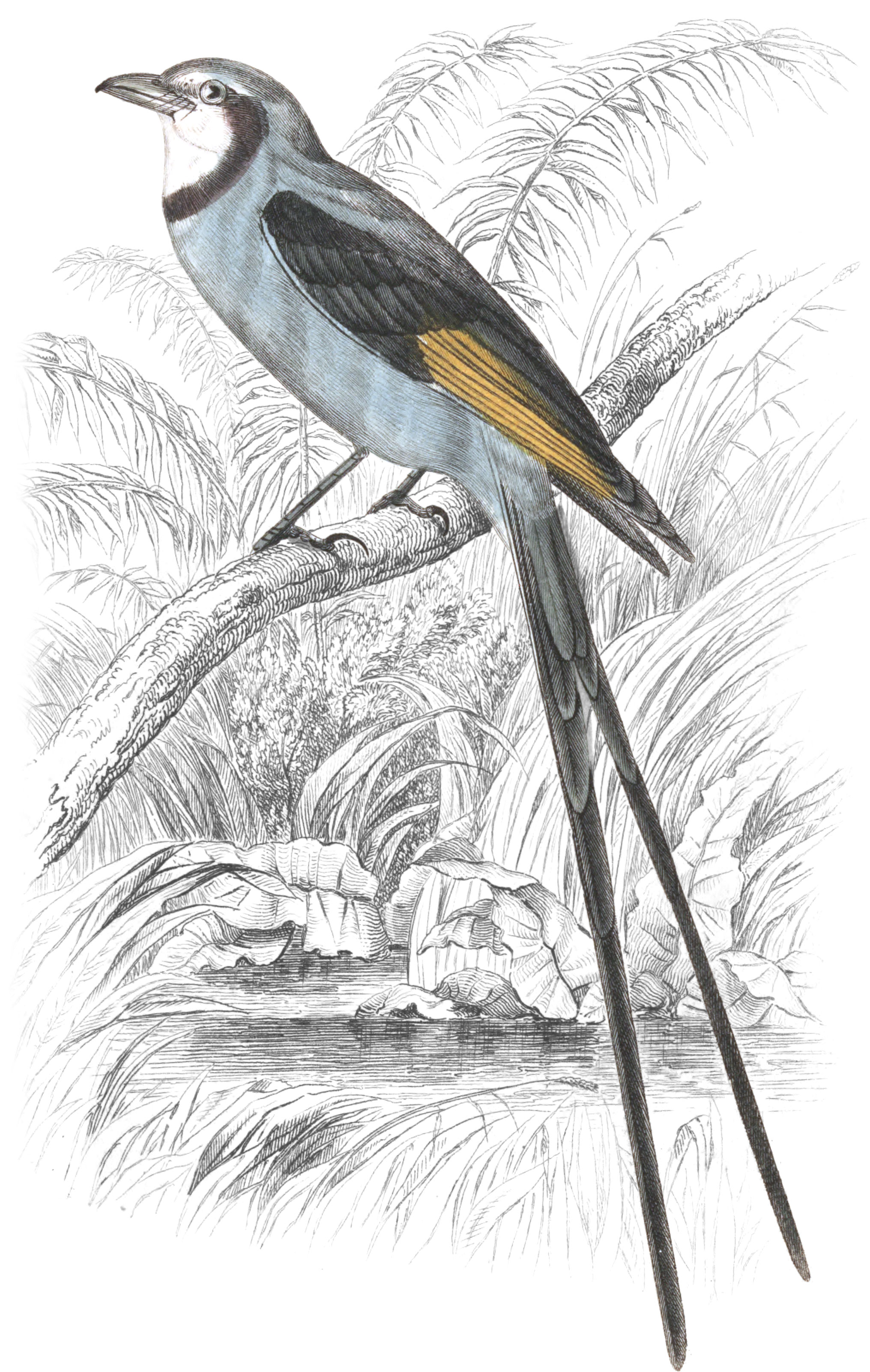
Plate V
From Gubernetes we are immediately led into the circle of the Fluvicolinæ by
Alectura
which is a no less remarkable type; three species only are as yet known, and these are very singular little birds; their size is not bigger than that of a robin, but their head is enormous from the quantity of feathers upon the crown, while the tail, as already remarked, is erect and compressed, very much like that of the cock. The bill and feet are both large in proportion, and give us such a miniature resemblance of those members in Gubernetes, that no doubt can exist on the close affinity of the two genera; for although, if our views are correct, they do not stand in the same circle, yet, as they form a union between both, their separation is only nominal. These “little cocks,” as Azara calls them, seem in their habits to be true water-chats, frequenting the open and humid sides of savannahs, where they search upon the ground for insects; occasionally, however, they exhibit a slight indication of the habits of the true flycatchers, by perching upon reeds or very low shrubs (never on trees), and catching insects as they fly near its station. It deserves to be noticed, that Azara, a decided opponent of technical systems, was yet too well versed in natural groups to confound these birds with the ordinary flycatchers; he consequently formed them into a distinct genus, without giving any other than a vernacular name. M. Vieillot, in the first instance, adopted Azara’s views, and termed the group Alecturus; but the prejudices of system and its technicalities made him subsequently abandon the name and the distinction, and he incorporated them with a confused assemblage of birds now passing under the general designation of Muscicapa. We must, therefore, cite M. Vieillot’s name to this genus, in contradiction even to himself; for had he paid due attention to the observations of Azara, or had given more than a hasty glance at the structure of the birds themselves, he would never have differed from his master and from himself. The Alecturi seem to be common in some parts of the southern provinces of Tropical America, but they are not met with in other localities.
Cock-Tailed Water-Chat
Alectura Azarii, Swains.
Above blackish, edged with grey; ears, shoulder-covers, margins of the quills, and under plumage, white; breast and sides of the neck with a black collar, almost obsolete in front.
Le Petit coq., Azarii ed. Sonnini, iii. 447.—Muscicapa alector, Pl. Col. 155; fig. 1, male; 2, female.—Muscicapa alectura, Vieill. Gal. Pl. 132.
It is but justice to the memory of the great Spanish naturalist Azara, who first made known to us this extraordinary group of birds, that one of the species should be recorded by his name, especially since that of Alector is but a repetition of Alectura; and it is quite impossible to determine whether M. Vieillot’s short description of his Alectura tricolor (which, in another part of the same work,3 he calls Gallita tricolor) is intended for this or some other species.
In its manners, as detailed by Azara, may be recognized all the prominent characteristics of the true water-chats. It prefers open tracts in the immediate vicinity of water, but never enters into the woods. Its food, in fact, appears to be semiaquatic insects, which it chiefly pursues on the ground, although it sometimes perches upon the reeds and aquatic shrubs, and darts upon insects as they pass within reach. The males are solitary, but it is not uncommon to find from two to six females together, living, as it would seem, in little troops. The males often take a flight almost vertical, and then, before they alight, turning themselves over something like a tumbler-pigeon.
The male has the upper plumage, for the most part, black, the feathers being edged with grey. Across the breast is a black collar, springing from behind the ears, and almost obliterated in front; the shoulder-covers, and the edges of the quills, together with some spots on the front, are all white; the edges of the wing-covers, and the lower part of the back, are cinereous; the ears, stripe above the eye, lores, and all the under plumage, is pure white. The singular form of the tail is best understood by the figure. Its colour is deep black, excepting the grey tips of the lateral feathers. The female I have not yet seen. This species is found both in Paraguay and in Southern Brazil.
Total length, 5\(\frac{1}{2}\) inches; bill, gape, \(\frac{6}{10}\); front, \(\frac{4}{10}\); wings, 2\(\frac{3}{4}\); tail, from the base, 2\(\frac{1}{4}\); tarsus, \(\frac{3}{4}\).
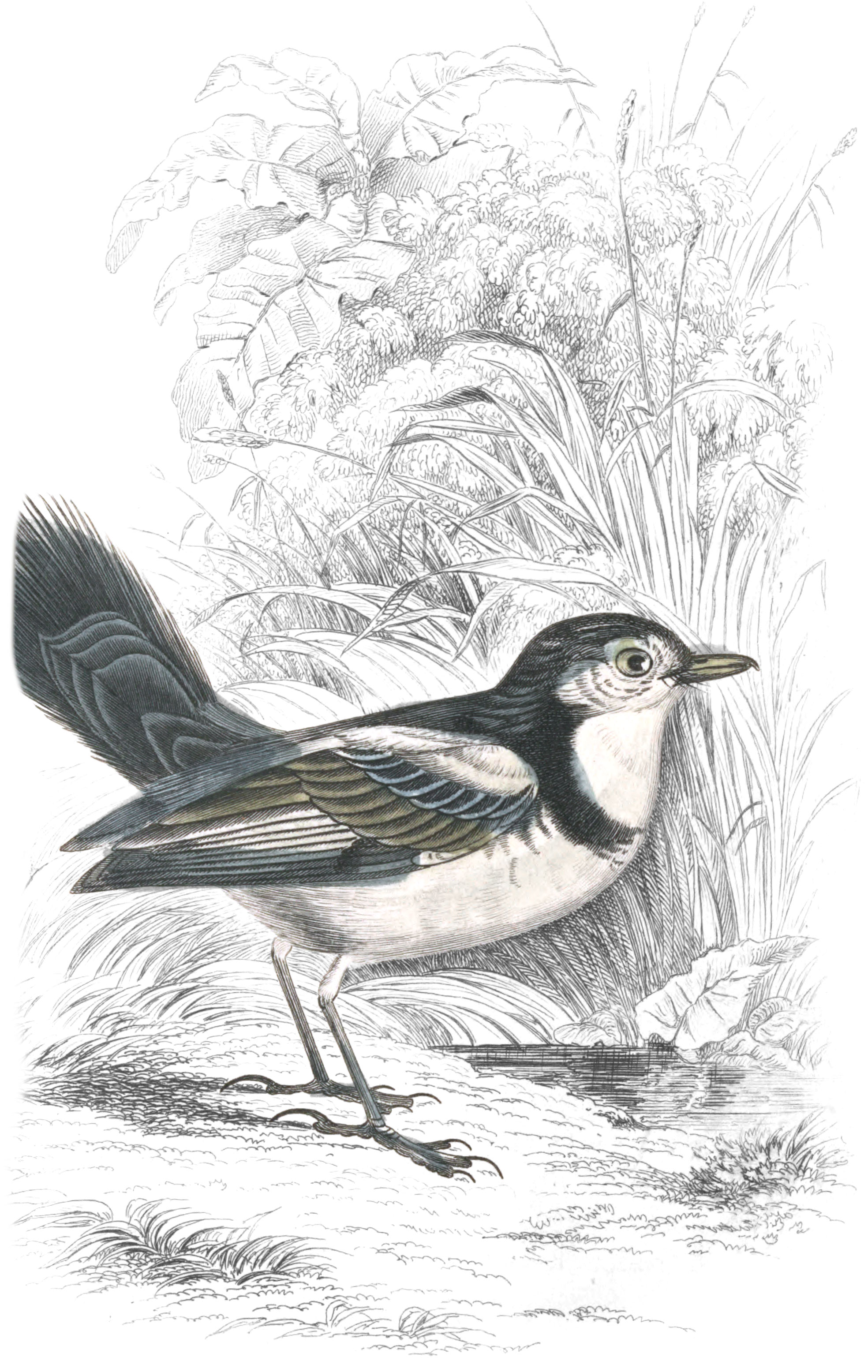
Plate VI
The passage from Alecturus to the common tailed water-chats is not yet rendered unquestionable by a series of intervening forms; but there are some with long win and short triangular bills, to which we shall retain the name of
Blechropus
viewing them for the present as distinct from Fluvicolina. Of these we know four or five species, and although they do not exhibit very decided peculiarities as to structure, still it seems desirable to keep them distinct; they differ from Fluvicola and agree with Alectura in their large heads; their plumage is more or less deep black, with a concealed spot of white on the inner web of the quills, which only becomes suddenly conspicuous when the wing is expanded; the feet being smaller, and the toes rather shorter than in Fluvicola, would seem to indicate even more of the perching habits than are possessed by Alectura, while their singularity of plumage leads us to believe they must have also some peculiarity of manners. One of these we shall now figure.
Crested Black Water-Chat
Blechropus cristatus, Swains.
Entirely black, with a large spot of white on the base of the inner web of the primary quills; head with a conspicuous crest of slender lengthened feathers.
Musicapa comata, Lich. in leteris.
The bird we have here selected as an example of the genus Blechropus, will serve to show in what respect this group differs from that of Fluvicolina, although we candidly confess we do not as yet sufficiently understand the typical characters, or are we prepared to say whether this is a typical or an aberrant species. It is clear, however, from the strength and length of the legs, that it belongs to the Water-chats, and not to the Tyrants, while it differs so much from the typical examples of all those genera which compose the Fluvicolinæ, that we can only choose between viewing it as an aberrant species of Fluvicola, or separating it as a subgenus. I have adopted the latter view, at least for the present; and until we know more of those birds, called by Azara Pepoaxas, and of certain others, which seem to combine the characters of the Tyrants and the Water-chats.
In all points of general structure the bird before us agrees with Fluvicola, except in the feet and the tail. The former, although strong, have not the tarsus so much lengthened, and the inner toe is obviously shorter than the outer; this latter character, indeed, is seen in the Fluvicola nengeta; but the toes of this bird are much shorter, and seem adapted as much for perching as for walking: the tail is lengthened, and so much rounded as to appear fan-shaped, every feather being graduated; and it is this circumstance, more than any other, which induces me to look upon Blechropus as that type which passes into the Rhipiduræ or fantails. The whole plumage is black, glossed with bluish, excepting the base of the inner webs of the primaries, which are pure white: the crest is very elegant, the feathers being long, narrow, and slightly recurved towards their tips; bill and legs black.
Total length 9 inches; bill, gape, \(\frac{9}{10}\); wings, 5; tail beyond, 2\(\frac{1}{4}\); from the base, 4\(\frac{1}{2}\); tarsus, \(\frac{9}{10}\); middle toe and claw, \(\frac{8}{10}\).
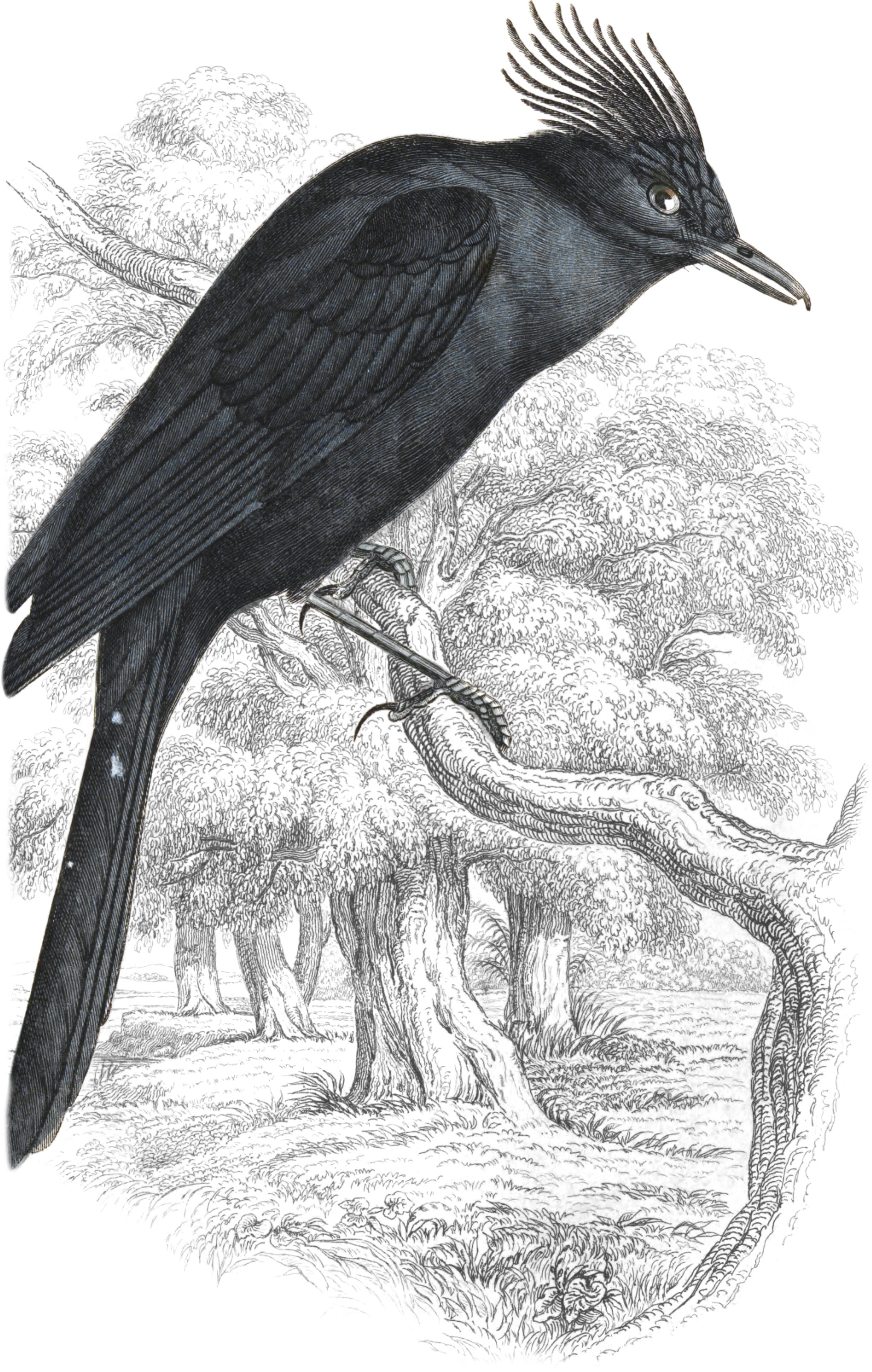
Plate VII
It is evident that the bird last figured and described is very closely connected to the true water-chats, forming the genus
Fluvicola
the chief type of this sub-family. A great uniformity of plumage runs through all the species we have seen of this group, so that very many, we doubt not, have been overlooked or disregarded as varieties; the predominant colour is pure white, with deep black wings and tail; sometimes the whole or a part of the back and head is grey; the largest species is the Fluvicola nengeta, which is clothed in the same coloured plumage as the American mock-bird, while the smallest4 is so like the European Muscicapa atricapella, that it is not surprising the old ornithologists in their systems placed it immediately after that bird. The aspect of all these birds, in short, will remind every one of the stone-chats and wheat-ears, and thus will do away with the necessity of proving that they represent each other. One of the most remarkable species is the Fluvicola cursorial,5 because in this we see the tail, although not unusually long, is so much graduated as to assume something of the same shape and appearance as that of the next genus Rhipidura; another of the most typical species is the
Mocking Water-Chat
Fluvicola nengeta, Swains.
Upper plumage, breast, and tip of the tail, cinereous; wings and tail black; primary quills with a band of pure white at their base; ears and maxillary stripe varied with grey and black; throat and body beneath, white.
Lanius nengeta, Linn. Auct.—Muscicapa polyglotta, Spix, ii. Pl. 24.
I believe that this common bird is one out of three species, of three different genera, that compose the Lanius nengeta of Dr. Latham and his followers. One of these appears to be the Grey Pie of Edwards, Plate 318, which is unquestionably a mocking thrush of the genus Orpheus; the second is some species of true Shrike (Lanius) found in Russia; and the third is the present bird. Dr. Latham has still further generalized his ideas of his Lanius nengeta, by actually placing with it, as varieties, two other species of true Lanius, one of which we have elsewhere shown to be nominal To unravel such a complication of errors is next to an impossibility; they meet us in every page of our general systems, and to rectify them all would be the labour of a life. Hence arises the necessity or imposing new names upon species which, although long known, still remain so confounded with others, that if we aim at precision, we can hardly quote their former names even as synonymes.
In general structure the bird before us perfectly agrees with the typical Flumcolinæ. The third and fourth quills are equal and longest, the two first being a little graduated, and slightly narrowed at their tips, especially the outermost; the general colour above is cinereous grey, which tips all the black tail-feathers, and margins those of the wing-covers and tertials, although these two latter are blackish-brown in the middle: the primaries, secondaries, and spurious wings are deep black, but the ninth and tenth quills are entirely pure white, which colour also forms a band at the base of the other primaries, narrowest on the longest and broadest on the shortest of these quills; the secondaries are merely tipt with white: the lores and maxillary stripe are black, but above the former is a white line, and the latter is varied with grey; under plumage white, but grey on the breast and flanks; tail black, tipt with greyish-white, the edge of the outer tail-feather being white.
Total length, 9 inches; bill, gape, 1; front, \(\frac{3}{4}\); wings, 5\(\frac{2}{10}\); tail beyond, 1\(\frac{1}{2}\); base, 4; tarsus, 1\(\frac{1}{10}\).

Plate VIII
We have now traced the greatest part of the circle of the Fluvicolinæ, yet there still remains two types undetermined; and one of these is the tenuirostral or grallatorial. This latter we consider to be represented by the Sylvia perspicillata of the old authors, a bird which was even known to Buffon, but which has hitherto been very imperfectly described, and never figured. It forms the type of our genus
Perspicilla
and we now annex a description of both sexes, procured in the southern parts of Brazil, where it is by no means common. Its relation to the water-chats is indisputable, for its entire organization bespeaks it a terrestrial bird, possessing something of the structure both of Fluvicola and of Alectura, yet exhibiting a strength of foot and a form of bill which separates it from both; the whole appearance of this bird, in fact, is very striking, as will be seen by the annexed figure.
It is rather larger than Alectura, and is more truly characteristic of a grallatorial form, from the excessive developement of those quill-feathers which lay over the others. Setting aside the universality of this fact among the typical waders, we see it in their representatives the larks (Alaudinæ), pepits (Anthus), wagtails (Motacilla), and numerous others. The structure of Perspicilla, therefore, although singular and unique in its own circle, is in the most perfect harmony with those groups it represents in other circles. The nakedness of its face and the weakness of the bristles round the mouth, reminds us of the typical Ampelidæ or chatterers, among which we have the only insessorial birds possessing white quill-feathers; we see its long legs, yellow bill, and fleshy orbits again repeated among the plovers (Charadriadæ) and similar naked appendages to the eyes occur among the caterpillar-catchers (Ceblepyrinæ), and certain todies. Now each and all of these are grallatorial types in their own circles, so that four at least of the leading types of the Fluvicolinæ may be considered determined; and we have only to wait for better information respecting that between Alectura and Fluvicolinæ, to pronounce this family so far to be complete.
Spectacle, or White-Winged Water-Chat
Perspicilla leucoptera, Swains.
Male, entirely black, excepting the primaries, which are white, tipt and edged with brown; round the eye a naked prominent fleshy ring. Female, brown, paler and striped beneath; the primaries edged with rufous; bill yellowish-white.
Motocilla perspicillata, Linn. Auct.
The habits of this very singular bird can only be guessed at from its construction: for although it seems a species well known to the older ornithologists, we are still in ignorance of its natural history, nor has the female, until now, ever been described Sonnini, indeed, in his translation of Azara, supposes that this is the Bee argenté of the Spanish naturalist; but there seems to be no good foundation for this opinion. Such an accurate observer of nature as Azara was, would never have passed over in silence the extraordinary fleshy lobe which, like a pair of spectacles, encircles the eye of the male, and no mention whatever is made of this peculiarity in the description of the bird alluded to. (See Azara, iii. 453.)
The male, as already intimated, is entirely of a deep sooty black colour, uniform over the whole of the plumage excepting the quills; the first six of these are pure white, having the base, tips, and part of the outer web black, so that when the wings are closed these quills appear only to have an oblique band of white across their outer webs. The naked skin round the eye is loose, and, in the dead bird, plaited; perfectly similar, in fact, to that of the Prionops plumatus.
The female is so differently coloured that it might easily be mistaken for another species. The upper parts are brown, varied with lighter stripes, and pale edgings to the wing-covers; but the basal margins of all the quills are clear and bright rufous; the inner wing-covers are of the same colour, but much paler. The under plumage is dingy white, striped with brown upon the breast and flanks. The bill of the male, even in the dead bird, is straw-coloured yellow, but that of the female has the upper part brown; in both sexes the legs are deep black.
Total length, 6 inches; bill, gape, \(\frac{8}{10}\); wings, 3\(\frac{6}{10}\); tail beyond, 1; base, 2\(\frac{3}{4}\); tarsus, 1.
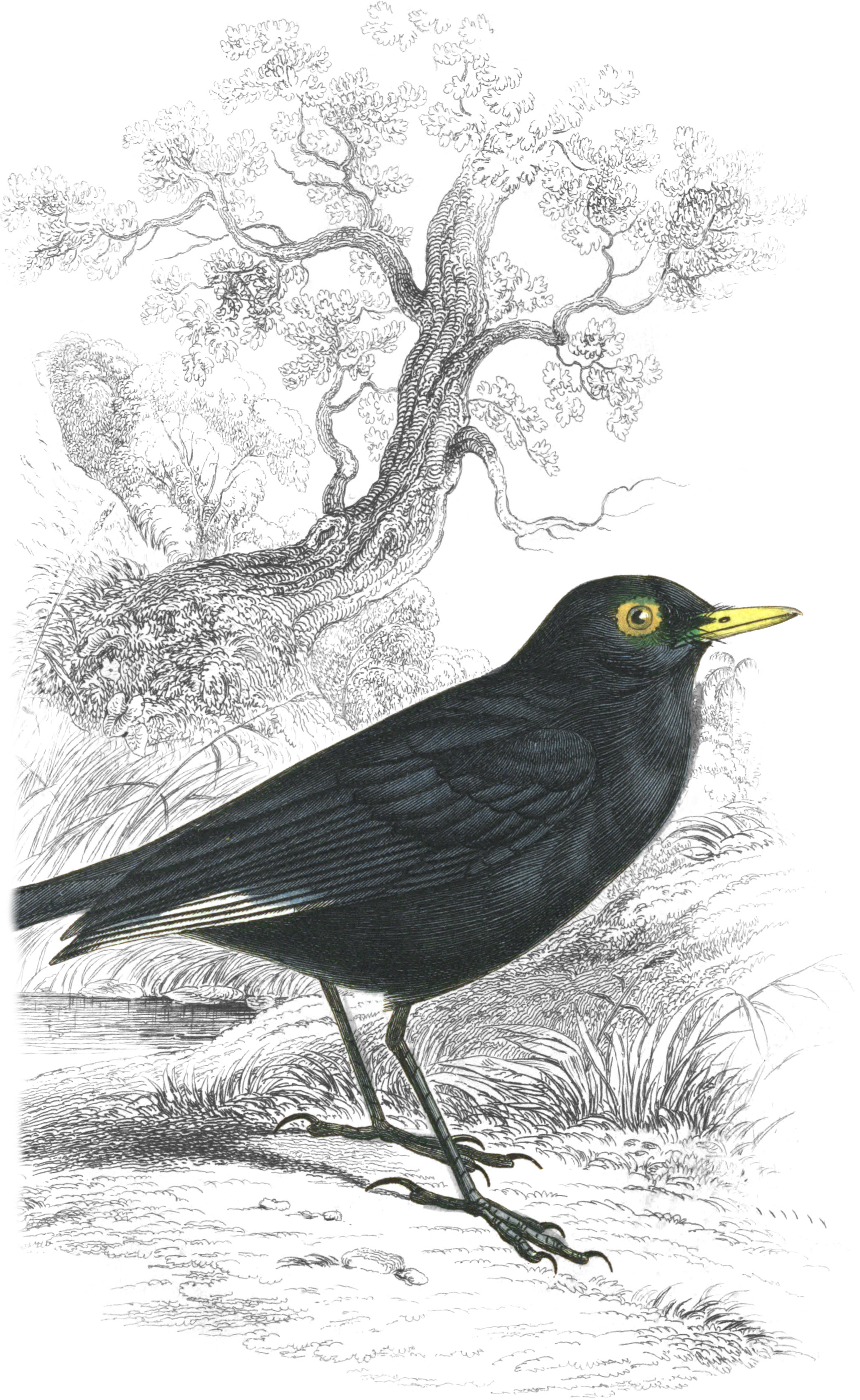
Plate IX

We now enter upon the sub-family of the
Muscicapinæ, or Genuine Fly-Catchers
by far the most extensive and consequently varied group of this family. It is composed of those broad billed insectivorous little birds which dart upon their prey as it were from an ambush; they fix their station on the end of a branch or a projecting spray, from whence they suddenly dart upon such flying insects as come within a certain range, seldom making any attempt to pursue them, or to repeat another swoop if the first has been unsuccessful; sedentary habits, such as these, are not likely to call the feet of such birds into exercise, we consequently find that these members are always short and remarkably feeble in every part of their construction; the length of the tarsus, in fact, is very seldom more than that of the hind-toe and claw,6 and in those very few types where this proportion is not observed, the tarsi, although lengthened, are remarkably slender and the claws syndactyle, that is, more or less united together at their base. There is another peculiarity which seems very characteristic of all the types we have hitherto seen of the Muscicapidæ, where, notwithstanding the many variations in the form of the tail, 110 one instance can be cited of this member being forked. Attention also to the claws will enable the ornithologist to distinguish the genuine fly-catchers from the tyrant fly-catchers of America; in the latter they are invariably long, acute, and slender; so much so, indeed, as to make one believe they were intended to seize the prey of the bird; but this is not the case, although we are quite ignorant of the use of such a peculiar formation. The true fly-catchers, on the other hand, afford us not one recorded example of this structure, their claws are shorter, broader and much less acute; this difference, however, is not sufficient to distinguish all the tyrant fly-catchers, as some of the very small species, whose true affinities, in fact, are somewhat doubtful, possess the claws of the Muscicapidæ, but these latter never exhibit those of the Tyranninæ.
No circumstance is more remarkable, and certainly none more inexplicable, than that certain groups of birds, having a limited geographic distribution, should be distinguished from others of the same family (but inhabiting another continent), by a slight but invariable deviation in the form of their wings. This difference might be accounted for, if, upon further investigation, we had found that it was accompanied by a difference in the mode of flying or of capturing the food. But hitherto not the slightest variation has been detected, on these points, between the fly-catchers (Muscicapa) of the Old World and those of America. Nevertheless, so decidedly different is the structure of the wing in these two great geographic groups, that we may at once decide from this circumstance alone, whether a species we see for the first time is a New or an Old World fly-catcher. We drew the attention of ornithologists to this remarkable fact some years ago,7 and subsequent experience has not furnished us with a single exception to the rule. The common grey fly-catcher of Britain catches its prey in precisely the same manner, so far as I can discover, as do the little tyrants (Tyrannula) of Brazil, both sit upon a twig, dart at passing insects, and return to the same station; but the European species has the first quill-feather so small as to be spurious, or as it were elementary, while that of the other is three times as long, and the proportions of the remainder differing entirely from those of its congener. Now this spurious quill is the great and universal character of all the genuine flycatchers of Europe, Asia, Africa, and New Holland, while among those of, America not a single instance of such a structure has yet fallen under our observation.8 The student, therefore, if all other distinctions fail, has but to examine the wing of a fly-catching bird, to know at once whether it is a native of the New or the Old World; whether in fact it belongs to the genera hereafter-mentioned, Todus or Muscicapa; the first, with one exception,9 being an American, while the latter is an Old World group. But that the ornithologist may more clearly comprehend these distinctions, we shall take this opportunity of explaining them more fully.
The wings of the paradise fly-catcher, a most beautiful though common bird, will give us a perfect idea of that structure, which, with very slight variations, runs through all the Old World Muscicapinæ. The general form of this member, although by no means short, is nevertheless rounded; that is, the outermost feathers, instead of being the longest, as in the swallows, are much shorter than those which are nearest to the body, and, from being of different lengths, they are termed graduated. The first quill is small and spurious, being hardly half as long as the next; the second is half an inch shorter than the third; and this latter, again, is about three-tenths of an inch shorter than the fourth; the fourth, fifth, and sixth, being all of the same length, and longer than any of the others. This sort of wing, without any variation, is alike common to Muscicapa, Rhipidura, Seisura, Myagra, Monacha, and Platystera; in Hyliota there is a slight deviation; the second quill is longer, and the third almost reaches the end of the fourth; this departure from the typical structure prepares us for a second modification, as seen in the Muscicapa atricapilla of Europe and its allies; the first quill becomes smaller and is not one-third the length of the second, while the third is the longest of all. This structure of wing is much more pointed than that of the first we described: it has evidently greater power, and we consequently find it has been given to a group of birds which are known, like our grey flycatcher, to migrate. Were it not for the bristled and depressed bill of some of those latter, their feet are so unusually strong in comparison to those of their congeners, and their wings so very similar to those of the Stone-chats, that we should be almost tempted to place them with the Saxicolinæ; and, indeed, in respect to some, we are by no means satisfied to which group they naturally belong; the characters by which we propose to denominate them will be subsequently stated. In the mean time, it deserves marked attention, that this close approximation leaves us in no doubt that the three aberrant families of the Dentirostres unite into a circle of their own, independent of their connexion to the shrikes (Laniadæ) and the thrushes (Merulidæ).
With these preliminary observations on the leading characters of this extensive assemblage of birds, we shall now proceed to the names and definitions of the genera composing it. These appear to be as follows:—
- Rhipidura, the Fan-tailed Fly-catchers;
- Monacha, the Oriole, or Hooded Fly-catchers; and,
- Megalophus, or Great-crested Fly-catchers.
These three appear to form the aberrant group, as representing the rasorial, the grallatorial, and the fissirostral types. The fourth genus is Todus, composed of the well known Todies, or South American Flycatchers. And the fifth is Muscicapa, consisting entirely of those, pre-eminently typical, which are restricted to the Old World.
Our proposition is, that these genera form a circular group. But before we enter into those details by which we hope to substantiate this assertion, let us, in the first instance, briefly state the prominent or typical distinctions of each, and then compare them, in our usual manner, with some other well known and authenticated groups, whose internal relations have stood the test of experience and rigid analysis. And, first, they may be compared with the Orders of Perchers in the following manner:
| Muscicapa | Pre-eminently typical of their respective circles | Conirostres |
| Todus | General structure less perfect | Dentirostres |
| Megalophus | Feet short, weak; toes syndactyle; head large | Fissirostres |
| Monacha | Bill lengthened, compressed; frontal feathers advanced on the bill | Tenuirostres |
| Rhipidura | Feet lengthened; tail very large, broad; habits familiar | Rasores |
The experienced ornithologist need hardly he reminded, that when two groups are compared whose rank and situation are either remote or very dissimilar, the analogical resemblances between them will partake of the same remoteness; hence it sometimes happens, that although they agree sufficiently strong in some parts to make us feel sufficiently confident that the analogies are just, yet others will be so obscure that their correctness can only be established by a line of inductive reasoning, and their mutual relations come to light through the instrumentality of other groups. Applying this undoubted fact to the foregoing table, we shall find some of the analogies more apparent than others; and we are therefore to inquire, how far those which seem the most remote can be placed on the same degree of probability with the others. There can be no doubt, for instance, that the true fly-catchers, forming the genus Muscicapa, are the most perfectly organized group,—in reference to the true distinctions of that circle to which they belong,—in the whole sub-family. These typical distinctions are seen in the length of their wings, giving a power of flight not possessed by the Todies; their strongly hooked bill, the long and stiff bristles round the mouth, and their remarkably short, but not syndactyle feet; their habits are strictly in unison with these characters. They fill the same station, in short, in their own circle, as the Conirostres do among the Perchers, and we hence conclude that they are analogous. If this position is true, it necessarily follows that the Todies and the Dentirostres are also analogous; because the affinity between Muscicap and Todus is just as perfect and unquestionable as that between the Conirostres and the Dentirostres. Whether this analogy is shown in a more direct manner by certain habits possessed by both, of which we are at present ignorant, is a question to be determined hereafter; but we can discover no tangible analogy in their structure which would lead us immediately to conclude that they mutually represented each other. Passing to the two next groups brought under comparison, namely, Megalophus and the Fissirostres, we have one point of strong resemblance in the feet. The toes of the only species of Megapodius yet discovered, are much more united than in the typical examples of the two preceding genera, although its crest would seem to give this bird an equal claim to be considered a rasorial type. In determining, however, between these two opposite analogies, we have invariably found that great strength of foot, and disconnection of the toes, is a much more prevalent, and therefore a more certain indication of rasorial types, than the mere possession of a crest. This opinion is fully confirmed upon looking to the rasorial order itself, where we see that strength and perfection of foot is the universal character, while crests are not possessed by more than one-tenth of the whole. Or, if we reverse the comparison, and look to the Fissirostres and the Natatores, we observe that imperfection of foot is their predominant characteristic. Megalophus, therefore, maybe considered a true fissirostral type; possessing, however, in its remarkable crest, one of the characters of the genus into which it blends, at the opposite point of the circle, namely, Rhipidura. On the analogy of Monacha to the Tenuirostres there can be but little doubt; both are the most aberrant in their own circles, and both are remarkable for their cylindrical bills and the advancement of the frontal feathers over the nostrils. The last analogy to be traced, is that between the fantailed flycatchers (Rhipidura) and the rasorial birds (Rasores). Adverting to what we have just remarked on one of the primary characters of rasorial types, we find that this group of flycatchers have the longest and the strongest feet of any in the whole circle; when to this we see added a remarkably broad fan-shaped tail, and several peculiarities of economy which will be subsequently detailed, the analogy becomes more than probable it is all but certain. Rhipidura, in fact, possesses the whole of the rasorial characters excepting one, which seems transferred, as it were, to Megalophus, in the form of a crest; at least no species has yet been discovered, among the fan-tailed flycatchers, which possesses this ornament.
Let us now institute another comparison, by which, probably, what we have just advanced on the analogies of this family will in some degree be confirmed. Every ornithologist must be struck with the resemblance between the Babbling Thrushes (Crateropus) and the Fan-tailed Flycatchers (Rhipidura). We will therefore bring the circles in which these two groups occur into comparison, and by placing them opposite one another, ascertain whether a resemblance may be traced in all the other groups of which these two circles are composed.
| Circle of the Flycatchers | Analogical characters | Circle of the Thrushers |
|---|---|---|
| Rhipidura | Feet large; tail long, very broad, soft, and fan-shaped | Crateropodinæ |
| Monacha | Bill cylindrical, the sides compressed | Oriolinæ |
| Megalophus | Feet small, short, weak | Brachypodinæ |
| Todus | Wings and tail very short, and rounded; legs long, slender; toes often united | Myotherinæ |
| Muscicapa | Wings long; feet moderate; the toes free | Merulina |
Here the analogies of the flycatchers become much more definite, simply because they are compared with a group more in accordance with their own; or, in other words, the resemblances loose that remoteness which was the inevitable consequence of our last comparison. Thus, we find, that not only the analogy between the fan-tailed flycatchers (Rhipidura) and the babbling thrushes is perfect, but that other unexpected points of analogy come to light in the remaining groups. The orioles (Oriolinæ) and the hooded flycatchers, for instance, not only are the most aberrant in all their characters, but they have a peculiarity of colouring in the black hood which envelopes the head and neck of nearly all the species, which is very striking. The bill of Monacha carinata is much more like that of an oriole than of a flycatcher, while the plumage, again, of Monacha chrysomela, is almost a counterpart of that of its prototypes,—the Oriolus paradiscus and the Sericulus chrysocephalus,—not only as to its colour, but in that peculiar rich velvetty texture which is found in no other birds of these two families. The analogy between Megalophus and Brachypus is not so strong as among the others, but both have very short and peculiarly feeble feet; the weakness, however, of our comparison between these two last groups is amply made up by the strong resemblance of the todies to the Myotherma, as sufficiently expressed in the table, while the same observation is applicable regarding those points in which the typical flycatchers (Muscicapa) so perfectly represent the typical thrushes (Merulidæ).
One of the many inferences that may be drawn from the above exposition, is that which renders the genera of the Musciapinæ representations, equally perfect, of the divisions of the Laniadæ or shrikes. The only point upon which further evidence seems to be necessary regards Megalophus; and, on this account, it will be as well if the two groups are examined more accurately. We shall therefore now state the analogies of the
| Genera of the Muscicapinæ | Analogical characters | Typical Genera of the Laniadæ |
|---|---|---|
| Muscicapa | Wings long; tail graduated; sit and watch for their prey | Lanius |
| Todus | Wings short, rounded; tail slender, weak; legs lengthened; toes syndactyle; seek for their prey among trees | Thamnophilus |
| Megalophus | Feet short; head with frontal crests | Dicrurus |
| Monacha | The most aberrant in their respective circles | Ceblepyris |
| Rhipidura | Tail broad, generally rounded; bill greatly depressed | Tyrannus |
The two first of these analogies are so remarkably strong that they require no additional evidence to support them. The third, or that between Megalophus and Dicrurus, tends very much to confirm what we have advanced respecting Megalophus, for the crests, so common among the Drongo shrikes (Dicrurus), are certainly more like that of Megalophus, in point of structure, than are those of the Tyranninæ; all the latter being concealed, and the feathers not lengthened.
We have already seen how completely the orioles are represented by Monacha; and we shall now find that both these are only prototypes of the Celepyrinæ. The colouring of Monacha carinata is that of a Ceblepyris; while the C. lobata has exactly the same sort of naked wattles so conspicuous in Monacha telascopthalmus. Lastly, the Tyrannulæ represent Rhipidura in being the only shrikes which have the perfectly depressed bill of the flycatchers, and in the typical species having broad rounded tails. This analogy, however, is as weak as the last and the two first are the reverse; so that we have another proof, that in these sort of comparisons some resemblances will be much more strong, or rather better known, than others. Our inability, however, to discover other analogies than those we have just mentioned, between Rhipidura and Tyrannulæ, is of little consequence to our present purpose; for as we think it indisputable, after what has been said, that Rhipidura is a rasorial type, our only desire is to throw some additional light upon the analogies of Megalophus. This will be effected by looking to three of the genera composing the circle of the Thamnophilinæ, or Bush-shrikes, and comparing them with the three corresponding ones among the Muscicapidæ, thus,—
| Laniadæ | Analogical characters | Muscicapidæ |
|---|---|---|
| Malaconotus | Typical. Inhabits the Old World | Muscicapa |
| Thamnophilus | Sub-typical. Inhabits the New World | Todus |
| Prionops | Fissirostral. Crest greatly developed; feet short, pale, weak | Megalophus |
This we consider the best and the final test by which our proposition that Megalophus,—notwithstanding its crest,—is a fissirostral type, can be tried. The crest of the Prionops plumatus, although of a different sort, is more analogous, in its extraordinary size, to that of Megalophus, than that of any other known bird; and both further coincide in having very pale and delicate feet, upon which the scales are so thin that they can scarcely be perceived. If we continued the comparison by enumerating the other two genera in the above circles, we should find that Colluricincla is no obscure representation of Monacha; but the remaining genus in the first series (the Thamnophilinæ) being unknown, we of course are entirely ignorant of the prototype of Rhipidura.
Having thus endeavoured to substantiate our views of the primary divisions of the family of Flycatchers, we shall now enter upon the details of each.
By commencing with the genus
Rhipidura
Hors. and Vig.
We begin with that group which shows the nearest affinity to the Fluvicolinæ, or Water-chats. It will be remembered, that on a former occasion10 we placed the Australian genus Seisura, conditionally, within the confines of the Fluvicolinæ, though with very considerable doubt; expressing, at the same time, a strong suspicion that it truly belonged to the present division. This opinion has been fully confirmed by subsequent investigations; and we shall here attempt to refer it to its true rank and station among its congeners. The typical characters of the fan-tailed flycatchers may be gathered from what has already been intimated in our attempt to make out their analogies: their chief distinction, as their name implies, is exhibited in a very broad and rounded tail, which the bird is constantly in the habit of opening or expanding in the shape of a fan; next to this, in importance, is the general strength of their feet, as seen more particularly in three of the typical sub-genera, the tarsus of which is much larger than in any genuine flycatcher yet discovered. The bill exhibits nothing very peculiar or strikingly different from the typical flycatchers, except, indeed, that the sides, towards the end, are rather compressed; thus indicating, on the one hand, an affinity to Muscicapa, and, on the other, to Monacha. The recent acquisition of some interesting birds from India, which prove to belong to this group, has thrown a new light upon others which have long baffled our further analysis of this group; so that now possessing, as we consider, four out of the five leading forms, we shall no longer refrain from characterizing them as so many sub-genera; submitting to the reader, as we go on, those reasons which have influenced this determination. These types we shall distinguish by the names of Rhipidura (proper), Leucocirca, Myadestes, and Seisura; the first and the last having been already proposed by Messrs. Horsfield and Vigors. Rhipidura, in this restricted sense, contains those species only which have the bill remarkably small, and compressed for half its length; the rictal bristles extend to its tip, and are very stiff; the tail is particularly broad and fan-shaped, all the feathers being slightly graduated; but the feet are not more developed than in the typical fly-catchers. The great-headed titmouse of Latham, not now existing in any of the London collections, is, in all probability, the most typical species; while the fan-tailed flycatcher of the same author, and several others, called by him “varieties,” exhibit the same characters. The geographic range of these birds appear to be restricted to Australia and the smaller islands of the Pacific Ocean. Forster, in his voyage round the world, met with one species, of which, he says,
it is exceedingly familiar, constantly hunting after insects and flies, always with the tail spread like a fan; it is easily tamed, and will then sit on a person’s shoulder and pick off the flies: it has a chirping note, but not to be called a song.11
Lewin, again, speaking of another species, gives us, in a few words, the most essential character, in regard to habits, of the genus; he calls his orange-rumped flycatcher, which (from a specimen now before us) is evidently a typical Rhipidura,—
a chattering noisy species, constantly in motion, jerking and spreading its fan-like tail as it passes from hush to bush, catching its food in its flight.12
The American Redstart (Setophaga ruticilla) is well known to possess the same habits; yet the two genera differ so much, that it would be preposterous to class them together. Here, then, we have another instance of that beautiful series of analogies which nature preserves between the contents of all her groups, whether large or small; and thus we find, that by comparing the circle of the Parianæ with that of the Muscicapinæ, the genera Rhipidura and Setophaga will stand opposite, or are parallel to, each other.
White-Shafted Fantail
Rhipidura flabellifera, Hors. & Vigors.
Above, sooty brown, beneath fulvous; chin, eye-stripe, and tips of the wing-covers, whitish; tail black, the lateral feathers with the shafts white.
Rhipidura flabellifera, Horsfield & Vigors. Linn. Tr. xv. p. 247.
This is the best known, and seems to be the most common species of Fantail hitherto received from Australia; for there can be no doubt that several others are included by Dr. Latham under the general name of Fantailed Flycatcher. According to Mr. Caley, a naturalist long resident in New South Wales, its manners are very peculiar.
It frequents small trees and bushes, from whence it suddenly darts on its prey, spreading out its tail like a fan, and to appearance turning over like a tumbler pigeon; it then immediately returns to the same twig or bough from whence It sprang. These actions it continues constantly to repeat. The skin is so very tender, that it is difficult, after having taken it off the body, to restore it again to its proper shape. The species is very common about Paramatta, and I do not recollect having missed it at any period of the year.13
The pure white shafts, contrasted with the blackish colour of the tail, when expanded, gives to this bird an elegance of appearance which it would not otherwise possess.
The bill is remarkably short, so that the bristles, which are thickly set, reach as far as the tip; the feathers of the head and throat are very full, resembling, in this respect, those of a Parus, or Titmouse; which group it represents in the circle of Muscicapinæ. The general colour of the upper parts is dark sepia brown, approaching to black; the edges of the tertials, and the tips of the greater and lesser wing-covers, are dull white, the spots upon the lesser covers being very small. In young birds, or in the females, these spots and borders are tinged with ferrugineous; the chin, and a stripe over the eye and ear, are white; so also are the shafts and tips of the tail-feathers; just below the chin is a narrow collar of brown, beyond which the rest of the under plumage is light buff colour; tail, and the upper covers, black.
Total length 6 inches; bill, gape, \(\frac{4}{10}\); front, \(\frac{1}{4}\); wings, 2\(\frac{3}{4}\); tail beyond, 1\(\frac{3}{4}\); base, 3\(\frac{1}{2}\); tarsus, \(\frac{6}{10}\).

Plate X
The next modification of form, or sub-genus, we have named
Leucocirca
from the circumstance of several of the species having more white about their tails than any other fly-catching birds yet discovered. It is, in truth, now become a matter of no small difficulty in ornithology to frame generic names,—expressing a peculiarity of structure or of habit,—sufficiently different from those at present in use, to answer the object proposed. Names taken from the various constructions of the bill, wings, tail, and other members, are completely exhausted; while the comparative ignorance in which we remain regarding the habits of foreign birds, is an effectual bar to our compounding names founded upon such circumstances. We have hardly any other resource, therefore, left to us, but to employ designations derived from other peculiarities; and as we find that many natural groups are nearly as much distinguished by colour as by structure, there appears no valid objection to deriving our names occasionally from this source, as well as from structure or from habits. But to return. The sub-genus Leucocirca, as far as we yet know, is restricted to the tropical latitudes of the Old World, but more especially to India and its islands, where it represents the last division. That it immediately follows Rhipidura, not a doubt can be entertained; the only difficulty seems to be, where we are to draw our imaginary line of demarcation. Considering, however, the remarkably small and universally compressed bill of Rhipidura, as seen in R. flabellifera, as the most obvious, if not the real typical, character of that division, we place under Leucocirca all others which have the bill more lengthened, broader at the base, and less compressed towards the tip; the bristles at the corners of the mouth, although very rigid and often much lengthened, are not so long as the bill; the tail, in both, is the same, but in this the feet are more developed; and in one species (L. laticauda), which is probably the type, particularly long and stout. We can hardly suppose that none of these species have been described; but as they do not appear to be figured, excepting, indeed, the M. Javannica by Sparman (Mus. Carl. pl. 75), a specimen of this species, obligingly communicated to me by Dr. Horsfield, perfectly agrees with Le Vaillant’s account and figure of his Gobe-mouches a lunettes.14 This circumstance is of more importance than the mere correction of synonymes; for it establishes the fact, on the evidence of Le Vaillant, that this bird has the same habit of spreading out its tail, in the shape of a fan, as is possessed by Rhipidura;15 a habit which no doubt extends to all the other species having the same structure. These latter, indeed, we have been compelled to designate as new; for not being figured, it is totally impossible to identify them with the loose and vague descriptions drawn up at a time when ornithology comparatively was in its infancy.
We have not, as yet, been able to determine whether Rhipidura or Leucocirca should be viewed as the pre-eminent type of this genus. If we considered that this station should be assigned to that division which, from what we yet know, shows the greatest developement of the tail, joined to a superior length and strength of foot, then Leucocirca must have the preference; but if we regard the greatest difference in the form of the bill from that so common among the typical flycatchers (Muscicapa), then we must place Rhipidura, at the head of this genus. This point, however, is not of great moment to our present object, seeing that we have only just began to understand something of the whole group, which will probably be enriched, in a few years, with double the number of species now known. There can be no doubt, however, that the two sub-genera now described are the typical and sub-typical forms; a conclusion which may be drawn, not merely from their following each other in absolute affinity, but from the nature of the others, to which we now proceed.
It will be perceived, by a reference to the table already given, that the genus Rhipidura, as a whole, is succeeded by that of Muscicapa; it follows, therefore, that the type which comes next should resemble a Muscicapa more than does Leucoctrca, because it must form the connecting link between the two primary groups. We have had in our Museum, for the last thirteen years, a most singular sort of flycatcher, whose natural relations, until the last week, had completely baffled us; so much so, indeed, as to cast a doubt over our arrangement both of the Saxicolæ and the Muscicapidæ. The first impression, upon seeing this bird, is that of its being a robin (Erythaica); a glance at its bill and its feet destroys this idea, and we should then pronounce it a flycatcher. But its tail is so totally unlike that of the restricted genus Muscicapa, where alone it might be supposed to enter, that we were altogether perplexed as to its precise station: and although we were convinced it was either a most aberrant species, or the type of a new sub-genus, we did not venture to characterize it, even in our latest arrangement.16 The recent acquisition, however, of the birds before alluded to, have solved all our doubts upon this subject; and under the sub-generic name of
Black Fantail
Leucocirca laticauda, Swains.
Plumage above, and half way down the throat, deep black; stripe over the eye, spots on the wing-covers, and under plumage white; quills brown.
This species, remarkable for its broad and perfectly black tail, makes a very near approach to the Rhipidura motacilloides;17 but it cannot possibly be the same, for the length of the wing, in that species, is stated to be only three inches and one-fifth, whereas the wing of this measures almost four inches. Neither has this any appearance of an interrupted pectoral band of black, while the white spots, on the wing-covers, seen in our present species, are not noticed in the account given of the other.
Although this species does not exhibit the character so prevalent in this sub-genus of a white tipped tail, it nevertheless possesses all the others, namely, a bill of ordinary length, stout legs, and broad tail-feathers. I possess two specimens; but having purchased them with other birds, I know not whether they came from Australia or the East Indies.
The size, for a Flycatcher, is rather large; the total length being eight inches and a half. Nearly the whole of the upper plumage is of a deep and uniform black, which envelopes the head, chin, and half of the neck beneath, the quills alone are brown; a pure white line commences above the lores and passes over the eye, and all those wing-covers which are nearest to the carpus have a round white terminal spot; the sides of the neck, breast, and flanks, are of the same deep black as the upper part, but we cannot trace any indication of this colour advancing so far on the breast as to form an obsolete or interrupted pectoral band. The under plumage, from the lower part of the neck, is entirely white; inner wing-covers black, with a few white specks.
Total length, 8\(\frac{1}{2}\) inches; bill, gape, \(\frac{3}{4}\); frot, \(\frac{9}{20}\); wings, 3\(\frac{9}{10}\); tail beyond, 2\(\frac{1}{4}\); from the base, 4\(\frac{1}{2}\); tarsus, nearly 1.

Plate XI
As the fourth type in the circle, and following the last, we place the sub-genus
Myadestes
we shall not only characterize this form, but endeavour to demonstrate it as the rasorial type of Rhipidura. The bill is small, angular, and much depressed towards the base; but the culmen is slightly and gradually bent, and the gonys ascends, in the same degree, towards the point: the rictal bristles are few and short, and do not extend to one-half the length of the bill: the wings are moderate, not reaching beyond the tail-covers; their structure is the same as in all the Old World fly-catchers, but the first and second are suddenly narrowed at their tips; a character we have not met with in any other of this family. The legs, for a flycatcher, are strong, the tarsus moderately lengthened, and the toes considerably developed, much longer, in fact, than either in Rhipidura or Leucocirca. The middle toe is as long as the tarsus; the inner toe much shorter than the outer, but both are cleft to their base; the hinder and inner toes are equal; the legs are very pale, and the tarsal scale is in one entire piece; the breadth and curvature of the claws, joined to the relative length of the toes, renders it highly probable that this bird does not habitually frequent the ground. But its great peculiarity lies is the tail, which is moderately lengthened and slightly graduated, having something of the size and form of Leucocirca, excepting that the feathers, instead of being broad, are rather narrow, with the tips acuminated.
Such are the characters of the bird before us. It is at once distinguished from our sub-genus Muscicapa (as subsequently defined) by its long toes and lengthened graduated bill; and from Leucocirca, by its small slightly bristled bill, and those other indications which unite it to the genuine flycatchers: the whole structure of the bird, particularly in the head, which is thick like that of the robin, is quite opposed to that slenderness of shape so general among its congeners. Lastly, although not one of the least of its characteristic marks, is the pure white which ornaments the ends of the three pair of lateral tail-feathers. Laying all these particulars together, we view this bird as the rasorial representative of the fan-tailed flycatchers: its unusually long toes, its attenuated tail and quill-feathers, and its almost smooth rictus, are all so many indications of the type it represents, setting aside the developement of the tail, because that is the characteristic of the entire group of which this type forms but a part.
Whiskered Fantail
Myidestes genibarbis, Swains.
Cinereous above and beneath; throat, vent, and under tail-covers rufous; maxillary stripe and ears black, streaked with white; lateral tail-feathers black, the three outermost varied with white.
We have already so fully described the structure of this remarkable bird, that nothing more is necessary than to glance at its analogies and describe its colours. We are entirely unacquainted with the country it inhabits, and, of course, are equally so regarding its manners. Judging from the formation of its wings, however, we should conclude it was from some part of the warm latitudes of Africa or India; while, from the structure of its feet, and more especially the length of its toes, there is every reason to believe it frequents the ground much more than any of the more typical Fantails.
A glance at the annexed figure will preclude all necessity for our pointing out the intimate resemblance which this flycatcher bears to the common Robin, not merely in the red colour of the throat, but in its thick head, plump body, and lengthened feet; it bears upon its face a flycatcher disguised as a robin. That it is not a robin, however, is quite evident from its bill, and from those other characters, already detailed, by which it becomes truly connected by structure with the Fantails, and with the true flycatchers. Another of its representatives, in this family, is the Conopophaga, previously figured; and in this manner we might trace its corresponding types through nearly every one of the numerous groups in the feathered creation.
With the exception of the tail, which is more lengthened, the size of the body is not much larger than that of the robin. The colour above, excepting the wings and the lateral tail-feathers, is clear cinereous, and all the under parts, not red, are the same, although much paler: there is a whitish maxillary stripe bordered by a black line, and the ears are black, striped with white lines. The external edges of the wing-feathers are grey, except the terminal half of the primaries, and a black and at the basal half of the secondaries; the lateral tail-feathers are black, having the end of the inner webs more or less white; the outermost is almost entirely white, with the outer edge of that and the next grey; the middle pair are wholly cinereous. The under-plumage, from the chin to the throat, is bright rufous; which colour descends a little upon the breast, and is bordered on each side the chin by the black maxillary stripe, resembling a whisker, already mentioned; the breast and its sides are cinereous, nearly of as dark a tint as the back; as this colour descends, however, it becomes paler, and blends into the rufous on the belly, vent, and under tail-covers; the bill is deep black, and the legs very pale.
Total length, about 7 inches; bill, gape, \(\frac{7}{10}\); front, \(\frac{4}{10}\); wings, 3\(\frac{4}{10}\); tail beyond, 2; base, 3; tarsus, \(\frac{8}{10}\).
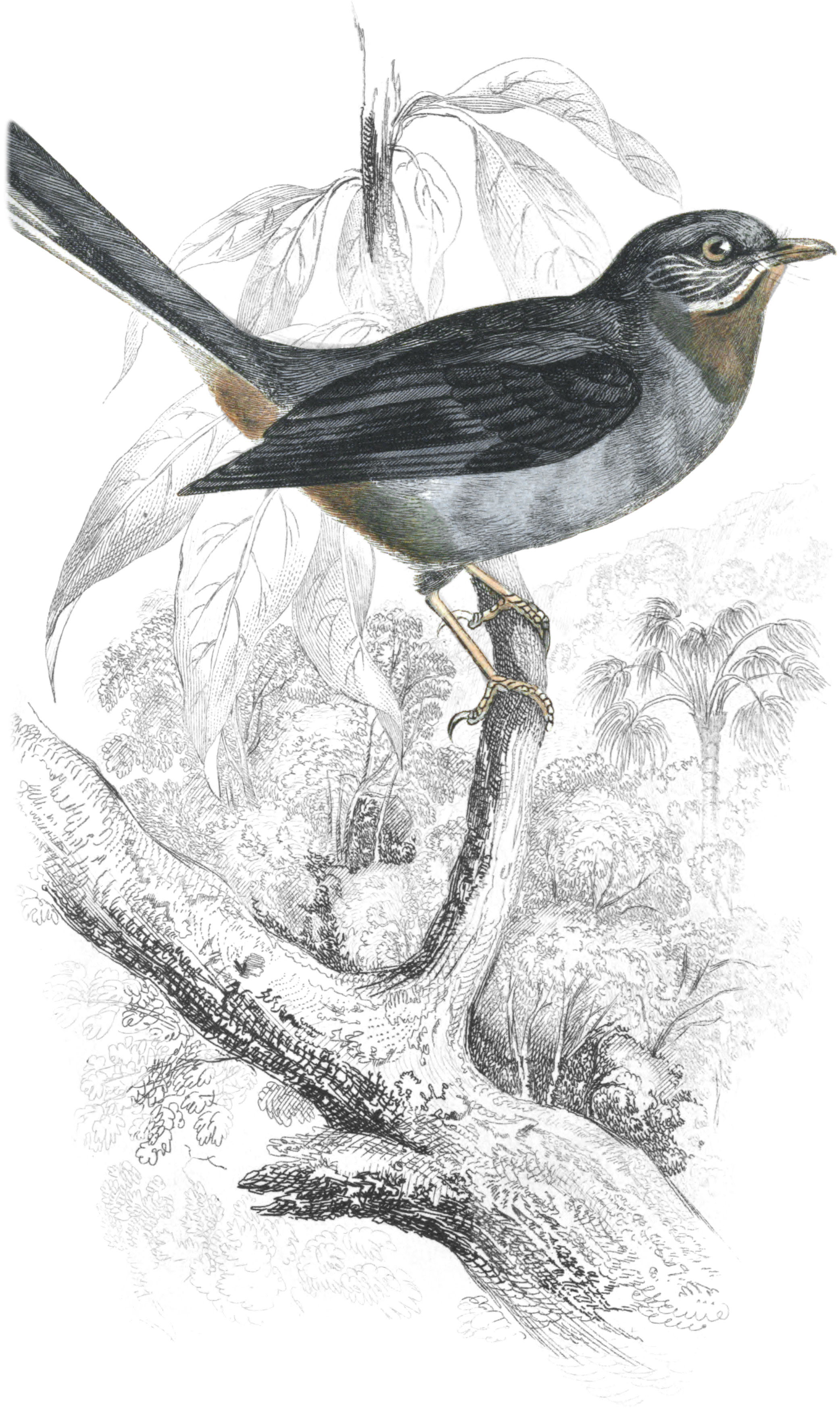
Plate XIII
What the fifth and last type of Rhipidura may be, we know not; and we shall therefore at once proceed to the genus
Seïsura
whose characters it is not necessary here to detail, further than to show its real affinities. Seïsura, in short resembles an Old World flycatcher of M. Cuvier’s division, Muscipeta, except that its bill is unusually long, its tail nearly even, and its tarsus rather more lengthened; although the toes are so small, that no one would suspect they were ever used to stand for more than an instant upon the ground, or upon any flat surface. The tail of S. volitans, the best known species, although not so broad or rounded as in the preceding types, has yet a sufficient length and breadth about it to justify a suspicion that it was occasionally spread out in the same manner; a fact confirmed by what has been published of its manners. It is a mistake, however, to suppose that this bird has no bristles at the gape; for although they do not reach to half the length of the bill, which is uncommonly long, they are nevertheless very stiff, and there are several others, slightly recurved, over the nostrils. We have already remarked how intimately this form appeared connected to the American water-chats, although we strongly suspected that future analysis would show that it belonged to the circle of Rhipidura. This opinion has been so strongly confirmed by a subsequent investigation, that we now place it at once as the tenuirostral sub-genus, a station which at once reconciles all the opinions that have been formed of it, and all that is known of its very peculiar manners. Occupying the most aberrant situation in the present genus, it is consequently that which unites Rhipidura to the Fluvicolinæ: as the tenuirostral type, it represents, in a most remarkable manner, its prototypes among the todies and the flycatchers, namely, the sub-genera Platystera and Hylïota, both of which have very long bills,—the primary character of all tenuirostral types. Mr. Caley, who seems to have possessed much tact in observing the habits of the Australian birds, observes of this:—
I have often considered it when I witnessed its manners, to be the wagtail of the colony.18
And such it truly is. The wagtails, as every ornithologist knows, form the tenuirostral type of the warblers; and Seïsura holds exactly the same station in the genus Rhipidura. Such notes, made by mere observers of the facts they communicate, are often of the first importance, because they are framed without any reference to theories or general laws, and thus become the best possible evidence in support of a natural classification.
Dishwater Fantail
Seïsura volitans, Horsf. & Vigors.
Above glossy blue-black; beneath pure white, or tinged on the breast with fulvous.
Turdus volitans, Latham, Ind. Ornith. Suppl. xli. No. 10.—Volatile Thrush, Il. Gen. Hist. Birds, v. 122.—Seïsura volitans, Linn. Trans. xv. 250.
According to Mr. Caley, the colonists of New South Wales call this bird the Dishwasher, but for what precise reason does not appear. It is, observes the same writer,
very curious in its actions. In alighting on the stump of a tree it makes several semicircular motions, spreading out its tail at the same time, and making a loud noise, somewhat like that caused by a razor-grinder when at work. I hare frequently seen it alight on the ridge of my house and perform the same evolutions. I have often considered it, when I witnessed these manners, to be the Wagtail of the colony. The stumps of trees on which it alights are those which have been left standing where the ground has been cleared, the trees themselves having been cut down about a yard from the ground.
So far we have the testimony of an eye-witness, corroborating all those analogical inferences to be drawn from its general structure, illustrating its relation to other tribes. It is truly, as Mr. Caley observes, the representation of the Motacillæ or Wagtails, not only in the colony, but in that natural circle into which it enters.
The colouring is very simple, being unbroken by any spots or markings. The upper plumage, excepting the quills, which are brown, is of a uniform glossy blue-black, darkest upon the head, where the feathers are somewhat scale-shaped; this colour advances so far on the sides of the head as to include the lores, eyes, and ears; the inner wing-covers are also black. The whole of the under plumage, from the chin to the tail-covers, is white, in one specimen I possess, and tinged with buff on the breast of another; this difference is probably sexual. The bill and feet are black.
Total length, 7\(\frac{1}{2}\) inches; bill, gape, \(\frac{9}{10}\); front, \(\frac{6}{10}\); wings, 3\(\frac{8}{10}\); tail beyond, 1\(\frac{8}{10}\); base, 4; tarsus, \(\frac{7}{10}\).
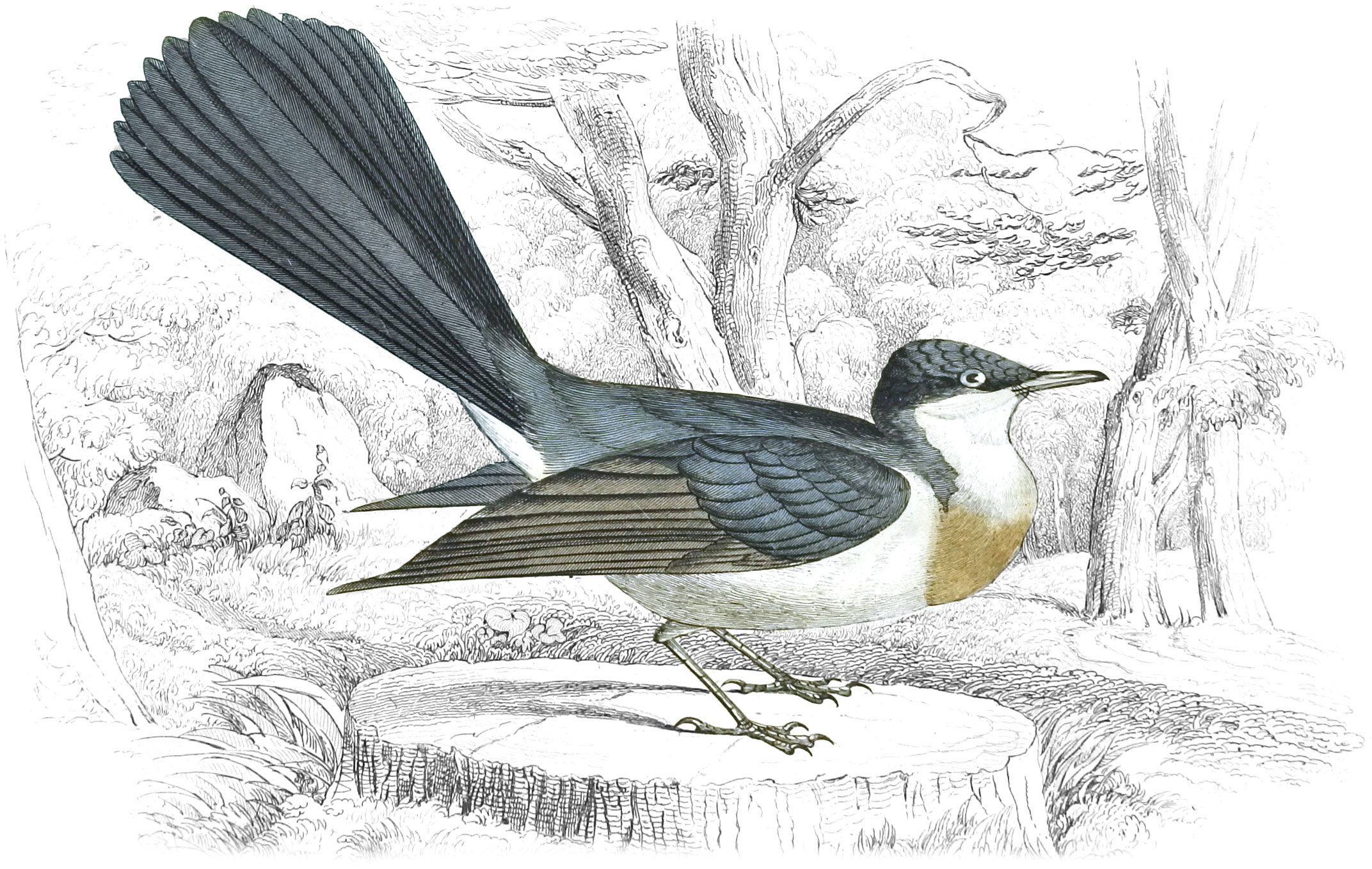
Plate XII
Monacha
Horsf. & Vigors
contains the Oriole, or Hooded-flycatchers. We give them this familiar name from the black and golden yellow colour of the typical species (M. chrysomela) here figured, which immediately reminds the observer of an oriole: the two groups, in fact, are perfectly analogous, being the most aberrant (or the tenuirostral) type of their own circle. The French naturalists discovered two of the most beautiful species in the islands near New Guinea, to which, and the neighbouring continent of New Holland, the group is confined. The bill is particularly strong; and from being as much compressed as depressed, we immediately perceive how distinct they are from ordinary fly-catchers. As representing the Tenuirostres, the gayest of all birds in their plumage, the oriole fly-catchers present us with the most lovely bird in the whole family, the Monacha chyrsomela (Sw.). It is clothed in the same sort of brilliant velvet-like feathers—black and orange—of the regent oriole (Sericulus chrysocephalus); while another species, Monacha telescopthalima, (Sw.) likewise an inhabitant of New Guinea, has naked erect wattles over the eyes. Under the name of Musicapa carinata, of our Zool. Ill. i. pl. 147, we first brought this group to the notice of ornithologists; and, it is proper also to mention, that several others, erroneously placed by M. Temminck under our genus Drymophila, strictly belong to Monacha. The analogous representations of this beautiful group are so palpable that they hardly require pointing out. It reminds us immediately of Psaris by its bill,—of Sericulus by its velvetty feathers,—of Oriolus by its colour, and, through them, of the paradise birds (Paradisidæ). The carinated species, again, puts on the exact colours of a Ceblepyris; while, in M. telescopthalma, we have the spectacle-like wattles of Perspicilla, Ceblepyrus lobatus, and the sub-genus Platystera; not to mention the numerous species of naked-eyed and wattled plovers, and many of the honey-suckers (Meliphagidæ), all which are grallatorial types. How surprising is this uniformity in the midst of the greatest possible variety! We know not which excites the greatest surprise—the fact itself, or the new lustre thus discovered in the works of Omnipotence.
Golden-Hooded Flycatcher
Monacha chrysomela, Swains.
Golden-orange; chin, throat, interscapulars, wings, thighs, and tail, velvet-black, glossed on the throat with blue; beneath the eye a snowy spot.
Muscicapa chrysomela, Garnot & Less. Zool. de la Coq. Pl. 18, fa.
The only specimen yet known of this superb Fly-catcher, by far the most beautiful that has yet been discovered, was procured by the French naturalists who accompanied the discovery ship, Coquille, in the thick woods of New Ireland. It is now deposited in the Royal Museum at Paris, where the accompanying figure was made some years ago. As nothing is known of its manners, we have only, in this place, to describe its plumage.
The ground colour of the whole bird is of the brightest orange, or golden-yellow; the feathers of the head being compact, and forming an obsolete crest, as in the typical species of Muscipeta. This brilliant colour is relieved by a large patch of the deepest black, glossed with blue, in front of the throat and one half of the ears, and by another, of a crescent shape, across the interscapulars; the outer margin of the wing, the whole of the primaries and secondaries, and the inner web of the tertials, together with the tail and thighs, are deep black; the bill is blue-black; the feet deep black. The tail is even, but the under feather is the shortest; the feathers in front of the throat are small, compact, and scale like.
Total length, about 6 inches; bill, front, \(\frac{1}{2}\); wings, nearly 3; tail beyond, 1; base, 2\(\frac{1}{4}\); tarsus, \(\frac{1}{2}\).
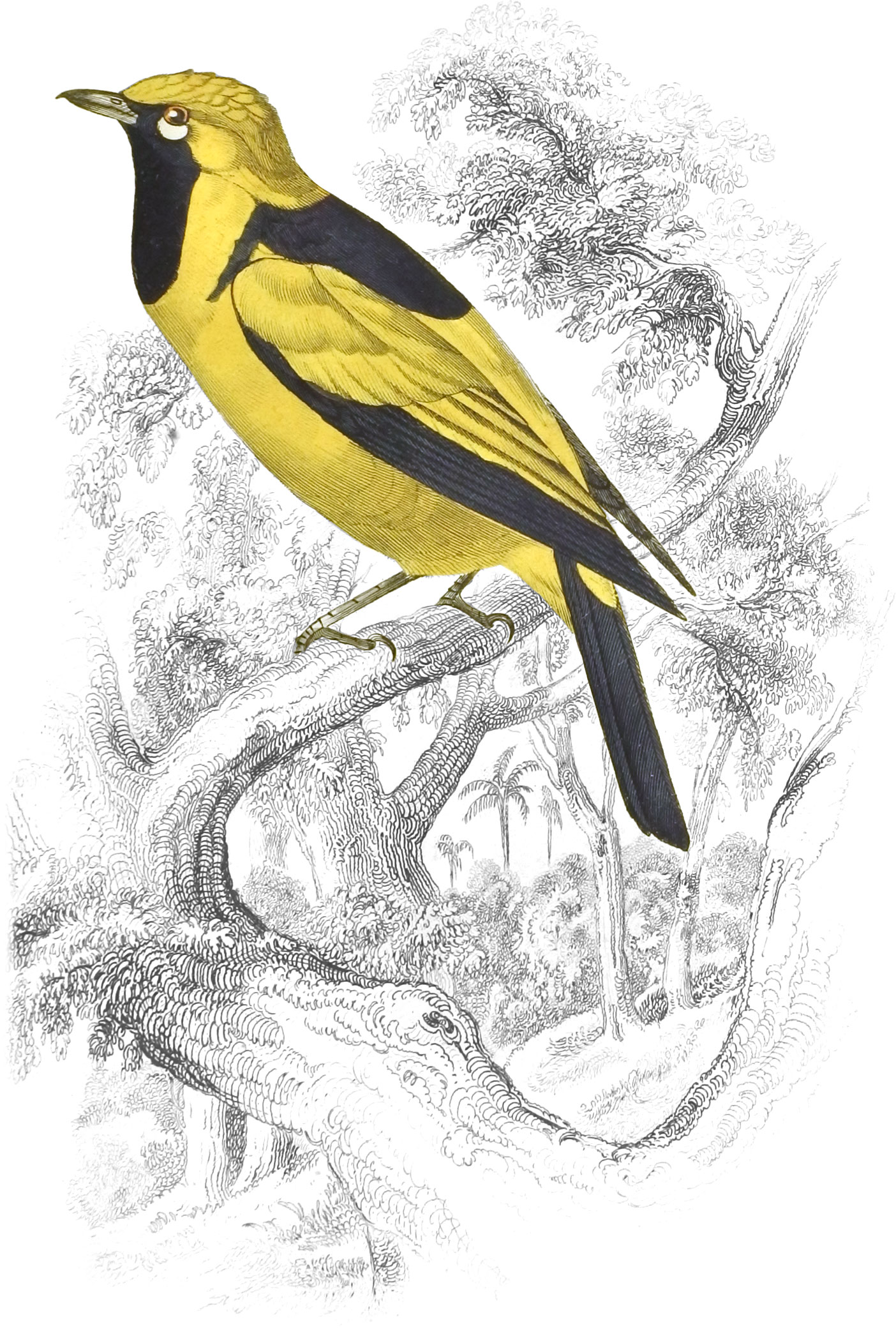
Plate XIV
The third division of this family is the genus
Megalophus
at present represented by a single bird, whose structure is as remarkable as its appearance is beautiful. We have already attempted to show its natural station in this family and with its congeners. This extraordinary bird is not much bigger than a robin, and has nothing to recommend it in the general colour of its plumage, which is brown on the wings and back, and deep buff on the tail and under parts. Its crest, however, is perhaps the largest and most beautiful of any perching bird yet discovered: no adequate idea of this splendid ornament can be given by words. When in a recumbent state, it is so long as to hang down upon the back and on each side the head; but when erect, it forms a large semicircle round the crown, very much in the manner of the half of a full blown plant of the syngenesius order; its colour is bright reddish cinnamon, each feather being tipt with glossy blue-black, and enlarged at the end. The bill, for the size of the bird, is enormous, its shape being like that of Muscipeta; although somewhat dilated towards the base, it is very flat, and rather lengthened, and so strongly protected, that the bristles at its base reach nearly to the tip. The wings and tail are moderately long; and their structure comes much nearer to those of the Muscipeta than to the flycatchers of the New World. Finally, the feet are very short, and nearly white the toes rather long in proportion, and the claws very slightly curved. The ornithologist will readily trace in these particulars many strong indications of the characters of Eurylaimus, to which group, as we believe, this bird constitutes the passage. Its great rarity is no doubt to be attributed to its very local dispersion.
Royal Great-Crest
Megalophus regius, Swains.
Crest very large fan-shaped, bright rufous-red, with black tips; body above brown; tail and under plumage fulvous or ferrugineous; chin paler.
Todus regius, Auct.—Le Roi des Gobe-mouches, Buffon, Pl. Enl. 289.—Megalophus regius, Birds of Brazil, Pl. 51, 52.
Until very lately, this rare and remarkable bird was only known to the ornithologists of the present day by the figure and description of Buffon, who mentions it as being found, although very rarely, in Cayenne. Dr. Shaw, indeed, alludes to another account, of what he considers to be the same bird, in a little known German work, entitled Naturforscher; but this we have never seen. Three or four years ago, however, several specimens of this species came to England, through the hands, as we were informed, of the French dealers, but from what precise locality appears uncertain. One of these, obligingly lent to us by Mr. Gould of the Zoological Society, enabled us to delineate the species in two different attitudes in the Birds of Brazil, and the annexed figure was drawn from the same specimen.
It would be difficult to convey, by words alone, a just idea of the peculiar form and colouring of the crest of this bird, which, in proportion to the size of the bird, is the largest example of this ornament in the whole of the perchers. The shape of the feathers is linear in their length, and almost spatulate, or spoon-shaped, at their extremity: they are disposed transversely across the head in various lengths, so that the last are by far the longest; their extremities are! somewhat incurved, but those adjoining the ears are narrower, and are pendant on the sides of the head, something like ear-drops. When erected, the feathers form a semicircle, or crescent, across the back of the crown, and have a most splendid appearance. The ground colour of all these feathers is of the richest chesnut-red, resembling brick-dust; but each has a terminal spot of velvet-black, encircled by a margin of steel-blue, the effect of all which is heightened by a rich orange shade, intervening between the black spot and the deep red which succeeds. The rest of the plumage is comparatively plain; the upper parts are dark hair-brown, approaching to chestnut; the under parts light fulvous, or ferrugineous, rather brighter and deeper on the tail, which is slightly rounded. The other parts of its structure enters into the generic character.
Total length, 6\(\frac{1}{2}\) inches; bill, gape, 1; front, \(\frac{7}{10}\); wings, 3\(\frac{1}{2}\); tail beyond, 1\(\frac{1}{2}\); ditto, base, 3; tarsus, \(\frac{11}{20}\).
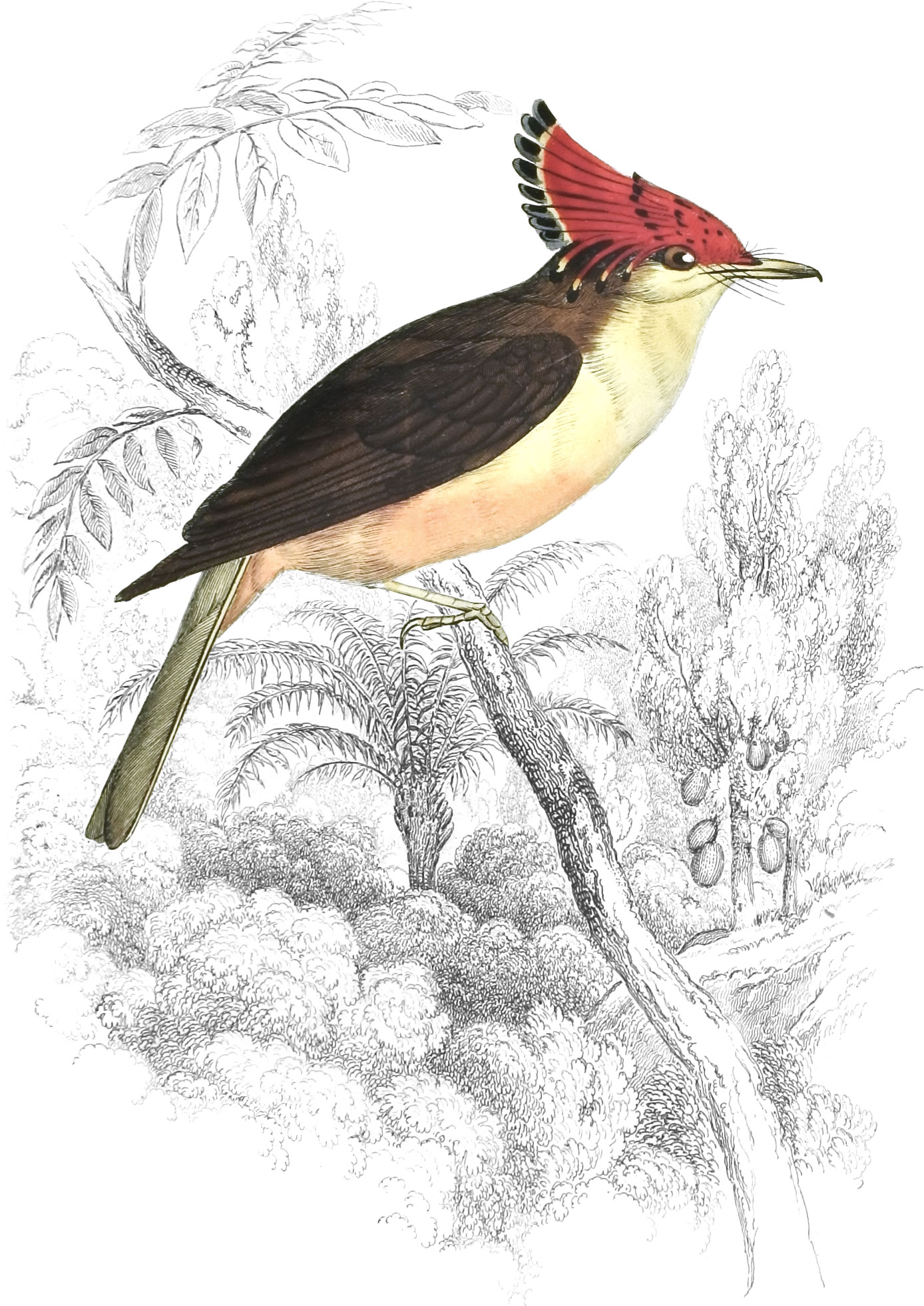
Plate XV

Todus
The genus Todus evidently succeeds the last. As it is one of them which are typical of this sub-family, we should expect to find it more numerous in species and more diversified in forms; and such we discovered to be the case. Unlike the three aberrant divisions we have just quitted, the one before us presents us, for the first time in this family, with a complete and perfect circle, where scarcely a link is missing; and where we have, in consequence, the five types of nature fully and perfectly demonstrated. Hitherto we have been barely able, with much difficulty, and some latent doubts, to make out the prominent types of the divisions just gone through; not so much from the absolute relations which they bear to each other by intervening species, as by comparing our distribution of the order of their succession with that of other and more perfect circles, whose validity has been long established. But in the todies we can proceed with more confidence; for if, amidst so much variation, we can yet establish the same uniformity, and add another instance in corroboration of those general laws elsewhere promulgated, additional confidence is not only given to one, but to all. The “flood of light,” as it has been happily termed, which results from the demonstration of a single natural group, radiates, far and wide, upon all other such groups, and is again reflected back, with additional force, upon that which has been newly evolved. Of this description, in truth, do we consider the group we are about to illustrate. The views, now submitted to the scientific world, on the natural arrangement of this intricate family, have been “slowly and painfully” elaborating for near eleven years, in which period, as may be supposed, they have undergone numerous alterations and revisions; for so long as a single modification of form could not be explained and accounted for, we have studiously refrained from viewing our arrangement otherwise than as provisional. That it may not be found, hereafter, without errors, no one can suppose; and yet we may be allowed the satisfaction of saying, that there is no one bird, belonging to this genus, which has yet fallen under our inspection, but what may well find its place in the series, and furnish additional evidence that that series is in union with all those already established in other departments of nature. We venture to make these preliminary observations upon two grounds:
- the scientific importance of the group before us; and,
- as the reasons of our entering so fully into its detail.
The types of the genus Todus, as now defined, with but one exception, are exclusively restricted to the tropical latitudes of America; they are all very small birds, the largest not being equal to a robin, while the smallest is more diminutive than the gold-crest. The whole group is remarkable for three peculiarities:
- the excessive shortness of the wings and tail;
- the great comparative length and feebleness of the tarsi; and, lastly,
- the elongated boat-shaped form of the bill.
Of these the first is the most universal; and when we compare these characters with those belonging to the same members in the birds of the genus Muscicapa, we can have no doubt of their being employed in a very different manner. This brings with it the inference, that the todies do not seize their prey in the same manner as the flycatchers. Upon this point, in the absence of better information, we can say something from personal knowledge. Whenever we observed the black-capped tody in the woods of Brazil, where it is by no means scarce, we always found it hopping among the branches and the foliage of trees, pursuing its search to the extreme twig, much in the same way as our tom-tits. If its appearance gave warning to some hapless insect which could fly, and the attempt was made, the tody would then make a little saltus, or jumping flutter, two or three inches from the branch, and peradventure seize the insect; but if not, it would still continue its search for others, as if its wings were too feeble to sustain that sudden and vigorous flight which the true flycatchers can employ when so engaged. Now, as the species above alluded to is a typical example of the whole group, we may fairly and justly suppose that such are the typical habits; nor will this at all interfere with the fact that has been stated (but on somewhat questionable authority) regarding the green tody, which is said to frequent the ground in search of food as well as to frequent trees. Whether such a union exists in one and the same species may well be questioned; but the group, however small, would not be a natural one, did it not contain one which was to give us the rasorial or the grallatorial habit of walking on the ground, no less than another, which had the tail more developed than usual. The todies,—we ire still speaking of the most typical species,—have the rictus or gape very slightly bristled;19 and, in some species, these bristles are nearly obsolete. We infer from this, that the food of these birds consists of small weak insects, probably larvæ, rather than of such as are able to make vigorous struggles in their attempts, when caught, to escape; for it is to counteract such effects that the bristles of the true flycatchers, which are altogether more powerful birds, are so strong. In a country like tropical America, where insect population is so dense and so varied, it is essential to the balance of creation that suitable checks should be provided for each tribe, after its kind. Now these flying tribes become the prey, according to their respective sizes and habits, of the tyrants (Tyranninæ), the swallows, the water-chats (Fluvicolinæ), the tyrant warblers (Dumecola), and the todies; for the true flycatchers, we must remember, are excluded from the range of the New World, their place being supplied by the tyrants. Consider, then, what a multitude of minute apterous insects, living among foliage, would have no equivalent check upon their increase, did all the Muscicapidæ live only upon such as could fly. Now the todies appear especially adapted to fill this office: they are fly-catchers, it is true, but very partially so; for they exert the power only upon particular occasions, and then very feebly. Nay, it may even be questioned, whether,—in accordance with what we so often find in typical forms,—the genuine todies do not occasionally eat soft fruits. When nothing, however, is absolutely known of the natural history of a group, it would be carrying analogy too far were we to attempt any explanation which could not be supported, in some manner, by ascertained facts. We must consequently remain in ignorance why the legs of the todies, although equally feeble with those of the flycatchers, are nevertheless so much longer. We know, however, that a syndactyle foot, from its giving greater breadth to the sole, is much more adapted for grasping than one in which all the toes are cleft to their origin; and as this power is called more into exertion among the todies than in the flycatchers, strictly so termed, we see that their toes are accordingly more united. Now the pre-eminent type of the whole group seems to be the Todus viridis. And it is consequently this very bird which has the most syndactyle foot; while the strong curvature and breadth of its claws would seem to disprove at once the assertion that it feeds upon the ground.20 No bird, out of thousands which we know of, having the peculiar sort of claw possessed by the Todus viridis, has hitherto proved to be in any way terrestrial. On the contrary, their habits, whenever they come to light, turn out to be strictly arboreal. Now, in proportion as we recede from a type, its distinctions become less marked; and hence it is that in the black-capped tody the feet are less syndactyle, and the claws more like those of a raptorial type. The preceding observations on the natural history, properly so called, of the todies, chiefly relate to the typical examples; for as to the manners of Platyrynchus, and of the aberrant sub-genera, we know absolutely nothing. Let us now, therefore, consider the group more in detail; for which purpose we shall designate the sub-genera as follows:
- Conopophaga, or short-tailed todies;
- Platyrynchus, or flat-billed todies;
- Todus, or the typical todies;
- Lepturus, or tyrant todies; and,
- Platystera, or African todies.
The first, fourth, and fifth of these sub-genera form the aberrant group; the second we regard as the sub-typical; and the third as strictly typical of the whole circle. We commence with the sub-genus
Conopophaga
because it evidently connects Todus with Megalophus; while a glance at its broad, although gradually narrowing bill, shows it to be of an intermediate, structure between Platyrhynchus and Megalophus. The birds belonging to this group, although the largest in size of all the todies, are not bigger than a robin, yet, from the excessive shortness of their tails, they seem to be much smaller; the tail, in fact, on a superficial glance, would seem as if it had been cut off, for it scarcely projects more than half an inch beyond the long and lax feathers which cover the back and rump. The wings, however, although much rounded, are by no means proportionably short; while the legs and toes are remarkably large, but somewhat slender. We might, from this structure, infer, that these were purely terrestrial birds; but we are not inclined implicitly to adopt this belief. The claws are very broad and fully curved, the lateral toes unequal, and the outer connected to the middle toe as far as the first joint; the same reasons, therefore, which have been urged against Todus viridis being a terrestrial bird, are equally applicable in the present case. Whatever may be the real economy of these birds, certain it is that they are of a thicker and stronger structure than any other of the todies. The head is particularly large, the body plump, and the feet comparatively strong; there is a strength, also, in the bill, which is not found in any of the other sub-genera: when viewed in profile only, it precisely resembles that of an ant-thrush (Myothera), occasioned by the thickness of the under mandible, the gonyx or ridge of which curves upward, while the tip is distinctly notched: this is an important and peculiar character. The Conopophagæ, in all probability, feed upon soft apterous insects; for they have no bristles, properly so called, on the sides of their bill, where there are merely a few straggling setaceous feathers the front; of the head is protected in the same way, as well as the nostrils; these latter being very large, beset with only a small oval aperture at the end, and which is placed nearly in the middle of the bill. The rough and bristly appearance of the front of these birds reminds us of Dasycephala, to which, both in this and in their brown plumage, they are analogous. Of their manners we are totally unacquainted, further than that our hunters reported they were only to be met with in thick woods; and they are at all times scarce. We possess two species from Brazil.
Rufous-Crowned Tody
Conopophaga ruficeps, Swains.
Crown orange-rufous; front, lores, and ears, black; chin and middle of the body white; interscapulars with dark external edges.—Male.
Above brown; beneath ferrugineous-orange; chin and middle of the body whitish; front and band over the eye and ear white.—Female.
Myothera perspicillata, Lich. Berlin cat? the male.—Conopophaga ruficeps, Birds of Brazil, ii. Pl. 72, 73.
Although one species of this singular genus was known to Buffon, who figured it at No. 822 of the Pl. Enl.,21 nothing worth recording is mentioned of its habits, nor were we more successful in regard to this and another species, procured during our travels in Brazil. Its long legs, however, leads to the conjecture that it occasionally frequents the pound, although the inequality of its toes, and the complete union of the first joint of the middle one to the outer, show that its natural habits are more arborial than terrestrial.
The sexes of this species differ so much, that no one would suppose, upon merely looking at them, that they were not distinct species. The male is distinguished by having the crown and nape of a bright rufous-orange, rather lighter towards the bill, and darkest behind: the front of the head is crossed by a band of deep black, which widens on the sides of the head, and includes the lores, eyes, maxillary region, and the ears; the rest of the upper plumage is light brown, tinged with rufous on the scapulars; the feathers of the back are bordered externally by a well-defined blackish line, or by a roundish spot; the lesser wing-covers are cinereous, and the greater have each a pale terminal spot; the external parts of the quills, and also the tail, are like the back, but the spurious wings are blackish-brown. The under plumage is cinereous, but the throat and middle of the body are pure white; the legs are pale, and the bill deep black. The female differs in the following particulars:—The crown, ears, and sides of the head, are of the same colour as the back, except a long white line which begins on the front and extends over the eye and ear; the lesser and greater wing-covers are both brown, tipt with pale fulvous; and all the under parts are bright ferrugineous where they are cinereous in the male.
Total length, 4\(\frac{1}{4}\) inches; the tail not exceeding beyond the wings; bill, gape, \(\frac{3}{4}\); front, \(\frac{1}{2}\); wings, 2\(\frac{1}{2}\); tarsus, 1; middle toe and claw, \(\frac{8}{10}\).
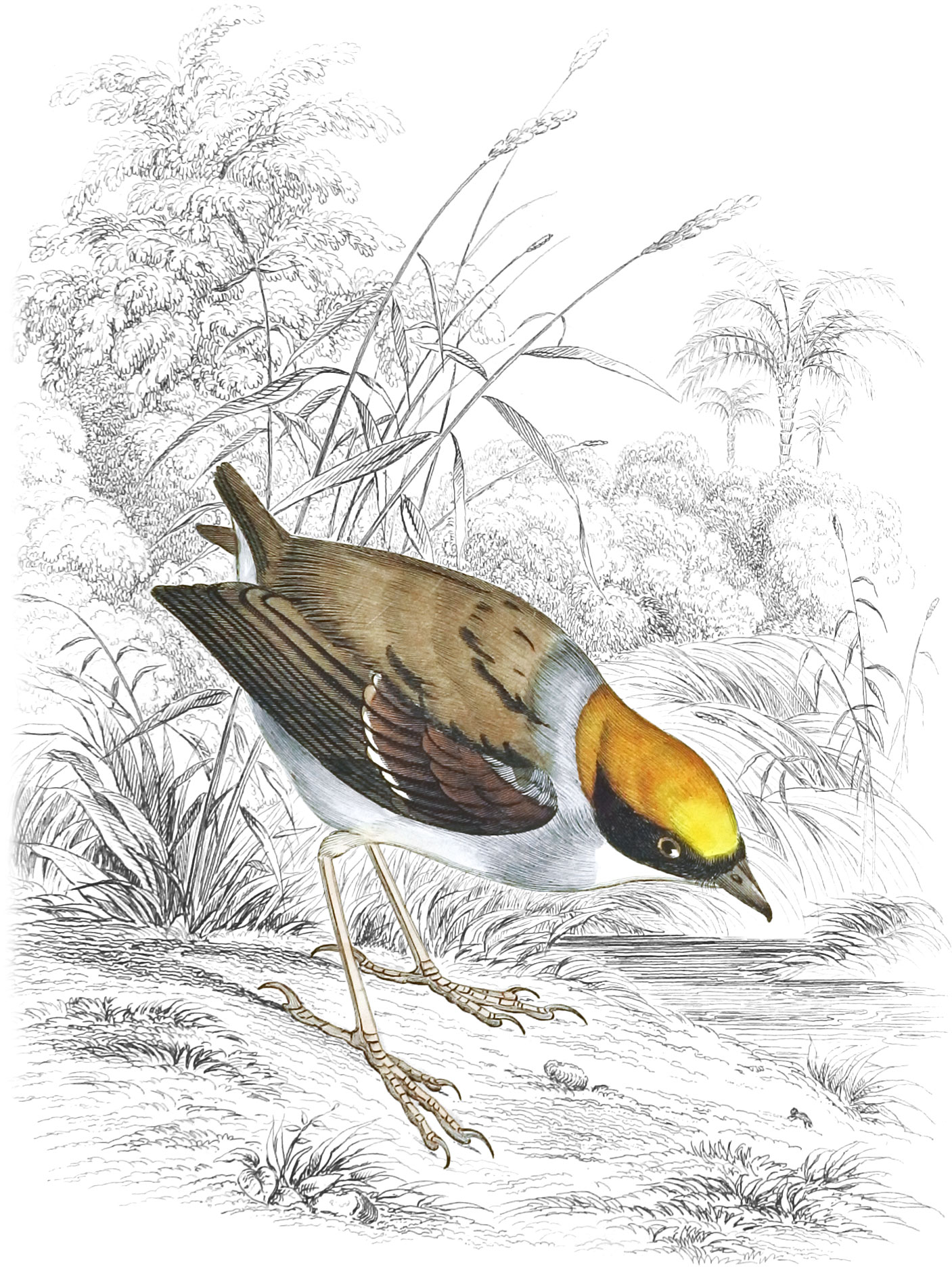
Plate XVI
The sub-genus
Platyrhynchus
obviously follows the last sub-genus; for although we are unacquainted with those aberrant species which would have made the transition still more gradual, the approximation of the two is quite sufficient to render the series perfect. Platyrhynchus cancromus, in short, might at first be mistaken for a small Conopophaga, so exactly do the two forms agree in their general aspect. We enter not here into the technical distinctions; but Platyrhynchus is immediately known by its short and widely dilated bill, the under mandible of which is very thin, and the base of both defended by strong thickset bristles, pointing obliquely forwards; the feet are those of Conopophaga in miniature, the proportions being the same, but very greatly diminished; the claws, moreover, are slender, sharp, and but slightly curved, so that if either of these two groups might be supposed to frequent the ground, the probability would lie with Platyrhynchus. But here, again, we have not the slightest authenticated fact whereupon to ground a conjecture. The two species already known, we believe, are confined to Tropical America where they are very scarce. It is probable that the males, like that of P. cancromus, are distinguished by a concealed crest, an ornament so common among the fly-catching groups of America; but of which we do not know of more than one example in the flycatchers of the Old World.
Yellow-Crested Flat-Bill
Platyrhynchus cancromus, Temminck.
Above light brown; beneath fulvous-yellow; throat white; crown with a concealed crest of pure yellow.
Todus platyrhynchus, Auct.—Platyrhynchus cancromus, Temm., Pl. Col. 12, fig. 1.
Hitherto we have only seen one bird out of all those broad-billed flycatchers which have been called Platyrhynchi, which really belongs to this subgenus, as at present defined. There is, nevertheless, what appears to be a second, having a white crest, figured by Desmarest and Vieillot, and by the latter stated as a native of Senegal, a locality which we feel assured must be erroneous, since there has not been one land bird yet discovered which is a native both of tropical Africa and tropical America. In the young and female of the present species the yellow crest is not developed.
The upper plumage, when the crest is concealed, is entirely of a rich and full drab-brown, having a strong fulvous tinge on the hack, which becomes almost ferrugineous on the margins of the wing-covers and the quills, both which, with the tail, are light brownish-black. The sides of the head are singularly varied; the lores have a fulvous-white line, but the lower half of the eyelids are black: another similar line begins behind the eye and passes over the ears, which are black; the ear is bordered below by another pale line, beneath which is another of black, which commences at the base of the lores, passes immediately under the eye, and is separated from the black of the ears by the pale line already noticed. The under plumage is of a fulvous-yellow, except the chin and throat, which are white; but the sides are tinged with yellow; the inner wing-covers are like the breast, but the thigh-feathers, except those close to the joint, are almost black. The yellow spot on the crown is very pure, but the tips of the feathers are of the same brown as the rest of the plumage, so that, unless they are raised, the crest would not be discovered; the under mandible of the bill and the legs are so very pale as to be almost white.
Total length, 3\(\frac{1}{2}\) inches; bill, gape, \(\frac{6}{10}\); front, \(\frac{3}{10}\); wings, 1\(\frac{9}{10}\); tail, base, 1\(\frac{1}{10}\); tarsus \(\frac{6}{10}\).
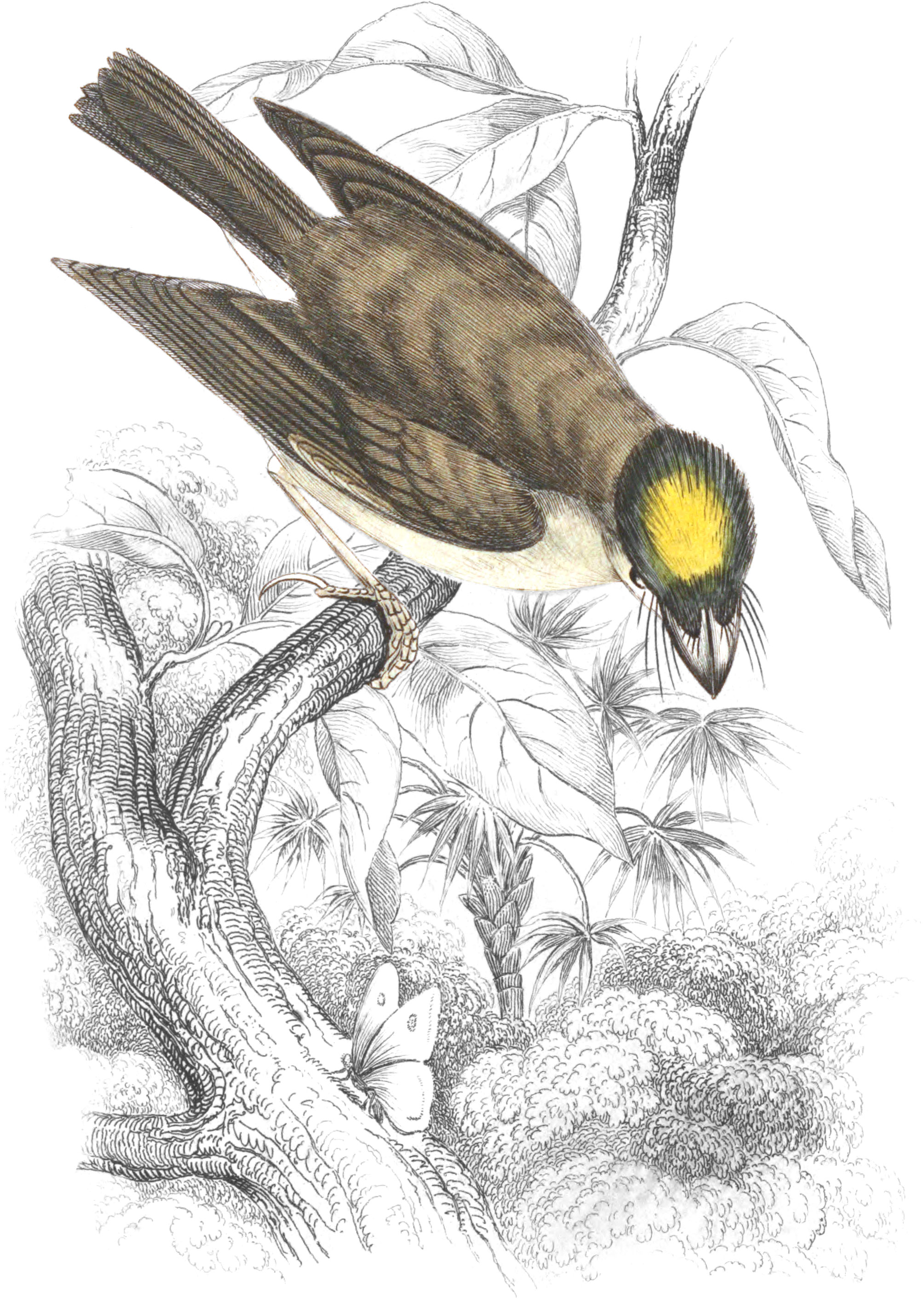
Plate XVII

The last little group brings us at once to the subgenus
Todus
the pre-eminent type of the whole group, and which, although but a portion, retains, par excellence, the patronymic name. We have frequently called the attention of ornithologists to that peculiar property possessed by groups pre-eminently typical,—whether those groups be large or small,—of exhibiting a greater number of modifications, in the subordinate forms, than are to be found in the other divisions of their own circle. Lawrance, our eminent physiologist, long ago announced this fact in reference to the Caucasian race of Man, the most favoured and highly endowed of all that have ever lived. And it might be established beyond doubt, that this fact, first stated as an isolated and disconnected remark, might be traced throughout the class of animals now before us; sufficient, at least, to establish it as one of the laws of nature. There are more genera and sub-genera,—in other words, mere variations of form,—among the order Insessores, or perchers, than in all the other orders put together, and more in the genus Corvus, the type of all birds, than in any other yet ascertained. The sub-genus before us, like the groups just named, is pre-eminently typical; and we shall find, upon close analysis, that the variation of its species, as in the sub-genus Bos,22 turns out to be regulated by the very same law; they actually become types of form. And we shall find these types almost as distinctly marked as if they belonged to a family, instead of merely representing the succession of species in a sub-genus.
The most universal character of the typical todies is their flat elongated bill, in opposition to that of Platyrhynchus, which, although equally flattened, is remarkably short; the sides are bristled, but these bristles are short and weak, and in some species are almost obsolete. The wings and tail are short, but the latter is much more conspicuous than in Platyrhynchus, while the form of its termination indicates the variation of the species and the position they occupy in the series. Thus, in the Todus viridis the tail is even, in melanocephalus23 it is graduated, in megacephalus24 it is shortest, and the end is rounded; while in platycircus it is longest, with the feathers broad, but terminating in points. The other species yet discovered fill up the intervals, and arrange themselves close to one or other of those just named. The variation in the length and structure of the feet is no less remarkable. These members are always sufficiently long to point out the sub-genus; their variation is consequently comparative. In Todus platycircus their length is the greatest; while in viridis and megacephalus they are shorter than in melanocephalus. These variations are accompanied by differences in the formation of the claws and toes; so that without a competent knowledge of the group as a whole, “good genera,” as such artificial divisions are sometimes called, might actually he made out of several of the species, to the no small confusion of all that is true in nature or useful in science. It has entirely originated, in fact, from such limited views, that the Todus viridis has been pronounced “the unique example of its genus;” and ail the other species detached from it, and thrown into the common receptacle of flat-bellied birds,—“the great genus” Muscicapa. It is needless, however, to criticise artificial systems; and therefore let us now see what results will be obtained by arranging the species above named, and comparing them with the types they represent.
| Species of Todus | Specific Distinctions of Structure | Primary Types |
|---|---|---|
| Todus viridis | Toes very syndactyle or prehensile; bill long, notch nearly obsolete; claws broad, obtuse | Insessores |
| Todus melanocephalus | Bill shorter, the tip more hooked; claws slender, acute | Raptores |
| Todus megacephalus | Head large; bill, feet, and tail shorter than usual | Natatores |
| Todus platycircus | Legs very long; tail fully developed, the feathers rather broad, and tips pointed | Rasores |
Thus, if we discriminated these birds as species, not by their colour, but by the different shades or modifications of their structure, we might almost use the very words which would at the same time concisely express the leading distinctions of the primary types of birds. The Todus viridis has the most perfect shaped foot, merely for grasping, in this little group; and the prehensile power of these members constitutes the chief distinction of the order Insessores among birds, and Quadrumana among quadrupeds. The acute claws, and the more sudden deflection of the tip of the bill in Melanocephalus, and two or three others, are also characteristic of the falcons and the shrikes, the Raptores and the Dentirostres. The great size of the head, coupled with unusual brevity in the tail and the tarsi, axe three of the primary distinctions of the Fissirostres and the Natatores. While the remarkably long legs of T. Platycircus25 might lead us to believe it was the representation of the grallitorial birds, but for its tail, which is twice the ordinary length, and although unusually broad, yet the ends are pointed. The formation, therefore, of this member, stamps the bird at once as a rasorial type; both these orders, in fact, have generally long legs, but it is only the Rasores that have either oread tails or pointed feathers. We may, therefore, fairly conclude, that the species of Todus which represents the Grallatores has not yet been discovered, or rather that it has not yet fallen under our observation.
The law of representation, although universal, is yet so simple, that if it is successfully demonstrated in any one group, it becomes equally established in all; because all must be referred to one general test, that is, to the primary types of nature. This has been so frequently exemplified in our treatise upon birds, and in that upon quadrupeds, that it becomes unnecessary to compare our present group with all others of the class or order to which it belongs; unless, indeed, there are some points of structure to be elicited which cannot be explained by a single analogical comparison. Nevertheless, the views here taken of the particular group before us are so completely at variance with those of our best ornithologists, that it is due to them, no less than to ourselves, to strengthen our position as much as possible, that it may be seen we have given the subject that attention it deserved before we ventured to promulgate a theory so much at variance with all that has hitherto been received. It is with this intention that we shall now lay before the ornithologist two other tables in further illustration of the series of the typical species of Todus; the first of these will make good their analogy, in the following manner, with the sub-divisions of the genus.
| Specific types of Todus | Analogical Characters | Sub-genera of Todus |
|---|---|---|
| Todus viridis | Bill very long, the tip scarcely bent, and nearly entire | Platyrhynchus |
| Todus melanocephalus | Bill shorter, the tip abruptly bent; tail short | Todus |
| Todus megacephalus | Bill more triangular; head large, front bristly; tail very short | Conopophaga |
| Todus | Platysteria | |
| Todus platycircus | Tail lengthened, graduated, the ends pointed | Lepturus |
The species here named Megacephalus, and which will be subsequently described and figured, is very diminutive, not more than three inches and a quarter long, of which the head and bill actually occupies one inch and a tenth, or nearly one-third the length of the entire bird. It differs also from all the other species in having the bill more gradually attenuated in its breadth as it approaches the end; just, in short, as that of Conopophaga, of which it becomes, by its very short tail, large head, and bristled front, the complete prototype. Nevertheless, the sides of the mouth are strongly bristled, and the tarsi are considerably shorter than those of its congeners. Now, all these variations from the typical species are absolutely necessary to the harmony of nature. They indicate, as plainly as possible, that this bird is an aberrant species, and that it is of the fissirostral or aquatic type. Nor can it possibly be removed from this position among the todies, since there are now before me three other species which establishes the gradation between melanocephalus and megacephalus in the most decisive manner. And yet, if the bills of these two kindred species are viewed separately, one might be tempted to place them in different genera. The situation, also, of Todus megacephalus in the series of species, is further confirmed by the structure of T. platycircus, which, from being clearly a representation of the Rasores, will stand at the opposite side of the circle to that of Megacephalus; the grallatorial, or intervening type, as before observed, being wanting. We thus find, that even in a sub-genus the variations are sufficiently marked to give us the indications of a circular group; in which, although there is an apparent hiatus,26 the remainder of the series is so perfect that no reasonable doubt can be entertained of its being natural. The species which will represent the grallatorial form may probably be found also in Brazil; but as the most aberrant types of this family, namely, Monacha and Platystera, are of the Old World, we should feel no surprise if this also turned out to be an inhabitant of the same region.
Considering the great variation of structure in so small a group as this, and which we merely term a sub-genus, it may be fairly asked, even by those who take it for granted, or who cannot controvert the affinities here stated, whether this group does not in reality hold a higher rank than what we have assigned to it? or, in other words, is it not a genus rather than a sub-genus? This question we have more than once investigated; and the result has been what we have stated. A desire of solving it as far as possible, led us, in fact, to undertake the analysis of the whole family. So far as we have yet laid the result of this labour before the reader, he will perceive that the entire genus Todus is too distinct and peculiar to be incorporated with either Rhipidura, Monacha, or Megalophus; while its relation to this latter, and to the genus Muscicapa, is so very nearly equal, that we can only conclude its station to be intermediate. This point being settled, we are next to ascertain whether Todus,—as a whole,—constitutes a natural group; or, in other words, whether this group is circular and representative. This question, as will presently appear, can also be answered in the affirmative. Hence it follows, that if its sub-genera differ more among themselves than do the species which we have been illustrating, our inevitable conclusion is, that these latter are variations of the sub-genus, and not of the genus,—that they are specific modifications, and not, like Conopophaga, &c., types of sub-genera. We shall arrive at a similar conclusion if we argue the question in another way. We have stated, in another place, as one of the primary laws of natural classification, that the number of circular groups, in point of rank, are Nine; and that those which form the ninth are sub-genera. Let us then take one of the examples that have been quoted in support of this theory, and see how far the group, which we here term a sub-genus, will agree therewith. We have stated that Parus barmicus holds precisely the same rank in the typical division, or sub-genus of Parus, as does Todus platycircus in our sub-genus Todus; the two birds, in fact, representing each other. We will therefore now see how many circles are to be traversed before we arrive at the two which contains the birds.
Rank of the Parus Biarmicus, L.
- Kingdom, Animalia
- Sub-kingdom, Vertebrata
- Class, Avis
- Order, Insessores
- Tribe, Dentirostres
- Family, Sylviadæ
- Sub-family, Parianæ
- Genus, Parus
- Sub-genus, Parus proper
Type of form, Parus biarmicus.
Rank of the Todus Platycircus, Sw.
- Kingdom, Animalia
- Sub-kingdom, Vertebrata
- Class, Avis
- Order, Insessores
- Tribe, Dentirostres
- Family, Muscicapidæ
- Sub-family, Muscicapinæ
- Genus, Todus
- Sub-genus, Todus proper
Type of form, Todus platycircus.
We thus perceive that the genus Todus is precisely of the same rank as that of Parus, and that the pre-eminent typical division, or sub-genus, of each, contains subordinate types of variation or of form, as well marked as those of all the higher divisions; so that a sub genus, when perfect, becomes just as much a circular group as any of the eight which precedes it in the list. There is not a whit greater difference between Todus viridis and Todus platycircus, than there is between Parus biarmicus and Parus cæruleus. And if Todus megacephalus deserves to be ranked as a sub-genus, so must its representative Parus caudatus; for the one is a prototype of the other—both being at once distinguished by their great disproportionate heads. All these arguments, indeed, may be admitted; and yet it maybe urged that this determinate number of nine, in the different ranks of circular groups, is a theory too important to be taken on the testimony of one naturalist only, interested in strengthening a theory of his own, and, therefore, with every wish to be accurate, still peculiarly liable to error. Now we shall at once annul this objection, although it rests on no demonstrative evidence, by producing the unpremeditated evidence of one who had no idea of the law in question, but merely drew up his observations to illustrate a particular group of animals in a totally different class. Mr. Macleay’s views on the number of circular groups which exist, before he arrived at that of the genus Scarabæus, has thus been stated by himself; and we shall now compare them with those of the genus Todus.
Rank of the Scarabæus Sacer, according to Mr. Macleay.
- Kingdom, Animalia
- Sub-kingdom, Annulosa
- Class, Ptilata, Arist. (Mandibulata, Macl.)
- Order, Coleoptera, Lin. Macl.
- Tribe, Chilognathiform, Macl.
- Family, Petalocera Saprophaga, Macl.
- Sub-family, Scarabæidæ, Macl.
- Genus, Scarabæus, Macl.
- Sub-genus, Scarabæus proper, Macl.
Type of form, Scarabæus Sacer.
Rank of the Todus Megacephalus, Swains.
- Kingdom, Animalia
- Sub-kingdom, Vertebrata
- Class, Aves
- Order, Insessores
- Tribe, Dentirostres
- Family, Muscicapidæ
- Sub-family, Muscicapinæ
- Genus, Todus
- Sub-genus, Todus proper
Type of form, Todus Megacephalus.
To these nine circular groups, one within the other, indicated in the Hor. Ent., we have only given those names indicatory of their relative ranks, which have already been elsewhere explained,27 and uniformly employed in our former works. The groups themselves are Mr. Macleay’s, not ours; and we are assured they are the result of close analysis. So likewise are those in the opposite series, the result of an analysis undertaken to ascertain the rank of one animal in the scale of nature; and as the results of both inquiries perfectly accord, we know not how the question regarding the rank of Todus viridis, megacephalus, or of any other of the species here mentioned, can be further prosecuted. Far from thinking it necessary to apologise for these details, we consider it fortunate to be possessed of those materials necessary for the investigation. Ornithologists need not be told how highly important it has become to have some definite notions on the affinities of the Todus viridis. One of our best systematists places it between the Australian manakins (Pardalotus) and the flycatchers. Another, between the kingfishers (Halcyonidæ) and the motmots (Priorities). A third (M. Cuvier), between the kingfishers and the hornbills! While a fourth makes it the point of connexion between the wide-mouthed rollers (Eurystomus) and Alcedo. In respect to the latter arrangement, which professes to be quinary and circular, we may venture to observe, that there is an evident relation between Eurystomus, Todus, and one of the types of Alcedo, as well as with Eurylaimus and Muscicapa, all flat-billed groups. But there is as much difference, in other respects, between Eurystomus and Todus, as there is between Platyrhynchus cancromus and Eurylaimus. They are all, in fact, either directly or indirectly, fissirostral types, whatever may be their local rank in relation to other groups: and if the form of the bill was to decide the location of a bird, all these, nay, the whole of the fissirostral types throughout ornithology, might, on such a principle, be placed by themselves in a distinct division. But before proceeding further, we shall annex the figures and descriptions of three of the most remarkable birds just mentioned.
Green Tody
Todus viridis, Linnæus.
Above parrot-green; beneath yellowish-white; under tail-covers yellow; chin and throat with a lengthened patch of bright scarlet; sides of the breast rosy.
Todus viridie, Linn., Auct.; Edwards, Pl. 121; Pl. Enl. 585 (fig. pess.); Desmarest, N. H. Tanag. et Tod. Pl. 67 (fig. op.); Zool. Ill. ii. Pl. 66.
This is the most beautiful of all the Todies, and, among the whole of this family, only yields in richness of colouring to the Monacha chrysomela. The natural history of this bird, differing so remarkably in colour from all its congeners, must possess great peculiarities; but, unfortunately, the meagre notices that we yet possess on its habits and economy are very slight, and in some respects contradictory. It is said to build its nest on the ground, either on a tuft of grass or in the open fissures; a statement we do not credit, seeing that such situations are never chosen by birds which have not their feet constructed for walking. The remark, that, when at rest, it always sits with the head and bill pointing upwards, is in exact accordance with what, from theory, we should suppose; for we believe that the bright red spot on its throat, in such situations, acts as a snare to attract insects (just as a candle attracts moths), that they only discover their danger when too late to escape the sudden dart of the bird. This species, as yet, has never been found on the continent of South America, although it appears common in several of the West India islands. We have long been expecting an account of the habits of this bird from Mr. M’Leay, but, although announced, it has never yet been published.28
The predominant colour of the upper parts is a rich parrot-green, the wings above being blackish in such parts as are concealed when they are folded; the tail is the same, the external edges being alone green. The under plumage is more varied: the whole extent of the chin is occupied by a patch of the richest scarlet, bordered on each side by a maxillary stripe of white; while the side-feathers of the breast are of a delicate rose colour. The remainder of the throat is whitish, which gradually becomes of a full yellow on the vent and under tail-covers; under mandible nearly white; feet pale brown.
Total length about 3\(\frac{3}{4}\) inches; bill, \(\frac{9}{10}\); wings, 1\(\frac{8}{10}\); tail, base, 1\(\frac{1}{2}\); tarsus, \(\frac{1}{2}\).
Vignette
Black-Headed Tody
Todus melanocephalus, Spix.
Above cinereous, tinged with olive; fore part of the head black; under plumage yellow; wings black; the feathers with yellowish margins; bill distinctly notched; the tip abruptly hooked.
Todus melanocephalus, Spix, ii. Pl. 9, fig. 2.
The admirable precision with which the celebrated M. Desmarest (the best ornithologist that France has produced since the days of Brisson) has characterized his Todus cinereus, enables us not only to determine this as a different species, but, what is of still more importance, to point to that bird as supplying an indisputable and a very beautiful link between this and Todus viridis, thus placing, beyond all doubt, this latter bird in the same series of species which includes the notched-bill todies: those, in fact, which Temminck and others would remove to a totally different part of the system. M. Desmarest expressly states as a specific character of his Todier Tic-Tic, figured on the sixty-eighth plate of his beautiful volume on the Tanagers, Todies, &c., that the superior mandible is very entire, and rounded at the extremity—“mandilula superiors integerrima apice rotundata.” In other words, this is the exact description of the bill of Todus viridis; while, in every thing that regards size and colour, M. Desmarest’s description is perfectly applicable to the bird now before us. Thus we have, in his Todus cinereus, a species with the colours of melanocephalus and the bill of viridis. Our present species carries us one remove farther from the type, and exhibits a bird with the plumage of cinereus, but with a bill very strongly notched, and suddenly bent down at the tip, after the manner of all dentirostral types. What the Todus cinereus of the old authors really is, can now hardly be ascertained, it having since been discovered that their description is applicable to four or five species now known.
Little further requires to be added to the specific character above given. The size is rather smaller than that of the green tody, especially in the head. The upper plumage is very dark cinereous, with a few shades of olive on the back; the front of the head and lores are deep black, which blends on the crown and ears with the cinereous of the upper parts; the greater and lesser covers, and all the quills, are deep black, edged externally with yellow or yellowish-white; the tail is graduated and deep black, the lateral feathers being tipt with white: all the under parts are yellow. The toes differ from those of viridis; the outer and middle are only connected as far as the first joint, and the inner has the first joint free; bill black, the base beneath being pale. Inhabits Brazil and Cayenne.
Total length, 3\(\frac{3}{4}\) inches; bill, front, \(\frac{6}{10}\); wings, \(\frac{7}{10}\); tail, base, 1\(\frac{1}{4}\); tarsus, \(\frac{7}{10}\).

Plate XVIII
Great-Headed Tody
Todus Megacephalus, Swains.
Above olive-green; beneath yellow; neck above, and stripes on the throat, cinereous; sides of the head pale, with a black crescent on the ears; bill short, triangular.
We have here a genuine, although an aberrant Tody, disguised with the bill of a Lepturus, or that sub-genus which next succeeds in the chain of nature. Except in this particular organ, it has the general structure of the Todies. The feet, indeed, are particularly weak, and both the lateral toes are united to the middle one as far as the first joint; the head, as the specific name expresses, is particularly large.
The natural size is represented in the figure; the general plumage above is olive-green, with a strong fulvous tinge in front of the head and on the crown. This colour is separated from the back by the upper neck being entirely of the same cinereous as the sides, chin, and throat; but these two latter parts are striped with white: the rest of the under plumage is yellow, tinged with olive, and obsoletely striped with cinereous on the breast and flanks. Sides of the head and base of the ear-feathers whitish; the latter with a broad transverse black band on their terminal half; wings and tail brown; the feathers margined with yellowish; tail-feathers even, but remarkably narrow, with their tips more pointed than in any of the Todies, but assimilating in this respect to Lepturus.
Total length, 3\(\frac{1}{10}\) inches; bill, front, \(\frac{4}{10}\); wings, 1\(\frac{1}{2}\); tail, base, 1; tarsus hardly \(\frac{6}{10}\).

Plate XIX
Let us now proceed to the sub-genus
Lepturus
the rasorial type of the todies, and to which we are conducted by Todus megacephalus. So close indeed is this approximation, that the profile of the bills of the two are almost precisely the same; with this difference only, that in Lepturus the sides are more compressed, so that the outer half of the bill is as high as it is broad. This is a nice, but a very important distinction; because it shows that in Todus megacephalus we had the last remnant of the boat-shaped bill of that sub-genus, At present we know but of one example of this type, which, as its name implies, has rather a long, but very slender tail. It resembles, in fact, a little Malurus, or Orthotomus, with the bill of a flycatcher. Its wings are even still shorter, for the size of the bird, than those of T. megacephalus, but here the similarity ceases: instead of possessing the short weak feet and small toes so characteristic of all the species of Todus we have just dwelt upon, those of the bird before us are long, and, for its size, even robust. The toes are all cleft to their base; the lateral ones are of equal length, and the middle one is much developed. This structure, added to its remarkably short wings and lengthened tail, points out this singular bird to be the rasorial sub-genus of Todus, having for its prototypes a host of representations in nearly all the families and genera of the perching birds, of which it is only necessary to mention Troglodytes, Orthotomus, Crateropus, Fluvicola, Synallaxis, &c. to give an accurate idea of the structure of the bird before us. We have no doubt that other species of Lepturus, and probably its types of form, will be detected, when the immense number of South American flycatchers, which we already know of from books and museum specimens, are properly examined, setting aside those which still remain undiscovered in that productive region, the central metropolis, as it were, of flycatching birds. The structure of the toes and claws in Lepturus ruficeps will detach it from the typical todies, while the length of the tarsi and the compression of the bill, removes it far away from the little tyrants (Tyrannula).
Rufous-Crowned Tody
Lepturus ruficeps, Swains.
Above brown; middle of the crown with a rufous stripe; chin and throat white; breast and body pale yellow; the sides ferruginous; lores whitish.
In artificial systems this little bird would be placed in the genus Malurus, which has been made a common receptacle for all insessorial birds which have lengthened slender tails, short wings, and large feet, no matter what their other characters and affinities may be.
The upper plumage is of a light drab-drown, inclining to fulvous on the rump; the tail and wings are rather darker, with the edges of the wing-covers and quills dirty white. Over the eye, and on the lores, is a dirty white stripe; the middle of the crown is pale rufous, or ferrugineous; the under plumage is white, but straw-coloured from the breast, having the sides ferrugineous; the under mandible and the feet are pale; the upper dark horn colour. The figure is of the size of life.
Total length, 4\(\frac{2}{10}\) inches; bill, gape, \(\frac{6}{10}\); front, \(\frac{4}{10}\); wings, 1\(\frac{1}{2}\); tail, beyond, 1\(\frac{4}{10}\); base, 2; tarsus, \(\frac{13}{10}\); middle toe and claw, \(\frac{1}{2}\);

Plate XX
The next sub-genus is
Platystera
Jard. & Selb.
composed alone of the African todies. Perfect as is the union of the two last divisions, that between Lepturus and the one we have now come to, if possible, is still more so. The first species of Platystera, in short, which meets us in our progress, has such a close resemblance to Lepturus, that had we not ascertained it to be an aberrant example, we should, without hesitation, have placed them together as species only. To the bird in question, we venture to impose the name of Platystera longipes, and it has been described and figured by Le Vaillant under the name of Le Mignard.29 He specially remarks, that this is the smallest flycatching bird that has been discovered in Africa,—and the very same may be said of the Lepturus ruficeps, with regard to those of America; both, in fact, have short feeble wings, small triangular bills, and long slender tails and feet. How then, it may be asked, can they be generically separated? The answer is not difficult. In the first place, the bill of the Platystera longipes is but slightly compressed towards the tip, and the under mandible, instead of being stout, is flat and thin; the wings are longer, which gives them a more pointed appearance; their structure is also different, the first quill being only half as long as the third; the toes are considerably smaller than those of the Lepturus, and the claws, instead of being slender and pointed, are broad, and much curved. Now, as these peculiarities of the wings and feet are typical of Platystera, we can have no hesitation in placing Platystera longipes in this, rather than in the last sub-genus. Nevertheless, it is an aberrant species, just as is Todus megacephalus in the sub-genus Todus; for independant of all other considerations, it has one distinguishing character,—the lateral toes are perfectly equal, whereas in all the other species of Platystera we yet know of, they are unequal. This latter structure, in fact, we see in the next modification of form, instanced by the Prit-prit of Le Vaillant, figured in the same work: here the bill is considerably broader, yet still gradually narrowed towards the end; the wings are longer, the tail shorter and even, and the feet differently formed; the inner toe is the shortest, and the outer connected to the base of the middle toe, as far as the first joint. This second modification brings us at once to the typical species of the group represented by the Platystera lobata, Sw. The bill now puts on the aspect of that of a genuine Tody; it is broad along its whole length, but with a sharp culmen; the rictus, or gape, is strongly bristled, the wings lengthened, and the tail-feathers broad and obtuse; but its two most remarkable characters are as follows: on the upper part of each eyelid is a semicircular, naked, and detached skin; completely analogous to what we see in Perspicilla; its corresponding type in the circle of the water-chats, (Fluvicolinæ); while, as if Nature determined that this peculiarity should not disturb the analogy of this group to the typical todies, she has given to this bird the feet of Todies viridis; the inner toe is connected to the middle as far as the first joint, while the connexion of the outer extends as far as the second joint. The syndactyle structure in both birds is the same, not only in sort, but in degree; and yet this is accompanied by so many differences in other respects, that no one would ever think of taking this relation for one of absolute affinity; that is, of placing the two birds next to each other.
Long-Tailed African Tody
Platystera longipis, Swains.
Cinereous above and beneath; chin and middle of the body beneath rose-colour; wings, tail, and sides of the head, black, varied with white; legs long; bill slender, triangular.
Le mignard, Le Vaill. Ois. d’Af. iv. Pl. 154.
This pretty species has been very well described by Le Vaillant, although the figures accompanying his account are too inaccurate to deserve the same commendation. He states it to have the manners of the true flycatchers, that is, of sitting in ambuscade, and darting upon passing insects, as well as searching for larva and apterous insects among foliage. This latter habit at once accounts for the superior size and strength of its legs over all its congeners; so true it is, that structure and economy go hand in hand.
Le Vaillant observes that this is the smallest flycatcher he had met with in Africa, and our figure represents it of the natural size: the upper plumage is dark cinereous, verging to grey, which becomes dull black on the wings. Abroad and deep black stripe, in which the eyes are placed, commences at the lores and ends with the ears; this is margined above by a slender white line, which crosses the front, passes over the eyes, and terminates with the ears. The wings are dull black, marked in the middle by a longitudinal stripe of white, which tips in its course some of all the different ranges of feathers. The tail is deep black; the three outside lateral feathers are more or less white at the ends, the outermost being entirely so; while the rest, towards the middle, are entirely black, and nearly even: the under plumage is cinereous, but the chin and middle of the body are rose colour, and the belly and vent are white. Bill and legs black; the outer toe is slightly connected to the middle; the inner one nearly free.
Total length, 4\(\frac{1}{2}\) inches; bill, gape, \(\frac{1}{2}\); front, \(\frac{7}{20}\); wings, 1\(\frac{3}{4}\); tail, base, 2; tarsus, \(\frac{7}{10}\).

Plate XXI
Spectacle Tody
Platystera lobata, Swains.
Male.—Above glossy blue-black, with an angulated stripe of white on the wings; beneath white, with a black bar upon the breast; lobe of the eye red.
Female.—Above cinereous; chin white; throat chestnut.
Mus. melanoptera, Gmelin.—Platystera collaris et Desmaresti, Jardine and Selby, Ill. of Orn. i. Pl. 9.—Platys. lobata, Sw. West. Afr. ii. p. 49.
Having already, in a former volume of this work, fully described those two birds, which we consider are the sexes of our P. lobata, it is scarcely necessary to repeat the same in this. It seems to be by no means uncommon in Western Africa, but does not extend to the southern part of that continent, at east it is not among the other species of this genus figured by Le Vaillant. The feet are syndactyle.
The annexed figure represents what we consider as the female, a red or rufous breast being the distinguishing mark of this sex in the two species figured by Le Vaillant. See his Ois. d’Afr. vol. iv. pl. 160, 161.
Total length about 4\(\frac{1}{2}\) inches; bill from the gape, \(\frac{13}{20}\); from the front, \(\frac{7}{10}\); wings, 2\(\frac{1}{2}\); tail from the base, 2.

Plate XXII
We shall now offer some additional remarks upon
Platystera
In proportion to the number of species which enter into a group, so do we invariably find a proportionate degree of variation. Applying this universal law to the assemblage of birds forming the genus Todus, we observe that as the typical sub-genus contains the most in number, so does it exhibit the greatest variation of structure. Platystera, in like manner, ranks the next in extent, and we have thus been able to detect three distinct modifications of its typical characters. We have no doubt that several other species exist of this group; one is obviously the Môlenar of Le Vaillant, and we suspect the Capuchon blanc (Pl. 159.) may be another, although the presence of a crest is much against the supposition. All these we have described from the birds before us, but no public or private collection, however large, can be supposed to contain every thing. We must, therefore, now have recourse to our notes, among which we find the following, made some years ago, in the early stages of this analysis.
Platystera is united either to Conopophaga or to Platyrhynchus by a bird in the British Museum which belongs to Platystera, but which has a very short tail; short, unequal, and syndactyle toe, formed for perching, and quite as much united as those of T. viridis.
Here, then, is the fissirostral type of Platystera, approximating much closer than either of the three already pointed out to Conopophaga, and yet preserving the general characters of its own group. The importance of such a form is very great, for it not only gives us a repetition, even in a sub-genus, of the fissirostral type; but it brings Platystera in immediate conjunction with Conopophaga, the first group in the circle we have been so long in tracing, and the last to which we again return. Whether this Platystera, which we had named provisionally brevicauda, still exists in the National Museum, we know not; but at the time the above note was made upon it, that law of variation which renders Platyrhynchus the raptorial type of the genus Todus, had not been discovered; and this explains a part of the foregoing memorandum.
We will now compare the species representing the types of form in the sub-genera of Todus and Platystera, and ascertain in what way they resemble each other.
| Species of Platystera representing types of form | Analogical characters | Species of Todus representing types of form |
|---|---|---|
| P. Longipes | Legs and tail very long | T. platycircus |
| P. Pectoralis | Bill much depressed, the tip abruptly and strongly hooked | T. melanocephalus |
| P. perspicillata | All the toes syndactyle | T. viridis |
| P. brevicauda | Tail remarkably short | T. megacephalus |
We were perplexed, for many years, in endeavouring to make out why it so frequently happened that in very small groups, like sub-genera, there are species agreeing most perfectly in their structure, except in a single point, i. e. the tail of one being very long, and of the other very short. In a family, or a sub-family, such a variation may be expected, because every ornithologist knows that these two forms of tail are always to be seen in good sized groups; the flycatchers, for instance, and in the thrushes and warblers: but such a decided difference has always been considered sufficient to constitute a generic character, and in former years, we, no less than the generality of modern systematists, carried this belief so far as to make it often the only character of a new genus. In this we have all much erred, not, indeed, in making the distinctions, but in giving them a higher value than they really possess,—a value, in short, which analysis would have shewn they were not entitled to. Greater experience, however, has solved this difficulty. In the first place, the long-tailed or rasorial form, very generally passes into the short-tailed or natatorial; and this, not by graduating steps, but as it were abruptly; that is to say, the difference of the tail alone marks the passage. The crow and the magpie, the blue and the long-tailed tit, are among the most familiar instances of this sudden change; not more striking, indeed, than those we have here exhibited in the sub-genera Todus and Platystera. Now, there are two modes of accounting for this; the first is, that Nature preserves her distinction of types even in the series of the species comprising a sub-genus, when that sub-genus is full and circular; and secondly, the two extreme aberrant types, which are the rasorial and the natatorial, always shew such a strong tendency to unite, that in such small groups they reciprocally impart to each other some of their characters. We see this in the genera Rhipidura and Megalophus, in the Fluvicolinæ and the Saxicolinæ, and in Conopophaga and Lepturus. In these two latter, the legs of both are remarkably long, but in Conopophaga, as in natatorial types, they are syndactyle, while in Lepturus, as in the Rasores, they are free, and the lateral toes equal. In maintaining, therefore, the correctness of the foregoing table, wherein long and short tailed birds are placed together as mere species, we only follow that law which Nature has manifested in so many other instances.
No test can more fully substantiate the fact, that the species of todies described really follow each other in the order we have placed them, than a comparative table, wherein their analogy to the sub genera of Todus are shewn. This we now subjoin.
| Species representing types of form in the sub-genus Todus | Analogical characters | Sub-genera of Todus |
|---|---|---|
| Todus viridis | Typical representing the sub-genus | Todus |
| Melanocephalus | Sub-typical tip of the bill distinctly bent | |
| Platyrhynchus | Megacephalus | Conopophaga |
| Unknown | Platystera | |
| Platycircus | Tail long, graduated feet, greatly lengthened | Lepturus |
This comparison must speak for itself. Having already shewn that the sub-genera in the last column represent the genera of the sub-family Muscicapinæ, and that there, again, are representations of the primary divisions of all birds, we know not how demonstration can be carried further. We think the complaint, in this instance at least, formerly brought against us, of making assertions instead of demonstrations, will be thought somewhat premature: seeing that a proposition must be first made, before the drift of the evidence to be adduced in its support can be well understood. We shall, therefore, now close this analysis of the genus Todus, and commence a survey of the last and most typical group of these insectivorous birds.
The genus
Muscicapa
is restricted, in this survey, to the genuine or typical flycatchers inhabiting the old world, and who never pursue their prey. From this habit we may term them the sedentary flycatchers, in contra-distinction to the hunting and the cursorial races, represented by the todies, the fantails, and the water-chats. Their distinguishing characters have already been intimated, but we shall now shortly recapitulate them: they are so few and simple, that if duly regarded, there will be no great danger of this genus being made, as it now stands in systems, a sort of general receptacle for all birds with flat bills, whose affinities cannot at the moment be made out. The sedentary flycatchers of the Old World are to be known by the prominent and leading peculiarities derived from their wings, feet, and bill: and although there are a few instances of other types possessing one of these characters, and although one out of the three may be wanting in the aberrant divisions of this very group, yet the average of variation does not extend further.30 When, therefore, we have a flycatcher possessing two out of the three characters here assigned to the genus Muscicapa, we may safely search for it in the aberrant genera; but if two out of the three are wanting, it may be concluded that the bird does not enter into this group. As to the wings, their formation has already been explained; the first quill-feather is invariably spurious, or very short,—a character so absolute, that we know not a single exception: yet notwithstanding this diminution in the length of the primaries, the wings themselves are rather long than short, far exceeding those of Todus, and even the generality of the small Tyrannulæ, or tyrants of America. The feet are very peculiar, and are remarkable for their comparative shortness and feebleness of structure, when compared to the todies. Thus, although the toes are very small, and the hind one not unusually long; this latter is but little shorter than the tarsus, and this, again, is about equal with the length of the middle toe and claw:31 the lateral toes are always unequal, and the outer, which is the longest, is attached to the middle as far as the first joint. This syndactyle structure of the toes, and the general shortness of the feet, is quite in unison with the sedentary nature of these birds, who scarcely use their feet for any other office than to support them on their perch. The scutalation, or form and disposition of the scales upon the tarsi, deserve attention; because, although a minute character, it is a very constant one, and is quite different from that possessed by the tyrants. Among these birds the anterior scales only cover the front of the tarsus, and they are divided into four or five pieces, while the lateral scales, which protect the sides, are all of one piece: in Tyrannula, these side pieces, on the contrary, are entirely wanting; for the anterior scales completely envelope the tarsus, and the two edges meet behind. The bill of the present genus is here noticed the last, because it is the most variable of the characters here given, and cannot of itself be taken as an exclusive mark of distinction, unconnected with the wings and feet. Nevertheless the form of this member, in the present genus, has something so peculiar to the eye of the experienced ornithologist, that he will immediately detect, although he would find a difficulty in defining, its characters: It differs, of course, from that of the todies, in being much shorter and more triangular; that is, it begins to narrow towards the tip almost from its base; there is no danger, therefore, of a Muscicapa being mistaken for a Todus: the difficulty lies in distinguishing Muscicapa from Tyrannula,—the Old from the New World flycatchers. In the present genus, the bill, however, although equally broad, is more flattened on the sides, and the culmen or ridge is consequently more prominent, neither is the tip so much bent as in the tyrants. In its form, as just observed, there are considerable variations: in Muscipeta it is long, while in some of the Myïagra it is shorter and broader; but as these two divisions are the most typical, so have they the most depressed bills: in all the others, the sides towards the tips are compressed, and this is accompanied by a thickening of the under mandible, which is never seen in Muscipeta or Myïagra. The rictal bristles, or those at the base of the bill, vary in length, but they are always very stiff, and assume a decided character. Lastly, we may observe that the tail is never short or forked; its usual length is proportionate to the wings, but the termination is diversified, and is either even, rounded, or graduated. It deserves to be mentioned, that out of all the typical Muscipetæ and Myïagræ not one has been discovered with a green or olive-coloured plumage; the general hue being different shades of rufous, brown, grey, blue, and sometimes black, the latter colours having always a steel-blue gloss: this is analogous to what we find among the swallows, the types of the Fissirostres, as these birds are the types of the fissirostral division of the Dentirostres. The geographic range of the flycatchers is very wide, but it extends more longitudinal than lateral. One of the abberrant forms extends to Europe, and the most northern species is probably our common Muscicapa grisola. As we approach the tropics of India and Africa the typical species abound, and they may be said to have their chief metropolis in those regions. The species with even or slightly rounded tails, placed in the sub-genus Myïagra, are chiefly from the large islands which constitute the Australian province, while those retained under the name of Muscipeta seem to be equally spread over Asia and Africa; although we have not yet seen any from New Holland. Having now prepared the reader to understand the general nature of the group before us, we shall at once proceed to its divisions or sub-genera, distinguishing them by the following names:
- Cryptolopha;
- Muscipeta;
- Myïagra;
- Muscicapa; and,
- Hyliota.
The first, fourth, and fifth form the aberrant group, already distinguished from those two which are typical, by their more narrowed bill, by the superior length or strength of their feet, and by the terminal half of the bill being laterally compressed: a structure which carries with it a proportionate increase of strength and thickness in the under mandible, so that its ridge or gonyx is often curved upwards. In the typical sub-genera neither of these latter characters are seen; the whole of the bill is depressed, and the under mandible is very flat.
Cryptolopha
is the rasorial sub-genus, and has hitherto remained undistinguished, the species having been confounded with other groups. It seems to represent Rhipidura in the pointed ends of the tail-feathers, but it differs from its prototype in several particulars. The bill is larger and stronger; the anterior scales of the tarsi are entire, and not in four or five pieces; and the hind toe is so long as nearly to equal the middle toe. The two groups, however, differ so materially in their manners, that they cannot possibly be mistaken; for even their analogies are obscure. Cryptolopha, indeed, may be distinguished at first sight from all the Indian flycatchers we have yet seen; for this is the only group in which the plumage of all that we have yet seen is olive-green. This is the only exception to our former remarks upon the colouring of the Old World flycatchers, and was intended, as all such general descriptions usually are, to be applicable alone to the pre-eminent typical examples; that is, in the present instance, to the sub-genera Muscipeta and Myïagra. We have no doubt, indeed, that many of the green flycatchers of South America truly belong to the sub-genus Lepturus, the last of the divisions in Todus; and we may therefore naturally expect to find the same colour continued to the group which succeeds, although that group is in the next circle, namely, that of Muscicapa. We already possess three species of Cryptolopha, and are acquainted with two or three others. In all these the upper plumage is olive-green, which, added to a prevalence of yellow on some part of their upper plumage, gives them all the appearance of being American Tyrannulæ. But this, in truth, is merely an analogous resemblance, a disguise, as it were, in which nature has clothed them, while the structure of their wings and tarsi are in complete accordance with the rest of the Old World flycatchers. Such species as evince the nearest approximation to Lepturus have consequently the bill less broad, the tarsi longer, and the tail more narrowed and slender; while such, on the other hand, as advance towards the sub-genus Muscipeta, or rather, as we suspect, constitute the types of this sub-genus, have the bill broader, the rictal bristles long, thick set, and very stiff (as in Rhipidura) with the tarsi shorter, and the tail broader and even. There is nothing therefore to associate these oriental flycatchers with the little tyrants of America, beyond their olive plumage; for they may be immediately recognized by that primary character,—a short spurious quill-feather,—which, without a single exception, distinguishes the Old World flycatchers from those of the New. There is a very interesting species of Cryptolopha in the Linn. Society’s Museum, sent from India, having a similar concealed crest to our Lepturus ruficeps. And even in the Cryp. poiocephala, which we shall now describe, the crown, although of a uniform colour, nevertheless sanctions the name of Cryptolopha, which we now apply to this division.
Grey-Headed Flycatcher
Cryptolopha poiocephala, Swains.
Olive-green; body beneath fine yellow; head, neck, throat, and breast, cinereous; eyelids white head sub-crested striped with darker shades.
Platyrhynchus Ceylonensis, Zool. Ill. i. Pl. 13.
We have no doubt that this is the bird imperfectly described by us nearly twenty years ago, under the name of Platyrhynchus Ceylonensis, at a time, indeed, when ornithology was but in its infancy, and when the geographic distribution of its groups had been totally neglected. It need hardly be said that the only reason of its being then placed in the genus Platyrhynchus was, that its bill is broader than those of the common European flycatchers. The size is small, and the incumbent crest, when the feathers are raised, becomes very conspicuous, the feathers being broad, and nearly black in the middle. The whole of the head and neck above, as well as the chin, throat, and breast beneath, are uniform cinereous, palest beneath. This colour terminates abruptly on the breast beneath and on the neck above; the rest of the upper plumage is olive-yellow, which colour also margins the wing and tail-feathers, which are otherwise dark-brown: from the breast to the under tail-covers is pure and bright yellow, uniform in its colour, but paler and mixed with olive on the under wing-covers. The three first quills are graduated, the fourth being the longest; the tail is nearly even, and the feathers broader at their tips than is usual in this sub-genus; the legs are particularly slender and pale fulvous; the bristles of the rictus, which are thick-set, are nearly as long as the bill; the under mandible is almost white, and there is a white ring round the eyelids: feet as in Muscipeta.
Total length, 4\(\frac{4}{10}\); bill, gape, \(\frac{1}{2}\); front, \(\frac{3}{10}\); wings, 2\(\frac{1}{4}\); tail beyond, \(\frac{3}{4}\); base, 2; tarsus, \(\frac{1}{2}\).
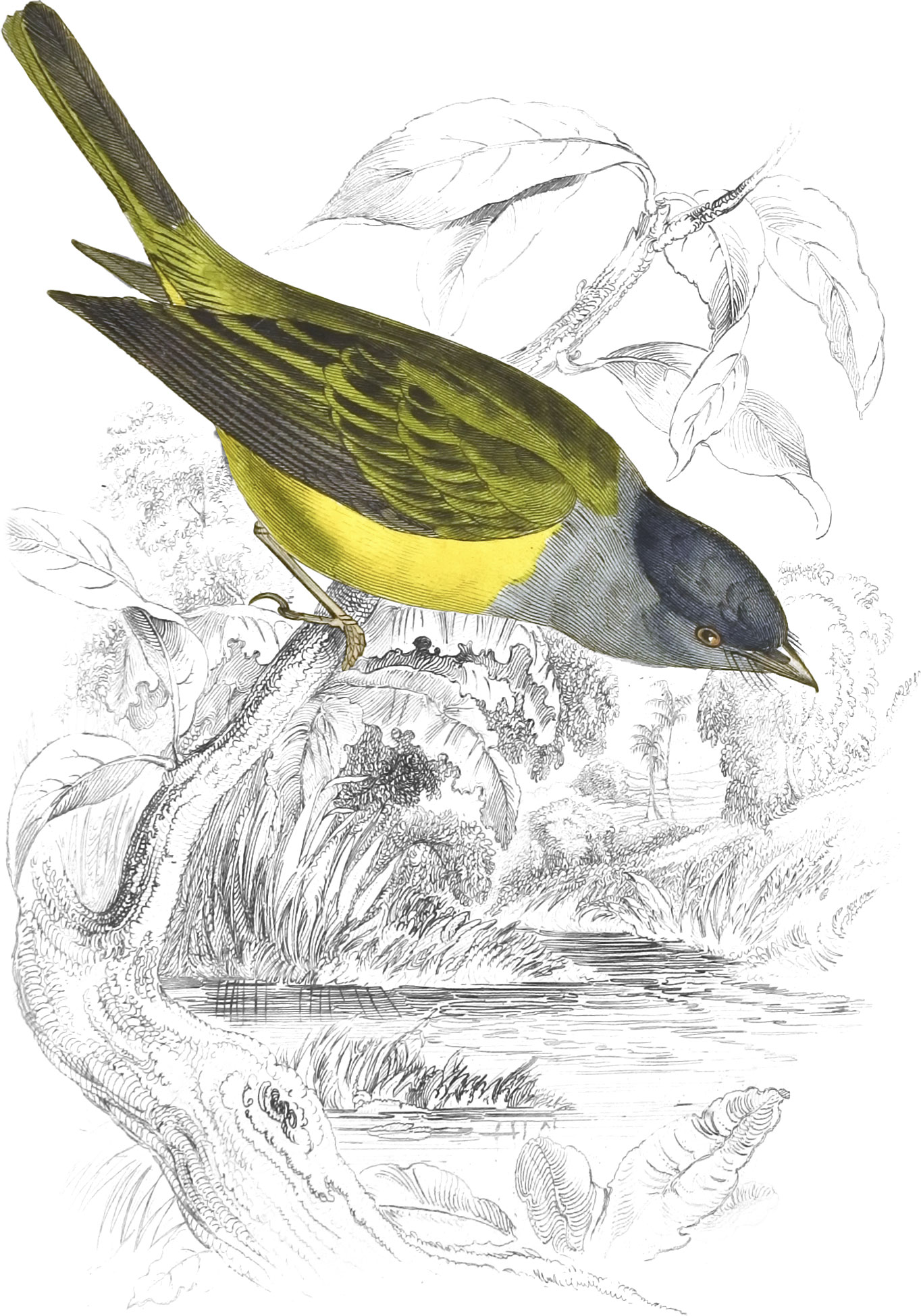
Plate XXIII
The sub-genus
Muscipeta
of Cuvier, will be here restricted to the long-tailed flycatchers of Africa and India, distinguished, at the first glance, by the excessive length of their two middle tail-feathers, which are often longer than all the rest of the bird together. These beautiful plumes, however, are only to be found in the males during the season of breeding, for at other times they have the tail like that of the female, that is, simply graduated, or very much rounded. It is not to be supposed, however, that Nature passes abruptly from such birds as are in the last division to these long-tailed flycatchers; and we accordingly find, that one species, at least, is destitute of these feathers at all seasons. Le Vaillant describes the long-tailed species as very wild and quarrelsome; but his Gobe-mouches mantelé is such a tame and gentle bird, that a pair of them actually made a habit of frequenting the inside of his tent, where they took their station on the furniture to catch the flies, destitute of all fear on his approach. He particularly alludes to this species “having an advantage” over the others in the superior ornament of a moveable crest of pointed feathers, which extend some way beyond the occiput; a sort of crest which is very different from those of its congeners. Here, then, we have two rasorial characters. But this is not all for this little species is the turkey-cock of its own group; it erects its crest, and spreads out its tail precisely as do the typical fowls.32 Our acquaintance with this remarkable bird unfortunately depends at present only upon the figure and description of Le Vaillant; we are therefore unprepared to say whether it really belongs to this sub-genus or to Rhipidura; the figures would lead to the former supposition, while the habits just mentioned would incline us to the latter. In either case, it is a most beautiful exemplification of the rasorial type. We have seen among the todies, that the variation of species is regulated by the same law as the variation of groups. Nor is this bird the only instance in the little group before us. We have the aquatic type in Le Vaillant’s Nebuleux, which he describes as thicker in the body, living only upon insects found near streams, and building its nest on boughs overhanging the water. This bird, moreover, is coloured black and white, and, but for its two long tail-feathers, might be mistaken for a species of Fluvicola. Next, we have the tenuirostral type in the Cordon noir of the same author, who describes the bill as altogether smaller and weaker than in any of the other species, and the tail as considerably less rounded; the figures, in fact, represent the lateral feathers as nearly even. Nor is the colouring of the plumage of this species to be overlooked; it very much resembles that of the wagtail, and has that broad pectoral collar which is so remarkably prevalent among grallatorial and tenuirostral types. All these instances of species putting on some one or more of the characters seen in the primary forms of nature are most remarkable, for they occur in a sub-genus which does not at present exceed ten or a dozen species: so that whatever doubts we might have in regard to the nomenclature of other specific types, it would be thought the height of absurdity to make each of these birds a sub-genus, because they are, in point of fact, types of form in the series of species.
White-Bellied Flycatcher
Muscipeta leucogaster, Swains.
Body beneath pure white; back, wings, and tail, rufous; throat and neck light grey; crown blue-black, furnished with a crest of lengthened, narrow, pointed feathers.
For an acquaintance of this, and several other interesting birds from India, our best acknowledgements are due to the Countess of Dalhousie, who, during her residence in India, paid much attention to the native birds, and has obligingly communicated to us many valuable notes upon their manners. From a memorandum attached to the only specimen in the collection, it appears to be a female; yet its superior size to any other of this group we have yet seen, together with the pure white of the under plumages, stamps it at once as a distinct and an unrecorded species. As our knowledge of these long-tailed Flycatchers increases, the more does it appear how much ornithologists have been mistaken in regarding them as varieties of our species.
The size of this bird is considerably above any of those figured by Le Vaillant, and enumerated in the second volume of the “Birds of Western Africa;” for it measures no less than five inches from the tip of the bill to the vent. The form is strictly typical, resembling the Mus. rufiventer and its allies; but the bill, in proportion, is much longer. The colouring, however, preserves the family likeness. The whole of the back, wings, and tail (the latter considerably graduated) are bright rufous, the neck and throat being light cinereous, and the top of the head dark steel-blue. The crest, as seen in the figure, differs from all the species hitherto known, in having the feathers very narrow and much lengthened, so as to have some analogy to that of Megalophus; the whole of the body, from the throat, is white.
The exact measurements, unfortunately, have been mislaid; and, as the specimen has been returned, we cannot make them again.
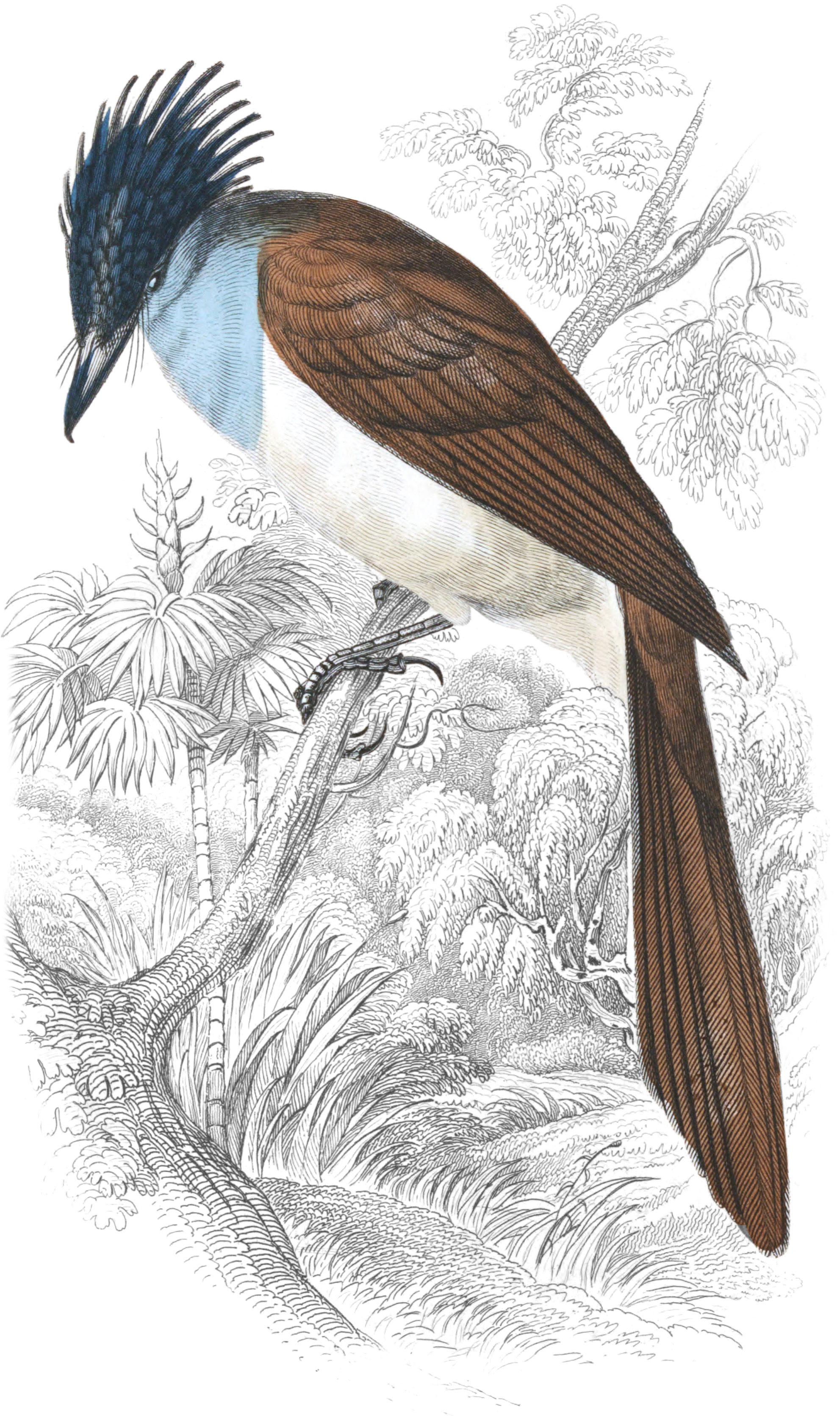
Plate XXIV
The sub-genus
Myïagra
was defined some years ago by Messrs. Horsfield and Vigors as containing all those flycatchers which had the tail more or less even, and a shorter and broader bill.33 This latter distinction, theoretically, appears to be very good; yet the difference is so very trifling between these and the latter, as hardly to be worth naming. As the tail, however, is one of the chief distinctions, we may still look upon M. plumbia (H. and V.) as one of the typical forms. The other character, which has been overlooked, is the superior length of the third quill-feather, which in this, and two or three other birds which are equally typical, is nearly, if not quite, as long as the fourth. In Muscipeta, on the contrary, the third quill is even shorter than the fourth and fifth. Now the passage between these two closely allied sub-genera may be thus traced. The first form which meets us on leaving the wedge-tailed Muscipetæ is seen in a bird from New Holland, now before us, and which we shall presently describe and figure, namely, the Myïagra longicauda. It is entirely blue, and has the graduated tail of Rhipidura and its prototypes; the bill, however, is unusually broad, and somewhat dilated at the base, while the bristles are so long as almost to reach—like those in the fan-tailed flycatchers—to the end of the bill. By this form we are prepared for the second, as seen in Myïagra latirostris, where the tail is shorter, and, although not graduated like the last, is yet decidedly rounded; while the bill is so short and broad, as immediately to remind us of the genus Todus, or rather of its sub-genus Platyrhynchus. The breadth of the bill lessens, and its length increases, in the Myïagra cærulia and torquata; and in the same proportion does the tail loose its roundness, until we come to M. rubiculoides and Plumlea (H. and V.), both of which have the tail-feathers completely even, and the wings, as already observed, more pointed. The fourth type of form is very remarkable; it is exhibited in a species from Africa in the Paris Museum. The head and bill is unusually large, while the crown is surmounted by a conspicuous pointed crest; the wings are lengthened, and the tail so short as hardly to project beyond them. Still more remarkable are the feet, which, although rather stout, are so excessively small, that the tarsus only measures four-tenths of an inch, being the exact length of the hind toe and claws: contrary, also, to any example yet known in the whole of this sub-family, the feet are of a beautiful yellow, with the claws deep black, while the anterior scales are divided into irregular hexagons, analogous to what we see among the gallinaceous birds. The whole aspect of this bird suggests the idea of a swallow flycatcher; yet it obviously combines just as many characters of the rasorial as of the fissirostral type. Its thick compact form, large head, short feet and tail, long wings, and glossy plumage, remind us of a swallow; while the stout tarsi, their hexagonal scales, and the long pointed crest, are so many indications of the rasorial type: for reasons which will presently appear, we shall view it in the latter light.34 The fifth type of form we have not yet seen; it should intervene between this bird and M. longicauda, and represent the tenuirostral form. Hitherto, out of the numerous species that have passed under our inspection, there has been no one which will completely answer our expectations on this head, or against which some objections cannot be raised. When the extreme delicacy, however, of the analysis we are now making is considered, it can excite no surprise, that in the present state of ornithological knowledge, we are unprepared to close the circle of a sub-genus, or that we should be ignorant of one part of the succession of its species. Before proceeding to generalize these observations, we shall first describe one of the species above alluded to, namely, the Myïagra longicauda.
Cærulean, or Long-Tailed Flycatcher
Myïagra longicauda, Swains.
Entirely cærulean blue, paler beneath; tail lengthened and considerably graduated; rictal bristles as long as the bill.
There are so many Flycatchers, generally so called, whose plumage is entirely blue, although of different tints and shades, that it is quite impossible to determine this species from among those in our systems at present in use. It was formerly in Bullock’s Museum, and stated to come from New Holland, a locality not at all improbable; for although we have never yet seen any species of Muscipeta from Australia, it affords several species of the present sub-genus.
The general structure, as already observed, accords more with that of the typical Myïagra than with any other of the neighbouring groups; for the tail, although long, is graduated, and not fan-shaped, as in Rhipidura, while the prolongation of the middle feathers, although but slight, induces the belief that this bird is an annectant species between Myïagra and Muscipeta; possessing, in other respects, much more of the characters of the former than of the latter.
General colour of the upper plumage light cærulean-blue, which spreads uniformly over all the exposed parts of the wing and tail-feathers the under parts are lighter and tinged with grey, which becomes almost white on the belly and vent; the covered portions of the tail and quill-feathers are blackish; the bristles of the mouth are strong, and are two-thirds the length of the bill, which, with the feet, are blackish. Of this rare species we have never seen a second example.
Total length, 7 inches; bill, gape, \(\frac{6}{10}\); front, \(\frac{4}{10}\); wings, 2\(\frac{7}{10}\); tail, base, 3\(\frac{1}{2}\); tarsus, \(\frac{6}{10}\).
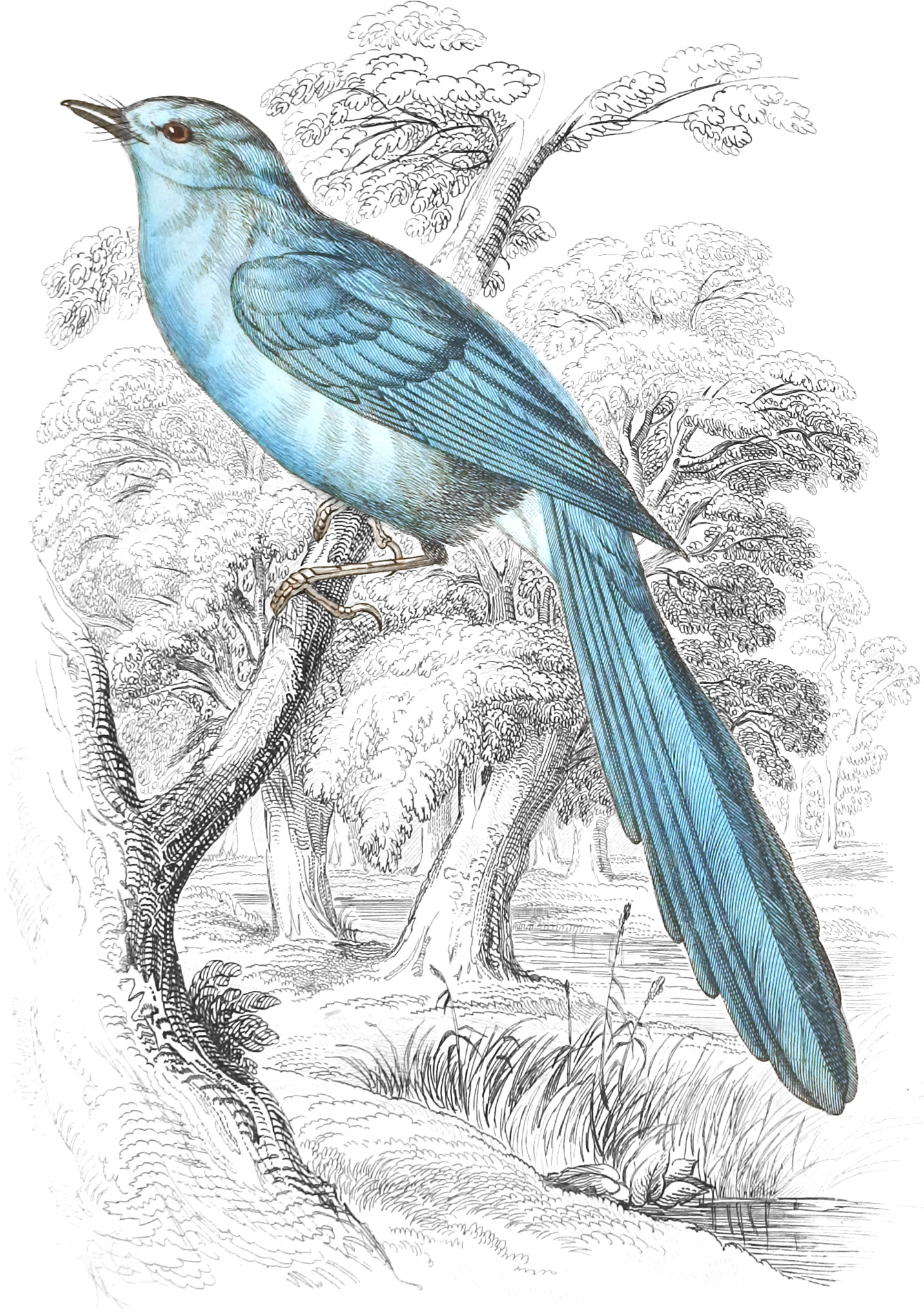
Plate XXV
That the foregoing outline of the circle of Myïagra is founded on some solid basis, will appear more probable when we compare the species, here named as constituting types of form, with those of the long-tailed Muscipetæ and with the divisions of the entire genus.
| Genera of the Muscicapidæ | Types of form in the sub-gen Myïagra | Sub-gen of Muscicapa | Types of form in the sub-gen Muscicapa |
|---|---|---|---|
| Rhipidura | M. longicauda | Cryptolopha | fluvicola, Le Vaill. |
| Muscicapa | M. latirostris | Muscipeta | picata |
| Todus | M. plumbea | Myïagra | paradisea |
| Megalophus | M. flavipes | Muscicapa | flabellifera |
| Monacha | M. ? | Hyliota | pectoralis |
It would be rain, in the present state of ornithology, to think of explaining the whole of these analogies; yet if a few are established, they will tend much to illustrate our preceding analogies. Rhipidura and Cryptolopha, as we have already seen, are representations of each other; and if Myïagra longicauda really belongs to that group, it becomes their representative also in the series of the species. Between the two typical series there are so many reciprocal analogies in structure, that nothing further need be said, seeing that we are in complete ignorance of the manners and habits of those birds, from which, no doubt, satisfactory evidence might be drawn; certain, however, it is, that nothing is yet known to invalidate the series in which they have been placed. On passing to the two other aberrant columns, we find all those with conspicuous crests coming parallel to each other, as Megalophus, Muscipeta flabellifera, and Myïagra flampes; this latter bird, by its long pointed wings and short tail, being also the type of form of the sub-genus Muscicapa. Lastly, the most aberrant types in each of the three columns which are filled up, are Monacha, Hyliota, and Muscipeta pectoralis, the only birds among the whole which have the narrowest bills.
We retain the original name of
Muscicapa
(Linnæus)
to that sub-genus which immediately follows Myïagra. All the birds coming under this designation have, in comparison to the three last divisions, longer and more pointed wings, stronger and more equal lateral claws, and shorter and more even tails. The bill, also, is materially different from all the other sub-genera, and more resembles that of Conopophaga: it is small, short, and rather strong, the sides being considerably compressed, although the base is still broad. These characters are more or less developed in different species; but they are sufficient, even in the most aberrant examples, to prevent any ornithologist, with proper attention, from confounding this group with any we have yet noticed in the family. The tarsi have also this peculiarity, that although they are often not longer than in Myïagra, or in Muscipeta, they are nevertheless stouter, and the scales which cover them in front, instead of being divided, are formed of an entire piece. This, although a minute character, is yet the most constant, and therefore one of the most important. The compression of the bill is accompanied by a thickening of the under mandible, the gonys of which, instead of being straight, is curved upwards; the bristles at the base, although well defined, and pointing directly forward, so as to separate these birds from the stone-chats,35 are yet short, and by no means so strong as in the preceding divisions. The wings, as already intimated, are the longest and the most pointed of all the flycatchers: they generally reach to half or three-quarters the length of the tail, while their typical structure is no less peculiar: the first quill is completely spurious,—in other words, it is quite useless for any purposes of flight, and seems intended either to designate the natural situation of these birds in the scale of nature, or to serve as some protection to the base of the next or second quill, which very nearly reaches the end of the third, so that the second and third pen-feathers,—which in all the preceding sub-genera are short and graduated,—become the longest of all. The tail is rather short, and the termination is not only quite even, but assumes in the middle an inclination to being slightly forked. Such are the typical characters as exhibited by our common Muscicapa grisola and the two other European species. But before we attempt to show in what manner these characters are modified in the extra-European species, we shall figure and describe the Muscicapa albicollis.
White-Collared Flycatcher
Muscicapa albicollis, Swains.
Above, black; front, collar round the neck, and a large patch upon the wings, white; quills brown, their base white; rump greyish-white; tail-covers entirely black.
Muscicapa albicollis, Tem. Man. i. 153, Pl. Enl. 565, f. 2.—Pied Flycatcher, var. b. Lath. Sy. iii. 325 ii. 324.
The annexed figure accurately represents an individual of this species we shot in the island of Sicily, so far back as the year 1807; it is almost the only specimen remaining of a large collection of the birds of that island, formed in the subsequent five years, which has escaped destruction from moths.
The ground colour of the upper plumage is black, but varied with white in the following manner:—The front of the head, the collar round the nape, and a large spot on the wings, are all pure white; this latter spot is longitudinal, and spreads over the tertials and a portion of the larger there is a band of white at the base wing-covers; of the secondaries, and a much narrower one on those of the primaries, excepting the two outermost; the quills and the spurious wings are brownish; the rump dull white, while the ears and sides of the head are black; so also is the tail, which is perfectly even; all the under plumage is pure white; bill black; feet brown; the third and fourth quill is equal and longest.
Total length, nearly 5 inches; bill, gape, \(\frac{1}{2}\); front, \(\frac{7}{10}\); wings, 3\(\frac{1}{10}\); tail beyond, \(\frac{7}{10}\); base, 2.
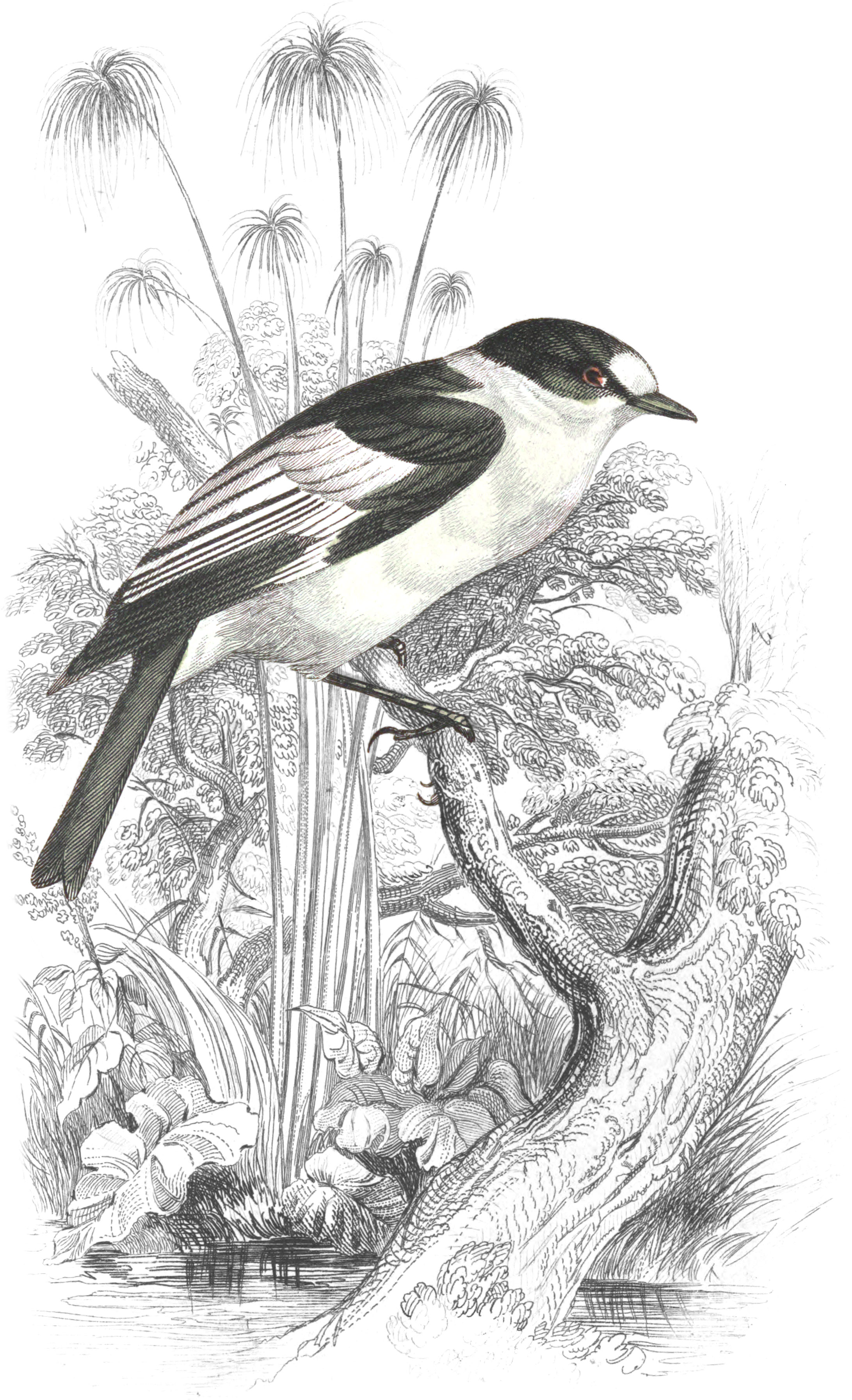
Plate XXVI

Let us now compare the genuine flycatchers, as here characterized, with some other groups related to them by analogy, and with which they have been confounded by many of the best modern ornithologists. We think this comparison will be beneficial to the science, and not uninteresting to the amateur.
The European flycatchers very closely resemble both the stone-chats (Saxicola) and the robins (Erythaca) while they seem to approach very much to those little tyrants of America, which constitute the aberrant examples of Ptilogonys: the two last mentioned resemblances are strictly analogical, but nothing more. Muscicapa, however, in its own circle, represents the flycatching shrikes (Tyranninæ) in theirs; and it likewise represents Ptilogonys in the circles of the Tyranninæ: from both these, however, it is at once distinguished (independent of more obvious but variable characters), by the very small size of the first quill-feather. The strongest of these resemblances, however, is between Muscicapa and Saxicola, for here the spurious quill-feather and the whole structure of the wings is almost precisely the same. Neither will the bill altogether “serve our turn;” for although that of Muscicapa is rather more depressed, such a distinction, founded merely upon a comparative quality, is vague and unsatisfactory. Nevertheless, as one family lives chiefly upon the ground, and the other is never seen but upon trees, this difference of habit necessarily carries with it a difference of structure, and this is immediately apparent in the feet,—those of Saxicola being nearly half as large again as those of Muscicapa. The one, in fact, is constructed for perching only, the latter for perching and walking; hence the great length of the tarsus, and the complete separation of the toes in all the different genera of the Saxicolinæ,36—a structure quite opposed to the shortness of the tarsus, and the union of the outer and inner toe, which pervades, more or less, through the whole of the Muscicapinæ.
The variations in the foregoing characters of Muscicapa, so far as they have come before us, will now be stated. Let us first, however, call the attention of the ornithologist to the last bird which has been mentioned in our account of Myïagra, because its structure will assist us materially in tracing the chain of progression. The Myïagra flavipes differs from all those in its own sub-generic circle, not only in the feet, but in the great length of the wings, and the shortness of the tail. Now this evidently points it out as an aberrant species, and gives an intimation, that in the group which is to come next, some species will be found having one or more of these characters, and yet partaking likewise of those more properly belonging to Myïagra. And such a bird has fortunately been described. The Myïagra macroptera,37 in short, realizes precisely what the law of variation would lead us to expect. It is a Myïagra, according to M. M. Horsfield and Vigors, in its bill,
but the comparative length of the wings, and the shortness of the tail, distinguish it from the other species of that group; the wings reach to the extremity of the latter member.
Now as this structure is almost precisely what we see in M. flavipes, why not place both in one group? Here, however, the similarity ceases. M. flavipes has a conspicuous crest, because it is the rasorial type, while its feet are particularly short. M. macroptera has no crest, and its feet are fully as long as those of Muscicapa grisola.38 It retains, in short, according to the account of its describers, nothing of Myïagra but its bill; for its wings, tail, and feet, are those of our Musdcapæ. It is seldom we can establish the connexion of two groups in so satisfactory a way: this sort of evidence, indeed, is more entitled to confidence when it can be drawn from the writings of those who become in this way unbiassed, and therefore trustworthy witnesses, than when it merely rests upon the inference of one who is advocating his own theory. The intelligent ornithologists who described this bird, seem to have had an idea of its being the connecting link between Myïagra and Muscicapa, although they have shown much judgment in discriminating it so well, that without having seen the bird, we feel fully persuaded it has been correctly described. According to these views, Myïagra macroptera, by its structure, comes in the circle of Muscicapa; and if any other proof was wanting, it will be found in the inference to be deducted from the following fact. Mr. Caley gives the following note upon the species:—
This bird has all the actions of the British robin red-breast, except coming inside houses: when a piece of ground was fresh dug it was always a constant attendant.
We repeat that we have had no opportunity of examining this bird; but were it not that our two best ornithologists had referred it to Myïagra, we should, upon this simple statement alone, have been impressed with a conviction that it really was a robin, because this assertion of Mr. Caley’s would seem to imply that it hopped like our red-breast upon the ground, a habit which no fissirostral bird is known to possess. But does this supposition militate against the probability of its being a true flycatcher? Something, it must be confessed, but not quite; for we shall now mention a bird as actually having the typical feet of a flycatcher, but which, in size, colour, and appearance, is so like a robin, that no one, even a professed ornithologist, would be able to distinguish one from the other, unless the feet and the wings were carefully examined. It is, in fact, the most extraordinary instance of disguise, or rather of complete analogy, that has ever occurred to our observation in the whole animal kingdom. Let the reader suppose a robin before him, and he has an exact picture of our Muscicapa erythaca. A single specimen of this bird is in the Paris Museum; nor were we perfectly satisfied it was not a deceptive preparation until we examined it most attentively, for the purpose of seeing that the feet were actually united by the skin to the body. It proved, however, in this respect, to be perfectly genuine; and we shall now figure and describe it.
Robin Flycatcher
Muscicapa rubecola, Swains.
The only specimen we have ever seen of this very remarkable bird, is the one already alluded to as existing in the Royal Museum at Paris; and, as every particular respecting its structure must be highly interesting, we shall here transcribe our original description, verbatim, as written when the specimen was before us.
Size and colour of the robin, which it so closely resembles, that it might easily pass for that bird:—bill rather larger, straight, but abruptly bent at the tip; the base broad, but not dilated; culmen elevated and straight; the sides compressed; gonys ascending; rictus as much bristled as in the European Flycatchers; wings moderate, reaching to half the length of the tail; the first quill very short, the second equal to the seventh, the fourth and fifth longest; tail moderate, slightly rounded; tarsi (for a Flycatcher) rather long, pale; anterior and lateral scales entire; outer and inner toes nearly equal; the inner slightly connected at the base, but the outer and middle toe are connected beyond the first joint of the latter; claws slender, arched, acute; bill blackish; legs pale. Inhabits Pondichery, M. Lescherault: labelled in the Museum, “Gobe Mouche Azuron.—Vaill.”
Total length, in a straight line, about 5\(\frac{1}{2}\) inches; bill, from the front, \(\frac{4}{10}\); wings, 2\(\frac{8}{10}\); tail beyond, 1; tarsus, \(\frac{6}{10}\); hind toe and claw, \(\frac{5}{10}\).
It is necessary to add, that the name above quoted seems to us erroneous.
That the analogy of this singular bird to the robin should be illustrated more fully, we shall subjoin the circles of the two groups in which they respectively occur.
Genus Muscicapa
- Myïagra
- Myscipeta
- Cryptolopha
- Hyliota
- Muscicapa
Genus of Saxicolinæ
- Saxicola
- Thamnobia
- Gryllivora
- Petroica
- Erythaca
Without at present entering into all the details of these two circles, we would apply our preceding observations as strong proofs in support of our belief, not only in the analogy of Muscicapa and Erythaca, which here stand opposite to each other, but in the union of the Muscicapidæ, the Sylviadæ, and the Ampelidæ (the three aberrant divisions of the tribe Dentirostres) into a circular group of their own, quite independent of the other two, which, when united to this, constitutes the whole tribe. In whatever view, therefore, we may take of the Myïagra macroptera, whether as a genuine Myïagra or as a Muscicapa, our theory that these two sub-genera unite will not be affected. But we must not think that there are no variations from the structure of Muscicapa grisola in the other species associated in the same sub-genus: on the contrary, there are some very remarkable ones besides the one just instanced in M. erythaca, which, as we shall presently show, is evidently an extreme aberrant species. In our M. thalassina and ruficauda, two Indian species subsequently described, the wings are so much rounded as to resemble those of M. erythaca, although the toes are not more united than in M. grisola, and in all these three the tail is rounded. Again, in our M. latirostris, another species from India, the plumage is almost precisely the same as that of grisola; but then the bill is so remarkably depressed as to give it the appearance, in this respect, of being a Myïagra. From these we pass to the European albicollis, by means of such birds as M. parvirostra and leucura, which begin to show the white and black colour so common on the tail of the stone-chats. Our M. parvirostra agrees so closely in point of colour with the description of the bird called by M. Temminck the young male of his M. albicollis, that we question very much if it may not have been overlooked for that. However this may be, the two species, in our opinion, are sufficiently distinct. The bill of the adult albicollis, which we found in Sicily near twenty years ago, is broad at its base, while that of parvirostra, as the name implies, is the smallest of any species we have yet seen; and, for this genus, is remarkably narrow and compressed. We are, indeed, sceptical as to the birds described by Temminck as the female and young male of albicollis; the white edging of the lateral tail-feathers, said to exist in the adult male only, is opposed to every conclusion drawn from analogy, more particularly among the insectivorous birds. But to pursue our analysis of the Muscicapæ further, will, however, be needless. All the variations that we can possibly speak of, from personal knowledge, have been enumerated, but several more no doubt exist. Throughout all these, the only characters in which no material variation can be detected are those of the feet:
- the middle toe is always long, and is of the same length as the tarsus;
- the tarsus itself is always smooth, and is defended in front by one entire scale; and,
- the outer toe is in all united to the middle as far as the first joint.
Now these three characters will of themselves enable any ornithologist to distinguish the group from all those which it resembles in other families. It may be further remarked, that we have not hitherto seen one species of an olive-green, that colour apparently belonging only to the sub-genus Cryptolopha, where the wings, instead of being pointed, are rounded.
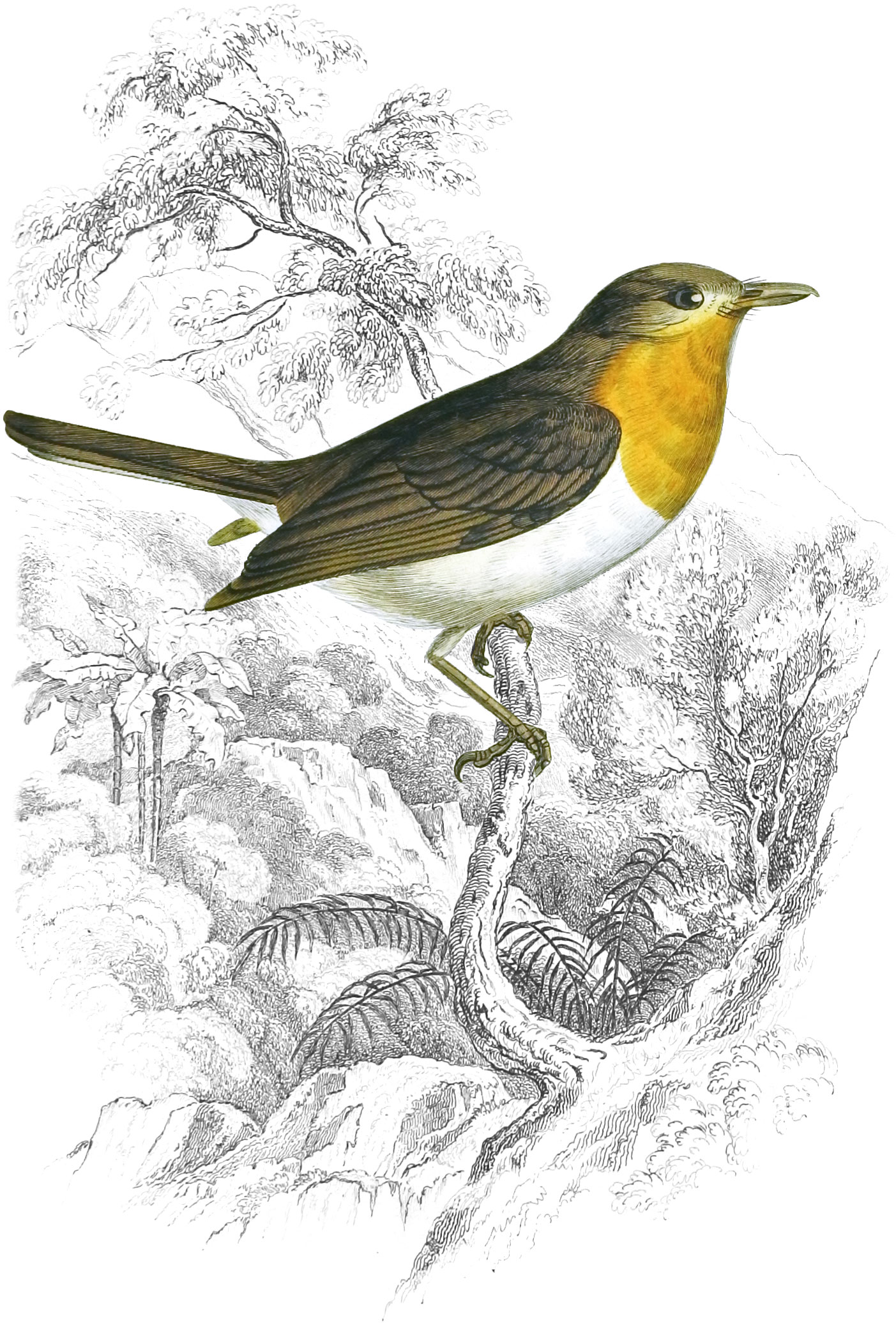
Plate XXVII
The last sub-genus is
Hyliota
which agrees with Muscicapa and Cryptolopha in having the outer half of the hill compressed; but here this structure is carried to its extreme. Its length is sufficient to give to the bird an appearance of being a warbler: the base, indeed, is broad, but beyond the nostrils it suddenly contracts, and the remaining portion is so much compressed that its height (when viewed in profile) is much greater than its vertical breadth: the rictus, moreover, has merely a few setaceous hairs, and is destitute altogether of stiff bristles. Hyliota further differs from Muscicapa in having the claws broader, stronger, and more curved, and in the scales of the tarsi being divided into four pieces. And yet, notwithstanding these great deviations from the typical character of fly-catching birds, we feel fully persuaded that this is the tenuirostral type of the genus before us. The wings and tail are precisely those of M. albicollis. The outer toe is connected as far as the first joint; and the glossy blue-black plumage, white scapulars, and buff-coloured throat, is in complete unison with the family we are now treating of. The first aspect of the species now before us suggests the idea that it belongs to Platystera, while the breadth of the bill at its base indicates its insectivorous habits: its apparently anomalous structure, in other respects, is explained by the situation it holds as the tenuirostral type of its own genus. Hence its bill is the longest, and, like that of Monachus, it is considerably compressed; by the absence of bristles, and by the thick feathers on the rump, it preserves its analogy to the Cellepyrina, or caterpillar-catchers, without diminishing its affinity in other parts of its structure to Muscicapa, or its analogy in point of colour to Platystera. Such are the conclusions we have come to after some years reflection, and which we have elsewhere intimated.39 At present we know but of one species; the sexes of which, unlike all the other types of Muscicapa, differ as remarkably in colour as do those of its prototype Platystera. And the student will remember, that the tenuirostral types are always those which have the most marked difference in the plumage of the sexes. The whole of the Ampelidæ, the order Grallatores, and the tribe of Tenuirostres, not to mention the Orioles, Psarianæ, and several others of minor note, are convincing proofs of this general law. It is well known, again, that nearly all tenuirostral types have the longest bills among their congeners: witness the humming-birds and the whole order of waders. We find this analogy, therefore, preserved in the present family; for this is a peculiar characteristic in Psaris, Perspicilla, Monacha, and Hyliota, groups of different ranks, yet representing each other in their own circles. An exception to this rule would seem to appear in Platystera, but length of hill is here the typical distinction of the genus: and if it is longer in the tenuirostral than either in the fissirostral or rasorial types of that genus, the analogy is still preserved; and such, in regard to Platystera, is actually the case. We have thought it necessary to illustrate Hyliota by these varied comparisons, because it stands at present as a single species, and there is consequently a want of that gradation to Cryptolopha which we find between such types as are fuller of examples. This species we shall now describe as the
Buff-Bodied Flycatcher
Hyliota flavigaster, Swains.
Plumage, in the male, glossy blue-black; in the female, cinereous; beneath, in both, ochraceous yellow; wing-covers and rump with a band of white.
Hyliota flavigaster, West. Afr. Birds, ii.
As we have given a full description of this species in the work above quoted, a shorter one will here suffice. The male has the upper plumage deep and glossy blue-black, where that of the female is deep grey, inclining to cinereous; the quills are paler and browner, but their outer edges are glossy; the sides of the head and ears are like the back; the feathers of the rump are long, soft, and pure white; but the tail-covers are small and glossy black. The female has the quills, and some of the lateral tail-feathers, with a narrow whitish margin. In both sexes, the greater and lesser wing-covers are pure white, continued, in the female, in a stripe along one or two of the tertials; the under parts are buff-yellow, deepest on the breast, and lightest in the female; bill and feet black.
Total length, 5 inches; bill, gape, \(\frac{7}{10}\); front, not quite \(\frac{1}{2}\); wings, 2\(\frac{7}{10}\); tail beyond, \(\frac{6}{10}\); base, \(\frac{3}{4}\); tarsus, \(\frac{7}{10}\).
We have now traversed the whole of that great circle which is composed of the sub-family Muscicapinæ. We commenced with the genus Rhipidura, and then proceeded successively through those of Monacha, Meyalophus, Todus, and Muscicapa, dwelling upon all the minor circles they contained, and pointing out the graduated chain of connexion between each. We have endeavoured to demonstrate the truth of our propositions at every step by as refined a species of analysis as we possibly could make. But our task in regard to this great circle is not yet done; for we have not yet shown in what manner the Muscicapinæ, as a whole, actually form a circle. We entered it at one point, which was Rhipidura, and having traced it as far as Muscicapa, it yet remains to be proved that these two groups unite, so that the circle is actually formed, and that the series returns into itself. We are, in other words, to return by a different route to the point from whence we started: this point was the genus Rhipidura. The question then is, in what manner is this genus united to Muscicapa? How is the junction made, and the circle closed? We will leave this to the observation of the reader with little or no comment. Let him turn to the description and figure of our Myadestes genibarbis, then look upon that of Muscicapa erythaca, and he will at once perceive no two birds of two connecting genera can be more closely allied: their very aspect alone bespeaks their connexion. The only doubt that remains on our mind is, whether the latter is not in reality a second species of Myadestes! rather than a Muscicapa; while, but for its tail, M. genibarbis might he classed as a flycatcher. In either case the affinity is too palpable to require comment. And thus do we think that the great circle of the Muscicapinæ is closed.
Concentrating the results of that analysis we have now gone through of the two typical circles of the Muscicapidæ, we shall find that their contents mutually represent each other in the following manner:
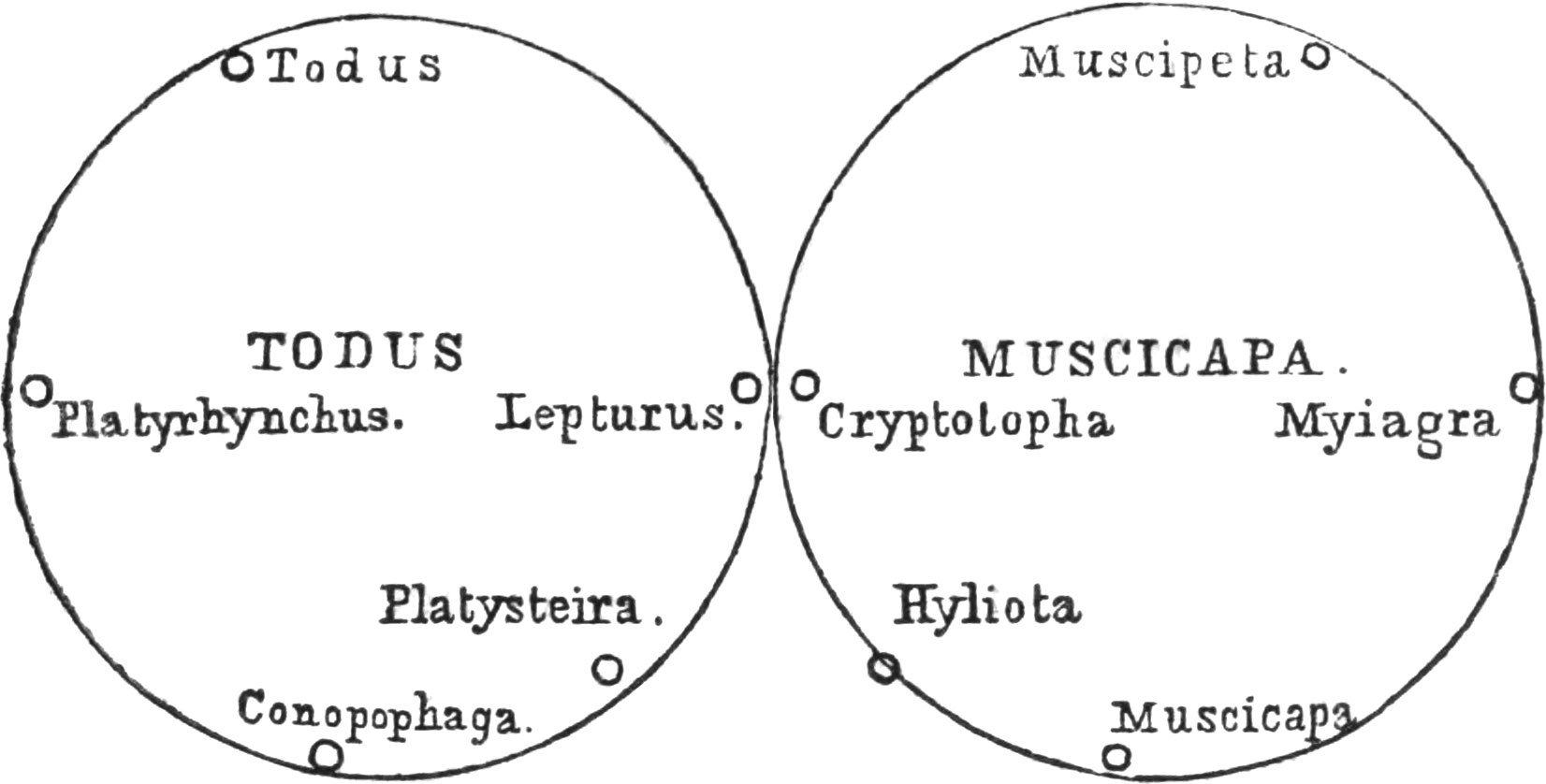
While the analogies of the sub-genera may be thus briefly recapitulated.—
| Genus Todus Sub-genera | Analogies | Genus Muscicapa, Sub-genera |
|---|---|---|
| Todus | Bill more lengthened, and depressed to the end | Muscipeta |
| Platyrhynchus | Bill shorter, very broad | Myïagra |
| Conopophaga | Bill small, triangular, the sides compressed; tail short | Muscicapa |
| Platysteira | Bill lengthened; tail short, broad, even | Hyliota |
| Lepturus | Bill triangular, the sides compressed; tail slender, the tips pointed | Cryptolopha |
Let us, in conclusion, offer a few remarks on the more general results which the preceding investigation tends to establish, while the facts are as yet fresh on the memory.
- We perceive that all natural sub-genera, as such, imitate, as it were, or represent one or other of the primary forms of nature, and that their variation is regulated by the same order of succession. The rasorial forms, for instance, is followed by the tenuirostral; and this, again, by the fissirostral.
- That this law of variation is the same, also, which regulates the variation of the species: one example of this we have already given in a sub-genus of quadrupeds, and in the sub-genus of Todus we have a second example in the class of birds.
- Lastly, we perceive that the rank of any one of these types can only be known by analysis; and then only when our materials are very ample
Hence arises the uncertainty respecting the rank of every type; because, without the most refined analysis, it is impossible to determine whether a bird is a specific or a sub-generic type of form.
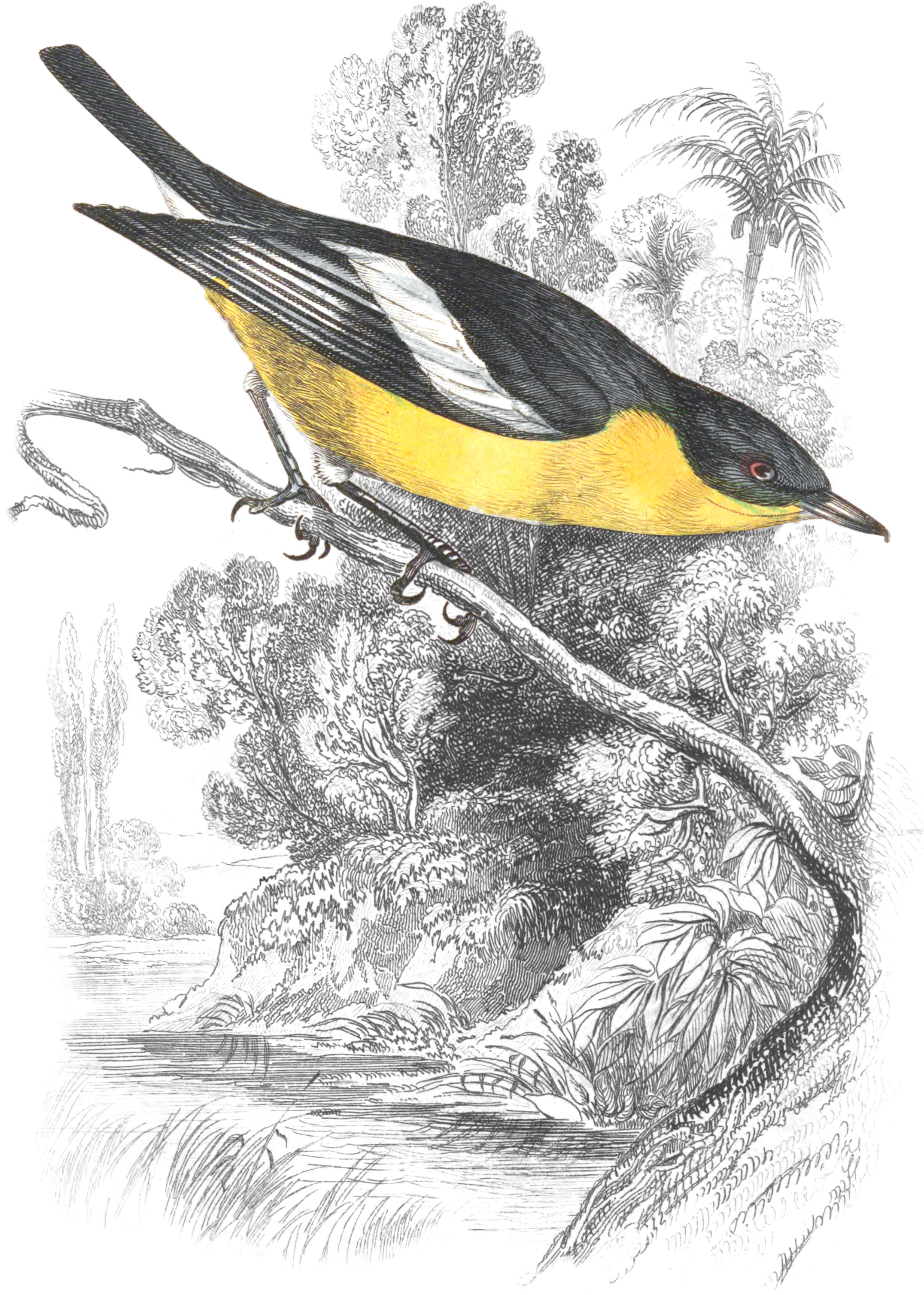
Plate XXVIII
Let us now proceed to the fifth and last group of this family. The
Eurylaminæ, or Broad-Bills
as before observed, constitute one of the primary divisions of this family. They are a most remarkable group of birds, whether we regard their appearance, or the extreme interest which attaches to their scientific elucidation. The different groups of flycatchers we have hitherto noticed have been small, delicate-shaped birds, seldom equalling the size of the robin, and generally smaller than a wren; but those we are now come to are of a very different character. Their average size is nearly that of a starling or small thrush. Their shape is thick and robust, and their head and bill enormously large; their whole aspect, in short, at the first glance, is so different from any other group, that the most unpractised eye would detect, without at first comprehending, their striking difference from all other birds. So far, therefore, we shall find this peculiarity of character a circumstance highly favourable for the investigation of their affinities, because it removes those difficulties which impeded the complete illustration of the intricate groups just noticed. And yet, notwithstanding this great dissimilarity in general appearance between the ordinary flycatchers and these birds, a more attentive examination of their structure proves them to be but a race of the same family, essentially possessing the same general structure, yet with some parts enlarged and others reduced; modifications, in short, which obviously indicate peculiar manners, and which tend to exhibit, at the same time, a higher developement of the fissirostral type than any we have yet noticed. All the species yet discovered have been found in Tropical Asia, where they represent, in the same latitudes, the todies of the New World. Linnæus and his followers, indeed, placed both in the same genus; but Dr. Horsfield, who discovered one species in Java, since distinguished by his name, characterized it as belonging to a distinct group. Unfortunately he was not able to give any account of its manners, further than that it was found in
one of the most distant and inaccessible parts of Java, covered with extensive forests, and abounding with rivers and marshes.
But Sir Stamford Raffles, speaking of another species, observes,
it frequents the banks of rivers and lakes, feeding on insects and worms. It builds its nest pendant from the branches of a tree or bush which overhangs the water.
We have thus two witnesses to the fact of two species of these birds habitually living in the vicinity of water.
The preceding observations renders it almost unnecessary to state the more minute peculiarities in, which these remarkable birds differ from all the other flycatchers; yet some of them deserve particular attention, as establishing their collateral affinities. The bill, notwithstanding its excessive breadth, is by no means so very much flattened as what we see in Muscicapa; for the culmen is sufficiently elevated to form a regular curve, while the tip is almost as abruptly hooked as that of a raptorial type, although the notch is very small; the lateral margins of the upper mandible are very much curved, and so much dilated as to fold over and completely hide those of the lower mandible, more especially at the angle of the mouth. The rictal bristles are comparatively very short, and do not protect the nostrils, whose situation and form is various in the subordinate types. The feet cannot be termed small or delicate, yet they are obviously of a weak construction, and adapted only for sedentary habits; their colour is always pale, and their structure completely syndactyle; the hind toe is proportionably very long, and equals the length of the tarsus, which latter is often without any posterior or lateral scales. Now there is no example of a foot, so constructed, in all the other genera of this family, except Megalophus, which, in like manner, has a large portion of the tarsus equally naked; while the proportionate length of all the claws is the same in both. Megalophus, in short, is the connecting link between the Eurylaiminæ and the Musclcapinæ; and we may now proceed to consider the former more in detail.
That natural groups, of the same rank, are very often vastly disproportionate in their extent, has been frequently observed; and upon another occasion we have attempted to show, that such numerical disproportion is absolutely essential to the harmony and consistency of the creation.40 Now the group before us is another striking example of this inequality. Were it an imperfect circle, and were we unacquainted with those forms which connect it on both sides to other types, strong doubts might be reasonably entertained if a group, containing so few species, really represented a sub-family, and deserved to be placed in the same rank with the Muscicapinæ and the Fluvicolinæ. But this difficulty we are now about to remove. It has happened, most fortunately for our present purpose, that the industry of modern naturalists have transmitted to Europe, from different and remote localities, every one of those which we consider the primary types of the Eurylamidæ; so that we shall now venture, after patiently waiting several years for this event, to submit to the public our elucidation of the whole group. All the species yet discovered of this sub-family we accordingly arrange under one or other of the following divisions, which we shall distinguish as Cymbirhynchus, Eurylaimus, Serilophus, Psarisoma, and Platystoma. It will subsequently appear that these are types of genera, and we shall now give the distinguishing characters of each in detail. The genus, named by Mr. Vigors,
Cymbirhynchus
is represented by the Todus nasutus of the old ornithologists, and it differs in several remarkable particulars from all its congeners. The bill is not only broad but high, so that when viewed in profile it seems to belong to a conirostral bird; the under mandible is consequently strong, and almost as deep as the upper, the gonyx taking an angulated ascending curve; the rictus is defended by three or four long bristles; the bill is not only powerful in its general character, but it has, something like that of the toucans, a thickened margin. Another peculiarity is to be found in the nostrils, which are perfectly naked, and situated towards the middle of the bill; the aperture is oval, and without any rim or membrane; the tail, although graduated, is of the average length of ordinary birds; but, in other respects, the structure accords with the remaining species.
Black-Billed Gaper
Cymbirhynchus masutus, Vigors.
Upper parts, with the chin and pectoral collar, black; beneath, dark red; scapulars narrow and white.
Todus nasutus, Latham, Index Orn. i. p. 268; Gmelin, i. p. 446.—Great-billed Tody, Lath. Gen. Syn. ii. 664, pl. 30. (fig. pass.); Gen. Hist. iv. 94, pl. 45, (fig. med.)—Cymbirhynchus nasutus, Vigors.—Eurylaimus nasutus, Tem. Pl. Col. 154.—Erolla nasica, Lesson. Tr. d’Orn. 260.
Under the name of Todies nasutus, this remarkable bird, although by no means frequent in our collections, was well known to the old ornithologists, as will appear from the various synonymes we can, in this instance at least, quote with safety. As it is at present the only representative of its genus, there is no occasion to go into a particular account of its structure. We may observe, however, that the deep red feathers of the throat and breast, like those of some of this group, are precisely of the same rigid and glossy structure as those on the throat of Querula rubricollis; and the general form and appearance of this latter bird is so much more like to Eurylaimus than to the rest of the Flycatchers, that we are tempted to believe it is their representative in the New World. Whether a better acquaintance with the natural economy of the two may strengthen or annul this opinion, must at present remain uncertain; but the experienced ornithologist cannot fail to remark the near approach of the Eurylaiminæ, in general, to the American bird, which, in our estimation, is as nearly connected, on the one hand, to this group, as it is, on the other, to Psaris. In this manner do we consider that the great circle of the entire family of Muscicapidæ is closed, and returns into itself.
Our specific character, aided by the annexed figure, precludes the necessity of a lengthened description. The pure white upon the scapulars forms a long, slender, and well defined stripe, the feathers themselves being lanceolate; with this exception, and the crimson rump and tail-covers, all the upper plumage is a deep black, glossed with obscure green; the wings, tail, chin, and band just above the breast, are likewise of this colour; the latter patches of black leaves a transverse band of dark crimson on the throat, which also covers the ears, and the whole of the under plumage, from the breast downwards; the edge of the shoulders, or carpus, is orange; the three shortest tail-feathers have an oblong white spot, placed obliquely, near the tip of the inner webs; the bill is blue-black, with the edges pale; the feet are also pale. The female, or young bird, is distinguished by having a fulvous-white spot at the tip of each of the wing-covers.
Total length, exactly 9 inches; bill, gape, 1\(\frac{1}{10}\); front, \(\frac{9}{10}\); wings, 4; tail beyond, 2\(\frac{2}{10}\); base, 4; tarsus, \(\frac{3}{4}\).

Plate XXIX
The next form is that to which we retain Dr. Horsfield’s original name of
Eurylaimus
Here we have the bill more flattened, particularly the under mandible, the gonys of which is nearly straight; the nostrils are placed close to the front of the head, and are surrounded with a narrow membrane. The rictal bristles, which are so conspicuous in the last genus, are here very short and weak, and the dilated base of the under mandible very remarkable. The Eurylaimus Horsfieldii and Sumatranus41 belong to this genus, and there are probably other species. In the last named bird, the dilation of the bill is so great that it actually exceeds the breadth of the head, broad as it is; and in the Paris specimen, the margin has an appearance of being obscurely and irregularly crenated. In this bird, also, the rictus is quite smooth; so that it is more typical than Horsfieldii. The tail in this group is rather short; although this, of course, is variable.
Horsfield’s Gaper
Eurylaimus Horsfieldii, Temminck.
Body above black; the scapulars and middle of the back striped with bright yellow; under plumage vinaceous, tinged with cinereous on the throat; above the breast a narrow brown bar; head cinereous-brown, with an incumbent crest.
Eurylaimus Javanicus, Horsf. Lin. Tr.: Researches in Java.—E. Horsfieldii, Tem. Pl. Col. 130, 131.
Dr. Horsfield was the first zoologist who defined the present genus; and this species, which he proposed to call Javanicus, has since been justly distinguished by his name. It retains much of the character of Cymbirhynchus in its general structure, in the glossy nature of its feathers, and even in its colours; but the tail is much shorter, and the bill, although equally large and broad, is much more flattened, as well as dilated at the gape; the colouring of the head and neck is very peculiar, and is so mixed and blended as not to admit of an easy definition. The top and sides of the head are of a chestnut-black, graduating into a shade of cinereous on the nape, and of vinaceous-red on the ears and sides of the throat; this changes to dark brown on the lower part of the neck above, and then into deep black, which is the ground colour of the remaining upper plumage; on the scapulars, and down the middle of the back, is a broad stripe of bright and pure yellow; the base of the feathers, and edges of the same, being black; a band of yellow is also on the middle of the lesser quills, and a very small one, much paler, at the base of the primaries; the edges of the wings, and the under wing-covers, are also pale yellow; the under parts are dull vinaceous-red, becoming nearly cinereous on the chin and throat, which are like the ears; across this, and just above the breast, is a narrow band of dark brown; the under tail-covers are dingy yellow, and the thighs brown. The tail is black; all the feathery except the middle pair, having a transverse white band before their tips; bill vinaceous brown, part of the culmen and the margins being yellow; the legs are pale, and probably flesh-coloured.
Total length, 8 inches; bill, gape, 1\(\frac{4}{10}\); front, \(\frac{7}{10}\); wings, 4; tail beyond, 1\(\frac{1}{10}\); base, 2\(\frac{1}{2}\); tarsus, \(\frac{8}{10}\).
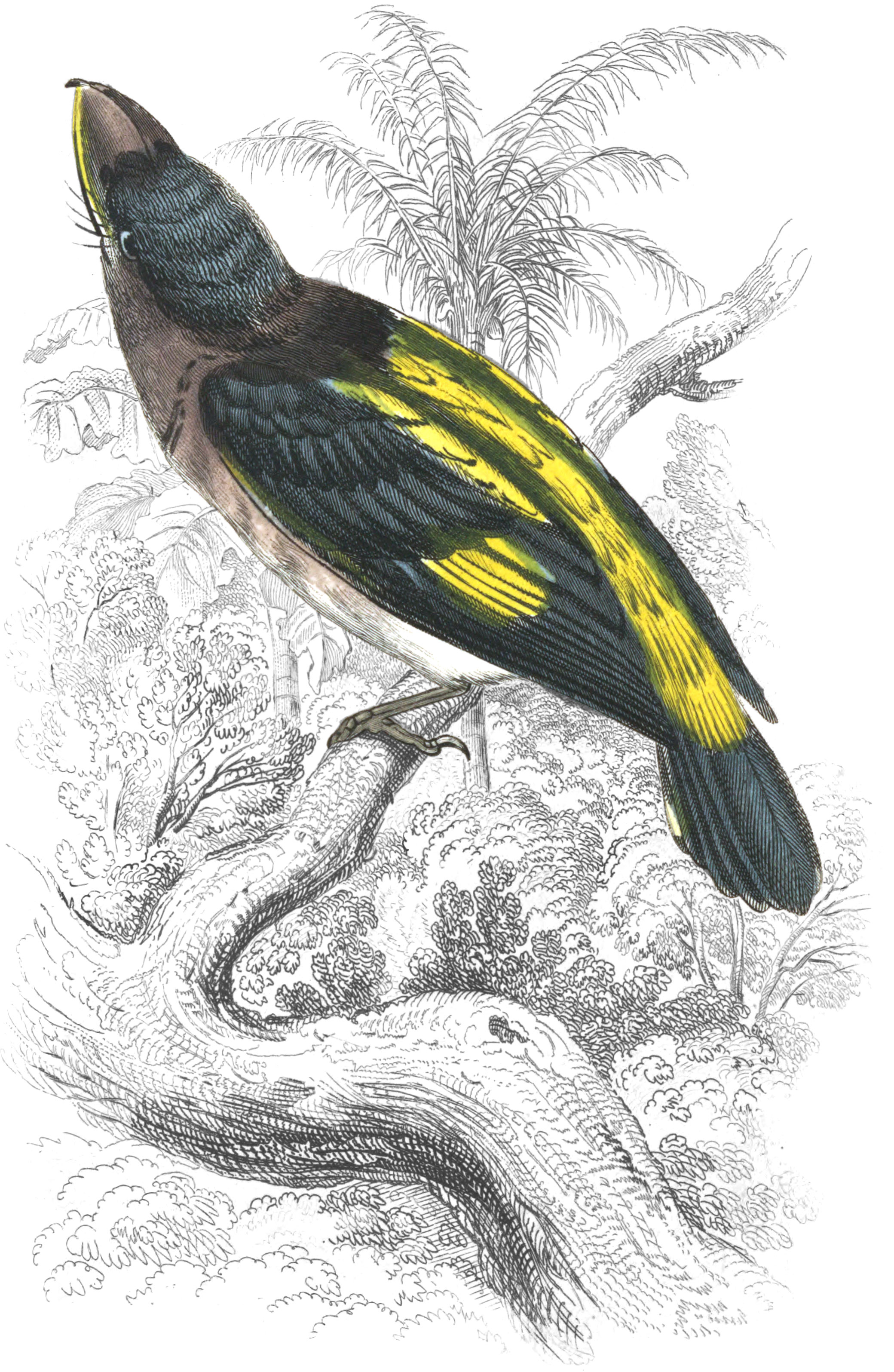
Plate XXX
The next type42 we have named
Serilophus
it is represented by that beautiful and interesting bird, the Serilophus lunatus, recently discovered near Rangoon, where several of them were shot by Major Godfrey. Here, again, although the information on its manners and habits is very concise, it is peculiarly applicable to our purpose. Major Godfrey observes,
that it inhabits the thickest jungles, and that its food was found, upon minute investigation, to consist entirely of berries and fruits.43
The generic and typical peculiarities of this bird are peculiarly interesting. The first aspect, notwithstanding many dissimilarities, reminds the ornithologist of the true chatterers (Bombycilla), the plumage having the same silky gloss, and the head being surmounted, as in those birds, with a conspicuous, pointed, and pendant crest. The wings are very remarkable, uniting the two chief characters of the rasorial and of the fissirostral structure the first is manifested in the suddenly attenuated and pointed ends of the primary quills, almost precisely similar to those of some species of Fluvicola; while the secondary quills, by their broad, truncated, and indented termination, give us the fissirostral character, so eminently developed in the Meropidæ and many other types. These peculiarities leave us in no doubt where to look for the analogies of Serilophus, and induces us to view it, by the preponderance of these characters, as the rasorial type.
The next in the natural series is our genus
Psarisomus44
represented at present by a single species, and of which we can only speak from the figure and description published by Dr. Royle.45
We now come to the genus
Fork-Tailed Gaper
Platystomus Blainvilii, Swains.
Glosy blue-black; stripe on the ears, and spot on the nape, white; rump, vent, and tail-covers, crimson; tail forked.
Eurylaimus Blainvillii, Garnot, Zool. Coquille, Pl. 19.—Erolla Blainvillii, Lesson. Trait. d’Orn. 260.—Platystomus Blainvillii, Sw. Class. of Birds, ii. p. 261.
The structure of this exceedingly rare bird has already been fully explained in another place,46 and its affinities and analogies have just been glanced at. The annexed figure and description are both taken from the only specimen as yet known, now in the Paris Museum, and discovered by M. Garnot in the Island of New Guinea.
The general ground colour of the entire plumage, both above and beneath, is deep and uniform black, glossed with blue, particularly on the head and breast. A broad white stripe begins at the gape, covers the ears, and terminates beyond, on each side of the neck; a similar patch, but smaller, is between the nape and the interscapulars; from the lower part of the back to the upper tail-covers, the colour is bright but dark crimson, while the belly and under tail-covers are the same; the wings are lengthened and reach to half the length of the tail, the latter being slightly forked; the thighs are black, and the bill and feet blackish-brown.
Total length, about 7 inches; bill, gape, 1; front, \(\frac{7}{10}\); wings, 3\(\frac{1}{2}\); tail beyond, 1\(\frac{1}{10}\); depth of the fork, \(\frac{3}{10}\); tarsus, \(\frac{1}{2}\).
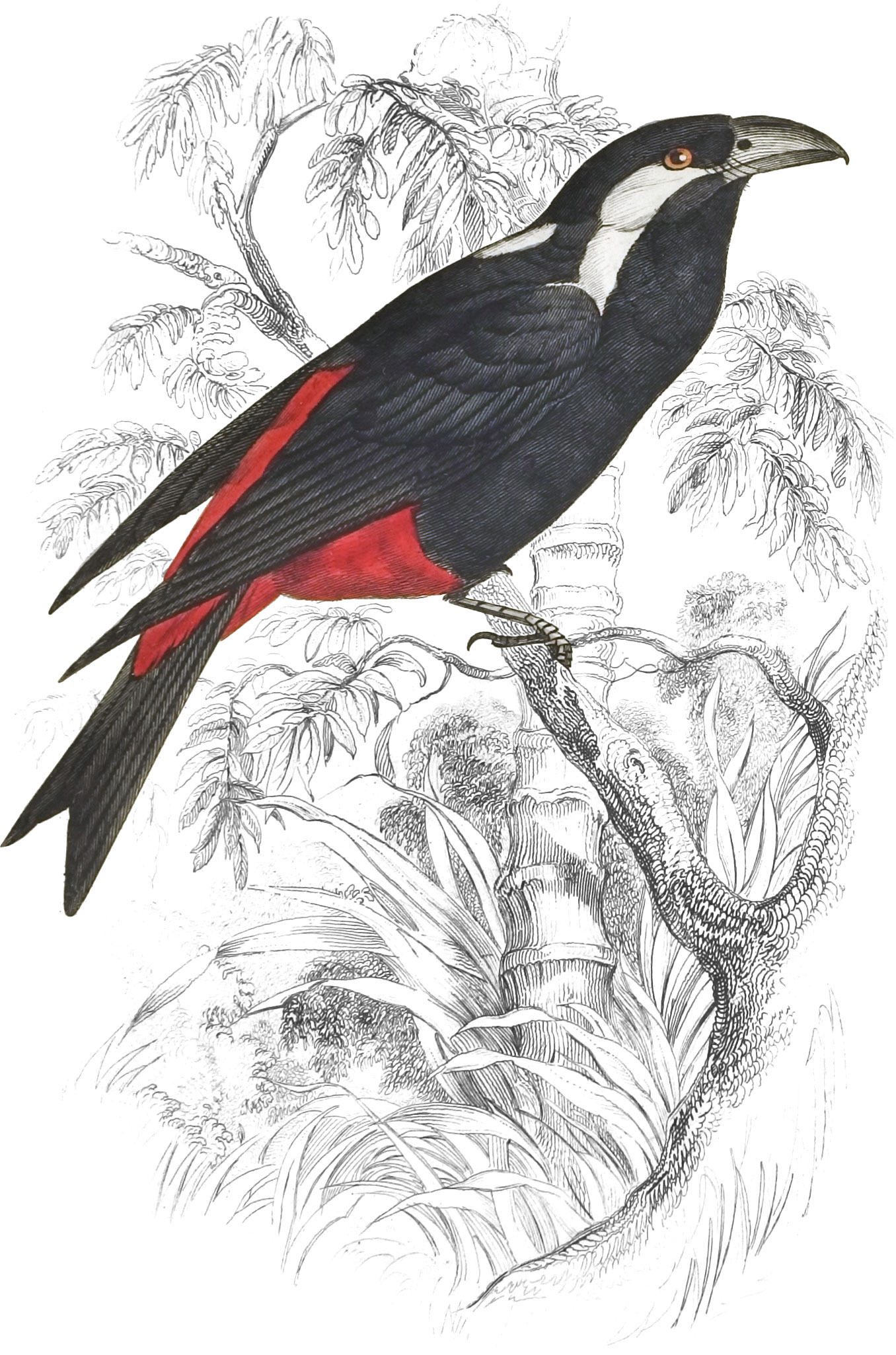
Plate XXXI

We have now described the last type of form, which, to establish the circularity of the Eurylaiminæ, should not only represent one of the primary types of Nature, but also show a disposition to unite with Cymbirhynchus, which was our first type. Now this is a demonstration which can very rarely be made good where the species, as in the present instance, are very few. But here, again, we hope to determine not only the primary types of the Eurylaiminæ, but of proving their circularity. The genus Cymbirhynchus, it will be remembered, differs from all the others we have noticed in one very peculiar character,—the base of the bill being marked by a thickened rim. Now this is precisely one of the characters of the type before us; and these two birds are the only instances in the group of the rictus being strongly bristled. If any other evidence was necessary to show this union, it maybe drawn from the fact of M. Lesson having actually brought Cymbirhynchus and Platystomus into one genus, distinct from the other Eurylaiminæ, which he names Erolla. The circle is thus closed; the series follow each other in the usual order; and we have the following beautiful illustration of the primary types of the ornithological circle.
| Genera | Primary Types of Nature | |
|---|---|---|
| Eurylaimus | Bill excessively dilated | Typical |
| Cymbirhynchus | Bill more conical | Sub-typical |
| Platystomus | Wings long, tail forked | Fissirostral |
| Psarisomus | Mouth or bill very small | Tenuirostral |
| Serilophus | Head crested, quills pointed | Rasorial |
If we consider the Eurylaiminæ as constituting the sub-typical division of the family of Muscicapidæ, it will of course follow that Eurylaimus, as exhibiting the most depressed and the strongest hooked bill, is the type of its own circle. This is further proved by Platystomus, which is the fissirostral type, evincing such an immediate connexion to Cymbirhynchus, which must consequently be the sub-typical form, these two types always following each other. We find, in confirmation of this law, that the Dentirostres follow the Fissirostres in the tribes of the Insessores, and the Raptores follow the Natatores in the orders of the whole class. Eurylaimus being therefore the type, represents the insessores, and Cymbirhynchus is the sub-typical; the other genera speak for themselves. For although we know little of Psarisoma, and therefore cannot establish its direct analogies to the Tenuirostres, it has confessedly the smallest mouth and bill of the whole group.
If, again, we compare the above five genera with the primary divisions of the family, another harmonious series of relations come to light.
| Sub-families of Muscicapidæ | Analogical Characters | Genera of Eurylaiminæ | |
|---|---|---|---|
| Typical | Muscicapinæ | Bill excessively broad and flat | Eurylaimus |
| Sub-typical | Eurylaiminæ | Bill more convex | Cymbirhynchus |
| Aberrant | Querulinæ | Wings lengthened, feet small | Playtstomus |
| Psarianæ | Sides of the bill slightly compressed | Psarisomus | |
| Fluvicolinæ | Wings with abruptly pointed quills | Serlophus |
In order to understand why the genus Cymbirhynchus stands opposite the Eurylaiminæ, we must remember that it is Eurylaimus which is the preeminent type of its own particular circle; and that, consequently, Cymbirhynchus becomes the sub-typical genus. Platystomus and Querula agree, not only in the general cast of their plumage, but actually in the structure of their lengthened wings, the proportion of their quill-feathers, and in their unusually small feet. It is, in short, by the approximation of these two forms, that the circle of the entire family becomes manifest. Psarisomus is an evident representation of the Psarianæ, and seems to have put on the very plumage of Pachyrhynchus Cuvierii; while Serilophus, in like manner, appears to have borrowed the pointed quills and broad secondaries of the Fluvicolinæ. Thus the great dissimilarity between the types of the Eurylaiminæ, which, under a confined view, appears altogether anomalous, may be accounted for on the most simple principles; namely, that besides being bound together by some prominent and general characters, they are also intended to teach us what are their immediate allies, and the nature of the five great divisions of the whole family.
Lastly, by comparing the two typical divisions of the whole family with each other, we shall not only have a clearer exposition of each, but we shall see at a glance the relations which each circle, in its genera, bears to the other.
Sub-family Muscicapinæ
- Todus
- Megalophus
- Muscicapa
- Monacha
- Rhipidura
Sub-family Eurylaiminæ
- Eurylaimus
- Serilophus
- Cymbirhynchus
- Psarisomus
- Playstomus
Todus and Eurylaimus agree in having the rictus but slightly, or not at all, bristled; while in Muscicapa and Cymbirhynchus these bristles are very long. Megalophus and Serilophus are the rasorial types of their respective circles, and both are remarkable for their beautiful crests. Monacha and Psarisomus represent each other through the medium of the Psariana; while the tail is conspicuously developed, although in different ways, both in Rhipidura and Platystomus. In this manner we might test these two circles through the whole class of ornithology, and gain the same results; for as every natural group is but a representation, under different modifications, of the five primary types of Nature, it follows, that if they agree with one, they will agree with all. In regard to the aberrant sub-families, represented by the genus Querula, Psaris, and Fluvicola, the circles, though imperfect, are proved to be natural, for they have their representations in the two we have been comparing; and, therefore, if they belong to this family at all,—and this cannot admit of a doubt,—they will follow each other in the order we have placed them: and this point, also, has been established by the preceding analysis. Before the discovery of Platystomus, the affinity of Querula to the Eurylaimina might have been doubtful; but it seems to be no longer so. And, setting aside all other considerations, these two birds alone agree in the curved form of the commissure; while the Pachyrhynchus pectoralis connects Querula, on the other side, to the great series of the Muscicapidæ, through Psarianæ and Fluvicolinæ. Future discoveries will no doubt fill up the smaller links, and probably alter some of the location of the types; but, until that period arrives, we know not any fact or argument sufficiently strong to induce us to suspect the general principles of the arrangement of the family to which this volume of the Naturalist’s Library has been devoted.
Appendix
Synopsis of Species, apparently new, alluded and referred to in this Volume.
Muscicapa ruficauda
Grey-brown above; cinereous-white beneath; eyes encircled with a white ring; tail rounded, fulvous-brown.
Inhabits India. Total length, 6 inches; bill, gape, \(\frac{7}{10}\); front, \(\frac{1}{2}\); wings, 2\(\frac{3}{4}\); tail beyond, 1\(\frac{1}{2}\); base, 2\(\frac{1}{2}\); tarsus hardly\(\frac{6}{10}\). The colouring of this specimen is obscure and somewhat peculiar, so as to excite the suspicion of its being a young bird, or female; but its general structure does not agree with any other we have hitherto seen. The head is cinereous grey, brighter on the sides, and graduating from the neck into a fulvous-brown, which deepens, again, into ferrugineous on the tail; the wings are like the back; the fore parts of the throat and breast are pale cinereous, which becomes white on the middle of the belly; under tail-covers pale fulvous; the tail is slightly rounded; the tarsi are very short, but the toes large and strong. The form of the bill, its stoutness, and compressed sides, accords with that of the Mus. rubecola; and both offer a miniature resemblance to the genus Tephrodornis among the Laniadæ; the bill, in fact, is shrike-like; the first joint of the outer toe is free, and the inner one is slightly shorter.
Muscicapa thalassina
Entirely greenish-blue; beneath paler; lores grey; fourth quill the longest; tail even; wings three inches long.
Inhabits India. Total length, 6 inches; bill, gape, \(\frac{6}{10}\); front, \(\frac{3}{10}\); wings, 3; tail beyond, 1\(\frac{1}{2}\); base, 2\(\frac{1}{2}\); tarsus, \(\frac{6}{10}\). General size and structure of the last, except in the bill, which, although small, has the short and dilated form, typical of Myïagra, to which it obviously leads, although it retains the short and stout feet of M. ruficauda. This species closely resembles the Mus. melanops of Nepaul in its size, and much in its colour; but it has not the same changeable tints: the lores are not velvet-black, and the wings only measure 3, instead of 3\(\frac{3}{10}\). This difference of colour, slight as it may appear, is very observable when the two species are compared; the fourth quill is the longest.
Muscicapa latirostris
Grey above; white beneath; head not striped; bill short and broad; wings two inches and three-quarters long; the third and fourth quills equal and longest.
Inhabits India. Mus. Nost. Total length, 5 inches; bill, gape, \(\frac{13}{20}\); front, \(\frac{4}{10}\); wings, 2\(\frac{3}{4}\); tail beyond, \(\frac{3}{4}\); base, 2; tarsus, \(\frac{1}{2}\). Colour almost exactly the same as M. grisola, but smaller, and without any distinct stripes on the crown or under plumage, nor are the inner wing-covers tinged with fulvous; the bill is much shorter and considerably broader, and the second quill-feather is only as long as the sixth.
Muscicapa leucura
Above fulvous-brown, immaculate; beneath whitish; tail rounded, black; the lateral feathers white at their basal half.
Inhabits India. Total length, 4\(\frac{3}{4}\) inches; bill, gape, 1\(\frac{1}{2}\); front, \(\frac{4}{10}\); wings, 2\(\frac{6}{10}\); tail beyond, \(\frac{3}{4}\); base, 2; tarsus, \(\frac{13}{20}\). Smaller than latirostris, but of the same general structure, except in the bill, which is shaped like that of M. grisola, although its size is much smaller. The drab-brown of the back is very uniform, and equally spreads over the wings, the third, fourth, and fifth feathers of which re longest and nearly equal; lores whitish; under parts white, tinged with brown on the sides and breast, and with fulvous on the flanks; the under tail-covers and basal half of the lateral tail-feathers, are pure white; the outer half of the rest, and the whole of the middle feathers, are deep black; the middle and the outermost pair are rather shorter than the others. Bill and feet blackish.
Muscicapa picata
Above grey; beneath white; wings and tail deep black; the former with a white band at the base of the quills and on the margin of the tertials; second quill not much longer than the sixth.
Inhabits Western Africa. Total length, 5\(\frac{1}{4}\) inches; bill, front, \(\frac{7}{20}\); wings, 3; tail, beyond, 1; base, 2\(\frac{1}{2}\); tarsus, \(\frac{13}{20}\). General structure, except in the wings, of M. albicollis, but the size is larger, and the bill rather narrower. The front has a very slender black line, and a whiter shade above it. The wings and covers are deep black, excepting those feathers nearest the body, which are grey; the white band which passes along the tertials extends to the edges of some of the greater wing-covers, while that which is at the base of the quills does not traverse the three outermost; the upper covers and the tail are deep black, the latter being very slightly forked; the under parts are white, tinged with grey on the breast.
Myïagra latirostris
Above, entirely dark glossy cinereous; ears and sides of the head the same; chin and throat rufous-orange; the rest of the under plumage white; bill short and very broad; tail rounded.
Todus rubicula? Lath. Supp. ii. 147.—Moucherette à gorge rousse, Paris Mus.
Bill and legs brown; outer and middle toe connected as far as the first joint; inner toe much the shortest; two outer tail-feathers very slightly tipt with white; plumage glossy slate colour; the throat, from the chin to the upper part of the breast, is coloured like that of the robin, beyond which the under plumage is pure white.
Total length, about 6\(\frac{1}{4}\); bill, gape, \(\frac{7}{10}\); front, \(\frac{7}{20}\); wings, 2\(\frac{6}{10}\); tail beyond, 2\(\frac{2}{10}\); base, 2\(\frac{7}{10}\).
Myïagra flavipes
First very short, bright yellow; plumage above, and on the throat and breast, deep black, glossed with greenish; body beneath white; head with a lengthened pointed crest.
Inhabits Senegal? Mus. Paris. Total length, 6 inches; bill, gape, 1; front, \(\frac{7}{10}\); wings, 3\(\frac{6}{10}\); tail beyond, \(\frac{3}{10}\); tarsus, \(\frac{4}{10}\). The general structure of this curious bird, as already intimated, is very peculiar; but, upon the whole, I am disposed to consider it the crested species of the sub-genus Myïagra, with, which, it agrees in its even tail: its bill, however, is that of Muscipeta, its long wings those of Muscicapa, while its excessively short feet are without parallel in this family. The upper plumage is of the darkest black, glossed with sea-green, and this colour extends in front of the throat so far as to cover the breast; the rest of the under plumage is white, varied with black on the flanks; the bill is unusually long and very flat; the tip abruptly hooked; the crown has a lengthened procumbent crest which ends in a point, and the tail is so short as hardly to exceed the wings. At the base of the primaries is a conspicuous white spot; bill and thighs black; feet bright yellow, stout; the claws strong, compressed, and deep black; anterior scales of the tarsi divided into irregular hexagons.
- This bird, only known in England of late years, is accurately described by Azara, under the name of Yiperu. See Sonn. ed. 3. 196.
- No names in our vernacular nomenclature can be more valuable or expressive than those which express both the analogy and affinity of the object. It is evident that Gubernetes has analogy to the Hirundinidæ or Swallows, while it nevertheless truly belongs to the Psariana or Black-caps.
- Analyse d’une Nouv. Orn. p. 39 and 68.
- Fluvicola bicolor, Sw.; Muscicapa bicolor, Gm., Latham, &c. Pl. Enl. 675. f. 1.
- Zool. Illustrations.
- This distinction will much assist the ornithologist in descriminating the flycatching warblers, as Saxicola, Culicivora, Setophaga, and a few other groups, in all which the tarsi are lengthened; and the toes, although rather small, are always deeply cleft.
- Northern Zoology.
- The sub-genus Ptiliogenys is more a Ceblepyris than a tyrant Fly-catcher (Tyranninæ).
- The sub-genus Platystera, (J. and S.) peculiar to Western Africa, being the nearest point of that continent to America.
- Class. of Birds, vol. ii. p. 89.
- Lath. Synopsis, iii. pl. 49.
- Lewin’s Birds of New Holland, pl. 13.
- Linn. Tr. xv.
243247. - Mus. Stellaris of subsequent writers.
- See Ois. d’Af. iv. pl. 152.
- Class. of Birds, vol. ii.
- Horsf. & Vigors. Linn. Tr. xv. 248.
- Linn. Trans. xv. 250.
- Platyrhynchus, as will presently appear, is the sub-typical form.
- Vieillot, Ois. d’Amerique.
- The Conopophagus leucatis of Vieill. Gall. Pl. 127.
- Classif. of Quadrupeds, p. 281.
- Spix. Av. Nov. ii. pl. 9. f. 2.
- Ornith. Drawings, pl.
- The only specimen of this species I have yet seen is in the Paris Museum.
- Since writing the above, we have procured a species of Todus very much resembling the T. plumbeus of Cayenne, but with the throat and breast marked with short black stripes like those on the larks, which family represents the Grallatores. But its chief peculiarity, and in which it differs from all other species, is in having the outer and inner toes almost free, and of nearly equal length. It is more than probable, therefore, that this bird may really be the type we are now seeking.
- Geography and Classification of Anim, p. 268.
- See Zool. Ill. pl. 66.
- Ois. d’Afrique, iv. pl. 154. The colouring of these figures, no less than that of many others in this otherwise valuable work, is very unnatural. Instead of the ground colour being light blue, it is of the darkest grey above, and cinereous beneath, the chin and middle of the breast being tinged with rote colour, as seen in our figure.
- Some species of Tyrannula have the syndactyle feet of Muscicapa, some the even tail, and others come very near in their wings, but nothing more. Ptiliogonys and the Culicivors have the graduated wings, but none of the other characters.
- The exceptions occur in the two aberrant sub-genera Cryptolopha and Muscicapa.
-
Cette huppe lui forme un bell crête qu’il relève en même tems qu’el épanouit sa queue etagée, en lui faisant faire rane comme la coq d’Inde, ou le grand tétras qui a la même faculte.
Le Vaill.
- Three species are described as having the bill moderately short, and in which it differs from the bill of Muscipeta; but in two of these, now before me, I can see no difference; while the third species, M. macraptera, judging from the description, I do not think belongs to the group.
- Myïagra flavipes, Nob.
- See Observations on the two families, under the head of Petroica multicolor, Zool. Ill.
- One of these is composed of robins, Erythaca, which Muscicapa, as now restricted, represents.
- Horsf. and Vigors. Linn. Trans. xv.
- The tarsi of these three birds measure as follows:—Myïagra flavipes four-tenths of an inch, Mitscicapa grisola six-tenths, Myïagra macroptera (H. and V.), thirteen-twentieths.
- Classification of Birds, ii.
- Classification of Animals, p. 247.
- The new names which M. Temminck, and some other Continental writers, have attempted to affix to the species originally Described by Sir Stamford Raffles, we cannot, in justice, adopt.
- Eurytaimus lunatus. Gould, Zool. Trans, i.
75176, pl. 25. - Zool. Trans. i. 177.
- Class. of Birds, vol. ii. 261.
- Since the above was written, and the Classification of Birds was published, a beautiful figure of this remarkable type has appeared in the Icones Avium of Mr. Gould, while the additional characters he mentions fully confirms the views we had taken of its relations. The bill, as Mr. Gould observes, is not only narrower than in the other types, but is even a little compressed; thus representing that form we should expect in the tenuirostral type, which is to represent Pachyrhynchus, Hyliota, Monacha, &c. It seems impossible to look at this bird without being immediately reminded of Pachyceph. Cuvieri, and even of the Ptilonopus melanocephalus, Sw. (Pl. Enl. 214.) which is also a tenuirostral type. The Classification of Birds was published in May 1837, the Icones Avium, as stated on the covers, in the following August. We are at a loss, therefore, to discover why the new name of Crossodera was proposed, unless we suppose that Mr. Gould was ignorant of our prior denomination.
- Class. of Birds, ii. p. 261.