Volume XIX
Birds of Western Africa
Part II
Content warning: Portions of descriptions and imagery on this page contain inaccurate views, derogatory language, and offensive imagery. They are included here as they were originally created in order to compile a complete reproduction. They do not reflect the attitudes of this site’s creator.
We now again present our Readers with another of Mr. Swainson’s interesting Volumes on the
Birds of Western Africa
It forms the eighth volume which we have brought out upon Ornithology; and the subjects of these have been Humming Birds in two volumes; Peacocks, Pheasants, Turkeys, &c. in one volume, Birds of the Game kind in another, Pigeons in a fifth, Parrots sixth, and Birds of Western Africa seventh and eighth. So far as these have gone, we trust. we shall be borne out in asserting, that in no publication has there ever been so much useful and interesting information upon this beautiful department of Zoology brought together—detailed in so agreeable a manner—and at so cheap a rate; and we have every reason to be satisfied that the public appreciate our labours, in the continued steady encouragement which The Naturalist’s Library enjoys.
We have all along professed that we should make the approbation of our readers a stimulus to further exertions, and in the volumes on the Birds of Great Britain which are soon to follow, we trust we shall be found to have redeemed this pledge. The first volume is now far advanced, and will contain the Vultures, Eagles, Hawks, and Owls, or a complete history of the Raptores or Birds of Prey; and altogether, we have never succeeded with any illustrations more happily than those for this volume, while at same time it is one in which the Editor must feel himself as much or more at home than in any of the others. The Memoir is to be that of our countryman the late Sir Robert Sibbald, from the pen of our friend who has contributed those of Sir Joseph Banks and Sir Hans Sloane with so much credit to himself and satisfaction to our numerous readers.
African Golden Oriole
Oriolus auratus, Vieillot.
Golden yellow; stripe beyond the eye and over the ears, black; wing-covers and broad margins of the secondary and tertial quills, yellow; bill red.
Le Loriodor, Le Vaill. Ois. d’ Afrique, vi. pl. 260, p. 49.—Oriolus auratus, Viell. Encyc. Meth. 695.
Le Vaillant, who first described this richly coloured Oriole as a native of Southern Africa, remarks that it is there only known as a bird of passage, arriving at the fruit season and disappearing soon after. It is probably, therefore, one of those migratory species, which, like the grakles already noticed, usually reside in Equinoctial Africa and migrate southerly during autumn. Our author mentions that he had received specimens of the European Oriole from Senegal, but seems not to be aware that this also is a native of the same country: although he expressly says that it does not build in Southern Africa. Like others of its genus, it only inhabits the deepest forests; and from constantly perching upon the tops of the highest trees, is very difficult to shoot.
Size of the Golden Oriole, which it much resembles; but the black stripe on the side of the head, which in that bird is only before the eye, is much broader in this, and passes not only above and below the eye, but also beyond it, over the ear. The whole plumage of the body is of a clear and rich yellow; the shoulder and lesser wing-covers are the same, and most of the greater and of the tertial quills are so broadly edged with yellow, that when the wing is closed they appear only of that colour: there is also a narrow edging of the same on the lesser quills and the tips of the greater; the spurious wings are also pale yellow. The tail is coloured precisely like that of our European Oriole; that is, the feathers may be called black, but banded obliquely with a bar of yellow, which more or less covers their extremities. The bill is red and the feet dark. The rump-feathers are unusually thick. The female, as in others of this genus, is olive above and pale yellowish beneath, but without any stripes.
Total length, 9\(\frac{1}{2}\); bill, from the gape, 1\(\frac{5}{10}\); wings, 5\(\frac{6}{10}\); tail, from the base, 4; tarsus, \(\frac{8}{10}\).

Plate I

Small Billed Oriole
Oriolus brachyrynchus, Swains.
Above, greenish; beneath, yellow; head and throat, black; spurious wings with a white spot; four middle tail-feathers, green; bill short, the culmen arched.
We have already called the attention of our readers to the singular uniformity of colour which sometimes pervades the different species of a natural group of birds, so as to render their determination very difficult. Among the drongo shrikes, the predominant colour is black, while in Oriolus, the genus now under consideration, the plumage of nearly all is black and yellow.
So closely does the species, now to be described for the first time, resemble that figured by Le Vaillant under the name of Le Loriot Coudougnan, that if we had not possessed this latter also, we should most certainly have considered them the same. Le Vaillant’s descriptions are the best of the period in which he wrote, but he seldom gives measurements, and very often overlooks those nice but discriminative characters which are now found to be absolutely essential. The two species, in point of fact, are coloured precisely alike, except in their tail-feathers, while they differ materially in size, and in the form of their bills. To place these distinctions in the clearest light, we shall subjoin a short description of Le Vaillant’s bird, first describing that which inhabits Sierra Leone, and of which we have examined three specimens.
Size much smaller than the common European Oriole, the whole bird measuring only eight inches and three-quarters. The upper plumage is yellow-green, except those parts which adjoin the black of the head and throat, where the plumage is of the same yellow as the under parts. A black hood envelopes the head and fore part of the neck, where it is rounded off on the breast. The ground colour of the wings is black, but the lesser covers are green, while the greater and the secondary quills are margined with grey; the grey margins of the greater quills are narrower, and become white towards their tips; the spurious quills are deep black, broadly tipt with white, so as to form a large conspicuous spot. The tail is much rounded; the four lateral feathers on each side are black at their base and yellow beyond, but the two middle pair of feathers, that is, the four in the centre of the tail, are entirely green, with merely a shade of yellow at the tips of two of them. The bill is red and short; the culmen gradually curved from the base, more so, indeed, than in any oriole yet discovered; the weak bristles which surround it are also longer and more numerous.
Of this species three specimens were sent from Sierra Leone. One appears to be a female, as it wants the yellow on the nape and the upper part. of the neck, which parts are of the same green as the back.
Total length about 8\(\frac{3}{4}\) inches; bill, from the front, \(\frac{7}{10}\); ditto, from the gape, 1; wings, 4\(\frac{1}{2}\); tail, from the base, 3\(\frac{1}{2}\); tarsus, \(\frac{7}{10}\); hind-toe and claw \(\frac{1}{20}\) shorter.
The Cape Black-Capped Oriole
Oriolus Capensis, Swains.
Olive greenish; beneath yellow; head and throat black; spurious wings with a white spot; all the lateral tail-feathers black, tipt with yellow, the middle pair green with black tips.
Le Loriot Coudougnan, Le Vaill. Ois. d’Afr. pl. 261, male, 262, female.—Oriolus melanocephalus, var., Vieill. Encyc. Meth. 696.
Description.—Size of the Golden Oriole; length, 9\(\frac{1}{2}\) inches; bill red, straight, curved only at the tip. The only species of the Cape colony which builds there. Had M. Vieillot seen this species, we are persuaded he never would have supposed it a variety of O. melanocephalus, merely because the head and neck are black. We already know, in fact, of not less than four species having the common character of a black hood over the head and in front of the neck: two of these are now described, the other two are O. Hodsonii of India, and the O. icteronotus, Horsf., of Java.1
Total length, 9\(\frac{1}{2}\); bill, from the front, \(\frac{9}{10}\); from the gape, 1\(\frac{3}{10}\); wings, 5\(\frac{1}{4}\); tail, from the base, 3\(\frac{3}{4}\); tarsus, \(\frac{8}{10}\).
Black-Throated Wagtail
Motacilla gularis, Swains.
Above, cinereous; front, sides of the head, ears and body beneath, white; chin, throat, and breast, black.
A cursory glance at this pretty little bird would lead an ordinary observer to fancy it was no other than our own grey wagtail. An ornithologist, however, would immediately perceive they were very distinct. It seems to be a rare species, for we have never met with more than one specimen out of the hundreds of birds from Senegal that have passed under our inspection.
The size of the Black-throated Wagtail is inferior to that of the European Motacilla alba, its full length not exceeding six inches and a half, whereas its prototype is full an inch longer. The white in front of the head occupies a greater space than in ours, and in both is continued over the eye, and on the sides of the head and ears; here, however, the similarity ceases. In the African bird the whole of the chin and throat, as far as the breast, is deep black, beyond which all the under parts are pure white. The upper plumage is cinereous, with a tinge of grey on the back, which changes to deep black on the rump and upper tail-covers. The wings reach to about half the length of the tail; the middle of the scapulars and tertials are deep black with whitish margins, and some of the secondary covers are edged with the same, but the primaries have not the white borders seen in M. alba. The shoulder-covers are entirely grey, the lesser covers blackish in the middle and grey on the edges, while the side covers of the tail are half black and half white. The tail itself is even and quite black, excepting the two external feathers which resemble those of M. alba in being pure white, with an oblique black margin to the inner web, but none upon the outer.
Total length 6\(\frac{1}{2}\); bill, from the front, \(\frac{4}{10}\); wings 3\(\frac{5}{10}\); tail beyond, 1\(\frac{8}{10}\); ditto from the base, 3\(\frac{1}{2}\); tarsus, \(\frac{8}{10}\); hind toe and claw, \(\frac{1}{2}\); middle ditto, \(\frac{6}{10}\).
White-Eyebrowed Longtail
Drymoica superciliosa, Swains.
Light brown, unspotted; eyebrows and plumage beneath, white; belly, thighs, and flanks, ferruginous; lateral tail-feathers blackish at the end, and tipt with white; lateral toes somewhat unequal.
The greater number of the small African Warblers, are little wren-like birds, something resembling in their general cast of colours our white-throat, and like that clothed in very plain colours: they constitute a very peculiar group, for which we proposed, many years ago, the name of Drymoica; none of the species, of which there are very many, have been found in the new world. The corresponding group in Asia is Prinea; the chief distinction between them being this, that in Drymoica the two lateral toes are equal; whereas, in the Indian group, the inner toe is much shorter than the outer, the latter being connected to the first joint of the middle toe. Both, however, have short rounded wings, and their soft tails are more or less rounded, and sometimes graduated.
As we do not find this species, the only one we have yet received from Senegal, figured in any work, we must consider it as new; it is very interesting to the ornithologist, from being an aberrant species, that is, forming a passage from its own genus to that of Prinea. This is apparent from the inner toe being rather the shortest, while the anterior tarsal scales, always distinct in the other species, are in this scarcely perceptible.
The general plumage above is of a light drab brown, without any spots, but having a white line above the eyebrows. The under plumage is also unspotted and white, the thighs and flanks being strongly tinged with ferruginous. The tail is of the same brown. as the back, but the ends of the lateral feathers are blackish, with their tips dull white. The bill is deep black, the legs pale, and the outside of the wings tinged with ferruginous; the fourth and fifth quills are longest, and the rictus is slightly bristled.
Total length, 4\(\frac{1}{4}\) inches; bill, \(\frac{4}{10}\); from the front wings, 1\(\frac{8}{10}\); tail, 2\(\frac{3}{10}\); tarsus, \(\frac{8}{10}\).
Plate II
White-Winged Tit
Parus leucopterus, Swains.
Glossy black; wing-covers and margin of the quills, pure white.
La Mésange noire, Le Vaill. Ois. d’ Afrique, iii. 137, 1, 2.—P. niger, Vieill. Encyc. Meth., 508.
Although very abundant in the Caffre country of Southern Africa, Le Vaillant remarks that this pretty little bird was never met with by him, either on the west coast or near the Cape of Good Hope. This is very singular, since two specimens, received from Senegal, perfectly agree both with Vaillant’s figure and description. He observes that its note is perfectly the same as that of our Parus: major, and that it builds in the trunks of trees, where it also roosts; the eggs, which are from six to eight, are entirely white.
It is singular that no notice is taken of this species in our modern compilations, although its peculiarity of plumage renders it not likely to be confounded with any other.
The size is exactly that of Parus major, and the structure is nearly the same, except that the bill is rather shorter, and the culmen more arched; the feet, also, are somewhat smaller, and their claws shorter, broader, and more curved.
The colour of the plumage is simple and striking; the whole bird, excepting the wings, is of a deep and uniform black, reflecting in certain lights a slight bluish gloss; the wings are also black, but this colour is relieved by the lesser and greater covers, as well as the margins of all the quills being of a pure snowy white, so that when the wing is closed, very little of the black upon them is seen. From this circumstance we have named the species, there being already a Parus ater, which renders that of niger, applied to this species, doubly inappropriate.
Total length nearly 6 inches; bill, from the gape, \(\frac{1}{2}\); wings, 3; tail beyond, 1\(\frac{3}{4}\); from the base, 2\(\frac{1}{2}\); tarsus, \(\frac{7}{10}\); hind toe and claw, \(\frac{6}{10}\).
Yellow White-Eye
Zosterops flava, Swains.
Bright yellow, tinged above with greenish; eyelids white; between the bill and eye a blackish line.
We give the vernacular name of White-Eye to a singular group of little birds distinguished, among other characters, by having the eyelids surrounded by a narrow ring of snow-white feathers. They are all of a small size, nearly intermediate in their affinities between warblers and titmice. Only one species, we believe, is found in the New World; the others, about twelve in number, being restricted to the warm latitudes of Asia, Africa, and Australia. One of them, the Zosterops curvirostris, Swains. (the Diceum chloronotus of the Paris Museum), has the bill nearly as much curved as some of the honey-suckers. The general plumage of all those hitherto discovered is green above and yellowish beneath; so that the species, otherwise well marked, possess a strong mutual resemblance in the general cast of their colours. One of these, hitherto undescribed, inhabits Senegal, and is the D. flava of our plate. It is of the size of Z. dorsalis, an Australian species, but the bill, which is black, is larger. The upper plumage is of a bright greenish yellow, the under pure and bright yellow, uniform in all its parts. The quills and tail are blackish, edged with yellow; the snow-white ring round the eye is very conspicuous, and it is connected to the base of the bill by a deep black line; the tail, although divaricated, is even, and the bill and feet blackish.
Total length, 4\(\frac{1}{4}\) inches; bill from the front, \(\frac{4}{10}\); ditto, from the gape, \(\frac{1}{2}\); tail beyond the wings, 1.

Plate III

The Stone-Chat
Saxicola rubicola, Bechstein.
Head and half way down the throat, black; lower throat and breast, rufous; sides of the neck, stripe on the wings and tail-covers, white; belly and flanks, pale rufous.
Saxicola rubicola, Bechst, Natur. Deut. iii. 694; Selby, i. 203 185.—Motacilla rubicola, Linn., Auct.—La Traquet Patre, Le Vail. Ois. d’Af. iv. pl. 180; Temm. Manuel. i. 246.—The Stone-chat of British authors.
The geographic range of this pretty species, so familiarly known that a detailed description is unnecessary, is perhaps more extensive than that of any insectivorous or dentirostral bird yet discovered. It is abundant at the Cape of Good Hope, where it remains the whole year; specimens of both sexes have been sent from Senegal, which, upon being compared with those of Britain and of Southern Africa, show not the slightest specific difference. The African males, indeed, have the rufous upon the breast darker and brighter than is seen in ours, but this is obviously the effect only of climate. The most northern limits of the species have not been accurately ascertained, since M. Temminck omits to state from what part of Russia it has been sent by Pallas.
White-Fronted Stone-Chat
Saxicola frontalis, Swains.
Entirely uniform black; front of the head snowy.
The Saxicolæ, or Stone-chats, as instanced in the last species, enjoy one of the widest geographic ranges assigned to the insectivorous birds; and as they love open plains and sandy tracts, we consequently find they are peculiarly abundant in the African continent. The present species is one of the rarer inhabitants of Western Africa, since a specimen we have long possessed, and another in the Fort Pitt museum at Chatham, are the only examples we have yet seen. Dr. Rüppell, however, has informed us that he found it in Abyssinia.
Its colouring is simple and striking; the plumage is of a deep and uniform black inclining a little to grey, but directly in front of the head is a large. patch of snowy white; this must give to the bird, when running, a very singular appearance, and render it a conspicuous object at some distance: whether this white spot is a sexual distinction, given only to the male, or whether it is common also to the female, is yet to be discovered.
The size is equal to our common stone-chat, but there are several interesting variations in its structure, which renders it an abberrant species of Saxicola, uniting that genus to the group we have called Thamnobia. In the first place, the bill is more lengthened, the upper culmen more arched, and the sides more compressed; the wings are more rounded, the third, fourth, and fifth being all of the same length, and only four-tenths of an inch shorter than the secondary quills, while the middle toe is very considerably shorter, in proportion, than that of S. rubicola; the tail is perfectly even, and the feathers much widened at their tips, which are truncate.
Total length, 5\(\frac{1}{2}\) inches; bill, from the gape, \(\frac{7}{10}\); from the front, \(\frac{5}{10}\); wings, 3; tail beyond, 1; from the base 2\(\frac{1}{10}\); tarsus, \(\frac{8}{10}\); middle toe and claw, \(\frac{6}{10}\).
Buff-Bodied Flycatcher
Hyliota flavigaster, Swains.
Above, in the male, glossy blue-black,—in the female, cinereous; beneath, in both, ochraceous yellow; wing-covers and rump pure white.
We have long possessed specimens of this curious little Flycatcher reputed from India, but its precise locality was not known until specimens of both sexes arrived from Senegal. It was this species, in fact, which induced us, some years ago, to characterize the sub-genus Hyliota, the characters and affinities of which will be found fully detailed elsewhere.2 For the present, we may remark that it has a general resemblance both to the African todies (Platystera) and to the Old World flycatchers (Muscipeta), and yet its bill is so much lengthened and compressed on the sides, that it might at first be mistaken for a Sylvia. It cannot, in short, be arranged under any one group yet characterized; we are-yet acquainted with only one example, for we feel persuaded that the two birds we shall now describe are the sexes of one species.
The male has all the upper plumage (excepting the wing-covers and rump, which are pure white) of a deep and glossy blue-black, which parts, in the female, are of a deep grey; the quills are paler, and inclined to brownish, but their external edges are glossy. This black colour envelopes the eyes and the whole of the ears; it also spreads over the shoulder-covers. The feathers of the rump are long, soft, and pure white, but the tail-covers are small and glossy black. The under plumage is entirely of a pale but clear buff yellow, darkest on the breast and lightest on the vent. The female has the quills and some of the outermost tail-feathers narrowly margined with white. In regard to structure, the wings, in proportion to the size of the bird, are very long, while the tail, which is perfectly even, 1s proportionately short; the bill is depressed at the base, but compressed beyond the nostrils, while the bristles of the gape are so small and weak as to become obsolete. The tarsus is much longer than the hind toe and claw, the latter of which is broad and much curved; the inner toe is much shorter than the outer.
Total length, 5 inches; bill, from the base, \(\frac{7}{10}\); from the front, not quite \(\frac{5}{10}\); wings, 2 \(\frac{7}{10}\); tail beyond, \(\frac{6}{10}\); ditto from the base, 1\(\frac{3}{4}\); tarsus, \(\frac{7}{10}\).
Spectacle Flycatcher
Platystera lobata, Swains.
Male.—Above glossy blue-black, with an angulated stripe of white on the wings; beneath white, with a black bar upon the breast; lobe of the eye red.
P. collaris, Jardine and Selby, Illust. of Orn. pl. 9, fig. 1.—Mus. melanoptera, Gm. fide Mus. Paris.
Female.—Above cinereous; chin white; throat chestnut.
P. Desmarestii, Jardine and Selby, Illust. of Orn. pl. 9, fig. 2,
Naked wattles, and other fleshy appendages on the head, are well known to be common among the gallinaceous birds and also the exotic plovers, but they are rarely seen in the perching order, and are then almost solely confined to fleshy lobes around the eye. We have had an example of this curious structure in the Prionops plumatus figured in our first volume, and it is also observed in the genera Ceblepyris and Perspicilla. What particular object, however, is effected by this singular appendage, is entirely unknown.
Although we have no personal knowledge of the fact that the two birds, mentioned in the above synonyms, belong to one and the same species, yet there are many and strong grounds for the belief. Their size and proportions are the same; the simple length of a dried skin, when measured from the tip of the bill to the end of the tail, depends in a great measure in the contraction or distention of the neck in the process of preserving; they both inhabit the same districts, and are always sent to England from Senegal in pairs as male and female. But the chief reason for our forming this belief, is the fact, that in all the other species of Platysteira with which we are acquainted, the sexes differ in the same way; that is, the male has the throat white, and the female red. Le Vaillant has shown this in two species,3 and we have a third similarly coloured; so that this variation in the colour of the sexes, becomes, in fact, one of the generic characters. Nearly all these species, moreover, have a sort of collar in front of their neck.
The presumed male has the upper plumage of a deep black glossed with bluish; the wings are the same, but are crossed by a broad white band on the outer half of the lesser covers, which band is continued in a longitudinal direction on the margins of two of the tertials; the other quills, which are brownish black, have a very narrow edging of grey white; the tail is glossy black, but the outer web of the exterior pair, and the extreme tips of the two next pair are pure white. All the under parts in the male are pure white, the breast being crossed by a deep black collar; the naked caruncle is lobe-shaped, and placed just above the fore part of the eye, without surrounding it; its colour seems to be pure yellow.
In the supposed female, the upper plumage, instead of being glossy black, is dark grey, but the wings and tail are coloured and marked precisely like those last described. The lobe above the eye seems to be orange-red, or perhaps, in the living bird, scarlet. In the under plumage there is much difference, the chin is pure white, which is continued in a stripe which joins the lower eyelid; beyond this, and as far as the upper part of the breast, the colour is of a very deep chestnut, which terminates abruptly and with a narrow edging of deep black scarcely perceptible. In both sexes the feathers on the lower part of the back are remarkably long, soft, and puffy, as in some of the African Bush-shrikes (Malaconctus), and those on the rump are tipt with white; these peculiarities do not appear to have been noticed. Having already entered into many details on the affinities and analogies of the African todies,4 they need not here be repeated.
Total length about 4\(\frac{1}{2}\) inches; bill, from the gape, \(\frac{13}{20}\); from the front, \(\frac{4}{10}\); wings, 2\(\frac{1}{2}\); tail, from the base, 2.
Common Gray Flycatcher
Muscicapa grisola? Linnæus.
Above, grey; beneath, whitish; breast and sides of the neck with dusky stripes; bill, narrow, and compressed towards the end; tail, slightly forked.
Muscicapa grisola, Linnæus, Auct.
We have now before us two birds, one from Southern, the other from Western Africa, which in size, colour, and general formation, perfectly agree with a British specimen of Muscicapa grisola, except in one very remarkable circumstance. In the African specimens, the second and third quills are of equal length, and they are hardly exceeded by the third, which is the longest. In the British specimen, on the contrary, the second and fifth quill are equal, and the fourth quill is two-tenths of an inch longer than these, and exceeds the length even of the third quill. Is this a permanent distinction, or is it the effect only of a different age, or of moulting? The answer to these questions can only be given after an examination of more specimens than we at present possess. One would have thought that nothing in the structure of a bird, like the Muscicapa grisola, would have been left unnoticed by its innumerable describers, but we have searched in vain for any particulars as to the form of its wing. It is really surprising that our ornithologists cannot be persuaded to be more full and accurate in their descriptions, even when they daily see the actual importance it is to their own researches.
Rufous-Bellied Flycatcher
Muscipeta rufiventer, Swains.
Rufous; crest, head, and chin, glossy steel-blue; outer half of the wings, black; tail, long, cuneated.
The most beautiful birds, in the very numerous family of Flycatchers, are those first distinguished by Le Vaillant, and which M. Cuvier subsequently named Muscipeta. All the South African species have been beautifully figured and accurately described in the costly work of Le Vaillant; but the present species, which seems confined to the western coast, is not among the number. The group seems to. be altogether peculiar to the tropical latitudes of Africa and India: the males are distinguished by having the two middle feathers of their tail excessively long, and their heads are usually adorned with a short crest of scale-like feathers. It is to be regretted that the generic name of Muscicapa was not retained to these birds, seeing that they are the types of the whole sub-family, and that another was not given to the European flycatchers, which form an aberrant genus. Such errors are the inevitable result of neglecting to analyze a group before it is broken up into new divisions. We shall not, however, propose any further change, but continue to call these typical flycatchers by the name of Muscipeta.
The species now under consideration differs from all those figured by Le Vaillant in having the black on the under plumage confined to the chin alone, while all the rest of the body, both above and below, is of a uniform rufous; the black on the head covers the crest, ears, and chin, and the rufous extends to the wing-covers and the margins of the lesser quills. The four outer or greater quills are entirely black, which colour extends to the spurious quills and the outermost wing-covers; these latter, however, have a faint whitish margin which unites to a white line that borders only one of the lesser quills, as if it divided the two sets.
In 1829 there was a specimen of this species in the Paris museum, upon which we detected that a false tail had been engrafted; this presumed tail was black and even, and so dissimilar in its general structure to those possessed by this group, that we had strong doubts, even at that time, that it was genuine.
Total length, with the tail, 8\(\frac{3}{4}\) inches; bill, from the front, \(\frac{9}{10}\); ditto, from the gape, \(\frac{3}{4}\); wings, 3\(\frac{2}{10}\); tail beyond, 4\(\frac{1}{2}\); ditto, from the base, 6; tarsus, \(\frac{1}{2}\); middle tail-feather 2\(\frac{1}{4}\) longer than the others.
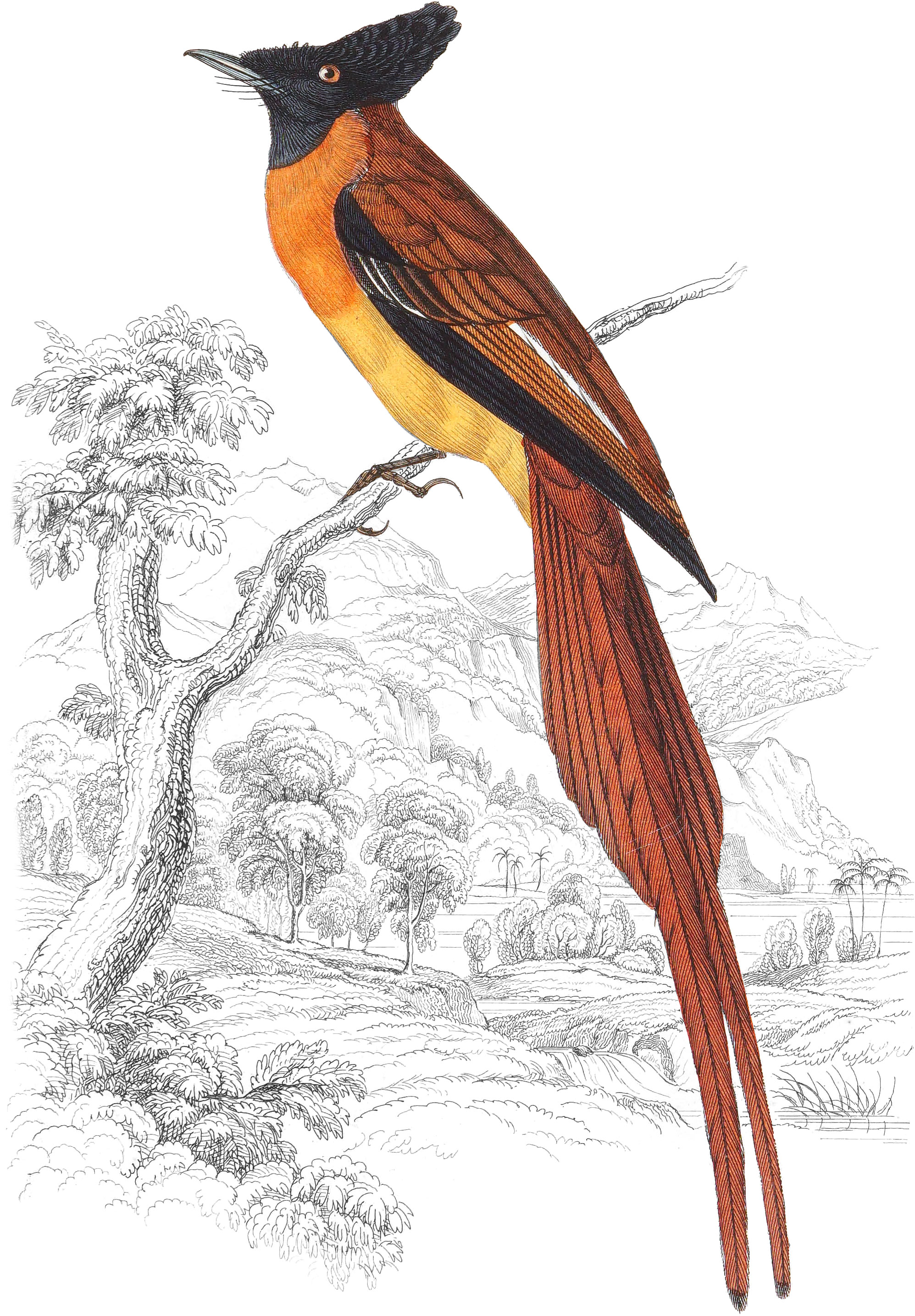
Plate IV
Black-Bellied Flycatcher
Muscipeta melanogasta, Swains.
Crest, head, neck, and breast, black, glossed with chalybeate-blue; body beneath, in the young bird, grey-black; back, tail, and under covers, rufous; wings, black and rufous, the colours divided by a white stripe.
In size and general proportions, this very elegant species resembles the last we have described. It seems, however, to be less uncommon, and it is readily distinguished by the under parts of the body being of a glossy black. On a cursory view we supposed it to be the species described by Le Vaillant under the name of Le Gobe mouche Tchitrec; but upon referring to his figures, and still more by comparing their accompanying descriptions, the ornithologist will immediately perceive that they are essentially different, notwithstanding their general similarity in the rufous colour of the back and the glossy black of the head and throat. The colouring, in fact, of nearly the whole of this sub-genus is so much the same, that it is not surprising Linnæus should have looked upon those then known to him as mere varieties of each other. The same excuse, however, cannot be urged for his followers, more especially after the clear and circumstantial details made known by Le Vaillant of the different habits and peculiarities of those he discovered in Southern Africa. And yet so little have modern ornithologists availed themselves of these invaluable memoirs, that up to this day we find them all thrown together under the common name of Muscipeta paradisea, which is pronounced to be a “most variable species;” so that nearly all the types of a genus are thus included under one specific name. As some advancement to a better knowledge of these species, we have subjoined, at the end of this article, the specific descriptions of all those which have been found by Le Vaillant in Southern Africa, and which still remain, as we believe, unrecorded. by scientific names or characters, leaving undetermined two or three others which have been but obscurely mentioned in other works.
We have no information on the natural history of the particular species now under consideration; but as its structure is precisely similar to that of the Tchitrec (to which we propose, as a specific name, the very appropriate one of perspicillata), we may conclude that what Le Vaillant says of the habits of that species will be generally applicable to this and to the rest.
The sexes of the Tchitrec,5 says this original observer, are rarely seen separated during the season of incubation; they inhabit the forests, and are always seen on high trees, seldom if ever descending to the shrubs and low bushes. The males are very pugnacious, and sometimes five or six may be seen flying after each other in the season of pairing. The long tail-feathers, with which the males are then adorned, offers great facility to the combatants for spoiling the beauty of their adversaries. It would seem, from what Le Vaillant says, that they endeavour to seize each other by these long plumes, and if they are so fortunate as to succeed, they never loose their hold until the feather is broken off or a portion of it remains in their bills. Hence it becomes exceedingly difficult for the sportsman to procure a male, at this season, with both of the two long feathers completely perfect. This injury to the tail is further occasioned by its being torn or mutilated by the rapid flight of these birds through the boughs and spiry branches, not only on the occasions just alluded to, but, according to our author, from the bird flying across such trees when hunting for flies, which it pursues incessantly.6 (Quand l’oiseau vole à travers les arbres pour se sarsir des mouches qu’il poursuit sans cesse.) Our author mentions, that out of one hundred and four male birds which he shot, the tails of only fourteen were perfect.
Returning to the species before us, we may add to the specific distinction already given, the following general description of the plumage. The head, like the generality of the other species, is ornamented with an incumbent crest, the feathers. of which gradually lengthen as they approach the nape, where it terminates in a semicircular form: the whole of the head, neck, throat, and breast, are deep black, strongly glossed with steel-blue. This gloss, in the young bird, gradually disappears beyond the breast, where the colour becomes of a deep grey; but in the full plumaged male, all the under parts are like the breast. The under tail-covers are rufous, as deep in colour as the tail itself; this is one of the peculiar specific distinctions of the species. The whole of the upper plumage of the body, beyond the neck, is uniformly of that bright rufous so prevalent in this genus; this colour extends to that half of the wings which is nearest the body, the outer half being entirely black: these two colours are divided by a line of pure white, which margins the feathers, over which—as it were—it passes, while the inner portions of all these white edged. feathers are black. The tail is long; each of the lateral feathers being graduated, while the two middle ones are from two inches and a half to six inches longer than the others, according to their growth; for these beautiful ornaments are only possessed by the males during the season of courtship. The bill and feet are black.
It appears that the females of this genus are of the same colour as the males, but without any excessive elongation of the two middle tail-feathers. We suspect the singular white line along the middle of the wing, possessed both by this and other species, is only seen in the perfect maturity of the bird; for one of the specimens of M. rufiventer appeared to have a faint indication of it, while the other had none; it must not therefore be relied upon as a specific distinction.
It may be as well to notice, in this place, that the Tchitrec of Le Vaillant (our M. perspicillata) differs from this, in haying a large thick naked membrane round the eye, moveable, and of a rich blue colour; the under tail-covers are dusky white, and the whole of the wings rufous, except the tips. of the greater quills.
Total length, excluding the two middle tail-feathers, which are always of variable lengths, 8 inches; bill, from the gape, \(\frac{9}{10}\); from the front, almost \(\frac{5}{10}\); wings, 3\(\frac{3}{10}\); tail beyond (the lateral feathers only), 2\(\frac{1}{2}\); ditto, from the base, 4; tarsus, \(\frac{11}{20}\).
The following are the species before alluded to as described and figured by Le Vaillant, and found by him in Southern Africa:—
-
Muscipeta perspicillata, Spectacled Flycatcher.
Eyes surrounded with a naked blue membrane; head and neck, steel-blue; body beneath, light cinereous; under tail-covers, whitish; back, wings, and tail, rufous.
-
Muscipeta rufa, Rufous-bodied Flycatcher.
Body above and beneath, rufous; crest, ears, and sides of the head, glossy black; wings, black and rufous, the two colours divided by a longitudinal white line; chin, rufous.
Le Schet roux, Le Vail. Ois. d’Afr. iii. pl. 147.
-
Muscipeta bicolor, Grey-black Flycatcher.
Crested; head, neck, breast, and back, blue-black; body beneath, whitish; vent, cinereous; wings, black, with a longitudinal line of white; tail, black, the two middle feathers white.
Le Schet noir, Le Vaill. Ois. d’Af. iii. pl. 148.
-
Muscipeta fluvicola, Water Flycatcher.
White; wings and tail, black; female, rufous, with the wings and tail blackish brown.
Le Nebuleux, Le Vaill. Ois. d’Af. iii. pl. 149.
-
Muscipeta pectoralis, Gorget Flycatcher.
Above, black; front and body beneath, white; breast with a black collar; wings, brown, varied with white; two middle tail-feathers very long, narrow, and white.
Le Cordou noir, Le Vaill. Ois. d’Af. iii, pl. 150.
Independent of the above five species, Le Vaillant gives the name of Le Tchitrecbé to another, of which he makes three varieties. One of these is the original paradicea of Linn., but we suspect there will still be other species left under this name. Upon the whole, we may feel assured, however, that there are at least eight very distinct species, which, up to this time, have been confounded by systematic writers under the common name of Muscipeia paradicea.
We now quit the Dentirostres and enter upon the Fissirostres, an order which contains those families whose feet are remarkably feeble, and who only feed, like swallows, when upon the wing. To this division belongs the genus Merops or the Bee-eaters, the most splendid coloured group of the whole tribe, and the Caprimulgidæ or Night-jars, which are the most typical.
Pennant-Winged Night-Jar
Macrodipteryx Africanus, Swains.
Wings as long as the tail; the quills alternately banded with black and rufous; between the primaries and secondaries, in one sex, a very long oar-shaped feather, webbed only at its extremity.
Caprimulgus macrodipterus, Afzelius, Descrip. Sierra Leon, pl. in ditto.—C. longipennis, Shaw, Nat. Miss. pl. 265.
There are a few birds whose structure is altogether so remarkable, and at the same time so destitute, as it were, of analogical resemblances to others, that the naturalist, unacquainted with their economy or manners, is completely at a loss to account for their peculiarity, and is obliged to content himself with mere conjectural ideas why Nature should have made them so dissimilar from all other birds. An instance is now before us, in the famous long-shafted goat-sucker, a bird first described by Afzelius under the name of Caprimulgus macrodipterus, but which we shall now consider as the type of a sub-genus in this extensive family, under the title of Macrodipteryx.
A glance at the plate will at once show, to the most careless observer, the peculiarity of form, which not only distinguishes this remarkable bird from all its congeners, but also from all others of the feathered creation; there does not, in fact, exist in the whole circle of ornithology, any bird whose structure is even analogous to that now before us. The enormously long feathers, of which one is on each wing, do not properly belong to the principal quills, as it has generally been supposed, for,—upon attentively examining a fine adult male, now upon our table—we find that it is inserted immediately between the primary and secondary quills; the former consisting of the usual number (eight) possessed by the ordinary Night-jars, and even by the female of this species, which is entirely destitute of these supplementary feathers. Now, this is a very important fact, for it goes far to prove that they are not essential to the economy of the species, for if otherwise, both sexes would possess them, unless it be contended, a supposition highly improbable, that the male feeds in one manner and the female in another. In the absence of all information upon this point, we are led to conclude that they are more ornamental than useful; given to the male sex as attractive decorations to the female, in a similar manner as the flowing feathers of the paradise birds are known to distinguish the male sex. Whether, or no, these ornamental plumes are lost after the season of incubation, is a subject for future inquiry, but they are certainly of very unequal lengths in different individuals. We have seen them, in one bird, only seven inches long, while in that now before us, they measure, in extreme length, seventeen inches; the webs occupy exactly six, while all the rest of the shaft is naked, the rudimentary hairs on each side merely indicating the position of the laminæ, had they been developed; we cannot subscribe to an opinion we have heard expressed, that these latter have been rubbed or worn off. Another specimen, which we suppose is the female, is perfect in all its plumage, but has no indication, as already observed, of these feathers. In their texture they are remarkably flexible, moving about with the least breath of wind: the inner web is so broad, that the laminæ in the middle measure two inches and a half; the outer web, on the contrary, is very narrow, and the longest laminæ are hardly half an inch.
We may now proceed to a short description of the plumage, which does not, in other respects, materially differ from the rest of its congeners. The wings, for the small size of the bird, are very long, and rather exceed, or are at least equal to, the tips of the tail; this latter, also, is perfectly even, and consists of ten feathers. Of the three first quill-feathers of the wing, which are by much the longest, the first is shorter than the third, which is slightly succeeded by the second. The bristles of the mouth are strong and equal to the length of the bill, which is weak; the middle toe is lengthened, and the lateral toes are equal.
The plumage is of the same general mixture as all the others of the family, which it is impossible to describe with successful discrimination. We shall, therefore, merely enumerate those prominent deviations which may serve to identify the species in the absence of its long feathers. Each of the primary quills have upon each web a row of nine rufous and nine black spots, disposed transversely and alternately; the rufous bars become very small towards the tips, where the black predominates. The lesser quills are black, with four rufous bands, the tips black. The middle tail-feathers are grey, speckled with black points, and crossed by six black bars, all of which are irregular excepting the last, which, as on all the other feathers, is regular, well defined, and placed just behind the tips; the outer web of the exterior feather is fulvous white, with about ten black spots, at equal distances from each other. Some of the scapulars have a broad cream-coloured stripe, which form a connected series when the feathers lay over each other, but those which are conspicuous on the supposed female, can scarcely be discerned in the male; this latter, however, has a few obscure white mottles on the chin, throat, and round the ears.
Total length about 8 inches; wings, 6\(\frac{3}{4}\); tail, from the base, 4\(\frac{1}{4}\).

Plate V

African Long-Tailed Night-Jar
Scotornis climaturus, Swains.
Tail, very long, cuneated, the tip and external margin of the outer feather entirely white; wings, black; the tips of the lesser, and a band across the middle of the greater quills, snowy; second. and third quill equal and longest.
Caprimulgus climaturus, Vieill. Gall. des Oiseau.
The scientific name of Caprimulgus, imposed by antiquity upon the Night-jars, is, it must be confessed, highly objectionable; inasmuch as it is founded in a superstitious belief, credited by our simple ancestors, that these birds sucked the milk not only of goats but cows. This vulgar error has long been dissipated, yet it is perpetuated in the name, which therefore offers a favourable instance to support the arguments of those who contend that such appellations should be altogether abolished. We do not, however, exactly subscribe to this opinion, because, as the Latin name is only in use among those who know the real habits of the bird, there can be no danger of its giving an erroneous impression; while, on the other hand, it is so perpetuated in the writings of all ornithologists, both ancient and modern, that it has become, as it were, incorporated with those words which pass from mouth to mouth, like current coin, through the republic of science. The same reasons, however, do not apply to the vernacular name; and, therefore, while we retain Caprimulgus, we may very well substitute the old English name of Night-jar for that of Goat-sacker.
It is only of late years that two or three of the most remarkable forms in this intricate family have been detached under separate names; while the great mass of the species have been left in the same state as they were in the days of Linnæus. This, indeed, has been the case with more than one family, but in the present it has been productive of peculiar confusion and perplexity. We have already had occasion to advert to the drongo-shrikes, as being one of those groups wherein a close similarity of colouring pervades nearly all the species, and the remark is still more applicable to the family before us. We might almost say, that in regard to colour, if a person has seen one species of Caprimulgus, he has seen all. There are, it is true, trifling variations, but these are sometimes so slight that none but an acute ornithologist would detect them; while, from their very nature, they are so difficult to describe, that the most laborious descriptions fail to convey these differences to the mind of the reader; the different shapes of the marks, band, and spots, the manner in which they are blended, and the diversity of tints under which the different colours of brown, grey, rufous, and whitish appear, often upon a single feather, in these party-coloured birds, defy all clear description, and renders it impossible, by these indications only, to discriminate the species. We consider it, therefore, altogether hopeless to determine the identity of the greater portion of those which have been described but not figured; and even many of these latter will long remain undetermined, from the inaccuracy which belongs to the figures themselves and to the looseness of their descriptions.
On examining an extensive series of these birds in our museum, with a view to determine both the species, and the natural groups among those that have been left by authors in the old genus Caprimulgus, we have ascertained that two very distinct types of form (which we suspect are the typical and the sub-typical) are confounded under this latter denomination. In one of these, to which we retain the old name of Caprimulgus, the two lateral toes of the foot are of the same length, while in the other, which we propose to designate as the genus Scotornis, the inner toe is longer than the outer. That this remarkable variation of structure should not have been hitherto noticed, is surprising; since it facilitates, more than any other character yet discovered, the arrangement of the species, and consequently their determination. It has, however, this temporary evil, that it will oblige us to re-examine all those that have been already described, for the purpose of ascertaining the structure of their feet, a circumstance which all writers appear to have overlooked. In both these groups the tail is either rounded or even, but in Scotornis it is generally much longer and more graduated than in Caprimulgus. We therefore conclude, that the bird we are now about to describe is a typical species; it is one of the most common birds of Senegal, but we know not whether it is found in other parts of Africa.
Size rather smaller than the long-shafted species, although, from the developement of its tail, it is much longer. The bristles considerably exceed the length of the bill; the third quill is longest; the first is rather shorter than the fourth, while the fifth quill is eight-tenths of an inch shorter than the fourth. The tail is very long, measuring from the base nine inches, of which three and a quarter are occasioned by the two middle tail-feathers exceeding the others; the latter, also, are four inches and three-quarters longer than the outermost pair; the outer lateral toe is four and one-tenth of an inch shorter than the inner.
The ground colour of the plumage is of that peculiar light ferruginous brown, which is almost restricted to the African species, varied with the usual dark freckles. The chin and rictal stripe is white; the lesser wing-covers have a broad band at their tips of white, and the greater have a terminal spot of cream-colour, much smaller than the former. The ground colour of the five primary quills is entirely black, without any rufous, their tips only being freckled with grey; but they are crossed in the middle by a broad band of a snowy whiteness, this band commences in the inner web of the first, and terminates on the outer web of the sixth quill; the remaining quills are varied with black and rufous, and tipt with white. The tail is variegated in the usual manner, the middle pair having about twenty very slender transverse bars, but much undulated, while the outer margin of the exterior feather, and the tips of that and of the next, are pure white. There is no grey in the plumage.
Total length, with the tail, 13 inches; wings, 5\(\frac{1}{2}\); the other measurements have been already given.
Three-Spotted Night-Jar
Scotornis trimaculatus, Swains.
Wings with a white spot on the inner web of the first three quills; tail, long, nearly even, the two outer feathers on each side with broad white tips; the second and third quills equal.
This is clearly an undescribed species, or at least it is not among the thirty-three species of Caprimulgus enumerated by Vieillot, whose work,7 although a compilation, is certainly the best upon the species of birds we yet possess; and it is somewhat singular, that out of the above number there is only one described as a native of Western Africa. Our present bird will be at once distinguished by the three white spots on the inner webs of the three first quill-feathers, mentioned in the specific character.
The size is fully equal to the C. Europæus, but its length, on account of the tail, is longer. The wings are very long, and extend to within two inches of the end of the tail. The first quill is half an inch shorter than the second and third, which are of equal length, and are the longest, while the fourth is an inch shorter, and the fifth is one and one-fourth inches shorter than the fourth. The tail is broad, and would be even, but that the last feather on each side is almost half an inch shorter than the others; the inner toe is very little longer than the outer, but sufficiently so to bring the species into the group of Scotornis; the bristles exceed the length of the bill.
A grey brown, which is not at all seen in S. climaturus, is in this the ground colour of the plumage; it is very clear and conspicuous on the sides of the head and nape, the middle parts of which are striped, as is usual, with deep black: fulvous white or light ferruginous spots and stripes are on the scapulars and wing-covers; and there is a patch, almost pure white, on the throat and along the edge of the lower mandible. The primary quills are black-brown, with a few transverse irregular rufous bars towards the base on each web; in the middle, and on the inner web only, is a large spot of pure white: the lesser quills are rufous with about six irregular black bars; the tips of all the quills are mottled with grey. The ends of the two lateral feathers, on each side, are tipt, for about three quarters of an inch, with pure white; the next pair has a very narrow margin at the tip, of pale fulvous, but there is none upon the remainder.
Total length, 11 inches; wings, 8; tail, from the base, 6\(\frac{1}{2}\).
Great Senegal Swallow
Hirundo Senegalensis, Linnæus.
Large; tail, forked; plumage above, glossy-black; sides of the nape and neck, and lower part of the back, rufous; beneath, ferruginous, verging to white on the throat and breast; under wing-covers and thighs, pure white.
Hirundo Senegalensis, Linnæus.—Le Grande Hirondelle à ventre roux du Senegal, Pl. Enl. 310.—Senegal Swallow of authors.
This is the largest of the true Swallows we have yet seen, for it measures full eight inches in its total length. Its structure is precisely similar to our common Hirundo rustica, excepting that the hind toe and claw, which in that bird is of equal length with the shank, is in this a slight degree longer. In the general cast of its colouring it has such a close resemblance to the Hirundo Capensis figured by Le Vaillant as an inhabitant of the Cape of Good Hope (Ois. d’Af. 5, pl. 245, fig. 1), that we were at first almost tempted to believe it was the same, particularly as Le Vaillant forgets to give us the size of his bird, an omission which all the compilers since his days have perpetuated. It appears, however, that the Cape species has a small white spot on the inner web of all the lateral tail-feathers, excepting that which is elongated, and that the feathers of the vent have a black stripe down the middle of each.
As nothing is known of the habits or economy of this bird, although it appears by no means uncommon, we have only to describe its plumage. It certainly requires being figured, for the representation in the plates of Buffon is exceedingly rude.
The upper part of the head is covered with a cap of glossy blue-black, so narrow at the nape, that it is barely united to the black of the interscapulars: within the margin of this, just before the eye, is a slender rufous stripe, and another of brown unglossed black beneath; the usual space, however, between the eye and bill is nearly white; the interscapulars, upper part of the back, the wings, and the tail, are glossy blue-black; but the lower half of the back, so far as the first range of tail-covers, is bright rufous; the sides of the nape and upper neck are also of the same bright tint; the chin, ears, and throat are white tinged with rufous, which latter colour becomes stronger and darker downwards, until it terminates on the under tail-covers. The inner wing-covers and the thighs are pure white, and the last range of the upper tail-covers, like the tail itself, is glossy black. The fork of the tail measures an inch and a half.
Total length, 8 inches; bill, from the front, almost \(\frac{4}{10}\); wings, 5\(\frac{6}{10}\); tail beyond, \(\frac{1}{2}\); outermost feather from the base, 5\(\frac{1}{2}\); tarsus, \(\frac{6}{10}\).

Plate VI
White-Bodied Swallow
Hirundo leucosoma, Swains.
Above, shining blue-black; beneath, pure white; patch upon the lesser wing-covers, and band on the inner webs of the tail-feathers, white; wings longer than the two outer tail-feathers, which are acuminated.
We can find no record of this small but very beautiful swallow, the deep glossy black of whose plumage finely contrasts with the snowy whiteness of the under parts of its body. So little, indeed, is known of the African Swallows, excepting those described by Le Vaillant as inhabitants of the Cape territories, that hardly more than two species, from other parts of this continent, will be found in our general systems.
The form of the bird before us, like that of the Great Senegal Swallow, is typical of the fork-tailed division of the group. The first quill is rather longer than the second, and the two outer tail-feathers are narrowed to a point; they extend near half an inch beyond the others, although they are a quarter of an inch shorter than the wings.
In regard to colour, the upper plumage is of a deep glossy black reflecting steel-blue. In another specimen we have seen, which was probably of a different sex, this. bluish gloss was tinged with green-white, that upon the head and ears was inclined to violet (this latter is in the Fort Pitt or Chatham Museum). On the wings there is a large oval spot of pure white near an inch and a quarter long, which occupies part of the greater covers, lesser quills, and tertials. The tail above appears entirely black, but upon being expanded there is seen a broad white band on the middle of the inner web of all the lateral feathers. The whole of the under plumage, from the chin to the tail-covers, is of a snowy whiteness; on each side the breast the black colour of the back somewhat advances, as if about to form a semicollar on that part; bill and feet, black.
Total length, 5 inches; bill, from the gape, 1\(\frac{1}{2}\); wings, 3\(\frac{9}{10}\); tail, from the base, 2\(\frac{2}{10}\); depth of the fork, \(\frac{6}{10}\); tarsus, \(\frac{3}{10}\).
European Bee-Eater
Merops apiaster, Linnæus.
Above, rufous; beneath, bright green 5 chin, yellow, bordered with black; rump, fulvous; wings, green, the greater covers rufous,
Merops apiaster, Auctorum; Temm. Manuel, i. 420.—Le Gnepier, Buff. Pl. Enl. 938; Le Vaill. Ois. de Parad. iii. pl. 182 1–2.—Common or European Bee-eater of authors.
The geographic range of this Bee-eater, the only species that visits Europe, appears to extend from the Cape of Good Hope to the central parts of Europe, beyond which, in a northerly direction, it must be considered, as in England, but an occasional or straggling visitor. M. Temminck is quite mistaken in supposing that it 1s most abundant in France, for the birds which arrive there are only the remnant of those that escape the sportsman of Italy and Sicily, where great numbers are destroyed upon their first arrival from the African coast. In Sicily we have repeatedly seen them in flocks of from eight to thirty, low but rapidly skimming over the orange gardens and cultivated grounds. Although their flesh is tough and disagreeable, they are nevertheless shot by the Sicilians (who shoot every thing), with the hoopoes, orioles, quails, and other birds which migrate at the same season. Our Senegal specimens perfectly agree with those we brought from the Mediterranean.
Blue-Cheeked Bee-Eater
Merops Savigni, Le Vaillant.
Green: front whitish; ears black; stripe above and beneath the eye, sky blue; chin yellow, passing into chestnut; crown green; wings and tail glossed with fulvous.
Merops superciliosus? Auctorum.—Le Guepier Savigny, Le Vaill. pl. 6. bis.
We conclude that this Bee-eater has hitherto passed for one of the numerous varieties of the Merops superciliosus of our systems, since we can hardly suppose that a species, apparently by no means uncommon in Senegal, should have remained until this day undescribed, or undistinguished by a separate name. Such, however, appears to be the case; unless it may be one of those figured in the rare and little known work of Le Vaillant, which we have no means of consulting: this, however, is but of secondary consequence, for Le Vaillant merely gave French names to his birds, leaving the scientific one to be imposed by those who undertook to incorporate his discoveries in the systems of the day. Whether this has or has not been done, in regard to the species before us, is almost equally uncertain; the whole genus, as it now stands, is little better than one mass of confusion. The Synopsis of Birds, itself a compilation, has given rise to much of this confusion, from having been taken as the text-book for other compilations; so that if an ornithologist is desirous of determining those species described by Linnæus, his only prospect of success lies in consulting the editions of the Systema Natura, and the authorities or synonymes quoted by the illustrious author. We have been more than usually anxious to do this in respect to the species before us, by consulting the various descriptions of Latham, Vieillot, Shaw, &c. &c., as well as the original accounts by Buffon, Brisson, and Edwards. To give all the details of this examination would be tedious; it results, however, that this bird is not the Merops superciliosus of Linnæus, who depends entirely upon Brisson for that species. Brisson’s description is of a bird from Madagascar, possessing many points of resemblance to this, but distinguished by having the “upper part of the head of a very obscure green, and changing, according to the direction of the light, to a brilliant marron or chestnut (un marron brilliant);”8 whereas the head of our species is of the same bright green as the rest of the back. In Brisson’s bird the band over and under the eye is “d’un blanc mêlé d’une légerere teinte de verd,” but in this the colour is bright tourquoise-blue, green only where it blends into the adjoining colours. It is not necessary, in this place, to determine what are the other supposed varieties of superciliosus, a name which seems to comprise five or six species,9 one of which is the M. Cuvieri of our present volume. If, as we may conjecture, this is the true Merops Savigni figured by Le Vaillant, but whose description seems nowhere to be copied, the name of Vaillanti may be given to one of the other species still left among the varieties of superciliosus.
We shall now describe the plumage from two Senegal specimens upon our table. The whole of the upper plumage, that is, the head, neck, back, rump, wing, and tail-covers, are of a uniform parrot green, having a much yellower gloss when held from the light; in such a position the quill and tail-feathers, which are duller green, appear very strongly tinged with that buff-yellow or yellowish-brown which is so prevalent in nearly all the bee-eaters. The front of the head is white, slightly tinged with yellow close to the nostrils, and with light blue where it blends into the green of the crown. This frontlet is continued in a band over and beyond each eye, but it there becomes entirely light turquoisine blue: there is the usual black stripe between the bill and eye, and over the ears, which is seen on all the bee-eaters; beneath which there is another blue stripe which extends as far as the black one on the ears, and becomes delicate green before it unites with the yellow of the chin and the deep rufous which extends half-way down the throat; the colours of the throat blend together, but there is no white on the chin; beyond the rufous patch just mentioned, the breast and all the under parts become of a uniform green, brighter and more inclined to blue than is the upper plumage. In the wings there is nothing peculiar; the black tips of the lesser quills are smaller than usual, and the corner surface is rufous. The lateral tail-feathers are perfectly even, strongly emarginate, and entirely grey beneath; the middle pair are lanceolate, and project from two inches to two inches and a quarter beyond the others; their tips are blackish-green.10
Total length, excluding the two long tail-feathers, 10\(\frac{1}{2}\) inches; bill, from the front, 1\(\frac{4}{10}\); wings, 5\(\frac{1}{2}\); tail beyond, 1, from the base 3\(\frac{3}{4}\).
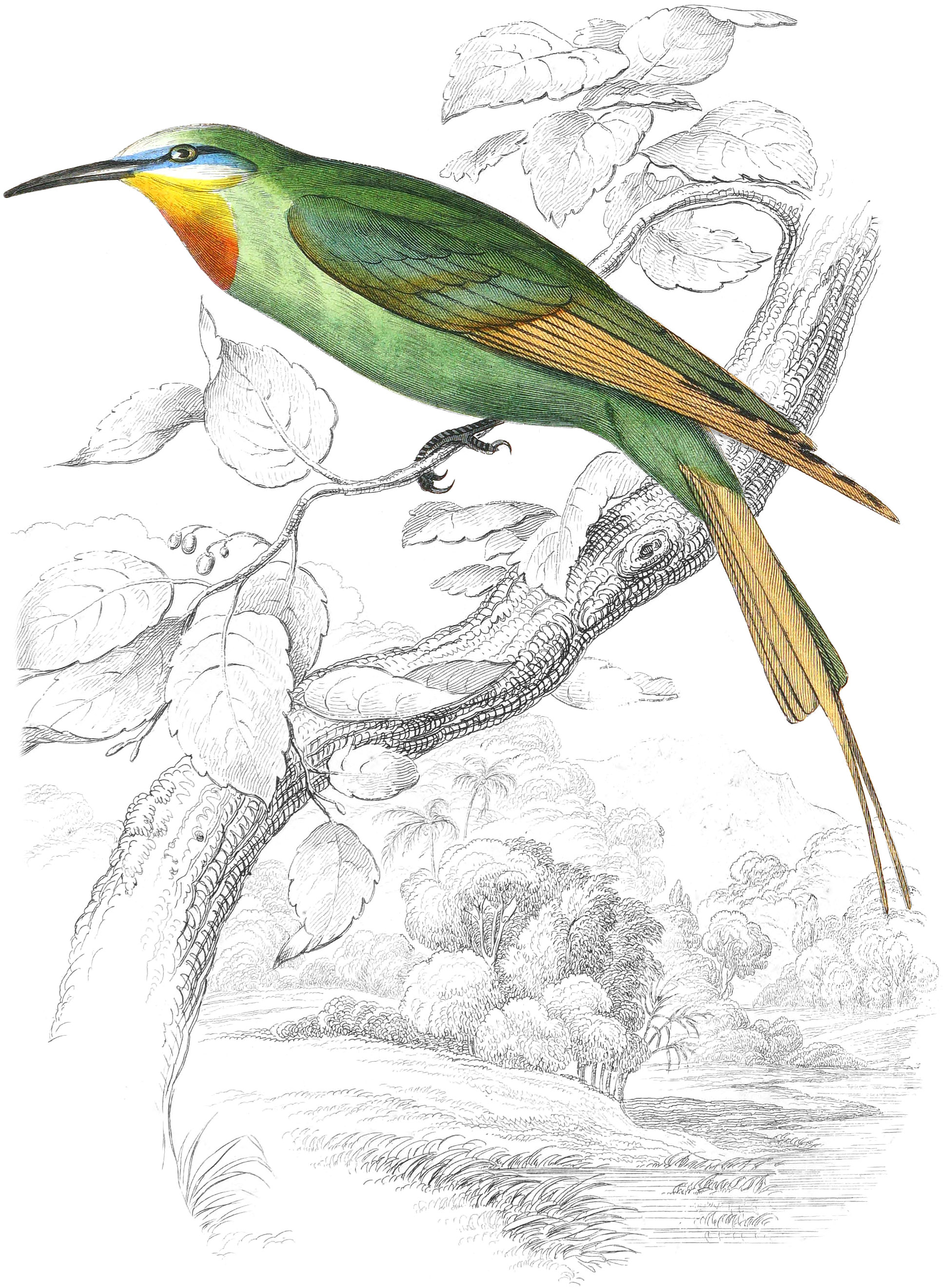
Plate VII
Blue-Bellied Bee-Eater
Merops cyanogaster, Swains.
Green; neck and body beneath glossed with ferrugineous; chin, black; throat, crimson; belly and under tail-covers, shining blue.
Le Gnepier a gorge rouge, Le Vaill. pl. 20.—Merops Bullocki, Auctorum.
The Blue-bellied Bee-eater is not only a particularly splendid species, but one of such rarity that we do not remember to have seen more than four specimens. One of these, formerly in Bullock’s Museum, and alluded to by Dr. Latham, is now in our possession. As Senegal has been mentioned, without any doubt, as its native country, we include it in our list; although not one specimen, as we have been assured, was among the hundreds of birds recently imported from that province.
This splendid bird is at once recognized by its bright crimson throat, and azure blue belly and tail-covers. Its size is much smaller than that of the common bee-eater, although it is larger than M. erythropterus. The upper plumage is of the usual parrot-green, except the superior part of the neck, which is light cinnamon or ferruginous, the margins of which blend in and harmonize with the surrounding green; there is an almost imperceptible shade of blue close to the nostrils, and the tip of the chin is of as deep a black as the eye-stripe and ears; the rest of the chin and the half of the throat in front is of a bright scarlet red, while the sides of the neck, the breast, and the whole of the body and flanks is of a cinnamon brown, similar to the upper neck; the belly, vent, and under tail-covers, are of a clear vivid ultramarine blue without any mixture of green. The first quill-feather is half as long as the second, a remarkable deviation from the typical structure, while the third only is the longest; the wings are green, but the lesser quills are tipt with deep velvet-black for about half an inch, the black having an edging of blue very conspicuous but not defined; the tail is quite even, and the feathers very broad; those in the middle are dull orange or their upper internal portion, and deep rufous beneath; but this is not perceived on the middle or outermost pair, which are entirely fulvous green; bill and legs, black.
Total length, 7 inches; bill, from the front, 1; wings, 3\(\frac{3}{4}\); tail beyond, \(\frac{17}{20}\); ditto, from the base, 4.

Plate VIII

Green-Throated Bee-Eater
Merops viridissimus, Swains.
Entirely green; quills, tail, and sides of the head with a fulvous or golden gloss; throat crossed by a black bar.
Le Guepier â gorge blue, ou Le Guepier Lamarck, Le Vaill. pl. 10? Merops Indicus, Var. M. Lamarcki,11 Auctorum.
The investigation of this species has caused us more trouble and research than any subject contained in this volume; we have been desirous of avoiding, on the one hand, an unnecessary increase of specific names, and on the other, the prevalent error of the old writers, of overlooking what appear to be slight distinctions: we have, therefore, carefully gone over all the descriptions in the systems of Buffon, Latham, &c. in the hopes of determining the species before us, but without any satisfactory result. We believe it has been confounded with two, if not three others, under the common name of Merops indicus, and yet not one of the descriptions will at all apply exclusively to our bird. Without, however, troubling the reader with all the details, we can safely assert that it is not the bird so named by Edwards, whose figure and description is the original authority for the Merops indicus of Linnæus, Latham, and all subsequent writers. This will be abundantly obvious to all who go back to this authority, and there compare the birds that have been assimilated to that of Edwards. These errors, by being copied and recopied by each succeeding compiler, do more to retard our knowledge of species than if the birds had never been recorded. They make error, as it were, perpetual. In cases like these, our only plan is to begin anew, and after retaining the specific name of indicus to the bird figured by Edwards, describe all others that will not accord therewith as separate species.
We received this Merops, so far as we can. recollect, with several other Senegal birds; but having lost our notes upon it, we would wish this locality to be considered as doubtful.
Size small, not much exceeding M. erythropterus; the general colour, both above and below, is a uniform pea-green, having a golden or yellow gloss in certain lights, particularly on the nape and sides of the head, originating from the feathers, in these parts, being ferruginous at their base; this fulvous tinge is likewise, as in many others of the genus, very strong on the quills and tail. Chin, throat, and breast, pea-green, glossed with yellow, except that part which margins the black ears, which is the only part of the plumage which has any shade of blue, and even here it is very slight. The green, in short, of the chin, throat, breast, and body, is uniform, and this appears to be the distinction of the species. In the middle of the throat, just above the breast, is a narrow transverse stripe of the deepest velvet black. The ears and eye-stripe, as usual, is also black; the quills and their covers inside are rufous, the former with broad black tips. The tail is even, except the two middle feathers, which project in filaments one inch and a half beyond the others.
We are not without suspicion that the figure at Pl. Enl. is intended for this bird, but it is clearly not a representation of the indicus of Edwards.
Total length, excluding the two middle tail-feathers, 7 inches; bill, from the front, 1; wings, 3\(\frac{6}{10}\); lateral tail-feathers, 3.
Var.—Another specimen we possess, whose locality is unknown, merely differs from the above in having the fulvous yellow tinge much stronger over the whole of the head, neck, and part of the back; it is also somewhat smaller, as the bill measures, from the front, \(\frac{8}{10}\), and the wings, 3\(\frac{3}{10}\). In other respects, and in colour, the two birds perfectly agree, except that the two middle tail-feathers, in this, project 2\(\frac{1}{2}\) inches beyond the others, instead of only 1\(\frac{1}{2}\); this, however, may be the effect of age.
Black-Crowned Bee-Eater
Merops Cuvieri, Le Vaillant.
Crown, ears, and spot on the throat, black, the latter margined below with blue; chin and stripe over the eye, white; body above, green; nape, ferruginous.
Merops Cuvieri, Le Vaill., pl. 9, Régne Animal, 2d ed. i. 402, note.—Merops Savigni, Zool. Ill., 1st Series, plate 76.—Merops superciliosus, Var. C. Lath. Hist. of Birds, iv. 228 127.
Our specimens of this very distinct species were received some years ago from Sierra Leone, where it appears to be common, although we know not, at present, whether its range is likewise extended to Senegal. It is the only Bee-eater yet discovered with a white chin and an isolated black crown; characters which render it so conspicuously distinct, that we can only wonder at its being confounded, even by Linnæan writers, with the Merops superciliosus. It is clearly the var. C., placed under that name, in Latham’s History of Birds.
When illustrating this species upon a former occasion, we were erroneously informed that it had been named after that inimitably accurate naturalist Savigny, and we accordingly published it under the name of Merops Savigni; but M. Cuvier, in the last—edition of the Régne Animal, has mentioned it as the species dedicated to him; his name, therefore, is here adopted.
Two specimens, now before us, establish the fact that the two elongated tail-feathers is either a sexual distinction, or a character of the adult plumage; in one of these all the tail-feathers are perfectly even, while in the other the two middle end in lanceolate points, extending two inches and a half beyond the rest.
The general plumage above, commencing from the lower part of the neck, is grass-green, which changes to blue slightly tinged with green on the rump, tail-covers, tail and tertial quills; the nape is fulvous, tinged with green, and the crown deep black. On the front is a white band which passes round on each side, and forms a broad stripe over each eye.
Total length, without the long tail-feathers, 8 inches; bill, from the front, 1; wings, 3\(\frac{2}{10}\); tail-feathers, from the base, 3\(\frac{2}{10}\); the middle pair 2\(\frac{1}{2}\) beyond the rest.
Blue-Headed, or Red Bee-Eater
Merops cæruleocephalus, Latham.
Red; brighter beneath; head, rump, and tail-covers, blue; two middle tail-feathers long and pointed.
Le Guepier rose â tete bleue, Le Vaill. pl. 3.—Merops superbus, Pennant, Ind. Zool., sup. 33; Gen. Zool. viii. 161; Nat. Mis. pl. 78.—Merops cæruleocephalus, Auct., Pl. Enl. 649; (Lath, Gen. Sy. ii. 680; Gen. Hist. iv. 139.)
This is in all probability the bird described by the Linnæan writers here quoted, although the length is stated to be only nine inches. We are also inclined to believe it the same as the blue-headed merops of our catalogues, figured, however badly, in the 640th plate of the Planches Enl.; the only essential difference between the two, being, that the latter has not the two middle tail-feathers elongated. Latham’s description, however, of his Blue-headed Bee-eater is stated to be made up from a drawing by Bruce (who was no ornithologist), and is quite different from the bird of Buffon. The elongation of the two middle tail-feathers is either a sexual distinction, or is a mark of the season of breeding.
This is a very striking species; the red of its plumage is of a bright brick-dust colour above, but lighter and more rosy beneath; the blue of the head is greenish and dull, shaded with black, but on the tail-covers it is much brighter; the scapular quills dull olive, all the others being broadly tipt with black, and the ends distinctly notched; ears black; under wing-covers and quills beneath, rufous. Tail, even and notched, except the two middle feathers, which are attenuated, and blackish towards their terminal half. First quill slightly shorter than the second.
Total length, 13 inches; bill (front), 1\(\frac{3}{10}\); wings, 5\(\frac{2}{10}\); tail beyond, 4\(\frac{3}{4}\); from the base, 7\(\frac{1}{2}\); middle feathers projecting 3\(\frac{2}{10}\) beyond the others.
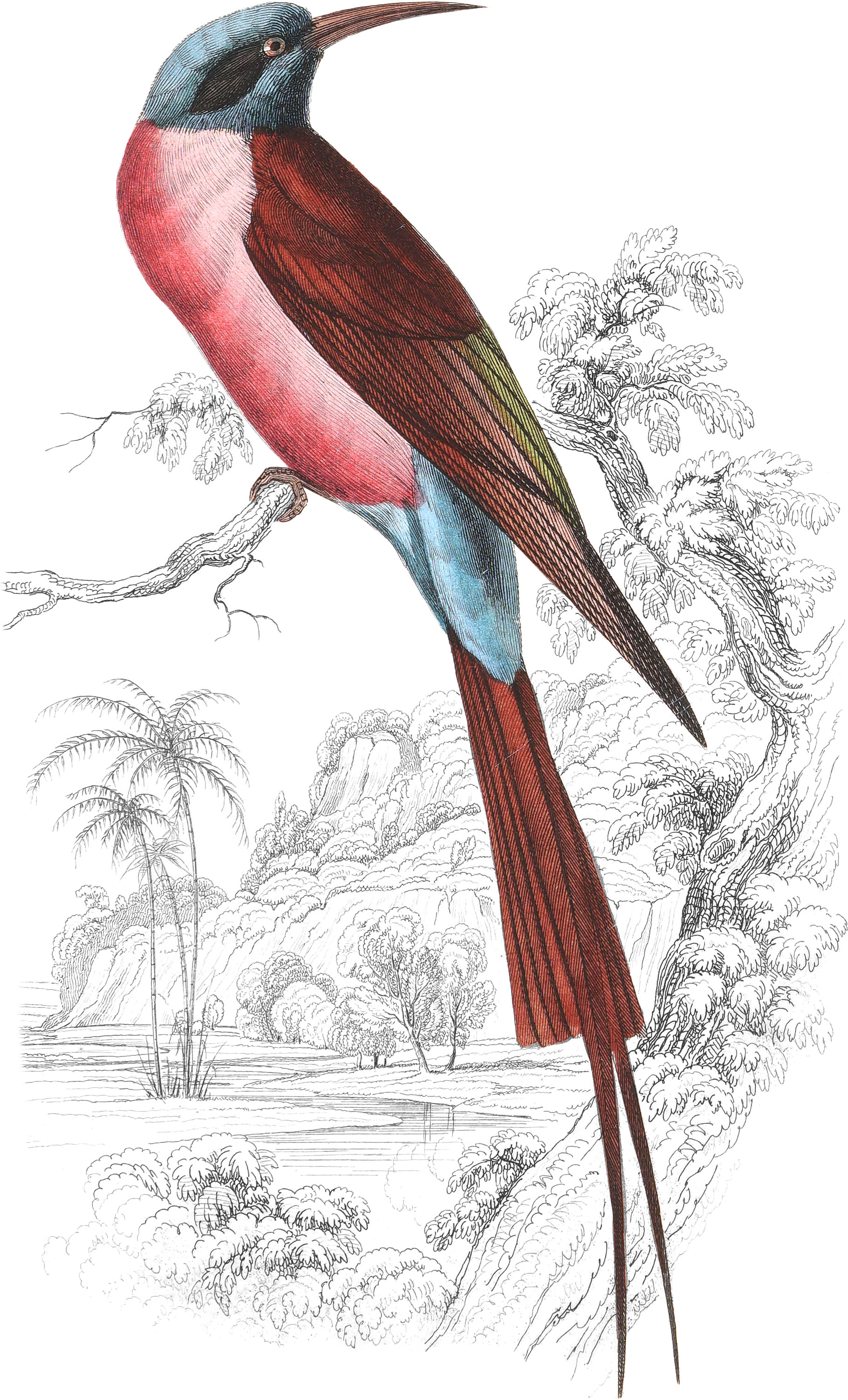
Plate IX
Little Fork-Tailed Bee-Eater
Merops erythropterus, Latham.
Petit Guêpier du Senegal, Buffon, Pl. Enl. 318.—Le Guepier minule, Le Vaill., pl. 17.—Merops erythropterus, Latham, General Synopsis, ii i. 681, pl. 31; General Hist. iv. p. 140, pl. 70.—Red-winged Bee-eater, Gen. Zool. i viii. 175, badly described.
It is a pity that a scientific name, more appropriate than that of erythropterus (red, or rufous winged), was not originally imposed upon this pretty little Bee-eater, the smallest species of its race yet discovered. In accordance, however, with that rule of nomenclature which forbids the alteration of an original name, not absolutely objectionable, we retain that of Dr. Latham, although pusilla would at once have indicated its greatest peculiarity, namely, its diminutive size.
This little Bee-eater was first brought from Senegal by the celebrated botanist and traveller Adanson, and communicated to Buffon, who in his loose manner described it as the Petit Guêpier du Sénégal, under which name we find it figured on the 318th plate of the Planches Enluminees, yet so badly, that did we rest upon these materials only for determining the species before us, we should consider this as a totally different bird. Dr. Latham, however, although his figure is equally defective, supplies its inaccuracy by a tolerably good description, having noticed the rich and elegant spot on the throat, which is altogether omitted in the two figures above mentioned. To this elucidation of its scientific history, we can add but little regarding its manners. It seems to be a. common species on the western side of Africa, and appears to extend to Abyssinia; it is not known, however, at the Cape of Good Hope; at least we have never seen specimens from the southern parts of Africa.
The total length of the adult bird is not more than six inches. The whole of the upper plumage, excepting the primary and secondary quills, and the lateral tail-feathers, is of that peculiar glossy changeable green, which is so prevalent in this genus, appearing in some lights yellowish, and in others bluish; a black ocular stripe extends to the ear-feathers; the chin, and half of the throat, is of a clear and full yellow, having a very narrow edging, in the middle of the throat only, of delicate greenish-blue; this edging is followed by a transverse black spot of the deepest black, which is also confined to the middle of the throat, and is surrounded by, or rather placed in, the middle of a large patch of rich chestnut, which goes across the breast from side to side, and then blends into the light buff coloured green of the body and belly; the primary and secondary quills are ferruginous, slightly shaded with green, with broad black ends, but the extreme tips of the secondaries are pale and whitish. The lateral feathers of the tail are coloured in the same way, and all these quills, both of the tail and the wings, have the generic character of being deeply emarginate. It must be observed, however, that this is evidently an aberrant species, for the tail is not only slightly forked, but in some degree lyrate, the external feathers inclining outwards. The first quill, which in Merops apiaster is so short and spurious as only to be one-fifth the length of the second, is, in this bird, half as long as the next, while the quills themselves do not exceed the length of the scapulars and tertials. These differences, however slight, plainly indicate a tendency to the rasorial structure, as we find it represented in the drongo-shrikes and other lyre-tailed birds.
Total length, 6 inches; bill, from the front \(\frac{9}{10}\); from the rictus, 1\(\frac{2}{10}\); wings, 3; tail beyond, 1\(\frac{1}{10}\); from the base, 2\(\frac{6}{10}\).
Fork-Tailed, Blue Vented Red Bee-Eater
Merops hirundinaceus, Latham.
Green; chin, orange; collar, belly, and tail-covers, bright blue; tail forked, the feathers with black and whitish tips.
Swallow-tailed Bee-eater, Lath. Gen. Hist. iv. p. 141.—M. taiva, Griff. Cuv. ii. 404.—Le G. a queue fourchue, Le Vaill. pl. 8.—Merops chrysolaimus, Jardine & Selby, Illust. pl. 99.
This is one of the most beautiful bee-eaters of Western Africa, conspicuously distinct, not only by its colours, but also by having the tail more forked than any species yet discovered. Although specimens are seldom sent to this country, we learn that Le Vaillant found it in abundance on the banks of the Orange river in South Africa. In Senegal, however, it seems rare.
The size is rather less than that of the common species: the genéral aspects, both above and below, is uniform brilliant green, which gradually changes on the belly to bright sky-blue, which colour spreads over the vent, as well as the upper and under tail-covers. The chin is bright orange-yellow, which colour is separated from the green of the lower part of the throat and breast by a collar of brilliant sky-blue; front of the head, light greenish blue; ears and stripe through the eye, as usual in all the other species, deep black; beneath the ears is a whitish spot, blended with the blue and yellow of the throat, and there is also a whitish band across the vent. Quill-feathers cinnamon colour with broad black tips, the ends of the feathers deeply emarginate. Tail-feathers pointed, dark green, with blackish bands near the tips, which colour passes into bluish-white; inner wing-covers and quills, cinnamon; tail beneath, blackish.
Total length 8\(\frac{1}{2}\) inches; bill, from the gape, 1\(\frac{4}{10}\); wings, 3\(\frac{1}{2}\); tail beyond, 3; ditto from the base, 4\(\frac{1}{2}\); depth of the fork, 1\(\frac{1}{2}\); tarsus, \(\frac{1}{4}\); middle toe, \(\frac{6}{10}\).
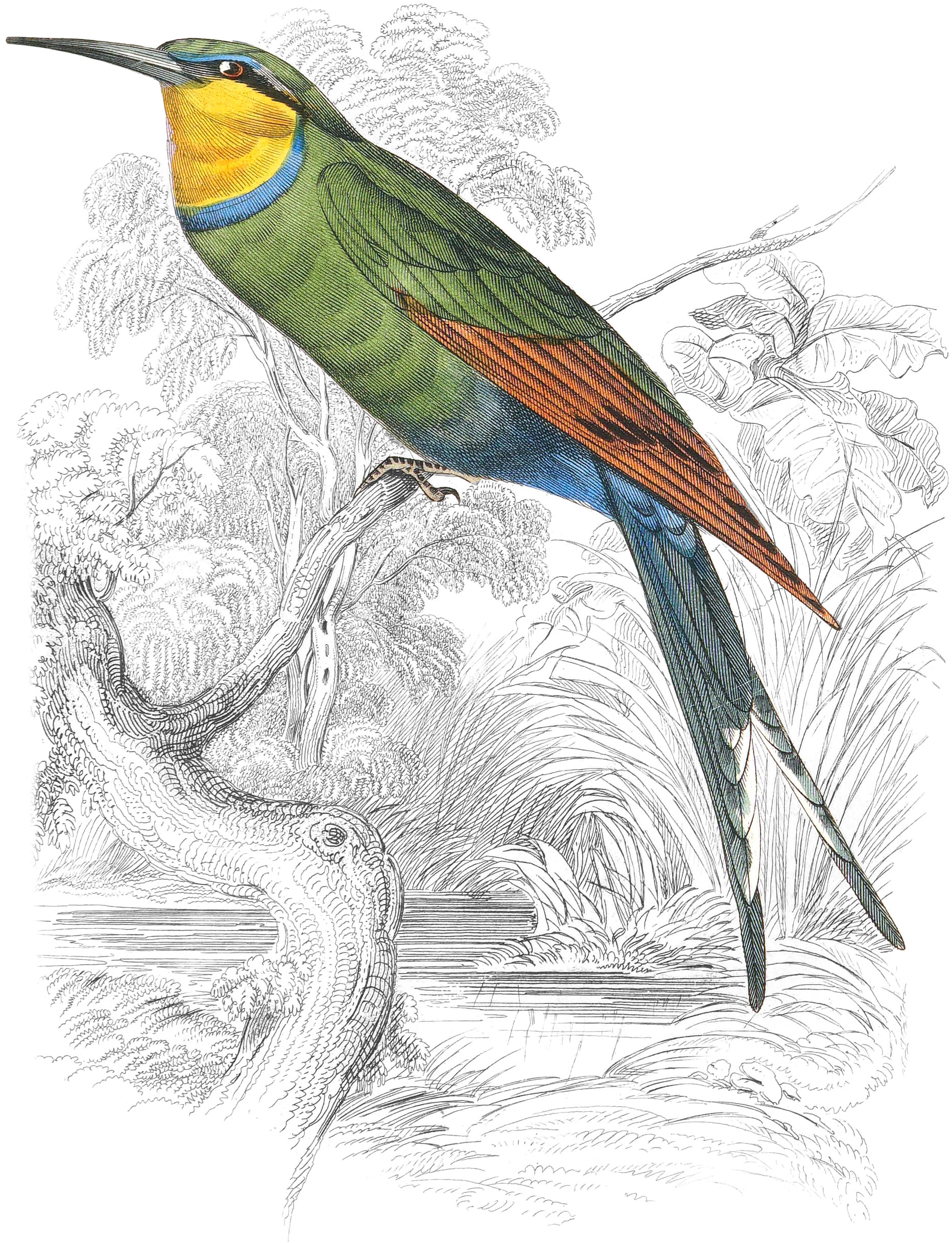
Plate X
Great African Kingfisher
Ispida gigantea, Swains.
Above, cinereous, spotted with white; chin and cheeks, white, immaculate; breast with a broad rufous collar; head above, black, crested behind.
Among the largest sized Kingfishers that have long been imperfectly known and incorporated in our systems, there is the greatest confusion, not only as to the characters of the birds themselves, but likewise in regard to their native countries. The Alcedo gigantea, or Giant Kingfisher of the old authors, long since removed from this genus, includes two, if not three species. The Alcedo afra, or Great African Kingfisher (Pl. Enl. 679), is a native of Brazil, while the Alcedo torquata, said to be found in Mexico, is only the female of the last. We have, however, in the bird we now designate, a species of a size fully equal to any of its genus, and in every respect strikingly different from any of the above.
The general colour above is dark cinereous, thickly covered with white spots; these spots are thickest on the wing, and nearly obsolete on the back. It is impossible, however, to describe all the slight variations which these markings assume in different parts of the plumage It will be sufficient, therefore, to observe that there is a row of seven on each of the tail-feathers, which are placed at alternate distances; the middle of each feather is more or less black, which colour predominates towards the head, and leaves the crest black and unspotted; the cheeks are white, bordered by black spots, while those on the flanks run into transverse bands. A conspicuous white spot is placed just before the eye; the tail is moderate and rounded, and the hind head crested. Only’ one specimen was sent from Senegal, so that we know not whether the sexes, as is usual in this genus, are differently coloured.
Total length, 14\(\frac{1}{2}\) inches; bill, from the front, 3\(\frac{2}{10}\); wings, 8; tail beyond, 2; ditto from the base, 4\(\frac{3}{4}\).
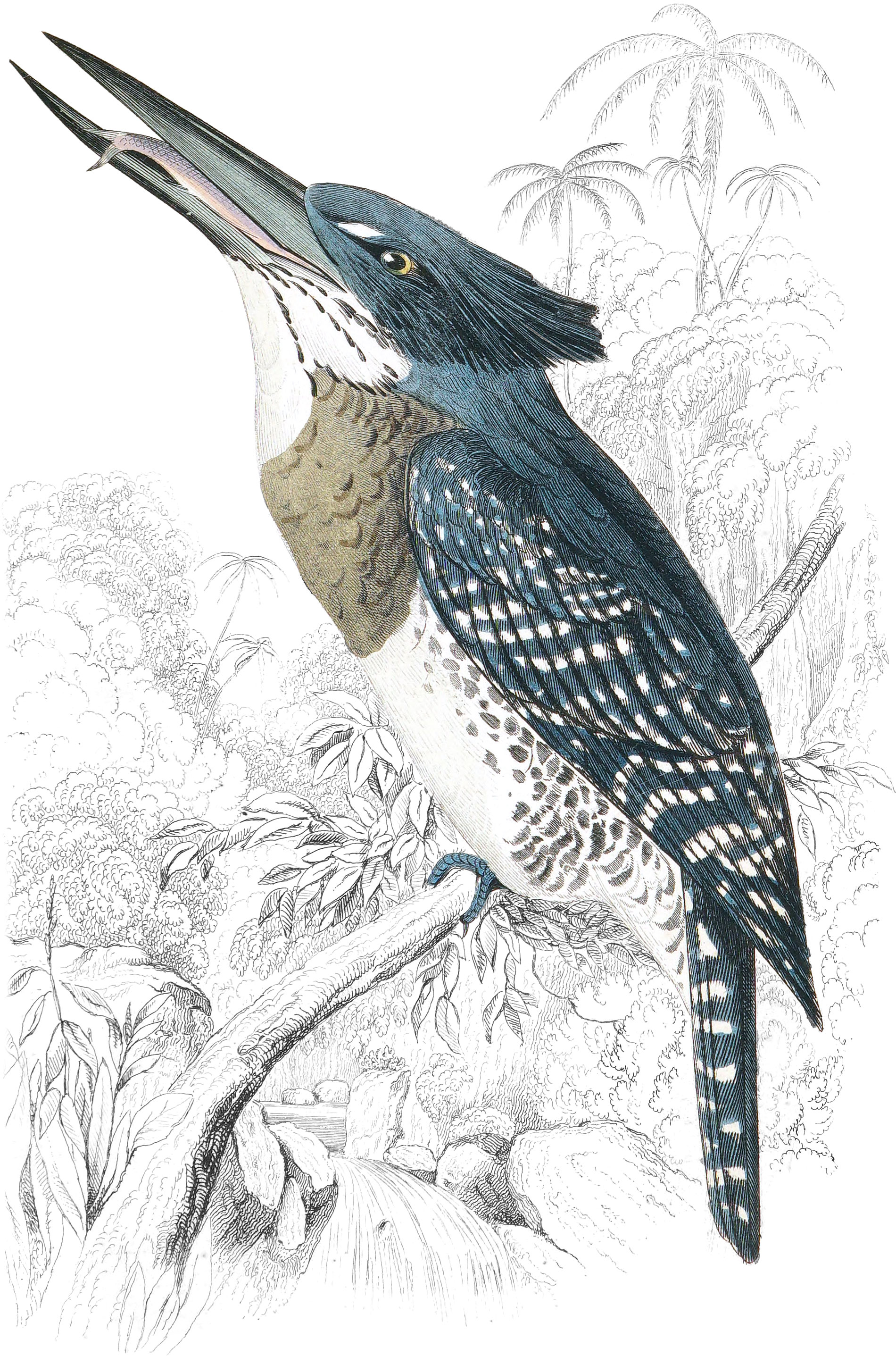
Plate XI

Double-Collared Kingfisher
Ispida bicincta, Swains.
Crested; body above, variegated with black and white; beneath, white with two black collars on the breast; nuchal collar white and immaculate.
When we find all authors affirming that the Black and White Kingfisher “inhabits various regions, both of Asia and Africa, Egypt, Persia, Senegal, and the Cape of Good Hope,—that it varies both in size and in the particular mixture of its colours,” it is impossible not to conclude that more than one species is confounded under the common name of Alcedo rudis, and that in all probability this mixture of black and white in the plumage, instead of being the character of a species, more probably belongs to a small division of the genus. The bird now before us affords at least a confirmation, in one instance, of such a supposition. All writers12 agree in stating that the true Alcedo rudis of the Cape of Good Hope has but one black belt on the breast, whereas the species now before us has two. When, therefore, we find so strong a specific distinction between birds inhabiting two localities so comparatively near to each other as Senegal and the Cape, we may fairly conclude that the other black and white Kingfishers, or regions vastly more distant, will eventually prove to be equally distinct.
It is utterly impossible to draw up a minute description of the plumage of a bird whose every feather, almost, is varied, in a different manner, with black and white; we must, therefore, as in the case of the Caprimulgidæ, single out the most prominent characteristics. The crown of the head and the crest on the nape is not entirely black, as in the Cape species, but each feather has a very narrow line of white, producing a striped appearance; the white stripe which springs from each nostril is carried over the eye and ears, and is lost in the variegated feathers of the crest; below this is a black line which is the continuation of the black on the ears; following this is another collar of pure white round the nape, which in like manner is a continuation of the white on the throat. As to the wings, almost every quill has a different proportion of black and white, but the outer web of the ninth and tenth quill (except the tips) are entirely black. The under plumage is pure glossy white, with a broad unbroken black belt (narrowed in the middle) across the breast, and another, equally entire, much narrower, but of equal breadth throughout; half an inch below the first, the flanks have a few stripes of black.—The figure of the Pl. Enl. 62 may possibly represent the young bird.
Total length about 10\(\frac{1}{2}\) inches; bill, from the front, 2\(\frac{2}{10}\); wings, 5\(\frac{1}{2}\); tail beyond, 1\(\frac{1}{2}\); ditto from the base, 3\(\frac{1}{2}\); tarsus, \(\frac{3}{10}\).
Grey-Headed Senegal Kinghunter
Halcyon Senegalensis, Swains.
Head, ears, and middle of the breast, cinereous-grey; back, tail, and middle of the wings, blue; wing-covers and ends of the quills, black; upper mandible, red; lower one, with the feet, black; eyebrows, white.
Ispida Senegalensis major, Brisson, Orn. iv. 494.—Martin-pecheur à tête gris, Buff. ed, Sonn. xx. 233 xiii. 156; Pl. Enl. 594.—Alcedo Senegalensis, Linnæus.
The Kinghunters have such a close resemblance to the kingfishers, that it is only of late years, since their habits and structure have been better known, that they have been separated. The first, which we characterised many years ago as the genus Halcyon, have the bill very broad, in some species even depressed; and instead of living upon fish, they seem to frequent forests for the sake of capturing small reptiles and insects. Of these we have no species in Europe, although they are all confined to the limits of the Old World. The true kingfishers, to which we still retain the name of Alcedo, have the bill very narrow and compressed on the sides; the feet are much weaker, and they feed only upon fish. We have adopted the vernacular name of Kinghunter from the French, who call the birds we are about to describe by the name of Martin-chasseurs.
The Senegal Grey-headed Kinghunter was first described by Brisson; it is one of the most splendid of this genus, having the remarkable peculiarity (which is, however, shared with the next species) of the bill possessing two distinct colours, the upper mandible being of the 1ichest crimson, while the lower one is jet black.
General plumage on the upper part of the body rich light blue, excepting the head and upper part of the neck, which are cinereous grey, darkest on the front and crown, and gradually blending on the upper neck with the blue of the interscapulars; over each eye is a greyish white line, which begins at the nostrils, and terminates just above the eye; the eye itself is surrounded with a black ring united to a patch of the same colour between the eye and the bill; the upper mandible appears entirely crimson, but its sides, just at the rictus, are black; the ears, sides of the neck, middle of the breast, and flanks, are shaded with light cinereous, minutely freckled or crossed with delicate lines and spots of a darker colour: this part of the plumage is prismatic, and reflects a delicate tint of green. All the rest of the under plumage is white. The tail, the scapulars, and the largest portion of the quills, are light blue. The rest of the quills, and the whole of the covers, are deep black; inner wing-covers, and half of the quills beneath, white; feet, and under aspect of the tail, deep black.
Total length, 9 inches; bill, from the front 1\(\frac{1}{2}\); ditto, from the gape, 2\(\frac{1}{10}\); wings, 4; tail beyond, 1\(\frac{3}{4}\); ditto from the base, 2\(\frac{3}{4}\).
Blue-Collared Kinghunter
Halcyon torquatus, Swains.
Head above, brown; ears blue, margined by a black line; under plumage white; breast with a blue band; upper mandible and feet red; lower mandible black.
The only specimen of this new species we have yet seen is in the Chatham Museum, to which it was sent, with other species, all procured at the Gambia settlement. It has obviously been confounded, with many others, under the common name of Senegalensis. At every step which the true ornithologist takes in the accurate determination of the species of birds, the more will he be impressed with the conviction that the total destruction of all our compiled systems would be the greatest possible advantage which the science now could possibly receive. The innumerable errors they exhibit in almost every page, are copied and recopied by each succeeding compiler, who thus gives them a fictitious authority, so that they actually become perpetuated from one century to another; while their disentanglement, from the truth mixed up with them, becomes at last altogether hopeless. With the exception of the writings of Brisson, Buffon, Linnæus, and Edwards, we may reject almost every other general work upon species as not only useless but pernicious, unworthy either of reference or of quotation. This may appear undeserved censure, but every one who practically knows the state of specific ornithology, will be too well aware of its justness.
Having expended several hours in an attempt to clear up the synonymes of the species before us, we gave up the task, and omit them altogether; observing only that the Senegalensis of Vieillot is an imaginary species, compounded of this bird and the last! while to the true Senegalensis he gives the name of cinerefrons.
In size our Halcyon torquatus is larger than Senegalensis, to which it has, however, a general resemblance in the colours of the bill, and in some parts of the upper plumage. It is immediately distinguished, however, from that bird by its red feet and broad blue breast band. The head is of a full and clear brown, and not light grey; this brown colour ends abruptly, and does not, as in Senegalensis, blend into the blue of the back. The ears are blue, margined above by a narrow black line; the chin, throat, and lower half of the body is pure white; the wings are much like those of Senegalensis, they are deep black, but their margins, together with the middle of the greater, and nearly the whole of the lesser quills (externally), are shining blue; the tertial quills, which in Senegalensis are blue, are in this black; there is no white line over the eye; and the feet are red.
Total length, 10 inches; bill from the gape, 2\(\frac{1}{2}\); front, 2; wings, 4\(\frac{3}{10}\); tail, base, 3\(\frac{2}{10}\); tarsi, \(\frac{1}{2}\).
Rufous-Vented Kinghunter
Halcyon rufiventer, Swains.
Above, pale shining blue; wing-covers, interscapulars, tertials, and ends of the primaries, black; beneath white, with the lower half of the body, the flanks, and under wing-covers, rufous; crown grey; bill and legs red.
Martin Pecheur bleu et noir de Senegal? Pl. Enl. 356.
The species we now name the Halcyon rufiventer has been, if we mistake not, long ago figured in the Planche Enluminees of Buffon, or at least the lower figure, at Plate 356, represents a bird very nearly allied to that now before us. It seems, however, according to Sonnini, to have been overlooked by systematists as a variety of some other, and he accordingly calls it the Martin Pecheur bleu et noir du Senegal, without, however, giving it a Latin name. Can this be the same as the Dacelo acteon of a French writer? At all events, we cannot adopt such mythological and unmeaning names, without setting at defiance all those sound and admirable rules of systematic nomenclature which have been laid down by the great masters of our science.13
From the very short description by Sonnini of the bird in question, it would seem that it differs from ours in having the “under parts of the body yellowish red, just as far as the throat, which is shaded. with blue, this tint, although somewhat darker, covers the head of the back and neck.” Now, the under parts of our species, as far as the middle of the body, is pure white, while the crown of the head is of a brown drab, with a paler nuchal collar, as light as the ears and sides of the neck. We suspect, however, that Sonnini has drawn up his description from the figure he quotes, without having ever seen the bird.
Size of the Senegal kinghunter. The general colours of the upper part of the body and limbs are two, deep velvet-black and bright cerulean blue. The black covers the scapulars, wing-covers, tertial quills, and the interscapulars; immediately behind which the blue of the back, rump, and tail commences; the outer webs of the lesser quills and the basal part of the greater are of the same blue as the back, the tips of all the quills more or less black; spurious wings blue green; the margin of the wings is white. Both mandibles of the bill are deep crimson; feet the same; crown and sides of the head light drab brown, without any grey or cinereous; paler on the ears and below the eyes, where it changes to white; nape and upper neck the same tint as the crown, but much lighter throat; neck, breast, and upper part of the body beneath, white; all the rest of the under plumage, flanks, and under wing-covers, deep rufous: tail rounded; the tertials are glossed with blue; and there is a dusky spot before the eye.
Total length, 8\(\frac{3}{4}\) or 9 inches; bill, from the front, 1\(\frac{6}{10}\); wings, 4; tail beyond, 1\(\frac{1}{2}\); ditto from the base, 3.

Plate XII
Little Rufous-Cheeked Kinghunter
Halcyon cyanotis, Swains.
Sides of the head, ears, and neck, rufous, glossed with purple violet; crown of the head and nape, black, with transverse blue spots; chin and throat white; breast and body beneath orange rufous; bill and feet red.
Todier de Jiuda, Pl. Enl. 783, fig. 1.—Todier bleu à ventre rouge, Buffon.—Todus ceruleus.—Blue Tody of authors.
This superb little species may be called the gem of the family, both from its diminutive size and its exceeding richness-of colouring. It has, as usual been placed as a variety of another by our systematists, who at first called it a fly-catcher (Todus) and then one of the four “varieties” of their Alcedo cæruleocephala. To the modern ornithologist it is a very interesting species, since it possesses the broad bill of Halcyon and more syndactile feet of Alcedo. The outer toe is only disconnected from the middle toe at its terminal joint, and there are no apparent scales either upon the tarsus or the toes; the tail is very short, rounded, and the under-covers reach within a quarter of an inch of its tip.
The crown of the head is occupied by an isolated broad patch of deep black, each feather having a transverse blue band across its tip, which gives this part the appearance of being lineated with ultramarine. From each nostril commences a large patch of rufous which envelopes the base of the lower mandible, the ears, and the sides of the head, where it forms a broad stripe over the eye; this rufous encircles the neck above, and is glossed upon the ears, the nape, and the maxillary stripe, with a most lovely lilac or violet colour; neither does it blend into the white of the throat, but terminates abruptly on its sides; the back, scapulars, and tail-covers are uniform ultramarine blue; the wings and tail black, slightly. glossed with the same; the wing-covers are tipt with blue; chin and throat white; breast and all the remaining under plumage, rufous orange; bill and legs scarlet.
Total length, 4\(\frac{1}{2}\) inches; bill, from the front, 1\(\frac{1}{10}\); from the gape, 1\(\frac{4}{10}\); wings, 2; tail beyond, \(\frac{6}{10}\).
Green-Necked Roller
Coracias Abyssinica, Latham.
Front of the head and chin white; head, neck, throat, and body beneath, sea green; back and quill-covers ferrugineous; lesser wing-covers, quills, and rump, ultramarine blue tail forked.
Coracias Abyssinica, Latham, Ind. Orn. i. 169; Rollier d’Abessinea, Pl. Enl. 626.—Abyssinian Roller, Lath. Genl. Synop. i. 404 ii, 408; Gen. Hist. iii. 76; Coracias caudata, Wagler’s Sp. Avium, No. 2.—Coracias albifrons, Shaw, Genl. Zool. 7, 2, 392.
The Rollers have many characters in common with the bee-eaters, like them they feed upon the wing, and, as we believe, subsist almost entirely on insects; for this purpose the gape of their mouths is excessively wide, so that they may swallow their prey whole. Their colouring is most splendid, consisting almost entirely of different shades of green, blue, and cinnamon-brown, the latter of which is usually called ferrugineous or bright rust colour. All the species are confined to the warm latitudes of the Old World, and only one migrates to the colder countries of Europe during our summer.
The species of Roller most common in Senegal is that which by some singular chance has been called the Abyssinian, while that which has been named the Senegal we have never yet seen. Of that now before us we fortunately possess a young specimen, which might be easily mistaken for a different bird, since the two outermost feathers of the tail, instead of being longer than the others, are a full inch shorter; the green of the head, neck, and body beneath is light, obscure, and verging to brown; there is no white on the front, and but very little on the chin; the azure blue on the shoulders occupies, also, a much narrower space.
In the adult the prevalent colour of the whole plumage is a light, changeable, blue or sea-green. The ferruginous colour of the back commences only at the interscapulars, and not, as in C. Senegala (as figured in the Pl. Enl. 326), immediately behind the nape. This ferruginous colour covers the middle of the back, the scapulars, the quill-covers, and part of the tertials.. The shoulders and lesser wing-covers are of a splendid ultramarine blue, so also is the rump and upper tail-covers; all the quills are likewise dark blue, except at their base, where they are of the same light green as the body and the greater wing-covers. The front of the head, the eyebrows, and the chin, are white; but all the rest of the under plumage and the inner wing-covers are uniform light sea-green; such also is the chief colour on the tail, but the four middle feathers are blackish green, and the base of the others more or less dark blue. The narrow prolongation of the two outermost are black; their length depends upon age; when fully grown, they exceed the others by five inches.
We ground our belief that the Coracias Senegala and Abyssinica are distinct species, solely upon the faith we always repose on the remarkable accuracy of Edwards, who expressly says, in his account of the former, that “the hinder part of the neck” is of “a reddish brown colour,” and this singularly agrees with the figure of the Pl. Enl. No. 326. There is not the slightest reason to entertain Dr. Wagler’s suspicion that either of these figures are copies one of the other.
Total length, exclusive of the long tail-feathers, 12 inches; bill, from the front, 1\(\frac{1}{2}\); ditto, from the gape, 1\(\frac{8}{10}\); wings, 6; middle tail-feathers, 5\(\frac{1}{2}\).
Blue-Bodied Roller
Coracias cyanogaster, Cuvier.
Head, neck, and breast hooded with greenish-fawn colour body, above and beneath, and wings, sapphire-blue, the latter with a light green band; scapulars black; tail forked and green.
Coracias cyanogaster, Systema Avium, No. 6, Jardine and Selby, Ill. of Orn. pl. 123.
If richness of colouring alone constituted beauty, this Roller would be the most splendid of all the birds of Western Africa. No effort of art can possibly do justice to those inimitably rich lines of ultramarine, beryl colour, and changeable fawn, with which it is ornamented; for there are no tints hitherto discovered, either mineral or vegetable, which will enable the painter to produce their successful imitation.
Le Vaillant seems to be the first who made us acquainted with this magnificent bird, by whom it was described under the name of Le Rollier à ventre bleu, and Latinized by M. Cuvier into Coracias cyanogaster. Dr. Wagler has committed two strange mistakes about this bird; he says it is the Garrulus cyanogaster of Vieillot, a name nowhere to be found in the latest and most complete of his works; and he takes upon himself to correct this author,14 who states it is found in Africa, by asserting it to be an inhabitant of Java. It might have been as well had he stated on what authority this rested. It is, however, a false one, since no less than three specimens have come to our hands direct from Senegal.
Size rather larger than the Coracias Abyssinica. The whole of the head, neck, throat, and breast, is enveloped, as it were, in a hood of very light drab or fawn colour, glossed with green, which changes its tint in different directions of light; the drab sometimes assumes a warmer ferruginous tinge, while in others it seems changed into a light but dull yellowish-green: the front, chin, and eyebrows are paler, and almost white: a black mantle spreads over the interscapulars and the scapular-covers: the wings are of the deepest and most brilliant mazarine blue, except the basal half of the quills, which are of a light beryl or blue-green colour: the lower part of the back and upper tail-covers are deep blue, so also are the corresponding parts on the under plumage; that is, from the breast to the vent: the tail is light sea-green, brightest beneath; its form is decidedly forked; all the feathers are pointed, the two middle ones slightly shorter than the rest, and the two outer ones extended beyond the others, in narrow filaments, more than two inches: in the superior length of the wings, and the emargination of its quills at their tips, we trace an evident approximation to the next genus, Eurystomus: the underwing-covers, and the breast plumes close to them, are of the same turquois-green as the tail: bill and legs blackish.
Total length, 13 inches; bill, gape, 1\(\frac{1}{2}\); front, 1\(\frac{2}{10}\); wings, 7; tail beyond, 3\(\frac{1}{2}\); depth of the fork, 2\(\frac{3}{4}\); tarsus, \(\frac{9}{10}\).

Plate XIII

White-Naped Roller
Coracias nuchalis, Swains.
Collar round the nape, front, and eyebrows, White; back, scapulars, and tertials, obscure olive; wing-covers vinaceous, margined with purple; under plumage vinaceous, striped with white.
Of this rare and undescribed Roller, not more than three specimens have as yet fallen under our inspection, Like the Indian Roller and its supposed varieties, the under plumage is striped with white upon a vinaceous or rufous-brown ground; but it differs from that, no less than from all others yet discovered, by its nuchal collar.
The general size is equal to that of the two preceding. The front of the head, united with a broad stripe over each eye, is white; there is also a small spot of the same on the chin; on the nape, or rather on the occiput, is a large transversely placed spot, somewhat partially hid by the long plumes on the crown; the edge of these feathers has a pearly white gloss, but their basal half is of the purest white: the crown is vinaceous red; the upper part of the neck is the same; the interscapulars, upper part of the back, scapulars, and tertials, are of a uniform light olive; the greater and lesser wing-covers are vinaceous, changing to bright lilac on the margin of the cubitus, and to ultramarine blue from the outer angle of that joint; and this blue extends all round the carpus, and spreads over the spurious wings and all the quills: the lower part of the back is of the same lilac or vinaceous tint as the cubitus, which gradually changes on the upper tail-covers to ultramarine blue. The tail is slightly rounded, the two middle feathers being olive-green; the others, are entirely of a dark ultramarine blue: the under plumage, from the chin to the vent, is uniformly of the same vinaceous, or red ferrugineous colour, as the wing-covers, each feather having a stripe of cream-coloured white down its shaft: under tail-covers lilac: inner wing-covers, vinaceous white: base of the quills, on their inner surface, white, faintly tinged with blue: bill black, legs brown. It may be as well to add, that there is in this species none of that green, either on the wings or on the body, which is so conspicuous in the Coracias Indica, Linn. figured by Edwards, pl. 326, and in the Pl. Enl. 285.
Total length to the tip of the middle tail-feather, 13 inches; bill, from the base, 1\(\frac{1}{4}\); ditto, from the gape, 1\(\frac{9}{10}\); wings, 5\(\frac{1}{2}\); middle tail-feather, 5\(\frac{1}{2}\); tarsus, \(\frac{9}{10}\).
Cinnamon-Backed Roller
Eurystomus rubescens, Vieillot.
Rufous-cinnamon, beneath glossed with purple; quills, and greater wing-covers, mazarine blue; under tail-covers, and lateral tail-feathers, blue-green; bill orange.
Coracias Afra, Auctorum.—Eurystomus rubescens, Vieill. Ency. Meth. 871.—Collaris purpurascens, Systema Avium, No. 2.
Where all the species of a genus are distinguished by splendid colours, variously combined, it is almost impossible to assign the pre-eminence to any one. But for the inexpressible splendour of the blue on the Coracias cyanogaster, we should be tempted to say the bird now before us was the most splendid of the whole race; and, we doubt not, but that many will think so. The exquisite lilac reflections on the under plumage defy the painter’s art, while the rich cinnamon of the back admirably contrasts with the full dark blue of the wings.
We are seldom disposed to pass over a generic name which has an undoubted right to priority, provided it has no radical defect in its construction, but no rule can be absolutely without exceptions; and, in the present instance, Eurystomus is so very expressive of one of the chief characters of this group, that we are induced to give it the preference over Colaris, the Greek name, as it has been alleged, of some unknown bird; which, of course, is as applicable to any other as to this group.
It is one of the great defects of the Systema Avium, in many respects a valuable work, that its author is continually uniting two or three species of the older ornithologists under one specific name, not after examination, but obviously, and often confessedly, upon mere conjecture, without, in short, having seen them. In the present instance, we find the E. purpurascens and the rubescens of Vieillot set down as the same species; when, on perusing the original accounts of each, no two can well be more different.
The size of this species, which seems not uncommon in Senegal, is smaller than any of the preceding. The bill is of a fine orange-yellow: the whole of the upper plumage, including the shoulder and lesser wing-covers, the scapulars, and part of the tertials, is of a uniform rufous cinnamon; and this, also, is the ground colour of the under parts of the body; but from the chin to the vent there is a rich gloss of lilac purple, not seen on the upper parts, and which extends also to the under covers of the wings: the whole of the quills, with their greater covers, are rich uniform mazarine blue, with obscure blackish tips: the tail is slightly forked, the lateral feathers light sea-green, tipt with mazarine-blue, the middle pair olive-brown: the under tail-covers, and under surface of the quills, blue-green; feet blackish.
Total length, 9\(\frac{1}{2}\) inches; bill, from the gape, 1\(\frac{1}{4}\); from the front, \(\frac{6}{10}\); wings, 6\(\frac{1}{2}\); tail beyond, 1\(\frac{2}{10}\); depth of the fork, \(\frac{4}{10}\).
European Hoopoe
Senegal Variety.
Upupa epops, Linnæus.
Var.? U. Senegalensis, Swains.
Cinnamon brown, beneath paler; belly whitish; wings black, with white bands; an oblique white bar on the primary quills; crest tipt with white and black.
Var. a? Senegalensis, smaller; crest tipt only with black.
It is for the purpose of framing a comprehensive and succinct specific character for this well known bird, and to offer a few remarks upon the species, that we have been induced to give it a separate consideration. Specimens from Senegal agree with two others, reputed to be European, now before us, in possessing that broad white band upon the primary quills, which is not seen in the Upupa capensis. But there is, on the other hand, so much difference in the intensity of colouring among different individuals of the U. epops, that we must either conclude it is subject to considerable variation, or that there may possibly be two distinct species still falling under that name. Do the sexes, again, differ? or does this diversity of colour originate in age or climate? These questions require much investigation before the history of such a well known bird can be rendered complete.
We shall merely, in this place, state the chief differences. in the Senegal Hoopoe, leaving its claims for specific distinction open to further inquiry. In size it 1s considerably less than that which is found in Europe; although the bills of both are of the same length, the rufous, or cinnamon colour, is only bright upon the crest, in all other parts of the plumage (where it occurs, as in the European bird,) it is pale drab, or isabella colour: the crest feathers are tipt with deep black; but (as in E. capensis) there is no white whatever between the black and the rufous. The rest of the plumage presents no conspicuous difference, excepting that the white bands on the lesser quills are more confined in extent; that is, they do not encroach so much upon the black. In the arrangement of the quill-feathers our bird agrees with the European.
The European Hoopoe arrives in small flocks, in Sicily, during the spring and autumnal migration, where we have repeatedly shot it. The assertion that it is then sufficiently abundant to purify the air, by devouring putrid substances, is such an absurd fable, that, but for its having been recently repeated in one of our “popular” compilations,15 we should hardly have thought it worth refuting; on the contrary, it is a very cleanly bird, feeding only upon live worms and insects, which it seeks for in the most retired shades. It is, in short, by no means common; and as it does not breed, as we believe, in the Mediterranean, we have never seen its nest.
Total length, about 9\(\frac{1}{2}\) inches; bill, from the base, 1\(\frac{3}{4}\); wings, 5; tail, from the base, 3\(\frac{1}{2}\).
Senegal Red-Footed Promerops
Promerops Senegalensis, Swains.
Black, glossed with greenish-blue; purple upon the neck and chin; spurious wings, quills, and four lateral tail-feathers, with white spots; bill black, red at the base, and almost straight.
Falcinellus Senegalensis, Vieill. Ency. Meth. 580.—Epimachus melanorhynchos, Systema Avium, i. No. 1.
We have received from Senegal two or three specimens of a Promerops, which very well agrees with the description of that called by Vieillot Senegalensis, excepting, that instead of the bill and feet being black, the bill is black and red and the feet entirely red.16 M. Vieillot indeed mentions, that another specimen of his Senegalensis which he examined was four inches shorter, and the feet were red. On comparing our Senegal specimens with one of the P. erythrorynchos of authors, we find they are almost precisely of the same size; that the white spots on the wings and tail are the same; and that the feet of all three are red. The Senegal birds, on the other hand, differ from that of Southern Africa; first, by having little or no glossy green on the back, breast, and body; secondly, by having the bill red only at its base, the rest being black; and, thirdly, by having the bill rather longer, and obviously less curved. Now, the question is, whether these Senegal specimens are of a different species, or mere varieties, of that from the Cape of Good Hope? In regard to the above differences, the first may arise from climate or from age; the second may be accounted for by the fact, that the red colour is only gained by mature age; for one of our specimens has the bill entirely black, and a full half inch shorter than the other: the third difference, as far as regards the degree of curvature, is much more important, for we do not suppose that this would be the effect of age or of climate; and yet, is it sufficient to constitute a specific distinction? On this question we cannot at present return a definite answer; but as M. Vieillot has done so, by retaining these birds under different specific names, we shall follow the same plan, at least until further information is procured upon the subject. M. Vieillot likens his Senegalensis, not to the Moqueur of Le Vaillant (which is the erythrorynchos of authors), but to the Namaquois Promerops of the same author, neither does he notice the difference in the curvature of the bills, above pointed out. We shall now describe the Senegal Promerops as concisely as possible. Size and structure similar to P. erythrorynchos, excepting the bill, which is much less curved, as seen by the outline here given of both.
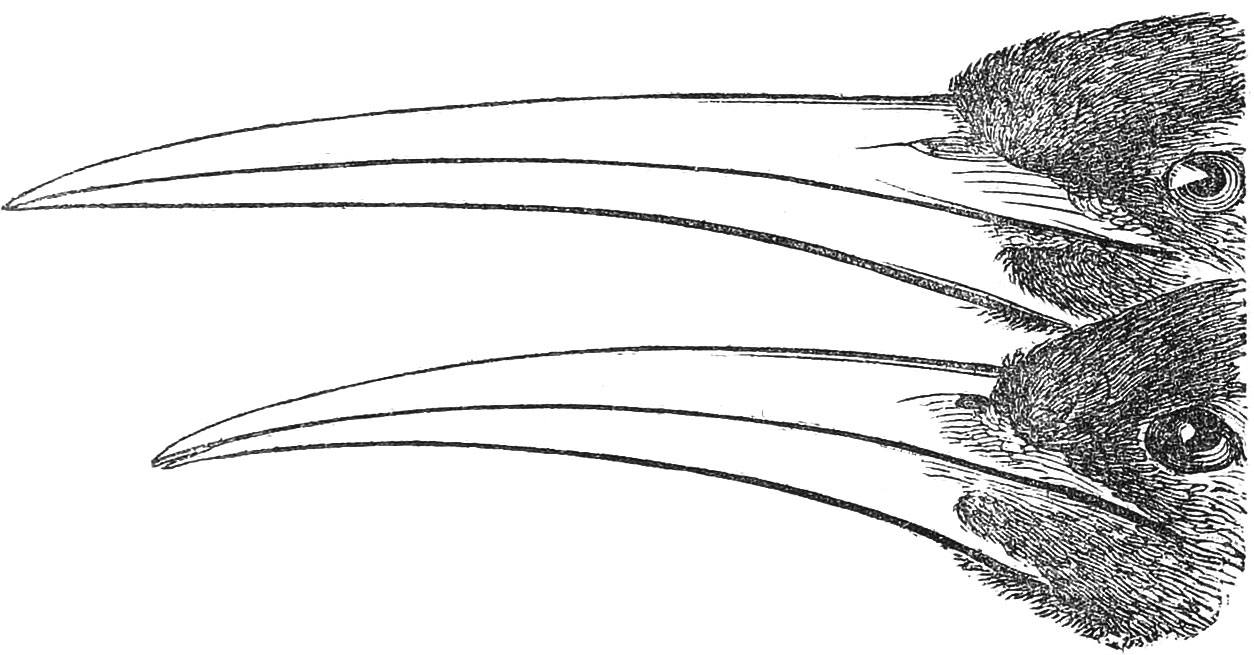
Bills of Senegal Promerops and P. erythrorynchos
It is also four-tenths of an inch shorter: the whole of the upper mandible is deep black, except the basal margins, just at the rictus and the base of the eulmen; which parts are bright red, without any appearance of this colour having extended further: the under mandible is black for about one-half its length, and red at the basal half; in the young bird the bill is entirely black, with the margins only of the gape red: the ground colour of the whole plumage, in the adult, is deep black, richly glossed with purple-blue on the chin, throat, upper neck, and wing-covers: in all the other parts of the plumage, which is glossy, the colour is dark greenish-blue, without any of that golden, or coppery-green, seen in P. erythrorynchos: the rump, belly, and under tail-covers, are deep black, and not glossy: two-thirds of the spurious quills are covered with a large oval white spot: the three first quills have a similar spot in the middle of their inner webs: but on the six next quills, the white spot extends also to the outer webs, while the three first secondaries have merely a small white spot on their inner webs: the tail is long and cuneated; the three outermost feathers have a double white spot near their tips (closer to each other than in erythrorynchos), and a single white spot on the outer web of the fourth pair of feathers, but there is none upon the middle pair: these latter, in some lights, have very little green, but are rich lilac, mixed with the blue.
The immature bird has the throat rufous brown, while, in what we consider as the female, the bill is half an inch shorter; that is, measuring only one inch and a half from the front.
Total length, with the tail, about 16\(\frac{1}{2}\) inches; bill, from the front, 2\(\frac{1}{10}\); from the rictus or gape, 2\(\frac{3}{10}\); wings, 5\(\frac{1}{2}\); tail beyond, 7; ditto, from the base, 9\(\frac{3}{4}\).
Little Pale-Winged Promerops
Promerops pusillus, Swains.
Black, glossed with purple; spurious wings and quills spotted with white; tail slightly rounded, immaculate; ends of the primary quills greyish white.
We can find no description in any modern author applicable to this singularly small species, which is not bigger than a lark, although its tail renders it much larger. Of those enumerated in Audubert and Vieillot’s splendid work on the Gilded-birds (Oiseaux Dorés), its nearest affinity is to the blue species, figured at plate 9; but that bird is very considerably larger, and has. none of those white spots upon the wings which are so conspicuous in the present species, neither is it enumerated in the Systema Avium of Dr. Wagler. In size and general appearance it makes a near approach to the Promerops purpuratus of Burchell;17 but the size is still smaller, and the bill, instead of being falcate, is very slightly curved. We may here remark, that we do not see sufficient characters in the proposed genus Rhinopomastes to allow of its separation from Promerops. In reference to what has been said of the form of its nostrils, it appears to us but a simple and a very slight modification of that exhibited in the last bird we have described, but more especially in this. In all three the aperture of the nostril is linear and pervious; the upper part is protected, in erythrorynchos, by a slightly prominent rim formed of the substance of the bill, but which is so thin, that when the bird is alive we suspect it is flexible; for in Senegalensis it actually is so, although, to a casual observer, it appears like that of the former species. Finally, in the bird now before us, this aperture of the nostrils is still narrower; and the horny lid, which is flexible, is so developed, that, when closed, the aperture can be scarcely seen. It perfectly accords, in short, with the figure given of Rhinopomastes in the Zoological Journal.
The bill of our present species, like that of all the typical Promerops, is considerably compressed, so that the culmen becomes almost carinated. The fourth and fifth wings are the longest, and the sides only of the tail are rounded; the six middle feathers being almost of equal length. The ground colour of the whole plumage is deep black, richly glossed with purple-blue on the head, neck, breast, and back; less so on the wings and tail, and not at all on the body. The primaries, near their base, have a transverse white spot, which does. not cross the outer web of the two first quills; besides these, the five first quills are crossed, at about an inch from their tips, with a shade of greyish-white, which crosses both webs, but which leaves the extreme tips brown: bill and legs horn colour.
Total length, 9 inches; bill, from the front, 1\(\frac{1}{4}\); ditto, from the gape, 1\(\frac{3}{10}\); wings, 3\(\frac{7}{10}\); tail, from the base, 5.
The young bird is brown from the chin to the belly, where the colour gradually becomes black.
Red-Breasted Sunbird
Cinnyris pulchella, Cuvier.
Golden-green; breast crimson, margined with yellow; the two middle tail-feathers, in the male, greatly elongated, and very narrow.
Certhia pulchella, Linnæus.—Cinnyris pulchella, Reg. Animal, i. 434.—Soui manga changeant á longue queue, Pl. Enl. 670, i.—De petit Soui manga a longue queue, Vieill. Ois. d’Or., pl. 40.—Le Sucrier cossu, Le Vaill, Ors. d’Afrique, vi. pl. 293, f. 1.
This well known and elegant little bird seems to be particularly common in Senegal, from whence great numbers have been recently sent to Europe as articles of commerce. This unusual importation has arisen from the demand for Humming-birds, and others of small size and rich plumage, in consequence of the fashion so prevalent with the fair sex, of decorating their hair with these splendid natural ornaments. Le Vaillant discovered this species also in South Africa, in the Caffre territories. He says it is only found in the large forests, where he was unable to discover its nest. Like others of its genus, the male loses its rich glossy plumes, and the two long feathers in its tail, after the breeding season, when it assumes the plumage of the female. The latter sex, as Le Vaillant observes, is of a grey-brown-olive above, and of a lighter tint beneath, which gradually inclines to dull white on the belly and under tail-covers; all the tail-feathers are rounded and equal. The male, in its full plumage, is entirely of a rich gilded-green, both above and below, except upon the breast, where there is a transverse patch of bright scarlet, shading off on all sides into pale straw-coloured yellow: the quills and tail are blackish-brown: the greater wing-covers the same; but those nearest the body are edged with green, the lesser covers being like the back: the tail is rounded, and of a boat-shaped form, and the bill and feet are black: the two middle tail-feathers extend two and a half inches beyond the others.
Total length, exclusive of the two middle tail-feathers, 4\(\frac{6}{10}\); bill, \(\frac{7}{10}\); wings, 2\(\frac{2}{10}\); tail beyond, \(\frac{6}{10}\); ditto, from the base, 1\(\frac{1}{2}\).

Plate XIV
Splendid Sunbird
Cinnyris splendida, Cuvier.
Glossy violet, with the back and elongated tail-covers emerald-green; breast with transverse interrupted lines of crimson; belly and vent black; hypochondriac feathers yellow.
Certhia lotenia, Linnæus.—L’Eclatant, Vieillot Ois. d’Or. pl. 2.—Le Soui manga a plumes soyeuses, Ib. pl. 82.—Le Sucrier eblouissant, Le Vaill. Ois. d’Af. vi. 295, f. 1.—Cinnyris lucidus, Traité d’Orn. 295.
The enthusiastic Le Vaillant might well be enraptured upon discovering this charming little creature, which is certainly the most splendid species in this group we have yet seen. It is difficult even to describe its colours, which change under almost every diversity of light; while to represent them is impossible. Metallic tints, which more especially belong to birds of the most dazzling plumage, are those which the painters art can least represent; and this is the true cause why birds so ornamented, more especially with different hues of dark blue, purple, or lilac, exhibit nothing of their true richness when attempted to be represented on paper. Our readers, therefore, must bear this fact in mind, and not consider that our plates belie our descriptions, or that the former are inaccurately or carelessly, done, because they do not justify the encomiums of the latter.
In regard to the Sunbird now before us, its description, setting aside its delineation, is somewhat difficult. Its head and neck may be called either purple, blue, violet, or lilac; for it changes to one or other of these tints according to the direction it is held in, whether to or from the light, whether viewed by the sun, or by a candle; in either case, the plumage is as glossy as polished steel, while those parts not illumined by the light become absolutely black. Such is the appearance of the crown, sides of the head, the neck, and the throat, to a little beyond the breast, where this colour is crossed by several narrow irregular lines of bright scarlet, something in the manner of the Senegal Sunbird, but less distinct: the lower half of the body, to the vent, is deep uniform black without any gloss: the upper plumage, from the interscapulars to the tail-covers, is of the most brilliant polished blue-green, one or other of which colours preponderate according to the light; but there is no golden or other tint intermixed: the same green is upon the lesser wing-covers and the under tail-covers. What particularly distinguishes this species from all others yet known, is the great prolongation of the upper tail-covers, which are quite as long as (and entirely conceal) the tail itself, the feathers of which are all even and blue-black: the wings, feet, and bill are solely black: the third, and two following quills, are all of the same length.
Total length, 3\(\frac{1}{2}\) inches; bill, from the gape, 1; wings 2\(\frac{1}{2}\); tail beyond, 1\(\frac{3}{10}\); tarsus, \(\frac{6}{10}\).
Lineated, or Senegal Sunbird
Cinnyris Senegalensis, Cuvier.
Front and chin emerald-green; throat and breast scarlet, transversely lineated with purple; body black; wings cinnamon-brown.
Certhia Senegalensis, Linnæus.—Cinnyris Senegalensis, Cuvier.—Le Soui-manga violet a poitrine rouge, Vieill. Ors. d’Or. ii. 8.—Le Sucrier-Protee, Le Vaill. Ois. d’Af. vi. pl. 295, f. 2.
This superb species is only inferior in richness of colouring to the last. It is probably one of the most common birds of Senegal, as scarcely any collection imported from that country does not contain several specimens; it is seldom, however, that these are in the fine and perfect plumage of the adult male.
Le Vaillant, who found this species also in Caffraria, relates a singular habit belonging to the male. It appears, that on ordinary occasions, when the bird is in his full plumage, the blue lines which cross the middle of the breast-feathers are scarcely seen, being held by the margins of the next range; but when he is desirous of attracting the attention of the female, he stretches out his neck, and, at the same time, raises these feathers in such a manner that these splendid blue and purple lines become suddenly displayed in all their beauty.
As we fortunately possess this species in three different stages of plumage, we shall briefly describe each, since they differ so materially that no ornithologist, unacquainted with the peculiar characters of this group, would suppose them the same.
In the first, which is either the female, or a young male of the first year, all the upper plumage is hair-brown, with the chin, ears, and sides of the neck, the same: the middle of the throat is blackish, bordered on each side with a stripe of fulvous white: each of the breast-feathers is tipt by the same light colour, which increases, and occupies the middle of the body, the belly, and the whole of the under tail-covers: the wings and tail are of the same colour as the back.
In the second, which is obviously a male beginning to assume its summer plumage, the upper plumage is like the last, that is, uniform hair-brown; but some of the feathers of the crown are tipt with shining green, and the chin is entirely so: the whole of the neck is scarlet, lineated with dark metallic blue-green; but these colours reach only as far as the breast, which, with the middle of the body and vent is fulvous white, spotted irregularly with brown.
The third is a most beautifully perfect specimen of the adult male in full plumage. The ground colour of the upper plumage, which was light brown before, is now of a uniformly deep velvet-black; the wings and tail being snuff-coloured, or of a cinnamon-brown: the crown is covered by an oval patch of shining emerald-green; and there is a similar one on the chin and base of the lower mandible, which leaves the ears and sides of the head black: the fore-neck, down to about the middle of the body, is rich scarlet, crossed with lines of steel-blue, reflecting purple and violet: these lines are more crowded on the throat, and seem gradually to become more indistinct where the crimson terminates: in some lights the throat is so glossed with purple, that the crimson is hardly seen: the lower part of the body, and the whole of the remaining under plumage, is of the same velvetty-black as the upper parts: the lesser wing-covers are blackish-brown: the tail is even, and the third quill is the largest.
Total length, 5 inches; bill almost 1; wings, 2\(\frac{1}{2}\); tail beyond, \(\frac{7}{10}\); ditto, from the base, 2; tarsus, \(\frac{6}{10}\).
Fire-Backed Sunbird
Cinnyris erythronotus, Swains.
Head, neck, and breast, copper coloured; lesser wing-covers; back, and rump, red glossed with purple; wings, tail, and body beneath, deep black.
Le Souï-manga rouge-doré, Vieill. Ois. d’Or. ii. 60, pl. 27.—Certhia rubro-fusca, Shaw, Auctorum.
We have very little doubt that the bird we shall now describe is the same as that, above referred to, in the splendid work of M. Vieillot; the description there given, although very short, is quite applicable, when it is considered, that the only specimen he saw had been injured by time and fumigation. Dr. Shaw merely copies Vieillot’s account, and gave the bird the scientific name of rubro-fusca, an appellation quite erroneous, since there is no brown whatever in the plumage; the true colour of the body, wings, and tail, being deep black. Two fine specimens, sent from Senegal, enables us to describe its colours when in perfection.
In size, this is the smallest species of any contained in our list, for it measures only four inches and three-quarters; it is also the only one which does not possess any tinge or shade of green. Negative characters of this sort, particularly in such a genus as this, are very often better than others of a positive nature. The whole of the head, the neck, and the breast, is of a dark glossy copper-red colour, with a slight gloss of lilac-purple on the throat and breast: this copper-red extends’ down the upper part of the neck on to the interscapulars, where it gradually becomes more lilac, or, in other words, the coppery gloss diminishes and the lilac increases, and so continues down the whole back, and is terminated only by the upper tail-covers, which are tinged with an amythistine purple: the lesser wing-covers are like the rump, but the colour terminates in amore purplish tinge than is seen in any other part of the bird: the whole of the remainder plumage, from the breast to the vent, including also the tail and wings, is of the deepest black: bill and feet the same.
Total length, 4\(\frac{3}{4}\) inches; bill, from the gape, \(\frac{8}{10}\); wings, 2\(\frac{3}{10}\); tail beyond, 1\(\frac{1}{10}\); ditto, from the base, 2; tarsus, \(\frac{6}{10}\).

Plate XV
Red-Collared Sunbird
Cinnyris chalybea, Cuvier.
Green gold; breast with a double collar of blue and crimson, the sides yellow; body beneath, grey; upper tail-covers; greenish-blue.
Certhia chalybea, Linnæus, Auctorum.—Cinnyris chalybea, Zool. Illust. 1st Series, pl. 95.—Le Souï-manga à collier, Vieill. Ois. d’Or. ii; pl, 13, 14.—Collared creeper of authors.
This beautiful species, easily distinguished by its two collars, one of blue the other of red, we have already figured in the first series of the Zoological Illustrations; and we are glad to perceive that the nomenclature, there recommended, for the different groups of this family, have been universally adopted by our best ornithologists. The present species, which is a typical Cinnyris, appears to occur both in Western and Southern Africa; but it must not be confounded, as has recently been done, with the Sucrier à plastron rouge of Le Vaillant, an error which, from having been pointed out more than fifteen years ago, we did not expect to see revived. It was probably Le Vaillant’s bird which Barrow mistook for Linnæus’s chalybea; of which he says that it sings delightfully in the cage, where it is kept with difficulty, existing entirely on sugar and water.18 We know of no other author who mentions this extraordinary fact, the only instance on record of a tenuirostral bird being gifted with a musical voice.
In size, this species is rather smaller than the C. Senegalensis. The whole of the head, neck, throat, and back is shining green, with a rich gilded gloss: this colour is bounded, on the breast, by a narrow collar of blue, which has a very slight greenish tinge: and this, again, is followed by another of scarlet a little broader, and extending more round the sides of the breast: there is also a tuft, under each wing, of pure yellow feathers: the rest of the body and under plumage is of a smoky brown, paler on the vent and under tail-covers: the upper tail-covers are banded with greenish-blue, nearly of the same tint as the band on the breast: the wings are brown; and the tail, bill, and feet, blackish.
Total length, 5\(\frac{1}{4}\); bill, \(\frac{9}{10}\); wings, 2\(\frac{2}{10}\); tail, from the base, 2; tarsus, \(\frac{6}{10}\).
Amethyst-Throated Sunbird
Cinnyris amethystina, Cuvier.
Black; front, shining green; throat, rump, and spot on the wing-covers, amethystine red.
Certhia amethystina, Auctorum,—Le Sucrier Velours, Le Vaill. Ois. d’Af. vi. pl. 294, f. 1.—Le Souï-manga á front doré, Vieill. pl. 5, 6.
It peculiarly difficult, in a group like the present, where the species are nearly all decorated with many and changeable colours, to convey, by mere words, a correct idea of their respective peculiarities. In the present instance, however, we have one of the very few exceptions which the Sunbirds present against this remark. It might, with equal propriety, be called the Black Cinnyris, for it is the only species yet discovered whose plumage is chiefly of that colour. It seems to inhabit both the western and southern parts of Africa; for we have seen several specimens from Senegal, and Le Vaillant mentions having found it, in different stages of plumage, in the Anteniquoi country and near the river Gamtoos. After the breeding season, the male assumes the dull olive-coloured plumage of the female, but retains its green front and amethystine throat. Le Vaillant affirms that he found its nest, built in thick bushes, or in the holes of trees; and that it lays six grey eggs, spotted with olive-green.
The general colour of the adult male is deep velvet-black, without any gloss or variation of the tint, except on the wings and tail, which are lighter and inclined to brown: the fore half of the head is of a rich emerald-green, glossed with golden; while on the chin, and half way down the middle of the throat, there is a large patch of changeable amethystine purple: this splendid colour is also on the tips of the upper tail-covers, and forms a spot at the angle of the carpal joint of the wing: the female we have not seen: the bill is more than usually curved.
Total length, 6\(\frac{2}{10}\); bill, 1\(\frac{2}{10}\); wings, almost 3; tail beyond, \(\frac{3}{4}\); ditto, from the base, 2; tarsus, \(\frac{7}{10}\).
Olive-Backed Sunbird
Cinnyris ehloronotus, Swains.
Body above, olive-yellow; beneath, cinereous grey; head, throat, and breast, glossy blue-green; side-feathers of the breast, straw-yellow.
Le Souï-manga a tête bleue, Vieillot, Ois. d’Or. ii. p. 31, pl. 7.—Certhia cyanocephala, Auctorum.
The great importance of affixing to the species of so Intricate a group as this is, such specific names only as will assist in discriminating them, is one of the reasons why we do not adopt that of cyanocephala in the present case; another is, in the doubts we have asto the propriety of considering the Souï manga a tête bleue of M. Vieillot, and the S. M. vert et gris of the same author, as one species. Added to this, there are nearly twenty Sunbirds to which the name of cyanocephalus will apply; while this is the only one we at present know of, whose upper plumage, in an adult state, is green.
The size is about equal to that of the red-collared species already described. The whole of the head, neck above, and the throat, as far as the breast, is of a dark glossy blue-green; this colour terminates before it reaches the interscapulars, which, with the remainder of the upper plumage, is olive-green, over which there is a strong tinge of yellow, without any of that metallic gloss seen on the head and neck: the side-feathers on the breast, just beneath the wing, are of a clear and delicate straw-yellow, while the whole of the body, belly, vent, and under tail-covers are of a deep and uniform cinereous-grey: the quills and tail-feathers are dark hair-brown edged with yellowish olive.
Having a specimen of the Souï manga vert et gris of Vieillot now before us, we shall describe it, although we know not the country from whence it came. It differs from the above in being somewhat smaller, and in having the bill apparently less curved: the olive on the back is not so yellow: the shining green plumes of the head do not extend so low down from the nape, and they terminate on each side of the head just below the ears: the whole colour of the under plumage, from the chin downwards, is of a clear and uniform cinereous, unbroken, as in all full plumaged birds, by any mixture of other coloured feathers, and without the slightest trace of any spot of green upon them. Now this may either be the full plumaged female, or a different species; in which latter case it may retain the name of Cyanocephalus: but we are clearly of opinion that it is not a young male.
Total length about 5 inches; bill from the gape, \(\frac{9}{10}\); wings, 2\(\frac{3}{10}\); tail beyond, \(\frac{1}{2}\); ditto, from the base, 1\(\frac{7}{10}\); tarsus, \(\frac{6}{10}\).

Plate XVI

Little Yellow-Bellied Sunbird
Cinnyris pusilla, Swains.
Above copper-green, beneath yellow; front, chin, throat and breast, purple-violet; throat with a green band; upper tail-covers blue-green.
Our description and notice of this diminutive species, which only measures four inches, must be shorter than we could wish; we have not a specimen before us, and we can therefore only transcribe the short account we drew up of one in the Chatham Museum, sent there with many other birds from the Gambia. It is a very small typical species, with the tail rounded on the sides and slightly forked in the middle: the bill is much curved and greatly compressed, and the fourth and fifth quills are longest: across the throat is a collar of copper-green, from which part, to half way down the abdomen, the colour is rich violet, but ending in blackish: all the remaining under plumage is clear straw-yellow: side-feathers pure yellow tipt with bright orange-red: wings brown: tail glossy blue-black edged with shining blue-green.
Total length, 4 inches; bill, \(\frac{7}{10}\); wings, 2\(\frac{1}{10}\); tail beyond, \(\frac{6}{10}\); ditto base, 1\(\frac{1}{2}\); tarsus, \(\frac{1}{2}\).
The last group of the suctorial family which belongs to the Ornithology of Western Africa is one of very peculiar interest—it is that of
Anthrepetes
a genus first defined in the Appendix to the Northern Zoology, and which until then had been confounded with that of Cinnyris. The discovery of this form has completed the circle by which the types of the Cinnyridæ, or Honey-suckers, return into themselves; or, in other words, the connexion of all the divisions among themselves is completed. As we have only glanced at this beautiful chain of affinities on a former occasion, we shall take this opportunity of illustrating it more completely, more especially as our observations, having a wide circulation in this work, may call the attention of ornithologists particularly to the subject, and induce them to increase our present meagre list of this group, by separating those species of Anthreptes which are at present confounded with the genuine types of Cinnyris. or this purpose, and to render the distinctions of the two perfectly intelligible without the aid of technical language, we will call the attention of the student, in the first instance, to the bill of a genuine Cinnyris. He will perceive that the under mandible, even from the base, is remarkably thin; so much so, indeed, that when the mouth of the bird is shut, the basal marginal edges of the upper mandible fold over those of the lower, so as to leave merely a very narrow stripe of it exposed. Let him then take a species of Anthreptes and the following differences will be observed: independent of the bill being stronger, thicker, and less curved, he will perceive that the under mandible, for its whole length, is not thinner than in the generality of birds, while at its base it is near doubly as thick as it is in the middle. No character can be more tangible or better understood than this; and we have now to show how birds having this structure are connected on one side and on the other.
The immediate affinity of Anthreptes to Cinnyris is too obvious to be insisted upon; seeing, as we before remarked, that all ornithologists have confounded the one with the other. From Cinnyris we pass on to the genus Melithreptes of M. Vieillot, the species of which are still mixed up with those of Cinnyris by some of our best writers; a fact which at once shows how closely they are connected. Following Melithreptes comes the genus Diceum of Cuvier, which bears such a close affinity to the next group, or Nectarinea, that they have been, and still may be, mistaken for each other. Cuvier himself, indeed, does not appear to be aware of the true discriminating characters of his own genus. The bill in this group is at its minimum size; hence it is, that among the American Nectariniæ we find some with the short bill of Diceum, as N. cæruliocephala, and others with long and curved bills, as N. cyanea, &c.; by the first of these modifications in the bill, the passage is opened from Diceum to Nectarinea, while by the latter the union is no less perfectly affected between Nectarinea and Anthreptes. In both these latter, the form of the bill is very nearly the same, for however they differ in other respects, the under mandible of both possess that strength of structure we have already explained, and which at once separates both groups from the type of the whole family, Cinnyris.
Such are the affinities of the primary groups or genera of the family of sunbirds, the detailed characters of which will be given in our general introduction to this science.19
The geographic distribution of these genera is altogether peculiar, each being no less characterized in this manner, than. by its particularity of structure. Cinnyris is entirely confined to the Old World, and seems to have its metropolis within the tropics of Africa and continental India. Anthreptes, from what we yet know, is very rare in Africa, where one species only has been discovered; nor are we yet acquainted with any from continental India. In the islands, however, of that ocean, laying between the Asiatic and the Australian range, nearly all those with which we are yet acquainted are found. Nectarinea belongs exclusively to South America, and it may be called a tropical genus. The range of Diceum is between that of Nectarinea and Anthreptes; that is to say, it lies between South America and continental India; so that Australia, including New Holland, is its more particular abode. Last of all, and quite different from either of the preceding, comes Melithreptes, a group especially restricted to the islands of the Pacific Ocean, where none of the other genera of this family, so far as our knowledge extends, have yet been discovered. The circle of the Cinnyridæ being thus established by the affinity of the different groups to each other in the order in which we have arranged them, let us now see what analogies result therefrom; and let us examine whether our proposition, that the primary types of the feathered creation follow each other in a definite series, is verified in this, as it has been in numberless other instances. The value of a theory, in fact, whether in this or in any other branch of physical science, must eventually be brought to bear upon the minute details of that science; and by these details it will either stand or fall. It is idle to talk of some of the analogies being remote, and therefore tending to invalidate the theory itself. If some affinities are more remote than others, which every man of common understanding knows to be true, it follows, as a necessary consequence, that some analogies will also be more remote than others; for both are no other than different sorts of resemblances, The resemblance of a European to an African is more remote than that between a European and a North American Indian; and both these are exceeded in remoteness by the resemblance which a man has to a monkey. The first are resemblances of affinity, the latter one is of analogy. These same varieties which we find in the degrees of affinity exist in the degrees of analogy; of this we shall now give a proof. In the following table we shall compare the genera of the Cinnyridæ with the tribes of the Insessores, or Perchers; which tribes, as every ornithologist already knows, represent the orders of birds, and consequently the, five primary types of vertebrated animals.
| Genera of the Cinnyridæ | Analogical characters | Tribes of the Insessores |
|---|---|---|
| Cinnyris | Pre-eminently typical of their respective circles, bill lengthened | Conirostres |
| Anthrepetes | Base of the under mandible thickened, bill shorter and stronger | Dentirostres |
| Nectarinea | Bill short, wings considerably lengthened, the first quill long | Fissirostres |
| Diceum | Bill broad at the base, but very narrow beyond; wings long; legs very weak | Tenuirostres |
| Melithreptes | Bill very strong, the nostrils corneous, feet large and strong | Scanscores |
The conirostral birds (Conirostres) are well known to be the types of the whole of the Perchers, just as Cinnyris is of its own family; and both consequently represent each other. One of the characters of the Dentirostres is to have the bill in the large majority of the birds composing it much stronger, and, at the same time, shorter than that of the Conirostres. This is precisely the character of Anthreptes, as already explained, in its relation to Cinnyris: and in these two groups (Anthreptes and Dentirostres) we have the common character of a superior strength in the under mandible to what we find in the two first groups. The greatest powers of flight, as we have stated in our propositions on the primary types of nature, are always found in the Fissirostral division. In proof of which we now instance Nectarinea in one column, and the swallow tribe (Fissirostres) in. the other; in which, unlike their respective congeners, the wing is so much developed that the two first quills are of equal length, and longer than the others. Passing on to the next analogical resemblance, that between Diceum; and the Tenuirostres, we find that it verifies our assertion, that the most diminutive size always occurs in the Tenuirostral type, joined with a peculiar slenderness of bill. Now the bill of the Humming-birds is well known to be the most slender of all the Insessores. And such is truly the case with Diceum; for although it is short, yet, considering the stoutness of its base, the remainder of it is more slender in proportion than any other of the Cinnyridæ. The wings, although equally long, perhaps, in proportion as those of Nectarinea, are yet very differently formed, for instead of being pointed they are rounded. The well known Nectarinea flaveola is so very like a Diceum that it may be considered the link between the two groups. Nevertheless, the analogies of Diceum are certainly more remote than any of those we are illustrating; thus verifying what we have always insisted upon in regard to the Tenuirostral type, namely, that as it is the most removed in affinity, so is it the most remote in its analogy. As we return to the pre-eminent type from whence we commenced, so do these two resemblances proportionally increase. Thus we observe in Melithreptes the most unequivocal indications of the Scansorial, or rather the Rasorial structure, in the very strong bill and elongated feet. The Hook-billed Melithreptes and two other species are complete representations of the Sickled-winged Creepers (Dendrocolaptes), the Promerops, and the Bee-eaters. Our circle has therefore been traversed, and we find that it not only is verified by the affinities of the groups themselves, but that these groups, when analogically compared with other groups, produce that precise order or series of analogies which we have long ago declared to be universal throughout nature.
Having thus brought our exposition of this interesting genus to a close, we shall proceed to describe the only species yet found in Western Africa by the name of the
White-Bodied Sunbird
Anthreptes leucosoma, Swains.
Throat and body beneath pure white; chin and upper plumage glossy violet-purple; rump with an emerald-green spot; wings brown.—Male.
Cinnyris Longuemarei, Lesson, Ill. de Zool. pl. 23.
Chin, throat, and breast white; body yellowish; upper plumage olive-grey; tail and upper-covers shining purple.—Female.
The upper plumage of this species offers a very striking contrast to the under, both in the male and the female; but the colours of the sexes are so different that we shall describe each separately, fine specimens of both being now before us, sent from the Gambia. We have seen another pair belonging to the Chatham Museum, but the species is by no means common.
In the male the whole of the upper parts of the head, neck, back, rump, and tail-covers, are of a most rich and brilliant mazarine-blue, highly glossy, but reflecting no other tint than lilac: on the rump is a small spot of blue-green, but this colour is not seen in any other part of the plumage: the purple colour extends to the first range of the shoulder-covers, but all the rest of the wing is. of a sepia-brown, inclining to fulvous on the margin of the quills: the tail is black glossed with purple, but not so rich as that of the back: the chin is glossy purple like the upper plumage, but its commencement is dull black: the sides of the head and neck are brown: all the under parts, from the chin, are of the purest white: the side-feathers beneath the wing are clear yellow.
In the female the colours differ so much that it might be taken for a different species. The brilliant purple on the head and back of the other sex is exchanged, in this, for an olive-grey, over which however there is a delicate gloss of violet: the tail-covers alone retain the rich purple of the other sex: the tail also is of the same dark purple: the chin and throat are pure white, but this gradually changes on the body to a straw-coloured yellow: the side-feathers are likewise of the same colour: the bill and feet in both sexes are brown: in the female there is a whitish line over the eye. There is some slight differences in structure worth noticing between this species and those from the Indian islands: the bill is of a stronger make and a straighter shape; it is also less compressed on the sides and broader at the base. The nostrils in this genus are precisely the same as in Cinnyris and Diceum.
Total length, 5\(\frac{1}{2}\) inches; bill \(\frac{8}{10}\); wings, 2\(\frac{8}{10}\); tail beyond, 1\(\frac{2}{10}\); ditto from the base, nearly 2\(\frac{1}{2}\); tarsus, \(\frac{6}{10}\).
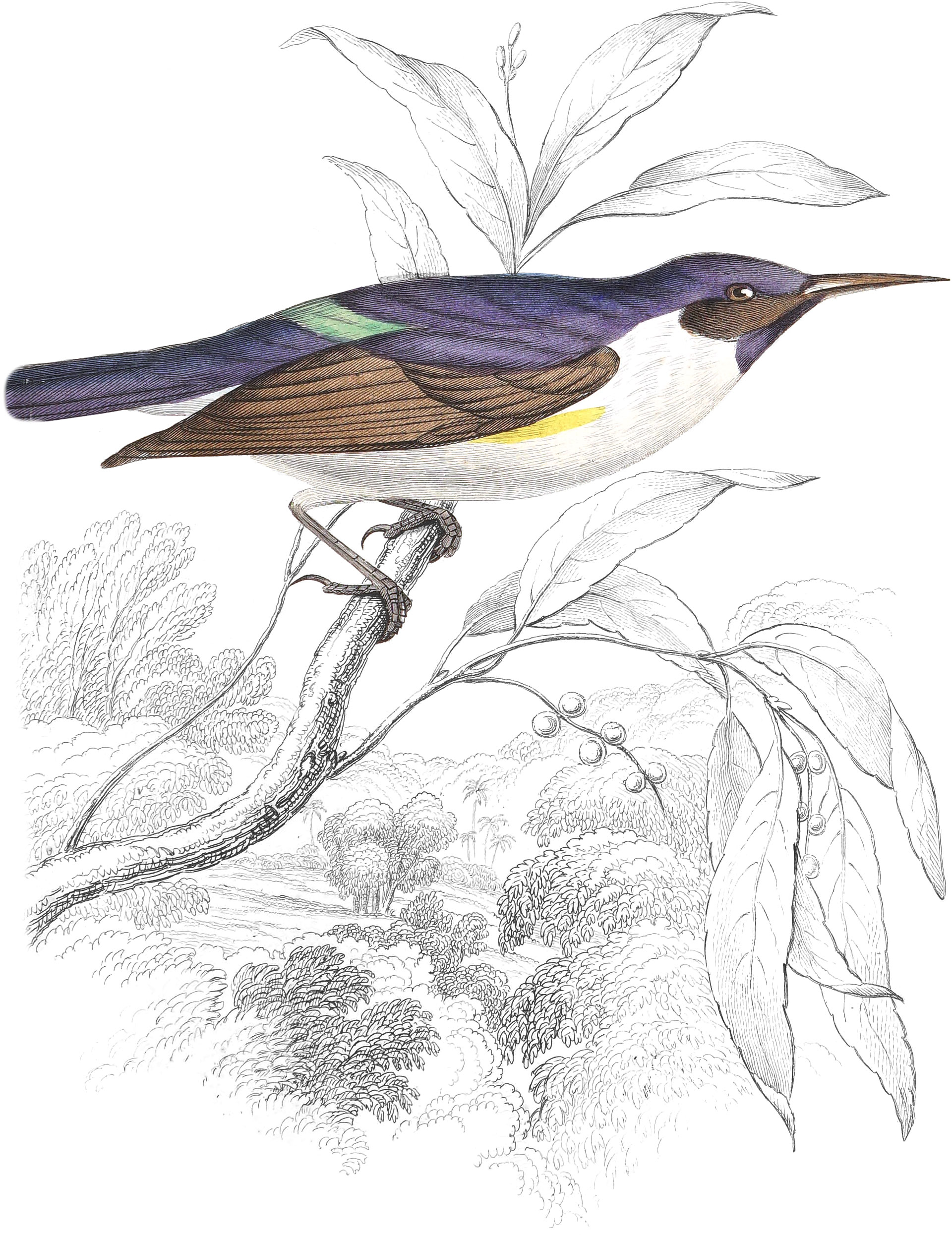
Plate XVII

We now, in the natural order of succession, arrive at the Scansores, or Climbing Perchers, the last tribe of the great order Insessores. The Scansorial families of Western: Africa consist of the Picidæ or Woodpeckers, the Pittacidæ or Parrots, and the Cuculidæ or Cuckoos. Of the two others, the Creepers and the Toucans, no examples have yet occurred. We commence with the extensive family of
Picadæ, or the Woodpeckers
The ornithologist will find so full an exposition of the natural divisions of this family in two of our preceding works,20 that in a local fauna like this these details need not be recapitulated. On such groups, however, as occur in this part of Africa we may advantageously introduce a few remarks. It will be seen from what we have already stated regarding the circle of the pre-eminently typical wood peckers, that there are two genera standing at its confines which lead different ways. One of these is the genus Dendrocopus of Kock, composed of the small and middle-sized black and white woodpeckers so common in temperate latitudes: these are at once known by their peculiarity of plumage, their short and thick neck, elongated hind toe, and somewhat depressed bill, the angles of which are close to the margin of the upper mandible; this sub-genus leads directly to the swallow-woodpeckers, forming the genus Melanerpes. The other group at the opposite side of the circle we have named Dendrobates, and its geographic distribution, no less than its distinguishing colours, are in direct opposition to those which are so universal in the last. The situation of the lateral ridge on the bill, and the relative proportion of the two principal toes, are indeed the same as in Dendrocopus; but the middle part of the bill, instead of being broad above, has the sides considerably compressed, so that the bill is higher beyond the nostrils than it is broad. None of these birds inhabit the same latitudes as the Dendrocopi; on the contrary, they only occur in intertropical regions, and although we have one species from the New World (Dendrobates affinis21), yet all the rest we have hitherto seen are from Africa and India: the grey-headed woodpecker of Southern Africa (Picus Capensis of authors) is one of the types. In this, and in nearly all others we have seen of this division, the ground-colour of the plumage is olive, and the under parts are almost always banded or spotted: so uniformly constant is the style of colouring in these two groups that they may be determined at once by the most inexperienced student, It is to this latter group, in short, that we now have to call attention, since three of the species we are about to describe belong to it; some are more typical indeed than others, a variation which is highly interesting, since it is by such aberrant species,—which writers are continually mistaking for subgenera,—that the gradations in the chain of being and the union of different forms of structure are effected. Without these, in short, the progressive developement of a change in structure could not be accomplished.
Black-Bodied Woodpecker
Hemicireus rubiginosus, Swains.
Above chestnut-red; beneath blackish brown; head brown; spot on each side the nape, crimson; bill yellowish; tail very short.
The only specimen we have ever seen of this exceedingly rare species was purchased with a number of other skins, all of which were from Western Africa. We therefore conclude this was from the same locality, although its geographic habitat does not rest on the same sure foundation as that of the majority of birds described in these volumes.
The size is superior to that of the Picus Capensis of authors (Dendrobates Capensis), but the extreme shortness of the tail brings it only to the same length as that bird; this peculiarity likewise distinguishes the Dendrobates fulviscapus, or the little gold-winged woodpecker of the Cape, with which, in several points of structure, our present bird has a close affinity; the wings, however, are more rounded, without being short, so that the secondary quills are scarcely half an inch shorter than the primaries. The hinder toe is longer than the anterior, and the bill beyond the nostrils is much compressed.
The colouring is very peculiar, the fore part of the head, cheeks, ears, and chin, are of a light hair-brown, having a fulvous tinge; the crown is darker; on each side of the nape, behind the ears, there is a patch of dark and bright crimson, which colour tips the outer half of the feathers only; the rest of the upper plumage is of the darkest brick red, particularly on the wings, the feathers of which are obscurely marked with lighter bands. The covered parts of all the quills, when the wing is closed, are blackish-brown; and the paler bands upon them, generally six, are on the outer webs; on the tertials, however, they are equally light on both webs. The tail and the upper covers are blackish, obscurely marked with pale bands similar to those on the wings, but they are almost obliterated on the rump, and entirely so on the back and interscapulars. The whole of the under plumage is of a uniform brownish-black excepting the chin, which, like the ears, is hair-brown. The bill seems to have been yellow, and the legs dark green.
Total length 8\(\frac{1}{2}\); inches; bill, from the gape, 1\(\frac{4}{10}\); wings, 4\(\frac{4}{10}\); tail beyond, 1\(\frac{1}{4}\); ditto from the base, 2\(\frac{1}{2}\).
Unspotted Grey-Eared Woodpecker
Dendrobates immaculatus, Swains.
Plumage unspotted; above olive green; beneath greyish-olive; sides of the head, ears, and chin, clear cinereous; crown and rump crimson.
The locality of this very distinct species partakes somewhat of the uncertainty of the last, nor have we been able to get any information respecting it. We possess but one specimen, the only example we have yet met with, and it does not appear to be described by any author.
In size and general proportions it differs much from the last, particularly in its tail and wings, both of which are unusually long. It is a slender-shaped bird, and nearly of the size of Dendrobates poicephalus. It may be known at once by its plumage being devoid of any external spots or bands, for, unlike others of its family, the white spots on the quills, of which there are five, are on the inner web alone, and can only be seen when the wing is expanded. In all other respects its structure is strictly typical.
The front, the sides, and the nape of the neck, as also the chin and ears, are of a full and somewhat clear lead colour, or cinereous; and this tint is the ground of all the remaining under plumage, which has nevertheless a strong tinge of olive-green on the breast and middle of the body. The crown of the head, as far as the nape, as also the rump and upper tail-covers, are crimson: the interscapulars, the back, and the external surface of the wings, are all of an olive-green. The quills and tail-feathers are black, edged only with olive. The primary quills have about six white transverse spots placed at the external edge of their inner webs, and situated towards the base, leaving one-third of their extremities entirely black; the inner wing-covers are marked with black and white; the tail-feathers are entirely blackish brown, edged only with obscure olive: bill and legs horn colour.
Total length 7\(\frac{3}{4}\) inches; bill from the front, \(\frac{9}{10}\); wings, 4\(\frac{3}{10}\); tail beyond, 1; ditto from the base, 3\(\frac{1}{2}\); the second quill is intermediate between the seventh and eighth.
Grey-Headed Olive Woodpecker
Dendrobates poicephalus, Swains.
Olivaceous fulvous, rump crimson; head and neck entirely light grey, but with the crown and nape, in the male, crimson.
The geographic range of this woodpecker is entirely restricted to Western Africa, where it fills the place of the Dendrobates Capensis, figured by Le Vaillant under the name of Le Pic Olive. The two species, in fact, are so much alike, that all writers have confounded them; and but for the inspection of authentic specimens of the South African species, in Dr. Burchell’s collection, we should have run into the same error. D. Capensis, however, is at once distinguished by having the whole of the neck, from the nape and chin, rich olive-yellow, and being destitute of all external spots or bands on the lesser quills and scapulars.
From having no marks or spots whatever on the under plumage, nor none, save the red crown of the male, to break the delicate grey on the head and neck, this species is readily distinguished. The grey of the head and neck is uniform and remarkably light: on the breast it begins to have a slight tinge of olive, or rather fulvous, which tint is continued all over the remaining under parts. At the bottom of the neck above, the grey is softened into an olive yellow without any mixture of green; this spreads uniformly over the back and wings; the quills are light brown, crossed and spotted with fulvous white; the rump and upper tail-covers, in both sexes, are crimson. In the male there is a rich crimson patch, commencing on the middle of the crown and extending to the nape; the tail is dark brown without any bands, except some whitish spots on the inner and outer margins of the two last pair of external feathers; bill and legs, horn colour. The form is typical of this sub-genus, the lateral ridge being nearest the margin; the bill is rather higher than broad, and the hinder toe longest.
Total length about 8 inches; bill, front, 1; wings, 4\(\frac{3}{10}\); tail beyond, 1\(\frac{1}{2}\); base, 3; tarsus, \(\frac{6}{10}\); hind claw, \(\frac{8}{10}\).
Chrysoptilus
With the last sub-genus we quit the circle of the pre-eminently typical woodpeckers; those, in fact, which from having the hinder toe longer than the. foremost, are endowed with the greatest power of climbing. The next genus is Chrysoptilus, in which this proportion of the toes is not found; that is to say, the hinder toe is not longer than the corresponding one in front; there are other characters, such as the gentle curvature of the culmen, or ridge of the bill, which, in the last genus, is always perfectly straight. The lateral angle of the upper mandible, instead of being close to the margin, as we have seen in Dendrobates, is now either a little way removed from the culminal ridge, or it is quite close.
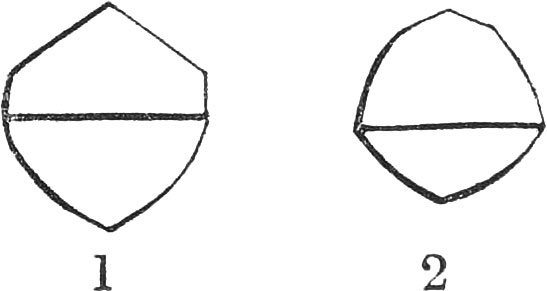
Chrysoptilus Bills
Now, the relative powers of picking holes in trees, which all these birds possess in different degrees, is always determined by the position of this singular angle. In those birds, which are proverbial for their superior powers in this respect, the angle we are speaking of is acute, and is nearer to the margin than to the top of the bill, which thus assumes the form of a sharply angulated wedge (1), so that, but for these angles, the bill would be cylindrical; every mechanist knows the superior power of a wedge formed with acute angles over another where the angles are obtuse (2). Hence it follows, that the different sub-genera of Chrysoptilus are much inferior in the power of breaking wood to those of Picus. Some, in fact, frequently feed upon ants. They are clearly, therefore, an inferior race, and constitute the sub-typical genus of the family.
And yet, although the characters of the Chrysoptili, as a whole, will always prevent them from being confounded with any other genus; the sub-genera, or types of form, require much more study than we have yet been able to give them. It is very clear, however, that the group we shall now enter upon is very distinct, not merely from Dendrobates, but from the mere typical examples of Chrsoptilus. The lateral ridge of the upper mandible, in the common green Cayenne Woodpeckers, all of which are middle sized birds, is so close to the culmen as almost to join it, while in the other species from South America, it is nearly obsolete. In Dendromus on the contrary, this ridge is almost half way between the culmen and the margin, although always nearer to the former, and not, as in Dendrobates, to the latter; this character, added to the superior length, however slight, of the anterior toe, will readily enable the ornithologist to discriminate Dendromus from its more immediate allies. Having now attempted to explain, in a familiar manner, the little group to which the remainder of our African woodpeckers belong, we shall at once proceed to the species.
Golden-Tailed Woodpecker
Dendromus chrysurus, Swains.
Above olive-grey, spotted and banded with whitish; beneath fulvous-white; striped on the body and spotted on the throat with black; male with the upper part of the head and maxillary stripe crimson; female with the front and crown blackish, and unspotted; shafts of the tail-feathers golden-yellow.
It is exceeding difficult to discriminate species whose chief distinctions rest on the pattern of the spots upon their plumage. The one we shall now describe has a general resemblance to two or three others, such as the Picus notatus of Lichtenstein (Pic tigré, Le Vaill. vi. 250), and the Picus Nubicus of authors. It is, however, clearly distinct from either: the female has no white spots on the crown as in Le Vaillant’s Pic tigré, and the Nubicus of Lichtenstein will be subsequently described.
In structure this is a perfectly typical example of the sub-genus Dendromus: the lateral ridge of the bill is nearer to the culmen than to the external margin; and the two principal toes, if not equal, are very nearly so; if there is any difference the hinder one is a trifle shorter.
Both sexes of this species are now before us. The male has the top of the head from the front to the nape crimson, the occiput being crested: the general cast of the upper plumage is of a cinereous-olive, varied with short transverse bands and spots of an olive-white: each of the underscapular feathers has one band and a terminal spot: the wings, are the same, but with a fulvous tinge; and each quill feather has from five to six spots on the margin of the outer web, and their shafts are brownish-yellow: the tail-feathers are yellowish-brown with about six bars, interrupted only by the shafts, which are of a bright golden-yellow, while the inner surface of the shafts of the quill-feathers is the same, but paler: the sides of the head, ears, and chin are white spotted with black; the male has a red maxillary stripe not seen in the female: the ground colour of the under plumage is white, tinged with yellowish in the male: each feather from the breast downwards has a double stripe of black down the shafts, of this form; but the upper spot is not seen on the feathers of the body and belly; the female has the belly and vent almost unspotted: bill and feet blackish: the black spots on the middle of the throat are largest, and are almost round, while those on the flanks assume the appearance only of narrow stripes: the tips of all the tail-feathers are golden.
Ear
Total length 8 inches; bill from the gape, 1\(\frac{1}{10}\); wings, 4\(\frac{2}{10}\); tail beyond, \(\frac{7}{10}\); ditto from the base, 3; tarsus, \(\frac{13}{20}\).
Short-Billed Woodpecker
Dendromus brachyrynchus, Swains.
Above olive-green; beneath banded with black and white; front and crown crimson.
It is fortunate that the unusual shortness of the bill enables us to impose a name upon this apparently new bird, which at once expresses its peculiar character: this is the more desirable, since it has such a close resemblance to a bird of another group (the Picus affinis of the Zoological Illustrations, now the Dendrobates affinis), that it might readily pass, upon a cursory examination, for that species; both are olive above and banded beneath; both are small, and both have red crowns. The bills, however, are totally different, not only in size, but in that structure which separates the two subgenera of Dendrobates and Dendromus. It would almost seem, in fact, that the passage from one to the other was actually made by these two birds.
Upper bill very short, not exceeding six-tenths of an inch from the front; the lateral ridge near, but not close to the culmen: the gonys, or middle ridge of the under mandible, measures only three-tenths of an inch: the upper part of the head from the front to the occiput is crimson, but the feathers, which are black, are only tipt with this colour: the sides of the head, ears, chin, and part of the throat, are fulvous-white or cream-colour, thickly covered with small transverse blackish spots; these spots begin to assume the form of bands on the lower neck and breast, and then cross all the remaining under plumage upon a whitish ground tinged with olive, the breadth of each band being equal to the space between them: the whole of the upper plumage is olive-green, brighter and more yellow on the back: the quills internally are brown: the primaries have about five small whitish spots, almost obsolete, on their outer webs; but the rest of the quills have none on their outer surface: the tail is brownish-black with no external spots, but some of the feathers have a few, almost obsolete, at the base of their inner webs: inner wing-covers cream-colour with few or no spots: binder toe scarcely shorter than the fore toe: the wings are short.
Total length 7\(\frac{1}{2}\) inches; bill, from the gape, \(\frac{7}{10}\); wings, 3\(\frac{6}{10}\); tail beyond, 2; ditto from the base, 2\(\frac{1}{2}\); tarsus, \(\frac{1}{2}\).
White-Spotted Woodpecker
Dendromus nivosus, Swains.
Olive-green; above immaculate; beneath covered with round white spots; head above blackish.
It is so usual for the males of this family to be ornamented with crimson, or some other striking colour upon their head, that we cannot be without suspicion that the present bird may possibly be of the female sex. Be this however as it may, it certainly does not belong to any other species we have yet seen either from Africa or any other country. In the olive colour of its back it resembles the last described, but the bill is much larger; and the under plumage, instead of being banded, is spotted.
The structure of this species is typical in regard to the bill; but aberrant in respect to its feet; the two outer toes being exactly equal. The lateral ridge of the bill is nearer to the culmen than is usual in this group.
The upper part of the head, as far as the occiput, is greenish-black, which gradually changes to a uniform olive-green that spreads over the whole of the upper plumage: the ground colour of the under parts is of the same green, but entirely covered with round whitish spots, of which there are two pair upon each feather: as they approach the throat and. ears these spots become stripes, and also form minute dots round the ears: the concealed parts of the quills are blackish, but on the margin of the three outermost are five whitish spots; a fewer number are on the succeeding quills, and they almost disappear on the secondaries: tail short and black; the two outermost feathers have from four to five marginal yellowish-white spots: under wing-covers whitish with a few greenish spots: bill horn-colour: feet green.
Total length, 6 inches; bill, from the gape, \(\frac{9}{10}\); wings, 3\(\frac{2}{10}\); tail beyond, \(\frac{3}{4}\); tarsus, \(\frac{7}{10}\).
Black-Speckled Woodpecker
Dendromus punctatus, Swains.
Above fulvous-olive, spotted-and obsoletely banded with yellowish-white; beneath fulvous white, with minute black specks. Male with the head above and maxillary stripe red. Female with the forepart of the head black, striped with white; shafts of the quills and tail golden.
Picus punctatus, Cuv. in Mus. Paris.—Picus nubicus, Auct.
The most elegant woodpecker we have yet seen from the African continent is the one we are about to describe. Of its natural history we know nothing, but its scientific history is: involved in much confusion. Without troubling the reader with a lengthened discussion on this subject, we should yet observe that we suspect this is probably the Picus nubicus of the Linnæan writers; the figure they universally cite for that species is on the 667th plate of Buffon, which certainly appears to us a tolerable representation of the bird now before us; the only discrepancy seems to be in the ground colour of the under plumage, which in that is white, and in this of a pale yellowish cast. We strongly suspect, therefore, notwithstanding what Wagler has asserted on the error of Professor Lichtenstein, that the error lies with himself, and not with the learned and accomplished professor at Berlin. We cannot speak decisively on this point, however, without seeing the Pic tigre of Le Vaillant; and, therefore, as Cuvier’s specific name of punctatus has obtained currency, we adopt it, although we join with Lichtenstein in the belief that this is, in reality, the Picus nubicus of the old authors.
We place this bird under the present sub-genus, as an aberrant species, apparently leading to the more perfect types of this circle; the lateral ridge of the bill is nearly as close to the culmen as in the sub-genus Brachylophus, which contains our green woodpecker; on the other hand, the two principal toes, as in the majority of this sub-genus, are equal.
The predominant colour of the upper plumage is a sort of fulvous olive, with more buff than green; the whole diversified with small diamond-shaped fulvous-white spots down the middle of the shaft, and of which there are on some feathers two, and on others (as the interscapulars) three; the whole upper part of the head, in the male, is crimson, continued to the occiput, which is crested; and in this sex there is a red maxillary stripe. The sides of the head are whitish and the ears crimson; the latter have a few black specks. The whole of the under plumage, from the throat downwards, is straw-coloured yellow, pale on the belly, deepest on the breast, and nearly white on the chin and sides of the neck; upon this colour there are numerous black dots, none bigger than a pin’s head, scattered on the throat and its sides, and on the breast and flanks, very few on the chin, and none on the middle of the body, or on the belly; these spots are larger and paler on the flanks, and on the sides of the neck, towards the back, they change into little transverse bands; on the breast there are about five on each feather. Quills banded externally with narrow fulvous white bars on the outer webs; tail brownish-orange, with about seven dusky bars across both webs. Shafts of the primary quills and tail-feathers golden-orange, the latter by much the brightest.
The female is especially distinguished by having one half of the top of the head deep black, with a milk-white stripe down the shaft of each feather; the hind crest is as long as that of the male, but the maxillary stripe is whitish, with a round black spot near the tip of each feather.
Total length, 9 inches bill, from the gape, 1\(\frac{2}{10}\); wings, 4\(\frac{7}{10}\); tail, from the base, 3\(\frac{1}{4}\); tarsus, nearly \(\frac{8}{10}\).
Groove-Billed Barbut
Pogonas sulcirostris, Leach.
Black; lower part of the back and sides of the body white, under parts crimson; breast with a black bar; bill, in the adult, with two distinct grooves on each side; orbits naked.
Pogonias sulcirostris, Leach, Zool. Miss.—Pogonias lævirostris, Leach, Auctorum.
Western Africa seems almost the peculiar habitation of a very singular race of Barbuts, whose bills, of enormous thickness, are armed with tooth-like processes. The Barbuts, according to Mr. Burchell, climb trees something in the manner of woodpeckers, and perforate them to extract the insects hid in the bark; but further than this, their natural history is entirely unknown: the stiff bristles round the bill, and which in the present species are particularly strong, is no doubt intended to confine the struggles of their captured prey.
Upon attentively comparing specimens of Dr. Leach’s Pogonias levirostris with others of his sulcirostris, we feel persuaded that they are but one species in different stages of growth; lævirostris we consider as the young bird, which has not yet acquired either the teeth or the grooves which so remarkably distinguish the adult state. In every other respect the two are precisely alike.
The bill, although light, is remarkably large; it is of an orange colour, except the teeth and the transverse grooves beneath, which are white: the orbits are quite naked, and are probably red in the living bird. Except an oval patch of pure white in the middle of the back, the whole of the upper plumage, wings, and tail are deep black, with a gloss of purple; the sides of the throat and a broad irregular band across the breast, are also of the same colour; the ears, chin, and fore part of the throat are crimson; so also is the middle of the body, and of the belly; but on each side, beneath the wings, is a large tuft of white feathers, somewhat more lengthened than the others, and tinged with a delicate sulphur-yellow; the thighs and under tail-covers are deep black; the legs are pale, and are probably reddish in the living bird.
Total length, 9 inches; bill, from the gape, 1\(\frac{3}{10}\); wings, 4\(\frac{4}{10}\); tail beyond, 2\(\frac{1}{2}\); ditto from the base, 3\(\frac{3}{4}\); tarsus, 1. The young bird is somewhat smaller.
Red-Spotted Barbut
Pogonias Senegalensis, Lichtnstein.
Head, ears, throat, breast, and middle of the body, spotted with crimson; body above, brown, varied with yellow; beneath yellowish white.
Pogonias Senegalensis, Lichtenstein, Berl. Vögel.—Pogonias, Vieilloti, Leach, Zool. Mis., pl. 97.—Pogonias rubescens Syst. Avium.
The first impression which the ornithologist receives, upon seeing this species, is that of its being a young or immature bird. Repeated observations, however, long ago persuaded us of what has since been publicly stated, viz. that if it is really, in the state of plumage we shall now describe it, a young bird, it is quite distinct from any other adult species with which we are yet acquainted. We therefore retain the specific name to it given by Professor Lichtenstein, not only on the score of priority, but because so far as we yet know, the species seems to be peculiar to Senegal.
The size is not much larger than that of a sparrow, although the head and bill is much more bulky. The ground colour of the upper plumage, from the nape to the tail, is in general hair-brown; but the outer half of the feathers of the back, rump, and tail covers, is either brimstone-yellow or yellowish-white, so as to give the appearance of irregular stripes; most of these feathers, also, are black close to the yellow portion. The feathers of the crown and hind head are black tipt with red; the ears, sides of the head, and the front, are entirely red; the sides of the neck are white, the feathers with black edgings. The ground colour of the chin and throat is whitish, which gradually becomes brimstone yellow; the red spots are thick on the chin, and then begin to be more remote on the breast and middle of the body; in all which parts they occupy only the outer half of each feather. The wings and tail are dark brown; the lesser covers have some white edgings; the lesser quills are edged with a line of yellow, and so are the tail-feathers; bill and feet dark; the former has two distinct but unequal notches.
So much confusion has been introduced into this genus in the Systema Avium, either by the unnecessary changing of names, or by uniting different species under one, that we do not consider this part of the work as of any authority.
Total length, 6\(\frac{1}{2}\) inches; bill, from the gape, \(\frac{9}{10}\); wings, 3; tail, from the base, 2; tarsus, \(\frac{7}{10}\).
Salt’s, or Black-Bodied Barbut
Pogonias Saltii, Swains.
Body, above and: beneath, . glossy black;. front, sides of the head, throat, and breast, crimson; wings brown; the covers margined with white, the quills with yellow.
Bucco Salti, Earl Derby in Salt’s Travels, App. 46, 54.—Bucco Salti, Lath. Gen. Hist. iii. 258 238.—Pogonias rubrifrons, Zool. Illust., 2d series; pl. 68; Syst. Avium Pogonias, No. 4.
The late Mr. Salt, while prosecuting his valuable researches among the antiquities of Egypt and its neighbouring countries, paid much attention to collecting materials for illustrating their natural history; and although the results have not been attended with that advantage to science that might have been expected, his name well deserves to be enrolled among those who have benefited ornithology.22 Impressed with this conviction, we cheerfully renounce our former designation of this species of Barbut, in order that it may be consecrated. to him who was probably its first discoverer. An attempt has been made, indeed, to substitute a third specific name, by an author quite ignorant of the above facts; but this we shall take no farther notice of. It seems to inhabit both Abyssinia and Sierra Leone, and according to Mr. Salt, clings to the branches of trees like a woodpecker. Not having the original specimen before us, from which our first description was taken, we are compelled to omit the details of its measurement.
Total length, 6 inches; bill blackish, with two distinct teeth in the upper mandible; general colour of the whole plumage glossy black, except the fore part (and sides) of the head and of the throat which are of a bright crimson; the wings and tail are dark brown; the external margin, both of the greater and lesser wing-covers are whitish, while those of the lesser quills and tertials are sulphur-yellow; the inner wing-covers are entirely white. Tail black, 2 inches long; the feathers broad and even.
Hairy-Breasted Pogonias
Pogonias hirsutus, Swains.
Above brown, spotted with sulphur-yellow; beneath sulphureous with black spots; head and chin black; feathers of the breast lengthened, and ending in long setaceous hairs.
Pogonias hirsutus, Sw. Zool. Illust. vol. ii. pl. 72.—Pogonias hirsutus, Systema Av. No. 7.
Never having seen more than one specimen of this extraordinary bird, and which, moreover, seems to be unknown to all the modern writers, except from our original description, we must be content with referring to our former notes, and to the figure we have already given of it on the 72d plate of the First Series of Zoological Illustrations. The specimen in question was sent (we believe with the last species) from Sierra Leone.
Total length a little more than seven inches; head, neck, chin, and part of the throat, deep black, relieved by a short white stripe just behind the eye, and another which forms a maxillary stripe, beginning at the base of the under mandible, and extending half way down the side of the neck. The black colour of the head changes on the upper plumage to a dark brown, which spreads over the wings and tail; a small, round, sulphur-coloured dot is on the tip of each feather of the nape, back, and lesser wing-covers, and the quills are pale brown margined with sulphur. The under plumage from the throat is likewise of a sulphur colour, but slightly tinged with greenish, and thickly covered with blackish spots.
The most extraordinary peculiarity of this bird is seen in the structure of the breast-feathers; they are much more rigid than the others, and pointed, while the shafts of the lower ones are elongated into fine, incurved, setaceous hairs or bristles, many of which are an inch long. It is impossible to conjecture the use of this particular structure, since it is without any precise parallel that we know of in the feathered creation; there is indeed something similar to it in the Centrocercus urophasianus, Swains., or Great Cock of the plains; but the long setaceous hairs of that bird are only on each side of the breast, and are those which more particularly cover the naked protuberances which are inflated by the male bird during the season of courtship.
Rose-Ringed Parrakeet
Palæornis torquatus, Vigors.
Bright green; bluish on the tail; head surrounded with a black: collar, margined by a ring of rose-coloured red; hinder parts of the head, nape, and cheeks tinged with blue; upper mandible red; lower blackish.
Perruche a collier couleur de rose, Buff. Pl. Enl. 551, male.—Psittaca torquata, Briss. Orn. iv. p. 323.—Perruche a collier rose, Le Vaill. i, pl. 22, male, 23, female.—Palæornis torquatus, Vig. Zool. Journ. ii. p. 50.
The graceful form and delicate beauty of this elegant bird has long rendered it a favourite with those who have a predilection for living birds; and it is consequently one of the most common species seen in confinement. Its discordant screams, however, will always render\it a very noisy, if not an objectionable, inmate of the drawing-room.
The Rose-ringed Parrakeet is one of the few birds of Senegal whose geographic distribution extends from east to west. Of four specimens in very perfect plumage now before us, three are from Western Africa and one from Madras; between the three first of these, there is no difference whatever in size; but that from the East Indies is considerably larger; the length of its wing, in fact, measures seven inches, while that of the Senegal race is not quite six.
The predominant colour of the plumage, as in the generality of the: species, is beautiful: grass-green; brightest in the fore parts at the head, palest on the under parts, and. darkest on the quills. The vivid green of the fore parts of the head becomes gradually tinged, from the crown, with celestial blue, similar to the light bloom of a plum; this tint increases to the middle of the neck above, where it is suddenly terminated by a very narrow. and almost concealed line of rose-colour; this is again margined by a narrow line of black, which becomes progressively broader, and after encircling the cheeks, terminates on the chin; this black collar does not go entirely round the hind part of the neck, but is interrupted in that part for about the length of three-quarters of an inch. The tail is greenish blue above and yellowish beneath; the two middle feathers are always very long, and extend from two to four inches beyond the rest. The wings are black beneath: the upper mandible is: coral-red, the lower blackish, and the feet flesh-coloured. The female is entirely green.
Total length, exclusive of the two middle feathers, which are variable, 14 inches; bill, from the base of the cere, \(\frac{7}{10}\); wings, 5\(\frac{8}{10}\); tail beyond, about 8; total length of the tail, 11\(\frac{1}{2}\).
Vignette
Grey-Headed Parrot
Psittacus Senegalensis, Auct.
Above green; head entirely grey; throat green; body orange; tail even, the tips truncate and macronate.
Psittacus Senegalus, Lin. Auct.—Le Perroquet à tête grise, Le Vaill. Parr. ii. pl. 116 male, 117 female.—Petite Perruche du Senegal, Buff. Pl. Enl. 288.
It is a remarkable circumstance in the geography of the Parrot family, that while flocks of near forty species abound in all the tropical regions of South America, the opposite coast of Western Africa, laying under the same latitudes, and possessing a vegetation almost equally luxuriant, should yet be so thinly inhabited by these birds, that the two we here describe are the only species yet known to inhabit Senegal. A third has been found by Rüppell in Northern Africa; these, with the common Grey Parrot of the Coast of Guinea and the Aurora Parrot of South Africa, are almost, in short, the only examples of the family yet discovered in the whole range of the African continent.
The structure of this species, which is one of the more common birds of Senegal, has some peculiarities worth noticing. The wings are nearly as long as the tail; the first quill is almost equal with the second and third, which are the longest; these three are very much sinuated, or rather angulated, on their inner web, in a manner it is difficult to explain by words, and wholly unlike any other bird with which we are acquainted: the tail-feathers are truncate, but the shaft mucronate. There is an exquisite figure of the male, and a very good one of the female, in Le Vaillant’s beautiful work.
General colour above green, very bright on the back, rump, and tail-covers, but brownish in the wings. The whole of the head is covered with a cap of cinereous grey, dark above and pale beneath; the neck above and below is rich green, and this colour is continued in a peaked stripe a little way down the middle of the breast; the breast, body, and all the under plumage is bright orange-yellow, but the thighs are green; wings and tail, blackish, margined with green; bill and feet black; nostrils naked, large, round; cere large.
Total length, about 9 inches; bill, \(\frac{7}{10}\); wings, 6; tail, from the base, 3.
Lineated Cuckoo
Cuculus lineatus, Swains.
Grey; breast and body beneath white, varied with narrow transverse lines; exterior tail-feather white, with six obliquely transverse bars of black; slightly confluent in the middle; base of the bill red.
We make no doubt that this Cuckoo, which appears to us a distinct species, has been hitherto confounded with that so common in Europe, or has been looked upon as merely one of its numerous supposed varieties. There is, in truth, a strong general resemblance between the two birds, as there always is where two or more species immediately follow each other; but the ornithologist, who places them side by side, will readily perceive that they should be kept separate.
In size and general cast of colouring the Lineated Cuckoo resembles that of Europe: that is to say, the upper plumage, as well as the under, as far as the breast, is cinereous, the latter parts paler and more delicate than the former; but in this the greater wing-covers are narrowly tipt with white; the breast, body, and thighs are white crossed by very narrow transverse lines of black, only half as broad, in fact, as the bands on C. canorus; the tarsi are only feathered half way down the back, and are not, as in canorus, clothed with feathers their whole length; but the chief, or at least the most obvious, distinction between the two birds is in their tails. In our Senegal bird there is almost an equal mixture of black and white on the three external tail-feathers on each side, while the outermost is white, with a broad well defined bar near the tip, and five others, more oblique and irregular, which touch each other for a little space in the middle of the inner web. No such bands are seen in canorus. which has the outer tail-feather black tipt with white, and two rows of small white spots, one on the shaft, and another on the marginal edge only of the inner web; the orbits and two-thirds of the lower mandible, in this, are orange-red, so also are the nostrils: but these characters are not seen in canorus.
The young of this species differs so materially in its plumage from the male, as to require a separate description. The size is rather less: the ground-colour of the upper plumage is something the same, but crossed all over with narrow and generally interrupted bands of whitish, more or less tinged with ferruginous or fawn colour; these bands are broken into spots on the greater wing-covers, where they form about four series on the edge of the external web; while others, still smaller, are in the same situation on the quill-feathers. On the under plumage the whole of the chin, throat, and breast, which are plain cinereous on the adult, in this are banded precisely like the body upon a cream-coloured white ground. There is the difference of about half an inch in the length of the wings, and the other parts are proportionably less.
Total length, 12\(\frac{1}{2}\) inches; bill, from the gape, 1\(\frac{2}{10}\); ditto, from the front, \(\frac{8}{10}\); wings, 8\(\frac{1}{2}\); tail, beyond, 2\(\frac{1}{2}\); ditto, from the base, 7\(\frac{1}{4}\); tarsus, \(\frac{7}{10}\).
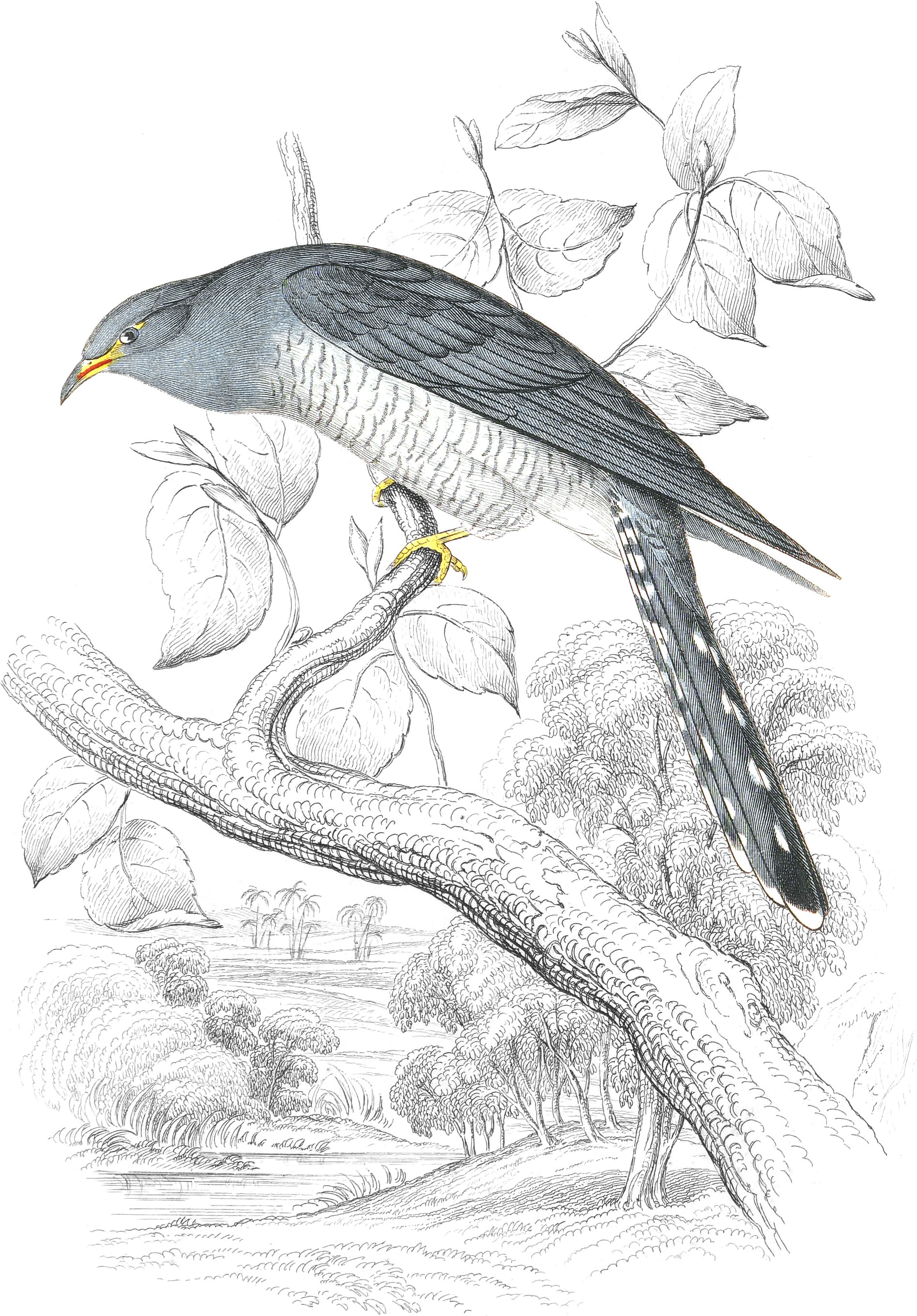
Plate XVIII
African Black Cuckoo
Cuculus nigricans, Swains.
Above and beneath black, glossed with blue; quills internally white, with blackish bands; tips of the lateral tail-feathers whitish; bill and legs black.
Cuculus nigricans, Zool. Ill. 2d series.
Of this very rare Senegal bird, we have never seen any other specimen than that figured in the Zoological Illustrations. Its lengthened pointed wings, of which the third quill is much the longest, and the unusual breadth of its bill (greater even than in the common Cuckoo), at once show that it strictly belongs to the present genus, even as now restricted; while the black and glossy plumage evinces the close affinity between this group and Oxylophus.
The whole upper and under plumage of this bird is of a deep black, glossed with blue; the greater quills are dark brown and very pale at their base, while their inner webs are banded with white: there appears to be a few whitish bands on the thigh-feathers, and the lateral tail-feathers, as well as their under covers, are tipt with whitish; there are also some white spots at the edge of the shoulders.
Total length, 12\(\frac{1}{2}\) inches; bill, from the gape, 1\(\frac{1}{10}\); wings, 6\(\frac{3}{4}\); tail, beyond, 3\(\frac{1}{2}\); ditto, from the base, 6\(\frac{1}{2}\).
Rufous-Breasted Cuckoo
Cuculus rubiculus, Swains.
Wings six inches and a half long; breast and sides of the neck rufous; body beneath fulvous white, with broad black bars; tail. black, with three white spots down the shaft; the tips white.
This Cuckoo is at once known from the last by the colour of its tail and the greater breadth of the black bars on the body. A young specimen, in a state of moulting, which is in possession of Mr. Warwick, has obviously been prepared by the Senegal bird-stuffers; but what we consider as the adult bird is a specimen sent, as we were informed, from India: both, however, agree in the length of the wings and the peculiar colour and markings of the tail, so that we have but little doubt that they are of one species; although, in the young bird, the rufous colour of the breast, and the bands on the body, are not so dark as in the supposed adult from India. The vent and under tail-covers are light buff-colour.
Le Vaillant’s Cuckoo
Oxylophus Vaillanti, Swains.
Head crested with pointed feathers; plumage. above black, glossed with green; band at the base of the quills, end of the tail, and under parts of the body, white; throat striped with black.
Variete du Coucou Edolio, Le Vaill. Ois. d’Af. iv v. pl. 209.—Coccyzus Vaillantii, Zool. Ill. 2d series, pl. 13.
Having already figured and endeavoured to clear up the systematic history of this elegant species, which seems common both to Western Africa and Abyssinia,23 our present notice may be short, particularly as we have recently adverted more particularly to those characters which separate it from the old genus Coccyzus.
Size less than that of the common Cuckoo, but the tail is much longer. Upper plumage dark blackish, glossed with different tints of green, except on the primaries, which are brownish-black; six of these feathers have a white bar at their base, which forms a patch, and there is a large spot of white at the end of each tail-feather; the chin, throat, and breast are white, thickly striped with black; the rest of the under plumage is dirty-white; the tail is long, broad, and graduated, and the fourth and fifth quills are the longest; bill and feet blackish.
Total length, 16 inches; bill, from the nape, 1\(\frac{2}{10}\); wings, 7; tail beyond, 7; ditto, from*the base, 10; tarsus, 1.
Yellow-Billed Coucal
Zanclostomus flavirostris, Swains.
Body above, wings, and tail glossy violet purple; head, neck, and body beneath cinereous; tail beneath with lilac reflections; bill yellow, with a blackish spot in front.
The Coucals, although closely allied to the cuckoos, differ from them in some very material points, both of structure and economy. They do not, like the true cuckoos; the only parasitic birds, save one,24 in creation, deposit their eggs in the nests of strangers, but build one of their own, hatching their eggs, and rearing their young, with the same parental care as all other birds. The Coucals are a numerous division, but the whole are inhabitants of hot latitudes: those found in America constitute the genus Coccyzus as we now propose to restrict it, while those of India and Africa we place under the new sub-genus of Leptourus; the species are at once distinguished by the great dilation of the base of the upper mandible, which is not only wider than that of the lower, but folds over in such a way as entirely to conceal its basal margin. We shall now describe a typical example of this form, another will be found in the Phænicopheus Javanicus of Dr Horsfield, and several more are scattered in the artificial divisions recently proposed by certain French writers.
The colouring of this bird although very rich, is very simple; the bill is entirely of a fine yellow colour, excepting a small spot of what, in the dead bird, appears to be black, placed at the base of the culmen, and which covers the nostrils; the orbits, which are naked, appear also black. The upper part of the head and neck is of a dark blackish grey, which changes in a very gradual manner to a deep blackish purple, and this colour becomes brightest on the tail and its covers, which reflect glosses of purple-violet and lilac; this latter reflection is particularly strong on the under surface of the tail. The whole of the under plumage is of a graduated tint of greyish cinereous, commencing with being very light on the chin, and ending with being very dark on the belly and thighs; the under tail-covers are like the upper, and the feet are black.
Total length, about the 13\(\frac{1}{2}\) inches; bill, from the gape, 1\(\frac{1}{10}\); wings, 4\(\frac{1}{2}\); tail beyond, 7; ditto, from the base, 9; tarsus, 1.

Plate XIX
Senegal Lark-Heel
Centropus Senegalensis, Illiger.
Above rufous; beneath cream-white; head above, ears, neck, and tail, greenish-black; tail-covers above brown; beneath pale testaceous with obscure transverse bands.
Cuculus Senegalensis, Linn. Auctorum, Pl. Enl. 332.—Polophilus Senegalensis, Leach in Gen. Zool. 9. 1. 53.—Le Coucal Hou-hou, Le Vaill. Ois. d’Af. pl. 219.
It appears that this well known bird, of which, however, the only possible figure existing is that of Le Vaillant, extends its range in an eastern direction from Senegal to Abyssinia, where it was observed by Mr. Salt25 to be
common in the mountainous districts, generally found sitting in the thick caper and other thorny bushes, whence it is difficult to drive it; its flesh is coarse and rank, and the contents of the stomach, when killed, very fetid.
Short as is this notice, it is interesting and valuable on several accounts. In the first place, it shews that the birds of this genus approach the Crotophaga, or Anoo’s of Brazil, as much in their manners as they do in their general structure; and it explains in a great measure the reason why the feathers of the Lark-heeled Cuckoo are so peculiarly stiff and rigid, namely, that they should protect the bird from the injury, it might otherwise receive from the “thorny bushes” it frequents, and upon which, no doubt, those peculiar insects are found which constitute. its principal food. We are yet in ignorance, however, of that part of the economy of these birds which renders it necessary that they should be provided with such an unusually long and straight claw on one of their hinder toes.
We need only add, to our specific character, a few additional particulars. The greater scapular and the tips of the lesser quills are banded with dusky black, and faint indications of the same are on the thighs and tail-covers. The upper covers and the tail are brown glossed with green, and are darkest beneath. All the quills have blackish tips, the fifth and sixth being the longest; the legs are very strong and dark greenish.
Total length, 11\(\frac{1}{2}\); bill, form the gape, 1\(\frac{2}{10}\); ditto from the front, \(\frac{6}{10}\); wings; 7; tail, beyond, 5\(\frac{3}{4}\); ditto from the base, 8\(\frac{3}{4}\); tarsus, 1\(\frac{1}{2}\); hind heel and claw, 1\(\frac{1}{2}\); middle ditto, 1\(\frac{6}{10}\).
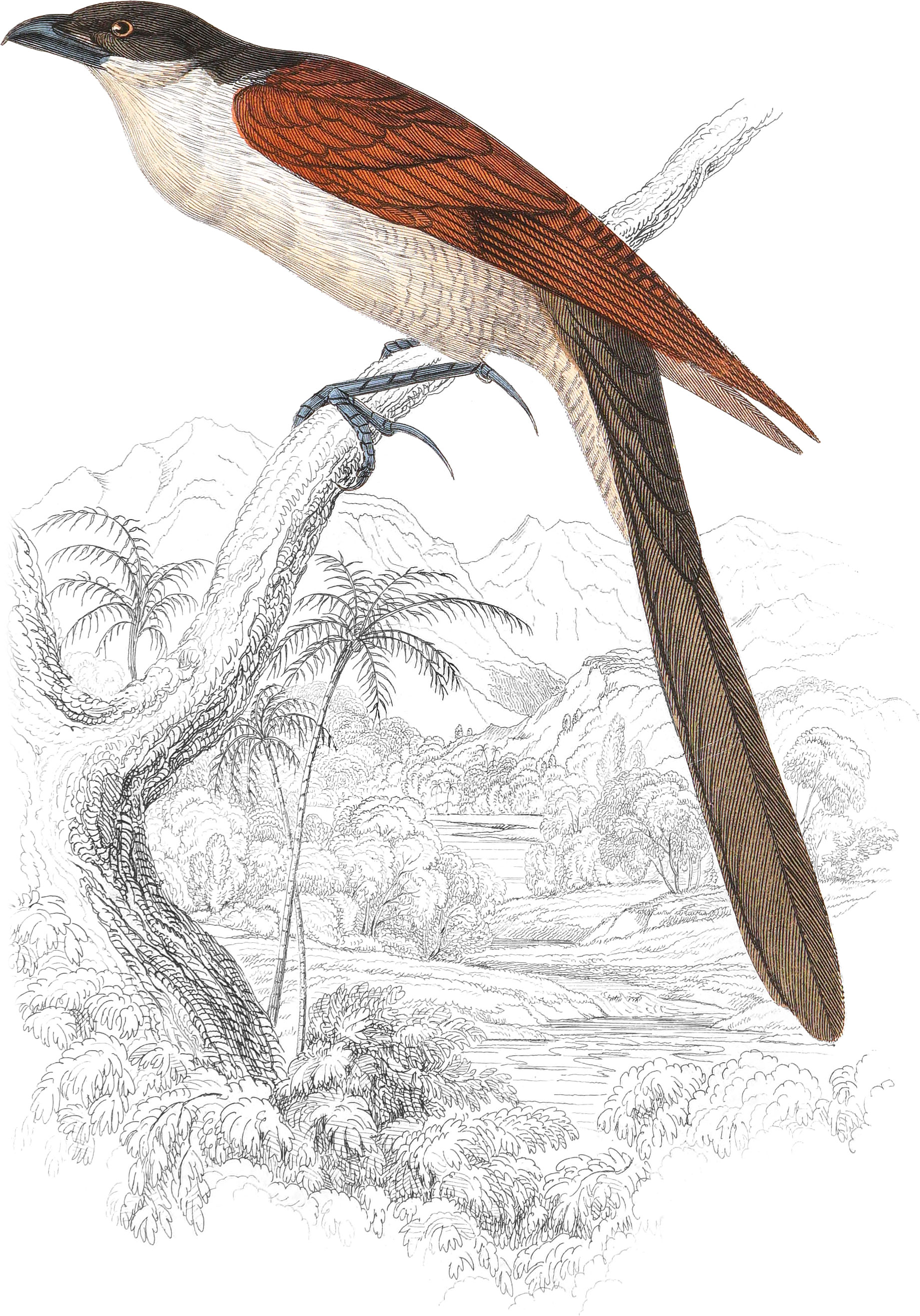
Plate XX
Green-Banded Cuckoo
Chalcites auratus, Lesson.
Golden-green; beneath white; head, wings, and lateral tail-covers, striped with white; flanks and inner wing-covers with transverse green bars.
Cuculus auratus, Auct.—Coucou Didric, Le Vaill. Ois. d’Af. v. pl. 210, 211.
There is, in the hotter parts of Africa, a small race of Cuckoos, known at once by their diminutive size and by the rich golden-green of their plumage. They do not differ, however, from the genuine Cuckoos in their habits, as Le Vaillant assures us that they commit to other birds the rearing of their young. Although Africa appears to be their metropolis, their range extends eastward to the Indian Islands and southward as far as New Holland, each of which localities have furnished us with one species. To this group, which happens to be a perfectly natural one (the tenuirostral sub-genus of Cuculus), we retain the proposed name of Chalcites; and we shall now describe the most common species, which has hitherto been supposed peculiar to the Cape. Four specimens, however, received from Senegal, shows that its range extends to Western Africa.
The whole of the upper plumage (except the white markings we shall presently describe), together with the wings and tail, is of a rich glossy metallic-green of various tints; of these, golden yellow, passing into reddish copper, is the most prevalent, but very many of the feathers have a strong tinge of blue round their margins, and sometimes there is a solitary spot or two of blue; there is no regularity, however, in these tints, which gives consequently the whole a patchy appearance. Before the eve is a white stripe, another is behind it, and a third, placed in front, reaches half down the crown; the ears are green, the maxillary stripe is also green but detached. The lesser quills and the four outermost primaries have three white spots on their external margins, and some of the wing-covers are banded with white; the under plumage is pure white; the sides of the body, the thighs, the under tail-covers, and the inner wing-covers, being all distinctly banded with brownish-green, more or less vivid, on the under tail-covers, and black on the inner wing-covers: The lateral tail-feathers are more or less spotted with white, but the outermost greenish-black with four pair of transverse white spots, and a white tip; the next is the same, but the spots are round, much smaller, and do not unite; bill and feet brown.
Total length, 7\(\frac{3}{4}\) inches; bill, from the gape, \(\frac{9}{10}\); wings, 4\(\frac{1}{10}\); tail beyond, 1\(\frac{1}{2}\); ditto from the base, 3\(\frac{1}{2}\); tarsus, \(\frac{6}{10}\).
Klass’s Cuckoo
Chalcites Klassii, Lesson.
Golden-green; beneath white; flanks and inner wing-covers without bands.
Coucou de Klas, Le Vaill. Ois. d’Af. v. pl. 212.
There are some few occasions when we may be allowed to relax a little those necessarily rigid laws of nomenclature, without which our catalogues would soon become overwhelmed with barbarous and unintelligible names. One of these exceptions may be made for the bird now before us, designed by Le Vaillant to commemorate the faithful and long continued services of his favourite Hottentot Klass, the companion of his journeys, and, without doubt, the contributor to his collections of very many of the new species he subsequently described. It seems to be equally rare in Senegal, as it is, according to Le Vaillant, in Southern Africa; for as yet we have only seen three specimens from the Western Coast.
It may save the ornithologist some trouble if we briefly state the difference between this and the last. Klass’s Cuckow is at once known by being smaller, in having no white spots before the eye, or on the wing-covers, and no transverse bands on the sides, flanks, and under tail-covers.
Excepting a white stripe behind the eye, the whole of the upper plumage is shining coppery-green of different tints, like the last species. There area few obsolete white interrupted lines on the borders of the greater quills, the inner webs of which have from six to seven broad white bars, (in auratus these bars are from three to four). Under plumage milk-white and immaculate, except a longitudinal green stripe down some of the thigh-feathers. The tail is rounded like the last; the four middle feathers are green, the rest white, with two green dots near the tip of the outer web, one smaller than the other, while the inner web is marked with from four to six others. Bill bluish-black, paler beneath; feet deep black.
Total length, 6\(\frac{1}{4}\) inches; bill from the front, \(\frac{1}{2}\); ditto from the gape, \(\frac{3}{4}\); wings hardly 4; tail beyond, 1; ditto from the base, 3; outermost feather, \(\frac{6}{10}\) shorter.
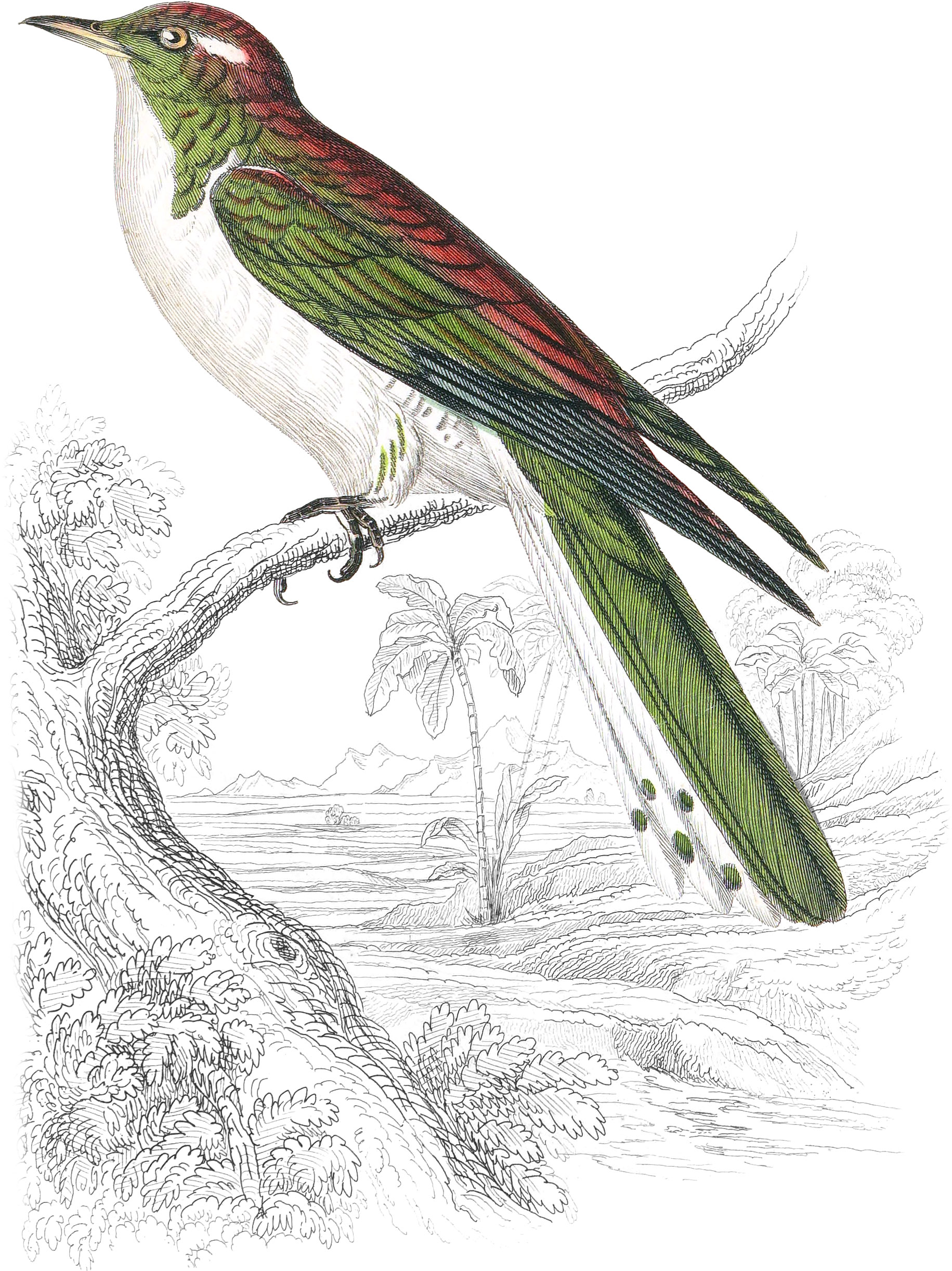
Plate XXI
Emerald Cuckoo
Chalcites smaragdineus, Swain.
Upper plumage, with the neck and breast, shining emerald-green; body beneath, flanks, and under tail-covers, bright yellow, unspotted.
Of all the gorgeous species in this splendid group of birds, the Emerald Cuckoo of Western Africa is the most sumptuous. It is, indeed, one of the brightest gems of the feathered creation, for its colours are more akin to those of the mineral than to the animal kingdom. The feathers of those parts of its plumage which are green, equal the emerald in richness, and assume more of the form of scales than of ordinary feathers; they also have an appearance of thickness and of softness very unusual among birds, so that in these respects they may be compared to velvet. When the bird is held to the light, the green is of the most intense brightness and purity, the middle of each feather being darker than its edgings; but when it is held from the light, with the spectator between, the green becomes more golden, with a very slight gloss of copper, but not near so strong as in the shining cuckoo of the Cape; it is further distinguished from that species by the full and bright yellow colour of its body and belly, which in that is very pale; the under tail-covers in this are yellow and unspotted, while in that they are white with two green bands on each feather; reddish-copper is the predominant hue of the South African species, a-tint which in this is hardly perceived.
The general cast of the plumage has already been described; the green terminates abruptly at the end of the breast, all the remaining under plumage being uniform yellow; the under wing-covers are rather paler, and a basal stripe on the inner web of the quills is almost white; but on all these parts there are no spots or stripes whatever. The last is graduated; the outermost feather is white, with three interrupted bands of green; the next has a central white spot and a white tip, but that which follows is only tipt with white; the outer half of the bill seems to have been yellow.
Total length 9\(\frac{1}{4}\) inches; bill, gape, \(\frac{9}{10}\); front, \(\frac{6}{10}\); wings, 4\(\frac{4}{10}\); tail beyond, 2\(\frac{7}{10}\); base, 4\(\frac{4}{10}\), outermost feather 1\(\frac{6}{10}\) shorter than the middle; tarsus, \(\frac{6}{10}\).
Assistant Commissary General Weir favoured me with the inspection of beautiful specimens of this, and of many other interesting birds, collected by him during his official residence at the Gambia station.
White-Eared Honeyguide
Indicator leucotis, Swains.
Greyish-brown above; whitish beneath; chin with a large blackish patch; base of the shoulder yellow; ears pure white; bill yellow.
Indicator albirostris, Tem. Pl. Col. 867 367.
More than five years before this species appeared in the Planches Coloriées, under the erroneous name of albirostris, we had examined a specimen sent by M. Wiedeman from the borders of the great Fish river of Southern Africa, and had named it leucotis, from the remarkable whiteness of the ear-feathers; we should not, however, have retained it, but that the bill is not white, but yellow. Since that time, as other specimens appear to have been received from Senegal, we include it in our present work.
The account given by the celebrated botanist and traveller Sparman, respecting the instincts of the Honeyguides, are now sufficiently authenticated and are too well known to be here repeated. The ridicule which Bruce, who, whatever were his other merits, was totally unacquainted with natural history, has attempted to throw upon this account, has recoiled upon his own memory; but that such an observer as Le Vaillant should join in the same opinion, will surprise every one who has not detected the peculiar blemish in the character of this otherwise. unprejudiced observer. Le Vaillant, throughout his works, allows no merit to any one; he is perpetually catching at every error or fault of Buffon, and attempting to ridicule all scientific classifications; his vanity could not brook the idea, that Sparman should have made an ornithological discovery in the very country he had traversed, but which had escaped his observation; and his strong prejudice makes him deny a fact which every one upon the spot knew perfectly well. Accordingly, we find that Mr. Barrow observes,
Every one in that country is too well acquainted with the Honeyguide to have any doubts as to the certainty either respecting the bird or its information of the repositories of bees.
If more evidence was wanting than this and other similar confirmations of Dr. Sparman’s statement, it will be found in the following note by M. Wiedeman, attached by a label to the specimen from which the subsequent description was taken.
So soon as this bird sees a man in the woods, where a bee’s nest is in the neighbourhood, he flies before the man, and cries shirt! shirt! shirt!
We shall now transcribe our original description of this species, from a very fine specimen made in the year 1817. General plumage above brownish-grey; chin, as far as the ears, covered by a uniform patch of dusky black; the whole of the ear-feathers white; wing-covers rather darker than the back; the outer margins of each of the lesser covers are bordered by a line of white; the greater covers are also margined,: but the white is more dusky, and is only on the external or side edge. Along the base of the shoulder the feathers are yellow, rather bright and forming a narrow line, and the edges of the quills are faintly tinged with olive; the upper tail-covers are margined on their external sides with white. The tail is variegated much in the same manner as in the other species. The two middle feathers are entirely grey-brown, the next pair have the inner shaft partially white; the remaining three pair are white with brown tips; the two external ones being much shortened. From the throat to the breast the colour is greyish-white, gradually changing to pure white on the vent and. under tail-covers; some of the flank feathers have a central stripe of brown; feet black; bill pale and clear yellow,26 no doubt much brighter in the live bird; the first quill-feather is much shorter than the second and third, which are of equal length and are the longest.
Total length, 6\(\frac{1}{2}\) inches; bill, from the gape, \(\frac{7}{10}\); ditto, from the front, scarcely \(\frac{1}{2}\); wings, 4\(\frac{3}{4}\); tail beyond, 1\(\frac{1}{2}\); ditto, from the base, 3\(\frac{1}{2}\); tarsus, \(\frac{1}{2}\).
Little Honeyguide
Indicator minor, Auctorum.
Head and neck above grey; back, wings, and margin of the quill and tail-feathers, yellowish-olive; plumage beneath cinereous; chin and belly whitish.
Le Petit Indicateur, Male, Le Vaill. Ois. d’Af. v. 242.
The first discovery of this remarkably small Honeyguide was made by Le Vaillant in the Mimosa woods bordering the river of Elephants, and it was found in other similar situations in the south of Africa, but it does not appear to have been hitherto known as a native also of the western coast. A single specimen accompanied the collections from Senegal, and although Le Vaillant’s account of his Petit Indicateur is in some respects deficient in details, it agrees sufficiently well with the Senegal bird to lead us to believe they are both of the same species.
The size of our specimen is below that of a sparrow, the length being only five inches and a half. The bill is thicker than in the other species, occasioned by the upper mandible being somewhat swollen or gibbous on its sides, quite as much as is seen in the bill of the Buphaga, to which genus this is closely and unquestionably connected; the margin also of the upper mandible has a sort of angle in the middle. The upper part of the head and its sides, the neck, and the interscapulars, are cinereous-grey; this tint gradually changes to a yellowish-olive, which extends over the rump and margins all the feathers of the wings and tail; the under parts are of a lighter cinereous than the crown, almost approaching to white on the chin, belly, and vent. The quills are black, margined with olive-yellow; the ground colour of the tail is also black, the three most lateral feathers are white, tipt and edged externally with brown, the two next being white only on the margin of their inner webs; inner wing-covers white; the two outermost. tail-feathers are much graduated, the rest even.
Total length, 5\(\frac{1}{2}\) inches; bill, from the gape, \(\frac{1}{2}\); wings, 3\(\frac{2}{10}\); tail beyond, 1\(\frac{1}{10}\); ditto, from the base, 2\(\frac{2}{10}\); tarsus, \(\frac{6}{10}\).
Yellow-Throated Honeyguide
Indicator flavicollis, Swains.
Above olive-brown; rump and body beneath white; chin, throat, and breast, clear fulvous-yellow; immaculate.
Le Grand Indicateur, Indicator Major, Vieil. Gall. pl. 45.
We can find no record of this Honeyguide as a distinct species in any of the modern publications, although it has been figured by Vieillot under the belief that it is the Great Honeyguide of Le Vaillant. A specimen, in an indifferent state, sent from Sierra Leone, has long been in our possession, but a much finer, obviously in the most perfect state of adult plumage, has more recently come from Senegal, so that all suspicions of our first specimen being a young or imperfectly fledged bird are now removed. We suspected, moreover, that it might have been the great Indicator of Le Vaillant, particularly as it exactly agrees with his description in regard to the white on the rump and on the tail-feathers; but it seems that both the species he has described have their tails coloured in the same way, while the Senegal bird, instead of
having the whole of the front of the neck, from the beak to the breast, marked with greyish-white in the middle of the neck, and variegated with black spots on the breast,
has these parts pure and unspotted. Nor can it be the female, which our author says has the
under parts variegated with brownish-black.27
The whole of the upper plumage is of a full uniform greyish-brown, slightly tinged with yellowish-olive on the crown, and on the edges of the wing-feathers and the tail; this colour includes the eye and the ears; the middle of the rump, and of the upper tail-covers, is marked by a stripe of cream-coloured white. The three lateral tail-feathers are white, tipt and edged externally with blackish-brown, the two next have the white only on their inner margin, and the middle pair has no white; the outer-feathers are half as long only as the middle, and the next is shorter than the third. From the chin to the breast the colour is of a light but clear and delicate orange-yellow, deepest and brightest on the breast, below which all the remaining parts are cream-white, and without any spots or markings whatever; the under wing-covers are whitish; bill and feet blackish.
Total length, 7\(\frac{3}{4}\) inches; bill, from the gape, \(\frac{7}{10}\); wings, 4; tail beyond, 1\(\frac{8}{10}\); ditto, from the base, 3; tarsus, \(\frac{6}{10}\).
Common Oxpecker
Buphaga Africana, Auctorum.
Greyish brown; rump, breast, and body beneath, pale fulvous; lateral tail-feathers ferrugineous; bill orange, the tip red.
Buphaga Africana, Linn. Auct.—Le Pie Bœuf., Pl. Enl. 293.—Le Pique Bœuf., Le Vaill. Ors. d’Af. pl. 97.
We have entered so much at large into the peculiar structure and habits of the genus Buphaga, in the first volume of our Classification of Birds, that little need be said, in this place, upon the same subjects. This, which is the most common of the two species now known, is found both in Southern and Western Africa, where it is seen in small flocks, alighting on the backs of cattle (and no doubt on other quadrupeds), where it searches for those parasitic insects which distress them during summer. There can be no doubt, that during a considerable part of the year, these birds must feed upon other substances, but what these are remains to be discovered. Certain it is, however, that their feet are truly scansorial, and that they are no more adopted for walking upon the ground, like the starlings, with whom they have been hitherto associated, than are those of Oxyrynchus, Sitta, and numerous other scansorial genera.
Another species has of late years been discovered in Abyssinia, which we have a slight recollection of seeing in the Paris Museum; it very much resembled, if our memory serves us right, the one now before us, but differed in the colour, &c. of the bill.
This second species, the Tanagra erythroryncha of Salt’s Travels, seems to be that which has lately been republished as new by M. Temminck.
General colour greyish or smoky brown, which spreads over all the upper plumage except the rump, and extends to the chin and fore part of the throat,—this tint then becomes buff-coloured or fulvous-yellow from the breast downwards; the rump and both tail-covers are likewise pale buff. The tail is greyish-brown, with the inner webs of the lateral tail-feathers more or less rufous; its form is cuneated, the shafts being strong and somewhat rigid, and the tips gradually narrowed; inner wing-covers black; bill with the basal half of a rich orange yellow, the terminal portion being scarlet; feet brown; the tail is lighter than the wings, but the shafts of the middle feathers are dark brown and those of the sides rufous.
Total length about 9\(\frac{1}{2}\) inches; bill, from the gape, \(\frac{9}{10}\); ditto, from the front, \(\frac{1}{2}\); wings, 4\(\frac{1}{2}\); tail beyond, 2; ditto, from the base, 4\(\frac{1}{4}\); tarsus, \(\frac{9}{10}\).
Rasores
We now quit the order of Insessores and enter upon that of the Rasores or Gallinaceous Birds, the most aberrant family of which are the Pigeons.
Abyssinian Vinago
Vinago Abyssinica, Cuvier.
Head, neck, and breast, light olivaceous-grey; body beneath yellow; wing-covers vinaceous; under tail-covers cinnamon.
Le Columba Abyssinica, the male, Latham, Auctorum.—Le Colombar a epaulettes violettes? Le Vaill., Ois. d’Af. vi. pl. 276.
All writers have followed Le Vaillant in considering this and the bird we shall next describe, as male and female of one species, and certainly the authority of one who had such ample means for ascertaining the fact, should have due influence. The question, however, is whether such means were used? and whether Le Vaillant, deceived by the opinion that his Colombar was the only pigeon that had “Epaulettes violettes,” has not hastily concluded that these two were but sexes of one? Our belief is that they are different, and for the following reasons:—Vinaceous red, or, as Le Vaillant calls it, “Viollette” upon the shoulders, is rather a generic than a specific character in this group, for it is found in more than one-half of the species; the same may be said of the red, or brown, or cinnamon colour, of the under tail-covers, and the pale yellow margins of the wing-covers, so that no specific distinctions can be founded exclusively upon any one of these three circumstances. On the other hand, the two birds we have received from Senegal, although they agree in their colours with those figured on the 276th and 277th plate of Le Vaillant, differ most remarkably from each other in the size and general structure of their bills. Now, we do not remember a single instance in the whole circle of ornithology where such a variation takes place in the sexes of one species.

Abyssinica Bills
To illustrate this difference more fully, we annex cuts of the bills of both; in that to which we retain the old name of Abyssinica; the nostrils are placed close to the base of the bill, so that some of the frontal feathers advance close to the aperture, the base also is narrow and compressed: in our Vinago nudirostris, on the contrary, the aperture is placed in the middle of the bill, half-way between the front and the tip, while the basal portion is broad and thick; this structure is confirmed by two specimens, in a very perfect state of preservation, now before us, which precludes the supposition that the feathers have fallen off at the base of the bill. We shall now describe the colours and measurements of the first of these species.
Length about eleven and a half inches. Outer half of the bill bluish-white; basal half, in the dead bird, bluish-black. The whole of the head, neck, and throat, as far as the breast, uniform light grey, tinged with a greenish hue; the remaining upper parts of the plumage, as the back, scapulars, tertials, and tail-covers, light olive-green, which colour tinges such of the greater wing-covers as are nearest the body. The lesser wing-covers are vinaceous-red,28 deepest at the angle of the shoulder, and which blends into the greenish-grey of the lesser wing-covers; greater covers and quills, blackish; both the series of covers and the terminal half of the lesser quills are broadly and distinctly edged with sulphur-yellow, which edging is narrower and almost white on the primaries. Tail even; above light cinereous; beneath with the basal half black and the outer half cinereous-white. The under plumage from the breast downwards is yellow, the flanks greenish grey; the thighs, vent, and side tail-covers being whitish; under tail-covers rufous in the middle; feet apparently red, the tarsal feathers reaching to the base of the toes.
Total length about 12 inches; bill, from the gape, 1, from the front, \(\frac{6}{10}\); wings, 7; tail, from the base, 4\(\frac{1}{2}\); tarsus, \(\frac{7}{10}\).
Naked-Billed Vinago
Vinago nudirostris, Swains.
Head, neck, and body beneath, yellowish-green; bill thick, red, and very naked at the base; nostrils placed in the middle; shoulders vinaceous; under tail-covers cinnamon; interscapulars cinereous.
Columba Abyssinica, fem.? Auctorum.—Le Columba a epaulettes Violettes, fem.? Ois. d’Af. 6. 277.
Having already stated our reasons for considering this as a distinct species, we need only describe its plumage. The size of the bird is smaller, but the bill is much larger than in the supposed male; the nostrils are placed in the middle, so that the soft part of the bill, or that in which the nostrils are placed, is longer than the hard or terminal portion; the base of the bill is also much broader than it is high, so that, for a pigeon, it might be called a depressed bill; this part is covered by a skin and is of a bright red, even in the preserved specimens.

Naked Billed Vinago Bills
Head, neck, and all the under parts of the body, uniform yellowish-green, but the thighs are bright yellow, and the flanks striped with that and olive-green; base of the neck above, and part of the interscapulars, delicate cinereous, which gradually changes into a light greyish olive-green on the back, scapulars, rump, upper tail-covers, and on those of the wing-feathers which are nearest the body. The shoulders are vinaceous red; the greater and lesser covers partly greyish-olive and partly blackish, and both are distinctly margined with pale sulphur-yellow; quills blackish, most of them margined in the same way, but narrower. Tail above light cinereous, with rather a darker shade in the middle, but on their under surface the basal half is black and the terminal half cinereous-white. Sides of the tail and tips of the smaller under covers cream-coloured. white, but the larger covers are entirely rufous. Feet pale, probably red.
In another specimen, which is probably of the other sex, there is no other difference but in size; the wing of one measuring 5\(\frac{8}{10}\), and of the other 6\(\frac{2}{10}\). The tarsus, in both these, is not feathered so much as in the last species, for the feathers do not reach within a quarter of an inch of the division of the toes.
Total length about 10\(\frac{1}{2}\) inches; bill, from the gape, \(\frac{9}{10}\), and from the front the same; wings, 6\(\frac{2}{10}\); tail, from the base, 3\(\frac{3}{4}\); tarsus, \(\frac{7}{10}\).
Red-Eyed Dove
Turtur erythrophrys, Swains.
Crown cinereous white; neck, breast, and body beneath, vinaceous; belly and vent dark cinereous; nape with a black semi-collar; orbits red.
Until the various modifications of form in this most extensive family have been more regularly and completely studied, we shall arrange all the slender billed pigeons with naked legs under two provisional genera, which we suspect to be the typical and the subtypical. To the first we restrict the name of Columba; they are distinguished by their lateral toes being equal or of the same length; under this will come the sub-genera of Columba proper and Ectopistes. The second group, probably the sub-typical, is Turtur, wherein the outer toe is shorter than the inner, and to which the two next birds herein described obviously belong, as probably does Chæmipelia.
Size of the common turtle. General colour of the back, interscapulars, wings, and tail, grey-brown; having a strong cinereous tinge on the back, and a slighter one on the rump and outermost wing-covers; the crown is of a most delicate cinereous, graduating to white in front, and blending behind into the vinaceous red of the nape and upper neck. The back of the neck has a broad black semi-collar margined by a narrow cinereous line; the orbits are naked and rich red; the whole of the under plumage, as far as the belly, is vinaceous, becoming paler on the ears and almost white on the chin; the belly, vent, flanks, and under tail-covers, are clear cinereous. The tail is broad and rounded, the outer half cinereous (almost white beneath) and the basal half black. The bill is black and the feet dark, possibly. red in the live bird; inner wing-covers cinereous black. Structure of the common turtle.
Total length, 11 inches; bill, from the gape, 1; wings, 7; tail beyond, 1\(\frac{1}{2}\); ditto, from the base, 5; tarsus, \(\frac{7}{10}\); middle toe and claw, 1\(\frac{3}{10}\); hinder ditto, \(\frac{7}{10}\).

Plate XXII

Half-Collared Dove
Turtur semitorquatus, Swains.
Above light brown; nape with a black crescent-shaped collar; front, crown, and body beneath, vinaceous; chin and belly whitish; wing-covers light cinereous; inner toe longer than the outer.
There is such a close similarity in general points of colour between this and the last, that but for their great disparity of size, they might at first be taken for the examples. of the different ages or sexes of one species. We believe, however, that they are truly distinct, at least the plumage of that we shall now describe shews every appearance of perfection, while from the length of the wings being only five and a half inches, instead of seven (as in erythrophrys), it is presumed this difference is not sexual.
The total length is about ten inches. The ground colour of the upper plumage is drab-brown, nearly of the same tint as the last; but the top of the head and nape, instead of being delicate French grey, is of the same vinaceous as the under parts, the front, as is usual in this family, being much paler; behind the nape is a semicircular black collar like the last. The wing-covers are very light cinereous with whitish edges, but this tint blends on the scapulars into the drab-brown of the back, The under plumage is vinaceous, palest on the chin and changing into a cream-coloured white on the belly, vent, thighs, and under tail-covers; these parts being of a full cinereous in the last species; the basal half of the four outer pair of feathers is deep black; the other portion is more or less white according to their distance from the two central pair, which are drab-brown, tinged with cinereous. On their under surface, the terminal half of these feathers is much whiter and the base much blacker. The inner wing-covers, the flanks, and sides of the tail-covers, are cinereous. The bill is black and the feet pale. The orbits seem to be more feathered than in the last, and there is no red tinge on the naked skin; this, however, may be accidental: above all, the inner toe is one-twentieth of an inch longer than the outer.29
Total length, 10 inches; bill, gape, \(\frac{8}{10}\); wings, 5\(\frac{1}{2}\); tail, base, 4; tarsus hardly \(\frac{7}{10}\); middle toe and claw, \(\frac{9}{10}\).
Rufous-Winged Turtle
Turtur chalcospilos, Swains.
Quills rufous tipt with black; tail broad, rounded, black beneath; rump and covers with five black bars; wing-covers with oval, shining, purple spots.
Le Tourterelle emeraudine? Le Vaill. Ois. d’Af. p. 271.—Columba chalcospilos, Syst. Avium, No. 83, excl. syn.
We should have set this down as the beautiful little round pigeon to which Le Vaillant has given the name of “Tourterelle emeraudine,” had he not said that it was “particularly distinguished for its very short and rounded tail,” the intermediate feathers of which have two black bands on a grey ground. Now this is either erroneous or is applicable to a different species. The tail of our Senegal bird is very broad and rather long for its size, and the intermediate feathers of the tail have no black bands whatever; they are like the rest on their upper surface, i. e. cinereous at their basal half and black on their outer half. Be this as it may, our species is pretty well described by Dr. Wagler, whose specific name we consequently adopt. The feet, for the size of the bird, no less than the tail, are very large.
Size small. General colour of the plumage above light brown, strongly tinged with cinereous, particularly on the wing-covers, or the ground colour may be called greyish brown; the front of the head is nearly white, which gradually changes on the crown to a delicate lead-colour; across the lower part of the back there is a very distinct cream-colour or brownish-white band, margined both above and below by a band of deep black, the lower of which is broadest; the tail-covers above are tipt with black, so as to form three transverse bands, two narrow, and one, which is the last, twice the breadth of the others; these are probably what Le Vaillant has mistaken for bands upon the tail-feathers. Three or four of the scapular cover of the quills have a large oval spot of black richly glossed with purple only, but no green, and the inner half of all the greater covers are black.. The quills, spurious wings, and inner wing-covers, are deep and bright rufous tipt with black, the two outer quills margined also with black. Under plumage delicate pale vinaceous, changing to white on the belly, vent, and side tail-covers; under tail-covers and the tail itself deep-black, the outermost feather externally white for one-half its length, and tipt with white; bill and legs dark; tail broad, and much rounded.
Total length, 7 inches; bill, from the front, \(\frac{6}{10}\); wings, 4; tail beyond, 1; ditto from the base 3\(\frac{1}{2}\); tarsus, \(\frac{6}{10}\); hind toe and claw the same.
Triangular-Spotted Pigeon
Columba trigonigera, Wagler.
Head and body beneath plumbeus; wings and throat vinaceous, with numerous triangular white spots; feathers of the neck and breast vinaceous and bifid, and tipt with whitish.
Triangular-spotted Pigeon, Edwards, pl. 75.—Le Ramier roussard, Le Vaill. Ois. d’Af. iv. pl. 265.—Columba Guinea, Auctorum.—Columba trigonigera, Wag. Syst. Avium, No. 51.
Nothing can be said in commendation of the plumage of this singularly marked species, the colouring of which is neither attractive to the ordinary observer or inviting to the artist. It is of a middling size, and seems to be abundantly distributed over various parts of Africa, as Senegal, Guinea, Angola, and the Cape of Good Hope. At the latter place, according to Le Vaillant, it is called, by the colonist, Bosch or Wild Duyf (wood or wild dove.) It is very abundant both in the vicinity of Cape Town and in the interior, where it is one of the greatest pests the farmers have to contend against these birds, in fact, associate in large bands, and attack the crops of grain on all sides, which they only leave on retiring to roost in the woods or rocks.
It is almost impossible to give a good idea, by words, of the inharmonious, we had almost said the disagreeable, colouring of this species, and it would be equally difficult to do so by the pencil. The head, body beneath from the breast, outer half of the wings, edges of the quills, and the tail-covers, are all lead-colour or cinereous, while the back part of the neck, the scapulars, back, and basal half of the wings are vinaceous or brownish rufous; these are the two ground colours; the lower part of the back is very light plumbeus, almost white. Each of the feathers of the wing-covers, which are near the back, ends in a central and triangular white spot; the margins of the outer tail-feathers are white nearly to the tip, the rest are plumbeus; they all have one broad bar at the end, and a very narrow obsolete one in the middle: the feathers of the throat and breast are vinaceous, tipt with whitish lead-colour, with their ends bifid, as if part of the shaft was broken off. Feet large and strong, and dark flesh-colour; bill blackish; orbits large, naked, and crimson.
Total length, 11\(\frac{1}{4}\) inches; bill, from the base, \(\frac{8}{10}\); wings, 8\(\frac{1}{2}\), and extending half an inch beyond the tail; middle toe and claw, 1\(\frac{4}{10}\).
Black-Throated Dove
Œina Capensis, Selby.
Above varied with cinereous and brown; front, throat, and breast deep black; body beneath white; primary quills rufous; tertials with shining purple spots.
Columba Capensis, Auct.—Tourterelle, Le Vaill. Ois. d’Af. vi. pl. 273 adult, 274 young.—Columba atrogularis, Wagler, Syst. Avium, 108,—Œna Capensis, Selby, MSS.
There is scarcely a more beautiful little bird among the smaller species of this family than the one now before us. It seems to have a wide dispersion on the African continent, being found at the Cape of Good Hope, Senegal, and as far as Nubia;30 but whether it is in any degree migratory like the two more typical species of Ectopistes, is very uncertain. Mr. Selby very judiciously considers this as a distinct type from the sub-genus Ectopistes of the American continent, of which, however, it seems to be the representative. It does not appear that the sub-genera of the typical pigeons are characterised by that peculiarity of geographic distribution which so frequently separates the birds of the old from those of the new world; at least we have not yet been able to detect any marked difference in structure between many of the species of Columba, &c. of America, from those which occur both in Africa, India, and Australia.
The adult bird has the middle of the upper plumage, that is, of the head, neck, back, rump-covers, and base of the wings, light grey brown, which gradually changes into a delicate lead-colour on the sides of all these parts, more particularly over the wing-covers and on the borders of the deep black patch which is in front of the head and the middle of the throat and breast; beyond this, all the body beneath is pure white, the longest of the under tail-covers only being deep-black. On the tertials and some of the greater covers there is a large spot of black richly glossed with purple and violet, forming a short transverse band; another, of a brown hue, crosses the lower part of the back, and the tips of the longest tail-covers being brown, form another band more irregular. The greater quills, and three or four of the lesser, are rich rufous, more or less tipt with black. The tail-feathers are lengthened and cuneated; the longest are grey at their basal half and black to the end, the lateral are much broader, and of a finer and lighter grey, with an irregular band of black just before the tip; the outermost pair has an additional white edging on the basal half of the external web; inner wing-covers rufous, the adjoining side-feathers black; bill and feet yellow. Such is the description of an adult male from Senegal; the female, as described by authors, we have not seen, but a bird which we consider as the young or true female, is so unlike the above, that we shall describe its essential differences.
The size is similar to the male: the ground colour of the upper plumage is light drab, rather darker than isabella-brown; each feather of the wing-covers, the rump, the upper tail-covers, and the crown and nape, terminates in buff-white or dingy fulvous; these markings are bordered internally only by a black edging; they assume the form of roundish spots on the scapulars, wing-covers, and tertials, and of bars on the other parts. The chin is pure white, the throat and breast light drab-brown with dusky transverse bars; all beyond, as in the adult, is pure white. The bar on the back, the quill, and the tail-feathers are like the adult male, but the bill and feet are light brown. This accords pretty well with Le Vaillant’s figure at pl. 275, but the brown bar on the back, in both our specimens, is single, and not double as authors affirm it to be.
Total length, 9 inches; bill, \(\frac{6}{10}\); wings, 4\(\frac{1}{10}\); tail beyond, 3\(\frac{1}{4}\); ditto, from the base, 5\(\frac{2}{10}\); tarsus, \(\frac{4}{10}\).
Double-Spurred Francolin
Chœtopus Adansonii, Swains.
Feathers of the body beneath white on the sides, black varied with white down the middle, and with a rufous stripe on each lateral margin: crown brown, immaculate, margined by black and white lines; male with two spurs on the tarsus.
Perdix Adansonii, Tem. Hist. Nat. Gallin, iii. p. 305. 717.—Perdix bicalearata? Auctorum.
We have been told that this species (of which the only specimens we have yet seen are from Senegal) has been mistaken, by the London ornithologists, for the C. Clappertonii, which, if the figure in the Atlas of M. Rüppell be correct, is a very different species. Whether it is the Perdix bicalcarata of Linnæan writers cannot possibly be made out, as their description, successively copied one from another, is too loose, and too inapplicable to our bird, to admit of amalgamation. Even that by M. Temminck, admirable as it is, and drawn up with a precision well deserving imitation, offers some slight differences from ours: the crown of the head, for instance, is termed “roux,” whereas, in all our specimens, it is of the same dark brown as the rest of the body; the nape alone being rufous. Upon the whole, however, we have little doubt that both are of the same species, differing perhaps in age or sex.
The general ground colour of the upper plumage, as in most of this genus, is hair-brown, darkest on the crown, where it is unspotted, and forms a patch, bordered in front and on the sides by a line of black; this is again margined by another of white, which commences at the nostrils and passes above the eye and ear: the nape is rufous, beyond which the feathers begin to be black in the middle and rufous on the sides, varied also with whitish. The rufous disappears on the interscapulars, leaving only the white stripes, and those extend no further than the middle of the back. The chin is quite white, without those little black spots and stripes which are on the ears; the throat, breast, and body are all coloured alike; the ground colour of each feather is cream-coloured white, down the shaft is a long pear-shaped black spot, inclosing a mark of dirty-white, representing the letter V, while on each side of the feathers there is a broad stripe of rufous: the feathers of the flanks and thighs are simply dirty-white, with a brown central stripe. The primary quills are blackish, dotted on the outer web with fulvous white, and marked on the inner with two longitudinal stripes of the same, one at the edge, the other in the middle of the web. Tail very short, dark brown, and freckled with a lighter tint, but without any bands; lower part of the back, the rump, and upper tail-covers freckled, like the tail, with minute blackish dots disposed in zigzag, transverse, and interrupted lines.
The female, which M. Temminck had not then seen, besides wanting the spurs on the tarsus, is much smaller, so as not to exceed the size of our partridge; the middle of the wing-covers, instead of being entirely brownish black, as in the male, is freckled with light brown, which colour also forms transverse bands on the inner web of most of the primary, and on all the secondary quills; while in the young bird these bands are light rufous, and they are very well defined on the tail, where there is about six on each feather, separated by a broad space of blackish-brown. The frontlet at the bill advances very much upon the crown, similar to what we see in the Hang-nests (Cassicus).
Male.—Total length about 12 inches; bill, from the front, 1\(\frac{1}{4}\); ditto, from the gape, 1; wings, 6\(\frac{7}{10}\); tail, from base, 3\(\frac{1}{4}\); tarsus almost 2.
Female.—Total length about 10\(\frac{1}{4}\) inches; bill, from the front, 1\(\frac{1}{5}\); ditto, from the gape, \(\frac{8}{10}\); wings, 5\(\frac{8}{10}\); tail, from the base, 2\(\frac{1}{2}\); tarsus, 1\(\frac{8}{10}\).
Buff-Breasted Partridge
Ptilopachus erythrorynchus, Swains.
Brown, speckled with whitish; middle of the body with a large fulvous white spot; feathers of the neck and breast rufous in the middle, with a row of whitish spots on each web; bill red.
Ptilopachus erythrorynchus, Classif. of Birds. ii. p. 344.
There are some peculiarities of structure in which this bird differs from our common partridge, the type of the genus Perdix, which has induced us to separate it. as the representative of a sub-genus. The claws are considerably compressed, and the two lateral toes are very nearly, if not quite, of the same length; the tail also is much developed, and the nostrils almost occupy one-half the length of the upper mandible. The structure of the feathers on the back and rump are also peculiar, the shafts being thickened in the same way as in the pigeons, and in the corresponding type of Ceblepyris among the shrikes.
Size intermediate between the quail and Partridge. Ground colour of the whole plumage earthen-brown, just as dark on the body as on the back; this colour is varied by dusky-white spots, in the following manner: the feathers upon the neck, throat, breast, interscapulars, and sides of the body, have a row of white spots down the middle of each web, bordering a stripe of rufous which occupies the middle of each feather; these spots (which are most distinct and defined on the interscapulars and sides of the body) are bordered above by a line of obscure black; the spots become indistinct and run into each other on the breast, so as to form stripes. The chin and part of the throat is dirty-white, each feather being nearly black in the middle. On the fore part of the body, immediately beneath the breast, is a large patch of pure fulvous or buff-yellow. All the rest of the plumage is dark brown, without any other variation than very minute and scarcely perceptible freckles of a paler colour: the quill and tail-feathers are without any bands or spots, but there are a few white dots on the wing-covers, and obsolete undulations on the flanks; bill, orbits, and legs, light, probably red in the live bird; tail very broad and rounded.
Total length about 10 inches; bill, from the gape, \(\frac{7}{10}\); wings, 4\(\frac{1}{2}\); tail, from the base, 3\(\frac{1}{2}\); tarsus, 1.
Three-Banded Sand-Grouse
Pterocles tricinctus, Swains.
Throat and breast fulvous, the latter crossed by three collars—one of rufous, a second of white, and a third of black; the rest of the body beneath crossed by numerous black and white bands; tail rounded, fulvous, banded with black.
The deserts of Africa appear to be the metropolis of the beautiful genus Pterocles or Sand-grouse, a group of birds which seem as much appropriated to the hot sandy tracts of that continent, as are the true grouse to the snowy wastes of the Arctic regions. They are mostly of a small size for gallinaceous birds, being inferior to our partridges; but their plumage, without being bright or showy, is so particularly elegant, that they are peculiar favourites with most ornithologists) MM. Temminck and Lichtenstein have paid particular attention to this group, and have figured or described most of the species. It appears, however, that the one now before us will not accord with any of their descriptions, and we shall accordingly give such a detailed account of both sexes as will prevent it from being confounded with any other.
In the male, the front is white, crossed by a broad black band just before the eyes; this band is continued as a black stripe over the eye, but it is interrupted at its base by a large white spot on each side; the crown and nape is ochre with a pear-shaped spot of black down each feather. From the nape to the commencement of the interscapulars the ochre colour has a faint greenish tinge, but without any markings; the interscapulars are then crossed by bars of black, three on each feather, the broadest of which is at the tip; the rest of the back, rump, and upper tail-covers, have bands of different breadths, which gradually become stronger and more defined as they approach the tail. The scapulars and tertials are banded on a rufous ground, but the margins all round are pure fulvous. The ground colour of the whole of the wing-covers and the tertials, as well as several of the lesser quills on their outer webs, is uniform fulvous. The lesser covers have no bands, but beyond these commences a series of transverse black stripes, very distinctly marked, which gradually increase in breadth, and traverse in an oblique direction all these feathers; most of these bars have a narrow whitish edging, and some of these are glossed with a bluish purple tinge; the remainder of the lesser quills are deep black but the greater quills are brown. The tail is rounded, the feathers rather broad, and crossed by black bars, similar to the tail-covers, and of which there are about ten on each feather; the last is the broadest, and is placed a little way from the tip; the under covers are like the upper. The inside of the wings and the axillary feathers are both of a uniform unspotted cinereous grey.
The under plumage may be described in fewer words. From the chin to the breast the colour is of the same buff-yellow or isabella tint which is the ground colour of the upper plumage; the chin itself is paler and inclined to white; this colour is bounded just below the breast by three semi-circular bands; the first is rich chestnut,—the second, white,—and the third, black, each being about four-tenths of an inch broad; the rest of the body, as far as the vent, with the flanks and thighs, are narrowly banded with black and greyish-white, the former colour predominating on the belly, but the latter on the flanks and thighs; tarsi feathered to the toes, and of an unspotted grey; bill yellow; feet brown.
The female differs from the male in the following manner. There is no black in front of the head, and the white patches are so tinged with fulvous that they can scarcely be traced; the upper part of the neck and its sides are banded with blackish-brown; there are no bands on the breast, and the inner wing-covers are dark on the middle; the lesser wing-covers, which in the male are pure fulvous, are here obliquely traversed by slender black lines. All the scapulars and most of the tertial quills are dark vinaceous rufous, upon which the black bands are broad and close, leaving the margin of the feathers fulvous; the primary quills are all tipt with rufous-brown, and their bases, in both sexes, are rather light; the bill is small, slender, and compressed; the gonys, straight.
Total length, 10 inches; bill, from the gape, \(\frac{6}{10}\); wings, 6\(\frac{6}{10}\), reaching to the tip of the tail; tail, from the base, 3\(\frac{1}{2}\); tarsus, 1\(\frac{1}{10}\); hind-toe almost obsolete, measuring, with the claw, only \(\frac{2}{10}\).
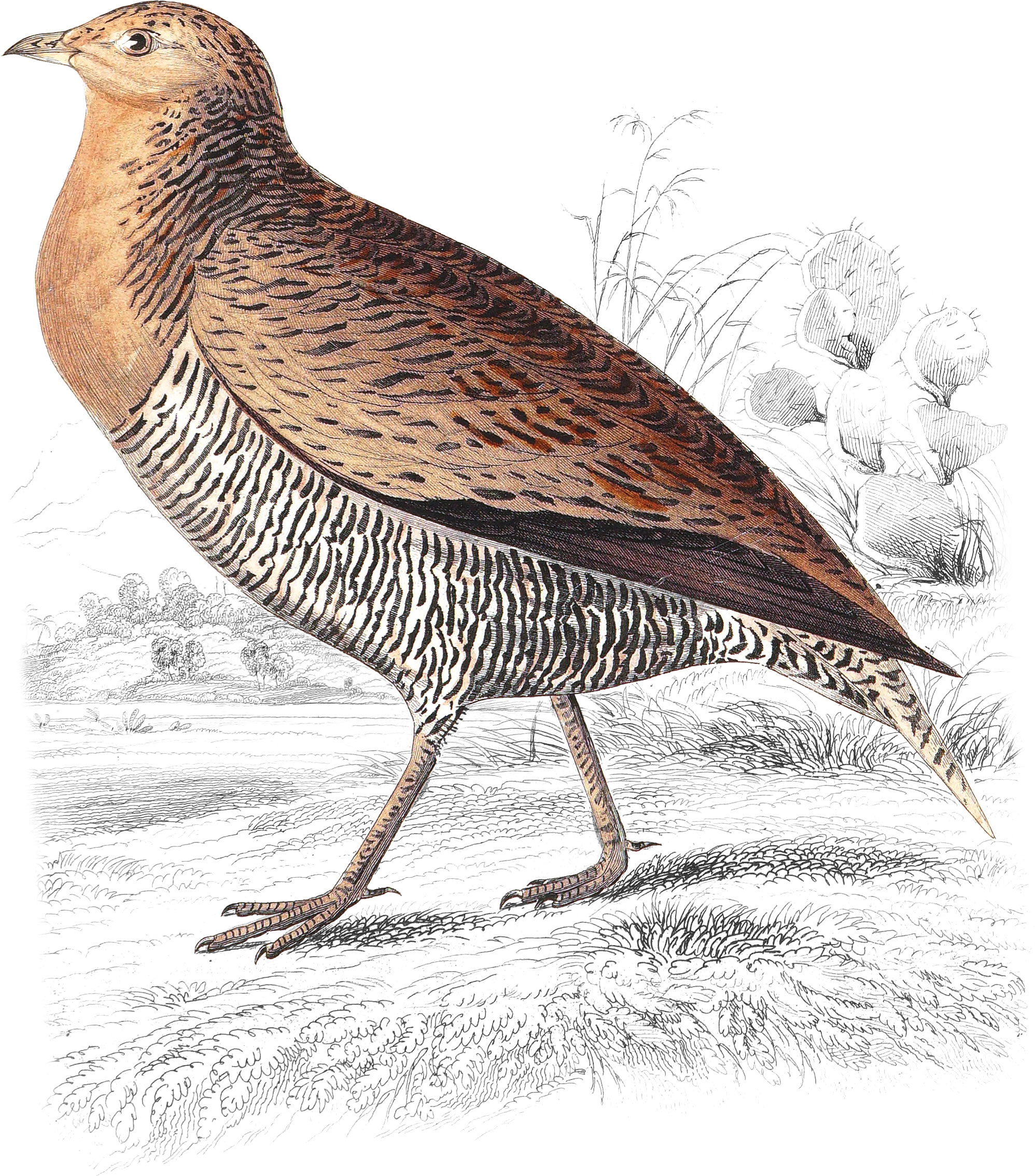
Plate XXIII
White-Spotted Turnix
Hemipodius nivosus, Swains.
Above varied with ferruginous; chin whitish; throat and breast pale ferrugineous, with white shining roundish spots; body and outer half of the wing-covers white; rump and upper tail-covers rufous and unspotted.
H. nivosus, Swains. Phil. Mag. vol. lx. p. 353—H. nivosus, Zool. Illust., 1st series, iii. pl. 163.—Turnix Meiffren? Pl. Col. pl. 60. 1.
We have already given such a minute account of this elegant little bird in the journal above alluded to, that it 1s only necessary to repeat its specific character, and to incorporate it in this work as a native of Senegal. Whether it is the Turnix Meiffren of Temminck, as some suppose, is very doubtful, for an inspection of the two figures will show how much they differ. Yet, if that of M. Temminck is really intended for our nivosus, his name must sink as a synonyme, for our description appeared more than two years before he published his figure; so irregular, indeed, does the letter-press to his work come out, that we actually do not know whether the sheet which relates to this plate has even yet been published. M. Temminck’s figure represents the middle of the neck and its sides as white, with ferruginous spots, and the breast quite white. Our nivosus has the whole of the neck and breast ferruginous with white spots!
Spotted-Winged Pintado, or Guinea Hen
Numida maculipennis, Swains.
Body, wings, primary quills, and tail, covered with white spots; head and part of the throat naked; neck and breast purplish, immaculate; gape wattled; crown with a compressed elevated tubercle.
All the authors we have consulted agree in stating that the common Pintado, or Guinea Fowl, has the greater quills of the wings white, and although we have not, at this moment, an opportunity of seeing this, it cannot for a moment be reasonably doubted that such is the universal character of the common species. That, however, which we shall now record, has the whole of the primaries spotted on a blackish ground, precisely with the same pattern, and in the same manner, as the lesser quills. This is the only material difference we can detect between the bird before us and the ample descriptions that have been published of the common species. Of this latter, however, we have procured some feathers, which enables us to state that those of the lesser quills and of the back are spotted precisely similar to those of our present bird. The difference, however, of the quill-feathers, is so important, that it is alone sufficient to separate them as species. It is impossible from a dried specimen to say what were the original colours of the head, but it is bare of feathers, as is the front of the neck, for more than an inch and a half from the chin. A similar portion of the upper neck would be also bare, but for a number of disconnected, black, setaceous feathers, or rather bristles, extending to an inch in length. In the middle of the crown is a compressed tubercle about half an inch long, two-tenths of an inch high, and one-tenth broad; the crown, as far as the nape, being thick and callous; there is a wattle on each side of the gape, apparently of a red colour. The lower part of the neck, above and beneath, and also the breast, is brown glossed with purple, but all the rest of the plumage is spotted with white.
Two specimens were sent from Senegal, one of which is in our museum.
Total length about 20 inches; bill, from the gape, 1; wings, 9\(\frac{1}{2}\); tail, from the base, 7; tarsus, 2; middle toe and claw, 2\(\frac{1}{2}\); inner toe slightly shorter than the outer; hind ditto, 1.
Grallatores
Senegal Thick-Knee
Œdicnemus Senegalensis, Swains.
Greater wing-covers white, with a broad black band close to their tips; lesser covers greyish-white, with a black line down their shafts; shoulder-covers fulvous, terminated by a band of black; chin and body beneath white, immaculate.
The Thick-kneed Plovers, like many other natural groups, have such a uniformity in their general cast of colouring, that it is even difficult to distinguish the species, unless by actual comparison; how much more so, when these discriminating marks are obscurely stated, or entirely overlooked, in the published descriptions and figures. The colouring of the birds themselves, indeed, is so very complicated, that it is almost impossible, except by long and tedious descriptions, to convey any definite idea of the markings, stripes, &c. of the feathers. We must, therefore, in the present instance, confine ourselves to those particulars in which the Senegal species differs from the two others to which it is most allied, E. crepitans and Capensis.
General size and aspect, and colour, on the upper parts, as the European species, but from which it may be thus distinguished. The shoulder-covers are of the same fulvous-brown as the back, but darker, the middle of each feather having a blackish line; the whole are separated by an obsolete black band. The second range of the lesser covers become suddenly very light, and the black stripes are longer and fewer; the greater covers are cream-coloured white, with rather a broad band of black near their tips, and which leaves a narrow white line on their outer edge; lesser quills entirely black. The greater quills are also black, but the seventh, eighth, and ninth are white at their base and tips, and the first, second, and third white nearly to their middle; these white spots are very unequal in size, and they extend to both webs. The lateral tail-feathers are all white, with broad black tips, and most of them have crescent-shaped bands on their basal half; these bands disappear as they approach the middle pair, which are brown and unspotted. Under tail-covers fawn-coloured; the first quill is rather shorter than the second and third.
Total length about 13 inches; bill, from the gape, 2\(\frac{2}{10}\); ditto from the front, 1\(\frac{1}{2}\); wings, 8; tarsus, 2\(\frac{7}{10}\); middle toe, 1\(\frac{1}{2}\); inner toe shortest.
Senegal Courier
Tachydromus Senegalensis, Lichtenstein.
Wings five inches long; crown entirely rufous; upper plumage, rump, and two middle tail-feathers, fawn-colour, immaculate; flanks and belly white.
Tach. Senegalensis, Lich., Berlin, Cat., p. 72.—Cursorius Temminckii, Zool. Ill. i. p. 106.—Cursor. ditto. Wagler, Syst. Avium, No. 3,—Cursorius Asiaticus, Temm.
The different species of Tachydromus, although few in number, are involved in much confusion; a circumstance that has arisen from the great similarity of their plumage, no less than from the little regard that has been paid to their comparative characters and to their geographic distribution. From the latest results of our investigation of these birds, there appears to be no less than three species included by M. Temminck in his specific name of C. Asiaticus, which he says inhabits “Africa, India, Senegal, and Pondicherry.”31 Notwithstanding this authority, we ventured, some years ago, to characterize the Senegal Courier as distinct from the others, not being aware this had already been done by Lichtenstein. M. Temminck, on his subsequent visits to England, vehemently protested against this, insisting that it was an error. Of late, however, he seems to have altered his opinion, but he still mistakes the Indian and the South African Courier as the same. M. Lichtenstein also appears to have fallen into this latter error,32 his Coromandelicus being the South African species (which he probably collected on his travels in that region), and not the Indian, which is much larger and more brightly coloured. This later species (our T. orientalis) will be found described in another place,33 while that which seems peculiar to Southern Africa (our T. Capensis) will in all probability be illustrated by Dr. Smith, who has brought home fine specimens from that region. Besides these are two others, likewise found in the African continent, so that the species already determined will stand thus,—
- Tachydromus Europæus, Europe.
- Tachydromus Orientalis, nob. India.
- Tachydromus Capensis, do. South Africa.
- Tachydromus Burchelli, do. Class. of Birds, ii.
- Tachydromus Senegalensis, Lich., Western Africa.
- Tachydromus bicinctus, Temm., Man. ii. 515, South Africa,
- Tachydromus chalcopterus, do. Pl. Col. 298.
The latter is an aberrant species, connecting this group in the most perfect manner with that of Glareola, while the Plucian du Senegal of the Pl. Enl. 918, is the type of our sub-genus Ammoptila. It still remains questionable whether there is not a second species found in India, independent of our Orientalis, and obscurely intimated by Wagler under the name of Cursor frænatus; while Dr. Latham’s descriptions of his C. Asiaticus, var. A, found in Persia, and of his Collared Courier,34 cannot be reconciled with any of the above.
The short specific character of this species already given, will, with the following additions, sufficiently discriminate it. The front and all the upper part of the head is uniform rufous; there is a broad band of the same, but rather brighter across the middle of the body, which blends into the fawn-colour of the breast, throat, and upper part of the plumage; the rufous of the body ends in a deep black, central, and rather lengthened spot; the belly, flanks, and under tail-covers are pure white; the greater quills are deep black, the lesser rather browner, the six last. being obliquely tipt with white; the chin and lores are white; there is a double nuchal collar, the upper is of white but the lower is of black, under the eyes, and in some specimens there seems to be a narrow line of black bordering the upper part of the white band; the tail is even, the two middle feathers of the same colour as the back, and without any spots whatever; the rest have a spot of white at the tip, with a black band before it; the outermost feather alone has the outer web entirely white, with the black spot almost obsolete.
Total length about 7\(\frac{1}{2}\) inches; bill, from the front, \(\frac{15}{20}\); gape, 1; wings, 5; tail, base, 2; tarsus, 1\(\frac{1}{2}\); middle toe and claw, \(\frac{8}{10}\); naked space above the tarsus, \(\frac{8}{10}\).
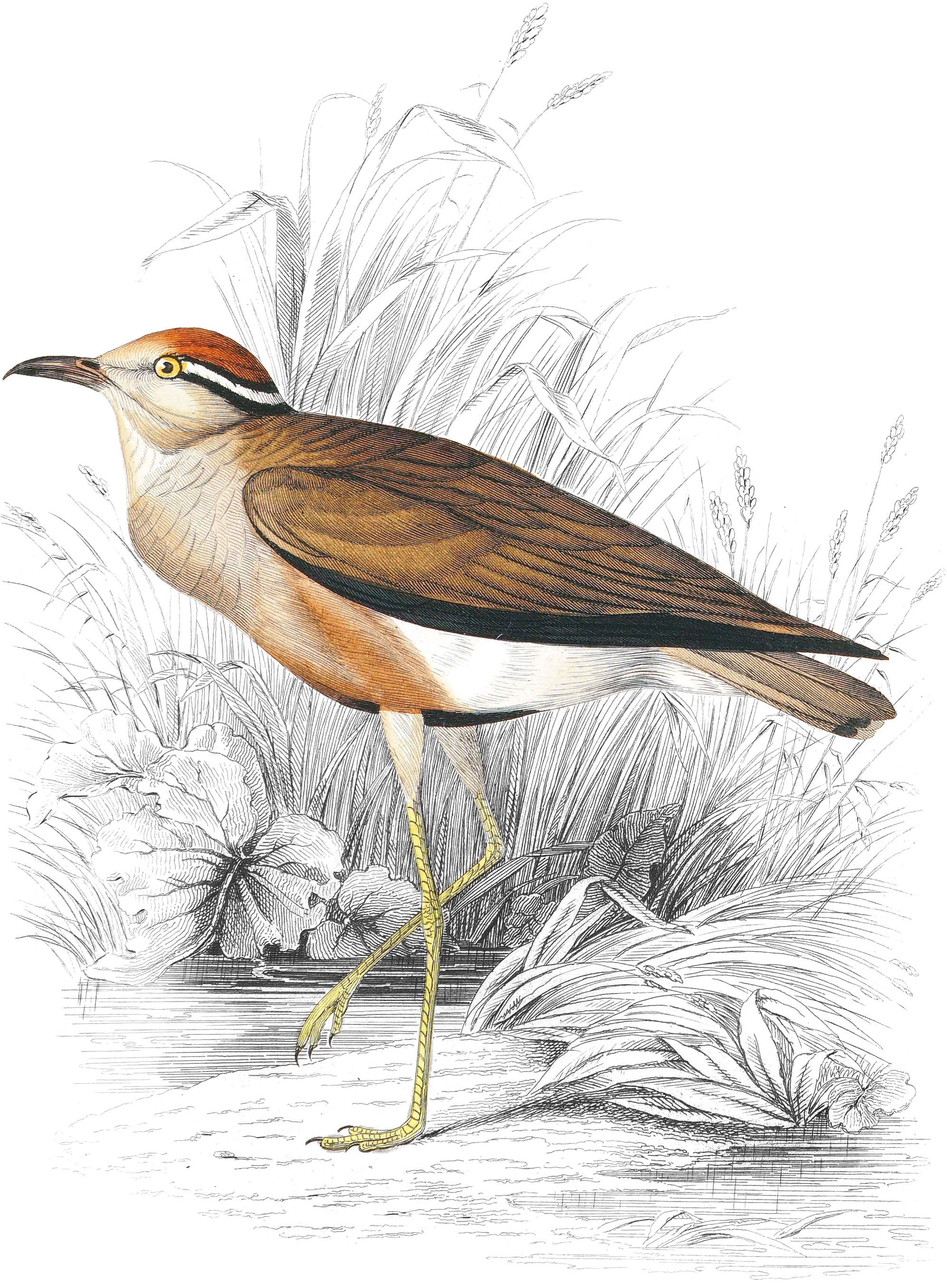
Plate XXIV
Violet-Winged Courier
Tachydromus chaleopterus, Swains.
Light brown above; front, throat, rump, and body beneath, white; quills black, tipt with shining violet; breast pale brown, with a black band.
Cursorius chalcopterus, Pl. Col. 298.—Cursor chalcopterus, Syst. Avium, No. 5.
This is the largest and the most remarkable species of Courier yet discovered; it connects this group with Glareola, and is distinguished at first sight by the peculiarity of its wings. The quills are deep black, but each of them are tipt, for about half an inch, with a rich metallic violet, changing either to purple or lilac according to the direction of the light; these spots are margined behind by a narrow line of greenish copper-colour, which also extends to the edge of the lesser quills. When the wings are closed, these spots are brought together so as to form a shining band, giving to the bird an appearance no less novel than beautiful. It seems to be a very rare species even in Senegal, for we have never been able to procure more than one specimen for our museum; this we shall now describe.
The general size is equal to that of the golden plover, but from the length of the legs, the bird stands, to the back, eight inches and a half high. The upper plumage is drab-brown, the under, from the breast, is pure white; the front of the head, as far as the eyes, is cream-colour; the ears are drab, striped with blackish, and there is a pale brown maxillary stripe on each side the lower mandible. The chin and half way down the throat is white, which colour extends a good way round the sides of the neck and ascends in a stripe behind the ear-feathers; the lower part of the neck and breast is delicate drab-brown, pale at first, and gradually deepening till the colour is terminated by a black. band, which marks the commencement of the white: on the body and all the remaining under plumage. The sides of the body, under the wings, are light buff-yellow. The wings are as long as the tail, the quills black, as before-mentioned, but the base of nearly all are more or less white; upper tail-covers pure white. Tail even, rather shorter than the wings, the two middle feathers brown and unspotted, the lateral ones black, with broad white tips. Bill strong, compressed at the tip; gonys angulated, colour black; the base yellow, the legs red. The middle claw although dilated is not serrated, and the inner toe is shortest.
Total length about 10 inches; bill, from the gape, 1\(\frac{1}{10}\); wings, 7\(\frac{3}{4}\); tarsus, 3\(\frac{1}{10}\); naked part of the thighs, 1\(\frac{4}{10}\); middle toe and claw, 1.
Black-Zoned Plover
Charadrius zonatus, Swains.
Neck and breast surrounded with a black collar or zone, margined above by another of white; front white; a black deep spot on the crown, encircled with white.
We cannot discover any description among the true Plovers which is perfectly applicable to this species. It comes nearest to the C. Phillippensis of authors, but independent of that being a native of India, the colours on the head appear differently disposed.
The colour of this pretty little Plover, like most others of the genus, is of a drab or grey-brown above and white beneath. The head, however, is singularly varied with black and white. In the first place, there is a very narrow black band in front, passing from eye to eye, and situated close to the base of the bill; above this is another, twice as broad and pure white, which occupies the full front of the head, passes over the eyes, and there crosses the middle of the crown. The fore part of the head, behind the white band already mentioned, is occupied by another band of black which reaches as far back as the middle of the crown, and is there bordered behind by the transverse white line already mentioned; this black band joins the narrow one across the nostrils by a black line before the eye; the hind head, the ears, and nape, is drab-brown. The chin and throat are white, and this colour is continued round the neck, so as to form a narrow collar; this is followed by another of black, which is narrow behind and broad upon the breast. Quills blackish, the shaft of the first only being white. Tail nearly even, the lateral feathers broadly tipt with white; behind this white is a black patch which fades into brown and ultimately into white; the external feather is white, with a black spot on the inner web only, placed nearly in the middle. Bill black; legs pale cinereous.
Total length 6\(\frac{1}{4}\) inches; bill, from the front, \(\frac{11}{20}\); wings, 4\(\frac{3}{4}\), as long as the tail; tail, 4\(\frac{1}{2}\); tarsus, 1.
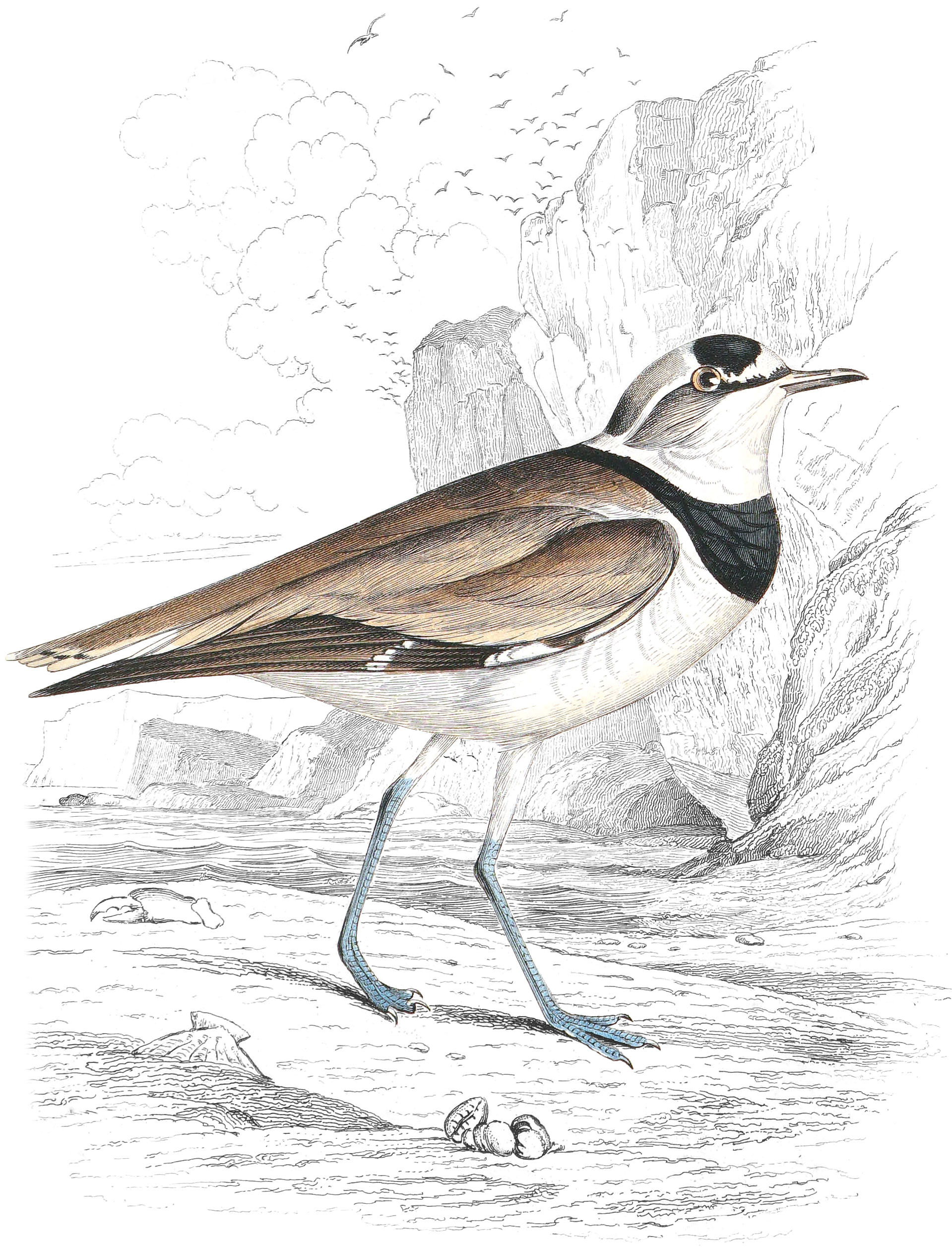
Plate XXV
Black-Bodied Lapwing
Vanellus melasomns, Swains.
Head above, body beneath, and front of the throat and breast, black; sides of the neck, breast, and collar round the neck, white; tail black; the base and covers white; feet three-toed.
Charadrius spinosus, Auctorum, Syst. Avium, No. 10.—Pluvier armé du Senegal, Pl. Enl. 801. (bad).—Edwards, pl. 280. fig. 2.
As a preliminary step to the arrangement of this family, we propose to restrict the genus Charadrius to those birds only whose wings are so much pointed that the first quill is always the longest, and from which the others gradually but rapidly diminish in length; this structure we consider as pre-eminently typical. All other species or forms not possessing it, we shall arrange at present under Vanellus; the sub-genera of which, however, we shall refrain from defining until we have discovered their circular succession, and consequently their true characters.
The present species, heretofore arranged in the genus Charadrius, is separated from the types of that group by having the shoulders armed with a strong spur or spine, and by the different form of its wings; the fourth quill of which is as long as the first.
The size is about that of our Lapwing, and the colouring, which is very peculiar, will be better understood perhaps by the figure than by the following description. The whole of the top of the head and nape are of the deepest black, the nape having a short crest; this black is isolated by a broad collar of white across the upper part of the neck, and this unites with the white which spreads over the sides only of the head, neck, and breast; from the chin to the breast is a broad black stripe, which terminates somewhat in a point. Upper plumage drab-brown, but the upper tail-covers, as well as the lower, are white; quills deep black, but the lesser ones are more or less white at their base; tertials drab. Tail quite even and black; the base of the feathers white; from the breast to the belly the colour is deep black; but the vent, flanks, thighs, inner wing-covers, and under tail-overs, are all pure white. The wings are about half an inch longer than the tail, the two outermost feathers of which are slightly tipt with white; the spur on the shoulder is deep black and very acute.
We question whether Edwards’ figure, pl. 47, is of this species, as he mentions the head is glossed with green and the body with blue, neither of which tints are seen in our Senegal specimens, or in others we have received from India.
Total length about 10\(\frac{1}{2}\) inches; bill, from the front, 1; wings, 7\(\frac{1}{2}\); tarsus, 2\(\frac{6}{10}\); middle toe and claw, 1\(\frac{2}{10}\); inner toe shortest.

Plate XXVI
Brown-Backed Plover
Vanellus inornatus, Swains.
Above dark-brown; the front with a white spot; rump, throat, and breast, sooty black; chin, under part of the body, and the tail, white; the latter slightly forked, and with a broad black terminal bar.
Although we have some suspicion that this may be a young bird, not arrived at its full plumage, we yet are unacquainted with any species with which it might be so arranged. On the other hand, there is no admixture of differently coloured feathers in any part of the plumage, and all the tints are fully and well marked. Only one specimen, belonging to Mr. Warwick, has yet fallen under our inspection, and of which the following is the description.
In regard to general structure it agrees with the last species, but there is only a small horny tubercle on the carpus of the wing, and the inner lateral toe is only very slightly shorter than the outer, so much so, that at first they appear to be of almost equal length; the claws are unusually short, thick at their base, and well curved.
Commencing with the upper plumage, there is a conspicuous and well defined spot of pure white in front of the head; all the rest of the upper parts, that is to say, the head, neck, back, scapuluars, tertials, and wing-covers, are of a uniform dark or sepia brown, much more intense than in the generality of the species; while on the rump this colour becomes blackish, the greater quills are entirely of a deep black, except two or three of the shortest, which are tipt with white; the lesser quills are nearly all pure white with a little black at their base; the tail, although obtuse, is very slightly forked, and with the covers, is pure white; just before the tips, however, a broad black bar crosses the centre pair.
The under plumage, from the chin (which is white) to beyond the breast, is of a light sooty black, deepening as it descends, and then abruptly terminating at its darkest part, beyond which the rest of the feathers are entirely pure white; the bill and legs are deep black, and the tail does not exceed the length of the wings.
Total length, 9\(\frac{1}{2}\); bill, base, \(\frac{8}{10}\); wings, 6\(\frac{1}{2}\); tail, base, 3; depth of the fork, \(\frac{1}{4}\); tarsus, 2\(\frac{2}{10}\); naked space above the knee, 1\(\frac{1}{10}\); middle toe and claw, \(\frac{9}{10}\).
Stripe-Throated Lapwing
Vanellus strigilatus, Swains.
Bill with a pendent lobe; forehead white; crown, sides of the head, throat, and breast, marked with longitudinal black stripes; feet four-toed.
Vanellus albicapillus, Vieil.—Charadrius albicapillus, Juv.(?) Wagler, Syst. Av. 53.—Vanneau armé, du Senegal?? Pl. Enl. 362.—Vanellus Senegalensis? Shaw, Genl. Zool. xi. 2. 515.
There is a peculiar gracefulness in these long-legged plovers, which, joined to the delicate tints of their plumage and the singular fleshy wattles which generally ornament their head, renders them very interesting birds. The present species has been considered, for what reason we know not, as the young of albicapillus, a species found, we believe, in India. The singularity, however, of the short black stripes, which extend round the confines of the deep black in front of the chin and throat, will at once distinguish it from that and all the other species of this numerous and intricate group.
General colour of the plumage isabella-brown; front, as far as the middle of the crown, white; the remainder portion of the head black, terminating in short stripes of the same colour; the lores, or space between the bill and eye, is occupied by a naked skin, detached round its margin, and hanging down as a pendent lobe; the colour in the preserved specimen is rich yellow tinged with red or orange. The chin and front of the throat, nearly to the breast, is unbroken black, which terminates round the confines in short black stripes. The black of the quills is separated, as usual in this genus, from the brown of the covers by a broad white space. The first, second, and third quills are the longest; the tail, which is even, has the basal half and the tip white, the rest occupied by a broad black band; the wings are long and project a little beyond the tail. The interior wing-covers and the under tail-covers are white, the former pure, the latter tinged with fulvous. Feet clear yellow; the claws and the wing-spur deep black; inner toe shortest, hinder toe very minute.
Total length about 12 inches; bill, 1\(\frac{3}{10}\); wings, 9; tail from the base, 4; tarsis, 3; hinder toe minute, only \(\frac{2}{10}\).
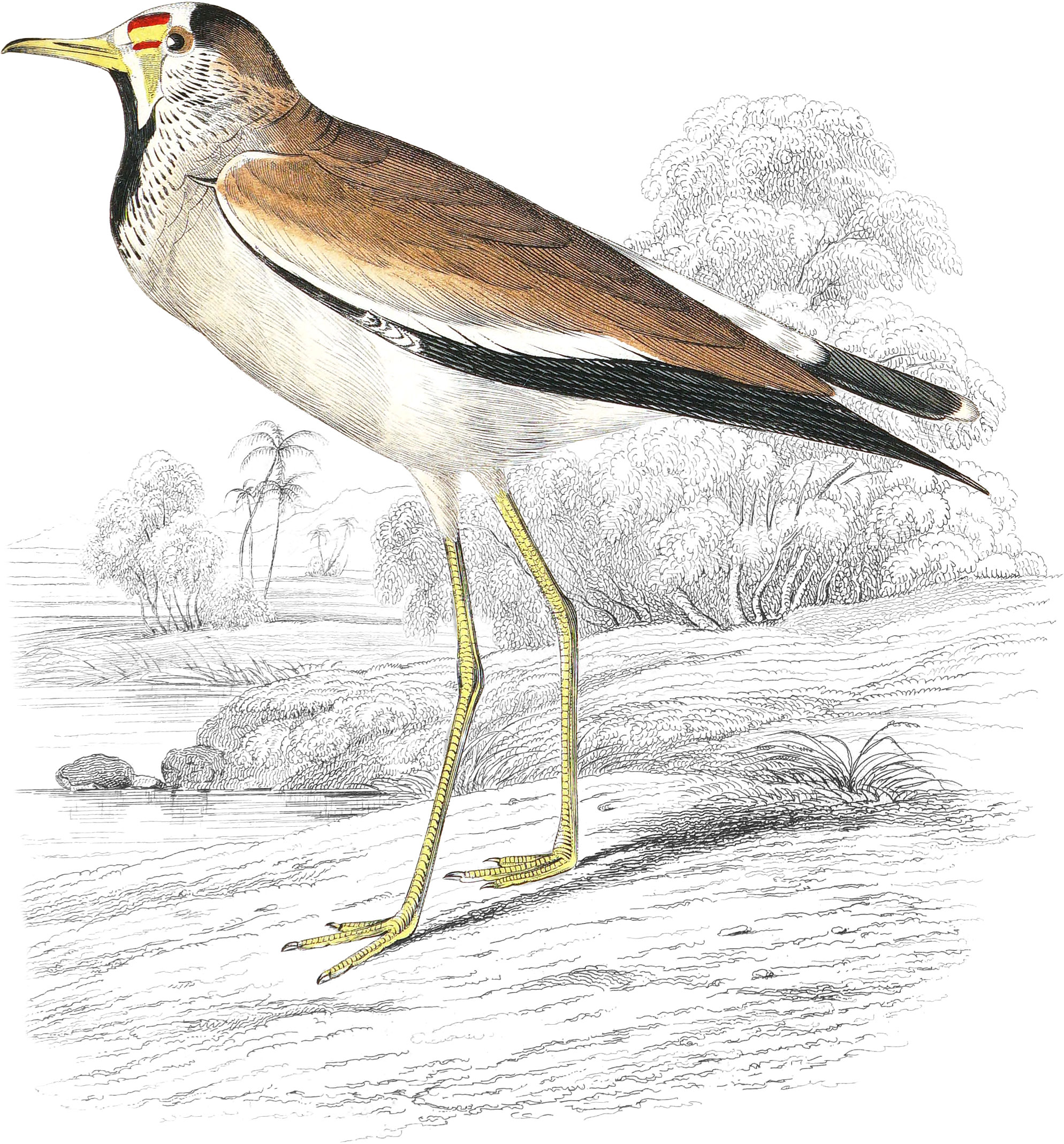
Plate XXVII
Rufous-Tailed Water Hen
Gallinula pulchra, Swains.
Head, neck, breast, and tail, bright rufous; the rest of the plumage, above and beneath, black spotted with white.
Crex pulchra, Gray, Griff, Cuv. viii. 410.
This very elegant species possesses all the typical characters of the Water Hens, except in the tail, which is particularly soft, and, in the specimen before us, seems to be boat-shaped; whether this appearance is artificial, caused by a bad preparation of the skin, or whether it is really natural, cannot be at present determined. We are disposed, however, to adopt the latter opinion; in which case the specific name may be advantageously changed to Alectura, as indicating at once its affinity, if not its absolute union, to the sub-genus Alecthelia.
The colouring is very peculiar, and is sufficiently described in the specific character given above; the white spots are clear, round, and well defined, both on the upper and the under plumage; but on the rump and tail-covers they are smaller and more obscure; the wing-feathers are very broad, and those of the tail rather longer than usual; these latter, as just observed, are very soft and the webs loose, but their covers are not lengthened. The bill and legs seem to have been dark-green in the living bird.
Total length about 6 inches; bill, gape, \(\frac{8}{10}\); front, \(\frac{6}{10}\); wings, 3\(\frac{2}{10}\); tarsus, 1\(\frac{1}{10}\); middle toe an claw, 1\(\frac{4}{10}\); hinder, \(\frac{7}{20}\); tail, base, 2.
Yellow-Bellied Water Hen
Gallinula flavirostra, Swains.
Entirely deep and uniform black; bill bright yellow; eyelids and feet red.
Gallinula flavirostra, Classif. Birds, ii. part 5, No. 170.35—Rallus niger? Lath. Gen. Hist. ix. p. 380.
To this species, which is probably one of those which pass under the general name of Black Rail, we have not affixed the specific name of Niger, because Dr. Latham’s account is too vague to be applied without doubt. He mentions, for instance, that the legs are either brown or red, that the end of the bill is brown, that the plumage in general is dusky-black, but deepest on the head, and that the claws are “hooked.” As these discrepancies with our Senegal specimens lead to the suspicion that there may be more black species than one, we have distinguished this by a separate name.
The whole plumage, in two specimens now before us, is entirely and uniformly black, without any variation of tints either above or below, but the upper plumage is rather more glossed than the under; the bill is bright yellow to the very tip, but the base is greenish; the wings reach to the end of the tail, the feathers of which are broad and peculiarly soft; the eye-lids and the feet are very bright red, and the claws, which are brown, are not more curved than in other species.
Total length, 7\(\frac{1}{4}\); bill, front, nearly 1; wings, 4\(\frac{3}{10}\); tarsus, 1\(\frac{1}{2}\); naked space above the knee, \(\frac{4}{10}\); middle toe and claw, 2; hinder ditto, \(\frac{9}{10}\).

Plate XXVIII
Grey-Capped Gull
Larus poiocephalus, Swains.
Head and chin covered with a hood of light cinereous; spurious wings, with the base and tips of the primary quills, white; bill and legs crimson.
Although this Gull belongs to the hooded division of the genus, it differs from all we have hitherto met with, in the peculiar lightness of the hood by which the head and chin is enveloped; the tint, in fact, of this part is not so dark as that which covers the back and upper plumage, although the margins of the hood are darker. The two first quills are deep black, with a large white spot on both webs removed about three-fourths of an inch from the tips; at the base of the second quill is a white spot, this becomes larger on the third and fourth, until, in the fifth quill, it spreads and occupies the whole of the outer shaft; the sixth quill is grey outside, except near the end, where it becomes white; at this part it is crossed by a band of black, leaving the extreme tip pure white; the third, fourth, and fifth quills have all white tips, but those which follow are without. It deserves notice that the quills and wing-covers beneath are much darker than on their upper surface; the margins of the wings, and the whole of the spurious quills, tail, and under plumage, are pure white; the middle tail-feathers are shorter than the lateral, but they are all broad and very obtuse, the wings extend near two inches beyond the tail. In the young, or female, or in the winter plumage, the grey hood is not clearly defined. The bill and feet are deep crimson.
Total length, 16 inches; bill, from the gape, 2\(\frac{4}{10}\); front, 1\(\frac{4}{10}\); wings, 12\(\frac{1}{2}\); tarsus, 2; hind toe and claw, \(\frac{4}{10}\); middle ditto, 1\(\frac{8}{10}\); the hind toe is near twice the length of its claw.
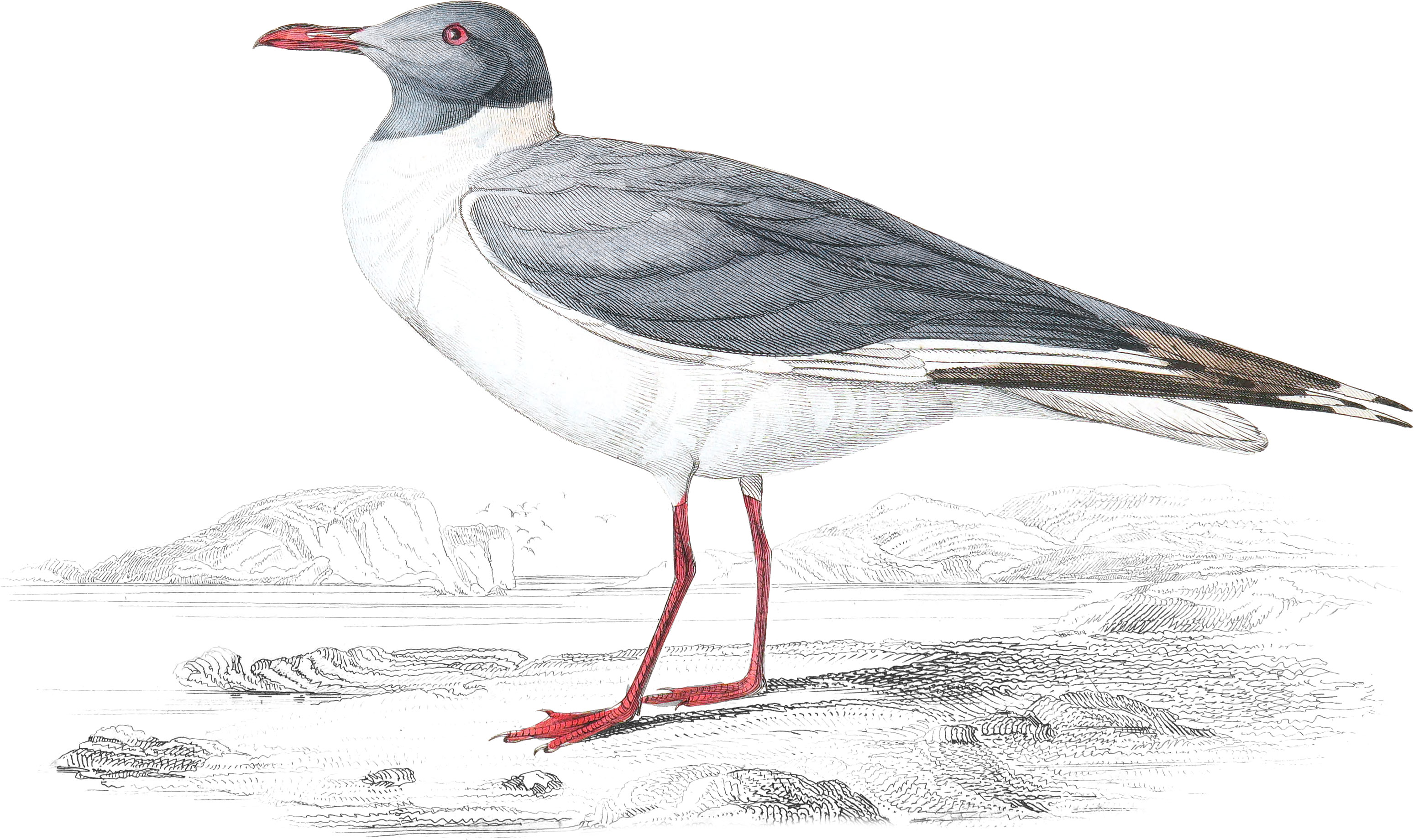
Plate XXIX
Crested Tern
Sterna cristata, Swains.
Large; bill orange; head and nape black and subcrested; wings and tail of equal length, the latter entirely white; feet black; tarsus one inch long.
The Terns, or Sea Swallows, although distributed over all temperate and tropical shores, are much more restricted in the geographic range of the species than has been generally supposed. The great similarity of their plumage, and the little attention which the foreign species have as yet received from modern writers, renders it impossible to determine which have, and which have not. been described. We shall consequently regard the four here enumerated as new: for they will not agree, in all points, with any of those enumerated in the works we have consulted. It has been well observed, that a bad description is worse than useless, inasmuch as it not only prevents the clear determination of the species intended by others, but embarrasses all succeeding investigations with doubts and difficulties. Those we shall here notice may possibly have been described long ago; but if so, their descriptions are faulty or imperfect, and they thus become as useless as if they never had existed.
The species now before us is one of the largest sized in this genus, measuring no less than twenty inches. The upper plumage, but for a very slight tinge of grey, hardly perceptible, might be termed as white as the under parts, the quills alone being grey, frosted, as it were, with white; the bill is rich orange, rather longer, but not so stout as that of the gull tern. The deep black upon the head and front includes half the lores and the eyes, but it is interrupted by a white spot on the lower eye-lid; the feathers of the hind head and nape are lengthened and pointed, so as to form a nuchal crest; the wings are long, and reach to the end of the tail: the first five quills are light-grey, with a frosted white appearance on their outer webs, the inner webs are dark-grey on their inner half and white on their outer; but the stripe of this latter colour almost disappears on the fourth and fifth quills, whose inner shafts are almost entirely dark-grey, excepting a narrow white edging: the remainder quills are uniform whitish, except a stripe of light-grey on the outer webs of the secondaries: the tail, which is deeply forked, is white both above and beneath. The feet are deep black, and are naked for nearly an inch above the tarsus.36
Total length, 20; bill, from the gape, 3\(\frac{1}{2}\); front, 2\(\frac{1}{2}\); wings, 14; tail, base, 7\(\frac{1}{2}\); depth of the fork, 3\(\frac{2}{10}\); tarsus, 1; hind toe and claw, \(\frac{4}{10}\); middle ditto, 1\(\frac{4}{10}\); inner ditto nearly 1; outer ditto, 1\(\frac{2}{10}\).

Plate XXX

Black-Winged Tern
Sterna melanoptera, Swains.
Bill, feet, and quills, black; tail forked, longer than the wings, cinereous; the two outer feathers white, with cinereous tips.
There are two or three peculiarities in this species which renders it more easy of discrimination than several of its congeners. Its size is about that of S. hirundo; the bill is particularly straight, so that the commissure has no curve, and the gonys inclines upwards, just as much as the culmen does downward. The whole upper parts of the head and nape are black; a line of the same colour passes through the eye and lores, leaving a broad white band in front of the head, which passes over the eyes and terminates just beyond them; the whole of the upper plumage is of a very dark cinereous, paler, indeed, on the interscapulars, but becoming almost black on the whole of the quill-feathers, including the shafts: the tail is deeply forked, and is coloured like the back, excepting the two outer-feathers, which are white, with dark cinereous tips; this latter colour extends, on the inner web, to about one-third its length. The shafts of the quills on their inner surface are white, and the inner webs have on this side a white margin. The feet are short and deep black.
Total length, 15 inches; bill, gape, 2\(\frac{4}{10}\); front, 1\(\frac{7}{10}\); wings, 10\(\frac{1}{2}\); tail beyond, 1\(\frac{1}{2}\); from the base, 7\(\frac{1}{2}\); tarsus; middle toe and claw, 1\(\frac{2}{10}\); hinder ditto, \(\frac{4}{10}\); inner ditto, \(\frac{8}{10}\).
Senegal Tern
Sterna Senegalensis, Swains.
Bill and feet red; crown and nape black; plumage above light cinereous, beneath much paler; chin, sides of the head, and part of the throat, pure white; wings ten inches, rather longer than the tail.
Were it not that we possess no less than four distinct Terns, which might all pass for the S. hirundo of authors, we Moda have been tempted to have added this to the number; the more so, because, at this moment, we have not an authentic British specimen of that well known species to consult. Its description, however, as given by M, M. Temminck and Selby, although in general applicable to our Senegal bird, is not strictly so, and we shall therefore consider them as distinct, at least until further information proves the contrary. In reference to Mr. Selby’s account of the S. hirundo, we shall merely point out in what respects our present bird differs. The bill measures only 1\(\frac{4}{10}\) of an inch from the forehead to the tip, instead of one inch and a half: there are no “long occipital feathers,” those of our bird being in no respect lengthened. The under plumage, instead of being pure white, with a tinge of grey only on the breast, is only pure white on the chin, sides of the head, and beginning of the throat; from thence a very slight shade of pearl-grey commences, which gradually increases over the breast, body, and belly, where it is darkest, and where it terminates: the under tail-covers are like the upper, pure white: the wings are slightly longer than the tail, and the colouring of both agrees with Mr. Selby’s description; but the same may be said of two other species now before us, one from the arctic regions, and the other, as supposed, from India. All these have a marked difference in their size, and, with other peculiarities, create a belief that they are specifically distinct. The bill of this is very slender, and more curved than in the others.
Total length, 12 inches; bill, front, 1\(\frac{4}{10}\); gape, 2; wings, 10, being about \(\frac{3}{4}\) longer than the tail; tarsus hardly \(\frac{7}{10}\); middle toe and claw, 1; hind ditto, \(\frac{3}{10}\); tail, base, 6; depth of the fork, 2\(\frac{7}{10}\); outer feather 1\(\frac{4}{10}\) longer than the others.
Short-Footed Tern
Sterna brachypus, Swains.
Bill and feet red; tail white, deeply forked; wings eleven inches long, and shorter than the tail; tarsus half an inch.
Of this species the only specimen we have yet seen is in the British Museum, where it was pointed out to us some years ago as a native of Western Africa. Its general size is that of S. melanoptera, and it is distinguished from all the other black capped species resembling S. hirundo, by its very short tarsus, which, from notes then made, only measures half an inch. Not having a second specimen to examine, we subjoin the description of that before alluded to.
General colour cinereous, both above and below, but paler and nearly white on the chin; upper and under tail-covers pure white; tail the same, but the outer web of the two external feathers is deep cinereous, almost sooty black. Quills blackish cinereous, the shafts pure white, with the inner web half cinereous, half white; bill red; feet orange; tail one inch longer than the quills.
Total length, 15 inches; bill, from the gape, 1\(\frac{6}{10}\); from the front, 1\(\frac{2}{10}\); wings, 11; tail, from the base, 8; depth of the fork, 4\(\frac{1}{2}\); tarsus, \(\frac{1}{2}\).
Black-Eared Tern
Thalassites melanotis, Swains.
Bill red 5 feet black; plumage above cinereous; crown and ears black; neck and under parts white.
From the great curvature of the bill and the strong and lengthened feet of this bird, we have been induced to consider it the type of that form which unites the Terns to the tropic birds, and in accordance with this impression it has been arranged, in our Classification of Birds, under the sub-genus Thalassites. The form of the bill, except that the margins are not toothed, is precisely that of Phæton, while the connexion of this new group with Sterna is manifestly effected by our present Sterna cristata.
Of the Thalassites now to be described, we have only received one specimen, which, although sufficiently perfect to determine its essential characters, is obviously not an adult bird. The upper part of the head is marked only with black stripes, indicating that in a more advanced state of plumage this part would be entirely of that colour; the ears, indeed, and the space between the under eye-lid and the angle of the mouth, have already become entirely black. The white of the under plumage extends round the neck, where it forms a white collar; all the rest of the upper plumage is of a very light pearl-grey or cinereous; the quills are the same, glazed as it were, over a deep black, which shows its full tint on the inner webs of the five first primaries, these feathers being entirely blackish, without the white longitudinal stripe so general among the other terns; all the shafts are white both above and below. The tail is forked, and in this specimen is about two inches and a half shorter than the wings; the feathers, however, have obviously not reached their full growth; the outer pair, which seem to exhibit the adult colour, are of the same very light tint as the back, but darker towards their tips; the others are dark cinereous, mottled with white, indicating immaturity; the bill is rich red, tipt with blackish, and the feet, which are strong, are deep black; the middle claw is much curved outwards, and that of the hinder toe is short and very straight.
Total length, 21 inches; bill, front, 2\(\frac{1}{2}\); gape, 3\(\frac{1}{2}\); wings, 15\(\frac{1}{2}\), being 2\(\frac{1}{2}\) longer than the tail; tarsus, 1\(\frac{1}{2}\); bare space above the joint, \(\frac{7}{10}\); middle toe and claw, 1\(\frac{6}{10}\); hind ditto, \(\frac{1}{2}\).
Long-Tailed Cormorant
Carbo longicaudus, Swains.
Bill yellow; general plumage black; scapulars and middle wing-covers light grey, with a black terminal spot and white tip; tail long.
The Cormorants, like several other natural groups of plain coloured and unattractive birds, have been much neglected; and there probably exists twice the number of species, even in our museums, to what have been described. This, which is the only one we have yet received from the Gambia, is very small, and is remarkable for its long tail of twelve feathers; the bill is short and yellow, but the naked temple and orbits, from their appearance in the preserved specimen, seem to have been red. The base of the rictus and of the lower mandible is feathered, and there are others, very short, reaching to the front of the nostrils. The upper part of the head and neck, the sides, and the ears, are brown, but not glossy, and the edges of the feathers are pale; this colour changes between the shoulders, and becomes deep black as far as the tail, which is tinged with cinereous; the scapular-covers are of a greyish-white, having a large and conspicuous transverse spot at the end of each, but the extreme margin of their tips is white; on the three or four last and largest of these feathers this black spot almost disappears; those of the wing-covers that are near the shoulder are deep black, and it is only those in the middle of the wing which resembles the scapulars; the shoulders, the outer margin of the wing, and the quills, are deep unspotted glossy black, as is all the rest of the plumage. Tail-feathers narrow, long, and much graduated, their tips are rounded; throat and breast mottled with brown; chin and body beneath pure white; the feathers are not pointed.
Total length, 17 inches; bill, gape, 2\(\frac{2}{10}\); front, 1\(\frac{3}{10}\); wings, 8\(\frac{1}{2}\), reaching to the base of the tail; tail, 6\(\frac{1}{2}\), outer-feather 3 inches shorter; tarsus, 1; outer toe and claw, 2\(\frac{1}{2}\).
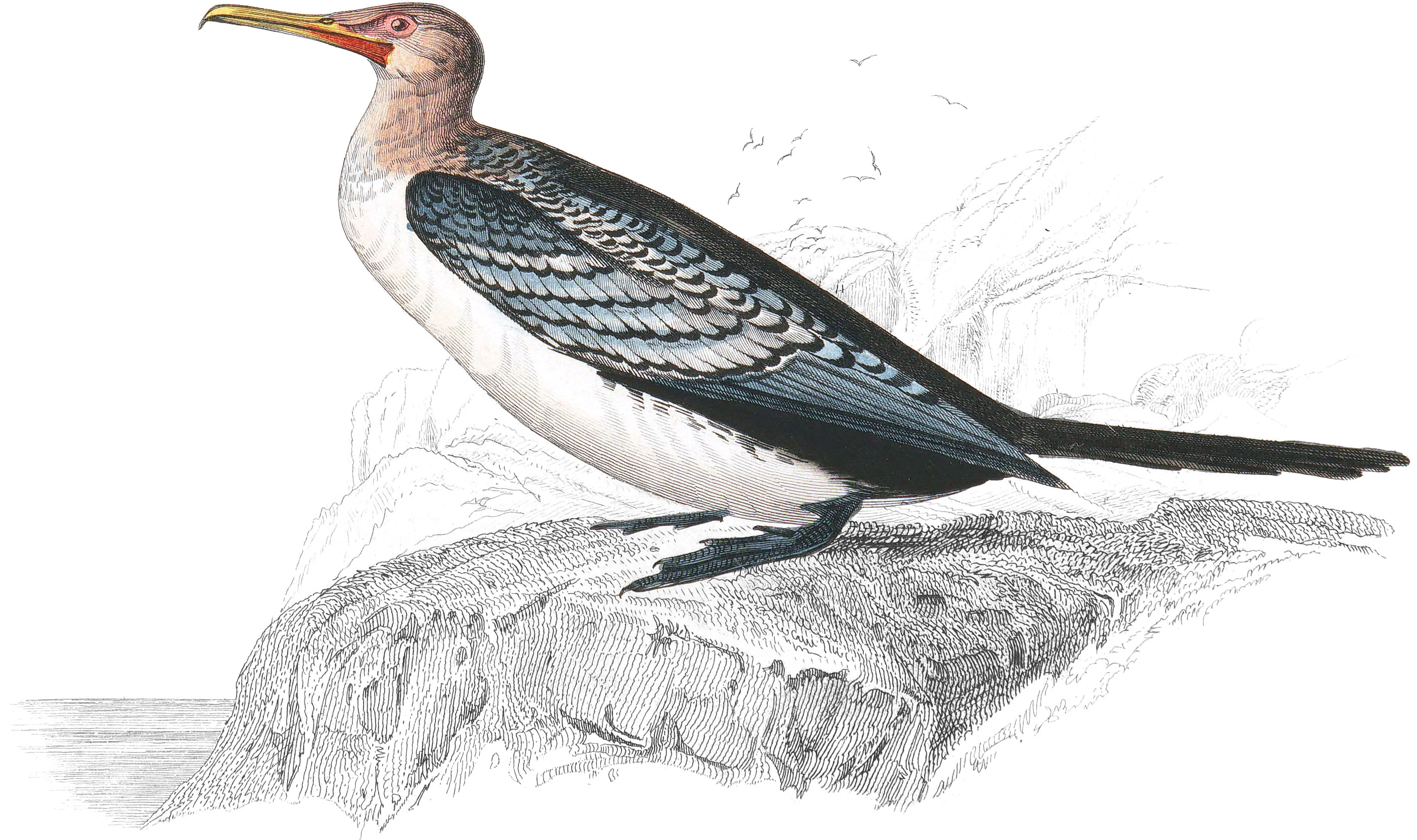
Plate XXXI
Appendix to the Perchers
Crowned Hornbill
Buceros coronatus, Shaw.
Bill red, with a slightly elevated keel or crest extending nearly to the end of the culmen; plumage brownish-black; the body beneath and stripes round the nape white.
Le Calao couronne, Le Vaill. Ors. d’Af. 234.—Buceros coronatus, Shaw, Gen. Zool. viii. 1, 35; Zool. Illust. 1st series, pl. 178.
There may be some doubt whether this is specifically the same as the B. coronatus of Southern Africa, for although their general cast of colours seem to agree, there yet remains some difference between the two. The Senegal bird is certainly much larger than a magpie, for it measures full eighteen inches in extreme length, while the Cape species is said to be smaller than that bird. In this the whole of the tail-feathers, and not merely the three external pair, are tipt with white, while the under plumage of the body is strongly tinged with fulvous; there is a dark brown line also at the cutting edges of the mandibles. Unfortunately our former description of the Cape species is as defective as that by Le Vaillant, in regard to those nice distinctions which would determine the question Yet as in all other respects the two birds agree, we have thought it more advisable, for the present, to keep them under the same specific name.
In regard to the habits of the Senegal bird we know nothing, and the only specimen we have yet seen belongs to Mr. Warwick. That of the Cape of Good Hope, however, seems to be exceedingly common in some districts on the eastern coast, where M. Le Vaillant mentions having seen flocks of more than five hundred assembling along with crows and vultures, preying on the remains of slaughtered elephants; at other times they are to be found in woods, perched on high withered trees. The female differs from the male in having no white spots round the nape; she deposits her eggs, which are white, and generally four in number, in the hollows of decayed trees.
The general colour of the upper plumage is a peculiar glossy brownish-black, having a very slight greenish tinge on the quill and tail-feathers; the tertial and secondary quills have a very narrow edging of light brown, but the quills are entirely deep black; the tail is the same, but all the feathers are more or less tipt with black. The head, neck, breast, and flanks, are blackish-brown, rather lighter than the wings, and of a uniform tint, excepting a number of whitish stripes behind the ears and round the nape, forming an irregular and ill defined band; the edge of the carpus, middle of the body, vent, and thighs, are fulvous-white; the bill is red, the tail even, and the feet black; the lateral toes are equal; the edges of the mandibles are irregularly toothed.
Total length, 20\(\frac{1}{2}\) inches; bill, gape, 3; of the keel, 2\(\frac{1}{2}\); wings, 10\(\frac{1}{2}\); tail beyond, 5; base, 9\(\frac{1}{2}\); tarsus, 1\(\frac{1}{4}\).
Yellow-Crowned Weaver
Ploceus flaviceps, Swains.
Yellow, above spotted with black; sides of the head, cheeks, ears, chin, black, continued in a stripe down the middle of the throat and breast; upper part of the head pure yellow.
The only specimen we have ever seen of this species has been obligingly communicated to us by Mr. Warwick, who received it with the other birds herein-mentioned from Senegal. It has the nearest affinity, in point of colouring, to the Malimbe à gorge noire of M. Vieillot’s work, Ois. Chant., pl. 45, but setting aside other differences, the sides of the head in that are pure yellow, the black of the chin being confined only to the front and to halfway down the neck; in this, however, the black covers the ears and lores, and extends downwards, in front, to beyond the breast.
Although the bill is rather smaller than that of Ploceus textor, the size of the bird altogether is somewhat larger. The upper part of the head is pure yellow, which begins to have an olive tinge on the nape; the feathers of the lower part of the neck, the interscapulars, the back, and the rump, are all black, with a transverse olive-yellow spot at the tip of each; the wing-feathers are the same, but the yellow forms a more regular edging to the feathers, as in P. textor. The black patch which covers the ears, lores, and chin, suddenly contracts beyond the latter, and forms a very slender line running in front of the throat, and terminates just beyond the breast; all the rest of the under plumage is fine yellow; the second quill is nearly as long as the third; tail short, olive-yellow; bill black; legs strong, large, and pale.
Total length, 6\(\frac{1}{2}\) inches; bill, gape, \(\frac{8}{10}\); front nearly \(\frac{8}{10}\); wings, 3\(\frac{1}{2}\); tail beyond, 1; base, 2\(\frac{3}{10}\); tarsus, \(\frac{9}{10}\); middle toe and claw, \(\frac{9}{10}\); hinder ditto, \(\frac{8}{10}\).

Plate XXXII
Black-Hooded Weaver
Ploceus cucullatus, Swains.
Yellow; brighter beneath; the whole of the head, cars, and forepart of the throat, enveloped in a black hood.
We met with this species, which is quite new to us, in the valuable collection of Mr. Warwick, of the Surrey Zoological Gardens, while the mode in which the skin is prepared leaves no doubt whatever that it is a native of the Gambian territory.
The structure is perfectly typical, and the size intermediate between that of P. textor and ruficeps; the first quill is half as long as the second, which again is a quarter of an inch shorter than the third.
A deep and uniform black hood, with a brownish gloss, envelopes the whole of the head and ears, as far as the nape, and forms a narrowed lappet in front of the throat, as far as the breast; the feathers adjoining or around the margin of this hood, on the upper part of the neck and its side, are bright yellow, which then immediately blends into the olive yellow on the back, rump, and tail; the wings, like the generality of these species, are dark-brown, broadly edged with yellow on the tertials and wing-covers; the under plumage is entirely of a fine uniform yellow; bill black; legs pale.
Total length nearly 6 inches; bill, gape, \(\frac{13}{20}\); front, \(\frac{6}{10}\); wings, 2\(\frac{9}{10}\); tail beyond, 1\(\frac{1}{4}\); base, 2\(\frac{3}{10}\); tarsus, \(\frac{8}{10}\); hind toe and claw, \(\frac{13}{20}\); middle ditto, \(\frac{8}{10}\).
Rufous Crowned Weaver
Ploceus ruficeps, Swains.
Yellow, brighter beneath; crown of the head and fore part of the throat rufous; chin, ears, and frontal line black.
For an inspection of this new species of Weaver, we are indebted to Assistant Commissary-General Weir, who, on his return from the Gambia, obligingly sent for our examination a considerable collection of the birds of that country.
Although very small in comparison with the other species of true Ploceus, its whole structure and cast of colours places it close to Ploceus textor and the other two new species here described.
General plumage deep and full yellow, tinged with green from the nape downwards, but bright on the sides of the neck and on all the under plumage. A black patch covers the chin, the ears, and the sides of the head, and is continued in front by a very narrow line; in this patch the eye is situated. The fore part of the head and crown is deep rufous, which gradually changes to yellow on the nape; there is also a slight tinge of the same rufous colour in the middle of the throat, as far as the breast. The wing-covers and tertials are blackish-brown, broadly edged with yellow; the quills brown, with very narrow edgings of the same; tail very short, slightly rounded, and light olive-yellow like the back; bill black; legs pale; second quill a quarter of an inch shorter than the third.
Total length nearly 5 inches; bill, gape, \(\frac{6}{10}\); wings, 2\(\frac{6}{10}\); tail beyond, \(\frac{1}{2}\); base nearly 2; tarsus, \(\frac{3}{4}\); middle toe and claw, \(\frac{7}{10}\); hind ditto, \(\frac{6}{10}\); inner toe rather shorter than the outer.
N. B.—By some unaccountable oversight, the artist who designed the Vignette of the first volume, has represented the Corythaix Persa instead of the Corythaix Senegalensis, the head of which, as drawn by Mr. Swainson, is given at Plate XXI.
- Classification of Birds, vol ii.
- Classification of Birds, vol. ii.
- Le Môlenar, Ois. d’Af. iv. pl. 160.—Le Priprit, Ib. iv. pl. 161.
- See Classification of Birds, ii.
- Le Vaill. Ois. d’Afrique, iii.
plp. 206. - We give the original words of this passage, because it would seem to imply that these birds pursue their prey from place to place, and not, like ordinary flycatchers, by taking up a fixed station and merely darting upon such flies as come within the range of a dart or spring. This isa very important question, and deserves the close attention of the African, ornithologist.
- Ecyclopédie Methodique.
- Brisson, Orn. iv. p. 547.
- The Merops Persica of Pallas, for instance, has the chin white.
- Since this has been written, I have visited the King’s Library in the British Museum, for the sole purpose of inspecting Le Vaillant’s work; and whatever doubt may hang over the bird figured at plate 6, I am clearly of opinion that the one on plate 6 bis, is the Senegal species here described.
- I have not adopted the specific name of Bullocki or Lamarcki, for the reasons already assigned in Classification of Birds, i. p. 236 and 238.
- See particularly Edwards, i. pl. 9; Buffon ed. Sonnini,
xx. 192xiii. 151.; and Pl. Enl. 716. - See Classification of Birds, vol. i. page 228.
- Habitat in insula Java, et non ut el. Vieillot indicat. in Africa.
- Mudie’s British Birds.
- “Rostro pedibusque nigris,” Vieill. Ency. Meth. 580.
- This seems to be the Rhinopomastes Smithii, Zoological Journal, iv. p. 2.
- Barrow’s Travels in Africa, 4to, p. 62.
- On the Natural History and Classification of Birds, vol. ii. part of the series of Dr. Lardner’s Cabinet Cyclopedia.
- Northern Zoology, ii. 308.—Classification of Birds, ii.
- Picus affinis, Zool. Illust. i. pl. 78.
- This has originated from nearly all the species having been placed by Dr. Lathan, to whom they were sent, under the old genera, where they are now as good as lost.
- Salt’s Travels, App. iv. page 46.
- The Molothrus pectoris, Swains, or Cow Bunting of Wilson’s American Ornithology.
- Travels in Abyssinia, App. iv. 46.
- In bleached and badly preserved specimens the yellow fades, and leaves the bill dirty whitish.
- Le Grand Indicateur, Ois. d’Af. v. p. 135, pl. 241. I have since procured specimens of this species, which confirms what is here said of its being quite distinct from P. flavicollis.
- That is, something like the colour of the lees of old wine, a tint almost exclusively found in the pigeon family.
- In erythrophrys this proportion is almost reversed, or at least the inner toe is not even equal to the outer.
- Systema Avium, No. 108.
- Manuel d’Ornithologie, 2d ed. ii. p. 514.
- Berlin Catalogue of Duplicates.
- Classif. of Birds.
- General History of Birds, ix. 354.
- On account of the bulk of the second volume, the publishers have omitted the fifth part, wherein was described 203 new birds referred to in the body of the work. This part, however, is to appear in a subsequent volume, and proof sheets have been forwarded to our most distinguished ornithologists.
- This bird makes the nearest approach to the Sterna velox of Rüppell (Atlas, pl. 13.), but the upper plumage of that is described as “obscure cinereis.”