
Volume XXV
Dogs
Part I
Introduction
When the interest attached to the higher orders of the brute creation is brought in review for the purpose of bestowing pre-eminence on one particular species, Europeans, with few dissentients, will consider them in relation to their utility for economic purposes. They will see in them objects of aliment and clothing; the producers of the raw materials for manufactures; they will think of navigation, exports, and imports, and then conclude that sheep and oxen are the most important animals to man. It is, however, probable that a Western Asiatic, from similar motives, would fix upon camels and dromedaries; a Nabob would point to his state elephant, and a Tartar, an Arab, a soldier, and a jockey, would unanimously claim the post of honour for the horse. No argument in favour of the Peruvian lama would be admitted; and the poor alone might perhaps muse upon the patient and hardy virtues of the ass. None but the savage and the mere sportsman would first think of the importance of the canine species. It may indeed be conceded, that in the social condition of nations long congregated and civilized, necessarily under the impulses of utilitarianism, dogs do not obtain that universal consideration which is granted to other animals in many respects their inferiors; and it is true that various tribes of the south-east abhor their presence, and view them only as scavengers, little better than the jackal and hyæna.
But when the intellectual endowments of the domesticated races of dogs are permitted to weigh in the scale,—when we begin to consider the faculties which the bounty of Nature has bestowed upon them,—the sincerity and disinterestedness of their attachment,—the sagacity, strength, velocity, courage, and perfect obedience which they proffer to man,—we cannot refuse them our admiration and affection. To what other species could we look for voluntary association with our fortunes? Which of them would, like the dog, lend us the full use of senses so acute as his? Which can rejoice in our joy, be vigilant and bold in our defence, obedient to order, faithful in our adversity, understand our least words and signs, and die on our graves from pure attachment? These qualities, we all know, dogs possess. Here, then, we find the source of that consideration which is granted them by all men near a state of nature; and although conceded by them with niggardly hands, the wild man of the Old World, the stoical hunter of the New, the half-frozen Esquimaux, and the savage of Australia, differ only in their mode of acknowledgment, from the expressions of favour with which the drover, the shepherd, the sportsman, and the fine lady of civilized society regard them.
As the dog alone, of all the brute creation, voluntarily associates himself with the conditions of man’s existence, it is fair to presume also that he was the first and therefore the oldest of man’s companions; that to his manifold good qualities the first hunters were indebted for their conquest and subjugation of other species. We do even now perceive, notwithstanding the advance of human reason and the progress of invention, that in a thousand instances we cannot dispense with his assistance.
If we still feel the importance of his services in our state of society, what must have been the admiration of man, when in the earliest period of patriarchal life he was so much nearer to a state of nature? When the wild hunter first beheld the joyous eyes of his voluntary associate, and heard his native howl modulated into barking; when he first perceived it assuming tones of domestication fit to express a masters purposes, and intonate the language which we still witness cattle, sheep, and even ducks and hawks learn to understand: What exultation must he have felt when, with the aid of his new friend, he was enabled to secure and domesticate the first kid, the first lamb of the mountain race! When, with greater combinations of force and skill between man and his dogs, the bull, the buffalo, the camel, the wild ass, and then the horse, were compelled to accept his yoke; and, finally, when, with the same assistance, the wild boar was tamed, the lion repelled, and even attacked with success. Although the total development of canine education must have been the work of ages, yet that it was very early, however imperfect, of great acknowledged importance, is attested by the prominent station assigned to the dog in the earliest theologies of Paganism. We know that his name was given to one of the most beautiful stars, among the oldest designated in the heavens, and that it served for the purpose of fixing an epoch in the solar year, by its periodical appearance.1 Other constellations, nearly as old, were likewise noted by the name of dogs; and there are proofs, in typifying ideas by images representing physical objects, that the admiration of mankind degenerating into superstition, moral qualities of the highest order were figured with characteristics of the dog, till his name and his image became conspicuous in almost every Pagan system of theology, from Nabhass of the Avim, to Kalb, Kan, Sag, Bog, and Dok of the older languages spoken in the highest chains of central and western Asia.2 But if these animals were thus early an object of deep felt interest, we are naturally led to ask the question whence dogs originated? For, as there must have been a period when that species, or the genus whence the domestic races have sprung, were in a state of nature, the original and typical kind is to be sought in existing wild dogs, or their real progenitors have totally disappeared. In the present state of our knowledge on this particular subject, no reply can be made which is wholly free from objections. The oldest records represent the dogs then noticed, though they were less educated, as not very dissimilar in natural qualities from the present races; for, referring to the most ancient authorities (if we except a passage in Aristotle attesting the co-existence of wild and domesticated animals in his time in Europe, among which the dog is enumerated,—and another in Pliny, acknowledging that there were no domesticated animals then to be found which had not their counterparts in a wild state),3 writers of the classic period seem not to have bestowed much real attention on the question.4 Linnæus, in his system, justly admitted the wolf and the jackal to be constituents of his genus Canis; but it does not appear that he entertained an opinion that his Canis familiaris, or domestic dog, was identical with either. Buffon viewed the shepherd’s dog of Europe as the original species from whence all the others had sprung, and in prosecuting his investigation, drew up a kind of genealogical table, showing how the varieties were derived by means of changes of climate, food, and education, and multiplied by. crossing the races so produced to form all the others.
There is both truth and ingenuity in these opinions of the eloquent writer; but it must nevertheless be confessed, that his inferences being in a great measure fanciful and arbitrary, they should not have been permitted to exercise such an influence upon subsequent systematic writers, as evidently pervades their classifications, even though they have rejected his theory.
Baron Cuvier, in his Regne Animal, considering the species to be distinct, remarks that
taming the dog is the most complete, the most useful, and the most singular conquest man has achieved, the whole species having become our property.
Since that time Mr Hodgson, residing in a public capacity at Katmandoo, near that central region of the world where many of our most ancient elements of social existence seem to have emanated; where many plants are found in a wild state that man appears to have carried with him in his devious migrations; and wild animals still exist, that may perhaps justly claim to be of the typical species first brought under human subjection; in that remote region, a wild dog, the Buansu (Canis primevus), is pointed out by him as the primitive species of the whole canine race. Another writer (Professor Kretschmer), in describing the most interesting mammalia of the Frankfort museum, chiefly collected by the indefatigable Ruppel, notices a jackal (Canis anthus, F. Cuv.) as the type of the dogs of ancient Egypt; and referring to the antique carved and painted figures in the temples, and a skull taken from the catacombs of Lycopolis, shows the resemblance to be so great, that their identity cannot well be denied.
More recently Mr Bell, in his History of British Quadrupeds, is inclined to conclude that the wolf is the original stock whence domesticated dogs are derived: for this purpose, that gentleman observes,
It is necessary to ascertain to what type the animal approaches most nearly, after having for many successive generations existed in a wild state, removed from the influence of domestication and association with mankind. Now we find that there are several different instances of the existence of dogs in such a state of wildness as to have lost even that common character of domestication, variety of colour and marking; of these, two very remarkable ones are the Dhole of India and the Dingo of Australia; there is, besides, a half reclaimed race among the Indians of North America, and another partially tamed in South America, which deserve attention; and it is found that these races, in different degrees, and in a greater degree as they are more wild, exhibit the lank and gaunt form, the lengthened limbs, the long and slender muzzle, and the great comparative strength which characterise the wolf; and that the tail of the Australian dog, which may be considered as the most remote from a state of domestication, assumes the slightly bushy form of that animal. We have here, then, a considerable approximation to a well known wild animal of the same genus, in races which, though doubtless descended from domesticated ancestors, have gradually assumed the wild condition; and it is worthy of especial remark, that the anatomy of the wolf, and its osteology in particular, does not differ from that of dogs in general, more than the different kind of dogs do from each other. The cranium is absolutely similar, and so are all or nearly all the other essential parts; and to strengthen still further the probability of their identity, the dog and wolf will readily breed together, and their progeny is fertile. The obliquity of the position of the eyes in the wolf, is one of the characters in which it differs from the dogs; and although it is very desirable not to rest too much upon the effects of habit or structure, it is not perhaps straining the point to attribute the forward direction of the eyes in. the dogs, to the constant habit, for many successive generations, of looking forwards to their master and obeying his voice.
This extract, taken from the Penny Cyclopædia, where it appears as a quotation, is then followed up by a paragraph not clearly pointed out as being in continuation, though the diction seems to be that of the same writer; it is as follows:—
Another criterion, and a sound one, is the identity of gestation. Sixty-three days forms the period during which the bitch goes with young; precisely the same time elapses before the wolf gives birth to her offspring. Upon Buffon’s instance of seventy-three days, or rather the possibility of such a duration in the gestation of a particular she-wolf, we do not lay much stress, when opposed to such strong evidence of the usual period being sixty-three days; the young of both wolf and dog are born blind, and at the same or about the same time, viz. at the expiration of the tenth or twelfth day. Hunter’s important experiments proved without doubt that the wolf and the jackal would breed with the dog, but he had not sufficient data for coming to the conclusion that all three were identical as species. In the course of those experiments he ascertained that the jackal went fifty-nine days with young, whilst the wolf went sixty-three; nor does he record that the progeny and the dog would breed together; and he knew too well the value of the argument to be drawn from a fertile progeny, not to have dwelt upon the fact, if he had proved it; not to have mentioned it, at least, if he had even heard it.
Mr Bell concludes these observations in the following words:—
Upon the whole, the argument in favour of the view which I have taken, that the wolf is probably the original of all the canine races,—may be thus stated. The structure of the animal is identical, or so nearly so as to afford the strongest à priori evidence in its favour. The dog must have been derived from an animal susceptible of the highest degree of domestication, and capable of great affection for mankind, which has been abundantly proved of the wolf. Dogs having returned to a wild state and continued in that condition through many generations, exhibit characters which approximate more and more to those of the wolf, in proportion as the influence of civilization ceases to act. The two animals will breed together and produce fertile young. The period of gestation is the same.
Unquestionably the foregoing observations are stated with considerable force, but the conclusions to be drawn from them do not appear to have satisfied the writer, nor have they sufficient weight to be completely admissible. We shall therefore proceed to offer some remarks upon the alleged facts, to show the reasons for withholding an unqualified assent; and we may be allowed to remark that the statements are. occasionally grounded upon insufficient data: moreover, where the question of identity, as in the present case, is concerned, it may be doubted whether the words “all or nearly all the essential parts being identical,” appear to be unobjectionable.
We may therefore commence our remarks by observing that dogs are found in every quarter of the globe, wherever man resides or has penetrated; and ask whether, in the present state of our information, we can assert with safety that the common wolf (Canis lupus, auctor.) is to be found south of the equator? That there are representatives of wolves or wild dogs beyond the Crishna in India, in the Australian islands, and in South America, is not the question; but so far as personal observation went, we have not met with the wolf of the western hemisphere to the south of the equator, nor are they known in South Africa. Next, it may be added, that as there are confessedly several species of wolf in North America, and probably also in the northern part of the Old World, are these species likewise derived from the C. lupus, or are they originally distinct? And if so, are they excluded from the probability of being also in part a source whence domestic dogs are derived? If we assert the several species of wolf in the northern hemisphere to be mere varieties, are we sufficiently well informed to infer that the wild canines of South America, India, Australia, Java, and Sumatra, and the black Derboun of Arabia and Tokla of Abyssinia, are also of the same origin? Again:—there are several species of foxes on the old and new continents,—species that no zoologist will venture to declare of identical origin; and are we sure that their gestation is of sufficient difference not to permit them to breed a prolific offspring?
Now, adverting to the circumstance of the fertility of the mixed breed between wolf and dog (one certainly of very great weight), the experiments made by Buffon should have been taken into the account; for that celebrated naturalist, after denying that they would commix, lived to prove that they bred, and the offspring of the wolf and dog to be prolific indeed, but that in four generations, the Hybrid type, though not obliterated, had not passed into a domesticated race. If wolves and dogs commixed breed readily, how does it happen that several races of true dogs, such as mastiffs, bulldogs, and particularly the Irish greyhound, breed so imperfectly with their own variety of species that it requires much attention to preserve the race?
If the Australian Dingo be a true dog, what is the cause that experiments to make it breed with well selected individuals of the domestic species have failed? At least, this was the case at Paris.5 Finally, if the facility of breeding together were admitted, would it establish identity of species? It is asserted, and we know of no contradiction, that the older breeds of sheep in Russia have very coarse fleeces, because they breed promiscuously with goats. Should this be a fact, and we believe it rests on the authority of Pallas, would the inference of the identity of the two species be established? Or in the case noticed by Mr Hodgson at Katmandoo, where his experiments proved the Capra tharal6 and domestic goat to breed together without difficulty. Are we thence to conclude that the musmon and the ibex, the tharal and the domestic goat, are mere varieties of one species?
Almost all recent writers on dogs have copied one another so repeatedly, that it is scarcely possible to trace the original authority whence given statements of facts have been taken. We cannot therefore refer to the text whence Mr Bell drew his conclusions; that there exist
several different instances of dogs in such a state of wildness as to have lost even that common character of domestication,—variety of colour and marking;
naming as examples the Dhole of India, the Dingo of Australia, a half reclaimed race of North America, and another partially tamed in South America. Now, if the source whence this statement be derived is the Supplement to the Carnassiers of Mr Griffith’s English edition of Cuvier’s Animal Kingdom, we may state that it is from one of our own notes, and that the words are, in part at least, those we used; but it certainly was not, in the original, intended to decide the question, whether these animals were specifically distinct,—wild aborigine, or the descendants of domestic dogs. The writer of the article used his own discretion; and even he placed it in the first division of his arrangement, where he refers to the wolf; and thus far left the argument of identity and filiation untouched.7
All we as yet know of the Dhole or Quihoe would lead us to a contrary conclusion.8 The Dingo is indeed better known: his conformation in general, and the fact of his being in a country of marsupial animals, as yet almost the only true mamiferous animal found in a state of nature, offers a fairer field for presuming his identity with domestic dogs; but the failure of mixing his race with the European, demands at least that we should suspend our opinion until this question be better elucidated. As for those of America, the half reclaimed of the north is presumed to refer to our description of a domesticated individual that had been the property of the celebrated Indian chief Tecumséh, one which we regarded as coming nearer to the Coyotl of Mexico than the wolf: neither that specimen nor others of the same stock that came under our observation, were either gaunt or long-legged; and with regard to the South American partially tamed species, we there referred to the Aguara9 dogs of the Caribs, Tapuias, and Arookas, all seemingly allied to the wild dogs of the primeval woods along the Oronoque. We may therefore conclude, that reasoning upon such a statement, where the word dogs was used, is mistaking the common acceptation of that name for the generical term which naturalists, for the convenience of classification, have adopted and applied in a more extended form. On this subject our language is deficient in a sufficiently correct terminology. The French have adopted a clear distinction, by naming the dog considered as a genuine wild species, wild dog (chien sauvage), and the dog run wild from a domestic state (chien maron), maroon dog, or more properly, perhaps, errant dog; but as this word is again a Gallicism, it might be better to adopt a native term and call it Feral dog.
The oblique position of the eyes in the wolf may be of some importance when compared with the domestic species; but physiologists, we apprehend, would scarcely admit a dog’s anxiety to see his master and obey his voice, as sufficient cause for the alteration.
There remains only one more remark to be made upon Mr Bell’s arguments, namely, that which allows the gestation of the dog and wolf to be sixty-three days, whereas he fixes that of the jackals, according to Hunter, at fifty-nine. Now, the experiments conducted by Mons. F. Cuvier, breeding between two different species of jackals, showed gestation to be sixty-two days; so that, in this respect, the three species may be considered equal, as they are likewise in the duration of blindness of the young litter,—jackals opening their eyes on the tenth or eleventh day, wolves and dogs between the tenth and twelfth days.
We must be guarded even in drawing inferences from the conformation of the skulls of canines. A comparative series, duly authenticated, is a desideratum not as yet, we believe, existing in any cabinet: we know that the shades of difference gradually pass from one to the other, from the largest Irish greyhound, through wolves, dogs, jackals, and foxes, down to the zerda. Even in the wild species, the skulls of the European and American wolves differ sufficiently, if they were of dogs, to constitute two very distinct races; yet if the specimens of M. F. Cuvier can be depended upon, and that ascribed to the American wolf, in particular, be of the species common in the United States, it is singular that, in fur, markings, and stature, there should be almost no external distinction.10 But we are not even certain when identity of origin has not been hitherto disputed, as in the case of domestic hogs. It is admitted that in the forest they occasionally breed with the wild boar, and that their offspring is as prolific as if it were the result of breeding from the same race. This is also known to be the fact in the mixed produce of the Chinese and European hog. We have had opportunities of seeing the Spanish and domestic breed become wild in South America and in Jamaica, resuming the characters of the wild boar of Europe; even the young becoming striped, like the marcassins of France. Yet if the observations by T. C. Eyton, Esq., reported in the Proceedings of the Zoological Society, in February 1837, are correct, the vertebræ of the back, loins and sacrum differ, between the wild boar, the English and Chinese pigs, from fifteen to fourteen, from six to four, and from five to four. Even the French and English differ; so that taking the totals of vertebræ, they run fifty, fifty-five, forty-nine, and the French fifty-three. Surely it is allowing too much to the semi-domestication of such animals, and denying the same to the plastic powers of creation, to prop up our artificial maxims in zoology. On the contrary, we may justly suspect this to be a case of providential arrangement for a given purpose, and that there are three if not four original species (including the African) with powers to commix. In the wild boar of India, the hair of the tail is bristly and sagittated; in the species of Europe, it is a scanty coarse tuft, as well as in the wild breed of Jamaica.
With regard to the general osteology of the Caninæ, Cuvier admits that the bones of the wolf, the matin, and shepherd dogs, are not distinguishable. Now, where the whole anatomical character in all the species of the genus that are well known is so similar, we may with safety infer the constancy of that similarity in those but little known; and, moreover, presume the conditions of life, generation, gestation, blindness, growth, maturity, longevity, and diseases, to correspond in the natural relation that must subsist between them. This being the case, we are reduced to admit, either that, excepting the foxes, some one species, let us say the wolf, is parent of the whole,—and therefore that the genus Canis of authors, so far as the diurnal species are concerned, consists of one only; the wild and tame being alike mere varieties, produced by passing to different latitudes and longitudes of the earth, and subsisting upon different qualities of food; or we must adopt some standard of specification other than the merely anatomical method.
Fixing upon certain species as typical animals, is in itself a proper mode to serve our comparative data; but we must not mistake these types for real generical beings, the parents of different species. Nature does not recognize them, excepting perhaps in a very few cases: the more indistinct modifications of her creatures are called into being to serve the inexhaustible fecundity of her adaptations, and to consume, according to their modified structures, a prescribed portion of antagonist produce, ballancing the circle of production and consumption so that nothing should be lost and nothing super-abundant. This is so obvious to all inquirers, that in our apprehension there are sufficient grounds for extending the principle to specific purposes; and applying it to canines, induces us to presume, there may have existed several congenerical species, provided by the liberality of Nature with qualities more social and intellectual, and therefore more readily brought into subjection by man; animals whose types nevertheless are either not as yet ascertained, or which have been totally absorbed by domestication.11 Writers more imbued with the spirit of system than with the phenomena they have to investigate and classify, may not assent to the probability of this surmise; but until they are better prepared with facts, the question must remain undetermined. It may be added, that whilst naturalists, especially in the writings of the present century, have very generally acquiesced in the doctrine of the varieties (quasi species) of man, as descending, after the great catastrophe of the deluge, from several of the highest ranges of mountains in Asia and Africa, have nevertheless not thought that, whether they were civilized or savage, they must have possessed dogs; and in that case, their domestication being of so remote a period, anterior to the present zoological distribution of terrestrial animals, we have no sufficient data to fix the filiation upon any known type or types; and should it be answered that dogs proceeded from the species in the ark, what becomes of the Mongolic, the Negro, and the Caucasian man, each escaping to his own mountains? And in what manner would this reply fix the parentage upon a wolf or a jackal only?
If domestic dogs were merely wolves modified by the influence of man’s wants, surely the curs of Mohammedan states, refused domestic care, left to roam after their own free will, and only tolerated in Asiatic cities in the capacity of scavengers, would long since have resumed some of the characters of the wolf: there has unquestionably been sufficient time for that purpose, since we find allusion made to these animals in the laws of Moses; they were then already considered unclean, for all cattle worried, injured, or not killed as the law prescribed, were ordered to be flung to them. We do not know how long before the departure of Israel dogs may have been held in the same outcast condition in Egypt, yet to this day the curs of the Levant are in no respect to be mistaken for wolves; and to render this fact still more remarkable, the zeeb abounds in every part of Western Asia, and is found on the northern borders of Egypt; he nightly visits the haunts of man, and disputes the carrion and offals with the curs of the streets. In India the case is precisely similar between the indigenous wolves (beriah) and the domestic pariahs; the true pariah dog of India being a wild canine chiefly established in the woods along the lower ranges of the Himalaya mountains, where the wolf is likewise abundant. Yet none of these dogs have assumed its aspect; nor have they mixed, further south, with jackals, equally numerous; nor, in the wildernesses of the western coast, with the dhole. Their several voices are not to be mistaken, and the name pariah, or rather pahariah (which it is true Europeans give to the curs of India, domesticated or half wild), denotes nevertheless a being of the mountains, one residing in the woods, and is applied by the Hindoos to a wild race of aboriginal inhabitants, as well as to wild dogs.
These considerations must have presented themselves to both G. and F. Cuvier, as well as to other naturalists, for the Baron did not point out the wolf or any other wild animal as parent of the domestic races; he merely notices the greater approximation of the jackal, and inclined to one or more species being absorbed in the domestic dogs as we now find them. At least this was our impression when some of the foregoing arguments were submitted by us to provoke an opinion. Both he, and more particularly his brother, have pointed out the importance of studying the intellectual character or moral instincts of the species, as a method too much neglected, and in this instance of the first importance. It may however be doubted in what manner such an inquiry could be carried on with sufficient inductive foundation, when it is considered that we have no other instance of a similar nature to guide us, and that it would embrace the estimate of gradual modification by domestication, through a period of about four thousand years, or of fifteen hundred, perhaps nearly two thousand, generations.12 If it were said that man alone furnishes circumstances partially similar, we would find that they would be adverse to the devised conclusions; for if there be but one original species of man, although it has undergone all and more vicissitudes than his dogs, we do not find his physical characters so greatly varied, increased, or diminished, in the sense of smelling, in the mass of the brain in growth, in the form of the ears, and quality or quantity of hair, as in the dog, when assumed to arise from a single stock. And if it were said that there are more than one original species of man, then we cannot deny the conclusion, that as these are known, when mixed, to produce prolific offspring, they would furnish a proof that separate species of canines may be in the same condition. Still, however, the mule breed between dog and wolf, reared by Count de Buffon, through four generations, leave no satisfactory result; and M. F’. Cuvier, in later experiments, attests that the procreative power in the descending line becomes less and less, leading to early sterility and extinction. The term mule breed, used by Buffon, be it observed, is only a repetition of the words of the ancients, and shows in all the pre-supposition that the species were distinct. Besides, if this breed had had other results, it would still have remained to be decided, whether a litter wholly of wolf extraction was capable of domesticity. The specimens hitherto reduced to familiarity, had been all bred up in confinement; those showing attachment, we believe, were, with one exception, she-wolves; and in no case were they ever sufficiently liberated to determine, whether, with all their docility, they would not have taken the road to the forest and resumed the character assigned them by Nature, on the first favourable opportunity, or as soon as the first case of excitement appealed to their sensations.
We leave it to physiologists to inform us of the facts, if such there be, in the whole circle of mammiferous animals, where the influence of man, by education and servitude, has been able to develope and combine faculties and anatomical forms so different and opposite as we see them in different races of dogs, unless the typical species were first in possession of their rudiments. We do not pretend to deny a certain influence to education even on the external form, and to servitude and misery that degeneracy which will produce some corresponding decrease of size. But climate cannot have effected much difference in the growth, since the two extremes are found both in hot and cold countries. Nor can food have had a material influence, since man, existing entirely on vegetables or on fish, retains all his faculties as well as when he subsists on flesh; and to a late period in the history of Europe, the fiercest dogs, such as the packs kept by the feudal nobility for boar and wolf hunting, were invariably fed on bread.13 If the dog proceeded solely from one typical species, allowance being made for some modifications as above specified, all his developments would continue within the circle of powers and faculties belonging to the original type. They might diminish, but increase only in a trifling degree. We may infer, that food or climate would not truncate and widen the muzzle, nor raise the frontals, nor greatly alter the posterior branches of the lower jaw-bone, as in mastiffs.14 It would scarcely have the effect, in other cases, of producing a high and slender structure, while it took away the sense of smelling and several of the best moral qualifications resulting from domesticity and education, as occurs in greyhounds. All these qualities appear to us indications of different types, whose combinable properties have enabled man to multiply the species of dogs into the several races his wants required. In these views we expect to have the concurrence of all sportsmen, who have studied the characters of the animals more than the books of systematic writers, and are led by inferences from their own observations, rather than by the authority of names. We know it to be the opinion of foresters and huntsmen of the north and east of Europe, men generally well educated, who live wholly in the presence of nature. We are assured it is the doctrine of the Chinese and Tartars, particularly in the notice on dogs in the treatise on hunting under the names of Id, Ist, and Kuschuk. We know from personal inquiry, that both the North and South American Indians do not doubt their dogs being of the same origin with the wild canines of their forests; and, lastly, we may appeal to inferences drawn from conversations with Baron Cuvier, and laying aside what was merely verbal, point to his text, where, bearing in mind that he made it a law not to assert as fact that which he had not verified by personal inspection, speaking of dogs as a species, he nevertheless admits that
quelques naturalistes pensent que le chien est un loup, d’autres que cest un chacal apprivoisé: les chiens redevenus sauvages dans des iles desertes ne ressemblent cependant ni a lun ni a l’autre.15
He then notices the matin, a breed not known in England, but approaching our great farmyard and drover dogs, as possessing a skull most similar to that of the wolf, though the ears are drooping. Further on,16 speaking of the jackal, he says:
cest un animal vorace, qui chasse a la maniere des chiens et paroit lui ressembler plus qu’aucune autre espèce sauvage, par la conformation, et par la facilité de s’apprivoiser.
In conclusion, we may assume, that man being created for higher purposes than a mere animal existence, subordinate creatures, so constituted as to be important elements of co-operation, were called into existence to further that design, and to facilitate his intellectual advancement. Among others, that canines were endowed with faculties of a peculiar nature in aid of his exertions, and in compensation for the physical inadequacy of his structure, to compete with the fiercer tenants of the world. How the brute creation was at first distributed, we never can ascertain; but we may conjecture, judging from that balance which we may trace is kept up in organised matter, vegetable as well as animal, that all the classes and orders must have been co-existing from the beginning in such proportions, that none had so decided a preponderance in either kingdom of nature as to outweigh and destroy others, or even to exceed their useful quantity. And here again we find an exception; for to man alone it was given, in proof of his higher destinies, to violate this law for his convenience; to diminish, to exterminate whole species of animals, clear whole regions of forest, banish whole classes of plants, and supply their places by multiplying those creatures and that vegetation necessary to his own comfort, and converting a wilderness into cultivated regions for his benefit, without disturbing the harmony of the creation; unless in the duration of ages and in obedience to other laws, whose periods of operation we are not competent to measure.
Without, therefore, recapitulating the various arguments adduced in the foregoing pages, we are inclined to believe there are sufficient data to doubt the opinion that the different races of domestic dogs are all sprung from one species, and still more that the wolf (Canis lupus, Linn.) was the sole parent in question; on the contrary, we are inclined to lean, for the present, to the conjecture that several species, aborigine, constructed with faculties to intermix, including the wolf, the buansu, the anthus, the dingo, and the jackal, were parents of domestic dogs. That even the dhole, or a thous, may have been progenitors of the greyhound races; and that a lost or undiscovered species, allied to Canis tricolor or Hyæna venatica of Burchell, was the source of the short muzzled and strong jawed races of primitive mastiffs.
Whatever may be thought of this opinion, thus much at least is certain, that the advances towards forming hybrid races are always made by the domestic species to the wild; and that when thus obtained, if kept to itself, and the cross breed gradually become sterile, it does not prevent repeated intermixture of one or the other, and therefore the admission of a great proportion of alien blood, which may again be crossed upon by the admission of hybrids from another source, whether it be wolf, jackal, pahariah, or dingo; and that experiments, in the form they have been hitherto made, in a different climate and in captivity, are not conclusive because they have terminated in the negative. We may add, that it is likely dogs are at least as likely as horses to be affected by impressions of former impregnations effected by different species, and not obliterated in the offspring of a subsequent homogeneous litter.17
We know already enough of the kindlier moral instincts of several wild canines to render their aptitude for domestication, during the pressure of a series of ages, not very problematical; and if the education of some of the races nearer to the wild condition do not appear to be advanced to a great degree of tractability, we must reflect that domestic qualities are of very slow growth, as long as wild congeners exist in the same country; and that, where man is a savage, his deg cannot be expected to be civilized. This truth is indeed of such universal application, that in some measure we may deter mine the social condition of a nation by the degree of education its dogs have acquired.
If, therefore, we were to distribute the more typical races of dogs according to their apparent affinities with those wild species which we know to reside in zones of latitudes sufficiently proximate for admitting their paternity, and place the more aberrant tribes likewise in their congenial zones, although they be without a known prototype, we might form a system as philosophically admissible as our present knowledge will suffer, or as those already established. We might view the dogs residing nearest the arctic circle, or considered as descended from that quarter, and resembling wolves, as their offspring, more or less modified by the conditions of their being, during a long process of ages, and their fertile intermixture with other more southern species. We might take the more aberrant forms, whose original types we want, from that point in their zones where the most vigorous race of them is known to exist; and next connect, in a similar manner, the wild and domestic species of the tropics in the Old World, and those of South America, with the group of their congeners in that part of the New. We would in this manner distinguish the large wolf-headed and long-haired species of the north from the smaller jackal-headed tribes of the south; and find the species belonging to the mastiff race, known to degenerate alike in cold and hot countries, strong, numerous, and typical in central Asia; spreading eastward into Chinese Tartary and westward to Great Britain,—always in temperate regions; while the long-nosed greyhound group, in the highest state of procreative vigour and serviceable activity, occupies another belt of the old continent centering in the Persian Taurus, west of Hinducoh, and spreading from China through northern India, Persia, and Arabia, including both sides of the Mediterranean to Morocco, and to the extremity of Europe.
This distribution is sufficiently correct, in a general point of view, to merit consideration; and the modifications which can be pointed out in the habitat may well be ascribed to the migrations of man, the necessity of administering to his wants and his pleasures, and therefore to his particular care; which, after all, never enabled him to carry out his desires beyond the few degrees of cold and heat, one way or the other. If, then, by their conformation, these animals were not invincibly debarred the faculty of breeding together and producing prolific lines of descent, we would find the great variety of races of dogs now existing completely accounted for by the demoralization they have suffered from slavery. For although the laws which bind organized beings within the prescribed limits of given anatomical and external consimilarities, still that power whence these laws emanated, has also shown itself in their exceptions. Exceptions that would in all probability be much more numerous, if our knowledge was more extended and accurate. Some have been already pointed out, others are known to exist in other classes of animals, as in birds organized on a different but not an inferior plan, such as the hybrid between different species of ducks, as well as finches, whose offspring are equally prolific and continuous.
To the objection that in this manner the difficulty of the question is avoided but not overcome, we answer, that the foregoing arguments tend at least to support the general inference, and that we do not see how or why a difficulty should be overcome, which in itself seems to lie more in the maxims of a system than in an invariable law of nature.
Before we close the introductory view of the origin of dogs, it is proper to notice in a few words the fossil canines. Of these only one questionable species is, we believe, indicated in the older or deeper strata of ossiferous caverns; one that must have been adequate to walk the earth at a period when colossal forms of various kinds abounded. It is noticed by Kaup under the name of agnotherium, and stated by him to have been in size equal to a lion. It is doubtful whether a true diurnal canine of the existing zoological forms has yet been detected in the same assemblages of bones where the fossil hyæna is found mixed with so many others. One, considered to be of a wolf, we examined in the collection taken from the cave near Torquay, but the Rev. Mr M‘Ennery stated that it was discovered on the surface of the stalagmite which covered the deeper hyæna deposit, and lay on the same floor with flint knives. Whether domestic dogs have ever been found in a fossil state, is still more questionable. The Canis speleus of Goldfuss, found in the cavern of Gailenreuth, we know not under what conditions, has the muzzle shorter and the palate wider than the present wolf, and may be the most ancient representative of the family, which even in that case may not have preceded the first hunters or the later shepherds who migrated from high Asia westward; for goats and sheep are equally wanting among ossiferous debris, or are found under questionable circumstances; as if the progress of man with his flocks had been attended by wild and domestic canines, and their presence in the west was coeval.18
With regard to foxes, their remains may be of a somewhat older date; but still they occur in the tertiary series, though it is stated to be the older in the Eocene of Lyell. Others were found in the gypsum of the basin of Paris, and in the quarries of Oeningen and Constance; but burrowing animals might be found below very ancient rocks, without therefore positively fixing the period of their existence. It must, however, be admitted, that fragments of jaws of foxes were found mixed in the same red earth which contains bones of hyænas, horses, ruminants, elephants, &c. in the Oreston and other caves near Plymouth.19
The Canine Family in General, or the Genus Canis
Linn.
Dogs, taken in a collective sense, constitute a family of digitigrade carnivora, distinguished from all others by an uniformity of characters, which leaves no doubt respecting the limits, but renders subdivision the more difficult. Where all the species are so nearly alike in their structure, naturalists have been compelled to adopt distinctive characters of inferior importance, and sometimes even of a trivial nature. M. Frederic Cuvier, and other acute and practised investigators, thoroughly convinced of the necessity of bringing to bear upon this question all the light that can be collected, have justly recommended the investigation of the different intellectual and sensitive instincts of canines, for the purpose of applying them in aid of the other means of classification and the distinction of species. But in what manner physiologists, who have advocated the intervention of man as the sole cause of the modifications dogs have undergone, can fix species by such aid, consistently with their own argument, we do not pre tend to understand. In our view, however, which leans, without at present adverting to wild species, towards the conclusion that the domestic may be derived from several distinct though slightly separated canines, this resource is applicable; and we intend to adopt it to the extent our information will permit.
All canines, excepting in size, are surprisingly similar in osteological structure and in their whole anatomy. yen minor peculiarities are rare and evanescent. Recourse has therefore been had to the comparison of the bones of the head, where the seat of the senses was most likely to give evidence of different appetites, wants, and powers. But even here, the skulls of the French matin dog, the shepherd’s dog, the new Holland dingo, and the European wolf, differ less than the last mentioned does from the American wolf; and the variation that can be detected in the wild species is chiefly in the teeth being more bulky than in the domestic.
In order to illustrate this fact, we here subjoin a series of views of skulls of different species and varieties of these animals, seen from above and in profile. Some are taken from F. Cuvier’s plates, others from nature; and as it is not consistent with the plan of this work to enter into a detached anatomical discussion on the subject, the reader will, it is hoped, find sufficient evidence, even upon a cursory inspection, to admit, that where the similarity is so very great, the general structure of the animals cannot depart from this leading and chief organ of the whole. The principal, it will be observed, is detected in the relative development of the cranial chamber that holds the brain, for, in proportion to this increase of size, the instinctive and intellectual faculties are found to be augmented. In one group of domestic dogs, however, there is one bearing evidence of a much greater departure from the general similarity,—a departure leading to a strong presumption that the typical animal was taken from an aberrant species,—one more nearly approximating the hyæna, and allied to Canis tricolor or pictus of authors. The group is that of the mastiff and our bulldog, whose structure will be examined in the sequel.
We invite the attention to the difference in the frontal line of the profiles, the relative position of the orbits, and the strength of the great carnassier molar, and it will be observed that the great Canada wolf (if it be a wolf?) is possessed of a greater development of the brain, less space for attaching the muscles of the neck and jaws, a more plain profile, and forms in general approximating the dingo; and therefore we think the head belongs, not to a true wolf, but to one of our group Lyciscus. In the dingo, Canis Australiæ, of our arrangement Chryseus Australiæ, we see the cerebral chamber not greatly enlarged, the molars of middle proportion, the incisor teeth nearly in a straight line, differing from the jackal where they form a semicircle, and all the teeth are proportionably stronger than in the dingo.
The teeth of canidæ consist, in the upper, of six incisors, two canines, and six molars on each side; of which number, three are false molars, one is the carnassier, and two are tubercular molars. In the lower jaw there are likewise six incisors, two canines, and seven molars on each side; four being false molars, one carnassier, and two tubercular. Of these the incisor teeth are small, in wolves generally irregular and somewhat projecting. The canines are, on the contrary, very strong, pointed, slightly recurved, long, and those of the lower jaw clasping the upper, giving mutual support in the act of tearing animal substances. The molars are, as such, also but partially efficient, being tubercular or false, and indicating that Nature intended them only for occasional trituration of vegetable substances, and more commonly for animal food. This intention is powerfully evinced in the carnassiers, both above and below, which being vertically rather flat and jagged into three points, act upon each other, in mastication, with the mixed powers of a saw, a pair of shears, and a bruiser; thus serving to cut through and splinter what the canines have torn, the false molars have prevented from coming in mass to the carnassier, and the tubercular molars finally triturate more, before it passes into the stomach. Here we have therefore a complete example of the adaptations in teeth furnished by Nature to effect certain ends, shewing the general but not absolutely exclusive subsistence of canines to be animal food; and this law, with its modifications, is so constant, that the nature of the food of mammalia may be ascertained with certainty by an inspection of the structure of the teeth alone. We may further observe from the teeth of canines, that the carnassiers and false molars effecting only a coarse imperfect division of their nutriment, the animals so constituted must have a tendency to subsist on putrescent flesh and broken bones, to gorge with more avidity than selection, and consequently to suffer alternately from the lethargy of indigestion and from protracted abstinence. Mr J. E. Gray has observed, respecting the milk teeth of young dogs, that the carnassier is provided with a small internal central lobe, as in other carnivora, whilst the same tooth in the permanent set always presents a large anterior lobe. In the growth of the animal, the anterior part of the jaws alone increases in length, so that the carnassier continues as near the fulcrum of the lever as before; and this precaution of Nature seems to be a further proof of her care, because, as the animals in question draw a part of their sustenance from the bones they masticate, if the principal teeth used to break them were not retained nearest the angle of the mouth, there would not be sufficient muscular power to effect that purpose.
There is, however, some slight variation in the teeth of the Buansa, or Canis primavus of Hodgson, in whose lower jaw the second tubercular tooth is constantly wanting; and the same difference occurs in the Canis Dukhunensis of Colonel Sykes, and in all of the species noticed as dholes. But the group of Megalotis, and several of the fur-footed canines, show, in their tuberculous teeth, that they are, partially at least, insectivorous. One hitherto considered as the largest of the Megalotis, is, however, sufficiently distinct to constitute a sub-genus, having seven molars on each side in the upper jaw and eight in the lower.
The nostrils are lunulated, with the lower angle opening out at the side: they are situated in a glandular muzzle. The ears are large, pointed, moveable, turned forwards; the tongue soft, long, thin at the edges; the pupils of the eyes are round in many species, but contract vertically, like those of cats, in others; and from this circumstance alone, the family is divided into two great branches, the former including the wolves, dogs, and jackals, and the latter the foxes. But there are many species, especially in South America, and among the fur-footed canines, where the faculty of eliptically contracting the pupils is doubtful or imperfect; nevertheless, from the power of excluding a proportion of light indicating nocturnal habits, and the round pupils an opposite propensity, they have been called diurnal and nocturnal canines; although the fox hunts by day as frequently as the wolf, and the jackal is perhaps more exclusively nocturnal than either.
The fore-feet have five toes; the hind-feet four or five; one group alone has only four toes on all the feet. In all of them the two middle toes are longest and equal, and the two outer shorter; the fifth on the fore-feet is internal, and never reaches to the ground. Of the feet the toes only rest on the earth; the claws are not retractile, but are strong, blunt, and fit for digging the ground; the soles and end of each toe are furnished with tubercles. Several species, both in high and low latitudes, have the soles or tubercular part of the feet covered with hair. Near the arctic’ circle, Nature has conferred this protection upon some kinds of domesticated dogs, and even upon the red fox. It is a sort of glove. To which end, then, was it likewise bestowed upon several smaller species living near or within the tropics? This question is not yet determined; but we may surmise that the fur is of a different structure, and intended to enable the possessors to approach their prey without noise or concussion of the earth, of which small birds and insects are remarkably sensible; and, therefore, that those so provided are all to a certain extent insectivorous.
Canines have two sorts of hair, an under fur of a soft woolly nature, and one of longer coarser piles forming the outer coat. The tail in general is long and hairy, reaching below the heel to the ground, or even more. Its muscular flexibility and action furnishes some slight additions for the separation of the different groups, and most naturalists agree with Linnæus in the assertion, that in domestic dogs it hangs to the left; which Sonnini justly ascribes to their action of galloping.
The mammæ are from six to ten in number, and their liability to vary in domestic dogs is a further indication of a plurality of original species in their constitution. The typical colours of the fur appear to be ochrey, white, and black, commonly intermixed, so as to form greys of different tones, or clouds, of tan or brown: the aberrant are fiery rufous and bluish ash. These colours are liable to vary according to the latitudes the species occupy, or according to the season of the year or particular race they belong to. Some true wolves and the lyciscans of America are reported to differ very considerably in the same litter, and the Lycaon pictus never occurs with the markings distributed exactly alike.
They are almost universally animals endowed with a prodigious delicacy in the organs of scent: their hearing is acute; the sight very good; but the senses of touching and tasting are not so perfect: the last mentioned, in particular, taken according to human notions, is singularly at variance with delicacy, for it shows no repugnance to corrupted flesh. It is observed, even of lap-dogs, most daintily fed, that they will often forsake the savoury dishes prepared for them, to gorge upon carrion, and manifest the intense pleasure they receive by rolling upon it.
Hence, perhaps, canines are not personally so cleanly as animals of the cat kind. In this respect the nocturnal species, whose fur is also more close and fine, are far superior to the larger diurnal; and the fact may serve as another distinctive indication between them. All the species drink by lapping, require water often, and turn round repeatedly before lying down. Their voice consists in howling, but some bark even in a wild state; and several have various intonations expressive of different feelings.20
In the wild species, the females residing in cold and temperate climates are in heat during winter, and once only in the year, or even two years. Within the tropics, the period probably differs. Gestation seems to be from sixty-two to sixty-eight days; but it may be shorter in the smaller species of hot climates, and perhaps longer in some cases.21 Mons. Frederick Cuvier, whose views have been generally followed in this article, extends it to three or even three and a half months. Buffon was of the same opinion. The young amount to three, six, and even to nine and ten; they are not full grown till the second year, and longevity scarcely exceeds twenty years. The phenomena of gestation in canines demand some observations, from the number of whelps produced at a birth by animals destined to make violent exertions to obtain their daily food, and therefore not fitted to be inactive for any length of time. It appears that the young are produced in a premature condition, for they are born blind; and while they remain in this state, the foramen ovale is still open, according to the experiments attributed to Mr Edwards.22 But it appears, in the work of that able observer, that he regards the blindness of the new-born animal rather as a proof that the vital action is not sufficiently energetic to generate animal heat, a process effected by the combined action of the nervous and vascular systems; and that animals born with their eyes open are more mature. But whether under these circumstances their blood is imperfectly arterialized, or the vital energy be as yet insufficient, and consequently that if they be removed from the nest, or for any length of time from the maternal warmth, it is a fact that they soon cool down to the temperature of the surrounding atmosphere and perish. Now, the incomplete and helpless state of these animals, in their first state of existence, may be one of the many provisions of Nature to keep up the balance between the carnivora and the other orders of mammalia; for as the reproduction, in hot climates at least, may amount to two litters in the year, and each be of eight or ten, it follows that the destroyers would increase beyond measure, unless by the above and probably other precautions, a great number perished at an early period of life; and in this way became themselves food for other carnassier in the form of living prey, or in a corrupting state, when, at their second dentition, numbers are carried off by disease. The adults of different species, and even of the same, if disabled, are prey to others; nay, the mothers occasionally eat their own whelps; they mutually destroy each other in their battles, and are devoured by hyænas. Nature appears to have implanted an innate hostility between the canine and feline genera. The hyæna, the dhole, and other wild dogs, are alike reported to destroy all tiger-cubs they can find; and the last mentioned in particular, enabled by their superior instinct to act in packs, and combine their attacks, are even more than a match for the most powerful of the feline. Those that perish in these conflicts only add to the repast of the survivors, and in this manner further the purposes of Nature. It is to this peculiar instinct, no doubt, that the desire of tigers to escape from the presence of sporting dogs, so often observed in India, is mainly to be ascribed. Of the smaller canines, the jackal still evinces the hostility of his family to tigers, by his unceasing pursuit of them in the night, and announcing his approach by a particular cry of warning, which formerly was mistaken for the act of providing for the monster. The jackal does not precede, but follows at a safe distance; and at the time his note of caution is uttered, no other animal is heard to respond to it; while at other times the cry of one is answered in every direction, by all the individuals then in hearing. The disposition to devour a slain or wounded companion, which we still see partially evinced in domestic dogs (who generally, when two are fighting, rush to the spot and join in biting the one who is worsted), is, however, modified by their social instinct; for Dr Daniel Johnson, long resident in India, relates, that in earths of burrows (those troglodyte cities of canines usually dug by jackals), both wolves and hyænas take up their quarters without attempting to molest each other, although the openings of their mutual retreats are not far asunder. There is a kind of understood confederacy between the cohabiting species, and it is probable that hostility is transferred to the next community of burrows.
In the diurnal canines, part are of a middle stature and a part are small. Their structure indicates vigour and activity; the larger species, in particular, exhibit in the fore-quarters solidity and strength, and in the posterior part slenderness and speed. The legs are long, the neck muscular and lengthened; the head is rather pointed, the chest deep, the thighs and shoulders fleshy, and the legs tendinous; the muscles appear very prominent, but the gait is not in perfect harmony with the conformation. Movement with them is somewhat indecisive. The head is not carried high, nor is the look bold; for canines in general are. prudent, and become daring only when pressed by hunger.
The smaller diurnal species and the foxes are proportionably lower on their legs than the first mentioned. The body appears to be longer and the head more pointed. Foxes have the muzzle very much sharpened; they carry the head between the shoulders; their forms are more rounded; and they are naturally timid and distrustful. They hunt exclusively such creatures as have no means of defence; trust entirely to silence and cunning, unless they find themselves forced into some unforeseen circumstance: hence they are crepuscular and nocturnal in their habits, oppose flight alone to every kind of danger, and seek retreat in their earths as quickly as possible. They are more cleanly in their persons than the diurnal canines, and their fur is almost invariably finer and fuller.
It is among canines, wild or domesticated, that the terrible disease known by the names of madness and hydrophobia solely originates. Other mammalia may be infected by a bite, but do not seem to communicate the virus: to all who are attacked it is invariably fatal. India is greatly ravaged by the disease; hyænas, wolves, dogs, jackals, and foxes being alike subject to the infection. In Germany and France, hydrophobia attacks wolves and foxes as well as the dogs; both the first mentioned are then without the fear of man, but run on in rabid ferocity, biting all living beings they can reach. In this condition mad foxes have been killed, in the middle of people assembled at market.
The dogs of South America are not afflicted by hydrophobia, but they suffer from an eruptive disease that has been compared to the human smallpox, and is very destructive, but never attacks the animal a second time. The disease is attended with convulsions; the beast in delirium bites at random and mechanically; drops saliva mixed with blood, and the distemper is so extensively fatal, that in Peru it is considered as a plague.
In a wild state the greater number reside in dense forests, but it would seem that those destined to become the companions of man are not so exclusively the tenants of the woods. The wild Canis latrans and C. anthus are examples of this fact, and the typical race whence greyhounds have sprung appears to owe its origin to the northern plains of Eastern Persia. Even the black wolf and the derboun, are more tenants of mountain ranges than of forests. The large wild species of Europe do not burrow, though in India and America they still reside in retreats under ground. It is probable natural sagacity has taught them that there is no longer sufficient safety in burrows amidst the dense population of the Christian states; and numerous local names still remaining attest, at least, that they formerly had their earths in Germany. Many of the species hunt in troops; those who are permanent inhabitants of woods uniting only occasionally for that purpose, and those of the more open country keeping habitually together. They are cruel, voracious, lascivious, watchful, and capable of the greatest alternations of exertion and sloth. With some few exceptions in the Pacific Ocean and the antarctic region, canines are spread over the whole earth; and under all circumstances of human existence, dogs are found to be the companions of man. All, it appears, are capable of some kind of domestication and of attachment. The domesticated, when suffering, yell and moan; the wild will hardly utter a cry of pain, even when in the chase they receive a severe wound, and they may be beaten to death without a groan. With excellent memories, none of the species seem to seek revenge for ill treatment, if once they have found their hostility unsuccessful, and they are treated with forbearance.
It may be surmised, that since the commencement of history, some remarkable changes have taken place in the local diffusion of digitigrade carnivora, in India and in Northern Asia. The wolf may be suspected to have spread farther to the south, over the plains of Hindostan; the hyæna farther to the north, beyond the Ganges, to the highest mountains. This animal and the jackal seem likewise to have gained ground in Western Asia, in Palestine, and then over all Asia Minor,—where they may have partly replaced other species and races that have since been nearly or entirely extirpated.
This opinion is strengthened by the fact, that in the Scriptures repeated allusions are made to the wolf as then existing in Judea; allusions inapplicable to any other wild canine; and yet, at the present time, the animal now called the wolf in Palestine, the deeb of the Arabs, is a far inferior species in strength; by naturalists classed among jackals, and by us referred to the particular group of Sacalius. Again, beyond Bengal, east of the Burhampootra, including the Burman empire, Siam, Pegu, and the Malay peninsula, no hyæna, wolf, fox, or jackal, is known, and, by implication, no wild species of dog may be added; a circumstance tending to the surmise, that the first mentioned advanced from the west and all the others from the north, have not penetrated to this south-eastern angle of Asia, and consequently, that the primitive location of several animals, was, like man, confined to particular places.23
The jackal is now found even in Europe, although neither that nor the hyæna are described by Greek writers with the knowledge which they would have evinced, had the animals been so common as they now are in Natolia. Canines are indicated by them under denominations which the moderns applied at random to animals now found on the spot, without comparing the notices which for a considerable period have been within reach; but it is only since numerous recent travels have been published, that an attempt may be made to clear up several obscurities in the path of zoology, without incurring the same certainty of misleading the public as formerly.
The Diurnal Canidæ
The several groups of canine animals which are provided with a circular disk or round pupa in the eyes, are, as already stated, classed under the general division of Diurnal Canidæ. They embrace the largest species of the family, and the most interesting to man; both with regard to his alliance with some, and to the ravages which others inflict upon his property. At the head of these tribes the wolves unquestionably claim the first place; because they offer the best points of comparison whereby to examine the others; they are the best known in a wild state; in Europe they approximate most to the domestic races, and constitute the only group in the condition of nature which resides alike in both continents, and occupies nearly the half of the northern hemisphere. In this series we intend first to review the wolves, properly so called; whether they be regarded as mere varieties of each other, or as actually distinct species. Next will be examined the groups of lycisci or wild dogs, being those which depart farther from the typical characters; and after them we intend to arrange, in successive sections, others still viewed as wild dogs, but more aberrant; and among which, nevertheless, there may be species directly concerned in the parentage of some races of the domestic breeds.

Plate XXXII
Skulls of the French Wolf (left) and Canadian Wolf (right)
Sub-Genus I. Chaon
Section I. Lupus. The Wolves
Lupus, Linn.—Sub-genus Chaon, Ham. Smith.
The typical wolf of Europe and Asia, and the varieties belonging to this tribe in America, may be described as animals occupying the two continents, from within the arctic circle on the north, to Spain, and perhaps to Morocco, on the west side of the old continent; to Syria, and beyond the Crishna, in India; and to near the isthmus of Panama in the New World. Further south, in the last mentioned part of the globe, they are replaced by an aberrant canine, the red wolf of Cuvier; and in the first, by hyænas, the painted lycaon or Canis pictus, and perhaps by other species not as yet fully investigated. In China, wolves abound in the province of Xantung; but how far they are found to the south is not known. Buffon, from the account of Adangon, asserts the existence of a powerful race of wolves in the Senegal country, hunting in company with the lion; but the name is most likely applied to an hyæna, a lycaon, or one of the red chrysean group.
In stature and strength the wolves of Europe vary but slightly, and equal or surpass the largest and most powerful dogs. Their laniary and carnivorous teeth are proportionably larger and stronger, the incisors distinctly trilobate, grooved within, and in general more irregular and projecting than in domestic canines. The eyes are placed more obliquely; they are smaller, more distant, and apparently higher in the head; the forehead is broader and lower; the ears are pointed, smaller, and more open than in dogs; they have the body deeper, the belly fuller, and less drawn up; the neck is more thickly furnished with a bristly sort of mane, which produces a turgid appearance about it; the shoulder is higher, the back sloping, the after extremities more crouching and lower, and the hind-legs more bent under the body. The tail, hanging close between them, wants the flexibility of that of foxes, and the recurved attitude of that of dogs: they walk more on the ball of the feet than dogs, the fur is coarser, and their odour is very offensive. Their whole aspect indicating vigilant malignity, fear, and cruelty, distinguishes them from the familiar species, even when in size and similarity of fur they approximate most closely. The muzzle, contracted below the eyes, is pointed; the edge of the lips black. On the cheek there are two or more hairy warts, and the bristles of the whiskers on the lips are short. Wolves howl more frequently when the weather is about to change to wet. They grovel with the nose in the earth, instead of digging with their paws, when they wish to conceal a part of their food or the droppings about their lairs. The parent wolves punish their whelps if they emit a scream of pain; they bite, maltreat, and drag them by the tail, till they have learned to bear pain in silence. Wolf-hunters commonly assert that the animal is weak in the loins, and when first put to speed, that his hind-quarters seem to waver; but when warmed, that he will run without halting from the district where he has been hunted, taking a direct line for some favourite cover, perhaps forty miles or more in distance. On these occasions he will leap upon walls above eight feet high, cross rivers obliquely with the current, even if it be the Rhine, and never offer battle unless he be fairly turned: then he will endeavour to cripple the opponent by hasty snaps at the fore-legs, and resume his route. The track of a wolf is readily distinguished from that of a dog by the two middle claws being close together, while in the dog they are separated; the marks, however, when the wolf is at speed, and the middle toes are separated, can be determined by the claws being deeper, and the impression more hairy; the print is also longer and narrower, and the bail of the foot more prominent.
Inferior in wily resources to the fox, the wolf is nevertheless endowed with great sagacity. His powers of scent are very delicate, his hearing acute, and his habits always cautious. The European variety is naturally a beast of the woods; those of the arctic regions and of the steppes of Russia and Tartary have different manners, probably from necessity, not choice.
It is said that the burrows of wolves are originally the work of other species, such as bears, badgers, wolverenes, jackals, and foxes. They only fit them for their own use; and when they burrow, it is always in communities, so that not even bears can dislodge them. In France and Southern Germany, they now retreat under fallen trees, in the hollows under large and old roots, in caves, clefts of rocks, or overhanging banks, but always in the most secluded and dense covers. We have seen a wolf’s den in a hollow tree, accessible between some high roots.
In well inhabited countries, where wolves are an object of constant persecution, they never quit cover to windward; they trot along its edges until the wind of the open country comes toward them, and they can be assured by their scent that no suspicious object is in that quarter; then they advance, snuffing the coming vapours, and keep as much as possible along hedges and brushwood to avoid detection, pushing forward in a single foray to the distance of many miles. If there be several, they keep in file, and step so nearly in each other’s track, that in soft ground it would seem that only one had passed. They bound across narrow roads without leaving a foot print, or follow them on the outside. These movements are seldom begun before dusk or protracted beyond daybreak. If single, the wolf will visit outhouses, enter the farm-yard, first stopping, listening, snuffing up the air, smelling the ground, and springing over the threshold without touching it. When he retreats, his head is low, turned obliquely with one ear forward, the other back, his eyes burning like flame. He trots crouching, his brush obliterating the track of his feet, till at a distance from the scene of depredation; when going more freely, he continues his route to cover, and as he enters it, first raises his tail and flings it up in triumph.
It is said that a wolf, when pressed by hunger, and roaming around farms, will utter a single howl to entice the watch-dogs in pursuit of him. If they come out, he will flee till one is sufficiently forward to be singled out, attacked, and devoured; but dogs in general are more cautious, and even hounds require to be encouraged, or they will not follow upon the scent.
During winter, when food is scarce, wolves often suffer the extremes of famine. Foiled in catching their prey, they are reduced to peel off the bark of some trees, and even to load their stomachs with clay. It is then they will rush upon danger. The French newspapers of January, 1838, contained an account of an old wolf attacking a group of seventeen persons, wounding and disabling several, till he was struck dead with an axe. It is at that period they assemble in troops of from ten to twenty-five, and boldly enter the streets of hamlets to attack the dogs that may be out of doors; and if one of their own troop be wounded severely, the others immediately devour him. At the close of the appalling famine which desolated India, now more than a quarter of a century ago, the wolves, always numerous and but little molested, had become so daring, that in open day they prowled through the villages, and became exclusively fond of human flesh. It was necessary to hunt them down, and to take them in traps and pitfalls. Many contrivances for this purpose exist in India, and a vast number were taken. It had often been observed in Europe, that wolves when taken in a trap lost all their courage; and the same fact was likewise established in India, where single men went down into the pitfalls and bound several of them, without the least resistance. After a foray, these animals separate again, according to Buffon, as soon as they regain the woods; but in wild countries, and where they burrow, this is not the case. Capt. Williamson, in his Eastern Field Sports, relates the manner of smoking them out, and states that on one of these occasions a number of trinkets once attached to native children were dug out and recognised by the parents.
Notwithstanding that numberless jackals and pariah dogs, nay tigers, prowl about the British cantonments in Northern India, wolves also roam and even burrow occasionally under the buildings of European occupants. We have been told by a relative, that one night a servant in his family, sleeping in the verandah with his head near the outer lattice, a wolf thrust his jaws between the bamboos, seized the young man by the head, and made efforts to drag him through; his cries awakening the whole vicinity, the beast was compelled to quit his hold, but although encountered and struck at by many, he escaped; the man was nearly scalped and dreadfully lacerated, but recovered. Wolves, when attacking cattle or horses, are said to take them by the throat, or by the nose, till they pull them down. A French farmer, however, related that a horse of his, killed by a wolf the preceding night, had been seized by the tail and dragged over till it fell upon the side; and on visiting the remains of it, we verified the fact of no wound appearing in front; the ham had been strung, and the wolf had fed exclusively on the solid parts of the buttock. A similar mode of attack appeared to have been adopted, where a cow was the victim of an American wolf, which likewise came under our personal inspection. Sheep and lambs they actually carry off at a round pace, contriving to throw a part of the weight upon their shoulders. Capt. Williamson describes a case that came under his own eyes, and where he, being on horseback, attempted to interpose, but the wolf laid down his burden and gave signs of assailing the Captain’s horse; and he being unarmed, felt the prudence of allowing him to escape with his prize.
According to accounts we received from the Don Cossacks, their horses bred wild on the steppes resist the attacks of whole troops of wolves. The mares form circles round the foals; and the stallions, remaining outside, resolutely charge them, and generally repel the attack, killing one or more of the enemy. Single horses fight a wolf by striking with the fore-feet.
Much of the ubiquity of the species in the northern hemisphere may be ascribed to its habit of following the more collective movements of man; for, allured by the scent of slaughter, by the numerous dead horses always left along the lines of operations of armies, wolves are known to follow in the rear to feed upon the carrion; and in India, there have been instances when they actually mixed with the train of attendants and carried off unguarded children. At other times they have attacked videttes, particularly in winter. During the last campaign of the French armies in the vicinity of Vienna, the Moniteur mentioned several of the outposts thus molested, and the videttes carried off, when a dead wolf, and pieces of clothing, shewed what kind of enemy had been encountered. After the rout of the grand army in Russia, wolves of the Siberian race followed the Russians through Poland and Germany to the borders of the Rhine. Specimens killed in the vicinity, and easily distinguished from the native breed, are still preserved in the museums of Neuwied, Frankfort, Cassel, &c.

Plate XXXI
Skulls of the 1. Hyæna, 2. Fox, 3. Newfoundland Dog
Wolves still commit such enormous depredations on the property of the most civilized nations of continental Europe, and even destroy so many human lives, that it is deeply to be regretted there are states with immense standing armies, including whole corps of riflemen, who have never thought of employing them to extirpate their common enemy; particularly as in times of peace their garrison duties are any thing but important. The Prussian government alone has displayed an active anxiety to at least abate the evil;24 and in Switzerland, for more than two centuries, when a wolf appears, the church bells ring an alarm; each person takes his rifle, all the dogs are out, and in a short time he is killed or driven back to France or Savoy.
The ferocity of these animals is often of a very treacherous character. We were told by a butcher of New York that he had brought up, and believed that he had tamed, a wolf, which he kept for above two years chained in the slaughter-house, where it lived in complete superabundance of blood and offals. One night having occasion for some implement which he believed was accessible in the dark, he went in without thinking of the wolf. The butcher wore a thick frieze coat, and while stooping to grope for what he wanted, he heard the chain rattle, and instantly he was struck down by the animal springing upon him. Fortunately a favourite cattle-dog had followed his master, and he rushed forward to defend him. The wolf had hold of the man’s collar, and being obliged to tur in his own defence, the butcher had time to draw a sticking-knife, with which he ripped his assailant open.
But although these examples, and others related by Buffon, disclose the usual disposition of wolves, yet when taken young and under judicious treatment, the females at least are not only tameable, but actually evince considerable attachment. It is, however, only attachment, not domesticity; the spirit of savage nature still remains, and the whole result is no more than what has been seen effected with lions and other large feline; although these have less natural intelligence and possess the consciousness of greater physical power.
Monsieur Frederick Cuvier cites an instance of a wolf in whom the sentiment of affection existed in a very remarkable degree. It refers to one brought up like a dog, that became familiar with every person he was in the habit of seeing. He would follow his master, seemed to suffer from his absence, evinced entire submission, and differed not in manners from the tamest domestic dog. The master being obliged to travel, made a present of him to the Royal Menagerie at Paris. Here, shut up in his compartment, the animal remained for many weeks without exhibiting the least gaiety, and almost without eating. He gradually, however, recovered; he attached himself to his keeper, and seemed to have forgotten all his past affections, when his master returned after an absence of eighteen months. At the very first word which he pronounced, the wolf, who did not see him in the crowd, instantly recognised him, and testified his joy by his motions and his cries. Being set at liberty, he overwhelmed his old friend with caresses, just as the most attached dog would have done after a separation of a few days. Unhappily his master was obliged to quit him a second time; and this absence was again, to the poor wolf, the cause of the most profound regret. But time allayed his grief. Three years elapsed, and the wolf was living very comfortably with a young dog which had been given to him as a companion. After this space of time, which would have been sufficient to make any dog, except that of Ulysses, forget his master, the gentleman returned again. It was evening, all was shut up, and the eyes of the animal could be of no use to him; but the voice of his beloved master was not effaced from his memory; the moment he heard it, he knew it, and answered by cries indicative of the most impatient desire; and when the obstacle which separated them was removed, his cries redoubled. The animal rushed forward, placed his fore-feet on the shoulders of his friend, licked every part of his face, and threatened with his teeth his very keepers who approached, and to whom an instant before he had been testifying the warmest affection. Such an enjoyment, as was to be expected, was succeeded by the most cruel pain to the poor animal. Separation again was necessary, and from that instant the wolf became sad and immovable; he refused all sustenance, pined away, his hair bristled up, as is usual with all sick animals, and at the end of eight days he was not to be known, and there was every reason to apprehend his death. His health, however, became re-established; he resumed his good condition of body and brilliant coat; his keepers could again approach him; but he would not endure the caresses of any other person, and he answered strangers by nothing but menaces.25
In this account, taken from the pen of a distinguished naturalist, there is, we may fully believe, not the slightest exaggeration of the facts; but the inferences to be drawn require, nevertheless, considerable caution. The wolf was attached, but his attachment remained exclusive, and (for in this instance it appears that the animal was a male), if he had been allowed to go at large and follow his master like a dog, it still remains a question whether, upon the excitement of instinctive appetites, he would not have returned to the woods; whether, if his master being accompanied by him, had been attacked by other wolves, he would have fought in his defence; or for pure love, as Buffon relates of a hybrid she-wolf, he would not have joined in eating his protector.
Wolves do not acquire their full growth till after the end of the second year. Their season of heat, in Europe and North America, is late in autumn, and the female produces from three to seven whelps at a litter. They are brought forth in holes, or under the most sheltered and impenetrable covers, where a bed of moss is gathered by the mother for their comfort and necessary warmth. The male wolves are accused of a desire to devour the whelps as long as they are blind; and the fact is well known that the females practise this unnatural brutality if the young have been handled, or her attention or suspicion be raised by some cause which, it seems, excites in her an idea of apprehension for their safety, and is manifested by so singular a mode of expression. After the eyes are open, the male wolf is no longer an object of maternal fears; he then joins in the care of rearing the young, and in bringing partridges, moorfowl, rats, and moles to the lair; and both stages of the whelp’s existence indicate the further operation of secondary causes all in unison with those already noticed. With the growth of her progeny, the she-wolf increases in vigilance and in daring. By degrees they are led by her to drink, two or three times a day, to the nearest sequestered water. As they increase in stature, both the parents take them out to hunt.
It is at this time that families of wolves are often seen in company skirting the vicinity of habitations. By degrees, however, the young acquire strength; and ere the autumn ends, the male has forsaken the troop and taken to his solitary habits; the mother remaining with her litter, and often keeping together through the next winter and spring season; it appearing, in Europe at least, that wolves by no means pair every autumn.
The malevolent sagacity, fearful howling, and originally obtrusive pertinacity, which led the wolf to roam about the habitations of mankind, and show his sinister eyes flaming in the dark, were no doubt the cause of that mysterious power he was presumed to possess. We can trace, in the earliest institutions, poems, and history of nations, the awe they inspired. The wolf was sacred to Apollo: a she-wolf having nursed him, as another nursed Remus and Romulus. The figure of one was adored by the people of Parnassus: it was a military ensign of the Macedonians, of the Romans, and of the Ostragoths. In the metamorphoses of the ancients, the wolf is conspicuous; and that demons assume its shape, that sorcerers and incantators alternately pass from the human to the lupine form, is believed by the vulgar throughout Asia and Europe; slightly modified it is a common superstition in Abyssinia, and even among the Caffres. The goldfoot (wolf) is an attendant upon Odin, as he was more anciently upon Mars; and he is the type of the destroyer, under the name of Fenrir, in the twilight of the gods, when, according to Scandinavian lore, the world shall perish, and the gods themselves will be consumed, If the Druids assumed the name of red-eared dogs, the priests of the Egyptians, Romans, and several other nations, including the Blot-mannur of the north, were likewise designated as wolves. Some nations of antiquity, as well as the more recent noble tribes of Goths and Saxons, claimed the names of wolves.26
In the notices of wolves taken by ancient writers, it is evident there is no small confusion; because, having no accurate system of fixed distinctions, travelling being rare and drawings not in use, authors were necessitated to adopt vulgar names, which often applied to more than one species, and thus mixed up the true wolf with wild dogs, jackals, hyænas, and even with lynxes. Copyists next confused the question still more, until the moderns, without much knowledge of the fauna of Eastern Europe and Western Asia, adapted names in such a manner, that subsequent investigation tends to show them wrong in by far the greater number of instances, and renders a reconsideration of the ancient texts equally desirable and perplexing. But, although within the last forty years much information has been collected respecting the mammalia of Asia, we are still insufficiently acquainted with several that are known to exist, to pronounce with confidence upon the names by which they may have been noticed in former ages; and as there are grounds for surmising the reality of the disappearance of some, which have been replaced by an increase of others, not so well known in antiquity, we can as yet only attempt an approximation to a better understanding of the questions at issue; and this will be attempted, though with considerable diffidence, as we proceed through the several groups of canines they may affect.
In America, there are admitted species and permanent varieties of the wolf, which we seem to look for in vain in the old continent. The difference, however, arises more from the circumstance, that in the former they are still in a state of nature, with their characteristic qualities not as yet so broken by human civilization as has been the case in the latter, where, if we search, both different species and varieties are likewise found, and even to a greater amount; but their distinctions are more obliterated by the long-continued intervention of active and civilized nations. They therefore continue to be confounded or considered as varieties of climate only; which, after all, is a very easy mode of disposing of every difficulty. If now, with these remarks in view, we examine the wolves of Eastern Europe and Western Asia, such as the ancients knew them, and without adverting to those of the north and west of Europe, we shall find, by referring to Oppian,27 whose information on the subject is by far the most distinct, that he enumerates no less than five wild canines under the name of wolves.
The first of these was the τοζοδτηε (Jaculator), the darting wolf, a fleet animal, with a small body, strong limbs, large head, of a rufous colour, with round white spots on the belly, and flaming eyes. He howled terribly, and was constantly roaming about the shepherds’ flocks.
The second species translators have designated by the epithets of harpagus, accipiter, and circus: because the animal practised a mode of circumventing its prey. This variety was the largest in body and limbs, and also the fleetest of the whole. In colour it was silvery white, with a splendid tail, and it came forth in the dusk. During winter, when snows lay deep on the mountains, it descended to the plains and preyed on the goats and flocks of husbandmen.
The third was the aureus or golden wolf, the most beautiful of the species, clothed in a fur of reddish golden yellow, and armed with powerful teeth. This race resided in the mountains of Cilician Taurus and Amanus, but was impatient of heat, and therefore lay in its rocky retreats during the canicular period.
The fourth and fifth, acimones, and perhaps ictinus, were smaller; with a lengthened body, strong and shaggy limbs, but having the face more pointed; the ears, eyes, and feet more diminutive. One had the back and belly whitish and the feet dark coloured, and the other was entirely black: they hunted hares with their fur bristling on end.
In referring these to the species at present known to exist in Turkey, we may take it for granted that the first mentioned is the common rufous wolf of Greece, and especially of Natolia. The second may be regarded as the hoary variety, still abundant in the north of Canada, and not unfrequent in Norway. It was a mountain race, and appears to have hunted singly, not in troops like the other. The golden species is, however, more questionable; although modern writers have followed Linnæus in applying the name to the jackal, and Gesner believed it designated the hyæna. It is evident that the animal was larger and more formidably armed than the former; that it could not bear the heat, and was bright fulvous; characters not applicable to jackals; and that it was not the latter, because beauty cannot be ascribed to hyænas, who are sufficiently known, and are likewise able to bear the highest temperature without suffering. It is, therefore, only referable to the beluel of Persia, which appears to be the same as the wild dog of Beloochistan, by the ancients confounded with thos, and by the writers of the present day it should be included among the dholes.
The fourth species of Oppian we are inclined to refer to a canine commonly considered as a fox; but it is larger, more bulky, low on the legs, with a hoary grey fur, rather a short brush, and tawny limbs. It is still not uncommon in Turkey. In the commentary on Fracastor’s Alcon, it is added, that it was short-necked, broad at the shoulder, had small eyes, and a pointed nose.
The fifth, however, is not referable to a well known species. Black foxes might exist and prey upon hares. It is possible that the derboun of the Arabian mountains, still found in Southern Syria, is meant; but the precise characters of the animal are not as yet well known.
Of the wolves, properly so called, in both continents, we shall now proceed to enumerate and describe the existing species and varieties. We have not personally been able to detect any characteristic difference in the voice and howlings of the species in either hemisphere, but in fur they vary according to climate, or the difference of species and race. No true wolf has a white tip to the tail, excepting where albinism or the rigour of climate clothes the animal in a grisly white fur, and even then dark hairs, are commonly observable at the tip of the brush: the under fur of all is ashy. The typical livery of the group consists of various shades of tawny, more or less intermingled with black and white, causing deeper or lighter tints: the aberrant colours are black and fiery rufous. The species receding from the true wolf, and more directly assimilating with domestic dogs, will be considered in the sequel.
The Common Wolf
Lupus vulgaris
The common wolf of Western Europe is in stature from twenty-seven to twenty-nine inches at the shoulder. The general colour on the head, neck, and back, is fulvous grey; the hairs being mostly white at the root, then annulated with black, fulvous, and white, and pointed with black. Those beneath the ears, on the neck, shoulders, and buttocks, being considerably longer, furnish a kind of mane, which particularly protects the throat: all are hard and strong, especially about the nose and on the ears. The muzzle is black; the sides of the cheeks and above the eyes more or less ochry, turning grey with age. The upper lip and chin are white; the limbs ochry or dun, and adults have on the wrists an oblique blackish band.
The French wolves are generally browner and somewhat smaller than those of Germany. White wolves occur sometimes among the races of middle Europe, but they are mere cases of albinism.
The race of Russian wolves is larger, and appears more bulky and formidable from the great quantity of long coarse hair on the cheeks, gullet, and neck. In colour, the head, face, neck, and back is light grey; the hair being a mixture of sandy and ash; on the nose and lips, and upon the limbs, the sandy tint predominates. The eyes are very small, and their whole aspect is peculiarly savage and sinister.
The Swedish and Norwegian wolves are similar to the Russian in form, but appear heavier and deeper at the shoulder. Those towards the north are still whiter, the mixture of colour being white with a varying quantity of ashy and black; but in winter totally white.
The Alpine wolves are brownish-grey, and smaller than the French. Those of Italy, and to the eastward towards Turkey, are fulvous, with a slight mixture of black, evidently the same as they were in ancient times, the epithet fulvous being bestowed upon them by Virgil.
The wolves of Asia Minor are nearly the same in colour, but the fulvous is redder and more predominant.
In India there are two species referred to the wolf; one not larger than a greyhound, commonly known by the name of beriah, is of a light fox-colour, inclining to dun, with a long head and ears like those of a jackal; slenderly made, but bony. The tail is long and not very hairy. The other is somewhat smaller, and belongs to our group of lyciscus.

Plate I
All the foregoing animals appear to be essentially tenants of woody regions.
The Black Wolf
Lupus lycaon
This species is at least equal in stature to the common wolf, and even stronger in the limbs and shoulders. Though likewise an occupant of woody covers, it is more exclusively found in rocky mountains and elevated ranges; although we doubt whether the whitish variety before mentioned, as well as the harpagus of Oppian, do not in reality belong to this species. It is certainly distinct from the common, notwithstanding that it inhabits the same latitudes, for they do not mix.
There are some indications of a more placable nature about the black, and of the probability that they would breed with domestic dogs a more prolific intermediate race. The variety best known is the Pyrenean wolf, or lobo of Spain, and is entirely black; some have a few white hairs on the breast. They are exceedingly ferocious and shy. A pair confined in the king’s menagerie at Paris produced whelps equally untameable, and yet they had a different physiognomy and varied in the colour of the fur. Mons. Frederick Cuvier, in his notice of the species, appears in doubt whether it be not hybrid; although in a former part of the same account,28 he maintains the gradual extinction of mule breeds between wolf and dog. This is the wolf of Southern Europe, and is the predominant species of Spain, where the dark brown variety of the more open mountain ranges is even still more powerful and heavy than the black. We have seen a letter from an English gentleman holding a high public station in the Peninsula, wherein he describes a wolf-hunt in the mountains near Madrid. There was a battue of the country people driving the game towards the mountain, where the sportsmen, armed with rifles, were placed in ambush. One came bounding upwards towards him, so large, that he took it, while driving through the high grass and bushes, for a donkey. The slight noise of cocking his rifle was, however, sufficient to warn the animal, for it turned off out of sight. At the close of the hunt seven were found slain, and their weight was so considerable, that, although the gentleman is both active and in the flower of life, he could not lift one entirely from the ground. The specimen we were enabled to figure came from the banks of the Tagus; it was equal in size to the largest mastiff, of a very dark brown colour, with ears rather larger and the muzzle thicker than in the common wolf; but, withal, resembling a very large and shagey wolf-dog.
The Spanish wolves congregated formerly in the passes of the Pyrenees in large troops, and even now the lobo will accompany strings of mules as soon as it becomes dusky. They are seen bounding from bush to bush by the side of travellers, and keeping parallel with them as they proceed, waiting an opportunity to select a victim; and often succeeding, unless the muleteers can reach some place of safety before dark, and have no dangerous passes to traverse. Black wolves occur again in the mountains of Friuli and about Cattaro.
The Vekvoturian mountain-wolf of Russia is another race of the black species. From the females, crossed by domestic dogs, a hybrid progeny has been obtained at Moscow, which, according to Pallas, resembled wolves, but carried the tail higher and had a hoarse barking. That celebrated naturalist says,
They multiply among themselves, and some of the whelps are greyish, rusty, and even white, like the wolves of the arctic circle. One of those I saw, in shape, tail, fur, and voice, was so like a cur, that, was it not for his head and ears, his ill-natured look and fearfulness at the approach of man, I should have hardly believed that it was of the same breed.29
The Rossomak of the Lenas, in Siberia, is another canine of a shining black colour, probably of the same species as the former, but with a more valuable fur.
The Derboun of the mountains of Arabia and the south of Syria is the last black canine we can refer to the wolf. Little is known concerning this animal, and there is an indication that, like the former, it assimilates more with dogs than the grey wolf, for the Arabs eat its flesh like game, which proves that it cannot have the very offensive smell that real wolves possess.

In the British islands wolves existed even to a late period, although there was at all times a tendency to their being extirpated. “Nullos fovet Brittania” (lupos) is a quotation from Textor, cited by Gesner; and it is probable that the Romans laboured to clear the island of them. The Saxon monarchs pursued the same measures, as is attested by the tribute of wolves’ heads they demanded from the Welsh. The more lawless Norman conquerors were, however, not so patriotic; they bestowed only lands by the tenure of keeping dogs to hunt wolves. Whether they were real wolves or only wild dogs, is a question that cannot now be clearly decided; it is nevertheless worth observing, that the Celtic terms faol, mactire, and blaidd, designating the wolf, are not so often found in the old manuscripts as the Gaelic mada alluidh, ferocious dog, and fiadh choin and faolchu, wild dog, or faol teach, wolf-mouth, or the Welsh gwyddgwn, wild dogs. Tradition, in North Britain, likewise favours the opinion that the so-called wolf was in reality a wild dog, resembling the Irish wolf-hound, and was the parent of the gazehound.30 It hunted in packs. The last was killed in Scotland, in 1680, by Sir Ewen Cameron; and in Ireland, the last presentment for killing wolves was in the county of Cork, in 1710.

Plate II
The American Wolves
If now we examine the species known to exist in the North American continent, we find corresponding species distributed in nearly similar latitudes.
But whether they be distinct from those of the eastern hemisphere, or primeval varieties, is not as yet satisfactorily established. The high authority of Dr Richardson leans towards the opinion that they are different species; that of Prince Maximilian of Wied, perhaps still more practically conversant with the races of both continents, that they are of the same; and so far as the wolves are concerned, our own somewhat extensive researches lead us to subscribe to the last-mentioned opinion; although it may be proper to observe, while our ideas respecting the characteristics of species remain unsettled, the difference of conclusion is perhaps only formular.
The common wolf of North America is found in the states of New York, Vermont, and the Canadas, resembling the German race in stature, colours, form, and manners; even the oblique bar on the fore-wrists is present. The grey about the eyes and face, in old individuals, is likewise similar; and in voice and manners little or no difference exists.31
The white, or white and grey race, is found farther north towards the arctic circle, and corresponds with the white wolves of Norway, Sweden, and Lapland. It deserves to be remarked, however, of the white wolves, as well as the black, that neither intermix with the common variety, though they occasionally reside in the same countries. Oppian, we have seen, considered his first or whitish wolf as distinct, and the name of harpagus might perhaps be admitted for its particular epithet. The highest ridges of New Spain produce also a whitish wolf, referred by Fernandez to his Mexican species, and is a counterpart of the harpagus of Asia Minor.
The Black Wolf, or lupus lycaon of America, is again found in corresponding latitudes. It abounds chiefly in the southern states of the Union, as in Europe we have the species in Spain and borders of the Mediterranean. If there be genuine black wolves near the arctic circle in America, we have found them also on the Lenas. Of the latter there is no distinct account beyond the observation that their fur is shining and pure black: of the former, Mr Griffith, in the English version of the Animal Kingdom, furnished a very good figure, taken by Mr T. Landseer from a living specimen brought from Hudson’s Bay, and remarkable for the immense quantity of rough long hair guarding the throat, its uniform black colour, and bushy tail. Yet this animal, like the black wolf of Europe, reminded the spectator of the great dogs of the arctic circle more than a genuine wolf. The specimen we drew in the Edinburgh Museum had a small white space on the breast, and came also from North America. This had a canine aspect like the first mentioned, and both seemed to have the eyes placed nearer the ears and with a longer nose than is observed in the common wolf.
The Dusky Wolf
Lupus nubilus, Wied.
Observed in latitudes to the north of the Canadas, presents the counterpart to the Russian black variety of the mountains, and approximates also more to dogs. It is of a greyish black partially tinged with brown.
These species of the two continents may therefore be considered as identical at present, forming three ancient and permanent races.
Although the wolves of America, like the foxes of the same part of the world, are varied in their colours, we think Baron Cuvier mistaken when he thought the older authors, who minutely described the Mexican, are not to be credited, for the species sent by Mr Humboldt is evidently not different, and is undoubtedly the same as the caygotte of the natives and coyotl of Fernandez.
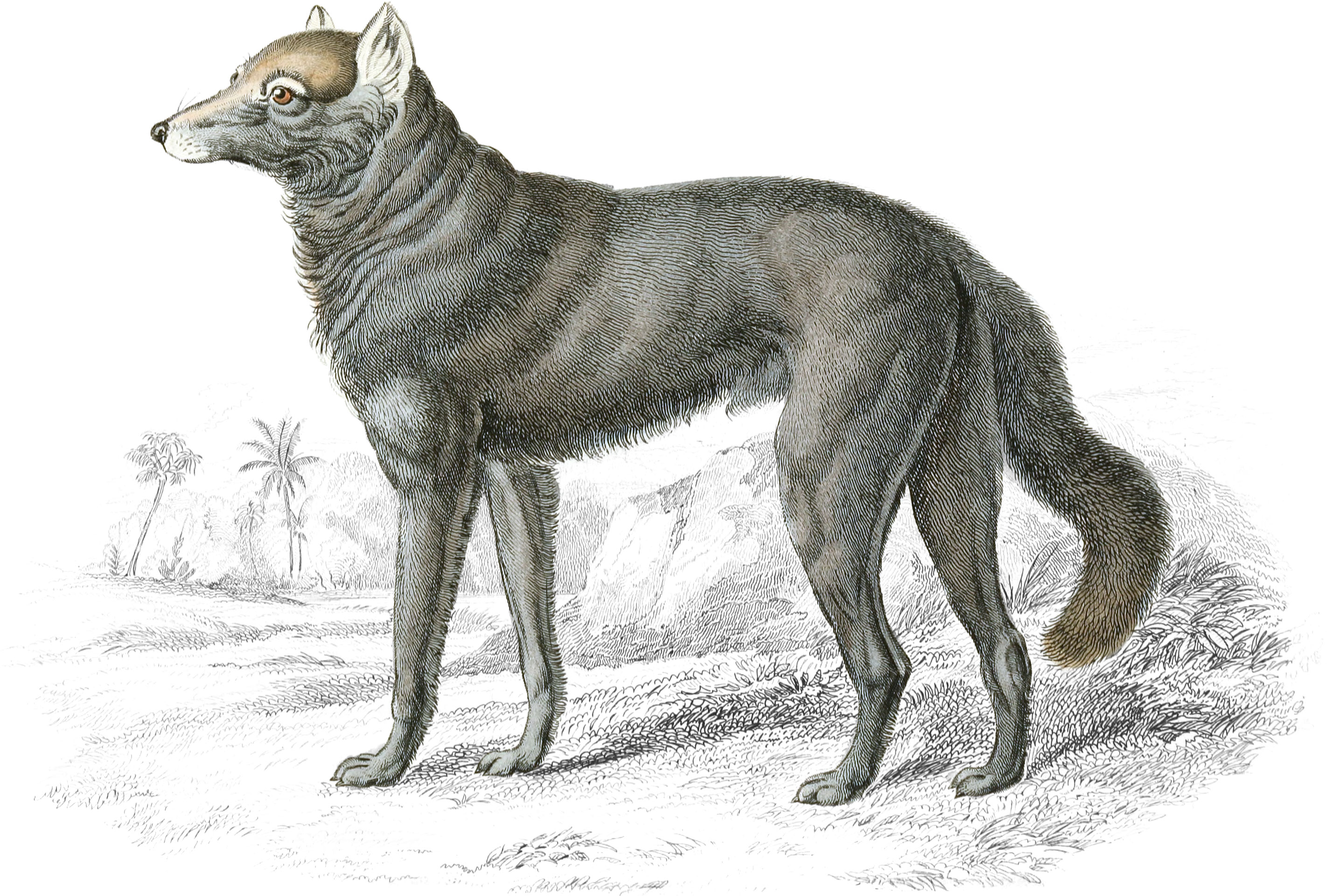
Plate III
Wolf of Southern States, N. America
Lupus Mexicanus, Smith.
Is still very imperfectly known, although it was described by Hernandez and Fernandez. In stature it is equal to the common, but the head is broader; the ears are long and pointed; the neck very thick; the tail scanty and not so long as in the former; the vibrissæ are very robust, almost like quills, having black and white rings; the fur is grey with spots of a rusty tan-colour; the grey of the head is marked with several transverse blackish bars, and on the forehead with fulvous spots; the neck is grey with a fulvous bar and a similarly coloured spot on the breast, and with another on the chest; blackish bars and fulvous spots run irregularly down the sides; the tail is grey, with a fulvous mark about the middle; the limbs are grey with blackish rings from the body to the feet, distinguishing this species from all other wolves. We have never met with a specimen in museums, and only found an imperfect skin at Curacoa, brought from Honduras, where the species did not appear to be well known; but it may be that these animals vary considerably in the markings of their fur, for we figure here an individual shot in Virginia, which is evidently much allied to, if not the very same species as the wolf of Hernandez. In size it was at least equal to other large wolves. The general colour an ochry grey, passing downwards into buff, and hoary about the throat and face. The nose, mouth, and jowl were sooty black, with irregular bars of the same colour crossing the cheeks; the vibrissæ were heavy, laid back, and reached to the eyes. The forehead bight rufous, interspersed with black marks which reached to the back of the head; the outside of the ears (which were rather long), the middle part of the tail, and the feet up to the joints, were rufous, with a black bar across the carpus; the root and tip of the tail, a space on the croup, another on the shoulder, and a number of irregular bars across the back of the neck, were sooty black, and the flanks between the bars bright buff-grey, paler below. This specimen was stuffed, and formed part of the museum of Philadelphia.32
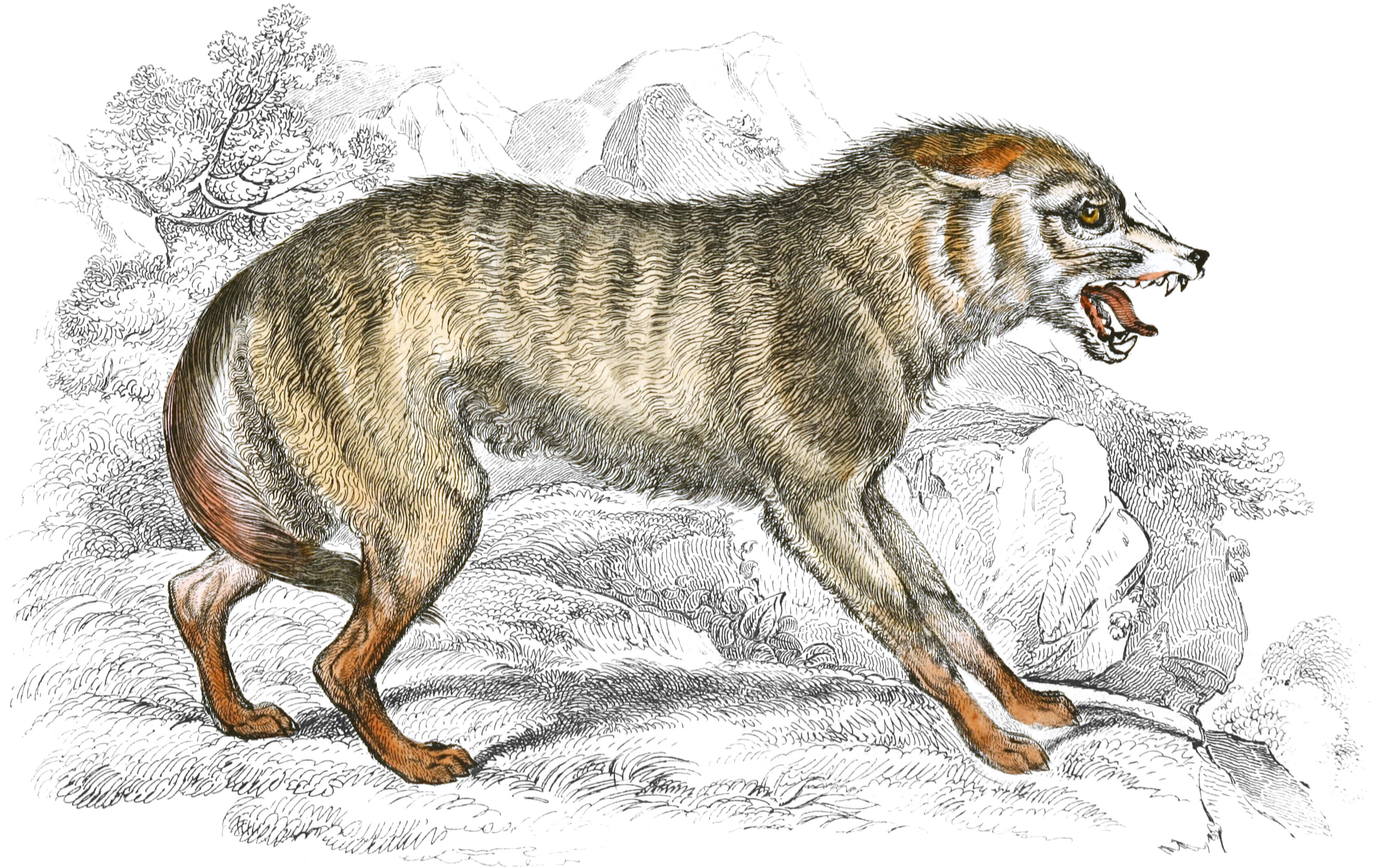
Plate IV
Section II. Lyciscus.33 The Lyciscan Dogs
Under this denomination we propose to class the diurnal canines that are not strictly wolves, and reside, with one exception, in lower latitudes, from the southern part of the temperate zone to within the tropics. In examining this group, a further proof may be found, how much the natural history of the whole family is still open to conjecture; and though it might be objected, perhaps justly, that the species not thoroughly known should not as yet be admitted in the catalogues of mammalia, we think, as the existence of the animals is unquestionable, to present their imperfect descriptions to the reader, has at least the advantage of pointing them out more directly to the inquiries of travellers and naturalists; the errors that may be committed, in our present state of knowledge concerning them, being no more than to place their names in one group, when perhaps they may be ultimately found to belong to another. Fastidiousness on this head, tends more to prolong obscurity than to advance the science. With this impression of the subject, it is likewise consistent to subdivide the family into subordinate groups under distinct subgenerical names; because the contrary practice tends to advance our knowledge no farther than it was in the time of Oppian, and to keep the whole natural family in that indistinct state it still is; subordinate groups, on the contrary, must necessarily produce determined and final investigation.
In conformity with these considerations, the lycisci represent those species of wild canines that are inferior in stature and possess manners different from true wolves, instinct more placable, and faculties more amenable to the general wants of mankind. Those of the American continent are known to bark in their wild state; they burrow, and therefore do not absolutely shun the presence of man; they hunt in troops with the clamour of dogs, so that the wild native is sometimes puzzled to distinguish between them and his own domestic breed. Hence a just surmise may be drawn, that in the New World at least, it was from the lycisci that the aboriginal Indians reared their present races of dogs; while in Asia, and even in Europe, breeds of similar origin appear to be traceable.
North American Prairie Wolf
Lyciscus latrans
This species, partly residing in the higher latitudes of the western continent, is the object of Dr Richardson’s principal remarks, in his account of the American wolves. They are described by this acute and persevering investigator, as occupying the high sandy plains between the sources of the Saskatchewan and the Missouri. They burrow like foxes, and come out of their holes, assembling round the hunter on the first report of a gun, with evident hopes of sharing in the spoils of his sport. They are exceedingly swift of foot, assemble in great numbers, hunt in large packs, and have a barking voice. In the form of the head, the muzzle, nose, and position of the eyes, the specimen we have seen greatly resembled the northern shepherd’s dog; the fur was entirely of an ashy grey, as described by former naturalists, but there was some white about the breast, and even in the end of the tail, which was more bushy than in the common wolf. Although all these distinctive characters are trivial, yet in their ageregate they remove this animal from the group of lupus. The choice of open plains, burrowing in large communities, instinctive confidence at the approach of man, hunting in large packs, barking, and, finally, the presence of white hair and general aspect, warrant this conclusion. But the prairie dog is reported to be found also in California, and to vary in colour, even in the same litter, as much if not more than true wolves; we suspect, however, that this assertion refers to Lyciscus cagottis.
In the old continent, no pale, ashy, wild canine is at present known; but among domestic dogs of a similar latitude, there are the great Danish dog, and in all probability the primitive greyhound, as will be shown in our description of the feral dog of St Domingo; and there was a race of molossi, the “Glauci molossi,” in the classical times of antiquity, which Cælius mentions as not remarkable for courage. It may be that the typical animal of the old continent has been early absorbed by domestication.
The little wolf, hunting beavers between the latitudes sixty-five and seventy, mentioned by Mackenzie, may be presumed to belong to L. latrans, or is a race of the next species.
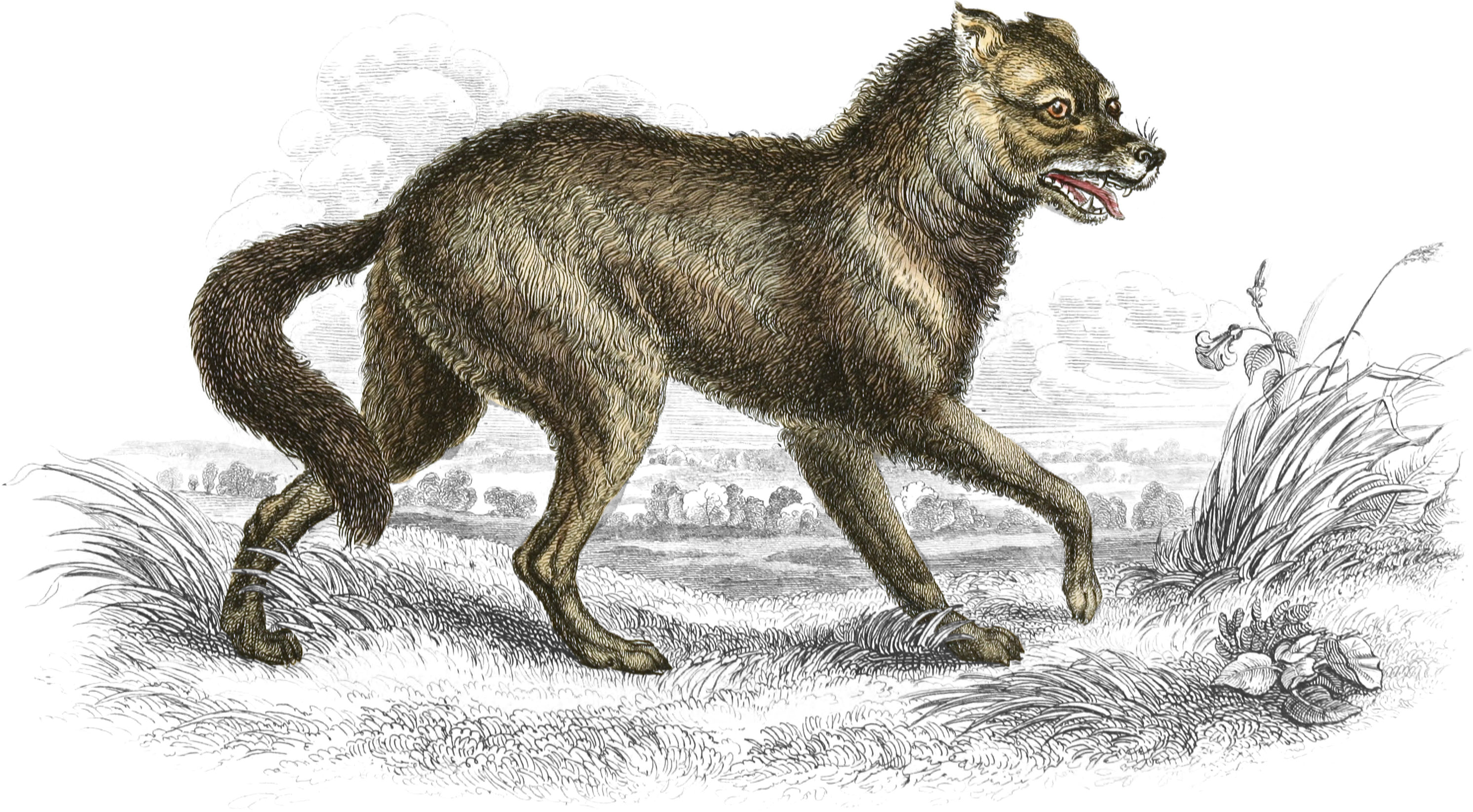
Plate V
The Caygotte of Mexico34
Lyciscus cagottis, Smith.
The Caygotte of the Mexican Spaniards, and most probably the Coyotl of the native Indians, is a second species, but slightly noticed by travellers. Mr William Bullock observed it near Rio Frio, in the Mexican territory, and was informed by muleteers, then with him, that it was the Caygotte, a very fierce kind of wolf: the individuals he saw were in size equal to a hound, of a brownish rusty-grey, with buff-coloured limbs, and rather a scanty brush. This description nearly coincides with a similar animal we have met on the north coast of South America; only the tail was dark brown, with a white tip, and the under parts and feet were dirty white. The Indians named it aguarra, an appellation we shall find in the sequel applied to several species.
This lyciscus measured about twenty-four inches at the shoulder, resembled a common wolf, but had a muzzle and the ears proportionably shorter; the body appeared to be rather long and robust, compared with the height; the nose, cheeks, and limbs, to the carpus and tarsus, were buff; the forehead, neck, and back, clear grey; all the hair rather hard to the touch; the rest as before stated. In the Animal Kingdom, Baron Cuvier describes as a wolf, under the name of “The Mexican,” one that can be no other than this species; and we have little doubt but that the Cuyota or “Jackal Fox” of Captain Belcher, observed by him on the banks of the Sacramento river, in California, about 37 deg. 43 min. north, and 122 deg. west, is again the same animal, notwithstanding that by the compound name of jackal-fox given to it, seems to imply a smaller species.
The grey wolf-like lycisci of the old continent, which seem to correspond to the L. latrans and Cagottts of the new, are still less known than the first mentioned, but we refer to this group the Jungle Koola, Lyciscus tigris of Smith, because it may be this species which caused all the rumours of the ancients concerning the tiger-dogs of India being the hybrid produce of domestic bitches with wild tigers, and of such indomitable ferocity, that only the third generation could be reared and trained for domestic purposes. Captain Williamson confounds them with his beriahs, but they are reported to be somewhat lower than that animal, with a broader back, and of a light grey colour, obscurely marked with darker cross bars by the tips of the hair being black; the limbs and face pale buff. A specimen shot among the rocks on the sea-shore, near Vincovah, in the vicinity of Bombay, was in colour yellowish-grey, brindled with blackish streaks: the head was sharp; the under parts dirty white; the tail not very hairy, whitish below; and the markings on the body so distinct, that some young officers present conceived it to be a young tiger; but other persons immediately named it a jungle koola (wild dog). It was killed in the act of searching for offals and putrid animal matter cast on shore by the sea.35

Plate VI

Section III. Chryseus. The Red Dogs
The second group of wild dogs belongs to the old continent, and at present is found in Asia from the southern side of the Himalaya ridge to Ceylon, and from China to the Mediterranean. By a notice in Shaw’s Zoology, it appears equally spread through Africa, and with a slight modification of characters; other species are observed in the great Australian islands, occupying, with the exception of New Holland, the same portions of the ancient world where the largest feline reside, as if they were appointed to keep them within bounds. The obscure name of Chaon, mentioned by Celius to be the parent of the Chaonian dogs, and merely noted as luporum genus, may have indicated this group in the earliest Doric tongue. All the species examined were found to want the second tubercular tooth in the lower jaw, had the soles of the feet hairy, and were more or less long-bodied and fulvous in their livery: they had the eyes oblique, and eight mammæ. There is no evidence that any of them burrow; hence their greater shyness and retired life in the jungles, the habits of constant co-operation, the necessity of great personal courage, and the instinct of defending each other in danger. Their voice is a kind of barking; they hunt both by day and by night; and though fearing the presence of man, they have the courage to attack the largest animals, the antelope, the wild boar, the buffalo, not excepting the tiger and lion. Bearing an inherent hostility to the larger feline, they are incessantly on the watch to destroy the whelps, and the concert and energy they display in encountering the adults, is believed to be the chief cause, which all Indian sportsmen admit, of the alarm of the tiger at the sight even of a domestic spaniel; indeed, the dread cannot have been caused by the sportsman’s domesticated spaniels or pointers, but must lie deeper in the natural instincts of beasts of the forest; and we may surmise, that the species of Chryseus are the instruments Nature has appointed to keep down the superabundant increase of the great feline of the wilderness. The manners and instinctive faculties of these animals remove them alike from wolves and from jackals. No naturalist adverts to the offensive odour so commonly remarked in wolves, jackals, and foxes, as belonging to them; whence, we may conclude, that they approximate dogs also in the smaller volume of the anal glands; and as there appears to be a probability that a species of this group formerly resided in Europe, to their nightly hunting, perhaps more than to the wolf, may be ascribed the origin of the mysterious stories of romance, first found in the Ostrogoth sagas, concerning the wild hunter of Germany and his demon hounds, the Hellequin and King Arthur in the forest of Broceliant.
As we find species of this group in the southern part of the Old World, so we find an approximating species (or perhaps group) with similar colours, and it seems with a like want of the second tubercular tooth, in the corresponding latitudes of the New World. The Aguara gouzou is the species we mean; and until its manners are better known, we may suspect it executes some parts of the same duties, although, not being gregarious, it does not possess the same efficient means.
We consider it to be absolutely begging the question, when canines, by travellers called wild dogs, are deemed varieties that are descended from the domestic, or that may by some chance be their offspring, even when in all the country where they are observed, the familiar dogs are totally different, or are a poor degenerate race when compared with the wild. This practice only tends to protract the uncertainty, as is evident when we look to the statements of Viscount de Querhouent, who, we believe, first noticed the Canis pictus of authors, and whose description continued most pertinaciously to be placed with dogs run wild. Sparrman indicates both the same animal and the red wild dog, and points out a third, which is no doubt the Hyæna villosa, so lately described by Dr Smith; yet, until his figure and description appeared, this also was a feral dog; whereas, if they had been entered in the catalogues of naturalists, their existence would have attracted inquiry much earlier. It is because we think there is sufficient evidence to presume that it was a species of the group now under consideration, which Oppian described as the aureus of Mount Amanus, that the appellation of Chryseus has been applied to distinguish the five or six species, varieties, or races, we have to enumerate. Notwithstanding the absence of a tubercular, and that the sole paternity of domestic dogs cannot in our view be ascribed to a single species, we think Mr Hodgson was fully justified in offering to his species the name of Canis primævus, the animal we take for the type of the whole group.
Chryseus primevus. Canis primævus, Hodgson. The Buansa of Nepaul.—This species wants the second tubercular tooth on each side of the lower jaw, has the soles of the feet hairy, the ears erect, the superior parts of the body deep rust colour, the lower yellowish, and the tail very bushy, straight, and of medial length. The buansa is a true wild dog, in size between a wolf and a jackal,36 hunting both by day and by night, in troops of from six to ten individuals; following game rather by the scent than sight, and generally overcoming the quarry by persevering exertion, combination, and force. The animal barks with a peculiar tone of voice; and unless taken very young, is quite untameable.—Young pups, reared among domestic dogs, are reported to have quite as much instinct and discernment as the familiar breeds, but it is not as yet known what their temper may be when grown up. The species belongs to the woody and rocky mountain ranges between the Sutleje and the Boorham-pootra, but it is found, with some distinctive features of race or variety, more to the south, in the Pindya hills, the Ghauts, the Nielgherries, the Casiahi hills, in South Bahar, and Orissa, to the coast of Coromandel. Among these,
The Kolsun, or Canis Dukhunensis of Col. Sykes, is stated to be a mere variety of the above, having a similar skull and dentition, but differing in the colours of the fur being somewhat paler and the quantity less dense; a difference which may be ascribed to the latitude and the habitat being both lower, and therefore much warmer. Colonel Sykes’s specimen had the head elongated and compressed, the nose not very sharp, the eyes oblique, pupils round, irides light brown, the expression of the countenance similar to a coarse ill-tempered Persian greyhound, distinct from all other wild canines; the ears were erect, long, somewhat rounded, without fold of the tragus; limbs remarkably large and strong in relation to the bulk of the body; neck long; body elongated; between the eyes and nose red brown; end of the tail blackish; general colour red, paler beneath; the tail pendulous and bushy. Length from nose to tail thirty-three inches; tail eight inches and a half; height at the shoulder sixteen inches and a half.
The Dhole of Mr Wooller, discovered by him in the Mahablishwar hills, is also considered to be at most only a variety of this race.
The Qyo37 of Dr Spry is by him identified with the Kolsun, and represented as a rufous brown dog, paler beneath, with a hairy hanging tail and round pupils. The size is superior to that of the jackal, the body longer, and the limbs more robust. He reports the claws to be sharp, and that they scratch out the eyes of their prey. It was from a pack of ten or twelve Qyos, Colonel Bowles took a buck antelope, which had been so hard pressed by them, that it was already at bay in a pond of water, having in the extremity of distress boldly dashed through a column of camp followers, whose shouts had not arrested the pursuit, but brought the officers at the head of the troops back to the rear to secure the prize.
With some hesitation we place here also the short notice of the Wah, a canine designated as a Dhole, but possibly a very distinct species. It was first mentioned to us by the late Lieut.-colonel Deare of the 8th Dragoons, who was a native of the East Indies, a keen sportsman, and many years resident in that part of the world. A printed account of a similar animal, observed in captivity, has since appeared in one of the annuals; both agree in the description, one haying been killed in Central India, the other seen in the southern provinces. This Dhole was represented to be a robust thick-bodied animal, nearly equal in height to a harrier hound, but heavier in weight; the head broad and ponderous; the forehead flat, with a greater distance from the ears to the eyes than from these to the nose; this was blunt, dark-coloured, and rather broad, the rictus or gape black, opening to beneath the eyes, which were of a greenish yellow, set in dark eyelids, and offering a most ferocious aspect; the teeth very powerful; the legs and claws remarkably strong, resembling a bulldog’s, and the tail rather short, but most bushy towards the end, and sooty in colour; the general colour of the fur tanned, browner on the back, with some white on the breast, belly, and between the limbs. It growled with a deep and threatening voice, and the natives related, that, in danger, the animal, by means of the tail, flings its urine in the eyes of pursuers. The Colonel considered this not to be the true Dhole, and characterized it as reminding the spectator of a low-legged hyæna with the colour of a dog, but he was too familiar with the Hoondar38 to mistake it for that animal. It was reported to hunt in packs, uttering an occasional deep-toned bay.
The Beluel of Avicenna, which he seems to have considered to be the Thos of antiquity, is the next we have to mention. This we take to be the Beluch of Beloochistan, one of two species of wild canines found in the woody mountains of South-eastern Persia, and probably extending along the high lands west of the Indus into Caubul. It is described as a red wild dog, very shy, and extremely ferocious; hunting by day in packs of twenty or thirty, seizing a bullock or a buffalo without hesitation, and tearing the animal to pieces in a few moments. A British officer, who traversed a part of this wild region of alternate jungle and sandy plateau, deeply scarred into long and parallel furrows, barren and vertical, so that no quadruped can cross many without complete exhaustion, observed a group of these red dogs basking on the edge of the forest, yet on the watch for game; but they withdrew into cover before he could fire at or completely examine them: they were, however, long, and rather low on the legs, of a rufous colour, with a hairy tail and a powerful structure: their foot-marks in the sandy soil were very distinct, and indicated that their feet were exactly like those of a hound. The native peasants related that they keep aloof from human habitations, and consequently do little injury to human property; but that no animal, especially if it be entangled in the billowy ridges before mentioned, can escape the pertinacity of their pursuit. Having demanded some particulars about their structure, they pointed to a domestic dog then present, and said that the Belueh was very like it, but larger and destitute of white colour, which marked the domestic animal; but that there existed, farther to the west, a wild species still larger than the red, which had so much white that the brown and black occurred upon its back in the form of spots.39
The Red Wild Dog of Southern China is most likely another race or species of our sub-genus Chryseus. This animal is described as resembling the Dingo of Australia, though somewhat lower on the legs; but whether this or the Beluch wants the second tubercular tooth, is not ascertained.
On reviewing the notices of the present group of wild dogs, whether they be one or several species, it is evident that they extend their habitat over an immense surface of Asia; and since they are found to the westward of the Indus, it is likely they also inhabit the deep forests along the Caspian, and, continuing in the same parallel of latitude, that they have existed, and possibly may still be found, in the mountains of Asia Minor. If, now, we compare the foregoing descriptions with the account of the λυκφ Ξουρος or Aureus of Oppian, which he relates was a resident of the rocky jungles of Mount Amanus and Taurus of Cilicia, a province where he—the poet, naturalist, and sportsman—was born, we cannot suppose that he spoke wholly from hearsay, and, ignorant of the characters of his golden wolf, mistook it for a jackal, then not frequent so far to the north; but which in comparison is insignificant, does not fear the heat, nor retires during the appearance of the dog-star;40 is not of a bright fulvous colour, but greyish in Natolia; is not to be mistaken on account of its howling; burrows in the vicinity of human habitations; is the reverse of a shy and solitary nature; and, finally, is not noticed by him under another name.41 The uncertainty and confusion respecting this group commenced with the ancients, who ranged in all probability no less than three very distinct canines under the names of Thoes. Pliny, in speaking of a Thos, which he viewed as a kind of wolf, merely remarks that it had a longer body, shorter legs, sprang with velocity, and lived by hunting; adding, not dangerous to man.42 All these characters are perfectly applicable to the Chryseus of our type, and to its varieties. The mistaking Oppian commenced with Belon, and Kaempfer, being unacquainted with the existence of the rufous wild dog, referred aureus to the jackal and misled Linnæus.
It is even more likely that from this group the mixture with a domestic race might be reported to have been obtained, which the ancients, and even Aristotle, repeatedly assert to be the Alopecides or the Chaonian and Spartan breeds, but which, from their strength and courage, could never have resulted from crossing dogs with foxes.43
There is some reason to presume that the Chryseus formerly existed in Southern Europe; for to what other species can we refer the kind of wild dogs noticed by Scaliger as existing in the woods of Montefalcone in Italy? He says,
There resided for ages, about Montefalcone, a species of wild dogs; animals differing from wolves in manners, voice, and colours; never mixing with them, and being particularly fond of human flesh.
This last character may have been a gratuitous addition of his informers; he does not in this paragraph notice the particular colour, but in another part of the work, wild dogs of a rubiginous colour are incidentally recorded;44 and Pliny, who collected all the information within his reach, without attempting much of arrangement or identification, may have had that race in view, when he asserts that ail animals in a domestic state had their counterparts also in a wild condition. These considerations we deem sufficient to establish the right of applying the name of Chryseus to the present group, and even to add to it.
The True Dhole45
Chryseus scylax, Smith.
The Dhole of Capt. Williamson, and Quihoe of Dr. Daniel Johnson.
The names here brought in juxta-position, show how much confusion there exists in designating the animals already described and the present species among the natives of India; a confusion they extend to hyænas and wolves. Qyo, Quihoe, and Qao appear to signify imitations of the animal’s voice when hunting, Dhole a Praerit name; but it is evident that where the names of Hoondar and Beriah, hyæna and wolf, are considered synonymous, species still more indistinctly marked may well be expected to be confounded. The Scylax is described to be in size between the wolf and jackal, slightly made, of a light bay colour, a sharp face, fierce keen eyes; in form approaching a greyhound; the tail strait, not bushy; the ears wide, pointed, open, and forming a triangle; the skin dark; nose, muzzle, back of the ears, and feet sooty. From this description the animal differs from Chryseus primæus and the other races, in being more slender and higher on the legs, in having a sharper muzzle, a long close-haired tail, and large dark ears. It is reported to hunt in packs of greater numbers, to utter a cry, while on the scent, resembling the voice of a fox-hound, intermixed with occasional snarling yelps. Dr Daniel Johnson witnessed a pack attacking a wild boar.
The drawing we possess of Chryseus scylax was taken from a carefully executed Indian watercolour painting, observed in a collection on sale in London, some years before Capt. Williamson’s Oriental Field Sports were published. Colonel Deare, then a captain, was about this time in London, and the copy being shown him, he first conveyed the information that it represented the Dhole, or, as he termed it, the True Dhole, distinct in form from the other species already described. In Europe, that name was then only known to a very few persons who had previously resided in India. Specimens occur, it seems, very rarely, and these only in the Rhamghur hills, and sometimes in the western Ghauts.
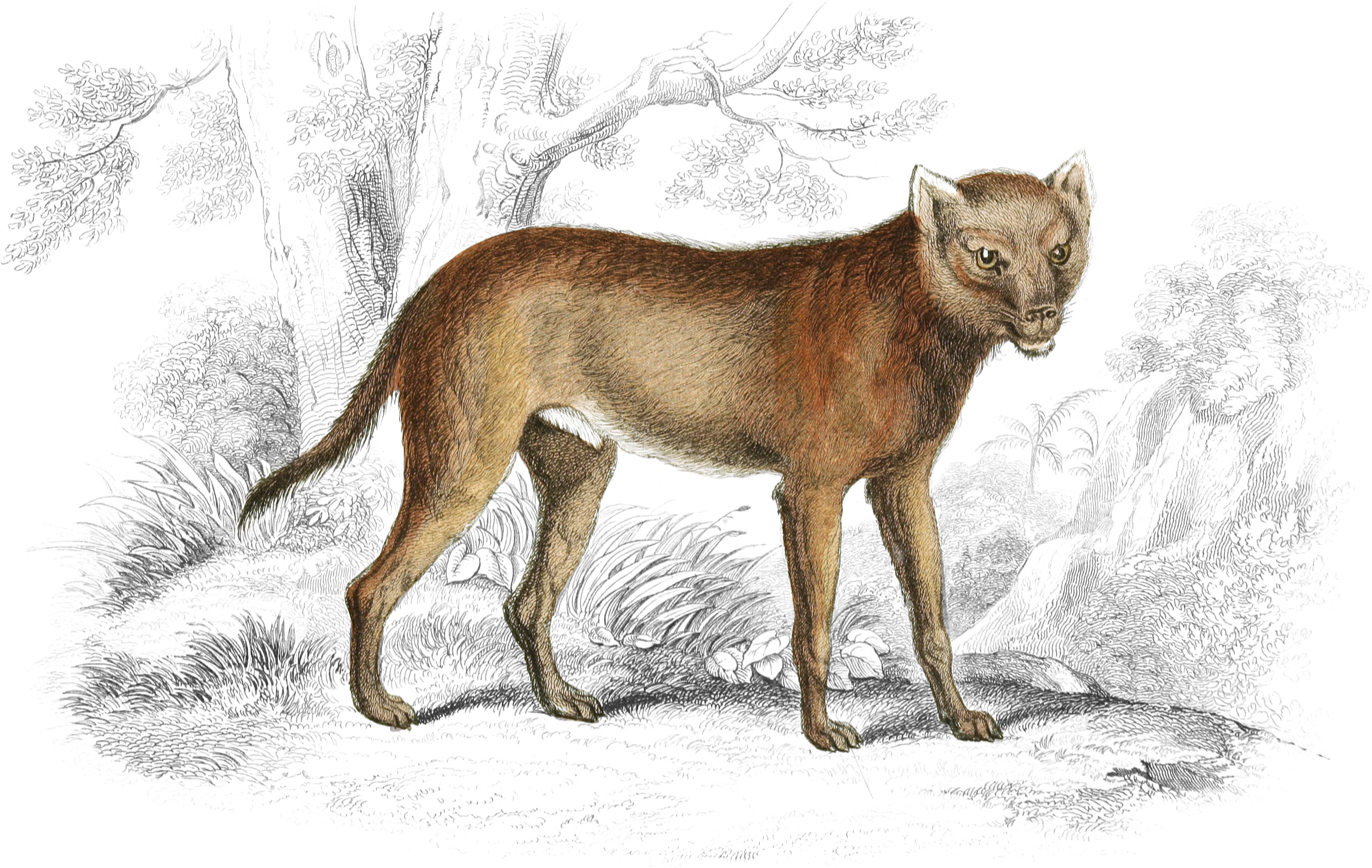
Plate VII
Dhole of Ceylon
Chryseus Ceylonicus
Canis Ceylonicus, Shaw; or Wild Dog of Ceylon.
First described by Vosmaer. This species is evidently much allied to the last-mentioned, although the account of it was not taken from an adult. The stuffed specimen was not much larger than a domestic cat, measuring about twenty-two inches from nose to tail; the tail itself sixteen inches, gradually tapering to a point; the colour yellowish grey with a cast of brown, owing to some hairs of that colour being longer than the rest; the feet strongly tinged with brown; the hair close but soft to the touch; the head long and pointed; the snout and under chin brown, but the top of the head yellowish ash-colour, which, passing beyond the ears, forms a spot below them and terminates in a point below the eyes; the ears were small, elevated, and pointed. In this specimen, the last molar of the lower jaw was also wanting. The claws resembled those of a cat more than of a dog, and there were five toes on the hind as well as the fore feet. We have examined, in Holland, the skin of a dog which was said to have come from Ceylon and corresponded sufficiently to admit of its being the same species, although it was at least four inches longer and the colours were less grey and more fulvous; the tail was long and without a brush, and the claws blunt, but with five on each foot. It is evident that the discrepancies between the two were owing to nonage, in Boddæert’s specimen. The skull we have not seen.
Although in the following extract it is likely that more than one species may be confounded, yet the description is in general so like that of the true or greyhound Dhole, that it may be surmised a race of Chryseus actually extends to the Cape; and it is probably mixed up with some characters of the Tokla, which will be mentioned with the Thoes.
In Dr Shaw’s Zoology, wild dogs are mentioned as inhabiting Congo, Lower Ethiopia, and the vicinity of the Cape of Good Hope.
They are said to be red-haired, with slender bodies and turned up tails, like greyhounds.
It is also added, that they vary in colour, have upright ears, and are of the general size of a large fox-hound; they destroy cattle, and hunt down antelopes and many other animals, and commit great ravages among the sheep of the Hottentots; they are very seldom taken, being exceedingly swift as well as fierce; the young are said to be sometimes obtained, but grow so fierce as to be with great difficulty rendered domestic. In this short description we recognise the Mebbia of Congo, which assemble to the number of thirty or forty, and hunt all kinds of animals, but offer no hostility to man. These wild dogs cannot be confounded with the Canis pictus, which in all probability resides in Western Africa, because the limbs of the Mebbia are described as remarkably heavy, and the colour of their fur is rufous.
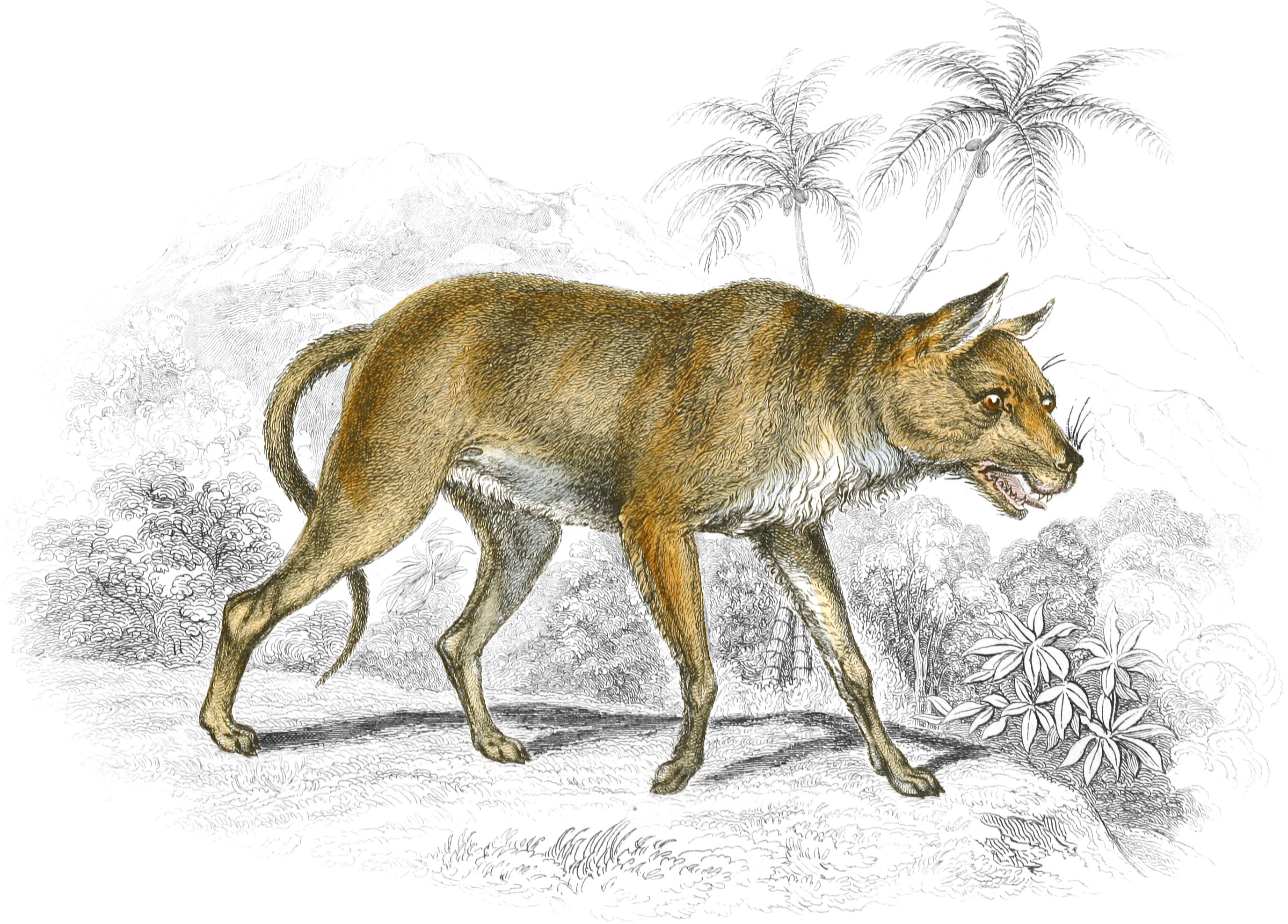
Plate VIII
The Pariah Dog
Chryseus pahariah, Nobis.
Chien marron of the French at Pondicherry.
It may be questioned whether the races of Pariah dogs of India be merely a low degraded kind of mongrels, descended from a nobler breed of domesticated dogs, or be the offspring of an indigenous wild species of the jungles. Naturalists in general, preoccupied with the views which Buffon disseminated on this subject (views we shall have occasion to show the great and eloquent naturalist affirmed and contradicted sometimes within a few pages), have assumed without proof and often against probability, as a fact, that where wild and domestic races nearly allied were found, the former were only feral or bewildered descendants of the latter. In the present case, however, the wild Pariah is found in numerous packs, not only in the jungles of India Proper, but also in the lower ranges of the Himalaya mountains, and is possessed of all the characters of primeval independence, without having assumed the similitude of wolves or of jackals, which systematists seem to think must be the result of returning from slavery to freedom. There is nowhere any notice taken that they burrow, apparently resembling in this respect the rest of the present group; they associate in large numbers, and thereby approximate jackals, but their voice is totally different from them. In form the wild Pariah is more bulky than the last-mentioned species, but low on the legs and assuming the figure of a turnspit; and the tail of a middling length, without much flexibility, is more bushy at the end than at the base; the ears are erect, pointed, and turned forward; the eyes hazle; the density of fur varies according to latitude, and the rufous colour of the whole body is darker in the north than in the south, where there is a silvery tinge instead of one of black upon the upper parts. They are said to have five claws on all the feet, but if there be a molar less in the lower jaw, is not known. This species is in general so similar to the domestic, that if it were not ascertained they existed in great numbers in the wildest forests at the base of the Himalayas, all possessing uniform colours, they would be considered, in the lower provinces, of the domestic breed, and are often mistaken for them when they follow armies. The domestic, however, are less timid, generally more mixed with other races of dogs, more mangy about the skin, and variously coloured in fur. Their voice is yelping and howling, but may be distinguished from the jackals’ by the sound.
The Pariah is certainly the connecting link with the jackals, but as these constitute a small group occupying an immense surface of the old continent, extending to the south beyond the equinoctial line, and in their turn form the nearest approach to the nocturnal canines, it may be preferable, before they are considered, to examine another group more nearly allied to wolves, residing almost entirely in Africa, and therefore by us detached from the jackals.
Sumatran Chrysæus
Chrysæus Sumatrensis, Smith.
Canis familiaris, var.—Sumatrensis of Hardwicke.
This is one of the smallest of the group, and is possessed of characters distinct from all the known canines, being only about two feet long from nose to tail, and yet standing fourteen inches high at the shoulder. The countenance is that of a fox, the nose pointed and muzzle black; the whiskers long and black; the eye oblique; ears erect, very hairy, and more rounded than in the jackal or fox; nose and lips foxy brown, mixed with black; tail pendulous, bushy, particularly in the middle, smaller at the base, and reaching to the leg joint; five toes on all the feet, the fifth being small, and a round callosity above each; the general colour a foxy ferruginous red, varying to lighter shades on the belly and inside the thighs. The action of the animal, in confinement, was restless in the extreme; and while in the presence of human beings, or if teazed, it emitted a most fetid urine. The voice was more of a cry than a bark.
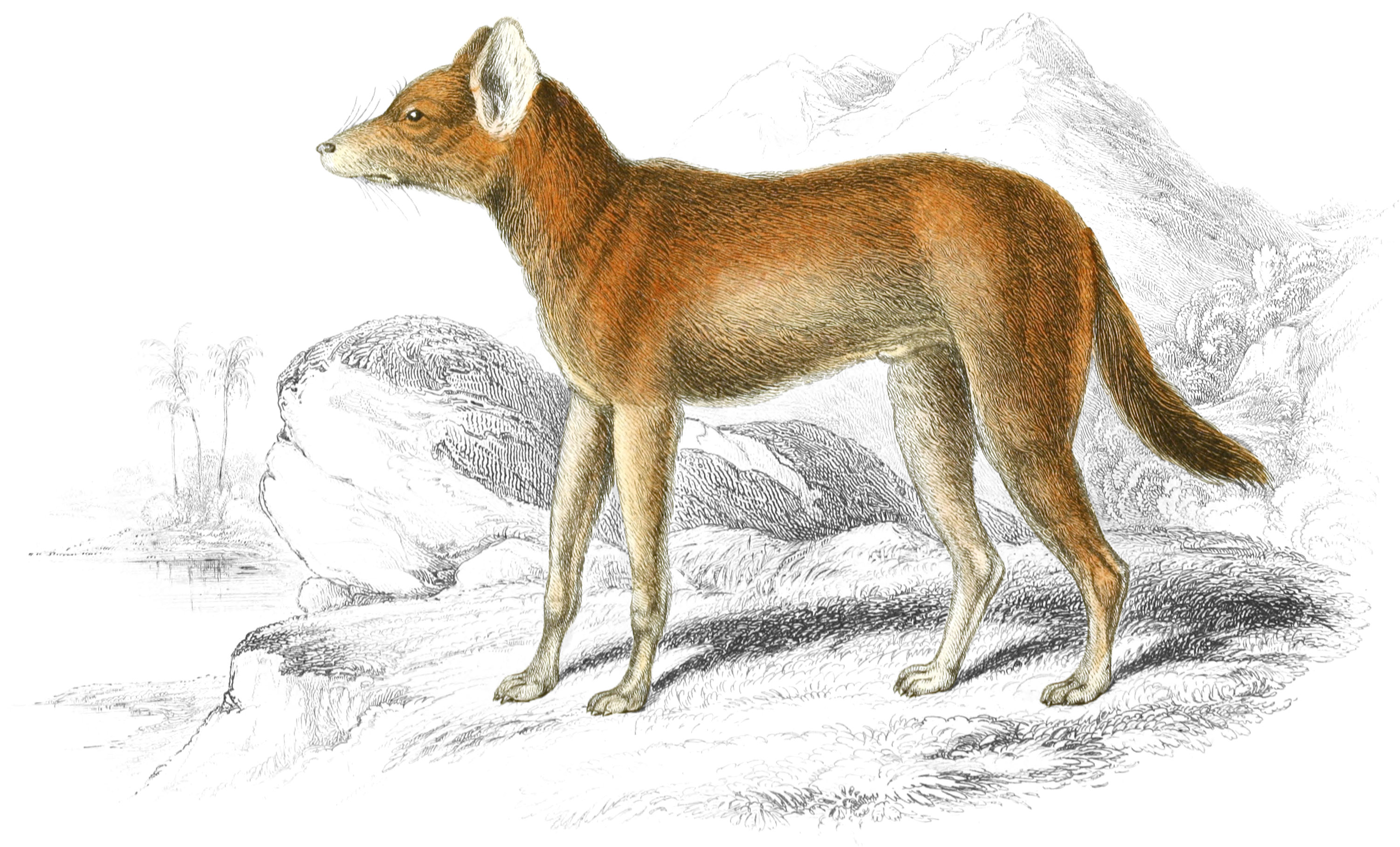
Plate IX
We place in the Chrysean group also several wild canines of the great Australian islands, which seem by their external characters to belong to this type, although they are provided with the second tubercular molar, wanting in the former. Among these the best known is
The New Holland Dingo
Chrysæus Australiæ
The Dingo of New Holland, or Canis Australasiæ of Authors.
This animal has been regarded by French naturalists as a feral dog, although it is unquestionably a wild species, only in a small degree reclaimed by the savage natives. The fact of being partially domesticated is not sufficient ground for assuming that the Dingo was introduced by human intervention; for this argument would demand its existence in New Guinea, and include the necessity of the other canines, the jackals of Sumatra and Java, being introduced by similar means. The wild Dingos are, however, larger and more powerful in the interior than the domestic race. In confinement they are entirely mute, neither howling, barking, nor growling. When offended, they raise the hair upright, and assume a truly menacing aspect, but howl in a melancholy tone when prowling in a state of freedom. When they attack sheep, their delight is to kill as many as they can overtake; and their bite is so severe, that few who are wounded recover. They emit a strong odour, and in fighting domestic dogs snap very severely. The number of their pups is equal to that of domestic dogs, littering in some hollow log, deserted ant-hill, hole in the ground, or dense brush cover.
If we may generalise a fact related by Mr Oxley, Surveyor-General of New South Wales, and recorded in his Journal, the Dingos possess the quality of mutual attachment in a degree far exceeding all other brute animals. His words are,
About a week ago we killed a native dog and threw his body on a small bush; in returning past the same spot to-day, we found the body removed three or four yards from the bush and the female in a dying state lying close beside it; she had apparently been there from the day the dog was killed, being so weakened and emaciated as to be unable to move on our approach; it was deemed mercy to dispatch her.46
Domestic dogs falling in their power are immediately devoured.47 They hunt in pairs or in small families of five or six, and their fierceness and activity is equal to, if not more than a match for, the most powerful dogs of Europe. They possess the daring courage of the present group far superior to that of wolves, having been known to chase sporting dogs to the feet of their masters. One brought to England attacked and-would have destroyed an ass, if he had not been prevented: another in the menagerie of Paris would fly at the bars of cages where he saw a panther, a jaguar, or a bear. Domestic dogs they seize without hesitation: yet these facts, excepting the first, relate to individuals of the reclaimed race, not larger than our shepherd’s dog, or less than two feet high at the shoulder. They have the muzzle somewhat fuller, the head large; under fur grey, covered by longer and abundant hair fulvous or white; the forehead, neck, back, and superior side of the tail is dark fulvous; the sides, under part of the throat, and brush paler; all beneath, the inside of the thighs, the legs, and nose whitish. We have seen two with the tip of the tail white, but the wild race is said to be destitute of that colour, and many of them are dark with shaggy hair;48 they carry the tail horizontally, not curled, bent down when watching, and it is only partially furnished with long hair. They run, unlike dogs, with the head high, the ears erect and turned forward. The specimen at Paris could not swim. The parent race is wild all over Australia, but an inferior breed is. partially tamed by the natives, who make some use of it in hunting kangaroos and emus. The young obtained from a pair in the Zoological Gardens were all more or less spotted with white.
We understand that there is a strongly marked variety or race of these dogs in Van Diemen’s Land.
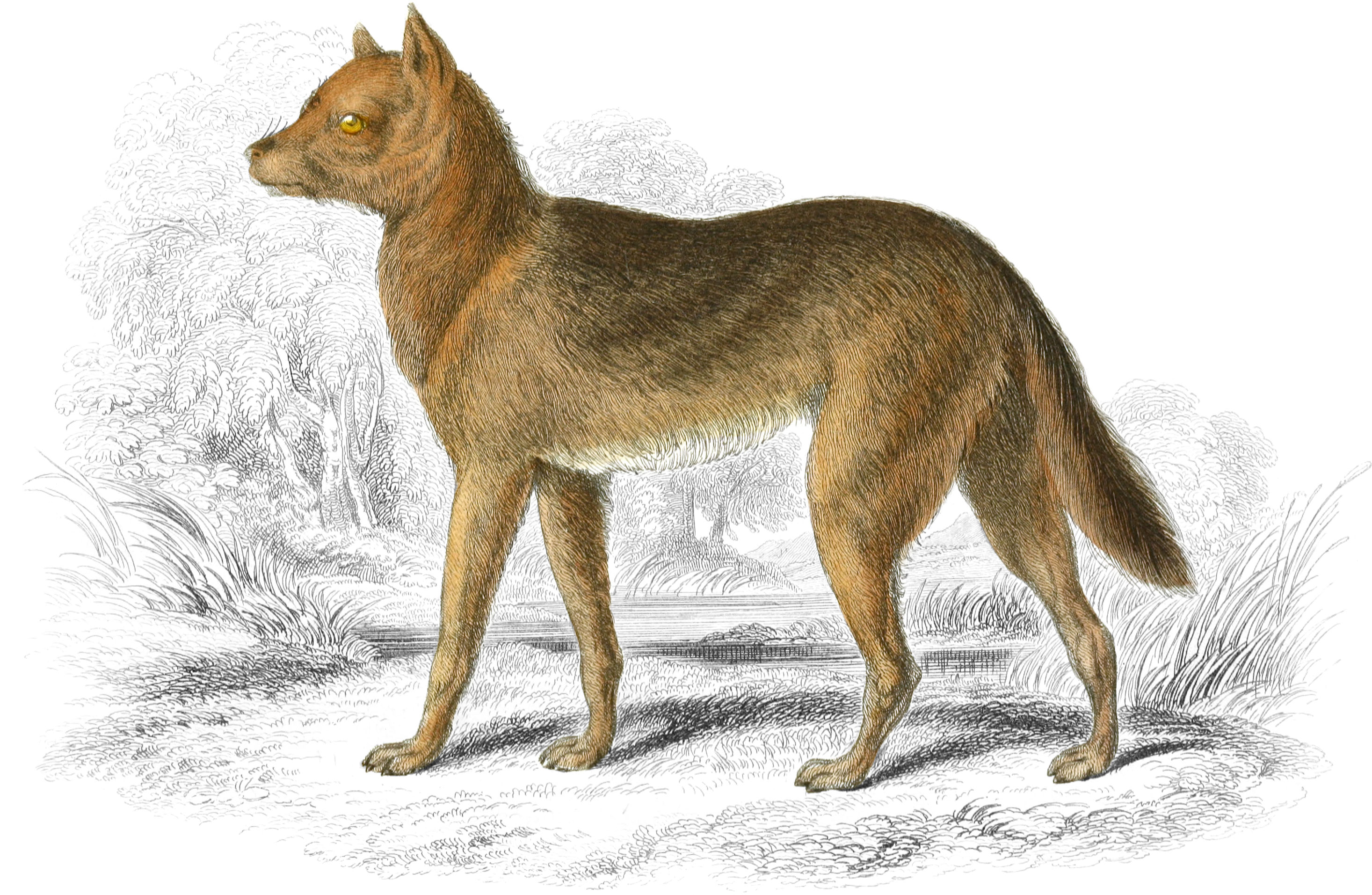
Plate X


Chryseus Javanicus
Canis Javanicus, Desm.
Probably the Asuwawa of Raffles. This species was first brought to Europe by Monsieur Leschenaut. It is in size and proportions equal to a common wolf, but the ears are smaller; the colour is fulvous brown, blackish on the back, feet, and tail. It is evidently a tenant of the woods. Messrs. F. Cuvier and Desmarest class the C. Javanicus with wolves. Its manners are still unknown.
This short review of the Chrysean group, we trust, will be sufficient to make naturalists pause before they come to the gratuitous conclusion that wild diurnal canines, being neither wolves nor jackals, are necessarily feral dogs or dogs become wild, after they or their progenitors had been domesticated. They have been traced through Asia, Africa, and the Australian islands; and although there are clearly several very distinct species in the number, they all retain the fulvous livery, and in their wild state none assume the distinctions to which, if they were descended from wolves or jackals, they must have returned; neither do they assimilate with the Thoes of our distribution, for under that name the ancients noticed such a variety of anomalous or fabulous animals, that having already disposed of some, and others will occur among the jackals and lychaontes, we restrict the group to those which appear to have been principally had in view by them.
Section IV. Thous. The Thoa Wild Dogs
The Thoan group represents in form the wolf on a reduced scale; being only somewhat larger than jackals, but differing from them in manners and livery. They do not burrow, and are marked on the back by black and white colours, contrasting into lines, chequers, pencils, or stipples; the rest of the fur being in general ochry or buff. The Thoas likewise emit little or no offensive odour, are not gregarious, and do not howl in concert; nor are they warners on the approach of the great feline, as jackals certainly are wont to do. The intermediate position of the group is illustrated by the component species being alternately classed among wolves, jackals, and foxes. Aristotle, we think, had in view the typical species, Canis anthus (F. Cuv.), when he remarks that the Egyptian wolves were smaller than those of Greece. In Guldenstzdt’s notice of jackals, he appears to confound some species of Thous with others of our group Sacalius. Mons. F. Cuvier, after remarking the difference between individuals of each section which bred together in captivity, retains them in the series of his dogs only as distinct species, but we think that in a late paper he has felt the necessity of forming them into more separated locations. The variegated colours on the back were most likely the cause which induced the ancients to assert that the Thos (or Chaber of Africa) was, according to Oppian, an hybrid between the wolf and panther, or between the hyæna and wolf, according to Varinus; and Solinus justly named the Ethiopian wolves Thoas. All the species have the tip of the tail black, and prefer rocky sandy districts where there are bushes and water, to humid woods. We suspect the greyhound of the desert was originally derived from a species very nearly if not actually belonging to this section.
Thous Anthus
Canis Anthus, F. Cuvier.
The Wild Dog of Egypt.—Deeb of the Natives.
The head of this species is rather deep at the jowl: the nose full at the point; the ears erect; the throat and breast dirty white; the body above of a mixed fulvous, white, black, and buff, producing a series of small black spots, or pencils, caused by the tips of the longer hairs being black and uniting in meshes. The woolly under fur is reddish brown, darkest on the back; the ears are rather small; the nose, edge of the lips, and whiskers black; lips, under cheeks white; ridge of the nose brown; a black band passes round the neck towards the breast; tail hairy, rather long, with a brown spot one-third down the base and a long black streak spreading down to the end; below it is buff; the black hairs shining; lower limbs rusty brown on the outside, buff on the internal face; soles naked and black, as well as the claws. Irides brown; the female more buff in the colours. The animal from nose to tail measures about two feet six inches, the tail one foot, height at shoulder one foot four inches.
Dr Ruppel obtained specimens about Bahar el Azrak. It is not common in Egypt. The same traveller observed a head taken from the catacombs of Syout or Lycopolis, which he concluded to be of this species. It may be also the animal the ancient Eeyptians employed to typify the southern hemisphere, as perhaps the Syrian chaon designated the northern. Professor Kretschmer, in Ruppel’s Atlas, after remarking upon his unwillingness to view all the races of dogs as descended from one stock, although it be difficult, even in those the most decidedly marked and possessed of the greatest purity of descent, to decide from which of the original species they may be derived, is nevertheless disposed to consider the Thous anthus as the aboriginal species whence the Egyptians obtained their domestic dogs; and in support of this opinion, he appeals to the similarity existing between that species and the smaller breed of wolf-dogs (the Pomeranian dog) still abundant in the vicinity of Frankfort. But he appears to overlook the question, even if it were decided, that the mummy dogs of Egypt were embalmed from their domestic race, whether those of Lycopolis, or the wolf city, belonged to it. The probability, we think, would be that they were entombed one degree lower down the river at Cynopolis, or the dog city, on the island opposite Co, where Anubis was the presiding divinity, and the attendant priests ate their food out of the same dish with the sacred dogs. Although it is not unlikely that this race also produced a breed of domestic dogs, still there is reason to believe they were a distinct species.49
The Thous of Nubia
Thous variegatus
Is about an inch lower at the shoulder and in other respects proportionably smaller than the last mentioned animal. The head is rather broad, buff with black hairs on the occiput; the under fur buff and soft; the upper coat of hard hair, buff at the roots, then black with a buff ring, and the tip again black and shining: these tips gather together on the surface in small pencils or patches, resembling chequer work on a buff ground; the nose is blunt and black, thence to the eyes pale buff: the ears eight inches ten lines in height, buff on the outside, white within; under parts dirty white; tail rather short, chequered like the body, the tip dark. The extremities are long, the hind legs longest; all are buff-coloured; the feet hard, tumid, naked, and the claws blunt.
This animal has the same wolfish aspect as the anthus. It resides in rocky regions, not burrowing, and feeding on small mammalia and birds. During nonage the colours are less clear, and the coarse hair prevails. In old age the woolly fur predominates, the coarse hair being more scanty, but from the nape of the neck to the tail there is a mane of shining black and considerably lengthened hair. M. Ruppel observed this species in Nubia and Upper Egypt.

Plate XI
The Zenlee, or Pied Thous
Thous mesomelas
Canis mesomelas of authors.—Yenlee of the Hottentots.—Bontevos of the Dutch Colonists—Chacal du Cap.
All the canines found in a wild state to the southward of the line, in both hemispheres, approximate the foxes in some of their characters or aspect. The pied Thous is an example in point, for being somewhat less in bulk than either of the former, and more vividly reddish about the sides and limbs, it has been classed with foxes, although the tail is not vulpine, and we are assured that the eyes are diurnal. The individual we have seen alive had neither the movements nor head of a fox, and the ocular disks were always circular, while observed. Of three drawings with dimensions taken from different individuals, one was twenty-five inches from nose to tail, the next twenty-six, the third twenty-seven. The tails varying with the length of body, from eight inches and a half to ten and a half. The different locations of dog, jackal, and fox, assigned to the species by naturalists, indicates the intermediate position it should occupy; and the livery or intermixture of colours the fur exhibits, claims its place to be in the present group; and if we look to the dogs of the Bosjemen and Koranas, there may be a question, whether their descent is not, in part at least, derived from a cross with the present species. The ears of the T. mesomelas are larger than in the T. anthus; the nose and forehead are ashy grey; the ears rust-colour outside, whitish within; the cheeks whitish-ash and buff; from between the ears, over the back of the neck, and from thence spreading down each shoulder, the colour is black and white, variously intermixed; the space narrows gradually to a point at the root of the tail or partially down the base: this space is composed of hair longer and harder than that of the sides, and in some specimens the white forms only pencils on the black, in others it is a succession of waves, and sometimes it forms something of a regular yet undescribable figure in the midst of the black. The throat and breast are whitish grey; the lower part of the shoulders, the hams, and part of the base of the tail, with the outside of the limbs, is of a lively rusty buff; the belly, furnished with long hairs, is dirty white; the terminal half of the tail invariably black; the claws are blunt, the feet naked and hard. We are assured that this animal does not burrow, but lives among bushes and under prominent rocks. It is not found on the Karroo or wilderness.

Plate XII
Senegal Thous
Thous Senegalensis
Chacal de Senegal, F. Cuv.
The able French naturalist, last quoted, considers the Senegal Thous to be a variety of his Canis anthus, but an artist seeing both would hardly admit more than the approximation of the two species. The animal is at least an inch higher at the shoulder, and several inches longer; the ears are larger; the head more dog-like; the tarsi higher; the tail shorter, less hairy; and the form more gaunt. The colours differ likewise; the nose and forehead are greyish-buff; the throat and under parts white; there is no black ring round the neck, nor the stippled arrangement of black points on the back; that part is buff and greyish, with four or five cloudy bars running in wavy lines downwards on each side, the space between with fainter greyish undulations; the darkest bars are on the croup, where a sixth passes down to near the hocks and upwards again towards the groin, leaving a whitish space at the buttock and in front of the thigh; the base and upper part of the tail is dark sepia-brown; the long hairs beneath and towards the tip buff; the hind legs are buff, very long and slender, making the animal stand with the croup elevated, and therefore the species must be very fleet. It resides in common with the jackal on the uplands of Gambia and Senegal.

Plate XIII
Thous Tokla
Nobis
Tulki of the Persians, and probably the Tokla of Abyssinia,
Is a larger canine than the T. anthus, distinguished from the rest of the group by the predominance of rufous woolly hair, interspersed on the sides and covered on the back with long coarse black hairs; the belly is snow white and the ears jet black; the tail, rather short, is of the colour of the woolly fur, but with a patch at the root, and the tip of shining black hair. It howls with a moaning voice, and is confounded by Olearius with the common jackal. In Abyssinia the Tokla’s bite is much feared, and is evidently the same as the Toqua of the Hottentots, which the Dutch of the Cape interpret by the name of wolf, and Mr Kolbe as well as Sir J. Barrow seem to have regarded as the Lupus vulgaris. The long hair on the back of the Æthiopian Lycaon of Solinus may be the black hair above mentioned, and this ridge is not singular in Africa. We shall find it again in the Megalotis famelicus, offering a counterpart to the red Aguara wolf in Tropical America.
Wild Dog of Natolia
Thous acmon, Smith.
Perhaps the Schib of Syria.
This animal has been confounded with the Turkish fox and with the jackal, and unless carefully observed would be mistaken for a country dog. The specimen whence our drawing was taken measured about seventeen inches at the shoulder, and was in length from nose to tail two feet eight inches; the; head resembled that of a sharp-nosed vermin-dog, but the forehead is broader and flatter; the ears small and triangular; the girth of the body and neck full; the hair of the forehead, neck, back, and sides coarse; the tail short, but the basal part had crisped hair; the remainder longer and divided into five rings, three of which were black and two rust colour; from the nostrils to beneath the eyes, and from thence somewhat irregularly downwards to between the fore legs, the colour was white. AI the rest of the head, body, hams, sides, belly, and upper part of the fore legs, including all the coarse hair, was rufous, buff, white, and sepia, mixed into a hoary fawn-coloured grey; from the nape of the neck down the back, including the base of the tail, the hair, forming a broad streak, stood up crisped. This appearance may be accidental, although a second specimen somewhat more rufous and larger had likewise the hair of the back standing up at the points.50 The first was in the museum of Prague; the second, in private hands, came from Scanderoon. A reverend friend, who resided long in Asia Minor and is well known in his literary capacity, communicated to us a part of his journal where he had noted the discovery of a suspicious looking animal in a chalk quarry about six miles from Smyrna, much superior in size to a jackal, but not a wolf; he is however in doubt whether it is this species or one of the Chiyseus beluel before named. The natives of Natolia informed him that it was likely he had seen the animal they call the Great Jackal.
As the characters which Oppian assigns to his acimones appear to agree with the animal under consideration in the short neck, broad shoulders, heavy limbs, small eyes, and sharp anterior part of the head, we think the name of Acmon may be applied to distinguish it from others. We are even inclined to believe that this race of animals is intended, where the ancients relate that a kind of wolves damaged the fishing-nets of the inhabitants on the Canopian Gulf of the Palus Meotis, unless they were allowed a proportion of the produce obtained from the water by the fishermen.51

Plate XIV
Section V. Sacalius. The Jackals
Naturalists, searching for the name of the Jackal in the writings of the ancients, are invariably perplexed with the obscurity of the descriptions relating to the wild canines of antiquity. Some are inclined to believe it was the Lyciscus, by which name others fancy the panther was meant, and it is likely a spotted canine was understood by that designation; others imagined Oppian intended a jackal by his Chryseus; and Belon and Kæmpfer, among the moderns, first applied Aureus, the Latin translation of Ξουθος, for the distinctive name of it, among the canines. Others, however, sought it in Thous, Thos, Thoa; and here again all the above names are intermixed; for Aristotle, after a vague notice of Thous, finished by saying that there are two or three species; leaving the question totally undefined.52 The precise name of the animals of this group having thus escaped distinct notice among the ancients, the modern Greeks adopted those of Squilatchi and Sakalia, one of which being an oriental adaptation, proves the absence of a national and ancient name; and for the same reason we apply it to the present form of minor gregarious canines.53 By separating our group of Thous from the true Jackals, much confusion in the discrepancies of size, manners, and colours, is removed; and as the former are unquestionably the ancient occupants to whom the oldest authors refer, we find that there is no distinct proof of the Jackal or Chakal being abundant in Asia Minor during the earlier classical ages: there is not even sufficient to show the existence of the species in Western Asia before the Macedonian invasion of Persia. At the present time it is, according to Ruppel, still a stranger to Egypt; and had a creature so notoriously unpleasant been common, some one of the very numerous writers of those regions would have noticed it in a manner not to be mistaken. It may be, that one of the smaller Thoes of Aristotle is the true Jackal; and he may have first obtained a knowledge of the animal by means of his correspondence in Alexanders army. Pliny mixed it up with his Thoes; and in the Scriptures, if noticed at all, the animal is not distinguishable from other canines. Had it been common, the epithets of warner or howler, the two most striking characteristics of the group, could have hardly escaped forming similies in the picturesque and magnificent denunciations of the prophets. Though it is thus overlooked, or confounded with the Deeb (the wolf) in the Hebrew and ancient Arabic, in the modern dialects of these tongues, the pracrits of India, and other languages from Morocco to the Burhampootra, there are at least forty names applicable to it.54 The religious and military conquests of the Arabs have carried these animals into European Turkey, and to the north, in Asia, among the steppes of Southern Russia and the wilds of Tartary: similar movements may have extended it westwards, for Jackals are found in some islands of the Adriatic, Greece, Moroeco, Nigritia, and southward in Abyssinia and Caffraria. But whether the common Jackal of Java, and the races of Borneo and Sumatra, are of the same species as the continental, is not as yet ascertained; they occupy the greatest geographical range of all the wild canines known. Although not common in remote antiquity, it is likely that, after the wars of the Romans in the east they became more abundant, and were then, it seems, partially noticed in the confused relation given of the Thoes by Atlian, where he assumes, that the impudence which caused them not to shun man, was an indication of their love and respect for human beings.55
Jackals form a group of crepuscular and nocturnal canines, never voluntarily abroad before dusk, and then hunting for prey during the whole night; entering the streets of towns to seek for offals; robbing the hen-roosts; entering outhouses; examining doors and windows; feasting upon all dressed vegetables and ill-secured provisions; devouring all the carrion they find exposed, and digging their way into sepulchres that are not carefully protected against their activity and voraciousness; and, in the fruit season, in common with foxes, seeking the vineyards and fattening upon grapes. They congregate in great numbers, sometimes as many as 200 being found together; and they howl so incessantly, that the annoyance of their voices is the theme of numerous apologues and tales in the literature of Asia. Their cry is a melancholy sound, beginning the instant the sun sets, and never ceasing till after it has risen. The voice is uttered and responded to, by all within hearing, in a concert of every possible tone, from a short hungry yelp to a prolonged crescendo cry, rising octave above octave in the shrillness, and mingled with dismal whinings as of a human being in distress.56 Jackals retire to woody jungles and rocky situations, or skulk about solitary gardens, hide themselves in ruins, or burrow in large communities. If by chance one of the troop be attacked, all are on the watch, and, if practicable with self-preservation, issue forth to the rescue. The Indian wolf and hyæna occasionally avail themselves of their burrows; but while they occupy these retreats they abstain from hostility with their neighbours.57 We have already stated in what manner they attend upon the forays of the tiger, and the different warning cry then uttered by one only, without the response of others.58 In the Moslem dominions they remain entirely unmolested; but in British India they are occasionally coursed with greyhounds, or hunted with fox-hounds, and leaving a strong scent are readily run down, unless they can regain their earths, or mislead them in the jungles. Nevertheless, when at bay, the Jackal fights so desperately, and his snap is so severe, that it is usual to have them destroyed by terriers. They unite the cunning of foxes, and the energy and combination distinguished in the best trained dogs, with a tenacity of purpose surpassing both. When overpowered by superior force and resistance is vain, they affect to be slain, and lie simulating death; but if they be thrown into water while in this state, they swim immediately. They emit a very offensive smell, not totally obliterated even in a domestic state, when they have been fed for a considerable period on rice, plantains, and other vegetables, as is usually the practice with the native Indians. Although when in captivity they know and will follow their master, they are far from tractable, or to be depended upon. They associate readily with dogs, and hybrid offspring is not uncommon; nor is there a question that these mules are not again prolific. The domestic cur dogs of all the nations where the Jackal is found, bear evidence of at least a great intermixture of their blood in the native races. The fact is strikingly exemplified in the greater number of the cur Pariahs of India and the house breeds of Turkish Asia, as well as of the Negroes and the inhabitants of the great islands of the India Seas. Monsieur Jeannon, Naviez Mayor of Coire, is, or was lately, in possession of a hybrid dog produced by a cross of the smaller wolf dog (Pomeranian) and Jackal. It was of small size, but so quarrelsome and fierce, that all other dogs were afraid to associate with it. Voracious in the extreme, ducklings, chickens, all that came within reach, it devoured; and of such activity, that it sprang upon walls, and bounded along them with the security of a cat. It was very affectionate to the owner; but not a good watcher, seldom barking, and very fond of digging in the earth. The fur was often in a changing state, sometimes casting the coat before that under was well grown. On the thighs it was long, and streaked obliquely, producing a wavy appearance; the tail formed a long brush; the ears resembled the sires, the conch being firm, erect, and pointed backwards; the muzzle was pointed, and it had long vibrissæ on the lips; the eyebrows were prominent, which, with a peculiar expression of the eyes, gave it a look of suspicion and ferocity.
The Jackal group is still smaller in size than the Thoes, seldom exceeding fifteen inches at the shoulder; the form of the head is narrower, terminating in a pointed muzzle; the eyes small; the whiskers long; the ears rather large; the tail shorter than that of foxes, but nearly as well furnished with hair; their make is light and active, and the pupil of the eye round; they have six or eight mammæ, and the cecum, according to Gueldenstadt, differs from that of the wolf and the fox. All have buff and fulvous colours, more or less mixed with grizzled white or brown hairs, and the tip of the tail is invariably dark. Belon is the only author who ascribes to them a beautiful yellow coloured fur (une belle couleur jaune), apparently carried away by his determination to make this species pass for the Aureus of Oppian. From the constancy of these characters it is difficult to divide them into species, although, from the immense territorial surface, and the variety of climate they inhabit, it is likely that there are several.
The Common Jackal
Sacalius aureus, Smith.
Canis aureus, Auct.
We will assume the Turkish and Persian species to be the typical animal of the group, because it is described with more detail; and although, perhaps, not located in its original region, the variation of colour and stature in others may be the more readily compared with it. In the external figure, this species bears more the aspect of a diminutive wolf than of a fox. It is also somewhat higher at the shoulders, and more erect in the legs, and the forms are more angular than those of the fox; the head has a broader dog-like nose, and is covered with rufous and ashy-grey hairs, all tipped with black points; the whiskers are black; the ears are rufous on the outside and white within; the neck and back are yellowish-grey, with some shades of dusky; the shoulders and thighs rufous-red; under parts and limbs pale reddish-yellow; the claws black; the fifth, or internal toe of the fore-legs, placed high upon the joint, and the claw crooked; the tail is straight, somewhat longer in proportion, and more brushy than in the wolf; the hair, four inches long, being yellowish beneath, and more greyish above, but all tipped with black, which causes the end to appear of that colour. The fur of the animal is externally more coarse than that of the wolf, and on the shoulders it is particularly long; the woolly under coat is grey. The four central incisor teeth are truncated, without apparent notches; the exterior upper incisors larger, and carinated; the same below are obtuse; and the tongue is bordered with a row of warts.
This race is spread over Northern Persia, southernmost part of Russia, and Natolia; they are very abundant on the Asiatic side of Constantinople, about Smyrna, &c.; and it is believed to be this species, or a variety of it, which is found in the Morea, in the mountains of Pindus as far westward as Cattaro, and in the Guipona and Corzoca islands of the Adriatic.

Plate XV
The Syrian Jackal is distinguished by brown ears; the fur above is dirty yellow, deeper on the back, lighter at the sides, whitish-yellow below; the feet are reddish-brown; the tail of the colour of the back, having a black tip. Each hair of the back is of four distinct colours; white at the root, then black, above which foxy-red, and the point black. Gueldenstedt gives the length, from nose to tail, at 29 inches, and the height at 17\(\frac{1}{2}\) inches, which is certainly an error of inadvertence, or of the press, unless he confounded in his account of the species some other animal, such as Thous authus. The Canis Syriacus of Hemprich and Ehrenberg was measured indeed from a young specimen. It was 2 feet 2 inches in length; the tail 8 inches? the height at the shoulder 9, and at the croup 10 inches. The colour whitish-fulvous, with a blackish line on the back; the head, outside of the ears, and feet, fulvous; the inside of both these, and the abdomen, whitish; there was a yellowish bar on the breast; and the under fur was buff. Yet this insignificant animal appears to be now the only representative of the wolf in Syria and Palestine.
The Grey Jackal. In 1814 or 1815 there was exhibited in London a couple of animals of this group, said to be from Senegal, and their figures were taken both by the late Mr Howitt and by ourselves. They were remarkably long in the body, and low limbed; the nose long and pointed; a circle round the eyes, the cheeks, lips, and sides of the nose, white; the ridge of the nose, the forehead, neck, throat, and shoulders, black; and base of the tail wavy grey, mixed with black; the base of the ears lively fulvous, the tips black and the inside white; lower parts of the flanks reddish-yellow; the limbs, under part and tip of the tail, the same; inside of the thighs dirty white. It was not practicable to take their dimensions; but their height at the shoulder was below 14 inches. If they came from Western Africa, that race may spread as far as the Cape; for Sir J. Barrow observed Jackals in troops about the Snewsbergen.
The Barbary Jackal
Sacalius Barbarus
Canis Barbarus, Shaw.
The Thaleb of Bruce, and the Deeb of Tunis of Dr. Shaw; who merely states that it 1s of darker colours than the common; is of the size of a fox, and resorts at night to the gardens to howl and feed, like the Dubbah or Hyæna. This species was first described by Mr. Pennant, from a skin in the Ashmolean Museum at Oxford, and the drawing was communicated by him to Count de Buffon. The animal had a long slender nose, sharp upright ears, and a long bushy tail. Its colour was a very pale brown; from behind each ear ran a black line, which, dividing in two, passed downwards along the neck; the tail was marked with three dusky rings. In size it was equal to a common fox, but the limbs were shorter, and the nose more acute. Buffon figured it in his Supplement 6, page 112, plate 16.
We are assured that a ring-tailed Jackal, with some obscure bars across the back, is likewise found in central India.
Sacalius Indicus. This race is probably the Gola quoilah and Kadlu nari of southern India. It is about 25 inches in length; the head 5\(\frac{1}{2}\) inches long, is pointed; the eyes large and the lids oblique; the colours are yellowish-buff, grey, and white, the latter colour predominating; the head is yellowish and white, brownish about the nose and jaws; from the anterior angle of the eye a band, widest at the beginning, runs along the upper jaw; and from the posterior angle, another more narrow passes down the cheek to below the ear; the muzzle, edge of the lips, and eyelids, are black, as well as the whiskers, which are 3\(\frac{1}{2}\) inches in length; the throat, neck, and thighs, are greyish, slightly more ochry on the back and shoulders; the external side of the limbs is deep fulvous, paler on the feet; the internal side whitish; the thumb-claw of the fore-feet is placed at the joint of the wrist; the claws are grooved; the tail, above ten inches long, is narrow at base, but large, and tufted in its length; the colour is yellowish-white and dark brown to more than a third towards the tip, and there are some dark spots on the upper side; and the hair is about two inches in length.
A specimen brought from Madras by F. Bennet, Esq. was in size equal to a terrier; the prevailing colour of the livery yellow; the back somewhat silvered over with whitish pointed hair; the throat and chest, inside of ears, white; the tail long, straight, and a little brushy at the extremity; the ears erect, and pointed; the muzzle sharp, producing a vulpine expression; the eyes full; iris dark hazel, emitting a greenish gleam; forward, the animal was compactly formed, but the hind-quarters and tail exhibited a skulking character; the fore-legs were bowed forward at the shins; the claws longer than in domestic dogs. Mr Bennet bought it when a pup, and whilst it was still wholly of a light fawn colour, with a downy fur; but even then it was fierce and untractable, retiring to the furthest corner of its cage, resisting on being taken out, and even offended if looked at. Its voracity was excessive, swallowing masses of flesh without mastication. By degrees, becoming more tractable, it was let run at large, became sensible of caresses, was not offensive in smell, and would receive its master by throwing itself down, rubbing and frisking about his feet, taking his hand in the mouth, whining, and wagging the tail. In England it followed its master about the house, but would unwillingly enter the street. Left with a friend during a voyage to India, it did not recognise him by the sight on his return; but on hearing his voice, testified the joy it felt in the manner of dogs on similar occasions. This animal was presented by Mr Bennet to the Zoological Gardens; yet, from the above description, it may be doubted whether it is not a feral, or perhaps a wild pariah.
We place here, with considerable hesitation, the
Sacalius Procyonoides
Canis procyonoides, Gray.
Racoon-faced Dog, Illust. of Ind. Zool.
Grey-brown, varied with black tips to the hairs; cheeks and legs dark chocolate-brown; tail short, thick, pale brown, with white tips to the hairs; ears rounded, hairy. Length of head 5\(\frac{1}{2}\) inches; body, 17 inches; tail, 5 inches. Inhabits China. J. R. Reeves, Esq. British Museum.
Mr Fred. Cuvier lately noticed five varieties of the Jackal:—The Caucasian, the Nubian, the Senegal, the Algerine, and the Morean. Two of these, we apprehend, we have classed with Thous. The Caucasian may be our T. acmon; and the two last are no doubt true Sackalii. But not having been able to see his descriptions we know not if they are introduced here.
Section VI. Cynalopex
The following may be considered as Jackals with long tails, or Foxes with diurnal eyes, in some respects assimilating with a kindred group of South America. But further inquiry will most likely show, that they have all furred feet, and ears largely developed, and a black spot on the base of the tail covering a gland; therefore that they belong in reality to, and constitute the Asiatic part of the Megalotine group, having similar propensities to feed on insects as well as birds.
Corsac Dog-Fox
Cynalopex corsac
We think with Monsieur Desmarets, that this species should be placed with the diurnal canines; and upon comparing one with the Pondicherry Jackall, above described, we found the whole external form so very similar, that in the present group appears to be its true location.
Of the smaller wild canines of Asia we have as yet a very imperfect knowledge. The Jackal is found to have invaded a part of Russia; and the Corsac, it seems, is discovered far to the southward of the Himalaya mountains. Although we doubt of its being the Nongi hari of Malabar, the several individuals we have seen living and stuffed in London, Paris, and elsewhere, indicate more than one race to exist in India of diminutive Jackals with long tails, and differing from the Corsac dog-foxes and Buffon’s figure of Isatis in nothing but shades of colour. The Chacal adive of the same author, referred to Corsac, differs, however, materially; the legs being much shorter, the tail likewise scarcely half the length, and the snout prolonged to a point, indicating an approach to viverrine forms. The Corsac and Isatis of Buffon, Cynalopex corsac, Nobis, appear to form the connecting link between the diurnal dogs and the foxes, but to be very distinct from the arctic fox, or Lagopus, by the superior height of their legs, the large ears, and shorter fur. We have compared them repeatedly, and cannot account for the mistake otherwise, than by supposing that the older specimens in Museums have been misnamed, and when the Indian designations were superadded to those of the north, the confusion being already established was suffered to remain unrectified.
The species is little more than one foot nine inches in length, from nose to tail; the tail about eleven inches; the ears, two inches; and the height at the shoulder nearly twelve inches. The form of the head is sharp, the ears open, pointed. The colours of the upper parts of the body yellowish-grey, uniformly spread, and resulting from the visible part of the hairs being annulated ochry and white, with only a few pointed black; the limbs deeper buff; and the tail of the same colour, with a black tip and a blackish spot a short distance down the base: all the inferior parts are yellowish-white. The species lives in large communities, burrows, prowls in packs, feeds upon birds and birds’ eggs, conceals superabundant food, utters a kind of barking, and is possessed of a very offensive odour. The Corsac resides chiefly in the great deserts of Tartary, between the rivers Jaick, Emba, and the sources of the Irtish. It is said never to drink.
The Indian race we have seen had the ears two inches and a half long, the whiskers abundant and long, and the colour, red, was without any black tipped hair on the back; it wanted also the black spot on the superior part of the base of the tail, or it was not observed.
Another specimen we made a drawing of at Amsterdam was of the size of a small fox, but more lightly made; there was much white and grey about the face, lips, breast, and under parts, the forehead, neck, shoulders, back, upper arm, sides, hams, hocks, and tail were of a rufous yellow, with a slight intermixture of grey; the back of the ears brown, and the tip of the tail dark; the whiskers were very long, and the whole animal was similar to the Corsac.

Plate XVI
The Kokree
Cynalopex kokree
The Kokree of the Mahrattas.—Canis Kokree of Col. Sykes.
We place this animal here, as most likely a congener if not a variety of the Corsac. It is described as a handsome species, much smaller than the common fox. The head short; muzzle very sharp; the eyes oblique; the irides nut brown; the legs slender; tail trailing on the ground and very bushy; the colour along the back and on the forehead fawn, each hair having a white ring near the tip; the back, neck, between the eyes, along the sides, and half-way down the tail, reddish grey, each hair being banded with black and reddish white; the legs reddish outside, reddish white inside; chin and throat dirty white; ears externally dirty brown, the fur appearing as short as velvet; the edges of the eyelids black; muzzle brown; length twenty-two inches; tail eleven inches and a half. (Sykes.)
Fulvous-Tailed Dog-Fox
Cynalopex chrysurus, Grey.
The length of this animal is twenty-three inches and a half; the tail ten inches. The fur pale foxy-brown, varied with black-tipped rigid white hairs, most abundant on the sides, and only scattered on the hinder parts of the back. Under fur soft, silky; of the back, fulvous; of the sides, whitish; lead-coloured at the base. Cheeks, chin, throat, and belly, white: sides of the chest, internal surface of the legs, yellowish-white. Upper parts of the legs and subcaudal region bright reddish fulvous. Tail cylindrical, reaching nearly to the ground, pale yellow, with a dark brown tip and a large tuft of rather rigid hairs, placed over a gland, at its upper basal surface. Lars rather large, acute, grey, and edged with black externally; internally whitish. Inhabits India. Specimen in the British Museum. The long hairs of the back are thin at the base, swell out and become stiff at the tip, each being marked with a broad blackish ring and a brown point.
The Pale Dog-Fox
Cynalopex palladus
Canis pallidus, Rüppel.
Differs little from the Indian before-mentioned. It is only twenty inches long, the tail ten inches, the ears two inches, and the height at the shoulder nine inches and a half. The fur in general is of a pale reddish buff; the under wool of the same, excepting on the back, where the roots of it are greyish; the stronger hair covers the woolly entirely; the nose, eyelids, and whiskers black; irides bright brown; ears middle sized, pointed, edged with whitish, naked within; temples, throat, and inferior parts white; there is a buff band round the neck; the tail, coloured like the back, is tipped with black and a dark spot at the root; the fore-feet are reddish-brown, and the hinder partly of the same colour. Rüppel found this animal in Darfur and Kordofan, burrowing under-ground, hunting by night; it was seldom caught in traps.

Plate XVII
The Isatis
Cynalopex insectivorus
Canis Bengalensis, Shaw.—Bengal Fox, Pennant.—Isatis of Buffon.
This animal, shown living in London, resembled the Corsac in all its proportions, and was only a little more robust in structure; round the eyes there was a circle of white, the belly, lower part of the flanks, throat, breast, internal face of the thighs, and under surface of the tail were white; the nose, forehead, neck, back, shoulders, after part of the upper arm, hams, and upper surface of tail were grizzled reddish ochre and sooty colour, with the tips of the hairs white, excepting on the tail, where the white was more confined to the under surface, and tip black; the ridge of the back was darkest, and the limbs were orange-tawny; the irides yellow. In form it bore a close resemblance to the figure of the Isatis in Buffon, but wanted the bluish cast of colour which may be the livery of the Russian race. The manners of this species cannot well be traced, because the descriptions even in Gmelin’s account are mixed up with the Lagopus of the arctic circle. As this species is said to exist also in Nepal and Tartary, it may be identical with Cynalopex karagan, which is only known from a description communicated by Dr Pallas to Mr Pennant. It is a small species, very common in all the deserts of the Kerguise and Great Tartary; its general colour is of a wolf-grey; the head is yellowish and above the eyes reddish; the ears are black on the outside, white within, and the edge and base reddish, with a white spot near each; between the shoulders is a dark spot, from whence along the back to the tail runs a reddish or yellowish streak; the throat and breast are of a dark grey; the belly white.
The Turkish Dog-Fox
Cynalopex Turcicus
We figure this animal from a specimen in the Museum of Paris, where it was pointed out to us by Baron Cuvier. It seems to form the passage from the present group to the arctic fox, but is altogether most nearly allied to Cynalopex. The individual was smaller than the common fox; lower on the limbs, with a cylindrical but rather obtuse muzzle, and it had a thick and rather long fur, with a very bushy tail. The colour of the forehead and back was a hoary brownish buff-grey, whitish on the sides of the face and neck, ochry below. The extremities were fulvous; the ears, partly concealed in fur, appeared small and triangular, whitish within, darker grey on the outside; the brush, composed of the same mixed colours, had a black spot on the summit of the base, another larger about an inch lower down, no doubt the mark of a gland in that place, and the tip was black. From the dense clothing of the animal it doubtless inhabits a cold region; and if it be found in Turkey, the mountains of Natolia and Armenia alone can suit it; probably this was the winter dress. But that it was remarked to be like our Thous acmon by the Baron, and named Turkish fox, we would have taken it for a real arctic fox.
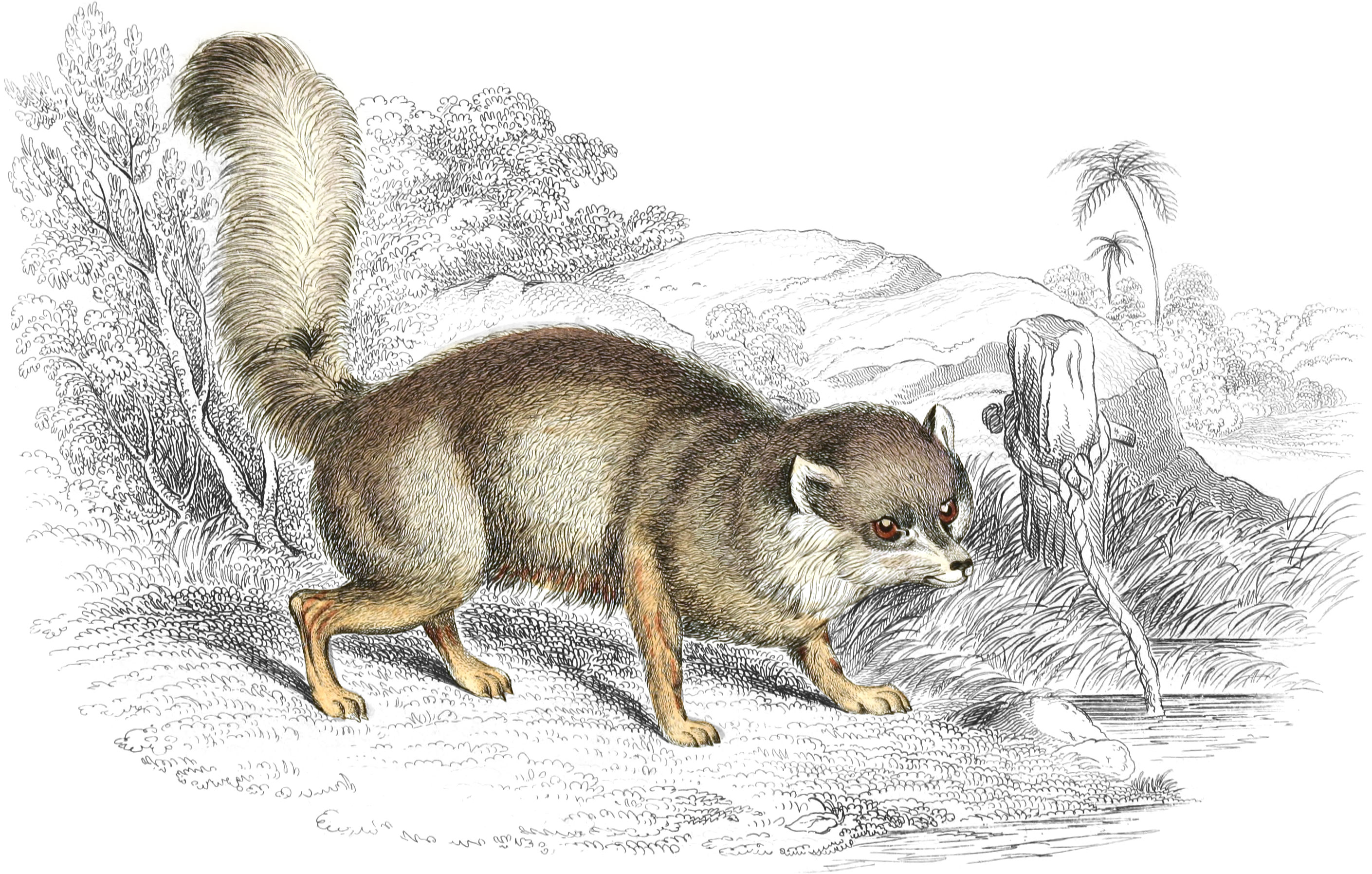
Plate XVIII
Section VII. Megalotis. The Fennecs or Zerdas
Without adopting Illiger’s reasons, we detach the present group, under the denomination he applied to the Zerda, from the other diurnal canines, and more particularly from jackals and foxes, with which they have been confounded, and place them immediately after that of Cynalopex, with which it is nearly allied. When the long brush-tailed species shall have been studied with more care, there is little doubt but that others will likewise require to be separated. The group now under review is formed, because the species that have been attentively examined have the eyes with a circular disk, and therefore belong to the diurnal tribe; they have only six mammæ,? and form the last subdivision of those found in the eastern hemisphere. Although, by the increased proportions of the ears, several of the species before described, and most of the smaller African canines, approximate Megalotis, they are destitute of the following characters, by which alone the Zerdas are distinguished:—They have the ears disproportionately developed, and the folds at the edges double or treble. Such a structure cannot well be given without a corresponding effect; and if we compare it with the same forms m bats, whose exquisite hearing, and singular power of diversified perceptions, are known to belong to their enlarged and complicated ears, we may fairly presume the Megalotes likewise enjoy distinct faculties and increased sensibilities by means of these organs. For this purpose, also, they have the cerebral chamber very considerably larger than those of canines of equal proportion; the auditory apparatus immensely developed; the skulls are destitute of the central ridge where the temporal muscles are inserted; and the jaws have no great powers of action. Beside the diurnal eyes, the great expanded ears, and the spot on the tail, this group is further distinguished by the soles of the feet being covered with hair; a provision the more remarkable, because all the known species of this group belong to tropical latitudes. Their teeth, though the same in number with the rest of the canidæ, indicate, that beside fruit, honey, and birds’-eggs, they are prone to feed on insects; this propensity is perhaps facilitated by their hairy feet making no noise, and causing no concussion of the earth while in pursuit of their prey. They burrow in the sandy deserts of Africa, and about the roots of date palms.
In this group we do not however admit Megalotis Lalandit or Canis megalotis; but, on account of the singular dentition, refer it to a distinct sub-genus, which, in the natural order, seems best placed after Vulpes, and before Lycaon.
The Anubis Zerda
Megalotis famelicus.
Canis famelicus, Krætschmer.—Sabora of the Arabs.
This species is one foot eight inches long; the tail, one foot two inches; the ears, three inches ten lines; and the stature, at the shoulder, ten inches six lines. This little animal stands high compared with its length; the head is more pointed than that of the former; the hair is silky, grey on the back, fawn colour towards the sides; the nose whitish, with a chestnut streak on each side, from the nostrils upwards to round the eyes; the tail above dark, beneath white, with five or six indistinct darker spots, the tip white; inside the thighs and belly whitish; throat, and side of the limbs, pale buff; the soles clad with woolly fur. In adults, there is a distinct chestnut streak running from the occiput along the back to the tail. In young animals this mark is broader, but less distinct. Mr Ruppel found this species in Kordofan, in the direction of Nubia. Professor Krætschmer is inclined to believe the figures taken for jackals designed on Egyptian temples, and in the catacombs of Thebes, to refer to the present species; in which case he might well have denominated it Anubis. The species burrows, and hunts birds and small mammalia, such as jerboas, &c.
Caama Fennec
Megalotis caama
Canis (vulpes) caama.
The smallest of the South African foxes, according to Dr. Smith, we place here, on account of the great development of the ears, the general form of the animal, and its diurnal habits. In figure, this species resembles the last described, having also the long brush, with a dark tip.
It is in stature about one foot high at the shoulder, covered with a soft fur coloured like that of a wild rabbit. The head is vulpine; the ears large, with expanded tubes; the whiskers long, black, and rigid; and its predatory habits best observed are, that of feeding upon eggs of birds nestling upon the ground. It is an object of solicitude to ostriches, who watch the animal when the laying season has commenced. When the Caama has obtained an egg of a large size, he is stated to roll it in the manner which the Suricate (Rysena) and several Viverre practise, until, by encountering a stone, it is broken, and is thus become accessible food. The proceedings both of the ostrich and the animal attest that it is in the habit of preying by day as well as by night, like the other Megalotes.

Plate XIX
Fennec of Bruce
Megalotis zerda
Zerda or Durda of the Natives.
Dr Ruppel’s specimens are one foot four inches in length; the tail eight and a half inches; the ears three and a half inches; and the height at the shoulder six and a half inches. The head is only three and a half inches long, the cranial part very round, and the muzzle small and fine; the ears are very ample, slightly pointed, covered outside with cream-coloured fur, inside with a border of white hair, and the rest naked, in the living animal showing a pinkish colour. In the rest of its form it is a miniature fox; the fur is of cream colour, with the woolly under-coat dirty white; the irides are yellow; the pupils round; the tail is marked on the upper surface, near the base, with a black spot, and the tip is of the same colour; the soles of the feet are covered with woolly hair. Dr Ruppel’s specimens were obtained about Ambukol, and in the desert of Korti; and the species must extend to the south as far as Caffraria and the Cape colony, since Mr Sparrmann recognized Bruce’s Fennec, and named it Zerda, which is since proved to be the name in Nubia. It is scarcely necessary to observe, that Mr Bruce must have had some confusion in his notes, when he asserted that his Fennec climbed trees. They burrow, like the former, in the sand. There may still be reason to doubt, whether the Zerda is Mr Bruce’s species; because, according to his description, the Fennec was only ten inches long, and the tail five and a-half inches; the pupils of the eyes were round and black, the colour of the iris blue; it was, in general, a nocturnal animal, vet watched birds with uncommon vigilance. The molars were but four on each side, above and below; and there were only four toes on the feet, both before and behind. All the dimensions were therefore smaller, and the teeth and toes fewer, which perhaps indicates a very young animal when his notes were taken, or he encountered difficulty when the animal was to be examined. Major Denham’s Fenecus cerdo was, however, only nine and a-half inches long; the tail six inches; the ears three inches long and two in breadth. The general colour was white, slightly tinged with yellow; above, from head to tail, rufous-brown, delicately pencilled with fine black lines, caused by thinly scattered hairs tipped with black; the exterior of the thighs light rufous-brown; a small rufous spot beneath the eyes; ears long, erected, pointed externally, covered with pale rufous-brown hair; internally with a border of greyish-white, and the rest naked, at the base and sides folded and plaited; tail full, cylindrical, rufous-brown in colour, pencilled with black; a small dark brown spot near the base, and the tip black; fore-feet pentadactylous. It was in a head of this variety that the ossicula auditus were as large, and the auditory cells longer, than in the common fox, though the animal is two-thirds smaller.

Plate XX
We now come to the canidæ of South America, where the species we have to enumerate are but few, and very imperfectly known. Yet, in one respect, the tropical appear to be influenced by the different conditions of their existence; for an intensely hot climate, covered with dense woods, everywhere intersected with great rivers and extensive marshes, demanded of the resident carnivora that they should be inured to swimming, and familiarised with food drawn from the waters. Many have but a very scanty woolly fur, but are protected by longer and more abundant coarse hair, than the canines of similar latitudes in the eastern hemisphere.
The question might be raised, whether they should not be all placed after the dogs, properly so called, and immediately before the true foxes; but, considering that several of them assuredly mix in prolific breeds with the dogs of European origin, while the progeny with real foxes are known to be true mules, we prefer, for the present, to place them as herein arranged.
We can discern three groups, all generically denominated Aguaras by the aboriginal Indians; of which the first, being at present confined to only one species, and more widely separated in characters, it may be well to give the description, before we take a more general view of the remainder.
Section VIII. Chrysocyon. The Aguara Wolves
There being but one species belonging to this group, as yet discovered, we proceed to the description of it without adverting to general characters, excepting that the distinguishing mark is the presence of a long mane on the neck and shoulders; and probably, as in the Chrysean group, that the last tubercular tooth is wanting.59
The Maned Aguara
Chrysocyon jubatus
Canis jubatus, Desm.—Le Loup rouge, Cuv.—C. campestris, Wied.—Aguara guazu, Azara.
This is the largest wild canine of South America yet discovered, and, by some of its attributes, partakes both of the Hyænas and Chrysei of the old world, being furnished with a remarkable mane from the occiput to the end of the shoulders, and with the livery and dentition which belong to the last mentioned. The head is smaller than that of a wolf, and the legs proportionally longer; the animal standing much upon its toes, the feet appear short; it is about four feet four inches in length; the tail one foot three inches, and the stature near twenty-six inches in height; the head is long, particularly the snout, which is pointed; the ears rather small, and erect; the muzzle black and small; the cheeks, lips, and whiskers black; the nose, forehead, and upper parts deep fulvous-red, paler at the sides, and more grizzly about the buttocks; the under parts likewise grizzly and reddish; all the four feet sooty-black; the hair is rather long and shaggy, on the throat and breast whitish, with an irregular sooty spot, beginning beneath the jaws and passing on each side towards the corners of the mouth; from the occiput to the end of the shoulders runs a ridge of long coarse hair, the upper half of which is black; the tail, moderately hairy, is mixed, darkish on the upper surface, red and grizzly below and at the tip. The hair from the hips down the edge of the buttocks is four inches in length; that on the belly is likewise long. The dentition, excepting the asserted want of a tubercular, agrees with the other species of canidæ; but is inferior in strength to that of true wolves; and the number of mammæ are only six. The female resembles the male in every particular of colour.
This species is not found north of the equinoctial lime, but resides chiefly in the swampy and more open regions of Paraguay and bushy plains of Campos Geraes; its habits are solitary and nocturnal; it swims with great facility, and hunts by the scent, feeding on small game, aquatic animals, &c.
The Aguara guazu is not a dangerous animal, being much less daring than the wolves of the north; it is harmless to cattle, and the opinion commonly held in Paraguay, that beef cannot be digested by its stomach, was in some measure verified by Dr Parlet, who found by experiments made upon a captive animal, that it rejected the raw flesh after deglutition, and only retained it when given boiled. Kind treatment to this individual did not produce confidence or familiarity even with dogs. Its sight was not strong in the glare of day; it retired to rest about ten in the morning, and again about midnight. In the dark, the eyes sometimes shone like those of a true wolf. When let loose, the animal refused to acknowledge command, and would avoid being taken till driven into a corner, where crouched it lay, until grasped by the hand, without offering further resistance. The Aguara guazu, though not hunted, is exceedingly distrustful, and having an excellent scent and acute hearing, is always enabled to keep at a distance from man; and though often seen, is but seldom within reach of the gun, The female litters in the month of August, having three or four whelps. Its voice consists in a loud and repeated drawling cry, sounding like a-gou-ā-ā-ā, which is heard to a considerable distance.

Plate XXI

In the next groups, we mean to describe the wild dogs and the so called foxes of South America, which, in order to be clearly ascertained, demand a further subdivision, because the form of their heads, bodies, tails, eyes, and colours are not sufficiently alike to constitute an homogeneous section. There is still considerable uncertainty in the distribution of the smaller canines into diurnal and nocturnal classes; because the only positive criterion to distinguish them depends upon the form of the pupils of the eyes one being a circular disk, the other a vertical opening, but liable to assume the rounded shape in a moment; and this effect being generally produced under all circumstances of emotion or partial obscurity, in all the nocturnal, the criterion escapes notice, unless it be determined by dissection, an operation demanding manual skill and previous anatomical education; these requisites not being always possessed by travelling investigators, leave doubts which can be removed only by such establishments as zoological gardens, where species can be studied living and be dissected after death.
South America, when first discovered by the Spaniards, was possessed of canines absolutely indigenous, some universally wild and others liable to be partially reclaimed; all more nocturnal than the former dogs and less so than true foxes. Of the first class there is perhaps only the Chrysocyon before described; in the second, although clearly distinguishable into two groups, alike furnished with rounded foreheads, there are general indications of a more placable nature. The eyes of some are considered circular; they have comparatively longer and bulkier bodies and shorter tails, while the others with the external form of foxes, the nose still more pointed and brushes even longer and more ample than these animals, have indeed the pupils of the eyes vertically contractile, but so imperfectly, that they become elliptical only when the head is forcibly held against a strong light; they are hence crepuscular, not nocturnal, unless there be a clear moonlight. Their propensities to rapine are more those of jackals than of foxes, but their activity does not cease with daylight; they retire only to repose when the sun is strong. Several can be sufficiently tamed to accompany their masters to hunt in the forest, without however being able to undergo much fatigue; for, when they find the sport not to their liking, they return home to await the return of the sportsmen. In domesticity they are excessive thieves, and go to prowl in the forest. There is a particular and characteristic instinct about them to steal and secrete objects that attract their attention, without being excited by any well ascertained motive. All subsist upon the usual food of the wild canines, but with the addition that they eat also fish, crabs, limpets, lizards, toads, serpents, and insects. They are in general silent and often dumb animals; the cry of some is seldom and but faintly heard in the night, and in domestication others learn a kind of barking. None appear to be gregarious, but several are occasionally encountered in families. Although in company with man, the domesticated will eagerly join in the chace of the jaguar, we have never heard that they are in the same state of hostility towards feline as are their congeners in Asia and Africa. The native Indians who have domestic dogs of European origin invariably use the Spanish term perro, and greatly promote the increase of the breed in preference to their own, which they consider to be derived entirely, or with a cross, from the Aguaras of the woods; and by this name of Aguara it is plain, throughout almost all the interior of South America, that the whole group of indigenous canines is understood.60
Although both the long and the short tailed Aguaras appear to be at least in part mixed in that semi-domesticity which savages can produce, we separate the first under the name of Dasicyon, because in aspect, disposition, and the form of their pupils, they appear to stand more nearly identified than the second with the diurnal dogs of the Old World.
Section IX. Dusicyon. The Aguara Dogs
Buffon, in reasoning upon the scanty data then collected concerning the chien des bois and crab-eating dogs, assumed that they were descended from genuine dogs, although residing in the woods, and by his own confession never yet entirely subdued, because “they bred together,” merely to sustain his doctrine that all dogs were the offspring of sheep-dogs61 The races we have seen on the spot did not remind us of shepherd’s dogs, nor of any other domestic species, excepting those of the resident Indians, who all admitted theirs to be of the wild species of the woods.
The group may be considered to represent, in the west, the Thoes of the old continent, and collectively to have. the forehead more rounded in proportion than their consimilars in the east; the tail consists of an imperfect brush, never reaching far below the heel; the body is long, compared to the height, and bulky; the feet are smaller, a characteristic extended over a great proportion of the mammalia of South America, including even man. They have often the fulvous brown, only in shades deeper than the Chrysean group, or it is hoary, and the face has the aspect of foxes. The individuals we examined had the roof of the mouth black, only six mammæ, and the eyes rather more oblique than the domestic species of the old continent. They are less shy than the Chrysocyon, in proportion better armed; they burrow, and therefore prefer more open countries, swim, detach clams from rocks, and eat fish, birds, and small animals.
Hoary Aguara Dog
Dusicyon canesens, Nob.
This species we have seen domesticated among the Indians, who nevertheless asserted that it was wild to the southward; and some years after, we found a specimen in the museum of Baltimore,62 stated to have been shot some degrees to the south of the river Plate. It was about two feet eight inches in length, the tail nearly eleven inches, and the height at the shoulder fifteen or sixteen inches.63 The head was terminated by a sharp black muzzle, the edges of the lips were black, the laniary teeth rather slender, long, and sharp; there was a very large wart with several bristles on each cheek; the ears small, pointed, and hairy; the eyes high up in the head; the body full and long; mammæ not all visible; the legs strong and close haired; five toes to all the feet; the inner claws largest and sharp; the rictus of the mouth opened to a great depth, and the physiognomy resembled that of a small wolf. This animal was covered with loose coarse hair on the neck, body, and hams, whitish intermixed with sandy clouds, and the tips of many hairs black, particularly on the back: the legs were pale fulvous; the tail was scantily supplied with long hairs, black above, whitish beneath. It differed only from the domestic breeds in being somewhat darker and larger. In the domestic we observed likewise that the palate was black, and the edge of the lower lip of the same colour, but more deeply indented and broader than in the dogs of Europe. It may be that this is the Canis thous of Linnæus, and that his characters of a wart above the eyes should have been given as below, and the ciliated tongue may refer to the jagged under lip, mistated through inadvertence by his informant.

Plate XXII
Falkland Island Aguara Dog
Dusicyon Antarticus
The Lyciscus cagottis, before described, appeared to us identical with the present species; being induced to form this conclusion from seeing, in the fur stores of Mr G. Astor at New York, a large collection of peltry, which came from the Falkland Islands, where, according to the reports that gentleman had received, his hunters had nearly extirpated the species.64 All we saw were alike in colour and proportions, somewhat smaller than the Cagottis, equally low in proportion, with rather bulkier bodies; the tail not reaching to the ground, with a white tip; but the fur of the back was darker brown than the specimen figured in the Zoology of the voyage of the Beagle. Captain Fitzroy having favoured us with several communications on this subject, has removed our former impressions, and we now consider the antarctic animal distinct, notwithstanding that there are none of the same species on the neighbouring islands or on the main land, and no other habitat can be ascribed to it than the western Falkland Island. There is one more cause of misapprehension requiring notice, and that is the presence of two species, varieties or races not clearly distinguished in the accounts, excepting by the difference of size, and possibly by the smaller having a greater length of tail and more white about the feet. The D. Antarticus is full three feet long, the tail thirteen inches, and the height at the shoulder fifteen inches; the body is bulky, the legs low, and the head wolf-like; above, the colour is formed of hairs ringed with black and fulvous, together with dark tan; the belly and inside of the limbs are pale whitish buff, the throat dirty white, the middle of the tail brown and the extremity white. There is a well-preserved specimen in the Paris museum, brought from the Falkland Islands. Mr Bourgainville found it residing in burrows along the sea downs; it had a feeble kind of barking, and fed chiefly on birds. Buffon, who examined two specimens, being deceived by the colours, concludes that it was a race of the common fox. This conclusion of the Count’s was a natural result of his system, which on the present occasion tended to confuse more than to clear up the history of the canidæ.
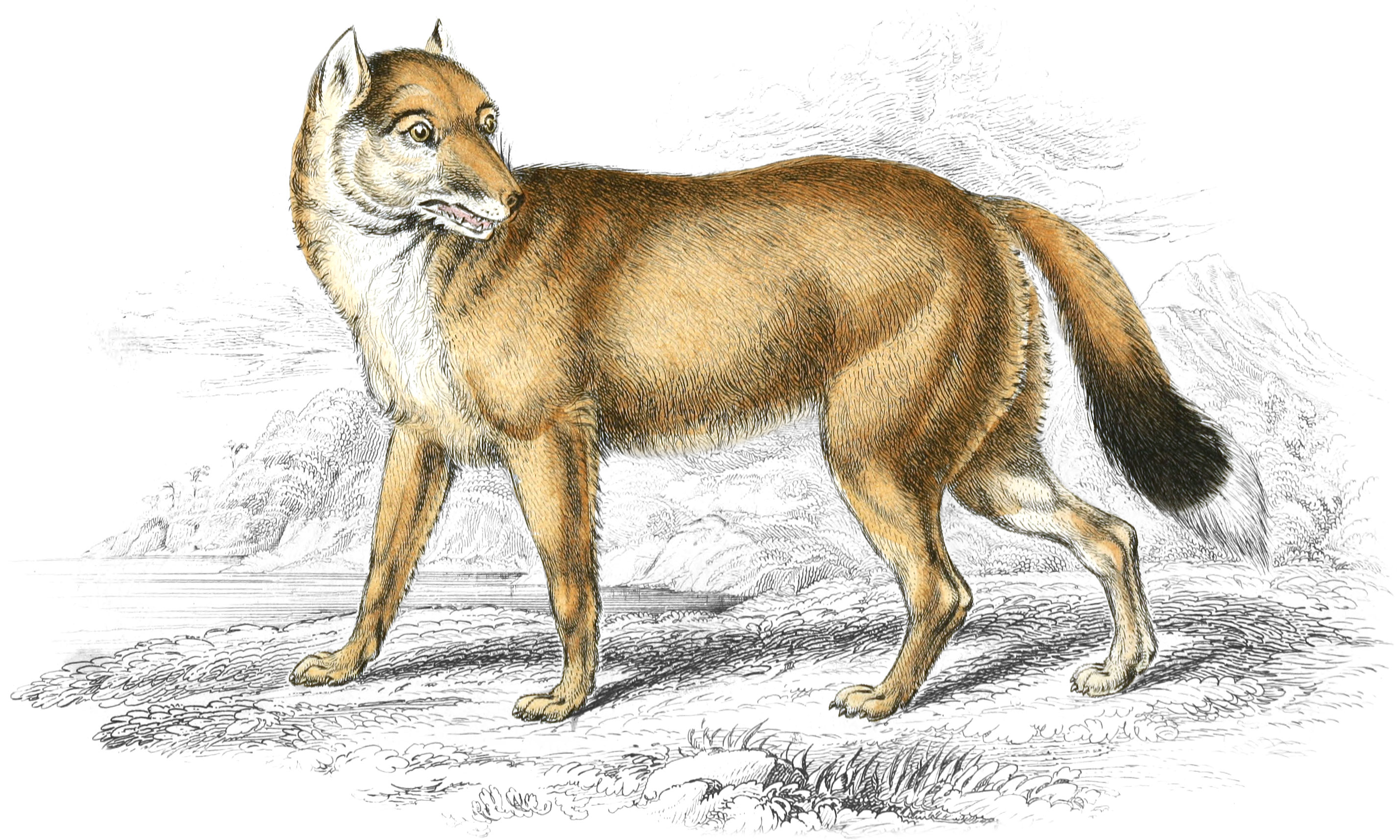
Plate XXIII
Aguara Dog of the Woods
Dusicyon sylvestris
In the collection of original drawings of the Prince of Nassau, now in the Berlin library, there is one of an animal with the name Aguarra beneath it; the design evidently shows a form of the present group; the head is pointed, the forehead round, the ears large, somewhat obtuse, rufous at the back and on the edges; the body is slender, the fur yellowish grey, darkest on the back; from the eyes to the nostrils the face is blackish; the legs are rather stout; all the feet as far as the joints black, the rest of the limbs rufous; the tail does not reach the ground, and from the root to the black tip it is yellowish grey. The size of this animal is not mentioned, nor can it be identified with any other of the group. Professor Lichtenstein, in his observations on Marcgrave and Piso, has not ventured to assign it to a described animal, but we have little doubt but that it is a true wild species, and therefore that the name of Dusicyon sylvestris should be admitted; for we have seen skins of one or two specimens in their wild condition and mutilated, but enough to satisfy us that this is the true chien des bois. Buffon’s figure is; we think, that of a semi-domesticated specimen, obtained through the Indians, who imposed it upon the French colonists the more easily, because almost all the native dogs will eat shell-fish.65
The chien des bois, or Aguara of the Woods, may be the Koupara of Barrere,66 and the description of Buffon repeated by F. Cuvier and Desmarets is quite correct in the details, but wrong as to the general appearance of the animal, which is more like a cur than a shepherd’s dog. The length of head and body is two feet six inches, the tail one foot, height at the shoulder fourteen inches; the head rounded, the muzzle more blunt than in the former; the ears short, erect, triangular, with a rufous fur at the back and spreading towards the neck, similar to those of the wild species: the colour more grey on the neck and yellowish white beneath; this colour spreads on the insides of the legs and thighs; that of the upper part of the head and back consists of a mixed black, fulvous, grey, and white hairs, most fulvous on the head and legs, and grey on the back; the legs are slender and the feet small, both of a dark brown and reddish colour; the tail, clothed with a close coat of hair without a brush, is brown on the upper surface, yellowish beneath, and black at the end: the eyelids and muzzle are black, and there is an indistinct appearance of two blackish streaks on each cheek.
The attitude of this animal is that of a cur, and on comparing our figure of a domestic dog of the Indians, taken from a living specimen, with that of
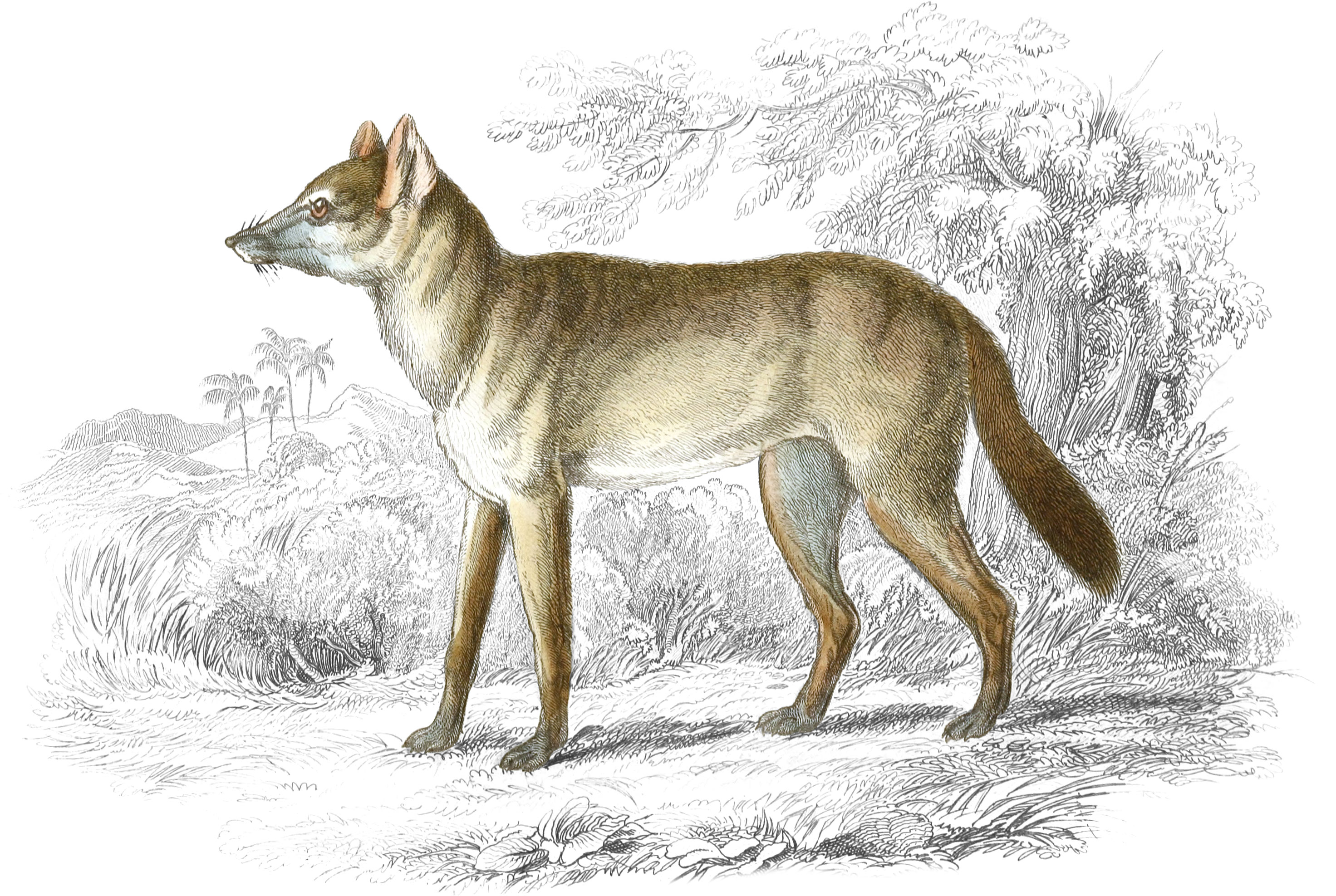
Plate XXIV
The Crabodage, or Surinam Aguara Dog
Dusicyon sylvestris
We find such a strict similarity in all, excepting the bushy tail, that we believe them to represent the same species in the wild and domestic states, and that Buffon’s chien des bois is again the same, while the chien crabier is a Cerdocyon, or Canis Azaræ.
The wild race of these dogs are said to form small families of six or eight in company; they hunt agoutis, pacas, and wild gallinacæ. The Indians say also that they eat the berries of several plants, particularly those of the houmiri (houmiria balsamifera?); and a solitary cry, sometimes heard in the most dense forest, is ascribed to them.
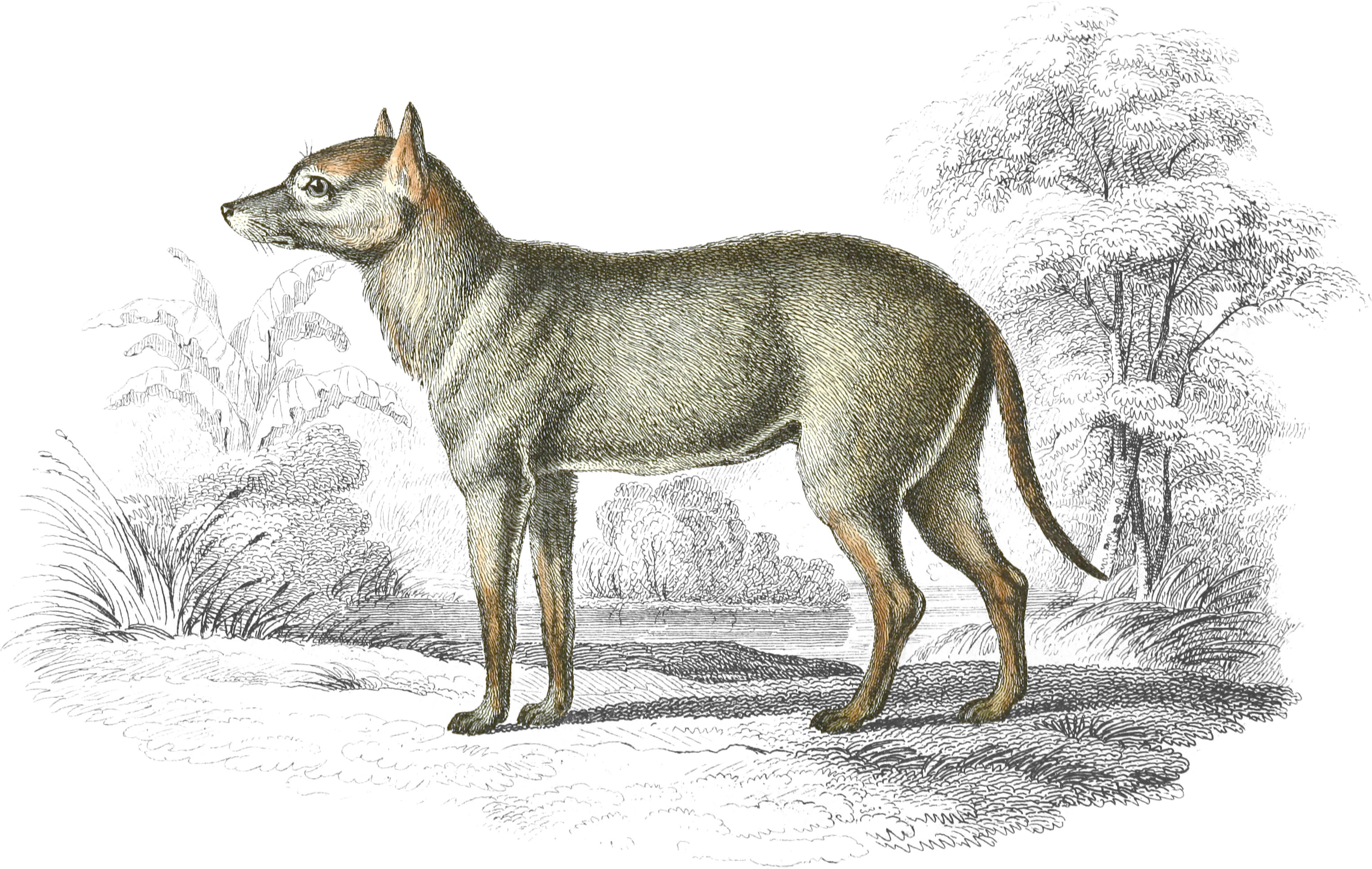
Plate XXV
Dun-Footed Aguara Dog
Dusicyon fulvipes
Vulpes fulvipes, Martin. Culpeu? of Molina.
This species is two feet in length, the tail nine inches, the height at the shoulder ten inches. It has, according to Mr Martin,
a remarkably stout form of body and shortness of limbs; the tail is rather short, with hairs of moderate length, except the extremity, where it forms an abrupt full tuft tipped with sooty black; the fur in general is full, rather deep and harsh; on the body the colour is hoary mixed with black, the latter predominating down the back; head rather fulvous, grizzled with hoary; the muzzle and chin dusky; edges of the lips white; ears short, chestnut brown; outside the anterior limbs are dusky black freckled with fulvous, inner side and toes pale fulvous brown; a dark spot above the tarsal joint; tarsi and toes fulvous brown; upper coat of hair dusky brown at base, with a yellow white band above and black tips, whence the grizzled appearance of the general colour.
The species was discovered by Mr Darwin in Chiloe; it showed surprise at the presence of man, but made no attempt to escape; from which circumstance, and the few particulars known concerning the Culpeu of Molina, it is inferred to be that animal.
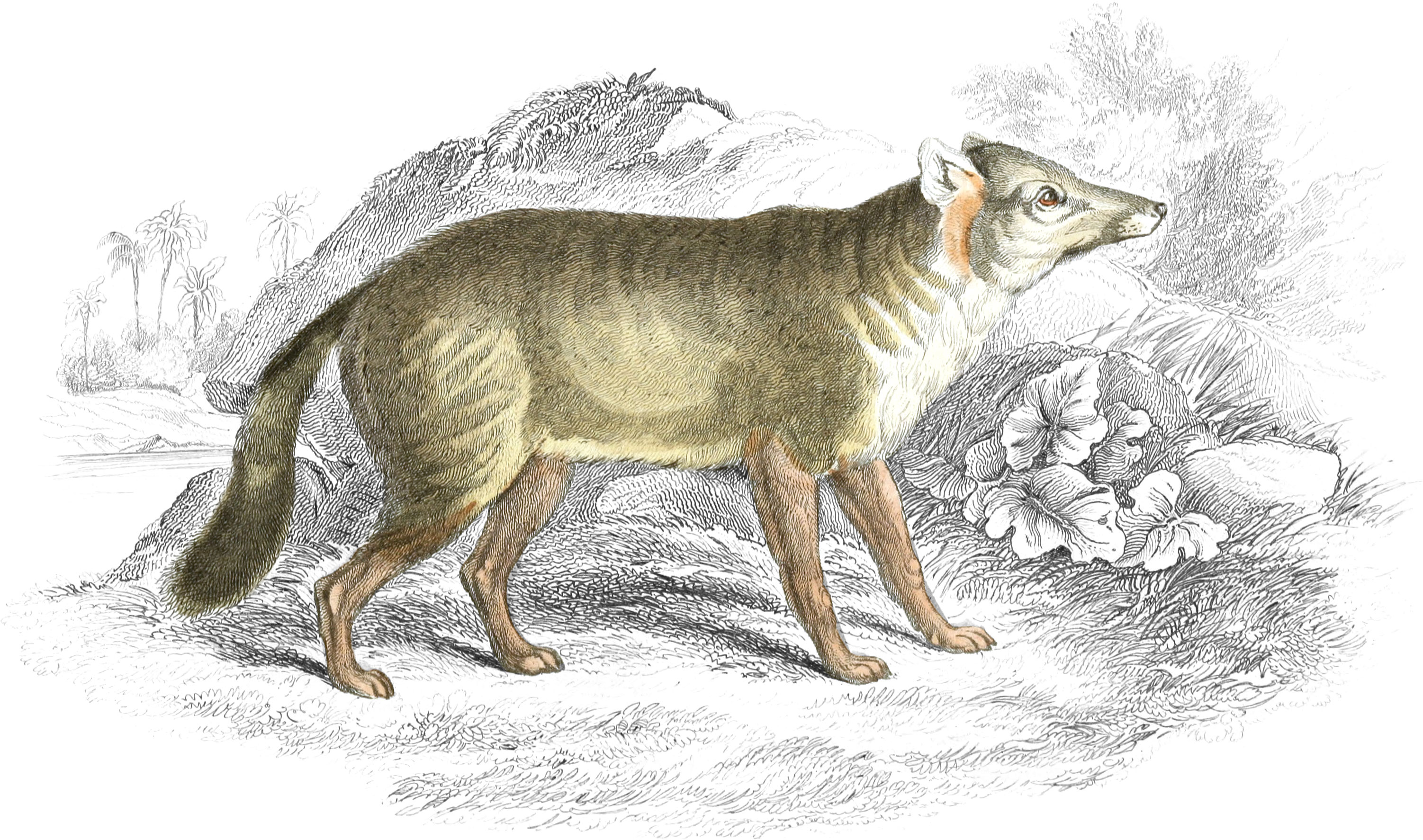
Plate XXVI
Section X. Cerdocyon. The Aguara Foxes
We pass from the subdiurnal Aguara Dogs, by an almost insensible degree, to the Aguara Foxes, whose structure is more completely vulpine, having tails with brushes even larger and longer than those of true foxes. They are equally low on the legs, equally supple, with a fur nearly as abundant, and kept very clean, with colours forming mixtures of grey, buff, white, and black, the tip of the tail always black; but their eyes do not appear to assume the vertical contraction with equal facility or perfection, and they are thence more crepuscular than nocturnal, prowling only in moonlight nights, and keeping abroad till the sun becomes hot. They can be domesticated, and it is believed will form cross breeds with the Dusicyon and Canis familiaris.
White-Barred Aguara Fox
Cerdocyon mesoleucus, Nobis.
We place at the head of the present group a specimen which is marked in some measure like the Thous mesomelas of the Cape, and is intermediate between the last group and the present. It was kept during the space of about four years in the house of a friend residing near Plymouth, where opportunities were frequent of watching its character and manners; and being a great favourite with the owner, who is familiar with field sports, and therefore qualified to judge with discrimination, we learn that in most respects it was as playful as a young fox, having all the vivacity and dexterity of that species. It was perfectly tame and good-tempered; but in no instance was the eye observed otherwise than with a circular pupil, and it was quite destitute of all offensive odour. The specimen measured twenty-eight inches in length, the tail eleven inches, standing high on the legs, with slender limbs and small feet, and the whole structure remarkably light; the incisor teeth were small and the canines were slender, and never greatly exceeded the length of the external incisors; the whiskers, bristles on the cheeks and above the eyes, were long and black, as were also the muzzle, edge of the lips, and eyelids; there were five toes on all the feet, those on the hind feet well developed and armed with long claws; the nose, back of the ears, a small space on the shoulders, and the hinder face of the legs were reddish buff, the front paler, and the inside more grey; round the eyes the hair was whitish hoary; the cheeks and forehead yellowish grey; from the nape of the neck all over the back to three or four inches down the tail the colour was blackish grey, with a bar on the neck and another behind the shoulders of nearly pure white, relieved by deep black, but with some whitish intermixed with it, passing down towards the elbows and a third white bar across the root of the tail: the ridge of the back was nearly black, but grizzling downwards in irregular brindles of black and white to the sides, which with the breast, hams, and belly were grey; the tail formed a regular brush, but proportionally shorter than that of the foxes, furnished with grey hairs to the end where it was black, with a few white hairs at the tip; the ears were rather large, pointed, thickly furred with grey hair, and a little fulvous at the back; the external part of the thighs was white down to the tarsus; the sides of the neck, shoulder, flanks, and hams delicate grey; the limbs pale buff. This beautiful animal came from South America, and, judging from the density of the fur, belonged to rather a high latitude. It forms a kind of counterpart to Thous mesomelas of the Cape, and might be mistaken for it.

Plate XXVII
Guaraxa Aguara Fox
Cerdocyon guaraxa
The Guaracha of Northern Brazil.
There are several varieties or races of the Brazilian and Paraguay Guaracha. Both Prince Maximilian of Wied and Dr Rengger classed them among true foxes, but the last mentioned naturalist admits that it can be tamed, and with superior powers of scent is used in hunting, though with but indifferent docility. It is a dangerous companion among poultry, when unobserved; and the Doctor reports the eyes, though round, when turned against the full light of day, to become vertically slit as in true foxes; yet they do not stir abroad in dark nights. It is to this species in particular we allude when remarking upon the singular propensity manifested by them to steal and secrete particular objects: bridles and pocket-handkerchiefs have been carried off in this manner, and subsequently found in bushes at some distance.
The first variety is we believe represented among the original drawings of Prince John Maurice of Nassau-Siegen, already mentioned, and therein named Guaraxa, which Professor Lichtenstein, in his careful review of the works of Marcgrave and Piso, compared with the above drawings, considers to be synonymous with d’Azara’s Aguarachay. In form and stature the Guaraxa is very like the Mesoleucus, the head and limbs appearing equally small and light, when compared with the volume of body and tail, both being covered with loose and rather coarse hair, the tail is however much longer; the nose, cheeks, and forehead sooty grey; the nose to the eyes, the back of the ears, and extremities from the joints downwards sepia brown; the neck, back, belly, sides, hams, and tail yellowish white, darker on the back flanks and hams, and waved on the neck, back, and croup with indistinct bars of sepia brown, which appears likewise in similar forms on the tail, where there are about three bars and a sooty tip.

Plate XXVIII
Crabodago Aguara Fox
Cerdocyon Azaræ
Canis Azaræ, Prince Maximilian of Wied.
This variety, belonging to the plains and woods of Brazil and Paraguay south of the equinoctial line, but spreading partially to the north of it, is similar in general form, resembling an European fox, but with the head more like a Thous, the neck less implanted between the shoulders, and the brush less furnished with long hair, the fur on the body is pale yellowish grey, on the back being mixed with black; a black streak on the shins, the rest buff; the tip of the lips white; under jaw dark brownish grey, and inferior parts whitish; the tip of the tail black. The length from nose to tail is about twenty-three inches, the tail fourteen inches, the ears two inches.
The animals of this species, found more to the southward, and represented in the Zoology of the Beagle, appear by the figure publised in the second number to be nearly black on the ridge of the back and tail, excepting towards the extremity, where a white band interposes immediately above the black tip; the face and legs are brown, without the black streak on the shins, and the sides more mixed with pale grey.
Mons. Fred. Cuvier regards the Aguarachay of d Azara as the C. cinerco argenteus of authors, but there is no resemblance in the colours, figure, or manners; one belongs to South and the other to North America. The Guaracha barks, lives on terms without restraint when brought up in the house, his manners resembling those of the C. Mesoleucus; the young are blackish and white. The three coloured animal is a true fox, of which we have seen several in a living state, but always chained, having the nocturnal eye, the odour, and instinct of foxes; and of a great number of skins we examined, there was not one without the space of true fox colour behind the cars and on the joints, though some were rather darker than others in the fur on the back; the colour was a purer grey, often silvery.
On reconsidering the varieties of this last species, we are inclined to conclude that our figure of Cerdocyon cancrivorus represents the young, of which Prince Maximilian of Wied’s Canis Azaræ is the adult, and our Guaracha only a different race of the same species.

Plate XXIX
Magellanic Aguara Fox
Cerdocyon Magellanicus
Vulpes Magellanicus, Gray.—Canis Magellanicus, Zool. of the Voyage of H. M. S. Beagle.
The figure of this species is published in the above cited work, but the letterpress has not as yet appeared; we therefore refer to the dimensions and description in Mr Gray’s notice of Mammalia in Loudon’s Magazine of Natural History, vol. i. page 577 578. It is there denominated Magellanic Fox, and represented to be
greyish varied with black on the back; the cross band on the nape and upper part of the tail black; head pale yellowish; back of the ears, nape, sides of the limbs, and under parts of the tail bright fulvous; chin, throat, chest, belly, and front of legs white. Length of head eight inches, body twenty inches, tail twelve inches. Inhabits Magellanic Straits. Presented to the Museum by Captain King, R.N.
The figure published by Mr Darwin represents an animal in form resembling the fox of Norway, being equally robust in structure and low in stature; the colours are light grey, intermixed with fulvous and blackish along the back and at the tip of the tail.
We do not know if it is this species which is stated to exist also on the Falklands, and to have been nearly extirpated by the larger Dusicyon antarticus.

Plate XXX
- Sirius, Sothis, Canicula, Nabhas, Anubis, Elur, El-habor, El-schere, Ur-chan, &c.—See Porphyry de Nymphas aut. Herodotus, l. xi. Servius, ast. of the east. Juvenal, Sat. v., &c.
- It would lead us too far in a work of this kind to enter upon an etymological inquiry concerning the singular connection there appears to exist in the mutations of a general root designating fitness, capacity, and power, with God, goodness, and dog. In this view, Nabach, or Nabass, would not be a true Semitic name, but a northern epithet signifying the watch-dog or barker-after. The Hebrew, indeed, has many other words that appear of foreign or Scythic origin; דןוכח, Hannbeak, or Anubis, is the more true Semitic term for barker.
- In omnibus animalibus placidum eiusdem invenitur et ferum.—Pliny.
- What may be thought of the ancient opinions in Aristotle, Calisthenes, Xenophon, Pliny, Oppian, Gratius, Pollux, &c., relative to Hybrid dogs, sprung from lions, tigers, thoes, and foxes, will be examined in the sequel.
- We believe Sir John Jamieson, who made similar experiments in New Holland, was not more successful; but I find that Mr Cunningham mentions a breed of Hybrids of the race to be now established in New Holland.
- This name must not be confounded with the C. Jaela, Ham. Smith.—No. 869 of Griffith’s An. Kingd.
- In the plate of heads of dogs in Mr Griffith’s Animal Kingdom, representing wild varieties of the deg taken from Colonel Hamilton Smith’s drawings, the engraver has erroneously marked the numbers. Head, No. 1, is that of the Dhole; 2, of the South American wolf or dog; 3, of the Dingo; and 4, of a specimen formerly in the possession of Mr G. Astor of New York, which he denominated, and by comparison with numerous skins, proved to be of the wolf of the Falkland Islands.
- If Mr Bell, in referring to the Dhole of Asia, had in view the observations of Mr Frederick Cuvier (in the Dictionnaire des Sciences Naturelles, at the word Chien), it will appear that, on this occasion, that learned and attentive observer quoted from Captain Williamsen’s Oriental Field Sports, probably without referring to the text; for he cites the plate where some Pariah dogs have driven a panther into a mango tree, and not that where Dholes attack a tiger. On consulting Captain Williamson’s text, he speaks of the Dhole as a wild dog, but he does not say that this animal is descended from a domestic breed. The context would lead to a different conclusion. As for the plate, it was Colonel Hamilton Smith who made the sketch of the Dholes, not very correctly reproduced in the plate.
- Aguara is one of those indefinite appellations which extend over a vast surface of America. It would seem to be derived from the Mexican wolf or fox, whose cry is said to repeat the sounds Agou-a-a! but, in other places, it is a fox, a wolf, a feline animal; we have heard it even bestowed on several species of fishes. This name is given with some syllable before or after, or both before and after the word, and appears to be an epithet. In the East Indies the same thing occurs, for there Beriah is a name applied both to the wolf and hyæna. The Dhole appears to be in a similar predicament.
- Several living specimens, one recently shot, many stuffed, and an immense number of skins, have been examined by us, which resembled the German wolves more nearly than the last mentioned do the Russian, of which we have seen also several specimens.
-
We may quote as examples in the Ruminantia, the Gayal (Bos gaveus), the hunched oxen of India, and the common breed, perhaps even the Yak of Tartary, all breeding together a prolific offspring, if proper precautions are used. See these articles in Griffiths’ version of the Animal Kingdom.
It may be claimed also for the domestic cat: the parent race, if we may trust the cat mummeries of Egypt, appearing to be in that country derived from Felis maniculata, while the wild cat of Europe, extending into the East of Asia, is also a progenitor, as well as the Tabby, apparently derived from South America. Their mixed offspring is prolific, and can we say that they are of the same species? What shall we say of the wild horses of Europe, whose remains are found in successive deposits, up to the superficial mould?
- Mr. Hodgson, however, also claims the intervention of moral qualifications in his account of Capra tharal, as being bolder and livelier than his Ovis nahoor, in opposition to the conclusions of Colonel H. Smith’s account of sheep.
- See our own ancient books of venery; also Le Roi Modus and the household institutions of the dukes of Burgundy; the ancient Welsh laws, &c.
-
The deep jaw-bones of (some) domestic dogs are independent of the more general character of the family, and indicate a corresponding possession of actual physical power, as in the lion and jaguar, compared with the more insidious habits of the puma, we find a similar correspondence.
—Animal Kingdom, in the Edinburgh Review of Nat. History.
- Regne Animal, vol. i. p. 149.
- Ib. p. 151.
- We refer to the case of the mare and quagga, and her subsequent foals, recorded in Surgeons’ College, London; where the pictures of the successive fouls, painted by Agape, are preserved.
- The species noticed by Baron Cuvier seem to have been mere debris, from which, however, he was enabled to indicate four,—the two first from the Franconian caverns, the last from the calcariferous selenite of the vicinity of Paris; they were therefore of a coeval period with Paleotherium, and belong to an anterior zoology; but their characters and distinctions are not explicitly given. The two first mentioned, however, belong to the latest period; one representing the characters of a wolf, may be the same as that of the Torquay deposit, the skull perhaps deserving the name of lurcher wolf; and the other approaching the jackal, but larger than our present foxes.
- The foregoing chapter was written before we became aware of the review of Mammalia in the Edinburgh Journal of Natural History, where many considerations relating to canines are investigated; and although the author’s object was not to question the single or plural view of the parentage of domestic dogs, and his argument occasionally seems to lean to the former opinion, yet we claim many of his facts and reasons as confirming the latter. Want of space forbids these being reproduced here in the form of quotations, and condensation would only garble and do them injustice; we therefore refer to the original, particularly the Nos. x. xi. and xii.
-
Mingit ad latus, cacat supra lapidem. Odorat anum alterius. This habit of smelling each other is connected with the two glands found on each side the anus, and communicating with it; they are ovoid in form, and exhale a penetrating fetid smell,
—Dauberton in Sonnini.
- The numerous experiments of Mr Tessier prove considerable diversities in the gestation of some orders of animals, but in dogs he does not allow the limits to exceed four days. See Cooper’s Tracts quoted in Beck’s Medical Jurisprudence.
- Edwards sur la vie—This conclusion may demand some qualification; for we are informed by a medical officer in the Royal Navy—one of unquestioned ability and experience—that in opening a seaman killed by a fall, the foramen ovale was found open, admitting the passage of a quill; yet the man had been as strong, active, and healthy, as any other person on board.
- See Crawfurd’s Embassy to Ava, and our account of Topel hyæna. Indo-China is, however, possessed of several species of elongated carnassiers, wholly or in part supplying the place of Canidæ. Beside the deeb of the Arabs, the zeeb is mentioned as allied to the wolf, but does not seem to be found in Palestine.
- See, on this subject, the interesting remarks of Dr Weissenhorn.
-
Cuvier’s Animal Kingdom, by Griffith, vol. ii. p. 342.—
We have witnessed the most obstreperous fits of joy in a she-wolf at the visits of a young lady, who had never taken other interest in the animal than patting her on the head and speaking to her. This was also at the Jardin du Roi, at Paris.
-
The Taricheutes or embalmers, and the priests of Lycopolis, in Egypt. The
Tertia post Idus nudos Aurora lupercos. Aspicit
of Ovid, relates to the priests of Pan at the Lupercalia. The Blotmen, or sacrificers, of the Gothic nations, wore wolf-skin wrappers in their naked and sanguinary ceremonies. The second tribe in point of dignity among the Ostragoths (as we gather from the oldest Teutonic poems) was that of the Wolfingen. The first among the Saxons was the Whoclf or Guelphiec.
- Oppian, lib. iii. Messieurs de l’Academie of Paris, in their Memoirs, Part I., have toiled hard to show that some wolves of the ancients were lynxes; and then named a lynx they dissected loup cervier, with an erudition and confusion of purpose apparently inherent in learned bodies,
- Dict. des Sciences Naturelles, au mot Chien.
- Pallas, in Pennant’s Arctic Zoology, vol. i. p. 42.
- It is, however, not at all clear what we are to understand by gazehound.
- Our drawings, made from the living animals in the United States, when examined in Germany, were taken to be of the race found about the borders of the Rhine. They were submitted to several Oberjaeger (foresters) and gamekeepers. One of these, killed in Vermont, was reported to weigh ninety-seven pounds. We figure a specimen with more black than usual about the jowl and throat.
- Prince Maximilian of Wied, in the account of his travels in North America, now in the press, will describe, under the name of Cunis variabilis, a species of wolf liable to very different colours in the livery; and Dr Richardson remarks also, that in the same litter, both of his Canis lupus occidentalis and Canis lupus occidentalis latrans, there is often a great diversity of colour; but the last-mentioned observer claims for both species a different aspect from the European wolf, which tends to a conclusion that he does not think the species of both continents identical.
-
Lyciscus. Hoc idem e lupis galli, quorum greges suis quisque ductorem e canibus Lyciscam habent.
Plin. quoted by Cirino.—We do not find this text, but the name is evidently connected with the wolf, and has originally no reference to barking. The Teutonic luchs, anciently given without discrimination to the lynx and to a kind of wolf, is a nearer etymon, and may be derived in both cases from the luminous eyes. The Lupus cervarius of Pliny is similarly both a wolf and a lynx.
- The Basque name, Caygotte, bestowed by the Spaniards upon a Mexican canine, offers a curious coincidence with the indigenous name Coyotl. In Bearn and the south of France, Cagot is a term of contempt applied to a race of human beings for ages persecuted and expelled social life. It is there interpreted for Ca-goth, Gothic dog or Arian, but it seems to signify dog of the woods, or wood-hound, which is synonymous with Coyotl. Is it therefore another instance where these two remote dialects resemble each other?
- Communicated by Colonel Dunsterville, Hon. East India Company’s service, who was present.
- From nose to tail, three feet; tail, one foot; height at shoulder, about one foot seven inches, Ears, three inches.
- The word is likewise written Quihoe and Quao, evidently allied to the Greek Chao.
- The name of the hyæna of India, very distinctly marked with dark zigzag lines down the back, but lower than the wolf.
- A very dangerous canine sometimes follows the caravans from Bassora to Aleppo. The Arabs call it Sheeb, and report that all who are bitten by one die of the wound. Dr Russel accounts for this statement by supposing the animals in a state of hydrophobia, which indeed would be sufficient cause for inducing the Chryseus, at other times sullen and shy, to quit his haunts; but then several unite in these expeditions, which no mad canines do; and we question whether hydrophobia really exists in Western Asia, at least it is unknown among the street curs in cities. This Sheeb is most likely a Chryseus, or the Thous toeta. See that name.
- Sirium orientem meduit.
- Oppian’s Thous was a spotted animal.
-
Luporum genus est (Thos) procerius longitudine, brevitas crurum, dissimile velox saltu, venatu vivens innocuum homini. Pliny.
Ælian’s Thos may be jackals, but the Thoes of Homer, described as put to flight by the lion, while they surrounded a stag at bay, cannot be jackals but the Chryseus. So also is the Thos of Aristotle, when he notices their engaging the lion.
-
Isocrates and Xenophon represent the Laconian dogs to be amongst the most powerful, and Aurelius Nemesianus:—
Elige
Non humuli de gente canem, sed cruribus altis,
Seu Lacedemonio natam seu rure molosso. - A family of the name of Montefalcone bore a wolf salient gules. Another of the same name had red dogs for supporters, in a collection of blazoned Italian arms in the library of St Mark at Venice.
- This name is an antique Asiatic root, implying daring recklessness; in Turkish, Deli; in Teutonic, Dol, mad; in Belgic, Dull, outrageous.
- Oxley’s Journal, &c. p. 110.
- P. Cunningham. Two Years in New South Wales.
- A skin from the Swan River, now before us, measures 41 inches to the tail, the tail 12 inches. The fur in colour resembles the wolf of Asia Minor, but the eyes are very near the nose, only 3\(\frac{1}{2}\) inches distant; the head is small for the size of the animal. One recently brought to Plymouth was as large as a tall lurcher and resembled that race in make.
- It may be remarked that the Greek Lycopolis is the present Syout, and referring to the animals represented in the prænestine mosaic. The figure of a canine in a howling attitude occurs in the part depicting Upper Egypt or Nubia, and above it is the name ΞΙΟΙΤ, which agrees sufficiently with the Ethiopic plural Zybt, Azybit, a wild canine, or canines; though not a wolf, unless the animals of that species, wild in Nubia, be classed with the wolves. Syout, or Assiout, is therefore an ancient name of Lycopolis.
- This character of the hair seems to be in the notice of Acmon in Oppian.
- Stephanus.
- Arist. Hist. Anim., lib. ix. cap. xliv.
- Gesner contends that Papio was the classical name of the Jackal: this word may be of barbarous origin, and it is also clear that the ancients understood a four-handed animal by it; probably an ape or a baboon.
- The following list may serve as a sample of these names, and the meaning several convey of King or chief bawler.—Chakal, Tschakkal, Chatal, in Barbary; Chikal, in Turkish; Schekal, in Pers.; Tschagal, in Kerguise; Tschober, in Kalmuc; Tschubbolka, in Tartaric. Waoui, or Waui; ben awi and alsoboo of the Bedouins denoting howler, children of howling; Phial of Indostan, imitative of its cry. Phinkar, Hindostanee, the warner. Jaqueparil, in Bengal, or howler-dog. Alshali, Adeditach, Akabo, Alkabo, Alzaba, Aziba, Karabo, Syrian, and other dialectical variations, in which, however, the Thous is intermixed. Quoilah in Bombay; Nari in Malabar; Gola in Indee; Kadlu Nari in Tamuli. We omit the numerous Arabic epithets with the prefix abu, such as Abu Zoboo, &e. If the word אדדים, ochkim, or aehim, in Isaiah, xiii. 21, could be taken as a mutation of auim, אדדים, it might indicate the Jackal, but Bochart and Ehrenberg evidently strain the argument.
-
Thoa dicunt esse animal humanissimum, præcipueque homini amicum et si forte in hominem inciderit revereri, ac velut observantes venerari; amplius si a feris aliis circumventum senserit, tum vero occurrere protinus, opitularique pro viribus.
This description shows the readiness of the animals to watch mankind, and to be present where they hope to share the spoils. Still, while no mention is made of their incessant howling, there is a doubt whether it be not applicable to Thous acmon or to a Chaon, such as Chryseus aureus, or even to a feral dog, now even not uncommon in Natolia.
- MS. Notes of Frederic Bunnet, Esq.
- Dr. Daniel Johnson.
- A relative mentions, that while he resided at Cawnpore, his watchmen were attracted by the peculiar voice, and, crouching, crept along under the walls bounding his compound, till they reached the spot whence it issued; looking over with caution they saw a tiger with his eyes fixed upon them, one fore and one hind foot lifted, and his tail in a straight line behind him, evidently in an attitude of attention. Sinking their heads, they made a hasty retreat, but his foot marks were fully traced in the morning. The tales of the Jackal being the lion’s provider rest on the practice here mentioned; what there may be of truth in them should be taken in a reversed sense, for although there is an instinctive impulse in these animals to follow the tiger and lion, uttering a peculiar cry, which many other mammalia may understand, it is evident that a Jackal would be always ready to feast on the leavings of the royal beast, which with the aid of his fine scent he can always escape.
- This is asserted by report of a Creole to Dr Nozeda. See Rengger, Saeugethiere von Paraguay; but it is doubtful if the pupils of the eyes are at all times circular.
- We find, from late information, that within the last thirty-five years the indigenous dogs of the Indians have been gradually replaced by the domestic European, and that now it is difficult to find any even in the more remote parts of the interior. When we were in the country, this was not the case.
- Il y a plusieurs animaux que les habitans de la Guiane ont nommes chiens des bois, parcequ’on ne les a pas encore reduits comme nos chiens en domesticite constante, et ils meritent ce nom puisqu’ils s’accouplent et produisent avec les chiens domestiques.—Buffon.
- The sketch and the notes were among the materials collected by us in the United States; but there may be an error in the name above given, as a great number of subjects were copied at Philadelphia, New York, and other places, about the same time.
- These measurements are approximations only, because the specimen, when drawn, was in a glass case.
- He had been assured, and we believe to have seen in some ancient accounts of our earlier expeditions to the South Seas, or in the wanderings of the Buccaneers, that the Falkland Island wolf had originally been set on shore there by the Spaniards, with a view to prevent foreign nations finding fresh provisions at the anchorages: the information stated further, that the wolves had nearly destroyed an indigenous fox, and taken possession of its burrows. Although the first part may be only seamen’s tales, the last appears to be so far true, that a smaller and now a rare species of canine is found on the western Falkland Island.
- Prince Maximilian of Wied and Dr Rengger, who resided six years in Paraguay, do not appear to have met with it; and we therefore conclude that the species does not extend to the southward of the line.
- Barrere is probably mistaken in the true application of this name, for in Brazil it refers to a feline and not to a dog.