Volume XXVIII
Dogs
Part II

Sub-Genus Canis, or The Dogs, Properly So Called1
In the preceding volume we have endeavoured to point out the reasons for considering domestic dogs to be descended, not solely from a species of wolves or of jackals, but from genuine wild dogs of more than one homogeneous species. Separate descriptions have already shown this result, and enabled us to deny that dog-like wild canines are unquestionably alienated domestic dogs. That there are races of feral dogs will be shown in the sequel; but the existence of these animals, and the appearances they exhibit, are in themselves reasons for not admitting the general inference, where the indications which should guide us are found wanting. With regard to the probability of the intermixture of the wolf with the dog, the facts are known and admitted; and it may be also assumed, that if a genuine species of the last mentioned should not be parent of any race of dogs, still the crossing often repeated, which, in the earlier states of society, when men and dogs lived more with the wilder species of the creation, must have been much more frequent, and consequently a very considerable proportion of the blood of the wolf may be infused in some races, at least of the domestic species; and that proportion, together with other circumstances of climate, food, and education, must have contributed to modify their characters and powers.2
The same views are applicable to the jackals, and the smaller races of dogs of middle and southern Asia, and again to the Dusicyon group of dogs of South America.
It is only upon this principle that we can account for the different number of mammæ which domestic dogs are provided with; for physiologists, we apprehend, are not justified in assuming the difference in organs of such importance to arise from domesticity, food, or climate: no other domestic animal is thus found altered by these circumstances; and even in the sow, should they be found to differ, it is evident that more than one original species is intermixed. Now, of domestic dogs, Mr. Daubenton examined twenty-one individuals of both sexes, and found eight who had five on each side, making ten; eight with four on each side, making eight two with five on one side and four on the other, making nine; and three with four on one, and three on the other, giving seven. We have seen already, that the maximum of mammæ in the canines is ten, and the minimum six; that in all the wild species the number is always in pairs, and that they never vary in a species. To what other cause, then, can we ascribe the anomaly in domestic dogs so justly as to an intermixture of species? Nations, at first, reclaiming the best disposed canines of their own woods, and after a gradual demoralization by servitude, in animals by nature prurient, succeeding in making cross breeds with the domestic species of other tribes, derived from other regions. This opinion is strengthened by the fact, that the attractions to form a cross breed with wilder animals, have always originated with the domestic races. We may regret the celebrated physiologist did not give the names of the breeds of dogs, along with the number of mammae; for it is likely that the most anomalous would have shown also the greatest degree of degradation in the crossings. Some inferences might likewise be drawn from a multiplied series of observations on the colour of the eyes; for in the wild, and semi-wild dogs, they are constantly uniform. Even the quality and colours of the hair is not without some importance; for although both albinism and melanism are existing effects in the wild state, among many species of mammiferæ, they scarcely affect a second generation. Notwithstanding that domesticity, even in the very first offspring, is liable to show a commencement of change of colour, it does not, in the main, take away the original tinctures from the greater number so produced; and when the disturbing cause is removed, and the animals are allowed to resume their aboriginal state, the primitive livery returns. We may conclude, also, that the feral races of long standing are of similar colours with the types from which they are supposed to have sprung, both in Asia and America, and that they clearly point to species of aboriginal dogs, not to be grouped with either wolves or foxes. The colour of the palate in several races of dogs being black, while in others it is whitish, may deserve consideration, for we observed the black to prevail in the wild and semi-domesticated species of South America; and it has since been found to be the case with the breeds of Patagonia and Tierra del Fuego,3 it is likely that the latter have often a fifth toe on the hind feet, as well as the former, who are mostly provided with it. In these respects, the races of South America assimilate with the old terriers of Europe, as they do also in several other particulars.
Having already adverted to the skulls of canines in general, we shall defer further notice until we describe the structure of the primitive races. There is no typical colour of the hair assignable to dogs; though, perhaps, a kind of fulvous buff is the most frequent, in all the regions of moderate and fervid temperatures. And it may be observed, that the author of the British Field Sports has justly remarked, that all the great and ancient races of dogs are originally divided into a rough and smooth variety, which appear to be independent of climate; for both are found to continue under opposite circumstances.
No domestic dog is provided with a tail that reaches to the ground, or forms a real brush, like that of foxes; the organ is not so flexible as in the last mentioned, but rigid, and mostly drawn up into a curve, with the point towards the back. In joy, it wags from side to side; in fear, it is withdrawn between the legs. The ears of dogs are originally upright and pointed, in all the races having long hair and a sharp muzzle; in those where the head is similarly terminated, but the hair is short, they are half erect; in the blunt-headed, they hang down. The eyes of all are more horizontal than in the wild species; they are seated somewhat nearer together, are comparatively larger, of light brown, black, and sometimes of light blue colours. Dogs stand more perpendicularly upon the toes than wolves; the croup is equal, or even higher, than the shoulders. But it is in their intellectual powers that they are chiefly and eminently distinguished from their congeners, powers rooted in their original constitution, unattainable by those that have remained wild, and only in part developed by education and circumstances; modified, or even deteriorated, by crosses with the irreclaimable species.
Of all carnivorous quadrupeds, they possess the greatest variety of modulations in their voice: they bark, bay, howl, yelp, whine, cry, growl, and snarl, according to the emotions they feel. When encouraging each other in hunting, expressing the language of authority; in watchfulness, at distant noises, or displeasure at particular sounds; in pain or suffering, they have an expressive moan; a guttural tremulous squeal, under impatience; a snarl, in anger; and a kind of shriek, when their passions are excited to ferocity. Who is there so little observant as not to know, almost by the sound of the first note, the peculiar bark of the drover and shepherd’s dog, half intonated, as the expression of delegated authority, and understood by the flock or the drove, the more earnest repetition when the first signal is disregarded, followed by the low and bluff sound, conveying a menace, and at length the sharp snarl, when he finds it necessary to enforce obedience, by running to the spot, and execute his orders with well counterfeited anger; or, if disappointed, the half howling bay of lamentation at the failure? All these emotions are expressed in a language which marks, the singular endowments bestowed by the Creator’s fiat, for- purposes that cannot well be mistaken, nor be studied, without calling upon our sympathy and affection. Dogs, likewise, express most significantly, by the voice, their desire to be admitted within doors, and, still more, in begging with perseverance; or in resentment, when treated with contempt. They are jealous of the master’s favour, quick in discovering the respectable, insolent to the poor, selfish in gormandizing, tyrannical among their meaner inferiors, and fawning upon their superiors; injury they resent, with the discretion and pertinacity of politicians.
Tilesius relates of his own dog, a fact, which he witnessed:—The animal had been worried by another of greater strength; when returned to his home, it was observed that he abstained from half the proportion of his allotted food, and formed a kind of store with his savings. After some days he went out, brought several dogs of the vicinity back, and feasted them upon his hoard. This singular proceeding attracted the author’s attention, who, watching the result, observed that they all went out together; and, following them, he found they proceeded, by several streets, to the skirts of the town, where the leader singled out a large dog, which was immediately assailed by all his guests, and very severely punished.
A similar case is reported to have happened some years ago, in the precincts of London, where a person on business from Devonport (then named Dock) had taken his dog. This animal being maltreated by a watch-dog, returned, with his master, home; but he was missed a day or two after, as well as a favourite companion of his, a very large house-dog, and neither were seen for about ten days. They had scarcely returned before a letter arrived, informing the owner of the dog, that that animal, in company with another, had been seen at the place where he had been maltreated, and that they had killed the dog who gave the first offence.
The sagacity of some races is no less remarkable as, for instance, that of a dog who had delayed entering the ferry-boat at Saltash, near Devonport, and, swimming after it, found that the tide swept him away; instead of persevering, he swam back, and, running along the shore to some distance up the current, plunged in again, and reached the landing place on the opposite side. Dr. J. Macculloch relates, of his own knowledge, several singular anecdotes of a Scottish shepherd-dog, who always eluded the intentions of the household respecting him, if aught was whispered in his presence that did not coincide with his wishes.
Their instinctive comprehension of the nature of property, is evinced in the case of a lady at Bath walking out, and finding her progress impeded by a strange mastiff-dog, until, half alarmed, she discovered the loss of her veil; when, retracing her steps, the dog went on before her, till the article lost was discovered; and then the animal hastened after his own master. Again, when a lad, upon a hard trotting horse, allowed the cakes he had bought to be tossed out of his basket; and he had scarcely discovered his loss on dismounting, when the house-dog, who had followed him, came home with the greater part in his mouth: these he had no sooner dropped, than, running back, he fetched the remainder.
But their capacity of understanding certain wishes of man, is still more curiously evinced in the Pariah dogs, belonging to the Sepoy soldiers in India. As these men are of many different creeds, sects, and castes, scarcely any two can cook together, or use the same vessels; they are even jealous of a defiling shadow passing across their food. But their duties not permitting personal superintendence, many have dogs so trained, as to keep off all strangers: these animals will stand on their hind feet, and, springing in the air, drive away an argeelah, or a stooping vulture; being ever careful that their own shadow does not cross the vessels.
Their benevolent feelings, and prescience of impending consequences, we have personally witnessed in a water-dog, who, unbidden, plunged in the current of a roaring sluice to save a small cur, maliciously flung in. And, in another instance, of a Pomeranian dog, we have often seen, belonging to the master of a Dutch Bylander vessel: this creature sprang overboard, caught a child up and swam on shore with it, before any person had discovered the accident. The most remarkable of these is, however, that of a Swiss Chamois hunter’s dog, who, being on the glaciers with an English gentleman and his master, observed the first approaching one of those awful crevices in the ice to look down into it, he began to slide towards the edge; his guide, with a view to save him, caught his coat, and both slid onward, till the dog seized his master’s clothes, and arrested them both from inevitable death. The gentleman left the dog a pension for life.
A more remarkable presentiment of danger affecting themselves, appears in the notice Captain Fitzroy gives of the earthquake at Galcahuasco, on the 20th February, 1835, where it appeared that all the dogs had left the town before the great shock which ruined the buildings was felt; and, it seems, that the same instinct was manifested at Concepcion.4
But, in constant fidelity, the dog offers the highest models for our admiration and gratitude; numberless are the cases where they have been found on fields of battle, lying by, and watching the bodies of their slain masters. In 1660, S. Bochart relates a case, then still witnessed at Paris, by all who chose, of a dog who had followed his master’s bier to the grave three years before, and was then remaining on the spot.5 A similar case occurred in the last half century, at Lisle, where the admiration of the neighbourhood caused a hut to be built for the dog, upon the grave of his master, and food to be brought him. The faithful creature resided on the spot for nine years, when he died. Recently, the public authorities in France having made strenuous endeavours to abate smuggling between the frontiers of Belgium and that kingdom, discovered that they had only transferred the practice from men to dogs, who were trained to carry lace, and other small articles, securely packed, across fields and rivers, where a whole army of custom-house, or other officers, were inadequate to arrest them.
Dogs have propensities to act upon excitements which would seem to be foreign to their nature, though we know that musical sounds offend them, yet to have so strong a predilection for harmony, as is described to have been the case with a dog at Paris, is very remarkable; for this animal, who was known, in the beginning of the Revolution, to musicians, by the name of Parade, because he regularly attended the military at the Thuileries, stood by, and marched with the band; and, at night, went to the Opera, Comedie Italienne, or Theatre Feydau; dined with any musician who expressed, by a word or gesture, that his company was asked; yet always withdrew from attempts to be made the property of any individual.6 There is a still more singular instance of the desire of excitement in the dog, who, for several seasons, was known, in London, to be always present and conspicuous whenever there was a fire; yet was not owned by any person belonging to the fire-companies.
But the most amusing, is the case communicated to the French Academy of Sciences by the celebrated Leibnitz, referring to a dog who had been taught to modulate his voice, so as to be able to repeat intelligibly the words required to ask for coffee, tea, and chocolate.
The numberless anecdotes that might be collected on these subjects would fill volumes, and attest the credibility of at least a great number. But to proceed.
Dogs are prone to dream; and then they maybe observed to move their feet, make efforts to bark, agitate themselves as if they were hunting, or become excited till the hair rises on their flanks, and the skin becomes clammy; yet, when awake, they scarcely ever sweat, but cool themselves by panting, and hanging out the tongue. They discover, with great readiness, in strange persons, the tokens of fondness for their species, by what a classical friend calls, a freemasonry between them. Yet activity of perception, and lively instinct, is occasionally found quite wanting. Thus, of two dogs who had followed their masters, in a burning sun, along the sands of the French coast, on the Mediterranean, when they stopped to rest, one immediately dug with his feet a hole, sufficient to shelter and cool him, while the other stood whining in distress, without even the intelligence to imitate his companion. Another instance of stupid indifference is related to have been witnessed by Sir Robert Heron, who was followed home from the assizes by a strange dog. The animal stayed at his house, without the least concern, until the Baronet returned to the same county town, when he found the dog was the property of a brother magistrate, and had followed the first mentioned, to all appearance, only because he, as well as the other, rode chestnut ponies.
In the account of the dogs of Patagonia, we shall see the extraordinary value savages set upon possessing them; and we may thence infer their importance, in the earlier eras of the world, to those tribes that first succeeded in domesticating them. They were the surgeons of the savage, licking the wounds he had received in his frequent encounters with fellow men, or wild beasts; and guarding his weapons and his couch. The interest thus excited, soon caused the figure of a dog to become typical of abstract ideas. His image became the universal designation of fidelity; his coercive instinct, that of the two hemispheres, for so the Egyptians typified them on each side of the hawk in their processions; and explained the meaning to be, that these compelled the Sim (the hawk) to keep his course within the zodiac. In the surgical capacity, they were represented by the embalming priests, who wore masks of black dogs’ heads before their faces. In that of watching, the dog was Anubis,7 So this, Astrocyon, Ailurus or Sirius, the dog-star; the riser whose appearance warned the public of the approaching inundation of the Nile. In the character of nurse, Theba (the bitch) was the ark, the preserving and renovating asylum of man. This doctrine spread through all the systems of initiation, classical as well as barbarian, as far as the British Druids, whose canine denomination is mentioned in a former page. The Egyptians also testified their fear and abhorrence of the Scythic, or shepherd conquerors, after their expulsion, by sacrificing to Typhon (Taiphune), red-haired men, oxen, and red dogs. The Greeks, who were more attracted by the poetry, than by the abstract meanings of their own or their neighbours’ religious emblems, after placing Cerberus to watch the gates of their infernal regions, notice them mostly in hunting scenes, and in the fabulous or actual deaths of heroes and real personages, by the agency of dogs: though even here they are probably mere types, including the fate of Actæon, and of Eschylus, torn to pieces by Esterices, not terriers, as Dr. Clark seems to behave, nor house-dogs, but massacred by envious courtiers, on account of the honours paid him by King Attains, The Romans, also, had their legends and ceremonies, in which dogs bore a conspicuous part. The image of a dog was placed in the vestibulum of their houses to guard the Penates. In commemoration of their delivery from destruction, and in punishment of the apathy the Capitoline watch-dogs were guilty, of, on the night when the Senonic Gauls would have escaladed this last stronghold of the republic, and geese alone were watchful, they had annually a ceremony, wherein a dog was crucified upon an elder-tree (Sambucus nigra), between the temples of Sumanus and Inventus; and all dogs seen about the streets were then flogged, for the neglect of their progenitors.
In the fire-worship initiation of the Zenda Vesta, he, the dog that repels darkness and his agents, is pourtrayed with the eyes and eyebrows yellow, and the ears white and yellow. The animal is still an object of solicitude with all Parsees at Bombay. Food is, by them, given to all dogs promiscuously; and so incumbered was the city by their numbers, that the government, not without serious opposition, was lately compelled to abate the nuisance, by causing great numbers to be enticed on board boats, which, putting to sea, means were found to destroy them.
The ancient Chaones, Lychaones, and, perhaps, the Sacæ,8 seem to have taken their name from dogs; and probably they bore these animals, or their skins, for banners. The Menapii had a dog in their shields; and the Tertio Decimanni (according to the provincial canon from Constantine to Theodosius), had the same emblem, painted yellow upon a white ground. In the Notitia Imperii, no less than ten legions bore the effigies of dogs upon their shields.
Among the Ptoembarii of Ethiopia, a living dog was kept and worshipped as an inspired king,9 whose voice and actions were interpreted by priests! The root Can, Khan, in its acceptation of power, is evidently mixed up with the idea of a dog. We find the Psalmist typifying, by the name of dogs, hostile kings around him; and the prophets making use of the term head, or chief dog. The word Keleb, only marks that it is a foreign image translated into the language of the Hebrews. Many nations in central Asia, and tribes that emigrated from thence, employed the large ferocious dogs they had with them for the purposes of war. Sometimes forming their advanced, or first line, with light troops, and these animals; at others, each warrior having his own dog to assist him; and, lastly, placing the dogs to guard their women and waggon-camps. We find this usage among the Hircanians, Caspians, Colophoni, Castahanentes, the Gauls, the tribes on the Meander, and the Garamantes of the African Zaara.10 The oldest Germanic tribes likewise used dogs; and the Cymbers, when they were defeated by Marius, left the glory of a long and obstinate resistance to the Roman legions in the hands of their women, and the valour of their dogs, who formed the defensive force of the waggon-rampart that inclosed their camp. The practice of using watch-dogs to guard fortresses and castles, continued until the introduction of regular armies. The town of St. Malo, in France, for several centuries, was guarded by a few watchmen, and many dogs kept at the public expense, who were unchained as soon as the gates were locked. The Rhodian knights trained theirs with particular care for this service; daring the invasion of Peru by the Spaniards, the names of two dogs are recorded, who received regular soldiers rations.11
But it was for the purposes of watching the flocks and hunting, that dogs were most universally trained from the earliest ages, and that pains began to be taken to improve their required qualities, by crossing the breeds of different countries. The Cynegetica of the younger Xenophon, Gratius Faliscus, Aurelius Nemesianus, Oppian and Ælian, contain many particulars on the questions connected with this subject. We learn from them, that although the Greeks had many denominations of races of dogs, the distinct varieties in their possession were not numerous; and, that while their instinctive qualities were as perfect as now, they had not yet acquired that complete docility which incessant training and education has since produced.
In a series of sixteen or seventeen breeds of hunting-dogs then existing in Western Asia, Greece, Italy, and to the north of Macedonia, there appears to have been only two races; one of greyhounds, the other of a kind of dogs hunting by the scent. Most of these were named after the nations where they were bred; but others, particularly in Greece, were subdivided under appellations of their supposed original owners, or from qualities for which they were celebrated. Thus, the Iberian, Gallican, and Carian, were Asiatic; the Thracian, Sauromatan, Thessalian, and Pajonian, were extra Grecian; the Ausonian, Arcadian, Laconian, Locrian, and Cretan, were Greek. Among the last mentioned, were the breeds called Castoiian, Menelaides, and Hermodian, named after the heroes who were sup- posed to have reared them. The Cypceli, or dogs without feet, bred in Acbaia, were most likely very fleet greyhounds. The Spartan, or Laconian, asserted to be a cross breed derived from foxes, or more likely from our Chiysean group, hunted by the scent. The Chaonian, no doubt, had also a mixed origin, or were a domesticated race of Chaontes, or Chrysean wild dogs, allied to the Molossian, which race was a broad-mouthed breed, and therefore connected with the drover, or watch-dog, but not with the bull-dog or mastiff; for that kind was unknown, until the march of Alexander made Greece acquainted with it. The Chaonian is most likely still to be seen in the great watch-dogs of Epirns, and even in the race of Asia Minor; and, as it is mentioned also among the Cretan, where the Molossian were fabled to have been cast in brass by Vulcan, and animated by Jupiter, we may conclude, that it was imported during the swarming of the Cyclopian, and other nations, after they were expelled Albanian Iberia and High Asia, and were wandering, for some centuries, along the seas in quest of plunder and new homes. Of this race were also, no doubt, the Cretan Diaphonoi, who fought by day and hunted by night. But the Parippi seem to have been small, and carried on horses, as was afterwards done, in the romantic era of Western Europe, by knights and damsels with their brachets.12
Cælius and others advert, however, to a race of blue, or slate-coloured Molossi (Glauci Molossi), not highly esteemed by the sportsmen of antiquity which, nevertheless, we are inclined to consider as the sources of the French Matin, so unphilosophically represented by Buffon as one of the great progenitor breeds of dogs, though it is only an inferior descendant of what is now called the great Danish dog, or, more properly, the great house-dog of the northern German nations. This race was anciently of an iron-blue colour, and approached, in the form of the mouth, the present Suliot dogs. The Molossi, unlike bull-dogs, who seldom, if ever, give tongue, were prone to barking.
—domus simul alta Molosses personuit canibus.
Lucretius.
Virgil styles the race Acer Molossus. Nimesianus speaks of rural Molossi. The present breed of the Morea still retains its ancient characters, and is not of mastiff form. It was when the Greeks became acquainted with the true mastiff that they, according to their constant practice, referred to some race of their own, a different kind of dogs, but which the gods, having created every thing in Greece, necessarily proceeded from thence; and the Romans, servile copiers of Greek ideas, applied the same name of Molossian to the British bull-dog, when they became acquainted with it.13
The Arcadian dogs, Leonicii leontomiges, said to be sprung from hons, show an approach to mastiffs, only that they were not with drooping ears; for Megasthenes, being, we believe, the most ancient writer who notices that peculiarity, would scarcely have mentioned it as such in Persia, if it had been known among any breed of dogs in Greece. The Alopecides of Sparta seem not to have been valued, when, according to Xenophon, who compares them with the Castorides, they were undersized, and, consequently, wanting in audacity and perseverance; their principal use was in securing small game. Yet, according to Nicander, the Castorides were dun-coloured dogs, of a similar vidpine origin as the Alopecides of Laconia and Amorgia. Amyclea, where they were bred, being a town of Laconia, and the birth-place of Castor and Pollux. Festus calls them, “Sagaces canes ex vulpe et cane.” But as crossing breeds was constantly practised, the Spartan, on other occasions, are highly praised; and then, no doubt, were fit to grapple with the larger animals of the chase. These, probably, were the Castorides of Xenophon.
Among the breeds of dogs known to the classical writers of antiquity, by report more than by personal information, was that styled Elymæan. It seems to have belonged to the Elymæi, a tribe of the deserts bordering on Bactria and Hircania, but to have extended as far as Egypt; for it is depicted on the monuments of Thebes. Cirino, and the commentator on Fraeastors Alcon, show the probability, that from this name arose the modem appellation of Lyemer, in French, Limier, applied to the blood-hound, because it was formerly used to track game, such as wild boar, &c., through the forest, until the huntsman, who held it by a lengthened Iyemme, or leash, came upon the lair of the animal.14 It is, however, likely, that the Limmer is meant, for the two races are confounded; and the last mentioned was the most common.
Of the Indici, or Indian dogs, by Aristotle reported to be a hybrid race between the dog and tiger, we may conjecture, as this intermixture is physiologically inadmissible, that the Greek philosopher trusted reports conveyed to him from the east, and originating either in the love of the marvellous, which oriental nations constantly betray, or in the misapprehension of terms used in the description of the spotted, or brindled parent animal, by the Greeks understood to be a tiger or a panther when the words of the natives, which conveyed this idea, may have confounded the hunting-leopard with a brindled canine of the woods, such as the Lyciscus tigris, we have already noticed; or a species of Lycaon (Canis pictus) of central Asia, now lost by absorption in the mastiff race; or in a broad-mouthed spotted, or brindled dog, nearly allied to it, then called the Lybian Matagonian, and formerly also about the temples of Ceylon;15 for this was likewise pretended to be a crossed race with a wild beast. Several other races of dogs are mentioned by the Greek classical writers of antiquity; but we know little more of them than their names, and with what breeds it was recommended to cross them. But the cattle, and shepherd-dogs, equally valuable in hunting and in watching flocks, are described as by far the largest and most useful. In this race was intermixed the blood of the Chaon, already noticed.
Chaonides a Chao luporum genere non nulli existément.—Cælius.16
They were of the same kind as the Epirotic Molossi, and most likely the progenitors of the subsequent western boar-hounds.
The Romans, during their extended empire, added several races of dogs to the Greek catalogue. They notice the Celtic breed, which was regarded as descended from wolves.17
The Spanish Iberian is equivocally praised by Nemesianus.
Nee quorum proles de sanguine manat origo.
It is thence, however, we have obtained dogs of a very fine scent; and Oppian likewise mentions the ΙΒΕΡΕΣ; but the question remains, Whether Asiatic Iberia is not meant by both? It was from that vicinity that they obtained their Phasiania, supposed to be used in fowling. The Petronian, so called on account of their hard feet, were a breed introduced from the Sicambri, beyond the Rhine, and also believed to have been adapted to the same purpose; but the Althamanian, from the vicinity of Pindus, in Macedonia, are only praised for a circumventing sagacity, as mentioned by Gratius Faliscus.
Comparat his versuta suas Athamania fraudes.
In Italy Proper, the Etruscan and Umbrian breeds alone seem to have been valued; the first, according to Nemesianus, was a shaggy harrier, and may have been introduced from Spain by the Iberian colony which forced its way into Liguria. The second, a dog nearly allied to our later blood-hound, since it was held by a limme, or thong, and, guided by the nose, led the hunter on to the game
Sic cum feras vestigat, et longo sagax
Loro tenetur umber, ae presso vias
Scrutatur ore, dum procullente Buem
Odore sentit; paret & tacito locum
Rostro per errat, &c.
Seneca in Thyeste.
In Persia, where the ruling dynasties were in general descended from conquering tribes of central Asia, and the princes possessed vast hunting packs, as is attested by Xenophon, we find Megasthenes first noticing true mastiffs with drooping ears; these were most likely known among the Greeks by the name of Candarides and Seri.18 The East had also, as we have seen, powerful cattle-dogs and true greyhounds. A race of this kind is likewise represented in the hunting scenes depicted in the catacombs of the Egyptian Pharaohs, attesting the remote antiquity of the breed; and we find them again in the Persian sculptures at Takhti Boustan, which belong to the Parthian era. But with regard to lapdogs, none are noticed in Asia, nor does it appear they attracted much attention among the Greeks; though, at a later period, the Roman ladies were very partial to the Melitean, or Maltese breed.
Thus we find the early Greeks acquainted, at first, with only two races of foreign origin, clearly made out; the greyhound, and a shepherd, or rather drover’s dog, which answered also for hunting and watching property. They had, besides, one or two of indigenous derivation, which were intermixed with those hunting by scent, and believed to be of Vulpine extraction. At a later period the true mastiffs became known, and the lapdog of Malta was imported. In proof, that neither they nor the Romans had any notion of such packs of hounds as we have at present, we have only to refer to Ovid’s description of the death of Actason, to be satisfied, that his hounds (no doubt the picture of a complete set in the age of Augustus) were, nevertheless, a mixture of dogs, with very different qualities and characters in scent, sight, velocity, voice, size, colours, and nature of hair, &c. Indeed, the mixture of matches of hounds, greyhounds, bull-dogs, and watch-dogs, was still usual on the continent, until the beginning of the last century, whenever a great hunting expedition was undertaken; and, in Turkey, the grandees, even at the present time, collect the watch-dogs, &c. of the shepherd tribes of all nations within their reach, and limited them with their own greyhounds, when an important day’s sport is expected.
The ancients were admirers of breeds of dogs of certain colours. White or blue (slate colour) hunting-dogs were not esteemed; they preferred such as had the fur of a wolf, or were buff (grain colour) foxy, brindled like the tiger, or spotted like the panther. Xenophon approves of those with colours separately marked; and Pollux objects to much white, black, or red. Those which were tan-coloured, and had a black muzzle, were named Pholyes, and highly esteemed.19 The dogs hunting by scent are, however, always represented as having a vulpine character; and, therefore, they cannot have belonged to the race of our modern hounds. Niphus is the first, who, we think, applies improperly to them the name of Brachas, a British Celtic appellation; which, according to Mr. Whitaker, at first designated a wild hound.20 In the view of that writer, there were originally in Britain five races of dogs; the great household-dog, the greyhound, the bull-dog, the terrier, and the large slow-hound. But, in his description, he evidently confounds races; for the great household-dog is, with him, a mastiff, having no sagacity of nose, and distinct from the bull-dog, to which he attributes powers of scent. The greyhound is regarded by him as the Vertagus, or British Ver. trach; while Caius and Pennant are more inclined to consider it a kind of lurcher. His fourth race, is the terrier of Britain, considered as distinct from the crooked-legged turnspit of the continent, noticed even by Greek writers. This may be an indigenous species; because Oppian, under the name of Agasseus, clearly describes the Scottish, or rough-haired breed. And his denomination seems to be derived from the Celtic Aghast, or Agass, a word used to designate simply a dog therefore, emphatically, the dog of the country. Caius, however, employed the name Agasseus for the gazehound; which may be our present greyhound, hunting entirely by the eye. The fifth, is the southern, also Lancashire, or Manchester hound; but that species is of the same original stock with the beagle, which Pennant is inclined to consider as the Agasseus; and we may believe, if it was known in Britain at a remote period, bore the Celtic name of Brach, probably derived from Brae, a spot in the Teutonic dialects, Brach, hiatus, interruptio, macula.
It is, however, obvious, that all breeds of hounds with round and long drooping ears are originally descended from one race, if not from a distinct species of dog allied to the Lycaon, and derived from the East. In the researches made, with a view to trace their origin, a great number of antique sculptures, statues, has reliefs, and intaglios, were consulted, as well as the illuminated manuscripts in public and private libraries, of a considerable part of Europe; several collections of ancient seals; numerous drawings of monumental effigies, and of stained glass, and the result proved, that, with the exception of one Egyptian instance, no sculpture of the earlier Grecian era produced representations of hounds with completely drooping ears; those with them half pendulous are missing in the most ancient; and this character increases, by degrees, in the works of the Roman period. There is, in the Vatican collection, only one statue of a genuine mastiff; and representations of a kind of hound with a small ear, partially turned downwards, occur in a statue of Meleagar, and in other instances but, we think, in none so early as the Periclean age. Of those of Imperial Rome, one also represents the Tuscan dog; the others are British, Spanish, or a Gallic hound, not noticed by Pliny.21
Strabo first describes, we think, the British bulldog; remarking the pendulous ears, frowning aspect, and relaxed lips. And Ælian, Diodorus, and Columella, mention dogs with procumbent and dejected ears.22 Notices of these characters, in writers of so late a period, indicate an absence of the same characters in the indigenous races of classic ground, and their novelty, at the time these authors were writing. The sculptures of Takhti Boustan, in Persia, attest, as far as they go, similarly a want of the drooping ears in dogs; and the Indian carvings, paintings, and manuscripts, are equally destitute of hounds and mastiffs, excepting in the decorations of the Budha temples of Ceylon, where an incarnation of the god Mattalee, in the form of a fierce dog, occurs; and another, where Jutaka is attacked by a hunter with his dog. In both representations the animals resemble a Lycaon (Canis pictus, or an Hyæna crocuta); in the distribution of colours and spots only, the hunter’s dog is smaller, with the ears pointed; and the incarnate god is larger, and has them rounded, though erect. In the middle ages, the northern invaders of the Roman empire brought with them their own fierce races of rugged and huge coursing and cattle dogs, whose descendants may still be traced in Russia, Scotland, Ireland, Spain, and even America. From the time of the Goths, hounds, before not common, seem to disappear altogether for some ages. The bronze animal of the time of Charlemagne, at Aix-la-Chapelle, is not clearly a dog. The oldest, therefore, we have found, is the embellishment of a seal, where two dogs, with dropped ears, we take to be brachet-hounds, are figured beneath a horseman blowing a horn. It is the image of Errard of Orange, about the year 1174; the family arms of that house being originally a hunting-horn. The next is on the seal of Alberic de Vere, 1214; and the third, a stained glass of Ferdinand, King of Castile, 1230; after which they become gradually more common.
Hence, we may perhaps conclude, greyhounds with erect ears, being painted in the catacombs of the kings of Thebes, in Egypt, above 3,000 years ago, and sculptured in Greece, with them half deflected, not earlier than the era of Pericles, that these animals, the oldest race trained for hunting, were marked with this sign of domesticity about his period, or near one thousand years after the date of the first known pictures, or that the Egyptian were distinct from those of Europe. Again, hounds, and broad-mouthed dogs with pendulous ears, not being known till the era of Alexander, and continuing scarce to a comparatively late period, that they belong to a distinct origin; were reduced to domesticity at a subsequent time; or were reclaimed in a region very remote from the then existing seat of civilization. Finally, that with them also the pendulous mark of domestication was a gradual result effected somewhat later.
Yet the single exception we have noticed is sufficient to establish the fact, that dogs with pendulous ears existed at a very remote period; for the figure is found in the scenes relating to the chase published by Cailland, and taken (we believe) from the catacombs of the kings of Thebes. In this instance, it is not a greyhound, but a lyemer, or dog led by a leash, slender bodied, high on the legs, with a truncated tail carried high, and even marked on the flank like a modern hound of the rusty-grey breed of the East. The hunter, holding a bow in its case, leads the dog by a slip rope, as was done formerly in Europe with the brachet. This figure we are inclined to regard as representing the Elymean dog, perhaps first introduced into Egypt by the shepherd conquerors, or brought home by Sesostris after his Asiatic expedition to the Oxus.
Although there is little doubt, that the Braque of the French, and its diminutive Brachet of the old English romances, and Rachet of the Scots, is also the Brae, or Breac, of the British Celts, it may be questioned whether that race was the same we now call the hound and beagle. Mr. Pennant thinks the beagle is described by Oppian under the name of Agasseus; but we take
Τυζὸν, αδαρ κοτατον, λαριοτριχου, ὄμμαδι νωθες,
Crooked, slender, rugged, and full eyed,
to be, as well as what follows concerning the powers of scent, more applicable, on the whole, to a native terrier. The word being Celtic, and designating a spotted species, as it would appear, of three colours. There is a singular coincidence in the oldest Cingalese tales, of the Ceylonese Buddhists, who narrate a Mythus respecting their first arrival, wherein a dog of three colours performs a conspicuous part and, in the romance of Sir Tristrem and the Bele Ysonde, where another three-coloured dog, evidently typifying some druidical sect, is equally prominent. For although these, and other romantic episodes of the round table, appear at present in a form which they acquired in the eleventh and twelfth centuries, they are all extracted from mythological British poems of the Pagan period, and represent more recondite doctrines than their present American tenour pourtrays. Such is also the fact in the tale relating to the Brachet with the leash, whereon was inscribed the whole mystery of the chace; which having strayed, and passed into other hands, caused a feud among King Arthur’s knights.23 These, poems establish the antiquity of spotted hunting-dogs, or hounds, at a remote period in the East, and, in the West, reproduce them already before its historical era; but disproves their British origin, and leaves the question of the pendulous ears undetermined. Hounds, shaped like the present, cannot be traced in the old Frankish and Anglo-Saxon manuscripts, they are all coursing greyhounds; and this character is continued, with but few exceptions, in the emblem of fidelity or gentility, usually couched on monuments at the feet of the effigies of knights, to the last period of recumbent figures.
We may therefore conclude, that the term Braccus,24 Braque, or Brachet, originally designated a sporting dog in general; for sometimes a lady carries one upon her palfrey, at others, it follows a knight or page, and is engaged even in quelling a boar. The old St. Hubert hound may well have answered these purposes.
But the type of a true hound being the Sleuch, Slot, or Blood-hound, although it may have been found in Umbria, and there is little doubt that it existed in Gaul before the introduction of Christianity, we owe to the East the great and improved breeds which constitute the present race. The blood-hound, so remarkable for his tracking sagacity, was used in the ferocious wars between our Edwards and the Scottish Bruces; by Henry VIII. in France; and still more inhumanly by the Spaniards in Peru and by Elizabeth, in the Irish wars, where the Earl of Essex had no less than 800 of them in his army.25 Even so late as the Maroon rebellion in Jamaica, and Bonaparte’s attempt to recover St. Domingo, blood-hounds were trained to hunt human beings like wild beasts. A black race of hounds was already established in the Ardennes in the sixth century, having been brought thither, according to legends, by St. Hubert, from the south of Gaul we may surmise that it was derived from the East, for Christian pilgrims of rank, on their return from Palestine, before the crusades, brought from Constantinople a white race, which they offered at the shrine of St. Roch, because he was the patron under whose invocation persons suffering in fear of hydrophobia were supposed to receive protection; but the breed was no less called after St. Hubert, the patron of hunting. The black and the white were most likely soon regarded as types of the Pagan and the Christian conditions of existence; and although the last mentioned were larger and more prized, it seems that the breed never became numerous, and both continued to be denominated dogs of St, Hubert to the time of the late revolution. Of the Talbots of England we know not the origin; but, it is likely, that some individual pilgrim of the illustrious family bearing that name brought the breed from Palestine.
About the middle of the thirteenth century. Saint Louis brought back from the same region a third breed of hounds, whose prevailing colour was a rufous-grey (gris de lièvre); they were high on the legs, with handsome feet and large ears; they were bold, and even vehement; superior in speed to the Saint Hubert races, but with inferior sensibility of nose.
A fourth race was formed by Louis XII.; it was denominated Clerk’s-hounds (chiens greffiers), because they were derived from a cross between the white Saint Hubert’s with a Bracco bitch brought from Italy, the property of one of the clerks of the King’s household.26 The house and lodges in the park of Saint Germains were built to foster this breed, which united all the good qualities of the other running dogs, without their defects. They were usually white, with a tan spot on the body, and appear to be the progenitors of our present hounds.
On referring to the splendidly illuminated MS. hunting codes of Philip the Good, Duke of Burgundy (1425–1440), of Charles the Bold, his son, a book bearing the title of Le roi Modus; a third, of the Emperor Maximilian of Austria; and a fourth, once the property of Charles V., all in the library of the Dukes of Burgundy, at Brussels, we find boar-hunts, where well executed dogs represent stag-hounds with ample ears, but with nearly the whole fur of a rusty-red colour, and only a few are white, with two or three large spots of an ashy-grey; they greatly resemble a breed of Saint Bernard Alpine dogs, still preserved. The Bloodhounds, or Limers, are quite white.
Fox-hounds, or hounds trained to fox-hunting, were first formed by the order of Louis XIII.; who, being fond of that sport, and impatient of the mode then in use, which consisted in sending turnspits into the earths, desired, according to M. Robert de Salnove, lieutenant of the chase, to have dogs trained to run after unkennelled foxes.
With regard to the red-haired just mentioned, the race was still kept up, to hunt wolves, so late as the year 1779.
In the book of the Emperor Maximilian, a stag-hunt exhibits dogs of the same rust colour; others are white, with the back, head, and ears black, or black with some rufous. The Limers are rusty-brown and yellowish-grey. The coursing-dogs are pure white; but in all the hunting scenes of the above MSS. other dogs are intermixed with the packs; and the black Saint Hubert’s can be distinguished, though no longer prominent, as they were less esteemed. The mixture shows, that the system of couples, or matches of different coloured and bred dogs, was still in full force.
In 1556, a print was published at Cadiz of a dog then recently brought from India. The form of the animal shows an intermediate between a greyhound and a hound, having a light but strong frame, a deep chest, and the head shorter than the first named, but with small half dejected ears. It came, most likely, from a breed belonging to the Mahommedan Princes of the west coast, and may be the origin of Buffon’s name of “Braque de Bengale;" although we would be inclined to regard it as the parent of the cross which produced the Dalmatian, or our present coach-dog, being white in colour, and entirely covered with small black spots.
It has been well said, that dogs have innate qualities; such as the keenness of scent, natural impulse to chase, in the hound; the ardour to seek, and the desire of finding, in the spaniel and pointer and the turn to watching and guarding, as in the mastiff and sheep-dog. These are natural, not artificial qualities, only to be developed in given directions by education, and not transferable to other races at will, nor in equal proportion. The great advantage derived from these various powers in different races of dogs, is well appreciated in our state of civilization; but still it is not nearly of such importance here, as it is among those that journey in the wild regions of the world. Mr. Burchell, in his African Travels, illustrates this fact no less elegantly than correctly. That enterprising naturalist says,
Our pack of dogs, that enterprising naturalist, consisted of about five-and-twenty, of various sorts and sizes. This variety, though not altogether intentional, as I was obliged to take any that could be procured, was of the greatest service on such an expedition, as I observed that some gave notice of danger in one way, and others in another. Some were more disposed to watch against men, and others against wild beasts. Some discovered an enemy by their quickness of hearing, others by that of scent; some for speed in pursuing game; some were useful only for their vigilance and barking, and others for their courage in holding ferocious animals at bay. So large a pack was not, indeed, maintained, without adding greatly to our care and trouble, in supplying them with meat and water, for it was sometimes difficult to procure for them enough of the latter but their services were invaluable, often contributing to our safety, and always to our ease, by their constant vigilance, as we felt a confidence that no danger could approach us at night, without being announced by their barking. No circumstances could render the value and fidelity of these animals so conspicuous and sensible, as a journey through regions which, abounding in wild beasts of almost every class, gave continual opportunities of witnessing the strong contrast in their habits, between the ferocious beasts of prey which fly at the approach of man, and these kind, but too often injured, companions of the human race. Many times, when we have been travelling over plains where those have fled the moment we appeared in sight, have I turned my eyes towards my dogs to admire their attachment, and have felt a grateful affection towards them for preferring our society to the wild liberty of other quadrupeds. Often, in the middle of the night, when all my people have been fast asleep around the fire, have I stood to contemplate these faithful animals lying by their side, and have learned to esteem them for their social inclination to mankind. When wandering over pathless deserts, oppressed with vexation and distress at the conduct of my own men, I have turned to these as my only friends, and felt how much inferior to them was man, when actuated only by selfish views.
The familiarity which subsists between this animal and our own race, is so common to almost every country on the globe, that any remark upon it must seem superfluous; but I cannot avoid believing, that it is the universality of the fact which prevents the greater part of mankind from reflecting duly on the subject. While almost every other quadruped fears man as its most formidable enemy, here is one which regards him as his companion, and follows him as his friend. We must not mistake the nature of the case: it is not because we train him to our use, and have made choice of him in preference to other animals; but because this particular species feels a natural desire to be useful to man, and from spontaneous impulse attaches itself to him. Were it not so, we should see, in various countries, an equal familiarity with various other quadrupeds, according to the habits, the taste, or the caprice of different nations. But, every where, it is the dog only takes delight in associating with us, in sharing our abode, and is even jealous that our attention should be bestowed on him alone: it is he who knows us personally, watches for us, and warns us of danger. It is impossible for the naturalist, when taking a survey of the whole animal creation, not to feel a conviction, that this friendship between two creatures so different from each other, must be the result of the laws of nature nor can the humane and feeling mind avoid the belief, that kindness to those animals from which he derives continued and essential assistance, is part of his moral duty.
Of the hybrids proceeding from wolves, jackals and foxes, further details are likewise unnecessary but, before mention is made of several feral races of dogs now existing, it maybe proper to allude to a hybrid species pretended to be derived from a bear and mastiff. Such an individual was lately exhibited in London; and a curious account of one is found in the Histoires prodigeuses, par P. Bouaisturau, Paris, 1582 1561, quoted in the Penny Cyclopædia, article Bear, to which we refer. But as no true mastiff is sufficiently rugged to be tricked by bearwards into the resemblance of even an hybrid, and the engraving in the work shows also indications departing from that race, the difficulty may perhaps be solved, by presuming, that the Newfoundland breed of dogs, being then probably only first introduced, the pretended hybrid was either of that race, or a cross with a mastiff, having had the tail cut off, and the ears, if not then erect, set up, by scarifying their internal surface. As these animals did not at first bark, their howling was well calculated to deceive the unwary; and their wild and active manners are not even now entirely subdued in their native country. There are, however, in Russia, dogs that might pass for this kind of hybrid, as will be noticed in the account of the Siberian varieties.
The Feral Dogs
Canes fern
Under the above designation, we mean to notice domestic dogs which have regained their liberty, and subsisting entirely upon their own intelligence for many generations, have resumed the greater part, if not all the characteristics, which it may be supposed they possessed before their former subjugation. Having already described species aborigine wild, those fairly amenable to the present group are reduced to but few varieties. The first we have to mention is the
Feral Dog of Natolia
Ictinus of the ancients? This race is nearly equal to the local wolf in size, and resembles the shepherds-dog of the country, but has a tail more like a brush, the muzzle more pointed, and the colours of the fur rufous-grey, not unlike both the former, yet easily distinguishable. Unlike the wolf, they hunt in open day, running in packs of ten or twelve; they do not molest man, but, when attacked, they show an audacity which wolves never manifest. In 1810, the son of a lady of our acquaintance, in company with a brother Midshipman of H. M. ship Spartan, went on shore to the plain of Troy, attended by guides of the country, and several seamen. A troop of these dogs came down, and were recognised by the country people, who warned the young officers not to fire at them; but midshipmen are not so easily baulked, one fired and missed his object, when the whole pack immediately came bounding down towards them, and the party found it necessary to run for the shore, whither the feral dogs, being satisfied with their victory, pm-sued them no further.
Feral Dog of Russia
This race may be of the same stock as the first mentioned. They are very wolf-like in appearance and colours, but smaller, and far less audacious than the Turkish. How they maintain themselves in the open country we have not learnt; but, subsisting like the street-dogs of Turkish cities, they make burrows in the ramparts, on the glacis, and other banks of earth on the skirts of towns, and even at St. Petersburgh, are prowling about in the night for carrion, and, in winter, inclined to molest the defenceless. We were told by a friend, long resident in the Imperial capital, that one evening he, and another British merchant, were obliged to go out to the rescue of a boy, sent with a message across the ice of the Neva, who was observed by the gentlemen to be beset by these animals. More recently, the government ordered the police to extirpate them about the city; but with what success is not known. It is possible that the dog-wolves of the Canopian Gulph, on the Palus Mæotis, which molested the fishermen, before noticed, were of the same race; and, therefore, that they are really of a wild species, which has, of its own accord, approximated mankind. Hence, also, may be derived the true street-dogs of all the cities of Western Asia.
Among the feral dogs of the New World, mention has already been made of the Aguara of the Woods, But there is a race whose origin is not doubtful, and which, although it is said to exist also in South America, we denominate the
Feral Dog of St. Domingo
Canis Haitensis, H. Smith.
The specimen from which the figure and the following description were taken, was brought to Spanish-Town, Jamaica, by a French officer taken prisoner when General le Clerc’s army endeavoured to escape from the victorious progress of the negroes. The owner described it to be a wild hound, of the race formerly used by the Spaniards for their conquests in the western hemisphere, when they were trained like blood-hounds; and a breed of them having been lost in the woods of Haiti, had there resumed its original wild state, continuing for several ages to live independent, and occasionally committing great depredations upon the stock of the graziers. The individual was obtained from the vicinity of Samana Bay, among others purchased from the Spanish colonists, for the odious purpose of hunting the French negro people, which at that time refused to return to slavery, after, by a national decree of France, their liberty had been by law established. The dog was of such an aspect, as at first sight to strike the attention. In stature, he was at least equal to the largest Scottish or Russian greyhound, or about twenty-eight inches high at the shoulder, with the head shaped like the wire-haired terrier; large light brown eyes; small ears, pointed, and only slightly bent down at the tips the neck long and full; the chest very deep; the croup slightly arched; the limbs muscular, but light, and the tail not reaching to the tarsus, scantily furnished with long dark hair; the muzzle was black, as well as the eyelids, lips, and the whole hide; but his colour was an uniform pale blue-ash, the hair being short, scanty, coarse, and apparently without a woolly fur beneath. On the lips, inside of the ears, and above the eyes, there was some whitish-grey; and the back of the ears was dark slate colour. The look and motions of this animal at once told consciousness of superiority. As he passed down the streets all the house curs slunk away; when within our lodging, the family dog had disappeared, although he had neither growled or barked. His master said he was inoffensive, but requested he might not be touched. The hair, from the ridge of the nose, feathered to the right and left over the eyes, forming two ciliated arches, and the brows appeared very prominent. We were assured, that he followed a human track, or any scent he was laid on, with silence and great rapidity; but, unlike the common blood-hound, when he came upon his quarry, it was impossible to prevent his attacking and seizing his victim. According to the owner, who, it seemed, was the person the government had employed to purchase these dogs, the Spanish graziers were equally anxious to destroy all the old dogs of the breed they could find in the country, and to secure all the young for domestication; because, when bred up on the farms, they were excellent guardians of the live stock, defending them equally against their own breed, and human thieves; and, as they attacked with little warning, strangers could not easily conciliate them by any manœuvres.
We think this to be the race of St. Domingo greyhounds indistinctly mentioned by Buffon. We saw another specimen, evidently of the same race, but belonging to the northern states of South America, brought by a Spanish cattle-dealer to the port of Kingston; the animal was of inferior stature, though still a large dog. The head appeared broader at the muzzle, the back flatter, and the hair was longer, coarser, more shaggy, and of a dark blackish ash, without any spot. A third, likewise blackish ash, came from Cuba; but neither of the last had the greyhound lurcher aspect, but seemed to have a cross of the Spanish common cattle-dog.27 Portraits of these kind of dogs occur in some of the Spanish old masters; and, considering the evident resemblance they bear to the old northern Danish dog, it may be conjectured that the race was originally brought to Spain by the Suevi and Alans, and afterwards carried to the New World for the purposes of war.
There is also in Mexico a small feral dog; but the accounts hitherto received are so obscure, that we shall defer to notice it until we describe the Alco. But, on the Pampas of South America, there are numerous troops of Perros zimarrones, or feral dogs, having the undetermined form of the mixture of all the breeds that have been imported from Europe, and thus assuming the shape of cur-dogs, or of a primitive species. They have the ears erect, or the tips but slightly bent forward. They are bold, sagacious; not hostile to man, but destructive to the calves and foals of the wild herds. When taken very young, they may be tamed; but, when old, they are totally irreclaimable. They hunt singly, or in troops; bun-ow in the open country and, when redomesticated, they are distinguished for their superior courage and acuter senses.

Plate I
The Familiar Dogs
Canes familiares
We now come to the true domesticated races; and, beginning with those placed nearest the Arctic Circle in both hemispheres, we find a group of large dogs, all assuming a wolfish aspect, having a tapering nose, pointed ears, long hair, and, almost without exception, a black and white livery.
In the group of Arctic dogs of both continents, there is an uniformity of structure and appearance, showing but a small intermixture of the blood of other races in some of those in the west, who have the anterior part of the head very sharp. They are, in general, dogs of large size and height, only partially reclaimed, and, consequently, exceedingly fierce. The body is short and deep; the limbs strong and elevated; the feet rather broad, often webbed, and, in some instances, furred; the hair thick, close, and undulating. They swim with great facility; burrow in the snow; and, during the period when they are turned out to seek their own sustenance, hunt in packs, or singly, and fish with considerable dexterity. Their courage and perseverance is equal to that of a bull-dog, never giving up a contest while life lasts; hence they often destroy each other in combat. In their native regions they are not liable to canine madness; although, in Sweden and Norway, wolves are occasionally attacked with that dreadful scourge in the middle of winter.
The Wolf-Dogs
The Siberian Dog
Cards Sibericus
Kosha of the Natives.
This variety of the Arctic group differs in stature very considerably. One exhibited some years ago, by a M. Chabert, at Bath, was above three feet in height. The ears resembled those of a bear; the head, that of a wolf; and the tail was like a fox’s brush; in fur and colour it looked like a greyish wolf. There may have been a cross of the great Russian watch-dog in this individual; for the dogs of Kamtschatka are smaller, though similarly formed. Their colour is mixed black and white, the tips of the ears slightly drooping; and their attachment to home, only a. kind of periodical instinct which brings them to their masters’ doors, after they have roamed wild for many weeks to provide for themselves, and the time is come again when they are to resume their labours at the sleigh. From this period, they are only fed with a very small proportion of the offals of putrid fish; being treated with absolute unkindness, they return the masters’ behaviour by a cunning and a rooted ill will. When about to be yoked to a sleigh they send forth a most dismal howling; but when once yoked in file, they become silent, and move off at a rapid pace, not without occasional attempts to upset the driver.
The two dogs figured by Buffon differ from the Kamtschatka race, by having the hair much longer, and particularly by that upon the forehead overhanging the eyes; the tail being curled close over the back; and the colour on that part of the body a dull ashy-brown. The second is figured much lower on the legs, nearly entirely white; and the face still more marked with a profusion of hair. These two were evidently inland varieties, probably not further north or east than Tobolsk.
The Esquimaux Dog
Canis Borealis
This is the race of the Arctic Circle in America, most extensively spread, and clearly of the same origin as that of North-eastern Asia. These dogs are powerful in their structure, equalling the mastiff in size, covered with long, rather curling hair, and with a bushy tail, very much curled over the back; the ears are short and pointed, and the face clothed with short hairs, as well as the lower part of the extremities. They are remarkably intelligent, patient, and enduring; dragging sleighs with great rapidity, hunting with courage and skill, and carrying burdens without repining. Their temper is good, although in aspect they greatly resemble a wolf. Several have been brought to England by the members of the late Arctic expedition. Many are black and white; others of a dingy white; and those on the coast of Labrador are often brown and white.
The drawing for our plate of this dog was taken from a specimen kept in the Prince’s Street Gardens, in Edinburgh. It had more the character of a wolf than of a dog. The following account has been kindly communicated to us by Mr. Cleghorn, nurseryman and seed-merchant, in whose possession the dog was when the drawing was made:—
The Esquimaux dog was possessed of very great sagacity in some respects, more than any dog I have ever seen. I may mention one instance. In coming along a country road, a hare started, and, in place of running after the hare in the usual way, the dog pushed himself through the hedge, crossed the field, and, when past the hare, through the hedge again, as if to meet her direct. It is needless to remark, that the hare doubled through the hedge; but had it been in an open country, there would have been a noble chase. One particular characteristic of the dog was, that he forms a particular attachment to his master; and however kind others may be, they never can gain his affection, even from coaxing with food, or otherwise; and, whenever set at liberty, rushes to the spot where the individual of his attachment was. I may give one or two instances, among many. One morning he was let loose by some of the men on the ground, he instantly bounded from them to my house, and the kitchen-door being open, found his way through it, when, to the great amazement of all, he leaped into the bed where I was sleeping, and fawned in the most affectionate manner upon me. Another instance was, when the dog was with me going up the steep bank of the Prince’s Street Garden, I slipped my foot and came down, when he immediately seized me by the coat, as if to render assistance in raising me. Notwithstanding this particular affection to some, he was in the habit of biting others, without giving the least warning or indication of anger. He never barked, but at times had a sort of whine. He was remarkably cunning, and much resembled the fox; for he was in the practice of strewing his meat round him, to induce fowls or rats to come within his reach, while he lay watching, as if asleep, when he instantly pounced upon them, and always with success. He was swift, and had a noble appearance when running, and carried his fine bushy tail inclining downwards, with the body nearly one-third more extended in appearance than while standing, as shown in the illustration.
I returned him to his owner some years ago, but do not know whether he be still alive.

Plate II
The Iceland Dog
Canis Islandicus
Fiaar-hund
The Norwegian emigrants to Iceland seem to have carried a race of dogs to its shores, which at present is not found in the parent country. The head is rounder, and the snout more pointed, than the preceding. In stature, it is not larger than that of Kamtschatka, and in fur like the Esquimaux; the ears are upright, and the lips flaccid; the colours white and black, or white and brown. This race is somewhat allied to the following, and therefore may have been obtained from the Skrelings or Esquimaux, by the adventurers who first visited Greenland.
The Hare-Indian Dog
Canis lagopus, Richardson.
This kind is clearly of American origin, and belongs exclusively to the race of man of the western continent. At the first glance, we recognise in the aspect an affinity with the Dusicyon group, before described; and, in particular, with those Canidæ, which may hereafter form a more distinct section, under the name of Cynalopecides. A specimen of this race was found by Dr. Richardson on the Mackenzie River; and he describes it as small in size, with a slender make; having a large foot; a narrow, elongated, and pointed muzzle; ears broad at the base, sharp at the tip, and perfectly erect; the legs rather long and slender; and the tail, thick and bushy, is slightly curved upwards; the body is covered with long straight hair, in colour white, with clouds of blackish ash and brown intermixed; the ears outside brown, white within; the feet are clothed with fur, and spreading the toes to some breadth. These animals run upon the snow when heavier game sink in. A pair is now in the Zoological Gardens, where they are gentle and confident. In their native land they never bark.
The Newfoundland Dog, Original Breed
Canis Terræ Novæ, H. Smith.
The breed of these handsome and powerful dogs, now common in Great Britain, is partially crossed with others, and therefore differs somewhat from the original indigenous race of America; and is also, in several respects, unlike the Esquimaux race, being longer in the back, more loosely made, with rather a fuller muzzle, partially drooping ears, and a long, not curly fur. The hound seems to have crossed in the breed; for, even in Newfoundland, there are individuals of such enormous bulk, that not even the Irish greyhound, though higher at the shoulder, is to be compared with it, in length and weight of body. We know of one that, when desired to show himself, would immediately stand up, and place his fore-feet against the lintel of any room-door. But these very large dogs are, in general, of a white colour, spotted with black. In our north-eastern colonies of America, those that were considered to be of the original stock were smaller than the large breed now in England; the; body was more slender, the forehead more arched, the muzzle not so blunt, their aspect wilder, less confident; and they were nearly all of a totally black colour, excepting a bright rust-coloured spot above each eye, some fulvous towards the nose, throat, and upon the joints; there was also a little white about the feet, and in the end of the tail. Their eyes were rather small, and of a light brown. This race is nothing inferior to the best sheep-dogs in natural powers of intellect; endless anecdotes of sagacity are related of them in their natural regions, as well as in Europe. The true breed of this race is almost semi-palmated; and, consequently, they swim, dive, and endure the water, better and longer than any other dog in existence. We possessed, for a short time, one that had been picked up swimming in the Bay of Biscay, and was observed by a man at the mast head, the ship whence he must have come being out of sight; a boat was lowered, and the animal, when taken in, did not give signs of extreme fatigue. We lost him in a short time; being, no doubt, again enticed on board of some vessel. No dog is better qualified to serve in harness, or fitter to watch and guard property on shore, or vessels in the coasting trade, rivers, or canals. As a water-dog, he can be taught to execute almost any command; and his kind disposition makes training easy, when used in the field.
A few years ago, the number about St. John’s, in Newfoundland, was estimated at 2,000, or more they were left to shift for themselves during the whole fishing season, and probably still are thus suffered to remain starving, diseased, and even dangerous to the rest of the population. After that period, they labour in drawing wood, fish, and merchandise; and one dog is estimated to be able to maintain his master during winter. True hydrophobia does not attack them there; but a kind of plague, originating in the neglect and misery they suffer, occasionally destroys great numbers.

Plate III
The Nootka Dog
Canis laniger nobis, H. Smith.
We mention this breed of dogs, because it seems to indicate the direction whence the Esquimaux and the Newfoundland races are derived, and thereby show that they are of Asiatic origin. The Nootka is large, with pointed upright ears, docile, but chiefly valuable on account of the immense load of fur it bears on the back, of white, and brown, and black colours, but having the woolly proportion so great and fine, that it may well be called a fleece for, when shorn off, it is sufficiently interwoven to lift the whole produce of one animal by grasping a single handful. The natives spin and work it along with other wool into garments; and we think this dog might be introduced, with beneficial effect, among the peasantry of Norway, if not of Scotland.28
The Alco
Canis Alco, Young.
This race of dogs, for a long time only known from a wretched figure published by Recchi in the work of Femandes, remains still to be fully made out. Recchi says, his specimen was called Yzi-cuinte potzotli; Fernandes gave it the name of Michua canens; while that of Alco, according to Buffon, was generical. We may observe, in passing, that these names seem all to contain an old designation of dog belonging to the tongues of the old world. The small head, short neck, and very bulky body of the old figure, have not since been recognised; and Humboldt viewed the Alco to be of the shepherd-dog race. The colours are described as white and yellow; and in Buffon’s supplement, white and black, with rufous spots above the eyes. All writers agree that it is a small animal, kept as a kind of lapdog by the women, and yet occasionally returning to the state of independence. Mr. W. Bullock brought from Mexico a specimen, which is here figured; it was stuffed, and shown in his exhibition of Mexican curiosities at the Egyptian Hall. That enterprising traveller described it as of the wild race; yet, from its appearance, we at first considered it to be a Newfoundland puppy. It was small, with rather a large head; elongated occiput; full muzzle; pendulous ears; having long soft hair on the body. In colour, it was entirely white, excepting a large black spot covering each ear, and part of the forehead and cheek, with a fulvous mark above each eye, and another black spot on the rump; the tail was rather long, well fringed, and white.

Plate IV
Alco (Left), Carrier Dog of the Indians (Right)
The Goschis of Charlevoix, or Gasques of Gaicilasso and Peres, were small dogs absolutely mute, with downy, or silky, hair of different, and often of bright colours, possessed by the natives of St. Domingo, and used in the chace before the arrival of the Spaniards. The name appears to be a mutation of Guarachay, already noticed; and, in that case, it must have been imported from the southern continent; most likely by the conquering Caribs.
Reverting to the dogs of the more temperate regions of the old continent, we find the lupine appearance still strongly marked in the characters of the head, the stature, and the hair. They belong almost entirely to Europe; and those in southern locations appear to have reached them in the migrations of the earlier Celtæ, and subsequent Gothic tribes, without materially altering their look or character. Of these, the first unquestionably is
The Shepherd’s, or Sheep-Dog
Canis domesticus
Buffon thinks this race, emphatically called the Familiar and Domestic Dog, the parent stock of the whole species, as to be among those not so fully reclaimed as others, because its ears are still erect! The sheep-dog is scarcely, if at all, inferior to the Newfoundland dog in natural powers of intellect, and superior to him in that long training to certain duties which require the utmost sagacity, vigilance, and patience, till it is contended by some that they are become innate. His civilization is, no doubt, older than the shepherd state of man; and we see in his conduct an instinctive impulse of order, and of care, which is strongly impressed upon the sedate and self-possessed expression of his countenance. We have witnessed, with astonishment, with what rapidity, by a few words, or a sign of his master, a dog of this breed would fly over a vast surface of open country, single out, drive together, and luring up a particular class of sheep from among a large flock, and lead them to our feet. All this was effected, without confusion, in a few moments, and without the least violence. We have witnessed the care they take of their charge, and with what readiness they chastise those that molest them, in the case of a cur biting a sheep in the rear of the flock, and unseen by the shepherd. This assault was committed by a tailor’s dog, but not unmarked by the other, who immediately seized him, and dragging the delinquent into a puddle, while holding his ear, kept dabbling him in the mud with exemplary gravity; the cur yelled, the tailor came slipshod with his goose to the rescue, and having flung it at the sheep-dog and missed him, stood by gaping, not venturing to fetch it back until the castigation was over, and the dog had followed the flock.
The sheep-dog is seldom two feet high, but his make is muscular; the nose rather pointed; the ears erect; and the colours of the hair black and fulvous; the fur is rather long and rough. In Great Britain, and more particularly in Scotland, the colours are more mixed with shades of brown, and the ears are often drooping at the tips.

Shepherd’s dog skull from side and top

Plate V
The drover, or cattle-dog, is somewhat larger, and still more rugged in coat. It is to be wished that the last mentioned were trained with more attention to humanity; for, taking their manners from the very unfeeling class of men who own them, we sometimes witness acts of cruel depravity perpetrated upon droves and flocks, that merit the bitterest reprehension.
The Great Wolf-dog
is not common in central Europe; and appears at present almost confined to Spain, where, no doubt, it was introduced by the Goths. It is a large race, little inferior to the mastiff, with a pointed nose, erect ears, a long silky coat, and a very bushy, or rather feathery tail, curled over the back. In colour it is mostly white, with great clouds of fulvous, or brown. The account given by Olaus Magnus shows, that in his time this variety abounded in the north of Sweden and Norway.
The Molossian and Spartan dogs are described29 to vary in colour through different shades, from dark brown to bright dun, their long fur being very soft, thick, and glossy. In size they are equal to an English mastiff. They have a long nose; delicate ears, finely pointed; magnificent tail; legs of a moderate length; with a body nicely rounded, and compact. There seems reason to think, that these four-footed tenants of Greece have preserved their pedigree unimpaired; as they possess all that strength, swiftness, sagacity, and fidelity, which are ascribed to them by the ancient authors. Hence, it would seem, that the Spartan and Molossian were of the same breed, or, at least, held in equal estimation. We are, however, told by Ulisius, that the Spart m were totally degenerated in his time, while the Molossian remained in their pristine vigour.30
The Calabrian dog
is a beautiful and sagacious animal, representing the Newfoundland dog in Europe. It is of smaller size, with long, rather curly hair; ears bent down, but not floccose; a fine bushy and curled tail, and often entirely of a white colour. Fine specimens of this race are, or were, in the Zoological Gardens in Regent’s Park. They are well described and figured in that delightful work, called the Gardens and Menagerie of the Zoological Society; but we do not think it is strictly the Canis Pomeranus, but nearly allied to
The Alpine, or Great St. Bernard Dog
So advantageously known for the great services rendered to mankind, by its activity, intelligence, and strength, in administering to the safety of travellers through the snowy passes of the mountains leading to Italy. This race is still more nearly allied to the Newfoundland dog, in form, stature, hair, and colours; but the head and ears are like that of a water-spaniel. We have made drawings of several, and they are all white, with black or fulvous spots the breed is not numerous. There is another race trained to the same service, with close short hair, and more or less marked with grey, liver-colour, and black clouds, betraying an intermixture with the race of French Matin, or great Danish dogs. Both are trained in the winter time to carry a basket with some food and wine; and, thus equipped, they sally forth from the Hospice of St. Bernard, and other passes, in search of travellers who may have lost their way, or fallen beneath the snows of the preceding night. They are followed by the Monks devoted to that service of humanity, and every winter several lives are saved by their united means.
The animal, of which we have given a figure, seems rather to belong to the second race mentioned by Colonel Smith, having a closer and shorter hair. We are indebted to the kindness of Sir Thomas Dick Lauder for permission to make our drawing from a fine animal in his possession; and we add the account which was transmitted for our use.
To W. H. Lizars, Esq.
The Grange House, 26th June, 1839.
Dear Sir,—My St. Bernard dog, Bass, whom you have honoured so far as to have his portrait taken by Mr. Stewart, was brought home by Sir Hew Dalrymple of North Berwick, Baronet, direct from the Great St. Bernard, and Sir Hew presented him to me in December, 1837, when he was a puppy of about four or five months; so that he may now be reckoned about a year and nine months old. He can hardly, therefore, be said to have reached his full size. His bark, as you may have heard, is tremendous; so loud, indeed, that I have often distinguished it when in the Meadow Walk, nearly a mile off. To it I was indebted for the recovery of the dog when stolen by some carters, not long after I got him. He had been some time missing, when, to my great joy, one of the letter-carriers brought him back; and the man’s account was, that in going along a certain street he heard his bark from the inside of a yard, and knew it immediately. He knocked at the gate, and immediately said to the owner of the premises,
You have got Sir Thomas Lauder’s big dog.
The man denied it. The letter-carrier continued,
But I know you have, I can swear that I heard the bark of Sir Thomas’s big dog; for there is no other dog in or about all Edinburgh that has such a bark.
The man then admitted that he had a large dog, which he had bought for a trifle from a couple of coal-carters; and at last, with great reluctance, he gave up the dog to the letter-carrier, who brought him home here. But though Bass’s bark is so terrific, he is the best natured and most playful dog I ever saw so much so, indeed, that the small King Charles’s spaniel lapdog, Raith, whom Mr. Stewart has also introduced into the same picture, used to tyrannize over him for many months after he came here from abroad. I have seen the little creature run furiously at the great animal when gnawing a bone, who instantly turned himself submissively over on his back, with all his legs in the air, whilst Raith, seizing the bone, would make the most absurd and unavailing attempts to bestride the enormous head of his subdued companion, with the most ludicrous affectation of the terrible growling that might bespeak the loftiest description of dog indignation. Bass has for some time" ceased to tolerate this tyranny, having, upon one occasion, given the little fellow an admonitory shake; but he is at all times in perfect good humour with him, though Raith, from jealousy, is always glad to avail himself of an opportunity of flying at him. When a dog attacks Bass in the street or road, he runs away rather than quarrel; but when compelled to fight, by any perseverance in the attacking party, he turns upon him, throws his enemy down in a moment, and then, without biting him, he lays his whole immense bulk down upon him till he nearly smothers him. But this extreme softness arises from his youth; for if he were once fairly engaged, I have no doubt that he would be most formidable either to quadruped or biped who should venture to attack him. To give you an idea of his strength, I may tell you an anecdote which happened a good many months ago. He took a particular fancy for one of the postmen who deliver letters here, though he was not the man whom I have already had occasion to mention. It was the duty of the postman I now allude to, besides delivering letters, to carry a letter-bag from one receiving-house to another, and this bag he used to give to Bass to carry. Bass always followed that man through all the villas in this neighbourhood where he had deliveries to make; and he invariably parted with him opposite to the gate of the Convent of St. Margaret’s, and returned home. When our gate was shut here, to prevent his following the postman, the dog always leaped a high wall to get after him. One day, when the postman was ill, or detained by some accidental circumstance, he sent a man in his place. Bass went up to the man, curiously scanning his face, whilst the man rather retired from the dog, by no means liking his appearance, and very anxious to decline all acquaintance with him. But as the man left the place, Bass followed him, showing strong symptoms that he was determined to have the post-bag. The man did all he could to keep possession of it. But, at length, Bass, seeing that he had no chance of getting possession of the bag by civil entreaty, raised himself on his hind legs, and putting a great fore-paw on each of the man’s shoulders, he laid him flat on his back in the road, and quietly picking up the bag, he proceeded peaceably on his wonted way. The man, much dismayed, arose and followed the dog, making, every now and then, an ineffectual attempt to coax him to give up the bag. At the first house he came to, he told his fears, and the dilemma he was in; but the people comforted him, by telling him that the dog always carried the bag. Bass walked with the man to all the houses at which he delivered letters, and along the road till he came to the gate of St. Margaret’s, where he dropped the bag, and, making his bow to the man, he returned home. I presume I have now given you enough of Bass. His companion, Raith, is remarkable for having, in his eagerness to bark at some noise at the outer-door, jumped over a window twenty-three feet and an half high, on the hard gravel. He was stunned for a time, but he broke no bones; and, after about an hour’s repose on his usual pillow in the large dining room chair, he showed that he was as well as ever.
I am, dear Sir, yours faithfully, Tho. Dick Lauder.
To W. H. Lizars, Esq.
The Grange House, 25th Feb. 1840.
My Dear Sir,—I have nothing to add to the account which I sent you of Bass, in my letter of June last, except that he is now in great strength and beauty, follows the carriage regularly, is very much attached to the horses, continues to be extremely good-natured and playful, and very affectionate,—and, above all things, never forgets a person who may have had occasion to do him a kindness.
Believe me always.
Yours truly, Tho. Dick Lauder.
It may be added, that this race of dogs is the present breed. The Monks of St. Bernard having neglected to keep up a large stock of the old race, it was nearly destroyed by a malady some time before 1820, when, from necessity, the present breed was introduced; at least such was the information we obtained from the Vaudois peasantry in the above year.

Plate VI
Alpine, or Great St. Bernard Dog (Left), King Charles Spaniel (Right)
The Pomeranian Dog
Canis Pomeranus
Kees of the Dutch
This race is well known in England. It differs from the former by being smaller, the nose is more pointed, the ears erect, and the bushy tail is curled over the back. These dogs are white, white and brown, or buff, and their fur is usually long and soft; the Dutch inland navigators commonly use them to protect property on board vessels; and others are found as watch-dogs in German farms.
There is found in Southern China a large species of long-haired dogs, usually with a fine glossy black fur, a pointed nose, pendulous ears, and large paws. They are somewhat like the Newfoundland race, but intractable and sullen. It is most likely a race introduced from the north by the Tartars.
There is likewise, in India, a dwindled offspring of this race now mixed with the Pariahs, but still retaining the long-haired white livery of its ancient parentage. It is most likely the residue of the quondam companions of one of the several northern invading tribes who conquered, established dominion, and were absorbed by the Hindoo race. But there is still some mark of ancient docility and usefulness; for although they are like the Mexican Alco, and not much larger than lapdogs, they are employed to carry flambeaux at night, or on such occasions as render their services requisite.
The Watch-Dogs
The Canes laniarii

Watch-dog skull from side and top
We might now proceed with the greyhound race, so nearly allied to the wolf-dogs, but that, geographically, there lies between them another of the same great family, distinguished by short hair, and a nose somewhat more widened; still, upon comparing the skulls, their close resemblance to that of the wolf is undeniable. The race we have now before us occupying- a zone of the northern hemisphere, more temperate than the former, and extending from the east of Asia to the west of Europe, with a few straggling even to Africa and Mexico. We are inclined to consider them as originally descended from our Lysiscan group, and the same whence the very different names of Chao, Caow, Kvav, Coo, and, finally, our word Cur are derived. The typical colour of this tribe of dogs is rufous, and their aberrant, the mixture of it with black and white, or the fusion of them into bluish-grey. Great Britain having, from the remotest period, other valuable races of dogs, seems never to have fostered the large breeds, unless the ancient slow-hound, parent of the Manchester and southern dogs, were of this group, before, by crossing with real hounds, it assumed their characters. It is in this tribe that some of the largest and fiercest dogs of antiquity should be sought; and that where the southern nations have found their Matin, or Mastino, which the English have improperly transferred to our original great bull-dog, by altering it into mastiff, and the Germans name Bauerhund, or farm-dog.
Although, doubtless, some intermixture of the mastiff race maybe believed to have occurred in the breeds known by the ancients in the north and east of Greece, it is probable that the Epirotic, Molossian, Chaonian, Hircanian, Albanian, and Iberian dogs, were at least partially of the present group. Such were also those of the Cymbers, and, in general, of the colonizing nations during their movement towards the west. Hence, we find, that in several European languages, this tribe is confounded with the mastiff called Alan and Alano, because that people may have reared a remarkable breed of them. The dogs of this group are possessed of less sagacity than the former; they are much less docile, have considerable courage, are watchful and noisy, and therefore are chiefly intrusted with the care of cattle, the property of the farms and of the humbler classes, and thence are so greatly crossed by all kinds of races, that they are the chief parents of the mongrel dogs of the west. Beginning with those that appear to approximate most closely to the original type, we find the
Turkmen Watch-dog
This is a large, rugged, and fierce race, equalling the wolf in stature, shaped like the Irish greyhound, and with equally powerful jaws; the ears are erect, the tail rather hairy, their colour a deep yellowish-red, and so like a Natolian wolf, that a friend being present, in Asia Minor, at a wolf hunt, allowed one to pass out of a brake, because he mistook him for one of the Turkmen dogs, and his Greek guide called out Lyke! when it was too late to fire. There are among them a few white and black, evidently crossed-dogs from another origin. This race extends wherever the Turkmen, or Toorkee people reside, from central high Asia to the Bosphorus, and is everywhere employed to guard their tents and cattle. We believe it is also in similar use among the Kurds; and, in a former article, it appeared, that in the mountains north of the Mekran, and west of the Indus, dogs of this description were likewise the guardians of the peasantry.
The Boar-Hound of Germany
Canis Suillus, Gmellin.
The Suliot Dog is one of the largest breeds known, and is most likely the true Molossian of antiquity. It is fuller in the mouth, fierce, coarse in aspect, and rugged in fur. We never saw any that had not the ears cropped, and the tail rough, with straggling hair they were tan coloured, with dark brown or blackish surfaces on the back, shoulders, and about the ears. In the last war between Austria and the Turks, the Moslem soldiers employed many to guard their outposts; and, in the course of the campaigns, a great many were captured by the Imperial forces, and secured by the officers as private property, or adopted by the corps as regimental pets. One of these was presented to the King of Naples, and was reputed to be the largest dog in the world, being little less than four feet high at the shoulder. We saw one at Brussels, marching at the head of the regiment of Clerfayt, and another belonging to that of Bender, both little inferior to Shetland ponies. Their ears were cropped, but the head more nearly resembled that of a large Danish dog than a mastiff; the hair was rugged whitish beneath, but buff, rufous, and black, from the eyes to the tail, much resembling the wolf in colour and hardness.
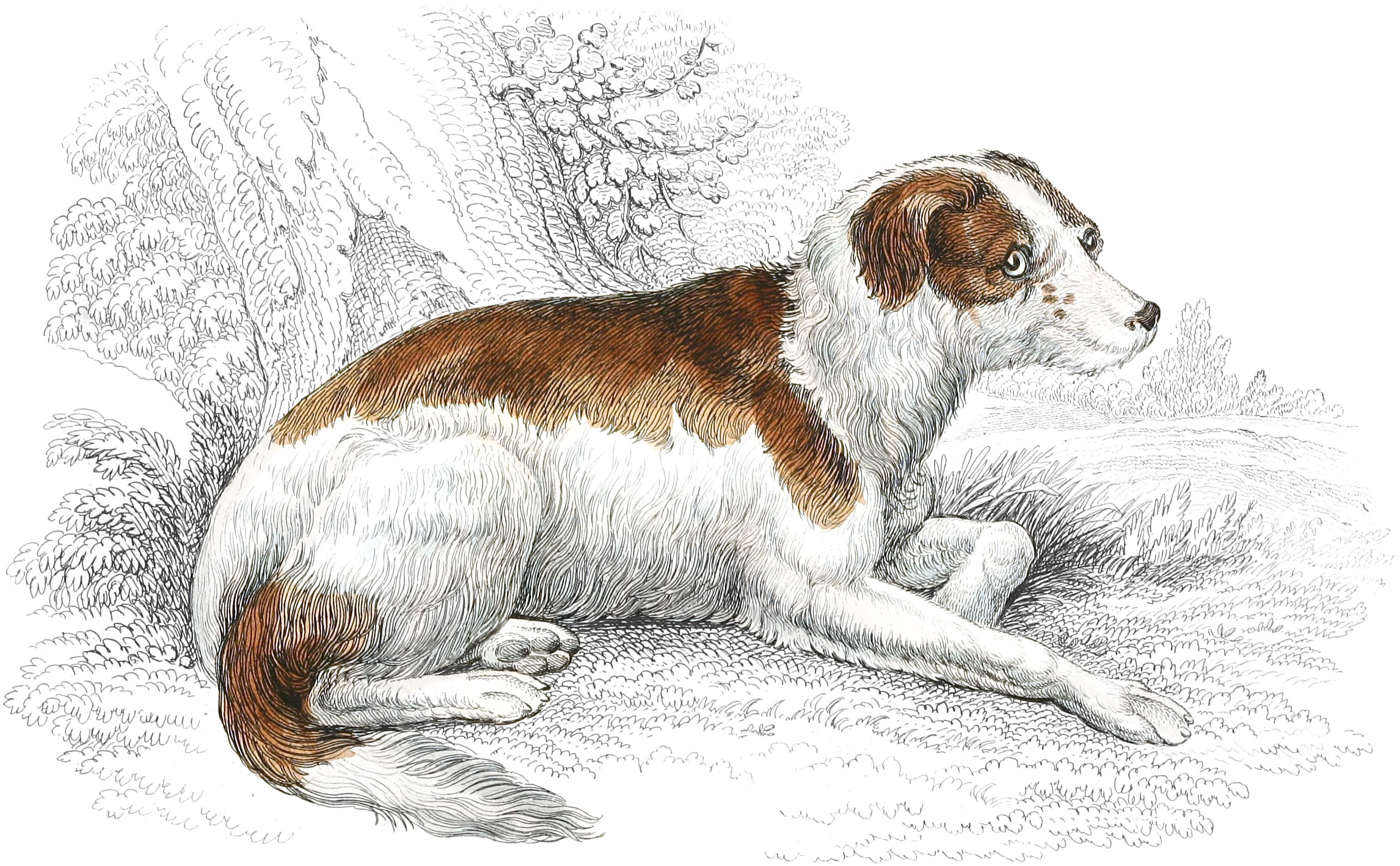
Plate VII
The watch-dogs of Hungary, eastern and southern Germany, partake of the above characters, but are of smaller size; the ears small, turned downwards, and villous. They were formerly used in boar-hunting, and are figured by Redinger under the name of Sau-ruden. Canis sullus of Gmellin.
The Danish Dog
Canis glaucus, Nob.
In western Russia, Denmark, and northern Germany, this variety of the great cur race is found it differs from the foregoing in being smoother, the forehead round, the ears short, partially drooping, and the colour, in general, a light slaty-blue, with some white about the mouth, breast, and limbs. It is a tall and very handsome dog, but, for want of attention, is very often partially disfigured by crossings of more degraded races; yet, when we refer to the feral dog of St. Domingo, so nearly allied to the Dane in form, stature, and colour, and reflect, that originally it was imported by Spaniards from Europe, we may be justified in assuming, that the same race existed in Spain, and was first carried thither by the conquering Goths, or Suevi. In Sweden, the Danish dog was formerly used in couples to support a smaller breed of hounds, called Elk-finders, in the chace of that powerful animal, to retard it until the horsemen came up, or to drive it in the direction where the rifle-shots were posted. There is a good figure of this variety in Buffon’s quarto edition.
The Matin Dog
Canis laniarius, Linn.
This race of the family was most likely imported in France by the Cymbers, or later, by the Franks. It is a large species, equalling the former in stature, but the forehead is flatter, the nose more prolonged and pointed, the hair rugged, and the colour usually white, with one or more large clouds of brown; the ears, also, are more triangular, and the tips bent down; showing, upon the whole, a certain intermixture of the older Gallic dog. It is fierce, but not remarkable for daring. From the Matin, Buffon, with more nationality than sound reasoning, would derive a great many subordinate breeds of dogs in his fanciful genealogy of the canine family.
The Drover, or Cattle-dog of Cuba and Terra Firma, in America
we have seen in great numbers, and they perform a service which those of their tribe in Europe are scarcely fit for. We have often witnessed, when vessels with live stock arrive in our West India colonies, and the oxen are hoisted out by a sling passed round the base of their horns, the great assistance they afford to bring them to land. For, when the ox first suspended by the head is lowered, and allowed to fall into the water, men generally swim and guide it by the horns; but, at other times, this service is performed by one or two dogs, who, catching the bewildered animal by the ears, one on each side, force it to swim in the direction of the landing place, and instantly release their hold when they feel it touches the ground; for then the beast naturally walks up to the shore. These dogs have the form of the Dane, and the colours of a wolf, with a long truncated tail, and generally a black spot over each eye, covering their small half pendulous ears; their eyes are small, very bright, and the hair is rugged. There are some equal to mastiffs in bulk and bone; but it is likely that they are a cross with the Cuba breed of that race. We regard this breed as the continuous domesticated animal, of which the feral of St. Domingo is the wild representative, and both as imported from Spain.
The old British slow-hound, and the primitive lurcher, we suspect once belonged to the present group, being gradually commuted into their subsequent forms by repeated crossings with true hounds and greyhounds; the first into the Manchester and southern hound, and the second, so remarkable for sagacity and attachment, deriving these qualities from the cur stock, whose head, hair, and uncouth form, it still preserves; but we do not now any more employ it under the old English appellation of Teaser, which appears to be the legitimate modern term for Oppian’s Agasseus. Although the Celtic Agas denotes simply a dog, it may be observed, that the modern French verb agacer (to tease, to provoke), is neither of Latin or Prankish origin, and therefore, most likely, is derived from an original Gallic root. The meaning of the verb is perfectly applicable to this ancient lurcher, and to the large terriers still used in the German hunting packs, for the purpose of rousing or provoking the wild boar from his lair, and make him break cover. Redinger figured this ancient dog under the name of Saufinder (sow-searcher); and our diminutive modern terrier, particularly the Scottish rough-haired breed, is therefore the race we look upon as the most ancient dog of Britain, though the opinion which would make it indigenous is very questionable. These lurcher-terriers, or agassei, were originally all, more or less, buff, or sandy coloured, with rugged and coarse hair, pointed ears, hairy tail, short-legged, but of very high courage, grappling with any animal, bull, bear, wolf, or badger, and displaying extraordinary dexterity in the destruction of vermin; qualities which they still retain in the utmost perfection.
The Techichi of Mexico, or the Carrier-Dog of the Indians
We have seen only one individual of this race, by the Indians called Techichi. It was a long-backed heavy looking animal, with a terrier’s mouth, tail, and colours; but the hair was scantier and smoother, and the ears were cropped. It is likely that the specimen seen by us at Rio de San Juan was of the same race as the Techichi described by Fernandez. To this race belongs the Carrier Indian Dog observed by Dr. Richardson, and described by him, in a letter we had the pleasure of receiving, as having a long body, with legs comparatively short, but not bent, and short (not woolly) hair.
Plate IV
Alco (Left), Carrier Dog of the Indians (Right)
The Black Wolf-dog of the Florida Indians
by Mr. Bartram, described as in nothing different from the local wolves, excepting that he could bark, belongs clearly to this group; and the anecdote of one which was, by his wild master, trained to guard a troop of horses without any human superintendance, is a proof that it is highly intelligent and docile.31
In a letter from his Serene Highness Prince Maximilian of Wied, which we had the honour to receive, the two great races of dogs in North America, seen by him, are thus adverted to:—
One proceeding from the European, the other national, and entirely like wolves, excepting that the tail is more curved, and partially, also distinguishable by the colour; for, while some are absolutely grey like wolves, others are white, black, and black and white spotted; but they howl, which proves that they are a bastard race between the dog of Europe and the wolf.
These remarks of his highness show, that he did not fall in with the Caygotte; for, if that species had been seen by him, we think he would have immediately detected the more probable parent of the North American race of indigenous dogs. Nor is there any reason for rejecting the prairie dog (Lyciscus latrans) as one of those who have contributed to furnish breeds of original American dogs.
Dr. Richardson informs us, that
All the American domestic dogs howl like wolves; but I believe they may learn to bark, if placed with European dogs.
And, in another place,
The Indian domestic dogs closely resemble wolves; so much so, that it is difficult to distinguish them when seen at a short distance. They breed freely with a wild she-wolf; but when not in heat, both male and female wolves devour the dogs, as they would any other kind of prey.
Since the foregoing article was written, we have been enabled to examine a remarkably fine specimen of the Black "Wolf-dog of North America, sent home a present from Canada to the Earl of Durham. The individual was most likely not quite full grown, but stood rather higher at the shoulder than a Newfoundland-dog, and was shorter in the body; in aspect exceedingly like a wolf, but that the eyes were comparatively nearer the muzzle, the nose rather sharp; the forehead broad, somewhat arched the ears erect, pointed, open; the tail full, like that of a wolf, hanging down, not curled, but not much lower than the heel, no white hairs at the tip, the whole animal being glossy black, excepting a small spot on the breast and tips of the fore-toes, white the length of the hair like that of a Newfoundland dog, but somewhat finer. The dog was not vicious, and extremely active. We did not hear him, but understood the voice was more like howling than barking. It is evidently intermediate between the original Newfoundland dog and the wolf.
Dog of the North American Indians
We have before alluded to this dog in the remarks upon Lyciscus cagottis, because the race is considered by them to be indigenous, and, in appearance, it certainly assimilates with the Caygotte. The specimen, of which we give a figure, was said to be of unmixed blood; and this is in some measure confirmed by his former owner’s character, the celebrated Tecumseh, who was inwardly hostile to the white man. His dog was smaller than the Caygotte, and about equal in size to a spaniel; but what struck us as remarkable in his head, was the front view, which formed an equilateral triangle, measured from the nose to the tips of both ears, and thence from tip to tip. The animal was not sullen, and seldom uttered a howl; but his aspect was savage, and the colours of his fur were those of a common wolf.
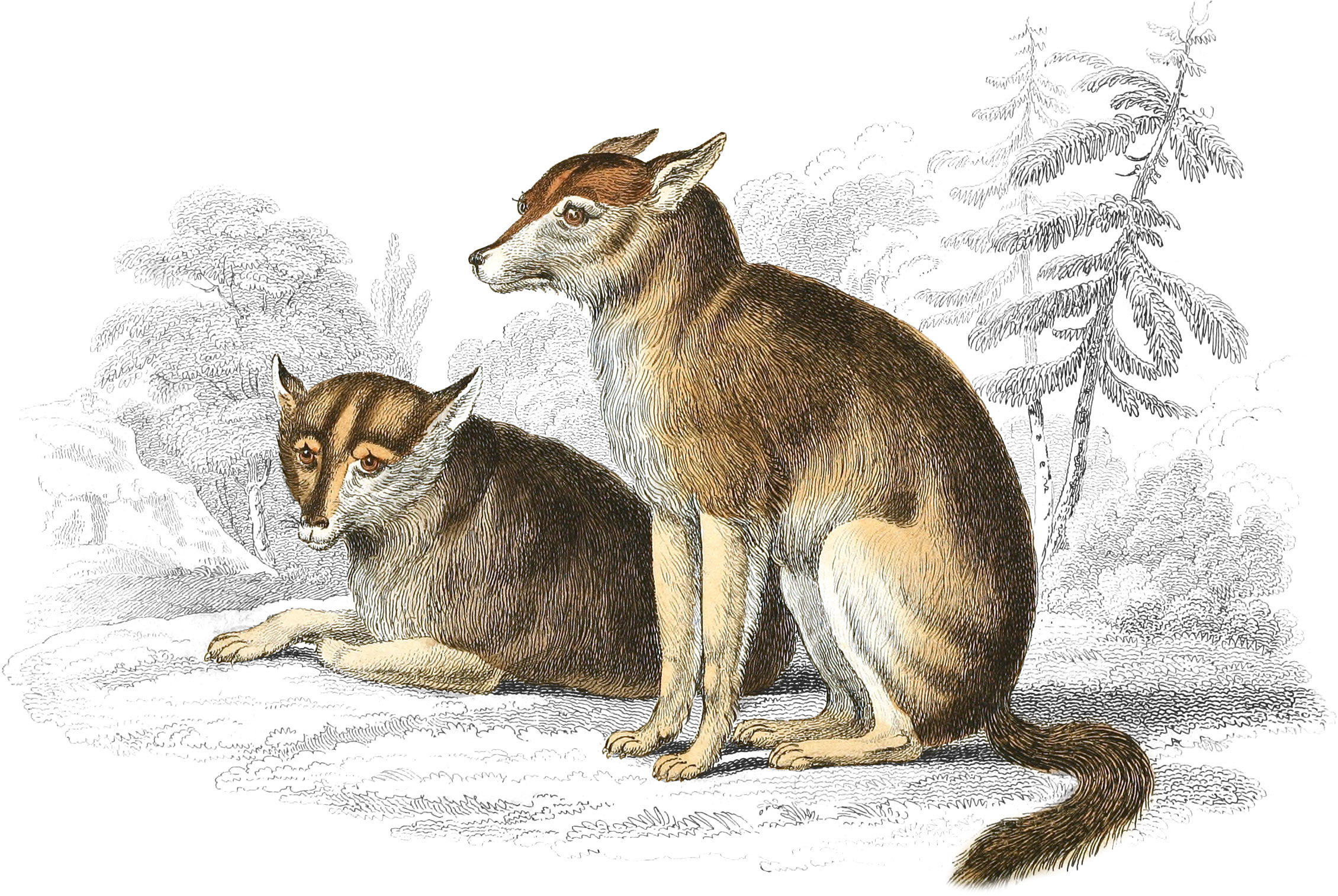
Plate VIII
We come now to the third group of the family of real dogs; it is one so early intermixed with the former, that the transition from one to the other cannot be fixed with precision. It is that of
The Greyhounds32
Canes venatici, Grayii.

Greyhound skull from side and top
A race, of which there exist representations above three thousand years old; one that, with little intermixture, forms the aggregate of the semi-wild unowned street-dogs of Egypt and South-western Asia, bears a stamp of originality we cannot justly assume to be the offspring of crosses, or of a migration to a climate which produced its present very distinct form of body, and still greater singularity of head;33 for, in the greyhound, the plane of the nose is greatly prolonged, and, with little elevation, passes up the forehead nearly to the occiput; the whole head is narrow and sharp; the ears light, and semi-pendulous; the neck long; the lumbar parts of the back very considerably arched; the abdomen drawn up, and the chest deep; the limbs are slender, and greatly lengthened; the buttocks much elevated: the whole structure evincing the greatest elegance, and giving to the animal more swiftness than to any other carnivorous beast. Destined by nature to be a hunter on open plains, the eyes are prominent and clear; but the olfactory powers not being wanted, where so much velocity is granted, they give way for the purpose of allowing greater and prolonged freedom to the respiratory organs and English greyhounds have been known to run eight miles in twelve minutes of time, in pursuit of a hare that then dropped dead, and not including a variety of turns and doublings, which necessarily checked the velocity and increased the exertion!
But the greyhounds of antiquity, excepting among the Egyptians and Asiatics, were probably not of such pure breeds as the modem. When Greece and the West was still much overgrown with woods, or the country was mountainous, pure dogs could not depend upon their keeping the game in view, nor could the hunters follow the sport. The beasts of the chase were powerfully armed. And all these considerations, no doubt, caused those numerous recommendations among the writers of Cynegetica to form crosses with other breeds, in order to produce mixed qualities, better adapted to the existing circumstances of the times and localities.
Looking for the original residence of this race, and finding that in Egypt it existed in its present form at the dawn of history, not only as a coursing dog, but also that it formed already, and probably had long before, constituted a relinquished semi-feral race, living unowned, and totally upon its own industry, it might be assumed, that Egypt is the country whence this dog was first carried to other regions. But, when we regard its structure and qualifications, we cannot deny that it is formed for speed; and this character, and the use of the sight, instead of the organs of smell, necessitate that it was intended for open plains. Other inherent qualities in greyhounds, which the pretended wonder-working causes of food and climate have not removed, or scarcely impaired, are the natural sociability of the animal with man, without equal disposition to individual attachment, a somewhat distrustful temper, which, under certain circumstances, is likely to turn into ferocity, not exempting its owner from personal danger; and, of all domestic dogs, we may add, it is the least liable to real hydrophobia. All these circumstances taken together, seem to fix the origin of the greyhound somewhere to the westward of the great Asiatic mountain chains where the easternmost Bactrian and Persian plains commence, and where the steppes of the Scythic nations spread towards the north. When we look to the present proofs of this conclusion, and assume, that where the largest and most energetic breeds of the race exist, there we may look for their original habitation; we then find, to the east of the Indus, the very large greyhounds of the Deccan, to the west of it, the powerful Persian breed, and, to the north of the Caspian, the great rough greyhound of Tahtary and Russia; and thence, we may infer, that they were carried by the migrating colonies westward, across the Hellespont, and, by earlier Celtic and later Teutonic tribes, along the levels of northern Germany as far as Britain. The primaeval movement of the first inhabitants of the Lower Nile may be conjectured similarly to have brought this race along with them; and all may have done so, when it was already in part domesticated. But, from the inherent qualities we have before noticed, it is not impossible that an aboriginal independent species, with the above form and instinct, followed the moving nations in troops from a voluntary impulse, hung around their camps, as it did during the march of Israel towards Palestine, and was only rarely and partially domesticated among the southern nations, whose religious tenets in general still repel all contact with dogs; while, in the northern regions, where no such restraints existed, the people were naturally hunters, and the climate and habits would not suffer the presence of communities of this race, the whole was absorbed into domestication, and, with a part of it, crossed with their watch-dogs, formed into particular breeds and races, among which the Glauci Molossi (we take to be our present ashy Danish dog) were then, as now, the most easily distinguished.34
Slaty and blue ash-coloured greyhounds form a fine breed of the Persian long-haired race; and these colours were common in the Egyptian smooth-haired, as is attested by the earliest paintings, and in the Mosaics of Italica. They prevail in the purest breeds of the West, where the effects of Albinism, or the opposite, black, have not been studiously kept up. The last mentioned colour is, however, in general, only, an excess of the slaty and it must have existed in Egypt in abundance, since so many small effigies of blackish greyhounds have been found in the catacombs. Yet we are inclined to believe these are aberrant tints, and that the typical was tan-buff or sandy, for this was the colour of the solar dog of Egypt, of the best race in ancient Greece, of the English, and of the great Irish greyhound, as well as the prevailing livery of the Indian, German, and other dogs of later ages, where it is usually mixed with more or less of white.
Greyhounds appear to have changed the nature of their hair, according to the climates they originally inhabited, or two anciently distinct races exist; one with long, the other with a close and smooth fur. The Russian and Tahtar have long and shaggy hair; it is rough in Syria, Germany, and Hungary; silky in the Deccan, Persia, Natolia, and Greece; and smooth in southern India, Arabia, Egypt, the Greek islands, and southern and western Europe. In Roumelia, the Turks have a breed with smooth hair, but with long-haired ears like those of a spaniel. In the West, however, the smooth coat is the result of importation; for the native races were rugged, until the French kings, down to Louis XV., began to introduce the more graceful breeds from Constantinople, Crete, and even from Alexandria.
The old greyhound of the West, like that of the East Indies, appears not to have been of pure breed, but crossed with some other species endowed with scent; and, consequently, we find that it did not depend at ail times upon the powers of vision. The old Irish grey was similarly constituted; and we are thence inclined to believe the gaze-hound35 was in reality the present smooth race, distinguished at first from the more common by the faculty of hunting by the sight alone, and that the name of greyhound was gradually transferred to it when the old breed began to be neglected, and sunk into the unfashionable lurcher. Yet it was this ancient race, tall, strong, tierce, and rugged, that obtained almost the exclusive patronage of the northern conquerors of Europe, and for ages nearly excluded the hunting-hound from all consideration. Even the Gauls, according to Arrian, coursed with greyhounds, upon nearly the same principles as the moderns; and the Saxons and Franks used them to tear down deer, and, in company with their mastiffs and great cur-dogs, to grapple with the wild bull, the wolf, and the boar. The right to possess hawk and greyhound were proofs of gentility; and there were even religious ceremonies and church services, wherein certain beneficed clergy claimed and practised the privilege of appearing with hawk on fist and hound in leash. Hence arose, also, the custom of placing the effigy of this dog at the feet of monumental figures of knights in armour; and, in the feudal hall, a space behind the left-hand of the chief was often assigned for his dogs to sit, and wait for a portion of food from his hand. In the barbarous laws of the times, a man was of less value than a greyhound, and the killing one, or robbing a hawk’s nest, even after the signing of Magna Charta, was a felony, punishable with equal severity as murder. The presentation of these dogs was often the symbol of a renewed grant of feudal territory or rights, or the payment for royal dues.36
In the noble hunting pictures of Rubens and Snyders, we see them often painted with characters of spirit and life only surpassed by the pencil of Landseer, whose dogs actually seem to think. Coursing with these ancient dogs was still kept up by Queen Elizabeth, who witnessed, anno 1591, from her stand at Cowdray, in Sussex, the seat of Lord Montacute, no less than sixteen deer, all having fair law (that is, the start in advance to a certain distance), torn down and mangled by fierce hounds, for her amusement! But after the religious and civil wars of the succeeding reigns, the breed of smooth hounds became the more fashionable; and, with the improvements in fire-arms, and the extension of cultivation, hunting-hounds and gun-dogs gradually acquired their present share of favour.
We have already remarked, that the rough greyhounds in particular are less personally attached to their masters than other races: ancient chroniclers relate several instances of their abandoning one to follow another, and being liable to take sudden offence. They have been known to attack those who meant to halloo them on after game; this happened, not many years ago, to the Rajah of Bahar, whose dogs turned from a jackal upon him, and he escaped from them only by dashing with his horse into the water.37 They are also liable, if left to their own discretion, to destroy sheep, and show other manis of little docility.
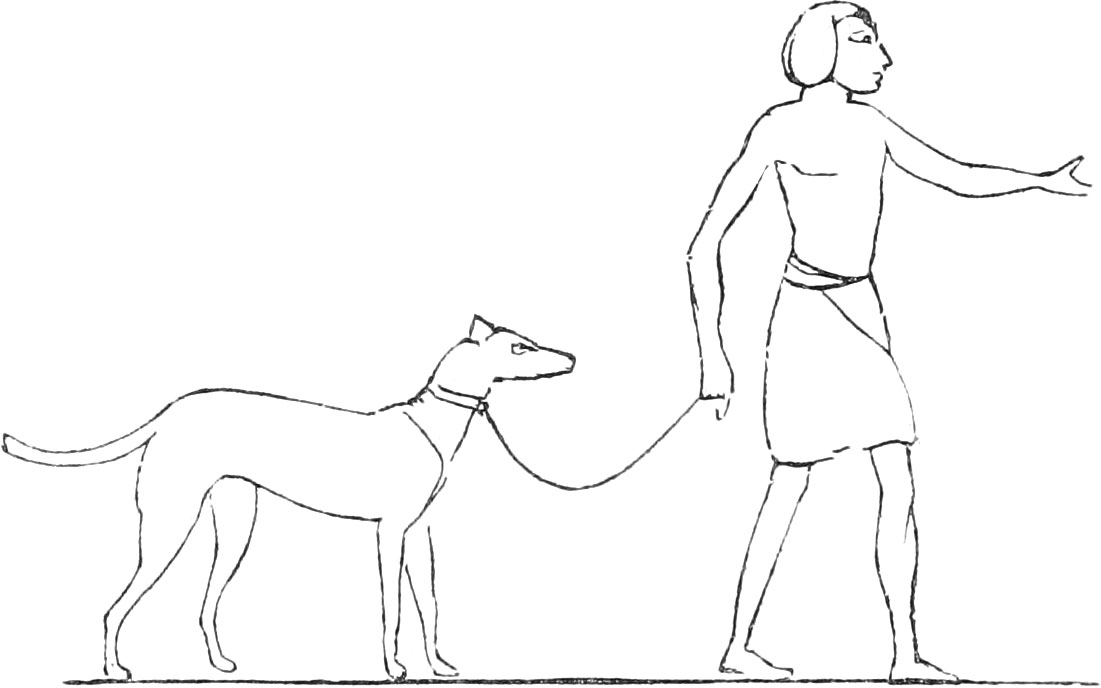
Persian greyhound
Beginning with the rough-haired breeds, we find in the East
The Brinjaree dog
used in the Deccan, is superior in stature and strength to the Persian. This breed, we believe, is the best in India, where their general colour is yellowish or tan; but our sportsmen report the Indian dogs to want velocity.
The Persian breed, with the plane of the nose almost arched, and the lumbar part of the back less curved than our dogs, has the hair silky, the tail very long and hairy. Those we have seen were pale slate-coloured, or white; and in speed, game, and size, at least equal to our best breeds.
Bedouin Greyhound of Akaba
The Arabian, or Bedouin greyhound, is a large and very fierce species, not perfectly pure, but greatly valued, and used by the wandering tribes not only for coursing antelopes, but to watch their tents and cattle. They have more strength of jaw, and are rufous, or white clouded with tan colour. The race about Akaba, figured en Silhouette by Laborde, is, however, smaller, with a long tail, still very hairy, and in the form of a brush; the ears are erect, pointed; and the whole animal very like the ancient Egyptian effigies, and like the Thous anthus, before described. We give a representation.
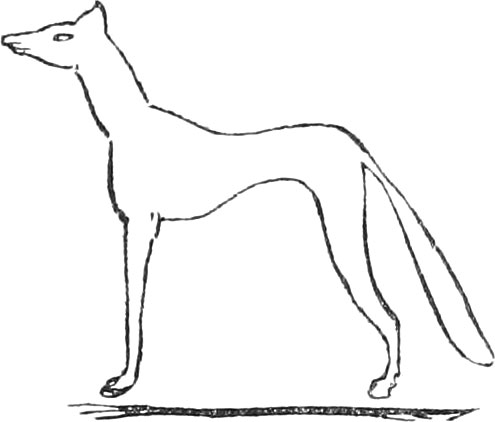
Greyhound of various Egyptian Monuments

Plate IX
The Russian and Tahtar Breeds
Canis hirsutus
Are rough, very large, and staunch; usually white, with black clouds, and long hairy tails. Buffon figured both the male and female of this race.
The Scottish Greyhound
Canis Scoticus
Is of the same race as the Russian, and similarly coloured; but, from greater attention, or the cross of a stag-hound at some period, it is endowed with higher faculties of intellect, and formerly had so good a nose, that we believe this variety was mostly used as a blood-hound. Sir Walter Scott’s celebrated dog Maida was of this breed.
There appeared in the Kilmarnock Journal, 1836, an article copied in the Caledonian Mercury, wherein, under the head Coursing, and a notice of a portrait of Gilbertfield, introductory to the pedigree of that dog, there is a lively picture of the attention bestowed upon greyhounds in the northern parts of the kingdom:—
The reiterated success of this old dog (Gilbertfield) may well excite a smile at those who would talk or write him down as a third-rate, or stigmatise him as a lurcher! If he be a third-rate, the march of intellect among the knights of the long-tails must verily be retrograde; and if he be indeed a lurcher, it becomes necessary to know by what name are to be called the ninety unsuccessful competitors for the Glasgow Gold Cup. Perhaps, after all, it will turn out that these seeming detractions are but a cunning device of the friends of Gilbertfield, intended to impress the public with the idea, that the achievement of a reputation greater than that of any other dog in the United Kingdom is but the smaller part of his victory, and that the greater part is the accomplishment of an absolute change in language, so that henceforth the word lurcher is to designate superiority, instead of, as heretofore, inferiority of blood; and the word third-rate to apply to the ascending scale in degrees of comparison, or, in other words, to denote the superlative degree of excellence. But be this as it may, we are happy in being enabled to be the first to publish the pedigree of Gilbertfield, supplied us at our request by his owner. We give only three generations, both because these carry us to the common ancestors of his sire and dam, and because the ancestors of Blucher and Tickler never ran in public. Gilbertfield (brindled and rough) was pupped in June, 1831, and is,—1st, by Giraffe (brindled and smooth) out of Venus (yellow and rough); 2d, Giraffe was by Capilly (brindled and smooth, brother to Oscar) out of Puzzle (brown and smooth, sister to Mr. Crum’s well-known Charles James Fox)—Venus, by Mr. Hamilton of Greenbank’s Alfred, (white and red and smooth, sire of Captain, May, Serpent, Pomni, Lady Mary, &c.) out of Marion (brindled and rough, sister to Capilly, Oscar, Orlando Furioso, and Burr); 3d, Capilly and Marion were by Blucher (black and smooth), out of Sir William Maxwell of Calderwood’s Tickler (white and rough). This pedigree runs counter to many of the pet theories of breeding, which would seem to be the mere “idols of the kennel,” as Lord Bacon would have styled them, rather than the conclusions of reason or the result of experiments. Bred from first cousins, and sprung from three successive crosses betwixt the smooth and the rough, Gilbertfield himself rough, is a great public winner, notwithstanding it is said that breeding-in destroys spirit, and that every cross after the first, betwixt the smooth and rough, more and more banishes the good qualities of the greyhound. Opinion, or rather caprice, even among those friendly to one cross with the rough, is diverse as to which parent should be rough. It so happens in this pedigree that the dams were the rough. But this cannot be held to establish much, when it is remembered that Gilbertfield’s own progeny out of a smooth bitch (Black-Eyed Susan) have distinguished themselves more than any other puppies of this season, part of which are thoroughly smooth, and part thoroughly rough. The running of him and his lurcher race equally confute two opposite sayings; the one, that rough dogs are not fast, but last long—the other, that they can get out of the slips, but want bottom. 1st, Lord Eglinton’s Major is the only dog he meets which makes Gilbertfield look not singularly fast up to his hare. 2d, The race with Dusty Miller, on the last day of the Gold Cup running, put an end to all scepticism as to Gilbertfield’s bottom. The performances of his ancestors, Oscar, Capilly, and Charles James Fox, in the Lanarkshire and Renfrewshire Club, and of Orlando Furioso, Burr, and Giraffe in East Lothian—his own success, during four seasons, in every club to which he belongs, viz. the Ardrossan, Biggar, Clydesdale, Dirleton, and the Lanarkshire and Renfrewshire (being rough he is excluded from running at Winchburgh), and his triumph at Eaglesham—and the commenced career of his offspring, viz. The Ocean, Goth, Vandal, Capilly, Harp, Guitar, and Lilly (one litter), supply the best of all evidence that Gilbertfield not only inherits, but can transmit winning blood—the great aim, it is to be presumed, of every sagacious breeder of greyhounds.
The Irish Greyhound
C. Hibernicus
This antique race was originally, we may presume, the same as the Scottish; and, according to some opinions, was not found in Ireland in its greatest development until the Danes began to infest its coasts. It may, however, be observed, that no such race is recorded to have existed anciently in Scandinavia or Denmark, and that its earliest colour was buff or pale ochry, in that respect also approximating the breeds of the East; and, finally, that the mystical bitch in Druidical lore appears to refer to this species both in Britain and Ireland: though, we must admit, that in Mythical composition, a generical name would be easily transferred to a particular species of later date, if it were more noble and grand in its appearance. It may be that the ancient race, similar to the Scottish, was crossed with the great Danish dog by the Northmen, and, under favourable circumstances, increased to the great stature since so much admired.
Of the specimens we have seen, and the figures published, no two appear now exactly alike in structure or colour, so that mastiff, stag-hound, and blood-hound may likewise have been crossed with the ancient species; and from this circumstance, no doubt, arises the difference in qualities ascribed to them. Still this dog is the largest in Western Europe; and the extirpation of wolves in Ireland may, in part at least, be justly due to its exertions. The bitch kept by Buffon killed the male wolf she was bred up with, which proves that one was more than a match for that fierce animal. Lord Altamont is said to have kept the last dogs of this race, and it was one of his that Mr. Lambert described in the Linnæan Transactions. But we have heard that Lord O’Neil likewise had some; and, still later, that Mr. Hamilton Rowan used often to appear in Dublin with a couple of these majestic dogs.
The Grecian Greyhound
Canis Grains of Authors
Who have taken it to be typical of the group, is still extant nearly in the exact form described by Oppian and older classic writers. It is somewhat remarkable that modern travellers should have confounded this dog with the Molossian; for the one belongs to the Persian race, being covered with a rather short but silky fur, and having a long slender tail well feathered, with long and soft hair, capable of making the kind of shade which was so much admired by the ancients; whilst the other is already noticed as of the Laniarian group. Those we have seen were slate-coloured and white, but had not the peculiar blue eyes noticed by the ancients. They are still used in deer-hunting.
Among the smooth-haired, we shall take the next in gradation from the villous.
Turkish Greyhound
It is the Turkish Greyhound, with a very pointed nose and long hairy ears, but smooth coat, ashy-grey, white, or brindled in colour. It is among this and the last mentioned breed that the stop greyhound is found so trained, that when a whole pack of them are in pursuit of a doubling hare, a stick thrown before them instantly produces a general halt; and one only is then singled out to pursue the game.
The Egyptian Greyhound
The Egyptian Greyhound may be the same as the Bedouin, but is smoother, and now rarely met with in that country, but more usually to the westward, in the Barbary states; it is in form like the Italian, but equals the European in size, has a delicate skin, very small ears, somewhat more upright than usual, and in colour white-black, or spotted of both colours.
The Italian Greyhound
Canis Italicus, Gm.,
Is a well known variety of inferior size, and so delicate as to bear our climate with difficulty. Although it is a breed of great beauty, little use can be made of its speed, and the ladies almost solely patronize this animal; it is said that om- finest breeds have been improved by a cross from it.
The British Greyhound
Canis leporarius
The dogs of the best breeds now common in the west of Europe are all of the same race; but, in point of sporting qualities and beauty, none are equal to the British. The smooth-haired greyhound was first imported from France, and subsequently improved by well selected individuals from the Greek Islands, from Italy and Barbary, and even from India, but, above all, by the unremitting attention of wealthy and intelligent sportsmen. We shall not dwell further upon a breed so well known, and at present unrivalled in an open country for speed, beauty, and spirit, united with docility.

Plate X

With the greyhounds, we place also two races that are more or less of mixed breeds. The first is
The Lurcher
Canis vertigus38
This dog in its most ancient form was a greyhound, with powers of scent, and perhaps the true greyhound of the long-haired variety, and to that race we refer the ancient name of Vertagus; for to what other can Martial’s lines he ascribed,
Non sibi, sed domino venatur Vertagus acer
Illsesum leporem qui tibi, dente refert. Martial.
Surely no Turnspit can be intended by this portrait, but a fleet dog well trained, and sagacious, though neglected. In proportion as the more elegant race of the smooth-haired breeds became the fashion, the use of its varied powers was misapplied to the destruction of game in unlawful practices, so that he became proscribed, and we now possess only an occasional mongrel reared for the purposes of poaching in the night, and executing his felon master’s instructions with a silence, skill, and effect worthy of admiration, and of a more admissible service. The dogs of this class are now a gaunt and ill-looking race, bearing the external appearance of the greyhound disfigured by the intermixture of cur, sheep-dog, or other blood, but still usually with the livery of his origin, being mostly of a yellow and white colour. The Lurcher now makes occasionally great havoc among sheep and deer, and acquires the wild scent of game. Sometimes these dogs become feral, when their owners happen to be captured and imprisoned. They have been regularly hunted with hounds, but seldom destroyed, because when the chase came up with them, the pack seemed to be surprised at only finding that it was a dog it had followed. At other times, however, when a lurcher had snapped up, or attacked the game the pack was hunting, the dogs on coming up have torn him to pieces as if he had been a wild beast.
The Egyptian Street-dog
probably the Keleb of antiquity, properly so called. It may be assumed, that the Pariahs of Egyptian towns are among the most ancient breeds; and though now degraded in many respects by mange, famine, and intermixture perhaps with the jackal, there are still numbers retaining marks of antique purity of blood, evidently referrible to the Akaba greyhound of the present time. They are not all even at this moment totally deprived of hair, many being sandy or buff-coloured and they possess, in a singular degree, a self-taught system of avoiding contact with the Moslem, and of order and watching, that deserves attention; for in all the towns, where they occupy in numbers the ruins of decayed buildings and gardens, certain districts or streets appear by common consent to belong exclusively to one portion, while others are similarly allotted to others; and none dare transgress the limits they possess, even when tempted by the most alluring baits. Each in its own district is likewise a general guardian of the property of all its inhabitants; and where, from religious motives or feelings of humanity, kind-hearted Moslems are in the habit of giving out a daily portion of food, or setting water for them, those of the district alone come to partake of it, and then quietly withdraw.
In the breeds we now call the Naked Turkish, or Egyptian Dog, there are two races nearly equally destitute of hair; the first, evidently of the greyhound stock, is well known, having usually a dull purplish and unctuous skin, being in general deficient in the incisor and canine teeth, and often with several of the molars wanting; the other, of smaller stature, a more globular cranium, and very large erect triangular ears, with a fringe of hair upon the edges, and only six mammas, seems derived from a species of Megalotis. This race is more compact than the other; it has a few straggling hairs about the body, and a ridge of the same often runs down the occiput to beyond the shoulders. The absence of hair may be in part caused by chronical mange, but it certainly is also a result of exposure to an intense sun in a very dry atmosphere for we find in a similar state the small Hyæna of the Desert, which retains only a broad and bristly band of hair from the head to the tail. The Lychaon pictus, in old age, becomes likewise naked; and even the lion of Arabia is deficient in mane. The same effect is produced upon a race of Pariahs of India, known by the name of Polygar dog; and the naked dog of Mexico, of the indigenous Gosque race, not carried to the West by the Spaniards, is similarly destitute of hair, no doubt from the same causes.39 This last race is almost without voice, or utters only a feeble howling. It is but partially intermixed with the hairy dogs, is nearly useless, and, nevertheless, much caressed by the Indian natives. It may be this was the God-dog of the Xausa and Huanca Indians; for, even in America, the dog was a type of divinity! We have often seen puppies suckled by human beings.
The next group we have to take into consideration, is that which contains
The Hounds
Canes sagaces
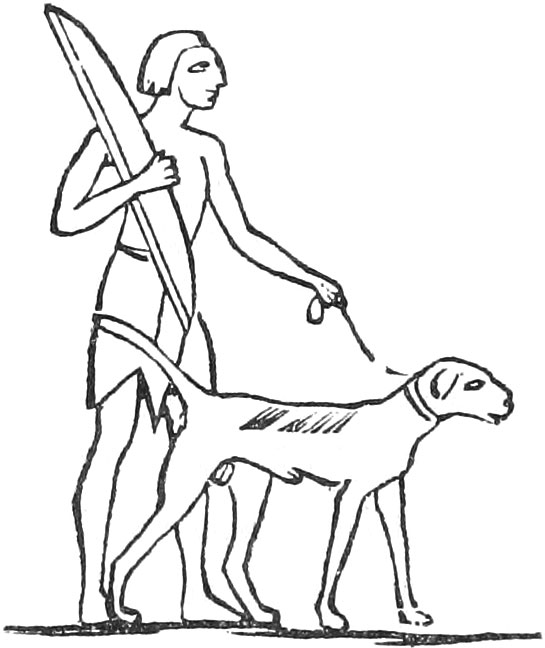
Hound
We have, in the description of domestic dogs, adverted to the original residence of this group in the East, and to its introduction among us at a period subsequent to the arrival of the more wolf-like varieties. When we shall know more of the Lyciscus tigris, before noticed, and of the Wah, or Buansu, we may perhaps find that one, or the mixture of both species, are the progenitors of the Hound races, and that it is thence they derive the general tendency to be marked with three colours which we have seen were noticed in Ceylon and Britain at a very early period. Farther east, there were of late years hounds not derived from the European breed; such, for example, as the dogs of the Koordah Rajah, of larger dimensions than ours, and with so fine a nose, that they could trace deer several hours after they had passed, which, in a hot country, evinces an acuteness of scent not to be expected from the European.
The Oriental Hound
We figure a hound from a drawing made in Persia, one of several belonging to a Coordish Chief, differing from the English fox-hound chiefly in the greater height of the legs and shorter body. The colours refer it to the breed of St. Louis, from Palestine.
In the present group, although the anatomical forms remain in general the same, there is perceived in the crania a superior development of the cerebral inclosure, a rounder forehead, and higher central ridge to secure the temporal muscles, enlarged interorbital space to admit the organs of smell, and a greater breadth of the jaws. In the several species there is found a broader nose, more full and prominent eyes, large pendulous ears, a raised and truncated tail, and often a Spurious toe on the hind feet; in general, a structure combining considerable elegance with strength and speed. In this tribe there are, as in the former, likewise two races distinguished by a long and by a short fur; the former, in general, being used as gun and water-dogs; the latter, less domesticated, as hunting dogs.
The Greeks may be considered as the first institutors of artificial breeds, and the contrivers of most of the ancient subordinate combinations which have since so greatly influenced the high bred races of the West. Twenty-four centuries of efforts have not, however, effected more than evolving from races most nearly allied, generations more specifically adapted to given intentions. All the fundamental qualities of dogs resided, ah origine, in the species, and by far the greater part of educational susceptibilities were then already fully established. Although hounds were known in the East, and in Egypt, we have no proof that they (the Greeks) were acquainted with dogs of the present group anterior to the conquests of Alexander, nor that they became common before Greece was under the dominion of the Romans. The Hellenic sportsmen, and naturalists of this late period, are the writers who then first began to give an intelligible account of them. Demetrius Constantinopolitanus, in his book on the care of dogs, writing after Oppian, shows, that the hounds in his time were not yet entirely with drooping ears, but, as before observed, they were of a brindled and spotted origin, for he calls them
Leopard-dogs like wolves, with long soft ears, so that they hang down; but if the ears are erect and large, they are not to be rejected.40

Plate XI
It is now probably impossible to fix upon the oldest form of the hound, but if we commence by the Elymean, and take the figure of a leash-hound in the Egyptian pictures for a type, and the blood-hound, which is of most ancient estimation in the West, the dog who, in sagacity, power, and olfactory acuteness, stood for ages preeminent over the whole, we find them sufficiently similar to each other, while the more delicate perceptions of several gun-dogs, although we think them superior, are a result of comparatively later care and training.
We may here remark upon the packs of the Continent, such as they were before the French Revolution, that the breeds of England only became fashionable, and introduced there after the Duke of Orleans had visited this country. In France, reddish dogs were still generally used to hunt the wolf to the year 1779, and those of Prince Charles of Lorraine, kept at Laaken, mostly of a rust colour, with black backs; but his establishment was on the ancient footing, consisting, in part, of matches or pairs of similarly coloured dogs and breeds, but each pair somewhat differing in race thus there were mastiffs, rough greyhounds, matin-dogs, and large terriers; several, or all of these, were taken out to hunt the stag, the boar and the wolf, and on some occasions, it was equally difficult and dangerous to keep them from attacking each other.41
The Stag-Hound
Fig. 1
Was a large and stately animal, equal, or little less than the blood-hound, and originally, like that race, slow, sure, cautious, and steady. Markham, who wrote in the time of James I. describes the stag-hound of his time with evident knowledge of the Venerie de Jaques du Fouilloux: these dogs were then rufous spotted, or glaucous, and hunted in close packs under excellent command. The modem hound is perhaps still handsomer, though somewhat smaller, and the breed having been crossed with the fox-hound, is now much faster. They have a large rather short head, with a wide nose, loose, hanging, broad, and long ears, muscular hams, round small feet, and a rush tail carried high.42 They are invariably white, with some black and fulvous about the ears, and on the sides or back, distributed in two or three large spots. As the chase is very fatiguing to man and horse, destructive to cultivation, and of very questionable humanity, it has greatly declined since the death of King George III. who was personally fond of this kind of hunting. We doubt if the packs we formerly knew are still extant; they were the Royal, the Derby, the Englefield chase, the New Forest and the Darlington.
The Blood-Hound
Fig. 2
We have already remarked upon the general history of this race, and therefore proceed to the description of its form and colours. This breed is rare in England, but still there are a few kept, rather for the sake of admiration than use, though anciently, and even now on the Continent, it is employed to follow the scent or the track of a wounded beast of the chase, or to lead the huntsmen to the lair before the toils are set. In Germany there were two breeds, one smaller and lighter (Schweisshund), serving in the first mentioned capacity; and the other (Leitkund) the true blood-hound. Both are figured by Redinger.
Mr. Bell, in his interesting account of British quadrupeds, describes the breed in possession of Mr. T. Bell, of Oxford Street, as standing twenty-eight inches high at the shoulder; the muzzle broad and full; the upper lip large and pendulous; the vertex of the head protuberant; the expression stem, thoughtful, and noble; the breast broad; the limbs strong and muscular; and the original colour a deep tan, with large black clouds. The Cuba breed, and the dog once the property of the Duke of York, we noticed, had tan spots over the eyes, the back was ashy-brown, and lower parts whitish. In France, the Norman limers were considered the best; they were usually grey-brown, but there were some quite black, with a tan-coloured spot over the eyes, and white breasts. This species is silent while following the scent, and thence easily distinguished from other hounds.
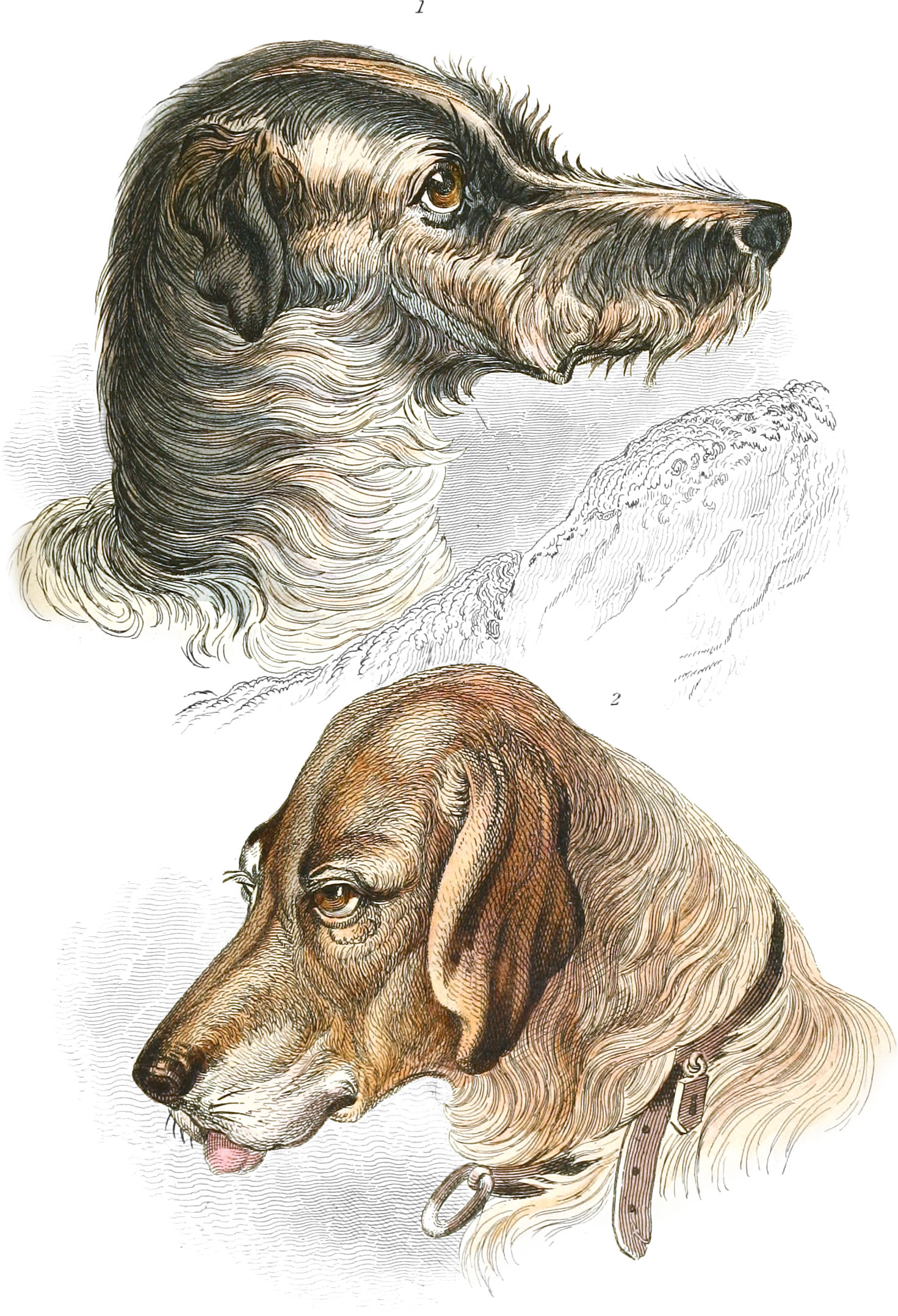
Plate XXXI
The Talbot
The Talbot was a race of hounds with a large head, very broad nose, long pendulous ears, a rough coat of hair on the belly, and entirely of a pure white colour. In ancient illuminations it is represented as not very large, though, from all accounts, it attained considerable stature, and seemingly was kept more for show than for use. There is little doubt but that the white St, Hubert breed of hounds was of the same, or of a nearly allied race. As a sporting-dog it is not much noticed, probably because in that capacity it was viewed as a blood-hound. We believe the Talbot was a cognizance of the ancient house of Shrewsbury; and a head of one forms the crest of several princely families of Germany.
The Old Southern Hound
The Manchester-hound is considered by Mr. Whitaker as an old indigenous breed; but it is probably only a race introduced during the feudal ages, and formed out of the great watch-dog by the blood-hound or the Talbot. It is a large noble-looking dog, greatly resembling the more recent stag-hound, steady and persevering, but slow in pursuit, thence neglected, and now nearly extinct, being replaced by the following more active breeds, all of which, nevertheless, have much of the same aspect, and are nearly all marked with three similarly distributed colours. The old Southern-hound was, or we should rather say is, remarkable for a very fine deep-toned voice, and in this respect is quite distinct from the blood-hound.
The Fox-Hound
Is somewhat lower at the shoulders, more slenderly built, and more crossed with the greyhound; the colour also is white, but commonly marked with larger clouds of black and tan, one on each side the head, covering the ears, the same on each flank, and one at the root of the tail. Their speed and perseverance is remarkable, having been known to run hard ten hours before they came up with and killed the fox, and the sportsmen were either thrown out, or changed horses three times. Stag and fox-hunting, when pushed to a speed and duration so as to cause the death or ruin of the finest horses, are justly reprobated by most writers on field sports, and are now completely out of fashion, though at one time, when George IV, was Prince of Wales, and hunted with a pack of silent hounds, the chase was invariably severe, even to those who rode the best bred horses.

Plate XII
The Harrier-hound
So called from being usually applied to hare-hunting, is still smaller than the last mentioned, not exceeding eighteen inches at the shoulder. It is a more recent, and entirely an artificial breed, we think between the hound and beagle, similarly marked as the fox-hound, but often the dark colours occupying still more surface. This race is by many sportsmen confounded, and the names used synonymously with
The Beagle
From the observations recorded in the general article on domestic dogs, it will be anticipated that we regard the beagle to be the same as the Brachet of the middle ages, and think it the only species of the long-eared dogs known in the west during the Roman Empire, and noticed by Oppian under the name of Agasseus. Both Pennant and Whitaker quote the text, which, nevertheless, is more applicable to the ancient teaser-terrier than the beagle but as there were rough-haired Brachetsin the olden time, and severe hunting is still liable to produce crooked-legged Turnspit offspring, it is possible that this last was meant. The Breac they could not however then be; because, as already observed, that name implied spot, or spotted, a distinction which the beagle-hound retains. A proportion, or what was termed a cry of these dogs, was anciently added to a hunting pack, often on account of their musical voice. They were most common in the north of England, and hence known by the name of northern hounds. There exists on the Continent a coarse-haired buff-coloured hound of a mixed breed, figured by Buffon under the name of chien courant metis, apparently formed out of the French Braque and the crisp-haired water-dog; it is now uncommon, probably neglected because of its want of beauty, though formerly much esteemed in otter-hunting, and in the chase where the country was swampy and intersected by rivers.
Both the rough and smooth races, even three centuries past, were already greatly diversified by different crossings. In Queen Elizabeth’s reign, the fanciers bred a race so small, that a complete cry of them could be carried out to the field in a pair of paniers. That Princess had little singing beagles which could be placed in a man’s glove! At present they are about twelve or fourteen inches at the shoulders, stout and compact in make, with long ears, and either marked with a bright streak or spot of white about the neck, on a dark brown coat, or white, with spots like the harrier, of black and rufous. They are slow, but persevering, and are sufficiently sure of killing their game.
The Dalmatian, or Coach-Dog
From the general structure of the animal, we are of opinion it should be placed with the hounds; but though a very handsome variety, inferior to none of the above in elegance of form and beautiful markings, it is, with some dissent however, said to be without powers of nose or much sagacity, and therefore invariably entrusted to the stables, where it familiarises with horses. Having, in the general description of dogs, noticed the print of a specimen brought from India, with a white fur marked with small black spots, small half dejected ears, and a greyhound-like form, we have there expressed the suspicion that our present coach-dog maybe derived from that individual, or from his breed, and we have accordingly given a representation of it.

Plate XIII
The Parent of the Modern Coach-Dog
Dalmatian dogs they are not, although a Turkish grandee might well have possessed specimens of the dog in that country. We figure it accordingly.
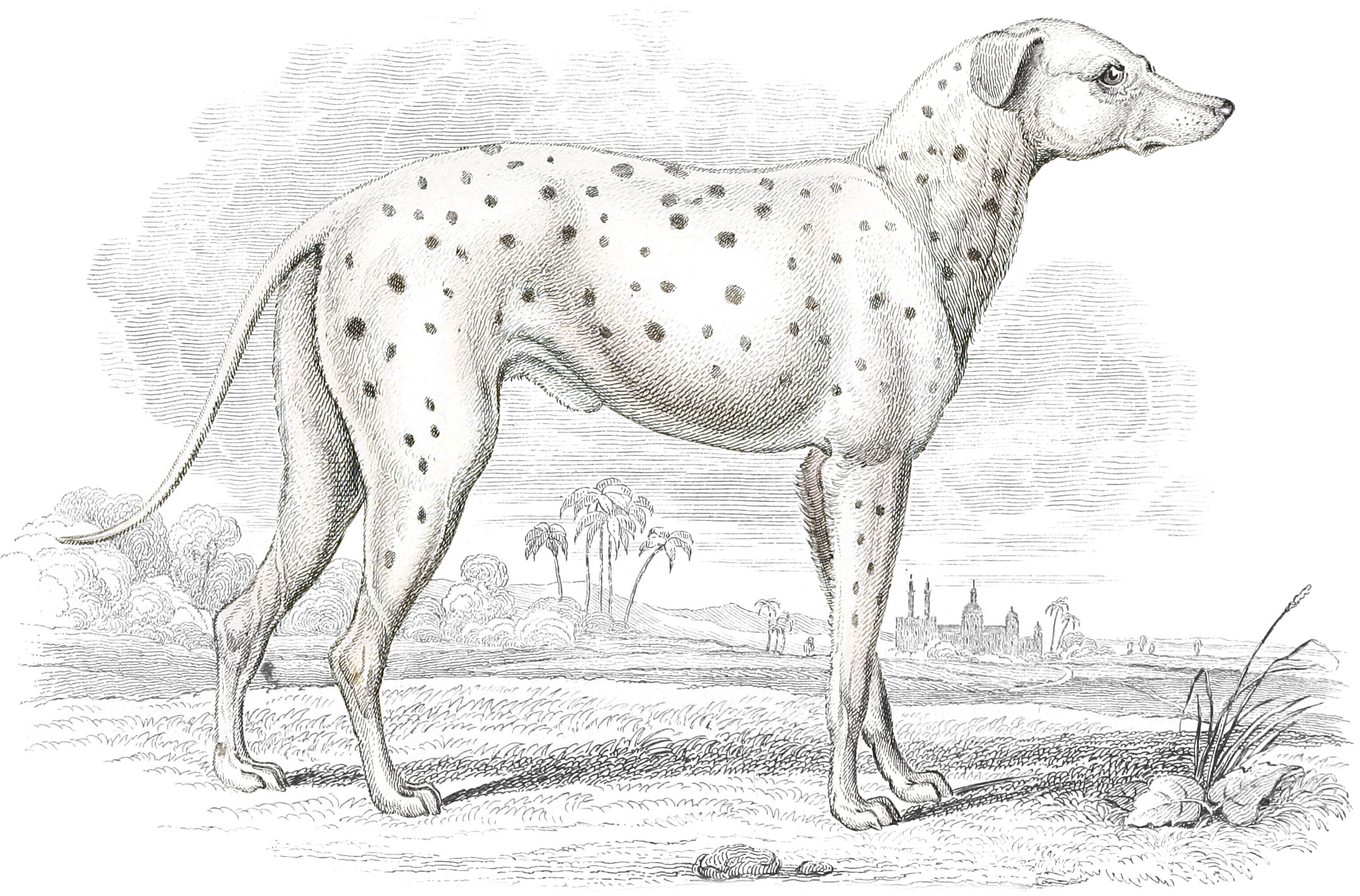
Plate XIV
The Turnspit
The Turnspit, so called from being formerly used to run in a kind of wheel to turn a kitchen spit. There are rough and smooth dogs of this kind, both evidently derived by malformation from hounds or terriers. Buffon figured them under the names of Basset à jambes droites, and Basset à jambes torses; some having the legs straight, and others crooked, while the body is often as heavy as a fox-hound’s. That breed derived from terriers is much more active and bold than the other, and Laving the legs straighter, is capable of more fatigue. The turnspit form is however found among the Pariah dogs of India: the Techichi, we have already noticed, is likewise of a lengthened structure: and in Paraguay, dogs of the European races, with large heads, bodies, and tails, but very short, distorted, and nodose limbs, are very common; some have been measured three feet in length from nose to tail, whose extremities were only four inches long: finally, the Poe dog of the South Sea Islands is equally ill-shaped.
The Burgos is a spaniel turnspit, having a long back, short legs, and a fine long hairy coat. This race is chiefly used in the south of Europe.
The Pointer
Cards aviculuris
In general aspect, character, and colours, belongs to the race of hounds, more nearly than any other of the shooting or gun dogs, and therefore we place him immediately after them. From the word, Spanish being commonly prefixed to the name, there is reason to believe the race came originally from the Peninsula, and this circumstance agrees with what we have said of the oldest race of the St. Hubert hounds; but as the primitive breed must still be presumed to come from the East, we might perhaps infer that Western Europe, including Britain, owes their introduction to the Phœnician traders who brought them to Spain and to this country at so remote a period, that we regard them here as indigenous.43 In their present qualities of standing fixed and pointing to game, we see the result of a long course of severe training; and it is a curious fact, that by a succession of generations having been constantly educated to this purpose, it has become almost innate, and young dogs of the true breed point with scarcely any instruction: this habit is so firm in some, that the late Mr. Gilpin is reported to have painted a brace of pointers while in the act, and that they stood an hour and a quarter without moving!44 But although the quality is admirable, it is nevertheless true that training will accomplish the same habit in common fox-hounds, and even in other animals, as is attested in the case of the Hampshire pig, which was celebrated for this faculty.
It is said that pointer dogs were not known in England before the revolution of 1688; but it may be answered, that as soon as shooting supplanted hawking and coursing, there could be no serious obstacle in forming dogs to that sport. The pointer is quite smooth, commonly marked like the fox-hound, or with more spreading dark colours; there are some of the best breed entirely black. In habit it is rather lazy, does not encounter close cover nor take the "water so readily as the spaniel, but is still a favourite for his powerful nostrils and handsome appearance. The thorough bred dogs of this race in Spain have the septum of the nose vertically divided by a deep groove, and the wings of the nostrils exceedingly dilated and irritable.
The Setter
Canis Index
Is another variety of sporting dogs distinguished for long silky hair, and usually considered as a larger breed of spaniel; therefore likewise originating or brought from the peninsula of Spain. The head of this race shows a remarkable development of the brain, and in character we find a corresponding intelligence, affection, and docility, unequalled by any other kind of dog; and though somewhat timid, bearing fatigue better than the pointer. The least adulterated breeds are still found in Ireland, where high prices are paid for the best individuals. In figure they participate of the pointer and the spaniel. Their more ancient colours were deep chestnut and white, or quite red; in England they are white, or white with black or brown marks, and in both countries larger than the spaniel. Dudley, duke of Northumberland, in 1535, first trained setters to the net. In Mr. Bell’s admirable description of British dogs,45 there are some interesting anecdotes of this faithful race, to which we refer.

The Spaniel
Canis extrarius?
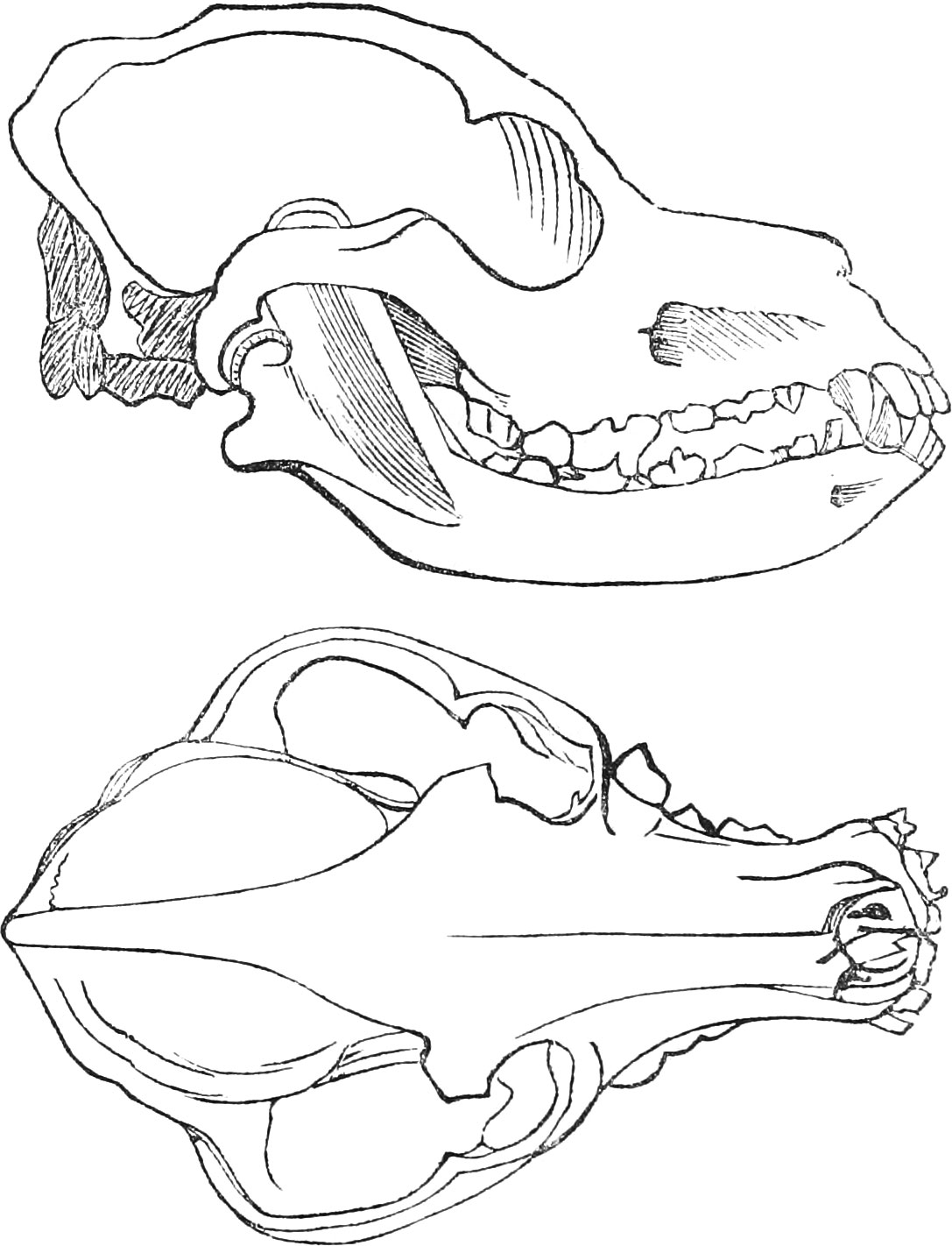
Spaniel skull from side and top
Commonly called Water Spaniel, is of a race that was known to the Romans, for we find it clearly figured on some of the later monuments, and seems to be identical with the Canis Tuscus praised by Nemesianus. No dog possesses greater affection for his master or more expression of countenance than the spaniel: it is ever petitioning for acknowledgments of regard, and boundless in its joy at the slightest manifestation of kindness. The animal is in form a small setter, with silky hair, and fine long villous ears. They are black, brown, pied, liver-coloured and white, and black and white. There are likewise several varieties of the spaniel; one, the water-spaniel, differs chiefly from the land species in his readiness to hunt and swim in the water, and the hair being somewhat harder to the touch. This breed is the principal instrument used in decoy ponds, to drive ducks into the net.
While revising the letter-press of this article (4th April, 1840), there was a dog allied to the spaniel race lying on the grave of his mistress, already the third day, in the church-yard of Charles Church, Plymouth, refusing all food: it is just now forcibly removed.
The Springer
Is smaller than the former, of elegant form, gay aspect, and usually white with red spots, black nose and palate.

Plate XVI
King Charles’s Spaniel
A beautiful breed, in general black and white, and presumed to be the parent of
Plate VI
Alpine, or Great St. Bernard Dog (Left), King Charles Spaniel (Right)
The Cocker
Who is usually black and shorter in the back than the spaniel. This appears to be the Gredin of Buffon.

Plate XV
Setter (Left), Cocker Spaniel (Right)
The Blenheim or Marlborough
The Blenheim, Marlborough, or Pyrame of Buffon, is very similar to the above, but the black colour is relieved by fire-colour spots above the eyes, and the same on the breast and feet; the muzzle is fuller, and the back rather short.
The Maltese Dog
The Maltese Dog (Canis Melitæus), the Bichon, or Chien Bouffé of Buffon, is the most ancient of the small spaniel races, being figured on Roman monuments and noticed by Strabo; the muzzle is rounder, the hair very long, silky, and usually white, the stature very small, and only fit for ladies’ lap-dogs.
The Water-Dog
Canis aquaticus
Barbet of the Continent
This race of dogs has the head rather large and round, the cerebral space more developed than in only other canine, the frontal sinus expanded, the ears long, the legs rather short, and the body compact; the hair over every part of the animal long, curly, black, or white and black, sometimes rufous height at the shoulder from eighteen to twenty inches. The water-dog, or poodle of the Germans, is in its most perfect state not a British race, but rose into favour first in Germany, and during the revolutionary wars was carried by the troops into France, and only in the latter campaigns became familiar to the British in Spain and the Netherlands. The coarser crisped-haired water-dog was indeed long known to the middle classes of England, and to fishermen on the north-eastern coast and professional water-fowl shooters; he was occasionally also brought to the environs of London, in order to afford the brutal sport of hunting and worrying to death domestic ducks placed in ponds for that purpose. No dog is more intelligent or attached to his master; none like the poodle can trace out and find lost property with more certainty and perseverance. Several instances are on record of their remaining on the field of battle by the dead bodies of their masters, and Mr. Bell relates an anecdote of one who perceived his owner had dropped a gold coin, and watched it so carefully that he even refused food until the money was recovered.

Plate XX
Water-Dog (Left), Bull-Dog (Right)
The Little Barbet
The Little Barbet is a diminutive breed, with smooth and long silky hair on the head, ears, and tail, while the rest is more curly; and
The Griffon Dog
The Griffon Dog is said to be a cross of the water-dog and sheep-dog. It resembles the former, but the ears are slightly raised; the hair is long, not curled, but gathers in pencils; the colour is usually black, with tan spots on the eyes and feet the lips are clad with long hair.
The Lion Dog
The Lion Dog is a small variety, with the head, ears, and shoulders covered by long, curly, and soft hair, and a floccose tail; the rest of the body, lite the lion, being proportionably clad in smooth fur. This variety is extremely rare.
The Cur Dogs
Canes domesticii
We have already shown, that in the western continent there were several races of indigenous small dogs before the arrival of the Spaniards, but whether they came from the Thoan and Sacalian groups, or sprung from a lost species now entirely absorbed in domestication, is a question: we have in part pointed out the presence of similar small species over the whole surface of the old world, which in Greece, under the name of Alopecides appear to have modified and influenced the characters of the large breeds by introducing their own individual capacities and propensities. It is credible, in fact, that in the first attempts at the subjugation of canines to the purposes of man, he would begin by the smaller and less powerful individuals of the genus, and accordingly we see most generally, where the savage stats still obtains, that the dogs accompanying it are small and resemble some wild species of the country, and that universally through the world, when no care happens to be taken in selecting the breeds and preserving them more or less in the purity of given qualities, the small cur blood predominates in their character.
In Southern Africa we have a race of small Sacalian dogs; in Arabia, one of Thoan form; in India, the parent Pariah breed, apparently captured in the woods of the country; Southern China, all Persia, Natolia, and Russia have a similar predominant race of curs, and in Europe there is every where evidence of an originally indigenous species of small dimensions, or at least of one, brought in by the earliest colonists of the West, extending from Lapland to Spain; and if we search for that which now seems to be the most typical; that possessing innate courage, sagacity, and prolific power, without training or care in breeding: we find these qualities most unquestionably united in the terrier, and nowhere so fully marked with all the tokens of ancient originality as in the rough-haired or Scottish species. In the terrier we still see all the alacrity of innate confidence, all resources of spirit, all the willingness to remain familiar with subterraneous habitations, and all the daring and combination which makes him fearless in the presence of the most formidable animals; for it is often noticed in India, that when the bull-dog pauses, British terriers never hesitate to surround and grapple with the hyæna, the wolf, or even the panther. Nor is the arrangement of placing the terrier race at the head of the cur dogs to be rejected, because we are habituated to consider that appellation as applicable only to mongrels; the name Cur is only a mutation of the Celtic Cu, the Greek Κυων, and even the Latin Canis, all emphatically pointing to the most ancient and general name of the dog in Europe. Among them there are constantly found individuals endowed with the keenest faculties and discernment. One of these, as related we believe by Michel Montaigne, who witnessed the fact, was the guide of a blind man, who, when his road lay along a brook, would draw his master to the farther side from the water’s edge, although it was there much more rugged and unfit to walk on!
The Terrier
Canis terrarius, Flem.
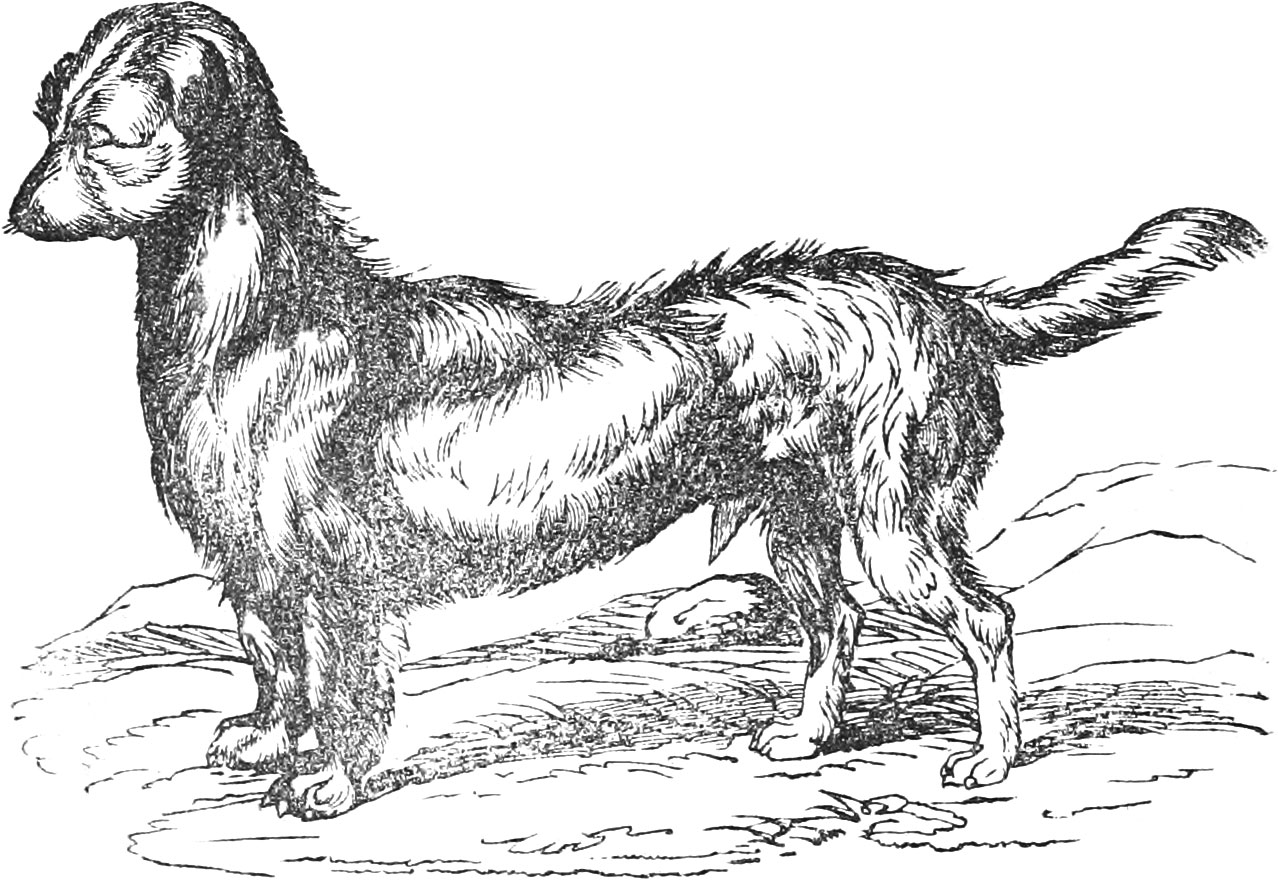
Terrier
If there be an original and indigenous dog of Britain, it is surely the species we have now under review for if the Irish wolf-dog or a questionable gaze-hound were derived from the British wolf, such a conquest over a powerful and ferocious animal could scarcely have been achieved without the aid and intelligence of a previously domesticated and smaller species. But it is more likely the terrier of antiquity was of the same race with the hard-footed dogs of the Cymbers, and that the first were brought over from the north-west of Europe with the primitive inhabitants. Certain it is, that the intermixture of terrier blood with other and later races has in no instance tended to diminish their courage, hardihood, and fidelity, and in no part of Europe has the rough-haired breed retained so completely as in Britain all the traits which constitute a typical species. No dog carries the head so high and boldly, or expresses more lively energy than this breed; the distinctions marking its purity of race are equally discernible, although we have from fancy or accident two very evident varieties. The first is smooth, rounded, and rather elegant in make, with colours usually black, and tan spots over the eyes, and the same tint spread over the extremities and belly; sometimes also white (Pl. XVII); the muzzle sharp, the eye bright and lively, the ears pointed or slightly turned down, and the tail carried high and somewhat bowed; but the second, represented on the Vignette and on Plates XVII. and XVIII., is the more ancient and genuine breed, usually called the wire-haired or Scottish terrier; the muzzle is shorter and fuller, the limbs more stout, the fur hard and shaggy, and the colour a pale sandy or ochry, and sometimes white. Neither of these are crooked-legged, nor long-backed, like turnspits, these qualities being proofs of degeneracy or of crosses of ill-assorted varieties of larger dogs, such as hound, water-dog, or shepherd’s dog females, and then perpetuated to serve as terriers. This is the case on the continent, where they use the turnspit mongrels for the purposes to which our terriers, though smaller in bulk, are far better adapted.

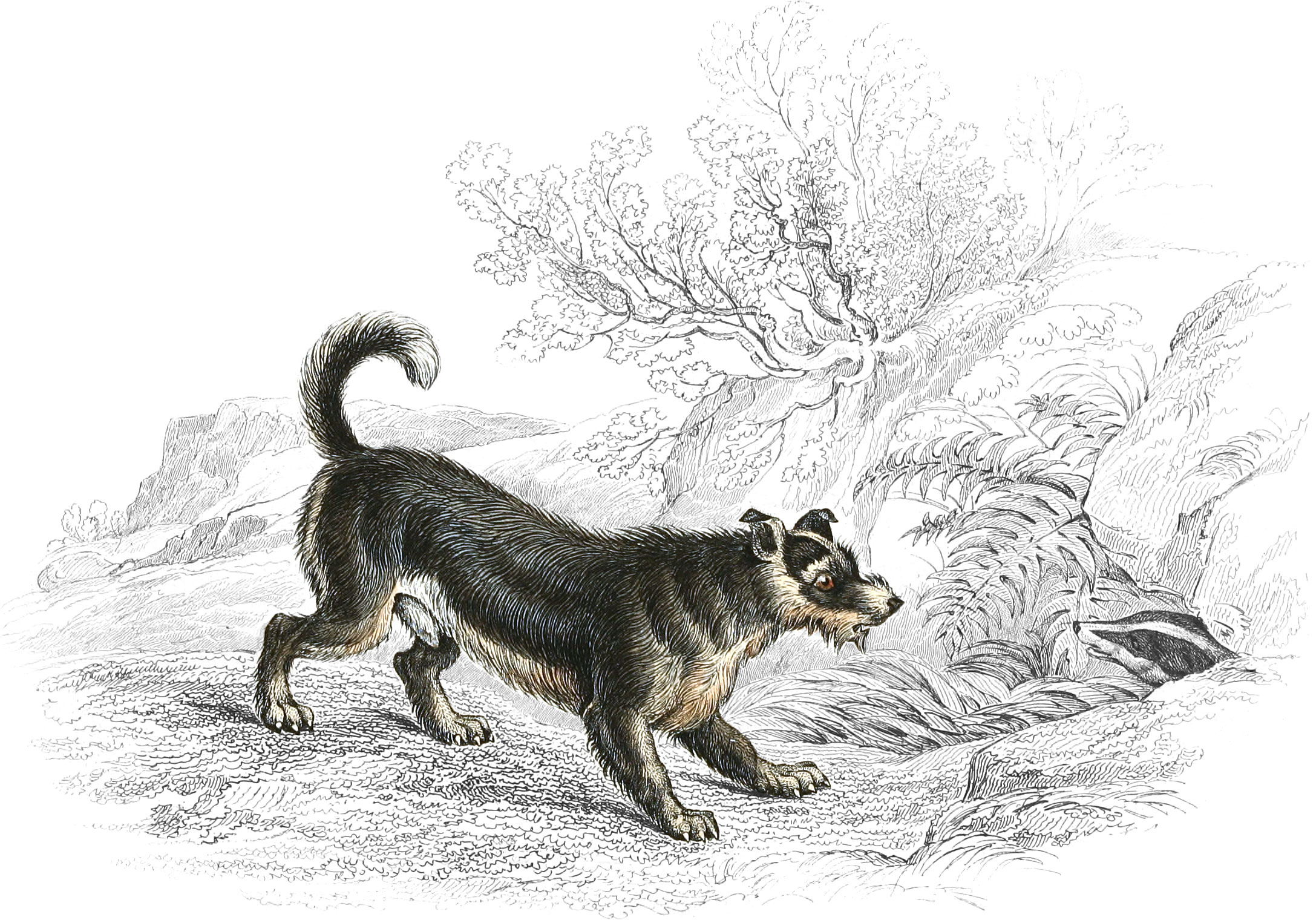

The Saufinder, or Boarsearcher
In Germany, the Saufinder, or Boarsearcher, is a large rough terrier dog, employed to rouse the fiercest beasts of the forest from their lair in the thickest underwood, and they never fail to effect the purpose by their active audacity and noisy clamour. They are usually of a wolfish grey-brown, with more or less white about the neck and breast, and a well fringed tail curled over the back; having in all probability in them a cross of the Pomeranian dog, which may have increased their stature and their caution.
In England the cross of terriers is perceptible in sheep and cattle dogs, but most of all in the breed called bull-terriers, because it is formed of these two varieties, and constitutes the most determined and savage race known. It is reared in general for purposes little honourable to human nature, and most disgraceful to the lower orders of England, where, for the sake of betting, the true wild game qualities of the animals are exhibited in mutual combats, in which neither will give up while life remains, and the last struggle is borne without a groan! Yet they might be exported to, or bred with great advantage for the use of colonists in South Africa, and contribute mainly to the security of persons and property against the depredation of the lion and the hyæna.
The Russian, Finland, and Siberian dogs of the cur races are so intermixed as to bear but little of purity of their type about them. Yet there is a breed in the first mentioned country, rugged and low on the legs, with many good qualities; but the Siberian, usually black, are not larger than a hare, with ears half erect, slightly folded in the middle, the body round, and the tail obtuse at the end, where it is white; this variety is exceedingly voracious, familiar, and filthy.
The Lapland Cur
The Lapland Cur is probably of the same race,—black, or liver-coloured and rugged. It is a kind of watch-dog, and used also in hunting; but a people depending entirely for subsistence on the produce of reindeer, has not food to spare for large dogs, and are unwilling to trust them in the vicinity of their flocks.
Although the race of cur origin may be traced eastwards through Turkey, Persia, and slightly in Egypt, where the outcasts are an intermixture of all the forms of dogs, we find in their squalid exterior only a predominant tendency to the more original race of each country, having universally long tails, erect ears, lank bodies, and sharp muzzles, with yellowish, yellow-grey, and yellow and white colours; but it cannot be said with absolute propriety that they are of the cur races of Europe, their aspect becoming more and more like that of the Indian Pariahs, in proportion as we advance eastward; and if we consider that Central Asia, India, and Syria have for more than thirty centuries been traversed by nations, by great armies, and still more constantly by innumerable caravans, always attended by canines both wild and domestic, it is to be expected that the whole area in question should be tenanted by mongrels of interminable crossings, and that at the extremities of the caravan movements we should again begin to find decided marks of purer breeds. This we have shown is the case in some respects in Egypt, and we find it still more clearly beyond the Indus, always excluding the breeds watched by man. We find in those regions.
The Pariah Dog
The Pariah Dog, or native cur of India, a race we have already shown exists to the north-east of those regions in a wild state, where we are assured they occupy the woods in considerable troops, and keep the jackal at a distance. The external appearance of the animal has been noticed, and of the domesticated we need only add, that they bear the marks of degradation and mixture in various forms, but still the rufous colours and their direct sign of domesticity shown by the admixture of white predominates; that they all have lengthened backs, pointed ears, a sharp nose, and the tail more or less fringed. They are sagacious, noisy, and cowardly trained by the Sheckarees to their mode of sporting, and used by the villagers in occasional hunts. Many are in a state of wretchedness even greater than the Turkish or Egyptian, but fondness for human society is marked in all; nay, they will sometimes fix upon a stranger, and leave no art or exertion untried to be admitted into his service. Thus, one determined at first sight to follow a gentleman travelling through the country in haste; he was as usual carried in a palanquin, and the poor beast followed by his side, stage after stage, until at length, exhausted with exertion in a lonely part of the route, he dropped, but kept looking wistfully after the object of his choice till out of sight.
In the great Asiatic islands, the cur dogs still retain the general characters of the Pariahs, although about insular situations and great straits, where navigation more necessarily congregates, a greater variety of dogs must be looked for. This, for instance, is already the case in the South Sea Islands, where the influx of European dogs brought from different countries, and of different breeds, are rapidly extinguishing the native race, known by the name of
The Poe Dog
The Poe Dog (Canis Pacificus, Nob.), Uri-Mahoi of Tahiti and Ilio of the Sandwich Islands, from Uri a dog, and Mahoi indigenous. In form this variety bears marks of decrepitude; the head is sharpened at the muzzle, the ears erect, the back long, the limbs crooked; the hair is smooth, but retains its primitive livery of tan or rusty ochre-colour. It is a silent lazy animal, feeding on vegetable diet, such as taro, bread-fruit, &c., and entirely reserved for the table. Since the dogs of Europe have multiplied, the Poe dog is becoming daily more scarce, and the practice of eating the flesh begins to be abandoned, although it is considered a real delicacy by the natives, and said by Europeans to be not unpalateable; but for this purpose vegetable food, with perhaps a little fish, must be given the dog, and as the breeds from Europe are fed on animal substances, they are never eaten.
To Mr. Frederick Bennet we are indebted for a note on these dogs, which we here insert.
Amongst the Society Islands, the aboriginal dog, which was formerly eaten as a delicacy by the natives, is now extinct, or merged into mongrel breeds by propagation with many exotic varieties. At the Sandwich group, where the inhabitants have been more remarkable for the use of this animal as food, and where that custom is yet pertinaciously retained (owing probably to the scarcity of swine and spontaneous fruits of the earth), the pure breed of the Poe dog has been better protected; and although becoming yearly more scarce, examples of it are yet to be met with in all the islands, but principally as a delicacy for the use of the chiefs. As late as October 1835, I noticed, in the populous and well civilized town of Honoruru at Oahu, a skinned dog suspended at the door of a house of entertainment for natives, to denote what sumptuous fare might be obtained within.
That gentleman then proceeds to give a similar description of the appearance of the dog as above indicated, making it equal in size to a terrier, with a dull expression of countenance; tail straight or slightly curled, a brown livery, and having a feeble but shrill bark; it is gentle, indolent, and in aspect presents the mixed forms of a fox-dog, turnspit, and terrier.
Those of New Zealand, according to Forster, are a long-haired breed, resembling the sheep-dog; they are of divers colours, variously spotted, entirely black, or wholly white. Their food is fish, and the remains of what the natives eat themselves; the mode of attaching them is by the middle of the belly, not as we practise by the neck; they are in favour with that people, who nevertheless kill them for food, for their skins, or to make fringes to their dresses with the hair. These animals are stupid, having little more sagacity than sheep. The same author declares the dogs of the South Sea Islands to have very large heads and small eyes, with pointed ears and short tufted tails.
What has been stated regarding the variety of races of the canine family to be met with in great islands and the shores of straits, we find confirmed in the western hemisphere, about the Magellanic Strait and the Fuegian Islands; for although the native dogs of America north of the equator have been already noticed, there remains still some account to be given of those to the south of it. On the coasts, and wherever Europeans have penetrated, dogs introduced by them have multiplied, and the wild aborigines have adopted them in preference to their own. Those of European origin, carried to the west for the purposes of war, of coursing, and of guarding cattle or plantations, were, it may be assumed, numerically few in proportion to the mongrels of all kinds which the fancies of individual adventurers took in their company; and all, it appears, on the continent, were with little or no care allowed to breed at random hence in Paraguay, for instance, a true greyhound, spaniel, or a bull-dog is very rare; the dogs in general form a mixed breed, assuming, however, characters distinct from the cur breeds of Europe, and emphatically deserving the name of mongrels; larger in proportion, more sagacious, more bold, with acuter senses, with more personal enterprise, but also with less attachment to mankind, and almost entirely destitute of education. Hence, in a climate where they find food sufficiently abundant, and they suffer no rigour of cold, we cannot wonder there should be feral dogs in numbers; nevertheless, the nations of the interior are still in part attended by the same species as we have already described under the name of Aguara dogs, and towards the farthest south, where the resources of life are much fewer. The resident Fuegian and Nomad Patagonians value dogs beyond measure, being only scantily possessed of an indigenous breed, but from all appearances having among them several mixed races, acquired no doubt by means of the annual migrations of the riding tribes towards the Pampas, and by shipwrecks on the coast. Such at least, it would appear, are the inferences to be drawn from the letters on the subject Captain Fitzroy favoured us with. We will here subjoin an abstract of their contents, as much as possible in his own words.
The dog of Patagonia is strong, about the size of a large fox-hound; his coat is usually short but wiry, though in some instances it is soft and long like that of a Newfoundland dog; indeed I should say, in general terms, that the dogs seen by us in the southern part of Patagonia resembled lurchers or shepherds’ dogs, with a wild wolfish appearance, not at all prepossessing; one of this kind I obtained near the Otway water; his habits were savage rather than domestic. These dogs hunt by sight, and do not then give tongue; but they growl and bark loudly when attacked or attacking. Their colour is usually dark and nearly uniform, spotted dogs being rare. The dogs of the Fuegian Indians, who have no horses but move about in canoes, are much smaller than those of Patagonia or the eastern part of Tierra del Fuego; they resemble terriers, or rather a mixture of fox, shepherd’s dog, and terrier. All that I examined had black roofs to their mouths, but there was much variety in the colours and degrees of coarseness of their coats. Not one dog, out of the number which were brought to England, could easily be prevented from indulging in the most indiscriminate attacks upon poultry, young pigs, &c. Many Fuegian dogs are spotted, and not a few have fine short hair, but all resemble a fox about the head, although there are among them many varieties of size and colour, as well as of form and hairy coat. One brought from Tierra del Fuego was white, with one black spot, and very handsome; his size was about that of a terrier, his coat short but fine, and his ears extremely delicate and long, although erect; this is the case with all the other breeds likewise, their muzzle also is long, and they have the tail rough and drooping; they keep most vigilant watch, and bark furiously at a stranger; with them the natives guard their habitations, hunt otters, and catch sleeping or wounded birds. As they are never or seldom fed, they provide for themselves at low water, by cunningly detaching limpets from the rocks, or breaking muscle-shells and eating the fish.
In the eastern portion of Tierra del Fuego, where the natives have neither horses nor canoes, the dog is invaluable; no temptation would induce some Indians, seen near the Strait of Le Maire, to part with a fine dog of the size of a large setter, which had, except about the head, an appearance like that of a lion; behind the shoulders it was quite smooth and short-haired, but from the shoulders forward it had thick rough hair of a dark grey colour, lighter beneath, and white on the belly and breast; the ears were short but pointed, the tail smooth and tapering, the fore quarters were very strong, but the hinder appeared weaker. It had a wolfish appearance about the head, and looked extremely.
None of the dogs in the southern part of South America are mute; there are none in a wild state, and there is a scarcity rather than an abundance of those which live with the aboriginal natives. In times of famine, so valuable are dogs to them, it is well ascertained that the oldest women of the tribe are sacrificed to the cannibal appetites of their countrymen rather than destroy a single dog. “Dogs,” say they, “catch otters; old women are good for nothing.”
The Mastiffs
Canes urcani, Caius.46

Mastiff skull from side and top
If there be one form of domestic dogs more marked with the characters of a distinct origin than any other, it is most certainly that which includes mastiffs and bull-dogs. The particular arch of their skulls and structure of their lower jaws have already been noticed, and with animals so well known it is scarcely necessary to dilate upon their massive form, powerful legs, strong neck, and muscular back; nor to advert to the frequency of a fifth toe, truncated tail, and semi-pendulous small ears.47 To recal them to the mind of the reader serves our purpose only that we may point out their corresponding characters of taciturnity, phlegm, and sense of power, which disdains excitement, faces danger with the coolest resolution, and show that they stand in some measure isolated from the whole family in all these particulars, and still more in their indifference to form cross breeds with other races. Although the mastiff race is found at a remote period spread asunder at a vast distance, it never was any where very abundant, and though nowhere in a wild state, it is, as a domestic animal, more an independent associate than a servant. When we look for the original type, and assume that we must search for it in the localities where the race is most numerous, and in the fullest perfection of form, we find that a mountainous or a cold region is best suited to its nature, and that the highest ranges of Central Asia, and the island of Great Britain, are the most genial yet in form, in the roundness of the ears, the thick neck and short muzzle, the zone of the earth which includes both these regions contains no similar wild creature: we are therefore obliged to search for it in Africa, and there we find the Lycaon, who alone of all the canines possesses several of the most prominent characteristics of the mastiff. In this species are perceived ears which, though erect, have rounded tips, a muzzle, jaws and dentition, not unlike the mastiffs, a powerful neck, and in the livery a combination of yellow and black marks upon a white surface, which is still very similar in the broad-mouthed dogs that retain their ancient brindled coat; but the species is distinguished by having only four toes on all the feet, and the legs are high and slender, while in the mastiffs there is very generally a fifth toe on the hind, and always five on the fore feet, and the limbs are massive: they are not therefore of the same origin, but we think them nearly allied. The Lycaon is the African form of an osculating congener of a northern latitude, now absorbed in domesticity, or not yet discovered in a wild state. Yet though in association with man, contrary to all the other species residing in climates of so much severity, it still retains the characters which assimilate with the African, being possessed of a short but shaggy fur, and nowhere assuming that of the long and dense covering which belongs to the wolf-like dogs.
In the last paragraph of our description of Chryseus scylax, we have noticed a canine which might be the representative of the original bull-dog, and as the animal is very little known in India, and when seen was more towards the west, it may be that the real and full sized type is still to be sought in the mountains of the Caufirs and the Douraunee territory: for the present mastiffs of Tibet are clearly the same as the dogs of the ancient Indi and Seri, and nearly the same as those of Hyrcania. The absurdities regarding the Cynocephali, the Cynomolgi, and the Dardai of Ctezias, &c., were lately explained into intelligible, and not improbable relations, by a Sanscrit scholar48 of eminence; and they show undeniably, that long before the era of Alexander’s march to the Indus, the mountain nations to the north of it were in possession of a race of dogs mainly instrumental in their well-being. From some authors, we learn that the Macedonian conquerors received presents of dogs of huge size and prodigious powers, which, since we are acquainted with the mastiffs of Tibet, leave no doubt respecting the race they were of: but, from other sources, there is evidence that the fiercest dogs of the northeast were considered to be cross breeds with a tiger, or spotted animal, of considerable size and strength. Among these Nearchus is quoted to have remarked, that Thoas, the species in question, were pied, or varied in colour, and larger than other canines, but not real tigers: thus there was a Thoa different from the already described group, and evidently a large wild dog. Oppian likewise remarks Thoas to be like wolves in form, but like panthers in colours: here then we find a spotted or brindled animal of the canine family in Asia, not of the. true Thoes, which we have seen are only speckled, nor yet the Lynx, so strangely confounded with the Canidæ by earlier writers. We have before shown the mastiff form became distinctly known to the Greeks only about the period of the Macedonian conquest, and that the classic writers of the Roman Empire then first enter into particulars concerning it: such is the description of Oppian’s war-dogs, who attack the Urus, and prostrate the wild boars of the forest, not even fearing their king, the lion.49 He distinctly mentions the fiery light brown eyes, the truncated muzzle, loose folded skin above the brows, broad backs, great stature, and muscular legs of these animals, and draws a complete portrait of a modem mastiff of Tibet, which, in his time, seems to have been found in Hircania; although it is probable that, as at present, the huge mastiff was the rare breed, and the bull-dog the more common below the mountains. A few centuries later, we find them again noticed by Marco Polo, who describes these dogs as little less than asses in size an account not exaggerated, when we recal to mind the enormous cross breed of Epirus already mentioned. The high mountain breed of Asia is, we hear, in general black, or very dark in fur, with only a few tan-coloured marks about the face and limbs. A race of dogs allied to the bull breed was anciently ochre-coloured, with a dark muzzle, such as the British mastiffs are mostly at present; but in former times, when the bull-dog was a larger animal than now, and the mastiff more frequent in Great Britain, as well as through the northern parts of Europe, they were almost invariably yellowish with black brindles, and more or less white about the throat, belly, and inside of the limbs. White and black species would naturally occur, from the tendency to these colours existing in most carnivora, and indeed in nearly all mammalia.
The mastiff50 is often reckoned an indigenous variety of Great Britain, exported from thence to continental Europe, but from what is before stated, we believe that it was imported by the Cimbric Celtæ of the north-east of England; in fact, it is still in that part of the kingdom the race is most commonly found, and the name is not Celtic of the western dialects of either Britain or Ireland. It may be said that it is not Teutonic or Gothic, though we might answer that the French matin does not belong to that language, but is a word of Frankish origin, distorted and misapplied in modern France. As this species is known to exist in High Asia, and extends in its full vigour through South and Eastern Tartary, it is more likely from thence that we have obtained it, than that it is an original cross between the bull-dog and the great Dane, or the slow-hound. Yet a race, either mastiff, bull-dog, or both, was certainly existing in Britain before the arrival of the Romans, who valued their courage so highly, that they were much sought for to exhibit in the combats of the amphitheatre; and at length a Roman officer was charged with the care of breeding these animals on the spot, in order to forward a proper number to the capital. Although, from the size of the head, the cerebral part of the cranium appears to be ample, so much of the space is made up of the powerful muscles of the jaws and temples, that in reality the brain is much confined, and the animals themselves are far below the spaniel, and other varieties, in intelligence and sagacity, and their confidence in the arms and vigour they possess makes them disregard the resources of cunning; hence they are sedate, little irascible; when provoked, they attack in front, without much precaution, with little or no menacing barking, and often with the desire of conquest only, refusing to bite a prostrate foe. They have the instinct of property, being excellent guardians of farms and house-yards, and have a strong, but not obtrusive attachment to their masters. The acute sense of smelling is not imparted to them, but they have it often in a degree far superior to what is the common opinion.
The Mastiff (C. urcanus).—Although Great Britain was celebrated in remote ages for her noble breed of dogs, the typical mastiff is more likely to be the dog of Tibet than any of the West, because in that breed we find the traits described by Oppian still fully retained.
The Mastiff of Tibet
Is larger than the English, with a thick head, elevated occiput, very pendulous lips, the skin from the eyebrows forming a fold towards the outer edge of the eyes, and ending in the jowl; the ears are round and drooping; the neck remarkably full; the back slightly arched; the tail, turned over the back, is well fringed, and, together with the very rugged hair of the body, deep black, with the sides somewhat clouded; over the eyes, about the muzzle and the limbs, there is some tawny. There is a beautiful wood-engraving of this noble dog, accompanied by an interesting description, in the “Gardens and Menagerie of the Zoological Society, by Mr. Bennet.” In that writer’s account are pointed out several inferior breeds of this race existing in other parts of the Himalaya Mountains; and Mr. Hodgson admits, that at Katmandoo the dogs of this splendid breed do not prosper.
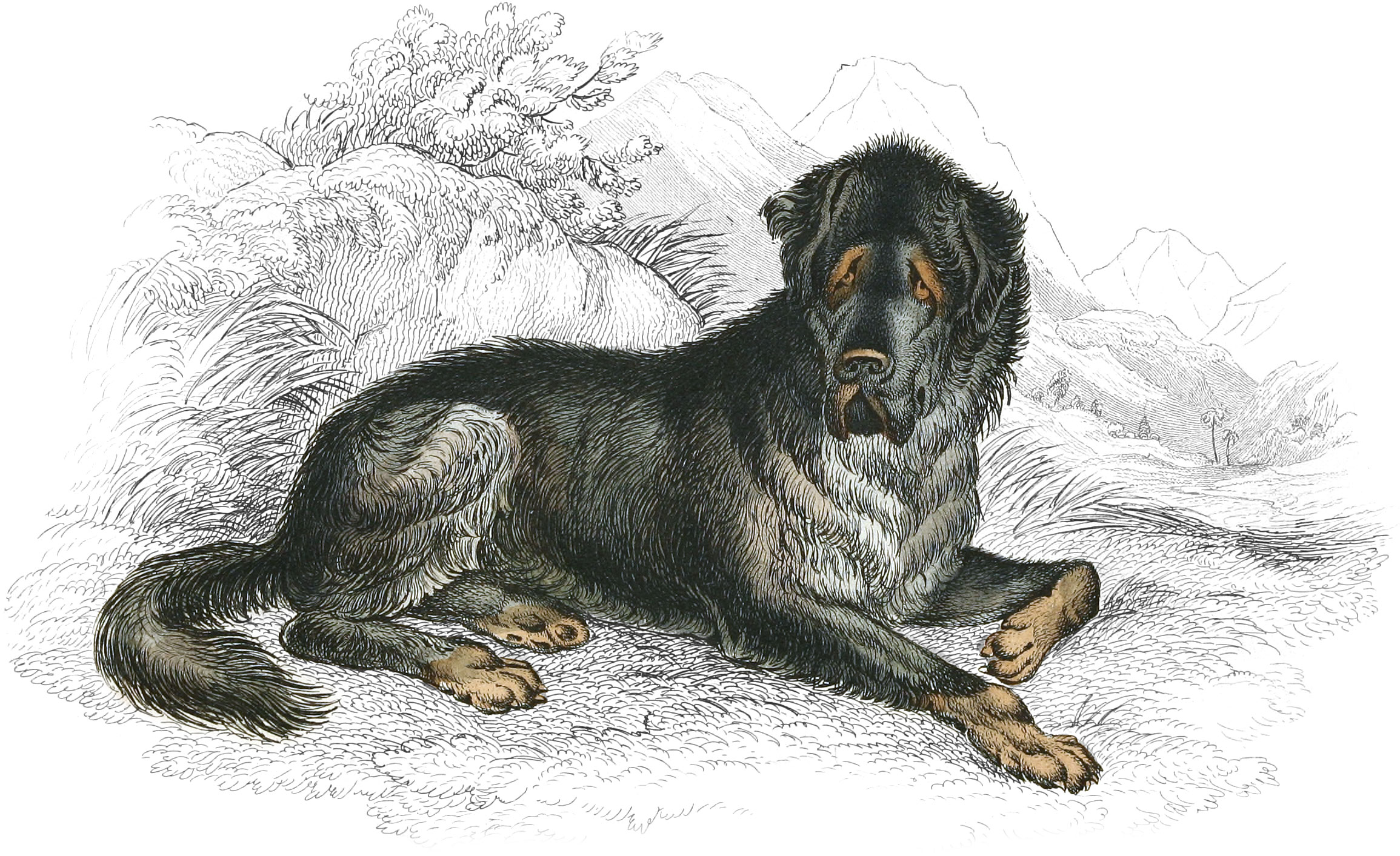
Plate XIX
The English Mastiff
This breed, now somewhat crossed by stag and blood-hounds, is little inferior in stature and strength to the former, and in aspect is considerably more elegant and majestic. The colour is usually deeper or lighter buff, with dark muzzle and ears. One, the property of the 43d regiment, measuring twenty-nine and a half inches in height at the shoulder, had killed his brother in combat, but was perfectly gentle, acknowledging the caresses of strangers by a slight wagging of the tail, but with a grave, and somewhat mournful look. Cirino, Whitaker, and others, relate the exuberant usurper zeal of Henry VII. for the prerogative of Royalty, when he ordered a mastiff to be hanged, because the animal had dared to engage singly with his lord and sovereign the lion. And there is a story related of another in the reign of Elizabeth, when Lord Buckhurst was Ambassador at the Court of Charles IX., who, alone and unassisted, successively engaged a bear, a leopard, and a lion, and pulled them all down.
The care these dogs take in watching is well known, and the cool attention they have evinced in walking by the side of a nightly thief, forbidding his laying hands upon any article, yet abstaining from doing him bodily harm, and suffering his escape over the walls, is sufficiently attested. The story of a mastiff who, long molested by a playful cur, at last rose, took him up and dropped him in the neighbouring water, is universally known; and we may add another, told of Chicken (the dog of the 43d), who, passing up Union Street, at Plymouth, was beset by a whole troop of curs, till they quite impeded his sober walk, sufficiently to excite his resentment, and accordingly he lifted one of his hind legs, and astonished them all. The mastiffs of the Continent are generally white, with very large clouds of black or of reddish; two which had belonged to the Elector of Saxony, King of Poland, we measured, and found to be thirty inches at the shoulder. The ancient English breed was, however, brindled yellow and black.
The, Cuba Mastiff
The fine pair of this breed in the Zoological Gardens have made the public well acquainted with their aspect. We were informed in the West Indies, by Spanish cattle-dealers on the south side of the island, who pay great attention to preserve them,51 that they were introduced from England in the time of Philip II. In the words of Mr. Bennet,
They are larger than our common bull-dogs, and smaller than the mastiff, well made, and rather stout in their proportions; moderately high on the legs; muscular and powerful; their muzzle is short, broad, and abruptly truncate, with somewhat of an upward curve; the head broad and flat, and the lips elongated, and so deeply pendulous as to overlap the margins of the lower jaw; the ears, which are of a middling size, are also partly pendulous, but not to such an extent as to be flat upon the sides of the head; the tail is rather short, cylindrical, and turned upwards and forwards towards the tip.
Those we have seen were of a rusty wolf-colour, with face, lips, and legs black. The common Spanish cattle-dog of America is evidently crossed with this breed.
The Bull-Dog
Canis Anglicus
It may be doubted whether there were in Britain two races of broad-mouthed dogs during the Roman era; it seems to us there was but one, and in that case the bull-dog was the animal in question. One, indeed, far superior in size to the present breeds, little inferior to the mastiff, and probably very like the Cuba race before mentioned, but with the peculiar features of the bull form more strongly marked;
the distorted blear eyes, cheeks and lips sordid and hanging loose, looking like monsters, and the more repulsive in aspect the better in qualities.52
The celebrated verses of Gratius Faliscus have been so often repeated, that we point out only the last lines, to remark how superior the British bull-dog was in courage to the Molossian of Greece, also how inferior in size.
Hæc una est catulis jactura Britannis.
Admagnum cum venit opus, promendaque virtus,
Et vocat extremo praeeeps diserimine mavors
Non tune egregios tantum admirere Molossos.
Nor is there in any of the classics ascribed to other dogs the habitual distinction of pulling down a bull, noticed by Claudian.
Magnaque taurorum fracturæ colla Britannæ.
In Stil. 3.
Recent experiments have confirmed the result of those instituted in the reign of James I.; and although our dogs are now of a smaller breed, four have still proved more than a match for a caged lion.
The bull-dog is possessed of less sagacity and less attachment than any of the hound tribe; he is therefore less favoured, and more rarely bred with care, excepting by professed amateurs of sports and feelings little creditable to humanity. In stature the present race is of moderate size, but entirely moulded for strength and elasticity; the head is large; the forehead sinks between the eyes, and the line of the nose rises again at a considerable angle; the lower jaw projects beyond the upper, often showing the teeth, which altogether, with the frequent redness about the eyelids, produces a most forbidding aspect; the ears are partially drooping, unless the terrier blood is crossed in the animal and the tail is carried high. The present breed is commonly ochry or reddish buff, with the nose and chops alone black. Formerly when the brindled breed, always preferred on the Continent, was exported for strengthening the wolf and boar packs of hounds, the ears were always cropped; and we have seen leathern armour, consisting of a breast-piece and cap, with holes for the eyes, made of studded leather, which were used, along with a spiked collar, for some valuable dogs to engage the boar or wolf, and protected them effectually; indeed such a defence, where the breed was scarce, may have been necessary, from the unceremonious mode of attacking and indomitable pertinacity the dogs evince when once excited; never letting go the hold they have, even if mutilated, as if there was some spasm in the jaws to prevent their unlocking. The bull-dog differs from all others, even from the mastiff, in giving no warning of his attack by barking; he grapples his opponent without in the least estimating their comparative weight or powers. We have seen one pinning an American bison and holding his nose down, till the animal gradually brought forward its hind feet, and, crushing the dog to death, tore his muzzle out of the fangs, most dreadfully mangled. We have known another hallooed on to attack a disabled eagle; the bird, unable to escape, threw himself on the back, and, as the dog sprang at his throat, struck him with his claws, one of which penetrating the skull, killed him instantly, and caused the butcher, his master, the loss of a valued animal, and one hundred dollars in the wager. We may safely reject the accounts of the mastiff or bull-dog engaging with success such a huge and wary animal as the elephant, with the circumstances described by classical writers; a dog cannot reach any tender part, and if it comes between his legs, the elephant has a mode of kicking alternately with the four, in such a manner, that the assailant is inevitably tossed backwards and forwards till not a bone remains unbroken.
Plate XX
Water-Dog (Left), Bull-Dog (Right)
The Bull-Terrier
Is a variety somewhat smaller, more lively, and, if possible, still more ferocious than the common. In this the ears are always pointed, and the colour is very commonly white, with some black about the head. There exists a print of Pincher, a hound-terrier about four years old when it was taken, the dog was considered the trustiest and fiercest of his kind; he had then fought thirty battles, all of which he won, killing five of his opponents. He was an unrivalled rat-catcher, and weighed thirty-two pounds; his colour was white, with black about the head.
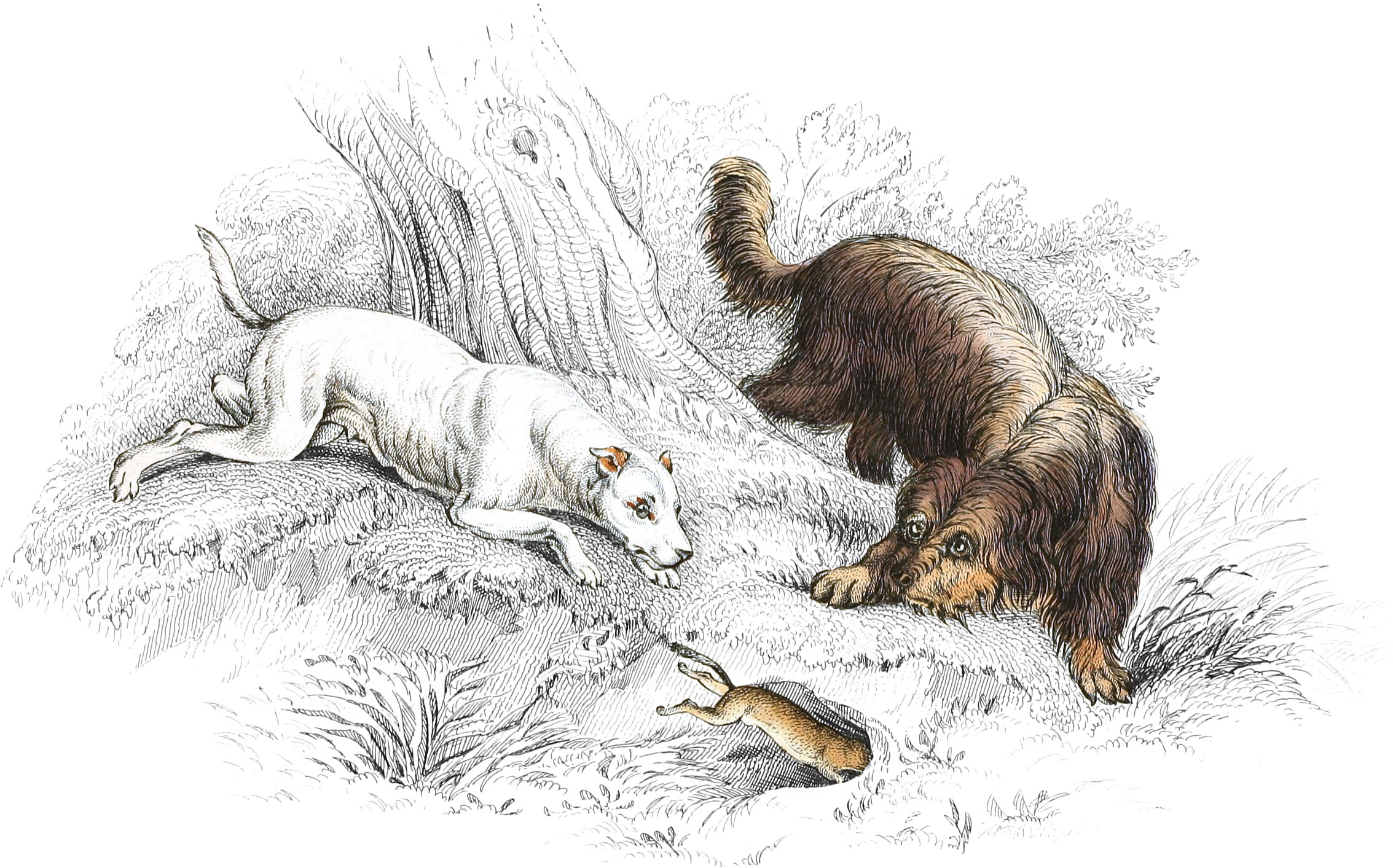
Plate XVII
Bull-Terrier (Left), Scottish Terrier (Right)

The Pug Dog
The Pug Dog has much of the external appearance of the bull-dog, but being timid, is fit only for a ladies pet. We have witnessed forbearance in one belonging to a lady, whose child bit the dog until he yelled, but never showed anger, or a disposition to get away. The colour of pugs is usually yellowish with a black snout, and the tail is firmly curled over the back.
In the south-east of Arabia, we are informed there is a race of dogs allied to the mastiff by its great size and round truncated muzzle, but the lips do not overhang the lower jaw, and the ears are half erect; the hair is smooth; on the head, neck, and back, liver-coloured grey, or yellowish and blackish mixed, with darker spots scattered upon the surface; the muzzle and chaps black, and the inside of the limbs whitish. This appears to be the kind figured in the temples of Ceylon, whither the race may have been brought by Arabian navigators.
We may add in this place three or four known breeds of small dogs evidently the mongrel produce of several, and therefore not strictly referrible to one more than another. These have, however, a round forehead, and therefore approximate the bull-dog form. Such is
The Roquet
Canis hybridus, Linn.
Is known by a round head, short muzzle, large eyes, small pendulous ears, slender limbs, tail turned upwards and forwards. Colour often slaty or blackish, with white about the limbs.
The Little Danish Dog
Canis variegatus, Linn.
Very like the preceding, with the muzzle somewhat longer and finer, body more lengthened; fur and colours similar to the above, and both not unfrequently white with black spots, when they are called the Harlequin Dogs.
The Artois Mongrel
Canis fricator
A French race; muzzle very short and flattened. It is the quatre vingts of the French, and totally worthless, though now very rare.
The Alicant Dog
Canis Andalusiae, Desm.
This has the muzzle of the pug, with the fur of a water-spaniel. Little is known about this variety.
Sub-Genus III. Vulpes, The Foxes

Fox skull from side and top
In whatsoever form we arrange the Canidæ, osculating species will always be found somewhere at a distance from each other, because either the quarter of the globe interposes, or the individuals in the series approximate others at a distance from the direct succession. Thus our Chrysocyon should be placed immediately after Lupus; Dusicyon, in the new continent, and Cynalopex in the old, pass into Vulpes. But although the last group of true dogs having short truncated mouths approximates Lycaon, Baron Cuvier judiciously placed the foxes between them, because the latter, notwithstanding that they constitute the nocturnal section of canine animals, are, in other respects, more nearly allied to true dogs than the former, which assume the aspect of hyænas.
The foxes may in general be distinguished from diurnal Canidæ by a lower stature in proportion to their length, by an invariably sharp anterior head, an apparent shorter neck, slender limbs, and a tail reaching to the ground, or even longer, always well furnished with long hairs in the form of a cylindrical brush: they are further distinguished by a finer, denser, and more glossy fur, and a gland at the base of the tail emitting more or less odour; by a propensity to burrow; a nocturnal life; and, above all, by the pupils of the eyes, when turned towards a strong light, contracting vertically like the section of a lens, and not circularly as in diurnal dogs. No true foxes are found to the south of the equator.
In manners they are unsociable, not capable of true domesticity; shy, cautious, exceedingly cunning and patient, cleanly, retired, and apt to sacrifice their own limbs when caught by one in a trap: their senses are acute, those of smell and hearing in particular; their members are exceedingly pliant, the tail flexible, so that they can roll it round the nose. While young they are full of vivacity and playfulness; their resources of instinct to escape detection or an enemy are numerous, never trusting to their courage until they are exhausted, and then defending themselves to the last gasp against dogs, but sometimes deceiving mankind by simulating death; depositing their prey under ground and in different places, and consistent in character, not attacking poultry under any circumstances while kept chained. They cannot be habituated to domesticity; always meditating escape, and when freedom is hopeless they die of ennui.
There are instances of hybrid animals between the dog and fox, but these are sterile; and the ancients, who believed the Laconian race of dogs to have began in crossing the two species, have clearly mistaken for a fox some other canine more nearly allied to the dog.
Foxes feed on small game, leverets, rabbits, moor-fowl, partridges, pheasants, poultry, eggs, moles, rats, field-mice, cheese, fruit, and particularly ripe grapes: also fish, oysters, limpets, carrion, &c. are devoured by them, together with snakes, lizards, toads, beetles, wasps, and bees. The species best observed do not breed more than once in the year, and litter from four to six pups in the spring. Foxes grow to the second year, and live thirteen or fourteen. Next to the dog they have the greatest number of intonations of the voice, they yelp, bark and scream with a sound resembling that of a peacock; they cry in hunting, and murmur when pleased: they he down twisted in a curve, sleep profoundly, and, when watching birds, stretch the hind legs behind them.
The burrowing species, when hunted, make a direct effort to regain the earth, and if this be stopped, they make a circuit and then return to the same, or to a second outlet; but when convinced their home is closed up, they start off for some distant cover with great velocity, leaving a strong scent. Hounds hunt them with singular pleasure, and, before they can defeat the numerous wiles they have to encounter, are often tried to the utmost. In this respect, the English foxes appear to have educated themselves far above the continental, where, not being pursued in a similar manner, their sagacity and vigour of limb is less exercised. Finally, they justly deserve admiration, for being singly often more than a match for all the sagacity of twenty or thirty dogs, and a number of other animals that run after them.
The typical colour of foxes is fulvous, more or less grizzled with white or black. Albinism and melanism exerts among them their usual influences; whole species or varieties acquire these colours with the season, with age, or possess one or the other in constancy: intermediate shades of grey and wholly grey, bluish and buff-grey occur.
They are found over the surface of both continents, most abundantly in the north, and in the greatest varieties; and we have endeavoured to point out several Tropical and Austral aberrant groups or species of day foxes, and of those animals who, with vulpine forms, appear to possess diurnal eyes, and are capable of some domesticity and training.53
All true foxes have so strict a resemblance between them, that a satisfactory distinction of species is still impracticable. We intend to arrange them according to their apparent affinity in the two continents, beginning with the northern, because, although they are not typical, they may nevertheless be considered as common to both the eastern and western hemispheres.
The Arctic Fox
Vulpes lagopus, Canis lagopus, Linn.; Isatis, Gmel.
It is a question whether the pupils of the eyes in these animals be elliptical, like those of true foxes, or not. Wanting better means of investigation, more attention is in general bestowed upon the accessible characters of fur and form, and, guided by outward similarities, locations are determined upon, which further examination would not justify; but where the question must be decided by the form of the pupil, as in the present case, and that form being difficult to observe, it is no wonder, when once the idea was received that the Arctic animal was a fox, that no further attention should be paid to the circumstance, even by those who possessed living individuals. Yet, judging from the form of the head, the rounded ears, the barking voice, the confiding aspect, natural unsuspiciousness, and ready familiarity evinced by this species, we so far agree with Buffon that it is an intermediate between the dog and fox, very nearly allied to our group of Cynalopex, and particularly to C. turcica, and that it may be ultimately referred to the diurnal tribe of Canidæ.
The Arctic fox is smaller than the common, measuring only one foot eleven inches to the tail, which is twelve inches in length, and the height at the shoulder is about the same; the head is short, but the muzzle being pointed, appears long; the feet and soles are thickly covered with fur, like those of a hare; the tail densely clothed, and the back and sides are likewise covered with wool and hair above two inches in length. During winter the colour is pure white, which, as the summer approaches, gradually becomes browner, grey, or bluish, on the head and back, along the upper surface of the tail, and across the shoulders: in this condition, when the fur is likewise less dense and shorter, these animals have been called cross and pied foxes; but as autumn returns, the white hairs increase till they again acquire the winter dress. In Russia they are more frequently bluish. A specimen we copied at Munich was of a chocolate colour, hoary, with the lower end of the tail darker a second, at Paris, in its long fur, is dirty yellowish mixed with whitish, and the tip of the tail black a third, pure white, with the tail likewise black. All the above, we believe, were derived from Russia, but a fourth, entirely white, came from America the ears of the Russian appeared somewhat larger and more pointed than those of the American polar regions, and the nose was more obtuse. These differences, trifling though they be, may indicate a decided distinction of races, if not species; for the terminal tip of the tail in foxes is not so indecisive or variable a character as is often asserted.
Both the races of America and the old continent reside in open deserts adjoining the Frozen Ocean, scattered over Eastern Asia, Siberia, and Lapland, but more numerous on the coasts: they do not descend in Russia so far to the south as in America, where they are found nearly to the 50th degree of latitude. Their young are somewhat migratory, more social, sometimes gregarious, and more prolific than true foxes. Their burrows are in sand on the sea coast, very deep, provided with more than one outlet, and furnished with dry moss. In these are littered the young cubs about the end of May, amounting in number from six to eight. Russian hunters declare, that sometimes twenty or twenty-five cubs are found in one earth; but if this be a fact, it would prove only that their social habits admit more than one family in the same retreat, and that, in that respect also, the Arctic fox approximates to dogs more than foxes. This is the more credible, since it is known, that, like jackals, they form communities of twenty or thirty burrows together, which, under certain circumstances, may have their different outlets communicating with each other. The Pedsi Skins, for by that name they are known in Russia, are of inferior estimation. The flesh of the American is eaten, and, while young, is declared not unpalateable.
Although they axe without the distrust of foxes, there is no want of sagacity in their conduct. The notice of Captain Lyon, R.N., is sufficient proof of both; and their dexterous industry when searching for food, Swimming from rock to rock to feed on birds’ eggs, the young brood, or the parents, to catch fish or mollusca, is well known. Werefer to the Fauna Borealis Americana of Dr. Richardson for a more detailed account of this species.
The Sooty Fox
Vulpes fuliginosus, Canis ful. of authors
is, by many naturalists, considered as a mere variety of colour of the former, and it is possible that such a variety occurs in America. But, in that case, we are not aware that travellers describe it as residing in the highest latitudes: they notice sooty foxes much more to the south. One brought from Norway we examined at Amsterdam, and, if there be no mistake in the races of America, this was certainly higher on the legs; in bulk, intermediate between the Arctic and the Norway red fox, with rather large triangular ears, the fur on the body and tail of the ordinary length, and the colour wholly sooty black, with dull brown about the nose, and on the flanks and legs.
The Coal Fox
Vulpes alopex
Charbonnier of Burgundy?
By naturalists, of late date, considered as a mere variety of colour, and confounded with the brant fox. Mr. Frederick Cuvier distinguished it solely by the fur on the back being furnished with more long hairs tipped with black than are found in the common fox. Mr. Pennant makes similar remarks, and adds a black tip to the tail, a character most sportsmen assert to be found in many English foxes. This assertion is not however quite correct; for, of the hundreds of foxes and skins examined by us, although there be many with the end of the tail apparently black, we have not found one where there was not a white tip within the black; although most foxes occasionally pull out the hairs at the end of the tail. Now, with regard to the coal fox, the tip of the tail is entirely of a sooty black. The animal is in stature only equal to our smallest race of cur foxes; the forehead is narrower, and the back and upper surface of the tail are not blackened by the tips of the longer hairs, but of a chocolate-brown mixed with grisly; the cheeks, shoulders, flanks and legs are buffish yellow; the anterior part of the fore limbs, and of the tarsi and feet, sooty; the outside of the ears of the same colour, the inside, the region round the muzzle, chin, breast and belly, white mixed with ashy; the cubs are of a dirty fawn colour, seldom exceeding four in number. The coal fox is more timid, and therefore less dangerous to poultry and farmers’ stock. It is not found in Britain, nor in the west of Europe, beyond, perhaps, the wooded and rocky hills of Dauphiny and Alsace, but is the predominant race of northern Switzerland and Bavaria, and it may extend much further to the eastward.
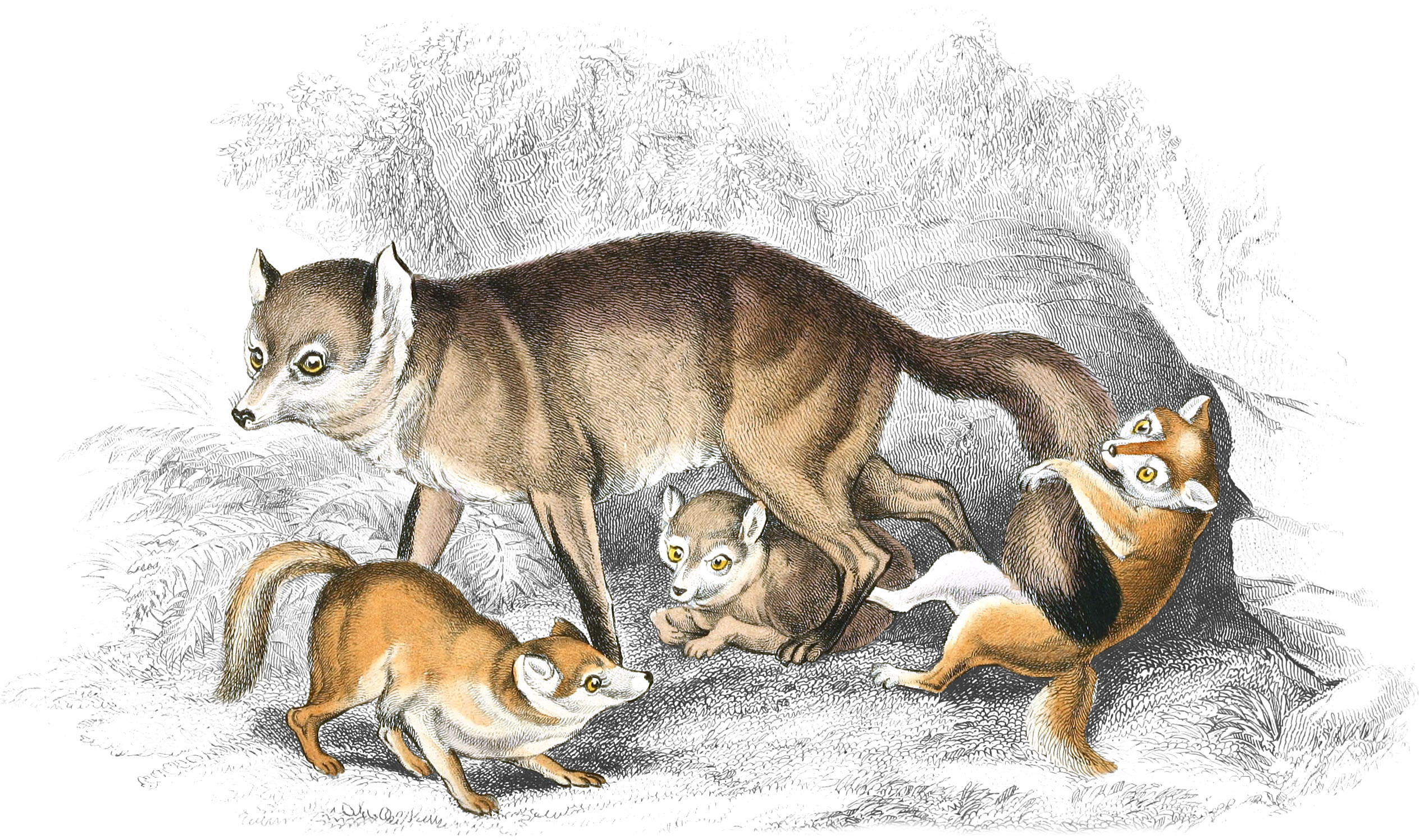
Plate XXI

The Brant Fox
The Brant Fox is assumed to be the same species as the coal fox; but Linnæus, in the Fauna Suecica, describes it as brighter fulvous than the common, and with the end of the tail black. Dr. Shaw mixes the above with a Pennsylvanian specimen we think totally distinct; and it may be suspected that the tips of the tails were not accurately observed in either, or that the Linnæan Brant is a fine variety of the Sooty, before described.
The Nepal Fox
Vulpes Hodgsonii
This species, of which we do not know the dimensions, was first described by General Hardwicke: it is covered with a rather woolly fur; above bluish-grey; the forehead, nape, and middle of the back, yellowish brown: the end of the tail black; the chin and beneath white. It resides in the mountains of Nepal and the hills of Northern India, and is probably allied to the former54 Coal or Brant Fox.
We now come to the foxes of the old continent, having the tail tipped with white.
The Common Fox
Vulpes vulgaris, Briss.; Canis vulpes, Linn.
Foxes with white tipped tails are found in the four quarters of the globe, but they do not extend to the south of the northern hemisphere in either: among them the common red species appears to occupy the greatest geographical surface, being found from Spain to Norway, and from Great Britain as far as the eastern extremity of European Russia. It is said, likewise, to have been carried by sporting amateurs to the United States, and to have multiplied in the western hemisphere. But he must have been fastidious indeed who could not find sufficient variety and quantity of indigenous foxes in the west, to import the British on purpose for hunting: it is more likely that this report arose from seeing the red and little foxes of the United States. Kalm, who first adverted to this opinion, did not believe in it, although he might well pause before he decided that these races were not of the same species as the European. Another account, asserting their arrival on the ice in a severe winter about the period of the first European settlements in the west, derived from old Indians, and mentioned by Bartram, we presume may relate to the red foxes of America, who, anterior to that period, may have existed more in the interior; for if the presence of the European common fox is still disputed, how could Indians be proper judges whether the red species were indigenous or foreign and as for their being found in California, how could they have reached that still more remote region, since we are by no means certain that they exist in the north-east of Asia?
The fox measures in length about two feet five inches, the tail one foot three inches, and the height at the shoulder and croup, one foot two inches and one foot three inches. Some races are smaller, and that of Norway longer, but not more elevated on the legs. The plane of the nose and forehead are even more rectilinear than that of the common greyhound; the head is broad; the snout sharp; the forehead flat; the eyes are placed obliquely; the ears erect; the body is well covered with hair; and the tail is cylindrical, forming a brush with a somewhat pointed end. In colour, the fur of the forehead, back, and tail, varies from yellowish red to paler yellow, and there is often a considerable mixture of grisly white, and at other times of blackish stipples, or black pointed hairs, mixed with it; whitish or ash colour is still more visible on the forehead, the rump, and hams; the lips, cheeks, and throat are white, as well as a line of the same on the inner surface of the legs the breast and belly are pale grey or whitish; the outside of the ears and the feet black; and the tail terminates in a milk-white point, in some races preceded by a ring of black more or less in breadth. The largest breeds we have seen were destitute of the black ring, the middle sized, and usually the more grizzled, were provided with it; and Mr. Pennant ascribes to the cur foxes of Wales a black tip altogether, although we recollect formerly to have seen many specimens of a small race in Kent and Dorset without this mark.
But in England, since foxes have been imported from the continent for sporting purposes, it has become impossible to ascertain the varieties formerly noticed. The grisly black-ringed we believe to be from the west of France, and the reddish, without black, indigenous, or from the Flemish and German shores.
It is needless to enter more in detail on the manners of a species so well known, and therefore we proceed to allied species or varieties.
The Norway Common Fox
The Norway Common Fox is paler yellow, with a white tip to the tail, having no black ring. The race is large, of very strong bone, and in shape so lengthened, that it might be called a turnspit fox.
The Cross-Fox of Europe
Vulpes crucigera
described by Gesner, from a communication received by him in a letter from George Fabricius, together with a figure. No mention is made of the general colours, which, from the context, appear to have been those of the Swedish or Norway common fox, but a broad band of black passed from the nose over the head and back down to the end of the tail, and was crossed by another over the shoulders, extending in a narrower line over the outside of the fore legs down to the toes. This variety is noticed likewise by Olaus Magnus, and does not belong to Germany, being confined to the Scandinavian peninsula. It is a different species from that of America.
The Roman Fox
Vulpes melanogaster, Bonaparte.
We think this to be a distinct species, both from its form and colours. The animal is of the larger size of foxes, the nose pretty full and the limbs high. The nose, forehead, nape, back, shoulders, after edge of the fore legs, and base of the tail, yellowish fulvous; the inside of the ears, cheeks, lips, chin, a streak in front of the fore legs, anteterior part of the thigh and groin, white; the back of the ears, throat, breast, belly, the inside of the thighs, and the whole of the legs, black; a collar of brown passes under the throat from behind each ear; and the tail, grisly at the base, becomes gradually white, ending in that colour at the tip, having just above it one broad black ring, and ten others of the same colour, broadest on the inferior surface, and gradually obliterating on the superior as they ascend towards the root. This species is found in the vicinity of Rome, and was first noticed by the Prince of Musignano.
The Black Fox
This variety of Northern Asia is reported to be of greater size than the American silver-fox, with larger ears, and entirely of a velvet-black, without silvery hairs on the forehead, or sides, but with the tip of the tail white. A single skin of this animal, when in perfect fur, is valued at four hundred rubles, on account of its beauty and rarity; the species being extremely subtle and rare in Kamschatka, whence the furs are mostly transported into the Chinese dominions.
The Himalaya Fox
The Himalaya Fox (Vulpes Himalaicus; V. Nepalensis? V. montanus. Perry?) described by Mr. Ogilby in Mr. Royle’s Flora Himalaica, is a species nearly allied to the common fox, but superior in size and the brilliancy of its colours. It measures two feet six inches in length, and the tail one foot six inches; the ears are four inches long; the height at the shoulder one foot four inches. Like the common, the ears are black on the outside, and the anterior part of the legs is of the same colour. The fur is long, dense, and fine, lying smooth in any direction, over a bluish or brownish under-wool, each hair having a yellowish white ring and a bright bay tip, producing on the upper surface of the head, the neck, and back, a full and brilliant red; the sides of the neck, the throat, ribs and flanks, are pure white, changing to a light smoky blue on the last mentioned parts; the lips and thighs are slightly hoary, and the whole under surface is smoky brown; the brush is large, and full-coloured like the back, with a white tip. It is found but rarely in Nepal, but more common in the Doon, in Kumaon, and in the western mountains, whence the Europeans call it the Hill Fox.
The Indian Fox
The Indian Fox is noticed by Dr. Daniel Johnson, and described by him as being grey, with a large black brush and a white tip. He remarks, that it runs swiftly when coursed by greyhounds, making directly for the nearest earths, which, being generally three or four within a couple of miles, it soon reaches, and escapes. The species is not above half the size of an English fox, and so excessively agile, that the natives have a saying, that this animal can turn nine times within the space of its own length. In the Journal of Bishop Heber, an Indian fox is mentioned feeding chiefly on field mice and white ants, with a tail like a squirrel. It is unquestionably a Cynalopex, already described, most likely the Corsac.
The Syrian Fox
Vulpes thaleb?
Shual of the Hebrews?
We think this genuine fox has been confounded with the next, or Egyptian species, though it does not seem to be found in the valley of the Nile, but to extend from Palestine eastward, into Southern Persia. It is the size of an English cur-fox, and is similarly formed, but the ears are considerably wider and longer. The fur is ochry-rufous, most red on the nose, cheeks, forehead, and legs; round the eyes there is a pale buff space; this colour extends on the upper arms and the anterior edge of the thighs; the region of the vibrissæ, the inside of the ears, and the throat, and inside of the thighs, are white, as is also the tip of the tail, with a faint blackish ring above it; the back of the ears likewise is sooty, with the anterior edge bright fulvous.
This is, we are assured, the only fox of Palestine, where it does much mischief to the vineyards and, according to the opinion of a friend, it is found to the northward in the rallies of Asia Minor.
The Egyptian Fox
Vulpes Niloticus; Canis Niloticus, Geoffroy
Sabora of the Arabs
Africa possesses, we believe, only this fox, which already assumes, in the enlarged ears, slightly furred soles, and slender structure, so many of the characteristics of the Cynalopex and Fennecs, that we doubt the propriety of placing it here. It is in length two feet one inch, the tail one foot six lines, the ears are three inches, and the stature at the shoulder is one foot one and a half inches. Though high on the legs, and slender of body, it resembles the common fox. The fur is reddish on the head, neck, and back, and the sides have the hairs tipped with yellow; the feet and tail foxy red, with a black ring, and the tip white; the lips and under jaw of the same colour; and the throat, breast, and belly, cinereous grey.
This animal burrows, hunts birds, coleoptera, and other insects, and abounds in Ambukol and in Upper Egypt.

Plate XXI*
Syrian Fox (Left), Egyptian Fox (Right)
The Foxes of America
These animals in the new continent are likewise confined to the north side of the equator, all the other osculating species being crepuscular, not nocturnal; that is, hunting in the dusk, or during moonlight, but not in dark nights, the pupils of their eyes taking the elliptical form with more difficulty and less perfectly, while the genuine foxes effect it in a moment, and prowl in the darkest localities and periods without hesitation. Of the Arctic species mention is made in the preceding pages, believing that it is the same species in both continents, though separated by slight distinctions.
The first that appears to be really distinct is
The Red Fox
Vulpes fulvous
The Virginian Fox of Palisot de Beauvoir. This species was formerly confounded with the common fox of Europe, but is now determined to be distinct. It measures two feet three and a half inches in length, and the tail one foot four inches. The upper surface of the body is red-fulvous, with various shades; the muzzle dark rufous; forehead and cheeks pale; edge of the lips white; inside of the ears yellowish white, the outside black; back and sides of the neck, shoulders, and fore legs, bright rufous; on the back are some waves of whitish, because the longer hair is fulvous at the base and at the point, with a white space in the middle; the chest is grey, and the inside of the thighs white; anterior line of the fore legs deep black, down to the toes, which are fulvous; the hind legs rufous above, and whitish on the inside, as low as the feet; the tail is mixed fulvous and black, with a white tip.
In the skull of this species there is a marked difference from that of other foxes, the latter having the lateral crests, serving to attach the chrotaphite muscles, in the shape of an angle, but slightly prolonged before they unite on the frontal suture, while, in the former, these crests run parallel, at more than an inch distance, and unite only at the occipital crest.
The fur of this animal is little inferior in elegance to that of the fox of the Himalayas, but for hunting it affords little sport, running swiftly a short distance only, and is then easily overtaken by dogs and horsemen. In propensities to rob the farmer they yield nothing to the most mischievous foxes of Europe, and they are still more cautious in their proceedings. The red fox inhabits a great surface of America, being found in the wooded districts of the fur countries in the north, and there acquiring fur under the feet during the winter season, and growing to a larger size than in the south, in which, direction they are found as far as the Carolinas.
The Cross-Fox of America
Vulpes decassatus
Dr. Richardson and Mr. Bennet are of opinion that this race is only a variety of the red fox, and until a comparison of their skulls shall have determined the question, we are inclined to coincide in the opinion; remarking, however, that as so enlightened an observer as the Doctor formed his conclusions in the north, we had opportunity to make numerous comparisons of skins in the Atlantic States of America, and then came to the conclusion, that the constant variations in the colours of cross-foxes passed gradually into the grey, and even offered individuals, when it could not be determined whether it was a cross, a grey, or a tri-coloured fox, excepting by the presence of white on the abdomen. The specimen which served for our notes and drawing was a large and strong-limbed fox; his aspect not corresponding with the red animal in the Menagerie of the Zoological Society, the eyes being less sunk, and the head not so round. The forehead, back, and thighs, were of a mixed yellow, black, and white, forming a grey like the colour of a hare; the nose, as far as the eyes, was black; from the nape, along the back to the tail, ran a black streak, distinctly crossed at the shoulders with another, but not descending more than half way on each side; from this bar forward to the back of the ears, and the ears themselves (exclusive of the tips, which were black), the fur was bright fulvous; this colour reappeared again on the edge of the buttocks and upper surface of the tail, where it formed four distinct large spots; the inside of the ears, the cheeks, lips, jaws, and the tip of the tail, were white; the throat, breast, abdomen, feet, inside of the thighs, under surface of the tail, upper part of the root, a ring at base, and the separations between the red spots above were sooty black.
In other specimens, the back and shoulders had so much of black colour, as well as the tail, that but little fulvous remained, and in some the grey was bluish-ash, and spread to the throat and belly.

Plate XXII
The Silver Fox
The Silver Fox (V. argentatus), appears to be the ultimate deviation from the typical colour of the red fox, of which it is deemed to be a variety. When adult, and in prime fur, it is entirely deep glossy black, with a silvery grizzle on the forehead and on the flanks, passing upwards to the rump, and occasionally there is a white spot on the breast. This variety is extremely rare, and the skins sell considerably higher than those of any other colour. It is found in the same latitudes as the red. Both varieties are kept in the Zoological Gardens, London.
The Little Fox
C. velong. Say.
In examining the immense collection of peltry in the stores of Mr. Astor, at New York, bundles of skins of reddish foxes, strung together by the heads, always showed a few of the number considerably surpassing the rest in length, their hind feet hanging full six inches lower; both kinds were, however, nearly of the same colour, and both had their tails tipped with white. Mr. Astor stated, that there was a species much larger than the common fox, which we then took to be identical with the European, and concluded the larger to be new, and a genuine American animal. In the Paris Museum there is a red fox from New York, figured by Mr. Frederick Cuvier, and somewhat different from Dr. Richardson’s V. fulvus, probably a variety of latitude only but the smaller species can be no other than the C. velong of Mr. Say. Mr. Bartram likewise notices a red fox in Florida, distinct, it would appear, from the former, by the fur being entirely of one colour.
The Tri-Coloured Fox
Vulpes cinereo argenteus, Erxleb.
There exists considerable confusion in the description of the species of the more southern foxes. If commentators on d’Azara’s notice of Guarachay may be credited, the tri-coloured fox is found in Paraguay. There are at this moment before us drawings of three very distinctly marked foxes, all bearing the same name; two having for synonims the words Cams Azaræ. Prince Maximilian’s figure differs from that published by Mr. Darwin, and neither are like the drawing in the Prince of Nassau’s collection, nor are they similar to two Aguaras drawn by ourselves; and all are very different from the tri-coloured fox, of which we before stated that there are again many varieties of colour approximating the cross-fox in different gradations, and that the individuals corresponding to the description are rare; but whatever be these variations, they never assume the liveries of any Aguara, and they are, by their pupils being elliptical, true foxes, wanderers in the dark; while the others are only crepuscular.
The specimen from which we took our drawing was equal in size to the cross-fox, and very like it in form; both had the back of the ears, excepting the tips, fulvous, and that colour spread over the neck to the shoulders; but in the present animal the fulvous passed quite round the neck, covered also the whole of the upper fore legs and the joints of the hind legs, mixed in a delicate tinge on the flank, belly, and anterior part of the thigh, and formed the under part of the tail to the very tip the inside of the ears, the lips, cheeks, throat, and breast, were pure white; and the nose, forehead, back, shoulders, hams, and upper surface of the tail, a beautiful silver-grey; on the edges of the buttocks and tip of the tail nearly pure white; beneath the eyes these was a faint rufous mark, and on each side of the nose a small black streak; the fulvous on the neck, limbs, and ears, contrasted strongly with the grey and black, none of the colours blending excepting at the sides and belly, where the appearance had almost a coppery metallic lustre.
This fox is a native of the United States, and may extend into Mexico, but is not found in South America that we know of. It is said to have the powers and propensities of the other varieties of North America.
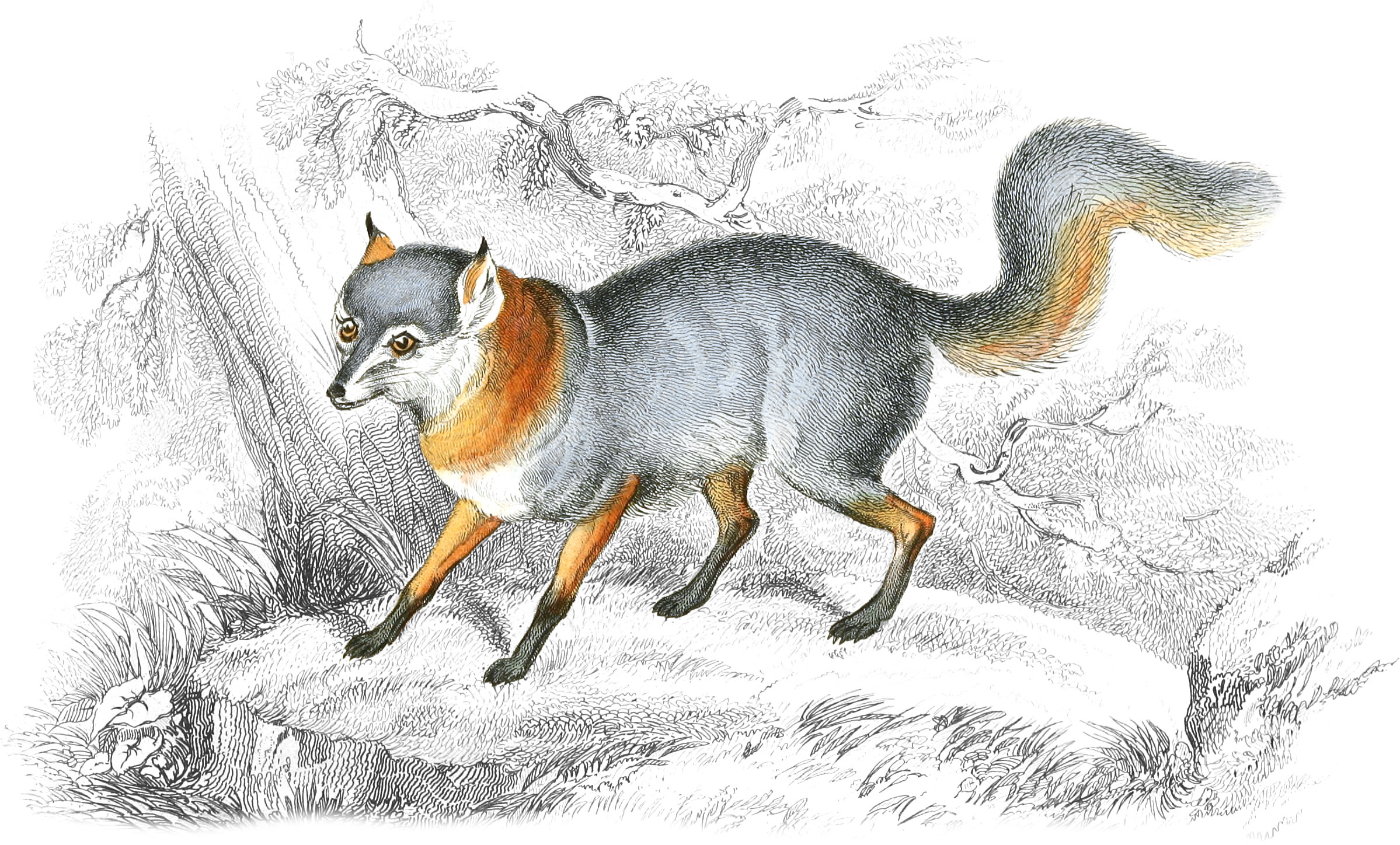
Plate XXIII
The Grey Fox
Vulpes cinereus
There are doubts respecting this animal’s existence it may be considered a variety of the foregoing, where the fulvous is altogether obliterated; but as the ideas regarding it depend upon Catesby’s figure, and we believe that figure is copied from the woodcut of the common fox in Gesner, it is probable that the colouring is from memory, and that, instead of being entirely of a silvery grey, the smaller details respecting the ears and feet, &c. were overlooked or forgotten. We have seen many skins of what might have been called grey foxes, but all were referrible to the tri-coloured, or the cross-fox. A stuffed fox, lately observed in a shop at Plymouth, and which we examined, may represent the cinereus; the specimen is of the ordinary size, densely furred, with the nose, forehead, temples, nape, shoulders, back, flanks, hams, and base of tail, of a uniform sepia and white-grey; the lips, cheeks, throat, and belly, pure white; the back of the ears, a crescent beneath the throat, bright fulvous; the upper arms, anterior edge of the thigh, and tail towards the tip, dull rufous, the tip itself black, and the feet sepia brown; but we are inclined to refer this to a variable fox, whose winter fur is white, and the tip of the tail alone black.

Plate XXII*
The Brant Fox
The Brant Fox of Pennsylvania, described by Pennant, belongs also to the races with a black tip to the tail. It is scarcely half the size of the common fox, with a black nose, the head much sharper than in that animal; the space round the eyes is ferruginous; the forehead and upper surface of the body black, mixed with red and ash colour, the ash colour predominating; the tail is black above, red beneath, and ash-coloured at the sides.
We conclude the notice of the foxes, by mentioning an animal of Iceland which may not be a canine; it is known on the spot by the name of Grastofur, and considered to be a fox, although it does not molest either lambs or ptarmigan, and feeds on the roots of grasses, on the angelica and other vegetable substances. Being harmless in habits, the inhabitants take no pains to hunt it, and the shepherds do not even allow their dogs to worry it.55
Sub-Genus IV. Agriodus56
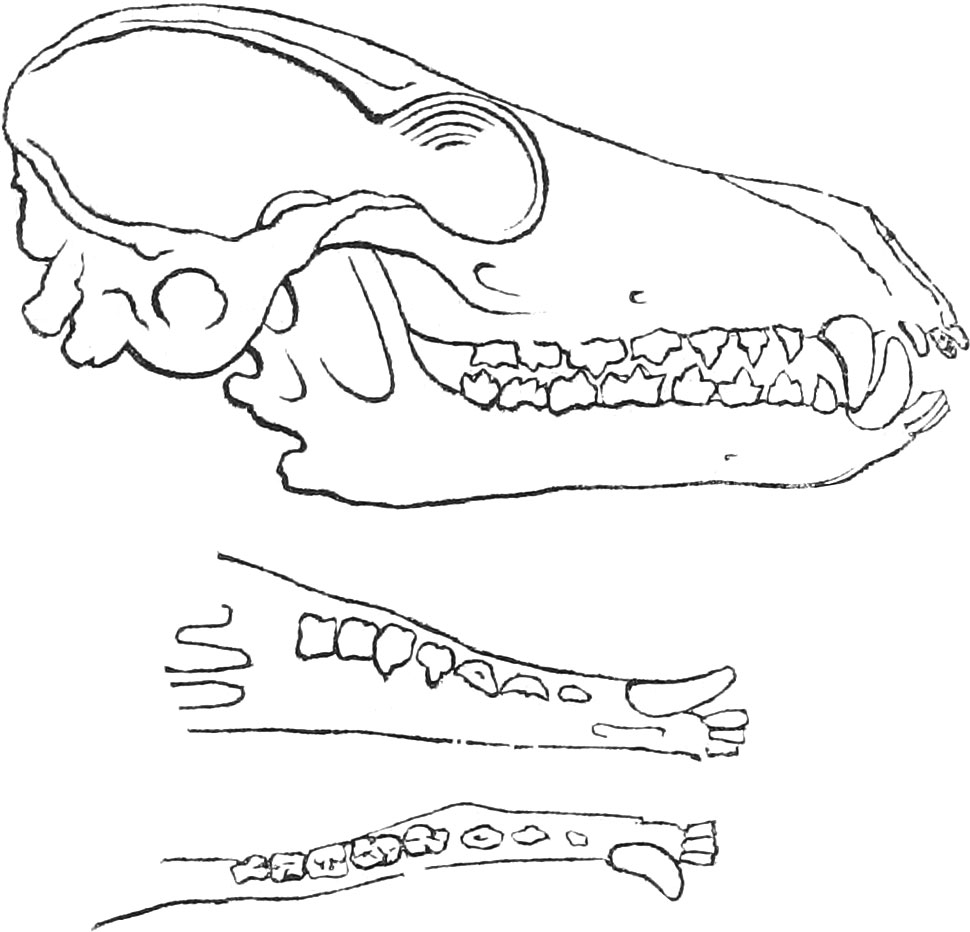
Agriodus skull from side jaw. Remarkable for an additional tooth in both jaws, not found in any other species of dog
Mr. Frederick Cuvier, commenting on the dentition of dogs, had already observed, that there are occasionally additional molars, or tubercular teeth, on one or the other sides of the jaws; but the animal forming the type of the present sub-genus, although in external appearance resembling a fox, and, in the great development of the ears, assimilating with the Megalotes, differs from both, and from all the known Canidæ, by having in the upper jaw seven molars, and in the lower eight; of these three are false molars, and four have the crown formed into real grinders; below, the false molars are four, then follows a small imperfect carnassier, and behind it three tubercular teeth; the canines are slender, and, along with the incisors, inclined forward. The skull has a long plane profile, is nearly destitute of an interparietal ridge, but marked with two broad temporal ridges, one on each side, extending from the post orbital process to the occiput, and run almost parallel to each other; one may be seen in the profile of the skull, above represented. The toes are in number, form, and position, as in foxes. The anomalous character of the teeth indicates the food of the Agriodus to differ considerably from that of other Canidæ, and no doubt the manners of the species are equally influenced by this conformation. These considerations induced us to prefer the name here assigned to the sub-genus to that of Megalotis, which Illiger originally bestowed upon the Fennecs, and which, in truth, expresses their preeminent distinction. The sub-genus Agriodus appears to be essentially Austral, or proper to the southern hemisphere, and at present it contains but one species,
Lalande’s Zerda
Agriodus auritus, Nob.; Megalotis Lalandii, Ham. Smith; Canis megalotis
First figured by us in Mr. Griffith’s edition of Cuvier’s “Animal Kingdom,” and then considered as a Megalotis. The animal seems to have been noticed by Sir John Barrow, but M. de Lalande first sent its spoils to Europe from the Cape of Good Hope. In size, the Agriodus is equal to an European fox: the ears are very broad, and little shorter than the head, open, erect, folded at the edges, and somewhat square in figure; they are whitish within, grey at the back, and edged with black, bordered by white on the inner surface; the head is round, the muzzle rather obtuse, blackish on the nose and cheeks; the forehead, neck, shoulders, and hams, dark slaty-grey, with a slight intermixture of buff; the throat and breast dirty whitish-grey; the limbs black; the tail nearly as long as that of a fox, and forming a brush little less dense, but coarser in texture, and in colour slaty-grey, paler beneath, and marked with three black spots on the upper surface, and a black tip. The manners of the species we are unacquainted with, but on reconsidering what we have stated of the Abyssinian Tokla, we suspect the A. auritus, or a second species of this sub-genus, may have been intended.
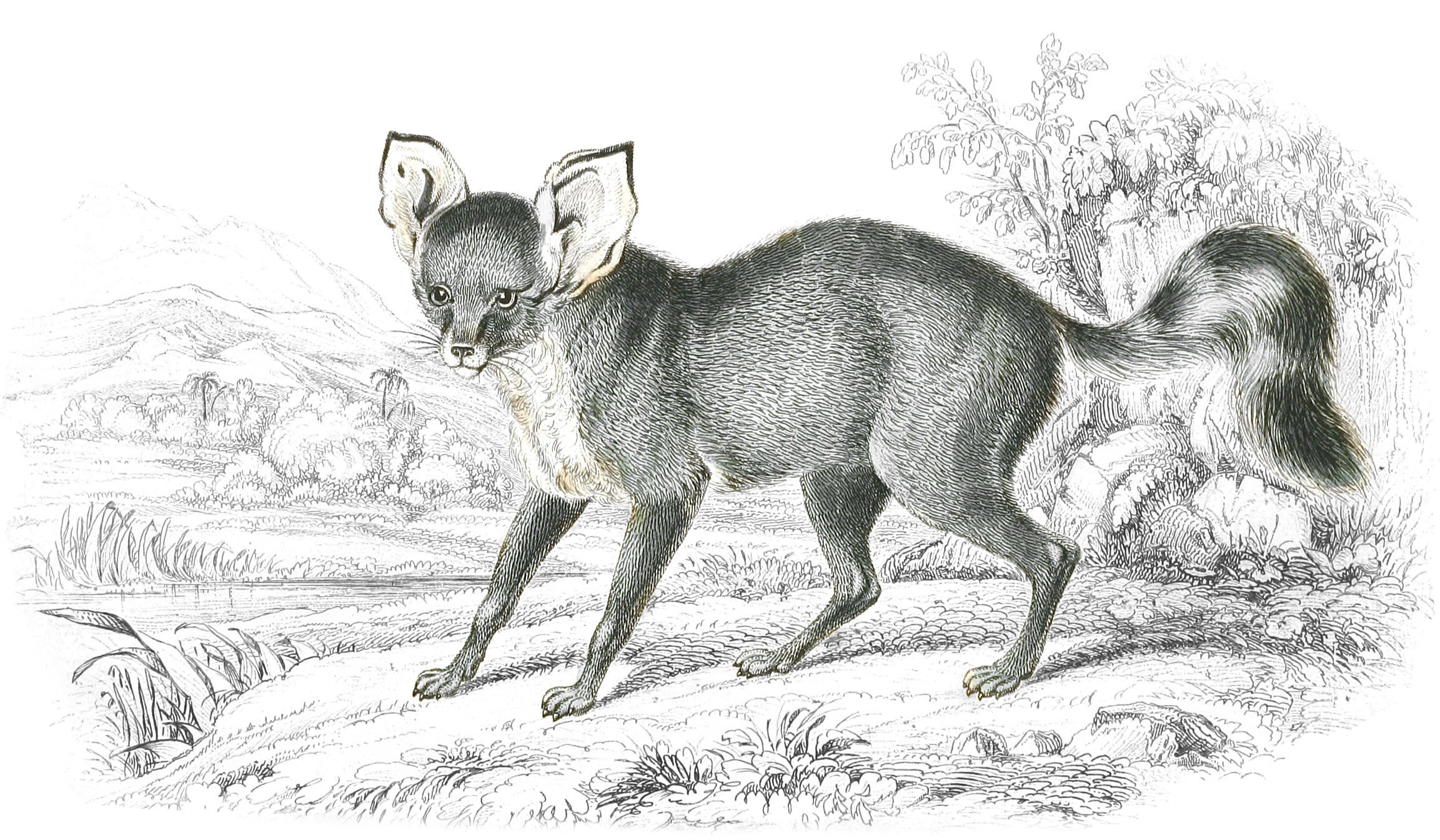
Plate XXIII*

Sub-Genus V. Lycaon
The Dutch colonists of the Cape of Good Hope having applied the name of wolf to the spotted and villous hyæna, found, that in the wilderness there were other animals like canines, and among them confounded the species which forms the type of the present subdivision under the name of “wilde honden,” and we designated by the name of Lycaon, from the time when the late Mr. Joshua Brooks, at our suggestion, adopted it in the arrangements of his Museum For, knowing that in the Caffrarian dialects, Likene denoted a dog, a wild canine, and finding the Lycaon of Ethiopia, in Solinus, described as an animal with a maned neck, and marked with many colours, while Pliny says the Lycaon changes colour; the first seemingly confounding the Lycaon pictus with a true hyæna, and the second indicating a beast of prey liable to change its fur in particular seasons, as this animal is known to do in Ethiopia, while both adopt that name of which the African form is still indigenous. We thought these notices, supported by the existence of the species on the Nile, sufficient warrant for making use of the above distinctive appellation. In describing the mastiff race, and in other paragraphs, we have likewise pointed out the probabilities that congeners, or immediately osculating species, existed, and possibly may still be found in Asia, nor are we completely satisfied that the Cape, the Nigritian, and the Ethiopic animals are all the same; but whether they be of one or several, their common characters are,—size, inferior to a mastiff; head short, truncated; mouth broad; dentition very strong, and similar to dogs, but with the central incisors somewhat displaced, and the cheek teeth more closely together; snout and muzzle black; ears large, rounded, erect; neck rather long and stiff; body short; limbs highest before, slender; tail short, pendulous, inflexible; four toes on all the feet; pupil of the eyes round; mammæ ten? fur short, close, marbled with black and white upon a white or buff ground; the throat black, and a streak of the same passing over the forehead to the nape.
These animals are gregarious, hunting in troops or packs, having an excellent scent and no less piercing sight; they are fleet in pursuit, active in springing, and scarcely stationary, roaming over a great surface of the country, equally familiar with the forest, the plain, and the mountain; they do not burrow, and extend over the whole of Africa south of the Zahara, and along the Nile, probably through a part of Arabia to the Euphrates, and even further eastward to the Indus; at least the mention of a spotted wild dog reported to exist in the southern mountains of Persia may refer to a Lycaon. The Marafeen of Ethiopia is, we think, the animal of Solinus before noticed, and the Taraffe of Madagascar, the Impompo of Sofala, Mebbia of Congo, and Maipu of some tribes of Caffraria. It is also to a Lycaon, or a congener, that the ancient name of panther is most applicable; and the canine tigers of Nearchus,57 the wild progenitors of the Indian race of spotted dogs, must refer to the Jungle Koola, described among the Lycisci, or to a species of the present form.
The Marafeen, we are told by an attentive and erudite observer58 (taking it to be the hyæna of Ethiopia), is figured in the sculptures of Egypt, and may be the Chaus of Pliny, “Effigie lupi, pardorum maculis.” He describes the animal as gregarious, not solitary, preying in preference upon asses, but when pressed by hunger devouring standing com and dourra, and the female often whelping in corn fields.
The Mebbia of Congo, in the travels of F. Zuchi, is described as a wild species of dogs resembling hounds, assembling in numbers of thirty or forty, hunting and attacking all kinds of quadrupeds.59 Bosman, under the name of Jackals of Commany and Aquambo, as tall or taller than sheep, having spotted coats, a large and flat head, and very long teeth and claws, and with powers to spring upon high walls, evidently alludes to the Lycaon; and the name itself, Mebbia, sounds as if it were an imitation of a frequent tremulous and jabbering voice, which we have heard the animal utter when expressing impatient desire.
The spotted wild dogs of the Cape were indistinctly noticed by Sparman, Viscount Querhouent, Vaillant, and others; but it was not until about the year 1814 or 1815 that a skin was brought to England from Western Africa, and we think first shown in Riddel’s Museum; soon after, Mr. Howitt made a drawing of a living specimen in the Exeter Change collection of Mr. Cross. We know not if this died, and the skin became the property of Mr. Bullock, but Mr. Temminck, at the time of the sale of the London Museum, purchased the specimen, which he first described under the name of Hyæna picta in the Mem. de l’Ac. de Bruxelles Annales Générales des Sciences Physiques. At that time there was another living in the possession of Mr. Burchel, which we saw often, and the late Joshua Brooks had then, or soon after, the individual upon which he established his genus Lycaon. Next, M. de Lalande brought a skin from the Cape, and about 1824, one or more were sent to the Frankfort Museum, by M. Ruppel, from Upper Egypt. Having taken notes of the living, and drawings of all the specimens here mentioned, it resulted from comparing them that they were congeners, and though all differed in their markings and distribution of colours, that they can hardly be distinguished as species; yet, when referring to the absolute canine characters ascertained by Zoologists, characters which the skins cannot afford, and in the living specimens were not accessible, we are somewhat surprised that their attitudes, movements, voice, and aspect, while alive, should be so singularly conformable with those of hyænas, and unlike the same in any species of true canines. It was from these that both Mr. Burchel, who kept the animal thirteen months in a stable-yard, and ourselves who repeatedly visited it, judged the affinity was more with the former than the latter; and although there be a rudiment of a fifth toe on the anterior carpus, the presence of two large and fœtid glands beneath the tail, and the doubtful question of the modus copulandi, still approximates them more to hyæna than M. Rüppel seems disposed to admit.
Lycaon Venaticus
Hyæna venatica, Burchel.
We shall describe the Cape variety first, because it was not only the first noticed, but its habits and manners are likewise best known. This animal is in stature equal to a tall greyhound, very high on the legs in proportion to the length, and from the hind quarters standing somewhat crouched it appears as if the fore legs were longest; the head is broad, flat; the muzzle rather short, truncated, with the under jaw very prominent; the ears large, oval, erect, black on the external surface, naked on the internal, and with a pencil of upright white hairs at the opening; the neck is straight, with the throat slightly maned, bearing the head, like in the hyæna, apparently stiff, and, when running, it seems to wag from side to side; the back straight; the haunches gathered up, and the tail held out with a sort of occasional convulsive shake at the extremity; the abdomen full; the limbs as slender as in the greyhound, bending with a great angle at the joints, and well covered with hair. The colour is all ochraceous, excepting some white on the breast, a spot on the neck, a second on the shoulders, a third on the loins, and a fourth at the crupper, all bound in a black edging; similar black wavy streaks on the shoulders, on the flanks, hams, joints, and middle of the tail, the end being white. The whole muzzle and cheeks black, the colour passing upwards between the eyes to the nape, and downwards on the throat, and a small white spot under each nostril on the front of the upper lip. Such were the markings of this individual: but that of M. de Lalande was distinguished by a considerable increase of the black spots, these extending in broad surfaces over the abdomen, and even on the toes.
The specimen was fastened to a long chain attached to a post. It ran with great lightness backwards and forwards, came boldly towards spectators, with the whimpering voice before noticed. His keeper never could venture within the gripe of the animal; and a dog given to it as a companion could indeed play with it, but as the chain only extended so far that they could meet, one step backwards placed it out of danger. It was a male.
According to Mr. Burchel, these Lycaontes hunt in packs both by day and night, committing at times considerable depredations on sheep, but attacking cattle only by surprise, and then invariably biting off their tails. Repeated attempts have been made by the Cape colonists to tame the young whelps occasionally taken or found abandoned, but always without success, their ferocity increasing with their growth, till it was found necessary to kill them.
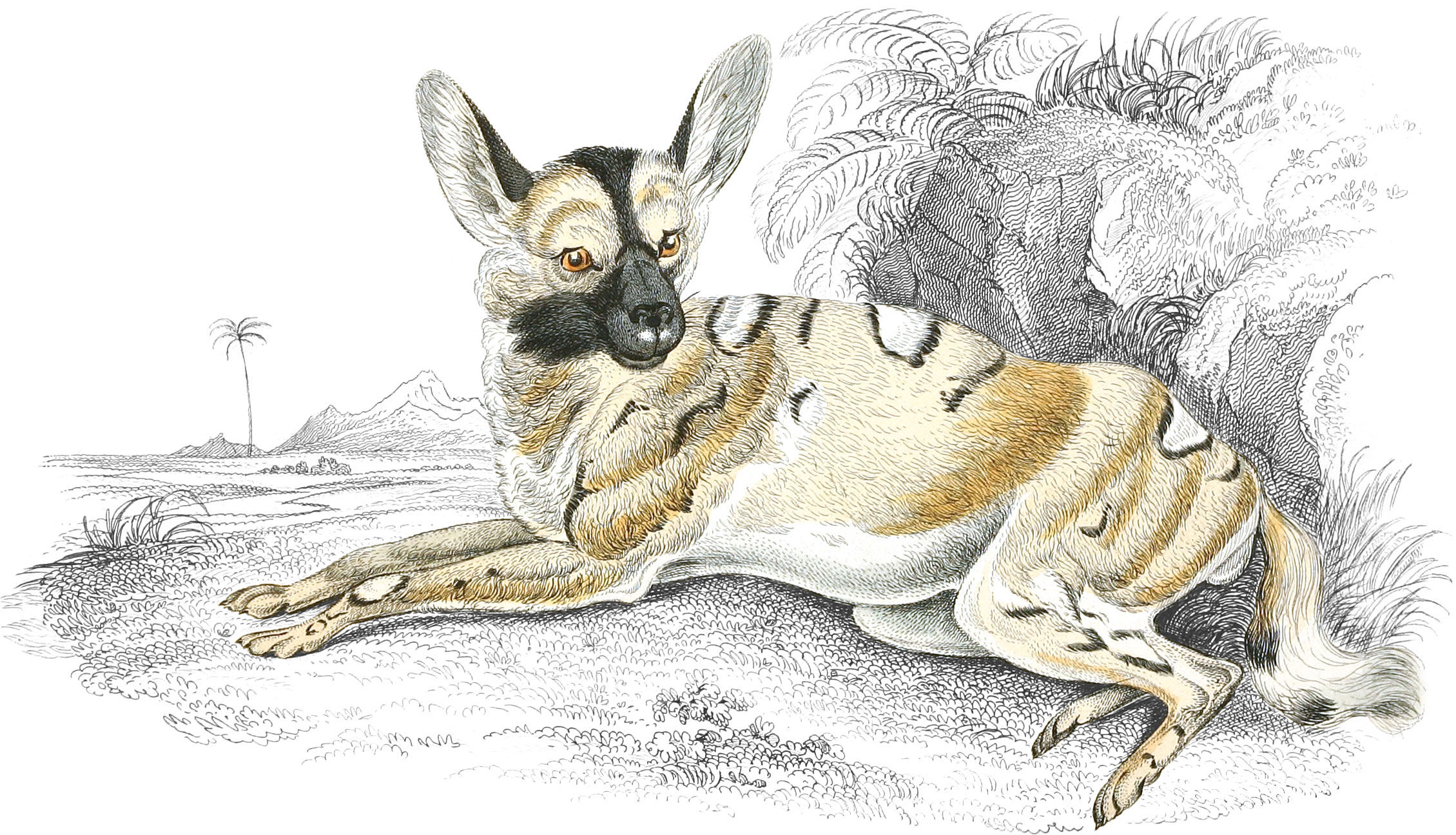
Plate XXIV

Lycaon pictus
Canis pictus, Temm.
Whether the painted Lycaon be distinct, or a variety of location and climate, for the sake of clearness we believe it best to describe it separately. This race is the Simir of Kordofan, and described by Rüppel as three feet two and a half inches long, the tail one foot three inches and three-fourths, the ears four inches eight lines, and the height at the shoulder one foot ten inches.
If the stuffed skin and published figure pourtray the outline of the living animal, the Simir would really represent a wild hound without the least approximation to the hyæna, so conspicuous in the Cape animal, and M. Rüppel seems never to have been struck by this appearance; consequently we might believe the Kordofan variety so far different, if we did not find the Marafeen, which we take to be the same, considered by the Arabs as an hyæna. In the present race the disposition of the colours varies as in the former, with every individual, excepting about the head, neck, and tip of the tail, where, as before, black occupies the muzzle to the eyes, a streak of it passes over the forehead to the nape, and from the under jaw forms another streak beneath the ears towards the shoulder; these marks are upon a pale tawny, which passes in clouds over the body and limbs, generally edged in with black: but on the Simir there appears a much greater proportion of white, particularly about the abdomen and limbs, than in the Cape race, and the white of the tail is always divided from the rufous at its base by a broad blackish space. This variety becomes hairless at the period of changing the fur, and when old, remains altogether naked. M. Rüppel encountered these animals in the wilderness of Korti and the deserts of Kordofan, where they hunt in packs, form ambushes in the vicinity of springs to surprise antelopes, and when pressed by hunger they will attack man, on which account they are feared by the natives.
The specimens we took for Mebbia (which are red canines) were two skins only; they appeared to indicate animals, in proportion, with larger bodies, shorter and much stronger legs; their fur well furnished, of similar colours, but with few insulated white spots edged with black, the white being without borders, and the black broad, indifferently passing on the white and the black, particularly upon the nape, across the rump, and obliquely over the shoulder; the abdomen rufous.
Genus II. Hyæna60
Although, in zoological arrangement, several other digitigrade Carnassiers may be interposed between the true Canidæ and the present group, we may, nevertheless, for our present purpose, be permitted to place them in juxta position, and by closing the volume with the genus Proteles, restore the links of the chain to the Viverrine family of Civets and Ryzasnas.
The hyænas, according to the system of Linnæus, were included in his genus Canis, but they differ widely in many respects from the more strictly considered Canidæ. They form a group of species singularly coarse and ferocious in character, with sanguinary and revolting habits, with constitutions seemingly capable of resisting the extremes of temperatures, the most noxious states of the atmosphere, and adapted to gorge on the grossest animal sub- stances, prey, dead or alive, fresh or corrupted, great and small, being alike devoured by them. If the genus be now comparatively not numerous, and confined at present to regions within or near the torrid zone, there was a period, in the intermediate time of the existence of organised beings, when the hyæna appears to have been universally spread over the great surface of the old world; for, although the debris of great felinæ, and of bears, are likewise discovered in the deluvian strata and caverns of our present period, they bear no comparison, in point of numbers or extent, to the immense quantity of fossil remains of hyænas (H. spelea) spread through the earth, from Great Britain to Tibet, as if they had been appointed almost the sole consumers of mastodons, elephants, tapirs, and the great ruminantia of that period; the marks of their teeth being still found upon the bones. These antique hyænas do not however exhibit in their remains proportions much surpassing the present, they scarcely exceed the larger races now occupying Africa, and to that quarter of the world, in the present zoological distribution, their centre of existence seems to have been originally confined. The extension of their habitat to the high mountains of Central Asia and to the Bosphorus, may be a result of gradual progress in following the march of armies and caravans: it is a consequence of their ability to sustain heats, droughts, and all the various privations of the wilderness, and being provided with a temperament the most enduring, a hide peculiarly hard, with jaws and teeth of such strength that they break the shin bone of an ox with the utmost facility, and, moreover, acting often in concert, they dread neither the presence of the lion or the tiger, and stand in awe of man only in the day-time. Their structure is equally repulsive: with a large truncated head set on a protruded and stiff neck, with high fore legs, a short body, and low hind quarters, a long bristly mane ranging from the nape to the tail, and that organ itself short and ill-formed, a wallowing gait, great personal uncleanness, and a horrible voice no beast of the forest offers a more disgusting or frightful aspect! Nor is this impression diminished by their malignant eyes in the day light, when the pupil assumes an elliptical form above and a rounded below, nor in the dark, when it gleams like burning sulphur: the very ornaments of dark stripes or spots upon their fur add to our dislike, and the offensive odours of their carrion breath, with exhalations from the glandular pouch beneath the tail, complete the character. By nature they are the scavengers of the desert, the forest, and of the sandy beach, feeding on dead carcases of elephants or whales; prone to attack horses, asses, and domestic cattle; devouring dogs, seizing isolated camels, sometimes filling their stomachs with farinaceous vegetables, but always solicitous to roam in burying places, and dig out the dead.61 All these qualities combined, were the cause of the mysterious and awful opinions the ancients promulgated respecting the hyæna. They were taught to believe that the species was hermaphrodite, and changed sex at stated periods, being alternately the hyæna or the trochus. That to deceive mankind they could imitate the human voice: and in Abyssinia it is still averred, that a caste of iron-smelters and smiths possess the mysterious power of changing their persons into the aspect of hyænas, and perpetrate all the demon wonders that were formerly ascribed in Europe to the Wehr wolf! Hence the hyæna is the Dub, Dubbah, Dabah, Zabah, &c. of the Semitic nations, all denoting a dark and sinister being. Possessed of the most powerful teeth, it requires dogs of no ordinary courage to grapple with them in the chase, and if their speed was great, they would seldom fail escaping into cover: for woe to him who unarmed ventures to arrest them in front. A near relative of ours unthinkingly intercepted one in his flight towards a jungle, but the animal immediately sprang at his horse, pulled it down by the nose, and before the rider could recover, passed on and escaped. They burrow in jackal-earths, or occupy caverns in certain seasons; but, in general, little affected by the sun, they prowl upon the desert, sometimes scratching the sand up for a slight shelter. Their ferocity is not entirely untameable: we have seen the spotted species actually pleased with caresses. In the French collection at the Jardin des Plantes, another of the same species was familiar with her keeper, but capriciously hostile to other persons. Sir J. Barrow, in his journey, says even, that it had been tamed in the district of the Sneeuw bergen, where it was considered more serviceable for the chase than the dog, and fully equal to that animal in courage and fidelity. We suspect the assertion here made refers to the Lycaon venaticus, and that the results were magnified by the traveller’s informant.
So little was the form of these animals understood when the older Zoologists published their writings, that the most fanciful figures were invented and engraved in their works, all intended to pourtray the descriptions of the ancients, although Busbequius and Kæmpfer had fully recognised it in Gesner, who, without being aware of the identity, or misled by Belon, gave one, by no means ill executed, under the name of Lupus marinus.
The distinctive characters of the genus, in addition to those already enumerated, are: incisors \(\frac{6}{6}\), canines \(\frac{1-1}{1-1}\), molars \(\frac{5-5}{4-4}\), = 34; the inferior incisors on a single line, canines exceedingly strong; the superior cheek-teeth on each side three, conical, blunt, large false molars, one enormous carnassier outwards tricuspidate, on the inside forwards with a small tubercle,—and a tuberculous tooth the inferior cheek-teeth similarly formed, but with the tuberculous wanting, the carnassier bicuspidate, and no tubercular process. The tongue is covered with horny papillae; the eyes with irides vertical above and circular below; the ears long, pointed, very open, erect; all the feet four-toed, with strong but not retractile claws fit for digging; after-quarter lower than the shoulders, and depressed; glandulous pouch beneath the tail; tail short, little moveable; mammæ only four. Hyænas exist in every part of Africa, and of Southern and Middle Asia, from the Bosphorus through Persia, on the south of the Himalayas to the west bank of the Burhampootra, but not farther to the east, according to Mr. Crawfurd.62 The most common in Africa is
The Spotted Hyæna
Hyæna crocuta
This species is little inferior in size to the largest striped hyænas. A specimen now in the Plymouth Museum measures from the nose to the tail four feet seven inches, and including the tail five feet eight inches; the head alone is eleven and a half inches. As these animals stand in height at the shoulder about half their total length, we may estimate the stature at above thirty inches: dimensions nearly equal to the largest hyænas of Abyssinia. The byname of Capensis given to this species by Desmarets, after Erxleben had already promulgated that of Crocuta, appears to be the more improper, because the species extends to Guinea, and on the east coast to the northward of Zofala. In form this species greatly resembles the striped hyæna, but the head is broader and flatter, the muzzle fuller, and the eyes still nearer the nose; the mane is not long or very remarkable, and the general colour is a dirty ochry-grey, marked with small round spots of a brown colour, and not very abundant; the muzzle, up to the eyes, and the lower limbs are sooty; the interior face of the limbs dirty white; and the tail and terminal tuft are without spots, and dark.
This species does not burrow, but readily occupies earths made by other animals, or retreats into caverns or other places for shelter: it moves little by day, but quests in the darkest nights, and then will enter farms, and even the streets of towns, to satiate its hunger.
In Baron Cuvier’s Recherches sur les Ossemens Fossiles d’Hyænes, mention is made of a rufous hyæna (H. rufa), but the notice contains only the remark that it is spotted like the Crocuta; instead of brown upon a greyish ground, the colours are black upon rufous, and the ears, equalling those of the striped hyæna, are ashy.

Plate XXV
The Striped Hyæna
H. vulgaris, Desm.
No less remarkable for similar ferocious qualities with the last mentioned, is, with slight variety of form, stature, and colours, spread over the whole of Southern Asia as far as the east of Bengal, and Northern Africa to Morocco and Abyssinia. The largest variety is
The Hyæna of Atbara
Hyæna vulgaris, Var., Bruce.
The Canis hyænomelas of earlier Zoologists.
The total length of one measured by Bruce was five feet nine inches to the tail, and the height at the shoulder three feet seven inches. The fur is but slightly lined by a woolly under-coat, and the upper is long, rank, and coarse, from the nape to the tail, not particularly abundant on the neck and flanks, and very long and stiff, in the form of a mane along the ridge of the back. The specimen we saw was smaller, although a large animal, entirely of a dirty ochraceous colour, transversely barred with several blackish steaks, the broadest on the shoulders and hams; the tail, forming a scanty brush about ten inches long, was dark at the base and white at the tip; the face covered with short hair, sooty from the nose to the eyes; and the limbs, similarly covered, had numerous blackish rings upon them; the ears broad and long are pointed, and dark on the outside.
There is reason to believe this variety to be the crocuta of the ancients, whose jaws were filled with one continued tooth, and notwithstanding the powers possessed by it, Bruce relates no facts to show there is much disposition to attack mankind, but, on the contrary, proves that it roamed about with the precautions of a thieving jackal. We figure this variety from the specimens sent to Frankfort by M. Rüppel.
Plate XXVI
The Hyæna of Persia and India
The Hyæna of Persia and India (Kaftaar and Ploondar of these countries) is not larger than a powerful dog; it has the snout fuller and shorter than the former, the ears in proportion larger, and equally pointed. They are of a dull purple, the long hair more abundant, and the colour a dirty whitish with black bars. The same variety, under the name of Dubbah, is found in Arabia and Syria the Turks name it Dabba.
Another, evidently of this race, is
The Naked Hyæna of the Deserts of Nubia
Hyæna vulgaris
This race is small and gaunt, entirely destitute of hair, excepting the mane on the ridge of the neck and back. The bare skin is of a purplish black, the body is short, and the tip of the tail is furnished with a small brush.
Plate XXVII
A fourth variety is
The Brown Hyæna
Hyæna fusca
Of the Paris Museum.
This race is in size rather higher than a large dog, but proportionally shorter of body. In form it is similar to the first, but the muzzle is buff with, a black ridge on the nose; the sides scantily supplied with very coarse long hair of an ashy buff colour, show indistinct bars broader and more obliterated than in the former, and the mane on the back is entirely of a dark sepia colour; the tail is long and dark. We suspect this animal to be the Faadh of Shaw: but if this be the case, it is singular that the residence of this variety should not have been recognised by the French naturalists, for the specimen is without an habitat. It may be questioned whether this animal is not more nearly allied to the next.

Plate XXVIII
The Strand Hyæna
Hyæna villosa, Smith.
Strand Wolf, Strand Jut of the Dutch colonists at the Cape, is a distinct species, in nonage alone resembling the common, and from that circumstance formerly mistaken for it. This animal is however considerably smaller, measuring only about four feet from the nose to the end of the tail, and two feet four inches in height at the shoulder. The back forms the usual inclined plane of other hyænas; the fore quarters are also, as in others, more robust; the forehead is deep, slightly convex, and the nose is similarly curved and truncated, the whole head being covered with short rigid hair of black, white, and reddish brown colours, forming a kind of grizzle; the irides are dark brown, the pupils vertical, sometimes linear, sometimes oval; the ears are erect, pointed, rather long, covered on both sides with reddish white down, with a white tuft of hair in the opening; the chin and sides of the lips blackish the upper part of the throat black; fasciculi of long dark hairs issue from several warty centres on the sides of the cheeks and over the eyes; the hair of the neck is long and shaggy; the sides of the neck to the shoulders are dirty yellow, and the breast and inner surface of the limbs paler dirty yellow from the occiput along the back and upon the sides the colour is dirty tawny grey, with a great number of irregular blackish spots or oblique stripes, sometimes nearly effacing the lighter colours; the base of the tail dirty tawny, more whitish towards the tip; the outside of the limbs are whitish, with a number of narrow blackish half rings.
This species, less powerful than the H. crocuta, is less dangerous to mankind and to large cattle, devouring only sheep and smaller animals. In manners it is treacherous and exceedingly mistrustful, slothful by day, but active in the night, rejoicing in rain, licking the blood and rolling over the body of his prey, concealing the superfluous parts; fond of appropriating every thing in his reach and carrying It to his retreat; often preferring bones to flesh, breaking them small and licking out the marrow, extruding a fatty substance by rubbing the nates against wood or stone, and then licking it up, particularly after every meal. These are habits which were observed by Dr. Smith upon one he kept in confinement.

Plate XXIX
Genus III. Proteles
This genus is as yet very imperfectly known, but forms an intermediate link between hyænas and viverras, by the fore legs with five toes (the fifth being short and placed high), and the head narrowed and more pointed, approximating the Civets; by the high and slender legs, resembling dogs; and by the mane on the neck and back, the short hard brush, and even by the stripes on the body, indicating an alliance with hyænas. The dentition is not as yet fully known, because the specimen observed had only three small false molars, and a diminutive tubercular back molar, as if in this case the teeth had not come to perfection, as often happens with Civets. The only species known is
The Proteles Lalandii
Isidor. Geoff., Viverra hyænoides, Cuv.
The individual was shot by M. de Lalande during his travels in Caffraria. The skull represented an intermediate form between a dog and a Civet; the molars of the upper jaw, four on each side, were small, the three first having only a single point, and the fourth being a small tubercular tooth; below there were only three cheek-teeth, the first with a single point, the two others, one with a point and a small process, and the other with two points and a process. The form of the animal was that of a diminutive hyæna, with a small head and long legs; the nose resembled a dog’s; the fore feet had five toes and the hind feet four; the colour was a yellow ashy grey, with six or seven black bands passing obliquely down the body, and three smaller on the shoulder; the tail a brush of dark hairs, and black mane on the back. In weight this animal does not exceed a common fox. All that is known of its manners is, that it frequents clefts of rocks.
Herewith we terminate the history of digitigrade carnassiers belonging to the canine family or allied genera, without including in the series the new genus Cynictis, lately established by Mr. Ogilby: for although it appears, from the short notices published respecting two species, that they range between the dogs and Civets, and are intermediate between Proteles and Ryzena, not having personally examined specimens, we are uncertain, but believe it belongs to the elongated group, and therefore should stand at the head of the Viverrine genera.
In conclusion, we may be permitted to remind the reader, that in the groups before described, specific names have been bestowed upon several animals which may prove to be only varieties or races of species, because, while the limits of what constitutes a species remain unsettled, it was judged, in doubtful cases, preferable to point them out under distinct appellations, rather than leave their indications mixed up with others under some common name, often found to conceal more than one species. In this manner, the objects are at least presented to the naturalist in a form that provokes his attention and invites comparison, whereas in the more generalised practice whole groups are liable to escape detection under the name of one alone. We hope likewise to have rendered a service to science by the application of distinctive names to groups, because by their means are avoided the polynomic designations which hitherto were necessarily adopted, without producing a prima facie idea of the animal, or even of the group to which it belongs.
These conclusions are not the result of hasty conviction, as it is forty years since we first commenced to collect the materials upon which they are based.

Plate XXX

Postscript
Since the first part of the Work went to press, we have been enabled, through the liberality of Mr. Warwick, of the Royal Surrey Zoological Gardens, to make a drawing and take notes from a skin of the wild dog of Sumatra, from which it appears that there is in several respects considerable difference between that and the living individual described by the late General Hardwicke. This skin being three feet two inches from nose to tail, of which the head alone measuring nearly ten inches, shows an animal double the bulk of the living specimen, although the height at the shoulder cannot have exceeded seventeen inches, while the other was fourteen, and therefore in form it must have resembled Chryeus primævus: its colour was entirely of a bright rufous orange, below passing into reddish-white; the lips and throat very pale; the legs strong and deep red, no additional toe on the hind feet; the eyes oblique, rather near the muzzle; the dentition not powerful, but the after teeth in the skin were not visible; the tip of the tail black and the claws brown, strong, and worn; the pads of the toes full and naked, the rest of the feet furred: it was a female; the mammæ not visible. This species is therefore nearly allied to the Dholes and wild Pariahs of India.
We wish to add also, that we have lately learned, through information obtained from a Portuguese officer who had visited the interior of Congo, that the Mebbia, by us noticed along with Lycaon, should be classed along with the Chrysean group, having, we are assured, a close red fur, a strong body, and low legs.
We may also observe, that the wild dog of Kemaun, seen by Bishop Heber, appears to be the same as Chryseus primævus, and that we see no reason to make any material modification in our views respecting the dogs of antiquity, since we have met with Mr. Wilkinson’s admirable work on the manners and customs of the ancient Egyptians; but it may be advisable to remark on our note in Vol. I., respecting the Sheeb, that this active and careful observer merely learned that the Sheeb had a round head and shaggy neck; and mentions also the Aboo-mungar, which the Arabs described to be a Carnassier, with a pointed nose like a wolf, springing like a leopard, or rather like a dog, and attacking cattle. These and several other notices of little known species, attest the necessity of attentive and particular descriptions, and are evidence of how much there remains to be done, even in the confined field of Canine animals.
Synopsis of the Canidæ
Including the Genera Canis, Hyæna, anad Protoles of Authors
Canidæ
Dentary Formula.—Incis. \(\frac{6}{6}\), canine \(\frac{1-1}{1-1}\), cheek-teeth \(\frac{6-6}{7-7}\), = 42. Muzzle in general elongated; nostrils naked, lunular, open at the sides; tongue soft; ears of all the wild species erect; feet anterior pentadactylous, posterior tetradactylous; walk on the toes; mammæ both pectoral and ventral.
Diurnal Canidæ with Round Pupils
Sub-Genus I.—Chaon
-
Section I.—Lupus. The Wolves. Lupus, Gesn.; Canis lupus, Linn.—Head broad; muzzle pointed; eyes distant, oblique, small, malignant; ears erect, broad, pointed; legs strong; shoulder higher than croup; tail long, with a scanty brush tipt with black; fur shaggy on the neck, coarse on the body, but short; dark streak across the carpus; ten mammæ; voice howling; stature at the shoulder thirty inches. Inhabit the northern hemisphere from the Polar Seas to Central China, and the Crishna in India, Northern Persia, Natolia, Europe, Morocco? in America to the Isthmus of Panama.
- Lupus vulgaris. Nob., Can. lupus, Auct., the Common Wolf; Lupus vulgaris of America.
- L. lycaon, Auct., the Black Wolf.
- L. nubilus? the Dusky Wolf; Canis variegatus, Wied.
- L. Mexicanus, the Mexican Wolf.
-
Section II.—Lyciscus. Head broad, more arched, muzzle pointed; eyes more approximate, less oblique; ears erect, pointed; shoulder and croup equal; fur short; tail bushy, tipt white; disposition more placable; stature about twenty-six inches; voice barking and howling; burrows; gregarious.
- L. latrans, the Prairie Wolf of North America.
- L. cagottis, the Coyotl of Mexico; Loupdo Mexique, Cuv.
- L. tigris, Nob., the Jungle Koola.
-
Section III.—Chryseus. Head broad, muzzle less pointed, forehead rounder, ears erect, triangular; eyes less oblique; body long; fur short; tail straight, with small, or scarcely any brush; colour fulvous; from muzzle to eyes, with the feet darker shy, fierce, placable; seldom burrow; hunt in troops; bark; .stature twenty-four inches, and less; mammæ eight? Inhabit the warmer parts of Asia, Africa, and the islands of Australia.
- Chryseus primævus, the Buansu; Canis primævus, Hodg.
- C. Duklunemis, the Kolsun; Canis Dukhunensis, Sykes; the Beluel of Avicenna.
- C. scylax. Nob., the Dhole.
- C. Ceylonicus, Canis Ceylonicus, Bodd. [The above four have the second tubercular tooth of lower maxilla wanting.]
- C. paharuth, the Wild Pariah Dog.
- C. Javanicus, Canis Javanicus, Desm.
- C. Sumatrensis, Canis Sumatrensis, Hardw.
- C Australiæ, the Dingo.
- …………………Mebbia of Congo?
-
Section IV.—Thous. Form of wolves on a small scale, not more than eighteen inches high; structure very light; tail rather short, forming a scanty brush, tip black; fur close, hard; very mostly chequered, or pencilled with black and white, extremities buff; are not gregarious; do not burrow; have no offensive smell; howl seldom; mammæ eight? Inhabit Africa and South-western Asia.
- Thous anthis, Canis Anthus, Cuv.; Deeb of the Arabs.
- T. variegatus, Canis variegatus, Ruppel; Abu Schom of Arabs.
- T. mezomelas, Canis Mesomelas, Auct.; Bonte Vos of the Cape.
- T. Senegalensis, Chaeal de Senegal, Cuv.
- T. Tokla, Nob.; Tulki of the Persians.
- T. acmon, Nob.; Wild Dog of Natolia, or Great Jackal.
-
Section V.—Sacalius, the Jackals. Forms of the fox, with the head of dogs; stature not exceeding fifteen inches, body longer, ears pointed; fur rather coarse; livery fulvous-yellow, grizzled with white or black; tail bushy, straight; odour offensive; burrow; gregarious; familiar; howl excessively; mammæ six? Inhabit Southern India, Western Asia, Africa, Eastern Europe.
- Sacalius aureus, the Common Jackal; Canis aureus, Briss.
- S. Syriacus, Canis Syriacus, Hemprich and Ehrenberg; Syrian Jackal, the Grey Jackal.
- S. Barbarus, the Barbary Jackal; Canis Barbarus, Shaw.
- S. Indicus, the Indian Jackal.
- S.? procyonoides, Canis procyonoides; Racoon-faced Dog, Gray.
-
Section VI.—Cynalopex, Day Foxes. Form small, elegant; tail long, strait, forming a brush, tip black; fur close, fine; conch of the ears open, the tip pointed; livery yellowish and liver-coloured greys; teeth showing insectivorous propensities; soles of the feet furred? black spot on the base of tail concealing a gland. Inhabits the plains of Tartary, India, and Western Asia.
- Cynalopex corsac, Canis corsac.
- C. kokree, Canis kokree, Sykes.
- C. chrysurus, Canis chrysurus; Fulvous-tailed Dog, Gray.
- C. pallidus, Canis pallidus, Ruppel; Abu Hosein of Arabs.
- C. Turdcus? Renard Turc; Tilki of the Turks.
-
Section VII.—Megalotis, the Fennecs or Zerdas, the smallest of the canine family. Ears very large, broad, erect, double folded; auricular organs much enlarged; skull convex, no central ridge; feet furred; tail bushy, spot at base, and tip black; eyes diurnal; mammæ six? jaws weak; teeth insectivorous; burrow; not gregarious. Inhabit Africa.
- M. famelicus, Canis famelicus, Cretzschmar; Sabora of Arabs.
- M. caama, Canis vulpes caama, Smith.
- M. zerda, Fennec of Bruce; Zerda, or Durda.
Canidæ of South America.—All, it seems, with a tendency to elliptical pupils, but none perfectly as in true foxes. Dentition invariably less powerful.
-
Section VIII.—Chrysocyon, Aguara Wolf. Stature nearly equal to the wolf; head smaller; legs long, slender: mane on neck and shoulders; tail straight, bushy; pupils round? mammæ six. Habits subdiurnal and nocturnal; solitary, campestral.
- Chrysocyon jubatus, Canis jubatus, Desm.; Canis campestris, Wied.; Aguara Guazu, Maned Aguara.
-
Section IX.—Dusicyon, Aguara Dogs. Forms between the wolf and fox; body bulky; legs short; tail medial, tip white; eyes oblique, pupils round? burrow; more social, more placable; eat fish, crabs, birds, &c.; swim well; subdiurnal.
- Dusicyon canescens, Nob., Hoary Aguara Dog; Canis Thous? Linn.
- D. Antarcticus, C. Antarcticus, Auct.; Falkland Island Aguara.
- D. silvestris. Nob., Aguara of the Woods; Chien des bois.
- D. fulvipes, Vulpes fulvipes, Martin; Culpew molina.
-
Section X.—Cerdocyon, Aguara Foxes. Form of foxes: very large brushes; rather low on the legs; nose very pointed; pupils vertically contractile with difficulty; fur soft, abundant; livery mixtures of greys, buff, white, and black tip of tail black; subnocturnal; placable.
- Cerdonjon mesoleucus.
- C. Guaraxa.
- C. Azaræ, C. eancrivorous is the young.
- C. Magellanicus.
All the foregoing sections present species more or less liable to intermix with domestic dogs.
Sub-Genus II.—Canis
Dogs Properly So Called
Muzzle greatly varied; ears pointed or rounded, and pendulous; eyes horizontal, full, prominent, pupils always round; tail never reaching to the ground, in general bent upwards; fur long or short; livery of all colours, with tendency to form spots; mammæ varying from ten to six. Several of the varieties in all the groups partake of two distinct races nearly in an equal degree, and others bear marks of three races. Feet in some partially webbed, in others with a fifth toe and claw on the hind legs as well as the fore; voice barking, capable of very varied expression; intellectual instinct variously developed; domesticity voluntary.
Canes Feri. Feral Dogs. In general assuming external appearance between the wolf and cur dog.
- Canis ictmus? Feral dog of Natolia.
- C. fossor, Feral dog of Russia.
- C. Haitensis, Feral dog of St. Domingo.
- C. campivagus, Feral dog of the Pampas.
Canes Familiares. Familiar Dogs. Heads elongated, parietals shelving towards each other, the lower jaw on the same line with the upper molars. Inhabited originally the northern and temperate zones north of the Equator.
-
Section I.—Canes Lachnei. The Wolf Dogs. Densely clothed with long hair: originally all with pointed ears. Inhabit nearest the Arctic Circle in both continents; sagacious, laborious stature large; livery in general white and black.
- Canis Sibiricus, The Siberian Dog; Koslia of the natives.
- C. borealis, Esquimaux Dog.
- C. Islandicus, Iceland clog, Fiaar hunt.
- C. lagopus, Hare Indian Dog. [The last three appear to have an Aguara origin, mixed with wolf.]
- C. Terræ Novæ, Newfoundland Dog.
- C. laniger, Nootka Dog.
- C. Alco, The Alco; Goschis.
- C domesticus, The Sheep-dog.
- The Wolf-dog (great).
- The Calabrian Dog.
- The Alpine St. Bernard Dog.
- C. Pomeranus, The Pomeranian Dog.
-
Section II.—Canes Laniarii. The Watch and Cattle Dogs. Skulls very like the former; stature mostly large, some very large; fur short; instinct of watching; hunt; bold; moderate sagacity; moderate powers of smelling; not very docile: ears erect or partly turned down. Inhabited originally the temperate zone of the northern hemisphere.
- Canis, Turkman Watch-dog.
- C. Suillus, Suliot Watch and Boar-hound.
- Molossian Dog.
- C. glaucus, The Danish Dog.
- C. laniarius, The Matin Dog.
- The Cattle Dor of Cuba.
- The Primitive Lurcher.
- The Native Indian Carrier-dog.
- The Teehichi.
- The Wolf-dog of the Floridas.
- The Dog of the North American Indians.
-
Section III.—Canes Venatici, Grayii. The Greyhounds. Skulls like the former, but the plane of the head more rectilinear; stature high, chest deep; loins arched; abdomen drawn up; tail long, slender, in the original breeds only fringed ears small, pointed, mostly turned back and down; small powers of scent; little sagacity; little personal attachment; great swiftness; hunt by the sight; livery black, white, and slaty. Inhabited originally the temperate and warm zones of the northern hemisphere in the old world, to the tropics.
-
Races with long Fur.
- The Brinjaree Dog of India.
- The Persian Greyhound.
- The Arabian Bedoueen.
- Canis hirsatus, The Russian and Tartar Greyhound.
- C. Sadicus, The Scottish Greyhound.
- C. Hibernicus, The Irish Hound (largest of all).
- C. Graius, The Greek Greyhound.
-
Races with smooth Fur.
- The Turkish Long-eared.
- The Egyptian Smooth Greyhound.
- The Bedoueen Aeaba Greyhound.
- Canis Italicus, The Italian Greyhound.
- C. leporarius, The British Greyhound.
-
Mongrel Races.
- Canis vertagus, The present Lurcher.
- The Egyptian Street-dog.
- The Hairless Dog.
- The Turkish Naked Dog.
-
Races with long Fur.
-
Section IV.—Canes Sagaces. The Hounds. Skull moderately elongated, parietals not approximating, but expanding, admitting a larger development of brain; ears rounded, pendulous; great olfactory power; great sagacity; middle stature, strong and elastically shaped; tail turned up livery white and brown in spots, or white and black. Inhabit temperate regions of the old continent.
-
Races with short Fur.
- Canis sanguvtarius, The Blood-hound.
- The Oriental Hound.
- The Talbot.
- The old Southern Hound.
- The Stag-hound.
- The Fox-hound.
- The Harrier.
- The Beagle.
- The Turnspit.
- The Burgos.
- The Dalmatian, or Coach-dog.
- C. avicularius, The Pointer.
-
Races with longer Fur.
- Canis index, The Setter.
- C. extrarius The Spaniel.
- The Springer.
- King Charles’s Spaniel.
- The Cocker.
- The Blenheim.
- C. Melitensis, The Maltese.
- C. auquaticus, The Water-dog, or Poodle.
- The little Barbet.
- The Griffon.
- The Lion Dog.
-
Races with short Fur.
-
Section V.—Canes Domesticii, The Cur Dogs. Head round, muzzle pointed, eyes large, prominent, ears erect; stature below the middle size sagacious, watchful, noisy; generally debased: appear to descend from three distinct species. Inhabited originally,
-
the temperate western regions of the old continent;
- Canis terrarius, The Terrier.
-
warm and tropical regions of the old continent
- The Pariah of India.
- The Poe Doh of the Pacific Islands.
- The New Zealand Dog.
-
the temperate and cold latitudes of South America.
- The Patagonian Dog.
- The Terra del Fuego Dog.
-
the temperate western regions of the old continent;
-
Section VI.—Canes Urcani. The Mastiffs. Muzzle truncated, cranium elevated, frontal sinus large; condyles of the lower jaw above the line of the upper molars; mouth rounder in front head large; ears small, partially drooping; neck and loins strong; legs strong; tail carried erect structure powerful. Inhabited originally high mountain ranges, and the more temperate regions of the northern hemisphere on the old continent.
- Canis urcanus, The Mastiff of Tibet.
- The English Mastiff.
- The Cuba Mastiff.
- C Anglicus, The Bull-dog.
- The Bull-terrier.
- The Pug-dog.
- C. fricator, The Roquet.
- The little Danish Dog.
- The Artois Mongrel.
- The Alieant Dog.
Sub-Genus III.—Vulpes, the Foxes
Pupils of the eyes elliptical or contractile into a vertical slit; tail long, bushy; lower on the legs in proportion to the body; fur liner; habit nocturnal.
-
Section I.—Arctic Foxes. Feet furred; fur very thick and abundant; livery variable, from white; to bluish liver colour; stature low; swim; feed on fish, &c.; migratory. Belong to the Arctic zone of both continents.
- Vulpes lagopus. The Arctic Fox; Isatis of Gmel.
- V. fuliginosus. The Sooty Fox.
-
Section II.—On the eastern continent north of the tropic.
-
With black Tip to the Tail.
- Vulpes alopex, The Coal Fox.
- The Brant Fox.
- V. Hodgsonii, The Nepal Fox.
-
With white Tip to the Tail.
- Vulpes vidgaris. The common Fox.
- The Norway Fox.
- V. melanogader, The Roman Fox.
- V. crucigera, The Cross Fox.
- The Black Fox.
- V. Himalaicus, The Himalaya Fox.
- The Indian Fox.
- V. thaleb, The Syrian Fox.
- V. Niloticus,.... The Egyptian Fox.
-
With black Tip to the Tail.
-
Section III.—Foxes of America.
-
With white Tip to the Tail.
- Vulpes fulcus, The Red Fox.
- V. decussatus, The American Cross Fox.
- V. argentatus, The Silver Fox.
- V. velong, Say, The Little Fox.
- V. cinereo argentatus, The Tri-coloured Fox.
-
With black Tip to the Tail.
- Vulpes cinereus, The Grey Fox.
- The Brant Fox of Pennsylvania.
- Fox? of Iceland, the Grastofur.
-
With white Tip to the Tail.
Sub-Genus IV.—Agriodus
Dent. Formula.—Incis. \(\frac{6}{6}\), canines \(\frac{1-1}{1-1}\), cheek-teeth \(\frac{7-7}{8-8}\) = 46; incisors oblique, almost horizontal; crowns of the upper molars flat, of the lower tubercular; carnassiers small; false molars three on each side above, four below; scarcely any interparietal ridge, but one temporal ridge on each side, broad, prominent, parallel, passing from the post orbital process to the occiput; ears very large, erect, double folded; eyes diurnal? tail bushy; colours dark; feet and form like that of a fox. Inhabits South Africa.
- Agriodus auritus, Megalotis Lalandii, Ham. Smith; Canis Lalandii; Canis Megalotis.
Sub-Genus V.—Lycaon
Dent. Formula.—Incis. \(\frac{6}{6}\)? canines \(\frac{1-1}{1-1}\), cheek-teeth \(\frac{6-6}{7-7}\) = 42; external appearance of an hyæna; incisor teeth irregular, the central in each jaw more internal; muzzle truncated; ears large, erect, oval; head protruded; neck shaggy; tail rather short; muzzle dark; black streak passing over the forehead; black throat; colours yellowish and white, with black borders and streaks; toes four; mammæ ten; glandulous pouch? Inhabits Southern Africa.
- Lycaon venaticus, Hyæna picta, Temm.; Canis pictus, Idem; Marafeen of Ethiopia?
Genus II.—Hyæna, The Hyænas
Incisors \(\frac{6}{6}\) canine \(\frac{1-1}{1-1}\), cheek-teeth \(\frac{5-5}{4-4}\) = 34. Canines exceedingly robust; the carnassier molar with three cutting edges on the outside, a small tubercle within; below, the carnassier bicuspidate, without inner tubercle; jaws powerful; tongue aculeated; ears large; toes four; pouch beneath the tail; mane on the back. Inhabit Africa and Southern Asia.
- Hyæna vulgaris, The Striped Hyæna; Canis Hyæna, Linn.
- The Naked Hyæna.
- H. fusca, The Brown Hyæna.
- H. villosa, The Strand Hyæna, Smith.
- H. crouta, The Spotted Hyæna; Canis crocuta; Quimbengo of Guinea.
Genus III.—Proteles
Incisors \(\frac{6}{6}\), canines \(\frac{1-1}{1-1}\), molars \(\frac{4-4}{3-3}\) = 30, supposed to be imperfect. Head small; ears long, pointed; body deep; tail with a coarse brush; legs long, slender; toes five before, four behind; character partaking of hyæna and civet; pouch? Inhabits Southern Africa.
- Proteles Lalandii, Viverra hyænoides, Cuv.
See Plates 32, 33, and 34, Vol. I., [originally] published at the end of Vol. II., having been omitted in the First Volume.
[Digital edition note: These plates have been included in Dogs, Part I in their appropriate places.]
In the text, it has been observed, that there is a greater difference between the skulls of the so-called wolves and some species of dogs. In proof of this remark, we beg to refer the reader to the three profiles here engraved, and he will perceive, in the occipital ridge of the common or French wolf, as well as in the form and disposition of the orbits, a considerable departure from the more robust skull of the Russian: the articulations of the lower jaws differ likewise, and both are very unlike the Canadian wolf, whose profile approaches the form of the Dingo, and, in comparative inferiority of dentition, is like the Aguara wolf of South America, and still more, in most of its proportions, like the Matin dog of France but in this last animal, and in the Dingo, the orbits stand more forward, and leave greater space for the cerebral chamber, while the Canadian wolf appears to possess more for olfactory development. Of ail the canidæ, jackals, or rather (the skull here given being taken from F. Cuvier), we should say, the Thons and foxes have, in proportion to their size, the most formidable teeth, and hence their bite, is so much more severe than that of larger dogs.
Animals, whose general structure is so universally familiar to all readers, do not, we believe, require a detailed description of their ostrology; but we have thought it right to add profile and superficial views of the teeth in both jaws, in order to render the description in Vol. I. more completely intelligible. The curious will then perceive, reckoning from the great canine backwards, the three false molars, then the great carnassiers, and finally, the tubercular teeth the last of which, small, round, and insignificant, is that which is wanting in our sub-genus Chryseus, and forms only the penultimate in that of Agriodus.
- The most ancient names of the dog are never confounded with the wolf. Cu, Ci, κυων, Can, Cuen, Khan, Kene, Kao, Quaho, Quio, Qui-loh, Cagot, Coyot, Kot, Cat, belongs to them all: in the Celtic dialects, in the Greek, Latin, Basque, even in the Hottentot and ancient Mexican; and the last form, Sanscrit, Indee, Chinese, and ancient European names. Dog, Dokke, Dhole, Tulki, Tokla, Toquse, spreads similarly over the whole of Asia, Africa, and Europe: so again in the Greek, θησα; Oriental, Tzebi; Tartar, Tay; Belgic, Tey, a dog, a bitch; Techi, in Mexican; and in the Oriental, Ur; and in the South Sea Islands, Uri, a dog, one that rises suddenly. A thorough philological inquiry would most assuredly show, that in no language, and at no period, did man positively confound the wolf, the jackal, or the fox, with a real dog.
- See Dr. Richardson’s Fauna Boreali-Americana. In his letter to us, he states the American wolves to intermix freely with the dogs. The Prince of Wied is of the same opinion.
- Communicated in a letter by Captain Fitzroy, R. N.
- Journal of the Royal Geographical Society
- Hierosoicon. A later account attests his continuation in the Church-yard of St. Innocent, to the end of his life. See also the affecting anecdote given in Bell’s British Quadrupeds, page 223.
- Peltier. Paris pendant l’annee 1798.
- Anubis was also the personification of human science (from Anub, gold?) He was gilded in his character of Thot; but as Hermanabis or Mercury, conductor of the dead, he was painted black, and hence his image was occasionally made half yellow and half black. See Jablonski Anubis, and Creutzer Rel. de l’Antiquité. His statue was distinguished by an amiculus thrown over the back.
- Sacæ, Saha, Saliia, of India; Sak, ancient Persic, a dog; Gsach, Teutonic, power; Chaeh, a king. The Median Σπακα, a dog, is only a mutation of Sak.
- Pliny, Solinus, Plutarch, &c. Even in Britain, Cu, a dog or a head, was thus dignified, as in Cunobelin: the head king, the solar king, dog of the sun, the pendragon.
- See Pliny, Valerius Flaceus, and others.
- They were named Leoneillo and Vezerillo. Lopez, History of Peru.
- Others, however, imagine that the Parippi were dogs, in fleetness, equal to a horse’s speed.
- Yet Gratius makes the distinction, when he admits the inferiority of the Molossian to the British. Cynegeticon, 175.
- It is also written Limer, when the blood-hound is intended; and Limmer anciently signified another kind,—the mongrel between a hound and a greyhound; this was let slip to pursue the game at sight, and retrieve it by the nose when lost; but the blood-hound was not slipped, he led the huntsman in silence.
-
Indi coitus tempore in Saltibus canes faminas reliqunt ut cum his tigrides coeant: quarum ex primes conceptibus ob nimiam feritatem, inutilis partusjudlcant; itidem secundos: sed tertios edncant.—Solinus, Polyhistor, Pliny, Strabo.
Non eanis sed tigris procreatus, et secundo ex hoe et cane etiamnumtigris, qui vero deniceps et hoc et cane concipitnr canis est seminis, in detenus degeneratur neque hoc negaverit Aristotelés.—Ælian, lib. 8.
There may be truth in the mode of breeding from an hybrid race as above indicated, and that the infusion of strange blood required softening down for two generations, without extinguishing the vigour the cross had produced; for, of the fourth generation of a cross with the wolf, the French king’s chief huntsman reported to Buffon, that having tried one in a boar chase, he was killed, by venturing, in the first encounter, to grapple with his quarry directly in front.
- From this root we may also derive the Roman proper names of Cato and Catullus, through the Sabine Catu, the most ancient Italian name for a dog.
- “Hoc idem e lupis Galli, quorum greges suima cuisque ductoram e canibus Lyciscam liabuit.”—Pliny. But Strabo thinks they came from Britain. See Alcon. p. 17.
- The Seri were not the Chinese, but the inhabitants of the present Afghanistan, where the mulberry is a principal article of food, consequently, where the silk-worm was reared, and certainly the country whence the silk trade of Europe obtained the supply of that article. Candahar is the same country, or a province of it.
- Pholyes fulvi dicuntur canes ore nigricante. Cælius.
- History of Manchester, b. ix. sect. vi. p.
6665. - We may point out those in the has reliefs of Nehalennia, though we think they represent beagles, not correctly copied in the engraved representations of that divinity; a lamp surmounted by a true hound, very late Roman; a Dianain Beyer; hound, also very late pagan Roman; a monumental relief of Martia Euthodia, a Romanized lady, with a dog, whose ears are cropped; the Actæon statue in the British Museum is grouped with wolf-like dogs, but the ears are restorations.
- Dejectis ac procumbentibus auribus.
- See Mone, Gesehichte des Heidenthums; Wolfram von Eachenbach, Titurel; Geoffrey of Monmouth; Thomas of Britain, &c.
- This term was first applied to the Greek Alopecides, by Niphus, about 1550, and certainly without propriety.
Camerarius, C. 104, centur. 12.- Sonnini’s edition of Buffon, in his Addenda.
- These races of dogs were more anciently known in Europe by the name of Buccaneer dogs (Chiens des Flibustiers), because several were brought home by them. We have lately seen one brought from the Falkland Islands.
- Vancouver’s Voyage to Nootka Sound. Also personal information from an Indian, who had resided two years at Nootka.
- Hughe’s Travels in Greece, Vol. i. p. 484.
- Paulatim vero exinde mistis non illis modo inter se, sed velocibus quoque cum illis maxime extra patriam suam adeo degeneravit proles eorum, ut nihil fere prseter nomen ab origine sfua serva verint. Fracastor’s translator adds:—Se Molossi pero fino a nostri ultimi tempi ban conservado l’antieo valore e robustessa. L’Alcone, 15.
- See Bartram’s Travels.
- The name Graius has been supposed to derive from the high degree of estimation the race was held in. “Quod præcipui gradus sit inter canes,” says Caius. Others behaved it signified a Greek hound. Mr. Whitaker, with more probability, draws the name from the British Grech, or Greg, a dog.
- According to Buffon, the greyhound forms a race derived from the French Matin, which we have pretty well shown did not exist in Gaul at the time of the Romans, unless it was brought in by the Teutonic Cymbers.
- See the feral dog of St. Domingo. Plate I.
- Not the Agasseus, which was very different.
- In the reign of King Richard II. there were still lands held of the Crown, among others, by the family of Engaine, upon the condition of keeping a certain number of wolf-dogs, to hunt that animal.
- See Dr. Daniel Johnson’s Sketches of Field Sports. See also in Froissart, the greyhound that quitted King Richard II. to join and fawn upon Henry of Lancaster; a political false-hood not even original, but intended to persuade the public that heaven, and not his ambition, made him claim the crown.
- Vertagus, or Vertragus, the Celto-British Ver-trache, and German Brach, the eager, or swift dog. See Whitaker’s History of Manchester.
- See Brown’s Jamaica, under the name of Indian Dog, the preceding article Alco, and Rengger Saeugethiere von Paraguay.
- Demet. Const, πέρι τ῾ τῶν κυων επιμελειας. Most cited by Don Gaspar Bazzio.
- Mr. Pennant has noticed some of the hunting establishments and laws of the Welsh Princes. The Byzantine Emperors, the Turkish Sultans, and the German Emperors, all had a regularly organised body of that kind. The English Sovereigns were most likely nothing short of the state kept by the Kings of France, but it is probable that the Dukes of Burgundy, of the house of Valois, exceeded both. Of the number of dogs they kept, we may judge by the officers in their household placed on the establishment of the chase; it consisted, in the time of Philip the Good, of one Grand veneur, or great huntsman, with twenty-four attendant huntsmen, a clerk, and twenty-four valets: one hundred and twenty liverymen, sir pages of the hounds, six pages of the greyhounds, twelve under pages of the hounds, six superintendants of the servants of the kennels, six valets of limers, six of greyhounds, twelve of running hounds, six of spaniels, six of small dogs, six of English dogs (mastiffs), six of Artois dogs (matins), twelve bakers of dogs’ bread: a great wolf-hunter (grand houvetier), four wolf-hunters, a grand falconer, twenty-four falconers, one master of the toils, or net-setter for birding, one master of the hunting science, one hundred and twenty livery-men hawkers to carry hawks, their collars, bells, masks, &c. twelve valets fishermen, six trimmers of feathers of birds of prey; in all 430 All these bore arms, and cried the ducal war-cry under his immediate banner.
- Ancient representations of Stag-hounds often have very small drooping ears, much like the figure of the Lymmer in the antique paintings of Egypt.
- There is, in the Egyptian figures published by Caillaud, a dog represented at point; but the sculpture is injured, and leaves some doubt of the intention.
- These were Pluto and Juno, the property of Col. Thornton. Dash, another pointer belonging to the same sportsman, was sold for £160 worth of Burgundy and Champagne, one hogshead of claret, an elegant gun, and a pointer, with the proviso, that if an accident should disable the dog, he was to be returned to the Colonel at the price of £50!—See Sportman’s Repository.
- Bell’s British Quadrupeds.
-
Est Urcanus Sæva bestia et intractabilis irae, cæteros canes feroei nostros crudelitate superans, vel aspectus torvitate terribilis, in pugna aeris et vehemens, tantaque mordacitate, ut citius discerpat, quam dissolvas, nee lupum nee taurum ursem aut leonem reformidat,
&c. Caius. Having shown the Molossian dogs not to be mastiffs, the distinctive name first given by Caius is here restored.
- In Frederick Cuvier’s works, and in the Penny Cyclopædia, the structure of the skull is fully described, under the word Dog.
- Wilson. Indica of Ctezias, where the wonders of that author, of Megasthenes, and their copyers, are satisfactorily reviewed, or commented on with equal acuteness and learning.
- Aristotle, from the information of his correspondents in Alexander’s army, either applied or invented the name of Leontomyx for the Tibetan or Indian race, and, perhaps with some nationality regarded the Arcadian breed of Greece as belonging to that form of dogs; but Nicander of Colophon, with right Hellenic feelings, made the mastiff of India a progeny of Actæon’s dogs, who, after eating their master, expatriated themselves, swimming the Bosphorus, the Euphrates, the Tigris, and the Indus, to colonize the far East. Cselius, however, makes the Arcadian dogs, Cypseli, with marbled ears, and the same as the Apodæ, a kind of fleet greyhounds, certainly not likely to be from a cross breed with lions.
- We have pointed out the probability that this word is a mere mutation of the French Matin. Old writers Latinized the Mastiff into Mastinus, and more rarely into Mastivus. Mr. Pennant, however, upon the authority of Manwood (Forest Laws), mentions the word Masetheefe, because it frightened away thieves. Without further intending to explain the first word maze (to astonish), we may observe, that thefe is indeed thief, but also a bitch; and, in connexion with the Oriental dialects, a dark, a ferocious dog or wolf. That the mastiff was known to the Lombards, and possibly once deified, is sufficiently evident from the respect attached to the names dog and mastiff in the very ancient family de la Scala; among the earliest chiefs of that house, Cane and Mastino de la Scala occur very repeatedly.
- They were first kept at a Monastery in the ancient capital, St. Jago, according to the accounts received from a priest by our informant.
- Joanes Ulizius. Oeculis ita lippis et detortis, labris et malis adeo sordidis et pene dentibus apparent; ut advenes raera monstra videantur: at quanto deformiores eo fere meliores estimantur.
- See Cynalopex, Dusicyon, and Megalotis.
- See Mr. Gray’s notice in Loudon’s Mag. of Nat. Hist. Vol. i.
- See Nemnich Polyglot der Natur in voce Canis Vulpes.
- We are indebted to the kindess of G. R. Waterhouse, Esq. for the figure of the skull, and several important notes on the Canidæ in general, and this species in particular.
- See Arrian de reb. Ind. Oppian also says of his Thoes, that they resembled wolves in form and panthers in colours.
- Wilkinson’s Egypt.
- We have reason to conclude that the Mebbia, here confounded with Lycaon, is, from information lately obtained, a real Chryseus, and should have been classed with that group.
- See Engraving of Skull, Fig. 1, Plate XXXI., Vol. I.
- We think it is Mr. Bruce who mentions that one, or several acting together, had dragged a dead camel in the course of the night above a mile distance from the caravan; an instance of single strength or combined intelligence almost exceeding belief.
- Crawfurd’s Embassy to the Court of Ava.