
Volume XXXVI
Nectariniadæ, or Sun-Birds
Content warning: Portions of descriptions and imagery on this page contain inaccurate views, derogatory language, and offensive imagery. They are included here as they were originally created in order to compile a complete reproduction. They do not reflect the attitudes of this site’s creator.

Introduction
Each spangled back bright sprinkled specks adorn,
Each plume imbibes the rosy-tinctured morn;
Spread on each wing the florid seasons glow, shaded and verged with the celestial bow;
Where colours blend an ever-varying dye,
And wanton in their gay exchanges vie.
In the early Volumes of “The Library,” we have endeavoured to illustrate a family of birds, universally acknowledged to be among the most brilliant in plumage, as well as being most interesting and singular from their diminutive size; these were seen to be peculiar to the New World, and more particularly to the tropical or warmer portions of it, though a few examples of tiny size and bright colouring extended far to the north,1 appearing there as gems among their generally dull plumaged companions. But according to the theory and principles of representation, which have been of late so much, and, we may say, successfully insisted on in our various works devoted to Zoology, it was to be expected that some portions of the Old World, and more particularly those under the tropics, would present forms bearing a close alliance in their habits, and exhibiting some of the resplendent colouring which so conspicuously marked the plumage of the Humming-birds. And these expectations, commenced by theory as a general law, have been verified in this instance by facts, for the continents of Asia and Africa are the strongholds of another race of fairy birds which vie with the Trochilidæ in brilliancy; and though they differ in many of the essential parts of their structure, they still agree by holding the same place in the ornithological economy of the countries they inhabit.
The “Sun-birds,” deriving their appellation from their brightly-tinted dress, appearing in higher splendour when played on by the sun-beams, may be said to be peculiarly restricted to the tropics of Asia and Africa; but when we take the form as a family, we shall find it extending far beyond that range, and reaching on the one hand to the numerous islands in the Pacific Ocean, while in another direction a few members occur in South America and the adjacent islands, in both instances forming the exception in the amount of numbers; the form in the first being the one peculiarly taken up by the Meliphagidæ or Honey-suckers, in the latter by numerous and abundant species of Humming-birds.
When we commenced to work at the present Volume, we had intended to include the whole groups of the family, giving a general survey of the forms, and illustrating them by figures of the more typical examples only; upon entering on the subject, however, we found that there were ample materials to furnish sixty or seventy interesting illustrations, instead of about thirty, to which in the other case we should have had to restrict the whole; and on this account we have decided to confine it to the typical form alone, or the genus Nectarinia2 of Illiger, by which we shall be enabled to give nearly a monograph of the species, with figures of a large proportion of them. The remaining forms may be hereafter again taken up and illustrated; nevertheless, some general observations may be now required.
The Humming-birds, or family of the Trochilidæ, although they want the wide gape and other accessaries around the mouth provisional for capturing insects in flight, in form most closely resemble the fissirostral genera, being deficient in the members particularly adapted for perching, while they possess an extraordinary development of those proper for flight. The want of adaptation, however, in other members, prevents the wings being used to pursue an insect prey, though their great development is as necessary to the manner in which they feed, by hovering above the beautiful blossoms which afford a sustenance, in part, alike to them and to a host of minute insects; and also to perform the lengthened migrations which these species are known to undertake annually. In the Sun-birds, or Nectariniadæ, the family which we have now to examine, we see no such extraordinary development of wing, and their legs and feet, or, in other words, their provisions for perching, are equal to those of the majority of the Incessores, and show at once a marked difference between the structure of the same parts in truly fissirostral birds, where they are always extremely weak, comparatively unfitted for perching or settling on the ground; and where, in fact, they are constructed upon that model which will be least incommodious to the bird in pursuing its prey with rapidity through the air, or in performing very long migrations. The nectariferous juices of flowers have also been considered as the chief food of the Sun-birds, at least during certain seasons of the year; but we find the manner of seeking for these to be very different from the hovering flight of the Humming-birds,3 the Nectariniadæ always perching first, and exhibiting more similarity in passing from blossom to blossom, to the activity of some of our small warblers, rapidly examining the flowers of one plant and immediately passing off to another, uttering, during the while, a shrill and impatient call. Neither do the species perform extensive migrations, at least, where a continued flight has to be maintained. In the Old World the change of station is chiefly from the town and coast districts to the more exalted regions, where it is possible a succession of food may be acquired; or if the range is more extensive, it is performed over tracts, or coast-wise, where resting-places may be found during its continuance. In both groups the bill and the tongue are inserted into the tubes, and withdraw from them the honey and the small insects which are attracted by it. In both the mechanism of the tongue is in different manners adapted for this mode of deriving nourishment, and in both are the members of the family extremely numerous, social in their habits, and probably intended, in their respective countries, as one of the means by which the sexes of many plants are introduced to each other. Thus it is that we see design in every part of the plan of Nature, and even its frailest creatures dressed in a garb of splendour, and, agreeable to all external senses, also made the instruments, in a manner most simple, at the same time essential to their own existence, of carrying on and perfecting one of the most important properties of vegetation.4
The Nectariniadæ, or Sun-birds, are placed by Mr. Swainson as the sub-typical family of the Tenuirostres or suctorial and slender-billed birds, of which the True Humming-birds stand as the most developed form. The five genera which the same gentleman has taken to represent the principle modifications of structure (1. Melithreptus, 2. Nectarinia, 3. Anthreptes, 4. Cæreba, 5. Diceim) nearly show also their geographic distribution. The second or typical form is confined nearly to the tropics of the Old World, there holding the same rank in distribution as the more perfect Trochilidæ. The first is confined to the islands of the Pacific Ocean, exhibiting a variety of the form there; while the fourth, extremely limited in species, another family entirely almost occupying its place, is proper to America only, extending a very short way beyond the boundary of the southern continent. The third, which shows only a stronger developed variation of Nectarinia, is chiefly found in continental India, extending in small proportion to Africa; while the fifth is intermediate between the third and fourth, both in form and in locality, the Australian islands being its more peculiar strong-hold. In the colouring of the group we find also a kind of geographic restriction. It is in the two typical genera that we find the most brilliant colours and changing tints, and those patches of playful colour on the throat and head which so particularly mark the Humming-birds. In these the principal colours are various shades of steel-blue, always with metallic lustre, the head and throat often with patches of green, blue, or violet, of a scale-like texture, and giving out fresh tints with every change of position; but a marked difference in the rest of the arrangements is seen in the under parts being often of clear and very decided yellow, orange, or red, or being boldly marked with a broad bar of these colours. In these two genera, also, we see a slight development of the feathers springing from under the wings, which is often so beautifully displayed among the Humming-birds, and which also brings both, in part to resemble another suctorial family,—the Meliphagidæ or Honeysuckers. Here they are confined to small tufts of loose plumes, commonly of a yellow colour, but occasionally of a bright red: we have endeavoured to exhibit this structure in our Plates. It is in these forms also that we perceive the greatest variation in the form of the tail, which is in some long, at the same time having the plumes regularly graduating; in others the two centre plumes only are much elongated, sometimes more than equalling the length of the bird, and in a few instances being slightly spatulate at the tips; but in none of the known species have we an example of a forked tail. In the American portion of the group we have the colours blue and green, varied by black; but almost without lustre or play of colour, and the throat and crown patches in a few just indicated; one or two species also are of unobtrusive tints, and in their entire form remind us of, and in fact run into, the Meliphagidæ and Titmouse warblers. In the Australian and Pacific groups, black and red are the prevailing colours, without lustre; the crown and throat patches marked by a difference in the structure of the feathers, and the general appearance of the birds in many parts allying them to Myzomela. Thus, from a portion of the plumage of the birds only, and without any assistance from the more essential parts of their forms, we could tell with nearly certainty to what division of the world the species belonged. The colours which we have been now alluding to are those adorning the male, and that in the African birds, according to Vaillant, continues only during the breeding season; so soon as the duties of this important period have passed, the same author states that they return or moult into the unobtrusive dress of the winter or rainy season; and as the time of change again approaches, birds may be seen more or less spotted, or in different stages of advancement towards their most splendid state. At the same time also the long caudal plumes are shed or lost, these also being only of temporary duration, as an adornment in the time of pairing and incubation. The colouring of the plumage in winter, together with that of the females and young, are, in the two typical genera, shades of brown or greyish brown, without any metallic lustre, darker on the wings and tail, and having the coronal and gular patches sometimes slightly indicated by a difference in the structure of the feathers. It is from this cause that, as in many other instances, the numbers of species have been much increased and the synonyms much entangled; sufficient attention not having been paid to form and proportion in those states which were most liable to be confounded together.
The plumage, in its texture, is in general rather loose and disconnected, assuming the scaly form on the crown and throat; and it is in the typical forms only that we see the greatest diversity of its structure; it is here also only, that we have the scaly and imbricated distribution, the soft velvety feel (N. amethystina) occurring in the plumage of some of the Paradiseadæ and Promeropidæ, together with the axillary tufts before mentioned, so gorgeously displayed in both the above families, with occasional elongation of the tail-coverts (N. splendida). In some, also, the feathers forming the coloured pectoral bands are very large and full, and we believe that during the height of the season of courtship they can be and are erected at will, and exhibit a brilliant dress of attraction and contrast between the sober colours of the female. In describing his Sucrier-Protée, Le Vaillant states that the Dutch inhabitants denominate these birds by a provincial name which indicates this display, so common that it has given rise to it. It is produced, however, in a different manner from the raising or displaying of the plumes, which in fact are too short to admit of their being exhibited or raised as ruffs or lengthened tail-coverts; but they have the power of changing the position of the feathers by a muscular action, so as to throw their brilliant reflective powers into view of the spectator, or to exhibit parts which were otherwise concealed; and he likens or compares this power to that possessed by some of the African antelopes, which at will suddenly display concealed white portions of the hair, which in that state forma conspicuous pale markings. It is during this season of incubation also, that any variation of notes is principally shown, as among the Humming-birds, the call when in search of food, or when irritated, is sharp, and indicates anxiety or a restless desire to obtain the object; but, unlike them, they possess at times an agreeable note or warble, having considerable melody. Vaillant states this of several species, and in the Voyage of Frecynet, indications of them being sometimes nocturnal occur,
At night they have a lengthened song, the modulations of which are very agreeable.5
Latham adds to his description of the Blue-rumped Creeper,—
Said to sing as well as any Nightingale, with a sweeter voice.6
The Diceum hirundinaceum sings in
a very animated and long-continued strain, but is uttered so inwardly, that it is almost necessary to stand beneath the tree upon which the bird is perched, before its notes can be heard.7
In their habits, so far as we are acquainted with them, they are active and almost restless. The forms of the Old World constantly flit from shrub to shrub, and from flower to flower, in search of food, which, by nearly all our writers, has been described to be the sweet juices found in the bottom of the corolla or in the nectaries, or the sweet sap which several trees naturally give out; at seasons only, when these materials were wanting, repairing to the search of minute insects; in searching thus, they never employ the hovering flight of the Humming-birds, but clamber and suspend themselves by the trunks or branches in the manner most convenient to gain access to the, in many instances, lengthened corolla, and in their general activity now show a close resemblance to the Titmice, or scansorial warblers of America. The form of the bill and lengthened tongue are both adapted for being plunged into the tubes of flowers; but another structure in the bill induces us to believe that they (Nectarinia) are more insectivorous at all times than what has been generally considered. We mean the minutely and regularly dentated margins of the mandibles, so delicate as not to be perceptible without the aid of a magnifier. Now, we never find this structure where some prey is not to be seized and held. Among some of the Humming-birds it is present, even more boldly developed; but these do take insects as food, and when better known, the species which possess the dentation may and will be found to vary very considerably in their manner of feeding.
In these observations, we are borne out by the remarks of a recent traveller and indefatigable observer; Dr. Smith tells us, in his Zoology of Southern Africa,
The birds of the genus Cinnyris have generally been regarded as feeding upon the saccharine juices which exist in flowers; but as far as my experience goes, I should be inclined to consider them as giving a preference to insects. In those I examined, I found the bulk of the contents of the stomach to be insects, though at the same time each contained more or less of a saccharine juice. The acquisition of a certain portion of the latter is not easily to be avoided, considering the manner they insert their bills into flowers, but the consumption of insects of a size such as I have found in their stomachs, must easily be obviated, provided these were not agreeable to their palates, and not actually a description of food which they by choice selected.
We find many of the species also frequenting a particular genus of plants, and even particular species. The Proteæ are in Africa general favourites. Vaillant’s Sucrier Figuer frequents a species of scentless jessamine,8 and these will no doubt be the resorts of peculiar groups of insects, affording a favourite food. Some of the Proteæ are remarkable for the quantity of juice afforded by them; from one, provincially called the sugar-tree, the juice is collected from the bottom of the flowers, and is sometimes boiled down to a thick syrup for the purpose of preserving fruits. Vast numbers perch themselves on the edge of the corollas, for the purpose of collecting the sweet juice; and one species, from its song, is often kept in cages, where it is maintained, “with difficulty, on sugar and water.”9 This would seem to show that these juices cannot alone afford them support. Sloane represents the American Cæreba cœrulea as feeding on the fruit of the sugar-cane.10
Among the Sun-birds, which also are constantly plunging their bill into flowers, we have no doubt that dissection will exhibit insects also, and in a greater proportion, according as we find the structure most developed. In most other forms of the family we find the bill much stronger, and the edges either rugged or very irregularly toothed; but in Melithreptus we have that member stronger still, and entirely unbroken on the edges, running smoothly to a sharp tip. This we would also consider in a great measure as insectivorous; and we have several instances among tenuirostral birds, whose curved attenuated bill is a very successful instrument in searching out minute insects. The various Dendrocolapti show a most remarkable curvature, which will be found in some way adapted to secure the peculiar insects which may afford them sustenance. The Hoopoe is an example among our native birds, while the Cornish Chough will furnish another still more striking; for in fact the bill of Melithreptus is almost a model of that of Pyrracorax, both of them entire, finely attenuated, and much curved; and Montague speaks of the aptness and facility with which our native bird could procure minute objects. We do not mean by these remarks to insist that the Sun-birds are not partially meliphagous, because we know the contrary; but we think that their fine colouring, and habitation amidst sweets and beautiful blossoms, have been too much associated with delicacy of food as a cause of the former, and have given, as it were, a poetical licence to their describers.
Vaillant, considering the sweet juices of plants to be the sole food of the Sun-birds, looks at the tongue only as a member for collecting honey. He describes it, exteriorly, of a horny substance, hollowed, and forming a kind of tube, of which the anterior extremity is supplied with many nervous threads, forming the seat of taste, and also serving as a kind of sieve to prevent the grosser matters to pass; while the horns of the hyoid bone, being lengthened, pass over the skull and serve as the same parts in the Woodpecker, to dart out or protrude the tongue for the purpose of reaching support, whether vegetable or animal, which is concealed in the deep tubes or corollas of many gorgeous blossoms. Audebert and Vieillot lean nearly to the same opinion of these birds being in a great measure meliphagous,11 and they give figures and descriptions of several modifications in the structure of the tongue. In some it is long and bifid, being cleft even to the centre of its length, and occasionally these divisions are ciliated upon the sides; in other species the tongue is in the form of a small brush or pencil, as among many of the True Honeysuckers. The more general form of the tongue, in the typical Nectariniadæ which we have examined, is lengthened and slender, with a shortly bifid fringed apex, having the edges for the whole length turned over inwards, artificially forming a double tube, as exhibited in the annexed diagram of a section of the tongue of N. fulginosa, but in another genus which we have introduced into the family (Arachnothera, Temm.), we have the tongue comparatively short and hard.

Nectariniadæ Tongue
In their nidification, the Sun-birds also present some difference from the Humming-birds, though we perhaps know less about the nests and the places where their fabric is reared; the exquisite structure and curious small size of those of the latter being objects of request or curiosity, even to many who do not generally take an interest in such productions.—Many of the Sun-birds breed in the clefts and hollows, or worm-eaten trunks of trees, where no nest possessing external interest is found;12 others place the
nest among thick bushes, and form it of the down of plants, covering it externally with lichens or fine mosses,13
Of the nest of an Indian species Dr. Latham thus writes, upon the authority of General Hardwicke,
The nest composed of fine downy materials, mixed with a few dead leaves, in shape nearly globular, about three inches in diameter, and at bottom runs to a point, at least four inches beyond it; the entrance at the top, and on one side, next to the branch to which it is attached, has a kind of hood or cover over the entrance.14
In most, where we have any notice of them, the eggs are described as of a pale colour, bluish, grey, or reddish, with brown or greenish spots; in the Humming-birds they are generally white. The nest of the N. goalparensis is represented by Professor Koyle as suspended, and having the hole or entrance near the upper part, the materials of which it is constructed being rather coarse. From these descriptions and the next, the character of the nests of the Indian species partakes more of those of the Orthotomi and tailor warblers. Mr. Jerdon writes of the C. Mahrattensis,
I have seen the nest of this pretty little bird close to a house at Jaulnah. It was commenced on a thick spider’s web, by attaching to it various fragments of paper, cloth, straw, grass, and other substances, till it had secured a firm hold of the twigs to which the web adhered, and the nest suspended on this was then completed by adding other fragments of the same materials; the hole is at the one side, near the top, and has a slight projecting roof or awning over it.15
Descriptions
Among the typical genus of the Nectariniadæ, we have the greatest contrast of species, as well as considerable variety of form; the latter occurring principally in the shape of the tail, which is even, much elongated, and wedge-shaped, or having the two central feathers only narrow and lengthened.

Nectariniadæ Feathers
The wings are rather rounded, with the first quill short, and the plumage is extremely brilliant, having generally a coronal and gular patch of metallic lustre, the under surface of the body banded with some bright shades of steel-blue, red, or yellow. The birds now alluded to may be thus characterised:—

Nectariniadæ Beaks
The Lesser Double-Collared Sun-Bird
Nectarinia chalybeia.—Linnæus.16
By several early ornithologists, and occasionally down to the present time, the two birds from Southern Africa, known under the names of Certhia chalybeia, Linnæus, and Sucrier à plastron rouge of Le Vaillant, have been confounded with each other; and we believe a third may now be added from the western coast, which, though closely allied to the first, seems to present variations in size and colouring. As representing the African even-tailed form of Nectarinia, where the colours of the lower plumage are distributed in the form of bands, we shall now describe the three birds in their turn.
This very beautiful species was considered by Le Vaillant to be distinct from his “Sucrier à plastron rouge,” though it had been by some authors confounded with it; and this opinion seems now to have been confirmed by most modern ornithologists, who generally retain for them the distinguishing names of “Greater and Lesser Collared Sun-birds;” under tail-covers; from the sides of the breast, on each side of the red band, spring tufts of king’s-yellow, the feathers composing which are rather longer than those covering the flanks. The wings and tail are blackish-brown glossed with green, in some specimens hair-brown, which chiefly occurs in birds before the change of breeding-plumage takes place. The upper tail-covers are rich violet-purple.
A female from Southern Africa is in length about four inches four-tenths. The colour of the whole plumage is a brocoli-brown, darker on the wings and tail, and much paler in shade on the under parts; bill and legs brownish black.

Plate I
To exhibit the distinctions we have alluded to in the above description, and also to represent another very beautiful bird of this form, we give a figure of the “Sucrier à plastron rouge of Le Vaillant,” under the title of
The Greater Double-Collared Sun-Bird
Nectarinia Afra, Linnæus.
This really splendid species has nearly the same distribution and colour of the markings with the last, but is at once known by its much larger size, the extreme length of the males being rather more than five inches and a half. The distribution of the golden green on the head, neck, and upper parts is nearly similar, but it is of a more bronzed lustre, and on the throat the feathers are more compact and scutellated. The steel-blue band immediately succeeding the green is darker and more violet-coloured, and the tips of the crescent do not extend so far upon the sides of the breast: the crimson band is seven-eighths or nearly an inch in breadth, and the remaining under parts are yellowish wood-brown and nearly uniform in tint; the upper tail-coverts are violet-purple, and the wings and tail are dark blackish brown glossed with green. The yellow axillary tufts are also present. This state of plumage is what Le Vaillant considers to be that of the male in his highest breeding state. A female is only five inches and one-eighth in length, and is entirely of a greenish hair-brown, paler on the underparts, and having a yellowish tint on the chin, vent, and under tail-coverts, the wings, tail, and crown of the head being a few shades darker. These specimens, received from Southern Africa, were collected by Dr. Smith.
According to Le Vaillant this species does not reach nearer to the southern point of Africa than where the extensive forests of the eastern coast terminate; but it stretches into Caffraria, and also to the Gamtoos and Sondag rivers. It frequents the forests, sometimes also descending to the plains, constructs a nest in the hollow of some tree, and lays from four to five eggs of a bluish white colour, marked with tawny.
During the rainy season, or when the time of incubation is past, the same traveller states that the male assumes exactly the dress of the female, except that the vent is of a more yellow tint, and that the axillary tufts, which the female never possesses, are preserved. The young of both sexes are of a reddish grey above, olive beneath, and on the throat whitish.
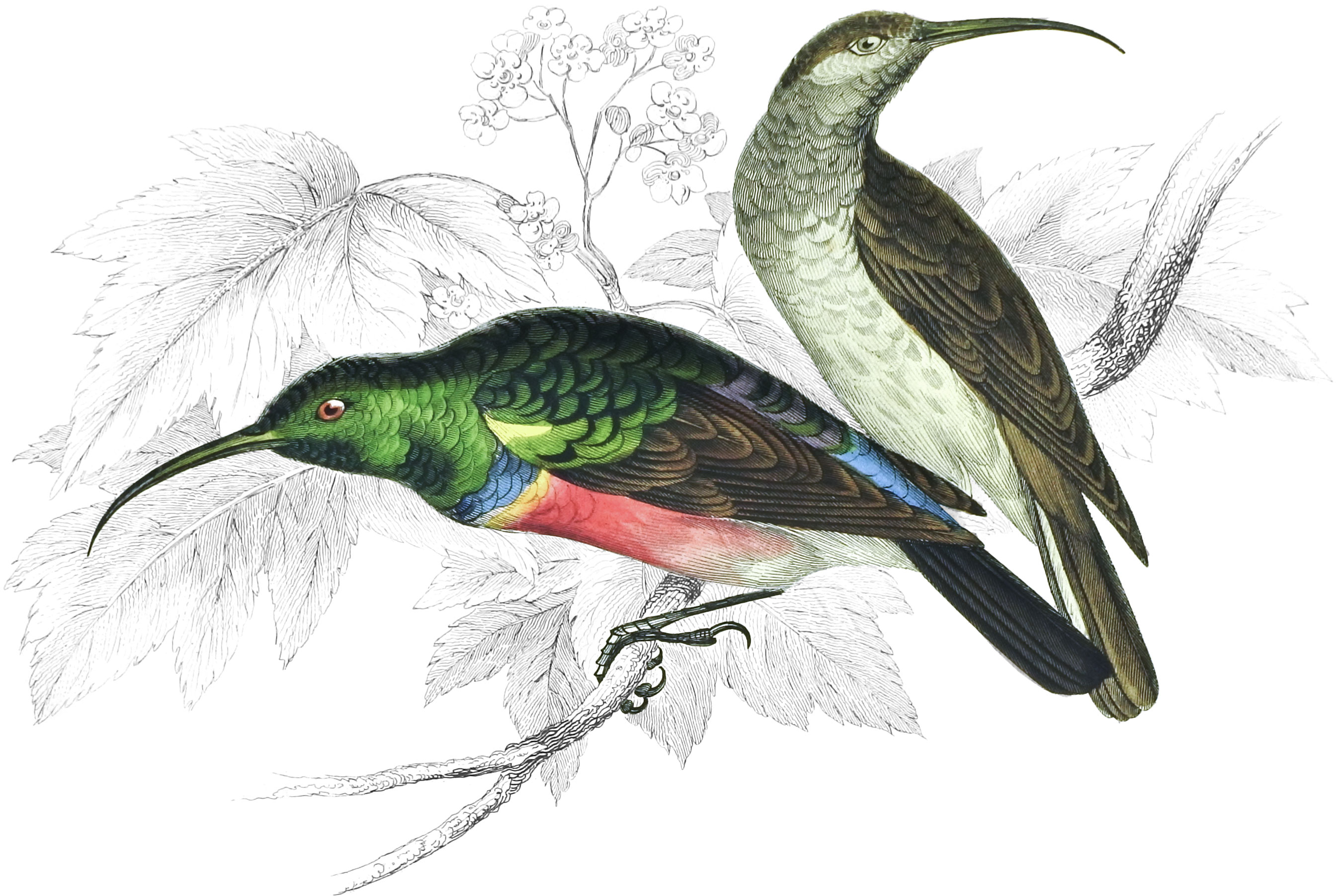
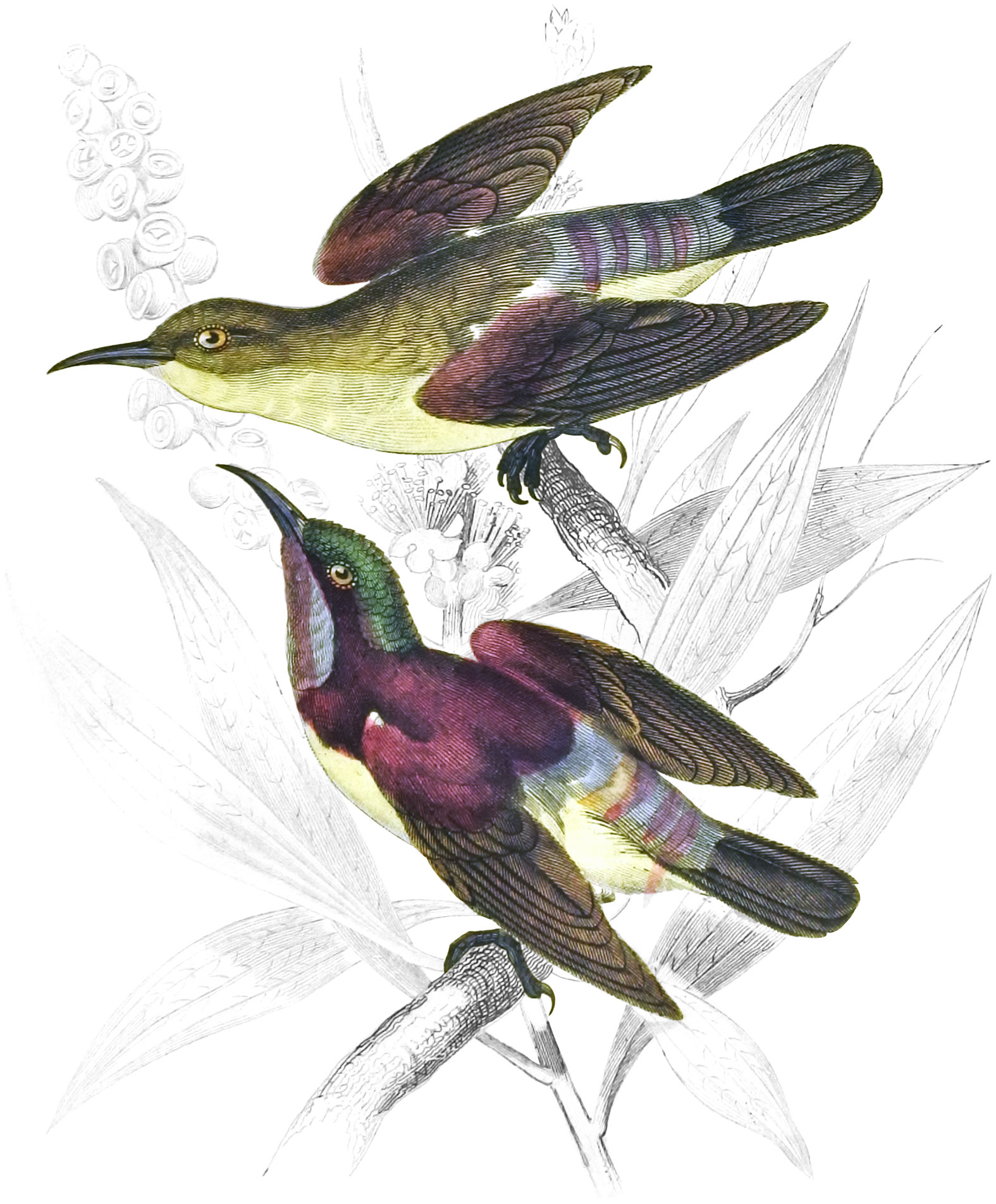
Plate II
The Green-Rumped Double-Collared Sun-Bird
Nectarinia chloropigia, Jardine.
The third bird which we alluded to, as allied to these, formed part of a small collection brought to this country on the return of Dr. Stanger, in 1841, from the Niger expedition, and kindly entrusted to us by Mr. Waterhouse. One specimen only appeared among these, but Dr. Stanger allowed us to compare a second at Manchester, which corresponded with that previously seen. Its nearest connexion is with the first, or Lesser-collared Sun-bird, for which it was first mistaken and while it presents considerable variations, it may still remain a question how far local circumstances may influence varieties, and also whether the birds from that part of the African coast continue constant in the markings, &c. which seem to separate our two birds. The distinctions are a less size and less proportional length of the wings and tail; the want nearly of the blue collar, that being indicated by a deeper green, slightly tinted with blue; by the under parts and flanks being pale oil-green, whereas they are brocoli-brown in the other; and by the upper tail-coverts being of the same brilliant green with the head and back, and not rich violet-blue as in the bird from Southern Africa.
In the bird from the Niger, the upper parts, wings and tail excepted, are of a very rich emerald bronzed green; the wings and tail are brownish black, on the former the edges of the feathers being dull oil-green. The chin is deep velvet-black, shading into the neck and upper parts of the breast, which are similar in colour to the upper parts, and finish on the breast by a deep bluish green band, the prototype of the blue collar of the two former birds; this is succeeded by the crimson band, nearly similar in extent to the same part in the N. chalybeia, and having the tips of the feathers on the upper part of it narrowly edged with golden green, while the belly, flanks, vent, and under tail-coverts are of a pale oil-green; the ample axillary tufts are rather paler in tint. In addition, we give the dimension of the Cape and Niger birds:—
| Cape | Niger | |
|---|---|---|
| Entire length | 4 in. 6-10ths | 4 in. 1-10th |
| Bill to forehead | 7\(\frac{3}{4}\)-10ths | 7-10ths |
| Wing to longest quill | 2 in. 3-10ths | 1 in. 9-10ths |
| Tail from extremity of upper covers | 1 in. 1-10th | 7-10ths |
| Tarsus | 6-10ths | 5\(\frac{1}{2}\)-10ths |
We have not seen specimens of the Lesser Double-collared Sun-bird from the Western coasts of Africa which we could compare with those from the Cape, but it is not impossible that the bird which served for the description of C. chalybeia in the “Birds of Western Africa,” may have been that now before us; and the “greenish tinge” on the narrow blue collar, and the “tail-coverts banded with greenish blue,” almost lead us to believe that this has been the case. In Le Vaillant’s description of “Sucrier à plastron rouge,” a bird inhabiting the forests of Auteniquoi, nearly allied, is described as almost intermediate in colouring between the greater and lesser collared birds, the crimson band being less in breadth; and what at once distinguishes it, it has all the red feathers transversely marked with lines of a rich golden green. By referring back to our description, it will be seen that the red band in our present bird is partially marked in this way.

Plate III
Bifasciated Sun-Bird
Nectarinia bifasciata, Shaw.
The banded distribution of colouring appears to be of frequent occurrence in this group, as seen most decidedly in the beautiful birds we have just described in that before us, we have it continued in a manner a little less distinct, while the colours continue to bear resemblance. We are indebted to Dr. A. Smith for the use of the specimen which we now describe and figure, from the collection at Fort Pitt, Chatham, and which has marked, as its locality, “Interior of Africa.” The whole upper parts, wings and tail excepted, are of the same rich bronzed green of the greater and lesser collared birds, approaching to emerald-green on the lower back and rump; on the shoulders the base of the feathers is black, having a broad round fringe of greenish at the tips, as in N. famosa, and which exhibits a rich spotted contrast. The wings and tail are nearly black, glossed with green, the latter on its edges, with purple. Underneath the chin is of a deep velvet-black, changing on the nock and upper part of the breast to the same bronzed green of the head and back, but having a greater tinge of golden yellow,—this again is shaded into a narrow band of steel-blue, succeeded by another of a dull red, in some lights appearing almost brown, in others dull vermillion-red, and having the tips of the feathers narrowly banded with steel-blue; the remaining under parts are dull black, glossed with blue on the lower tail-coverts, and immediately succeeding the red band. The entire length of the specimen is five inches and three-tenths, the proportions not showing any important variation. The first quill is unusually short, compared with species of similar size. There are no axillary tufts.
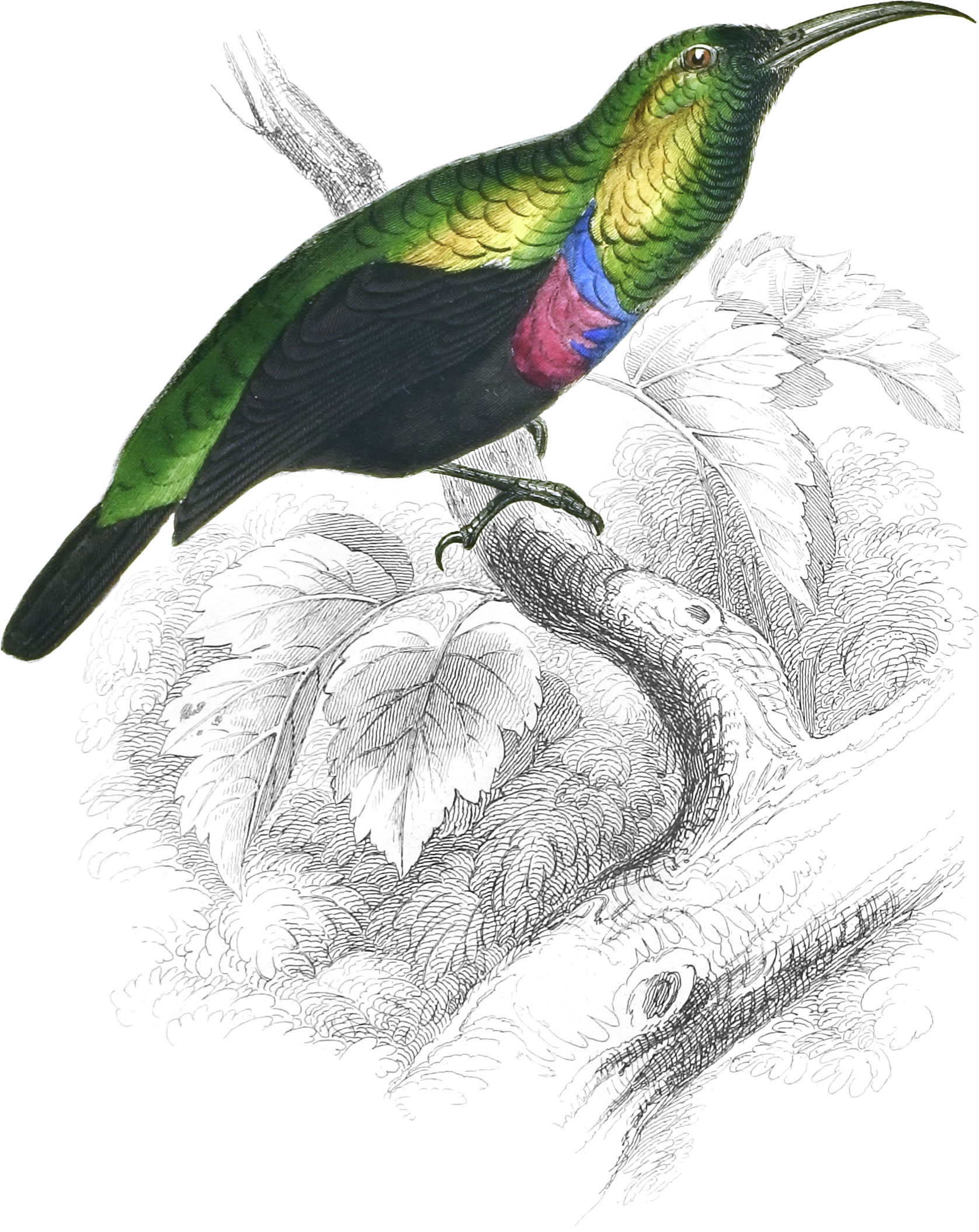
Plate IV
Splendid Sun-Bird
Nectarinia splendida, Shaw.
This is a large species, and certainly, when the male is seen in his full breeding dress, one of the most gorgeously dressed of the whole tribe. Le Vaillant found this bird in the country of the Great Namaqua, near the Fish River, but only during the season of incubation; so that it is probable a more western locality may be its true and continuous habitation. It is introduced by Mr. Swainson in his Birds of Western Africa, and our own specimens were received, by the attention of Dr, W. Fergusson, from the vicinity of Sierra Leone. In the country of the Namaquas the nest was placed in the worm-eaten trunks of mimosa trees, and contained from four to five entirely white eggs.17
The total length of the adult male, measured from Sierra Leone specimens, is from five inches and a half to five and three-quarters, being nearly an inch longer than the measurements given by Mr. Swainson. The back of the neck, back, shoulders, and upper and under tail-coverts, arc brilliant golden green, varying with every change of light; the head and throat are steel-blue, in some lights appearing as black, in others as rich violet; across the breast there appears in most lights a band of scarlet, but in some positions it appears as if banded with steel-blue, golden green, or violet, and at times to be almost entirely composed of one of those tints this is occasioned by the structure of the feathers, near the base the colour is of the metallic tints alluded to, but the tips of the plummules are lengthened into fine vermillion tips without barbs, which are so slender as sometimes to be entirely lost when seen against the dark tint of the feather lying beneath.
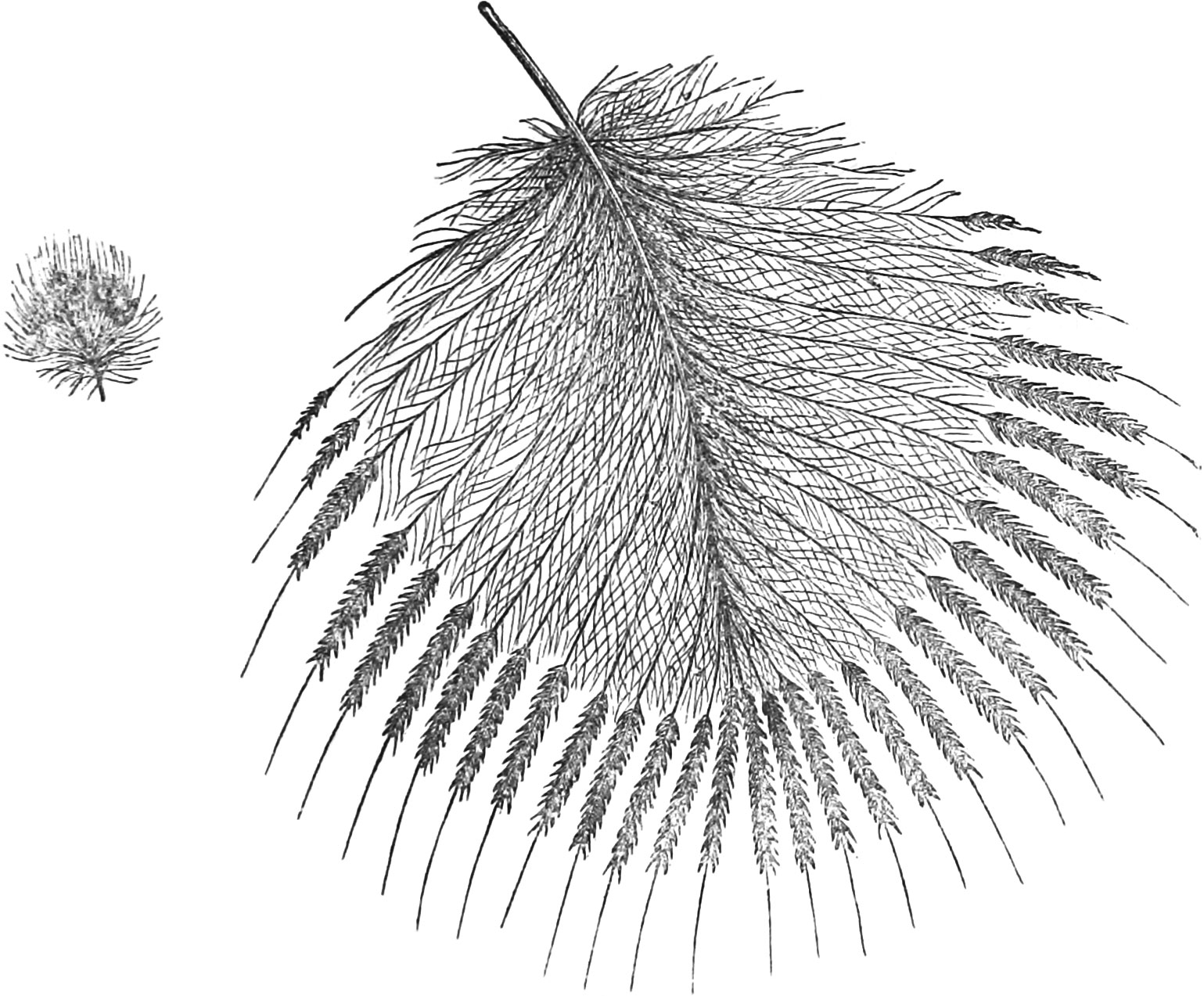
Splendid Sun-bird Plummules
On the sides of this beautiful bird spring two axillary tufts of pale lemon-yellow. The breast, belly, and flanks, wings and tail, are deep black,—the latter edged with golden green. In this species also the tail-coverts are of an unusual form, very nearly as long as the feathers of the tail, the webs very ample, loose, and unconnected.
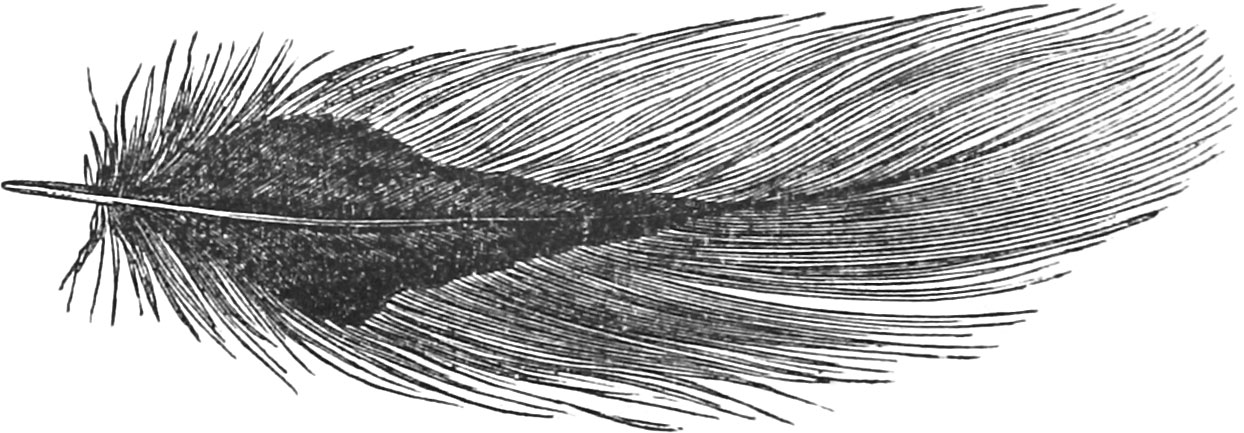
Splendid Sun-bird Feather
The legs, feet, and bill are black. The female, according to Le Vaillant, is entirely of an “earthy brown,” paler beneath, tinted with olive on the wings and tail, the last having the lateral feathers bordered exteriorly with dirty white; the bill and feet blackish brown. The young resemble the female.
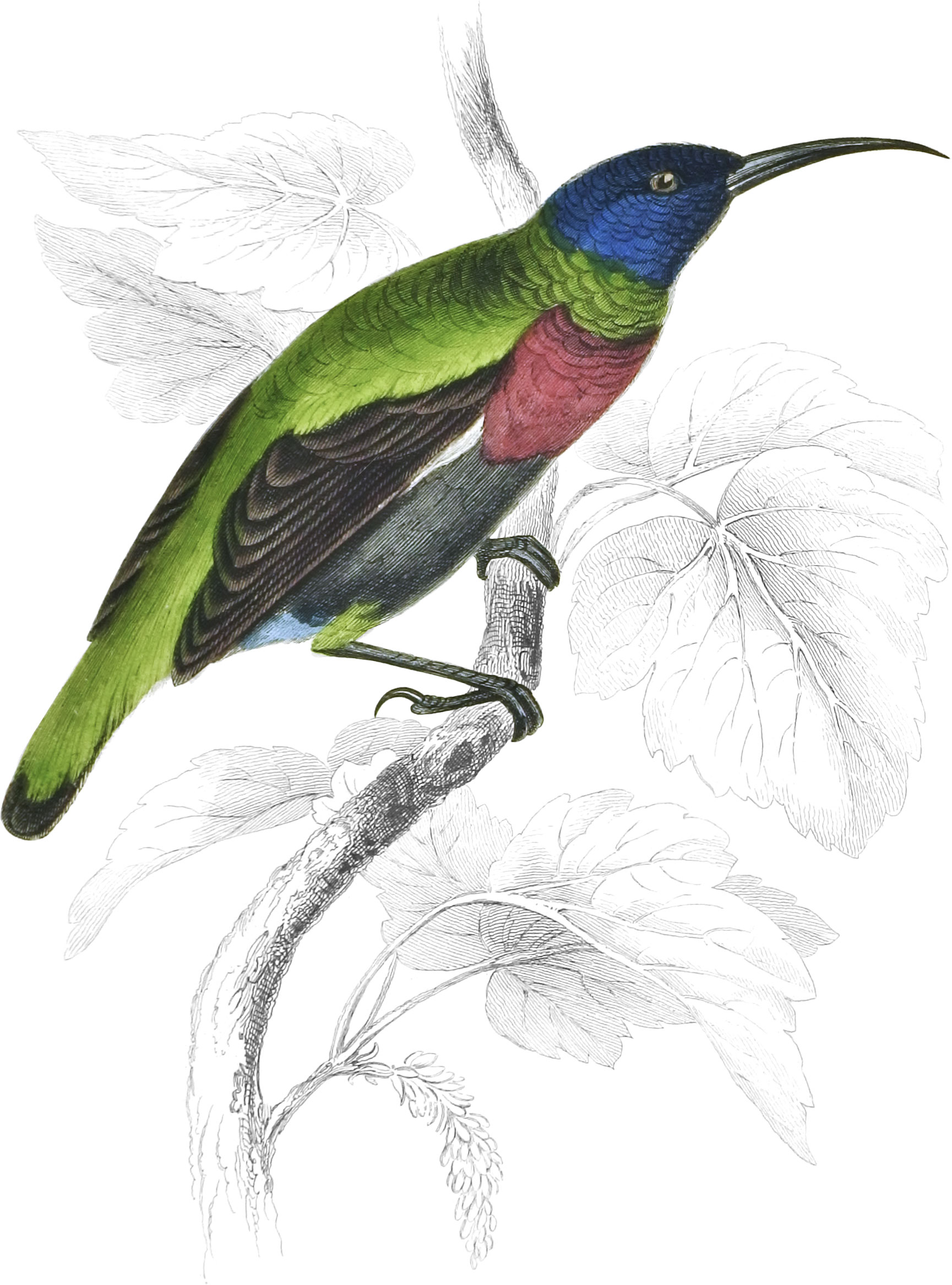
Plate V
Little Blue-Banded Sun-Bird
Nectarinia collaris, Vieillot.
This pretty little Sun-bird was met with by Le Vaillant in the vicinity of the Gamtoos, in troops of eight or nine birds, the amount of the broods. We have only received the males in miscellaneous collections from Southern Africa, where, by some of our correspondents, it is said to be rare; but a specimen of the female has been put in our possession by Dr. A. Smith, procured at the Cape, and agreeing with the description of authors. In extreme length it is about four inches, some specimens slightly exceeding, while others do not reach it. The bill, to the forehead, is half an inch, becoming very slender towards the tip; the upper parts, edges of the wing-coverts, and secondaries, a bright yellowish green, changing with every position; the wings umber-brown, edged with oil-green; the chin, throat, and upper parts of the breast similar, but deeper in tint, shading into and terminating in a narrow band of rich blue, glossed with violet; the remaining under parts are of a dull yellow, and in the axillas there are tufts of pale primrose-yellow. The tail, slightly rounded, is black glossed with blue, the feathers edged with rich shining green.
In the female above alluded to, the upper parts are nearly similar, but having a greater mixture of yellow; this extends slightly over the cheeks and sides of the neck, but the chin and throat are yellowish white, shading into dull gamboge-yellow, which occupies the remaining under parts, becoming bright in the centre of the belly and vent, and there is no trace of the brilliant gular and pectoral patch and band which characterises the male.—Le Vaillant remarks that the young, whether males or females, had the plumage of the adult female, above being a little less brilliant, while underneath the tint of the yellow was not so deep.

Plate VI
Little Violet-Banded Sun-Bird
Nectarinia parvula, Jardine.
We have been permitted to examine a specimen of a Sun-bird very closely allied to the last, by the attention of H.E. Strickland, Esq., evidently identical with the N. pusilla of Swainson’s Birds of Western Africa; the name given to it by that author, however, having been previously used both by Linnæus and Vieillot, we have endeavoured to supply it with another bearing a meaning somewhat similar. In size it is rather less than N. collaris; in length, so far as we can measure from the skin, being between three and a quarter and three inches and a half; that of the bill, to the forehead, about six-tenths. The crown, cheeks, back and sides of the neck, back and rump, are of a bronzed green, not so yellow in tint as in the last; the forehead is violet, gradually shading into the green of the other upper parts; the upper tail-covers steel-blue; tail black, margined on the outer webs with green. The wings clove-brown; quills and secondaries edged with olive. Beneath, the chin is black; fore part of the neck bluish green, terminating in a distinct band of violet, which stretches round on the sides of the neck, and at its sides below, is succeeded by dull black, forming an angular patch on each side of the breast, almost losing itself in the centre of the violet band. The remaining under parts are light king’s-yellow, paler on the vent and under tail-covers; the axillary tufts are bright orange-yellow, easily distinguishing it from the last.

Plate VII
The two following species possess a more sombre colouring; and, as it were, to relieve this, the axillary tufts, which we have hitherto seen to be pale lemon-yellow, are in some instances bright orange-red and scarlet.
Namaqua, or White-Vented Sun-Bird
Nectarinia fusca.—Vieillot.
Specimens of the male of this species have been furnished to us both by the Zoological Society of London and from the Fort Pitt Museum at Chatham. Le Vaillant met with it only in the country of the Great Namaqua, where he found it remaining during the whole year, and considered it as nearly confined to the bounds of that district; the nest was discovered in the hollow trunks of trees, the eggs from four to five in number, and of a greyish colour. Specimens in our own collection were received many years since from Southern Africa by the attention of Dr. Smith, but the exact locality is not known.
The crown, cheeks, neck and back, are of a purplish brown, having metallic reflections of purple, caused by the prolonged tips of the feathers being of that colour, or in some lights greenish; the lower part of the back and rump clove-brown, and the upper tail-coverts steel-blue, without much reflection; the wings are dark clove-brown, approaching to umber-brown on the quills; the tail is blackish brown, glossed with blue. The chin is dull black, and the fore part of the neck and breast are purplish brown having purple and green reflections, shading into blackish brown on the flanks and upper part of the belly, and which again runs into white on the vent, flanks, and under tail-coverts. From each axilla springs a tuft of bright orpiment-orange lumes, contrasting decidedly with the otherwise comparatively sombre appearance of the bird. The specimens in our own collection, above alluded to, are above entirely clove-brown, the breast and throat only shewing a dark and metallic lustre. The length is from four and a half to four and three-fourths of an inch.
The female is described by Le Vaillant as of a greyish brown above (probably of the brocoli or hair-brown which marks the same parts of the male), and beneath of a dirty white. The young, again, are said to be of a reddish brown above, below of a reddish white, and the males in this state can be distinguished by a pale yellow spot which marks the position of the axillary tufts.

Plate VIII
Verreaux’s Sun-Bird
Nectarinia Verroxii.—Smith.
The Zoological Society of London have permitted us to examine and describe both sexes of this species, placed in its collection, we believe, by Dr. Smith. The head, neck, shoulders and back, are of a dark bluish green with metallic lustre, but both in this and the preceding bird somewhat interrupted from the dark base of the feathers appearing, the fringe of the tips only being of the more brilliant colour. The lower part of the back, rump, and upper tail-covers, wings and tail, purplish brown, darkest on the tail, which, excepting the slightly shorter outside feathers, is square at the end. The lower parts, in the specimen before us, were pale hair-brown, slightly tinted with yellow on the chin and vent; Dr. Smith describes them as yellowish grey, and his figure represents a very clear tint. The axillary tufts are here of a brilliant scarlet, and appear conspicuously. The female above is uniformly brocoli-brown, darker on the wings and tail beneath of a paler tint of the same colour, tinged with greenish yellow, and approaching to yellowish grey on the vent and flanks.
Dr. Smith remarks,
Only a very few specimens of this bird have yet been found in South Africa, and none, as far as I know, within the limits of the Cape colony. Kafirland, and the country east of it, towards Port Natal, furnishes the specimens we possess. Like the other species of the group, it feeds upon small insects, and these it collects partly from the branches and leaves of brushwood and dwarf trees, and partly from flowers.

Plate IX
The same author also adds a short notice of another species considered new,—
Nectarinia Olivacea
Smith.
The colour of this species above is intermediate between grass-green and olive-green, the head being strongly tinged with blue below it is light yellowish green, with an orange tint on the throat, and on each axilla there is a small tuft of brilliant yellow feathers. Length from the base of the bill to the point of the tail five inches, length of the bill one inch three lines.
Fine-Backed Sun-Bird
Nectarinia rubro-fusca, Shaw.
Specimens identical with the bird we are now about to describe from our own collection occur in the British Museum, the Museum of the Zoological Society, and at Fort Pitt, Chatham, but all without any name attached. We have referred it to the species of Shaw above named, and consequently to the bird figured by Mr. Swainson in the Birds of Western Africa. Its other synonymes will be found in our Synopsis, and we would merely observe, that all the specimens we have examined are very close and similar in their markings and the tints on the plumage.
The length of our specimen is about four inches eight-tenths, and it is a bird of rather slender make. The crown, back, and sides of the neck are of a rich reddish purple, with a bronzed or coppery lustre the middle of the back, the rump, and upper tail coverts, rich auricula-purple with a changing lustre, richest on the coverts, and losing itself upwards in the tint of the head and neck; the chin, throat, and upper parts of the breast are of a shade intermediate between these, the purple prevailing, and all the other parts of the plumage are deep black, tinted with blue on the wings and tail. On the band of each wing there is a patch of rich violet-purple. There are no axillary tufts.
By the attention of Mr. Louis Frazer, we are enabled to add a description of the female, from specimens procured at Cape Coast and Accra, during the progress of the late Niger expedition, and forwarded to us for the use of the present volume. Plumage above, including the wings, dark brownish oil-green, deepest on the latter; beneath, pale wax-yellow, clearest on the centre of the belly; tail nearly black, the outer feathers tipped with grey. Length, three inches four-tenths; of the bill to the forehead, six-tenths.
Mr. Swainsons specimens of his N. erythronotus were received from Senegal, and Vieillot’s N. tricolor, which we consider closely allied, if not identical, was from Malemba.
Olive-Backed Sun-Bird
Nectarinia cyanocephala.—Shaw.
Dr. William Fergusson, some years since, sent us both sexes of this species from the vicinity of Sierra Leone, and we refer them without hesitation to the “Soui-manga à tête blue” and the “Soui-manga vert et gris” of Vieillot, Oiseaux dorés, pi. vii. and xxv.; the first as the male, the latter as the female. The male is in length five inches and a half; the female about a quarter of an inch shorter. In the first sex, the head, throat, neck, and upper part of the breast are deep black, having the tips of each feather broadly banded with a rich and dark metallic bluish-green, giving to those parts an almost entire tint of the latter colour, which varies with every shade of light, and in some positions is coloured with steel-blue reflections, particularly upon the breast. The upper parts, including the edges of the feathers of the wings and tail, are yellowish olive, or a clear yellowish oil-green, without any reflected lights; the wings and tail are pale umber-brown; the lower part of the breast, belly, and vent are of a uniform tint of brocoli-brown, and from each axilla spring tufts of primrose-yellow. The bird which we received in the same collection from Sierra Leone as the female, is, as we stated, about five inches and a quarter in length, and it agrees in plumage with the description of Vieillot’s “Soui-manga vert et gris.” The crown, nape, cheeks, and sides of the neck are of the same rich bluish green seen in the male, the back and wings are also similar in tint, but the whole chin and under parts are of a uniform greyish white, paler on the vent, and there tinted with yellowish oil-green. We have little doubt of this being the female; there is no trace of immaturity in the specimen.

Plate X
We have also, among the African forms of even-tailed Sun-birds, species of uncommon brilliancy of colouring; and which, as in the Humming-birds of the New World, possess a coronal and gular patch of resplendent scale-like feathers. Examples of these will be seen in some of our next plates.
The Senegal Sun-Bird
Nectarinia Senegalensis, Linnæus.
This species, instead of having the upper parts and the breast of a uniform brilliant tint, has only a marked coronal and gular patch of rich emerald-green; that on the throat extending upon the cheeks, where it exhibits a streak or moustache separated by the different structure of the feathers, the chin and throat being also more yellow in tint. Space between the eye and bill deep black; the back of the neck, upper parts, wings and tail, belly and vent, are of a soft and deep brownish black, glossed with purple, appearing and feeling to the touch like velvet. The fore parts of the neck and breast are brilliant scarlet-red, appearing in some lights violet-blue; this change is caused by each feather, black at the root, having a band of violet-purple, immediately succeeded by scarlet tips, which in a state of rest nearly conceal the blue, or allow it only to be partially seen through; the feathers composing this part are, to the feel, of a stiffer texture than general, and are capable of being erected and displayed at pleasure, giving at one time a totally different appearance than what is seen upon another change; this is what suggested the name of “Protée” to Le Vaillant, who considers that this species and some others thus display themselves during the time of courtship as an attraction to the other sex. This beautiful plumage ceases with the season of incubation, and the male assumes nearly that of the female, which is of a uniform wood-brown tinted with yellow on the belly and vent; the bill and legs are in this sex brown, while in the opposite they retain at all seasons their deep black colour. In an intermediate state of plumage the upper parts are of a reddish brown, and the lower parts of a yellowish wood-brown, having the splendid feathers of the throat and breast appearing among it; on the belly and vent the feathers have the centres darker, giving a streaked appearance to those parts. In none of the conditions of plumage have we any trace of the axillary tufts seen in the two last birds. Caffraria and Senegal are the localities generally assigned to this species, our own specimens were received from the vicinity of Sierra Leone, while Le Vaillant states that it is found on several parts of both the east and west coasts.

Plate XI
Port Natal Sun-Bird
Nectarinia Natalensis, Jardine.
An equally beautiful species, the metallic colours appearing more brilliant from the deep and velvety colour and texture of the other parts of the plumage, we have received from the vicinity of Port Natal. We have seen specimens also in the Fort Pitt collection, which were considered by the active superintendent there as undescribed; in the Zoological Society also there is a specimen marked by Rüppell, though we could not ascertain that it was procured by that traveller during his excursions.
In our specimen, the coronal patch, confined to the forehead and crown, is of a rich bluish-green. The gular patch, of a golden-green, is confined to the chin and throat, and is bordered on each side with a narrow maxillary stripe of the same colour with the crown. The upper parts, cheek, and sides of the neck are of a very deep soft and velvety umber-brown, paler on the wings and tail, the bend of the wing having a violet patch. On the under parts, the fore part of the neck and breast are of a brilliant scarlet, appearing, in different lights, waved with violet, from the structure of the feathers being the same as those of N. Senegalensis and splendida; the simple apical tips only being scarlet, and producing all the brilliant effect. The remaining under parts are very deep blackish-brown appearing in some lights almost black. The feet, legs, and bill are black, the former strong. The length of the specimen described is within a tenth of being six inches.

Plate XII
Amethyst-Throated Sun-Bird
Nectarinia amethystina, Shaw.
This bird differs in several respects from any of those we have yet described, and though of apparently more sombre colouring, it possesses some hues of exceeding brilliancy. It is, with one or two exceptions, one of the largest species known, being in extreme length from five and a half to six inches. The whole of the plumage of the adult male, in a breeding state, with the exception of the parts we shall immediately mention, is of a very deep brownish black, feeling and looking like velvet, and on the upper parts, when held side-ways to the light, having a rich play of purple. The coronal patch is dark emerald green; on the throat and fore part of the neck there is an oval patch of rich amethystine purple, and on the carpal joint of the wing and upper tail-covers the feathers are of the same beautiful tint, but more inclining to violet,—in all these parts playing and changing with the variation of the light. The axillary tufts, as in the last, are wanting. In the plumage of the winter or rainy season, the male resembles the female; but, unlike the previous birds, retains, it is said, his coronal and gular patch; before the first moult, or in the nestling plumage, however, these are wanting. In the female, according to Le Vaillant, the upper parts are of an olive-brown, the threat and fore part of the neck black, and the remaining under parts olive, spotted or broadly streaked with deep brown.
Le Vaillant first met with this bird in the country of the Auteniquoi, afterwards on the river Gamtoos, and considers that it remains in the southern part of the continent during the whole year. Our own specimens of the adult male, which have now been used, were received from some part of Southern Africa, though we do not know the exact locality. Mr. Swainson has also admitted it into his Birds of Western Africa, so that we may consider its range pretty extensive. Le Vaillant states that he found the nest in thickest bushes, and in the holes in trees; the eggs being five in number, grey, spotted with olive.
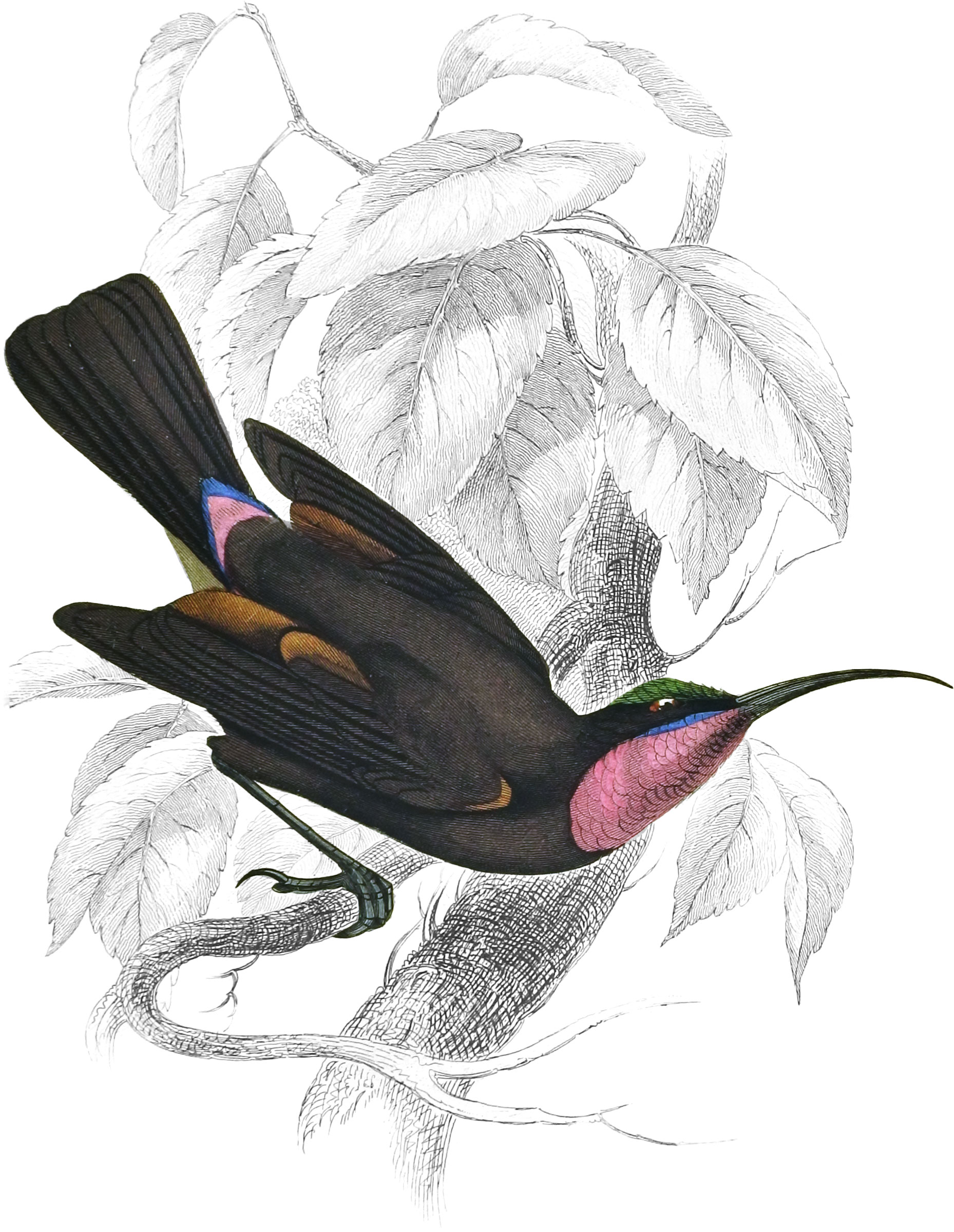
Plate XIII
Carmelite Sun-Bird
Nectarinia fulginosa, Shaw.
This apparently not very well known species does not seem common in our collections; there is a specimen in the British Museum, another in the Collection at Edinburgh, from which our figure has been taken, and Mr. Strickland has obliged us with the use of a specimen from among his Nectariniadæ, from which we have made our description.
The body, above and below, is uniform pale yellowish umber-brown, the wings and tail considerably darker, and with a slight purple reflection; the forehead has an imbricated patch of auricula purple, extending to the line of the eyes and the chin, throat, and fore part of the neck, forming the gular patch, with the lesser wing-covers or radial edges of the wings, are of the same colour; the axillary tufts are bright primrose-yellow. The entire length about five inches. The female is said to want the coronal patch.
Malemba, on the west coast of Africa, is given by Vieillot as the locality of this species, but we are not aware where those which have come under our own observation have been received.

Plate XIV
The Niger Carmelite Sun-Bird
Nectarinia Stangerii, Jardine.
The next specimen we have to describe, as entering into the artificial division with coronal and gular patches, is one which, independent of its remarkable colouring, will possess an interest as part of the limited collection procured during the late Niger expedition, and brought to this country by Dr. Stanger. It was placed under our inspection by the kindness of Mr. Waterhouse, curator to the Zoological Society, and, after examination, we have been unable to refer it to a described species. It approaches nearest to the last, but differs from it in the frontal and gular patches being green instead of violet, in there being no violet on the lesser wing-covers, and in wanting all trace of the axillary tufts. The following is an exact description of the specimen, and we may remark that it appears in every way to be in full and perfect plumage.
The entire length is five inches one-tenth; of the bill, five-tenths; of the wing, to the longest quill, two inches and a half. The upper parts are of a uniform deep yellowish umber-brown, darker on the wings and tail; the whole plumage having the velvety feel and appearance of N. amethystina, and showing yellow and greenish lights. Underneath, the plumage of the same texture is deep umber-brown, and, when seen across, shows rich purple reflections. The forehead, until within the line of the eyes, is covered with the scale-like feathers of deep green, the last row of feathers being rich violet, forming, as it were, a narrow band of that colour. The chin is velvety-black, and, following it, the gular patch is rich yellowish-green, playing in the light, reaching to the upper part of the breast, and having the last row of feathers deep steel-blue tipped with scarlet, at a little distance appearing as a violet termination, bordered by a scarlet thread. On each maxilla there is a narrow stripe of deep shining green, similar to the forehead in colour. No trace of axillary tufts or colouring on the shoulders. and feet black.

Plate XV
As in Africa we have the Nectariniadæ in the greatest profusion, both in numbers and species, so do we find the more varied forms. These are most apparent in the form of the tail, which is square, wedge-shaped, or has the centre feathers only much elongated; the first we have seen in the species we have been describing, and as an example of the second we now give the representation of the
Violet-Headed Sun-Bird
Nectarinia violacea, Linnæus.
This bird, a native of Southern Africa, has, in the adult males, the head, sides of the neck, and chin, with the upper part of the back and bend of the wings, dark golden-green varied with purple and bronzed reflections; on the upper part of the back the base of the feathers are olive, and are seen mixed with the dark and shining tint; the back and remaining upper parts, with the edges of the wings and tail-feathers, are yellowish oil-green; the quills and tail pale umber-brown. On the centre of the breast and running round on each side the green colour of the neck, is a patch of brilliant violet-purple stretching up upon the throat and nearly bordering the lower part of the breast in a narrow crescent. The lower part and centre of the breast is deep reddish-orange, shading into gamboge-yellow on the flanks and under tail-covers. In the axillæ we have the king’s-yellow tufts. The extreme length is nearly six inches.
According to Le Vaillant, the female is rather smaller in size, and is of a uniform olive-green,—paler, and of a more yellow tint beneath. The young of both sexes nearly resemble each other, and are above greenish olive, beneath yellowish. The species is abundant in the vicinity of the Cape, but it delights in the more mountainous districts, and only descends to the gardens during the season of the flowers, and while the orange trees are in blossom. The male has a quick, lively, and agreeable warble. The nest is placed in thick bushes, formed of the down of plants, and covered exteriorly with lichens or fine moss. The eggs are white, mottled with minute brown dots. Latham says the structure of the nest is loose and artificial.
The tail, in the Violet-headed Sun-bird of Africa, is regularly graduated, and Ave have the form continued in several species from Continental India, where it prevails, and also exists in a more developed manner in some lovely birds sent to us from Nipaul by Mr. Hodgson, and which we shall immediately describe and figure from his specimens but in doing this, let it be distinctly understood that we do so with no wish to interfere with his discoveries; and we cannot help expressing our regret to see that gentleman daily deprived of the merit of his extensive researches in ornithology by the arrival of insulated specimens, when we know that for some years large remittances collected by him, containing hundreds of new species, have continued hidden in the keeping of his friends. In some of these Indian species the centre feathers become much more elongated, and seem to lead to the next form of tail, where that member is perfect in itself, the lengthened feathers being rather accessaries, appearing only during incubation and disappearing with the moult of the rainy season, or winter.
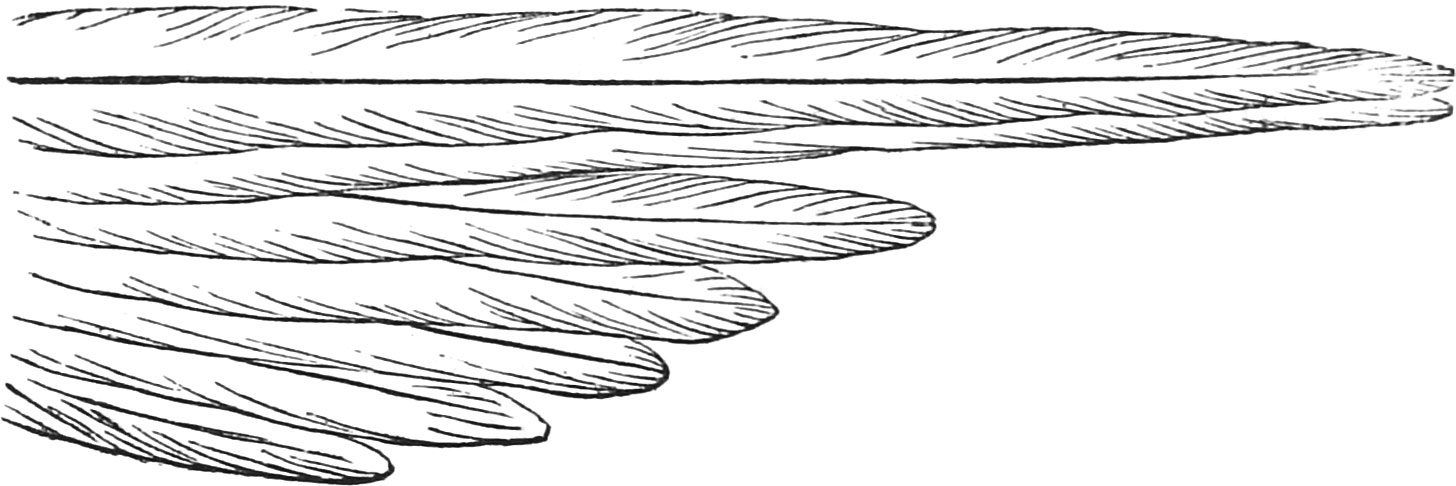
Violet-Headed Sun-Bird Feathers

Plate XVI
Malachite Sun-Bird
Nectarinia famosa.
The largest species of Sun-bird which is known, and when in its full breeding plumage, a bird of great splendour. In this form we have ten feathers in the tail, short, and nearly of equal length; the centre or sixth pair being narrow and alone much lengthened, in the specimen before us exceeding the other feathers by three inches and a quarter. This is what the French writers term “Queue en flèche;” and in some of the smaller species the length beyond the short feathers is even still more disproportioned. The Malachite Sun-bird has been frequently figured, both on account of its being very early known, and from the splendour of its colours, though perhaps few figures have or ever will come up to the varying tints and changes which play upon its plumage. An adult male now before us is nine inches in extreme length, of which the bill measures an inch and a quarter, the excess of the centre tail-feathers being as we mentioned above. The whole upper and under parts are of a deep Malachite green, having a play of golden green and reddish bronze, particularly on the head and neck, with the forehead and throat in some lights appearing deep black. The feathers on the latter parts are thick and close like the pile of velvet, in which they resemble the structure of the same parts in the Paradise-birds, and which is not frequently met with in the Sun or Humming-birds. We may remark, that in some specimens we have seen a pinkish bronze tint prevailing over nearly the whole upper plumage, but Le Vaillant observes, in his description, that this bronze colour is caused by the stuffs used in preparing the skins, and that in a fresh state it does not appear. This we have had no opportunity of verifying. On the back and breast the colours have often the appearance of being waved, from the tips only of the feathers being of the brilliant green, the base being deep black, over which the others lie and partially exhibit the dark tint beneath.
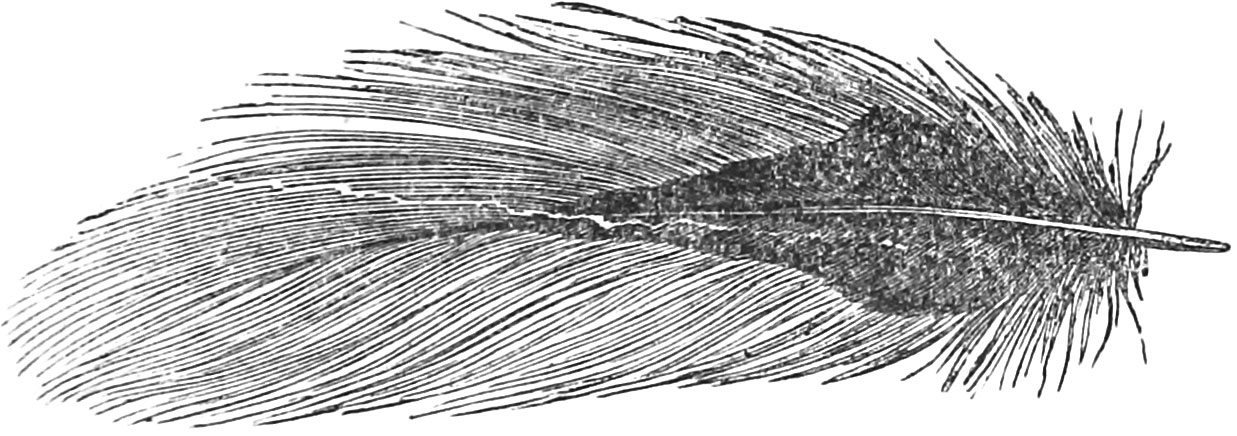
Malachite Feathers
The wings and tail are black, the secondaries and covers of the former being edged with green and violet the; latter distinctly margined for two-thirds of their length with the malachite green of the upper parts. From each axilla there springs a lengthened tuft of gamboge-yellow plumes. Bill and legs are black. This plumage, together with the lengthened tail-feathers, is lost immediately after the season of incubation, when it becomes nearly of a uniform dull oil-green, yellowish on the throat, paler on the under parts (and described by Le Vaillant as yellowish, which characterises the adult from the young male in the first moult); the centre feathers of the tail coming in of an equal length with the others. The female is described to be considerably less in size, and to be entirely of an olive-brown colour, the ‘outer feathers of the tail being bordered with white.
This species is abundant in the vicinity of the Cape of Good Hope, or at least was so in the days of Le Vaillant, remaining stationary during the year, frequenting the gardens, and there extracting the juices from the flowers. It extends also along the eastern coast, and the author above quoted states that fifty may be found in a day by remaining quiet within reach of one of their favourite plants, to which they constantly flock. The nest is composed of slender twigs covered externally with moss. The eggs are four or five in number, and are of a greenish colour.

Elongated Malachite Tail Feathers

Plate XVII
Red-Breasted Sun-Bird
Nectarinia pulchella, Linnæus.
Le Vaillant gives Senegal as the country of this Sun-bird, stating that it is also found in Southern Africa, but not beyond the “Great River” in the Caffre country, where it frequents the forests; Mr. Swainson, in his Birds of Western Africa above quoted, remarks that it
seems to be particularly common in Senegal, from whence great numbers have been recently sent to Europe as articles of commerce;
and we have ourselves received specimens which appear identical, and which have supplied the accompanying figure and description, from me vicinity of Sierra Leone. The adult male is both above and below of a rich golden-green, upon the crown, throat, and breast seeming more intense from the structure of the feathers. The centre of the breast is crossed by a bright collar of yellowish carmine red, shading off upon the belly into gamboge-yellow, and there running to a point along the centre the vent, wings, and tail are black, under tail-coverts tipped with shining bluish green; the centre tad-feathers or long coverts are black, edged at the base with the green of the upper parts. Extreme length to end of the long feathers, six inches two tenths, to the end of true tail, four inches two tenths. In a specimen accompanying that now described, and which we consider to be a male changing from its brilliant dress, the two centre feathers of the tail are worn nearly to their shafts, in the same way that we often perceive those of the Scolopacidæ after the season of incubation, and previous to their having entirely thrown off that dress. The upper parts are entirely of a hair-brown, a few bright green feathers remaining apparent on the crown and rump. The wings are brownish black, shining green upon the shoulders, and the entire under parts are yellowish white, the yellow tint being deeper along the centre of the breast and belly. In both states the bill and legs are black.

Plate XVIII
Purple-Rumped Long-Tailed Sun-Bird
Nectarinia platura, Vieillot.
Le Vaillant, in describing this bird, seems to have felt that it was an aberrant form, and from the resemblance of the bill to that of the warblers, gave it the appellation of “Figuier,” and it also varies from the previously noticed birds in minute size of the first quill, as represented in the wood-cut at the end of this description; he only found it in the forests of the country of the Namaquois, where it gained its subsistence chiefly from the flowers of a species of scentless jessamine, which grew in abundance under the mimosas; little farther is known regarding it, and the nest was not found. Our own specimens were received from Southern Africa, but without any accompanying information. The total length of a male, apparently in complete plumage, is six inches and eight tenths; the bill to the forehead, four tenths; the long caudal feathers surpassing the tail by two inches six tenths. The upper parts, above the rump, are green, with bronze and slight purple reflections; the rump and tail-coverts violet purple; the throat, fore part of the neck, and upper parts of the breast, duck green, with metallic reflections; the remaining under parts, saffron-yellow the wings are brownish black; the tail black the; centre long feathers glossed with steel-blue, and somewhat spatulate at the tips. The female is described by Le Vaillant as above of a reddish grey tinted with olive, and as wanting the long feathers; the belly and under parts, however, continuing yellow.
We also have specimens of a Sun-bird from the vicinity of Sierra Leone, possesing a similar distribution of markings and of the same size, but the tints are somewhat different. The whole upper parts, together with the throat and breast, are of a rich bronzed purple, showing very little indication of green in any light, and having the violet of the rump scarcely distinguishable from the other plumage; the yellow under parts are of a decidedly deeper tint, approaching almost to gallstone-yellow the true tail is perfectly square, whereas, in the first described, we have thought it slightly graduated.

Purple-Rumped Long-Tail Sun-Bird Feathers
These, however, we consider here as merely local variations. Another closely allied bird is the
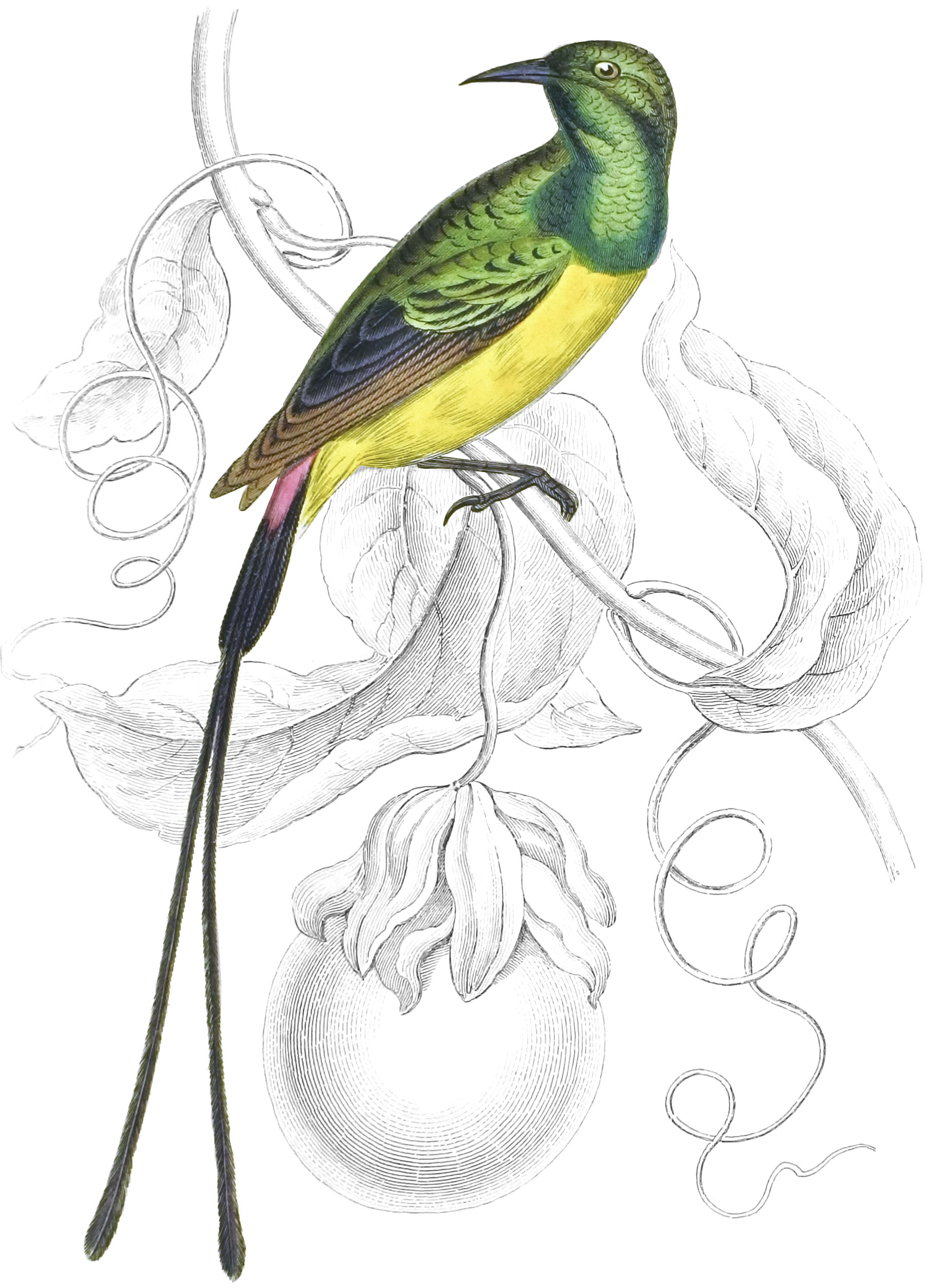
Plate XIX
Blue-Rumped Long-Tailed Sun-Bird
Nectarinia metallica, Lichtenstein.
Of this species, closely allied to the last, there are figures of both sexes in the Planche Colorièes, and in the Atlas to Rüppell’s “Peise in Nördlichen Afrika.” In form and general distribution of colouring, this bird nearly resembles the last, but the lower parts of the back upper tail-covers, and tail, are of a bright metallic blue. The dark colour of the throat and fore part of the neck also is bordered with a distinct collar of clear blue, wanting in the species we have previously figured. Cretzschmar, in Rüppelfs Atlas, describes the female as grey (hair brown) on the upper part of the body; the wings, and also the tail dark, with a light border; the two outer feathers having white tips. The whole lower parts of the body pale lemon-yellow, paler on the chin, throat, and under tail-covers.
Nubia and the vicinity of Dongala are the localities given to it by Temminck. Cretzschmar, on the authority of Rüppel, states that it is found in all North-eastern Africa, south of Suckot, nestling in the acacia trees.
We come next to examine the species of India and her islands; they extend generally over the continent, reaching to a very high elevation among the Himalayas, while they are also found on the Malay peninsula and the vast archipelago of the East Indian islands. The forms resolve themselves almost into two,—those having the tail square, and those having that member more or less graduated. Of the first, the birds show a smaller, thickset, and more compact form than the African square-tailed species; they have generally a coronal and gular patch; the under parts are frequently banded with one or more distinct colours, and they possess yellow or orange axillary tufts their distribution; seems to be chiefly, but not exclusively, the plains or Lower Continental India, and the islands. The second, possesses brilliant colouring, often a coronal patch, but instead of that on the throat, we have lines or stripes of resplendent feathers on the sides of the maxilla, and reaching down on the neck, the centre tail-feathers often extend beyond a proportional graduation. These seem to be most frequent in Alpine India, Nipaul, &c.
We have found considerable difficulty in making out these correctly. An idea has been taken up that they are subject to considerable variety, which seems scarcely to be the case, many species being closely allied, yet at the same time, when in adult plumage, pretty constantly and regularly marked.
Ceylon Yellow-Bellied Sun-Bird
Nectarinia Zeylonica, Linnæus.
The Certhia Zeylonica of Linnæus, sent by Governor Loten from Ceylon, refers to the bird we have now represented; but the synonym of that illustrious naturalist is erroneous, and, though printed by him with a ?, it has been continued to many of the descriptions which have since been given of the bird, and has kept up the confusion; in our Synopsis will be found what we consider as belonging to it.
We have received the males from various parts of Continental India, where it seems pretty generally distributed and far from uncommon; but we have never seen specimens from any of the East Indian islands, nor been able to compare those of the continent with a Ceylonese bird. Dr. Latham, on the authority of Dr. Buchanan, states that
it is found in all the gardens near Calcutta, lives by sucking honey out of flowers, and will readily sip sugar and water.
The nest, suspended from the extreme branch of a tree, is almost of a globular shape, with a neck above somewhat like an alembic, and composed of fine fibres, with a round hole of entrance on one side, nearer the bottom than the middle.
Mr. Jerdon, who described it under the name of C. sola, says it is
more abundant in the Carnatic than in any other part of the peninsula, and to be seen in almost every garden.
The length of our specimens are about four inches and a quarter. The crown of the head, above the eyes, extending to the occiput, is a dark and deep olive with green and purple reflections; the chin, throat, and fore parts of the neck, rich violet or amethystine purple, changing with the light; these form the coronal and gular patches of scale-like feathers. The sides of the neck, back, scapulars, and a band across the upper parts of the breast, of a rich purplish brown (maroon red); the lesser wing-covers similar in tint to the head, but having a greater tinge of purple; lower parts of the back and upper tail-covers rich amethystine purple; wings umber-brown, edges of the feathers paler tail nearly black, the exterior feathers with very pale greyish tips, on the outer one extending for nearly a quarter of an inch; the breast and belly king’s-yellow, becoming paler on the flanks and under tail-covers.
Mr. Jerdon, who is an accurate observer, thus describes the female,
olive-green above, beneath yellow, chin and throat white, wings and tail as in the male.
In the collection of Hugh Strickland, Esq. there are specimens apparently a variety of this species, having the coronal patch violet, the gular patch nearly steel-blue, agreeing somewhat with that placed by Dr. Latham as his Var. 1.

Plate XX
Nectarinia solaris
Temminck.
Of the same form and distribution of colouring with the last, is the species figured in the Planches Colorièes, pl. 347, fig. 3, under the title of “Souimanga souci, N. Solaris.” It is from Amboina, one of the Molucca islands. From the figure above quoted, the following description is drawn:—The coronal patch covering the whole crown green; the gular patch extending over the throat, sides of the neck, and breast is violet-purple; the upper parts olive, wings and tail brown, the latter (in the description) having the two lateral feathers tipped with white the belly, vent, and flanks, orange-yellow; the axillary tufts paler.
Scarlet-Bellied Sun-Bird
Nectarinia affinis, Shaw.
The specimen from which the drawing of our plate was made agrees with the figure and description of the bird represented by Temminck as the “Souimanga à ventre écerlate,” with the “Souimanga à gorge violette” of the Ois, dor., and with Dr. Latham’s C. sperata, var. B.; but it differs from the “Certhia philippensis purpurea” of Brisson, from which all the descriptions of the Certhia sperata, Linnæus, are taken, in the green colour of the coronal patch and lower back, with the upper tail-covers; by Brisson, these parts are said to be violet. Brisson’s bird was from the Philippine Islands, and so also is Temminck’s specimen; and it may remain a question whether there is some mistake in the description of Brisson, handed down through a variety of volumes, or that there are two distinct and closely allied birds, the one with the coronal patch and tail-coverts violet, as in Brisson’s bird, or with these parts green, as in Sonnerat and Temminck’s specimens.
This very beautiful species has the whole crown, running to the hind-head, green, with golden reflections; the cheeks and auriculars black; sides of the neck, nape, mantle, and greater covers, rich purplish red (maroon); lesser covers and bend of the wing green, similar to the coronal patch; the lower part of the back and upper tail-covers, rich metallic olive-green with purple reflections; wings umber-brown, edges of the feathers paler; tail black, outer webs of the feathers edged with violet; underneath the chin, throat, and fore part of the neck are amethystine purple; lower part of the breast and belly scarlet; vent and under tail-covers oil-green.
In this species, and one or two allied, there is a small patch of brilliant feathers upon the sides of the breast where the gular patch terminates; in the present bird they are of a rich bluish green. Entire length from four to four and a quarter inches. There are no axillary tufts.
Temminck’s specimens were received from Manilla; we do not know the locality of that which has served for our plate.

Plate XXI
Von Hasselt’s Sun-Bird
Nectarinia Hasseltii, Temminck.18
This species is indicated in Sir Stamford Raffle’s catalogue in the Linnæan Society’s Transactions for 1812, under the title and as a variety of “Certhia sperata;” it is not, however, any of the states to which that name has been applied; and in modern times, at least, Temminck separated and recognised it as a distinct species.
The specimen which we have figured and described, has the whole crown extending a short way upon the nape of a brilliant golden green; the feathers of a short and soft texture, and not appearing imbricated; the cheeks, sides, back of the neck, wings, and tail, are of a deep velvet black; the mantle, lower back, and tail-covers, with the lesser wing-covers and bend, of a metallic olive-green or steel-blue, varied according to the lights. Underneath, the chin is nearly black, bordered on each side with a maxillary stripe, and shading downwards into amethystine purple which forms the patch on the fore part of the neck and breast; on each side of this we find the small spots of brilliant feathers alluded to in the description of the last, and here of a steel-blue colour. No true axillary tufts. The lower parts of the breast and belly are of a purplish red (maroon); the vent and under tail-covers greyish black. The entire length scarcely four inches. Java is the only authentic country given for this species; Temminck received it from thence; our own specimens were purchased among some birds from the East Indian islands.
Another bird, having the same character in the markings with this, we find figured in the Voyage du Coquille, from New Guinea, apparently of the typical structure; but, from its locality, ranging on the verge of the Australian geographic separation, where we find representing forms of somewhat different appearance and colouring.

Plate XXII
Nectarinia aspasia
Lesson.
Cheeks, sides of the neck, mantle, wings (wings in text “sont brunes”), lower part of the belly and vent, deep velvet-black; coronal patch emerald-green, passing over the occiput to the nape; the wing-covers, lower back, and upper tail-covers, golden green; tail black, feathers edged with blue while the chin, throat, and fore part of the neck is occupied with a patch of deep bluish violet.
General Loten’s Sun-Bird
Nectarinia Lotenia, Linnæus.
This bird is one of the Nectariniadæ first and originally described by Linnæus in the Syst. Naturæ, from specimens sent to him by General Loten, Governor of Ceylon, and named in honour of that gentleman,
qui hortiim hotanicum primus in India condidit, et tot raris avihus me aliosque dotavit
From the improper synonymes of Gmelin being applied to the description, the original name has been long given to another and very different bird (N. splendida, Shaw, Plate V.), and we think it only due, both to its discoverer and first describer, to restore its former title. We have not seen specimens either from Ceylon or any of the East Indian Islands, all those which we have received being from various parts of Continental India. Mr. Jerdon states it to be tolerably common in the Carnatic and on the west coasts of the peninsula, frequenting both gardens and jungles. Specimens of the male before us are in entire length five inches that of the bill to the forehead, which is considerably hooked, showing a difference when compared with the same member in the next, one inch. The whole of the upper parts, cheeks, sides of the neck, and lesser wing-covers, are of a dark metallic-green with blue and purple reflections; the wings umber-brown; tail bluish black, feathers edged with green. On the under parts, the chin is velvet-black, the neck and upper part of the breast dark metallic-green, shading at the lower edge of this gular patch into rich steel-blue tinted with violet; this is succeeded by a narrow band of purplish red, the remaining under parts being of a dark yellowish hair-brown, relieved upon the sides by two ample axillary tufts of king’s-yellow. In some specimens the prevalence of the varying colour is different. Mr. Jerdon’s birds have a greater shade of purple above, and the margin of the gular patch is nearly steel-blue. Mr. Jerdon describes the female as
Above light greenish-brown, quills darker, tail black; beneath pale yellow; only differs from the female of the last (our next bird) in the darker tint of the plumage above.

Plate XXIII
Mahratta Sun-Bird
Nectarinia Mahrattensis, Latham.
The species which we have placed under the above name we have received from the plains of India, the more alpine districts, by the attention of Captain Alexander Singers, from Nipaul, through Mr. Hodgson, and, as Mr. Jerdon remarks of it,
it appears to be the most generally distributed of all the Cinnyridæ, and is the only one I have met with on the bare table land.
Notwithstanding this apparent frequency, and that it is not an uncommon bird in Indian collections, the descriptions of authors are so very short, that it is with difficulty that by them it can be separated from some allied birds. From the following description also, it will be seen how near it agrees with the last bird, differing, however, by the more purple tint of the upper plumage, the black belly and vent, the orange as well as yellow axillary tufts, and by the form and proportions of the bill.
The entire length is from four inches seven-tenths to four and a half; bill to the forehead seven, or seven-tenths and a half. The upper parts and lesser wing-covers are steel-blue varied with green or purple, and in some specimens having a violet tinge entirely prevailing; wings brownish black; tail black feathers edged with steel-blue. The cheeks, chin, neck, and upper part of the breast, are of the same steel-blue with the upper parts, sometimes inclining to greenish or to violet, but on the chin the feathers are darker, almost black, and the fore part of the neck is of a deeper and more violet tint in some lights, showing a decided central mark running downwards for the whole length of the gular patch. The remaining under parts are black, having the feathers of the under tail-covers edged with steel-blue; but the black is separated from the gular patch by a narrow band of purplish red, in some specimens scarcely perceptible. The axillary tufts are king’s-yellow, overlaid by a few* plumes of brilliant orange-red.
Mr. Jerdon describes the female as
above, greenish brown-grey; beneath, pale yellow; darkest on the throat; tail black; quills dusky.
Colonel Sykes has stated this bird to be South African as well as Indian, on the comparison of specimens from both countries.19

Plate XXIV
Minute Sun-Bird
Nectarinia minuta, Sykes.
A lovely species of Sun-bird was characterised by Colonel Sykes in his Catalogue of the Birds of the Deccan, under the above name; specimens were also met with by Jerdon on the Indian peninsula, a pair of which were forwarded for our examination, and these we have been unable to reconcile to any previous description. They were met with by the latter naturalist in the high forest-jungle of Malabar; by Colonel Sykes
only in the dense woods of the Ghauts. White ants and the larvæ of flies were found in their stomach.
The entire length of Mr. Jerdon’s specimens is about three inches six-tenths (he states three inches and three-quarters). Above, the crown and nape are brilliant olive with purple reflections, and of a soft scutellated appearance; the upper plumage, including the lesser wing-covers, are very rich purplish red with a large mixture of scarlet, on the lower back and upper tail-covers varying with pale bluish purple. The wings are umber-brown, the tail dark blackish brown. Beneath, the throat and upper part of the breast rich amethystine purple, forming the gular patch; the remaining under parts deep primrose-yellow.
In the female, above, there is no coronal patch; the head, neck, and mantle, yellowish oil-green the lesser covers, lower back, and upper tail-covers are of the same colour as in the male, but with a slighter tinge of the varying bluish purple; the wings and tail umber-brown; the lower parts entirely dark primrose-yellow, deepest on the throat and breast: the bill, legs, and feet seem to have been wood-brown.
Plate Vignette
Pectoral or Dark-Breasted Sun-Bird
Nectarinia pectoralis, Horsfield, Fig. 1.
We have specimens of this species from the collection of the London Zoological Society, furnished to them by the East India Company, and procured from Java; we give it, therefore, as identical with the bird described by Dr. Horsfield, and that figured by Temminck in the Planches Colorièes; it is also very near to the Certhia Philippensis olivacea of Brisson, and the Grimpereau olive des Philippines of Bufibn, Planches Enluminées, but in neither the description of the one, nor the figure of the others, is the frontal patch of steel-blue indicated.
The entire length of the specimen before us is within a tenth of four inches; that of the bill to the forehead seven-tenths. Above, the plumage is dark yellowish oil-green, on the forehead a patch of steel-blue, extending backwards to a line with the exterior angle of the eye, and with a narrow streak of the rich colour passing over each; wings umber-brown, feathers edged with yellow oil-green; tail black, somewhat graduated,—the feathers, except the centre ones, tipped with white, on the outer to the extent of nearly half the feather. Underneath, the chin, throat, and breast are of the deep steel-blue which forms the pectoral adornment whence the species has been named, the chin being very dark, and along the centre of the throat and neck being of a decidedly purple tint, and showing a defined longitudinal band. The remaining under parts are king’s-yellow, slightly paler towards the vent; the axillary tufts of a deeper shade. Horsfield states that the female is distinguished by the want of the dark colour on the breast; and by Temminck she is represented as of a hair-brown above, the under parts greyish white, with a slight trace of yellow in the centre of the belly. Bill black, tarsi and feet dark blackish brown.
Dark-Throated Sun-Bird
Nectarinia jugularis, Vieillot, Fig. 2.
Upon the same plate with the last, we give a figure of an allied species, brought from the Philippine Islands by Mr. Gumming, which we refer to the “Certhia Philippensis minor” of Brisson, and to the N. jugularis of Vieillot; that gentleman, quoting Brisson’s synonim, considers it only as an immature bird. Many of Brisson s specimens were from the Philippine Islands, and have been confounded we fear with allied birds from Continental India and the Javanese and Sumatran group, without proper examination. The bird before us does not seem to show any marks of immaturity, and whether we are right or not in our references, we have little doubt of its being a distinct species; birds from the Philippine Islands have of late not been very readily procured, and we shall feel obliged to any of our friends if they will allow us to examine any they possess. In length Mr. Cumming’s specimen equals that of the last, and its general proportions are very similar. Above, the plumage is a yellowish hair-brown, with a greenish tint ill some lights, and having that colour predominating on the lower parts of the back; the wings darker, inclining to umber-brown; the tail black, and with the same distribution of white on the tips of the feathers as in N. pectoralis. Underneath, the chin, throat, and upper part of the breast are deep steel-blue, appearing intensely dark in the centre. This dark colour does not extend so far down as in the last, but at the side there are a few dark brown feathers, indicating a narrow tenninal band of that colour; the remaining under parts are dull king’s yellow, paler towards the vent; the axillary tufts ample, and deep king’s yellow; bill, tarsi, and feet black.

Plate XXV
Our next plates will represent a series of rich coloured birds, having the tail either much graduated, or with the centre feathers disproportionally exceeding the graduation, as to appear somewhat like the corresponding species in Africa. These appear to be most frequent in Northern and Alpine India, the Himalaya range, Nipaul, &c., and may be represented by the
Goalparah Sun-Bird
Nectarinia Goalpariensis, Royle.
The bird we have now represented was received from Nipaul from Mr. Hodgson, and appears identical with the Goulparah Creeper of Latham and the Cinnyris Vigorsii of Colonel Sykes, although there are slight discrepancies in both these descriptions; in the first there is no mention made of the pale yellow rump and brilliant tail-covers, both of which seem to afford a constant and marked feature for the distinction of some species; the yellow on the rump may, however, have readily escaped notice, as from the structure of the plumage on that part it may be at times entirely concealed. The feathers upon the sides of the lower part of the back are of a loose downy texture, and are so long as to be capable of being raised over, and of completely covering not only the yellow patch but part of the tail-covers, and so completely as to require separation before the pale colour can be discovered. In Colonel Sykes’ bird we have the maxillary stripe and “macula auriculari, splendenti violaceis;” the latter is awanting in our Nipaul specimen.
The length of our Nipaul specimen is about five inches four-tenths; of the bill to the forehead, seven and a half tenths; that of the long tail-feathers, about two and six-tenths, exceeding the other about eight tenths. The bill, legs, and feet are wood-brown, the latter very pale on the mandible; the crown golden-green with slight purple reflections, changing its intensity with the light; the nape, back, and scapulars deep carmine red, with a brownish or subdued tinge, separating them from the colour of the cheeks, throat, and breast, which are of a clear and dazzling scarlet, relieved on each side of the maxilla with a moustache or streak of rich violet purple. The rump is banded with pale king’s-yellow, but immediately below the red on the back the feathers, of an oil-green colour, are lengthened, and can be made to conceal entirely the yellow band, which we have no doubt they do while the bird continues in a state of rest. The wings are umber-brown, having the feathers edged with oil-green; the vent and under tail-covers are pale clove-brown or greyish white. The tail itself is brownish black, with the upper covers and two centre feathers deep green, with reflections; the two centre feathers are much lengthened, and are of disunited texture.
This species does not appear to be very uncommon; we have seen several specimens of it, and its range is also somewhat wide; as stated, we possess it from Nipaul. Professor Hoyle figures it from Deyra Doon as an example of a tropical form from Northern India, and represents the nest as pendulous. Dr. Latham’s specimen was shot at Goalparah, and if we are correct in referring it to Colonel Sykes’ bird, it was found in the dense forests of the Ghauts, feeding on the larvae of flies, and on spiders, ants, and minute insects.
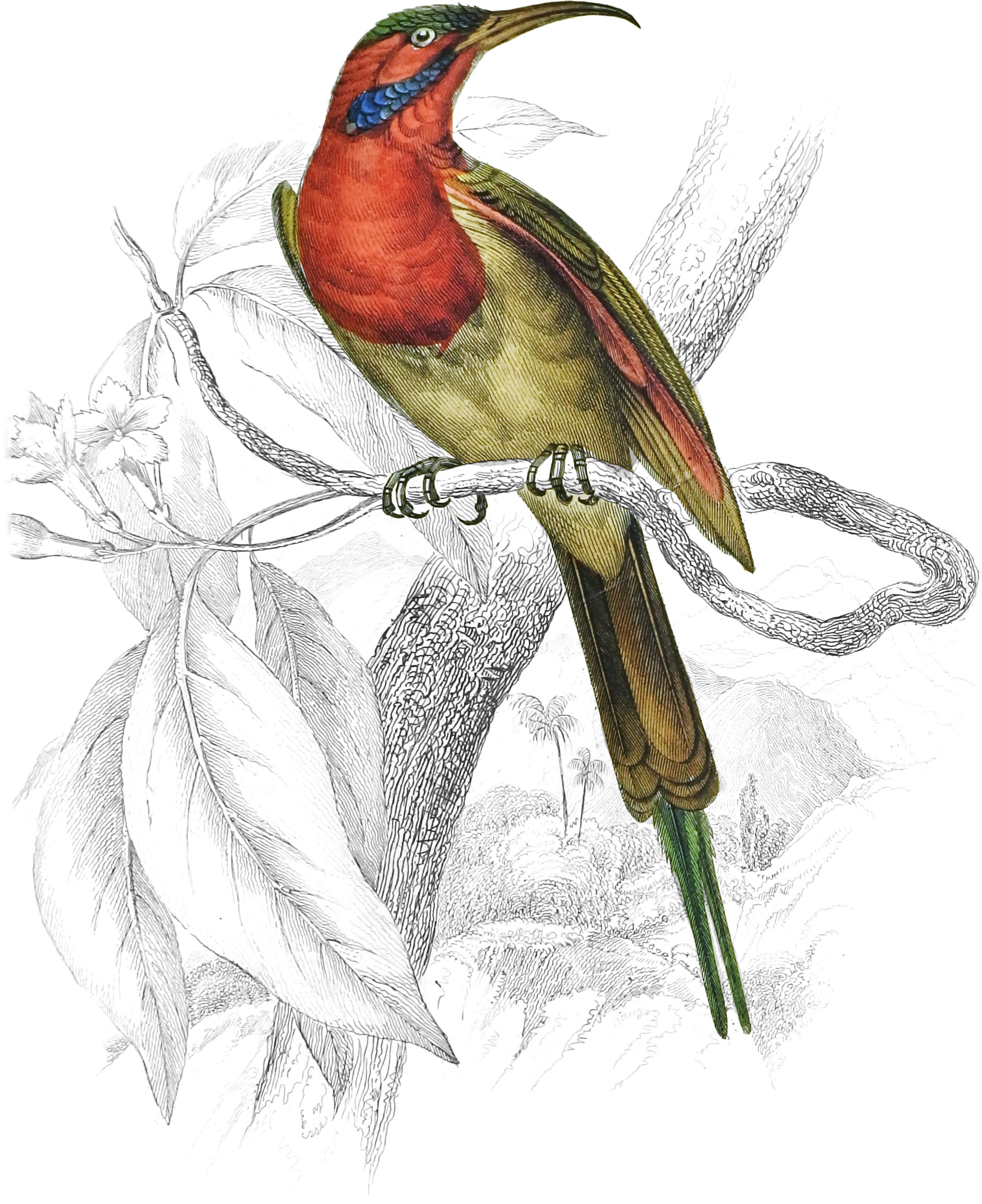
Plate XXVI
Dr. Latham’s Sun-Bird
Nectarinia Lathami, Jardine.
We possess a specimen of a Sun-bird from some part of Continental India, closely allied to that we have now represented, and also to the Certhia Siparaja of Sir Stamford Raffles’ catalogue. From the Goalparah Sun-bird it differs in a slight general modification of the tints of the plumage, in the yellow of the rump being much deeper, and in the coronal patch, upper tail-covers, and tail being steel-blue instead of metallic-green, and in the tail being shorter and more regularly graduated. Sir Stamford’s bird is from Sumatra; no mention is made of the yellow rump, while, in the catalogue appended to that gentleman’s Memoirs, N. mysticales, Temm. from Java is quoted. A comparison of the birds may serve to distinguish them. The entire length is four inches four-tenths; that of the bill to the forehead, six-tenths. Above, the forehead to the line of the eyes is steel-blue, with a play of colour; the upper tail-covers and edges of the tailfeathers, except the outer, are of the same tint, and the tail itself, nearly black, has a very strong gloss of bluish purple; the back and sides of the neck, cheeks, back, and lesser wing-covers, are rich brownish red. The lower part of the back and rump are very deep gamboge-yellow, almost Dutch orange, and following the red of the back we have the same lengthened plumes we saw in the last, of a dark greyish oil-green, and which can completely cover the yellow patch; the wings are umber-brown feathers edged with a paler tint and oil-green. Underneath, we have the maxillary stripes running upon the sides of the neck, inside half of the feathers black, the exterior rich violet; the chin, fore part of the neck, and breast, bright scarlet-red the remaining under parts dull greyish oil-green. Bill umber-brown, slightly paler on the maxilla.
As stated, we do not know the locality of the specimen we have described, and in the collection of the Zoological Society there is one similar, and bearing out the distinctions from N. Goalpariensis we have pointed out, but the locality of which is also unknown.
Siparaja Sun-Bird
Nectarinia Siparaja, Raffles.
This is characterised in the descriptive catalogue in the Transactions of the Linnean Society for 1822, and in the subsequent catalogue in the Appendix to Sir Stamford Raffles’ Memoirs, N. mysticalis, Temm. is quoted as a synonim. The discrepancy in the description of the former, and figure of the latter, is, in the first, “abdomen brown” in the figure, these parts are pure white. From our last species, the Rafflesian bird differs in having no yellow on the rump, and Temminck’s figure varies both in the want of that and in the white under parts. The N. Siparaja is from Java and Sumatra, and it is probable may be distinct from the continental birds the union of the other two will rest on the authority of the catalogue in the Memoirs.
This species has a blue patch on the forehead, and a stripe of the same colour on each side of the neck. The back of the head, neck, and upper parts of the back, are dark red; the breast of a lighter red; the abdomen, wings and middle tail-feathers brown, while the tail-covers and outer tail-feathers are blue.20
Temminck’s figure is represented with the whole tad blue, and the belly and vent pure white.
Nipaul Sun-Bird
Nectarinia Nipalensis, Hodgson.
The subject of our present plate is one of the fine species formerly alluded to as received from Mr. Hodgson. When examining the specimens in the collection of the Zoological Society, we found one similar to it, marked as above, and sent to the Society by that gentleman; we have therefore retained the name, though it may be equally applicable to several others. It agrees very nearly with that which has served for our illustration, the yellow on the rump being followed by a very deep greenish black band, which separates it from the brilliant tail-covers, and these appearing more tufted than usual.
In the bird before us the entire length is five inches and a half, of which the long central tail-feathers measure almost three inches. The head, throat, and neck, are deep steel-blue on the upper part of the back; a broad crescented band of deep and rich reddish chestnut, extending on each side upon the breast, and pointing upwards on the sides of the neck the centre of the back and shoulders, with the edges of the quills and secondaries, are olive, or of a clear oil-green, the rump gamboge-yellow, the upper tail-coverts deep steel-blue; the quills and secondaries are blackish blue, paler on the inner webs; the tail, graduated and having the feathers rather accuminated towards the tips, is black, the centre feathers being nearly entirely greenish steel-blue, those on the outsides edged with that colour. The under parts are gamboge-yellow, in the centre of the breast and belly bright reddish orange; the insides of the wings are pale yellowish white.

Plate XXVII
Mrs. Gould’s Sun-Bird
Nectarinia Gouldiæ, Vigors.
Belonging to the same group, in form and colouring, is the beautiful species which will now stand as the Ornithologist’s record of an accomplished artist. The N. Gouldiæ was dedicated to Mrs. Gould by the friend of her husband, at a time when she had shown how much could be effected by the union of taste and skill with a fine mechanical invention, and had produced a series of ornithological figures which could vie with the best that had preceded them, and were excelled only by those which appeared in her later works.
The top of the head, ear-coverts, throat, a spot on each side of the chest near the shoulder, tail-coverts, and two middle tail-feathers, are of a rich metallic-blue with brilliant purple reflections; the back and sides of the neck and shoulders are deep sanguineous red; the rump and under surface bright yellow, the latter having a few sanguineous dashes the quills and outer tail-feathers dark brown.
The above is the description given by Mr. Gould of this beautiful species, from a specimen at the time considered unique. On examining that specimen in the collection of the Zoological Society of London, we noticed that the coronal patch extends backwards to the hind head in a pointed form; the upper parts described as sanguineous are rather of a deep chestnut-red having caiTuine mixed with it; the quills and coverts deep oil-green; the tail is nearly black, except the centre feathers, which are elongated, and of the same steel-blue on the edges as that seen on the tail-coverts.
Hodgson’s Sun-Bird
Nectarinia Hodgsonis, Jardine.
We have provisionally named this fine species after the individual who has done so much towards the elucidation of the Zoology of Nipaul, although he may himself have already applied a specific appellation to it in some of the scattered periodicals where he has detailed his discoveries. We possess only a single specimen, which is unfortunately somewhat mutilated; at the same time, we believe our figure and description will be found to be tolerably correct.
The extreme length, to the tips of the longest tail-feathers, five inches and a half; the length of the long feathers being about three. The crown and nape of the neck, with two narrow stripes or lengthened moustaches running from the base of the maxilla upon the sides of the neck, are of a very rich steel-blue, with violet purple and pink reflections. The lower part of the rump, upper tail-coverts, and centre tail-feathers, are of the same beautiful colours, the latter being broadened at their base, disconnected in their webs, and extended disproportionately beyond the rest of the tail. The upper parts of the back, sides of the neck, and scapulars, are of a dark reddish chestnut, inclining to blood-red; the centre of the back appears to be deep black, and there is a trace of the pale yellow band on the rump which prevails through this group; the wings are brownish black. On the under surface of the bird21 the chin and throat, the fore parts of the neck between the two stripes, and entire breast, are very deep black; the vent and under tail-coverts are greenish grey; the sides and under surface of the wings pale yellowish white; bill and legs are nearly black.

Plate XXVIII
Red-Tailed Sun-Bird
Nectarinia phænicura.
We have another large and fine tailed species entrusted to us by the Zoological Society. The male has the long centre feathers imperfectly developed, but entirely exclusive of them is five inches in length. The female is within an eighth of seven inches to the extremity, while her tail measures three and a half inches. In the male, the crown and two broad maxillary stripes are steel-blue with violet reflections; the hind-head, back, and sides of the neck, rump and upper tail-covers, and outside webs of the tail-feathers, bright orange scarlet-red; the rump, dull gamboge-yellow; the shoulders, scapulars, and edges of the wing-feathers, oil-green the quills and secondaries, and inner webs of the tail-feathers, umber-brown the chin and centre of; the throat and neck, deep velvet-black. The remaining under parts gamboge-yellow, orange in the centre of the breast, and becoming very dull and greenish on the vent and tail-coverts. In the female the whole upper parts and wings, rump excepted, are yellowish oil-green; on the rump the yellow band is marked by dull yellow, and succeeding it the upper covers and tail are of the same scarlet or wax-red with the male, the long feathers having a black shaft and disunited webs. The chin, fore part of the neck, and breast, are pale oil-green, of a greyish tint, and the remaining under parts are dull gamboge-yellow, darkest and clearest in the centre of the breast and belly.
The above described specimens are from Silhet, and were presented by Sir Philip Egerton, Bart, to the Society.

Plate XXIX
Eboe Sun-Bird
Nectarinia Eboensis, Thompson.
We have received, by the attention of Mr. Thompson, one of the surgeons to the Niger expedition, but too late for bringing into its proper place, both sexes of a very remarkable Sun-bird, procured in the vicinity of Eboe; it will range with those having the colouring and markings of N. fulginosa, Stangerii, &c. but varies from them, as well as from other species, by the throat and breast, or the parts occupied generally by the coloured gular or pectoral patch, being of a dull straw-yellow, forming a very decided contrast with the otherwise dark plumage. In size the male is slightly less than N. Stangerii, being in length about four inches and eight-tenths. Above, the plumage is of a uniform yellowish umber-brown, slightly darker on the wings and tail; the coronal patch passes the line of the eyes, and is of a deep green. Underneath the chin is velvet black, bordered by a maxillary stripe of deep green, the fore parts of the neck and upper breast straw-yellow bordered on the lower edge by dark umber-brown; the lower breast, belly and sides, are pale chestnut-brown; under tail-covers dark umber-brown. The female, slightly less, is above uniformly of a dark hair-brown, nearly approaching to umber-brown on the wings and tail. The lower plumage of the body is pale yellowish grey, each feather darker along the centre; the bill, logs, and feet, are here dark umber-brown, whereas in the other sex, they are black. These specimens are deposited in the British Museum.

Plate XXX

Synopsis
Genus Nectarinia, Illiger
Nectarinia, Illiger, 1811 < Certhia, Linnæus = Mellisuga Vieillot, 1816 = Cinnyris, Cuvier, 1817.22
Gen. Characters.—Bill slender, curved, very fine and acute at the tip, dilated at the base, edges of the maxilla folding over the mandible, mandible narrow in depth at the base, edges of both minutely and regularly denticulated; tongue lengthened, slender, with a shortly bifid fringed apex, the edges for the whole length turned over inwards, forming a double tube; wings, with the third quill longest, first short, nearly spurious; tail even, lengthened and much graduated, or with the two centre feathers only elongated; tarsi and feet fully developed, the hallux lengthened and with its claw proportionally strong. Types, N.famosa, chalybea, amethystina, lotenia.
Note. India and Africa, principally within the tropics. Colours of the plumage brilliant; often with metallic lustre.
Species Which have been Examined
- N. afra, Linnæus, 1766.
-
Certhia afra, Linn. Syst. Nat. i. p. 186, 1766;23 Gm. Linn, i. p. 476 (syn. exc.); Lath. Ind. Orn. i. p. 286 (syn. exc.); Shaw, Gen. Zool. viii. p. 192 (syn. exc.).—Cinnyris smaragdinus, Vieill. Enc. Method. Orn. p. 595 1823.—Sucricr à plastron rouge, Le Vaill. Ois. d’Afr. vi. p. 176, pl. 300, M. & F.—Blue-rumped Creeper, Lath. Gen. Hist. iv, p. 239 (syn. exc).
Above, head, back, rump, less, w.-covers, deep golden-green with a bronzed lustre; up. t,-covers steel-blue, wings umber-brown, tail black.—Below, chin black; throat, fore part of the neck, and upper breast, golden-green, the latter at the lower edge shaded into violet and steel-blue, forming a pectoral band not passing the line of the wings; lower breast and ant. half of the belly deep scarlet-red; post, half of belly, vent, flanks, and und. t.-covers, yellowish wood-brown; axillary tufts pale king’s-yellow; bill, tarsi, and feet, black.—Length 5\(\frac{1}{2}\) in. to Sin. 4-10ths; bill to forehead, 1 in.; w. to longest quill, 2 in. 7-10ths.
Above, hair-brown, darker on the wings and tail,—outer web of the outer feather of the latter, white.—Below, wax-yellow (feathers pale hair-brown at the base), shading into yellowish-white on the vent and und. t.-covers; bill, tarsi, and feet, dark umber-brown; proportions equal to .
Hab. S. Africa. The forests of the E. coast to Caffraria on the Gamtoo and Sondag rivers. Does not reach the S. extremity of the continent, but is restricted to the line of the great forests. Le Vaill.—Note. In the descript, m the Syst. Nat, it is “abdomine albo.”
- N. chalybea, Linnæus, 1766.
-
Certhia chalybea, Linn. Syst. Nat. i. p. 186 (syn. exc.); Gm. Linn. i. p. 475 (syn. exc.); Lath. Ind. Orn. i. p. 284 (syn. exc.).—Certhia torquata C. B. Spei. Le grimpereau a collier du C. de B. Esperance, Briss. Ornithol. 4to. iii. p. 643, pl. xxxii. fig. 1; 8vo. ii. p. 13 (syn. of last exc.).—Grimpereau du C. de B. Experance, Buff. Pl. Enl. 246, fig. 3.—Cinnrys chalybea, Sw. Zool. Illust. pl. 95.—Collared Creeper, Lath. Gen. Hist. iv. p. 247 (syn. exc.).—Chalybean Creeper, Shaw and Nodd., Nat. Miscel. x. pl. 381.—Red-collared Sun-bird, Sw. B. of W. Afr. ii. (The last may be found to belong to the next.)
Above, head, neck, back, less, w.-covers, and rump, golden-green; up. t.-covers violet steel-blue; wings umber-brown; tail blackish brown, outer feather hair-brown edged with greyish white, Below, chin, throat, and breast, golden-green, terminated by a narrow band of steel-blue, running beyond the line of the wings upon the sides of the neck; lower breast and ant. half of the belly scarlet-red; post, half of the belly, vent, flanks, and und. t.-covers, pale brocoli-brown; bill, tarsi, and fee, black. Length, from 4\(\frac{1}{2}\) in. to 4 in. 8-10ths; if bill to forehead, 7 to 8-10ths; of wing to long. quill, 2 in. 2-10ths to 2 in. 3-10ths.
Above, entirely brocoli-brown, darker on the wings and tail.—Below, much paler, on the vent and unt. t.-covers nearly yellowish white; bill, tarsi, and feet, dark umber-brown.—Length, 4\(\frac{1}{2}\) in.
Hab. S. Africa to the extremity of the Cape peninsula, Le Vaill. Western Africa, Sw.—Note. Differs from N. afra in its smaller proportions, different tint of the lower parts, blue collar stretching on the sides of the neck, and different colour of the female.
- N. chloropygia, Jardine, 1842.
-
N. chloropygia, Jard. Ann. of Nat. Hist. vol. x. p. 188; Illust. of Orn. N. S. pl. l., 1842.—Green-rumped Double-collared Sun-bird, Nat. Lib. Nect. p. 172, pl. iii.
Above, rich emerald bronzed green; w. and t. brownish black, former with the edges of the feathers oil-green, latter glossed with green.—Below, chin velvet-black; throat, neck, and breast emerald-green, terminated by a narrow band of bluish green; lower breast with a band of scarlet-red; belly, blanks, and under t.-covers, pale oil-green; axillary tufts ample, king’s-yellow; bill, tarsi, and feet, black.—Length, 4 in. 4-10ths; bill to forehead, 7-10ths; w. to longest quill, 1 in 9-10ths.
Above, oil-green; w. and t. umber-brown.—Below, chin yellowish-white; breast and flanks wine-yellow, shading to pale but pure gamboge-yellow in the middle of the belly; bill, tarsi, and feet, dark umber-brown.—Length, 3 in. 8-10ths; w. to longest quill, 1 in. 8-10ths.
Hab. Fernando Po, Niger Expecd., L. Fraser.24—Note. Differs from N. chalybea in lesser size, want of blue on the up. t.-covers, and blue pectoral collar; tint of under parts; in difference of female.
- N. bifisciata, Shaw, 1811.
-
Souimanga vert et brun, Vieill. Ois. Dor. ii. pl. 24.—Cinnyris nitens, Vieill. Enc. Method. Ornith. ii. p. 588, 1823.—Certhia bifasciata, Shaw, Gen. Zool. viii. p. 198, 1811.—Violet-breasted Creeper, Lath. Gen. Hist. iv. p. 248.
Above, head, neck, back, less. w.-covers, rich bronzed green, on the rump and t.-covers, shading to emerald-green (feathers black at the base); w. and t. black glossed with green, feathers of the latte purple on the edges.—Below, chin, throat and fore part of the neck, brilliant bronzed green, shading into a pectoral band of rich steel-blue, succeeded by a second distinct band, changing from dull red to vermillion; belly, vent, and und. t.-covers black, on the latter and at the termination of the second pect. band tipped with steel-blue; bill, tarsi, and feet, black.—Length, 5 in. 3-10ths; bill to forehead, 9-10ths; w. to long. quill, 2 in. 8-10ths.
Hab. Interior of S. Africa, Smith. Malemba, Vieill.—Note. First quill short, compared with other sp. of similar size.
- N. splendida, Shaw, 1811.
-
Certhia splendida, Shaw, Gen. Zool. viii. p. 191, 1811.—Cinnyris splendida, Cuv. Reg. Anim. i. p. 434, 1817; Swain. West. Africa, ii. p. 125.—Cinnyris splendidus, Vieill. Enc. Method. ii. p. 587, 1823.—Cinnyris bombycinus, Vieill. Enc. Method. ii. p. 596, 1823.—Le Sucrier eblouissant, Le Vaill. Ois. d’Af. vi. pl. 295, fig. 1, p. 163. Le Souimanga à Plumes Soyeuses, Vieill. Ois. Dor. ii. pl. 82.—Blue-rumped Creeper, var. C., Lath. Gen. Hist. iv. p.
240239.Above, head steel-blue, in some lights appearing black, in others as rich as violet; back of the neck, back, up. t.-covers shoulders, and less. w.-covers, brilliant golden-green feathers black at the base; w. and t. black, feathers of the latter edged with golden green.—Below, throat and fore part of the neck steel-blue (changing as upon the head); across the breast as a band of scarlet, according to position appearing as if banded with steel-blue, golden-green, or violet, or to be composed entirely of one of these tints; lower breast, belly, and flanks, deep black; under t.-covers steel-blue; axillary tufts primrose-yellow; bill, tarsi, and feet, black.—Length, 5\(\frac{1}{2}\) in.; of bill to forehead 9-10ths; of w. to long quill, in 3 in. 8-10ths.
Hab. Great Namaqua country, towards Fish river, Le Vaill. Sierra Leone, coll. from Dr. Fergusson. Cape Coast, Niger Exped. L. Fraser.—Note. Plumage with the webs of the feathers loose and unconnected; up. t.-covers nearly as long as the tail.
- N. collaris, Vieillot (Enc. Method.), 1823.
-
Cinnyris collaris, Vieill. Enc. Method. ii. p. 590, 1823; Dict. Classique d’Hist. Nat. xv. p.
510511, 1829.—Le Sucrier Gamtocin, ou à cordon blue, Le Vaill. Ois. d’Af. pl. 299, M. and F.Above, bright yellowish green; w. umber-brown, feathers broadly edged with yellowish green, quills with oil-green; t. greenish black, broadly edged with deep green.—Below, chin, throat, and up. breast, yellowish green, shading into and terminating in a narrow band of blue glossed with violet; lower breast and flanks wax-yellow, shaded to gamboge-yellow on the centre, vent, and und. t.-covers; axillary tufts pale king’s-yellow; bill, legs, and feet, black.—Length, in 4 in. 2-10ths to 3 in. 8-10ths; bill to forehead 4\(\frac{1}{2}\)-10ths.; of w. to long. quill, 2 in. to 1 in. 8-10ths.
Above, nearly as in ; cheeks and sides of the neck, dull yellowish green.—Below, chin yellowish white; breast and flanks wax-yellow, shading into dull gamboge-yellow in the centre of the belly, the vent, and und. t.-covers; bill, tarsi, and feet, brownish black. Length, 3 in. 8-10ths.
Hab. Gamtoos, Le Vaill. S. Africa, coll. Dr. Smith. Fernando Po, Niger Exped. L. Fraser.
- N. venusta, Shaw and Nodder 1790.
-
Certhia venusta, Leona Creeper, Shaw and Nodd. Nat. Hist. Misc. x. pl. 369. Leona Creeper, Lath. Gen. Hist. iv. p. 234.—Cinn. venusta, Vieill. Enc. Method. ii. p. 597 (spec. char. only).—Cinn. pusilla, Swain. Birds of West. Afr. ii. p. 138, 1837.
Above, forehead violet; hack and sides of the neck, less, w.-covers, back, and rump, bronzed green; up. t.-covers steel-blue; w. clove-brown, edged with oil-green; tail black, feathers edged with green.—Below, chin black; fore part of the neck green, terminating in a distinct band of violet, succeeded on the sides by dull black, losing itself in the centre of the violet band, and forming an angular patch on teach side of the breast; lower breast, belly, and vent, pale king’s-yellow, paler on the und. t.-covers; axillary tufts orange-yellow; bill, tarsi, and feet, black.—Length, 3 in. 3-10ths to 3\(\frac{1}{2}\) in.; bill to forehead, 6-10ths; w. to long. quill, 2 in. 1-10th.
Hab. Western Africa, Swain. Sierra Leone, Shaw & Nodd.—Note. Differs from the last in the general tint, frontal and pectoral violet bands, orange axillary tufts.
- N. fusca, Vieillot, 1823.
-
Cinnyris fuscus, Vieill. Enc. Method. ii. p. 594, 1823.—Sucrier Namaquois, ou à caleçons blanc, Le Vaill. Ois. d’Af. pl. 296, M. & F.
Above, base of the plumage purplish brown, tips of the feathers purple with greenish reflections; w. dark clove-brown; up. t.-covers black, with steel-blue reflections; t. black.—Below, chin dull black, fore part of the neck and breast purplish brown with purple and green reflections, shading into blackish brown on the sides and upper part of the belly, again running into white on the vent, flanks, and und. t.-covers; axillary tufts orange-red; bill, tarsi, and feet, dark brownish black.—Length, 4\(\frac{1}{4}\)in. to 4 in. 8-10ths; of bill to forehead, 8-10ths; of w. to lower quill, 2 in. 3-10ths.
Hab. Great Namaqua, Le Vaill. Mouth of the Orange River, Dr. Smith, MSS.
- N. Verroxii, Smith, 1831.
-
Cinnyris Verroxii, Smith, South African Quart. Journ. No. V. p. 13; Illust. of the Zool of S. Afr., No. XI Aves. pl. 57, M. and F.
Above, head, neck, less. w.-covers, and back, dark bluish olive with metallic lustre (interpreted by the dark base of the feathers appearing); lower part of the back, rump, up. t.-covers, w. and t., clove-brown, darkest on the t. and with a slight purple reflection.—Below, pale hair-brown tinted with yellow, on the sides and flanks shaded to brocoli-brown; axillary tufts scarlet-red; bill, tarsi, and feet, blackish brown.—Length, 5 in. 6-10ths; of bill to forehead, 9\(\frac{1}{2}\)-10ths; of w. to long. quill, 4 in. 6-10ths.
Above, uniform brocoli-brown, darker on the w. and t.—Below, pale brocoli-brown, tinted with greenish-yellow, on the flanks and vent yellowish grey; bill, tarsi, and feet, umber-brown.—Length, 5 in. 1 or 2-10ths.
Hab. Kafir Land and eastward, towards Port Natal, Dr. Smith.
- N. obscrurus, Jardine, 1842.
-
Above, yellowish olive, darker on the crown, and having a more yellow tint on the lower back and rump; w. and t. umber-brown, feathers edged with yellow oil-green; t. underneath appearing dark, the outer feathers tipped with greenish grey.—Below, whole under the surface wine-yellow; axillary tufts gamboge-yellow; bill, tarsi, and legs umber-brown,—first with the base of the mandible pale.—Length, 5 in. 2-10ths; of bill to forehead, 9-10ths; of w. to long. quill, 2 in. 7-10ths.
Above, similar to .—Below, greyish wine-yellow; bill, tarsi, and feet, pale umber-brown.—Length, 4 in. 9-10ths; of bill to forehead, 8-10ths; of long. quill, 2 in. 3-10ths.
Hab. Fernando Po, Niger Exped. L. Fraser.
- N. olivaceus, Dr. Smith, 183—.
-
Cinnyris olivaceus, Smith, Illust. of the Zool. of S. Afr. in Descrip. of C. verroxii.
Above, dark olive, on the crown nearly bluish black; w. and t. dark umber-brown, feathers edged with yellowish olive, t. with the out. feathers tipped with grey.—Below, oil-green, paler on the vent and und. t.-covers, on the throat tinted with yellow; axillary tufts pale saffron-yellow; bill, tarsi, and feet, umber-brown.—Length, 6 in.; of bill to forehead, 1 in.; of w. too long. quill, 2 in. 6-10ths.
Hab. Vicinity of Port Natal, Dr. Smith, MSS.—Note, differs from the last in larger size, darker colour above, difference of the tint below.
- N. cuprea, Shaw, 1811.
-
Certhia cuprea, Shaw, Zool. viii. p. 201, 1811.—Souimanga tricolor, Vieill. Ois. Dor. pl. 23.—Cinnyris tricolor, Vieill. Enc. Method. Orn. p. 588.—Cinn. erythronotus, Swain, West. Af. ii. pl. 15, 1837.—Certhia rubrofusca, Shaw, Zool. viii. p. 222,
1811?1812.—Le Souimanga rougedore, Vieill. Ois. Dor. pl. xxvii.?—Cinnyris nibarus, Vieill. Enc. Method. Orn. p. 597, 1823?Above, crown cheeks, back, and sides of the neck, reddish purple with a bronzed and coppery lustre; lower back, rump, and up. t.-covers, auricula-purple; w. and t. black, tinted with blue; less. w.-covers violet-purple.—Below, chin, fore part of the neck, and breast, reddish purple, the latter prevailing; lower breast, belly, vent, and t.-covers, deep black; bill, tarsi, and feet, black.—Length, 4 in. 8-10ths; of bill to forehead, 7-10ths; of w. to long. quill, 2 in. 8-10ths.
Above, plumage, including the w., dark brownish oil-green, darkest on the latter; t. nearly black, outer feathers tipped with grey.—Below, pale wax-yellow, clearest and more yellow in the centre of the belly.—Length, 4 in. 3-10ths; bill to forehead, 6-10ths.
Hab. Cape Coast, Accra, Niger Exped. L. Fraser. Malemba, as N. tricolor, Vieill. Senegal, as N. erythronotus, Swain.
- N. cyanocephala, Shaw, 1811.
-
Certhia cyanocephala. Shaw, Zool. viii. p. 203, 1811.—Souimanga à tête blue, N. cyanocephalus, Vieill. Ois. d’Or. ii. pl. 7; Enc. Method. Orn. p. 587.—Cinnyris chloronotus, Swain, West. Afr. ii. pl. 16.—Souimanga vert et gris, Vieill. Ois. Dor. ii. pl. xxv. Female.
Above, crown, nape, cheeks, and sides of the neck, dark bluish green with metallic lustre, base of the feathers black; back, rump, up. t.-covers, and less. w.-covers, clear yellowish oil-green without lustre; w. and t. pale umber-brown, feathers edged with yellowish-oil-green. Below, chin, fore part of the neck, and breast, dark bluish green with steel-blue reflections; belly, flanks, vent, and und. t.-covers, uniform brocoli-brown; axillary tufts primrose-yellow; bill, tarsi, and feet, black.—Length 5 in. 3-10ths. to 5\(\frac{1}{2}\); of bill to forehead, 9-10ths; of wing to long. quill, 2 in. 6-10ths.
Above, as in .—Below, uniform greyish white, paler on the vent, and there tinted with yellowish oil-green; length, 5 in. 5-10ths; of bill to forehead, 8-10ths; of w. to long. quill, 2 in. 4-10ths.
Hab. Malemba, Vieill. Sierra Leone Dr. Fergusson.
- N. Senegalensis, Linnæus, 1766.
-
Certhia Senegalensis, Linn. Syst. Nat. edit. xii. p. 186, 1766; Lath. Ind. Orn. i. 284, 1790.—Grimpereau violet du Senegal, Certhia Senegalensis violacea, Briss. Ornithol. 4to. p. 660, pl. xxxiv. fig. 2; 8vo. vol. ii. p. 18, 1763.—Cinnyris discolor, Vieill. Enc. Method. Orn. p. 589, 1823.—Le Sucrier protée, Le Vaill.
ivvi. pl. 295, fig. 2.—Le Souimanga violet à portrine rouge, Vieill. Ois. Dor. pl. viii.—Cinnyris Senegalensis, Swain, West. Af. ii. p. 127, 1837.Above, coronal patch above the eyes, as far as the occiput, rich emerald-green; lores black; remaining plumage deep brownish black, glossed with purple, paler on the wings, feeling to the touch like velvet.—Below, maxillary stripe broad, emerald-green, chin and throat golden-green; fore part of the neck and breast scarlet-red, varying to violet-blue, each feather being tipped with the former, succeeded by a band of the latter; belly, vent, and und. t.-covers, deep brownish black; bill, tarsi, and feet black.—Length 5 in. 4-10ths to 5; of bill to forehead, 8-10ths; of w. to long. quill, 2 in. 6-10ths.
Hab. Caffraria, Le Vaill. Senegal, Swain.
- N. Natalensis, Jardine, 1842.
-
Above, coronal patch, confined to the crown, bluish green; bend of the w. violet; remaining plumage deep brownish black, paler on the w. and t., feeling to the touch like velvet.—Below, maxillary stripe narrow, bluish-green, chin and throat golden-green; fore part of the neck and breast scarlet-red, intermixed with violet, each feather being broadly tipped with the former, succeeded by a band of the latter; belly, vent, and und. t.-covers, deep brownish black; bill tarsi, an feet, black.—Length, 5 in. 9-10ths; bill to forehead, 2 in. \(\frac{1}{2}\)-10th; w. to long. quill, 3 in. 1-10th.
Hab. Vicinity of Port Natal.
- N. amethystina, Shaw, 1811.
-
Certhia amethystina, Shaw, Zool. viii. p. 195, 1811.—Cinnyris amethystina, Cuv. Reg. Anim. 1816.—Cinnyris auratifrons, Vieill. Enc. Method. Orn. p. 590, 1823.—Le Sucrier velour, Le Vaill. Ois. d’Af. vi. pl. 294.—Le Souimanga à front d’oré, Vieill. Ois. Dor. pls. v. vi.
Above, coronal patch confined to the crown, dark emerald-green; bend of the w. and up. t.-covers, amethystine-purple; remaining plumage very deep brownish black, with a play of purple, feeling to the touch like velvet.—Below, gular patch on the chin, throat, and fore part of the neck, amethystine-purple; breast, belly, vent, and und. t.-covers, brownish black; bill, tarsi, and feet, black.—Length, 5 in to 3-10ths to 5-in to 9-10ths; of bill to forehead, 1 in. 1-10th to 1 in. 2-10ths; of w. to long. quill, 2 in. 8-10ths to 3 in.
- N. fuliginosa, Shaw, 1811.
-
Certhia fuliginosa, Shaw, Zool. viii. p.
223222, 1811.—Cinnyris fuliginosus, Vieill Enc. Method. Orn. p. 584, 1823.—Souimanga carmélite, Vieill. Ois. d’Or. pl. xx.—Souimanga carmélite cinnyris fuliginosus, Drapiez. Dict. Class. d’Hist. Nat. xv. p. 510.—Carmelite Creeper, Lath. Gen. Hist. iv. p. 256.Above, uniform pale yellowish umber-brown; w. and t. dark umber-brown, with slight purplish reflections; forehead with an imbricated patch extending to the line of the eyes; less w.-covers and radial edge of the w., auricula-purple; axillary tufts bright primrose-yellow.—Below, yellowish umber-brown; chin, throat, and fore part of the neck, auricula-purple.—Length, 5 in.; of bill to forehead, 7-10ths; w. long. quill, 2\(\frac{1}{2}\) in.
Hab. Malemba, western coast of Africa, Vieill.
- N. stangeri, Jardine, 1842.
-
N. Stangeri, Jard. Ann. of Nat. Hist. x. p. 187, 1842.—N. Stangeri, Niger Carmelite Sun-bird, Nat. Lib. Nect. p. 198; Jard. and Selby, Illust. of Orn. N.S. pl. xlviii.
Above, uniform deep yellowish umber-brown, darker on the w. and t., showing yellowish lights; coronal patch, reaching to the line of the eyes, imbricated, deep green, posterior row of feathers violet.—Below, dark umber-brown, with purple lights; chin velvet-black; gular patch yellowish green, bordered by a maxillary stripe of deep green, extends to the upper part of the breast and has the last row of feathers deep steel-blue tipped with scarlet, appearing like a terminating scarlet thread; bill, tarsi, and feet, black.—Length, 5 in.; bill to forehead, 7\(\frac{1}{2}\)-10ths; wing to long. quill, 2 in. 6-10ths.
Hab. Niger.—Note. Only specimen in possession of Mr. Waterhouse, procured by Dr. Stanger. Differs from preceeding in color of coronal and gular patches; no colour on lesser w.-covers; want of axillary tufts.
- N. Adelberti, Gervais, 1834.
-
Cinnyris Eboensis, Thompson, MSS., M. 141, F. 140.—Souimanga d’Adelbert, Cinnyris Adelberti, Gervais, Mag. de Zool. iii. pl.
219.—Nectarinia Adelberti, Nat. Lib. vol. xxxvi. pl. iii. p. 244; Jard. and Selby, Illust. of Orn., N. S., pl. 49, M. and F.Above, uniform yellowish umber-brown, slightly darker on the w. and t.; coronal patch passing the line of the eyes, imbricated, deep green.—Below, chin velvet-black, bordered by a maxillary stripe of deep green; forepart of the neck and upper breast straw-yellow, bordered on the lower edge by dark umber-brown; lower breast, belly, and sides, pale chestnut-brown; und. t.-covers dark umber-brown; bill, tarsi, and feet, black.—Length, 4 in. 8-10ths; bill to forehead, 7-10ths; w. to long. quill, 2 in. 4-10ths.
Above, dark hair-brown, on the quills and t. nearly umber-brown.—Underneath, pale yellowish grey, clearest in the middle of the belly; the feathers darker along the centre of each; bill, legs, and tarsi, dark umber brown.—Length, 4 in. 6-10ths.
Hab. Senegal, Gervais. Eboe on the Niger, Thompson.
- N. violacea, Linnæus, 1766.
-
Certhis longicauda minor C. B. Spei. Briss. Ornithol. iii. p. 649, pl. xxxiii. fig. 6; 8vo. ii. p. 15, 1763.—Certhia violacea, Linn. Syst. Nat. i. p. 188, 1766; Linn. Mantissa, p. 525, 1771; Lath. Ind. Orn. i. p. 288, 1790.—Le Souimanga à capuchon violet, “C. violaceus,” Vieill. Enc. Method. p. 598.—Le Sucrier oranga, Le Vaill. vi. p. 152, pl. 292.
Above, crown back and sides of the neck, upper part of the back, and bend of the w., dark golden-green, varied with bronze and purple; back, rump, up. t.-covers, edges of the feathers of the w. and t., yellowish green; w. and t. pale umber-brown.—Below, chin and throat dark golden-green; centre of the breast, and nearly bordering the green of the sides as a narrow crescent, violet purple; lower part and centre of the breast and belly, deep reddish orange, shading into gamboge-yellow on the flanks and und. t.-covers; axillary tufts pale king’s-yellow; bill, tarsi, and feet, black.—Length, 6 in.; of bill to forehead, 9-10ths; of w. to long. quill, 2 in. 2-10thsl
Hab. Vicinity of Cape of Good Hope, Le Vaill.—Note. Center t.-feathers exceed the others by 9-10ths or 1 in.; t. graduated.
- N. famosa, Linnæus, 1766.
-
Certhia famosa, Linn. Syst. Nat. i. p. 187, 1766.—Certhia longicauda, C. B. Spei. Briss. Ornithol. 4to. iii. p. 647, pl. xxxiv. fig. 1; 8vo. ii. p. 14.—Souimanga Malachite, C. famosus, Vieill. Enc. Method. p. 592.—Le Sucrier Malachite, Le Vaill. Ois. d’Afr. pl. 143, pls. 289,
299290.—Le grande Souimanga a longue queue, Vieill, Ois. Dor. pls. xxxvii., xxxviii.—Famous Creeper, Lath. Gen. Hist. iv. p. 214.—Shining Creeper, C. famosa, Shaw, Gen. Zool. viii. p. 212, pl. 31.—Grimpereau a longue queue du C. de B. experance, Buff. Pl. Enl. 83, fig. 1.Above, including less w.-covers and scapulars, malachite-green, on the head and neck with a play of green and reddish bronze; w. black, on the secondaries tinted with violet; t. square, centre feathers much elongated, black, the latter at their base edged with malachite-green.—Below, chin in some lights appearing black; throat and neck generally of a golden bronzed green; breast, belly, and vent, malachite green, on the latter and und. t.-covers intermixed with the black; axillary tufts gamboge-yellow; bill, tarsi, and feet, black.—Length, 9 in. to 9\(\frac{1}{2}\) in.; of bill to forehead, 1 in. 3-10ths; of w. to long. quill, 3 in. 2-10ths; long. t.-feathers exceed the square t. from 2\(\frac{1}{2}\) in. to 3 in. 1-10th.
Hab. S. Africa, vicinity of the C. of G. Hope, Le Vaill. &c.
- N. pulchella, Linnæus, 1766.
-
Certhia pulchella, Linn. Syst. Nat. i. p. 187, 1766; Gm. Linn. p. 481.—Certhia longicauda Senegalensis, Briss. Ornithol. 4to. iii. p. 645, pl. xxxiv. fig. 3; 8vo. ii. p. 14. Le Sucrier cossu, Le Vaill. Ois. d’Afr. vi. p. 154, pl. 293, fig. 1.—Cinnyris caudatus, Vieill. Enc. Method. p. 595, 1823.—Grimpereau a longue queue du Sénégal, Buff, Pl. Enl. 670; auct. Le Vaill.—Beautiful Creeper, Lath. Gen. Hist. iv. p. 217.—Le petit Souimanga a longue queue, Vieill. Ois. Dor. pl. 40; Swain. Birds of W. Africa.
Above, including less. w.-covers and edges of the w. to base of 1st quill, golden-green; w. brownish black; tail, square centre-feathers only elongated, black,—the latter at their base edged with green.—Below, throat, fore part of neck, and upper breast, intense emerald-green; lower breast with a collar of yellowish carmine-red, shading upon the belly into gamboge-yellow, and running to a point along the centre; sides of the belly golden-green; flanks, vent, and und. t.-covers, black,—the latter tipped with bluish-green; bill, tarsi, and feet, black. Length, 6 in. 2-10ths; to bill to forehead, 6-10ths; of long. quill, 2 in. 3-10ths; long. t.-feathers exceed the square tail 2-10ths.
Hab. S. Africa, but not within the Great River in the Kafir country. Senegal, Le Vaille. Sw. Sierra Leone, Dr. W. Fergusson.
- N. platura, Vieillot, 1823.
-
Le Souimanga figuier, Cin. platurus, Vieill. Enc. Meth. Orn. p. 589, 1823.—Le Sucrier figuier, Le Vaill. Ois. d’Afr. vi. p. 157, pl. 293.—The Saccharine Creeper, Lath. Gen. Hist. iv. p. 225.—Nect. sylviella, Temm. Pl. Col. Note to pl. 347, and Ind.
Above, head, neck, back, scapulars, and w.-covers green with bronze and purple lustre; rump and t.-covers, violet-purple; w. brownish black; tail square, centre feathers only elongated, black,—the latter broadly edged with violet-purple, at the tips slightly spatulate.—Below, throat, fore part of neck and upper breast, duck-green; lower breast, belly, vent, and und. t.-covers, saffron-yellow; bill, tarsi, and feet, black.—Length, 6\(\frac{1}{2}\) in.; of bill to forehead, 4-10ths; of w. to long. quill, 2 in. 2 or 3-10ths; long. feathers exceed the square tail 2 in. 6 or 7-10ths.
Hab. Forests of the Great Namaquois, Le Vaill. Sierra Leone, Dr. W. Fergusson.—Note. Specimens vary in the proportion of the purple reflection on the upper plumage, an in the depth of the yellow below. Those from W. Africa show greatest degree of purple and deeper yellow.
- N. metallica, Lichtenstein, 18—.
-
Nectarinia metallica, Schilleruder Honigsauger, Cretz. Rupp. At. zu der Reise in Nörd. Af. Vog. 10. Taf. 7, 1826; Hemp. & Ehrenb. Symb. Phys. av. pl. 1.—Souimanga metallique, N. metallica, Temm. Pl. Col. 347, figs. 1, 2.
Above, head, neck, back and less. w.-covers, blackish green, with purple lustre; rump and up. t.-covers steel-blue; w. brownish black; t. nearly square, centre feathers only elongated, black,—the latter narrowly edged with violet, slightly spatulate at the tips.—Below, throat, fore part of the neck, and upper breast, blackish green, bordered with a distinct collar of clear blue; lower breast, belly, and vent, pale king’s-yellow; und. t.-covers yellowish white, tipped with yellow; bill, tarsi, and feet, black.—Length, 6 in.; of bill to forehead, 4-10ths; of w. to long. quill, 2 in. 1-10th; long feathers exceed the square tail to 2 in.
Hab. N. E. Africa, south of Suchet, Rüppell. Southern Arabia, Dongola, Abyssinia, Ehrenb. Nubia, Dongola, Temm.
- N. zeylonica, Linnæus, 1766.
-
Certhia zeylonica, Linn. Syst. Nat. i. p. 188 (syn. exc.); Gm. Syst. i. p. 482 (syn. exc.); Lath. Ind. Orn. i. p. 285 (syn. exc.)—Ceylonese Creeper, Lath. Gen. Hist. iv. p. 227 (syn. exc.)—Cinnyris sola, Jerd. in Madras Journ.
iixi. p.128226.—Souimanga a ceinture maroon, Vieill. Ois. Dor. p.3745, pl. xvi. (syn. exc.).Above, crown extending to the occiput, deep olive-green, with green and purple reflections; less. w.-covers similar, with a much greater tint of purple; cheeks and auriculars, deep umber-brown; back and sides of the neck, back, and scapulars, purplish brown; lower back and up. t.-covers, amethystine-purple; w. umber-brown, edges of the feathers paler; t. nearly black, exterior features tipped with grey, on the outer for a third of its length.—Below, chin, throat, and fore part of the neck, amethystine purple, the breast crossed by a bar of purplish red, continued from a brown colour of the upper parts; lower breast and belly king’s-yellow, shaded to a paler tint on the flanks, vent, and und. t.-covers; bill, tarsi, and feet, dark brownish black.—Length, 4 in. to 4 in. 2-10ths; of bill to forehead, 6-10ths; of w. to long. quill, 2 in. 2-10ths.
Hab. Ceylon, Linn. Continental India. Carnatic, more than any other part of the peninsula, Jerd.—Note. Varies in the degree of purple on the coronal patch; gular patch steel-blue; spec in coll. of H. Strickland, Esq.; in breadth of purplish red pectoral band.
- N. affinis, Shaw, 1811.
-
Souimanga a gorge violette, Vieill. Ois. Dor. pl. 32.—Red-breasted Creeper, var. B., Lath. Gen. Hist. iv. p.
221219.—Certhia sperata, var. γ, Lath. Ind. Orn. i. p. 283 (syn. exc.).—Souimanga à ventre écarlate, N. coccingaster, Temm. Pl. Col. 388, fig. 3.—Certhia affinis, Violet-throated Creeper, Shaw, Gen. Zool. viii. p. 208. 1811.Above, crown, extending to the occiput, green with golden reflections; cheeks and aricularas black; back and sides of the neck, back, and gr. covers, dark purplish red; lower back and upp. t.-covers olive green with purple reflections; w. umber-brown, edges of the feathers paler, bend green; tail black, out. edges of the feathers violet.—Below, chin, throat, and forepart of the neck, amethystine-purple; lower breast and belly scarlet; small patch of metallic-green feathers where the pectoral patch terminates; vent and und. t.-covers oil-green; bill, tarsi, and feet, dark umber-brown, base of the mandible pale.—Length, about 4 in.; of bill to forehead, 6\(\frac{1}{2}\)-10ths; of w. to long. quill, 2 in. 1-10th.
Hab. Manilla, Temm.—Note. The true C. sperata, Linn. (Certhia Philippensis purpurea, Briss.) seems to differ from Temminck’s bird in having the head, throat, and upper part of the neck “splendidissimè violaceæ;” and in the lesser w.-covers, lower back, rump, and up. t.-covers “violacea, splendidè viridi colore variantes.” “Violet” can only be applied to the gular patch of N. affinis, brilliant green with slight purple reflections being the colour of the other parts. We suspect that this is a variety, and that it should stand as N. sperata, Linn. with its synonims.
- N. hasseltii, Temminck, 18—.
-
Souimanga de Hasselt, N. Hasseltii, Temm. Pl. Col. 376, fig. 3.—Certhia sperata, Sir St. Raffels, Trans. Linn. Soc. xiii. p. 298, 1822.—Certhia Braziliensis violacea, Briss. Ornithol. 4to. iii. p. 662, pl. xxxii. fig. 4; 8vo. ii. p.
1918.—Black and Violet Creeper, Lath. Gen. Hist. iv. p. 274.—Le Souimanga violet, Vieill. Ois. Dor. p.6539.—Certhia Brasiliana, Shaw, Gen. Zool. viii. p. 257.Above, the crown, extending upon the occiput and nape, golden-green (feathers of a soft and disunited texture); cheeks, sides, and back of the neck, w., and t., deep black; mantle, lower back, up. t.-covers, less. w.-covers, metallic olive-green varied with steel-blue and purple.—Below, chin nearly black, bordered by a maxillary stripe, which with the neck and breast is amethystine-purple; on each side of the pectoral patch a small spot of steel-blue; lower breast and belly purplish red; vent and und. t.-covers greyish black; bill, tarsi and feet, black.—Length, 3 in. 8-10ths; of bill to forehead, 6-10ths; of w. to long. quill, 2 in.
Hab. Java, Temm.
- N. calcostetha, Jardine, 1842.
-
Above, crown, extending backwards upon the nape, dark emerald-green; less w.-covers, lower back, rump, and up. t.-covers, metallic olive-green with purple reflections; w. blackish brown, great. w.-covers edged with violet; cheeks, sides of the neck, back, and t. black, feathers of the latter edged with steel-blue.—Below, chin black; maxillary stripes amethystine-purple; fore part of the neck and breast copper-red (black when not held in the light); lower breast and belly violet-purple joining on each side with the maxillary stripes; lower belly, vent, and und. t.-covers, greyish-black; axillary tufts deep king’s-yellow; bill, tarsi, and feet black.—Length, 3 in. 6-10ths; of bill to forehead, 6\(\frac{1}{2}\)-10ths; of w. to long. quill, 2 in. 2-10ths.
Hab. E. Ind. Islands?—Note. Nearly allied to N. aspasia, Less.; differing from the figure and description by distinction of colours on the breast, greyish black vent, and the presence of yellow axillary tufts. (See description of that sp. in Pl. II.)
- N. lotenia, Linnæus, 1766.
-
Certhia lotenia, Linn. Syst. Nat., p. 188 (syn. exc.), 1766; Gmel. Linn. i. 483 (syn. exc.).—Certhia polita, Lath. Ind. Orn. i. p. 287, 1790.—Polished Creeper, Lath. Gen. Hist. iv. p. 245.—Le Souimanga pourpre, Vieill. Ois. Dor. ii. pl. xi.—Purple Indian Creeper, Edw. Glean. ii. pl. 265, up. figure.—Cinnyris purpurata, Vieill, Enc. Method. p. 596, 1823; Cinnyris polita, Jerd. Madras Journ. 1840, p.
127225.—Purple Creeper, Certh. purpurata, Shaw, Gen. Zool. viii. p. 201.Above, dark metallic-green, with blue and purple reflections; w. umber-brown; tail bluish black, feathers edged with green.—Below, chin velvet-black; and neck and upper parts of the breast dark metallic-green, shading at the lower edge into the steel-blue, sometimes tinted with violet, lower breast with a narrow band of purplish red; belly, vent, and und. t.-covers, yellowish hair-brown; axillary tufts ample, king’s-yellow; bill strong at the base, considerably curved, with the tarsi and feet black.—Length, 5 in.; of bill to forehead, 1 in. to 1 in. 1-10th; of w. to long. quill, 2 in. 2 or 3-10ths.
Above, “light greenish brown, quills darker, t. black.—Below, pale yellow; (differs from of N. mahrattensis only in darker tint in plumage above).” Jerd.
Hab. Ceylon, Linn. Carnatic, on the west coast of the peninsula, Jerd. Continental India.—Note. Varies in the intensity of the blue or purple shade of the plumage, and in the breadth of the reddish pectoral bar.
- N. mahrattensis, Latham, 1801.
-
Certhia mahrattensis, Lath. Ind. Orn. Supp. p. xxxvi. 1801; Jerd. Mad. Journ. 1840, p. 127.—Le Souimanga du pays de Mahrattes, Vieill. Enc. Method. Orn. p. 595—Souimanga azuré, C. cyaneus, Enc. Method. p.
599?598—Le Souimanga violet, Vieill. Ois. Dor. pl. xii.—Purple Indian Creeper, Edw. Glean. ii. pl. 265, und. figure.—C. orientalis, Franck. Proceed. Zool. Journ. 1831, p. 122. Eastern Creeper, Lath. Gen. Hist. iv. p. 232, and Sugar Creeper, C. asiatica, p. 238, seem also synonims (syn. exc.).Above, steel-blue, varied with green and purple reflections; w. brownish black; t. black, feathers edged with steel-blue.—Below, chin, neck, and upper breast, steel-blue, inclining to green and violet; fore part of the neck of a deeper and more violet tint, showing a central mark running towards for the whole length of the gular patch; across the lower breast a very narrow band of purplish red (sometimes partial, sometimes entirely wanting); belly, vent, and und. t.-covers, black, latter tipped with steel-blue; axillary tufts king’s-yellow, overlaid with orange-red; bill, tarsi, and feet, black.—Length, 4 in. 1-10th to 4 in. 5-10ths; of bill to forehead, 7-10ths; of w. to long. quill, 2 in. 1-10th to 2 in. 2-10ths.
“Above, greenish brown-grey, quills dusky, tail black.—Below, pale yellow, darkest on the throat.” Jerd.
Hab. Continental India and the Peninsula. Summit of the Nylgherries, Jerd. Nipaul, Hodg. S. Africa, Col. Sykes (requiring confirmation).—Note. If correct in N. asiatica for a syn., the bird should bear that name, being given in the Ind. Orn. in 1790. Varies in the shade of steel-blue and purple, and in the distinctness ad colour of the reddish pectoral band. Differs from N. lotenia in proportion of bill, black belly and vent, reddish orange on axillary tufts.
- N. minima, Sykes, 1832.
-
Cinnyris minuta, Sykes, Proc. Zool. Soc, April, 1832, p. 98; Jerd. Mad. Journ, 1840, p. 128.
Above, crown and nape metallic-olive with purple reflections (texture soft); sides of the neck, back, rump, and up. t.-covers purplish scarlet-red, on the lower back and t.-covers, varied with pale bluish purple; w. umber-brown, t. blackish brown.—Below, neck, throat, and up. breast amethystine-purple; belly, vent, and und. t.-covers deep primrose-yellow; bill, tarsi, and feet, wood-brown.—Length, 3 in. 6-10ths; of w. to long. quill, 1 in 8-10ths.
Above, head, cheeks, back of the neck, and up. back, yellowish oil-green; less. w.-covers, lower back, and up. t.-covers, purplish scarlet-red, with a slight tinge of bluish purple; w. and t. umber-brown.—Below, primrose-yellow, darkest on the throat and breast.
Hab. High forest jungle of Malabar, Jerd. Dense woods of the Ghauts of the Decean. Col. Sykes.
- N. solaris, Temminck, 18—.
-
Souimanga souici, N. solaris, Temm. Pl. Col. 347, fig. 3.
Above, coronal patch green, reaching rather beyond the line of the eyes; back of the neck, back, rump and up. t.-covers, dark oil-green; w. and t. umber-brown.—Below, throat, fore part of the neck and up. breast, very deep indigo tinted with violet, shading to dark metallic-green upon the edges of the gular patch; lower breast, belly, vent, and und. t.-covers, brilliant orpiment orange, paler on the vent.—Length 4\(\frac{1}{2}\) in.
Hab. Amboyna. Temm.
- N. pectoralis, Horsfield, 1821.25
-
Nect. pectoralis, Horsf. Trans. Linn. Soc. xiii. 1st. p. 167, 1821.—Souimanga distingue, N. eximia, Temm. Pl. Col. 138, M. & F. 18—.—Certhia Philippensis olivacea, Briss. Ornithol. 4to. iii. p. 623, pl. xxxiv. fig. 4; 8vo. ii. p. 7?—Grimpereau olive des Philippines, Pl. Enl. 576, fig. 4?
Above, front in a line with the eyes, a narrow streak over each steel-blue; w. umber-brown, feathers edged with oil-green; tail black, feathers (except the centre pair) tipped with white, that on the outside for half its length; other upper parts dark yellowish oil-green.—Below, chin, throat, and breast, deep steel-blue, in the centre of the throat and neck tinted with purple, and showing a defined mark; belly, vent, and und. t.-covers king’s-yellow, axillary tufts of a deeper shade; bill, tarsi, and feet, blackish brown.—Length, 3 in. 9-10ths; of bill to forehead, 7-10ths; of w. to long. quill, 2 in. 1-10th.
Hab. Java, Horsf. Reinwardt.
- N. jugularis, Linnæus, 1766.
-
Certhia jugularis, Linn. Syst. Nat. p. 185.—Certhia Philipensis minor, Briss. Ornithol. 4to. iii. p.
617616, pl. xxxii. fig. 5.; 8vo. ii. p. 5?—Souimanga a gorge blue, Vieill. Ois. Dor. p. 51, pl. xxix.Above, yellowish hair-brown, greenish predominating on the lower part of the back; w. umber-brown; t. black, feathers (except the centre pair) tipped with white, that on the outside for half its length.—Below, chin, throat, and up. breast, deep steel-blue, intensely dark in the centre, at the sides a few dark brown feathers indicating a brown terminal band: belly, vent, and und. t.-covers dull king’s yellow, paler towards the vent axillary tufts ample, deep king’s-yellow; bill, tarsi, and feet, black.—Length, 3 in. 9-10ths; of bill to forehead, 7-10ths; of w. to long. quill, 2 in. to 2 in. 2-10ths.
Hab. Philippine Islands, Linn., Briss. Cumming (sp. in Zool. Soc.).—Note. The figure of Brisson is represented with the throat only dark.
- N. goalpariensis, Royle, 18—.
-
Certhia Goalpariensis, Royle, Illust. Introd. p. lxxviii. tab. vii. fig. 1, 18—.—Goulparah Creeper, Lath. Gen. Hist. iv. p. 221, pl. lxxiv.——Cinnyris Vigorsii, Sykes, Proceed. Zool. Soc. 1832, p.
9998.Above, crown golden green with purple reflections; nape, back, and scapulars, deep brownish carmine-red, rump banded with pale king’s yellow, which can be concealed by lateral lengthened feathers of oil-green; w. umber-brown, feathers edged with oil-green; up. t.-covers and two centre t.-feathers deep green, remaining t. brownish black.—Below, chin, throat, neck, and breast, dazzling scarlet-red, on the maxilla a streak of violet-purple; belly, vent, and und. t.-covers, pale clove-brown; bill, tarsi, and feet, wood-brown, very pale on the mandible.—Length, 5 in. 4-10ths; of bill to forehead, 7-10ths; of w. to long. quill, 2 in. 2-10ths; long. feathers exceed the t. by 8-10ths.
Hab. Continental India, Col. Sykes. Goulparah, Lath. Northern India, Royle. Nipaul, Hodg.
- N. lathami, Jardine, 1842.
-
N. Lathami, Jard. Nat. Lib. vol. xxxvi. p 233, 1842.
Above, forehead to the line of the eyes, steel-blue; back and sides of the neck, checks, back, and less. w.-covers, brownish red; lower back and rump dark gamboge-yellow, protected on the sides by lengthened plumes of oil-green; up. t.-covers steel-blue; tail black, feathers edged with steel-blue, graduated; w. umber-brown, edges of the feathers paler.—Below, chin, fore part of the neck, and breast, scarlet-red, maxillary stripes reach to the sides of the neck; narrow feathers of two colours, black and violet, forming a line of each, the black interior; belly, vent, and und. t.-covers, dull greyish oil-green; bill, tarsi, and feet, umber-brown, mandible slightly paler.—Length, 4 in. 2-10ths; of bill to forehead, 5\(\frac{1}{2}\)-10ths; of w. to long. quill, 2 in.
Hab. Continental India.—Note. Differs from N. Goalpariensis in the general tint of colouring, blue front and up. t.-covers; t. regularly graduating?
- N. eximia, Horsfield, 18—.
-
N. eximia, Horsf. Trans. Linn. Soc. vol. xiii. p.
181168.—Souimanga de Kuhl, N. Kuhlii, Temm. Pl. Col. 376, figs. 1, 2.Above, coronal patch extending to the occiput, olive with metallic lustre; back and sides of the neck, back, and w.-covers, yellowish oil-green; rump pale gamboge-yellow; w. and t. pale umber-brown, latter graduating.—Below, Throat, fore part of the neck, and up. breast, brownish carmine, divided in the centre by an angular stripe of violet; belly dark umber-brown, shading to greenish white on the vent and und. t.-covers; axillary tufts very ample, white.—Length, 5 in.; of bill to forehead, 8-10ths; of w. to long. quill, 2 in. 2-10ths.
Hab. Java, Horsf., Temm.
- N. nipalensis, Hodgson, 18—.
-
Cinnyris Nipalensis, Hodg. Spec. in Coll. of Zool. Soc.
Above, head, cheeks, and nape steel-blue; up. part of the back with a broad credscented band of deep reddish chestnut, extending to the breast and pointing upwards on the sides of the neck; lower back, less. w.-covers, scapulars, edges of the quills, and secondaries, clear oil-green; rump gamboge yellow; up. t.-covers steel-blue; w. blackish-brown; t. graduated, feathers rather accuminated at the tips, black—the two outer pairs tipped with grey, the outer feathers greenish steel-blue, black at the base and tips.—Below, gamboge-yellow, centre of the breast and belly reddish orange, throat steel-blue, inside of the w. pale yellowish white; bill, tarsi, and feet, blackish-brown.—Length, 5\(\frac{1}{2}\). in.; of bill to forehead, 7-10ths; of w. to long quill, 2 in.
Hab. Nipaul, Hodg.
- N. gouldiæ, Vigors, 1831.26
-
Cinnyris gouldiæ, Vig. Proc. Zool. Soc. part i. 1830 and 1831, p. 44; Gould. Cent. of Birds of Himalaya Mount. pl. lvi.
Above, crown extending to the occiput in a point, auriculars, spot at insertion of w., up. t.-covers, metallic blue with purple reflections; back and sides of the neck, back, chestnut red with a mixture of carmine; rump gamboge-yellow, w. umber brown; t. black, centre feathers enlongated, broadly edged with steel-blue.—Below, gamboge-yellow sparingly dashed with red; throat steel-blue with purple reflections; bill, tarsi, and feet, umber-brown.—Length (equaling N. goalpariensis).
Hab. Alpine India. Himalaya, Gould.
- N. Hodgsoni, Jardine, 1842.
-
Above, crown, nape, up. t.-covers, very deep blue; sides of the neck, up. back, and scapulars, dark reddish chestnut (nearly blood-red); lower back black; neck pale yellow; w. brownish black; t. black, centre feathers much lengthened, edged broadly with blue at the centre.—Below, chin, fore part of the neck, and breast, deep black; maxillary stripes long, deep blue; vent and und. t.-covers greenish grey; flanks and under surface of the w. yellowish white; bill brownish black; tarsi and feet umber-brown.—Length, 5\(\frac{1}{2}\) in.; of bill to forehead, 7-10ths; of w. to long quill, 2-10ths; centre t. feathers exceed true tail 1 in. 2-10ths.
Hab. Nipaul, Hodg.—Note. Our specimen rather mutilated descript. will require revision with a perfect skin.
- N. phænicura, Jardine, 1842.
-
——, Col. Zool. Soc. No. 1690 (not named).
Above, crown steel-blue; back and sides of the neck, back, up. t.-covers, two long t. feathers, and the other webs of the others, bright orange scarlet-red; rump dull gamboge yellow; scapulars, less. w.-covers, and edges of the quill and secondaries, oil-green; wings umber-brown; tail, inner webs of the feathers, except the centre pair, umber-brown, tips paler,—seen from beneath, reddish grey.—Below, chin and centre of the throat and neck, deep velvet black, bordered by maxillary stripe of deep steel-blue; breast and upper belly orange-yellow; lower belly, vent. and und. t.-covers, dull gamboge-yellow; lower belly, vent. and und. t.-covers, dull gamboge-yellow; bill blackish-brown; tarsi and feet umber-brown.—Length, exclusive of out. t.-feathers, 5 in.; of wing to long quill, 2 in. 2-10ths.
Above, yellowish oil-green; wings umber-brown; rump dull gamboge-yellow; up. t.-covers, centre feathers, and out. webs of others, orange scarlet-red; throat, fore part of the neck and breast, pale oil-green; belly, vent, and und. t. covers, dull gamboge-yellow darkest in the centre of the former; bill, tarsi, and feet, brownish-black.—Length, 7 in.; long feathers exceed the others by 1\(\frac{1}{2}\) in.
Hab. Silhet, Sir F. Egerdon, Bart. Nipaul, Hodg.—Note. The last bird, described as , was sent to Zool. Soc. by Mr. Hodgson, and is probably a young . It is probable these two last species have been previously named by Mr. Hodgson.
Species Not Examined, but Which Appear to Stand on Good Authority.27
- N. pusilla, Vieillot, 1823.
-
Le Sucrier, Le Vaill. Ois. d’Af. vi. p. 172, pl. 298, M. & F.—Le Souimanga Sucrier, Cinnyris pusillus, Vieill. Enc. Method. p. 587.
The back, back of neck, up. w.-covers, scapulars, and the last w.-feathers near the back, deep reddish purple (maroon). The rump and up. t.-covers bright violet. Head and fore part of the neck changing green, with blue and purple reflections; all the lower parts of the body, including the lower t.-covers, reddish orange, dullest on the higher parts; quills black with blue reflections.—Size of the common wren.
Yellowish olive upon the head, back of the neck, upper parts of the body, and w.; the throat and fore part of the neck very pale yellow, becoming deeper on the breast and flanks, and again changing to a paler tint on the vent.
Hab. Forests in the vicinity of Vanstaade and Loury, Le Vaill.—Note. Known by the fit. and a descript. of Le Vailland. Authority for the above characters: pusilla is kept, that nae of Linn. being applied to a female or young of some species. Should stand near N. collaris or venusta.
- N. rectirostris, Shaw, 1811.
-
Le Souimanga a bec droit, Vieill. Ois. Dor. pl. lxxv.
p. 112.—Le Souimanga mignon, Cinnyris elegans, Vieill. Enc. Method. p.393593, 1823; Vieill. Gal. des Ois. i. p. 292, pl. clxxviii.Head, back, rump, and w.-covers, bronzed green; w. and t. clear brown, feathers bordered with dull green.—Below, the chin and fore part of the neck yellow, up. part of breast bronzed green, forming a broad pectoral band; lower breast, pale red; belly and vent dull yellow, becoming paler on the und. t.-covers; bill and feet, blackish.—Length, 3\(\frac{1}{2}\) in.
Hab. Africa or India? Vieill.—Note. Descript. aut. Vieill. fig. in Ois. Dor. and Gal.
- N. aspasia, Lesson, 1826.
-
Souimanga aspasia, Cinnyris aspasia, Less. Voy. de la Coq. vol. i. p. 676 and Atlas, pl. xxx. fig. 4.
With a coronal patch of emerald-green extending over the crown upon the occiput; cheeks, sides of the neck, back, w., and t., deep velvet black, feathers of the latter edged with green; covers of the w. and their bend, lower back, and up. t.-covers, golden-green; chin, throat, and fore part of the breast, with a brilliant patch of violet inclining to steel-blue; lower part of the breast, belly, and vent, deep black.—Length, 3 in. 6 lines.
Hab. Woods around harbour of Doréry, New Guinea, Auct. Voy. de la Coq.—Note. Will stand before or after N. calcostetha.
- N. zenobia, Lesson, 1826.
-
Souimanga zenobie, Cinnyris zenobia, Less. Voy. de la Coq. vol. i. p. 679, and Atlas, pl. xxx. fig. 3.
Head, back, rump, gr. w.-covers, uniform yellowish-olive; w. brown, feathers edged with yellow; t. dull brown; chin, throat, and breast, steel-blue; belly velvet-black; vent and flanks olive; axillary tufts ample, orange-yellow.
Hab. Mountains of Soya, island of Amboyna.—Note. Known by the plate in Voy. de la Coq.; allied to the form of N. pectoralis, Horsf.
- N. ? eques, Lesson, 1826.
-
Souimanga décoré, Cinnyris eques, Less. Voy. de la Coq. i. p. 678, and Atlas, pl. xxxi. fig. 1.
Plumage uniform yellowish umber-brown; fore part of the neck, throat, and breast, with a gular patch of bright scarlet-red bill and feet black.—Length 4 in. 5 lines.
Hab. Island of Waigiou, harbour of Doréry, N. Guinea. Lesson.—Note. Known by the plate in Voy. de la Coq.
- N. siparaja, Raffles, 1822.
-
Certhia siparaja, Raff. Trans. Linn. Soc. xiii. p. 299.—Cinnyris siparaja, Cat. Zool. Spec. Mem. Sir St. Raff. App. p. 673.—Souimanga moustac, N. mysticalis, Temm. Pl. Col. 126, fig. 3.—(Auct. Cat. Mem. Sir St. Raffles, sup. cit.)
Crown with an imbricated patch of violet passing the line of the eyes, a maxillary streak, rump, and t. of the same colour; back of the neck, back, and less w.-covers, brilliant purplish red; w. blackish grey; throat, neck, and breast, purplish red (clearer than above); belly, vent, and und. t.-covers, white; bill and feed reddish brown.—Length, 4 in.
Hab. Java, Temm.—Note. This species has the t.-feathers elongated and ought to follow N. goalpariensis and lathami.
- N. cardinalinus, Vieillot, 1823.
-
Cinnyris cardinalinus, Le Souimanga cardinalin, Vieill. Enc. Method. p.
598599.—Le Sucrier cardinalin, Le Vaill. vi. p. 149, pl. 291.Head, neck, back, rump, all the up. w.-covers, up. t.-covers, and the two long t.-feathers, golden-green; from the breast, carmine-red.
With the under parts yellow, instead of carmine-red,
Hab. Mountains in the country of the Great Namaquois, Le Vaill.—Note. This is the same form with N. pulchellus, and should stand after it. Vieillot suspects that it is that bird in mature plumage? Known by the descript. and figure of Le Vaillant.
- N. insignis, Jardine, 1842.
-
N. pectoralis, Souimagna pectorale, Temm. Pl. Col. pl. 138, fig. 3.
Crown and nape emerald-green; cheeks, back of the neck, and back, velvet-black; w.-covers and up. t.-covers green with purple reflections; w. dull black, t. black, edges of the feathers green, graduated; chin, throat, fore part of the neck and breast, carmine read, maxillary stripes lengthened and surround the corner patch, blue; belly black, tinted with blue; vent, flanks, and und. t.-covers, dull black; axillary tufts king’s yellow; bill and feet black.—Length 4 in. 6 lines.
Hab. Java, Temm.—Note. Known by the figure quoted above. The name pectorialis is previously applied to Horsfield. See that sp. in Synopsis.
- N. rubescens, Vieillot, 1823.
-
Le Souimanga mordorè, C. rubescens, Vieill. Enc. Method. Ois. p. 593.
Forehead golden-green, changing to blue on the crown; body above golden-red (aurato rubro); w. and t. black.—Throat and fore part of the neck green, bordered with blue on the lower part; breast, belly, and und. t.-covers velvet-black.
Hab. Congo, Vieill.—Note. Known by Vieillot’s descript. sup. cit. We consider the up. parts will be meant, as dark brownish black with a yellowish red reflection. It will stand near to N. stangeri, &c.
- N. superbus, Vieillot, 1823.
-
Le sougnimbindou, Vieill. Ois. Dor. pl. xxii.—Le Souimanga sougnimbindou, C. superbus, Vieill. Enc. Method. Orn. 597.
Coronal patch blue; occiput, back of the neck, back, and up. w. and t.-covers, golden-green; w. and t. black.—Throat violet-purple with green reflections; breast red, separated from the throat by a narrow band of golden-green; belly, flanks, and und. t.-covers, dull red.
Hab. Congo, Malemba, Vieill.—Note. Known by the figure in Ois. Dor. Will stand near N. splendida and bifisciata.
- N. abyssinica, Hemprich and Ehrenberg, 18—.
-
N. Habessinica, Hemp. and Ehrenb. Symb. Phys. av. pl. iv.
Crown, neck, and back, dark green with a bright golden lustre, forehead and crown having a violet lustre.—Breast with a blue interrupted band; above, crimson, terminated with yellowish spots; belly and vent violet-black, without lustre.—Length 4 in. 9-10ths; of bill, 8\(\frac{1}{2}\) in.
Greyish brown; tail, above, blackish.—Paler, vent and out. t.-feathers margined with white; belly with a yellow central spot.
Hab. Coasts of Abyssinia at Gelet, Hemp. and Ehrenb.—Note. Differs from N. chalybea in belly black, crown with a violet lustre, no blue rump; from N. chloropygia in violet crown. Known by the plate and descript. in the Symbolæ Physicæ, the authority for above.
- N. affinis, Rüppell, 18—.
-
Cinnyris affinis, Rüpp. N. Wirb. p. 87, taf. 31, fig. 1.
Forehead black, tinted with bluish-purple; crown, back of the neck, and back, golden green; rump ultramarine-blue; tail black.—Chin and a pectoral band black; throat and fore part of the neck golden-green; belly and vent, yellow; axillary tufts orange.
Hab. Valleys on the coast of Abyssinia, near Massua, Rüpp.—Note. Differs from N. metallica in greater length of bill, black pectoral band. The name affinis will probably remain, as the same appellation given to a species in a previous part of the Synopsis may become a synonim to N. sperata.
- N. madagascariensis, Vieillot, 1823.
-
Le Grimpereau violet de Madagascar, Briss. Ornithol. 4to. iii. pl. xxxii. figs. 2, 3, p. 638.—Le Souimanga, Vieill. Ois. Dor. ii. pl. xviii.—Le Souimanga proprement dit, C. Madagascariensis, Vieill. Enc. Method. Orn. p. 591.
Head, neck, back, scapulary feathers, and less. w.-covers, brilliant green, with a shade of violet in particular lights; the lower part of the back, rump, and up. t.-covers, brownish olive; w. brown, feathers edged with olive; t. black, bordered with green. Throat and neck, brilliant green; breast brown, separated from the color of the neck by two transverse bands, the upper violet-blue, the lower purplish brown; the belly and lower t.-covers pale yellow; flanks olive; axillary tufts yellow.—Length, 4 in 1 line.
Olive-brown; w. and t. as in .—Olive yellow.
Hab. Madagascar, Briss.—Note. First known by descript. of Brisson. Figured in Ois. Dor. the former our present authority.
- N. angladianus, Shaw, 1811.
-
Le grimpereau verd de Madagascar, Briss. Ornithol. 4to. iii. pl. xxxiii. figs. 4, 5, p. 641.—L’Angla-dian. Vieill. Ois. Dor. pls. iii., iv.—Souimanga Angla-dian. C. lotenia, Vieill. Enc. Method. Orn. p. 590.
Golden-green; w. and t. black, feathers bordered with green; throat and neck golden-green; breast, belly, flanks, and und. t.-covers, velvet-black, these colours separated on the breast by a narrow transverse band of brilliant violet.—Length 5 in. 3 lines.
Green; w. and t. blackish-brown; breast, belly, sides, and und. t.-covers, greyish-white, varied with black spots.
Hab. Madagascar Briss.—Note. Standing near to N. splendida, bifasciata, &c. Known by descript. of Brisson and figure in Ois. Dor. The former our present authority.—N. lotenia, Linn. is frequently quoted erroneously as a syn. for this bird and N. splendida.
- Selasphorus rufus, Sw.
- Nectarinia was applied by Illiger in 1811; Cinnyris, by Cuvier, in 1816 or 1817.
-
Mr. Jerdon states of the purple Sun-bird (C. Mahrattensis, Jerd.),
That it occasionally hovers on the wing before a flower, while extracting the honey, but generally hops or flies rather among the smaller twigs. It feeds partly on the honey extracted from flowers, and partly on minute insects, flies, cicadaricæ, &c. Occasionally I have seen it snap at an insect in the air.
Jerdon’s Cat., Madras Journ., 1839, et seq.
- Vaillant considers the Humming-birds and Sun-birds represent, in their own class, the Bees and Butterflies among insects, performing, like them, the same services of impregnation.
- Frecynet, p. 26.
- Gen. Hist., iv. p. 239.
- Gould, Birds of Australia.
- Vaill., vi. 159.
- Barrow, Travels in South Africa, p. 62.
- Latham, quoted from.
- The general name of the Malays is “Cheehop,” or the “Suckers.”
- Vaillant, Sucrier eblouisant, S. velour.
- Vaillant, Sucrier eblouisant, S. Oranga.
- Lath. Gen. Hist., iv. p. 233.
- Mr. Jerdon’s excellent Catalogue of the Birds of the Peninsula of India. Madras Journ. of Science, Sept. 1839, et seq.
- We here use the signs proposed by Mr. Strickland:— < less than, = equal to, > greater than.
- Le Vaillant, vi. p. 163.
- This bird is Certhia Brasiliana violacea of Brisson; Certhia Brasiliana, Shaw. We have retained Temminck’s specific name as preferable to Brasiliana, though the latter was given much prior to it.
- Proceed. Zool. Soc., 1835, p. iii. page 62.
- Trans. Linn. Soc., xiii, p. 299.
- In these parts the specimen is considerably mutilated.
- The authority, placed after the Latin name of the bird, will be understood to refer to the specific name only.
- Edit. 12 is quoted throughout.
- Naturalist to the Niger Expedition.
- Pub. 1821; paper read, 1820.
- February.
- Sir W. Jardine will be obliged for the use of any of the species mentioned on this division, or of any that appear to have been omitted, so that a complete and extended Synopsis may be made out; particularly birds from Madagascar, Ceylon, Borneo, Philippine Islands. The skins transmit safely by Post, and will be carefully returned so soon as they have been examined.