Volume XXXVII
British Fishes
Part I


Preface
There is, perhaps, no department of Natural History which, within a recent period, has advanced more rapidly than that of Ichthyology.
In that volume of the great modem work on this department of Science which, in the year 1833, was published shortly after the demise of its illustrious author, and which is prefaced by M. Valenciennes’ beautiful Eloge on his great master and coadjuator, we are told that these eminent individuals had collected satisfactory information concerning about 4000 species of Fishes; a number which, M. Agassiz states, has been since augmented to 8000.
During this period of general advancement, few portions of the Science have attracted more particular attention than that which relates to this department of the British Fauna. When Mr. Pennant’s last Edition of British Zoology issued from the Press, in the year 1812, the ascertained number of British Fishes amounted to 171; a number which, in Mr. Yarrell’s admirable work on the same subject, published in 1835, had increased by nearly one-half, amounting to 238; and, within the few years which elapsed between the first and second Edition of this treatise, 15 more have been added to the list; so that now the number amounts to no fewer than 253 distinct species.
To attempt, within our prescribed limits, to give an account of so many different kinds of Fishes, would necessarily convert our treatise into little more than a dry catalogue or dictionary of names. Hence the plan, which we have been led to adopt, is the following:—Availing ourselves of Baron Cuvier’s arrangement, which so generally prevails, and finding that the British species, when arranged into genera, amount in number, according to Mr. Yarrell’s last Edition, to 126; and that these genera, when again grouped into families, reach the number of 30, we propose to occupy the Body of the Work with a distinct consideration of these several families, including their genera and species, assigning to each, as far as we can, its relative share of space and attention. In our Introduction, we supply a brief account of the more striking discoveries recently made, concerning the Structure, Functions, and Habits of Fishes, together with those suggestions which have been lately offered for the improvement of their Economic Value; and, that the student may suffer no loss from our thus giving a prominence to the more popular parts of the subject, we, at the close of the treatise, supply a minute and accurate Synopsis of the Ichthyological portion of the British Fauna, brought down to the present time, which will enable him readily to discriminate species, and assist him in his individual investigations.
The second and concluding Volume of this department is in the Press, and wall soon be published.
Note
The number of the Genera of Fishes at present recorded in the British Fauna amounting to 124, it naturally suggested itself that by pourtraying two fishes on each of the 68 Plates of our two Volumes, one specimen at least of every Genus might be presented for the examination of the Reader. Accordingly, many months ago, along with the manuscript to the Printer, a List of Plates was put into the hands of our accomplished Draftsman, in which this arrangement was prescribed; the Letter-press at the sarnie time containing express references to the proposed plan. The Printer speedily executed his part of the work; but the Draftsman found it impossible to fulfil his task in a way that would be creditable to his Art, and in keeping with the general plan of the Work. We mention these details as the shortest explanation of the discrepancy which will be found between the references to the Plates in the Letter-press of this Volume and the Plates it contains. They are chiefly in the way of omission, several fishes being stated to be exhibited which it was found impossible to introduce. The Reader, accordingly, will have the kindness to take as his guide for the Plates, not so much the Letter-press, as the following Contents, which contain a correct List of those it has been found practicable to introduce.
Introduction
Quicquid nascatur in parte naturæ ulla, et in mari esse; præterque multa quæ nusquam alibi. Pliny.
Immensa et summe admirabilis Dei potentia atque solertia in rebus ccelestibus, iisque quæ in ære et terra fiunt, maximè vero in mari, in quo tam variæ et stupendæ rerum formæ conspiciuntur ut quærendi et contemplandi nullus unquam futures sit finis. Rondelet.
The sounds and seas, each creek and bay,
With fry innumerable swarm, and shoals
Of fish that with their fins, and shining scales,
Glide under the green wave, in sculls that oft
Bank the mid sea: part single, or with mate,
Graze the sea-weed their pasture, and through groves
Of coral stray; or, sporting with quick glance,
Show to the sun their waved coats dropt with gold.
Milton.
Bearing on the Structure of Fishes
In the Introduction to the Volumes of the Naturalist’s Library dedicated to the History of British Fishes, and with which we are about to close our short Series upon Ichthyology, we purpose to submit to the attention of our readers such novelties concerning the structure, habits, and economic use of this important Class as, within a recent period, have been brought to light by the many labourers who are now so assiduously cultivating this, as other departments, of Natural History. Any thing more than this is unnecessary, after what has already appeared in the earlier volumes of the Series; the Introduction to the first volume, consisting of a comprehensive summary of the nature and uses of fishes; and the plan of the second being formed with a view of presenting a more complete generalization of the same interesting topics: and any thing less, would have a tendency to disappoint the hopes of those who, unsatisfied with mere details, keep an eye upon the general results to which these eventually lead.
On the Structure of the Lancelot
We commence with the recent discoveries which have been made in the anatomical structure of the Lancelot; and for which we are indebted to the ability of Mr. Goodsir, Conservator of the Museums of the Royal College of Surgeons of Edinburgh. This singular animal had been known, indeed, since the days of Pallas, who procured it from England, and directed some share of his rare talent to its investigation; it had also fallen under the notice of Mr. Couch, the well-known Ichthyologist of Polperro, and of Mr. Yarrell, so distinguished as a British Naturalist; as also of Professors Retzius and Sandevall of Stockholm, and Professor Muller of Berlin, all of whom improved the opportunities, scanty from the rarity of the animal, which they enjoyed; and yet it cannot be doubted, that to Mr. Goodsir, who obtained two specimens, procured on the Manx coast, from Mr. Forbes, we are chiefly indebted for a full and lucid description of this extraordinary creature, the lowest link now known in the scale of vertebrate animals. That it is a fish of singular character will at once be conceded, when it is known that Pallas and the naturalists of his day arranged it as a Limax, that is, with the slugs and snails, in the class Mollusca. Mr. Yarrell, upon careful examination, very properly transferred it into the division Vertebrata, and class of Fishes, placing it in the family Petromyzidæ, near the Cyclostomes, or Round-mouthed Fishes; so connecting it with the Lampreys and Myxine. The details of Mr. Goodsir’s labours clearly demonstrate, as that gentleman remarks, that the Lancelot can no longer be retained even in the same family with the last named fishes, but must assume an ordinal value in any new arrangement of this class.
We have remarked that the true position of the Lancelot has been assigned in the division Vertebrata, and class Fishes; and yet, it has no true bone nor cartilage, and consequently no true vertebræ, in the composition of its skeleton: no more has it any proper head, cranium, or brain; nor eye, nor ear. It is placed in the class of fishes, and yet it has nothing like true gills or branchial arches; once more, it has neither hepatic, renal, nor common reproductive organs; and yet, when Mr. Forbes’ specimens were dredged up on the coast of the Isle of Man, they were extremely active, and on first inspection had a strong resemblance to small Sand-eels. That so many striking deficiencies, as are implied in these statements, should exist in a true fish, could scarcely have been credited; and the most assiduous efforts of skill to supply their places, would overtask the ability of the most ingenious. In fact, it was only an extensive and intimate acquaintance with the minutiæ of Nature’s works as exhibited in the lower links of the animated scale, and more especially of embryonic forms, examined with the aid of powerful microscopes, that could have enabled the indefatigable author of the Paper under review, to have reached those satisfactory conclusions with which he has so recently enriched the annals of science. Referring the curious reader, for minute and ample details, to the Memoir read to the Royal Society of Edinburgh in May last (Vol. xv. p. 247), we now proceed to state very shortly the mechanism and principles by which the phenomena of life in this singular animal must necessarily be conducted.
We have already stated that there are no true vertebræ, and, in fact, no bones nor cartilages in the composition of this animal’s frame-work. The skeleton consists only of a series of sacs, assuming particular forms according to their several positions, and appearing flattened in the spinal column, and cylindrical in the place of the fin bones. The spinal column consists externally of a fibrous sheath, and internally, of a great number of layers or lamina, each of the size and shape of a section of the column at the place where it is situated. When any part of the column is removed, thin plates may be pushed out from the tubular sheath, like a pile of coins. They have no great adhesion to each other: are of the consistence of parchment, and appear like flattened bladders, as if formed of two tough fibrous membranes pressed together. The fibres of the sheath are chiefly circular: but there are strong ligaments stretching along its superior and inferior aspects. From the sides of the column aponeurotic laminæ pass off to form septa of attachment between the muscular bundles; and, along the mesial plane, over the column, there is a fibrous canal for the spinal cord. Foramina exist along the sides of this canal for the passage of nerves. The form of the spinal column therefore is sufficiently marked, and about sixty divisions and upwards, passing obliquely from above downwards, may be counted. There are, besides, a dorsal and ventral series of germs of interspinous bones, and fin rays, between the peripheral elements of the spinal column.
The total want of brain, eye, and ear, in one of the vertebrate animals, is scarcely less extraordinary than the complete absence of any thing like a bony skeleton: and yet the fact seems established on the same satisfactory grounds. The nervous system, accordingly, consists only of a spinal marrow or cord, and nerves, the latter branching from the former regularly on both sides. The spinal cord stretches along the whole length of the spinal column, is largest in the middle portion, points at both ends, and exhibits not the slightest cerebral development at the anterior extremity. A shallow groove runs along the mesial line of the upper part of the cord, which is partially filled with a black pigment. The cord may be traced with great ease to within one-sixteenth of an inch of the anterior extremity of the column, and far from dilating into a brain, it becomes, on the contrary, extremely slender. When the spinal cord is examined under a high magnifying power, it is found to be composed entirely of nucleated cells, very loosely attached to each other, and enclosed in an exceedingly delicate covering of pia mater. From fifty-five to sixty nerves pass off from each side of the cord, having no double roots, but inserted at once into its edges, in the form of simple cords. These nerves divide into two sets of branches, which are severally distributed upon the dorsal and ventral aspects of the body. The first pair is excessively minute, and is distributed about the superior angles of the mouth; and the second pair corresponds to the trifacial of more highly developed animals. The peculiarities of the structure of the spinal cord are not less remarkable than those of its configuration; nor is it an easy matter to understand how a spinal cord destitute of primitive fibres or tubes, and altogether composed of isolated cells, can transmit influences of any kind in any given direction.
Thirdly, that an animal should be correctly arranged in the class of fishes, and yet have neither gills nor branchial arches, is as wide a departure from the common analogies of nature as any of those to which we have already alluded. The question then here occurs, In what does the respiratory system of this animal consist? We answer, in a Hyoid apparatus which supports the mouth, and in a range of what may be called tracheal rings,—corresponding to the windpipe,—which supplies the place of gills. The hyoid apparatus guards the entrance of the mouth in form of a longitudinal slit, and is divided into many minute pieces. Immediately behind this apparatus, what may be called the tracheal cavity commences, and continues as a dilated tube till it at length contracts, and becomes continuous with the digestive portion of the intestine. The walls of the two anterior thirds of the tracheal cavity are strengthened, on each side, by a series of transparent rings to the number of seventy or eighty, hair-like and highly elastic, which are imbedded in their substance, their general direction being from above downwards. There results from this arrangement a sort of skeleton canal, the walls of which are completed by membrane; and thus is formed an apparatus for respiration which has hitherto been unobserved in the class of fishes. This fish then respires, by receiving sea-water into the anterior compartments of its intestinal tube, thus kept dilated by these filamentous rings: and the dilatation may be increased by the action of the superimposed lateral muscles; and the contraction, by the action of the abdominal muscles. This mode of respiration is not unknown in some of the molluscous animals, whose branchial membrane exactly resembles that just described. Were the animal examined during life, it would undoubtedly exhibit numerous cilia, not only for renewing the supply of water for respiration, but also for conveying food to the orifice of the digestive organ. This orifice is guarded by filaments, acting as a sieve to prevent the entrance of foreign bodies, or of such food as it has neither jaws to masticate, nor powers of stomach to digest.
In conclusion, it is to be observed that no opportunity has occurred for examining this fish when alive, so that much remains to be done in the investigation of its peculiar habits: and, moreover, that the peculiarities of the hepatic, renal, and other systems of this most anomalous of vertebrate animals, still leaves much for the examination of the physiologist.
The Electric Organ of the Silurus of the Nile
The exact structure of the Electric Organ of the Silurus of the Nile, Malapterurus electricus, being now ascertained, we shall avail ourselves of the researches regarding this apparatus by M. Valenciennes, as contained in the last volume of his great work on Fishes which has reached this country. (Tom. xv.) Though Adanson, in the year 1756, directed the attention of Naturalists to the extraordinary power possessed by this fish, yet detached notices concerning it existed centuries before in the works of our earlier voyagers. In the year 1775, the Editors of the Papers of the eminent Forskall gave a somewhat extended account of it; and M. Broussonnet, in a Memoir read to the Academy of Sciences of Berlin Mémoires de l’Académie des Sciences, Paris, published in 1782, supplied the first representation of the fish. It was to M. Geoffroy St. Hilaire, however, that we were indebted for the first account of the electric organ, and, with this, he supplied a fair representation of the animal, in 1802. In 1824, Professor Rudolphi furnished an excellent memoir upon the subject in the Berlin Transactions, in which some of the internal parts were described; and M. Valenciennes has now presented us with all that was required to make the account complete. Of the six fishes which constitute the present list of those possessed of this singular power, the apparatus of two of them, namely, the Torpedo and Gymnotus, has long since been minutely explained, and we hail with pleasure this additional triumph of patient and successful investigation. Dismissing all further chronological details and criticism, we now supply a description of the organ, as accurate and succinct as we can render it.
The account of the outer aponeurotic membrane we shall derive from that furnished by M. Rudolphi, as being somewhat more precise than that of M. Geoffroy. Immediately under the skin, there is a distinct and peculiar membrane composed of rhomboidal cells, the walls of which are compressed against each other as in young leaves. A longitudinal aponeurotic band or raphe, proceeding from the skin to the muscles, both on the back and abdomen, divides it into two portions, one on either side. The whole of its internal aspect is doubled by a silvery aponeurosis, which is composed of interlacing fibres. This tunic extends upwards as far as the eye, leaving a hollow space for the pectoral fin, and downwards does not extend below the ears; backwards it reaches no further than the anal fin, and beyond that is simply aponeurotic. The par vagum nerve runs under this aponeurosis, and supplies it with numerous branches, which penetrate it, to be distributed among the cells.
M. Geoffroy, as already stated, had previously described this peculiar coat. To this M. Rudolphi adds, that there is present, moreover, another remarkable tunic, covered with minute cells, consisting of a flaky irregular tissue, quite peculiar in its nature. When a portion of this membrane is taken hold of with a pair of pincers, its tissue appears to be composed of loose tufts of exceedingly soft fibres, without any regular arrangement, and without any fatty matter in its composition. M. Valenciennes describes the former of these tunics, M. Geoffroy’s, as a thick layer of spongy cellular tissue immediately under the true skin, and strongly adhering to it, composed of thin and crossed layers, moistened with a gelatinous fluid, doubled at its inner aspect by a silvery looking aponeurosis, to which it also strongly adheres. Under this aponeurosis the great vascular and nervous trunks are distributed, their branches penetrating, to be distributed upon the overlying tissue. Besides this there is the second tunic, which M. Rudolphi described; but this, instead of being quite simple, as that celebrated anatomist supposed, M. Valenciennes found was composed of at least six folds or layers, which in every respect resemble each other, but are altogether distinct, and may readily be separated from the subjacent muscles, to which they are attached only by loose and not very abundant cellular membrane. These aponeurotic layers extend to the caudal fin, and are thin, dense, and extensible under the finger; their external surface becomes flocculent by the imbibition of water. These tufts, which resemble moist cotton, exhibit, under high magnifying powers, a felt of fibres which are extremely minute, and interlaced among themselves. The tunics receive upon their external aspect very delicate fibres of the nerve, running beneath the aponeurosis; others, arising from the intercostals, also very fine, pass to the six membranes and are distributed on their internal surface. These details supply, we believe, all the information which can be derived concerning the electric organs of the Malapterurus, so far as they can be learned from animals preserved in alcohol. It is inferred, that from the alternation of these different laminæ an analogy is established with the common galvanic pile; and that thus this animal can give and withhold at pleasure electric shocks, as means of defence, and also as weapons wherewith to stun its prey.
In the otherwise excellent representation which M. Geoffroy supplied of this fish, in the 1st volume of the Annales du Musée, it appears covered with scales. This, however, is quite contrary to the fact, and opposed to an important law in the galvanic physiology of those fishes which are possessed of electrical powers. All of these, remarks M. Valenciennes, which are as yet known, have neither scales nor spines upon their body. The Torpedo, Gymnotus, and this Silurus, have the skin smooth; and even the Tetrodon electricus furnishes an additional example. Although most of the genus Tetrodon have the surface actually bristled, so that they have received the popular name of Sea-hedgehogs, yet a few are included which are destitute of osseous spines, and possessed of a smooth skin; and to this class the electric animal belongs.
The electrical powders of this fish have not hitherto been the subject of any accurate experiments. Adanson only remarked, that it did not appear to differ sensibly from the shock of the Leyden phial; and the account of Richard Jobson is to the effect, that when using a net in the river Gambia, they captured, among other fishes, one like an English bream, but broader and thicker, which, on being seized by one of the crew, elicited from him the exclamation, That he had lost the use of his hands and arms; another sailor, on touching it with his feet, received a shock through his leg. This fish, like the Torpedo, does not require to be very large ere it can inflict its shocks: M. Prieur assuring us, that a specimen at Senegal, which was only seven inches long, inflicted very powerful ones.
Before leaving the family of the Siluridæ, it may be worth while to mention a remarkable anomaly which exists in their Gill-covers, and which, we believe, was first pointed out by M. Valenciennes. It is, that whereas in nearly the whole class of fishes the gill-cover almost uniformly consists of four osseous pieces, in this family it not less invariably consists of three only. According to this distinguished Naturalist, all the Siluridæ want the suboperculum; and this anatomical fact is unquestionably, according to him, one of the most curious which is met with in the comparative anatomy of fishes. In this class, he remarks, whose species are so numerous, we find a constancy in the respiratory apparatus, both as it regards the form and composition of the organ, such as the importance of the function performed by these parts would lead us to expect. When, then, Nature exhibits these exceptions which mock our artificial arrangements, they are generally found very much isolated; and it is usually a single species only which presents us with what is styled an anomaly. Here, however, on the contrary, one is found in an entire family, comprehending nearly three hundred species, which have been collected in our Museums and examined by Naturalists, and not one of which has more than three opercular bones instead of four: and this character is constant, whatever may be the variations of the other parts, which, without entering into particulars, are as great and unexpected here, as those which are found in the other families of the class.
Lymphatic Hearts
A lymphatic heart having, in the year 1831, been discovered by that able physician and philosopher, Dr. Marshall Hall, in an Eel, though at the time he was not aware either of its nature or function, and many of these organs being now known to occur in the class of reptiles, and their existence being moreover anticipated even in birds and mammals, we shall here say a few words regarding them.
In all living beings, besides the very necessary process of the ingestion and absorption of aliment, it is now very generally understood that there is a directly contrary, or, at all events, a very distinct operation going forward, whereby the effete matter of the system is unceasingly withdrawn and discharged from the body by a process which is designated absorption, and interstitial absorption, and which is unremittingly operating in every part and tissue of the living frame. In invertebrate animals this function is discharged by the same machinery which moves the blood; whilst in the vertebrate an additional system is brought into play, known under the name of the lymphatic. In fishes this system is exhibited in its simplest and most diffused form: these vessels being extensively distributed through the superficial and deep seated parts of the body; they are also extremely distensible, and have no valves, as in the higher animals. In reptiles, although the general character of the system is much the same, yet the following peculiarity has recently been discovered by Professor Muller, namely, that pulsating dilatations of the lymphatic trunks very generally exist; and it is to these he has given the name of lymphatic hearts. The Berlin professor first discovered them in the frog, and subsequently in toads, salamanders, and lizards. In the first named animal there are two pairs, one situate in the neck, subservient to the upper extremities, and the other, near the hip-joint, to the lower. These last are placed immediately under the skin, and can be readily seen acting in the living animal; pouring their limpid contents into some continuous vein. Their pulsations are totally independent both of the heart and of the respiration; they continue after the removal of the former, and for an hour or two after the apparent death of the animal. Neither are they synchronous with each other on the two sides of the body, nor always performed in the same space of time; they are often irregular, and exhibit long and frequent intermissions: when in regular action they contract about sixty times in a minute. One of these hearts has been lately very accurately described by Professor E. H. Weber, as occurring in a large species of serpent, the Python vivitatus: it is about nine lines in length, and four in breadth; it has an external cellular coat, and a thick muscular one; four muscular columns run across its cavity, which communicates with three lymphatic vessels, all of which have valves; the heart has also something like an auricular appendage. Dr. Hall’s discovery was made near the tail of the eel, and was particularly observed under the microscope. If a young eel, six or seven inches in length, be rolled up in a slip of linen cloth, leaving out a portion only of the tail, it will remain quiet when placed on a long slip of glass, and the pulsation may be readily discovered to be wholly independent of the action or influence of the heart, and the number of beats will be seen to be more than double in the same period of time; they also continue after the heart, properly so called, has been removed.
There can be no question that such an apparatus as this must greatly promote the important process of absorption; and although it may be supposed to be particularly desiderated in fishes and reptiles, Professor Muller expresses his conviction, that important discoveries of a similar nature will ere long be made in the higher classes of animals.
Bearing on their Physiology and Habits
Process of Development in Fishes
In leaving these slight anatomical sketches, and turning to the more interesting field of Physiology, we shall first direct attention to the different methods by which the grand process of reproduction is regulated in fishes. The last part of Professor fillers admirable treatise on Physiology having appeared within these few months, in which such a flood of light is thrown upon the subject of development, we cannot lose this opportunity of recommending it to the attention of all who are curious in the astonishing secrets of Nature’s work: and, still more to enhance this recommendation, we shall endeavour, in a few paragraphs, to supply a specimen of the information which may be gleaned from his original and philosophical pages.
The process of the development of the ova of different animals appears to be exhibited under three distinct forms.
- First, in Oviparous animals, the ova are expelled from the system of the mother, and undergo development independent of it, the requisite nourishment being contained within themselves.
- Secondly, in other instances the ova are developed within the body of the parent, where they lie free, for a time, in some part of the oviduct, with which however they have no organic connexion. In this case, as in the former, they derive no nourishment directly from the parent, although some of the fluid with which they are surrounded may be appropriated to their use. To those viviparous animals in which the ova are thus situated, having no connexion by means of vascular cotyledons, or a placenta, Muller proposes to apply the name of Vivipara acotyledona, answering to the more familiar term of Ovo-viviparous.
- Thirdly, The last division of animals is that in which a connexion with the parent, destined for the conferring and assumption of nutriment, exists: these he designates by the name of Vivipara Cotylophora.
Oviparous
The greater number of animals, invertebrate as well as vertebrate, are Oviparous,—the oviparous vertebrates comprehending the majority of fishes, reptiles, and birds. The exceptions in the case of fishes, with some isolated ones presently to be mentioned, are found chiefly in the plagiostoinatous,—flat-mouthed fishes,—the Sharks and Rays, which, generally speaking, are viviparous. Such of them as are not, as the groups Scyllium of the Sharks, and the Raia proper, and Chimera among the Rays, have a fine homy shell, well known under the familiar names of Mermaid’s, Sailors, or Sea-purses, usually of a flat form, oblong in the sharks, often yellow and transparent; and square in the rays, with the four angles prolonged and pointed, like horns. The gland which is destined for the formation of this shell in these animals is remarkably developed. The ova of oviparous animals when deposited, in some cases undergo their further developement in water, in other cases on land; those of fishes taking place invariably in water.
Viviparo-acotyledonous
The second, or Viviparo-acotyledonous method, in which the ova undergo a development, more or less complete, in the oviduct of the parent, is not very uncommon in osseous fishes: though its several examples seem far from being ascertained, and no full enumeration of them has, so far as we know, been attempted. We shall therefore specify a few. In Cuvier’s Tenth family, that with labyrinthiform pharyngeals, in the genus Osphronemus, we find the well known Goramy (Gourami), so highly prized as food, appertaining to this category. In the Annales Maritime et Colonieles, 1827, we are informed that three young goramies were made the subject of examination by competent persons in the French colony of Guadaloupe. From the largest, which did not reach two inches in length, the vesicle containing the young was removed, and, with the aid of a lens, the young fishes were perfectly perceptible through the transparent vesicle which contained them. With the help of a lancet, ten distinct and well formed diminutive fishes were taken, and survived the operation, swimming about in the plate which contained them for half an hour. In the other two specimens, which were still smaller, the ova were not so far advanced, but still were quite distinct. The fecundity of this fish is said to be astonishing. (Zool. Journ. iv. 312.) Cuvier’s Twelfth family, however—that of the Gobioida?—is the one which is by far the most celebrated for this peculiarity, so interesting as it regards structure, instinct, and habits; and is pre-eminent in the genus Clinus, containing upwards of twenty species, mostly denizens of tropical seas. The Mediterranean species is a small fish of about three inches in length, whilst the one so common at the Cape—C. superciliosus—reaches to fourteen; and regarding its viviparous nature, Baron Cuvier was thoroughly satisfied. From the similarity of structure, the authors of L’Hist. Nat. des Poissons infer, what was not previously suspected, that the whole genus partakes of this peculiarity, although it has not in every case been established by direct examination. These Naturalists, however, have examined the structure of some, and have discovered a well-marked external reproductive apparatus. In the genus Zoarchus, again, to which the well-known Viviparous Blenny belongs, the apparatus of the Clinus is no longer discoverable, and the male can scarcely be distinguished, by the most minute external examination; whilst internally the vasa deferentia of the milt gland correspond exactly with what is found in Oviparous fishes; and no external apparatus can be perceived in creatures whose method of reproduction is so remarkable. The Viviparous Blenny, just named, is perhaps the fish which of all others has been longest and best known as belonging to the group. The young are so matured at the time of birth, that on their first exclusion they swim about with the utmost agility. Two or three hundred are sometimes produced by one individual, and the abdomen is so distended before parturition, that it is impossible to touch it without causing them to be extruded. The able author of the elaborate work on Fishes in the Cabinet Cyclopædia asserts, that all the blennies—his Blennidæ—are “altogether riviparous.” In his arrangement, this tribe or family is very numerous, and he states repeatedly that they all have this peculiarity.—(See Vol. ii. 10, 11, 182). According to his own subsequent showing, however, this statement is incorrect, his Blennophis being oviparous (Ib. 276); and hence the assertion, from affirming too much, possesses little or no value. But besides, the assertion directly contravenes the positive statement of many naturalists. M. Valenciennes, respecting the sub-family Blennoides, of the great work upon Fishes (agreeing generally with that of the Cyclopædia), remarks,—
Although I have examined a vast number of the females, nothing has led me to conclude that these Blennies are viviparous.
Of a Gattoruginous Blenny Mr. Couch remarks (apud Yarr., i. 257 227),
at the end of May I have found it large with roe, some of a mulberry, and others of a leaden colour; and M. Risso expressly affirms, that the females of certain kinds have their ovaries full with more than a thousand ova, differently coloured and spotted, which they deposit towards the end of spring, or during summer.—(Cuv. & Val., xi. p. 147.)
We fear the objection equally applies to the same author’s statement respecting the Loaches, his Cobitidæ, a large family of the soft-rayed or Malacopterygeous group, which he also alleges is entirely viviparous.—(Ut. ant., i. 360; ii. 10, 190, 309). Be this however as it may, we have little doubt that in the Anableps tetrophthalmus, one of the family, this peculiarity exists. It is so distinguished by Cuvier: as is also the genus Poecilia, a confined group of small fishes which inhabit the fresh waters of America (Cuv. & Val., xi. 334); and also the Silures (Ib. i. 393), which may therefore be added to the list.
Upon the whole, therefore, this mode of development is rare in Osseous fishes, whilst the reverse is the case in Cartilaginous; the sharks and rays, for the most part, belonging to this division. Of the sharks, we name the families Galei, Musteii, Zygænæ, Alopeciæ, Spinaces, Scymni, and Squatinæ; and of the Rays, the families Pristides, Rhinobatides, Torpedines, Trygones, Myliobatides, and Cephalopteræ. The coverings of the ovum in these ovo-viviparous fishes are remarkably thin; and the ova increase in size, as previously hinted, by the absorption of the surrounding fluid, Dr. Davy having observed that a developed embryo of the Torpedo is much heavier than an undeveloped one. In one instance, before the appearance of the embryo, the ovum of a torpedo weighed 182 grains—an ovum, in which the embryo was visible, 177; whilst the weight of the mature fish, previous to birth, was 479 grains; a fact which is important, as it shows how nearly allied are the viviparous development without immediate connexion with the parent, and the viviparous development in which that connexion subsists.
Viviparous
The third method of development exists only in the mammalia, and in some genera of sharks; an observation which is as old as Aristotle, and which Rondelet represented in one of his plates. Stenonis, in the year 1673, described the embryo of Galius lævis as connected by means of the placenta; and Cuvier says briefly, that in the Carcharias the yolk-sac is attached as firmly as a placenta. But on this subject we must not enlarge; and only repeat, that very ample details on these curious points will be found in the pages already referred to.
Marsupial Fishes
Many of those who read these pages are familiar with the fact, that there is one group of the mammalia in which the ovo-viviparous mode of development, as frequently stated, exists.—(Nat. Lib. Mam. xi.) We allude to the Marsupiata, including the Kangaroos, Opossums, and other families. In connexion with this subject, it is interesting to know that there are true Marsupialia in the class of fishes; that is fish with a marsupium—a purse or bag for the safe custody of their young, first in the state of ova, and subsequently in that of fry, which, from their premature extrusion, are altogether unable to take care of themselves. The analogy so far is very striking. But a marked difference exists in this respect; that whereas in the mammalia the marsupium is in the female, in the fishes it is found in the males. This provision is met with in various species of the Syngnathi, or Pipe-fishes, and also in the short round Hippocampus, frequently called the Sea-horse. To adopt the words of Mr. Walcott, the original discoverer of this interesting fact in the Pipe-fish,—
The male differs from the female in the belly, from the vent to the tail-fin being much broader, and in having, for about two-thirds of its length, two soft flaps, which fold together, and form a false belly or pouch. They breed in the summer; the females casting their roe into the pouch of the male.
Here the ova are nurtured, and the young, when ready, escape from the capsules. This remarkable structure in the Hippocampus had not escaped the keen eye of John Hunter; and some specimens still exist in the Museum of the London College of Surgeons, which had been exposed, and partly examined by this great anatomist. Even when able to swim about, the young pipe-fish seek the protection afforded by this curious contrivance. Mr. Yarrell says,
I have been assured that if the young were shaken out of the pouch into the water over the side of a boat, they did not swim away; but when the parent fish was held in the water, in a favourable position, the young would again enter the pouch.
M. Pisso particularly notices the great attachment of the adult Pipe-fish to its young, and suggests, that this pouch is the place of shelter whither the latter retreat in case of danger.
Obstetrical
To one other remarkable variety in the development of this class we must advert. The singular peculiarity of the Pipa, or Surinam toad, must be familiar to many; the female of which animal has an extraordinary provision for protecting her eggs. The ova, in a very tender state, are no sooner protruded, than, with the assistance of the male, they are introduced into various small cells on her back, when she hastens into the water, where the integuments swell, the cells become closed and prominent, and here the young remain for about eighty days, until they have completed their metamorphosis, and issue forth afresh, as perfect toads. Now, something nearly akin to this happens in some fish; with this difference, as in the instance above alluded to, that this obstetrical function is in them performed not by the female, but the male. In these fishes the males, on the under part of their body, are provided with separate hemispherical depressions, arranged in several rows, all the females being destitute of them; and the ova being extruded by the latter, are deposited in these depressions, and are thus for a time borne and protected by the males. This remarkable provision has been described by several authors in some species of the Pipe-fish; and Cuvier has noticed it as occurring in the genus Aspredo, belonging to the Siluridæ.
Parental Care of Fishes
The subject on which we have so long dwelt, and which we must now dismiss, naturally leads to the somewhat associated one of Parental Care, and the various means and methods in which this, one of the strongest of Nature’s instincts, is exhibited and expressed. It is very generally alleged that fishes are wholly destitute of this feeling, and every other which is in any way associated with it; that all their emotions, cold as their blood, indicate only individual wants and selfish propensities. That this is generally true we do not mean to dispute; and, in fact, it is not easy to conceive how any parental regard can be exercised towards a progeny so numerous as that which belongs to the majority of fish, amounting, according to Mr. Jesse, to more than half a million in the mackarel, to nearly a million and a half in the flounder, and to 3,686,760 in the cod (Gleanings, i. 90); and these ova evolved only after having been buried in the sand or gravel for weeks and months, or wafted about on the floating billow. But while necessity thus, in the majority of cases, compels this total abandonment of their progeny, yet it is interesting to know that this practice is by no means universal, and that instances are not rare in which there is a clear manifestation of parental instinct exhibited sometimes both by male and female, occasionally previous to the birth of the young, by the preparation of a suitable receptacle, or nest; and at other times afterwards, when the fry are peculiarly exposed to imminent hazard from the innumerable foes with which they are surrounded. We rest this assertion not merely on what we have had occasion to mention above regarding the Marsupial and the Obstetrical fishes, which, however, pre-eminently belong to this category, but upon others whose structure and habits are widely different. All of those to which we now proceed to allude are purely oviparous, and all belong to families of the Osseous series. The parent fishes, sometimes by mutual co-operation, thereby manifesting themselves to be monogamous, prepare a nest for their young, and then subsequently protect them with the most devoted care. A few details illustrating these particulars will not prove unacceptable.
Fishes’ Nests
One of the species of the well-known genus Gasterosteus—the Stickle-backs, namely, G. spinachia, the fifteen-spined stickle-back, has been long known to build its nest on our own shores. A slight notice concerning fishes’ nests discovered on the coast of Berwickshire, by Admiral Milne, will be found in an early Number of the Edinburgh Philosophical Journal; and although the species is not there mentioned, the deficiency has been since supplied. The nests are to be found in several parts of the coast, in spring and summer, in rocky and weedy pools between tide-marks. They are about eight inches in length, and pear-shaped, formed, as our friend Doctor Johnston of Berwick states, of branches of some common fucus, with various confervæ, corallines, &c. These are all bound together, in one confused compact mass, by means of a thread run through and round in every conceivable direction. This thread is of great length, as fine as ordinary silk, tough, and somewhat elastic; whitish, and formed of some albuminous secretion. The eggs are laid in the middle of this nest, in several irregular masses of about an inch in diameter, each consisting of many hundred ova, which are of the size of ordinary shot, and of a whitish or amber colour, according to their degree of maturity. The further advanced are marked by two black round spots, which are discovered by the miscroscope to be the eyes of the embryo. Masses of eggs, in different stages of their evolution, are met with in the same nest. It would appear that the fish must first deposit its spawn amid the growing fucus, and afterwards gather its branches together round the eggs, at the same time weaving and incorporating all the rubbish that is lying or floating round the nucleus.1—(Proc. Berw. Club, i. 200). Concerning the River bull-head, Cottus gobio, belonging to the same family, the authority of Linnæus, Fabricius, and Pennant may be quoted, to the extent, that if lies almost always at the bottom, deposits its spawn in a hollow it forms in the gravel, quits it with reluctance, and defends its young (Cuv. & Val., iv. 110; Brit. Zool., iii. 291): a habit, this, which has been noticed in one member of the genus Gobius in other seas. These Gobies are abundant in the Mediterranean, frequenting shallow and quiet inlets among sea-weeds; and Olivi positively affirms, that one of them, the black goby (G. niger, Linn.), excavates burrows in the mud or clay at the bottom, where it passes the winter. In spring they construct a nest in some spot abounding with sea-weed, which they afterwards cover with the roots of algas and zostera. Here the males remain and await the females, who successively arrive to deposit their eggs; these, after fecundation, are taken care of by the males, who exhibit much diligence and courage in preserving and defending them. This is probably the φυκις, phycis of the ancients, the only fish within their knowledge which was in the habit of constructing a nest.
Another striking instance of this nest-building is supplied by Dr. Hancock, regarding two species of the Siluridæ family, the third of Cuvier’s Abodmenales, as occurring in the waters of Demerara. The native name of these fish is Hassar; and both species, it is remarked, form a regular nest, in which they lay their eggs, in a flattened cluster, and cover them over most carefully. The one species constructs its nest of grass, the other of leaves; both, at certain seasons, burrow in the banks and lay their eggs, especially in wet weather. Dr. Hancock says,
I have been surprised to observe the sudden appearance of numerous nests in a morning after rain occurs, the spot being indicated by a mass of froth which appears on the surface of the water over the nest; under this are the eggs placed on a bunch of fallen leaves, or of grass, which they contrive to cut and collect together.
One other instance we adduce, namely, that of the well-known Goramy, Orphronemus olfax, belonging to the 10th family of osseous fishes, resting on the testimony of General Hardwick, who observed it in the Isle of France. The General says,
During my residence for some months in this island, I have witnessed the propensity evinced by some fishes for the preservation of their young. In the tanks and fresh-water preserves the proprietors bred the fish just named. The singular habits of the creature in the breeding season must have been often observed; for at this time they frequent the sides of the tanks, which afford shelter from a quantity of grass growing about them, the culms of which trail and stretch several feet into the water, and supply cover to the operations going on while the goramy is busied in completing the deposition of its spawn. They are for several days seen very active, passing in and out of the grassy cover, and thickening it in some places by entangling the trailing shoots, and forming what is commonly considered the spot under which the deposit is made.
To this we add, that abundant is the evidence now supplied of the anxious parental care which is exhibited by many fishes for the welfare of their offspring. Thus, to refer again, for a moment, to the instances already adduced. Of the Stickle-back, Dr. Johnston remarks:
For a time the fish is apparently very anxious for the safety of its nest and spawn. Some individuals were watched by Messrs. Duncan and Turnbull for weeks, and it was observed that the same fish was always in attendance upon its own nest. During the time of hope and expectation they become fearless, and will allow themselves to be taken up by the hand repeatedly. There can be no doubt their object in remaining near their nest is to guard against the attacks of such animals as might feel inclined to prey upon their contents.
Dr. Hancock says,
Nor does the case of the Hassars end with the preparation of their nest: they remain by its side till the spawn is hatched, with as much solicitude as a hen guards her eggs; both the male and female Hassar steadily watching the spawn, and courageously attacking every assailant. Hence the negroes frequently take them by putting their hands into the water close to the nest, when the male springs furiously at them, and so is captured. (Zool. Jour., iv. 245.)
And once more, General Hardwick observes,
the Goramies continued to watch with the most active vigilance the margins of the spot they had selected and prepared; driving away with violence every other fish which approached their cover. From the time I first observed their operations, about a month had elapsed, when one day I saw numerous minute fishes close to the margin of the grass, on the outer side of which the parent fishes continued to pass to and fro. I saw them often for many days after, though I had not an opportunity to notice their total dispersion from the spot. (Ib. 309.)
Fabricius supplied a fact, as noted by Mr. Yarrell, which bears on this point respecting the Lumpfish, belonging to the family Cyclopteridæ. The Danish naturalist remarks,
The female in approaching Greenland, precedes and deposits her roe; the male shortly follows, and fructifies the ova, adhering so closely to the mass, that the impression formed by the ventrals is left upon the hollow surface; after which he keeps watch over the sacred deposit, and guards it most courageously against every foe. If driven from the spot by man, he does not remove far, and speedily returns. Even the well-armed Wolf-fish hazards his life if he approaches the Lump’s nest; for this creature, notwithstanding the smallness of its teeth, is capable of attaching itself to its adversary’s neck, and there inflicting a mortal wound.
And, finally, Dr. Johnston reports of the same fish, that
when she approaches the shore and deposits her spawn among the rocks and sea-weed within low-water mark, returning immediately to deep water, the male covers the spawn, and, according to the testimony of our fishermen, remains near it until the ova are hatched. The young, soon after birth, fix themselves to the sides and on the back of their male parent, who, thus loaded, sails away to deeper and more safe retreats.
Thus then it appears, that in various species of four different families of osseous fishes, these kind and parental affections have been detected, in different climes, from the Caribbean Sea to the frozen shores of Greenland. To these instances, others, we presume, might be added; and when we reflect on the element in which this occurs, under circumstances so far removed from common observation, it can scarcely be doubted that this is nothing more than a meagre specimen of what happens among other species and families; so that even cold-blooded fishes yield striking examples of highly interesting instincts exercised for most benevolent and beneficial purposes.
Colours and Varying Colours of Fishes
In proceeding to offer a few remarks upon the Colours, and more especially the Varying Colours, of fishes, we are not so much influenced by the circumstance that new facts have recently been brought under review, as by the conviction that much yet remains to be done ere all the light which is desirable in a scientific point of view, be thrown upon this interesting topic. If the lovely tints, so rich and varied, lavishly strewed under our feet by Flora’s hand, excite the admiration of the peasant, and the investigations of the philosopher, sure we are that the still more brilliant hues presented under apparently less favouring circumstances by the tenants of the world of waters, demand a no less serious and attentive regard.
It has been suggested that in some circumstances there exists an identity between the varying tints of a fish, and those which have engaged so much attention in the Chamelion: and it will scarcely admit of doubt, that the circulation of the blood in the minute capillaries then plays a part, when
——It dies like parting day,
——each pang imbued
With a new colour, as it gasps away,
The last still loveliest, till—’tis gone, and all is gray,
It was this modification which in ancient times so greatly excited admiration at the beauteous versatile tints of the dying (misnamed) Dolphin of the Mediterranean—the Coryphæna hippurus; and which in later days drew forth the remarks of Mr. Borlasse, the learned author of the Natural History of Cornwall. He observes,
The coloured streaks of the Mackerel are justly admired when the fish is dead; but they are greatly superior in beauty when it is alive. When first caught, its colours are strong and lively; the streaks of the back are of a full dark-blue green, the ground being willow-green; but as the fish grows fainter, the streaks, losing their strength, grow paler, and the blue goes off. Put the fish again into a pail of sea-water, it will begin to move, and as it revives, the colours renew their lustre; take it out of the water, and the colours faint and fade away as before. However inexplicable, therefore, that configuration of parts may be, to which the tints are attributable, it is plain, in this case, that the height of the colouring is owing to the circulation of the juices in those fine capillary vessels and membranes of which the entire covering is composed: as the blood stagnates, the mass settles into a state of rest, incapable of reflecting the rays of light with equal vivacity. (Lib. cit. 269.)
Something, however, we may add, is probably owing in this instance to the different degrees of the transparency of the scales.
But that a great and almost an immediate change can be effected upon the hues of fishes in a way which must be widely different from the foregoing, has repeatedly been demonstrated by actual experiments. Thus, to refer to the last which have been published, Mr. Shaw, Drumlanrig, procured two large earthen-ware vessels, the one nearly white inside, and the other nearly black. He then placed a healthy Parr in each, while a constant supply of fresh water was maintained. The fishes when put into the vessels were of their natural colour; but they had not remained in their new position more than four minutes when each gradually assumed a colour nearly approaching to that of the respective vessel into which it had been introduced. He then frequently exchanged the position of the two fishes, and the result uniformly followed; the fishes changing their colour according to the surface around them. He next placed both fishes in one basin, when the contrast for a short time was exceedingly striking. With the view of ascertaining what effect the fight had in producing the extraordinary change, the fish were allowed to remain in the white basin till they effectually attained the pale tint; the fight was then excluded by covering it with a thick mat; on removing which, a few minutes afterwards, the fish were again changed to a dark colour; which disappeared gradually on exposure to fight: the change being produced alike under a bright and cloudy sky. Though at the time Mr. Shaw was unacquainted with the fact, it must have been generally known that Dr. Stark of Edinburgh had several years before obtained similar results from a set of somewhat extensive observations upon the Minnow, Stickleback, Loach, and Perch. Any analysis of these well-known experiments is unnecessary, and hence we shall quote but a sentence regarding the result. In the Stickleback the changes of colour were still more remarkable than in the Minnow; in as much as they took place much more rapidly, and even in a few minutes, and under the eye, the colours may be seen to fade and brighten according to the nature of the vessel in which they are for the time placed. The fine vermilion colour of the breast almost disappears when placed in a white basin, and the vivid colours are as speedily recovered on transferring the animals to a black glazed jar. The sudden change, adds Dr. Stark, in relation to all the fishes on which he experimented, is so striking, that doubts of the identity of the animals might reasonably be entertained by one who witnessed the results without being aware of the circumstances which led to them; a few hours being sufficient to produce all the phenomena. (Ed. N. Phil. J. ix. 327.)
Upon the cause of this curious change, philosophers, we believe, have hitherto thrown no light. Mr. Couch, in a manuscript lately published by Mr. Yarrell, seems to ascribe the change to the effect of mental agitation. This intelligent Ichthyologist remarks,
The effect of passion on the colour of the skin of the genus Gasterosteus is remarkable; and in one specimen, under the influence of terror, the dark olive, with golden sides, changed to pale, for eighteen hours, when it suddenly regained its former tints. (apud Yarrell, i.
10389).
The slightest examination, however, of the observation referred to by Mr. Couch, and which, taken from Loudon’s Magazine, will be presently adduced, will, we think, show that it by no means warrants the conclusion thus drawn from it.
But whatever may be the cause of the phenomenon, its effects upon the safety and economy of fish in the various coloured soils to which they are exposed in rivers-beds, ponds, &c., by affording them additional protection from their foes, is very apparent. Practical fishers have often remarked this, and writers upon the finny race have made the same observation. Mr. Jesse says, in his interesting Gleanings,
Pike in muddy ponds have a muddy colour, while those in a clear stream, with a gravelly bottom, are beautifully speckled and mottled.—(
iii. 67ii. 271.)
Baron Dumeril, in his Lectures on the Eel, states,
That the genus consists of many species, whose colour varies according to the colour of the bottom of the stream which they frequent; in dark mud being black, and in gravelly bottoms greenish-white.—(apud Jess., i. 45.)
And more at length, Mr. Swainson—
The resemblance between the colours of the flat fish, in general, to those of the ground they repose upon is so admirably ordered, as to claim both attention and admiration, The upper surface, or that which is exposed to view, and to the action of the light, is invariably of some shade of earthy-brown, or of greyish sand colour; this is broken by dots and blotches, either light or dark, blackish or reddish, but always so disposed as to resemble those under shades, as they may be called, which are caused by the inequalities of the ground, and the presence of particles of different tints that may be upon it. Thus, whether we contemplate the God of Nature in his more sublime productions, or in those provisions which he makes for the well-being of his humblest creatures, the same principle of design, the same perfection in execution, is equally conspicuous. (i. 313.)
In the instances hitherto referred to, it will be observed that the changes appear to be speedily produced, and rapidly altered again; and this solely through the agency of different shades of light. It must not, however, be supposed, that these form the only circumstances in which change of colour presents itself. Mr. Yarrell states, that he had obtained a variety of Perch from ponds in Yorkshire, which, when received, were of a uniform slate-grey colour, with a silvery tint; and this peculiarity of tint was retained when the living fish are transferred from the park-ponds to other waters, (i. 5 3.) Mr. Griffith says,
In certain waters, the shades of the Pike sometimes vary, and it becomes yellow, with black spots; according to Schwenckfeld, some are perfectly white. (Griff. Cuv., x. 465.)
Once more, Sir Humphry Davy,
I have known fish—trouts—from some lakes in Ireland, mottled in a most singular way, their colours being like that of a tortoise; the nature of the water, exposure to light, and, probably, their kind of food, producing these effects. (Salm. 41.)
Here, then, are instances of a permanent change in colour, and constituting the distinction of a variety. Examples of this sort are, we believe, by no means rare; and the operation of such accidental circumstances and artificial influences is strikingly illustrated by the well-known Gold-fish, Cyprinus auratus. Its frequent companion, the common Silver-fish, is of the same species, with the mere difference of metallic tinting; and M. Sauvigny, in his learned work on this fish, has represented no fewer than eighty-nine varieties in form and colour, manifesting all shades of silvery-white and purple, orange, red, and gold.
The causes of these changing hues, whether merely versatile or permanent, are so latent and obscure, that scarcely a conjecture has been hazarded regarding them; Subtilitas naturæ subtilitatem sensus et intellectus inultis partibus superat. The cause in certain instances has been recently hinted at, and with a short reference to these we must dismiss the subject. Mr. M‘Lelland, in an able and elaborate Paper on the Indian Cyprinidæ (Ann. of Nat. Hist., viii. 35), wherein he proposes a new arrangement into which colour enters as one element, connects the livery which is assumed with the circumstance of the food of the fish being animal or vegetable. He informs us that the whole Sub-family of the Pæonominæ is remarkable for their uniform plain colours, consisting of olive-green, blueish-grey, or brown; none possessing one brilliant spot of any pure colour. On the other hand, as soon as we cross the verge of the herbivorous group, and enter the carnivorous, we find such spots as those alluded to become brighter and more numerous, many parts being stained with yellow and red in deep and natural tints. To the first genus of the group, Systomus, the Gold-fishes belong, whose intestinal tube is only one-half the length of that of the herbivorous species. In advancing from this family towards another, we find, as in the genus Opscirius, the abdominal tube still further diminishes; and in proportion as this takes place, and the habits of the species become more carnivorous, the brilliancy of the colours becomes remarkable. The Perilampus is another genus of the same sub-family, which presents numerous bright lines of various colours, but particularly blue, on their sides. Mr. M‘Lelland says,
They are all small species of little or no direct utility to man; nor is it possible to account for the peculiar brilliancy of their colours in any other way (as its final cause) than as an instance of that inscrutable design by which it would seem that, in pursuit of aquatic insects, on which they subsist, along the surface of waters, they become the better marks of Kingfishers, Skimmers, Terns, and other birds which are destined to keep the number of fishes in check, especially in deep waters, beyond the reach of the waders.
Analogy from other animals, more especially insects, strongly corroborates these views. Whether the Nuptial garb of fishes, alluded to by M. Agassiz in the following sentence, has any connexion with the change of food, either as to quality or quantity, still remains to be investigated. In the Fourth Report of the British Association, this distinguished Naturalist states,—
That it is during the autumn, and the time of the greatest cold in the winter months, that the tints of the Salmonidæ are most brilliant, and the colours become more vivid by the accumulation of great quantities of varied pigments; so that it is almost true, that these fishes bedeck themselves in a nuptial garment as do birds.
The very singular instance before alluded to, as recorded in Loudon’s Magazine, evidently, we think, refers to one or other of these categories. The anonymous author there states, that when a number of Sticklebacks are put together within confined limits, a few more bold than the rest take exclusive possession of a chosen district, and defend it from intruders with all the valour of the Gamecock. Occasional combats accordingly take place between rival potentates, which terminate, if not in the death, at all events, in the complete defeat of one of the parties. It is in these circumstances that the change of colours is observed.
An interesting change takes place in the conqueror, who, from being a speckled and greenish-looking fish, assumes the most beautiful colours; the belly and lower jaws becoming a deep crimson, and the back sometimes a cream colour, but generally a fine green, and the whole appearance full of animation and spirit. A not less striking alteration almost immediately takes place in the defeated party; his gallant bearing forsakes him; his gay colours fade away, and he becomes again speckled and ugly. Once more, previous to death, they reassume all those brilliant colours which they lost from defeat, although they are not so clear and distinct as when in the height of their power. (Mag. of Nat. Hist., iii. 329.)
Parasitic Fungi in Fishes
The attacks made by Parasites, animal and vegetable, on the whole series of the animal kingdom, having lately greatly excited the attention of Foreign and British Naturalists, we shall briefly allude to the subject, and notice a few of the extraordinary facts which are being discovered, and which, as remarked by Professor Eschricht of Copenhagen, are like the first discovered plants of a terra incognita, which promise the richest harvest to future inquirers.
On the wide field of Animal parasites we dare scarcely touch: but how startling the proposition of the eminent Naturalist just named, that the Fauna of these parasites is probably as extended as all the other faunas put together; a statement which is all the more probable from the fact which seems established, that each species selects generally certain animals only, and in these, certain organs only, for their abode. This is true of the Lernea elongata, whose anatomy was examined by our friend Professor Grant, and which selects the eye of the Greenland shark as the seat of its devastations; another, as has been long known, one of the Filaria, attacks the eye of the horse; and not fewer than six species have been detected in the human eye and its appendages. Many of these parasites, as the species of Strongyli, are ascertained to appear first in the blood-vessels of their victims, obscure as the mode of introduction to such a habitat may be: in the Porpoise they appear next to attack the bronchiæ, the lungs then become loaded with tubercles, in which the minute animals are enveloped, and death, by pulmonary consumption, soon results; the well-known Sturdy or Gid in sheep is produced by the Camurus cerebralis, and the Rot, in the same animal, by the Distoma hepaticum. (See Prof. Eschricht’s Mem. Edin. Phil. Jour., vol. xxxi. 314 344.)
But we hasten to Vegetable parasites, which, it seems now ascertained, exert their deadly agency on every class of the animal series from man downwards, and more especially, perhaps, on Fishes. They are usually designated Parasitic fungi, and all consist of Cryptogamous plants. In their simplest form, as seen in Mould and Mildew, they are minute jointed filaments, composed entirely of cellular tissue, the cellules being laid end to end, or collected in a mass under the outer covering of leaves and other parts. In some, the joints separate, and each appears capable of reproduction; in others, the cellules which contain the rudiments of the new plants are collected at one extremity, whilst the others serve as the stalk. The fungi spring up with extraordinary rapidity, acquiring a great size; and their reproductive system is developed to such an extent, that the germs liberated from a single plant, such as the Puff-ball, almost defy calculation. On this point M. Fries states, that the number is so immense that in a single specimen he has counted 10,000,000, so subtle, that they are scarcely visible to the naked eye, and resemble thin smoke, so light, that they are probably raised by evaporation into the atmosphere, and are dispersed in so many ways by wind, water, animals, &c., that it is difficult to conceive a place from which they can be excluded. These fungi have been discovered in Man, producing various obstinate cutaneous disorders; also in cases of pulmonary consumption, the most frequent source of mortality in these countries. They have been noticed in a species of Polistes, a Wasp of the West Indies, and in the Silk-worm in Italy and the South of France, producing the disease called Muscardine, and materially affecting the produce of its invaluable labours. The fungus, in this case, very nearly resembles common mould, rapidly communicates from one animal to another, and spreads by the extension of its own minute stems and branches; also by the production of germs, which are introduced into the blood, carried to distant parts of the body, and invariably occasion death. In Fishes, the ravages of this disease have long been noticed, though perhaps they have not obtained all the attention they merit. Thus Mr. Jesse, apparently speaking of fresh-water fish generally, remarks, in the First Series of his interesting Gleanings,
I have observed that when fish have been bruised, or some of their scales rubbed off, a sort of white mothery (from the Moth) matter forms on the place, which invariably kills them. When it begins to form they seldom move; and if they do, it is by slight darts forward. Their heads get lower and lower, as if they were too heavy for their body; and when it touches the ground, they turn up and die.
This mothery appearance of Mr. Jesse, judging from the investigations which have been made on the silk-worm, is probably not so much the immediate effect of external abrasion, as the advanced stage of the disease on which we are now dwelling. Dr. Stark, again, observed this affection in the Stickleback, in the year 1830, and put this interrogatory, Dr. S. says,
Is this the natural death of fishes? In these fishes, when full grown, and, I suppose, arrived at the extremity of age, I have often observed, some days previous to death, the tail extremity to lose its flexibility, and to become covered with a mould, or conferva-like substance, to the height of two or three lines; and that this substance, or growth, gradually crept along towards the middle of the fish, the rigidity of the parts still increasing, till they died. (Edin. N. Phil. Jour. ix. 331).
Concerning the Carp, Mr. Griffith, in his learned edition of Cuvier, has the following statement
When the carps have attained this very advanced age, they are subject to a malady which is often mortal; their head and back become covered with excrescences similar to moss. It seems that this disease also appears in young carp which live in corrupted, or snow-water; which latter also produces particular germs under the scales, which fishermen call the Small-pox. (L. c. x. 453).
In January last, Mr. Goodsir communicated to the Royal Botanical Society of Edinburgh a description, with a drawing, of a vegetable found upon the gills and fins of a Goldfish, with a minute account of the parasite, explaining its form, structure, and mode of fructification. This Memoir we have not seen; probably it is not yet published. Dr. Bennet gave an account of these fungi to the Royal Society of Edinburgh in the month of February last. He remarked,
To the eye, they presented the appearance of white cottony, or flocculent matter, attached to the animal. Under the microscope two distinct structures were perceived, one cellular, the other non-cellular. The former consisted of long tubes, divided into elongated cells by distinct partitions. At the proximal end of several of these tubes there was an exceedingly minute transparent vesicle or nucleus. Some of the cells were filled with granular matter, others were empty, the granules having escaped through the rupture of the cellular walls. Besides these there were long filaments, very slender, which sprung apparently from the sides of the cellular tubes. These were uniform in size throughout their whole length, and were formed of an external diaphanous sheath, and an internal more solid matter. The vegetable sprang from a finely granular amorphous mass.—(Ann. of Nat. Hist., ix. 67.)
We cannot conclude these details without mentioning a circumstance to which our attention was kindly directed by W. A. Cadell, Esq., F. R. SS. L. & E., that veteran in Science, so curious and keen in all its varied departments. It is this:—That on the beautiful stoneware which, in former times, was wont to be sent to this country from China, there is occasionally depicted fishes apparently labouring under the affection now under review. Mr. Cadell pointed out one example, an old China dish, or plate, with two silver handles, on which some fishes are represented, three of a deep blue colour, and one yellowish, in most of which these filamentous vegetable-looking appendages, sometimes coloured, are most conspicuous. Such a representation is scarcely to be ascribed to wild fancy; but probably arose from actual observation. So that, did opportunity permit, we might possibly receive valuable information on the subject from this most singular and isolated people.2
These are a few of the notices we have happened to meet concerning the exhibition of this extraordinary disease in fishes. They are interesting, not only as opening up a new field of research, but also as bearing upon the Natural History of the class; and not less so, as the phenomena of the complaint in these animals may possibly elucidate the occurrence of the disease in higher classes, and even in Man himself. By a careful investigation of the circumstances which favour its propagation, the breeders of silk-worms have been able greatly to diminish the mortality caused by the Muscardine; and no one can predicate how far useful knowledge acquired under one set of circumstances, will finally prove beneficial in others which are more important.
Economic Use of Fish
We now proceed to make a few remarks on the economic use of fish, a wide and important branch of the subject, as it bears on the Cultivating and Distributing, as well as the Catching of fishes, matters of interest not only to individuals, but to the community at large. The topic of the catching of fish, or Fisheries, we need not remark, is of national importance, bearing directly on a nation’s marine; also on its population, fishing communities being generally characterized for their prosperity, sobriety and worth; the proceeds of whose hardy toils, well directed, readily become a source of general prosperity, even in inland districts, and among the impoverished population of crowded cities.
On the subjects of the Cultivation and Distribution of this most wholesome and nourishing food, very much, we think, remains to be done; a proposition which may fairly be illustrated by a reference to the somewhat parallel and more familiar topic of Agriculture, The natural fertility of different regions differs widely; some superabounding with Nature’s rich products, whilst others are comparatively deprived of them: and yet, stimulated perhaps by this destitution, how many a dreary and sterile region has, by man’s intelligence and perseverance, been converted into a rich and smiling land. And might it not be so with the world of waters? The boundless ocean, and innumerable lakes, rivers, and canals, yield a superabundant harvest, and throughout the entire year; one country being more favoured, and another less, with this rich provision. Has this bounty generally been improved, with the solicitude which it claims, either in other countries or our own? As it regards Rural economy, Scotland may be cited as an example; where, notwithstanding all its moors and mountains, its unpropitious soil and climate, much has been effected by the Farmer, and whence lessons on the Science have extended over the civilized world. And why may not North Britain, already distinguished for the part she takes in the fisheries, do for Piscatory Science what she has effected for Agricultural; or why does not England outstrip her in the honourable career, for that here there is a woeful deficiency is indisputable; and why should little or nothing have been done in and for Ireland? To elucidate these important matters we shall enter into a few details.
Concerning the Fisheries of the Western Hebrides, the following account was given several years ago by Mr. M‘Donald. He remarks,
Though these fisheries do not belong to the agricultural survey, yet they are of very essential importance to the Hebrides, and therefore merit notice. They bring into these isles £200,000 a year, at an expense perhaps of £120,000; that is, they yield a clear profit, in money and sustenance, of £80,000 to the natives. They occupy, together with the kelp, not fewer than 2562 boats and vessels of every description, and for some months in the year 10,500 sailors. The fencible men, being one-fourth of the population, are 22,762, so that nearly a half of the effective male population is connected with the fishery. (Encyc. Brit., ix, 602. art. Fishery, by Mr. Barrow).
Again, as it regards the Isle of Man (for advantage results from a survey of limited compass), Mr. Frazer, in a letter to the Right Hon. Charles Abbot, writes,
I had the honour to be appointed by the Treasury to make inquiry into the state of the revenue and fisheries of that island. I found that at that period, without bounties on their boats or the tonnage of their fishing smacks, having no other premium than the free use of salt, they carried on a most extensive fishery, which employed 2500 seamen. In the absence of herrings, the fishermen supplied the consumption of the island in great abundance with white fish; the agriculture was greatly improved, and the population, consisting of 30,000 souls, nearly doubled within fifteen years. It appears a few years afterwards, that their boats had increased both in number and size; that from a burden of ten or twelve tons, they had now advanced to between sixteen and twenty-two tons, of which the number exceeded 350, each employing seven or eight men; that they had besides from forty to fifty fishing smacks, from twenty to forty tons each, the whole employing 3000 seamen.” (Ib. 605.)
What hinders that as much should be done for Great Britain and Ireland generally, as was done for the Hebrides and the Isle of Man? It is true that London is to an immense extent supplied with fish, foreign and domestic; but there it is far more a luxury for the wealthy, than daily food for the poor: and, as it regards our own country, it is very much at the expense, and to the detriment of the other parts of the island. In many places of Scotland, where salmon used to be almost a drug, and sold for a few pence, it can now scarcely, in the midst of plenty, be procured at all, and only at a high price. And if fish be not superabundant in our capitals and on the sea-coast, it is infinitely more scarce in the interior, and that both as it regards salt-water fish and fresh.
Demand and Supply
That this deficiency of wholesome nourishment is owing, not to the scarcity of fish, or even to the backward state of our fisheries, but to the want of an enlightened and steady demand, can admit, we believe, of no question. An experiment made by Mr. Hale, one of the Committee for the relief of the manufacturing poor, proves decisively how easy it would be to introduce the general use of fish into the metropolis. He agreed with some fishermen to take from ten to twenty thousand mackerel a day, at a price not exceeding ten shillings the hundred of six score, or at a penny a piece, a price at which they said they could afford to supply the London market to any extent, provided they were sure of a regular sale. On the 15th of June, 1812, upwards of 17,000 mackerel were sent to Spitalfields, and sold at the original cost of a penny a piece, to which place women were employed to carry them from Billingsgate until eleven at night. They were purchased with great avidity, and vast numbers continued to pour into Billingsgate. They were sent to other parts of the town, and sold to the poor at the same rate; and it is stated that the supply increased to so great a degree, that 500,000 mackerel arrived and were sold in one day. The whole cost of this experiment was £55 10s., expended chiefly in the carriage from Billingsgate. In like manner it is intimated that Herrings might be supplied in any quantity at one halfpenny a piece, and Cod, Haddocks, Whitings, Flounders, &c. proportionably cheap, provided a steady demand were created, which it is presumed might be, by the establishment of regular markets. Within these few weeks (on Feb. 2d, 1842) there appeared in the “Manchester Guardian” a notice, which we presume to be correct, and which completely corroborates the foregoing account.
The Flamborough Head and Filey Bay Fishing Company have opened, in Manchester, a shop for the sale of fish caught off the Yorkshire coast, at such a price as makes it an article in great demand among our poorer classes. We are told that the fish is caught in the afternoon of one day, and sold here before it has been twenty-four hours out of the water. It is conveyed from the coast in carts to Hull, a distance of thirty-six miles, and reaches that town in time to be forwarded, by railway, at six o’clock the following morning to Manchester, reaching it about noon. The Company’s shop was opened on Saturday last, about three in the afternoon, with the supply of nineteen baskets, altogether 3192 lbs. of fish. The price at which the fish was sold, without distinction, was two shillings a stone, not quite a penny three-farthings a pound. The poorer classes flocked to the shop in such numbers as completely to obstruct for a time the foot-path, and such was the demand, that the whole was disposed of in one hour and three-quarters; and it became necessary to shut the shop, as the most effectual way of getting rid of the hundreds of disappointed applicants. On Monday morning the supply was all disposed of in an hour and a quarter. On Tuesday the supply consisted of 2688 lbs., and was all sold in less than three hours. The fish now supplied consists of Codling, Haddock, Plaice, and Skate; the Cod is of very fine quality, and affords a very cheap food.
So much for fresh fish. As for salted or corned, again, the experience of the Committee already alluded to is very striking. It contracted for 200 tons of corned cod, caught and cured on our own coasts, and also for 400,000 corned herrings. The former was supplied to the distressed manufacturers of Sheffield at two-pence halfpenny a pound, and the latter at the rate of two for three-halfpence. Here, as well as in other parts of the country, the poor received the fish at the low prices with the liveliest gratitude; and one gentleman in Worcestershire states that the herrings in particular have proved a bonus to the poor of the most essential benefit. He writes,
We sold them at a very low rate, on account of the extensive indigence of the purchasers, and they have produced £40 of profits, which, after the expense of carriage is paid, will be laid out in employing the poor in repairing the roads. (Ib.
605593).
One other instance, showing the certainty of the supply to answer the demand, may be added. When the Association above named was formed, the North Sea and Iceland fishery had for a time ceased; but on the Committee offering £18 a ton for all the fish they could catch and cure, they supplied in the first instance 100 tons of dry-salted, and 50 tons fresh cod; in the second, 200 tons of dry-salted, and 400 tons fresh; and in the third, 600 tons dry-salted, and 300 of fresh; in all, 1650 tons of fish were taken and brought to market, in consequence of this offer, not a fish of which would otherwise have been captured. (Ib.)
Similar illustrations could easily be supplied regarding fresh-water fish, and will incidentally appear in the sequel.
And if this want of demand, which can so effectually be supplied, is a cause of regret in the inland districts of Britain, and in its overcrowded and impoverished city populations, still more is it to be lamented as it regards Ireland. Here it is notorious that there is but a scanty supply for the chief towns, and for the families who are resident near the shores; while every species of valuable fish is as abundant on the sea-coasts of Ireland as on those of Great Britain, or perhaps more so. Its numerous bays, creeks, inlets, lakes, and rivers swarm with them; it is visited annually by vast shoals of Herrings, and the sea-banks are well stored with Cod, Hake, and Ling, equal in all respects to those caught upon the banks of Newfoundland. With the westerly winds which here generally prevail, to say nothing of steam, the produce of these fisheries might almost always be sent to ready markets in Bristol, Liverpool, Glasgow, and other great towns in Britain; yet nothing of the sort has ever been attempted. Several years ago we remember, that during our temporary residence in Dublin, a Fish Committee was established, similar to the one above alluded to: the supply was excellent and abundant; but whether the plan has been continued, we know not.
These statements are, we trust, sufficient to demonstrate that much still remains to be done in these countries in this important branch of practical science, and will bespeak attention to a few remarks upon the Breeding and Rearing of Fish, and so augmenting the supply of this excellent description of food.
Artificial Hatching
The natural processes of Spawning and Hatching seem now, by careful observation, to be well understood; the spawning-bed being made, not by the ploughing of the fish’s nose, as is generally stated, but, according to Mr. Shaw, by the action of the tail, and solely by the female, throwing herself at intervals of a few minutes upon her side; and while in this position, by the rapid movement of her tail, digging a receptacle in the gravel for her ova, a portion of which she deposits; and again turning on her side, covering them up by the renewed action of her tail,—thus alternately digging, depositing, and covering the ova till the process is completed, which is usually in three or four days. (Edin. Phil. Trans. xiv. 565).—The subject of Artifical Hatching also has been much elucidated by the labours of Mr. Shaw, Professor Agassiz, Sir Francis M’Kenzie, and others, an object of importance chiefly in relation to the more valuable kinds of fresh-water fish. How long the ova may remain extruded from the body of the female and continue susceptible of the fecundating influence of the milt, has not hitherto been ascertained. Mr. Shaw states that in one instance the female had been dead for nearly two hours without the vital principle being in the slightest degree affected, thus corroborating M. Jacobi’s experiments on this point. Nothing can be simpler than collecting the Spawn which has been recently impregnated; or than artificially impregnating it, by securing the parent fishes, when engaged in the process, confining them in some natural or artificial receptacle, and then disposing of it as we wish. If left in its native bed, immense quantities are consumed while in the state of ova and young fry, by older individuals of their own species, by fish of other kinds, by wading birds and other foes: whereas by a little care, the ova can be hatched in perfect security, and the young fry committed to the river only when they have the ability to elude the pursuit of their destroyers. As illustrating this subject, we shall shortly allude to the brief instructions on artificial breeding lately published by Sir F. A. Mackenzie. On the 23d November 1840, four pair of Salmon were caught, and placed in a small artificial pool. A pair having commenced spawning, on the following day they were carefully caught, and from the female about 1200 ova were gently squeezed into a basin of water, and an equal quantity of milt from the male fish; the two were gently stirred and mixed, and allowed to rest for an hour, when the whole was deposited and spread in one of the wicker baskets recommended by Professor Agassiz, having about four inches of gravel beneath them, and two or three above them. A similar quantity of ova, treated in the same way, was also deposited in one of the copper-wire bags used by Mr. Shaw; and both were then immediately placed under water in the pool. In another instance the ova and milt were squeezed directly into the basket and copper-wire bag, having gravel beneath, and two inches of gravel placed over them, and they too were deposited in the pool. Some of the impregnated ova were also buried in the open gravel about three inches deep. On the 18th April, after 146 days, the baskets and bags were opened, and the young fry appeared as numerous in them, as from that which had been left free in the gravel. In one set of the baskets not above five per cent, appeared unproductive; and hence Sir Francis conclusion can scarcely be disputed, that the breeding of Salmon or other fish in large quantities is, comparatively speaking, easy; and that millions may be produced, protected from every danger, and turned into their natural element at a proper age. (Ann. & Mag. of Nat. Hist., viii. 166).—Mr. Shaw, as is well known, has long and successfully carried on this artificial process in his highly interesting investigations on the growth of Salmon at Drumlanrig. Concerning the common Trout, Mr. Gottlieb Boccius gives, in a few words, the following directions;
Take one of the boxes I have described under the head of Stew-boxes, and fill the bottom with clean good gravel, not too large; in the month of November, or a month before Spawning, place in the box a Spawner and a Milter of good size, then sink it in a deep stream, where there is plenty of water; and when the fish have cast, take them out and turn them adrift into the river: then move the box into shallow water, which, being influenced by the rays of the sun, will early bring forth the fry: keep them in the box until they are about half an inch long, and then turn them out on the shallows. (Treat. on the Management of Fresh-water Fish, 19).
It is with Trout that the experiment has successfully been carried on in Belgium, in the large establishment of King Leopold, near his new palace of Ardennes; and, that it may be equally applied to Grayling, Tench, Pike, and other fish, will admit of no doubt. When once properly impregnated, the ova of all fish can be conveyed, as correctly stated by Prof. Agassiz, in water of moderate temperature, even across the Atlantic, as safely as if they were naturally deposited by the parent fish in its new locality; so that any quantity, of any kind of spawn, may be conveyed to other streams, however distant, with success.
Chinese Method
Whether the Chinese plan of hatching fry under fowls may ever be practised in this country with advantage, we know not; but being a curious instance of the ingenuity of that extraordinary people, we shall here record it:—For this purpose they collect the spawn from lakes and rivers, place it in vessels, and dispose of it to the proprietors of ponds. When the hatching season arrives, they empty a hen’s egg of its natural contents, and substitute the spawn for it. The opening is then closed up, the egg is put under its natural parent, and is, after a few days, removed, re-opened, and placed in a vessel of water warmed by the heat of the sun, where it is kept till the young fish are developed, and acquire sufficient strength to bear the ordinary temperature of common water. (Bulletin Universel, 1829, p. 82).—It is by such means and care as this that the vast population of the Celestial Empire can obtain, according to Du Halde, even in inland districts, excellent fish at the rate of a farthing and a halfpenny a pound.
Transportation of Fish and Fry
The complete success of the experiments on the artificial hatching of fish have a very direct bearing upon the subject of the transportation of fishes from one locality to another, for the purpose of introducing new and improved breeds, and hence the information which has been collected concerning their different powers of enduring conveyance becomes comparatively unimportant, or scarcely an element in the calculation at all. Carp and Tench, Mr. Boccius says, are easily conveyed during the months of October and November, their breeding season, by means of casks, which must have an opening sufficiently large to admit the fish without bruising, and which must be kept open for their breathing. Eels, Flatfish, Gurnards, Minnows, and Dog-fish have been distinguished for possessing the same powers; while Pike, Salmon, and other fish are very tender, and scarcely ever survive any considerable transportation. All doubt and risk, however, will, we believe, be prevented by the transmission of spawn.
Naturalization of Fresh-water Fish
If the introduction of a new variety of tree, grain, or turnip, be a boon to the farmer and a benefit to the country, the introduction of a valuable fish would certainly not prove less so, were the same attention paid to Piscatory science as is now directed to agricultural. According to Dr. M’Culloch, the value of an acre of water, in France, is little if at all inferior to that of an acre of land; and that owing to the produce procured by an enlightened system of rearing, protecting, and fishing their preserves. (Journ. of Roy. Inst., xvii. 224).—Hence the great importance of Fish-ponds and Vivaria, together with their management, including the proper selection of the different kinds of fish which are to be cultivated. On these points we shall offer a few hints, respecting Fresh-water fish, respecting those which reside sometimes in fresh water and sometimes in salt, as Salmon and its congeners; and lastly, upon Salt-water fish.
Various Fresh-water fish have, upon particular occasions, been introduced from one country into another, and have thus proved a great boon to the recipients. Passing by the Gold Carp, and the Vendace of the Lochmaben lochs, in Dumfriesshire, we remark that a striking proof is afforded of this, by the history of the Goramy, originally an inhabitant of China, and now widely spread both over Asia and the West Indies. This fish is much esteemed in China and some of the neighbouring islands, where it is an important article in the markets. It was more than half a century ago introduced into the Isle of France by M. de Léré, the commandant of the troops in that .colony, and is now extensively bred in all the tanks and fresh-water preserves. In the year 1776, when Commerson visited the island, the fish had already become abundant,—had spread from the tanks, where they were first kept, into the rivers, in which they had greatly multiplied, and preserved all their superior qualities. As stated by General Hardwicke, it is considered an important acquisition by the inhabitants, and is very deservedly esteemed by every one who has eaten it, as one of the best fishes of the country. At a more recent period, the Goramy has been transported into the French West Indian Islands, where the experiment affords the most flattering prospects of success. In the Annales Maritimes et Coloneales for 1827, it is mentioned that one hundred specimens of this fish, in the young state, were embarked from the Isle of France in 1819, out of which number twenty-three died on the voyage, and the remainder were distributed to Cayenne, Guadaloupe, and Martinique, where they have thriven beyond expectation. Lacépède expressed a hope concerning this fish, that by being introduced into Europe it might there supply “une nouriture pas chere, exquise, salubre, et tres abondante.”—To these anticipations concerning the Goramy, we may add the opinion of a not less distinguished English philosopher, concerning the introduction into Britain of several other kinds of fishes. Sir H. Davy says,
The Barbotte or Lotte, which already exists in some of the streams tributary to the Trent, and which is a most admirable fish, might be diffused without much difficulty; and nothing could be more easy than to naturalize the Spiegil, Carp, and Siluris; nor do I see any reason why the Perea lucio and P. zingel should not succeed in some of our clear lakes and ponds. The Zoological Society,
he adds,
will, I hope, attempt something of this sort; and it will be a better object than introducing birds and beasts of prey. (Salmonia, p.
259313).
Naturalization of Migratory Fishes
The second class, to which we now proceed, namely, those fish which live partly in fresh water and partly in salt, is still more important, and involves the interesting inquiry, how far those naturally migratory fish may be made to abandon their habits, and, without detriment, become the denizens of fresh water alone. As to the Basse, Labrax lupus, which belongs to this category, the experiment is said to have been completely successful: in Mr. Yarrell’s words,
They have been retained with success in Mr. Arnold’s fresh-water lake in Guernsey, and Dr. McCulloch has vouched for the superiority of flavour obtained by the change, (i.
97).
We shall farther illustrate the question by a reference to the family of the Salmonidæ, and shall make a few remarks upon the Sea-trout, Salmon, and Smelt, three species held in the highest estimation.
With respect to the Sea or Salmon-trout, also the Whitling, the White-trout of Ireland, the Phinock of the North of Scotland, Salmo trutta, second in value only to the true Salmon, Dr. McCulloch stated, nearly twenty years ago, that it was then a permanent resident in a fresh-water lake in the island of Lismore, and without the power of leaving it, and reaching the sea. There it has been known for a long course of years, perfectly reconciled to its prison, and propagating without any apparent difficulty. It will not be superfluous to corroborate this important fact by a second distinct example, which we take from the interesting pages of Mr. Stoddart. But the most singular circumstance, remarks this acute writer, connected with the Edinburgh Water Company Reservoir, is, that along with the breed of common fresh water trout, there remains another precisely uniform with the Sea-trout, or Whitling, which were wont some years ago to ascend Glencorse Burn, above where the pond now stands, and there spawn. The Esk, which receives this small stream, has since been so dammed below as to hinder this fish from running up to any distance from the Sea. (Art of Angling, 62).—If this very decided change in habit can be made, as appears from the evidence, in the Salmon-trout, the inference is almost direct that it can also be effected in regard to the Salmon. But this is not left a matter of conjecture, and satisfactory evidence upon the point may be extracted from Mr. Yarrell’s interesting pages. In the autumn of 1835, Thomas Upton, Esq. enlarged a lake which had no communication with the sea, nor any outlet whatever; and in the spring 1836, some Pinks, or young Salmon, were introduced into it. Sixteen months afterwards, this lake was fished, and two young Salmon (Salmon Peal) were caught in excellent condition, silvery bright in colour, measuring fourteen inches in length, and weighing fourteen ounces. In the month of July, 1838, eleven months after, another small salmon was caught, equal to the first in condition and colour. No doubt was entertained that these fish had been transferred to the lake in spring 1836, so that the first had been retained sixteen months, and the other twenty-seven, in this fresh-water lake. A similar experiment was made in Scotland in April 1831, by a dozen or two of small Salmon fry being introduced into a newly-formed pond, and the result is thus communicated by Mr. Yarrell.
As the pond, between three and four acres in extent, had been newly stocked with trout, no fishing was allowed till summer 1833, when several Salmon were caught, from two to three pounds weight, perfectly well shaped and filled up, of the best salmon-colour outside, the flesh well-flavoured and well-coloured, though a little paler than that of a new run fish. (ii.
1721).
And, once more, on a larger scale, M. Lloyd states that near Katrineberg, there is a valuable fishery for Salmon, ten or twelve thousand being taken annually. These Salmon are bred in the lake, and in consequence of cataracts, cannot have access to the sea. The year 1820 furnished 21,817—Finally, with regard to the Smelt, we learn from Dr. McCulloch that Colonel Maxwell has brought this experiment to a successful conclusion, in a pond of about three acres, in Yorkshire. During three years they propagated abundantly, and were not injured by the freezing of the whole pond. As to their quality, it was stated by the fishermen of the Tees, by whom the pond was drawn, that they had never seen a finer lot of smelts; so that in this case there was no loss of flavour or quality.
Naturalization of Salt-Water Fishes
So much for this class; and now for the third, or true Sea-fish, which generally avoid fresh water. Is it possible that they may ever be made thriving denizens of fresh water, or otherwise be subjected to the immediate control of man? It has been affirmed that they may, and hence we must not omit the subject. It has been contended that this change of habit has been effected in the Common Cod, the Plaice, Flounder, Mullet, and other fishes. The evidence we can adduce on this point must necessarily be much curtailed. That the Cod can reside permanently in fresh water, Dr. M‘Culloch affirms has been proved in Shetland; the inlet of Stromnessvoe in the Mainland, communicating indeed with the fresh-water lake, but by a channel so narrow that the tide is never able to pass the strait of communication, but merely dams the fresh water till the ebb again commences. That the water is perfectly fresh, he says, is certain; also that Cod are frequently taken in it, and that the inhabitants entertain no doubt it is a permanent residenter. The Plaice, Pleuronectes platessa, according to the same authority, has been carried from the North Sea to the ponds of East Friesland; and with regard to the Mullet, both in Guernsey and Sicily, this striking change seems to have been effected. At one time a number of Grey Mullet, about a finger-length, were placed in a pond of three acres of area, in the Channel island, the ’water being perfectly fresh: they increased in size, and numerous fishes of four pounds weight have been taken from the pond, so that this experiment is complete and satisfactory. In Sicily the Mullet is cultivated in the lake Biviere; and the reason assigned is, that it was thereby improved as an article of food. These details, derived chiefly from Dr. McCulloch’s able Paper already quoted, and which we have had occasion to know are regarded with considerable scepticism by many, might easily be corroborated, did space permit. Dr. Fleming, indeed, observes, that when a salt-water fish is put into fresh water, its motions speedily become irregular, its respiration appears to be affected, and unless released, it soon dies; and that the same consequences follow, when a fresh-water fish is suddenly immersed in salt water. Suddenness, however, is not a necessary element in making the change, and should accordingly be avoided. This attended to, hear what Mr. Jesse says of Cod:
It will not only live, but thrive well, in fresh water, if properly fed. A respectable fisherman assured me that he had tried the experiment and succeeded, and offered to send me some live Cod in a well-boat for my piscatorium in Bushy Park, (i. 88).
Another very striking corroboration will be found in The Edinburgh Cabinet Library, vol. xxviii., upon Iceland, Greenland, &c., where the intelligent author states that
the Plaice, Flounder, Holibut, Turbot, and other flat fish are found on the Iceland coasts: there is nothing particular in their history, unless that in one place on the northern coast they are seen, with the Cod, living in the fresh water of a lake on the brink of the ocean.
Dr. E. Moore, of Plymouth, in a late communication (Ann. & Mag. of Nat. Hist., 1841), details the circumstances of the well-known Pilot-fish, Naucrates ductor, having been caught, in high health and vigour, in fresh water.—Our only other example shall he taken from our antipodes. Mr. E. T. Bennett, in an account to the Zoological Society of some fishes which had been brought from the Sandwich Islands, remarks that one ground upon which they merit peculiar attention, is the probability, that though natives of the ocean, they had actually become naturalized in fresh, or nearly fresh, water, and are thus preserved for the use of man. Much of the subsistence of the inhabitants is derived from the sea; and a prominent part of the employment of the common people is to search among the pools, left by the retiring tide, for the smaller fry which may be there retained, to convey them to ponds, in which, in a short time, they increase to a size fit for the table. On examining these ponds, Mr. Frembley, R.N., who procured the fish, observed that they received their principal supply of water by means of small canals leading from the hills above them, although in high tides, possibly the weaves might reach them. Other ponds, however, are quite inland, and the water drinkable. Mr. Bennet, in recording these facts, remarks,
It is not a little extraordinary, that a fact of so much importance to the comforts and even the necessities of life, should have been brought but recently under the notice of the civilized people of Europe, while to the uncultivated inhabitants of these islands, it has probably been long and practically known. (Zool. Jour.
ixiv. 32).
As much as our limits permit, bas now been said upon this interesting topic, and enough, we trust, to excite renewed attention to it. Probably different fish are very differently constituted as to their susceptibility of such a change of habit. To some, we believe, the immediate removal from salt-water to fresh, is instant death; but it ought not to be forgotten, that the majority of those which voluntarily change their residence from sea-water to fresh, generally linger for a while on the confines ere they make a decided move. Upon the whole, however, this matter appears to be more interesting in a physiological than in a practical point of view, inasmuch as it should he kept in mind that there exists no difficulty in forming, near the sea, sea-water ponds, or Vivaria, as well as fresh; and that fish may thus be easily accommodated, according to their necessities and tastes.
Fish Preserves; their Stocking
The subject of Vivaria or Preserves, and their proper Stocking and Management, opens up an important branch of the subject which has been too much neglected. Mr. Boccius’ little Essay is useful on the point of Fresh-water Preserves. He recommends three ponds to be in connexion with each other, respectively of three, four, and five acres, and shows how a lucrative rental may be derived from them; stocking the first with 600 Carp, 60 Tench, and 60 pikes. On Tench, he tells us, no fish will prey. In Germany, it is called the Doctor-fish, and hence its introduction. The Pike is chiefly useful in checking undue increase, so that food may be abundant for those which remain. Each of the ponds should be fished once in three years. The salesmen in London, he states, all agree, that if a regular supply of fresh-water fish were kept up, good prices and large consumption would be the result: at all events, the system of stocked fish-ponds must be productive of profit, tending to increase the quantity of cheap food, and producing a gain for that which now constitutes a loss.
Fish Preserves in Ancient and Modern Times
The luxurious extent to which Salt-water Vivaria were maintained by the Romans, at the height of their power, is well known. Lucullus cut through a mountain near Naples to introduce sea water into one of his preserves, and many had valuable stores near the shore. Some were of such magnitude, that Hirrius lent Caesar 2000 Murænæ at one time. Mullets, Doradoes, Sciænæ, Turbots, Soles, and a variety of shell-fish, were all provided with separate compartments. (Grif. Cuv., x. 670).—Three sea-water preserves are mentioned by Dr. M‘Culloch as existing in Scotland; one in Wigtonshire, another in Fifeshire, and a third in Orkney; and the number might be multiplied indefinitely. They are constructed upon the plan of hollowing out a basin or lake of considerable depth, which is to be kept subject to the influence of the tide, although at its lowest ebb a large body of inland water is still to be retained. Its only connexion with the sea is by means of gulf or strait, which, with the tides themselves, forms alternately an influx and reflux current. Across this strait is fixed a wire grating to prevent the escape of the stored fish. The pond of Portnessock in Wigtonshire is a very remarkable one, where the fish are amply provided with their watery element and appropriate food, and, generally, become quite domesticated; the Cod especially becoming tame, recognising their keeper, accepting the morsel from his hand, and feeding like hogs out of the trough when introduced with a supply of food. The Store of Valleyfield, on the Forth, the well-known hospitable mansion of the late Sir Robert Preston, contained a great variety of fish. Of these the Turbot, Brill, Salmon-trout, Cod, Skate, Flounder, Smelt, Sole, and Herring were the most distinguished. The food supplied consisted of offals, broken shell-fish, &c. Many of these fishes were found to thrive well, whilst others lost in flavour and firmness. To render these Salt-water Preserves practically and extensively useful, a little experience and science seem all that is required. In many circumstances the expense of their construction would be trifling, and the satisfaction of possessing them would amply repay the outlay.
The Gentle Art
These details must bring us to a close, without touching upon what has been called the Gentle Art, and those popular associations connected with the Rod, the River, and the Loch, which are usually regarded as the most interesting parts of our subject. We, however, regret this the less, as our taste, we confess, is so singular, not to say intolerable, that we cannot bring ourselves to approve, far less to commend this art, any more than the other sporting occupations which engage and fascinate so many. Numerous are the Apologies which have been written in their defence, and Essays in their praise; but we always feel disposed to answer with Physicus in the Salmonidæ, that the advocates of a favourite pursuit never want sophisms to defend it. Every thing, we believe, in this question, depends upon the standard employed in judging it. The luxurious Romans could sit with composure, and admire the varying colours of the Mullet change and fade over the slow fire which was destroying it. It has been, and probably ever will be common, for those in certain circles to enter with enthusiasm into the sport of the hunting-field, the moors, and the river: and to look with something like contempt upon those who hear no music in their enlivening strains, and feel no sympathy in their engrossing occupations. The votaries of these enjoyments have their standard. But there is still another, which declares that the humblest companions of man’s lot were given him, not for sport, but for use; that the merciful man is merciful to his beast; and that he should not thoughtlessly tread even on a worm. Sophisms we know are not wanting: but what are the facts. Take up any of the popular treatises on Fish and Fishing of the day; and the eye immediately falls on such passages as the following.
Let the angler approach the place with caution, and cast his hook, neatly baited with a live and moving worm, so as to lie about the centre of the ground;
The Rudd, in addition to its vivid colours, is also tenacious of life, and is on that account preferred by trollers as a bait;
When you see your line move, you may certainly conclude that the Pike has pouched your bait; wind up your line till you think you have it almost straight, then with a smart jerk hook him, and make your pleasure to your content;
There is not, on sea or river, always excepting angling for Salmon, any sport comparable to the delightful amusement of trailing for Mackerel;
The Tunnies, in the Mediterranean, are driven from chamber to chamber to the last, called the chamber of death. Here the work of destruction commences; unequal battle being given with poles and other lethal weapons: this is one of the great amusements of the rich Sicilians. When Louis XIII. (that sanguinary monarch, under whose reign “torrents of blood had been shed”) visited Marseilles, he was invited to a Tunny fishing, and found the diversion so much to his taste, that he often said it was the pleasantest day he had spent in his whole progress through the South.
What a contrast to all this, the outpourings of the benevolent heart:—
Roll on, ye spouting Whales, who die or keep
Your independence in the fathomless deep!
Spread, tiny Nautilus, the living sail;
Dive, at thy choice, or brave the freshening gale!
If unreproved the ambitious eagle mount,
Sunward, to seek the daylight in its fount,
Bays, gulfs, and ocean’s Indian width, shall be,
Till the world perishes, a field for thee.
Wordsworth.
In sober earnestness, there is a pleasure, there is a sport, and to this we object. Upon our juvenile readers we will bring to bear the tried influence of a favourite and sagacious friend, whose reasoning, for aught we can see, can be gainsaid only by those who are old in sophistry:—
For my own part, I can hardly think that fishing for mere sport is entirely right. The inhabitants of the waters are doubtless as happy as those of the land or the air, and we have no privilege which authorizes us to put an end to the existence and terminate the happiness of any of these, for so light a reason as that of our momentary pleasure. If the Creator has seen fit to make them, there is, doubtless, a good reason why man should not wantonly destroy them. We have certainly a right to take the lives of these animals, and use them for our substantial wants; but a kind heart will be reluctant to quench the light of life and happiness in the humblest creature, for so inadequate an end as amusement. The fishes, indeed, devour each other for subsistence, and, where their interests clash, they engage in battle, for so their instincts teach them; but they never destroy each other in wanton sport; and man, endowed with reason, should not break a rule of mercy which God has taught to mere animals.
We mean not, however, to lecture, either by means of Peter Parley’s eloquence or our own, for we know ’tis vain. Were we by trade fishermen or game-keepers, we could take life and be grateful, but not without a pang; but having no such calling, be it ours to seek for relaxation and health, for calm, and reflection, and joy, on the mountain’s brow and river’s banks, and far from shortening the lives of their natural and happy tenantry, find those sweets enhanced in the conviction that, to the full measure of their capacity, they enjoy life, and dislike pain, not less than we.
Thy universal works are full of Thee,
The least, the greatest,—each and all divine!
While Nature, eloquent of Deity,
Holds everywhere her mild triumphant sign,
Through which thy everlasting glories shine!
The changing seasons and the march of time,
The tree, the flower, the field, the river thine!
Heaven, earth, and sea, in one harmonious chime,
Hymn forth the Holy God—the Beautiful—Sublime.
Mullen.
The Natural History of British Fishes
Strange forms, resplendent colours, kinds unnumbered,
With swords, saws, spiral horns, or hooked fangs.
Arrangement
Upon the important subject of the Arrangement of Fishes, we shall not enter further than to remark, that in the succeeding pages we follow that of the Baron Cuvier, which we consider the best which has hitherto been proposed. He divides this Class of animals, the Fourth and last of the Vertebrata, into two great Series, the Osseous, or those possessed of a bony skeleton, and the Cartilaginous, or those furnished with a cartilaginous one; and arranges the whole in six Orders, four belonging to the former Series, and two to the latter. The Osseous Series he arranges in two great subdivisions, the Spiny-finned and the Soft-finned. The whole of the Spiny-finned go to form the First Order, while the Soft-finned are divided into Three Orders, according as the ventral fins are placed on the abdomen or belly, the thorax or chest, or, are wanting. The Cartilaginous Fishes are divided into Two Orders,—those with free gills, and those with fixed. The great work, L’Histoire Naturelle des Poissons, commenced in the year 1828, by Baron Cuvier and M. Valenciennes, and still in the course of publication by the latter gentleman, is not only an amplification of the summary account of fishes presented in the Règne Animal of the former Naturalist, but is also a modification and improvement of it in many important respects. Should that great work ever be completed, it will have effected, for the Natural History of Fishes, what has not been accomplished in any of the other classes of Vertebrata; affording a comprehensive and minute account of all that is known regarding the history, structure, and habits of the many thousand species of the Class. That splendid work has now reached the termination of the first great Order; and we need scarcely state, that, throughout, we have been most happy to avail ourselves of it, as a most trustworthy director and guide.
First Series. Osseus Fishes
First Subdivision. Osseus Fishes with Spinous Rays.
Order I. Spinous-finned Osseous fishes. Acanthopterygii
The Spinous-finned Order of Fishes, decidedly the most highly organized of the whole Class, is also by far the most numerous, probably exceeding in amount of species all the others put together. All the Fishes belonging to it are recognizable by their fins, spinous rays being supplied to the anterior part of the dorsal, whether there be one, or more than one; and sometimes the spines are free, having no connecting membrane: the anal fin also has its first rays spinous; and very frequently there is one such in each ventral fin. In Cuvier’s arrangement, including the Fishes of the waters of every region and clime, there are fifteen families comprehended in this Order, twelve of which have representatives in the British Fauna. Without further preface, we commence with the Family of Perches, whose history, it may be remembered, formed the subject of the First Volume of our Ichthyological Series: in dwelling upon the British species, we shall avoid every thing like repetition, and hence its consideration will not so long detain us.
I. Family of Perches. Percidæ
Representatives in British Fauna.—Gen. 7. Sp. 10.
-
Gen. 1. Perca.
- Sp. 1. P. fluviatilis. The Perch.
-
Gen. 2. Labrax.
- Sp. 2. L. lupus. The Common Basse.
-
Gen. 3. Serranus.
- Sp. 3. S. cabrilla. Smooth Serranus.
- Sp. 4. S. gigas. Dusky Serranus.
-
Gen. 4. Acerina.
- Sp. 5. A. vulgaris. Common Ruffe.
-
Gen. 5. Polyprion.
- Sp. 6. P. cernium. Couch’s Polyprion.
-
Gen. 6. Trachinus.
-
Gen. 7. Mullus.
- Sp. 9. M. barbatus. The Red Surmullet.
- Sp. 10. M. surmullus. The Striped Surmullet.
The first six species are Thoracic, having the ventral fins placed under the pectorals; the next two are Jugular, having the ventrals before the pectorals; the last two are abdominal.
The Family of the Percidæ derives its name from the common Perch, which is regarded as its type, or general representative. The species belonging to it are extremely numerous, amounting, in Cuvier’s and Valenciennes’ great work, to the number of five hundred; so that the British Fauna embraces but one-fiftieth: two-thirds inhabit warmer seas, and one-ninth are found in the extensive waters of North America, not one of which, however, is known in Europe. Their flesh is usually wholesome and agreeable. In shape, their body is oblong, and covered with scales, generally hard or rough; the opercle and pre-opercle are either serrated or spinous; and the jaws, vomer, and palatins are commonly armed with teeth.
Gen I. Perca
The Perch
Fig. 1. Sp. 1. Perca fluviatilis
As to the general appearance, the specific characters, and the varied garb in which this beautiful fish appears, we, in this case, as in others, refer, as previously stated, to our Appendix and Plate, under the conviction that this will afford the most ample satisfaction at once to the general reader and the student of natural history. Varieties, however, have been recorded, which it will here be proper to notice. Mr. Pennant informs us, that in a lake called Llyn Rathlyn, in Merionethshire, there is a variety whose back is quite hunched, and the lower part, near the tail, strangely distorted, the colour, and other characters, remaining the same; and the normal variety occurring in the lake as abundantly as the other. Linnæus had previously observed this variety at Fahlun, in Sweden, and in other lakes in the north of Europe; and Pennant was informed it occurred near Marlow, on the Thames. One of this distorted race is figured by Mr. Daniel in his Rural Sports. As to colour, again, specimens almost entirely white have been noticed in particular soils, as mentioned by Mr. Jesse in his Gleanings. Another variety would appear to be of a uniform slate-grey colour, with a silvery tint, as stated by Mr. Yarrell; these exist in the ponds of Ravenfield Park, near Rotherham, Yorkshire, and the peculiarity is retained when the living fish are transferred to other waters. Once more: Mr. Hartley makes the following striking statement:—
There is certainly a very extraordinary phenomenon attending the Perch of Malham Water, Yorkshire, the cause of which I leave to Naturalists to ascertain. After a certain age they become blind; a hard, thick, yellow fibre covers the whole surface of the eye, and renders the light totally obscure. When this is the case, the fish generally are exceedingly black; and although, from the extreme toughness and consistency of the membrane, it is evident that some have been much longer in this state than others; yet there appears to be no difference either in their flavour or condition.
The Perch, under favourable circumstances, attains, with years, to a very considerable size. When three pounds weight it is considered of a large size; but those of five pounds are by no means uncommon, having been found in Ullswater, as mentioned by Mr. Hutchinson in his History of Cumberland, and by Dr. Parnell in Loch Lomond, and by numerous other observers. They have been frequently seen of the size of six and eight pounds; and Mr. Pennant mentions his having heard of one taken in the Serpentine, Hyde Park, which weighed nine pounds. As it respects their spawning,. they are both prolific and precocious. Mr. Jesse states that he has known them full of spawn when they were not more than three inches long; a Perch of half a pound weight has been found to contain 280,000 ova, and the number has been estimated in larger ones at nearly a million. Aristotle noticed, that the female deposits her ova united together by a viscid matter in lengthened strings; and Bloch remarked the same phenomenon, when the fish was confined in a glass vase in a room. They spawn in April and May, and feed upon insects, worms, and small fish, the Minnow being a deadly bait.
These fish thrive well both in lakes and rivers; in the latter, preferring the sides of the streams to the rapid parts of the current. In Ullswater, where nets are employed,
Myriads are procured along with the weeds. (Hutchinson, 459.)
They have long been celebrated for their reckless boldness and extreme voracity; whence the old saying,—
When broken (fern) is out of brook,
Bass (Perch) will bite at the bare hook.
And the statement, That if an angler encounter a shoal, he will capture every one of them. From these characteristics, they often become the prey of juvenile anglers. A good illustration of their boldness is mentioned by Mr. Jesse, who found, that in a few days after some had been put into his vivarium in Bushy Park, they came freely and took worms from his hands. They will live for some hours out of the water; and will bear a journey of sixty miles, as mentioned by Mr. Pennant, if carefully packed, and occasionally watered. Mr. Yarrell mentions, that they are constantly exhibited in the markets of Catholic countries; and, if not sold, are returned to the ponds whence they were taken in the morning, to be reproduced another day.
The Perch is very common in temperate climes; it abounds generally in Europe, in the south of England, Wales, and Ireland, and is common in the lowlands of Scotland. Mr. Selby states,
That it is a rare fish in the north of England, and still rarer in the northern parts of Scotland, being met with only sparingly in the lochs north of the Forth, and, in several instances, when found in these localities, its introduction can be traced to no remote period: in all the almost countless waters,
he adds,
of the northern counties, it is wanting.
Mr. Colquhoun, as we understand him (p. 121), has caught Perch of three pounds weight in Loch Awe, in Argyllshire; and, from what Dr. Parnell states, we conclude it is common in Loch Lomond. Mr. Low does not include it among the fishes of Orkney and Shetland; but Nilsson enumerates it as a Scandinavian one.
As an article of food, the Perch was highly prized by the ancients; and though now far from being so popular in this respect, yet it is esteemed wholesome and excellent food when in season. The flesh is white, firm, and well flavoured; it is in bad condition in April, May, and June.
Gen II. Labrax
The Basse or Sea-Perch
Fig. 2. Sp. 2. Labrax Lupus
Having already described this fish and its congeners in our First Volume, our present notice may be short. It was well known and highly esteemed by the ancients as an article of food; and, being a bold fish, and active in its habits, it thus obtained its name of Lupus, or Wolf: in Scotland, it is sometimes designated the Gape-mouth, and, on the Kentish coast, it is called the Sea-dace. From the common Perch, it is readily distinguished by the scales on the gill-coyer, the spines on the opercle, and the roughness of the vomer. Other distinguishing characters, and marked differences in colour, will be seen by a glance at our Plates and Appendix. The Sea perch, besides, acquires a much greater size; the average length in this country, perhaps, may not exceed eighteen inches, but frequently, and more especially abroad, it attains a weight of fifteen pounds, and occasionally much more. Its food is chiefly composed of Crustacea, the fry of other fishes, and fishes of smaller dimensions. They take the bait freely, and are captured by angling with deep-sea lines, and also by the seine and trawl-nets. They swim in shoals along the shores, and deposit their spawn in summer, generally near the mouths of rivers, or in estuaries, up which they pass a considerable way, and hence they are sometimes caught in the salmon-nets at the Queens-ferry, Frith of Forth. Though more abundant in the Mediterranean and on the Dutch coast than with us, they are by no means uncommon on the southern and western shores of England, and also on the east coast of Ireland; they are much rarer on the Scottish shores. Their flesh is firm and well flavoured; and yet, in the Edinburgh market, they are but little esteemed, whilst in the Moray Frith, and elsewhere, they are highly prized. Mr. Yarrell informs us they have been domesticated with success in Mr. Arnold’s fresh-water lake in Guernsey; and Dr. M‘Culloch vouches for the improvement in flavour obtained by the change.
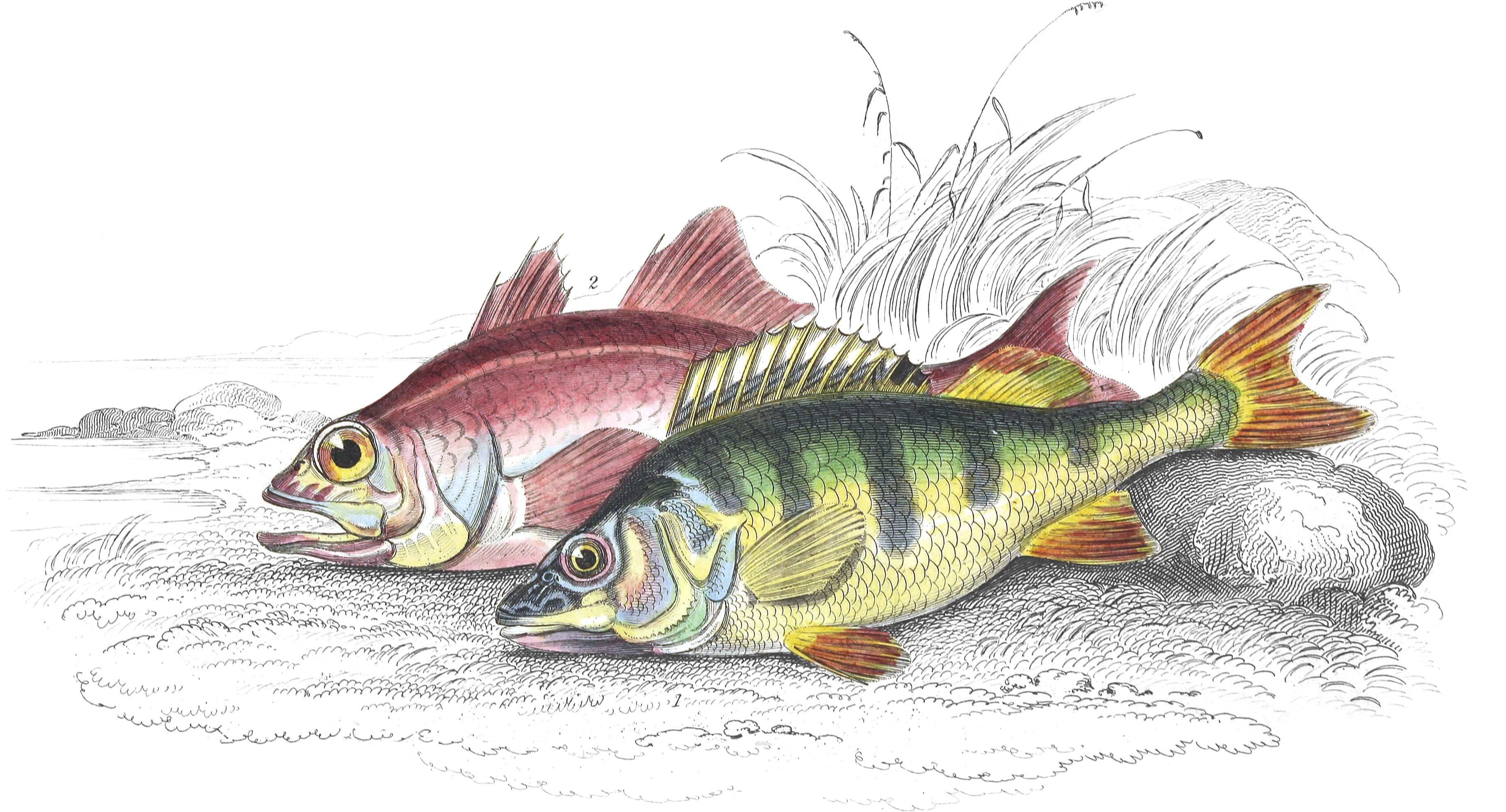
Plate I
Gen. III. Serranus
The name Serranus has been given to this genus from its marked serrated opercle. The dorsal fin is single, and the jaws are furnished with elongated sharp teeth amidst the smaller ones. Of the vast number of species of which this genus is known to consist, two only have been ascertained to be British, and these by the successful labours of Mr. Couch of Polperro? a gentleman whose name will be frequently and honourably mentioned in the following pages. He described them as Perches,—the Smooth and Dusky, names which Mr. Yarrell has very properly applied as trivial ones to these species.
The Smooth Serranus
Sp. 3. Serranus Cabrilla
The size which Mr. Couch assigns to this species, as found on the coast of Cornwall, is about ten inches in length. The under jaw is longest, teeth being on both, as well as on the palate, numerous, irregular, sharp, and incurved; the tongue is small and loose; the eye large, and near the top of the head; the lateral line near the dorsal ridge. He adds,—it is a common fish, and keeps in the neighbourhood of rocks, not far from land. From not having been yet detected in any other part of the British coast, we must esteem it rather a rare visitor, while it is abundant in the Mediterranean, and passes thence south as far as Teneriffe and Madeira. The ancients, as stated by Cuvier, had a notion that this species was composed only of females, or rather that it was hermaphrodite; and 31. Cavolini stated that all the specimens he had examined contained both roe and milt. This, however, must have been a mistake, since both Mr. Yarrell and Professor Owen, who employed his microscope, agree that the roes transmitted to London by Mr. Couch contained only true ova, in which there was nothing equivocal either in structure or appearance. The last named gentleman mentions, that the singular spasm which seizes this fish, when captured, never leaves it; and that it is found long after death in a state of rigidity and contortion, with the fins preternaturally erect. Gesner long ago remarked, that in dying it was remarkable for its gasping and belching.
The Dusky Serranus
Sp. 4. Serranus gigas
This second species of Serranus has acquired its specific name from the gigantic size it frequently acquires in the Mediterranean, regarded at present as its most frequent abode, and where it is held in considerable estimation as an article of food. Its usual weight is between 10 and 20 lbs., and it has been observed to reach 60 lbs. One specimen alone has been detected in the British Isles, and it was taken, as stated by Mr. Couch, with a line. It weighed 16 lbs., and measured three feet in length and seven inches in depth, the body being thick and solid. The other specific characters will be found elsewhere, and the general appearance as beautifully depicted in our Plate. Nothing, according to Cuvier, is known of its habits, except that at Nice it approaches the shore in April and May, when it deposits its spawn.
Gen IV. Acerina
The Ruff or Pope
Fig. 1. Sp. 5. Acerina vulgaris
The Ruffe or Pope, is the only representative of this genus found in Britain. It is a river fish, “The Smaller River Perch” of Gesner, and the “Small Perch” of Bloch. From these statements it will be inferred that it is closely allied to the Common Perch; from which it is distinguished chiefly by having a single dorsal fin, the rays of which are spinous in the anterior part, and flexible in the posterior. It appears to have been first described by Dr. Caius, who detected it in the Yare, near Norwich. Mr. Yarrell states that it is common in all the canals and rivers in England, particularly the Thames, Isis, and Cam: it is unknown in Scotland; and also, as stated, in Spain, Italy, and Greece: it is found, again, in the colder parts of Europe, and is common throughout France. It is more slender than the Perch, and seldom exceeds six or seven inches in length. The colour of the upper parts of the body is light olive brown, passing into yellowish-brown on the flanks, and into white on the abdomen: the lateral line is prominent, and strongly marked. Its food is the same as that of the Common Perch, and, like it, it is very voracious, and fearless in taking a bait; its flesh is considered excellent: it spawns in April among roots and rushes. According to Mr. Pennant, it is gregarious, assembling in large shoals, and keeping the deepest part of the water; according to Mr. Yarrell, its favourite haunts are slow shaded streams, with a gravelly bottom.

Plate II
Gen. V. Polyprion
Couch’s Polyprion
Sp. 6. Polyprion cernium
This fish, the only ascertained species of the genus, was first introduced to notice, as belonging to the British Fauna, by Mr. Couch; Mr. Lowe, the well-known Ichthyologist of Madeira, recognized it as the P. cernium of Cuvier and Valenciennes, and Mr. Yarrell has assigned to it the trivial name of Couch’s Polyprion. On the Devonshire coast it is called the Stone-lasse, and the Wreck-fish; it is the Chernotte and Cheime of Madeira, the Jew-fish of the English residents. It is readily distinguished by being entirely covered, from snout to tail, with small rigid scales, which are serrated at the free margin; all the opercular bones are denticulated, and strong bony ridges run above and behind the eves. It has been long known in the Mediterranean: is very common at Madeira, extends to the Cape of Good Hope, and, it is believed, to North America; nor is it very rare on the southern shores of Britain. It is a very beautiful fish, as will be seen by a reference to our Plate. In the Mediterranean it acquires the size of five or six feet, and weighs 100 lbs.; in the British Channel it has been caught as long as three feet. It feeds on Mollusca and the smaller fishes, and constitutes excellent food, its flesh being white, tender, and well-flavoured.
As implied in some of its synonymes, this fish has an extraordinary habit of following wood-wreck and other foul and floating bodies. Thus Mr. Couch states it approaches the Cornish coast under peculiar circumstances: when a piece of timber, covered with barnacles, is brought by currents from more southern regions, considerable numbers sometimes accompany it. In the alacrity of their exertions, they pass over the wreck in pursuit of each other, and sometimes for a short space are left dry upon the top, until a succeeding wave bears them off again. From this it might be supposed that barnacles constituted their food, but this does not appear to be the case; and more probably the numerous small fishes, which follow the floating mass for insects, are the attraction. Captain Nicholls, in a voyage from Newfoundland to Portugal, having his ship’s bottom very foul, and covered with barnacles, was becalmed for many days about a hundred leagues off Oporto, and was for a fortnight surrounded by these fishes, which followed the ship and were caught by the crew. He fed his men with them for twelve or fourteen days, who considered them excellent.
Gen VI. Trachinus
As already hinted, the two species we have now to notice belong to the Jugular branch of the Family. The Gen. Trachinus is rather a numerous one, and extensively distributed. The species belonging to it have no air-bladder, usually hide themselves in the sand, and are very tenacious of life. From this circumstance, the French have applied to them the name of La Vive, a corruption of which seems to have supplied the English name Viver, or Weever. They are well known from the wounds they inflict with their formidable osseous spines, and are generally esteemed as food. It is in reference to their tenacity of life that Mr. Yarrell makes the following interesting observation:
It may be considered as a law, that those fish which swim near the surface of the water have a high standard of respiration, a low degree of muscular irritability, great necessity for oxygen, die soon, almost immediately when taken out of the water, and have flesh liable to rapid decomposition. On the contrary, those fish that live near the bottom of the water have a low standard of respiration, a high degree of muscular irritability, and less necessity for oxygen; they sustain life long after they are taken out of the water, and their flesh remains good for several days. * * * The law referred to has its origin in the principle of organization; and though it would be difficult for the anatomist to demonstrate those deviations in structure which give rise to these distinctions and their effects, it is only necessary to make the points of comparison wider to be assured of the fact.
The Great Weaver, or Sting-Bull
Fig. 2. Sp. 7. Trachinus draco
The usual length of the Great Weever is from twelve to fifteen inches, sometimes reaching to seventeen. The upper portions of the body are of reddish-brown colour, with interrupted lines of black and yellow running parallel with the oblique rows of scales; the under parts of the body are white, with interrupted yellow lines; first dorsal with it’s web deep black. It spawns in summer. It is occasionally met with at Weymouth, Hastings, and other parts of the coast; and is much dreaded by the fishermen on account of its sharp spines which are usually considered as venomous, but without any sufficient reason, as they are quite devoid of all poisonous secretion. Mr. Couch states that he has known three men wounded successively in the hand by the same fish, and the consequences have in a few minutes been felt as high as the shoulder. Strong friction with sea-sand was long a popular remedy among the fishermen, from which nothing could be expected but an aggravation of the symptoms. The application of oil seems a far more suitable remedy, and that procured from the liver of the offender will ever be at hand. Both in France and Spain there is a positive law whereby the fishermen are required to remove the spines before they are brought to market.
Plate II
The Lesser Weever
Sp. 8. Trachinus vipara
The Lesser Weever, seldom attains a length of more than five or six, and very rarely of seven, inches: it is of a reddish grey above, with the under parts approaching silvery white, with faint indications of transverse yellow lines; the web connecting the four first spines of the first dorsal fin is deep black, and there is a black spot at the extremity of the caudal fin. This species is more generally distributed than the former, being common in Scotland, especially in the Solway Frith, as well as in England, and being familiarly known in Ireland: it spawns in spring, and is often taken by shrimpers. Being very quick in its movements, it is even more dangerous to handle than its larger convener. Mr. Pennant states that it buries itself in the sand, watching for its prey, leaving only its snout exposed; and if trod on, it immediately strikes with great force; and we have seen it, he adds,
direct its blows with as much judgment as a fighting cock.
If trodden upon by bathers, as frequently happens, it inflicts, says Dr. Parnell, a severe and painful wound, causing the part to swell, and almost immediately to assume a dark brown appearance, which remains for five or six hours. The best application is stated to be hot water, which relieves the pain, and diminishes the swelling in the course of half an hour.
Gen VII. Mullus. Surmullets
Of the third division of the family of Perches, the abdominal, two species only, as stated above, are visitors of the British shores. In designating them Surmullets, we differ from Mr. Yarrell, in whose footsteps we are usually anxious to tread, and who calls them Mullets. Our Eighth Family, as will presently appear, is styled the Family of Mugilidæ or Mullets, and our present fishes, so differently placed in the arrangement, should surely have a different name. This in fact has frequently been assigned them, as by Pennant, Fleming, Jenyns, and other British Naturalists; and we see no sufficient reason for leaving such good company, and continuing an old and unfortunate nomenclature. The term Barbatus for our ninth species is also unfortunate, as its congener is no less liberally endowed with barbules or cirri; not uncommon in other fishes, though their structure and uses differ more widely than is generally stated. In the instance before us, Mr. Yarrell informs us that he had found these appendages to consist of an elongated and slender flexible cartilage, inserted with numerous longitudinal, muscular, and nervous fibres, and covered with an extension of the common skin. These cirri he considers as delicate organs of touch, by winch the species provided with them, and which are known mostly to feed near the bottom, are enabled to ascertain, to a certain extent, the qualities of the various substances with winch they are brought into contact, being thus in formation analogous to the beak of birds.
It is to be considered as another instance, among the many provisions of Nature, by which, in the case of fishes feeding at great depths, where light is deficient, compensation is made for consequently imperfect vision.
In identifying the species with those which have been long known in the Mediterranean, we have not reached all the certainty that is desirable. It was one of these Surmullets which was so celebrated among the Romans for the excellency of its flesh, its extreme beauty, and the extravagant prices it brought. The epicures, in Horace’s day, valued it in proportion to its size; not because the larger were better, but because they were procured with greater difficulty. From Salviani we learn that Galen states it was esteemed above every other article of food, and that large ones were obtained only at prodigious prices. Juvenal says,
Mullum sex millibus emit
Æquantum sane paribus sestertia libris.Six scanty pounds the Mullet weigh’d;
Six thousand sesterces the wise man paid!
Seneca mentions that a Mullet of 4lbs. weight was presented to the Emperor Tiberius, who ordered it to the market, where it was purchased by Octavius for 5000 sesterces; and Asinius Celer, of consular rank, bought one during the reign of Caius at the price of 8,000 sesterces, or about £65. It has been well remarked by Mr. Griffith, that these fishes stand pre-eminent in the annals of human luxury, cruelty, and folly: and in connexion with them, pains have been taken to hold up the Roman gourmands to the reprobation they really merit. In their feasts they revelled over the dying Mullet, while the bright red colour of health passed through various shades of purple, violet, blue, and white, as life gradually ebbed, and convulsions put an end to the admired spectacle. They put these devoted fish into crystal vessels, filled with water, over a slow fire, upon their tables, and complacently regarded the lingering sufferings of their victims, as the increasing heat gradually prepared them for their pampered appetites!
The Red Surmullet
Fig. 1. Sp. 9. Mullus barbatus
The Red Surmullet is usually considered to have been the fish so signalized above; but this cannot be considered certain. This species is distinguished from the only other British one, by having the profile more vertical, by its length, in this part of the world, rarely exceeding six inches, and by its scales being differently shaped and marked, as may be seen in Mr. Yarrell’s work. It is a very rare fish on the British shores; Pennant, however, was satisfied of its existence on the coast of Scotland, and Dr. Johnston of Berwick has recently confirmed this opinion. Mr. Couch also has obtained two specimens in Cornwall; one is in the Collection of the British Museum, and another is possessed by Mr. Yarrell. Mr. Couch describes his specimens as having one yellow line, a little below the lateral line, the sides and part of the belly dark red, and the back lighter in colour than the other species. Mr. Yarrell states that the London specimens have the colour of the most delicate carmine on the back and sides, and the abdomen silvery white, without any appearance of a yellow line. The fins are yellow.

Plate III
The Striped Surmullet
Sp. 10. Mullus sumullus
The Striped Surmullet has its profile descending obliquely from the forehead; its average size, in this country, is from twelve to fifteen inches in length, and the red of its sides is marked with longitudinal yellow lines. Like the preceding species, it is destitute of an air-bladder. From Mr. Yarrell we learn, that several years ago he procured a specimen from Weymouth which weighed 3 lbs. 6 oz. This fish is considered migratory, and yet may be procured in the shops of the London fishmongers throughout the year: being, however, more plentiful in summer, when their colours are most vivid, and the fish in highest condition. They take a wide range in the water, them common habit being to keep close to the ground, and their migrations being performed near the surface. Hence they are sometimes taken in the Mackerel nets upon the surface, and at other times by the trawl net on the bed of the ocean. Sometimes they are captured in great profusion, and at other times are very scarce. In August 1819, 5000 were taken in one night in Weymouth Bay; and 10,000 were sent, in May 1831, from Yarmouth to the London market. Though not regarded equal, as an article of food, to the preceding species, still they are much esteemed.
II. Family of Mailed Cheeks. Buccæ Loricatæ
Representatives in British Fauna.—Gen. 6. Sp. 21.
-
Gen. 8. Trigla.
- Sp. 11. T. cuculus. The Red Gurnard.
- Sp. 12. T. lineata. The French or Rock Gurnard.
- Sp. 13. T. hirundo. Sapphire Gurnard.
- Sp. 14. T. pocciloptera. The Little Gurnard.
- Sp. 15. T. lyra. The Piper.
- Sp. 16. T. gurnardus. The Grey Gurnard.
- Sp. 17. T. Blochii. Bloch’s Gurnard.
- Sp. 18. T. lucerna. The Shining Gurnard, Long-finned Captain.
-
Gen. 9. Peristedion.
- Sp. 19. P. malarmat. The Mailed Gurnard.
-
Gen. 10. Cottus.
- Sp. 20. C. gobio. The River Bullhead.
- Sp. 21. C. scorpius. The Sea-scorpion.
- Sp. 22. C. bubalis. The Father-lasher.
- Sp. 23. C. quadricornis. The Four-horned Cottus.
-
Gen. 11. Aspidophorus.
- Sp. 24. A. Europæus. The Armed Bullhead.
-
Gen. 12. Sebastes.
- Sp. 25. S. Norvegicus. The Norway Haddock.
-
Gen. 13. Gasterosteus. Sticklebacks.
- Sp. 26. G. trachurus. The Rough-tailed Three-spined Stickleback.
- Sp. 27. G. semiarmatus. The Half-armed Stickleback.
- Sp. 28. G. leiurus. The Smooth-tailed Stickleback.
- Sp. 29. G. brachycentrus. The Short-spined Stickleback.
- Sp. 30. G. spinulosus. The Four-spined Stickleback.
- Sp. 31. G. pungitius. The Ten-spined Stickleback.
- Sp. 32. G. spinachia. The Fifteen-spined Stickleback.
The Family of the Mailed or Hard Cheers, though it comes far short of the foregoing as to numbers, is still an extensive one, comprehending about 170 species, not one-fifth of which is European. It prevails, however, in northern waters; and hence, as in the higher orders of animals, a greater proportion of its generic forms is common to the New and Old World. Several genera are common to both sides of the Atlantic, and some of the Fresh-water Cotti and Gasterostei in America, are scarcely distinguishable from their European representatives. In general conformation, the fishes composing it are not very different from the Perches; but the singular appearance of their head, which is variously armed with spines and bristles, forms a striking distinction: and the sub orbital bone is more or less extended, so as to cover the cheek and to be articulated with the preopercular bone. This Family includes several species of the famous Flying-fishes, Dactylopteri, which have at all times attracted the attention of mankind; but not being British fishes, we cannot here enter into their history.
Gen. VIII. Trigla
Is that which of all others most characterizes the Family. The first sub-orbital bone is very large, and articulates both with the muzzle and the preopercle; the sides of the head are nearly vertical, and cube-shaped; there are two distinct dorsal fins, and beneath the pectoral fins there are three free rays. The English name it bears is that of Gurnard, agreeing with the French, and derived from the growling, grunting noise which they make, by means of their throat and gill, when disporting on the wave or ploughing the deep, and still more frequently when they are newly taken from the water. Eight species have been ascertained to be British, and some having a strong resemblance have been long confounded. Their specific characters, besides being casually mentioned here, will be stated more prominently in the Appendix. They are all marine fish, and usually frequent deep waters, where they are captured with the trawl line and deep-sea lines. They form good nourishing food, and some of them are highly esteemed.
The Red Gurnard
Sp. 11. Trigla cuculus
The Red Gurnard, it should be noted, is the Cuculus of Linnæus, and not of Bloch. It is the Red Gurnard, Red Crooner, and Cuckoo Gurnard of our fishermen. Some caution is necessary in its identification. Colonel Montague remarking that the name Bed Gurnard is misapplied, as it partakes less of that colour than many of its congeners, and consequently these others are apt to be mistaken for it. Dr. Parnell states the principal distinguishing characters to be, that the lateral line is crossed throughout its length by lines not reaching below the middle of the sides, and that the gill-cover and shoulder-plate terminate with a spine directed backwards. The appellation Cuckoo, applied to this fish, is bestowed from the supposed resemblance of its note, when taken from the water, to that of its sylvan prototype. The average size of this fish is from nine to twelve inches, sometimes reaching sixteen. Its colouring is rich and beautiful. When first taken from the water, it is rose-red above, its sides and abdomen are dull white tinged with red, with the fins reddish white; the body feels rough to the touch. It is very common on the shores of England, particularly on the southern. Thousands of them, says Dr. Parnell, are seen exposed daily on the Devonshire coast, especially in those smaller towns where the trawl-boat fishing is carried on. On the east coast of Scotland it is seldom seen in numbers, but a few are taken occasionally in the Frith of Forth, during the summer, by lines, or entangled in salmon-nets, at the lower part of the estuary. In Ireland it is taken from Waterford in the south, to Londonderry in the north. It feeds principally upon crustaceous animals; spawns in May and June; continues out of season till August, and is in highest perfection for the table in the winter months. Its flesh is firm and well-flavoured, and held in high estimation.
The French or Rock Gurnard
Sp. 12. Trigla lineata
The head of this species is shorter, and the pectoral fins longer, than in the last; the profile also is more vertical, and the transverse lines extend from the dorsal crest to the lower part of the abdomen. It rarely attains the length of a foot; its whole body is of a beautiful red colour, with small black spots on the head and back; the pectorals are grey spotted with black, and the other fins reddish. Its flesh is as much esteemed as that of the foregoing species, and it is in season at the same period. It occurs on our southern and eastern coasts, but not very abundantly; it is well known in Paris and the Canaries.
Sapphirine Gurnard or Smoothsides
Sp. 13. Trigla hirundo
Sapphirine Gurnard, or Smoothsides. The most marked specific character of this Gurnard is the lateral line being smooth and simple; the scales also are entire at their free margin; the pectorals are about the same size as in the preceding species. Its trivial English name is derived from the colour of its pectoral fins, which are bluish green upon the inner surface, spotted with bright blue; the general colour of the body is brownish red, tinged with yellow-green. It spawns in the winter months, and is one of the largest and most valuable fishes which inhabits our seas, varying from a foot and a half to two feet in length, and more; and is also one of the commonest: it abounds on the southern and eastern coasts, where it is taken on Whiting lines, as well as by the net. It is also common on the west of Scotland, but rare on the east, appearing but seldom in the Edinburgh markets. It is not inferior, as food, to any of its congeners; though, like them, it is somewhat dry, and requires help from the culinary art: in the north of Europe it is salted for preservation.
The Little Gurnard
Sp. 14. Trigla poeciloptera
This small species was discovered by M. Valenciennes at Dieppe, and afterwards found by Mr. Ball, in 1815, at Youghal, in Ireland. Its pectoral fin is distinguished, on its inner aspect, by a deep black marking, streaked with milk white; its head and back are abundantly furnished with spines. The back is brownish red, the abdomen silvery white, and red at the ventrals; the flanks are golden and iridescent, which makes the fish peculiarly brilliant. The Dieppe fishermen maintain it never exceeds four inches in length. In the pools left by the retiring tide, it affords great amusement to youthful bathers, and it is taken in great quantities by the shrimpers.
The Piper
Sp. 15. Trigla lyra
According to Cuvier, this species is very readily recognised by the strength of its spinous armour. Rondelet gave it the name of Lyra, not only from the noise it emits, like its conveners, and whence the English name Piper, but because the denticulated processes, which divide the snout have some distant resemblance to the instrument just named. It is rather rare on the British coasts, but has been noticed off Devonshire, on our western shores, and in Belfast Bay. It is well known in the Mediterranean; attains the length of two feet and upwards; and, as food, is considered excellent.
The Grey Gurnard
Sp. 16. Trigla gurnardus
The Grey Gurnard has its lateral fine sharply serrated; the pectorals are about the size of the ventrals, and the profile of the face is concave: the length is from fifteen to twenty inches, sometimes two feet, and very rarely somewhat more. Above, the colour is grey, clouded with brown, and spotted with yellow, white, and black; beneath, silvery white. It spawns, according to Bloch, in May and June. This species is common in the British seas, along the southern coasts, and the eastern, as far as the Orkneys; they are also common on the western coasts, and have been observed on the Irish: it has also a wide distribution along the European shores, and in the ocean. It takes the hook in deep water greedily, will bite at a red rag, and, as noted by Pennant, is also fond of sporting on the surface. As exhibiting this peculiarity, we quote the words of an intelligent reviewer in the Magazine of Zoology and Botany, (i. 389).
We recollect observing the sports of shoals of this species when on an excursion to the Western Isles, during a week of beautiful and too calm weather; for it was before steamboats plied. They were often discovered by their noise, a dull croak or croon, or by the ripple or plough of their nose on the surface of the calm sea; thus they would swim for a few yards, and then languidly sink for a foot or eighteen inches, display or stretch their lovely fins, and again rise to the top. Boats were out with hand-lines; almost all were half-full, the men having little to do but bait the hooks and pull up. We resorted to our guns, and killed sufficient for dinner from the deck of the vessel.
The flesh is considered as not equal to that of some of the other species.
Bloch’s Gurnard
Sp. 17. Trigla Blochii
This name has been very judiciously applied to the present species by Mr. Yarrell, to distinguish it from the first species—the Cuculus of Linnæus, from which it manifestly differs. Ichthyologists, however, are not quite agreed as to its title to independency. Its specific characters are said to be the first dorsal fins having a black spot, and the dorsal ridge being strongly serrated: and in these particulars it differs from all others: but then there are some Naturalists who hold that it is nothing more than the young of the preceding species. Dr. Parnell distinctly states, that if we examine specimens of the two alleged species, nine inches in length, they will be found to possess common characters. This indefatigable observer says,
and in no instances, have I found a young of the Grey Gurnard possessing the character of an adult; but bearing always those which are assigned to the Blochii.
The usual size of the fish now under review is only nine or ten inches. Some maintain that it is rare, whilst others give a contrary testimony. Dr. Parnell says—
In the month of August, in a pool near Queensferry, a number remained in the same pool for five weeks, although the tide coyered them daily with three feet of water: they did not appear in the least shy, but swam about in shoals, one always taking the lead; when they were suddenly approached, they became stationary, and erected their first dorsal fin, which, with the black spot on the upper part of each, gave the shoal a beautiful appearance; when they were unmolested, this fin became deflexed. In those I examined, their stomachs were filled with small Shrimps and Star-fish. (Wern. Mem., vii.
128178).
The Shining Gurnard, Long-finned Captain
Fig. 2. Sp. 18. Trigla lucerna
This species, the Lucema of Briinnich, not that of Linnæus, and still less of Pliny, was introduced into the British Fauna, in the year 1838, by Dr. Parnell, (Mag. of Zool. and Bot., i. 526). It has long been known in the Mediterranean, where it abounds, and where, though small, not exceeding eight or nine inches, it is much esteemed as an article of food. According to the Doctor,
it is the sweetest and most delicate of the British species, although from its small size it is not often brought to market.
Dr. Parnell detected it on the coasts of Devonshire; Mr. Baker has since observed it at Bridgewater, and it is by no means uncommon. The origin of the English trivial name is so apparent, as to require no remark. By the second ray of the dorsal fin, which, when folded down, reaches beyond the sixth ray of the second dorsal, and by the form of the lateral plates, which will be described in the Appendix, it can readily be distinguished from other British species. It is supposed to spawn in June.
Plate III
Gen. IX. Peristedion
This genus, introduced by Lacépède, has a strong resemblance to the foregoing, but is distinguished from it by having its body, as well as head, strikingly cuirassed by great hexagonal plates, forming longitudinal ridges; the nasal bone, moreover is divided into two parts, and the mouth has no teeth. It would appear to form but a small section; and though long known in the Mediterranean, has only lately been detected on the British shores. The British species is
The Mailed Gurnard
Sp. 19. Peristedion malarmat
P. malarmat, so by antiphrase, as it is one of the most completely armed fishes of the European seas, the Mailed Gurnard of British authors. (Pl. IV.) A specimen was caught near Plymouth by Dr. Edward Moore in the autumn of 1836, and was by him introduced into our catalogue. Its average size is about two feet; Dr. M’s specimen measured about eleven inches. The body is octagonal, covered with a coat-of-mail, formed of bony scales laid over each other, from whose centre sharp-pointed processes proceed backwards, forming, in continuous lines, the eight angles of the body. Five or six of the rays of the first dorsal end in long flexible filaments, an ornament which is stated by some to belong only to the males. Its colour is of a uniform scarlet, gradually softening to pale flesh-colour towards the abdomen; the dorsal and anal fins are crimson, the others greyish. M. Pisso informs us that it frequents deep water, over rocky ground, approaching the shore to spawn. It swims rapidly, is said to be solitary in its habits, and feeds upon the Medusas and Crustacea. Though rare on our shores, it is common on the coasts of Spain and Provence, where it is fished all the year, and much used as an article of food.

Plate IV
Gen. X. Cottus
The next genus of this family we find as British is the genus Cottus, distinguished by having the head roundish or depressed, having small teeth in the maxillaries and vomer, and the body without scales: the two dorsal fins are distinct, or very slightly connected. Of the four British species, one is fresh-water, and three are salt-water fishes.
The River Bullhead
Sp. 20. Cottus gobio
This well-known fish, sometimes called the Miller’s Thumb, has its head nearly smooth, and the preopercle armed with a single spine. It is a small dark-coloured fish, from three to five inches long, frequent in most of the clear streams, not of the British Isles only, but also of Europe and Northern Asia; according to different accounts, being common to Italy and Sweden, Greenland, and Siberia. It is generally said to spawn in March, although in the Seine it is usually in the three succeeding months. It swims with great rapidity, and feeds principally upon insects and small larvæ. When cooked, its flesh becomes red; and, as food, it is regarded not only wholesome, but delicious. In Switzerland, the children spear them with forks, as they dash from the stones under which they hide.
The Salt-water species, not of Britain only, but also of other climes, have a general aspect so repelling, and sometimes so hideous, as to have procured for them many opprobrious names. These peculiarities consist in their broad and low head, which is armed with formidable spines, their wide gaping mouth, and disagreeable colours: hence they have been designated Sea-scorpions, Toads, Devils, and Father-lashers, as if, says Cuvier, traits so hideous indicated even the most atrocious vices. Little or altogether unknown in the Mediterranean, they are common in the northern seas; and in many respects the three species resemble each other. They are exceedingly voracious, swim with great swiftness, and are solitary in their habits. They leave the depths of the ocean in spring, and take up their abode in the hollows of the rocks, where, sheltered by the sea-weed, they enjoy, at each tide, the return of the water, which supplies them with fresh food. About the autumnal equinox they return to the ocean, and there remain during the winter. They are not much used as articles of food, because their flesh is neither much relished, nor considerable in quantity. They are, however, sometimes eaten by the poor in high latitudes, and they yield, like most other fishes, a valuable oil. The spines with which they are armed supply them with a perfidious weapon, and inflict wounds which are sometimes regarded as poisonous. This, however, seems to be a mistake; and the depth of the puncture alone, probably, constitutes its importance. Fishermen esteem the application of the liver, or oil, of the fish, as the most useful dressing they can apply. Their size is not great, one a foot long being above the average. They live a long time out of the water, and from their uttering sounds, belong to the Crooners, Sea-cocks, &c. We proceed to the species
The Short-Spined Cottus, Sea-Scorpion
Sp. 21. Cottus scorpius
This fish has often been confounded with the succeeding species, and also been regarded as its female; but they never associate, and are quite distinct. In this species there are three spines on the gill-cover, none of which extend beyond its posterior limits; the lateral line is smooth, and the colour on the upper parts of the body is reddish brown, whitish beneath, with spots of light brown sometimes on a ground of brilliant scarlet; the fins are marbled black and white, sometimes striped with red; but in fact the tints vary, sometimes with the season of the year, and are most vivid, according to Dr. Parnell in July and August, when the roe is far advanced towards maturity. This fish is very common on our shores, and is often captured both with the hook and net. It abounds in the Frith of Forth in the autumn months, sometimes exceeding a foot in length.
The Long-Spined Cottus, or Father-Lasher
Sp. 22. Cottus bubalis
In this fish there are four spines in the gill-cover, the longest of which extends somewhat behind it, and the lateral line is rough. These and other specified characters, pointed out by M.M. Cuvier and Valenciennes, make it an easy matter to discriminate between this species and the foregoing. In the tinting they very much agree: the usual length is from six to ten inches; it appears to spawn in January, the ova being large and of a fine deep yellow colour; these are deposited frequently in estuaries, and even in rivers, the fish having prepared itself for the change by remaining a time in brackish water. During the greater part of the year it abounds all round our coasts, and is often left in the receding tide in small pools. When touched, it projects its gill-covers, and by bristling up its spines, presents a formidable appearance. Though seldom used as food with us, vet in Greenland it is in great request, according to Pallas being there larger, forming an important article of food, the soup made from it being both agreeable and wholesome.
The Four-Horned Cottus
Sp. 23. Cottus quadricornis
We are indebted to Mr. Yarrell for the introduction of this species into the Catalogue of British fishes, a specimen haring been communicated to him by Mr. Gray of the British Museum. It has been taken in the north-east coast of England, and is occasionally sold in the London market, being caught and sold with spratts. It has long been known as an inhabitant of the Baltic, and Pallas describes it as common in Lake Baikal, and in the rivers of the Northern Ocean, where it attains the length of a foot, being somewhat larger than its usual size in this country. Pallas also states that the young are without horns; that first one pair appears, and finally another. It spawns in winter, and the ova are white.
Gen. XI. Aspidophorus
This genus was separated from the foregoing by Bloch, and received its present appellation from Lacépède. Its most striking difference consists in the fish belonging to it being furnished with a cuirasse formed by a succession of large bony plates, which extend from the neck to the tail, and in its having no teeth at the extremity of the vomer or the palatines. Nine or ten species have now been discovered; one only, however, is British, and has been long known. It is
The Armed Bullhead
Fig. 1. Sp. 24. Aspidophorus Europæus
This fish cannot easily be mistaken for any other, its chin being supplied with a beard of numerous thread-like filaments. It seldom exceeds six inches in length. The colour of the upper parts of the body is light brown, with transverse dark bands, the abdomen being white. It is said to spawn in May. It is pretty well known along all the southern coast of England, and also along the eastern. It is frequently taken by the shrimpers in the sandy bays at the mouth of the Thames, and also by the oyster-dredgers of Newhaven; also in the crevices at Kincardine, and occasionally also with lines out at sea. Its flesh is said to be firm and good. Cuvier, however, states it is not eaten in France.

Plate V
Gen. XII. Sebastes
The next genus of this family of which we have a representative in the British Fauna is the Sebastes of Cuvier. In it we find the head cuirassed, spined, and compressed laterally, the body too is clad with scales, and there are teeth in the jaws, vomer, and palate bones. There are many species in different parts of the globe: in Britain we have but one.
The Bergylt, or Norway Haddock
Fig. 2. Sp. 25. Sebastes Norvegicus
As implied by its names, this fish is an inhabitant of northern seas. The trivial names are derived from the Shetland fishermen, who are familiar with it; and it has also been observed on the Aberdeenshire and Berwick coasts. The prevailing colour on the upper parts is dark-red, becoming lighter on the sides, and passing into flesh-coloured silvery white beneath; the fins are red. Pennant says it is almost a foot in length, and it is esteemed for the table. According to Fabricius, its flesh is dry but agreeable, and is eaten either cooked or dried. In Greenland it inhabits the deepest gulfs, and seldom approaches the shores; it feeds upon smaller fishes, and readily takes the hook, the line requiring to be very long. The Greenlanders used in former times to employ its dorsal spines as needles.
Plate V
Gen. XIII. Gasterosteus. Sticklebacks
The last genus of this family which has representatives in the British waters is Gasterosteus, including the well-known Sticklebacks—Scotice, Benticles. The Latin name has been applied to them because they have on the abdomen a long cuirasse extending from the shoulder to the pelvis, covered over by the common integuments; and the English, from the spines which arm their back, ventral fins, and other parts. They constitute the smallest of our fresh-water fish, and are also amongst the most common; there being scarcely a stream or pool in which they may not be found, and where in certain seasons they do not actually swarm. The shape of their head does not attract notice; and at first glance it would not be suspected that their cheeks were mailed: the situation of the suborbital bone, however, is the same as in the other members of the family, although it is smooth and covered over by the skin. The leading particulars now noticed form the generic characters of the group.
Seven species are now supposed to occur in Britain, though Naturalists are not quite agreed as to those which possess well-defined specific characters, and those which constitute mere varieties. Belon first described the Three-spined Stickleback, and Cuvier and Valenciennes have pointed out that three species have been confounded under the name Aculeatus, the name indifferently applied by authors to them all. Hence the difficulty of accurately appropriating the observations made by the older writers without the necessary discrimination. This, however, is a matter of no great moment. Some of these little fish closely correspond, not only in their external appearance, but also, in all probability, in their habits and dispositions, which are sufficiently striking. They bear a conspicuous part in almost all the Faunas of Europe, and are not confined to the Old World, having many representatives in North America, not excluding Greenland. Nor are they restricted to fresh water, abounding also in the sea, as has been especially remarked in the Baltic. We have in former pages introduced them to notice in connexion with the phenomena of the varying colours of fishes; they spawn in different seasons of the year. They are strongly armed against the attacks of other fish, and are very pugnacious themselves. They are also tenacious of life, and can subsist for a considerable time out of the water, if lodged amongst moist herbage. Bloch states they live only for three years, an assertion which requires confirmation. They are very active and greedy little fish, extremely destructive to the fry of other species, and consequently most injurious in fish-ponds, from which it is difficult to extirpate them. In illustration of these statements, we learn from Mr. Baker
that they spring more than a foot perpendicularly out of the water, and to a much greater distance in an oblique direction when desirous of overcoming any opposing obstacle. It is moreover scarcely to be conceived what damage they do, and how greatly detrimental they are to the increase of all the fish in general among which they live; for it is with the utmost industry, sagacity, and greediness that they seek out and destroy all the young fry that come in their way, which are pursued with the utmost eagerness, and swallowed down without distinction, provided they are not too large; and in proof of this, I must assert, that a banstickle which I kept for some time, did, on the 4th of May, devour, in five hours’ time, seventy-four young dace, which were about a quarter of an inch long, and of the thickness of a horsehair. Two days afterwards, it swallowed sixty-two; and would, I am persuaded, have eaten as many every day, could I have procured them for it.
The Rough-Tailed Three-Spined Stickleback
Sp. 26. Gasterosteus trachurus
The distinguishing characters of this species are included in its lengthy name, the lateral plates extending to the base of the tail, which appendage is square at its base. It is one of the largest and most powerful of the genus, both in France and this country, ranging from two to three inches. Its colours are brownish grey above, shaded with green; the cheeks, thorax, and abdomen being silvery white. It spawns in spring, and feeds on insects, worms, and the fry of other fish. It is of little intrinsic value, and abounds both in salt water and fresh, being common round the coast from Land’s-end to Orkney, and existing in rivers, brooks, and lakes. Dr. Neill mentions that, occasionally, after heavy rains, shoals of them are washed down the rivulets into the Frith of Forth, where they thrive wonderfully; those found in the salt water being about three times larger than those in fresh-water ditches. Dr. Parnell states that, generally, it is not very common in the Forth, but abounds in the neighbourhood of Berwick, where it inhabits brackish water in preference to either salt or fresh. When disturbed, they dart about with great velocity; and, to avoid pursuit, will bury themselves an inch or more under the surface of the mud. It is in connexion with this species that Mr. Yarrell introduces the interesting account of the anonymous contributor to Loudon’s Magazine already quoted, and we may here follow his example.
When a few are first turned into a large wooden vessel, they swim about in a shoal, apparently exploring their new habitation. Suddenly one will take possession of a particular corner of the tub, or, as will sometimes happen, of the bottom, and will instantly commence an attack upon his companions; and if any of them ventures to oppose his sway, a regular and most ferocious battle ensues: the two combatants swim round and round about each other with the greatest rapidity, biting and endeavouring to pierce each other with their spines, which on these occasions are projected. I have witnessed a battle of this sort which lasted several minutes before either would give way: and when one does submit, imagination can hardly conceive the vindictive fury of the conqueror; who, in the most persevering and unrelenting way, chases his rival from one part of the tub to another, until fairly exhausted with fatigue. They also use their spines with such fatal effect, that, incredible as it may appear, I have seen one, during a battle, absolutely rip his opponent quite open, so that he sank to the bottom and died. I have occasionally known three or four parts of the tub taken possession of by as many other little tyrants, who guard their territories with the strictest vigilance; and the slightest invasion invariably brings on a battle. These are the habits of the male fish alone: the females are quite pacific, appear fat, as if full of roe; never assume the brilliant colours of the male, by whom, as far as I have observed they are unmolested.
The Half-Armed Stickleback
Sp. 27. Gasterosteus semiarmatus
This species has a strong general resemblance in size, colour, habits, &c. to the foregoing, and yet, according to the judgment of many excellent Naturalists, is entitled to be considered as an independent species. Its specific characters consist in its lateral plates not extending beyond the line of the vent, and the base of the tail being smooth and not keeled. It occurs in similar situations to the other Sticklebacks, but not always in company with them. It is described in the Histoire Nat. des Poissons, and Dr. Parnell has noticed it in marshes near Kincardine, and in ditches in Gulane Links, Haddingtonshire.
The Smooth-Tailed Stickleback
Sp. 28. Gasterosteus leiurus
In this species the lateral plates do not extend farther than the second dorsal spine, the flank beyond being smooth, soft, and marked only by the linear depressions produced on the surface by the divisions of the lateral muscles. The males, especially in the spawning season, are red about the throat and breast, and shaded with bright green on the sides. It appears to be of this species that Mr. Pennant gives the following striking account:
Nowhere do these fish appear in greater quantities than in the fens of Lincolnshire, and some of the rivers that creep out of them. At Spalding there are, once in seven or eight years, amazing shoals, that appear in the Welland, and come up the river in the form of a vast column. They are supposed to be the multitudes that have been washed out of the fens by the floods of several years, and collected in some deep hole, till, overcharged with numbers, they are periodically obliged to attempt a change of place. The quantity is so great, that they are used to manure the land, and trials have been made to get oil from them. A notion may be had of this vast shoal, by saying that a man employed by a farmer to take them, has got, for a considerable time, four shillings a day, by selling them at a halfpenny a bushel.
The Short-Spined Stickleback
Sp. 29. Gasterosteus brachycentrus
M. M. Cuvier and Valenciennes discovered this species in France, and remark that it is impossible to view it in any other light than as a distinct species; and Mr. W. Thompson, Vice-President of the Belfast Natural History Society, than whom there can be fewer more accurate or acute observers, has obtained it frequently in the North of Ireland. The characters of this fish very much correspond with those of the leiurus, only that it is considerably larger in size, reaching to about three inches; and the spines, both dorsal and ventral, are shorter than those of its congeners. The lateral plates are the same.
The Four-Spined Stickleback
Sp. 30. Gasterosteus spinulosus
(Is this different from the G. tetracanthus of Cuv. and Val.?) Dr. Stark first detected this as a British species in a ditch near Edinburgh, and read an account of it to the Wernerian Nat. Hist. Society in the year 1831; and it has since been noticed in various localities by Dr. Parnell, in the south of Scotland: it has likewise been detected at Teignmouth. It is very diminutive in size, and has the spines at equal distances from each other on the dorsal line. Dr. Stark found it very voracious, and even more pugnacious than those with three spines.
The Ten-Spined Stickleback
Sp. 31. Gasterosteus pungitius
Cuvier and Valenciennes assign nine spines to this species, and Dr. Parnell has found nine, ten, and eleven, without any other marked difference. It is a very small fish, not extending to an inch and a half; it occurs not only in fresh water, but in salt, and is thus one of the smallest fishes of the ocean. It is not common in the Forth. It varies a good deal in colour, ranging on the upper parts from yellowish brown nearly to black, and beneath being a dull white spotted with dark olive.
The Fifteen-Spined Stickleback
Sp. 32. Gasterosteus spinachia
We have already had occasion to dwell somewhat largely on this fish. It is the only remaining one of the British species, and will be at once known by the most casual observer, by its many spines, its prolonged tail, and elongated snout, the under jaw being considerably the longer. It is a salt-water fish, and is sometimes called the Sea-adder; it, however, does not attain a greater length than six or seven inches. It prevails in the northern seas, and is included in the Fauna Oreadensis of Low. It is found in the Cromarty Frith, is not common in the Forth, abounds off the Berwickshire coasts, where its nest-building tendencies have been narrowly watched, and exists round the coasts, to the Land’s-End. Regarding the habits of this species Mr. Couch supplied to Mr. Yarrell the following notes:
It keeps near rocks and stones clothed with sea-weeds, among which it takes refuge upon any alarm. Though less active than its brethren of the fresh water, it is scarcely less rapacious. On one occasion I noticed a specimen engaged in taking its prey from a clump of sea-weed; in doing which, it assumed every posture between the horizontal and perpendicular, with the head downwards and upwards, thrusting its projecting snout into the crevices of the stems, and seizing its prey with a spring. Having taken this fish with a net and transferred it to a vessel of water in company with an Eel of three inches in length, it was not long till the latter was attacked and devoured head foremost; not indeed altogether, for the Eel was too large a morsel, so that the tail remained hanging out of the mouth; and it was obliged to disgorge the Eel partly digested. It also seized from the surface a moth that fell on the water, but threw up the wings.

Plate VI
With Nest and Eggs
III. Family of the Maigres. Scienidæ
Representatives in British Fauna.—Gen. 2. Sp. 2.
-
Gen. 14. Sciæna.
- Sp. 33. S. aquila. The Maigre.
-
Gen. 15. Umbrina.
- Sp. 34. U. vulgaris. Bearded Umbrina.
This great Family, whose ascertained species amount to about 260, is much more common on the American shores of the Atlantic than the European, and four-fifths of the whole are inhabitants of the intertropical seas; two species only having been recognized as visitors to our coasts, and those but rarely, it will not occupy us long. It has a strong general resemblance to the Perckke; but its members are destitute of teeth on the vomer and palatines, so that the palate is quite smooth; some of them have two dorsal fins, and others only one: our species belong to the former category.
These fish are remarkable for the size and complicated structure of their air-bladders, which often assume fantastic and highly ornamented shapes; they are also famous for the sounds they emit on being taken from the water, and also when remaining in it, to an extent exceeding that of the Gurnards and Crooners of the foregoing family; and these two circumstances have naturally been associated as cause and effect. The air-bladder, however, in many instances, seems to have no external openings; and great cayemous recesses existing in the crania of many, it has been suggested that these sinuses may afford the true explanation of the phenomena. In some of the genera they are more striking than in others: and one of the most remarkable, the Pogoniæ, has acquired the popular name of Drums. The sounds seem to vary widely in their character and tones; and are described in very different, not to say discrepant terms, being designated sometimes dull hummings, at other times sharp whistlings, and frequently as the fish’s song. It has sometimes been supposed that they are uttered by the males alone: and the fishermen, by imitating them, can frequently collect a troop of the fishes around them. The boatmen, likewise, by putting their ears to the gunwale of their boat, can often readily perceive the sounds, though at the depth of twenty fathoms, and thus guided, can successfully cast their net and procure a draught. Baron Humboldt thus narrates his observation of the phenomena.
Towards seven in the evening, the whole crew were astounded by an extraordinary noise, which resembled that of drums which were beating in the ah. It was at first attributed to the breakers. Speedily it was heard in the vessel, and especially towards the poop. It was like a boiling, the noise of the air which escapes from fluid in a state of ebullition. They began to fear that there might be some leak in the vessel. It was heard unceasingly in all parts of the vessel, and finally about nine o’clock, it ceased altogether. (Grif. Cuv., x. 304).
Again, Mr. White of the American navy relates, that being at the mouth of the river Gambodia, his crew and himself were astonished by some extraordinary sounds which were heard around the bottom of the vessel. He says,
It was like a mixture of the bass of the organ, the sound of bells, the guttural cries of a frog, and the tones which imagination might attribute to an enormous harp; one might have said that the vessel trembled with it. These noises increased, and finally formed a universal chorus over the entire length of the vessel and the two sides. In proportion as they went up the river, the sounds diminished, and finally ceased altogether. The interpreter told Captain White that they were produced by a troop of fishes which have the faculty of adhering strongly to foreign bodies by the mouth. (Ib. 303).
One other illustration we shall supply from the American shores, where these fish have received the elegant name of Grants. As remarked in a recent communication to the British Association for the Advancement of Science,
Every mariner who has anchored early in the spring on the coasts of Carolina, Georgia, and Florida, must have been annoyed by the drumming noise, produced in the night, apparently at the bottom of the ship, and loud enough to deprive the stranger of rest, until habit has rendered the sound familiar.
Surely the cause of these striking phenomena cannot long remain a mystery.
Gen. XIV. Sciæna
This genus is distinguished by a divided dorsal fin, an anal with very weak spines, no cirri under the mouth, nor canines, with only a range of strong pointed and nearly equal teeth in both jaws. Some of the species reach to a great size, and have long been exceedingly prized in the Mediterranean for the excellence of their flesh.
The Maigre
Fig. 1. Sp. 33. Sciæna aquila
The Maigre (PI. VII.) is the best known, the largest, and most remarkable genus in the European seas, and is familiarly known on the coasts of Italy. It has but one anal spine, and has a strong general resemblance to a large Basse. It acquires a great size, reaching from three to six feet, with proportionate bulk. It is also very powerful; so that it has been reported of one caught asleep in a net near Dieppe, that when roused it struggled so violently with the captor as to throw him into the water, whence he was relieved with difficulty. The colour of the upper parts is brownish grey, of the sides silvery grey, and of the abdomen white. In the Mediterranean they present, as they move about, the brilliancy of gold and silver, and shine with all the colours of the rainbow.
We have already remarked that the Maigre is only a rare visitor of the British Isles. Dr. Neill, we believe, was the first who noted it, as observed in Shetland in 1819. This individual was observed by the fishermen when endeavouring to escape from a Seal; it measured five feet four inches, and when raised into the boat, uttered its usual purring noise. A second specimen was taken at Start Bay, Devonshire, in 1825, and more recently a fine fish, five feet two inches long, was taken off the coast of Northumberland. A specimen, about three feet and a half in length, exists in the Museum of the Edinburgh University, which was caught about four years ago in a salmon-net near Musselburgh. Mr. Yarrell informs us that he has seen five fresh specimens, four of which were brought to the London market, and has heard of four others: these were taken on the southern coast. Some of them were brought to table, and reported to be good, particularly when stewed, being rather dry and tasteless when plain boiled.

Plate VII
Gen. XV. Umbrina
The only other genus of this very numerous family to be noticed is that of Umbrina, which in addition to the common characters of the family, has a barbule or cirrus at the symphysis of the lower jaw, and the spines at the anal fin strong and sharp.
The Bearded Umbrina
Fig. 2. Sp. 34. Umbrina vulgaris
The Bearded Umbrina (PI. VII.), also a valuable fish, is a still rarer visitor on our coasts than the foregoing; so much so, that Mr. Jenyns very properly entertains doubts of its just claims to be admitted into the British Fauna. According to an extract from the Minute-book of the Linnæan Society, dated November 20th, 1827, a specimen of this fish, weighing one hundred weight, was taken in the river Exe, and this we believe is all the evidence as yet supplied on the point. But this is not only insufficient but unsatisfactory; because, in its native seas, this fish has never been known to reach within 60 lbs. of the weight just mentioned. It is very common on the coasts of Italy, France, and Spain. M. Risso states that it sometimes weighs 32 lbs; and M. de Martens, that at Venice it has been known to reach 40 lbs.: its usual length is about two feet. It is a remarkably beautiful fish, whose ground colour is golden with bright hands of steel-blue, and its flesh is white and excellent.
Plate VII
IV. Family of Sea-Bream Sparidæ
Representatives in British Fauna.—Gen. 5. Sp. 7.
-
Gen. 16. Chrysophrys.
- Sp. 35. C. aurata. The Gilt-head.
-
Gen. 17. Pagrus.
- Sp. 36. P. vulgaris. The Braise.
-
Gen. 18. Pagellus.
- Sp. 37. P. Erythrinus. Spanish Sea-bream.
- Sp. 38. P. acarne. The Axillary Bream.
- Sp. 39. P. centrodontus. The Sea-bream.
-
Gen. 19. Dentax.
- Sp. 40. D. vulgaris. The Four-toothed Sparus.
-
Gen. 20. Cantharus.
- Sp. 41. C. griseus. The Black Bream.
The Family of the Sea-Bream have a general resemblance to the preceding. Among its members the muzzle is but little projectile, and it is destitute of teeth on the palate, and of all armour on the gill-covers. This last circumstance, together with the absence of any cavernous sinus in the cranium, distinguishes it from the Maigre family; whilst the absence of scales on the fins, separates it from the succeeding; and the large size of the scales distinguishes it from the next or Mackerel family. It is known to contain about 150 species, the great majority of which, as of most of the other spinous-finned families, belong to the southern seas. The European waters contain about one-fifth part; the British, as stated above, not one-twentieth. The family is divided into many genera, founded chiefly upon the marked differences which exist in their dental apparatus. One sub-family has its jaws planted with blunt teeth, resembling pavement; in a second they are conical and hooked; in a third like the piles of uncut velvet, en velours; and in a fourth there is a row of incisor teeth in each jaw.
Gen. XVI. Chrysophrys
In this genus the incisor teeth, to the number of four or six, are conical, and exist in each jaw, and there are several rows of molars, mostly rounded; hence the muzzle is particularly large and broad: the branchial membrane has six rays. The species of this genus are numerous, and widely spread over the ocean; the Mediterranean possesses two, and one only is known to visit Britain. Fish of this genus were reared in their Vivaria by the Romans.
The Gilt-Head
Fig. 2. Sp. 35. Chrysophrys aurata
This fish is readily distinguished by its crescent-shaped band of a golden hue, extending between the eyes. It has five rows of molar teeth on the upper jaw, and three on the lower. (Cuv. & Val., vi. 67). It has long been known in the Mediterranean, and in the Atlantic, North and South, but is a rare visitor upon our shores. It is sometimes brought to the London market, and has been taken on the coast of Devonshire, and at the mouths of the Tweed and Tay. The size to which it attains is about fifteen inches. Its colours, as supplied by Risso from a newly caught specimen, are as follows: the back is deep blackish blue, the sides yellowish with golden tints; the abdomen bluish: along the flanks there are lighter longitudinal bands upon the dark ground: a broad golden mark covers the preopercle, and a violet one the opercle. The dorsal fin is bluish, with a brown longitudinal streak; the caudal is black, with golden reflections; the ventrals violet. It is said to feed on shell-fish, and to excavate the sand with its tail for the purpose of raising the mussels and other testacea from their bed, the shells being readily broken by its strong teeth. Though somewhat dry, its flesh is delicate, and of an agreeable flavour; it is often pickled, and in this state is extensively used in France and Spain. These fish collect in great numbers at the mouths of rivers; and such as frequent the shores are more esteemed than those of the deep sea; and especially those which sojourn in natural or artificial salt-water lakes. In such a locality they will in one summer increase in size threefold, attaining a weight of 18 or 19 lbs.

Plate VIII
Gen. XVII. Pagrus
This genus very much resembles the foregoing; but is distinguished by having on the jaw only two row’s of roundish teeth: hence their jaws are not so broad, and their muzzles are less thick than those of the Gill-heads. Several are known in Europe, and many in more southern latitudes; one only is British.
The Braize or Becker
Fig. 1. Sp. 36. Pagrus vulgaris
The characters which distinguish this species from other Breams are, according to Dr. Parnell, small eyes, the anterior margin of the orbit placed behind the angle of the maxillary bone; the lateral line somewhat bent at its origin, and the pectoral fins destitute of a black spot. Common in Southern Europe, this fish is rare on the British shores. It has, however, been captured off the coasts of Cornwall and Devonshire and also in the Frith of Forth: it is also stated to have been observed on the north-east coast of Ireland, but this requires authentication. Mr. Holdsworth, as stated by Mr. Yarrell, reports that it does not appear on the Devonshire coast at all times, but only at intervals, and sometimes the fishermen do not take any for months. They are caught in deep water with hooks, generally baited with mussels. This fish is known at Brixham by the name of Pandora, and King of the Breams, and sells for half as much more as the common Sea-bream. Mr. Couch says it appears on the Cornish coasts, in moderately deep water, throughout the summer and autumn, but retires in winter and spring. Bisso states that in the Mediterranean it frequents deep water, near rocks, and that the females are full of roe in summer: a fine specimen, nineteen inches long, was caught in the salmon-nets near Musselburgh. It feeds on crustaceous and testaceous animals, and sometimes on small fishes, acquiring a size of twenty inches and upwards; and is much esteemed for the table. Above, the tinting is of a blue silver colour, on the flanks bright silver, the abdomen and lower fins being tinged with vermillion; the dorsal and caudal fins are rose-red, and the space between the eyes reddish brown.
Plate VIII
Gen. XVIII. Pagellus
In this genus the anteterior teeth are more or less fine, like those of a wool-card; the molars are round, and smaller than in the two preceding. Five species are European, three British. They feed on fish and Crustacea, swum in small shoals, approach the coasts in springtime, and remain till winter.
The Spanish Sea-Bream
Sp. 37. Pagellus erythrinus
The Spanish Sea-Bream, though superabounding in the Mediterranean, and issuing thence, widely, north and south, over the Atlantic, is not common on the British shores. Nevertheless, where Ichthyologists are on the watch, they occasionally detect it. Thus Messrs. Couch, Walcott, and Parnell have observed it on the coasts of Cornwall and Devonshire, off Teignmouth, and in the Frith of Forth. It bears a close resemblance to the Braize, and has sometimes been mistaken for it; but is readily distinguished by the dental apparatus, this fish being destitute of the elongated conical teeth which surround the card teeth in the other. The largest of those examined by Mr. Yarrell reached the length of fourteen inches. Its colours when first taken from the water are most splendid: it is of a beautiful red carmine colour on the back, passing to rose colour on the sides, acquiring a silvery tinting on the abdomen; the fins are rose-coloured. These lovely hues disappear soon after death, and a sombre yellow prevails, with blackish stripes on the back. It is commonly found at the depth of fifty or sixty fathoms; and it is here, according to Duhamefi that the female deposits her ova. According to Risso, it is found during the whole year among the rocks on the coast near Nice.
The Axillary Bream
Fig. 2. Sp. 38. Pagellus acarne
We are chiefly indebted to Dr. Parnell for the introduction of this fish into the British Catalogue. Rondelet was familiar with its specific characters; but since his time it has very much been confounded with its congeners, by French and Italian authors: no wonder therefore that mistakes were committed by the British. Baron Cuvier unravelled the confusion; and now, with ordinary care, this fish may readily be recognised. Mr. Yarrell considers it somewhat more common on our shores than the foregoing species, having been captured in the same localities. In the Edinburgh market it is called a Bream. Dr. Parnell states that this species may be at once distinguished from the rest of British Bream, by the dark spot at the base of the pectorals; the Braize, with which it is apt to be confounded, has never more than six teeth in the first row7 in front of each jaw, whereas the Acarne has thirty in the first row of the upper jaw: the Spanish Sea-bream has the origin of the lateral line slightly bent, while the Acarne has the lateral line taking its course at once parallel to the curvature of the back; the Acarne has the commencement of the lateral line quite plain, while the species next to be described, the Centrodontus, has a large black spot at the origin of this line. Mr. Yarrell well observes that this Axillary Bream may be distinguished from the Spanish Sea-bream by the larger proportionate size of the head, and the more rounded form of the descending frontal outline. One of Dr. Parnell’s specimens was thirteen inches long. The colour of the body is pale silvery red, the dorsal and caudal fins rose-red, the other fins paler; reddish brown prevails between the eyes; on the upper part of the base of the pectorals there is a dark violet spot which is very conspicuous even in the dried fish. In the Mediterranean this fish is in highest perfection in spring, and is greatly esteemed.
The Sea-Bream
Fig. 1. Sp. 39. Pagellus centrodontus
The Sea-bream is readily distinguished by a large black spot at the origin of the lateral line, which, however, does not make its appearance till after the first year; the teeth are fine and sharp in both jaws, smaller than in the two preceding species, and disposed in two or three rows in front; the molars are small and rounded. Its usual size is from 16 to 20 inches, though Risso states that it often exceeds two feet. This fish, unlike its congeners, is very common in the British and Irish seas, as well as in more southern latitudes; it also extends a considerable way northwards; on the Scotch coast, however, it is not much known. In the North of Ireland it bears the names of Murranroe, Barwin, and Gunner, On the wrest coast of England it is found throughout the year; but is most abundant in hot weather, and retreats altogether when the cold is severe. The spawn is shed in the beginning of winter, in deep water, and the young are called Chads. In summer, when from four to six inches long, they abound, says Mr. Yarrell, in innumerable multitudes, and are taken by anglers in harbours and from rocks, for they bite with great eagerness at any bait: they devour also sea-weeds and shell-fish. The Sea-bream, according to Cuvier and Valenciennes, is fort bonne, (vi. 141); according to Mr. Couch, it is not highly esteemed for the table, and is not at all in request when salted; hence when abundant, says he, I have known it sold at so low a rate as two shillings and sixpence the hundred weight. Curious there should be so wide a difference on the opposite sides of the Channel! Something may depend upon the season; and to compensate for our more fastidious taste, Mr. Yarrell has supplied the following recipe, as materially improving the ordinary flavour of this fish. When thoroughly cleaned, wipe the fish dry without removing any of the scales: then broil, turning often, and if the skin cracks, flour it a little to keep the outer skin entire. When brought to table, the whole skin and scales turn off without difficulty; the flesh underneath will be found of good flavour.
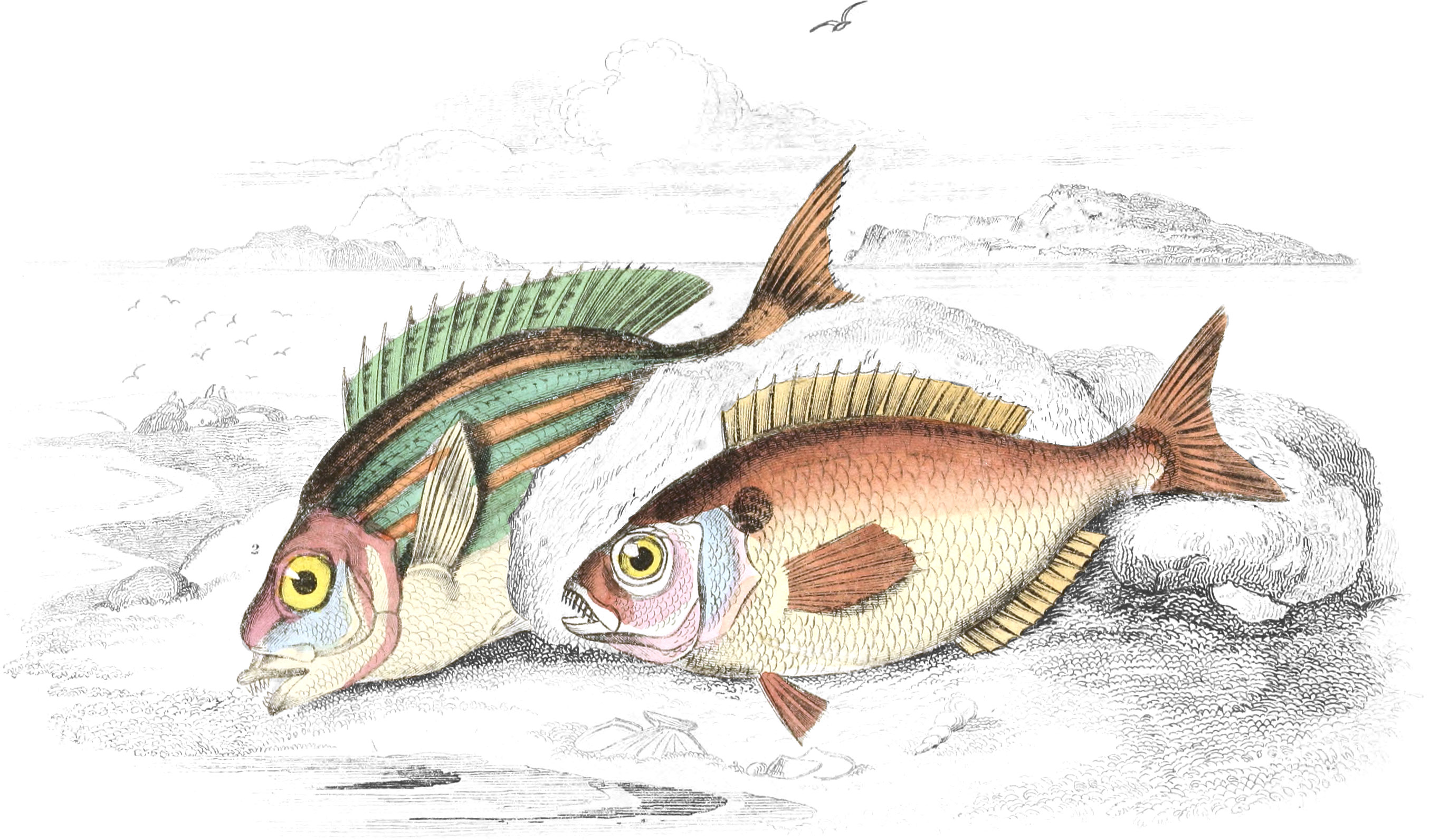
Plate IX
Gen. XIX. Dentax
This genus consists of fishes of the Sea-bream family which have long conical teeth in both jaws, usually in a single row, with some of the anterior elongated like sharp and powerful canines. Two species are known in the Mediterranean, and more in southern seas. The one we are about to mention is valued in Dalmatia and the Levant as a wholesome and palatable food when fresh, and as an important article of commerce; it is divided, packed in barrels with saffron, &c. and keeps well for months.
The Four-Toothed Sparus
Sp. 40. Dentax vulgaris
In each jaw of this species, as implied in the name, there are four strong hooked canine teeth, those behind being smaller; the form of the head is obtuse; the back is brownish red, mottled with some darker coloured spots; the sides are paler, inclining to yellow; the abdomen almost white; all the fins pale reddish brown. The fish is said to become of a purple tint with age, and paler in colour during winter. Only one individual has been recorded as captured on the British coast. In April 1805, this specimen, two feet six inches long, caught off Hastings, was brought to the London market, and fell into the hands of Mr. Donovan. Small fishes of this species are seldom taken; the smallest, according to Bloch, being seldom less than 3 or 4 lbs.; at Borne, their average weight is about 5 or 6lbs. Mr. Donovan’s specimen weighed 16 lbs., but this size is trifling in comparison with some occasionally found in the southern seas: in the South of France they are often 20 or 30 lbs., and Duhamel mentions one which weighed no less than 76 lbs. A more voracious fish, remarks Mr. Donovan, is scarcely known; which will be readily credited by those who examine its formidable teeth. When taken in the fishermen’s nets, it is asserted that it will seize upon the other fishes which are captured, and mangle them dreadfully. Being a swift swimmer. it finds abundant prey, and soon attains a considerable size.
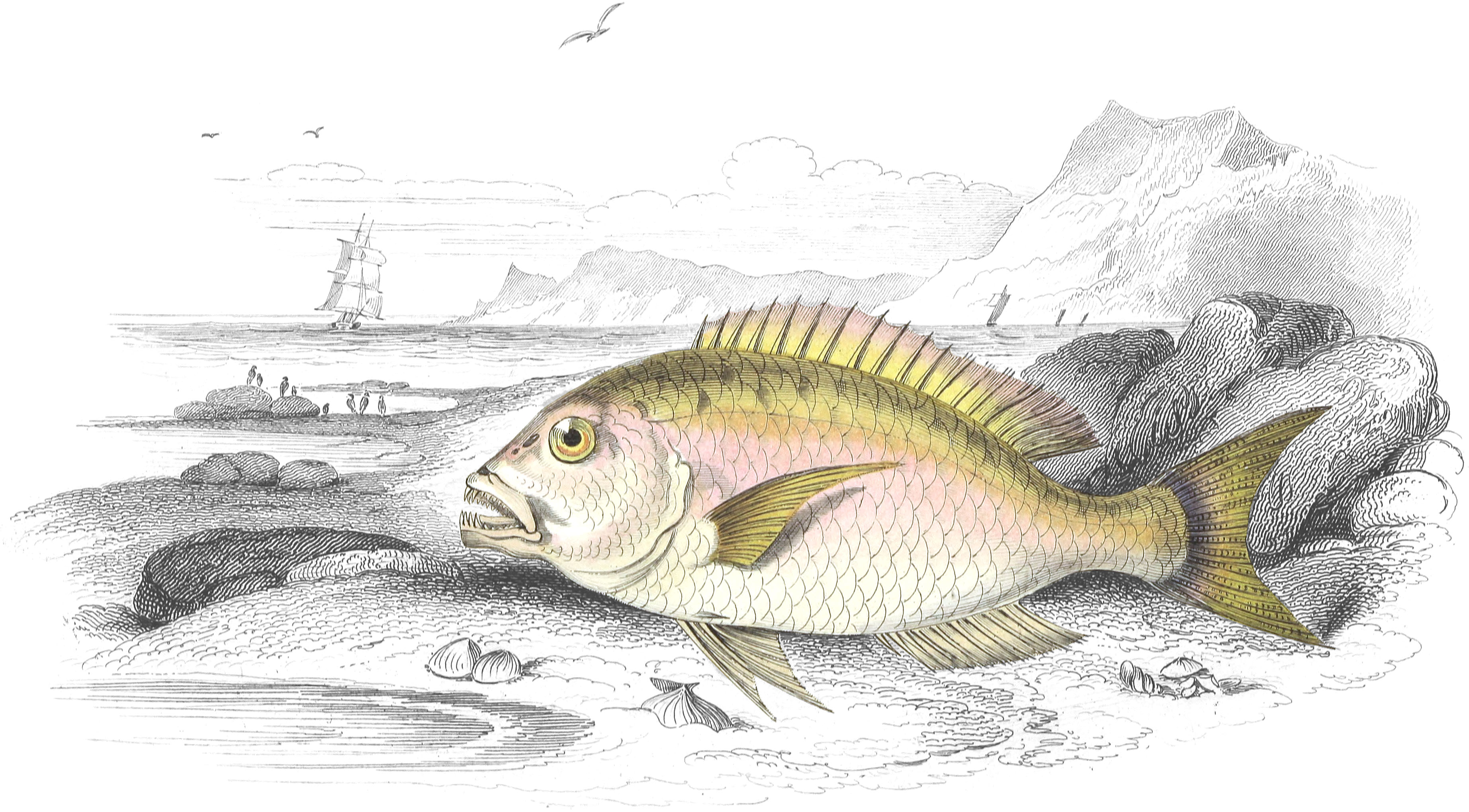
Plate X
Gen. XX. Cantharus
This genus is characterised by the teeth being card-like and close set, those of the anterior row being a trifle larger than the others; their dorsal and anal rays are somewhat more numerous; the mouth is but slightly cleft, and not protractile. The species belonging to it frequent muddy coasts, are voracious, and take the hook greedily. Four species are known as European, a great number inhabit tropical seas, whilst the American seem to have none. One species is British.
The Black Bream
Sp. 41. Cantharus griseus
The Black Bream appears especially to inhabit the British Channel, Cuvier and Valenciennes intimating they have never procured a specimen from the Mediterranean. It was first described by Colonel Montague, in 1815, under the name of Scarus lineatus, having been noticed on the coast of Devonshire, where it is by no means uncommon. Duhamel had previously figured it, and it is minutely described in the sixth volume of L’Histoire Nat. des Poissons. The colour of the body is bluish grey, shaded with longitudinal bands, alternately dark and light; the dorsal fin is pale brown, the others of a dusky red colour. Its common size is about fifteen inches, although M. F. Cuvier presented one to the Paris Museum which reached to twenty inches. Mr. Couch remarks, that it takes the baits common for other fish, but feeds more on marine vegetables, upon which it becomes exceedingly fat. It enters harbours, and is frequently taken by anglers: he has nearer known it to assemble in shoals, and it is seldom taken of a small size. Colonel Montague informs us it is no less common than the Red Bream, and is considered of less value; Cuvier and Valenciennes remark that its flesh is firm and well-tasted.
V. The Scaly-Finned Family. Squamipennæ
Representative in British Fauna
-
Gen. 21. Brama.
- Sp. 42. B. Raii. Ray’ Bream.
The Scaly-finned Family is readily distinguished from others by the soft, and frequently the spinous portions, of the dorsal and anal fins, being covered with scales, so that they are not easily distinguished from the other parts of the body. It is a large one, containing about 150 species, most of which, however, frequent the Indian and Polynesian Seas. It is subdivided into three groups; the first having hair-like teeth, the second cutting-teeth, and the third having them either close set, or card-like. It is conspicious for the extreme splendour of the colouring of its members. If the feathered tribes of the equatorial regions are bedecked with the most brilliant and gorgeous hues, the neighbouring oceans contain myriads of the finny race, which in this respect excel them. Upon the first of the three groups, especially, Nature has most profusely lavished these splendid ornaments The purple of the iris, the richness of the rose, the azure blue of the sky, the darkest velvet black, and many other hues, are seen commingled with metallic lustre over the pearly surface of the resplendent group, which habitually frequenting the rocky shores, at no great depth of water, are seen to sport in the sun-beams, as if to exhibit to advantage their gorgeous dress. Several of the genera are moreover distinguished by an extraordinary habit of shooting their prey by projecting a liquid stream from their mouths. Thus, the genus Chelmon contains a species, the rostratus, of six or eight inches in length, which when it perceives a fly, or other winged insect hovering over the surface, or settled on a twig, propels against it, with considerable force, a drop of liquid from its mouth, so as to drive it into the water: in attacking an insect at rest, it usually approaches cautiously, and very deliberately takes its aim. It is said to be an amusement with the Chinese in Java to keep this fish in confinement in a large vessel of water that they may witness its dexterity: they fasten a fly, or other insect, to the side of the vessel, when the Chelmon aims at it with such precision, that it rarely misses its mark. The Archer, again, belonging to another genus, Toxotus jaculator, shoots his watery deluge to the height of three or four feet, and strikes almost without fail the insect at which it aims. Cuvier received a specimen of this fish from Batavia, whose stomach was entirely filled with Ants. One species alone frequents the seas of Europe: it is
Gen. XXI. Brama
Ray’s Bream
Fig. 2. Sp. 41. Brama Raii
The genus Brama belongs to that group which has the scaly fins, and teeth on the vomer and palate. This species is the only one now known; its body is deep and compressed, and the profile is almost vertical; it has one elongated dorsal fin, studded, like the anal, with scales. It attains the length of between two and three feet, and weighs from 10 to 12 lbs.; the colour above is very dark blue, coppery upon the upper part of the sides, silvery on the abdomen; the anal and dorsal fins sparkle like silver, and there is a tint of green before the dorsal. Baron Cuvier seems to have been deceived in supposing this fish belonged exclusively to the Mediterranean, and was only a straggler in the ocean. Probably its central dominion is that inland sea, on many parts of whose shores it is extremely common. In the markets of Genoa it is called Rondanin. Mr. Yarrell has succeeded in demonstrating that it is far from rare on our own and the neighbouring shores. It has been observed once and again on the coasts of Cornwall and Devonshire; it is met with at Belfast, where it is called the Hen-fish; and it is frequently found on the west coast of Scotland: it has also been taken in Berwick and St. Andrew’s Bays, and in the Frith of Forth. Specimens of it exist in the British Museum, and in that of the Zoological Society of London; and Mr. Yarrell states that he saw nine specimens of it in the Museums of Edinburgh, Newcastle, and York. It is also found on the coasts of Norway. According to Cuvier, it spawns in summer; and its flesh is said to be of exquisite flavour.

Plate XI
VI. The Mackerel Family. Scomberidæ
Representatives in British Fauna.—Gen. 10. Sp. 12.
-
Gen. 22. Scomber. Mackerels.
- Sp. 43. S. Scomber. The Common Mackerel.
- Sp. 44. S. colias. The Spanish Mackerel.
-
Gen. 23. Thynnus.
- Sp. 45. Th. vulgaris. The Tunny.
- Sp. 46. Th. pelamys. The Striped Tunny, or Striped Bonito.
-
Gen. 24. Auxis.
- Sp. 47. A. vulgaris. The Plain Bonito.
-
Gen. 25. Xiphias.
- Sp. 48. X. gladius. The Sword-fish.
-
Gen. 26. Naucrates. Pilot-Fishes
- Sp. 49. N. ductor. The Pilot-fish.
-
Gen. 27. Caranx.
- Sp. 50. C. trachurus. The Scad, or Horse Mackerel.
-
Gen. 28. Centrolophus.
- Sp. 51. C. pompilus. The Black-fish.
-
Gen. 29. Zeus.
- Sp. 52. Z. faber. The Dory, or John Dory.
-
Gen. 30. Capros.
- Sp. 53. C. aper. The Boar-fish.
-
Gen. 31. Lampris.
- Sp. 54. L. guttatus. The Opah, or King-fish.
This interesting family is one of the most numerous of Osseous Fishes, after the Perches, its described species amounting to upwards of 320. Many of them crowd the surface of the ocean, especially in warm latitudes, and their range is most extensive. Ten genera, as above noted, visit the British shores; and sixteen genera, or one-twentieth of the whole, have been discovered on the North American coast. Some inhabit only the middle longitudes of the Atlantic, and there pursue the Flying-fish, as Dr. Richardson has well remarked, over the vast wastes, as the herds of Wolves do the Bison on the prairies of America. When considered separately, these fish are easily characterized. The separation of the posterior rays of their second dorsal fin, and of their anal, suffice for that purpose in the Mackerel and Tunny, the typical genera of the family. But these are only the chiefs of a numerous series of genera and sub-genera, in which the general characters alter by degrees, and pass insensibly into others. The possession of scales, so small as to make the greater part of the skin appear as if it were smooth, the vertical fins free from scales, and the gill-covers without spines or denticulations, constitute almost all the prevailing characters which can be assigned to the family: and notwithstanding they have a resemblance which never leaves them in any of their modifications, so that they form what Botanists call a family by series or transition. The caudal fin is often of great size and power, and the sides of the tail are keel-shaped, and armed with scales or shields. This family is one of the most useful to man, many of the species constituting excellent food, their size being considerable, and their reproduction enormous, bringing them periodically to the same latitudes, and so making them the object of most extensive and important fisheries. It is subdivided into four great sections. The First having the anterior dorsal fin entire, and the terminal rays of the posterior detached or insulated, forming what may be called spinous fins, pinnæ spuriæ, or finlets. To this subdivision belongs the
Gen. XXII. Scomber. Mackerels
Characterized by a fusiform body, covered with scales, which are small and smooth; sides of the tail not keel-shaped, but merely raised into two small cutaneous crests; the two dorsal fins are widely separated, and there are finlets behind the second dorsal and the anal.
The Common Mackerel
Fig. 1. Sp. 43. Scomber Scomber
The natural history of this valuable fish, as illustrated by Mr. Yarrell, exhibits so pleasing a specimen of his valuable work already so often referred to, that we shall enrich our pages by an abridgment, scanty as it must necessarily be. The Mackerel is so well known for the beauty and brilliancy of its colours, the elegance of its form, its intrinsic value to man as an article of food, both in reference to quantity and quality, that further observation on these points is unnecessary. It is probable that these fish inhabit almost the whole of the European seas; and the law of nature which obliges them, and many others, to visit the shallower water of the shores at a particular time, appears to be one of those wise and beautiful provisions of the Creator, by which not only is the species perpetuated with the greatest certainty, but a large portion of the parent animals are thus brought within the reach of man, who but for the action of this law, would be deprived of many of those species most valuable to him as food. For the Mackerel, dispersed over the immense surface of the deep, no effective fishery could be carried on; but approaching the shore as they do from all directions, and roving along the coasts collected in immense shoals, millions are caught, which yet form a small portion compared with the myriads which escape. It may be observed further, that as there is scarcely a month throughout the rear in which the fishes of one or more species are not brought within the reach of man by the operation of the imperative law of Nature referred to, a constant succession of wholesome food is thus spread before him, which, in the first instance, costs him but little beyond the exercise of his ingenuity and industry to obtain.
The Mackerel is taken nearly round the whole coast of Ireland; and it visits the Western Isles of Scotland, but not in great abundance. On the Cornish coasts, in some seasons, it occurs as early as March, pursuing a course from west to east; and they are plentiful on the Devonshire coast about June. On the Hampshire and Sussex coasts, they arrive as early as March, and sometimes even in February, the fishermen finding them further from shore the earlier they go in search of them. On our eastern coast, the fishing is later: at Lowestoffe and Yarmouth, the great harvest for them is in May and June: in the Frith of Forth, where they are not very abundant, it is in June and July, whilst in Orkney they do not make their appearance till the last week in July or the first of August. From an examination of the Mackerel sent to the London market from the shallow shore off Worthing, it is manifest that these fish deposit their roe earlier than those caught in the deep water off Brighton. The young Mackerel, called Shiners, are from four to six inches long by the end of August; they are half-grown by November, when, according to Mr. Couch, they retire to deep water, and are seen no more that winter: the adult fishes, however, never wholly quit the Cornish coast, and some are taken with lines every month of the year. The Mackerel, as feeders, are voracious, and their growth is rapid. The ordinary length varies from fourteen to sixteen inches, and their weight is about 2 lbs. each; although they sometimes attain the length of twenty inches, with a proportional increase of weight. The largest fish, however, are not the best for the table. As an article of food, they are in great request, and those taken in the months of May and June are generally considered to be superior in flavour to those taken in spring and autumn. To be eaten in perfection, this fish should be very fresh; and as it soon becomes unfit for food, some facilities in the way of sale have been afforded to the dealers in a commodity so perishable. Mackerel was first allowed to be cried through the streets of London on a Sunday in 1698; and the practice prevails to the present time.
At various fishing-towns on the coast, the Mackerel season is one of great bustle and activity. The frequent departures and arrivals of boats at this time, form a lively contrast to the more ordinary routine of other periods; the high price obtained for the early cargoes, and the large returns gained generally from the enormous numbers of the fish sometimes captured in a single night, being inducements to great exertions. A few particulars, from various sources, may not be uninteresting. In May 1807, the first Brighton boat-load of Mackerel sold at Billingsgate for forty guineas per hundred, seven shillings each, reckoning six score to the hundred, the highest price ever known at that market. The next boat-load produced about thirteen guineas per hundred. Mackerel, on the contrary, were so plentiful at Dover in 1808, that sixty were sold for one shilling. At Brighton, in June of the same year, the shoal of Mackerel wa3 so great, that one of the boats had the meshes of her nets so completely occupied by them, that it was impossible to drag them in; the fish and nets, therefore, in the end, sank together, the fishermen thereby sustaining a loss of nearly £60, exclusive of what the cargo, could it have been got into the boat, would have produced. The success of the fishing, in 1821, was beyond all precedent. The value of the catch of sixteen boats from Lowestoffe, on the 30th of June, amounted to £5252; and it is supposed that there was not less an amount than £14,000 altogether realized by the curers and men concerned in the fishery off the Suffolk coast. In March 1833, on a Sunday, four Hastings boats brought on shore 10,800 Mackerel, and on the next day two boats brought 7000. Early in the month of February, 1834, one boat’s crew from Hastings cleared £100 by the fish caught in one night; and a large quantity of very fine Mackerel appeared in the London market in the second week of the same month. They were cried through the streets of London on the 14th and 22d of March. 1834, and had then been plentiful for a month. There are three different modes of catching Mackerel,—by drift-nets in deepish water, by the seine-net, sometimes in deep water and sometimes near the shore, and thirdly, sometimes by the hook, trailing the line near the surface. This last mode of fishing has been well described in the “Wild Sports of the West” of Ireland.
It was evident that the Bay was full of Mackerel. In every direction, and as far as the eye could range, gulls and puffins were collected; and to judge by their activity and clamour, there appeared ample enjoyment for them among the fry beneath. We immediately bore away for the place where these birds were most numerously congregated; and the lines were scarcely overboard, when we found ourselves in the centre of a shoal of Mackerel. The hooker, however, had too much way; we lowered the foresail, double-reefed the mainsail, and then went steadily to work. Directed by the movements of the birds, we followed the Mackerel, tacking or wearing the boat occasionally, when we found that we had overun the shoal. For two hours we killed those beautiful fish, as fast as the baits could be renewed and the lines hauled in; and when we left off fishing, actually wearied with sport, we found that we had taken above 500 lbs. There is not on sea or river, always excepting angling for Salmon, any sport comparable to this delightful amusement; full of life and bustle, everything about it is animated and exhilarating: a brisk breeze, a fair sky, the boat in quick and constant motion, all is calculated to interest and excite. He who has experienced the glorious sensations of sailing on the Western Ocean, a bright autumnal sky above, a deep green lucid swell around, a steady breeze, and as much of it as the hooker can stand up to, will estimate the exquisite enjoyment our morning’s Mackerel-fishing afforded.
Plate XI
The Spanish Mackerel
Sp. 44. Scomber colias, Scomber pneumatophorus
Immediately after the Common Mackerel, M. M. Cuvier and Valenciennes describe, under the above names, two fishes which are well known in the 3Iediterranean; the one larger, the other smaller than the preceding species. They, moreover, differ from it in possessing an air-bladder, which is truly remarkable, as thus stated by the eminent authors just named,—one of the most curious facts in Ichthyology, and one of the most inexplicable in Comparative Anatomy, is, that fishes of the same genus, and so closely resembling each other in all the details of their organization that the greatest attention is necessary in distinguishing them, should the one be furnished with an air-bladder, and the other be deprived of it: Why is it required in the one, and not in the other? What cause operates in the production of this difference? Here are interesting problems for the consideration of the theologian, the student of Nature and the Providence of God.
Corresponding with these Mediterranean fishes, there have been noticed on our own shores many specimens which bear the closest resemblance to them, and which hare been provisionally catalogued by Mr. Jenyns, a doubt existing whether the smaller fish is any thing more than the young of the larger. The smaller has been noticed by Mr. Turton as frequently found at Swansea; and the larger was described by Mr. Couch in Loudon’s Magazine for 1832, from which source we now take our description. The Spanish Mackerel sometimes attains the weight of 4 or 5 lbs. The mouth, head, and eyes are very large; the dorsal fin has seven rays, whilst the common has twelve; rays of the gill membrane six, concealed. Colour dark blue on the back, striped like the Mackerel, but more obscurely, and with fewer stripes; a row of large dark spots runs from the pectoral fin to the tail, and the sides and belly are thickly covered with smaller dusky spots; the tail, gill-covers, sides, and beneath the eye, being bright yellow. From the Mackerel, which it resembles, this fish differs in the markings of the head, the head and snout being larger, the eye and gape larger, and in having scales on the anterior gill-covers: the body is not nearly so much attenuated posteriorly; the ventrals are sharp and slender, and the pectorals lie close to the body.—This fish is scarce, but some are captured every year. It does not often take the bait, although the fishermen inform me it sometimes does; and that its infrequency is owing to the difference of feeding rather than want of rapacity. It is most frequently taken in drift-nets; but even then it is only one at a time and at considerable intervals. It is in no estimation as food.
Gen. XXIII. Thynnus
This genus is characterised by a kind of corselet round the neck and thorax, formed by scales larger and coarser than those of the rest of the body; the sides of the tail have a cartilaginous keel, and the anterior dorsal is prolonged almost to the posterior one.
The Tunny
Sp. 45. Thynnus vulgaris
The Tunny, though only an occasional visitor of the British shores, is as important an object of pursuit in the Mediterranean, as the Mackerel or Herring among ourselves, or the Cod at Newfoundland. It appears to have been more frequently observed on the Scottish coast than the English. Mr. Pennant remarks,
They frequent our coasts, but not in shoals as in the Mediterranean: they are not uncommon in the lochs of the West of Scotland, where they come in pursuit of Herrings, and often, during the night, strike into the nets and do considerable damage. One was taken when I was at Inverary, in 1769, which was seven feet nine inches long, and weighed 460 lbs.
Dr. Scouler mentions (Loudon’s Mag., vi.) that one was taken nearly opposite Greenock, in the herring-nets, which measured nine feet in length, in July 1831; and within the last few weeks, a beautiful specimen, also Scotch, 8 feet long and 5 feet 6 inches in circumference, has been added to the Collection in the Edinburgh University Museum. The flesh of this fish was dressed, and was found, as is well known, to be of a red colour, like that of Salmon, and was considered a rich and delicate morsel by those who partook of it. In Scotland it is known by the name of Mackerelsture, or Great Mackerel, from accompanying the shoals of this fish. Three, as mentioned by Mr. Donovan, were captured near the mouth of the Thames in the summer of 1801, and were taken to Billingsgate market. Mr. Couch, as quoted by Mr. Yarrell, states that the Tunny appears on the Cornish coasts in summer and autumn, but is not often taken. It feeds on Pilchards, Herrings, and other smaller fishes; but the Saury-pike seems to be its favourite prey; for it not only compels it to seek another element for safety, but will also spring to a considerable height after it, usually crossing its course, at the same time attempting to strike it down with its tail.
The form of the Tunny is similar to that of the Mackerel, but it is larger, rounder, and has a shorter snout; the dorsal fin is lodged in an elongated depression on the back, which conceals it when folded down. The upper part of the body is dark blue, the corselet much lighter; the sides of the head white, silvery-spotted; the first dorsal, pectoral, and ventral, black; the tail paler; the second dorsal and anal flesh-coloured; the finlets yellowish, tipt with black. It is one of the largest of fishes: in the Mediterranean, when one hundred weight, it is considered diminutive; when from one to three hundred weight, it is regarded as a Half-Tunny; those weighing a thousand pounds are not rare, and Cotti asserts that old males are sometimes taken which weigh 18cwt. From time immemorial prodigious numbers have been recorded as frequenting that inland sea. Thus Gyllius,
Twenty vessels might be filled by a single cast of the net: and they may be taken without nets, and with the hands. When they ascend to the port of Constantinople in crowded troops, they may be killed with stones. Women take them by simply suspending a basket from their windows with a cord. In fine, without baiting a hook, a sufficient quantity may be taken to provision the whole of Greece, and a great part of Europe and Asia.
M. Von Hammer says,
The Sea-fish of Constantinople are the first in the world, the Bosphorus swarms with them.
Mr. Swainson says,
The flavour of the Tunny has nearly as much resemblance to that of flesh as to fish; and to those who have tasted it, we need not expatiate upon its excellence: when fried in the form of cutlets, it has the strongest resemblance to veal, having the same compact firmness, and the same delicate whiteness.
Those of Sardinia and Spain were considered by the Romans as superior. When cured, they formed the Saltamentum Sardicum, a very savoury meat. For numerous and interesting details concerning the habits of these fish, their capture, preservation, &c. we must refer to the pages of L’Hist. Nat. des Poisson, and to Griffith’s Cuvier, volume on Fishes.
The Striped Tunny, or Striped Bonito
Sp. 46. Thynnus pelamys
The Striped Tunny, or Striped Bonito, which also belongs to this genus, is a much smaller fish, rarely exceeding thirty inches; it is an inhabitant of the ocean, and visits the British shores still more rarely than its congener. It is well known in southern seas for the chase which it gives in great troops to the Flying-fish, to the amusement of the weary voyager. Sailors frequently amuse themselves by catching the Bonito with a hook fastened to a piece of lead, shaped like a small fish, with wings made of feathers attached, to give it the appearance of a Flying-fish. Though relished by those living on salt provisions, its flesh, which is like that of beef, is sometimes considered dry and disagreeable. The Striped Tunny has 8 finlets behind the second dorsal, and 7 behind the anal; and the sides of the abdomen are marked with four longitudinal dusky bands. Mr. Stewart’s account, in the year 1817, of its occasional occurrence in the Frith of Forth, seems sufficiently minute and satisfactory. Dr. Scouler states that a specimen was taken in the Frith of Clyde in July 1832; but Mr. Couch, as in many other instances, is here our most liberal contributor. According to him, this fish is occasionally met with on the Cornish coast: one specimen obtained was twenty-nine inches long, and twenty in circumference close behind the pectorals; the colour was fine steel-blue, darker on the back; the sides dusky white; behind the pectorals there are four dark lines which extend along each side of the abdomen to the tail, with scales like those of the Mackerel: this individual was taken in a drift-net in July, at which time the roe was abundant. In this locality it rarely takes the bait, and is too wary to be often captured in a net.
Gen. 24. Auxis
This genus has the corselet and the pectoral fins the same as in the previous one; but the dorsal fins are apart, as in the genus Scomber; it has but one representative in the British seas, which is
The Plain Bonito
Fig. 1. Sp. 47. Auxis vulgaris
The trivial names of this fish we owe to the authors of L’Hist. Nat. des Poissons and to Mr. Yarrell, the latter gentleman remarking,
I have called it the Plain Bonito on account of its plain and uniform colour, as contrasted with the Striped and Belted Bonitoes.
To this gentleman we are also indebted for its introduction into the British Fauna. In the month of June 1839, two specimens of this handsome mackerel-like Bonito were received at Billingsgate from the coast of Norfolk, near Yarmouth, where they had no doubt been caught in the mackerel-nets; both of these found their way to Mr. Yarrell, owing to the well-known interest he takes in the history of British fishes, a fit compliment, we may remark, to his steady and meritorious exertions. One of these specimens measured eighteen inches in length and eleven inches and a half in circumference behind the first dorsal, the body in form being nearly cylindrical. The back was irregularly mottled with two shades of indigo blue, the belly silvery white, the corselet somewhat darker than the abdomen, or greyish white; the fins dark grey, except the anal, which was tinged with yellow. The weight of this fish, according to M. Risso, who, as well as M. Rafinesque, recognised it as a distinct species in the Mediterranean, never exceeds 6 lbs.; the female is somewhat larger than the male, and spawns in August, the ova being white and encrusted with a reddish albuminous covering. Its flesh, of a deep red colour, is said to be sour to the taste, and to be very indigestible, becoming very dark when exposed to the air. The intertropical parts of the Atlantic sustain many Bonitoes, so closely corresponding to the one under review, that they cannot be distinguished. They have been transmitted to Paris from Martinique, where they are called Thon, and where they are caught of enormous dimensions, d’une grosseur énorme.

Plate XII
Gen. 25. Xiphias
This genus is nearly allied to the foregoing by its small scales, its keeled and powerful tail, and its internal organization: it has only one dorsal fin, and the ventrals are wanting. Its distinctive character consists in its long beak, spear-shaped, forming a powerful weapon, wherewith it attacks the largest marine animals; it is composed principally of the vomer and intermaxillary bones, and is strengthened at its base by the ethmoid, frontal, and maxillary bones; the gills are not pectinated, but formed of two great parallel laminæ, with reticulated surfaces. The rapidity of these fish is excessive, and the quality of their flesh excellent. There are various sub-genera, the first of which, the Xiphias Proper, has no ventral fins: one species alone is known, which is frequently seen on the British shores; it is the
The Sword-Fish
Fig. 2. Sp. 48. Xiphias gladius
The name which has been attached to this fish, in nearly all languages, indicates the most striking feature in its formation, namely, the cutting and pointed blade, a projection of its muzzle, which threatens everything which approaches it. The Sword-fish attains a great size, so that by the ancients it was classed among the cetaceous or whale tribes, Cete; by which term, however, they meant nothing more than a very large inhabitant of the ocean. It frequently attains the length of ten and twelve feet, and has been recorded as long as eighteen and twenty. The Mediterranean is regarded as its natural habitation: here it is everywhere fished, though it most abounds on the shores of Sicily. Small specimens are common at Genoa, where the sword is cut off previous to their being exposed in the markets; they are also brought to Nice throughout the year, but especially in spring, weighing between 200 and 350 lbs. From the Mediterranean this fish is supposed to issue, and to wend its way principally northwards along the European shores, and southward down the coast of Africa; it is, however, also caught on the North American shores. It was introduced into the British Fauna as far back as the days of Sibbald: Pennant mentions one captured in Flintshire in 1785; and another found off the Caermarthen coast, which weighed 75 lb., with the sword three feet long. Drs. Leach and Knox, and Professor Grant, have each examined specimens obtained in Scotland; and one of these, found in 1826, between Alloa and Stirling, is now in the Edinburgh Royal Museum. In the Baltic and Northern Ocean, it is often encountered. As it regards the English coasts, a specimen was exhibited at Brighton in the year 1796, which had been caught in the neighbourhood; Mr. Daniel, in his Rural Sports, mentions that, in the Severn, near Worcester, a man bathing was struck, and actually received his death-wound from a Sword-fish: the fish was immediately caught, so that there could be no mistake as to the circumstance. In October 1834, as mentioned by Mr. Yarrell, a party of gentlemen in their pleasure-boat, off the coast of Essex, observed something bulky floating on the water, which they found to be a Sword-fish, ten feet long, of which the sword measured three; and the last-named Naturalist received one in July of the same year, which had been taken in Bridgewater river. Specimens are often stranded on different coasts, a circumstance which has been explained by the allegation, that these fish being peculiarly exposed to the attacks of various parasitic animals, which torment them beyond endurance, they, in despair, cast themselves ashore, to rid themselves at once of their tormentors and their lives.
The Sword-fish is reported to have violent contests with the whale, of which the following, quoted by Mr. Yarrell, is a striking example.
One morning, as stated by Captain Crow, in a work lately published, during a calm, when near the Hebrides, all hands were called up at 3, a. m., to witness a battle between several fish called Thrashers or Fox-sharks, and some Sword-fish, on the one side, and an enormous whale on the other. It was in the middle of summer; and the weather being clear, and the fish close to the vessel, we had a fine opportunity of witnessing the contest. As soon as the whale’s back appeared above the surface, the Thrashers, springing several yards into the air, descended with great violence upon the object of their rancour, and inflicted upon him the most severe slaps with their tails, the sounds of which resembled the reports of muskets fired at a distance. The Sword-fish, in their turn, attacked the distressed whale, stabbing from beneath; and thus beset on all sides, and wounded, whenever the poor creature appeared, the water round him was dyed with blood. In this manner they continued tormenting and wounding him for many hours, until we lost sight of him; and, I have no doubt that in the end they completed his destruction.
It is probably by mistaking a vessel for one of these great monsters of the deep, that the Sword-fish is ever seen to try his strength against a gallant ship. Those on board have sometimes, from the violence of the shock, found it difficult to believe that they have not struck some hidden rock, such being the weight and power of the fish, and specimens of ships’ timbers penetrated by what appears to be the sword of the fish, are by no means uncommon. A leak is sometimes sprung; but this can happen only in very weak and crazy vessels.
The capture of the fish itself, as practised from time immemorial in the Mediterranean, is also an exciting occupation. It is like whale-fishing in miniature. A watchman, on the summit of a neighbouring rock, gives warning by signal when he observes a fish approaching; a seaman then ascends the mast-head, to guide his fellows, who now row under his direction, to reach it. They are so skilful, that generally from a great distance they strike their victim at the first blow with the harpoon, having a long cord attached. An arduous struggle now commences, during which the boat is often pulled about for many hours ere the capture is completed.
We have already stated that there is but one dorsal fin in this species, extending nearly from the summit of the head to the root of the tail. This is very evident in young specimens: when, however, they become aged, such is the effect of the friction to which they are necessarily exposed, that the fin wears away in the middle, and the appearance of a double dorsal is left behind. This circumstance has erroneously led to the proposal of a second species. The edges of the sword are cutting, and finely denticulated; the lower jaw is also pointed, extending to where the upper surface of the sword becomes horizontal; there are no teeth in either jaw, but fine teeth in the gullet like shorn velvet. The colour of the upper parts of the body is a dusky blue; of the under, a fine silvery white, the whole body being covered by a rough skin. It is said that the ordinary habit of this fish is to go in pairs, male and female. The flesh of the young is perfectly white, compact, and of excellent flavour: when old, its qualities are somewhat modified; Brydon remarking that it is more like beef than fish, and is then to be dressed as cutlets. It has ever been esteemed of first-rate quality, is often salted, the tail and fins being most esteemed when fresh.
Plate XII
The Second Section of this Family is characterised by having the spiny rays of the back, not continuous, but separate.
Gen. XXVI. Naucrates. Pilot-Fishes
This genus is distinguished by free dorsal spines; which exist also before the anal fin, to the number of two; it has the carina, or keel, on the sides of the tail. Of its various species, only one is British.
The Pilot-Fish
Sp. 49. Naucrates ductor
The term Pilot-fish is applied, not only to the congeners of the species now under review, but also more loosely to some other fish. Its origin has been ascribed to various causes. The ancient Naturalists had a story that it joined company with the tempest-tost bark of the anxious mariner, indicated to him his nearest direction to land, and left him as soon as it had fulfilled this kind office. A more modern opinion, which has been faithfully copied by many authors, affirms that these fishes act a pilot’s part to the Shark, and accompany and befriend it as opportunity offers. Notwithstanding the prevalence of this assertion, it has been denied by others, who hold that these tales are quite apocryphal, and allege that the fact is reduced to this, that the Pilot follows vessels like the Shark, and with still greater perseverance, solely for the purpose of obtaining a share of the garbage which may be thus procured: this, it is held, explains the apparent alliance, and with the greater appearance of probability, that M. Bose assures us that he has seen hundreds of these fish, which always kept at some distance from the Shark, but as soon as crumbs and fragments were thrown overboard, stopped to seize them; thus for the time abandoning both Shark and ship, and manifesting the real object which attracted them.
All this is so far well; but it does not account for all the facts which have been noted regarding the habits of this fish. Thus, our able coadjutor, Colonel Hamilton Smith, many years ago, furnished to Mr. Griffiths’ edition of Cuvier, the following information:
Capt. Richards, R. N., during his last station in the Mediterranean, saw on a fine day a blue Shark, which followed the ship. After a time, a shark-hook baited with pork was flung out. The Shark, attended by four Pilot-fish, repeatedly approached the bait; and every time he did so, one of the Pilots preceded him, was distinctly seen from the taffrail of the ship to run his snout against the side of the Shark’s head to turn it away. After this continued for a time, the Shark swam off in the wake of the vessel, his dorsal fin being long distinctly visible above the water. When be bad gone, however, a considerable distance, be suddenly turned round, darted towards the vessel, and before the Pilot-fish could overtake him and interpose, snapped at the bait and was taken. In hoisting him on board, one of the Pilot-fish was observed to cling to his side until he was half above water, when it fell off. All the Pilots then swam about a while, as if in search of their friend, with every apparent mark of anxiety, and then darted suddenly into the depths of the sea.
It may be imagined by some that in this case the fancy of the narrator gives a colouring to the facts; but the Colonel expresses his complete belief of the whole, having himself watched with intense curiosity an event in all respects precisely similar. (Grif. Cuv., x. 636).
That the Pilot appears to have a deep interest in his formidable associate, admits not of a doubt, although perhaps his service is not always so judicious as in the instances just alluded to. Dr. Mayen, in a recent publication, remarks,
We ourselves have seen three instances in which the Shark was led by the Pilot. When the former neared the ship, the latter swam close to his snout, or near one of his breast fins; sometimes it darted rapidly forwards or sideways, as if looking for something, and constantly went back again to the Shark. When we threw overboard a piece of bacon fastened on a great hook, the Shark was about twenty paces from the ship; with the quickness of lightning, the Pilot came up, smelt at the dainty morsel, and instantly swam hack again to the Shark, swimming many times round his snout, and splashing, as if to give him exact information as to the bacon. The Shark now began to put himself in motion, the Pilot showing him the way, and in a moment he was fast to the hook.
M. Geoffroy, in his Memoir Sur l’Affection naturelle des quelques Animaux, relates a similar incident; and both Fish and Naturalist have been smartly criticised for the part they play in this tragic narrative; the former for acting the traitor, and the latter the goose, in not discriminating the true character of the service rendered. We pretend not to judge in this knotty matter. Whether the poor Pilot is justly reprehensible for not considering that the pork concealed a hook, is first to be settled; and meantime, allowing that the nimble Pilot has no more occasion to fear the unwieldy Shark, than the agile Swallow the pouncing Hawk, yet we remark that the evidence rather goes to show that there is something very like a confiding familiarity subsisting between these two companions of the weary mariner. The time and space during which the Pilot will follow a vessel is great, through its whole run, for many weeks.
The Pilot is a pretty little fish, about a foot in length; like the Mackerel, having five conspicuous transverse bands round its body. On these Dr. Moore has recently made the following remarks: the circular hands did not appear to surround the body, being undistinguishable on the back, which was of a fine purplish black; on a side view, the bands scarcely reached above the lateral line; the iris, instead of being of a golden yellow, was a fine deep brown, and the extreme points of the pectorals, ventrals, and tail, were white and transparent. These, then, are probably the true markings. Dr. Moore adds:
In a day or two, however, as the colours faded, the beautiful metallic blue of the abdomen turned to a dull iron-grey, the bands became easily distinguishable all round the fish, and the brown-coloured pigment of the iris gradually contracted, leaving beneath a shining yellow circle.
Dr. Moore states that he considers the Pilot, of all Mediterranean species, the most frequent visitor on the coast of Devonshire. Many are the instances now collected of their following ships into British ports. Mr. Yarrell says,
In January 1831, the Peru put into Plymouth, on her voyage from Alexandria to London, after a passage of eighty-two days. About two days after she left Alexandria, two Pilot-fish made their appearance close alongside the vessel, were constantly seen near her during the voyage, and followed her into Plymouth. After she came to an anchor in Catwater, their attachment appeared to have increased; they kept constant guard to the vessel, and made themselves so familiar, that one of them was actually captured by a gentleman in a boat alongside; but, by a strong effort, it escaped from his grasp and regained the water. After this the two fish departed, but they were taken the same evening; and when dressed next day, were found to be excellent food.
In 1833, nearly a hundred Pilot-fish accompanied a vessel from Sicily into Catwater, but none were captured. Two others appeared in 1835, and again in 1838, and others subsequently; they have also been seen in Dartmouth harbour, in Guernsey, and elsewhere.
The Third Section of this Family is distinguished by having the sides furnished with a cuirassed lateral line: it is numerous, especially the leading genus, but has only one British representative.
Gen. XXVII. Caranx
Caranx, whose lateral line is armed, more or less, with scaly shields, raised into a keel, and pointed.
The Scad, Horse Mackerel, or Pilas Fish
Fig. 2. Sp. 50. Caranx trachurus
The Scad, or Horse Mackerel, which has from 70 to 75 large scaly laminæ on the lateral line. This fish is rather smaller than the Common Mackerel, so that its trivial name is not derived from its greater size, but from the alleged coarseness of its flesh. Mr. Couch states that it is rarely brought to market, and that in many places even the fishermen are not in the habit of eating them. But De gustihus nil disputandum; for thus Dr. Parnell,
The flesh is considered by some as inferior food; by others, as far superior to that of the Mackerel; it is firm, of good flavour, and wholesome, and is in best season in March and April.
Mr. Yarrell has purchased them in the London market in May, and remarks,
They possess a portion of the flavour of the Mackerel, but are not so fine.
In Scotland these fish are not often seen: in the Firth of Forth, during some years, scarcely one being procured, whilst in others a dozen or two may be obtained: they are occasionally taken in the Tay, in Berwick Bay, and off Yarmouth. On the eastern and southern shores of Ireland they are more common, and in the west and south of Britain they abound. Mr. Couch remarks,
The Scad regularly visits the coasts of Cornwall and Devonshire, commonly in scattered quantities, but occasionally in considerable schulls, pronounced Schools, in the district. They are not abundant before the warmer months of the year, after which some may be found on board of every fishing-boat. The usual habit of the fish is to keep near the ground; but when they assemble in pursuit of some favourite food, as they sometimes do in immense multitudes, they become so eager as to thrust each other in heaps on the land.
as reported by Mr. Bicheno to Mr. Yarrell,
In July 1834, great shoals visited the coast of Glamorganshire. They were first observed in the evening; and the whole sea, as far as we could command it with the eye, seemed in a state of fermentation with their numbers. Those who stood on some projecting rock had only to dip their hand into the water, and with a sudden jerk they might throw up three or four. The bathers felt them come against their bodies; and the sea, looked on from above, appeared a dark mass of fish. Every net was immediately put into requisition; and those which did not give way from the weight, were drawn on shore laden with spoil. One of the party, who had a herring-seine with a two-inch mesh, was the most successful: the mesh held its fish, and formed a wall that swept on the beach all before it. They were thus caught by cart-loads. They were pursuing the fry of the Herring, and their stomachs were full of them.
The characters already supplied, with an examination of the Plates, render further details in this place unnecessary.

Plate XIII
In the next, the Fourth Section of the Mackerel Family, the finlets, the free spines of the back, and the armour on the sides of the tail, are all wanting. To this group belongs the genus Coryphæna, containing C. hippurus, misnamed the Dolphin, and with other species so celebrated for its versatile hues, and of whose beauty, according to Bose, we must have seen them in troops following a vessel, before we can form any estimate. It is a large Section, of which, in the British Fauna, we have only one genus.
Gen. XXVIII. Centrolophus
Centrolophus, characterized by Cuvier as having small scales, an unkeeled tail, a long dorsal, whose spiny rays are scarcely distinguishable from the others; its head is little elevated, and its palate without teeth, (Hist. Nat. des Poiss., ix 246). Of this genus we have to name
The Black-Fish
Fig. 1. Sp. 51. Centrolophus pompilus
Only four specimens of this somewhat remarkable fish appear to have been caught in the British seas, and all off the coast of Cornwall; two, many years ago, by Mr. Jago, and two more lately by Mr. Couch. In the Mediterranean it is well known. According to Cuvier, it was first described under the name of pomphilus by Rondelet; Lacépède formed it into a new genus, and his generic name is still retained; Mr. Jago having previously described it under the name of Black-fish. On the northern shores of the Mediterranean it is not common, being but rarely seen on the coast of France; it, however, visits Nice in considerable numbers in April and September, and is caught in that locality throughout the year: it spawns in autumn. Cuvier suspects its favourite haunts to be the southern shores of that inland sea. Mr. Jago’s account, which is but short, is repeated by Mr. Borlasse in his History of Cornwall, together with a characteristic plate. From this authority we learn
That the Black-fish is smooth, with very small thin scales, in so much that they will be overlooked without close inspection; its length is fifteen inches: breadth, near the pectoral fin, between three and four; head and nose like those of the trout; mouth small; teeth very small; eye full and bright: one fin on the back, commencing four inches and three-quarters from the snout; the length nearly six inches, with a forked tail and a large double nostril. Two were taken at East Looe in May
18211721, in a seine, near the shore, in sandy ground, with some ore-weed in their stomachs, (p. 271).
Mr. Couch, as already stated, examined two other specimens, whose description is supplied by Mr. Yarrell. It agrees generally with Mr. Jago’s. The gill-rays are fine; the body, somewhat compressed, is about three inches deep, a thin elevated ridge, on which the dorsal fin is situate, making it appear deeper on the back; the lateral line is somewhat crooked at the commencement; the colour is wholly black, the fins intensely so, the shade being somewhat lighter on the abdomen, and bronzed at the origin of the lateral line. Mr. Couch says,
When employed in drawing the figure, the side on which it lay changed to a fine blue.
The second specimen measured two feet eight inches in length, and weighed nearly 14 lbs. The skin was observed to be very tough, so that it was stripped off from the fish like that of an eel: no air-bladder was found. The taste, according to Mr. Couch, was delicious. Not so Duhamel, whose words are,
Sa chair nest pas très délicate.
Mr. Couch continues,
The great strength and velocity of this fish have been spoken of in terms of admiration by several authors, and the large one mentioned above afforded a corroboration of the truth of the remark.
It was caught in a salmon-net at the mouth of the river in November 1830; and such was the force with which it struck the bottom of the net, that it carried it before it over the head-rope.
Plate XIII
The last or Fifth Section of this Family is formed of Mackerels with a protractile mouth, its members having the power of prolonging their mouth into a long tube. Some have one dorsal fin, others two; but the character of their integuments, and their cuirassed sides, associate them with this group. It has three representatives in the British Fauna.
Gen. XXIX. Zeus
This genus has two distinct dorsals, the anterior of which is formed by spinous rays, accompanied by long and thread-like filaments, which extend far beyond the spines and uniting membranes. Of the four species of L’Hist. Nat. des Poissons, one only is British: it is
The Dory, or John Dory
Sp. 52. Zeus faber
The Dory, or John Dory, of considerable size, grotesque form, and uncommon colours, has excited attention on almost every coast, and received characteristic names from every people. The French and English names, Dorée, have been given from its golden colour: it is the cock, Gallo, of Sicily, from the crest on its back, as also of the Sardinians, Spaniards, and French of the Bay of Biscay; in the western provinces of France, it is called the Sea-hen. In many towns on the Mediterranean, it is denominated St. Peter’s fish; it being alleged that it was from the mouth of a fish of this species that the Apostle obtained the coin to pay the tribute-money, and that the imprint of his two fingers marks the species to the present day,—a legend which is likewise told of the Haddock: from a similar fancy, the modern Greeks are in the habit of hanging up this fish in their places of worship.
Though not abundant in northern seas, the Dory cannot be considered as very rare on the coast of Britain. It is a rare visitor, however, in Scotland, not above two or three being taken annually in the Firth of Forth; it is scarce also on the eastern coast of England, but abounds in the southern, especially off Cornwall and Devonshire; it is also common on the Irish shores. In the autumn of 1829, Mr. Couch states that more than sixty were hauled on shore at once in a net, some of them of large size; it continues common till the end of winter, after which it is less plentiful, but never scarce. Mr. Pennant mentions that the largest specimen he ever heard of weighed 12 lbs., and that one of half the size is considered as above the average: twelve or eighteen inches is a common length, although Cuvier has seen them two feet long, and heard of their reaching two and a half. Its conformation is altogether singular, and is better expressed by the pencil than by words. The body is oval, the head large, and the mouth capable of great protrusion; the eyes are situate high in the head. The prevailing colour of the body is an olive-brown tinged with yellow, reflecting, in different lights, blue, gold, and white. When the fish is first taken from the water, and held in the hand, the varying tints of these different colours pass in rapid succession over the body.
Opinions are not in unison as to the quality of this fish as an article of food, any more than of many others which have passed under review. Mr. Pennant denominates it the most delicious luxury, and this seems to be the prevailing sentiment. Baron Cuvier, however, remarks,
Ce qui est plus singulier, c’est que l’on n’ait pas toujours su partout que c’était un excellent poisson; il est certain, quil est peu recherché à Paris, (x. 7)
Col. Montague, some years ago, informed us
that it was then about sixty years since the celebrated Mr. Quin, of epicurean notoriety, first discovered the real merit of the Dorée; and we believe from him originated the familiar, and, we may say, national, epithet of John Dory, as a mark of his especial esteem for the fish.
The Dorées of the London market are mostly supplied from the Devonshire coast; and being ground fish, they are the better for being kept for two or three days.
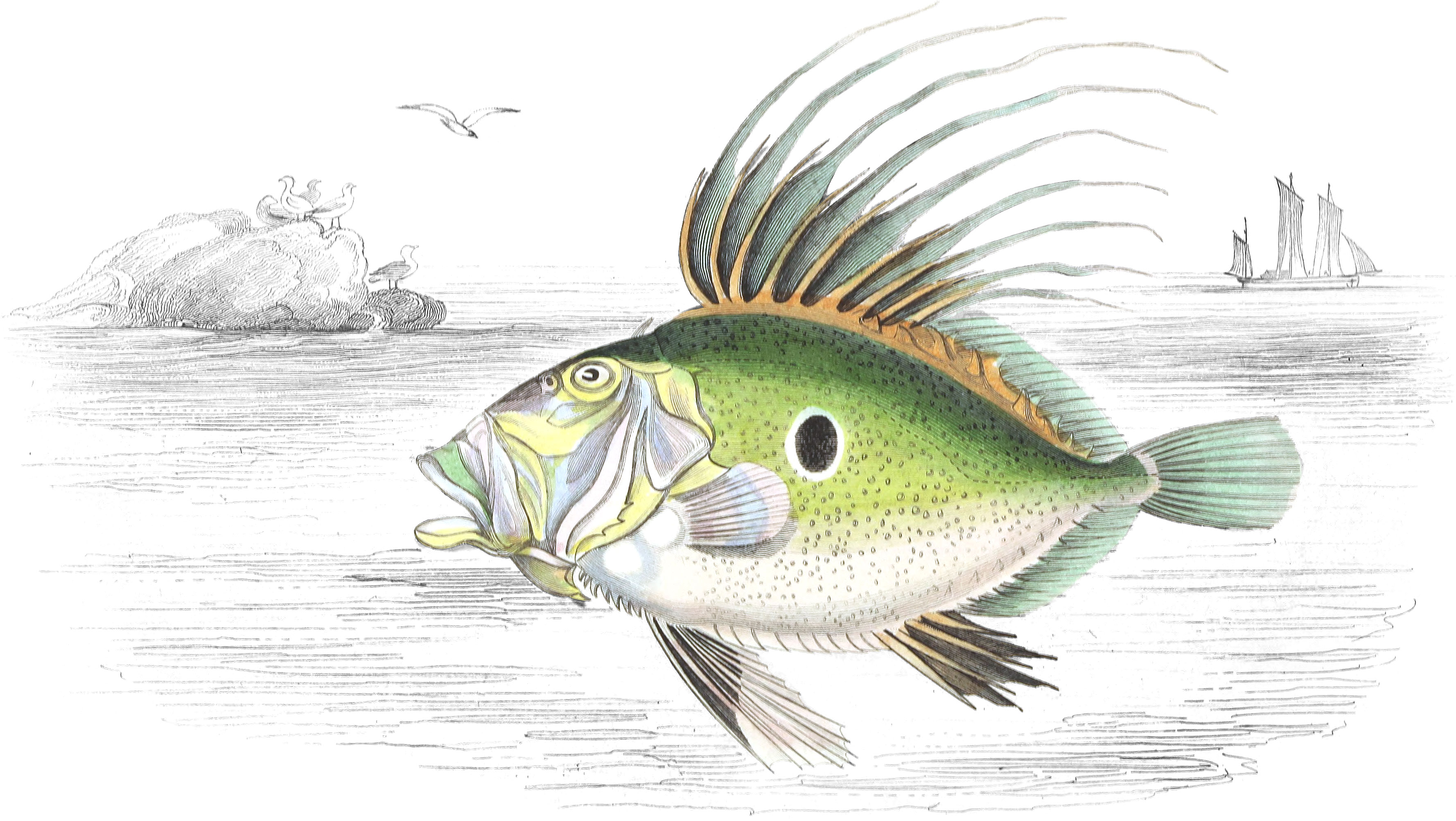
Plate XIV
Gen. XXX. Capros
Has the notched dorsal of the Dorée, but the fins are entirely without filaments; the mouth is more projectile than in the preceding genus, and the body is covered with rough. scales. One species alone has hitherto been catalogued.
The Boar-Fish
Sp. 53. Capros caper
The Boar-fish, which is generally spread over the Mediterranean, but far from abundant even there, is rare upon the whole of the French coast: it is well known at Madeira; and from specimens thence derived, Mr. Yarrell’s figure and description are both supplied. One specimen was taken in Mount’s Bay, Cornwall, in October 1835 1833, by Dr. H. Boase, which was described in the Proceedings of the Zoological Society; a second, as we are informed by Mr. Yarrell, was obtained in Bridgewater fish-market, in April 1833; and a third has been more recently captured on the Devonshire coast. It is a diminutive fish, rarely exceeding four inches in length: the largest specimen possessed by the authors of the Hist. Nat. des Poisson was six French inches, whilst the specimen last alluded to was nine inches English. It is of the same general appearance as the Dorée, with a more projecting mouth. Our French authorities state that its general colour is reddish brown, more or less intense; our English, that the upper part of the back and sides are pale carmine, still lighter beneath, and passing to silvery white on the abdomen; the body being divided into seven transverse orange-coloured bands, reaching three-fourths of the distance from the back downwards; the Mount Bay specimen is said to have had no bands: the fin-rays are of the same colour as the back, the membranes are much lighter.
Mr. Yarrell states, in both editions of his excellent work, that he is not aware that any figure from nature, of this fish, has hitherto been published, except the original one given by Rondelet. In the tenth volume of the great French work so often alluded to, published in the year 1835, in the Avis an Relieur, Capros aper is numbered as Plate 281, and a very beautiful plate, with details, is supplied in the succeeding volume: the fish was in the hands of the authors, and assuredly Werner’s drawing is from nature. In this the lateral line, which Mr. Yarrell says is not observable, is distinctly, although somewhat faintly, traced, and we doubt not accurately. Our Plate is taken from the highly finished plates accompanying the current illustrated edition of the Règne Animal, publishing by Crochard and Co.
We are not aware that this fish is used as an article of food. Risso mentions that it spawns in April, and confirms Lacépède’s statement of its bad odour, saving that it has little taste, and continually exhales an unpleasant smell.
Gen. XXXI. Lampris
Has but one dorsal fin; but one species is known. It is the
The Opah, or King-Fish
Sp. 54. Lampris guttatus
The body of the Opah is oval and compressed, the sides of the tail keeled, the teeth wanting: the gill-rays seven.
An eminent Naturalist has well remarked, that it is truly singular that so large and beautiful a fish as that now under review, and which is by no means infrequent in our seas, should have been described only recently; and still more, that the different authors who have attempted a description should have been so little acquainted with each others labours. This criticism, written in the year 1835, will henceforward, we trust, no longer apply. As affording, however, a good illustration of the error and confusion in which such subjects are apt to be envolved, we shall here present a slight sketch of what has been called “The History of the Natural History” of this fish.
The habitat of the King-fish appears to be high northern latitudes. There it is most abundant; thence it issues into the temperate regions; although it is only lately that it has been ascertained that it wanders southwards as far as the Mediterranean. The first notice and representation of this fish we possess is that of Sibbald, in his Scotia Illustrata: the specimen which afforded the materials was taken in the Frith of Forth, near Queensferry; the figure is far from good, and the description very short. Mr. Low, in his Natural History of Orkney, alludes to a second notice, which is to be found in Mr. Wallace’s Description of Orkney: Mr. Wallace also supplies a figure with his description, mentioning that one fish was captured in Sanda Bay in the winter of 1682, and that several others had previously been obtained in the same locality; the subject of his description was about an ell in length. Another specimen was taken near Leith in the year 1750, and formed the subject of a communication to the Royal Society of London, which was, in course, published in No. 495 of the Philosophical Transactions, with a figure. There happened to be in this country, at the time, an African prince, who imagined, or pretended, that he had long been familiar with this fish in his native land, and who supplied the information that it was called Opah by the natives, and King-fish by their English visitors. Thus the trivial names of this fish, which have been preserved to the present day, were conferred by an African; and as no specimen has at any time been taken in tropical seas, there is every reason to suspect that the information thus communicated was inaccurate in all respects.
In the year 1762, Stroem had an opportunity of examining and describing this fish in Norway, and Müller imagining there was a resemblance between it and the Zeus vomer, originated the notion that it was an inhabitant of the Brazilian waters, as well as of the Norwegian. A few years afterwards, in 1768? Gunner supplied a description in the Memoirs of Drontheim, accompanied with a tolerable figure. In the year 1767, one was found stranded on the coast of Northumberland, and a second was taken not far from Scarborough; and five years afterwards, in 1772, another was obtained at Brixham, Torbay, which weighed 140 lbs. and measured four feet and a half in length. In 1777, a specimen was captured at Dieppe, which was described by Duhamel under the name of Poisson Lune, the only assistance he found for his account being another example which existed in the Paris Museum. Very shortly afterwards, another individual was taken at Helsingborg in Sweden, which Retzius described as a new genus, under the name of Lampris, in the Memoirs of Stockholm for the year 1799.
Coming down to the present century, we have now to mention that two specimens from the Danish coast formed the subjects of the descriptions and figures of Holten in the Memoirs of the Copenhagen Society in 1802. and in his Danish Zoology, 1806. Lacépède also, in the year 1802, constituted this fish into a new and distinct genus, founding upon the statements of Duhamel; and not satisfied with this, but imagining he detected a variety of his genus in the Chinese drawings to which he had access, he concluded it was an inhabitant of the Indian and Pacific Oceans.
The largest specimen, in the Paris Museum, was obtained from Havre in the year 1804. Turton described it, in his British Fauna, under the name of Zeus luna; Sowerby, in the 22d plate of his British Miscellany, as the Zeus opah; and Donovan, in his Nat. Hist. of British Fishes, in 1806, mentions that three examples had been recently noticed on the Scottish coasts. Dr. Neill, in his valuable Paper on the Wernerian Memoirs, 1808, gives additional information. A few years ago, he tells us that a very fine one was taken off Cramond, which was preserved in the Museum of Mr. (subsequently Sir Patrick) Walker, a well-known and indefatigable Naturalist. Another, about the same time, was found near Burntisland, but not preserved; and a third was stranded near Arbroath, and exhibited as a spectacle at Dundee. The Doctor added,
During my visit, in 1804, to Orkney, I was surprised to find this fish accurately described as having been several times cast ashore during storms.
In 1829, M. F. Faber furnished some interesting details concerning the Lampris in his History of the Fishes of Iceland. It would appear that one of them was taken on these icy coasts in 1672, and that others had since been captured, though it is not a constant resident. M. Faber has discovered no evidence that it penetrates further north, or is to be found in Greenland. He informs us that its flesh is red. very like salmon, and that it is much esteemed by the Icelanders. Nilsson enumerates it among the Norwegian fishes, but considers it as one of the rarest. It is not uncommon among the Shetland islands; and Professor Reinhart has recently recorded, that within the last thirty years, three individuals have been taken on the coast of Denmark: and what is very remarkable, they were all captured near the same spot. (Apud Yarrell).
Dr. Parnell informs us, that in July 1835, one of these fishes was washed ashore in the neighbourhood of Queensferry, which was five feet in length, and computed to weigh eleven stones. The body was cut up, taken away, and eaten by the fishermen, who stated that the flesh was red, remarkably good, equal to that of salmon, and much of the same flavour. Another was seen at the same time and place; but in consequence of the weather being stormy, they were unable to catch it. From Mr. Yarrell’s well-stored pages we learn, that since the capture of the Brixham specimen mentioned by Pennant in 1772, many have been procured on the British shores. One is preserved in the British Museum; and another, taken within these few years, has been added to the Andersonian Museum in Glasgow. Mr. Couch informs us that one has been taken in Cornwall; an other, in August 1835, was caught in the weir-nets, Conway, North Wales; in 1838, a fine example was taken near Burlington, Yorkshire; in July 1839, one three feet long, on the Norfolk coast, which was procured for the Wisbeach Museum; and another, obtained in the Dee, was reported to Mr. Yarrell by Lord Cole; and lastly, during the current year, 1842, a fine specimen has been added to the Edinburgh University Museum.
The King-fish is not altogether a stranger in the Mediterranean; M. Risso having noticed it, as stated in the second edition of his work; and two having been captured, in 1829, on the coasts of Provence. Cuvier states that there is no trace of its existence on the coasts of America; although, as indicated by Dr. Richardson, it has been suspected to have been seen there. The idea of its belonging to the coasts of Guinea or Brazil, or to the China seas, rests solely upon the most vague and improbable suppositions.
Notwithstanding these numerous historical notices, and the various opportunities they necessarily imply, we regret to say, that little or nothing has hitherto been ascertained concerning the habits of this most valuable and beautiful fish. Once seen, it can scarcely afterwards be mistaken; and its specific characters are very distinct, as will be expressed in the Synopsis. Its colours are magnificent. Its whole back is of a steel blue, which on the flanks becomes rich green, reflecting, in different lights, purple and gold, and a lovely rose-colour on the abdomen. Numerous oval spots, some milk-white, others of a beautiful silvery lustre, adorn this ground-work, while small ones ornament the head. The gill-covers are very brilliant, and the iris of its large eye is of a beautiful golden colour: all the fins are vermillion. Adorned with so gay a dress, no wonder that the correspondent of Count Buffon should remark
que le Lampris semble un seigneur de la cour de Neptune en habit de gala.
VII. Family of Riband-Shaped Form. Tænioidæ
Representatives in British Fauna.—Gen. 5. Sp. 5.
-
Gen. 32. Lepidopus.
- Sp. 55. L. Argyreus. Scabbard-fish
-
Gen. 33. Trichiurus.
- Sp. 56. T. lepturus. Silvery Hair-tail.
-
Gen. 34. Trachypterus.
- Sp. 57. T. Bogmarus. The Deal-fish, or Vaagmaer.
-
Gen. 35. Gymnetrus.
- Sp. 58. G. Hawkinii.
-
Gen. 36. Cepola.
- Sp. 59. C. rubescens. The Red-band.
This extraordinary Family, as exhibited in the Règne Animal, is by no means a large one, consisting, as more amply illustrated in L’Hist. Nat. des Poissons, of but seven genera and twenty-six species. It is nearly allied to the preceding; but the form is very much elongated, and more flattened sidewise; it is also clad with minute scales. Concerning it, Mr. Swainson remarks,
It contains the most singular and extraordinary fishes in creation. The form of the body, when compared to fishes better known, is much like that of an Eel, the length being in the same proportion to the breadth; but then it is generally so much compressed, that these creatures have acquired the popular name of Riband-fish, Lath, or Deal-fish. The body, indeed, is often not thicker, except in its middle, than is a sword; and being covered with the richest silver, and of great length, the undulating motions of these fishes, in the sea, must be resplendent and beautiful beyond measure. But these wonders of the mighty deep are almost hidden from the eye of man. These meteoric fishes appear to live in the greatest depths, and it is only at long intervals, and after a succession of tempests, that a solitary individual is cast upon the shore, with its delicate body torn and mutilated by the elements on the rocks; so that with few exceptions they are scarcely to be regarded as edible fish.
According to this authority, the Mediterranean has hitherto produced the largest proportion of the family; but it is distributed from the arctic regions to the sunny shores of India; so that probably a tithe have not yet been discovered.
In the Règne Animal, the Family is divided into two Sections, which in the Hist. Naturelle (x. 228) are augmented into three; the first having a prolonged muzzle and large mouth, armed with strong and cutting teeth, the upper jaw being more prolonged than the under;—the second, most of all meriting the appellation of Riband-fish, some being ten feet long and only six inches broad and one thick, have the mouth slightly cleft;—whilst in the third it is widely cleft. Of the first section, two species only have visited the British shores.
Gen. XXXII. Lepidopus
Lepidopus, is characterized by the ventral fins being reduced to two small scaly processes, by a single dorsal fin extending the whole length of the body, by the anal being narrow, and the tail well formed; the gill-fins have eight rays.
The Scabbard-Fish
Fig. 2. Sp. 55. Lepidopus argyreus
It is curious, as remarked by Cuvier, that a fish so generally distributed, so beautiful, large, and every way remarkable, should have remained unknown till toward the close of the eighteenth century, and also that during a long time it should have been successively described by many authors who imagined it was new, having no knowledge of their predecessors’ labours. It was first noticed by Brünnich, in 1767? at Spalatro, in Dalmatia; then by Professor Go wan, at Montpellier, in 1776; and, subsequently, at the Cape of Good Hope, on the coast of Portugal, of Devonshire, Nice, Sicily, Gascony, &c.; so that, in the words of Cuvier, it is found all round the southern and western shores of Europe. In addition to these instances, Mr. Yarrell has received intimation of others, six having been noticed on the coasts of Cornwall and Devonshire, and one in Guernsey.
The best general idea we can form of this fish is to conceive a large and broad riband of silver, swimming with undulatory motion through the water, and in its progress shedding abroad the most beautiful shining reflections. The most striking characters consist in the peculiarity of its teeth, its roundish scales, the rudiments of the ventral scales, and of a third situate behind the anal. The iris is of the colour of silver, and the fins appear to be transparent or yellowish grey. The largest specimen examined by the authors of the Hist. Naturelle was six feet, Fr.; Col. Montague’s measured five feet six inches, and when gutted, weighed more than 6 lbs. The tongue was smooth, and, like the inside of the mouth, silvery; the eyes very large; the colour of the skin, like burnished silver with a blueish tint, quite smooth, as if destitute of scales. This specimen was caught in June 1808, on the coast of Devonshire. It was swimming with astonishing velocity, with the head above water,—to use the fishermens expression, “Going as swift as a bird,”—and was killed by a blow of the oar. It was made a public show in Kingsbridge, where in one day a guinea was taken for its exhibition, at the rate of one penny each person. A very young individual was found alive on the coast of Devonshire, in the month of February, 1810, which was brought to Colonel Montague, but not till after it was dead; it in every respect resembled the larger one. This accomplished Naturalist inquires,
How are we to account for this very young specimen being found in our seas, unless the spawn had been deposited on our coasts? and if we may now conclude that this fish actually inhabits our seas, it is not a little curious that it is not better known.
It is said not to live in society; in the Mediterranean, it approaches the shore in April and May, when the females spawn. Here it is caught, and its flesh, according to Risso, is firm and delicate. It is stated to be also frequent off the coast of Portugal.

Plate XV
Gen. XXXIII. Trichiurus
This genus possesses the same kind of head and teeth as the foregoing, so is it with the body and internal organization; but it is entirely destitute of ventral fins: its anal is replaced by a set of very minute spines, which scarcely project beyond the skin, and the tail terminates in a long point, without any caudal fin. The gill-rays are seven. Three species belong to the Indian seas: one is catalogued as British: but further elucidation is required.
The Silvery Hair-Tail
Fig. 1. Sp. 56. Trichiurus lepturus
The Silvery Hair-tail (Pl. XV.) is a fish whose habitat is the Atlantic. The greatest number of specimens have been derived from the coasts of South America and the West Indies, a few from those of North America and the western coast of Africa: at Monte Video and Jamaica it is known as the Sword-fish; at Cuba, as the Sabre. The height of the body is to the whole length as 1 to 16 or 17. At about the half of the whole length, the body begins to diminish in size, and is little more throughout the latter fifth than a slender tail. The lower jaw is the largest; the eye is placed high up, near the line of the profile: the number of teeth is about fifteen on each side of each jaw, being compressed, cutting, and pointed; a row of very minute ones occurs on the palatine bones; the tongue is long, free, and smooth. The pectoral fin is small, with eleven rays; there are no ventrals; the dorsal commences in a line with the superior angle of the opercle, the rays having a uniform height throughout the greater part of its length, and diminishing toward the termination. The vent is at a third of the length of the fish from the head, and behind it there are numerous small spines. There are no visible scales; the lateral line, commencing at the upper edge of the opercle, descends to the lower third of the body, and follows that parallel to its termination. The skin is covered with a delicate silvery membrane: the colour is that of bright and shining silver, the fins being greyish yellow; the edge of the dorsal speckled with black; the iris of a golden hue. The length is about three feet.
The claims of the lepturus to be regarded as a British fish are very slender; though some species of the genus has assuredly been observed. Our sole authority upon this point is the late Mr. Hoy, who published his observations in the eleventh volume of the Linnean Transactions. The specimen which he described, and which was much mutilated, was found on the beach at Port Gordon, Moray Frith, on November 12th, 1812, and was sent next day in a cart to Gordon Castle, at the request of whose noble proprietor the examination was made. The description we shall supply in Mr. Hoy’s own words.
The head of the fish had been broken off, and was quite gone, a small bit of the gills only remaining about the upper part of the throat, whence, to the extremity of the tail, its length was twelve feet nine inches; its breadth, eleven inches and a quarter, was nearly equal for the first six feet, diminishing gradually thence to the tail, which ended in a blunt point without any bristles; its greatest thickness was two inches and a half; the distance from the gills to the vent forty-six inches. The dorsal fin extended from the head to the tail, but was much torn and broken: the parts to which the pectoral fins had been attached were perceivable near the gills: there were no ventral nor anal fins; but the thin edge of the belly was closely muricated with small hard points, which, though scarcely seen, were plainly felt. Both sides of the fish were white, with four longitudinal bars of a darker colour; the one under the dorsal being about two inches broad, the others three-quarters of an inch; the lateral line was straight along the middle.
From these details, little doubt can remain that this was a Trichiurus; but from its great size, which could not have been less than fourteen feet, the position of the lateral line, and other differences, it is scarcely safe to conclude it was any of the Trichiuri already described. The fish being quite fresh, a cut of it was boiled, and found to be excellent.
A fish supposed to be similar, but likewise mutilated, had been cast ashore two years before, and also fell under the observation of Mr. Hoy, who described it in the same Memoir as the other. The differences, however, are so great, that it probably belonged to a distinct species, if not genus; and for further particulars, therefore, we must refer to the source already indicated, and to Mr. Yarrell’s and other systematic works.
Plate XV
We proceed to the Second Section of this Family, in which three genera have been included, and nearly a score of species; but of which the British Fauna has but two representatives. The organization of this group of fishes is altogether peculiar. Their skeletons, though fibrous, is throughout exceedingly tender; the bones of the head have a consistence scarcely greater than that of moistened pasteboard, and the vertebras are so slightly knit, that the body is apt to be snapt across, even by the efforts of the living fish, like that of the orvet, the ophlsaurus, or like the tail of a lizard. Their long fin-rays, especially when they are young, snap across like threads of glass; their flesh is so soft, that it is decomposed in a few hours, and they are with difficulty preserved even in spirit-of-wine. We are not to be surprised, therefore, that creatures which are not more solid than a Mollusc, lose, with age and numerous accidents, those exuberant and frail ornaments which distinguish their normal condition. The circumstance goes far to explain the difficulties in which the history of these fishes has been involved; no Naturalist having thoroughly examined one of them, and scarcely a single specimen having been procured in its perfect state, the different descriptions, therefore, have been taken from incomplete and ill-preserved individuals. This should induce those who are so fortunate as to procure specimens, to use them with all tenderness and care. The elucidation of the tribe by M. M. Cuvier and Valenciennes is an admirable exhibition of the industry and perseverance of these Naturalists; and to their valuable pages, as a study, we refer the young Zoologist. The habits of the group appear solitary, and they generally frequent the deep sea, although the young, in spring, approach the coast, and large individuals sometimes appear. Thus, one has been caught in a harbour chasing small mullet; and others, similarly employed, are frequently detected on the shores of Nice.
Gen. XXXIV. Trachypterus
Trachypterus, formerly Bogmarus, and Gymnogaster. This genus has a caudal fin singularly placed, not at the termination of the tail, but over its extremity, projecting upwards. The lateral line is garnished with scales armed with a sharp hook; the jaws are furnished with teeth; the pectoral fins are of medium size, and the ventrals often greatly developed: the form of their body is greatly compressed and elongated, like the blade of a sword; all the upper part of the body is furnished with a dorsal fin, the anterior portion of which, sometimes distinct, rises from the head like a plume. The fins are remarkably brittle.
The Deal-Fish, or Vaagmaer
Sp. 57. Trachypterus Bogmarus
The Deal-fish, or Vaagmaer (PI. XV.), has been observed in the British seas only on the shores of Orkney, and especially in Sanda Bay, where upwards of a dozen have been obtained between the years 1817 and 1829, some alive, but most dead. Dr. Duguid of Kirkwall communicated descriptions to Dr. Fleming, which were published in Loudon’s Magazine. (Mag. of Nat. Hist., iv. 215). These specimens were imperfect, and so, necessarily, were the descriptions. Of the one caught alive, we are told that it was three feet long, having the body excessively compressed, particularly towards the back, where it did not exceed a table-knife in thickness; breadth nearly five inches, tapering towards the tail; colour silvery, with minute scales: the dorsal fin was of an orange colour occupying the whole range from head to tail, with the rays of unequal size: vent immediately beneath the pectoral. Both jaws were armed with small teeth: the lateral line was rough, and towards the tail armed with minute spines pointed forwards, which were the only spines on the body. The length of those stranded varied from one to six feet.
This we believe is all the information collected of this fish in Britain; but it is better known in Iceland. The Danish seamen tell us that its flesh is gelatinous; that it penetrates the creeks of Iceland at full tide, and prefers a sandy bottom where there is little water. It sometimes remains stranded on the sand or mud when the water retires, and lives long in these circumstances. In these regions it is regarded venemous, because the ravens will not eat it. On being handled, the silvery-coloured pigment comes off, and remains attached to the fingers. Its name Vaagmaer, when translated, reads, Maid of the Caves: and its Orkney one is said to be derived from a common deal-board. From M. Fabers History of the Fishes of Iceland, we find it was noticed by John Gudmunsen, a native, who wrote a Natural History of Iceland and died in 1658; Olafsen and Brünnich have also described it; it is occasionally found on the north coast of Norway; but is scarcely ever taken in the nets.
Mr. Yarrell, in his last edition, informs us that he has lately received from Professor Peinhardt a copy of a Memoir read to the Royal Society, Copenhagen, in the winter 1829, containing a detailed account, and a figure from a specimen obtained alive in Iceland.3 This has been translated by Dr. Cantor, and from this Memoir we make a few extracts. It was about three feet nine inches long, and reached its destination in such beautiful condition, that the brilliant red colour of the fins had not faded. The colour of the head and body is silvery white, varied only by the blackish grey of the head, and by two oblique oval spots of the same colour on each side. The long dorsal fin, and the almost vertical caudal one, are of a light red colour. There are no traces of scales, the skin beneath the silvery covering being furrowed by diagonal lines: towards the abdominal margin they appear as papillary warts of remarkable fineness, but by no means osseous; the lateral line is covered with a series of oblong osseous shields, from the middle of which the spines arise. The number of rays in the right pectoral fin was eleven, in the left ten; the vertical caudal had eight. We question if any drawing has yet appeared, in which all the ornaments of this singular fish were entire.
Gen. XXXV. Gymnetrus
This genus is distinguished by a single prolonged ventral fin, often dilated at its extremity. Six or eight species have been discovered, two of which, according to M. Valenciennes (x. 259), belong to the Mediterranean; two are found at the Cape and in the East Indies, and several are supposed to be inhabitants of European seas. Great doubt, however, hangs over the last of these, even Hawkins’ Gymnetrus being very properly catalogued by Mr. Jenyns as doubtful.
Gymnetrus Hawkinii
Fig. 1. Sp. 58.
Our knowledge of this species rests mainly upon the authority of Bloch, who states that he received a specimen, taken in the Eastern Ocean, near Goa, from an Englishman named Hawkins, which was mutilated, wanting its tail. Mr. Couch, in the 14th vol. of the Linnean Transactions, states that an individual of this species was drawn ashore, dead and mutilated, in a net in Mount’s Bay. in February 1791. Its length, without the tail, was eight feet and a half, its depth ten inches and a half, thickness two inches and three-quarters. and weight 40 lbs. In this fish the dorsal fin reaches from above the eve to the tail: the ventrals are formed of four long red processes proceeding from the thorax, and ending in a fan-shaped appendage, the base of which is purple, the expansion crimson: the back and belly are dusky green, the sides whitish, the whole shaded with clouds and spots of a darker green; the other fins crimson. M. Valenciennes, who with his usual care and accuracy endeavoured to unravel the confusion produced by the imperfect accounts, has arrived at the conclusion that the materials which supplied the account of Mr. Couch’s description, were those employed also for Bloch’s; and, by a still further and more complicated confusion of names and dates, likewise for a third description, alleged to have been drawn up from a fish which had been obtained on the coast of Yorkshire in March 1786, and to which the name of the Gymnetrus of Banks (Sir Joseph), and which was represented as having only two ventral processes, or oars, as they have been called, and not four. The data of which we are possessed appear quite insufficient for enabling us to arrive at any thing like satisfaction on the point; and these hints, with our Plate, must be useful chiefly as exciting the attention of Ichthyologists to renewed observation. Mr. Yarrell states that specimens have occurred more than once in Scotland, but gives no reference for the statement: so far as we remember, we have not happened to meet with any.

Plate XVI
The Third Section of this Family differs from the preceding in having the mouth widely cleft; it contains but two genera and a small number of species; one only is known as British.
Gen. XXXVI. Cepola
In this genus the body is very long and much compressed, like the blade of a sword, having a long dorsal, and an anal almost equally so, and terminated by a pointed caudal fin. The gape of the mouth is almost vertical, and it has numerous sharp teeth: a few of the first rays of the fins are simple.
Red-Band, or Red Snake-Fish
Fig. 2. Sp. 59. Cepola rubescens
The Red-band, or Bed Snake-fish, abounds throughout the Mediterranean, and is often found on the coasts of Spain, France, and Britain. Colonel Montague first described it as a British species in the year 1803, from specimens taken on the south coast of Devonshire (Trans. Linn. Soc., xiv.); Mr. Donovan supplies a figure of one (vol. v. 105). and mentions that he had examined other two; and in 1822 Mr. Couch stated that it was by no means uncommon in his neighbourhood, nine specimens having fallen into his hands. Dr. P. W. Maclagan reported that two were observed near Ayr in 1827, one being caught on a whiting-line, and measuring fifteen inches and a half (Mag. of Zool. and Bot., ii, 93); and in February 1839 a great number were thrown ashore along a considerable portion of the coast of Devonshire, some measuring from eighteen to twenty inches. The compressed form of the body, so striking a character in the adult fish, is not discoverable in the young, which are oval and almost round. The head is not larger than the body, the lower jaw appearing largest when the mouth is open; the teeth are ranged along the outer edges of the maxillary. The pectoral fins are small and rounded; the ventrals placed rather before the line of the origin of the pectorals; the caudal fin lanceolate. The skin is smooth, the scales, according to M. Valenciennes, being extremely small, oval, smooth, entire, insensible to the touch, not imbricated, and appear under a glass as small deep pores, the head and fins being destitute of them. In dried specimens. the colour assumes various tints of red, crimson, and orange. As to the air-bladder, the peritoneal fold (which separates this viscus and the kidneys from the other viscera) divides the abdominal cavity into two nearly equal parts, and from the position of the intestine, the air-bladder is situated on the upper and back part of the cavity. The colours of the living fish are thus described by M. Risso. The body presents the red hue of red precipitate of mercury, transparent and traversed by bands somewhat darker; the dorsal is of saffron yellow colour, embroidered en rose, and ornamented at its origin by a reddish spot; the iris is ruby red. According to this author, it frequents the sea-weeds in the neighbourhood of the, shores during the whole year; the female spawns in spring; it feeds upon Crustacea and zoophytes, but is little esteemed as food.
Plate XVI
VIII. The Mullet Family. Mugildæ
Representatives in British Fauna.—Gen. 2. Sp. 4.
-
Gen. 37. Atherina.
- Sp. 60. A. bresbyter. Atherine, Sand-smelt.
-
Gen. 38. Mugil.
Omitting, in this place, two of the Families of the System we are following, namely the Theutidæ or Lancet-shaped, and the Family with Labyrinthiform Pharyngeals, as having no representatives in the list of British Fishes, we proceed to state that the Genus Atherine, combined with the Riband-shaped Family, in L’Hist. Nat. des Poissons, is, in the Règne Animal, united with the present,—an arrangement which we shall here adopt. Pallas has urged this union, although objections exist to it as to others, and it is far from being so natural as might be wished. There is, when thus united, a correspondence of its members in the maxillary and intermaxillary bones, in the small number of the first dorsal rays, and in the position of the ventral fins; and there is a difference in the formation of the mouth and gill-covers of the Mullets, in their extraordinary pharyngeal apparatus, in the existence of a gizzard, so rare in fishes, and in the bony skeleton. There are about thirty described species of the former genera, and twice that number of the latter. Six or seven Atherines belong to Europe: only one is British.
Gen. XXXVII. Atherina.
The Atherines may be defined as fishes with two dorsal fins, and with their ventrals placed farther back than their pectorals; the upper jaw is protractile and furnished with very slender teeth, sometimes existing on the palate; their body has a broad silvery band upon each side; they have six gill-rays. There are species of this genus in all seas, and they superabound on the French coasts and in the Mediterranean; they associate in immense troops, and though small, seldom exceeding six inches in length, they are regarded an excellent aliment. The young, for a time after being hatched, remain together in close masses and innumerable quantities. They are accordingly captured without difficulty, and are prepared by frying or boiling in milk. In some places, the adult fishes are so abundant, that they are given as food to the lower animals. Thus, in Venice, they are caught in thousands in the canals, and are cried about the streets as cat’s-meat. One species alone is ascertained to be British: it is the
The Atherine, or Sand-Smelt
Fig. 2. Sp. 60. Atherina bresbyter
To the skill and patience of Mr. Yarrell we are indebted for correct views about this beautiful little fish, which had been mistaken, by earlier Naturalists, for another species. It superabounds on the southern coast of England; is rare on the Eastern, and, perhaps, Western, and on the Scottish shores, but seems more common on the Irish. We shall not dwell upon the specific characters of the well-known Sand-smelt, which will he detailed in the Synopsis. It attains the length of five and six inches, and its prevailing colours are silvery white and pale flesh-colour; the fins are yellowish white. According to Colonel Montague,
The Atherine is as plentiful in some parts of the southern coast of England as is the Smelt in the eastern; and each appears to have its limit, so as not to intrude upon the other. We have traced the Smelt along the coast of Lincolnshire, and southward into Kent, where the Atherine appears unknown; but in Hampshire this latter is extremely plentiful, especially about Southampton, where it is sold under the name of the True Smelt. On the south coast of Devonshire, also, they are caught in great abundance in the creeks and estuaries, but never in rivers above the flow of the tide: and they appear to continue near shore through the months from autumn to spring, being caught for the table more or less during the whole of that time; but they are greatly superior in spring, when the male are full of milt, as the females are of roe. It is well-flavoured; but in our opinion not so good as the Smelt: it is more dry; but when in season, and fried without being embowelled, the liver and roe make it delicious.
It would appear, from M. Valenciennes’ account, that the French Atherines are not so particular in their preference to creeks as the English. They ascend, observes this Ichthyologist, La Rance and other rivers in the north of Brittany in prodigious quantities in the spring months, which led Duhamel to remark that they were quite a manna spread over the country, during Lent. This Naturalist also observes that they are so delicate that they expire the moment they are taken from the water; and Mr. Couch states that during severe frosts large quantities are sometimes killed, and left by the tide. According to this last authority, the Atherine is found in Cornwall at all seasons, and sometimes in such numbers that three small boatloads have been inclosed in a seine at once. It is considered a delicacy at Brighton, and is in request during the winter months. It possesses something of the cucumber flavour of the True Smelt, and being pretty in appearance, from the fine silver stripe on the side, and attractive as arranged by the fishmongers in their shops, it attains a ready sale.
For the nets employed and the means used by the fishermen in capturing this and other fish, we gladly refer to the more ample and elegant pages of Mr. Yarrell, where much interesting information is collected on these subjects. Numbers are also caught by anglers from projecting rocks, Poole Quay being a favourite spot. The little creatures take voraciously every bait that is offered them, even when heaviest with roe; a practice, according to Mr. Yarrell, not usual with fishes.
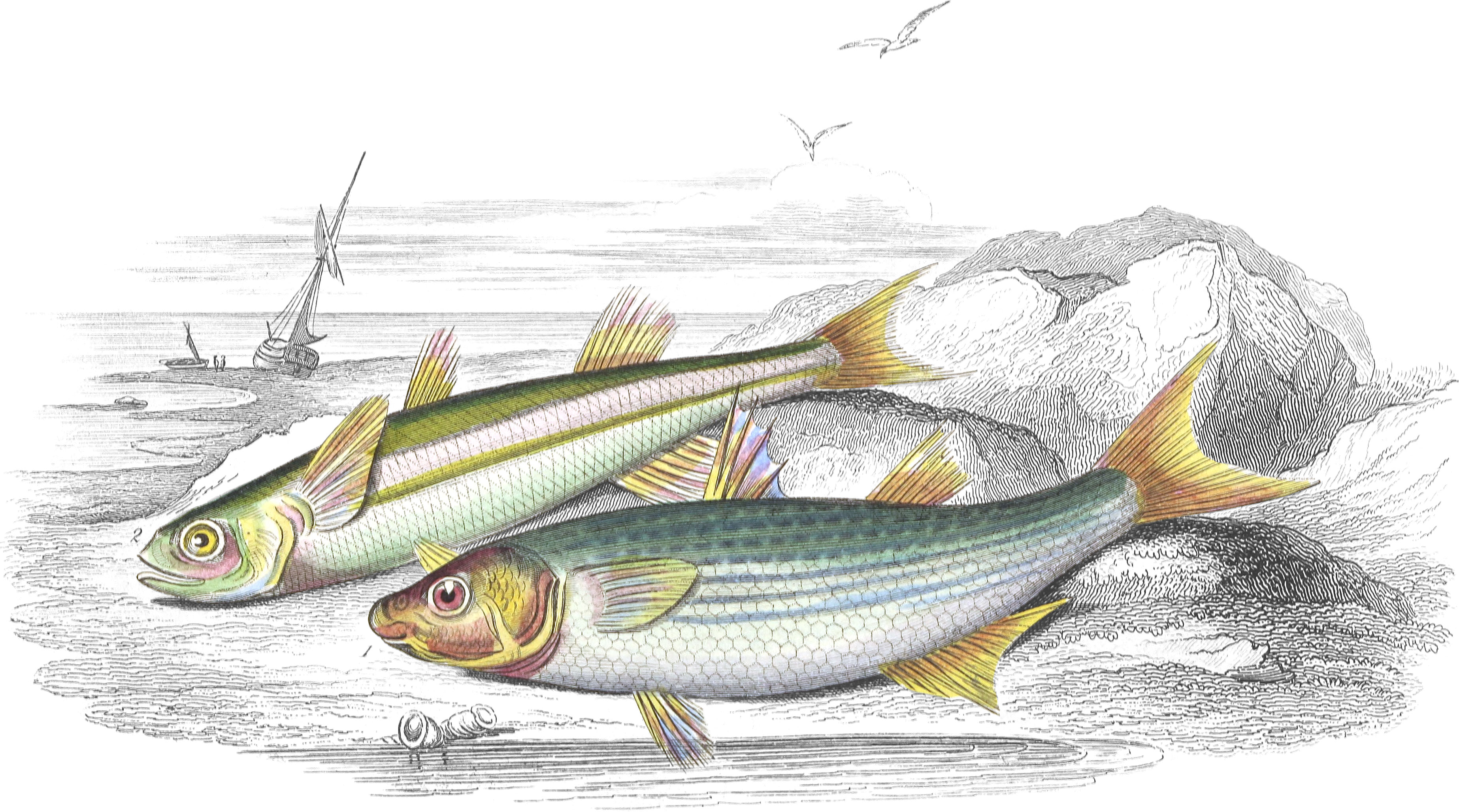
Plate XVII
Of the remaining genera of this Family, one only has any species known as British. It is
Gen. XXXVIII. Mugil
The True Mullets which must not be confounded with the Surmullets, already discussed. The members of this genus have the two dorsal fins distinct and wide apart; their scales are large; their mouth is small, cleft across at the end of the muzzle with an angular elevation in the middle of the upper lip, into which a protuberance of the lower one fits; their teeth are very small and delicate, often almost imperceptible; their gill-covers are broad and projecting, because they enclose a complicated pharyngeal apparatus which prevents any food reaching the gullet which is not liquid or very fine, the passage being very tortuous; and in their stomach there is a kind of gizzard like that of birds, and the rudiments of which, we may add, are common to nearly all animals, not excepting Man. They have thus scarcely any offensive weapons, and hence, notwithstanding their great size, they can scarcely attack any other fish, while they have many enemies themselves, of which, according to the Prince of Musignano, the Basse, Perca labrax, is the most formidable. The species are very numerous, upwards of thirty belonging to the Indian seas alone, and nearly as many having been discovered in Europe, Africa, and America: several are found in fresh water; and hence the establishment of their specific characters has not been an easy task.
These valuable fishes are not frequently captured in the deep sea, but in shallow creeks, reaches, and salt-water ponds, whither their instinct leads them in vast crowds, and where, from time immemorial, they have been secured in vast quantities. Aristotle mentioned these fishings as prevailing in his day upon the coast of Greece in the month of December, and they are now practised in the Bay of Biscay in summer, the net being employed. Nature has endowed them with a power which often aids their escape, which is thus alluded to by Oppian:—
The Mullet, when encircling seines enclose.
The fatal threads and treacherous bosom knows.
Instant he rallies all his vigorous powers,
And faithful aid of every name implores;
O’er battlement of cork up-darting flies,
And finds from air th’ escape which sea denies.
When one takes the leap, the others, like sheep, follow instantly in succession. Man, however, still circumvents them, for nets are made for the purpose, which, vertical beneath, have horizontal fringes above, which again receive the vaulters, perplex, and entrap them. Their flesh is much esteemed, being tender, rich, and of a delicate taste, whether fresh or salt; and their ova is likewise much used as food, being dried and salted and widely known under the name Botargo. Only three species are known as British.
The Grey Mullet
Fig. 1. Sp. 61. Mugil capito
The Grey Mullet of Willughby, Pennant, and Fleming, and which they considered as the M. cephalus, seems now to be ascertained to be the present species, the cephalus being distinguished by having its eye partly covered with a semi-transparent membrane, and having also a large elongated triangular scale, pointing backwards, placed just at the origin of the pectoral fin,—both of which striking characters are wanting in the capito, whose spinous scale is short and obtuse, and the others larger and broader. The usual size of the Grey Mullet is about fifteen inches, but it sometimes extends to two feet. The colour of the back is steel-grey, with bluish and partly yellowy reflexions; the abdomen is silvery white, and on the flanks there are six or eight lines of a rosy brown. There is usually a black spot at the angle of the pectoral, which inclines inwards: the iris is yellowish. It is usually stated to be the most common species of the European seas, and yet it is not a little singular that not a single specimen has fallen under the notice of that indefatigable Ichthyologist Dr. Parnell, those he has examined belonging to the next species to be reviewed. This fish is plentiful on the southern and eastern shores of England; Dr. Neill reports that it is found, but not very frequently, at the mouth of the Esk, in the Firth of Forth: it is also met with in the Baltic and west coast of Norway.
As to the habits of the Grey Mullet, Mr. Yarrell has drawn from Mr. Couch’s manuscript, and we shall venture to extract from the rich scource thus supplied.
It never goes to a great distance from land, but delights in shallow water when the weather is warm and fine; at which times it is seen prowling near the margin in search of food., and imprinting a dimple on the placid surface as it snatches any oily substance that may chance to be swimming about. It ventures to some distance up rivers, returning with, the tide. Carew, the Cornish historian, had a pond of salt-water in which these fish were kept; and he says, that having been accustomed to feed them at a certain place every evening, they became so tame, that a knocking like that of chopping would certainly cause them to assemble. Mullets frequently enter by the flood-gate into a salt-water mill-pool at Looe, which contains about twenty acres; and the large ones, having looked about for a turn or two, often return by the way they had come. When, however, the return of the tide has closed the gates, and prevented this, though the space within is sufficently large for pleasure and safety, the idea of constraint and danger sets them on effecting their deliverance. The wall is examined in every part; and when the water is near the summit, efforts are made to throw themselves over, by which they are not uncommonly left on the bank, to their own destruction.
This fish selects food that is soft and fat, or such as has begun to suffer decomposition; in search of which it is often seen thrusting its mouth into the soft mud; and for selecting it, the lips appear to be furnished with exquisite sensibility of taste. It is indeed the only fish of which I am able to express my belief that it usually selects for food nothing that has life, although it sometimes swallows the common sand-worm. Its good success in escaping the hook proceeds from its care not to swallow a particle of any large or hard substance; to avoid which, it repeatedly receives the bait into its mouth and rejects it; so that when hooked it is in the lips, from which the weight and struggles of the fish often deliver it. The females shed their spawn about midsummer; and the young, in August, then an inch long, are seen entering the fresh-water, keeping at some distance above the tide, but retiring as it recedes. The change and rechange from salt water to fresh seems necessary to their health, as I judge from having kept them in glass vessels.
The Grey Mullet is frequently an object of sport to the angler. They rise freely at the flies used for trout, and even at the larger or more gaudy flies used for salmon. They are reported to be strong in the water, and require care in the management of them, as they plunge violently. The best time for angling them is when the tide is coming in. The partiality exhibited by this fish for fresh water has led to actual experiment of the effect of confining them to it entirely. Mr. Arnould put a number of the fry into his pond at Guernsey, which is about three acres area, and has been before referred to. After a few years, Mullet of 4 lbs. weight were caught, which proved to be fatter, deeper, and heavier, for their length, than others obtained from the sea. Of all the various salt-water fishes introduced, the Grey Mullet appeared the most improved. A slight change in the external colour is said to be visible.
Plate XVII
The Thick-Lipped Grey Mullet
Sp. 62. Mugil chelo
The Thick-lipped Grey Mullet differs from the preceding in having the lips very large and fleshy, with the margins ciliated, and the teeth penetrating into their substance as so many hairs. The colour of the head and back is greenish, of the rest of the body silvery, with six or seven parallel horizontal lines along the sides, of the same colour as the back. In the preceding article we mentioned that Dr. Parnell had not met with a single instance of the Grey Mullet: of the one now under review he states,
I have observed this fish to be exceedingly common in the months of September and October on the Devonshire coast; I have found it common on the west coast of Scotland, and occasionally large shoals of them appear on the east coasts.
Scarcely a summer passes in which a few are not found at the different stations of the Firth of Forth, and occasionally of large size. A specimen was taken in the Hopetoun salmon-nets in June 1835, which measured twenty-three inches, although a foot is by much the more common size. Dr. Johnston has noticed it off Berwick; and in some seasons numbers are taken off Dunbar, and despatched to the neighbouring markets for sale. Sir William Jardine procured a specimen twenty inches long in the Solway Frith, and Mr. Thompson, Belfast, remarks, it passes in the North of Ireland as the common Grey Mullet, and is occasionally seen in the south. M. Risso mentions it reaches the weight of 8 lbs. in the Mediterranean. A difference observed by Mr. Couch, in the habits of this Grey Mullet and the capito, led him to the knowledge of the distribution of the two species; the one under review being gregarious, frequenting harbours and mouths of rivers in the winter in large numbers. He has known two tons’ weight taken at one time, and one hundred sometimes left in a pool by the receding of the tide. Like the other species, it has the happy knack of escaping from the net by leaping over the head-lines.
The Short Grey Mullet
Sp. 63. Mubil curtis
The Short Grey Mullet was discovered by Mr. Yarrell, and added to the species of British Mullets between the publication of the first and second edition of his work on Fishes. He caught one individual with the young of the common Grev Mullet and other fry, when fishing with a small but useful net, called the keerdrag, at the mouth of Poole harbour, in Dorsetshire; procuring but one specimen, and never having seen another. Its size was about two inches, and its colouring: was not unlike that of the common Grey Mullet. Its principal distinction, as a species, is the extreme shortness of the body, whence its name. M. Valenciennes has corroborated the accuracy of Mr. Yarrell’s views, by the examination of a specimen sent to the Jardin des Plants from Somme Bay, on the coast of Picardy, by M. Baillon. This eminent Ichthyologist had, like Mr. Yarrell, seen but one individual, but is quite disposed to agree with him in regarding it as distinct: he naturally considers it as very rare in this part of the world. The French example measured eight inches in length. M. Valenciennes’ engraving strikingly agrees with that of Mr. Yarrell.
IX. The Family of Gobies. Gobioidæ
Representatives in British Fauna.—Gen. 7. Sp. 16.
-
Gen. 39. Blennius.
- Sp. 64. B. Montagui. Montague’s Blenny.
- Sp. 65. B. ocellaris. The Ocellated Blenny, or Butterfly-fish.
- Sp. 66. B. gattorugine. The Gattoruginous Blenny.
- Sp. 67. B. Yarrellii. Yarrell’s Blenny.
-
Gen. 40. Pholis.
- Sp. 68. P. lævis. The Shan or Shanny.
-
Gen. 41. Gunnellus.
- Sp. 69. G. vulgaris. The Spotter Gunnel.
-
Gen. 42. Zoarcus.
- Sp. 70. Z. viviparus. The Viviparous Blenny.
-
Gen. 43. Anarrhicus.
- Sp. 71. A. lupus. The Wolf-fish.
-
Gen. 44. Gobius.
- Sp. 72. G. niger. The Black Goby.
- Sp. 73. G. Ruthensparri. The Double-spotted Goby.
- Sp. 74. G. minutus. The Speckled, or Spotted Goby.
- Sp. 75. G. gracilis. The Slender Goby.
- Sp. 76. G. unipunctatus. The One-spotted Goby.
- Sp. 77. G. albus. The White Goby.
-
Gen. 45. Callionymus.
- Sp. 78. C. lyra. The Gemmous Dragonet.
- Sp. 79. C. dracunculus. The Sordid Dragonet.
Under the family of Gobioidæ, Baron Cuvier has united those osseous fishes which possess the least claim to a place in the great series of the Acanthopterygii. Nearly the whole of them have their dorsal fins slender and flexible, and in one genus in particular (Zoarcus) they are so very soft, that many Ichthyologists question, though without sufficient ground, the propriety of their admission. The several members of the family strikingly resemble each other in their whole internal organization, and none of them hare air-bladders. They are generally inconsiderable in size; and as they frequent rocky beds, where they retire into secure retreats at low water, and are withal very active, they are of difficult capture; and hence, though their flesh is usually white and agreeable, they are not the object of the fisherman’s pursuit. But though not very interesting in an economic point of view, they present objects of curious research and reflection to the Naturalist. Many among them are viviparous, and have thus, as stated in the Introduction, excited much curiosity. They constitute a very numerous family, containing nearly 300 species; of which about one-half are inhabitants of the Indian and Polynesian seas; 60 exist in the European waters, 16, as seen above, in the British; 18 or 19 are found on the American side of the Northern Atlantic, bearing a general resemblance to the European. The only species common to both are those which frequent the Greenland seas, one of which, according to Capt. James Ross, is the most northern known fish, having been taken on the ice to the north of Spitzbergen, or within nine degrees of the Pole. The family is divided into two great Sections, the former of which has the Blennies, which have six gill-rays, and the latter, the Gobies, with only five, for their type. We take up these in order.
Blennidæ
The name Blennius occurs in Pliny, and was introduced as a generic term by Artedi. It is derived from the Greek, βλέννα, mucus, and, by extension, signifies soft and indolent; hence an abundant mucous secretion from their skin is a distinguishing characteristic; their body, moreover, is elongated, and clad with a soft skin without scales; their gill-rays amount to six, and the ventrals are attached beneath the throat and are apparently composed of two rays, the internal being often divided into two under the skin. Those which are analogous to the spines of other osseous fishes, differ but little in the consistence of the articulated rays, and the others are composed almost entirely of jointless and flexible rays. The dorsal fin is single, and extends along the whole back; the parts about the eye, and occasionally, of the nose and neck, are ornamented with tentaculous filaments of different forms; the mouth is small, opening at the extremity of the muzzle; the teeth are strong, simple, and arranged in lines, each of which is terminated by a long canine. The males are always easily recognized by tufts of papillæ which exist near the external orifice of the oviducts, and often by crests more or less elevated: the milts of all are small, and communicate externally by means of a long canal: the females are destitute of these external marks, the opening of the oviduct being behind the vent and before the opening of the bladder: there is no appearance of papillæ. M. Valenciennes says,
The ova have always appeared to me, small; and I have never discovered any thing in my own researches, nor in those of others, which led me to conclude that the Blennies are viviparous.
M. Risso particularly observes that the females of certain species have their ovaries full of more than 1,000,000 of eggs, differently coloured and spotted. Their flesh is tender, white, and agreeable. They live in small shoals on rocky coasts; are fished with different kinds of nets, and sometimes are inebriated by poisonous plants, such as the Euphorbia dendroides, a kind of spurge: their usual dimensions are from four to five inches, and they are but rarely seen to attain eight inches: they are abundant in the Mediterranean, and still more on the British coasts.
Gen. XXXIX. Blennius
No fewer than thirty species of this genus have been catalogued in systematic works on Ichthyology, of which four frequent the British seas. The appendages on the head constitute good specific characters, and we shall follow Mr. Yarrell in commencing with the species which is furnished with the greatest number: the first three have the dorsal somewhat interrupted near its middle. All these are fish of little value, and need not occupy us long.
Montague’s Blenny
Sp. 64. Blennius Montagui
Montague’s Blenny was first described, of course under a different appellation, by the excellent Naturalist whose name has been attached to it, independently, by Dr. Fleming and M. Valenciennes. The coasts of Devonshire and Cornwall, where it has been observed by Mr. Couch as well as Colonel Montague, appear to be the only habitat in which it has been detected in Britain, but it is considered identical with one of the Mediterranean species. Its chief specific characters are thus described by ontague: On the top of the head, between the eyes, is a transverse fleshy fimbriated membrane, the fimbrias of a purplish brown colour, tipped with white; the nostrils are furnished with a minute bifid appendage; behind the vent there are several minute erect filiform apendiculæ, placed horizontally: the colour above is generally olive-green, spotted with pale blue, shaded with white; the pectoral fins being shaded with orange: its size varies from one inch to two inches and a half. Colonel Montague states that not fewer than eight or ten individuals had come under his inspection; that the crest seemed incapable of erection, at least, no voluntary motion could be observed when the fish was observed alive in sea-water. It is occasionally taken among the rocks on the south coast of Devonshire and Cornwall, in pools left by the receding tide.
The Ocellated Blenny, or Butterfly-Fish
Fig. 1. Sp. 65. Blennius ocellaris
The Deflated Blenny, or Butterfly-fish, is distinguished by M. Valenciennes as the most remarkable of the Blennies, on account of. the singular appearance of its ornamented dorsal fin. It was to this fish, which attains the length of six inches, and abounds in the Mediterranean, that Belon first attached the name of Blennus. It frequents the shores, and feeds upon smaller fishes, Crustacea, and sea-weeds, and is in no esteem as food. Four specimens have been taken in the British seas, three by Colonel Montague, in 1814, who first catalogued it as British, and one by Mr. Yarrell, which was captured in the Isle of Portland. The Colonel examined one in the living state, but it did not survive the day, though the vessel in which it was lodged was frequently replenished with sea-water, so different was it from the Shanny, to which attention will speedily be directed. The head is round and blunt, the teeth in a single row: attached to the anterior edge of the orbit, are two large and fimbriated appendages, about half an inch in length: the skin about the head is loose, and studded with warty papillæ. The general colour is pale brown, with patches of reddish brown; the spot on the dorsal fin, between the sixth and eighth rays, is of a dark red-brown colour, with a slight indication of light brown around it.
The Gattoruginous Blenny
Fig. 2. Sp. 66. Blennius gattorugine
The Gattoruginous Blenny superabounds in the Mediterranean; but is also more common than the preceding in European seas, and among the rest in the British Channel, where, however, it is of smaller dimensions. Mr. Couch frequently finds it off the coast of Cornwall; Colonel Montague considered it rare on the Devonshire shore: Pennant mentions its being taken in Anglesey, and others mention its occurrence at Belfast. The forehead of this species slopes considerably, and a groove runs along the vertex; the branched fimbriated filaments, which are conspicuous and ornamental, arise at the posterior part of each eyelid; an additional small fimbriated membrane may, with a lens, be discovered above each ventral; the slender ventral fins are situate under the throat, and consist of only two rays each. The prevailing colour is dark purplish brown above, pale brown beneath, all the fins dark brown: the smaller examples are barred transversely, and the colours are fainter. As to the habits of the Blenny, r. Couch remarks, that it keeps in the neighbourhood of rocks, in water of four or five fathoms deep: it sometimes takes the hook, but is more frequently caught in crab-pots, and consequently is most frequently seen in spring and summer, when that fishing is chiefly followed. It is called Tom-pot by the Cornish boys; is large with roe at the end of May, the ova of which are some of them of a mulberry, others of a leaden colour. Numerous minute individuals are visible at the same season. Specimens occasionally measure eight or nine inches in length.

Plate XVIII
Yarrell’s Blenny
Sp. 67. Blennius Yarrellii
In the first edition of his work on British Fishes, Mr. Yarrell described the fish now under review as belonging to the species palmicornis, to which M. Valenciennes thinks it does not belong. Mr. Yarrell was not the first individual who described it; but as he has best illustrated it, the French Ichthyologist esteemed it a duty, as well as pleasure, to dedicate it to him. It differs from the two preceding in having the dorsal fin uniform, and without any thing like a break in the middle part. Mr. Pennant seems to have been the first who detected its existence on our shores, though he, too, mistook it for another species, the galerita of Rondelet, a ad described it under the name of the Crested Blenny; the figure in his third edition, by Griffiths, is very characteristic. Among other things, he reports that it is found, though not frequently, on our rocky shores, and is usually about four or five inches long. On the head there is a small crest-fin. which the animal can erect and depress at pleasure; and on the top of the head, between the eyes, a triangular lump, pointing backwards, and red about the edges. Dr. Fleming, under the same name, seems also to have described this species, from a specimen which he found in Loch Broom; and it appears to have been observed on the coast of Norway. Mr. Yarrell obtained his first specimen from Dr. Johnston of Berwick, and another from Mr. Teale, which was taken at Redcar in Yorkshire. The length of Dr. Johnstons specimen, as minutely described by Mr. Yarrell. was three inches and three-eighths; the body much compresssd: the head oval, the profile round; the lips capable of extensive motion. At the superior anterior margin of the eye there is a small fimbriated appendage, which is connected with that of the opposite side by a fold of skin; behind the two small appendages are two other tentacula, about twice the size of the anterior pair, and also fimbriated. The general colour of the body and fins is pale brown, mottled on the sides with darker brown; the head and anterior part of the body, as well as the ventral and pectoral fins, are darker than the other parts.
Gen. XL. Pholis
Dr. Fleming, many years ago, proposed the separation of this section from the Blennies, on the ground that its members have no tentacular filaments about the head, nor any of the fleshy crests which are so characteristic of the preceding genus, although they resemble it in other particulars; and when we consider the numerous species of the Blennies, this division seems all the more desirable. Baron Cuvier adopted it (Hist. Nat. des Poissons, xi. 198), and M. Valenciennes, in the great work here quoted. Perceiving no sufficient grounds for Mr. Yarrell’s abandoning this arrangement, we follow, in preference, the authorities just named. The genus has but four ascertained species, and one only belongs to the British seas.
The Shahn, or Shanny
Sp. 68. Pholis lævis
The Shan, or Shanny, is more frequently met with in the northern seas than in the Mediterranean, and it very generally abounds in the British waters. Pennant and Donovan found it in plenty on the rocky coast of Anglesey; Messrs. Jago and Couch, in Cornwall; Dr. Johnston, in Berwick Bay; and, according to Dr. Parnell, it visits nowhere more abundantly than in the Firth of Forth; Mr. Thompson also states that he has found it in the north-east, west, and south of Ireland. It is very readily known, from the characters already detailed. It rarely exceeds five inches; the dorsal fin is somewhat shortened in the middle, and the last tooth in each jaw is longer than the rest, and somewhat curved. It varies much in colour, so that scarcely two are alike. Donovan’s description, from a newly-caught specimen, was, that the upper parts and sides were green, variegated with whitish spots, and brown lines and spots; beneath it was pure white, as were the ventrals; the other fins were yellowish, with green and brown spots: some are mottled with reddish brown, others quite plain, and others are of a uniform dusky brown colour. It eagerly takes the baited hook; spawns in June, and is never used as food.
The habits of the Shanny are in many points interesting and peculiar. It abounds in great quantities in rocky ground, between tide-marks; is very active and vivacious, and by the help of its ventral fins creeps up the rocks with great facility; it bites extremely hard, and hangs on the fingers for a considerable time; it is very tenacious of life, lives for nearly a day out of the water, and feeds on small crabs and more diminutive shell-fish. On these points Dr. Parnell remarks,
Though so very common, specimens are procured with difficulty; not only on account of their activity, but also because the large stones, under which they conceal themselves, are removed with difficulty; and unless this be accomplished, it will be almost impossible to obtain one. In the month of August, I observed many of these fish in a small pool of water which had been left dry by the tide, and after dipping the place dry, to my astonishment, they had all disappeared, and taken refuge under some sea-weed a foot and a half distant from the pool. By means of their strong ventral fins, they are enabled to crawl several feet on dry land, and will remain six hours under stones or sea-weed, waiting the return of the tide. The Shanny has been known to live out of water for many days, in a damp situation; but if put into fresh-water, it soon expires.
Mr. Couch remarks, that it takes up its residence on a rock or stone, from which it rarely wanders far, and beneath which it seeks shelter from ravenous fishes and birds; for Cormorants, with their long and sharp beaks, drag multitudes of them from their retreats, and devour them. When the tide is receding, the larger ones quit the water, and, by the use of their pectoral fins, creep into convenient holes, rarely more than one in each; and there, with the head outwards, they wait for a few hours, until the return of the water restores them to liberty. If alarmed in these chambers, they retire by a backward motion to the bottom of the cavity. He adds,
I have known a Shanny to continue living, after a confinement of thirty hours in a dry box.
Gen. XLI. Gunnellus
Passing over several extensive genera which are not represented in Britain, we come to the Gunnellus, characterised by a dorsal composed wholly of spinous rays, and ventrals excessively small, frequently reduced to a single spine. Their body is prolonged and much compressed; the head oblong; the muzzle but little projecting, and the teeth very minute. The term Gunnel, corrupted from Gunwale, is said to be derived from the name which the only British species bears in the West of England. Further north, these fishes multiply; three or four species have been observed in Greenland and Iceland, and almost twice as many in the Pacific Ocean.
The Spotted Gunnel
Sp. 69. Gunnelus vulgaris
The Spotted Gunnel is called also the Butter-fish, on account of the quantity and consistence of the mucous secretion with which its sides are covered. In these countries it attains the size of six or seven inches; in more northern latitudes, of ten; although Dr. Parnell has captured one of eleven. The body is compressed, somewhat like a sword; and hence its northern names of Swordick and Svard-fisk. The colour of the body is olive, with a mixture of yellow: on each side of the dorsal fin there are from nine to thirteen large dark spots, bordered by a whitish circle, placed at equal distances from each other along the back; and the anal fin has eleven or twelve whitish spots arranged similar to those on the back. These spots appear to become fewer and less defined as the fish increases in size and age: the pectoral and caudal fins are of a deep orange-colour. This little fish is common on the British coasts, on the southern and eastern, having been first described by Willughby, from a specimen caught at St. Ives; also in Scotland, Orkney, Shetland, Norway, and Greenland: it is also common on the northern and western coasts of France, but has not been observed in the Mediterranean. Its favourite resorts and habits correspond closely with the Shanny, having a preference for those rocks upon which sea-weeds most abound; and under which it will long remain when the tide is out. When first captured, it is retained with difficulty, owing to the slimy secretion with which it is enveloped. M. Valenciennes says its flesh is not had; and in Greenland it is dried for food, along with the Arctic Salmon: it is also much used for bait for other fish.
Low, in his Fauna Orcadensis, describes a second species, the Purple, which is probably a mere variety. The colour is reddish purple, the fins lightest; it is destitute of the spots on the back, having only one placed near the commencement of the dorsal fin.
Gen. XLII. Zoarcus
This genus is particularly distinguished from the rest of the family by having no spiny rays at the anterior part of the dorsal and anal fins; but when these exist, it is towards the back part of the dorsal, in a portion lower than the rest of the fin, where the rays seem to have the appearance of having been worn down by friction, being preceded and followed by the more common ones. This is the only ground upon which these fish can he considered as possessed of an acanthopterygious character, and without it they would have made a striking exception in the Order. All their other characters present so striking a resemblance to the preceding genus, which is so markedly acanthopterygian, that it would have been impossible to have separated them without infringing upon a most natural arrangement. Their ventrals have three rays, all soft; and their dorsal and anal unite at the caudal, so surrounding the extremity of the tail. Behind the vent they have a small papilla, the prolongation of the somewhat thickened skin round the two openings of the oviduct canals. During spawning-time this papilla swells, elongates, and somewhat assumes the appearance of the male appendage of certain of the viviparous fishes already alluded to; but whether examined externally or internally, it is nothing more than the appearance without the reality. One species alone belongs to Europe, and two or three to America.
The Viviparous Blenny
Sp. 70. Zoarcus viviparus
The Viviparous Blenny derives its chief interest from its ovoviviparous character, on which we have already so largely dwelt. Its specific characters need not occupy us long. The colour of the hack and sides is yellowish brown mottled with dark olive; when young, the lateral line, and parts beneath, are spotted with white; but this is not seen in the adult. The length usually assigned to it is six or eight inches; but Dr. Neill has seen it attain fifteen inches, and Dr. Parnell tells us that specimens have been taken at the mouth of the Tweed which measured nearly two feet. Its habits are very similar to those of the other members of the family, being seen mostly near low-water mark, among rocks and weeds. Mr. Low mentions, that when he first observed that they brought forth their young alive, he put a number of the small fishes into a tumbler glass of sea-water, and kept them alive for many days, changing the water every tide: they grew a good deal bigger, and continued very lively, till on a hot day, forgetting to refresh them with clean water, they died to the last fish. Dr. Neill informs us, that in February 1807, he saw a large female in the fish-market, from which several dozens of young ones escaped alive, and although the birth was probably premature, the first that were expelled were between four and five inches long. The size of the young is, however, much regulated by that of the parent fish. Dr. Parnell, in the month of March, had a specimen sent him which measured six inches in length, from which he took fifty-six young all alive, although the parent fish had been dead nearly two days. Each was one inch and a quarter in length, and on being put into a glass of fresh water, appeared for a time remarkably lively, but in less than half an hour they all died. And, once more, in a female which Mr. Yarrell obtained, on the Kentish coast, full of young, these, when excluded, were only an inch and a half long; but such was the perfection of the internal organization of the female, that after the specimen had been kept for months in diluted spirit-of-wine, on making slight pressure on the abdomen, the young were extruded one after another, and invariably with the head first. The arrangement of the perfectly-formed young in the fœtal sac of the gravid female, was very remarkable. It is in summer they first see the light, each issuing from its own envelope. No sooner do they appear, than they swim off readily and with rapidity. The number sometimes amounts to 300, and even more.
This fish is not known further south than the British Channel, and is taken, though rarely, on both its shores. It is thus not unknown at Abbeville, and is sometimes seen on the coasts of Cornwall and Devonshire. Advancing: northwards on the east coast, it becomes more common, and is abundant on the Scottish shores, and in the Orkneys, the Baltic, and northern shores. In the Firth of Forth they exist in great plenty, and are often taken with lines in the winter months, and are brought to market, where they find a ready sale at a small price. Some consider the flesh as excellent and wholesome, whilst others pronounce it dry and disagreeable. From its shape it is called the Eelpout; also, Guffer. The back bone, says Low, after boiling, is of a most beautiful green colour; whence its Orkney name, the Greenborn.
Gen. XLIII. Anarrhicus
This genus has very striking alliances with the other members of the family, but differs in its greater size, in the total absence of ventral fins, and the extraordinary conformation of its teeth, which consist of very powerful canines and grinders. Lacépède enumerated four supposed species, which, however, seem to have been nothing more than differences arising from age. There appears to be only one acknowledged species, namely,
The Wolf-Fish
Sp. 71. Anarrhicus lupus
The Wolf-fish, Sea-cat of Scotland, and Swine-fish of Orkney. (Pl. XIX.) This great fish of the northern seas was first brought under notice in the year 1560; received its name of Wolf-fish from the inhabitants of Heligoland, and has since been regularly noticed by all northern Naturalists: its Scotch name is derived from the resemblance of its head and face to the feline race, and its Orkney appellation from a particular movement of its nostrils. Eggede mentions it in Greenland, and M. Gaimard and others in Iceland: it abounds on the shores of Norway, Sweden, Denmark, and in the Baltic. It is but rarely seen on the English coast, except towards the north; is common on the Scottish, and is occasionally seen on the Irish. Its ordinary length is three or four feet, and it ranges upwards to about twice that size. The strength of its teeth and power of jaws enables it to bite and grind with the greatest force. Hence Steller saw one break with ease the blade of a knife he put between its teeth; and it is for the devouring of its food, consisting of crabs and other shellfish, as well as common fish, that it is endowed with those strong weapons, so well represented in Mr. Yarrell’s wood-cut. The upper parts of the body, including the dorsal fin, are of a lightish grey colour, marked with six or eight broad vertical bands of bluish grey, and the lower parts are usually white: the young are of a greenish cast. This fish is not viviparous; and the female deposits her ova on marine plants, in the months of May and June, in Iceland. It usually swims rather slowly, and with an undulatory movement. The additions made by Mr. Mudie to Cuvier’s laconic remarks, in the late excellent English edition of the Règne Animal, are so much to the point, that we gladly avail ourselves of them. The body of this fish is thick and lumbering, whilst the form of the pectorals, the colours of the front, the proximate condition of the eyes, and the great teeth, give it much the appearance of a Cat, or even of one of the more formidable animals of that family. Its manners accord with its aspect; for it is remarkably strong, very active, and equally ready to defend itself and attack an enemy. It often enters the fishermen’s nets for the purpose of plundering them of the entangled fish; and when the fishermen attack it, and it cannot dart through the net, it fights like a lion. They maul it with handspikes, spars, and such heavy lumber as they may have in the boat; but even when it is landed, and apparently dead, they are not quite free from its bite. This tenacity of life is illustrated by a statement of Lacépède, who reports that one, taken at Halifax in Canada, remained for a long time upon deck, moving about with violence, and fiercely biting every thing presented to it, not excepting iron. Owing to the savage and forbidding appearance, many individuals have a decided antipathy to it, as Pennant states of the inhabitants of Scarborough as an article of food; but if properly dressed, it is considered as very superior cheer. Both Low and Donovan report its flesh is excellent, and Swainson says, the flesh is much esteemed, but as the skin is unusually tough, it is always taken off, as in Eels, before cooking. In northern countries its fishing is ardently pursued, and it is salted and preserved. Use, in these regions, is also made of its skin, in the manufacture of isinglass, leathern cords, bags, and pockets, &c., and as a kind of chagrin.

Plate XIX
Gobioidæ
We now proceed to the Second Section of this great family, the Gobioidæ (Cuv. & Val.), or Sea-Gudgeons, as numerous in species as the preceding, and arranged somewhat differently, in the work just quoted, from that which prevails in the Règne Animal. Its members are readily recognized by the union of their ventrals, which are thoracic, united either throughout their whole length, or at their bases, into a single hollow disc, more or less funnel-shaped. Their gills have five rays only. The dorsal rays are mostly flexible; and their gill-opening being small, they can, like the Blennies, live for some time out of the water. In the Règne Animal, it is affirmed that some of the species are viviparous, but more recent investigations, we believe, rather impugn than confirm this statement
Gen. XLIV. Gobius
The Gobies Proper have their ventrals united throughout the whole of their length, and have also a transverse membrane joining their bases in front, so as to form a concave disc: their body is prolonged; their head of moderate size, and roundish, and their cheeks projecting. They have two dorsal fins, the posterior of which is long. Till within these few years, two only were catalogued as British: but Mr. Jenyns’ work contains four, and Dr. Parnell has since added two more to the list. These small fish are apparently of little value further than as supplying food to other fishes.
The Black Goby
Sp. 72. Gobius niger
The Black Goby, also Rock Goby, or Rock-fish, is by much the largest of the British species, attaining the length of five or six inches. By this character it is readily distinguished from the other species, as also by having the two dorsal fins contiguous, whereas all the others have them more or less remote. With respect to the union of the ventral fins, it would seem to be, as remarked by Colonel Montague, for the purpose of forming an instrument of adhesion, although in no instance did this Naturalist ever observe that these fishes so adhered, either to rocks or to the glass vessels in which he had kept them alive for several days. The colour of the whole fish is dusky brown, darker on the back, and more or less mixed with spots and streaks. This fish is to be distinguished from the Gobius niger of Donovan and Fleming, which belongs to the next species. It appears to be chiefly an inhabitant of the rocky parts of the coast, from which circumstance two of its trivial names are derived. Hence, too, it is not frequently taken in the net. Mr. Couch has observed, that, like the Shanny, it is in the habit of carrying off its prey in its mouth to a resting-place, and there devouring it. It seems common on the shores of England, more particularly the southern, as it is on the northern shores of France, and in the Baltic, and can be traced as far north as Orkney. Dr. Parnell found it rather scarce in the Firth of Forth, having seen but three specimens taken near to Portobello.
The Double-Spotted Goby
Sp. 73. Gobius Rithensparri
The Double-spotted Goby having been first described by the Danish Naturalist Euphrasen, received from him its classical name as an expression of his gratitude to the Chevalier Ruthensparr. It is a pretty little fish, rarely exceeding two inches and a half in length. Its most marked specific character is the possession of seven rays in the first dorsal fin, whereas the others have six, with the exception of the albus, which has but five. The dorsals are not wide apart; and there is moreover one black spot behind the pectoral fin, and another at the base of the caudal fin. The colour of the upper parts of the body is dark reddish brown, crossed with dark lines running in opposite directions; the dorsal and caudal fins are barred with light reddish brown, and the ventrals and anal are white. It seems to have a wide range, and to be very common in the British seas; Mr. Donovan figured it, reporting its occurrence on the south of England and north of France; it is also common in Berwickshire, and generally on the east and west shores of Scotland; and Mr. Thompson of Belfast some time ago, satisfied himself that it was, as taken on the Irish coast, a species distinct from those usually catalogued. Like the preceding, this species frequents rocky situations where foci abound. It keeps, remarks Dr. Parnell, but a short distance under the surface of the water, apparently in a motionless position, assuming in this respect, much the habits of the Stickleback; when approached, it gradually sinks in the deep, and soon disappears, by making short though rapid darts, among the weeds it delights to frequent.
The Speckled, or Spotted Goby
Sp. 74. Gobius minutus
The Speckled or Spotted Goby has the dorsal fins remote; the anterior rays of the second dorsal are longer than the succeeding ones, and the caudal fin is rounded. It rarely exceeds two inches and a half in length. The colour of the upper parts is reddish brown, freckled and streaked with dark brown, the throat and belly white; the dorsal and caudal fins are mottled with brown. This species is an inhabitant, not of rocky coasts, but of sandy bays, and is common throughout the British shores, having been observed on the southern and eastern coasts, and in Wales; in the Forth, and west of Scotland. Mr. Yarrell states that it is constantly to be obtained of the shrimpers, in whose nets it is taken: that it is plentiful in the Thames, where it is known by the name of Polewig, or Polly-bait. When young, they delight to bask in the rays of the sun, in small shallow pools, where they fall a prey to aquatic birds; although, in consequence of their backs being of precisely the same colour with the sand on which they repose, they will, when stationary, evade the eve of the most patient observer. They also abound on the northern and western shores of France, and M. d’Orbigny has often seen them in sea-pools in the neighbourhood of Rochelle, where he has observed one establish itself under a shell, round which it will trace, in the soft mud, a number of deep ruts, in the form of diverging rays, and where it will keep watch like a sentinel, waiting the minute animals which sink into these gutters, and thus become its prey.
The Slender Goby
Sp. 75. Gobius gracilis
The Slender Goby, which has a strong general resemblance to the preceding, was first described by that excellent and indefatigable Naturalist, Mr. Jenyns, upon the examination of specimens brought from Colchester, and supposed to have been captured on the Essex coast. It is probably as abundant a species as the Freckled Goby, and has generally been mistaken for it. Dr. Parnell states that the two are frequently captured together. This last gentleman informs us that he has taken it in numbers in the south of England, also in the Solway Firth, and in the Forth; and Mr. Thompson has procured examples from the coasts of Down and from Lowth. Its length is about three inches. It differs from the Freckled Goby in being more elongated and slender throughout, and in the snout being longer: the two dorsals are further asunder; the rays of the posterior are larger, and gradually increase in length as they approach the tail, whereas in the other species they decrease. In other respects they are similar, even as to colours, with the exception of the anal and ventral fins, winch are dusky, approaching to black in some places, instead of being plain white.
The One-Spotted Goby
Sp. 76. Gobius unipunctatus
The One-spotted Goby was first detected and described by Dr. Parnell. He found it in most of the sandy bays of the Firth of Forth, but in greater number and larger size near the salmon-nets above Queensferry, where it may be found throughout the summer months in water from two to three feet deep: he has also taken it on the south coasts of England; and Mr. James Wilson obtained a fine specimen, three inches and a half in length, in the Moray Firth. The dorsals are remote, the anterior rays of the posterior being longer than the succeeding ones; the caudal is even, and there is a large dark spot on the summit of the membrane, between the last two rays of the anterior dorsal. Dr. Parnell found the One-spotted Goby on the coast of England, sometimes equally common, and mingled with the minutus, whilst in other localities there was exclusively the one or other only. It keeps more in deep water than the minutus.
The White Goby
Sp. 77. Gobius albus
For our knowledge of the sixth and last, catalogued as British,—The White Goby,—we are also indebted to Dr. Parnell, who remarks (Trans. Royal Society of Edinburgh, xiv. 139) that this species cannot well be mistaken for any other. He first noticed it in the Solway Firth in June 1836, where he obtained in one day, after the recess of the tide, fifty specimens. He considers them as the fry of a larger species, which is different from all the preceding. When first taken from the water, they were soft and transparent, with large prominent eyes, and large deciduous scales; the length was about two inches; the head large; the teeth longer and sharper than the other British species, and placed in one row in each jaw; the tail was rounded at the end. The first dorsal, possessing but five rays, is sufficient to distinguish this fish from the other British species. In the month of July, when Dr. Parnell had occasion to revisit the Solway, he endeavoured to obtain additional specimens, presuming that by this time they would have somewhat increased in size; but not a single individual could be found; nor has the parent fish ever come within the observation of the fishermen.
Gen. XLV. Callionymus
This genus belongs to a small group, which, according to M. Valenciennes, might properly form the type of a natural family with others nearly allied to it. As, however, the number of ascertained species is not large, lie, in the mean time, prefers making it a kind of appendage to the Gobioides, to which it is decidedly related. It is characterized by the gill-opening being nothing more than a small aperture on each side of the neck, and, by the ventrals, which are situate under the throat, being separated from each other, and broader than the pectorals. The head is oblong and depressed; the mouth very protractile; the teeth are like velvet nap on the jaws, but not on the palatines; the skin is generally smooth, and adorned with rich and varied colours. Their flesh is white and light, but without much taste. Only two species are known in the British seas: which by some are considered nothing more than the different sexes of the same species.
The Gemmous Dragonet
Sp. 78. Callionymus lyra
The Gemmous Dragonet is one of the most beautiful of the species, being characterized by having the first ray of the first dorsal very much elongated; sometimes, it is stated, in the shape of a lyre, and hence its classical name. As the fish becomes older, the ray is usually much worn away. The name Gemmous is derived from the brilliancy of its colouring when first taken out of the water, which of course can never be adequately expressed by any verbal description. The ground-work is a beautiful orange, with white on the under part of the body: the back and cheeks are adorned with irregular and sometimes confluent spots of a bright lilac, bordered with violet; a continuous longitudinal band separates the orange of the upper parts from the white of the abdomen. The dorsal fins are orange, beautifully striped, and spotted with lilac, violet, and black. Its Scottish name, Gowdie, it derives from the prevalence of this yellow or golden hue, as also its Cornwall name, Yellow Skulpin. This fish, to adopt Dr. Flemings expression, seems not uncommon on our shores. Dr. Neill reported it as common in the Firth of Forth, where it attains to the length of a foot; and is often found on the haddock-lines: though not being esteemed by the fishermen, nor caught in quantities, it is not much brought to market. Mr. Pennant states it is not unfrequent on the Scarborough coast, where it is taken by the hook in thirty or forty fathom water. Dr. Parnell mentions that he procured five specimens at one haul of the sean-net, near Exeter; and had often seen them taken in the shrimping-nets, though of a small size. It has also been discovered, though rarely, near Belfast, and off the coasts of Cumberland and Cornwall; also at Weymouth, Blastings, Harwich, Yarmouth, and Berwickshire. Mr. Low mentions having seen one specimen in Orkney; Nilsson includes it among the Norwegian fishes; and it is noticed by most northern Ichthyologists. It is also generally stated to be an inhabitant of the Mediterranean; but to this statement M. Valenciennes does not subscribe, having never received a single example from these waters, and other fishes have been mistaken for it. This fish occasionally takes the bait, but is more frequently caught in the net. Its food is testaceous and molluscous animals and worms. Its flesh is said, according to Mr. Yarrell, to be white, firm, and of good flavour. It is very frequently the prey of other fishes.
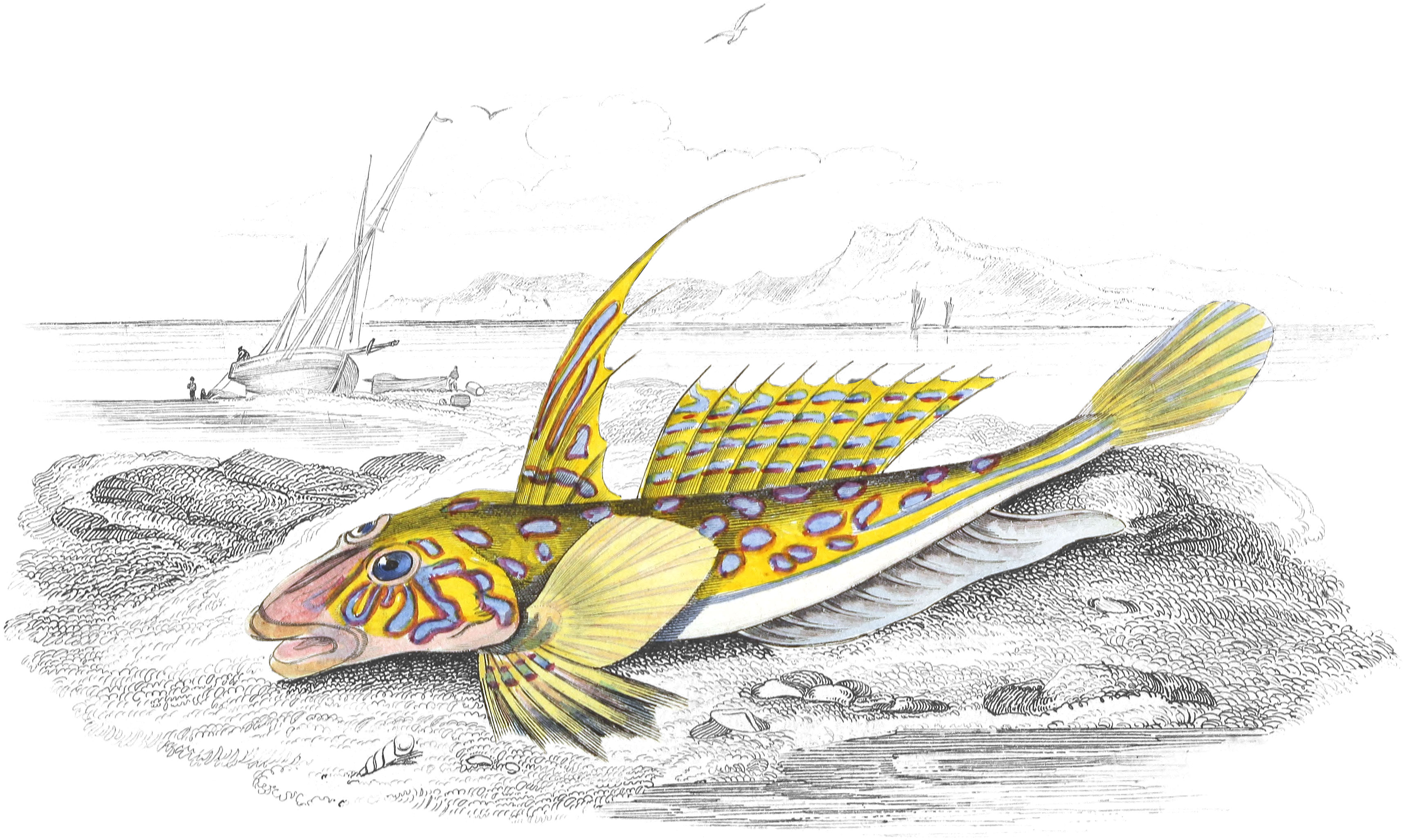
Plate XX
The Sordid Dragonet
Sp. 79. Callionymus dracunculus
The Sordid Dragonet, probably so called, says Mr. Yarrell, from the dingy hue of its colours, as compared with those of its generic companion, is the more common in various parts of the coast. It is frequently taken at the mouth of the Thames, where, on account of its red appearance, it is called the Fox: in Cornwall it is the Skulpin. Besides its less brilliant colouring, it is the smaller fish, rarely exceeding six or eight inches in length, and it is shorn of its lyre-like filament, the first ray of the anterior dorsal scarcely surpassing the middle of the second: its head is to the whole length of its body only as one to five, whereas in the Lyra it is as much as one to four. Notwithstanding these marked differences, many Naturalists believe that these two fishes are the male and female of one species. Gmelin, we believe, was the first to throw out this idea; and Dr. Neill supposed that he had established it from the circumstance, that having examined several dozens of these Gowdies with this point expressly in view, he found that the Gemmous Dragonets were uniformly milters, and the Sordid invariably spawners. Had subsequent observation been equally unequivocal, the Doctor’s inference would have been incontrovertible; but Dr. Johnston’s examination has overturned it, he having ascertained that some individuals of the Sordid Dragonet were furnished with milt, or soft roe. In habit, as well as in structure, there are various points of diversity. Thus Mr. Couch reports, as do other observers, that the Gemmous species prefer deep water; whereas the other often approach the margin of the tide, where he has watched their motions with great interest.
They keep at the bottom among sand or stones, and never rise but to move from one station to another, which is done with great suddenness and rapidity. They possess great quickness of sight, and dart with swiftness when alarmed, though not to a great distance; and I have seen this Sordid Skulpin repeatedly mount after prey, and invariably-return to the same spot again. This motion is chiefly performed by the ventral fins; and the eye is well adapted to the habit, the muscles of the organ being fitted to direct the sight upwards and not downwards. They sometimes take the hook, though rarely; and they are very much preyed upon by the larger fish, in the stomachs of which they are often found. They feed on shell-fish, worms, and molluscous animals.
X. The Wristed Family. Pectorales Pedunculati
Representative in British Fauna
-
Gen. 45. Lophius.
- Sp. 80. L. piscatorius. The Fishing-frog.
That this Family is somewhat peculiar in its character, will appear evident, when we state that many of its members have not always been arranged in the first great Series which now occupies our attention, and in which it was placed by Baron Cuvier. Their entire organization, however, upon which we must not particularly dwell, requires that it should be so placed. The skeleton, though soft, is fibrous; the bones and ossicula of the cranium, without exception, as well as those of the jaws, gills, shoulder, spine, and fins, all partaking of an osseous structure.
The distinctive characters of the Fish of this Family consist,—
- in the almost complete absence of scales, replaced in one genus by bony tubercles, and in others by minute projections armed with spines;
- in the prolongation of two of the wrist-bones, so forming a kind of arm supporting the pectoral fin, on a kind of hand;
- in the branchial opening, which is either a round aperture or vertical cleft in the skin, behind the insertion of the pectoral fin, there being no free opening behind the gills; and,
- as pointed out by M. Valenciennes, the absence of the sub-orbital bone.
It has very generally been asserted that these fishes, owing to the smallness of the gill-opening, can live long out of the water. This statement has been far too generally made, and hence M. Valenciennes has thought fit to meet it with the declaration that he has seen no proof that any of the genus Lophius, to which the famous Fishing-frog belongs, are tenacious of life; on the contrary, he has seen many expire, on being captured, more rapidly than the Breams, Gurnards, and other fishes which were taken along with them. That a statement of this sort should have received somewhat too wide an application, was almost to be expected by those who know how little discrimination is wont to be used in distinguishing the different genera of a family. What, then, is not true of one genus, may still be quite correct respecting another. Of the Chironectes, the fact remains uncontradicted; and under such peculiar circumstances, as to call for remark. The respective position of their ventrals as before, and their pectorals as behind, and the foot-stalks upon which these latter are supported, give them very much the appearance of having four feet; and it being the ventrals which represent the fore feet or arms, the employment of the four extremities is altogether inverted. These limbs, along with the small gill-opening, allow these fish to remain a long while in the free air; and they avail themselves of this power to crawl upon the sea-weed and mud, and so, according to various authorities, to pursue their prey. In some of the muddy estuaries on the north coast of Australia, from which the tide ebbs to a great distance, these fishes are so abundant, and so capable of taking vigorous leaps, that those who have visited the districts, have, at first sight, taken them for birds. It is of an animal of this family that Rondelet reports that he had witnessed an individual subsist for two entire days among the weeds on the shore; and that this Angler seized by the feet a young fox, which was feeding near it during the night, and retained it in its clenched teeth till morning. The family is subdivided into four smaller sections, and comprehends about fifty species, most of which belong to the Caribbean and Indian seas: there are not many in the Atlantic; and only one fully ascertained as appertaining to the British waters; this belongs to the
Gen. XLV. Lophius
Lophius, which comprehends those fishes whose heads are especially large in proportion to the rest of their body, also broad, depressed, and armed with spines; the mouth is exceedingly cleft, and armed with long conical teeth, situate upon the jaws, palatines, vomer, and pharyngeals, but not on the tongue: they have a large branchiostegous membrane, supported by six rays, and covering three branchial arches only. All the gill-covers, except the preopercle, are hid among the muscles: they have two dorsal fins, the first three rays of the anterior apparently being carried forward in the form of long filaments, some of which are terminated by fleshy appendages. These filaments are articulated by means of a bony ring upon a circle corresponding to a long and curved bone upon the cranium. These fish swim with difficulty; and so are usually found upon the sand, or hid beneath the mud, allowing these their streamers to float freely above them, thereby attracting the fish, upon which they dart, when thus enticed within their reach. In this humble art consists all the vaunted skill of these Anglers of the fishy race.
The Fishing-Frog
Sp. 80. Lophius piscatorius
The Fishing-frog, or Angler, is perhaps more celebrated than any other fish; and were we to believe certain Naturalists, its instincts and formation alike combine to render it a creature equally anomalous and astonishing. According to them, its cunning is singular and diversified, fishing both with the line and the net, capturing its prey in great sacs connected with its gills, as well as with its filamentous streamers or tentacula. It is the enormously disproportioned size of the head, and its extraordinary shape, thence resulting, which has made the Angler the subject of so many strange stories. The head is flat and of prodigious breadth, so that its surface exceeds that of all the rest of the body. Its enormous mouth opens at the anterior part; and its gills, instead of sloping away, and attaching themselves under the throat, are prolonged behind the pectoral fins, and open in a kind of arm-pit, by a narrow orifice; so that these fins, which are moreover placed on a kind of prolonged arm, appear almost to issue from the gill-sacs. When to this we add the numerous filaments or tentacula which surround this huge head, and the detached streamers which surmount it, along with the position of the eye in the centre of the horizontal face, it will readily be understood how terror and disgust should have given wings to many wild imaginations. The magnitude of this strange looking fish still more increases this disposition; specimens of three and four feet are not rare, Cuvier saw one at Caen, in 1789, which was six feet long; Pontoppidon possessed one, which, though dry, measured seven feet; and Duhamel asserts that some reach to the length of ten feet.
In a state of repose, and when the fish does not inflate its throat or gill-sacs, the head is two-fifths the length of the body, and is somewhat broader, and is withal very flat: behind the pectorals, the size or width of the body is about one-fourth of the length. The contour of the head is nearly circular; the lower jaw greatly extends beyond the upper, and both have a range of teeth which are conical, straight, long, pointed, and unequal; the intermaxillaries, vomer, and pharyngeals, being also armed with teeth. The three tentacula on the head are regarded as the three first spines of the anterior dorsal fin, and the bony bases from which they rise, as detached interspinous processes. The anterior two are attached to a single piece of bone; the first, between the nostrils, is slender and nearly half the length of the body, terminated by a little membrane; the second is neither so thick nor so long, and the third rises from nearly the back of the cranium. The motion of these detached rays is very peculiar: the anterior is articulated, by a ring at its base, into a solid staple of bone, thus admitting of free motion in every direction; the other two are articulated by a stirrup, into a ridge of the base; both of which ingenious contrivances are well represented in Mr. Yarrell’s vignette. (Vol. i. p. 307 274.) The first of these filaments shooting up close to the upper lip, carries upon its extremity a little membrane or flag, of brilliant metalic lustre, which it is understood the fish uses as a means of alluring its prey; and the relative positions of the flag, the eye, and the mouth, certainly suit admirably for such a purpose. While couching, says Mr. Yarrell, close to the ground, the fish by means of its ventral and pectoral fins stirs up the sand or mud: hidden by the obscurity thus produced, it elevates its appendages, moves them in various directions, by way of attracting as a bait, and the small fishes approaching either to examine or seize them, immediatley become the prey of the Angler. The organ of smelling also, as pointed out by Scarpa, is peculiarly situated on a kind of foot-stalk, so that the fish can direct it almost to any point, as a snail directs its horns. The colour of the upper parts of the body is brown, inclining to dusky; of the lower parts, white.
Mr. Pennant states that this fish is common in the Northern Ocean, inhabiting the deepest waters: it is frequent off the coast of Norway, in the Mediterranean, and in most European seas. Low states if is occasionally noticed in Orkney, and captured in Shetland; in England it has been taken on the coasts of Cornwall, Devonshire, Norfolk, and Yorkshire; in Ireland, on those of Londonderry, Antrim, Dublin, Waterford, and Cork; and in Scotland it is by no means rare, being called Mulrein and Merlin in Edinburgh, and Wide-gape, a very characteristic name, in the Northern Isles. In the Forth it is usually said to be common; an assertion we venture to dispute, as referring, at all events, to late years.
The boldness, voracity, and other habits of the Angler, are well illustrated by such anecdotes as the following: A fisherman had hooked a Cod-fish, and whilst drawing it up, he felt a heavier weight attach itself to his line. This proved to be an Angler of a large size, which he compelled to quit its hold by a heavy blow on the head, leaving its prey still attached to the hook. In another instance, an Angler seized a Conger Eel which had taken the hook; but after the latter had been engulphed in the enormous jaws, and perhaps in the stomach, it struggled through the gill-aperture of the Angler; and in that situation both were drawn up together. Mr. Couch says,
I have been told of its swallowing a large ball of cork, employed as a buoy to a bulter or deep-sea line; and the fact this implies of its mounting to the surface is further confirmed by the evidence of sailors and fishermen who have seen it floating, and taken it with lines at mid-water. These fishes sometimes abound; and a fisherman who informed me of the circumstance, noticed seven of them at one time on the deck of a trawl-boat; on expressing his surprise at the number, he was told it was not uncommon to take a dozen at once.
Dr. Parnell informs us that a short time since, some fishermen at Queensferry observing the water much discoloured at a particular spot near the shore, proceeded to discover the cause, and upon poking the bottom a few minutes with a long handled mop, found that a Wide-gape had taken hold of it with intent to take a morsel of it, and the fish not being able to extricate its teeth in sufficient time from the wooly substance of the mop, it was hauled into the boat, and found to measure four feet nine inches. And Colonel Montague remarks,
that when this fish is captured in a net, its captivity does not destroy its rapacious appetite, but it generally devours some of its fellow prisoners; which are sometimes taken from its stomach alive, especially flounders. Hence it is not so much sought for its own flesh, as for the fish generally to be found in its stomach. (Apud Yarrell.)
Though thus rejected as an article of food in Devonshire, yet concerning this fish, as of many others, there appears to be a diversity of taste; and elsewhere very different opinions are entertained. M. Valenciennes informs us that the flesh of the Angler, Baudroie, although not quite first-rate, is not to be despised as food; Dr. Parnell says the flesh is considered good, particularly that near the tail; and M. Pisso asserts of the Mediterranean fishes, Gannelli, that they are of exquisite flavour,—d’un goût exquis.
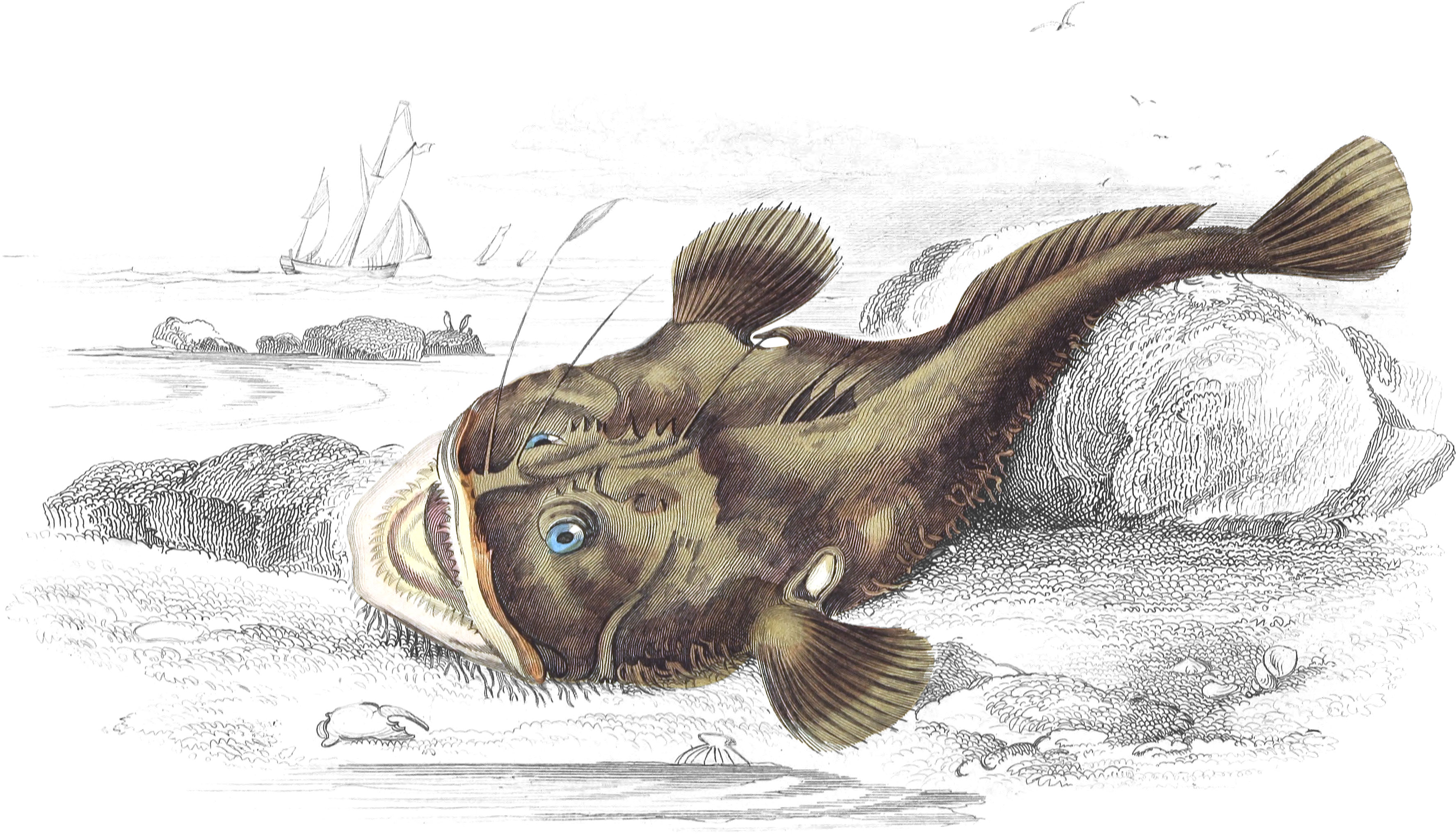
Plate XXI
XI. The Family of Wrasses. Labridæ
Representatives in British Fauna.—Gen. 4. sp. 13.
-
Gen. 46. Labrus. Old Wives of the Sea.
- Sp. 81. L. bergylta. Ballan Wrasse.
- Sp. 82. L. Donovani. Donovan’s Labrus.
- Sp. 83. L. mixtus. The Blue-striped Wrasse.
- Sp. 84. L. trimaculatus. Three-spotted, or Red Wrasse.
- Sp. 85. L. comber. The Comber Wrasse.
-
Gen. 47. Crenilabrus.
- Sp. 86. C. melops. The Gilt-head.
- Sp. 87. C. Norvegicus. The Corkwing.
- Sp. 88. C. multidentatus. The Corkling.
- Sp. 89. C. rupestris. Jago’s Goldsinny.
-
Gen. 48. Acantholabrus.
- Sp. 90. A. Couchii. Couch’s Wrasse.
- Sp. 91. A. Yarrellii. Yarrell’s Wrasse.
- Sp. 92. A. exoletus. The Small-Mouthed Wrasse, or Rock-Cock.
-
Gen. 49. Julis.
- Sp. 93. J. vulgaris. The Rainbow Wrasse.
This very numerous family has, up to a recent period, been involved in the utmost confusion and obscurity; and M. Valenciennes informs us that he has found its arrangement more troublesome than that of any of the others, and even now, he is not altogether satisfied. It is characterized by a body oblong in shape, and covered with scales; a first dorsal fin, sustained in front by spinous rays, generally furnished with membranes; the jaws are covered with fleshy lips; the palate is smooth and without teeth; there are three pharyngeals, two superior and one inferior, all armed with teeth; an air-bladder is found, but no casca. It contains not fewer than 22 genera and sub-genera, and 365 ascertained species; of which number, as stated above, Britain has only four genera and thirteen species.
Gen. XLVI. Labrus
This genus (Old Wives of the Sea, as they are generally called), as implied by its name, has thick lips, which are fleshy, and apparently double; the branchiostegous membrane has only five rays; the maxillary teeth are simple and conical, arranged in several rows, the pharyngeal ones cylindrical and softish; the gills are without spines, the cheeks and gill-covers furnished with scales, and the lateral line almost straight. They are distinguished by their elegant, regular, and oval form. The statement that the gill-covers are furnished with scales, is to be understood of the opercle, pre- and sub-opercle, in these temperate regions; the teeth are strong, conical, and longest near the symphasis; the spinous rays of the dorsal fin are usually more numerous than the soft, and behind the point of each spinous ray there is usually a short membranous filament; the anal spines are stout and short These fish feed chiefly upon Crustacea and testacea, which their strong teeth enable them to break and crush. They group together, without forming very numerous shoals, upon rocky coasts, sheltered from the violent action of the waves: hence their names of Wrasse, or Rock-fish. They spawn in spring, among the marine plants, where the young find a safe retreat. They do not attain a large size; but their flesh is white and firm, and according to M. Valenciennes, is universally esteemed as wholesome and agreeable food. They abound more in the Mediterranean, and in temperate seas, than between the tropics. They are all remarkable for their lively colours, and have hence been called Parroquets of the Sea.
Ballan Wrasse
Sp. 81. Labrus bergylta.
The striking variations of dress to which this species of Old-wife is subjected, as well as some other of her characters, should clearly be understood by the student. On the northern coast of France the fish is called Red Old-wife, when, upon the prevailing green colour, a red tint predominates; it is called the Green Old-wife when the common green hue prevails, and the Yellow Old-woman when yellow predominates over the green: sometimes it appears of a sombre olive-green colour, when the simple appellation of Old-wife is used; and the name of Sea Parroquet is given to that variety in which over the green ground there is a net-work of a reddish hue pervading the body. Besides these, one of the most common varieties is that in which there is a marked infusion of blue in the tinting:. There is considerable variety also as to the number of the dorsal and anal rays; the former exhibiting the following numbers, 20 spinous and 11 soft,—say 20/11, also 20/10, 21/10, and 21/11, and the latter this formula,—3/9 and 3/8. M. Valenciennes remarks, that having examined a great number of these varieties, he finds it would be inadmissible to regard them as distinct species, seeing that all their essential characters are similar and constant. The specific characters usually assigned to this Proteus-looking fish are, that the ascending margin of the pre-opercle is oblique, the soft part of the dorsal fin more than twice the length of the spinous, and that the dorsal and anal fins terminate nearly in the same line.
The Ballan Wrasse is numerous in the seas of these temperate regions, and extends far to the north. It is common on the more rocky coasts of England; more rare in Scotland, and is also known on the Irish coast. Mr. Pennant states that they appear during summer in great shoals off Filey Bridge, on the Yorkshire coast, and, that it occasionally weighs as much as 5 lbs.: its common length is from twelve to eighteen inches. Of its habits Mr. Couch reports, that it frequents deep gullies among rocks, where it shelters itself among the larger kind of seaweeds, and feeds upon crabs and other crustaceous animals. It takes a bait freely, and fishermen remark, that when they first fish in a place, they take but few, and these of large size: but on trying the spot a few days after, they catch a great number, and then smaller; whence they conclude that the large fish assume the dominion of a district, and keep the younger at-a distance. The spawn is said to be shed in the month of April; and the young, scarcely more than an inch in length, are seen about the margin of the rocks, in shallow water, throughout the summer. Dr. Parnell suggests that it may be later in spring further north, as he obtained a fine specimen taken in a salmon-net in the Forth in August, which was full of roe nearly ripe. As an article of food, the estimate in which this fish is held seems to be various as its colours. We have already quoted from high authority that the flesh is white, firm, and universally esteemed as agreeable food; but Dr. Parnell states, that though occasionally brought to the Edinburgh market, it is little sought after, the flesh being white, soft, and very insipid: other accounts lie between these two; and much is probably owing to the differences of season, and possibly of locality.
Donovan’s Labrus
Sp. 82. Labrus Donovani.
The Green-streaked Wrasse. Great doubt seems to exist as to the propriety of this being catalogued as a species distinct from the preceding, M. Valenciennes apparently being more than doubtful regarding it. It rests upon the authority of the Naturalist whose name it bears: and solely on the colouring, the other external markings being precisely the same. Mr. Donovan states that it is an occasional visitor on the coast of Cornwall, where it is known by the name of the Green-fish: it usually appears in summer, and is regarded by the fishermen in those parts as the rarest species of its kind. The specimen from which the description was taken was seven inches long, of a fine meadow-green colour, darker on the back, lighter on the sides, and yellowish green under the throat and belly: the muzzle is rather long, the nape slightly depressed, the upper jaw longer than the lower, and the lateral line curved on its approach to the tail. Colonel Montague captured a fish every way corresponding to this description on the Devonshire coast, and M. Valenciennes procured one from the coast of Brittany. Mr. Thompson, from observations made on specimens of this fish procured on the coast of Ireland, is inclined to consider it as the young of the Ballan Wrasse.
The Blue-Striped Wrasse
Sp. 83. Labrus mixtus
This species is well known in the Mediterranean, and on the western and northern coasts of France; also on the shores of England and Ireland. Mr. Yarrell states that it is liable to some variation as to its colours and markings (i. 317); whilst M. Valenciennes says,
la distribution des ses coleurs ne change point, (xiii. 54):
Mr. Yarrell remarks that the general form of the body and fins is permanent, (ib.); M. Valenciennes writes,
nous trouvons des variétés de plus sensibles en comptant le nombres sur différent individus,
the dorsal rays being, in different specimens, 18/12, 18/11, 17/12, 16/12, and 16/14. The Parisian Ichthyologist has carefully examined about twenty individuals, and any variety of colouring he finds limited merely to the tints being more or less extended. The body and head of the Cook Wrasse are larger than those of the Ballan, and the tail is not compressed; the muzzle is more acute, and the eye somewhat larger. The colours are very lively and brilliant: the head and anterior half of the back are greenish, verging to brown, which tint is extended along the middle of the flanks to the tail, in form of a thin narrow band, so that the posterior part of the back is often of an orange or lilac-yellow: five longitudinal streaks, more or less broad, blue, and sometimes more or less violet, traverse that part of the body which has a greenish colour; the three superior streaks do not advance upon the orange of the back, the lower proceed to the tail. These blue streaks advance to the head, irregularly anastomose, and form a striking net-work on the cheeks. The dorsal fin is orange, with a blue fringe: on its anterior part there is a large blue marking, which extends sometimes only to the eighth ray, and at other times to the thirteenth. The anal fin is of an orange colour, with a blue border; the caudal entirely blue; the pectorals are orange, and the ventrals have a blue marking upon their inner edge. In length, the fish sometimes extends to thirteen inches. The habits and food of this species resemble those of other members of the genus. Mr. Couch observes, that all the Wrasses which have an elongated form differ from those with deeper and more solid bodies, in changing their quarters according to the season, and that without any reference to cold or warmth. They enter harbours, and frequent the shallower rocks close to land, during the summer; but in autumn and winter pass into deeper, but not very deep water. They are but little esteemed in Cornwall as food, and are chiefly sought after as bait for other fish. (Apud Yarrell).

Plate XXII
Three-Spotted, or Red Wrasse
Sp. 84. Labrus trimaculatus.
The Three-spotted Wrasse is equally common with the preceding in the Mediterranean, and in the temperate seas of Europe, extending far north; nor is it uncommon on the British coasts. Mr. Pennant, who conferred upon the species the specific name it still retains, procured a specimen from Anglesey; it has been found frequently on the coasts of Devonshire and Cornwall, and Mr. Yarrell obtained one in the London market. Dr. Neill says that several are taken every summer in the Forth, but Dr. Parnell failed in his endeavours to procure it. In its external characters it differs but little from the Cook Wrasse, except in the colours, which are very uniform in this fish, as in the preceding. The formulary for the rays, which is also very constant, is D. 17/13, A. 3/11. The length of the fish is almost eight inches, very rarely, if ever, exceeding twelve. The colour is a beautiful red, fading on the sides, and becoming rose-coloured on the flanks. On the posterior part of the back there are three black spots, the two anterior of which occupy the base of the dorsal fin, the former placed upon the five anterior soft rays, the latter upon the six posterior ones, two rays remaining free between: the third is placed on the croup of the tail. Some individuals have a fourth spot, of small size, on the last spinous rays of the dorsal; and, more frequently, there is a black spot at the commencement of this fin, between the first and third spinous ray. The vertical fins have a beautiful fringe of blue and lilac. The ins is red, surrounded with a circle of blue. Both Muller and Parnell testify that it is esteemed as food.
The Comber Wrasse
Sp. 85. Labrus comber.
The Comber Wrasse, the last of this genus we have to name, is introduced only provisionally. M. Valenciennes refuses it admission; Mr. Jenyns puts it in the list of his doubtful species; and Mr. Yarrell, whose example we follow, gives it a place, to provoke the farther investigation of Ichthyologists on the subject. The fish has been seen by Mesers. Jago, Pennant, and Couch. The form is slender; the colour of the back, fins, and tail, red; the abdomen yellow; below, and parallel to the lateral line, is a smooth even stripe from gill to tail, of a silvery colour. The number of the fin-rays is stated to be
D. 20/11—P. 14—y. 5—A. 3/7—C. not given.
Mr. Couch’s manuscript runs thus,
Compared with the Common Wrasse, the Comber is smaller, more slender, and has its jaws more elongated. The two upper front teeth are very long: a white line passes along the side from head to tail, unconnected with the lateral line. It has distinct blunt teeth in the jaws and palate: the ventral fins are somewhat shorter than in the others of the genus.
Mr. Couch thought it scarce.
Gen. XLVIII. Crenilabrus
This genus is distinguished by its toothed pre-opercle, its lips thick and fleshy, conical teeth, in a single row, in each jaw; the spinous dorsal rays being free and without scales, and the lateral line being uninterrupted. Its numbers are very numerous in the Mediterranean, and scarcer further north. The present amount of species is about thirty; and four are known as British.
The Gilt-Head
Sp. 86. Crenilabrus melops.
Connor. Golden Maid.—This fish is very abundant in the Mediterranean, and extends northwards as far as the coast of Norway: it is by no means scarce in the British and Irish seas, and is common in the Firth of Forth. It is readily known by having invariably sixteen spinous rays in the dorsal fin, and a black spot behind the eye: its size ranges from four to eight inches. The colour of the head is blue, spotted on the cheeks and gill-covers with reddish orange; of the body, red, varied with green; all the fins are greenish blue, and the membranes of the dorsal and anal fins have one or two longitudinal stripes of darker blue. The Gilt-head spawns in April. It is usually captured on the rocky parts of our coasts, in crab and lobster-pots, into which it is attracted by the baits for the Crustacea, and for which it is usually in turn very generally cut up into bait.
The Corkwing
Sp. 87. Crenilabrus Norvegicus.
The classical name of this species, assumed by Cuvier and Valenciennes from Bloch, will now be generally adopted, and supersede the appellation of Cornubicus and Goldsinny, employed by older authors. This fish is common in the Northern Ocean, where Nilsson has seen it attain the length of ten inches; also in the Baltic, and on the British shores, where it is usually shorter: Mr. Thompson has detected it on the coast of Ireland.—The mouth of the Corkwing is small; the teeth are regular; the denticulations of the pre-opercle very strongly marked; the lateral line is straight till it reaches the posterior part of the dorsal, where it deflects almost at right angles, and again turns at a similar angle to go to the tail, dividing it equally. The colour, according to Dr. Parnell, is reddish brown on the back and sides, tinged with greenish blue, and marked by twelve or fifteen longitudinal lines of a darker shade; the abdomen is pale orange-red; the dorsal, anal, and caudal fins green, with spots and stripes of orange-red. This species is readily distinguished from all the other British, by the black spot at the termination of the lateral line. All the specimens, says Dr. Parnell, taken at Brixham, Devonshire, were nearly of equal dimensions, not exceeding four and a half inches in length, which appears to be the average size: though on two occasions he observed them larger, one measuring seven inches and the other eight in length. That accurate Naturalist adds,
They feed on shells and Crustacea; but on some occasions I have observed their stomach filled with vegetable matter and the roe of other fishes.
The Corkling
Sp. 88. Crenilabrus multidentatus.
This species seems to have been first recognized by Mr. Jago, under the name of Corkling. Professor Henslow afterwards procured four or five species at Weymouth, and presented them to the Cambridge Philosophical Society’s Museum, where they came under the examination of Mr. Jenyns, who has ably described them; Mr. Yarrell obtained one from Mr. Couch from Cornwall, and three specimens were taken at Youghal, in the summer of 1835, which were sent by Mr. R. Ball to Mr. Thompson, and that gentleman, “with some hesitation,” brought them forward as new, under the classical name they now bear. They are of small size, not exceeding four inches in length; the back is but little elevated, sloping very gradually towards the snout; sides compressed; snout rather sharp; jaws equal; teeth of moderate size, conical, regular, about sixteen or eighteen in each jaw. The pre-opercle has the ascending margin very oblique; the lateral line is nearly straight till opposite the end of the dorsal fin, when it bends rather suddenly downwards, and again passes off straight to the tail. The caudal fin is nearly even, with rows of scales between the rays for nearly half their length; the pectorals are rounded. The colour of the specimens in spirits was yellowish brown, with irregular transverse bands; the dorsal fin was irregular, spotted with brown; the anal fin light brown, the others still paler.
Jago’s Goldsinny
Sp. 89. Crenilabrus rupestris
This species seems first to have been described and figured by Mr. Jago in Ray’s Synopsis. Bloch also gave a detailed description and figure, and for a long time it seems quite to have escaped the notice of Naturalists, until the year 1836, when an extraordinary high tide having occurred, simultaneously with a long-continued southerly gale, left numerous fish upon the shore, far above the line of high-water mark. This happened especially on the coasts of Northumberland and Berwickshire; and among the Labridæ which were stranded, of this species, two were obtained by Dr. Johnston, who sent them to Mr. Selby; and another falling directly into the hands of that able Naturalist, his attention was excited, and he speedily associated them after the manner above alluded to, and ably described them anew, supplying an additional and excellent representation. (Mag. of Zool. & Botany, i.) In September 1835, Mr. Thompson obtained two specimens at Bangor, County Down, where they were caught, with others of the same family, by boys, with the hook. Mr. Yarrell has since received some examples from the coast of Yorkshire, from North Wales, and Cornwall. It is occasionally found in the Firth of Forth, and also on the shores of Norway, Sweden, Denmark, and in the Baltic.
In size the Goldsinny is usually small, ranging between four and seven inches; the jaws are equal; the teeth prominent, the anterior ones rather large, with a second row of smaller ones behind, in each jaw. The pre-opercle is scaled, the ascending line straight and finely denticulated. The lateral line follows the contour of the back till it approaches the posterior part of the dorsal, when it suddenly bends down, and then runs in a straight line to the middle of the tail. The general colour of Mr. Selby’s specimen, when first found, was described as being of a rich pink or rose-colour, intermixed upon the sides with golden yellow, and showing indications of darker transverse bands on the back; the fins were rosy-pink mixed with yellow. Upon the anterior part of the dorsal fin there was a deep black spot, occupying the greater part of the membrane of the first three rays, and another upon the upper margin of the base of the caudal. These markings continued unaltered in spirits. Young individuals, Mr. Yarrell states, are of a uniform flesh-colour, the fins being still lighter; and the black spots being still conspicuous, they prove a valuable indication. Mr. Nilsson says that they are liable to variations, and some taken in northern localities are tinged with green.
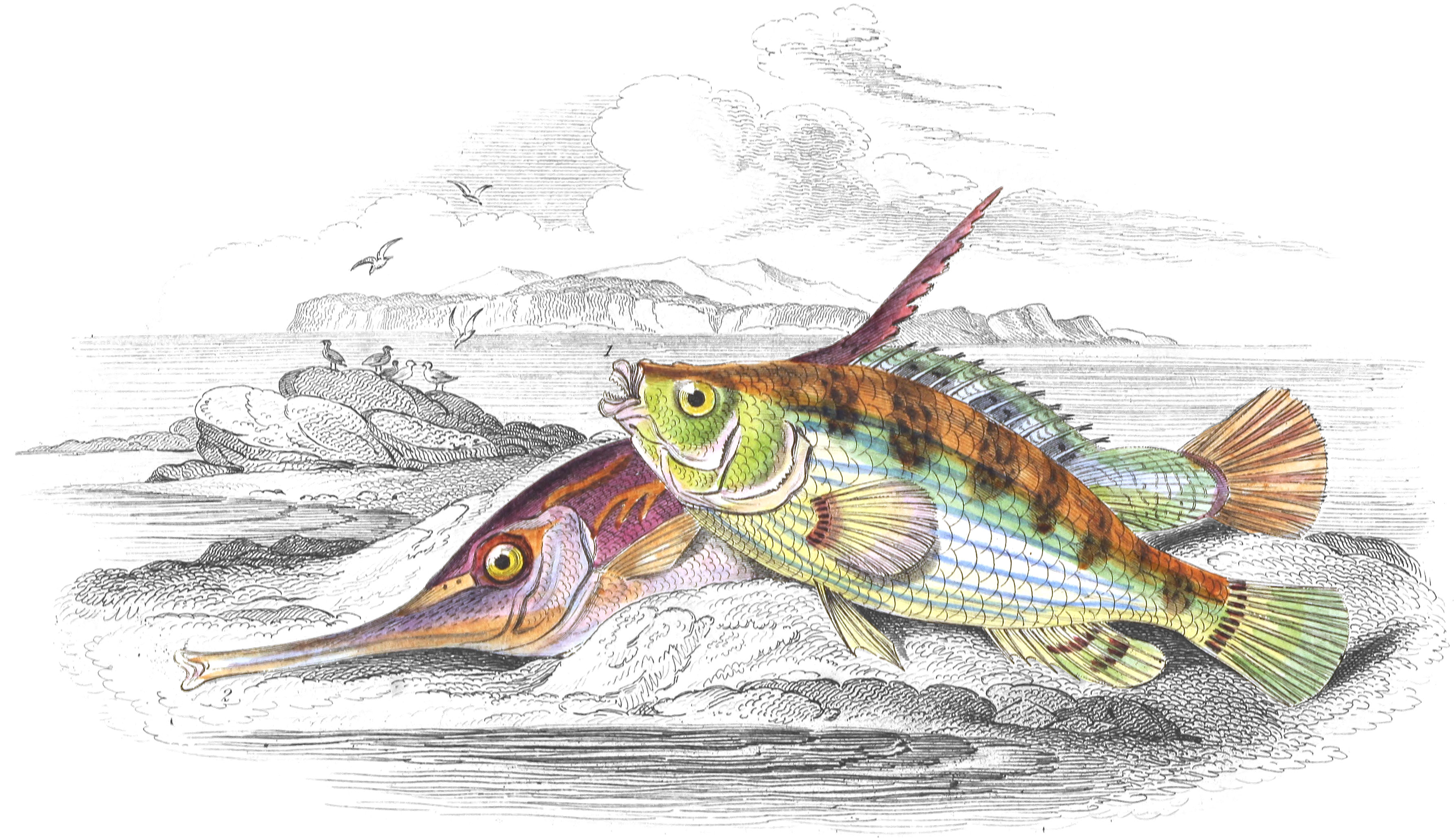
Plate XXIII
Gen. XLVIII. Acantholabrus
This genus corresponds with the preceding, excepting that the outer range of teeth are conical and large, and have behind them a second row, in which they are small and form a narrow band; the number of the spinous rays of the anal fin is also greater. Of this limited genus, three frequent the British shores.
Couch’s Wrasse
Sp. 90. Acantholabrus Couchii.
The Scale-rayed Wrasse. M. Valenciennes having recently established the present genus, and finding that English Naturalists had mistaken the Scale-rayed Labrus for the Labrus luscus of Linnæus, in assigning it its new position, has conferred on it the name of the well-known Ichthyologist of Polperro, who originally described it. Mr. Couch procured it on the coast of Cornwall in February 1830, at the conclusion of a very cold season: and besides this specimen, no other, we believe, has elsewhere been observed. The length of this individual was twenty-two inches; and between the rays of the dorsal, anal, and caudal fins, there were imbricated scales. The teeth were numerous, in several rows; and the body and gill-covers clothed with large scales. The lateral line was near the spine, descended with a sweep opposite the termination of the dorsal fins, and proceeded thence straight towards the tail. The formula of the fin-rays is
D. 21/8—A. 6/8—C. 15—P. 14—V. 1/5.
The colour was of a uniform light brown, lighter on the abdomen; upper eye-lid black: at the upper edge of the caudal fin there was a dark brown spot; the pectorals are yellow, and all the other fins are bordered with yellow. Nothing of course is known of the habits of this fish: and its natural history requires further elucidation.
Yarrell’ Wrasse
Sp. 91. Acantholabrus yarrellii.
The Sea-Wife.—This species, like the last, rests upon the examination of a single specimen which was bought in the London market by the eminent Naturalist whose name it bears, and accurately described by him in the first edition of his work on British Fishes. Belonging to this genus, M. Valenciennes felt much gratified in having an opportunity of conferring upon it its present appellation. The specimen measured nine inches and a half. It is distinguished from the Labrus mixtus by the ascending line of the pre-opercle being much more oblique, forming: with the inferior margin a more obtuse angle; by the six spinous rays at the commencement of the anal fin, and by the teeth being smaller and more numerous, especially in the upper jaw. The formula of the fin-rays is
D. 16/13—P. 15—V. 1/5—A. 6/8—C. 12.
The whole of the upper parts of the body were of a dark purple black, becoming lighter on the sides; the lips and anterior part of the head were flesh-coloured, tinged with purple; the irides blue: the gill-rays five in number; all the fins blue; the ventrals tipped with black. Mr. Yarrell could not discover from what part of the coast the fish had been brought, and far less obtain any information regarding its particular habits.
The Small-Mouthed Wrasse, or Rock-Cock
Sp. 92. Acantholabrus exoletus.
A. microstoma of Valenciennes. (PL XXIII.)—This species has been long known on the Cornish coast under the name of Rock-Cock, where it is occasionally caught in the pots set for crabs, and whence Mr. Couch transmitted two specimens to Mr. Yarrell, who previously was unacquainted with the fish. In the year 1836, Mr. Thompson procured one specimen, found on the beach of the county of Antrim; and in 1837, had an opportunity of examining three others, obtained in the same and neighbouring county of Londonderry, during the progress of the Ordnance Survey. Mr. Couch had designated it Crenilabrus microstoma, a very appropriate specific appellation; for the smallness of its mouth immediately distinguishes it from its congeners, and M. Valenciennes followed in his wake, naming it Acantholabras microstoma; and yet, after all, it turns out to be a fish which has been long known to the Naturalists of more northern regions. M. M. Fries and Ekström hare given a coloured representation in the second part of their Fishes of Scandinavia, which, when compared with the drawing made by the draughtsman of the Survey, and published by Mr. Thompson, leaves no doubt of the fishes being the same, and of their identity with the Labrus exoletus of Linnæus. It is a small fish, seldom exceeding six inches in length; and is known upon the coasts of Norway, Sweden, and Denmark, and, according to Fabricius, as far north as Greenland; where, however, it is said to be rare. Its most prominent characteristics are, that the body is rather deep, the mouth small, the teeth few in number; the scales very large, those on the body concealing the base of the dorsal and anal fins, although there are none upon the fins themselves; the anal fin has five or six spinous rays; no blackish spots occur upon the body or fins: there is a slight elevation above the eye in the fine of the frontile profile. The colour of the head and body is dark brown on the upper parts, passing into pale wood-brown beneath, and on the sides and abdomen; the colour of the dorsal, caudal, and anal fins is dark brown; of the pectorals and ventral, lighter. The scales forming the lateral line are thirty-two. The formulary of the fin rays is
D. 19/6—P. 13—Y. 1/5—A. 6/7—C. 12/2 shorter ones.
Gen. XLIX. Julis
This, the last genus of the family we have to notice, is one of the most numerous, containing, in L’Hist. Nat. des Poissons, not less than eighty-eight species. It contains the fishes which are of all others, perhaps, the most strikingly and brilliantly bedecked, those in temperate seas yielding in no degree to their intropical congeners. At the same time, it must be allowed, that these fishes are characteristic of warm regions, one only penetrating far north and reaching the British shores, whilst only three or four are found in the Mediterranean. These fishes frequent the coast, and live among the coral rocks where they find abundance of molluscous and testaceous animals, which their well-armed jaws enable them readily to crush and appropriate. In this genus the lateral line is uninterrupted; the dorsal is furnished with stiff and sharp spinous rays; the whole head, including the cheeks and jaws, is devoid of scales; their teeth are conical and strong in front, and behind the first range there are enamelled tubercles varying in size and shape.
The Rainbow Wrasse
Sp. 93. Julis vulgaris.
Indented Striped Wrasse. Julis Mediterranean Risso. (Pl. XXIII.) Professing to follow the recent and profound researches of M. M. Cuvier and Valenciennes as far as they lead, we adopt the name conferred by these high authorities, and used by Dr. Fleming in the year 1828, in preference to any others. Only one instance is recorded of this beautiful fish having been discovered on the British shores; and this not so well authenticated as might be wished. The specimen was procured by Miss Pocock upon the coast of Cornwall in the year 1802, and was by her communicated to Mr. Donovan, who gave an account of it in his “British Fishes.” Mr. Donovan’s description is but meagre. He states
that the specimen rather exceeds the length of seven inches; it was of a slender or elongated form, and remarkable for the elegant distribution of its colours, which were changeable in various directions of fight: but the most striking peculiarity was the broad denticulated stripe, extending along each side, from the head nearly to the tail, the colour of which was fulvous; and, with the rest of the colours, produced an effect equally singular and beautiful.
According to Mr. Donovan, the numbers of the rays were
D. 9/13—P. 12—Y. 1/5—A. 2/13—C. 13.
As considerable doubt still exists, as to which species of Julis this really was, M. Valenciennes stating that he cannot regard it as the J. vulgaris, we shall here furnish rather a full account from the pages of the French Ichthyologist, which will assist any British Naturalist who may be so happy as to procure a specimen. According to M. Valenciennes, this fish, very common in the Mediterranean, exhibits many varieties, which, some Zoologists have attempted to distinguish as so many species. They are the ornament, he remarks, of the markets on the coast; for their various colours do not yield in their brilliancy and beauty to the most lovely fishes of tropical seas. Our author then supplies a minute description of that variety which was the type of the Julis of Artedi. Its body was elongated, the interval between the eyes prominent, the margin of the pre opercle descending vertically: the mouth is not widely cleft, and but little protractile: the teeth are simple, and conical in the external row, the four anterior being long and curved, like true canines, the others are shorter, and those of the two jaws are very much alike, there being additional teeth further back. The dorsal fin commences at the termination of the first-fourth of the total length of the fish, and extends to the half of that of the body; its rays are fine and flexible, the first being larger than the second, and the second than the third. The anal commences beneath the first soft ray of the dorsal, and its three spines are not strong. The caudal terminates blunt and nearly straight. The ray formulary is as under:—
B. 6—D. 9/12—A. 3/12—C. 14—P. 13—Y. 1/5.
The scales are small, and about twenty-four may be counted between the gill-cover and the tail. The lateral line first mounts upwards, then forms a straight line parallel to the back, and afterwards suddenly bends down to the level of the middle of the tail. The summit of the head and back is of a beautiful brown, mixed with blue and red; beneath this brilliant tint, there is a broad band with a denticulated margin of beautiful orange-red, which commences on the opercle and extends to the tail: below this band, and at the origin of the gill-ray, just under the first soft rays of the dorsal, the middle portion of the side is coloured by a deep blue band, almost black, forming a great oblong marking along the flanks. This marking extends to near the tail, in a band of ultramarine blue. An ultramarine streak, of the loveliest hue, arises at the angle of the mouth, crosses the cheek, appears at the angle of the pectoral, and is prolonged in fainter hues along the inferior border of the deep blue marking of the side. The dorsal fin is of an olive-colour, mixed with red, having the margin light blue: a large deep blue marking colours the middle of the membrane, extends above the first three rays, and a red band, more or less of an orange hue, runs alone? the base of the fin, a little way beneath the dorsal line. All the varieties have also a prolonged black lateral marking.
These beautiful fishes frequent the rocky shores which are covered with marine algae: their flesh is white, of good flavour, and easy digestion.
XII. Family of Pipe-Mouthed Fishes. Fistularidæ
Representative in British Fauna
-
Gen. 50. Centriscus.
- Sp. 94. C. scolopax. The Trumpet-Fish, or Sea-Snipe.
With the Piped-mouthed Fishes we reach, according to the arrangement we are observing, the last family of the former subdivision—the Spinous-rayed—of the First great Series, or the Osseous Fishes. As its name implies, this family is characterized by a long tube, formed in part by the prolongation of various bones of the head and face, at the extremity of which is placed the mouth, composed of its usual bony and soft parts: the ribs also are very short or wanting. The family is subdivided into two: the Fistularia, with a cylindrical body; and the Centriscus, in which it is oval and compressed. The Trumpet-fish belongs to the latter of these subdivisions. It has the tubular muzzle, the characteristic of the family, with the body oval and oblong; it has only two or three slender gill-rays, a spinous dorsal fin, and small ventrals behind the pectorals. The mouth is very small, and opens obliquely; the air-bladder is considerable in size.
Gen. L. Centriscus
The members of this genus have the anterior dorsal placed far back, with its first spine-ray long, strong, and supported by an apparatus which connects it with the shoulder and head; they are covered with small scales, and have also some larger denticulated ones in the apparatus to which we have just alluded. This first ray is capable of motion, and thus forms a very powerful weapon.
The Trumpet-Fish, or Sea-Snipe
Sp. 94. Centriscus scolopax
This very remarkable looking fish is not uncommon in the Mediterranean, but only three instances have been recorded of its having been seen in the British seas; so that we must regard it but a rare visitor. One specimen was thrown ashore on the coast of Cornwall in the year 1804; and Mr. Donovan states that two instances of its capture had come within his notice. The best account we have seen of it is that of Mr. Yarrell, from whom we learn that the fish is but of small dimensions, not extending beyond a few inches; the Cornwall specimen reached to five inches. The elongated snout is terminated by a very small mouth, which has no teeth; the eyes are large, the irides silvery, streaked with red. The back is elevated, forming a slight ridge, and ending in a short spine, just in advance of the long and strong denticulated one of the first dorsal fin. This anterior dorsal fin has but three spinous rays, although authors generally state them to be four. The first spine is thrice as long, and also much stronger, than the others; it is pointed, moveable, and toothed like a saw on the under part, constituting a formidable weapon of defence; the other spines are short, with their points projecting beyond the membrane by which they are united. The rays of the second dorsal are soft; the pectoral is small, and the ventrals have a depression behind in which they can be lodged. The colour of the back is red, that of the sides being rather lighter; the sides of the head are of a silvery hue, tinged with a golden colour; the scales of the body are hard and rough, and the surface granulated. All the fins are greyish white. According to M. Risso, the Trumpet-fish prefers a muddy bottom, in moderately deep water, and spawns in spring. The young are seen near the shore in autumn, shining with a brilliant silvery lustre, not having as yet acquired the golden red hue of the adult fish. They are not very numerous, and do not wander far from the locality in which they are bred. Their beak-like mouth is well adapted for detaching minute animals from the various sorts of sea-weed; and it is probable that, by dilating their throat, they can draw up their food along their cylindrical back, as water is drawn up the pipe of a syringe. Their flesh is considered good.
Plate XXIII
Thus, after such elucidation as our space would admit, have we brought to a close our account of the different British species, which have been catalogued as belonging to the former subdivision of the First Great Series of Osseus Fishes,—the Acanihopterygii, or Spiny-finned Osseous Fishes. This First Order is often stated, in general terms, to contain nearly as many species as all the other orders put together; and this being the fact, we have now reached a very natural and suitable occasion for bringing our First Volume to a close. In the Second, we must take a survey of the Three Orders of the Soft-rayed Osseous Fishes, and of the Two Orders of the Cartilaginous Fishes, which completes the whole list, adding the Synopsis, These, we need scarcely add, contain a still more varied, and not less interesting succession of groups than the beautiful and interesting Series whose contemplation we must now leave, and not without regret.
Our plenteous streams a various race supply:
The bright-eyed Perch, with fins of varied dye;
The silver Eel, in shining volumes rolled;
The yellow Carp, in scales bedropt with gold;
Swift Trouts, diversified with crimson stains;
And Pikes, the tyrants of the watery plains.
The Letter-press descriptive of the remaining Plates will be found in the Second Volume, and references more at length.
The Common Carp and the Barbel
See Volume II, Cyprinus carpio and Barbus vulgaris
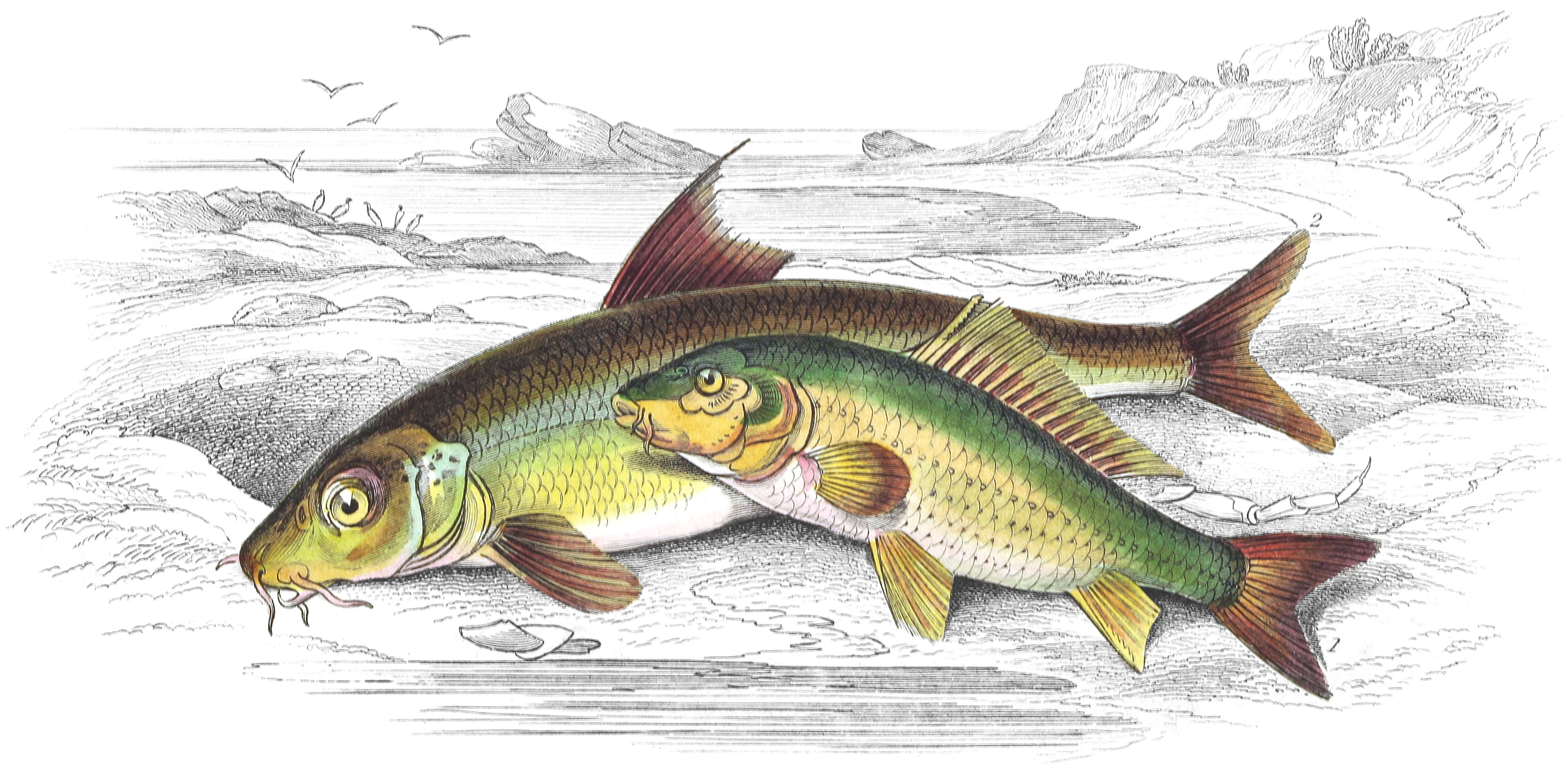
Plate XXIV
The Gudgeon and Tench
See Volume II, Tinca vulgaris and Gobio fluviatilis

Plate XXV
The Carp-Bream and Roach
See Volume II, Abramis brama and Leuciscus rutilus

Plate XXVI
The Loach and Groundling
See Volume II, Cobitis barbatula and C. tænia

Plate XXVII
The Pike
See Volume II, Esox lucius
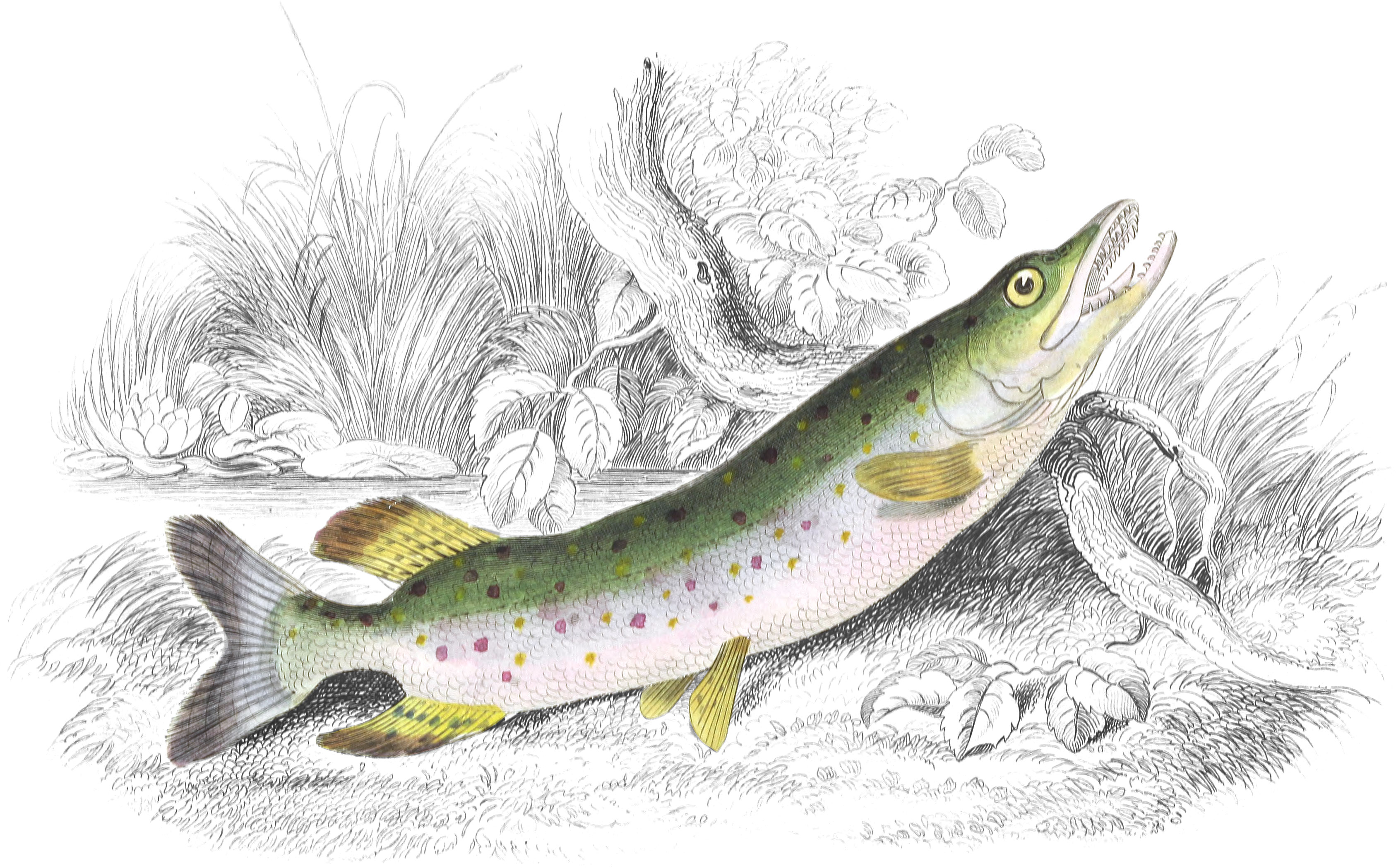
Plate XXVIII
The Garfish and Saury-Pike
See Volume II, Belone vulgaris and Scomberesox saurus

Plate XXIX
The Flying-Fish
See Volume II, Exocilus volitans

Plate XXX
The Parr
See Volume II, Salmo salar

Plate XXXI
Salmon and Salmon-Grilse
See Volume II, Salmo salar

Plate XXXII
Great Loch Trout and Salmon-Trout or Phinock
See Volume II, Salmo ferox and S. trutta

Plate XXXIII
Common Trout and Northern Char
See Volume II, Salmo fario and Salmo savelinus
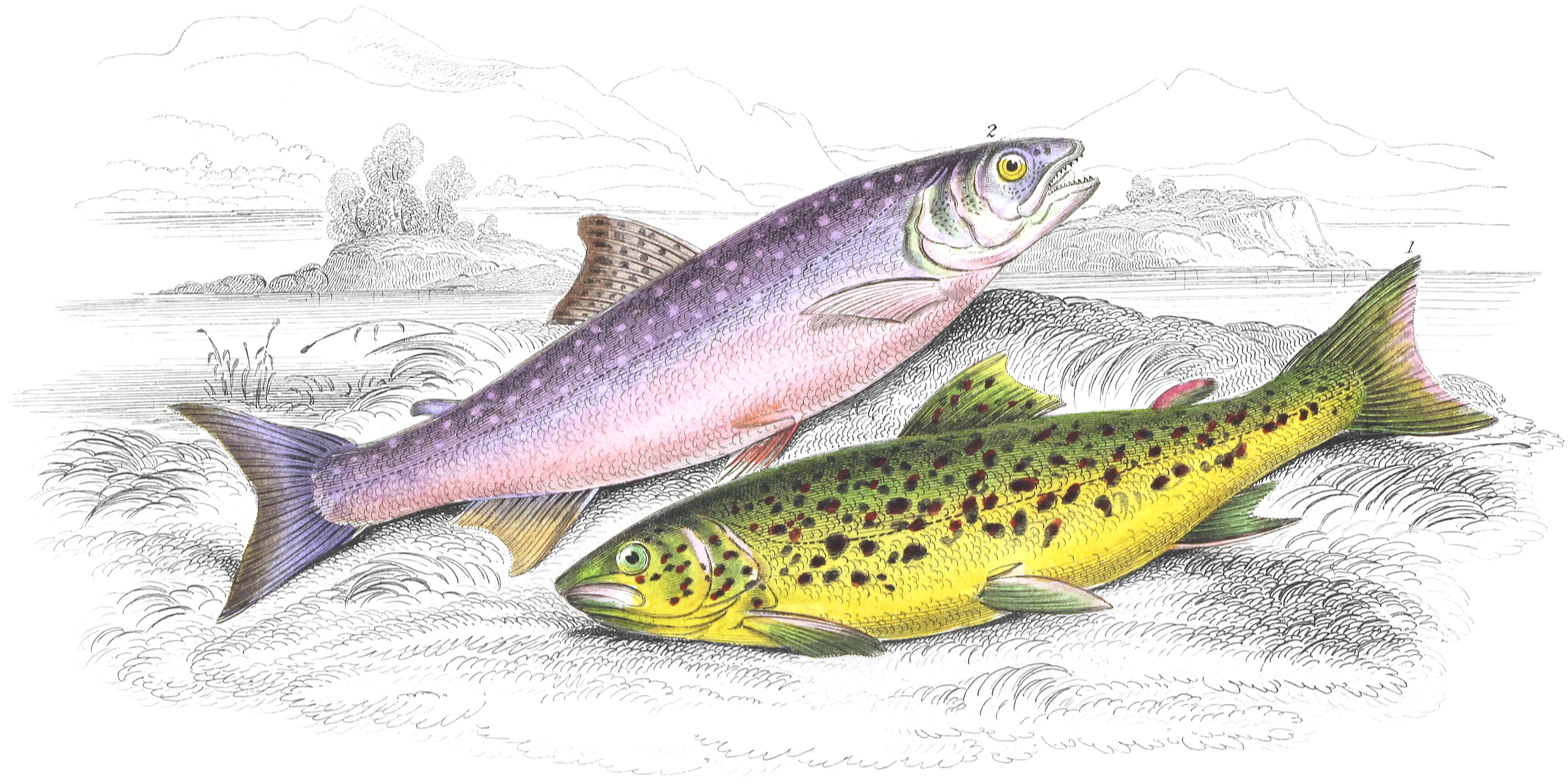
Plate XXXIV
- Through Dr. Johnston’s kindness, who transmitted us a Nest, we are able to supply a representation of this fish’s nest, (See Plate VI.); the first, we believe, which has any where been published.
-
We refer the Student of Natural History to two Memoirs by Professor Müller, which were read to the Berlin Academy on June 21, and July 19, 1841, and of which accounts appear in “L’Institut” for November and December last, pp. 378 and 449. The former is entitled upon Pathological Exanthemata, with specific organised seed corpuscules. These were found in the eye of the pike, and had something like caudal appendages. Excited by these to further investigation, Professor Müller discovered a similar corpuscular exanthema, but without the appendage, in the Lucioperca sandra, Cyprinus rutilus, and sometimes in the Perca fluviatilis. In conclusion, the Professor states,
That there was here a disease of the skin and internal parts, produced by a kind of seminal corpuscule, which had no relation to animals which are propagated by means of a seminiferous ova, nor with the Entozoaires, or tailed Cercaires, nor were they less distinguished, by their structure of hair-like parasite formations, from animal organisms; and, finally, widely different, by their specific character, from all known cellular formations, whether normal or pathological.
In the latter, entitled Observations upon the Psorospermies, the author enumerates a great number of fishes, European and Foreign, in which he had in vain searched for this disease, and a few in which he had found it. The disease which had been noticed in the German perch, was also found in perches brought from the rivers which empty themselves into the Arctic Sea, by MM. Humboldt, Ehrenberg, and Rose; and, finally, he states,
That these parasites, which have been observed in the fresh-water fishes of Europe, Asia, Africa, and America, and which consist of the two principal forms above alluded to, those with tails and those without them, are absolutely the same in every region of the globe. They evidently possess a life which is peculiar; but they have no power of movement, or, rather, they are organic beings, like plants, possessing a structure perfectly distinct from the cellules, healthy or diseased, of animal tissue; having no resemblance to the kind of warts which many Naturalists have noticed in some kinds of fishes.
- See Trans. of the Royal Danish Academy, New Series, vol. vii. 1838. Pl. I.