Volume XXXIX
British Fishes
Part II


Second Subdivision of Osseous Fishes with Soft Rays
Malacopterygh
This second and latter subdivision of the first great series, namely, that of Osseous Fishes, designated jointed or soft-finned fishes, Malacopterygii, to which we now proceed, consists of three Orders, the distinguishing characters of which are obtained from the positions, or the absence of the ventral fins. The term soft-finned is, of course, a relative one; the rays in the so named fins being composed of osseous spiculæ which are articulated together by means of cartilage, which renders the ray flexible when the several pieces are long, or more solid, when the different articulations are close set, so that the fins may become almost as stiff as in those fishes which belong to the Acanthopterygeous division. This division is so inferior in point of extent, that probably, according to Mr. Swainson, it does not amount to more than one-fourth of the number comprised in the former, or spiny-rayed one. It is also perhaps true, that the different genera belonging to it are inferior to the foregoing in respect of their shapes and colouring; but, on the other hand, they are superior in the grand point of utility to Man, comprising by far the largest proportion of those which furnish him with the all-important article of food; for when we enumerate the Cod, Herring, Turbot, Salmon, and Carp families, as belonging to this division, we name those which supply the largest amount of this necessary article, and in whose capture thousands of men, and fleets of vessels, are exclusively engaged. The leading and most numerous Order, consists of those soft-finned fishes whose ventral fins are attached to the abdomen.
Order II. Soft-Finned Fishes, with Abdominal Ventral
Malacopterygii Abdominiales
This Order comprises those fishes which have the ventral fins attached to the abdomen behind the pectorals, and unconnected with the bones of the shoulder. They are the most numerous Order of the Section, including the majority of fresh-water fishes, and are divided into five families, in our arrangement from the thirteenth to the seventeenth, inclusive. From the two volumes of the Histoire Naturelle des Poissons which have recently been published, we perceive, as might have been anticipated, that this Order is about to undergo modifications, and, we may add, great improvements, upon its exposition in the Règne Animal; much greater than those which have been effected upon the former subdivision. We need not express how great has been our obligation to the authors of that admirable Work in the former portion of our own; and deprived of this assistance, and retreating upon the Règne Animal, and other resources, we experience a deficiency which nothing short of the completion of that valuable Work can adequately supply. The vast and splendid accumulation of fishes now collected at the Jardin des Plantes, arranged by the genius and assiduity of Cuvier, and now describing from his Notes by the indefatigable labour of his pupil, Valenciennes, who seems to have imbibed so much of the enthusiasm and taste of his great master, at once warrants and vindicates these remarks. M. Valenciennes commences the exposition of the Order by the consideration of that most interesting family—the Siluridæ; but as only one of its species is European, we deem it needless, under the circumstances, to follow his example, and therefore at once, with the Règne Animal, begin with the Carp family.
XIII. Family of Carps. Cyprinidæ
Representatives in British Fauna.—Gen. 8. Sp. 13.
-
Gen. 51. Cyprinus.
- Sp. 95. C. carpio. The Common Carp.
- Sp. 96. C. carassius. Crucian Carp.
- Sp. 97. C. gibelio. The Prussian or Gibel Carp.
- Sp. 98. C. auratus. The Gold Carp.
-
Gen. 52. Barbus.
- Sp. 99. B. vulgaris. The Barbel, or Bearded Fish.
-
Gen. 53. Gobio.
- Sp. 100. G. fluviatilis. The Common Gudgeon.
-
Gen. 54. Tinca.
- Sp. 101. T. vulgaris. The Common Tench.
-
Gen. 55. Abramis.
- Sp. 102. A. brama. The Bream.
- Sp. 103. A. blicca. White Bream, or Bream-Flat.
- Sp. 104. A. Buggenhagii. Pomeranian Bream.
-
Gen. 56. Leuciscus.
- Sp. 105. L. dobula. The Double Roach.
- Sp. 106. L. idus. The Ide.
- Sp. 107. L. rutilus. The Roach.
- Sp. 108. L. vulgaris. The Dacc.
- Sp. 109. L. Lancastriensis. The Graining.
- Sp. 110. L. cephalus. The Chub or Skelly.
- Sp. 111. L. erythrophthalmus. The Red-Eye, or Rudd.
- Sp. 112. L cœruleus. The Azurine.
- Sp. 113. L. alburnus. The Bleak, or Blick.
- Sp. 114. L. phoxinus. The Minnow, or Pink.
-
Gen. 57. Cobitis.
- Sp. 115. C. barbatula. The Loach, Loche, or Beardie.
- Sp. 116. C. tænia. The Spined Loach, or Groundling.
This family, we rejoice to see, has lately undergone the revision of Mr. John M‘Lelland, Assistant Surgeon, Bengal Medical Service, whose talents and acquirements, as well as his very favourable position in India, the chief habitat of the Cyprinidæ, afford every promise of most satisfactory results from his labours. He has divided the family into three sub-families, sixteen genera, and two hundred and twenty-nine species (Ann. and Mag. of Nat. Hist. viii.), so that it has comparatively but few representatives in Britain. It is readily recognised by having the mouth but slightly cleft, weak maxillaries, generally without teeth, and whose margin is formed by the intermaxillaries; it has the pharyngeals strongly toothed; its gill-covers are but few; the body is scaly and destitute of an adipose dorsal fin, as we shall find is possessed by the Siluridæ and Salmonidæ. A considerable number of the family are supplied with barbules or cirri, which are capable of being contracted and elongated, as well as the muscular appendages of the snout, to which they are attached; differing in this respect from the filaments of the Siluridæ, as will be afterwards stated. It is the least carnivorous family of fishes. The typical genus Cyprinus is a very natural one, and comprehends numerous species, which are distinguished by the characters already enumerated. Their tongue is smooth, and the palate provided with a soft and singularly irritable substance, vulgarly known by the name of Carp’s tongue. The pharynx presents a powerful instrument for mastication, consisting of large teeth attached to the inferior pharyngeal bones, and capable of compressing the food against a strong disk enclosed in a wide cavity under the basilary bone. They have only one dorsal, and the body is covered with scales, meet frequently of a large size.
Gen. LI. Cyprinus
Carps, properly so called.—This genus has a long dorsal fin which, together with the anal, is furnished with a spine more or less stout, as its second ray; the body is covered with large scales: some have fleshy tubercles at the angle of the mouth, and to these we shall first allude; others are without these appendages. Four species are enumerated as British.
The Common Carp
Sp. 95. Cyprinus carpio, See Plate XXIV, Fig. 1, Volume I
“The Carp is accounted the water-fox for his cunning!” (Walton.) From the Carp being highly esteemed, and having long been reared in a kind of domestic state, an acquaintance has been made with it which falls to the lot of but few of the finny race. Isaac Walton, no small authority, ascribes its shyness in taking the hook to its acute and cunning perceptions, a characteristic which, we suspect, may be more satisfactorily accounted for from its herbaceous tastes and sluggish disposition. The specific characters of Common Carp are, that the mouth has two barbules on each side, and that the caudal fin is forked. Its general colour is olive-brown tinged with gold, darkest on the head; belly yellowish white; dorsal and caudal fins dusky; ventrals and anal tinged with red. Its food is chiefly vegetables; also the larvæ of insects, and worms. It is reported to live to a great age, and its dimensions increase with its age. From one foot to one and a half, or even two feet, are not very uncommon lengths; but much larger dimensions are sometimes given. Mr. Yarrell says,
The largest I can refer to, are thus noticed in Daniel’s Rural Sports.—Mr. Ladbroke, from his Park at Gatton, presented Lord Egremont with a brace that weighed 35 lbs., as specimens to ascertain whether the Surrey could not vie with the Suffolk Carp.
In the year 1793, he adds, at the fishing of a large piece of water at Stourhead, where a thousand brace of killing Carp were taken, the largest was thirty inches long, upwards of twenty-two inches in girth, and weighed eighteen pounds. In warmer countries they attain much larger dimensions, and reach, as stated by Cuvier, to the length of four feet, and by Pallas to not less than five, in the Volga. The Mirror Carp, proposed by Mr. Boccius to be introduced into this country, has been found in Saxony to weigh as much as 55 lbs. and others have been reported as high as 70 lbs. Such fish as these are supposed to be from a hundred and fifty to two hundred years old.
Carp appears to be a native of most of the temperate countries of Europe. It was introduced in the fifteenth century into England, where it is highly prized, and thrives prodigiously. In Ireland likewise, where it is said to have been introduced by James I., it is preserved in several places, as in the counties of Cork, Kilkenny, Dublin, and probably others. In Scotland it is generally said to be wanting (Mag. of Zool. and Bot., i. 391), and though this statement may not be literally true, yet, whether from the character of the water, or from the climate, as is more probable, it has hitherto been found no where to thrive;—a remark applicable to all cold countries. In the pond of Redbraes, near Edinburgh, observes Mr. Stoddart, seven or eight Carp have been maintained for several years, along with numbers of Perch, and though of both sexes, no disposition to spawn has yet been apparent; in fact, he adds, it may be safely asserted, judging from what we have heard upon the subject, that Carp will not thrive in Scotland until some means be discovered for meliorating the climate, and giving a soft quality to the water. In favouring circumstances, on the contrary, their fecundity is very great, so that no fewer than 700,000 ova have been found in a single Carp; and this property would appear to increase with their years. The ova are deposited upon weeds, among which the female is followed by two or three males, in these islands, in the months of May and June; and they are in best condition from October till April. They are altogether fresh-water fish, in rivers preferring those parts where the current is not too strong, and thriving best in muddy bottoms. On this account, lakes, and even ponds, appear to be their favourite resorts, especially where they have the benefit of shade from an overhanging grove of trees.
Angling for Carp, says Isaac Walton, “requires a large measure of patience;” nor are they easily captured by the net, since they manage to bury themselves in the mud. During the winter season they eat little or nothing, and are supposed to lie in great numbers, side by side, buried in the mud. In keeping with these habits, Mr. White of Selborne states, that in the gardens of the Black Bear Inn, in the town of Reading, there is a stream or canal, running under the stables, and out into the fields on the other side of the road: in this water are many Carps, which lie rolling about in sight, being fed by travellers, who amuse themselves by tossing them bread. But as soon as the weather grows at all severe, these fishes are no longer seen, because they retire under the stable, where they remain till the return of spring. The Carps are very tenacious of life, and may be preserved out of the water for a considerable time, especially when covered with some moist substance, and in coldish weather, and thus they can be transported to a distance. In Holland they are sometimes suspended in nets full of moss, in a damp cellar, which being moistened with water, and sometimes with milk, they not only live, but actually improve under the process.
Mr. Boccius’ little treatise upon the management of fresh-water fish, has a special reference to this fish; and useful details on the construction of ponds, their stocking, fishing, &c. will be found in its pages. His object is to make these preserves an object of profit to landed proprietors, as already stated in our former volume, and thereby to increase also the amount of nutritious and excellent food. Carp feed well in stews, and Mr. Jesse has remarked that they are soon reconciled to their situation, and eat boiled potatoes in considerable quantities. He says,
They soon lost their original shyness, and fed in ray presence without any scruple.
As with many other fishes, so with these, much variety of opinion has existed as to their merit as an article of food. The ancients held them in no very high esteem; by the writers of the 16th century they are ranked as an important aliment; and at present they are highly prized in France, Germany and Austria; Mr. Yarrell, we should think, is not far from the truth, when he states that they are highly indebted to cooks for the estimation in which they are held for the table.
The Crucian Carp
Sp. 96. Cyprinus carassius
This species of Carp, which by some of the Thames fishermen is called the German Carp, has been introduced into the list of British fishes by the assiduous attention of Mr. Yarrell, who has now had an opportunity of examining two specimens; and his decision has been corroborated by the authority of other able naturalists. Mr. Yarrell’s specimens were captured in the Thames, between Hammersmith and Windsor, its only ascertained habitat in this country. Its average weight may probably be about one pound and a half; one specimen obtained weighing two pounds eleven ounces; the other one pound. Respecting its habits we have little intelligence; Bloch states it spawns in May. The colour of the upper parts of the body is a rich golden brown, becoming lighter and more yellow on the sides beneath the lateral line, and on the belly; the fins are dark brown; the mouth small; the irides golden yellow; the scales large, with concentric striæ strongly marked upon them.
The Prussian or Gibel Carp
Sp. 97. Cyprinus gibelio
Mr. Pennant informs us that this species is common in many of the fish-ponds about London, and other parts of the south of England; although he does not consider it as indigenous, but a naturalized fish, the date of whose introduction is unknown. Mr. Yarrell conceives it is of somewhat wider distribution; that it spawns at the end of April or beginning of May, and is very prolific. He adds, though known to be very numerous in some situations, little success attends the angler who endeavours to catch them, as they seldom bite freely; the fish is exceedingly tenacious of life; and he has known them recover and survive after having been kept out of water for thirty hours.
The top of the head, and back, are olive brown; the sides lighter; the abdomen almost white, the whole fish shining with a brilliant golden metallic lustre; the pectoral, ventral, and anal fins are orange red; and the lower part of the tail tinged with the same colour.
Mr. Pennant states that the flesh is extremely coarse and but little esteemed; Mr. Yarrell, that it is white and agreeable; with the help of some of Mr. Boccius’ German recipes, we doubt not it could be made, in the words of the record, “very fine this way.”
The Gold Carp
Sp. 98. Cyprinus auratus
Type of the sunny human breast
Is your transparent cell,
Where fear is but a transient guest,
No sullen humours dwell;
Where, sensitive of every ray
That smites this tiny sea,
Tour scaly panoplies repay
The loan with usury.
—Wordsworth.
These splendid and beautiful Carps, better known in these countries by the name of Gold and Silver fishes, are stated to have been originally natives of a mountain lake in the province of Tche Kiang, about the 30° of N. latitude. Hence they spread through the other provinces of China, Japan, and the neighbouring countries. By the Dutch they were carried into Batavia; by the French, to the Mauritius; the Portuguese navigators early introduced them into their native land, where perhaps they are more abundant than in any other country of Europe. In these congenial haunts, whether native streams or artificial ponds, they are said to attain a considerable size, and to be very long-lived. M. Van Braam informed Dr. Shaw, that during his stay at a town near Pekin, he was shown several in a pool, of which the smallest was fifteen inches long, and the others a good deal larger, reaching, according to Du Halde, the size of our largest herrings: here too they are frequently served up as food. In our colder climates, the size they attain is much more limited; Mr. Yarrell stating that he had never seen a specimen exceeding ten inches in length.
That, upon the whole, the Carp is hardy, cannot, from its wide diffusion, be doubted; and as an additional illustration, it may be mentioned that M. Host, a naturalist of Vienna, observed a Gold-fish revive after it had been frozen up in ice during a winter night, in the vicinity of Austerlitz. Still more clear, however, is it, that it thrives best in a warm and genial medium, even should this be artificially produced. It is well known, says a correspondent in Loudon’s Magazine (vol. iii.), that in manufacturing districts, where there is an inadequate supply of cold water for the condensation of the steam employed in the engines, recourse is had to what are called engine-dams or ponds, into which the water from the steam-engine is thrown for the purpose of being cooled; in these dams, the average temperature of which is about 80°, it is common to keep Gold-fish; and it is a notorious fact, that they multiply in these situations much more rapidly than in ponds of lower temperature, exposed to the variations of the climate. Three pair of this species were put into one of these dams, where they increased so rapidly, that at the end of three years their progeny, which were undoubtedly poisoned with verdigris mixed with the refuse tallow of the engine, were taken out by wheelbarrow-fulls. Under such circumstances it is, says the author of “The Rod,” that they are found in a water-cut connected with the Clyde near Glasgow, and thus may become naturalized in that river.
It is not, however, from the habits and economic uses of these gold and silver fishes in their natural or acquired haunts, so much as from their domestication in this and in almost every other country, and from the interest they excite as beautiful pets and play-things, that they have attracted so much admiration and attention. In its native country no pains are spared, especially by the ladies, in its cultivation. These fair and feeble-footed damsels are assiduous in their attentions to a creature so beautiful in itself, so pleasing in the perpetual liveliness of its movements, and so interesting for the ease with which it may be rendered susceptible of a certain degree of familiarity and attachment. Large glass, and peculiar vessels of the richest kind, are prepared for their reception in their apartments, and small ornamented ponds and basins in their gardens. It appears that they were first introduced into these islands in the 17th century; they have steadily become more and more diffused, and we should say are now more common than ever. When they are young, they are of a dark and sombre hue, and only gradually acquire the splendid colours by which they are afterwards characterized. Their dorsal and anal fins are denticulated like those of the Common Carp; but the usual effects of domestication are pre-eminently conspicuous upon them. Some individuals have no dorsal fin at all, and in others it is very minute; some have the caudal extremely large, or, it may be, divided into three or four lobes. The Telescope Carp, again, has the eye enormously enlarged and protuberant, and all these and other variations may be diversely grouped. As already stated upon a former page, M. de Sauvigny, in his Hist. Nat. des Dorades de la Chine, published in 1780, has given coloured representations of eighty-nine varieties of this Carp, exhibiting almost every possible combination of metallic tinting, gold and silver, orange, black, and purple.
The following statement, with regard to the treatment of these interesting prisoners in China, as furnished by Le Comte, may interest many. They are put into a deep large basin, at the bottom of which is placed an earthen pan upside down, with holes in it, so that, during the heat of the day, shelter may be afforded from the sun. A certain kind of herb is also thrown upon the water, which keeps it always green and cool. The water is changed three or four times a week; but in such a manner that the fresh enters, while the old is going out. If they are obliged to transport the fish from one vessel to another, they take great care not to touch them with the hand, for those that are touched die soon after, or are reduced to a languishing condition: therefore they employ a small net with which they gently lift them, and which does not let the water escape before they are put into the fresh. A great noise like that of guns or thunder, or a strong smell, or violent motion, is very prejudicial, and sometimes kills them, as I have often observed on shipboard, when a great gun was fired. In this country they are usually fed with crumbs of bread, yolks of egg boiled hard and reduced to powder, manna-croup, and such like articles: occasionally they are supplied with a bed of moss or turf.
I ask what warrant fix’d them (like a spell
Of witchcraft, fix’d them) in the crystal cell;
To wheel, with languid motion, round and round.
Beautiful, yet in mournful durance bound ?
Their peace, perhaps, our slightest footstep marr’d.
Or their quick sense our sweetest music jarr’d;
And whither could they dart, if seized with fear?
No sheltering stone, no tangled root was near.
When fire or taper ceased to cheer the room,
They wore away the night in starless gloom;
And when the sun first dawned upon the streams.
How faint their portion of his vital beams!
Thus, and unable to complain, they fared,—
While not one joy of ours by them was shared.
Gen. LII. Barbus
This genus is distinguished by short dorsal and anal fins, the former of which have spinous rays as their second and third; it has moreover four barbules, two at the angles of the mouth, and two at its most projecting portion. The species are numerous, and widely diffused in the New and Old World. One species only is known in Britain.
The Barbel, or Bearded Fish
Sp. 99. Barbus vulgaris, See Plate XXIV, Fig. 2, Volume I
The Barbel, or Bearded Fish, from the cirri at its mouth, is unknown in, Scotland, frequent in England, and pretty general, throughout Europe. It is easily known by its prolonged head, and is very common on the Continent, as stated in the Règne Animal, in clear and rapid streams, where it sometimes exceeds ten feet in length. The general colour of the superior parts is greenish brown, becoming yellowish green on the sides, the cheeks and gill-covers are tinged with bronze; belly white; irides yellow; lips pale flesh-colour. It is in the most sluggish parts of the Thames and its tributaries, that this fish most abounds. So numerous, says Mr. Yarrell, are the Barbel about Shepperton and Walton, that one hundred and fifty pounds weight have been taken in five hours; and on one occasion it is said that two hundred and fifty pounds of a large size were taken in one day. Mr. Pennant states that it is sometimes three feet in length, and weighs eighteen pounds. It feeds upon slugs, worms, and small fish. When turning up the loose soil at the bottom in search of food, many smaller fish are seen to attend, and pick up such nourishment as is set afloat. They spawn in May and June, the ova amounting to seven or eight thousand in a full sized female. During summer they frequent weedy parts of the river; but as soon as vegetation begins to decay in autumn, they seek the deeper waters, and shelter near piles, locks, and bridges.
Mr. Jesse, when describing the habits of the different sorts of fishes kept in his Vivarium, informs us that the Barbel were the shyest, and seemed most impatient of observation; although in the spring, when they could not perceive any one watching them, they would roll about, and rub themselves against the brick-work, and show considerable playfulness. There were some large stones round which they would wind their spawn in considerable quantities. He again remarks,
Barbel appear to be almost in a perfectly torpid state in very cold weather. They make their hybernaculum amidst tufts of weeds, at the bottom of the Thames, apparently either asleep or insensible. Indeed, so torpid are they, that they may be taken up by the hand. In very cold weather, the fishermen provide themselves with a net fastened to an iron hoop, having a handle to it, which they place near the fish, and with a pole put it into the net, so perfectly inanimate are they at this season.
Barbel are never seen to feed in winter. They are generally agreed to be the coarsest of fresh-water fishes, and are seldom eaten but by the poor, who sometimes boil them with bacon, to give them a relish. The idea that even the roe is noxious, has been disproved by personal experiment by Bloch.
Gen LIII. Gobio
The Gobio in generic characters resembles the Barbus, with the exception of having no strong bony serrated rays at the commencement of either the dorsal or anal fins.
The Common Gudgeon
Sp. 100. Gobio fluviatilis, See Plate XXV, Fig. 2, Volume I
The Common Gudgeon has a single cirrhus at each angle of the mouth. It abounds on the continent of Europe, also in England, more especially the southern parts; but like many of its congeners, it is unknown in Scotland. The colour of the upper parts of the body is olive-brown spotted with black, gill-covers greenish white, with the under surface white: their colours, however, vary considerably according to their age, nutriment, and locality. This pretty little fish is much used as bait for larger ones; it affords great sport to young anglers, taking the hook greedily, even to a proverb, and is esteemed as pleasant and light food; hence it is frequently used by invalids. Its usual size is from five to six inches; but Mr. Pennant states that those which are caught in the Kennet and Cole are three times the weight of those taken elsewhere; the largest he ever heard of was taken near Uxbridge, and weighed half a pound. The operation of spawning takes place in spring, and occupies a considerable period, being as it were postponed and renewed from time to time. The fry measures about one inch in the beginning of August. The Thames, Mersey, and Avon are famed for their fine Gudgeons, and they thrive well in ponds abundantly supplied with fresh water. They are frequently assembled by raking the bed of the river, as to this spot they immediately crowd, expecting food from the disturbance. They swim in shoals, feed on worms and acquatic insects, and so abound in some countries that they are given to the hogs. The Thames fishermen, as stated by Mr. Yarrell, take them in shallow water, with the casting net, keeping them in their well-boats till wanted. The London fishmongers are also able to keep Gudgeons alive for several weeks in tanks, which are constantly supplied with fresh water. Col. Montague informs us that of the quantities of these fish, caught by the casting-net in the Avon near Bath, many are exposed for sale alive, in shallow tubs of water, and are thus obtained in the highest perfection for invalids.
Gen. LIV. Tinca
The generic distinctions of the Tench are, that the barbules are very small, as are also the scales, and the mucous secretion of the body is abundant.
The Common Tench
Sp. 101. Gobio fluviatilis, See Plate XXV, Fig. 1, Volume I
The Common Tench possesses a higher interest than many of its associates in the family, in as much as, like carp, it is with many a favourite for stocking fish-ponds, and for introduction to the table. Its excellence as an article of food should of course be the recommendation to this kind of preference; and yet it is curious that, as with many other fishes, great contrariety of sentiment has prevailed upon this point. Along with the Carp, the older writers held it in no esteem. In Ausanias we find the interrogatory, Quis non et vivides vulgi solatio Tineas novit? Gesner says it is insipid and unwholesome; and Baron Cuvier, that it is not good, except in some waters; and many of our modern writers, as Mr. Griffith, affirm that the flesh is soft, insipid, and difficult of digestion. Not so, however, the whole of them. I. Walton says,
Sure I am, he eats pleasantly, and doubtless you will think so if you taste him.
Mr. Pennant says,
At present, it is held in good repute.
Boccius affirms
that it is peculiarly delicate, nutritious, and in good repute for the table.
And Mr. Yarrell,
its flesh is nutritious and of good flavour, and not generally held in the estimation it deserves.
This diversity of sentiment is to be ascribed more to difference of feeding, and other external circumstances, than to any inferiority in the species; and if, by a little attention to these circumstances, improvement can be effected in the Tench, so probably might it also be with many other fish.
On the specific characters of this well known fish we need not much insist: it is short and thick; and its colouring seems to vary according to the purity of the water in which it resides. Its general colour is greenish olive, lightest beneath, with the fins dark brown; but the hue verges towards brilliant golden yellow in rapid streams with sandy bottoms, whilst it becomes almost black in muddy marshes. Its average size in Britain is from twelve to eighteen inches, although sometimes it reaches three feet; its weight from four to six pounds; Salviani mentions it has reached twenty. It is common in many of the temperate countries of Europe, from whence it is supposed to have been introduced into England, where it thrives; and into Scotland, which does not appear to be at all congenial. Certainly it does not thrive near Edinburgh; although it has been reported to flourish, under somewhat peculiar circumstances indeed, in some ponds belonging to Mr. Ferguson of Pitfour, near Aberdeen. In the northern counties of England it is found, but not abundantly; as in the Eden, and Solway Firth, and near Berwick in Hirsel Loch; also in Ireland, in the counties Cork, Kilkenny, and Dublin. According to I. Walton, it loves ponds better than rivers, and pits better than either; and to Mr. Yarrell, it is mostly in those rivers that are slow and deep, that this fish is found; and in such situations it is not so prolific as in ponds. In deep pits, in which clay for bricks has been dug out, it is often abundant; and broad shallow waters, on muddy bottoms, frequently produce great quantities, as is the case with some extensive tracts of water near Yarmouth, in Norfolk, from which, if the fish be taken and removed to stews, where they are fed with a mixture of greaves and meal, they thrive greatly.
This fish is exceedingly tenacious of life, a trait which is demonstrated by experiments which show that a Tench can live in water whose oxygen is reduced to the one five-thousandth part of the bulk of water, ordinary river water containing about one per cent.; a fact, as observed by Dr. Roget, which evinces the admirable perfection of the respiratory organs of the fish. This trait is strikingly illustrated by the following fact taken from Daniel’s Rural Sports.
A piece of water which had been ordered to be filled up, and into which wood and rubbish had been thrown for years, was directed to be cleared out. Almost choked up by weeds and mud, so little water remained that no one expected to see any fish, except a few eels; and yet nearly two hundred brace of Tench of all sizes, and as many Perch, were found. After the pond was thought to be quite free, under some roots there seemed to be an animal which was conjectured to be an otter; the place was surrounded; and on opening an entrance among the roots, a Tench was found of most singular form, having literally assumed the shape of the hole, in which he had, of course, for many years been confined. His length, from eye to fork, was thirty-three inches; his circumferance, almost to the tail, was twenty-seven; his weight eleven pounds nine ounces and a quarter; the colour was also singular, his belly being that of char or vermilion. This extraordinary fish, after having been inspected by many gentlemen, was carefully put into a pond, and at the time the account was written, twelve months afterwards, was alive and well.
Mr. Daniel continues,
Tench are said to love foul and weedy more than clear water; but situation does not always influence their taste. These fish, taken out of Munden Hall Fleet, in Essex, which w as so thick with weeds that the flew-nets could hardly be sunk through them, and where the mud was intolerably fetid, and had dyed the fish of its own colour, which was that of ink, could no where be better grown, nor of finer flavour; many were taken which weighed nine pounds, and some ten, a brace. In a pond at Leigh’s Priory, a quantity of Tench was caught, about three pounds each, of a colour the most clear and beautiful; but when some of them were dressed and brought to table, they smelt and tasted so rankly of a particular weed, that no one could eat them. Some that were conveyed alive, and put into other water, soon recovered themselves from this noxious taint; an experiment that will always answer in this kind of fish.
Tench are found spawning from June to Sept., and the female, as stated by Mr. Yarrell, is usually attended by two males, who follow her from one bunch of weeds to another, upon which the ova are deposited; and so engrossed are they at this time in fulfilling the Divine command, that I have frequently dipped out all the three fish by a sudden plunge of the landing-net. The ova are very numerous, being, says Bloch, nearly 300,000, in a fish of four pounds weight. They are omnivorous.
In conclusion, we must not omit to state a singular property which is assigned to the Tench by many of the older writers, and by some modern ones too. It is alleged it has a sanative property proceeding from its cutaneous secretion, the virtue of which is said to be appreciated by other fishes. Old Walton says, I hope I may be so bold as to tell you that the Tench is the physician of fishes, and for the Pike especially, so that a Pike being either sick or hurt, is cured by the touch of the Tench; and it is observed that this fresh-water tyrant will not play the wolf to his physician, but forbears to devour him though he be never so hungry. Boccius again, says, it is a well authenticated fact that no fish of prey will ever touch Tench; so it is also understood that Tench act medicinally to other fish, by rubbing against them when wounded or sick. Hence, in Germany, the fishermen call it the Doctor-fish; and hence this practical author makes this virtue the ostensible reason of its introduction into fresh-water preserves. The ingenious Moses Brown, in his Piscatory Eclogues has embodied this sentiment, for against such authority we must not call it prejudice, as it respects the Pike, in the following lines:—
The Tench he spares—
For when by wounds distress’d, or sore disease,
He courts the salutary fish for ease;
Close to his scales the kind physician glides,
And sweats the healing balsam from his sides.
Gen. LV. Abramis
This genus has neither spines nor barbules; the dorsal is short, and placed behind the ventral fin; the base of the anal is long. There are several species on the continent of Europe, where they abound, extending to a high latitude; they have also been observed both in Asia and America. Three species are catalogued as British.
The Bream, or Carp-Bream
Sp. 102. Abramis brama, See Plate XXVI, Fig. 1, Volume I
The Bream, or Carpbream, is by much the largest of the British species, being, in the language of I. Walton, a large and stately fish. Its specific characters will be elsewhere more minutely detailed. The prevailing colour is yellowish white, becoming darker with age; the irides are golden yellow; the cheeks and gill-covers silvery white; the fins light-coloured, the pectorals and ventrals tinged with red, the others with brown. This fish thrives most in deep quiet rivers and large pieces of water, such as large lakes and canals. It occurs in the Regent’s Canal, and the Mole and Medway are celebrated for their Bream. The Lakes of Cumberland sometimes produce it; and in those of Ireland it has been known to attain a weight of from twelve to fourteen pounds. In Scotland it is but little known, Lochmaben being its only recorded habitat. Breams swim in shoals, feed on vegetables and soft animal food, are hardy, and grow rapidly. They spawn in May, when the females are frequently followed by three or four males. At this time the scales are covered with what Mr. Pennant calls minute white tubercles, which causes them to feel rough to the hand, which, according to Mr. Yarrell, is nothing more than
a periodical assumption which, as in the other Cyprinidæ, disappears when the season of reproduction is past.
The value of this fish as an article of food has, like the preceding, been differently stated, and probably from the same causes. In these countries it is held in little estimation for the table, and when cultivated at all, it is chiefly to supply food to other fishes. On the Continent the very reverse is the case. I. Walton quotes with approbation the French proverb,
He that has Breams in his pond, may bid his friend welcome;
and we read in the Regne Animal, C’est un assez Ion poisson, fort abondant, et qu’on multipile aisément. Walton’s instructions for angling for this fish are minute and copious, advising a careful study of the selected spot, an abundant supply of ground bait, and a visit with fitted tackling to the water-side, about three or four o’clock in the morning;
but not too near, for they have a cunning sentinel, and are watchful themselves too.
The following is from Daniel’s account of a day’s fishing in Essex.
The weather was cloudy, and the wind brisk: there were seven rods used by the party, and very frequently were there biters at them all at the same time. When a fish was hooked, and played at the top, or near the surface of the water, numbers were seen to follow him, and as soon as the hooks were fresh baited, were alike greedily taken: they averaged at least two pounds a fish; and of these, from six in the morning till dusk in the evening, some hundred-weights were taken.
White Bream, or Bream-Flat
Sp. 103. Abramis blicca
White Bream, or Bream-flat, is a much smaller fish than the preceding, rarely exceeding ten or twelve inches. The upper parts of the body are silvery bluish white, without any of the golden lustre observable in the last species; the iris is silvery white tinged with pink. This species, which in its tastes and habits resembles the Carp-bream, has been long known on the Continent, where it is very common, as far north as the lakes of Sweden; and it has recently been detected in several localities in England; first, by Mr. Shepherd, in the Trent, as stated in the 14th vol. of the Linnean Transactions; next by Mr. Jenyns, as very abundant, in the Cam; and lastly by Mr. Lubbock, who has informed Mr. Yarrell that it is occasionally met with in some of the broads and rivers in Norfolk. This species is not esteemed for food, and is much prized only by other fish.
The Pomeranian Bream
Sp. 104. Abramis Buggenhagii
The Pomeranian Bream derived its specific name from the individual who first sent it to Bloch, its original describer; and Mr. Yarrell has called it Pomeranian Bream, very properly deeming it no objection to attach to this fish the name of the country in which it was discovered, though afterwards found elsewhere. Its introduction into the British Fauna we owe to Mr. Yarrell, who obtained from Mr. Brandon a fine specimen, captured in a net at Dagenham Breach, Essex, in 1836. Mr. Thompson of Belfast had also obtained a specimen from the river Logan, near Belfast; and Mr. Jenyns has since ascertained that it exists in Cambridgeshire. It is at once, says Mr. Yarrell, distinguished from either of the other species by the great thickness of the body, which is equal to half its depth; while in either of our other Bream, the thickness of the body is equal to only one-third of its depth; the scales are also larger in proportion, and different in shape. The anal fin is shorter than that of the White Bream, which, in its turn, is shorter, and has fewer rays than the Common Bream. The upper parts of the body are of a dark blackish blue, becoming lighter on the sides, and passing into silvery white on the belly; the pectoral, dorsal, and caudal fins are bluish brown, tinged with pale red; the ventral and anal, with less brown and more red.
Gen. LVI. Leuciscus
In this genus the dorsal and anal fins are short, and there are no spines or harbules. It constitutes a group containing numerous, species, which are distinguished by the position of the dorsal fin. They are valued not so much for food as for bait. In the first sub-genus this fin is immediately above the ventrals.
The Double Roach
Sp. 105. Leuciscus dobula
This is the first species named in the Regne Animal, and is described as having a rounded muzzle, with red pectoral and ventral fins. According to Bloch, it rarely exceeds half a pound in weight, and feeds upon worms and aquatic mollusca; it prefers clear rivers and large lakes, and spawns in March and April. It is known to inhabit the Oder, Elbe, Weser, Rhine, and their tributaries. Its flesh is white, but full of bones, and it is little esteemed for the table. It was first catalogued as a British fish by Mr. Yarrell, who, while fishing in August 1831, in the Thames, below Woolwich, with the mouth of a white-bait net open against a strong flood tide, caught a single specimen; and no other has been since observed. Mr. Yarrell’s specimen was six inches and a half long; the upper parts of its body were dusky blue, becoming brighter on the sides, and passing into silvery white on the belly; the dorsal and caudal fins were dusky brown, the pectoral, ventral, and anal, pale orange; irides orange; cheeks and opercle, silvery white.
The Ide
Sp. 106. Leuciscus idus
The claims of this species to be considered as British are very limited; but we insert it, after the example of Mr. Yarrell, and with the same object, that we may assist in its future identification. The colours resemble those of the preceding; the head is not so broad, the back is higher, and the muzzle more convex: according to Bloch the anal fin has thirteen rays. This fish is found in the northern parts of Germany, in Russia, Denmark, Norway, and Sweden, where it sometimes weighs between four and five pounds. It inhabits clear fresh waters; and its flesh is said to be white, tender, and of good flavour. All the information as yet collected respecting its existence in this country, is supplied by Mr. C. Stewart, who, in his Elements, 1817, says, that it was found in the mouth of the Nith by Dr. Walker, late Professor of Natural History in the Edinburgh University.
The Roach
Sp. 107. Leuciscus rutilus, See Plate XXVI, Fig. 2, Volume I
The water-sheep, for his simplicity or foolishness. (Walton).—This species has a strong general resemblance to its congeners, having the body deep and compressed. The colour of the upper parts is dusky green, with blue reflections, becoming lighter on the sides, and passing into silvery white on the belly; the iris is yellow, the cheeks and gill-covers silvery white; the dorsal and caudal fins, pale brown; the pectorals orange-red; the ventrals and anal bright red. Its usual weight is from a pound to a pound and a half. I. Walton states that the largest Roach in the kingdom are taken in the Thames, where many have been caught which have weighed two and a half pounds. Mr. Jesse mentions that the largest he had known weighed three pounds; and Mr. Pennant informs us that the London fishmongers sometimes see them as large as five pounds. It is a fish common throughout the temperate parts of Europe; common too in many parts of England, and more rare in Scotland; a specimen from which country, he it remarked, having been sent by Sir William Jardine to Mr. Yarrell, was found
somewhat shorter and deeper than those of the South.
Mr. Wilson remarks that it follows the lines of our canals; and may be caught in considerable quantities at the eastern terminus of the Union Canal, in the western suburb of Edinburgh. Its habits are those of the family, having a preference for still rivers and lakes, seeking the deeper spots during the day, and feeding in the shallows at night; retiring also during the winter, and ascending the shallows to spawn in May and June: it is very prolific. Mr. Jesse observes that the Roach, and other small fish, are perfectly aware of, and careful to avoid, those fish which prey upon them. Thus, he remarks, I have seen large Carp swim among a shoal of Roach without in the least disturbing them, while, if a Pike comes near them, they make off in every direction.
Dr. Parnell repeats, though apparently from his own independent knowledge, the statement of the Statistical Account (vol. xvi.) of the Parishes of Rutherglen and Kilbride, drawn up by the late incumbent, Mr. Ure, that every summer, in the earlier part of May, immense shoals of Roach are observed to leave Loch Lomond, to ascend the different tributary streams for the purpose of depositing their spawn. During this period, which seldom lasts more than three days, the rivers are literally swarming with their numbers, giving a fine green appearance to the whole surface of the water. On this occasion every basket and net in the neighbouring villages are immediately put into requisition, and the thousands thus taken afford food for the villagers for a short period. It is remarked by anglers, that during the time these fish are in the streams, and for a week after their departure, no trout can be taken either with minnow, worm, or fly, in consequence of the favourite food at that time being the roe of the Roach.
This fish, which is stated to be in the best condition in October, is not much sought for the table. It is often, however, used, as appears above, in Scotland; and also in London : it is very bony, and is most prized for making excellent soup.
The Roach seems eminently a fresh-water fish; and yet several facts have been collected which appear to show that, like many others of its class, its habits, in this point, may undergo many decided changes. Mr. Donovan, in his History of British Fishes, informs us that in the river Thames one was caught about the middle of May, or early in June, when these fish come up in shoals from the sea to deposit their spawn in the higher parts of the river. But, remarks Mr. Yarrell, the Roach, in this instance, came only from the direction of the sea, not, I apprehend, from the sea itself. I have never known a Roach to be taken in the sea, into which the fish had entered voluntarily. Colonel Montague also, when commenting, in his manuscript, upon Mr. Donovan’s statement as above reported, expresses his belief that the Roach could not exist in sea-water at all; mentioning the following fact which came under his own observation. In a small river that runs into a large piece of water of nearly two miles of extent, close to the sea, on the south coast of Devon, there is no outlet but by means of percolation through the shingle which forms the barrier between it and the sea. In this situation Roach thrive and multiply beyond all example. About eight or nine years ago, the sea broke its boundary, and flowed copiously into the lake, at every tide, for a considerable time, by which every species of fish was destroyed. So be it, replies the facetious author of “The Rod;” but this fact is by no means of a conclusive nature, in as far as there may be an essential difference in relation to the effect upon a fish’s constitution, between a forced and sudden, and a voluntary and graduated contact with saline waters. In the latter case, there is a physiological expectation or preparation for the change, and we doubt if even Salmon, so remarkable for their long and vivacious continuance in both conditions of the liquid element, would suddenly suffer a sea change with entire impunity, or enjoy the vice versa if instantaneously transported from Ocean’s blue profound, and plunged over head and ears into a cauldron linn. In confirmation of this view we have the express testimony of Dr. Parnell, that in the Solway Firth he has seen, in the month of June, five examples of this fish taken in salmon-nets; and he was moreover informed by the fishermen, that in the early parts of the season, these fish were frequently captured after the flood. Upon the whole, we fear that upon this point we may still repeat what was written by the Father of Experimental Philosophy about two hundred and fifty years ago,
I doubt there hath not been sufficient experiment made of putting sea-fish into fresh-water ponds and pools. It is a thing of great use and pleasure; for so you may have them new at some good distance from the sea: and besides, it may be, the fish will eat the pleasanter, and may fall to breed. (Sylva Sylvarum, century 8, §
783703.)
The Dacc
Sp. 108. Leuciscus vulgaris
The Dace bears a strong resemblance, both in appearance and habits to the Roach: it is not, however, generally so large, seldom exceeding eight or ten inches; it is also more elongated. The colour of the upper parts is dusky blue, pale on the sides, white on the belly; the iris is straw-coloured; with the pectoral, ventral, and anal fins almost white, but tinged with pale red. This fish, we believe, has never been observed in Scotland; but it is common in England, and on the Continent; though scarcely so much as the Roach. It prefers the deep waters of quiet streams, where it is lively and frolicksome: it is gregarious, and spawns, according to Mr. Yarrell, in June. Its flesh, though preferred to that of Roach, is still not much esteemed. In some parts of England it is known under the names of Dart and Dare.
The Graining
Sp. 109. Leuciscus Lancastriensis
Mr. Pennant, we believe, was the first to direct attention to this fish, which he found in the Mersey, and remarked that it resembled the Dace, but was more slender, and with a straighter back: its usual length he found about seven inches and a half; its colour on the back silvery, with a bluish cast; the iris red; also the ventral and anal fins, but paler than those of the Dace; the pectoral redder. The Earl of Derby, President of the Zoological Society, having presented some specimens of this fish to Mr. Yarrell, from the streams in Knowsley Park, we are supplied with some additional information by our eminent Ichthyologist. Several of the tributaries of the Mersey supply considerable numbers, and he regards it as a distinct species. In its habits and food it resembles the Trout, frequenting both the rapid and the still parts of the stream; but it is not known to exist in ponds. Like Dace and Trout, it is fished with artificial flies, which it often takes with sufficient avidity. They sometimes, but not commonly, exceed half a pound in weight, and are much better eating than the Dace. Mr. Thompson of Belfast mentions that he saw several small specimens of this fish in the Learn, near Leamington; which M. Agassiz immediately recognized as identical with a species inhabiting some of the lakes in Switzerland. It has never been noticed, we believe, either in Ireland or in Scotland.
The Chub or Skelly
Sp. 110. Leuciscus cephalus
This, according to Mr. Pennant, is a very coarse fish, Piscator says,
I will make it, however, a good fish, by dressing;
to which Venator responds,
’Tis as good meat as I ever tasted.” (Apud I. Walton.)
The Chub has a thick body, and a broad and round snout; whence its name. The upper jaw is the largest: the top of the head is of a blackish brown colour; the cheeks and gill-covers are golden yellow; the upper part of the back bluish black; and the sides bluish white, passing into silvery white on the belly. The dorsal and caudal fins are dusky, the pectorals reddish brown, the ventral and anal reddish white, the irides golden yellow. Mr. Pennant states that he has known some which have weighed upwards of five pounds, and Salviani speaks of them as reaching eight and nine pounds.
This fish is rather common in England and Wales; and Annan, in Scotland, is assigned as a habitat. At Carlisle, and in many parts in the neighbourhood of the English lakes, it is called the Skelly, on account of its large scales; while, in other parts, the name is, not so appropriately, applied to the Guyniad. It frequents the deep holes of rivers, and, during the summer, commonly lies on the surface, beneath the shade of some tree or bush. It is a very timid fish, sinking to the bottom on the least alarm, even at the passing of a shadow, but it will soon resume its former position; it feeds upon worms and insects, and will rise at a fly. Mr. Jesse mentions that, of the fresh-water fish confined in his Piscatorium in Bushy Park, the Chub, after the Trout, was the most restless, being continually on the move: at the same time, they could never resist a cockchaffer when thrown in their way. Dr. Heysham, in the catalogue of Cumberland animals affixed to Hutchison’s History, states that it is very plentiful in that county; and that the boys make a paste of bread and some narcotic, which they throw into the holes of the rivers they frequent; this the Skelly greedily devours, becomes intoxicated, and is thus captured in great numbers. Broiling it with the scales still on, is one of the best methods of preparing it for the table.
The Red-Eye, or Rudd
Sp. 111. Leuciscus erythrophthalmus
The second sub-genus of Leuciscus, according to the Regne Animal, has the dorsal fin placed in the interval between the ventral and anal fins. Four British species belong to the category, and the first is the one just named. The name Red-Eye has been assigned to it from the colour of the iris; that of Rudd is stated to be derived from the golden coppery tint which ornaments the whole surface. Roud is its name in Norfolk; Shallow in Cambridgeshire; and it is the Finscale of Willughby. It is a common fish on the Continent of Europe, and also in England; Willughby recorded it as being found in the lakes of Yorkshire and Lincolnshire, and in the river Chirwell in Oxfordshire; it is also common in the Thames and in other waters near London, and in the Stour. Mr. Yarrell mentions that he has seen some dozens together for sale in Hungerford Market; and Mr. Jaques, that it is very abundant in some parts of the Cam and in the Broads of Norfolk. Specimens are obtained in Lough Neagh, in Ireland, where it is universally called the Roach. Mr. Stewart has, in his Elements, catalogued it as having been met with in Scotland; but we have seen no satisfactory evidence of the fact.
The body of the Red-Eye is deep, and the lower-jaw is the longest. Its length is twelve or fourteen inches; and its weight almost two pounds. Its colouring is thus minutely described by Mr. Yarrell. The iris orange-red; cheeks and gill-covers golden yellow; upper part of the back brown, tinged with grey and blue; the sides paler; the belly light golden yellow; the whole surface of the body tinged with a brilliant reddish golden hue, varying when viewed in different positions in reference to the light; the fins more or less bright cinnabar-red, particularly in the specimens from the Thames, Cambridgeshire, and Lough Neagh: dorsal and caudal fins not so bright in the colour, as the fins of the under surface. The Rudd is very tenacious of life; it is also hardy and prolific; and is hence useful as food for more favourite fish. Although using the same food, it is much more esteemed than the Roach. It spawns in April and May, at which period the scales are rough to the hand.
The Azurine
Sp. 112. Leuciscus cœruleus
For the introduction of this species we are indebted to Mr. Yarrell, who received it, along with the Graining, from the Earl of Derby. It occurs in certain limited localities in the neighbourhood of Knowsley, and in the district receives the name of the Blue Roach. M. Agassiz stated that this fish is an inhabitant likewise of some of the Swiss lakes. It is hardy, tenacious of life, and spawns in May. The flesh is said to be firm and of good flavour. The largest observed specimen did not exceed one pound in weight. This fish is at once distinguished from the Red-eye, by the slate-blue colour of the back, the silvery white of the abdomen, its white fins; and by the iris being tinged a pale straw colour.
The Bleak, or Blick
Sp. 113. Leuciscus alburnus
The body of this species is of an elongated and narrow form, the forehead straight, and the lower jaw somewhat extended; the tail much forked; in length it seldom exceeds six or eight inches. Its colour is a light green, or ash-brown, tinged with blue; the sides, cheeks, gill-covers, and abdomen, shining silvery white; the iris silvery, sometimes tinged with yellow; and all the fins nearly white. It is very abundant throughout Europe, and is common in England, being frequent in the Thames and other rivers near London, Sibbald names it as a native of Scotland; but we are not aware of any more recent authority for its occurrence. These fishes swim in great shoals, and spawn in May, when their scales are rough to the touch. Their habits are active and gay. Mr. Jesse says,
Of all my pets in Bushy Park, the Bleak were the most amusing and playful. Their activity could not be exceeded; and it gave me much pleasure to see them, on a summer’s evening, dart at every little fly that settled on the water near them; appearing always restless, and yet always happy.
This always, however, must be taken with some limitation. As remarked by Mr. Pennant,
These fish seem at certain seasons to be in great agonies; they tumble about near the surface of the water, and are incapable of swimming far from the place, but in about two hours they recover and disappear.
The fish, when thus affected, the Thames fishermen call Mad-bleaks; and it is conjectured that they are then peculiarly annoyed by some parasitic animal. Aristotle alludes to a disease of fishes of this description; but, according to him, they rise to the surface and die.
Artificial Pearls, being made from a pigment, either the rate mucosum or the tubercular exudation, procured from this and other allied fish, we shall here allude to the circumstance. On the inner cutaneous surface of the Bleak, Roach, Dace, White-bait, and similar fishes, is found a silvery pigment, producing the lustre which their scales possess. The ornaments manufactured from it bore the name of patent pearls, and their use was universal in the bead trade, being employed in the manufacture of necklaces, ear-drops, &c. So great formerly was the demand at particular times, that the price of the quart measure of fish-scales varied from one guinea to five. The Thames fishermen caught the fish, took off the side-scales, and threw them immediately into the river again; and it was the custom of hawkers, regularly before selling any of these fish, to set apart the scales for the bead-makers. The method of obtaining and using the pigment was, first, thoroughly to clean the scales by exposing them to a current of water, and then to soak them for a time; after which the colouring matter was deposited. When thus procured, small glass tubes were dipped in the pigment, and injected into thin blown hollow glass beads, of various forms and sizes. These were then spread upon sieves and dried in a current of air. If greater weight and firmness were required, a further injection of wax was practised. Of this pigment the White-bait afford the most delicate and beautiful variety, and used to obtain the highest price; the Bleak was next in esteem, and the Roach and Dace the least valuable. The French were the inventors of the art; and Dr. Listre informs us, that one artist in Paris, during the course of the winter, used thirty hamper-fulls of these Bleak scales in this manufacture. Additional details of this curious art will be found in Mr. Yarrell’s more ample pages.
The Minnow, or Pink
Sp. 114. Leuciscus phoxinus
We have already had occasion to allude to this pretty little fish, in relation both to the varying colours it assumes and the parasitic fungi to which it sometimes becomes the victim (Vol. I). It is common on the continent of Europe, in England, and the southern parts of Scotland; Dr. Parnell remarking that it does not seem to exist in the northern parts of the country, as not a single specimen was observed by the party of Naturalists who lately visited the different lakes and rivers in Sutherlandshire. It is, however, found in some of the tributaries of the Dee, becoming more plentiful as we advance southwards. It inhabits all the rivers entering the Forth, among others the Water of Leith, and is very common around Edinburgh. Besides rivers, it also frequents brooks, canals, and ditches, preferring generally gravelly bottoms, and swimming in shoals in trouting streams. It usually makes its appearance in March and disappears in October, seeming to delight in warmth and sunshine. The winter months appear to be passed under the sheltering banks, or buried beneath the gravel. Its habits are active and amusing. A gentleman on one occasion, crossing a brook, saw from a footbridge, something like a flower, near the bottom. Observing it attentively, he remarks, I found that it consisted of a circular assemblage of minows, their heads all meeting in the centre, and their tails diverging at equal distances. One was larger than the rest, and when any straggler came in sight, he quitted his place in pursuit, and having driven it away, returned to his place, no other minnow offering to take it in his absence. This I saw, he adds, several times. The cause of attraction was a dead minnow, which they seemed to be devouring. Like the Gold-fish, they are often imprisoned in a glass vase, where they are easily tamed, and taught to pick flies and filaments of beef from the hand. Even here they are active and sportful, but never outlive three years. In the county of Devon, it is not an uncommon occurrence, by making small bays, and by the aid of a net, to procure from a peck to a peck and a half of these fish in an hour. They are considered very palatable, being sweet and well flavoured, equalling any fresh-water fish as food, being cooked whole. Isaac Waltons receipt, however, reads differently. Being washed well in salt, and their heads and tails cut off, and being gutted, they are fried, with yoke of eggs, the flowers of cowslips, and of primroses, and a little tansy. Thus used, he adds, they make a dainty dish of meat.
Gen. LVII. Cobitis
This genus has the head small, the body elongated, clad with small scales, and bedewed with a thick mucous secretion; the ventrals are placed far back, and over them there is a single small dorsal. The mouth is small, without teeth, but with lips capable of sucking, and furnished with barbules. The air-bladder is enclosed in a bony sheath. Three species are enumerated in the Regne Animal as European; no less than twenty-three are catalogued by Mr. M‘Lelland, as discovered in India. (Loc. cit. viii.) Two species only are known as British.
The Loach, Loche, or Beardie
Sp. 115. Cobitis barbatula, See Plate XXVII, Fig. 1, Volume I
This species will be always readily distinguished by the snout being furnished with six cirri, and the nose being destitute of spines. The head, body, and sides, are clouded and spotted with brown upon a yellowish white ground; the under surface is white; all the fins are spotted with dark brown; the iris is blue. It is common in Europe, including England and Scotland; and it has been noticed in the county of Dublin. It prefers streams where the bottom is gravelly and covered with large stones, under which it lurks, and so being often overlooked, it is sometimes considered scarce; it seldom exceeds four inches in length: it feeds upon worms and aquatic insects, spawns early in spring, and is very prolific. When the rivers become muddy, says Dr. Parnell, and much increased in size by rain, these fish leave the middle of the streams, and seek refuge under the banks and small tufts of grass, where they are taken in nets by anglers, and are prized as bait for Trout. They seldom move three inches cut of their way to take a bait, however tempting, but seize it with great eagerness when placed before their nose. They are often eaten as a dainty morsel, and by some are said to rival the minnow as food. They are occasionally preserved in the same manner as anchovies, and considered superior both in flavour and richness. On account of the high estimation in which they are held, they are frequently transported to some parts of Europe, with considerable trouble, for the waters they naturally inhabit, to waters contiguous to the estates of the wealthy. Thus Linnæus, in his Fauna Suesicca, mentions that Frederick I., king of Sweden, had them brought from Germany and naturalized in his own country.
The Spined Loach, or Groundling
Sp. 116. Cobitis tænia, See Plate XXVII, Fig. 1, Volume I
Linn., Bloch, Cuv.; Botia tænia, Gray, Yarrell.
The spined Loach or Groundling. It will be perceived that Mr. Yarrell, whose able arrangement we wish generally to follow, has adopted Mr. Gray’s suggestion of separating the Loaches with suborbital spines from those which are destitute of these singular appendages. To this we in the mean time demur, fearing we should otherwise have to retrace our steps; and this on the ground that Mr. M‘Lelland, who, in the native haunts of the family, has assiduously been studying and most successfully arranging it, rejects the proposal, and has resorted to another classification, which, in all probability, will ere long be universally adopted. He divides the old genus into two sub-genera, Cobitis propria, with the caudal fin entire; and Schistura, when it is divided into two lobes, or is bifid, as in the ordinary Cyprines; other important items, such as the internal structure, as well as the colouring, marking the distinction. The proportion of the ascertained species in India is twelve of the former to fourteen of the latter.
This fish is much less common in Britain than the preceding. It was introduced into our Fauna by Berkenhout, as residing in the Trent, and in lakes and ponds. Turton mentions that it is found in the clear streams of Wiltshire, and Mr. Jenyns has met with it in considerable numbers in the Cam, and in fish-ponds at Ely; Mr. Thompson, also, has found it in Warwickshire. Its existence in Scotland has by no means been satisfactorily ascertained, Dr. Parnell only saying, I rather think that a specimen came under my observation in the Teith, but I failed in obtaining it. The form of the body is more elongated, slender, and compressed, than that of the Barbatula; the nose more pointed; the pectorals longer and narrower. The colours are similar; but a row of dark spots, ranged along the sides, is more conspicuous. It seldom exceeds three inches in length; it spawns in April or May, depositing its ova among stones at the bottom of the stream.
XIV. The Pike Family. Esocidæ
Representatives in British Fauna.—Gen. 5. Sp. 6.
-
Gen. 59. Esox.
- Sp. 117. E. lucius. The Common Pike.
-
Gen. 60. Belone.
- Sp. 118. B. vulgaris. Gar-fish.
-
Gen. 61. Scomberesox.
- Sp. 119. S. saurus. Saury-pike, or Skipper.
-
Gen. 62. Hemiramphus.
- Sp. 120. H. Europæus. The Half-Beak.
-
Gen. 63. Exocilus.
- Sp. 121. E. volitans. The Common Flying-fish.
- Sp. 122. E. exiliens. The Great Flying-fish.
The second family of Order II. of the Osseous Fishes, Malacoptergii Abdominales, is distinguished by being destitute of an adipose fin, by having its upper jaw formed by the intermaxillary bone, and, when this is not the case, by the maxillary itself being without teeth, and hid in the substance of the lip. The fishes belonging to it are voracious; their intestine is short and without cæca; and all of them have an air-bladder. Many of them ascend rivers. All that are known, with one exception, the Microstoma, have the dorsal fin opposite the anal one. It is composed of many genera, not half of which have representatives in the British seas. The first we mention belongs to the
Gen. LIX. Esox
The Proper Pikes are characterized by small intermaxillary bones in the upper jaw; of which they form two-thirds, and which are armed with small pointed teeth, while the maxillaries on the sides have none; the vomer, palatals, tongue, pharynx, and gill-arches, are also studded with small teeth; and upon the side of the lower jaw there is a row of long pointed teeth. Their muzzle is oblong, obtuse, broad, and depressed. They have but one dorsal fin, which is opposite the anal; their air-bladder is very large. Europe possesses only one species of this genus; Africa and Asia are more productive, and several species are catalogued by Dr. Richardson as belonging to North America. Our Common Pike is one of these, but it is confined to the eastern side of the rocky mountains.
The Common Pike
Sp. 117. Esox lucius, See Plate XXVIII, Volume I
The Common Pike; Jack; Pick well; Luce; Gidd. “The Shark of the fresh waters.” (Lacépède.) Numerous are the appellations which have been applied to the Pike, upon which, however, it is unnecessary to dwell. The term Jack is applied to the young fish under a foot or two feet in length. Luce, or Lucie, from the Latin Lucius, has long been used in English literature, and is the Lucia of heraldry. The epithets which have been applied to it, such as the Fresh-water Shark, by Lacépède; the Tyrant of Fresh-waters, by Walton, express its well-marked and most striking trait.
On the specific characters of a fish so familiarly known, it is unnecessary to enlarge. Its body is elongated, and nearly uniform in depth from the head to the commencement of the dorsal fin. The surface is covered with minute scales, and the lateral line is indistinct: the dorsal fin is placed very far back, and begins in a vertical line above the vent; the pectoral and ventral fins are small; the caudal rays long and forked. The head is elongated and depressed, the gape wide; the teeth in the vomer are small, those in the palatines larger, those of the lower jaw the largest. The colour of the head and upper part of the back is a dusky olive-brown, becoming lighter and mottled with green and yellow on the sides, passing into silvery white on the abdomen: the pectoral and ventral fins are pale brown, the dorsal, anal, and caudal somewhat darker, and mottled with white, yellow, and dark green; the iris yellow. When in high condition Mr. Pennant states that their colouring is very fine, being spotted with bright yellow which often assumes a golden brilliancy; when out of season the green changes to grey, and the yellow spots turn pale. In certain waters, the fish becomes yellow, with black spots, when it is called the King of the Pikes, and is much esteemed; and according to Schwenckfeld, some are perfectly white. They spawn in spring, the exact period differing according to their age and the temperature. At that season those which are in lakes and ponds try to ascend the rivers and approach the shore; and at this time the parent fish are so much occupied, and so inattentive to every thing else, that they may be almost caught with the hand.
The Pike has a very extensive distribution, being well known over the greater part of Europe and Asia: concerning America, Dr. Richardson states that it is the only fresh-water fish which is undoubtedly common to the two continents; and it is curious that it is unknown to the westward of the Rocky Mountains, upon the coast that approaches nearest to the Old World. It is very familiarly known throughout the British Isles, preferring rivers of a sluggish character, but also thriving in lakes and ponds. It is a great feeder, and is said thus to grow fast, and speedily to attain a considerable size. Bloch says that the young reach the length of eight or ten inches in the course of their first year, to twelve or fourteen in their second, and to eighteen or twenty in their third, and there are proofs on record that from this last size, Pike, if well supplied with food, will grow at the rate of four pounds a year for six or seven-successive years. Pliny considered the Pike as the longest lived, and likely to attain the largest size of any fresh-water fish. From two to three feet is a common size; and it often reaches a much greater. Mr. Pennant mentions that the largest fish of this species he had ever heard of in England weighed thirty-five pounds, although the one mentioned by Dr. Plat, as taken in the Thames, which measured an ell and two inches, that is, forty-five inches, or almost four feet, must have weighed much more. (Plat’s Hist. of Staffordshire, 246, a. Walton, 136.) Mr. Yarrell states that Pike have been killed in Horsea Mere from twenty-eight to thirty-four pounds each. In Scotland these dimensions have sometimes been doubled. Dr. Grierson mentions one killed in Loch Ken which weighed sixty-one pounds (The Rod, 61 146); and Dr. Bushnan has already related, in the second volume of this Series, that Colonel Thornton, of sporting celebrity, caught one by trolling in Loch-Awe, after a struggle of one hour and a quarter, which weighed fifty pounds: it measured exactly four feet four inches from eye to fork, and, jaws and tail included, could scarcely be less than five feet. The Colonel exclaims,
So dreadful a forest of teeth or tusks, I think I never beheld:
also that another was taken in a loch in Galloway of the enormous size of seventy-two pounds, which the Doctor understands rose at an artificial fly (Nat. Lib. Ichthy. ii.); while Mr. Selby states
we have seen a record of a Pike taken in Loch-Lomond of seventy-nine pounds weight (Mag. of Zool. and Bot. 391.)
Some of the Irish lakes are said to have afforded Pikes of equal dimensions; and in colder countries they appear to attain a still greater size. Those of four or five feet, says Mr. Griffith, are not rare in the numerous lakes of the north of Europe, and in the great rivers of the north of Asia; and Dr. Brand, on his estate near Berlin, caught one which measured seven feet in length (Loc. cit. p. 467 463); the largest of those taken in Lapland, according to Dr. Schoeffer, as quoted by Pennant, extend sometimes to eight feet; they are dried and exported in great quantities; while Bloch examined the skeleton of one which could not, in his estimation, have been at all less; and finally, in the London newspapers for the year 1765, it was stated that at the Lillishall Limeworks, near Newport, a pool about nine yards deep, which had not been fished for ages, was drained, when an enormous Pike was drawn up, amidst hundreds of spectators; it weighed 170 lbs., and was thought to be the largest ever seen.
The Longevity of this fish also is very remarkable. Rzaczynski, as quoted by Pennant, tells us of one which was ninety years old; and the extraordinary story related by Gesner, thanks to his respectability, has ever since been faithfully copied, not to say credited, by nearly all subsequent Ichthyologists. It runs thus:—That, in the year 1499, a Pike was taken near Hailbrun, in Suabia, with a brazen ring affixed to it (of which a representation is given in Gesner), in which were these words in Greek characters,
I am a fish which was first of all put into this lake, by the hands of the Governor of the universe, Frederick II., the 5th of October, 1233;
whence it was inferred that it was 264 years old; and it was said to weigh 350 lbs. (Sir J. Hawkins, a. Walton, p. 134 281.) One would naturally feel incredulous on the point; but Gesner adds that its skeleton was long preserved at Manheim as a great curiosity.
That it is a great feeder, has been allowed, and the stories of its boldness and voracity are quite extraordinary. The appetite, says Mr. Jesse, of one of my pikes, five pounds weight, in the preserve of Bushy Park was almost insatiable. One morning I threw to him, one after another, five roach, each of about four inches in length. He swallowed four of them, and kept the fifth in his mouth for about a quarter of an hour, when it also disappeared. Eight pike, of about five pounds each, tenanted this preserve, and out of eight hundred gudgeons which were counted into the reservoir, there were scarcely any to be seen at the end of three weeks, though some Barbel and Perch probably had their share. Old Bowdker gives a still more striking illustration of this trait, as follows.
My father caught a pike in Barn-meer Cheshire, an ell long, (three feet nine inches), and of thirty-five pounds weight, which he brought to Lord Cholmonly, who ordered it to be turned into a canal in the garden, wherein were abundance of several sorts of fish. About twelve months afterwards, the canal was drawn, and this pike was found to have devoured all the fish except a large carp, of between nine and ten pounds weight, and it was bitten in several places. The pike was then put into the canal again, together with abundance of fish, all of which he devoured in less than a years time; and he was then observed to take ducks and other water-fowl under water; whereupon they shot magpies and crows, which the pike took before their eyes; being soon after neglected, he died, as supposed, from want of food.
Frogs, water-rats, water-hens, and other fowl, often become its prey. In default, says Mr. Yarrell, of a sufficient quantity of other fishes to satisfy them, moor-hens, ducks, and indeed any animal of small size, whether alive or dead, are constantly consumed. And their boldness in all this is astonishing. Mr. Jesse says,
I have seen one follow a bait within a foot of the spot where I have been standing.
Mr. Colquhoun says,
Upon one occasion, when playing a good sized trout in Loch Dronkie, an enormous pike made several dashes, and at last succeeded in seizing it. I used every effort to frighten him away; but so determined was he, that, though I could see him quite plainly in shallow water, with my trout held across his tremendous jaws, he would not be beat off; and at last when kicking the water, I strained my line, he gave a plunge, broke my rod, and escaped with his prey. (The Moor and the Loch, 114).
But they are even more bold than this. Major Payne, now residing at Weybridge in Surrey, says Mr. Jesse, informed me that, walking one day by the side of the river Wey, he saw a large pike in a shallow creek. He immediately pulled off his coat, tucked up his sleeves, and went into the water to intercept the return of the fish to the river, and to endeavour to throw it upon the bank, by getting his hand beneath it. During the attempt, the pike finding he could not make his escape, seized one of the major’s arms, and lacerated it pretty considerably. With a well known facetious writer on Natural History, we add,
we think the fish was right.
Mr. Jesse, moreover, states that the head-keeper of Richmond Park, assured him he was one day washing his hand at the side of a boat, in the great pond in that park, when a pike made a dart at it, and he had but just time to withdraw it. Hence we are not to wonder if washer-women, in following their avocation in the water, are sometimes assailed by this greedy fish. And if thus they do not respect the lord himself of this lower world, we cannot be surprised that the lower animals fare worse. I. Walton says,
I have been assured by my friend Mr. Seagrave, who keeps the otters, that he has known a Pike, in extreme hunger, fight with one of his otters for a carp which the otter had caught, and was then bringing out of the water. My authority, he adds, is a person of credit, and I conclude with the wise saw, that it is a hard thing to persuade the belly, because it has no ears.
At Lord Gowers canal at Trentham, as Mr. Pennant was assured on good authority, a Pike seized the head of a swan as she was feeding under water, and gorged so much of it, as killed both. The servant perceiving the swan with its head under water for a longer time than usual, took the boat, and found both swan and Pike dead.
With such a foe as this fresh-water wolf, even the fox may be entrapped.
A cub fox drinking out of the river Arnus, in Italy, had his head seized by a mighty Pike, so that neither could free himself but were engrappled together. During the contest, a young man runs into the water, takes them out both alive, and carries them to the palace of the Duke of Florence, hard by. (Apud Walton).
And once more, we have the tale of the poor mule,
which it has been known to pull into the water by its nose!!
So says our facetious author; and it is a pity certainly to spoil so good a story. Where he got this version of the incident we know not; but against it we must put that of old Gesner, as probably coming nearer the mark.
His devouring disposition is so keen, that a man going to a pond to water his mule, had the Pike bite his mule by the lips; to which the Pike hung so fast, that the mule drew him out of the water, and by that accident the owner of the mule angled out the Pike.
This extreme voracity of the Pike makes it a question how far it is expedient to introduce it into preserves along with other fish; and many have advised it should be carefully excluded and removed. This, however, we believe is carrying the matter too far. With respect to natural waters, hear Mr. Colquhoun’s sensible remarks:—
Many people think a loch injured by Pike: on the contrary; unless very numerous, I have seldom seen one worth fishing without them. If a man prefers killing eight or nine dozen, with scarcely a half-pounder among them, to a dozen fine trout, from half a pound to three pounds weight, then he may count the Pike his enemy; but the latter feat will both better prove his skill, and afford him much better sport. The reason why your trout are always large where there are Pike is obvious; the small fry are always devoured by the latter, and the others having more food, increase in size. A few years ago Loch Katrine was choke-full of very small trout, which have gradually become larger since Pike have been introduced; and now, two or three dozen fine red troth may be taken in a day. (L. c. 113).
These enlightened views, thus reached by the sagacious sportsman, coincide with those of the scientific breeder; and accordingly, Mr. Boccius directs that to every acre of water, you put in two hundred brood carp, twenty brood tench, twenty jack, all of one season’s spawn; the jack with all its voracity being absolutely necessary to cheek undue increase, whereby deficiency of food would create a famine and impoverish all.
The relative power of the Pike, Walton’s tyrant of fresh water fishes, and the salmon, his king of fishes, is different from what, considering the formidable armour and furious character of the former, we should be led to infer. Thus, we are informed by Mr. Mudie, editor of the English edition of the Regne Animal, that it is generally said, that notwithstanding the havoc which the Pike commits among smaller fishes, it will not stand the attack of a trout of equal weight, the immense velocity of the latter fish in swimming giving it a decided advantage. (L. c. 315).
In Mr. Yarrell’s admirable work will be found a detailed account of the method of fishing Pike with trimmers, or liggers, as they are provincially called, “affording great diversion,” in Idorsea Mere and Heigham Sounds covering a surface of about six hundred acres, in Norfolk, and which in four days’ sport produced two hundred and fifty-six Pikes, weighing together eleven hundred and thirty-five pounds. Substantially the same method is sometimes practised in the Scotch lochs. Mr. Colquhoun says,
Set lines is the most deadly way to capture Pike, and this either with a long line with many hooks, or with single hooks fixed to a bottle, or other equal buoyant float. After very tightly corking the bottles, and fastening the cord to them, long, according to the depth of the water, fix your baited hook. The best time for this amusement is on one of those delicious evenings with scarcely a breath of air, when the shadow of the mountain becomes more imposing on the unrippled loch, and twilight begins to steal over the scene. Let the hour of the beetle be your warning bell. Having arranged your tackle, place them orderly in a light two-oared boat, and row to the weedy bay. You will now drop them, one by one, about twenty yards apart, outside the weeds, between the shallow and the deep. The Pike has been basking all the sultry day in the shallows, and are just emerging from their grey covering in search of food. The first object that arrests their hungry eyes and craving stomachs is your tantalizing bait, suspended at such a distance from the surface as to excite no apprehension, and perfectly still. With avidity it is seized and pouched; down goes the bottle: scarcely perhaps has it disappeared, when another follows its example; and it is nothing uncommon to have four or five all bubbling up and down at the same time. “The sport” now begins, the angler stretching to his oars, first after one, then another, as they alternately rise and sink. If large Pike are hooked, they will often keep their tormentor under water for an hour at a time; and to run the whole down is no contemptible evening’s exercise. I have also heard, says the same intelligent writer, of tying baited hooks to the legs of geese, and turning them adrift: when the Pike seizes the bait, the goose begins to flap its wings, and there is often i considerable sport’ in the struggle.
Here then, we have severally “sport, considerable sport, and great diverson,” with the goose, bottle, and ligger, at the expense of the poor Pike, which, however, it has often been demonstrated! feels no pain!! On such sport we have already ventured to express our sentiments.
As an article of food, the merits of the Pike have been much disputed. Edward I. fixed its value in England higher than that of fresh salmon, and more, ten times told, than that of the best turbot or cod. In the reign of Henry VIII. again, a large Pike sold for double the price of a house-lamb in February, and a Pickerel for more than a fat capon. The author of The Rod says,
We do not think highly of its flesh,
by some, says the author of the second volume of our series, it is esteemed superior even to salmon: the Doctor says,
to do the Pike justice, we seldom tasted a more delicious fish.
Season, condition, and the culinary art have, we believe, more influence than is generally conceded them. Upon the last article, old Isaac Walton is kind enough to communicate one of his rare secrets;
If the direction to catch a fish do you no good, yet I am certain the direction how to roast him when he is caught is choicely good, for I have tried it. First open your Pike at the gills, and gut him; keep his liver, with which shred thyme, sweet marjoram, and a little winter savoury; to these put some pickled oysters and some anchovies, two or three; to these you add sweet-butter and salt; these must be used as stuffing: then he is spitted and roasted very leisurely, often basted with claret, anchovies, and butter.
But we cannot get through this long rigmarole, and conclude with the summation.
This dish of meat is much too good for any but anglers or very honest men; I trust you will prove both, and therefore I have trusted you with the secret.
Gen. LX. Belone
The head and body of this genus are greatly elongated, and the latter is covered within minute scales; both jaws are much produced, and armed with numerous teeth; the dorsal fin is placed over the anal, and both are entire. The genus is somewhat numerous throughout the ocean, though its existence in the American seas does not appear to be quite ascertained: some reach the length of eight feet, and are said to bite very severely. One species is familiarly known in European and British seas; it is
The Gar-Fish
Sp. 118. Belone vulgaris, See Plate XXIX, Fig. 1, Volume I
The Gar-fish, Sea-pike, Mackerel-guide, is by no means uncommon round the shores of the British islands, apparently somewhat more abundant towards the north: it is also well known in the Baltic. Dr. Parnell informs us that it visits the Firth of Forth in large shoals about the beginning of July, in company with the Mackerel, and remains till the end of August. It attains the length of two, sometimes three feet. In the young the jaws are of equal length; when full grown, the lower becomes the more projecting; the tail is forked. The upper parts of the body are of a dark greenish blue mackerel-tint, becoming lighter towards the sides, which, with the abdomen, are silvery white; the iris is pale yellow. The greater length of the upper jaw is produced by an elongation of the intermaxillary bones, and the gape is extensive, both jaws separating simultaneously. According to Mr. Couch, this fish swims near the surface at all distances from land, and is seen not unfrequently to spring out of its native element; its vivacity being such that it will for a long time play about a floating straw, and leap over it many times in succession. In the Forth it is caught both by the net and hook, and it is sometimes found in the haddock-lines, which are baited with mussels. Mr. Couch adds, that when it is taken by the hook, it mounts to the surface, often before the fishermen have felt the bite; and there, with its slender body half out of the water, struggles with the most violent contortions to wrench the hook from its hold. It emits a strong smell when newly caught. The following method of fishing the Belone, in the Ionian Islands, was communicated to Mr. Yarrell by Mr. L. H. Tonna. A small triangular raft is formed of three pieces of bamboo, each a foot and a half long; a little thwart is inserted, in which a small mast is fixed; it is then rigged with a latine sail, shrowds, &c., in imitation of the boats of the country. The fisherman taking his station on a projecting rock, with deep water along side, and an off-shore breeze, commits his little raft to the wind, carrying with it a line of thirty or forty fathoms in length. A float is fixed at about every fathom, and from each float depends a fine hair line, with a baited hook. When the Belone bites, he draws the float down violently once, and then seems quietly to resign himself to his fate. The fishermen waits till ten or twelve are hooked; he then hauls in his raft, relieves it of its freight, and again launches it for another cruise. I once, says Mr. Tonna, saw a boy catch fifty or sixty in this way in half an hour.
A curious circumstance connected with this fish is, that its bones are green. Many authors seem to think that this is the result of boiling; but Cuvier states that in the whole genus the bones are remarkable for their beautiful green colour, which is inherent, and independent either of cooking or of transudation from any neighbouring part. This colour sometimes excites a prejudice against the fish as aliment; and tastes, moreover, seem to vary. Considerable quantities, remarks Mr. Yarrell, are eaten in London, some from curiosity; but the larger portion from the moderate price at which they are sold. The flesh partakes of the flavour of the Mackerel, but is drier. In the Edinburgh market, again,
they are considered by many persons to be superior to the Mackerel for food, being firmer and whiter in the flesh, and possessing much of the same flavour.
Cuvier says,
Qu’il donne un bon manger.
Gen. LXI. Scomberesox
This genus resembles the former in the length of its snout, its general shape, and its scales; but the last rays of the dorsal and anal fins are detached and form spurious fins on the upper and under sides, as on the Mackerel. Some species are catalogued by Dr. Richardson as occurring on the North American coast; one only is known in the British. It is
The Saury-Pike, or Skipper
Sp. 119. Scomberesox saurus, See Plate XXIX, Fig. 2, Volume I
The Saury-pike, or Skipper, is known in the Mediterranean as well as on the Western Atlantic shores. In Britain it seems preeminently a migratory fish, appearing usually in the autumn, in vast abundance at one time, and very sparingly, or not at all, at others. Its shape, generally, is like that of the Gar-fish. In size it averages from a foot to eighteen inches. The dorsal fin has five and the anal eight spurious fins; the snout is fine, slightly curved upwards, and toothless; the lower jaw being the longest; the body is smooth, and the scales thin. All the fins are small, the dorsal being far down the back.
The colour of the back is a lovely azure blue, changing to grey, and glossed with purple and yellow; the lower part silvery.
Mr. Pennant mentions that great numbers of these fish were thrown ashore on the sands of Leith, after a great storm in November 1768; and Mr. Low states, that in 1774, such a glut of them set into Kerston Bay, Orkney, that they could be caught in pailfuls, and many were thrown ashore. No one remembered such a thing happening before. Dr. Neill states that they are not uncommon in the north of Scotland; and almost every autumn, they enter the Forth in considerable shoals. According to the Doctor, it is a stupid, inactive fish.
When they run up our Firth in numbers, they do not, like other fishes, retire from the shallows at the ebbing of the tide, but are then found by hundreds, having their long nose stuck in the sledge.
Dr. Parnell mentions that of late years not a single specimen has been observed in the Firth. They are sometimes seen off Berwick and Yarmouth, on the east coast, and occasionally on the southern. The following account of the habits of this fish is from the pen of Mr. Couch, who has so frequently laid the lovers of Natural History under obligation by his interesting details.
It does not swim deep in the water; and in its harmless manners resembles the Flying-fish, as well as in the persecution it experiences from the ravenous inhabitants of the ocean, and the method it adopts to escape from their pursuit. It is gregarious, and is sometimes seen to rise to the surface in large shoals, and flit over a considerable space. But the most interesting spectacle, and that which displays their greatest agility, is when they are followed by a company of Porpoises, or their still more active and persevering enemies the Tunny and Bonito. Multitudes then mount to the surface and crowd on each other, as they press forward. When still more closely pursued, they singly spring to the height of several feet, leap over each other in singular confusion, and again sink beneath. Still further urged, they mount again and rush along the surface, by repeated starts, for more than a hundred feet, without once dipping beneath, or scarcely seeming to touch the water. At last the pursuer springs after them, usually across their course; and again they all disappear together.—Some must fall a prey to the enemy; but as many hunt in company, it must be long before the pursuit is abandoned. (Apud Yarrell.)
Gen. LXII. Hemiramphus
This genus is characterised by small teeth in both jaws, the upper one being very short, the lower long, prolonged into a semi-beak which is without teeth: in other respects it resembles the genus Belone. It abounds in tropical seas; but, with the exception of the young fry, no specimen has been seen, according to Mr. Yarrell, in the Mediterranean, the Channel, nor the Northern Seas; and Dr. Richardson affirms that none have been detected on the shores of North America. Is the statement of Mr. Mudie, that a stray individual is occasionally met with on the shores of England, nothing more than an inference? (Late English edit. of Règne Animal.)
The Half-Beak
Sp. 120. Hemiramphus Europæus
The European Hemiramphus or Half-beak has very properly been introduced conditionally into our scientific catalogue by Mr. Yarrell, upon the authority of Mr. Couch, who met with this small fish (Linn. Transactions, vol. xiv.); and upon a communication sent to him by Dr. Clark of Ipswich, in 1837. The facts are soon stated: Mr. Couch captured, in the harbour of Palperro, in July 1818, a little fish which was swimming with agility near the surface of the water, and which he conceived might be the Hemiramphus Brasiliensis of Cuvier. It was an inch in length, with the head somewhat flattened at top; the upper jaw short and pointed; the lower much protruded, the mouth opening obliquely downwards, although the part of the lower jaw which protruded beyond the upper, passed straight forward in a right line with the top of the head; the body was compressed, lengthened, and resembled that of the Garfish: it had one dorsal, and anal fin, placed far back, and opposite each other; the tail was straight; the colour of the back bluish green, spotted; the abdomen silvery. It was in August 1837 that Mr. Clark, when examining the sea-shore between Harwich and Orford, observed a shoal consisting of myriads of small fish between one and two inches long, which he took to be the young of the Garfish. This conclusion, however, on further examination, was discovered to be incorrect, the fry of the Garfish, when measuring only one inch, being found with jaws of equal length: they therefore belonged to a species of Hemiramphus, whose precise species however, from their minute size, it is perhaps impossible to determine; whilst their great abundance in a pool left by the receding tide, makes it evident they must have been deposited and vivified in the neighbouring shores. These are the only instances in which the fish has been observed in Britain, and Mr. Yarrell, for distinction-sake, has proposed it shall be called Hemiramphus Europæus.
Mr. Swainson mentions that he has examined one of this species in a fresh state, captured we presume in tropical seas; and detected a singular peculiarity, hitherto unnoticed. On the sides of the lower jaw, there is a thin membranaceous fringe or skin, very delicate, and which is half the breadth of the jaw itself. The jaw itself, he contends, is thus used neither to secure its food, for its point is obtuse, nor to burrow in the sand, for then this membrane would be immediately destroyed. Like the other members of the same family, it probably obtains its food upon or near the surface of the water; and it is certainly curious that there is a genus of birds—Rhyncops—whose mouth or bill is similarly constructed, and which skims along the surface of the sea, to feed upon the minute creatures which have here their appropriate habitat. Hence the inference that these are fishes which habitually feed in the same manner, and upon the same description of animals. (In Lardner, Cycl., Fishes, i. 301).
Gen. LXIII. Exocilus
The fishes belonging to this genus are at once distinguished from the others of the order by their immense pectoral fins, enabling them to support themselves in the air for a short time. They are possessed of scales, and are somewhat keel-shaped on the flanks; their head is flat above, and compressed laterally; the dorsal fin is above the anal; the eye large; both jaws are furnished with teeth,’ their pharynx with pavement ones; their air-bladder is very large, and the lower lobe of the tail much longer than the upper. They abound in all the seas of warm climates.
The flights of these beautiful little fish, principally occasioned by their efforts to escape from their many foes,—larger fishes, and Dolphins, and Porpoises below the wave, and marine birds of prey above them—having often excited the attention of voyagers and occasionally of naturalists, we shall adduce a few notices concerning them by the latter class of gentlemen. Mr. George Bennett, in his Wanderings in New South Wales, observes
I have never been able to see any percussion of the pectoral fins during flight; and the greatest length of time I have seen these volatile fish on the fin has been thirty seconds by the watch, and their longest flight, mentioned by Capt. Hall, has been two hundred yards, though he thinks that subsequent observation has extended the space. The most usual height of the flight, as seen above the surface of the water, is from two to three feet; but I have known them come on board at the height of fourteen feet and upwards; and they have been well ascertained to come into the channels of a line-of-battle ship, which is as high as twenty feet and upwards. It must not however, be supposed that they have the power of elevating themselves in the air after they have left their native element; for, on watching them, I have often seen them fall much below the elevation at which they first rose from the water, but never, in one instance, could I observe them raise themselves from the height to which they first sprang; for I regard the elevation they take to depend on the power of the first spring or leap they make.
Dr. Bennett here agrees with other naturalists that the movement is mainly to be considered as a vigorous spring or vault, which is subsequently sustained by the fins or wings as by a parachute. Mr. Swainson has had numerous opportunities of witnessing the feats of these fishes in their native seas, and is hence the better qualified to offer judicious criticisms upon the prevaling opinions on the subject. The idea that the vaulting power ceases when the connecting membrane of the rays dries, he remarks, is very possible; but he does not think it has been determined as a fact.
It is said also that the fins are merely used as parachutes, and do not as in birds, propel the fish forward by repeated movements; this again admits of doubt. The flight of these fishes, though short, is very rapid, almost as much as that of a swallow; and every one knows, that these birds will advance far with little or no beating motion of the wings. In crossing the line, in the year 1816, we were very anxious to ascertain this point in the economy of the Flying-fish; but although we had them before our eyes almost every quarter of an hour for a week, their flight was so rapid that, at the nearest distance they ever were to the ship, we found it as utterly impossible for the eye to determine this question, as it is to see the vibrations of the wings of a fly. Our impression is that this act of flying is effected in two ways: first, there is a spring or leap, by which the fish is raised out of the water; and then the pectoral fins are spread, and employed to propel the fish in a forward direction, either by a few flappings, or by the motion that is analogous to the skimming of swallow’s. It is quite true that they have not the power of elevating themselves in the air in an undulating direction, as we see in swallows; the course of their flight being always that of a very slight arch, the height of which, we believe, varies with the species; those near the equinoxial line towards America, have a low flight, so that though innumerable flocks rose round the vessel in all directions, not one ascended sufficiently high to fall into it; whilst in other circumstances they have fallen into ships from fourteen to twenty feet above the water. Sometimes they fly off in an obliquely angular direction from that which they at first took; an important fact, because it proves that this flying is effected, not merely by a leap, but by the action of the fins and tail, just as these members are used to influence the course of birds; although the mode in which the pectorals are used for this purpose we do not pretend to understand. (Loc. cit. i. 297–9).
Mr. Swainson states his persuasion that a number double that of the described species really exists; Dr. Richardson catalogues four species as visiting the North American shores; while one is, and more, probably are, occasional though rare visitors of the British seas.
The Common Flying-Fish
Sp. 121. Exocilus volitans, See Plate XXX, Volume I
A Flying-fish having been caught in the river Towy below Caermarthen in June 1765, and an account of it having been transmitted to Mr. Pennant, by John Strange Esq., the eminent Naturalist seems to have concluded that it must have been the E. volitans, and has accordingly given a representation of it with short ventrals, so distinguishing it from the next species preceding. This, however, we believe, was merely supposititious,. Several additional notices have since been published, showing clearly that Flying-fish are sometimes encountered in the British seas. Thus, Dr. Heysham informs us
that another Flying-fish was seen at Allonby last September (1793), by Mr. C. Carlyle when he was bathing; it was near the shore, and upon the surface of the water, and came within a yard of him. (Hutchinson’s Cumberland, i. 32.)
A third was seen in July 1823, ten miles from Bridgewater, in the Bristol Channel, a notice of which was communicated to the Linnæan Society by S. L. Jacob, (Ann. of Phil. xxii. 152); and lastly, in the fortieth number of the Journal of the Royal Institution, the following letter appeared.
In going down Channel on the 23d of August 1825, with light winds, when off Portland, we were surprised by the appearance of a rather large shoal of what is commonly called the Flying-fish. They being evidently pursued by some one of their numerous enemies, from the frequent and long, flights which they took; but it was impossible to discover what that enemy was, though passing close to the vessel. (J. C. W. December 2, 1825.)
These notices satisfactorily prove that Flying-fish have been repeatedly seen on our shores; but, like Mr. Pennant’s instance, they are all equivocal, and hence are introduced under this species, chiefly to provoke additional investigation into their character and history.
The Great Flying-Fish
Sp. 122. Exocilus exiliens
Upon the authority of Mr. Couch we learn that a Flying-fish of this species threw itself on the quay at Plymouth, and another on the sandy margin of Helford river, near Falmouth, two miles from the open sea, where it was found while yet living. These fish have both been preserved, and Mr. Couch, from examination and inquiry, considers them as both belonging to the present species. It is readily known by the elongated ventral fins, which are placed far backwards, while, in the species we have just noticed, these fins are short, and placed not far behind the origin of the pectorals. This greater Flying-fish attains the length of eighteen inches, and is very common in the Mediterranean. The upper part of the body is a fine blue colour; the lower part silvery white; the lateral line is placed very low down, nearly parallel to the ventral profile; the pectoral fins are very large, and of a fine transparent blue colour; the ventral fins are long and rounded at the end; the lower lobe of the tail is the longer. The flesh is rich, and said to be more delicate than that of the herring.
XV. The Family of the Siluridæ
Representatives in British Fauna.—Gen. 1. Sp. 1.
-
Gen. 64. Siluris.
- Sp. 123. S. glanis. The Sly Siluris, or Sheat-fish.
This family is entitled on many accounts to take the lead in the order, as assigned to it by M. Valenciennes. Its fins are more osseous than those of any other family of the soft-finned division. Besides, the number of its species is very great, about three hundred having been already catalogued; and it is one of the most curious in the class Vertebrate, on account of the variety of organization it presents, whether compared with other fishes, or the different members of the family among themselves. The Siluridæ generally inhabit rivers, and other fresh-water resorts, over the greater part of the world; and they sometimes wander to the ocean. By much the greater number live in equatorial latitudes; but they are able to support the rigour of a northern climate, or great heights on mountain ranges; and hence some of the family are found on the continent of South America, at elevations between 10,000 and 16,000 feet above the level of the sea; and they also, according to the observation of M. de Humboldt, penetrate into the interior of the earth, and exhibit to the physiologist new phases of the vital principle in the interior lakes of those gigantic American volcanoes which throw forth fish in the course of their eruptions. It is somewhat remarkable that this great family has only one representative in Europe belonging to
Gen. LXIV. Siluris
and which is
The Sly Siluris, or Sheat-Fish
Sp. 123. S. glanis
The Sly Siluris or Sheat-fish, whose claims to be considered British, rest solely in the statement of Sibbald in his Scotia Illustrata. He puts it at the close of his History of fresh-water fishes, leading to the inference that it may have occured in his day, in some of the Scottish rivers. This supposition, however, may rest only upon mistake; and it is not likely that so extraordinary a fish could have so long escaped the Iynx eve of soma of our numerous Naturalists. This notice, therefore, is introduced only to aid in identifying the species, should it again present itself. It is the largest fresh-water fish of Europe; is found in the rivers of Germany, Sweden, Norway, and has been taken in the Baltic, in the salt lake of Haerlem, in Holland, and in Hungary. It is smooth on the surface, and dark coloured; greenish, spotted with black, above, and yellowish white beneath. The head is large; and the parts round the mouth are furnished with six barbules; it has a single soft fin on the back. In length it extends to six feet and more, and weighs, sometimes it is said three hundred weight. It hides itself in the mud awaiting its prey. Its flesh is, to the taste of most, very rich and pleasant, as food.
XVI. Salmon and Trout Family. Salmonidæ
Representatives in British Fauna.—Gen. 5. Sp. 15.
-
Gen. 65. Salmo.
- Sp. 124. S. Salar. The Salmon. The Parr.
- Sp. 125. S. eriox. Bull, or Grey Trout.
- Sp. 126. S. trutta. Salmon-trout, or Sea-trout.
- Sp. 127. S. fario. Common Trout.
- Sp. 128. S. Levenensis. Lochlevin Trout.
- Sp. 129. S. ferox. Lake Trout.
- Sp. 130. S. savelinus. Charr.
-
Gen. 66. Osmerus.
- Sp. 131. O. eperlanus. Smelt or Sperling.
- Sp. 132. O. Hebridicus. Hebridal Smelt.
-
Gen. 67. Thymallus.
- Sp. 133. T. vulgaris. The Grayling.
-
Gen. 68. Coregonus.
- Sp. 134. C. fera. The Gwyniad.
- Sp. 135. C. Willughbii. The Vendace.
- Sp. 136. C. Lacépèdei. The Powan.
- Sp. 137. C. Pollan. The Pollan.
-
Gen. 69. Scopelus.
- Sp. 138. S. Humboldtii. The Argentine.
Of all the fresh-water fishes belonging to northern latitudes, those composing the family now to be noticed, are the most important in an economical point of view. To the Naturalist, also, they are full of interest, as the history of many of them is highly curious, and from the difficulties attending the investigation of their habits, many points are yet undetermined or obscure. With the angler many of the species are preferred to every other kind of fish as objects on which to exercise his skill; they thus present themselves in a greater number of interesting relations than most other tribes of fishes. The most characteristic feature of the family is the peculiar form of the posterior dorsal fin, which is fleshy or adipose, and destitute of rays. In the typical species, the series of teeth is very complete; the vomer, palatine, and maxillary bones are beset with angular teeth directed backwards; there is a row of similar teeth on each side of the tongue, and another series on the lower jaw. When the mouth is closed these rows alternate with each other, every interstice is thus filled up, and the result is the formation of as perfect an instrument for seizing and retaining small objects as can well be imagined. The number given above as British, constitute nearly one-half of the family, viewed in relation to Europe. Africa and America produce other forms, but these deviate somewhat from the typical structure. The most characteristic members are the most northerly fresh-water fish with which we are acquainted.
Gen. LXV. Salmo
Vomer, palatine, and maxillary bones with sharp stout teeth; gape wide; branchiostegous rays varying in number, but always exceeding eight; dorsal fins two, the ventrals opposite the middle of the first dorsal, the adipose dorsal opposite the anal.
Salmo Salar
Sp. 124.
The appearance of this well known fish is familiar to all. It is the largest species of the genus, sometimes exceeding eighty pounds in weight, although the average weight is not above one-fourth of that amount. The shape is highly elegant, being oval and moderately elongated, the head small, the greatest depth of the body a little before the dorsal; the whole form alike indicating great strength and power of rapid motion. The colour of the upper parts is dark bluish-grey or bluish-black, the sides lighter: the abdomen silvery, with a few scattered dusky spots, principally above the lateral line; the dorsal, caudal, and pectoral fins are dusky black, the ventrals stained with the same on their inner side, the anal white or nearly so. These colours vary considerably, according to age, sex, and season. During and after the time of spawning, the adult male acquires a reddish tinge, and the preoperculum and gill-covers are marked with large reddish blotches. At the same time, particularly in old males, the lower jaw is elongated, and curved upwards in a hook. Besides the distinctions derivable from colour, it is desirable to have others of a less variable kind, to prevent the Salmon being confounded with the other migratory species, to which, in some of their states, they bear a great resemblance. Mr. Yarrell directs attention to the gill-cover, which, in the Salmon, he describes as having the posterior free edge in the form of part of a circle; the lower margin of the suboperculum is a line directed obliquely upwards and backwards; the line of union of the suboperculum with the operculum also oblique, and parallel with the lower margin of the suboperculum; the interoperculum narrow vertically, and its union with the operculum considerably above the line of the junction between the suboperculum and operculum.1 In very young specimens the tail is much forked, and this continues to be the case, although gradually in a smaller degree, till the fifth year, when the terminal line becomes straight. The vertebras are sixty in number, and the cascal appendages from sixty-three to sixty-eight.
Salmon
The Salmon may be considered either as a salt or fresh-water fish, according as we regard the one or the other as most essential to its economy. They invariably breed, as is well known, in fresh water, while they find their most nutritious food, and other conditions most favourable to their growth and general health, in salt water. They begin to enter rivers in spring, but the instinct which prompts them to ascend towards the sources for the purpose of reproduction, does not exert its full influence till the end of autumn. They make their ascent chiefly when the rivers are swollen by rains, generally advancing with some rapidity; often it is supposed at the rate of twenty-five miles a day,2 and so strong is the impulse that urges them on, that they overcome obstacles which, to an animal so formed, we would be inclined to pronounce insurmountable. They frequently make perpendicular leaps to the height of twelve or fourteen feet, thus surmounting water-falls and such like obstacles which the rocky bed of a river often presents to their progress. When they reach the upper and shallow portions of the river, a spot with a gravelly bottom is selected, and the operation of depositing the spawn takes place. At this time the male has assumed the reddish hue formerly alluded to, and his partner has all her usual colours much deepened. A shallow furrow is dug in the gravel; both sexes throw themselves on their sides, draw close together, and rubbing themselves against each other, shed their spawn simultaneously into the slight excavation. This operation is repeated many times until the. whole be deposited. The spawn is then covered up with a thin layer of sand or gravel. With this the parental duties of the fish cease, and they seem greatly exhausted by their exertions, losing the bright colours of their nuptial dress, and becoming lean and emaciated. In this reduced condition the fish are considered unfit for food, being said to be unclean; and are termed Kelts or Kippers, the latter appellation being usually applied to the male. After reposing a while in the depths of some neighbouring pool, as if to recover themselves, they commence their progress down the river on purpose to regain the ocean, where they are speedily invigorated and restored to their former condition.
The principal spawning season is from October to the end of February, but the time varies greatly in different rivers. The running commences in some streams much earlier than in others, a circumstance thought to depend on the temperature. The northern rivers are observed to be earliest. The females make their appearance first; and the Grilse, or young fish on their first return from the sea, generally precede the more mature individuals.
The ova continue under the gravel before they are hatched a longer or shorter period according to circumstances, in general from a hundred to a hundred and forty days. Shortly after being excluded, the fry work their way upwards through the gravel. At this early age they are translucent and shapeless, the head small and rounded, and all the fins continous, forming a loose membrane round the body. In a short time they assume the general aspect of a fish; the fins becoming separated; the colours gradually deepen, and when they reach about two inches in length, they are marked on the sides with conspicuous transverse dusky bars, and the tail fin becomes deeply notched. The first migration to the sea takes place from the beginning of March to the end of May, in the second season after birth. The fry are then called Smelts or Samlets, and in some places, Lasprings. On reaching the mouth of the river, they remain for a time where the water becomes brackish by the mixture of salt water, and thus prepared for the change they launch out into the sea. The salt water is either favourable to their growth from its very constitution, or because it affords them most nutritious food, for they rapidly increase in size and vigour. On their return to the fresh water they have acquired a weight of between two and three pounds and upwards, and the larger individuals are then called Gilse or Grilse, the smaller Salmon-peal. During its subsequent visits to the sea, the growth of the Salmon is equally considerable, and in the course of a few seasons it attains to large dimensions. It is obvious that its food, when in the sea, must be very different from that on which it subsists in fresh water. In the former it seems to consist of sand-eels and other small fishes; also the ova of various kinds of echinodermata and certain Crustacea: in the latter, worms, aquatic insects, and small fishes, form its chief nutriment. Its powers of digestion seem to be unusually rapid, and hence perhaps we may in some measure account for the suddenness of its growth. When the stomach is opened, seldom any thing is found in it except a thick mucus, the food being speedily reduced to a pulp, the nutritious portions assimilated, and the rest passing into the intestines. They rise freely, as every angler knows, to a fly, even within a short distance of the sea; and are taken with various kinds of bait, such as earth-worms, sand-eels, &c.
As our space confines us chiefly to the natural history, properly so called, of our native fishes, we cannot in this place offer any account of the fisheries of this important species. Neither can we, for the same reason, enter upon the different methods employed to capture it by the angler, who regards it as his noblest game; but must refer to the numerous well-known and excellent works specially devoted to these respective subjects. All the principal rivers in Scotland produce Salmon, many of them, especially in the north, in very great abundance. Such may likewise be said to be the case with all the great rivers of other parts of the United Kingdom; but in some of these they are comparatively rare, particularly in England, where the muddy, languid, canal-like waters are but seldom adapted to their habits. An individual is at rare intervals captured in the Thames, and it is prized in proportion to its rarity. The Tweed has been long celebrated as the resort of Salmon; it still yields many; but rod-fishing, which was at one time so excellent in that river, has become comparatively profitless, and may almost be said to be reduced to a few days in spring and autumn.
The Salmon does not occur in the Mediterranean, nor consequently in any of the rivers flowing into that sea from the north; but it ascends the Rhine, Elbe, Loire, and other great rivers which discharge their waters into more northern seas.
It is said also to inhabit North America, but specimens from that quarter show some marks of difference, and it remains yet to be determined whether these may not prove of specific value.
Parr
After the elaborate investigations of Mr. Shaw, on the growth and development of Salmon fry, there can be no longer any doubt that the fish so called is one of the states of the Salmon.
The Parr is well known to every Scottish angler, even though he be the merest tyro in the Gentle Art. It is extremely plentiful in the greater number of our rivers, especially in the lowlands of Scotland, delighting in clear running streams with a gravelly bottom. In England and Wales it is also found plentifully in similar situations. They congregate in small shoals, and remain in a state of great activity at all times of the day, and apparently in all states of the weather. Unlike the trout, their frequent companion, they seem to feed at all times, and are ever ready to take a bait. Indeed in many of the inferior fishing streams, in the end of summer and beginning of autumn, when they are in a greatly reduced state by a dry season, the Parr is almost the only fish that can be taken with the rod. Their markings are so distinct that they can at all times be easily recognised. Its ordinary length may be stated to be from five and a half to seven inches, although it has been found to reach nine and a quarter. The body is deep in proportion to its length: the head rather blunt; the tail deeply forked. The number of fin-rays as follows:
1st D. 12—P. 13—V. 8—A. 10—C. 19.
The teeth are small and sharp; the whole bones of the skeleton rather delicate; flesh white. The colour of the back and sides is olive-brown, marked with numerous small rounded dark spots; the sides with a row of eight or nine broad abbreviated dusky bands, or transverse spots, a kind of marking common to the young of many of the Salmonidæ, but the marks are narrower in this case and more lengthened. Between each, or most of these dusky marks, there is a round orange-coloured spot, and a few others are scattered about irregularly. It is from the transverse marks that these pretty little fish are often called Brandlings or Fingerlings.
Thus strongly characterised, and apparently bearing all the marks of maturity and specific individuality, it is not surprising that most of our best naturalists should have considered the Parr as a well determined species. Nearly all our older naturalists regarded it in this light, and also most of the modern ones, among the latter Sir Win. Jardine, who has laboured with so much zeal and success to elucidate the history of the Salmonidæ. Some conjectured that it was a mule, the offspring of a trout and salmon. Sir H. Davy, who seems to have entertained very loose notions respecting the limits of species, in as much as considering the sea-trout the type, regarding all other true trouts as varieties, supposes the Parr to be a hybrid between the sea-trout and common trout. The notion that the fish in question is a certain state of Salmon fry, is of old date. We find Pennant endeavouring to refute this opinion, and many others attempting to establish it. While matters were in this unsatisfactory state, Mr. Shaw comes forward with his experiments, the most important, beyond any comparison, that have yet been made on the propagation of fresh-water fishes. Of these experiments we can do little more than state the results, referring to his published account for the details.3
In order to determine what became of Parr, Mr. Shaw repeatedly placed them in a pond, properly constructed, and found that they invariably assumed the appearance of Salmon Smelts, after a certain time. Thus, several enclosed on 11th July 1833, had become Smelts in 17th May 1834. Twelve caught in March 1835, which were of large sizes, that is about six inches long, were transmuted into Smelts by the end of April, of the same year. He says,
I had thus no doubt that the larger Parrs observable in rivers in autumn, winter, and early spring, were in reality the actual Salmon fry advancing to the conclusion of their second year, and that the smaller summer Parrs (called in Dumfries-shire May Parrs) were the same species, but younger as individuals, and only entering upon their second year.
With the view of detecting the Parr in its earlier state, which had not previously been determined, a few dozen of small active fish, about an inch long, were taken by a gauze-net from a river where Salmon had spawned the preceding year. After being kept in a pond till they were more than a year old, they were found to be three inches and a half long, and to correspond in every respect with Parr of the same age in the river. In another year these also were transmuted into Smelts, or Salmon fry, commonly so called. Having thus traced the progress of the Parr, from an inch in length, through its several stages, up to the period of migration, various experiments were made on the ova of the Salmon, with the view of proving the identity of these two fish. Ova were obtained from two Salmon engaged in spawning, and having been properly placed in gravel under a stream of water, produced young, ninety days after they were thus imbedded. In fifty days more the form of the fish was perfected, when it measured somewhat more than an inch in length, and perfectly corresponded to those which had been previously traced till they assumed the form of Parr. That no objection might arise to this experiment from the circumstance of there not being sufficient evidence of the spawn in question being actually that of the Salmon, as the stream from which it was taken was accessible to other species of the genus; the same experiment was repeated with spawn, which the male and female Salmon were forced to exclude under the eyes of the experimentalist, and the result was that the young, after going through the usual developments, became Parr, being, when twelve months old, three inches and three quarters long, or corresponding to those called May Parr. They remain over the second winter in the rivers, and when about two years old assume the migratory dress, or in other words, become identical with what are usually called Salmon fry or Smelt.
The most remarkable part of Mr. Shaw’s experiments remains to be stated. Having observed that male Parrs, with the milt matured and flowing in profusion from their bodies, were at all times in company with the adult female Salmon, while depositing her spawn, he conceived that they might seek each others company for a sexual purpose; and upon impregnating the spawn of a female Salmon weighing fourteen pounds, with the milt of a male Parr weighing one ounce and a half, the process succeeded in every respect, the young appearing in the usual time, and continuing in the utmost health and vigour, with all the ordinary characters, up to the time of assuming the migratory dress. Many experiments of a similar kind were made, invariably with the same result, so as to leave not the smallest doubt of the fact, that a male Parr can effectually impregnate the ova of a full-grown Salmon. It was also proved that the offspring of a Parr and Salmon can, in like manner, propagate their kind; and it is thus thought to be demonstrated, according to a recognised law in the economy of nature, that such offspring could not be hybrid, but the natural produce of two sexes of the same species.
All Mr. Shaw’s experiments have been repeated and confirmed by Mr. John Young, Sutherlandshire; who has moreover carried his observations so far as to trace the Parr into the full-grown Salmon.
Bull, or Grey Trout
Sp. 125. Salmo eriox
This is the largest of the British Salmonidæ next to the true Salmon, often measuring between two and three feet, and weighing from five or six to twenty pounds. It is not so elegant in shape as the Salmon, the head, nape, and shoulders being somewhat thicker, the length of the former compared to that of the body, being as one to four; the fleshy portion of the tail and the base of the fins are thicker and more muscular than in the Salmon. The form of the gill-cover, on which Mr. Yarrell places much dependence as a distinctive character., but which Dr. Parnell did not find to be a uniform mark of distinction, is described as follows: Operculum larger than in the Salmon and Salmon Trout; the free vertical margin much more straight; the inferior posterior angle more elongated backwards; the lines of union with the suboperculum not so oblique, but nearly parallel with the axis of the body of the fish; the inferior edge of the suboperculum parallel to the line of union with the operculum; the interoperculum much deeper, vertically; the vertical edge of the preoperculum more sinuous.4 The teeth are rather long and sharp, there being not more than four (sometimes only two or three) on the vomer, and these placed on its anterior part. Not two authors agree as to the number of fin-rays; the following is Mr. Yarrell’s statement:—
D. 11—P. 14—V. 9—A. 11—C. 19.
The normal number of the vertebræ is fifty-nine. The caudal fin is even at the end, the middle ray considerably more than half as long as the longest ray in the same fin; in old fish the terminal line of the caudal fin is convex, whence this fish is sometimes called the Roundtail. Scales rather smaller than in the Salmon. Colour of the back dark grey becoming lighter on the sides, the belly white, spots generally numerous above the lateral line, and very variable in shape; dorsal and caudal fins light grey, lower end of the pectorals dusky. In the spawning season the male acquires a reddish brown hue, but the female undergoes no material change, except that her colours become darker.
Like all the other trouts, this species exhibits an immense number of varieties. Dr. Parnell describes and figures eight of these occurring in the Firth of Forth, but it may always be recognised by the above characters. It is one of the migratory species, ascending rivers to spawn, like the Salmon; but it is said always to precede the latter both in its ascent and descent to the sea. It is rather plentiful in the Tweed, having increased greatly in that river of late years; and is found not unfrequently in most of the principal rivers in the United Kingdom.
The provincial names of this trout are variously applied, and the young are no doubt often confounded with those of the following species. One of the varieties is known in the Firth of Forth, Solway Firth, and elsewhere, as the Salmon-trout, sometimes the young are named Whittings by those who are unacquainted with the true Whitling, which is the young of S. trutta. It is the Berwick Trout of the London markets. It is pretty frequent in some parts of the south and south-west of Walesy where it is named the Sewin, (S. cambricus of Donovan). Its flesh, which is of a pale yellowish colour, is much inferior in flavour to that both of the Salmon and Salmon-trout.
Salmon-Trout
Sp. 126. Salmo trutta, See Plate XXXIII, Fig. 2, Volume I
This species rivals the Salmon in the elegance of its form, and is almost as highly valued as an article for the table. It is rather more robust in the general form than a Salmon of the same size; length of the head, when compared with the length of the body, as one to four; jaws nearly equal; teeth strong, sharp, and curved backwards, those on the vomer not confined to the anterior extremity but extending a good way backwards, frequently eight in number. The posterior free margin of the gill-covers is less rounded than that of the Salmon, but more so than that of the Grey Trout. The line of union of the operculum with the suboperculum, and the inferior margin of the subopereulum, are oblique, forming a considerable angle with the axis of the body of the fish. The posterior edge of the preoperculum rounded. (Yarrell.) The first dorsal is placed nearly half-way between the nose and root of the caudal fin, the first ray short, the second long, equal to the length of the base of the fin; adipose fin rather large, situate mid-way between the hinder ray of the first dorsal and the tip of the tail; the latter slightly forked, but in old individuals becoming nearly square. Number of fin-rays:
D. 12—P. 13—Y. 9—A. 10—C. 19.
Tine vertebræ are fifty-eight in number. Colour of the upper parts of the body dark bluish-black; sides lighter; belly, anal, and ventral fins white, the former silvery. The sides are marked with numerous X-shaped dusky spots, the greater number above the lateral line; and there are several round dusky spots on the gill-cover.
This valuable Trout, the last we have to mention of the three migratory species of the genus Salmo, is extremely abundant in many parts of the country. This is particularly the case in the Don, Tay, Spey, and many other of our Scottish rivers; but they have almost entirely disappeared from the Tweed, where they were once not scarce; and this, it has been conjectured, is owing to the increase of the Bull Trout in that river. Large shoals congregate near the mouths of rivers, previous to entering them for the purpose of spawning, and on these occasions they frequently afford most excellent sport to the angler. Sir William Jardine mentions, in his interesting account of this Trout, that in one instance they rose so eagerly to the ordinary flies used in the rivers of the south for Grilse, that thirty-four were the produce of one rod, engaged for about an hour and a half. He adds, that they enter every river and rivulet in immense numbers, and when fishing for the Salmon, are annoying from their quantity. Mr. Colquhoun, speaking in reference to salt-water loch, says,
The best time to begin fishing for Sea-trout is at the turn of the tide, when it begins to ebb: the same rod and tackle as when trolling from a boat in fresh water. The herring-fry, salted, are the most killing bait (also excellent for large fish in fresh-water lochs), although minnows are very good: a sand-eel may also do, the black skin pulled over the head, so as to show nothing but the white body; this shines very bright, but, as it does not spin, is far less deadly than the others. A boatman who thoroughly knows the fishing-ground is indispensable, as it is much more difficult to find out than in fresh water. Strong eddies, formed by the tide, are often good places; also any bays, especially if mountain burns run into them. The largest size of Sea-trout are caught in this way; and when hooked, from the depth and strength of the water, make capital play. If there is a good pool at the mouth of any mountain burn, by going with your fly-rod during a “spait,” or coming down of the water after heavy rain, and when the tide is at the full, you may have excellent sport. The Trout are all floundering about, ready to take your fly the moment it touches the water. This only lasts for a short time, as they all leave the pool at the receding of the tide.5
The food of this species, when in the sea, consists of small fishes and Crustacea, in particular Talitrus locusta, or common sandhopper, with which their stomachs have been found completely crammed: in fresh water they seek the same food as their congeners. Dr. Parnell considers it almost impossible to distinguish the young of the several kinds of migratory Trout; Mr. Shaw states that the young of the Salmon-trout, at the age of six months, bear no very marked resemblance to the young of the real Salmon either in the Parr or fry state, and that as they advance in age and size the resemblance becomes still slighter. Their resemblance to the young of the Common Trout, is, however, very striking.
Pennant first described as British what he called the White Trout, and it was afterwards noticed at greater length by Dr. Fleming, Sir William Jardine, and other writers, under the name of S. albus. Ichthyologists are now agreed that this is nothing more than the Salmon-trout, after being for a time in the sea, and returning to fresh water. In this state they are called Herlings or Whitlings, sometimes Phinocks.
After they enter the rivers, and have remained there a short time, they lose their silvery appearance, the spots become more apparent, the ventral and anal fins become dusky; the flesh, which previously had a reddish tinge and delicate flavour, now becomes white and insipid, and the whole fish soon assumes a lank and unwholesome appearance. In this condition, on their return again to the sea, in the months of January and February, numbers are taken in the Forth above Stirling, as well as in the Tay, and sent to the Edinburgh market, where they are named Lammasmens, and are sold at the rate of about sevenpence per pound.6
It is unnecessary to mention localities for a fish so generally distributed as the Salmon-trout. The London market is supplied from various quarters, Mr. Yarrell informs us that those from Perth, Dundee, Montrose, and Aberdeen, appear from their comparative depth of body, to be better fed, are higher in colour, and considered to be finer in flavour than those from some other localities.
Common Trout
Sp. 127. Salmo fario, See Plate XXXIV, Fig. 1, Volume I
This beautiful species is among the most familiarly known of our fresh-water fishes, being generally distributed not only throughout our own island but over the whole of Northern Europe, and so plentiful that there is scarcely a collection of water of any extent, whether running or stationary, in which it does not occur in more or less abundance. Although its flesh has not the rich flavour of the Salmon and Sea-trout, it is still in request as a highly palatable and wholesome food; and although it does not afford to the angler the same exciting interest as the pursuit of the nobler species just named, it is sufficiently cautious, vigilant, and active, as to require, for its capture, the exercise of great skill and patience, and from its general diffusion, it is always at hand to invite the trial. It is indeed pre-eminently the angler’s fish. He may occasionally exert his skill on others, but generally speaking, he has an opportunity of doing so, at least in Scotland, only under temporary circumstances, and he again falls back on the Trout as the staple and permanent object of his pursuit. Never leaving our own rivers, it is always ready to be tempted by a bait; and never undertaking long murneys, like its migratory allies, it is at no time so emaciated or completely out of season as they are. It may be taken by the rod almost at any time of the year, without even excepting winter, in certain states of the weather, and the sport it affords during the proper fishing season, and when the river or loch is in prime order, is well known to be excellent.
The most striking characteristic of the Common Trout is the profusion of bright red spots with which its sides are speckled:
Purpureisque salar stellatus tergore guttis.
These in combination with its other brilliant hues, render it when newly taken from the water an exceedingly beautiful fish. The head is rather large and blunt, the gill-cover produced behind into a rounded angle; the teeth numerous, strong, and recurved, those on the vomer extending the whole length; the eye large, having the irides silvery, with a tinge of pink. Number of fin rays,
D. 14—P. 14—Y. 9—A. 11—C. 19—Vert. 56.
Tail slightly forked, in old fish nearly square, and even occasionally somewhat convex in the outline. The colour of the back and upper parts of the sides is dusky brown, inclining to olive, with numerous obscure reddish spots; sides usually golden yellow, with from eight to a dozen bright red spots along the lateral line, and a few others scattered above and below it; belly commonly silvery white; dorsal fins and tail light brown, the adipose fin edged with red, and often marked with two dark spots; all the other fins pale yellowish brown. Scales small and adherent, about twenty-five in a row near the lateral line.
So extremely variable is the Trout both in colour and markings, that scarcely two individuals from separate localities will answer to the same description. Many naturalists conjecture that more than one species are confounded together; but it would seem that if there be reasons for regarding one or two kinds as species, there are at least half a dozen others with equal claims to that distinction. It is difficult, if not impossible, to say how certain local and adventitious influences act in changing the colour and spotting; but a certain character in these two properties has been so generally recognised in particular places, as to leave no doubt of there being a connexion between the one and the other, as cause and effect. Thus, in lakes and rivers fed by dark waters from boggy moors, the tints become very deep, the back appearing almost black, and the sides and belly intense yellow, with the spots very large; and various intermediate shades can be observed according to the clearness of the water, till we come to a perfectly chrystalline stream flowing over a pebbly bottom, when the colours become extremely pure, and the lustre of great brilliancy. Sir H. Davy was of opinion that when they feed much on hard substances, such as larvæ and their cases, and the ova of other fish, they have more red spots and redder fins; and that when they feed most on small fish, and on flies, they have more tendency to be spotted with small black spots, and are generally more silvery. The colours certainly accommodate themselves, as Mr. Wilson remarks, to the tint of the water, and to the prevailing tone of the bottom, whether of rock or gravel, or softer substance;7 and whatever may be the proximate cause of this, there can be no doubt that it contributes to their concealment and consequent safety, just as we observe an assimilation of colour to the places they frequent so often do in the case of land animals. Trouts may almost be said to perform a kind of local migration, for under the influence of the same instinct which brings Salmon from the sea, they leave the deep pools in the lower portions of the river, and push upwards towards the sources in search of shallow currents, which are best adapted for the development of the ova. These they deposit usually in the end of November. According to Mr. Shaw the young of the Salmon-trout and of the Common Trout are so strikingly alike, that it is extremely difficult to distinguish them. Trout are in best condition from the end of May till near the close of September; that is to say, during the season when they are best supplied with food, and when alone they can obtain insect food, on which they so much depend. The average weight of Trout, especially in the rivers of the Lowlands of Scotland, may be stated to be from half a pound to three-quarters; of course they occasionally occur of more considerable dimensions. The largest found in the Tweed scarcely ever reach five pounds; and they are esteemed very inferior in quality to those inhabiting the greater number of its tributaries. Numerous instances might be quoted of very large Trout, from fifteen to twenty-five pounds, having been caught in different parts of the kingdom. The Thames is celebrated for its gigantic Trout, although they occur, as might be expected, in but small numbers. The Gillaroo Trout, as it is called, has been chiefly noticed as inhabiting Lough Neagh, Lough Con, and other of the Irish lakes. Externally it differs but little from the common varieties, except in having a greater number of red spots; but internally its organization is somewhat different, the stomach being thick and extremely muscular in the coats. In this it resembles the Charr, and it is alleged that the peculiarity has been produced by feeding on small shell-fish, such as the different species of Paludina. The circumstances to which it owes this modification of structure being by no means peculiar to Ireland, we might expect to find this variety elsewhere than in that country, to which it was long thought to be confined; and accordingly, we are informed by Mr. Colquhoun, that the Gillaroo is found in Scotland in Lochs Earn, Lubnaig, Voil, and others, and sometimes grows to a great size.8
Almost every angler of experience must remember of having occasionally taken Trout more or less deformed. The most common case of this kind consists of an upward curvature of the spine, a little behind the head, making the fish appear in some degree hump-backed. We happen to know that an individual caught in the Teviot last autumn, besides this hump, had a similar elevation near the tail, which gave it a singularly distorted appearance; but it seemed quite healthy and was in good condition. Pennant mentions a variety, occurring in a river and lake in Wales, which he says is naturally deformed, having a strange crookedness near the tail. Mr. Yarrell describes and figures one which has the upper jaw short and truncated, so that the under jaw becomes remarkably prominent. This monstrosity was observed by Lord Home in an individual caught in the Tweed: and Mr. Wilson received a number similarly formed from Lochdow, near Pitmam, in Inverness-shire.
Lochleven Trout
Sp. 128. Salmo Levenensis
This fine Trout is here given as a distinct species, out of deference to the opinion of those who have carefully examined and described it, rather than from a conviction that it is more entitled to be so regarded than several other kinds now looked upon as mere varieties. Dr. Parnell has described it minutely in his essay on the Fishes of the Firth of Forth, ana we avail ourselves of his account for its principal peculiarities. The head is rather more than one-fifth of the whole length; gill-cover produced behind, preoperculum rounded. Colour of the back deep olive-green; sides lighter; belly inclining to yellow; pectoral orange, tipped with grey; dorsal and caudal fins dusky; ventral and anal fins lighter; gill-cover with nine round dark spots; body above the lateral line with numerous spots, and a few below it, but there are no red spots on any part of the body; dorsal fin thickly spotted; anterior extremities of the anal and dorsal fins without the oblique dark bands observable on many common trouts; teeth strong and sharp, the vomer with about a dozen; scales small; flesh deep red; cæca 80. The lumber of fin rays is,
D. 12—P. 12—V. 9—A. 10—C. 19.
Dr. Parnell continues,
The differences that exist between S. cæcifer (that is, S. Levenensis) and S. fario, are very striking. The pectorals in S. cæcifer, when expanded, are pointed; in S. fario they are rounded. The caudal fin in S. cæcifer is lunated at the end; in S. fario it is sinuated or even. S. cæcifer has never any red spots; S. fario is scarcely ever without them. The caudal rays are much longer in cæcifer than in fario, in fish of equal length. In S. cæcifer the tail fin is pointed at the upper and lower extremities; in S. fario they are rounded. The flesh of S. cæcifer is of a deep red, that of S. fario is pinkish and often white. The cæcal appendages in S. cæcifer are from sixty to eighty in number; in S. fario I have never found them to exceed forty-six.
In addition to these distinctions, Dr. Richardson has remarked that the scales exhibit a small ridge in the centre of each, which he has not noticed in other trout. It spawns in January, February, and March. Mr. Wilson states (Ency. Brit.) that the Lochleven Trout have lately fallen off in flavour and condition, owing, it is supposed, to the partial drainage of the loch having destroyed some of the best feeding grounds. Dr. Parnell says that he has seen specimens of this Trout from Sutherlandshire, a circumstance which prevents us supposing that it may have been introduced to Loclileven from the Continent. The specific name, first imposed by Walker, has been retained as having the right of priority, and although a local one, being more appropriate than one taken from an internal and very variable part of structure.
Lake Trout
Sp. 129. Salmo ferox, See Plate XXXIII, Fig. 1, Volume I
Although this fish has been long known to anglers in the great lakes of Scotland and Ireland, it is but recently that it has been fully described, and had its proper place assigned to it in our native Fauna. For this we are chiefly indebted to Sir W. Jardine, by whom its characters were first carefully investigated and defined. There can be no doubt, we should think, of it being distinct, as a species, from the other Trouts of this country; and we have the authority of M. Agassiz for affirming that it is not identical with any of the continental Salmonidæ.9 Sir W. Jardine’s description first appeared in the article Angling, by Mr. Wilson, in the last edition of the Ency. Brit. The head is large and lengthened: the teeth large and strong, those on the vomer extending the whole length: anterior ray of the dorsal fin half way between the point of the nose and the root of the upper caudal ray, the third ray longest; tail lunate in young specimens, very broad and square in old individuals. The colour is deep purplish brown on the upper parts, changing into reddish grey, the breast and belly orange yellow.
The whole body, when the fish is newly caught, appears as if glazed over with a thin tint of rich lake colour, which fades away as the fish dies, and so rapidly, that the progressive changes of colour are easily perceived by an attentive eye.
Upper parts of the body and sides covered with spots or blotches of different size, sometimes large, at other times smaller and rounded, as in young specimens, where they are very numerous, each spot surrounded by a paler ring. Dorsal fin spotted; the tins on the under side of the body rich yellowish green, darker towards the extremities. The fin rays have been found to be as follows in some specimens, but they vary in different individuals:
D. 13—P. 14—Y. 9—A. 11—C. 19.
The scales are more circular than in the migrating Salmonidae, and they are thin and flexible.
The flesh of this species is not highly esteemed, as it is coarse and of indifferent flavour; the colour is orange-yellow.
In Lough Neagh this Trout is called Buddagh; the young and small specimens, Dolochans. It has been ascertained likewise to exist in Lough Corrib and Lough Erne—thus inhabiting three of the largest lakes in Ireland, and it no doubt may be found in others. To mention the localities in Scotland would be to enumerate the principal lochs of the kingdom. It has been so often found in Loch-Awe that it frequently gets the name of the Great Lake Trout of Loch-Awe. It seems to occur in Orkney also, and in Ulswater in Cumberland. The process of spawning has been observed in Loch-Awe: it takes place in the autumn, on the shelving banks of the lake where the waters find an outlet forming the River Awe.
This great lucustrine trout attains a weight of from ten to twenty-five pounds. The best modes of fishing for it will be found described in Colquhoun’s Moor and Loch, and in the article Angling formerly referred to.
Charr
Sp. 130. Salmo savelinus, See Plate XXXIV, Fig. 2, Volume I
Like all the other Salmones permanently resident in our fresh waters, this pretty and finely flavoured fish is liable to great variation, and this has rendered its synonomy and history somewhat confused. It was fox a time supposed that the Welsh Charr (the Torgoch, or red belly) was distinct from the Charr of the Cumberland, Westmoreland, and Scottish lakes, and they have actually been described as separate species by Mr. Jenyns.10 Mr. Yarrell, too, at one time favoured this view, but a more careful examination has led him to the opinion that all are referrible to one variable species. This may be briefly distinguished from the other members of the genus in the manner stated by Dr. Parnell; namely from S. fario, S. Levenensis, and S. trutta, by having only the anterior part of the vomer armed with teeth; and from S. eriox and S. salar, by the body being marked with red or white spots. The head is nearly one-sixth of the whole length, including the caudal fin, the depth of the body greater than the length of the head: the anterior part of the dorsal fin is half way between the point of the nose and the adipose fin, the latter placed rather far back. All the fins are of comparatively small size, the axillary scale very long, the tail deeply forked. The formula of the fin rays is,
D. 13—P. 12—Y. 9—A. 11—C. 19.
The colour of the back is dark olive, the sides lighter, and spotted with either red or white: the belly and all the fins on the under side, deep reddish orange; the ventral and anal fins usually margined with white anteriorly.
The weight of this fish is commonly under a pound, although it is occasionally found weighing upwards of two pounds. Some of the varieties spawn about Michaelmas, ascending for a short way the rivers that feed their native lakes: others spawn in the end of December and deposit their ova in the shallow parts of the lake. The Charr occurs in all the three kingdoms, although it is by no means generally distributed. The northern lochs of Scotland yield it in tolerable plenty, it is also found in Orkney, and has been long known in some of the Welsh lakes. As it haunts deep cool water, and is seldom found at the surface till late in the autumn, it is not frequently made an object of sport with anglers. In the Cumberland and Westmoreland lakes, however, it may be taken, sometimes in tolerable plenty, by trolling; and occasionally it rises to a fly. M. Agassiz considers it identical with the celebrated Ombre chevalier (S. umbla, Linn.) of the Lake of Geneva. The different states and varieties are known in this country by the names Case Charr, Gilt Charr, Red Charr, Silver Charr, &c.
Gen. LXVI. Osmerus
In general form and appearance it is at once seen that this group differs from the true Salmones; and upon close examination it is found that the chief distinctions consist in the body being long and rather slender, the ventral fins placed on a line with the insertion of the first dorsal; two distinct rows of teeth on each palatine bone, the vomer with only a few in front, the branchiostegous membrane with only eight rays; scales larger than in Salmo; intestinal canal without cæca.
The Smelt or Sperling
Fig. 1. Sp. 131. Osmerus operlanus
This well known fish is procured in great quantities along most of our sea coasts, and is in demand in our markets for its delicate and peculiar flavour. The scent it emits has been compared to the smell of green rushes, cucumbers, or violets. It frequents sandy bays, generally near the mouths of rivers, ascending into the fresh water from August to May for the purpose of spawning. According to Dr. Parnell they ascend the Forth with that view in the month of March, and shed their spawn in immense quantities about two miles below Stirling Bridge, when every stone, plank, and post appear to be covered with their yellowish-coloured ova. Mr. Yarrell is of opinion that it is confined to the eastern and western coasts of Britain, the fish sometimes called Smelt on the southern coast being in reality the Atherine formerly described. The Thames formerly afforded this fish in great abundance, and its capture then gave employment to many fishermen; but it has now become scarce. Those found in the Medway are much esteemed. The food of the Smelt consists of small Crustacea and testacea; in particular the shrimp. It has been kept for several years in fresh water, and retained all its good qualities as an article of food unimpared.

Plate I
Hebridal Smelt
Sp. 132. Osmerus Hebricus
This is one of the numerous additions recently made by Mr. Yarrell to the known species of British fishes. It was communicated to him by Mr. William Euing of Glasgow, who obtained it in 1837, from the bay of Rothsay in the isle of Bute. Of the two examples found, one measured six inches and a half, the other eight inches. Although to all appearance a true Smelt, emitting the cucumber-like smell when newly caught, it deviates in some important characters, and which ought perhaps to be regarded as of generic value, from that last described, particularly in the relative position of the fins. The pectoral fin reaches to the plane of the commencement of the dorsal; the ventral fin is in a vertical line with the last ray of the dorsal, and the adipose fin is placed so far back, that its posterior edge nearly reaches the origin of the tail; the latter deeply forked; scales large and deciduous, the lateral line prominent and nearly straight; general colour dull umber, the gill-cover, silvery, and two rows of silvery scales below the lateral line, forming bands like those observed in the Atherine.
Gen. LXVII. Thymallus
In this genus we perceive a considerable departure from the characters of the types of this family, namely the Salmones, especially in the small mouth, the opening to which, when viewed in front, is square; and in the size of the dorsal fin, which is more than half the height of the body (Cuvier says it is equal to the body in height), and twice as long as high. The teeth are very fine and velvet-like; the branchiostegous rays seven or eight; the scales rather large. Several fine species are found in North America, but the only one observed in Europe is
The Grayling
Fig. 2. Sp. 1. Thymallus vulgaris
This fish varies in length from seven or eight to fifteen or eighteen inches, and in weight from half a pound to four or five pounds. The back rises rather suddenly a little behind the head, and the deepest part of the body is at the commencement of the dorsal fin, from which point it tapers off to the tail, which is by no means possessed of the strength of the same part in trouts. The head is small, the snout flattened at the top, rounded at the extremity; irides golden yellow, pupil blue; tongue without teeth, the vomer having only a few on its anterior part; the lateral line at first descends a little, and is afterwards straight; the scales are large and arranged in longitudinal rows, there being seven above the lateral line and an equal number below it. The fin rays are,
D. 20—P. 15—Y. 10—A. 13—C. 20.
The colour of the body is light yellowish brown, with varied reflections according to the light in which it is viewed, and about fifteen dusky longitudinal bands along the sides. The fins are darker than the body, and the dorsal is spotted between the rays in the form of transverse bands.
The natural history of the Grayling has been carefully investigated by Sir H. Davy, and is detailed in his Salmonia in a very interesting manner. He says,
The habits of the Grayling, like those of most other fish, are very simple. He is, I believe, to a certain extent gregarious, more so than the Trout, and less so than the Perch. He is in his highest or most perfect season in the end of November or beginning of December, when his back is very dark, almost black, and his belly and lower fins almost gold-coloured; but his brightness, like that of most other fishes, depends a good deal upon the nature of the water: and on the Continent, I have seen fishes far more brilliantly coloured than in England—the lower part almost a bright orange, and the back fin approaching the colour of the damask rose, or rather of our anemone. The Grayling spawns in April, and sometimes as late as the beginning of May; the female is generally then followed by two or three males. She deposits her ova in the tails of sharp streams, and the males rubbing against her, shed upon the ova the milt or seminal fluid. I do not know how long a time is required for the exclusion of the young ones; but in the end of July, or beginning of August, they are of the size of Sprats, four or five inches long, and already sport merrily at a fly. The Grayling hatched, I conclude, in May or June, become the same year, in September or November, nine or ten inches long, and weigh from half a pound to ten ounces; and the year after they are from twelve to fifteen inches long, and weigh from three-quarters to a pound; and these two sizes are the fish that most usually rise at the fly. (Page
182218.)
According to the same authority, Grayling require water of a moderate temperature. They are never found in streams that run from glaciers, and they are easily killed by cold or heat. In the hot summer of 1825, great numbers died in the Avon, killed by the heat in July. They do not dwell, like Trout, in rapid shallow torrents; nor, like the Charr or Chub, in deep pools or lakes; but require a combination of stream and pool, the latter for resting in. Their food consists of the various kinds of river flies; and Mr. Yarrell has found small shells, such as Physa and Neritina fluviatilis in then stomach. The latter, it may be remarked, is very thick and muscular, not unlike that of the Charr or Gillaroo Trout. Whatever may be the case in some parts of the Continent, Grayling certainly never seek the sea in this country; nay it has been proved that they speedily die even in brackish water.
The distribution of the Grayling in this country is rather remarkable, and viewed in relation to England, would almost give countenance to the opinion alluded to in Salmonia, that it has been introduced to our rivers. In the work just mentioned, its localities are stated to be the Avon, in Hampshire; the Severn, and the tributary streams which form it, in North Wales; the Wye and its tributary streams; the Lug, in Herefordshire; the Dee, the Dove, Trent, Blithe; in Yorkshire, the Ribble, Erne, Wharf, Humber, Derwent, and Rye. It is also occasionally taken in the Eden and Esk, in Cumberland. These may be considered its most northern localities on the mainland; but Lowe affirms that it is very frequent in the Orkney Islands. We believe that the Grayling has not been found in Scotland, and certainly this hiatus in its distribution is not a little singular, the more especially as, being an alpine fish, naturally fond of cool water, and abounding in much more northern countries on the Continent, the Highland rivers seem peculiarly adapted for it. Neither has it been observed in Ireland.
Plate I
Gen. LXVIII. Coregonus
Mouth still smaller than in the preceding species; teeth on the jaws or tongue, very minute, sometimes wanting; first dorsal higher in front than long/ scales very large. The species of this genus, which bear so strong a resemblance to Herring as frequently to be called Fresh-water Herring, are numerous on the Continent, and the few that occur in this country have, till lately, been confounded with each other. The first we have to notice is supposed to be
The Gwyniad
Sp. 134. Coregonus fera
C. fera of Cuvier, and is the Gwyniad of Pennant and some other British authors. In its adult state it is a fish from ten to twelve inches in length, with the upper part of the head and back dusky blue, the sides lighter and tinged with yellow, belly silvery white; the fins tinged with the same colour as the back. The cheeks and gill-covers are silvery white, from which circumstance it has received the Welsh name gwyn-iâd, or white-pate. In the north of England it is called the Schelly. The Cumberland lakes yield it in large quantities. Pennant states that in Ulswater, between seven and eight thousand have been taken at a draught, and that they prove a valuable boon to the poorer classes, serving to the inland population the same purpose as the Herring to the inhabitants of the coast. He adds, however, that the flesh has an insipid taste, and will not keep long. It was formerly numerous in Wales, and is a well known species in the Lake of Geneva and many of the more northern parts of Europe.
The Vendace
Fig. 1. Sp. 135. Coregonus Willughbii
This species is possessed of great interest, both from its beauty and delicacy, and its singularly local occurrence in this country. It is probable that it is the C. Marcenula and C. allula of continental authors; but this is not certain; and if it should turn out not to be so, the lochs in the neighbourhood of Lochmaben will be the only known locality, affording an instance of restricted distribution, of which there are few similar examples. The local tradition is, that it was introduced into these lochs by Mary Queen of Scots. It is impossible to say what truth there is in this; but if introduced at all, and from a distance, it is likely to have been in the state of spawn, for the fish is of too great delicacy to bear transportation. An idea also prevails, that if the fish is once taken from the water it will die, even although it be immediately restored to its own element, and that it can exist nowhere but in the water of the Castle Loch; a notion sufficiently disproved by its occurrence in several others in the neighbourhood with which the loch referred to has no communication.
Sir W. Jardine, from his residence in the neighbourhood, and intimate acquaintance with the Salmonidæ in general, was well fitted to investigate the habits and history of this species, and he has published an account of it which has supplied nearly all that is known on the subject. Dr. Knox also turned his attention to the Vendace, and the result of his inquiries appeared in the Transactions of the Royal Society of Edinburgh.11 The former of these authors says,
The Vendace is well known to almost every person in the neighbourhood; and if, among the lower classes, fish should at any time form the subject of conversation, the Vendace is immediately mentioned, and the loch regarded with pride, as possessing something of great curiosity to visitors, and which is thought not elsewhere to exist. * * * In general habits the Vendace nearly resemble the Gwyniad, and indeed most of the allied species of the genus. They swim in large shoals; and during warm and clear weather retire to the depth of the lakes, apparently sensible of the increased temperature. They are only taken with nets, a proper bait not being yet discovered; and the fact that little excrement is found in their intestines has given rise to another tradition, that they are able to subsist without food. They are most successfully taken during a dull day and sharp breeze, approaching near to the edges of the loch, and swimming in a direction contrary to the wind. They spawn about the commencement of November, and at this time congregate in large shoals, frequently rising to the surface of the water, in the manner of the common herring, and making a similar noise by their rise and fall to and from the surface. The sound may be distinctly heard, and the direction of the shoal perceived, during a calm and clear evening. They are very productive. The lochs abound with Pike, of which they are a favourite food; but their quantity seems in no degree to be diminished, notwithstanding that immense numbers must be destroyed. They are considered a great delicacy, resembling the Smelt a good deal in flavour; and, though certainly very palatable, the relish may be somewhat heightened by the difficulty of always procuring a supply. During the summer, fishing parties are frequent, introducing some stranger friend to this Lochmaben hitebait; and a club, consisting of between twenty and thirty of the neighbouring gentry, possessing a private net, &c. meet annually in July, to enjoy the sport of fishing, and feasting upon this luxury.
The reason of no bait being found attractive to them, probably arises from the fact that their food seems to consist almost entirely of the branchiopod entomostraca of the genus Cyclops; also of the genus Lynceus. They seem likewise to take insects occasionally, as the remains of these animals have been found in their intestines.
Sibbald, in his Scotia IIIustrata, names this fish Vandesius or Gerandesius, and Pennant Vangis or Jurangis. The latter adds that it seems likely the name was derived from the French, Vendoise, a dace, to which a superficial observer might be tempted to compare it from the whiteness of its scales. There can be no doubt that it was introduced from the Continent.

Plate II
The Powan
Sp. 136. Coregonus Lacépèdei
The distinguished French Naturalist, after whom this fish is named, gives a short description in his Hist. des Poissons, v. 696 698, of a supposed species of Salmon found by “le citoyen Noel” in Loch Lomond, which from its resemblance to a herring he denominated Coregone clupeoide. In the prosecution of hi& ichthyological researches, Dr. Parnell again found the same fish, in abundance, in the same locality, and has given a full account of it in the Annals of Nat. Hist.,12 from which we derive the following particulars. It occasionally grows to the length of sixteen inches. Its food, from an examination of the contents of the stomach, appears to consist of entomostraca, the larvæ of insects, beetles, and small worms. It is very plentiful in Loch Lomond, where it is known by the name of Powan or Fresh-water Herring, and caught from March till September with large drag nets. It has occasionally been taken with a small artificial fly, but has never been known to touch a minnow or bait of any kind. Large shoals may be observed early in the morning approaching the shores in search of food, rippling the water with their fins in their progress. They are never seen in the middle of the day. They are in best condition for the table in the months of August and September, and are so much esteemed as a well-flavoured and wholesome food, that most of them are consumed by the inhabitants in the neighbourhood of the Loch, and they are scarcely ever carried to a distance. They shed their spawn in October, November, and December, and are out of condition till March. Dr. Parnell has observed several varieties, particularly one having a comparatively small head. The distinctive characters of the Powan will be found in our Synopsis.
The Pollan
Sp. 137. Coregonus Pollan
This species, for a knowledge of which we are indebted to Mr. Thompson of Belfast,13 who has so successfully investigated the natural history of Ireland, is confined to two or three of the Loughs of that country, and occurs at times in prodigious abundance in Lough Neagh. The Gwyniad and Powan are the only other Coregoni of this country with which there m any chance of confounding it, and this may be easily avoided by attending to the following distinctive marks. It differs from the former of these in the snout not being produced; the dorsal, anal, and caudal fins considerably less; the anal more distant from the tail and having fewer rays; and in the third ray of the pectoral being longest, the first being of greatest length in the Gwyniad. From the Powan the most obvious difference is to be found in the form of the mouth, which has a singular appearance owing to the great depth of the upper lip and the length and breadth of the free portions of the superior maxillary bones. This character is well delineated in a comparative view given in one of Mr. Yarrell’s beautiful Vignettes, Vol. II. p. 155.
The habits of the Pollan do not seem to be different in any important respect from those of the other Coregoni already noticed. According to Mr. Thompson, it approaches the shores of Lough Neagh in large shoals, not only during spring and summer, but even when autumn is far advanced. The usual time of fishing for it is in the afternoon. It is caught in sweep nets, cast at a very short distance from the shore, in what quantities will appear from the following facts. On one occasion, at three or four draughts of the net, one hundred and forty hundreds—one hundred and twenty-three fish to the hundred,—or 17,220 fish were taken. In another instance fifty hundreds—six thousand one hundred and fifty individuals—were taken at one draught of a net, besides an immense quantity of Trout. They are usually sold at the Lough side at the rate of from 3s. 4d. to 4s. a hundred, and conveyed to towns in the neigbourhood for sale, but, like the other members of this genus, they do not keep long after being taken from the water. The cry of “Fresh Pollan” is as frequently heard in the streets of Belfast, as that of “Fresh Herring” is elsewhere.
The spawning season is in the months of November and December; the places selected for the purpose being such as have a hard or rocky bottom. Small Crustacea (particularly of the genus Gammarus), entomostraca, shell fish (gen. Pisidium and Linnæus), and the fry of small fishes (sticklebacks), form their food. Lough Neagh, Lough Derg, and Lough Erne, are the only recorded places frequented by the Pollan.
Gen. LXIX. Scopelus
This genus is defined by Cuvier as having the gape and gill aperture very wide; the two jaws furnished with very small teeth, the margin of the upper formed entirely by the intermaxillaries; tongue and palate smooth: muzzle very short and blunt; the gill rays nine or ten; and besides the ordinary dorsal placed opposite the centre of the space between the ventrals and anal, there is a very small one behind, in which the vestiges of rays can be traced. Of the latter, the adipose fin, it may be remarked, that it is nearly obsolete, scarcely any trace of it being perceptible.
The Argentine
Fig. 2. Sp. 138. Scopelus Humboldtii
This resplendent little fish was first noticed as British by Pennant, who describes it as the Sheppy Argentine, and gives a good representation of it. It was next found in Orkney by Mr. Lowe, and included in his Fauna Orcadensis. It was afterwards picked up on the shore near Exmouth; and again in 1838, by Dr. W. B. Clarke, on the shore at Portobello, near Edinburgh. In all these cases only solitary examples occurred; but last year Mr. Yarrell received a specimen from Redcar, on the Yorkshire coast, and was informed that a number of others had been obtained from time to time in that quarter. On comparing the figure of the specimen taken at Portobello with that of the Yorkshire specimen, and both with Pennant’s figure, we cannot but feel surprised that there should have been any doubt about all the three belonging to the same species. In general form and markings they are as like each other as possible, and any differences stated in the descriptions are of such a kind as to be sufficiently accounted for by difference of sex and age. The most remarkable feature in the external appearance of the Argentine, is the rows of small rounded spots on each side of the abdomen.
Plate II
XVII. Herring and Pilchard Family. Culpeidæ
Representatives in British Fauna.—Gen. 3. Sp. 8.
-
Gen. 70. Clupea.
- Sp. 139. C. harengus. The Herring.
- Sp. 140. C. Leachii. Leach’s Herring.
- Sp. 141. C. pilchardus. The Pilchard.
- Sp. 142. C. sprattus. The Sprat, or Garvie Herring.
- Sp. 143. C. alba. Whitebait.
-
Gen. 71. Alosa.
- Sp. 144. A. finta. Twaite Shad.
- Sp. 145. A. communis. Alice Shad.
-
Gen. 72. Engraulis.
- Sp. 146. E. encrasicolus. The Anchovy.
Although not numerous in species, this family includes a series of fishes of the highest importance in an economical point of view. Regarded in relation to structure, it is readily distinguished from the allied tribes by the want of an adipose dorsal fin, and by the belly being compressed, carinated, and frequently serrated; as well as by other important characters afterwards to be detailed. The gape of the mouth is not large, and the teeth either very small or entirely wanting. The species therefore are not well adapted to prey on other fishes, but generally find their subsistence in the myriads of minute animals diffused throughout the waters of the ocean, or lurking among the weeds and mud at the bottom.
Gen. LXX. Clupea
Including the Herring, Pilchard, Sprat, and Whitebait, this genus contains several of the best known and most useful fishes which our seas produce This is pre-eminently the case with the first of these, namely
The Herring
Fig. 1. Sp. 139. Clupea harengus
But although so familiarly known as an article of food, we are very far from being well acquainted with the natural history of this fish; neither its migrations, kind of food, nor the causes which produce different degrees of excellence in different localities, have been investigated otherwise than in a comparatively superficial and unsatisfactory manner. On the first of these points, namely, the migrations of the Hering, the account given by Pennant and others of our earlier naturalists, continued long to be received as correct. He conceived that the great body rendezvous in the winter within the Arctic Circle, where they continue for many months, in order to recruit themselves with the abundance of food they find there after the exhaustion of spawning; that this mighty host (to which the application of the German word Heer, an army, has furnished the common name, expressive of their numbers) puts itself in motion southwards in the spring; they begin to appear off the Shetland Islands in April and May, but the grand shoal does not appear till June. The main body he describes as altering, on its approach, the appearance of the very ocean. It is divided into distinct columns of five or six miles in length, and three or four in breadth, and they drive the water before them with a kind of rippling. Sometimes they sink for ten or fifteen minutes, then rise again to the surface. The Shetland Isles form the first check this horde receives, and divide it into two parts; one wing takes the west, the other the east, and they fill every bay and creek, with their numbers. The western division is again interrupted by the north of Ireland, and again separates in a similar manner. Some proceed southwards, passing through the British Channel and visiting the coasts of France. Pennant, at the same time, admits that some old Herrings continue on our coasts the whole year.
Dr. M‘Culloch, Mr. Yarrell, and others, disbelieve in this northern migration, from the circumstance of the Herring never having been noticed as abounding in the Arctic Ocean. Our Arctic voyagers and whale fishers have taken no particular notice of them, and there are no fisheries of any consequence either in Greenland or Iceland. In the former it is very rare.14 They conceive that it inhabits the deep water off our coasts all the year, and approaches the shores at certain seasons for the deposition of its spawn, in a manner analagous to what we see in so many other fishes. This view they consider corroborated, if not unquestionably proved, by the frequent occurrence of Herring in abundance in many southern localities before they have appeared in more northern ones, a fact quite inconsistent with the idea of their approaching our shores from a northern quarter. It may be added, that the opinion in question receives further support from the consideration that the Pilchard, which is so closely related to the Herring, and which, like it, was at one time thought to migrate to the north, is now known to reside permanently in our British seas, and, in fact, is extremely restricted in its movements. Further observations, however, seem requisite to enable us to speak conclusively on this subject.
The ordinary season of spawning is about the end of October and beginning of November, but there is reason to believe that many of them spawn at other times. Dr. Parnell says,
The spawning of these fish in October only does not appear to me to account for the number of small fry, two inches in length, that are found in the Firth of Forth during the month of July; and the young Herrings that are taken from six to seven inches long in the month of February, mixed also with fry from two to three inches in length. When Herring are brought to the market in the two first months of the year, I have always found them full of spawn, and in the middle of March I have observed many very lank, with not a single ovum to be seen in them. Hence it is not improbable that the same species of Her ring may spawn twice in the year, early in the month of March, and also towards the end of October.15
As it is solely for the purposes of propagation that they seek the shores and shallower portions of the ocean, no doubt on account of the higher temperature, and probably increased supply of oxygen found in such places, both of which seem to be necessary, in the first place for maturing the ova, and secondly, hatching them after they are excluded; they retire to deep water shortly after the operation is concluded. It is extremely probable that their food differs considerably while they are on our coasts and employed as has just been stated, from that on which they subsist while frequenting the depths of the ocean. The food of many kinds of fishes must be very different during the spawning season from what it is at other times; the migratory Salmonidas may serve as an example. In their pelagic state, if we may so express it, the food of the herring, as with so many others of the small-mouched fine-toothed fishes, consists (according to Dr. Knox) of minute entomostraca: when near the shore they add to these the young of their own species, the spawn and fry of various other kinds of fishes, small medusas, and Crustacea. Dr. Fleming says that the fry, or sill, enter the mouths of rivers, and have even been caught with a trout-fly; and Sir William Jardine states that,
on the coasts of the West Highlands, Herrings for many years past, have been taken with the rod, the hook dressed with a white feather (generally from some of the gulls). Near Oban, and upon the shores of Mull and Jura, twelve dozen are sometimes taken by a single boat during the evening.
The Herring very often ceases to frequent places where it formerly abounded, and vice versa, influenced in the change by circumstances which it is impossible to account for. They appear in the Firth of Forth in the end of December and begining of January. In the months of June, July, and August, the Edinburgh market is supplied from the Dunbar and Berwick coasts.
Mr. Yarrell says,
The mode of fishing for Herrings is by drift-nets, very similar to those employed for taking Mackerel and Pilchard, with a slight difference in the size of the mesh. The net is suspended by its upper edge from the drift-rope by various shorter and smaller ropes called buoy-ropes; and considerable practical skill is required in the arrangement, that the net may hang with the meshes square, smooth, and even in the water, and at the proper depth; for, according to the wind, tide, situation of their food, and other causes, the Herrings swim at various distances below the surface.
The size of the boat used depends on the distance from shore at which the fishery is carried on; but, whether in deep or shallow water, the nets are only in actual use during the night. It is found that the fish strike the nets in much greater numbers when it is dark than while it is light: the darkest nights, therefore, and those in which the surface of the water is ruffled by a breeze, are considered the most favourable. It is supposed that nets stretched in the day time alarm the fish, and cause them to quit the places where the practice is followed ‘ it is therefore strictly forbidden.16

Plate III
Leach’s Herring
Sp. 140. Clupea Leachii
The diversities observed among the Herrings which frequent different parts of our coasts, in size, flavour, time of spawning &c., has long since led to the supposition that there exist more than one species, or at all events well marked varieties. This opinion was entertained, among others, by Dr. Leach, but he never published any account of the species he regarded as distinct. In 1831, Mr. Yarrell obtained specimens of a Herring from the fishermen engaged in taking Sprats at the mouths of the Thames and Medway, which he described as a new species in the Zoological Journal,17 naming it after the distinguished Naturalist above referred to, by whom it was probably first observed. The average length of C. Leachii is seven inches; that of the common Herring from ten to twelve inches. The body is much deeper and less elongated than that of the common Herring, the dorsal fin not placed so far behind the centre of gravity as in that species. The number of fin rays is also dissimilar, but that is so variable a character that little dependence, at least in this family, can be placed upon it. The number of vertebras in C. Leachii is fifty-four, in C. harengus fifty-six. The former is found heavy with roe at the end of January, not depositing it till the middle of February. Mr. Yarrell infers, from repeated observations during the winter months, that they do not mature any roe during the first year, as they remain in large shoals at the mouth of the Thames, after the recently spawned Herring have departed to deep water.
The flesh of this Herring is much milder than that of the common Herring. It yet remains to be shown in what manner it is distributed around our coasts. It is well known that the Herring found in many parts of the western coast, particularly in Loch Fine and other lochs of Argyleshire, are greatly superior to those taken on the eastern shores. They are smaller, more fleshy, and better flavoured, properties which seem to indicate the possibility of their being identical with C. Leachii. This difference has been usually attempted to be accounted for by the superior excellence of the food obtained among the sea lochs and deep indentations of the western shores: this might account for greater plumpness and better flavour, but is scarcely compatible with inferiority in size.
Pennant mentions Herring twenty-one inches and a half in length, a size so far exceeding the ordinary dimensions of C. harengus, as to give countenance to the opinion, once entertained, we believe, by Mr. Yarrell, that there may be still another species of Herring inhabiting our seas.
The Pilchard
Fig. 1. Sp. 141. Clupea pilchardus
This is a smaller fish than the common Herring, and may be at once distinguished from it, as well as C. Leachii, by a character mentioned by Pennant. When Herring are held up by the anterior ray of the first dorsal, the head dips considerably, as the fin is placed behind the centre of gravity; if the Pilchard be suspended in the same manner, the body preserves its equilibrium, as the dorsal fin occupies exactly the centre of gravity. The Pilchard is by no means of such general occurrence along our coasts as the Herring, and it seems to be gradually restricting its range of late years. About thirty years ago it was plentiful in the Firth of Forth, but since 1816 it has almost entirely disappeared from that estuary, and is very seldom found on any of the Scottish coasts. A few are sometimes taken off Dunbar and Berwick. The eastern coast of England is not more highly favoured than more northern localities, although a few stragglers are occasionally captured in different places. The truth is, that the northern range of this fish on the east side of the island seldom extends beyond Dover Straits, and on the west side rarely beyond the parallel of the southern extremity of Ireland. A Pilchard fishery has been long established in Bantry Bay, County of Cork. The grand resort of this fish is the coast of Cornwall, where they are found at all seasons of the year, and where a most extensive fishery is carried on. The following notices are chiefly derived from Mr. Yarrell’s work on fishes, who received a long and interesting account of the Pilchard fishery from Mr. Couch, a gentleman long resident on the coast of Cornwall, and so often already alluded to in these volumes for his intimate acquaintance with Ichthyology.
Few, we believe, are aware of the extent to which the Pilchard fishery is carried on in that locality, and the amount of property engaged in it. In 1827, the total number of persons employed amounted to 10,521; and the total capital directly invested was not less than £441,215. The habits of the fish vary according to the season. In January, they keep near the bottom; in March, they sometimes assemble in schulls, as they are called; but it is not until July that they permanently congregate.
The sean-fishery commences in August, and continues as long as the weather permits. The great body of the fish, which assume the arrangement of a mighty army, take up three positions, which have their separate influence on the success of the fishery. One is to the eastward of the Lizard; the second between the latter and Land’s End; the third on the north coast of the county, the chief station being about St. Ives. Three boats are required for sean-fishing; the first, termed the scan boat, is furnished with a top-sean two hundred and twenty fathoms in length and twelve deep; the second, called the volyer (supposed to be a corruption of follower), has a sean from one hundred to one hundred and twenty fathoms in length and eighteen fathoms deep, named the tuck-sean; the third boat, named the lurker, has no sean. These three boats require a crew of eighteen men and one or two boys. When a shoal of fish is discovered, the lurker proceeds to reconnoitre, to ascertain its size and the direction in which it is moving. If these are reported to be favourable for the designs of the fishermen, a warp from the end of the sean is banded to the volyer, and the net thrown into the sea, at first forming a curved line across the course of the fish. The two larger boats warp the ends together, and the lurker takes its station in the opening, using every endeavour, by lashing the water, to keep the fish within the enclosed space. When the sean is closed and the ends laced together, if the numbers of the fish be great or the tide strong, the net is secured by heavy grapnels, and the contents are taken out in the evening when the tide is low. This is done at intervals, in such quantities as happen to be most convenient for carriage, salting, &c., an entire week sometimes elapsing before the whole of one capture is landed.
The mode of fishing by drift or driving nets does not differ materially from the method practised with herring or mackerel. The nets are commonly about twenty for one boat, each from eighteen to twenty fathoms long, and seven fathoms deep; so that a string of driving nets will sometimes reach three-quarters of a mile. The crew of a boat consists of four men and a boy. They commence their operations a little before sunset, and the nets are drawn in about two hours, and again thrown, or shot, as it is called.
The quantity of Pilchard taken by these means is sometimes prodigious; as Mr. Couch says, incredibly great. From five to ten thousand fish is considered a moderate take for a single drift-boat in one night’s fishing; often it amounts to twenty thousand. An instance has occurred of two thousand two hundred hogsheads of Pilchard being taken in one sean: another of three thousand hogs-heads—three thousand five hundred fish being allowed for a hogshead. They are cured in different ways, and exported in great numbers to various parts of Europe, as well as the colonies. Like its congener the Herring, the Pilchard seems to spawn at different seasons; many in May, but the main body not till October. Small marine Crustacea form its principal if not only food, and the stomach is often found crammed with them. The abundance of these creatures in many parts of the ocean is so great, that they almost seem to form one of the ingredients in the composition of the water; and when we remember that similar minute animals form the sole support of the gigantic whales, we need be the less surprised that the countless shoals of the Pilchard and Herring find ample sustenance from them, without having recourse to other food. This, however, they have been known at times to do, and to feed on worms and the roe of fishes.
The name of this fish is said to be derived from Peltzer, a northern word, of which we are unacquainted with the signification.

Plate IV
The Sprat, or Garvie Herring
Fig. 2. Sp. 142. Clupea sprattus
It is important that this species should not be confounded, as it has often been, even by professed naturalists, with the young of the Herring and Pilchard, which it very closely resembles. The keel of the abdomen is always sharply serrated in the Sprat, and that character at once distinguishes it from mature individuals of these two species, independently of the difference in size; but as young Herrings and Pilchards have the ridge of the belly likewise serrated, we must seek for less equivocal marks. These are to be found in the position of the dorsal fin, which, in the Sprat, is situated nearer the tip of the tail than to the point of the snout: and in the position of the ventrals, which is a little anterior to the first ray of the dorsal.
From five to six inches is the ordinary length of this species, the colours similar to those of the Herring. Like the latter, it is variable and capricious as to the places it frequents as well as to its times of appearance. In the Firth of Forth, for example, Sprats were seldom found in any quantity till about six years ago, but since that time they have been most abundant, and are sold about the streets of Edinburgh by measure. Numerous other places might be mentioned where they annually appear in large shoals; the coasts of Norfolk, Suffolk, Essex, and Kent, have been long favourite places of resort to them.
They are frequently taken in such multitudes that they are used for manure, being sold at the rate of sixpence and eightpence the bushel. Many thousand tons are annually disposed of in this manner. Sprats spawn in March, and their food is similar to that of the Herring.
Being usually brought to the market soon after the Herring season is over, they form a cheap, wholesome, and very agreeable article of food; the flesh is rich in quality, and well flavoured. Sometimes they are salted, at other times dried (as at Gravesend and Yarmouth), and form, in that state, a very acceptable accompaniment to many kinds of stimulating beverage.
Plate III
Whitebait
Sp. 143. Clupea alba
This little fish, the smallest of the British Clupeidæ, has attained some degree of celebrity on account of the excellence of its flavour, which has made it an object of great request among the London epicures. Still further interest is attached to it, from it being long supposed that it was so local in this country as to be confined to the Thames. That river still seems to be its principal habitat, although there can be little doubt that, if it were sought for with equal care, it might be found in many other places in equal if not greater abundance. It has been found by Dr. Parnell, in some plenty, in the Firth of Forth; it also occurs in the vicinity of the Isle of Wight, and in the river Hamble, which flows into Southampton Water. The Kentish and Essex coasts likewise produce it.
It is a striking proof of the difficulties that stand in the way of investigating the history of fishes, owing to the element they inhabit and other causes, that up to the year 1828, this fish was generally regarded as the young of the Shad. Pennant conjectured, however, that it was an independent species; and the editor of his works, published in 1812, states that he had little doubt about it being the Blanquet of Duhamel, which is synonymous with the C. latulus of Cuvier, the name that author assigns to the Whitebait. All doubt upon the subject was removed by Mr. Yarrell, in 1828, by the publication of his researches,18 and the Whitebait is now looked upon as a well marked species. The length is from three to four inches and a half; the colour of the back pale greenish ash, nearly all the other parts silvery white. The food consists of minute Crustacea. They appear in the Thames about the end of March or beginning of April, being then small and immature. They are in best condition for the table from June to August, and it is during that season the Londoners resort to Greenwich and Blackwall to partake of them. It is the practice of some of the corporations of London, the members of the Royal Society, and cabinet ministers, to repair to one or other of these places annually to enjoy a Whitebait dinner. The fish are prepared for cooking by being laid on a napkin and sprinkled with fine flour and a little salt; they are then rolled about the cloth till well covered by the flour. Portions of them are then taken up in a skellet and thrown into a pot of boiling hot lard, where they continue till they have acquired a pale straw colour, when they are ready for table.
Gen. LXXI. Alosa
This genus was separated from Clupea by Cuvier, from the circumstance of there being a notch or emargination in the upper jaw, not observed in the former; in other respects the generic characters are the same. We have two British species.
The Twaite Shad
Fig. 2. Sp. 144. Alosa finta
This fish may be readily distinguished from the other native species, with which it has been often confounded, by its distinct teeth on the upper jaw, and a row of dark spots along each side of the body. It is a fish of some size, measuring from ten inches to upwards of seventeen inches; and is named in some places Mother of the Herrings, and in Scotland, according to Dr. Parnell, Rock Herring. It is a migratory species, ascending large rivers in numerous troops in the month of May, or earlier, and there depositing its spawn, retiring to the sea about the end of July. In the Thames, however, which this fish has long frequented in great numbers, the spawning season is not till the second week in July. The fry, which, as already mentioned, were long confounded with the Whitebait, always bear a series of lateral spots above the median line, and present various other marks of distinction. A comparative view of the two will be found in the fourth volume of the Zoological Journal, Pl. V. The food of the Twaite Shad consists chiefly of the small Crustacea which form the staple subsistence of the Clupeidæ, but it does not abstain altogether from small individuals of its own class. Although of small repute for the table, the flesh being coarse, dry, and insipid, these fishes are caught in great numbers in many places for sale. Many are taken every season in the Thames, the most productive fishing stations on that river being opposite the Penitentiary at Millbank, and a little above Putney Bridge. The Severn, the coasts of Devon, Cornwall, Norfolk, &c. produce them in greater or less abundance; and they occur in many parts of Scotland, entering the Firth of Forth towards the end of July.
Plate IV

Alice Shad
Sp. 145. Alosa communis
Allice Shad. This is a much larger fish than the preceding, measuring from two to upwards of three feet in length, and weighing from four to eight pounds: it is, therefore, by far the largest of the British Clupeidae. It is, however, rather locally distributed, at least it appears to be so if we judge of that distribution by the notices that have fallen under our observation. It occurs in greatest plenty in the Severn, is frequently taken at the mouth of the Tweed, occurs not uncommonly on the north-east coast of Ireland, and is found in the Firth of Forth, although it is rare in that estuary. Such likewise may be said to be the case with the Thames, where only a few individuals have been procured. Its flesh is said to be superior to that of the other British Shad.
Gen. LXXII. Engraulis
This generic group is in several respects very unlike the other members of the Herring family, particularly in having the upper jaw conspicuously longer than the under one; the gape of the mouth extending a good way behind the eyes and cleft horizontally, and the general form being more rounded, the belly scarcely compressed. America has several remarkable kinds, but only two seem to inhabit Europe, and one of these can be claimed as British. It is
The Anchovy
Sp. 146. Engraulis encrasicolus
The Anchovy,—a name familiar to most people as applied to a very palatable and racy preserved kind of food in very general request, of which Cuvier says that it is “un des mets les plus repandus.” The fish is of small size, seldom measuring above six inches and a half in length; the form rather slender, especially towards the tail, the head long and sharp-pointed anteriorly, the colour of the head and back greenish-blue, nearly all the other parts silvery white. It must be ranked among the rarer, at least more local, of our British fishes although it has been observed in many different places, and even so abundant on the Cornwall coast, that Mr. Couch is of opinion that if due attention were paid to the fishery, enough might be caught to supply the consumption of the British Islands. A most extensive fishery is carried on in the Mediterranean, particularly at Gorgona, a small island west of Leghorn, and the fish are preserved by pickling. The Anchovy, however, is not a permanent resident in the Mediterranean (at least if Bloch’s information be correct), but merely enters it for the purpose of spawning, and after that function is fulfilled, again returns to the depths of the Atlantic. It is frequently found on the coasts of Spain and Portugal. Ray first ascertained it to be British, having obtained examples from the estuary of the Dee. It was afterwards found by Pennant, near his own residence in Flintshire. The Bristol Channel, coast of Glamorganshire, Norfolk, and Durham, may be mentioned as localities where it has occurred. Mr. Yarrell states that a specimen was caught in the Thames, in 1838, but the fish was so little known there, that it was brought to him with a request to know what fish it was.
Besides the British species of the Herring family above enumerated, Mr. Swainson describes another under the name of Clupea macrocephala, or Great-headed Sprat, which was taken by him in some abundance, in the river Mersey, in the spring of 1817. He says that the perfectly central position of the ventral fin, and the number of vertebræ, which are fifty-five instead of forty-eight, together with the large size of the head, &c. separate it from C. sprattus; the more backward position of the dorsal distinguishes it both from the Whitebait and Twaite-shad of Yarrell, although both have nearly the same number of vertebra: from the other British Clupeidæ its differences he considers as too obvious to be mentioned.19
We are not aware that this supposed species has been noticed since, or is in any way alluded to by Ichthyologists. Some further acquaintance with it is therefore desirable, before a place can be with safety assigned to it among the well authenticated species.
Order III. Malacopterygii Sub-Brachiati
This is the third great Order of Osseous Fishes, according to Baron Cuvier’s arrangement, by which we have been guided throughout. It forms the second division of the soft-rayed fishes, and is characterised by having the attachment of the ventral fins beneath the pectorals, an arrangement which has suggested the appellation of sub-brachial. The pelvis is directly suspended to the bones of the shoulder. Considered in relation to Britain, it contains four families, two of which, the Gadidæ, or Cod family, and the Pleuronectidæ, or family of the Flat-fish, are very rich in species, and most of these species are of great value to man as articles of food, more so perhaps than any other tribe of fishes. The flesh is white, firm, easily digested, and nutritious, and in many cases it preserves most of its good qualities when dried. All these fishes are marine (with a single exception), the influence of fresh water being in no way necessary to any function in their economy. Their powers of reproduction are enormous, and notwithstanding the myriads that are captured, there is every likelihood that the supply will always continue to be plentiful.
XVIII. Cod and Haddock Family. Gadidæ
Representatives in British Fauna.—Gen. 8. Sp. 21.
-
Gen. 73. Morrhua.
- Sp. 147. M. vulgaris. Common Cod.
- Sp. 148. M. callarias. Dorse, or Variable Cod.
- Sp. 149. M. æglefinus. Haddock.
- Sp. 150. M. lusca. Bib, Pout, Whiting Pout, or Brassy
- Sp. 151. M. minuta. Poor, or Power Cod.
-
Gen. 74. Merlangus.
- Sp. 152. M. vulgaris. The Whiting.
- Sp. 153. M. albus. Couch’s Whiting.
- Sp. 154. M. Pollachius. The Pollack, or Lythe.
- Sp. 155. M. corbonarius. The Coalfish.
- Sp. 156. M. virens. Green Cod.
-
Gen. 75. Merluccius.
- Sp. 157. M. vulgaris. Common Hake.
-
Gen. 76. Lota.
- Sp. 158. L. molva. The Ling.
- Sp. 159. L. vulgaris. The Burbot.
-
Gen. 77. Motella.
- Sp. 160. M. tricirrata. Three-bearded Rockling, or Sea Loach.
- Sp. 161. M. quinquecirrata. Five-bearded Rockling.
- Sp. 162. M. cimbria. Four-bearded Rockling.
- Sp. 163. M. glauca. Mackerel Midge.
- Sp. 164. M. argenteola. Silvery Gade.
-
Gen. 78. Brosmius.
- Sp. 165. B. vulgaris. The Torsk, or Tusk.
-
Gen. 79. Phycis.
- Sp. 166. P. furcatus. Great Forked Hake.
-
Gen. 80. Raniceps.
- Sp. 167. R. trifucatus. Tadpole Fish.
This is one of the most extensive families of our native fishes, and also one of the most useful to man. The most important species are appropriated to the more northern latitudes; and as the British islands are situated within what is called, in reference to geographical distribution, their metropolis, or chief place of resort, we have our full share of the benefits to be derived from them. They may be known by having the eyes placed one on each side of the head; the ventral fins separate, jugular, and pointed; the jaws and front of the vomer armed with teeth. The body is covered with scales, but these are of small size, sometimes scarcely perceptible, and are inserted, as it were, beneath the cuticle; they are therefore closely adherent, never coming off to the touch like those of the Clupeidæ, and they are not unfrequently covered with an unctuous secretion. All the fins are soft, rather thick and fleshy, being covered with the common skin of the body; most of them voluminous, especially the hinder dorsal and anal. The caudal is not large, and commonly straight or convex at the hinder extremity.
Gen. LXXIII. Morrhua
Dorsal fins three in number, the first triangular; anals two; chin with one barbule.
Common Cod
Fig. 1. Sp. 147. Morrhua vulgaris
This is by far the largest member of the genus, and is a fish almost universally known in cold and temperate climates, it is so generally distributed, and extensively captured as an article of commerce. Its most southern range seems to be about the latitude of Gibraltar, but it has never been known to enter the Mediterranean. It extends very far northwards, although in some of the most northern places visited by navigators, it appears to be supplanted by the species next to be mentioned. It occurs in profusion, as is well known, on the shores of Newfoundland, and other places on the North American coast. The coasts of Norway also swarm with Cod, and many profitable fisheries are established there. It occurs round the whole shores of Britain and Ireland, but becomes more plentiful as we advance from the south northwards. Thus the principal fishing stations have hitherto been off the Western and Shetland Islands; but, according to Mr. Yarrell, the fish have of late become more frequent in the south of England, and the London fishmongers, who used formerly to be supplied from Orkney and the north of Scotland, obtain them in sufficient quantities from the Lincolnshire and Norfolk coasts, or even between that and London, where previously very few fish could be procured.
These fish generally inhabit deep water, from twenty-five to forty or fifty fathom, and when found in shallower places there must be some particular attraction in the supply of food. They are extremely voracious, scarcely any of the smaller inhabitants of the ocean coming amiss to them: small fish of all kinds, mollusca, worms, and Crustacea; among the latter, crabs of considerable size are found in their capacious stomachs. Nay, they frequently gorge substances, such as pieces of wood, which even their powerful gastric juices are unable to dissolve, and they have the power of rejecting them when incommoded by their presence. They deposit their spawn in the months of May and June, according to Dr. Parnell: but Mr. Yarrell gives February as their proper spawning season; and the number of young to which one female may give birth in one season is so great, that it is usually referred to as one of the most remarkable instances on record of animal fertility. The ova are said sometimes to amount to nine millions three hundred and eighty-four thousand! The fry are seen in the summer months, in company with sprats, herring, &c., and are then from three to five or six inches in length, and freckled with light brown and yellow. They attain greater size as the autumn advances, their growth being extremely rapid, and are then frequently taken by the fishermen, who call them Codlings, Skinners, and Tamlin Cod. In most places the full-grown fish are taken all the year, but they are in greatest perfection during the colder months.
As Cod frequent deep waters, and seek their food at or near the bottom, they cannot well be caught otherwise than by a hook and line; and this method is invariably practised. They catch almost at any small object moving in the water, and it is not therefore necessary to be very particular about the nature of the bait, but shell-fish, such as limpets, whelks, mussels, &c., are most commonly employed. On the Newfoundland bank, the fishermen have sometimes used pieces of pork and sea-fowl with advantage.
The flesh of these fishes, which is white, firm, and of most excellent flavour, renders them exceedingly valuable to us. It is capable of being preserved in a state fit for eating much longer than that of most other species of this class. Its consumption is consequently extended through the four quarters of the globe. Almost all the parts of the Cod are adapted for the nourishment of man and animals, or for some other purpose of domestic economy. The tongue, for instance, whether fresh or salted, is a great delicacy; the gills are carefully preserved, to be employed as baits in fishing; the liver, which is large and good for eating, also furnishes an enormous quantity of oil, which is an excellent substitute for that of the whale, and applicable to all the same purposes; the swimming-bladder furnishes an isinglass not inferior to that yielded by the sturgeon; the head, in the places where the Cod is taken, supplies the fishermen and their families with food. The Norwegians give it with marine plants to their cows, for the purpose of producing a greater proportion of milk. The vertebræ, the ribs, and the bones in general, are given to their cattle by the Icelanders, and by the Kamtschatdales to their dogs. These same parts, properly dried, are also employed as fuel in the desolate steppes of the shores of the lev Sea. Even their intestines and their eggs contribute to the luxury of the table.20
Several well marked varieties have been described. One with a sharp nose, elongated before the eye, and the body of a very dark brown colour, prevails along the southern coasts, and it is this which is now commonly found in the London market. The other has a round blunt nose, short and wide before the eyes, and the body of a light yellowish ash-green colour. This is commonly called the Scotch Cod.21 Another variety of a dark red, or reddish-brown colour, supposed to be caused by some particular kind of food, has been frequently found at the Isle of Man and also on the coast of Durham and Northumberland.
Cod have been found to thrive well in a pond to which the tide has access, and even to become superior to those caught in the open sea.
These fish sometimes attain a very large size. There are instances on record of individuals weighing sixty and seventy-eight pounds, and reaching a length of nearly six feet.

Plate V
Dorse, or Variable Cod
Sp. 148. Morrhua callarias
This fish has been for some time inserted in the catalogues of our indigenous fauna, but up to a very recent period this appears to have been done without sufficient authority. All doubt on the subject, however, is now removed, by the discovery of specimens both in the north and south of Ireland, by Mr. Thompson of Belfast. It is a much smaller fish than M. vulgaris, the length being always below two feet and not frequently exceeding one. The belly is not very prominent, and the head, back, and sides are more or less spotted, besides other distinctions which will be found stated in our Synopsis. It is a northern species, being well known in the Baltic, and was found by Capt. Ross on the northern coast of the American continent, along the shores of the inlet to the west of the peninsula of Boothia. Fabricius mentions it as frequent in Greenland, and varying in size, number of fin-rays, and colouring. He states also that it is taken in the winter by breaking a hole in the ice, and using some shining substance, such as a ball of lead, or a glass pearl, as a bait. Cuvier says that its flesh is superior to that of the common Cod.
Haddock
Fig. 2. Sp. 149. Morrhua æglefinus
This fish is almost as generally known, and of as great value as the Cod; when taken in deep and clear water, and in fine condition, it is even thought by some to be the most delicate and savoury of the whole family of the Gadidæ. It does not, however, take salt so well as the Cod, and cannot therefore be rendered of such extensive utility. It frequents all the coasts of Britain, and most of the Irish shores, but is most plentiful on the east side of both islands. It swims in large shoals, and these shoals appear in certain localities nearly at the same time in different years. On the Yorkshire coast, for example, the fishermen have remarked that their arrival may be expected about the 10th of December. It has been calculated that the shoal in that quarter, on its first arrival, is about three miles in breadth and eighty miles in length, extending from Flamborough Head to the mouth of the Tyne below Newcastle. The fishermen, on these occasions, have been known to load their boats twice a day, taking each time a ton of fish, which they sold from eightpence to a shilling the score. Haddocks were formerly very abundant in the Firth of Forth, but of late years the numbers have decreased, and they seem to be retiring to the outlet of the estuary; the best being now taken near Aberlady and to the eastward of that point. Very fine fish of this species, and the largest individuals yet seen—weighing sixteen pounds—have been captured in Dublin Bay.
The Haddock is taken either with long lines or hand lines in the same manner as Cod. In stormy weather it refuses every bait, and seeks refuge among the sea-weeds in deep water, till the commotion has subsided. February and March are the spawning months, and the young are found six inches long by the beginning of September. They are in the greatest perfection for the table from October till the beginning of January, and the middle sized kind, about eighteen inches in length, are considered preferable for that purpose to those of larger dimensions. They are preserved in a variety of ways. When smoked in a particular manner, they are called Finnan Haddocks; and when fish of proper size and condition have been selected and the operation rightly performed, they form a very racy and most agreeable article of diet, especially if used within a limited time after being cured. Many are prepared in this manner at Aberdeen, and these enjoy a greater reputation than any others. They are sold in small bundles, and are very much used in Edinburgh and many other cities in Scotland. Small Haddocks, simply dried and uncooked, are called Speldrings, and a good many are consumed in that state.
It is rather a curious circumstance in the distribution of the Haddock, that, although ranging far to the north, it has never yet been seen in the Baltic; neither does it occur in the Mediterranean. To the west, however, like its congener the Cod, it reaches the American shores, vast shoals having been found on the coast of Massachusetts. Fabricius observed it to be pretty numerous in the Greenland seas, but it is not a little singular, that out of the many he examined, not one was found with the large black spot behind the pectorals, the mark of St. Peter’s thumb, which, as far as we know, is never wanting in British specimens. He adds that neither Artedi nor Linnæus (It. Scan, and It. Wgoth) make any mention of that spot, and he thence concludes that it is not a constant mark.
The French fishermen call the Haddock, Hadot, and Mr. Yarrell conjectures that our name is thence derived. In Scotland the name is pronounced almost exactly like the French word, omitting the final letter; and as it is the practice in the dialect of Edinburghshire and some other places to change certain terminations in o and ow into ie, the fishwives of Newhaven and the neighbourhood invariably call these fish Haddies.
Plate V
Bib, Pout, Whiting Pout, or Brassy
Sp. 150. Morrhua lusca
This species may be distinguished from all the other Morrhuæ by the uncommon depth of body compared to its length, and by the length of the base of the first anal fin which commences in a line with, or rather in advance of, the insertion of the first dorsal. M. lusca and M. barbata have been described by most of our older Naturalists as distinct; Bloch was the first to bring them together, in which he was followed by Mr. Jenyns; and this view may be said to be proved to be correct by the recent observations of Mr. Yarrell. This author considers that the various provincial names of Kleg (Scarborough), Blens and Blinds (Devon and Cornwall), Smeltie (Zetland), have all reference to this species, and that the appellation of Pout, Bib, and Blens (the latter meaning a blister, as it appears in the word chilblains), have been suggested by the singular power possessed by this fish of inflating, like a bladder, a membrane which covers the eyes and neighbouring region of the head. This fish is in great esteem for its flesh, and it is sold in the London markets under the name of Whiting Pout.22 It is common all along the southern coasts of England; and, although not abundant elsewhere, is yet taken in pretty considerable quantities. It is not rare in Scotland, and such likewise seems to be the case with Ireland. It is frequent in Greenland, where, according to Fabricius, it deposits its reddish-yellow spawn among the fuci of the smaller bays, even under the ice, in February or Marcu The male and female, he adds, are supposed frequently to keep each other company under the same stone. The ova are used as food by the Greenlanders. Dr. Parnell says,
The Brassy is taken in the Firth of Forth, principally near the Isle of May, with long lines set for Cod and baited with mussels. It is seldom found as high up the Firth as Inchcolm, but when taken beyond that point, it is generally thin and ill-flavoured, not meeting with that abundance and variety of food which it finds in deeper and more rocky situations.23
Poor, or Power Cod
Sp. 151. Morrhua minuta
The general appearance of this fish is similar to the last, but it is by no means so ventricose, and is at once distinguished by its inferior size, which never exceeds seven or eight inches, and the position of the first dorsal, the hinder extremity of which is in advance of the first anal fin. The name probably refers to the smallness of its size, which renders its capture of little value to fishermen; it can have no reference to the qualities of its flesh, which is as good as that of most of its congeners. It is principally employed as a bait for larger fish, although it occasionally appears in the markets along with the Whiting Pout. It is not unfrequently taken on the coasts of Devon and Cornwall; and occurs also in Ireland. We have not seen any Scottish locality assigned to it. It is almost the only kind of Cod, properly so called, that occurs in the Mediterranean, and it is also plentiful in the Baltic.
Besides the above species of Morrhua, Dr. Turton describes another as British, under the name of M. punctata. This no subsequent author appears to have taken any notice of except Dr. Fleming and Mr. Jenyns, the former of whom enumerates it among the other species, adopting Turton’s description without remark. Mr. Jenyns considers it a variety of M. vulgaris, which in all likelihood is the light in which it ought to be regarded.
Gen. LXXIV. Merlangus
This generic group admits of a very brief and determinate definition, as the only character of importance in which it differs from the preceding genus is in the want of a cirrus or barbule at the chin, while the possession of three dorsal fins distinguishes it from all the following genera of the family. The species are of handsomer forms than the Cods, the belly being less prominent, and the fins not so ample; but they are very closely allied to them in structure as well as habits, and among other resemblances is the fortunate one of being fitted to afford most excellent food to man. This is the case, in particular, with the first we have to mention,
The Whiting
Fig. 1. Sp. 152. Merlangus vulgaris
The Whiting, which is generally thought to be superior in delicacy to all the other Gadidæ, and at the same time lighter and more digestible. It is fortunately a very common fish, occurring so plentifully on most of the coasts of Britain and Ireland, that it is quite unnecessary to mention particular localities. It prefers a sandy bottom, and generally swims in shoals a few miles from the shore. Its principal food is the fry of other fishes, but mollusca, crustaceous, and other marine animals of small size are likewise devoured, and that with little discrimination, as it is extremely voracious. It sheds its spawn in March, and is afterwards out of season till June. It is in highest condition from January to the end of February. It is fished for, however, nearly all the year, being generally taken with lines. Large quantities are salted and dried, but several of the good qualities of the flesh are impaired or lost by this process. The ordinary length is from a foot—the size which is considered best for the table—to sixteen inches, and the weight about a pound and a half. They occur, however, of the weight of four pounds.

Plate VI
Couch’s Whiting
Sp. 153. Merlangus albus
This species is found in the Mediterranean, having been described by Risso, but was unknown in this country till 1810, when it was taken by Mr. Couch on the Cornwall coast.24 We cannot do better than give that gentleman’s description, as published by Mr. Yarrell, in the second volume of his work on fishes.
Length fifteen inches; the depth in a straight line, two inches and a half; from the base of the first dorsal fin to the vent, along the curve, three inches; from the mouth to the edge of the gill-cover, three inches; from the same to the anterior edge of the eye, one inch; the eye large, the form a perpendicular oval; under jaw the longest; the upper maxillary bone terminal, the snout receding from it backwards, contrary to the form of the Whiting, in which the upper jaw is under a projection; the general form of the body resembles that of a Whiting, but rather more slender; the back rounded, as if the specimen was plump, thus showing its slender form not to be the result of emaciation; teeth in the jaws as in the Whiting; on the roof of the mouth a pair of prominent, sharp, incurved teeth; lateral line straight, and passing near the back; another line along the middle of the body formed by the meeting of the muscles; the body ending arrow-shaped at the caudal fin; the first dorsal fin begins over the posterior third of the pectoral; the second dorsal fin like the first in form and elevation, both being triangular; between them a space about equal to their separate breadth; nearly twice this breadth between the second and the third dorsal fin; the beginning of the third dorsal fin is slightly anterior to that of the second anal fin; caudal fin shaped as in the Whiting, but less wide; the pectoral fin ends opposite the middle of the first dorsal fin, ventral fins small and slender, placed rather high on the side, and much like those of the Whiting Pollack (Merlangus pollachius); the longest fibre measures seven-eighths of an inch; from the point of the under jaw to the vent, four inches and a quarter; from the centre of the vent to the commencement of the first anal fin, one quarter of an inch; first anal fin long, widest in the middle; the second anal longer than the third dorsal, both end close to the caudal fin; colour brown; belly white; a dark spot at the upper margin of the pectoral fin; along the base of the anal fins a broad white band; no such band at their margin. The distinctions between this fish and the Whiting are obvious, in the jaws, fins, lateral line, colour, and vertebras. The brilliant white along the base of the anal fins remained unaltered, after the brilliancy of all besides had considerably changed. The muscular substance of the fish was more pulpy than that of the Whiting. It was taken with an ordinary bait a few miles from land.
The Pollack, or Lythe
Sp. 154. Merlangus Pollachius
This fish differs from the Merlangi, already noticed, by having, among other characters, the under jaw projecting beyond the upper, the lateral line curved, and the caudal fin slightly concave. It attains nearly the same dimensions as the Coalfish, but is not so common as that species, although it is generally distributed around the coasts of Britain and Ireland. It is partial to rocky places; and does not congregate in shoals when in search of food, although large quantities are often taken near to each other. They are described by Pennant and Low as being extremely frolicksome, frequently gamboling on the surface of the water, and flinging themselves about in a thousand ways. They are often attempted to be sold for Whiting, and in many places are called Pollack Whiting; but although of very good quality, especially during the winter months, and their flesh actually bearing considerable resemblance to that of the Whiting, it is still inferior in delicacy and flavour. It is stated by Mr. Couch that the Pollack spawns in winter, and that the young abound near the edge of the tide in rocky ground at the beginning of summer. It is a rare visitant of the Firth of Forth, seldom more than half a dozen, according to Dr. Parnell, being taken during the season, and these generally of large size. We have already mentioned that the Pierring may be taken with a hook having a white feather attached to it: as this is likewise the case with the Coalfish (in a young state) and more especially the present species, the following notice of this mode of fly-fishing will be read with interest.
Of all the apologies for a fly this is the clumsiest; it is only a swan’s or goose’s feather tied round a large and very coarse bait-hook, without the least pretence to art; any man who had never dressed a fly in his life would be as successful in the attempt as the most finished performer.25 The rod and line are in perfect keeping with the fly; a bamboo cane, or young hazel tree, with ten or twelve yards of oiled cord, and a length or two of double or treble gut next the hook: no reel is used.
The fish generally caught in this way are Lythe and Seithe, although Mackerel will rise freely also; when fishing for the former, good doubly gut may be strong enough, but if large fish are expected, I should always recommend triple. Seithe take best in the morning and evening, and a slight breeze is rather an advantage; although the fly is sometimes sunk a little with lead, it is more often fished with at the top. You may begin at any state of the tide, and row over all the sunk banks and places where the fish frequent, at a slow rate, with three or four rods placed regularly in the stern of the boat. When a small Seithe is hooked, pull it in at once, and out with the rod again as fast as possible; sometimes nearly all the rods have a fish at the same time. In Lythe fishing you need not launch your boat till low water; sink the fly with a couple of buck-shot, and troll on the brow, when it descends perpendicularly; this is easily seen at that state of the tide. When you hook a large fish, try to prevent it geting down, or you may be obliged to throw the rod overboard, in case the Lythe should break away; but if you can manage to swing it about at the top for a short time, it will soon be unable to offer any resistance.
Trolling with the white feather has this recommendation, that it may be enjoyed by an invalid or party of ladies—and, certainly a more delightful way of spending the cool of a summer evening cannot be imagined; rowing slowly along those romantic shores,—hearing the distant gurgle of the dwindled mountain-brook in its steep descent, and ever and anon passing the blue curling smoke of a shepherd’s or fisherman’s grass-topped hut upon the banks.26
The Coalfish
Fig. 2. Sp. 155. Merlangus corbonarius
When full grown this is a fish of rather handsome form, the small tapering head, general outline, and forked tail, almost reminding us of the elegant proportions of the Salmon.27 The last mentioned character, in connexion with the straight lateral line, distinguishes it not only from all the other species of this genus, but even of this family, at least considered as British.28 Although the ordinary colour of the upper parts is brown or dusky, yet they sometimes become deep black, and it is this that has caused it to be called the Coal-fish. In almost all northern seas it is frequent, and in some it abounds. It was the only fish found by Lord Mulgrave on the shores of Spitzbergen, and was noticed by Parry in Davis Straits; Fabricius, however, does not include it in his Greenland Fauna. It also occurs on the coasts of North America, in the Pacific (it is said), and in the Mediterranean; but in the latter it is very rare. Our own shores and those of the sister island produce it in abundance, but it becomes gradually less plentiful as we advance from the northern parts of Britain southwards, except in particular places, such, for example, as the coast of Cornwall, where 24 cwt. have been caught by four men in a few hours.
Coalfish deposit their spawn early in spring, and as the growth of the fry is rapid, they are upwards of two inches long by the month of June, and nearly five in August. It is when about this size that they are most valued as food, for as they grow older their flesh becomes coarse, although it is always wholesome and substantial, and finds purchasers among the poorer classes. In all stages of its growth, this fish takes a bait with extraordinary eagerness; when a boat falls in with a shoal, they may be kept beside it, by being attracted in this way, till the whole are captured. Almost every district has its own local name either for the full grown fish or the fry. Thus, among the Scotch Islands the former is called Sillock, Pitlock, Cudden, Sethe, Sey, &c. At Newcastle the latter are called Coalsey, and when pretty large, Poodlers. In the Firth of Forth, and many other parts of Scotland, the young are called Podleys. Under the latter designation they are well known to juvenile anglers, who take them in plenty from the end of piers and other places overlooking the water, often with a very rude tackle, and almost any kind of bait that happens to be at hand. They rise freely to an artificial fly. Mr. Wilson mentions that he once killed thirty-three dozen with the rod in a few hours, using six small flies, and frequently landing an equal number of fish at once.29 In the winter time, as we are informed by Mr. Low, while the fry of this fish is in the harbour of Orkney, it is common to see five or six hundred people, of all ages, fishing for them, with small angling rods about six feet long, and a line a little longer; but with this simple apparatus they kill vast numbers, none going away without as many as he inclines. The whole harbour is covered with boats, and the piers with men, and all are supplied; for from the surface to the bottom of the water it is crowded.
Full grown specimens of the Coalfish are between two and three feet in length.
Plate VI
Green Cod
Sp. 156. Merlangus virens
If this fish is not a particular state of the fry of the Coalfish, which Mr. Couch and some other ichthyologists believe it to be, it certainly makes a very near approach to that species, the general form being similar, the lateral line straight, the tail deeply lunate, if not actually forked, and the colours not beyond the range which might legitimately be assigned to a species known to be very variable in this respect. With the exception of the colour, and, as Mr. Yarrell thinks, a greater proportional depth than the young of either the Coalfish or the Pollack, we can see no important distinction from the former; from the latter it may generally be known by the jaws being of nearly equal length, and the lateral line not curved over the pectorals. From the time of Linnæus, however, it has generally been regarded as distinct: and by retaining it, in the mean time, as such, its claims to the distinction are most likely to receive a thorough examination. Northern ichthyologists seem to entertain no doubt on the point; and Fabricius includes it in his Fauna of Greenland, where the Coalfish does not occur. It was first noticed as British by Pennant, whose correspondent. Sir John Cullum, obtained specimens from the German Ocean. It has occurred plentifully round the Isle of Man, and has been taken in the Firth of Forth; although of late it has become very scarce in that estuary. Linnæus does not attribute to his Gadus virens a length exceeding that of the Perch (about a foot). Nilsson gives the dimensions of his fish of the same name as from two to three feet.
Gen. LXXV. Merluccius
Of this genus, the name of which may be translated Sea-pike, we possess only one species, which, like the Merlangi, has no barbule at the chin, but the dorsal fins are only two in number, the first short, the second very long.
Common Hake
Fig. 1. Sp. 157. Merluccius vulgaris
The Common Hake, is a fish of considerable size, commonly measuring nearly two feet in length, and not unfrequently exceeding three feet. Its body is rather slender and elongated, the gape of the mouth wide; the under jaw longest, and armed with very long and sharp teeth. The second dorsal fin commences opposite the vent and runs back nearly to the tail, the hinder extremity produced and round, so as to give the outline of the fin a slightly sinuated appearance; the anal fin of similar size and shape. It is rather a plentiful fish on the English coasts, and also on those of Ireland, but seems to be comparatively rare in the Scottish seas. Dr. Parnell, in reference to the Firth of Forth, informs us that a single specimen was taken some years ago in a stake-net, near Musselburgh, and sent to the Edinburgh market, where it appeared to be unknown. In the bay of Galway, on the contrary, as we learn from a writer in Griffith’s Cuvier, it is so abundant, that the bay is named, in some ancient maps, the Bay of Hakes: and similar testimony, as to its frequency on the Cornwall coast, is supplied to Mr. Yarrell by Mr. Couch. The generic name indicates its voracity. When enclosed in a sean with pilchards, as frequently happens, it gorges itself to its heart’s content; Mr. Couch has seen seventeen pilchards taken from the stomach of a Hake of ordinary size! When taken, they generally disgorge the contents of their stomach. The spawning season is from January to April.
The flesh of the Hake is held in rather less estimation than that of any of the Gadidæ noticed in the preceding pages. It is much used, however, in a dried state, although the name of Poor John, by which it is known in many places, does not say much for the value sometimes set upon it. It is this species and the common Cod, when dried and salted for exportation, to which the name of Stock-fish is usually applied. The term is said to be derived from a German phrase, literally meaning stick-fish, because they are extended on sticks in order to be dried. When long kept, they become very hard, and it is therefore the custom, before cooking them, to beat them smartly with a mallet, to bruise and separate the fibres. It is from this practice that we derive the common phrase, “ to beat one like a stock fish.”
The geographical range of the Hake, seems to be extensive in all directions; northwards, to Scandinavia, Greenland, &c.; southwards, the Mediterranean and Madeira; westwards, the shores of America. In stating that it occurs in the Mediterranean, we do not overlook the fact, that although Cuvier regards the Hake of that inland sea as identical with our northern fish, Mr. Swainson contends that it is distinct, and applies to it the name of M. sinucitus. In reference to this circumstance, Mr. Yarrell regrets that Mr. Swainson has merely given a figure of his fish, without mentioning its characters; inadvertently overlooking the fact, that he has supplied a description in the Appendix to his second volume (page 390). There, however, he still relies on the sinuosity of the dorsal and anal fins as the principal character, and he was probably, in some degree, misled in the inference he drew from this (as Mr. Lowe seems to have been in regard to the Madeiran Hake), by the figure of the fish in the first edition of Yarrell’s work, where the second dorsal rather diminishes in height towards the tail, and no sinuosity consequently exists. We do not mean to say that this form of the fin, or at least an approach to it, may not occasionally be observed, for it varies considerably, but the normal shape is decidedly sinuated (as represented in the figure in Yarrell’s second edition), as may be seen by Pennant’s, Jenyn’s, and other descriptions, in which the hinder rays of the fins are stated to be highest, and it is by this the sinuosity is produced. So far, therefore, Swainson has proved nothing in favour of the view he takes of the Mediterranean Hake. He next states that the head of M. sinuatus is shorter than in the British Hake, being exactly one-fifth the entire length of the fish; Mr. Yarrell gives the length of the head of M. vulgaris, as compared with the length of the body alone, as one to three; these last mentioned dimensions we find to correspond exactly to Mr. Swainson’s figure of M. sinuatus. The next character he refers to is afforded by the teeth, which are said to be in two rows in M. sinuatus, instead of one, as in M. vulgaris. In describing the teeth of the latter, Dr. Parnell says, that there is one row in each jaw, with some short ones at the base—it is possible that these may sometimes assume somewhat of the form of a subsidiary row. If it were found that there invariably existed two regular series of teeth in M. sinuatus and only one in M. vulgaris, it would be an anomalous discrepancy between two fishes in other respects so closely related. The only other circumstance of sufficient importance to be noticed, is, that the ventrals in the Mediterranean fish are said to be rounded. If there is no mistake in this, it would be a deviation from the family character, and all analogy is against it; we are unable, however, to say what importance ought to be attached to it. In one of Mr. Yarrell’s figures of the Common Hake, the fin in question is pointed, in the other (the amended one) it is scarcely or not at all so. Every thing considered, we cannot, at present, admit the specific distinction Mr. Swainson contends for, and must therefore consider the range of the British Hake as extending to the Mediterranean.
Plate VII
Gen. LXXVI. Lota
This and the preceding genus are rather of subordinate value, and it would perhaps be more correct to consider them merely as sub-genera. The principal distinctions in Lota are, that the dorsal fins are two in number, and the chin with one or more barbules. The body is elongated, narrow, and rather compressed behind; the hinder dorsal and anal nearly as in Merluccius; tail convex at the extremity. We have only two British species, one of which is an inhabitant of fresh water.
The Ling
Fig. 2. Sp. 158. Lota molva
In point of size, as well as commercial value, this common fish can only be compared with the Cod, and perhaps after it and the Herring, it is the species which most engages the enterprise and industry of our fishermen. It is found along all the coasts of the three kingdoms, but the principal fishing stations are among the Western Islands, the Orkneys and Shetland, Yorkshire coast, Cornwall and the Scilly Isles. The mode of capture and cure is nearly the same as with the Cod. The greater proportion are exported to the Spanish ports, but the traffic is said to yield, in general, but a trifling remuneration. The sounds (air-bladders) are pickled; and the roes are preserved in brine, being used either as food, or as a means of attracting fish by throwing it about the nets, as is often done by the French fisherman. The liver is very large, of a white colour when the fish is in season, and yields a large quantity of oil, often used for the lamp, and not unfrequently of late as an internal medicine, having been found to operate very beneficially in cases of rheumatism. According to Pennant, when the fish is out of season, the liver becomes red as that of an ox, and affords no oil, as the latter, by supporting them in the breeding season, when they pursue the business of generation with so much eagerness as to neglect their food, is completely exhausted. The spawning season is stated variously by different authors, and it probably varies in reality. This fish is equally voracious with the other larger species of the family, and it may almost be said to devour every kind of small marine animal that falls in its wav. It is extremely prolific; and so tenacious of life as to survive injuries to which most other animals would fall victims.
In the Firth of Forth, Ling are taken principally about the Isle of May, where they are found more plentifully than further up the estuary; occasionally small ones are met with near Inchkeith, but scarcely ever above Queensferry.30 The Edinburgh market seems, at times, to be well supplied with them.
The range of this species extends northwards as far as Greenland; it is plentiful on the coasts of Norway, 900,000 pounds weight being annually exported from that country. We are unacquainted with its southern limit.
The specific name, molva, first applied to this fish by Charleton, is said by Cuvier to be a corruption of Morrhua: ling is synonymous with the northern words længa and loenge, and means long.
Plate VII
The Burbot
Sp. 159. Lota vulgaris
The depressed head of this fish, its nearly cylindrical body, and the oval and pointed tail, give it rather a peculiar and not very pleasing aspect, while its smooth, slippery, and slimy skin does not invest it with any additional attractions. It reminds one in several respects of the eel, to which it likewise bears a resemblance in its habits. It is this similarity that has caused it to be named the Eel-pout, and has afforded Mr. Swainson more plausibility than he usually possesses on such occasions, in considering the family of the Gadidæ as representatives of the Apodal order among the soft-rayed tribes. The species is singular in another respect; among a tribe of fishes otherwise as strictly marine as possible, it is exclusively fluviatile, never being found but in rivers or lakes, and having no communication with the sea. In this country it appears to be confined to England; but its distribution on the Continent is extensive. The Cam, the Trent, the Ouse, the Esk, and the Derwent, are a few of the English rivers in which the Burbot is a resident. Mr. Yarrell says,
It conceals itself under stones, waiting and watching for its prey, consisting of aquatic insects and young fish, under arches, and near eddies, into which such small and weak animals are likely to be brought by the current of the water. It feeds principally during the night; and, like the eel, is most frequently caught by trimmers and night-lines.31
Its ordinary length is from one to two feet, and the weight about two pounds; but it frequently occurs considerably above that length, and three or four times that weight. Its flesh is white and excellent; and it is one of the species which Sir H. Davy recommends to be propagated and diffused throughout our lakes and rivers, for which it is particularly well adapted, as it is of a very hardy nature, and so tenacious of life that it can be kept a long time alive out of the water.
Gen. LXXVII. Motella
In this group the general form of the second dorsal and anal fins are pretty much as in the two last genera; but the dorsal commences more in advance of the anal, and both approach very near the root of the tail, so as to form with it almost a continuous fringe round the hinder part of the body. The structure of the first dorsal is very singular, and apparently unique among fishes. It has quite a rudimentary appearance, being composed of numerous very fine, short, fleshy filaments, preceded by a longer and thicker one than the rest, the whole united at their base by a thin membrane. These rays are destitute of any internal bony support, so that when the fish is taken out of the water, the fin falls to the side and is scarcely perceptible. Another peculiarity is, that the snout is provided with barbules as well as the chin; the latter always single, the others varying in number according to the species.
Three-Bearded Rockling, or Sea Loach
Fig. 1. Sp. 160. Motella tricirrata
In the cirrated mouth, and general appearance, this fish bears a remote resemblance to the common fresh-water loach or beardie, and is therefore sometimes called the Sea Loach. It is a much larger fish, however, averaging a length of between a foot and eighteen inches. The colour in young individuals is a uniform brown, but as it approaches maturity it becomes of a rich yellowish brown, spotted on the upper parts of the body with deep chestnut-brown. The snout has two barbules, and there is another pendant from the lower jaw. It frequents shallow water, where the bottom is covered with sea-weed, and feeds upon the small Crustacea found abundantly in such places. As its flesh is of little value, becoming of an unpleasant smell shortly after death, it is seldom an object of pursuit to fishermen. It may, however, be taken with a bait, although, in point of voracity, it has little resemblance to the majority of the Gadidæ. It seems to be rare in every part of Scotland, but is far from uncommon on the Devonshire and Cornish coasts, as well as at Weymouth and some other places. It is generally distributed round the Irish coasts.
This is sometimes called the Whistle-fish, and in the absence of any apparent cause for the application of such a name, Mr. Yarrell ingeniously conjectures that it is a corrupt substitution for Weasel-fish, as the Rocklings were called Mustela from the days of Pliny down to the present time.
Five-Bearded Rockling
Fig. 2. Sp. 161. Motella quinquecirrata
About the size of the former, which it greatly resembles; at one time, indeed, it was considered a mere variety, but most naturalists are now inclined to regard it as distinct. The most obvious difference is the presence of four barbules on the snout, two near the point of the nose, and another pair, nearly double in length, a little way behind. The general colour of the body is dark or olive-brown, sometimes with a bronze lustre, the belly whitish; and there is generally no trace of spots. The first ray of the rudimentary dorsal is fully three times the length of the succeeding ones, and about one-third the length of the base of the fin. This species is much more plentiful than any of the other Rocklings, and may be found on most of our coasts as far north as Orkney, where, according to Low, it is frequent, but although reckoned good eating, it is never got in any quantity, as it will not seize a bait, and the rocky and weedy places it frequents prevent it being caught by almost any other means. In the Firth of Forth, however, it is frequently taken with a hook, in the month of July, and brought to market, being sold in company with young cod, whiting, and podley. It is found on all the Irish coasts.

Plate VIII
Four-Bearded Rockling
Sp. 162. Motella cimbria
This species of Rockling appears to have been first ascertained to be British by Mr. Euing of Glasgow, who observed it in 1827 near Rothsay, and has repeatedly obtained specimens since in the same locality, where it appears to be by no means rare. It was afterwards found in the Firth of Forth by Dr. Edward Clarke and Dr. Parnell. The specimen obtained by the latter was found in June 1837, a little to the east of Inchkeith, on a haddock-line baited with mussels, and was the only fish of the kind the fishermen had ever seen. On dissection, the stomach was found to be filled with shrimps and small crabs. The cæcal appendages were few in number; the roe large, the ova small and numerous, and apparently in a fit state to be deposited. The length of the fish varies from nine to fourteen inches. The snout is furnished with three barbules, one a little in front of each nostril, one at the extremity of the upper lip, and another on the chin. This is a sufficiently obvious character, and another equally so is to be found in the great length of the cirriform filament placed in front of the almost obsolete first dorsal, which in a fish of ten inches and a half long, measures two inches and a quarter. It is difficult to see what Linnæus can mean when he says that this ray presents the appearance of the letter T. The colour of the back and sides is greyish brown, the belly dirty white. The lateral line is very distinct, and composed of a series of oval depressions; it describes a slight curve towards the middle of the body.
Mackerel Midge
Sp. 163. Motella glauca
If this be really a mature fish (and in the present state of our acquaintance with it, we are not entitled to come to any other conclusion), it is one of the smallest, and among the most delicate of all the finny tribes that frequent our shores. Its length is about an inch and a quarter; the colour of the back bluish green, the whole of the other parts, including the fins, silvery. The head is obtuse and compressed; the snout with four straight barbules, the under lip with one. The fins, particularly the pectoral and ventral ones, are rather large for the size of the body; the tail nearly straight. The anterior dorsal is almost obsolete, and it does not appear from the description given by its discoverer, whether there is a large cirrose ray in front of it. This beautiful little fish was first noticed by Mr. Couch on the Cornish coast and described by him in Loudon’s Mag. of Nat. Hist., under the name of Ciliata glauca. It was soon afterwards, however, referred by Mr. Jenyns to the genus Motella, to which it obviously and most strictly belongs, presenting a distinct, though miniature view of all its principal attributes. It occurred in great abundance, swimming near the surface of the water. It is gregarious and migratory, never making its appearance before May, and retiring in winter apparently to the deep sea. It dies instantly upon being taken out of the water.
The Mackerel Midge—for so it is called by the Cornish fishermen—has all the appearance of being the fry of a larger species; and if regarded in this light, it would naturally be considered the young of the species, to which it corresponds in the number of barbules. It has been watched, however, all the summer, and no increase of size was observed. The most satisfactory way of solving the question, would be to keep a few of these fishes in confinement, and observe what changes (if any) they undergo.
Silvery Gade
Sp. 164. Motella argenteola
This little fish in every respect resembles the preceding, except in the following particulars: it is two inches in length; snout with two barbules, another on the chin; first ray of the first dorsal much longer than the other rays of that fin. It was first noticed by Colonel Montague, and described in the second volume of the Memoirs of the Wernerian Nat. Hist. Society. He found many individuals thrown upon the shore in the south of Devonshire, in the summer of 1808, and caught several afterwards. He admits that it has very much the appearance of the fry of some larger species, but is unwilling to consider it as that of the Three-bearded Rockling, because he had examined that fish in all its stages, from the most minute size to its full growth of sixteen or seventeen inches, and never observed it to vary in the colour, which is always rufous-brown in its infant state. In these circumstances there is no alternative but to insert it in the list of species, leaving it to future observation to determine whether it is entitled to retain that position or otherwise.
Gen. LXXVIII. Bosmius
Brosmius has the body elongated and compressed, particularly behind; the first dorsal, which was so rudimentary in Motella, here entirely disappears, and there is only a single dorsal commencing on a line with the middle of the pectorals and continued to the very root of the tail, leaving a very narrow space between; the anal corresponds to this behind, and is continued forward about half the length of the belly: the ventrals are fleshy, and there is a barbule on the chin. The only British species is
The Torsk, or Tusk
Fig. 1. Sp. 165. Brosmius vulgaris
The Torsk, or Tusk, which is a northern fish, seldom ranging much further south than the 60th degree, and which therefore is but little known on the coasts of our mainland. Indeed we have seen no well authenticated record of its occurrence at all on the shores of England or Scotland. Dr. Parnell includes it in his catalogue of the Fishes of the Forth, but he does not appear to have met with it himself, as he merely states that it is said to be occasionally taken in the Firth of Forth, and brought to the Edinburgh market. It begins, however, to appear among the Orkney Islands, as on the banks off the Burgh of Birsay; and in the neighbourhood of Shetland it is plentiful, forming a considerable article in the fish-trade of the Islanders. It occasionally reaches the London markets in boats from the north; but this is rather an accidental occurrence than otherwise, as its flesh is not of such a quality as to create a demand for it there. It is not much eaten any where in a fresh state, as the flesh is firm, tough, and unsavory; but it is in good estimation when dried, swelling much in boiling, and parting into very thick flakes.32 To the north of Shetland the Tusk becomes still more abundant, frequenting the coasts of Norway as far as Finmark, the Faroe Islands-, the south and west of Iceland, &c. Fabricius has inserted it in his Greenland Catalogue, but with the mark attached which indicates that it did not fall under his own personal observation. It approaches the land in the beginning of the year to spawn. It prefers deep water with a rocky bottom, and is therefore not easily captured. The circumstance of its stomach being usually found empty, has given rise to the saying that it lives on the juice of sea-weeds. In severe storms immense quantities are often cast ashore on some of the northern islands. Three feet and a half are the largest dimensions it has been known to attain; in general it is from eighteen inches to a foot.

Plate IX
Gen. LXXIX. Phycis
The most marked peculiarity in Phycis is in the construction of the ventral fins, each of which consists of a single cirriform ray, usually about one-third of the length of the body, and divided a little before the middle into two unequal branches. The dorsal fins are two in number, the first triangular; the second, as well as the anal, long, and nearly as in Merluccius and Lota: chin with one barbule.
Great Forked Hake
Fig. 2. Sp. 166. Phycis furcatus
The form of the pectorals, from which this species derives its name, wall at once distinguish it from all the other British fishes, but there are several others very similar to it in other seas, such as the P. longipinnis of Swainson, a native of the Mediterranean. In that fish the length of the fins in question is about half that of the body; in the British species they are about a third the length of the body. The first dorsal in P. furcatus is acutely pointed, and it is nearly twice as high as the second dorsal: this circumstance distinguishes it from the most common species of the Mediterranean (Phycis Mediterraneus of Laroche, supposed by Cuvier to be the true Blennius phycis of Linnæus), in which the anterior dorsal is rounded and elevated above the adjoining fin, while the length of the ventrals does not exceed that of the head.
This must be ranked among the rarer of our British fishes It has been observed in the seas of all the three kingdoms, but only in small numbers and at distant intervals. The only exception to this appears to be the coast of Cornwall, where Mr. Couch finds it to be not uncommon in the winter. It is known to the fishermen in that quarter by the name of Hakes Dame. It was first discovered in that locality by Mr. Jago, a clergyman of the Church of England settled in Cornwall, and one of Ray’s correspondents, and inserted in his synopsis, under the descriptive name of “Barbus major Cornubiensis cirris bifurcatis.” Pennant obtained it from the coast of Flintshire. Mr. T. C. Heysham has seen examples caught near Bo’ness, and in the Solway Firth; a notice is inserted in the Mem. of Wern. Nat. Hist. Society33 of its occurrence at St. Andrews, and Mr. Thompson finds it in Ireland. In these circumstances we are but little acquainted with the natural history of this curious fish. Mr. Couch says that it seems to come into the shallow water to spawn in the winter; that it takes a bait, and is used as food, but is not much esteemed. Pennant gives the length as eleven inches and a half; Borlase, eighteen inches and a half; and Mr. Couch says it grows to the length of two feet.
Plate IX
Gen. LXXX. Raniceps
The generic name refers to the broad, depressed, frog-like head, which being attached to a rapidly tapering and compressed body, gives the general form the appearance of that of a tadpole. There are two dorsals, but the first is small and inconspicuous, composed of only a few rays; the second dorsal and anal are long, and terminate near the tail, which is small; ventrals small, the two anterior rays long and detached from the rest: chin with a barbule.
Tadpole Fish
Fig. 1. Sp. 167. Raniceps trifucatus
This fish was first noticed by Pennant, and several succeeding naturalists were of opinion that his description was taken from a damaged skin of the Forked Hake. Other specimens, however, were obtained, and a correct account, with a figure, was inserted by Mr. Hugh Davies in the edition of Pennant’s British Zoology, published in 1812. It has since been found on the coasts of Cornwall, Northumberland, Berwick, the west of Scotland, and in the Firth of Forth; also in Ireland, off Donaghadee harbour. It is a fish of very singular aspect, and its appearance is well expressed by the English name, the resemblance being still further increased by the colour, which is either very dark brown or black. The length varies from eight inches to a foot. Its greatest circumference is just before the pectoral tin, and from that point it tapers rapidly to the tail. The head is very broad and depressed, the gape of the mouth wide, the lips prominent, rounded, and whiter; the teeth sharp, in two rows on the under jaw, those on the upper jaw more numerous but not arranged in rows. Rather a singular character in this fish, consists of a series of small rounded tubercles placed over the pectoral fin near the commencement of the lateral line. When the fish is alive or recently dead, these are often scarcely or not at all perceptible; but as the skin dries and becomes more tense, they acquire sufficient prominence to be easily felt by the finger. The presence of these tubercles was thought by Dr. Fleming to distinguish R. trifurcatus from the Lest Hake of Pennant or the “Barbus minor Cornubiensis” of Mr. Jago, and he accordingly named the latter R. Jago after its discoverer. But after what has been stated it is obvious that this distinction cannot be maintained, as has been sufficiently shown both by Dr. Johnson34 and Mr. Yarrell. The structure of the first dorsal appears to be similar to that of the genus Motella already described, consisting of a few slender rays, which are lodged in a kind of groove; but the accounts given of this fin somewhat differ, Dr. Johnson simply stating that it is very minute, and terminates in a rather long ray; if this refers to its anterior termination, this assimilates it closely to the corresponding fin of the Rocklings. But Dr. Parnell says that the first dorsal is composed of three small rays, the middle of which is the longest, and they are thus represented in the coloured engraving of the fish which appeared in the Magazine of Zoology and Botany. Impressions from this same plate accompany Dr. Parnell’s Essay on the Fishes of the Forth, from which Mr. Yarrell’s wood-cut is engraved; if the representation of this fin be erroneous, the error, therefore, is likely to be propagated. The point in question is not an unimportant one, as it throws light on the analogical relations of this curious fish.
Plate X

XIX. Family of the Flat Fish. Pleuronectidæ
Representatives in British Fauna.—Gen. 5. Sp. 18.
-
Gen. 81. Platessa.
- Sp. 168. P. vulgaris. Common Plaice.
- Sp. 169. P. flesus. Flounder.
- Sp. 170. P. limanda. The Dab.
- Sp. 171. P. microcephala. Smooth Dab, or Lemon Dab.
- Sp. 172. P. pola. Pole Fluke, or Pole Dab.
- Sp. 173. P. limandoides. Sandsucker.
- Sp. 174. P. elongata. Long Flounder.
-
Gen. 82. Hippoglossus.
- Sp. 175. H. vulgaris. The Holibut.
-
Gen. 83. Rhombus.
- Sp. 176. R. maximus. Turbot.
- Sp. 177. R. vulgaris. The Brill, Pearl, or Boment Fleuke.
- Sp. 178. R. hirtus. Müller’s Topknot.
- Sp. 179. R. puncatatus. Bloch’s Topknot.
- Sp. 180. R. megastoma. The Whiff.
- Sp. 181. R. Arnoglossus. The Scald-fish, or Smooth-sole.
-
Gen. 84. Solea.
- Sp. 182. S. vulgaris. Common Sole.
- Sp. 183. S. pegusa. Lemon Sole, or French Sole.
-
Gen. 85. Monochirus.
- Sp. 184. M. variegatus. Variegated Sole.
- Sp. 185. M. linguatulus. The Solenette, or Little Sole.
The characters of this family are so peculiar as to render it one of the most marked and insulated groups in the whole tribe of fishes, nay, as Cuvier remarks, in the whole series of vertebral animals. The most singular circumstance is the want of symmetry in certain of the parts; that is to say, if a central line be drawn, the parts on each side of that line do not correspond to each other, according to the general rule that has been observed in the formation of animals. The head appears as if it had been forcibly twisted to one side—sometimes to the right, sometimes to the left—the mouth, by this process, to have become distorted, and the eyes thrown out of the same line, and frequently rendered unequal in size. The body is very much compressed, and extremely deep, almost surrounded by the large dorsal and anal fins, while the ventrals seem like a continuation of the latter. The colour is always confined to one side, that on which the eyes are placed, and the other is invariably white. The result of the conformation just noticed is, that these fish swim on their sides, as expressed in the family name, which is derived from πλευρα the side, and νηκτης a swimmer. Like the Rays and Skates, they are intended to inhabit the bottom of the ocean, seeking their food from or near the surface of the submerged land; they are therefore destitute of a swimming bladder, and it will at once be perceived how admirably adapted their form is for their destined residence.
We occasionally find that the eyes and colour are placed on the side opposite to that they usually occupy in the same species, and individuals exhibiting this peculiarity are said to be reversed: at one time they were thought to be distinct species. At other times, again, both sides are coloured alike, in which case the specimen is said to be double.
The fins of the Pleuronectidæ, at least in several of the species, are semi-spinous, but this is never so conspicuously the case as to create any doubt about them being true Malacopterygian fishes.
Like the three preceding families, the flat fish are of very great utility to man, as will at once be seen by turning the eye to the table of species on a preceding page, among which many familiar names will be perceived.
Mr. Yarrell says,
The number of species diminishes as the degrees of northern latitude increase. In this country we have sixteen species.35 At the parallel of Jutland, Denmark, and the islands at the mouth of the Baltic, there are thirteen; on the coast of Norway they are reduced to ten species; at Iceland the number is but five, and at Greenland only three.36
The colours of these fish are remarkable for their uniformity, and in the prevalent tone we at once perceive a benevolent provision for their safety.
The resemblance between the colours of the flat-fish, in general, to those of the ground they repose on, is so admirably ordered, as to claim both attention and admiration. The upper surface, or that which is exposed to view and to the action of the light, is invariably of some shade of earthen brown, or of greyish sand colour; this is broken by dots and blotches, either light or dark, blackish or reddish, but always so disposed as to resemble those under-shades, as they may be called, which are caused by the inequalities of the ground, and the presence of particles of different tints that may be upon it. Thus whether we contemplate the God of Nature in his most sublime productions, or in those provisions which He makes for the well-being of his most irrational creatures, the same principle of design—the same absolute perfection in execution—is equally conspicuous.37
Gen. LXXXI. Platessa
This genus has both eyes on the right side of the head, one above the other; a single row of teeth in each jaw, and the pharyngeal bones, as. it were, paved with teeth; dorsal fin commencing over the upper eye and continued along the back to within a short distance of the tail; the anal nearly corresponding to it, but not continued so far forward; tail rounded at the end.
Common Plaice
Sp. 168. Platessa vulgaris
This is a well-known fish along all our shores, and in great demand for the excellence of its flesh, which is very delicate and of most agreeable taste. The marks by which it may be distinguished from the other flat fish are, as will be seen by a reference to our Synopsis, sufficiently obvious and decisive, but when others fail, it may always be recognised by a row of bony tubercles forming a curved line from the posterior part of the prominent ridge between the orbits of the eyes to the commencement of the lateral line. The usual length is from a foot to eighteen inches; but there are instances of its attaining very large dimensions. Pennant says they are sometimes taken of the weight of fifteen pounds, but that they seldom reach that size, one of eight or nine pounds being reckoned a large fish. At the time when the celebrated naturalist just named was collecting materials for the history of our native animals, the best and largest Plaice were taken off Rye, on the coast of Sussex. February and March are the spawning season, when it frequents sandbanks more than at other times, and approaches the shores. It is in highest condition for the table in the month of May. In the month of August, according to Dr. Parnell, the young are seen from two to three inches in length at the mouths of rivers, but they seldom ascend beyond the influence of the tide. They are common in almost every part of the Frith of Forth, but are seldom met with of large size in that estuary. The young are frequently called Fleuks in the Edinburgh market. Low says of this species that it is frequently found on the bank of the harbour of Stromness, and at the top of the bay; likewise in the bay of Skeal, and other flat sandy shores round the Orkneys. It does not extend far north, and seems to be unknown in Greenland.
The smallness of the mouth and structure of the teeth confine it to the smaller and softer inhabitants of the ocean for food, such as molluscous animals or very young fishes. We have mentioned, in the Introduction to our First Volume on British Fishes, instances of the Plaice being permanently transferred to fresh water, where it has been found to flourish.
Flounder
Sp. 169. Platessa flesus
Even more abundant and more widely distributed than the last, from which it may always be distinguished by having the sides smooth, the lateral line rough, and a series of asperities along the base of the dorsal, anal, and caudal fins. These asperities consist of a number of small, rounded, stellated tubercles, more or less densely scattered. The body is more elongated than that of the Plaice, and the greatest width of the dorsal and anal fins is a little behind the middle, while in the Plaice it is just about the middle. It is generally caught of much smaller dimensions than the Plaice, from seven to nine inches being the ordinary size; but much larger individuals often occur, and Pennant has heard of them weighing six pounds. Mr. Jenyns states the ordinary length at twelve inches and upwards, which is beyond the average size in Scotland. They are found in all the seas of the United Kingdom, from the most southern point to the northern extremity of Shetland, and are also plentiful in the Baltic and North Atlantic Ocean. They do not, however, extend very far north, and do not exist in the latitude of Greenland. In their habits they resemble the Plaice, frequenting sand-banks near the mouths of rivers, and other places where the bottom is formed by soft sedimentary matter, such as the mouths of harbours, &c. Their partiality to a mud bottom has procured for them the name of Mud-Flounders in Scotland; but they are likewise known by the names of Fleuke and Mayock-Fleuke. They spawn in March and April, commonly where the salt water is mingled with the fresh of rivers, and by the month of June the young are about half an inch long. Aquatic insects, worms, and small fish are the ordinary food, but the Flounder is not a choice feeder, and such dead animal matter as it finds disseminated among the mud is readily converted to its use. It is probably in part owing to this cause that the flesh is but indifferent, inferior to that of most of the other flat fish. The Flounder lives indifferently in salt, brackish, or fresh water, and seems to thrive equally well in all. It ascends rivers to a great distance from the sea; the Avon, for example, to within three miles of Bath, and the Thames to Teddington and Sunbury.
Mr. Yarrell says,
Varieties of the Flounder occur much more commonly than those of any other species of flat fish. I have before me, while now writing, specimens without any colour on either side; specimens coloured on both sides; and specimens with both eyes and the whole of the colour on the left side instead of the right. Those without any dark colour on either side are albino varieties, through the transparent skins of which the colour of the blood-vessels and muscles has suggested the trivial names of rosea and carnaria to the authors who considered them species. The Pl. passer, figured by Bloch, Part
III. pl. 50, is certainly only a reversed Flounder, having the eyes and the colour on the left side;—a variety so common, that it is scarcely possible to examine a peck measure of Flounders without finding one or more reversed specimens.38
The Dab
Fig. 2. Sp. 170. Platessa limanda
The Dab; Saltie, and Salt-water Fleuke. The roughness of the body (alluded to in the specific name which is derived from lima a file), occasioned by the scales being ciliated on the edges; the abrupt and high arch of the dorsal line over the pectorals; along with the absence of rough tubercles on the head, lateral line, and base of the dorsal and anal fins, form the most recognisable marks by which this species may be known from its congeners. It is likewise frequent on our sandy coasts, but by no means equally so with either of the preceding. Edinburgh market is pretty well supplied with it from the Firth of Forth, and the London market abundantly so from various places, for this fish admits of being carried to a great distance without injury, on which account, according to Cuvier, it is preferred in Paris to the Plaice. It frequents deeper water than the species just named or the Flounder, being seldom seen at the mouths of rivers or on shallow banks near the shore. It feeds on small fish, Crustacea and shellfish. It is thought by some almost to equal the finest of the flat fish in delicacy of flavour, when obtained in the best condition, which is from the beginning of February to the end of April. The ordinary length is from eight to nine inches, although it sometimes reaches fifteen. Dr. Parnell informs us that in the Firth of Forth numbers are caught with long lines baited with mussels, and they are frequently found with other Flounders entangled in the salmon-nets at Musselburgh and Queensferry.
Plate X
Smooth Dab, or Lemon Dab
Sp. 171. Platessa microcephala
This species has the body smooth; the head and mouth very small; the jaws equal, and the teeth wanting on the eye side, extending very little more than half way round the mouth: the lateral line is very little curved over the pectoral; and the colour of the surface is pale reddish brown, mingled with yellow, and a few scattered dark brown specks. Judging from the localities cited in works on Ichthyology, this fish appears to occur all around Britain and Ireland, but the numbers are always so limited that it must be ranked among the rarer of our flat fish. It is known at Bath as the Lemon-sole; at Plymouth as the Merry-sole; at Penzance as the Queen-fish; in Edinburgh as the Sand-fleuk; and sometimes in London as the Smear-dab. Great differences of opinion have been expressed as to the qualities of the flesh of the Smooth Dab; and these have no doubt been occasioned by its being brought to the table at different seasons. From December to February it is perhaps inferior to none of the Platessæ; from April to June, on the contrary, the taste is coarse and disagreeable, having a strong tarry flavour.
Pole Fluke, or Pole Dab
Sp. 172. Platessa pola
This species was first detected in Britain by Mr. Yarrell, who observed it among a number of other different kinds, in a fishmonger’s shop in London, in the year 1833. The first published record of it as a British species, is, however, to be ascribed to Dr. Parnell, who inserted a notice of it in the Edinburgh New Philosophical Journal for 1835. He found it in the Firth of Forth, and at first appears to have regarded it as undescribed. He subsequently obtained three examples at Brixham on the coast of Devon; and in the Firth of Forth, since its first discovery, about fifteen specimens have occurred. It is known to the fishermen in the last mentioned locality by the name of Craig-Fluke. It is obviously the Platessa pola of Cuvier, and this Mr. Yarrell regards as identical with the Pleuronectes cynoglossus of Linnæus, and P. nigromanus of Nilsson. It may be distinguished from all its allies, except P. limandoides and P. elongata, by having the lateral line straight; and from the former of these by the body being smooth, the scales, although large, being neither ciliated nor in any way roughened; and from the latter by the comparatively wide body, which, to the whole length, is rather more than a third, while in P. elongata, it is as one to four and a half. Cuvier says that its flesh is considered in France as equal to that of the sole; and the individuals found in the Forth seem to have maintained this high character. This is one of the three Pleuronectidæ Fabricius includes in his Fauna as natives of the Greenland seas. It is found in some plenty, and appears to be rather voracious, its food consisting of “Gadi minores, scorpii, ammodytes, salmo arcticus et cancri varii.” An oil is obtained from it which the natives use for their lamps.
Sandsucker
Sp. 173. Platessa limandoides
Sandsucker; Long Rough Dab, Long Fluke. The general form is oblong-oval, the cheeks and body covered with harsh ciliated scales, the fin rays sharp and prominent, the lateral line straight, or very slightly inclining upwards as it approaches the operculum; mouth large, and furnished with long and sharp teeth. The fish to which these distinctive characters apply, was first noticed in 1833 by Dr. Harwood, who obtained it from the Sussex coast. It has since been found on the coasts of Berwick, Sunderland, Devonshire, and in the Firth of Forth. It may be obtained very frequently in the Edinburgh market, where it is called the Sandsucker, from the erroneous notion that it feeds on nothing but sand. The first account of it as a British fish, was published by Dr. Parnell in the Edinburgh New Philosophical Journal for 1835.
Long Flounder
Sp. 174. Platessa elongata
Our acquaintance with this recent and rare acquisition, is exclusively derived from Mr. Yarrell’s interesting and instructive pages. He regards it as quite new to Ichthyology, and only two specimens have yet been obtained. These were found by Mr. Baker, at Stoford, in Bridgewater Bay, in the month of December. The name expresses its most characteristic attribute; the length being much greater in proportion to the breadth than in any other British Platessa. The fins are soft, the rays not projecting, and the dorsal and anal extend to the very root of the tail; the latter elongated with the sides parallel. The body is very thin, and the lateral line runs directly along the middle, and has a very short and slight bend over the base of the pectoral. The outline of the head inclines to circular; the jaws nearly equal and each furnished with a single row of small and regular teeth. From the further description given hereafter, this will be found to constitute a very distinct and well marked species.
Gen. LXXXII. Hippoglossus
In this genus, which contains only one British species and that the largest of all our flat-fish, the body is oblong, and much narrower in proportion to the length than in Platessa, the fins similar to those of that genus; jaws and pharynx with sharp and strong teeth; eyes and colour on the right side, at least in our native example of this group.
The Holibut
Fig. 1. Sp. 175. Hippoglossus vulgaris
This fish generally measures from three to six feet, and two instances are on record of it attaining the dimensions of seven feet and a half, and weighing three hundred and twenty pounds. One of that size was taken off the Isle of Man in April 1828, and sent to the Edinburgh market; another of the same dimensions is mentioned by Low, but he does not state where he saw it.39 It is not an uncommon fish on the coasts of Scotland and east of England; but it is less known on the southern shores of the latter. In Ireland it occurs nearly in the same numbers as in Scotland. Its proper residence is in northern latitudes. Mr. Swainson believes that it is not found in the Mediterranean, while in the opposite direction it extends to Norway, Iceland, and Greenland. It is rather remarkable that it has not been observed in the Baltic. It abounds in some parts of the North American coasts.
Its food is much the same as that of the other flat fish, but its larger size, and long, sharp, curved teeth enable it to seize and devour prey of considerable size and strength. As instances of its voracity. Pennant mentions that it has been known, oftener than once, to swallow the lead weight at the end of a line with which seamen were sounding. It spawns in spring; and the roe, which is very numerous, is of a pale red colour.
In the Firth of Forth, Holibut inhabits deep and rocky places, and is frequently taken of large size near Inchkeith and in the neighbourhood of the Bass. In the months of July and August specimens are caught about a foot and a half in length, and sold in the Edinburgh market at the rate of fourpence a pound, where they are named Holibut-turbot, and are frequently disposed of as Turbot.40
This fish is not in much estimation as food, being coarse in the fibre and having little flavour, but it is much used as being plentiful and cheap. Middle sized specimens are considered best, and Pennant says that the part which adheres to the side fins is extremely fat and delicious. The skin and bones yield a large quantity of oil.
The Greenlanders fish for it with lines made of slender pieces of whalebone, or the skin of the Bearded Seal. Even the skin and liver are consumed in a raw state, mixed with the berries of Empetrum nigrum.
It is the only kind of flat fish found in this country having the extremity of the caudal fin crescent-shaped; this, however, is not a generic character, as some authors suppose, for some foreign species resemble the rest of the Pleuronectidæ in this respect; such, for example, as the H. macrolepidotus of the Mediterranean.
Plate XI
Gen. LXXXIII. Rhombus
Following the arrangement and nomenclature of Cuvier, we designate the present group by the above name, although there seems to be no reason why the designation of Pleuronectes, originally given by Linnæus to this family, should not be retained for one of the principal genera, as has been done by Mr. Jenyns and others. The distinguishing characters of Rhombus are, the colour and eyes on the left side; dorsal commencing immediately above the upper lip, and continued, as is also the anal, very nearly to the root of the tail; jaws and pharyngeal bones with fine card-like teeth.
Turbot
Fig. 2. Sp. 176. Rhombus maximus
This much valued fish, and the other species of the same genus most nearly related to it, R. vulgaris, have the body nearly of a circular shape, if we exclude the tail and snout, for the depth is equal to the length from the nose to the fleshy portion of the tail. It may at once be known by this rhomboido-circular shape, in connexion with the prominent osseous tubercles with which both sides of the body, and particularly the upper or coloured side, are studded.
If we trace the Turbot from our most northern shores southward, it will be found gradually to increase in numbers, till we reach the eastern coasts of England, on many of which it occurs in large quantities. Among the Shetland islands it is seldom seen, and it is also rare among the Orkneys, Low says,
insomuch that in these seven years I have but seen two or three specimens.
In the Dornoch and Moray Firths, Turbot are occasionally taken, but they are said to be of small size. At the mouth of the Firth of Forth they begin to appear in some plenty, in sufficient quantities indeed to afford a very good supply to the Edinburgh markets; and here also they attain their full dimensions, specimens from twenty to thirty pounds weight being not unfrequently taken. On the coasts of Berwick, Northumberland, Durham, and York, Turbot fisheries have been long carried on, in some places on an extensive scale. Two extensive banks of sand, named the Varne and Ridge, the former seven, the latter twelve miles from Dover, are much frequented both by English and French Turbot fishers: and the coast of Devonshire often supplies large, quantities, many of which find their way to London by land carriage. We are unacquainted with the distribution of the Turbot on the western side of Britain; but it occurs on many of the Irish coasts. The coasts of Holland produce Turbot in immense quantities, and the fishery is carried on by the Dutch with great skill and success. Most authors mention the occurrence of the Turbot in the Mediterranean as a fact too well known to require any authentication: Mr. Swainson, on the contrary, says, that he cannot coincide in the belief that this delicious fish was known to the Athenians; for although the Pleuronectidæ, as a whole, are common to the Grecian and Sicilian seas, he never saw Turbot there, nor ever heard of its being captured. By this, we presume, he means to deny the Turbot a place at all among the Mediterranean fishes; but a conviction of the contrary so general and settled, is not to be thus lightly set aside. We find it included in the lists of North American fishes, but not without a mark of doubt.
The Turbot spawns in autumn, and is in best condition for the table during summer. Although very voracious, it is rather choice in its food, which consists of small fishes, Crustacea, and mollusca, greatly preferring them alive, and never touching any thing in the least tainted. This occasions a good deal of trouble to the fishermen, who are thus obliged to keep their bait always in a fresh state; after being twelve hours on the hook, it is vain to expect that it will he taken. The most attractive bait is a small fish of a bright silvery hue, put on the hook alive, and continuing to live for a good while after the lines are sunk. The atherine, sea-scorpion, and river lampern have been much used; herrings and haddocks, cut in small pieces, have also been employed with success, and even bullock’s liver. The line and hook is the common mode of fishing: the fishermen of Scarborough often fasten their lines together till they extend nearly three miles in length, and to these are attached no fewer than 2520 hooks. The trawl-net is likewise much used both in this country and in Holland.
The ordinary length of the Turbot is from eighteen inches to two feet, and the weight from four to ten pounds. Individuals of twenty, thirty, seventy, and even 190 pounds weight, have been met with. The extent of the demand for this fish in the London market appears from the fact, that the annual supply at Billingsgate has been about 87,958. A preference is given to those brought by the Dutch, who are supposed to have drawn, for many years back, not less than £80,000 a year for the supply of this market alone.41 Up to the present year, a duty of £6 was paid for each boat-load, which might consist of from one hundred to one hundred and fifty. By the recent modification of the Tariff1, the duty has been reduced.
Every one is acquainted, either by report or experience, with the celebrity of the Turbot as an article of luxury.
The flesh is in great request, in consequence of its exquisite flavour, on which account the French vulgarly call it water or sea-pheasant. It is white, fat, flaky, and delicate.
It has exercised the skill and ingenuity of the great professors of gastronomy, in a variety of culinary preparations, from the time of Apicius down to that of Ude and Kitchener. The Romans entertained a profound respect for the Turbot, as the following passages from Horace prove:
——cum passeris, atque
Ingustata mihi porrexerit ilia rhombi.
—Esuriens fastidit omnia, prseter
Pavonem, rhombumque.42
It was an enormous individual of this species (although some allege, but without sufficient authority, that it was the Brill, the fish next described) which was presented to Domitian, on which occasion he convoked the senate to deliberate on the best mode of disposing of such a treasure.43
Plate XI
The Brill, Pearl, or Boment Fleuke
Sp. 177. Rhombus vulgaris
This species is frequently taken along all our coasts in company with the Turbot. It is less than the latter, not frequently exceeding the length of eighteen inches; the general form is similar, but more oval, the upper surface of the body perfectly smooth, without any osseous tubercles, and sprinkled over with white pearly specks. Compared with the Turbot the qualities of the flesh are inferior, but they are equal, if not superior, to those of all the other flat fish, with the exception perhaps of the Sole. Great quantities are disposed of in the London markets. In the Firth of Forth, according to Dr. Parnell, it is taken with the hook principally about Aberlady Bay, but scarcely ever found as high up the Firth as Queensferry; and is of much less frequent occurrence than the Turbot. Besides the names given above, it is called the Kite on the Devonshire and Cornish coasts, and also on the latter the Brill, a name derived from a provincial word meaning speckled.
Müller’s Topknot
Sp. 178. Rhombus hirtus
By the generality of ichthyologists, including those of greatest name, such as Cuvier, Nilsson, &c. this species has been confounded with the R. punctatus of Bloch, who in his turn confounded the latter with R. megastoma. Müller was the first to point out the distinction in his Zool. Dan.,44 and the differences intimated by him have been fully confirmed and illustrated by Mr. Jenyns and Mr. Yarrell. The R. hirtus is a fish scarcely exceeding six or seven inches in length, of a reddish brown colour, mottled and spotted with very dark brown or black, the general form rounded-oval, the rays of the dorsal and anal fins longest over the posterior third part of the body. The upper or coloured surface alone is rough; the ventral and anal fins have no interval between them; the profile is not notched before the eyes, and the first ray of the dorsal, or that immediately over the upper lip, is not longer than the succeeding ones. These marks will prevent any other being hereafter mistaken for this species, which Mr. Yarrell has named after the individual by whom they were first clearly pointed out.
This appears to be a rare fish, but this may in part be owing to it having but little, compared with most of the other Rhombi, to recommend it to the notice of fishermen, the size being small and the flesh soft and insipid. It seldom, moreover, takes a bait, and frequents deep waters. In the Edinburgh market it receives the name of the Little Black Hairy Fluke, and is very rarely seen except during stormy weather. Sometimes it is taken in crab-cages, as far up the Firth as Inchkeith.45 Various places on the east and west of England have produced it; and it has likewise been taken on the coast of the county of Down, in Ireland.
Bloch’s Topknot
Sp. 179. Rhombus punctatus
Rather less than the preceding, to which in other respects it bears a very close resemblance. The body is rough on both sides; the fin rays are sharp, prominent, and spotted; a division is observable between the ventral and anal fins; the first ray of the dorsal much elongated, about three times the length of those next to it, and the tail is rather long, the sides approaching to parallel.
This fish is accounted still rarer than the preceding, although Dr. Fleming, who obtained a specimen in Zetland in 1810, was informed by the fishermen that it is not uncommon in that quarter. Mr. Jenyns informs us that a specimen was obtained by Professor Henslow at Weymouth, and is now in the Museum of the Cambridge Philosophical Society. A third has been caught on the coast of Ireland.
The most singular feature in this species is the elongation of the first dorsal ray, which is referred to in the English name. In the figure of R. unimacuiatus of Risso, which Mr. Yarrell considers identical with this, and also in the figure given in Fleming’s Philosophy of Zoology, this appendage is wanting, which leads to the conjecture that it may possibly be a sexual distinction.
The Whiff
Sp. 180. Rhombus megastoma
The two species which yet remain to be noticed in order to complete the list of those referred to this genus, differ so much from the typical rhombi, that it would perhaps be proper to include them in a sub-genus by themselves. But for the colour being on the left side, and that is a variable character, an observer would be almost as ready to consider them Soles as belonging to the Turbot group. The body is oblong and very narrow’ compared to the length, suddenly contracted before the tail, and so thin as to be somewhat transparent. The membrane connecting the fin rays is extremely delicate, and usually entire only near the bone, leaving the rays to project like insulated spines. The present species, as the name implies, has the mouth large, and the lowest jaw longest, the coloured side rough with ciliated scales; the lateral line is conspicuous, and bifurcated over the pectoral fin, one branch being straight, and the other curved upwards. The upper side is light yellowish, or reddish brown, occasionally a little mottled with dark brown. The length is from twelve to eighteen inches.
From its rarity very little is known about the habits of this fish. Mr. Couch says, that on the Cornish coast, where it is not uncommon, it is called the Carter; it keeps on sandy ground, not far from land, and is often taken, but little valued, from being so thin. Mr. Jenyns found it at Hastings; Mr. Donovan in Wales; Dr. Johnson at Berwick; and Mr. Yarrell has obtained it from the fishmongers’ stalls in London. It also occurs on the Irish coasts, but has not been observed, as far as we know, on those of Scotland.
The Scald-Fish, or Smooth-Sole
Sp. 181. Rhombus Arnoglossus
One of the smallest of the British Pleuronectidæ, the length not exceeding five or six inches. The scales of this fish are large, thin, and so deciduous as to fall off by the friction of the trawl-net, or even by the touch; and the membrane which unites the rays of the fins is a thin film or pellicle, broken by the slightest pressure; the naked state, therefore, in which the fish usually appears after being caught, has suggested the name of Scald-fish, as well as the scientific appellation of R. nudus, by which Risso designates it. We have very little acquaintance with its habits or history. It appears to frequent deep water, and has never been known to take a bait. The only places in this country where it has occurred are Plymouth and Weymouth. Specimens from the latter locality, where it is called the Megrim, are preserved in the Museum of the Cambridge Philosophical Society. It is found in the Mediterranean, along with a still smaller species, the body of which is wholly diaphanous. This is the R. candidissimus of Risso, or as it is more aptly named by Schneider, Pleuronectes diaphanus.
Gen. LXXXIV. Solea
The shape of the Soles is not unlike that of the two species last noticed, being oblong-oval, but the body is thick and plump, yielding an abundance of the delicately flavoured flesh so well known and highly esteemed by all. The eyes and colour are on the right side; and the mouth is, as it were, distorted or twisted to the side opposite the eyes. It is on the last mentioned side only that there are any teeth, and these are fine and velvet-like. The snout is more rounded than in any of the Pleuronectidæ hitherto noticed by us, and the lateral line is straight, except an inconspicuous curvature at the very extremity.
Common Sole
Fig. 1. Sp. 182. Solea vulgaris
This valuable fish may be said to be distributed around the whole coasts of Great Britain and Ireland, but varying greatly in numbers in different localities. It is least frequent in the north, and it is there also of smallest size, thus intimating that it is approaching the limit of its extension in that direction. Many places on the eastern coasts of England supply it in large quantities; but the principal fisheries are on the south and west, where the Sole attains a large size, and is thought to be in other respects superior to those obtained elsewhere. Its geographical range appears to be very extensive beyond the limits of the British seas. Northwards the Baltic and Scandinavian seas; westward the shores of North America, and the neighbourhood of Surinam; southwards, the coasts of Spain and Portugal, and the Mediterranean, where there is an abundant fishery at the island of Sardinia, are a few of the localities that have been given. It is even said that Mr. Bowdich observed the Common Sole in the river Gambia; but in this, and perhaps in some other instances, it is probable that another species was mistaken for it.
The shape of the body is a long oval, much rounded anteriorly, the greatest width nearly on a line with the hinder extremity of the pectoral fins, and not amounting to half the length; the colour of the surface nearly a uniform dark brown, having a reticulated appearance; the pectoral fin tipped with black. The under side is white, and the side of the head opposite the eyes is covered with a kind of villosity consisting of numerous soft papillæ.
The Sole frequents deep water, and is seldom fished for with a bait, as it very rarely can be induced to take one. Trawling is therefore resorted to, and this is practised to a great extent on the southern coasts of England. Brixham in Torbay has been long a great fishing station; and the boats, which use trawling-nets with a very large beam, range for them as far as Land’s End, and even the Scilly Islands. They are taken with the net in the Firth of Forth, but in sparing numbers, falling far short of the demand in the Edinburgh market. A solitary specimen, according to Dr. Parnell, is occasionally found on lines set for haddocks, and such as are so caught are generally of large size; one of twenty-two inches in length was caught a short time since near the Bass, which is the largest that has been found in that neighbourhood for many years. Not many instances are recorded of their exceeding these dimensions, but Mr. Yarrell mentions a pair taken at Torbay which measured twenty-three inches in length each, and weighed together ten pounds; and another appeared in Totness market in 1826 which was twenty-six inches long, eleven inches and a half wide, and weighed nine pounds. These fish are in season nearly all the year, being soft and watery only for a few weeks in the end of February and beginning of March when they spawn, but the debility consequent on that operation is inconsiderable, and speedily repaired. The deeper the water from which they are taken, the finer is the quality of the flesh, and those of small or moderate size are considered superior to very large ones. When sent to a distance they are commonly packed in baskets, the smaller ones arranged round the sides and the larger in the middle. Within the period of twelve months, eighty-six thousand bushels of Soles have been known to arrive at Billingsgate market.
Soles have been known to thrive and even to breed in fresh water, as in the river Avon for example. The principal peculiarity they exhibit when confined to fresh water, is, that they become much thicker in proportion to their length, which of course enhances their value for the table.
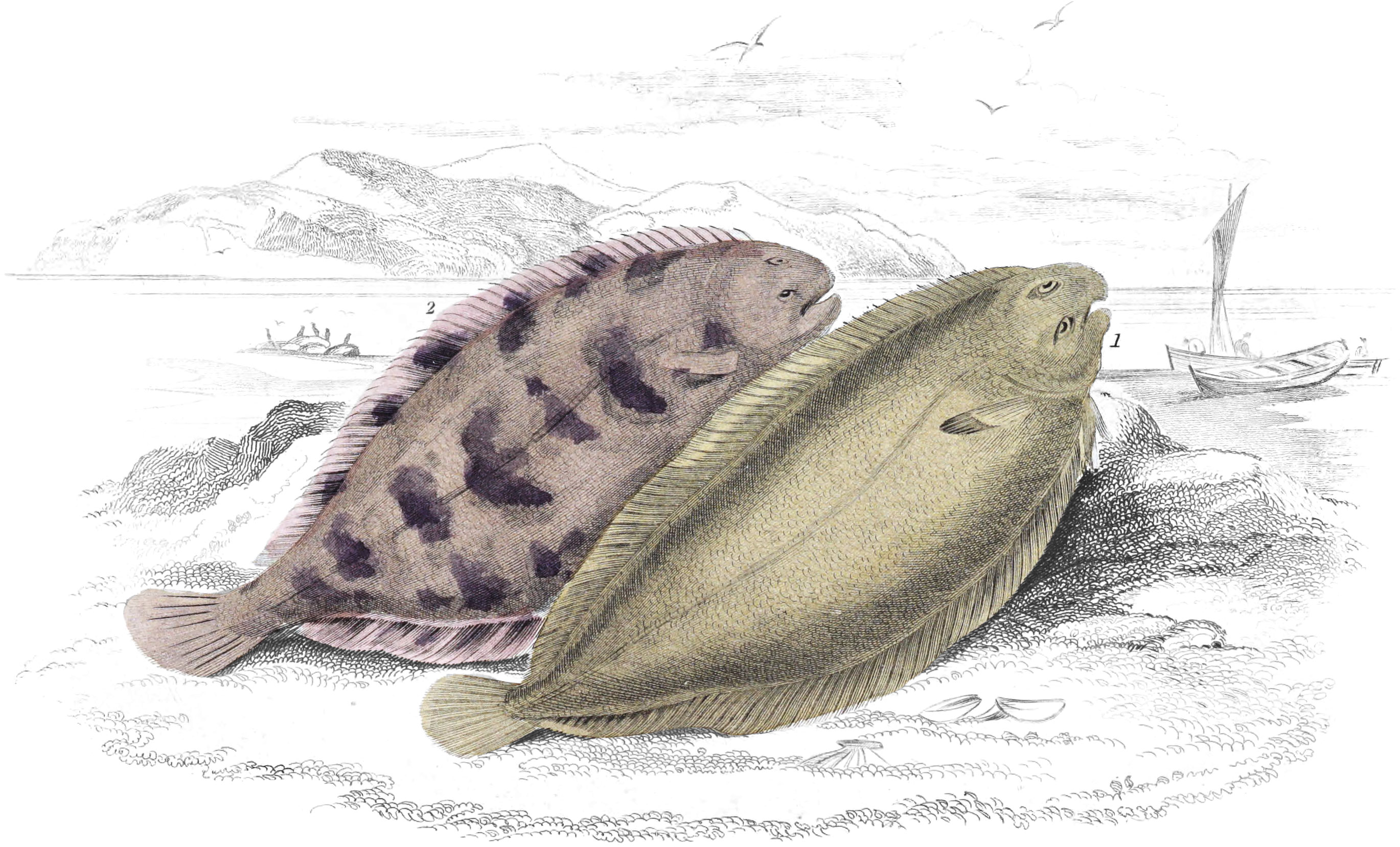
Plate XII
Lemon Sole, or French Sole
Sp. 183. Solea Pegusa
The colour of the Lemon Sole, is a mixture of orange and light brown, and it is freckled over with numerous small round brown spots. It is wider in proportion than the Common Sole, the greatest breadth (including the fins) being half the length. The under surface of the head is almost smooth, instead of presenting the papillæ so remarkable in the common Sole. Its length does not appear to exceed ten or twelve inches.
First discovered by Mr. Yarrell and described by him in the Zoological Journal for May 1829, under the above name. He at first considered it identical with the Solea Pegusa of Lacépède, and the Sollo de rocco, as also the Monochirus Pegusa of Risso, which occurs at times in the Mediterranean; but Mr. Jenyns asserts that this is not the case, and Mr. Yarrell seems now to be of the same opinion, as he has not inserted these appellations among his synonyms. In that case, the name should be changed, as having been previously appropriated to another species. He obtained, in the first instance, only one example at Brighton, but a few others were afterwards procured in the London Market, and it is not unknown on the coast of Devonshire, where it is called the Sand Sole. The Brighton fishermen take it occasionally along with the Common Sole, when trawling over a clear bottom of soft sand; and as this happens most frequently in the direction of the French coast, they sometimes call this fish the French Sole.
Gen. LXXXV. Monochirus
In all the flat fish the pectoral fins are small, and in the Soles they are particularly so, the fin on the under or white side being less than the corresponding one on the upper side, and showing a tendency to become obsolete. In the restricted group now to be considered, this takes place absolutely or nearly so, the fin in question being almost imperceptible or entirely disappearing, and that on the upper side being much reduced in size. In this respect these fishes are exactly intermediate between the typical Soles and the foreign group named Achirus, in which both pectorals are wanting. The circumstance alluded to is the only one in which Monochirus differs from Solea, so that its value is inconsiderable, and inadequate for more than forming a section of the genus Solea, or at most a very subordinate sub-genus.
Variegated Sole
Fig. 2. Sp. 184. Monochirus variegatus
This fish was first noticed by the editor of Pennant’s British Zoology, published in 1812, who named it the Red-back Flounder, and supposed it to be the Solea garva seu lingula of Rondelet. Donovan, and Dr. Fleming respectively figure and describe it under the name of Variegatus; and Mr. Jenyns, under the name of S. lingula, confounds it with the following species, an error of which he himself had some suspicion at the time, but which was almost unavoidable before the discovery of M. linguatulus in Britain threw a new light on the subject. M. variegatus is a small fish scarcely attaining half a foot in length, the colour of the surface reddish brown, variegated on the body and fins with dark brown; the scales are large, ciliated, and rough to the touch, and there is a distinct space between the termination of the dorsal and anal fins and the root of the tail. This is a rare species in Britain. We learn from various sources that it has been taken at Rothsay, near Plymouth—where it is said to be common in the spring,46—on the coasts of Cornwall, and in Belfast Bay.
Plate XII
The Solenette, or Little Sole
Sp. 185. Monochirus linguatulus
The exertions of Dr. Parnell, whose investigations have not been confined to the Firth of Forth, have been the means of adding this small and distinct species to our Fauna. He obtained it at Brixham, on the Devonshire coast, and published a notice of it in 1837, in the Transactions of the Royal Society of Edinburgh, under the name of M. minutus, Mr. Yarrell, we believe, being the first who detected its identity with the M. linguatulus of Rondelet and Cuvier. These Soles are by no means scarce in the locality mentioned, being often taken in the trawl-nets throughout the year, perhaps to the amount of a dozen or more daily, but as they are too small to be an object of attention with the fishermen, they are either thrown overboard or left to decay at the bottom of their boats. They are known to the fishermen by the name of Red Soles, the colour of the back being light reddish-brown, and as they never exceed the length of five inches, there can be no doubt that they are mature fish, and not a juvenile state of some other species. Mr. Thompson has obtained specimens on the north coast of Ireland.
The peculiarity specified in the generic character, the very small size of the upper pectoral, in connexion with the colour, shape of the body, and extension of the dorsal and anal fins to the very base of the tail, where they almost form a union with the caudal, will prevent this fish being mistaken for M. variegatus, to which it is most nearly related, and readily separate it from all the other Pleuronectidæ.
XX. Family of the Suckers. Cyclopteridæ
Representatives in British Fauna.—Gen. 3. Sp. 5.
-
Gen. 86. Lepadogaster.
- Sp. 186. L. Cornubiensis. Cornish Sucker.
- Sp. 187. L. bimaculatus. Two-spotted Sucker.
-
Gen. 87. Cyclopterus.
- Sp. 188. C. lumpus. The Lump Sucker.
-
Gen. 88. Liparis.
- Sp. 189. L. vulgaris. Unctuous Sucker, or Sea-snail.
- Sp. 190. L. Monagui. Montagu’s Sucker.
This family is of very limited extent, most of the species of comparatively small size, and not of much importance in an economical point of view. It corresponds to the third family of Cuvier’s Malacopterygii Sub-brachiati, named by him Discoboli, from a very striking peculiarity in their structure. The ventral fins are very much dilated beneath, and surround a circular disk, which acts as a sucker. By means of this instrument these fishes are able to retain their place in a strong current of water, and obtain food in places where most other kinds of fish would be swept away.
Gen. LXXXVI. Lepadogaster47
In this genus the membranes representing the pectorals form one large disc, and behind that there is another formed by the union of the ventrals. The body is without scales. Only two British species are known.
Cornish Sucker
Fig. 1. Sp. 186. Lepadogaster Cornubiensis
This small species, the length of which does not usually exceed two inches and a half, appears to have been first noticed in this country by Dr. Borlase, on the coast of Cornwall. That is still the locality where it occurs in greatest plenty, although it has been noticed both in Scotland and Ireland. Pennant calls it the Jura Sucker, specimens having been procured by him from the shores of that island. It is frequently spotted, and there are two large ocellated spots behind the eyes; these however are not visible in the young fish. It is usually found about low-water mark, adhering to stones, and is often left by the tide. Mr. Couch says it spawns in March, and that its food consists of crustaceous and other minute marine animals.

Plate XIII
Two-Spotted Sucker
Sp. 187. Lepadogaster bimaculatus
Two-spotted Sucker; so called from two marks on the sides, which, however, are not always very obvious, and in young specimens are altogether wanting. This species seldom much exceeds an inch and a half in length; the head depressed and the body tapering more than in L. Cornubiensis. The prevailing colour is a fine red; under side flesh colour. It has been found at Weymouth, Torcross in Devonshire, Polperro and Penzance in Cornwall, and also in Ireland. It appears to have been first described by Pennant, who states that specimens were communicated to him by the Duchess Dowager of Portland.
Gen. LXXXVII. Cyclopterus
The possession of suckers is the principal property in which this genus, at least viewed in relation to Britain, shows an affinity to the other members of the family. There is a single suctorial disc formed by the union of the pectoral fins under the throat, and the ventrals also are connected with it. The body is still free from scales, but it is covered with a series of tubercles, and is remarkably deep and thick compared with the length. There is but one British species, namely,
The Lump Sucker
Fig. 2. Sp. 188. Cyclopterus lumpus
This species attains a length of a foot and a half or upwards, and from its great depth and thickness has a very massive and clumsy appearance. The anterior part of the back rises into a sharp prominent ridge, which seems to have given rise to the name of Cock-paidle, or paddle, often bestowed on this fish. It is extensively distributed, especially in northern seas, and appears to extend to America. It is frequent on our own coasts, appearing at times in multitudes during the spring months. The male is much (nearly one-half) smaller than the female, and at the breeding season becomes of a bright red colour; but after spawning, both sexes change their hue considerably, a circumstance which has given rise to the notion that they are two species of Lump-fish. They spawn in the end of March or in April, the ova being deposited among the rocks and seaweed within low-water mark. The male is said to watch the ova till the exclusion of the young, when the latter fix themselves, by means of their sucker, to his sides and back, and he thus carries them off to deeper water and more secure retreats. Dr. Parnell states that, on the west coast of Scotland, sometimes as many as two dozen are taken in the salmon-nets almost at every tide, principally in the month of June, when they seek the sandy ground to deposit their spawn. The fishermen boil them down with vegetables for their pigs, and consider them to be fattening food. The flesh when cooked is soft and very rich, and is considered by some of the inhabitants of Edinburgh as a luxury; but there are few stomachs with which it agrees, in consequence of its oily nature. The males are considered best for the table.
The food of the Lump-fish is almost wholly small fish, although Mr. Couch has occasionally found onisci in its stomach. It becomes in its turn the prey of seals, which devour it in large numbers. It is very tenacious of life, and its power of adhesion so great, that a very heavy stone or other substance to which it has attached itself may be lifted with it, if an attempt be made to draw it away.
Plate XIII
Gen. LXXXVIII. Liparis
This genus is readily known from the other two composing the British family of Cyclopteridæ, by having a single dorsal fin extending from the tail to before the middle; the anal is also lengthened. The body is without scales and very smooth, and covered with an unctuous secretion.
Unctuous Sucker, or Sea-Snail
Fig. 1. Sp. 189. Liparis vulgaris
The usual length is from four to six inches, the whole body of a soft texture, soon dissolving after death. The skin is somewhat loose and invested with a thick slimy matter. It is found in various parts of the coast of Britain, as well as in Orkney, and other countries further north. It is said to be eaten in Greenland, although its appearance is by no means inviting, and we know that the flesh of an allied species described by Pallas is so bad that even dogs will not eat it. It is full of spawn in January, and the mature ova are described as of large size. Dr. Parnell has taken L. vulgaris in the Firth of Forth, but it is far from common in that estuary.

Plate XIV
Montagu’s Sucker
Sp. 190. Liparis Montagui
This diminutive fish was first described by Colonel Montagu in the Memoirs of the Wernerian Society (vol. i. p. 91, pl. 5), and it was named after him by Donovan, who figured it in his British Fishes. In the Unctuous Sucker the dorsal and anal fins are connected with the caudal; in the present instance there is an intervening space. This species seldom exceeds three inches in length, and is of a dull orange colour, varied with faint tints of blue. It is found chiefly on rocky parts of the coast, and appears to be not very scarce in many places. Berwick Bay, south-western coast of Scotland, Cornwall, Devonshire, and south coasts of Ireland, have been mentioned as localities. When adhering to any object, it has the habit of curving the hinder or free portion of its body forwards towards the head.
XXI. Family of the Remora Suckers. Echeneidæ
Representatives in British Fauna.—Gen. 1. Sp. 1.
-
Gen. 89. Echeneis.
- Sp. 191. E. remora. Sucking-fish.
The few fishes which compose this singular family, are properly natives of more southern seas than those which wash our shores. Only one appears to inhabit Europe, and that is the species of which we have now to give some account, namely, the famous Remora of the Mediterranean, of which the Roman writers give such extraordinary accounts.
Gen. LXXXIX. Echenesis
In the fishes last noticed the adhesive disc occupies the under side of the anterior part of the body; here it is placed on the crown of the head, in the form of a large oval shield composed of numerous transverse cartilaginous plates, surrounded by a muscular margin. The body is elongated, and covered with such small scales that it has frequently been described as destitute of scales altogether; the mouth wide and densely beset with teeth; a single dorsal fin opposite the anal; tail lunate.
Common Sucking-Fish
Fig. 2. Sp. 191. Echeneis remora
This species cannot be regarded as a habitual inhabitant of our seas, but only as a very rare visitor, and that probably as the result of mere accident, rather than from it voluntarily extending its range in this direction. We believe that the sole instance of its occurring here is that mentioned by Dr. Turton, who states that, in the summer of 1806, one was taken by him at Swansea from the back of a cod-fish. It is a well known fish in the Mediterranean, and was familiar to the Greeks and Romans, from whom we have received many fabulous accounts of its extraordinary powers in attaching itself to the sides of ships and instantly arresting their course. Those who take pleasure in such narrations will find ample details in Pliny’s Nat. Hist. and in the voluminous collections of Gesner, Johnson, Rondelet, &c. Feeding principally on the small animals diffused throughout the waters of the ocean, it probably receives a sufficiency of food even when attached to a moving object, such as a ship or large fish, merely by opening its mouth, which has a very wide gape. But it must be admitted that we know nothing peculiar in its economy to enable us to explain why it is supplied with an apparatus apparently intended to meet some peculiar want. Whether it attaches itself to other objects, as Mr. Yarrell remarks, for protection or conveyance, or both, is a question which has not been satisfactorily ascertained.
The length of the Mediterranean Remora is about eighteen inches, and the length of the head nearly one-fifth of the proportion of the whole fish. The adhesive shield contains seventeen or eighteen transverse laminæ, and it commences just behind and above the upper lip, extending nearly as far as the ends of the pectoral fin rays. The fins are all covered with a leathery membrane. In reference to the adhesive apparatus, Mr. Yarrell says,
The vertical direction of the moveable laminæ is effected by sets of muscles going off obliquely right and left from two elongated bony processes, one on each half of each of these moveable divisions. The contraction of these muscles, acting upon these levers, raises the external edges of the parallel divisions, increasing the area of the vacuum; and it will be observed that the points of the moveable transverse divisions to which the muscles are attached are nearer the middle line than the outer edge, by which the chance of interfering with the perfect continuity of the free margin, and thereby destroying the vacuum, is diminished. All the bony laminæ, the outer edges of which are furnished with rows of minute tooth-like projections, are moved simultaneously, like the thin vertical divisions of our common wooden window-blinds, by means of the mechanical contrivance on the framework. The longer muscles, placed near the outer oval edge, are probably instrumental in preserving the contact of the more flexible margin, and the serrated external edges of the parallel laminæ help to preserve the degree of elevation obtained: the adhesive power is in proportion to the area of the vacuum.48
Plate XIV
Order IV. Malacopterygii Apodes
The Fourth Order of bony fishes with soft fins, is named Malacopterygii Apodes, because the ventral fins, or those which may be considered as representing the feet, entirely disappear. The order is made up of one natural family of anguilliform fishes, some of which are remarkable for their form, and others, of exotic origin, for their powerful electrical properties.
XXII. Family of the Eels. Murænidæ
Representatives in British Fauna.—Gen. 7. Sp. 11.
-
Gen. 90. Anguilla.
- Sp. 192. A. acutirostris. Sharp-nosed Eel.
- Sp. 193. A. latirostris. Broad-nosed Eel.
- Sp. 194. A. mediorostris. Snig Eel.
-
Gen. 91. Conger.
- Sp. 195. C. vulgaris. Common Conger Eel.
-
Gen. 92. Muræna.
- Sp. 196. M. Helena. Common, or Roman Muræna.
-
Gen. 93. Leptocephalus.
- Sp. 197. L. Morrisii. Anglesey Morrs.
-
Gen. 94. Ophidium.
- Sp. 198. O. imberbe. Beardless Ophidium.
- Sp. 199. O. barbatum. Bearded Ophidium.
-
Gen. 95. Echiodon.
- Sp. 200. E. Drummondii. Drummond’s Echiodon.
-
Gen. 96. Ammodytes.
- Sp. 201. A. Tobianus. The Sand-Eel, Horner, or Hornels
- Sp. 202. A. lancea. Sand-launce, or Common Sand-eel.
When it is stated that the type, or most characteristic representative, of this family, is the Common Eel, one of the most familiarly known of our native fishes, little more need be added to convey an idea of the general appearance of the species. Differing considerably from each other in the details of their structure, they possess in common a long, narrow, serpent-like body, which, owing to the conformation of the vertebral column, is extremely flexible; the greater part of the body surrounded by a low nearly continuous fin; scales so minute as to be for the most part almost invisible; and the surface frequently invested with a slimy mucus. The cæca are wanting; but all have an air-bladder, which sometimes assumes a very peculiar form.
Gen. XC. Anguilla
Our acquaintance with the species of true Eels, composing the present group, is by no means in a satisfactory state. It is not long since all the Eels found in this country were regarded as specifically the same; in the best and latest works three kinds are described as distinct. The differences consist chiefly in the form of the head and the colours of the body. In the former respect Eels seem subject to great variation, and there is reason to think, that if this be assumed as a mark of distinction, we might find grounds for believing in the existence of even more than three species. No one believes that there are two species of Conger-Eel in our seas; and yet we have seen an example which presents nearly the same difference in the form of the snout, that there is between the sharp-nosed and broad-nosed Eel. The anterior part of the head of the Conger is usually elongated and rather narrow; in the specimen alluded to (which is preserved in the Edinburgh University Museum) it is comparatively short and blunt. May not difference of sex have something to do with this? The kind of water in which they dwell, soil, food, and general nature of the locality, has perhaps a greater influence on the colour of Eels than on any other fish, and we have already seen how great that influence is in many cases,—in that of the Common Trout, for example. It is not improbable, therefore, that the views of ichthyologists will yet undergo some change regarding the specific distinctions of the members of this genus; meanwhile, we proceed to notice the species as at present admitted by Messrs. Jenyns and Yarrell.
Sharp-Nosed Eel
Fig. 1. Sp. 192. Anguilla acutirostris
This may be regarded as the Common Eel, although the broad-nosed Eel is in many places equally plentiful. It is found in all the fresh waters of this country; abounds throughout Europe, except in the arctic regions and some of the rivers, such as the Wolga and certain tributaries of the Danube, which have their source in very cold regions; occurs also in Asia, the great islands of the Pacific Ocean, and in North America. It is, strictly speaking, a fresh-water fish; can subsist permanently in fresh water, and, there can be little doubt, breeds there. When it has the means, however, of following its natural instinct, it migrates towards the sea in the autumn, and resides in the brackish water at the mouths of rivers. As eels are extremely sensitive to cold, it is supposed that this situation is preferred during the winter months, on account of the higher temperature there obtained, resulting from the mixture of two fluids of different densities, the salt and fresh water. The brackish water in such situations is about two degrees warmer than that of the river or sea. Here they commonly bury themselves in sludge, and the spawn becomes matured.
The mode of generation in Eels was long a matter of doubt, and the most absurd notions have been entertained as to the mode in which it is effected. Not long since they were believed to be viviparous; but the careful investigations of Mr. Yarrell, continued for many months in succession, scarcely leave room for doubt that they are oviparous, producing their young like other true osseous fishes.
They are often kept in ponds, and become comparatively tame;49 but they are so voracious as to destroy all other kinds of fish in such situations (except some of the larger kinds which they are unable to overcome), and when in want of food, devour each other. In rivers they are very destructive to the spawn of other fishes; they likewise feed on worms, larvæ of insects, carcasses, and even occasionally vegetable substances. Their tenacity of life is well known; and the facility they have, owing to the suppleness and sliminess of their body, in gliding between opposing objects or slipping from the hand, has passed into a proverb. They are able to remain a longer time out of the water than most other fishes, owing to the power they possess of closing the aperture over the gills and thus preventing the desiccation of the latter; the mucous secretion also keeps the body long moist. In consequence of these provisions, they often voluntarily leave the water, and travel over a considerable space of land; sometimes, it would appear, in order to obtain food, at other times for the purpose of changing their abode. These migrations usually, or always, take place in the night, when the absence of the sun, and the frequent presence of dew, or rain, prevent them suffering from the want of their natural element.
Being much in request, in most countries, for the table, various modes are adopted for capturing Eels. When ascending rivers from the sea, which they do at times in immense bodies (in 1832, it was calculated by two observers, that from sixteen to eighteen hundred passed a given point in the Thames at Kingston, in the space of one minute), numerous plans are resorted to on purpose to intercept them. The apparatus used in the Thames, called an Eel-buck, consists of a number of wicker baskets of a peculiar form supported on a wooden framework, each basket having a large open end opposed to the stream, and the interior so constructed that a fish once entering cannot get out again. When imbedded in the mud, they are often taken by eel-spears; and at times dug out in heaps. Large quantities are imported to Billingsgate from Holland, for which a duty of £13 per cargo used to be paid. But though so much used as food, Eels cannot be considered as very wholesome, the great quantity of oil they contain rendering them difficult of digestion. A strong prejudice against them exists in Scotland, occasioned probably by their serpent-like form, and the pretty general impression that they are not true fish.
It is mentioned, in Griffiths’ edition of Cuvier’s Animal Kingdom, that the skin of eels, which has a consistence resembling parchment, forms the object of a small trade in great cities. The property of making hair grow has been attributed to if when used as a fillet; and in Tartary it is employed, after being oiled, as a substitute for glass in windows. To this we may add, that we have often seen it worn round the arm or finger, as a cure for rheumatic pain.
We have often seen anglers, as the most ready means of killing eels, make a transverse cut in the tail, under the idea that they most speedily bleed to death by being wounded in that part of the body. May not the destruction, in so doing, of the singular pulsatory apparatus, described in our Introduction as a lymphatic heart, be the means of hastening death?
The life of Eels seems to be of long duration, and their growth, as is usual in such cases, is rather slow. They often attain a very large size, five or six feet in length, and weighing upwards of twenty pounds.
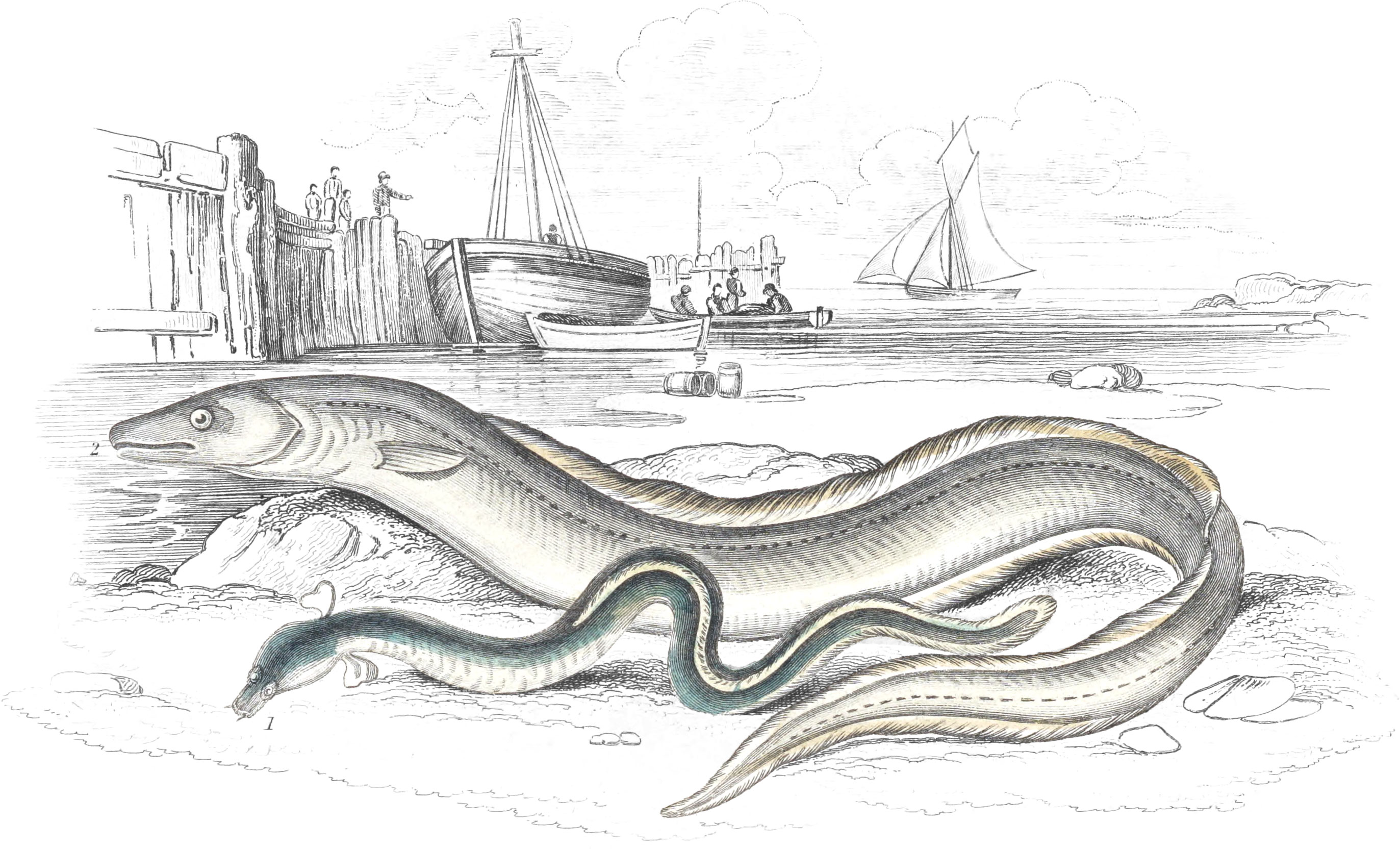
Plate XV
Broad-Nosed Eel
Sp. 193. Anguilla latirostris
The habits of this species, as far as ascertained, differing in no respect from that just described, we have only to notice its principal marks of distinction. Of these the most observable is indicated by the name, the snout being depressed and comparatively large, the nose broad and rounded. The skin is said to be much thicker than in A. acutirostris, and feels more soft and unctuous. It is the variety mentioned by Pennant as known in the Thames by the name of Grigs, and about Oxford by that of Grigs or Gluts. He adds that they are not so much esteemed as A. acutirostris, and do not often exceed three or four pounds in weight. The largest Mr. Yarrell has seen did not weigh above five pounds. This Eel appears to be common, at least in England; it also occurs in the Firth of Forth, and is probably not rare in other parts of Scotland.
Snig Eel
Sp. 194. Anguilla mediorostris
All that we know of this supposed species we owe to Mr. Yarrell, who obtained specimens from Mr. Jesse and Mr. Mills. They were procured from the Avon in Hampshire, where this Eel is called the Snig, and is considered distinct from the other Eels. The author just named says,
In the comparative breadth of the nose, the Snig is intermediate in reference to the sharp and broad nosed Eels, but rather more resembles that with the sharp nose; it has a slight but elongated depression extending from the anterior edge of the upper jaw to the upper and back part of the head; the tubular openings of the nostrils are larger, and the mucous pores about the lips larger and more conspicuous; both jaws rounded at their extremities, the lower one the largest; teeth larger and stronger than in the common sharp nosed species; gape large; the angle and the posterior edge of the eye on the same vertical line; he pectoral fins, the commencement of the dorsal in, and the vent, are each placed nearer the head than in either of our fresh-water Eels. The general colour is olive-green above, passing by a lighter green to yellowish white below.
He further shows that the five first cervical vertebra are destitute of the lateral spinous process which is possessed by the other two. The Snig, moreover, roves about and feeds during the day, which other Eels do not. It is considered excellent food, and seldom exceeds half a pound in weight.
Gen. XCI. Conger
Most of the generic characters of Anguilla are likewise exemplified in Conger, but the latter is readily distinguished by the dorsal commencing nearly on a line with the hinder extremities of the pectorals, and forming, by uniting with the anal, a pointed caudal fin. Several species are known in the Mediterranean and other seas, but the only one that visits our shores is
Common Conger Eel
Fig. 2. Sp. 195. Conger vulgaris
Common Conger-eel; which occurs pretty frequently all around Britain and Ireland. It is a large fish, sometimes exceeding ten feet in length, and weighing upwards of a hundred pounds, but its ordinary dimensions are from five to seven feet. It is entirely a marine species, although frequently found in the mouths of rivers, which it is alleged to frequent for the purpose of feeding on the fish that ascend or descend the stream. Of these it devours a large quantity, as well as crabs and shell-fish, the strength of its jaws enabling it to comminute very hard substances. The smaller kinds of fish it swallows almost entire: in the stomach of one brought to the Edinburgh market in 1834, no fewer than sixty-eight spirlings were found, and these were so fresh and uninjured, that they were afterwards exposed to sale, and soon obtained a purchaser.50 The gigantic palinuri, or spiny lobsters of the Mediterranean, are said to enter into combat occasionally with the Conger, and generally come off victorious by tearing the fish with their claws. The season for spawning is December or January, and young fish, about the thickness of a man’s finger, may be seen in rocky places close to the shore, during the summer. Although the flesh cannot be spoken of with high commendation, this does not prevent it being much used for food. The rich feeding-ground in the Firth of Forth between Alloa and Stirling produces a considerable number of Congers, whence they are often brought to the Edinburgh market, where one four feet long is sold for about a shilling or eighteen-pence. They are often dried, and in that state exported, principally to Spain. The most profitable fishery for Congers is on the Cornish coast, where, according to Mr. Couch, it is not uncommon for a boat with three men to bring on shore from five hundred weight to two tons as the produce of one night’s fishing! Long lines called butters are employed, and the ordinary bait is a pilchard; the French fishermen, however, prefer the sand-launce as a bait, its shining silvery lustre rendering it particularly attractive.
Plate XV
Gen. XCII. Muræna
Of this genus, which is distinguished chiefly by the absence of pectoral fins, we have only one British representative, and that must be ranked among the rarest visitors to our shores, namely,
Common, or Roman Muræna
Sp. 196. Muræna helena
There is only one instance on record of its occurrence in Britain, Mr. Couch having obtained a specimen from a fisherman of Polperro, caught on the 8th October, 1834. It is very plentiful in the Mediterranean, and is the muræna so highly prized by the ancient Romans, who kept them in their vivaria almost in a tame state, and carefully fattened them for the table. The flesh is white, fat, and of very agreeable flavour. The fish is said to thrive equally well in salt and fresh water, although it never occurs naturally in the latter. The ordinary length is between three and four feet, and examples are sometimes met with weighing between twenty and thirty pounds. It is fished for with lines, and is rather difficult to capture. It is voracious, bites severely, and can live a long while out of its natural element. The colours and markings are extremely beautiful, and in connexion with the form of the fish, give it a strong resemblance to some kinds of serpents.

Plate XVI
Gen. XCIII. Leptocephalus
The remaining genera of the family Murenidæ may be regarded as forming a section by themselves, differing in many important points from those already noticed. The species are of comparatively small size; the body, instead of being cylindrical or nearly so, is much compressed, becoming in several instances riband-shaped, and the whole texture is extremely delicate. This is the case in particular with the genus above named (so called on account of the smallness of the head), of which only one species has yet been discovered in Britain. It is the
Anglesey Morris
Sp. 197. Leptocephalus Morrisii
First made known by Pennant, who obtained a specimen from Holyhead, where it was discovered by the individual after whom it is named. Other specimens have since been found in various parts of the coast of England, Wales, and Ireland, so that this curious fish is now comparatively well known, although some were formerly disposed to exclude it from our Fauna, under the impression that Pennant had been labouring under some mistake regarding it. It is a fish of extreme delicacy, being semipellucid; and when placed on a slip of glass, and examined in a good light, the intestine, and some other parts of its internal structure, can be distinctly perceived. It is of a fine silvery hue; the eyes large and prominent; and its motions are described by Mr. Deere, who had a specimen for a short time alive, as very graceful.51 It is about five or six inches long, the head short and blunt, the dorsal commencing before the middle, the anal rather behind it, and both uniting at the tail, which gradually narrows to a point. The lateral line is straight, and a double series of oblique lines meet it at an acute angle. The thickness of the fish, according to Montagu, does not exceed the sixteenth part of an inch. It is usually found entangled among sea-weed. Mr. Yarrell is of opinion that the Leptocephalus Spallanzani of Risso, which occurs in the Mediterranean, is identical with the fish just noticed.
Gen. XCIV. Ophidium
A few simple characters, as they will be found stated in our Synopsis, are sufficient to indicate the distinction between this and the allied genera. We possess two species presenting strong marks of difference, although it has not been thought necessary to separate them generically.
Beardless Ophidium
Sp. 198. Ophidium imberbe
We are indebted to Pennant for the earliest notice of this fish as British. His specimen, communicated to him by the Duchess of Portland, was obtained at Weymouth, but as he gave only an indifferent figure of it, unaccompanied with description, considerable doubts exist as to the identity of his fish with the one above named. Colonel Montagu afterwards procured an example of what he considered to be O. imberbe, and described it under that name in the Memoirs of the Wernerian Society.52 Cuvier appears, however, to have entertained some doubt as to Montagu’s fish being the true Linnean O. imberbe.53 Jenyns, Yarrell, and some other authors, receive it as such, but some further information on the subject seems necessary to clear away all difficulties.
The length of Colonel Montagu’s fish was about three inches, depth about a quarter of an inch: head very obtuse; eyes large; body compressed towards the tail; pectoral fin rounded; dorsal commencing immediately above the base of the pectoral; anal commencing at the vent, and, together with the dorsal, uniting with the caudal, which is wedge-shaped. Colour purplish brown, disposed in minute speckles.

Plate XVII
Bearded Ophidium
Sp. 199. Ophidium barbatum
The claims of this species to be admitted into our lists of native fishes, rest on very doubtful authority. Berkenhout introduced it into his synopsis, but without mentioning any of the circumstances which led him to do so, and when we consider that he altogether omitted O. imberbe, which had been previously described, such authority does not seem entitled to much weight. No subsequent zoologist has met with it in our seas. It is a well known fish in the Mediterranean, where it is captured with nets, and used for the table, although its flesh is very indifferent. It is named Donzella in Languedoc, and is the Donzelle commune of Cuvier.
Gen. XCV. Echiodon
The description of this new form in Ichthyology we owe to Mr. W. Thompson of Belfast. A single specimen of the fish on which the genus is founded, was discovered, in a dead state, on the beach at Carnclough, near Glenarm, in the county of Antrim, in the month of June 1836, by Dr. J. L. Drummond. Ample details will be found in the Proceedings and Transactions of the Zoological Society, from which we select the following particulars.
Drummond’s Echiodon
Sp. 200. Echiodon Drummondii
The length of the specimen was eleven inches; the greatest depth six lines a little behind the head the body gradually narrowing from that point to the tail; the whole very much compressed, especially towards the tail. No scales could be detected, but these may have been abraded while the fish was exposed on the beach. The dorsal fin commencing one inch six lines from the snout; anal just behind the vent, and both uniting to the caudal, which is pointed; the fin rays gradually becoming longer as they approach the tail, and the body more and more attenuated. The anterior half of the body was a dull flesh-colour, presumed to have been originally red; behind the middle marked and spotted over with reddish brown. The dentition is rather remarkable, and well distinguishes this fish from those which most resemble it in other respects. Mr. Thompson says,
There are two large strong teeth placed close together, and curving inwards at each side of the extremity of the upper jaw, the two inner one-sixteenth of an inch apart.54 In the lower jaw one slender rounded tooth, nearly one line long on each side, curving outward at the base, and inward at the point. Entire upper and under jaw and vomer densely studded with small bluntish teeth, somewhat uniform in size; vomer extending far forward, and very much developed, forming a cavity in the lower jaw, and in advance of the tongue when the mouth is closed; a series of rows of teeth, similar to those last described, on the palatal bones; all the teeth of the upper jaw exposed to view when the mouth is closed.
Difference of opinion may arise as to the proper position and relations of this curious fish. Mr. Thompson was originally of opinion that it belonged to the Tænioidæ, or Riband-fish, it showing considerable affinity to that family. It is to be hoped that other specimens will soon be met with.
Gen. XCVI. Ammodytes
This genus is strikingly contrasted with the other members of this family in having a deeply forked tail, and the dorsal and anal fins separated from the caudal by a considerable space. The head is a good deal elongated, and the under jaw is much longer than the upper. Although two species appear to have been long recognised by fishermen in this country, and designated by different names, it is but of late that the proper distinctions have been pointed out by naturalists. The first is
The Sand-Eel, Horner, or Hornels
Fig. 1. Sp. 201. Ammodytes Tobianus
This is much the larger of the two, usually measuring from ten to fifteen inches. It is, however, comparatively rare, as scores of the Common Launce, or smaller Sand-eel, may readily be procured for every individual of this species. They are occasionally observed swimming about near the shore, and have been caught with a bait. But they usually bury themselves in the moist sand after the retiring of the tide, to a depth of from four to six inches. They have been found on most of our shores where the beach is composed of fine sand, and in the Firth of Forth are not unfrequent. We have never seen the Common Launce dug for to any extent near Portobello or on the northern shores of the Forth, without a good many Horners (as they are here invariably called) being at the same time procured. They are brought to the Edinburgh market and sold by the dozen, their flesh being esteemed very palatable. Dr. Parnell says they shed their spawn in September.

Plate XVIII
Sand-Launce, or Common Sand-Eel
Sp. 202. Ammodytes lancea
This well known fish is much smaller than the preceding, scarcely ever exceeding seven or eight inches, and being more frequently under six; but a more satisfactory means of discrimination will be found in the dorsal fin commencing in a line over the middle of the pectorals, whereas in A. Tobianus the dorsal commences on a line with the hinder extremity of the pectorals. It may be affirmed, generally, to be distributed all around the shores of Britain and Ireland, and also occurs in many other countries. Large shoals are frequently observed swimming about near the shore, and it often happens as with the species already noticed, that instead of retiring with the ebbing tide, they dig into the sand, and remain there till the water again covers them. Advantage is often taken of this by the people dwelling on the coast, and when it is discovered that a shoal of Sand-eels have hidden themselves in the sand, they repair often in great numbers to the spot, armed with spades, shovels, three-pronged forks, rakes, &c. to dig them out. This they seem to do partly for the sport, and partly for the value of the fish, and we have sometimes witnessed very animated scenes on such occasions. When dug from the sand, the fish leap about with singular velocity, and the gathering of them affords a fine amusement to the younger parties, who are commonly most numerous and eager in this pursuit. It is remarkable with what ease and rapidity these slender and delicate looking fish penetrate the sand, even when it is of a pretty firm texture. They seem to form a favourite morsel with many, and are even at times brought to the Edinburgh market and sold by measure. On the south coast of England they are sometimes salted and dried. But their principal use is as bait for the capture of more valuable fishes, there being scarcely any other found to answer the purpose so effectively.
Sand-launces are eaten in other countries besides our own. Mr. Swainson informs us that the Sicilians reckon them, when fried, among their most delicious fishes, and he therefore recommends them to be eaten in this country, which, he adds, they seldom or never are, owing to some singular prejudice. It is strange that he should have been unacquainted with the fact that they are in such general use and so much esteemed especially in Scotland.
Order V. Lophobranchii
We now come to Cuvier’s Fifth Order of Bony Fishes, which is of very limited extent, and distinguished by having the branchiæ in small rounded tufts disposed in pairs along the branchial arches, owing to which peculiarity it is named Lophobranchii, or with the gills in tufts. There is only one family, namely,
XXIII. Family of the Pipe-Fishes. Sygnathidæ
Representatives in British Fauna.—Gen. 3. Sp. 7.
-
Gen. 97. Sygnathus.
-
Gen. 98. Acestra.
- Sp. 205. A. æquorea. Æquoreal Pipe, or Needle-fish.
- Sp. 206. A. anguinea. Snake Pipe, or Needle-fish.
- Sp. 207. A. ophidion. Straight-Nosed Pipe, or Needle-fish.
- Sp. 208. A. lumbriciformis. Worm Pipe, or Needle-fish.
-
Gen. 99. Hippocampus.
- Sp. 209. H. brevirostris. Sea-horse.
The Pipe-fish have a very remarkable appearance, the body being long and very slender, the snout also much lengthened, and the whole covered with bony plates like a coat of mail. The disposition of these plates is such as to render the body angular, but they do not materially interfere with its flexibility. The mouth, which is placed at the extremity of the elongated narrow tubular snout, is very small, and opens almost vertically. There are no ventral fins, and, in the majority of instances, no anal, pectoral, or caudal. But the most remarkable peculiarity they present is, in the genus Sygnathus, a marsupial pouch under the abdomen, in which the eggs are matured, and into which it would appear the young occasionally retreat. Although the section containing the species destitute of a caudal fin, and without a marsupial bag, is sufficiently distinct from the other to be distinguished generically, we do not find that this has been done by any recent author except Mr. Swainson; but as the name Acus which he applies is objectionable from being used in a specific sense in the same family, we have substituted another term of equivalent meaning.
Gen. XCVII. Sygnathus55
In this group, which contains only two British species, the pectoral, dorsal, anal, and caudal fins, are all present; and the males are furnished with an elongated pouch under the tail.
Great Pipe-Fish
Fig. 2. Sp. 203. Sygnathus Acus
Attains a length of between twelve and sixteen inches in our seas, but in the Mediterranean and some other seas seems to grow much larger. The body is heptangular anteriorly, then becomes hexangular, and the whole of the caudal portion is quadrangular. The osseous plates which cover the body are about sixty-three in number, all of them beautifully striates. The operculum is large, shaped nearly like a mussel-shell, the surface granulated and marked with radiating strife. The pectoral fin is small, the dorsal pretty high, but the longest rays not equal in height to the depth of the body; tail well developed, rounded at the extremity, and very like a half-expanded fan. Both sexes are pretty well figured by Pennant in his British Zoology (vol. iii. pl. 26), but under different names; the marsupial pouch being indicated in the figure of the male. The singular use of this abdominal bag, however, seems not to have been rightly understood till lately. It is now ascertained that the ova are transferred from the abdomen of the female into this false belly or pouch; that they become matured there, and the young hatched. At what time the male receives the charge of the ova, and in what precise manner the exchange is effected, are points not exactly known. It further appears, that even after the young make their escape from this receptacle, they are in the habit, for a short time after their birth, of occasionally retiring to it. These fishes thus present us with a perfect analogy to marsupial quadrupeds. As in several other instances presented by this class of animals, the Great Pipe-fish begins to breed while yet young, specimens of four inches long, apparently of the preceding year, having been found with full-grown ova.
This is the most common species of the family, frequenting shallow places, apparently in most parts of our coasts. Mr. Couch says it swims in a singular manner, horizontally or perpendicularly, with the head downwards or upwards, and in every attitude of contortion. It is frequently met with in the Firth of Forth, where, as well as in other parts of Scotland, it is called the Tangle-fish, as it is commonly found lurking under sea-weed, or tangle, as it is called in the north.
This fish, in common with all the others belonging to the family, is of no use either as food or bait, the dry rigid body almost resembling a piece of wood, and being, as Cuvier says, presque sans chair.
Plate XVIII
Deep-Nosed, or Lesser Pipe-Fish
Sp. 204. Sygnathus Typhle
The habits and economy of this species, as far as known, being the same as in that just described, we have little to add to the external marks of distinction as they are stated in our Synopsis. It occurs almost as frequently as S. Acus, and on the shores of all the three kingdoms. Dr. Parnell says,
It is rather rare in the Firth of Forth, although a place apparently favourable for its habits. It frequents water from three to four feet deep, where the bottom is of a sandy nature and covered with the smaller kinds of fuci, among which it prowls about in search of minute aquatic insects. I have taken them in pools, at North Berwick, left by the receding of the tide, but further up the Firth they seem but little known. At Brixham, in the month of September, I saw as many as four dozen taken at one haul of a net; and I was informed at the same time by the fishermen, that in the earlier part of the season, they would sometimes inclose fire times that number; which being of no service, are invariably returned again to the sea.56
Gen. XCVIII. Acestra
The most conspicuous differences between this group and the preceding have already been alluded to. They consist of the entire absence, in Acestra, of pectoral, ventral, anal, and caudal fins, the dorsal alone being present, but that is always conspicuous. Neither is there any abdominal sac, although provision is made for the performance of a function analogous to what is executed by the former. The species are much more slender and vermiform than the Sygnathi, and if a distinction of English names were thought desirable, they might with propriety be termed Needle-fish, an appellation which has occasionally been given to the whole family.
Equoreal Pipe, or Needle-Fish
Fig. 1. Sp. 205. Acestra æquorea
We believe that the first notice of this fish as British occurs in Sir Robert Sibbald’s Scotia Illustrata, and that his specimen was found in the Firth of Forth, although it has not been taken in that locality since. The Berwickshire, Northumberland, and Devonshire coasts have afforded examples, as well as one or two other places, but it seems to be very rare. The Cornish fishermen report that they have seen it far out at sea, swimming at the surface over a depth of upwards of fifty fathoms.

Plate XIX
Snake Pipe, or Needle-Fish
Sp. 206. Acestra anguinea
This singular looking fish scarcely exceeds the thickness of a goose-quill, and is readily known from the preceding by the remarkably long narrow tail. The body is scarcely angular while it is alive, but becomes so after death, when the parts begin to dry. The sexual peculiarities of the genus Acestra have been observed chiefly in this species, and Mr. Yarrell says that neither male nor female possesses an anal pouch, but the ova after exclusion from the abdomen of the female are carried for a time by the male in separate hemispheric depressions on the external surface of the abdomen, anterior to the anus. The females have no such depressions. Males taken in August were found to have one ovum of the size and colour of a mustard-seed lodged in each cup-like cell.
Seems to be pretty generally distributed, but occurs nowhere in great plenty.
Straight-Nosed Pipe, or Needle-Fish
Sp. 207. Acestra ophidion
Body very long, slender, and nearly cylindrical, tapering from the anal aperture gradually to a fine point. The head is very little narrower than the anterior portion of the body, the forehead very slightly depressed. Mr. Yarrell’s English name, therefore, is a very distinctive one. Mr. Jenyns describes this species under the name of S. lumbriciformis, and he states his belief that it is not uncommon on many parts of the coast, and is said to be called in Cornwall the Sea-adder. Mr. Yarrell obtained several specimens from the Dorsetshire coast.
Worm Pipe, or Needle-Fish
Sp. 208. Acestra lumbriciformis
This is the S. ophidion of Pennant, and some other authors who took him as their guide. He also calls it the Little Pipe-fish, it being the smallest of the family, usually about five inches long. The nose is shorter and more suddenly turned upwards than in the other species; the eyes prominent. It appears to pass through a kind of metamorphosis when young; the whole of the tail, when it escapes from the egg, being enveloped in a thin membrane, and small pectoral fins are also visible, both of which subsequently disappear. It is probable that a more intimate acquaintance with fishes in the earlier stages of their development, would supply many examples analogous to this. The Worm-like Pipe-fish does not appear to be rare, although it is probably often overlooked owing to its small size. It is common on the coast of Cornwall; occurs in various parts of Ireland; in Berwick Bay, and in Orkney, where, according to Low, it is found very frequently under stones in the space between high and low-water mark.
Gen. XCIX. Hippocampus
Cuvier defines this genus as having the trunk laterally compressed, and much more elevated than the tail; when the body curves after death, the upper parts have some resemblance to the head and neck of a horse in miniature, which has suggested the English name. The margin of the scales are formed into ridges, and the angles into spines. Both sexes have pectoral and dorsal fins, and the females an anal one. The species are not numerous, but they occur in some parts of the Continent in considerable plenty, and are often kept in cabinets of miscellaneous curiosities, in a dry state (their structure rendering them of easy preservation), owing to the singularity of their form. They may indeed be examined either dead or alive without it being conjectured that they belong to the class of fishes. The shape and disposition of the plates on the tail are such as to admit of it being easily curved inwards, and it is accordingly used as a prehensile instrument, the animal twisting it round the stems of marine plants, and waiting in that position with its head free, ready to dart at any passing object which it desires to make its prey. We have only one species,
Short-Nosed Sea-Horse
Fig. 2. Sp. 209. Hippocampus brevirostris
Short-nosed Sea-horse, and that is very rare, a few specimens only being found now and then, chiefly in the south of England. They are described as swimming in a vertical position, with the tail ready to grasp any object that may be met with.
When two approach each other, they often twist their tails together, and struggle to separate or attach themselves to the weeds; this is done by the under part of their cheeks or chin, which is also used for raising the body when a new spot is wanted for the tail to entwine afresh. The eyes move independently of each other, as in the chameleon; this, with the brilliant changeable iridescence about the head, and its blue bands, forcibly remind the observer of that animal.57
The mode of propagation, as far as known, coincides in every respect with that of the true Syngnathi. There can be little doubt also, from the structure of the mouth and snout, that the food is the same as in that typical group.
Plate XIX
Order VI. Plectognathi, or Fishes with Soldered Jaws
The Cuverian Order named Plectognathi, or fishes with soldered jaws, next claims our attention. The principal characters he states to consist in the maxillary bone being soldered to the side of the intermaxillary, which constitutes the jaw, and the connexion of the palatal arch with the cranium by an immoveable suture. The skeleton is still osseous, although from the slow manner in which ossification takes place, and the imperfect structure of the jaws, we can discern an approach to the great tribe of cartilaginous fishes, in which no true bone occurs.
XXIV. Family with Naked Teeth. Gymnodontidæ
Representatives in British Fauna.—Gen. 2. Sp. 3.
-
Gen. 100. Tetrodon.
- Sp. 210. T. Pennantii. Pennant’s Globe-fish.
-
Gen. 101. Orthagoriscus.
- Sp. 211. O. mola. Short Sun-fish.
- Sp. 212. O. oblongus. Oblon Sun-fish.
Gen. C. Tetrodon
In the absence of true teeth, the partially exposed jaws are divided in the middle by a suture, thus presenting the appearance of four teeth, as the name implies. The species are, properly speaking, tropical; and in common with those of the genus Diodon, which has no representatives in Britain, they possess the singular power of inflating the belly into a rounded ball by swallowing air. When thus inflated, in consequence of the under parts becoming lighter than the upper, they turn upside down, and continue to float about in this position, apparently retaining the power of directing their course. As the inflated abdomen is covered with spines, this seems to be a means of warding off the attack of enemies; at least there can be no doubt that it is often attended with that effect, although the occurrence of certain species with the parts in question entirely smooth (Leisomus of Swainson, a name inadmissible because previously appropriated), may be regarded as a proof that it is not wholly intended for that purpose. Several of the species are regarded as poisonous. The only one that occurs on our own coasts is named by Mr. Yarrell.
Pennant’s Globe-Fish
Sp. 210. Tetrodon Pennantii
Pennant’s Globe-fish, under the impression that it is not identical with the T. lagocephalus of Gmel., Linn., and Artedi, as it was regarded by the editor of Pennant’s works in the edition of 1812. It was first recorded by Pennant as a British species, and named by him lævigatus. He had seen only a single specimen, which was taken at Penzance in Cornwall. Since that time another has occurred on the Cornish coast, a third at Mount’s Bay, and a fourth near Waterford in Ireland. The length is about a foot and a half, the back rich blue, the belly and sides silvery white, fins and tail brown. The distensible skin extends from below the mouth nearly to the insertion of the anal fin, and is pretty thickly beset with spines which spring from a stellated root of four processes. After filling this crop-like expansion with air and water, it expels them by degrees from the branchial apertures and mouth with considerable force, producing a pretty loud noise. It is asserted by Mr. Darwin, who has given a good account of the habits of this fish in the Voyages of the Adventure and Beagle, that when handled it emitted from the skin of its belly a most beautiful carmine red and fibrous secretion, which stained ivory and paper in so permanent a manner that the tint is retained with all its brightness to the present day.

Plate XX
Gen. CI. Orthagoriscus
The oblongo-circular form, compressed body truncated behind, great depth of tail, head not distinguishable from the trunk, and the undivided jaws which serve as a cutting edge instead of teeth, at once mark this conspicuous and very remarkable genus. The species are far from numerous and two of them are found in our seas, one of them not very scarce, and the other a very rare visitor. They are called Sun-fish, if is supposed, on account of their circular form, and shining surface. They grow to a large size, and as Mr. Swainson remarks, look more like the dissevered head of a fish than the entire animal itself. They are said to exhibit a high degree of phosphorescence.
Short Sun-Fish
Sp. 211. Orthagoriscus mola
In some instances this fish is almost perfectly circular in the outline; at other times it is more elongated, the length increasing with age more than the breadth. It may always be distinguished from the following species, with which it has sometimes been confounded, by the comparative shortness of body, the roughly granular skin, and the rounded extremity of the pectoral fin. The body is very deep for its length, the rays of the dorsal and anal fins long and pointed, and both unite with the caudal, which is of the whole width of the body. Although a rare fish, examples have occurred at intervals all along the coasts of Britain, from Shetland to Cornwall, as well as in the Irish seas, and they are always objects of curiosity to their captors from their singular aspect. The specimens have varied in length from fourteen inches to three or four feet, and in weight from fifty to four hundred pounds. It was first observed, in this country, by Sir Andrew Balfour, in the Firth of Forth, and no fewer than eight or nine examples have since occurred in that estuary; the last of these, now preserved in the Royal Univ. Museum of Edinburgh, was caught in Largo Bay. Being destitute of an air-bladder, this fish probably feeds near the bottom, but is frequently observed lying on its side at the surface, apparently in a state of repose, and allowing itself to float along with the waves or tide. In this seemingly dormant condition, it may be lifted into a boat, without attempting to make almost any effort in self-defence. We believe that it is always captured by fishermen when they have an opportunity of so doing, as an object of curiosity, but it is of no value to them otherwise, as the flesh is not used for food. If obtained in any abundance, it might be turned to good account from the large quantity of oil contained in the fatty layer under the skin. It appears to be generally distributed over the seas of Europe, and has also been seen on the coasts of America.
Oblong Sun-Fish
Sp. 212. Orthagoriscus oblongus
Authors are widely at variance respecting the value of the characters presented by the Oblong Sun-fish, for while Linnæus and Lacépède regard it as identical with the Short Sun-fish, Shaw and Swainson consider it as constituting the type of another genus. To this they assign the name Cephalus, and found it chiefly on the length of the pectoral fin, which terminates in a point, and the body being hard, the surface divided into small angular compartments, which indicate some relation between this group and the Ostracinæ. The length of O. oblongus is always more than twice, sometimes approaches to three times, the depth of the body; and although the surface is divided into minute compartments, it is smooth. We believe that only four instances are on record of this fish being found in our seas. Dr. Borlase, in his Natural History of Cornwall, figures and describes a specimen from Mount’s Bay; and speaks of another taken at Plymouth in 1734 which weighed five hundred pounds. Donovan obtained a small specimen from the Bristol Channel, from which the figure was taken for his Natural History of British Fishes (pl. 41). Recently a specimen was caught in a newly made canal at a short distance from Towey, in Cornwall, of which an account is given by Mr. Couch in the 6th volume of the Annals of Nat. Hist. The species is said by Cuvier to occur at the Cape of Good Hope.
XXV. Family of the File Fishes. Balistidæ
Representatives in British Fauna.—Gen. 1. Sp. 1.
-
Gen. 102. Balistes.
- Sp. 213. B. Capriscus. European File-fish.
The family of the File-fish, which is a very numerous and important one in tropical seas, is entitled in this place only to a very brief notice, as it can scarcely be said to form a part of our indigenous fauna. The species are most numerous on the shores of India and America, and two only occurring in the Mediterranean, they cannot even be considered as very characteristic of European Ichthyology. The colours of many of the foreign species are very warm and beautiful.
Gen CII. Baslistes
European File-Fish
Sp. 213. Balistes Capriscus
Has been long known as an inhabitant of the Mediterranean, and there is only one instance on record of a single individual having wandered to our shores. It was captured on the Sussex coast, in 1837, as announced by Mr. Children in his address to the Zoological Club of the Linnean Society at the close of that year. It was a small specimen measuring about nine inches and a half, whereas the ordinary length is between one and two feet. It is named File-fish, in common with the rest of the family, in consequence of the first dorsal spine being covered on its anterior edge, with rough granular projections; and the term Balistes has reference to another peculiarity in the structure of that spine and the one immediately adjoining.
Salviani was the first to discover that the bones or rays of the first dorsal fin are so contrived as to act in concert, with considerable force, in suddenly elevating the fin at the pleasure of the animal; though the foremost or largest be pressed ever so hard, it will not stir; but if the last or least ray of all be pressed but very slightly, the other two immediately fall down with it, as a cross-bow is let off by pulling down the trigger. For this reason the fish is called at Rome pesce halestra;58 the latter name having been used by the Romans for an engine of war constructed on a somewhat similar principle, for throwing darts and arrows. The flesh of this fish is held in no estimation, and has even been regarded as positively deleterious.

Plate XXI
Second Series. Chondropterygian, or Cartilagionous Fishes
We have now passed in review such members of the First great series of Osseous Fishes as have been found in our seas, and proceed to notice, in a similar way, the Second Primary Series, named by Cuvier Chondropterygian or Cartilaginous Fishes. Compared with the former, it is of very limited extent, not above forty species occurring in this country, and of these by far the largest proportion belong to the great families of the Rays and Sharks. In this series, in contradistinction to the former, the skeleton never consists of true bone, but is essentially cartilaginous, that is to say, according to Cuvier’s definition, no osseous fibres are formed, but the calcareous matter is deposited in small grains and not in threads or filaments; thence it is that there are no sutures in the cranium, which is always formed of a single piece. Another of the most prominent characters in this series of fishes is the want of maxillary and intermaxillary bones; or rather the mere rudiments of them may be said to exist under the skin, while their functions are performed by the palatals, and sometimes even by the vomer. Owing to the comparatively soft texture of their skeleton, these fish seem to continue to grow more or less during the whole period of their lives, and many of them, accordingly, are by far the largest of the true fishes, attaining, in many cases, even to enormous dimensions.
In these fishes the gills are either free, as in the generality of fishes, or they are fixed by having the outer edge attached to the skin, so that the water can find admission to the spaces between them only by holes in their surface. This peculiarity affords the means of making two divisions, both of which have representatives in Britain. To the first of these, Cartilaginous Fishes with free Gills, belongs
XXVI. Family of the Sturgeons. Sturionidæ
Representatives in British Fauna.—Gen. 1. Sp. 2.
-
Gen. 103. Acipenser.
- Sp. 214. A. sturio. Common Sturgeon.
- Sp. 215. A. latirostris. Broad-nosed Sturgeon.
This family is composed of a single genus, containing the well known and highly valuable Sturgeons. They are at once known by the elongated and angular body, defended by longitudinal rows of large indurated plates of a pyramidal form with the apex pointed. The snout is depressed and conical; the mouth tubular and without teeth, and placed on the underside of the head, at some distance behind the extremity of the snout. Our indigenous species are not very satisfactorily known, and it is conjectured that at least another may exist besides the two named above. They are numerous in other seas, and A. husa and A. ruthenus, the former a much larger, and the latter a much smaller species than our own, are of great value to the inhabitants of Northern and Eastern Europe, almost every portion of the body being turned to economical use—the flesh as food, the roe prepared and dried under the name of Caviare for the same purpose, the air-bladder as isinglass, from which we have the jelly called blanc-mange, the court-plaster of the shops, besides other useful preparations. Sturgeons seek their food chiefly among the mud at the bottom of rivers, and their head is admirably adapted for the purpose. The elongated snout, protected by broad plates, ploughs up the mud, as a hog does the ground; and it is probably from this habit they get the name of Sturgeons, from the German störer or stoer which signifies to dig the mud. A little way behind the point of the snout and on the underside is placed a series of worm-like cirri, or feelers, the office of which no doubt is to examine the objects turned up by the snout; a little behind these comes the sucker-like mouth, ready to receive what is thus provided for it.
Gen. CIII. Acipenser
Common Sturgeon
Sp. 214. Acipenser sturio
This may be considered a species of middle size, varying from six to upwards of eight feet. It is seldom, if ever, found in any plenty in this country, but is at times obtained in various localities, and often finds its way to the markets of our principal towns, particularly that of London. Both in France and this country the Sturgeon is regarded as a royal fish, that is to say, the property of the crown; and a provision still exists in the Statute-book, that the king’s escheater shall make diligent inquiry whether any Sturgeon has been taken and withdrawn from the crown. The flesh is firm and compact, tasting somewhat like veal. It is a migratory fish, passing the winter in the depths of the ocean, and entering estuaries and the mouths of rivers in spring. They are never taken with lines, but are usually found entangled in salmon-nets. In the Firth of Forth, according to Dr. Parnell, an individual is taken, on an average, once in every three years, and then generally in the salmon-nets at Musselburgh or Queensferry. The largest specimen recorded as having been caught in this country, weighed four hundred and sixty pounds.
Broad-Nosed Sturgeon
Sp. 215. Acipenser latirostris
In the Common Sturgeon the nose is long and pointed, and the cirri are placed about midway between its anterior extremity and the mouth; in the present species, the nose is broad and blunt, and the cirri are placed nearer the top of the snout than to the mouth: other distinctions will be found in our Synopsis. This species, apparently very distinct from A. sturio, and not yet identified with any of the continental species, was first made known toy Dr. Parnell, who describes it in his Essay on the Fishes of the Firth of Forth, and in the Transactions of the Royal Society of Edinburgh (vol. xiv. pl. 4). He states that the fishermen of the Solway Firth had long been in the habit of noticing that two species of Sturgeon were occasionally entangled in their nets; and he obtained a fine specimen of the Blunt nosed one, from the Firth of Forth, in July 1835. It was taken near Alloa, and sent to the Edinburgh market, where it sold at a shilling a pound. A few weeks after another of nearly equal size was caught in the Tay, which was also sent to the Edinburgh market: an entire specimen of the sea-mouse (Aphrodita aculeata) was found in its stomach. We are not aware that any other examples of the broad-nosed sturgeon have occurred in Britain, except the two mentioned by Dr Parnell.
XXVII. Family of the Chimæræ. Chimæridæ
Representatives in British Fauna.—Gen. 1. Sp. 1.
-
Gen. 104. Chimæra.
- Sp. 216. C. monstrosa. Northern Chimæra, or Rabbit-fish.
Gen. CIV. Chimæra
In this genus the body, as in that of the sharks, to which it is nearly allied, is lengthened, the tail long, tapering, and ending in a naked filament; the first dorsal short but high, the second low and extending along the back to the tail. The species are not numerous, and from the fantastic shape of the head, they are usually called sea-monsters.
Northern Chimæra, or Rabbit-Fish
Sp. 216. Chimæra monstrosa
Northern Chimæra, or Rabbit-fish, was first noticed as British by Pennant, who received a drawing of a specimen taken off the Shetland Islands. It was likewise known to Dr. Walker as an inhabitant of these northern seas; and Dr. Fleming, who has supplied the best description we have seen of this fish, obtained a specimen from the same quarter, sent by Laurence Edmonstone, Esq. surgeon, Unst, where it is termed the Rabbit-fish. Mr. Yarrell further states that another specimen, also from that locality, has lately come into the possession of Mr. W. C. Hewitson of Newcastle. As far as our information, therefore, at present extends, the seas around the Shetland Islands are the only British localities for this remarkable fish. It is comparatively, however, well known to the Norwegians, who give it the name of gold or silver fish, from the resplendent colour which forms the ground of the body, and which is set off by the dark spots above and below the lateral line. It is also called by them Sea-rat, from the form of the tail, and King-fish, from a filament terminating in a tuft, which is found on the head of the male. They obtain an oil from the liver by infiltration, which is esteemed useful in complaints of the eyes, and is also applied to wounds.59 The colours are very beautiful, the upper parts dark brown, varied with yellowish brown and silvery; the lower parts bright silver; the eyes large, green, with silvery irides, their lustre extremely brilliant. It is on account of the colour and brilliancy of the eyes that the Mediterranean fishermen call it Cat. The female differs considerably from the male, particularly in the form of the head, which is more conical. The males are distinguished by having a short upright process, or caruncle, fringed or denticulated at the extremity, springing from the forehead, and they have also trifid bony appendages to the ventral fins. Cuvier says they produce very large coriaceous eggs with flattened velvety edges. One of the reasons of this fish being so seldom seen is, that it commonly frequents the deep recesses of the ocean.

Plate XXII
XXVII. Family of Sharks. Squalidæ
Representatives in British Fauna.—Gen. 12. Sp. 15.
-
Gen. 105. Scyllium.
- Sp. 217. S. canicula. Small-spotted Dog-fish, Morgay, or Bounce.
- Sp. 218. S. catulus. Large-Spotted Dog-Fish, or Bounce.
- Sp. 219. S. melanostomum. Black-mouthed Dog-fish.
-
Gen. 106. Carcharias.
- Sp. 220. C. glaucus. The Blue Shark.
- Sp. 221. C. vulgaris. The White Shark.
-
Gen. 107. Zygæna.
- Sp. 222. Z. malleus. Hammer-head shark.
-
Gen. 108. Galeus.
- Sp. 223. G. vulgaris. Common Tope, Penny Dog, Miller’s Dog.
-
Gen. 109. Mustelus.
- Sp. 224. M. lævis. Smooth Hound, Ray-Mouth Dog, Smooth Shark.
-
Gen. 110. Lamna.
- Sp. 225. L. Cornubica. Porbeagle or Beaumanris Shark.
-
Gen. 111. Selachus.
- Sp. 226. S. maximus. The Basking Shark.
-
Gen. 112. Alopias.
- Sp. 227. A. vulpes. Fox-shark, or Thresher.
-
Gen. 113. Acanthias.
- Sp. 228. A. vulgaris. Picked Dog-fish.
-
Gen. 114. Scymnus.
- Sp. 229. S. borealis. Greenland Shark.
-
Gen. 115. Echinorhinus.
- Sp. 230. E. spinosus. Spinous Shark.
-
Gen. 226. Squatina.
-
Sp. 231. S. angelus. Angel-Fish, Monk-Fish, Shark-Ray.
-
From the large size of many of the species, and their peculiar habits, this family is one of the most conspicuous and remarkable in the whole class of fishes. They are the most perfectly organised of all the cartilaginous fishes, in several instances of gigantic forms, and from their voracity, which is proverbial, they are the dread of those who frequent tropical seas. The larger kinds are but seldom met with on the British coasts, but they abound within the tropics, where they are truly regarded as the tyrants of the deep. The teeth are long, sharp, and triangular, with projections and serratures on the sides, arranged in a series of transverse rows and looking backwards; they form such a perfect cutting apparatus, that, being moved by very powerful muscles, scarcely any edible substance can resist their action. Well authenticated instances have occurred of a shark having cut off a man’s leg, nay, it is even asserted, cut a human body in half, at a single bite. A human body, almost in an entire state, has been found in the stomach of a shark; and Müller states that one was taken off the island of St. Margaret, which weighed 1500 pounds, and that the stomach contained the whole body of a horse, which had probably been thrown overboard from some ship. Substances are occasionally found in the stomach which seem to have been swallowed accidentally. One was caught last season near the Isle of May, in the Firth of Forth, which contained in its stomach a tin canister, which, upon being opened, was found to be nearly filled with old coins! As the teeth are formed (excepting in two genera) solely for seizing or tearing, the food is always swallowed in a nearly entire state.
Some members of the family are viviparous or produce their young alive. Others bring forth their young in a horny case which has generally the form of a parallelogram, with long filamentous tendrils attached to each corner, which are supposed to be designed to fix it to fuci or other marine objects while the young are maturing. The fœtus is coiled up in the centre, and is nourished by an umbilical bag of a pyriform shape, filled by a yellowish vitelline matter. When the young is mature, it makes its escape by an opening at the square end, at the place next the head. These eggs are often found on the sea-shore after they have lost their tenant, and are known by the names of sea-purses, sailor’s purses, mermaid’s purses, &c.
The males are smaller than the females, and are provided with two peculiar organs, placed near the inner edge of the ventral fins. The name Claspers usually given to these, sufficiently indicates the opinion entertained by naturalists as to their use. The flesh of Sharks is frequently eaten, but it has little to recommend it; the Sicilians are said to consider the young as very palatable. No Shark is possessed of scales; the skin is rough with small siliceous-like particles, which protect and defend it. When dried, the skin forms an article of commerce, and is used for polishing wood; also as a covering for boxes, watch-cases, &c. under the name of shagreen. The liver of some of the larger species affords a large quantity of oil.
Gen. CV. Scyllium
The presence of an anal and two dorsal fins, the first dorsal never placed in advance of the ventrals; and the existence of temporal orifices, are the chief distinctions of this group. The branchial openings are five in number, and placed partly above the pectorals; the nostrils near the mouth. The teeth are small, sharp, and pointed, with small denticulations on each side, which give them the appearance of being tricuspidate. The species are of small size, considering the family to which they belong, and all of them are prettily spotted. They are called Dog-fish, and sometimes by the older writers Cat-fish, in neither case for very obvious reasons, but probably their habit of following their prey to a great distance, and, as it were, hunting it down, has suggested the former name.
Small-Spotted Dog-Fish, Morgay, or Bounce
Sp. 217. Scyllium canicula
This is considered the most common of the three British species, but it is not so plentiful in Scotland as along the southern shores of England. It is widely distributed, but apparently becomes scarce as we advance northwards, as it is not included in the Greenland Fauna. Its voracity is represented as very great, and it frequently follows ships like the larger sharks, for the purpose of feeding on any thing that may be thrown overboard. Fish and Crustacea, however, form its ordinary food, although it rejects no kind of animal substance that falls in its way. Its ordinary length is between two and three feet, and it very seldom reaches four feet. The spots are small and numerous, of a dark reddish brown colour on a pale reddish ground on all the upper parts of the body, the under side yellowish white. The female, as is usual in this family, is larger than the male, and according to Pennant, produces about nineteen young at a time.
Large-Spotted Dog-Fish, or Bounce
Sp. 218. Scyllium catulus
Less than the preceding, and much scarcer: the spots large and scattered, the ventrals cut square at the extremity, the valves of the nostrils not approximate, as in S. canicula, but separate and not reaching to the mouth. The ground colour also is somewhat different, the red tinge not being observable. In S. canicula, the whole of the second dorsal fin is behind the anal; in S. catulus it is in a line over the lower portion of the anal. In the former, the small lobe that is situated immediately under the outer margin of the nasal valve, is of a square form; in the latter that lobe is somewhat of a triangular form and about three times broader than its length, extending from the inner corner of the nasal aperture along half its base, or nearly as far as the posterior margin of the nasal valve; the teeth in S. catulus are about double the size of those in S. canicula.60 The spots are occasionally ocelliform, on which account the species has been named S. stellaris by the generality of writers. It is disposed to frequent rocky ground, and is known from that circumstance by the names Rochier, Rock Dogfish. D. Parnell says,
In the Firth of Forth examples are occasionally found in the salmon-nets at Queensferry. It is stated by the fishermen, that it is more frequently met with on some of the shores further north, and at Wick specimens of large size have been taken in the herring-nets; but as the two species are so closely allied, it is not improbable that they have been frequently confounded. I have seen examples of both species of three feet and a half in length. They feed on almost any animal substance, and extrude their purses or eggs during the winter months. On dissecting a specimen in the month of September, I found two purses of large size, but the fœtus was not in the slightest developed. At one of the extremities of the horny capsule were attached two strong, slender tendrils, very much resembling that which is used by fishermen under the name of Indian weed.61
Black-Mouthed Dog-Fish
Sp. 219. Syllium melanostomum
This species constitutes the genus Pristiurus of Müller and Henle, a rank to which they have raised it chiefly on account of having a series of pretty large scales arranged like the teeth of a saw on the upper edge of the tail. Regarding this character as of not more than specific value, we retain the name assigned to it in Buonaparte’s Faun. Ital. It was first ascertained to be a British fish by Mr. Couch, who transmitted a specimen to Mr. Yarrell. The latter gentleman has since been informed by John Malcolm, Esq. that this species is not uncommon on the west coast of Scotland; and it has also been taken in the north of Ireland. The snout is somewhat more elongated than in the other two species; the teeth smaller; the colour light brown on the back, each side with two rows of ocellated spots, and other spots scattered irregularly. The interior of the mouth is said by Buonaparte to be bluish-black. The length is about two feet. The purse or bag which contains the young is of an oblong shape, and has tendrils only at one end.

Plate XXIII
Gen. CVI. Carcharias
This genus comprehends some of the sharks properly so called, fishes of great size and voracity, well known to every navigator in the Mediterranean and tropical seas, and not strangers to our own coasts, although they appear here only at certain seasons, and in comparatively small numbers. Of the two which have been noticed in the British seas, the least frequent is
The Blue Shark
Sp. 220. Carcharias glaucus
The Blue Shark, which migrates annually to our shores during the pilchard and herring season. Its chief residence is the Mediterranean, where it may be regarded as common, and is the species frequently seen following vessels. It attains the length of six or seven feet. The whole of the upper parts are of a slate-blue, and of the under side nearly pure white. The teeth are triangular, sharp-pointed and serrated on the edges, particularly in the upper jaw, directed backwards, and diminishing in size from the front to the hinder row. The pectoral fins are very large, subfalciform, and terminating in an acute angle, the dorsal and ventral ridge indented at the setting-on of the tail. The latter is divided into two lobes, the upper of which is much the longest and falciform: the under one nearly triangular. Mr. Couch says that the Blue Shark produces its young early in June. On the coast of Cornwall, which is by far its most abundant place of resort in this country, it inflicts great injury on the fishermen by destroying their nets and devouring the fish entangled in them.
Ælian, and various authors since his time, have given many wonderful accounts of the great affection the Blue Shark evinces for its young; among others, that it will permit the small brood, when in danger, to swim down its mouth, and take shelter in its belly. Regarding this statement as confirmed by the observations of Rondelet, Pennant sees nothing more incredible in it than that the young of the Opossum should seek an asylum in the ventral pouch of its parent! It must be admitted that living young have been found in the stomach of this shark, but the proverbial voracity of its race constrains us to believe that this was a compulsory incarceration, and by no means intended for shelter.
The supposed interest taken by the pilot-fish in this shark, which may also be regarded as problematical, has already been noticed.62
The White Shark
Sp. 221. Carcharias vulgaris
This large and powerful fish, one of the most formidable of its tribe, has been long recorded as a visitor to the British seas, but the instances of its capture are very few and by no means well authenticated. Willughby, Sibbald, Grew, Pennant, and Low, all mention it as occurring here, but they give no particulars and do not seem to speak from personal observation. As it is abundant in the Mediterranean, and found in the greatest plenty in tropical climates, nothing can be more likely than that individuals should occasionally visit our coasts. It attains the length of twenty-five feet, and is of a cinereous colour on the upper parts of the body, and whitish beneath. The pectoral fins are very large, the tail expansive and of great power; it is thus enabled to swim with great swiftness. The nostrils are much developed, and it appears to scent its prey at a great distance. It is affirmed that it is much more apt to attack a negro than a white man, and when both are bathing together, or otherwise in its power, it generally selects the former.
The French name this terrible animal Requin or Requiem, the rest or stillness of death, in allusion to the deadly character of its habits; and when we consider its enormous size and powers, the strength and number of its teeth, the rapidity of its movements, its frequent appearance during all the turmoil and horrors of a tempest, with death and destruction apparent in every blast and every wave, to add to the horror of the scene by the phosphoric light emitted from its huge body near the surface of the troubled waters, with its open mouth and throat ready to swallow entire the despairing sailor, we must admit the propriety of a name, expressive of the natural association of ideas, which connects this cruel monster of the deep with death.63
Gen. CVII. Zygæna
The singular form of the head, from which the species of this genus obtain the name of Hammer-headed Sharks, at once conspicuously distinguishes them from all other fishes The head is truncated anteriorly, and each of the sides extended horizontally into a kind of branch, which has the eyes at the outer extremity; the latter thus appear placed on two thick peduncles. Cuvier says that no other similar example is to be found in the animal kingdom; but Mr. Swainson well remarks, that a precisely similar arrangement is observed in the small flies named Diopsis, in which the eyes are supported on a pretty long peduncle. Several species of Hammer Sharks have been described, some of them even more remarkably produced at the sides of the head than the species below, in particular Z. laticeps, a native of the East Indian seas.
Hammer-Headed Shark
Sp. 222. Zygæna malleus
The earliest notice of this fish as British is to be found in the Natural History of Yarmouth by C. J. and James Paget, who state that an individual was taken there in October 1829. According to Mr. Yarrell, another example has been captured in a herring net off the Monkstone Rocks, about two miles to the west of Tenby. It is impossible to mistake the genus Zygæna, but as the several species are very like each other and have not been properly discriminated till lately, it can scarcely be assumed as certain that in the above instances the fish was the true Z. malleus. It is, however, extremely likely, as it is by far the most common in European seas. Its habits are very similar to those of the other large sharks, and it shares with them the characteristic attribute of voracity, not hesitating to attack man when an opportunity offers. It is said, however, to feed on the Rays in preference to any other kind of food. It varies from seven to ten or twelve feet in length. The flesh is very hard and leathery.

Plate XXIV
Gen. CVIII. Galeus
In general aspect the Topes, as the fishes of this genus are called, are not unlike the dog-fish (Scyllium) and the hounds (Mustelus); but the number and position of the fins are nearly as in Zygæna; the temporal orifices are present; the nostrils beneath the middle, and the last branchial opening above the pectoral. The spiracles are rather large, and there is no depression above the root of the tail.
Common Tope, Penny Dog, Miller’s Dog
Sp. 223. Galeus vulgaris
This is by no means a very common fish in the British seas, but it is found not unfrequently on the southern coasts of England and Ireland, and occasionally on the coasts of Scotland. Its principal residence is the Mediterranean, where it is very common. The dimensions of the specimens caught here are seldom considerable, rarely exceeding four or five feet, but Bloch affirms that in the Mediterranean it sometimes attains to the weight of one hundred pounds. Mr. Conch has observed it frequently on the Cornish coast, which seems to be the locality where it is most plentiful in our seas, and he states that the young, to the number of thirty or more, are excluded all at once from the female in May and June. This fish has been caught in Berwick Bay, and it is not rare in the Firth of Forth, where the fishermen often mistake it for a full-grown example of the Common Dog-fish.
Plate XXIV
Gen. CIX. Mustelus
The outline and general aspect much the same as in Galeus, the disposition of the fins similar, but the teeth are blunt and flat, forming a closely compacted pavement on each jaw.
Smooth Hound, Ray-Mouth Dog, Smooth Shark
Fig. 1, Sp. 224. Mustelus lævis
The skin of this fish is much smoother and softer than that of sharks in general; it is from three to four feet in length; and is one of the kinds most frequently met with in the British seas. When young, it is frequently spotted above the lateral line, but these marks disappear in the adolescent state. It is singular that such a deviation in the dentition from the general character of the family should occur in a species, bearing in other respects a perfect resemblance to the Tope and others of the smaller sharks. In form and arrangement the teeth are almost entirely like those of the skate, and similar to those of pristis or the saw-fish. Mr. Swainson says,
Hence we have supposed that they are united by affinity, although there appears a hiatus between mustelus and pristis which nothing yet known is calculated to fill up.64
In reference to the habits of the Smooth Hound, Mr. Couch says that it keeps close to the bottom on clear ground, where it feeds on crustaceous animals, which it crushes previous to swallowing with its tissellated teeth. It has been known to take a bait. The young are produced alive in November, and the whole come to perfection at once. We have on several occasions seen specimens of this fish lying on the beach at Newhaven near Edinburgh. It is not rare among the Hebrides, where it is used as food and esteemed a very delicate fish, its difference in this respect from the other sharks being no doubt occasioned by the different nature of its food.

Plate XXV
Gen. CX. Lamna
In this genus the skin is smooth, and the general aspect somewhat resembles that of the porpoise. There are two dorsals, the first high and large, the second small and placed over the anal. The branchial openings are all before the pectorals; nostrils beneath the base of the pyramidal snout. Up to a very recent period it has been considered that there were two British species of Lamna, the Portbeagle, and Beaumaris Shark. Mr. Yarrell, after a careful examination of four specimens which have been taken on the coast since 1837, has come to the conclusion that the differences observed are only the effects of greater age, and that all are referrible to a single species.
Porbeagle or Beaumanris Shark
Fig. 2, Sp. 225. Lamna Cornubica
Appears to have been first recorded as British by Mr. Jago, since whose time it has often been met with in different parts of the British islands. Dr. Goodenough obtained a specimen at Hastings; Pennant at Brighton; Dr. Johnson two at Berwick; Mr. Couch has seen several at Cornwall; and Dr. Neill and Dr. Parnell have met with it in the Firth of Forth. One caught in 1834 on the coast of Caithness, is preserved in the College Museum of Edinburgh. This specimen measures eight and a half feet in length, and four feet eight inches in girth; sometimes, however, examples occur exceeding these dimensions. According to Mr. Couch, it associates in small companies in pursuit of prey, from which circumstance, and a distant resemblance to the porpoise, it derives its name. He has found the remains of cartilaginous fishes and cuttles in its stomach, and in one instance three full grown hakes.65 The teeth are long (in the Edinburgh Museum specimen, upwards of an inch in length), very sharp, not serrated, but having a denticle on each side at the base. They are arranged in three rows, the inner one much smaller than the others. When the skin is stroked backwards it feels quite smooth; the colour is described variously by different writers. Dr. Johnson says, that in his specimen it was greyish black, the belly white; Dr. Traill describes it as deep bluish black,66 All these, and other discrepancies may be accounted for by difference of age. Gmelin and Turton have taken the same view of the specific identity of the Portbeagle and Beaumaris Sharks, as that which Mr. Yarrell has arrived at as the result of personal observation; Donovan and Fleming are in favour of the same opinion. Dr. Traill, on the other hand, in the article above referred to, contends for their distinction, founding his opinion on the examination of specimens.
Plate XXV
Gen. CXI. Selachus
Of this genus, the distinctive characters of which will be found in the Synopsis, we have but one species, namely,
The Basking Shark
Sp. 226. Selachus maximus
The Basking Shark, by far the largest of our native fishes, frequently measuring upwards of thirty feet. Several of it characters are very strongly marked. The teeth are conic, simple, and rather small for so large a fish. The under lobe of the tail is not much smaller than the upper, which makes the caudal appear nearly regularly lunate. The branchial apertures are very large, and almost encircle the neck. The tail and fins generally are rather small, but this does not prevent it swimming with considerable velocity when occasion requires. Usually, however, it is not much given to locomotion, delighting either to move slowly along the surface with the dorsal fin above water, or even to repose in perfect stillness, commonly with the back, but at times with the belly uppermost, as if enjoying the light and warmth. It is this habit which has led to it being called by some, the Sun-fish, and by Pennant the Basking Shark, a name now generally adopted. It is likewise named the Sail-fish.
They will permit a boat to follow them, without accelerating their motion, till it comes almost within contact, when a harpooner strikes his weapon into them as near to the gills as possible; but they are often so insensible, as not to move till the united strength of two men has forced in the harpoon deeper. As soon as they perceive themselves wounded, they fling up their tail, plunge headlong to the bottom, and frequently coil the rope round them in their agonies; attempting to disengage the harpoon from them by rolling on the ground, for it is often found greatly bent. As soon as they discover that their efforts are vain, they swim away with amazing rapidity, and with such violence, that there has been an instance of a vessel of seventy tons having been towed away against a fresh gale. They sometimes run off with two hundred fathoms of line, and with two harpoons in them, and will employ the fishers from twelve to twenty-four hours before they are subdued.67
As might be inferred from its less formidable armature of teeth, the Basking Shark is less voracious than its congeners, feeding on the roe of echini, medusæ, and, according to Pennant, marine plants. The liver is of large size, and in one fish measuring twenty-six feet, yielded one hundred and fifty gallons of oil; in other instances eight barrels of oil have been procured. From this scource, the fishermen have sometimes realized a profit of £20 from a single fish. It is said by Dr. Fleming to be common on the west coast of Scotland, particularly during the prevalence of a west wind. It has been taken nearly all round the British Islands, as well as on the coast of Ireland. It occasionally enters the Firth of Forth.

Plate XXVI
Gen. CXII. Alopias
This genus can never be confounded with any other, owing to the extraordinary length and form of the tail, which is as long as the whole body. There is only one species,
Fox-Shark, or Thresher
Fig. 1, Sp. 227. Alopias vulpes
Fox-shark, or Thresher, a fish of considerable size, frequently measuring thirteen feet in length, including the tail. In a specimen of these dimensions the latter usually measures upwards of six feet. The under lobe is very small and the upper is slightly curved upwards, and resembles the blade of a scythe. It is the form of this appendage which has caused this shark to be named the Sea-fox, and it obtains the appellation of Thresher from its habit of attacking other fishes and the cetacea, striking them violently with its tail so that voyagers often hear the sound of the strokes at a considerable distance. It has been observed to approach a herd of dolphins sporting in security on the surface, and by one splash of this formidable weapon scatter them in alarm in every direction. It is by no means plentiful in our seas, but has been observed in many different localities. Last season a fine specimen was exhibited at a meeting of the Wernerian Society, which was caught at Largo Bay, in August 1842.

Plate XXVII
Gen. CXIII. Acanthias
Has the general aspect of Scyllium and Mustelus: the presence of a single strong spine, in front of each of the two dorsal fins, affords the means of distinguishing it at once from all the other sharks.
Picked Dog-Fish
Fig. 2, Sp. 228. Acanthias vulgaris
The most common of all the sharks, and found in every part of the British and Irish seas. It is affirmed that on the coast of Cornwall as many as twenty thousand have been taken in a net at one time. It measures from three to four feet; is of a slate-grey on the upper parts, the under parts yellowish white. Bloch states that the young are spotted with white; a fact which we had lately an opportunity of witnessing in a small specimen, not a foot long, caught among the rocks at Newhaven, near Edinburgh. It was of a deep slate-colour on the back, and pretty thickly spotted with white, which gave it a very agreeable appearance. Mr. Couch informed Mr. Yarrell, that for the purpose of using its spines, the Picked Dog bends itself into the form of a bow, and by a sudden motion causes them to spring asunder in opposite directions; and so accurately is this intention effected, that if a finger be placed on its head, it will strike it without piercing its own skin. Low states, that when caught, the fish writhes himself around the fishermen’s hands, often, if they are not attentive, wounding them very severely, which, if it happens in a part near a joint, is always dangerous and bad to heal, making the part to swell and look very red and fiery, and often endangering a gangrene. However this may be, the fishermen always fear these dreadful weapons, and when the fish is hooked and brought up, commonly catch it by the tail, and, with a smart jerk against the edge of the boat, disable it. Mr. Couch has seen a monstrosity of this species with two heads, the separation continuing so far back as behind the pectoral fins.68 This fish is very troublesome to fishermen from its numbers and voracity, by destroying their bait and lines, and becoming entangled in their nets in the room of more valuable captures. Among the Western Islands of Scotland and the Orkney Islands, where these fish actually swarm, they are frequently salted and dried for winter food, and are considered not unpalatable. Oil is also extracted from their livers, twenty individuals yielding about a Scotch pint. Like most others of its congeners, it is ovoviviparous, and produces many young at a time.
Plate XXVII
Gen. CXIV. Scymnus
Has all the fins very small, the anal wanting, and no spines in front of the dorsals; the temporal orifices are large, and placed above as well as behind the eyes; teeth lanceolate in the upper jaw, slightly curved, in the lower jaw crooked at the point, and the cutting edges crenate: skin rough.
Greenland Shark
Sp. 229. Scymnus borealis
A native of the northern seas, where it occurs in great abundance, but only three instances are recorded of its occurrence on our coasts. One was caught in the Pentland Firth in 1803; another was found dead at Burra Firth, Unst, in 1824; and a third was taken on the coast of Durham in April 1840, which is now preserved in the Durham University Museum. No opportunity, therefore, of observing its habits has offered itself to British naturalists; but an interesting account has been given by Scoresby, in his work on the Arctic Regions, and also by Fabricius, in his Fauna Groenlandica, where he names it erroneously Squalus carchctrias. It is frequently fourteen feet long, and six or eight feet in girth. It feeds on almost all marine animals, whether living or dead, but prefers the blubber of whales (excepting that of the spermaceti whale) to all other food. While the men are employed in cutting the blubber from a whale, they have little to fear from it, for it is then so intent on obtaining its favourite food, as to make no effort to obtain any other. It even attacks the whale while alive, and, when dead, scoops out (Scoresby affirms) hemispherical pieces from its body, nearly as big as a person’s head, gorging lump after lump, until the whole cavity of its belly is filled. Insensible to pain and tenacious of life as all the larger sharks are, this species has been proved to be so in a still more remarkable degree. A superficial wound seems in no degree to disturb it, and even when pierced through the body with a sailor’s flensing knife, it does not desert the carcase till its appetite is fully satisfied. When the body is cut into parts, the separate portions continue to show signs of vitality for some time, and it is unsafe to put the hand into its mouth a good while after the head has been separated from the trunk. These peculiarities may be partly accounted for by the singularly languid state of its circulation, the heart, which is very small, performing only six or eight pulsations in a minute, and continuing to beat for some hours after being taken out of the body. The Greenlanders, who name this fish Ekallurksoak, eat the flesh of it both fresh and dried, and twist its rough skin into a kind of ropes. It is said to have sometimes seized a canoe, covered with the skin of the seal (which was probably the attraction), in its mouth from beneath, and, by closing its jaws, destroyed both the canoe and its inmate. Its eyes are often infested by a parasite, the Lerncea elongate which has been described by Dr. Grant.
Gen. CXV. Echinorhinus
It will be seen by consulting the characters, as given in the proper place, that this genus is very distinct from others of the family, and exhibits some curious modifications of structure.
Spinous Shark
Sp. 230. Echinorhinus spinosus
This fish appears to be nowhere abundant, but it has been long known to ichthyologists. Its addition to the British Fauna is but of recent date. The first notice we find of it is in the Proceedings of the British Association at Newcastle in 1828, where a description was given by Arthur Strickland, Esq. of a specimen found on the Yorkshire coast. Since that time four others have occurred, one in Filey Bay, Yorkshire; another near the Land’s End; a third near Brixham; and a fourth near Berry Head. The figure we have given will convey a good idea of its form and general appearance. It varies in length from four to seven or eight feet, and also in the proportionate thickness of different parts of the body, results which are no doubt to be ascribed to difference of age in the individuals described and figured by authors. The most remarkable peculiarities are the position of the first dorsal, which is opposite the abdominal fin, and the numerous spines scattered over the surface of the skin. These spines exactly resemble the prickles on the stems of the rose-bush, being conical, generally curved, and rising from a broad circular base, which is marked with radiating striæ. They are said to be most numerous in the males. The teeth
are regularly placed upon each jaw, only one in use at a time, the rest reclined; they are large, compressed, and somewhat quadrangular, the cutting edges nearly horizontal, and both of their sides are generally tricuspidate. This shark is described by fishermen as sluggish and unwieldy in its movements, and but seldom to be observed towards the surface of the water. When they obtain specimens, it is generally at a time when they are fishing in deep water, and when the bait with which the hooks are armed is near to the bottom. In this respect it resembles Scyllia, or Ground Sharks; and, if we were to regard only its internal organization, we should be disposed to consider it as closely allied to that genus.69

Plate XXVIII
Gen. CXVI. Squatina
Differs from all others of the family by having the mouth at the extremity of the muzzle, and not beneath it; the body flattened horizontally; the pectorals very large, attached anteriorly to the head, and free on the posterior edge. These and some other characters render this genus exactly intermediate between the Squalidæ and Raiidæ, it not agreeing exactly with either.
Angel-Fish, Monk-Fish, Shark-Ray
Sp. 231. Squatina angelus
The depressed form, rounded head, with the eyes on the upper surface, and the singularly expansive pectoral fins, give this fish a very peculiar and not very agreeable appearance, whence probably it has been called angel-fish in ridicule; it is usually, however, said to be so called from the pectoral fins having the appearance of wings, and monk-fish, from the fancied similarity of the head to a monk’s cowl. It is by no means rare on our coasts, especially in the southern parts of the kingdom, and also occurs in Ireland. It is occasionally taken in the Firth of Forth, where it is known to the fishermen by the name of Mongrel-skate. It sometimes reaches the length of eight feet, but British examples are usually much less. It appears to resemble the rays in its habits, swimming close to the bottom, and feeding on the smaller fishes found in such places, and even at times partially concealing itself among the sand and mud. Although its skin is not so well adapted for polishing wood and other substances as that of many other of the sharks, it has been long employed for that purpose, in so much that the fish was described by Aristotle under the name of ρινη, a file, in reference to this circumstance.

Plate XXIX
XXIX. Family of Rays or Skates. Raiidæ
Representatives in British Fauna.—Gen. 5. Sp. 16.
-
Gen. 117. Torpedo.
- Sp. 232. T. vulgaris. Common Torpedo, Cramp-Fish, or Electric Ray.
- Sp. 233. T. nobiliana. New British Torpedo.
-
Gen. 118. Raia.
- Sp. 234. R. mucronata. Long-nosed Skate.
- Sp. 235. R. oxyrhynchus. Sharp nosed Ray.
- Sp. 236. R. intermedia. Flapper-skate
- Sp. 237. R. batis. Skate, Blue-Skate, or Grey-Skate.
- Sp. 238. R. marginata. Bordered Ray.
- Sp. 239. R. microcellata. Small-eyed Ray.
- Sp. 240. R. miraletus. Homelyn, or Spotted Ray.
- Sp. 241. R. spinosa. Sandy Ray.
- Sp. 242. R. chagrinea. The Shagreen Ray.
- Sp. 243. R. clavata. The Thornback.
- Sp. 244. R. radiata. Starry Ray.
-
Gen. 119. Trygon.
- Sp. 245. T. pastinacea. Sting Ray, or Common Trygon.
-
Gen. 120. Myliobatis.
- Sp. 246. M. aquila. Eagle, or Whip Ray.
-
Gen. 121. Cephaloptera.
- Sp. 247. C. giorna. Horned Ray.
The name of Rays, by which this family is so familiarly known, some suppose to be derived from the Anglo-Saxon “Reoh,” which means “rough," many of the species having a rough granular skin. They may be called, as Mr. Swainson remarks, the flat-fish of the cartilaginous order, the depression and lateral expansion of the body being as great as in the Pleuronectidæ or true flat-fish. Their great proportional breadth is produced by the immense development of the pectoral fins, which form a wide salient angle at the sides, run forward completely enveloping the head, and for the most part forming a long conical projection in front of it. The other fins are of insignificant dimensions, and generally placed on the tail. The latter is armed with from one to seven rows of strong spines, and is used as an instrument of defence.
In the male, the teeth, which are usually flat and forming a pavement, commonly become angular with age; and that sex is further distinguished by having a cylindrical appendage to each ventral, sometimes of such length as to present the appearance of three tails. The sex in question has also, for the most part, a series of spines towards the upper outer surface of the pectoral fins.
As with the sharks, the females are larger than the males, and the mode of propagation is similar. The young are enclosed in a horny capsule of an oblong-square shape, with a filament at each corner. Here it is nourished by means of an umbilical bag, till the due period of exclusion arrive, when it enters upon an independent existence.
Till very recently, the Rays were regarded as exclusively salt-water fish, but the discoveries of Mr. Schomburgk, in South America, as well as the researches of other authors, have proved the interesting fact that there are many kinds, particularly of the sting-rays (Trygon), which are strictly fluviatile.70
Gen. CXVII. Torpedo
The almost perfectly circular disc formed by the body, and the short thick tail, sufficiently distinguish this group, otherwise so celebrated for the possession of powerful electrical properties.
Common Torpedo, Cramp-Fish, or Electric Ray
Sp. 232. Torpedo vulgaris
The species of Torpedo are pretty numerous, and a sufficiently careful comparison of such as have occurred on our own coasts has not been made with those of the Continent, to enable us to speak with confidence as to their identity or difference. The present species has been long known as occurring in the British seas, but it is everywhere rare. According to Pennant it is frequently seen at Torbay; Col. Montagu mentions two specimens, one taken at Torcross, the other, of large size, off the coast of Tenby, in Wales; it has also been found on the coast of Cornwall, off Weymouth, near Waterford, and in some other places. It varies from two to four feet in length, and is of a cinereous brown colour above and white beneath. It frequents deep water, and seems in its habits, which are but imperfectly known, to resemble the other large rays. It is sluggish and inactive, and is partial to a muddy bottom, where it lies partly imbedded. Its food consists principally of fish, a surmullet and plaice having been found in the stomach, and these it is said to secure by stupifying them by means of its galvanic apparatus. The latter occupies a considerable space on each side of the body, and consists of irregular hexagons or pentagons reaching from surface to surface, very much resembling a honey-comb. The animal can give electrical shocks with this instrument at pleasure. Besides being employed as a means of defence and for disabling the animals on which it preys, Mr. Couch is of opinion that the electric shock, by depriving animals killed by it of their organic irritability, disposes them to pass more speedily into a state of decomposition, by which the digestive powers are enabled to act upon them more effectually.
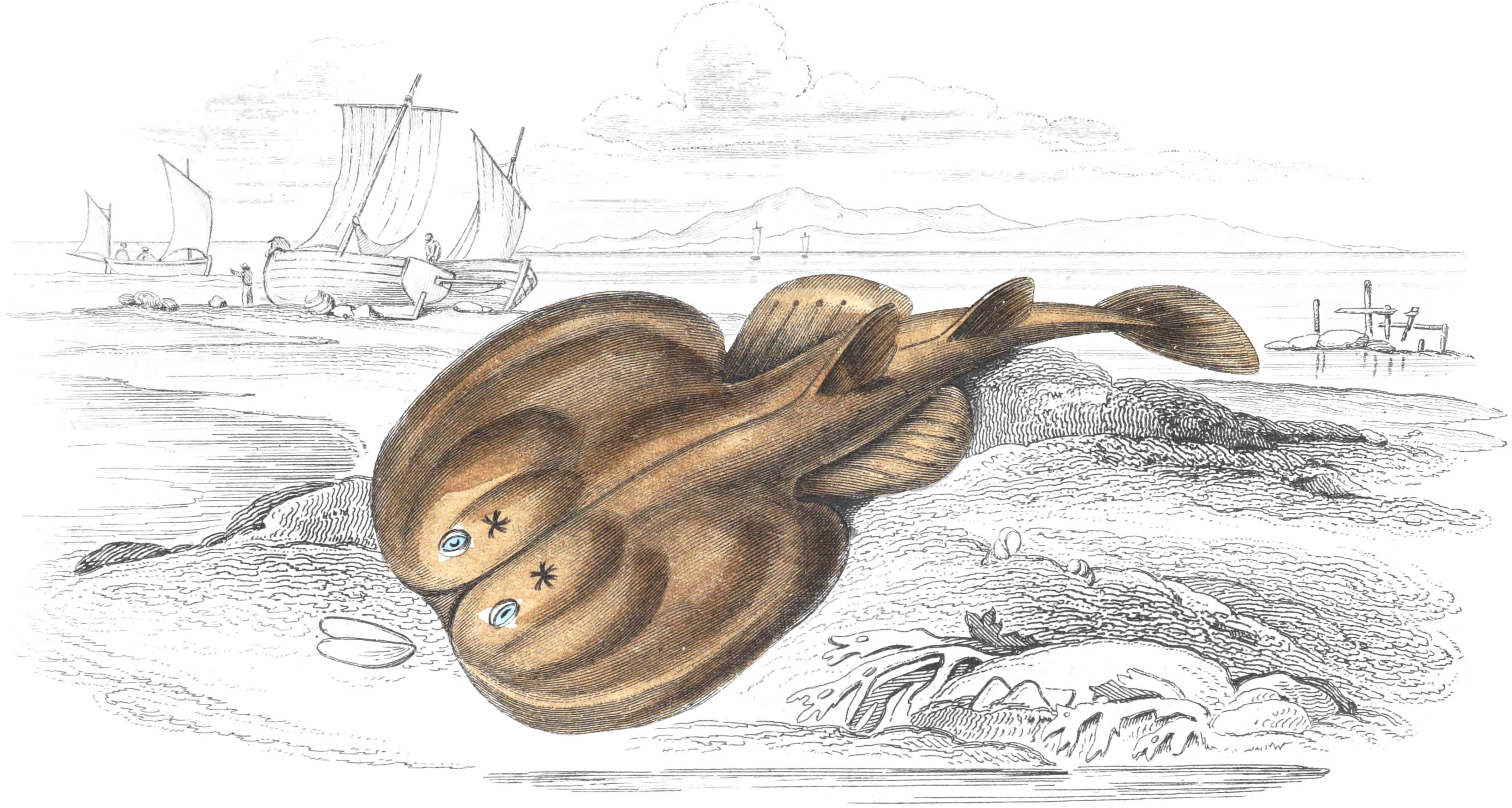
Plate XXX

New British Torpedo
Sp. 233. Torpedo nobiliana
Various notices have been published of a species of torpedo found in the British seas, which seems to differ in several important points from that last referred to. A specimen of one of these came into Mr. Yarrell’s possession, and when C. L. Bonaparte, Prince of Canino, was examining his collection, that distinguished naturalist immediately said that it was the T. nobiliana of his Fauna Italica. Mr. Yarrell is of opinion that it is identical with the T. Walshii of Thompson (Annals of Nat. Hist. vol. v. p. 292), and probably with the T. emarginata of M‘Coy, as noticed in the sixth volume of the Annals of Nat. Hist. It has been taken on the coast of Devonshire, near Swansea, and also in Ireland. The particular marks by which it may be known from the preceding, and also from the other continental species, will be found in the Synopsis.
Gen. CXVIII. Raia.
The typical genus, from which the family derives its name, is of great extent, including many well-known fishes, remarkable on account of their form, and not a few of them of great value in a commercial point of view. They are even more strictly flat-fish than the Pleuronectidæ, but they do not exhibit that want of symmetry which is so conspicuous in that family. The nostrils, mouth, and branchial apertures are on the under side, and the eyes and temporal orifices on the upper side of the head. The body is very much depressed, and of a rhomboidal shape; its great proportional breadth being produced by the inordinate expansion of the pectoral fins, which not only surround the sides of the body, but likewise envelope the head, often forming a conical projection in front of it. The teeth are lozenge-shaped, forming a pavement; in old males the inner angle produced into a sharp point directed inwards. The tail is slender, usually armed with spines on the surface, and having two small fins near the end, with, occasionally, a rudimentary caudal.
Long-Nosed Skate
Sp. 234. Raia mucronata
In this and some of the following species, the skin is perfectly smooth, for which reason Bonaparte has placed some of them in his genus Læviraja. Mr. Couch has supplied all the information we possess regarding the long-nosed skate, and Mr. Yarrell has given a figure of it. It is distinguished not only by the great length of the nose, but also by the distance between its most extreme point and the transverse line of the mouth. The nose is much more produced than in the following species, although that is also remarkable for a like peculiarity; and the greatest breadth of the body is behind the centre. The colour of the surface is a light leaden hue, the under side greyish white, with numerous dusky specks. It is further stated that it frequents deep water, and is not caught through the winter.
Sharp-Nosed Ray
Sp. 235. Raia oxyrhynchus
In this species the snout is also very long, but it is narrower than in R. mucronata, the lateral margins in a moderately sized fish running nearly parallel to each other for three or four inches at the extremity; the outline from the base of the snout to the widest portion of the body, which is behind the middle, waved; the colour on the under side white, without specks or spots. It is one of the largest of the British Rays; an individual obtained by Pennant in the Menai measured nearly seven feet in length, and five feet two inches in breadth; and others have often been found measuring six feet. It is also thicker in proportion than any of its congeners. It is probably this superior fleshiness that renders it so much in request by the French, whose boats come to Plymouth during Lent to purchase skate, which they preserve fresh and moist during the run back to their own coast by keeping them covered with wet sand.71 It is known by various names in different parts of the country, such as White-skate, Burton-skate, Friar-skate, May-skate, &c. It has been taken on the coasts of all the three kingdoms, and in some places is by no means rare.
Flapper-Skate
Sp. 236. Raia intermedia
This skate was first described by Dr. Parnell, from whose Essay on the Fishes of the Firth of Forth we extract the following particulars regarding it. Its specific character is, that the body on the upper surface is smooth, the under side of a dark dusky grey; one or more spines in front of each eye. It appears to be a connecting link between Raia batis and R. oxyrhynchus, to both of which it is closely allied, and it is from that circumstance that it has been named R. intermedia. It is distinguished from the former by the surface being perfectly smooth without granulations, and of a dark olive colour spotted with white; by the anterior part of each orbit being furnished with a strong spine pointing backwards; by the dorsal fins being more remote from each other, and by the anterior margins of the pectorals being rather more concave, giving the snout a sharper appearance. It is removed from R. oxyrhynchus, on the other hand, by the snout being conic, the under surface being dark grey, a spine in front of each orbit, and the back of a dark olive-green spotted with white. Dr. Parnell’s specimens were obtained in the Firth of Forth. A variety was also taken in the salmon-nets at Queensferry, which was of small size, of a uniform olive-green without spots, under surface dark grey; body very thin; snout sharp and conical; pectorals at their anterior margin rather sinous, passing off somewhat suddenly at that part in a line with the temporal orifices.
Skate, Blue-Skate, or Grey-Skate
Sp. 237. Raia batis
This may be regarded as the most common and best known species of the genus, as it is found in all parts of the coasts of Great Britain and Ireland, and is used in large quantities for the table. Its ordinary size is from two to four feet, but examples have occurred in our seas weighing two hundred pounds, and it is asserted that one was caught in the West Indies which measured twenty-five feet in length, and thirteen in breadth. The snout is sharp, elongated, and conical, the sides not being parallel; the whole of the surface more or less granulated; the tail with one or three rows of spines; the colour grey beneath, with black spots. Besides possessing the ventral appendages, the males have several rows of sharp hooked spines toward the sides of the pectorals. The teeth are sharp in both sexes when adult, but the points are usually most developed in the males. Various names have been bestowed on this fish in different localities; the females are often called Maids. They generate in March and April, at which time, according to Pennant, they swim near the surface of the water, several of the males pursuing one female. The females cast their purses in May and continue doing so till September. In October they are poor and thin, but they begin to improve in November and grow gradually better till May, when they are in the highest perfection. They are very voracious, feeding on other fish and crustacea, and they do not themselves seem to be much preyed on by the other inhabitants of the deep. Dr. Parnell says,
In the Firth of Forth these fishes are met with in great numbers, particularly in the neighbourhood of the Bass and May, where they are taken in nets, and are often found on lines set in deep water for cod. In the spring months, the Edinburgh market has a daily supply, and so great is the demand, that no less than a dozen cart loads are sold during the week. Some persons cook them when newly caught, others dress them in the salted condition, while others again allow them to hang in the open air for weeks, until they have acquired a green putrescent appearance, and in this state they are considered a luxury. The pectoral fins are the parts generally made use of as food, and when cut in a peculiar form are sold under the name of Crimped-skate, which is esteemed a delicate morsel.72
Bordered Ray
Sp. 238. Raia marginata
This species is so designated on account of having a broad dusky border on the under side, the other parts of the same surface being white. The skin is smooth, and the snout moderately lengthened, the lateral margins for a small space near the tip nearly parallel. It was first described by Lacépède, and in this country specimens have been found at Liverpool, Brighton, Weymouth, and Lyme-Regis. Although frequent in the Mediterranean, its habits are little known, and it never seems to reach a large size.
Small-Eyed Ray
Sp. 239. Raia microcellata
The characters presented by this species are very strongly marked, but it is extremely rare, and we know but little of its habits. All the information published regarding it has been supplied by Colonel Montagu and Mr. Couch; a notice of a specimen taken in Dublin Bay has likewise been given by Mr. M‘Coy in the sixth volume of the Annals of Nat. Hist. The extreme minuteness of the eye, the surface beautifully rayed with white lines, the roughness of the skin, and the caudal row of spines continued along the dorsal ridge as far as the head, are some of its most striking distinctions. None of the specimens hitherto obtained have been of large size, the largest not exceeding thirty-three inches and a half in length. The outline somewhat resembles that of the Thornback (R. clavata), the snout is short and rather obtuse, and the skin rough with minute spines. Mr. Couch’s specimen was caught in the end of January 1835, at which time it contained numerous eggs, some of which had attained their full growth. Montagu says that it seems to be confounded with R. chagrinea, both being indiscriminately called Dan-cow by the fishermen in the west of England. Continental ichthyologists do not appear to be acquainted with it.
Homelyn, or Spotted Ray
Sp. 240. Raia miraletus
The great variety in colour and markings to which this species is subject, has led to great confusion in its synonomy, although its essential characters of distinction are sufficiently conspicuous. The snout is formed nearly as in R. microcellata; eyes of moderate size; the skin perfectly smooth both above and below, excepting along the anterior part of the pectorals which is somewhat rough; there are two strong spines in the corner of each eye, and an interrupted series down the back. The colour of the surface is brown or reddish brown, marked all over with distinct roundish dusky spots; and frequently there is a large ocellated spot on each side of the pectorals towards the centre of the disk. The dusky spots are sometimes placed pretty closely, at other times are thinly scattered, and Mr. Yarrell has seen specimens in which all traces of them had disappeared. This fish is most frequent along the southern coasts of England, and is perhaps, next to the Thornback, the most common of the Rays in the London market. On the east coast of Scotland it is rarely met with. Seldom more than six or eight examples are observed in the Edinburgh market during the season, the largest scarcely ever exceeding the length of twenty inches, but on the English coast they are frequently found of three feet in length. The synonyms appended to the specific character in the Synopsis, will show what difficulties naturalists have experienced in identifying this species.
Sandy Ray
Sp. 241. Raia spinosa
This species was first described by Mr. Couch in the Magazine of Nat. Hist (vol. ii. of the New Series), who states that it was known to the fishermen by the name of Sandy Ray. Mr. Yarrell has no doubt of its being identical with the Raia radula of continental authors, and therefore with the R. spinosa of Rondelet. Mr. Couch says,
It bears but a distant resemblance to the R. maculata or Homelyn, either in appearance or value; for while the Homelyn is esteemed as food, either fresh or salted, this is thought worthy only to bait the crab-pot, or, just as frequently, to be thrown aside for manure. It is of frequent occurrence in moderately deep water, from spring to the end of autumn. In winter, however, it is not often seen, chiefly, perhaps, because at that season the boats do not venture quite so far from land; but, perhaps, also, from the fish having changed its quarters. It seems to be an indiscriminate feeder, living on small fishes, and different kinds of Crustacea.73
It has been found in Dublin Bay, as well as in other parts of the north of Ireland.
The Shagreen Ray
Sp. 242. Raia chagrinea
Mr. Yarrell notices this fish under the name of R. fullonica, under the idea that it is the species so named by Linnæus and Rondelet, a point which it is almost impossible to determine with certainty. It was described by Montagu in the second volume of the Wernerian Memoirs, as the Shagreen Ray, a name since adopted by most authors. The snout is rather long and sharp, the whole surface rough with minute shagreen-like tubercles, similar to the skin of the Dog fish; tail with only two rows of spines, there being none on the central ridge; colour beneath white. It has been taken on the Devonshire coast, at Scarborough (where it is called the French Ray), and on several of the Irish coasts. It appears to be nowhere so plentiful as in the Firth of Forth, where, as we are informed by Dr. Parnell, it is occasionally taken in skate-nets set in deep water, more especially in the months of May and June, when a few may be seen in the Edinburgh market along with grey-skate and thornbacks. It is known to fishermen under the name of rough-flapper, and its flesh is considered inferior as food to that of the other species of skate, it being soft and dry. It feeds on small star-fish and crustaceous animals in general.
The Thornback
Sp. 243. Raia clavata
One of the best known fishes of this tribe, as it is generally dispersed throughout the British seas, and almost everywhere captured in large numbers. There is no chance of it being confounded with any of the species already noticed, as it is at once known by being studded, at intervals, all over the surface, with oval or rounded tubercles which form the base of a strong curved spine. The tail is armed with from one to five rows of such tubercular spines, and a single row runs up the dorsal ridge. Varieties occur in which there are two rows of spines on the back, and no fewer than seven rows on the tail. These spines exist on the under side as well as the upper, but in fewer numbers, and are chiefly observed in old fish. The flesh of the Thornback is held in good estimation; it is in best condition for the table in November. The fish, however, is obtained in greatest plenty during spring and summer, when it frequents the shallower waters for the purpose of ejecting its ova. Flounders appear to be its favourite prey; also herring and sand-eels; occasionally it feeds on crabs. Young individuals, that is, before they arrive at the age of propagation, are called maidens or maiden-skates, and while in that condition the flesh is regarded as more delicate than in adult specimens. As a general rule, the teeth of mature males are angular, and blunt in the other sex; but to this there are occasional exceptions, the teeth appearing equally blunt in both. The Cuvierian Ray of Lacépède, which has the dorsal fin on the middle of the back, and of which an example was found by Dr. Neill in the Firth of Forth in 1808, is now regarded by most authors as a variety of the Thornback.
Starry Ray
Fig. 1. Sp. 244. Raia radiata
This Ray resembles the Thornback in the nature of its armature, but it is very dissimilar in other respects. The head is very obtuse, and there is scarcely any sinuosity between the front of the head and the widest part of the pectoral fin. The spines are large, and most of them rest on broad oval bases, having a radiated appearance; there are three regular series on the tail, running up the back nearly to the head. The under side is perfectly smooth, without any vestiges of spines, and of a uniform white colour. It is, perhaps, the smallest of the British Rays, measuring about eighteen or nineteen inches in length, and twelve or thirteen in breadth. It was first figured and described by Donovan (British Fishes, pl. 114) from a specimen obtained on the north coast; and judging from the localities that have been given, it appears to be a northern species. It has been taken in Berwick Bay, and not unfrequently m the Firth of Forth, as Dr. Parnell asserts that two or three specimens can be obtained nearly every week in the Edinburgh market, during the months of April and May. The qualities of the flesh are not considered inferior to those of the maiden-skate.

Plate XXXI
Gen. CXIX. Trygon
To the general aspect of the family of the Rays, this genus adds some peculiar characters which render it at once distinguishable. The tail is long, tapering gradually to a point, and without fins; and it is armed towards its origin with a long sharp spine, sharply serrated on both edges. Two other British Rays are provided with an appendage of this nature, but they are so different in other particulars as to be referred to separate genera. The three might be combined into a separate sub-family.
Sting Ray, or Common Trygon
Fig. 2. Sp. 245. Trygon pastinacea
This is the only sting ray found in this country in any quantity, and it was known as an inhabitant of our coasts to the earliest British naturalists. At present it is of most frequent occurrence on the southern coast, but it has been found as far north as the Firth of Forth, where a single specimen was captured in the salmon-nets above Queensferry in the month of August, and it was the only example the fishermen had ever seen. Almost all the European seas, and every part of the Atlantic, afford it in some plenty, and it is a common fish in the Mediterranean. Mr. Couch, with his usual zeal and discriminating observation, has watched its habits, and states that it keeps on the sandy ground at no great distance from land, and in summer wanders into shallow water. It scarcely ever takes a bait. It defends itself by twisting its long slender tail round the object of attack and tears the surface with the serrated spine, lacerating it in a maimer calculated to produce violent inflammation.74 Formerly this weapon was considered to be of a very formidable character, as it was thought to possess poisonous qualities; this, however, has been completely disproved. It appears to be deciduous at certain intervals (perhaps annually) and to be replaced by another. These spines are sometimes used as a point to arrow’s and spears, for which they are well fitted. The flesh of the sting ray is scarcely fit to be used for food.
Plate XXXI
Gen. CXX. Myliobatis
The fishes of this genus have obtained the name of Myliobatis (from μυλη a mill and βατις a skate) on account of the form of their teeth, and that of sea-eagles from the wing-like expansion of the pectorals. Some of the species attain to very large dimensions, sometimes weighing no less than eight hundred pounds.
Eagle, or Whip Ray
Sp. 246. Myliobatis aquila
Great doubts existed up to a recent period as to the propriety of admitting this curious fish into our British lists, because the only pretext for so doing was that the tail of a fish had been examined by Pennant, and referred by him to this species, although, as Mr. Jenyns remarks, it is equally probable it may have belonged to the genus next to be noticed. The discovery, however, by Dr. Johnson, of a fresh and entire specimen on the shore at Spittal, near Berwick, has removed all doubt on this point. It was a small specimen, thirteen inches long and twenty-one broad, the tail twenty-one inches and a half in length. The synoptical characters given on a future page will convey a sufficient notion of its appearance and peculiarities. It is extensively distributed, and examples have been found measuring fifteen feet in length and weighing three hundred pounds. It swims pretty rapidly with a kind of sailing motion and little action of the pectoral fins, and, when taken, vibrates its tail violently; the first care of the fishermen is, therefore, to cut off the caudal spine, which in a specimen approaching the dimensions given above, is a very formidable implement.

Plate XXXII
Gen. CXXI. Cephaloptera
The most conspicuous mark of difference between this and the other spiny-tailed rays, is in the form of the head, which is truncated anteriorly, and the pectorals, instead of embracing it, are each prolonged considerably in front, so as to present the appearance of two horns. The species are very remarkable in other respects, especially for the enormous dimensions they sometimes attain. The Banksian Ray (belonging to this genus) is said to have been found of such weight that seven yoke of oxen were required to draw it ashore. Voyagers speak of having seen fishes of this genus swimming about their vessels, upwards of twenty feet long; and in other cases they are said to have appeared larger than the vessel itself.
Col. Hamilton Smith once witnessed the destruction of a soldier by one of these cephaloptera, off Trinidad. It was supposed that the soldier, being a good swimmer, was attempting to desert from the ship, which lay at anchor in the entrance of the Bocco del Toro. The circumstance occurred soon after day-light, and the man, being alarmed by the call of a sailor from the main cross-trees, endeavoured to return to the vessel, but the monster threw one of his fins over him and carried him down.75
Horned Ray
Sp. 247. Cephaloptera giorna
Horned Ray. In 1835, Mr. Thompson communicated to the Zoological Society an account of a fish supposed to be this species, of which a single specimen was found on the southern coast of Ireland. It was rather imperfect, so that its identity with the C. giorna of Risso is not altogether certain. It measured only forty-five inches in breadth. In the Mediterranean Cuvier states that it is of gigantic dimensions.
XXX. Family of the Lampreys. Pteromyzidæ
Representatives in British Fauna.—Gen. 4. Sp. 6.
-
Gen. 122. Pteromyzon.
- Sp. 248. P. marinus. The Lamprey.
- Sp. 249. P. fluviatilis. River Lamprey, or Lampern.
- Sp. 250. P. Planeri. Planer’s Lamprey.
-
Gen. 123. Ammocœtes.
- Sp. 251. A. branchialis. The Pride, or Mud Lamprey.
-
Gen. 124. Gastrobranchus.
- Sp. 252. G. cæcus. Myxine, or Glutinous Hag.
-
Gen. 125. Amphioxus.
- Sp. 253. A. lanceolatus. The Lancelot.
This group forms Cuvier’s second family of Chondropterygian or cartilaginous fishes with fixed branchiæ. The species resemble eels in the elongated and rounded shape of the body, and the resemblance also holds in relation to some of their habits. In the typical species the branchial cells and gills within them are situated along the side of the neck, and there are seven apertures leading to them by which the water is admitted and expelled. The mouth is circular, armed with hard tooth-like processes, and provided with a flexible lip. This mouth readily admits of being employed as a sucker, and as the species are destitute of a swimming-bladder, as well as pectoral and ventral fins, and are therefore imperfectly fitted for swimming, they often fix themselves by means of it to stones, and thus relieve themselves from the exertion necessary to prevent them being carried down by the current. To this habit the name of Lamprey is supposed to refer, its probable derivation being from lambendo petras; and it corresponds to the term Pteromyzon, which is composed of two Greek words of nearly the same import. With the exception of the two first species noticed below, they are small fishes of no commercial importance; but they are full of interest to the naturalist, as occupying the lowest place in the scale of organization, not only of their own class, but, perhaps, of all vertebrate animals, and showing the gradual approaches which one class of animals make to another.
Gen. CXXII. Pteromyzon
The circular mouth and seven apertures in the side of the neck, are two characters sufficiently distinctive of this genus. The fin, which runs along the posterior portion of the back and tail, can scarcely be regarded as a true fin, as it is merely a fold of the skin, and quite destitute of rays.
The Lamprey
Fig. 1. Sp. 248. Pteromyzon marinus
This, the most conspicuous and best known member of the family, bears some resemblance in its general appearance to the Muræna formerly noticed. It measures from two to three feet; the body thick and cylindrical; the colour yellowish brown or tinged with green, and marbled with dusky. It is frequently found in all the principal rivers of the three kingdoms, being particularly abundant in the Severn, and has a very wide range throughout Europe and North America. It is a migratory fish, residing in the ocean during the winter months, and ascending rivers in spring. It is oviparous, and the roe is shed shortly after it enters the fresh water. A shallow bed is formed by removing the stones, which the fish accomplishes by fixing its suctorial mouth to them and drawing them aside, and while thus employed they are usually in pairs. They feed on almost any animal matter that falls in their way; and occasionally attack other fishes, adhering to them by the suctorial mouth, and eating into the flesh. Its motion in swimming is undulating like that of a serpent, but the action is horizontal, not vertical. The Lamprey, as is well known, was formerly much prized for the table; but its reputation in this country has greatly declined, although it is still in high repute in many parts of the Continent. It is in greatest perfection in the month of May. In Scotland it shares in the dislike which is entertained towards all eel or serpent-like fishes, and is never brought to market.

Plate XXXIII
River Lamprey, or Lampern
Sp. 249. Pteromyzon fluviatilis
This is likewise a common fish, especially in the English rivers, more particularly the Thames, Severn, and Dee, but it is not so frequent in Scotland and Ireland, although there also it is not rare in certain rivers. It is not quite certain whether it is migratory, like its congener above noticed; the fact, at all events, is unquestionable, that examples may be found in fresh water all the year. The spawning season is in May, one spawning-bed being generally occupied by a single pair of fish; at other times numbers of both sexes are seen to frequent a general spawning-bed. It seldom much exceeds a foot in length. It formerly enjoyed the same reputation as P. marinus for its edible qualities; and it was much used, as we believe it still is, as a bait for catching other fishes. Pennant says that above 450,000 have been sold in a season at forty shillings per thousand, to the Dutch, who use them as bait lor cod; and Mr. Yarrell informs us that formerly the Thames alone supplied from one million to twelve hundred thousand Lamperns annually. From their tenacity of life, they admit of long preservation, and the Dutch use them in fishing for turbot.
Planer’s Lampern
Sp. 250. Pteromyzon Planeri
In external appearance this species resembles the last, but on a close examination the differences are soon observed. The fins are contiguous in P. Planeri, and in the other species widely apart; and in the former the circular lip is furnished with numerous papillæ, forming a thickly set fringe, from which structure Mr. Yarrell has named it the Fringed-lipped Lampern. It was named by Bloch after his friend Planer, a professor at Erfort, but Mr. Jenyns is of opinion that the British fish is not the same as the P. Planeri of Bloch and Blainville, although it is obviously identical with the species so named by Cuvier and Nilsson. In its colour and habits it does not differ much from P. fluviatilis. Both it and the species just named are often in Scotland called nine-eyed eels. Dr. Parnell, Sir William Jardine, and Dr. Johnson have found it in different Scottish, rivers; Mr. Yarrell in many of those of England, and Mr. Thompson in those of Ireland.
Gen. CXXIII. Ammocœtes
Of this generic group, established by Dumeril, Cuvier remarks that the species have all the parts which ought to constitute the skeleton so soft and membranous, that they may be considered as having no bones whatever. Their general form, and the exterior apertures of the branchiæ, are the same as in the lampreys, but their fleshy lip is only semicircular, and merely covers the upper part of the mouth; they cannot, therefore, fix themselves to objects like the lampreys, properly so called. No teeth are perceptible, but the aperture of the mouth is furnished with a series of small branched cirri.
Pride, or Mud Lamprey
Fig. 2. Sp. 251. Ammocœtes branchialis
A small fish from six to eight inches in length, and about the thickness of a swan’s quill. It buries itself in the mud, and is not rare in such of the English rivers as have a muddy bottom. It has also been observed in the Forth and Tweed, as well as in some of the Irish rivers. The origin of the English name will be seen from the following extract from Blount’s Tenures, as given by Mr. Yarrell in the Appendix to the second volume of his British Fishes,
Rodeley, County of Gloucester.—Certain tenants of the manor of Rodeley pay, to this day, to the lord thereof, a rent called Pridgavel, in duty and acknowledgment to him for their liberty and privilege of fishing for lampreys in the river Severn. Pridgavel: Prid, for brevity, being the latter syllable of Lamprid, as this fish was anciently called; and gavel, a rent or tribute.
Plate XXXIII
Gen. CXXIV. Gastrobranchus
Branchial apertures two in number, and placed beneath, near the commencement of the belly; mouth with a single hook-like tooth; tongue with two rows of teeth on each side.
Myxine, or Glutinous Hag
Fig. 1. Sp. 252. Gastrobranchus cæcus
This very singular fish has almost the appearance of a worm, and indeed it was actually placed by Linnæus in his class Vermes. It is destitute of eyes; the mouth is surrounded with cirri, and the dorsal fin is narrow and linear. Many parts of its structure very strikingly indicate its relation to the cephalopods of the class Mollusca. What corresponds to the vertebral column is merely a cartilaginous tube, the most rudimentary condition in which that part could exist; indeed it can with no propriety be called a portion of a bony skeleton, but merely its representative. With regard to its habits; it is said to enter the mouths of other fish, and completely devour the whole except the skin and bones.
It is considered by some that it obtains access to the interior of the body of the fish by passing in at the anal aperture; others endeavour to account for its being in the belly of a voracious fish by supposing it had been swallowed; while many experienced fishermen still repeat their belief that the Myxine enters the mouth of the cod-fish while it is hanging on the line. It is conjectured that it does not-fasten upon any fish unless it be either dead or entangled on a hook; but how a fish that is blind is able to find its way to a particular aperture, is a matter not easily explained. The eight barbules or cirri about the mouth are, there is no doubt, delicate organs of touch, by which it obtains cognizance of the nature and quality of the substances with which they are in contact; and its single hooked tooth upon the palate enables it to retain its hold till the double row of lingual teeth are brought into action to aid the desire to obtain food.76
The Myxine is not very rare, and probably would be found on most of our coasts if carefully looked after. Dr. Johnson informs Mr. Yarrell that it is not uncommon at Berwick; Mr. Thompson finds it at Belfast, and it is of frequent occurrence on the eastern coast of England.

Plate XXXIV
Gen. CXXV. Amphioxus
The only known British species of this genus has of late attracted a good deal of attention on account of the many anomalies it presents, especially when regarded, as it must necessarily be, as a vertebrate animal. It is named
The Lancelot
Fig. 2. Sp. 253. Amphioxus lanceolatus
It has occurred several times in the British seas, and is not unknown on the Continent, having been found on the coasts of Norway and Sweden, and also in the Mediterranean. A second species has recently been discovered off Algiers by Mr. Wilde, which, from possessing a circular mouth demonstrates the accuracy of those authors’ views who associated the Lancelot with the Pterornyzidæ, a position which many were of opinion its characters did not warrant. The peculiarities of this singular fish having he in described at some length in the Introduction to our first volume on British Fishes, and these being afterwards further noticed in our Synopsis, it is unnecessary to recapitulate them in this place.
Plate XXXIV

Synopsis of the Families, Genera, and Species of British Fishes
First Series. Osseous Fishes, or Such as Have a Bony Skeleton
First Subdivision. Acanthopterygii; Fishes with some of their Fin-Rays Spinous
-
Fam. I. Percidæ. Fam. of Perches. Body oblong, covered with large conspicuous scales, which are generally rough with ciliated margins; operculum and preoperculum denticulated or spinous; both jaws, vomer, and almost always the palatine bones, provided with teeth.
-
Gen. I. Perca. Two dorsals, the first with spinous rays, those of the second flexible; preoperculum notched below, serrated on the posterior edge, operculum terminating behind in a flattened point; tongue smooth; branchiostegous rays seven; scales adherent.
- Sp. 1. P. fluviatilis. The Perch. Back dusky green, sides with from 5 to 7 dusky bands; abdomen white, tinged with red; dorsal and pectoral fins dusky, tinged with red; ventrals scarlet, their position under the pectorals. Number of fin-rays, D. 15, 1 + 13 : P. 14 : V. 1 + 5 : A. 2 + 8 : C. 17.—Linn. Don. Brit. Fish., vol. iii. pl. 52; Penn. Brit. Zool., vol. iii. p. 254, pl. 48; Yarr. Brit. Fish., vol. i. p. 1.77
-
Gen. II. Labrax. Two dorsals, as in Perca; preoperculum covered with scales, and terminating behind in two spines; operculum terminating behind in two points; tongue rough with teeth.
- Sp. 2. L. lupus. Basse, or Sea Perch. Form more elongated than that of the Perch, the back not so much elevated; first ray of second dorsal spinous. Number of fin-rays, D. 9, 1 + 12 : P. 16 : V. 1–5 : A. 3 + 11 : C. 17. Back and sides dull gray, belly white, operculum with a dusky spot; ventrals white.—Cuv. Val., Hist. Nat. des Poiss., t. ii. p. 56, pl. 11. Perca labrax, Linn. Don. Brit. Fish., ii. pl. 43; Penn. Brit. Zool., iii. p. 257, pl. 49; Jenyn’s Brit. Vert., p. 331; Yarr. Brit. Fish., i. 8.
-
Gen. III. Serranus. A single elongated dorsal, the anterior half with spinous rays; operculum serrated, and having one or more flattened points behind; teeth in both jaws, on the palatine bones and vomer, some elongated sharp teeth among the smaller ones.
- Sp. 3. S. cabrilla. Smooth Serranus. Body deep and compressed; jaws without scales; the dorsal fin commencing opposite the ventrals. Number of fin-rays, D. 10 + 14 : P. 15 : V. 1 + 5 : A. 3 + 8 : C. 17. Colour of the back brown, occasionally with bars running round the belly: sides yellow, reddish, or saffron-coloured, with two irregular whitish lines passing along from the head to the tail, and another, still more irregular, on the belly; operculum with oblique blue stripes; fins longitudinally streaked with red and yellow; pectorals wholly yellow.—Cuv. Val., t. ii. p. 223, pl. 29. Perca cabrilla, Linn. Serranus channus, Couch, Mag. Nat. Hist., v. p. 19, fig. 6; Yarr. Brit. Fish., i. p. 11.
- Sp. 4. S. gigas. Dusky Serranus. Lower jaw covered with small scales; tail rounded. Fin-rays, D. 11 + 16 : P. 17 : V. 1 + 5 : A. 3 + 8 : C. 15. Upper parts reddish-brown, gill-covers with two slightly marked lines running obliquely downwards, one on each plate.—Cuv. & Val., t. ii. p. 270, pl. 33. P. gigas, Gmel., Linn. Perca robusta, Couch, in Loud. Mag. of Nat. Hist., v. p. 21, fig. 7. Dusky Serranus, Yarr. Brit. Fish., i, 14.
-
Gen. IV. Acerina. A single elongated dorsal, a portion of the hinder part without spinous rays; head without scales; teeth uniform; operculum ending in a single point.
- Sp. 5. A. vulgaris. The Ruffe, or Pope. Head without scales, and pitted with numerous excavations; spines of the anterior portion of the dorsal fin very high, rising above the connecting membrane; caudal deeply forked. Number of rays, D. 14 + 12 : P. 13 : V. 1 + 5 : A. 2 + 5 : C. 17. Back and sides light olive, passing into silvery white on the belly; pectoral, ventral, and anal fins, pale brown.—Cuv. & Val., iii. p. 4. pl. 41; Yarr. Brit. Fish., i. p. 17. P. cernua, Linn., Don. Brit. Fish., ii. pl. 39. Cernua fluviatilis, Flem. Brit. An., p. 212.
-
Gen. V. Polyprion. A single elongated dorsal fin, the hinder portion of it at the base, as well as the base of the other fins, covered with small scales; spines on the anterior part of the dorsal and ventral serrated; all the scales serrated on the free margin; a short semicircular row of spines over the eye, over the operculum, and over the origin of the pectoral fin.
- Sp. 6. P. cernium. Upper parts of the body dark purplish brown, under parts white slightly glossed with silvery, outer margin of the tail nearly white. Number of fin-rays, D. 11 + 12 : P. 16 : V. 1–5 : A. 3 + 9 : C. 17.—Cuv. & Val., iii. p. 21, pl. 42. Amphiprion Americanus, Schneider, Syst. Ich., p. 205. Serranus Couchii, Yarr. Brit. Fish., i. p. 12 (1st. ed.).
-
Gen. VI. Trachinus. Head and body compressed, the latter elongated; two spinous dorsals, the first very short, the second very long; ventrals jugular, or placed before the pectorals; branchiostegous rays 6; teeth in both jaws. on the front of the vomer and palatine bones; operculum with a long some.
- Sp. 7. T. Draco. Great Weever. Body elongated: two spines before each eye; second dorsal with about thirty rays; lower jaw ascending. Fin-rays, D. 6–30 : P. 15 : V. 1 + 5 : A. 1 + 31 : C. 14.—Linn., Jenyns’ Brit Vert., p. 335; Yarr. Brit. Fish., i. p. 24. T. major, Penn. Brit. Zool., iii. p. 229, pl. 33.
- Sp. 8. T. vipara. Little Weever. Body comparatively short; second dorsal with twenty-four rays; lower jaw nearly vertical; cheeks without scales. Fin-rays, D. 6 + 23 or 24 : P. 15 : V. 1 + 5 : A. 1–24 : C. 11.—Cuv. & Val., iii. p. 254; Yarr. Brit. Fish., i. p. 29. T. draco. Common Weever, Penn. Brit. Zool., iii. p. 226, pl. 32; Don. Brit. Fish., pl. 23.
-
Gen. VII. Mullus. Two dorsals widely separated; ventrals rather behind the pectorals; profile of the head oblique, approaching to vertical; chin with two long barbules; operculum without a spine, and the upper jaw without teeth.
- Sp. 9. M. barbatus. Red Sunnullet. Profile of the head more nearly approaching to vertical than in M. surmuletus; colour uniform, rather deep red, without longitudinal yellow lines, under side silvery, fins yellow.—Linn., Bloch., Jenyns, Penn. Brit. Zool., iii. p. 271. Plain Red Mullet, Yarr. Brit. Fish., i. p. 36. Rouget, ou Rouget-Barbet, Cuv. & Val., iii. p. 325, pl. 70.
- Sp. 10. M. surmullus. Striped Surmullet. Back and sides vermilion-red, with longitudinal lines of golden-yellow, belly white tinged with rose-colour, fins pale red. Number of fin-rays, D. 7–1 + 8 : P. 17 : V. 1 + 5 : A. 2 + 6 : C. 13.—Linn., Don. Brit. Fish., i. pl. 12. Striped Red Mullet, Yarr. Brit. Fish., i. 31.
-
Gen. I. Perca. Two dorsals, the first with spinous rays, those of the second flexible; preoperculum notched below, serrated on the posterior edge, operculum terminating behind in a flattened point; tongue smooth; branchiostegous rays seven; scales adherent.
-
Fam. II. Buccæ Loricatæ. Fam. of Mailed Cheeks. Infra-orbitals extending more or less over the cheeks, and articulating behind with the preoperculum; head commonly armed with spinal processes; pectorals large.
-
Gen. VIII. Trigla. Head covered with bony plates, and nearly of a square form; operculum, and bones of the shoulder, armed with spines; body covered with scales; dorsals two; three detached rays beneath each pectoral fin; branchiostegous rays seven; teeth small and velvet-like on both jaws and on the front of the vomer.
- Sp. 11. T. cuculus. Red Gurnard. Lateral line crossed throughout its length by lines not reaching below the middle of the sides; colour bright red, the sides and belly silvery white. Number of fin-rays, D. 9–18 : P. 10–3 : V. 1 + 6 : A. 16 : C. 11.—Linn., Cuv. & Val., iv. p. 26; Yarr. Brit. Fish., i. p. 38. T. pini, Bloch, pt. xi. pl. 355. T. lineata, Montagu, Mem. Wern. Soc. ii., pt. ii. p. 460.
- Sp. 12. T. lineata. French or Rock Gurnard. Lateral line crossed by lines which encircle the whole body; profile nearly vertical; body and fins red, the latter spotted and sometimes edged with a darker colour; pectorals long, tipped with blue, and marked with four rows of large dark spots. Fin-rays, D. 10–16 : P. 10–3 : V. 1 + 5 : A. 13 : C. 11.—Linn., Cuv. & Val., iv. p. 34; Jenyns’ Brit. Vert., p. 339; Yarr. Brit. Fish., i. p. 45. T. Adriatica, Gmelin, Flem. Brit. An. Streaked Gurnard, Penn. Brit. Zool., iii. p. 377, pl. 66; Don. Brit. Fish., pl. iv.
- Sp. 13. T. hirundo. Sappharine Gurnard. Pectorals very large, reaching beyond the second ray of the anal; sides smooth, without lines or furrows; body brownish red; pectorals bluish green on the inner side, edged and spotted with bright blue. Fin-rays, D. 9–16 : P. 11–3 : V. 1 + 5 : A. 15 : C. 11.—Linn., Penn. Brit. Zool., iii. p.
316376, pl.4068; Yarr. Brit. Fish., i. p. 47. T. lævis, Montagu, Mem. Wern. Soc., ii. p. 2, p. 455; Flem. Brit. An. - Sp. 14. T. pœciloptera. Little Gurnard. Plates of the head terminating behind in strong spines, colour reddish brown, belly silvery, sides tinged with golden-yellow; pectoral fins dark-coloured on the inner side, and marked with numerous small milk-white spots.—Cuv. & Val., iv. p. 34. Little Gurnard, Thomp. Proc. Zool. Soc., 1837, p. 61; Yarr. Brit. Fish., i. 49.
- Sp. 15. T. lyra. The Piper. Head large, the snout divided into two dentated processes; scapular spines extending halfway down the pectorals, the latter reaching beyond the ventrals; lateral line smooth; body tapering rapidly to the tail; colour brilliant red, belly white. Fin-rays, D. 9–16 : P. 11–3 : V. 1 + 5 : A. 16 : C. 11 .—Linn., Cuv. & Val., iv. p. 55; Don. Brit. Fish., pl. 118.
- Sp. 16. T. gurnardus. Grey Gurnard. Pectoral and ventral fins of equal length, not reaching to the first ray of the anal; lateral line crenated; first three rays of the first dorsal granulated; colour, grey above, clouded with brown and spotted with black and yellowish white, silvery beneath. Fin-rays, D. 8–20 : P. 10–3 : V. 1 + 5 : A. 20 : C. 11.—Linn., Cuv. & Val., iv. p. 45; Yarr. Brit. Fish., i. 53. Grey Gurnard, Penn. Brit. Zool., iii. p. 371, pl. 65; Don. Brit. Fish., pl. 30.
- Sp. 17. T. Blochii. Bloch’s Gurnard. First dorsal fin with a black spot; lateral line and ridge of the back serrated; the three first rays of the first dorsal without granulations. Fin-rays, D. 8–19 : P. 11–3 : V. 1 + 5 : A. 17 : C. 11.—Yarr. Brit. Fish., i. 56. T. cuculus, Bloch., Cuv. & Val., iv., p. 67. Red Gurnard, Penn. Brit. Zool., iii, p. 278, pl. 57.
- Sp. 18. T. lucerna. Shining Gurnard. First dorsal with the second ray very much elongated; lateral line composed of a series of semicircular plates radiated on their free border; snout dentated; colour rose-red, under parts dirty white, pectorals deep blue. Fin-rays, D. 9–18 : P. 10–3 : V. 6 : A. 17 : C. 14.—Cuv. & Val., iv. p. 72; Parnell, in Mag. Zool. and Bot., vol. i. p. 526; Yarr. Brit. Fish., i. 63.
-
Gen. IX. Peristedion. Body covered with large hexagonal scales, forming longitudinal ridges; snout divided into two points; mouth without teeth.
- Sp. 19. P. malarmat. Mailed Gurnard. Body octagonal; first dorsal with seven rays, five or six of them ending in long filaments; nasal bone very long; tail lunate; colour uniform scarlet, shading into pale flesh-colour on the abdomen; dorsal fins crimson, the others pale grey. Fin-rays, D. 7, 19 : P. 12, 2 : V. 1 + 5 : A. 18 : C. 11.—Cuv. & Val., iv. p. 101. Mailed Gurnard, Mag. Nat. Hist., i. N. 8, p. 17; Yarr. Brit. Fish., i. p. 67. Trigla cataphracta, Bloch, pt. x. pl. 349.
-
Gen. X. Cottus. Head broad and depressed, generally armed with spines and tubercles; two dorsals; body without scales; teeth in front of the vomer, but none on the palatines; branchiostegous rays six.
- Sp. 20. C. gobio. River Bull-head. Head nearly one-third of the whole length, and as broad as long, the surface nearly smooth; preoperculum with a single curved spine at its posterior angle; operculum terminating behind in a blunt point; second dorsal twice as high, and nearly three times as long as the first, the two connected by an intervening membrane; colour brownish-grey, sides lighter, and slightly spotted; fins barred and spotted with brown. Fin-rays, D. 6 to 9–17 or 18 : P. 15 : V. 3 : A. 13 : C. 11.—Linn. Cuv. & Val., iv. p. 145. River Bull-head, Penn. Brit. Zool., iii. p. 291, pl. 43; Don. Brit. Fish., pl. 80; Yarr. Brit. Fish., i. 71.
- Sp. 21. C. scorpius. Sea Scorpion, or Short-spined Cottus. Preoperculum with three spines, the longest not extending beyond the operculum; two spines before the eyes; colour reddish grey mottled with purple-brown, the tint varying considerably. Fin-rays, D. 8 or 9–14 : P. 17 : V. 1 + 3 : A. 11 : C. 12.—Cuv. & Val., iv. p. 160; Jenyns’ Brit. Vert., p. 344; Yarr. Brit. Fish., i. p. 75.
- Sp. 22. C. bubalis. Long-spined Cottus, or Father-lasher. Preoperculum with four spines, the longest extending beyond the operculum; two spines before the eyes; lateral line rough. Fin-rays, D. 8–12 : P. 16 : V. 1 + 3 A. 9 : C. 10. Colours nearly the same as in C. scorpius.—Cuv. & Val., t. iv. p. 165, pl. 78. Cottus scorpius, Father-lasher, Penn. Brit. Zool., iii. p. 294, pl. 44; Don. Brit. Fish., pl. 35.
- Sp. 23. C. quadricornis. Four-horned Cottus. Occiput with four rough tubercles or horns, two near the eyes and two on the nape; preoperculum with three spines; colour of the head brown, tinged with red on the gill-covers; back brown, sides yellow, belly greyish-white; fins mottled with brown. Fin-rays, D. 8–14 : P. 17 : V. 1 + 3 : A. 15 : C. 11.—Linn., Cuv. & Val., iv. p. 168; Yarr. Brit. Fish., i. p. 83.
-
Gen. XI. Aspidophorus. Body mailed with angular plates which render it octagonal; head thick, flat below, the snout with recurved spines; two distinct dorsal fins; vomer and palatines without teeth.
- Sp. 24. A. Europæus. Armed Bull-head, or Pogge. Upper jaw rather longest, chin and branchiostegous membrane furnished with many thread-like filaments; snout with four recurved spines; preoperculum with a large spine; operculum unarmed; body octagonal from the vent (which is under the middle of the pectorals) to the termination of the second dorsal, beyond that hexagonal; caudal rounded: brown above, white beneath, marked with dusky, which assumes the appearance of four indistinct bands; pectoral with a dusky bar across the centre; tail brown. Fin-rays, D. 5–7 : P. 15 : V. 1 + 2 : A. 7 : C. 11.—Cuv. & Val., iv. p. 201; Yarr. Brit. Fish., i. 85. Asphidopliorus cataphractus, Jenyns’ Brit. Vert., p. 346. Cataphractus Schoneveldii, Flem. Brit. An.
-
Gen. XII. Sebastes. Body and head completely covered with scales; dorsal single, the anterior part spinous, the posterior with flexible rays; lower rays of the pectorals simple; preoperculum and operculum ending in three or more spines: teeth velvet-like, placed on both jaws, the vomer, and palatine bones.
- Sp. 25. S. Norvegicus. Bergylt, or Norway Haddock. General form resembles that of the Perch; under jaw longest; colour of the back dark red, becoming lighter on the sides, and silvery white, slightly glossed with red, on the belly; fins red. Fin-rays, 15 + 15 : P. 19 : V. 1 + 5 : A. 3 + 8 : C. 14.—Cuv. & Val., iv. p. 327, pl. 87; Yarr. Brit. Fish., i. p. 87. Perca marina, Linn., Penn. Brit. Zool., iii. p. 349, pl. 59. Scorpaena Norvegica, Northern Sebastes, Jenyns’ Brit. Vert., p. 347.
-
Gen. XIII. Gasterosteus. Head smooth; one dorsal fin, the place of the first dorsal being occupied with from three to fifteen spines; ventral fin reduced to a single spiniform ray: body without scales, the sides protected by transverse plates, abdomen likewise defended by a triangular plate; teeth in both jaws, none on the vomer or palatines.
- Sp. 26. G. trachurus. Rough-tailed Three-spined Stickle-back. Dorsal spines three, the central one longest; lateral plates extending to the base of the tail; ventral spine triangular at the base; tail with a slight ridge on each side. Fin-rays, D. iii 9 : P. 10 : V. 1 : A. 1 + 8 : C. 12.—Cuv. & Val., iv. p. 481, pl. 98, fig. 1; Yarr. Brit. Fish., i. 90. G. aculeatus, Don. Brit. Fish., pl. 11. Three-spined Stickle-back, Jenyns’ Brit. Vert., p. 348.
- Sp. 27. G. semiarmatus. Half-armed Stickleback. Dorsal spines three, lateral plates not extending beyond the line of the vent. Fin-rays, D. iii + 10 : P. 10 : A. 1 + 9 : C. 12. Cuv. & Val., iv. p. 493; Yarr. Brit. Fish., i. 94.
- Sp. 28. G. leiurus. Smooth-tailed Stickleback. Dorsal spines as in the two last species; lateral plates not extending beyond the second dorsal spine, the side beyond that smooth and soft. Fin-rays, D. iii. + 10 : P. 11 : A. 1 + 8: C. 12—Cuv. & Val., iv. p. 481, pl. 98, fig. 4; Yarr. Brit. Fish., i. 95.
-
Sp. 29. G. brachycentrus. Short-spined Stickleback. Lateral plates as in G. leiurus; dorsal spines three, very short. Fin-rays, D. iii + 13 : P. 10 : A. 1 + 9 : C. 12.—Cuv. & Val., iv. p. 499, pl. 98, fig. 2.
Superior in size to L. leiurus, and the vertebræ more numerous.
- Sp. 30. G. spinulosus. Four-spined Stickleback. Dorsal spines four; a single lateral plate behind the pectoral fin. Fin-rays, D. iv + 8 : P. 9 : V. 1 : A. 1 + 8 : C. 12.—Yarr. Brit. Fish., i. p. 97; Jenyns’ Brit. Vert., p. 350; Edin. New Phil. Journ., April 1831, p. 386.
- Sp. 31. G. pungitius. Ten-spined Stickleback. Sides without plates; dorsal spines nine or ten. Fin-rays, D. ix + 10 : P. 11: V. 1 + 5 : A. 1 + 9 : C. 12.—Linn., Cuv. & Val., iv. p. 506; Penn. Brit. Zool., iii. p.
335355, pl. 61; Don. Brit. Fish., pl. 32; Jenyns’ Brit. Vert., p. 350; Yarr. Brit. Fish., i. p. 99. -
Sp. 32. S. spinachia. Fifteen-spined Stickleback. Dorsal spines fifteen; body much elongated, lateral line armed with large pointed imbricated scales, which render the posterior half of the body quadrangular, the anterior part pentagonal; snout very much produced, the under jaw longest; colour of the upper parts greenish brown, sides yellowish, belly silvery white. Fin-rays, D. xv + 6 : P. 10 : V. 2 : A. 1–7 : C. 12.—Linn., Cuv. & Val., iv. p. 509; Yarr. Brit. Fish., i. p. 101. Spinachia vulgaris, Flem. Brit. An., p. 219.
Obs. This species differs in many respects from the other Gasterostei, and has therefore been regarded by several authors as a separate subgenus, a rank to which it seems fully entitled.
-
Gen. VIII. Trigla. Head covered with bony plates, and nearly of a square form; operculum, and bones of the shoulder, armed with spines; body covered with scales; dorsals two; three detached rays beneath each pectoral fin; branchiostegous rays seven; teeth small and velvet-like on both jaws and on the front of the vomer.
-
Fam. III. Scienidæ. Fam. of the Maigres. Preoperculum denticulated, operculum with spines, body and head entirely covered with scales; mouth slightly protractile; no teeth on the vormer or palatines.
-
Gen. XIV. Sciæna. Operculum ending in one or more spines; dorsals two, the second long; branchiostegous membrane with seven rays; a row of pointed teeth in each jaw; chin without a barbule.
- Sp. 33. S. aquila. The Maigre. Of a uniform silvery grey, inclining to brown on the back and to white on the belly; first dorsal, pectorals, and ventrals, red; first dorsal with the third spine very long. Fin-rays, D. 9—1 + 27 : P. 16 : V. 1 + 5 : A. 1 + 8 : C. 17.—Cuv. & Val., t. v. p. 28, pl. 100; Jenyns’ Brit. Vert., p. 352; Yarr. Brit. Fish., i. p. 104. Umbra Rondeletii, Willugh.
-
Gen. XV. Umbrina. Chin with a barbule; spines of the anal fin strong and sharp; teeth small and numerous.
- Sp. 34. U. vulgaris. Yellowish, traversed obliquely with bands of silver and blue; belly white; pectoral and ventral fins nearly black, anal red; upper jaw longest; operculum ending in a spine and a flattened point. Fin-rays, D. 10–22 : P. 17 : V. 1 + 6 : A. 2 + 7 : C. 17.—Cuv. & Val., v. p. 171; Yarr. Brit. Fish., i. p. 109. Sciæna cirrosa, Linn.
-
Gen. XIV. Sciæna. Operculum ending in one or more spines; dorsals two, the second long; branchiostegous membrane with seven rays; a row of pointed teeth in each jaw; chin without a barbule.
-
Fam. IV. Sparidæ. Fam. of Sea-bream. Operculum and preoperculum without denticulations or spines; body oval, covered with large scales; fins without scales at the base; palate without teeth.
-
Gen. XVI. Chrysophrys. Cheeks and operculum scaly; dorsal single, long; from four to six conical incisors in each jaw; molars large, in three or more rows; branchiostegous rays six.
- Sp. 35. C. aurata. Gilt-head. Body deepest at the commencement of the dorsal fin; lowest jaw rafter shortest; pectorals long and pointed, caudal somewhat forked; a semilunar spot of a bright gold colour over the eye, and a violet patch on the operculum; back silvery grey, sides with longitudinal stripes of golden-yellow; belly glossy silver, fins greyish blue. Fin-rays, D. 11 + 13: P. 16 : V. 1 + 5 : A. 3 + 11 : C. 17.—Cuv. & Val., vi. p.
8485, pl. 145; Yarr. Brit. Fish., i. p. 111. Sparus aurata, Linn., Penn. Brit. Zool., iii. p. 327.
- Sp. 35. C. aurata. Gilt-head. Body deepest at the commencement of the dorsal fin; lowest jaw rafter shortest; pectorals long and pointed, caudal somewhat forked; a semilunar spot of a bright gold colour over the eye, and a violet patch on the operculum; back silvery grey, sides with longitudinal stripes of golden-yellow; belly glossy silver, fins greyish blue. Fin-rays, D. 11 + 13: P. 16 : V. 1 + 5 : A. 3 + 11 : C. 17.—Cuv. & Val., vi. p.
-
Gen. XVII. Pagrus. From four to six conical incisors in front, with smaller conical teeth behind them,—each side of both jaws with two rows of rounded molar teeth.
- Sp. 36. P. vulgaris. Braize, or Becker. Body very convex above and rather slender at the tail; first twelve rays of the dorsal spinous; pectoral fin very long, reaching beyond the vent; tail forked; colour of the upper parts bluish silver, belly and lower fins tinged with vermilion; dorsal and caudal fins rose-red; no semilunar mark between the eyes, and no dark patch on the shoulder. Fin-rays, D. 12–10 : P. 15 : V. 1 + 5 : A. 3 + 9 : C. 17.—Cuv. & Val., vi. p. 142, pl. 148; Yarr. Brit. Fish., i. 116. Sparus pagrus, Linn., Jenyns’ Brit. Vert., 354.
-
Gen. XVIII. Pagellus. Front teeth slender and conical, molars rounded and of smaller size than in the two preceding genera; a single dorsal fin, pectorals rather long.
- Sp. 37. P. erythrinus. Spanish Sea-bream. Carmine-red on the upper parts, sides rose-colour, belly almost silvery white; first soft rays of the dorsal fin rather longer than the last spiny ray; tail slender and deeply forked. Fin-rays, D. 12 + 10 : P. 15 : V. 1 + 5 : A. 3 + 8 : C. 17.—Cuv. & Val.,
ivvi. p.169170, pl. 150; Yarr. Brit. Fish., i, p. 120. Sparus erythrinus, Linn., Jenyns’ Brit. Vert. p. 355. - Sp. 38. P. acarne. Axillary Bream. Head large, the frontal outline much rounded; colour pale red, glossed with silvery; at the upper part of the base of the pectorals a dark violet-coloured spot; tail forked, but not deeply; pectorals and ventrals commencing on the same line. Fin-rays, D. 12 + 11 : P. 16 : V. 1 + 5 : A. 3 + 10 : C. 17.—Cuv. & Val., vi. p.
151191; Parnell, Mem. Wem. Soc., vol. vii. p. 204. - Sp. 39. P. centrodontus. Common Sea-bream. Colour reddish, tinged with grey, sides light golden-grey with faint longitudinal bands, belly white; above the base of the pectoral, at the origin of the lateral line, a conspicuous dark patch (wanting in young fish of the first year). Fin-rays, D. 12 + 13 : P. 17 : V. 1 + 5 : A. 3 + 12 : C. 17.—Cuv. & Val., vi. p. 180; Yarr. Brit. Fish., i. 123. Red Gilt-head, Penn. Brit. Zool., iii. p. 329. Lunulated Gilt-head, Don. Brit. Fish., pl. 89.
- Sp. 37. P. erythrinus. Spanish Sea-bream. Carmine-red on the upper parts, sides rose-colour, belly almost silvery white; first soft rays of the dorsal fin rather longer than the last spiny ray; tail slender and deeply forked. Fin-rays, D. 12 + 10 : P. 15 : V. 1 + 5 : A. 3 + 8 : C. 17.—Cuv. & Val.,
-
Gen. XIX. Dentax. Teeth arranged for the most part in a single row, and simply conical, some of the anterior (usually four above and four below) elongated and hook-shaped; cheeks scaly; dorsal single; body deep and compressed; branchiostegous rays six.
- Sp. 40. D. vulgaris. Four-toothed Sparus. Upper parts brownish red, with a few darker spots; sides light yellow; belly nearly white; fins reddish brown, the upper ones set, as it were, in a groove; pectorals long and narrow; ventrals triangular; caudal forked. Fin-rays, D. 11 + 11 : P. 14 : V. 1 + 5 : A. 3 + 7 : C. 17.—Cuv. & Val., vi. p. 220, pl. 153; Yarr. Brit. Fish., i. 127. Sparus dentex, Linn. Toothed Gilt-head, Penn. Brit. Zool., iii. p. 331. Four-toothed Sparus, Don. Brit. Fish., pl. 73.
-
Gen. XX. Cantharus. All the teeth small and card-like, those of the outer row more robust than the others; mouth rather small; cheeks scaly: dorsal fin single; branchiostegous rays six.
- Sp. 41. C. griseus. Black Bream. Dorsal outline very convex; spinous portion of the dorsal fin twice the length of the soft part; pectorals narrow and pointed, reaching to the vent; tail forked; colour bluish or lead-grey, marked with alternate dark and light stripes; lateral line dark; dorsal fin pale brown, lodged in a groove; each side of the nape with a faint golden lunulated mark. Fin-rays, D. 11 + 12 : P. 16 : V. 1 + 5 : A. 3 + 10 : C. 17.—Cuv. & Val., vi. p. 333; Yarr. Brit. Fish., i. p. 130. Sparus lineatus, Mont. Mem. Wern. Soc., ii. p. 451, pl. 23. Sparus vetula, Couch, Trans. Linn. Soc., xiv. p. 79. Pagrus lineatus, Flem. Brit. An., p. 211.
-
Gen. XVI. Chrysophrys. Cheeks and operculum scaly; dorsal single, long; from four to six conical incisors in each jaw; molars large, in three or more rows; branchiostegous rays six.
-
Fam. V. Squammipermæ. Scaly-firuned Family. Dorsal and anal fins almost entirely covered with scales; body deep and very much compressed.
-
Gen. XXI. Brama. Teeth fine and card-like, placed on both jaws, as well as on the palatine bones; dorsal single, and as well as the anal, long; branchiostegous rays seven.
- Sp. 42. B. Raii. Ray’s Bream. Body very deep at the commencement of the dorsal fin, becoming very slender at the tail; snout very obtuse; mouth oblique; dorsal subfalcate, the anal resembling it in form; caudal large and crescent-shaped; ventrals very small: colour dull silvery, tinged with brown on the back; pectorals and ventrals yellowish. Fin-rays, D. 34 : P. 19 : V. 1 + 5 : A. 2 + 28 : C. 17.—Cuv. & Val., vii. p. 210, pl. 190; Yarr. Brit. Fish., i. p. 133. Rayan Gilt-head, Penn. Brit. Zool., iii. p. 330.
-
Gen. XXI. Brama. Teeth fine and card-like, placed on both jaws, as well as on the palatine bones; dorsal single, and as well as the anal, long; branchiostegous rays seven.
-
Fam. VI. Scomberidæ. Mackerel Family. Vertical fins without scales; body smooth, the scales being small, adpressed, and entire; operculum and preoperculum without spines or denticulations.
-
Gen. XXII. Scomber. Body fusiform; dorsals two, widely separated, the space between the hinder dorsal and the base of the tail, and the corresponding space behind the anal, occupied by finlets; sides of the tail with two small cutaneous ridges.
- Sp. 43. S. Scomber. The Mackerel. Head conical, the under jaw rather longest; first dorsal triangular, with 12 rays, second widely distant from it and only half as high; finlets five both above and below, tail deeply forked. Fin-rays, D. 10–13–v : P. 13 : V. 6 : A. 11–v : C. 22. Back and sides green varied with blue, and dark transverse bands, belly silvery white; ventrals and anal fins tinged with red.—Linn. S. scombrus, Cuv. Val., viii. p. 6; Yarr. Brit. Fish., i. p. 137. Common Mackerel, Penn. Brit. Zool., iii. p. 357, pl. 62.
- Sp. 44. S. colias. Spanish Mackerel. First dorsal with seven rays; finlets six both above and below; colour dark blue on the back, striped nearly as in S. scomber, sides and belly thickly covered with small dusky spots.—Cuv. & Val., viii. p. 29, pl. 209; Yarr. Brit. Fish., i. p. 148. S. maculatus, Couch, Mag. Nat. Hist., v. p. 22, fig. 8.
-
Gen. 23. Thynnus. First dorsal elongated and nearly reaching to the second, the space between the latter and the base of the tail, and the corresponding space behind the anal, occupied by finlets; anterior part of the thorax surrounded with a series of large scales, forming a corselet; tail with an angulated keel on each side between two small cutaneous ridges.
- Sp. 45. T. vulgaris. The Tunny. Shape similar to that of the mackerel, but the body more rounded; dorsal fin gradually decreasing in height to the hinder extremity, which is very little in advance of the hinder dorsal; finlets nine; pectorals subfalcate; tail crescent-shaped; upper parts very dark blue; sides of the head white; belly greyish white, with silvery spots; first dorsal, pectorals, and ventrals, black; second dorsal and anal nearly flesh-colour. Fin-rays, D. 14–1 + 13—viii : P. 31 : V. 1 + 5 : A. 2 + 12–viii: C. 17 to 19.—Cuv. & Val., viii. p. 58, pl. 210; Yarr. Brit. Fish., i. p. 151. Scomber Thynnus, Linn.
- Sp. 46. T. pelamys. Striped Tunny, or Bonito. Under jaw slightly projecting; teeth few and small; pectoral pointed, subtriangular; finlets eight above, seven below; tail slightly crescent-shaped; colour steel-blue, sides dusky, belly whitish; sides of the abdomen with four longitudinal dusky bands.—Cuv. & Val., viii. p. 113, pl. 214; Yarr. Brit. Fish., i. p. 157. Scomber pelamys, Linn.
-
Gen. XXIV. Auxis. Dorsal fins widely apart, as in Scomber; in other respects nearly as Thynnus.
- Sp. 47. A. vulgaris. The Plain Bonito. First dorsal, ventral, and pectoral fins originating nearly at the same distance from the head; thorax with a broad scaly corselet terminating behind in four triangular points; rest of the body smooth; upper side of the tail with eight, under side with seven, finlets; tail narrow and lunate; back mottled with two shades of indigo-blue, belly silvery white.—Cuv. & Val., viii. p. 139; Yarr. Brit. Fish., i. 160. Scomber Rochei, Risso, Ich., p. 165, sp. 3.
-
Gen. XXV. Xiphias. Dorsal fin single and elongated, ventrals wanting; upper jaw excessively prolonged into a sword-like blade; sides of the tail strongly carinated, mouth without teeth.
- Sp. 48. X. gladius. Sword-fish. Sword terminating in a point, the edges sharp and denticulated; under jaw likewise pointed; dorsal, in young fish, extending to within a short distance of the caudal, but usually interrupted and tom in adults; caudal crescent-shaped; pectoral inserted low down, subfalcate. Fin-rays, D. 3 + 40 : P. 16 : A. 2 + 15 : C. 17. Upper parts obscure dusky blue; under, silvery white,—very young fish have the body covered with small tubercles.—Linn., Cuv. & Val., viii. p. 255;
pl. 255, 256;Yarr. Brit. Fish., i. p. 164; Penn. Brit. Zool., iii. p. 216, pl. 30.
- Sp. 48. X. gladius. Sword-fish. Sword terminating in a point, the edges sharp and denticulated; under jaw likewise pointed; dorsal, in young fish, extending to within a short distance of the caudal, but usually interrupted and tom in adults; caudal crescent-shaped; pectoral inserted low down, subfalcate. Fin-rays, D. 3 + 40 : P. 16 : A. 2 + 15 : C. 17. Upper parts obscure dusky blue; under, silvery white,—very young fish have the body covered with small tubercles.—Linn., Cuv. & Val., viii. p. 255;
-
Gen. XXVI. Naucrates. Body thick and covered with small scales; dorsal single and elongated, and both it and the anal with free spinous rays placed in advance of them; sides of the tail keeled; jaws equal.
- Sp. 49. N. ductor. Pilot-fish. Snout somewhat rounded, lower jaw slightly projecting; teeth very small and numerous, a single strong tooth in front of the vomer and another on the tongue; dorsal and anal fins ending on the same line; caudal acutely forked; colour greyish blue, glossed with silver, with five broad, regular, dark bands round the body; pectoral fins clouded with white and blue, ventral dusky.—Cuv. & Val., viii. p. 312, pl. 232; Yarr. Brit. Fish., i. p. 170. Gasterosteus ductor, Linn. Centronotus ductor, Jenyns’ Brit. Vert., p. 365.
-
Gen. XXVII. Caranx. Body covered with small scales, the lateral line cuirassed with large imbricated scales, forming an elevated ridge, especially in the posterior portion; dorsals two, distinct, the anterior having a reclined spine in front of it; free spines before the anal.
- Sp. 50. C. trachurus. The Scad, or Horse-Mackerel. Lower jaw projecting considerably beyond the upper; lateral line parallel with the back till opposite the commencement of the second dorsal, where it bends obliquely downwards; second dorsal and anal fins nearly of equal length and the same shape, in front of the latter two sharp spines united by a membrane, caudal deeply forked; colour leaden-grey variegated with blue and green, silvery beneath; operculum with a black spot.—Lacépède, Cuv. & Val., ix. p. 11, pl. 246. Scomber trachurus, Linn. Scad, Penn. Brit. Zool., iii. p. 363, pl. 62; Don. Brit. Fish., pl. 3.
-
Gen. XXVIII. Centrolophus. Dorsal fin single and elongated, commencing on a line with the pectoral, anal fin half as long as the dorsal; teeth small and numerous, the palate without teeth; tail not keeled.
- Sp. 51. C. pompilus. Black-fish. Body compressed, the dorsal fin placed on a thin ridge; spiny rays of the dorsal scarcely distinguishable from the other; ventrals very small; lateral line curved over the pectorals; colour wholly black, the belly lighter. Fin-rays, D. 38 : P. 20 : V. 1 + 5 : A. 22 : C. 17.—Cuv. & Val., ix. p.
254334, pl. 269. Holocentrus niger, Lacépède. Centrolophus niger, Black Perch, Penn. Brit. Zool., iii, p. 351.
- Sp. 51. C. pompilus. Black-fish. Body compressed, the dorsal fin placed on a thin ridge; spiny rays of the dorsal scarcely distinguishable from the other; ventrals very small; lateral line curved over the pectorals; colour wholly black, the belly lighter. Fin-rays, D. 38 : P. 20 : V. 1 + 5 : A. 22 : C. 17.—Cuv. & Val., ix. p.
-
Gen. XXIX. Zeus. Body oval, compressed, without scales; mouth very protractile; dorsals separated by a deep notch, the spines of the anterior portion ending in long filaments; branchiostegous rays seven.
- Sp. 52. Z. faber. The Dory. Greatest depth half the entire length; tail suddenly contracting before the caudal; head very large, one-third of the entire length; spines of the anterior division of ’the dorsal very high, the filaments much longer than the spines; pectorals small and rounded; ventrals large; caudal rounded at the extremity; colour yellowish, tinged with olive and leaden grey, with various coloured reflections; middle of each side with a conspicuous black spot of an oval shape.—Linn., Cuv. & Val., x. p. 6; Penn. Brit. Zool., iii. p. 296, pl. 45.
-
Gen. XXX. Capros. Body covered with rough scales; spinous portion of the dorsal without filaments; no spines at the base of the dorsal and anal fins; branchiostegous rays six.
- Sp. 53. C. aper. Boar-fish. Body short and oval, mouth more protractile than in Zeus; eyes very large; pectoral pretty long and angular, ventral with one strong spine, the other rays flexible and branched; tail very narrow, the caudal rounded at the extremity. Fin-rays, D. 9, 24 : P. 14 : V. 1 + 5 : A. 3 + 24 : C. 12.—Lacépède, Cuv.& Val., x. p. 30, pl. 281. Zeus asper, Linn., Jenyns’ Brit. Vert., p. 368.
-
Gen. XXXI. Lampris. Body oval and much compressed; dorsal single, elongated, and deeply falcate; teeth wanting; sides of the tail carinated; branchiostegous rays seven.
- Sp. 54. L. guttatus, Opah, or King-fish. Back and tides green with purple and gold reflections; under side yellowish-green, the whole surface with pretty large distinct yellowish-white spots; fins bright red. Fin-rays, D. 2 + 52 : P. 28 : V. 1 + 9 : A. 1 + 25 : C. 30.—Cuv. & Val., x. p. 39, pl. 282; Yarr. Brit. Fish., i. p. 194. Zeus luna, Gmel., Linn. The opah, Penn. Brit. Zool., iii. p. 299, pl. 46; Don. Brit. Fish., pl. 97.
-
Gen. XXII. Scomber. Body fusiform; dorsals two, widely separated, the space between the hinder dorsal and the base of the tail, and the corresponding space behind the anal, occupied by finlets; sides of the tail with two small cutaneous ridges.
-
Fam. VII. Tænioidæ. Fam. of Riband-shaped Fishes. Body excessively elongated, narrow, and very much compressed; scales very small or wanting.
-
Gen. XXXII. Lepidopus. Head elongated and pointed, the lower jaw projecting, teeth in a single row in each jaw, cutting and pointed; dorsal extending the whole length of the body; ventrals reduced to two scales; branchiostegous rays eight.
- Sp. 55. L. argyreus. Scabbard-fish. Body ensiform, carinated above and below; dorsal fin commencing at the nape, the rays simple and flexible; pectorals rather long; tail distinct, and forked; skin quite destitute of scales, the colour like burnished silver, slightly glossed with blue. Fin-rays, D. 105 : P. 12 : A. 17 : C. 17.—Cuv. & Val., viii. p. 223, pl. 223; Yarr. Brit. Fish., i. 198. Xiphotheca tetradens, Mont. Mem. Wern. Soc., i. p. 81, and 623, pl. 2 and 3. Seabbard-fish, Penn. Brit. Zool., iii. p. 210.
-
Gen. XXXIII. Trichiurus. Ventrals and caudal wanting; the tail produced into a long tapering compressed filament; branchiostegous rays seven.
- Sp. 56. T. lepturus. Silvery Hair-tail. Body ensiform, beginning about the middle to taper gradually to the tip of the tail; a single row of teeth on each side of each jaw; vomer without teeth, palatine bones each with a row of very minute teeth: pectoral fin small, no vestige of ventrals nor any scale in their place; skin covered with a silvery film; the colour of the whole silvery, except the fins, which are greyish-yellow; edge of the dorsal speckled with black.—Linn., Cuv. & Val., viii. p. 237; Yarr. Brit. Fish., i. p. 204.
-
Gen. XXXIV. Trachypterus. Body long and compressed; dorsal fin extending the whole length of the back, the anterior rays elongated; anal wanting; caudal rising obliquely from the extremity of the tail; lateral line with a row of scales; branchiostegous rays six.
- Sp. 57. T. Bogmarus. Deal-fish, or Vaagmaer. Body silvery white; head dark grey, and two remote rounded spots of the same colour on each side; dorsal and caudal fins light red; lateral line below the middle throughout the greatest part of its course, and covered with a series of oblong scales, from each of which springs a small spine directed forwards.—Cuv. & Val., x. p. 346; Yarr. Brit. Fish., i. 210. Gymnetrus arcticus, Cuv. Reg. An., Flem. Mag. Nat. Hist., iv. p. 215, fig. 34.
-
Gen. XXXV. Gymnetrus. Dorsal extending the whole length of the back; anal wanting; ventrals consisting each of a single ray, long and filiform, and dilated at the tip.
- Sp. 58. G. Hawkinii. Hawkens’ Gymnetrus. Front and mouth nearly vertical; back and belly dusky green, sides whitish, varied with darker shades; fins crimson, Bloch, pt. xii. pl. 423; Cuv. & Val., x. p. 372; Yarr. Brit. Fish., i. 221.
-
Gen. XXXVI. Cepola. Body elongated and somewhat compressed, gradually tapering from the vent to the hinder extremity; dorsal the whole length of the back, anal nearly the whole length of the belly, and both united to the caudal; head rounded, gape oblique; branchiostegous rays six.
- Sp. 59. C. rubescens. Colour carmine or pale red, the upper parts darkest, the sides with silvery undulating transverse lines; ventrals nearly white; caudal ending in a point.—Linn., Cuv. & Val., x. p. 388. Red Band-fish, Penn. Brit. Zool., iii. p. 285; Don. Brit. Fish., pl. 105; Yarr. Brit. Fish., i. 224.
-
Gen. XXXII. Lepidopus. Head elongated and pointed, the lower jaw projecting, teeth in a single row in each jaw, cutting and pointed; dorsal extending the whole length of the body; ventrals reduced to two scales; branchiostegous rays eight.
-
Fam. VIII. Mugilidæ. Mullet Family. Body sub-cylindrical, covered with large scales; two dorsals, widely separate, the first with only four spiny rays; ventrals attached a little behind lid pectorals; lower jaw with an eminence in the middle fitting into a corresponding hollow in the upper; teeth very minute.
-
Gen. XXXVII. Atherina. Ventrals placed far behind the pectorals, sides with a broad longitudinal band.
- Sp. 60. A. bresbyter. Atherine, or Sand-smelt. Snout short, lower jaw projecting beyond the upper, and ascending obliquely; first dorsal commencing a little before the middle; caudal deeply forked. Fin-rays, 1st D. 8 : 2d D. 1 + 12 : P. 15 : V. 1 + 5 : A. 1 + 14 : C. 17. Back greyish white, freckled with black; each side with a silver band, having a narrow purplish line above it; dorsal ridge with an interrupted yellowish line; belly white, fins speckled with black.—Cuv. & Val., x. p. 439; Yarr. Brit. Fish., i. 229. Atherina hepsetus, Penn. Brit. Zool., iii. p. 434, pl. 76.
-
Gen. XXXVIII. Mugil. Ventrals placed behind the pectorals, but not so far as in Atherina; sides without a silver band.
- Sp. 61. M. capito. Grey Mullet. Dorsal fin commencing nearly on a line dividing the distance between the origin of the ventral and anal fins; second dorsal a little behind, and terminating on the same line as the anal; caudal forked; scale above the pectoral short and obtuse; skin at the margin of the orbit not advancing upon the eye. Fin-rays, D. 4, 1 + 8 : P. 17 : V. 1 + 5 : A. 3 + 9 : C. 13. Back dusky blue, sides and belly silvery, marked with longitudinal dark lines.—Cuv. & Val., xi., p. 36; Yarr. Brit. Fish., i. 234. Mugil ceplialus, Grey Mullet, Penn. Brit. Zool., iii. p. 436, pl. 77; Don. Brit. Fish., pl. 15.
- Sp. 62. M. chelo. Thick-lipped Grey Mullet. Lips very large and fleshy, the margins ciliated; base of the last ray of the first dorsal half-way between the point of the snout and the base of the middle caudal ray; tail broad and concave at the extremity; head and back greenish; other parts silvery, the sides with six or seven parallel greenish lines. Fin-rays, D. 4, 9 : P. 14 : V. 1 + 5 : A. 3 + 8 : C. 16.—Cuv. & Val., xi. p. 50; Yarr. Brit. Fish., i. 241.
- Sp. 63. M. curtis. Short Grey Mullet. Body very short, deeper in proportion than that of M. capito; head wider more triangular and pointed, fin-rays longer, ventral fins placed nearer the pectorals. Fin-rays, D. 4, 1 + 8 : P. 11 : V. 1 + 5 : A. 3 + 8 : C. 14.—Yarr. Brit. Fish., i. p. 245; Cuv. & Val., xi. p. 70.
-
Gen. XXXVII. Atherina. Ventrals placed far behind the pectorals, sides with a broad longitudinal band.
-
Fam. IX. Gobioidæ. Fam. of Gobies. Dorsal rays slender and flexible, the dorsal fin generally single but occasionally double; scales small or entirely wanting; body mare or less elongated; tail rounded at the extremity.
-
Gen. XXXIX. Blennius. Dorsal fin single; ventrals placed before the pectorals and much reduced, united at the base; teeth on the vomer, and a single row in each jaw; head with filamentous appendages.
- Sp. 64. B. Montagui. Montagu’s Blenny. Frontal line sloping, top of the head with a transverse, fleshy, fimbriated membrane, nostril with a small bifid appendage; dorsal fin extending from the head to the tail, the anterior portion sloping to the 13th ray, the 14th and subsequent rays elongated; anal fin broad, extending from the vent to the tail; colour of the upper parts olive-green, spotted with pale blue, shaded to white. Fin-rays, D. 30 : P. 12 : V. 2 : A. 18 : C. 14.—Cuv. & Val., xi. p.
277234; Yarr. Brit. Fish., i. 249. Blennius galerita, Mont. Mem. Wern. Soc., i. p. 98, pl. v. fig. 2. - Sp. 65. B. ocellaris. Ocellated Blenny. Head with two filamentous and fimbriated appendages; dorsal bilobed, the first ray much the longest; pectorals large and rounded; ventrals with two rays; colour pale brown, with a few patches of reddish brown, the anterior portion of the dorsal marked with a large round black spot. Fin-rays, D. 26 : P. 12 : V. 2 : A. 17 : C. 11.—Bloch, pt. v. pl. 167; Cuv. & Val., xi. p. 220; Yarr. Brit. Fish., i. 253; Mont. Mem. Wern. Soc., ii. p. 443, pl. 22.
- Sp. 66. B. Gattorugine. Gattoruginous Blenny. Head with two branched filaments; dorsal very slightly emarginate in the centre, the hinder part continuous with the caudal; ventrals slender, of two rays: colour rufous brown, with a few darker markings. Fin-rays, D. 33 : P. 14 : V. 2 : A. 23 : C. 11.—Penn. Brit. Zool., iii. p. 278, pl. 39; Don. Brit. Fish., pl. 86; Yarr. Brit. Fish., i. 256; Cuv. & Val., xi. p. 200.
- Sp. 67. B. Yarrellii. Yarrell’s Blenny. Head with four filamentous appendages, one pair shorter than the other, dorsal without any emargination in the centre, and continuous with the caudal; anal fin half the length of the body, pectorals with three rays; colour pale brown, mottled with dark brown.
- Sp. 64. B. Montagui. Montagu’s Blenny. Frontal line sloping, top of the head with a transverse, fleshy, fimbriated membrane, nostril with a small bifid appendage; dorsal fin extending from the head to the tail, the anterior portion sloping to the 13th ray, the 14th and subsequent rays elongated; anal fin broad, extending from the vent to the tail; colour of the upper parts olive-green, spotted with pale blue, shaded to white. Fin-rays, D. 30 : P. 12 : V. 2 : A. 18 : C. 14.—Cuv. & Val., xi. p.
-
Gen. XL. Pholis. Head without filaments or crest; in other respects nearly as Blennius.
- Sp. 68. P. lævis. Shan, or Shanny. Head rounded over the eyes, then descending in an oblique line to the nose; dorsal fin distinctly notched in the middle and not united behind to the caudal; pectoral fin very large; ventrais consisting of two rays; last ray of the anal attached to the caudal. Fin-rays, D. 31 : P. 13 : V. 7. : A. 19 : C. 11. Surface marbled and variegated with dusky or reddish brown sometimes of a uniform dusky colour.—Flem. Brit. An., p. 207; Cuv. & Val., xi. 269. Blennius pholis, Linn., Yarr. Brit. Fish., i. 260.
-
Gen. XLI. Gunnellus. Body lengthened and compressed, head small and obtuse; scales minute, the surface covered with an unctuous secretion: dorsal fin extending the whole length of the back, all the rays simple and without articulation; ventrals reduced almost to a single ray.
- Sp. 69. G. vulgaris. Spotted Gunnel, or Butter-fish. Dorsal fin low, and extending nearly from the line of the origin of the pectoral fins to the tail, where it unites with the caudal; anal also united to the caudal; pectoral fin small and oval, the ventrais appearing like a spine : colour a mixture of purple, brown, and yellowish brown, a series of dark ocellated spots along the back, which extend partly on to the dorsal fin. Fin-rays, D. 78 : P. 11 : V. 1 + 1 : A. 2 + 43 : C. 15.—Flem. Brit. An., p. 207; Cuv. & Val., xi. p. 419. Blennius gunellus, Linn. Spotted Blenny, Penn. Brit. Zool., iii. p. 282, pl.
6039; Don. Brit Fish., pl. 27. Murænoides guttata, Lacep., Yarr. Brit. Fish., i. p. 269.
- Sp. 69. G. vulgaris. Spotted Gunnel, or Butter-fish. Dorsal fin low, and extending nearly from the line of the origin of the pectoral fins to the tail, where it unites with the caudal; anal also united to the caudal; pectoral fin small and oval, the ventrais appearing like a spine : colour a mixture of purple, brown, and yellowish brown, a series of dark ocellated spots along the back, which extend partly on to the dorsal fin. Fin-rays, D. 78 : P. 11 : V. 1 + 1 : A. 2 + 43 : C. 15.—Flem. Brit. An., p. 207; Cuv. & Val., xi. p. 419. Blennius gunellus, Linn. Spotted Blenny, Penn. Brit. Zool., iii. p. 282, pl.
-
Gen. XLII. Zoarcus. Body elongated and anguilliform; anterior portion of the dorsal and anal fins without spiny rays; dorsal, anal, and caudal fins united; ventrals of three rays, placed before the pectorals; teeth conical, placed in a single row.
- Sp. 70. Z. viviparus. Viviparous Blenny. Body compressed and tapering behind; head small and blunt anteriorly; skin smooth and naked, covered with an unctuous secretion; dorsal fin even in the outline till just before its union with the caudal, when it becomes suddenly depressed; caudal rounded; colour pale brown, the upper parts mottled with darker brown.—Cuv. & Val., xi. p. 454; Yarr. Brit. Fish., i. p. 273. Blennius viviparus, Bloch, pt. 11, pl. 72; Penn. Brit. Zool., iii. p. 283, pl. 61; Don. Brit. Fish., pl. 34.
-
Gen. XLIII. Anarrhicas. Body smooth and elongated; dorsal the whole length of the back, composed entirely of simple rays, and not united to the caudal; ventrals wanting; teeth in front long, powerful, and cutting, the others truncated or resembling large bony tubercles; branchiostegous rays six.
- Sp. 71. A. lupus. Wolf-fish. Head flattened a little on the crown, the nose rounded and blunt; mouth large; dorsal fin extending from the nape of the neck almost to the tail; pectoral fins broad and rather long; anal fin half the length of the body; tail rounded; colour of the upper parts dark brownish grey, with vertical bands and spots of a deeper hue.—Linn., Cuv. & Val., xi. p. 473. Wolf-fish, Penn. Brit. Zool., iii. p. 201, pl. 27.
-
Gen. XLIV. Gobius. Dorsals two, ventrals thoracic, joined together under the thorax, and forming a hollow disc; body covered with scales, the free edges of which are ciliated; branchiostegous rays five.
- Sp. 72. G. niger. Black Goby. Dorsal fins contiguous, the first with six rays, the second with all the rays of equal lower jaw rather longest; anal nearly corresponding to the second dorsal; caudal rounded; colour deep olive-brown, with dusky spots and streaks, dorsals variegated with whitish. Fin-rays, D. 6, 17 : P. 17 : V. 12 : A. 12 : C. 15.—Linn., Cuv. & Val., xii. p. 9; Yarr. Brit. Fish., i. 281.
- Sp. 73. G. Ruthensparri. Double-spotted Goby. Dorsals more widely apart than in G. niger, the first with seven rays, the rays of all the fins slender and flexible; colour brown, the under parts pale brown, approaching to white; beneath the commencement of the first dorsal, a conspicuous black spot, and another at the base of the caudal fin. Fin-rays, D. 7, 12 : P. 15 : V. 12 : A. 12 : C. 11.— Cuv. & Val., xii. p. 36; Yarr. Brit. Fish., i. 285. G. bipunctatus, Yarr. Brit. Fish., i. p. 255, (1st. ed.); Jenyns’ Brit. Vert., p. 386.
- Sp. 74. G. minutus. Freckled or Spotted Goby. Dorsal fins more remote than in either of the two preceding species, first dorsal with six rays; tail rounded at the extremity, colour pale yellowish white, freckled with ferruginous, tail barred with the latter colour. Fin-rays, D. 6, 12 : P. 20 : V. 12 : A. 13 : C. 12.—Cuv. & Val., xii.
2939; Yarr. Brit. Fish., i. 288. Spotted Goby, Penn. Brit. Zool., iii. p. 290, pl. 41. - Sp. 75. G. gracilis. Slender Goby. Form more elongated and slender than that of G. minutus; dorsal fins rather distant, the anterior with six rays; rays of the caudal rather long. Fin-rays, D. 6, 12 : P. 21 : V. 12 : A. 12 : C. 13. Colour as in C. minutus, but the anals and ventrals dusky or blackish.—Jenyns’ Brit. Vert.,
290387; Yarr. Brit. Fish., i. 290; Parnell, Mem. Wern. Soc., vii. p. 245. - Sp. 76. G. unipunctatus. One-spotted Goby. Dorsal fins remote; anterior rays of the second dorsal fin longer than the succeeding ones; caudal fin even; first dorsal with six rays; a large black spot on the summit of the membrane between the two last rays of the first dorsal fin. Fin-rays, D. 6, 11 : P. 16 : V. 10 : A. 11 : C. 15.—Parnell, Mem. Wern. Soc., vii. p. 243, pl. 29; Yarr. Brit. Fish., i. 292.
- Sp. 77. G. albus. White Goby. Dorsal fins remote, the first with only five rays; head large, gape wide; body transparent and marked with five depressed transverse lines. Fin-rays, D. 5, 13 : P. 16 : V. 13 : A. 13 : C. 12.—Parnell, Trans. Roy. Soc. Edin. xiv. 139; Yarr. Brit. Fish., i. 295.
-
Gen. XLV. Callionymus. Ventrals jugular, very large, distinct, and placed before the pectorals, which are smaller; dorsals two, sometimes very high, particularly the first; head depressed, eyes approximating; body without scales; gill-opening reduced to a small hole on each side of the nape; branchiostegous rays six.
- Sp. 78. C. lyra. Gemmeous Dragonet. Head broad and depressed, gape wide; anterior ray of the first dorsal very much elongated, reaching beyond the last ray of the second dorsal; second dorsal equal in the outline; all the other fins very ample, caudal rounded. Fin-rays, D. 4, 9 : P. 20 : V. 5 : A. 9 : C. 10. Colour yellow, of various shades, striped and spotted with sapphirine blue.—Linn., Cuv. & Val., xii. 266; Penn. Brit. Zool., iii. p. 221, pl. 31; Don. Brit. Fish., pl. 9.
- Sp. 79. C. dracunculus. Sordid Dragonet. Head and body more depressed that in C. lyra; rays of the first dorsal shorter than those of the second; colour reddish-brown, dorsal fins pale brown, without spots, all the under side white.—Linn., Cuv. & Val., xii.
274206; Penn. Brit. Zool., iii. p. 224, pl.3332; Don. Brit. Fish., pl. 84.
-
Gen. XXXIX. Blennius. Dorsal fin single; ventrals placed before the pectorals and much reduced, united at the base; teeth on the vomer, and a single row in each jaw; head with filamentous appendages.
-
Fam. X. Lophidæ. Head very large; pectorals elongated, forming a hind of arm; skeleton semicartilaginous; body without scales.
-
Gen. XLV. Lophius. Body diminishing rapidly from behind the head, which is of enormous size; ventrals before the pectorals; dorsal fins two; branchial cavities large; branchiostegous rays six.
- Sp. 80. L. piscatorius. Fishing Frog, or Angler. Mouth nearly as wide as the head, lower jaw fringed round the edge; teeth numerous, sharp, and incurved; head with three very long filaments, two near the upper lip, one at the nape; Fin-rays, D. iii. 12 : P. 20 : V. 5 : A. 8 : C. 8. Colour uniform brown, tail darker, under side white.—Linn., Cuv. & Val., xii. p.
251344; Penn. Brit. Zool., iii. p. 159, pl. 21; Don. Brit. Fish., pl. 101; Yarr. Brit. Fish., i. 305.
- Sp. 80. L. piscatorius. Fishing Frog, or Angler. Mouth nearly as wide as the head, lower jaw fringed round the edge; teeth numerous, sharp, and incurved; head with three very long filaments, two near the upper lip, one at the nape; Fin-rays, D. iii. 12 : P. 20 : V. 5 : A. 8 : C. 8. Colour uniform brown, tail darker, under side white.—Linn., Cuv. & Val., xii. p.
-
Gen. XLV. Lophius. Body diminishing rapidly from behind the head, which is of enormous size; ventrals before the pectorals; dorsal fins two; branchial cavities large; branchiostegous rays six.
-
Fam. XI. Labridæ. Fam. of Wrasses. Body oblong and covered with large scales; dorsal fin single and lengthened, the membrane between the spiny rays pointed and extending beyond their tips, giving them a bifid appearance; lips fleshy, teeth strong and large.
-
Gen. XLVI. Labrus. Body oblong-oval; dorsal extending nearly the whole length of the back; lips double; maxillary teeth conical, pharyngians cylindrical and blunt; preoperculum without dentations; cheeks and operculum scaly.
- Sp. 81. L. bergylta. Ballan Wrasse. Body thick and massive, back not much elevated, mouth very protractile, the lips double; spinous portion of the dorsal about three-fourths of the whole, the posterior or soft portion more than twice the height of the spinous; anal commencing on a line with the soft portion of the dorsal and terminating nearly on the same line with it; caudal slightly rounded. Fin-rays, D. 20 + 11 : P. 15 : V. 1 + 5 : A. 3 + 9 : C. 13. Colour of the back and sides bluish green, belly paler; all the scales margined with red, head and cheeks with reticulated orange-red lines, fins with scattered red spots.—Cuv. & Val., xiii. p. 20; Yarr. Brit. Fish., i. 311. L. maculatus, Bloch, pt. ix. pl. 294; Penn. Brit. Zool., iii. p. 334, pl. 55.
- Sp. 82. L. Donovani. Donovan’s Labrus, or Green-streaked Wrasse. Body elongated, colour meadow-green, darker on the back and paler on the belly, striped with longitudinal yellowish lines; fins greenish. Fin-rays, D. 20 + 10 : P. 14 : V. 8 : A. 3 + 8 : C. 15.—Cuv. & Val., xiii. 39; Yarr. Brit. Fish., i. 315. L. lineatus, Don. Brit. Fish., pl. 74.
- Sp. 83. L. mixtus. Cook, or Blue-striped Wrasse. Form elongated, dorsal extending a little beyond the anal, the soft portion scarcely higher than the spinous; branchiostegous membrane with five rays: colour of the body and head yellow or orange-red, running into olivaceous-brown on the back, the sides striped with blue; anterior portion of the dorsal fin blue edged above with orange, the hinder part orange with blue spots; all the other fin-rays orange, tipped with blue.—Cuv. & Val., xiii. p. 43; Yarr. Brit. Fish., i. p. 317. L. variegatus, Penn. Brit. Zool., iii. p. 337, pl. 57; Don. Brit. Fish., pl. 21.
- Sp. 84. L. trimaculatus. Three-spotted, or Red Wrasse. Dorsal with the posterior rays rather longer than the others : colour orange-red, sides lighter, belly pale orange-yellow; a patch of deep purple on the front of the dorsal, two round spots of the same on the back at the base of the hinder part of the dorsal and another on the fleshy part of the tail; alternating with these, four spots of a delicate rose-colour.—Cuv. & Val., xiii. p. 58. L. carneus, Cuv. Reg. An. L. trimaculatus, Penn. Brit. Zool., iii. p. 336, pl. 56.
- Sp. 85. L. comber. Comber Wrasse. Body slender, jaws elongated; tail narrow; ventrals short; colour of the back, fins, and tail, red; belly yellow; sides with a silvery stripe, beneath and parallel with the lateral line.—Linn., Penn. Brit. Zool., iii. p. 342, pl.
5658; Yarr. Brit. Fish., i. p. 323.
-
Gen. XLVII. Crenilabrus. Margin of the preoperculum dentated; teeth conical, a single row in each jaw; lateral line uninterrupted, in other respects the same as Labrus.
- Sp. 86. C. melops. Gilt-head, or Connor. Mouth large, teeth prominent; dorsal and pectoral fins commencing on the same plane, the flexible rays of the former much longer than the spinous rays; pectorals large and rounded; caudal rounded. Fin-rays, D. 16 + 9 : P. 14 : V. 1 + 5 : A. 3 + 10 : C. 13. Colour of the head blue, striped and spotted with reddish orange, body red with green shades, fins greenish blue, dorsal and anal fins with a longitudinal dark stripe.—Cuv. & Val., xiii. p. 167; Yarr. Brit. Fish., i. 325. C. tinca, Risso, Flem. Brit. An., p. 208. Labrus tinca, Jenyns’ Brit. Vert., p. 397.
- Sp. 87. S. Norvegicus. Corkwing. Rather more elongated than C. melops; colours similar, but paler, a conspicuous dusky spot on each side of the tail. Fin-rays, D. 16 + 8 : P. 14 : V. 1–5 : A. 3 + 10 : C. 14.—Cuv. & Val., xiii. p. 176; Yarr. Brit. Fish., i. p. 328. Labrus Cornubius, Don. Brit. Fish., pl. 72. L. Cornubicus, Couch, Loudon, Mag. Nat. Hist., v. p. 17, fig. 4; Jenyns’ Brit. Vert., p. 398.
- Sp. 88. C. multidentatus. Corkling. Ascending margin of the preoperculum very oblique, with a few obsolete indentations about the lower angle; spinous portion of the dorsal nearly three-fourths of the whole fin; soft portion very little higher than the spinous; anal rather short, and terminating a little before the line of the dorsal. Fin-rays, D. 20 + 10 or 11 : P. 14 : V. 1 + 5 : A. 3 + 9 : C. 13.—Thomp. Proc. Zool. Soc., 1837, p. 56. Labrus pusillus, Jenyns’ Brit. Vert., p. 392. Turdus minor, Ray, Syn. Pisc., p. 165.
- Sp. 89. C. rupestris. Jago’s Goldsinny. Body deep and bulky; preoperculum and operculum covered with scales, the former crenated nearly all along its ascending edge; spinous rays shortest at the commencement of the dorsal, the soft rays longer than the spinous; tail thick, caudal fin rounded posteriorly. Fin-rays, D 17 + 9 P. 14 : V. 1 + 5 : A. 3 + 7 : C. 13. Colour orange above, the body marked with five indistinct transverse bands; a black spot at the base of the tail on the upper side, and a black patch on the anterior portion of the dorsal.—Selby, Mag. Zool. Bot., i. p. 167, pl. vi. Jago’s Goldsinny, Ray’s Syn. Pisc., p. 163, t. i. f. 3. Labrus rupestris, Linn.
-
Gen. XLVIII. Acantholabrus. Outer range of teeth conical and large, and a second narrow row of small teeth behind them; anal fin with five or six spines.
- Sp. 90. A. Couchii. Couch’s Wrasse, or Scale-rayed Wrasse. Body plump and rounded, rather suddenly contracted on a line with the termination of the dorsal fin; the latter with twenty-one firm and eight soft rays which are longer than the spinous; ventral with six spiny rays; between each ray of the dorsal, anal, and caudal fins there is a process of imbricated scales: colour light brown, the upper edge of the tail with a dark spot at the base; pectorals yellow and all the other fins edged with that colour.—Cuv. & Val., xiii. p. 248; Yarr. Brit. Fish., i. 337. Labrus luscus, Couch, Loudon, Mag. Nat. Hist. v. p. 18 and p. 741, fig. 121.
- Sp. 91. A. Yarrellii. Yarrell’s Wrasse; the Sea Wife. Ascending line of the preoperculum very oblique, teeth rather small and numerous; soft portion of the dorsal scarcely higher than the spinous; colour of the back, neck, and sides, purplish black, lips and anterior part of the head flesh colour tinged with purple, fins blue, ventrals tipped with black.—Cuv. & Val., xiii. p. 250; Yarr. Brit. Fish., i. p. 339.
- Sp. 92. A. exoletus. Small-mouthed Wrasse or Rock Cock. Mouth comparatively small, teeth flat and even; the corners slightly rounded; dorsal rather low, the hinder portion of the soft part longest; pectorals subtruncate at the extremity; colour of the head and body dark brown, pale brown beneath.—Cuv. & Val., xiii. p. 247. Labrus exoletus, Linn. C. microstoma, Thomp. Zool. Proc. 1837, p. 55; Mag. Zool. & Bot. ii. p. 446, pl. 14.
-
Gen. XLIX. Julis. Head smooth, the cheeks and gill-covers without scales; anterior spines of the first dorsal elongated; lateral line bent suddenly downwards when opposite the end of the dorsal fin.
- Sp. 93. J. Mediterranea. Rainbow Wrasse. Body rather slender and elongated; lateral line elevated; back greenish blue, sides with a longitudinal orange band, beneath which are lilac bands on a silvery ground; head with changeable reflections; dorsal fin orange with a large purple spot on the anterior part.—Risso, Hist., iii. p. 309. Labrus Julis, Linn. Don. Brit. Fish., pl. 96; Penn. Brit. Zool., iii. p. 343.
-
Gen. XLVI. Labrus. Body oblong-oval; dorsal extending nearly the whole length of the back; lips double; maxillary teeth conical, pharyngians cylindrical and blunt; preoperculum without dentations; cheeks and operculum scaly.
-
Fam. XII. Fistularidæ. Fam. of Pipe-mouthed Fishes. Mouth at the extremity of a long tube; body compressed, oval, and covered with scales.
-
Gen. L. Centriscus. Mouth extremely small, and cleft obliquely, teeth wanting, dorsal fins two, both placed behind the middle, ventral fins united.
- Sp. 94. C. scolopax. Trumpet-fish, or Sea Snipe. First dorsal fin with three or four spinous rays, the first three times as long as the others, broad, pointed, and serrated on the sides; pectoral fin small; anal fin longer than any of the other fins; tail rounded; back red, sides lighter, fins greyish white.—Linn., Penn. Brit. Zool., iii. p. 190; Don. Brit. Fish., pl. 63.
-
Gen. L. Centriscus. Mouth extremely small, and cleft obliquely, teeth wanting, dorsal fins two, both placed behind the middle, ventral fins united.
Second Subdivision of Osseus Fishes; Malacopterygii; Fishes with Soft Fin-Rays
Order II. Malacopterygii Abdominales;—Soft-Finned Fishes with Abdominal Ventrals
-
Fam. XIII. Cyprinidæ. Fam. of Carps. Month small, teeth on the pharynx but none on the jaws, the latter farmed by the intermaxillaries; body not compressed, and the ventral ridge never serrated; dorsal single.
-
Gen. LI. Cyprinus. Dorsal fin elongated, the second ray, as well as the corresponding one in the anal, forming a serrated spine: lips simple with or without barbules; scales large: branchiostegous rays three.
- Sp. 95. C. carpio. Common Carp. Mouth with a barbule at each comer of the mouth, and a smaller one above on each side; first dorsal ray short and bony; second a serrated spine, third longest; dorsal and anal fins ending on the same plane; tail forked. Fin-rays, D. 22 : P. 17 : V. 9 : A. 8 : C. 19. Colour olive-brown glossed with golden, belly yellowish-white; dorsal and caudal fins dusky, ventrals and anal tinged with red.—Linn., Penn. Brit. Zool., iii. p. 467, pl. 81; Don. Brit. Fish., pl. 110.
- Sp. 96. C. carassius. Crucian, or German Carp. Body very deep, the back much arched; head small; lateral line straight; scales large; caudal slightly emarginate, the angles rounded. Fin-rays, D. 20 : P. 14 : V. 9 : A. 8 : C. 19. Colour of the upper parts rich golden-brown, shading into light yellowish-brown on the under parts; fins dark brown.—Bloch, pt. i. p. 11; Yarr. Brit. Fish., i. 355.
- Sp. 97. C. gibelio. Prussian or Gibel Carp. Depth of the body one-third the entire length; lateral line bending slightly downwards; head rather small, front obtuse; caudal fin crescent-shaped: upper parts olive-brown, sides lighter, belly nearly white, the whole glossed with a metallic lustre: dorsal fin tinged with orange; pectoral, ventral, and anal fins, orange-red.—Bloch, pt. i. pl. 12. Gibele Carp, Penn. Brit. Zool., iii. p. 480, pl. 83; Yarr. Brit. Fish., i. p. 358.
- Sp. 98. C. auratus. Gold Carp. Body not so deep as in the two foregoing species; head short, eyes large, lateral line straight and not very remote from the back; fins very variable, caudal deeply forked: colour during the first year nearly black, afterwards mottled with silver, which ultimately gives way to red, that colour becoming more intense with age: young sometimes red.—Linn., Penn. Brit. Zool., iii, p. 490; Yarr. Brit. Fish., i. p. 361.
-
Gen. LII. Barbus. Dorsal and anal fins short, the former having a strong serrated ray in front; mouth with four barbules, two near the point of the nose, and one at each side of the mouth.
- Sp. 99. B. vulgaris. The Barbel. Body elongated and not very deep, head somewhat oblong; upper lip fleshy; the two barbules on the front of the nose shorter than the other two; scales rather small; dorsal commencing near the middle of the back, short, the third ray strong and bony; pectorals and ventrals of similar size and shape, the latter attached in a line with the middle of the dorsal; tail deeply forked. Fin-rays, D. 11 : P. 16 : V. 9 : A. 7 : C. 19. Colour greenish brown above, sides greenish yellow, with a bronze lustre in many places: dorsal tinged with red, pectoral, ventral, and anal fins flesh-red—Cuv. Reg. An.; Yarr. Brit. Fish., i. 367. Cyprinus barbus, Linn.
-
Gen. LIII. Gobio. Nearly as in Barbus, but the dorsal and anal without spines; mouth with two barbules.
- Sp. 100. G. fluviatilis. Gudgeon. Body elongated and not very deep, head large and somewhat depressed, having a transverse groove across the nose, upper jaw with a short barbule at each angle; dorsal high and sub-quadrate, first and second rays simple, the others branched; ventral and anal rather small; caudal forked. Fin-rays, D. 9 : P. 15 : V. 8 : A. 8 : C. 19. Upper parts olivaceous-brown spotted with black, sides silvery, belly white; dorsal and caudal spotted.—Willughby, Cuv. Reg. An.; Yarr. Brit. Fish., i. 371. Cyprinus gobio, Linn.
-
Gen. LIV. Tinca. Nearly as in Barbus and Gobio, the dorsal and anal without spines; scales small, barbules two, very short; body covered with a mucous secretion.
- Sp. 101. T. vulgaris. Common Tench. Body rather thick and massive, back rather elevated; mouth with a minute barbule at each corner; lateral line curved downwards, dorsal rather high, caudal nearly even at the extremity; all the other fins somewhat rounded at the tip. Fin-rays, D. 10 : P. 17 : V. 10 : A. 9 : C. 19. Upper side olive-green with a yellow metallic gloss, fins purplish-brown.—Cuv. Reg. An.; Cyprinus tinca, Bloch, pt. i. pl. 14; Penn. Brit. Zool. iii. p. 474.
-
Gen. LV. Abramis. Without spines and barbules, dorsal placed behind the ventrals; anal very long.
- Sp. 102. A. brama. Bream, or Carp-bream. Body very deep and compressed, both the dorsal and abdominal lines very convex; head small; lateral line below the middle and curved downwards opposite the dorsal fin, the latter very short; anal twice the length of the dorsal; tail forked. Fin-rays, D. 11 : P. 17 : V. 9 : A. 29 : C. 19. Colour yellowish-white, fins light-coloured, the pectoral and ventral tinged with red.—Cuv. Reg. An.; Yarr. Brit. Fish., i. 382. Cyprinus brama, Bloch, pt. i. pl. 13; Penn. Brit. Zool., iii. p. 478, pl. 81.
- Sp. 103. A. blicca. White Bream. Body not so deep as in A. brama. Fin-rays, D. 10 : P. 14 : V. 9 : A. 22 : C. 19. Colour silvery bluish white without golden lustre; fins dusky; pectorals and ventrals sometimes tinged with dusky.—Cuv. Reg. An.; Yarr. Brit. Fish., i. p. 387. Cyprinus blicca, Bloch, pt. i. pl. 10; Jenyns’ Brit. Vert., 407.
- Sp. 104. A. Buggenhagii. Pomeranian Bream. Thickness of the body equal to half its depth; scales large; anal fins comparatively short, not much longer than the dorsal. Fin-rays, D. 12 : P. 17 : V. 9 : A. 19 : C. 19. Upper parts dark bluish black, silvery white beneath; pectorals, dorsal, and anal, bluish-brown tinged with pale red.—Thomp. Zool. Proc., 1837, p. 56; Yarr. Brit. Fish., i. 391. Cyprinus Buggenhagii, Bloch, iii. pl. 95.
-
Gen. LVI. Leuciscus. Dorsal and anal short, and without spines; snout without barbules; tail forked.
- Sp. 105. L. idus. The Ide. Dorsal fin immediately above the ventrals; dorsal outline convex, abdominal almost straight, lateral line curved downwards before reaching the middle of the body. Fin-rays, D. 10 : P. 17 : V. 11 : A. 13 : C. 19. Baok bluish black, sides bluish grey, belly white; pectoral fin orange, ventrals red in the middle, first and last rays white, base of the anal fin white.—Cuv. Reg. An.; Yarr. Brit. Fish. i. 395. Cyprinus idus, Linn.
- Sp. 106. L. dobula. Double Roach. Body elongated and rather slender, origin of the dorsal fin very little behind that of the ventrals; snout blunt and rounded, the upper jaw longest. Fin-rays, D. 9 : P. 16 : V. 9 : A. 10 : C. 19. Dusky blue above, silvery on the belly; dorsal and caudal fins dusky brown, the others pale orange-red—Cuv. Reg. An.; Yarr. Brit. Fish., i. p. 397. Cyprinus dobula, Linn.
- Sp. 107. L. rutilus. The Roach. Dorsal immediately above the ventrals; body deep; jaws equal; scales large; lateral line falling in a curve from the upper part of the operculum below the middle, and then running straight to the tail; the latter forked. Fin-rays, D. 12 : P. 17 : V. 9 : A. 13 : C. 19. Upper parts dark green with blue reflections, belly silvery white, ventral and anal fins bright red.—Cuv. Reg. An.; Yarr. Brit. Fish., i. p. 399. Cyprinus rutilus, Linn., Penn. Brit. Zool., iii. p. 482. Don. Brit. Fish., pl. 67.
- Sp. 108. L. vulgaris. Dace. Commencement of the dorsal rather in advance of the line of the pectorals; form elongated; upper jaw longest; mouth rather large; scales much smaller than in L. rutilus. Fin-rays, D. 9 : P. 16 : V. 9 : A. 10 : C. 19. Upper parts dusky blue, sides paler, belly white; pectoral, ventral, and anal fins whitish, tinged with pale red, the other fins pale brown.—Cuv. Reg. An.; Yarr. Brit. Fish., i. 404. Cyprinus Leuciscus, Linn. Bloch, p. iii. pl. 97; Don. Brit. Fish., pl. 77.
- Sp. 109. L. Lancastriensis. The Graining. Body elongated, rather slender posteriorly; dorsal fin commencing half way between the point of the nose and the end of the fleshy portion of the tail, and almost on a line with the ventrals, the second ray longest; caudal rays long and deeply forked. Fin-rays, D. 9 : P. 17 : V. 10 : A. 11 : C. 19. Upper parts pale drab-colour tinged with a mixture of red and blue, cheek and gill-covers silvery, fins pale yellowish white.—Yarr. Linn. Trans., xvii. pt. i. p. 5; Brit. Fish., i. p. 406. Cyprinus Lancastriensis, Shaw, Gen. Zool., v. p. 234.
- Sp. 110. L. cephalus. The Chub. Body thick and rather deep, snout broad and round, the upper jaw rather longest; commencement of the dorsal fin nearly on the same plane as that of the ventrals, each of these fins with ten rays; anal and tail large, the latter forked. Fin-rays, D. 10 : P. 16 : V. 9 : A. 11 : C. 19. Back bluish black, the scales darkest at the edge, head blackish brown; sides bluish white, belly silvery; pectoral, ventral, and anal fins, pale red.—Flem. Brit. An., p. 187; Yarr. Brit. Fish., i. 409. Cyprinus ceplialus, Linn., Penn. Brit. Zool., iii. 485. C. Jeses, Don. Brit. Fish., pl. 115.
- Sp. 111. L. erythrophthalmus. Red-eye, or Rudd. Body very deep and thick, head small, under jaw longest; dorsal fin above the space between the ventrals and anal; anal rather large; tail forked, the lobes long. Fin-rays, D. 10 : P. 15 : V. 9 : A. 13 : C. 19. Back olive-green, sides and belly orange, the whole with a brilliant metallic gloss of reddish gold-colour; caudal, ventrals, and anal, bright vermilion.—Cuv. Reg. An., Flem. Brit. An., p. 188; Yarr. Brit. Fish., i. 412. Cyprinus erythrophthalmus, Linn., Penn. Brit. Zool., iii. p. 479, pl. 83; Don. Brit. Fish., pl. 40.
- Sp. 112. L. cœruleus. The Azurine. Body not so deep as in C. erythrophthalmus; dorsal placed as in that species; anal fin with fourteen rays; upper parts slate-blue, under side silvery, all the fins white.—Yarr., Linn. Trans., xvii. pt. i. p. 8; Brit. Fish., i. p. 416; Jenyns’ Brit. Vert., p. 413.
- Sp. 113. L. alburnus. The Bleak. Body elongated and slender before the caudal fin; under jaw longest and ascending; dorsal situate as in the two last species, anal rather long, containing about nineteen rays, base of the caudal long, the extremity deeply forked. Fin-rays, D. 10 : P. 17 : V. 9 : A. 18. : C. 19. Colour of the back greenish or ash-brown tinged with blue, under side shining silvery white, the colours separated by a well-defined line; fins nearly white.—Cuv. Reg. An., Yarr. Brit. Fish., i. p. 419. Cyprinus albumus, Linn., Penn. Brit. Zool., iii. p. 487, pl. 84; Don. Brit. Fish., pl. 18.
- Sp. 114. L. phoxinus. The Minnow. Body rather slender and rounded, surface nearly smooth, the scales being small; snout short, jaws nearly equal; dorsal entirely behind the middle as well as the ventrals; caudal rays long, the extremity forked. Fin-rays, D. 9 : P. 16 : V. 8 : A. 9 : C. 19. Lateral line descending at first, then continued in nearly a direct line a little below the middle; colour of the back dusky olive, mottled; sides lighter, belly white, becoming more or less crimson in summer; tail light brown with a dark brown spot at the base.—Cuv. Reg. An., Yarr. Brit. Fish., i. p. 423. Cyprinus phoxinus, Linn., Penn. Brit. Zool., iii. p. 489; Don. Brit. Fish., pl. 60.
-
Gen. LVII. Cobitis. Body elongated and covered with minute scales which are invested with a slimy mucus; dorsal single; ventrals placed far back; lips fleshy and furnished with six barbules; branchiostegous rays three.
- Sp. 115. C. barbatula. Loach, or Beardie. Head small, lips fitted to act as suckers, and furnished with six barbules; body rounded before the dorsal fin and compressed behind it; dorsal central; insertion of the ventral under the middle of the dorsal; caudal even or slightly concave at the extremity; back and sides yellowish brown, mottled and spotted with dusky; the lateral line and under side brownish white.—Linn., Penn. Brit. Zool., iii. p. 379; Don. Brit. Fish., pl. 22; Yarr. Brit. Fish., i. 427.
- Sp. 116. C. tænia. Groundling. Body lanceolate and compressed, the scales small; a large spine just behind each nostril; mouth small and the nose produced; relative position of the fins as in C. barbatula, caudal rounded at the extremity; colour and markings nearly as in the species just named.—Linn., Penn. Brit. Zool., iii. p. 381. Botia tænia, J. E. Gray, Zool. Mis., p. 8; Yarr. Brit. Fish., i. 432.
-
Gen. LI. Cyprinus. Dorsal fin elongated, the second ray, as well as the corresponding one in the anal, forming a serrated spine: lips simple with or without barbules; scales large: branchiostegous rays three.
-
Fam. XIV. Esocidæ. Pike Family. Dorsal Jin simple, no adipose fin; mouth large and with sharp teeth; upper jaw formed by the intermaxillary, and, when this is not the case, maxillary is without teeth and concealed in the substance of the lips.
-
Gen. LVIII. Esox. Snout long and depressed; body elongated, the back rounded; teeth in both jaws, as well as on the vomer, palatines, tongue, and pharyngeans; dorsal very far back and placed over the anal.
- Sp. 117. E. lucius. Pike. Body suddenly narrowing behind the dorsal fin; head a little concave before the eyes, the under jaw projecting beyond the upper; gill-opening large; scales of moderate size, the basal margin three-lobed; dorsal very far back, the anal answering to it; ventrals small and placed low down, nearly central; tail forked but not deeply. Fin-rays, D. 19 : P. 14 : V. 10 : A. 17 : C. 19. Colour of the upper parts dusky olive-brown, sides mottled with green and yellow; belly white.—Linn., Penn. Brit. Zool., iii. p. 424, pl. 74; Don. Brit. Fish., pl. 109; Yarr. Brit. Fish., i. 434.
-
Gen. LIX. Belone. Head and body excessively elongated; jaws very long, slender and pointed; dorsal and anal fins single and entire.
- Sp. 118. B. vulgaris. Gar-fish. Body nearly cylindrical as far as the commencement of the dorsal; snout prolonged into a pointed beak, both jaws with a single row of fine sharp teeth; head without scales, those on the body thin and scattered; dorsal placed very far back, pretty long, the anterior part highest; anal corresponding; pectorals and ventrals very small, especially the latter; tail forked : upper parts rich bluish green, the rest of the body silvery.—Cuv. Reg. An.; Yarr. Brit. Fish., i. 442. Essox belone, Linn., Penn. Brit. Zool., iii. p.
229429, pl.7174; Don. Brit. Fish., pl. 64.
- Sp. 118. B. vulgaris. Gar-fish. Body nearly cylindrical as far as the commencement of the dorsal; snout prolonged into a pointed beak, both jaws with a single row of fine sharp teeth; head without scales, those on the body thin and scattered; dorsal placed very far back, pretty long, the anterior part highest; anal corresponding; pectorals and ventrals very small, especially the latter; tail forked : upper parts rich bluish green, the rest of the body silvery.—Cuv. Reg. An.; Yarr. Brit. Fish., i. 442. Essox belone, Linn., Penn. Brit. Zool., iii. p.
-
Gen. LX. Scomberesox. Nearly as in Belone, but the dorsal and anal fins are succeeded by a series of finlets.
- Sp. 119. S. saurus. Saury-Pike. Similar in general form to the gar-fish; the elongated jaws slightly curved upwards at the point; dorsal placed far back and corresponding to the anal, the former succeeded by five, the latter by eight finlets; tail forked. upper parts azure-blue, changing to green, and glossed with purple and yellow; belly silvery.—Flem. Brit. An., p. 184; Cuv. Reg. An.; Yarr. Brit. Fish., i. 446. Esox saurus, Penn. Brit. Zool., iii. p. 430, pl. 75; Don. Brit. Fish., pl. 116.
-
Gen. LXI. Hemiramphus. Upper jaw short, the under jaw excessively elongated and pointed; dorsal and anal fins entire.
- Sp. 120. H. Europæus. European Half-beak. Body long, slender, and compressed, the relative position of the fins nearly as in the two preceding genera; sides of the tail straight, extremity forked; colour of the back bluish green, with a few spots; belly silvery.—Mag. Nat. Hist., 1837, p. 505; Yarr. Brit. Fish., i. 450.
-
Gen. LXII. Exocilus. Head and body covered with large scales; pectoral fins enormously developed; dorsal and anal long and corresponding; tail forked, the upper lobe smallest; branchiostegous rays ten.
- Sp. 121. E. volitans. Common Flying-fish. Pectorals reaching to the commencement of the caudal; ventrals small, and placed before the middle; both jaws with small teeth; a row of carinated scales along the bottom of each flank. Linn., Penn. Brit. Zool., iii. p. 441, pl. 78; Don. Brit. Fish., pl. 31; Yarr. Brit. Fish., i. 453.
- Sp. 122. E. exiliens. Great Flying-fish. Pectoral fins reaching beyond the commencement of the caudal; ventrals very long and placed far backwards; tail bilobed, the upper lobe smallest; colour of the upper parts fine blue, belly white.—Bloch, pt. xii. pl. 397; Yarr. Brit. Fish., i. 458.
-
Gen. LVIII. Esox. Snout long and depressed; body elongated, the back rounded; teeth in both jaws, as well as on the vomer, palatines, tongue, and pharyngeans; dorsal very far back and placed over the anal.
-
Fam. XV. Siluridæ. Body without true scales; shin either naked or covered with bony plates; dorsal and pectorals almost always with a strong articulated spine for the first ray, and an adipose fin is frequently present; upper jaw formed by the intermaxillaries.
-
Gen. LXIII. Siluris. Skin covered with an unctuous secretion; mouth provided with several long barbules; dorsal very small, no adipose fin; anal very long.
- Sp. 123. S. glanis. Sly Silurus, or Sheat-fish. Head broad and flat, the mouth very large, both upper and under lip with barbules, those on the former very long; back of a dark green colour, pale green below the lateral line, the whole covered with dark blotches; pectoral fins dark blue at the base and extremity, the centre yellow; dorsal and ventral fins yellow at the base, bluish towards the ends; anal and caudal greyish yellow with violet edges.—Linn., Yarr. Brit. Fish., i. 461.
-
Gen. LXIII. Siluris. Skin covered with an unctuous secretion; mouth provided with several long barbules; dorsal very small, no adipose fin; anal very long.
-
Fam. XVI. Salmonidæ. Body covered with scales; dorsal fins two, the second small, adipose, and without rays.
-
Gen. LXV. Salmo. Mouth cleft as far—or nearly as far—as the eyes, the vomer, palatine, and maxillary bones armed with teeth; branchiostegous rays varying in number, but always exceeding eight; ventral fins opposite the middle of the first dorsal, second dorsal opposite the anal fin.
- Sp. 124. S. salar. The Salmon. Posterior margin of the gill-cover forming the segment of a circle; teeth on the vomer confined to the anterior extremity. Fin-rays, D. 13 : P. 12 : V. 9 : A. 9 : C. 19. Caudal forked; ventrals dusky on the side next the body.—Linn., Bloch, Ichth., pls. 20 & 98; Penn. Brit. Zool., iii. p. 382; Jenyns’ Brit. Vert., p. 421; Yarr. Brit Fish., ii. p. 1; Jardine’s Illus. Brit. Salmonidæ, pl. 7. Grilse, Ditto, pls. 1, 2. 8. Parr, Salmon Fry, Trans. Roy. Soc. of Edin., xiv. pl. 22.
- Sp. 125. S. eriox. Bull Trout, or Grey Trout. Posterior margin of the gill-cover but little curved; teeth on the vomer confined to the anterior extremity; lower end of the pectorals dusky; caudal square at the extremity or slightly convex, ventrals white.—Linn., Jenyns’ Brit. Vert., p. 423; Yarr. Brit. Fish., ii. 71. S. cinereus vel griseus, Willugh., S. cambricus, Don. Brit. Fish., iv. pl. 91.
- Sp. 126. S. trutta. Salmon Trout. Gill-cover slightly produced behind, the margin rounded; vomer and teeth not confined to the anterior extremity, but extending far back; back and sides with X-shaped spots; ventrals white; tail more or less forked.—Linn., Bloch., pt. i. pl.
2021. Sea Trout, Penn. Brit. Zool., iii. p. 397; Yarr. Brit. Fish., ii. 77; Jenyns’ Brit. Vert., p. 423. Jardine’s Illust. Brit. Salm., pls. 3, 9, 10, 11. S. albus, Phinock, Flem. Brit. An., p. 180. Trutta salmonata, Willugh., p. 193. - Sp. 127. S. fario. Common Trout. Vomerine teeth extending the whole way; tail slightly forked; back and sides with numerous red spots.—Linn., Bloch., pt. i. pl. 22 and 23; Penn. Brit. Zool., iii. p. 399; Don. Brit. Fish., pl. 85. Jenyns’ Brit. Vert., p. 424; Jardine’s Illust. Brit. Salm., pls. 5 and 12; Yarr. Brit. Fish., ii. 85.
- Sp. 128. S. Levenensis. Lochleven Trout. Vomerine teeth extending the whole way; caudal fin lunate; body without red spots.—Walker, Yarr. Brit. Fish., ii. 117. S. cæcifer, Parnell, Mem. Wern. Soc., vii. 306, pl. 30.
- Sp. 129. S. ferox. Great Lake Trout. Free edge of the gill-cover rounded in the female, angular below in the male; vomerine teeth extending the whole length; body covered with dark spots surrounded by a pale ring; tail square at the extremity. Jardine, Encyc. Brit., art. Angling; Illust. Brit. Salm. pl. 4; Yarr. Brit. Fish., ii. 110; Jenyns’ Brit. Vert., p. 425.
- Sp. 130. S. savelinus. The Charr. Vomerine teeth confined to the anterior extremity; axillary scale about one third the length of the ventrals; body spotted with white or red.—Linn., Don. Brit. Fish., pl. 112. Torgoch, Flem. Brit. An.; Yarr. Brit. Fish., ii. p. 121. S. umbla, Bloch, pt. iii. pl. 101; Cuv. Reg. An. S. alpinus, Bloch, pt. iii. pl. 104; Don. Brit. Fish., pl. 61; Flem. Brit. An., p. 180.
-
Gen. LXVI. Osmerus. Body elongated and rather slender, scales not very large, vomerine teeth confined to the anterior part; insertion of the ventral fins on a line with the commencement of the first dorsal; branchiostegous rays eight.
- Sp. 131. O. operlanus. Smelt, or Spirling. Under jaw longest; depth of the body not equal to the length of the head; first ray of the dorsal half-way between the point of the upper jaw and the base of the middle caudal ray; pectoral fins long and narrow; tail slender and deeply forked. Fin-rays, D. 11 : P. 11 : V. 8 : A. 15 : C. 19. Colour of the upper parts of the body pale ash-green, all the other parts silvery white of a very brilliant lustre; fins white, tinged with yellow, ends of the caudal rays tipped with black.—Flem. Brit. An., p. 181; Cuv. Reg. An.; Yarr. Brit. Fish., ii. 129; Jenyns’ Brit. Vert., 429. Salmo eperlanus, Linn., Penn., Don. Brit. Fish., pl. 48. Eperlanus Rondeletii, Willugh., p. 202.
- Sp. 132, O. Hebridicus. Hebridal Smelt. Length of the head in comparison with that of the body, exclusive of the tail, as one to four; jaws nearly equal, without teeth; eyes very large; dorsal fin commencing half-way between the point of the nose and the anterior edge of the adipose fin; the latter placed very near the tail; tail deeply forked. Fin-rays, D. 11 : P. 14 : V. 12 : A. 12 : C. 19. General colour dull umber, the gill-covers silvery and iridescent, two silvery white bands along the sides of the body, scales large and deciduous.—Yarr. Suppl. Brit. Fish.; Brit. Fish., ii. 133.
-
Gen. LXVII. Thymallus. Gape small, not extending to the eyes; opening of the mouth square; first dorsal fin more than half the height of the body and twice as long as high; teeth fine and velvet-like, the vomerian series confined to the anterior part; scales very large.
- Sp. 133. T. vulgaris. Grayling. General colour light yellowish brown, with golden, copper, green, and blue reflections, and varied with dusky clouds; the sides towards the upper part of the body marked with longitudinal dusky lines; dorsal fin with transverse streaks formed of reddish brown confluent spots.—Cuv. Reg. An.; Willugh., p. 187; Jenyns’ Brit. Vert., p. 430; Yarr. Brit. Fish., ii. 136. Salmo thymallus, Linn., Bloch, pt. i. pl.
21426; Don. Brit. Fish., pl. 88. Thymallus thynnus, Salvian.
- Sp. 133. T. vulgaris. Grayling. General colour light yellowish brown, with golden, copper, green, and blue reflections, and varied with dusky clouds; the sides towards the upper part of the body marked with longitudinal dusky lines; dorsal fin with transverse streaks formed of reddish brown confluent spots.—Cuv. Reg. An.; Willugh., p. 187; Jenyns’ Brit. Vert., p. 430; Yarr. Brit. Fish., ii. 136. Salmo thymallus, Linn., Bloch, pt. i. pl.
-
Gen. LXVIII. Coregonus. Gape very small, not extending to the eyes, the aperture oblique; teeth still smaller than in Thymallus, sometimes wanting; front of the first dorsal higher than the length of the fin; scales very large •, appearance of the body herring-like.
- Sp. 134. C. fera? The Gwyniad. Of the size and general appearance of the common herring: length of the head about one-fifth of the whole length; depth of the body rather exceeding the length of the head; jaws equal and without teeth, a few very fine ones on the tongue; first dorsal fin commencing about half-way between the point of the nose and the root of the caudal fin, the latter deeply forked. Fin-rays, D. 13 : P. 17 : V. 11 : A. 16 : C. 19. Axillary scale at the insertion of the ventral fins, about one-third of their length: head and back dusky blue, sides lighter and tinged with yellow; other parts silvery white, the fins tinged with dusky blue towards the tips.—Cuv. Reg. An.; Jurine, Mem. Soc. Phys. de Genève, iii. pt. 1, pl. 7? Yarr. Brit. Fish., ii. p. 142. Salmo lavaretus, Penn. Brit. Zool., iii. p. 419. Coregonus lavaretus, Flem. Brit. An., p. 182; Jenyns’ Brit. Vert., p. 431.
- Sp. 135. C. Willughbii. Vendace. Lower jaw longest, and ascending in an angle to meet the upper; greatest depth one-fourth of the entire length, excluding the caudal: head small, compared with the whole length as two to seven, the crown heart-shaped, and so transparent that the skull and brain may be discovered; tongue only with a few almost imperceptible teeth; first dorsal commencing midway between the nose and root of the caudal, the anterior part double the length of the base of the fin; ventrals large; tail acutely forked. Fin-rays, D. 11 P. 16 : V. 11 : A. 15 : C. 19. Eye very large, silvery tinged with yellow, pupil blue; body above tender greenish brown, gradually shading off into silvery; dorsal fin the same colour as the back, lower fins bluish white.—Jardine, Brit. Salm., pl. 6; Yarr. Brit. Fish. ii. 146. C. marænula, Jardine, Edin. Jour. of Nat. and Geog. Soc. iii. p. 4, pl. 1; Jenyns’ Brit. Vert. p. 432. Vendace, Knox, Trans. Roy. Soc. Edin., xii. p. 503.
- Sp. 136. C. Lacépèdei. The Powan. Head long, narrow and oval; depth of body less than the length of the head, first dorsal situate as in C. Willughbii; adipose fin large and thin; ventrals commencing under the middle of the dorsal; tail deeply forked, the long upper rays curving a little downwards. Fin-rays, D. 14 : P. 16 : V. 12 : A. 13 : C. 20 : Cæca, 120. Upper jaw with about six teeth, those on the tongue shorter and more numerous; scales large and deciduous; colour of back and sides dusky blue; belly dirty white; lower portion of the fins dark bluish-grey; irides silvery, pupil blue. Parnell, Ann. of Nat. Hist., i. 161. C. clupioides, Lacépède, Hist. Nat. des Poiss.
- Sp. 137. C. Pollan. The Pollan. Length of the head relative to that of the body as one to three and a half; depth of body equal to the length of the head; jaws equal, with a few teeth, tongue with many teeth; lateral line at first curved downwards, then straight; third ray of pectorals longest. Fin-rays, D. 14 : P. 16 : V. 12 : A. 13 : C. 19. Colour of the upper portion of the body dark blue; of the under side, silvery white; dorsal, anal, and caudal fins tinged with black towards the extremities; pectorals and ventrals clear and transparent, with the extremities dotted with black; pupil of the eye black.—Thompson, Yarr. Brit. Fish., ii. p. 156.
-
Gen. LXIX. Scopelus. Body long and slender; first dorsal placed far back, over the space between the ventral and anal fins; adipose fin obsolete.
- Sp. 138. S. Humboldtii. Argentine. Head short; depth of the body to the whole length as one to five and a half: operculum very large, preoperculum small : colour of the sides silvery white, with a very resplendent lustre; back bluish black; lower edge of the belly steel-blue; on each side of the belly there is a continuous row of rounded silvery dots, and above this another row extending backwards rather beyond the middle of the body.—Cuv. Reg. An.; Yarr. Brit. Fish., ii. p. 161. Serpes Humboldtii, Risso, Ich., p. 358, tab. x. f. 38. Argentina sphyræna, Argentine, Penn. Brit. Zool., iii. p. 432, pl. 76.
-
Gen. LXV. Salmo. Mouth cleft as far—or nearly as far—as the eyes, the vomer, palatine, and maxillary bones armed with teeth; branchiostegous rays varying in number, but always exceeding eight; ventral fins opposite the middle of the first dorsal, second dorsal opposite the anal fin.
-
Fam. XVII. Clupeidæ. Body covered with scales; one dorsal, no adipose fin; mouth with few teeth, sometimes with none; abdomen compressed, carinated and generally serrated on the under edge.
-
Gen. LXX. Clupea. Head and body compressed; under jaw longest; teeth minute and few in number, or wanting; gill-opening very large; branchiostegous rays eight; scales large, thin, and deciduous.
- Sp. 139. C. harengus. Head nearly one-fifth of the whole length, including the anal fin; depth of the body, compared with the whole length, as one to five; commencement of the dorsal fin half-way between the point of the upper jaw and the end of the fleshy portion of the tail, the ventrals placed in a vertical line under the base of the sixth ray of the dorsal; tail pretty deeply forked, the middle ray about one-third the length of the longest ray. The number of fin-rays varies, D. 17–19 : P. 15–17 : V. 9 : A. 14–16 : C. 18–20. Lower jaw longest, with five or six teeth; tongue with four central rows of small teeth, upper jaw with a few small teeth: ridge of abdomen serrated in young specimens (less than six inches in length), smooth in full-grown individuals; scales placed in fifteen rows between the dorsal and ventral fins; lateral line obsolete: colour of the upper parts blue, with greenish reflections, sides and belly silvery white; dorsal and caudal fins dusky; lower fins almost white.—Linn., Willugh; Penn. Brit. Zool., iii. p. 444, pl. 79; Jenyns’ Brit. Vert., p. 434; Yarr. Brit. Fish., ii. p. 183.
- Sp. 140. C. Leachii. Leach’s Herring. Length of head compared with that of the body (exclusive of the head and caudal rays) as one to three: body much deeper than in the common herring, the dorsal and abdominal lines more convex: under jaw longer than the upper, and having three or four prominent teeth just within the angle formed by the symphysis; dorsal fin behind the centre of gravity, but not so much so as in the common herring : fins and scales rather small. Fin-rays, D. 18 : P. 17 : V. 9 : A. 16 : C. 20 : Colours as in the common herring.—Yarr. Zool. Jour., v. 277, pl. 12; Brit. Fish., ii. 193; Jenyns’ Brit. Vert., p. 434.
- Sp. 141. C. pilchardus. Length of the head to the whole length as one to five; depth of the body equal to the length of the head : teeth obsolete; under jaw a little longer than the upper; commencement of the dorsal fin anterior to the middle of the fish and exactly in the centre of gravity; tail deeply forked. Fin-rays, D. 18 : P. 16 : V. 8 : A. 18 : C. 19. Scales large and ciliated on their free edge : upper parts of the body bluish green; sides and belly silvery white; dorsal and tail dusky; cheeks and gill-covers tinged with golden yellow.—Bloch, pt. xii. pl. 406; Don. Brit. Fish., iii. pl. 69. Penn. Brit. Zool., iii. p. 453, pl. 79; Yarr. Brit. Fish., ii. 169.
- Sp. 142. C. sprattus. Sprat, or Garvie Herring. Dorsal and abdominal lines pretty convex; length of the head, compared to the whole length, as one to six; depth of the body, compared with its whole length, as one to five; teeth on the lower jaw so reduced as to be scarcely perceptible to the touch: ventral fins78 in a vertical line under the first ray of the dorsal. Fin-rays, D. 17 : P. 15—16 : V. 7 : A. 18 : C. 19. Keel of the abdomen more sharply serrated than in a herring of equal size: upper parts dark blue, glossed with green; the other parts silvery white, except the dorsal and caudal fins, which are dusky. Length from 4 to 6 inches—Linn., Cuv. Reg. An.; Penn. Brit. Zool., iii. p. 457; Yarr. Brit. Fish., ii. p. 197.
- Sp. 143. C. alba. Whitebait. Head elongated; teeth so minute as to be scarcely visible; dorsal fin commencing half-way between the point of the jaws and the ends of the short middle caudal rays; ventrals placed behind the third ray of the dorsal. Fin-rays, D. 17 : P. 15 : V. 9 : A. 15 : C. 20. Abdomen strongly serrated from the pectoral fin to the anal aperture: general colour silvery white, the back tinged with pale greenish ash, the dorsal and caudal corresponding.—Yarr. Zool. Jour., iv. p. 137 & 465,
pl. 10; Brit. Fish., ii. 202. Clupea alosa, Young Shad, Don. Brit. Fish., pl. 98. Clupea latulus, Cuv. Reg. An., ii. 318.
-
Gen. LXXI. Alosa. Upper jaw with a deep notch in the centre; tongue and roof of the mouth without teeth; in other respects like Clupea.
- Sp. 144. A. finta. Twaite Shad. Depth of the body greater than the length of the head; the latter compared to the whole length of the fish as one to five: maxillaries with fine teeth along their whole margin; lower jaw with three or four strong teeth on each side near the extremity. Fin-rays, D. 18–20 : P. 15 : V. 9 : A. 21 : C. 19. Abdomen sharply keeled, the serratures much sharper and stronger than in any true Clupea. Colour of head and back dusky blue, with brown and green reflections, a row of five or six dark spots extending backwards from the upper edge of the operculum; under parts silvery white glossed with golden yellow. In the young some of the lateral dusky spots are never wanting.—Cuv. Reg. An.; Yarr. Brit. Fish., ii. 208. Clupea alosa, Linn. Shad, Penn. Brit. Zool., iii. 460, pl. 80. Yarr. Zool. Jour., iv. pl. 5, fig. 1. (young).
- Sp. 145. A. communis. Allice Shad. Comparative depth even greater than in A. finta: maxillaries rough, but without any distinct teeth. Fin-rays, D. 9 : P. 15 : V. 9 : A. 26 : C. 20. Colours nearly as in A. finta, the lateral spots seldom exceeding one behind the operculum, and that often scarcely visible.—Cuv. Reg. An.; Yarr. Brit. Fish., ii. 213. Allice, Penn. Brit., Zool., iii. 463. Clupea alosa, Allis. Jenyns’ Brit. Vert., 438.
-
Gen. LXXII. Engraulis. Head pointed, upper jaw longest, both jaws with teeth; mouth horizontally cleft, the gape extending a good way behind the eyes; gill-openings very large; abdomen never serrated; branchiostegous rays twelve.
- Sp. 146, E. encrasicolus. Anchovy. Body not deep, but proportionally thicker than the herring; first ray of the dorsal half-way between the point of the nose and the end of the fleshy portion of the tail, the origin of the pectorals considerable in advance of it. Fin-rays, D. 14–15 : P. 15 : V. 7 : A. 18 : C. 19. Fins greenish white, the colours of the other parts of the body nearly as in the herring.—Flem. Brit. An., 183; Yarr. Brit. Fish., ii. 217. Engraulis vulgaris, Cuv. Reg. An. Clupea encrasicolus, Linn., Don. Brit. Fish., pl. 50.
-
Gen. LXX. Clupea. Head and body compressed; under jaw longest; teeth minute and few in number, or wanting; gill-opening very large; branchiostegous rays eight; scales large, thin, and deciduous.
Order III. Malacopterygii Abdominales: Having the Ventrals Immediately beneath the Pectorals
-
Fam. XVIII. Gadidæ. Cod and Haddock Family. Body slimy, the scales very small and deeply imbedded in the skin; all the fins soft and covered with the common skin; ventral s jugular and pointed; jaws and front of the vomer with card-like teeth; eyes placed each on one side of the head.
-
Gen. LXXIII. Morrhua. Dorsal fins three, the first triangular; anals two; chin with one barbule.
- Sp. 147. M. vulgaris. Common Cod. Body oval and elongated, thickest behind the pectorals, the posterior part rather narrow; head large, jaws nearly equal; lateral line curved gently downwards till beneath the twelfth ray of the second dorsal, then running straight to the tail caudal fin straight at the extremity; upper parts ash-brown obscurely marked with yellow, the lateral line, lower parts of the sides, and abdomen, white; ventrals pale, all the other fins dusky.—Cuv. Reg. An., Penn. Brit. Zool., iii. p. 231; Don. Brit. Fish., pl. 106; Yarr. Brit. Fish., ii. p. 221.
- Sp. 148. M. callarias. Dorse or Variable Cod. Snout prominent and sharp, the upper jaw much longer than the under; lateral line white; head, back, and sides, more or less spotted; tail square.—Cuv. Reg. An., Penn. Brit. Zool., iii. p. 239; Yarr. Brit. Fish., ii. p. 231.
- Sp. 149. M. æglefinus. Haddock. Body more elongated than that of the Cod; upper jaw considerably the longest; first dorsal acutely triangular, its insertion nearly on a line with the pectorals; tail slightly forked; colour dusky brown, lower parts white; lateral line black, and a large black spot on each side beneath the first dorsal.—Cuv. Reg. An., Yarr. Brit. Fish., ii. p. 233. Gadus æglefinus, Linn., Penn. Brit. Zool., iii. p. 241.
- Sp. 150. M. lusca. Bib or Pout. Depth of the body one-fourth of the length, the tail slender; first anal commencing nearly on a line with the first dorsal, the latter high; caudal even or very slightly concave; colour of the upper parts reddish-brown tinged with yellow, the belly lighter; a black spot at the base of the pectoral fins.—Flem. Brit. An., p. 191; Yarr. Brit. Fish., ii. 237. Gadus luscus, Linn.
- Sp. 151. M. minuta. Poor, or Power Cod. Depth of the body one-fifth of the length; head short, nose blunt; first anal commencing on a line with the hinder part of the first dorsal; upper parts yellowish brown, sides and belly dirty white.—Flem. Brit. An., p. 191; Yarr. Brit. Fish., ii.
240241. Gadus minutus, Linn., Penn. Brit. Zool., iii. 249, pl. 34.
-
Gen. LXXIV. Merlangus. Chin without a barbule, in ether respects nearly as in Morrhua.
- Sp. 152. M. vulgaris. The Whiting. Body more slender and elongated than in the Cods; snout somewhat pointed, the upper jaw a little longest; first and second dorsal of nearly equal height anteriorly, first anal commencing on a line with the middle of the first dorsal : tail nearly straight; lateral line with a very faint curve before the middle; back pale reddish ash-brown; sides and belly silvery white; pectoral fins with a dark patch at the base. Cuv. Reg. An., Yarr. Brit. Fish., ii. 244. Gadus merlangus, Linn., Penn. Brit. Zool., iii. p. 255; Don. Brit. Fish., pl. 36.
- Sp. 153. M. albus. Couch’s Whiting. Under jaw longest; first and second dorsal fins small, triangular, equal; first anal commencing in a line rather in front of the insertion of the first dorsal; lateral line without curvature, and placed near the back; back brown, belly white, a broad brilliant white band along the base of the anal fins, and a dark spot at the upper margin of the pectorals.—Risso, Ichth., p. 115; Yarr. Brit. Fish., ii. 247.
- Sp. 154. M. pollachius. Pollack, or Lythe. Body moderately elongated, tail rather narrow; under jaw much the longest; first dorsal beginning a little behind the line of the origin of the pectoral fin, second dorsal and first anal ending on the same line; lateral line curved beneath the first dorsal; tail concave; head and back olive-brown, sides white mottled with yellow; lateral line dusky; pectorals and anal fins edged with reddish orange.—Cuv. Reg. An., Yarr. Brit. Fish., ii. 253. Gadus pollachius, Linn., Penn. Brit. Zool., iii. 254.
- Sp. 155. M. corbonarius. Coal-fish. Form and position of the fins nearly as in M. pollachius; tail deeply forked; head and back nearly black, lateral line white, and without curvature; sides greyish white with golden reflections; mouth black.—Cuv. Reg. An., Flem. Brit. An., p. 195; Yarr. Brit. Fish., ii. 250. Gadus carbonarius, Linn.
- Sp. 156. M. virens. Green Cod. Jaws of equal length; tail deeply forked; colour of the back light glossy green, belly silvery-white; dorsal, caudal, and anal fins, dusky-green, freckled with minute dark spots; ventrals pure white.—Cuv. Reg. An., Flem. Brit. An., p. 195; Yarr. Brit. Fish., ii. 256. Gadus virens, Linn.
-
Gen. LXXV. Merluccius. Dorsal fins two, the first short, the second long; one anal fin; chin without a barbule.
- Sp. 157. M. vulgaris. Common Hake. Body elongated, head large, broad, and flattened; under jaw longest; teeth long and sharp; first dorsal small, second beginning just behind the first and reaching nearly to the tail, the anal corresponding to it; caudal nearly even; lateral line nearly straight; scales large; colour dusky-brown above, lighter beneath; pectorals dark.—Cuv. Reg. An., Yarr. Brit. Fish., ii. 258. Gadus merlucius, Linn., Penn. Brit. Zool. iii. 257.
-
Gen. LXXVI. Lota. Relative position and number of the fins nearly as in Merlucius; chin with one or more barbules.
- Sp. 158. L. molva. The Ling. Body slender and much elongated, rather compressed behind; lower jaw a little shorter than the upper, with a single barbule at its extremity; scales small; caudal rounded; back and sides grey, or cinereous tinged with olive; belly silvery; dorsal and anal edged with white, caudal with a transverse dark bar, the extremity white.—Cuv. Reg. An., Yarr. Brit. Fish., ii. 264. Gadus Molva, Linn.; molva vulgaris, Flem. Brit. An., p. 192.
- Sp. 159. L. vulgaris. Burbot. Head depressed; jaws equal; chin with one barbule; first dorsal small and rounded; anal fin commencing on a line very little behind the anterior part of the second dorsal; tail oval and somewhat pointed; colour yellowish brown, clouded and spotted with dark-brown; under side lighter.—Cuv. Reg. An., Jenyns’ Brit. Vert., p. 448; Yarr. Brit. Fish., ii. 267. Gadus lota, Linn., Penn. Brit. Zool., p. 265.
-
Gen. LXXVII. Motella. Dorsal fins two, the first almost obsolete, consisting of short, slender rays, the anterior one longest, connected at the base by a thin membrane, and placed in a depression; chin with one barbule, snout with more than one.
- Sp. 160. M. tricirrata. Three-bearded Rockling. Snout with two barbules, chin with one; second dorsal fin commencing immediately behind the first and extending nearly to the tail; the latter rounded at the extremity; colour rich yellowish brown, spotted on the upper parts, including the fins (except the ventral and anal fins) with deep chestnut-brown.—Cuv. Reg. An., Jenyns’ Brit. Vert., p. 449; Yarr. Brit. Fish., ii. 279. Mustela marina, Ray. Gadus mustela, Penn. Brit. Zool., iii. p. 267, pl. 36.
- Sp. 161. M. quinquecirrata. Five-bearded Rockling. Snout with four barbules, and one on the chin; colour dark brown, tinged with bronze; belly and ventrals dirty white; margin of the fins occasionally tinged with red.—Cuv. Reg. An., Yarr. Brit. Fish., ii. 278. Motella mustela, Jenyns’ Brit. Vert., p. 450. Gadus mustela, Linn.
- Sp. 162. M. cimbria. Four-bearded Rockling. Snout with three barbules and one on the chin; back and sides of a greyish brown-colour; belly dirty white.—Parnell, Mem. Wern. Soc., vii. p. 449, pl. 44; Yarr. Brit. Fish., ii. 274. Gadus cimbrius, Linn.
- Sp. 163. M. glauca. Mackerel midge. Upper jaw with four barbules, under jaw with one; colour of the back bluish green, all the other parts silvery. Jenyns’ Brit. Vert. p. 451; Yarr. Brit. Fish., ii. 281. Ciliata glauca, Couch, Zool. Journ., i. p. 132; Loud. Mag. Nat. Hist., v. p. 15, fig. 2 and p. 741.
- Sp. 164. M. argenteola. Silvery Gade. Snout with two barbules and one on the chin; upper jaw longest; back bluish green; sides and belly silvery. Yarr. Brit. Fish., ii. 283. Gadus argenteolus, Mont. Mem. Wern. Soc., ii. pt. 2. p. 449.
-
Gen LXXVIII. Brosmius. Dorsal single, commencing above the pectorals and continued nearly to the base of the tail; anal about half the length of the dorsal; caudal rounded; chin with a single barbule.
- Sp. 165. B. vulgaris. Torsk or Tusk. Head rather small, the upper jaw somewhat longest; pectorals broad and rounded; ventrals small, thick and fleshy; anal beginning at the vent, and corresponding behind to the dorsal; head, back, and sides, dusky-yellow; edges of the dorsal, anal, and caudal fins, white.—Cuv. Reg. An., Yarr. Brit. Fish., ii. p. 285. Gadus brosme, Penn. Brit. Zool., iii. p. 269, pl. 37; Don. Brit. Fish., pl. 70.
-
Gen. LXXIX. Phycis. Dorsals two; the second, as well as the anal, long; ventrals very long and filiform, consisting of a single ray unequally forked; chin with one barbule.
- Sp. 166. P. furcatus. Great Forked Hake. Mouth wide, under jaw rather shortest; first dorsal acutely triangular, the apex elevated considerably above the second dorsal, the latter continued to within a short distance of the tail, the anal corresponding to it, but not originating so far forwards; tail rounded; ventral rays twice as long as the head; colour of the upper parts dusky-brown, belly whitish; fine dusky purple.—Flem. Brit. An., p. 193; Yarr. Brit. Fish., ii. 289. Blennius physis, Penn. Brit. Zool., iii. p. 259, pl. 35.
-
Gen. LXXX. Raniceps. Head very broad and depressed; dorsals two, the first low and inconspicuous, composed of only a few rays; second dorsal and anal elongated; ventrals small, the two anterior rays long and detached from the rest.
- Sp. 167. R. trifurcatus. Tadpole-fish. Mouth very wide; body very much compressed towards the tail; a row of tubercles on each side above the pectoral fins: lateral line curved downwards near the middle; caudal small and oval; colour brown.—Flem. Brit. An., p. 194; Yarr. Brit. Fish., ii. 292. Barbus minor, Ray. Batrachoides trifurcatus, Penn. Brit. Zool., iii. p. 272, pl. 38.
-
Gen. LXXIII. Morrhua. Dorsal fins three, the first triangular; anals two; chin with one barbule.
-
Fam. XIX. Pleuronectidæ. Flat-fish Family. Body flat and vertically compressed, both eyes on the same side of the head; sides of the mouth unequal; dorsal fin single, extending the whole length of the back, the anal corresponding to it, and the ventrals appearing like a continuation of the latter.
-
Gen. LXXXI. Platessa. Form rhomboidal; both eyes on the right side of the head; a single row of teeth in each jaw, and the pharyngeal bones with teeth forming a pavement; dorsal commencing on a line with the upper eye, and not reaching to the caudal; the latter rounded.
- Sp. 168. P. vulgaris. Common Plaice. Greatest breadth (exclusive of the fins) equal to half the length; tail much contracted before the caudal; a row of five or six osseous tubercles on the eye side of the head; lateral line arched over the pectoral; both sides of the body smooth, the scales minute and entire: colour of the upper side rich brown with scattered spots of bright orange-red; under side white.—Cuv. Reg. An.; Yarr. Brit. Fish., ii. p. 297. Pleuronectes platessa, Linn., Penn. Brit. Zool., iii. p. 304.
- Sp. 169. P. flesus. Flounder. More elongated than P. vulgaris; dorsal line very slightly curved over the pectoral fin, on each side of the anterior portion of it, a number of small stellated tubercles; head and cheeks with a few similar tubercles, and a series running along the base of the dorsal and anal fins; rest of the body smooth : colour various shades of brown, mottled with darker brown; fins light brown.—Cuv. Reg. An.; Yarr. Brit. Fish., ii. 303. Pleuronectes flesus, Linn., Penn. Brit. Zool., iii. p. 305; Don. Brit. Fish., pl. 94.
- Sp. 170. P. limanda. The Dab. Body rough, the scales being ciliated; lateral line describing a high arch over the pectoral fin; rays of the dorsal and anal fins rough with scales; tail rather long and slender in front of the caudal: upper side uniform pale brown.—Cuv. Reg. An.; Yarr. Brit. Fish., ii. 307. Pleuronectes limanda, Linn., Penn. Brit. Zool., iii. p. 308; Don. Brit. Fish., pl. 44.
- Sp. 171. P. microcephala. Smooth or Lemon Dab. Form rhomboidal; upper surface smooth; head and mouth very small, the jaws equal, teeth deficient on the eye side; lateral line very slightly curved over the pectoral; colour of the surface a mixture of pale brown and yellow, with small dark brown specks, posterior edge of the operculum and anterior edge of the body immediately behind it, orange.—Jenyns’ Brit. Vert., p. 457; Yarr. Brit. Fish., ii. 309. Pleuronectes lævis, Smear Dab, Penn. Brit. Zool., iii. p. 309, pl. 47.
- Sp. 172. P. pola. Pole-fleuke, or Pole Dab. Head rather small, without tubercles, the under jaw longest; surface quite smooth, the scales large, deciduous, and not ciliated; lateral line straight, colour uniform yellowish brown, the edges of all the fins darker.—Cuv. Reg. An.; Yarr. Brit. Fish., ii. 315; Parnell, Edin. Phil. Jour., July 1835, p. 210. Pleuronectes cynoglossus, Linn.
- Sp. 173. P. limandoides. Sandsucker. Body oblong-oval; surface rough, the scales being ciliated on their free edges; lateral line straight; caudal, pectoral, and ventral rays rough; mouth large, the under jaw rather longest; colour uniform pale brown, more or less tinged with yellow.—Jenyns’ Brit. Vert., p. 459. Yarr. Brit. Fish., ii. p. 312. Pleuronectes limandoides, Parnell, Edin. Phil. Jour., July 1835, p. 210.
- Sp. 174. P. elongata. Long Flounder. Head approaching to circular; jaws equal; body much elongated and proportionally much narrower than in any of the preceding species; lateral line straight throughout its course till it reaches the operculum, when it rises in a slight curve : tail elongated, the sides parallel: colour of the surface uniform pale brown, of the under side pale wood-brown.—Yarr. Brit. Fish., ii. p. 318.
-
Gen. LXXXII. Hippoglossus. Body elongated and thick; eyes and colour on the right side; jaws and pharynx armed with strong sharp teeth; dorsal and anal fins nearly as in Platessa, but diminishing more rapidly in length towards the extremities.
- Sp. 175. H. vulgaris. Holibut. Body tapering much towards the tail; head rather small, teeth in two rows in the upper jaw; lateral line arched over the pectorals; surface smooth; caudal concave at the extremity : colour of the surface dusky brown, under side white.—Cuv. Reg. An.; Jenyns’ Brit. Vert., p. 460; Yarr. Brit. Fish., ii. 321. Pleuronectes hippoglossus, Linn., Penn. Brit. Zool., iii. p. 302; Don. Brit. Fish., pl. 75.
-
Gen. LXXXIII. Rhombus. Eyes and colour on the left side; dorsal commencing immediately above the upper lip anterior to the eye, and reaching, as well as the anal, very nearly to the origin of the caudal; teeth on the jaws and pharynx.
- Sp. 176. R. maximus. Turbot. Form rhomboido-circular, nearly as broad as long; no depression before or behind the eyes; lateral line arched above the pectoral, afterwards straight; surface smooth, but studded with numerous acuminated tubercles; extremity of the caudal nearly rounded; colour of the upper side varying shades of brown; under side white.—Cuv. Reg. An., Yarr. Brit. Fish., ii. 324. Pleuronectes maximus, Linn., Penn. Brit. Zool., iii. p. 315, pl. 49; Don. Brit. Fish., pl. 46.
- Sp. 177. R. vulgaris. The Brill. Form rounded-oval; surface smooth, without tubercles; mouth large, the under jaw rather longest; first rays of the dorsal rising above the connecting membrane; colour reddish brown, varied with dark brown, the whole surface sprinkled with white specks; under side white.—Cuv. Reg. An., Yarr. Brit. Fish., ii. 331. Pleuronectes rhombus, Linn., Penn. Brit. Zool., iii. p. 321, pl. 50; Don. Brit. Fish., pl. 95.
- Sp. 178. R. hirtus. Müller’s Topknot. Form rounded-oval; coloured surface rough, the scales ciliated; jaws of equal length; anterior part of the dorsal close upon the mouth; the rays equal: ventrals and anal united; colour reddish brown, mettled and spotted with brownish black. Yarr. Brit. Fish., ii. 334. Pleuronectes hirtus, Müller, Zool. Dan., iii. p. 36, pl. 103. P. punctatus, Penn. Brit. Zool., p. 322, pl. 51.
- Sp. 179. R. punctatus. Bloch’s Topknot. Profile notched before the eyes; lower jaw rather longest; first ray of the dorsal three times the length of the succeeding ones; colour reddish brown, with large black spots and blotches scattered over the surface; fins spotted; under side white.—Yarr. Brit. Fish. ii. 338. Pleuronectes punctatus, Flem. Mem. Wern. Soc., ii. p. 241; Jenyns’ Brit. Vert., p. 462.
- Sp. 180. R. megastoma. The Whiff. Body oblong, thin, the coloured surface rough; gape very large, the under jaw much the longest; first ray of the dorsal free, but not elongated; lateral line double over the pectoral fin, the upper branch much arched; colour yellowish brown, the fins lighter; under side smooth and white.—Yarr. Brit. Fish. ii. 342. Pleuronectes pseudopalus, Penn. Brit. Zool., iii. p. 324, pl. 52.
- Sp. 181. R. Arnoglossus. Scald-fish. Body comparatively narrow; scales large, thin deciduous, and finely ciliated; jaws nearly equal; upper eye largest and placed more backwards than the other : colour pale yellow-brown.—Cuv. Reg. An.; Yarr. Brit. Fish., ii. p. 345. Pleuronectes casurus, Penn. Brit. Zool., p. 325, pl. 53.
-
Gen. LXXXIV. Solea. Eyes and colour on the right side; month turned to the side opposite the eyes, and having on that side only numerous fine teeth; snout rounded, and projecting beyond the mouth; pectorals of moderate size and nearly equal.
- Sp. 182. S. vulgaris. Common Sole. Greatest breadth not half the length; anterior part rounded; upper jaw rather longest; lateral line central and straight till it reach the operculum; scales small and oblong, their free edges ciliated; dorsal and anal fins reaching to the base of the caudal; colour of the upper side dark brown, the edges of the scales deeper, pectoral tipped with black; under side white.—Cuv. Reg. An.; Yarr. Brit. Fish., ii. p. 347. Pleuronectes solea, Linn., Penn. Brit. Zool., iii. 311.
- Sp. 183. S. pegusa. Lemon Sole. Greatest breadth equal to half the length; head small; upper side light orange-brown, freckled with small round spots of dark nutmeg-brown; under side of the head almost smooth, the colour of the whole under side white.—Yarr. Zool. Journ., iv. p. 467, pl. 16; Brit. Fish., ii. 351.
-
Gen. LXXXV. Monochirus. Pectoral on the eye side of the body very small; that on the opposite side rudimentary or altogether wanting; in other respects as in Solea.
- Sp. 184. M. variegatus. Variegated Sole. Body oblong-oval, very thick, scales large, the edges ciliated; lateral line straight; pectoral on the under side consisting of only two unequal short rays; colour of the upper side reddish-brown, clouded with darker brown; underside white.—Yarr. Brit. Fish., ii. 353. Pleuronectes lingula, Penn. Brit. Zool., iii. p. 313, pl. 49; Don. Brit. Fish., pl. 117.
- Sp. 185. M. linguatulus. Solenette. Form somewhat resembling that of Solea vulgaris, but more wedge-shaped; the caudal extremity gradually becoming narrow; eyes small, the left a little in advance; scales small and denticulated, the surface rough; pectorals very small, particularly that on the under side; colour light reddish brown, every fifth or sixth ray of the anal and dorsal black, lower half of the pectoral black; under side entirely pale white.
-
Gen. LXXXI. Platessa. Form rhomboidal; both eyes on the right side of the head; a single row of teeth in each jaw, and the pharyngeal bones with teeth forming a pavement; dorsal commencing on a line with the upper eye, and not reaching to the caudal; the latter rounded.
-
Fam. XX. Cyclopteridæ. Fam. of Suckers. Eyes placed one on each side of the head; ventral fins united, forming a concave disc on the under side of the body; shin without scales.
-
Gen. LXXXVI. Lepadogaster. Pectoral fins large, forming a concave disc under the throat; ventrals also united, and forming a second concave disc behind the former; head broad and depressed; snout projecting; dorsal and anal fins rather short and placed near the tail.
- Sp. 186. L. cornubiensis. Head depressed; mouth produced, and very much flattened; a small flattened filament before the inner corner of each eye, another further back; two ocellated spots behind the eyes; dorsal and anal fin connected by a membrane with the caudal; tint pale flesh-colour, with spots and patches of carmine; dorsal, anal, and caudal fins bright purplish red. Flem. Brit. An., p. 189; Jenyns’ Brit. Vert., p. 469. Lepidogaster cornubiensis, Yarr. Brit. Fish., ii. 359. Cyclopterus lepadogaster, Jura Sucker, Penn. Brit. Zool. iii. p. 181, pl. 25. Cyclop. ocellatus, Don. Brit. Fish., pl. 76.
- Sp. 187. L. bimaculatus. Two-spotted Sucker. Head shorter than in L. cornubiensis, the jaws not so much produced; no filaments before the eyes; dorsal and anal fins very short, leaving a considerable space between their termination and the caudal: colour carmine-red, a purple spot on each side behind the pectoral.—Flem. Brit. An., p. 190; Jenyns’ Brit. Vert., p. 470. Cyclopterus bimaculatus, Penn. Brit. Zool., iii. p. 182, pl. 25; Don. Brit. Fish., pl. 78. Lepidogaster bimaculatus, Yarr. Brit. Fish., ii. 363.
-
Gen. LXXXVII. Cyclopterus. Pectoral fins uniting under the throat, and forming with the ventrals a single disc; body short, very deep, and beset with osseous tubercles; the back with an elevated ridge which represents the first dorsal, the investing skin enclosing simple rays.
- Sp. 188. C. lumpus. Lump Sucker. Body very thick and fleshy; the back from the hinder part of the head to the middle of the body occupied by a high tuberculated ridge; three rows of osseous tubercles on each side; back and sides dusky olive, with various reflections of blue and purple: belly rich orange; fins also tinged with orange.—Linn., Cuv. Reg. An.; Penn. Brit. Zool., iii. p. 176, pl. 24; Don. Brit. Fish., pl. 10; Yarr. Brit. Fish., ii. p. 365.
-
Gen. LXXXVIII. Liparis. Ventrals united to the pectorals and forming a single disc; body elongated, smooth, without tubercles; dorsal single, and, as well as the anal, rather long.
- Sp. 189. L. vulgaris. Unctuous Sucker. Body compressed behind; head rather large and broad, the gape wide; upper lip with two very short barbules; dorsal and anal united to the caudal, the dorsal commencing a little behind the nape, anal about half the length of the body, caudal rounded at the extremity; colour pale brown, sometimes irregularly striped with lines of a darker hue.—Cuv. Reg. An.; Yarr. Brit. Fish., ii. p. 371. Cyclopterus liparis, Linn., Penn. Brit. Zool., iii. p. 179, pl. 24; Don. Brit. Fish., pl. 47.
- Sp. 190. L. Montagui. Montagu’s Sucker. Body rounded and ventricose as far as the vent, behind that compressed and attenuated; upper lip marked with several indentations; dorsal and anal fins not united to the caudal; colour dull orange, with bluish tints; fins bright orange, under parts whitish.—Flem. Brit. An., p. 190; Yarr. Brit. Fish., ii. p. 374. Cyclopterus Montagui, Mont. Mem. Wern. Soc., i. p. 91. pl. 5; Don. Brit. Fish., pl. 68.
-
Gen. LXXXVI. Lepadogaster. Pectoral fins large, forming a concave disc under the throat; ventrals also united, and forming a second concave disc behind the former; head broad and depressed; snout projecting; dorsal and anal fins rather short and placed near the tail.
-
Fam. XXI. Echeneidæ. Fam. of Remora Suckers. Body elongated and covered with small scales; the upper part of the head consisting of an oval flattened sucker composed of transverse cartilaginous plates.
-
Gen. LXXXIX. Echeneis. Dorsal single, corresponding exactly to the anal; mouth wide, with small recurved teeth on both jaws, as well as on the tongue and vomer.
- Sp. 191. E. Remora. Common Sucking-fish. Head flat above, the suctorial disc consisting of from seventeen to nineteen transverse bars; lower jaw longest; caudal crescent-shaped; colour dusky brown. Cuv. Reg. An.; Yarr. Brit. Fish., ii. p. 377. Mediterranean Remora, Penn. Brit. Zool., iii. App. p. 524.
-
Gen. LXXXIX. Echeneis. Dorsal single, corresponding exactly to the anal; mouth wide, with small recurved teeth on both jaws, as well as on the tongue and vomer.
Order IV. Malacopterygii Apodes; Soft-Finned Fishes Without Ventrals
-
Fam. XXII. Murcenidæ. Eel Family. Body cylindrical, very much elongated; scales small, and enveloped in a thick mucous epidermis.
-
Gen. XC. Anguilla. Dorsal, anal, and caudal fins united; the dorsal commencing considerably behind the pectorals, upper jaw shortest.
- Sp. 192. A. acutirostris. Sharp-nosed Eel. Head compressed, the snout sharp; eyes placed immediately over the angle of the mouth, the gape extending to beneath the middle of the eyes; dorsal commencing at about one-third of the entire length from the snout; anal occupying about one-half of the entire length; pectorals small and rounded; vertebræ 113; upper parts dark olivaceous green; sides lighter; belly white; all these tints often more or less tinged with brown and dusky.—Yarr. Proc. Zool. Soc., 1831, pp. 133 and 159; Brit. Fish., ii. p. 381. Jenyns’ Brit. Vert., p. 474. Anguilla vulgaris, Cuv. Reg. An. Mursena anguilla, Linn., Penn. Brit. Zool., iii. p. 191.
- Sp. 193. A. latirostris. Broad-nosed Eel. Head broad, snout rounded; gape extending to a point rather behind the eye; teeth more numerous than in A. acutirostris and A. mediorostris; gill-openings, pectoral fins, the commencement of the dorsal fin, and the vent, placed further back than in A. acutirostris; fins deeper; vertebræ 115, colour dark greenish brown, liable to considerable variation.—Yarr. Proc. Zool. Soc., 1831, pp. 133 and 159; Brit. Fish., ii. 396; Jenyns’ Brit. Vert., p. 476.
- Sp. 194. A. mediorostris. Snig Eel. Snout rather long and moderately broad, the gape extending nearly to the hinder part of the eye; body proportionally more slender than in the two preceding species; dorsal commencing rather before one-third of the entire length; vent near the middle; colour olive-green above, passing by a lighter green to yellowish white below.—Yarr., Jesse, Glean. Nat. Hist., 2d Series, pp. 75 and 76; Yarr. Brit. Fish., ii. 399; Jenyns’ Brit. Vert., p. 477.
-
Gen. XCI. Conger. Dorsal commencing a little behind the pectorals; upper jaw longest; in other respects nearly as in Anguilla.
- Sp. 195. C. vulgaris. The Conger. Head long and depressed, eyes large, body nearly cylindrical; anal fin commencing immediately behind the vent, continued backwards and joining the dorsal forms a pointed tail; colour pale brown, nearly white beneath; dorsal and anal fins whitish edged with black; lateral line white.—Cuv. Reg. An.; Yarr. Brit. Fish., ii. 402. Muræna Conger, Linn., Penn. Brit. Zool., iii. p. 196.
-
Gen. XCII. Muræna. Pectorals wanting, dorsal and anal very low, united at the tail; branchial opening a minute orifice on each side.
- Sp. 196. M. Helena. The Muræna. Body rounded anteriorly and compressed towards the tail, which is pointed; snout rather sharp; colour of the anterior part of the body yellow, the hinder parts purple, the whole marbled with brown, and sprinkled with innumerable whitish, yellow, or purple spots.—Linn., Cuv. Reg. An.; Yarr. Brit. Fish., ii. p. 406.
-
Gen. XCIII. Leptocephalus. Head very small, body very thin, compressed, and riband-shaped: gill openings very small; pectorals minute.
- Sp. 197. L. Morrisii. Anglesey Morris. Body semipellucid and as thin as tape; eyes large; lateral line straight and near the middle, sides marked with a double series of lines which meet in the lateral line at an acute angle: dorsal and anal very low, and meeting at the hinder extremity when they form a pointed caudal; colour pale white, with an opalescent appearance.—Penn. Brit. Zool., iii. p. 212, pl. 28; Yarr. Brit. Fish., ii. p. 409.
-
Gen. XCIV. Ophidium. Head smooth, body opaque, elongated, and compressed; dorsal, anal, and caudal united; pectorals pretty large; dorsal rays articulated; gill-opening moderately large.
- Sp. 198. O. imberbe. Beardless Ophidium. Head short and very obtuse; teeth on both jaws, as well as on the palate and pharynx; pectorals rounded; dorsal commencing over the base of the pectorals, anal at the vent, the tail oval at the extremity; colour purplish brown disposed in minute speckles; ten small blue spots along the base of the anal fin.—Linn., Penn. Brit. Zool., iii. p. 208, pl. 29; Mont. Mem. Wern. Soc. i. p. 95, pl. 4-2; Yarr. Brit. Fish., ii. p. 412.
- Sp. 199. O. barbatum. Bearded Ophidium. Body tapering gradually to the tail from a little before the middle; under jaw with four barbules which unite into one at the base; body flesh-colour with a silvery lustre, occasionally slightly clouded.—Linn., Jenyns Brit. Vert., p. 481; Yarr. Brit. Fish., ii. p. 415. Donzelle commune, Cuv. Reg. An.
-
Gen. XCV. Echiodon. Jaws with large conical curved teeth in front; dorsal and anal fins nearly as long as the body; gill-apertures large; branchiostegous membrane with seven rays; body compressed, elongated, without scales.
- Sp. 200. E. Drummondii. Drummond’s Echiodon. Mouth rather obliquely cleft; two large incurved teeth at each extremity of the upper jaw, one on each side of the under jaw; dorsal fin commencing a short distance from the head, anal a little in advance, both low at first, but gradually increasing in height, uniting behind to form a pointed caudal; colour of the anterior half a dull flesh tint, hinder parts marked with reddish brown.—Thomp. Proc. Zool. Soc., 1837, p. 55; Trans. Zool. Soc., ii. pt. iii., p.
207208, pl. 38; Yarr. Brit. Fish., ii. 417.
- Sp. 200. E. Drummondii. Drummond’s Echiodon. Mouth rather obliquely cleft; two large incurved teeth at each extremity of the upper jaw, one on each side of the under jaw; dorsal fin commencing a short distance from the head, anal a little in advance, both low at first, but gradually increasing in height, uniting behind to form a pointed caudal; colour of the anterior half a dull flesh tint, hinder parts marked with reddish brown.—Thomp. Proc. Zool. Soc., 1837, p. 55; Trans. Zool. Soc., ii. pt. iii., p.
-
Gen. XCVI. Ammodytes. Snout pointed, under jaw projecting; dorsal and anal fins separated from the caudal by a short space; caudal forked; gill-openings large.
- Sp. 201. A. Tobianus. Homer Sand-eel Dorsal fin commencing over the hinder extremity of the pectorals; lower jaw with a hard projection at the tip; eyes small; body covered with small scales; lateral line indented and straight; upper parts of the head, back, and sides light brown with blue and green reflections, most of the other parts silvery.—Cuv. Reg. An., Yarr. Brit. Fish., ii.
414424; Jenyns’ Brit. Vert., p. 482. - Sp. 202. A. lancea. Common Sand-eel. Dorsal fin commencing on a line with the centre of the pectorals; body rather thicker in proportion than A. Tobianus; in most other respects, except in size, similar to that species.—Cuv. Reg. An.; Jenyns’ Brit. Vert., p. 483; Yarr. Brit. Fish., ii. p. 429.
- Sp. 201. A. Tobianus. Homer Sand-eel Dorsal fin commencing over the hinder extremity of the pectorals; lower jaw with a hard projection at the tip; eyes small; body covered with small scales; lateral line indented and straight; upper parts of the head, back, and sides light brown with blue and green reflections, most of the other parts silvery.—Cuv. Reg. An., Yarr. Brit. Fish., ii.
-
Gen. XC. Anguilla. Dorsal, anal, and caudal fins united; the dorsal commencing considerably behind the pectorals, upper jaw shortest.
Order V. Lophobranchii; Fishes with Gills in Tufts
-
Fam. XXIII. Sygnathidæ. Fam. of Pipe-fishes. Body slender, and covered with transverse angular plates, snout prolonged into a tube, having the mouth placed at the extremity.
-
Gen. XCVII. Sygnathus. Mouth cleft nearly vertically; dorsal fin single; ventral fins wanting; caudal pretty large; male with an elongated pouch under the tail closed by two folding membranes.
- Sp. 203. S. acus. Great Pipe-fish. Body heptangular anteriorly, tapering from about the middle of the tail; head and snout about one-seventh and a half of the entire length; no teeth; operculum curved with radiating striæ; termination of the dorsal nearly in the centre of the entire length; pectorals a little behind the gills-, rounded; anal immediately behind the vent, small and inconspicuous; tail fan-shaped; colour pale brown, with transverse bars of dark brown.—Linn. Penn. Brit. Zool., iii. p. 184, pl. 26; Yarr. Brit. Fish., ii. p. 432.
- Sp. 204. S. Typhle. Deep-nosed Pipe-fish. Head not raised above the level of the back, snout continued nearly in a line with it, and so deep as to be nearly parallel in the abdominal line: body hexagonal anteriorly; caudal fin somewhat pointed; colour olive-green, mottled and spotted with yellowish brown and yellowish white.—Linn., Don. Brit. Fish., pl. 56; Jenyns’ Brit. Vert., p. 485: Yarr. Brit. Fish., ii. 439.
-
Gen. XCVIII. Acestra. Pectoral, ventral, anal, and caudal fins wanting; abdomen without a pouch under the tail in both sexes; in other respects nearly as in Sygnathus.
- Sp. 205. A. æquorea. Equorial Pipe or Needle-fish. Form slender and elongated, gradually narrowing behind into a narrow tail; body compressed, an acute dorsal and abdominal ridge, and three others, less strongly marked on the sides; dorsal and vent near in the middle; colour yellowish, with transverse pale lines, one on each joint, and another down the middle of each plate.—Sygnathus æquoreus, Linn., Mont. Mem. Wern. Soc., i. p. 85, pl. 4, fig. 1; Penn. Brit. Zool., iii. p. 188; Yarr. Brit. Fish., ii. p. 442.
- Sp. 206. A. anguinea. Snake Pipe or Needle-fish. Anterior part of the body slightly octangular, the whole body slender, the tail very much produced and very narrow; angles on the surface and a series of transverse plates almost obsolete; dorsal entirely before the middle; colour olive-green; irides red; pupil black.—Yarr. Brit. Fish., ii. p. 445. Sygnathus ophidion, Shaw’s Gen. Zool., v. p. 453, pl. 179.
- Sp. 207. A. ophidion. Straight-nosed Pipe or Needle-fish. Body long, slender, and cylindrical, slightly compressed anteriorly, tail round and gradually tapering to a fine point; snout short and nearly as broad as the head, the latter of the same breadth as the anterior part of the body; anal aperture near the middle, the dorsal with one-third in advance of it; colour olive-green, sometimes tinged with yellowish brown. Sygnathus ophidion, Linn. Sygnathus lumbriciformis, Jenyns’ Brit. Vert., p. 488; Yarr. Brit. Fish., ii. 447.
- Sp. 208. A. lumbriciformis. Worm Pipe or Needle-fish. Nose very short and turned a little upwards; eyes prominent; body nearly cylindrical, tapering at the hinder extremity; vent beneath the dorsal, about three-fourths of that fin behind it, the dorsal containing about 30 rays; surface nearly smooth, colour dark olive-green.—Sygnathus lumbriciformis, Yarr. Brit. Fish., ii. 450. Sygnathus ophidion, Little Pipe-fish, Penn. Brit. Zool., iii. p. 187, pl. 26.
-
Gen. XCIX. Hippocampus. Snout tubular, with the mouth at the extremity; body laterally compressed, short, and divided into longitudinal and transverse ridges; both sexes with pectoral and dorsal fins; females with an anal fin.
- Sp. 209. H. brevirostris. Short-nosed Sea-horse. Pale ash-brown, with variable tints of blue over the head and tail.—Cuv. Reg. An.; Jenyns’ Brit. Vert.,
452489; Yarr. Brit. Fish., ii. p. 452.
- Sp. 209. H. brevirostris. Short-nosed Sea-horse. Pale ash-brown, with variable tints of blue over the head and tail.—Cuv. Reg. An.; Jenyns’ Brit. Vert.,
-
Gen. XCVII. Sygnathus. Mouth cleft nearly vertically; dorsal fin single; ventral fins wanting; caudal pretty large; male with an elongated pouch under the tail closed by two folding membranes.
Order VI. Plectrognathi; or Fishes with Soldered Jaws
-
Fam. XXIV. Gymnodontidæ. Fam. with naked Teeth. Both jaws covered with a substance resembling ivory, which is either entire or divided in the middle by a suture, and serves the purpose of teeth; maxillary firmly attached to the side of the intermaxillary, which alone forms the jaw; palatine arch immoveable.
-
Gen. C. Tetrodon. Jaws divided in the middle, producing the appearance of four teeth, two above and two below; body capable of inflation, and beset on the under side with spines.
- Sp. 210. T. Pennantii. Pennant’s Globe-fish. Mouth small, back nearly straight, dorsal placed far back, the anal opposite; pectorals pretty large; caudal nearly even at the extremity; the inflatable portion of the underside of the body armed with small sharp spines, springing from a stellated root; colour of the back rich blue, belly and sides silvery white: fins brown.—Yarr. Brit. Fish., ii. p.
547457. Tetradon stellatus, Don. Brit. Fish., pl. 66; Jenyns’ Brit. Vert., 489. T. lagocephalus, Penn. Brit. Zool., iii. p. 174, pl. 23.
- Sp. 210. T. Pennantii. Pennant’s Globe-fish. Mouth small, back nearly straight, dorsal placed far back, the anal opposite; pectorals pretty large; caudal nearly even at the extremity; the inflatable portion of the underside of the body armed with small sharp spines, springing from a stellated root; colour of the back rich blue, belly and sides silvery white: fins brown.—Yarr. Brit. Fish., ii. p.
-
Gen. Cl. Orthagoriscus. Jaws not divided by a suture; body short, excessively deep, truncated behind; dorsal and anal fins united to the caudal.
- Sp. 211. O. mola. Short Sun-fish. Depth about two-thirds of the length, form approaching to orbicular; sides much compressed; pectoral fin rounded; dorsal and anal fins very long and pointed; caudal with the hinder margin rounded, its depth equal to that of the body; head not distinguishable from the trunk; surface of the body rough with small granulations; colour of the back dusky grey, occasionally with a bluish tinge; belly and sides silvery.—Cuv. Reg. An.; Jenyns’ Brit. Vert., p. 490; Yarr. Brit. Fish., ii. p. 462. Tetradon mola, Penn. Brit. Zool., iii. p. 172, pl. 22.
- Sp. 212. O. oblongus. Oblong Sun-fish. Length more than twice the depth of the body, the skin hard and divided into minute angular compartments; pectoral rather long and pointed; dorsal, caudal, and anal nearly in a line; colour dusky above, silvery beneath.—Cuv. Reg. An.; Yarr. Brit. Fish., ii. 469. Tetrodon truncatus, Penn. Brit. Zool. iii. p. 170, pl. 22; Don. Brit. Fish., pl. 41. Cephalus oblongus, Swainson, Cab. Cyc., Hist, of Fishes, ii. p. 329.
-
Gen. C. Tetrodon. Jaws divided in the middle, producing the appearance of four teeth, two above and two below; body capable of inflation, and beset on the under side with spines.
-
Fam. XXV. Balistidæ. Fam. of File-fish. Body compressed, oval-fusiform, head much produced, conical; teeth distinct, and existing in both jaws; skin granulated, or clothed with large scales.
-
Gen. CII. Balistes. Body covered with large rhomboidal plates imbedded in the skin; teeth eight, forming a single row in each jaw; two dorsal fins, the first consisting of spines only.
- Sp. 213. B. capriscus. European File-fish. First dorsal a little before the middle of the body, composed of three strong spines connected by a membrane, the first spine much longer than the other two; second dorsal long, and reaching nearly to the caudal; anal corresponding; anterior part of the abdomen with a strong bony keel: colour brownish-grey, occasionally tinted here and there with blue and red—Cuv. Reg. An.; Yarr. Brit. Fish., ii. 472.
-
Gen. CII. Balistes. Body covered with large rhomboidal plates imbedded in the skin; teeth eight, forming a single row in each jaw; two dorsal fins, the first consisting of spines only.
Second Series. Chrondropterygian, or Cartilaginous Fishes
First Division. Cartilaginous Fishes with Free Gills
-
Fam. XXVI. Sturionidæ. Fam. of Sturgeons. Upper jaw formed by the palatine bone, firmly united to the maxillary; intermaxillary rudimentary; branchiæ free, with one large external aperture; body covered with large osseous plates.
-
Gen. CIII. Acipenser. Body elongated and angular, the plates arranged in longitudinal rows; mouth placed beneath, small, protractile, without teeth; snout with four barbules beneath.
- Sp. 214. A. sturio. Common or Sharp-nosed Sturgeon. Osseous tubercles in five longitudinal rows, the pointed central spines directed backwards; nose long and pointed : eyes small; operculum covered with stride radiating from a centre; dorsal single, placed near the tail; caudal forked, the upper lobe much longer than the under; colour, various shades of brown; tubercles white in the centre; under side silvery.—Linn., Penn. Brit. Zool., iii. p. 164, pl. 22; Don. Brit. Fish., pl. 65; Yarr. Brit. Fish., ii p. 475.
- Sp. 215. A. latirostris. Broad-nosed Sturgeon. Snout broad; keels of the dorsal plates but slightly elevated; cirri placed nearer to the tip of the snout than to the mouth.—Parnell, Trans. Roy. Soc. Edin. xiv. pl. 4; Yarr. Brit. Fish., ii. p. 479.
-
Gen. CIII. Acipenser. Body elongated and angular, the plates arranged in longitudinal rows; mouth placed beneath, small, protractile, without teeth; snout with four barbules beneath.
-
Fam. XXVII. Chimæridæ. Fam. of Chimæræ. Branchiæ pectinated, only partially free; vomer alone representing the upper jaw, the jaws armed with plates instead of teeth.
-
Gen. CIV. Chimæra. Body elongated, without osseous plates; dorsals two, the first very high, second low and continued to the tail, the latter attenuated and ending in a naked filament.
- Sp. 216. C. monstrosa. Northern Chimæra. Eyes large, a fleshy process between them bent forwards, and terminating in a cluster of small spines: pectorals large and triangular, anal rather small: colour different shades of rich brown on a shining white ground, with various rich reflections.—Linn., Penn. Brit. Zool., iii. p. 159; Don. Brit. Fish., pl. 111; Yarr. Brit. Fish., ii. p. 483. Rabbit fish, Flem. Brit. An., p. 172.
-
Gen. CIV. Chimæra. Body elongated, without osseous plates; dorsals two, the first very high, second low and continued to the tail, the latter attenuated and ending in a naked filament.
Second Division. Cartilaginous Fishes with Fixed Gills
-
Fam. XXVIII. Squalidæ. Fam. of Sharks. Jaws represented by the palatine and portmandular bones; snout produced beyond the mouth, which (except in one instance) is placed beneath; body elongated; tail thick and muscular; branchial openings in the sides of the neck; pectorals of moderate size; eyes lateral.
-
Gen. CV. Scyllium. Snout rather short and obtuse; nostrils near the mouth, with a groove-like prolongation to the edge of the lips; branchial openings five; teeth small, triangular, with lateral denticles at the base: dorsals two, the first never in advance of the ventrals; caudal truncated at the extremity, not forked.
- Sp. 217. S. canicula. Small-spotted Dog-fish. Mouth of a semicircular form; eyes large, oblong-oval; both dorsals placed far back, the first over the space between the ventral and anal fins; ventrals cut obliquely at their posterior margin; skin rough and glistening, all the upper parts marked with numerous small dark reddish spots on a pale reddish ground, lower parts of the sides, and the belly, reddish white.—Cuv. Reg. An.; Jenyns’ Brit. Vert.,
495165; Yarr. Brit. Fish., ii. 487. Squalus canicula, Linn., Penn. Brit. Zool., iii. pl. 19, upper fig. male; lower, fem.; Don. Brit. Fish., pl. 55. - Sp. 218. S. catulus. Large-spotted Dog-fish. Spots large and not very numerous; ventral fins cut square at the end; valves of the nostrils separate, not reaching to the mouth; second dorsal in a line over the lower portion of the anal; upper parts brownish grey, scarcely tinged with red.—Cuv. Reg. An.; Yarr. Brit. Fish., ii. 493. S. stellaris, Rock Dog-fish, Jenyns’ Brit. Vert., p. 496. Squalus catulus and stellaris, Linn.
- Sp. 219. S. melanostomum. Black-mouthed Dog-fish. Snout rather long and conical; upper edge of the tail with a series of large scales arranged like the teeth of a saw; colour of the back light brown, two rows of ocellated spots on each side, and numerous irregular spots scattered over the surface; interior of the mouth nearly black.—Bonap. Faun. Ital. Fasc., vii. Pristiurus melanostomus, Müller & Henle, Plag., p. 15; Yarr. Brit. Fish., ii. 495.
- Sp. 217. S. canicula. Small-spotted Dog-fish. Mouth of a semicircular form; eyes large, oblong-oval; both dorsals placed far back, the first over the space between the ventral and anal fins; ventrals cut obliquely at their posterior margin; skin rough and glistening, all the upper parts marked with numerous small dark reddish spots on a pale reddish ground, lower parts of the sides, and the belly, reddish white.—Cuv. Reg. An.; Jenyns’ Brit. Vert.,
-
Gen. CVI. Carcharias. Snout produced and depressed, the nostrils not prolonged in a groove; two dorsal fins, the first placed over the space between the pectoral and abdominal fins; caudal with a lobe beneath, causing it to appear forked; no temporal orifices; teeth flat, triangular and cutting, those in the upper jaw serrated on the edges.
- Sp. 220. C. glaucus. Blue Shark. Body deepest at the point of the insertion of the pectoral fins, behind that compressed and tapering; ventral fins small, obliquely truncate, on the space beneath the first and second dorsal; anal opposite the second dorsal; upper surface slate-blue, lower part of the sides, pectoral fins, belly, and ventral fins, white.—Cuv. Reg. An.; Yarr. Brit. Fish., ii. 498. Squalus glaucus, Linn., Penn. Brit. Zool. iii. p. 143.
- Sp. 221. C. vulgaris. White Shark. Head large, mouth very wide, upper jaw with six rows of teeth which are nearly straight on the edges and serrated, under jaw with four rows, sharper, narrower, and less compressed than those above; pectoral and first dorsal fins very large, ventrals small; colour ash-brown above, white beneath.—Cuv. Reg. An., Yarr. Brit. Fish., ii. 502. Squalus carcharias, Linn., Penn. Brit. Zool., iii. p. 139.
-
Gen. CVII. Zygæna. Head depressed, truncated anteriorly, and the sides extended horizontally so as to appear hammer-shaped, the eyes placed at the extremities of these lateral prolongations; two dorsals; branchial openings five.
- Sp. 222. Z. malleus. Hammer-headed Shark. Teeth in both jaws, the edges smooth in young fish, serrated in adults; pectoral fins nearly triangular; first dorsal large, upper lobe of the tail long and thick; skin slightly granulated, colour greyish brown above, nearly white beneath. Valen., Yarr. Brit. Fish., ii. 504. Squalus Zygæna, Linn. Squale marteau, Lacépède.
-
Gen. CVIII. Galeus. Dorsals two, the first commencing on a line close behind the pectorals; snout flat and rather long; temporal orifices present; teeth pointed and serrated, on the outer edge of both jaws.
- Sp. 223. G. vulgaris. Common Tope. Body long and fusiform; eyes about half-way between the extremity of the snout and the first branchial opening; second dorsal halfway between the first and the extremity of the tail; anal present; upper lobe of the caudal large and truncated at the extremity; colour deep slate-grey above, yellowish white beneath.—Cuv. Reg. An.; Flem. Brit. An., p. 165; Squalus galeus, Linn., Penn. Brit. Zool., iii. p. 146, pl. 18.
-
Gen. CIX. Mustelus. Teeth small and obtuse, forming a closely compacted pavement in each jaw; in other respects nearly as in Galeus.
- Sp. 224. M. Iævis. Smooth Hound. Dorsal fins rather large, particularly the first; upper lobe of the tail smaller than in Galeus vulgaris; surface rather smooth; colour of the upper parts pearl-grey, under parts yellowish white; the back and sides with longitudinal rows of small circular white spots, most conspicuous in young specimens.—Cuv. Reg. An.; Yarr. Brit. Fish., ii. p. 512. Squalus mustelus, Linn., Jenyns’ Brit. Vert., 502.
-
Gen. CX. Lamna. Dorsals two, first high and large, second small and opposite the anal; branchial openings all before the pectorals; nostrils beneath the snout, the latter pyramidal; skin smooth; teeth triangular, smooth and sharp, having a single denticle on each side at the base.
- Sp. 225. L. Cornubica. Porbeagle, or Beaumaris Shark. Body very narrow at the tail; snout with a series of punctures on each side of the forehead, several others behind the eyes, and a cluster before the nostrils; first dorsal with a free pointed process behind it; tail lunate, the upper lobe largest; skin smooth when stroked backwards; colour greyish black, belly white.—Cuv. Reg. An.; Yarr. Brit. Fish., ii. 515. Squalus Comubicus, Penn. Brit. Zool., iii. p. 152
& 254, pl. 20; Don. Brit. Fish., pl. 108.
- Sp. 225. L. Cornubica. Porbeagle, or Beaumaris Shark. Body very narrow at the tail; snout with a series of punctures on each side of the forehead, several others behind the eyes, and a cluster before the nostrils; first dorsal with a free pointed process behind it; tail lunate, the upper lobe largest; skin smooth when stroked backwards; colour greyish black, belly white.—Cuv. Reg. An.; Yarr. Brit. Fish., ii. 515. Squalus Comubicus, Penn. Brit. Zool., iii. p. 152
-
Gen. CXI. Selachus. Dorsals two, the first a little behind the line of the pectorals, the second over the middle of the space between the ventrals and anal; branchial openings very large, almost encircling the neck; teeth not denticulated at the sides.
- Sp. 226. S. maximus. Basking Shark. Snout short and rather blunt, pierced full of small holes; pectorals somewhat triangular; all the fins comparatively small; upper lobe of the tail not remarkably larger than the under; skin thick and rough, the colour brownish black, with blue tints.—Cuv. Reg. An.; Yarr. Brit. Fish., ii. 518. Squalus maximus, Linn., Penn. Brit. Zool., iii. p. 134, pl. 16.
-
Gen. CXII. Alopias. Upper lobe of the caudal nearly as long as the body; the other fins resembling those of Lamna; cutting edges of the teeth smooth in both jaws; branchial openings small.
- Sp. 227. A. vulpes. Fox Shark. Snout conical; teeth in two or three rows, not numerous; pectoral fins wide, pointed; first dorsal rather high and triangular; second dorsal and anal very small; upper side of the tail with a depression at the base; colour of the body and fins dark bluish grey, the belly whitish.—Bonap. Faun. Ital., Yarr. Brit. Fish., ii. 522. Carcharias vulpes, Cuv. Reg. An. Squalus vulpes, Penn. Brit. Zool., iii. p. 145.
-
Gen. CXIII. Acanthias. Two dorsals, each having a spine in front, the first placed behind the line of the pectorals; anal fin wanting; teeth cutting and sharp, directed outwards and backwards.
- Sp. 228. A. vulgaris. Picked Dog-fish. Body long, snout also long and conical; teeth in two rows, not denticulated on the edges; branchial openings all before the pectorals, five in number; under lobe of the caudal small; ventrals a little behind the middle; colour slate-grey above, white beneath; young spotted with white; skin rather rough.—Risso, Hist., iii. 131; Yarr. Brit. Fish., ii. 524. Spinax acanthias, Cuv. Reg. An. Squalus acanthias, Linn. Squalus spinax, Penn. Brit. Zool., iii. p. 133.
-
Gen. CXIV. Scymnus. All the fins small, no spines before the dorsals, both of the dorsals low, the first a little before, and the second a little behind the line of the ventrals; anal wanting; teeth in two or more rows, those in the upper jaw lancet-shaped, and not much curved, those in the under jaw crooked at the point; temporal orifices large.
- Sp. 229. S. borealis. Greenland Shark. Snout somewhat blunt; mouth very large; colour cinereous-grey; irides blue, pupil emerald-green; upper lobe of the tail not very long.—Flem. Brit. An., Scoresby, Arctic Regions, i. p. 538, pl. 15, figs. 3, 4; Yarr. Brit. Fish., ii 527.
-
Gen. CXV. Echinorhinus. Dorsal fins two, the first placed very far back, opposite the abdominal fin; teeth large, compressed, and somewhat quadrangular, the edges with transverse denticles; skin covered with spinous tubercles.
- Sp. 230. E. spinosus. Spinous Shark. Body very thick; pectoral fins rather small, the hinder edges nearly square; caudal fin entire, somewhat triangular and slightly falciform; surface of the skin sprinkled with strong spines rising from oval or circular bases; colour of the upper parts dark leaden grey, the hinder part of the back, as well as the sides and belly, pale coppery yellow, clouded with purple and brown, and the belly also spotted with red; base of the fins reddish brown.—Blainville, Faun. Franc.; Yarr. Brit. Fish., ii. 532. Squalus spinosus, Gmelin.
-
Gen. CXVI. Squatina. Body flattened, head truncated, mouth terminal; pectoral fins very much developed, attached to the head anteriorly; dorsals two, both placed further back than the ventrals.
- Sp. 231. S. angelus. Angel-fish. Upper surface rough, and of a dark brown colour, underside smooth, and of a dirty white; back with a series of spines; lobes of the caudal triangular and nearly equal.—Cuv. Reg. An.; Jenyn’s Brit. Vert., p. 507; Yarr. Brit. Fish., ii. 539. Squalus squatina, Linn., Penn. Brit. Zool., iii. p. 130, pl. 15; Don. Brit. Fish., pl. 17.
-
Gen. CV. Scyllium. Snout rather short and obtuse; nostrils near the mouth, with a groove-like prolongation to the edge of the lips; branchial openings five; teeth small, triangular, with lateral denticles at the base: dorsals two, the first never in advance of the ventrals; caudal truncated at the extremity, not forked.
-
Fam. XXIX. Raiidæ. Fam. of the Rays, or Shales. Body very much flattened, and resembling a disc, the pectorals greatly developed, united in front to the snort, and extending backwards nearly to the base of the ventrals; tail rather long and slender, the dorsal generally placed upon it; mouth, nostrils, and branchial openings on the under side, eyes above.
-
Gen. CXVII. Torpedo. Disc of the body nearly circular; tail short, rather thick, and without spines, the caudal pretty large; teeth small and sharp, each side of the body furnished with an electrical apparatus.
- Sp. 232. T. vulgaris. Old British Torpedo. Greatest breadth two-thirds of the entire length; mouth small; eyes placed near each other, a round rough-edged spiracle behind each; caudal fin broad; skin smooth; colour cinercous-brown above, white beneath.—Flem. Brit. An. Raia Torpedo, Linn., Penn. Brit. Zool., iii. p. 118, pl. 12; Don. Brit. Fish., pl. 53. Torpedo, Yarr. Brit. Fish., ii. p. 542.
- Sp. 233. T. nobiliana. New British Torpedo. Spiracles oval and smooth on the edges; teeth small and numerous, in the form of a sharp incurved spine, rising from a broad base; lobes of the tail nearly equal and triangular, colour of the upper side dark chocolate brown tinged with bluish black, under side white.—Bonap. Faun. Ital.; Yarr. Brit. Fish., ii. 546. T. Walshii, Thomp. Ann. Nat. Hist., v. p. 292.
-
Gen. CXVIII. Raia. Disc of the body rhomboidal, very much depressed; tail slender, with two dorsals towards its extremity and sometimes a rudimentary caudal, the upper side with one or more rows of spines •, teeth flattened and lozenge-shaped.
- Sp. 234. R. mucronata. Long-nosed Skate. Nose very long and pointed; distance between the extremity of the snout and the mouth greater than in any other of the Rays; greatest breadth of the body behind the centre; the whole length of the body and tail one-third longer than the width; upper side light lead-colour, under a dirty white with numerous pores of a dusky colour; tail with one row of spines, the fins on the tail very small; no caudal.—Couch; Yarr. Brit. Fish., ii. 550.
- Sp. 235. R. oxyrhynchus. Sharp-nosed Ray. Snout sharp and elongated, the lateral margins parallel near the tip; widest part of the body rather behind the middle, the marginal line between that and the snout waved; tail with one or three rows of spines; skin smooth; colour of surface plain brown; under parts white, without spots.—Mont. Mem. Went. Soc., ii. 423; Penn. Brit. Zool., iii. p. 113; Yarr. Brit. Fish., ii. 556.
- Sp. 236. R. intermedia. Flapper Skate. Snout pointed and conical; outline from the snout to the widest part of the body a little concave; beyond that rounded; one or more spines in front of each eye; colour of the surface dark olive-green with numerous large white spots; under side dark grey with minute specks of a darker tint.—Parnell, Trans. Roy. Soc. Edin., xiv. pl. 6; Yarr. Brit. Fish., ii. 558.
- Sp. 237. R. batis. The Skate. Snout sharp and conical; the outline from the point of the snout to the widest part of the body nearly straight or very slightly concave; the outline beyond that a little convex, approaching to rounded; no spines in front of the eyes; upper side of the body rough and granulated, the colour dusky brown tinged with ash-colour, and the anterior margin of the pectoral tinted with reddish brown; under side grey, with mucous pores resembling blue specks.—Linn., Penn. Brit. Zool., iii. p. 111; Yarr. Brit. Fish., ii. 561.
- Sp. 238. R. marginata. Bordered Ray. Snout moderately elongated, the lateral margins nearly parallel at the tip : skin smooth; tail with three rows of spines; colour of the surface reddish-brown with obsolete faint spots, beneath white with a broad dusky border; tail black.—Lacépède; Flem. Brit. An., 171; Jenyns’ Brit. Vert., p. 512; Yarr. Brit. Fish., ii. 564.
- Sp. 239. R. microcellata. Small-eyed Ray. Snout short and rather obtuse; eyes remarkably small; skin on the upper side rough with minute spines; tail with one row of spines continued along the dorsal ridge to the head; colour of the surface light grey, with two or three white lines running anteriorly parallel with the margin and posteriorly arched inwards, a few whitish spots on the disc; under side smooth and white.—Mont. Mem. Wern. Soc. ii. 430; Flem. Brit. An., p. 171; Jenyns’ Brit. Vert., p. 515; Yarr. Brit. Fish., ii. 567.
- Sp. 240. R. miraletus. Homelyn Ray. Snout short and obtuse; diameter of the body about one-fourth greater than its length; eyes and temporal orifices large; skin smooth; tail generally with three rows of spines, the central one running along the back; surface pale yellow or reddish brown, spotted with dark brown; under side uniform white.—Linn., Blainville; Yarr. Brit. Fish., ii. 570. P. maculata, Mont. Mem. Wern. Soc., ii. 426; Jenyns’ Brit. Vert., p. 514. R. oculata, Flem. Brit. An., p. 172.
- Sp. 241. R. spinosa. Sandy Ray. Snout a little prominent; greatest breadth of the body at the centre, the outline behind that rounded; a few spines near the end of the snout, and a semicircular series behind each eye; four short parallel rows on the centre of the back; tail beset with strong curved spines: colour dusky brown above, the back with a number of ocellated spots; underside white.—Rondelet, p. 355; Yarr. Brit. Fish., ii. p. 574. R. circularis, Couch, Mag. Nat. Hist., xi. p. 71.
- Sp. 242. R. chagrinea. Shagreen Ray. Snout rather long and sharp; body very rough on the upper surface, the colour a uniform yellowish brown; under surface pure white; a row of spines round the inner edge of each eye, and two rows of large bent spines on the tail.—Mont. Mem. Wern. Soc., ii. p. 420, pl. 21; Penn. Brit. Zool., iii. 117; Jenyns’ Brit. Vert., p. 513; R. fullonica, Linn., Yarr. Brit. Fish., ii. 578.
- Sp. 243. R. clavata. Thornback. Snout short and obtuse; teeth of the male terminating in a curved point, those of the female blunt; skin very rough, and studded at intervals with large oval or rounded tubercles terminating in a spine; one row of spines down the line of the back; tail with three rows : colour brown above, with lighter coloured spots; under side pure white, occasionally bearing a few spines like those of the surface.—Linn., Cuv. Reg. An.; Penn. Brit. Zool., iii. p. 122, pl.
1413; Don. Brit. Fish., pl. 26; Yarr. Brit. Fish., ii. 582. - Sp. 244. R. radiata. Starry Ray. Snout scarcely produced; greatest width near the middle : skin smooth, but studded with strong conical spines of various sizes, rising from a broad oval basis marked with radiating strife; a series of Very large spines along the dorsal ridge with a few small ones intermixed, and two or three rows on the tail: colour of the upper side pale brown with a tinge of orange-brown, under side white and smooth.—Don. Brit. Fish., pl. 114; Jenyns’ Brit. Vert., p. 517; Yarr. Brit. Fish., ii. p. 585.
-
Gen. CXIX. Trygon. General form of Raia; head enclosed by the pectorals; tail slender, without fins, ending in a point, and armed towards the base with a long, sharp, serrated spine.
- Sp. 245. T. pastinacea. Sting Ray. Body rounded, the broadest part of the pectorals somewhat angular; snout sharp, but scarcely projecting; colour of the surface dirty yellow, tinged with blue in the middle, under side white; tail and spine dusky.—Cuv. Reg. An.; Yarr. Brit. Fish., ii. 588. Raia pastinacea, Linn., Penn. Brit. Zool., iii. p. 125; Don. Brit. Fish., pl. 99.
-
Gen. CXX. Myliobatis. Tail very long and slender, having a small dorsal near the base, and armed with one or more serrated spines; head projecting beyond the pectorals and partly disengaged from them, the front obtuse.
- Sp. 246. M. aquila. Eagle Ray. Pectoral fins wing-like, subtriangular; head depressed, vertex nearly square; tail once and a half as long as the body; colour of the surface uniform olive-green, smooth; ventral surface whitish.—Cuv. Reg. An.; Yarr. Brit. Fish., ii. 591. Raia aquila, Linn. White Ray, Penn. Brit. Zool., iii. p. 128.
-
Gen. CXXI. Cephaloptera. Body depressed, head truncated in front, and having a membrane on each side projecting like a horn; tail very long, with a fin, and armed with a serrated spine.
- Sp. 247. C. Giorna. Homed Ray. Body smooth, of an indigo-blue colour above, dingy white beneath; margins of the fins straight; horns of one colour; flagelliform tail smooth for one-fourth of its length, then tuberculated; serrated spine very long.—Risso., Ichth., p. 14; Cuv. Reg. An.; Yarr. Brit. Fish., ii. 595.
-
Gen. CXVII. Torpedo. Disc of the body nearly circular; tail short, rather thick, and without spines, the caudal pretty large; teeth small and sharp, each side of the body furnished with an electrical apparatus.
-
Fam. XXX. Petromyzidæ. Fam. of Lampreys. Body elongated and cylindrical, the skeleton soft and almost mucilaginous; mouth circular, placed beneath the head and opening by a longitudinal fissure; branchiæ purse-shaped, fixed, opening by several apertures; no pectorals or ventrals.
-
Gen. CXXII. Pteromyzon. Each side of the neck with seven branchial openings; lip circular; the inside of the mouth furnished with tooth-like tubercles; a loose fold of the skin on the hinder part of the body forming a dorsal, anal, and caudal fins.
- Sp. 248. P. marinus. Lamprey. Body eel-like, compressed and slightly tapering behind; two dorsal fins, the second most elevated, and separated from the caudal; skin smooth, the colour olive-brown mottled and spotted with dark green and dark brown; edges of the fins reddish brown.—Linn., Penn. Brit. Zool., iii. p. 102, pl. 10; Don. Brit. Fish., pl. 81; Yarr. Brit. Fish., ii. 598.
- Sp. 249. P. fluviatilis. River Lamprey. Body more elongated in proportion than that of P. marinus; end of the tail compressed; dorsals widely apart, the posterior one angular and united to the caudal; anal also united to the caudal; colour dusky blue above, silvery white beneath.—Linn., Cuv. Reg. An. Lesser lamprey, Penn. Brit. Zool., iii. p. 106, pl. 10; Don. Brit. Fish., pl. 54; Yarr. Brit. Fish., ii. 604.
- Sp. 250. P. Planeri. Planer’s Lamprey. Lip broad and fringed; first dorsal beginning about the middle of the whole length of the fish, and in close contact with the second; anal fin rudimentary; colours nearly as in P. fluviatilis.—Bloch, pt. iii., pl. 78, fig. 3; Jenyns’ Brit. Vert., 522; Yarr. Brit. Fish., ii. 607.
-
Gen. CXXIII. Ammocœtes. Each side of the neck with seven branchial openings; lip semicircular, under lip straight and transverse; teeth wanting, their place supplied by membranous cirri.
- Sp. 251. A. branchialis. Pride or Mud Lamprey. Eye very small; body cylindrical, compressed behind the anal opening; two dorsals, first low, separated from the second; caudal rather rounded; colour yellowish brown, darkest on the back and lighter beneath, but liable to variation.—Cuv. Reg. An.; Jenyns’ Brit. Vert., 522; Yarr. Brit. Fish., ii. 609. Petromyzon branchialis, Linn.
-
Gen. CXXIV. Gastrobranchus. Branchial openings two in number, placed under the commencement of the belly; lips surrounded with eight cirri, the mouth with one hook-like tooth; tongue with two rows of teeth on each side.
- Sp. 252. O. cæcus. Myxine or Glutinous Hag. Body elongated, vermiform, compressed and tapering behind; eyes wanting; an obscure fin commencing behind the middle, continued round the tail and along a portion of the belly; skin naked and covered with a thick mucous secretion; colour of the back dark brown, lighter on the sides, yellowish brown beneath.—Bloch, pt. xii. pl. 413; Penn. Brit. Zool., iii. p. 109; Yarr. Brit. Fish., ii. 612. Myxine gluttinosa, Linn.
-
Gen. CXXY. Amphioxus. Body compressed and pointed at both ends; a single dorsal extending the whole length of the back and passing round the tail; no pectoral or ventral fins; mouth narrow, elongated, the margin furnished with a row of slender filaments.
- Sp. 253. A. lanceolatus. The Lancelot. Head pointed, without any trace of eyes; nose produced; muscles along the sides diverging obliquely backwards from a lateral line near the centre; tail pointed; surface of the body smooth. Yarr. Brit. Fish., ii. p. 618; Goodsir, Trans. Roy. Soc. Edin., xv. p. 247; Couch, Mag. Nat. Hist., 1838. Limax lanceolatus, Pallas, Spic. Zool., x. p. 19, t. 1, fig. 11.
-
Gen. CXXII. Pteromyzon. Each side of the neck with seven branchial openings; lip circular; the inside of the mouth furnished with tooth-like tubercles; a loose fold of the skin on the hinder part of the body forming a dorsal, anal, and caudal fins.
- British Fishes, vol. ii. p. 5.
- It has been estimated that, in a tranquil lake, Salmon can swim at the rate of eight or ten leagues an hour, and twenty-four feet in a second. This would give 86,400 feet in an hour, a velocity which, if it could be continued, would enable them to make the tour of the globe in a few weeks.
- Transactions of the Royal Society of Edinburgh, vol. xiv. p. 547. Mr. Shaw’s earliest notice on the subject appeared in the Edinburgh New Philosophical Journal, vol. xxiv. p. 165.
- Yarrell’s British Fishes, vol. ii. p. 71.
- The Moor and the Loch, p. 130.
- Parnell’s Fishes of the Firth of Forth, p. 296.
- Ichthyology, Ency. Brit., 7th edit., p. 207.
- The Moor and the Loch, p. 112.
- Mr. Yarrell, however, is of opinion that it is identical with the great Trout of the Scandinavian lakes, some of which, weighing from twenty-seven to thirty-four pounds he had lately an opportunity of examining.
- Manual of British Vertebrate Animals. p. 427.
- Vol. xii. p. 503.
- Vol. i. p. 161.
- See Proceedings of Zool. Soc. for 1835, p. 77. Magazine of Zool. and Botany, vol. i. p. 247.
- “Hic piscis inter Groenlandiæ rarissimos numerandus est,” Fabricius, Fauna Groenlandica, p. 182.
- Essay on the Fishes of the Firth of Forth, p. 319.
- British Fishes, ii. 187.
- Vol. v. pp. 279 and 382.
- Zool. Journ., vol. iv. p. 137 & 465,
pl. 10. - See Nat. Hist, of Fishes in Lardner’s Cab. Cyc. vol. ii. p. 387.
- Griffith’s Cuvier, vol. x. p. 507.
- Yarrell’s British Fishes, vol. ii. p. 227.
- Few fishes have been so favoured with a diversity of names as this. At St. Ives, according to Pennant, it is called Lug, a Leaf; and at Penzance, Bothock, i. e., Large Eyes.
- Mem. Wern. Trans., vii. 342.
- We presume this to be the locality, although the fact is not expressly mentioned.
- Worsted is occasionally used instead of the feather, and it is sometimes a killing way to have a different colour for each rod, viz. white for one, yellow for another, and red for a third. This last is best for Mackerel; and in some states of the water and sky, both Lythe and Seithe, especially the former, prefer the yellow to the white.
- Colquhoun’s Moor and Loch, p. 135.
- In some parts of the country, Coalfish are actually named Black Salmon.
- The Gadus furcatus of Swainson, a Sicilian species, has the tail deeply forked. See Lard. Cyc. Fishes, vol. i. p. 318, fig. 71.
- Encyc. Brit. Ichthyology, p. 218.
- Mem. Wern. Soc., vol. vii. p. 353.
- British Fishes, vol. ii. p. 268.
- Low’s Fauna Orcadensis, p. 200.
- Vol. vi. p. 569.
- See Address to the Berwickshire Naturalists’ Club for 1832,—quoted also by Mr. Yarrell.
- This was probably the amount of our native species when the first edition of Mr. Yarrell’s work appeared; but he forgets that in the second edition, from which the above extract is taken, he describes two others, so that the total number is eighteen.
- British Fishes, 2d edit. vol. ii. 299.
- Swainson, Cab. Cyc. Fishes, vol. i. p. 313.
- British Fishes, vol ii. p. 305.
- Fauna Orcadensis, p. 214.
- Mem. Wem. Nat. Hist. Soc. vii. p. 373.
- Lobster sauce is much used with this luxury. The annual supply of lobsters at Billingsgate market is 1,904,000: many of them come from Norway, and the Danes derive from £12,000 to £15,000 a year from this traffic.
- Griffith’s Cuvier, vol. x. p. 516.
- Juv. Sat. iv.
- Vol. iii. p. 36.
- Parnell’s Essay on the Fishes of the Firth of Forth, p. 378.
- Pennant’s Brit. Zool. (ed. 1812), vol. iii. p. 314.
- This term is derived from λεπας a shell and γαστερ the belly, in reference to the shell-shaped sucker formed by the ventrals. Some authors, among others Mr. Jenyns and Mr. Yarrell, write the word as if it were derived from λεπις, a scale.
- British Fishes, vol. ii. p. 379.
- An interesting account of some tame Eels, by Mr. Trevelyan, will be found in the Edinburgh New Philosophical Journal for April 1841, p. 439.
- Parnell’s Fishes of the Firth of Forth, p. 389.
- Loudon’s Mag. of Nat. Hist., vol. vi. pp. 530 and 531.
- Vol. i. p. 95, pl. 4, fig. 2.
- Règne Animal, t. ii. p. 359 (note).
- It is these teeth, which resemble serpents’ fangs, that suggested the generic appellation of Echiodon.
- From συν and γναθος, jaws united; a name given by Artedi in the belief that the elongated muzzle of these fishes was formed by the union of their jaws.
- Fishes of the Firth of Forth, p. 398.
- Lukis, apud Yarrell, vol. ii. p. 454.
- Lardner’s Cab. Cycl. Fishes, i. 193.
- Pennant’s Brit. Zool. iii. p. 160
- Parnell’s Fishes of the Firth of Forth, p. 411.
- Parnell’s Fishes of the Firth of Forth, p. 412.
- Nat. Lib. British Fishes.
- Griffiths’ Cuvier, vol. x. p.
633632. - Cab. Cycl. Fishes, vol. i. 160.
- Yarrell’s Brit. Fishes, vol. ii. p. 516.
- Ency. Brit. 7th edit. Ichthyology, p. 232.
- Pennant’s Brit. Zool. vol. iii. p. 138.
- Yarrell’s British Fishes, vol. ii. p. 526.
- Smith’s Zool. of Southern Africa.
- See Naturalist’s Library, Fishes of Guiana, part ii.
- Yarrell’s Brit. Fishes, vol. ii. p. 557.
- Fishes of the Firth of Forth, p. 426.
- Apud Yarrell’s Brit. Fishes, vol. ii. 575.
- Yarrell’s Brit. Fishes, vol. ii. 589.
- Griffiths’ Cuvier, vol. x. p. 654.
- Yarrell’s British Fishes, vol. ii. p. 614.
- The Second Edition of Yarrell’s British Fishes is always quoted, unless otherwise expressed.
- Mr. Yarrell says that the ventrals have no axillary scales; Dr. Parnell, on the contrary, affirms that these do exist, and are nearly half as long as the fin.