Volume XXXVIII
Fishes of British Guiana
Part II

Introduction
In pursuance of the plan stated at the conclusion of the First Volume of “The Fishes of Guiana,” we now resume the subject, in describing the remaining part of Mr. Schomburgk’s Drawings, and allotting to them, as nearly as we can, in the absence of specimens, their proper station.
We shall conclude this Volume with a summary of the species which have been observed by other Naturalists in the Fresh Waters of South America, so that the Volumes may be made as useful as possible, in the present state of our knowledge of the Ichthyology of those immense rivers.
Postscript
Letters have been received by the Geographical Society from Mr. Schomburgk, by which it appears that he had explored the river Takutu to its source, in about 1° 45′ N. Lat. The Takutu is a tributary of the Rio Branco, into which it falls at San Joachim; and its source is so far to the eastward, that Mr. Schomburgk procured bearings of his old acquaintance, the Wauguwai and Amucu Mountains, near the junction of the Yuawauri with the Essequibo. The highest mountains are granitic, with masses of quartz, but no igneous rocks were seen. Mr. Schomburgk has made observations on the magnetic intensity at Waraputa, at Pirara, and near the sources of the Takutu, &c. One of the silver medals of the Socété dé Géographie of Paris has been awarded to Mr. Schomburgk for his researches in Guiana.
Descriptions
The first fish which we have to notice, and which naturally follows those with which we concluded the previous Volume, will belong to the Esoces or Pikes; these fish have been placed by some authors before the Salmon, by others after them and following the true Herrings; in either place, however, they show some alliance, particularly in their habits. The fish alluded to is referrible to the genus Belone of Cuvier, and may now stand here as
Guiana Gar-Fish
Belone Guianensis
L. Geral, Pira-poco (a general name for a sharp snouted fish). Schomb. Drawings, No. 56.
This drawing exhibits the same form as that of the Esox cancilla of Hamilton Buchanan’s Fishes of the Ganges, pl. xxvii., and apparently also of the two other fishes he describes under the same genus. From the European examples of Belone, these as well as the Guiana fish differ in the tail being rounded or fan-shaped instead of being forked; the anal fin is also shorter than the dorsal, which is not so in the others; and in Swainson’s system these are made to assist in generic value. The European species of Belone are sea fishes, but those of India alluded to, inhabit, according to Buchanan the ponds, ditches, and smaller streams. That of Guiana
seldom exceeds fifteen inches in length, and was taken in the river Padauiri m February, it feeds on insects, beetles,. and wood-ants. The scales are very small and deciduous. The intestines are straight, and the air-bladder is single and extends to the anal fin.
The upper jaw is slightly shorter than the under, and the edges of both are represented as thickly set with minute teeth. The colour of the whole fish is a uniform dark olive, paler on the sides, and inclining to bluish on the belly. The ventral fins are tipped with orange-red, and the anal has a band of the same colour along its outer edge.
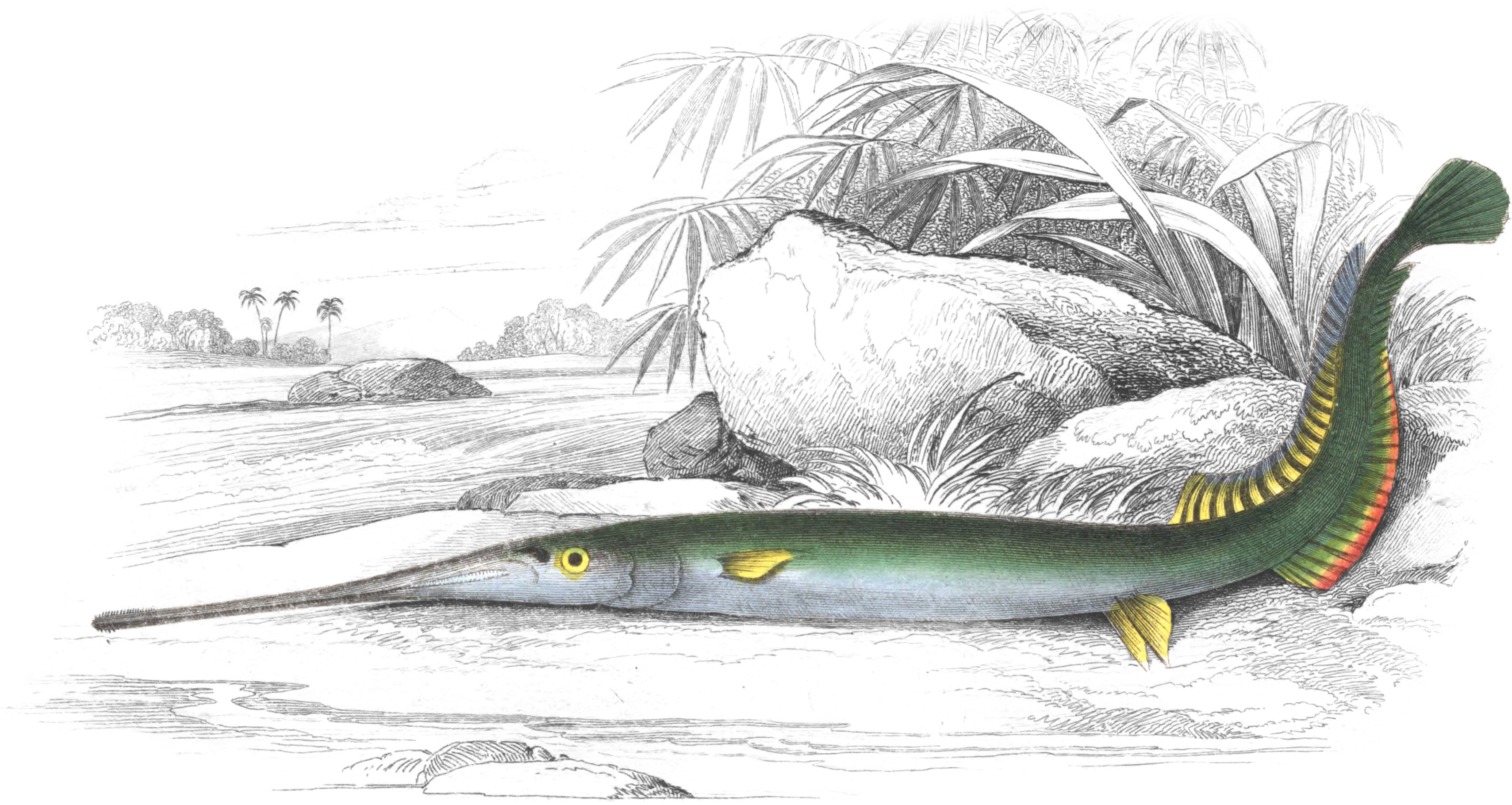
Plate I
Red-Bellied Sciena
Sciæna? rubella
Macusi, Cova; Warrau, Oborahai; Creole, Bashaw; L. Geral, Piscada.
This fish undoubtedly belongs to the Sciænoides of Cuvier and Valenciennes, having a double dorsal fin; but without specimens, it is extremely difficult to refer it to any of their individual divisions. It is allied to Corvina, Ombrina, and Micropogon, and will most probably be found to range in one of these, several species being found in the estuaries of the South American coasts, and in the lakes and rivers of the New World.
This fish, about two feet in length, is taken plentifully in most of the rivers of Guiana, and is much esteemed for food; they are particularly plentiful in the Barima and Corentyn rivers, where, at some seasons of the year, they are the principal animal food of the Warrau Indians. The scaling is rather small; opercle terminates in a point; the gill-covers and whole head are entirely covered with scales; eyes yellow; nostrils double, and placed near them; teeth fine, in single rows. The body is silvery blue on the back, varying to rose-colour on the belly and tail; lateral line much bent. (The dorsal, pectoral, and ventral fins are blue, of a darker shade than the back; the anal fin, with the tail, is rose-colour.) They are fished for with long lines, which are towed after a canoe, pulled quickly: the hooks are baited with small fish; sometimes with feathers, resembling an artificial fly.
D. 9/34—P. 16—V. 6—A. 2/6—C. 22—Br. 5.
Corvina
We have next a fish which we arrange in the genus Corvina of Cuvier, and the Brazilian Fishes. The greater number of species inhabit the sea; but we have some in the estuaries of the Ganges, and also in the lakes of North America. The fish given by Spix, C. adusta, is from the Brazilian seas; it is represented of a uniform olive-brown, paler beneath, tinted with reddish yellow about the head and opercula.
Corvina, Cuvier.—Corpus elongatum plus minusve compressum squamis non adeo magnis undique tectum. Caput minus compressum, squamis variae magnitudinis omnino abductum; rostrum inflatum obtusissimum, parva prominens, cavernosum. Operculum postice aculeatum, latum; suboperculum angustum, præoperculum aculeis majoribus minoribusve armatum. Membrana branchiostega lata, radiis 7. Apertura branchialis sat magna. Os mediocre sub rostri apice, arcuatum, supra in ossibus intermaxillaribus et infra in mandibularibus lata fascia dentium velutinorum minutissiorum armatum. Pinnæ dorsales duæ; anterior aculeis gracillibus longioribus, posterior longior radiis fissis basi tantum squamatis suffulta. Pinna caudalis basi plus minusve equamata. Pinna analis parva antice aculeis majoribus minoribusve armata. Pinnæ ventrales longe accuminatæ, acuieo primo tenui; pectorales longiores accuminatæ.
The Corvina of the Essequibo
Corvina grunniens
Arawaak, Durro-durro; Carib, Spoca; L. Geral, Piracuta. Schomb. Drawings, No. 2.
The fish represented on the opposite plate appears to range in the genus to which we have referred it, and resembles, in form and shape, the C. adusta of Spix. The drawing wants the scaling which in that species and in some others, represented on the plates of Cuvier and Valenciennes, seem to cover the whole cheeks and snout. Several species make a hoarse noise and have received their provincial appellations in consequence; the C. ronchus of Valenciennes is thus named; at Maracaibo, it is called “el ronco” and “el roncador;” and at St. Domingo and Surinam, other species have received synonimous appellations.
The fish from which the drawing was taken was killed at Comacca Island, in the Essequibo, in September; the flesh is good, but bony; they are taken by the hook and line, as well as shot with the arrow, but are not very plentiful. They make a curious grating noise under a canoe, when she is tied up near their haunts. The colour is of a silvery blue; the dorsal and anal fins spotted with black; the scaling of moderate size, fringed, and adhesive; lateral line straight and near the middle of the body; head depressed; ventral fins a little behind the pectoral. Nostrils double, and situate near the eye; eyes oval with the iris red; the mouth terminal, jaws nearly equal; teeth fine, in single rows in both jaws; gill-covering scaled, and smooth at the edges. Feeds on insects and small fish, and is generally found among the rapids.
In some of the species the air-bladder is described as fringed with numerous appendices; in others, such as C. oscula, Val., it is quite simple, and very large. The stomach of this fish presented pyloric appendices, and was filled with the debris of fresh-water shells. In the C. nigrita, Val., the air-bladder is large and lengthened to a narrow point; on each side of the anterior part, there arises a small short process, which divides into five branches; from the two interior of these spring two very short branches; while the three others, equally divided, are prolonged into lengthened filaments, which are retained by a fatty cellular tissue upon the sides of the bladder.
D. 9/32—P. 14—V. 6—A. 1/7—C. 15—Br. 4.
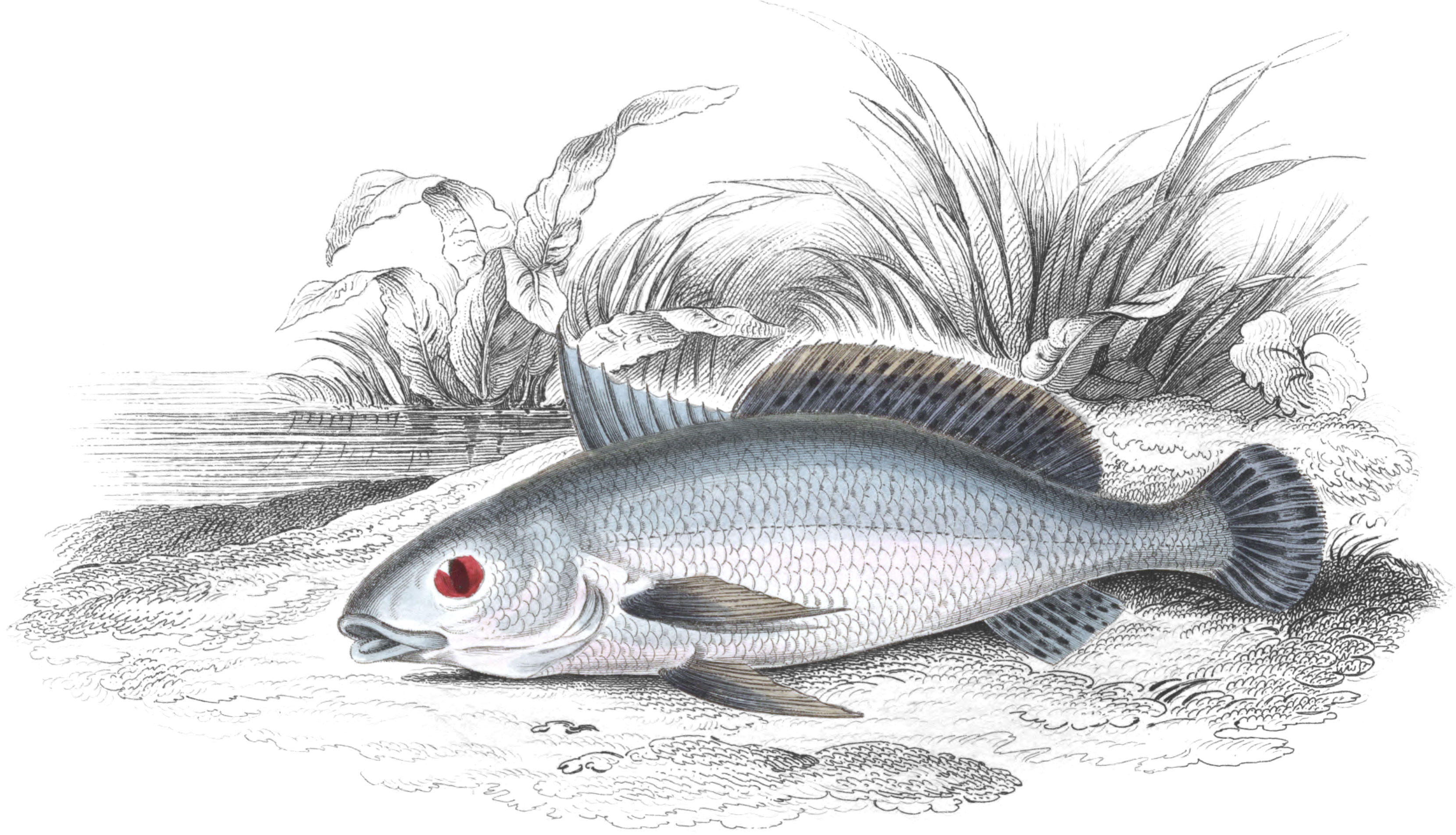
Plate II
Cychla
In the “Brazilian Fishes” we have two forms of Cychla represented, one of a lengthened form, strong lips, and a long dorsal fin; the other of a deeper form, with the dorsal fin undulated where the separation takes place, in these fishes having that member divided, and having the body marked with conspicuous ocellated spots or markings. The examples will be noticed in succession, but we give first the characters of Agassiz, which agree best with the first or lengthened form,—resembling that of Latilus or Pinguipes, but with a short anal fin.
Cychla, Agassiz.—Corpus elongatura, subcompressum, squamis minoribus obductum. Linea lateralis interrupta. Caput productum, subacuminatum. Operculum poetice accuminatum, suboperculum postice prolongatum, nee non buccæ squamatæ. Os magnum surdum subinflexum; ossa intermaxillaria ambitum oris superiorem totum sustinentia valde protractitia, ut et mandibularia fascia lata dentium velutinorum obsita. Pharynx neque dentibus velutino armatus. Membrana branchiostega radiis 5. Pinna dorsalis longa; pars ejus anterior aculeata posteriore molli longior. Pinna analis brevis. Pinna caudalis rotundata.
The annexed Plate, taken from the fishes of Spix and Agassiz, will exhibit this form. There is an uncoloured drawing in the Collection, which we venture to refer to it, though that represented on the former is said to inhabit the Brazilian sea.
Large-Lipped Cychla
Cychla labrina, Agassiz.
Cychla labrina, Spix, tab. xlii. p. 99.—Warrau, Saboa. Schomb. Drawings, No. 21?
We have an uncoloured sketch, which we refer to the fish of Spix above quoted, though some differences occur, such as the absence in our sketch of any markings on the tail, dorsal and anal fins, and in the more angular form of the posterior extremity of the latter members. The notes which accompany the Number are as follow:
This fish is common in the lower as well as upper parts of the rivers; they are good food, and grow to six or seven inches long; they take bait. The figure, as represented by Spix, is of a blackish olive, which would probably be much brighter if seen when the fish was newly taken.
Mr. Schomburgk continues
Another species very much resembling this, was killed in the Padauiri, but differs in the number of rays and vertebræ; it grows to the length of eighteen inches; the flesh is good, and it takes bait readily, but does not bite in the night, hence it is called “Sunfish.” The body is long and nearly round; the snout flattened; nostrils single; lips fleshy; teeth all fine, in double or triple rows. Gill-covers smooth-edged and scaly, opercle pointed. Eye placed near the middle of the head, coloured orange and black; air-bag single, and as long as the cavity of the body.
Of the first, or what we consider C. labrina, the following fin formula is given; the remarks on the second species may, we think, have reference to our next Plate, on which there is no Number or Notes. The formula of the fins of the first is
D. 19/14—P. 16—V. 1/6—A. 3/11—C. 16—Br. 5—Vert. 34.

Plate III
Banded Cychla
Cychla fasciata
No Number or Notes accompany this drawing. The colour of the entire fish, together with the fins, is of a dull blackish blue, paler beneath, and on the first part of the dorsal fin, the body being transversely banded with numerous dark bands; in the drawing they amount to thirty. The iris is coloured bright orange-red, and appears very conspicuous in the dark fish. The first and second rays of the pectoral fin are of a pale yellowish brown, and appear strong,—almost spines.
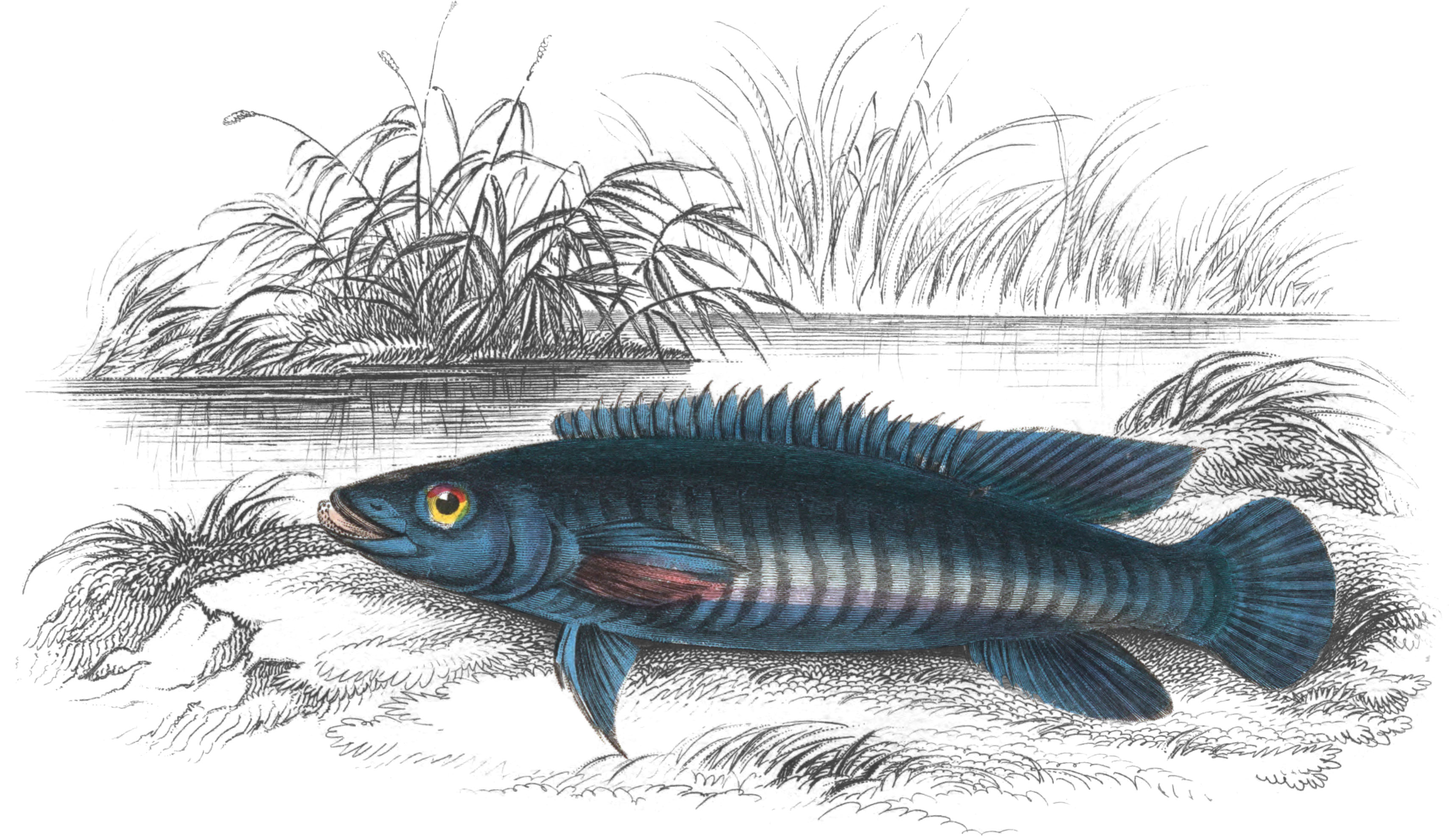
Plate IV
The next fish, of a similar form, will present a striking contrast in its brilliant colouring
Red-Headed Cychla
Cychla? rutilans
Schomb. Drawings, No. 71.
Our Notes are also very scanty in regard to this species, but the Drawing is more than usually minute.
It was taken in the Rio Branco in April The teeth were, a row in each jaw, and some in front; tongue round and fleshy. The scaling was very small, fringed, and deciduous. Small fish were found in the stomach. The air-bag single, pointed, and as long as the body.
The upper half of the head and body is of a delicate pale green, continued on the rays of the dorsal, anal, and caudal fins, the membranous parts of which are bluish grey. The lower half of the head, the breast, and ventral fin, are rich vermilion-red, darker on the upper lip and edges of the opercle and preopercle; the remaining part of the lower half of the body, to the centre of the insertion of the anal fin, is pale rose-colour, shading into the green above. The extremity of the body, below the curved part of the lateral line, is greenish grey; the pectoral fin is wood-brown; at the insertion of the tail and termination of the lateral line, there is a round spot of deep black, and a dull band of the same colour bounds the soft extremity of the anal fin.
This last fish, in many parts of its form, and in its bright colour, resembles the Serrani, and it is possible that it may stand described under that generic appellation; at the same time, our drawing and short notes agree with the characters we have printed from the Brazilian Fishes.

Plate V
The second form of Cychla, and that to which we feel inclined to restrict the appellation, is represented by the C. monoculus, Spix, tab. lxiii., by those described in the second volume of Humboldt’s Zoological Researches, and by the C. ocellciris of Schneider. It belongs to the Labrinæ. The fishes composing it are all brightly and gaily coloured, and are remarkable for their very decided banded and ocellated markings, which also prevail in all the species of which we now possess drawings. This genus of Bloch and Cuvier, to which most modem Ichthyologists refer these fishes, is not recognised by Valenciennes, who seems to have distributed them through other groups. In the Histoire Naturelle des Poissons, he says,
Mais le genre Cychla, composé d’abord d’une maniere trop vague a été reduit par nous, a des especes de la famille des Labres.
Without having examined specimens, we should not like to differ from such authority; at the same time, the forms represented in these works and drawings appear very natural in every respect, and would seem entitled to a generic separation. At the end of the volume, we have brought together the other species which have been represented by Humboldt and Spix, and now represent those which were found by Mr. Schomburgk.
Yellow-Spotted Cychla
Cychla flavo-maculata
Pintado.—L. Geral, Lucanari. Schomb. Drawings, No. 45.
This beautiful fish inhabits the Rio Negro and Padauiri, and is preferred to most others for the delicacy of its flesh. The scaling is rather small, elliptical, slightly fringed, and adhesive; lateral line arched until over the ventral fin, when it bends to the middle of the body, and runs thence to the tail (see Drawing); head compressed; ventral fins placed under the pectoral; air-bag long, covering the spine the whole length of the cavity of the body; nostrils single, round, situate near the eye; eye round, iris black and yellow, and situate over the gape of the mouth; tongue pointed, fleshy; lower jaw slightly produced; teeth fine, thickly set in each jaw; intestines straight. The gill-opening is semilunar, the cover having all the bones scaled; the roe is moderate-sized and double. It lives but a short time after being taken from the water, takes bait and the artificial fly rudely constructed by the Indians; it will also bite at a red pepper or a red rag. They are perfect tyrants when they are plentiful, and being a swift swimming fish, destroy great numbers of smaller fishes. The body is greenish lake, with three black bars, three rows, and several scattered yellow spots; on the head several black spots, and a peacock-eye on the insertion of the tail. Dorsal fin and upper part of tail, indigo spotted with light blue; ventral, anal, and lower half of caudal fin vermilion; pectoral greenish; gill-rays vermilion; belly lighter than the other parts of the body. They grow to two feet in length.
The formula of the fins is,—
D. 15/16—P. 16—V. 1/5—A. 10—C. 20—Br. 5.

Plate VI
Black-Blotched Cychla
Cychla nigro-maculata
L. Geral, Lucanari. Schomb. Drawings, No. 46.
This is another species having the same habits and residing in the same situations with the last; they are taken in the same way, and are equally esteemed for the table; they grow to about eighteen inches in length. The head is compressed, but differs from the last in having a lump on the top; the body and head are irregularly spotted with black, which vary in different individuals; a peacock-eye at the insertion of the tail; body greenish yellow, light on the belly and sides; gill-rays, ventral, anal, and lower half of caudal fin, vermilion; upper half of caudal fin, and dorsal, indigo; the scaling is small and slightly fringed, elliptical, and adhesive; the lateral line is divided; ventral fins under the pectorals; air-bag single, as long as the cavity of body; nostrils single, near the eyes; eyes round, over the gape, with red and yellow iris; the lower jaw is produced; teeth as in No. 45 (the last); intestines form no flexures, but are straight; opercles scaly, with smooth edges; gill-opening semilunar; the milt double, half the length of the cavity of the body; roe also double, of a like length. Lives half an hour when taken from the water.
The formula of the fins is,—
D. 16/17—P. 14—V, 1/5—A. 3/11—C. 36?—Br. 5—Ribs, 16 pairs.
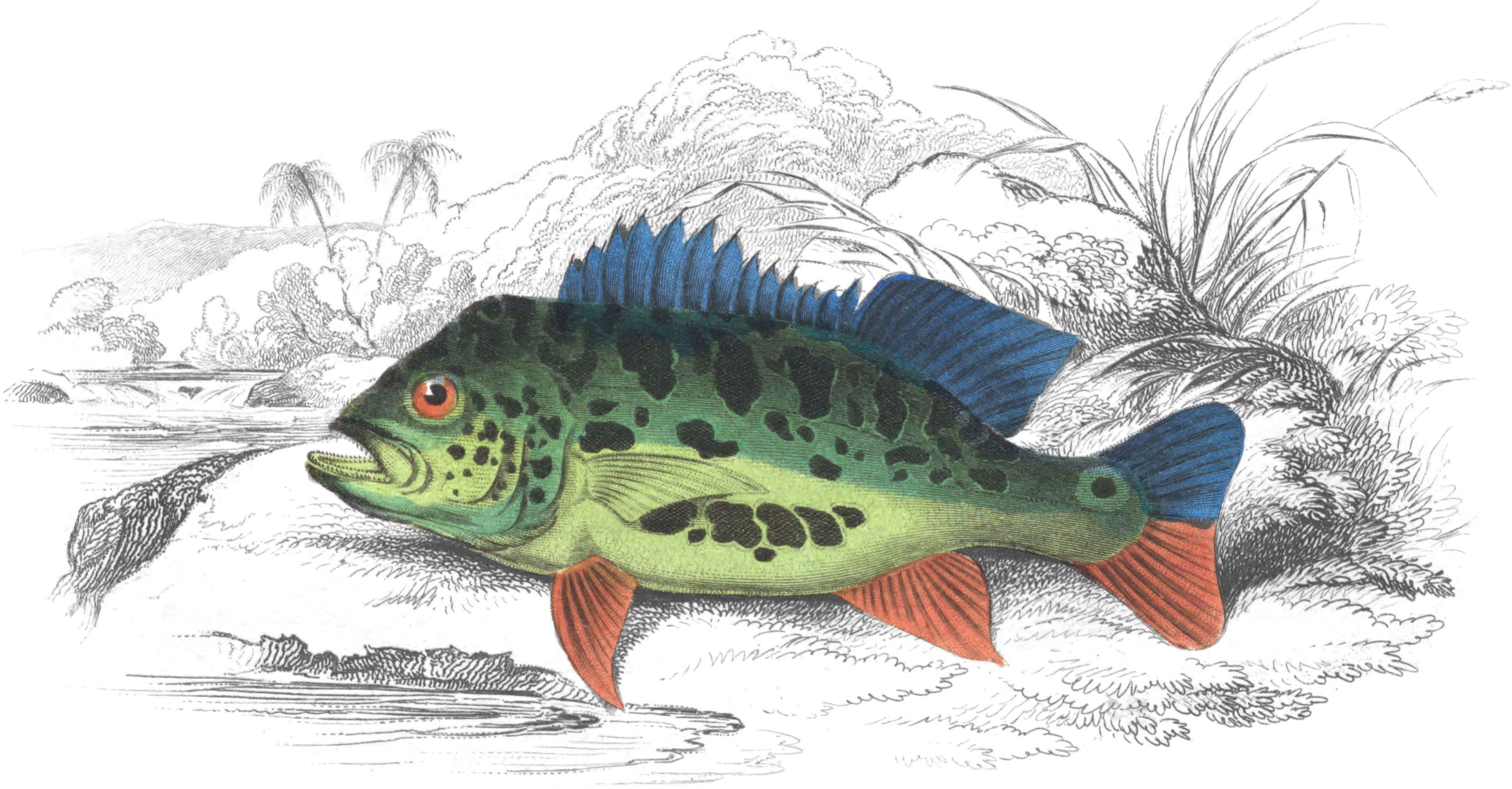
Plate VII
Argus Cychla
Cychla argus, Valenciennes?
C. argus, Val., Humb. Zool. Obs. ii. p. 169.—Arawaak and Macusi, Lucanani; L. Geral, Lucanari; Creole, Sun-fish. Schomb. Drawings, No. 47.
This species is found in the Essequibo as well as in the Rios Branco and Negro, resembles the last in its habits, being found in the same situations. The gill-rays, throat, ventral, anal, and half of caudal fin, vermilion; tail with a peacock-eye; large spots of black on the sides, edged with yellow, giving it a gilt appearance; the upper part of caudal fin and dorsal is indigo spotted with light blue; the eye yellow, situate over the gape; nostrils near the eye; lower jaw slightly produced; teeth as in the two last species; opercles scaly, with smooth edges; scaling small, elliptical, and adhesive; lateral line divided as last; ventral fins under the pectorals; air-bag single, length of the cavity of the body; anus situate near the anal fin; gill-opening semi-lunar; roe double; half the length of the cavity of the body. It lives only half an hour after being taken from the water, and is taken in the same way as Nos. 45 and 46, also with the arrow.
To the conclusion of Humboldt’s observations on these fishes, Valenciennes adds the description of one from the Museum of the Garden of Plants, which seems to agree with the above Number of Schomburgk’s drawings. He states the spots to be ocellated with white, with, however, a? The spirits may have withdrawn the colour. The formula of the fins of the Parisian specimen is,
D. 18/15—P. 12—V. 5—A, 5/0—C. 15.
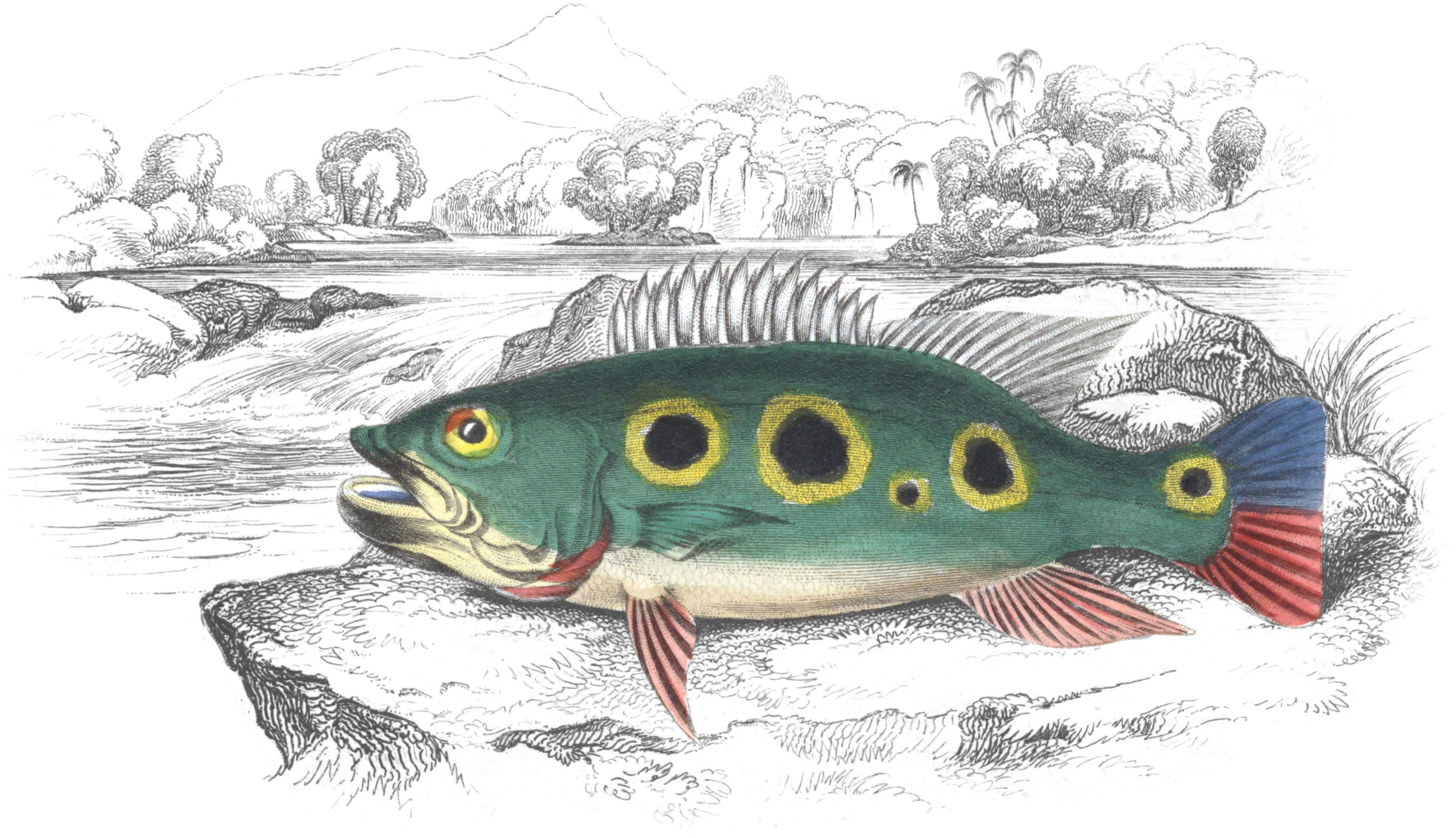
Plate VIII
Triple-Banded Cychla
Cychla trifasciata
L. Geral, Lucanari Grande. Schomb. Drawings, No. 59.
Our Notes relative to this species are very scanty;
it was met with in the Rio Negro and in the Padauiri in the month of February; it continues alive only a short time when removed from the water; its food, other fishes; teeth are thickly set in both jaws; tongue pointed and fleshy; the intestines straight.
The drawing is of the same size with the others, the outline somewhat similar; but there is a sudden rise immediately posterior to the head, after which it falls again and rises before the insertion of the second portion of the dorsal fin; after which it is suddenly narrowed, as in the others, to the insertion of the tail. The colour of the drawing above is a dark olive-green, shading into yellow, slightly tinged with green on the lower half of the fish, or below the lateral line, which bends somewhat, following the dorsal outline. The opercula and head are marked with irregular shaped spots of black, and the middle of the fish is crossed with three dark, nearly equidistant, oval marks, the first arising nearly after the insertion of the pectoral fin. Above the lateral line at the insertion of the tail, a large black spot, ocellated or surrounded with an interrupted yellow ring. The dorsal fin and upper lobe of the tail is indigo blue, the latter spotted between the rays with black; the pectorals of a greenish yellow; the throat and rays of the branchiæ, anal and ventral fins, and lower lobe of the tail, vermilion red. Although some of the other specimens are banded with black, we have designated this fish from these markings, which alone stand out from a dull uniformly coloured surface, without the interruption of numerous spots of any other colour.

Plate IX
Red-Spotted Cychla
Cychla? rubro-ocellata
L. Geral, Acarra. Schomb. Drawings, No. 38.
This fish, in its form commencing to vary from those which we have considered as typical of Cychla, will lead us on to the next; it is altogether a deeper fish, but retains traces of the bands so prevalent in the others, the brilliant colours, and is marked with the peculiar ocellated spots we have observed throughout; the anal fin also is of much greater extent, and the three first rays are spined or strong. The lateral line, however, as represented in the figure, is parted towards the tail. Mr. Schomburgk observes,
This is also a native of the Rio Negro and its tributaries, and is called Acarra, which is the common name for the whole genus. It is a beautiful fish, greenish on the back and yellow on the belly, variously banded and spotted with black; the caudal fin is scaly half its length, and spotted with vermilion; on its insertion is a peacock-eye, and another on the soft rays of the dorsal fin; the eye is bright orange, and situate near the middle of the head; the gill-lid scaly; teeth fine, and in both jaws; lower jaw a little produced; lateral line parted. The scaling is rather large, fringed, elliptical, and not very adhesive; the head compressed and ventral fins a little behind the pectorals; the nostrils single, and situate at half distance from the eye; the snout and tongue pointed. They are taken by the hook and with arrows, and are good and well-tasted fish.
The peacock-eyes, or ocellated spots, are dark vermilion-red with a large black centre, and the base of the soft part of the dorsal, the anal fin, the whole base of the tail, and part of the extremity of the body, are thickly but irregularly studded with small spots of the same red tint. We have little doubt also that the teeth and their distribution in this fish are different from the preceding ones under the same generic name, and consider that an examination of specimens would place it distinct. The formula of the fins is
D. 12/19—P. 13—V. 1/5—A. 3/14-C. 15.

Plate X
Centrarchus
Allied in form to the fishes we have just described, we have one or two species which appear to belong to the form denominated by Cuvier and Valenciennes Centrarchus, and of which they give the Cychla cenea of Lesseur as typical. They place this form, and that to which we have referred another fish, Pomotis, next each other, and discuss them in the same chapter, distinguishing that which we have now before us principally by the greater number of spines to the anal fin, while in Pomotis they are few, generally three in number, and the operculum is terminated in an ear-like membrane, which has suggested the generic name. Both forms, so far as known, are found chiefly in the fresh waters of North America, feed on insects and aquatic larvæ, and several of them are used for the table. The characters given in the “Histoire Naturelle des Poissons” are nearly as follows:
Centrarchus.—Has the body oval, compressed; a single dorsal fin; teeth “en velours,” upon the jaws, anterior to the vomer, upon the palatine bones, and on the base of the tongue, the preoperculum entire, end of the operculum in two flat points.1
In the new edition to Cuvier, by his pupils, the characters are given,
Acanthopterigiens percoides a six rayons branchiaux, a un seule dorsale, a preopercule lisse, et a dents en velours sur les machoires, sur les palatins, sur le chevron du vomer, et sur le base de la langue.
Cychla-Like Centrarchus
Centrarchus cychla
L. Geral, Accari. Schomb. Drawings, No. 62.
We have placed this fish as a Centrarchus, but acknowledge that we have done so merely because it recedes from the type of Cychla as given by Cuvier and Humboldt; as we have repeatedly had occasion to remark, it is impossible from the drawings to fix the genera with certainty, particularly when they depend on some of the minute distinctions of the teeth and their position, as employed throughout the volumes of the “Histoire Naturelle des Poissons;” and of the present fish and that which follows, the plates are given to direct attention, and for the use of future travellers; for we have no doubt that from the figures we have given, the fish would be at once again recognised; and from the generic characters, printed from Valenciennes, it may be ascertained whether we are correct, or if not, in what points they vary from them. In the markings, this fish still exhibits the banding of many of the Cychlce, and dark spots, but without any of the ocellation so prevalent in the others; the colours, though still bright, are not nearly so vivid; the angles of the opercle and pre-opercle are more accuminated, and run almost to blunt spines. The scanty notes supply us with the following information:
Rio Negro; caught in March; takes bait; good fish for the table; grows twelve inches long; worms found in stomach.
The colouring will be best understood from the figure. The body is of a deep greenish grey, having indications of seven dark bands, which are interrupted in the middle or on the lateral line; a single conspicuous black spot is placed near the insertion of the tail; the lower part of the body, below the pectorals and anterior to the anal fin, is vermilion-red; the dorsal and anal fins are pale indigo-blue, barred with reddish brown at their posterior extremities. The formula of the fins are,
D. 15/12—P. 14—Y. 1/5—A. 5/10—C. 16.

Plate XI
Dark Centrarchus
Centrarchus niger
Of this species we do not possess available Notes, and a representation of the drawing is given to complete the Ichthyology of the Guianese waters so far as our materials will allow, and to call the attention of other travellers to the wanting points. The figure of this fish is in length six inches and three-quarters, in depth about three; the colour is entirely a dark bluish black, paler beneath; and on the belly, anterior to the ventral fins, the edges of the mouth, and the borders of the opercula and preopercula, indigo blue; the iris is coloured orange-red; the dorsal fin is represented as having seventeen spiny rays, ten soft; the ventral with six spiny, eight soft, and both without any appearance of spotting. The ventral fin has a strong round spine before the first soft ray, which considerably exceeds the others in length. Taken in the Rio Negro in February.

Plate XII
Dark-Marked Centrarchus
Centrarchus notatus
This species, of which we have no Notes, somewhat resembles the C. æneus of Valenciennes, but the head is covered with a dark spotting, and there is no large spot on the opercle. In length it is eight inches and a half, in depth three and a half. The colour is a uniform olive-brown, five indistinct handed marks running below the middle of the fish, the last entirely across at the termination of the dorsal and anal fins. At the base of each scale there is a dark rich umber-brown spot, and the whole lower part of the head and opercula are marked with rather large irregularly rounded spots of the same colour. The dorsal and anal fins are large, and are marked between the rays with dark spots which run in bands. The tail is similarly spotted; the ventral fins are lengthened.
D. 16/12—A. 7/12—C. 16.

Plate XIII
Black-Banded Centrarchus
Centrarchus? vittatus
Neither of this fish have we any Notes; the drawing alone, finished with considerable detail, is before us; the general form is that of the two preceding species, but the scaling is proportionally larger, and the caudal fin, very slightly forked, has the lower lobe shorter than the upper. The jaws are equal, and appear furnished with minute teeth on their edges; the outline of the opercula is rounded, and the anal fin seems to possess only three spiny rays, which, in the system of Valenciennes, would bring it near to or in the genus Pomotis. The general colours are represented to be bluish green on the fins and upper parts, shading into silvery on the belly, and the whole is marked with darker bands of the common tint. The opercula and upper lobe of the tail are spotted with pale blue; and below, rather in front of the eye, and between it and the maxillary bone, there are three oblong streaks of bluish green, the last reaching to the angle of the mouth; but the most conspicuous marking in the fish is a line of about a quarter of an inch in breadth, of a deep black colour; running from the upper part of the operculum, or opposite the eye, to the centre of the tail; and having on the extremity of the body, above its termination, a circular spot of the same colour. The iris is pale yellow. The dorsal fin, so far as we can count from the drawing, has fourteen spiny and ten soft rays; the anal 3/7; the ventral 1/5; the first being of considerable strength; the first soft ray prolonged considerably beyond the rest. .Length of the drawing is nearly five inches, depth two inches.

Plate XIV
Long-Snouted Centrarchus
Centrarchus?? rostratus
L. Geral, Aearra. Schomb. Drawings, No. 60.
This prettily marked fish is also accompanied with few details;
it was taken in the Rio Negro in February; the teeth are a single row in each jaw; the gill-covers have five rays; the scales are large, elliptical and adhesive. Above, the colouring is clear olive, shading off about the lateral line, beneath which the lower half of the first is silvery; the tail also is olive, shading at the base into indigo-blue, and having a narrow band of the same colour near the extremity of the body; the remaining fins are yellowish brown and olive, and on the anal olive between the rays; on the dorsal having the caudal aspect of the spiny rays tipped with reddish orange. The mouth and snout are rather lengthened; the jaws even; the opercula terminate posteriorly in a slightly accuminated point or angle, and the space between the pectoral and ventral fins are marked with small irregular blotches of reddish orange; on the angle of the preoperculum there is an irregular roundish spot of black, and on the centre of the body there are two large oval spots of the same conspicuous colour. The iris is coloured orange.
Length of the drawing four inches four-tenths, depth one inch and a half.
D. 13/9—P. 14—V. 24—A. 3/8—C. 16—Vert. 24.

Plate XV
Blue-Finned Centrarchus
Centrarchus? cyanopterus
Macusi, Camarapaca; L. Geral, Acara Tinga (“Tinga” is Stinking). Schomb. Drawings, No. 19.
We place this fish with Centrarchus, as appearing nearer to it than any other; though we are by no means satisfied that it will stand here; there appear to be only three spines to the anal fin.
This fish is a native of the Essequibo, and is drawn of the natural size; the colour light green, varying to blue on the side, and dull rose on the belly; the eye is large, yellow, and red, and situate near the top of the head; the gill-lid scaled, with smooth edges and edged with rose colour; pectoral fins rose, ventral, placed under the pectoral, blue spotted with brown; dorsal and caudal ditto; anal blue spotted with rose; the jaws are equal; lips fleshy; teeth fine single rows; lateral line divided. They live an hour after being taken from the water, take bait, and prefer creeks and still waters to the fast running streams. Great numbers of them are annually destroyed, together with other fish, by poisoning their resorts when the rivers are low. Of this species I have seen two middle sized canoe-loads killed at one time; they are well flavoured but bony, and are said not to exceed the size of the one represented. I have seen one much like this in the river Padauiri, a tributary of the Rio Negro, 12 inches in length; it had two or three blue stripes on the head, but I had not the means with me to make a drawing of it. The scaling is large and slightly fringed.

Plate XVI
Pomotis
The next fish which occurs, we cannot determine generically with satisfaction; it ranges among or near to the Centrarchi of Valenciennes, and would come close to Pomotis of that author, were it not for the numerous spines on the anterior part of the anal fin, which in that genus is rather artificially restricted to three or four; the teeth scarcely appear to agree with either. Pomotis, in which we provisionally place it, is found in the fresh waters of North America, consisting there of a single species, of which there is a good figure in the Northern Zoology of Dr. Richardson; a second species is indicated by Valenciennes from Buenos-Ayres. One of the distinguishing marks is the ear-like flap which extends along the posterior margins of the opercula; and it is probable that from the little development of this part and other modifications of structure, that it may range more properly with Centrarchus. The present title, however, will call attention to the presence of Pomotis in South America, and we add the characters.
Pomotis, Cuvier.—Body broadly oval, compressed; dorsal fin slightly emarginate; the hinder part of the anal with a sheath of scales at their base, the spines of these tins moderate; an elongated membrane or flap at the angle of the operculum; caudal fin lobed; ventrals under the pectoral, with a pointed basal scale.
P. vulgaris, Swain.
Black-Banded Pomotis
Pomotis? fasciatus
L. Geral, Acarra. Schomb. Drawings, No. 37.
The scaling of this fish is middle-sized, fringed, elliptical, and adhesive; the lateral line divided, one part arched till under the last spiny ray of dorsal fin, the other beginning when that ends, and moving straight to the middle of the tail; a little lower it is of a greenish brown with a broad black stripe running along the middle of the body; the webs of the fins are bluish, caudal fin somewhat rounded; eye large, and situate near the top of the head; iris orange; teeth fine, and thickly set in both jaws; tongue pointed; nostrils single, near the snout; gill-lid covered with scales, the opening semilunar; the ventral fins are placed nearly under the pectorals. They take the hook, baited with small fish, readily; and are much used for food in the Lios Padauiri and Negro. The air-bag is double, one half oval and the other pointed and long; milt double, half the length of the cavity of the body; intestines make three flexures. The appendage to the gill-flap appears like a prolongation of the edge as a membrane, with a regularly rounded outline, but with no jutting-out appendage as in P. vulgaris; the teeth, though fine, are represented of considerable length, particularly on the upper jaw. The length of the drawing is eight and a half, the depth four inches; the colour of the fish yellowish umber-brown, interrupted by the broad black line running along the centre of the body. The formula of the fins is,
D. 16/14—P. 13—V. 1/5—A. 8/12—C. 16—Br. 6.
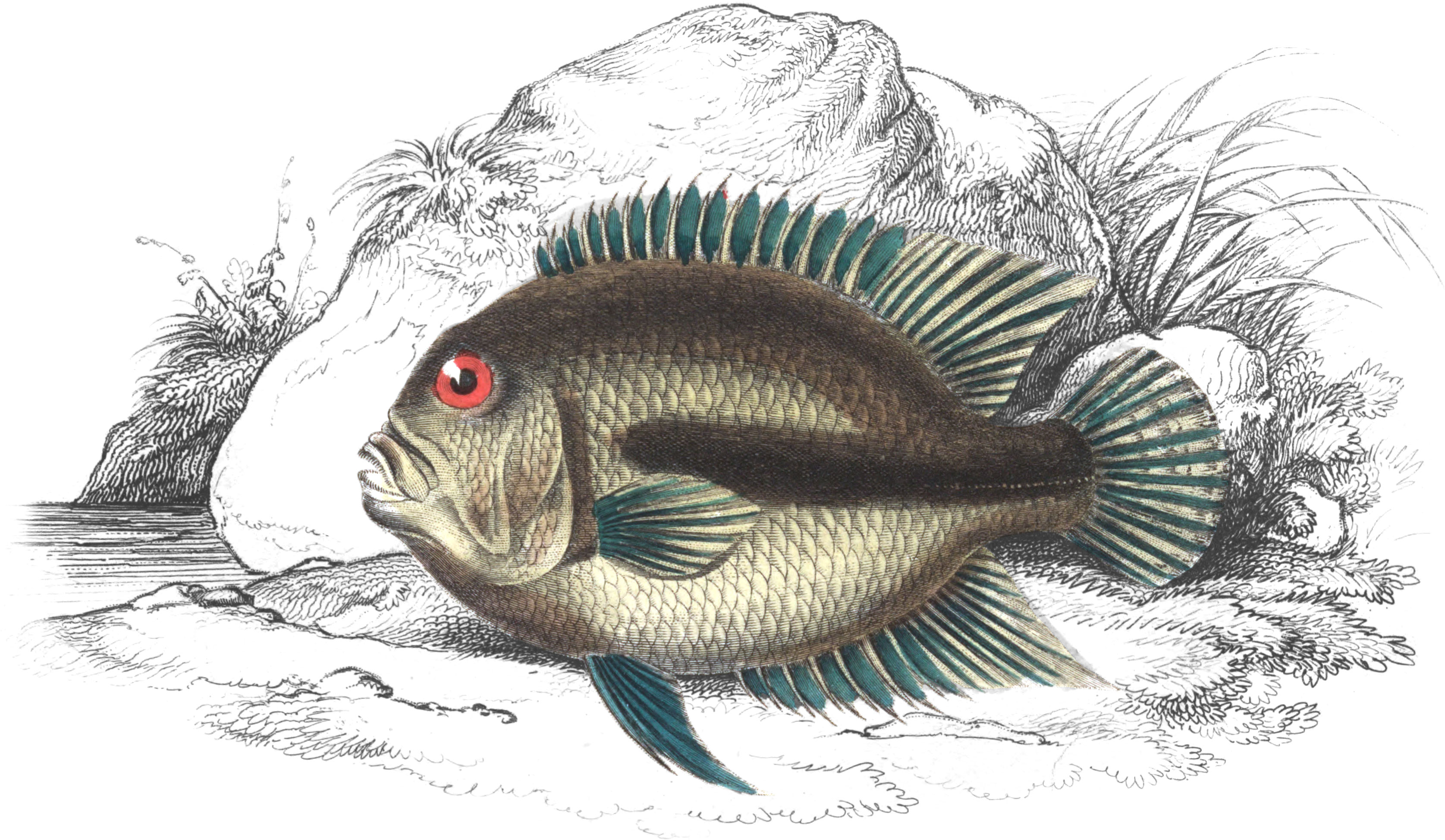
Plate XVII
We possess a slight uncoloured sketch of another fish, which appears nearer to Pomotis than the last; the teething is represented as more minute; there appears to be a slight auricle to the operculum, and the anal fin has only three spiny rays. We give an outline also to direct attention, with Mr. Schomburgk’s short notes.
Bono of the Warrau Indians
Pomotis? bono
Arawaak, Siballi;2 Warrau, Bono; Macusi, Misshaw; L. Geral, Accara Pishuna. Schomb. Drawings, No. 17.
This fish is found in all the rivers of Guiana, and in pools and marshes; the colour is a bluish black; it is taken with the hook, and great numbers are killed by the negroes when the trenches on the estates get dry; they are indifferent food, being dry and bony. The body is compressed; mouth rather small; jaws equal, and armed with single rows of fine teeth; the eye is red; opercles scaly, with smooth edges; nostrils single; lateral line divided, one part arched running near the back for two-thirds of its length, the other commencing lower and running straight to the middle of the tail; the tail is a little rounded, scaling large and rough, fringed, and adhesive. Length of the drawing six inches, depth two and a half.
D. 14/10—P. 13—V. 1/5—A. 3/8—C. 16—Br. 5.
Gymnotus
Of this remarkable and far-famed form two examples occur, one the G. electricus,3 the other a small species of a dark colour, and crossed with black diagonal bands. The notes relating to either, we regret to say, are extremely scanty, and no mention is made, either of any aversion in the natives to secure them, or of any particular mode of capture employed by them.
Electric Gymnotus
Gymnotus electricus
L. Geral, Porrak. Schomb. Drawings, No. 58.
Taken in the Rio Negro in February; body long and slimy; lips fleshy, roof of the mouth warty; tongue round, fleshy,
is all the note attached to the above number. The drawing is coloured of a deep bluish green above, shaded to a dull ochraceous colour on the snout, lips and anterior third of the lower parts becoming paler in the middle half of the body; the anal fin is of a deeper shade than the upper part of the body, but at its origin patches of the ochraceous or yellow colour of the head appear on it; the lower lip protrudes considerably beyond the upper.
We are not aware of a good coloured figure of this species.

Plate XVIII
Irregularly Banded Gymnotus
Gymnotus fasciatus
Schomb. Drawings, No. 35.
This species was found in the Rio Branco. The body is long, head depressed, lower jaw considerably larger than the upper; it is devoid of dorsal, ventral, and caudal fins; the pectoral, situate near the head, the anal reaching nearly the whole length of the body. The body is compressed, ending at a keel at the anal fin; scaling very small, deciduous, elliptical; lateral line running above the middle of the body; nostrils double, one pair on the snout, and one pair further back; eyes situate nearer the snout than the middle of the head, small, and of a dark colour; the tongue round and fleshy; teeth double rows, five in both jaws; the gill-lids smooth and opening in an oval hole. It lives an hour or more after being taken from the water, is used for food, and is taken with small hooks baited with worms. The intestines are long, and have appendices attached to the stomach and intestines. There are several species of this fish, varying in colour and size, found in the rivers of Guiana, but none have now come under notice on this expedition but the specimen from which the drawing was made, which is of the natural size; it differs in colour from all the others.
Humboldt discovered another small species of Gymnotus in the river Madelina, which he has named G. æquilabatus, to distinguish it from the others, which have a considerable inequality in the length of the lips, or rather jaws. It is used as food, and in some parts it was considered as a luxury. It possessed no galvanic properties. The form is somewhat like that which we have now figured, but at the caudal extremity tapers nearly to a narrow thread, from which it has received the provincial appellation of “El Raton.” The colour above is dark olive, shading into silvery below the lateral line.

Plate XIX
We have now examined all the drawings belonging to one great natural division of fishes, those with osseous skeletons; in the fresh waters of any country the cartilaginous species are of rare occurrence, their large size and predaceous habits requiring for them a wider range; several species of small rays, however, are found at a considerable distance inland in several of the Guiana rivers; three, those of which we possess drawings, approach nearest to the genus Trygon, while a fourth we can reconcile with no characters to which we have access; and it is possible that these entirely fresh-water skates may be found to vary considerably in their structure and economy. Of the first, our author thus writes:—
We are informed by Linnæus that the Raya, or Rays, are exclusively inhabitants of the seas. I think a species has since been described by D’Orbigny as inhabiting fresh-water rivers; Guiana, however, possesses several species, which consequently will prove new to Ichthyology. Their form is not different from those of the salt-water rays, and they are generally armed with spines; some with the back more or less spiny, tuberculous, or smooth. The spine or prickle, in the fresh-water Trygon is an equally dangerous weapon as that of its congeners which inhabit the sea, and wounds inflicted with it cause frequently severe inflammation. As they generally frequent such places of the river where the bottom is sandy, and in which they bury themselves, in order the easier to entrap their prey, the Indians use the greatest precaution when they are obliged to draw their canoes over such shallow places. I have known several instances where, nevertheless, wounds have been inflicted, and a swelling of the part, and in some instances feverish symptoms have been the consequence. The Indians use sometimes the leaves of the aromatic guava (Pisidium parviflorum, Beuth), which grows so abundantly among the rocks in the rivers of the interior, and after having pounded them, they are put on the wound, but I do not think with much effect, at least not in those cases where I saw it applied; laudanum in the first instance, and afterwards warm poultices of cassada-bread to subdue the inflammation, appeared to me the most effective remedy. The pain which the wound causes to the individual appears to be excruciating; no wonder, therefore, that the Indian is likewise under the idea that the spine which inflicts that wound is poisonous. The spine being serrated on each side with barbs and hooks, recurved towards the base, it may be expected that the wound becomes dangerous from its jagged nature, while the extraction must cause additional laceration. Dr. Hancock has known the part to mortify and to slough off, and then the healing process went on favourably. I have no doubt that much depends upon the state of health of the individual who is wounded, and the cases which I have witnessed fortunately never came to those extremes.
The spines are sometimes double, and I have seen an instance where there were three. One is generally larger than the other; no doubt a provision of Nature, that in case one was to break off, the animal may not be entirely deprived of its weapon of defence. These barbs are deciduous, and their size depends much on that of the individual. The Indians of the interior use these spines to arm their arrows with; but among many hundreds which I have seen, none reached the length of three inches.
I nowhere observed these rays in such abundance as in the river Tacutu, when that river was in April 1839, on its lowest level. As they afford tolerably good eating, we took some pains to secure them. The Indian is always armed with a sharp-pointed pole, which he thrusts before him when he is wading through shallow water which he thinks frequented by the sting-ray. The yellow colour of that fish, so much like the sand in which it buries itself, makes it the more dangerous; and as it strikes with the swiftness of an arrow, the wound itself would be frequently the first token of the approaching danger. The pole, therefore, serves as a protection to dislodge the ray, which darts swiftly forward when it finds that the enemy is superior in strength. The Indian rushes after it, and is generally skilled enough to pierce and transfix the ray with the pointed pole. His first operation, if he has been successful, is to cut off the tail with its dangerous weapon, which he cuts afterwards out, and preserves it carefully for arrow-points.
I have frequently observed that the rays, no doubt in consequence of the anguish when secured and transfixed by the poles, brought forth young ones. The embryos are, no doubt, as this is the case with Squali, developed in the ova-ducts or in the uterus. The spawn is otherwise wrapped in a strong flat shell of horny substance.
Shagreen is prepared from several species of rays in Europe; whether the rays of Guiana would ever become of economical use in that regard is much to be questioned, although they are to be found in such numbers; nor will they prove of much interest to the gourmand; but I and my companions have fared on a worse dish than a stewed or boiled sting-ray during our peregrinations; we have never despised it when it constituted part of our entertainment in the wilds of Guiana.
Many-Spined Trygon
Trigon histrix?, D’Orbigny.
Trigon histrix, D’Orbig. Voy. dans l’Am. Meriod. Poiss. pl. 13? 15—Carib, Macust, and Warrau, Siparri; Portuguese, Araya; L. Geral, Jawawure. Schomb. Drawings, No. 14.
The drawing before us approaches very near to the figure given by D’Orbigny under the name we have quoted; but the dark markings of the same shape, do not seem to be surrounded by a pale ring as they are in that figure. On our drawings there are two distinct large spines on the tail; in the others they appear as if united, while at the same time double. The dorsal aspect also, of the tail, is only represented and described as spined; while, in the figure alluded to, the sides also have each a row nearly to the very tip. In our plate the lower fish will serve to shew the kind of marking represented by D’Orbigny.
This species was killed in the River Roowa, and measures twelve inches in diameter. The colour is greenish brown, irregularly spotted over the body with black; on the tail is a row of fixed spines and two moveable ones, the latter two or three inches in length, which, from their poisonous quality, and their being serrated, inflict a most severe wound, sometimes causing fever, and is very difficult to heal; they frequent the shallows where there are sand-banks, and persons wading there are often stung by them; they dig round holes, five or six inches in depth, in which they lay sometimes partly covered with sand. They are good food, and are taken by the hook and with the arrow. This fish is from two to three inches in thickness, whereas some of the others do not measure more than one and a quarter. The eyes are prominent; breathing holes, five on each side of the mouth; nostrils double, near the mouth; mouth semilunar; teeth, a file-like process. They feed on animal food, perhaps sometimes on vegetable, as their means of securing the former do not seem adapted for procuring a plentiful supply.
The letter-press to the Ichthyological plates of D’Orbigny has not yet appeared, so that we are ignorant of his observations regarding the fish, to which we have temporarily referred Mr. Schomburgk’s drawing.

Plate XX
Ocellated Trygon
Trygon garrapa
L. Geral, Raya Garrapa. Schomb. Drawings, No. 69.
All the information that we have regarding this beautiful Trygon is, that it has
a series of rough flat teeth, in each jaw, like a file,
and that it was taken in the Rio Branco in April. The general colour of the drawing is a yellow umber-brown, margined round the disk with pale scienna-red, the whole covered with yellowish white spots surrounded with a dark margin, large in the centre of the body, and gradually decreasing in size outwards, where they also become more numerous; a single row of weak spines runs along the upper ridge of the tail, which is also armed about its middle with one large serrated spine. In the drawing the length of the tail about equals that of the body from its insertion to the snout.

Plate XXI
Round-Winged Trygon
Trygon strogylopterus
Raya pintada. Schomb. Drawings, No. 70.
“Taken in the Rio Branco in April,” is all the information we possess in regard to this curious species. It is remarkable for its rounded form, the diameter taken either way being nearly equal; the tail also only nearly equals about a third of the diameter, and, thick at its insertion, becomes rather suddenly attenuated, and is slender to the tip, which is armed at a short distance from its extremity with a single serrated spine. The colour is a yellowish umber-brown, with a narrow border of dull reddish brown; the whole surface covered over with irregular markings and freckles of dark umber-brown.
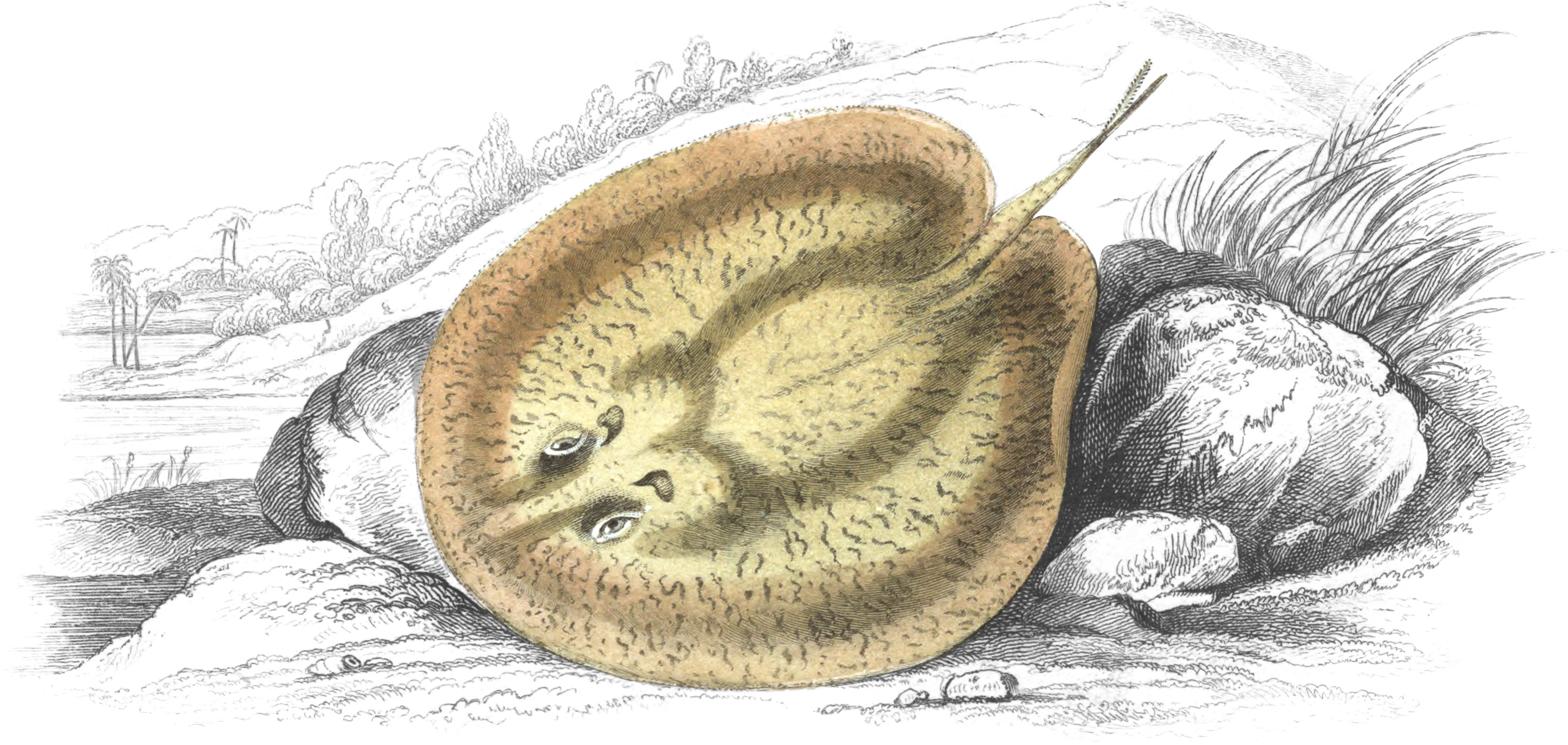
Plate XXII
Spine-Tailed Elipesurus
Elipesurus spinicauda
Schomb. Drawings, No. 36.
This ray was found in the Rio Branco at Fort San Joaqium, and here it is called Naree-naree; it was eighteen inches long, but very thin, and was without the horny spine which is generally found on this genus; a number of spiny excrescences cover the tail, which is much shorter than usual; it is of an ochreous colour; the eyes are prominent, and nostrils very large; like others of the species, they dig holes in the sand, in which they lie flat, and there await their prey. They are used for food, but are not preferred to others, and in the dry season, when other fish are plentiful, they are seldom killed. They are about eighteen inches by fourteen and a half or fifteen, in diameter.
The form is altogether remarkable in the short or deficient tail, an organ among the rays which is generally in one way or other marked by considerable developments. These seem to be here confined to the strong spiny excrescences which cover its base, and are the only organs of defence with which the animal is furnished. The form of the body is more oval than those we have been examining; the colour is uniformly of a bright ochreous yellow, covered with a series of dark reticulated markings.

Plate XXIII
These conclude the drawings which were entrusted to our care by Mr. Schomburgk, and from them and the contents of these volumes generally, some idea will have been gained of the forms of the fishes which inhabit the rivers of the northern parts of South America; but although many of them have been considered as new to science, a very large proportion indeed, when it is considered that Ichthyology was, as it were, only a secondary object with our traveller, we consider that there are still ample stores of novelty. In such an extent of water as that which flows in those mighty streams, the excursions of all the travellers who have yet traversed parts of them are as nothing; hundreds of fishes are yet unknown, and thousands of living creatures, of remarkable forms and structure, still remain to reward the zeal and energy of the naturalist who will trust himself amidst the privations incident to such expeditions, or will brave the severity of climate and the pest of some of the minor classes of these beings.
On peut executer sur l’Amazon, le Rio Negro, et l’Oronoque au navigation non interrompue de 1400 lieus sans sortir du domain des etablismens monastiques,
writes Humboldt; and what a field is there not here, without crossing the boundary from comparative civilization, for every species of investigation. Again, the same author states,
Le Cassiquare, par example, formeune ligne navigable entre deux bassins de rivieres (l’Amazone et l’Oronoque) dans l’area est a 190,000 lienes-sarrees. La temperature, la profondure, et la vitesse aes eaux, leur limpidite, leur proprietés chimiques. le lit des fleuves tantôt bossux, tantot rempli d’écueils influent puissant sur l’organization animale.
If arrangements can be made to exceed these bounds, and to trace these rivers to their scources, there is another as extensive field entered upon, and ground altogether unbroken to be surveyed. The dangers and difficulties are undoubtedly great, but the rewards just as undoubtedly certain. After making these remarks, and before closing the volume, we have thought it right to bring together a few of the species observed by Humboldt and more lately by D’Orbigny, and which do not seem to have occured to Mr. Schomburgk; so that as little of our present knowledge as possible may be withheld from future investigators; and we shall take them in the order which has been already followed.
Among the Loricarinæ and Siluridæ, with which we commenced our first volume, we introduced a short notice of most of the allied fishes which should come among them; but in the Transactions of the Wernerian Society, there is a description and figure of a Silurus which does not seem to be alluded to in the volumes of Valenciennes. Dr. Trail has obligingly furnished us with his original notes and drawing, and a copy from the latter is now introduced.
Parker’s Silurus
Silurus Parkerii, Trail.
Silurus Parkerii, Dr. Trail, Trans. Wern. Soc. vol. vi. p. 386 377.
This species will range among the Bagri or Pimelodi; at the same time, we have kept the generic name which Dr. Trail applied. His description is as follows:—
It would appear to be a common species in the muddy waters of the rivers of Guiana where they mingle with the sea; and it is found at a considerable distance from the coast. When taken, it is used as an article of food. When received, the specimen measured, in length, three feet four inches; at the circumference of the first dorsal fin, one foot eleven inches; and it weighed twenty-seven pounds.
The true Dutch name is undoubtedly Geelbrick, or yellow-belly. The upper parts are of a fine olive-green; the sides and belly of a rich yellow. The body is thickest at the first dorsal fin; and its section there would be nearly circular. It tapers quickly, yet equally, towards the tail, where it is slender; the head is broad, flat, and compressed. The vertex is defended by a rough bony plate of considerable firmness, which sends off two posterior appendices towards the upper part of the branchial apertures; the middle of its posterior margin is notched to receive the apex of a very strong heart-shaped bone, the lobes of which reach the base of the dorsal fin. This shield or plate is rough, with bony granulations, of a larger size than those of the armour of the head, and is obtrusely carinated towards its posterior part.
The head is very broad; the mouth is wide, terminal, and furnished with numerous minute teeth, which are rather intended for holding fast, than biting the prey of the animal. These teeth are thickly placed on the edges of the mouth, in such a manner as to resemble the hairs of a very stiff brush. They are arranged in two groups about half an inch wide, on each jaw, reaching along the whole aperture of the mouth, and are divided in front by a single furrow. Two convex, oblong bones, of considerable size, and furnished with similar teeth, form the osseous palate of the fish. The eyes are small, placed rather above the line of the mouth, and more than an inch and a half from its angles. There are six tentacula or cirrhi on the lips. The longest pair are on the upper jaw, very near the angles of the mouth, and measure full eight inches in length. The next pair are more than an inch below the lower jaw-bone, and measure four inches and a half. The shorter pair are placed near the middle of the lower jaw, and measure two inches and a half.
The first ray of pectoral and first dorsal fins consists of a strong and slightly incurvated bony spine, with a rough granular surface and a serrated concave edge; the sharp apices of these spines form powerful weapons of offence and defence for the naked body of the fish. The pectoral spine is a little more curved than that of the dorsal fins: all of these spines are moveable, apparently by means of strong muscles. The length of the dorsal spine is six inches and a half, that of the pectoral spines nearly six inches. Besides its bony spine, there are seven rays in the first dorsal fin; but there are no rays in the second, which is adipose, but not very thick. The number of rays in each pectoral fin, exclusive of the spine, is eleven. The two ventral fins are three inches apart, and each of them seems to have six rays. The ventral and anal fins have a deep red colour in the recent fish; the latter has eighteen rays. The tail is deeply forked, and has thirty rays. The lateral line is slightly waved; the air-bladder lies below the heart-shaped bony shield, and is attached to the first vertebra.
It was named by Dr. Trail in honour of Charles S. Parker, Esq. of Liverpool.

Plate XXIV

Pristigaster
Among our drawings, there were few which had been arranged by any ichthyologists among the Clupeadæ, a very great proportion of which are marine in their habits. The only genus included in the Brazilian fishes which has any claim is a remarkable one, destitute entirely of ventral fins, and having the ridge of the belly furnished with a line of prominent serrated processes, from which the generic name of Pristigaster has been given. The fish represented is the P. Martii, Agass. It is a small herring-formed fish, with the belly round and much protruding, and lined with the serratures which appear like a fringe; the anal fin unusually long. The back and upper part of the fish is bluish grey, shading into silvery white; the scaling very large; length of the fish, three inches. The genus will be always distinguished by the abdominal processes and the want of the ventral fins. It was found in the mouths of the river Amazon. Formula of the fins,
D. 3/12—P. 12—A. 48.
D’Orbigny has figured another fish, under the same generic name, P. flavipennis, having very small ventrals; but haring as yet no letter-press to this work, we have no information beyond the figure, which has also a rounded belly, though not so disproportionate, and strong serrated processes. The pectoral, dorsal, and caudal fins are tinted with yellow.
The Salmonidæ, in particular forms, as we have seen, appear rather extensively; these, however, are none of them typical, and Humboldt, when alluding to the geographical distribution of fishes in those countries, remarks that
no species of Salmo inhabits the Andes which I have examined.
Anodus and Calceus take the place of Coregonus and represent the Herriugs, while the deep-formed Serrasalmones and Tetragonopteri are analogous to the Cyprini and Salmon Carps, though much more voracious and formidably armed.
In addition to those we have noticed in the previous volume, there is introduced, in the Brazilian fishes, two species of Anodus, said to inhabit the rivers of Brazil. The one A. elongates, a fish of considerable elegance, closely resembling in form some of the Coregoni, olive above shading into a golden colour; also A. latior, likewise resembling some of the deeper formed European Coregoni, nearly of the same colours with the last, but with very small scaling. The second dorsal fin in both these fishes is fimbriated at its posterior apex.
Hydrocyon
The genus Hydrocyon seems to exist in considerable abundance in many of the rivers, though few specimens were procured in Guiana;4 and in the Brazilian fishes, Raphiodon of Agassiz takes its place. He has characterised it,
Raphiodon, Agassiz.—Caput parvum, compressissimum. Oculi magni laterales. Os maximum oblique deseendens. Dentes validissimi, acutissime, cum minoribus altemantes, in ossibus iutermaxillaribus minoribus marginem tantum anteriorem maxillae superioris confermantibus, et in mandibula; ossa maxillaria superiora longa, angusta. Lateralia dentibus minoribus obsita. Lingua magna, prominens, apice libera. Apertura branchialis maxima. Membrana branchiostega radiis 4 gracilibus. Caput elongatum, compressum, squamis parvis abductum; abdomen acute carinatum sed non serratum. Pinnæ pectorales magnæ, ventrales parvæ, analis latissima.
Both the specimens which are figured (but under the name of Cyonodon (have very strongly armed jaws and a wide mouth; the ventrals very small; while the anal fin covers more than a third of the lower line of the fish. In many of these we have some dark spot or other marking, as we have seen so frequently among the fishes from those parts of South America.
We have also several species of the genus Saurus, remarkable for their large reptile-looking head, furnished with numerous teeth. These are represented both in the Brazilian Fishes and by D’Orbigny; but the genus is of more marine habits, frequenting the coasts, and the mouths of the rivers, which they appear to visit at certain periods, as stated of L. longirostris, probably for the purpose of spawning.
In addition to the drawings of Mr. Schomburgk, one or two which were not made under his immediate inspection, and for the accuracy of which he could not vouch, were also put into our hands; one of these, a bold uncoloured sketch, so strongly resembles a fish figured by D’Orbigny, Curimatus obtusidens, that we think it right to give a figure from his Plate.
Blunt-Toothed Curimata
Curimatus obtusidens, D’Orbigny.
Two species are placed by D’Orbigny, armed with strong teeth, and distinguished by these weapons being in the one sharp-pointed, in the other blunt. They seem to stand near to Characinus, but having no characters or descriptions, we do not know the modifications of form or the views which D’Orbigny takes of their situation. The fish we have represented is of a rather elegant salmon-form, is coloured greyish above, shading into silvery, the lower fins being yellow; but it is chiefly conspicuous by three oval dark spots placed on the lateral line, the first below the dorsal fin, the last on the insertion of the tail. The species named acutidens is nearly of the same colours, but the head is more disproportionally large, and the body is deeper from the dorsal fin downwards; the lateral line is also marked with three spots, somewhat similar, though slightly differing in their position.
Upon the same Plate we have also the figure of a fish to which the generic name Pacu is applied, P. lineatus; it will range apparently among the salmon carps or Prochilodi; it is a handsome species, olive shading to silvery, and it is marked longitudinally with twelve dark narrow lines. The colouring may have perhaps been somewhat lost in transportation.

Plate XXV
In the genus Cychla, and in that form to which we have considered it as more particularly restricted, we have seen that the rivers of Guiana were particularly rich; a single species of this form is represented in the Brazilian Fishes,
Single-Ocellated Cychla
Cychla monoculus, Agassiz.
Cychla monoculus, Agass. Spix, Pisc. Bras. tab. lxiii. p. 100.
And we have been induced to give a figure of it as a marine species, if it should eventually be found to continue generically associated with those of the rivers. No information is given respecting it, whether it occasionally or at certain times enters the rivers; “Habitat in Mari Brasilicæ” is all our information. The form appears to agree; the ground colour, above olive shading into reddish yellow, is marked with the usual bands, and there is a single occellated spot on the base of the tail, carrying through also that kind of spotting. Formula of the fins,
D. 15/16—P. 15—V. 6—A. 3/11—C. 5/13/5.
In the second volume of Humboldt’s Zoological Researches, three species of Cychla are described, from the Oronoco, which seem all distinct from the drawings we have had under examination, though they are characterised by similar bands and ocellated spots; one of these, of very rich colouring, has been represented, and we now give a copy from the figure.

Plate XXVI
Cychla of the Oronoco
Cychla Orinocencis, Humboldt.
Cychla Orinocencis, le Pavon du Rio Negro, Humb. Zool. Obs. ii. p. 167, pl. xlv.
C’est le plus beau poisson de revières que nous ayons vu. II atteint de 1 a 3 pieds de longeur, et appartient à la famille des percoides à dorsale unique et. continue. Les taches blues, bordées d’un cercle d’or, brillent du plus vif eclat. Elies rappellent, comme indique le nom Espanol de ce poisson, les yeux de la que du paon. En examinant avec un loupe les ecailles qui forment les zones blues et dorees, on est frappé de cette action particuliere des vaisseaux qui traversent les écailles, et dans lesquelles le pigment qui forme les zones de la tache se depose vers la pointe, vers le milieu, ou vers la base, selon que l’exige le contour de la figure entiere. Quelle est cette action chimique (voltaique) que semble emaner d’un centre commun? Se fluide qui circule dans un meme vaisseau prend il des teintes différentes, selon l’influence locale des parois et des tegumens de ces vaiseaux, ou chaque pigment est-il depose par des organes particulieres? Ces mêmes questions de physiologie se presentent lorsqu’on examine les taches à bandes concentriques formées par la poil de quelques mammifères carnivores, et par le bosses de plumes des oiseaux, surtout du Phasianns argus, du P. pictus, et des oiseaux de proie nocturnes.
The Baron adds, that he had frequently eaten this fish on the banks of the Oronoco and Rio Negro; and that it proved an agreeable food. It was named by the Caridaquere Indians “Saupa.” The temperature of the Rio Negro was at this time 24° of the Centigrade thermometer.
Other two species are slightly described, from the rivers in the same districts, and names were at the time imposed upon them in reference to the parts where they were much sought after by the indigenous Indians as an agreeable food.
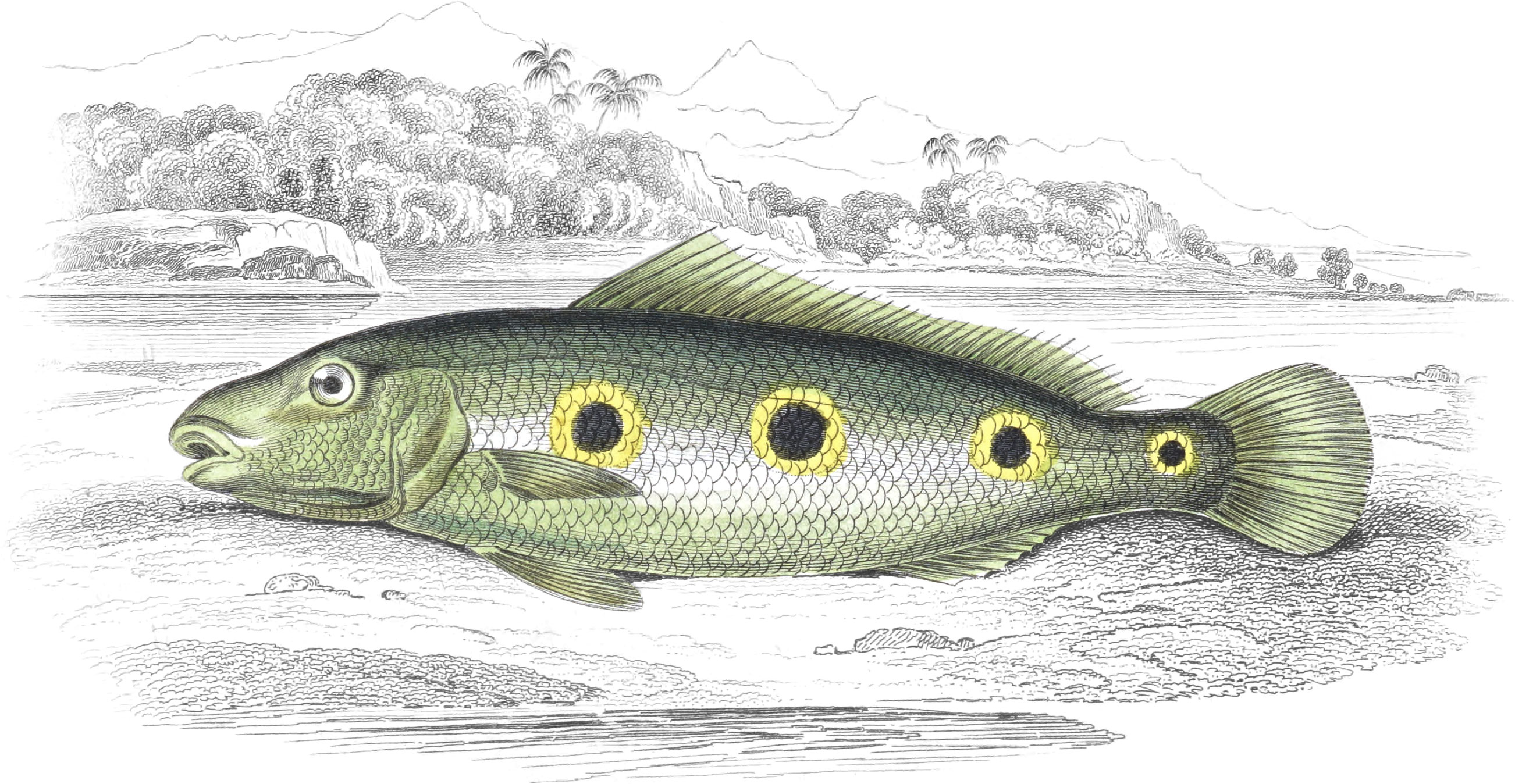
Plate XXVII
C. Atabapensis, Povondu Rio Atabasso, is found in those parts of the Oronoco where the waters are not thick or muddy; but the varieties having the hnest flavour are those of the river Atabasso, where the waters are dark and chrystalline. It is of the same form with the last; but, instead of the four spots, has four very large transverse bands, of a bluish black, bordered with golden.—It is added in a note that M. Valenciennes supposes with propriety that the C. atabapensis is the C. ocellaris of Schneider. The comparison of our copy of Schneider’s plate with the above short descriptive characters, may help this decision. The other species is,
C. Temensis. Povon du Temi. Of the same form, without transverse bands, but with four rows of small yellow spots. A single very large spot upon the tail.
Among the drawings alluded to as not made under the superintendence of Mr. Schomburgk, we have a slightly coloured sketch, which we wish to introduce for the sake of recording and drawing attention to the form.
The Pacamah of Guiana
Lophius? pacamah
The drawing approaches nearer to the form of Lophius than any other, though we have no traces of the long filaments on the anterior part of the head, neither of a first dorsal fin. The drawing is of a uniform olive, blotched with a darker shade; the pectoral fins represented disproportionally large. The provincial or native name, by which it may be again recognized, is that which we have provisionally applied as a specific title, “Pacamah.” Perhaps it may range with Batrarchus.

Plate XXVIII

With the exception of the “Voyage dans l’Amerique Meridionale” of D’Orbigny, where unfortunately we have not yet the letter-press which is to accompany the Plates, we have a greater number of species noticed in the two volumes of Zoological Researches by the Baron Humboldt than by any other author; many of them did not occur to our traveller within the range which he took, and although several of them are beyond the limits which the title of our volumes indicate, a short summary of them, taken from the two volumes alluded to, and particularly from the memoir entitled “Reserches sur les Poissons Fleuvatiles de l’Amerique Meridionale,” may be useful.
In writing of the distribution of fishes, and comparing that of South America with the Alpine parts of Europe, he remarks,
no species of Salmo inhabits any parts of the Andes which I have examined; the last fishes which are met with in the rivulets and lakes, at 1400, or 1600 toises, are of the genus Paecilia, Pimelodus, and two genera of a very remarkable form, Eremophilus and Astroblepus; at 1800 or 1900 toises the Alpine lakes under the equator no longer contain fishes; and he does not attribute this fact to the ice which covers the lakes, for the Laguna de Mica, on the plain of Antisana, east of Quito, at an elevation of 2100, is free from ice almost at all seasons; yet, if we understand the Baron correctly, it is destitute of fishes.
Near Santa-Fe de Bogota, a small fish was procured, under the native name of Guapucha. It was found, perhaps exclusively, at an elevation of 1360 toises above the level of the sea, in the cool waters of the little stream Bogota, which traverses the plateau of Santa-Fe, and precipitating itself by the celebrated Fall of Tequendama, mingles its waters under the name of Rio Tocama, with those of the Magdalena. The species is referred by Valenciennes to the genus Pecilia, Cuv., a group of small fishes inhabiting the fresh-waters of South America, characterised by a depressed head, and the muzzle, as it were, in the shape of an angle, and by having five rays to the gill membrane; the body is compressed and covered with rather large scales, which occur also on the head and opercula, which are without either spines or denticulations; and several of the species are known to be viviparous. Humboldt has named his species P. Bogotensis, from three to four inches long, of a yellowish green, with a longitudinal silvery stripe running nearly along the centre of the body; the tail bifid; swimming-bladder double. In addition, Valenciennes mentions another species from the fresh waters of Brazil, about two inches in length, of a dull green, yellowish beneath, and marked on each side with a black spot, anterior to the dorsal fin.
A single species of the genus Fundulus, Lacep. is considered to inhabit the fresh waters of Brazil, F. Braziliensis, Valenc. In this genus the dorsal and anal fins are opposite; the teeth, many on each lip, setaceous; gill-membrane with four rays. By some it has been placed among the Esoces. The genus is chiefly North American, the type Colitis heteroclita, Linn.
A fine species, Curimatus Amazonum, Le Boquichico de l’Amazone, was taken in the High Maragnon, opposite the cataract of Keetema, at an elevation of 200 toises. This species Valenciennes considers very nearly allied to the Sahno edentulus, Bloch., which he places in the same genus. Humboldt’s fish is of a greenish white, silvery; with large, round, and loose scales; no teeth. Length about seventeen inches. Formula of the fins,
D. 8/10—P. 14—V. 9—C. 20—Br. 4.
As elsewhere in these regions, the Siluridæ seem to have been frequent; one large species is described and figured, and four others are slightly indicated, all differing, with perhaps one exception, from those which we have already described.
Pimelodus Zungaro. Le Zungaro de l’Amazone. It was found in the Amazon near to Tomependa, and was said by the natives, who use it as food, to reach a size of six or seven feet in length. It possesses two dorsal fins; is of an olive colour, marked all over with black spots, and is furnished with six cirrhi,—two on the upper, four on the lower jaw.
The fin formula is given,
1st D. 7; 2d D. adip.—P. 13—V. 10—A. 10—C. 22—Br. 4.
A species of Serra-salmo, of considerable size, is described under the name of “Le poisson Caribe de l’Oronoque;” it approaches nearest to the S. piranha of the previous volume, being pale coloured, the back and dorsal fin greenish, the ventral and anal fins orange. In manners it agrees with S. niger; the observations of Humboldt confirming those of Mr. Schomburgk in regard to the rapacious habits of several of the genus, which attack, not only animals, but the natives, while bathing and swiming, “emportant des morceaux de chair considerables.”
Humboldt also met with the pacu, perhaps one of those described by Schomburgk; it is styled “Le paco de l’Amazone,” myletes paco. The form compressed, the outline of the back arched; the colour greenish white, the body covered with small scales. He confirms the accounts of the exquisite flavour which these fish are said to possess, although the accessary ribs are numerous and troublesome.
The Guavina of Tacarigua
Erythrinus guavina, Humboldt.
A species of Erythrinus, or of a fish allied somewhat to it, was procured in Lake Valencia or Tacarigua, at an elevation of 220 toises above the sea. It is named provisionally Erythrinus guavina; but M. Valenciennes, in his Notes, seems to have some hesitation in referring it to the old genus, thinking that it may form the type of one entirely new. It is a remarkable species, extremely voracious; the teeth pointed, stand in an arrangement of one large, with a smaller on each side, or to appearance, in the sketch, of a tricuspid tooth; under the throat there is a loose fleshy dependent membrane, of which the use is not hinted at; the scales large, round, and loosely imbricated, the centre and margins olive. It is about twenty inches in length. The colours are said to be a silvery yellow, the fins green, and in the Plate these are represented as barred narrowly and transversely with a darker shade. It is said to be the prey of a large Saurian reptile called, by the native inhabitants, Bava. We have thought it would assist researches by giving a figure from Humboldt’s representation of this curious fish, and would also invite attention to the large Saurian.

Plate XXIX
A fish from the Laguno de Colluca, which Baron Humboldt was assured was of fresh-water, is referred by Valenciennes to the Spare Breton of Lacépède, and named Smarts lineatus,—
White; the back greenish; the body with eight or nine longitudinal bands.
It is provincially named Moxara, but there appears to be a little doubt whether the lake, not far distant, is entirely without communication with the sea.
These are the principal species mentioned in the paper by Humboldt previously alluded to; but we have yet to notice the remarkable form Eremophilus, a fish supposed to belong to the family of the Loaches, but regarding which M. Valenciennes has expressed his views in a paper added to the second volume of the “Rescrches.”
Unarmed Eremophilus
Fig. 1. Eremophilus mutsii, Humboldt.
Eremophilus mutisii, Capitaine de Bogota, Humb. Obs. Zool. i. p. 17; Valen. ii. 341.
The Eremophilus was discovered by Humboldt in the little river Bogota, which forms the famous cataract of Tequendama, in the kingdom of New Grenada, at an elevation of 1347 toises; and is named as above, as a record of the solitude which reigns at these great elevations, and in the waters, which are scarcely inhabited by any other living creature. M. Valenciennes having examined specimens from the same localities, afterwards procured for him by the interest of M. Humboldt, has considered this fish as belonging to the Siluridæ, representing an unarmed form among them. Our figure will give an idea of the form of this singular fish; the body is covered with a strong mucus; the colour is a greyish blue, spotted with olive-green; these spots, of an undulated form, are in some species of a yellowish tint; the head is flattened; and the mouth, placed at the extremity of the snout, is narrow; the upper lip, lengthened and folded, exceeds the under, and is furnished with six fleshy barbules, of which the exterior are longest; two others, short and partly tubular, are placed above the nostrils; the extremity of the lips furnished with hair-like teeth; the eyes very small, and covered with a semi-transparent membrane, as in the Gymnoti and Murenæ. The length of this fish is from ten to twelve inches. It forms an agreeable aliment, and is eaten by the inhabitants of the capital of Santa-Fe during Lent. M. Valenciennes adds, regarding its internal structure, which appeared not to be easily made out from the state of his specimens, that the intestinal canal was simple, long, folded four times upon itself, and having numerous bands between each fold; the œsophagus and stomach firm, a long tube which occupies three-fourths of abdominal cavity. There is no swimming-bladder. The formula of the fins is,
D. 4/11—P. 9—A. 3—C. 11/13/12—Br. 6.

Plate XXX
Another fish, very nearly allied, has been procured by Valenciennes from the vicinity of Rio Janeiro.
A very curious fish was also discovered in the little river Palace, near to Passayan, to which M. Humboldt has given the name of Astroblepus grixalvii; Valenciennes, though he had not seen additional specimens, considered that it also belongs to the Silurian family: a very short description is given of this species. The length of Humboldt’s specimen is about fourteen inches; the colour is blackish olive, the form, particularly that of the head, rather broad and flat; the eyes, as indicated by the name, placed vertically, and very small; the mouth terminal, having a barbule at each angle; all the fins having the first ray lengthened to a short filament, which is also the case with the two exterior rays of the tail. The formula of the fins is,
P. 10—A. 7—C. 12—Br. 4.
Another fish, having very remarkable facts attached to its history, is also described by this great traveller; and we are not aware that subsequent researches have thrown any further light upon its history; it if
The Pimelodus of the Volcanos
Fig. 2. Pimelodus cyclopum, Humboldt.
This small species, about four inches in length (a variety appearing scarcely to exceed two inches), is found in the rivulets and lakes in the kingdom of Quito, at an elevation of 1700 toises, and where the temperature of the water is about 10° of the Centegrade thermometer. It is of an olive colour, marked with small dark spots; the mouth large, is terminal, and is furnished with two barbules on the upper jaw; the eyes, very small, are placed in the middle of the head; and the skin is covered with a thick and strong mucus. It is occasionally eaten, but only by the lower classes of Indians, the mucosity of the skin rendering it very disgusting. The formula of the fins is,
1st D. 6—P. 9—V. 5—A. 7—C. 12—Br. 4.
The singular fact in the history of this fish is, that from the volcanos in the vicinity it is, during the periodical eruptions, discharged in thousands; and in a state so perfect, as to show little mutilation either from scorching or from the effects of the hot water with which it is discharged. Baron Humboldt states, that in turning over the records kept by the small villages in the vicinity of Cotopaxi, he found mentioned, that, on the lands of the Marquis Selvalegre, so large a quantity was thrown, that a putrid odour was spread over the country. The almost extinct volcano of Imbaburu, in 1691, discharged thousands over the plains surrounding the village of Ibarra, and to the miasmita which occurred from them, fevers were attributed; and from another volcano, in 1698, thousands were also thrown, encased in argillaceous balls. Humboldt is of opinion that these volcanos contain subterranean lakes, from whence the supply is afforded, the numbers in the little rivulets around being comparatively small; he adds, many of these rivulets may communicate with these subterranean caverns; and, that the first Pimelodi which have stocked them must have ascended against the stream. In supposing this to account for the numbers destroyed by eruptions, we must conceive their producers to be very abundant. Does the spawn and the young also, in part at least, afford nourishment to the adults? or in what manner does a fish supposed to have been indigenous to the open streams support itself in these subterranean abodes? or has it been the reverse, and have the “waters under the earth” supplied the comparatively few specimens which exist in the small streams? We do not gather from the text that Humboldt saw specimens of the fish which had been expelled; and it is only from the united testimony of the inhabitants that he considers the subterranean fish identical with that existing in the streams, of which the native name is Prenadella.
Plate XXX
- Translated from Hist. Nat. des Poiss. iii. p. 84.
- Siballi is the Arawaak name for many species. Schomb.
- See account of its electric properties, from Humboldt, given in Vol. XXVII. of the “Naturalist’s Library,” and which the Vignette Title of our present Volume is intended to illustrate.
- See Vol. I.